The Components Guide
Preparations
Shooting
Playback/Erasing
Menus and Settings
CDI-E297-010 XX06XXX
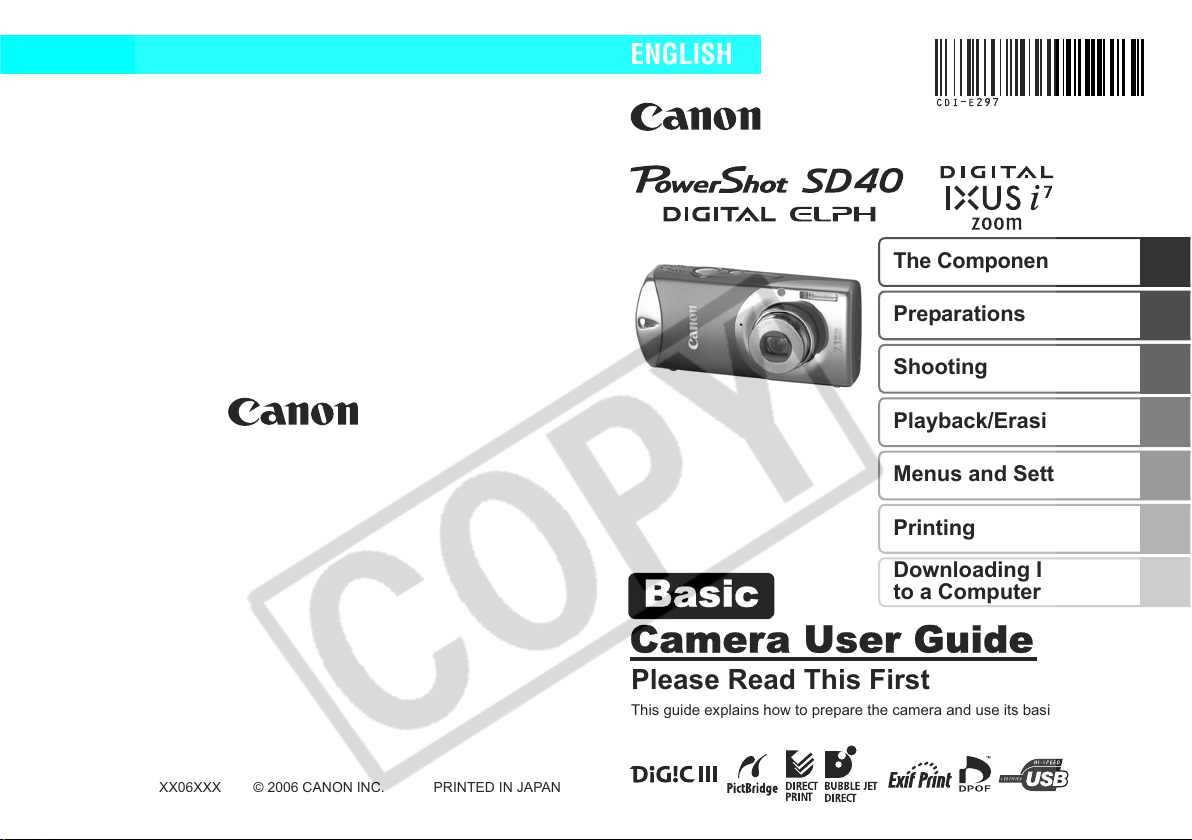
Camera User Guide
Please Read This First
This guide explains how to prepare the camera and use its basic features.
© 2006 CANON INC. PRINTED IN JAPAN
ENGLISH
Basic
Downloading Images
to a Computer
Printing
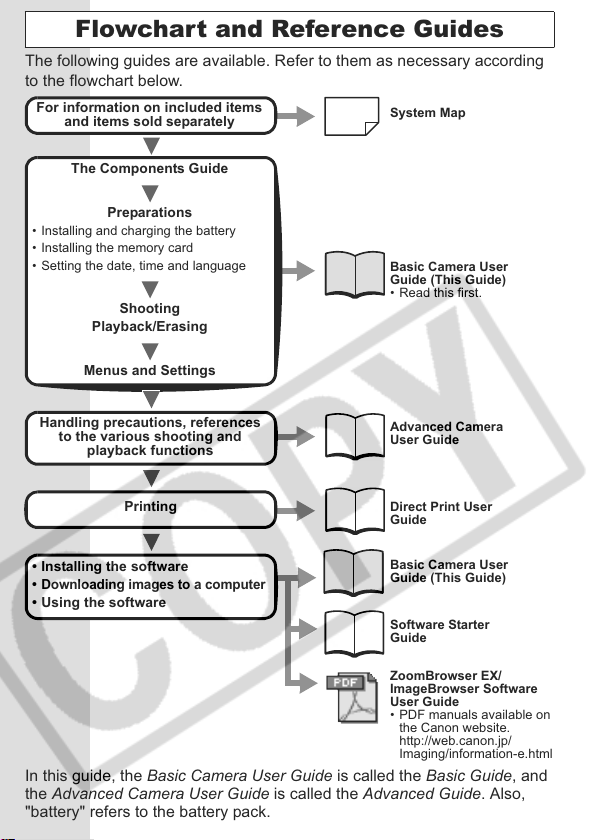
The following guides are available. Refer to them as necessary according
to the flowchart below.
Flowchart and Reference Guides
System Map
Basic Camera User
Guide (This Guide)
• Read this first.
Advanced Camera
User Guide
Direct Print User
Guide
Basic Camera User
Guide (This Guide)
Software Starter
Guide
ZoomBrowser EX/
ImageBrowser Software
User Guide
• PDF manuals available on
the Canon website.
http://web.canon.jp/
Imaging/information-e.html
For information on included items
and items sold separately
The Components Guide
Preparations
• Installing and charging the battery
• Installing the memory card
• Setting the date, time and language
Shooting
Playback/Erasing
Menus and Settings
Handling precautions, references
to the various shooting and
playback functions
Printing
•Installing the software
• Downloading images to a computer
•Using the software
In this guide, the Basic Camera User Guide is called the Basic Guide, and
theAdvanced Camera User Guide is called the Advanced Guide. Also,
"battery" refers to the battery pack.
1
7
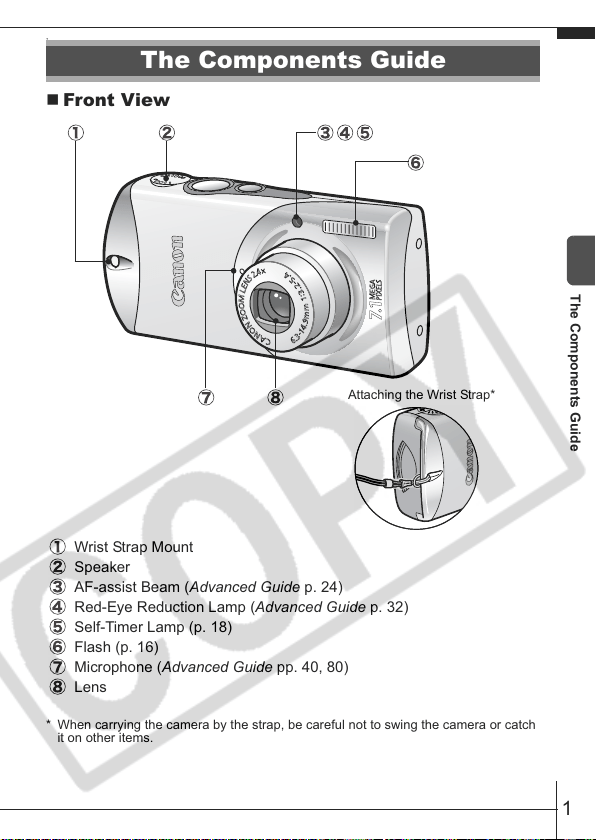
Front View
Wrist Strap Mount
Speaker
AF-assist Beam (Advanced Guide p. 24)
Red-Eye Reduction Lamp (Advanced Guide p. 32)
Self-Timer Lamp (p. 18)
Flash (p. 16)
Microphone (Advanced Guide pp. 40, 80)
Lens
* When carrying the camera by the strap, be careful not to swing the camera or catch
it on other items.
The Components Guide
Attaching the Wrist Strap*
The Components Guide
2
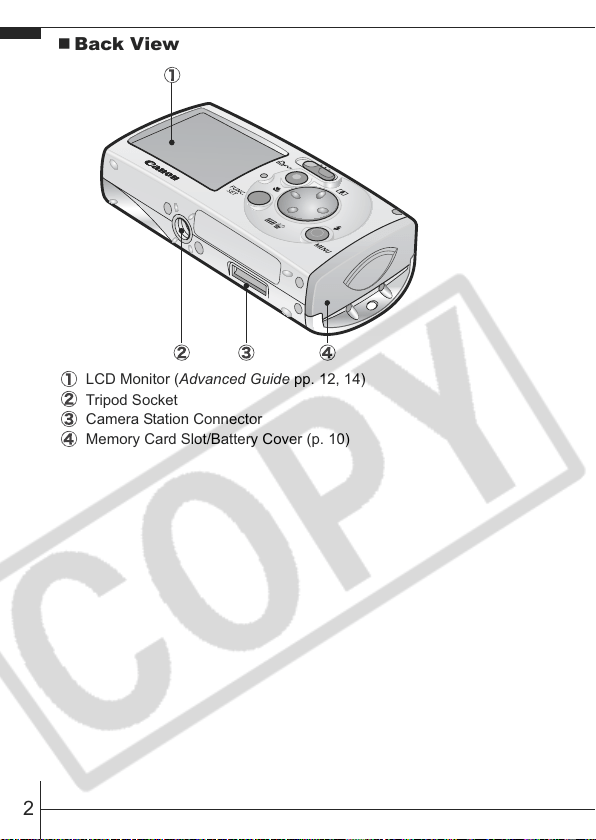
Back View
LCD Monitor (Advanced Guide pp. 12, 14)
Tripod Socket
Camera Station Connector
Memory Card Slot/Battery Cover (p. 10)
3
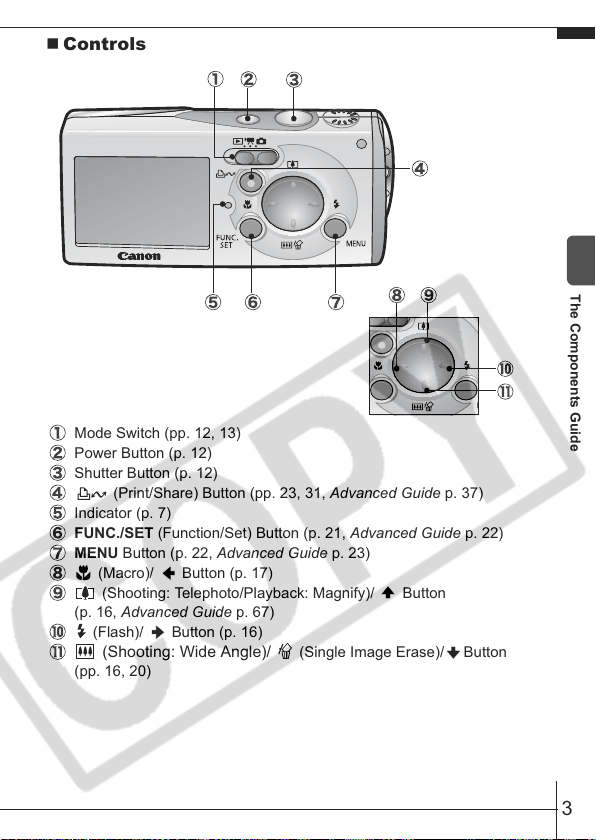
Controls
Mode Switch (pp. 12, 13)
Power Button (p. 12)
Shutter Button (p. 12)
(Print/Share) Button (pp. 23, 31, Advanced Guide p. 37)
Indicator (p. 7)
FUNC./SET (Function/Set) Button (p. 21, Advanced Guide p. 22)
MENU Button (p. 22, Advanced Guide p. 23)
(Macro)/ Button (p. 17)
(Shooting: Telephoto/Playback: Magnify)/ Button
(p. 16, Advanced Guide p. 67)
(Flash)/ Button (p. 16)
(Shooting: Wide Angle)/ (Single Image Erase)/ Button
(pp. 16, 20)
The Components Guide
4
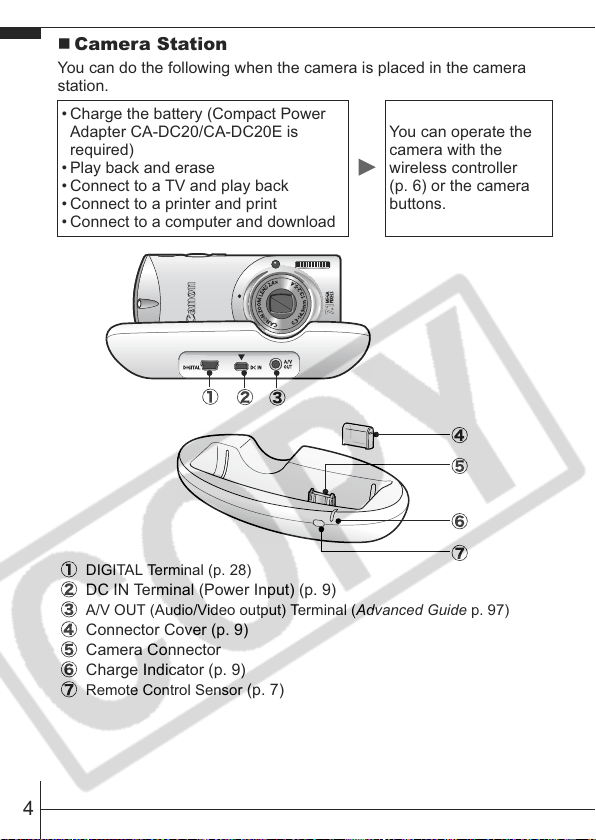
Camera Station
You can do the following when the camera is placed in the camera
station.
DIGITAL Terminal (p. 28)
DC IN Terminal (Power Input) (p. 9)
A/V OUT (Audio/Video output) Terminal (Advanced Guide p. 97)
Connector Cover (p. 9)
Camera Connector
Charge Indicator (p. 9)
Remote Control Sensor (p. 7)
• Charge the battery (Compact Power
Adapter CA-DC20/CA-DC20E is
required)
• Play back and erase
• Connect to a TV and play back
• Connect to a printer and print
• Connect to a computer and download
You can operate the
camera with the
wireless controller
(p. 6) or the camera
buttons.
5
• Always put the connector cover back on the camera con-
nector when the camera station is being carried or not in
use.
•The bottom of the camera station has non-slip rubber feet.
- The rubber feet are covered with a thin orange plastic
film. Carefully peel the film off before use.
- If dirt adheres to the rubber feet, lightly wipe them with a
slightly dampened cloth.
• Always turn off the camera power before placing the cam-
era in the camera station or removing it. Placing or remov-
ing the camera with the power on will abruptly turn the
camera off.
• When the camera is turned on in the camera station, it will
always start up in the playback mode regardless of the
setting selected with the mode switch.
• Compact Power Adapter CA-DC20/CA-DC20E is recom-
mended for powering the camera when the camera is
used in the camera station.
The Components Guide
6
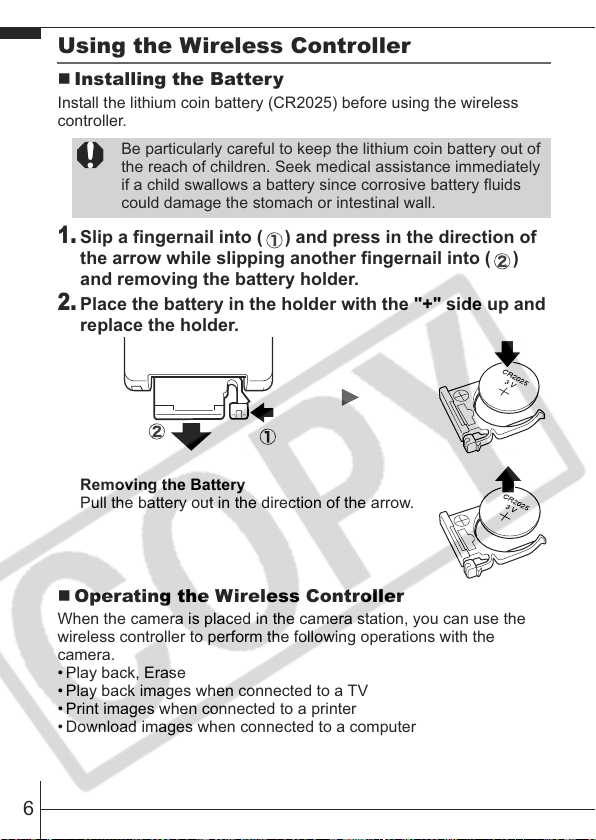
Using the Wireless Controller
Installing the Battery
Install the lithium coin battery (CR2025) before using the wireless
controller.
1.
Slip a fingernail into ( ) and press in the direction of
the arrow while slipping another fingernail into ( )
and removing the battery holder.
2.
Place the battery in the holder with the "+" side up and
replace the holder.
Removing the Battery
Pull the battery out in the direction of the arrow.
Operating the Wireless Controller
When the camera is placed in the camera station, you can use the
wireless controller to perform the following operations with the
camera.
• Play back, Erase
• Play back images when connected to a TV
• Print images when connected to a printer
• Download images when connected to a computer
Be particularly careful to keep the lithium coin battery out of
the reach of children. Seek medical assistance immediately
if a child swallows a battery since corrosive battery fluids
could damage the stomach or intestinal wall.
7
Indicator
The camera indicator lights or blinks under the following circumstances.
Green: Ready to shoot /connected to a computer/display off
(Advanced Guide p. 26)
Blinking Green:
Camera starting up/image recording/reading/eras-
ing/transferring (when connected to a computer)
Orange: Ready to shoot (flash on)
Blinking Orange:
Ready to shoot (camera shake warning)
*Camera beeps once if difficult to focus.
The distance at which the wireless controller can be used
will shorten under the following circumstances.
• When operated at an angle to the remote control sensor
• When strong light strikes the remote control sensor
• When the wireless controller battery is weak
• When used outside
Never do the following while an indicator is blinking green.
These actions may corrupt image data.
• Shake or jolt the camera
• Shut off the power, or open the memory card slot/battery
cover
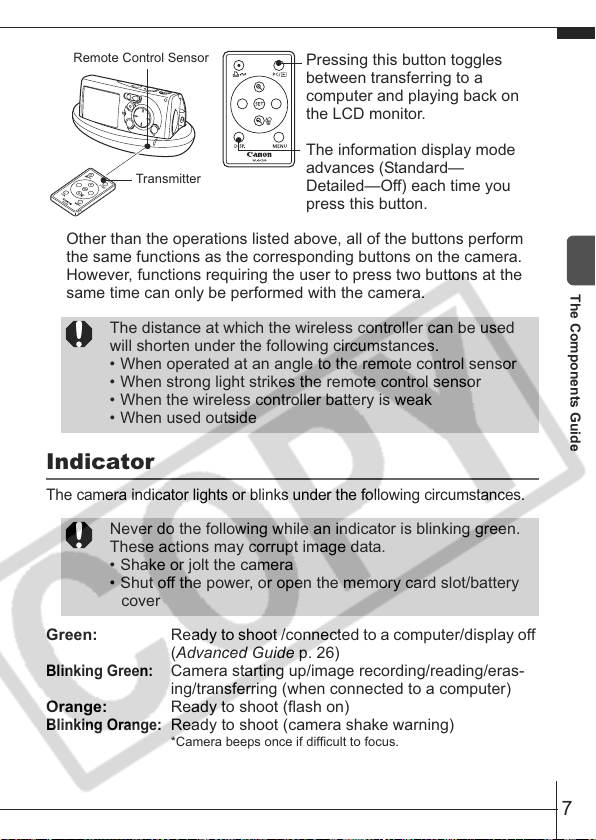
Pressing this button toggles
between transferring to a
computer and playing back on
the LCD monitor.
The information display mode
advances (Standard—
Detailed—Off) each time you
press this button.
Other than the operations listed above, all of the buttons perform
the same functions as the corresponding buttons on the camera.
However, functions requiring the user to press two buttons at the
same time can only be performed with the camera.
Remote Control Sensor
Transmitter
The Components Guide

8
1.
Installing the Battery.
1. Slide the memory card slot/battery cover and open it ( ,
).
2.Push the battery lock in the direction of the arrow (
)
, align
the symbol on the battery and inside of the
memory card
slot/battery cover
and insert the battery until it locks into
place (
)
.
To remove the battery, push the battery lock in the direction of
the arrow ( ) and hold it while pulling the battery out.
3. Close the memory card slot/battery cover.
2.
Charging the Battery.
Charge the battery before use under the following circumstances.
• When using the battery for the first time.
• When the "Change the battery pack" message displays.
Preparations
Battery Lock
symbol
9
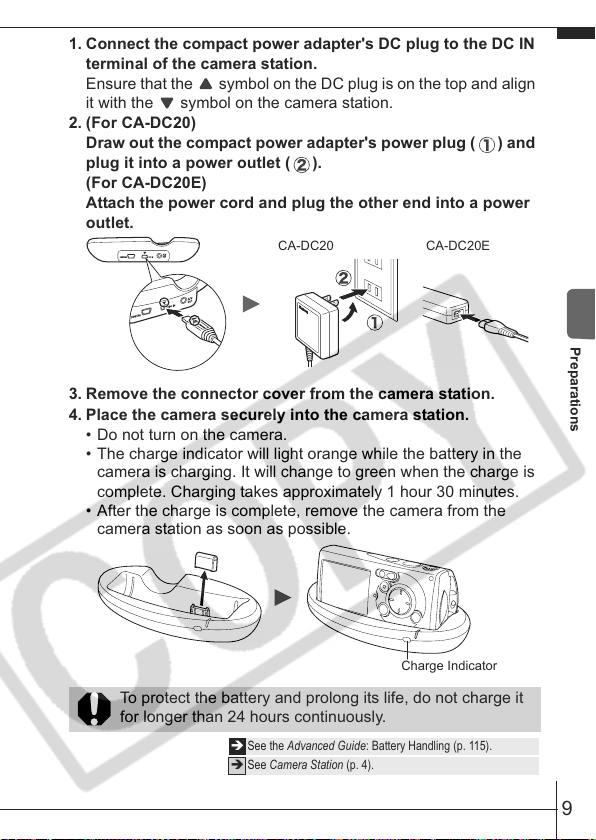
1. Connect the compact power adapter's DC plug to the DC IN
terminal of the camera station.
Ensure that the symbol on the DC plug is on the top and align
it with the symbol on the camera station.
2. (For CA-DC20)
Draw out the compact power adapter's power plug ( ) and
plug it into a power outlet ( ).
(For CA-DC20E)
Attach the power cord and plug the other end into a power
outlet.
3. Remove the connector cover from the camera station.
4. Place the camera securely into the camera station.
• Do not turn on the camera.
• The charge indicator will light orange while the battery in the
camera is charging. It will change to green when the charge is
complete. Charging takes approximately 1 hour 30 minutes.
• After the charge is complete, remove the camera from the
camera station as soon as possible.
To protect the battery and prolong its life, do not charge it
for longer than 24 hours continuously.
Î See the Advanced Guide: Battery Handling (p. 115).
Î See Camera Station (p. 4).
CA-DC20 CA-DC20E
Charge Indicator
Preparations
10
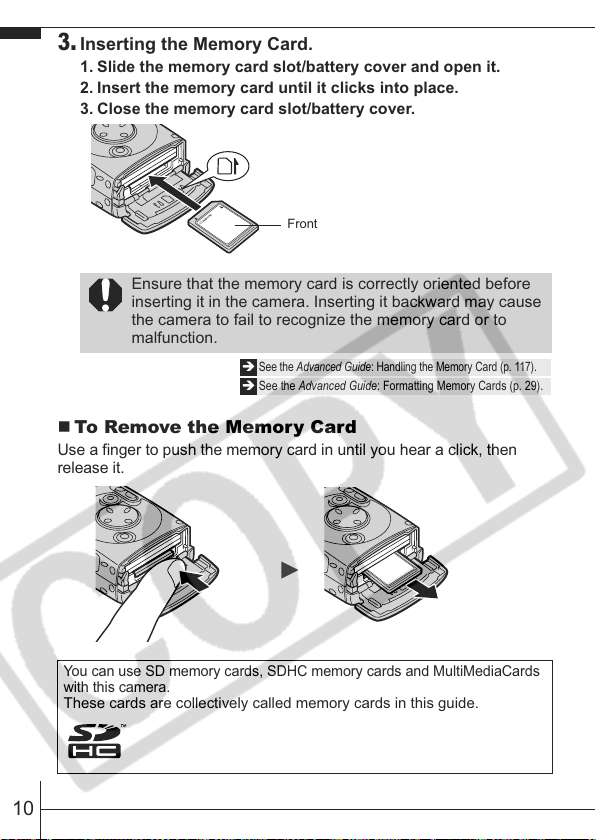
3.
Inserting the Memory Card.
1. Slide the memory card slot/battery cover and open it.
2. Insert the memory card until it clicks into place.
3. Close the memory card slot/battery cover.
To Remove the Memory Card
Use a finger to push the memory card in until you hear a click, then
release it.
Ensure that the memory card is correctly oriented before
inserting it in the camera. Inserting it backward may cause
the camera to fail to recognize the memory card or to
malfunction.
Î
See the Advanced Guide: Handling the Memory Card (p. 117).
Î See the Advanced Guide: Formatting Memory Cards (p. 29).
You can use SD memory cards, SDHC memory cards and MultiMediaCards
with this camera.
These cards are collectively called memory cards in this guide.
Front
11
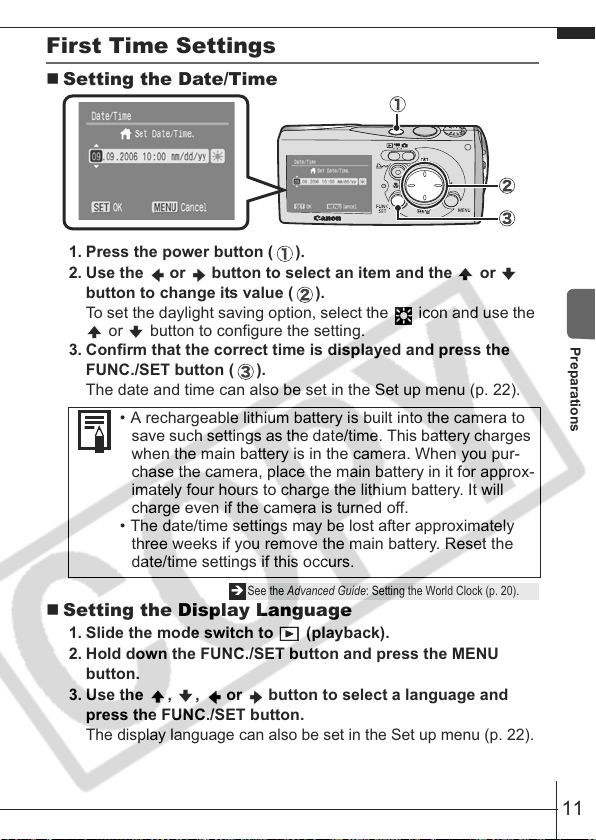
First Time Settings
Setting the Date/Time
1. Press the power button ( ).
2. Use the or button to select an item and the or
button to change its value ( ).
To set the daylight saving option, select the icon and use the
or button to configure the setting.
3. Confirm that the correct time is displayed and press the
FUNC./SET button ( ).
The date and time can also be set in the Set up menu (p. 22).
Setting the Display Language
1. Slide the mode switch to (playback).
2. Hold down the FUNC./SET button and press the MENU
button.
3. Use the , , or button to select a language and
press the FUNC./SET button.
The display language can also be set in the Set up menu (p. 22).
• A rechargeable lithium battery is built into the camera to
save such settings as the date/time. This battery charges
when the main battery is in the camera. When you pur-
chase the camera, place the main battery in it for approx-
imately four hours to charge the lithium battery. It will
charge even if the camera is turned off.
• The date/time settings may be lost after approximately
three weeks if you remove the main battery. Reset the
date/time settings if this occurs.
Î See the Advanced Guide: Setting the World Clock (p. 20).
Preparations
12
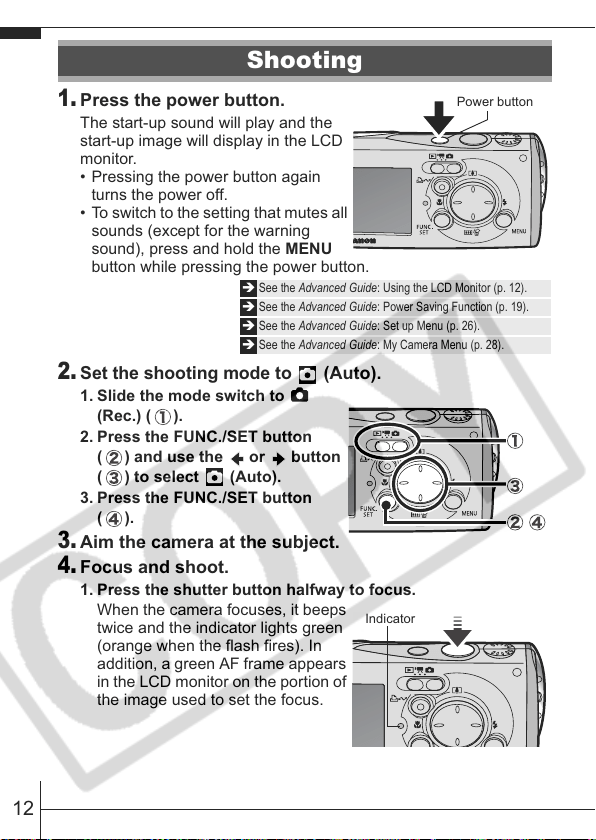
1.
Press the power button.
The start-up sound will play and the
start-up image will display in the LCD
monitor.
• Pressing the power button again
turns the power off.
• To switch to the setting that mutes all
sounds (except for the warning
sound), press and hold the MENU
button while pressing the power button.
2.
Set the shooting mode to
(Auto).
1. Slide the mode switch to
(Rec.) ( ).
2. Press the FUNC./SET button
( ) and use the or button
( ) to select (Auto).
3. Press the FUNC./SET button
().
3.
Aim the camera at the subject.
4.
Focus and shoot.
1. Press the shutter button halfway to focus.
When the camera focuses, it beeps
twice and the indicator lights green
(orange when the flash fires). In
addition, a green AF frame appears
in the LCD monitor on the portion of
the image used to set the focus.
Shooting
Î See the Advanced Guide: Using the LCD Monitor (p. 12).
Î See the Advanced Guide: Power Saving Function (p. 19).
Î See the Advanced Guide: Set up Menu (p. 26).
Î See the Advanced Guide: My Camera Menu (p. 28).
Power button
Indicator
13
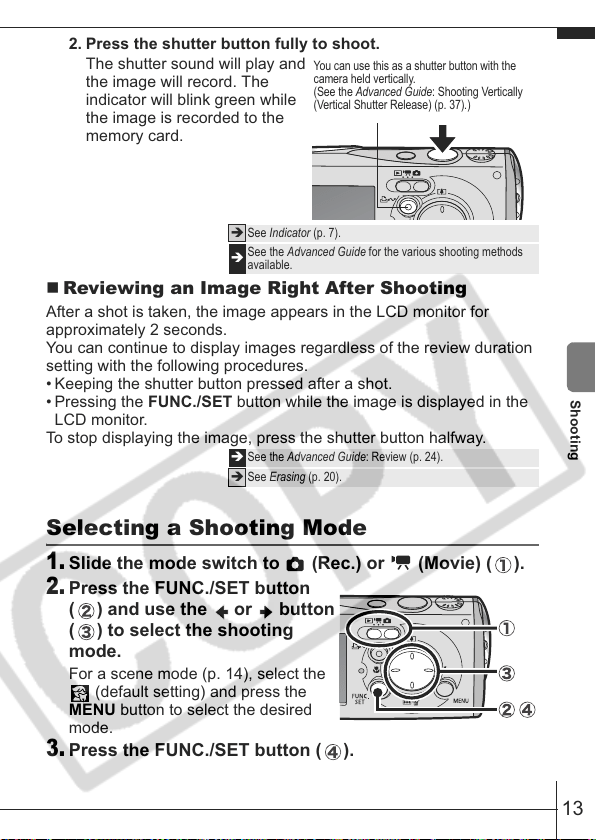
2. Press the shutter button fully to shoot.
The shutter sound will play and
the image will record. The
indicator will blink green while
the image is recorded to the
memory card.
Reviewing an Image Right After Shooting
After a shot is taken, the image appears in the LCD monitor for
approximately 2 seconds.
You can continue to display images regardless of the review duration
setting with the following procedures.
• Keeping the shutter button pressed after a shot.
• Pressing the FUNC./SET button while the image is displayed in the
LCD monitor.
To stop displaying the image, press the shutter button halfway.
Selecting a Shooting Mode
1.
Slide the mode switch to (Rec.) or (Movie) ( ).
2.
Press the FUNC./SET button
( ) and use the or button
( ) to select the shooting
mode.
For a scene mode (p. 14), select the
(default setting) and press the
MENU button to select the desired
mode.
3.
Press the FUNC./SET button ( ).
Î See Indicator (p. 7).
Î
See the Advanced Guide for the various shooting methods
available.
Î See the Advanced Guide: Review (p. 24).
Î See Erasing (p. 20).
You can use this as a shutter button with the
camera held vertically.
(See the Advanced Guide: Shooting Vertically
(Vertical Shutter Release) (p. 37).)
Shooting
14
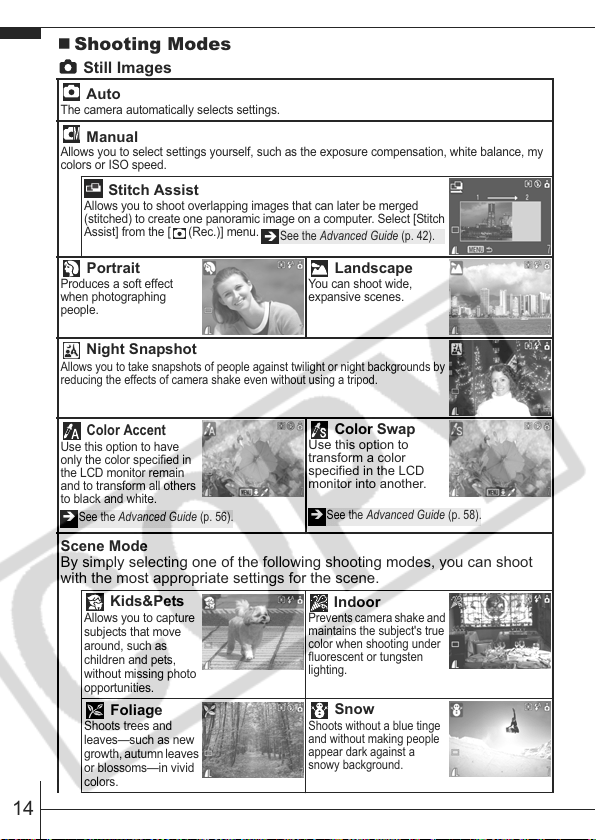
Shooting Modes
Still Images
Auto
The camera automatically selects settings.
Manual
Allows you to select settings yourself, such as the exposure compensation, white balance, my
colors or ISO speed.
Stitch Assist
Allows you to shoot overlapping images that can later be merged
(stitched) to create one panoramic image on a computer. Select [Stitch
Assist] from the [ (Rec.)] menu.
Portrait
Produces a soft effect
when photographing
people.
Landscape
You can shoot wide,
expansive scenes.
Night Snapshot
Allows you to take snapshots of people against twilight or night backgrounds by
reducing the effects of camera shake even without using a tripod.
Color Accent
Use this option to have
only the color specified in
the LCD monitor remain
and to transform all others
to black and white.
Color Swap
Use this option to
transform a color
specified in the LCD
monitor into another.
Scene Mode
By simply selecting one of the following shooting modes, you can shoot
with the most appropriate settings for the scene.
Kids&Pets
Allows you to capture
subjects that move
around, such as
children and pets,
without missing photo
opportunities.
Indoor
Prevents camera shake and
maintains the subject's true
color when shooting under
fluorescent or tungsten
lighting.
Foliage
Shoots trees and
leaves—such as new
growth, autumn leaves
or blossoms—in vivid
colors.
Snow
Shoots without a blue tinge
and without making people
appear dark against a
snowy background.
Î
See the Advanced Guide (p. 42).
Î See the Advanced Guide (p. 56).
Î See the Advanced Guide (p. 58).
15
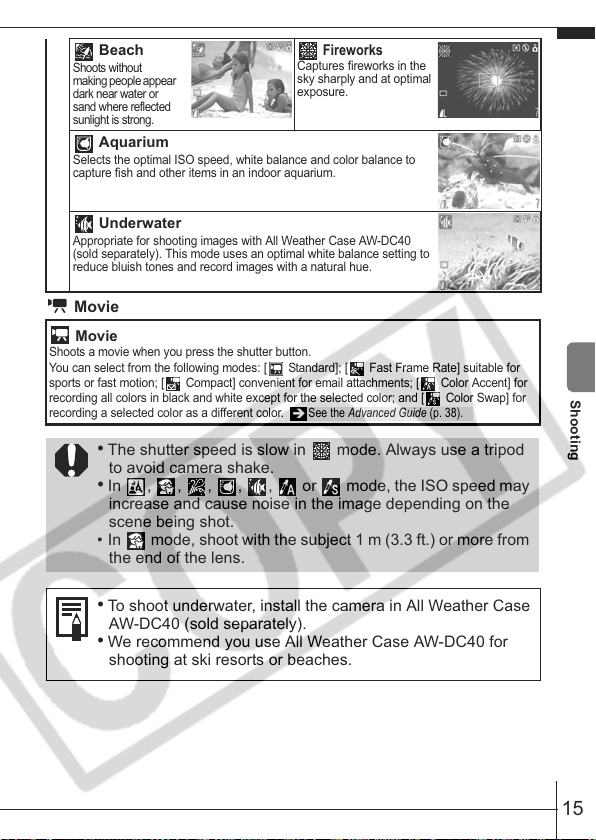
Movie
Beach
Shoots without
making people appear
dark near water or
sand where reflected
sunlight is strong.
Fireworks
Captures fireworks in the
sky sharply and at optimal
exposure.
Aquarium
Selects the optimal ISO speed, white balance and color balance to
capture fish and other items in an indoor aquarium.
Underwater
Appropriate for shooting images with All Weather Case AW-DC40
(sold separately). This mode uses an optimal white balance setting to
reduce bluish tones and record images with a natural hue.
Movie
Shoots a movie when you press the shutter button.
You can select from the following modes: [ Standard]; [ Fast Frame Rate] suitable for
sports or fast motion; [ Compact] convenient for email attachments; [ Color Accent] for
recording all colors in black and white except for the selected color; and [ Color Swap] for
recording a selected color as a different color.
• The shutter speed is slow in mode. Always use a tripod
to avoid camera shake.
• In , , , , , or mode, the ISO speed may
increase and cause noise in the image depending on the
scene being shot.
• In mode, shoot with the subject 1 m (3.3 ft.) or more from
the end of the lens.
• To shoot underwater, install the camera in All Weather Case
AW-DC40 (sold separately).
• We recommend you use All Weather Case AW-DC40 for
shooting at ski resorts or beaches.
Î
See the Advanced Guide (p. 38).
Shooting
16
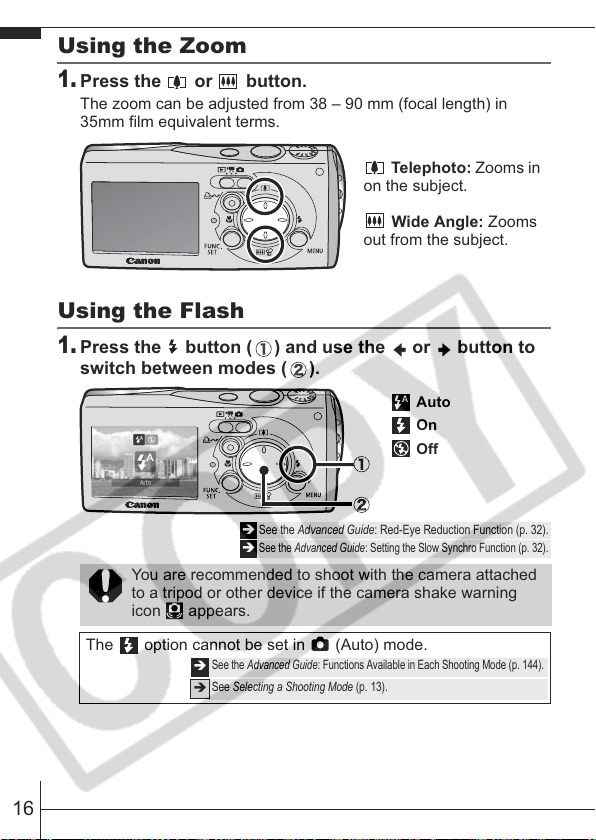
Using the Zoom
1.
Press the or button.
The zoom can be adjusted from 38 – 90 mm (focal length) in
35mm film equivalent terms.
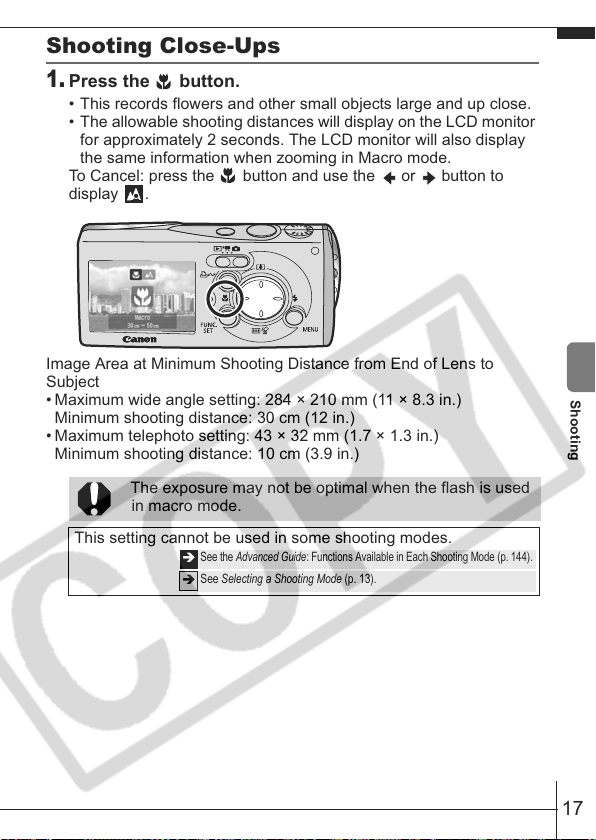
Using the Flash
1.
Press the button ( ) and use the or button to
switch between modes ( ).
Î
See the Advanced Guide: Red-Eye Reduction Function (p. 32).
Î
See the Advanced Guide: Setting the Slow Synchro Function (p. 32).
You are recommended to shoot with the camera attached
to a tripod or other device if the camera shake warning
icon appears.
The option cannot be set in (Auto) mode.
Telephoto: Zooms in
on the subject.
Wide Angle: Zooms
out from the subject.
Auto
On
Off
Î
See the Advanced Guide: Functions Available in Each Shooting Mode (p. 144).
See Selecting a Shooting Mode (p. 13).
Î
17
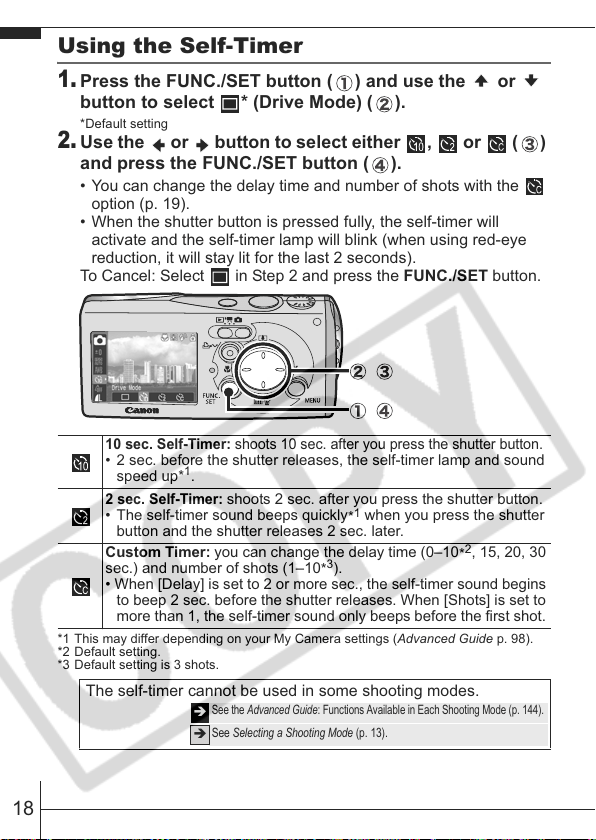
Shooting Close-Ups
1.
Press the button.
• This records flowers and other small objects large and up close.
• The allowable shooting distances will display on the LCD monitor
for approximately 2 seconds. The LCD monitor will also display
the same information when zooming in Macro mode.
To Cancel: press the button and use the or button to
display .
Image Area at Minimum Shooting Distance from End of Lens to
Subject
• Maximum wide angle setting: 284 × 210 mm (11 × 8.3 in.)
Minimum shooting distance: 30 cm (12 in.)
• Maximum telephoto setting: 43 × 32 mm (1.7 × 1.3 in.)
Minimum shooting distance: 10 cm (3.9 in.)
The exposure may not be optimal when the flash is used
in macro mode.
This setting cannot be used in some shooting modes.
Î
See the Advanced Guide: Functions Available in Each Shooting Mode (p. 144).
See Selecting a Shooting Mode (p. 13).
Î
Shooting
18
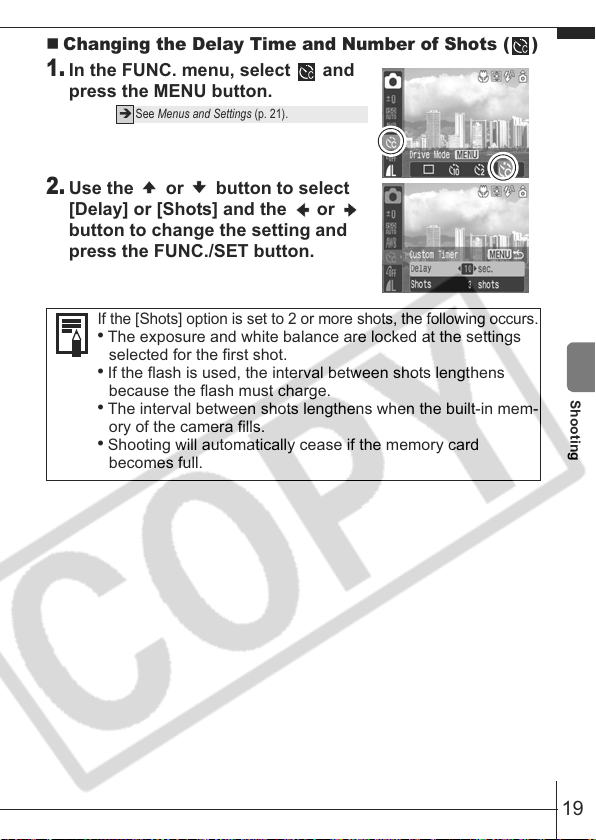
Using the Self-Timer
1.
Press the FUNC./SET button ( ) and use the or
button to select * (Drive Mode) ( ).
*Default setting
2.
Use the or button to select either , or ( )
and press the FUNC./SET button ( ).
• You can change the delay time and number of shots with the
option (p. 19).
• When the shutter button is pressed fully, the self-timer will
activate and the self-timer lamp will blink (when using red-eye
reduction, it will stay lit for the last 2 seconds).
To Cancel: Select in Step 2 and press the FUNC./SET button.
*1 This may differ depending on your My Camera settings (Advanced Guide p. 98).
*2 Default setting.
*3 Default setting is 3 shots.
10 sec. Self-Timer:
shoots 10 sec. after you press the shutter button.
• 2 sec. before the shutter releases, the self-timer lamp and sound
speed up*
1
.
2 sec. Self-Timer:
shoots 2 sec. after you press the shutter button.
• The self-timer sound beeps quickly
*
1
when you press the shutter
button and the shutter releases 2 sec. later.
Custom Timer
:
you can change the delay time (0–10
*
2
, 15, 20, 30
sec.) and number of shots (1–10
*
3
).
• When [Delay] is set to 2 or more sec., the self-timer sound begins
to beep 2 sec. before the shutter releases. When [Shots] is set to
more than 1, the self-timer sound only beeps before the first shot.
The self-timer cannot be used in some shooting modes.
Î
See the Advanced Guide: Functions Available in Each Shooting Mode (p. 144).
See Selecting a Shooting Mode (p. 13).
Î
19
Changing the Delay Time and Number of Shots ( )
1.
In the FUNC. menu, select and
press the MENU button.
2.
Use the or button to select
[Delay] or [Shots] and the or
button to change the setting and
press the FUNC./SET button.
Î See Menus and Settings (p. 21).
If the [Shots] option is set to 2 or more shots, the following occurs.
• The exposure and white balance are locked at the settings
selected for the first shot.
• If the flash is used, the interval between shots lengthens
because the flash must charge.
• The interval between shots lengthens when the built-in mem-
ory of the camera fills.
• Shooting will automatically cease if the memory card
becomes full.
Shooting
20
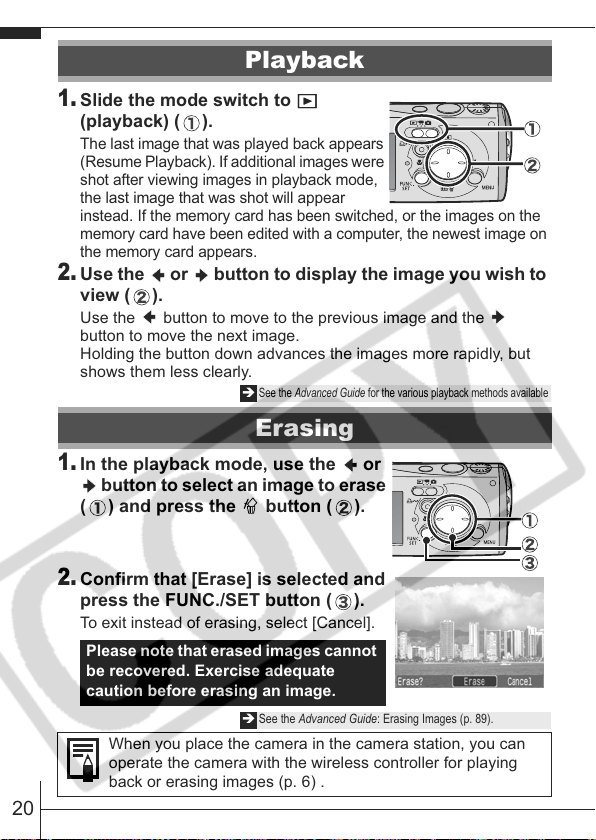
1.
Slide the mode switch to
(playback) ( ).
The last image that was played back appears
(Resume Playback). If additional images were
shot after viewing images in playback mode,
the last image that was shot will appear
instead. If the memory card has been switched, or the images on the
memory card have been edited with a computer, the newest image on
the memory card appears.
2.
Use the or button to display the image you wish to
view ( ).
Use the button to move to the previous image and the
button to move the next image.
Holding the button down advances the images more rapidly, but
shows them less clearly.
1.
In the playback mode, use the or
button to select an image to erase
( ) and press the button ( ).
2.
Confirm that [Erase] is selected and
press the FUNC./SET button ( ).
To exit instead of erasing, select [Cancel].
Playback
Î
See the Advanced Guide for the various playback methods available
Erasing
Please note that erased images cannot
be recovered. Exercise adequate
caution before erasing an image.
Î See the Advanced Guide: Erasing Images (p. 89).
When you place the camera in the camera station, you can
operate the camera with the wireless controller for playing
back or erasing images (p. 6) .
21
Settings for the shooting or playback modes or such camera settings
as the print settings, date/time and sounds are set using the FUNC.
menu or the Rec., Play, Print, Set up or My Camera menu.
FUNC. Menu
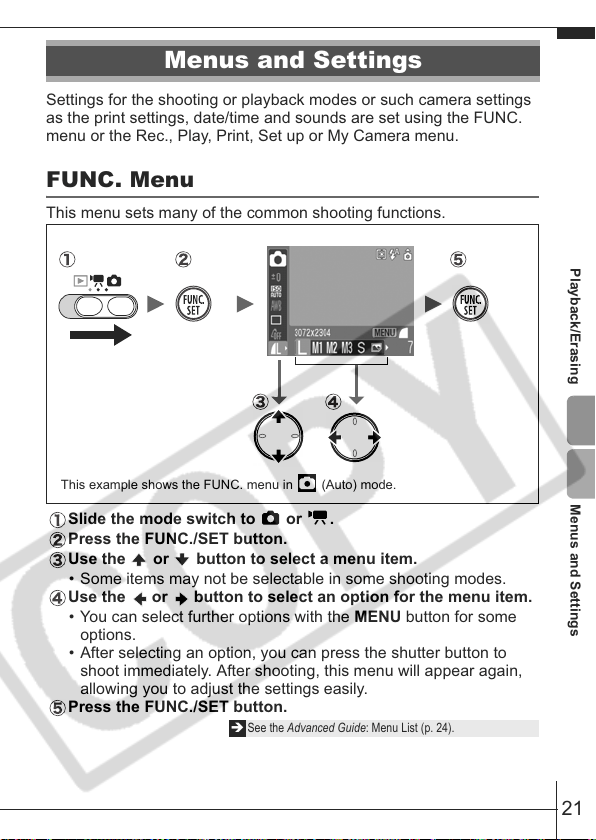
This menu sets many of the common shooting functions.
Slide the mode switch to or .
Press the FUNC./SET button.
Use the or button to select a menu item.
• Some items may not be selectable in some shooting modes.
Use the or button to select an option for the menu item.
• You can select further options with the MENU button for some
options.
• After selecting an option, you can press the shutter button to
shoot immediately. After shooting, this menu will appear again,
allowing you to adjust the settings easily.
Press the FUNC./SET button.
Menus and Settings
Î See the Advanced Guide: Menu List (p. 24).
This example shows the FUNC. menu in (Auto) mode.
Menus and SettingsPlayback/Erasing
22
Rec., Play, Print, Set up and My Camera Menus
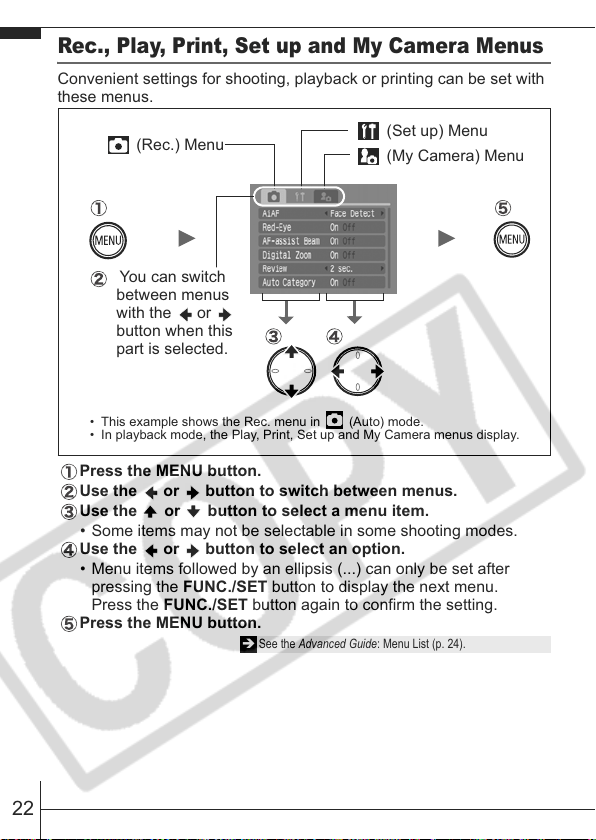
Convenient settings for shooting, playback or printing can be set with
these menus.
Press the MENU button.
Use the or button to switch between menus.
Use the or button to select a menu item.
• Some items may not be selectable in some shooting modes.
Use the or button to select an option.
• Menu items followed by an ellipsis (...) can only be set after
pressing the FUNC./SET button to display the next menu.
Press the FUNC./SET button again to confirm the setting.
Press the MENU button.
Î See the Advanced Guide: Menu List (p. 24).
(My Camera) Menu
• This example shows the Rec. menu in (Auto) mode.
• In playback mode, the Play, Print, Set up and My Camera menus display.
You can switch
between menus
with the or
button when this
part is selected.
(Rec.) Menu
(Set up) Menu
23
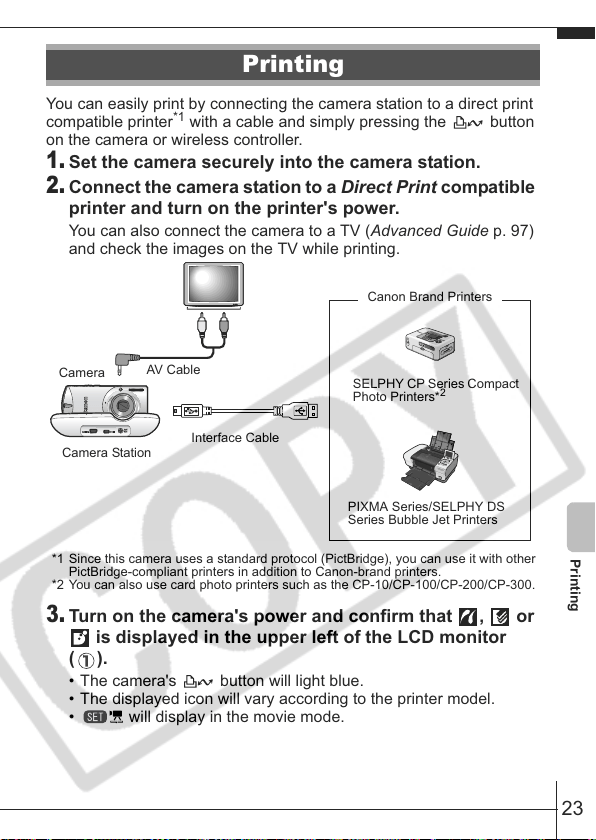
You can easily print by connecting the camera station to a direct print
compatible printer
*1
with a cable and simply pressing the button
on the camera or wireless controller.
1.
Set the camera securely into the camera station.
2.
Connect the camera station to a Direct Print compatible
printer and turn on the printer's power.
You can also connect the camera to a TV (Advanced Guide p. 97)
and check the images on the TV while printing.
*1 Since this camera uses a standard protocol (PictBridge), you can use it with other
PictBridge-compliant printers in addition to Canon-brand printers.
*2 You can also use card photo printers such as the CP-10/CP-100/CP-200/CP-300.
3.
Turn on the camera's power and confirm that , or
is displayed in the upper left of the LCD monitor
().
• The camera's button will light blue.
• The displayed icon will vary according to the printer model.
• will display in the movie mode.
Printing
Canon Brand Printers
SELPHY CP Series Compact
Photo Printers*
2
PIXMA Series/SELPHY DS
Series Bubble Jet Printers
Interface Cable
Camera Station
Camera
AV Cable
Printing
24
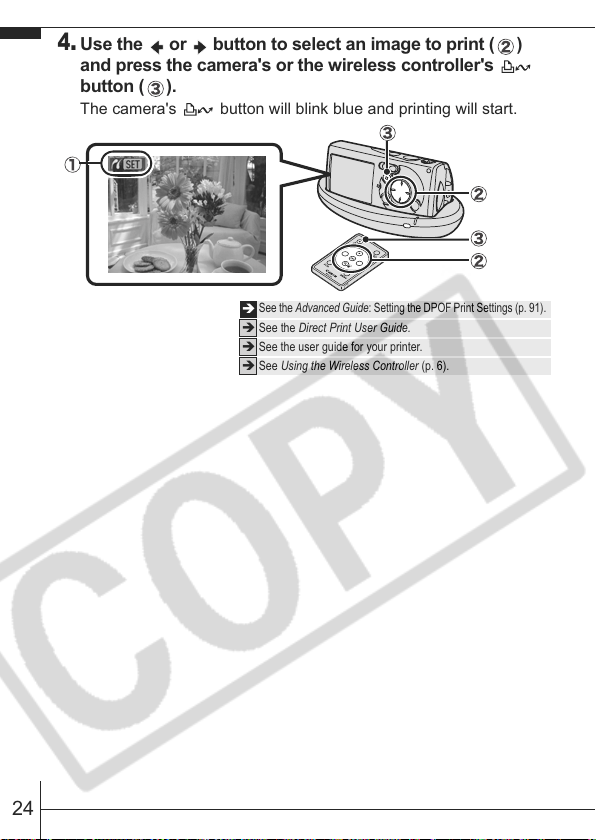
4.
Use the or button to select an image to print ( )
and press the camera's or the wireless controller's
button ( ).
The camera's button will blink blue and printing will start.
Î
See the Advanced Guide: Setting the DPOF Print Settings (p. 91).
Î See the Direct Print User Guide.
Î See the user guide for your printer.
Î SeeUsing the Wireless Controller (p. 6).
25
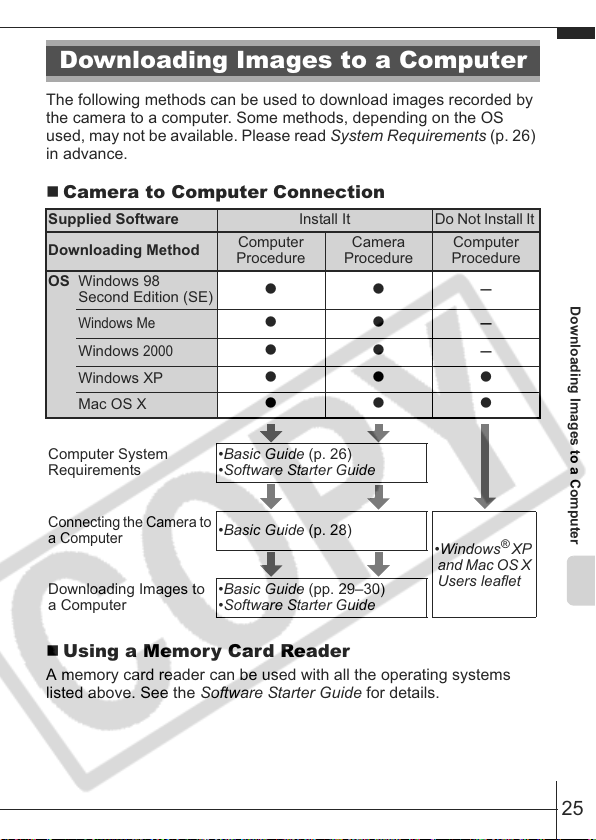
The following methods can be used to download images recorded by
the camera to a computer. Some methods, depending on the OS
used, may not be available. Please read System Requirements (p. 26)
in advance.
Camera to Computer Connection
Using a Memory Card Reader
A memory card reader can be used with all the operating systems
listed above. See the Software Starter Guide for details.
Downloading Images to a Computer
Supplied Software Install It Do Not Install It
Downloading Method
Computer
Procedure
Camera
Procedure
Computer
Procedure
OS Windows 98
Second Edition (SE)
zz
–
Windows Me
zz
–
Windows
2000
zz
–
Windows XP
zzz
Mac OS X
zzz
Computer System
Requirements
•Basic Guide (p. 26)
•Software Starter Guide
Connecting the Camera to
a Computer
•Basic Guide (p. 28)
•Windows
®
XP
and Mac OS X
Users leaflet
Downloading Images to
a Computer
•Basic Guide (pp. 29–30)
•Software Starter Guide
Downloading Images to a Computer
26
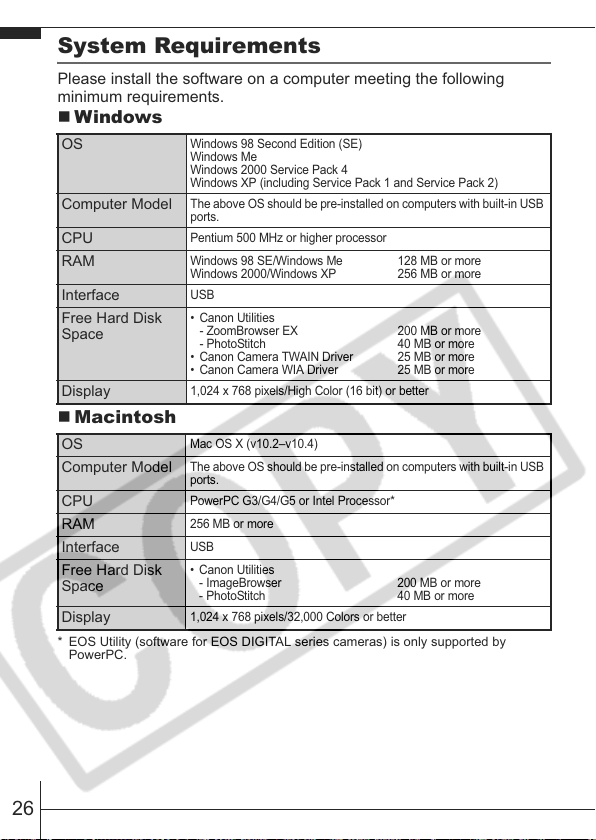
System Requirements
Please install the software on a computer meeting the following
minimum requirements.
Windows
Macintosh
* EOS Utility (software for EOS DIGITAL series cameras) is only supported by
PowerPC.
OS
Windows 98 Second Edition (SE)
Windows Me
Windows 2000 Service Pack 4
Windows XP (including Service Pack 1 and Service Pack 2)
Computer Model
The above OS should be pre-installed on computers with built-in USB
ports.
CPU
Pentium 500 MHz or higher processor
RAM
Windows 98 SE/Windows Me 128 MB or more
Windows 2000/Windows XP 256 MB or more
Interface
USB
Free Hard Disk
Space
• Canon Utilities
- ZoomBrowser EX 200 MB or more
- PhotoStitch 40 MB or more
• Canon Camera TWAIN Driver 25 MB or more
• Canon Camera WIA Driver 25 MB or more
Display
1,024 x 768 pixels/High Color (16 bit) or better
OS
Mac OS X (v10.2–v10.4)
Computer Model
The above OS should be pre-installed on computers with built-in USB
ports.
CPU
PowerPC G3/G4/G5 or Intel Processor*
RAM
256 MB or more
Interface
USB
Free Hard Disk
Space
• Canon Utilities
- ImageBrowser 200 MB or more
- PhotoStitch 40 MB or more
Display
1,024 x 768 pixels/32,000 Colors or better

27
Preparing to Download Images
Items to Prepare
• Camera and computer
• Camera station (wireless controller)
• Canon Digital Camera Solution Disk supplied with the camera
• Interface cable supplied with the camera
1.
Install the software.
1. Place the Canon Digital Camera Solution Disk in the
computer's CD-ROM drive.
2. Click [Easy Installation].
Proceed with the installation while
reviewing installation settings.
3. When the installation is finished, the
[Finish] or [Restart] button appears.
Click the one that appears.
4.When the screen returns to the desktop display, remove the
Canon Digital Camera Solution Disk from the CD-ROM
drive.
Ensure that you install the software first before connecting the
camera to the computer.
Double-click the [Canon
Digital Camera Installer] icon in the
CD-ROM window. When the installer
panel appears, click [Install].
Select [Easy Installation] as
the setup type and click [Next].
When the installation is
finished, click [Exit].
Downloading Images to a Computer
28
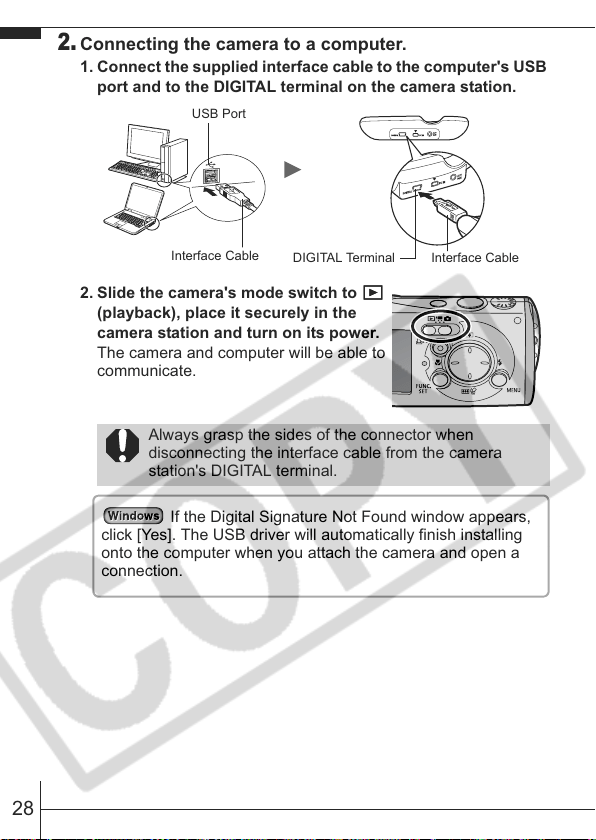
2.
Connecting the camera to a computer.
1.Connect the supplied interface cable to the computer's USB
port and to the DIGITAL terminal on the camera station.
2. Slide the camera's mode switch to
(playback), place it securely in the
camera station and turn on its power.
The camera and computer will be able to
communicate.
Always grasp the sides of the connector when
disconnecting the interface cable from the camera
station's DIGITAL terminal.
USB Port
DIGITAL Terminal
Interface Cable
Interface Cable
If the Digital Signature Not Found window appears,
click [Yes]. The USB driver will automatically finish installing
onto the computer when you attach the camera and open a
connection.
29
Downloading Images to a Computer
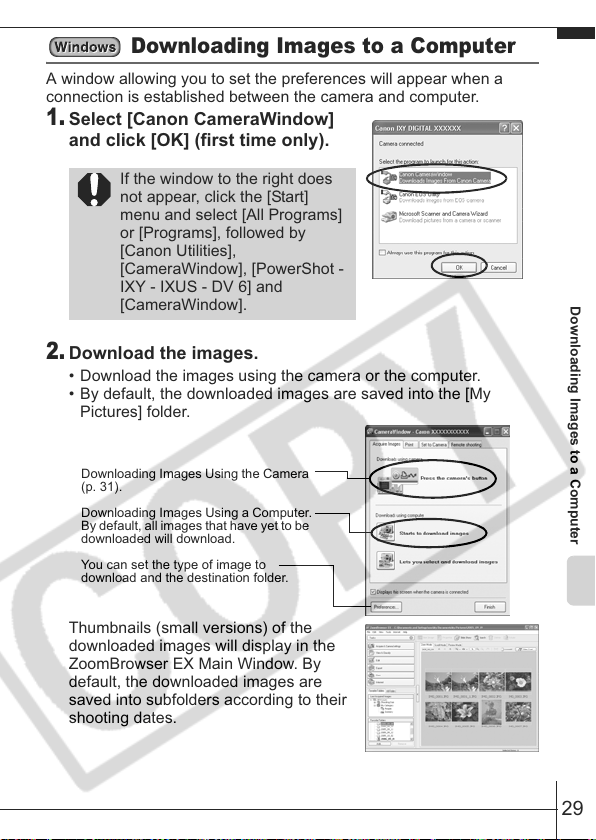
A window allowing you to set the preferences will appear when a
connection is established between the camera and computer.
1.
Select [Canon CameraWindow]
and click [OK] (first time only).
2.
Download the images.
• Download the images using the camera or the computer.
• By default, the downloaded images are saved into the [My
Pictures] folder.
Thumbnails (small versions) of the
downloaded images will display in the
ZoomBrowser EX Main Window. By
default, the downloaded images are
saved into subfolders according to their
shooting dates.
If the window to the right does
not appear, click the [Start]
menu and select [All Programs]
or [Programs], followed by
[Canon Utilities],
[CameraWindow], [PowerShot -
IXY - IXUS - DV 6] and
[CameraWindow].
Downloading Images Using the Camera
(p. 31).
Downloading Images Using a Computer.
By default, all images that have yet to be
downloaded will download.
You can set the type of image to
download and the destination folder.
Downloading Images to a Computer
30
Downloading Images to a Computer
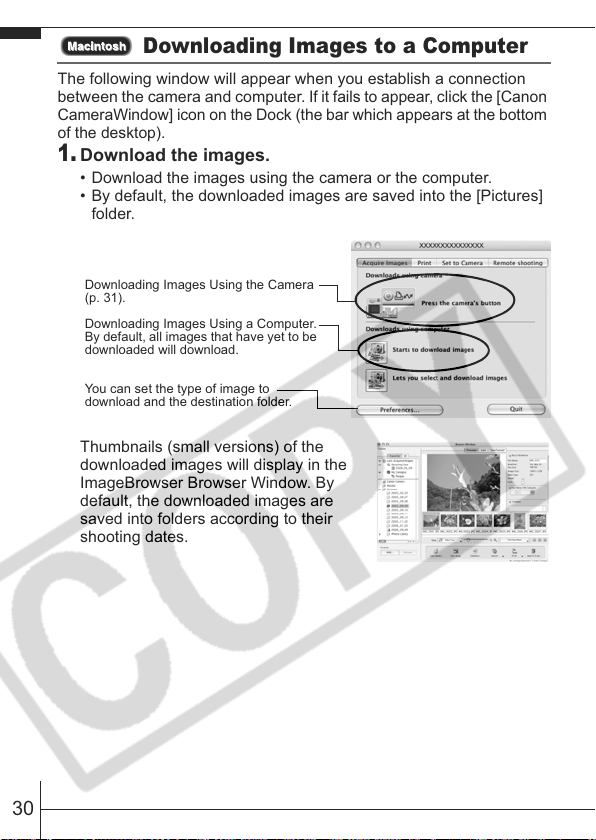
The following window will appear when you establish a connection
between the camera and computer.
If it fails to appear, click the [Canon
CameraWindow] icon on the Dock (the bar which appears at the bottom
of the desktop).
1.
Download the images.
• Download the images using the camera or the computer.
• By default, the downloaded images are saved into the [Pictures]
folder.
Thumbnails (small versions) of the
downloaded images will display in the
ImageBrowser Browser Window. By
default, the downloaded images are
saved into folders according to their
shooting dates.
Downloading Images Using the Camera
(p. 31).
Downloading Images Using a Computer.
By default, all images that have yet to be
downloaded will download.
You can set the type of image to
download and the destination folder.
31
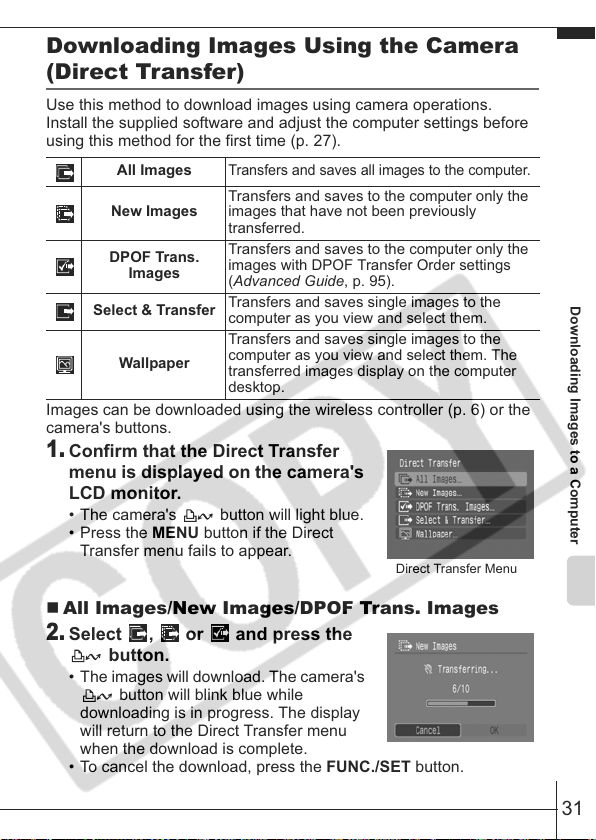
Downloading Images Using the Camera
(Direct Transfer)
Use this method to download images using camera operations.
Install the supplied software and adjust the computer settings before
using this method for the first time (p. 27).
Images can be downloaded using the wireless controller (p. 6) or the
camera's buttons.
1.
Confirm that the Direct Transfer
menu is displayed on the camera's
LCD monitor.
• The camera's button will light blue.
• Press the MENU button if the Direct
Transfer menu fails to appear.
All Images/New Images/DPOF Trans. Images
2.
Select , or and press the
button.
• The images will download. The camera's
button will blink blue while
downloading is in progress. The display
will return to the Direct Transfer menu
when the download is complete.
• To cancel the download, press the FUNC./SET button.
All Images
Transfers and saves all images to the computer.
New Images
Transfers and saves to the computer only the
images that have not been previously
transferred.
DPOF Trans.
Images
Transfers and saves to the computer only the
images with DPOF Transfer Order settings
(Advanced Guide, p. 95).
Select & Transfer
Transfers and saves single images to the
computer as you view and select them.
Wallpaper
Transfers and saves single images to the
computer as you view and select them. The
transferred images display on the computer
desktop.
Direct Transfer Menu
Downloading Images to a Computer
32
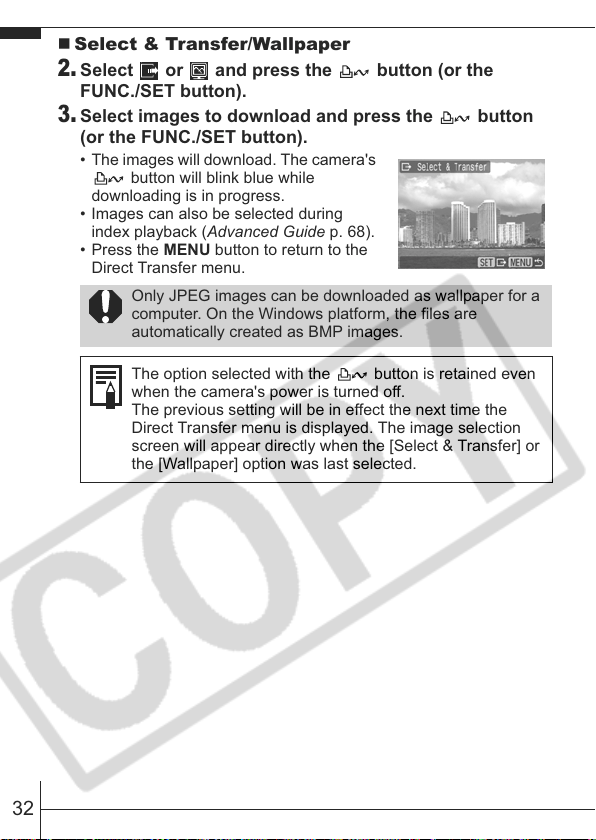
Select & Transfer/Wallpaper
2.
Select or and press the button (or the
FUNC./SET button).
3.
Select images to download and press the button
(or the FUNC./SET button).
• The images will download. The camera's
button will blink blue while
downloading is in progress.
• Images can also be selected during
index playback (Advanced Guide p. 68).
• Press the MENU button to return to the
Direct Transfer menu.
Only JPEG images can be downloaded as wallpaper for a
computer. On the Windows platform, the files are
automatically created as BMP images.
The option selected with the button is retained even
when the camera's power is turned off.
The previous setting will be in effect the next time the
Direct Transfer menu is displayed. The image selection
screen will appear directly when the [Select & Transfer] or
the [Wallpaper] option was last selected.
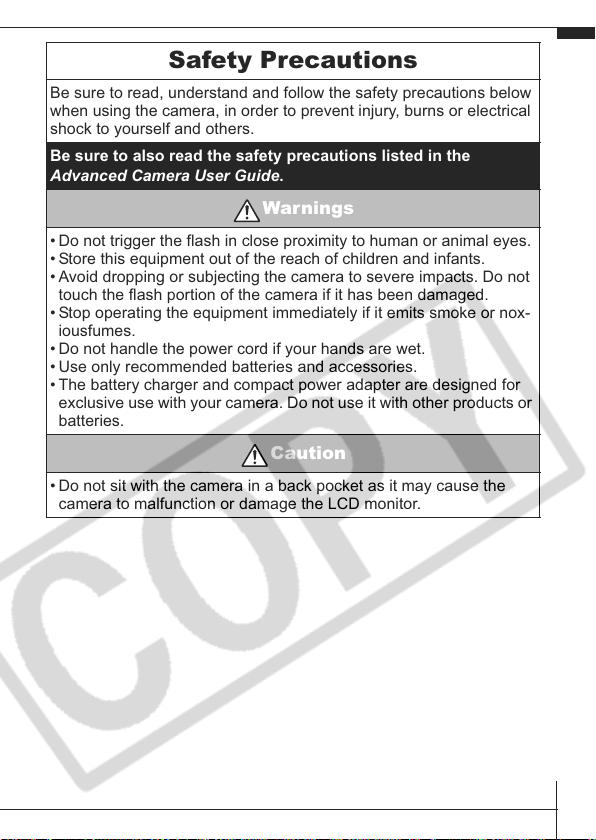
Safety Precautions
Be sure to read, understand and follow the safety precautions below
when using the camera, in order to prevent injury, burns or electrical
shock to yourself and others.
Be sure to also read the safety precautions listed in the
Advanced Camera User Guide.
Warnings
• Do not trigger the flash in close proximity to human or animal eyes.
• Store this equipment out of the reach of children and infants.
• Avoid dropping or subjecting the camera to severe impacts. Do not
touch the flash portion of the camera if it has been damaged.
• Stop operating the equipment immediately if it emits smoke or nox-
iousfumes.
• Do not handle the power cord if your hands are wet.
• Use only recommended batteries and accessories.
• The battery charger and compact power adapter are designed for
exclusive use with your camera. Do not use it with other products or
batteries.
Caution
• Do not sit with the camera in a back pocket as it may cause the
camera to malfunction or damage the LCD monitor.

