3
7
8
17
27
30
33
33
34
40
For your safety, the information in this manual must be followed to minimize the risk of fire, explosion, or
electric shock, or to prevent property damage, injury to persons, or death. Your safety and the safety of
others is very important. There are many important safety messages in this manual and on your appliance.
Always read and obey all safety messages.
This is the safety alert symbol. This symbol alerts you to potential hazards that can result in prop-
erty damage and/or serious bodily harm or death.
All safety messages will follow the safety alert symbol and either the word DANGER, WARNING
or CAUTION. These words mean:
All safety messages will tell you what the potential hazard is, tell you how to reduce the chance of injury,
and tell you what can happen if the instructions are not followed.
You will be killed or seriously injured if you don’t immediately follow instructions.
You can be killed or seriously injured if you don’t follow instructions.
You may be slightly injured or cause damage to the product if you do not follow
instructions.
To reduce the risk of fire, electric shock, or injury to persons when using this appliance, follow basic pre-
cautions, including the following.
Use this appliance only for its intended purpose as described in this Owner's Manual.
Before use, the washer must be properly installed as described in this manual.
Do not wash articles that have been previously cleaned in, washed in, soaked in, or spotted with gaso-
line, dry cleaning solvents, or other flammable or explosive substances, as they give off vapors that
could ignite or explode.
Do not add gasoline, dry cleaning solvents, or other flammable or explosive substances to the wash
water. These substances give off vapors that could ignite or explode.
Under certain conditions, hydrogen gas may be produced in a hot water system that has not been used
for 2 weeks or more. HYDROGEN GAS IS EXPLOSIVE. If the hot water system has not been used for
such a period, before using the washer, turn on all hot water faucets and let the water flow from each
for several minutes. This will release any accumulated hydrogen gas. As the gas is flammable, do not
smoke or use an open flame during this time.
Do not allow children to play on or in the washer. Close supervision of children is necessary when the
washer is used near children. A child might become trapped inside the washer and suffocate.
Before the washer is removed from service or discarded, remove the lid to prevent children from
climbing inside.
Do not install or store the washer where it will be exposed to the weather or freezing temperatures.
Do not tamper with controls.
Keep the area underneath and around your appliances free of combustible materials (lint, paper, rags,
etc.), gasoline, chemicals and other flammable vapors and liquids.
Service must be performed by a qualified service technician. Do not disassemble the washer.
See Installation Instructions for grounding requirements.
WARNING : This product contains chemicals known to the State of California to cause cancer and birth
defects or other reproductive harm.
READ ALL INSTRUCTIONS BEFORE USE
For your safety, the information in this manual must be followed to minimize the risk of fire, explosion or
electric shock, or to prevent property damage, injury to persons, or death.
This appliance must be grounded. In the event of malfunction or breakdown, grounding will reduce the risk
of electric shock by providing a path of least resistance for electric current. This appliance is equipped with
a cord having an equipment-grounding conductor and grounding plug. The plug must be plugged into an
appropriate outlet that is properly installed and grounded in accordance with all local codes and ordinances.
Improper connection of the equipment-grounding conductor can result in risk of electric shock. Check with
a qualified electrician or servicer if you are in doubt as to whether the appliance is properly grounded. Do
not modify the plug provided with the appliance. If it does not fit the outlet, have a proper outlet installed
by a qualified electrician. Failure to follow these warnings can cause serious injury, fire, electric shock, or
death.
ALWAYS follow the fabric care instructions supplied by the garment manufacturer.
Do not place items exposed to cooking oil in your washer. Items contaminated with cooking oils may
contribute to a chemical reaction that could cause a load to catch fire.
Use fabric softeners or products to eliminate static only as recommended by the manufacturer.
This washer is not designed for maritime use or for mobile installations such as in RVs, aircraft, etc.
Turn off the water faucets and unplug the washer if the machine is to be left for an extended period of
time, such as during vacations.
Do not use to dry articles containing foam rubber or similarly textured rubber-like materials.
Packaging material can be dangerous for children. There is a risk of suffocation! Keep all packaging from
children.
Always check the inside of the washer for foreign objects before loading laundry. Keep the lid closed
when not in use.
Do not reach into the appliance if the tub or agitator is moving.
In the event of a gas leak(such as propane gas, LP gas, etc.), ventilate the area immediately. Do not turn
any appliance or light on or off. Do not use a ventilating fan. A spark may result in an explosion or fire.
To reduce the risk of fire, electric shock or injury to persons when using this appliance, follow basic precautions,
including the following:
Refer to INSTALLATION INSTRUCTIONS for detailed grounding procedures.
Installation instructions are
packed with the washer for installer’s reference. If the washer is moved to a new location, have it checked
and reinstalled by a qualified service technician. Failure to follow this warning can cause serious injury, fire,
electric shock, or death.
Do not, under any circumstances, cut or remove the third (ground) prong from the power cord.
Failure to
follow this warning can cause serious injury, fire, electric shock, or death.
For personal safety, this appliance must be properly grounded.
Failure to follow this warning can cause seri-
ous injury, fire, electric shock, or death.
The power cord of this appliance is equipped with a 3-prong (grounding) plug which mates with a standard
3-prong (grounding) wall outlet
to minimize the possibility of electric shock from this appliance.
This washer must be plugged into a 120 VAC, 60 Hz grounded outlet.
Failure to follow this warning can cause
serious injury, fire, electric shock, or death.
Have the wall outlet and circuit checked by a qualified electrician to make sure the outlet is properly grounded.
Failure to follow this warning can cause serious injury, fire, electric shock, or death.
Where a standard 2-prong wall outlet is encountered, it is your personal responsibility and obligation to have
it replaced with a properly grounded 3-prong wall outlet.
Failure to follow this warning can cause serious
injury, fire, electric shock, or death.
Do not install on carpet. Install washer on a solid floor.
Failure to follow this warning can cause serious leak
damage.
Do not remove ground prong. Do not use an adapter or extension cord. Plug into a grounded 3-prong outlet.
Failure to follow these warnings can cause serious injury, fire, electric shock, or death.
The washer should always be plugged into its own individual electrical outlet which has a voltage rating that
matches the rating plate.
This provides the best performance and also prevents overloading house wiring
circuits which could cause a fire hazard from overheated wires.
Never unplug your washer by pulling on the power cord.
Always grip plug firmly and pull straight out from the
outlet. Failure to follow this warning can cause serious injury, fire, electric shock, or death.
Repair or immediately replace all power cords that have become frayed or otherwise damaged. Do not use
a cord that shows cracks or abrasion damage along its length or at either end.
Failure to follow this warning
can cause serious injury, fire, electric shock, or death.
When installing or moving the washer, be careful not to pinch, crush, or damage the power cord.
Failure to
follow this warning can cause serious injury, fire, electric shock, or death.
The washer must be installed and electrically grounded by a qualified service person in accordance with local
codes to
prevent shock hazard and assure stability during operation.
The washer is heavy. Two or more people may be needed to install and move the appliance.
Failure to do so
can result in back or other injury.
Store and install the washer where it will not be exposed to temperatures below freezing or exposed to
outdoor weather conditions.
Failure to follow this warning can cause serious leak damage.
To reduce the risk of electric shock, do not install the washer in humid spaces.
Failure to follow this warning
can cause serious injury, fire, electric shock, or death.
To reduce the risk of injury to persons, adhere to all industry recommended safety procedures including the
use of long sleeved gloves and safety glasses.
Failure to follow all of the safety warnings in this manual could
result in property damage, injury to persons or death.
Never attempt to operate this appliance if it is damaged, malfunctioning, partially disassembled, or has miss-
ing or broken parts, including a damaged cord or plug.
To minimize the possibility of electric shock, unplug this appliance from the power supply or disconnect the
washer at the household distribution panel by removing the fuse or switching off the circuit breaker before
attempting any maintenance or cleaning.
Plug the power plug into the wall socket in the right direction so that the cord runs towards the floor.
If you
plug the power plug into the socket in the opposite direction, the electric wires within the cable may be dam-
aged and this may result in electric shock or fire.
For your safety, the information in this manual must be followed to minimize the risk of fire, explosion,
or electric shock, or to prevent property damage, injury to persons, or death.
For your safety, the information in this manual must be followed to minimize the risk of fire, explosion,
or electric shock, or to prevent property damage, injury to persons, or death.
SAVE THESE INSTRUCTIONS
To reduce the risk of fire, electric shock or injury to persons when using this appliance, follow basic precau-
tions, including the following:
Unplug the washer before cleaning to avoid the risk of electric shock.
Never use harsh chemicals, abrasive cleaners, or solvents to clean the washer. They will damage the
finish.
Do not put oily or greasy rags or clothing on top of the washer. These substances give off vapors that
could ignite the materials.
Do not wash items that are soiled with vegetable or cooking oil. These items may contain some oil after
laundering. Due to the remaining oil, the fabric may smoke or catch fire by itself.
Disconnect this appliance from the power supply before attempting any user maintenance. Turning the
controls to the OFF position does not disconnect this appliance from the power supply. Failure to follow
this warning can cause serious injury, fire, electric shock, or death.
Do not combine laundry products for use in one load unless specified on the label.
Do not mix chlorine bleach with ammonia or acids such as vinegar. Follow package directions when us-
ing laundry products. Incorrect usage can produce poisonous gas, resulting in serious injury or death.
Do not reach into the washer while parts are moving. Before loading, unloading, or adding items, press
the START/PAUSE button and allow the drum to coast to a complete stop before reaching inside. Failure
to follow this warning can cause serious injury, fire, electric shock, or death.
Do not allow children to play on or in the washer. Close supervision of children is necessary when the
washer is used near children. As children grow, teach them the proper, safe use of all appliances. Fail-
ure to comply with these warnings could result in serious injury to persons or death.
Destroy the carton, plastic bag, and other packing materials after the washer is unpacked. Children
might use them for play. Cartons covered with rugs, bedspreads, or plastic sheets can become airtight
chambers. Failure to comply with these warnings could result in serious injury to persons or death.
Keep laundry products out of children’s reach. To prevent injury to persons, observe all warnings on
product labels. Failure to comply with these warnings could result in serious injury to persons or death.
Remove the lid to the washing compartment before your washer is removed from service or discarded
to avoid the danger of children or small animals getting trapped inside. Failure to do so can result in seri-
ous injury to persons or death.
Keep hands and foreign objects clear of the lid and latch area when closing the lid. Failure to keep hands
clear can result in personal injury.
Do not touch the power plug with wet hands. This may result in electric shock.
Do not touch the water draining from the machine during a high-temperature wash or drying cycle. This
water is hot, and touching it may result in burns or injury.
Do not stand on top of the appliance or place objects(such an laundry, lighted candles,lighted cigarettes,
dishes, chemicals, metal objects, etc.) on the appliance. This may result in electric shock, fire, problems
with the product, or injury.
Do not install or store the washer where it will be exposed to freezing temperatures. Water may freeze
in the hoses and damage the washer. Winterize the washer before storing or moving it in freezing tem-
peratures. Refer to the Maintenance section for instructions.
Do not push the Lid too hard. There is a risk of breaking Lid Glass.
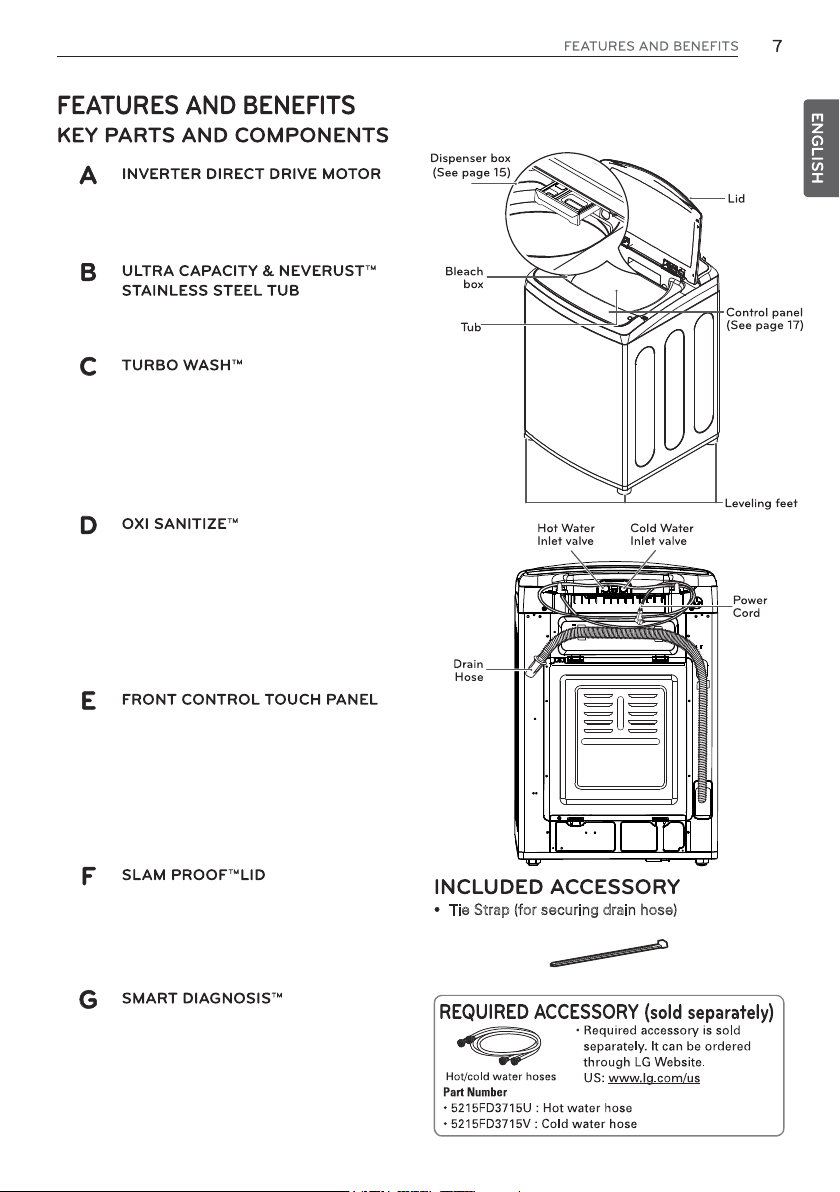
The inverter motor directly connected to
the tub produces less noise and vibration
while offering outstanding durability with a
longer lifespan.
The efficient design provides you with ultra
large capacity.
Turbo Wash™ reduces wash time without
compromising performance. The precise
drum movements and powerful water jets
allow for faster soaking, while the Smart
Rinse™ Jet Spray allows for quicker rins-
ing, saving you up to 20 minutes per load
without sacrificing washing performance.
This cycle combines the cleaning perfor-
mance of the LG washer with oxi-cleaning
products, which are released at just the right
time to deliver sanitary cycle performance
without the excess energy wasted on hot
water in typical sanitary cycles. It was certi-
fied by an independent, third-party testing
and certification organization.
The front control touch panel is specially
designed to be water resistant with LG’s
HydroShield™ technology, while also deliv-
ering ergonomic efficiency by eliminating
the need to have to reach for controls as
with traditional rear-control units. In addi-
tion, the soft touch buttons also add a pre-
mium feel.
The Slam Proof™ lid is a safety device that
closes the lid slowly. The Slam Proof™
hinges allow the lid to close gently and qui-
etly, helping prevent injuries.
If you ever experience an issue with your
LG washer, you don’t have to worry. The
SmartDiagnosis™ feature helps the ser-
vice center diagnose problems over the
phone, or with a simple app on your smart
phone, helping you minimize costly, incon-
venient service calls.
Tie Strap (for securing drain hose)
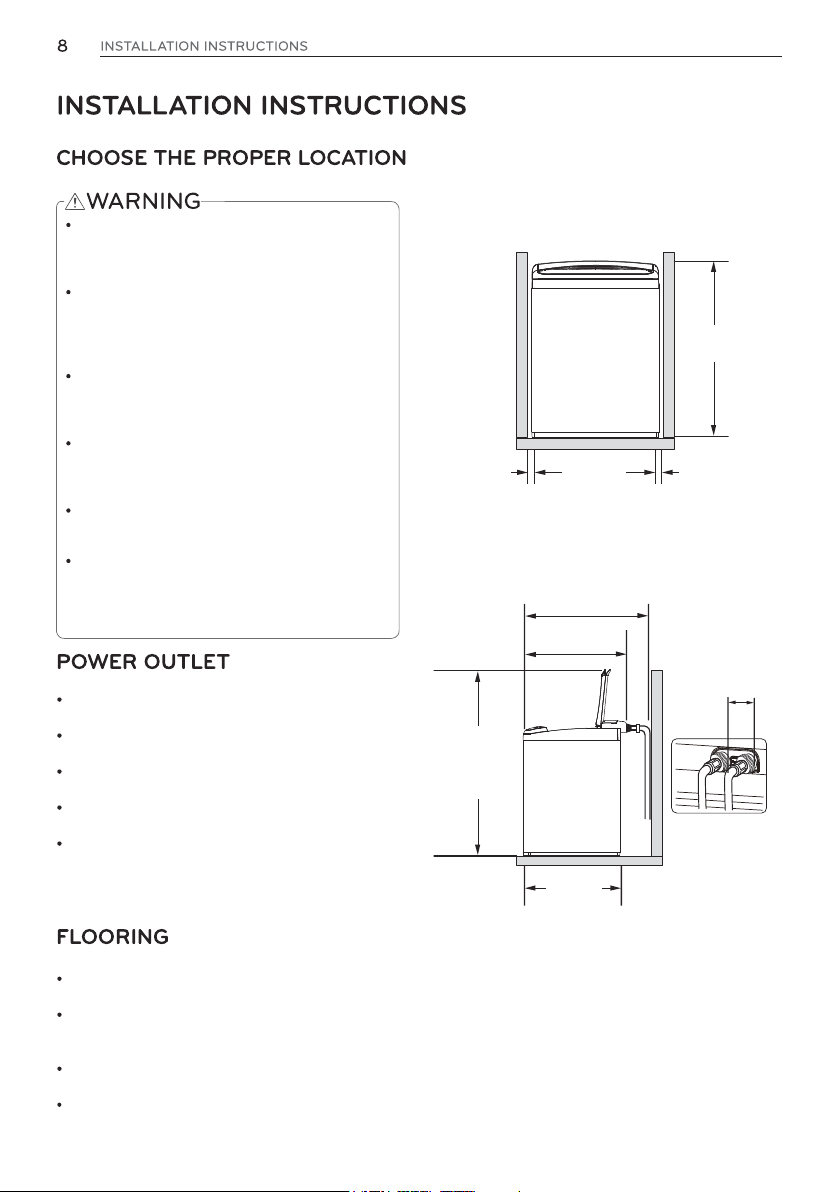
The power outlet must be within 60 in. (1.5 m) of
either side of the washer.
The appliance and outlet must be positioned so
that the plug is easily accessible.
Do not overload the outlet with more than one ap-
pliance.
The outlet must be grounded in accordance with
current wiring electric codes and regulations.
Time-delay fuse or circuit breaker is recommended.
NOTE: It is the personal responsibility and obligation
of the product owner to have a proper outlet installed
by a qualified service technician.
To minimize noise and vibration, the washer MUST
be installed on a solidly constructed floor.
Allowable slope under the entire washer is a maxi-
mum 1 inch. difference from side to side or from
front to back.
Installing on carpeting and soft tile surfaces is not
recommended.
Never install the washer on a platform or weakly sup-
ported structure.
To ensure sufficient clearance for water lines and
airflow, allow minimum clearances of at least 1 in.
(2.5 cm) at the sides and 4 in. (10 cm) behind the
unit. Be sure to allow for wall, door, or floor mold-
ings that may increase the required clearances.
Minimum vertical space from floor to overhead
shelves, cabinets, ceilings, etc., is 56 in.
The washer is heavy. Two or more people
are required when moving and unpacking the
washer. Failure to do so may result in damage
to property or serious bodily harm.
Store and install the washer where it will not
be exposed to temperatures below freezing
or exposed to outdoor weather conditions.
Failure to follow this warning can cause seri-
ous injury, fire, electric shock, or death.
Properly ground the washer to conform with
all electric governing codes and ordinances.
Failure to follow this warning can cause seri-
ous injury, fire, electric shock, or death.
To reduce the risk of electric shock, do not
install the washer in humid spaces. Failure to
follow this warning can cause serious injury,
fire, electric shock, or death.
To ensure proper air flow, do not block the
large opening on the bottom of the washer
with carpeting or other materials.
Do not remove ground prong. Do not use
an adapter or extension cord. Plug into a
grounded 3-prong outlet. Failure to follow this
warning can cause serious injury, fire, electric
shock, or death.
NOTE: The washer must be installed on firm flooring
to minimize vibration during the spin cycle. Concrete
flooring is best, but a wood floor is sufficient, pro-
vided it is built to FHA standards. The washer should
not be installed on rugs or exposed to weather.
55
3
/
8
”
(140.6 cm)
(with open lid)
26
3
/
4
”
(68 cm)
3
1
/
2
”
(9 cm)
28
3
/
8
”
(72.1 cm)
32 ”
(81.1 cm)
1”
(2.5cm)
27”
(68.6 cm)
1”
(2.5cm)
40
3
/
8
”
(102.6 cm)
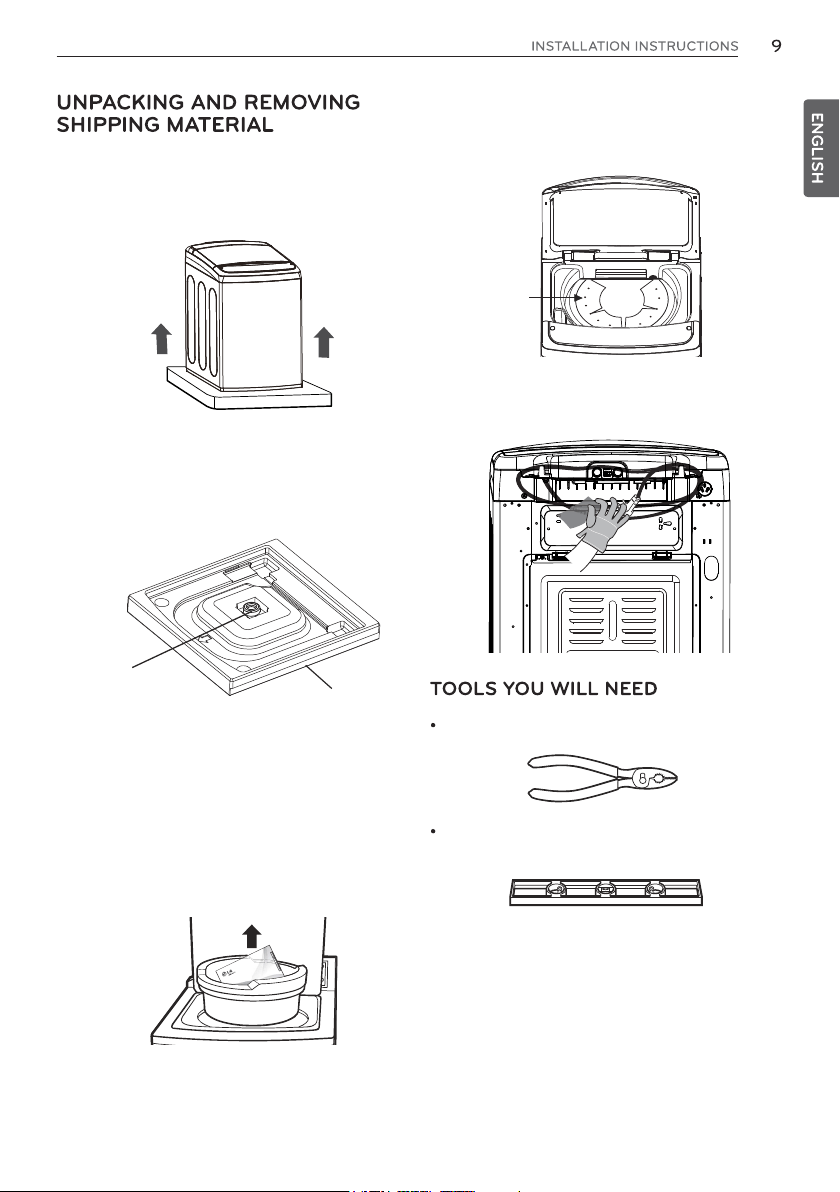
1. After removing the carton and shipping material,
lift the washer off the foam base. Make sure the
plastic tub support comes off with the base and
is not stuck to the bottom of the washer.
If you must lay the washer down to remove the base
packaging materials, always protect the side of the
washer and lay it carefully on its side. DO NOT lay
the washer on its front or back.
2. Save the foam block (that contains the Owner’s
Manual, parts and laundry product samples) for
future use. If the washer must be moved in the
future, the foam block will help prevent damage
to the washer during transportation.
NOTE: To prevent damage, do not remove the
foam block until the washer is at the final loca-
tion.
3. Carefully remove the two foam pads which
cover the top sides of the tub guide, making
sure not to leave behind any pieces of the foam.
Pad
4. Unfasten the power cord from the back of the
washer.
Adjustable Pliers
Carpenter's Level
Plastic Tub Support
Carton Base
LG recommends the use of LG hoses. Any leak-
ing, property damage, or damage to the washing
machine caused by an improper installation or by
the use of non-LG hoses is not covered under the
terms of the LG warranty and is the sole responsi-
bility of the customer and/or an installer.
Water supply pressure must be between 20 psi and
120 psi (138~827 kPa). If the water supply pressure
is more than 120 psi, a pressure reducing valve must
be installed.
Periodically check the hose for cracks, leaks, and
wear, and replace the hose if necessary.
Make sure that the water lines are not stretched,
pinched, crushed, or kinked.
The washer should never be installed or stored in a
location subject to freezing temperatures. Damage to
the water lines and internal mechanisms of the washer
can result. If the washer was exposed to freezing tem-
peratures prior to installation, allow it to stand at room
temperature for several hours before use and check for
leaks prior to operation.
NOTE: Do not use flood-preventing hoses with auto
shutoff devices. The devices can be tripped during
fill and prevent the machine from filling properly.
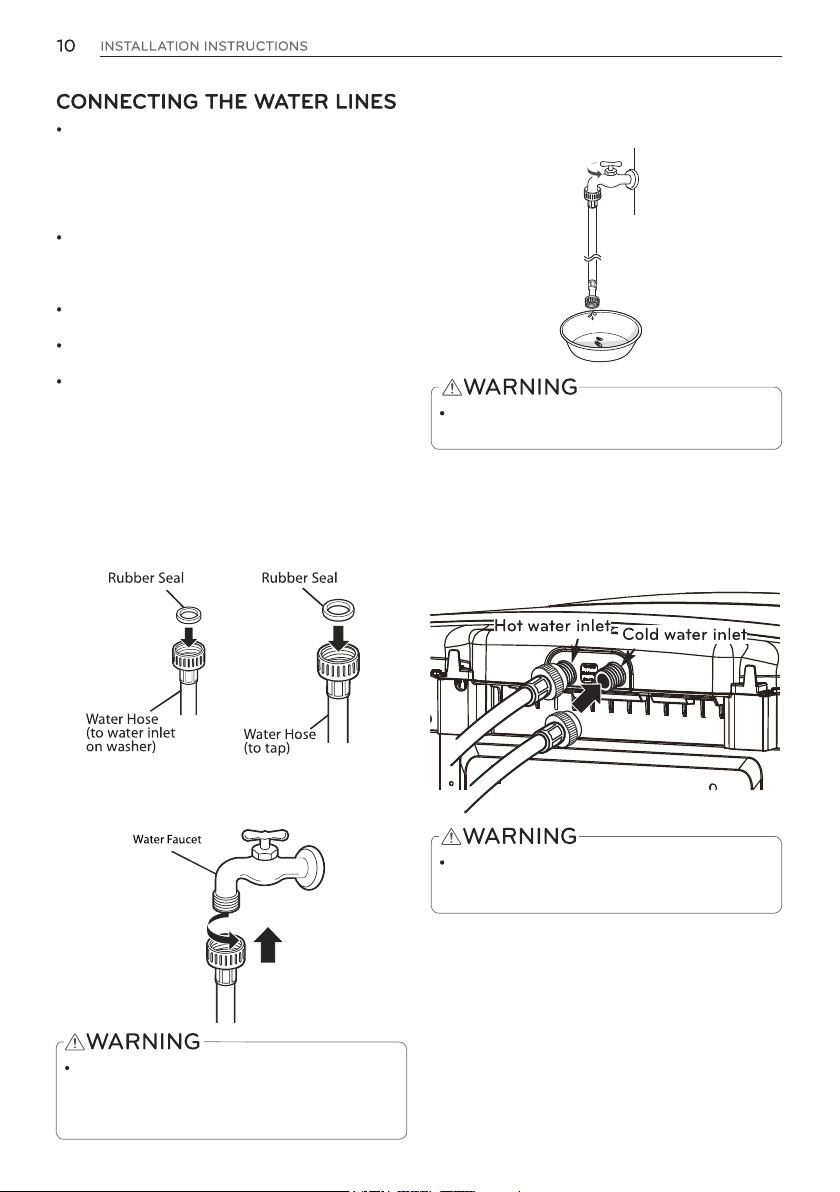
1. Inspect the threaded fitting on each hose and
make sure there is a rubber seal in place in both
ends of each hose.
2. Connect the water supply hoses to the HOT and
COLD water faucets tightly by hand and then tight-
en another 2/3 turn with pliers.
3. Always run a gallon or two of water through each
inlet hose to flush dirt, scale and other debris out
of the water lines. Doing so will help prevent future
problems with clogged filter screens, and will also
allow you to verify which water line is hot and which
is cold.
4. Attach the hot water line to the hot water inlet on
the back of the washer. Attach the cold water line
to the cold water inlet on the back of the washer.
Tighten the fittings securely. Turn ON both fau-
cets all the way and check for leaks at both ends
of the hoses.
NOTE: Be careful not to cross-thread the hose fit-
tings. This will damage the valve and could result in
property damage from leaks.
Do not reuse old hoses.
Only use new hoses
when you install the washing machine. Old
hoses could leak or burst causing flooding and
property damage.
Do not overtighten the hoses. Overtightening
can damage the valves resulting in leaking and
property damage.
Do not overtighten. Damage to the coupling
can result.
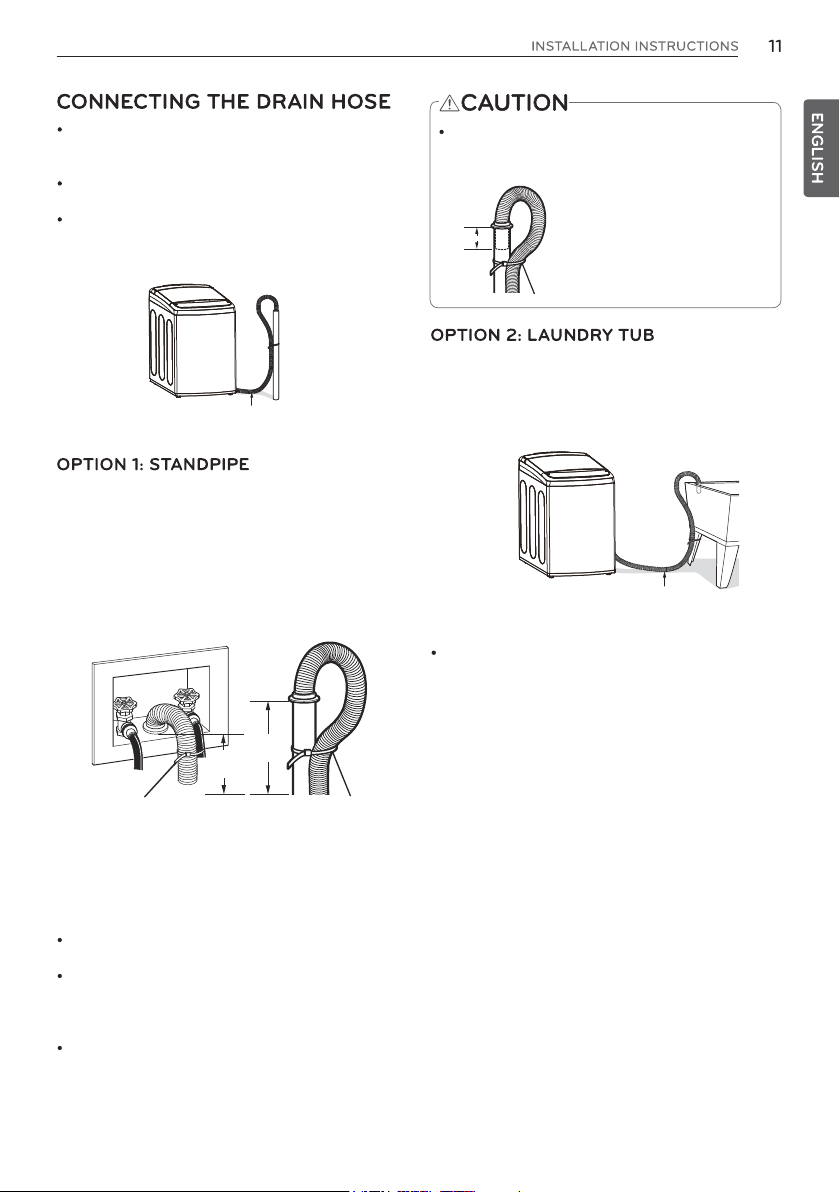
The drain hose should always be properly secured.
Failure to properly secure the drain hose can result in
flooding and property damage.
The drain must be installed in accordance with any
applicable local codes and regulations.
Make sure that the drain hose is not stretched,
pinched, crushed, or kinked.
Bend the outlet end of the drain hose to form a U
shape. Insert the end of the drain hose into the drain.
If the drain is large enough for the flange on the hose
to fit inside, then do not insert the flange more than
1-2 inches into the drain. Use the tie strap included
with the installation materials in the foam block in
the tub to secure the drain hose to the drain.
If the water valves and drain are built into the wall,
fasten the drain hose to one of the water hoses with
the tie strap (ribbed side on inside).
If your drain is a standpipe, fasten the drain hose to
the standpipe with the tie strap provided.
NOTE:
Normal height of the end of the hose should be ap-
proximately 35”~47” (0.9~1.2 m) from the floor.
Do not install the end of the drain hose lower than
29 in. (73.7 cm) or higher than 96 in. (243.8 cm)
above the bottom of the washer or more than 60
in. (152.4 cm) away from the washer.
Never create an airtight seal between the hose
and the drain with tape or other means. If no air
gap is present, water can be siphoned out of the
tub resulting in poor wash/rinse performance or
clothing damage.
Bend the end of the drain hose to the desired shape
and support it on the edge of the laundry tub. Use
the tie strap to secure the drain hose in place.
NOTE:
Do not use this drain hose with a floor drain. The
end of the drain hose must be at least 29 inches
above the floor for proper draining to occur.
Drain Hose
Do not insert the end of the drain hose into the
standpipe more than 8 inches (20cm). Doing so
can cause siphoning, odors, or improper drain-
ing.
8”(20 cm)
Tie Strap
No more than 8 inches (20cm)
Tie Strap
39”
(99 cm)
39”
(99 cm)
Tie Strap
Drain Hose
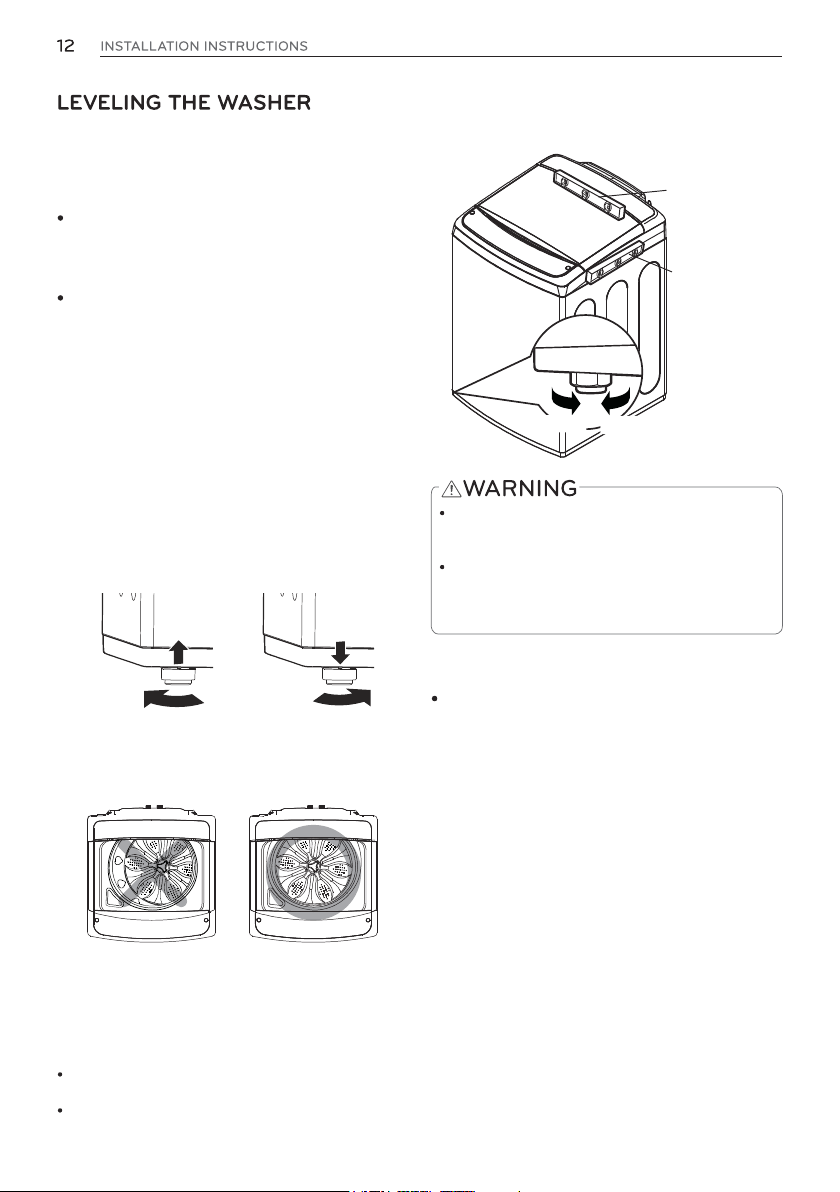
The tub of your new washer spins at very high
speeds. To minimize vibration, noise, and move-
ment, the floor must be a level, solid surface.
NOTE:
Adjust the leveling feet only as far as necessary
to level the washer. Extending the leveling feet
more than necessary can cause the washer to
vibrate.
Before installing the washer, make sure that the
floor is clean, dry and free of dust, dirt, water
and oil so the washer feet cannot slide easily.
Leveling feet that move or slide on the floor can
contribute to excessive vibration and noise due
to poor contact with the floor.
All four leveling feet must rest solidly on the floor.
Attempt to rock the washer from corner to corner
to make sure that all four leveling feet are in firm
contact with the floor.
1. Position the washer in its final location, taking spe-
cial care not to pinch, strain, or crush the water
and drain lines. Place a level across the top of the
washer.
2. Adjust the leveling feet. Turn clockwise to raise
the washer or counterclockwise to lower it.
3. To make sure that the washer is properly level,
open the lid and look from above to see if the tub
is centered. If the tub is NOT centered (as shown
in the drawing with the X through it), readjust the
front feet. If you have a level, check your washer
with the level.
To check if the washer is level from side to side,
place a level on the back edge of the lid.
To check if the washer is level front to back, place
a level at the side of the washer on the edge where
the cabinet side meets the top cover. Do not place
the level on the top of the lid. Using these sur-
faces will result in the washer being unlevel.
NOTE:
If the lid will not stay open, the washer may need
to be leveled. Extend the front leveling legs until
the washer is level.
Using the washing machine without leveling
it may result in malfunction caused by the
production of excess vibration and noise.
Use the leveling feet only when you level the
washing machine. If you raise the leveling feet
unnecessarily, it may cause abnormal vibration
of the washing machine.
Raise Lower
Side to Side
Front to Back
Raise
Lower
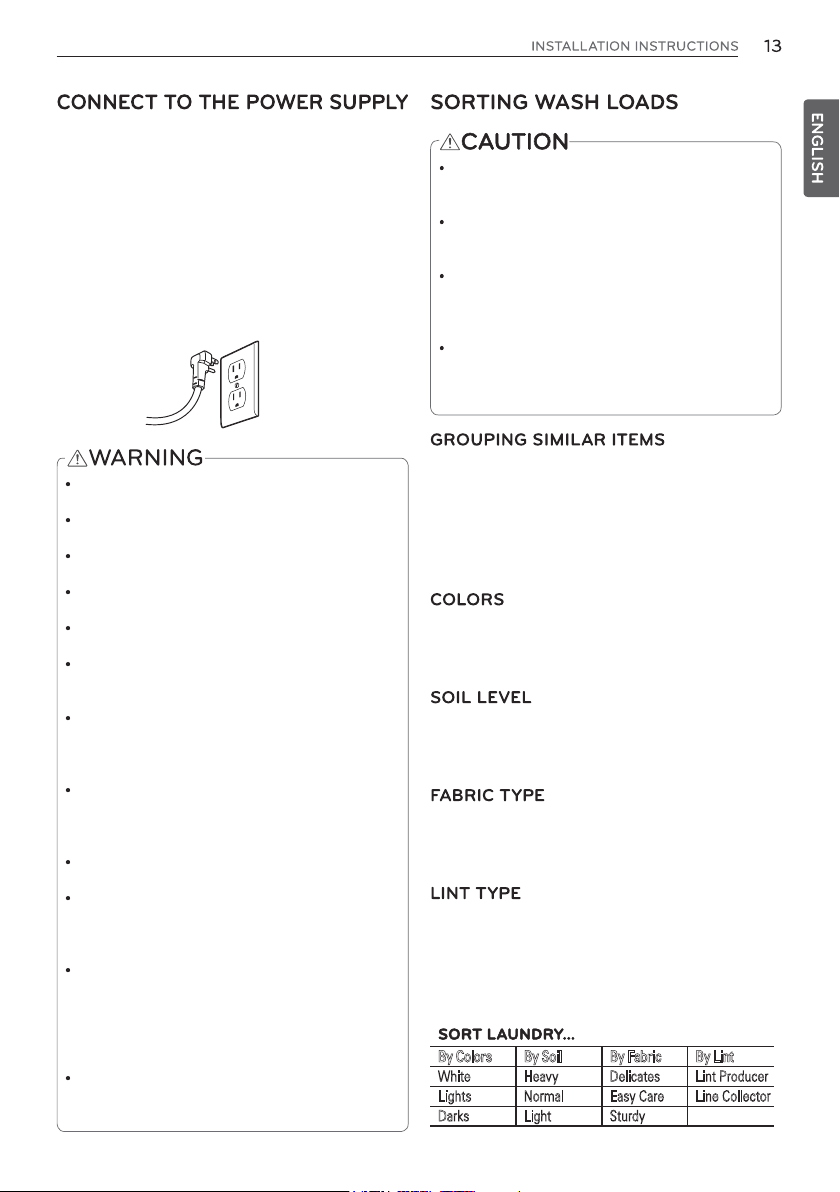
The washer should be plugged into a 120-VAC, 60-
Hz grounded 3-prong outlet. Plug in the washer.
Improper connection of the equipment-grounding
conductor can result in risk of electric shock. Check
with a qualified electrician or service technician
if you are in doubt as to whether the appliance is
properly grounded. Do not modify the plug pro-
vided with the appliance. If it does not fit the outlet,
have a proper outlet installed by a qualified electri-
cian. Failure to follow these warnings can cause
serious injury, fire, electrical shock, or death.
The power outlet must be within 60 inches (1.5
m) of either side of the washer.
The appliance and outlet must be positioned so
that the plug is easily accessible.
Do not overload the outlet with more than one
appliance.
The outlet must be grounded in accordance
with current wiring codes and regulations.
Time-delay fuse or circuit breaker is
recommended.
It is the personal responsibility and obligation
of the product owner to have a proper outlet
installed by a qualified electrician.
Do not use a worn or damaged power cord or
power plug. Replace or repair it immediately.
Failure to do so may result in death, fire, electric
shock, or malfunction.
Do not modify the power cord and take care
not to damage it when installing or moving the
washing machine.
Failure to do so may result in
death, fire, electric shock, or malfunction.
Make sure that the washing machine is
grounded.
Connect this washing machine to a grounded
outlet conforming to the rating prior to use.
Failure to do so may result in fire, electric
shock, or malfunction.
Do not use adaptors or extension cords.
The
washing machine should always be plugged
into its own individual electrical outlet which has
a voltage rating that matches the rating plate.
Failure to do so may result in fire, electric shock
or disorder.
Do not damage or cut off the ground prong of
the power cord.
Doing so may cause death,
fire, electric shock, or product malfunction.
For the best washing results, and to reduce the possibil-
ity of damage to clothing, care should be taken to sort
the clothing into loads that are made up of similar items.
Mixing different fabric types and/or soil levels can
result in poor wash performance, color transfer, dis-
coloration, fabric damage or linting. Fabrics should
be sorted into groups as described below.
Sort articles by color. Wash dark clothes together
in a separate load from light colors or whites. Mix-
ing dark clothes with light clothes can result in dye
transfer or discoloration of the lighter clothes.
Wash heavily soiled clothing together. Washing
lightly soiled clothing in the same load with heav-
ily soiled clothing could result in poor wash perfor-
mance for the lightly soiled clothing.
Delicate articles should not be mixed with heavier or
sturdier fabric types. Washing heavier fabrics in a deli-
cate load can result in poor wash performance for the
heavier fabrics and possible damage to the delicates.
Some fabrics attract and bind lint to them while oth-
ers give off lint in the laundry process. Avoid mixing
these lint collectors and lint producers in the same
load. Mixing these fabrics will result in pilling and
linting on the lint collectors. (For example, lint collec-
tor – knit sweater; lint producer – terry cloth towels.)
By Colors By Soil By Fabric By Lint
White Heavy Delicates Lint Producer
Lights Normal Easy Care Line Collector
Darks Light Sturdy
Do not load items higher than the top edge of the
tub.
Failure to follow this caution can result in leak-
age or damage to fabrics.
Use the Bedding cycle for buoyant or nonabsor-
bent items such as pillows or comforters.
Failure
to follow this caution can result in leakage.
If possible, do not wash any water-resistant items.
If you must, please select the Waterproof cycle.
( i.e. Water resistant clothing, mattress covers,
outdoor clothes, plastic mats etc.)
If waterproof material laundry is washed in a
course other than Waterproof, it may result in in-
jury or damage to the washer, clothes, walls, floor,
and surrounding objects due to abnormal vibration.
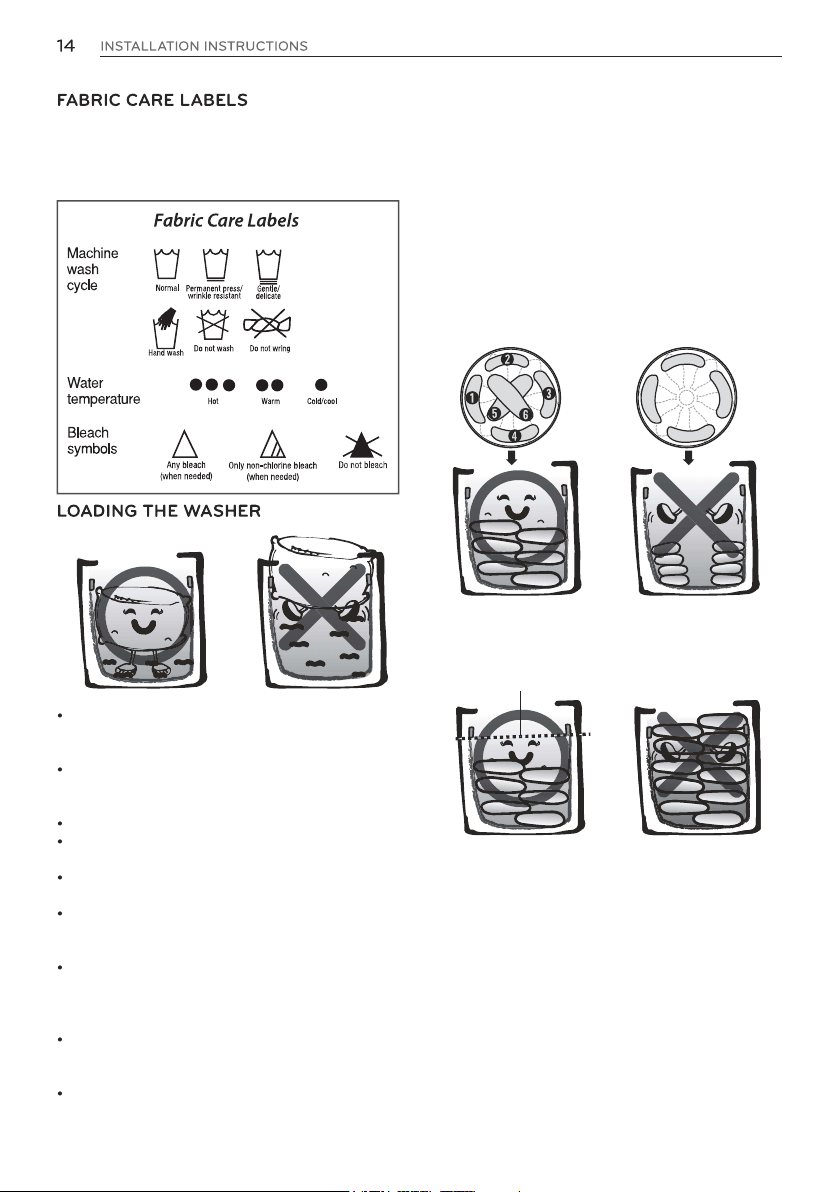
Many articles of clothing include a fabric care label.
Using the chart below, adjust the cycle and option
selections to care for your clothing according to the
manufacturer’s recommendations.
Check all pockets to make sure that they are empty.
Items such as clips, matches, pens, coins, and keys
can damage both your washer and your clothes.
Close zippers, hooks, and drawstrings to prevent
these items from snagging or tangling on other
clothes.
Pretreat heavily stained areas for best results.
Combine large and small items in a load. Load large
items first.
Large items should not be more than half of the total
wash load.
The washer can be fully loaded, but the tub should
not be tightly packed with items. The lid of the wash-
er should close easily.
To prevent an out-of-balance load, do not wash sin-
gle items. Add one or two similar items to the load.
Large, bulky items, such as a blanket, comforter, or
bedspread, should be washed individually.
Waterproof items do wash or spin Waterproof cycle.
(i.e. Water resistant clothing, mattress covers, out-
door clothes, plastic mats etc.)
The washer will not fill or operate with the lid open.
NOTE:
Use the Bedding cycle for large or bulky items
such as poly-filled jackets, comforters, pillows, etc.
These items may not be as absorbent as other laundry
items and should be sorted into a separate wash load
for optimal results.
Bulky items should be placed as far down in the tub
as possible for optimal results. Always place buoyant
items at the bottom of the tub. The washer will auto-
matically detect the load size. Because of the high-
efficiency wash system, the water level may not com-
pletely cover the load.
1. For best performance, load clothes as shown.
Do this
Not this
2. Load clothes loosely, and do not load clothes over
the maximum guideline on the tub. Clothes need
room to circulate in order to get clean.
Maximum guide line
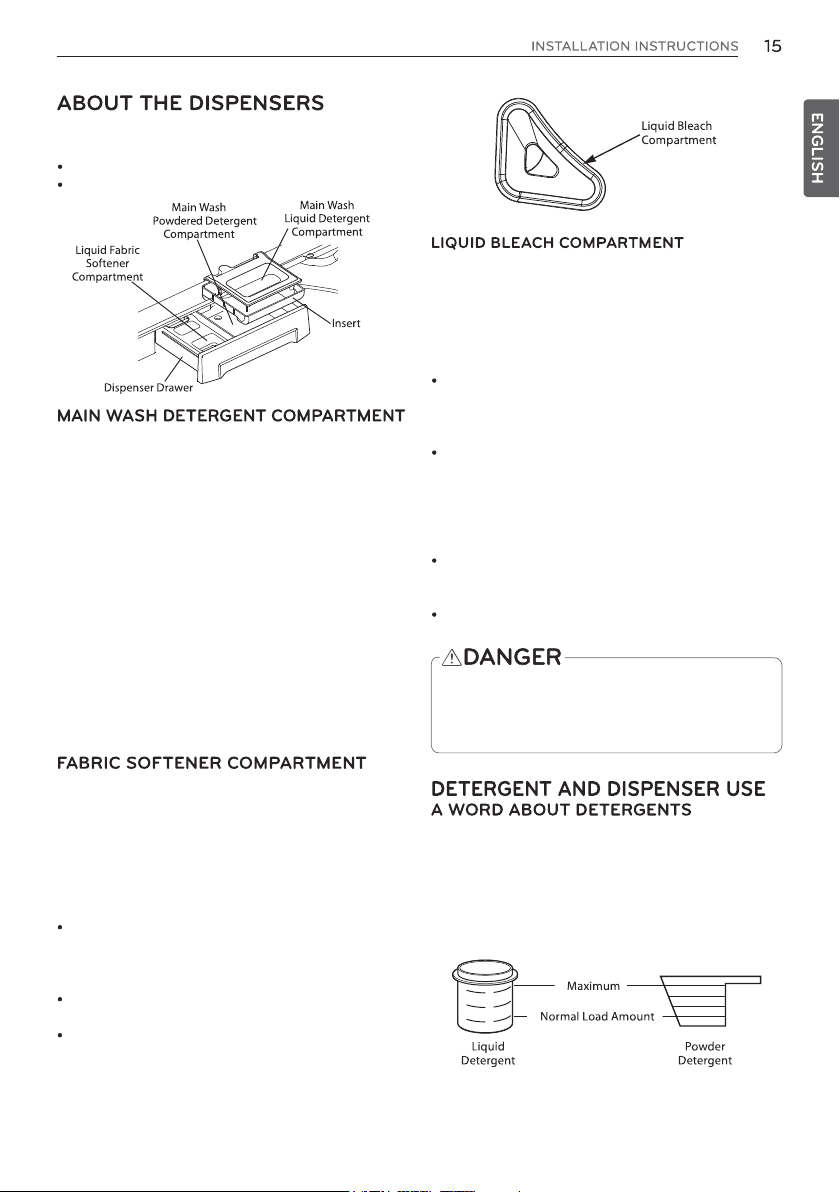
The automatic dispenser consists of two compart-
ments which hold:
Liquid fabric softener.
Liquid or powdered detergent for the main wash.
This compartment holds laundry detergent for the
main wash cycle. The detergent is added to the load
at the beginning of the cycle. Always use High-Effi-
ciency (HE) detergent with your washing machine.
Either powdered or liquid detergent may be used.
Never exceed the manufacturer’s recommenda-
tions when adding detergent. Using too much deter-
gent can result in detergent buildup in clothing and
the washer.
When using liquid detergent, make sure the liquid
detergent cup and insert are in place. Do not exceed
the maximum fill line.
When using powdered detergent, remove the liquid
detergent cup from the compartment. Powdered
detergent will not dispense with the liquid detergent
cup in place.
This compartment holds liquid fabric softener,
which is automatically dispensed during the final
rinse cycle.
Never exceed the manufacturer’s recommendations
when adding softener. Using too much fabric soften-
er can result in damage to clothing and the washer.
Either powdered or liquid fabric softener.
Always follow the manufacturer’s recommenda-
tions when adding fabric softener. Do not exceed
the maximum fill line. Using too much fabric soft-
ener may stain clothes.
Dilute concentrated fabric softeners with warm
water. Do not exceed the maximum fill line.
Never pour fabric softener directly onto the load
or into the tub.
The bleach dispenser is a separate compartment at
the left front of the tub opening. This compartment
holds liquid bleach, which is dispensed automati-
cally at the proper time during the wash cycle. Any
liquid remaining in the dispenser at the end of the
cycle is water, not bleach.
Do not add powdered bleach to this compartment.
The bleach compartment is designed to dispense
liquid bleach only. Powdered or liquid color-safe
bleach will not dispense properly.
Always follow the manufacturer’s recommenda-
tions when adding bleach. Never add more than
one cup and do not exceed the maximum fill line
since this can cause the bleach to be dispensed
immediately, resulting in damage to fabrics. Using
too much bleach can damage fabrics.
Never pour undiluted liquid chlorine bleach di-
rectly onto the load or into the tub. Fabric damage
can occur.
Do not use color-safe bleach or Oxi products in
the same cycle with liquid chlorine bleach.
High-Efficiency (HE) detergents produce fewer
suds, dissolve more efficiently to improve wash-
ing and rinsing performance, and help to keep the
interior of your washer clean. Using detergent that
is not HE may cause oversudsing and unsatisfac-
tory performance which could result in error codes,
cycle failure, and machine damage.
Do NOT mix chlorine bleach with ammonia or ac-
ids, such as vinegar or rust/scale remover. Mix-
ing chemicals like these can produce a lethal gas,
resulting in severe injury or death.
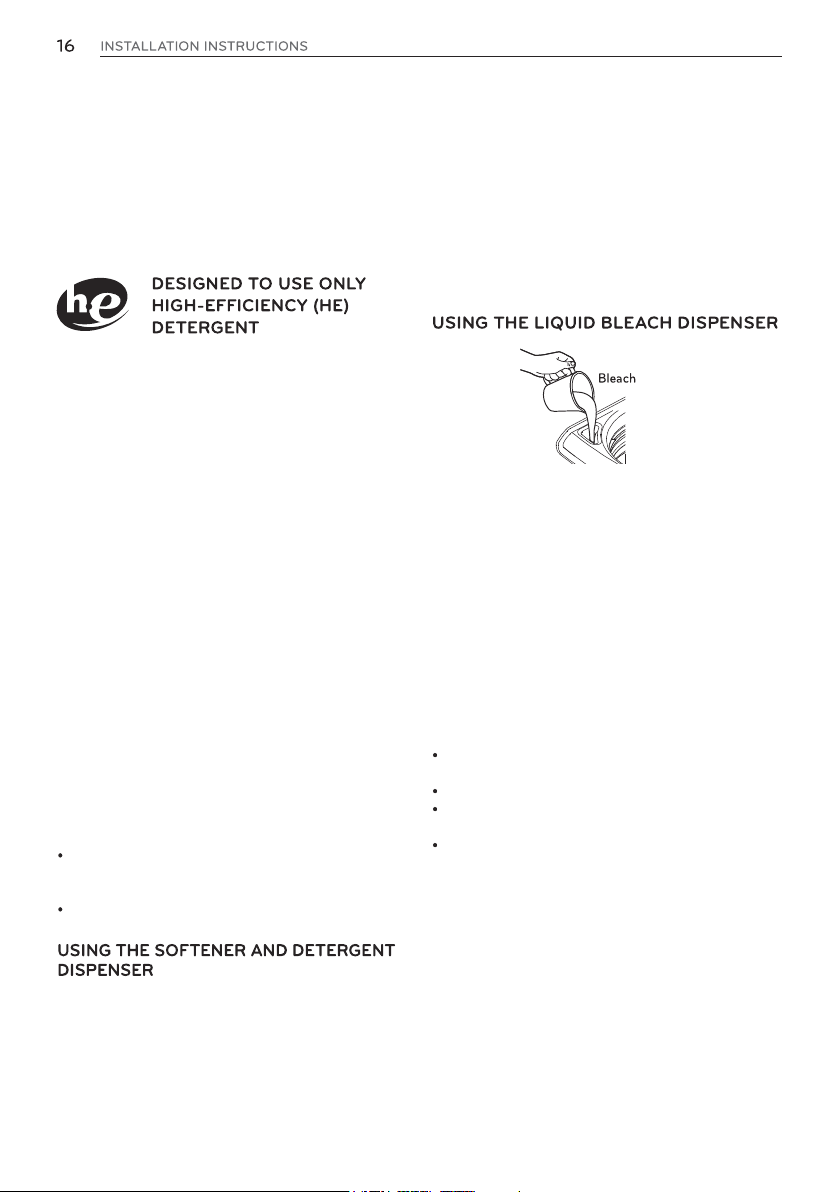
For proper wash performance, always measure the
detergent using the measuring device provided by
the detergent manufacturer.
The normal amount of HE detergent needed, for
average loads, is less than ½ of the recommended
maximum. Use less detergent for soft water, light
soil or smaller loads. Never use more than the
maximum amount recommended by the detergent
manufacturer.
IMPORTANT: Your washing machine is designed for
use with only High-Efficiency (HE) detergents. HE
detergents are formulated specifically for High-Effi-
ciency washers and contain suds-reducing agents.
Always look for the HE symbol when purchasing
detergent.
IMPORTANT: Not all detergents are the same. Pay
careful attention to the amount of detergent used
to avoid oversudsing, poor rinsing and detergent
buildup in clothing, and residue buildup that can
contribute to odors in the machine. NEVER use a
cup or scoop other than the one supplied by the
manufacturer of the detergent you are using. Never
use more than the maximum amount of detergent
recommended by the manufacturer. A full scoop or
measure of detergent should only be used for very
large and heavily soiled loads. Using too much de-
tergent can result in detergent buildup in the washer
and in your clothes.
Always measure the detergent amount. While HE
detergents are designed for this type of washing
machine, be careful when measuring the detergent.
For most normal loads, no more than 1/4 to 1/2 a
cap or scoop of HE detergent should be used.
NOTE:
Extra care must be exercised when using 2X and 3X
concentrated detergents because even a little bit ex-
tra can contribute to the problems mentioned above.
Detergents designated as HE compatible may not
provide optimal results.
To add detergent, and fabric softener to the auto-
matic dispenser:
1. Open the dispenser drawer.
2. Load the laundry products into the appropriate
compartments.
3. Close the drawer before starting the cycle.
4. If using fabric softener on NORMAL or HEAVY
DUTY cycles, press the FABRIC SOFTENER but-
ton or select the EXTRA RINSE option.
NOTE: It is normal for a small amount of water to
remain in the bleach dispenser and softener com-
partment at the end of the cycle.
IMPORTANT: Do not place or store laundry prod-
ucts, such as detergent, bleach, or liquid fabric soft-
ener, on top of your washer or dryer. Wipe up any
spills immediately. These products can damage the
finish and controls.
The bleach dispenser automatically dilutes and dis-
penses liquid bleach at the proper time in the wash
cycle.
1. Check clothing care labels for special instructions.
2. Measure liquid bleach carefully, following instruc-
tions on the bottle. High-efficiency washers use
less water, so less bleach is needed. One half cup is
enough for most loads.
3. Carefully pour the pre-measured amount of bleach
directly into the bleach dispenser. If you are using
powdered bleach of any kind, pour it directly into the
tub before adding the laundry. Never add powdered
bleach to the liquid bleach dispenser.
Never pour undiluted liquid chlorine bleach directly
onto clothes or into the tub.
Do not pour powdered bleach into bleach dispenser.
Do not place laundry items on top of the bleach dis-
penser when loading and unloading the washer.
Always measure and pour bleach carefully. Avoid
overfilling or splashing when adding bleach to the
dispenser. The maximum capacity of the bleach dis-
penser is one cup of bleach per wash cycle. Overfill-
ing could result in bleach being dispensed immedi-
ately, which can result in damage to the clothes in the
washer.
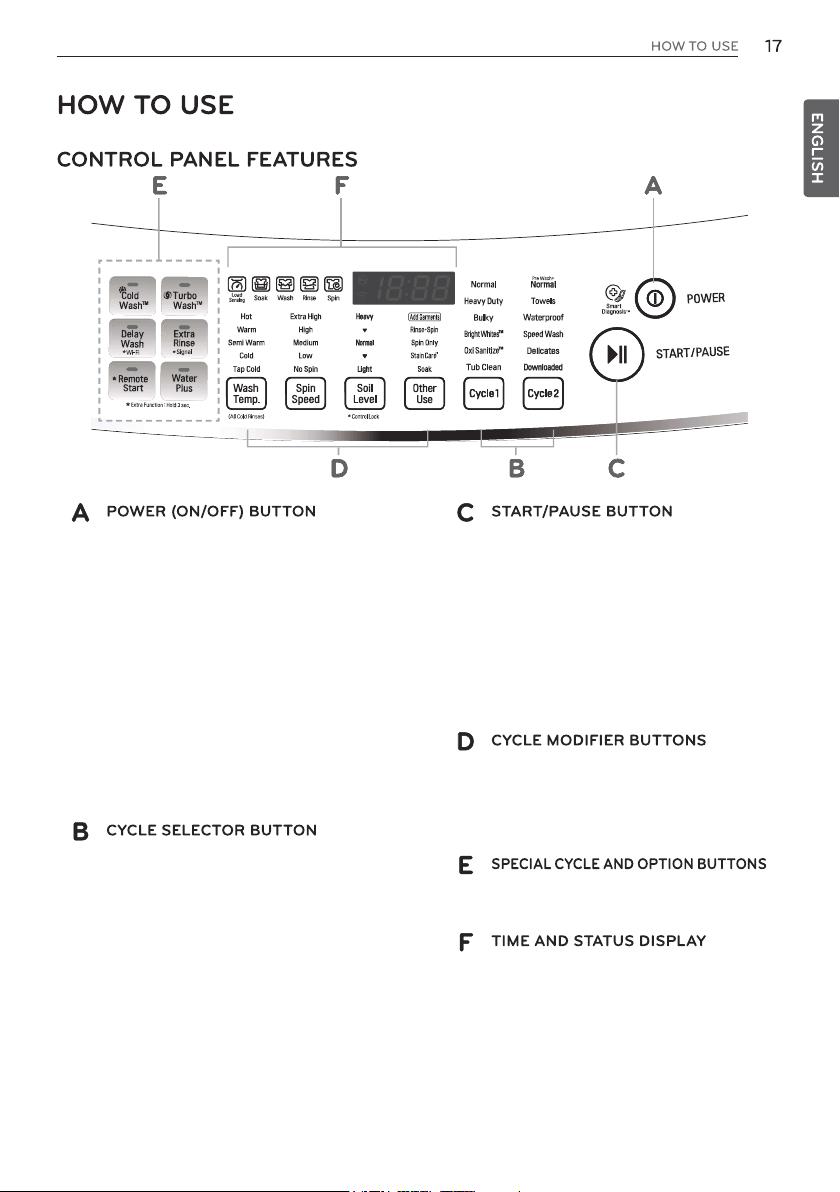
Press to turn the washer ON. Press
again to turn the washer OFF. Pressing
the POWER button during a cycle will
cancel that cycle and any load settings
will be lost. The lid will unlock after a
brief pause.
NOTE: If there is any water remaining
in the tub after the washer shuts off, it
will drain following a five minute delay.
The washer can be restarted any time
before the drain begins. However, once
the water begins to drain, all functions
will be suspended until the water has
been completely drained and the washer
shuts off.
Press the Cycle Button repeatedly until
the desired cycle is selected. Once the
desired cycle has been selected, the
standard presets will appear in the dis-
play. These settings can be adjusted
using the cycle setting buttons anytime
before starting the cycle.
NOTE: To protect your clothing, not all
settings are available on all cycle selec-
tions.
Press this button to start the selected
cycle. If the washer is running, use this
button to pause the cycle without losing
the current settings.
NOTE: If you do not press the START/
PAUSE button within five minutes of se-
lecting a cycle, the washer automatically
turns OFF and all cycle settings are lost.
Any water remaining in the tub will drain
after a five minute delay.
Use these buttons to adjust the settings
for the selected cycle. The setting lights
above the buttons illuminate to show the
current selection.
These buttons allow you to select special
cycles or options.
The display shows the cycle status and
estimated time remaining.
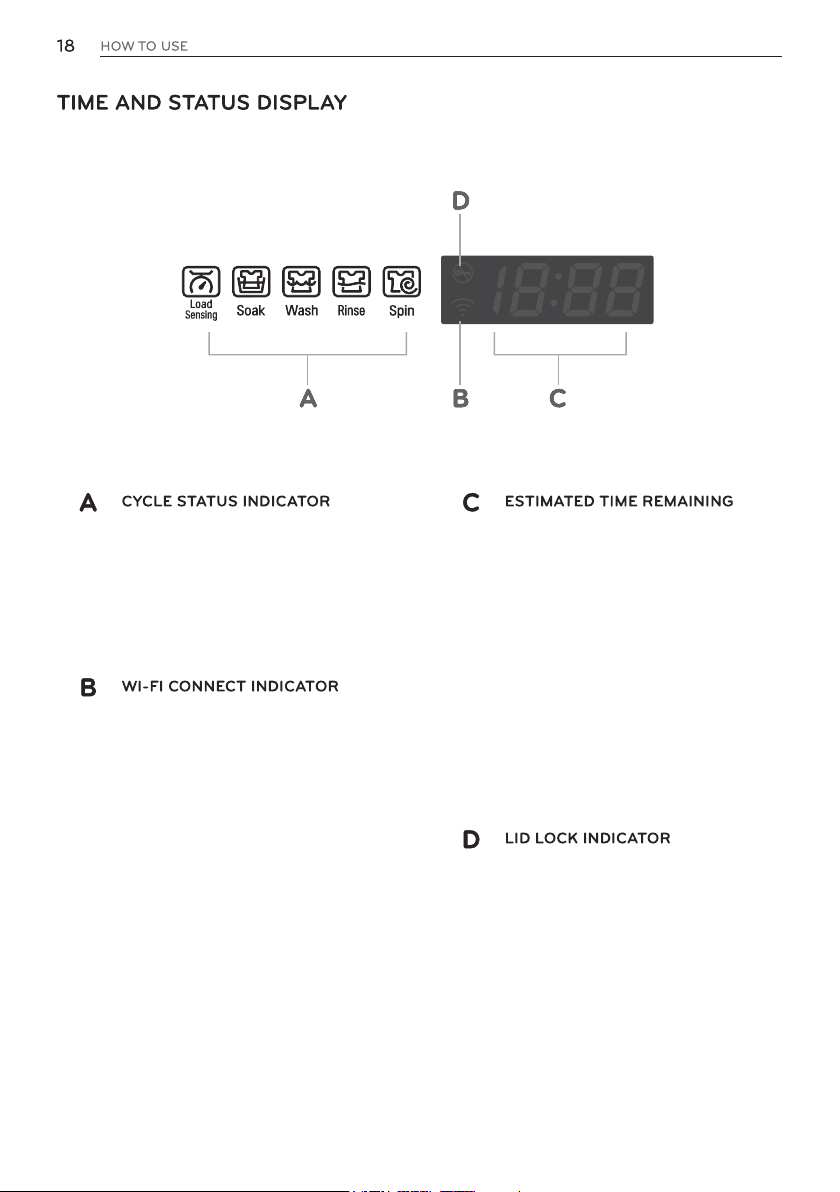
The time and status display shows the estimated time remaining and cycle progress.
These LEDs will illuminate when a cycle
is selected to indicate which stages will
run. When a cycle is running, the LED for
the active stage will blink, and the LEDs
for the remaining stages will remain
steady. Once a stage is complete, the
LED will turn off. If a cycle is paused, the
active stage LED will stop blinking.
The indicator blinks during product reg-
istration and Wi-Fi setup and illuminates
when the appliance is connected to a
home Wi-Fi network.
When a cycle is selected, the default
time for that cycle is displayed. This time
will change as modifiers or options are
selected. Once the START/PAUSE but-
ton is pressed, the washer will measure
the size of the load. The estimated time
may change once the load size has been
measured. If Delay Wash is set, the re-
maining delay time counts down until the
cycle begins.
NOTE: The time shown is only an esti-
mate. This time is based on normal oper-
ating conditions. Several external factors
(load size, room temperature, incoming
water temperature, etc.) can affect the
actual time.
The Lid lock indicator will illuminate once
a cycle has started. The indicator light
will stay on until the cycle is paused,
stopped or has finished.
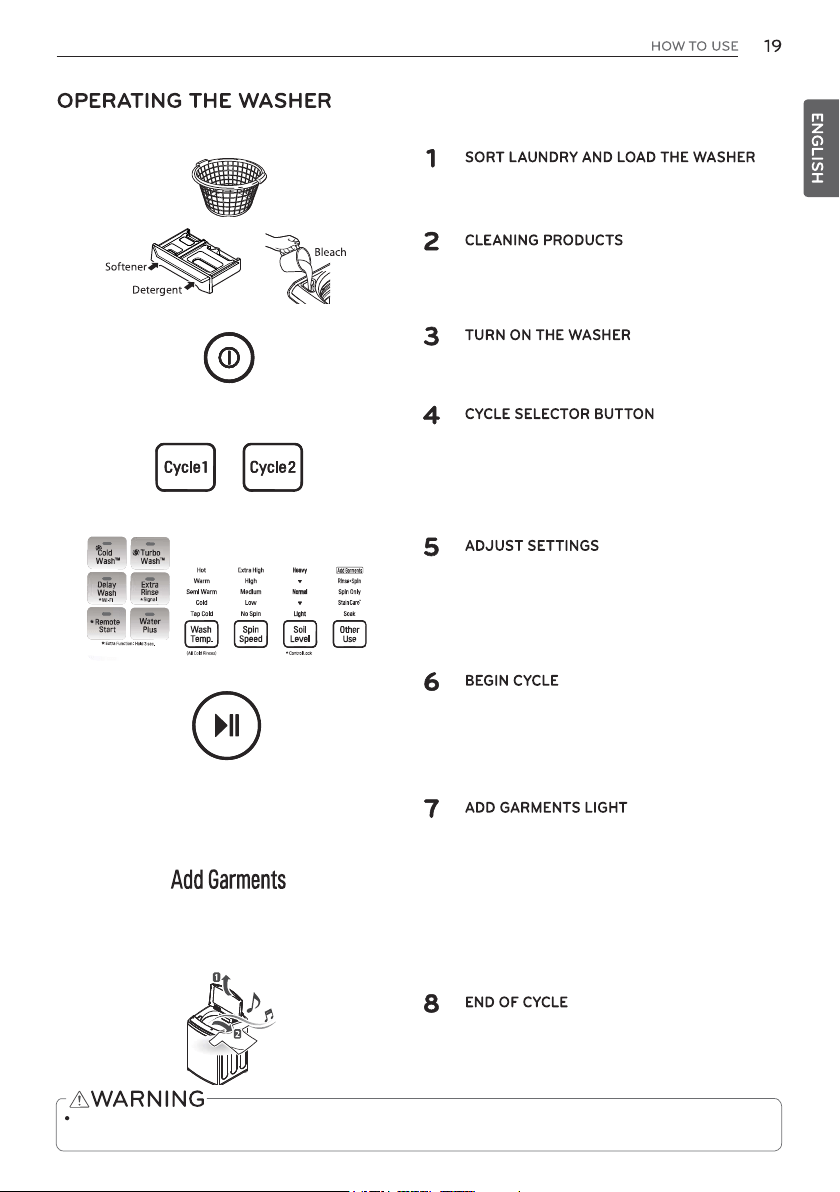
Sort laundry by fabric type, soil level, color and
load size, as needed. Open the lid and load items
into the washer.
Add High-Efficiency (HE) detergent to the
detergent dispenser. If bleach or fabric softener
is to be used, add these to the appropriate
dispensers.
Press the POWER button to turn ON the washer.
The lights around the cycle selector knob will
illuminate and a chime will sound.
Press the Cycle Button repeatedly until the desired
cycle is selected. The preset Wash Temp., Spin
Speed, Soil Level, Special Use and option settings
for that cycle will be shown. Pressing the Start
Pause button without selecting a cycle will cause
the NORMAL cycle to begin immediately.
Default settings for the selected cycle can now
be changed, if desired, using the cycle modifier
and option buttons.
NOTE:
Not all modifiers and options are available
on all cycles. A different chime will sound and the
LED will not come on if the selection is not allowed.
Press and hold the START/PAUSE button to
begin the cycle. The lid will lock, and the washer
will agitate briefly without water to measure the
weight of the load. If the START/PAUSE button
is not pressed within 5 minutes, the washer will
shut off and all settings will be lost.
The Add Garments light will illuminate near the
beginning of the wash cycle to indicate when
it is safe to add items to the load. Press the
START/PAUSE button to pause the cycle and add
garments to the load. Press the START/PAUSE
button to resume the cycle.
NOTE:
It is not recommended to add items
unless the ADD GARMENTS light is illuminated,
as this could result in poor performance and/or
clothing damage.
When the cycle is finished, a melody will sound.
Immediately remove your clothing from the
washer to reduce wrinkling.
To reduce the risk of fire, electric shock, or injury to persons,
read the IMPORTANT SAFETY
INSTRUCTIONS before operating this appliance.
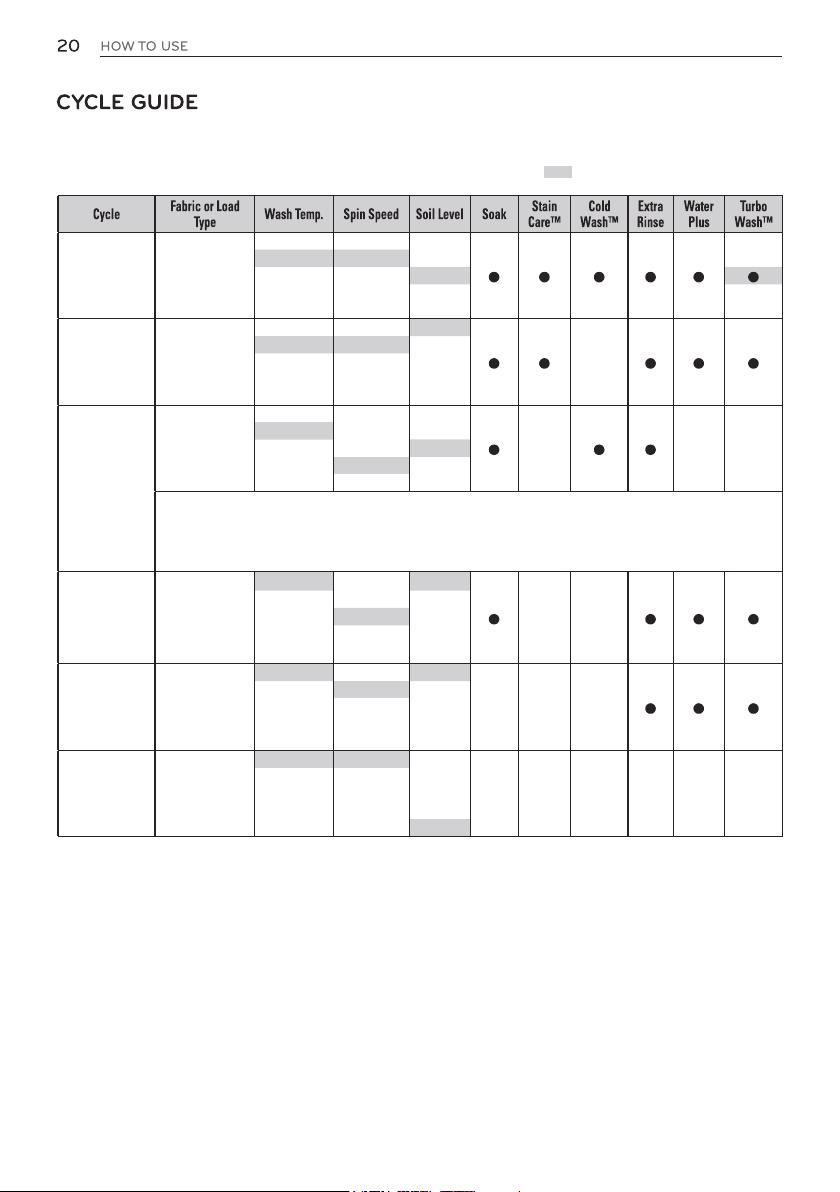
The cycle guide below shows the default settings, available options
and recommended fabric types for each cycle. Allowable modifier
adjustments are shown below the default setting for each cycle.
Default Setting
Normal Cotton, linen,
towels, shirts,
sheets, jeans,
mixed loads
Hot Extra high Heavy
Warm High
Semi Warm Medium Normal
Cold
Tap cold No spin Light
Heavy Duty Heavily soiled
cotton fabrics
Hot Extra high Heavy
Warm High
Semi Warm Medium Normal
Cold Low
Tap cold No spin Light
Bulky Large items
such as blan-
kets and com-
forters
Hot Heavy
Warm
Semi Warm Medium Normal
Cold Low
Tap cold No spin Light
* Use the BULKY cycle for items such as pillows, comforters, pet bedding and other articles which
have difficultly absorbing water. DO NOT WASH EXCESSIVELY LARGE ITEMS. If large/bulky items
do not fit easily into the tub, there may not be enough room for them to move during washing. Keep
like items together; do not mix large bulky items with smaller clothing items. Failure to follow these
instructions may result in damage to the clothing or to the washer.
Bright
Whites™
White fabrics
Hot Extra High Heavy
Warm
High
Semi Warm Medium Normal
Low
No Spin
Light
OXI
SANITIZE™
Cotton, under-
wear, pillow
covers, bed
sheets, baby
wear. (less
than 11 lbs.)
Hot Extra high
Heavy
High
Medium Normal
Low
No spin Light
Tub Clean Refer to page
27.
Hot High
Light
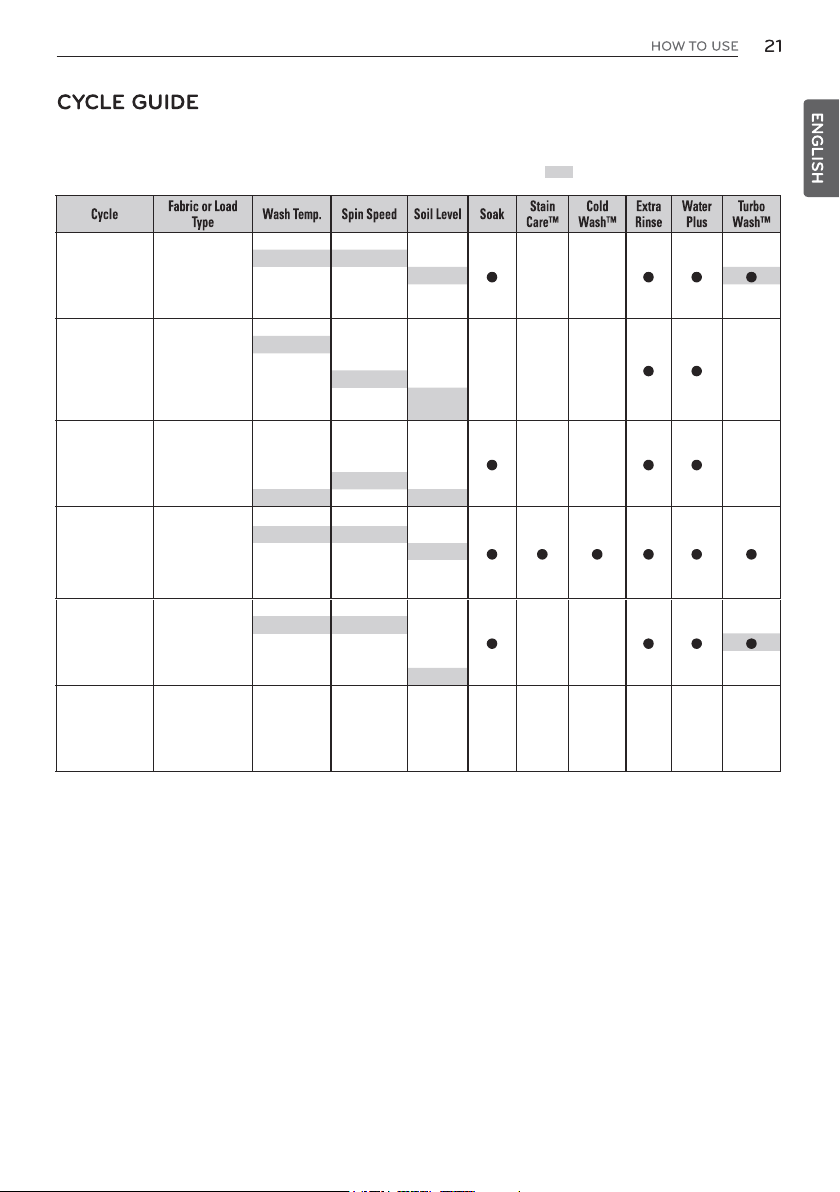
The cycle guide below shows the default settings, available options
and recommended fabric types for each cycle. Allowable modifier
adjustments are shown below the default setting for each cycle.
Default Setting
Pre Wash+
Normal
Towels, shirts,
sheets, jeans,
mixed loads
Hot Extra high
Warm High
Semi Warm Medium Normal
Cold Low
Tap cold No spin Light
Waterproof
Waterproof or
water resistant
items: mattress
covers, outdoor
clothing, plastic
mats, etc. (less
than 14 lb.)
Heavy
Warm
Semi Warm Normal
Cold Low
Tap cold No spin Light
Delicates Dress shirts/
blouses, nylons,
sheer or lacy
garments (less
than 8 lbs.)
Heavy
Warm
Semi Warm Normal
Cold
Low
Tap cold No spin Light
Towels
Towels, shirts,
sheets, jeans,
mixed loads
Hot Extra High Heavy
Warm
High
Semi Warm Medium Normal
Cold
Low
Tap cold
No Spin
Light
Speed Wash Lightly soiled
and small loads
Extra high
Heavy
Warm High
Semi Warm Medium Normal
Cold
Low
Tap cold No spin Light
Downloaded The down-
loaded cycle
(See page 22.)
Use this cycle to prewash stains without needing to
hand-wash. Prompt treatment helps to prevent stains
from setting or odors from developing.
This cycle is used for washing waterproof material.
NOTE:
Do not use any other wash cycle to wash water-
proof fabrics. (i.e. Water resistant clothing, mat-
tress covers, outdoor clothes, plastic mats etc.)
Do not use this cycle to wash a mixed load of wa-
terproof and non-waterproof items.
Use only the waterproof cycle, after checking the
washing instruction label on the fabric.
Do not wash other fabrics using the waterproof
cycle.
If waterproof material laundry is washed in a
course other than Waterproof, it may result in
injury or damage to the washer, clothes, walls,
floor, and surrounding objects due to abnormal
vibration.
This cycle is for washing lingerie or sheer and lacy
clothes which can easily be damaged.
Use the Speed Wash cycle to quickly wash lightly
soiled clothing and small loads. For high wash and
rinse efficiency, washing small loads of 2-3 lightly
soiled garments is recommended.
NOTE:
Use very little detergent in this cycle. If you
want additional rinsing, you can add extra rinses by
using the Extra Rinse button.
Use this cycle for washing towels, shirts, jeans and
mixed loads.
If you download a cycle using a smart phone, it will
be placed in the Downloaded cycle position. Choose
the Downloaded cycle to run the cycle.
NOTE: The default cycle for this position is Small
Load, used for normally soiled loads with just a
few items. The Small Load cycle is also available to
download.
Wash cycles are designed for the best wash
performance for each type of load. Select the cycle
that best matches the load contents for maximum
wash performance and fabric care. When you select
a wash cycle, the light for the corresponding wash
cycle will turn on. See page 19, OPERATING THE
WASHER, for more details on operating methods.
Use this cycle to wash all normal items, except
delicate fabrics such as wool or silk.
NOTE: Pressing the START/PAUSE button without
selecting a cycle will cause the NORMAL cycle to
begin immediately using the default settings.
This cycle is for washing heavily soiled laundry using
more powerful wash motions.
NOTE: When washing large loads, in order to deliver
the best performance, there will be brief periods of
2 minutes or more without agitation. These soak
periods are part of the cycle's design, and are normal.
This cycle is for washing blankets or bulky items.
NOTE:
Do not use this cycle to wash a mixed load
of bedding and non-bedding items.
This cycle is for washing white items only.
This wash cycle reduces 99.9% of bacteria on
laundry when used in conjunction with bleach
without high energy consumption.
NOTE:
Follow the product manufacturer’s instructions for
using Oxi products with this cycle.
Never load powdered products into the liquid
bleach dispenser. Doing so can result in the prod-
uct not being dispensed or being dispensed incor-
rectly. Powders can clog the bleach dispenser,
resulting in leaks or damage to the washer or your
clothing.
Use this cycle to clean the tub of your washing
machine.
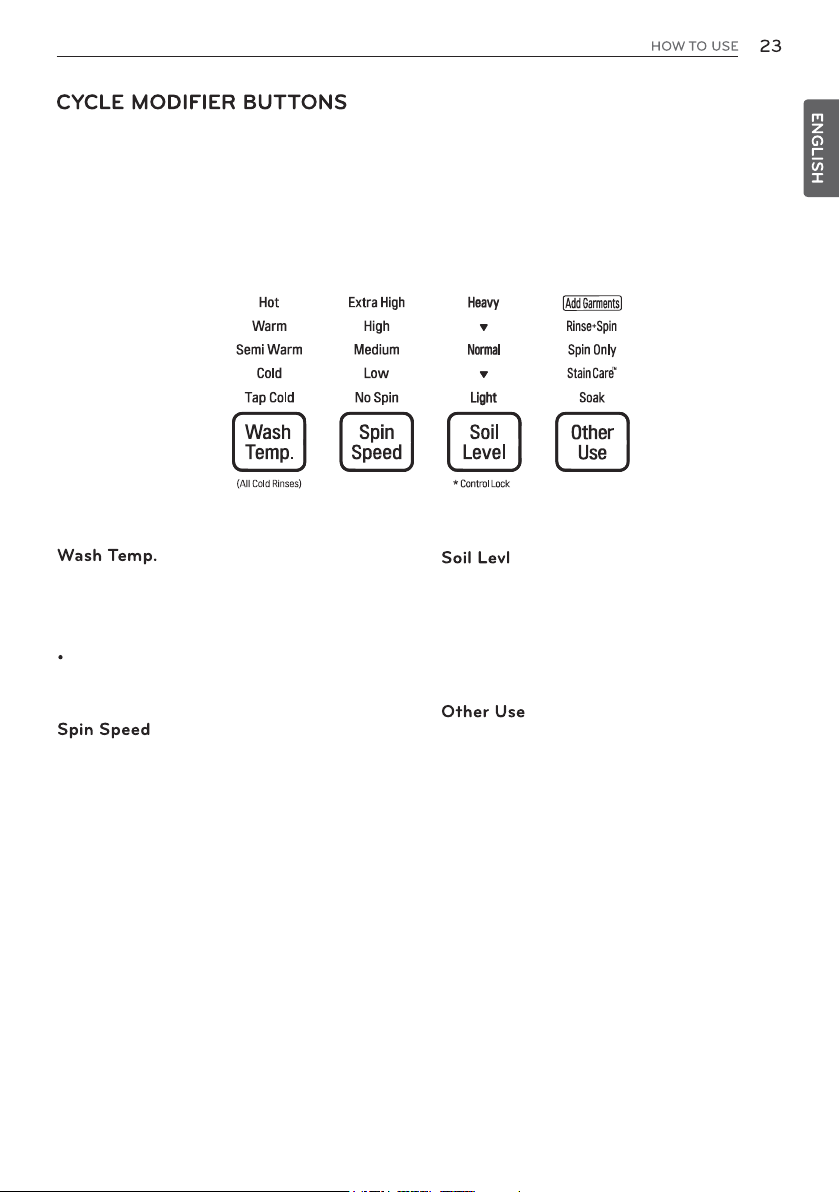
Wash Temp. selects the wash and temperature
combination for the selected cycle. Press the
Wash Temp. button until the indicator light for the
desired setting is lit. All rinses use tap cold water.
Select the water temperature suitable for
the type of load you are washing. Follow the
garment fabric care labels for best results.
Higher spin speeds extract more water from
clothes, reducing drying time and saving energy.
Press the Spin button until the desired speed is
selected. Some fabrics, such as delicates, require
a slower spin speed. To protect your clothing, not
all spin speeds are available for all cycles.
Each cycle has default settings that are selected
automatically. You may also customize these set-
tings using the cycle modifier buttons. Press the
button for the desired modifier until the indicator
light for the desired setting is lit. The washer auto-
matically adjusts the water level for the type and
size of wash load for best results and maximum
efficiency. Due to the high-efficiency nature of this
product, water levels may be much lower than ex-
pected. This is normal and cleaning/rinsing perfor-
mance will not be compromised.
NOTE: To protect your garments, not every wash/
temperature, spin speed, soil level, or option is
available with every cycle. A chime will sound and
the LED will not light if a selection is not allowed.
Adjusting the soil level setting will modify the
cycle times and/or wash actions. Press the Soil
button until the desired soil level is selected.
NOTE: This feature needs more time for heavily
soiled loads or less time for lightly soiled loads.
Pressing the OTHER USE button will allow you
to select additional features, such as Soak, Stain
Care™, Spin Only, and Rinse+Spin. Pressing the
OTHER USE button before selecting a cycle will
automatically default to the NORMAL cycle with
the Soak feature selected.
After selecting a cycle, press the OTHER USE but-
ton to select additional features for the load.
To protect your garments, not every feature is
available with every cycle.
If the START/PAUSE button is not pressed within
five minutes to start the cycle, the control will
shut off and all settings will be lost.
This option provides a 30-minute presoak prior to
the start of the selected cycle. Use the SOAK option
to presoak garments to help remove difficult spots
or stains on fabrics. At the end of the presoak time,
the selected cycle will begin with the same water
used for the soak.
NOTE: You cannot select the SOAK option for the
TUB CLEAN cycle.
Use this option for heavily soiled loads that need
improved stain treatment. When Stain Care is se-
lected, the wash cycle will begin with warm water
to help prevent the setting of certain types of stains.
Then, as the cycle progresses, hot water will be add-
ed to gradually increase the water temperature to
help remove stains that require treatment at higher
temperatures.
NOTE:
Best results are obtained with smaller loads (less
Than 6 lb.)
If you select STAIN CARE, the COLD WASH op-
tion is not available.
Use this option to drain the water from the tub and
spin out the clothes. This can be used, for example,
if the wash cycle is interrupted by a power failure.
The spin speed can be adjusted by using the SPIN
ONLY button.
1. Press the POWER button to turn on the washer.
2. Press the OTHER USE button repeatedly until Spin
Only is selected.
3. Press the SPIN SPEED button to select the de-
sired spin speed. Selecting NO SPIN is not al-
lowed.
4. Press the START/PAUSE button.
Select this option to rinse and spin a load separately
from a regular cycle. This can be helpful in prevent-
ing fresh stains from setting in fabrics. You can
change the spin speed by pressing the SPIN button.
1. Press the POWER button to turn on the washer.
2. Press the OTHER USE button until the Rinse+Spin
indicator light is lit. (The cycle light will turn off.)
3. Press the START/PAUSE button to start the cycle.
This washer is equipped with a special feature that
is designed to make your washer as safe as pos-
sible. If the washer is paused or shut off while there
is still water in the tub, the water will drain automati-
cally after several minutes of inactivity. This helps
keep children safe by reducing the possibility of wa-
ter remaining in the tub.
Any water remaining in the tub will automatically
drain 5 minutes after the washer has shut off. If the
washer is paused and the START/PAUSE button is
not pressed within 5 minutes, the washer will shut
off and all cycle settings will be lost. And any water
remaining in the tub will be drained.
The washer can be turned on or restarted any time
before the drain begins. However, once the washer
begins to drain, all controls and functions will be dis-
abled until the water has been completely drained
and the washer shuts off.
Your washing machine features several additional cycle
options that customize cycles to meet your individual
needs. To use these options, select the desired option
AFTER selecting the desired cycle.
After selecting the desired cycle and settings, press
the cycle option button(s) for the option(s) you would
like to add. The button will light when that option is
selected. If the selected option is not allowed for the
selected cycle, the chime will sound twice to alert you
and the LED will not illuminate.
NOTE:
To protect your garments, not every option is
available with every cycle.
If the START/PAUSE button is not pressed within 60
minutes to start the cycle, the control will shut off
and all settings will be lost.
This option saves energy by using cold water while
increasing the wash and rinse times to maintain wash
performance.
NOTE:
The Stain Care feature cannot be selected with the
Cold Wash option.
Wash time will increase up to 50% with the Cold
Wash option.
For best wash results, only wash small loads (less
than 8 lbs.) with the Cold Wash option.
Once you have selected the cycle and other settings,
press this button to delay the start of the wash cycle.
Each press of the button increases the delay time by 1
hour, for up to 19 hours. Once the desired delay time is
set, press the START/PAUSE button to start the delay
time.
NOTE:
If the START/PAUSE button is not pressed to
begin the delay time, the washer will automatically
shut off after five minutes and all cycle settings will
be lost.
Adding the Turbo Wash™ option reduces the cycle
time while still providing similar wash performance to
the same cycle without Turbo Wash.
NOTE:
The Turbo Wash™ option cannot be used with all
cycles.
Turbo Wash™ defaults ON for NORMAL, PRE
WASH + NORMAL, and SPEED WASH cycles.
This option will add an extra rinse to the selected cycle.
Use this option to help ensure the removal of detergent
or bleach residue from fabrics. Liquid fabric softener, if
used, is always dispensed in the final rinse.
NOTE:
You cannot select the Extra Rinse option with
the Spin Only option and Tub Clean cycle.
Use this option to add extra water to the wash cycle for
better wash performance and stain treatment of large or
bulky items.
NOTE:
If the washing machine reaches its maximum water
level, the WATER PLUS button will have no effect.
The Water Plus option can only be selected or
deselected while the cycle is running.
Once the Water Plus option has been added to a
cycle, it is saved as a default option on that cycle
until you deselect it.
To deselect the option, press WATER PLUS after
starting the cycle.
1. While the cycle is running, press START/PAUSE to
pause the cycle
2. Press WATER PLUS to add Water Plus as a default
option for that cycle.
3. Press START/PAUSE to resume the cycle.
The washing machine plays a melody when the wash
cycle has finished. Press and hold the EXTRA RINSE
button for three seconds to activate or deactivate
SIGNAL . When no signal is heard, the signal is off. The
volume settings are ON/OFF.
Use this option to disable the controls. This feature can
prevent children from changing cycles or operating the
machine. Once the CONTROL LOCK is set, it must be
deactivated before any controls, except the POWER
button, can be used. Once the washer has shut off,
the POWER button will allow the machine to be turned
ON, but the controls will still be locked. When the
controls are locked, CL will display alternately with the
estimated time remaining.
Press and hold the SOIL LEVEL button for 7 seconds to
activate or deactivate CONTROL LOCK.
NOTE:
Once the controls are locked, they must be
manually unlocked to restore operation.
Laundry may ONLY be added to the load at the
proper time in the wash cycle. When the Add
Garments light is illuminated, it is safe to pause the
cycle and add more items to the load. If garments
are added when the Add Garments light is off, the
washer will not adjust for these items which could
result in poor performance and/or fabric damage.
1. Press the START/PAUSE button to pause the
washer.
2. Open the lid after it unlocks.
3. Add your additional items.
4. Close the lid.
5. Press the START/PAUSE button. The cycle will
resume after the lid locks.
NOTE:
The ADD GARMENTS light is an indicator only
and is not selected by pressing the OTHER USE
button.
If the washer remains idle for 5 minutes after
pausing the cycle, the water in the tub will drain.
Proper care of your washer can extend its life. The
outside of the machine can be cleaned with warm
water and a mild, nonabrasive household detergent.
Lid: Wash with a damp cloth on the outside and
inside, then dry with a soft cloth.
Exterior: Immediately wipe off any spills with a soft,
damp cloth. Do not touch the surface or the display
with sharp objects.
IMPORTANT: Do not use solvents, cleaning
alcohols, or similar products. Never use steel wool
or abrasive cleaners because they can damage the
surface.
Use a towel or soft cloth to wipe around the washer
lid opening and lid glass.
Always remove items from the washer as soon as
the cycle is complete. Leaving damp items in the
washer can cause wrinkling, color transfer, and odor.
Run the Tub Clean cycle once a month, or more
often if needed, to remove detergent buildup and
other residue.
Some environmental and usage conditions can
cause a residue to build up in the tub over time and
can lead to a mildewy or musty smell. The Tub Clean
cycle is specially designed to remove this buildup
using bleach or other cleaners designed specifically
for cleaning washing machines. Run the Tub Clean
cycle once a month, or more often under heavy use
conditions or if odor is present
1. Remove any clothing from the tub.
2. Fill the bleach dispenser to the MAX line with
liquid chlorine bleach. Do not overfill the bleach
dispenser. Overfilling will cause the bleach to
dispense immediately.
NOTE: For other tub cleaning products, follow
the cleaner manufacturer’s instructions and
recommendations. For powdered cleaning products,
add the cleaner to the main wash compartment
of the dispenser drawer after removing the liquid
detergent dispenser insert.
3. Close the lid and press the POWER button to turn
the washer ON. Press the TUB CLEAN button to
select the Tub Clean cycle then press the START/
PAUSE button to begin the cycle. Selecting any
other cycle after Tub Clean has been selected will
cause the Tub Clean cycle to be cancelled.
4. After the cycle ends, open the lid and allow the
tub interior to dry completely.
NOTE:
Never load laundry while using TUB CLEAN. The
laundry may be damaged or contaminated with
cleaning products. Make sure to run the Tub Clean
cycle ONLY when the tub is empty.
It is recommended to leave the lid open after
finishing the laundry to keep the tub clean.
It is recommended that Tub Clean should be
repeated monthly.
If you live in an area with hard water, mineral scale
can form on internal components of the washer. Use
of a water softener is recommended in areas with
hard water.
Use a descaler, such as Washer Magic
®
, to remove
visible mineral buildup. After descaling, always run
the Tub Clean cycle before washing clothing.
Mineral scale and other spots may be removed from
the stainless steel tub using a stainless steel cleaner.
Do NOT use steel wool or abrasive cleaners.
If the washer will not be used for several days, leave
the lid open overnight to allow the tub to dry.
To reduce the risk of fire, electric shock, or injury to persons, read and follow this entire Owner’s
Manual, including the Important Safety Instructions, before operating this washer.
Unplug the washer before cleaning to avoid the risk of electric shock. Failure to follow this warning
can cause serious injury, fire, electric shock, or death.
Never use harsh chemicals, abrasive cleaners, or solvents to clean the washer. They will damage
the finish.
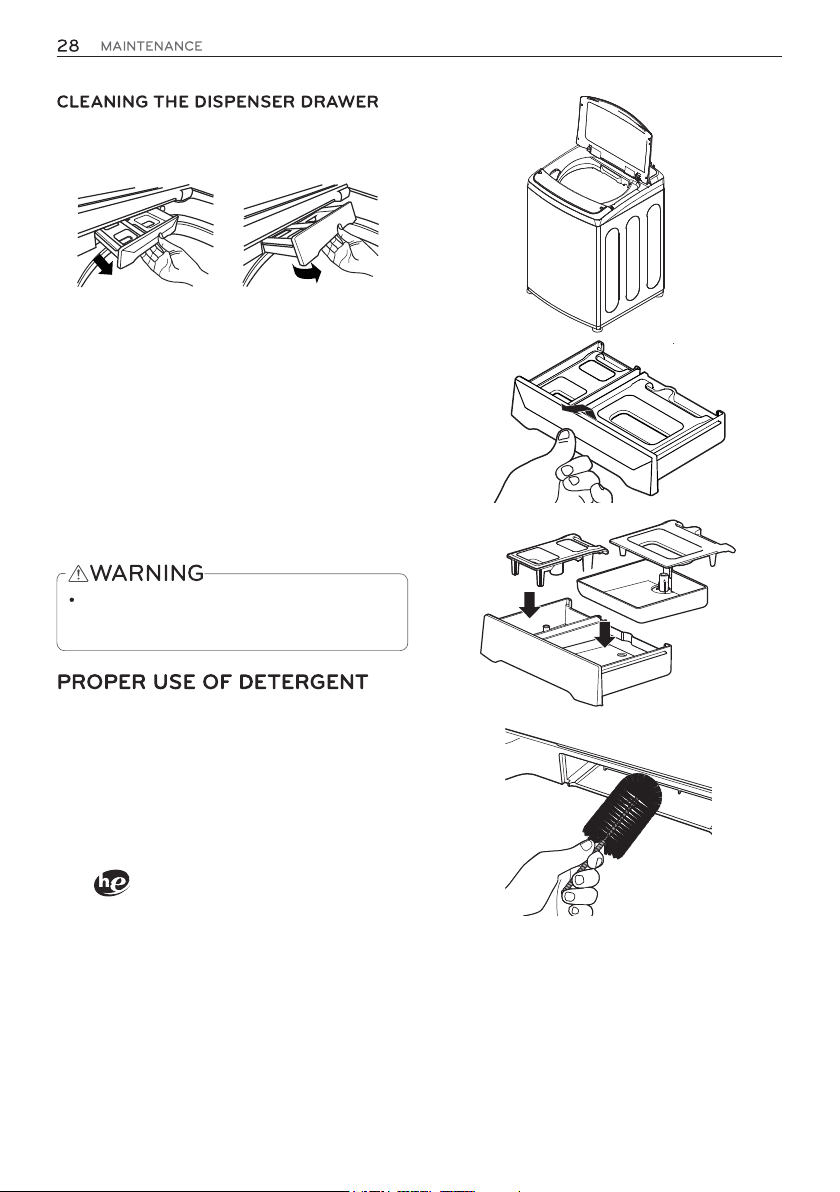
Detergent and fabric softener may build up in the dis-
penser drawer. Remove the drawer and inserts and
check for build up once or twice a month.
1. Remove the drawer by pulling it straight out until
it stops. Lift up on the front of the drawer and pull
it completely out.
2. Remove the inserts from the two compartments.
Rinse the inserts and the drawer with warm water
to remove buildup from laundry products.
3. To clean the drawer opening, use a small, non-
metal brush to clean the recess. Remove all resi-
due from the upper and lower parts of the recess.
4. Return the inserts to the proper compartments
and replace the drawer. Set the drawer into the
opening at an angle as shown above, then lower it
and slide it into place.
Do not spray water inside the washing
machine. Doing so may cause fire or electric
shock.
Using too much detergent is a common cause of
laundry problems. Today’s detergents are formulat-
ed to be effective without visible sudsing. Be sure to
carefully read and follow manufacturer’s recommen-
dations for how much detergent to use in your wash.
You can use less detergent if you have soft water, a
smaller load, or a lightly soiled load.
NOTE: Use only low-sudsing, high-efficiency deter-
gent. These detergents can be identified by the HE
logo.
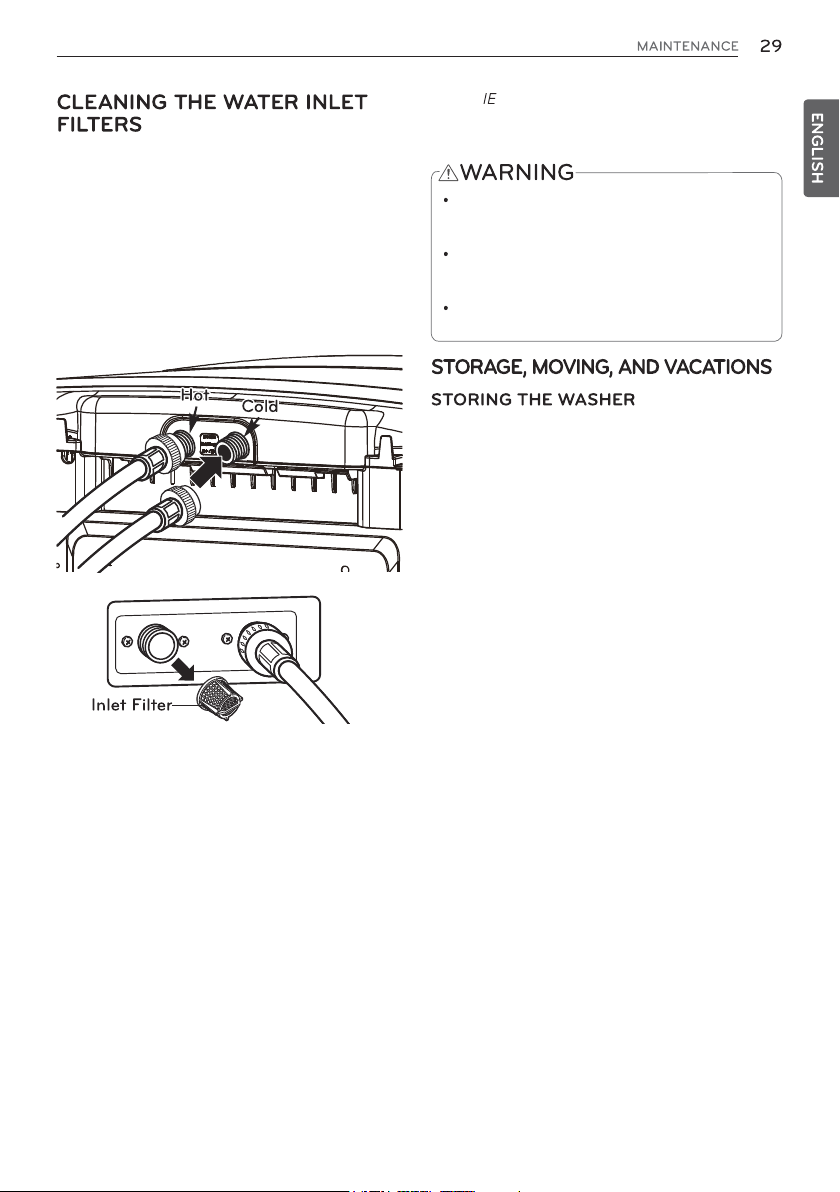
If the washer does not fill properly, an error mes-
sage will show on the display. The inlet valve filter
screens could be plugged by hard water scale,
sediment in the water supply, or other debris.
NOTE: The inlet screens protect the delicate parts
of the inlet valve from being damaged by particles
that could enter the valves with the water supply.
Operating the washer with these filters removed
could cause a valve to stick open resulting in flood-
ing and/or property damage.
1. Turn OFF both water faucets completely. Un-
screw the hot and cold water lines from the back
of the washer.
IMPORTANT: Aftermarket hoses are not guaran-
teed to fit or function correctly. Other hoses may
not tighten correctly and could cause leaks. Sub-
sequent damage to product or property will not be
covered under the terms of the product warranty.
2. Carefully remove the filters from the water valves
and soak them in white vinegar or a lime scale
remover, following the manufacturer’s instruc-
tions. Be careful not to damage the filters while
cleaning.
3. Rinse thoroughly before reinstalling. Press the fil-
ters back into place.
4. Before reattaching the hoses, flush the hoses and
water lines by running several gallons of water
into a bucket or drain, preferably with the faucets
wide open for maximum flow.
NOTE: message may blink on the display when
the water pressure is weak or an inlet filter is
clogged with dirt. Clean the inlet filter.
If the washer will not be used for an extended period of
time and is in an area that could be exposed to freezing
temperatures, perform the following steps to protect
the washer from damage.
1. Turn OFF the water supply.
2. Disconnect the hoses from the water supply and
drain water from the hoses.
3. Plug the power cord into a properly grounded electri-
cal outlet.
4. Add 1 gallon of nontoxic recreational vehicle (RV) an-
tifreeze to the empty tub and close the lid.
Never
use
automotive antifreeze.
5. Press the POWER button, then select Spin Only.
Press the START/PAUSE button to activate the
drain pump. Allow the drain pump to run for one
minute, then press the POWER button to shut off
the washer. This will expel some of the antifreeze,
leaving enough to protect the washer from damage.
6. Unplug the power cord, dry the tub interior with a
soft cloth, and close the lid.
7. Remove the inserts from the dispenser. Drain any
water in the compartments and let them dry.
8. Store the washer in an upright position.
9. To remove the antifreeze from the washer after stor-
age, run a complete Speed Wash cycle using deter-
gent. Do not add laundry to this cycle.
MOVING
Contact a service technician to remove water from the
drain pump and hoses. Reinstall the foam tub block to
protect the washer from damage while moving. Do not
store the washer where it will be exposed to outdoor
weather conditions.
LONG VACATIONS
Be sure the water supply is shut off at the faucets. Fol-
low the instructions in the Storing the Washer section
if the washer will be exposed to freezing temperatures.
Unplug the power cord and turn off the faucets be-
fore cleaning.
Failure to do so may cause electric
shock.
Do not use the washing machine without the inlet
filters.
If you use the washing machine without the
inlet filters it will cause leaks and product malfunction.
If you use the washing machine in an area with hard
water, the inlet filter may clog due to lime buildup.
Search for the LG Smart ThinQ application from the
Google Play Store or Apple App Store on a smart
phone. Follow instructions to download and install the
application.
Run the LG Smart ThinQ application on a smart
phone.
Create an account and sign in.
Select
Register.
Select
Top Load Washer.
Follow the instructions on the smart phone to
register the appliance and connect it to a Wi-Fi
network.
To verify the Wi-Fi connection, check the Wi-Fi
icon( ) on the control panel is lit.
NOTE
LG Smart ThinQ is not responsible for any network
connection problems or any faults, malfunctions, or
errors caused by network connection.
The machine supports 2.4 GHz Wi-Fi networks only.
If the appliance is having trouble connecting to the Wi-
Fi network, it may be too far from the router. Purchase
a Wi-Fi repeater (range extender) to improve the Wi-Fi
signal strength.
The Wi-Fi connection may not connect or may be
interrupted because of the home network environment.
The network connection may not work properly
depending on the internet service provider.
The surrounding wireless environment can make the
wireless network service run slowly.
This information is current at the time of publication.
The application is subject to change for appliance
improvement purposes without notice to users.
Communicate with the appliance from a smart phone
using the convenient smart features.
Select the appliance in the application.
Select the menu on the upper right side to
access settings and features.
Use a smart phone to control the appliance remotely. Or
monitor the cycle operation to see the remaining time left
in the cycle.
NOTE
You must first register the appliance and connect to a
gateway in order to use the Remote Start function.
Press and hold the REMOTE START button. The
Remote LED on the control panel is illuminated.
Start a cycle from the application on a smart
phone. If the cycle is not started, the machine
will wait to start the cycle until it is turned off or
the Remote Start mode is disabled.
Download new and specialized cycles that are not
included in the standard cycles on the appliance.
Appliances that have been successfully registered can
download a variety of specialty cycles specific to the
appliance. Only one cycle can be stored on the appliance
at a time. Once Download Cycle is completed in the
washer, the product keeps the downloaded cycle until a
new cycle is downloaded.
NOTE
You must first register the appliance and connect to a
gateway in order to use the Download Cycle function.
When the cycle is complete or the appliance has
problems, you have the option of receiving push
notifications on a smart phone.
NOTE
You must first register the appliance and connect to a
gateway in order to use the Push Alerts function.
This function provides useful information for diagnosing
and solving issues with the appliance based on the
pattern of use.
NOTE
You must first register the appliance and connect to a
gateway in order to use the Smart Diagnosis function.
This function shows how many cycles remain before It is
time to run the Tub Clean cycle.
NOTE
You must first register the appliance and connect to a
gateway in order to use the Tub Clean Coach function.
The washer energy usage is affected by the cycle and
options so you may see some changes in energy usage
from one cycle to another.
NOTE
You must first register the appliance and connect to a
gateway in order to use the Energy Monitoring function.
To obtain the source code contained in this product and
developed under GPL, LGPL, MPL and other open-source
licenses, visit http://opensource.lge.com
In addition to the source code, all referred license terms,
warranty disclaimers and copyright notices are available
for download.
LG Electronics will also provide open source code on
CD-ROM for a charge covering the cost of performing
such distribution (such as the cost of media, shipping,
and handling) upon email request to opensource@lge.
com. This offer is valid for three (3) years from the date
on which you purchased the product.
Wireless LAN Module Specifications
Model LCW-004
Frequency Range 2412 to 2462 MHz
Output Power
(max.)
IEEE 802.11 b : 22.44 dBm
IEEE 802.11 g : 24.68 dBm
IEEE 802.11 n : 24.11 dBm
This equipment has been tested and found to comply
with the limits for a Class B digital device, pursuant to
Part 15 of the FCC Rules. These limits are designed
to provide reasonable protection against harmful
interference in a residential installation. This equipment
generates, uses, and can radiate radio frequency energy
and, if not installed and used in accordance with the
instructions, may cause harmful interference to radio
communications. However, there is no guarantee that
interference will not occur in a particular installation. If
this equipment does cause harmful interference to radio
or television reception, which can be determined by
turning the equipment off and on, the user is encouraged
to try to correct the interference by one or more of the
following measures:
- Reorient or relocate the receiving antenna.
- Increase the separation between the equipment and
the receiver.
- Connect the equipment to an outlet on a circuit different
from that to which the receiver is connected.
- Consult the dealer or an experienced radio/TV
technician for help.
This device complies with part 15 of the FCC Rules.
Operation is subject to the following two conditions:
1) this device may not cause harmful interference and
2) this device must accept any interference received,
including interference that may cause undesired
operation of the device.
Any changes or modifications in construction of this
device which are not expressly approved by the party
responsible for compliance could void the user’s
authority to operate the equipment.
This equipment complies with FCC radiation exposure
limits set forth for an uncontrolled environment. This
transmitter must not be co-located or operating in
conjunction with any other antenna or transmitter.
This equipment should be installed and operated with
a minimum distance of 20 cm (7.8 inches) between the
antenna and your body. Users must follow the specific
operating instructions for satisfying RF exposure
compliance.
This device complies with Industry Canada’s licence-
exempt RSSs. Operation is subject to the following two
conditions:
(1) This device may not cause interference; and
(2) This device must accept any interference, including
interference that may cause undesired operation of
the device.
This equipment complies with IC radiation exposure
limits set forth for an uncontrolled environment. This
equipment should be installed and operated with a
minimum distance of 20 cm (7.8 inches) between the
antenna and your body.
NOTE
THE MANUFACTURER IS NOT RESPONSIBLE
FOR ANY RADIO OR TV INTERFERENCE CAUSED
BY UNAUTHORIZED MODIFICATIONS TO THIS
EQUIPMENT. SUCH MODIFICATIONS COULD
VOID THE USER’S AUTHORITY TO OPERATE THE
EQUIPMENT.
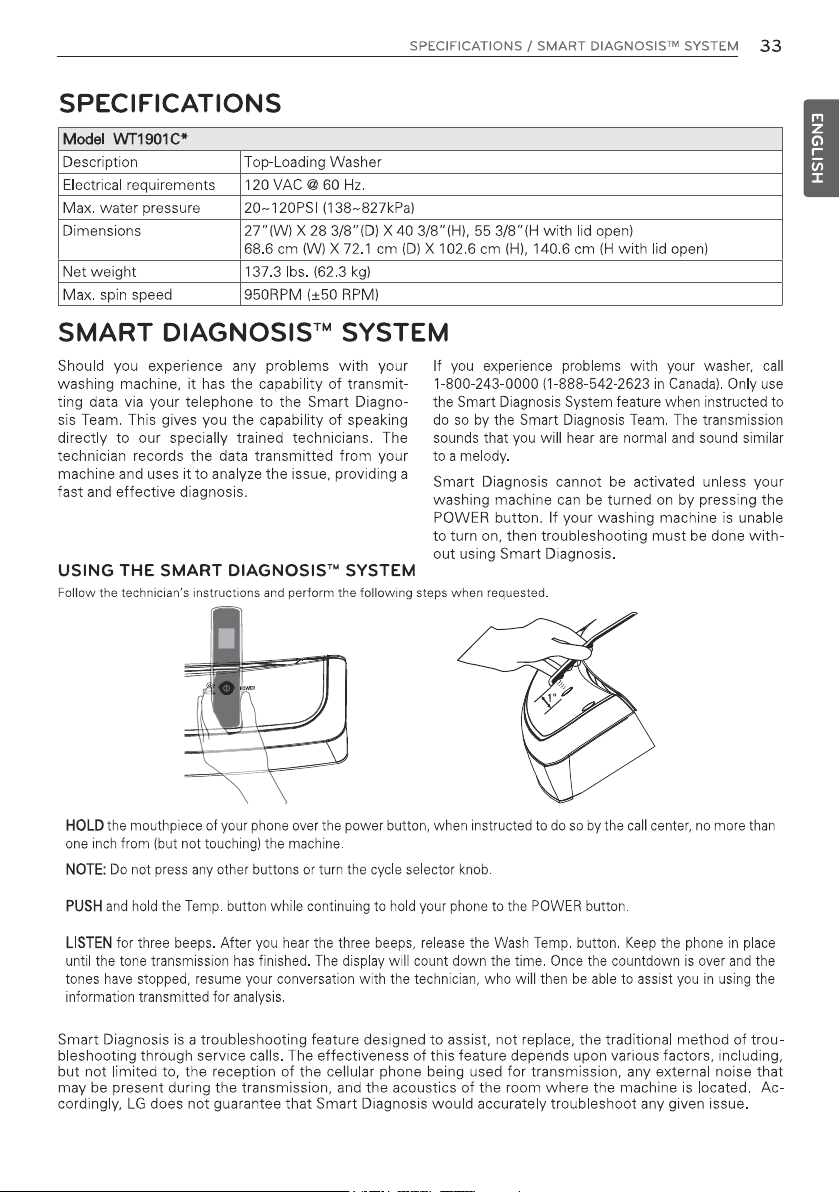
The following sounds may be heard while the wash-
er is operating. They are normal.
Lid lock relay when the lid locks and unlocks.
Water spraying or circulating during the cycle.
Drain pump is pumping water from the washer at
times during a cycle.
A liquid in the balance ring around the wash basket
helps the basket spin smoothly.
The washer adapts to the load size and type to
add more water to the cycle as needed.
The wash load may be unbalanced. If the washer
senses that the load is unbalanced, it will stop and
refill to redistribute the load.
The washer may be diluting laundry additives to
add to the wash load.
Your washing machine is equipped with an automatic error-monitoring system to detect and diagnose prob-
lems at an early stage. If your washer does not function properly or does not function at all, check the fol-
lowing before you call for service:
Problem Possible Cause Solutions
Rattling and clanking
noise
Foreign objects, such as keys,
coins, or safety pins may be in tub .
Stop washer, check tub for foreign objects. If noise
continues after washer is restarted, call for service.
Thumping sound Heavy wash loads may produce a
thumping sound.
This is normal. If sound continues, washer is probably
out of balance. Stop and redistribute wash load.
Wash load may be out of balance. Pause the cycle and redistribute the load after the lid
unlocks.
Vibrating noise Packaging materials were not re-
moved.
See the Unpacking and Removing Shipping Material
section in the installation requirements section.
Wash load may be unevenly dis-
tributed in the tub.
Pause the cycle and redistribute the load after the lid
unlocks.
Not all leveling feet are resting
firmly and evenly on the floor.
See Leveling the Washer in the Installation Instructions
section.
Floor not rigid enough. Make sure that the floor is solid and does not flex. See
Flooring in the Installation Requirements section.
Water leaking Inlet hose connection is loose at
faucet or washer.
Check hoses for leaks, cracks and splits.
Check and tighten hose connections.
House drain pipes are clogged. The washer pumps out water very rapidly. Check for
water backing up out of the drain pipe during drain. If
water is seen coming out of the drain, check for proper
drain hose installation and check for restrictions in the
drain. Contact a plumber to repair drain pipe.
Drain hose has come out of drain
or is not inserted far enough.
Tie drain hose to inlet hose or standpipe to prevent it
from coming out during drain. For smaller drain pipes,
insert the drain hose into the pipe as far as the drain
hose flange. For larger drain pipes, insert the drain
hose into the pipe 1-2 inches past the flange.
A large item such as a pillow or
blanket is above the top of the tub.
Use the BULKY/BEDDING cycle for large or bulky
items. Use extra care and never wash more than half a
load of items that float, such as pillows.
Stop the washer and check the load. Make sure the
load does not crest above the top edge of the tub.
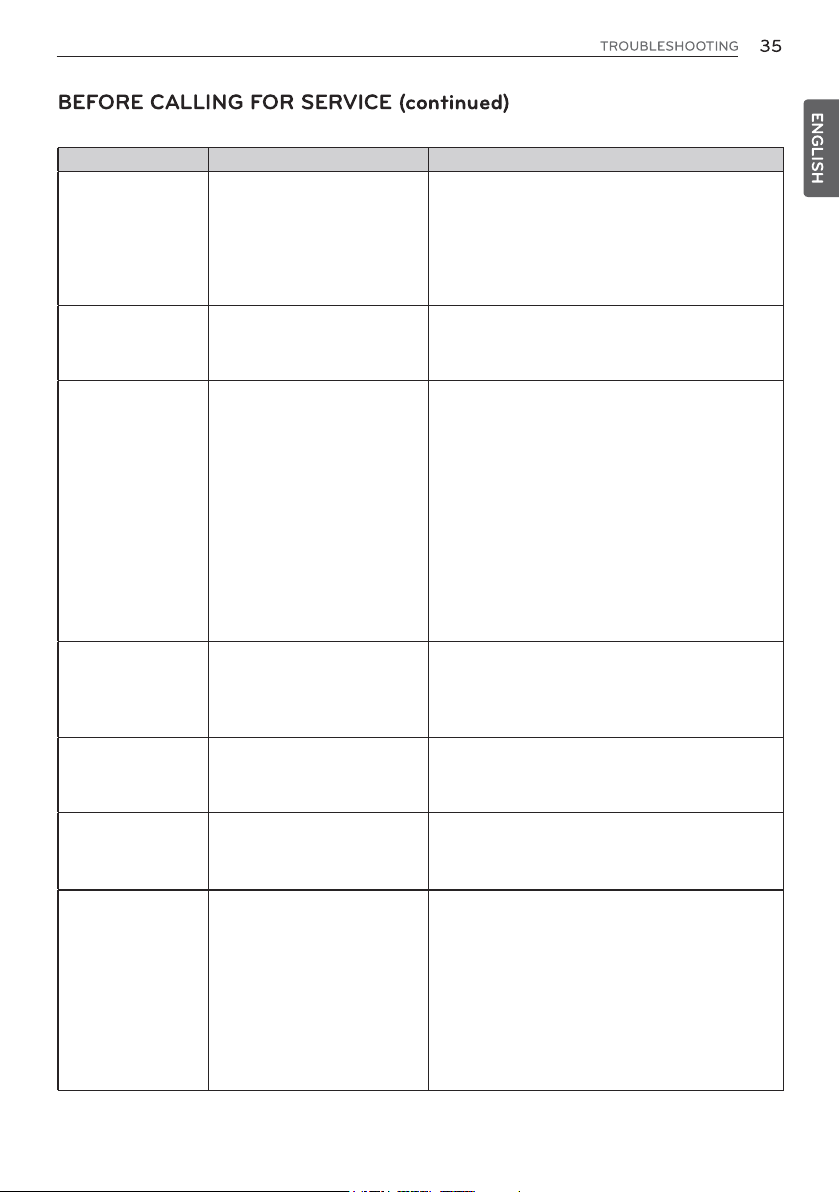
Problem Possible Cause Solutions
Wrinkling Washer not unloaded promptly. Always remove items from the washer as soon as the
cycle is complete.
Washer overloaded. The washer can be fully loaded, but the tub should not be
tightly packed with items. The lid of the washer should
close easily.
Hot and cold water inlet hoses are
reversed.
Hot water rinse can set wrinkles in garments. Check the
inlet hose connections.
Excessive sudsing Too much detergent or incorrect
detergent.
HE detergents are formulated specifically for High-Effi-
ciency washers and contain suds-reducing agents. Only
use detergent with the High-Efficiency (HE) logo. For de-
tergent quantities refer to the How to Use section.
Staining Bleach or softener dispensed too
soon.
Dispenser compartment is overfilled causing bleach or
softener to dispense immediately. ALWAYS measure
bleach to prevent overfilling - one cup maximum.
Dispenser drawer closed too quickly causing softener to
dispense immediately.
Bleach or softener was added di-
rectly to the wash load in the tub.
Always use the dispensers to ensure that laundry prod-
ucts are properly dispensed at the right time in the cycle.
Washer was not unloaded prompt-
ly.
Always remove items from the washer as soon as pos-
sible after the cycle is complete.
Clothes were not properly sorted. Always wash dark colors separately from light colors and
whites to prevent discoloration.
Never wash heavily soiled items washed with lightly
soiled items.
Washer will not turn
ON
Power cord is not properly plugged
in.
Make sure that the plug is plugged securely into a ground-
ed, 3-prong, 120-VAC, 60-Hz outlet.
House fuse is blown, circuit break-
er has tripped, or power outage
has occurred.
Reset circuit breaker or replace fuse. Do not increase
fuse capacity. If the problem is a circuit overload, have it
corrected by a qualified electrician.
Wash cycle time is lon-
ger than usual
The washer automatically adjusts
the wash time for the amount of
laundry, water pressure and other
operating conditions.
This is normal. The washer adjusts cycle time automati-
cally to provide optimal results for the selected cycle. The
time remaining shown in the display is only an estimate.
Actual time may vary.
Musty or mildewy odor
in washer
Incorrect or too much detergent
has been used.
Use only High-Efficiency (HE) detergent in accordance
with the manufacturer’s instructions.
Inside of tub was not cleaned prop-
erly.
Run the Tub clean cycle regularly.
Water leaks Oversudsing of detergent. Oversudsing may create leaks, and may be caused by the
type and amount of detergent used. High-Efficiency de-
tergent is the only detergent recommended. Make sure
that detergent and any additives are put into the correct
dispenser compartments. The normal amount of deter-
gent to use is 1/4 to 1/2 of the maximum amount recom-
mended by the detergent manufacturer. Always reduce
the amount of detergent if the load is small or lightly
soiled, or if your water is very soft. Never use more than
the maximum amount recommended by the detergent
manufacturer.
Problem Possible Cause Solutions
Washer will not operate Control panel has powered off due
to inactivity.
This is normal. Press the POWER button to turn the
washer on.
Washer is unplugged. Make sure cord is plugged securely into a working
outlet.
Water supply is turned off. Turn both hot and cold faucets fully on.
Controls are not set properly. Make sure the cycle was set correctly, close the lid
and press the START/PAUSE button.
Lid is open The washer will not operate if the lid is open. Close
the lid and make sure that nothing is caught under
the lid preventing it from closing completely.
Circuit breaker/fuse is tripped/
blown.
Check house circuit breakers/fuses. Replace fuses
or reset breaker. The washer should be on a dedicat-
ed branch circuit. The washer will resume the cycle
where it stopped once power is restored.
Control needs to be reset. Press the POWER button, then re-select the desired
cycle and press the START/PAUSE button.
START/PAUSE was not pressed
after a cycle was set.
Press the POWER button then re-select the desired
cycle and press the START/PAUSE button. The
washer will shut off if the START/PAUSE button is
not pressed within 60 minutes.
Extremely low water pressure. Check another faucet in the house to make sure that
household water pressure is adequate.
Washer is too cold. If the washer has been exposed to temperatures be-
low freezing for an extended period of time, allow
it to warm up before pressing the POWER button.
Otherwise, the display will not come on.
Washer not filling properly Filter clogged. Make sure the inlet filters on the fill valves are not
clogged. Refer to the filter cleaning instructions.
Inlet hoses may be kinked. Check that inlet hoses are not kinked or clogged.
Energy efficiency. This is a High Efficiency (HE) washer. As a result, the
water level settings for this washer may be different
than for conventional washers.
Insufficient water supply. Make sure that both hot and cold water faucets are
turned on all the way.
The washer lid is open. The washer will not operate if the lid is open. Close
the lid and make sure that nothing is caught under
the lid preventing it from closing completely.
Hot and cold inlet hoses are
reversed.
Check inlet hose connections. Make sure the hot
water supply is connected to the hot inlet valve, and
the cold water supply is connected to the cold inlet
valve.
Water level is too low. This is a high efficiency washer. The water will not
normally cover the clothes. The fill level is optimized
for the wash motion to achieve the best wash per-
formance.
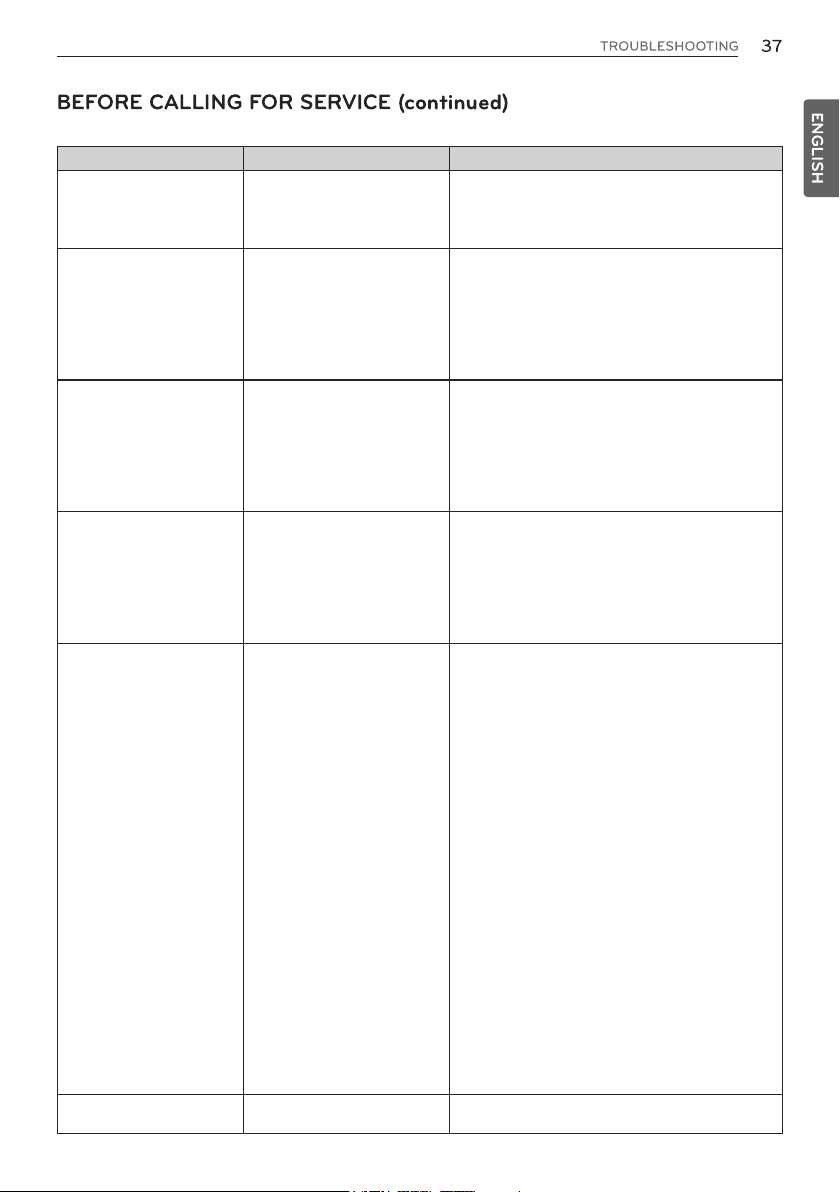
Problem Possible Cause Solutions
Washer will not drain water Kinked drain hose. Ensure that the drain hose is not kinked.
Drain located higher than 96 in.
above the floor.
Make sure that the drain hose is no higher than 8 ft.
above the bottom of the washer and is no more than
5 ft. away from the washer.
Poor stain removal Proper options not selected. Heavier soils and tougher stains may require extra
cleaning power. Select the Soak or Stain Care feature
to boost the cleaning power of the selected cycle.
Previously set stains. Articles that have previously been washed may have
stains that have been set. These stains may be dif-
ficult to remove and may require hand washing or pre-
treating to aid in stain removal.
Bleach does not dispense Bleach dispenser cover is not
properly installed.
Make sure that the bleach cover is properly installed
and snapped into place before the beginning of the
cycle.
Bleach dispenser is dirty or
clogged.
Lift out the bleach dispenser cover and clean out the
reservoir. Lint and other foreign debris that collects in
the inside the dispenser may prevent proper dispens-
ing of the bleach.
Premature dispensing of
bleach
Bleach dispenser filled for future
load.
You cannot store bleach in the dispenser for future
use. The bleach will be dispensed every load.
Overfilling the bleach dispenser. Overfilling the bleach dispenser will cause the bleach
to dispense immediately, which will damage items in
the tub. ALWAYS measure bleach, but never fill above
the MAX line on the dispenser. One cup of bleach is
normal, but never add more than one cup.
Incomplete or no dispensing
of detergent
Detergent compartments
clogged from incorrect filling.
Make sure that detergent and additives are put into
the correct dispenser compartments. If liquid deter-
gent is used, make sure that the liquid detergent cup
and insert are in the detergent compartment. If pow-
dered detergent is used, make sure that the liquid de-
tergent cup and insert are not used. For all detergent
types, always make sure that the dispenser drawer is
fully closed before the start of the cycle.
Too much detergent used. Make sure that the suggested amount of detergent is
used per the manufacturer’s recommendations. You
may also dilute the detergent with water to the maxi-
mum fill line on the compartment to avoid clogging.
Use only HE (High- Efficiency) detergent.
NOTE:
Always use as little detergent as possible.
High-Efficiency washers need very little detergent to
achieve optimum results. Using too much detergent
will cause poor wash and rinse performance and may
contribute to odors in washer.
Insufficient water supply. Make sure that both hot and cold water faucets are
turned on all the way.
Normal residue. It is normal for a small amount of detergent to remain
in the dispenser. If this residue builds up it can inter-
fere with normal dispensing of products. Refer to the
cleaning instructions.
Water leaks every load Hoses not installed correctly. Check all fill and drain hose connections to ensure
that they are tight and secure.
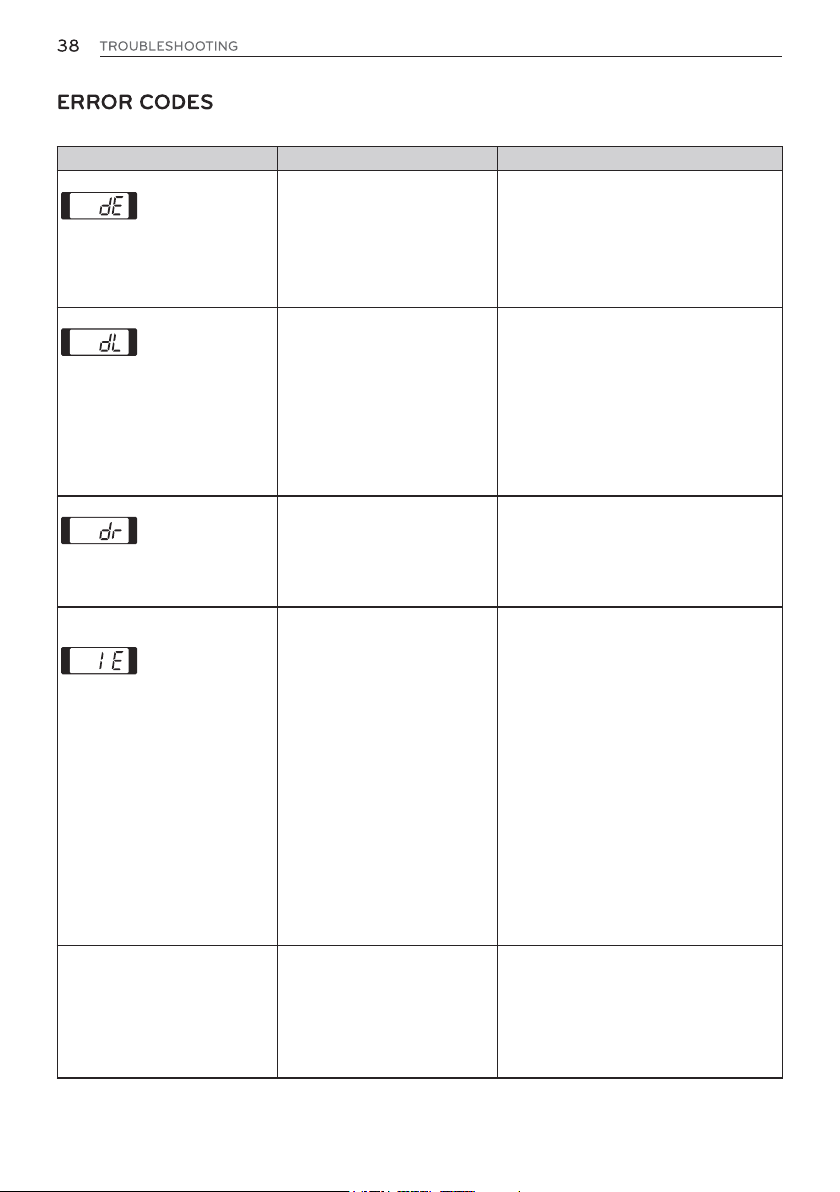
Problem Possible Cause Solutions
The display shows:
The lid is not closed properly. Make sure that the lid is closed properly
and press the START/PAUSE button. After
starting a cycle, it may take a few moments
before the tub begins to turn or spin. The
washer will not spin unless the lid is locked.
If the lid is closed and the lid lock error mes-
sage is displayed, call for service.
The display shows: Lid lock switch error. Make sure that the lid is closed properly and
press the START/PAUSE button. The washer
will not operate unless the lid is locked.
Make sure that nothing is caught under the
lid, including shipping material or clothing.
Make sure that the latch mechanism is fully
retracted.
If the lid is closed and the lid lock error mes-
sage is displayed, call for service.
The display shows: Special Drain Feature. If the washer is paused during a cycle for
more than five minutes, the cycle will be
cancelled and any water remaining in the
tub will be drained. This code is not an error
code, but is the function display for notifica-
tion only.
Washer fills with water slowly or
not at all, or the display shows:
Water supply faucets are not fully
open.
Make sure that the water faucets are fully
open.
Water line hoses are kinked,
pinched, or crushed.
Make sure that the hoses are not kinked or
pinched. Be careful when moving the washer
during cleaning and maintenance.
Water inlet filters are clogged. Clean the inlet filters. See Maintenance in
the Care and Cleaning section.
Water supply pressure to faucet or
house is too low.
Check another faucet in the house to make
sure that household water pressure is ad-
equate and flow is not restricted. Disconnect
the inlet hose from the washer and run a few
gallons of water through the hose to flush
the water supply lines. If flow is too low,
contact a plumber to have the water lines
repaired.
Water supply connected with leak-
limiting hoses.
Hoses designed to limit leaks can trip falsely
and prevent the washer from filling. The use
of leak limiting hoses is not recommended.
Washer will not turn on Power cord is not properly
plugged in.
House fuse is blown, circuit break-
er has tripped, or power outage
has occurred.
Make sure that the plug is plugged seruely
into a grounderd, 3-prong. 120-VAC, 60-Hz.
outlet.
Reset circuit breaker or replace fuse. Do not
increase fuse capacity. If the problem is a
circuit overload, have it corrected by a quali-
fied electrician.
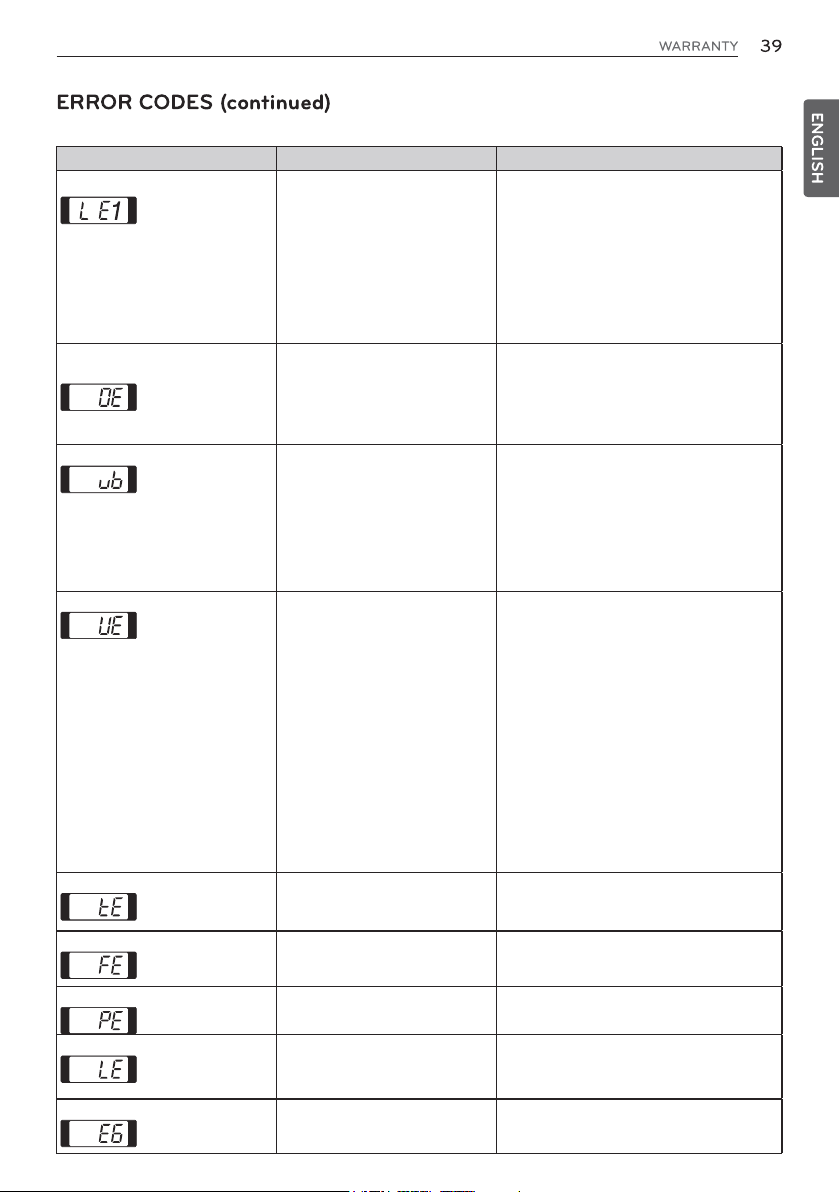
Problem Possible Cause Solutions
The display shows: Foreign objects, such as coins,
pins, clips, etc., caught between
the wash plate and the inner
basket.
Turn off the washer and then press the Power
button. Press the spin speed button without
selecting a cycle to drain and spin the load.
When the spin is complete, remove the
clothes and then find and remove any objects
caught in the wash plate.
Always check pockets, etc., before wash-
ing to prevent error codes or damage to the
washer or clothing.
Water in the washer drains slowly
or not at all, or the display shows:
Drain hose is kinked, pinched, or
clogged
Drain discharge is more than 96
inches above bottom of washer.
Make sure the drain hose is free of clogs,
kinks, etc., and is not pinched behind or
under the washer.
Adjust or repair drain. Maximum drain height
is 96 inches (8 ft.)
The display shows: The washer has detected an out of
balance load.
If the washer detects a load that is too far
out of balance to spin, it will display this code
while it is attempting to rebalance the load. The
washer will add water and try to redistribute
the load automatically. As a result, the cycle
will take longer than initially estimated. This
display is for your information only, and no
action is required.
The display shows: If the UE rebalancing operation
(see above) is not successful, this
error will be displayed.
The automatic attempt to rebalance the load
was not successful. The cycle has been
paused to allow the load to be manually
adjusted.
The load is too small. Small loads may need additional items to be
added to allow the washer to balance the
loads.
Heavy articles are mixed with
lighter items.
The load may have heavy items loaded with
lighter items. Always try to wash articles of
somewhat similar weight to allow the washer
to evenly distribute the weight of the load for
spinning.
The load is out of balance. Manually redistribute the load if articles have
become tangled preventing the automatic
distribution from working properly.
The display shows: Control error. Unplug the washer and wait 60 seconds.
Reconnect power and try again. If the error
reappears, call for service.
The display shows : Water level is too high due to a
faulty water valve.
Close the water faucets, unplug the washer,
and call for service.
The display shows: The water level sensor is not
working correctly.
Close the water faucets, unplug the washer,
and call for service.
The display shows: A motor error has occurred. Allow the washer to stand for 30 minutes
and then restart the cycle. If the LE error
code persists, call for service.
The display shows
:
Clutch error. Mechanical failure.
Unplug the washer and call for service.
HOW SERVICE IS HANDLED: In-Home Service
In-home service will be provided, as available, during the warranty period subject to servicer availability within the
U.S. To receive in-home service, the product must be unobstructed and accessible to service personnel. If the in-
home service repair cannot be completed, it may be necessary to remove, repair and return the product. If in-home
service is unavailable, LG may elect, at its option, to provide for transportation of the product to and from an LG
authorized service center.
THIS LIMITED WARRANTY DOES NOT COVER:
1. Service trips to deliver, pick up, or install the product or for instruction on product use.
2. Replacing house fuses or resetting of circuit breakers, correction of house wiring or plumbing, or correction of
product installation.
3. Damage or failure caused by leaky/ broken/ frozen water pipes, restricted drain lines, inadequate or interrupted
water supply or inadequate supply of air.
4. Damage or failure caused by accidents, pests and vermin, lightning, wind, fire, floods or acts of God.
5. Damage or failure resulting from misuse, abuse, improper installation, repair or maintenance. Improper repair
includes use of parts not approved or specified by LG.
6. Damage or failure caused by unauthorized modification or alteration to the product.
7. Damage or failure caused by incorrect electrical current, voltage, or plumbing codes.
8. Cosmetic damage, including scratches, dents, chips or other damage to the finish of the product, unless such
damage results from defects in materials or workmanship and is reported to LG within seven (7) calendar days
from the date of delivery.
9. Damage or missing items to any display, open box, discounted, or refurbished product.
10. Product where the original factory serial numbers have been removed, defaced or changed in any way.
11. Repairs when product is used in other than normal and usual household use (e.g. rental, commercial use,
offices, or recreational facilities) or contrary to the instructions outlined in the owner’s manual.
12. The removal and reinstallation of the Product if it is installed in an inaccessible location.
THIS WARRANTY IS IN LIEU OF ANY OTHER WARRANTY, EXPRESS OR IMPLIED, INCLUDING AND WITHOUT
LIMITATION TO, ANY WARRANTY OF MERCHANTABILITY OR FITNESS FOR A PARTICULAR PURPOSE. TO THE
EXTENT ANY IMPLIED WARRANTY IS REQUIRED BY LAW, THIS WARRANTY IS LIMITED IN DURATION TO THE
TERM PERIOD EXPRESSED ABOVE. REPAIR OR REPLACEMENT AS PROVIDED UNDER THIS WARRANTY IS THE
EXCLUSIVE REMEDY FOR THE CUSTOMER. NEITHER THE MANUFACTURER NOR ITS U.S. DISTRIBUTOR
SHALL BE LIABLE FOR ANY INCIDENTAL, CONSEQUENTIAL, INDIRECT, SPECIAL, OR PUNITIVE DAMAGES OF
ANY NATURE, INCLUDING AND WITHOUT LIMITATION TO, LOST REVENUES OR PROFITS, OR ANY OTHER
DAMAGE, WHETHER BASED IN CONTRACT, TORT, OR OTHERWISE.
SOME STATES DO NOT ALLOW THE EXCLUSION OR LIMITATION OF INCIDENTAL OR CONSEQUENTIAL
DAMAGES OR LIMITATIONS ON HOW LONG AN IMPLIED WARRANTY LASTS, SO THE ABOVE EXCLUSION OR
LIMITATION MAY NOT APPLY TO YOU. THIS WARRANTY GIVES YOU SPECIFIC LEGAL RIGHTS AND YOU MAY
ALSO HAVE OTHER RIGHTS THAT VARY FROM STATE TO STATE.
HOW TO OBTAIN WARRANTY SERVICE & ADDITIONAL INFORMATION: Write your warranty information
below:
Call 1-800-243-0000 or visit our website at www.lg.com. Product Registration Information:
Mail to: LG Customer Information Center (ATTN: CIC) Model:
201 James Record Road, Huntsville, AL 35824 Serial Number:
Date of Purchase:
WARRANTY:
LG Electronics U.S.A., Inc. (“LG”) warrants your LG Washing Machine (“product”) against defect in materials or
workmanship under normal household use, during the warranty period set forth below, LG will, at its option, repair or
replace the product. This limited warranty is valid only to the original retail purchaser of the product, is not assignable
or transferrable to any subsequent purchaser or user, and applies only when the product is purchased through an LG
authorized dealer or distributor and used within the United States (“U.S.”) including U.S. Territories.
Note: Replacement products and repair parts may be new or factory-remanufactured and are warranted for the
remaining portion of the original unit’s warranty period or ninety (90) days, whichever is longer. Please retain dated
receipt or delivery ticket as evidence of the Date of Purchase for proof of warranty (you may be required to submit a
copy to LG or authorized representative).
WARRANTY PERIOD:
Period
One (1) year from date of
original retail purchase:
Ten (10) years from date of
original retail purchase:
Lifetime from date of
original retail purchase:
Scope of Warranty
Any internal /functional
Parts & Labor
Drum Motor
(Stator, Rotor, and Hall
Sensor)
Stainless Steel Drum
Remark
LG will provide parts & labor to
repair or replace defective parts.
Parts only. Customer will be responsible for any labor or in-home
service to replace defective parts.