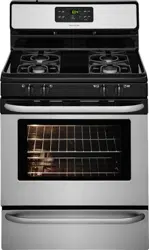
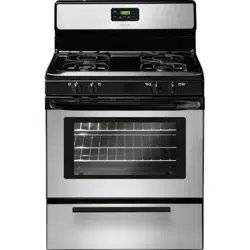
Cast-iron griddle grate (in place of middle grate; optional-some models).
Leveling legs and anti-tip bracket(included).
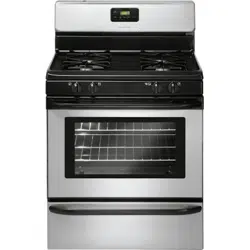
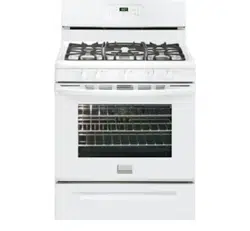
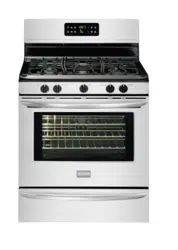
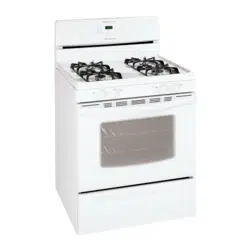
NOTE: The features shown for your appliance may vary according to model type & color.
BEFORE SETTING OVEN CONTROLS
Oven vent location
Types of oven racks The oven vent is located below the control panel (See Fig. 1). When the oven is on, warm air passes through this vent. This venting is necessary for proper air circulation in the oven and good baking results. Do not block the oven vent.
Removing, replacing & arranging racks
To remove - pull the rack forward until it stops. Lift up front of rack and slide out.
To replace - fit the rack onto the guides on the oven walls. Tilt the front of the rack upward and slide the rack back into place.
Arranging - always arrange the oven racks when the oven is cool (prior to operating the oven).
Types of oven racks
The flat oven rack or flat handle oven rack (some models) may be used for most cooking needs. The Effortless™ Oven Rack (some models) is described later in this section. The offset oven rack (some models) is designed to place the base of the rack about 1/2 of a rack position lower than normal. This rack design provides several additional possible positions between the standard positions.To maximize oven cooking space place the bottom oven rack (some models) in the lowest rack position for baking or and when roasting large cuts of meat.
Air circulation in the oven
For best baking results allow 2-4" (5-10 cm) around the cookware for proper air circulation and be sure pans and cookware do not touch each other, the oven door, sides or back of the oven cavity. Hot air must be able to circulate around the pans and cookware in the oven for even heat to reach around the food.
Baking layer cakes with 1 or 2 oven racks
For best results when baking cakes using 2 oven racks, place cookware on rack positions 2 & 5 (See Figs. 2 & 3). For best results when using a single oven flat rack, place cookware on rack positions 2, 3 or 4 (See Figs. 2 & 4).
Effortless™ Oven Rack system
Some models are equipped with a special oven rack system that automatically partially extends the oven rack from the interior oven glides to assist in easier access to your food items. This feature works whenever the oven door is opened or closed.
To assemble the Effortless™ Oven Rack system:
Locate all required parts. You will need the supplied oven rack (Effortless™ Oven Rack is a flat rack with a special dark coating on the left and right rack sides) and the 2 supplied chrome connector arms.
Open the oven door. Be sure the oven is completely cool before proceeding.
Place the oven rack in positions 2, 3 or 4 only (see previous page to verify positions).Be sure the rack connector brackets are at the rear of the range and pointing towards oven bottom (See Fig. 2).
Assemble one connector arm at a time. With the oven door open and the oven rack in place, install one end of the connector arm to the hole in the door connector bracket (Fig. 1) and the other end in the hole in the rack connector bracket (Fig. 2 and as in Fig. 3). The oven rack may need to be adjusted in or out in the rack position to match the length of the connector arm.
While holding the connector arm in place, twist the connector arm so the ends of the connector arm point upwards (See Figs. 4 & 5). The connector arm should now be locked into position.
Repeat steps 4 and 5 for the other connector arm.
Once both connector arms are properly in place, be sure to test the oven rack operation by gently closing the oven door. The oven rack should move in and out of the oven freely when the door is opened or closed.
CAUTION
REMOVE ALL OVEN RACKS and accessories before starting a self-clean cycle. If the oven racks are left in the oven during the self-clean cycle, the glide ability of the Effortless™ Oven Rack system will be damaged and will cause oven racks to loose their shiny finish and or turn blue. Remove ALL oven racks and clean according to instructions provided in the Care & Cleaning section of this manual.
Make sure the oven and oven racks are COMPLETLY cool and safe to touch before attempting to assemble or disassemble the Effortless™ Oven Rack system. Never pick up hot oven rack parts.
BEFORE SETTING SURFACE CONTROLS
Using proper cookware
For best cooking results, cookware should have flat bottoms that rests level on the burner grate. Before using cookware, check for flatness by rotating a ruler across the bottom of the cookware (Fig. 1).
CAUTION Do not place flammable items such as plastic salt and pepper shakers, spoon holders or plastic wrappings on the cooktop when it is in use. These items could melt or ignite. Potholders, towels or wooden spoons could catch fire if placed too close to the range cooktop.
IMPORTANT Do not place aluminum foil, or ANY material that can melt on the range cooktop. If these items melt they may damage the cooktop.
Cookware material types
The most popular materials available are:
Aluminum - Excellent heat conductor. Some types of food will cause it to darken (Anodized aluminum cookware resists staining & pitting).
Copper - Excellent heat conductor but discolors easily.
Stainless - Slow heat conductor with uneven cooking results. Is durable, easy to clean and resists staining.
Cast Iron - A slow heat conductor however will retain heat very well. Cooks evenly once cooking temperature is reached.
Porcelain-enamel on metal - Heating characteristics will vary depending on base material.
Glass - Slow heat conductor.
Set proper burner flame size
The color of the flame is the key to proper burner adjustment. A good flame is clear, blue and hardly visible in a well-lighted room. Each cone of flame should be steady and sharp. Adjust or clean burner if flame is yellow-orange.
For most cooking; start on the highest setting and then turn to a lower setting to complete the process. Use the recommendations below as a guide for determining proper flame size for various types of cooking (Fig. 2)
For deep fat frying; use a thermometer and adjust the surface knob accordingly. If the fat is too cool, the food will absorb the fat and be greasy. If the fat is too hot, the food will brown so quickly that the center will be undercooked. Do not attempt to deep fat fry too much food at once as the food will neither brown or cook properly.
Fig. 2
*These settings are based for medium-weight metal or aluminum pans with lids. Settings may vary when using other types of pans.
CAUTION: Never extend the flame beyond the outer edge of the cooking utensil. A higher flame wastes energy, and increases your risk of being burned by the flame (Fig. 3).
SETTING SURFACE CONTROLS
Setting surface controls
Your gas appliance may be equipped with many different sized surface burners. The ability to heat food quicker and in larger volumes increases as the burner size increases.
The smaller simmer burner (some models) is best suited for simmering delicate sauces, etc.
The standard size (9,000 BTU) burners may be used for most surface cooking needs.
The larger quick boil burner or burners (some models) are best used when bringing large quantities of liquid to temperature and when preparing larger quantities of food.
It is important to select cookware that is suitable for the amount and type of food being prepared. Select a burner and flame size appropriate for the cookware size.
Setting a surface burner
Place cooking utensil on center of surface burner grate. Make sure the cooking untensil is centered and stable on the grate.
Push the desired surface control knob in and turn counterclockwise out of the OFF position (Fig. 1).
Release the knob and rotate to the LITE position. Visually check that the gas burner has lit.
Push the control knob in and turn counterclockwise to the desired flame size. Use the control knob markings and adjust the flame as needed.
IMPORTANT
Do not place aluminum foil, or ANY material that can melt on the range cooktop. If these items melt they may permantely damage the cooktop surface.
In the event of an electrical power outage, the surface burners can be lit manually. To light a surface burner, hold a lit match to the burner head, then slowly turn the surface control knob to LITE. After burner lights push in and turn knob to desired setting. Use caution when lighting surface burners manually.
Home Canning
Be sure to read and observe all the following points when home canning with your appliance. Check with the USDA (United States Department of Agriculture) website and be sure to read all the information they have available as well as follow their recommendations for canning procedures.
Use only quality flat bottom canners when home canning. Use a straight-edge to check canner bottom (see “Cookware material types” in the Before setting surface controls section).
Start with hot tap water to bring water to boil more quickly.
Use the highest heat seating when first bringing the water to a boil. Once boiling is achieved, reduce heat to lowest possible setting to maintain that boil
OVEN CONTROL FUNCTIONS
READ THE INSTRUCTIONS CAREFULLY BEFORE USING THE OVEN.
For satisfactory use of your oven, become familiar with the various pad functions of the oven as described below.
Oven control (for models with Quick Bake™ only)
Oven control (for all other models)
Setting the Clock
When the appliance is first plugged in or when the power supply to the appliance has been interrupted, the display will flash 12:00. It is recommended to always set the clock for the correct time of day before using the appliance.
To set the clock:
Press clock once (do not hold clock key down). Within 5 seconds, press and hold or until the correct time of day appears in the display.
NOTE The clock cannot be changed during any timed bake or self-clean cycle.
Changing temperature display (°F or °C)
The electronic oven control is set to operate in Fahrenheit (°F) at the factory. The oven may be programmed for any temperature from 170°F to 550°F (77°C to 287°C).
To change the temperature to Celsius (°C) or from °C to °F:
1. Press broil. — — appears in the display. 2. Press and hold until HI appears in the display. 3. Press and hold broil until °F or °C appears in the display. 4. Press or to change °F to °C or °C to °F.
5. Press any control pad to return to normal operating mode.
Setting a silent control panel
When choosing a function, a beep will be heard each time a pad is pressed. If desired, the control can be programmed for silent operation. Press and hold After 7 seconds, the control will beep once. This will block the controls from sounding when a pad is pressed. To return the sound, press and hold again for 7 seconds until the control beeps once.
Adjusting the oven temperature
Your appliance has been factory calibrated and tested to ensure an accurate baking temperature. For the first few uses, follow your recipe times and temperature recommendations carefully. If you think the oven is cooking too hot or too cool for your recipe times, you can adjust the control so the oven cooks hotter or cooler than the temperature displayed.
To adjust oven temperature:
1. Press Bake. 2. Set the temperature to 550°F (287°C) by pressing and holding . 3. Within 3 seconds, press and hold Bake until numeric digit(s) appear. Release Bake key. The display now indicates the amount of degrees offset between the original factory temperature setting and the current temperature setting. If the oven control has the original factory calibration, the display will read 00. 4. The temperature can now be adjusted up or down 35°F (19°C), in 5°F increments by pressing and holding the or . Adjust until the desired amount of offset appears in the display. When lowering the oven temperature, a minus sign (-) will appear before the number to indicate that the oven will be cooler by the displayed amount of degrees. 5. When you have made the desired adjustment, press cancel to go back to the time of day display.
Operating oven light The interior oven light will automatically turn on when the oven door is opened. Press the oven light switch located on the upper left control panel to turn the interior oven light on and off whenever the oven door is closed. The interior oven light is located at the upper left rear wall of the oven interior. To change the interior oven light, see “Changing the oven light” in the Care & cleaning section.
SELF-CLEANING
Self-cleaning
A self-cleaning oven cleans itself with high temperatures (well above normal cooking temperatures) which eliminate soils completely or reduces them to a fine powdered ash you can wipe away with a damp cloth.
IMPORTANT
Adhere to the following self-clean precautions:
DO NOT use oven cleaners or oven protective coatings in or around any part of the oven interior.
DO NOT clean the oven door gasket (See Fig. 1). The woven material of the oven door gasket is essential for a good seal. Care should be taken not to rub, damage or remove the gasket.
DO NOT use any cleaning materials on the oven door gasket. Doing so could cause damage.
Remove the broiler pan and insert, all utensils and ANY ALUMINUM FOIL. These items cannot withstand high cleaning temperatures and will melt.
Completely remove ALL OVEN RACKS and ANY ACCESSORIES. If the oven racks are not removed they will loose their special coating properties and no longer slide in and out of the oven cavity effortlessly.
Remove any excessive spillovers. Any spills on the oven bottom should be wiped-up and removed before starting the self-cleaning cycle. To clean, use hot, soapy water and a cloth. Large spillovers can cause heavy smoke or fire when subjected to high temperatures. DO NOT allow food spills with a high sugar or acid content (such as milk, tomatoes, sauerkraut, fruit juices or pie filling) to remain on the surface as they may leave a dull spot even after cleaning.
Clean any soil from the oven frame, the door liner outside the oven door gasket and the small area at the front center of the oven bottom. These areas heat sufficiently to burn soil on. Clean with soap and water. These areas are shown in white (See Fig. 1).
CAUTION
During the self-cleaning cycle, the outside of the range can become very hot to the touch. DO NOT leave small children unattended near the appliance. The health of some birds is extremely sensitive to the fumes given off during the Self-cleaning cycle of any range. Move birds to another well-ventilated room.
DO NOT force the oven door open. This can damage the automatic door locking system. Use caution when opening the door after the Self-Cleaning cycle is completed. The oven may still be VERY HOT.
Setting a self-clean cycle or a delayed start self-clean cycle
Setting a self-clean cycle
Be sure the clock displays the correct time of day.
Press The " : " in the time of day will flash.
Press and hold the pad to scroll to the time to start the delayed Self-Clean cycle. Release the pad when the desired time is displayed.
Press “---” appears in the display.
Press the pad once. “3:00” will appear in the display indicating that a 3 hour self-clean time is set. To change to a 2 hour self-clean time press once (2:00 appears in the display).
(Some models) To self-clean using a 4 hour clean time press once (4:00 appears in display).
"CLn" will appear in the display during the self-clean cycle and the "LOCK" light will glow until the selfcleaning cycle is complete or cancelled and the oven temperature has cooled.
When the self-clean cycle has completed:
The time of day will appear in the display window and the “Clean” and "LOCK" light will continue to glow.
Once the oven has cooled down for about 1 HOUR and the "LOCK" light has gone out, the oven door can be opened.
Stopping or interrupting a self-clean cycle
If it becomes necessary to stop or interrupt a selfcleaning cycle once it has been activated:
Press cancel.
Once the oven has cooled down for about 1 HOUR and the "LOCK" light has turned off, the oven door can be opened.
Restart the selfclean cycle once all conditions have been corrected.
CARE & CLEANING
Cleaning recommendation table
Surface type
Recommendation
Aluminum (trim pieces) & vinyl
Painted and plastic control knobs
Painted body parts
Painted decorative trim
Use hot, soapy water and a cloth. Dry with a clean cloth.
For general cleaning, use hot, soapy water and a cloth. For more difficult soils and built-up grease, apply a liquid detergent directly onto the soil. Leave on soil for 30 to 60 minutes. Rinse with a damp cloth and dry. Do not use abrasive cleaners on any of these materials; they can scratch. To remove control knobs, turn to the OFF position; grasp firmly and pull straight off the shaft. To replace knobs after cleaning, line up the flat sides of both the knob and the shaft; then push the knob into place
Chrome control panel (some models)
Decorative trim (some models)
Before cleaning the control panel, turn all controls to OFF and remove the control knobs. To remove, pull each knob straight off the shaft. Clean using hot, soapy water and a dishcloth. Rinse with a clean water using a dishcloth. Be sure to squeeze excess water from the cloth before wiping the panel; especially when wiping around the controls. Excess water in or around the controls may cause damage to the appliance.To replace knobs after cleaning, line up the flat sides of both the knob and the shaft; then push the knob into place.
Easy Care™ Stainless Steel (some models)
If your range finish is Easy Care™ Stainless Steel (some models), clean the stainless with warm soapy water using a clean sponge or cloth. Rinse with clean water and dry with a soft clean cloth. DO NOT use ANY store bought cleaners like Stainless Steel cleaners or any other types of cleaners containing any abrasive, chlorides, chlorines or ammonia. It is recommended to use mild dish soap and water or a 50/ 50 solution of water and vinegar.
Porcelain enamel broiler pan and broiler pan insert (if equipped)
Door liner & body parts
Gentle scouring with a soapy scouring pad will remove most spots. Rinse with a 1:1 solution of clear water and ammonia. If necessary, cover difficult spots with an ammonia-soaked paper towel for 30 to 40 minutes. Rinse with clean water and a damp cloth, and then scrub with a soap-filled scouring pad. Rinse and wipe dry with a clean cloth. Remove all cleaners or the porcelain may become damaged during future heating. Do not use spray oven cleaners on the cooktop
Oven racks
Oven racks must be removed from oven before starting selfclean cycle. Clean by using a mild, abrasive cleaner following manufacturer's instructions. Rinse with clean water and dry.
Oven door
Use soap & water to thoroughly clean the top, sides and front of the oven door. Rinse well. You may use a glass cleaner on the outside glass of the oven door. Do not immerse the door in water. Do not spray or allow water or the glass cleaner to enter the door vents. Do not use oven cleaners, cleaning powders or any harsh abrasive cleaning materials on the outside of the oven door. Do not clean the oven door gasket. On self-cleaning models the oven door gasket is made of a woven material which is essential for a good seal. Care should be taken not to rub, damage or remove this gasket
Cooktop surface and contoured well areas, surface burner heads and caps
See Cleaning the cooktop and surface burners instructions provided in the following Care & Cleaning section.
Cleaning the cooktop and surface burners
Routinely clean the cooktop. Wipe with a clean, damp cloth and wipe dry to avoid scratches. Keeping the surface burner head ports and slots clean will prevent improper ignition and an uneven flame. See the following sections for more instructions.
To clean recessed and contoured areas of cooktop
If a spill occurs on or in the recessed or contoured areas, blot up spill with an absorbent cloth. Rinse with a clean, damp cloth and wipe dry.
To clean burner grates
Clean when the grates are cool.
Use nonabrasive plastic scrubbing pad and mild abrasive cleanser.
Food soils containing acids may affect the finish. Clean immediately after the grates are cool.
Thoroughly dry grates immediately following cleaning.
To clean burner caps
Remove caps from burner heads after they have cooled.
Clean heavy soils with a plastic scrubbing pad and absorbent cloth.
Thoroughly dry burner caps immediately following cleaning including the bottom and inside of cap.
Do not use abrasive cleaners. They can scratch porcelain.
Do not clean burner caps in the dishwasher.
Do not operate surface burners without burner caps properly in place. See IMPORTANT notes below
To clean the surface burner heads
For proper gas flow it may be necessary to clean the burner head and slots. To clean, first use a clean DAMP cloth to soak up any spills. Remove any food from between the burner slots using a small nonabrasive brush like a toothbrush and afterwards wipe up using a damp cloth. For stubborn soils located in the slots, use a small-gauge wire or needle to clean.
Any spill on or around the electrode must be carefully cleaned. Take care not to hit the electrode with any thing hard or it could be damaged.
To clean the burner head ignition ports
Each burner head has a small ignition port located as illustrated. Should you experience ignition problems it may be that this port hole is partially blocked with soil. With the burner head in place, use a small wire gauge needle or the end of a paper clip to clear the ignition port (See Fig. 1 - center burner not shown).
Replacing oven light
The light bulb is located at the rear of the oven and is covered with a glass shield held by a wire holder. The glass shield must be in place whenever the oven is in use.
To replace the oven light bulb:
Turn electrical power off at the main source or unplug the range.
Press wire holder to one side to release the glass shield that covers the light bulb.
Replace bulb with a new 40 watt appliance bulb.
Replace glass shield over bulb and snap wire holder back into place.
Turn power back on again at the main source (or plug the appliance back in).
The clock will then need to be reset. To reset, see “Setting the clock” in this Use & Care Guide.
Removing and replacing the lift-off oven door
To remove oven door:
Open oven door completely (horizontal with floor - See Fig. 1).
Pull the door hinge locks on both left and right door hinges down from the oven frame completely towards the oven door (See Fig. 2). A tool such as a small flatblade screwdriver may be required.
Firmly grasp both sides of oven door along the door sides (Do not use the oven door handle - See Fig. 3).
Close the door to the broil stop position (the oven door will stop into this position just before fully closing).
With the oven door in the broil stop position, lift the oven door hinge arms over the roller pins located on each side of the oven frame (See Fig. 4).
To replace oven door:
Firmly grasp both sides of oven door along the door sides (Do not use the oven door handle - See Fig. 3).
Holding the oven door at the same angle as the removal position, seat the hook of the hinge arm over the roller pins located on each side of the oven door frame (See Fig. 4). The hook of the hinge arms must be fully seated onto the roller pins.
Fully open the oven door (horizontal with floor - See Fig. 1).
Push the door hinge locks up towards and into the oven frame on both left and right oven door hinges (See Fig. 2) to the locked position.
Close the oven door.
Special door care instructions - Most oven doors contain glass that can break.
Read the following recommendations:
Do not close the oven door until all the oven racks are fully in place.
Do not hit the glass with pots, pans, or any other object.
Scratching, hitting, jarring or stressing the glass may weaken its structure causing an increased risk of breakage at a later time.
Before You Call
Problem
Solution
Poor baking results.
Many factors affect baking results. Make sure the proper oven rack position is used. Center food in the oven and space pans to allow air to circulate. Allow the oven to preheat to the set temperature before placing food in the oven. Try adjusting the recipe's recommended temperature or baking time. If you feel the oven is too hot or cool, see “Adjusting Oven Temperature” section in this Use & Care Guide.
Entire appliance does not operate.
The time of day is not set. The time of day must first be set in order to operate the oven. See “Setting the clock” in the Setting oven controls section.
Make sure cord/plug is plugged correctly into outlet.
Service wiring is not complete. Contact your dealer, installing agent or authorized service agent.
Electrical power outage. Check house lights to be sure. Call your local electric company for service.
Oven portion of appliance does not operate
Be sure the oven controls are set properly for the desired cooking feature. See Setting Oven Controls in this manual or see “Entire appliance does not operate” in this checklist
Surface burners do not ignite.
Surface control knob was not completely turned to LITE. Push in & turn the surface control knob to LITE until burner ignites and then turn control knob to desired flame size.
Burner ports are clogged. With the burner OFF, use a small-gauge wire or needle to burner head slots and ignition ports. See “Cleaning the cooktop and surface burners” in the Care & Cleaning section for additional cleaning instructions.
Range power cord is disconnected from outlet (electric ignition models only). Be sure power cord is securely plugged into the power outlet.
\ Electrical power outage (electric ignition models only). Burners can be lit manually. See section on Setting Surface Controls.
Surface burner flame only part way around burner cap.
Burner slots or ports are clogged. With the surface burner OFF, clean ports with a small-gauge wire or needle.
Moisture is present after cleaning. Lightly fan the flame & allow burner to operate until flame is full. Dry the surface burners thoroughly following the instructions under “Cleaning the cooktop and surface burners” provided in the Care & Cleaning section.
Surface burner flame is orange.
Dust particles in main gas line. Allow the burner to operate a few minutes until flame turns blue. In coastal areas, a slightly orange flame is unavoidable due to salt air.
Self-cleaning cycle does not work.
Oven control not set properly. Follow instructions under Self-cleaning.
Self-cleaning cycle was interrupted. Follow steps under "Stopping or Interrupting a Self-cleaning cycle" under Self-cleaning.
Soil not completely removed after selfcleaning cycle.
Failure to clean bottom, front top of oven, frame of oven or door area outside oven seal. These areas are not in the self-cleaning area, but get hot enough to burn on residue. Clean these areas before the self-cleaning cycle is started. Burned-on residue can be cleaned with a stiff nylon brush and water or a nylon scrubber. Be careful not to damage the oven gasket.
Oven smokes excessively during broiling.
Incorrect setting. Follow broiling instructions in Setting Oven Controls.
Make sure oven door closed.
Meat too close to upper burner. Reposition the broil rack to provide proper clearance between the meat & the burner. Preheat the oven.
Meat not properly prepared. Remove excess fat from meat. Cut remaining fatty edges to prevent curling, but do not cut into lean.
Broiler pan and insert wrong side up and grease not draining. Always place grid on the broiler pan with ribs up & slots down to allow grease to drip into pan (some models).
Grease has built up on oven surfaces. Regular cleaning is necessary when broiling frequently. Old grease or food spatters cause excessive smoking.
Flames inside oven or smoking from oven vent.
Excessive spillovers in oven. For example this will happen for pie spillovers or large amounts of grease left on the oven bottom. Wipe up excessive spillovers before starting oven. If flames or excessive smoke are present see “Broiling” in the Setting Oven Controls section.
Oven control panel beeps & displays any F code error (for example F10, F11, F13, F14, F15, F30, F31 or F90).
Oven control has detected a fault or error condition. Press cancel to clear the display & stop beeping. Try the bake or broil feature again. If the F code error repeats, remove power from appliance, wait 5 minutes and then repower appliance and set clock for the time of day. Try the bake or broil feature again. If the fault recurs, record fault and call for service.
Oven light does not work
Be sure the light is secure in the socket. Also see “Changing & replacing the oven light” section.
Appliance is not level.
Be sure floor is level, strong & stable enough to adequately support range.
If floor is sagging or sloping, contact a carpenter to correct the situation.
Poor installation. Place oven rack in center of oven. Place a level on the oven rack. Adjust leveling legs at base of appliance until the rack is level.
Kitchen cabinet alignment may make range appear not level. Be sure cabinets are square & have sufficient room for appliance clearance.
Cannot move appliance easily. Appliance must be accessible for service.
Cabinets not square or are built in too tightly. Contact builder or installer to make appliance accessible.
Carpet interferes with appliance. Provide sufficient space so appliance can be lifted over carpet.


-531694.png)
-171900.png)
-572369.png)
-244092.png)
-885804.png)

-3735.png)
-423970.png)
-42367.png)
-785615.png)
 or
or  until the correct time of day appears in the display.
 until HI appears in the display.
 to change °F to °C or °C to °F.
 After 7 seconds, the control will beep once. This will block the controls from sounding when a pad is pressed. To return the sound, press and hold
-2863.png)
-717603.png) The " : " in the time of day will flash.
The " : " in the time of day will flash.-507570.png) pad to scroll to the time to start the delayed Self-Clean cycle. Release the pad when the desired time is displayed.
pad to scroll to the time to start the delayed Self-Clean cycle. Release the pad when the desired time is displayed.-566461.png) “---” appears in the display.
“---” appears in the display.-509606.png) pad once. “3:00” will appear in the display indicating that a 3 hour self-clean time is set. To change to a 2 hour self-clean time press once (2:00 appears in the display).
pad once. “3:00” will appear in the display indicating that a 3 hour self-clean time is set. To change to a 2 hour self-clean time press once (2:00 appears in the display).-169445.png)
-85095.png)
-452036.png)