
OWNER’S
MANUAL
Mii
1SL012720BC
Inglés
1SL012720BC (11.14)
Mii Inglés (11.14)
SEAT S.A. is permanently concerned about continuous development of its types and models. For this reason we ask you to under-
stand, that at any given time, changes regarding shape, equipment and technique may take place on the car delivered. For this reason
no right at all may derive based on the data, drawings and descriptions in this current handbook.
All texts, illustrations and standards in this handbook are based on the status of information at the time of printing. Except for error
or omission, the information included in the current handbook is valid as of the date of closing print.
Re-printing, copying or translating, whether total or partial is not allowed unless SEAT allows it in written form.
SEAT reserves all rights in accordance with the “Copyright” Act.
All rights on changes are reserved.
❀
This paper has been manufactured using bleached non-chlorine cellulose.
© SEAT S.A. - Reprint: 15.11.14
About this manual
This manual contains a description of the
equipment supplied with the vehicle at the
time this manual was published. Some of the
units described herein will not be available
until a later date or are only available in cer-
tain markets.
Because this is a general manual for the MII,
some of the equipment and functions that are
described in this manual are not included in
all types or variants of the model; they may
vary or be modified depending on the techni-
cal requirements and on the market; this is in
no way deceptive advertising.
The illustrations are intended as a general
guide and may vary from the equipment fitted
in your vehicle in some details.
The steering indications (left, right, forward,
reverse) appearing in this manual refer to the
normal driving movements of the vehicle ex-
cept when otherwise indicated.
*
The equipment marked with an aster-
isk* is fitted as standard only in certain
versions, and is only supplied as op-
tional extras for some versions, or are
only offered in certain countries.
® All registered marks are indicated with
®. Although the copyright symbol does
not appear, it is a copyrighted mark.
>> The section is continued on the follow-
ing page.
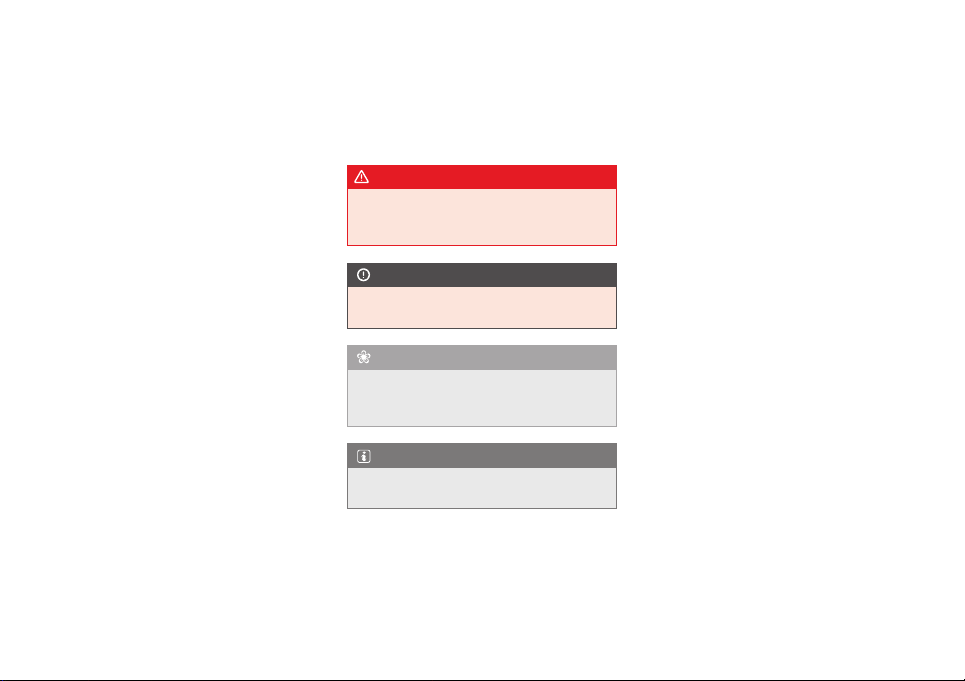
WARNING
Texts preceded by this symbol contain infor-
mation on safety. They warn you about possi-
ble dangers of accident or injury.
CAUTION
Texts with this symbol draw your attention to
potential sources of damage to your vehicle.
For the sake of the environment
Texts preceded by this symbol contain rele-
vant information concerning environmental
protection.
Note
Texts preceded by this symbol contain additio-
nal information.
This manual is divided into five large parts,
which are:
1. Safety
2. Operation
3. Tips
4. Technical data
5. Alphabetical index
At the end of this manual, there is a detailed
alphabetical index that will help you quickly
find the information you require.

Foreword
This Instruction Manual and its correspond-
ing supplements should be read carefully to
familiarise yourself with your vehicle.
Besides the regular care and maintenance of
the vehicle, its correct handling will help pre-
serve its value.
For safety reasons, always note the informa-
tion concerning accessories, modifications
and part replacements.
If selling the vehicle, give all of the on-board
documentation to the new owner, as it
should be kept with the vehicle.
You can access the information in this man-
ual using:
●
Thematic table of contents that follows the
manual’s general chapter structure.
●
Alphabetical index with many terms and
synonyms to help you find information.
WARNING
Read and always observe safety informa-
tion concerning the passenger's front air-
bag ››› page 25, Important information
regarding the front passenger's airbag.


Table of Contents
Table of Contents
Safety . . . . . . . . . . . . . . . . . . . . . . . . . . . . . . . . 5
Safe driving . . . . . . . . . . . . . . . . . . . . . . . . . . . . 5
Safety first! . . . . . . . . . . . . . . . . . . . . . . . . . . . . . 5
Tips for driving . . . . . . . . . . . . . . . . . . . . . . . . . . 5
Correct sitting position for vehicle occupants . 6
Pedal area . . . . . . . . . . . . . . . . . . . . . . . . . . . . . . 10
Seat belts . . . . . . . . . . . . . . . . . . . . . . . . . . . . . . 11
Using seat belts . . . . . . . . . . . . . . . . . . . . . . . . . 11
How to properly adjust your seatbelt . . . . . . . . 15
Seat belt tensioners . . . . . . . . . . . . . . . . . . . . . . 16
Airbag system . . . . . . . . . . . . . . . . . . . . . . . . . . 17
Brief introduction . . . . . . . . . . . . . . . . . . . . . . . . 17
General overview of the airbag . . . . . . . . . . . . . 21
Deactivating airbags . . . . . . . . . . . . . . . . . . . . . 23
Transporting children safely . . . . . . . . . . . . . . . 25
Child safety . . . . . . . . . . . . . . . . . . . . . . . . . . . . . 25
Operation . . . . . . . . . . . . . . . . . . . . . . . . . . . . . 35
Cockpit . . . . . . . . . . . . . . . . . . . . . . . . . . . . . . . . 35
Overview . . . . . . . . . . . . . . . . . . . . . . . . . . . . . . . 34
Instruments . . . . . . . . . . . . . . . . . . . . . . . . . . . . 36
Control lamps . . . . . . . . . . . . . . . . . . . . . . . . . . . 39
SEAT information system . . . . . . . . . . . . . . . . . . 40
Opening and closing . . . . . . . . . . . . . . . . . . . . . 43
Vehicle key set . . . . . . . . . . . . . . . . . . . . . . . . . . 43
Central locking* and locking system . . . . . . . . 45
Doors . . . . . . . . . . . . . . . . . . . . . . . . . . . . . . . . . . 49
Rear lid . . . . . . . . . . . . . . . . . . . . . . . . . . . . . . . . 50
Electric windows . . . . . . . . . . . . . . . . . . . . . . . . . 52
Sliding/tilting electric panoramic sunroof . . . . 53
Lights and visibility . . . . . . . . . . . . . . . . . . . . . . 55
Lights . . . . . . . . . . . . . . . . . . . . . . . . . . . . . . . . . 55
Visibility . . . . . . . . . . . . . . . . . . . . . . . . . . . . . . . 59
Windscreen wiper and rear window wiper
systems . . . . . . . . . . . . . . . . . . . . . . . . . . . . . . . . 60
Rear vision mirror . . . . . . . . . . . . . . . . . . . . . . . . 61
Seats and head restraints . . . . . . . . . . . . . . . . . 63
Adjusting the seat and head restraints . . . . . . 63
Seat functions . . . . . . . . . . . . . . . . . . . . . . . . . . 64
Transport and practical equipment . . . . . . . . . 65
Transporting objects . . . . . . . . . . . . . . . . . . . . . 65
Practical equipment . . . . . . . . . . . . . . . . . . . . . . 67
Loading luggage compartment . . . . . . . . . . . . . 73
Roof carrier system . . . . . . . . . . . . . . . . . . . . . . . 77
Air conditioning . . . . . . . . . . . . . . . . . . . . . . . . . 80
Heating, ventilation and air conditioning
system . . . . . . . . . . . . . . . . . . . . . . . . . . . . . . . . . 80
Driving . . . . . . . . . . . . . . . . . . . . . . . . . . . . . . . . 84
Steering . . . . . . . . . . . . . . . . . . . . . . . . . . . . . . . 84
Stopping and starting the engine . . . . . . . . . . . 86
Braking and parking . . . . . . . . . . . . . . . . . . . . . 89
Changing gear . . . . . . . . . . . . . . . . . . . . . . . . . . 93
Run-in and economical driving . . . . . . . . . . . . . 98
Engine management and exhaust gas
purification system . . . . . . . . . . . . . . . . . . . . . . 101
Driving abroad . . . . . . . . . . . . . . . . . . . . . . . . . . 102
Driving along flooded roadways . . . . . . . . . . . . 103
Driver assistance systems . . . . . . . . . . . . . . . . . 103
Braking and stability systems . . . . . . . . . . . . . . 103
Parking sensor system* . . . . . . . . . . . . . . . . . . . 105
Cruise control* (Cruise control system - CCS) . . 107
Safety Assist* (City Safety Assist function) . . . . 110
Hill driving assistant* . . . . . . . . . . . . . . . . . . . . 114
Start-Stop system . . . . . . . . . . . . . . . . . . . . . . . . 115
Towing bracket device . . . . . . . . . . . . . . . . . . . . 117
Trailer coupling . . . . . . . . . . . . . . . . . . . . . . . . . . 117
Advice . . . . . . . . . . . . . . . . . . . . . . . . . . . . . . . . 118
Care and maintenance . . . . . . . . . . . . . . . . . . . . 118
Accessories, replacement of parts and
modifications . . . . . . . . . . . . . . . . . . . . . . . . . . . 118
Care and cleaning the vehicle exterior . . . . . . . 125
Caring for and cleaning the vehicle interior . . . 131
Notes for the user . . . . . . . . . . . . . . . . . . . . . . . . 134
Checking and refilling levels . . . . . . . . . . . . . . . 137
Fuel . . . . . . . . . . . . . . . . . . . . . . . . . . . . . . . . . . . 137
Filling the tank . . . . . . . . . . . . . . . . . . . . . . . . . . 139
Bonnet . . . . . . . . . . . . . . . . . . . . . . . . . . . . . . . . 143
Engine oil . . . . . . . . . . . . . . . . . . . . . . . . . . . . . . 146
Engine coolant . . . . . . . . . . . . . . . . . . . . . . . . . . 150
Brake fluid . . . . . . . . . . . . . . . . . . . . . . . . . . . . . 152
Checking and topping up the windscreen
washer reservoir with water . . . . . . . . . . . . . . . . 154
Vehicle battery . . . . . . . . . . . . . . . . . . . . . . . . . . 154
Wheels and tyres . . . . . . . . . . . . . . . . . . . . . . . . 158
Wheels . . . . . . . . . . . . . . . . . . . . . . . . . . . . . . . . 158
Emergencies . . . . . . . . . . . . . . . . . . . . . . . . . . . . 170
In case of emergency . . . . . . . . . . . . . . . . . . . . . 170
Vehicle tool kit* . . . . . . . . . . . . . . . . . . . . . . . . . 172
Changing a wheel . . . . . . . . . . . . . . . . . . . . . . . 174
Tyre repair . . . . . . . . . . . . . . . . . . . . . . . . . . . . . . 178
Starting assistance . . . . . . . . . . . . . . . . . . . . . . 181
Towing and tow starting . . . . . . . . . . . . . . . . . . . 183
Emergency locking and unlocking . . . . . . . . . . 186
Changing the windscreen wiper blades . . . . . . 188
Fuses and bulbs . . . . . . . . . . . . . . . . . . . . . . . . . 189
Fuses . . . . . . . . . . . . . . . . . . . . . . . . . . . . . . . . . . 189
Changing bulbs . . . . . . . . . . . . . . . . . . . . . . . . . 191
Technical specifications . . . . . . . . . . . . . . . 197
Technical features . . . . . . . . . . . . . . . . . . . . . . . 197
Important information . . . . . . . . . . . . . . . . . . . . 197
Wheels . . . . . . . . . . . . . . . . . . . . . . . . . . . . . . . . 199
Engine specifications . . . . . . . . . . . . . . . . . . . . . 200
3

Safe driving
Safety
Safe driving
Safety first!
WARNING
●
This manual contains important informa-
tion about the operation of the vehicle, both
for the driver and the passengers. The other
sections of the on-board documentation also
contain further information that you should
be aware of for your own safety and for the
safety of your passengers.
●
Ensure that the on-board documentation is
kept in the vehicle at all times. This is espe-
cially important when lending or selling the
vehicle to another person.
WARNING
Driving under the influence of alcohol, drugs,
medication or narcotics may result in severe
accidents and even loss of life.
●
Alcohol, drugs, medication and narcotics
may significantly alter perception, affect re-
action times and safety while driving, which
could result in the loss of control of the vehi-
cle.
Tips for driving
Before starting every trip
For your own safety and the safety of your
passengers, always note the following points
before every trip:
–
Make sure that the vehicle's lights and turn
signals are working properly.
–
Check tyre pressure.
–
Ensure that all windows provide a clear and
good view of the surroundings.
–
Make sure all luggage is secured
›››
page 65.
–
Make sure that no objects can interfere
with the pedals.
–
Adjust front seat, head restraint and rear vi-
sion mirrors properly according to your
size.
–
Ensure that the passengers in the rear
seats always have the head restraints in
the in-use position
›››
page 9.
–
Instruct passengers to adjust the head re-
straints according to their height.
–
Protect children with appropriate child
seats and properly applied seat belts
›››
page 25
.
–
As
s
ume the correct sitting position. Instruct
your passengers also to assume a proper
sitting position. ››› page 6.
–
Fasten your seat belt securely. Instruct your
passengers also to fasten their seat belts
properly. ››› page 11.
What affects driving safety?
As a driver, you are responsible for yourself
and your passengers. When your concentra-
tion or driving safety is affected by any cir-
cumstance, you endanger yourself as well as
others on the road ›››
, for this reason:
–
Always pay attention to traffic and do not
get distracted by passengers or telephone
calls.
–
Never drive when your driving ability is im-
paired (e.g. by medication, alcohol, drugs).
–
Observe traffic laws and speed limits.
–
Always reduce your speed as appropriate
for road, traffic and weather conditions.
–
When travelling long distances, take
breaks regularly - at least every two hours.
–
If possible, avoid driving when you are tired
or stressed.
»
5
Technical specifications
AdviceOperationSafety
Safety
WARNING
When driving safety is impaired during a trip,
the risk of injury and accidents increases.
Safety equipment
Never put your safety or the safety of your
passengers in danger. In the event of an acci-
dent, the safety equipment may reduce the
risk of injury. The following list includes most
of the safety equipment in your SEAT:
●
Three-point seat belts
●
belt tension limiters for the front and rear
side seats,
●
Belt tensioners for the front seats
●
Belt height adjustment for the front seats
●
Front airbags
●
Side airbags in the front seat backrests
●
Side airbags in the rear seat backrests*
●
Head-protection airbags
●
Active front head restraints*
●
“ISOFIX” anchor points for child seats in
the rear side seats with the “ISOFIX” system,
●
Height-adjustable front head restraints
●
Rear head restraints with in-use position
and non-use position
●
Adjustable steering column
The safety equipment mentioned above
works together to provide you and your pas-
sengers with the best possible protection in
the event of an accident. However, these
safety systems can only be effective if you
and your passengers are sitting in a correct
position and use this equipment properly.
Safety is everyone's business!
Correct sitting position for
vehicle occupants
Correct sitting position
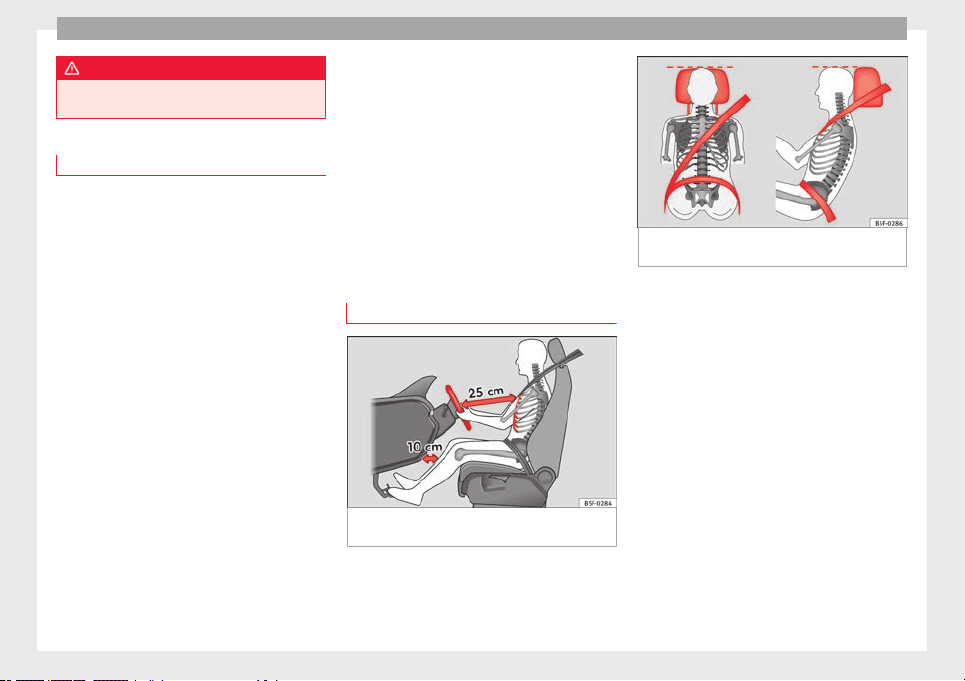
Fig. 1 The proper distance between driver
and steering wheel
Fig. 2 Correct belt web and head restraint po-
sitions
The correct sitting positions for the driver and
passengers are shown below.
If your physical constitution prevents you
from maintaining the correct sitting position,
contact a specialised workshop for help with
any special devices. The seat belt and airbag
can only provide optimum protection if a cor-
rect sitting position is adopted. SEAT recom-
mends taking your car in for technical serv-
ice.
For your own safety and to reduce the risk of
injury in the event of an accident or sudden
braking or manoeuvre, SEAT recommend the
following positions:
Valid for the driver:
●
Adjust the seat backrest to an upright posi-
tion so that your back rests completely
against it.
6
Safe driving
●
Adjust the seat so that there is a distance
of at least 25 cm between the steering wheel
and your chest ››› Fig. 1
and so that you can
ho
l
d the steering wheel with both hands on
the outside of the ring at the 9 o'clock and 3
o'clock positions with your arms slightly
bent.
●
The adjusted steering wheel must face your
chest and not your face.
●
Adjust the driver seat forwards or back-
wards so that you are able to press the accel-
erator, brake and clutch pedals to the floor
with your knees slightly angled and the dis-
tance between your knees and the dash pan-
el is at least 10 cm ››› Fig. 1.
●
Adjust the height of the driver seat so that
you can easily reach the top of the steering
wheel.
●
Keep both feet in the footwell so that you
have the vehicle under control at all times.
●
Adjust and fasten your seat belt correctly
››› page 11.
Valid for the passenger:
●
Adjust the seat backrest to an upright posi-
tion so that your back rests completely
against it.
●
Move the front passenger seat back as far
as possible for optimum protection should
the airbag deploy.
●
Always keep your feet in the footwell while
the vehicle is in motion.
●
Adjust and fasten your seat belt correctly
››› page 11.
Valid for the passengers in the rear section:
●
Adjust the head restraint so that its upper
edge is at the same level as the top of your
head, or as close as possible to the same lev-
el as the top of your head and under no cir-
cumstances below eye level. Keep the back
of your neck as close as possible to the head
restraint ››› Fig. 1 and ››› Fig. 2.
●
Short people must lower the head restraint
to the first anchorage position, even if your
head is below its upper edge.
●
Tall people must raise the head restraint
completely.
●
Always keep your feet in the footwell while
the vehicle is in motion.
●
Adjust and fasten your seat belt correctly
››› page 11.
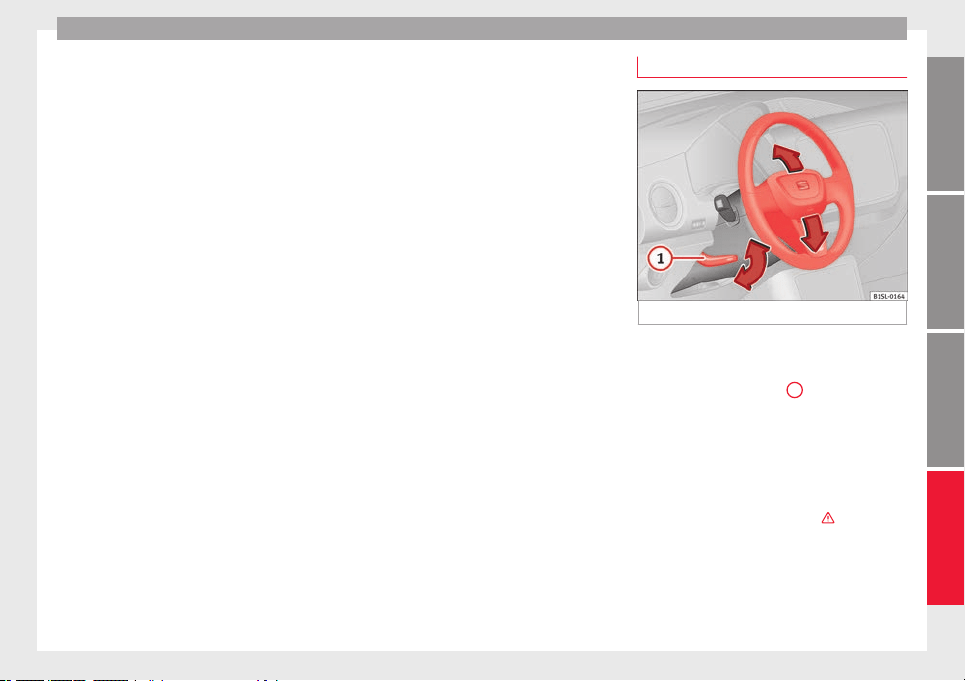
Adjusting the steering wheel position
Fig. 3 Mechanical steering wheel adjustment
Adjust the steering wheel before your trip
and only when the vehicle is stationary.
●
Push the lever ››› Fig. 3
1
downwards.
●
Adjust the steering wheel so that you can
hold onto the steering wheel with both hands
on the outside of the ring at the 9 o'clock and
3 o'clock positions and your arms slightly
bent.
●
Push the lever firmly upwards until it is
flush to the steering column ››› .
Adjust the correct distance between the driv-
er and the steering wheel ››› Fig. 1
using the
c
ontr
ols on the driver seat ››› page 63.
»
7
Technical specifications
AdviceOperationSafety
Safety
WARNING
Incorrect use of the steering wheel adjust-
ment function and an incorrect adjustment of
the steering wheel can result in severe or fa-
tal injury.
●
After adjusting the steering column, push
the lever ››› Fig. 3
1
firmly upwards to en-
sure the steering wheel does not accidentally
change position while driving.
●
Never adjust the steering wheel while the
vehicle is in motion. If you need to adjust the
steering wheel while the vehicle is in motion,
stop safely and make the proper adjustment.
●
The adjusted steering wheel should be fac-
ing your chest and not your face so as not to
hinder the driver's front airbag protection in
the event of an accident.
●
When driving, always hold the steering
wheel with both hands on the outside of the
ring at the 9 o'clock and 3 o'clock positions
to reduce injuries when the driver's front air-
bag deploys.
●
Never hold the steering wheel at the 12
o'clock position or in any other manner (e.g.
in the centre of the steering wheel). In such
cases, if the driver's airbag deploys, you may
sustain injuries to your arms, hands and
head.
Danger of injuries due to an incorrect
sitting position
Number of seats
The vehicle has a total of 4 seats: 2 front
seats
and 2 rear seats. Each seat is equipped
with a seat belt.
If the seat belts are worn incorrectly or not at
all, the risk of severe injuries increases. Seat
belts can provide optimal protection only if
the belt web is properly worn. Being seated
in an incorrect position means the seat belt
cannot offer its full protection. This could re-
sult in severe and even fatal injuries. The risk
of severe or fatal injuries is especially height-
ened when a deploying airbag strikes a vehi-
cle occupant who has assumed an incorrect
sitting position. The driver is responsible for
all passengers in the vehicle, particularly
children.
The following list shows just some examples
of incorrect sitting positions which can be
dangerous to all vehicle occupants.
When the vehicle is in motion:
●
Never stand in the vehicle.
●
Never stand on the seats.
●
Never kneel on the seats.
●
Never tilt your seat backrest too far to the
rear.
●
Never lean against the dash panel.
●
Never lie on the rear seats.
●
Never sit on the front edge of a seat.
●
Never sit sideways.
●
Never lean out of a window.
●
Never put your feet out of a window.
●
Never put your feet on the dash panel.
●
Never put your feet on the surface of a seat
or seat backrest.
●
Never travel in a footwell.
●
Never travel on a seat without wearing the
seat belt.
●
Never carry any person in the luggage com-
partment.
WARNING
An incorrect sitting position in the vehicle
can lead to severe injuries or death in the
event of sudden braking or manoeuvres, colli-
sion or accidents or if the airbag deploys.
●
Before the vehicle moves, assume the prop-
er sitting position and maintain it throughout
the trip. This also includes fastening the seat
belt.
●
Never transport more people than there are
seats with a seat belt available in the vehicle.
●
Children must always be protected with an
approved child restraint system suited to
their height and weight ››› page 25,
››› page 17.
8
Safe driving
●
Always keep your feet in the footwell while
the vehicle is in motion. Never, for example,
put your feet on the surface of a seat or on
the dash panel and never put them out of a
window. Otherwise the airbag and seat belt
offer insufficient protection and the risk of in-
jury in the event of an accident is increased.
WARNING
Before every trip, adjust the seat, the seat
belt and the head restraints and instruct your
passengers to fasten their seat belts proper-
ly.
●
Move the front passenger seat back as far
as possible.
●
Adjust the driver seat so that there is at
least 25 cm distance between your chest and
the hub of the steering wheel. Adjust the
driver seat so that you are able to press the
accelerator, brake and clutch pedals to the
floor with your knees slightly angled and that
the distance between your knees and the
dash panel is at least 10 cm. If your physical
constitution prevents you from meeting these
requirements, contact a specialised work-
shop to make any modifications required.
●
Never drive with the seat backrest tilted far
back. The further the seat backrests are tilted
to the rear, the greater the risk of injury due
to incorrect positioning of the belt web or to
the incorrect sitting position!
●
Never drive with the seat backrest tilted
forwards. Should a front airbag deploy, it
could throw the seat backrest backwards and
injure the passengers of the rear seats.
●
Sit as far away as possible from the steer-
ing wheel and the dash panel.
●
Keep your back straight and resting com-
pletely against the seat backrest and the
front seats correctly adjusted. Never place
any part of your body in the area of the airbag
or very close to it.
●
If passengers on the rear seats are not sit-
ting in an upright position, the risk of severe
injury due to incorrect positioning of the belt
web increases.
WARNING
Incorrect seat adjustment may lead to acci-
dents and severe injuries.
●
Only adjust the seats when the vehicle is
stationary, as the seats could move unex-
pectedly while the vehicle is in motion and
you could lose control of the vehicle. Further-
more, an incorrect position is adopted when
adjusting the seat.
●
Only adjust the height, seat backrest and
forwards or backwards position of the seat
when there is nobody in the seat adjustment
area.
●
There must be no objects blocking the front
seat adjustment area.
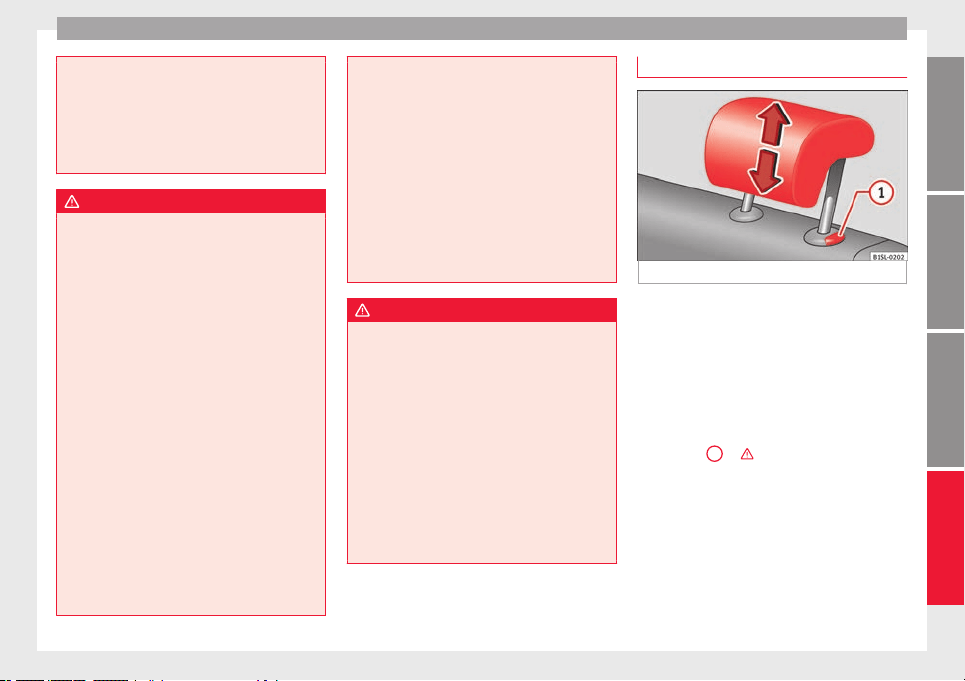
Adjust the rear head restraints
Fig. 4 Adjusting the rear head restraints
All seats are equipped with a head restraint.
The front seat head restraints are integrated
in the backrests and adjusting them is not
possible.
Adjusting height
●
Push the head restraint up or down in the
direction of the arrow with the button press-
ed ››› Fig. 4
1
››› .
●
The head restraint must engage securely in
position.
Correct adjustment of head restraints
Adjust the head restraint so that its upper
edge is at the same level as the top of your
head, or as close as possible to the same lev-
el as the top of your head and under no cir-
cumstances below eye level. Keep the back
»
9
Technical specifications
AdviceOperationSafety
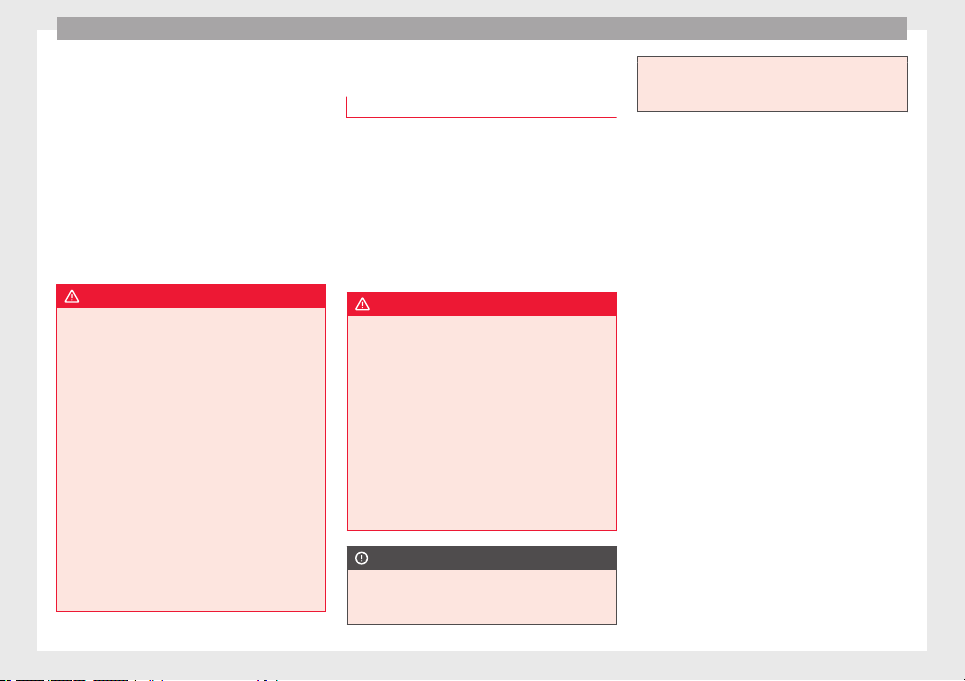
Safety
of your neck as close as possible to the head
restraint.
Adjusting the head restraint for short people
Set the head restraint in the first anchorage
position, even if your head is below its upper
edge. When the head restraint is at its low-
est, it is possible that a small gap remains
between it and the seat backrest.
Adjusting the head restraint for tall people
Raise the head restraint completely.
WARNING
Travelling with the head restraints removed
or improperly adjusted increases the risk of
severe or fatal injuries in the event of acci-
dents and sudden braking or manoeuvres.
●
Always fit and adjust the head restraint
properly whenever a person is occupying a
seat.
●
All vehicle occupants must correctly adjust
the head restraint according to their height to
reduce the risk of back injuries in the event of
an accident. The upper edge of the head re-
straint must be as close as possible to the
same level as the top of your head and under
no circumstances below eye level. Keep the
back of your neck as close as possible to the
head restraint.
●
Never adjust the head restraint while the
vehicle is in motion.
Pedal area
Pedals
Do not allow floor mats or other objects to
obstruct the free passage of the pedals.
Floor mats should leave the pedal area free
and unobstructed and be correctly secured in
the footwell zone.
In the event of failure of a brake circuit, the
brake pedal must be pressed harder than
normal to brake the vehicle.
WARNING
Objects falling into the driver's footwell could
prevent use of the pedals. This could lead the
driver to lose control of the vehicle, increas-
ing the risk of a serious accident.
●
Make sure the pedals can be used at all
times, with no objects rolling underneath
them.
●
Always secure the mat in the footwell.
●
Never place other mats or rugs on top of
the original mat supplied by the factory.
●
Ensure that no objects can fall into the driv-
er's footwell while the vehicle is in motion.
CAUTION
The pedals must always have free and unob-
structed passage to the floor. For example, in
case of a fault in the brake circuit, the brake
pedal will need to be pressed further to stop
the vehicle. To press the brake pedal down
further will require more force than usual.
10

Seat belts
Seat belts
Using seat belts
Introduction
Check the condition of all the seat belts at
regular intervals. If you notice that the belt
webbing, fittings, retractor mechanism or
buckle of any of the belts is damaged, the
belt must be replaced immediately by a spe-
cialised workshop ›››
. The specialised
workshop must use the appropriate spare
parts corresponding to the vehicle, the
equipment and the model year. SEAT recom-
mends taking your car in for technical serv-
ice.
WARNING
Unbuckled or badly buckled seat belts in-
crease the risk of severe or even fatal inju-
ries. The seat belt cannot offer its full protec-
tion if it is not fastened and used correctly.
●
Seat belts are the most effective way of re-
ducing the risk of sustaining severe or fatal
injuries in the event of an accident. Seat belts
must be correctly fastened when the vehicle
is in motion to protect the driver and all vehi-
cle occupants.
●
Before each trip, every occupant in the ve-
hicle occupants must sit properly, correctly
fasten the seat belt belonging to his or her
seat and keep it fastened throughout the trip.
This also applies to other vehicle occupants
when driving in town.
●
When travelling, children must be secured
in the vehicle with a child restraint system
suitable for their weight and height and with
the seat belts correctly fastened
››› page 25.
●
Ins
truct your passengers to fasten their
seat belts properly before driving off.
●
Insert the latch plate into the buckle for the
appropriate seat and ensure it is engaged.
Using the latch plate in the buckle of another
seat will not protect you properly and may
cause severe injuries.
●
Do not allow liquids or foreign bodies to en-
ter the buckle fastenings. This could damage
the buckles and seat belts.
●
Never unbuckle your seat belt when the ve-
hicle is moving.
●
Never allow more than one passenger to
share the same seat belt.
●
Never hold children or babies on your lap
sharing the same seat belt.
●
Loose, bulky clothing (such as a jacket) im-
pairs the proper fit and function of the seat
belt.
WARNING
It is extremely dangerous to drive using dam-
aged seat belts and could result in serious in-
jury or loss of life.
●
Avoid damaging the seat belt by jamming it
in the door or the seat mechanism.
●
If the fabric or other parts of the seat belt
are damaged, the seat belts could break in
the event of an accident or sudden braking.
●
Always have damaged seatbelts replaced
immediately by seat belts approved for the
vehicle in question by SEAT. Seat belts which
have been worn in an accident and stretched
must be replaced by a specialised workshop.
Renewal may be necessary even if there is no
apparent damage. The belt anchorage should
also be checked.
●
Never attempt to repair, modify or remove a
seat belt yourself. All repairs to seat belts, re-
tractors and buckles must be carried out by a
specialised workshop.
11
Technical specifications
AdviceOperationSafety
Safety
Warning lamp
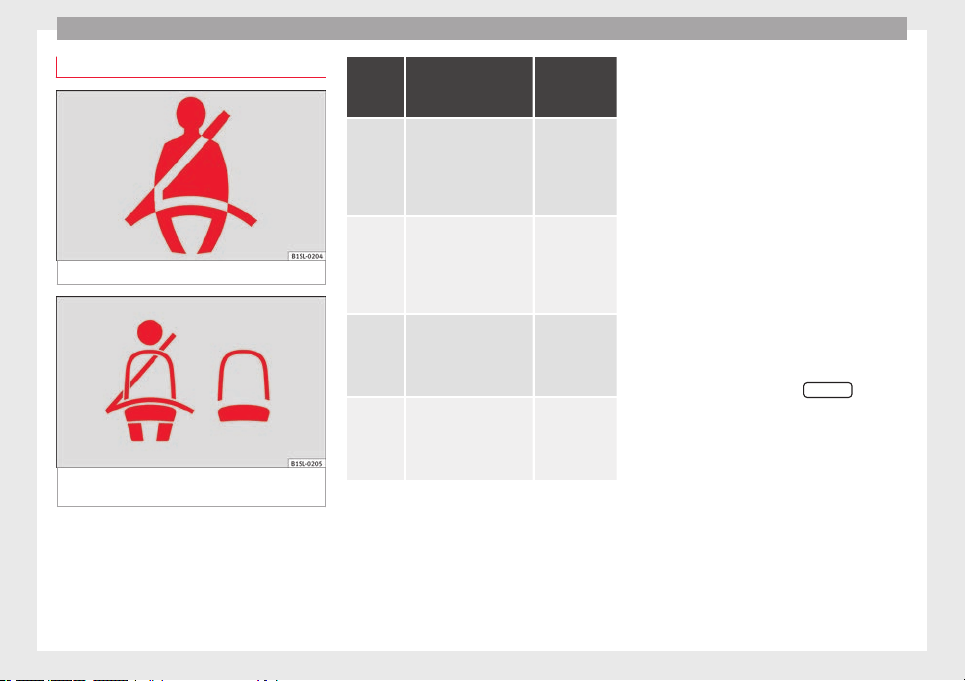
Fig. 5 Warning lamp on the instrument panel
Fig. 6 Indication of seat belt status in the rear
seats on the instrument panel display
Lights
up or
flashes
Possible cause Solution
On the instrument panel:
Driver's seat belt not fas-
tened or front passenger
seat belt not fastened if
the front passenger seat
is occupied.
Fasten seat
belts!
On the instrument panel:
Objects on the front pas-
senger seat.
Remove any
objects from
the front pas-
senger seat
and store them
safely.
Instrument panel dis-
play: a passenger in the
rear seats has not fas-
tened their seat belt, if
the seat is occupied.*
Fasten seat
belts!
On the instrument panel
display: a passenger in
the rear seats has fas-
tened their seat belt, if
the seat is occupied.*
Several warning and control lamps light up
for a few seconds when the ignition is switch-
ed on, signalling that the function is being
verified. They will switch off after a few sec-
onds.
An audible warning will be heard if the seat
belts are not fastened as the vehicle drives
off and reaches a speed of more then
25 km/h (15 mph) or if the seat belts are un-
fastened while the vehicle is in motion. The
seat belt warning lamp
will also flash.
The w
arnin
g lamp does not switch off until
the driver and front passenger fasten their
seat belts while the ignition is switched on.
Seat belt status display for rear seats
The seat belt status display on the instru-
ment panel informs the driver, when the igni-
tion is switched on, whether any passengers
in the rear seats have fastened their seat
belts. The symbol indicates that the pas-
senger in this seat has fastened “his or her”
seat belt ››› Fig. 6.
The seat belt status is displayed for around
30 seconds when a seat belt in the rear seats
is fastened or unfastened. You can switch off
this display by pressing the
0.0 / SET
button.
The seat belt status flashes for a maximum of
30 seconds when a seat belt in the rear seats
is unfastened while the vehicle is in motion.
An audible warning will also be heard if the
vehicle is travelling at over 25 km/h
(15 mph).
12
Seat belts
Seat belt protection
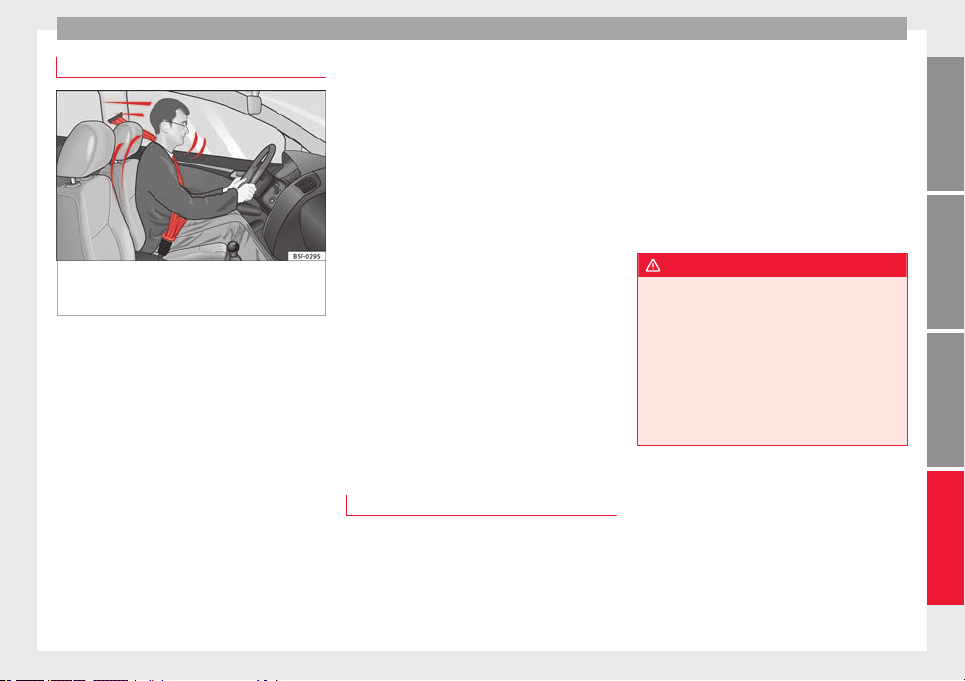
Fig. 7 Drivers with properly worn seat belts
will not be thrown forward in the event of sud-
den braking
Properly worn seat belts hold the occupants
in the proper position. They also help prevent
uncontrolled movements that may result in
serious injury and reduce the risk of being
thrown out of the vehicle in case of an acci-
dent.
Vehicle occupants wearing their seat belts
correctly benefit greatly from the ability of the
belts to absorb kinetic energy. In addition,
the front part of your vehicle and other pas-
sive safety features (such as the airbag sys-
tem) are designed to absorb the kinetic ener-
gy released in a collision. Taken together, all
these features reduce the releasing kinetic
energy and consequently, the risk of injury.
This is why it is so important to fasten seat
belts before every trip, even when "just driv-
ing around the corner".
Ensure that your passengers wear their seat
belts as well. Accident statistics have shown
that wearing seat belts is an effective means
of substantially reducing the risk of injury
and improving the chances of survival when
involved in a serious accident. Furthermore,
properly worn seat belts improve the protec-
tion provided by airbags in the event of an
accident. For this reason, wearing a seat belt
is required by law in most countries.
Although your vehicle is equipped with air-
bags, the seat belts must be fastened and
worn. The front airbags, for example, are only
triggered in some cases of head-on collision.
The front airbags will not be triggered during
minor frontal or side collisions, rear-end colli-
sions, rollovers or accidents in which the air-
bag trigger threshold value in the control unit
is not exceeded.
Therefore, you should always wear your seat
belt and ensure that all vehicle occupants
have fastened their seat belts properly before
you drive off!
Using seat belts
Twisted seat belt
If it is difficult to remove the seat belt from
the guide, the seat belt may have become
twisted inside the side trim after being
wound too quickly on unfastening:
●
Pull out the seat belt completely, carefully
pulling on the latch plate.
●
Untwist the belt and guide it back, assist-
ing it by hand.
The seat belt must be fastened even if it is
impossible to untwist it. In this case, the
twisted area must not be in an area in direct
contact with your body. Have the seat belt
untwisted urgently by a specialised work-
shop.
WARNING
An improperly handled seat belt increases
the risk of sustaining severe or fatal injuries.
●
Regularly check that the seat belts and
their components are in perfect condition.
●
Always keep your seat belt clean.
●
Do not jam or damage the seat belt or rub it
with sharp edges.
●
Make sure there are no liquids or foreign
bodies on the latch plate and in the buckle.
13
Technical specifications
AdviceOperationSafety
Safety
Head-on collisions and the laws of
physics
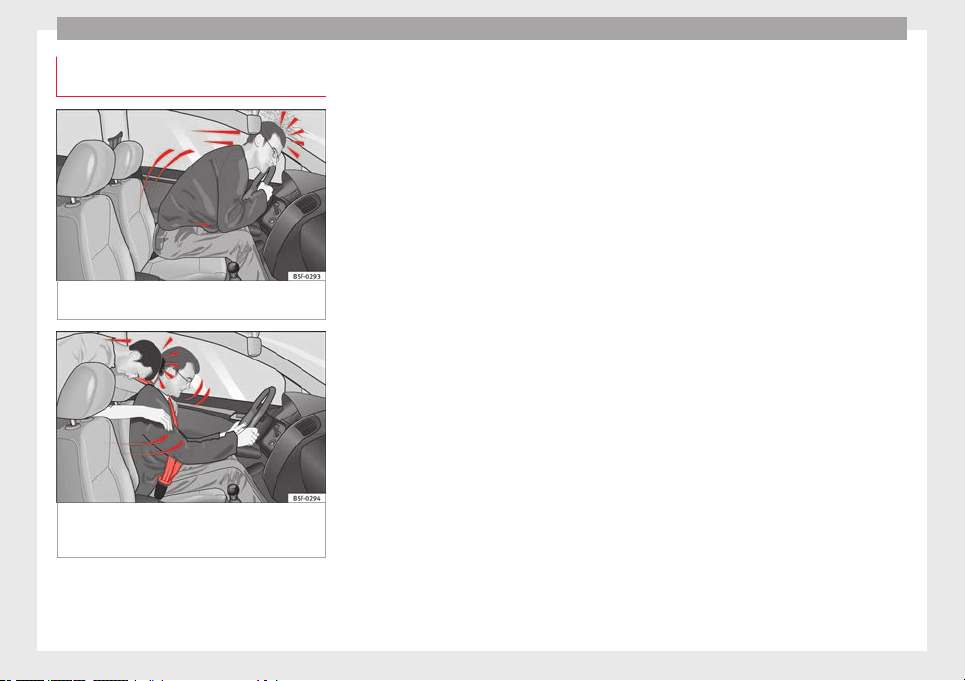
Fig. 8 A driver not wearing a seat belt is
thrown forward violently
Fig. 9 The unbelted passenger in the rear
seat is thrown forward violently, hitting the
driver who is wearing a seat belt.
It is easy to explain how the laws of physics
work in the case of a head-on collision: when
a vehicle starts moving, a type of energy
called “kinetic energy” is created both in the
passengers and inside the vehicle.
The amount of “kinetic energy” depends on
the speed of the vehicle and the weight of
the vehicle and its passengers. The higher
the speed and the greater the weight, the
more energy there is to be “absorbed” in an
accident.
The most significant factor, however, is the
speed of the vehicle. If the speed doubles
from 25 km/h (15 mph) to 50 km/h
(30 mph), for example, the corresponding ki-
netic energy is multiplied by four.
Because the vehicle occupants in our exam-
ple are not restrained by seat belts, in the
event of crashing against a wall, all of the oc-
cupants' kinetic energy will be absorbed
solely by said impact.
Even at speeds of 30 km/h (19 mph) to
50 km/h (30 mph), the forces acting on bod-
ies in a collision can easily exceed one tonne
(1000 kg). At greater speed these forces are
even higher.
Vehicle occupants not wearing seat belts are
not “attached” to the vehicle. In a head-on
collision, they will move forward at the same
speed their vehicle was travelling just before
the impact. This example applies not only to
head-on collisions, but to all accidents and
collisions.
Even at low speeds the forces acting on the
body in a collision are so great that it is not
possible to brace oneself with one's hands.
In a frontal collision, unbelted passengers
are thrown forward and will make violent con-
tact with the steering wheel, dash panel,
windscreen or whatever else is in the way
››› Fig. 8
.
It
i
s also important for rear passengers to
wear seat belts properly, as they could other-
wise be thrown forward violently through the
vehicle interior in an accident. Passengers in
the rear seats who do not use seat belts en-
danger not only themselves but also the front
occupants ››› Fig. 9.
14
Seat belts
How to properly adjust your
seatbelt
Fastening and unfastening the seat
belt
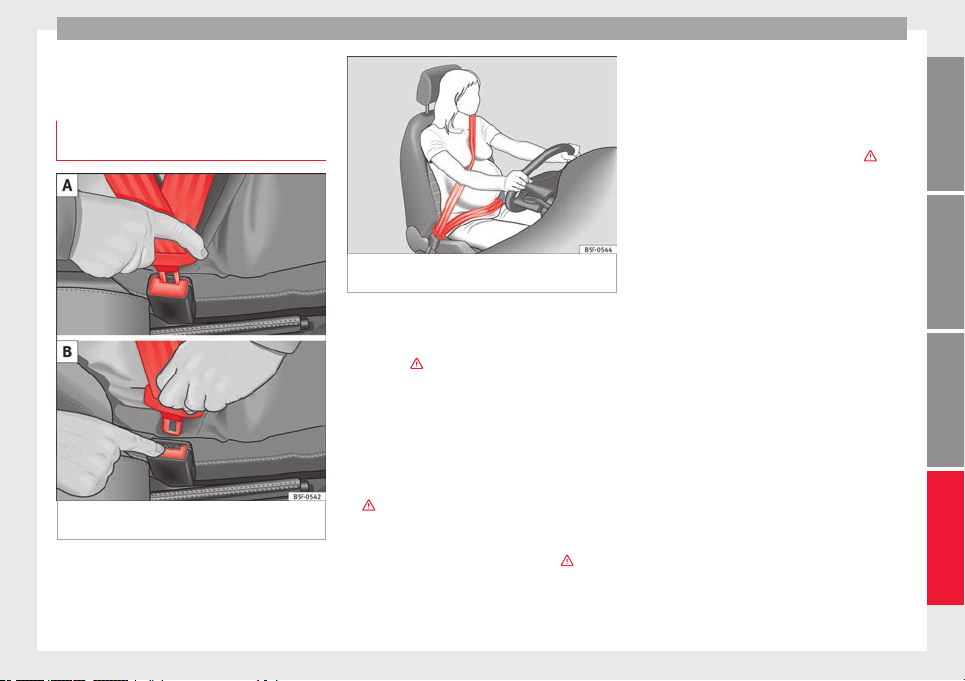
Fig. 10 Positioning and removing the seat
belt buckle.
Fig. 11 Position of seat belt during pregnan-
cy.
Properly worn seat belts hold the vehicle oc-
cupants in the position that most protects
them in the event of an accident or sudden
braking
›››
.
Fastening the seat belt
Fasten your seat belt before each trip.
●
Correctly adjust the front seat
›››
page 6.
●
Engage the seat backrest in the upright po-
sition and correctly adjust the hear restraint
›››
.
●
Pull the latch plate and place the belt web-
bing evenly across your chest and lap. Do not
twist the seat belt when doing so
›››
.
●
Engage the latch plate in the buckle of the
corresponding seat
›››
Fig. 10
A
.
●
Pull the belt to ensure that the latch plate is
securely engaged in the buckle.
Unfastening the seat belt
The seat belt must not be unfastened until
the vehicle has come to a standstill ›››
.
●
Press the red button on the buckle
››› Fig. 10
B
. The latch plate is released from
the buckle.
●
Guide the belt back by hand so that it rolls
up easily and the trim will not be damaged.
Correct seat belt position
Seat belts offer their maximum protection in
the event of an accident and reduce the risk
of sustaining severe or fatal injuries only
when they are properly positioned. Further-
more, if the webbing is correctly positioned,
the seat belt will hold the vehicle occupants
in the optimum position to ensure the airbag
provides the maximum protection. The seat
belt must therefore always be worn and the
webbing correctly positioned.
Incorrectly worn seat belts can cause severe
or even fatal injuries ››› page 6, Correct sit-
ting position for vehicle occupants.
●
The shoulder part of the seat belt must lie
on the centre of the shoulder, never across
the neck or the arm, under the arm or behind
the shoulder.
»
15
Technical specifications
AdviceOperationSafety

Safety
●
The lap part of the seat belt must lie across
the pelvis, never across the stomach.
●
The seat belt must lie flat and fit comforta-
bly. Pull the belt tight if necessary to take up
any slack.
In the case of pregnant women, the seat belt
must lie evenly across the chest and as low
as possible over the pelvis, never across the
stomach and must be worn properly at all
times during the pregnancy ››› Fig. 11
.
Ad
aptin
g the position of the belt webbing to
your size
The seat belt can be adapted using the fol-
lowing equipment:
●
Front seat height adjustment.
WARNING
An incorrectly worn seat belt web can cause
severe or fatal injuries in the event of an acci-
dent.
●
The seat belt cannot offer its full protection
unless the seat backrest is in an upright posi-
tion and the seat belt is worn correctly, ac-
cording to your size.
●
Unbuckling your seat belt while the vehicle
is in motion can cause severe or fatal injuries
in the event of an accident or sudden braking.
●
The seat belt itself or a loose seat belt can
cause severe injuries if the belt moves from
hard areas of the body to soft areas (e.g. the
stomach).
●
The shoulder part of the seat belt must lie
on the centre of the shoulder, never across
the neck or the arm.
●
The seat belt must lie flat and fit comforta-
bly on the torso
●
The lap part of the seat belt must lie across
the pelvis, never across the stomach. The
seat belt must lie flat and fit comfortably on
the pelvis Pull the belt tight if necessary to
take up any slack.
●
For pregnant women, the lap part of the
seat belt must lie as low as possible over the
pelvis and always lie flat, “surrounding” the
stomach.
●
Do not twist the seat belt while it is fas-
tened.
●
Never pull the seat belt away from your
body using your hand.
●
Do not lie the seat belt across rigid or frag-
ile objects, e.g. glasses, pens or keys.
●
Never use seat belt clips, retaining rings or
similar instruments to alter the position of
the belt webbing.
Note
If your physical constitution prevents you
from maintaining the correct position of the
belt webbing, contact a specialised workshop
for help with any special devices to ensure
the optimum protection of the seat belt and
airbag. SEAT recommends taking your car in
for technical service.
Seat belt tensioners
Automatic belt retainer, belt
tensioner, belt tension limiter
Seat belts are part of the vehicle safety con-
cept ››› page 17 and consist of the follow-
ing impor
tant functions:
Automatic belt retainer
Every seat belt is equipped with an automatic
belt retainer on the shoulder belt. If the belt
is pulled slowly or during normal driving, the
system allows for total freedom of movement
on the shoulder belt. However, during sud-
den braking, during travel in mountains or
bends and during acceleration, the automat-
ic belt retainer on the seat belt is locked is
pulled quickly.
Belt tensioners
The seat belts for the occupants in the front
seats are equipped with belt tensioners.
Sensors trigger the belt tensioners during se-
vere head-on, lateral and rear collisions and
retract and tighten the seat belts. If the seat
belt is loose, it is retracted to reduce the for-
wards movement of occupants or movement
16
Airbag system
in the direction of the collision. The belt ten-
sioner works in combination with the airbag
system. The belt tensioner will not be trig-
gered in the event of the vehicle overturning
if the side airbags are not deployed.
If the belt tensioner is triggered, a fine dust is
produced. This is normal and it is not an indi-
cation of fire in the vehicle.
Belt tension limiter
The belt tension limiter reduces the force of
the seat belt on the body in the event of an
accident.
Note
The relevant safety requirements must be ob-
served when the vehicle is dismantled or sys-
tem components are removed. These require-
ments are known to specialised workshops
››› page 17.
Service and disposal of belt
tensioners
If you work on the belt tensioners or remove
and install other parts of the vehicle when
performing other repair work, the seat belt
may be damaged. The consequence may be
that, in the event of an accident, the belt ten-
sioners function incorrectly or not at all.
So that the effectiveness of the belt tensioner
is not reduced and that removed parts do not
cause any injuries or environmental pollu-
tion, regulations must be observed. These re-
quirements are known to specialised work-
shops.
WARNING
Improper handling and homemade repairs of
seat belts, automatic belt retainers and ten-
sion devices increase the risk of sustaining
severe or fatal injuries. The belt tensioner
may fail to trigger or may trigger in the wrong
circumstances.
●
Never attempt to repair, adjust or remove or
install parts of the belt tensioners or seat
belts. Any work must be performed by a spe-
cialised workshop only ››› page 118.
●
Belt tensioners and automatic belt retain-
ers cannot be repaired and must be replaced.
For the sake of the environment
Airbag modules and belt tensioners may con-
tain perchlorate. Observe the legal require-
ments for their disposal.
Airbag system
Brief introduction
Introduction
Front airbags have been installed for both
driver and passenger. The front airbags can
also protect the chest and head of driver and
passenger if the seats, seat belts head re-
straints and, for the driver, the steering
wheel are correctly adjusted and used. Air-
bags are considered as additional safety
equipment. An airbag cannot replace the
seat belt, which must be worn at all times,
even in front seats where front airbags have
been installed.
The airbag can protect vehicle occupants in
the event of an accidents, cushioning the
movement of the occupants in the direction
of the collision in frontal and side accidents.
Deployed airbags fill with a propellant gas.
This causes the airbag covers to break and
the airbags to deploy extremely quickly in
their entire deployment space within frac-
tions of a second. When an occupant with the
seat belt properly fastened puts pressure on
the inflated airbag, the propellant gas es-
capes to absorb the force of the impact and
slow the movement. This reduces the risk of
severe or fatal injuries. Airbag deployment
does not mean that other types of injury such
»
17
Technical specifications
AdviceOperationSafety

Safety
as swelling, bruising and skin injuries can be
ruled out. Upon deployment of the airbag,
friction can cause the generation of heat.
Airbags do not protect the arms or the lower
part of the body.
The most important factors for triggering the
airbag are the type of accident, the angle of
impact, the vehicle speed and the character-
istics of the object the vehicle hits. Therefore,
airbags are not triggered every time the vehi-
cle is visibly damaged.
The activation of the airbag system depends
on the magnitude of the deceleration of the
vehicle caused by a collision, which registers
through an electronic control unit. If the de-
celeration magnitude value is below the ref-
erence value programmed in the control unit,
the airbags will not deploy even though seri-
ous damage might be caused to the vehicle
as the result of an accident. Damage suffered
by the vehicle, reparation costs or absence of
damage suffered from the accident are not
indications of whether an airbag should have
been deployed. Due to the varying nature of
collision situations, it is impossible to define
a speed range of the vehicle and reference
values. For this reason, it is not possible to
cover all types of collisions and collision an-
gles resulting in the deployment of the air-
bag. Factors necessary for the airbag to be
deployed can be, the characteristics of the
object (hard or soft) against which the vehi-
cle collides, the collision angle and the vehi-
cle speed.
Airbags act in conjunction with the three-
point seat belts in certain accident situa-
tions, when the vehicle deceleration rate is
severe enough to trigger the airbags. Airbags
only deploy once and only under certain cir-
cumstances. Seat belts remain present to of-
fer protection in situations where airbags are
not triggered or where they have already de-
ployed. For example, when a vehicle hits an-
other after an initial collision or is hit by an-
other vehicle.
The airbag system is an integral part of the
car's passive safety system. The airbag sys-
tem can only work effectively when the vehi-
cle occupants are wearing their seat belts
correctly and have adjusted the head re-
straints properly ››› page 6.
WARNING
Never exclusively trust the airbag system as a
means of protection.
●
Even when triggered, airbag protection is
only auxiliary.
●
The airbags provide the best protection
when the seat belts are properly fastened,
thus reducing the risk of sustaining injuries
››› page 11, Using seat belts.
●
Before each trip, every occupant must sit
properly, correctly fasten the seat belt be-
longing to his or her seat and keeping it fas-
tened throughout the trip. This rule is valid
for all vehicle occupants.
WARNING
Occupants sitting in the front of the vehicle
must never carry any objects in the deploy-
ment space between them and the airbags,
as this increases the risk of sustaining inju-
ries if the airbag is triggered. This modifies
the airbag deployment space or the objects
may fly uncontrollably and hit your body.
●
Never carry objects in your hand or on your
lap while the vehicle is in motion.
●
Never transport objects on the front pas-
senger seat. In the event of sudden braking
and manoeuvres, the objects may end up in
the airbag deployment space and fly uncon-
trollably around the interior if the airbag is
activated.
●
Occupants of the front and rear seats must
never carry any other people, pets or objects
in the deployment space between them and
the airbags. Make sure children and other
passengers also respect this recommenda-
tion.
WARNING
The airbag system provides protection for
one accident only. If they have been de-
ployed, they must be replaced.
18

Airbag system
●
Ensure deployed airbags and the system
components involved are immediately re-
placed with new, SEAT-approved components
for the vehicle.
●
Have any repairs or modifications carried
out at a specialised workshop. Specialised
workshops have the necessary tools, diag-
nostics equipment, repair information and
qualified personnel.
●
Never fit recycled or reused airbag compo-
nents in your vehicle.
●
Never modify the airbag system compo-
nents.
WARNING
If the airbags are triggered, a fine dust is pro-
duced. This is normal and it is not an indica-
tion of fire in the vehicle.
●
This fine dust may irritate the skin and eyes
and cause breathing difficulties, particularly
in people suffering from or who have suffered
from asthma or other illnesses of the respira-
tory tract. To reduce breathing difficulties,
get out of the vehicle and open and doors and
windows to breath in fresh air.
●
Should you touch the dust, wash your
hands and face using a mild soap and water
before you eat.
●
Prevent the dust from affecting the eyes or
open wounds.
●
Rinse your eyes with water if you have dust
in them.
WARNING
Solvents cause the surfaces of the airbag
modules to become porous. If an airbag is ac-
cidentally triggered, the detachment of plas-
tic parts could cause serious injury.
●
Never clean the dash panel and the surfa-
ces of the airbag modules with cleaners con-
taining solvents.
Description of airbag system
Vehicle safety components
The following safety equipment makes up the
vehicle safety design to reduce the risk of se-
vere and fatal injuries. Depending on the ve-
hicle equipment, some equipment may not
be fitted in the vehicle or may not be availa-
ble in some markets.
●
Optimised seat belts for all seats.
●
Seat belt tension devices for driver and
passenger.
●
Seat belt force limiters for driver and pas-
senger.
●
Seat belt warning lamp
●
Front airbags for driver and passenger.
●
Side airbags for driver and passenger.
●
Airbag control lamp .
●
Control units and sensors.
●
Head restraints optimised for rear-end colli-
sion.
●
Adjustable steering column.
●
If necessary, anchor points for child seats
for the rear seats.
●
Where applicable, mountings for the child
seat upper retaining strap.
Situations in which the front and side
airbags do not deploy:
●
If the ignition is switched off during the col-
lision.
●
In frontal collisions, when the deceleration
measured by the control unit is too low.
●
In minor side collisions.
●
In rear collisions.
●
In the event of the vehicle overturning.
●
When the impact speed is lower than the
reference value set in the control unit.
There is a fault in the system if the control
lamp :
●
does not light up when the ignition is
switched on,
●
turns off after 4 seconds after the ignition
is switched on
●
turns off and then lights up again after the
ignition is switched on
●
illuminates or flashes while the vehicle is
moving.
»
19
Technical specifications
AdviceOperationSafety

Safety
WARNING
●
The seat belts and airbags can only provide
maximum protection if the occupants are
seated correctly ››› page 6.
●
If a f
ault has occurred in the airbag system,
have the system checked immediately by a
specialised workshop. Otherwise, during a
frontal collision the system might not trigger
correctly or may fail to trigger at all.
Airbag activation
The airbags deploy extremely rapidly, within
thousandths of a second, to provide addi-
tional protection in the event of an accident.
A fine dust may develop when the airbag de-
ploys. This is normal and it is not an indica-
tion of fire in the vehicle.
The airbag system is only ready to function
when the ignition is on.
In special accidents instances, several air-
bags may activate at the same time.
In the event of minor head-on and side colli-
sions, rear-end collisions, overturning or roll-
over of the vehicle, airbags do not activate.
Activation factors
The conditions that lead to the airbag system
activating in each situation cannot be gener-
alised. Some factors play an important role,
such as the properties of the object the vehi-
cle hits (hard/soft), angle of impact, vehicle
speed, etc.
Deceleration trajectory is key for airbag acti-
vation.
The control unit analyses the collision trajec-
tory and activates the respective restraint
system.
If the deceleration rate is below the prede-
fined reference value in the control unit the
airbags will not be triggered, even though
the accident may cause extensive damage to
the car.
The following airbags are triggered in
serious head-on collisions
●
Driver airbag.
●
Front passenger front airbag
The following airbags are triggered in
serious side-on collisions
●
Front side airbag on the side of the acci-
dent.
●
Rear side airbag on the side of the acci-
dent.
In an accident with airbag activation:
●
the interior lights switch on (if the interior
light switch is in the courtesy light position);
●
the hazard warning lights switch on;
●
all doors are unlocked;
●
the fuel supply to the engine is cut.
20
Airbag system
General overview of the airbag
Front airbags
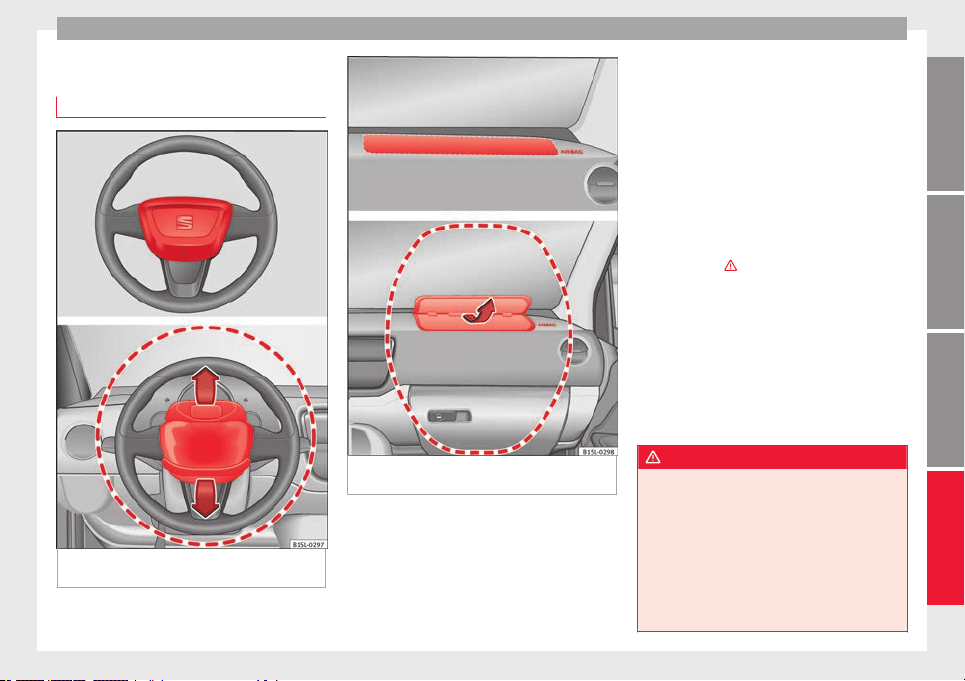
Fig. 12 Location and deployment area of the
front airbag for the driver.
Fig. 13 Location and deployment area of the
front airbag for the passenger.
In conjunction with the seat belts, the front
airbag system gives the driver and the front
passenger additional protection for the head
and chest in the event of a severe frontal col-
lision. Always remain as far away as possible
from the front airbag ››› page 6. This way, in
the event of an accident, the front airbags
can deploy fully when triggered, providing
maximum protection.
The front airbag for the driver is located in
the steering wheel ››› Fig. 12
and the airbag
f
or the fr
ont passenger is located in the dash
panel ››› Fig. 13. Airbags are identified by the
word “AIRBAG”.
When the front airbags are triggered they fill
the zones marked in red ››› Fig. 12 and
››› Fig. 13 (radius of action). Therefore, ob-
jects should never be placed or mounted in
these areas ›››
, Factory-fitted accessories
are outside the range of the front airbag for
the driver and the front passenger, e.g. the
baseplate for the mobile phone support.
The airbag covers fold out of the steering
wheel ››› Fig. 12
or dash panel ›
›
› Fig. 13
when the driver and front passenger airbags
are triggered. The airbag covers remain con-
nected to the steering wheel or the dash pan-
el.
WARNING
The airbag is deployed at high speed in frac-
tions of a second.
●
Always keep the deployment areas of the
front airbags vacant.
●
Never secure objects to the covers or in the
deployment area of the airbag modules, e.g.
drink holders or phone supports.
●
The deployment space between the front
passengers and the airbags must not in any
»
21
Technical specifications
AdviceOperationSafety
Safety
case be occupied by other passenger, pets
and objects.
●
Never fix any object to the windscreen
above the front airbag on the front passenger
side.
●
Do not alter, cover or stick anything to the
steering wheel hub or the surface of the air-
bag module on the passenger side of the
dash panel.
WARNING
Front airbags are deployed in front of the
steering wheel ››› Fig. 12
and the dash panel
››
› Fig. 13.
●
When driving, always hold the steering
wheel on the outer edge of the ring with both
hands: 9 o'clock and 3 o'clock position.
●
Adjust the driver seat so that there is a dis-
tance of at least 25 cm (10 inches) between
the centre of your chest and the hub of the
steering wheel. If your physical constitution
prevents you from meeting these require-
ments, make sure you contact a specialised
workshop.
●
Adjust the front passenger seat so there is
as much distance as possible between the
front passenger and the dash panel.
Types of front passenger front airbag
systems
There are two different SEAT front passenger
front airbag systems:
A
Characteristics of the passenger front airbag without
disabling.
– Control lamp
on the instrument panel.*
– Front passenger front airbag on the dash panel.
Description: airbag system
B
Characteristics of the front passenger front airbag that
can be disabled manually ››› page 24.
– Control lamp
on the instrument panel.
– Control lamp on the dash panel.
.
– Switch on the dash panel glove compartment, on the
passenger side.
– Front passenger front airbag in the dash panel.
Description: airbag system with front passenger front
airbag disabling.
Side airbags
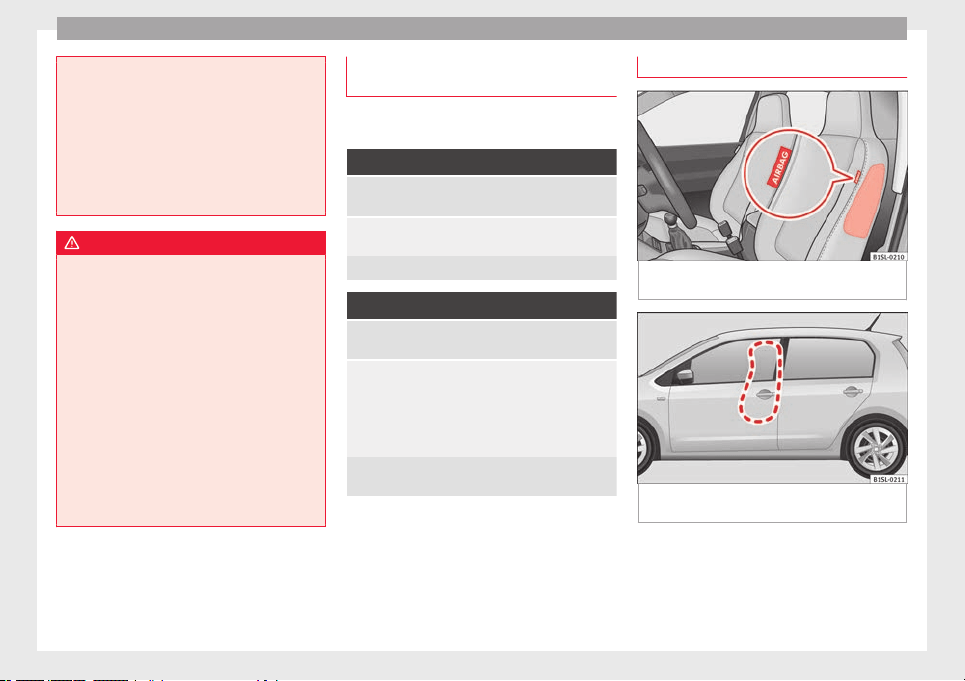
Fig. 14 On the side of the front seat: location
of the side airbag
Fig. 15 On the left side of the vehicle: deploy-
ment area of side airbag
The side airbags are located in the outer
cushion of the driver and front passenger
seat backrests ››› Fig. 14
. Their position is in-
dic
at
ed by the word “AIRBAG”. The area
marked in red ››› Fig. 15 indicates the side
airbag deployment zone.
22
Airbag system
In the event of a side-on collision, the side
airbag will deploy in the side of the vehicle
affected ››› Fig. 15
, thus reducing the risk of
injurie
s
to passengers on the side of the
body and the head facing the accident side.
WARNING
The airbag is deployed at high speed in frac-
tions of a second.
●
Always keep the deployment areas of the
side airbags vacant.
●
The deployment space between the front
passengers and the airbags must not in any
case be occupied by other passenger, pets
and objects.
●
Do not mount accessories on the doors.
●
Only used protective covers for the seats
that are approved for the vehicle. Otherwise,
the side airbag would be obstructed when de-
ployed.
WARNING
Incorrect handling of the driver's and front
passenger seat could prevent the side airbag
from deploying properly and cause severe in-
juries.
●
Never remove the front seats of the vehicle
or modify any of their components.
●
Great forces must not be exerted on the
seat backrest bolsters because the side air-
bags might not deploy correctly, might not
deploy at all or might deploy unexpectedly.
●
Any damage to the original seat upholstery
or around the seams of the side airbag units
must be repaired immediately by a special-
ised workshop.
Deactivating airbags
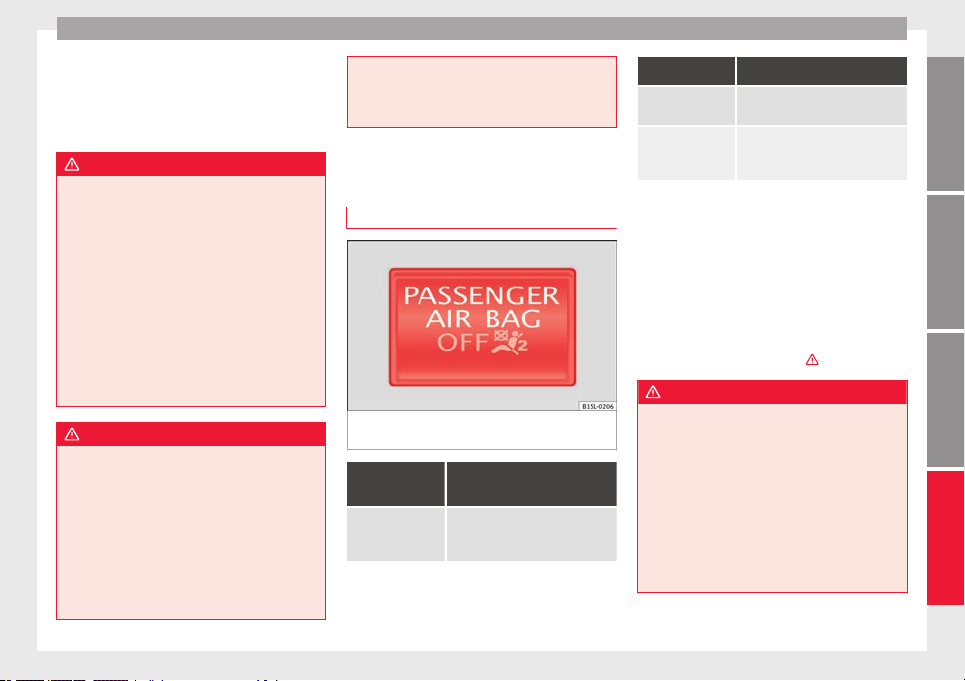
Control lamps
Fig. 16 Control lamp for disabling the front
passenger front airbag on the dash panel
It lights up on the combi-in-
strument
Fault in airbag sys-
tem and seat belt
tensioners.
Have the system checked immedi-
ately by a specialised workshop.
It lights up on the dash panel
Fault in the airbag
system.
Have the system checked immedi-
ately by a specialised workshop.
Front passenger
front airbag disa-
bled.
Check whether the airbag should
remain disabled.
Several warning and control lamps light up
for a few seconds when the ignition is switch-
ed on, signalling that the function is being
verified. They will switch off after a few sec-
onds.
If the front passenger airbag is deactivated,
the lamp
does not re-
m
ain lit
, or if it is lit together with the control
lamp on the dash panel, there may be a
fault in the airbag system
›››
.
WARNING
In the event of a fault in the airbag system,
the airbag may not trigger correctly, may fail
to trigger or may even trigger unexpectedly,
leading to severe or fatal injuries.
●
Have the airbag system checked immedi-
ately by a specialised workshop.
●
Never mount a child seat in the front pas-
senger seat or remove the mounted child
seat! The front passenger front airbag may
deploy during an accident in spite of the
fault.
»
23
Technical specifications
AdviceOperationSafety
Safety
CAUTION
Always pay attention to any lit control lamps
and to the corresponding descriptions and in-
structions to avoid damage to the vehicle.
Deactivating and activating the front
passenger front airbag using the key
switch
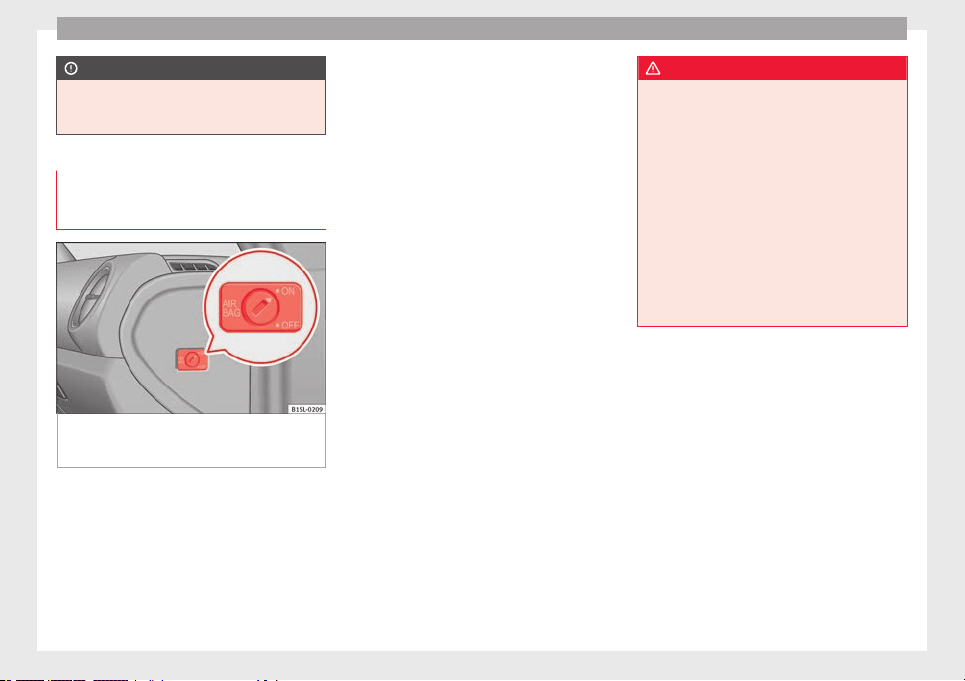
Fig. 17 On front passenger side: Key switch
for enabling and disabling the front passen-
ger front airbag.
The front passenger front airbag must be dis-
abled when a rear-facing child seat is moun-
ted.
Disabling the front passenger front airbag
●
Switch the ignition off.
●
Open the door on the front passenger side.
●
Unfold the vehicle key shaft ››› page 43.
●
Using the vehicle key, turn the key switch to
OFF
›
›› Fig. 17
.
●
Close the door on the front passenger side.
●
The control lamp on
the dash panel will remain lit while the igni-
tion is switched on ››› page 23.
Activating the front passenger front airbag
●
Switch the ignition off.
●
Open the door on the front passenger side.
●
Unfold the vehicle key shaft ››› page 43.
●
Using the vehicle key, turn the key switch to
ON ››› Fig. 17.
●
Close the door on the front passenger side.
●
Check that, with the ignition switched on,
the control lamp on the
dash panel is not lit ››› page 23.
How to know whether the front passenger
front airbag is disabled
The only indication of the front passenger air-
bag being disabled is that the
control lamp on the dash panel re-
mains lit ( stays yellow) ››› page 23.
If the control lamp on the dash panel
does not remain lit or is lit in combination
with the control lamp on the instrument
panel, a child restraint system cannot be
mounted on the front passenger seat for
safety reasons. The front passenger front air-
bag may deploy during an accident.
WARNING
The front passenger front airbag must only be
disabled in special cases.
●
Disable and activate the front passenger
front airbag when the ignition is switched off
to avoid damage to the airbag system.
●
It is the driver's responsibility to ensure
that the key operated switch is set to the cor-
rect position.
●
Only disable the front passenger front air-
bag when a child seat is to be mounted under
exceptional circumstances.
●
As soon as the child seat is no longer nee-
ded on the front passenger seat, reconnect
the front passenger front airbag.
24
Transporting children safely
Transporting children safely
Child safety
Introduction
Before transporting babies and children in a
child seat placed in the front passenger seat,
first completely read the information regard-
ing the airbag system.
This information is extremely important for
driver and passenger safety, particularly that
of babies and children.
SEAT recommends the use of child seats from
the SEAT accessory programme. These child
seats have been designed and tested for use
in SEAT vehicles. You can purchase child
seats with different mountings from a SEAT
dealership.
WARNING
Make sure children are properly belted in and
correctly secured to avoid severe or fatal inju-
ries while the vehicle is in motion.
●
Never use a rear-facing child seat in the
front passenger seat if the front passenger
front airbag is enabled.
●
Children up to 12 years old should always
travel on the rear seat.
●
Children must always be protected with an
approved child restraint system suited to
their height and weight.
●
Children must assume the proper sitting
position and be properly belted in while trav-
elling.
●
Ensure the seat backrest is upright when a
child seat is being used on it.
●
Do not allow the child's head or other part
of his or her body to enter the deployment
area of the side airbags.
●
Make sure the belt webbing is correctly
positioned.
●
Never hold children or babies on your lap or
in your arms.
●
Only one child may occupy a child seat.
●
Please read and observe the child seat
manufacturer's handling instructions.
WARNING
An empty or loose child seat could fly uncon-
trollably around the vehicle interior and
cause injuries in the event of an accident or
sudden braking.
●
When not in use while the vehicle is in mo-
tion, always safely secure the child seat or
store it in the luggage compartment.
Note
Replace the child seat after an accident, as it
may have invisible damage.
Important information regarding the
front passenger's airbag
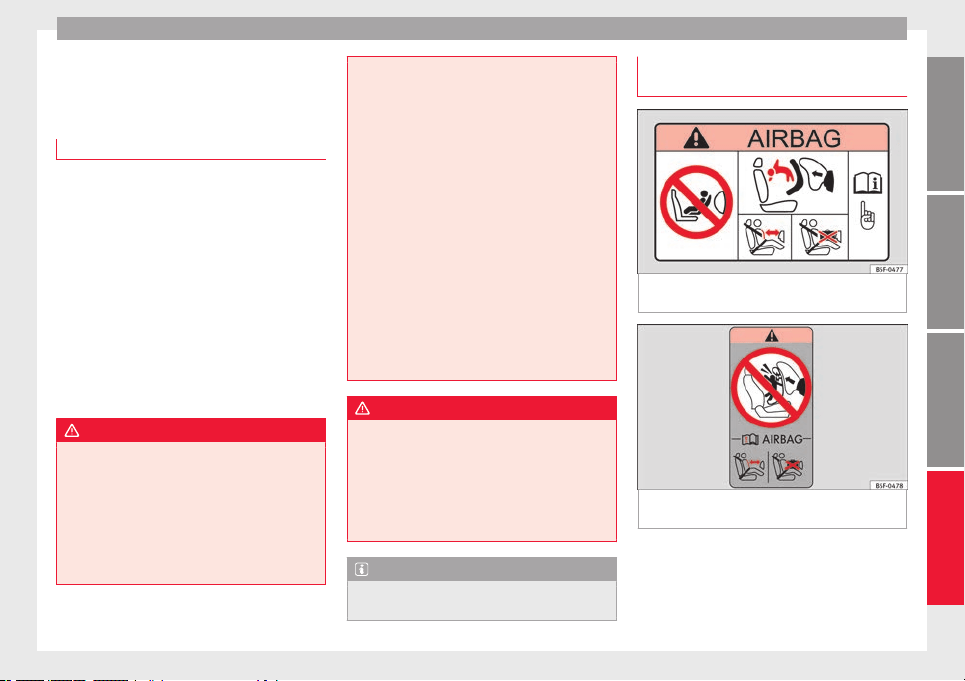
Fig. 18 Passenger's side sun visor: airbag
sticker
Fig. 19 On the rear frame of the passenger
side door: airbag sticker.
A sticker with important information about
the passenger airbag is located on the pas-
senger's sun visor and/or on the passenger
side door frame. Read and always observe
»
25
Technical specifications
AdviceOperationSafety

Safety
the safety information included in the
following chapters:
●
Child seats and passenger side airbag
››› page 28, Use of the child seat on the
front passenger seat.
●
Safety distance with respect to the passen-
ger airbag ››› in Introduction on page 18.
●
Objects between the passenger and the
passenger side airbag ››› in Front airbags
on page 21
.
26
Transporting children safely
General information on transporting
children in the vehicle
Legal regulations and provisions will always
take priority over the descriptions of this in-
struction manual. There are different regula-
tions and provisions for the use of child seats
and their mountings (››› table on page 27).
In some countries, for example, the use of
child seats on certain seats in the vehicle
may be forbidden.
The physical principles and the forces acting
on the vehicle in the event of a collision or
other type of accidents also apply to children
››› page 11
. However, unlike adults and
y
ou
ngsters, children do not have fully devel-
oped muscle and bone structures. In the
event of an accident, children are subject to a
greater risk than adults of sustaining severe
injuries.
Given that children's bodies are not yet fully
developed, child restraint systems must be
used that are especially adapted to their
height, weight and constitution. There are
laws in force in many countries that indicate
the use of approved seat systems for trans-
porting babies and children.
Only used authorised, approved child seats
that are suitable for the vehicle. Always con-
sult with a SEAT dealership or a Specialised
workshop should you have any doubts.
Specific child seat regulations for each
country (selection)
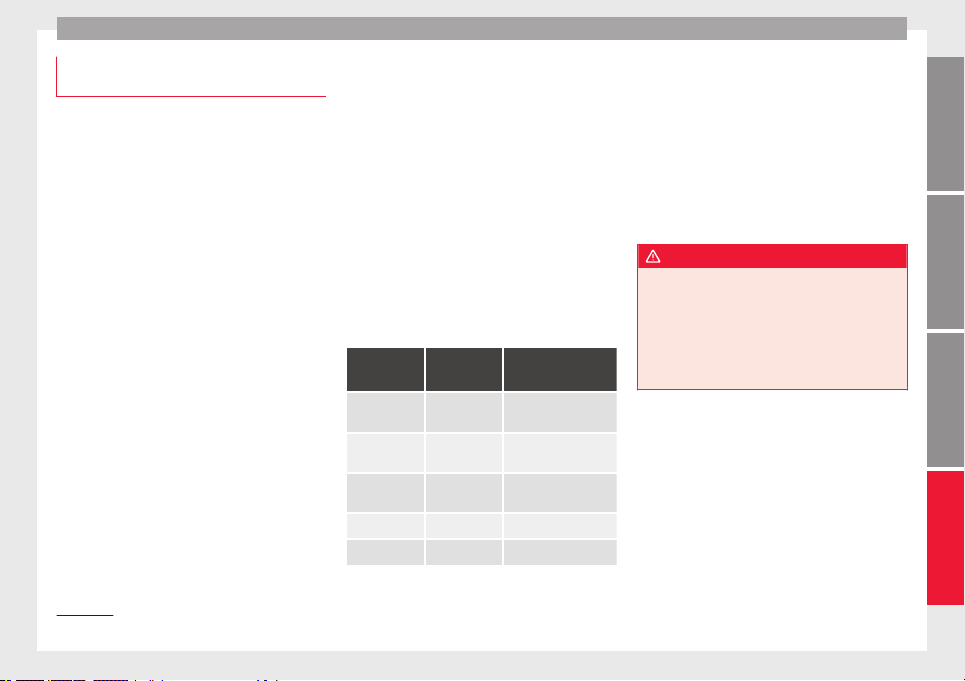
Child seats must comply with the ECE-R 44
1)
regulation. You can consult additional infor-
mation at your SEAT dealership at the inter-
net address www.seat.es.
Categorisation of child seats according to
ECE-R 44
Weight cat-
egory
Weight of
the child
Age
Group 0 up to 10 kg
up to approximately.
9 months
Group 0+ up to 13 kg
up to approximately.
18 months
Group 1 9 to 18 kg
approx. 8 months to
3
1
/
2
years
Group 2 15 to 25 kg approx. 3 to 7 years
Group 3 22 to 36 kg approx. 6 to 12 years
Not all children fit in the seat of their weight
group. Nor do all seats adapt to the vehicle.
Therefore, always check whether the child fits
properly in the child seat and whether the
seat can be installed safely in the vehicle.
Child seats approved under the ECE-R 44 reg-
ulation are fitted with the corresponding ap-
proval symbol. The sign is an upper-case E in
a circle with the identification number below
it.
WARNING
In general, the rear seat is always the safest
place for children, who are belted correctly, in
the event of an accident.
●
A suitable child seat that is correctly instal-
led and used on one of the rear seats offer
the most protection possible for babies and
children up to 12 years in most accidents.
1)
ECE-R: Economic C
omission for Europe Regulation.
27
Technical specifications
AdviceOperationSafety
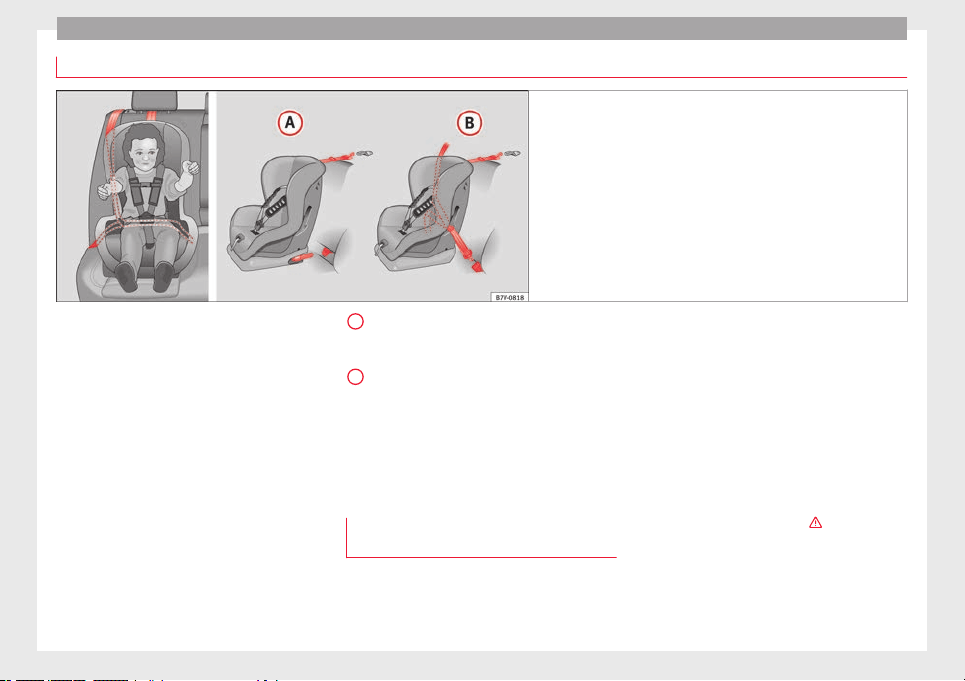
Safety
Different mounting systems
Fig. 20 On the rear seats: Possible installations for the child seat.
Always secure child seats properly and safely
in the vehicle according to the child seat
manufacturer's installation instructions.
Mounted child seats must rest correctly on
the vehicle's seat and must not move or rock
more than 2.5 cm.
Child seats equipped for a Top Tether strap
must also be secured using the Top Tether re-
taining strap in the vehicle ››› page 32. At-
tach the retaining strap to the corresponding
retaining rings only. Not all rings can be used
with the Top Tether system. Always tighten
the Top Tether retaining strap so that the
child seat fits snugly against the correspond-
ing seat in the vehicle.
Specific mounting systems for each country
Attachment variants ››› Fig. 20
:
E
ur
ope: ISOFIX retaining rings and upper
retaining strap ››› page 31 and
››› page 32.
Three-point seat belt and upper retaining
strap ››› page 30.
The systems include the child restraint sys-
tem mounting with an upper retaining strap
(Top Tether) and lower anchoring points on
the seat.
Use of the child seat on the front
passenger seat
Transporting children on the front passenger
seat is not permitted in all countries. Further-
more, not all child seats are approved for use
on the front passenger seat. Your SEAT deal-
A
B
ership has an updated list of all approved
child seats. Only used child seats that are ap-
proved for each vehicle.
The front airbag on the front passenger side
is highly dangerous for a child. The front pas-
senger seat is life-threatening to a child if he
or she is transported in a rear-facing child
seat.
If a rear-facing child seat is secured to the
front passenger seat, an inflating front airbag
can strike it with such great force that severe
or fatal injuries may result ››› . Therefore,
rear-facing child seats must never
be placed
on the fr
ont
passenger seat when the front
passenger front airbag is enabled.
Only use a rear-facing child seat on the front
passenger seat if the front passenger front
airbag is disabled. When it is disabled, the
28

Transporting children safely
yellow
››› page 17 con-
trol lamp on the dash panel will be lit. If you
cannot disable the front passenger front air-
bag and it remains activated, it is forbidden
to transport children on the front passenger
seat ›››
.
Things to note if using a child seat on the
front passenger seat:
●
The front passenger front airbag must be
disabled
when using a rear-facing child
se
at ››› page 17.
●
The seat backrest of the front passenger
seat must be upright.
●
The front passenger seat must be moved as
far back as possible.
●
The seat backrest of the front passenger
seat must be upright.
Suitable child seats
The child seat must be authorised by the
manufacturer especially for use on a front
passenger seat with a front or side airbag.
Universal seats for children can be fitted in
the front passenger seat, in groups 0, 0+, 1,
2 or 3 according to the ECE-R 44 regulation.
WARNING
If a child seat is mounted on the front passen-
ger seat, the risk of the child sustaining se-
vere or fatal injuries in the event of an acci-
dent increases. Rear-facing child seats must
never be mounted on the front passenger
seat when the front passenger front airbag is
enabled. This is life-threatening to the child
should the front airbag deploy, as the child
seat would be struck by the inflated airbag
and thrown against the seat backrest.
WARNING
If, in exceptional circumstances, a child must
be transported in a rear-facing child seat on
the front passenger seat, strictly observe the
following:
●
Always disable the front passenger front
airbag and leave it disabled.
●
The child seat must be approved by the
manufacturer for use on a front passenger
seat with front and side airbag.
●
Follow the installation instructions of the
child seat manufacturer and observe the
warnings.
●
Move the front passenger seat as far back
as possible and adjust it to its highest posi-
tion to keep as far away as possible from the
front airbag.
●
Move the seat backrest to the upright posi-
tion.
●
Children must always be protected with an
approved child restraint system suited to
their height and weight.
Use of the child seat on the rear seat
If a child seat is mounted on the rear seat,
adapt the position of the front passenger
seat so that the child has enough space.
Therefore, adapt the front passenger seat to
the size of the child seat and the height of
the child. Ensure the passenger is in the cor-
rect position ››› page 6.
Suitable child seats
The manufacturer must authorise the child
seat for use in the rear seats with side air-
bags.
Universal seats for children can be fitted in
the passenger seat, in groups 0, 0+, 1, 2 or 3
according to the ECE-R 44 regulation.
The rear seats are suitable for child seats
with the
ISOFIX system s
pec
ially designed
for this type of vehicle in accordance with
regulation ECE-R 44.
ISOFIX child seats approved for rear seats
ISOFIX child seats are divided into the follow-
ing certified categories: “universal”, “semi-
universal” or “specific categories for the ve-
hicle”.
●
If the ISOFIX child seat is certified “univer-
sal”, it must be supported by the lower an-
chor points and the Top Tether retaining
strap.
»
29
Technical specifications
AdviceOperationSafety
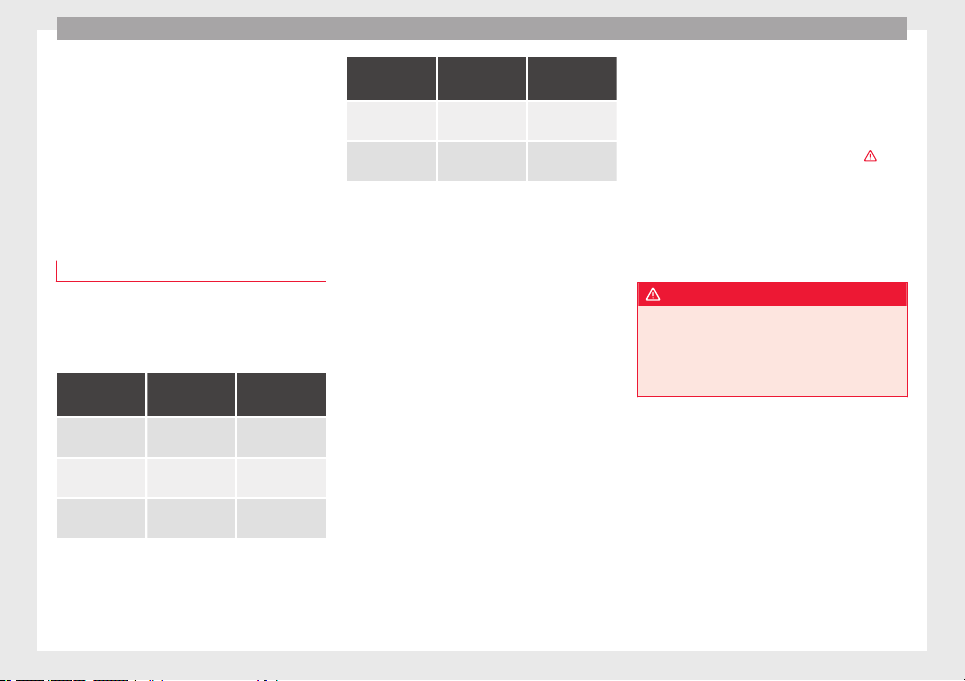
Safety
●
If the ISOFIX child seat is certified “semi-
universal” or “specific categories for the ve-
hicle”, check that the child seat is certified
for the vehicle before employing it. The child
seat manufacturer supplies, in addition to
the ISOFIX child seat, a list of vehicles for
which the corresponding ISOFIX child seat
has been certified. If necessary, contact the
child seat manufacturer for an updated list of
vehicles.
Securing child seats with the seat belt
The seat belt may be used to secure child
seats with the universal
marking (on the or-
an
g
e label) to the vehicle seats marked with
a u in the table below.
Category
Front passen-
ger
Rear seats
Group 0
Up to 10 kg
u u
Category 0+
Up to 13 kg
u u
Group 1
9 to 18 kg
u u
Category
Front passen-
ger
Rear seats
Group 2
15 to 25 kg
u u
Group 3
22 to 36 kg
u u
Securing the child seat using the seat belt
●
Please read and observe the child seat
manufacturer's handling instructions.
●
Move the front passenger seat, or the rear
seat bench back as far as possible and, in
the case of an adjustable backrest, set it in
the upright position
›››
page 6.
●
Positioning the child seat on the seat ac-
cording to the manufacturer's instructions.
●
Fasten the seat belt or pass it around the
child seat structure in the manner described
in the manufacturer's instructions.
●
Make sure the seat belt is not twisted.
●
Insert the latch plate into the buckle for the
appropriate seat and push it down until it is
securely locked with an audible click.
●
Ensure that the upper belt web lies tightly
on the child seat.
●
Pull the belt (it must be no longer possible
to pull the lower belt webbing out).
Removing the child seat
The seat belt must not be unfastened until
the vehicle has come to a standstill ›››
.
●
Press the red button on the buckle. The
latch plate is released from the buckle.
●
Guide the belt back by hand so that it rolls
up easily and the trim will not be damaged.
●
Remove the child seat from the vehicle.
WARNING
Unbuckling the seat belt while the vehicle is
in motion can cause severe or fatal injuries in
the event of an accident or sudden braking.
●
The seat belt must not be unfastened until
the vehicle has come to a standstill.
30
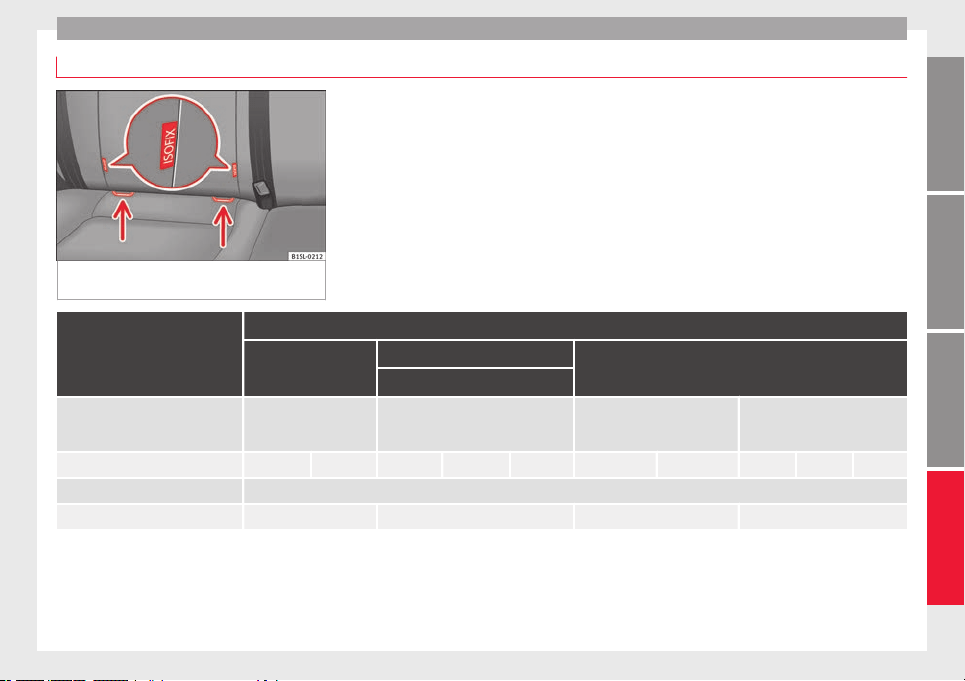
Transporting children safely
Fix the child seat with the lower anchor points (ISOFIX)
Fig. 21 On the vehicle seat: identification var-
iants of the anchor points for the child seats
Each seat of the rear seat bench has two re-
tainer
s named lower anchor points.
Overview of ISOFIX installation
In compliance with European directive
ECE 16, The following table details the instal-
lation possibilities for ISOFIX child seats with
the lower anchor points in each of the vehicle
seats.
The permitted body weight for the child seat
or information regarding size A to G is indica-
ted on the label on the child seat with “uni-
versal” or “semi-universal” certification.
Group (weight category)
Group 0: up to 10 kg
Group 0: up to 10 kg
Group 1: 9 to 18 kg
Group 0+: up to 13 kg
Installation direction
facing backwards
(in the direction opposite
to travel)
facing backwards
(in the direction opposite to travel)
facing backwards
(in the direction opposite to trav-
el)
facing forwards
(in the direction of travel)
Size F G C D E C D A B B1
installed on front passenger seat Seat does not have anchor points, ISOFIX securing is not possible
Installed on the rear seat bench IL-SU IL-SU IL-SU IUF/IL-SU
IL-SU:
seat suitable for installing an ISOFIX
c
hi
ld seat with certification “semi-universal”,
take note of the list of vehicles of the manu-
facturer of the child seat.
IUF: seat suitable for the installation of an
ISOFIX child seat with certification “univer-
sal” and with Top Tether retaining strap.
Child seats with rigid mounting
For the installation of a child seat with rigid
mounting auxiliary introduction elements can
»
31
Technical specifications
AdviceOperationSafety
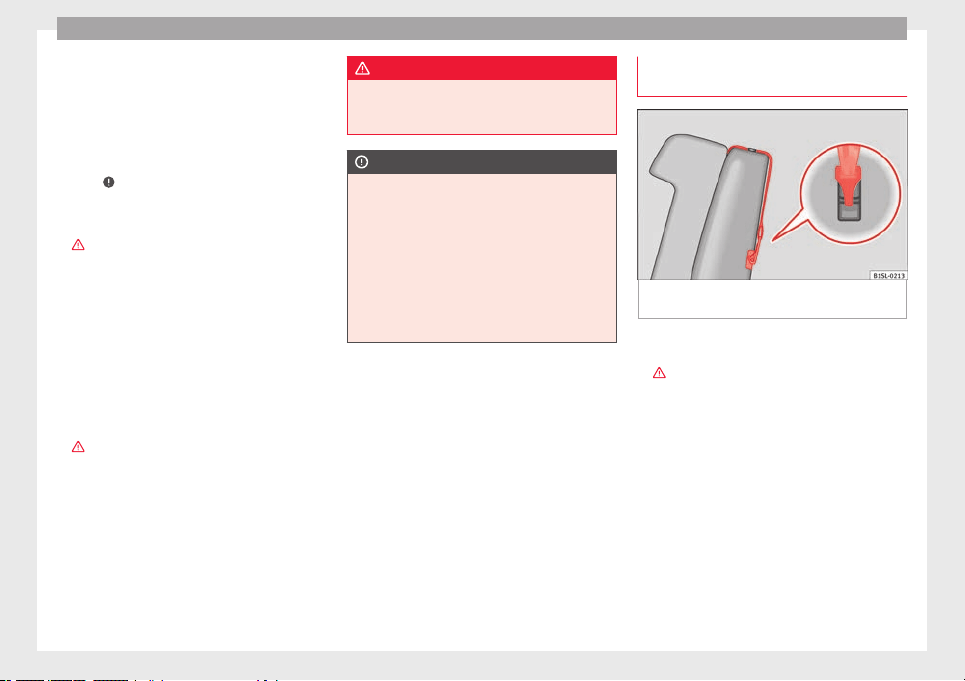
Safety
be used. Using auxiliary introduction ele-
ments facilitates installation and protects up-
holstery. Auxiliary introduction elements
form part of the supply volume of the child
seat or can be acquired at a SEAT dealership.
If necessary, auxiliary introduction elements
are inserted in both anchor points of the ve-
hicle ››› .
●
Observe the manufacturer's instructions
when installing and removing the child seat
››› .
●
Press the child seat onto the retaining rings
››› Fig. 21
in the direction of the arrow. The
c
hi
ld seat must be safely engaged and click
audibly into place.
●
Pull on both sides of the child seat to en-
sure that it is secure.
Child seat with adjustable retaining straps
●
Observe the manufacturer's instructions
when installing and removing the child seat
›››
.
●
Place the child seat on the seat cushion
and attach the retaining strap hooks to the
retaining rings ››› Fig. 21
.
●
Tight
en the s
traps evenly using the corre-
sponding adjustment device. The child seat
must sit flush against the vehicle seat.
●
Pull on both sides of the child seat to en-
sure that it is secure.
WARNING
The lower anchor points for child seats do not
include rings. Only secure booster seats to
lower anchor points.
CAUTION
●
To avoid making permanent marks in the
padding, remove the auxiliary introduction
elements from the anchor points when the
child seat is not installed in the vehicle an-
chor points.
●
To prevent damage being done to the up-
holstery, the padding or the auxiliary intro-
duction elements, always remove the auxili-
ary introduction elements from the anchor
points before folding the rear seat bench.
Securing a child seat using a Top
Tether retaining strap
Fig. 22 Example of an upper retaining strap
connected.
●
Observe the manufacturer's instructions
when installing and removing the child seat
››› .
●
Unlock the seat backrest and fold it gently
forward ››› page 64
.
●
R
emo
ve the head restraints situated be-
hind the child seat and store them safely in
the vehicle ››› page 6.
●
Guide the upper retaining strap from of the
child seat back to the luggage compartment,
feeding it through the seat backrest and the
rear shelf.
●
Fold back the seat backrest and push it
firmly into the lock.
●
Secure the child seat to the lower anchor
points ››› page 31
32

Transporting children safely
●
Hook the upper retaining strap in the lug-
gage compartment, to the corresponding re-
taining ring ››› Fig. 22
.
●
Tight
en the s
trap so that the top of the
child seat rests on the seat backrest.
WARNING
Child seats with lower anchor points and with
an upper retaining strap must be installed in
line with the manufacturer's instructions.
Failure to comply could result in severe inju-
ries.
●
Always secure just one retaining strap to a
chi
ld seat with the luggage compartment re-
taining ring.
●
Always use the correct retaining rings for
the retaining strap.
●
Never secure the retaining strap to a retain-
er.
33
Technical specifications
AdviceOperationSafety
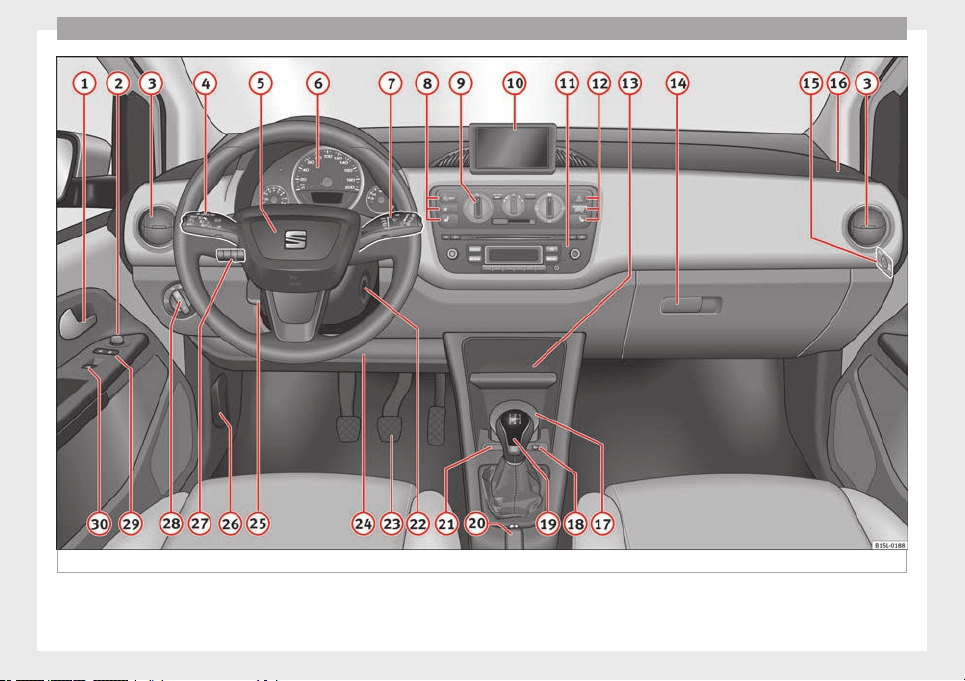
Operation
Fig. 23 Dash panel
34
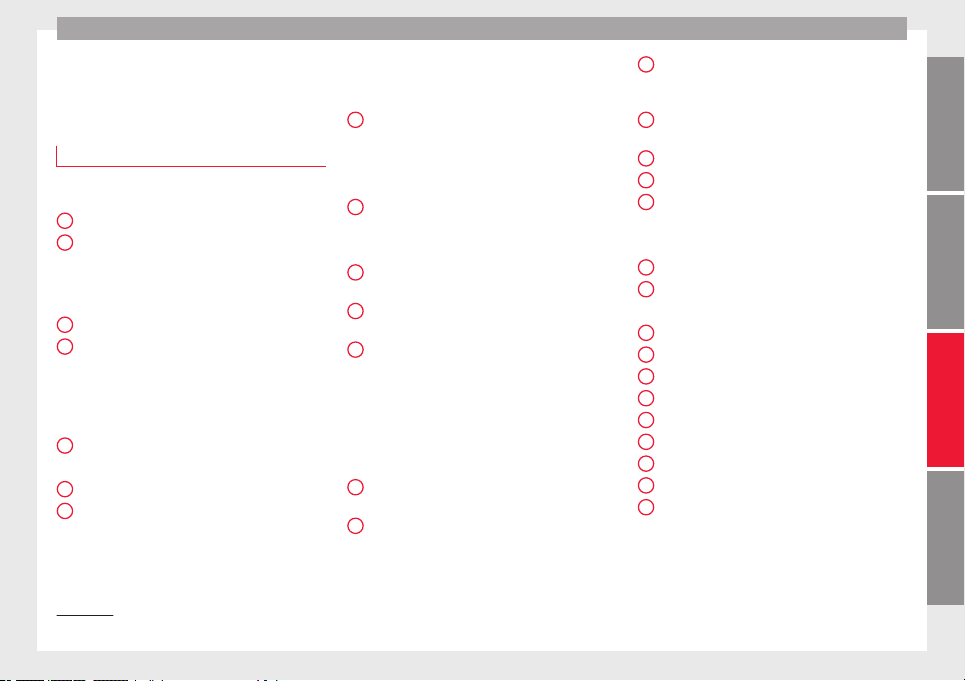
Cockpit
Operation
Cockpit
Overview
Legend for the Fig. 23:
Int
erior door release lever . . . . . . . . . 49
Turn switch for adjusting the exteri-
or mirrors . . . . . . . . . . . . . . . . . . . . . . . . 61
–
Exterior mirror adjustment
–
Heated exterior mirrors
Air outlets . . . . . . . . . . . . . . . . . . . . . . . . 80
Lever for . . . . . . . . . . . . . . . . . . . . . . . . . 55
–
Turn signals and main beam
headlights
–
Cruise control system (CCS) –
– – /+ – /- . . . . . . . 107
Steering wheel with horn and
–
Driver airbag . . . . . . . . . . . . . . . . . . . 21
Dash panel . . . . . . . . . . . . . . . . . . . . . . .36, 39
Windscreen wiper/ windscreen
wash lever . . . . . . . . . . . . . . . . . . . . . . . 60
–
Windscreen wipers
–
Rear window wiper
1
2
3
4
5
6
7
–
Lever with buttons for controlling
the SEAT information system - ,
/
. . . . . . . . . . . . . . . . . . . . . . . . . 40
C
ontr
ols for:
–
Start-Stop system button . . . 115
–
Rear window heating button . . 80
–
Left seat heating controls . . . . . 64
Switches for:
–
Heating and ventilation system . 80
–
Air conditioner . . . . . . . . . . . . . . . . . . 80
SEAT Portable System (supplied by
SEAT) . . . . . . . . . . . . . . . . . . . . . . . . . . . . 123
Radio (factory fitted) ››› Booklet Ra-
dio
Controls for:
–
Hazard warning lights switch . 170
–
Passenger front airbag off warn-
ing lamp . . 17
–
Right seat heating controls
or rear window heating button
(alternative position) . . . . . . . . . . .64, 80
Storage compartment with drink
holder in the centre console . . . . . . . 71
Handle of the storage compartment
or storage compartment open
1)
. . . 67
8
9
10
11
12
13
14
In the side of the dash panel: Key
switch for switching off the front
passenger airbag
1)
. . . . . . . . . . . . . . . 17
Position of passenger front airbag
on the dash panel . . . . . . . . . . . . . . . . 17
Ashtray* . . . . . . . . . . . . . . . . . . . . . . . . . 71
12 volt socket or cigarette lighter* .72, 72
Lever for:
–
Manual gearbox . . . . . . . . . . . . . . . . 94
–
Automatic gearbox . . . . . . . . . . . . . 95
Handbrake . . . . . . . . . . . . . . . . . . . . . . . 89
Button for:
–
City Safety Assist function . 110
Ignition lock . . . . . . . . . . . . . . . . . . . . . . 86
Pedals . . . . . . . . . . . . . . . . . . . . . . . . . . . 93
Storage compartment . . . . . . . . . . . . . 67
Steering column adjustment lever . 6
Open bonnet lever . . . . . . . . . . . . . . . . 143
Headlamp range adjustment . . . 55
Light switch . . . . . . . . . . . . . . . . . . . 55
Central lock button . . . . . . . . . . 45
Button for operating the electric
windows of the driver door . . . . . 52
15
16
17
18
19
20
21
22
23
24
25
26
27
28
29
30
1)
According to version
35
Technical specifications
AdviceOperationSafety
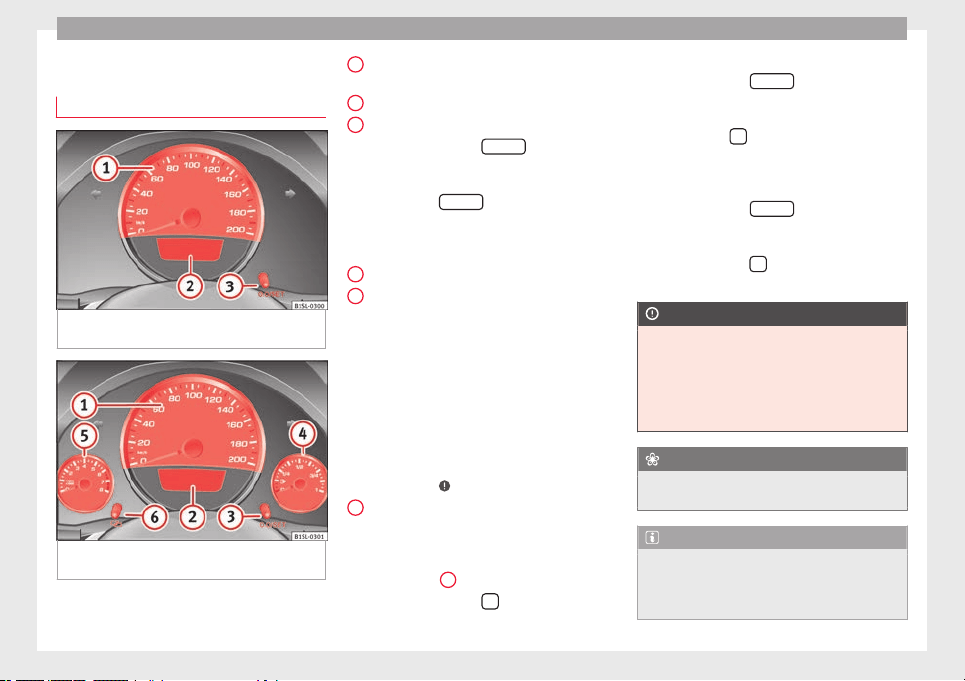
Operation
Instruments
Detail of instrument panel
Fig. 24 Instrument panel, on dash panel: var-
iant 1.
Fig. 25 Instrument panel, on dash panel: var-
iant 2.
Details of the instruments ››› Fig. 24
or
›
›
› Fig. 25:
Speedometer. Depending on the
vehicle in km/h or in mph.
Displays on the screen. . . . . . . . . . . . 37
Reset knob for trip recorder (trip).
–
Press the button
0.0/SET
briefly
to
sw
itch the trip odometer and od-
ometer.
–
Press the
0.0/SET
for 5 seconds t
o
r
eset the odometer to zero and,
where necessary, other indicators
on the multifunction display. . . . . 40
Fuel reserve display. . . . . . . . . . . . . . . 139
Rev counter (with the engine run-
ning, in thousands of revolutions
per minute).
The beginning of the red zone of
the rev counter indicates the maxi-
mum speed in any gear after run-
ning-in and with the engine hot.
However, it is advisable to change
up a gear or move the selector lever
to D (or lift your foot off the acceler-
ator) before the needle reaches the
red zone ›››
.
Clock set button.
–
If necessary, change the time dis-
play by pressing the top and bot-
tom buttons of the rocker switch
››› Fig. 26
B
.
–
Press the button
to change
the hour, so that it is flashing.
1
2
3
4
5
6
–
To continue setting the time,
press button
0.0/SET
. Hold button
down to scroll through the num-
bers quickly.
–
Press the
button again to
change the minutes, so that it
flashes.
–
To continue setting the time,
press button
0.0/SET
. Hold button
down to scroll through the num-
bers quickly.
–
Press button
again to end the
clock setting.
CAUTION
●
When the engine is cold, avoid high revs
and heavy acceleration and do not make the
engine work hard.
●
To prevent damage to the engine, the rev
counter needle should only remain in the red
zone for a short period of time.
For the sake of the environment
Changing up a gear in time reduces fuel con-
sumption and noise.
Note
On the screen of the SEAT Portable System
(supplied by SEAT) ››› page 123 other instru-
ments
can be viewed, such as an outside tem-
perature gauge.
36
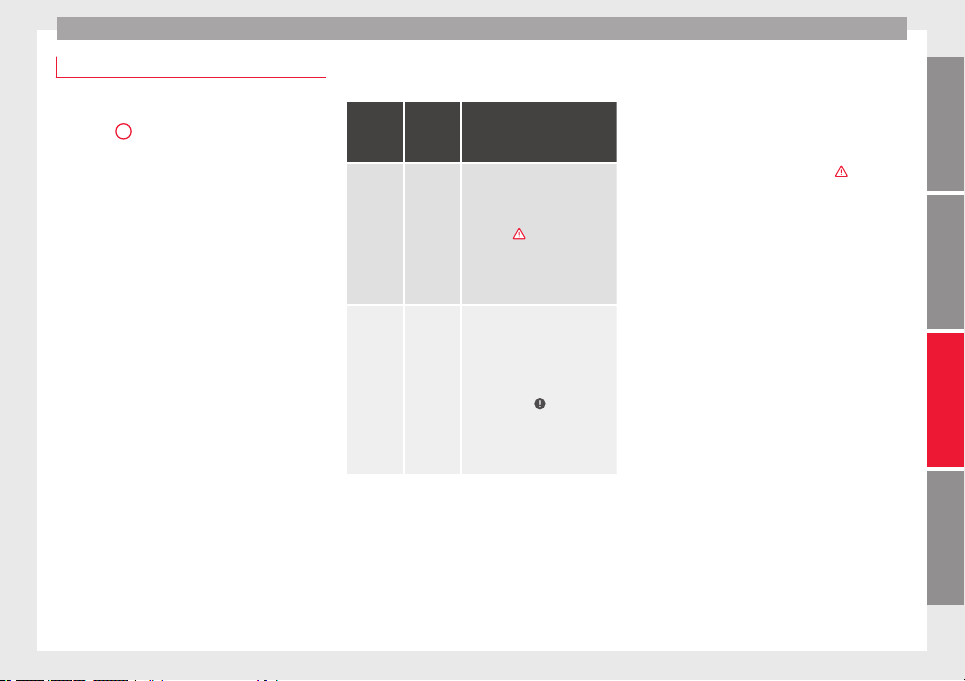
Cockpit
Display messages
A variety of information can be viewed on the
instrument panel display ››› Fig. 24 and
››
› Fig. 25
2
, depending on the vehicle
equipment:
●
Warning and information messages.
●
Odometer.
●
Time.
●
Outside temperature.
●
Selector lever positions ››› page 93.
●
Recommended gear (manual gearbox)
›››
page 93
.
●
M
u
ltifunction display (MFI)
›››
page 40
●
Service interval display
›››
page 38.
●
Start-Stop system status display
›››
page 115.
●
Fuel gauge
›››
page 139.
●
Seat belt status display for rear seats
›››
page 11.
Warning and information messages
The system runs a check on certain compo-
nents and functions when the ignition is
switched on and while the vehicle is moving.
Faults in the operation are displayed on the
screen using red and yellow symbols on the
instrument panel display (
›››
page 39) and,
in some cases, with audible warnings. The
display may vary according to the type of in-
strument panel fitted.
Type of
mes-
sage
Symbol
colour
Description
Priority 1
warning.
Red
Symbol flashing or lit; partly
combined with audible warn-
ings.
Stop the vehicle! It is dan-
gerous ››› !
Check the function that is faul-
ty and repair it. If necessary, re-
quest assistance from special-
ised personnel.
Priority 2
warning.
Yellow
Symbol flashing or lit; partly
combined with audible warn-
ings.
A faulty function, or fluids
which are below the correct
levels may cause damage to
the vehicle! ›››
Check the faulty function as
soon as possible. If necessary,
request assistance from speci-
alised personnel.
Odometer
The
odometer
registers the total distance
tr
avelled by the car.
The odometer (
trip
) shows the distance trav-
elled since the last odometer reset. The last
figure indicates 100 m.
Outside temperature indicator
When the outside temperature is below +4 °C
(+39 °F), the symbol “ice crystal” (warning of
risk of freezing) is also displayed next to the
temperature. At first this symbol flashes and
then it remains lit until the outside tempera-
ture rises above +6 °C (+43 °F) ›››
.
When the vehicle is stationary or travelling at
very low speeds, the temperature displayed
may be slightly higher than the actual out-
side temperature as a result of heat coming
from the engine.
The temperatures measured range from
-40 °C to +50 °C (-40 °F to +122 °F).
Selector lever positions
The range of engaged gears of the selector
lever is shown on the side of the lever, and
on the instrument panel display. In positions
D
and
M
, and with the Tiptronic, the corre-
sponding gear is also indicated on the dis-
play.
Recommended gear* (manual gearbox)
The recommended gear to save fuel can be
displayed on the instrument panel display
while you are driving ››› page 93.
Seat belt status display for rear seats*
The seat belt status display on the instru-
ment panel display informs the driver, when
the ignition is switched on, whether any
»
37
Technical specifications
AdviceOperationSafety
Operation
passengers in the rear seats have fastened
their seat belts ››› page 11
.
St
ar
t-Stop system status display
The instrument panel display shows informa-
tion on the current status ››› page 115.
WARNING
If the warning lamps are ignored, the vehicle
may stall in traffic, or may cause accidents
and severe injuries.
●
Never ignore the warning lamps.
●
Stop the vehicle safely as soon as possible.
●
A faulty vehicle represents a risk of acci-
dent for the driver and for other road users. If
necessary, switch on the hazard warning
lamps and put out the warning triangle to ad-
vise other drivers.
●
Park the vehicle away from traffic and en-
sure that no highly flammable materials are
under the vehicle that could come into con-
tact with the exhaust system (e.g. dry grass,
fuel).
WARNING
Even though outside temperatures are above
freezing, some roads and bridges may be icy.
●
At outside temperatures above +4°C
(+39°F), even when the “ice crystal symbol”
is not visible, there may still be patches of ice
on the road.
●
Never rely on the outside temperature indi-
cator!
CAUTION
Failure to heed the warning lamps when they
appear may result in faults in the vehicle.
Note
●
Different versions of the instrument panel
are available and therefore the versions and
instructions on the display may vary.
●
When several warnings are active at the
same time, the symbols are shown succes-
sively for a few seconds and will stay on until
the fault is rectified.
Service interval display
The inspection display appears on the instru-
ment panel display
›››
Fig. 24
or
›
›
›
Fig. 25
2
.
SEAT makes a difference between services
with
engine oil change (Interval Service) and
ser
v
ices without engine oil change (Inspec-
tion Service). The service interval display only
gives information for service dates which in-
volve an engine oil change. The dates of the
remaining services (e.g. the next Inspection
Service or change of brake fluid) are listed on
the label attached to the door strut, or in the
Maintenance Programme.
The set service intervals have been specified
with the service dependent on time/distance
travelled.
Inspection reminder
If the inspection period is due to expire
shortly, Inspection reminder appears when
starting the ignition abbreviated to and a
warning in km. The number of kilometres
shown is the maximum number that may be
driven until the next service.
Service due
After the service date, an audible warning is
given when the ignition is switched on and
the abbreviation displayed on the screen
flashes for a few seconds.
Note
The service message disappears after a few
seconds, when the engine is started or when
OK
is pressed on the windscreen wiper lever.
Note
In vehicles in which the battery has been dis-
connected for a long period of time, it is not
possible to calculate the date of the next
service. Therefore the service interval display
may not be correct. In this case, bear in mind
the maximum service intervals permitted in
the ››› Booklet Maintenance Programme.
38

Cockpit
Control lamps
Control and warning lamps
The control and warning lamps are indicators
of warnings, ››› , faults ››› or certain func-
tions. Some control and warning lamps come
on when the ignition is switched on, and
switch off when the engine starts running, or
while driving.
When certain control and warning lamps are
lit, an audible warning is also heard.
Symbol Meaning ››› See
Handbrake applied.
››› page
89
Do not continue driving!
The brake fluid level is too low
or there is a fault in the brake
system.
it lights up:
Do not continue
driving!
The liquid coolant level is too
low,
the engine liquid coolant tem-
perature is too high or
there is a fault in the liquid cool-
ant system.
››› page
150
flashes: engine coolant system
faulty.
››› page
150
Do not continue driving!
Engine oil pressure too low.
››› page
146
Symbol Meaning ››› See
lights up or flashes:
Do not
continue driving!
Fault in the steering.
››› page
84
On the instrument panel: driver
or passenger has not fastened
seat belt.
››› page
11
Instrument panel display: a pas-
senger in the rear seats has fas-
tened their seatbelt.
A passenger in the rear seats
has not fastened their seat belt.
››› page
11
Faulty generator.
››› page
154
Vehicles with the Start-Stop sys-
tem: it is necessary to start the
engine manually.
››› page
115
flashes in addition to the rest of
the segments of the fuel gauge:
Fuel tank almost empty.
››› page
139
Symbol Meaning ››› See
flashes quickly: the City Safety
Assist system function* brakes
automatically or has braked au-
tomatically. Or:
flashes slowly: City Safety Assist
function is not currently availa-
ble.
››› page
110
The City Safety Assist* function
has been connected manually. It
switches off after 5 seconds.
flashes: The City Safety Assist*
function has been manually dis-
connected.
after the ignition is switched on:
indication that the end of the
period for an inspection to be
performed is approaching.
››› page
36
it lights up: ESC* faulty or dis-
connected by the system. ALTER-
NATIVELY:
flashes: ESC* or ASR regulating.
››› page
89
it lights up: Traction Control faul-
ty or switched off by the system.
ALTERNATIVELY:
flashes: Traction Control regula-
tor operating.
ABS faulty or does not work.
Rear fog light switched on.
››› page
55
»
39
Technical specifications
AdviceOperationSafety
Operation
Symbol Meaning ››› See
lights up or flashes: fault in cata-
lytic converter.
››› page
101
Fault in engine management.
lights up or flashes: fault in the
steering system.
››› page
84
Fuel tank almost empty.
››› page
139
Fault in airbag system and seat
belt tensioners.
››› page
17
it lights up: the Start-Stop sys-
tem is enabled. ALTERNATIVELY:
flashes: the Start-Stop system is
not available.
››› page
115
The Start-Stop system is enabled
but the engine cannot be auto-
matically stopped.
Tyre pressure* too low
››› page
164
Left or right turn signal.
››› page
55
Hazard warning lights on.
››› page
170
Cruise control operating.
››› page
107
Main beam on or flasher on.
››› page
55
The natural gas engine coolant
temperature is too low.
WARNING
If the warning lamps are ignored, the vehicle
may stall in traffic, or may cause accidents
and severe injuries.
●
Never ignore the warning lamps.
●
Stop the vehicle safely as soon as possible.
●
Park the vehicle away from traffic and en-
sure that there are no highly flammable ma-
terials under the vehicle that could come into
contact with the exhaust system (e.g. dry
grass, fuel).
●
A faulty vehicle represents a risk of acci-
dent for the driver and for other road users. If
necessary, switch on the hazard warning
lamps and put out the warning triangle to ad-
vise other drivers.
●
Before opening the bonnet, switch off the
engine and allow it to cool.
●
In any vehicle, the engine compartment is a
hazardous area and could cause severe inju-
ries ››› page 143.
CAUTION
Failure to heed the warning lamps when they
appear may result in faults in the vehicle.
SEAT information system
Introduction
With the ignition switched on it is possible to
access different messages via the display on
the instrument panel display.
The number of messages displayed on the in-
strument panel display will vary according to
the vehicle electronics and equipment.
A specialised workshop will be able to pro-
gramme or modify additional functions, ac-
cording to the vehicle equipment. SEAT rec-
ommends taking your car in for technical
service.
WARNING
Any distraction may lead to an accident, with
the risk of injury.
●
Do not consult the messages on the instru-
ment panel screen when driving.
Note
On the screen of the SEAT Portable System
(supplied by SEAT) ››› page 123 other func-
tions
of the vehicle can be seen.
40
Cockpit
Control functions of the instrument
panel display
Fig. 26 Windscreen wiper lever: control but-
tons.
Calling up options
●
Switch the ignition on.
●
If a message or vehicle symbol is dis-
played, press
OK/RESET
(››› Fig. 26
A
).
●
Press the top or bottom part of the rocker
switch ››› Fig. 26
B
until the desired option
appears.
Multifunction display (MFI)
The multifunction display (MFI) has two auto-
matic memories: 1 - Partial memory and 2 -
Total memory. The selected memory will be
shown in the lower right-hand corner of the
display.
With the ignition switched on, and memory 1 or
2 displayed, briefly press
OK
to change from
one memory to another.
1
Trip memo-
ry (for a
single jour-
ney).
The memory stores the values for the
journey and the consumption from
the moment the ignition is switched
on until it is switched off again.
If the journey is broken for more than
2 hours, the memory is automatically
erased. If the journey is continued in
less than 2 hours after the ignition is
switched off, the new data is added to
the data already stored in the memo-
ry.
2
Total mem-
ory (for all
journeys).
The memory stores the values of any
number of journeys, until it counts a
total of 19 hours and 59 minutes of
driving, or 1999.9 km or miles of driv-
ing, depending on the type of instru-
ment panel fitted. On reaching either
of these limits, the memory is auto-
matically erased and starts to count
from 0 again.
Possible displays
Menu Function
Time Current time in hours (h) and minutes
(min).
Journey dura-
tion
This indicates the hours (h) and mi-
nutes (min) since the ignition was
switched on.
Menu Function
Current fuel
consumption
The current fuel consumption display
operates throughout the journey, in
l/100 km; with the engine running
and the vehicle stopped, in l/hour.
Average fuel
consumption
After turning on the ignition, average
fuel consumption in litres/100 km will
be displayed after travelling about
100 metres. Otherwise horizontal
lines are displayed. The value shown
is updated approximately every 5 sec-
onds.
Operating
range
Approximate distance in km that can
still be travelled with the fuel remain-
ing in the tank, assuming the same
style of driving is maintained. This is
calculated using the current fuel con-
sumption.
Distance cov-
ered
Distance travelled, after ignition is
switched on, in km.
Average speed The average speed will be shown after
a distance of about 100 metres has
been travelled. Otherwise horizontal
lines are displayed. The value shown
is updated approximately every 5 sec-
onds.
Digital display
of speed
Current speed displayed digitally.
Liquid coolant
temperature
digital display
Digital display of the current tempera-
ture of the engine liquid coolant.
»
41
Technical specifications
AdviceOperationSafety
Operation
Menu Function
Warning at ---
km/h
If the stored speed is exceeded (be-
tween 30 - 250 km/h, or 18 -
155 mph), an audible warning is giv-
en together with a visual warning.
Changing between display modes
●
Press the rocker switch in the windscreen
wiper lever.
Storing a speed for the speed warning
●
Select the display
Speed warning at --- km/h
.
●
Press
OK
on the windscreen wiper lever to
store the current speed and switch off the
warning.
●
In addition, set the required speed by
pressing the rocker switch on the windscreen
wiper lever or
or
buttons on the multi-
function steering wheel for 5 seconds. Next,
press
OK
again or wait a few seconds. The
speed is stored and the warning activated.
●
To switch off, press
OK
. The stored speed is
deleted.
Manually erasing memory 1 or 2
●
Select the memory to be erased.
●
Press and hold the eject button
OK
for ap-
proximately 2 seconds.
Note
On the screen of the SEAT Portable System
(supplied by SEAT) ››› page 123 other func-
tions
of the multifunction display can be
seen.
42
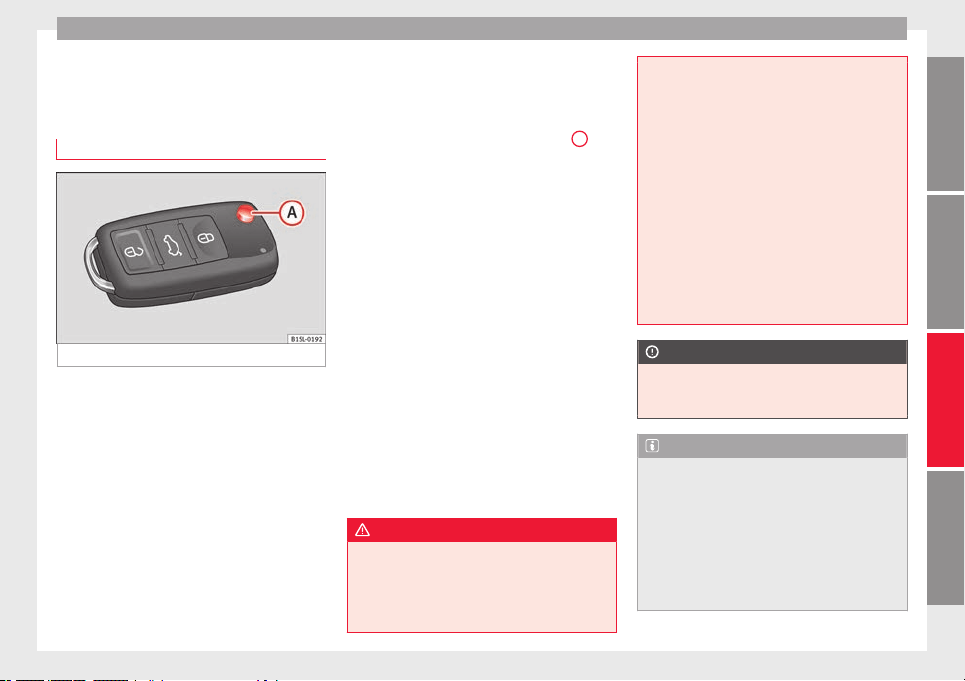
Opening and closing
Opening and closing
Vehicle key set
Remote control vehicle key*
Fig. 27 Remote control key
Remote control key
With the vehicle key the vehicle may be
locked or unlocked remotely ››› page 45.
The vehicle key includes an emitter and bat-
tery. The receiver is in the interior of the vehi-
cle. The range of the vehicle key with remote
control and new battery is several metres
around the vehicle.
If it is not possible to open or close the vehi-
cle using the remote control key, this should
be re-synchronised ››› page 45 or the bat-
tery changed ››› page 44.
Different keys belonging to the vehicle may
be used.
Folding the key shaft in and out
When the button is pressed ››› Fig. 27
A
, the
key shaft is released and unfolds.
To
fold it
press the button and fold the key
sh
aft in until it locks in place.
Replacing a key
To obtain a spare key and other vehicle keys,
the vehicle chassis number is required.
Each new key must contain a microchip and
be coded with the data from the vehicle elec-
tronic immobiliser. A vehicle key will not work
if it does not contain a microchip or the mi-
crochip has not been encoded. This is also
true for keys cut for the vehicle.
The vehicle keys or new spare keys can be
obtained from a SEAT dealership, a Special-
ised workshop or approved key service quali-
fied to create this kind of key.
New keys or spare keys must be synchron-
ised before use ››› page 45.
WARNING
Careless or incorrect use of vehicle keys may
result in severe injury and accident.
●
Always take all the keys with you whenever
you leave the vehicle. Children and unauthor-
ised individuals could lock the doors or the
boot hatch, start the engine or turn on the ig-
nition, activating electrical systems, the elec-
tric windows, for example.
●
Never leave children or disabled people
alone in the car. They could be trapped in the
car in an emergency and will not be able to
get themselves to safety. For example, de-
pending on the time of the year, tempera-
tures inside a locked and closed vehicle can
be extremely high or extremely low resulting
in serious injuries and illness or even death,
particularly for young children.
●
Never remove the key from the ignition if
the vehicle is in motion. The steering may
lock and it will not be possible to turn the
steering wheel.
CAUTION
The remote control key contains electronic
components. Protect them from damage, im-
pacts and humidity.
Note
●
Only use the key button when you require
the corresponding function. Pushing the but-
ton unnecessarily could accidentally unlock
the vehicle or trigger the alarm. It is also pos-
sible even when you are outside the radius of
action.
●
Remote control key operation can be great-
ly influenced by overlapping radio signals
around the vehicle working in the same range
»
43
Technical specifications
AdviceOperationSafety
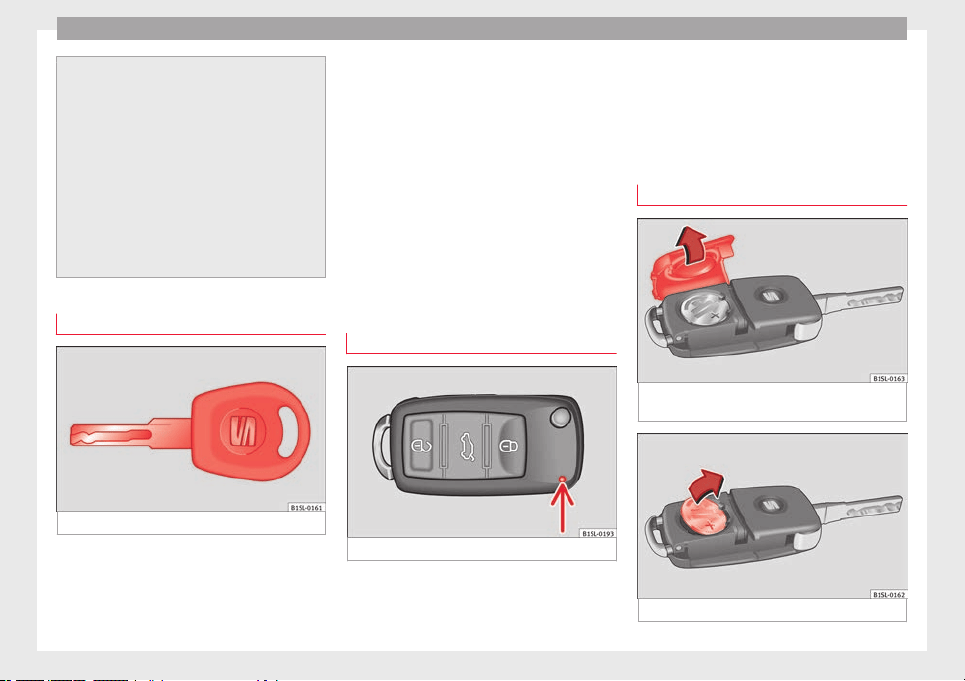
Operation
of frequencies (for example, radio
transmitters, mobile telephones).
●
Obstacles between the remote control and
the vehicle, bad weather conditions and
draining batteries can considerably reduce
the range of the remote control.
●
If the buttons of the vehicle key are press-
ed ››› Fig. 27 or one of the central locking but-
ton
s ››› page 45 is pressed repeatedly in
quick succession, the central locking briefly
disconnects as protection against overload-
ing. The vehicle is then unlocked. Lock it if
necessary.
Vehicle mechanical key
Fig. 28 Vehicle mechanical key
The vehicle key set may include a mechanical
key ››› Fig. 28
.
D
up
licate keys
To obtain a spare key and other vehicle keys,
the vehicle chassis number is required.
Each new key must contain a microchip and
be coded with the data from the vehicle elec-
tronic immobiliser. A vehicle key will not work
if it does not contain a microchip or the mi-
crochip has not been encoded. This is also
true for keys cut for the vehicle.
The vehicle keys or new spare keys can be
obtained from a SEAT dealership, a special-
ised workshop or an approved locksmith
qualified to create them.
Control lamp on the vehicle key
Fig. 29 Control lamp on the vehicle key
When a button on the vehicle key is pressed,
the control lamp flashes ››› Fig. 29
(arrow)
onc
e briefly
. If the button is pressed and
held, the indicator blinks several times, for
example: for the convenience opening func-
tion.
When the control lamp does not light upon
pushing a button, the vehicle key batteries
must be changed ››› page 44.
Changing the battery
Fig. 30 Vehicle key: battery compartment cov-
er
Fig. 31 Vehicle key: removing the battery
44
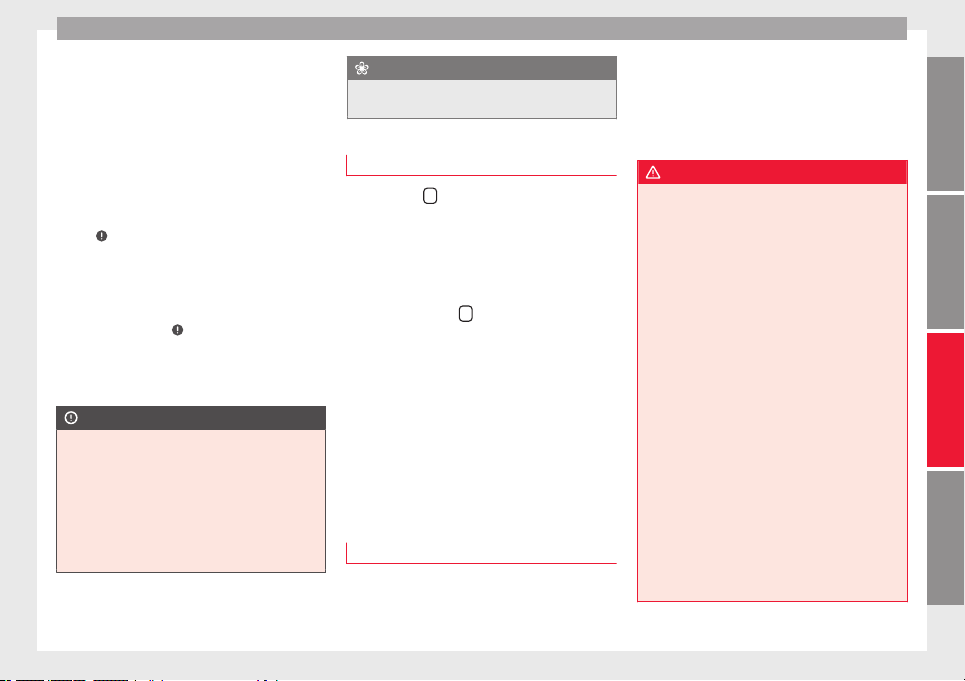
Opening and closing
SEAT recommend having the batteries
changed in a specialised workshop.
The battery is located to the rear of the vehi-
cle key, under a cover.
Changing the battery
●
Unfold the vehicle key shaft ››› page 43.
●
Remove the cover from the back of the ve-
hicle key ››› Fig. 30
in the direction of the ar-
r
o
w ›››
.
●
Extract the battery from the compartment
using a suitable thin object ››› Fig. 31
.
●
Pl
ac
e the new battery in the compartment,
pressing in the direction of the arrow as
shown ››› Fig. 31 ›››
.
●
Fit the battery compartment cover, pressing
in the direction of the arrow as shown
››› Fig. 30
until it clicks into place.
CAUTION
●
If the battery is not changed correctly, the
vehicle key may be damaged.
●
Use of unsuitable batteries may damage
the vehicle key. For this reason, always re-
place the dead battery with another of the
same voltage, size and specifications.
●
When fitting the battery, check that the po-
larity is correct.
For the sake of the environment
Please dispose of your used batteries correct-
ly and with respect for the environment.
Synchronising the vehicle key
If the button
is pressed frequently outside
of the vehicle range, it is possible that the ve-
hicle can no longer be locked or unlocked us-
ing the key. In this case, the vehicle key must
be synchronised once more as follows:
●
Unfold the vehicle key shaft
›››
page 43.
●
Press the button
on the vehicle key. For
this, it must remain with the vehicle.
●
Open the vehicle within one minute using
the key shaft.
●
Turn on the ignition using the vehicle key.
The key has been synchronised.
●
If necessary, fit the cap.
Central locking* and locking
system
Introduction
Central locking functions correctly when all
the doors and the rear lid are correctly shut.
If the driver door is open, the vehicle cannot
be locked with the key.
The battery of an unlocked vehicle parked for
a long period (e.g. in a private garage) may
run down and fail to start the motor.
WARNING
The incorrect use of the central locking sys-
tem may cause serious injuries.
●
The central locking system will lock all
doors. A vehicle locked from the inside can
prevent any non-authorised individual from
opening the doors and accessing the vehicle.
Nevertheless, in case of emergency or acci-
dent, locked doors will complicate access to
the vehicle interior to help the passengers.
●
Never leave children or disabled people
alone in the vehicle. The central locking but-
ton can be used to lock all the doors from
within. Therefore, passengers will be locked
inside the vehicle. Individuals locked in the
vehicle can be exposed to very high or very
low temperatures.
●
Depending on the time of the year, temper-
atures inside a locked and closed vehicle can
be extremely high or extremely low resulting
in serious injuries and illness or even death,
particularly for young children.
●
Never leave individuals locked in a closed
and locked vehicle. In case of emergency,
they may not be able to exit the vehicle by
themselves or get help.
45
Technical specifications
AdviceOperationSafety
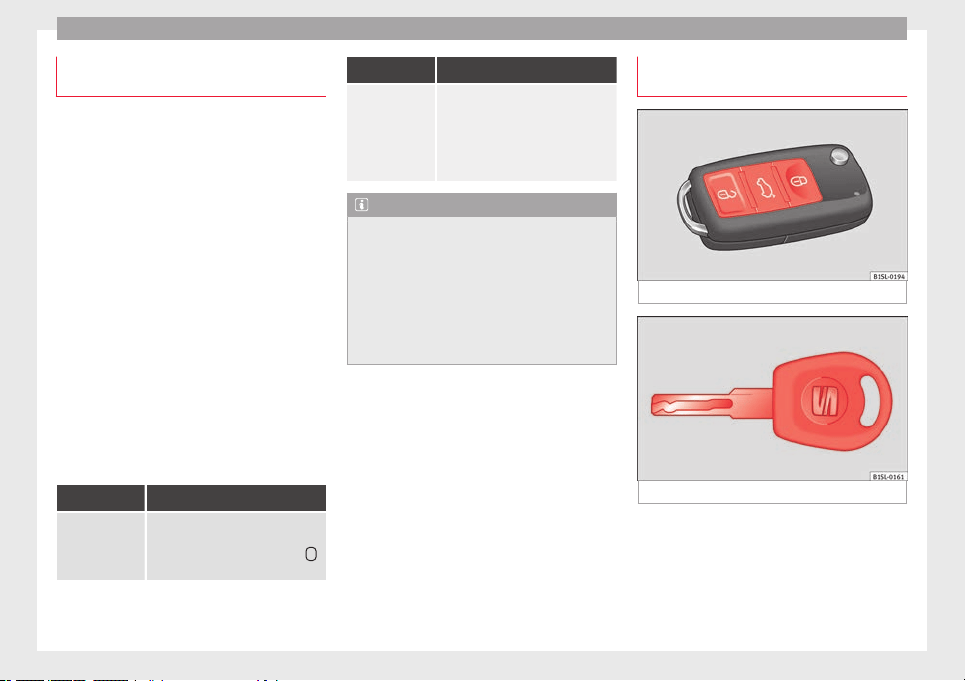
Operation
Description of the central locking
system
The central locking system allows all doors
and the rear lid to be locked and unlocked
centrally.
●
From outside, using the vehicle key.
●
From inside, by pushing the central locking
button ››› page 48.
The centr
al locking system can be activated
or deactivated at a specialised workshop.
In case of a vehicle key fault or central lock-
ing system fault, all doors can be locked or
unlocked manually.
Locking the vehicle after the airbags have
been deployed
If the airbags are deployed due to an acci-
dent, the vehicle will be automatically and
completely unlocked. Depending on the
amount of damage, it can be locked follow-
ing an accident in the following ways:
Function Necessary operations
Lock the vehicle,
by pushing the
central locking
button:
– Turn off the ignition and turn it on
again.
– Push the central locking button
.
Function Necessary operations
Use the key to
lock the vehicle:
– Turn off the ignition and turn it on
again.
OR: Remove the key from the igni-
tion.
– Open any door just once.
– Lock the vehicle with the key.
Note
If the buttons of the vehicle key are pressed
››› page 43 or one of the central locking but-
ton
s ››› Fig. 34 is pressed repeatedly in short
succession, the central locking briefly discon-
nects as protection against overloading. In
this case, the vehicle remains unlocked for
about 30 seconds. If neither the door or the
boot is opened during this time, the vehicle
will then automatically lock.
Locking and unlocking the vehicle
from the exterior
Fig. 32 Buttons on the vehicle key
Fig. 33 Vehicle mechanical key
46

Opening and closing
Central locking
Function Handling
the buttons
on the vehi-
cle ››› Fig. 32
Handling the vehicle
key ››› Fig. 32 in the
lock cylinder or with
the vehicle mechani-
cal key ››› Fig. 33.
Unlocking
the vehi-
cle.
Press button
.
Insert the vehicle key in-
to the lock cylinder of
the driver door and turn
the key in an anticlock-
wise direction.
Lock the
vehicle.
Press button
.
Insert the vehicle key in-
to the lock cylinder of
the driver door and turn
the key in a clockwise
direction.
Unlocking
the rear lid.
Press button
.
Insert the vehicle key in-
to the lock cylinder of
the driver door and turn
the key in an anticlock-
wise direction.
Locking
the rear lid.
Press button
.
Insert the vehicle key in-
to the lock cylinder of
the driver door and turn
the key in a clockwise
direction.
Please note:
depending on the operation of
the c
entr
al locking feature set by a special-
ised workshop, in order to unlock all the
doors and the rear lid, press the button
twice.
The vehicle key only locks and unlocks the
vehicle if it is within range of the vehicle and
if the battery has enough power.
●
Upon locking the vehicle, all turn signals
will flash once
in confirmation.
●
U
pon u
nlocking the vehicle, all turn signals
will flash twice in confirmation.
If the turn signals do not flash in confirma-
tion, at least one of the doors or the rear lid
has been left unlocked.
If the driver door is open, the vehicle cannot
be locked with the key. If you unlock the vehi-
cle without opening any doors or the rear lid,
it will lock again automatically after a few
seconds. This function prevents the vehicle
from remaining unlocked if the unlocking
button is pressed by mistake.
Mechanical locking
Function
Using the vehicle's mechani-
cal key ››› Fig. 33 in the lock
cylinder
Locking the driv-
er door manually.
To unlock, insert the vehicle key in-
to the lock cylinder of the driver
door and turn the key in an anti-
clockwise direction.
To lock, insert the vehicle key into
the lock cylinder of the driver door
and turn the key in a clockwise di-
rection.
Function
Using the vehicle's mechani-
cal key ››› Fig. 33 in the lock
cylinder
Locking and un-
locking the rear
lid.
To unlock, insert the vehicle key in-
to the lock cylinder of the driver
door and turn the key in an anti-
clockwise direction.
To lock, insert the vehicle key into
the lock cylinder of the driver door
and turn the key in a clockwise di-
rection.
If the driver's door is open, it cannot be
locked with the vehicle key.
47
Technical specifications
AdviceOperationSafety
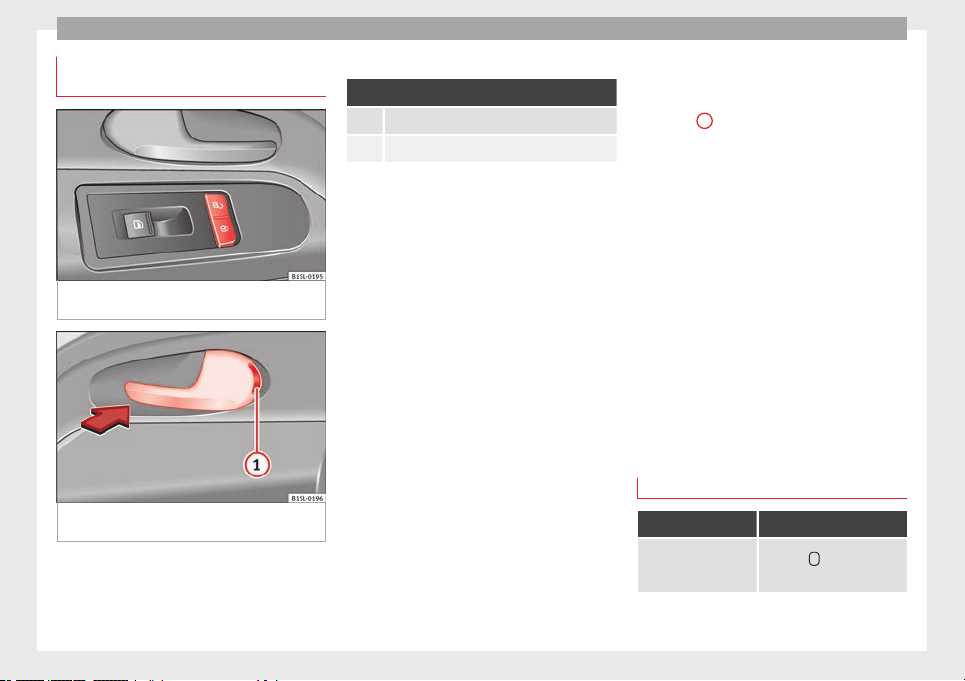
Operation
Locking and unlocking the vehicle
from the inside
Fig. 34 In the driver door: central locking but-
ton
Fig. 35 In the passenger door: door handle
for mechanical locking.
Central locking
Push the button ››› Fig. 34:
Unlocking the vehicle.
Lock the vehicle.
The central locking button is still operative
when the ignition is switched off.
If the vehicle has been locked with the vehi-
cle key, the central locking button does not
operate.
Please note the following when you use the
central locking button to lock your vehicle:
●
The "Safe" security system will not activate
›››
page 48
.
●
It
w
ill not be possible to open the doors or
the rear lid from the outside this may offer ex-
tra safety, when stopped at traffic lights for
example.
●
The doors can be opened and unlocked in-
dividually from the inside by pulling the in-
side door handle. If necessary, pull the door
release lever twice.
●
The driver door cannot be locked when
open. This avoids locking the vehicle key in-
side the vehicle when there is nobody inside.
Mechanical locking
The doors are locked by pressing the door
lever, so that the red mark becomes visible
››› Fig. 35
1
.
To unlock a door, pull its corresponding door
lever.
If the vehicle becomes locked, take note of
the following:
●
The "Safe" security system will not activate
››› page 48
.
●
It
w
ill not be possible to open the doors
from the outside, when stopped at traffic
lights for example.
●
The doors can be opened and unlocked in-
dividually from the inside by pulling the in-
side door handle.
●
The driver door cannot be locked using the
central locking system when it is still open.
This avoids locking the vehicle key inside the
vehicle when there is nobody inside.
“Safe” security system*
Function Necessary operations
Locks the vehicle with
the "Safe" security sys-
tem.
Press the
button once on
the vehicle key.
48
Opening and closing
Function Necessary operations
Locks the vehicle with-
out the "Safe" security
system.
Press the
button twice on
the vehicle key.
Press the central locking but-
ton
on the driver door
once.
When the vehicle is locked, the "Safe" securi-
ty system deactivates the door handles, mak-
ing the vehicle difficult to open. The doors
cannot be opened from inside ››› .
Upon switching off the ignition, the instru-
ment panel display will show that the “dead-
lock” is activated or (
SAFELOCK
or
SAFELOCK
).
When the deadlock is switched off:
●
The vehicle can be opened and unlocked
from the inside using an inside door handle.
Control lamp on the driver door
When the vehicle is
locked:
Meaning
The red LED flashes for ap-
proximately 2 seconds at
short intervals and then more
slowly.
The "Safe" security
system is switched on.
The red LED flashes for about
two seconds then turns off. Af-
ter 30 seconds, the LED flash-
es again.
The "Safe" security
system is switched off.
When the vehicle is
locked:
Meaning
The red LED flashes for about
two seconds at short inter-
vals. Subsequently, the light
will remain switched on for
about. 30 seconds.
There is a fault in the
locking system. Con-
tact a specialised
workshop.
WARNING
Careless use of the "Safe" security system
can cause serious injury.
●
Never leave anybody inside the vehicle if it
has been locked using the key. When the
"Safe" security system is activated, doors
cannot be opened from the inside!
●
When the doors are locked, it is difficult to
get to passengers in the vehicle interior in
case of an emergency. Passengers could re-
main trapped inside and unable to unlock the
doors in case of an emergency.
Doors
Introduction
WARNING
If a door is not correctly closed, it could open
unexpectedly when driving and cause serious
injuries.
●
Always stop immediately and close the
door.
●
When closing, ensure that the door has
closed correctly. A closed door should be
flush with the corresponding parts of the
bodywork.
●
Open and close doors only when nobody is
in the way of the door.
WARNING
A door held open by its retainer could be
blown closed by the wind or close if the vehi-
cle is on a hill, causing injury.
●
When opening and closing doors, always
use the door handle.
Note
On the display of the SEAT Portable System
(supplied by SEAT), ››› page 123 can be seen
if at least one vehicle door has been left open
or is not correctly closed.
49
Technical specifications
AdviceOperationSafety
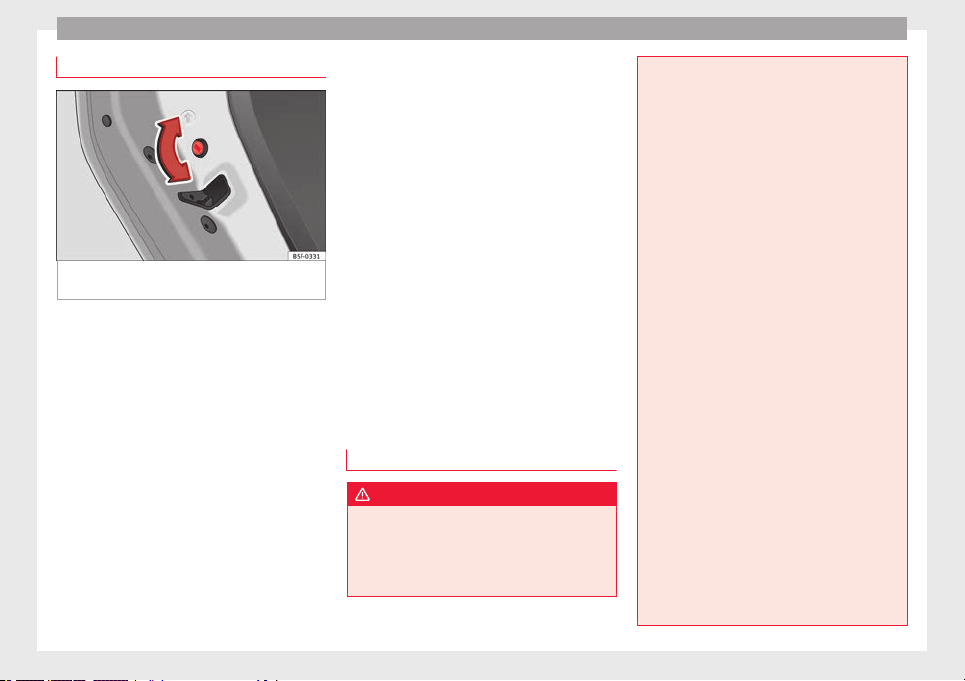
Operation
Childproof lock
Fig. 36 Childproof lock on the left hand side
door
The childproof lock prevents the rear doors
from being opened from the inside. This sys-
tem prevents minors from opening a door ac-
cidentally while the vehicle is running.
This function is independent of the vehicle
electronic opening and locking systems. It
only affects rear doors. It can only be activa-
ted and deactivated manually, as described
below:
Activating the childproof lock
–
Unlock the vehicle and open the door in
which you wish to activate the childproof
lock.
–
With the door open, rotate the groove in
the door using the ignition key, anti-clock-
wise for the left-hand side doors ››› Fig. 36
and clockwise for the right-hand side
doors.
Deactivating the childproof lock
–
Unlock the vehicle and open the door
whose childproof lock you want to deacti-
vate.
–
With the door open, rotate the groove in
the door using the ignition key, anti-clock-
wise for the right-hand side doors, and
clockwise for the left-hand side doors
››› Fig. 36
.
Onc
e the c
hildproof lock is activated, the
door can only be opened from the outside.
The childproof lock can be activated or deac-
tivated by inserting the key in the groove
when the door is open, as described above.
Rear lid
Introduction
WARNING
Careless and unsuitable locking, opening and
closing of the rear lid can cause accidents
and serious injury.
●
Open and close the rear lid only when no-
body is in the way.
●
Do not close the rear lid by pushing it down
with your hand on the rear window. This
could break and cause injury.
●
Ensure the rear lid is locked after closing,
otherwise, it may open unexpectedly while
driving. A closed rear lid should be flush with
the corresponding parts of the bodywork.
●
Always keep the rear lid closed while driv-
ing to avoid toxic gases entering the vehicle
interior.
●
Do not open the rear lid when there is a
load installed, for example a carrier system.
Likewise, the boot hatch cannot be opened
when a load is attached to it, for example bi-
cycles. An open rear lid could close itself if
there is an additional weight on it. If necessa-
ry, press down on the rear lid and remove the
load.
●
Close and lock both the rear lid and all the
other doors when you are not using the vehi-
cle. Ensure that nobody remains inside the
vehicle.
●
Never allow children to play inside or
around the vehicle without supervision, espe-
cially if the rear lid is open. Children could
enter the luggage compartment, close the
rear lid and become trapped. Depending on
the time of the year, temperatures inside a
locked and closed vehicle can be extremely
high or extremely low resulting in serious in-
juries and illness or even death, particularly
for young children.
●
Never leave children or disabled people
alone in the vehicle. If the vehicle key or the
50
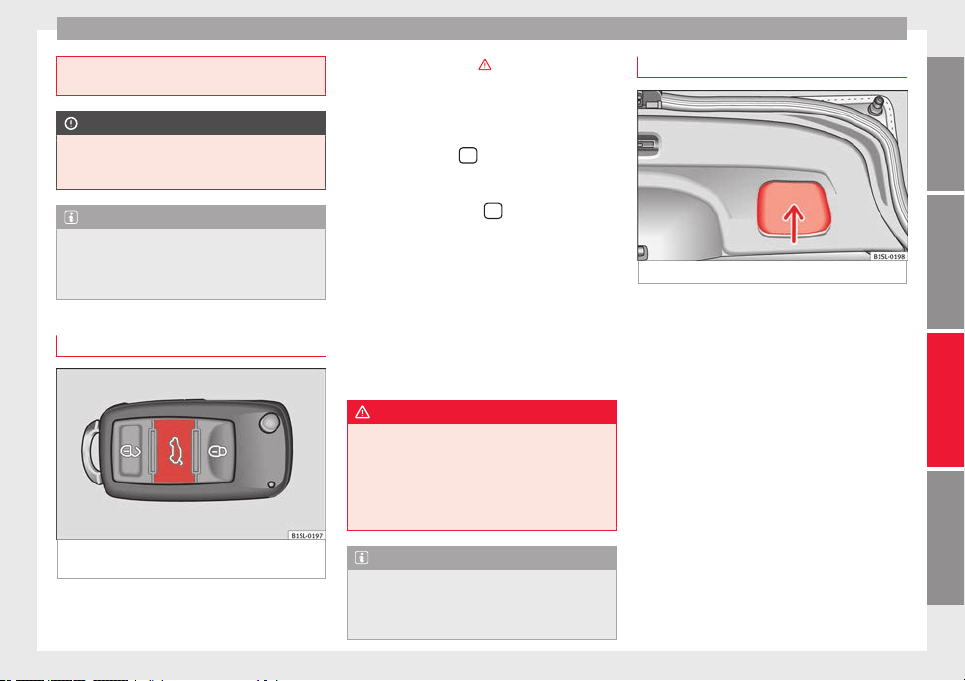
Opening and closing
central locking button is used, they may be
locked in the vehicle.
CAUTION
Before opening the rear lid, ensure that there
is sufficient free space to open and close it,
for example if you are in a garage.
Note
On the display of the Portable Navigation
System (supplied by SEAT) ››› page 123 can
be seen if the rear lid has been left open or is
not correctly shut.
Opening the rear lid
Fig. 37 On the vehicle key: button to unlock
and open the boot hatch.
If bicycles are attached to a rack on the boot
hatch, for example, in some cases, it may not
open automatically ››› . Remove the load
from the carrier and support the open rear
lid.
Opening with central locking
●
Press the button
on the vehicle key
››› Fig. 37
for about one second to unlock the
boot
h
atch.
●
OR: Press the button
on the vehicle key
until the rear lid opens automatically several
centimetres.
●
Opening the rear lid with the button.
Opening with the vehicle mechanical key
●
Insert the vehicle key into the lock cylinder
of the driver door and turn the key in an anti-
clockwise direction
›
›› p
age 45.
●
Opening the rear lid with the button.
WARNING
Unsuitable or careless unlocking and opening
of the rear lid could cause serious injuries.
●
If there is a loaded luggage carrier on the
rear lid, it could be unlocked or open but not
recognised as such. An unlocked or open rear
lid could open unexpectedly while driving.
Note
At outside temperatures of less than 0 °C
(+32 °F), the pressurised gas struts cannot
always automatically lift the rear lid. In this
case, open the rear lid manually.
Closing the rear lid
Fig. 38 Rear lid open: hand grip
Closing the rear lid
●
Grab the handgrip inside the rear lid
››› Fig. 38 (arrow).
●
Push the rear lid downwards until it locks
into place in the lock.
●
Ensure that it is correctly closed by pulling
on it firmly.
Locking the rear lid with central locking*
If you unlock the vehicle without opening any
doors or the rear lid, it will lock again auto-
matically after about 30 seconds. This func-
tion prevents the vehicle from remaining un-
locked if the unlocking button is pressed by
mistake.
Locking is only possible when the rear lid is
correctly and fully closed.
»
51
Technical specifications
AdviceOperationSafety
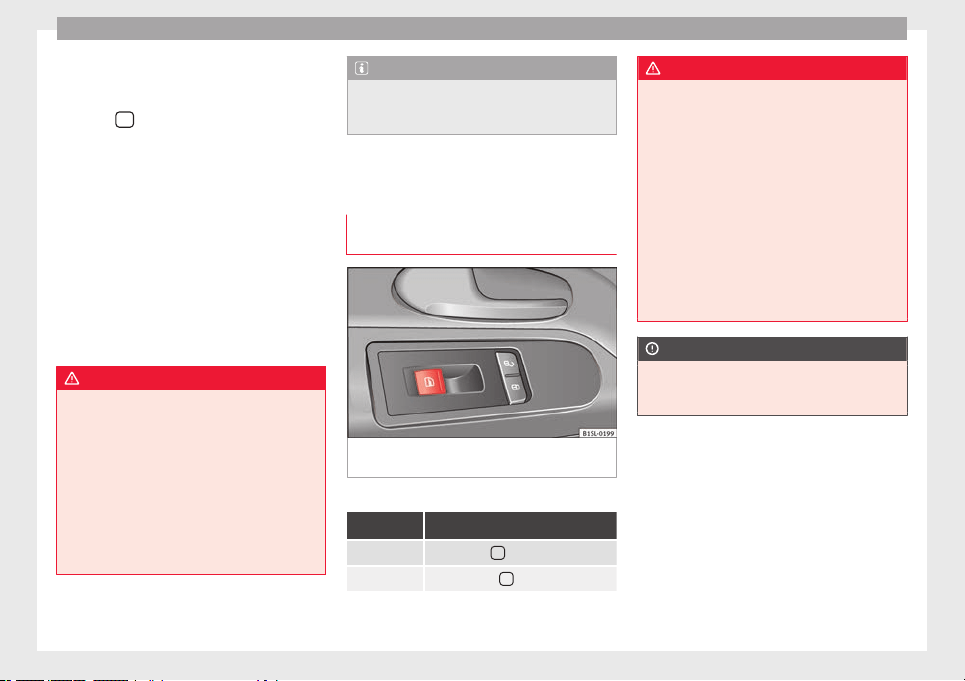
Operation
●
The rear lid is also locked by a central lock-
ing.
●
If the vehicle rear lid is locked or unlocked
using the
button, when it is closed once
more it will lock automatically.
●
A closed but not locked rear lid will lock au-
tomatically at a speed above about 9 km/h
(6 mph).
Locking the rear lid with the vehicle
mechanical key
Locking is only possible when the rear lid is
correctly and fully closed.
●
Insert the vehicle key into the lock cylinder
of the driver door and turn the key in a clock-
wise direction
›
›› p
age 45.
WARNING
Unsuitable or careless closing and locking of
the rear lid could cause serious injuries.
●
Never allow children to play inside or
around the vehicle without supervision, espe-
cially if the rear lid is open. Children could
enter the luggage compartment, close the
rear lid and become trapped. A locked vehicle
can be subjected to extremely high and low
temperatures, depending on the time of year,
thus causing serious injuries/illness and
even death.
Note
Before closing the rear lid, make sure that the
key has not been left inside the luggage com-
partment.
Electric windows
Opening and closing the electric
windows
Fig. 39 In the driver door: electric windows
button
Opening and closing the windows
Function Necessary operations
Opening: Press button
.
Closing: Pull the switch
.
WARNING
Careless use of the electric windows can
cause serious injury.
●
Only operate the electric windows when
nobody is in the way.
●
Never leave children or disabled people
alone in the vehicle if the doors are to be
locked. The windows cannot be opened in
case of an emergency.
●
Always take all the keys with you whenever
you leave the vehicle. After turning off the ig-
nition, the windows can be opened and
closed for a short time using the buttons on
the door as long as the driver door or passen-
ger side door is not open.
CAUTION
When the windows are open, rain can enter
the vehicle, dampening the interior equip-
ment and causing damage to the vehicle.
52
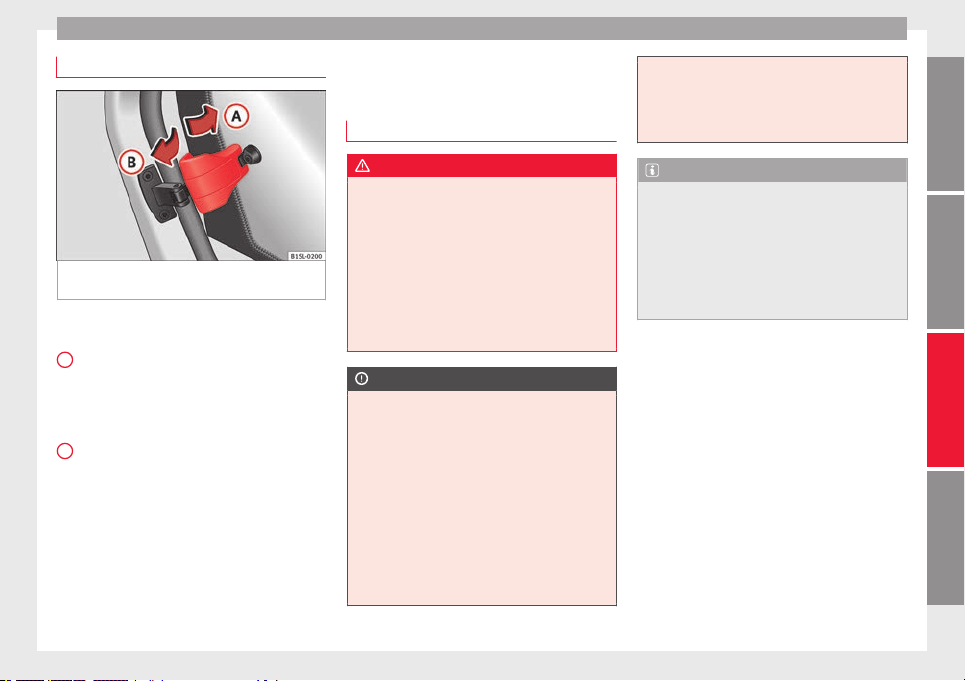
Opening and closing
Side-opening rear windows
Fig. 40 Lever to open and close the rear win-
dow
Opening
Pull the release lever in the direction of arrow
A
and press outward until the lever engag-
es.
Closing
Pull the release lever in the direction of arrow
B
and then press the lever backward until it
engages.
Sliding/tilting electric
panoramic sunroof
Introduction
WARNING
If the sliding/tilting electric panoramic sun-
roof is used negligently or without paying
due attention, it can cause serious injury.
●
The sliding/tilting sunroof should only be
opened or closed when no one is blocking its
path.
●
After switching off, it is still possible to
open or close the sliding/tilting sunroof dur-
ing a short space of time provided that nei-
ther the driver nor passenger door is opened.
CAUTION
●
To prevent damage, when there are winter
temperatures any ice or snow that there may
be on the roof of the vehicle must be removed
before opening or raising the sliding/tilting
electric panoramic sunroof.
●
Before leaving the vehicle or in the case of
heavy rain, the sliding/tilting sunroof must
always be closed. With the sliding/tilting
sunroof open or raised, water can enter the
passenger compartment and can cause con-
siderable damage to the electrical system. As
a result, other damage can occur in the vehi-
cle.
●
In the case of heavy rain, if the sliding/tilt-
ing sunroof is open, the interior equipment of
the vehicle may get wet, destroying the seat
heating and damaging the electrical system
of the vehicle.
Note
●
Leaves and other loose objects that land in
the guides of the sliding/tilting sunroof
should be removed periodically by hand or
using a vacuum cleaner.
●
If the sliding/tilting sunroof does not work
correctly, the anti-trap function will not work
either. In this case, you should take the vehi-
cle to a specialised workshop.
53
Technical specifications
AdviceOperationSafety
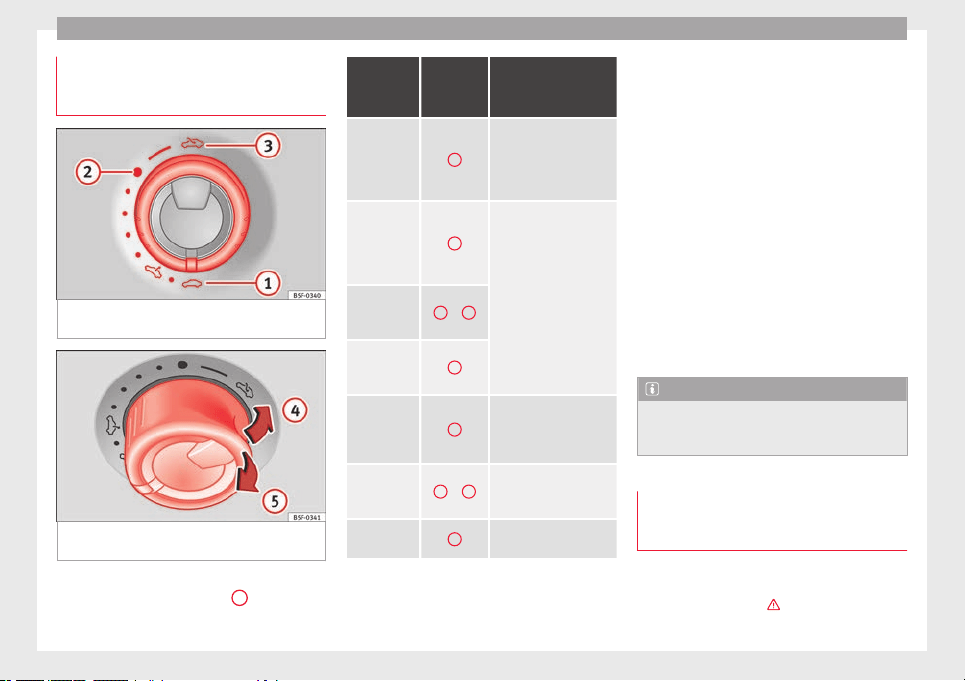
Operation
Opening and closing the
sliding/tilting electric panoramic
sunroof
Fig. 41 In the interior roof: turn the knob to
open and close
Fig. 42 In the interior roof: turn the knob to
raise and to close the sunroof
To raise the sliding/tilting sunroof, the knob
must be in the basic position
1
.
Function ››› Fig. 41
or
››› Fig. 42
Action
Fully open-
ing the slid-
ing sunroof:
3
turn the know beyond
position 2 and hold it in
that position until the
sunroof reaches the re-
quired position.
Put the slid-
ing sunroof
in conven-
ience posi-
tion:
2
Turn the knob to the re-
quired position.
To set the in-
termediate
position:
2
to
1
Fully closing
the sliding
sunroof:
1
To raise the
tilting sun-
roof com-
pletely:
4
briefly press the rear part
of the knob.
To stop auto-
matic opera-
tion:
4
or
5
Press or pull the knob
again briefly.
To close
completely:
5
briefly pull the rear part
of the knob.
The sliding/tilting sunroof only works when
switched on. After switching off, it is still pos-
sible to open or close the sliding/tilting sun-
roof during a short space of time provided
that neither the driver nor passenger door is
opened.
All operations are interrupted when the rotary
knob is actuated.
If it were not possible to close the sliding/tilt-
ing sunroof electrically, it would need to be
closed manually. It is not possible to do an
emergency close of the sliding/tilting sun-
roof without removing components of the ve-
hicle. In such a case, obtain professional as-
sistance.
Sliding blind
With the roof grab handle situated in the rear
part of the roof opening, it is possible to
move the sliding blind to the required posi-
tion.
Note
The convenience position permits sufficient
ventilation with a level of sound produced by
low wind.
Anti-trap function of the
sliding/tilting electric panoramic
sunroof
The anti-trap function can reduce the risk of
injury when closing the sliding/tilting electric
panoramic sunroof
›››
. If the sliding/tilting
54
Lights and visibility
sunroof encounters resistance or an obstacle
when closing, it will immediately reopen.
●
Check why the sliding/tilting sunroof has
not closed.
●
Try to close it again.
●
If it is still not possible to close it due to an
obstacle or resistance, it will remain in the
corresponding position. Close it without the
anti-trap function.
Closing the sliding/tilting electric panoramic
sunroof without the anti-trap function
●
Within about 5 seconds of activating the
anti-trap function, pull knob ››› Fig. 42
5
un-
til the sliding/tilting sunroof is fully closed.
●
As such, the sliding/tilting sunroof will
close without the anti-trap function!
●
If the sunroof still cannot be closed, visit a
specialised workshop.
If the knob is released during the closing op-
eration, the sliding/tilting electric panoramic
sunroof opens automatically.
WARNING
Closing the sliding/tilting electric panoramic
sunroof without the anti-trap function can re-
sult in serious injury.
●
The sliding/tilting sunroof should always
be closed carefully.
●
No person should ever remain in the way of
the sliding/tilting sunroof, especially when
closing without the anti-trap function.
●
The anti-trap function does not prevent fin-
gers or other parts of the body from becom-
ing trapped against the roof frame and inju-
ries occurring.
Lights and visibility
Lights
Introduction
The legal requirements regarding the use of
vehicle lights in each country must be ob-
served.
The driver is personally responsible for the
correct use and adjustment of the lights in all
situations.
WARNING
If the headlights are set too high and the
main beam is not used correctly, there is a
risk of dazzling or distracting other road
users. This could result in a serious accident.
●
Always make sure that the headlights are
correctly adjusted.
●
Never use the main beam or flashed head-
lamps as this could dazzle other drivers.
Control lamps
It lights
up
Possible cause Solution
Rear fog light switched
on.
››› page 56
»
55
Technical specifications
AdviceOperationSafety
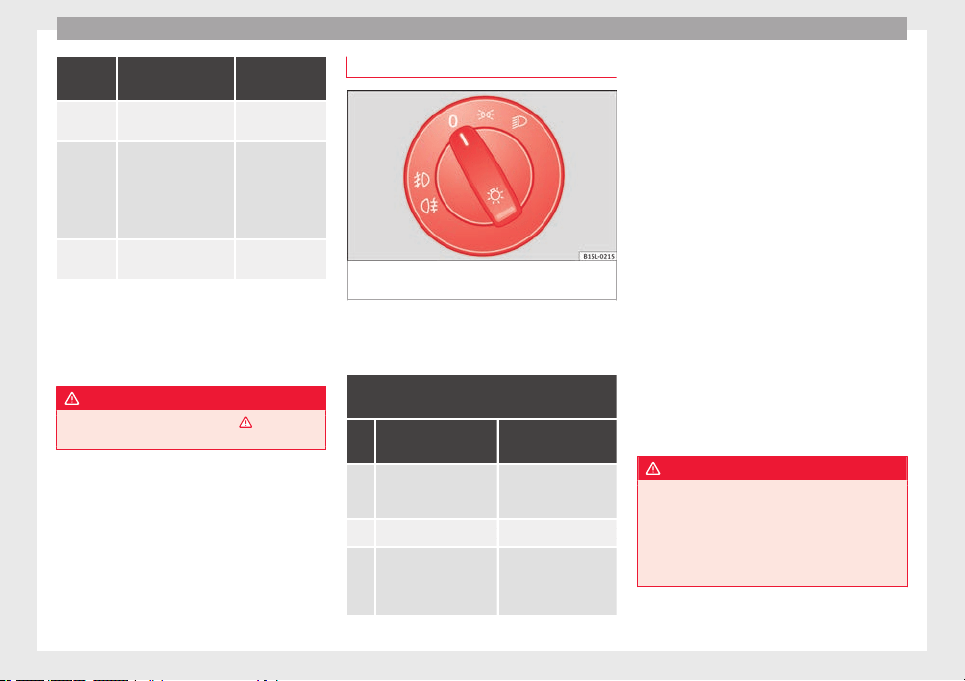
Operation
It lights
up
Possible cause Solution
Front fog lights switch-
ed on
››› page 56
Left or right turn sig-
nal.
The control lamp flash-
es twice as fast when a
vehicle turn signal is
faulty.
If necessary,
check the vehi-
cle's lights.
Main beam on or
flasher on.
››› page 57
Several warning and control lamps light up
for a few seconds when the ignition is switch-
ed on, signalling that the function is being
verified. They will switch off after a few sec-
onds.
WARNING
Observe the safety warnings ››› in Control
and warning lamps on page 40.
Turning on and off lights
Fig. 43 Next to the steering wheel: diagram
of some of the types of light switch
The legal requirements regarding the use of
vehicle lights in each country must be ob-
served.
Turn the light switch to the required position
››› Fig. 43:
When the ignition is
switched off
When the ignition
is on
Fog lights, dipped
beam and side lights
off.
Lights off, daytime
driving light on.
Side light on. Side light on.
Dipped beam off; if
necessary, the side
light comes on for a
time.
Dipped beam switched
on.
Fog lights*
The control lamp
appears on the fog lights
c
ontr
ol connected.
●
Switching on the front fog lights : Turn
the switch to position or pull out to the
first stop.
●
Switching on the rear fog light : turn the
light switch to position or pull out to
the maximum.
●
To switch off the fog lights, press the light
switch or turn it to position .
Audible warnings to advise the driver that
the lights have not been switched off
If the key is not in the ignition and the driver
door is open, an audible warning signal is
heard in the following cases: this is a remind-
er to turn off the lights.
●
When the light switch is in position .
●
When the light switch is in position .
WARNING
The side lights or daytime driving lights are
not bright enough to illuminate the road
ahead and to ensure that other road users are
able to see you.
●
Always use your dipped beam head lights if
it is raining or if visibility is poor.
56
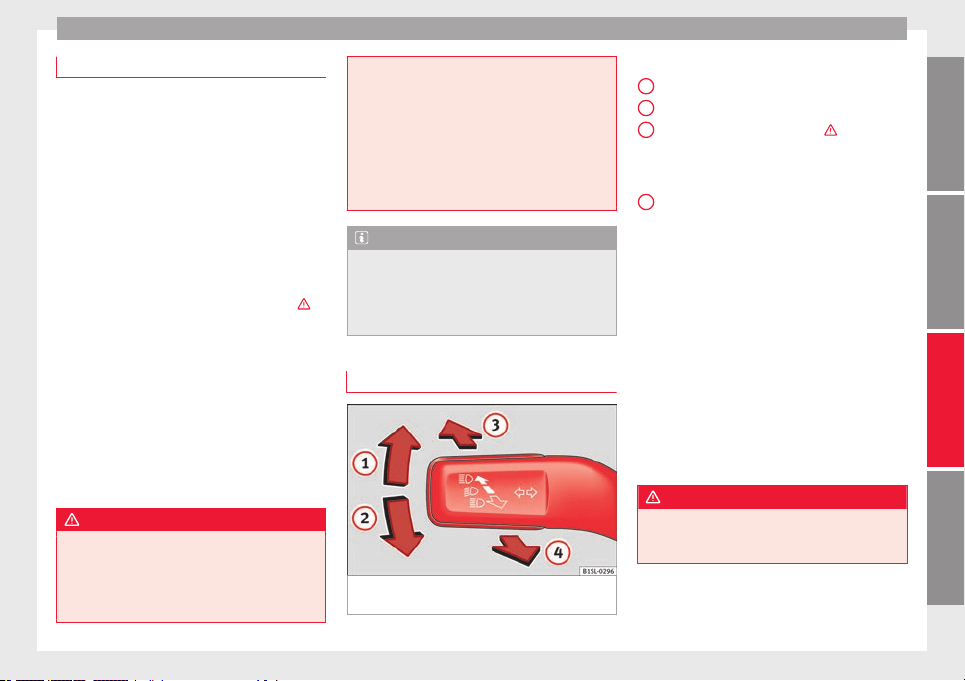
Lights and visibility
Lights and visibility: functions
Parking light remains on both sides
If when switching off the ignition, the light
control remains in the position and the ve-
hic
le is closed from outside, both headlights,
in addition to the side lights and the rear
lights will light up.
Daytime driving light
The daytime driving light consists of individu-
al lights in the front headlamps.
When the daytime driving light is switched
on, only the individual lights come on ›››
.
The daytime lights are switched on each time
the ignition is turned on if the light switch is
in position .
Switching the daytime driving light on and
off
To switch the daytime driving light on or off,
it is necessary to fit or remove the corre-
sponding fuse. Ask for professional assis-
tance for this.
WARNING
If the road is not well-lit and the vehicle is
not clearly visible to other drivers, an acci-
dent may occur.
●
Never use the daytime driving light if the
road is not well-lit as a result of the weather
conditions and poor visibility. The daytime
driving lights are not bright enough to illumi-
nate the road ahead and to ensure that other
road users are able to see you.
●
The rear lights do not come on with the
daytime driving light. A vehicle which does
not have the rear lights on may not be visible
to other drivers in the darkness, if it is rain-
ing or in conditions of poor visibility.
Note
The headlights, rear lights and turn signals
may mist up temporarily on the inside in cool
or damp weather. This is normal and in no
way effects the useful life of the vehicle light-
ing system.
Turn signal and main beam lever
Fig. 44 Turn signal and main beam lever in
their initial position
Move the lever to the required position:
Right turn signal.
Left turn signal.
Switching on main beam ››› . When the
main beam headlights are switched on,
the warning lamp is switched on in the
instrument panel.
Switch on the flasher or switch off the
main beam headlights. The flashed beam
comes on if the lever is pressed. The
warning lamp
will light up during this
pr
ocess.
Push the lever all the way down to turn off
the corresponding function.
Convenience turn signals
For the convenience turn signals, move the
lever as far as possible upwards or down-
wards and release the lever. The turn signal
will flash 3 times.
The convenience indicators can be deactiva-
ted at a Specialised workshop.
WARNING
Incorrect use of the headlights may cause ac-
cidents and serious injury, as the main beam
may distract or dazzle other drivers.
»
1
2
3
4
57
Technical specifications
AdviceOperationSafety
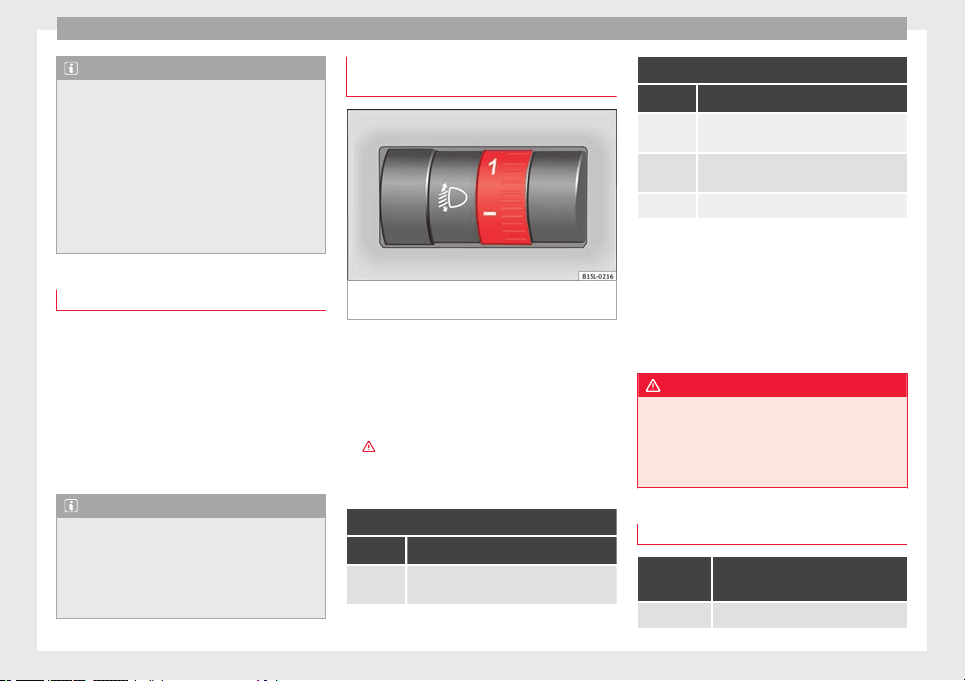
Operation
Note
●
The turn signal only works when the igni-
tion is switched on. The hazard warning
lights also work when the ignition is switch-
ed off ››› page 170.
●
If an
y of both turn signals fails, the warning
lamp will start flashing twice faster than nor-
mal.
●
The main beam headlights can only be
switched on if the dipped beam headlights
are already on.
Adjusting the headlights
In those countries where vehicles drive on
the other side of the road to the home coun-
try, the asymmetric dipped beam may dazzle
drivers of oncoming vehicles.
For this reason, stickers may be needed to
cover the headlights when driving abroad.
For further information, please refer to a spe-
cialised workshop. SEAT recommends visiting
a technical service.
Note
The use of stickers to cover headlights is only
permitted over a short period. To modify the
direction of the headlamps more permanent-
ly, please take the vehicle to a specialised
workshop. SEAT recommends taking your car
in for technical service.
Headlight range control, lighting of
instruments and controls
Fig. 45 Next to the steering wheel: Headlight
range control
Headlamp height adjustment
The headlight range control ››› Fig. 45
is
modified ac
c
ording to the value of the head-
light beam and the vehicle load status. This
offers the driver optimum visibility and the
headlights do not dazzle oncoming drivers
›››
.
The headlights can only be adjusted when
the dipped beam is switched on.
To reset, turn switch ››› Fig. 45:
Value Vehicle load status
a)
–
Two front occupants, luggage compart-
ment empty
To reset, turn switch ››› Fig. 45:
Value Vehicle load status
a)
1
All seats occupied, luggage compartment
empty
2
All seats occupied, luggage compartment
full
3 Driver only, luggage compartment full
a)
If the vehicle load does not correspond to those shown in the
table, it is possible to select intermediary positions.
Instrument and switch lighting
When the side lights or dipped beam head-
lights are switched on, the lighting for instru-
ments and controls lights up at a constant
brightness.
WARNING
Heavy objects in the vehicle may mean that
the headlights dazzle and distract other driv-
ers. This could result in a serious accident.
●
Adjust the light beam to the vehicle load
status so that it does not blind other drivers.
Reading light
But-
ton/Switch
Function
Switching off the reading light.
58
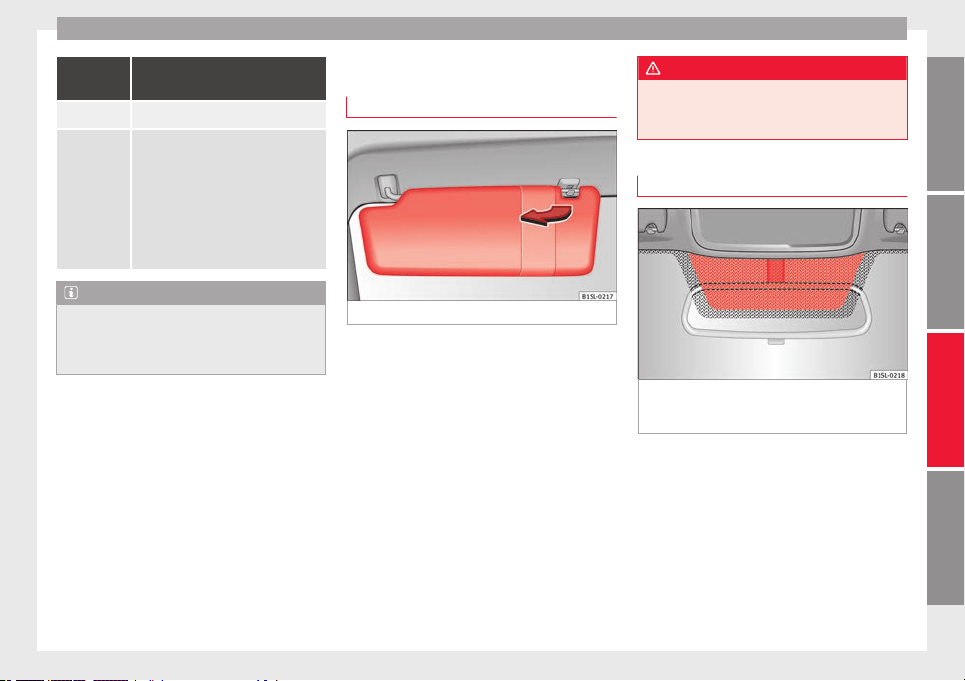
Lights and visibility
But-
ton/Switch
Function
Switching on the reading light.
Switches door contact control on (cen-
tral position).
The reading light comes on automati-
cally when the vehicle is unlocked, a
door is opened or the key is removed
from the ignition.
The light goes off a few seconds after
all the doors are closed, the vehicle is
locked or the ignition is switched on.
Note
The reading lights go out when the vehicle is
locked, or a few minutes after the key is re-
moved from the ignition. This prevents the
vehicle's battery from discharging.
Visibility
Sun visors
Fig. 46 Sun visor
Options for adjusting driver and front
passenger sun visors:
●
Lower the sun visor towards the wind-
screen.
●
The sun visor can be pulled out of its
mounting and turned towards the door.
●
Swing the sun visor towards the door, lon-
gitudinally backwards.
Vanity mirror*
There may be a vanity mirror in the folded
sun visor on the passenger side and a card-
holder in the driver sun visor.
WARNING
Folded sun blinds can reduce visibility.
●
Always roll or fold sun blinds and visors
away when not in use.
Heat-insulating glass windscreen
Fig. 47 Windscreen with reflective infrared
and metal coating and small window (red sur-
face)
The heat-insulating windscreens include a re-
flective infrared coating. The section above
the rear vision mirror has been left uncoated
(communication window) to allow electric
components from the accessories shop to
operate correctly
›››
Fig. 47
.
»
59
Technical specifications
AdviceOperationSafety
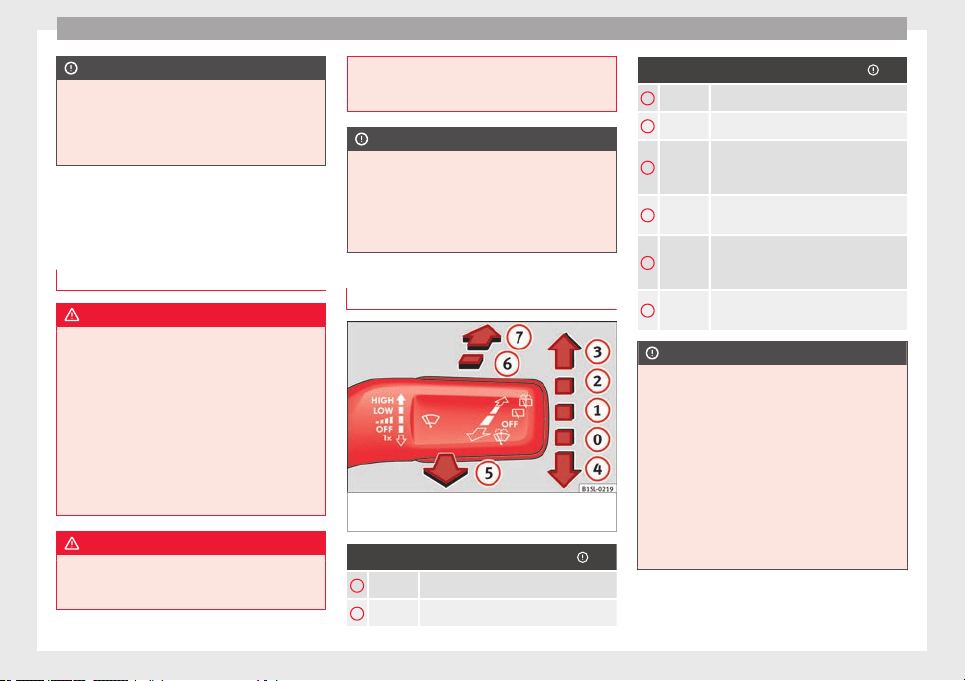
Operation
CAUTION
When the uncoated surface is covered or has
a sticker on the interior or exterior, malfunc-
tions in the electronic components may oc-
cur. Never cover the uncoated surface on the
interior or exterior.
Windscreen wiper and rear
window wiper systems
Introduction
WARNING
Water from the windscreen washer water bot-
tle may freeze on the windscreen if it does
not contain enough anti-freeze, reducing for-
ward visibility.
●
In winter, ensure the windscreen washer
contains enough anti-freeze.
●
In cold conditions, you should not use the
wash/wipe system unless you have warmed
the windscreen with the ventilation system.
The antifreeze could freeze on the windscreen
and reduce visibility.
WARNING
Worn or dirty wiper blades reduce visibility
and increase the risk of accident and serious
injury.
●
Always replace damaged or worn blades or
blades which do not clean the windscreen
correctly.
CAUTION
In icy conditions, always check that the wiper
blades are not frozen to the glass before us-
ing the wipers for the first time. In cold
weather, it may help to leave the vehicle
parked with the wipers in service position
››› page 61
.
Window wiper lever
Fig. 48 Operating the windscreen wiper and
rear wiper
Move the lever to the required position ››› :
0
Windscreen wiper off.
1
Windscreen interval wipe.
Move the lever to the required position ››› :
2
Slow wipe.
3
Continuous wipe.
4
Brief wipe - short wipe. Hold the lever
down for more time to increase the wipe
frequency.
5
Automatic wipe for cleaning wind-
screens with the lever up.
6
Interval wipe for rear window. The wiper
will wipe the window approximately ev-
ery six seconds.
7
Automatic wipe for cleaning rear win-
dows with the lever pressed.
CAUTION
If the ignition is switched off while the wind-
screen wipers are on, the windscreen wipers
carry on wiping at the same level when the
ignition is switched back on. Ice, snow and
other obstacles may damage the windscreen
wiper and the respective motor.
●
If necessary, remove snow and ice from the
windscreen wipers before starting your jour-
ney.
●
Carefully lift the frozen windscreen wipers
from the glass. SEAT recommends a de-icer
spray for this operation.
60
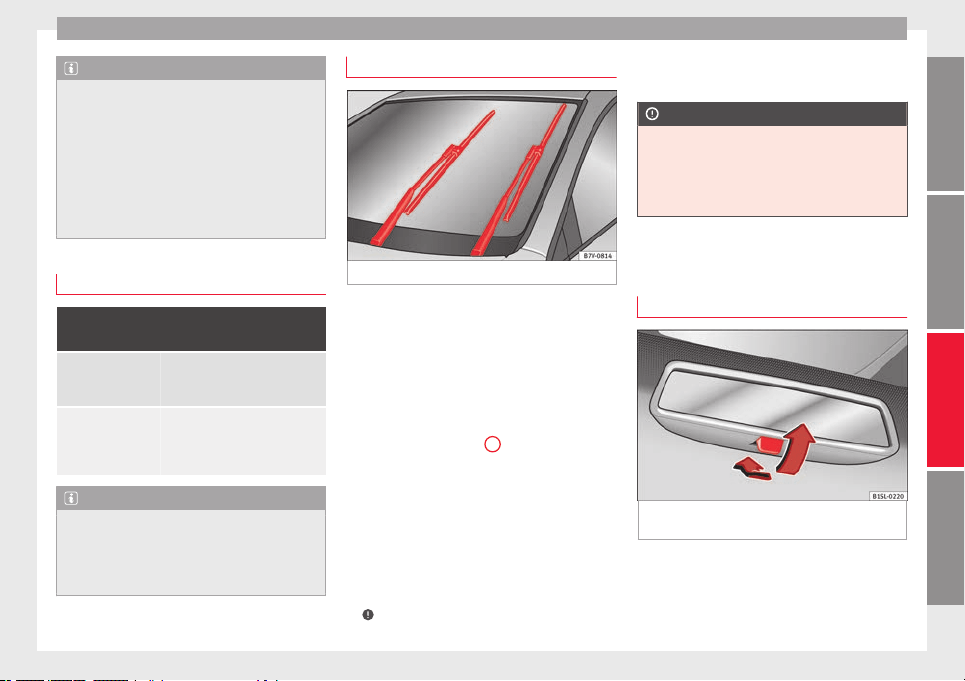
Lights and visibility
Note
●
The windscreen wipers will only work when
the ignition is switched on.
●
The interval wipe speed varies according to
the vehicle speed. The faster the vehicle is
moving, the more often the windscreen is
cleaned.
●
The rear wiper is automatically switched on
when the windscreen wiper is on and the car
is in reverse gear.
Windscreen wiper functions
Windscreen wiper performance in different sit-
uations
If the vehicle is at a
standstill
The activated position provision-
ally changes to the previous posi-
tion.
For intermittent wip-
ers
Intervals between wipes depend
on the vehicle's speed. The high-
er the vehicle speed the shorter
the intervals.
Note
The wiper will try to wipe away any obstacles
that are on the windscreen. The wiper will
stop moving if the obstacle blocks its path.
Remove the obstacle and switch the wiper
back on again.
Windscreen wipers service position
Fig. 49 Wipers in service position
The wiper arms can be raised when the wip-
ers are in service position ››› Fig. 49
. To place
the w
ind
screen wipers in the service posi-
tion, proceed as follows:
●
The bonnet must be closed ››› page 143.
●
Switch the ignition on and off.
●
Press the windscreen wiper lever down-
wards briefly ››› Fig. 48
4
.
Before driving, always lower the wiper arms.
When the ignition is switched on, the wind-
screen wiper arms return to their initial posi-
tion upon activating the windscreen wiper
lever.
Lifting and returning windscreen wiper arms
●
Place the wiper arms in the service position
››› .
●
Only hold the wiper arms at the point
where the blade is fixed.
CAUTION
●
To prevent damage to the bonnet and the
wiper arms, only leave them in the service
position.
●
Before driving, always lower the wiper
arms.
Rear vision mirror
Rear vision mirror
Fig. 50 Manual anti-dazzle function for rear
vision mirror
The driver should always adjust the rear vi-
sion mirror to permit adequate visibility
through the rear window.
»
61
Technical specifications
AdviceOperationSafety
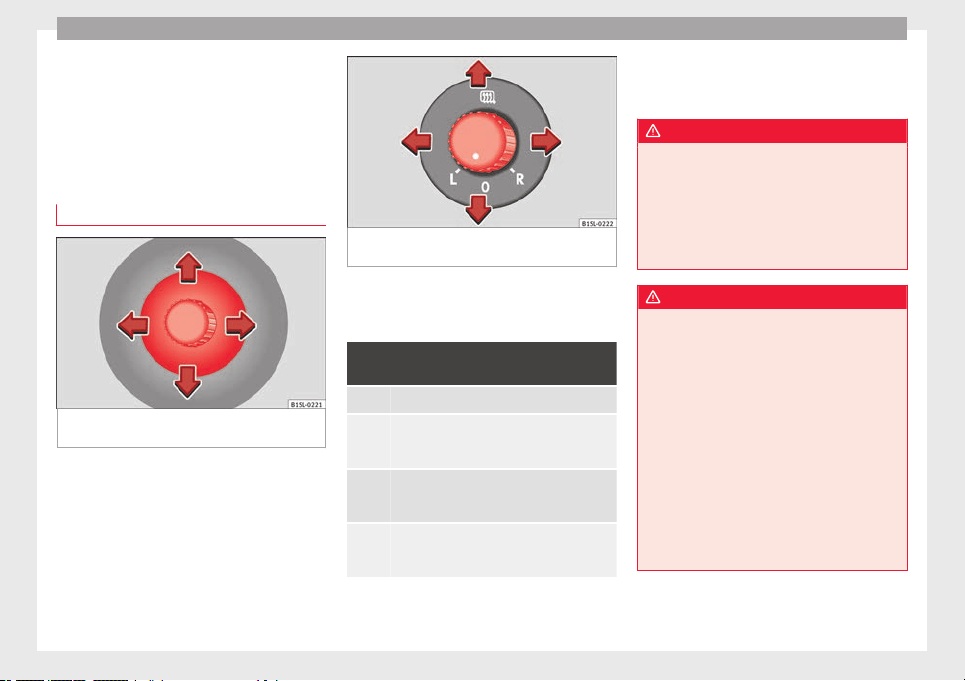
Operation
Manual anti-dazzle function for interior rear
vision mirror
●
Basic position: point the lever at the bot-
tom of the mirror forwards.
●
Pull the lever to the back to select the anti-
dazzle function ››› Fig. 50
.
Ext
erior mirr
ors
Fig. 51 In the front doors: button to adjust
the mechanical exterior rear vision mirror
Fig. 52 In the driver door: rotary control for
the exterior electric mirrors
Adjust the exterior mirrors by pressing the
adjust button ››› Fig. 51
or the rotary control*
›
›
› Fig. 52.
Turn the rotary control ››› Fig. 52 to the required
position:
Switch on the exterior mirror heating
Adjust the left-hand exterior mirror by turning
the knob forward, backward, to the right or to
the left.
Zero position. Exterior mirror heating switched
off, it is not possible to adjust the exterior mir-
rors.
Adjust the right-hand exterior mirror by turning
the knob forward, backward, to the right or to
the left.
Folding in the exterior mirrors and returning
them to their original position is possible
through a mechanical system. Carefully fold
the exterior rear vision mirror casing towards
the side window or pull it away from the win-
dow until it clicks into place.
WARNING
Fold and unfold the exterior mirror, taking
care to avoid injuries.
●
Only fold or unfold the exterior mirror when
there is no-one in the way of the mirror.
●
When moving the mirror, take care not to
trap fingers between the mirror and the mir-
ror bracket.
WARNING
Failure to correctly estimate the distance of
the vehicle behind could lead to serious acci-
dent.
●
Rear-view convex or aspheric mirrors in-
crease the field of vision, however objects ap-
pear smaller and further away in the mirrors.
●
The use of these mirrors to estimate the
distance to the next vehicle when changing
lane is imprecise and could result in serious
accident.
●
If possible, use the rear vision mirror to es-
timate distances to vehicles behind you or in
other circumstances.
●
Make sure that the rear visibility is ade-
quate.
62
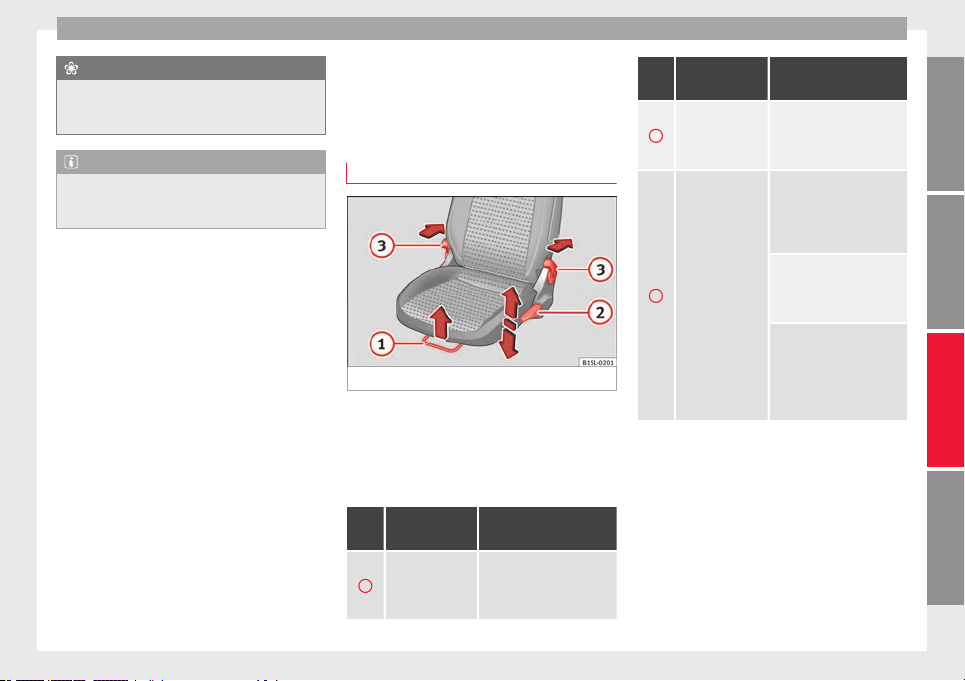
Seats and head restraints
For the sake of the environment
The exterior mirror heating should be switch-
ed off when it is no longer needed. Other-
wise, it is an unnecessary fuel waste.
Note
In the event of faults, the electric exterior
mirrors can be adjusted manually by pressing
the edge of the mirror surface.
Seats and head restraints
Adjusting the seat and head
restraints
Manual seat adjustment
Fig. 53 Front left seat controls
The controls are mirrored for the front right-
hand seat.
The front seat head restraints are integrated
in the backrests and adjusting them is not
possible.
Fig.
53
Function Necessary operations
1
Moving the head
restraint back-
wards or for-
wards.
Pull the lever and move the
seat forwards. The front
seat must be engaged
when the lever is released!
Fig.
53
Function Necessary operations
2
Adjusting the
seat height.
Pull the lever up or push
down (several times if nec-
essary) from its home posi-
tion.
3
3 doors: Easy En-
try + adjustable
seat angle func-
tion.
5 doors: only ad-
justable seat an-
gle function.
Adjust: pull the lever and
adjust the backrest seat
angle until you reach the
desired position. The seat
backrest must be engaged.
To fold: Pull the lever and
tilt the backrest. At the
same time, move the seat
forward.
To tilt open: Move the seat
back until the catch engag-
es. Pull the lever and tilt
open the backrest. The
backrest must engage in
the upright position.
63
Technical specifications
AdviceOperationSafety
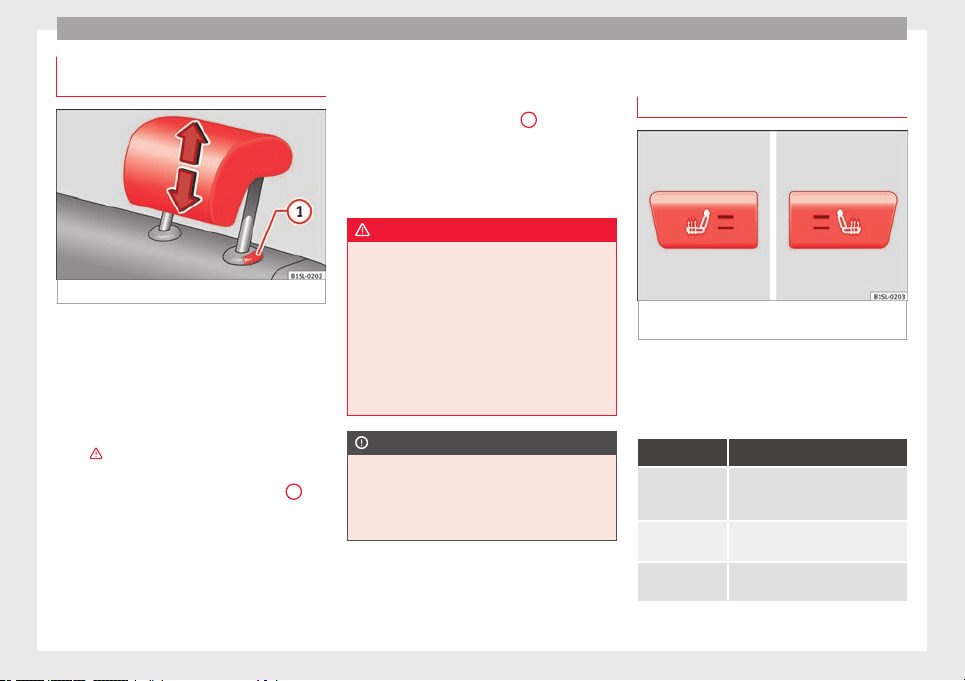
Operation
Removing and installing the rear head
restraints
Fig. 54 Removing the rear head restraint
The rear seats are equipped with a head re-
straint.
Removing the rear head restraint.
●
Unlock the seat backrest and fold it forward
››› page 73
.
●
P
u
sh the head restraint up as far as it will
go ›››
.
●
Pull the head restraint out of the fitting
without releasing the button ››› Fig. 54
1
.
●
Fold the backrest of the rear seat backward
again until it is engaged.
●
Safely store the removed head restraints.
Removing the rear head restraint.
●
Unlock the seat backrest and fold it forward
››› page 73
.
●
In
ser
t the head restraint into the guides on
the seat backrest.
●
Push the head restraint down as far as it
will go while pressing button
1
.
●
Fold the backrest of the rear seat backward
again until it is engaged.
●
Adjust the head restraint to the correct po-
sition ››› page 9
.
WARNING
Travelling with the head restraints removed
or improperly adjusted increases the risk of
severe or fatal injuries in the event of acci-
dents and sudden braking or manoeuvres.
●
Always fit and adjust the head restraint
properly whenever a person is occupying a
seat.
●
Refit any removed head restraints immedi-
ately so that passengers are properly protec-
ted.
CAUTION
When removing and fitting the head restraint,
make sure it does not hit the headliner of the
vehicle or the front seat backrest. Otherwise,
the interior roof and other parts of the vehicle
could be damaged.
Seat functions
Seat heating*
Fig. 55 In the centre console: Front seats
heating switch
The front seat cushions can be heated electri-
cally when the ignition is switched on.
Switch off seat heating if there is nobody in
the seat.
Function Action ››› Fig. 55
Activate Press button
. Seat heating is
switched on fully. All warning sig-
nals light up.
Adjusting the
heating output
Press the button
again to adjust
the desired heat.
Deactivating Keep pressing button
until all of
the lights are switched off.
64
Transport and practical equipment
WARNING
People whose pain and temperature thresh-
old has been affected by some kind of medi-
cine, paraplegia or chronic illness (e.g. diabe-
tes) may sustain burns to the back, buttocks
and legs from using the seat heaters that
may lead to a long healing process or that
may never completely heal. Seek medical ad-
vice if you have doubts regarding your health.
●
People with limited pain and temperature
thresholds must never use seat heating.
WARNING
Inappropriate use of the seat functions can
cause severe injuries.
●
Assume the proper sitting position before
your trip and remain in it throughout. This al-
so applies to the other occupants.
●
Keep hands, fingers, feet and other limbs
away from the seat operating and adjustment
radius.
CAUTION
●
To avoid damaging the heating elements of
the seat heaters, please do not kneel on the
seat or apply sharp pressure to a single point
on the seat cushion or backrest.
●
Liquids, sharp objects and insulating mate-
rials on the seat could damage the seat heat-
ing.
●
In the event of smells, switch off the seat
heating immediately and have the unit in-
spected by a specialised workshop.
For the sake of the environment
The seat heating should remain on only when
needed. Otherwise, it is an unnecessary fuel
waste.
Transport and practical
equipment
Transporting objects
Introduction
Always transport heavy loads in the luggage
compartment and place the seat backs in a
vertical position. Never overload the vehicle.
Both the carrying capacity as well as the dis-
tribution of the load in the vehicle affect driv-
ing behaviour and braking ability
›››
.
WARNING
Unsecured or incorrectly secured objects can
cause serious injury in case of a sudden ma-
noeuvring or breaking or in case of an acci-
dent. This is especially true when objects are
struck by a detonating airbag and fired
through the vehicle interior. To reduce the
risks, please note the following:
●
Secure all objects in the vehicle. Always
keep equipment and heavy objects in the lug-
gage compartment.
●
Always secure objects with suitable rope or
slings so that they cannot enter the deploy-
ment areas around the frontal or side airbags
in case of sudden braking or an accident.
●
Always ensure that objects inside the vehi-
cle cannot move into the deployment area of
the bags while driving.
»
65
Technical specifications
AdviceOperationSafety
Operation
●
While driving, always keep object compart-
ments closed.
●
Remove all objects from the front passen-
ger seat when it is folded down. When the
seat backrest is folded down, it presses on
small and light objects and these are detec-
ted by the weight sensor on the seat; this
sends false information to the airbag control
unit.
●
While the backrest of the front passenger
seat is folded, the frontal airbag must remain
disconnected and the PASSENGER AIRBAG
OFF light on.
●
Ob
jects secured in the vehicle should never
be placed in such a way as to make passen-
gers sit in an incorrect position.
●
If secured objects occupy a seat, this seat
should not be occupied or used by anyone.
WARNING
The driving behaviour and braking ability
change when transporting heavy and large
objects.
●
Adjust your speed and driving style to visi-
bility, road, traffic and weather conditions.
●
Accelerate gently and carefully.
●
Avoid sudden braking and manoeuvres.
●
Brake early.
Transporting a load
Secure all objects in the vehicle
●
Distribute the load throughout the vehicle
and on the roof as uniformly as possible.
●
Transport heavy objects as far forward as
possible in the luggage compartment and
lock the seat backs in the vertical position.
●
Check the headlight adjustment
››› page 55.
●
Use the s
uitable tyre pressure according to
the load being transported. Read the tire in-
flation information label
›››
page 158.
CAUTION
Objects on the shelf could chafe against the
wires of the heating element in the heated
rear window and cause damage.
Note
Please refer to the notes on loading the roof
carrier ››› page 77.
Driving with the rear lid open
Driving with the rear lid open creates an addi-
tional risk. Secure all objects and secure the
rear lid correctly and take all measures possi-
ble to reduce toxic gases from entering the
vehicle.
WARNING
Driving with the rear lid unlocked or open
could cause serious injuries.
●
Always drive with the rear lid closed.
●
Secure all objects in the vehicle. Loose
items could fall out of the vehicle and injure
other road users or damage other vehicles.
●
Drive particularly carefully and think
ahead.
●
Avoid sudden manoeuvres and braking giv-
en that this could cause an uncontrolled
movement of the open rear lid.
●
When transporting objects that protrude
out of the luggage compartment, indicate
them suitably. Observe legal requirements.
●
If objects must project out of the luggage
compartment, the rear lid must never be used
to “secure” or “attach” objects.
●
If a baggage rack is fitted on the rear lid, it
should be removed before travelling with the
rear lid open.
WARNING
Toxic gases may enter the vehicle interior
when the rear lid is open. This could cause
loss of consciousness, carbon monoxide poi-
soning, serious injury and accidents.
●
To avoid toxic gases entering the vehicle al-
ways drive with the rear lid closed.
66
Transport and practical equipment
●
In exceptional circumstances, if you must
drive with the rear lid open, observe the fol-
lowing to reduce the entry of toxic gases
inside the vehicle:
–
Close all windows.
–
Disable air recirculation mode.
–
Open all of the air outlets on the instru-
ment panel.
–
Switch on the blower to maximum.
CAUTION
An open boot hatch changes the length and
height of the vehicle.
Driving a loaded vehicle
For the best handling when driving a loaded
vehicle, note the following:
●
Secure all objects ››› page 66
.
●
A
c
celerate gently and carefully.
●
Avoid sudden braking and manoeuvres.
●
Brake early.
●
If necessary, read the instructions for driv-
ing with a roof carrier system ››› page 77.
WARNING
A sliding load could considerably affect the
stability and safety of the vehicle resulting in
an accident with serious consequences.
●
Secure loads correctly so they do not move.
●
When transporting heavy objects, use suit-
able ropes or straps.
●
Lock the seat backs in vertical position.
Practical equipment
Introduction
Storage compartments must only be used to
store light or small objects.
WARNING
In the event of sudden braking movements or
turns, loose objects may be thrown around
the vehicle interior. This could cause serious
injuries to passengers and cause the driver to
lose control of the vehicle.
●
Do not transport animals or place hard,
heavy or sharp objects inside the vehicle in:
open storage compartments, dash panel, rear
shelf, items of clothing or bags.
●
While driving, always keep object compart-
ments closed.
WARNING
Objects falling into the driver's footwell could
prevent use of the pedals. This could lead the
driver to lose control of the vehicle, increas-
ing the risk of a serious accident.
●
Make sure the pedals can be used at all
times, with no objects rolling underneath
them.
●
The floor mat should always be secured to
the floor.
●
Never place other mats or rugs on top of
the original mat supplied by the factory.
●
Make sure that no objects can fall into the
driver's footwell while the vehicle is in mo-
tion.
CAUTION
●
Objects on the shelf could chafe against
the wires of the heating element in the heat-
ed rear window and cause damage.
●
Do not keep temperature-sensitive objects,
food or medicines inside the vehicle. Heat
and cold could damage them or render them
useless.
●
Light-transparent objects placed inside the
vehicle, such as lenses, magnifying glasses
or transparent suction caps on the windows,
may concentrate the sun's rays and cause
damage to the vehicle.
Note
The ventilating slits between the heated rear
window and the rear shelf must not be cov-
ered so that used air can escape from the ve-
hicle.
67
Technical specifications
AdviceOperationSafety
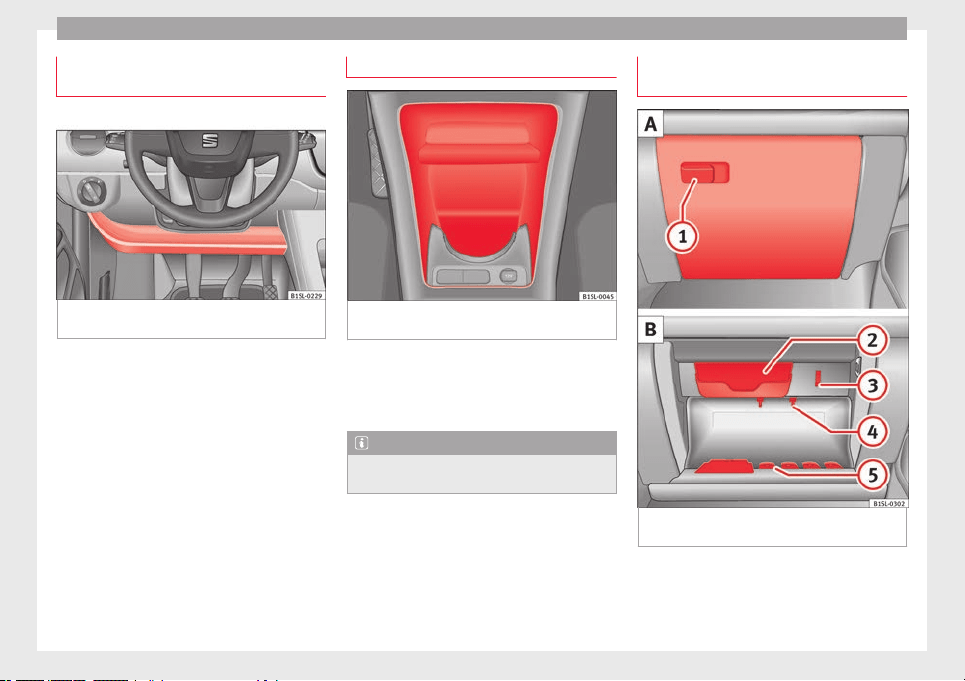
Operation
Storage compartment on the driver
side
Fig. 56 On the driver side: storage compart-
ment
There may be a storage compartment on the
driver side.
Compartment on the centre console
Fig. 57 In the front part of the centre console:
storage compartment
The storage compartment ››› Fig. 57
may be
u
sed a
s a drink holder ››› page 71 or as an
ashtray* ››› page 71 or to store small ob-
jects.
Note
A 12 volt electrical socket ››› page 72 can be
found in the storage compartment.
Storage compartment with cover on
the passenger side*
Fig. 58 Storage compartment with cover on
the passenger side
There may be a storage compartment with
cover on the passenger side.
68
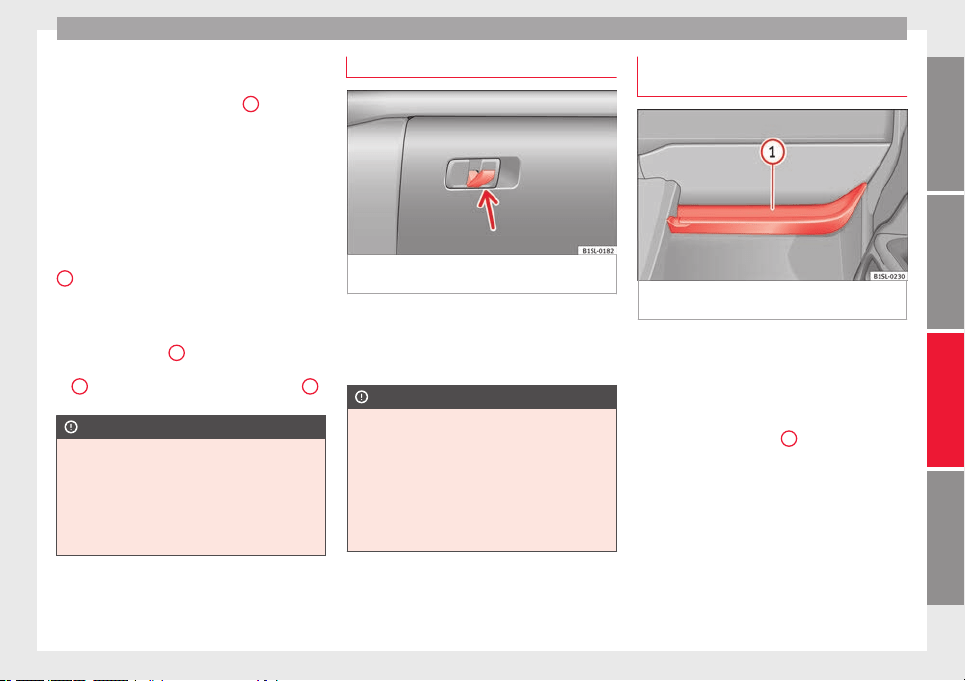
Transport and practical equipment
Opening and closing the storage
compartment cover
Pull the lever to open
›
›› Fig. 58
1
.
To
close
, press the cover upwards until it
c
licks into place.
Sunglasses storage compartment.
Sunglasses can be stored in the passenger
side storage compartment.
The sunglasses storage compartment is in
the upper area of the storage compartment
2
.
Supports
Next to the eyeglass storage compartment is
a notebook holder
3
and in the interior of
the storage compartment there is a pen hold-
er
4
, a map storage area and a coin tray
5
.
CAUTION
For structural reasons, some model versions
will have gaps behind the glove compartment
into which small objects may fall. This could
lead to strange noises and damage to the ve-
hicle. Therefore, do not store small objects in
the glove compartment, apart from those
stored in the spaces provided.
Bag support*
Fig. 59 Storage on front passenger side: fold-
ing hook.
On the opening lever of the glove compart-
ment on the passenger side there is a folding
hook ››› Fig. 59
for hanging small items of
lug
g
age, e.g. bags, etc.
CAUTION
●
The maximum weight for the hook is 1.5
kg.
●
With the hook folded forward, it automati-
cally draws up when the compartment is
opened.
●
We recommend removing hanging bags
from the hook before opening the glove com-
partment.
Open storage compartment on the
passenger side*
Fig. 60 Open storage compartment on the
passenger side
There may be an open storage compartment
on the passenger side.
Support
In the open glove compartment there is a
hook for bags ››› Fig. 60
1
.
69
Technical specifications
AdviceOperationSafety
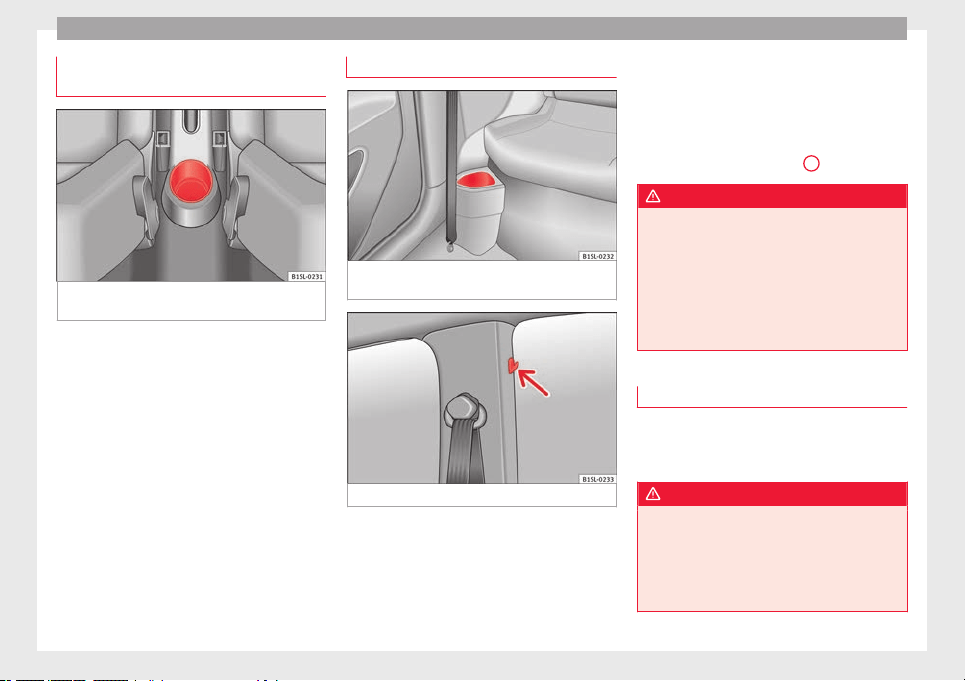
Operation
Storage compartment in the back of
the centre console
Fig. 61 In the back part of the centre console:
storage compartment
The drink holder at the back of the centre
console can be used as a storage compart-
ment.
Other storage compartments
Fig. 62 In front of the rear seats: storage com-
partment
Fig. 63 In the centre pillars: coat hooks
Coat hooks
The centre pillars contain garment hooks
››› Fig. 63
(arrow).
Other s
t
orage compartments:
●
In the front door trims ››› page 34.
●
In front of the rear seats ››› Fig. 62.
●
Rear shelf for light items of clothing*.
●
Bag hook in the luggage compartment
››› page 73.
●
In the upper part of the centre console, in-
stead of the radio ››› Fig. 23
11
.
WARNING
Clothing hung on the coat hooks could re-
strict the driver's view and lead to serious ac-
cidents.
●
Hang the clothes from the hooks so that
driver's view is not restricted.
●
The coat hook is suitable for light items of
clothing. Never place heavy, hard or sharp
objects in the bags.
Drink holders
The drink holders are in the open storage
compartments in the driver and passenger
doors.
WARNING
Improper use of the drink holders can cause
injury.
●
Do not place containers with hot drinks in a
drink holder. During sudden braking or driv-
ing manoeuvres, the hot drink could be spil-
led and lead to scalding.
70

Transport and practical equipment
●
Ensure that no bottles or other object are
dropped in the driver footwell, as they could
get under the pedals and obstruct their work-
ing.
●
Never place heavy containers, food or other
heavy objects in the drink holder. In the
event of an accident, these heavy objects
could be “thrown around” the vehicle interior
and cause serious injuries.
WARNING
Closed bottles inside the vehicle could ex-
plode or crack due to the heat or the cold.
●
Never leave a closed bottle in the vehicle if
the inside temperature is too high or too low.
CAUTION
Do not leave open drinks containers in the
drink holders when the vehicle is in motion.
They could spill during braking, for example,
and cause damage to the vehicle and the
electrical system.
Centre console drink holders
Fig. 64 In the front part of the centre console:
drink holder
Fig. 65 In the back part of the centre console:
drink holder
There are drink holders in the front and rear
parts of the centre console.
Securing the drink container in the front
drink holder
Fold the drink holder ››› Fig. 64
forward.
Pl
ac
e the drink container in the drink holder
so that it is securely surrounded.
Ashtray*
Fig. 66 In the front part of the centre console:
opening the ashtray.
Opening and closing the ashtray
To
open
, lift the lid of the ashtray in the direc-
tion of
the arrow ››› Fig. 66.
To close, push the ashtray lid down.
Emptying the ashtray
●
Remove the ashtray from the storage com-
partment lifting it up.
»
71
Technical specifications
AdviceOperationSafety
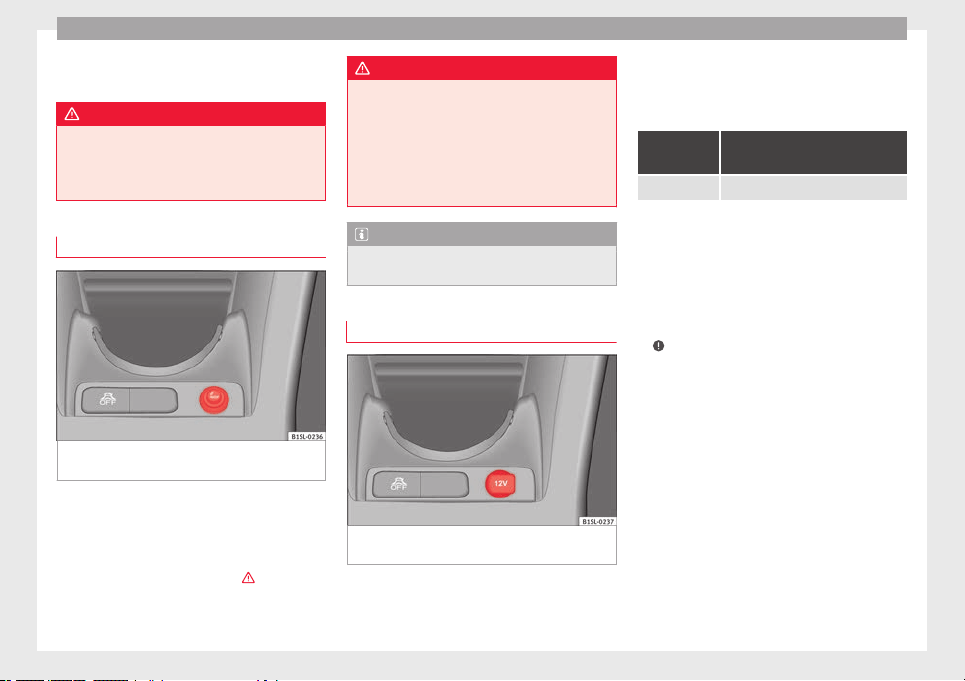
Operation
●
After emptying the ashtray, insert it into the
drink holder from above.
WARNING
Incorrect use of the ashtray may cause a fire
or burns and other serious injuries.
●
Never put paper or other flammable objects
in the ashtray.
Cigarette lighter*
Fig. 67 In the front part of the centre console:
lighter
●
Push the button on the cigarette lighter in-
ward with the ignition on ››› Fig. 67
.
●
W
ait
for the lighter to pop out slightly.
●
Pull out the cigarette lighter and light the
cigarette on the glowing coil ›››
.
●
Replace the cigarette lighter in its insert.
WARNING
Undue use of the cigarette lighter may cause
a fire or burns and other serious injuries.
●
The cigarette lighter must only be used to
light cigarettes or similar.
●
Never leave children unsupervised in the
vehicle. The cigarette lighter can be used
when the ignition is switched on.
Note
The cigarette lighter can also be used with
the 12 Volt socket.
Power socket*
Fig. 68 Front centre console: 12 Volt socket in
the storage compartment
Electrical equipment can be connected to the
socket in the vehicle.
All connected appliances should be in per-
fect working order without any faults.
Maximum power consumption
Power sock-
et
Maximum power consumption
12 Volts 120 Watts
The maximum capacity of the socket must
not be exceeded. The power consumption is
indicated on the rating plate of each appli-
ance.
Where 2 or more appliances are connected at
the same time, the total rating of all the con-
nected devices must never exceed 190 Watts
›››
.
12 volt power socket
The 12 volt socket is found in the storage
compartment at the front of the centre con-
sole
›››
Fig. 68
and only functions when the
ignition i
s
switched on.
Using electrical appliances with the engine
stopped and the ignition switched on will
drain the battery. Therefore, electrical devi-
ces connected to the power socket can only
be used when the engine is running.
To prevent voltage variations from causing
damage, switch off the electrical device con-
nected to the 12 Volt power socket before
72
Transport and practical equipment
switching the ignition on or off and before
starting the engine.
WARNING
Improper use of the socket or electrical devi-
ces could lead to a fire and cause serious in-
juries.
●
Never leave children unsupervised in the
vehicle. The socket and equipment connected
to it can be used when the ignition is switch-
ed on.
●
Should a connected electrical device over-
heat, switch it off and unplug it immediately.
CAUTION
●
Always follow the operating instructions for
the appliances to be connected!
●
Never exceed the maximum power rating as
this could damage the vehicle's general elec-
trical system.
●
12 volt power socket:
–
Only use accessories with approved elec-
tromagnetic compatibility according to
current regulations.
–
Never power the socket.
CAUTION
●
To avoid damage to the vehicle's electrical
system, never connect equipment that gener-
ates electrical current, such as solar panels
or battery chargers, to the 12 Volt power
sockets in order to charge the vehicle's bat-
tery.
●
Only use accessories with approved elec-
tromagnetic compatibility according to cur-
rent regulations.
●
To avoid damage due to voltage variations,
switch off all devices connected to the 12 V
socket before switching the ignition on or off
and before starting the engine.
●
Never connect an appliance to the 12 Volt
power socket that consumes more than the
power indicated in watts. Exceeding the max-
imum power absorption could damage the ve-
hicle's electrical system.
For the sake of the environment
Do not leave the engine running when the ve-
hicle is at a standstill.
Note
●
Using devices with the engine stopped and
the ignition switched on will drain the bat-
tery.
●
Unshielded equipment can cause interfer-
ence on the radio equipment and the vehi-
cle's electrical system.
●
If electrical equipment is used near an aer-
ial, you may observe interference in the re-
ception of AM stations.
Loading luggage compartment
Introduction
Always transport heavy loads in the luggage
compartment and place the seat backs in a
vertical position. Never overload the vehicle.
Both the carrying capacity as well as the dis-
tribution of the load in the vehicle have ef-
fects on the driving behaviour and braking
ability ››› .
WARNING
When the vehicle is not in use or being
watched, always lock the doors and the rear
lid to reduce the risk of serious injury or
death.
●
Do not leave children unwatched, especial-
ly when the boot is open. Children could
climb into the luggage compartment, close
the rear lid from inside and be unable to es-
cape themselves. This could lead to serious
injury or death.
●
Never allow children to play in or around
the vehicle.
●
Never transport people in the luggage com-
partment.
WARNING
Unsecured or incorrectly secured objects can
cause serious injury in case of a sudden ma-
noeuvring or breaking or in case of an acci-
dent. This is especially true when objects are
»
73
Technical specifications
AdviceOperationSafety
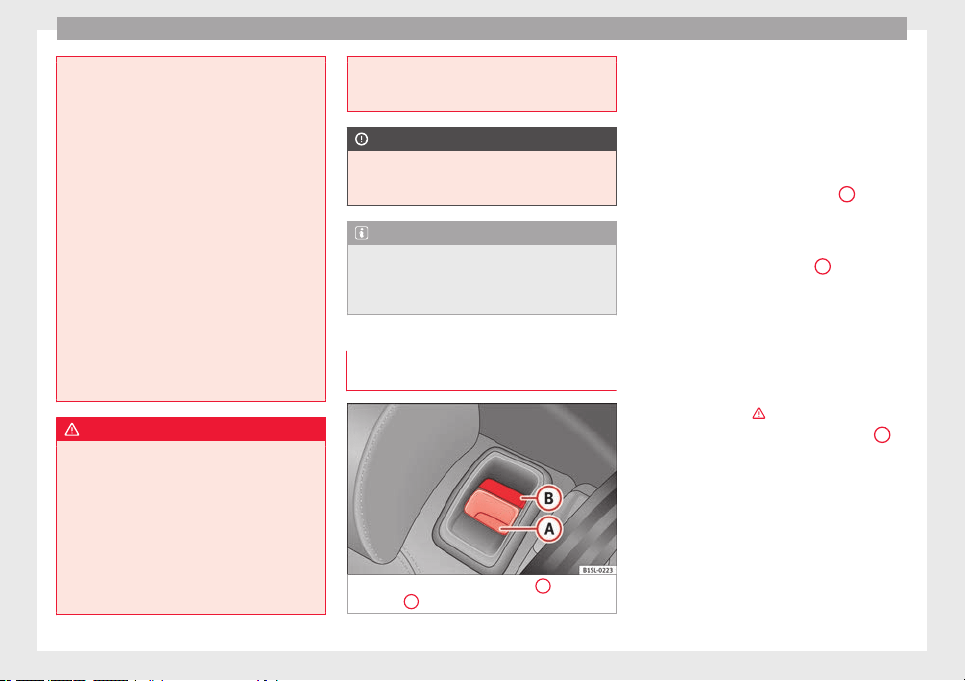
Operation
struck by a detonating airbag and fired
through the vehicle interior. To reduce the
risks, please note the following:
●
Secure all objects in the vehicle. Always
place equipment and heavy objects in the
boot.
●
Always secure objects to the fastening
rings with suitable rope or straps to prevent
them from being thrown around the interior
and moving to the airbag deployment area in
the event of sudden movements or accidents.
●
While driving, always keep object compart-
ments closed.
●
Do not place hard, heavy or sharp objects
inside the vehicle interior, in open storage
compartments, the rear shelf or on the dash
panel.
●
Remove hard, heavy and sharp objects from
clothes and pockets inside the vehicle and
store securely.
WARNING
The transport of heavy object changes vehi-
cle handling and increases braking distance.
Heavy loads that have not been stored or se-
cured correctly could cause loss of control
and result in serious injury.
●
Vehicle handling changes when transport-
ing heavy objects due to a change in the cen-
tre of gravity.
●
Distribute the load as uniformly and as low
down on the vehicle as possible.
●
Store heavy objects in the luggage com-
partment as far from the rear axle as possi-
ble.
CAUTION
Hard objects on the rear shelf could chafe
against the wires of the heating element in
the heated rear window and cause damage.
Note
The ventilating slits between the heated rear
window and the rear shelf must not be cov-
ered so that used air can escape from the ve-
hicle.
Folding and lifting up the rear seat
bench backrest
Fig. 69 Rear seat: unlock button
A
; red
marking
B
The rear seat backrest can be folded forward
to extend the luggage compartment.
Folding the rear seat backrest forwards
●
Push the head restraint down as far as it
will go or remove it if necessary ››› page 6 and
store it in a safe place.
●
Pull the unlock switch ››› Fig. 69
A
for-
wards whilst simultaneously lifting the rear
seat backrest.
●
The rear seat backrest is not engaged when
the red marking of the button
B
is visible.
●
If the rear seat backrest is folded, people
(including children) are not permitted to trav-
el in the rear folded seats.
Folding up the rear seat backrest
●
Lift back the backrest of the rear seat and
push it firmly into the lock until it clicks se-
curely into place ››› .
●
The red marking on the unlock button
B
must not be seen.
●
Make sure that the backrest of the rear seat
is securely locked in position so that the seat
belts can provide proper protection in the
rear seats.
●
If necessary, reinstall and readjust the head
restraints
›››
page 64
.
74
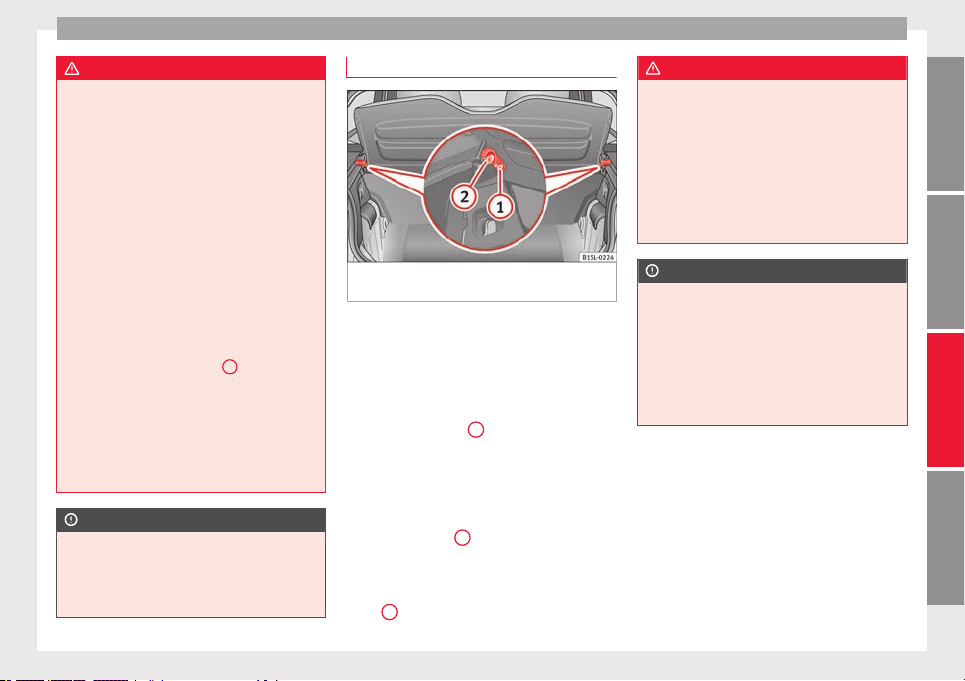
Transport and practical equipment
WARNING
Folding and lifting the backrests of the rear
seats carelessly without paying attention
could cause serious injury.
●
Never fold or lift the seats while driving.
●
Do no trap or damage seat belts when rais-
ing the seat backrest.
●
Keep hands, fingers, feet and other limbs
away from the range of the rear seat backr-
ests when folding and lifting them.
●
All seat backrests must engage correctly for
the seat belts on the rear seats to work prop-
erly. When the backrest of an occupied seat is
not correctly locked in place, the passenger
can be thrust forward with the rear seat back-
rest in case of sudden braking, sudden ma-
noeuvres or an accident.
●
A red signal on the button
B
warns that
the backrest is not engaged. Always check to
make sure that the red mark is not visible
when the backrest of the rear seat is in the
upright position.
●
No seat must be occupied if the backrest of
the rear seat is folded or not correctly engag-
ed.
CAUTION
Before folding the rear seat backrest, adjust
the front seats so that neither the head re-
straint or backrest hit them when folded. If
necessary, remove the head restraints
››› page 64 and store them safely.
Rear shelf*
Fig. 70 In the luggage compartment: remov-
ing and installing the rear shelf
You may put light items of clothing on the
rear shelf. Check that the rear view is not limi-
ted.
Lifting up the rear shelf
Lift up the rear shelf and secure it into the
side locks
›››
Fig. 70
1
. Check that it is prop-
erly engaged. To lower the rear shelf, press it
until it is released from the locks.
Removing the shelf
Pull the rear shelf upward, removing it from
the side supports
2
.
Lifting up the rear shelf
Press the rear shelf down into the side sup-
ports
2
.
WARNING
Unsecured or incorrectly secured objects or
animals on the rear shelf could cause serious
injuries in case of a sudden manoeuvre, sud-
den braking or an accident.
●
Do not leave hard, heavy or sharp objects
(loose or in bags) on the rear shelf.
●
Never transport animals on the rear shelf.
●
Never drive with the rear shelf raised. Al-
ways lower it or remove it before the journey.
CAUTION
To prevent the rear shelf from being dam-
aged:
●
Always check that the side supports are
firmly engaged.
●
Regulate the height of the load in the lug-
gage compartment to ensure the rear shelf
does not press down on the load with the rear
lid closed.
75
Technical specifications
AdviceOperationSafety
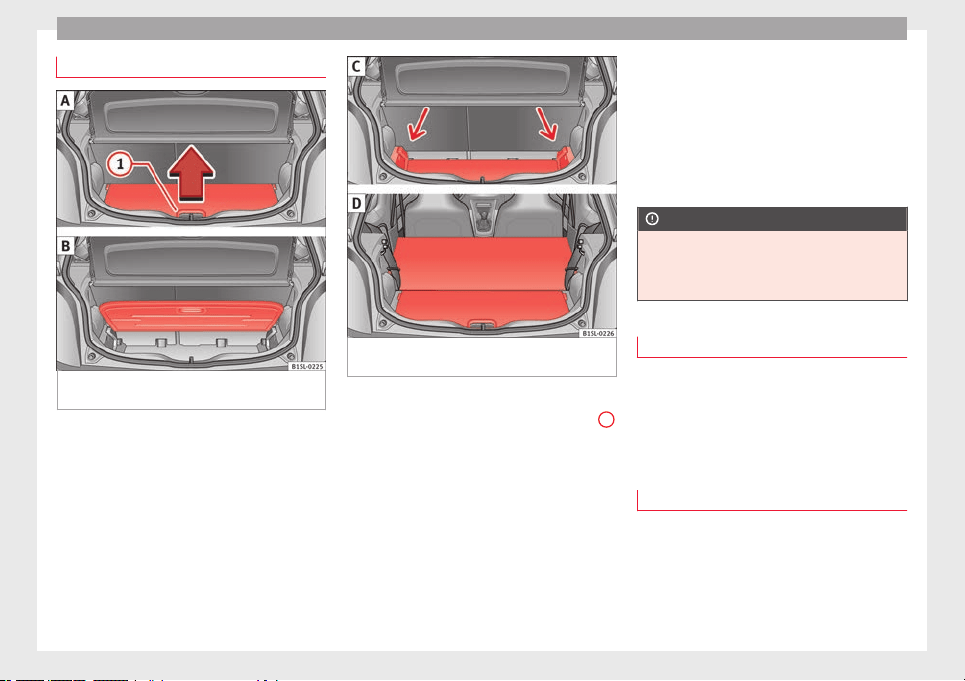
Operation
Boot variable floor
Fig. 71 A: open the boot variable floor. B:
raised boot variable floor.
Fig. 72 C: extend the boot downward. D: ex-
tend the boot forward.
Raise and lower the boot floor
●
To
raise
the floor, raise handle
›
››
Fig. 71
1
in the direction of the arrow and pull from the
floor all the way up
›››
Fig. 71
B
.
●
To lower it, guide the floor downward.
Extend the boot downward
●
Raise the boot floor and push it downward
in the rail
›››
Fig. 72 C (arrows)
●
Place the variable floor over the floor lining.
●
If necessary, fold the backrest of the rear
seat forward
›››
page 74.
Extending the luggage compartment forward
●
Disassemble the luggage compartment tray
››› page 75.
●
Disassemble the rear headrests ››› page 6.
●
Fold the backrest of the rear seat forward
››› page 74.
●
If necessary, expand the boot downward.
CAUTION
Do not let the boot floor fall when closing it.
Always carefully guide it downward in a con-
trolled manner. Otherwise, the lining and the
floor of the boot could be damaged.
Class N1 (commercial) vehicles
For safe vehicle operation, the electrical sys-
tem must work perfectly. Special attention
should be paid so it is not damaged during
adjustment, loading and unloading of trans-
ported objects.
Fastening rings*
In the front part of the luggage compartment,
there may be fastening rings to secure the
luggage.
In order to use the fastening rings, they must
be lifted beforehand.
76
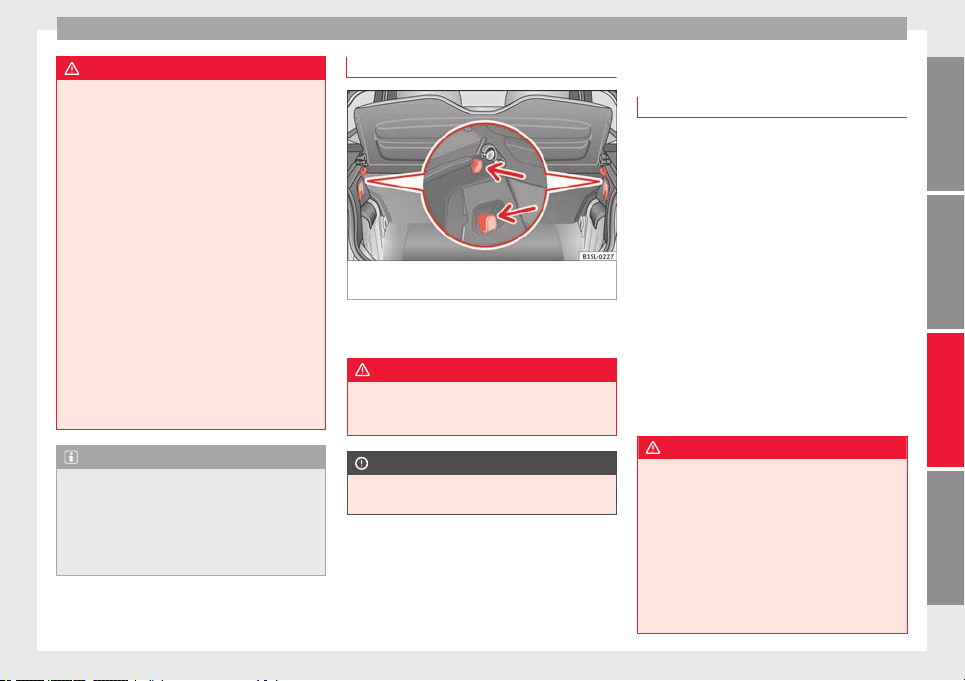
Transport and practical equipment
WARNING
If unsuitable or damaged belts or retaining
straps are used, they may break in the event
of braking or an accident. Objects could then
be launched across the passenger compart-
ment and cause serious or fatal injuries.
●
It is important to always use belts or retain-
ing straps that are suitable and in a good
condition.
●
Belts and retaining straps should be se-
curely fastened to the fastening rings.
●
Objects in the luggage compartment that
are unsecured could move suddenly and mod-
ify the handling of the vehicle.
●
Small light objects should also be fixed in
place.
●
The maximum tensile load of the fastening
ring for securing objects should never be ex-
ceeded.
●
A child seat should never be secured with
the fastening rings.
Note
●
The maximum tensile load that the fasten-
ing rings can support is 3.5 kN.
●
Belts and securing systems for the appro-
priate load can be obtained from specialised
dealerships. SEAT recommends visiting a
SEAT dealership for this.
Retaining hooks
Fig. 73 In the luggage compartment: retain-
ing hooks
There may be hooks in the upper left and
right part of the luggage compartment.
WARNING
Never use these hooks to secure objects. In
case of sudden braking or an accident, they
could rupture.
CAUTION
The hooks can support a maximum of 2.5 kg
each.
Roof carrier system
Introduction
The vehicle roof has been designed to opti-
mise aerodynamics. For this reason, conven-
tional roof carrier systems cannot be secured
to the water drains.
Given that the water drains have been incor-
porated into the roof for aerodynamic rea-
sons, only the SEAT approved basic supports
and roof carrier systems can be used.
When the roof carrier system should be
removed:
●
When they are not used.
●
When the vehicle is being washed in a car
wash.
●
When the vehicle height exceeds the maxi-
mum height, for example, in some garages.
WARNING
The risk of an accident is increased by trans-
porting heavy or bulky loads on the roof,
which affects the car's handling by shifting
the centre of gravity and increasing suscepti-
bility to cross winds.
●
Always secure loads correctly with suitable
and undamaged attachment rope or straps.
●
Large, heavy, wide and flat loads negatively
affect the vehicle aerodynamics, centre of
gravity and handling.
»
77
Technical specifications
AdviceOperationSafety
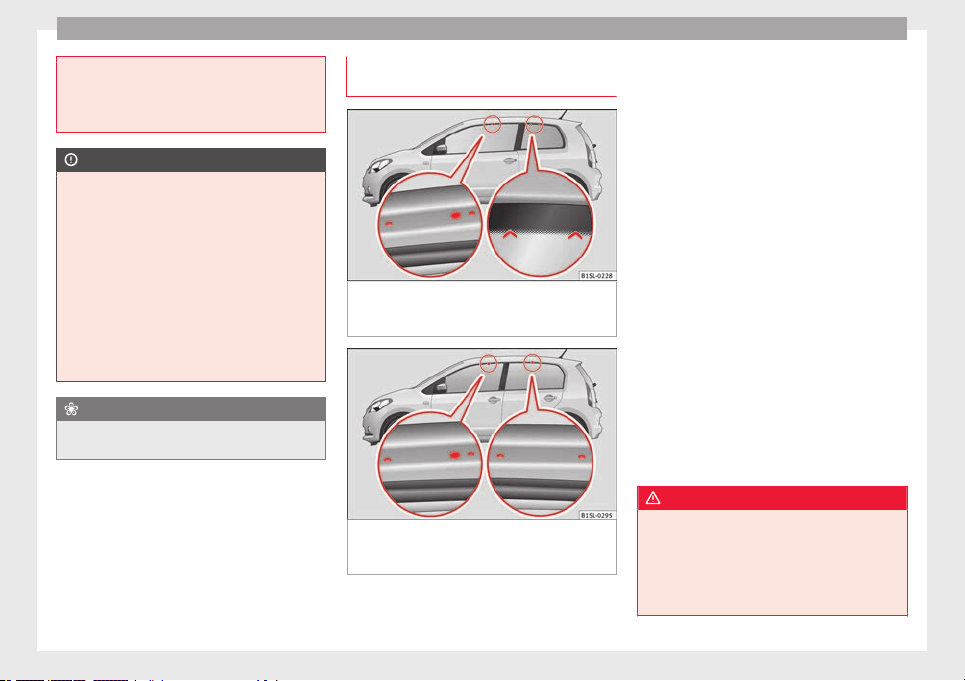
Operation
●
Avoid brusque manoeuvres and sudden
braking.
●
Adjust your speed and driving style to visi-
bility, road, traffic and weather conditions.
CAUTION
●
Always remove the roof carrier system from
the roof before entering a car wash.
●
The height of your vehicle is changed by
the installation of the roof carrier and the
load secured on it. Compare the vehicle
height with the passage height, for example
in underground car parks or for garage doors.
●
The roof antenna and the range of the rear
lid should not be affected by the roof carrier
system or the load being transported.
●
Take extra care not to let the hatch strike
the roof load when opening.
For the sake of the environment
The vehicle uses more fuel when the roof car-
rier system is fitted.
Securing the base supports and roof
carrier system
Fig. 74 Attachment points for the basic sup-
ports and the roof carrier system in two-door
vehicles.
Fig. 75 Attachment points for the basic sup-
ports and the roof carrier system in four-door
vehicles.
The mounts are the basis of a complete roof
carrier system. Special fixtures must be add-
ed in order to safely transport luggage, bicy-
cles, skis, surf boards or boats on the roof.
The suitable accessories can be acquired at
SEAT dealerships.
Securing the base supports and roof carrier
system
The roof carrier system must always be instal-
led exactly according to the instructions pro-
vided.
Two-door vehicles: the holes and marks indi-
cating the fitting points for base front sup-
ports are in the lower half of the roof struts
››› Fig. 74
(enlarged left image). The holes
and m
ark
s are only seen with the door open.
The fitting marks for base rear supports are in
the upper half of the windows ››› Fig. 74 (en-
larged right image).
Four-door vehicles: the holes or marks indi-
cating the fitting points for base supports are
in the lower half of the roof struts and can on-
ly be seen with the door open ››› Fig. 75.
The base support should only be fitted to the
points indicated in the diagram.
WARNING
If the base supports and the roof carrier sys-
tem are incorrectly fitted or used in an unsuit-
able manner, the entire system could break
free causing accident and injury.
●
Always take the manufacturer assembly in-
structions into account.
78
Transport and practical equipment
●
Only use base supports and roof carrier
systems that are not damaged and are cor-
rectly fitted.
●
The base support should only be fitted to
the points indicated in the diagram ››› Fig. 74.
●
Secur
e the base supports and roof carrier
system correctly.
●
Check the screws and attachments before
driving and after a short distance. During
each long journey, check the attachments
during every break.
●
Always fit the roof carrier system correctly
for wheels, skis and surfboards, etc.
●
Never modify or repair the basic supports
or roof carrier system.
Note
Read and take into account the instructions
included with the roof carrier system fitted
and keep them in the vehicle.
Loading the roof carrier system
Loads can only be correctly secured when the
roof carrier system is correctly fitted ››› .
Maximum authorised roof load
The maximum authorised roof load is 50 kg
.
The r
oof
load includes the weight of the base
support, the roof carrier system and the load
being transported ›››
.
Always check the weight of the base support,
the roof carrier system and the weight of the
load to be transported and, if necessary,
weigh them. Never exceed the maximum au-
thorised roof load.
If you are using a roof carrier with a lower
weight rating, you cannot transport the maxi-
mum roof load. Do not exceed the maximum
weight limit for the roof carrier given in the
fitting instructions.
Distributing a load
Uniformly distribute loads and secure them
correctly ››› .
Check attachments
After fitting the base supports and the roof
carrier system, always check the attachments
after a short trip and at regular intervals.
WARNING
Exceeding the maximum authorised roof load
can result in accidents and/or vehicle dam-
age.
●
Never surpass the maximum authorised
weight for the roof, the maximum authorised
weight on the axles and the total maximum
authorised weight of the vehicle.
●
Never exceed the capacity of the roof carri-
er system even if this is less than the maxi-
mum authorised roof load.
●
Secure heavy items as far forward as possi-
ble and distribute the vehicle load uniformly.
WARNING
Loose and incorrectly secured loads can fall
from the roof carrier system causing acci-
dents and injury.
●
Always use suitable ropes and straps in
good condition.
●
Always secure loads correctly.
79
Technical specifications
AdviceOperationSafety
Operation
Air conditioning
Heating, ventilation and air
conditioning system
Introduction
Dust and pollen filter
The dust and pollen filter with its activated
charcoal cartridge serves as a barrier against
impurities in the interior ambient air.
For the air conditioner to work with maximum
efficiency, the dust and pollen filter must be
replaced at the intervals specified in the
Maintenance Programme.
If the filter loses efficiency prematurely due
to use in areas with very high levels of air
pollution, the filter must be changed more
frequently than stated in the Service Sched-
ule.
WARNING
Reduced visibility through the windows in-
creases the risk of serious accidents.
●
Ensure that all windows are free of ice and
snow and that they are not fogged up pre-
venting a clear view of everything outside.
●
The maximum heat output required to de-
frost windows as quickly as possible is only
available when the engine has reached its
normal running temperature. Only drive when
you have good visibility.
●
Always ensure that you use the heating
system, ventilation, air conditioner and the
heated rear window to maintain good visibili-
ty.
●
Never leave the air recirculation on for a
long period of time. If the cooling system is
switched off and air recirculation mode
switched on, the windows can mist over very
quickly, considerably limiting visibility.
●
Switch air recirculation mode off when it is
not required.
WARNING
Stuffy or used air will increase fatigue and re-
duce driver concentration possibly resulting
in a serious accident.
●
Never leave the fresh air fan turned off or
use the air recirculation for long periods of
time; the air in the vehicle interior will not be
refreshed.
CAUTION
●
Switch the air conditioner off if you think it
may be broken. This will avoid additional
damage. Have the air conditioner checked by
a specialised workshop.
●
Repairs to the air conditioner require spe-
cialist knowledge and special tools. SEAT rec-
ommends taking your car in for technical
service.
Note
●
When the cooling system is turned off, air
coming from the outside will not be dried. To
avoid fogging up the windows, SEAT recom-
mends leaving the cooler (compressor) on. To
do this, press the
A/C
button. The button
lamp should light up.
●
The maximum heat output required to de-
frost windows as quickly as possible is only
available when the engine has reached its
normal running temperature.
●
Keep the air intake slots in front of the
windscreen free of snow, ice and leaves to en-
sure heating and cooling are not impaired,
and to prevent the windows from misting
over.
80
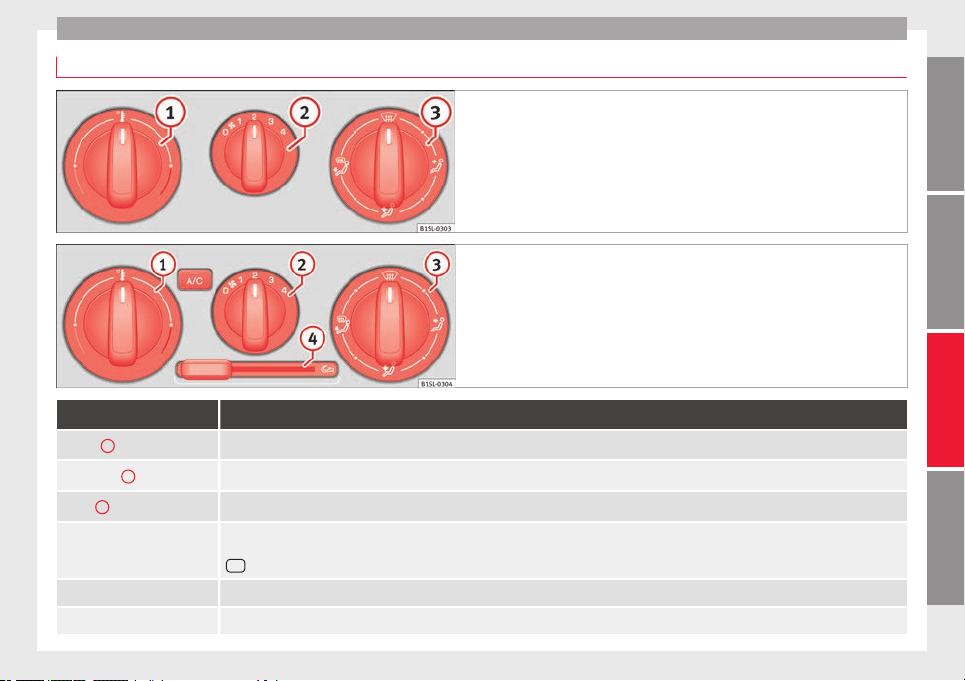
Air conditioning
Controls
Fig. 76 In the centre console: Heating and ventilation system rotary control
Fig. 77 In the centre console: Air conditioning system controls
Control button
Additional information. Heating and ventilation system ››› Fig. 76 and air conditioning system ››› Fig. 77.
1
Temperature
Rotate the control to adjust the temperature accordingly.
2
Fan
Setting 0: fan and manual air conditioning switched off. Setting 4: maximum fan level.
3
Air distribution
Rotate the continuous control to direct the airflow to the desired area.
Heating and ventilation system: defrost function. Distribution of air to the windscreen and the side windows in the exterior rear vision mirror area.
Air conditioning system: defrost function. Distribution of air to the windscreen and the side windows in the exterior rear vision mirror area. Press the
A/C
button, increase the fan speed and switch on air recirculation ››› page 84 to clear the windscreen of condensation as soon as possible.
Air distribution towards the body.
Air distribution towards the footwell.
»
81
Technical specifications
AdviceOperationSafety
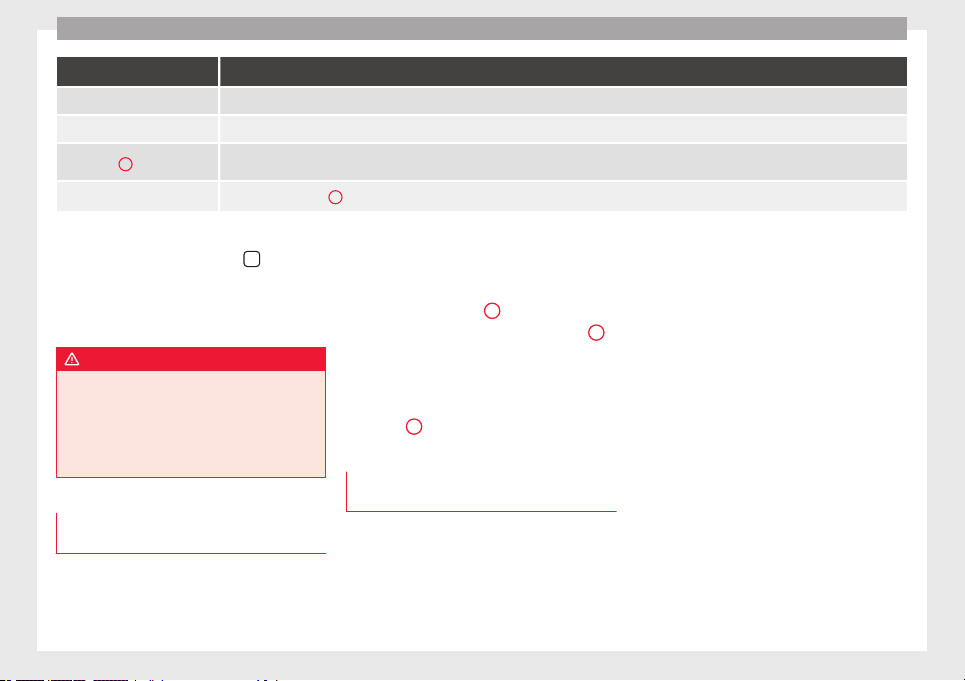
Operation
Control button
Additional information. Heating and ventilation system ››› Fig. 76 and air conditioning system ››› Fig. 77.
Air distribution towards the windscreen and the footwell.
Air conditioner: press the button to turn off/on the cooling system ››› page 82.
4
Air conditioner: sliding control for air recirculation ››› page 84.
Switching off
Turn the air fan switch
2
to position 0.
Heated rear window
The heated rear window button
is located
on the centre console. The heated rear win-
dow only works when the engine is running
and switches off automatically after a maxi-
mum of 10 minutes.
WARNING
Never turn off the air fan for a long time or the
air in the vehicle interior will not be refresh-
ed.
●
Stuffy or used air will increase fatigue and
reduce driver and passenger concentration
possibly resulting in a serious accident.
Heating and ventilation system user
instructions
Temperature
The desired temperature for the interior can-
not be lower than that of the exterior air tem-
perature, as the heating and fresh air system
cannot cool or dehumidify the air.
Setting for conditions of optimal visibility
●
Set the fan ››› Fig. 76
2
to setting 1 or 2.
●
Turn the temperature control ››› Fig. 76
1
to the centre position.
●
Open and direct the air outlets in the dash
panel ››› page 83.
●
Turn the air di
stribution control
››› Fig. 76
3
to the required position.
User instructions for the air
conditioner*
The interior cooling system only works when
the engine is running and the fan is switched
on.
The air conditioning operates most effective-
ly with the windows closed. However, if the
vehicle has heated up after standing in the
sun for some time, the air inside can be
cooled more quickly by opening the windows
briefly.
Setting for conditions of optimal visibility
When the air conditioning is switched on, the
temperature and the air humidity in the vehi-
cle interior drop. In this way, when the out-
side air humidity is high, the windows do not
mist over and comfort for the vehicle occu-
pants is improved.
●
Disable air recirculation mode
››› page 84.
●
Set the f
an to the required setting.
●
Turn the temperature control to the centre
position.
●
Open and direct the air outlets in the dash
panel ››› page 83.
●
Turn the air distribution control to the de-
frost position.
82
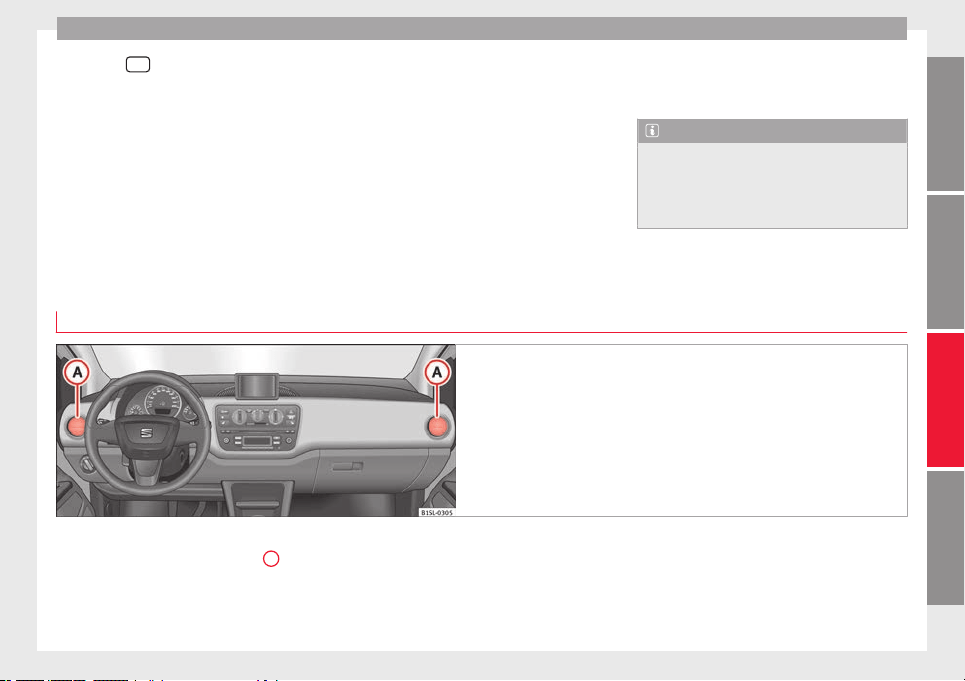
Air conditioning
●
Press the
A/C
button to switch it on. The in-
dicator on the button will light up.
The cooling system does not switch on
If the air conditioning system cannot be
switched on, this may be caused by the fol-
lowing:
●
The engine is not running.
●
The fan is switched off.
●
The air conditioner fuse has blown.
●
The outside temperature is lower than ap-
proximately +2 °C (+36 °F).
●
The air conditioner compressor has been
temporarily switched off because the engine
coolant temperature is too high.
●
Another fault in the vehicle. Have the air
conditioner checked by a specialised work-
shop.
Things to note
If the humidity and temperature outside the
vehicle are high,
condensation
can drip off
the ev
aporator in the cooling system and
form a pool underneath the vehicle. This is
normal and does not indicate a leak!
Note
After starting it, any residual humidity in the
air conditioner could mist over the wind-
screen. Switch on the defrost function as
soon as possible to clear the windscreen of
condensation.
Air vents
Fig. 78 Dash panel: Air vents
Air vents
Never close the air vents ››› Fig. 78
A
com-
pletely to ensure heating, cooling and venti-
lation inside the vehicle.
●
To open the air vents press the recess with
one slat.
●
Change the air direction by turning the
slats.
●
To close the air vents, fold the slats.
There are additional air vents in the centre of
the dash panel and in the footwell area.
»
83
Technical specifications
AdviceOperationSafety
Operation
CAUTION
Never place food, medicines or other heat-
sensitive objects close to the air vents. Being
heat-sensitive, they may be damaged or
made unsuitable for use by the air coming
from the air vents.
Air recirculation
Important
Air recirculation mode prevents the ambient
air from entering the interior.
When the outside temperature is very high or
very low, selecting manual air recirculation
mode for a short period refreshes or heats
the interior more quickly.
●
Switch off air recirculation mode by turning
the air distribution control to the
›››
po-
sition.
Switching the air recirculation mode on and
off
Switching on:
Move the sliding control
›
›
›
Fig. 77
4
to the right to maximum.
Switching off:
Move the sliding control
›
›
›
Fig. 77
4
to the left to maximum.
WARNING
Stuffy or used air will increase fatigue and re-
duce driver concentration possibly resulting
in a serious accident.
●
Never use recirculation mode for long peri-
ods as it does not refresh the air inside the
vehicle.
●
If the cooling system is switched off and air
recirculation mode switched on, the windows
can mist over very quickly, considerably limit-
ing visibility.
●
Switch air recirculation mode off when it is
not required.
CAUTION
Do not smoke when the air recirculation is ac-
tivated. The smoke taken in could lie on the
cooling system vaporiser and on the dust and
pollen filter, leading to a permanently un-
pleasant smell.
Driving
Steering
Introduction
The power steering* is not hydraulic but elec-
tromechanical. The advantage of this steer-
ing system is that it disposes of hydraulic
tubes, hydraulic oil, the pump, filter and oth-
er components. The electromechanical sys-
tem saves fuel. While a hydraulic system re-
quires oil pressure to be maintained, electro-
mechanical steering only requires energy
when the steering wheel is turned.
With the power steering system, the assisted
steering function automatically adjusts ac-
cording to the vehicle speed, the steering tor-
que and the wheel turning angle. The power
steering only works when the engine is run-
ning.
WARNING
If the power steering is not working then the
steering wheel is much more difficult to turn
and the vehicle more difficult to control.
●
The power steering only works when the
engine is running.
●
Never allow the vehicle to move when the
engine is switched off.
●
Never remove the key from the ignition if
the vehicle is in motion. The steering may
84
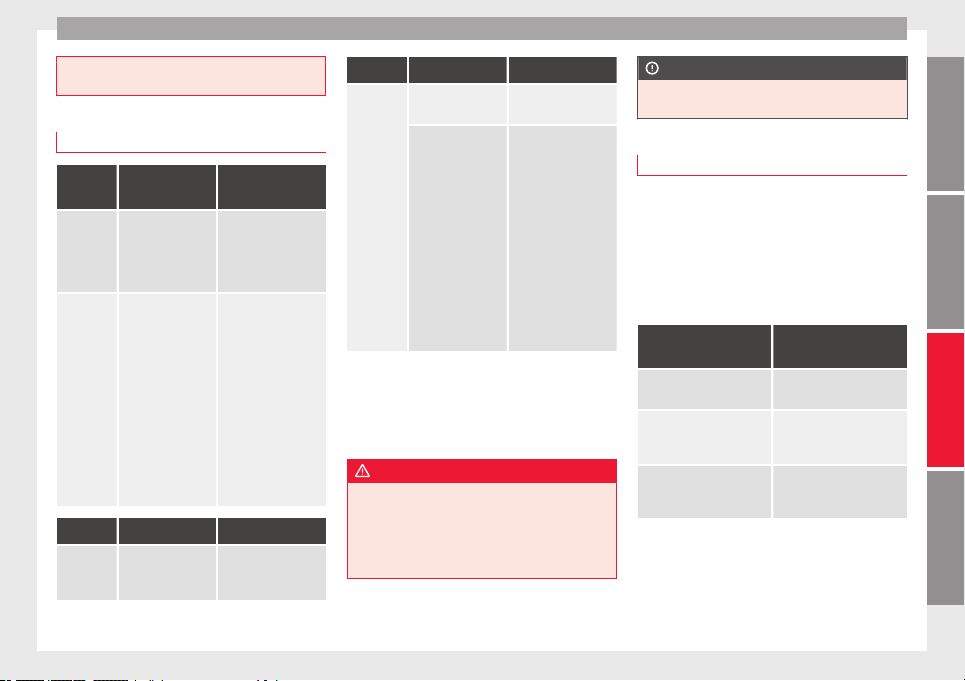
Driving
lock and it will not be possible to turn the
steering wheel.
Control and warning lamps
It lights
up
Possible cause Solution
(red)
Power steering
faulty.
The steering system
should be checked
by a specialised
workshop as soon as
possible.
(yellow)
Power steering op-
eration reduced.
The steering system
should be checked
by a specialised
workshop as soon as
possible.
If, after restarting the
engine and driving
for a short distance,
the yellow warning
lamp no longer
comes on, it will not
be necessary to take
the vehicle to a spe-
cialised workshop.
Flashes Possible cause Solution
(red)
Fault in the steer-
ing column elec-
tronic lock.
Do not drive on!
Seek professional
advice.
Flashes Possible cause Solution
(yellow)
Steering column
deviation.
Gently turn the steer-
ing wheel to and fro.
Steering wheel not
unlocked or
locked.
Remove the key from
the ignition and then
switch the ignition
back on. If necessa-
ry, check the mes-
sages displayed on
the instrument panel
display.
Do not drive on, if
the steering column
remains locked after
the ignition has
been switched on.
Seek specialist as-
sistance.
Several warning and control lamps light up
for a few seconds when the ignition is switch-
ed on, signalling that the function is being
verified. They will switch off after a few sec-
onds.
WARNING
If the warning lamps are ignored, the vehicle
may stall in traffic, or may cause accidents
and severe injuries.
●
Never ignore the warning lamps.
●
Stop the vehicle safely as soon as possible.
CAUTION
Failure to heed the warning lamps when they
appear may result in faults in the vehicle.
Information on the steering
To prevent theft, we recommend you lock the
steering before leaving the vehicle.
Mechanical steering lock
Lock the steering column by removing the
key from the ignition when the vehicle is
stopped.
Please engage steer-
ing lock
Unlocking the steering
Parking the vehicle
››› page 89.
Insert the key in the igni-
tion lock.
Remove the key from the
ignition.
Turn the steering wheel
slightly to release the
steering lock.
Turn the steering wheel
slightly until you hear the
steering lock.
Hold the steering wheel in
this position and switch
on the ignition.
Electromechanical power steering
With the power steering system, the assisted
steering function automatically adjusts ac-
cording to the vehicle speed, the steering tor-
que and the wheel turning angle. The power
»
85
Technical specifications
AdviceOperationSafety
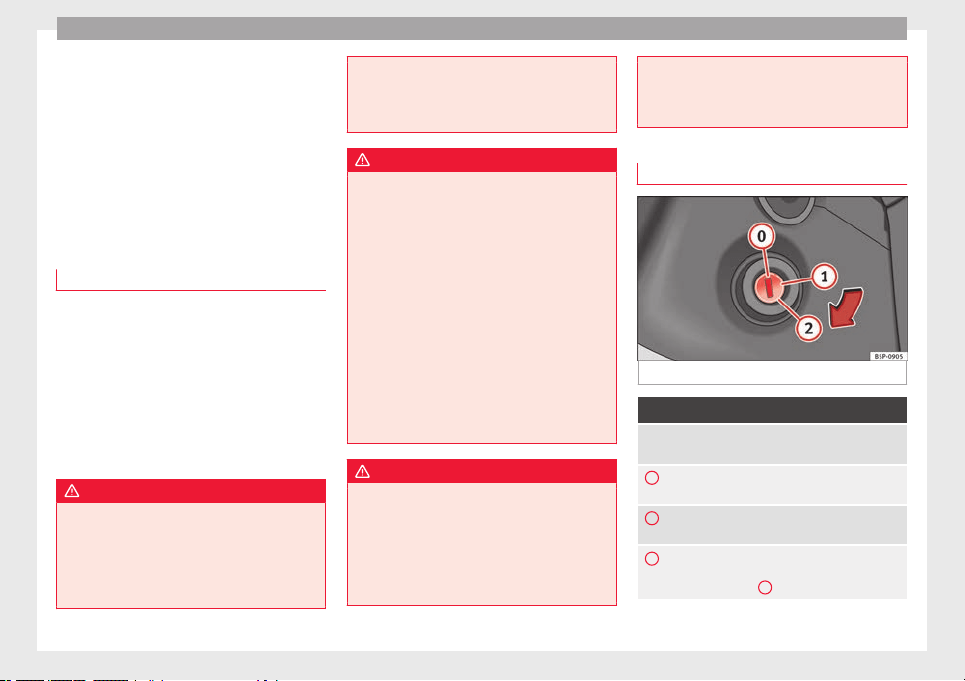
Operation
steering only works when the engine is run-
ning.
You should remember that you will need con-
siderably more power than normal to steer
the vehicle if the power steering is not work-
ing correctly or not at all.
Stopping and starting the
engine
Introduction
Immobiliser display
When an invalid key is used or in the event of
a system fault, is displayed on the instru-
ment panel. The engine cannot be started.
Pushing or towing
For technical reasons, the vehicle must not
be push- or tow-started. Jump starting is pref-
erable.
WARNING
Switching off the engine while driving makes
stopping the vehicle difficult. As a conse-
quence you may lose control of the vehicle
and there is a risk of serious accident.
●
The assisted braking and steering systems,
the airbag system, seat belts and certain
safety equipment are only active while the
engine is running.
●
The engine should only be switched off
when the vehicle is at a standstill.
WARNING
While the engine is running or starting it
could help reduce the risk of serious injury.
●
Never start or leave the engine running in
poorly ventilated or closed spaces. Exhaust
gas contains carbon monoxide, a toxic, col-
ourless and odourless gas. Carbon monoxide
can cause people to lose consciousness. It
can also cause death.
●
Never leave the vehicle unattended if the
engine is running. The vehicle could move off
suddenly or something unexpected could
happen resulting in damage and serious in-
jury.
●
Never use start boosters. Cold start sprays
could explode or increase the engine speed
unexpectedly.
WARNING
The components of the exhaust system reach
very high temperatures. This could cause a
fire and considerable damage.
●
Always park your vehicle so that no part of
the exhaust system can come in contact with
flammable materials (such as wood, leaves,
spilled fuel, dried grass, etc).
●
Never apply additional underseal or anti-
corrosion coatings to the exhaust pipes, cata-
lytic converter or the heat shields on the ex-
haust system.
Ignition lock
Fig. 79 Vehicle key positions
Car keys ››› Fig. 79
No key in the ignition lock: The steering lock may
be activated.
0
Ignition switched off. Key can be removed from
the vehicle.
1
Ignition is switched on. The steering lock can be
unlocked.
2
Switch on the engine. Release the key when the
engine has started. When it is released, the key
returns to position
1
.
86
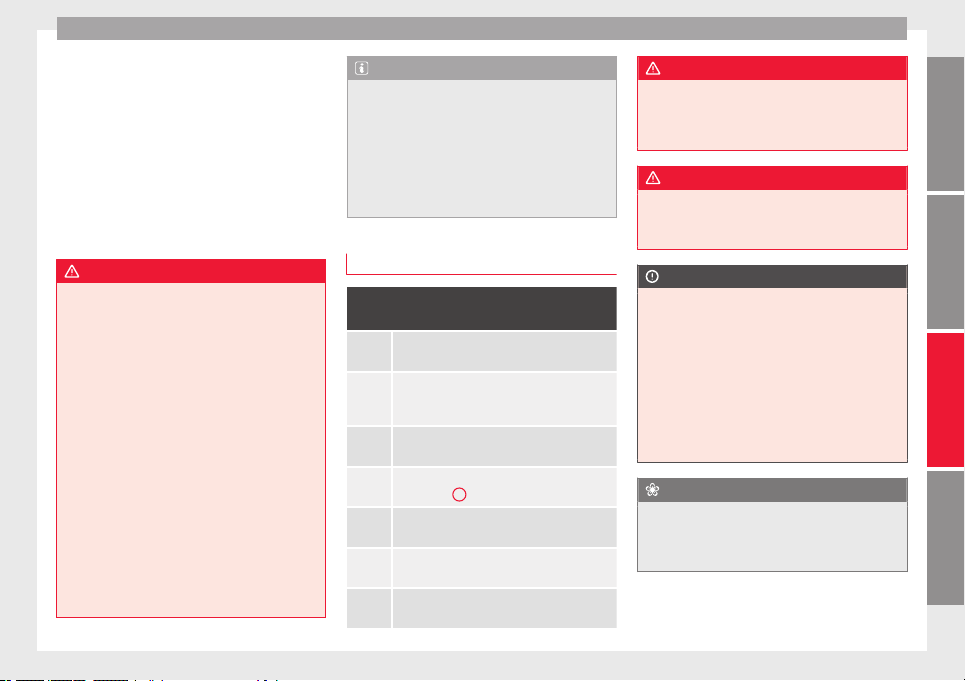
Driving
Key not authorised for the vehicle
If a key which is not authorised for this vehi-
cle is inserted in the ignition lock, it can be
removed as follows:
●
Automatic gearbox: the key cannot be re-
moved from the ignition lock. Press and re-
lease the selector lever locking button. Key
can be removed from the vehicle.
●
Manual gearbox
: Remove the key from the
ignition.
WARNING
Unsuitable or careless use of the vehicle key
could result in serious injury.
●
Always take all the keys with you whenever
you leave the vehicle. If not, the engine could
accidentally be started and electrical equip-
ment such as the windows could accidentally
be operated resulting in serious injury.
●
Never leave children or disabled people
alone in the car. Passengers could be trapped
in the car in an emergency and not be able to
get themselves to safety. For example, de-
pending on the time of the year, tempera-
tures inside a locked and closed vehicle can
be extremely high or extremely low resulting
in serious injuries and illness or even death,
particularly for young children.
●
Never remove the key from the ignition if
the vehicle is in motion. The steering may
lock and it will not be possible to turn the
steering wheel.
Note
●
If the key is left in the ignition lock with the
engine off for long periods, the vehicle bat-
tery will run flat.
●
For automatic gearbox vehicles the key can
only be removed from the ignition lock if the
gear selector lever is in position P. In this
case, press and release the selector lever
locking button.
Starting the engine
Complete operations only in the sequence giv-
en.
1.
Press the brake pedal and keep pressed until
step 5 has been completed.
1 a.
In vehicles with a manual gearbox: Press the
clutch pedal all the way and keep pressed un-
til the engine starts.
2.
Put the gearbox lever in neutral or the selector
lever in position N.
3.
Turn the key in the ignition lock to position
››› Fig. 79
2
; do not press the accelerator.
4.
When the engine has started, release the key
in the ignition lock.
5.
If the engine does not start, stop the process
and try again after one minute.
6.
Release the handbrake when you want to be-
gin driving ››› page 89.
WARNING
Never leave the vehicle unattended if the en-
gine is running. The vehicle could move off
suddenly, especially if it is in gear, resulting
in an accident and serious injury.
WARNING
Cold start sprays could explode or cause a
sudden increase in the engine speed.
●
Never use start boosters.
CAUTION
●
An attempt to start the engine while driving
or starting the engine immediately after turn-
ing it off can cause damage to the engine or
starter motor.
●
When the engine is cold, avoid high revs
and heavy acceleration and do not make the
engine work hard.
●
Do not push or tow start the engine. Un-
burnt fuel could damage the catalytic con-
verter.
For the sake of the environment
Do not warm the engine at idle speed; start
driving immediately if the visibility is OK.
This helps the engine reach operating tem-
perature faster and reduces emissions.
»
87
Technical specifications
AdviceOperationSafety
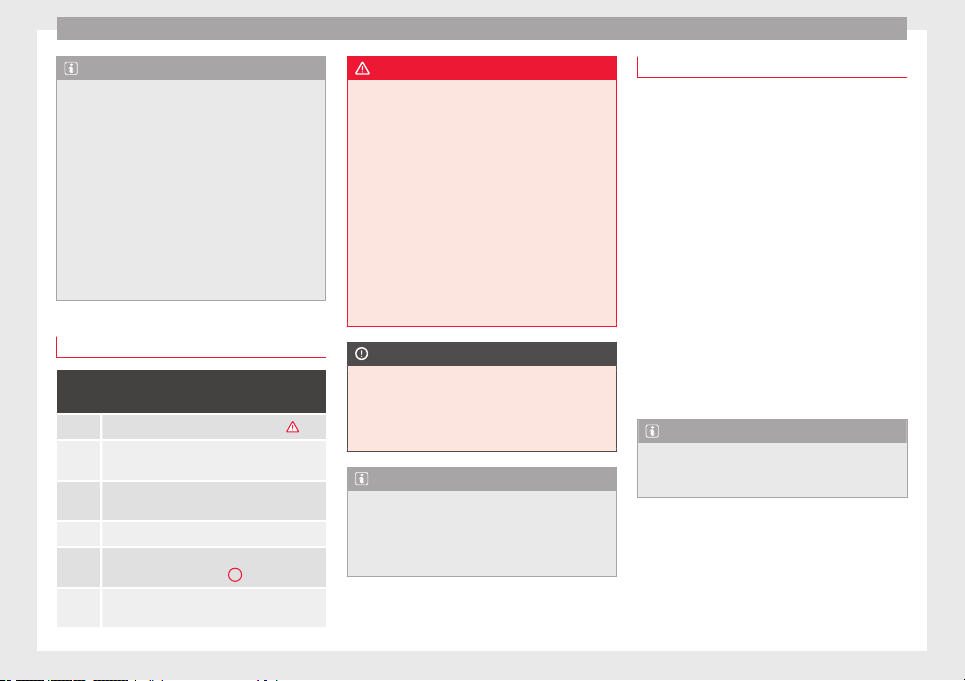
Operation
Note
●
Electrical devices with a high power con-
sumption are switched off temporarily when
the engine starts.
●
When the engine is started cold, there may
be strong vibrations for a few moments for
technical reasons. This is quite normal, and
no cause for concern.
●
Natural gas engines always start up with
petrol, as a certain operating temperature is
required for running with gas. Once the re-
quired operating temperature is reached, the
engine will change to operate with natural
gas.
Stopping the engine
Complete operations only in the sequence giv-
en.
1. Stopping the vehicle completely ››› .
2.
Press the brake pedal and keep pressed until
step 4 has been completed.
3.
In automatic gearboxes, put the selector lever
in position D or R.
4. Apply the handbrake firmly ››› page 89.
5.
Turn the key in the ignition lock to position
››› Fig. 79
0
.
6.
With a manual gearbox, put the vehicle in first
or reverse gear.
WARNING
Never switch off the engine while the vehicle
is moving. You may lose control of the vehicle
and there is a risk of serious accident.
●
The airbags and belt tensioners do not
work when the ignition is switched off.
●
The brake servo does not work with the en-
gine off. To stop, the brake pedal must be
pressed with more force.
●
As the power steering does not work if the
engine is not running, you will need more
strength to steer than normally.
●
If the key is removed from the ignition, the
steering may lock and it will not be possible
to steer the vehicle.
CAUTION
If the engine has been driven at high speed
for a prolonged period of time, it may over-
heat when turned off. To avoid engine dam-
age, allow the engine to run for approximate-
ly 2 minutes in neutral before switching it off.
Note
After stopping the engine, the engine com-
partment fan may continue running for a few
minutes, even when the ignition has been
switched off or the key removed. The radiator
fan is automatically switched off.
Electronic immobiliser
The gear lock prevents the engine from being
started with an unauthorised key and the ve-
hicle being moved.
The vehicle key has a built-in chip. It auto-
matically deactivates the electronic immobil-
iser when the key is inserted into the ignition
lock.
The electronic immobilizer will be activated
again automatically as soon as you remove
the key from the ignition lock.
For this reason, the vehicle can only be used
with a genuine SEAT key with the correct
code. Coded keys can be obtained from SEAT
dealerships
›››
page 43
.
If
an u
nauthorised key is used, the signal
appears on the instrument panel display. The
vehicle cannot be started in this case
Note
The correct operation of the vehicle is only
guaranteed when original SEAT keys are
used.
88
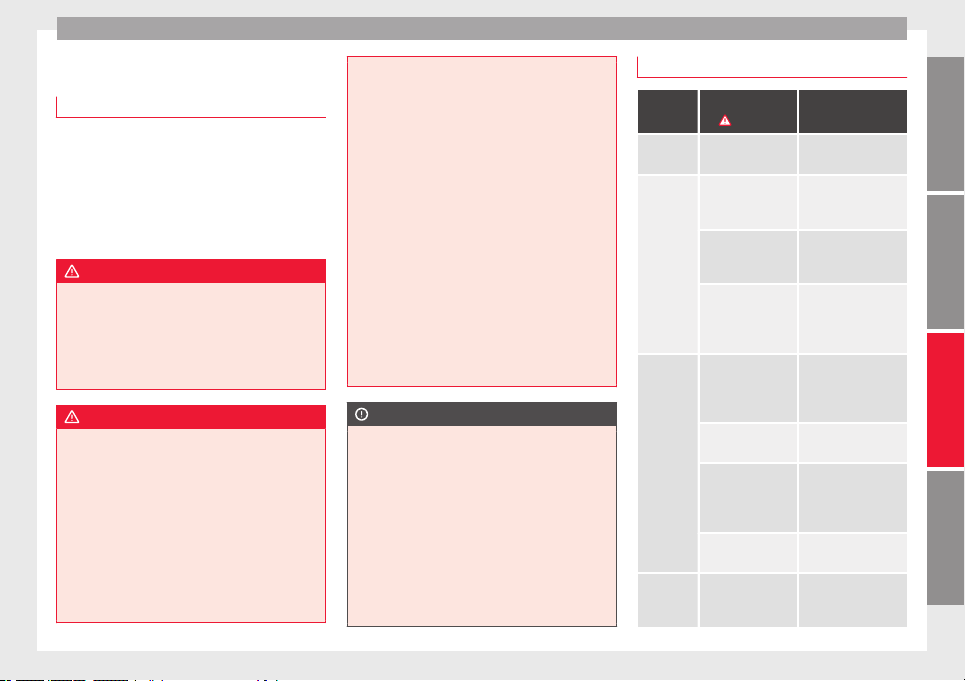
Driving
Braking and parking
Introduction
The assisted braking systems are the elec-
tr
onic distribution of the brake force (EBV),
the anti-lock brake system (ABS), the brake
assist system (BAS), the electronic differen-
tial lock (EDL), the traction control (TC), the
traction control system (ASR) and the elec-
tronic stability control (ESC*).
WARNING
Driving with worn brake pads or a faulty
brake system may lead to serious accident.
●
If you believe the brake pads to be worn or
the brake system to be faulty, immediately
refer to a specialised workshop to check the
brake pads and replace the worn ones.
WARNING
Careless parking can cause serious injury.
●
Never remove the key from the ignition if
the vehicle is in motion. The steering lock
may engage and lock the steering wheel mak-
ing the vehicle impossible to control.
●
Always park your vehicle so that no part of
the exhaust system can come in contact with
flammable materials (such as wood, leaves,
dried grass, spilled fuel, etc.).
●
Always apply the handbrake when you
leave your vehicle and when you park.
●
Never leave children or disabled people
alone in the vehicle. They could release the
electronic parking brake, activate the selec-
tor lever or gear stick and start the vehicle
moving. This could result in a serious acci-
dent.
●
Always take all the keys with you whenever
you leave the vehicle. The engine could acci-
dentally be started and electrical equipment
such as the windows could accidentally be
operated resulting in serious injury.
●
Never leave children or disabled people
alone in the car. They could be trapped in the
car in an emergency and will not be able to
get themselves to safety. For example, de-
pending on the time of the year, tempera-
tures inside a locked and closed vehicle can
be extremely high or extremely low resulting
in serious injuries and illness or even death,
particularly for young children.
CAUTION
●
Special care should be taken when parking
in areas with high kerbs or fixed barriers. Ob-
jects protruding from the ground may dam-
age the bumper or other parts of the vehicle
during manoeuvres. To avoid damage, stop
before the wheels touch the barrier or kerb.
●
Special attention is required when driving
through entrances, over ramps, kerbs or oth-
er objects. The vehicle underbody, bumpers,
mudguards and running gear, and the engine
and exhaust system could be damaged as
you drive over these objects.
Warning and control lamps
It lights
up
Possible cause
›››
Solution
Handbrake ap-
plied.
››› page 90.
Fault in the brake
system
Do not drive on!
Seek professional
advice ››› page 92.
Brake fluid level
inadequate.
Do not drive on!
Check brake fluid
level ››› page 153.
Together with the
ABS control lamp
: ABS and EBV
do not function.
Do not drive on!
Seek professional
advice ››› page 92.
ESC* disconnec-
ted by system.
Switching the igni-
tion on and off If
necessary, drive for a
short distance.
Fault in ESC*.
Contact a special-
ised workshop.
Together with the
ABS control lamp
: Fault in the
ABS.
Contact a special-
ised workshop. The
vehicle can be
braked without ABS.
The battery has
been reconnected.
››› page 154.
Traction Control
faulty or switched
off by the system.
Contact a special-
ised workshop.
»
89
Technical specifications
AdviceOperationSafety
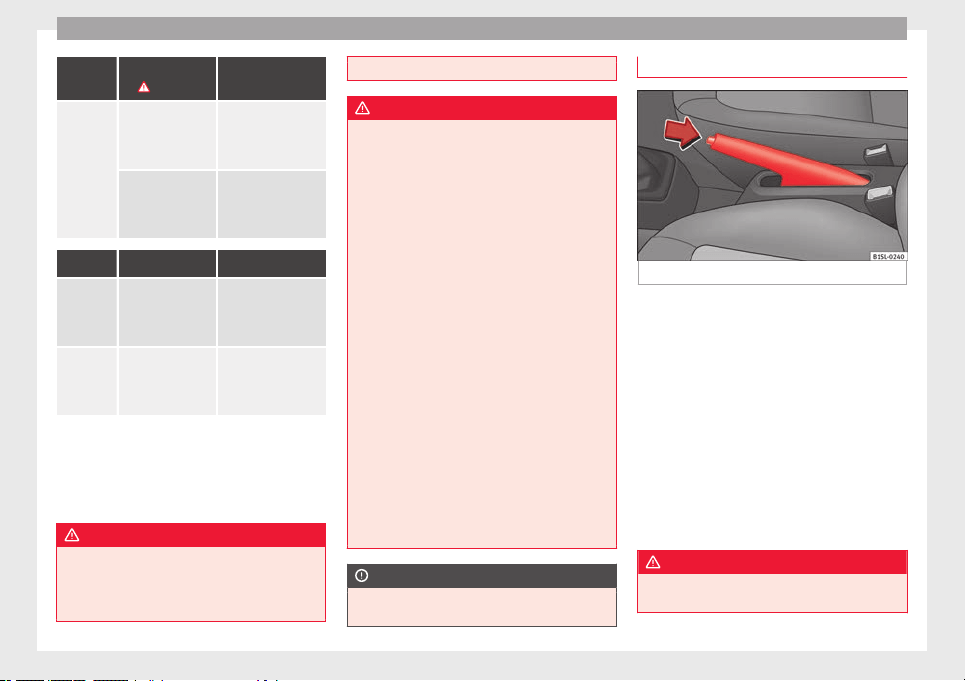
Operation
It lights
up
Possible cause
›››
Solution
Together with the
ESC* control lamp
: Fault in the
ABS.
Contact a special-
ised workshop. The
vehicle can be
braked without ABS.
Together with the
warning lamp
:
ABS and EBV do
not function.
Do not drive on!
Seek professional
advice ››› page 92.
Flashes Possible cause Solution
ESC* or ASR regu-
lating.
Take your foot off the
accelerator. Adjust
your driving style to
the road conditions.
Traction Control
regulator operat-
ing.
Take your foot off the
accelerator. Adjust
your driving style to
the road conditions.
Several warning and control lamps light up
for a few seconds when the ignition is switch-
ed on, signalling that the function is being
verified. They will switch off after a few sec-
onds.
WARNING
If the warning lamps are ignored, the vehicle
may stall in traffic, or may cause accidents
and severe injuries.
●
Never ignore the warning lamps.
●
Stop the vehicle safely as soon as possible.
WARNING
Driving with brakes in bad condition could re-
sult in a serious accident.
●
If the brake warning lamp does not go
out, or if it lights up when driving, the brake
fluid level in the reservoir is too low or there
is a fault in the brake system. Obtain profes-
sional assistance immediately ››› page 152,
Checking the brake fluid level.
●
If the brake warning lamp lights up to-
gether with the ABS warning lamp , the
regulation function of the ABS could be mal-
functioning. As a result, the rear wheels can
lock relatively easily when braking. If the rear
wheels lock this could result in loss of vehicle
control! If possible, reduce your speed and
drive carefully to a specialised workshop
close by to check the brake system. During
the following journey, avoid sudden braking
and manoeuvres.
●
If the ABS warning lamp does not go out
or if it lights while driving, the ABS is mal-
functioning. The vehicle can only be stopped
using normal braking without ABS. The pro-
tection provided by the ABS is not available.
Visit a specialised workshop as soon as pos-
sible.
CAUTION
Failure to heed the warning lamps when they
appear may result in faults in the vehicle.
Handbrake
Fig. 80 Between the front seats: handbrake.
Using the handbrake
●
Pull firmly in an upwards direction on the
handbrake lever while pressing the button.
●
The handbrake is applied when the control
lamp lights up on the instrument panel
››› page 89
when the ignition is switched on.
R
el
easing the handbrake
●
Pull gently in an upwards direction on the
handbrake lever and press the lock button
››› Fig. 80 (arrow).
●
Move the handbrake lever downwards
keeping the lock button pressed.
WARNING
The incorrect use of the handbrake may result
in a serious accident.
90
Driving
●
Never use the handbrake to brake the vehi-
cle except in an emergency. The braking dis-
tance is considerably longer, because braking
is only applied to the rear wheels. Always use
the foot brake.
●
Never drive with the handbrake gently ap-
plied. This can overheat the brake, affecting
the brakes system. This also causes prema-
ture wear on the rear brake pads.
●
Never accelerate from the engine compart-
ment with the engine running and a gear en-
gaged. The vehicle could move, even if the
handbrake is applied.
Note
If the vehicle moves at a speed superior to
6 km/h (4 mph) with the handbrake applied,
an audible warning is sounded.
Parking
When parking your vehicle, all legal require-
ments should be observed.
To park the vehicle
Complete operations only in the sequence
given.
●
Park the vehicle on a suitable surface ››› .
●
Press and hold the brake pedal until the ve-
hicle comes to a standstill.
●
Apply the handbrake firmly ››› page 90.
●
For an automatic gearbox, move the selec-
tor lever to position
P
.
●
Sw
itch off the engine and release the brake
pedal.
●
Remove the key from the ignition.
●
If necessary, turn the steering wheel slight-
ly to lock the steering.
●
With a manual gearbox, engage 1st gear on
flat ground and slopes, or even reverse gear
on hills, and release the clutch pedal.
●
Ensure that all passengers leave the vehi-
cle, especially children.
●
When leaving the vehicle, take all keys with
you.
●
Lock the vehicle.
Additional information for steep slopes and
hills
Before switching off the engine, rotate the
steering wheel so that if the vehicle should
move, it will be held by the kerb.
●
On slopes, turn the front wheels so that
they are against the edge of the kerb.
●
Uphill, turn the wheels towards the centre
of the road.
WARNING
The components of the exhaust system reach
very high temperatures. This could cause a
fire and considerable damage.
●
Always park your vehicle so that no part of
the exhaust system can come in contact with
flammable materials (such as wood,
leaves,dried grass, or spilled fuel).
CAUTION
●
Special care should be taken when parking
in areas with high kerbs or fixed barriers. Ob-
jects protruding from the ground may dam-
age the bumper or other parts of the vehicle
during manoeuvres. To avoid damage, stop
before the wheels touch the barrier or kerb.
●
Special attention is required when driving
through entrances, over ramps, kerbs or oth-
er objects. The vehicle underbody, bumpers,
mudguards and running gear, and the engine
and exhaust system could be damaged as
you drive over these objects.
Information about the brakes
For the first 200 to 300 km, the new brake
pads
have not yet reached their maximum
br
ak
ing capacity, and need to be “run in”
first ›››
. The slightly reduced braking effect
can be compensated for by increasing pres-
sure on the brake pedal.
While running in,
the f
u
ll braking distance or emergency brak-
ing distance is larger then when the brake
pads have been run in. While running in,
avoid full power braking or situations requir-
ing braking performance. For example, in
heavy traffic.
»
91
Technical specifications
AdviceOperationSafety

Operation
The
rate of wear of the brake pads depend
s
t
o a great extent on the conditions in which
the vehicle is used and the way the vehicle is
driven. If the vehicle is used frequently in city
traffic or for short trips or driven sport style,
visit a specialised workshop regularly, more
frequently than advised in the Maintenance
Programme, to have the brake pads checked.
If you drive with wet brakes, for example, af-
ter crossing areas of water, in heavy rainfall
or even after washing the car, the effect of
the brakes is lessened as the brake discs are
wet or even frozen (in winter). At higher
speed, “dry” the brakes as quickly as possi-
ble by braking gently several times. Only do
this without endangering vehicles behind
you or any other road users ›››
.
A
layer of salt on the discs and brake pads
w
i
ll reduce the effectiveness of the brakes
and increase braking distance. If you drive for
a prolonged period on salted roads without
braking then brake carefully several times to
eliminate the layer of salt on the brakes ›››
.
If the vehicle remains parked for considera-
ble lengths of time, is used little, or if the
brakes are not used, there may be corrosion
on the brake discs and a build up of dirt on
the brake pads. If the brakes are not used fre-
quently, or if rust has formed on the discs,
SEAT recommends cleaning the pads and
discs by braking firmly a few times at a mod-
erately high speed. Only do this without en-
dangering vehicles behind you or any other
road users ››› .
Faults in the brake system
During braking, if you notice that the vehicle
does not react as usual (that the braking dis-
tance has increased suddenly) it may be pos-
sible that there is a fault in the braking sys-
tem. This is indicated by the warning lamp
. Take the vehicle to a specialised work-
shop immedi
at
ely and have the fault re-
paired. Drive at a moderate speed and be
prepared to use more pressure on the brake
pedal, and allow for longer stopping distan-
ces.
Brake servo
The brake servo only operates when the en-
gine is running and the pressure applied by
the driver on the brake pedal increases.
If the brake servo does not operate or the ve-
hicle must be towed, then the brake pedal
will have to be pressed with more force given
that the braking distance will be increased
when the brake servo does not operate ›››
.
WARNING
New brake pads do not brake to full efficien-
cy.
●
For the first 320 km, new brake pads have
not yet reached their maximum braking ca-
pacity, and need to be “run in” first. For this,
to compensate for reduced braking efficiency
the brake pedal will have to be pressed with
more force.
●
To avoid losing control of the vehicle and
causing serious accidents, always take great
care when driving with new brake pads.
●
When running in new brake pads, always
respect the safety distances between you and
other vehicles and do not cause situations re-
quiring extreme braking performance.
WARNING
When brakes overheat, braking is less effi-
cient and braking distances increase.
●
When driving on slopes, brakes can be
overloaded and overheat quickly.
●
Reduce speed or change down a gear when
faced with steep and long slopes. This allows
you to use the engine braking effect and to
reduce the strain on the brake system.
●
Non-standard or damaged front spoilers
could restrict the airflow to the brakes and
cause them to overheat.
WARNING
Wet, frozen or salt-covered brakes take lon-
ger to engage and this increases braking dis-
tances.
●
Test the brakes carefully.
●
Dry the brakes, free them of ice and salt by
braking gently several times, when visibility,
92
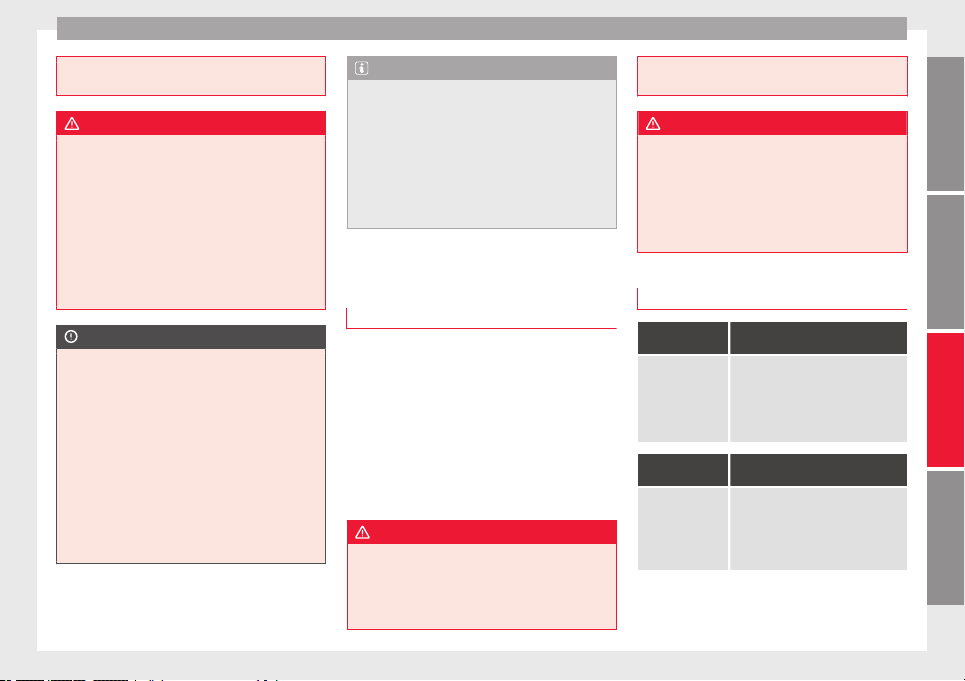
Driving
weather, and road and traffic conditions
permit.
WARNING
Driving without the brake servo may signifi-
cantly increase the braking distance and re-
sult in a severe accident.
●
Never allow the vehicle to move forwards
when the engine is switched off.
●
If the brake servo does not operate or the
vehicle must be towed, then the brake pedal
will have to be pressed with more force given
that the braking distance will be increased
when the brake servo does not operate.
CAUTION
●
Never make the brakes “slip” by pressing
the pedal gently, if it is not really necessary
to brake. Continuously pressing on the brake
pedal will heat the brakes. This could signifi-
cantly reduce braking power, increase brak-
ing distance or even result in the total failure
of the brake system.
●
Reduce speed or change down a gear when
faced with steep and long slopes. This allows
you to use the engine braking effect and to
reduce the strain on the brake system. Other-
wise, the brakes may overheat and fail. Only
use the brakes to reduce speed or to stop.
Note
Make use, when having the front brake pads
checked, and have the rear pads checked al-
so. The thickness of the brake pads should be
checked visually and regularly, by looking
through the openings in the wheel rims or
from underneath the vehicle. If necessary, re-
move the wheels to check them thoroughly.
SEAT recommends taking your car in for tech-
nical service.
Changing gear
Introduction
When reverse gear is engaged and the
ignition is switched on the following takes
place:
●
Reverse lights light up.
●
The rear wiper blade performs one move-
ment when the windscreen wiper is activa-
ted.
●
If necessary, connect the parking distance
warning system.
WARNING
Rapid acceleration can cause loss of traction
and skidding, especially on slippery ground.
This could cause loss of control of the vehicle
resulting in an accident and considerable
damage.
●
Use rapid acceleration only when visibility,
weather, road conditions and traffic permit.
WARNING
Do not allow the brakes to “rub” for a pro-
longed period of time, or brake frequently or
for long periods of time. Continuous braking
heats up the brakes. This could significantly
reduce braking power, increase braking dis-
tance or even result in the total failure of the
brake system.
Warning and control lamps
(red)
It lights up
Fault in the auto-
matic gearbox.
Do not drive on!
Seek professional advice. Failure to
do so could result in considerable
damage to the transmission
››› page 97.
(yellow)
It lights up
In the automatic
gearbox the
gears can en-
gage incorrectly.
Switch the ignition on and off.
When the control lamp does not
light up, find the nearest special-
ised workshop and have the auto-
matic gearbox checked.
»
93
Technical specifications
AdviceOperationSafety
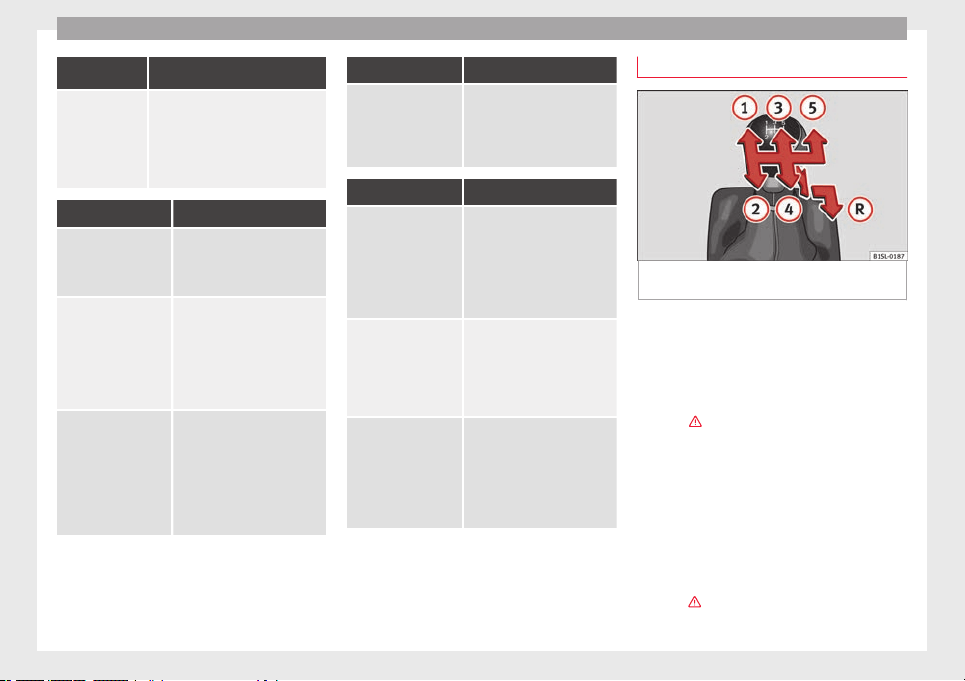
Operation
(yellow)
It lights up
The automatic
gearbox over-
heats temporari-
ly.
Let the transmission cool with the
gearbox lever in the position
.
When the control lamp does not
light up, find the nearest special-
ised workshop and have the auto-
matic gearbox checked.
It lights up
Place the automatic
gearbox lever in the
position
and do not
press the brake pedal.
Press the brake pedal to select
a gear range.
Together with the yel-
low control lamp for
the temperature of the
transmission
: the
automatic gearbox
overheats.
Press brake pedal and let the
transmission cool. Avoid
pressing the accelerator. When
the control lamp does not light
up, find the nearest special-
ised workshop and have the
automatic gearbox checked.
Together with the turn
signal display in the
instrument panel dis-
play: the automatic
gearbox lever is not in
the position
, indica-
tion to start the en-
gine.
Move the gearbox lever to the
position
and start the en-
gine.
Flashes
An automatic gearbox
in the vehicle does
not guarantee that the
vehicle will not roll
away.
Apply the handbrake.
Flashes
In the instrument pan-
el display, in addition
to the control lamp re-
questing the brake
pedal to be pressed
: indicated for start-
ing the engine.
Move the gearbox lever to the
position
and start the en-
gine.
On the instrument
panel display: Whilst
driving in a forward di-
rection, try to move
the automatic gearbox
lever to the position
.
Stop the vehicle and move the
gearbox lever to the position
in order to subsequently
change to the position
.
On the instrument
panel display: The au-
tomatic gearbox lever
was placed in the po-
sition
or
, but the
brake pedal was not
pressed.
Press the brake pedal, move
the gearbox lever to the posi-
tion
, and subsequently to
the required position
or
.
When switching on the ignition some warn-
ing and control lamps light up for a short
time to check the operations. They will switch
off after a few seconds.
Manual gearbox: engaging gears
Fig. 81 Gear shift pattern of a 5-speed man-
ual gearbox
The position of each of the gears is shown on
the gear stick ››› Fig. 81
.
●
K
eep the c
lutch pedal pushed all the way
down.
●
Move the gearbox lever to the required po-
sition ›››
.
●
Release the clutch pedal to engage clutch.
In some countries, it is necessary to press the
clutch pedal to the floor to start the engine.
Selecting reverse gear
●
Engage reverse gear only when the vehicle
is stopped.
●
Keep the clutch pedal pushed all the way
down ››› .
94
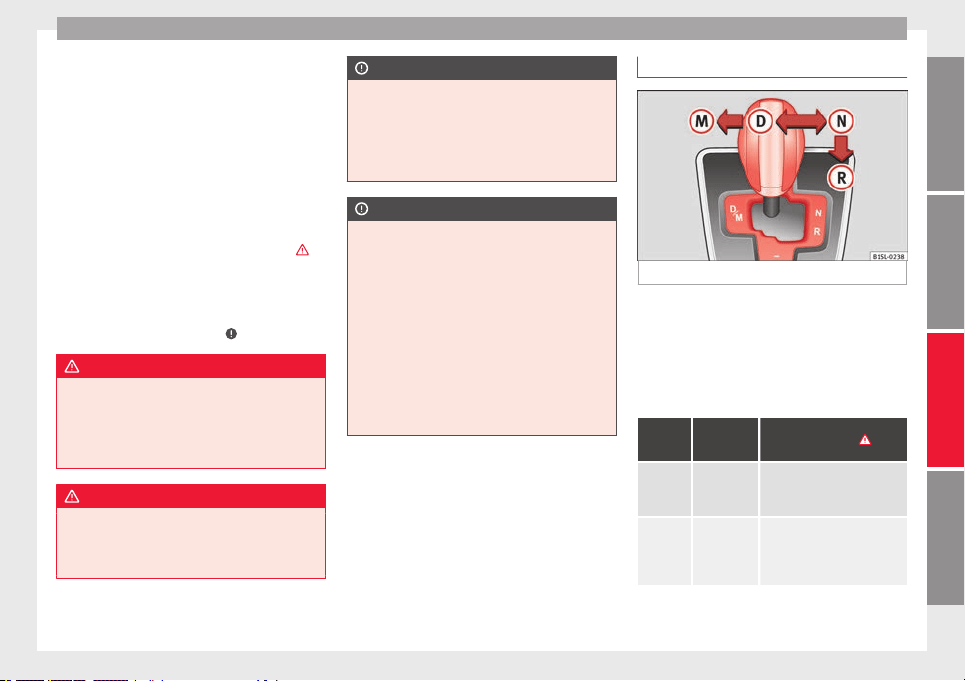
Driving
●
Place the gearbox lever into neutral and
push the lever downwards.
●
Slide the gearbox lever to the right, and
then backward as shown on the lever.
●
Release the clutch pedal to engage clutch.
Shifting down a gear
Shifting down a gear while driving must be
carried out gear by gear, i.e. to the gear im-
mediately preceding the current gear and at
an engine speed that is not excessive ››› .
At high speeds, or high engine speeds, skip-
ping one or various gears when shifting
down a gear can cause damage to the clutch
and the gearbox, even if the clutch is not en-
gaged during the process ››› .
WARNING
When the engine is running, the vehicle will
start to move as soon as a gear is engaged
and the clutch released.
●
Never engage the reverse gear when a vehi-
cle is moving forward.
WARNING
As a consequence of shifting down a gear in-
correctly, you may lose control of the vehicle
and cause an accident with serious conse-
quences.
CAUTION
If, at high speeds or high engine speeds, the
gear lever is shifted down to a gear that is too
low, serious damage can be caused to the
clutch and gearbox. This may also happen if
you press the clutch pedal and it does not en-
gage.
CAUTION
To prevent damage and avoid premature
wear, please observe the following:
●
While driving, do not leave your hand rest-
ing on the gear stick. The pressure applied by
your hand is transmitted to the gearbox se-
lector forks.
●
Always ensure that the vehicle is complete-
ly stopped before engaging the reverse gear.
●
When changing gear, always make sure the
clutch pedal is pushed right to the floor.
●
Never hold the vehicle “on the clutch” on
hills with the engine on.
Automatic gearbox: engaging a gear
Fig. 82 Automatic gearbox diagram of gears
To move the gear selector lever from the posi-
tion
N
to
D or to R, first press and hold the
brake pedal.
In the instrument panel display, with the igni-
tion switched on, the selected gear range or
the gear engaged in the gearbox is shown.
Posi-
tions
Denomi-
nation
Meaning ›››
Reverse
gear
Reverse gear is selected. En-
gage only when the vehicle is
stopped.
Neutral
The gear box is in neutral. No
movement is transmitted to
the wheels and the engine
does not act as a brake.
»
95
Technical specifications
AdviceOperationSafety
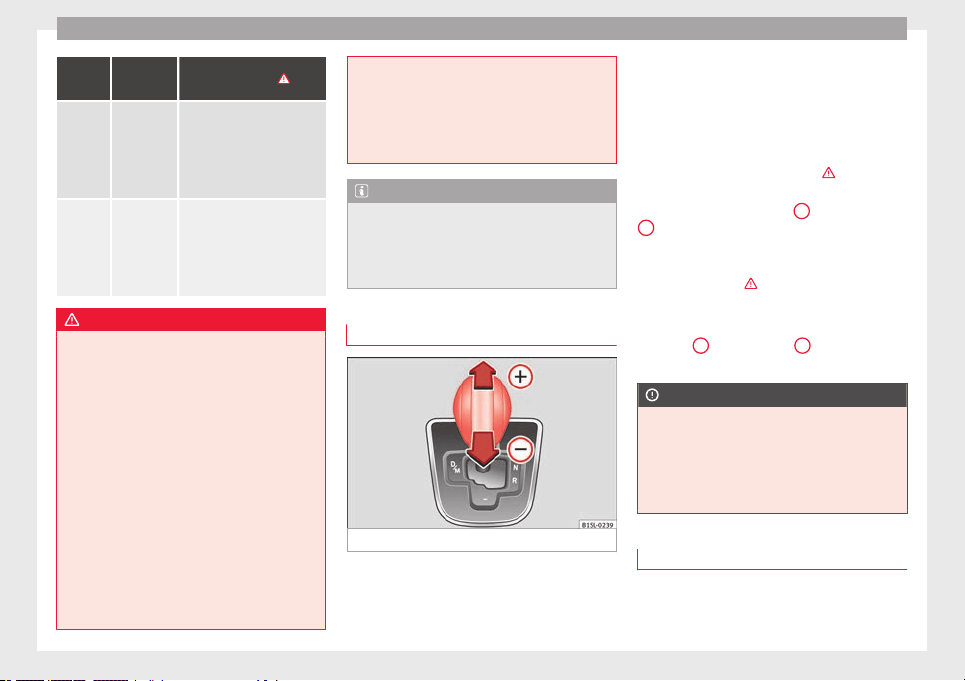
Operation
Posi-
tions
Denomi-
nation
Meaning ›››
Standard
driving po-
sition
The gears are changed (up
and down) automatically. The
gear shifts are determined by
the engine load, your individ-
ual driving style and the
speed of the vehicle.
Tiptronic
driving po-
sition
(manual
shift pro-
gramme)
All gears can be changed (up
and down) manually
››› page 96. This is possible
as long as the system is not
changing gear automatically
due to a traffic situation.
WARNING
Placing the selector lever in an incorrect posi-
tion may cause loss of control of the vehicle
and a serious accident.
●
Do not press the accelerator when engag-
ing a range of gears.
●
With the engine running and a gear range
selected, the vehicle will move off when the
brake pedal is released.
●
Never engage reverse gear while driving.
●
Unintentional movements of the vehicle
could cause serious injury.
●
As a driver, you should never leave your ve-
hicle if the engine is running and a gear range
is engaged. If you have to leave your vehicle
while the engine is running, you must always
apply the handbrake and put the selector lev-
er in position N.
●
Never engage the R gear range when the
vehicle is moving.
●
Never leave the vehicle without applying
the handbrake. With the engine running the
vehicle moves downhill regardless of the gear
range selected.
Note
If, while driving, the selector lever is acciden-
tally placed in position N, lift your foot off the
accelerator. Wait until the engine is running
at idle speed before selecting a new gear
range.
Engaging gear with Tiptronic
Fig. 83 Lever in the Tiptronic position
With Tiptronic, the gears can be changed up
or down manually with the automatic gear-
box. When you change to the Tiptronic pro-
gramme, the vehicle remains in the currently
selected gear. This is possible as long as the
system is not changing gear automatically
due to a traffic situation.
Using Tiptronic
●
Place the lever in the position D to the left
on the Tiptronic shift gate M
›
›› in Auto-
matic gearbox: engaging a gear on page 96.
●
Press the lever forwards
+
or backwards
–
to move up or down a gear ››› Fig. 83
.
●
Pl
ac
e the lever back to the position M to
the left on the Tiptronic shift gate, to leave
Tiptronic mode ›››
in Automatic gearbox:
engaging a gear on page 96.
With the lever in the position D, and pressing
forwards
+
or backwards
–
the Tiptronic
programme can be selected M.
CAUTION
●
When accelerating, the gearbox automati-
cally shifts up into the next gear shortly be-
fore the maximum engine speed is reached.
●
When reducing speed manually, the gear
box only shifts gear when the engine can no
longer exceed the maximum engine speed.
Driving with an automatic gearbox
The gearbox changes gear ratios automatical-
ly as the vehicle moves.
96
Driving
Driving down hills
The steeper the gradient, the lower the gear
you will need to select. The lowest gears in-
crease the engine braking work. Never go
down hills with the selector lever in neutral
N
.
●
Y
ou shou
ld reduce speed accordingly.
●
Place the lever in the position D to the left
on the Tiptronic shift gate M ››› page 96.
●
Gently pull the selector lever back
–
to
change down a gear.
Starting when going up a slope
The steeper the gradient, the lower the gear
you will need.
When stopping on a slope with a gear range
engaged, the vehicle must be prevented from
rolling backwards by always pressing the
brake pedal or pulling the handbrake lever
up. When starting, release the brake pedal or
the handbrake ››› .
Kick-down
The kickdown system provides maximum ac-
celeration when the gear selector lever is in
the position
D
, or in the Tiptronic position M
.
When the accelerator pedal is pressed right
down, the automatic gearbox will shift down
to a lower gear, depending on road speed
and engine speed. This takes advantage of
the maximum acceleration of the vehicle
›››
.
When the accelerator is pressed to the floor,
the automatic gearbox shifts to the next gear
only after the engine reaches the specified
maximum engine speed.
WARNING
Rapid acceleration can cause loss of traction
and skidding, especially on slippery ground.
This could cause loss of control of the vehicle
resulting in an accident and serious injury.
●
Always adapt your driving style to suit the
flow of traffic.
●
Only use the kick-down function or rapid
acceleration if visibility, weather, road and
traffic conditions so permit.
●
Never put other road users in danger by ac-
celerating or with your driving style.
CAUTION
If you stop on a hill with a gear range engag-
ed, do not try to prevent the vehicle from roll-
ing back by pressing on the accelerator. Oth-
erwise, the automatic gearbox may overheat
causing damage.
Automatic gearbox malfunction
Back-up programme
When automatic gearbox warning and control
lamps light up on the instrument panel, there
may be a system malfunction ››› page 93. In
the event of some faults the automatic gear-
box functions using a backup programme.
When the programme is activated, it is possi-
ble to drive the vehicle, however, at low
speeds and within a selected range of gears.
With the manual gearbox, in some cases it is
not possible to drive with all the gears.
In all cases the automatic gearbox must be
checked at a specialised workshop.
Automatic gearbox overheating
The automatic gearbox can overheat with a
prolonged start up, or when stopping and
starting continuously. This overheating is dis-
played with a warning lamp in the instru-
ment panel. Additionally, an audible warning
can be heard. Stop and let the gearbox cool
›››
.
The vehicle moves forward or back despite
having selected a gear range
When the vehicle does not move in the re-
quired direction, the system may not have
the gear range correctly engaged. Press the
brake pedal and engage the gear range
again. If the vehicle still does not move in the
»
97
Technical specifications
AdviceOperationSafety
Operation
required direction, there is a system malfunc-
tion. Seek specialist assistance and have the
system checked.
CAUTION
●
When the gearbox is displayed as overheat-
ing for the first time, the vehicle must be
parked safely or must be driven at a speed of
more than 20 km/h (12 mph).
●
When the warning lamp lights up and the
audible warning is heard, the vehicle must be
parked safely and the engine switched off.
Let the gearbox cool down.
●
To prevent damage to the gearbox, driving
must only be continued when the warning
lamps are no longer lit up. While the gearbox
is overheated, starting up and driving, even
at a slow speed should be avoided.
Recommended gear display
In some vehicles, the recommended gear for
reducing fuel consumption is displayed on
the instrument panel:
Display Meaning
Optimum gear.
Recommendation to change up a gear.
Recommendation to change down a
gear.
WARNING
The recommended gear display is intended as
a guideline only; it should never replace the
driver's attention to driving carefully.
●
Responsibility for selecting the correct gear
for each situation continues to lie with the
driver, for example when overtaking or climb-
ing a hill.
For the sake of the environment
Selecting the most appropriate gear for the
situation will help you to save fuel.
Note
●
The recommended gear display is switched
off when the clutch pedal is pressed.
●
On the display of the Portable Navigation
System (supplied by SEAT) ››› page 123 the
recommended gear can also be seen.
Run-in and economical driving
Running-in
Please observe the instructions for running-in
new components.
Running-in the engine
The engine needs to be run in over the first
1,500 km. During its first few hours of run-
ning, the internal friction in the engine is
greater than later on when all the moving
parts have bedded down.
How the vehicle is driven for the first 1,500
km influences the future engine perform-
ance. Throughout the life of the vehicle, it
should be driven at a moderate speed, espe-
cially when the engine is cold, as this will re-
duce engine wear and increase its useful life.
Never drive at extremely low engine speeds.
Change down to a lower gear when the en-
gine no longer runs “smoothly”.
Up to 1,000
k
i
lometres the following instructions apply:
●
Do not use full throttle.
●
Do not force the engine above two thirds of
its maximum speed.
Between 1,000 and 1,500 kilometres, gradu-
ally increase power until reaching the maxi-
mum speed and high engine speeds.
Running in new tyres and brake pads
●
Replacement of wheel rims and new tyres
››› page 158
●
Notes on the brakes ››› page 89
For the sake of the environment
If the engine is run in gently, the life of the
engine will be increased and the engine oil
consumption reduced.
98
Driving
Environmental friendliness
Environmental protection is a top priority in
the design, choice of materials and manufac-
ture of your new SEAT.
Constructive measures to encourage
recycling
●
Joints and connections designed for easy
dismantling
●
Modular construction to facilitate disman-
tling
●
Increased use of single-grade materials.
●
Plastic parts and elastomers are marked in
accordance with ISO 1043, ISO 11469 and
ISO 1629.
Choice of materials
●
Use of recycled materials.
●
Use of compatible plastics in the same part
if its components are not easily separated.
●
Use of recycled materials and/or materials
originating from renewable sources.
●
Reduction of volatile components, includ-
ing odour, in plastic materials.
●
Use of CFC-free coolants.
Ban on heavy metals, with the exceptions
dictated by law (Annex II of ELV Directive
2000/53/EC):
cadmium, lead, mercury, hexa-
v
al
ent chromium.
Manufacturing methods
●
Reduction of the quantity of thinner in the
protective wax for cavities.
●
Use of plastic film as protection during ve-
hicle transport.
●
Use of solvent-free adhesives.
●
Use of CFC-free coolants in cooling sys-
tems.
●
Recycling and energy recovery from resi-
dues (RDF).
●
Improvement in the quality of waste water.
●
Use of systems for the recovery of residual
heat (thermal recovery, enthalpy wheels,
etc.).
●
The use of water-soluble paints.
Correct economical and ecological
driving
Fig. 84 Fuel consumption in litres per 100 km
at 2 different outside temperatures
Fuel consumption, environmental impact and
engine, brake and tyre wear depend largely
on three factors:
●
Personal driving style.
●
Conditions of use (weather, road surface).
●
Technical requirements.
Savings of up to 25% in fuel consumption
are possible with an appropriate driving style
and the adoption of certain simple tips.
Changing gear early
General instructions: The highest gear is al-
ways the most economical. As a guide, for
most vehicles at a speed of 30 km/h
(19 mph), drive in third gear, at 40 km/h
»
99
Technical specifications
AdviceOperationSafety

Operation
(25 mph) in fourth gear and at 50 km/h
(31 mph) in fifth gear.
In addition, “skipping” gears when shifting
up helps to save fuel, weather and traffic
conditions permitting.
Do not wait until the last moment before
changing gear. Only use first gear when you
move off and change to second gear quickly.
Avoid the kick-down function in vehicles with
automatic gearbox.
Vehicles with a gear display help to achieve
an economical driving style as the display in-
dicates the best moment to change gear.
Let the vehicle roll
If you take your foot off the accelerator, the
fuel supply is stopped and consumption is
reduced.
Allow the vehicle to roll without accelerating,
for example when approaching a red traffic
light. However, if the vehicle is rolling too
slowly or the distance is too long, the clutch
pedal should be pressed to declutch. The en-
gine will then operate at idle speed.
If the vehicle is going to be at a standstill for
a period of time, switch off the engine; for ex-
ample, while waiting at a level crossing.
Think ahead and “flow” with the traffic
Frequent acceleration and braking considera-
bly increase fuel consumption. If you think
ahead as you drive and keep a safe distance
from the vehicle in front, it is possible to slow
down by simply lifting your foot off the accel-
erator. This eliminates the need for constant
braking and acceleration.
Calm and steady driving
Constancy is more important than speed: The
more you drive at a constant speed, the lower
the fuel consumption.
When driving on the motorway, it is more effi-
cient to drive at a constant and more moder-
ate speed than to be continuously accelerat-
ing and braking. As a general rule, you will
reach your destination just as quickly when
you drive at a constant speed.
The cruise control function helps you to ach-
ieve a constant style of driving.
Moderate use of additional devices
It is important to travel in comfort, but con-
venience systems should be used ecological-
ly.
Some equipment, when connected, increase
fuel consumption considerably, for example:
●
Air conditioning cooling system: If the air
conditioning system is required to cool to
significantly lower temperatures than the true
outside temperature, it will require a large
amount of energy from the engine. Therefore,
we recommend that the selected temperature
for the vehicle is not too different to the out-
side temperature. It is a good idea to air the
vehicle before starting your journey and to
drive a short distance with the windows
open. Then you can close the windows and
switch on the air conditioning. Keep windows
closed when travelling at high speeds. Driv-
ing with the windows open increases fuel
consumption.
●
Switch off the seat heating when the seats
have warmed up.
●
Switch off the heated rear window when it
is not moist or covered in ice.
Avoid short journeys
Fuel consumption is much higher when the
engine is cold, immediately after it has been
started. It takes a few kilometres of driving
for the engine to warm up and to normalise
consumption.
The engine and catalytic converter need to
reach their proper
working temperature in or-
der t
o minimi
se fuel consumption and emis-
sions. The ambient temperature has a deci-
sive influence.
Fig. 84 shows the difference in consumption
for the same journey at +20 °C (+68 °F) and
at -10 °C (+14 °F).
Therefore, unnecessary short journeys
should be avoided. Try to combine trips.
100
Driving
The vehicle uses more fuel in winter than in
summer, even when other conditions are the
same.
“Warming” the engine is not only forbidden
in some countries, but in practice it is techni-
cally superfluous as it is a waste of fuel.
Adjusting type pressures.
Having the correct pressure in your tyres
helps to reduce rolling resistance and, as a
result reduces fuel consumption. Increasing
the tyre pressure slightly (+0.2
bar/+3 psi/+200 kPa) can help to save fuel.
When you buy new tyres, make sure they are
optimised for minimum rolling resistance.
Use low friction engine oil
The use of low viscosity totally synthetic oils,
known as low friction engine oil, helps to re-
duce fuel consumption. These oils reduce the
resistance caused by friction in the engine,
they flow around the engine more quickly
and efficiently, particularly in cold starts. The
effect is particularly noticeable in vehicles
frequently used for short journeys.
Always check the engine oil level and ob-
serve service intervals (engine oil change in-
tervals).
When purchasing engine oil, always observe
legal requirements and ensure that the oil is
approved by SEAT.
Avoid carrying unnecessary loads
The lighter the vehicle, the more economical
and ecological the driving style. For example,
an additional weight of 100 kg will increase
fuel consumption up to 0.3 l/100 km.
Remove any unnecessary objects or loads
from the vehicle.
Remove optional equipment and
unnecessary accessories
The more aerodynamic the vehicle, the lower
the fuel consumption. Optional equipment
and accessories (such as roof racks or bike
carriers) reduce the aerodynamic benefits of
the vehicle.
Therefore, we recommend you remove all op-
tional and unnecessary equipment and racks,
especially if you intend to drive at high
speeds.
Other factors which increase fuel
consumption (examples):
●
Fault in engine management.
●
Driving on hills.
WARNING
Always adapt your speed and the distance to
the vehicles ahead in line with visibility,
weather conditions, the condition of the road
and the traffic situation.
Engine management and
exhaust gas purification
system
Introduction
WARNING
The components of the exhaust system reach
very high temperatures. This could cause a
fire.
●
Always park your vehicle so that no part of
the exhaust system can come in contact with
flammable materials (such as dried grass).
●
Never apply additional underseal or anti-
corrosion coatings to the exhaust pipes, cata-
lytic converter or the heat shields on the ex-
haust system.
Control lamps
It lights
up
Possible cause Solution
Fault in engine
management
(Electronic Power
Control).
Take the vehicle to a
specialised work-
shop as soon as
possible and have
the engine checked.
»
101
Technical specifications
AdviceOperationSafety
Operation
It lights
up
Possible cause Solution
Fault in catalytic
converter.
You should reduce
speed accordingly.
Drive carefully until
you reach the next
specialised work-
shop. Have the en-
gine checked there.
Flashes Possible cause Solution
Combustion fault
which could dam-
age the catalytic
converter.
You should reduce
speed accordingly.
Drive carefully until
you reach the next
specialised work-
shop. Have the en-
gine checked there.
Several warning and control lamps light up
for a few seconds when the ignition is switch-
ed on, signalling that the function is being
verified. They will switch off after a few sec-
onds.
CAUTION
Always pay attention to any lit control lamps
and to the corresponding descriptions and in-
structions to avoid damage to the vehicle.
Note
While the control lamps or
maintain lit
up, the engine will present faults, a higher
consumption of fuel and a loss of engine
power.
Catalytic converter
The catalytic converter permits the subse-
quent treatment of the exhaust gases thus
reducing contaminating gas emissions. To
ensure a longer working life for the exhaust
system and catalytic converter in a petrol en-
gine:
●
Always use unleaded petrol.
●
Never run the fuel tank completely dry.
●
Do not top up with too much engine oil
››› page 146
.
●
Do not
t
ow-start the vehicle; use the starter
cables ››› page 181.
If you should notice misfiring, uneven run-
ning or loss of power when the car is moving,
reduce speed immediately. Have the car in-
spected by a specialised workshop. If this
happens, unburnt fuel can enter the exhaust
system and escape into the atmosphere. The
catalytic converter can also be damaged by
overheating.
For the sake of the environment
Even when the emission control system is
working perfectly, there may be a smell of
sulphur under certain conditions. This de-
pends on the sulphur content of the fuel
used.
Driving abroad
In some countries, certain safety regulations
and requirements are in force relating to ex-
haust gas emissions, which differ from the
technical characteristics of the vehicle. Be-
fore travelling abroad, SEAT recommends you
consult a technical service about the legal re-
quirements and the following points:
●
Does the vehicle need technical modifica-
tions for driving abroad, for example, adjust-
ment of the headlamps?
●
Does the vehicle have all the tools, diag-
nostics equipment and spare parts required
for inspections and repairs?
●
Are there any SEAT dealers in the destina-
tion country?
●
For petrol vehicles: Is unleaded petrol avail-
able at the right octane rating?
●
For diesel engines: is diesel fuel available
with a low sulphur content?
●
Are a suitable engine oil (››› page 146) and
other engine fluids complying with SEAT
specifications available in the destination
country?
102
Driver assistance systems
●
Will the navigation system fitted at the fac-
tory operate correctly in the destination coun-
try with the available navigation data?
●
Are special tyres required in the destination
country?
CAUTION
SEAT does not accept liability for any damage
to the vehicle due to the use of a lower quali-
ty fuel, an inadequate service or the non-
availability of genuine spare parts.
Driving along flooded roadways
To prevent damage to the vehicle when driv-
ing through water, for example, along a floo-
ded road, please observe the following:
●
Check the depth of the water before enter-
ing the flooded zone. The water should never
come above the lower edge of the bodywork
›››
.
●
Do not drive faster than a pedestrian.
●
Do not stop in the water, use reverse gear
or switch off the engine.
●
Oncoming traffic will cause waves which
raise the level of the water, making it difficult
to cross the water.
●
Disconnect the Start-Stop system whenever
crossing water.
WARNING
When driving through water, mud, melted
snow, etc., please remember that due to
damp or frozen brake discs and shoes in win-
ter, the braking effect may be delayed, there-
fore the required braking distance is greater.
●
“Dry the brakes and remove ice” by braking
carefully. Ensure that you are not endanger-
ing other road-users or breaking traffic regu-
lations in the process.
●
After driving through water, avoid sudden
sharp manoeuvres.
CAUTION
●
Driving through flooded areas may severely
damage vehicle components such as the en-
gine, transmission, drive train or electrical
system.
●
Never drive through salt water as salt cau-
ses corrosion. Always rinse any parts of the
vehicle which have been in contact with salt
water.
Driver assistance systems
Braking and stability systems
Brake assist systems
The assisted braking systems ESC*, ABS,
EBV, BAS, ASR, TC and EDL only operate when
the ignition is switched on. They contribute
significantly to increasing active safety.
Electronic stability control (ESC)*
ESC* reduces the risk of skidding and increa-
ses the vehicle stability by braking individual
wheels under specific driving conditions.
ESC* detects critical handling situations,
such as understeer, oversteer and wheelspin
on the driven wheels. The system stabilises
the vehicle by braking individual wheels or
by reducing the engine torque.
The ESC* has limits. It is important to realise
that ESC* is also subject to the laws of phys-
ics. ESC* will not be able to deal with all sit-
uations with which drivers may be faced. For
example, if the road surface changes sudden-
ly then ESC* will not be useful in all cases. If
the vehicle suddenly enters a section cov-
ered by water, mud or snow then ESC* will
not provide assistance in the same way as on
dry ground. If the vehicle loses its grip on the
ground and moves on a film of water (“aqua-
planing”), the ESC* will not be able to help
»
103
Technical specifications
AdviceOperationSafety
Operation
the driver control the vehicle due to the loss
of adherence with the road surface prevent-
ing braking and steering. If the vehicle is
driven through series of bends at high
speed, the ESC* will not always be as effec-
tive: the vehicle reaction to aggressive driv-
ing is not the same as at reduced speeds.
Adjust your speed and driving style to suit
visibility, and weather, road and traffic condi-
tions. ESC* cannot push the limits of the laws
of physics; improve the transmission availa-
ble or maintain the vehicle on the road if a
lack of driver attention creates an inevitable
situation. Otherwise, ESC* assists in main-
taining vehicle control in extreme situations
and uses the movements of the steering
made by the driver to maintain the vehicle
moving in the desired direction. If the vehicle
is driven at such a speed that it will leave the
road before ESC* can intervene then the sys-
tem cannot provide assistance.
The ABS, BAS, ASR and EDL systems are in-
corporated into the ESC*. The ESC* is always
on
1)
.
Anti-lock brake system (ABS)
ABS can prevent the wheels from locking dur-
ing braking until just before the vehicle stops
thus helping the driver to steer the vehicle
and maintain control. This means that, even
during full braking, the risk of skidding is re-
duced:
●
Press and hold the brake pedal fully. Do not
remove your foot from the brake pedal or re-
duce braking force!
●
Do not “pump” the brake pedal, or reduce
braking force!
●
Maintain vehicle direction when braking
fully.
●
When the brake pedal is released or when
the brake force is reduced, ABS is turned off.
ABS control can be observed by vibration of
the brake pedal
and noise. You should never
e
xpect
the ABS to reduce the braking dis-
tance under any circumstances. This distance
will increase when driving on gravel, recent
snow or on icy or slippery ground.
Brake assist system (BAS)
The brake assist system may reduce the re-
quired braking distance. The brake assist
system boosts the braking force if you press
the brake pedal quickly in an emergency. As
a result, the braking pressure increases rap-
idly, the braking force is multiplied and the
braking distance is reduced. This enables the
ABS to be activated more quickly and effec-
tively.
¡Do not lift your foot off the brake pedal!
When the brake pedal is released or when
the brake force is reduced, braking assist au-
tomatically turns off the brake servo.
Traction control system (ASR) or Traction
Control (TC)
In the event of wheelspin, the traction control
system ASR or TC reduces the engine torque
to match the amount of grip available. The
ASR or TC makes some situations easier, for
example, when starting, accelerating or go-
ing uphill, even in unfavourable road condi-
tions.
Electronic differential lock system (EDL)
EDL is available when driving in straight lines
under normal conditions. When the EDL de-
tects wheelspin, it brakes the spinning wheel
and directs the power to the other one. To
prevent the disc brake of the braked wheel
from overheating, the EDL cuts out automati-
cally if subjected to excessive loads. The EDL
will switch on again automatically when the
brake has cooled down.
WARNING
Driving at high speed on icy, slippery or wet
ground can result in loss of vehicle control
1)
Depending on the version.
104

Driver assistance systems
and serious injury to the driver and passen-
gers.
●
Adjust your speed and driving style to visi-
bility, road, traffic and weather conditions.
Even though the brake assist systems, ABS,
BAS, EDL, ASR and ESC* provide more securi-
ty, do not take unnecessary risks while driv-
ing.
●
Brake assist systems can not overcome the
laws of physics. Even with ESC* and other
systems, slippery and wet roads will always
be dangerous.
●
Driving to quickly on wet ground can result
in the wheels losing contact with the ground
in an effect known as “aquaplaning”. Without
adherence, it is impossible to brake, steer or
control the vehicle.
●
Brake assist systems cannot avoid acci-
dents if, for example, the driver does not re-
spect safety distances or drives to quickly in
difficult conditions.
●
Even though brake assist systems are ex-
tremely effective and help control the vehicle
in difficult situations, remember that the ve-
hicle stability depends on tyre grip.
●
When accelerating on a slippery surface,
for example on ice or snow, press the acceler-
ator carefully. The wheels can still slip even
with brake assist systems resulting in loss of
vehicle control.
WARNING
The effectiveness of the ESC* can be consid-
erably reduced if other components and sys-
tems affecting driving dynamics are not main-
tained or are not functioning correctly. This
includes, among others, brakes, tyres and
other systems already mentioned.
●
Remember that changing and fitting other
components to the vehicle can affect opera-
tion of the ABS, BAS, ASR TC, EDL and ESC*.
●
Changes to the vehicle suspension or using
unapproved wheel/tyre combinations can af-
fect operation of the ABS, BAS, ASR, TC, EDL
and ESC* and their effectiveness.
●
Likewise, the effectiveness of ESC* de-
pends on the use of suitable tyres
››› page 158.
Note
●
To ensure that the ESC*, ASR and TC work
properly, all four wheels must be fitted with
identical tyres. Any differences in the rolling
radius of the tyres can cause the system to
reduce engine power when this is not de-
sired.
●
If a malfunction should occur in the ABS,
the ESC*, ASR, TC and EDL will also be affec-
ted.
●
Noises may be heard while any of the
above systems are operating.
Parking sensor system*
Introduction
The parking sensor system assists the driver
when parking. If the rear of the vehicle is ap-
proaching an obstacle, an intermittent audi-
ble warning is emitted. The shorter the dis-
tance, the shorter the intervals between
tones. If the vehicle is too close to the obsta-
cle, the audible warning becomes constant.
If you continue to approach an obstacle when
the sound is continuous, this means the sys-
tem can no longer measure the distance.
Sensors situated on the rear bumper transmit
and receive ultrasound. Using the ultrasound
signal (transmission, reflection from the ob-
stacles and reception), this system continu-
ously calculates the distance between the
bumper and the obstacle.
WARNING
The parking distance warning system cannot
replace the driver's assessment of the situa-
tion.
●
The sensors have blind spots in which ob-
stacles and people are not registered.
●
Always observe the area around the vehi-
cle, as the sensors do not always detect
small children, animals or objects.
»
105
Technical specifications
AdviceOperationSafety
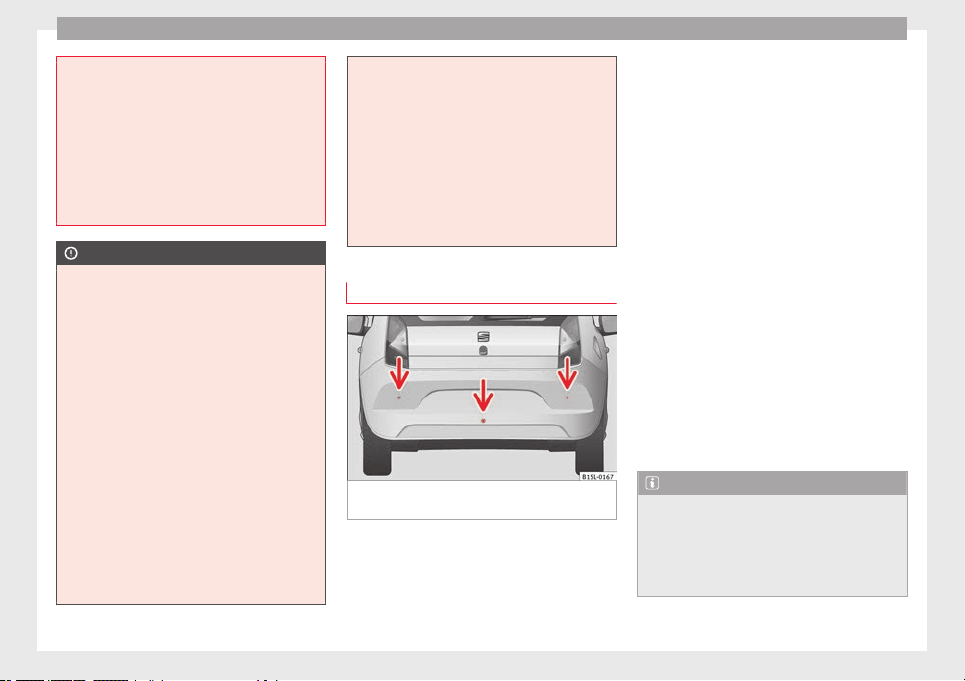
Operation
●
The surface of certain objects and some
clothing do not reflect the ultrasound signals
from the parking distance system. The sys-
tem cannot detect or incorrectly detects
these objects and people wearing these
types of clothes.
●
External sound sources can affect the park-
ing distance aid signals. In this case, under
certain circumstances, people and objects
will not be detected.
CAUTION
●
The sensors may not always be able to de-
tect objects such as trailer draw bars, thin
rails, fences, posts, trees and open boots,
etc. This could result in damage to your car.
●
Although the parking sensor system de-
tects and warns of the presence of an obsta-
cle, the obstacle could disappear from the an-
gle of measurement of the sensors if it is too
high or low and the system would no longer
show it. Therefore, it will not warn you of
these objects. Ignoring the warnings of the
parking sensor system could cause consider-
able damage to the vehicle.
●
The bumper sensors may become damaged
or misaligned, for example, when parking.
●
To ensure that the system works properly,
the bumper sensors must be kept clean, free
of ice and snow and uncovered.
●
When cleaning the sensors with high-pres-
sure or steam cleaning equipment, spray the
sensors briefly at a distance of no less than
10 cm.
●
Different sources of noise can produce er-
rors in the parking distance warning system,
e.g. parking distance warning systems from
other vehicles, inductive loops or construc-
tion works machines.
●
Retrofitting of components to the vehicle,
such as a bicycle carrier, may interfere with
the function of the parking distance warning
system.
Parking distance warning system
Fig. 85 Parking distance warning system sen-
sors on the rear bumper
The sensors of the parking distance warning
system are situated on the rear bumper
››› Fig. 85
.
Sw
it
ching the parking sensor system on and
off
●
Switching on: With the ignition switched
on, select reverse gear. A short audible warn-
ing confirms that the parking distance warn-
ing system is switched on and functioning.
●
Switching off: Release reverse gear.
Things to note on the parking distance
warning system
●
The parking sensor system sometimes reg-
isters water on the sensors as an obstacle.
●
If the distance does not change, the warn-
ing signal will sound less loudly after a few
seconds. If the continuous signal sounds, the
volume will remain constant.
●
When the vehicle moves away from the ob-
stacle, the beeping sound automatically
switches off. When getting close again, it re-
connects.
●
Your SEAT dealership can adjust the volume
of the warning signals.
Note
A fault in the parking distance warning sys-
tem is indicated through a brief audible warn-
ing that is constant for about 3 seconds when
switching it on the first time. Check the park-
ing distance warning system at a Specialised
workshop as soon as possible.
106
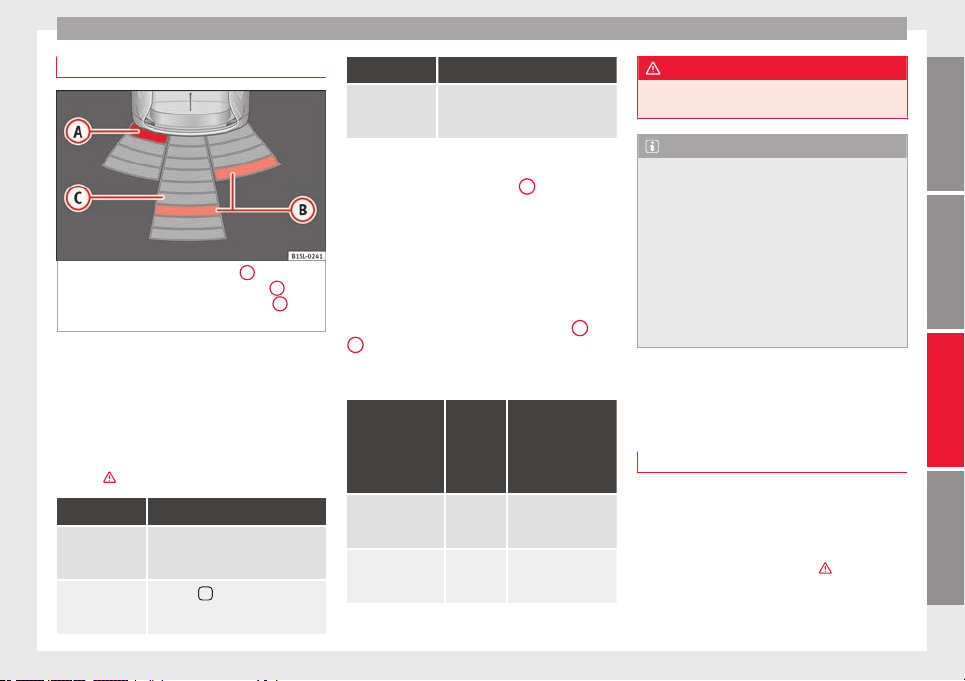
Driver assistance systems
Optical parking system* (OPS)
Fig. 86 On-screen OPS display:
A
has detec-
ted an obstacle in the collision zone;
B
has
detected an obstacle in the segment;
C
zone
recorded behind the vehicle.
The optical parking system is an extension of
the parking distance warning system
››› page 106
.
On the s
c
reen of the SEAT Portable System
(supplied by SEAT) the area behind the vehi-
cle is shown registered by the sensors. Any
obstacles are displayed in relation to the ve-
hicle ›››
.
Function Necessary operations
Switching the
display on:
Switching on the ››› page 106 park-
ing distance warning system. The
OPS switches on automatically.
Switching the
display off man-
ually:
Press the
button on the Portable
Navigation System.
Function Necessary operations
Switching the
display off man-
ually:
Release reverse gear.
Zones explored
Behind the vehicle ››› Fig. 86
C
, the zone an-
alysed reaches a distance of up to 150 cm
and around 60 cm to the sides.
Screen display
The image displayed represents the super-
vised zones in several segments. As the vehi-
cle moves closer to an obstacle, the segment
moves closer to the vehicle displayed
A
or
B
. When the penultimate segment is dis-
played, this means that the vehicle has
reached the collision zone. Stop the vehicle!
Distance from
the vehicle to
the obstacle
Audible
warning
Displayed in col-
our on the screen:
colour of the seg-
ment if an obsta-
cle is recognised
behind:
approx. 31-150
cm
beeping
sound
Yellow
behind:
approx. 0-30 cm
perma-
nent
sound
Red
WARNING
Do not be distracted from traffic to look at the
screen.
Note
●
SEAT recommends practising using the
parking distance warning system in a traffic-
free zone or in a car park to familiarise your-
self with the system and its operation.
●
Representation of the registered area on
the screen of the portable navigation system
may take up to 5 seconds.
●
Note the Instruction Manual provided for
the device of the additional information relat-
ing to the Portable Navigation System (sup-
plied by SEAT) ››› page 123.
Cruise control* (Cruise control
system - CCS)
Introduction
The cruise control system (CCS) is able to in-
dividually maintain the set speed when driv-
ing forwards from approx. 20 km/h (15 mph).
The CCS only slows down by reducing the ac-
celerator but not by braking
›››
.
»
107
Technical specifications
AdviceOperationSafety
Operation
WARNING
Use of the cruise control could cause acci-
dents and severe injuries if it is not possible
to drive at a constant speed maintaining the
safety distance.
●
Do not use the cruise control in heavy traf-
fic, if the distance from the vehicle in front is
insufficient, on steep roads, with several
bends or in slippery circumstances (snow,
ice, rain or loose gravel), or on flooded roads.
●
Never use the CCS when driving off-road or
on unpaved roads.
●
Always adapt your speed and the distance
to the vehicles ahead in line with visibility,
weather conditions, the condition of the road
and the traffic situation.
●
To avoid unexpected operation of the cruise
control system, turn it off every time you fin-
ish using it.
●
It is dangerous to use a set speed which is
too high for the prevailing road, traffic or
weather conditions.
●
When travelling down hills, the CCS cannot
maintain a constant speed. The vehicle tends
to accelerate under its own weight. Select a
lower gear or use the foot brake to slow the
vehicle.
Control lamp
It lights
up
Possible cause
This cruise control system maintains the
set speed of the vehicle.
Several warning and control lamps light up
for a few seconds when the ignition is switch-
ed on, signalling that the function is being
verified. They will switch off after a few sec-
onds.
WARNING
If the warning lamps are ignored, the vehicle
may stall in traffic, or may cause accidents
and severe injuries.
●
Never ignore the warning lamps.
CAUTION
Failure to heed the warning lamps when they
appear may result in faults in the vehicle.
108
Driver assistance systems
Cruise control system operation
Fig. 87 Turn signal and main beam head-
lights lever on the left of the steering column:
CCS buttons and controls.
Function Control position, control operations ››› Fig. 87 Action
Switch on the CCS. Control
B
in the position
.
The system is switched on. After switching on, no speeds are
stored and no regulator has yet been placed.
Activating the CCS Press button
A
in the area
. The current speed is stored and maintained.
Temporarily switch off CCS
Place control
B
in the
position.
OR: Press the brake or clutch pedal.
The cruise control system is switched off temporarily. The
speed setting will remain stored.
Switch on the CCS again. Press button
A
in the area
. The stored speed is reached again and maintained.
Increasing the stored speed
(during CCS setting)
Press the button
A
in the area
briefly to increase speed in shot measures of
about. 1 km/h (1 mph) and store.
The vehicle accelerates actively until it reaches the new stored
speed.
Keep button
A
pressed in the area
for a long time to continually increase
speed until releasing and storing.
»
109
Technical specifications
AdviceOperationSafety
Operation
Function Control position, control operations ››› Fig. 87 Action
Reducing the stored speed (dur-
ing CCS setting)
Press the button
A
in the area
briefly to reduce the stored speed in shot
measures of about. 1 km/h (1 mph) and store.
Reduce speed without braking, by interrupting the accelerator
until reaching the new stored speed.
Keep button
A
pressed in the area
for a long time to continually decrease
stored speed until releasing and storing.
Switch off the CCS. Control
B
in the position
. The system is switched off. The stored speed is deleted.
Travelling down hills with the CCS
When travelling down hills the CCS cannot
maintain a constant speed. Slow the vehicle
down using the brake pedal and reduce
gears if required.
Automatic off
The cruise control system (CCS) is switched
off automatically or temporarily:
●
If the system detects a fault that could af-
fect the working order of the CCS.
●
If you increase the stored speed by press-
ing the accelerator pedal for a certain time.
●
if the brake or clutch pedal is depressed.
●
If the gear is changed with the manual
gearbox.
●
If the airbag is triggered.
Safety Assist* (City Safety
Assist function)
Introduction
The City Safety Assist function covers driving
situations at a distance of about 10 metres in
front of the vehicle, in a speed range of ap-
proximately 5-30 km/h (3-19 mph).
When the system detects a possible collision
with a vehicle in front, the vehicle prepares
for a possible emergency braking
›››
.
If the driver does not react to an imminent
collision, the system can automatically brake
the vehicle in order to reduce speed faced
with a possible collision. The system can
help to reduce the consequences of an acci-
dent.
If the City Safety Assist function determines
that the driver has braked insufficiently when
faced with an imminent collision, the system
can increase the brake force in order to re-
duce speed. The system can help to reduce
the consequences of an accident.
WARNING
The smart technology in the City Safety As-
sist system cannot change the limits imposed
by the laws of physics and by the system it-
self. The increased convenience offered by
the City Safety Assist system should never
prompt you to take risks. The driver always
assumes the responsibility of braking in
time.
●
The City Safety Assist function cannot pre-
vent accidents or serious injury by itself.
●
The City Safety Assist system may carry out
unwanted brake interventions in complex
driving situations e.g. when a vehicle crosses
at a short distance.
WARNING
Relying on the City Safety Assist system in
city driving as part of one's driving behaviour
may cause accidents and serious injury. The
110
Driver assistance systems
system is not a replacement for driver aware-
ness.
●
Always adapt your speed and the distance
to the vehicles ahead in line with visibility,
weather conditions, the condition of the road
and the traffic situation.
●
The City Safety Assist function does not re-
act to people, animals or vehicles that cross
or move in the opposite direction in the same
lane.
●
If after switching on the City Safety Assist
function the vehicle begins to move, slow the
vehicle with the foot brake.
CAUTION
If you suspect that the City Safety Assist ra-
dar feature is damaged, switch it off. This will
avoid additional damage.
●
Any repair of the radar sensor requires spe-
cialist knowledge. SEAT recommends taking
your car in for technical service.
Note
●
If the City Safety Assist function activates a
brake, the brake pedal range is reduced. This
makes the brake pedal seem “harder”.
●
Automatic brake intervention by the City
Safety Assist function can be cancelled by
pressing the clutch pedal, the accelerator
pedal or by a corrective intervention.
●
During automatic braking by the City Safety
Assist function you may hear unusual noises.
This is normal and is produced in the brake
system.
Warning and control lamps
The City Safety Assist function is switched on
every time the ignition is switched on. No
special indication is produced.
If the City Safety Assist function is switched
off or on, or if there is an error in the system,
it will be shown by a control lamp on the in-
strument panel display.
It lights
up
Possible cause
›››
Solution
The City Safety As-
sist function has
been switched on
manually using
the button
››› Fig. 90.
The control lamp
turns off after about
5 seconds.
Flashes
Possible cause
›››
Solution
Fast: The City Safe-
ty Assist system
function brakes
automatically or
has braked auto-
matically.
Control lamp turns
off automatically.
Flashes
Possible cause
›››
Solution
Slow: City Safety
Assist function is
not currently avail-
able.
If the vehicle is stop-
ped, switch off the
engine and switch it
on again. If necessa-
ry, inspect the radar
sensor (dirt, frost)
›››
in Radar sen-
sor on page 112. If
it still does not func-
tion, refer to a Speci-
alised workshop to
have the system in-
spected.
Within the operat-
ing area of
5-30 km/h
(3-19 mph): The
City Safety Assist
function has been
switched off man-
ually using the
button
››› Fig. 90.
Switch on the City
Safety Assist func-
tion manually using
the button
››› Fig. 90.
Several warning and control lamps should
light up for a few seconds when the ignition
is switched on, signalling that the function is
being verified. They will switch off after a few
seconds.
»
111
Technical specifications
AdviceOperationSafety
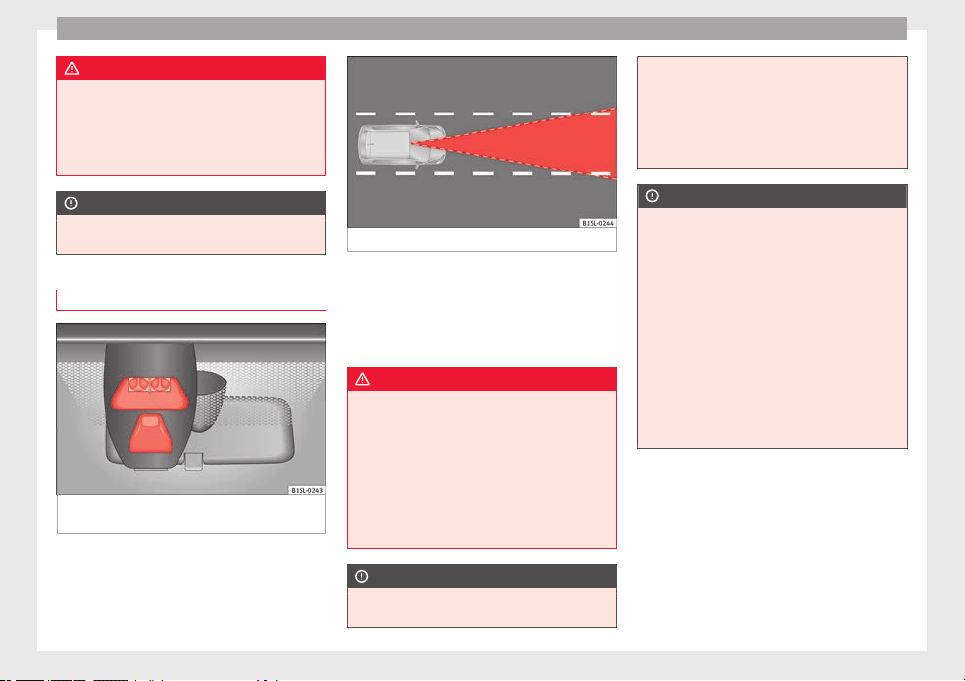
Operation
WARNING
If the warning lamps are ignored, the vehicle
may stall in traffic, or may cause accidents
and severe injuries.
●
Never ignore the warning lamps.
●
Stop the vehicle safely as soon as possible.
CAUTION
Failure to heed the warning lamps when they
appear may result in faults in the vehicle.
Radar sensor
Fig. 88 In the windscreen: City Safety Assist
function radar sensor.
Fig. 89 Radar sensor detection area.
A radar sensor on the windscreen ››› Fig. 88
allows the system to detect driving situations
in front of the vehicle.
Vehicles ahead can be detected up to a dis-
tance of about 10 m.
WARNING
The laser beam on the radar sensor can pro-
duce serious injuries to the eyes.
●
Never focus optical devices, e.g. a camera,
a microscope or a magnifying glass closer
than 100 mm from the radar sensor.
●
Note that the laser beam can stay active
when the City Safety Assist system is switch-
ed off or unavailable. The laser beam is not
visible to the human eye.
CAUTION
If the windscreen is dirty or frosted in the
area of the radar sensor, e.g. due to rain, mist
or snow, the City Safety Assist system may
fail to operate as a result.
●
Always keep the radar sensor area free of
dirt and frost.
●
Use a small brush to remove snow and a
de-icer spray to remove ice.
CAUTION
A damaged windscreen in the radar sensor
area may cause the City Safety Assist func-
tion to fail to operate.
●
Replace the windscreen if it is scratched,
cracked or chipped by stones in the radar
sensor area. Only use a windscreen author-
ised by SEAT. Carrying out repairs is not per-
mitted (e.g. in the case of damage suffered in
an impact from a stone).
●
When replacing the windscreen wipers, on-
ly use windscreen wipers authorised by SEAT.
●
Do not paint the radar sensor area on the
windscreen, or cover it with adhesives or oth-
er materials.
112
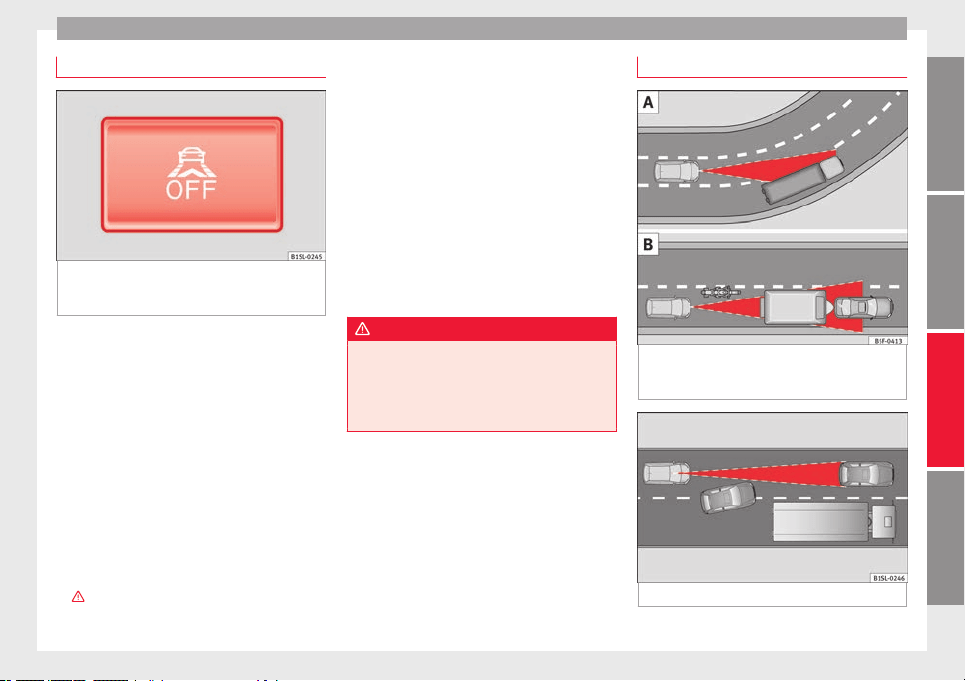
Driver assistance systems
Function
Fig. 90 In the lower part of the centre con-
sole: Button for the City Safety Assist func-
tion.
Switching on and off the City Safety Assist
function
●
Press the ››› Fig. 90
button on the centre
c
on
sole.
When the City Safety Assist function is
switched on, the control lamp lights up
on the dash panel within the operational
range, i.e. for speeds between 5-30 km/h
(3-19 mph).
Switch off the City Safety Assist function in
the following situations
Switching off the City Safety Assist function is
recommended in the following situations
›››
:
●
While the vehicle is being towed.
●
If the vehicle has been taken to an auto-
matic car wash.
●
If the vehicle is above a test bed.
●
If the radar sensor is faulty.
●
After the radar sensor has been involved in
a collision.
●
When driving off road (overhanging branch-
es).
●
If objects are protruding above the bonnet,
e.g. a load carried on the roof that signifi-
cantly protrudes over the front.
●
If the windscreen is damaged in the radar
sensor area.
WARNING
Failure to switch off the City Safety Assist
function in the above situations may result in
accidents and serious injury.
●
Switch off the City Safety Assist function in
critical situations.
Special driving situations
Fig. 91 A: Vehicle on a bend. B: Motorcyclist
driving ahead out of range of the radar sen-
sor.
Fig. 92 Other vehicles changing lanes
»
113
Technical specifications
AdviceOperationSafety

Operation
The City Safety Assist function is limited by
the laws of physics and by the nature of the
system itself. For this reason, this may pro-
duce reactions from the City Safety Assist
system in certain circumstances that are late
or unexpected by the driver. For this reason,
always pay due attention and if necessary, in-
tervene.
For example, the following driving situations
require special attention:
Driving through a bend
When entering or leaving a “long” bend, the
vehicle may decelerate when the radar sen-
sor detects a vehicle travelling in the adjoin-
ing lane ››› Fig. 91
A
. To interrupt deceleration
you can accelerate, turn the steering wheel or
press the clutch.
Narrow vehicles in front
The radar sensor will only detect narrow vehi-
cles in front if they are in the sensor detec-
tion zone ››› Fig. 91 B. This applies especially
to narrow vehicles such as motorbikes.
Other vehicles changing lanes
Vehicles moving into your lane in close prox-
imity can cause unexpected braking from the
City Safety Assist system
›››
Fig. 92. To inter-
rupt deceleration you can accelerate, turn the
steering wheel or press the clutch.
Malfunction in the radar sensor
If the radar sensor operation is impaired, for
example due to heavy rain, mist, snow or dirt,
the City Safety Assist system function is tem-
porarily switched off. On the instrument pan-
el display the control lamp flashes.
When the fault in the radar sensor has been
rectified, the City Safety Assist system func-
tion automatically becomes available. The
control lamp switches off.
The following conditions could prevent the
City Safety Assist system from functioning:
●
Tight bends.
●
Accelerator pressed all the way down to the
floor.
●
If the City Safety Assist system is switched
off or there is a fault ››› page 111.
●
If the radar sensor is dirty, covered or over-
heated ››› page 112.
●
In the event of snow, heavy rain or dense
fog.
●
If there are vehicles in front.
●
Vehicles changing lanes.
●
Vehicles moving in the opposite direction
in the same lane.
●
Very dirty vehicles with a low degree of re-
flection.
●
Presence of thick dust.
Hill driving assistant*
Operation
This function is only included in vehicles with
ESC.
The hill driving assistant helps the driver to
move off and upward on a hill when the vehi-
cle is stationary.
The system maintains brake pressure for ap-
proximately two seconds after the driver
takes his foot off the brake pedal to prevent
the vehicle from lurching backward when it is
started. During these 2 seconds, the driver
has enough time to release the clutch pedal
and accelerate without the vehicle moving
and without having to use the handbrake,
making start-up easier, more comfortable
and safer.
These are the basic operation conditions:
●
being on a ramp or hill/slope,
●
doors closed,
●
vehicle completely stationary,
●
engine running and foot on the brake,
●
besides having a gear engaged or being in
neutral for manual gear change and with the
selector lever at positions S
,
D
or R in vehi-
cles with an automatic gearbox.
This system is also active when reversing up-
hill.
114
Driver assistance systems
WARNING
●
If you do not start the vehicle immediately
after taking your foot off the brake pedal, the
vehicle may start to roll back under certain
conditions. Depress the brake pedal or use
the hand brake immediately.
●
If the engine stalls, depress the brake ped-
al or use the hand brake immediately.
●
When following a line of traffic uphill, if you
want to prevent the vehicle from rolling back
accidentally when starting off, hold the brake
pedal down for a few seconds before starting
off.
Note
The Official Service or a specialist workshop
can tell you if your vehicle is equipped with
this system.
Start-Stop system
Warning lamps
It
lights
up
Possible cause Solution
The Start-Stop system
is enabled.
It
lights
up
Possible cause Solution
The Start-Stop system
is enabled but the en-
gine cannot be auto-
matically stopped.
Contact a special-
ised workshop.
The Start-Stop system
cannot start the en-
gine.
Start the engine by
hand using the ve-
hicle's key
››› page 86.
There is a fault in the
alternator.
››› page 154
Flash-
es
Possible cause Solution
The Start-Stop system
is not available.
Contact a special-
ised workshop.
Some warning and control lamps will light up
briefly when the ignition is switched on to
check certain functions. They will switch off
after a few seconds.
WARNING
Observe the safety warnings ››› in Control
and warning lamps on page 40.
Start-Stop system
Fig. 93 At the top of the centre console: Start-
Stop system button
With the Start-Stop system enabled, the en-
gine is automatically stopped when the vehi-
cle is at a standstill. It will start again auto-
matically as required.
This function remains enabled while the igni-
tion is switched on. The instrument panel dis-
play shows information on the current status
››› page 115
.
Di
s
connect the Start-Stop system by hand
whenever crossing water.
Vehicles with a manual gearbox
●
When the vehicle is stopped, put it into
neutral and release the clutch pedal. The en-
gine will stop.
●
To restart, simply engage the clutch.
»
115
Technical specifications
AdviceOperationSafety
Operation
Vehicles with an automatic gearbox
●
When the vehicle is at a standstill, depress
the brake or keep it pressed down. The en-
gine switches off.
●
The engine will start again as soon as you
release the brake pedal.
●
With the selector lever set to position N
,
the en
gine w
ill not start until a range of gears
is selected or the accelerator pedal is de-
pressed.
Important conditions for the engine to stop
automatically
●
The driver's seat belt must be fastened.
●
The driver door must be closed.
●
The bonnet must be closed.
●
The engine must have reached a minimum
temperature.
●
The vehicle must have moved since the last
time the engine was stopped.
●
The vehicle's battery must be sufficiently
charged.
●
The battery temperature must not be too
low or too high.
●
The vehicle must not be on a very steep
slope.
Conditions for the engine to restart
automatically
The engine can be automatically restarted in
the following cases:
●
If the vehicle starts to moves.
●
If the battery voltage drops.
Conditions requiring engine start-up using
the key
The engine has to be manually started in the
following cases:
●
If the driver unbuckles his/her seat belt.
●
If the driver door is opened.
●
If the bonnet is opened.
Switching the Start-Stop system on and off
●
Press the button situated in the centre
console ››› Fig. 93.
●
The button will light up when the Start-Stop
system is switched off.
The engine will start immediately if the vehi-
cle is in Stop mode when the system is
switched off by hand.
WARNING
The smart technology included in the hill
hold cannot change the laws of physics. Do
not let the extra convenience afforded by the
hill hold tempt you into taking any risks
when driving.
●
Any accidental movement of the vehicle
could result in serious injury.
●
The hill hold is not a replacement for driver
awareness.
●
Adjust your speed and driving style to visi-
bility, weather, road and traffic conditions.
●
The hill hold cannot always keep the vehi-
cle at a standstill on a slope or brake suffi-
ciently when travelling downhill (e.g. on slip-
pery or frozen surfaces).
WARNING
The brake servo and the electromechanical
steering do not work when the engine is
switched off.
●
The vehicle must never be allowed to move
with the engine switched off.
●
Disconnect the Start-Stop system before
working in the engine compartment.
CAUTION
The vehicle's battery could be damaged if the
vehicle is used for long periods at very high
outside temperatures.
Note
In some cases, it may be necessary to start
the engine by hand using the key. Refer to
116
Towing bracket device
the corresponding control lamp on the instru-
ment panel.
Towing bracket device
Trailer coupling
Information about trailer coupling
The vehicle is not certified for trailer cou-
plin
g. The vehicle is not factory-equipped
with a towing bracket, nor is it possible to ret-
rofit it.
WARNING
Installing a towing bracket on the vehicle
may cause accidents and serious injuries
while operating the vehicle.
●
Never install a towing bracket on the vehi-
cle.
●
The trailer may be released from the vehicle
when the vehicle is moving.
CAUTION
Any type of towing bracket installed on the
vehicle can cause serious and costly damage
that are not covered under the SEAT guaran-
tee.
117
Technical specifications
AdviceOperationSafety
Advice
Advice
Care and maintenance
Accessories, replacement of
parts and modifications
Introduction
WARNING
The use of spare parts and accessories, or in-
correctly performed modifications or repairs
may result in damage to the vehicle, acci-
dents and serious injury.
●
SEAT strongly recommends you to only use
SEAT approved accessories and SEAT
®
origi-
nal spare parts. These parts and accessories
have been specially tested by SEAT for suita-
bility, reliability and safety.
●
Have any repairs or modifications carried
out at a specialised workshop. These work-
shops have the necessary tools, diagnostics
equipment, repair information and qualified
personnel.
●
Only mount parts with the same specifica-
tions as the parts fitted at factory.
●
Never mount, fasten or fit objects such as
drink holders or telephone cradles over the
covers of the airbag modules or within their
deployment zones.
●
Only use wheels and tyre combinations
which have been approved by SEAT for your
vehicle type.
Accessories and spare parts
SEAT recommends you consult an Official
Service before purchasing accessories and
spare parts or consumables. For example,
when fitting accessories at a later date, or
when replacing a component. A SEAT Official
Service will advise you as to the legal require-
ments and manufacturer's recommendations
regarding accessories, spare parts and other
components.
SEAT recommend you use only approved
SEAT accessories
and
genuine SEAT spare
p
arts
®
. These parts and accessories have
been specially tested by SEAT for suitability,
reliability and safety. In addition, SEAT tech-
nical services will guarantee that assembly is
performed professionally.
Although we continually monitor the market,
SEAT cannot guarantee that products not ap-
proved by SEAT are reliable, safe or suitable
for the vehicle. Therefore, SEAT cannot accept
liability, even in those cases authorised by
an officially recognised technical inspection
office or other official body.
Any retro-fitted equipment which has a direct
effect on vehicle control must be approved by
SEAT for use in your vehicle and bear the e
mark (the European Union's authorisation
symbol). This includes cruise control systems
or electronically controlled suspension.
If any additional electrical devices are fitted
which do not serve to control the vehicle it-
self, these must bear the mark (European
Union manufacturer conformity declaration).
This includes refrigerator boxes, laptops or
ventilator fans.
WARNING
Unprofessional repairs or modifications to
the vehicle may affect the performance of the
airbags, and may cause operating faults or fa-
tal accidents.
●
Never mount, fasten or fit objects such as
drink holders or telephone cradles over or
next to the covers of the airbag modules or
within their deployment zones.
●
Objects placed over the airbag covers, or
within their deployment zones, could lead to
serious injury or loss of life if the airbags are
triggered.
Fluids and consumables
All vehicle fluids and consumables, such as
notched belts, tyres, coolant fluids, engine
oils, spark plugs and batteries are continual-
ly being developed. Therefore all fluids and
118
Care and maintenance
consumables should be changed at a speci-
alised workshop. Technical services are per-
manently informed of any modifications.
WARNING
The incorrect use or handling of fluids or con-
sumables may result in accident, serious in-
jury, burns or intoxication.
●
Therefore, fluids must always be stored
closed in their original container.
●
Never store fluids in empty food containers
or bottles as other people may accidentally
drink the fluid.
●
Keep all fluids and consumables out of
reach of children.
●
Read and observe the information and
warnings given on the fluid containers.
●
Only work in the open air or in well-ventila-
ted zones, when using products which give
off harmful vapours.
●
Never use fuel, turpentine, engine oil, ace-
tone or any other volatile liquid in the main-
tenance of the vehicle. These are toxic and
highly flammable. They could lead to fire or
explosions!
CAUTION
●
Only use appropriate fluids. Do not confuse
fluids as this can cause serious malfunctions
or engine damage.
●
Accessories and other components moun-
ted in front of the air inlet reduce the cooling
effect of the coolant. If the engine is running
under great strain in high outside tempera-
tures, it could overheat.
For the sake of the environment
Leaking fluids could pollute the environment.
Collect any spilt fluids in suitable containers
and dispose of them in accordance with legis-
lation and with respect for the environment.
Repairs and technical changes
When performing repairs and technical mod-
ifications, SEAT's directives must be ob-
served!
›
››
Unauthorised modifications to the electronic
components or software in the vehicle may
cause malfunctions. Due to the way the elec-
tronic components are linked together in net-
works, other indirect systems may be affec-
ted by the faults. This may significantly affect
the vehicle's performance, increase compo-
nent wear and could mean that the vehicle
registration documents are no longer valid.
Your SEAT Official Service cannot be held lia-
ble for any damage caused by technical mod-
ifications or repairs performed incorrectly.
The SEAT Official Service does not accept lia-
bility for damage resulting from technical
modifications or repairs performed incorrect-
ly; neither is the SEAT warranty valid in these
cases.
SEAT recommends you have any technical
modifications or repairs performed at a SEAT
Official Service and that you use genuine
SEAT spare parts
®
.
Vehicles with special accessories and
equipment
The manufacturers of additional equipment
guarantee that the equipment complies with
applicable laws and regulations with respect
to the environment, in particular Directives
2000/53/CE and 2003/11/CE. The first direc-
tive governs the disposal of end-of-life vehi-
cles while the second refers to the restric-
tions on the marketing and use of certain
dangerous substances and preparations.
The vehicle owner should keep the documen-
tation for the additional equipment safely
and hand it over to the scrap yard at the end
of the vehicle's service life. This ensures that
any additional equipment mounted in end-of-
life vehicles is correctly disposed of with re-
spect for the environment.
WARNING
Repairs or modifications which are not per-
formed correctly may result in damage or er-
rors in the vehicle operation, affecting the ef-
fectiveness of the driver assist systems. This
could result in serious accident.
»
119
Technical specifications
AdviceOperationSafety
Advice
●
All repairs and modifications to the vehicle
should only be performed by a specialised
workshop.
Repair and faults in the airbag system
When performing repairs and technical mod-
ifications, SEAT's directives must be ob-
served! ›››
Modifications and repairs to the front bump-
er, doors, front seats, and repairs to the roof
or chassis should only be carried out in a
specialised workshop. These components
may contain parts or sensors belonging to
the airbag system.
If work is carried out on the airbag system or
parts have to be removed and fitted on the
system when performing other repair work,
parts of the airbag system may be damaged.
The consequence may be that, in the event of
an accident, the airbag inflates incorrectly or
does not inflate at all.
So that the effectiveness of the airbag is not
reduced and that removed parts do not cause
any injuries or environmental pollution, regu-
lations must be observed. These require-
ments are known to specialised workshops.
Modifications to the vehicle suspension may
affect the operation of the airbag system in
the event of collision. For example, if wheel
and tyre combinations not approved by SEAT
are used, or if the vehicle height is lowered,
the suspension is stiffened or the suspension
springs, telescopic arms, dampers, etc., are
modified, the results received by the airbag
sensors and sent to the control unit may not
be accurate. For example, some modifica-
tions to the suspension could increase the
force measured by the sensors and result in
the triggering of the airbag systems in colli-
sions. Under normal conditions, the meas-
ured values would be lower and the airbag
would not have been triggered. Other modifi-
cations may reduce the forces measured by
the sensors and prevent the airbags from be-
ing triggered when they should.
WARNING
Repairs or modifications which are not per-
formed correctly may result in damage or er-
rors in the vehicle operation, affecting the ef-
fectiveness of the airbag systems. This could
result in serious or fatal accidents.
●
All repairs and modifications to the vehicle
should only be performed by a specialised
workshop.
●
Airbag modules must never be repaired: if
damaged, they must be replaced.
●
Never fit recycled or reused airbag compo-
nents in your vehicle.
WARNING
Modifications to the vehicle suspension, in-
cluding the use of unauthorised wheel and
tyre combinations, may affect the perform-
ance of the airbags and increase the risk of
serious or fatal injury in the event of acci-
dent.
●
Never fit suspension components which are
not identical to the original parts in the vehi-
cle.
●
Never use wheel and tyre combinations not
approved by SEAT.
Retro-fitting of two-way radios
An exterior aerial is required for the use of
two-way radios in the vehicle.
The retro-fitting of electrical or electronic ap-
pliances in the vehicle is subject to their ap-
proval for use in your vehicle. Under certain
circumstances, this could mean that your ve-
hicle registration documents are no longer
valid.
SEAT has approved your vehicle for use with
two-way radios providing the following condi-
tions are observed:
●
The exterior aerial must be mounted pro-
fessionally.
●
The maximum transmitting power is 10
watts.
The optimal reach of the equipment is only
achieved with an external aerial.
120

Care and maintenance
Check first with a specialised workshop that
understands the technical possibilities of in-
stallation if you wish to use a two-way radio
with a transmitting power of over 10 watts.
SEAT recommends taking your car in for tech-
nical service.
All legal requirements, together with the in-
structions for the use of two-way radios must
be observed.
WARNING
If the two-way radio is not securely fastened
in position, it could be sent flying around the
vehicle in the event of sharp braking, sudden
manoeuvres or accident, causing injury.
●
While driving, two-way radios must be se-
curely fastened in position, outside the air-
bags deployment zones, or safely stowed
away.
WARNING
When using a two-way radio without a con-
nection to an exterior aerial, the maximum
permitted levels of electromagnetic radiation
may be exceeded. This is also the case if the
aerial has not been correctly installed.
●
You should only use a two-way radio inside
the vehicle if it has first been correctly con-
nected to an exterior aerial.
Information stored by the control
units
Your vehicle is fitted at the factory with a ser-
ies of electronic control units responsible for
the engine and gearbox management. In ad-
dition, the control units supervise the per-
formance of the exhaust gas system and the
airbag systems.
Therefore, while the vehicle is being driven,
these electronic control units are continuous-
ly analysing the vehicle data. In the event of
faults or deviations from the theoretical val-
ues, only this data is stored. Normally, the
warning lamps on the instrument panel light
up in the event of faults.
This data can only be read and analysed us-
ing special equipment.
The storing of the data allows specialised
workshops to detect and repair faults. Stored
data may include:
●
Data relating to the engine or the gearbox
●
Speed
●
Direction of travel
●
Braking force
●
Detection of seat belt
The vehicle control units never record conver-
sations held by passengers in the vehicle.
In vehicles equipped with an emergency call
function via the mobile phone or other appli-
ances connected in the vehicle, it is possible
to send the vehicle position. If the control
unit records an accident with airbag activa-
tion, the system may automatically send a
signal. This will depend on the network oper-
ator. Normally, transmission is only possible
in areas with good coverage.
Event Data Recorder
The vehicle is not
fitted with an event data re-
c
or
der.
An event data recorder temporarily stores the
vehicle information. Therefore, in the event of
an accident, it is possible to obtain detailed
information about how the accident occur-
red. Vehicles with airbag systems can store
data relating to impact speed, seat belt sta-
tus, seat positions and airbag activation
times may be stored, etc. The volume of data
depends on the manufacturer.
Event data recorders can only be mounted
with authorisation from the vehicle owner
and, in some countries, they are governed by
local legislation.
Reprogramming control units
On the whole, all the data required for the
component management is stored in the con-
trol units. The programming of certain con-
venience functions, such as the turn signals,
individual door opening and instructions on
the display can be modified using special
»
121
Technical specifications
AdviceOperationSafety

Advice
equipment at the workshop. If the comfort
functions are reprogrammed, the information
and Instruction Manual descriptions will not
coincide with the modified functions. There-
fore, SEAT recommends that any modifica-
tions be recorded in the section “Other work-
shop notes” in the Maintenance Programme.
The SEAT Official Service must have a record
of any modification to the programming.
Reading the vehicle fault memory
There is a diagnostics connector in the vehi-
cle interior for reading the vehicle fault mem-
ory. The fault memory documents errors and
deviations from the theoretical values of the
electronic control units.
The diagnostics connector is in the driver
side footwell area, next to the lever for open-
ing the bonnet, below a cover.
The fault memory should only be read and re-
set by a specialised workshop.
Using a mobile telephone in a vehicle
without connection to an exterior
aerial
Mobile telephones transmit and receive radio
waves also called high-frequency energy,
both when in use and when on stand-by. Sci-
entific studies state that radio waves exceed-
ing certain values may be harmful to the hu-
man body. International committees and au-
thorities have established limits and direc-
tives in order to ensure electromagnetic radi-
ation from mobile phones remains within cer-
tain limits that do not endanger health. Nev-
ertheless, there is no conclusive scientific
evidence that wireless telephones are totally
safe.
That is why some experts recommend moder-
ate use of the mobile telephone, and the ap-
pliance of measures to reduce radiation on
the human body.
When a mobile phone not connected to an
exterior aerial is used inside the vehicle, the
electromagnetic radiation may be greater
than if the mobile phone were connected to a
built-in aerial or to another exterior aerial.
If the vehicle is fitted with a suitable hands-
free device that allows the employment of
numerous additional mobile telephone func-
tions with compatible Bluetooth technolo-
gy
®
, it will comply with the legislation in
many countries which only permits the use of
mobile phones inside vehicles using a
hands-free device.
The hands-free system of the Portable Navi-
gation System (supplied by SEAT) has been
designed for use with conventional mobile
phones and phones with Bluetooth technolo-
gy
®
››› page 123
. Mobile telephones must be
p
l
aced in a suitable telephone support or
stored safely in the vehicle. If a support is
used for the telephone, it must be securely
fastened to the base plate. The mobile will be
secure on the instrument panel and always
within reach of the driver only by following
these procedures. Mobile telephone connec-
tion with an external aerial is carried out sub-
ject to the hands-free device, via the tele-
phone support or by the Bluetooth
®
connec-
tions present in the mobile telephone and
the vehicle.
If the mobile phone is connected to an aerial
incorporated into the vehicle or an exterior
aerial connected to the vehicle, it will help re-
duce the electromagnetic radiation transmit-
ted and the risk to human health. It will also
improve the quality of the connection.
If the phone is used inside the vehicle with-
out the hands-free system, it will not be se-
curely fastened and will not be connected to
the exterior aerial of the vehicle telephone.
Nor will the telephone charge if it is not on
the support. In addition, some calls may
break off and the quality of the connection
will be affected.
Mobile telephones should only be used in-
side the vehicle if they are connected to a
hands-free system. SEAT recommends using
an external aerial should you wish to use a
mobile telephone inside the vehicle.
Bluetooth
®
is a registered trademark of Blue-
tooth
®
SIG, Inc.
122
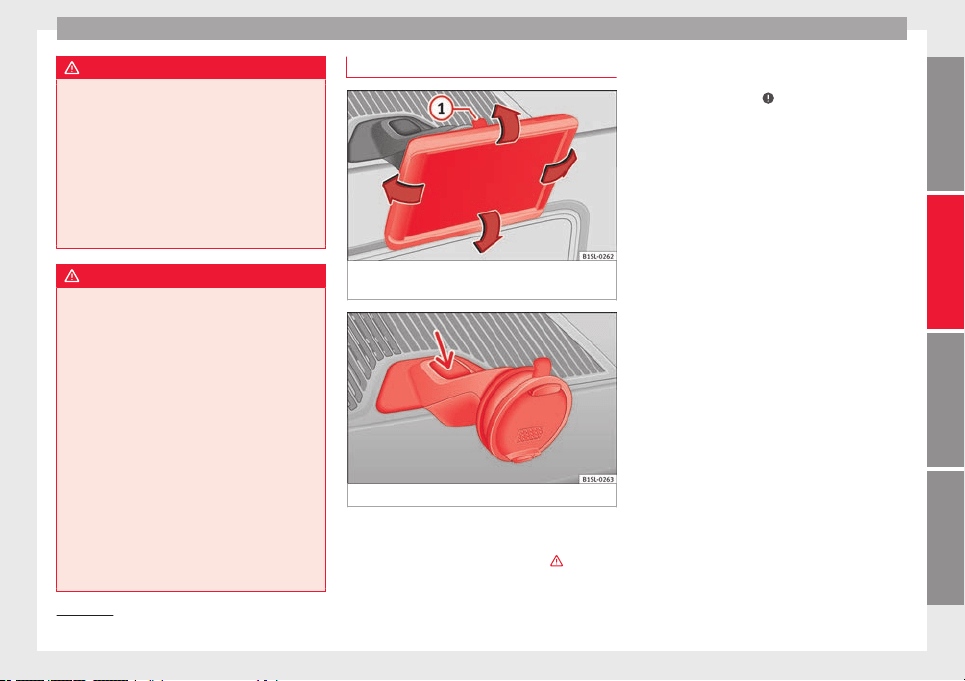
Care and maintenance
WARNING
If the mobile phone is not securely fastened
in position, it could be sent flying around the
vehicle in the event of sharp braking, sudden
manoeuvres or accident, causing injury.
●
While driving, the mobile telephone, other
equipment including telephone accessories
such as telephone supports, notepads and
navigators must be correctly secured, away
from the airbags deployment zones, or stored
in a safe place.
WARNING
When using a mobile telephone or two-way
radio without connecting an external aerial,
the maximum permitted levels of electromag-
netic radiation in the vehicle may be excee-
ded, thus putting the driver and the rest of
the vehicle occupants in danger. This is also
the case if the aerial has not been correctly
installed.
●
A minimum of 20 centimetres should be
kept between mobile phone aerials and artifi-
cial pacemakers, as mobile telephones may
affect the working of pacemakers.
●
Do not keep mobile phones in breast pock-
ets directly above pacemakers.
●
Immediately switch off the mobile tele-
phone if you suspect any interference with
pacemakers or other types of medical equip-
ment.
SEAT Portable System*
Fig. 94 In the centre console: Remove the
navigator.
Fig. 95 Remove the navigator holder
The SEAT Portable System (supplied by SEAT)
allows for the use of other vehicle functions
such as additional applications ››› .
The gradient and the angle of vision can be
set by moving the navigator to the required
position ››› Fig. 94
›
›› .
The Portable Navigation System Instruction
Manual can be observed directly on the
equipment.
Functions
1)
●
Multifunction display (MFI) shown with ad-
ditional instruments ››› page 36.
●
Operation of a factory-fitted radio and a
››› Booklet Radio system
connected multime-
di
a p
layer.
●
Image display.
●
Navigation.
●
Hands-free system for mobile telephones
via Bluetooth.
●
Door open.
●
Optical parking system (OPS).
●
Recommended gear and driving advice.
Observe the Instruction Manual in the
equipment
●
Connect the Portable Navigation System.
●
Press the button more on the screen.
●
Press the Manual button.
»
1)
subject to the vehicle
123
Technical specifications
AdviceOperationSafety
Advice
●
Select the required chapter and press the
corresponding button.
Removing and fitting the navigator
●
Securely support the navigator.
●
Press the release button
1
until the device
is released from its holder.
●
Take the navigator out and store it safely.
To fit the navigator, place it in the upper sup-
port and push the lower part inside the hold-
er until it engages with a click ››› .
Removing and fitting the navigator holder
●
Press the holder release button ››› Fig. 95
(arrow).
●
Remove the holder from the dash panel in
an upwards direction.
●
If necessary, close the opening with the
corresponding cover.
In order to fit the holder, place it on the open-
ing from above and press in a downwards di-
rection until it engages with a click. ››› .
WARNING
Any distraction may lead to an accident, with
the risk of injury. Operating the navigator
could distract you from the traffic.
●
Always stay alert and drive responsibly.
●
Select volume settings that allow you to
easily hear signals from outside the vehicle
at all times (e.g. emergency service sirens).
●
Setting the volume too high may cause
damage to your hearing. This also applies if
the device is set to high volumes for a short
period.
WARNING
Journey instructions and traffic signals
shown on the navigation system may differ to
the current traffic situation.
●
Traffic signals and driving regulations take
precedence over journey instructions and in-
dications from the navigation system.
●
Adjust your speed and driving style to visi-
bility, road, traffic and weather conditions.
WARNING
If the navigator is not securely fastened in
position, it could be sent flying around the
vehicle in the event of sharp braking, sudden
manoeuvres or accident, causing injury.
●
Fit the navigator housing safely on the cor-
responding opening on the dash panel.
●
Always place the navigator securely in its
holder or store it in the vehicle.
CAUTION
An unsuitable gradient and angle of vision
setting can damage the navigator.
●
When adjusting the navigation device,
move it with care and not beyond its limits.
CAUTION
Excessively high or low outside temperatures
can affect the Portable Navigation System op-
eration or damage the device.
●
Always take the Portable Navigation Sys-
tem with you when you leave the vehicle to
protect it from excessively high or low tem-
peratures and intense sunlight.
CAUTION
Humidity can damage the Portable Naviga-
tion System connections on the dash panel.
●
Do not clean the holder for the navigation
device with moist products. Use a dry cloth.
Note
SEAT recommends taking the Portable Navi-
gation System with you when you leave the
vehicle to prevent it from being stolen.
124
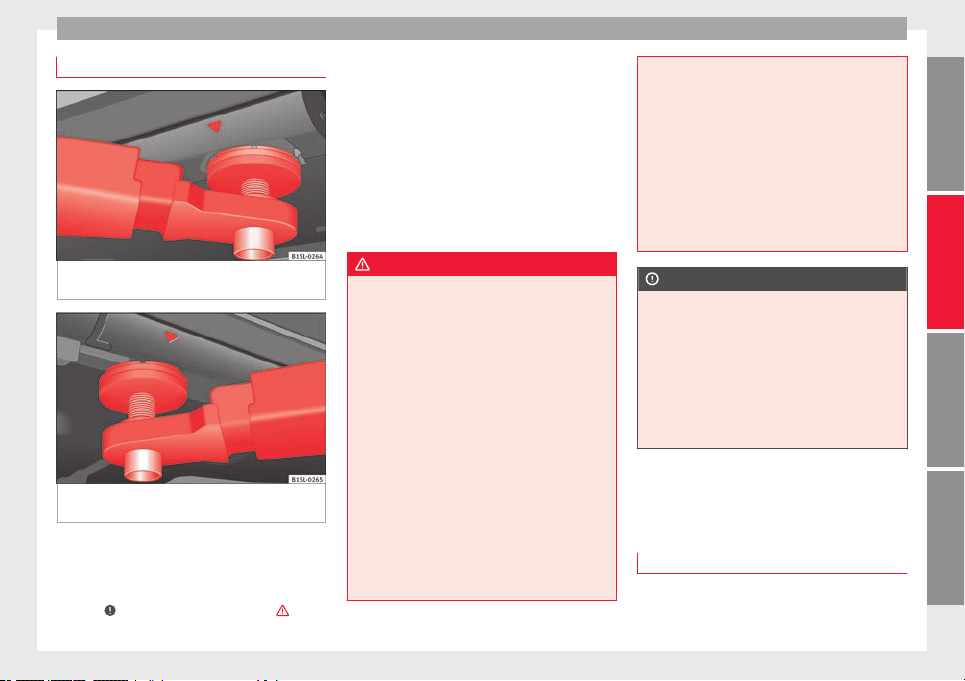
Care and maintenance
Jacking points for raising vehicle
Fig. 96 Front jacking points for raising vehicle
with lifting platform or jack
Fig. 97 Rear jacking points for raising vehicle
with lifting platform or jack
Always use the jacking points indicated in
the figures ››› Fig. 96
and ›
›› Fig. 97
when
raising the vehicle. If the vehicle is not lifted
at these points, it could be seriously dam-
aged ›››
or lead to serious injury ››› .
The vehicle should not be lifted using lifting
platforms with lift pads containing fluid.
When raising a vehicle using a platform or
jack, a series of precautionary measures are
required. Do not raise the vehicle with a lift-
ing platform or jack unless you have received
training in how to do so and know how to do
so safely.
Notes on raising the vehicle with a jack
››› page 174
.
WARNING
The improper use of the lifting platform or
the jack when raising the vehicle may result
in accidents or serious injury.
●
Before raising the vehicle, please observe
the manufacturer's instructions for the plat-
form or jack, and the legal requirements,
where applicable.
●
There should not be anyone inside the ve-
hicle when it is being raised or once it is in
the air.
●
Only use the jacking points indicated in the
figures ››› Fig. 96 and ››› Fig. 97
when raising
the vehicle. If the vehicle is not lifted at the
indicated points, it may fall from the platform
while the engine or gearbox is being dis-
mounted, for example.
●
The jacking points should be centrally
aligned and firmly positioned on the platform
support plates.
●
Never start the engine when the vehicle is
raised! The vehicle may fall from the platform
due to the engine vibrations.
●
If it is necessary to work underneath the ve-
hicle while it is raised, you should check that
the supporting stands have an adequate load
capacity.
●
Never climb onto the lifting platform.
●
Always make sure that the weight of the ve-
hicle does not exceed the lifting platform
load capacity.
CAUTION
●
Never raise the vehicle at the engine oil
sump, the gearbox or the rear or front axles.
●
Always use an intermediate rubber support
to prevent damage to the vehicle underbody.
Check that the arms of the lifting platform are
able to move with obstruction.
●
The arms should not come into contact with
the side running boards or other parts of the
vehicle.
Care and cleaning the vehicle
exterior
Introduction
Regular maintenance and washing help to
maintain the value of the vehicle. This may
»
125
Technical specifications
AdviceOperationSafety
Advice
also be one of the requirements for acknowl-
edging warranty claims in the event of body-
work corrosion or paint defects.
Products suitable for the care of your vehicle
are available at any technical service.
WARNING
Car-care products may be toxic and hazard-
ous. If car care products are not suitable or
are used inappropriately, this could result in
accident, serious injury, burns or intoxica-
tion.
●
Car care products must always be stored in
the original container which should be kept
closed.
●
Observe information provided by the manu-
facturer.
●
To prevent confusion, never store car care
products in empty food cans, bottles or other
containers.
●
Keep all care products out of reach of chil-
dren.
●
Harmful vapours may be produced when us-
ing car care products. Therefore, care prod-
ucts should only be used in well-ventilated
spaces or in the open air.
●
Never use fuel, turpentine, engine oil, ace-
tone or any other volatile liquid to wash,
clean or care for the vehicle. These are toxic
and highly flammable.
WARNING
Inappropriate care and cleaning of vehicle
components may effect the vehicle safety
equipment, increasing the risk of severe in-
jury.
●
Vehicle components should only be
cleaned and maintained in accordance with
the manufacturer's instructions.
●
Only use approved or recommended care
products.
CAUTION
Cleaning products which contain solvents will
damage the material.
For the sake of the environment
Only wash the vehicle in areas allocated for
this purpose, to prevent dirty water which
may be contaminated by oil, grease or fuel,
from entering the drains. In some places,
even washing it outside the planned areas is
banned.
For the sake of the environment
Where possible, always use products which
respect the environment.
For the sake of the environment
The remains of car care products should not
be disposed of with ordinary household
waste. Observe information provided by the
manufacturer.
Washing the vehicle
The longer substances such as insects, bird
droppings, resinous tree sap, road dirt, in-
dustrial deposits, tar, soot or road salt and
other aggressive materials remain on the ve-
hicle, the more damage they do to the paint-
work. High temperatures (for instance due to
strong sunlight) further intensify the corro-
sive effect. The vehicle undercarriage should
also be thoroughly washed at regular inter-
vals.
Automatic car washes
Always observe the instructions provided at
the automatic car wash. The standard pre-
cautionary measures prior to entering the car
wash should be taken to avoid damage to
the vehicle (close all windows, fold in exterior
mirrors). If the vehicle is fitted with additional
components (spoiler, roof-rack, aerial, etc.),
check with the car wash supervisor whether
these can enter the car wash ››› .
The vehicle paintwork is so durable that the
vehicle can normally be washed without
problems in an automatic car wash tunnel.
However, wear and damage to the paintwork
will depend on the type of car wash used.
126
Care and maintenance
SEAT recommends the use of car washes
without brushes.
To remove traces of wax on windows and to
prevent wiper blades from scratching, please
observe the following ››› page 128, Cleaning
windows and exterior mirrors.
Washing the car by hand
When washing the car by hand, use plenty of
water to soften the dirt first, and rinse off as
well as possible.
Then clean the vehicle with a soft sponge,
glove
or
brush
using only slight pressure.
Start at the roof and work downwards. Spe-
cial car shampoo should only be used for
very persistent dirt.
Rinse the sponge or glove thoroughly and of-
ten.
Wheels, sills and similar should be cleaned
last. Use a second sponge for this.
WARNING
Sharp components on the vehicle may cause
injury.
●
Protect arms and hands from sharp edges
when cleaning the vehicle undercarriage or
the interior of the wheel hubs.
WARNING
After the vehicle has been washed, the brak-
ing effect will be reduced (and the braking
distance increased) due to moisture (and ice
in winter) on the brakes.
●
“Dry the brakes and remove ice” by braking
carefully. Ensure that you are not endanger-
ing other road-users or breaking traffic regu-
lations in the process.
CAUTION
●
The temperature of the water must not ex-
ceed +60 °C (+140 °F).
●
To avoid damage to the paintwork, do not
wash the vehicle in full sun.
●
Do not use rough sponges or similar which
could damage the surface to clean away the
traces of insects.
●
Never wipe the headlights with a dry cloth
or sponge, always moisten first. It is best to
use soapy water.
●
Washing the vehicle in low temperatures:
When washing the vehicle with a hose, do
not direct water into the lock cylinders or the
gaps around the doors or roof. Locks and
seals could freeze!
CAUTION
To prevent damage to the vehicle, please ob-
serve the following before entering an auto-
matic car wash:
●
Compare the distance between the vehicle
wheels and the distance between the guide-
rails of the car wash to prevent damage to the
wheels and tyres!
●
Switch off the rain sensor before taking the
vehicle to an automatic car wash.
●
Compare the height and width of your vehi-
cle with the available height and width when
entering and driving through the car wash.
●
Fold in exterior mirrors Electrically retracta-
ble exterior mirrors must not be folded in or
out by hand. Always use the electrical power
control.
●
To avoid damaging the bonnet paintwork,
rest the windscreen wipers on the windscreen
after drying the wiper blades. Do not let them
fall!
●
Lock the rear lid to prevent it from opening
unexpectedly while inside the car wash.
Washing the vehicle with high
pressure cleaning apparatus
When cleaning the vehicle with a high-pres-
sure cleaner, always follow the operating in-
structions for the equipment. Pay special at-
tention to the required pressure of the jet
and the
distance
between the jet and the ve-
hic
le ›››
.
Keep a suitable distance from soft materials,
such as rubber hoses or insulating material,
»
127
Technical specifications
AdviceOperationSafety
Advice
and from the parking distance warning sys-
tem sensors. The sensors of the parking dis-
tance warning system are situated on the rear
bumper ››› .
Do not use a nozzle that sprays the water out
in a
direct stream or one th
at
has a rotating
jet for forcing off dirt ›››
.
WARNING
The incorrect use of high pressure cleaning
equipment could result in permanent dam-
age, visible or invisible, to the tyres or other
materials. This could result in a serious acci-
dent.
●
Ensure there is a suitable distance between
the nozzle and the tyres.
●
Never wash tyres with a concentrated jet or
so-called “dirt blasters”. Even at large spray-
ing distances and short cleaning times, you
may damage the tyres.
WARNING
After the vehicle has been washed, the brak-
ing effect will be reduced (and the braking
distance increased) due to moisture (and ice
in winter) on the brakes.
●
“Dry the brakes and remove ice” by braking
carefully. Ensure that you are not endanger-
ing other road-users or breaking traffic regu-
lations in the process.
CAUTION
●
The temperature of the water must not be
above +60 °C (+140 °F).
●
To avoid damage to the paintwork, do not
wash the vehicle in full sun.
●
To ensure that the system functions well,
the sensors located on the bumper must be
kept clean and free from ice. When cleaning
with pressure hoses and steam cleaners, the
sensors should be sprayed only briefly. A dis-
tance of 10 cm between the sensors and the
steam / hose nozzle must be observed.
●
Do not use a high pressure cleaner to re-
move ice or snow from windows
●
Washing the vehicle in low temperatures:
When washing the vehicle with a hose, do
not direct water into the lock cylinders or the
gaps around the doors or roof. Locks and
seals could freeze!
Cleaning windows and exterior
mirrors
Cleaning windows and exterior mirrors
Spray windows and exterior windows with a
standard window cleaner containing alcohol.
Dry the windows with a clean chamois leath-
er or a lint-free cloth. The chamois leathers
used on painted surfaces are not suitable for
cleaning windows because they are soiled
with wax deposits which could smear the
windows.
Use window cleaner or a silicone remover to
clean rubber, oil, grease and silicone depos-
its off ››› .
Removing wax deposits
Automatic car washes and certain car care
products may leave wax deposits on the win-
dows. These deposits can only be removed
with a special product or cleaning cloths. If
wax deposits are left on the windscreen and
the rear window, the blades can scratch the
glass. SEAT recommends you wipe the wax
deposits off the windscreen and the rear win-
dow with a soft cloth each time after you
have washed the vehicle.
A window cleaning detergent which helps to
dissolve the wax may be added to the wind-
screen washer fluid to prevent the wiper
blades from scratching the windscreen.
Please ensure you add the cleaning product
in the correct proportions. Products for re-
moving grease do not eliminate the wax de-
posits ››› .
Special cleaning products or window cloths
are available at any technical service. To re-
move wax deposits, SEAT recommends the
following products:
128
Care and maintenance
●
For the hottest time of the year: the window
cleaner for summer use G 052 184 A1. Pro-
portion 1:100 (1 part detergent, 100 parts
water) in the windscreen washer reservoir.
●
All year round: the window clean-
er G 052 164 A2; proportion 1:2 in wind-
screen washer bottle (1 part concentrate, 2
parts water) in winter, up to -18 ℃ (-0.4 °F),
or 1:4, during the rest of the year.
●
Window cloths G 052 522 A1 for all win-
dows and exterior mirrors.
Removing snow
Use a small brush to remove snow from the
windows and exterior mirrors.
Removing ice
If possible, use a de-icing spray to remove
ice. If you use an ice scraper, push it in one
direction only without
swinging it. If you pull
the s
c
raper backwards, the dirt may scratch
the window.
WARNING
Dirty or misted windows reduce visibility in
all directions and increase the risk of acci-
dent and serious injury.
●
Do not drive unless you have good visibility
through all windows!
●
Remove ice and snow from the windows
and demist inside and out.
CAUTION
●
Never mix our cleaning products with other
products not recommended by SEAT in the
windscreen washer reservoir. This could lead
to flocculation and may block the windscreen
washer jets.
●
Do not use hot or warm water to remove ice
or snow from the windows and exterior mir-
rors. The glass could crack!
●
The heating element for the rear window is
located on the inner side of the window. Do
not stick adhesive labels over the heating el-
ements and never clean the inside of the rear
window with corrosive or acid products or
other similar chemical cleaning products.
Caring for and polishing the vehicle
paintwork
Waxing
Regular waxing protects the paintwork. It is
time to apply a good coat of wax
when water
no lon
g
er forms droplets and rolls off the
clean paintwork.
Even if a wax solution is used regularly in the
automatic car wash, SEAT recommends pro-
tecting the paint with a hard wax coating at
least twice a year.
Polishing
Polishing is only necessary if the paint has
lost its shine, and the gloss cannot be
brought back by applying wax.
If the polish does not contain wax, a wax
product should be applied after polishing.
CAUTION
●
To prevent damage, car polish or hard wax
should not be used on components painted in
matt paint, plastic components and the glass
headlamp and tail light covers.
●
Do not polish your vehicle in a sandy or
dusty environment.
Care and cleaning of chrome and
aluminium wheel rims
●
Use a clean, damp, lint-free, smooth cloth
to clean anodized surfaces.
●
If there is a lot of dirt, use a special clean-
ing product which does not contain solvents.
●
Then, polish the chrome and aluminium
wheel trims with a smooth dry cloth.
CAUTION
In order to prevent damage to the aluminium
and chrome wheel trims:
●
Do not clean or polish them in direct sun-
light.
»
129
Technical specifications
AdviceOperationSafety
Advice
●
Do not clean or polish them in sandy or
dusty environments.
●
Do not use abrasive cleaning agents such
as home cream cleaners.
●
Do not use insect sponges, scouring pads,
or similar products to clean insect deposits.
●
Do not polish dirty surfaces.
●
Do not use products containing solvents.
●
Do not use hard wax.
CAUTION
Chrome hub caps or wheel covers may have
been painted additionally. Do not treat them
with aluminium or chrome wax products, nor
chrome or aluminium polish. Instead, use
commercial paint wax or polish.
Cleaning wheels
Cleaning steel wheels
Use an industrial cleaner to remove brake
dust. Therefore, clean wheels regularly with a
separate sponge.
Any damage to the paint on steel wheels
should be touched up before the metal starts
to rust.
Caring for and cleaning alloy wheels
Remove road salt and brake dust by washing
the wheels approximately once a fortnight.
Use an acid free detergent to clean the wheel
rims. SEAT recommends treating the wheel
rims thoroughly with a hard wax
about once
ev
er
y three months.
It is important to remove road salt and brake
dust by washing the wheels at regular inter-
vals, otherwise the finish will be impaired.
Always use an acid-free detergent for alloy
wheel rims. Car polish or other abrasive
agents should not be used for maintaining
the rims.
If the protective coating on the paint has
been damaged (for example, hit by a stone),
it should be repaired immediately.
Caring for rubber seals
The rubber seals on doors, windows, etc., re-
main flexible, provide a better seal and last
longer if they are regularly treated with a
product specifically designed for use on rub-
ber.
Before applying the product, use a soft cloth
to remove dust and dirt from the rubber
seals.
De-icing the door lock cylinder
To de-ice the lock cylinders, SEAT recommend
the use of genuine SEAT spray with lubricat-
ing and anti-corrosive properties.
CAUTION
The use of products containing degreasing
agents to de-ice the locks may rust the lock
cylinder.
Protection of vehicle undercarriage
The vehicle underbody is coated to protect it
from chemical and mechanical damage. The
protective coat on the undercarriage may
wear from use while driving. Therefore, SEAT
recommends that the protective coating on
the undercarriage and on the running gear
should be regularly checked, and repaired if
necessary.
WARNING
Additional underseal or anti-corrosion prod-
ucts could catch fire due to the high tempera-
tures reached by the exhaust gas system and
other engine components.
●
Do not apply additional underseal or anti-
corrosion products to the exhaust pipes, cat-
alytic converters, heat shields or other parts
of the vehicle which reach high temperatures.
130
Care and maintenance
Cleaning the engine compartment
The engine compartment of any motor vehi-
cle is a potentially hazardous area
››› page 143.
The engine c
ompartment should only be
cleaned by qualified personnel. If it is not
correctly cleaned, the anti-corrosion coating
and consequently electrical components may
be damaged. Moreover, water may filter di-
rectly into the vehicle interior through the wa-
ter chamber ›››
.
If the engine compartment is very dirty, al-
ways take the vehicle to a specialised work-
shop for professional cleaning. SEAT recom-
mends taking your car in for technical serv-
ice.
Water box
The water box is in the engine compartment,
between the windscreen and the engine, and
beneath a perforated cover. Air is taken in
through the water box from outside to the ve-
hicle interior via the heating and air condi-
tioner.
Leaves and other loose objects should be
regularly cleaned away from the water box ei-
ther by hand or with a vacuum.
WARNING
When working on the engine or in the engine
compartment, there is a risk of injury, burns,
accident or fire.
●
Before starting work, please ensure you are
familiar with the required procedure and the
safety precautions ››› page 143.
●
SEAT recommends getting a specialised
workshop to do these jobs.
CAUTION
If water is manually poured into the water box
(e.g. using a high pressure cleaning appli-
ance), this could cause significant damage to
the vehicle.
For the sake of the environment
Only wash the engine compartment in areas
allocated for this purpose, to prevent dirty
water which may be contaminated by oil,
grease or fuel, from entering the drains. In
some places, even washing this compartment
outside planned areas for this purpose is
banned.
Caring for and cleaning the
vehicle interior
Introduction
The dye from many items of modern clothing
(e.g. dark jeans) is not always colour-fast.
Seat upholstery (material and leather), espe-
cially when light-coloured, may visibly discol-
our if the dye comes out of clothing (even
when used correctly). This is not an uphols-
tery defect but indicates that the dye in the
item of clothing is not sufficiently colour-fast.
WARNING
Car-care products may be toxic and hazard-
ous. If car care products are not suitable or
are used inappropriately, this could result in
accident, serious injury, burns or intoxica-
tion.
●
Car care products must always be stored in
the original container which should be kept
closed.
●
Observe information provided by the manu-
facturer.
●
To prevent confusion, never store car care
products in empty food cans, bottles or other
containers.
●
Keep all care products out of reach of chil-
dren.
»
131
Technical specifications
AdviceOperationSafety
Advice
●
Harmful vapours may be produced when us-
ing car care products. Therefore, care prod-
ucts should only be used in well-ventilated
spaces or in the open air.
●
Never use fuel, turpentine, engine oil, ace-
tone or any other volatile liquid to wash,
clean or care for the vehicle. These are toxic
and highly flammable.
WARNING
Inappropriate care and cleaning of vehicle
components may effect the vehicle safety
equipment, increasing the risk of severe in-
jury.
●
Vehicle components should only be
cleaned and maintained in accordance with
the manufacturer's instructions.
●
Only use approved or recommended care
products.
CAUTION
●
Cleaning products which contain solvents
will damage the material.
●
To avoid damage, stubborn stains should
be removed by a specialised workshop.
Note
Suitable vehicle care products are available
from your technical service.
Treating your upholstery
To treat and maintain your seat upholstery,
keep the following in mind ››› :
●
Before entering the vehicle, close any Vel-
cro fasteners that might snag on the uphols-
tery or trim fabric. Any open Velcro fasteners
may damage the trim or upholstery fabrics.
●
To prevent damage, avoid direct contact
between sharp decorative objects and the
upholstery and trim fabrics. Decorative ob-
jects include zips, rivets and rhinestones on
clothing and belts.
●
From time to time, clean the dust that gath-
ers in the perforations, folds and seams so
that the surfaces of the seats are not dam-
aged by its abrasive effect.
●
Make sure clothes are colour-fast to avoid
them running and staining the upholstery.
This is especially important if the upholstery
is light in colour.
CAUTION
If the instructions for upholstery and trim
care are not followed, they may deteriorate
and discolour.
Note
SEAT recommends you take the vehicle to a
Specialised workshop to treat any stains on
the upholstery caused by the discolouration
of clothing.
Padding and fabric trim cleaning
Normal cleaning
●
Before applying cleaning products, please
read the instructions for handling and the
warnings shown on the container.
●
The upholstery, textile covers, and carpet
should be regularly vacuumed (with vacuum
brush).
●
We recommend that you use a soft sponge
or lint-free, micro-fibre cloth for normal clean-
ing ›››
.
General superficial dirt on upholstery and
textile covers can be cleaned with a normal
foam cleaning product.
If the upholstery and the material trims are
very dirty, we recommend you have them
cleaned by a specialist cleaning form.
Cleaning stains
It may be necessary to clean the whole sur-
face and not only the stain itself. Especially if
the surface has been dirtied through normal
use. Otherwise, the stained area may be-
come lighter than the rest of the surface after
treatment.
132

Care and maintenance
Type of
stain
Cleaning the vehicle
Water-based
stains, e.g.
coffee or fruit
juice.
– Use a sponge and wipe with a solu-
tion of water and wool wash.
– Dry with a dry, absorbent cloth.
Persistent
stains, e.g.
chocolate or
make-up.
– Apply a washing paste
a)
directly to
the stain and allow it to work.
– Apply clean water using a sponge or
damp cloth to remove the cleaning
product deposits.
– Dry with a dry absorbent cloth.
Grease-based
stains, e.g. oil
or lipstick.
– Apply neutral soap or cleaning
paste
a)
and allow it to work.
– Remove dissolved grease or colour
particles with an absorbent cloth.
– Then apply clean water. Take care not
to soak the upholstery.
a)
Bile soap can be used as a cleaning paste.
CAUTION
●
Brushes should only be used to clean the
mats and floor mat! Other surfaces may be
damaged if a brush is used.
●
Do not use steam cleaning equipment, as
the dirt becomes more encrusted in the mate-
rial when steam is applied.
●
Never use brushes for cleaning damp mate-
rial as they could damage the surface.
Cleaning storage compartments,
drinks holders and ashtray
Fig. 98 In the front part of the centre console:
Storage compartment with cup holder.
Fig. 99 Ashtray removed and open with area
to stub cigarettes
Cleaning storage compartments and drinks
holders
●
Use a clean, damp, lint-free cloth to clean
parts.
●
If this does not provide satisfactory results,
we recommend using a special solvent-free
plastic cleaning product.
Cleaning the ashtray
●
Extract the ashtray and empty it.
●
Clean the ashtray with a dishcloth.
Use a toothpick or similar to remove ash from
the area where cigarettes are stubbed out
››› Fig. 99
.
C
ar
e and cleaning of plastic parts,
wooden trim and the instrument
panel
●
Use a clean, damp, lint-free cloth to clean
parts.
●
Clean plastic parts (inside and outside the
vehicle) and the dash panel with a special
solvent-free
product for the care and clean-
in
g of
plastic, approved by SEAT
›››
.
●
Wash
wooden trims w
ith a mi
ld soap and
water solution.
●
Clean the Portable Navigation System hous-
ing (Supplied by SEAT) with a dry cloth only.
»
133
Technical specifications
AdviceOperationSafety
Advice
WARNING
Solvents cause the surfaces of the airbag
modules to become porous. If an airbag is ac-
cidentally triggered, the detachment of plas-
tic parts could cause serious injury.
●
Never clean the dash panel and the surfa-
ces of the airbag modules with cleaners con-
taining solvents.
CAUTION
When cleaning the instrument panel, be care-
ful not to dampen the Portable Navigation
System connections as this can damage the
electrical installation.
Cleaning seat belts
If the seat belt is very dirty, the belt retractor
may not work correctly thus preventing the
seat belt from operating correctly.
The seat belts should never be removed from
the vehicle for cleaning.
●
Use a soft brush to remove the worst dirt
›››
.
●
Pull the seat belt right out and leave it out.
●
Clean dirty seat belts with a gentle
soap
and w
at
er solution.
●
Wait until they are completely dry.
●
Only allow the seat belt to retract when it is
completely dry.
WARNING
Check the condition of all the seat belts at
regular intervals. If the webbing or other
parts of the seat belt are damaged, the vehi-
cle should be taken to a Specialised work-
shop immediately and the belts should be re-
placed. It is extremely dangerous to drive us-
ing damaged seat belts and could result in
serious injury or loss of life.
●
Seat belts and their components must nev-
er be cleaned with chemical products, nor
should they be allowed to come into contact
with corrosive liquids, solvents or sharp ob-
jects. This could affect the strength of the
seat belt webbing.
●
Seat belts should be completely dry before
retracting. Dampness could damage the belt
retractor so that it does not operate correctly.
●
Do not allow liquids or foreign bodies to en-
ter the buckle fastenings. This could damage
the buckles and seat belts.
●
Never attempt to repair, modify or remove a
seat belt yourself.
●
Always have damaged seatbelts replaced
immediately by seat belts approved for the
vehicle in question by SEAT. Seat belts which
have been worn in an accident and stretched
must be replaced by a specialised workshop.
Renewal may be necessary even if there is no
apparent damage. The belt anchorage should
also be checked.
Notes for the user
Introduction
WARNING
Failure to treat the vehicle with the correct
care increases the risk of accident and injury.
●
Observe legal requirements.
●
Observe the Instruction Manual.
CAUTION
If the vehicle is not properly cared for, dam-
age may occur.
●
Observe legal requirements.
●
Carry out regular maintenance of the vehi-
cle, according to specifications in the Mainte-
nance Programme.
●
Observe the Instruction Manual.
134
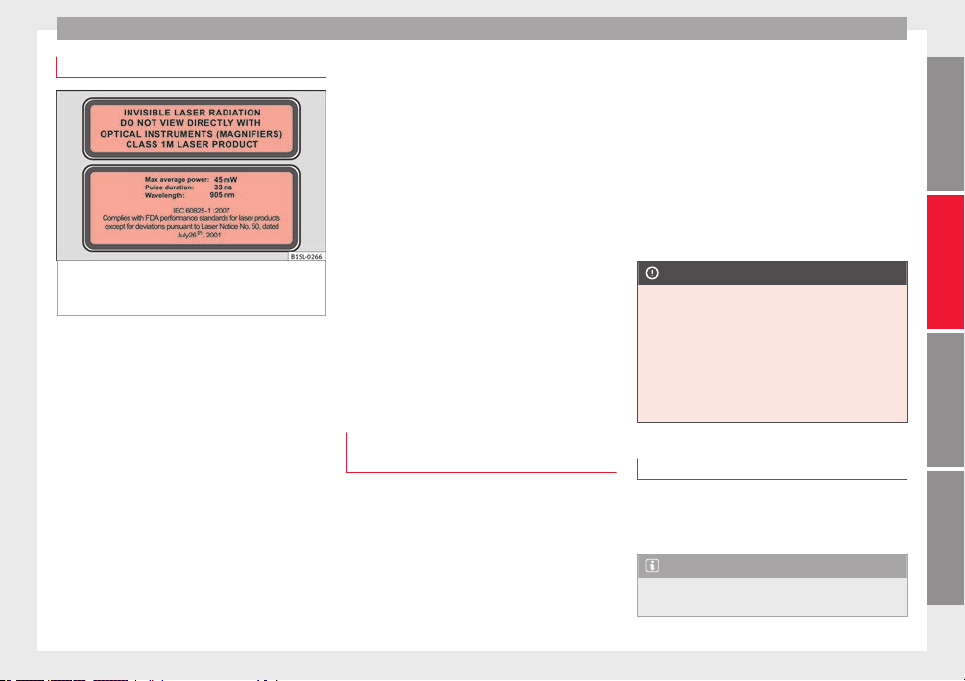
Care and maintenance
Labels and plates
Fig. 100 Warnings relating to handling the
City Safety Assist system radar sensor func-
tion
Some parts in the engine compartment come
from the factory with certificates of safety, la-
bels or plates containing important informa-
tion regarding the operation of the vehicle,
for example, on the petrol cap, on the pas-
senger's sun visor, on the driver door strut, or
on the floor of the boot.
●
Never remove these certificates of safety,
labels or plates, and ensure they are kept in
good condition and are legible.
●
If a vehicle part, bearing a certificate of
safety, label or plate, is replaced, the special-
ised workshop should attach the information
back in the same place.
Certificate of safety
A certificate of safety on the door strut states
that all the safety standards and regulations
established by the national traffic authorities
responsible for road safety were met at the
time of manufacture. It may also give the
month and year of manufacture, together
with the chassis number.
Warning of high voltage label
There is a label close to the bonnet lock
which warns of high voltage in the vehicle's
electrical system.
Warning relating to the City Safety Assist
system laser sensor
There are some warning and information
signs on the City Safety Assist system laser
sensor ››› Fig. 100
.
U
s
ing your vehicle in other countries
and continents
The vehicle is manufactured at the factory for
use in a particular country in accordance with
the national legislation in force at the time of
manufacture.
If the vehicle is sold in another country or
used in another country for an extended peri-
od of time, the applicable legislation of that
country should be observed.
It may be necessary to fit or remove certain
pieces of equipment or to deactivate certain
functions. Service work may also be affected.
This is particularly true if the vehicle is used
in a different climate for an extended period
of time.
As there are different types of frequency
bands around the world, you may find that
the radio system or the Portable Navigation
System (supplied by SEAT) supplied at the
factory does not work in another country.
CAUTION
●
SEAT does not accept liability for any dam-
age to the vehicle due to the use of a lower
quality fuel, an inadequate service or the
non-availability of genuine spare parts.
●
SEAT does not accept liability if the vehicle
does not comply in part or in full with the le-
gal requirements of other countries or conti-
nents.
Radio reception and the aerial
For factory-fitted radio equipment, the aerial
for radio reception is fitted to the roof of the
vehicle.
Note
If electrical equipment such as mobile tele-
phones, is used near a roof aerial, you may
»
135
Technical specifications
AdviceOperationSafety
Advice
observe interference in the reception of AM
stations.
Notes on SEAT repairs
Following payment, information about au-
thorised SEAT services and authorised SEAT
repairs in the following locations can be re-
quested:
Clients in Europe, Asia, Australia, Africa,
Central America and South America
Contact a technical service or specialised
workshop, or request the corresponding doc-
umentation at www.erwin.volkswagen.de.
WARNING
Repairs or modifications which are not per-
formed correctly may result in damage or er-
rors in the vehicle operation, affecting the ef-
fectiveness of the driver assist and airbag
systems. This could result in serious acci-
dent.
●
Have any repairs or modifications carried
out at a specialised workshop.
Conformity certification
The respective manufacturer hereby declares
that the products indicated below comply
with basic requirements and the following
provisions and important legislation on the
date of manufacture of the vehicle, among
others FCC Part 15.19, FCC Part 15.21 and
RSS-Gen Issue 1:
Radio frequency equipment
●
Electronic gearbox lock.
●
Vehicle key
Electrical equipment
●
12 volt power socket
Collection and scrapping of end-of-life
vehicles
Collection of end-of-life vehicles
SEAT is already prepared for the moment
when you wish to scrap your vehicle and of-
fers you an environmentally-friendly solution.
An extensive network of used car reception
centres already exists in much of Europe. Af-
ter the vehicle has been delivered, you will
receive a certificate of destruction describing
the environmentally friendly scrapping of the
vehicle in accordance with applicable legisla-
tion.
We will collect the used vehicle free of
charge, provided it complies with all national
legislation.
Please see your technical service for further
information about the collection and scrap-
ping of end-of-life vehicles.
Scrapping
The relevant safety requirements must be ob-
served when the vehicle or components of
the airbag or belt tensioner systems are
scrapped. These requirements are known to
specialised workshops.
136
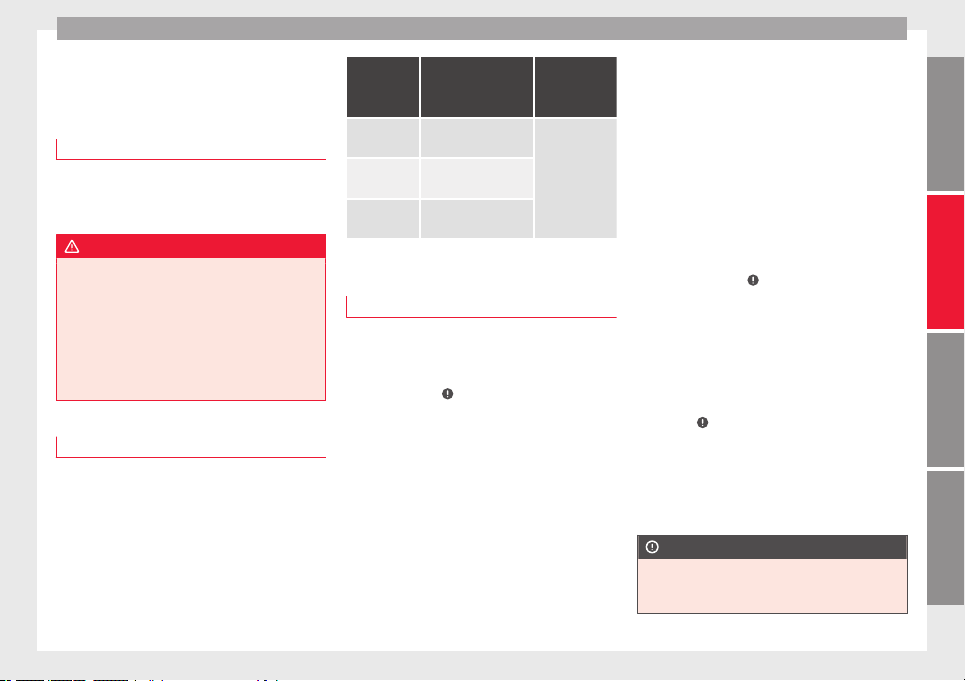
Checking and refilling levels
Checking and refilling levels
Fuel
Introduction
You will find a factory-fitted sticker containing
information on the type of fuel for your vehi-
cle on the inside of the fuel tank flap.
WARNING
Refuelling or handling fuel carelessly can
cause an explosion or fire resulting in serious
burns and injuries.
●
Fuel is a highly explosive, easily flammable
substance.
●
Observe current safety instructions and lo-
cal regulations concerning the handling of
fuel.
Types of fuel
The type of fuel to use when refilling will de-
pend on the vehicle's engine. You will find a
factory-fitted sticker containing information
on the type of fuel for your vehicle on the in-
side of the fuel tank flap.
SEAT recommends the use of sulphur-free or
low sulphur fuel to reduce consumption and
prevent engine damage.
Possible
types of
fuel
Alternative names
Further in-
formation
91
a)
RON Normal petrol, normal
unleaded petrol
››› page 137
95
a)
RON Premium unleaded
petrol (95 RON)
98
a)
RON Premium unleaded
petrol (98 RON)
a)
RON = Regulation Octane Number
Petrol
Petrol types
Vehicles with petrol engines must refuel us-
ing unleaded petrol according to European
norm EN 228
›››
.
Petrol types are categorised according to
their octane number (e.g. 91, 95, 98 or 99
RON (RON = “Research Octane Number”).
You may use petrol with a high octane num-
ber than the one recommended for your en-
gine. However, this has no advantage in
terms of fuel consumption and engine power.
SEAT recommends refuelling with a low sul-
phur content or sulphur-free petrol to reduce
fuel consumption for petrol engines.
Petrol additives
The quality of the fuel influences the behav-
iour, power and service life of the engine.
This is why the petrol you use should carry
suitable additives already included by the
petrol industry, free of metals. These addi-
tives will help to prevent corrosion, keep the
fuel system clean and prevent deposits from
building up in the engine.
If good-quality petrol with metal-free addi-
tives is not available or engine problems
arise, the necessary additives must be added
when refuelling ››› .
Not all petrol additives have been shown to
be effective. The use of unsuitable petrol ad-
ditives may cause significant damage to the
engine and the catalytic converter. Metal ad-
ditives should never be used. Metal additives
may also be contained in petrol additives for
improving anti-detonation ratings or octane
ratings ››› .
SEAT recommends “genuine Volkswagen
Group Fuel Additives for petrol engines”.
These additives can be bought at SEAT deal-
ers, where information on how to use them
can also be obtained.
CAUTION
●
Do not refuel if the filler indicates that the
fuel contains metal. LRP (lead replacement
petrol) fuels contain high concentrations of
»
137
Technical specifications
AdviceOperationSafety
Advice
metal additives. Using them may damage the
engine!
●
Only use fuel with an octane rating that is
in line with the norm EN 228, otherwise sig-
nificant damage could be caused to the en-
gine and fuel system. Furthermore, it could
lead to a loss of performance with the conse-
quent engine fault.
●
The use of unsuitable petrol additives could
seriously damage the engine and the catalyt-
ic converter.
●
If, in exceptional circumstances, petrol with
a lower octane rating to that recommended is
used, only use moderate engine speeds and a
light throttle. Avoid using full throttle and
overloading the engine. Otherwise engine
damage may occur. Fill up with fuel of a suita-
ble octane rating as soon as possible.
●
Just filling one full tank of leaded fuel or
with other metal additives would seriously
impair the efficiency of the catalytic convert-
er and could damage it.
Natural gas
Natural gas, in addition to others, can be in
liquid form.
Liquefied natural gas (LNG) is the result of
heavy cooling of natural gas. Therefore its
volume is considerably reduced compared
with compressed natural gas (CNG). In vehi-
cles with a natural gas engine, liquefied nat-
ural gas cannot be directly refilled, as the gas
would expand excessively in the vehicle gas
tank.
Therefore, vehicles with a natural gas engine
must only be refuelled using compressed
natural gas ››› .
Natural gas quality and consumption
Natural gas is divided into the groups H and
L depending on its quality.
Gas type H has a superior heating power and
inferior nitrogen and carbon dioxide content
than type L. The higher the heating power of
the natural gas, the lower the consumption
will be.
However, the heating power and the propor-
tion of nitrogen and carbon dioxide can fluc-
tuate within the quality groups. Therefore, ve-
hicle consumption can also vary when using
one type of gas only.
The engine management automatically
adapts to the natural gas used according to
its quality. Therefore, different quality gases
can be mixed in the tank, without the need
for comprehensive draining before applying a
different quality gas.
Natural gas and safety
If you can smell gas or suspect that there is a
leak ››› :
●
Stop the vehicle immediately.
●
Switch the ignition off.
●
Open the doors to appropriately ventilate
the vehicle.
●
Immediately extinguish cigarettes.
●
Move away from the vehicle or switch off
objects that may cause sparks or a fire.
●
If you continue to smell gas, do not contin-
ue driving!
●
Seek specialist assistance. Have the fault
repaired.
WARNING
Failure to act when you can smell gas in the
vehicle or when refuelling can cause serious
injuries.
●
Carry out the necessary operations.
●
Leave the danger zone.
●
If necessary, warn the emergency services.
WARNING
The vehicle is not prepared to use liquefied
natural gas (LNG) and this fuel must not be
added under any circumstances. Liquefied
natural gas can cause the natural gas tank to
explode, resulting in serious injury.
Note
The natural gas system must be subject to
regular inspections at a specialised work-
shop in accordance with the Maintenance
Programme.
138

Checking and refilling levels
Filling the tank
Introduction
The fuel tank flap is on the rear right of the
vehicle.
WARNING
Refuelling or handling fuel carelessly can
cause an explosion or fire resulting in serious
burns and injuries.
●
Always make sure that you correctly close
the fuel cap to avoid evaporation and fuel
spillage.
●
Fuels are highly explosive and inflammable
substances that can cause serious burns and
injuries.
●
Fuel could leak out or be spilt if the engine
is not switched off or if the filler fuel nozzle is
not fully inserted into the tank filler neck
when refuelling. This could lead to a fire, ex-
plosion and severe injuries.
●
When refuelling, turn off the engine and
turn off the ignition for safety reasons.
●
Always turn off mobile telephones, radio
apparatus and other radio wave emitting
equipment before refuelling. Electromagnetic
waves could cause sparks and lead to a fire.
●
Never enter the vehicle while refuelling. If it
is absolutely necessary to enter, close the
door and touch a metal surface before touch-
ing the filler nozzle again. This will prevent
the generation of static electricity. Sparks
could cause a fire when refuelling.
●
Never handle fuel close to flames, sparks or
objects with slow combustion (e.g. ciga-
rettes).
●
Avoid static electricity and electro-magnet-
ic radiation when refuelling.
●
Observe the safety regulations of the serv-
ice station.
●
Never spill fuel on the vehicle or in the lug-
gage compartment.
WARNING
For safety reasons, SEAT does not recommend
carrying a spare fuel canister in the vehicle.
Fuel could be spilled and catch fire, above all
in case of an accident and this applies to a
full container as well as empty containers.
This could lead to explosions, fires and inju-
ries.
●
Observe the following if you exceptionally
have to carry fuel in a canister:
–
Never place a fuel container, to fill it, in-
side the vehicle or on the vehicle, for ex-
ample, in the luggage compartment. Fill-
ing in these circumstances could create
an electrostatic charge and spark that
could ignite fuel fumes.
–
Always place the canister on the ground
to fill it.
–
Insert the fuel nozzle into the neck of the
canister as far as possible.
–
If you are using a metal fuel canister, the
nozzle must always touch the canister
while it is being filled to avoid static elec-
tricity.
–
Follow the legal requirements for the use,
storage and transport of spare fuel canis-
ters.
–
Insure that the fuel container complies
with manufacturing standards, for exam-
ple, ANSI or ASTM F852-86.
CAUTION
●
Always remove any fuel spilled anywhere
on the vehicle to avoid damage to the wheel
housing, the tyre and vehicle paintwork.
●
Refuelling a petrol engine with diesel can
cause serious engine and fuel system dam-
age; the resulting malfunctions are not cov-
ered by the SEAT warranty. If you refuel with
the wrong type of fuel, never start the engine.
This applies to even the smallest amount of
the wrong fuel. Seek specialist assistance.
With the engine running, the composition of
the wrong fuel could significantly damage the
fuel system and the engine itself.
For the sake of the environment
Fuels can contaminate the environment. Col-
lect any spilt service fluids and allow a pro-
fessional to dispose of them.
139
Technical specifications
AdviceOperationSafety
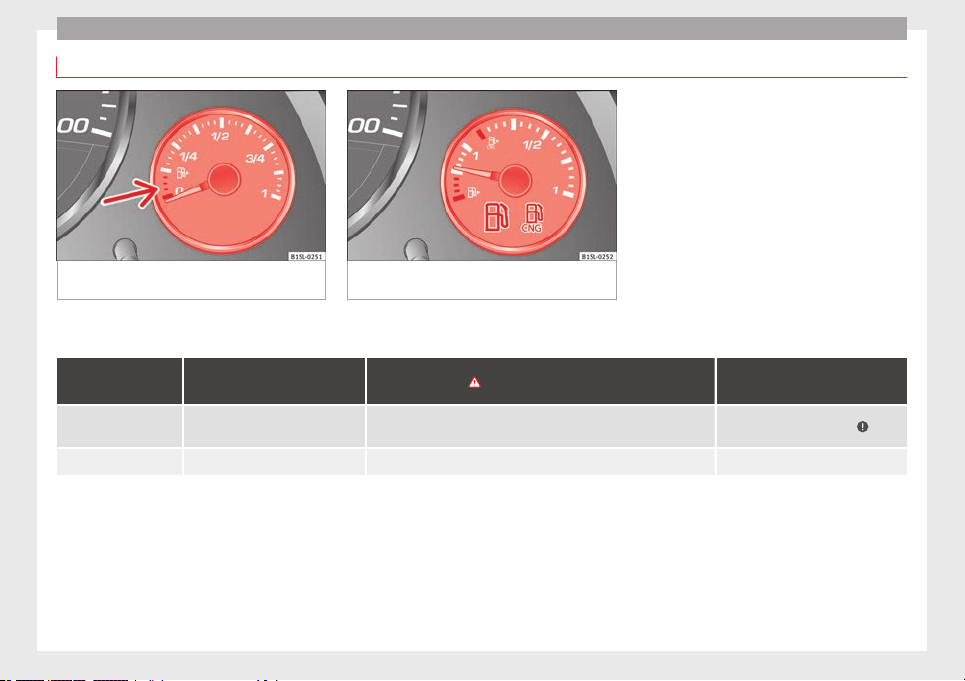
Advice
Control lamps and fuel gauge
Fig. 101 On the instrument panel: fuel gauge
for petrol
Fig. 102 On the instrument panel: Fuel gauge
for petrol and natural gas.
The fuel gauge can vary depending on the ve-
hicle equipment ››› Fig. 101
or ›
›› Fig. 102
.
It lights up
Gauge position
››› Fig. 101
Possible cause ›››
Solution
a)
Red mark (arrow)
The fuel tank is almost empty.
The reserve tank is being used ››› page 203.
Refuel as soon as possible ››› .
– The vehicle is running in natural gas operating mode. –
a)
This only applies to vehicles with the fuel gauge on the dash panel ››› Fig. 101.
140
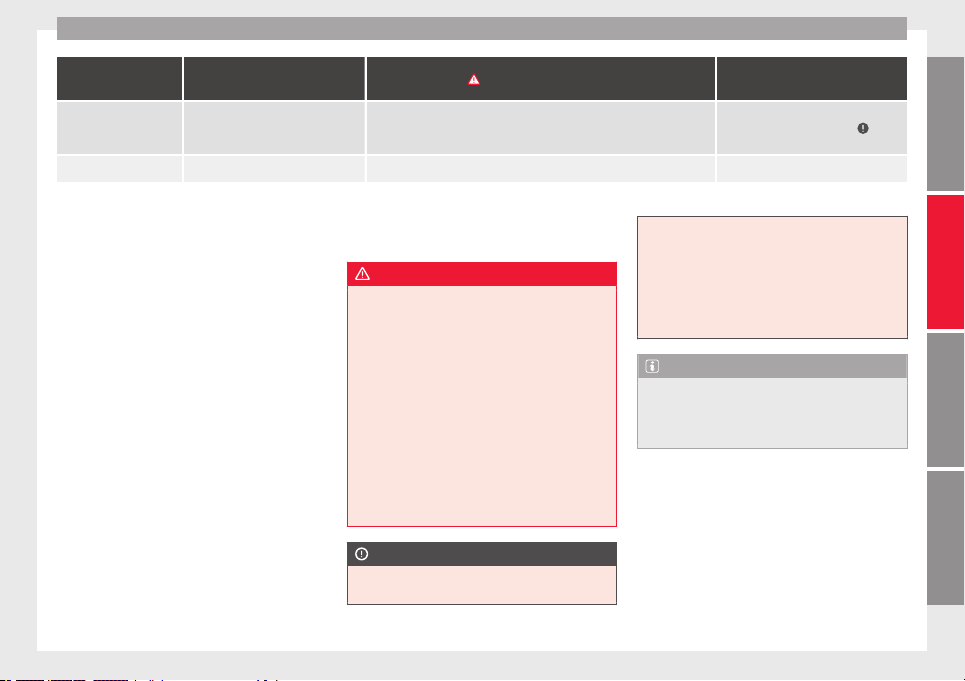
Checking and refilling levels
Flashes for about 10
seconds
State of the bars
Possible cause ›››
Solution
and the segments
remaining
a)
Reserve zone (four small segments)
The fuel tank is almost empty.
The reserve tank is being used ››› page 203.
Refuel as soon as possible ››› .
– The vehicle is running in natural gas operating mode. –
a)
This only applies to vehicles with the fuel gauge on the dash panel display.
Several warning and control lamps light up
for a few seconds when the ignition is switch-
ed on, signalling that the function is being
verified. They will switch off after a few sec-
onds.
In natural gas engines
The warning lamp lights up when both fuel
types (petrol and natural gas) have reached
reserve level.
The warning lamp lights up when the vehi-
cle is running in natural gas operating mode.
The warning lamp switches off when the
natural gas is exhausted. The engine
changes to operate with petrol.
Problem: if the vehicle is left parked for a
long time just after refuelling, the gas level
indicator does not accurately indicate the
same level shown after refuelling when the
vehicle is started up again. This is not due to
a leak in the system, but to a drop in pres-
sure in the gas tank for technical reasons af-
ter a cooling phase immediately after refuel-
ling.
WARNING
Driving with insufficient fuel reserve could re-
sult in the vehicle breaking down in traffic
and a serious accident.
●
If the fuel level is too low then the fuel sup-
ply to the engine can become irregular espe-
cially on slopes.
●
If the engine “is choked” or stalls due to
lack of or irregularity of the fuel supply, the
power steering as well as all of the driver as-
sistance systems including braking assis-
tance will stop working.
●
Always refuel when there is only one quar-
ter of the fuel tank left to avoid running out of
fuel.
CAUTION
●
Always pay attention to any lit control
lamps and to the corresponding descriptions
and instructions to avoid damage to the vehi-
cle.
●
Never run the fuel tank completely dry. An
irregular fuel supply may lead to ignition
faults and unburnt fuel could enter the ex-
haust system. This could damage the catalyt-
ic converter.
Note
The arrow next to the fuel pump symbol on
the instrument panel ››› Fig. 101 indicates the
side of
the vehicle on which the tank flap is
located.
141
Technical specifications
AdviceOperationSafety
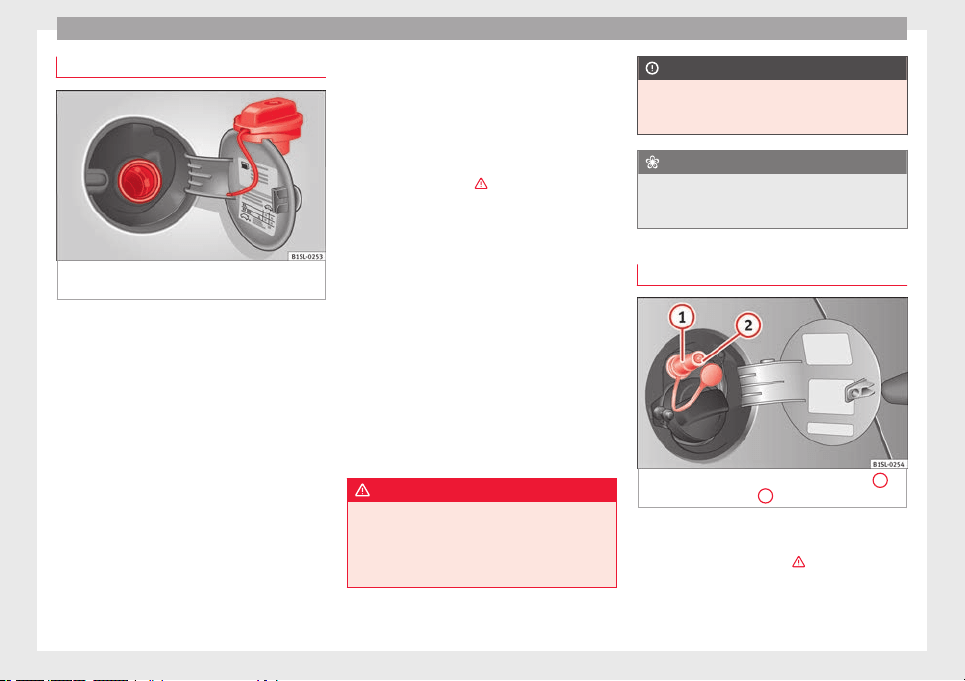
Advice
Refuelling with petrol
Fig. 103 Open tank flap with tank cap attach-
ed to the holder
Before refuelling, always turn off the engine,
the ignition, mobile telephones, auxiliary
heating and keep them off during refuelling.
Opening the fuel tank cap
●
The tank flap is at the rear of the vehicle on
the right.
●
Pull the rear zone of the fuel tank flap to
open.
●
Unfold the key shaft if necessary
››› page 43
.
●
In
ser
t the vehicle key into the lock cylinder
of the fuel tank plug and turn the key in an
anticlockwise direction.
●
Take out the fuel tank plug by turning it in
an anticlockwise direction and rest it on the
upper part of the fuel tank flap ››› Fig. 103.
Refuelling
The correct petrol type for the vehicle is loca-
ted on a sticker inside the fuel tank flap
››› page 137.
●
If the automatic filler nozzle is operated
correctly, it will switch itself off as soon as
the fuel tank is full ›››
.
●
Do not continue to refuel if it is turned off!
Otherwise, this will fill the expansion cham-
ber and fuel may leak out if the ambient con-
ditions are warm.
Closing the fuel tank cap
●
Screw on the fuel tank filler plug in a clock-
wise direction until it is fully inserted with a
click.
●
Insert the vehicle key into the lock cylinder
of the fuel tank plug, turn the key in a clock-
wise direction and remove the key.
●
Press the tank flap until you hear it click in-
to place. The tank flap must be flush with the
body contour.
WARNING
Do not continue refilling once the fuel nozzle
has switched itself off. The fuel tank may be
filled too much. As a result, fuel may spurt
out and spill. This could lead to a fire, explo-
sion and severe injuries.
CAUTION
●
Always remove any fuel spilled anywhere
on the vehicle to avoid damage to the wheel
housing, the tyre and vehicle paintwork.
For the sake of the environment
Fuels can contaminate the environment. Col-
lect any spilt service fluids and allow a pro-
fessional to dispose of them.
Refuelling with natural gas
Fig. 104 Tank flap open: gas filler mouth
1
,
filler mouth retainer
2
Before
refuelling, the engine and the igni-
tion, mo
b
ile telephone and heating must be
switched off separately
›››
.
It is also essential to carefully read the in-
structions for the natural gas pump.
142
Checking and refilling levels
The vehicle is only prepared for refuelling
with Compressed Natural Gas (CNG) ››› . Re-
fuelling with another type of natural gas is
not allowed, e.g. Liquefied Nature Gas (LNG)
or hydromethane.
Opening the fuel tank cap
The natural gas filler mouth is behind the fuel
tank cap, next to the petrol filler mouth.
●
Unlock the vehicle with the key or with the
central locking button
situated on the driv-
er door ›
›
› page 48.
●
Press on the rear area of the flap and open
it.
Refuelling
Problem: If the ambient temperature is very
high, the natural gas pump protection
against overheating disconnects this auto-
matically.
●
Remove the plug from the gas filler mouth
››› Fig. 104
1
.
●
Connect the pump filling nozzle to the gas
filler mouth.
●
The fuel tank will be full
when the pump
c
ompr
essor automatically cuts the supply.
●
If you wish to finish refuelling in advance,
press the button on the pump to stop the
flow.
Closing the fuel tank cap
●
Check that the gas filler mouth retainer
2
is not trapped with the filler nozzle. If neces-
sary, place it in the filler mouth again.
●
Insert the plug in the filler mouth.
●
Close the tank flap. Make sure you hear it
click into place.
WARNING
Natural gas is a highly explosive, easily flam-
mable substance. Incorrect handling of the
natural gas can cause accidents serious
burns and other injuries.
●
Before refuelling with natural gas, the fill-
ing mouth must be correctly engaged. If you
can smell gas, stop refuelling immediately.
WARNING
The vehicle is not prepared to use liquefied
natural gas (LNG) and this fuel must not be
added under any circumstances. Liquefied
natural gas can cause the natural gas tank to
explode, resulting in serious injury.
Note
●
The filling nozzles of natural gas pumps
can differ in the way they are operated. If you
are unacquainted with the pump, it is advisa-
ble that a member of staff of the service sta-
tion performs the refuelling operation.
●
Noises heard when refuelling are normal
and do not indicate the presence of a fault in
the system.
●
The vehicle natural gas system is prepared
both for refuelling with a small compressor
(slow refuel) and a large compressor (fast re-
fuel) in natural gas service stations.
Bonnet
Working in the engine compartment
Before working in the engine compartment,
make sure that the vehicle is parked on hori-
zontal and firm ground.
The engine compartment of the vehicle is a
hazardous area. Never work on the engine or
in the engine compartment if you are not fa-
miliar with the operations to be carried out,
the applicable safety standards and especial-
ly if you do not have the necessary instru-
ments, liquids and tools ››› ! If required,
have any work carried out by a specialised
workshop. Negligent work can cause serious
injury.
WARNING
If the vehicle moves unexpectedly, this could
cause serious injury.
»
143
Technical specifications
AdviceOperationSafety

Advice
●
Never work under the vehicle if it has not
been immobilized. If you must work under-
neath the vehicle with the wheels in contact
with the ground then it should be parked on
flat ground, the wheels should be prevented
from moving and the key should be removed
from the ignition.
●
If you have to work underneath the vehicle,
you must use suitable stands additionally to
support the vehicle, there is a risk of acci-
dent!. The jack is not intended for this kind of
work and its failure could lead to severe inju-
ries.
●
Disconnect the Start-Stop system.
WARNING
The engine compartment is a dangerous area
capable of causing serious injury.
●
For all type of work, always take the utmost
precautions, work carefully and note the gen-
eral safety standards in force. Never take per-
sonal risks.
●
Never work on the engine or in the engine
compartment if you are not familiar with the
necessary operations. If you are not sure
about procedures then visit a specialised
workshop to carry out the necessary work.
Working incorrectly can cause serious inju-
ries.
●
Never open the bonnet if you see steam or
coolant escaping from the engine compart-
ment. This may cause serious burns. Always
wait until you cannot see or hear the sound of
steam or coolant coming from the engine
compartment.
●
Always allow the engine to cool down be-
fore opening the bonnet.
●
Contact with hot elements of the engine
and the exhaust system can cause burns.
●
Once the engine has cooled, follow the in-
structions below before opening the bonnet:
–
Engage the handbrake and place the gear
selector lever in N or the gear stick in
neutral.
–
Remove the key from the ignition.
–
Keep children away from the engine com-
partment and never leave them unsuper-
vised.
●
When the engine is warm or hot, the cool-
ing system is pressurised. Do not unscrew
the cap on the expansion tank when the en-
gine is hot. Otherwise, coolant may spray out
under pressure causing burns and serious in-
jury.
–
After cooling, carefully and slowly un-
screw the cap anticlockwise, gently
pressing down on it.
–
Always protect your face, hands and arms
from hot coolant and steam using a large,
thick cloth.
●
When refilling liquids, avoid spilling them
on parts of the engine and the exhaust sys-
tem. Spilled liquids could cause a fire.
WARNING
The high voltages of the electrical system can
give electric shocks as well as causing burns
and serious injury and possibly even death!
●
Never cause short circuits in the electrical
system. The battery could explode.
●
To minimise the risk of electric shock and
serious consequences while the engine is
running or starting the engine, note the fol-
lowing:
–
Never touch the electrical wiring of the
ignition system.
WARNING
In the engine compartment, there are rotat-
ing parts that could cause serious injury.
●
Never place your hands directly on or near
the radiator fan. Touching the rotor blades
could seriously harm you. The ventilator
works according to the engine temperature
and could start suddenly even when the igni-
tion is turned off and the key is removed.
●
If any work has to be performed when the
engine is started or with the engine running,
there is an additional, potentially fatal, safety
risk from rotating parts, such as the drive
belts, alternator, radiator fan, etc., as well as
from the high-voltage ignition system. Al-
ways work with the utmost caution.
–
Always make sure that no parts of your
body, jewellery, ties, loose clothing and
long hair can be trapped by the rotating
144
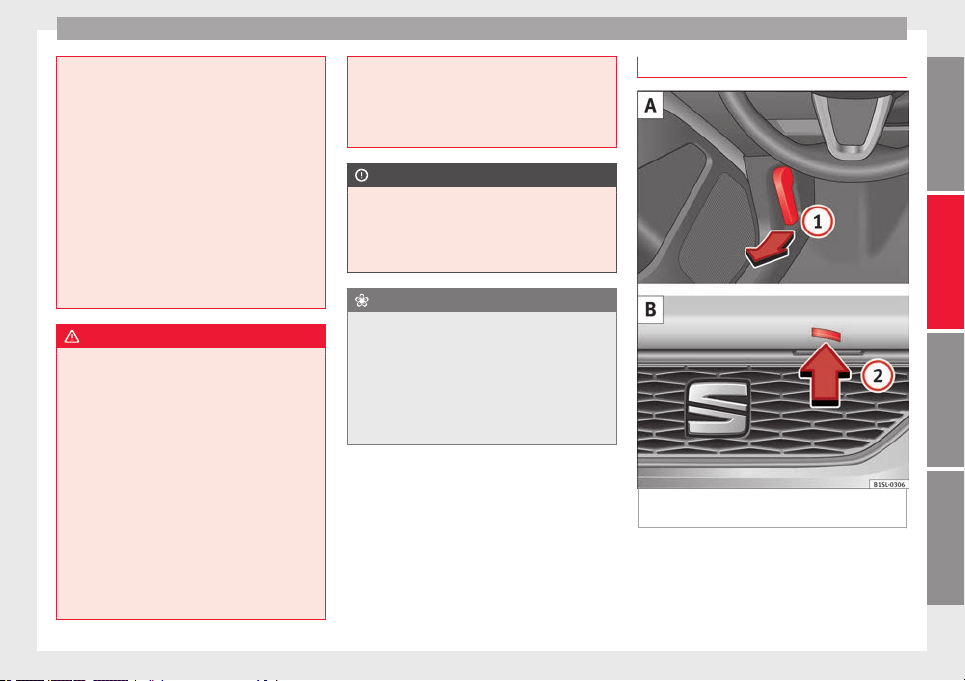
Checking and refilling levels
parts of the engine. Before any work, re-
move ties and jewellery (necklaces, etc),
tie long hair back and tie all items of
loose clothing to your body to make sure
that they cannot be trapped by engine
components.
–
Take extreme caution when operating the
accelerator and remain attentive. The ve-
hicle could move, even if the handbrake
is applied.
●
Always make sure you have not left any ob-
jects, such as cleaning cloths and tools, in
the engine compartment. If any object is left
in the engine compartment, this could cause
malfunctions, engine faults and even a fire.
WARNING
Refill liquids and certain materials can catch
fire easily in the engine compartment, caus-
ing a fire and serious injury!
●
Never smoke.
●
Never work close to places exposed to
flames or sparks.
●
Never pour service fluids over the engine.
These fluid may ignite hot engine parts and
cause injuries.
●
If it is necessary to work on the fuel system
or the electrical system, please follow the in-
structions below:
–
Always disconnect the vehicle battery.
–
Never work close to heaters, heat sources
or places exposed to flames or sparks.
●
Always keep a recently serviced and per-
fectly working fire extinguisher close by.
●
Never cover the engine with additional in-
sulating materials such as a blanket. Risk of
fire!
CAUTION
When refilling or changing service liquids,
ensure that you put the liquids into the right
tank. Making a mistake when refilling could
cause serious malfunctions and damage the
engine!
For the sake of the environment
Service fluids leaks are harmful to the envi-
ronment. For this reason you should make
regular checks on the ground underneath
your vehicle. Take the vehicle to a specialised
workshop to be checked if you see stains, oil
or other fluids on the ground. Collect any
spilt service fluids and allow a professional to
dispose of them.
Opening and closing the bonnet
Fig. 105 A: Release lever in the footwell on
the driver side B: Release lever on the bonnet
»
145
Technical specifications
AdviceOperationSafety
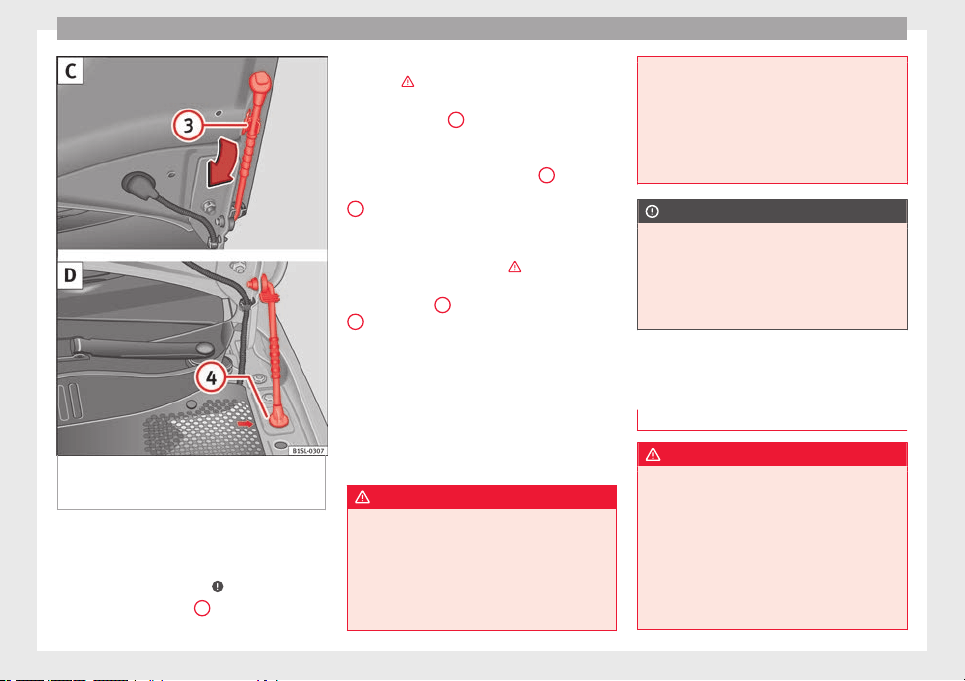
Advice
Fig. 106 C: Bonnet securing rod in the bon-
net. D: Bonnet supported by the bonnet se-
curing rod
Opening the bonnet
●
Before opening the bonnet, make sure that
the windscreen wiper arms are in place
against the windscreen
›››
.
●
Pull the release lever
1
in the direction of
the arrow
›››
Fig. 105
A
. The bonnet is re-
leased from the lock carrier by a spring mech-
anism ›››
.
●
Lift the bonnet up slightly while pressing
the release lever
2
B
in the direction of the
arr
ow to completely open the bonnet.
●
Take out the bonnet support rod from its
clip in the direction of the arrow
3
C
and
p
lace it in the corresponding open position
4
D
(arrow).
C
losing the bonnet
●
Slightly lift the bonnet ›››
.
●
Take out the bonnet support rod from the
opening catch
4
D
and insert it into its clip
3
C
in the opening catch.
●
L
et the bonnet fall from a height of 30 cm
into its clip; Do not apply pressure!
If the bonnet is not correctly closed, open it
once again and close it correctly.
The bonnet is correctly closed when it is flush
with the corresponding parts on the body-
work.
WARNING
If the bonnet is not correctly closed, it could
suddenly open while driving leaving the driv-
er without visibility. This could result in a se-
rious accident.
●
After closing the bonnet, always check that
it is properly secured by the locking mecha-
nism in the lock carrier piece. The bonnet
must be flush with the surrounding body pan-
els.
●
While driving, if you notice that the bonnet
is not correctly closed then stop immediately
and close it correctly.
●
Only open and close the bonnet when there
is nobody within its range.
CAUTION
●
To avoid damage to the bonnet and to the
windscreen wiper arms, only open it when
the windscreen wipers are in place against
the windscreen.
●
Before driving, always lower the wiper
arms.
Engine oil
Introduction
WARNING
Incorrectly handling engine oil can cause in-
jury and serious burns.
●
Always protect your eyes when handling
engine oil.
●
Oil is toxic and must be kept out of the
reach of children.
●
Engine oil should only be kept in its origi-
nal packaging; the same goes for used oil un-
til it is disposed of.
146
Checking and refilling levels
●
Never store engine oil in empty food con-
tainers or bottles as other people may acci-
dentally drink it.
●
Regular contact with engine oil can be bad
for the skin. If you come into contact with en-
gine oil, wash your skin with soap and water.
●
With the engine running, the engine oil
gets extremely hot and can cause severe skin
burns. Always wait until the engine has fully
cooled.
For the sake of the environment
Similar to the other service liquids, spilled
engine oil can be bad for the environment.
Collect these liquids in suitable containers
and dispose of them while respecting the en-
vironment.
Warning and control lamps
Flashes
Possible
cause
Solution
Engine oil
pressure too
low.
Stop the vehicle!
Switch off the engine. Check
the engine oil level, and if
necessary, refill with
››› page 148.
engine oil - If the warning in-
dicator flashes although the
oil level is correct, do not
continue driving or leave the
engine running. Otherwise,
the engine could be dam-
aged. Seek specialist assis-
tance.
WARNING
Observe the safety warnings ››› in Control
and warning lamps on page 40.
Engine oil specifications
Replacement engine oil must strictly comply
with the specifications.
The correct oil must be used to ensure the
correct operation and long service life of the
engine. The engine comes with a high-quality
multigrade oil that can generally be used all
year round.
Only use an engine oil that complies to SEAT
standards whenever possible ››› . Only refill
engine oil using approved engine oil in ac-
cordance with the corresponding VW stand-
ard (››› table on page 147
). All oils indicated
ar
e
synthetic multigrade oils.
Engine oils are being continuously further
developed. Technical services are constantly
updated with any modifications. SEAT there-
fore recommends that you have the engine
oil changed by a technical service.
Engines
Specifications of en-
gine oil with a serv-
ice dependent on
time/distance travel-
led
44 kW - 55 kW Petrol en-
gines
VW 504 00, VW 502 00
Natural gas engine VW 502 00
CAUTION
●
Only use engine oils whose specifications
are expressly approved by SEAT. The use of
any other type of oil could cause engine dam-
age!
●
No additives should be used with engine
oil. Any damage caused by the use of such
additives would not be covered by the factory
warranty.
147
Technical specifications
AdviceOperationSafety
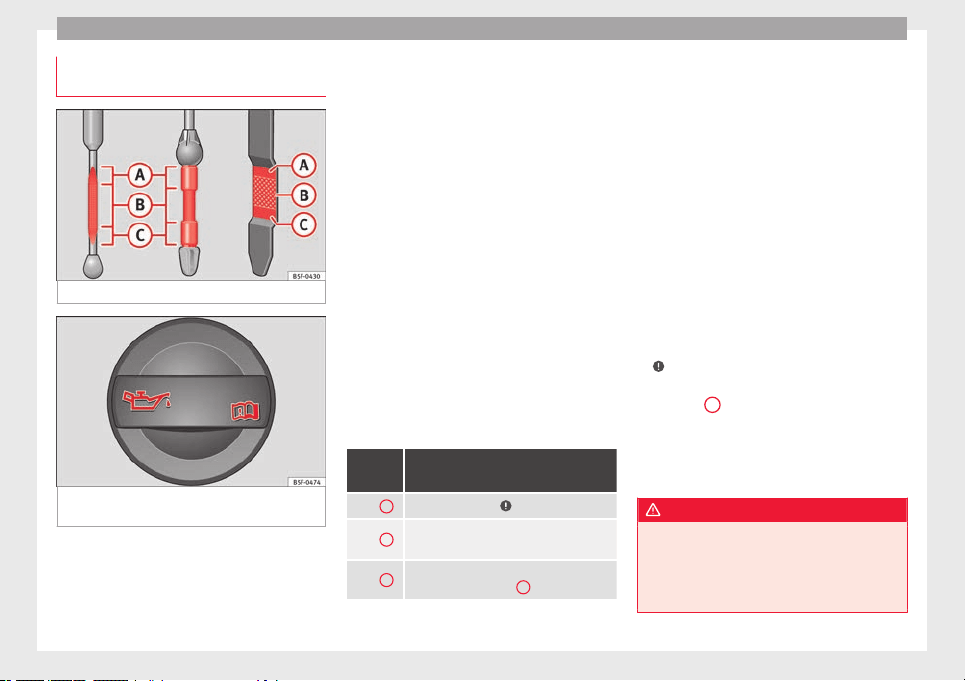
Advice
Checking the engine oil level and
topping up
Fig. 107 Marked engine oil dipstick
Fig. 108 In the engine compartment: Engine
oil filler cap.
Preparations
●
Park the vehicle on flat ground so that the
engine oil reading is correct.
●
The engine must be hot to be able to check
the engine oil level. Stop the engine and wait
a few minutes for the oil to drain back into
the sump.
●
Open the bonnet ››› page 143.
●
The engine oil filler neck can be recognised
by the symbol
on the cap ›
›› Fig. 108
and
the dipstick by its coloured handle.
Check the engine oil level
●
Pull out the dipstick and wipe it on a clean
cloth.
●
Replace the dipstick, pushing it in as far as
it will go. If the dipstick to measure engine oil
has a mark, when you reintroduce it this
mark should slot into the corresponding
groove located on the upper end of the tube.
●
Remove the dipstick again and check the
engine oil level ››› table on page 148.
●
After reading the oil level, replace the dip-
stick in the tube completely.
Engine oil topping up ranges
Fig. 107
Operations required depending on
the engine oil level:
Area
A
Do not top up oil ››› .
Area
B
You can add oil, but keep the level in this
zone.
Area
C
Oil must be added. After topping up the oil
level should be in area
B
.
Adding oil after checking the level
Only add engine oil in small quantities and in
steps:
●
Unscrew the cap from engine oil filler neck
on the cylinder head ››› Fig. 108
. If you are
not
s
ure where the cap is, request help from
a specialist.
●
Only refill using approved SEAT engine oil
in small quantities (no more than 0.5 ltr)
››› page 147.
●
To avoid adding too much oil, each time
you add a quantity, wait until the oil has flow-
ed into the crankcase so that it can be meas-
ured with the dipstick.
●
Check the oil level before adding any more
oil. Do not top up with too much engine oil
›››
.
●
When the oil level is in at least the
››› Fig. 107
B
zone, insert the dipstick into
the tube fully to avoid engine oil escaping
when the engine is running.
●
After topping up the oil, ensure that the
cap is screwed on to the filler neck correctly.
WARNING
Oil could catch fire if it comes into contact
with hot engine components. This could lead
to a fire, explosion and severe injuries.
●
Always ensure that after topping of oil, the
engine oil filler cap is correctly tightened.
148
Checking and refilling levels
This will avoid engine oil spilling onto hot
engine parts when the engine is running.
CAUTION
●
If the engine oil level is above the area
A
do not start the engine. Seek specialist assis-
tance. Otherwise catalytic converter and en-
gine damage may occur.
●
When refilling or changing service liquids,
ensure that you put the liquids into the right
tank. Making a mistake when refilling could
cause serious malfunctions and damage the
engine!
For the sake of the environment
The oil level must never be above area
A
.
Otherwise oil can be drawn in through the
crankcase breather and escape into the at-
mosphere via the exhaust system.
Engine oil consumption
The consumption of engine oil can be differ-
ent from one engine to another and can vary
during the useful life of the engine.
Depending on how you drive and the condi-
tions in which the vehicle is used, oil con-
sumption can be up to 1 ltr./2000 km. In the
case of new vehicles, the consumption can
exceed this figure over 5,000 kilometres. For
this reason the engine oil level must be
checked at regular intervals, preferably when
filling the tank and before a journey.
When the engine is working hard, for in-
stance during sustained high-speed motor-
way cruising in summer or when climbing
mountain passes, the oil level should pref-
erably be kept within area ››› Fig. 107
A
.
Changing the engine oil
The engine oil must be changed regularly ac-
cording to the specifications of the Mainte-
nance Programme.
Due to the problems linked with disposing of
used oil and the need for suitable tools and
special knowledge, always visit a specialised
workshop to have the engine oil and filter
changed. SEAT recommends taking your car
in for technical service.
Detailed information on the service intervals
is shown in the Maintenance Programme.
Engine oil additives make new oil darker after
the engine has been running for a short peri-
od. This is normal and does not mean more
frequent oil changes are required.
WARNING
If, in exceptional circumstances, you must
change the engine oil yourself, please note
the following:
●
Wear eye protection.
●
Always wait until the engine has complete-
ly cooled to avoid being burned.
●
Always keep your arms horizontal when un-
screwing the oil drainage bolt so that it does
not run down your arms.
●
Use a suitable container large enough to
collect all of the used oil in the engine.
●
Never collect engine oil in empty food con-
tainers, cans, bottles or other containers as
not all people are able to identify engine oil.
●
Oil is toxic and must be kept out of the
reach of children.
For the sake of the environment
Before changing the engine oil, find a suita-
ble location or service for proper disposal.
For the sake of the environment
Always dispose of engine oil with the utmost
respect for the environment. Never dispose of
used engine oil in places such as a garden,
woods, drains, roads, paths, rivers and drain-
age systems.
149
Technical specifications
AdviceOperationSafety
Advice
Engine coolant
Introduction
WARNING
Engine coolant is toxic!
●
Only keep engine coolant in its original
container, tightly shut and in a safe place.
●
Never store engine coolant in empty food
containers or bottles as other people may ac-
cidentally drink it.
●
Always keep engine coolant out of reach of
children.
●
Ensure that the proportion of engine cool-
ant additive corresponds to the lowest out-
side temperature to which the vehicle will be
exposed.
●
If the outside temperature is extremely low,
the engine coolant could freeze causing the
vehicle to stop. As this would also cause the
heating to stop working, vehicle occupants
without warm clothing could freeze.
For the sake of the environment
Coolants and additives can contaminate the
environment. Collect any spilt fluids in suita-
ble containers and dispose of them in accord-
ance with legislation and with the utmost re-
spect for the environment.
Coolant warning lamp
Several warning and control lamps light up
for a few seconds when the ignition is switch-
ed on, signalling that the function is being
verified. They will switch off after a few sec-
onds.
It lights
up
Possible
cause
Solution
Excessive en-
gine coolant
temperature.
Stop the vehicle!
Stop the vehicle safely as
soon as possible. Switch
off the engine and let it
cool.
Insufficient en-
gine coolant
level.
¡Stop the vehicle!
Check the engine coolant
when the engine has
cooled and, if it is low, re-
fill with engine coolant
››› page 151.
Engine coolant
system faulty.
Do not drive any fur-
ther.
Obtain professional as-
sistance.
Flashes
Possible
cause
Solution
Engine coolant
system faulty.
Seek specialist assis-
tance.
WARNING
Observe the safety warnings ››› in Control
and warning lamps on page 40.
Note
On the display of the Portable Navigation
System (supplied by SEAT) ››› page 123 an en-
gine coolant temperature gauge can be seen.
Engine coolant specifications
The engine cooling system is supplied from
the factory with a specially treated mixture of
water and, at least, 40 % of the additive G 13
(TLVW 774 J). The engine coolant additive is
recognisable by its purple colour. This mix-
ture of water and additive gives the necessa-
ry frost protection down to -25°C (-13 F) and
protects the light alloy parts of the cooling
system against corrosion. It also prevents
scaling and considerably raises the boiling
point of the coolant.
To protect the engine cooling system, the
percentage of additive must always
be at
l
e
ast 40 %, even in warm climates where an-
ti-freeze protection is not required.
If greater frost protection is required in very
cold climates, the proportion of additive can
be increased. However, the percentage of ad-
ditive should not exceed 60%, as this would
150
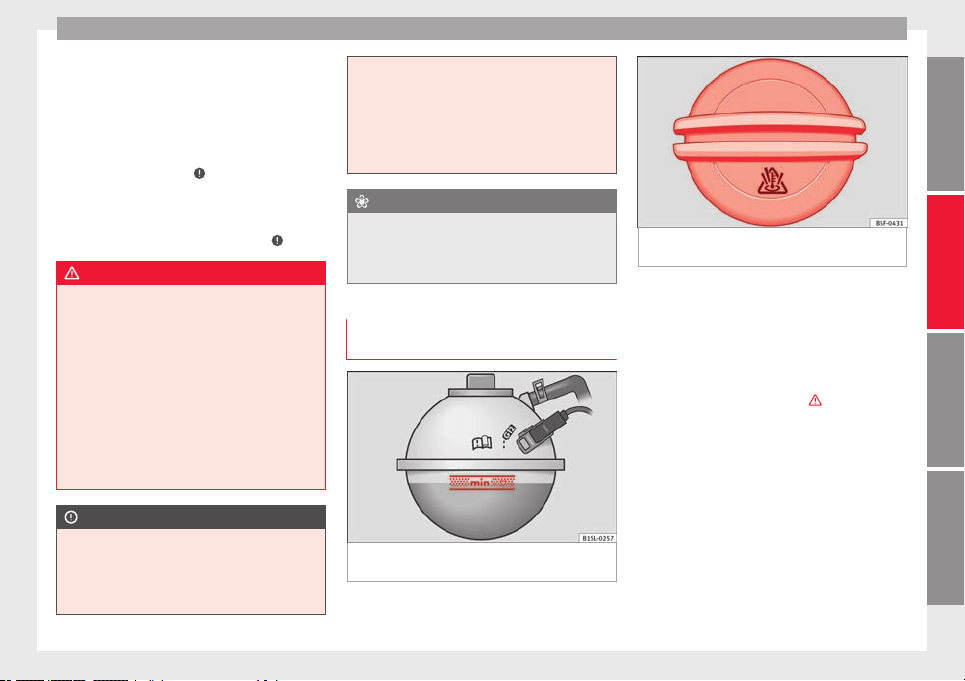
Checking and refilling levels
reduce the frost protection and, in turn, de-
crease the cooling capacity.
When the coolant is topped up, use a mixture
of distilled water
and, at least, 40 % of the G
13 or G 12 p
lu
s-plus (TL-VW 774 G) additive
(both are purple) to obtain an optimum anti-
corrosion protection ›››
. The mixture of G
13 with G 12 plus (TL-VW 774 F), G 12 (red) or
G 11 (green-blue) engine coolants will signifi-
cantly reduce the anticorrosion protection
and should, therefore be avoided ››› .
WARNING
If there is not enough anti-freeze in the cool-
ant system, the engine may fail leading to se-
rious damage.
●
Please make sure that the percentage of
additive is correct with respect to the lowest
expected ambient temperature in the zone in
which the vehicle is to be used.
●
When the outside temperature is very low,
the coolant could freeze and the vehicle
would be immobilised. In this case, the heat-
ing would not work either and inadequately
dressed passengers could die of cold.
CAUTION
The original additives should never be mixed
with coolants which are not approved by
SEAT. Otherwise, you run the risk of causing
severe damage to the engine and the engine
cooling system.
●
If the fluid in the expansion tank is not pur-
ple but is, for example, brown, this indicates
that the G 13 additive has been mixed with
an inadequate coolant. The coolant must be
changed as soon as possible if this is the
case! This could result in serious faults and
engine damage.
For the sake of the environment
Coolants and additives can contaminate the
environment. If any fluids are spilled, they
should be collected and correctly disposed
of, with respect to the environment.
Checking the engine coolant level and
refilling
Fig. 109 In the engine compartment: Marking
on coolant expansion tank
Fig. 110 In the engine compartment: Coolant
expansion tank cap
If the coolant level is low, the coolant warn-
ing indicator will light.
Preparations
●
Park the vehicle on even, flat and firm
ground.
●
Allow the engine to cool ››› .
●
Open the bonnet ››› page 143.
●
The coolant expansion tank is easily recog-
nisable because of the symbol on the cap
››› Fig. 110
.
Chec
k
ing the engine coolant level
●
When the engine is cold, check the coolant
level using the side marking on the expan-
sion tank ››› Fig. 109.
●
If the level is below the “MIN” mark, top up
with coolant. When the engine is hot it may
be slightly above the marked area.
»
151
Technical specifications
AdviceOperationSafety
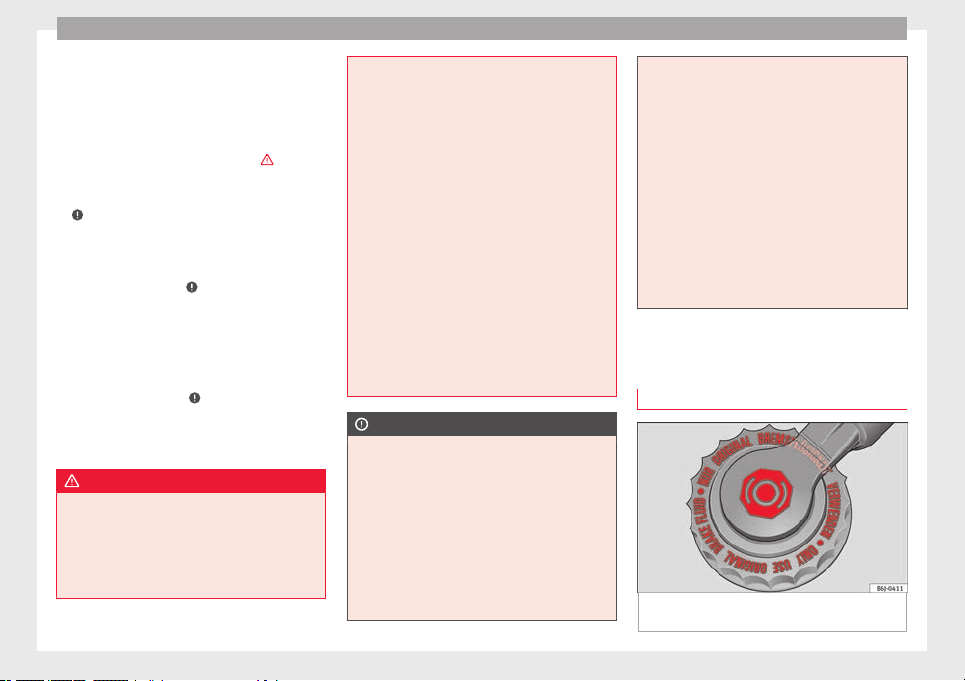
Advice
Topping up the engine coolant level
●
Always protect your face, hands and arms
from hot coolant and steam using a large,
thick cloth over the coolant expansion tank
cap.
●
Remove the cap very carefully ››› .
●
Only refill using new
engine coolant ac-
c
or
ding to SEAT specifications (››› page 150)
›››
.
●
The engine coolant level should be be-
tween the marks on the coolant expansion
tank ››› Fig. 109
.
Do not exceed the top level
of
the marked area ›››
.
●
Screw on the cap tightly.
●
If, in the event of an emergency, you have
no coolant that is compliant to the required
specifications (››› page 150), do not use an-
other type of additive. Instead, top up with
distilled water only
›
›› . Then re-establish
the correct proportion of the mixture with the
correct additive as soon as possible
››› page 150
.
WARNING
Hot vapours and coolant can cause serious
burns.
●
Never open the coolant expansion tank if
steam or coolant is coming from the engine
compartment. Wait until you cannot see or
hear any steam or coolant escaping.
●
Always wait until the engine has complete-
ly cooled before very carefully opening the
expansion tank cap. Contact with hot ele-
ments of the engine can cause skin burns.
●
When the engine is warm or hot, the cool-
ing system is pressurised. Do not unscrew
the cap on the expansion tank when the en-
gine is hot. Otherwise, coolant may spray out
under pressure causing burns and serious in-
jury.
–
Carefully and slowly unscrew the cap an-
ti-clockwise, gently pressing down on it.
–
Always protect your face, hands and arms
from hot coolant and steam using a large,
thick cloth.
●
When refilling liquids, avoid spilling them
on parts of the engine and the exhaust sys-
tem. Spilled liquids could cause a fire. Under
specific circumstances, the ethylene glycol
can catch fire.
CAUTION
●
Top up with distilled water only. Any other
type of water may lead to considerable rust-
ing in the engine due to its chemical compo-
nents. This could consequently damage the
engine. If you have not used distilled water
but another type of water to top up the cool-
ant, a specialised workshop must immediate-
ly replace all of the fluid in the engine cooling
system.
●
Only top up coolant to the top level of the
marked area ››› Fig. 109. Otherwise the ex-
cess coolant will be forced out of the cooling
system when the engine is hot, causing dam-
age.
●
If a lot of liquid coolant has been lost, wait
for the engine to cool down completely before
adding coolant. Extensive coolant loss is an
indication of leaks in the engine cooling sys-
tem. Have the engine cooling system inspec-
ted immediately by a specialised workshop.
Otherwise engine damage may occur.
●
When refilling or changing service liquids,
ensure that you put the liquids into the right
tank. Making a mistake when refilling could
cause serious malfunctions and damage the
engine!
Brake fluid
Checking the brake fluid level
Fig. 111 In the engine compartment: brake
fluid reservoir, lid
152
Checking and refilling levels
In the course of time, the brake fluid absorbs
water from the ambient air. If there is too
much water in the brake fluid, the brake sys-
tem could be damaged. In addition, the boil-
ing point of the brake fluid is significantly
lowered. When the brake fluid contains too
much water and the brakes are subject to
considerable forces, bubbles of water vapour
can form in the system. These bubbles can
significantly reduce braking power, notably
increasing braking distance, and could even
result in the total failure of the brake system.
Ensuring that the brake system is always
functioning correctly is essential for your own
safety and the safety of other road users
››› .
Brake fluid specifications
SEAT have developed a special brake fluid
optimised for the brake systems of their vehi-
cles. To ensure the optimum working of the
brake system, SEAT recommends the use of
brake fluid in accordance with the VW 501 14
standard
. If this brake fluid is not available or
another br
ak
e fluid is used for different rea-
sons, use a brake fluid that complies with the
United States standard FMVSS 116 DOT 4 or
the German standard DIN ISO 4925 CLASS 4
›››
.
Brake fluids conforming to the standard
VW 501 14, fulfil the American requirements
of the FMVSS 116 DOT 4 standard and the
German DIN ISO 4925 CLASS 4 standard.
However, fluids that comply with the Ameri-
can FMVSS 116 DOT 4 standard or the Ger-
man DIN ISO 4925 CLASS 4 standard do not
necessarily comply with the VW 501 14
standard. Always check the information on
the brake fluid container and ensure that you
are using suitable brake fluid.
A suitable brake fluid can be obtained from
SEAT dealerships.
Brake fluid level
The level of the brake fluid should always be
between the MIN and MAX marks, or above
the MIN mark ››› .
It is not always possible to check the level of
the brake fluid, as in some models the en-
gine components make it difficult to see the
brake fluid reservoir. If you cannot read the
exact brake fluid level, consult a specialist.
The brake fluid level drops slightly when the
vehicle is being used due to wear of the
brake pads and the automatic readjustment
of the brake.
Changing the brake fluid
The brake fluid should be changed in accord-
ance with the instructions given in the Main-
tenance Programme. Have the brake fluid
changed by a specialised workshop. SEAT
recommends taking your car in for technical
service. This means that only brake fluid
complying with the required specifications
will be used.
WARNING
If the brake fluid level is low or unsuita-
ble/old brake fluid is used, the brake system
may fail or braking power may be reduced.
●
Check the brake system and the brake fluid
level regularly!
●
The brake fluid should be changed regular-
ly in accordance with the instructions given
in the Maintenance Programme.
●
When the brake fluid is used and brakes
are subjected to extreme braking forces, bub-
bles of vapour form in the brake system.
These bubbles can significantly reduce brak-
ing power, notably increasing braking dis-
tance, and could result in the total failure of
the brake system.
●
Always ensure that you use suitable brake
fluid. Only used brake fluid that conforms to
the VW 501 14 standard, FMVSS 116 DOT 4
standard or even the DIN ISO 4925 CLASS 4
standard. Other types of brake fluid could af-
fect brake operation and reduce braking pow-
er. Do not use a brake fluid if the container
does not specify compliance with the
VW 501 14, FMVSS 116 DOT 4 or
DIN ISO 4925 CLASS 4 standards.
●
The replacement brake fluid must be new.
WARNING
Brake fluid is poisonous.
»
153
Technical specifications
AdviceOperationSafety
Advice
●
To reduce the risk of poisoning, do not keep
brake fluid in drinks bottles/containers or
similar. Other people could drink from these
recipients even if the contents are clearly
marked.
●
Always keep brake fluid in the original con-
tainer; keep it correctly sealed and out of
reach of children.
CAUTION
Brake fluid damages the vehicle paintwork.
Wipe off any brake fluid from the paintwork
immediately.
For the sake of the environment
Brake fluid is an environmental pollutant.
Collect any spilt service fluids and allow a
professional to dispose of them.
Checking and topping up the
windscreen washer reservoir with
water
Fig. 112 In the engine compartment: wind-
screen washer reservoir top
Check the water level in the windscreen
washer reservoir regularly and top up as re-
quired.
●
Open the bonnet ››› page 143.
●
The washer reservoir is marked with the
symbol on the lid ››› Fig. 112
.
●
Chec
k
there is enough water in the reser-
voir.
●
To top up, mix water with a window cleaner
recommended by SEAT ›››
. Please follow
the instructions for use found on the packag-
ing.
●
In cold weather, a special antifreeze should
also be added to prevent the water from
freezing ››› .
Reservoir capacity
The washer bottle capacity is approximately 3
litres.
WARNING
Never mix an unsuitable antifreeze or other
similar additives with the windscreen washer
water. A greasy layer may be formed on the
windscreen which will impair visibility.
●
Use clean water with a window cleaner rec-
ommended by SEAT.
●
If necessary, add a suitable antifreeze to
the water in the reservoir.
CAUTION
●
Do not mix cleaning products recommen-
ded by SEAT with other products. This could
lead to flocculation and may block the wind-
screen washer jets.
●
When topping up service fluids, make abso-
lutely certain that you fill the fluids into the
correct reservoirs. Using the wrong fluids
could cause serious malfunctions and engine
damage!
Vehicle battery
Introduction
The battery is a component of the vehicle's
electrical system.
154
Checking and refilling levels
Never work on the electrical system without
fully understanding the operations required,
the applicable safety standards and without
the correct tools ››› ! If required, have any
work carried out by a specialised workshop.
SEAT recommends taking your car in for tech-
nical service. Negligent work can cause seri-
ous injury.
Location of the vehicle battery
The battery is located in the engine compart-
ment.
Explanation of the warning indications on
the vehicle's battery
Symbol Meaning
Wear eye protection!
Battery acid is very corrosive and caustic.
Always wear protective gloves and eye
protection!
Fires, sparks, open flames and smoking
are prohibited.
A highly explosive mixture of gases is re-
leased when the battery is under charge.
Keep children away from acid and batter-
ies!
WARNING
Working on the vehicle battery and the elec-
trical system can cause corrosion, fire and
electric shocks. Always read and take into ac-
count the following warnings and safety
standards before carrying out any work:
●
Before working on the battery, switch off
the engine, the ignition and all electrical de-
vices then disconnect the negative connec-
tion on the battery.
●
Keep children away from acid and the bat-
tery itself!
●
Wear eye protection.
●
Battery acid is very corrosive and caustic. It
can burn skin and cause blindness. When
handling the battery, protect yourself from
splashes of acids, above all your hands, arms
and face.
●
Do not smoke and never work close to pla-
ces exposed to flames or sparks.
●
Avoid sparks and electrostatic discharges
when working with cables and electrical devi-
ces.
●
Never short the battery terminals.
●
Never use a damaged battery. It can ex-
plode. Replace a damaged battery immedi-
ately.
●
Replaced damaged or frozen batteries as
soon as possible. A flat battery can also
freeze at temperatures close to 0 °C (+32 °F).
CAUTION
●
Never disconnect the battery if the ignition
is switched on or if the engine is running.
This could damage the electrical system or
electronic components.
●
Do not expose the battery to direct sunlight
over a long period of time, as the intense ul-
traviolet radiation can damage the battery
housing.
●
If the car is left standing for long periods,
protect the battery from extreme cold temper-
ature so that it does not “freeze up” and be-
come damaged.
Warning lamp
It
lights
up
Possible
cause
Solution
Faulty generator.
Contact a specialised
workshop. Have the elec-
trical system checked.
Disconnect any unneces-
sary electrical devices.
The generator does not
charge the battery while
the vehicle is in motion.
Several warning and control lamps light up
for a few seconds when the ignition is switch-
ed on, signalling that the function is being
verified. They will switch off after a few sec-
onds.
»
155
Technical specifications
AdviceOperationSafety
Advice
WARNING
Observe the safety warnings ››› in Control
and warning lamps on page 40.
Checking the electrolyte level of the
vehicle battery
Fig. 113 In the engine compartment: Remove
the cover from the vehicle's battery.
The battery's electrolyte level should be
checked regularly in high-mileage vehicles,
in hot countries and in older batteries. Other
batteries do not require maintenance.
Vehicles fitted with the Start-Stop system are
equipped with special batteries. For technical
reasons, the electrolyte level cannot be
checked in these batteries.
Preparations
●
Prepare the vehicle for work in the engine
compartment ››› page 143
●
Open the bonnet ››› page 143.
●
Press on the tabs ››› Fig. 113
(arrows) in the
dir
ection of
the arrows and lift the battery
cover up.
Checking the battery electrolyte level
●
Make sure there is sufficient lighting to
clearly recognise the colours. Never use
flames or shiny objects as a light source.
●
Depending on the level of acid, the Magic
eye on the top of the battery will change col-
our.
Colour in-
dicator
Necessary operations
Light yellow
or colourless
The electrolyte level of the vehicle's bat-
tery is too low. Have the battery checked
and, where applicable, replaced by a
specialised workshop.
Black
The electrolyte level of the vehicle's bat-
tery is correct.
WARNING
Working with the vehicle battery involves a
risk of corrosion, explosions and electric
shock.
●
Never tilt the vehicle battery. Battery acid
could spill out of the openings for the release
of gases and cause corrosion damage.
●
Never open the vehicle battery.
●
If battery acid splashes on you, immediate-
ly rinse your eyes and skin abundantly with
water for several minutes. Then seek medical
care immediately.
●
If acid is swallowed by mistake, consult a
doctor immediately.
Charging, replacing and connecting or
disconnecting the battery
Charging the battery
The vehicle battery should be charged by a
specialised workshop only, as batteries us-
ing special technology have been installed
and they must be charged in a controlled en-
vironment ››› . SEAT recommends taking
your car in for technical service.
Replacing a vehicle battery
The battery has been developed to suit the
conditions of its location and has special
safety features. If the battery must be re-
placed, consult a technical service for infor-
mation on electromagnetic compatibility, the
size and maintenance, performance and
safety requirements of the new battery in
your vehicle before you purchase one. SEAT
156
Checking and refilling levels
recommends you have the battery replaced
by a technical service.
Use only maintenance-free genuine batteries
conforming to TL 825 06 and VW 7 50 73
Standards. These standards must be dated
April 2008 or later.
Vehicles fitted with the Start-Stop system are
equipped with a special battery. Therefore,
this battery must only be replaced by another
with the same specifications.
Disconnecting the vehicle's battery
If you must disconnect the battery from the
electrical system, please note the following:
●
Switch off the ignition and all electrical
equipment.
●
The vehicle must be unlocked before dis-
connecting the battery, otherwise the alarm
will be triggered.
●
First disconnect the negative cable and
then the positive ››› .
Connecting the vehicle's battery
●
Before reconnecting the battery, switch off
the engine and all electrical devices.
●
First reconnect the positive cable and then
the negative ››› .
Different control lamps may light up after
connecting the battery and switching the ig-
nition on. They will be turned off after a short
trip at a speed of between 15-20 km/h
(10-12 mph). If the warning indicators remain
lit, please visit a specialised workshop to
have the vehicle checked.
If the battery has been disconnected for a
long time, it is possible that the next service
date is not displayed or calculated correctly
››› page 36
. Respect the maximum service in-
t
er
vals permitted ››› Booklet Maintenance
Programme.
Automatic device disconnection
The intelligent vehicle electrical system auto-
matically implements a range of measures to
prevent the battery from discharging when
high demands are made on it:
●
The idling speed is increased so that the al-
ternator provides more electricity.
●
Where necessary, the power to the most
powerful devices is reduced or even com-
pletely disconnected.
●
On starting the engine, the power supply
from the 12-volt power sockets and the ciga-
rette lighter may be interrupted for a short
time.
The on-board management program cannot
always prevent the battery from running flat.
For example, if the ignition is left on for a
long period with the engine off or if the side
lights or parking lights are left on while the
vehicle is stationary.
Why the battery runs flat:
●
When stationary for a long time without
starting the engine, particularly if the ignition
is switched on.
●
Use of electrical devices with the engine
switched off.
WARNING
Incorrectly securing the battery or using the
wrong battery can cause short-circuits, fire
and serious injuries.
●
Always use only maintenance-free batter-
ies, protected to prevent a leak, and whose
properties, specifications and size corre-
spond to the standard battery.
WARNING
A highly explosive mixture of gases is re-
leased when the battery is under charge.
●
The batteries should be charged in a well-
ventilated room only.
●
Never charge a frozen or recently thawed
battery. A flat battery can also freeze at tem-
peratures close to 0 °C (+32 °F).
●
Always replace a battery which has frozen.
●
Battery cables not correctly connected may
cause a short circuit. Reconnect first the posi-
tive cable and then the negative cable.
»
157
Technical specifications
AdviceOperationSafety
Advice
CAUTION
●
Never disconnect the battery if the ignition
is switched on or if the engine is running.
This could damage the electrical system or
electronic components.
●
Never plug accessories that supply current,
such as solar panels or a battery charger, to
the 12-volt power socket or the cigarette
lighter. This could damage the vehicle's elec-
trical system.
For the sake of the environment
Dispose of the battery in an environment-
friendly manner. Batteries contain toxic sub-
stances such as sulphuric acid and lead.
For the sake of the environment
Battery acid can contaminate the environ-
ment. Collect any spilt service fluids and dis-
pose of them correctly.
Wheels and tyres
Wheels
Introduction
SEAT recommend that all work on tyres and
wheels is carried out by a specialised work-
shop. These workshops have the necessary
special tools and replacement parts, trained
personnel and facilities for disposing of the
old tyres while respecting the environment.
SEAT recommends taking your car in for tech-
nical service.
WARNING
The vehicle cannot be totally controlled or
braked if the tyres (new or used) are worn or
damaged.
●
Incorrect use of wheels and tyres could
make driving more dangerous and result in
serious accidents and damage.
●
All four wheels must be fitted with radial
tyres of the same type, size (rolling circumfer-
ence) and the same tread pattern.
●
New tyres do not give maximum grip and
will not have reached their maximum braking
capacity to start with, and therefore need
running in. To prevent accidents and major
damage, extreme caution should be taken for
the first 600 km.
●
Check tyre pressures regularly and ensure
they are maintained at the pressures indica-
ted. If the tyre pressure is too low, they could
overheat, resulting in tread detachment or
even burst tyres.
●
Never drive on damaged (punctured, cut,
cracked or dented) or worn tyres. Driving on
damaged or worn tyres could result in burst
tyres, serious accidents or damage. Worn or
damaged tyres must be replaced immediate-
ly.
●
Never exceed the maximum permitted
speed or loads specified for the type of tyre
fitted on your vehicle.
●
The effectiveness of driver and brake assist
systems also depends on the grip of the
tyres.
●
If you notice unusual vibration or if the ve-
hicle pulls to one side when driving, stop the
car immediately and check the tyres and
wheels for damage.
●
To minimise the risk of losing control of the
vehicle or causing a serious accident, never
undo the bolted joints of beadlock wheels.
●
Never mount used tyres or wheels if you are
not sure of their previous history. They may
be damaged, although the damage is not im-
mediately visible.
●
Old tyres, even if they have never been
used, may lose air or burst unexpectedly
while driving, especially at high speeds, re-
sulting in serious accident and injury. If tyres
are over six years old, they should only be
used in an emergency and with extreme cau-
tion.
158
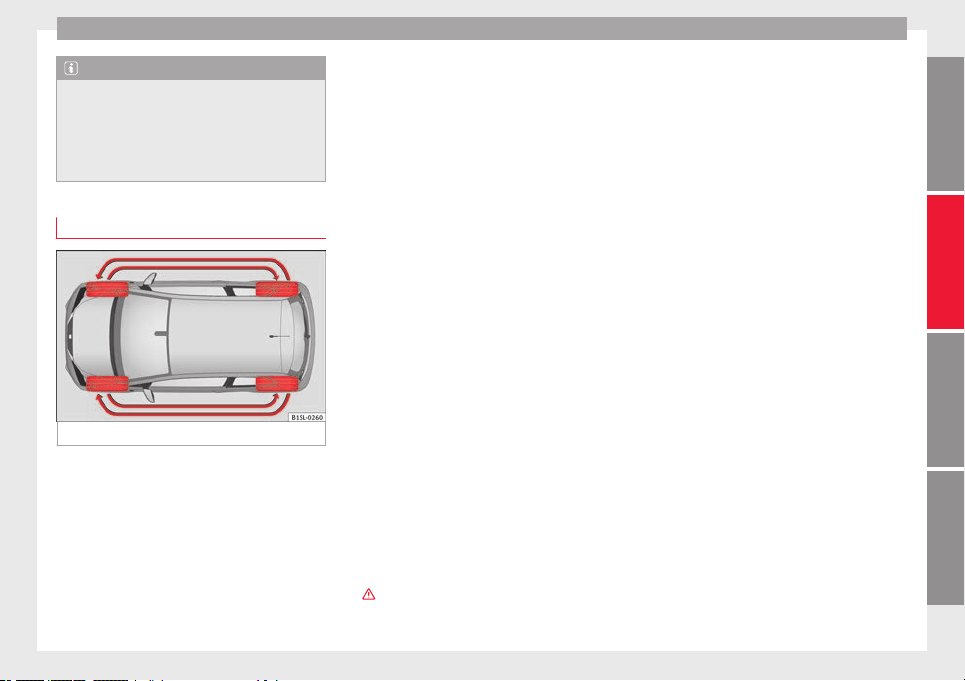
Wheels and tyres
Note
For technical reasons, it is not generally pos-
sible to use the wheels from other vehicles.
In some cases, this may also be true for the
same model of wheel. Please refer to the ve-
hicle documentation or ask at a technical
service.
About your tyres and wheels
Fig. 114 Diagram for changing wheels
The tyres of a vehicle are the components
which are subjected to most stress and are
the most underestimated. Tyres are very im-
portant, as the support offered by their nar-
row surface is the only point of contact be-
tween the vehicle and the road.
The service life of tyres is dependent on tyre
pressure, driving style, the care they receive
and the correct fitting.
The tyres and wheel rims are an essential
part of the vehicle's design. The tyres and
rims approved by SEAT are specially matched
to the characteristics of the vehicle and our
critical to good road holding and safe han-
dling.
Avoiding damage to tyres and wheels
●
If you have to drive over a kerb or similar
obstacle, drive very slowly and as near as
possible at a right angle to the kerb.
●
Inspect the tyres regularly for damage
(punctures, cuts, cracks, dents).
●
Remove any foreign bodies found on the
outside of the tyre tread and ensure that they
have not passed through the wall of the tyre
››› page 163
.
●
In a
d
dition, the instructions for tyre control
systems should always be observed.
●
Replace damaged or worn tyres as soon as
possible ››› page 163.
●
Regularly check tyres for non-visible dam-
age ››› page 163.
●
Never exceed the maximum permitted
speed or loads specified for the type of tyre
fitted on your vehicle ››› page 167.
●
Do not allow tyres (including the spare
wheel) to come into contact with aggressive
substances, grease, oil, fuel or brake fluid
›››
.
●
Lost valve caps should be replaced imme-
diately.
Tyres with directional tread pattern
Tyres with directional tread pattern have
been designed to operate best when rotating
in only one direction. An arrow on the tyre
sidewall indicates the direction of rotation on
tyres with directional tread ››› page 167. Al-
ways observe the direction of rotation indica-
ted when mounting the wheel. This guaran-
tees optimum grip and helps to avoid aqua-
planing, excessive noise and wear.
If the tyre is mounted in the opposite direc-
tion of rotation, drive with extreme caution,
as the tyre is no longer being used correctly.
This is of particular importance when the
road surface is wet. Change the tyre as soon
as possible or remount it with the correct di-
rection of rotation.
Interchanging tyres
To ensure that the wear is equal on all tyres
the wheels should be changed round from
time to time according to the system
››› Fig. 114
. The useful life of all the tyres will
then be about
the s
ame time.
SEAT recommends you take the vehicle to a
specialised workshop to have the tyres
changed.
»
159
Technical specifications
AdviceOperationSafety
Advice
Tyres that are over 6 years old
Tyres are subject to an ageing process as a
result of physical and chemical processes.
This may affect their performance. Tyres
which are stored for long periods of time
without being used, harden and become
more fragile than tyres which are in constant
use.
SEAT recommends that tyres over six years
old are replaced with new tyres. This also ap-
plies to tyres (including the spare wheel)
which appear to be in perfect condition on
the outside and which have a tread depth
within the values stipulated by the Law ››› .
The date of manufacture, part of the tyre
identification number (TIN), indicates the age
of the tyre () ››› page 167
.
St
orin
g tyres
Mark tyres when you remove them to indicate
the direction of rotation (left, right, forwards,
backwards). This ensures you will be able to
mount them correctly when you replace
them. When removed, the wheels and/or
tyres should be stored in a cool, dry and pref-
erably dark location. Do not place tyres
mounted on the wheel in a vertical position.
Protect tyres not mounted on wheels from
dirt by storing them in suitable bags and
standing them on the ground on their tread.
WARNING
Aggressive fluids or substances could result
in visible or invisible damage with the conse-
quent risks.
●
Always ensure that tyres do not come into
contact with chemical products, oil, grease,
fuel, brake fluid or other aggressive substan-
ces.
WARNING
Old tyres, even if they have never been used,
may lose air or burst unexpectedly while driv-
ing, resulting in serious accident or damage.
●
If tyres are over six years old, they should
only be used in an emergency and with ex-
treme caution.
For the sake of the environment
Old tyres must be disposed of by qualified
personnel according to the laws in the coun-
try concerned.
Wheel rims
The design of wheel bolts is matched to the
rims. If different rims are fitted, the correct
wheel bolts with the right length and correct-
ly shaped bolt heads must be used. This en-
sures that wheels are fitted securely and that
the brake system functions correctly
›››
page 174
.
F
or t
echnical reasons, it is not generally pos-
sible to use the wheels from other vehicles.
In some cases, this may also be true for the
same model of wheel.
The tyres and rims approved by SEAT are spe-
cially matched to the characteristics of the
vehicle and are critical to good road holding
and safe handling.
Note for Italy: A SEAT Service Centre should
be consulted whether different sized wheels
or tyres to those originally fitted by SEAT may
be fitted, as well as the combinations al-
lowed between the front axle (axle 1) and
back axle (axle 2).
Wheel bolts
Wheel bolts must be tightened to the correct
torque ››› page 174.
Beadlock wheel rims
Beadlock wheel rims have various compo-
nents. These are joined together by special
bolts using a special procedure. This ensures
good performance, a better seal, improved
safety and wheel run out. Therefore, worn
rims should always be replaced and must on-
ly be repaired in a specialised workshop.
SEAT recommends visiting a technical service
›››
.
160
Wheels and tyres
Wheel rims with bolted trims
Wheel rims may be fitted with interchangea-
ble trim parts which are attached to the rim
using self-locking bolts. Worn trims should
only be replaced at a specialised workshop.
SEAT recommends visiting a technical service
››› .
WARNING
The use of worn or damaged wheel rims could
make driving more dangerous and result in
serious accidents and damage.
●
Only wheel rims which have been approved
for use with your vehicle should be used.
●
Inspect wheel rims regularly for damage
and replace as required.
WARNING
If the bolted joints of wheel rims with bolted
ring trims are not correctly tightened or loos-
ened, this could result in serious accident.
●
Never loosen the bolted joints of wheel
rims with bolted ring trims.
●
Any work relating to wheel rims with bolted
rims should be carried out at specialised
workshop. SEAT recommends taking your car
in for technical service.
Replacement of wheel rims and new
tyres
New tyres
●
When tyres are new, drive with extreme
caution for the first 600 km, as all tyres need
to be run-in. Tyres which have not been run-
in do not
have such good grip ›››
or brak-
ing capacity ››› .
●
All four wheels must be fitted with radial
tyres of the same type, size (rolling circumfer-
ence) and the same tread pattern.
●
The tread depth of new tyres may vary, ac-
cording to the type and make of tyre and the
tread pattern.
Replacing tyres
●
Where possible, always replace both
wheels on an axle (both wheels on the front
axle or both wheels on the rear axle)
›››
.
●
Only replace used tyres with those author-
ised by SEAT for the corresponding type vehi-
cle. Pay special attention to size, diameter,
and maximum load and speed capacity.
●
Never use tyres which are larger than SEAT
approved tyres. If the tyres are too big, they
may knock or rub against the chassis or other
components, resulting in damage.
WARNING
New tyres do not give maximum grip and will
not have reached their maximum braking ca-
pacity to start with, and therefore need run-
ning in.
●
To prevent accidents and major damage,
extreme caution should be taken for the first
600 km.
WARNING
There should be adequate space between the
tyres and the vehicle in accordance with the
vehicle design. If this is not the case, the
tyres may rub against parts of the running
gear, chassis or brake lines, leading to faults
in the brake system or to tread detachment,
and the risk of burst tyres.
●
The true tyre dimension should not be
greater than the dimensions of tyres manu-
factured and approved by SEAT and should
not rub against parts of the vehicle.
Note
Although tyres may be shown as being the
same size, the true dimensions of different
types of tyre may vary with respect to the
nominal size, or tread patterns may be differ-
ent.
Note
If you use tyres that are approved by SEAT,
you can be sure that the true tyre dimensions
»
161
Technical specifications
AdviceOperationSafety
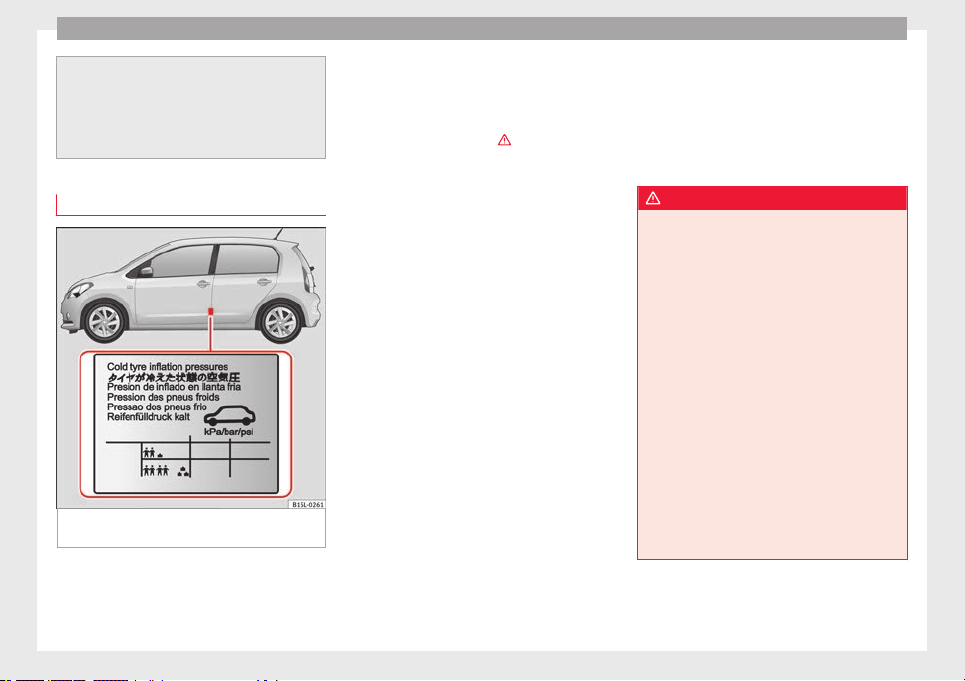
Advice
will be correct for your vehicle. For other tyre
models, the tyre vendor should provide the
manufacturer's certificate with the tyre, indi-
cating that this type of tyre is suitable for
your vehicle. This certificate should always
be carried with the vehicle.
Tyre pressures
Fig. 115 Position of tyre pressure specifica-
tion plate
The correct tyre pressures for tyres fitted at
the factory is shown on a label and is valid
for summer and winter tyres. The label
››› Fig. 115
is located on the driver's door pil-
l
ar
.
Under-inflation or over-inflation will reduce
the life of the tyres considerably and also im-
pair the car's handling ›››
. It is essential to
maintain the correct tyre pressures, especial-
ly if driving at high speeds. Incorrect tyre
pressure causes premature wear and could
cause tyre blow-out.
The pressure should therefore be checked at
least once a month and before starting a
journey.
As a general rule, the pressures given are for
cold tyres
. When the tyres are hot, the pres-
s
ur
es are greater.
Never deflate a hot tyre in order to obtain the
required pressure. This could result in very
low tyre pressures which may lead to sudden
blow-outs.
Checking tyre pressures
Check tyre pressures only when the vehicle
has not been driven for more than a few kilo-
metres at low speeds in the past three hours.
●
The tyre pressures should be checked regu-
larly, and only when the tyres are cold. Al-
ways check all tyres, including the spare
wheel. Tyre pressures should be checked
more often in colder regions, and only when
the vehicle has not been driven recently. Al-
ways use a correctly-operating tyre gauge.
●
Adjust tyre pressures to the loads carried in
the vehicle.
●
After adjusting the tyre pressure, check that
the caps are properly screwed on.
The spare wheel or temporary spare wheel
must be at the maximum pressure specified.
WARNING
If tyre pressures are too high or too low, the
tyre may deflate or burst suddenly while driv-
ing. This could result in a serious accident.
●
If the tyre pressure is too low, they could
overheat, resulting in tread detachment or
even burst tyres.
●
When driving at high speeds and/or fully
loaded, the tyre could suddenly overheat,
burst or be subject to tread detachment, with
the resultant loss of control of the vehicle.
●
Tyre pressures which are too high or too
low reduce the service life of the tyre, affect-
ing the vehicle's performance.
●
Tyre pressures should be checked regularly,
at least once a month and before long jour-
neys.
●
Adjust the pressures of all the tyres to the
vehicle load.
●
Never deflate excess pressure from hot
tyres.
162
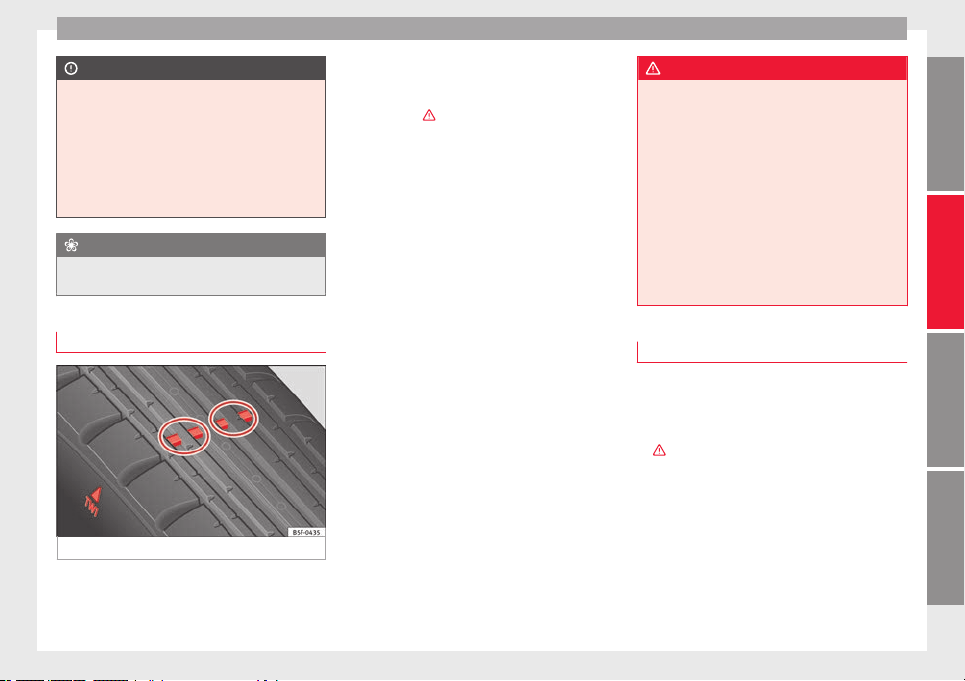
Wheels and tyres
CAUTION
●
Take care not to tilt the manometer when
placing it on the valve. Otherwise, the valve
may be damaged.
●
If tyre valves are not protected by caps, or if
the caps are not screwed on correctly, they
may become damaged. Check that the caps
are identical to the standard caps and have
been correctly tightened.
For the sake of the environment
Under-inflated tyres will increase fuel con-
sumption.
Tread depth and wear indicators
Fig. 116 Tyre tread: tread wear indicators
Tread depth
Certain driving conditions require a deeper
tread, as well as needing the tread to be ap-
proximately the same on the front and rear
tyres. This is particularly important when
driving in winter, in cold temperatures and on
wet roads ››› .
The minimum tread depth required by law in
the majority of cases is 1.6 mm, measured in
the tread grooves next to the tread wear indi-
cators. Observe legal requirements in each
country.
The performance of winter tyres is much re-
duced when the tread has worn to 4 mm.
The tread depth of new tyres may vary, ac-
cording to the type and make of tyre and the
tread pattern.
Wear indicators on the tyre
The original tyres on your vehicle have
1.6 mm high ››› Fig. 116
tread wear indicators
ru
nnin
g across the tread. A number of these
indicators are equally spaced around the tyre
tread. Certain marks on the tyre walls (e.g.
the letters “TWI” or other symbols) indicate
the position of the wear indicators.
Tread wear indicators indicate if a tyre is
worn. They must always be replaced before
the tyre tread has worn to the level of the in-
dicator.
WARNING
Driving with worn tyres is dangerous, and
may lead to loss of control of the vehicle with
serious consequences.
●
Tyres must be replaced before the wear in-
dicators are at the same level as the tread
pattern.
●
Worn tyres have significantly reduced grip,
especially on wet surfaces, increasing the
risk of “aquaplaning”.
●
Worn tyres make control of the vehicle
more difficult in normal or difficult driving
conditions, increasing the braking distance
and the risk of skidding.
Damaged tyres
Damage to wheels and tyres is often not im-
mediately visible. If you notice unusual vibra-
tion
or the car
pulling to one side
, this may
indicate that one of the tyres is damaged
›››
.
●
Slow down immediately if you think you
have a damaged wheel.
●
Check the wheels and tyres for damage.
●
If tyres are worn, stop driving and seek
qualified assistance.
●
If there is no visible exterior damage, drive
slowly and carefully to the nearest special-
ised workshop and have the vehicle checked.
»
163
Technical specifications
AdviceOperationSafety
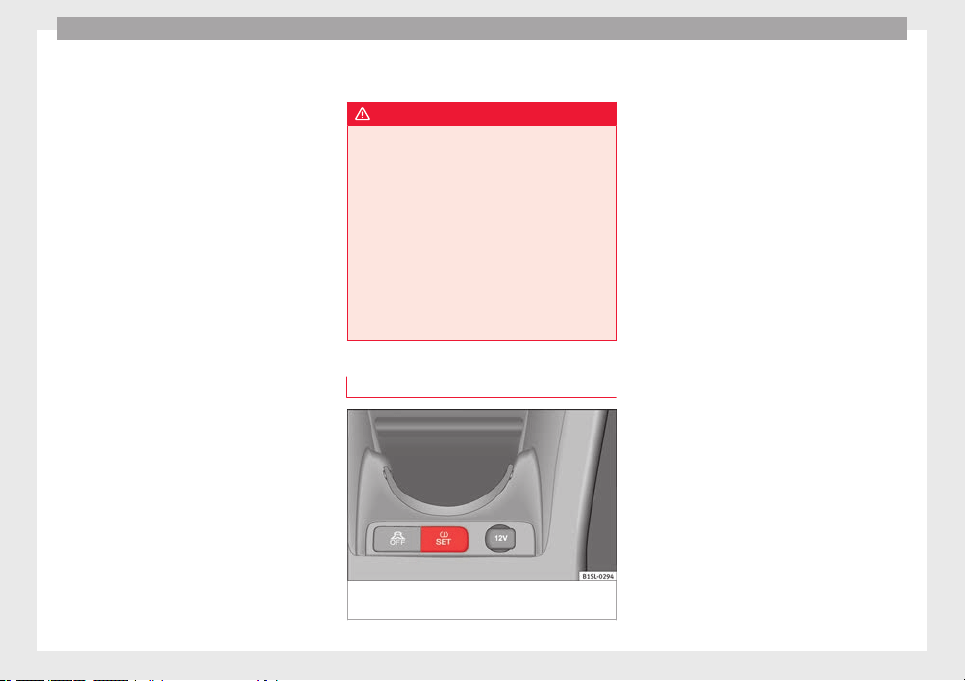
Advice
Foreign bodies in the tyre
●
Do not remove foreign bodies if they have
penetrated through the tyre wall!
●
You should obtain professional assistance
immediately.
Wear of tyres
The wear of tyres depends on a number of
factors, for example:
●
Driving style.
●
Unbalanced wheels.
●
Running gear settings.
Driving style: Driving round bends quickly or
sudden acceleration or braking speed accel-
erates tyre wear. When the driving style is
normal, if the tyres wear too quickly, have the
running gear settings checked at a special-
ised workshop.
Wheel run-out
: The wheels on new vehicles
ar
e b
alanced. However, certain circumstan-
ces may lead to imbalance (run-out), which is
detected as vibrations in the steering wheel.
Run-out leads to wear of the steering and
suspension. In the event of run out, the
wheels should be balanced again. When a
new wheel is fitted, it should be balanced
again.
Running gear settings: an incorrectly posi-
tioned running gear increases the wear of
tyres and affects your safety while driving. If
tyres wear too quickly, have the wheel align-
ment checked at a specialised workshop.
WARNING
If you notice unusual vibration or the car pulls
to one side while driving, this may indicate
that one of the tyres is damaged.
●
Reduce speed immediately and stop, while
observing the highway code.
●
Check the wheels and tyres for damage.
●
Never carry on driving on worn tyres or
wheels. Request qualified assistance immedi-
ately.
●
If there is no visible exterior damage, drive
slowly and carefully to the nearest special-
ised workshop and have the vehicle checked.
Tyre monitoring system*
Fig. 117 Centre console: tyre monitor system
button
The tyre control lamp compares wheel revolu-
tions and with it, the wheel diameter of each
wheel using the ESC. If the diameter of a
wheel changes, the tyre control lamp
lights up. The wheel diameter changes when:
●
Tyre pressure is insufficient.
●
The tyre structure is damaged.
●
The vehicle is unbalanced because of a
load.
●
The wheels of one axle are under more
pressure (for example, driving with a trailer or
on steep slopes).
●
The vehicle is fitted with snow chains.
●
The temporary spare wheel is fitted.
●
The wheel on one axle is changed.
Tyre pressure adjustment
On adjusting tyre pressure or changing one
or more wheels, the ››› Fig. 117
button must
be k
ept
pressed down, with the ignition on,
until an acoustic signal is heard.
If the wheels are under excessive load (for ex-
ample, driving with a trailer or heavy load),
the tyre pressure must be increased to the
recommended value for a full load (see the
sticker on the inside of the fuel flap). If the
tyre monitor system button is pressed down,
the new tyre pressures are confirmed.
164
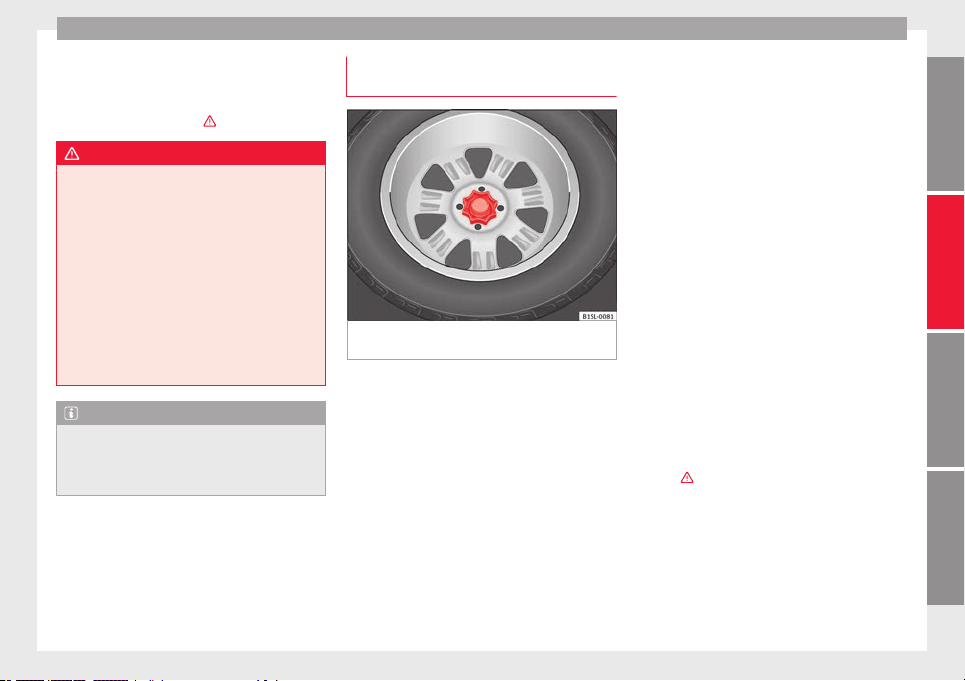
Wheels and tyres
The tyre pressure control lamp
lights up
If
the ty
re pressure of a wheel is much lower
than the value set by the driver, then the tyre
pressure control lamp ›››
will light up.
WARNING
●
When the tyre pressure control lamp lights
up, reduce speed immediately and avoid any
sudden turning or braking manoeuvre. Stop
when possible, and check the tyre pressure
and status.
●
The driver is responsible for maintaining
correct tyre pressures. For this reason, tyre
pressure must be regularly checked.
●
Under certain circumstances (e.g. when
driving in a sporty manner, in winter condi-
tions or on a dirt track) the tyre control lamp
may light up belatedly or may function incor-
rectly.
Note
If the battery is disconnected, the yellow
warning lamp lights up after turning the
ignition on.
This should turn off after a brief
journey.
Spare wheel or temporary spare
wheel*
Fig. 118 In the luggage compartment: hand
controlled wheel for securing the spare wheel
Removing the spare wheel
●
Open the rear lid and lift the luggage com-
partment shelf ››› page 73
.
●
If
nec
essary, remove the boot variable floor
››› page 73.
●
Lift up the carpet from the recess and re-
move it from the luggage compartment.
●
If necessary, take out the vehicle tool kit
with the container.
●
Completely remove the hand controlled
wheel from the centre of the spare wheel
››› Fig. 118 by turning it in an anticlockwise
direction, and take out the spare wheel.
Storing the replaced wheel
●
Pull back the carpet.
●
With the wheel rim facing downwards, sit-
uate the replaced wheel in the spare wheel
well so that the wheel rim central hole coin-
cides with the opening.
●
Turn the hand controlled wheel with the
shank screwed clockwise until the replaced
wheel is secured.
●
If necessary, store the vehicle tool in the
container, inside the boot.
●
Replace the carpet on the boot floor.
●
Lower the rear shelf.
●
Close the rear lid.
If the spare wheel is different to the rest of
the vehicle tyres
If the spare tyre is not the same as the tyres
that are mounted on the vehicle - for example
with winter tyres or the temporary spare
wheel - you should only use the spare tyre for
a short period of time and drive with extra
care ›››
.
Refit the normal road wheel as soon as possi-
ble.
Please observe driving advice:
●
Do not drive faster than 80 km/h (50 mph).
●
Avoid heavy acceleration, hard braking and
fast cornering.
»
165
Technical specifications
AdviceOperationSafety

Advice
●
Snow chains on the temporary spare wheel
are not permitted ››› page 169
.
●
Af
t
er mounting the spare wheel or the tem-
porary spare wheel, check the tyre pressure
as soon as possible ››› page 162.
It is advisable to check the spare wheel or
temporary spare wheel tyre pressure when
checking the rest of the vehicle wheels at
least once a month. The spare wheel should
have the highest pressure allowed for the ve-
hicle ››› page 162. The sticker situated on the
temporary spare wheel shows the tyre pres-
sure.
WARNING
Incorrect handling of the spare wheel or the
temporary spare wheel can cause loss of ve-
hicle control, producing collisions or other
serious accidents and injury.
●
Never use the spare wheel or the temporary
spare wheel if it is damaged or worn to the
wear indicator.
●
In some vehicles the spare wheel is smaller
than the original tyres. This can be seen on a
sticker showing the text “80 km/h” and
“50 mph”. This text indicates the maximum
velocity permitted for this type of tyre.
●
Never drive faster than 80 km/h (50 mph).
Avoid powerful acceleration, hard braking
and taking corners at high speed.
●
Never drive more than 200 km with a tem-
porary spare wheel fitted to the drive axle.
●
Replace the temporary spare wheel for a
normal wheel as soon as possible. The com-
pact temporary spare wheel is only intended
for temporary use over short distances.
●
The temporary spare wheel must always be
secured with the factory supplied wheel
bolts.
●
You should never use more than one tem-
porary spare wheel.
●
After mounting the temporary spare wheel,
check the tyre pressure as soon as possible
››› page 162.
●
Snow c
hains on the temporary spare wheel
are not permitted.
Note
Wherever possible, secure the spare wheel,
temporary spare wheel or the replaced wheel
safely in the luggage compartment. In vehi-
cles with anti-puncture kit, it is not possible
to secure the defective wheel.
166
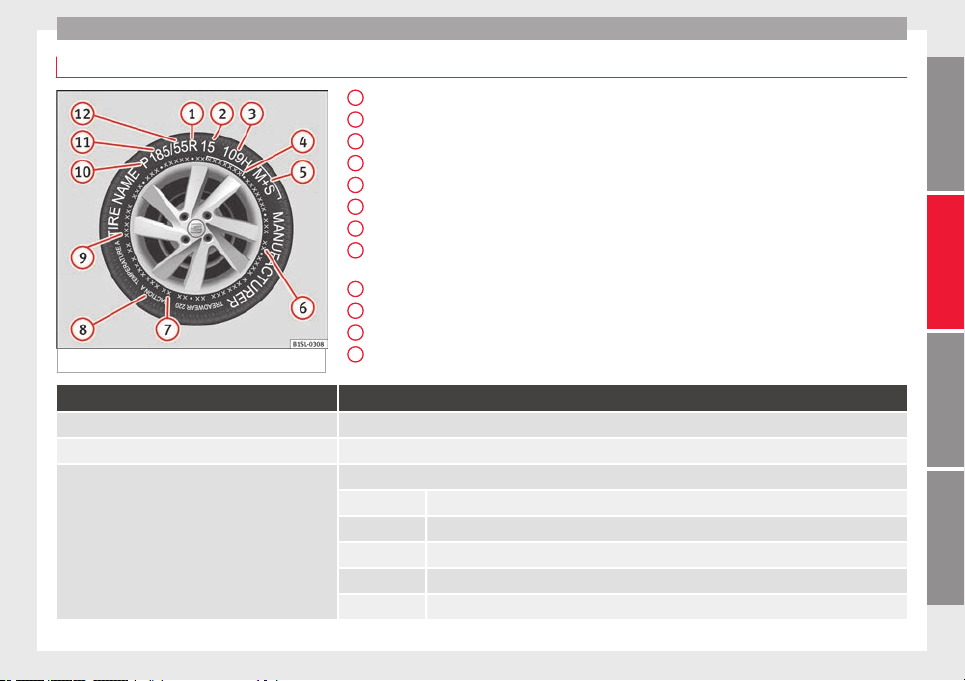
Wheels and tyres
Tyre code
Fig. 119 Universal code on tyres
Radial
Rim diameter code
Load index & speed rating
DOT tyre identification number
Severe snow conditions
Tyre ply composition and materials used
Max. load rating
Treadwear, traction and temperature
grades
Max. permissible inflation pressure
Passenger car tyre
Nominal width of tyre in millimetres
Ratio of height to width (aspect ratio)
1
2
3
4
5
6
7
8
9
10
11
12
Tyre code (example) Meaning
Make, logotype Manufacturer
Product name Name of tyre assigned by manufacturer.
P255 / 55 R 18 Size:
P Passenger vehicle code.
255 Nominal width between walls, in mm.
55 Height/width ratio in %
R Tyre type (R indicates "radial").
18 Rim diameter in inches
»
167
Technical specifications
AdviceOperationSafety

Advice
Tyre code (example) Meaning
109 H Load index ››› page 169 and speed rating ››› page 169.
XL Reinforced tyres (“Reinforced”).
M+S or M/S or
Winter tyres code (mud and snow tyres).
RADIAL TUBELESS Radial tyre without inner tube.
E4 ... E-mark certifying tyre complies with international legislation followed by a number denoting the country granting the au-
thorisation. The authorisation number ( several digits) is shown below.
DOT BT RA TY5 1709 Tyre identification number (TIN
a)
, may be only on interior wall of wheel) and date of manufacture:
DOT The tyre complies with the legal requirements of the US Department of Transport, responsible for tyre
safety regulations.
BT Place of manufacture code.
RA Information about manufacturer and tyre size.
TY5 Manufacturer's tyre specifications.
1709 Date of manufacture: Week 17 of 2009.
TWI This identifies the position of the Tread Wear Indicator ››› page 163.
Made in Germany Country of manufacture.
MAX LOAD 615 KG US load rating, indicating maximum permitted load per tyre.
MAX INFLATION 350 KPA (51 PSI) US limit, indicating maximum permitted tyre pressure.
SIDEWALL 1 PLY RAYON Information about tyre wall components:
1 layer of rayon (artificial silk).
TREAD 4 PLIES
1 RAYON + 2 STEEL + 1 NYLON
Information about tread components:
In the example, there are 4 layers below the tread: 1 layer of rayon (artificial silk), 2 layers of steel reinforcement and 1
layer of nylon.
Information for the end consumer concerning the comparative values of the established base tyres (standardised test procedures) ››› page 134:
168
Wheels and tyres
Tyre code (example) Meaning
TREADWEAR 220 Relative service life of the tyre, with respect to specific US standard test.
TRACTION A Braking capacity of tyre on wet surface (AA, A, B or C).
TEMPERATURE A Tyre temperature resistance at higher test speeds (A, B or C).
If the tyre has other markings, these are specific tyre manufacturer codes or specific national codes, e.g. for Brazil or China.
a)
The letters TIN refer to the tyre serial number.
Tyres with directional tread pattern
Tyres with directional tread pattern have
been designed to operate best when rotating
in only one direction. An arrow on the tyre
sidewall indicates the direction of rotation on
tyres with directional tread. Always observe
the direction of rotation indicated when
mounting the wheel. This guarantees opti-
mum grip and helps to avoid aquaplaning,
grip, noise and wear.
If the tyre is mounted in the opposite direc-
tion of rotation, drive with extreme caution,
as the tyre is no longer being used correctly.
This is of particular importance when the
road surface is wet. Change the tyre as soon
as possible or remount it with the correct di-
rection of rotation.
Tyre load rating
The load rating code indicates the maximum
load in kilogrammes each wheel can carry
(load capacity).
425 kg
462 kg
487 kg
515 kg
545 kg
615 kg
Speed rating
The speed rating indicates the maximum
speed permitted for the tyres.
max. 150 km/h (93 mph)
max. 160 km/h (99 mph)
max. 170 km/h (106 mph)
max. 180 km/h (112 mph)
max. 190 km/h (118 mph)
max. 200 km/h (124 mph)
max. 210 km/h (130 mph)
max. 240 km/h (149 mph)
max. 240 km/h (149 mph)
78
81
83
85
87
91
P
Q
R
S
T
U
H
V
Z
max. 270 km/h (168 mph)
max. 300 km/h (186 mph)
Some manufacturers use the letters “ZR” for
tyres with a maximum authorised speed
above 240 km/h.
Snow chains
When using snow chains, applicable local
legislation and maximum permitted speed
limits must be observed.
In winter weather, snow chains not only help
to improve grip but also improve the braking
capacity.
The fitting of chains is permitted only on
front wheels and with the following combi-
nations of wheel trims and tyres:
»
W
Y
169
Technical specifications
AdviceOperationSafety
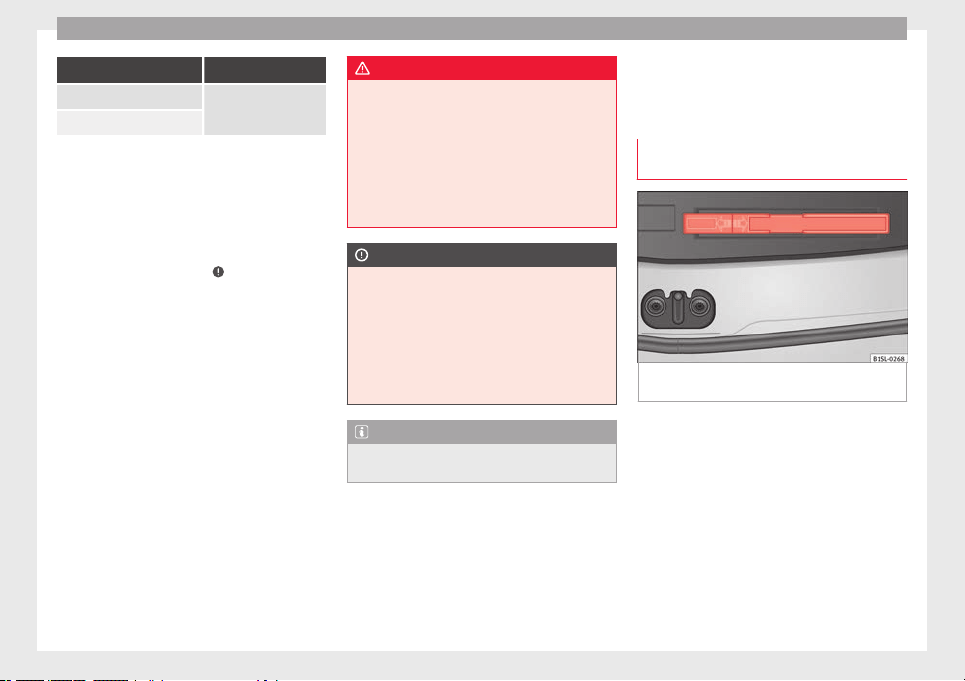
Advice
Tyre size Wheel rim
165/70 R14
5 J x 14 offset of 35
175/65 R14
SEAT recommends you ask a technical serv-
ice for further information on wheel, tyre and
chain sizes.
Wherever possible use fine-link chains meas-
uring less than 15 mm including the lock.
Remove wheel hub covers and trim rings be-
fore fitting snow chains
›››
. The wheel bolts
should be covered with caps for safety rea-
sons. These are available from technical serv-
ices.
Temporary spare wheel
For technical reasons, snow chains must not
be used on the compact temporary spare
wheel
›››
page 165.
If it is necessary to fit chains with the tempo-
rary spare wheel in use, install the wheel on
the rear axle in the event of a fault in a front
wheel. Then, fit the rear wheel that is free, in-
stead of the damaged front wheel. In this sit-
uation, observe the rotating direction of the
wheels. SEAT recommends attaching the
snow chains before fitting the wheel.
WARNING
The use of unsuitable or incorrectly fitted
chains could lead to serious accidents and
damage.
●
Always the appropriate snow chains.
●
Observe the fitting instructions provided by
the snow chain manufacturer.
●
Never exceed the maximum permitted
speeds when driving with snow chains.
CAUTION
●
Remove the snow chains to drive on roads
without snow. Otherwise they will impair ve-
hicle handling, damage the tyres and wear
out very quickly.
●
Wheel rims may be damaged or scratched if
the chains come into direct contact with
them. SEAT recommends the use of covered
snow chains.
Note
Snow chains are available in different sizes
according to the vehicle type.
Emergencies
In case of emergency
First aid kit, warning triangle and fire
extinguishers*
Fig. 120 In the luggage compartment: stor-
age compartment for the warning triangle
Warning triangle
In some vehicle equipment it is possible to
store the warning triangle model shown in a
storage compartment of the luggage com-
partment ››› Fig. 120
.
Fir
s
t-aid kit
The first aid kit must comply with legal re-
quirements. Check the expiry date of the con-
tents of the first aid kit.
170
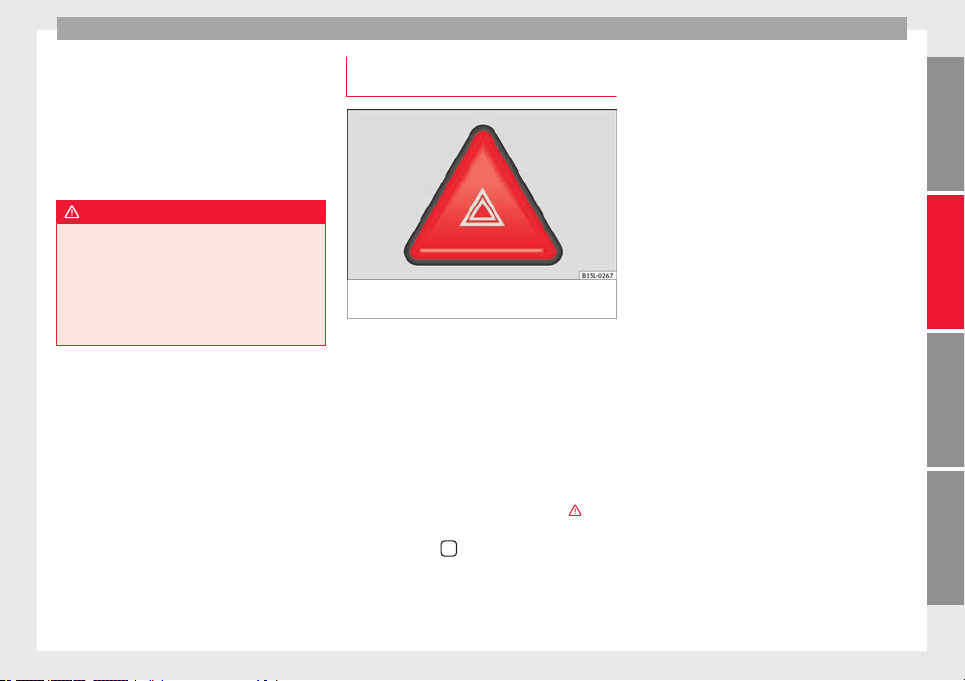
Emergencies
Fire extinguisher
A fire extinguisher can be stored in a holder
in the passenger seat footwell.
The fire extinguisher must conform to legal
requirements, be ready for use and be
checked regularly. Check the certification
seal on the extinguisher.
WARNING
Loose objects in the vehicle interior can be vi-
olently thrown in case of a sudden manoeu-
vre or braking and especially in accidents
causing serious injury.
●
Secure or store fire extinguishers, first aid
kit, reflective vests and warning triangle se-
curely in the vehicle.
Protecting yourself and securing the
vehicle
Fig. 121 Dash panel: Button for switching the
hazard lights warning system on and off.
Always fulfil legal requirements for securing a
broken down vehicle. In a number of coun-
tries it is now obligatory, for example, to turn
on the hazard warning lights and use a re-
flective safety vest ››› page 170.
For your own safety and that of other passen-
gers, the following points should be ob-
served in the order given:
Park the vehicle a safe distance from
traffic and on suitable ground ››› .
Turn on the hazard warning lights with
the button
››› Fig. 121.
Apply the handbrake firmly ››› page 89.
Put the gearbox lever in neutral or the
selector lever in position N ››› page 93.
1.
2.
3.
4.
Switch off the engine and remove the
key from the ignition.
Have all occupants leave the vehicle and
move to safety, for example behind a
guard rail.
When leaving the vehicle, take all keys
with you.
Place an emergency warning triangle to
indicate the position of your vehicle to
other road users.
Allow the engine to cool and check if a
specialist is required.
When being towed with the hazard warning
lights on, a change in direction or traffic lane
can be indicated as usual using the turn sig-
nal lever. The hazard lights will be interrup-
ted temporarily.
Examples of when to use the hazard warning
lights:
●
If the vehicles ahead suddenly slow down
or reach the end of a traffic jam, to warn the
vehicles behind.
●
In case of an emergency.
●
If the vehicle breaks down.
●
When tow-starting or towing.
Always comply with the applicable laws re-
garding the use of hazard warning lights.
If the hazard warning lights are not working,
you must use an alternative method of
»
5.
6.
7.
8.
9.
171
Technical specifications
AdviceOperationSafety
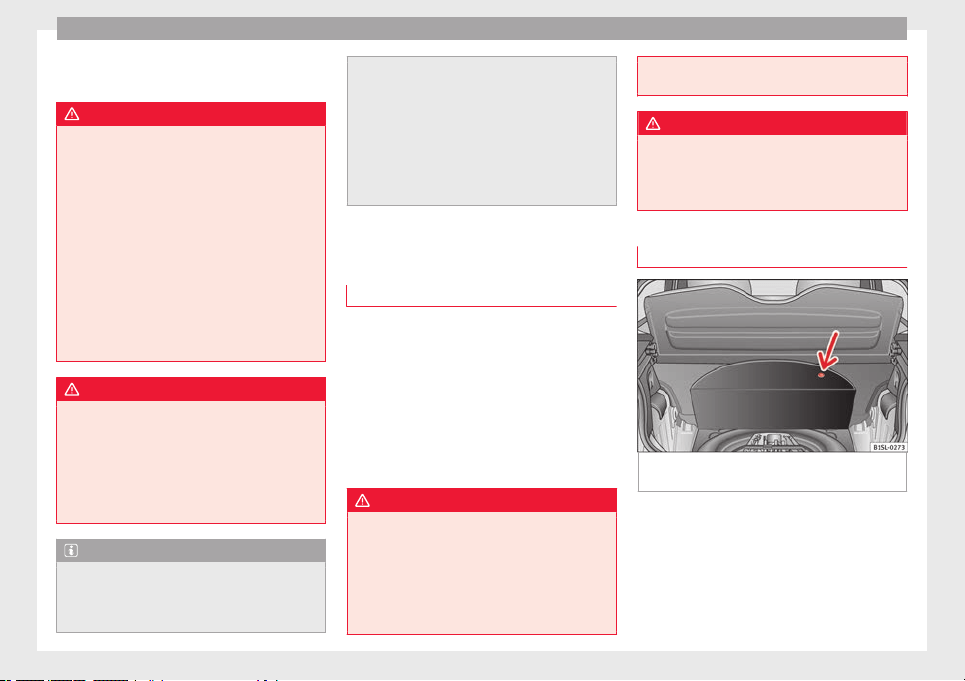
Advice
drawing attention to your vehicle. This meth-
od must comply with traffic legislation.
WARNING
A faulty vehicle in traffic represents a risk of
accident for the driver and for other road
users.
●
Stop the vehicle safely as soon as possible.
Park the vehicle a safe distance from sur-
rounding traffic to lock all the doors in case of
an emergency. Turn on the hazard warning
lights to warn other road users.
●
Never leave children or disabled people
alone in the vehicle if the doors are to be
locked. In case of an emergency, passengers
will be trapped inside the vehicle. Individuals
locked in the vehicle can be exposed to very
high or very low temperatures.
WARNING
The components of the exhaust system reach
very high temperatures. This could cause a
fire and considerable damage.
●
Always park your vehicle so that no part of
the exhaust system can come in contact with
flammable materials (such as dried grass or
fuel).
Note
●
The vehicle battery will discharge and run
down if the hazard warning lights remain on
for too long (even with the ignition turned
off).
●
For some vehicles, the brake lights will
blink when braking suddenly at speeds of ap-
proximately 80 km/h (50 mph) to alert vehi-
cles to the rear. If braking continues, the haz-
ard warning lights system will automatically
be turned on at a speed of less than approxi-
mately 10 km/h (6 mph). The brake lights re-
main lit. Upon accelerating, the hazard warn-
ing lights will be automatically turned off.
Vehicle tool kit*
Introduction
When securing the vehicle in case of a break-
down, please note the legal requirements for
each country.
Vehicle tool kit
For vehicles with a factory-fitted spare wheel
or temporary spare wheel, in addition to win-
ter wheels, the luggage compartment may
contain additional vehicle tools ››› page 172.
WARNING
When the vehicle tool kit, tire mobility set
and spare wheel are loose in the interior they
can be violently thrown in case of a sudden
manoeuvre or braking and especially in acci-
dents, causing serious injury.
●
Ensure that the vehicle tool kit, the tire mo-
bility set and the spare wheel or temporary
spare wheel are safely secured in the luggage
compartment.
WARNING
Unsuitable or damaged vehicle tools can
cause injury or accidents.
●
Never work with inappropriate or damaged
tools.
Location
Fig. 122 In the luggage compartment: Raised
carpet.
The vehicle tool kit, spare wheel, temporary
spare wheel and the tire mobility set are stor-
ed in the luggage compartment under the
carpeted floor panel
›››
Fig. 122
.
●
If
nec
essary, remove the boot variable floor
››› page 73.
172
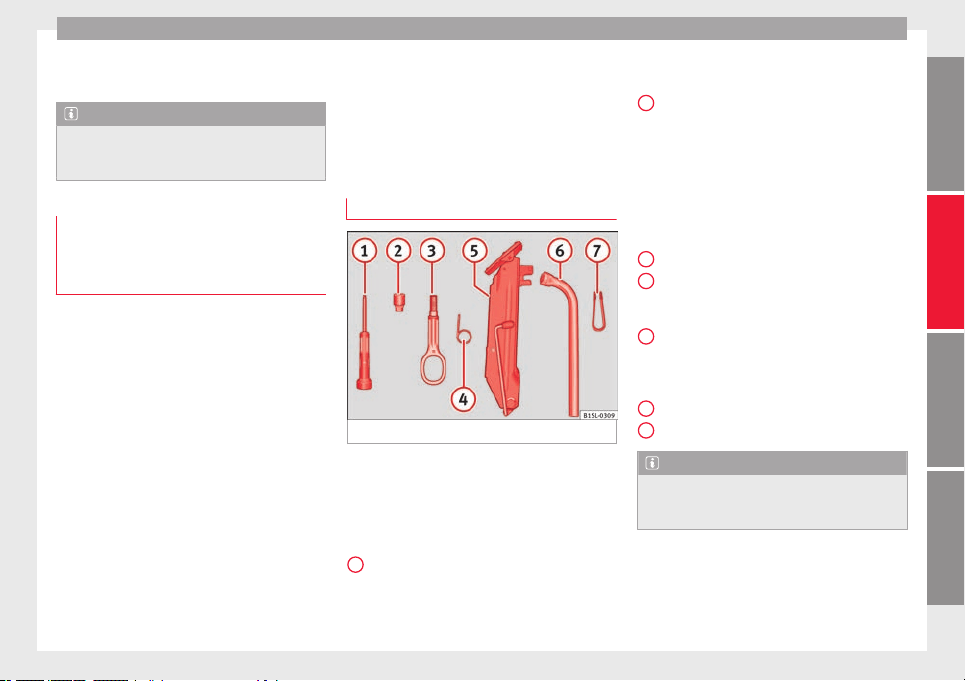
Emergencies
●
Raise the carpet at the recess (arrow)
››› Fig. 122
.
Note
After use, return the jack to its initial position
using the handle in order to securely store it
in the vehicle.
Accessing the vehicle tool kit and tyre
mobility system in vehicles fitted with
the SEAT SOUND 7 speaker system
(with subwoofer)*
●
Open the boot hatch and lift the shelf.
●
If necessary, remove the boot variable floor
›››
page 76
.
●
Lif
t
up the carpet from the recess and re-
move it from the luggage compartment.
●
Disconnect the subwoofer’s speaker cable.
●
Completely remove the hand-controlled
wheel from the centre of the subwoofer
speaker by turning it anti-clockwise.
●
Take out the subwoofer, which is on top of
the tools and tyre mobility system.
●
When finished, place the tools and system
back in the same way and place as before to
ensure the speaker sits properly in its hous-
ing.
●
Place the subwoofer in the direction of the
arrow and with the word “FRONT” facing for-
ward.
●
Reconnect the speaker cable and firmly ro-
tate the securing wheel clockwise so that the
subwoofer is firmly in place.
Components
Fig. 123 Components of the vehicle tool kit
The vehicle tool kit depends on the vehicle
equipment. The following is a description for
a vehicle with all options.
The individual elements of the vehicle tool
kit
›
›› Fig. 123
Sc
rewdriver with hexagon socket in the
handle for screwing and unscrewing the
wheel bolts. The screwdriver bit is inter-
1
changeable. The screwdriver may be
found underneath the wheel spanner.
Adapter for anti-theft bolt. SEAT recom-
mend you carry the wheel bolt adapter in
the vehicle tool kit at all times. The code
number
of the anti-theft wheel bolt is
s
t
amped on the front of the adapter. In
case it is lost, another adapter can be or-
dered using this number. Note the anti-
theft bolt code for the wheels and keep it
in a place other than the vehicle.
Towline anchorage, removable.
Wire hook for pulling off the wheel cover,
integral hubcaps and the wheel bolt
caps.
Jack. Before storing the jack in the tool
kit, fold its hook. The crank must then be
folded tight against the side of the jack in
order for it to be safely stored.
Wheel spanner.
Wheel bolt cap clips.
Note
The jack does not generally require any main-
tenance. If required, it should be greased us-
ing universal type grease.
2
3
4
5
6
7
173
Technical specifications
AdviceOperationSafety
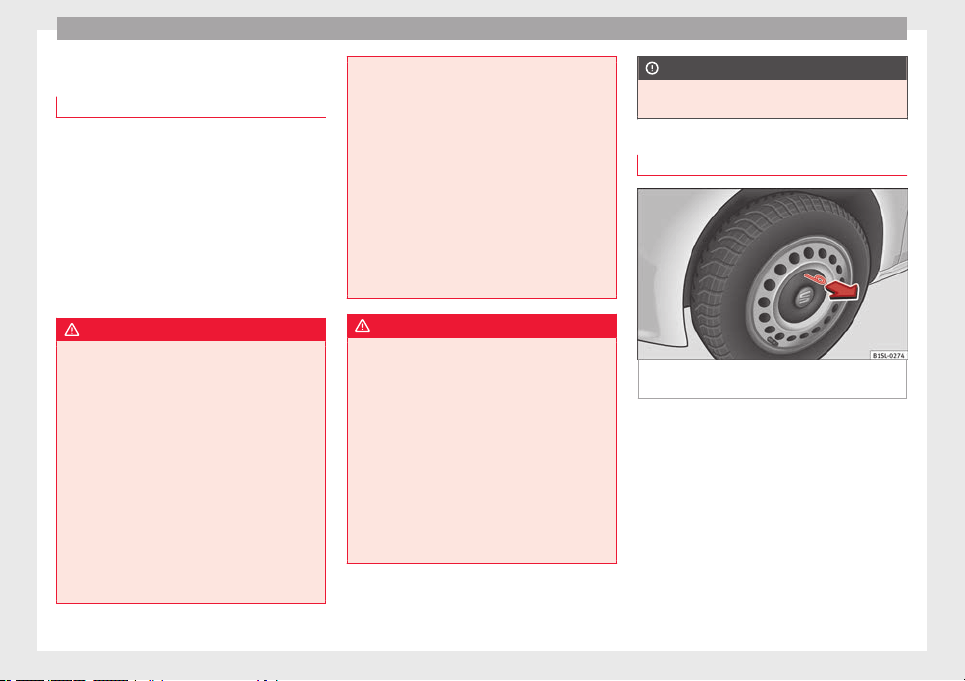
Advice
Changing a wheel
Introduction
Some vehicle versions and models do not
have a factory-fitted jack or box spanner. In
this case, we recommend consulting a Speci-
alised workshop to change the wheel.
You should only change the wheels yourself if
the vehicle is parked in a safe place, you are
familiar with the procedure and safety stand-
ards and you have all the necessary tools!
Otherwise, you should seek professional as-
sistance.
WARNING
Changing a wheel can be dangerous, espe-
cially on the hard shoulder. Please observe
the following rules to minimise the risk of in-
jury:
●
Stop the vehicle safely as soon as possible.
Park at a safe distance from surrounding traf-
fic to change a wheel.
●
When changing a wheel, keep all passen-
gers, and particularly children, a safe dis-
tance away from the work area.
●
Turn on the hazard warning lights to warn
other road users.
●
Ensure the ground on which you park is flat
and solid. If necessary, support the jack on a
wide solid base.
●
If you are changing a wheel yourself, you
should be familiar with the required proce-
dure. Otherwise, you should seek professio-
nal assistance.
●
Only use suitable tools that are not dam-
aged when changing a wheel.
●
Always stop the engine, apply the hand-
brake lever firmly and place the selector lever
in position P, or engage a gear for a manual
gearbox to reduce the risk of the vehicle mov-
ing accidentally.
●
Have the tightening torque of the wheel
bolts checked as soon as possible with a reli-
able torque wrench.
WARNING
If the wheel trims are not appropriate or not
fitted correctly, they could cause major acci-
dents or damage.
●
Incorrectly mounted wheel trims may come
off while driving and endanger other road
users.
●
Damaged trims must never be mounted on
the wheels.
●
Always ensure that the brake ventilation
and cooling is not cut off or blocked. This is
also valid if hubcaps are fitted later. If there
is not enough air, you may require signifi-
cantly longer braking distances.
CAUTION
Remove and remount wheel trims taking care
to avoid damage to the vehicle.
Hubcaps
Fig. 124 Remove the hubcap of the steel
wheel trim
In order to access the wheel bolts, first re-
move the hubcap.
Removing and fitting the hubcap
●
To remove
, take the vehicle tool kit wire
hook
and att
ach it to the edge of the wheel
trim ››› Fig. 124.
●
Remove the trim by pulling it in the direc-
tion of the arrow.
●
To replace the hubcap, press the hubcap
against the trim until it clicks into place.
174
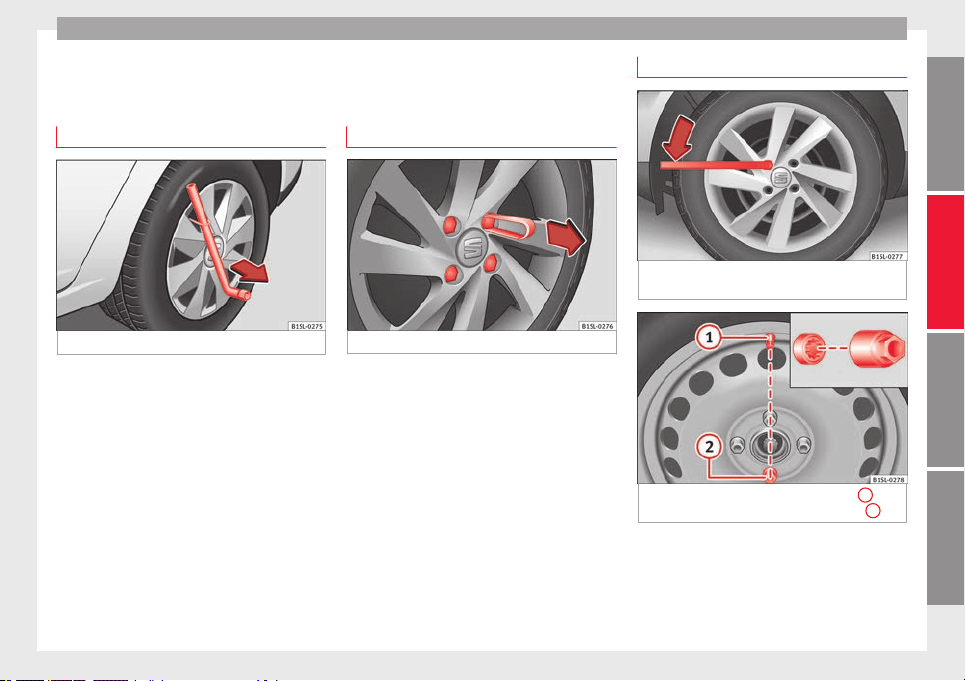
Emergencies
The caps protect the wheel bolts and should
be remounted after changing the tyre.
Full hubcaps
Fig. 125 Removing the full hubcap
Removing the full hubcap
●
Take the wheel brace and the wire hook
from the vehicle tool kit ››› page 172.
●
Hook the wire through one of the grooves
on the hubcap.
●
Insert the wheel brace onto the wire hook
››› Fig. 125
and pull the hub cap in the direc-
tion sho
wn b
y the arrow.
Fitting hubcaps
Press the hubcap against the wheel so that
the space for the valve fits over the tyre valve.
Make sure that the hubcap is correctly fitted
all the way around the wheel. If you are using
an anti-theft wheel lock, screw it in the oppo-
site position to the valve.
Wheel bolt caps
Fig. 126 Removing the wheel bolt caps
Removal
–
Fit the plastic clip (vehicle tools
››› page 172
) over the cap until it clicks into
p
l
ace ››› Fig. 126.
–
Remove the cap with the plastic clip.
The caps protect the wheel bolts and should
be remounted after changing the tyre.
The anti-theft wheel locking bolt has a spe-
cial cap. This only fits on anti-theft locking
bolts and is not for use with standard wheel
bolts.
Wheel bolts
Fig. 127 Changing a wheel: Slacken the
wheel bolts.
Fig. 128 Changing a wheel: Tyre valve
1
and
position of anti-theft wheel locking bolt
2
.
Only use the tool supplied with the vehicle to
loosen the wheel bolts.
Loosen the wheel bolts only about one turn
before raising the vehicle with the jack.
»
175
Technical specifications
AdviceOperationSafety
Advice
If the wheel bolt is very tight, you may be
able to loosen it by pushing down on the end
of the wheel brace carefully with your foot.
Hold on to the vehicle for support and take
care not to slip.
Loosening wheel bolts
●
Fit the wheel brace as far as it will go over
the wheel bolt ››› Fig. 127
.
●
Ho
l
d the wheel brace at the end and rotate
the bolt approximately one turn anticlockwise
›››
.
Loosening anti-theft wheel bolts
For wheels with full hubcap, the anti-theft
wheel lock must be threaded into position
››› Fig. 128
2
before mounting the hubcap.
Otherwise it will not be possible to mount the
entire hubcap.
●
Take the adapter for anti-theft wheel bolts
out of the vehicle tool kit.
●
Insert the adapter onto the wheel bolt
››› Fig. 128
. Push it on as far as it will go.
●
Fit
the wheel
brace onto the adapter as far
as possible.
●
Hold the wheel brace at the end and rotate
the bolt approximately one turn anticlockwise
›››
.
Important information about wheel bolts
The wheel rims and bolts have been de-
signed to be fitted to factory options. If differ-
ent rims are fitted, the correct wheel bolts
with the right length and correctly shaped
bolt heads must be used. This ensures that
wheels are fitted securely and that the brake
system functions correctly.
In some circumstances, wheel bolts from the
same model vehicle should not be used.
Wheel bolt tightening torque
The prescribed tightening torque for wheel
bolts for steel and alloy wheels is 110 Nm
.
Hav
e the tight
ening torque of the wheel bolts
checked as soon as possible with a reliable
torque wrench.
If wheel bolts are rusty and it is difficult to
tighten them, the threads should be replaced
and cleaned before checking the tightening
torque.
Never grease or lubricate wheel bolts or the
wheel hub threads. Although they have been
tightened to the prescribed torque, they
could come loose while driving.
WARNING
If the wheel bolts are not fitted correctly they
could be released while driving leading to
loss of vehicle control and serious damage.
●
Only use wheel bolts which correspond to
the wheel rims in question.
●
Never use different wheel bolts.
●
The bolts and threads should be clean, free
of oil and grease and easy to thread.
●
To loosen and tighten the wheel bolts, al-
ways use the wheel brace supplied with the
vehicle.
●
Loosen the wheel bolts only about one turn
before raising the vehicle with the jack.
●
Never grease or lubricate wheel bolts or the
wheel hub threads. Although they have been
tightened to the prescribed torque, they
could come loose while driving.
●
Never loosen the bolted joints of wheel
rims with bolted ring trims.
●
If the wheel bolts are not tightened to the
correct torque, they may come loose while
driving, and the bolts and rims may come
out. If the tightening torque is too high, the
wheel bolts and threads can be damaged.
176
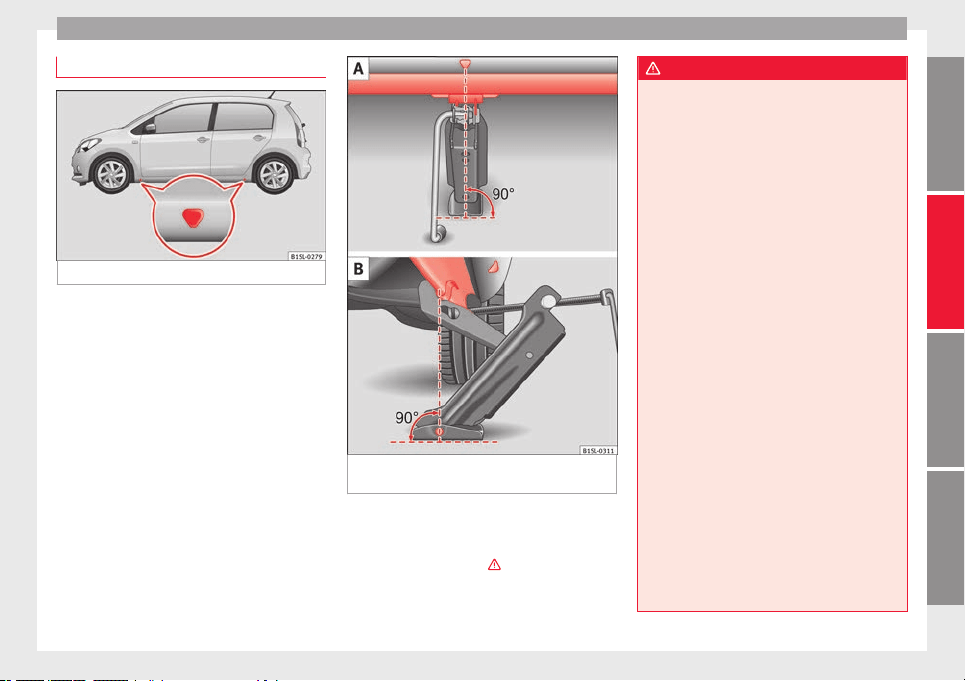
Emergencies
Raising the vehicle with the jack
Fig. 129 Jack position points
Fig. 130 Jack mounted on the left rear part of
the vehicle
The jack may be applied only at the jacking
points shown (marks on chassis) ››› Fig. 129
.
A
lw
ays the relevant jacking point for the
wheel to be changed ›››
.
Raise the vehicle using only the designated
jacking points.
WARNING
If the vehicle is not correctly raised, it could
fall off the jack causing serious injury. Please
observe the following rules to minimise the
risk of injury:
●
You should only use a jack approved by
SEAT for your vehicle. Other jacks, even those
approved for other SEAT models, might slip
out of place.
●
The ground should be firm and flat. If the
ground is sloped or soft then the vehicle
could slip and fall off the jack. If necessary,
support the jack on a wide solid base.
●
If the ground is slippery, such as tiles,
place a non-slip surface (a floor mat, for in-
stance) beneath the jack to avoid slipping.
●
Only fit the jack at the prescribed jacking
points. The claw of the jack should grip the
reinforcement nerve on the underbody
››› Fig. 130.
●
You shou
ld never place a body limb such as
an arm or leg under a raised vehicle that is
solely supported by the jack.
●
If you have to work underneath the vehicle,
you must use suitable stands additionally to
support the vehicle, there is a risk of acci-
dent!.
●
Never raise the vehicle if it is tilting to one
side or the engine is running.
●
Never start the engine when the vehicle is
raised. The vehicle may come loose from the
jack due to the engine vibrations.
177
Technical specifications
AdviceOperationSafety
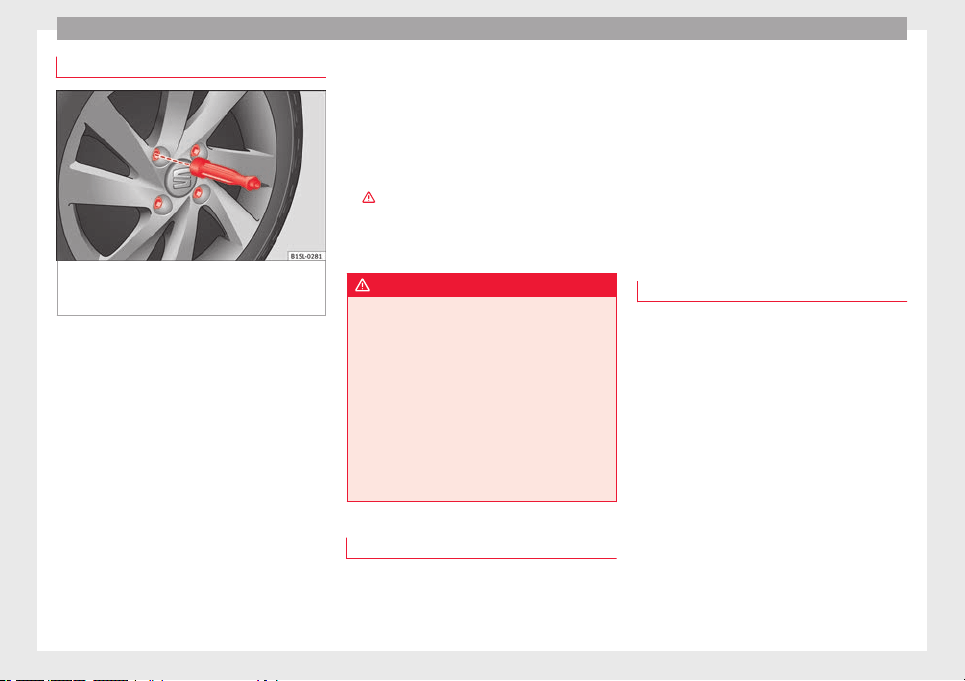
Advice
Changing a wheel
Fig. 131 Changing a wheel: loosen wheel
bolts with the socket at the end of the wheel
brace
Removing the wheel
●
Loosen the wheel bolts ››› page 175.
●
Jacking up the vehicle ››› page 177.
●
Using the hexagonal socket in the wheel
brace ››› Fig. 131
, unscrew the slackened
wheel
bo
lts and place them on a clean sur-
face.
●
Take off the wheel.
How to use the spare wheel or temporary
spare wheel
Check the direction of rotation of the tyre
››› page 167, Tyre code.
●
Place the spare wheel or temporary spare
wheel into position.
●
Replace the wheel bolts and tighten slight-
ly using the hexagonal socket on the end of
the wheel brace.
●
To tighten the anti-theft locking wheel bolts
use the corresponding adaptor.
●
Lower the car with the jack.
●
Tighten all of the wheel bolts clockwise
›››
. Tighten the bolts in diagonal pairs (not
in a circle).
●
Put the caps, trim or full hubcap back on
››› page 174
.
WARNING
If the wheel bolts are not treated suitably or
not tightened to the correct torque then this
could lead to loss of vehicle control and to a
serious accident.
●
All the wheel bolts and hub threads should
be clean and free of oil and grease. The wheel
bolts should be easily tightened to the cor-
rect torque.
●
The hexagonal socket in the wheel brace
should be used for turning wheel bolts only.
Do not use it to loosen or tighten the wheel
bolts.
After changing the wheel
●
Clean the vehicle tools, if necessary and
put them away in the luggage compartment
foam holder
›››
page 172
.
●
St
or
e the spare wheel, the temporary spare
wheel or the changed wheel securely in the
luggage compartment.
●
Have the tightening torque of the wheel
bolts checked as soon as possible with a tor-
que wrench ››› page 176.
●
Have the flat tyre replaced as quickly as
possible.
Tyre repair
TMS (Tyre Mobility System)*
The Anti-puncture kit* (Tyre Mobility System)
will reliably seal punctures caused by the
penetration of a foreign body of up to about
4 mm
in diameter.
Do not remove foreign ob-
j
ects, e.g. screws or nails, from the tyre.
After inserting the sealant residue in the tyre,
you must again check the tyre pressure about
10 minutes after starting the engine.
You should only use the tire mobility set if
the vehicle is parked in a safe place, you are
familiar with the procedure and you have the
necessary tire mobility set! Otherwise, you
should seek professional assistance.
The tyre sealant must not be used in the
following cases:
●
If the wheel rim has been damaged.
178
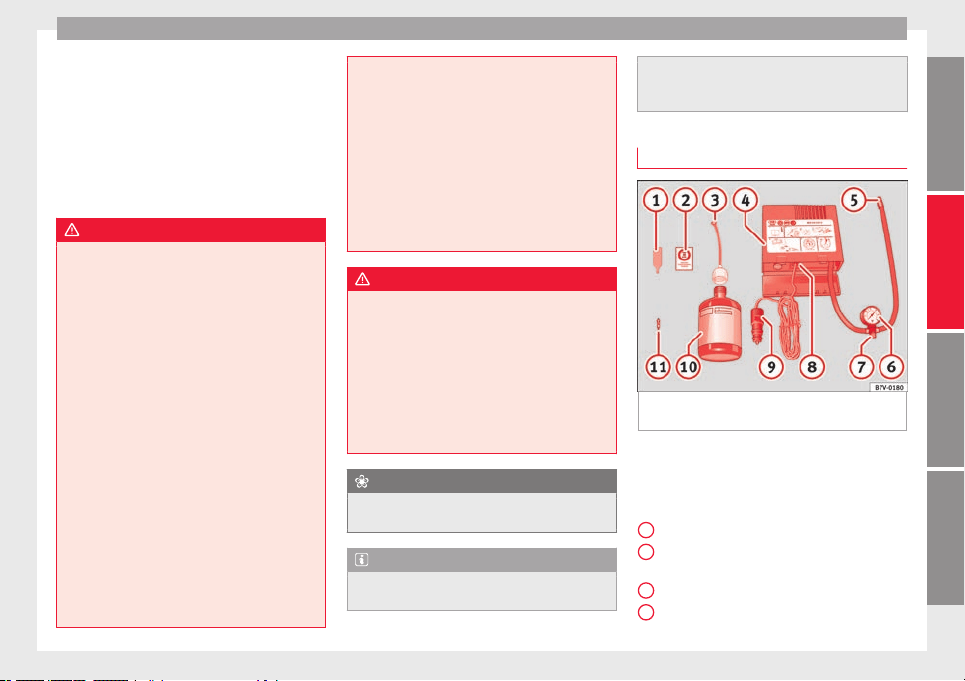
Emergencies
●
In outside temperatures below -20 °C
(-4 °F).
●
In the event of cuts or perforations in the
tyre greater than 4 mm.
●
If you have been driving with very low pres-
sure or a completely flat tyre.
●
If the sealant bottle has passed its use by
date.
WARNING
Using the tyre mobility system can be dan-
gerous, especially when filling the tyre at the
roadside. Please observe the following rules
to minimise the risk of injury:
●
Stop the vehicle safely as soon as possible.
Park it at a safe distance from surrounding
traffic to fill the tyre.
●
Ensure the ground on which you park is flat
and solid.
●
All passengers and particularly children
must keep a safe distance from the work area.
●
Turn on the hazard warning lights to warn
other road users.
●
Use the tyre mobility system only if you are
familiar with the necessary procedures. Oth-
erwise, you should seek professional assis-
tance.
●
The tyre mobility set is intended for tempo-
rary emergency use only until you can reach
the nearest specialised workshop.
●
Replace the repaired tyre with the tire mo-
bility set as soon as possible.
●
The sealant is a health hazard and must be
cleaned immediately if it comes into contact
with the skin.
●
Always keep the tire mobility set out of the
reach of small children.
●
Never use an equivalent jack, even if it has
been approved for your vehicle.
●
Always stop the engine, apply the hand-
brake lever firmly and engage gear if using a
manual gearbox, in order to reduce the risk of
vehicle involuntary movement.
WARNING
A tyre filled with sealant does not have the
same performance properties as a conven-
tional tyre.
●
Never drive faster than 80 km/h (50 mph).
●
Avoid heavy acceleration, hard braking and
fast cornering.
●
Drive for only 10 minutes at a maximum
speed of 80 km/h (50 mph) and then check
the tyre.
For the sake of the environment
Dispose of used or expired sealant observing
any legal requirements.
Note
●
A new bottle of sealant can be purchased at
SEAT dealerships.
●
Take into account the separate instruction
manual of the tyre mobility set* manufactur-
er.
Contents of the tyre mobility system*
Fig. 132 Standard representation: Contents
of the tyre mobility system.
The tyre mobility set is located underneath
the floor covering in the luggage compart-
ment. It includes the following components
›››
Fig. 132
:
T
y
re valve remover
Sticker indicating maximum speed “max.
80 km/h” or “max. 50 mph”
Filler tube with cap
Air compressor
»
1
2
3
4
179
Technical specifications
AdviceOperationSafety
Advice
Tube for inflating tyres
Warning provided by tyre pressure moni-
toring system
1)
Air bleed screw
2)
ON/OFF switch
12 volt connector
Bottle of sealant
Spare tyre valve
The
valve insert remover
1
has a gap at the
lower end for a valve insert. The valve insert
can only be screwed or unscrewed in this
way. This also applies to its replacement part
11
.
Sealing and inflating a tyre
Sealing a tyre
●
Unscrew the tyre valve cap.
●
Use the corresponding enclosed extractor
›››
Fig. 132
1
to unscrew the tyre valve in-
sert. Place the valve insert on a clean surface.
●
Vigorously shake the sealant bottle
›››
Fig. 132
10
for several seconds.
●
Screw the inflator tube
›››
Fig. 132
3
se-
curely into the sealant bottle in a clockwise
5
6
7
8
9
10
11
direction. The seal on the mouth of the bottle
moves automatically.
●
Remove the lid from the filling tube
››› Fig. 132
3
and screw the open end of the
tube into the tyre valve.
●
Hold the tyre sealant can upside down and
fill the complete
contents of the can into the
ty
r
e.
●
Remove the tyre sealant bottle from the
valve.
●
Screw the valve insert again with the corre-
sponding enclosed extractor ››› Fig. 132
1
into the tyre valve.
Inflating the tyre
●
Securely screw the tyre inflator tube
››› Fig. 132
5
of the compressor into the tyre
valve.
●
Check whether the air bleed screw
››› Fig. 132
7
is closed.
●
Start the vehicle engine and leave it run-
ning.
●
Attach the connector ››› Fig. 132
9
to a 12
volt socket of the vehicle ››› page 72.
●
Connect the air compressor with the
ON/OFF switch ››› Fig. 132
8
.
●
Keep the air compressor running until it
reaches 2.0 to 2.5 bar (29-36 psi /
200-250 kPa) ››› .
Maximum operation time
8 minut
e
s ›››
.
●
Disconnect the air compressor.
●
If it is not possible to achieve an air pres-
sure of 2.0 to 2.5 bar (29-36 psi /
200-250 kPa), unscrew the tyre inflator tube
from the tyre valve.
●
Move the vehicle some 10 metres forward
or backward so that the sealant is evenly dis-
tributed in the tyre interior.
●
Securely screw the compressor tyre inflator
tube into the tyre valve and repeat the infla-
tion process.
●
If the indicated pressure can still not be
reached, the tyre is too badly damaged. The
tyre cannot be sealed with the anti-puncture
kit. Do not continue driving. You should ob-
tain professional assistance ››› .
●
Disconnect the air compressor and unscrew
the flexible inflator tube from the tyre valve.
●
When the tyre pressure is between 2.5 and
2.0 bars, immediately continue driving with-
out exceeding 80 km/h (50 mph).
●
After
10 minutes
, Check the pressure again
›
›› page 181.
1)
It can also be integrated in the compressor.
2)
In its place, the compressor may have a button.
180
Emergencies
WARNING
When inflating the wheel, the air compressor
and the inflator tube may become hot.
●
Protect hands and skin from hot parts.
●
Do not place the hot flexible inflator tube or
hot air compressor on flammable material.
●
Allow them to cool before storing the de-
vice.
●
If it is not possible to inflate the tyre to at
least 2.0 bars (29 psi / 200 kPa), the tyre is
too badly damaged. The sealant is not in a
good condition to seal the tyre. Do not con-
tinue driving. Seek specialist assistance.
CAUTION
Switch off the air compressor after a maxi-
mum of 8 operational minutes to avoid over-
heating! Before switching on the air compres-
sor again, let it cool for several minutes.
Check after 10 minutes of driving
Screw in the inflator tube
›››
Fig. 132
5
again and check the pressure on the gauge
6
.
1.3 bar (19 psi / 130 kPa) and lower:
●
Stop the vehicle! The tyre cannot be sealed
sufficiently with the tyre mobility set.
●
You should obtain professional assistance
›››
.
1.4 bar (20 psi / 140 kPa) and higher:
●
Set the tyre pressure to the correct value
again ››› page 158
.
●
C
ar
efully resume your journey until you
reach the nearest specialised workshop with-
out exceeding 80 km/h (50 mph).
●
Have the damaged tyre replaced.
WARNING
Driving with an unsealed tyre is dangerous
and can cause accidents and serious injury.
●
Do not continue driving if the tyre pressure
is 1.3 bar (19 psi / 130 kPa) and lower.
●
Seek specialist assistance.
Starting assistance
Introduction
If the engine fails to start because of a dis-
charged battery, the battery of another vehi-
cle can be used to start the engine. Before
starting, check the magic eye on the battery
›››
page 154
.
F
or s
tarting assistance, jump lead cables con-
forming to the standard DIN 72553 are re-
quired (see the cable manufacturer instruc-
tions). The cable section in vehicles with pet-
rol engine must be at least 25 mm
2
.
WARNING
Incorrect use of jump leads and incorrectly
jump starting could cause the battery to ex-
plode resulting in serious injury. Please ob-
serve the following rules to minimise the risk
of a battery explosion:
●
The battery providing current must have
the same voltage (12V) and approximately
the same capacity (see markings on battery)
as the flat battery.
●
Never charge a frozen or recently thawed
battery. A flat battery can also freeze at tem-
peratures close to 0 °C (+32 °F).
●
If a battery is frozen and/or has been frozen
then it must be replaced.
●
A highly explosive mixture of gases is re-
leased when the battery is being charged. Al-
ways keep lit cigarettes, flames, sparks and
fire far from the battery. Never use a mobile
telephone when connecting and removing the
jump leads.
●
Charge the battery only in well ventilated
areas given that when the battery is charged
by outside assistance, it creates a mix of
highly explosive gases.
●
Jump leads should never enter into contact
with moving parts in the engine compart-
ment.
●
Never switch the positive and negative
poles or connect the jump leads incorrectly.
●
Note the instruction manual provided by
the manufacturer of the jump leads.
»
181
Technical specifications
AdviceOperationSafety
Advice
CAUTION
To avoid considerable damage to the vehicle
electrical system, note the following careful-
ly:
●
If the jump leads are incorrectly connected,
this could result in a short circuit.
●
The vehicles must not touch each other,
otherwise electricity could flow as soon as
the positive terminals are connected.
How to jump start: description
Fig. 133 Diagram of connections for vehicles
without Start-Stop system.
Fig. 134 Diagram of connections for vehicles
with Start-Stop system.
Jump lead terminal connections
1. Switch off the ignition of both vehicles
››› .
2. Connect one end of the red
jump lead to
the po
s
itive
+
terminal of the vehicle
with the flat battery
A
››› Fig. 133
.
3.
C
onnect the other end of the red jump
lead to the positive terminal
+
in the ve-
hicle providing assistance
B
.
4. For vehicles without Start-Stop system:
connect one end of the black jump lead to
the negative terminal
–
of the vehicle
providing the current
B
››› Fig. 133
.
–
F
or
vehicles with Start-Stop system: con-
nect one end of the black jump lead
X
to a
suitable ground terminal, to a solid piece of
metal in the engine block, or to the engine
block itself ››› Fig. 134
.
5.
C
onnect the other end of the black jump
lead
X
to a solid metal component bolted
to the engine block or to the engine block
itself of the vehicle with the flat battery.
Do not connect it to a point near the bat-
tery
A
.
6. Position the leads in such a way that they
cannot come into contact with any moving
parts in the engine compartment.
Starting
7. Start the engine of the vehicle with the
boosting battery and let it run at idling
speed.
8. Start the engine of the vehicle with the flat
battery and wait 2 or 3 minutes until the
engine is “running”.
Removing the jump leads
9. Before you remove the jump leads, switch
off the dipped beam headlights (if they
are switched on).
10.
Turn on the heater blower and heated rear
w
indo
w in the vehicle with the flat battery.
This helps minimise voltage peaks which
are generated when the leads are discon-
nected.
11.When the engine is running, disconnect
the leads in reverse order to the details
given above.
182
Emergencies
Connect the battery clamps so they have
good metal-to-metal contact with the battery
terminals.
If the engine fails to start, switch off the start-
er after about 10 seconds and try again after
about 1 minute.
WARNING
●
Please note the safety warnings referring to
working in the engine compartment
››› page 143.
●
The batt
ery providing assistance must have
the same voltage as the flat battery (12V) and
approximately the same capacity (see imprint
on battery). Failure to comply could result in
an explosion.
●
Never use jump leads when one of the bat-
teries is frozen. Danger of explosion! Even af-
ter the battery has thawed, battery acid could
leak and cause chemical burns. If a battery
freezes, it should be replaced.
●
Keep sparks, flames and lighted cigarettes
away from batteries, danger of explosion.
Failure to comply could result in an explo-
sion.
●
Observe the instructions provided by the
manufacturer of the jump leads.
●
Do not connect the negative cable from the
other vehicle directly to the negative terminal
of the flat battery. The gas emitted from the
battery could be ignited by sparks. Danger of
explosion.
●
Do not attach the negative cable from the
other vehicle to parts of the fuel system or to
the brake line.
●
The non-insulated parts of the battery
clamps must not be allowed to touch. The
jump lead attached to the positive battery
terminal must not touch metal parts of the ve-
hicle, this can cause a short circuit.
●
Position the leads in such a way that they
cannot come into contact with any moving
parts in the engine compartment.
●
Do not lean on the batteries. This could re-
sult in chemical burns.
Note
The vehicles must not touch each other, oth-
erwise electricity could flow as soon as the
positive terminals are connected.
Towing and tow starting
Introduction
When towing or tow starting, respect the le-
gal requirements.
For technical reasons, it is not possible to
tow a vehicle if the battery is flat.
WARNING
A vehicle with a flat battery should never be
towed.
●
Never remove the key from the ignition
lock. Otherwise, the steering wheel lock
could suddenly lock. The vehicle would not
be controlled and a serious accident could
ensue.
WARNING
When towing the vehicle, the handling and
braking efficiency change considerably.
Please observe the following instructions to
minimise the risk of serious accidents and in-
jury:
●
As the driver of the vehicle being towed:
–
The brake must be depressed must hard-
er as the brake servo does not operate.
Always remain aware to avoid collision
with the towing vehicle.
–
More strength is required at the steering
wheel as the power steering does not op-
erate when the engine is switched off.
●
As the driver of the towing vehicle:
–
Accelerate gently and carefully.
–
Avoid sudden braking and manoeuvres.
–
Brake well in advance than usual and
brake gently.
»
183
Technical specifications
AdviceOperationSafety
Advice
CAUTION
●
Carefully fit and remove the towline anchor-
age and its cover to avoid damage to the ve-
hicle (e.g. paintwork).
●
When towing, fuel could enter the catalytic
converter and cause damage!
Note
Fitting a towline anchorage to the rear bump-
er is not possible. The vehicle is not suitable
for towing other vehicles.
Instructions for tow starting
In general, the vehicle should not be started
by towing. Jump-starting is much more pref-
erable
›
›
›
page 181.
For technical reasons, the following vehicles
can not be tow started:
●
Vehicles with an automatic gearbox.
●
If the vehicle battery is flat, it is possible
that the engine control unit does not operate
correctly.
However, if your vehicle must absolutely be
tow-started (manual gearbox):
●
Put it into second or third gear.
●
Keep the clutch pressed down.
●
Switch on the ignition and the hazard warn-
ing lights.
●
Release the clutch when both vehicles are
moving.
●
As soon as the engine starts, press the
clutch and move the gear lever into neutral.
This helps to prevent a collision with the tow-
ing vehicle.
CAUTION
When tow-starting, fuel could enter the cata-
lytic converter and damage it.
Notes on towing
Tow rope or tow bar
When towing, the tow bar is the safest and
vehicle friendly way. You should only use a
tow rope if you do not have a tow bar.
A tow rope should be slightly elastic to avoid
damage to both vehicles. It is advisable to
use a tow rope made of synthetic fibre or sim-
ilarly elastic material.
Only secure the tow rope or tow bar to the
towline anchorage or specially designed fit-
ting.
Towing vehicles with an automatic gearbox
Note the following for a towed vehicle:
●
Make sure the gear selector lever is in the N
position.
●
Do not drive faster than 50 km/h (30 mph)
when towing a vehicle.
●
Do not tow further than 50 km (30 miles).
●
If a breakdown truck is used, the vehicle
must be towed with the front wheels raised.
Situations in which the vehicle should not be
towed
In the following cases, the vehicle should not
be towed but transported on a trailer or spe-
cial vehicle:
●
If the vehicle gearbox does not contain lu-
bricant due to a fault.
●
If the battery is flat and the steering cannot
be unlocked as a result, the electronic steer-
ing lock and electronic parking brake cannot
be disengaged.
●
If the vehicle to be towed has an automatic
gearbox and the distance to be covered is
greater than 50 km (30 miles).
Note
The vehicle can only be towed if the steering
lock electronic gearbox lock is deactivated. If
the vehicle has no power supply or there is
an electric system fault, the engine must be
started using jump leads to deactivate the
steering column electronic gearbox lock.
184
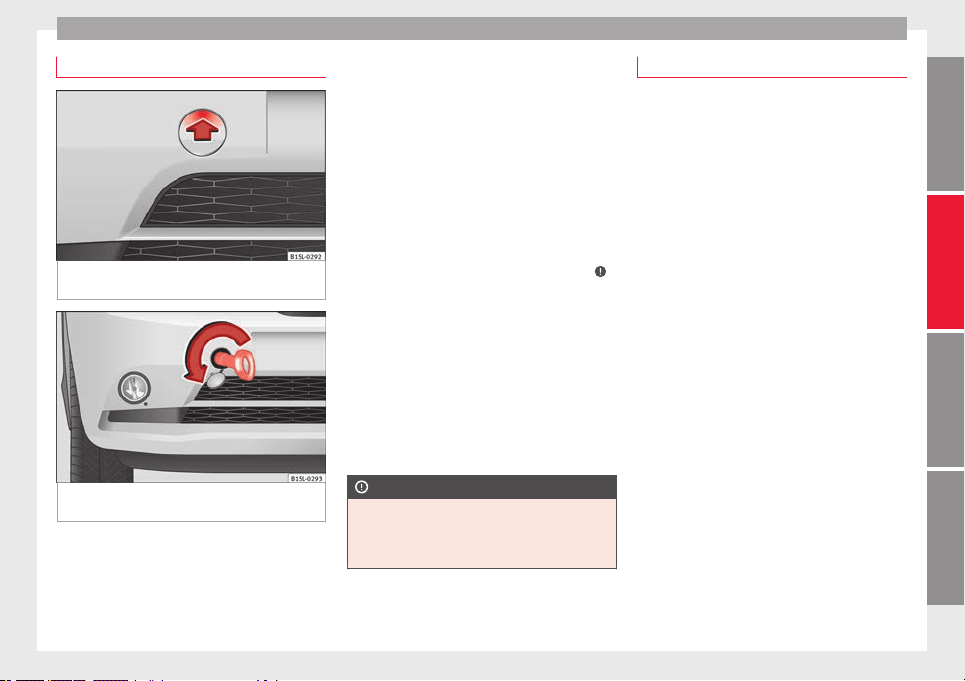
Emergencies
Fitting the front towline anchorage
Fig. 135 On the right-hand side of the front
bumper: Remove the cover.
Fig. 136 On the right-hand side of the front
bumper: Screw in the towline anchorage.
The location for the removable tow ring is on
the right-hand side of the front bumper be-
hind a cover ››› Fig. 135
.
The t
o
wline anchorage should always be kept
in the vehicle.
Note the instructions for towing ››› page 184.
Fitting the towline anchorage
●
Take the towline anchorage from the vehi-
cle tool kit in the luggage compartment
››› page 172.
●
Press the upper part of the cover ››› Fig. 135
(arrow) to disengage and release the cover.
●
Remove the cover and leave it hanging
from the vehicle.
●
Screw in the tow ring into its housing anti-
clockwise as far as it will go ››› Fig. 136 ›››
.
Use a suitable tool to firmly tighten the tow-
line anchorage in its location.
●
After towing, remove the tow ring by turn-
ing it clockwise
.
●
Pl
ac
e the cover's upper tab on the opening
of the bumper and carefully guide the lower
tab on the edge of the opening. If necessary,
press the lower tab from below.
●
Press the lower area of the cover until the
lower tab engages in the bumper.
CAUTION
The towline anchorage must always be com-
pletely and firmly tightened. Otherwise, it
could be released while towing and tow-start-
ing.
Towing advice
Towing requires some experience, especially
when using a tow rope. Both drivers should
be familiar with the technique required for
towing. For this reason, inexperienced drivers
should abstain.
While driving, avoid excessive traction forces
and jerking. When towing on an unpaved
road, there is always a risk of overloading
and damaging the anchorage points.
If the vehicle is towed, with the hazard warn-
ing lights on and the ignition switched on,
the turn signal may be used to indicate
changes of direction. Simply operate the turn
signal lever as usual. Meanwhile, the hazard
warning lights will go off. When the turn sig-
nal lever is returned to the rest position, the
hazard warning lights will be turned on auto-
matically.
Notes for the driver of the towed vehicle
●
Keep the ignition running to prevent the
steering wheel from locking and also to allow
the use of the turn signals, horn, windscreen
wipers and washers.
●
As the power assisted steering does not
work if the engine is not running, you will
need more strength to steer than normally.
●
The brake must be depressed must harder
as the brake servo does not operate. Avoid
hitting the towing vehicle.
»
185
Technical specifications
AdviceOperationSafety
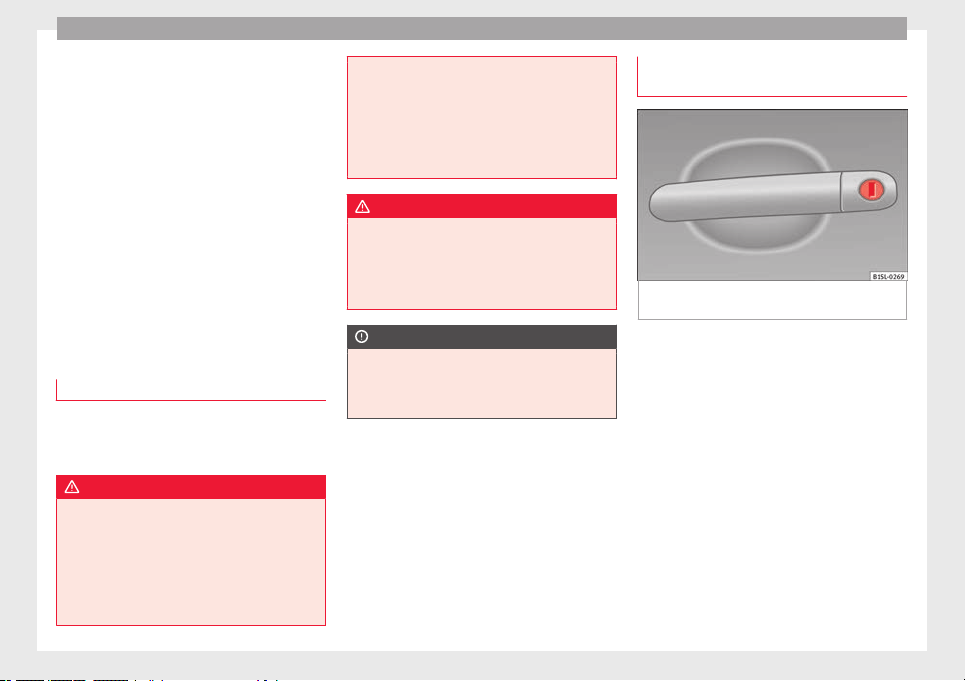
Advice
●
Note the instructions and information con-
tained in the Instruction Manual for the vehi-
cle to be towed.
Notes for the driver of the towing vehicle
●
Accelerate gently and carefully. Avoid sud-
den manoeuvres.
●
Brake well in advance than usual and brake
gently.
●
Note the instructions and information con-
tained in the Instruction Manual for the vehi-
cle to be towed.
Emergency locking and
unlocking
Introduction
The doors and rear lid can be locked manual-
ly and partially opened, for example if the key
or the central locking is damaged.
WARNING
Opening and closing doors carelessly can
cause serious injury.
●
If the vehicle is locked from outside, the
doors and windows cannot be opened from
the inside.
●
Never leave children or disabled people
alone in the car. They could be trapped in the
car in an emergency and will not be able to
get themselves to safety.
●
Depending on the time of the year, temper-
atures inside a locked and closed vehicle can
be extremely high or extremely low resulting
in serious injuries and illness or even death,
particularly for young children.
WARNING
Getting in the way of the doors and the rear
lid is dangerous and can lead to serious in-
jury.
●
Open and close the doors and the rear lid
only when there is nobody in the way.
CAUTION
When opening and closing in an emergency,
carefully disassemble components and then
reassemble them carefully to avoid damage
to the vehicle.
Manually locking and unlocking the
driver door
Fig. 137 Driver side door handle with lock cyl-
inder
As a general rule, when the driver door is
locked all other doors are locked. Unlocking
manually only opens the driver door.
●
Unfold the key shaft if necessary
››› page 43
.
●
In
ser
t the key shaft into the lock cylinder to
unlock or lock the vehicle ››› Fig. 137.
186
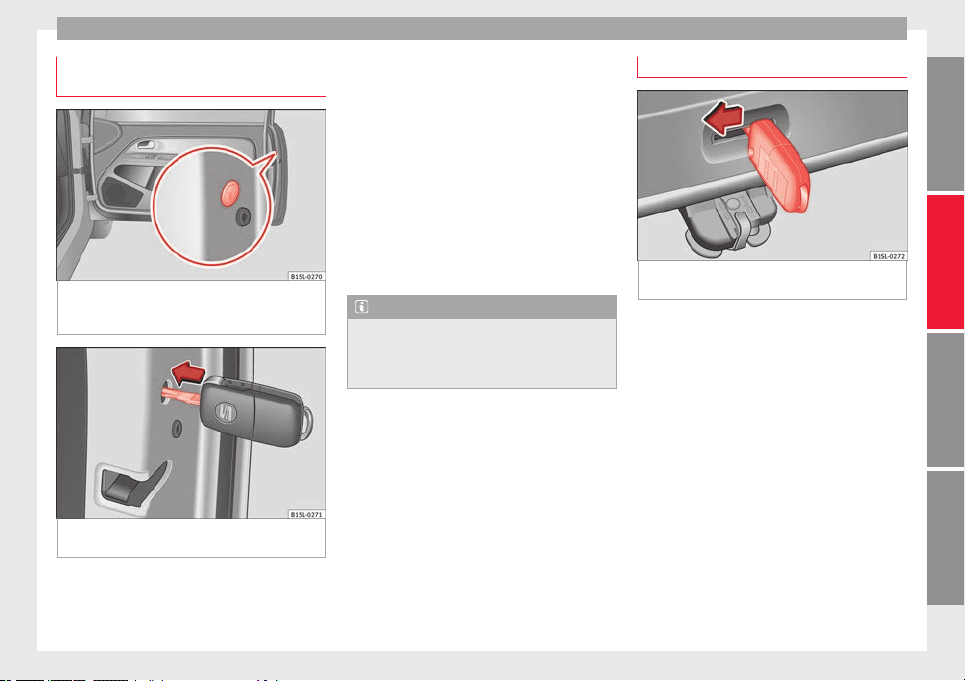
Emergencies
Manually locking the passenger side
door
Fig. 138 To the front of the passenger side
door: Emergency lock, hidden by a rubber
cap.
Fig. 139 Emergency locking of the vehicle us-
ing the vehicle key
The passenger door can be manually locked.
●
Door open.
●
Remove the rubber cap to the front of the
door. The rubber cap is marked with a lock
symbol ››› Fig. 138
.
●
Unf
o
ld the key shaft if necessary
››› page 43.
●
Insert the key shaft horizontally into the
opening and moved the coloured lever for-
ward ››› Fig. 139.
●
Replace the rubber cap and close the door.
●
Check if the door is locked.
●
Have the vehicle checked by a specialised
workshop.
Note
The doors can be opened and unlocked indi-
vidually from the inside by pulling the inside
door handle. If necessary, pull the inner door
release lever twice ››› page 45.
Emergency unlocking the rear lid
Fig. 140 From the luggage compartment:
Emergency unlocking of the booth hatch.
●
If necessary, fold the rear seat bench back-
rest forward ››› page 64
.
●
R
emo
ve equipment to access the inside of
the rear lid.
●
Unfold the key shaft ››› page 43.
●
Insert the key shaft into the rear lid open-
ing ››› Fig. 140 and press the release lever in
the direction of the arrow to unlock the rear
lid.
187
Technical specifications
AdviceOperationSafety
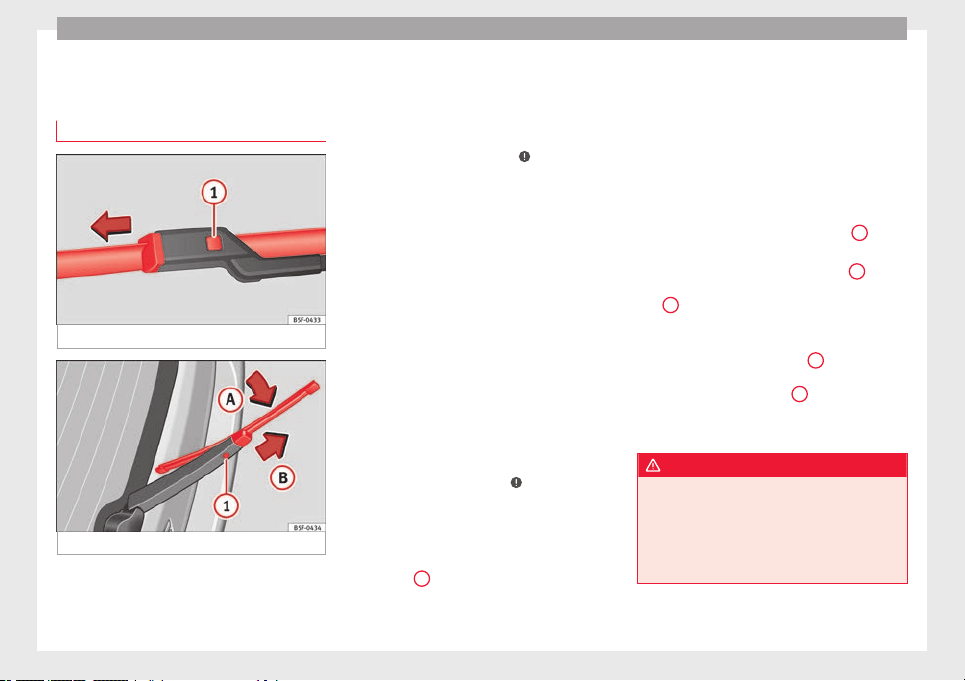
Advice
Changing the windscreen wiper
blades
Changing windscreen wiper blades
Fig. 141 Changing the front wiper blades
Fig. 142 Changing the rear wiper blade
The windscreen wiper blades are supplied as
standard with a layer of graphite. This layer is
responsible for ensuring that the wipe is si-
lent. If the graphite layer is damaged, the
noise of the water as it is wiped across the
windscreen will be louder.
Check the condition of the wiper blades regu-
larly.
If the wipers scrape across the glass
they
shou
ld be changed if they are damaged,
or cleaned if they are dirty ›››
.
Damaged wiper blades should be replaced
immediately. These are available from quali-
fied workshops.
Lifting and unfolding the wiper arms
The wiper arm may only
be lifted at the point
wher
e it
is fastened to the blade.
For windscreen wipers, please note: the wip-
er should be in service position before un-
folding it ››› page 60.
Cleaning windscreen wiper blades
●
Lifting and unfolding the wiper arms.
●
Use a soft cloth to remove dust and dirt
from the windscreen wiper blades.
●
If the blades are very dirty, a sponge or
damp cloth may be used ›››
.
Changing the windscreen wiper blades
●
Lifting and unfolding the wiper arms.
●
Hold down the release button
››› Fig. 141
1
while gently pulling the blade
in the direction of the arrow.
●
Fit a new wiper blade of the same length
and design
on to the wiper arm and hook it
int
o p
lace.
●
Rest the wiper arms back onto the wind-
screen.
Changing the rear wiper blade
●
Lift the windscreen wiper arm and fold it at
an angle of approximately 60° ››› Fig. 142.
●
Press and hold the release button
1
.
●
Fold the wiper blade towards the wind-
screen wiper arm ››› Fig. 142
(arrow
A
) while
simultaneously pulling in the direction of ar-
row
B
. This may require some strength.
●
Insert a new blade of the same length and
type
in the windscreen wiper arm in the op-
po
s
ite direction to the arrow
B
and hook in-
to place. This feature is operational when the
knob is in position (arrow
A
).
●
Return the windscreen wiper arm to the
windscreen. Do not let it simply drop down!
WARNING
Worn or dirty wiper blades reduce visibility
and increase the risk of accident and serious
injury.
●
Always replace damaged or worn blades or
blades which do not clean the windscreen
correctly.
188
Fuses and bulbs
CAUTION
●
Damaged or dirty windscreen wipers could
scratch the glass.
●
If products containing solvents, rough
sponges or sharp objects are used to clean
the blades, the graphite layer will be dam-
aged.
●
Never use fuel, nail varnish remover, paint
thinner or similar products to clean the win-
dows.
Note
If wax deposits, other cleaning products from
the automatic car wash, or other care prod-
ucts, are left on the windscreen and the rear
window, the blades can scratch the glass. Re-
move wax deposits with a special product or
cleaning cloths.
Fuses and bulbs
Fuses
Introduction
Due to the constant updating of vehicles,
fuse assignments based on equipment and
the use of the same fuse for various electrical
components, it is not possible to provide an
up-to-date summary of the fuse positions for
the electrical components at the time of
printing this manual. For detailed information
about the fuse positions, please consult a
technical service.
In general, a fuse can be assigned to various
electrical components. Likewise, an electrical
component can be protected by several
fuses.
Only replace fuses when the cause of the
problem has been solved. If a newly inserted
fuse blows after a short time, you must have
the electrical system checked by a special-
ised workshop as soon as possible.
WARNING
The high voltages in the electrical system can
give serious electrical shocks, causing burns
and even death!
●
Never touch the electrical wiring of the igni-
tion system.
●
Take care not to cause short circuits in the
electrical system.
WARNING
Using unsuitable fuses, repairing fuses or
bridging a current circuit without fuses can
cause a fire and serious injury.
●
Never use a fuse with a higher value. Only
replace fuses with a fuse of the same amper-
age (same colour and markings) and size.
●
Never repair a fuse.
●
Never replace a fuse by a metal strip, staple
or similar.
CAUTION
●
To prevent damage to the vehicle's electric
system, before replacing a fuse always turn
off the ignition, the lights and all electrical
elements and remove the key from the igni-
tion.
●
If you replace a fuse with higher-rating
fuse, you could cause damage to another part
of the electrical system.
●
Protect the fuse boxes when open to pre-
vent the entry of dust or humidity as they can
damage the electrical system.
Note
One component may have more than one
fuse.
»
189
Technical specifications
AdviceOperationSafety
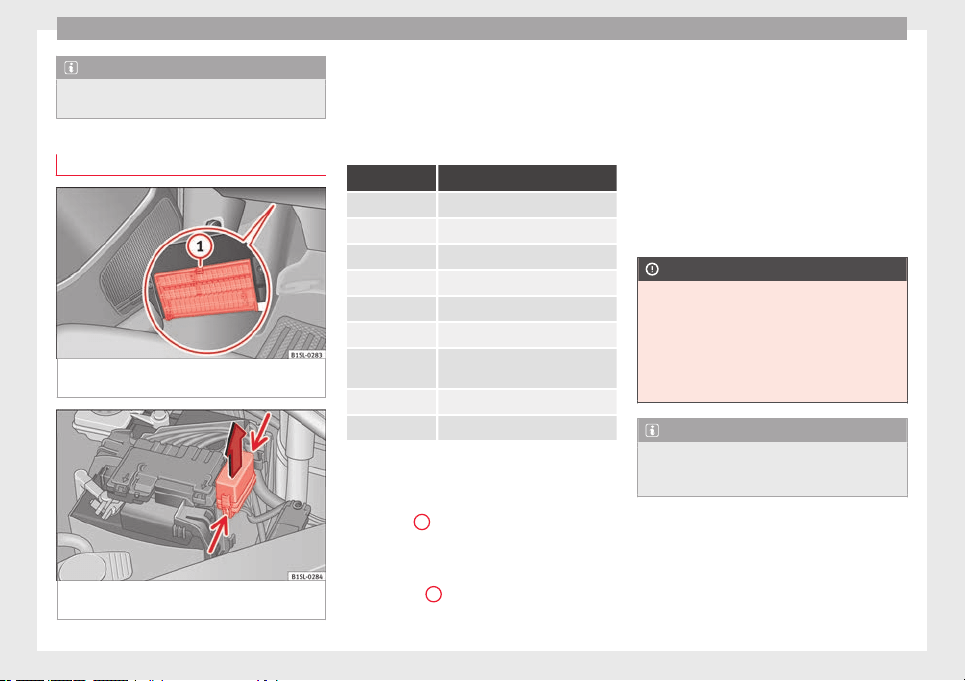
Advice
Note
Several components may run on a single
fuse.
Vehicle fuses
Fig. 143 Below the driver side dash panel:
fuse box cover
Fig. 144 In the engine compartment: fuse box
cover
Only replace fuses with a fuse of the same
amperage (same colour and markings) and
size.
Identifying fuses situated below the driver-
side dash panel by colours
Colour Amp rating
Purple 3
Light brown 5
Brown 7.5
Red 10
Blue 15
Yellow 20
White or trans-
parent
25
Green 30
Orange 40
Opening and closing the fuse box situated
below the dash panel
●
Opening:
Press the unlock button
›
›
› Fig. 143
1
until it is possible to open the
cover. Fold the cover down.
●
Closing:
Fold the cover up in the opposite
dir
ection t
o the arrow until it clicks into the
locking lever
1
.
To open the engine compartment fuse box
●
Open the bonnet ››› page 143.
●
Press the attachment tabs in the direction
indicated by the arrow (thin arrows) to re-
lease the fuse box cover ››› Fig. 144
.
●
Then lif
t
the cover out.
●
To fit the cover, place it on the fuse box.
Push the attachment tabs down, in the oppo-
site direction indicated by the arrow until
they click audibly into place.
CAUTION
●
Always carefully remove the fuse box cov-
ers and refit them correctly to avoid problems
with your vehicle.
●
Protect the fuse boxes when open to avoid
the entry of dust or humidity. Dirt and humid-
ity inside fuse boxes can cause damage to
the electrical system.
Note
In the vehicle, there are more fuses than
those indicated in this chapter. These should
only be changed by a specialised workshop.
190
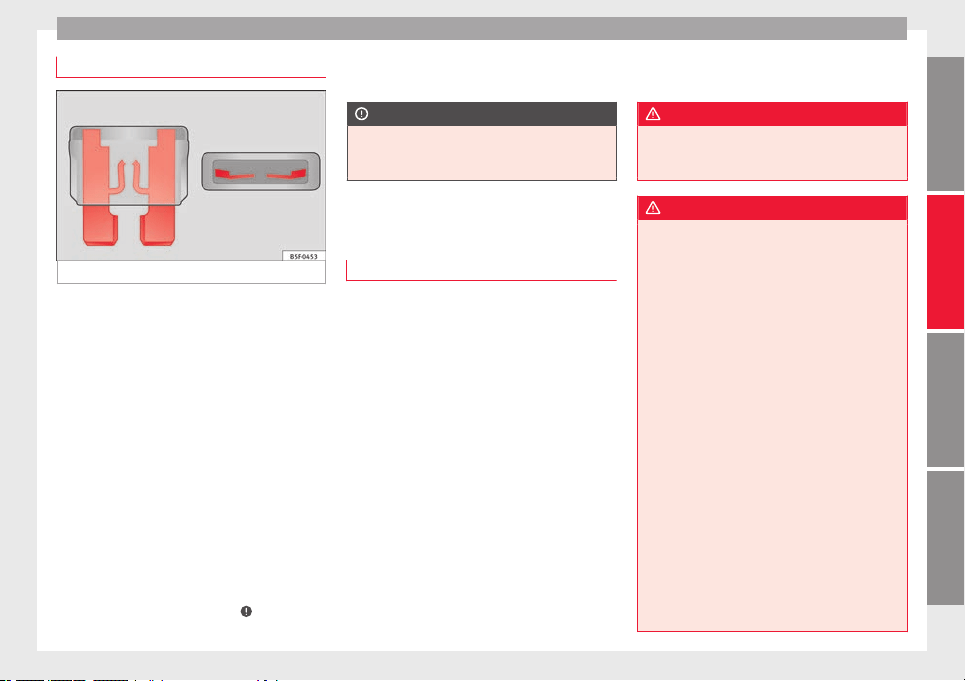
Fuses and bulbs
Replacing a blown fuse
Fig. 145 Image of a blown fuse
Preparation
●
Switch off the ignition, lights and all elec-
trical equipment.
●
Open the corresponding fuse box
››› page 190
.
Identif
y
ing a blown fuse
A fuse is blown if its metal strip is ruptured
››› Fig. 145.
Point a lamp at the fuse. This will make it
easier to see if the fuse is blown.
To replace a fuse
●
Remove the fuse.
●
Replace the blown fuse by one with an
identical amperage rating (same colour and
markings) and identical size ›››
.
●
Replace the cover again or close the fuse
box lid.
CAUTION
If you replace a fuse with higher-rating fuse,
you could cause damage to another part of
the electrical system.
Changing bulbs
Introduction
Changing bulbs requires a certain amount of
manual skill. If you are unsure, SEAT recom-
mends that you consult a technical service or
request assistance from a specialist. In gen-
eral a specialist is needed if, in addition to
the bulbs, other vehicle components require
removal.
You should store spare light bulbs in the ve-
hicle for safety-relevant lights. Spare bulbs
may be obtained from the technical services.
In some countries, it is a legal requirement to
carry spare bulbs in the vehicle.
Driving with faults and blown bulbs on the
vehicle exterior lighting is against the law.
Additional bulb specifications
The specifications of some headlamp bulbs
and bulbs for the tail lamps fitted at the fac-
tory may be different to those of conventional
bulbs. Bulb information is displayed on the
bulb socket or on the bulb itself.
WARNING
If the road is not well-lit and the vehicle is
not clearly visible to other drivers, there is a
risk of accident.
WARNING
Failure to replace bulbs correctly may cause
serious accidents.
●
Before carrying out any work in the engine
compartment please read and observe the
warnings ››› page 143. In any vehicle, the en-
gine comp
artment is a hazardous area and
could cause severe injury.
●
The bulbs H4, HB4 and H7 are pressurised
and might explode on changing them.
●
Only replace the bulbs concerned when
they have cooled.
●
Never replace bulbs alone if you are not fa-
miliar with the operations necessary. If you
are not sure about procedures then visit a
specialised workshop to carry out the neces-
sary work.
●
Never touch the bulb glass directly. Finger-
prints will be evaporated by the heat of the
operating bulb thus “fogging” up the reflec-
tor.
●
The headlamp frameworks in the engine
compartment and the tail lamps contain
sharp elements. Always protect your hands
when changing bulbs.
»
191
Technical specifications
AdviceOperationSafety
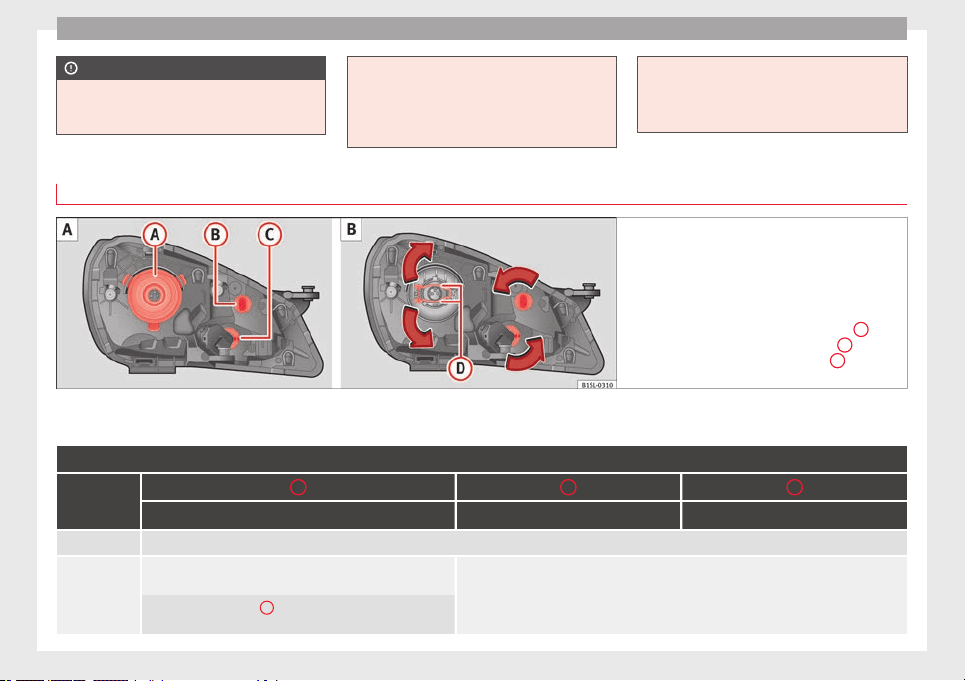
Advice
CAUTION
●
After changing a bulb, if the rubber covers
are not replaced correctly on the headlamp
framework, the electrical installation may be
damaged, especially if water is allowed to en-
ter.
●
Remove the ignition key before working on
the electric system. Otherwise, a short circuit
could occur.
●
Switch off the lights and the parking light
before changing a bulb.
●
Take good care to avoid damaging any com-
ponents.
Replacing the bulbs in the headlights
Fig. 146 In the engine compartment: Rear view of
the front left headlight with rubber cover:
A
dip-
ped beam and main beam headlights,
B
side
lights and daytime driving lights and
C
turn sig-
nal
There is no need to remove the headlight to
replace bulbs.
Complete operations only in the sequence given:
Fig. 146
A B C
Dipped beam and main beam headlights Side light and daytime driving light Turn signals (front)
1. Open the bonnet
››› page 143.
2.
Remove the bulb connector H4. Remove the rubber cover using
the tabs.
Turn the bulb holder in an anticlockwise direction as far as it will go and remove it, along with
the bulb, pulling backwards.
Press the retaining clip
D
downwards in the direction of the ar-
row, and unclip sideways and remove it.
192
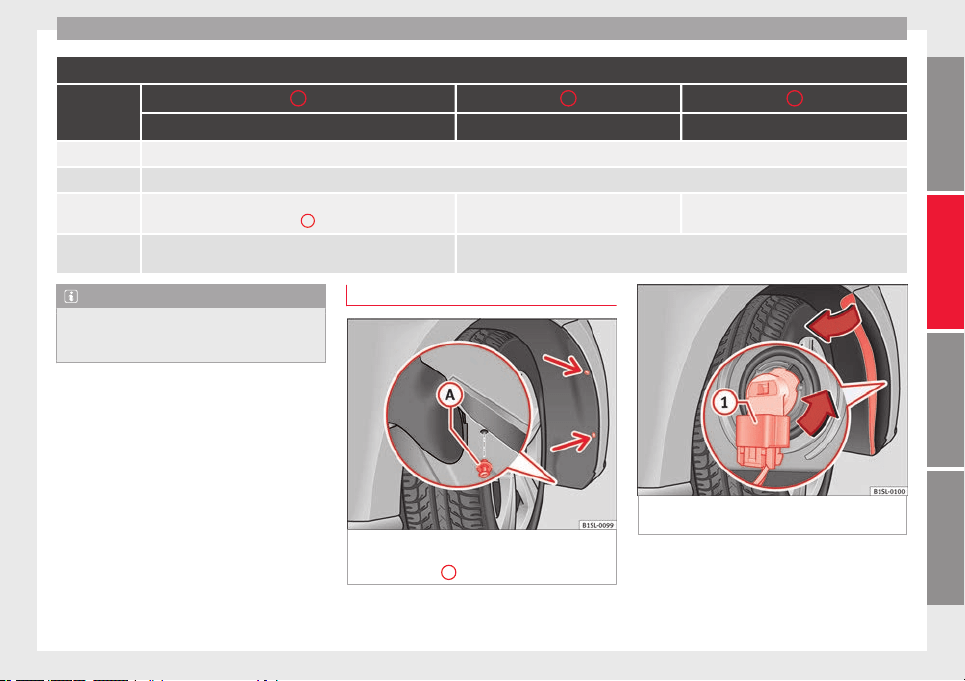
Fuses and bulbs
Complete operations only in the sequence given:
Fig. 146
A B C
Dipped beam and main beam headlights Side light and daytime driving light Turn signals (front)
3. Remove the bulb from the holder. If necessary, press the lock on the bulb holder.
4. Replace the faulty bulb by a new identical bulb.
5.
Insert the bulb, return it to its position and insert the retaining
clip
D
Insert the bulb holder in the headlight and
turn it clockwise as far as the stop.
Insert the bulb holder in the headlight and
turn it clockwise as far as the stop.
6.
Place the rubber cover and check that is in the correct position.
Insert the connector to the bulb H4.
Note
The images show the left hand headlight
from behind. The structure of the right hand
side headlight is symmetric.
To replace the front bumper bulbs
Fig. 147 In the front right wheel arch: Remove
the retaining screws (arrows) and take out the
expansive rivet
A
.
Fig. 148 Changing the bulbs in the head-
lights
»
193
Technical specifications
AdviceOperationSafety
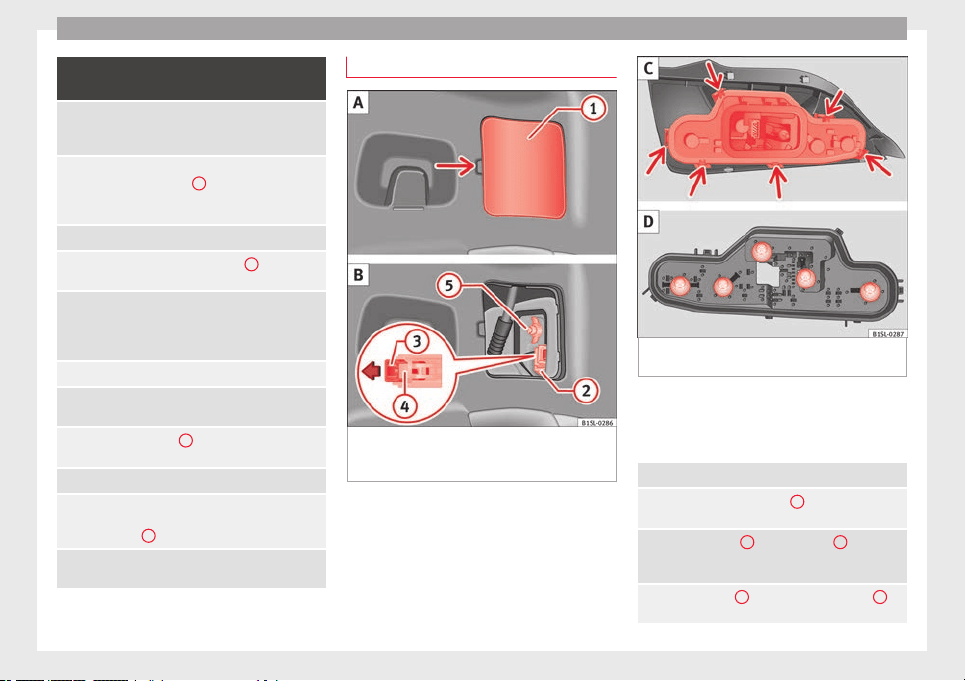
Advice
Complete operations only in the sequence giv-
en:
1.
Unscrew the 2 retaining screws of the wheel arch
trim ››› Fig. 147 (arrows) with the screwdriver from
the vehicle took kit ››› page 172.
2.
Unscrew the expansive rivet in the lower front part
of the wheel arch trim
A
with the screwdriver
from the vehicle tool kit and completely remove it
››› page 172.
3. Carefully fold the wheel arch trim to the side.
4.
Release the connector ››› Fig. 148
1
and remove
it.
5.
Turn the bulb holder ››› Fig. 148 in the direction of
the arrow, in an anticlockwise direction as far as it
will go and remove it, along with the bulb, pulling
backwards.
6. Replace the faulty bulb by a new identical bulb.
7.
Insert the bulb holder in the headlight and turn it
clockwise as far as the stop.
8.
Plug the connector
1
into the bulb holder. The
connector must audibly click into place.
9. Replace the wheel arch trim into its position.
10.
Place the expansive rivet in the wheel arch trim
and bumper and press it completely inwards
››› Fig. 147
A
.
11.
Securely screw the 2 retaining screws ››› Fig. 147
(arrows) with a screwdriver.
Changing the bulbs in the rear lights
Fig. 149 On the side of the luggage compart-
ment: A: Remove the cover, B: Removing the
tail light units
Fig. 150 Tail light unit: C: Remove the bulb
holder, D: Remove the bulbs.
Complete operations only in the sequence
given.
Removing the tail light units
1. Open the rear lid ››› page 50.
2.
Carefully remove the cover
1
towards the lever
››› Fig. 149 A.
3.
Pull the release
3
in the connector
2
in the di-
rection of the arrow ››› Fig. 149 B. Use the screw-
driver in the vehicle tool kit.
4.
Press position
4
and remove the connector
2
››› Fig. 149 B.
194
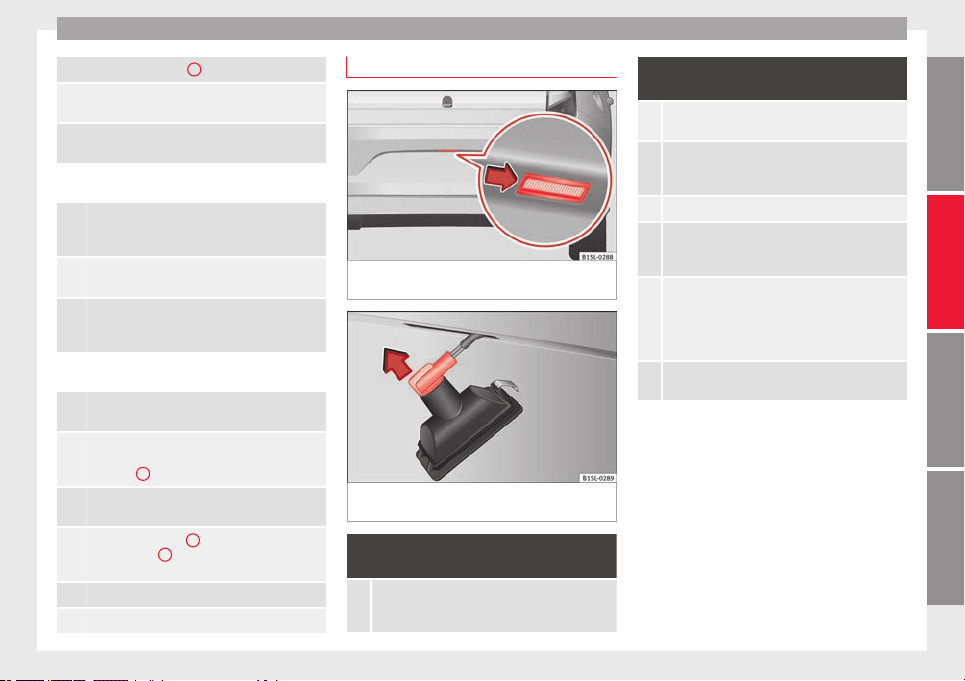
Fuses and bulbs
5. Unscrew the wing nut
5
››› Fig. 149 B.
6.
Remove the tail light from the bodywork by careful-
ly pulling backwards.
7.
Disassemble the tail light unit and place it on a
flat, clean surface.
To change the bulb
8.
Unlock the bulb holder locking tab (arrow)
››› Fig. 150 C and remove the bulb holder from the
tail light.
9.
Replace the faulty bulb by a new identical bulb
››› Fig. 150 D.
10.
Place the lamp holder in the tail light unit. The at-
tachment tabs (arrow) should audibly click into
place ››› Fig. 150 C.
Assembling the tail light units
11.
Carefully insert the tail light unit into the opening
in the bodywork.
12.
Support the tail light with one hand in the assem-
bly position and securely screw the wing nut with
the other
5
››› Fig. 149 B.
13.
Ensure that the tail light unit has been correctly
fitted and is firmly secured.
14.
Insert the connector
2
into the bulb holder and
press the lock
3
on the connector in the oppo-
site direction to the arrow ››› Fig. 149 B.
15. Insert the cover. The cover should lock into place.
16. Close the rear lid ››› page 50.
Changing the number plate light
Fig. 151 On the rear bumper: Remove the
number plate light.
Fig. 152 Number plate light: Remove the bulb
holder.
Complete operations only in the sequence giv-
en:
1.
With one hand, press on the number plate light
from left to right and remove it from the bumper
››› Fig. 151.
Complete operations only in the sequence giv-
en:
2.
Detach the number plate light carefully from the
bumper.
3.
Turn the bulb holder with the bulb anticlockwise
and remove it in the direction of the arrow
››› Fig. 152.
4. Replace the faulty bulb by a new identical bulb.
5.
Place the bulb holder in the number plate light and
press in the opposite direction to the arrow as far
as possible ››› Fig. 152.
6.
Insert the number plate light carefully into the left
edge of the opening on the bumper. During this
process, check that the assembly direction of the
number plate light is correct, i.e. the spring must
be on the right.
7.
Insert the number plate light into the bumper until
it audibly clicks into place.
195
Technical specifications
AdviceOperationSafety
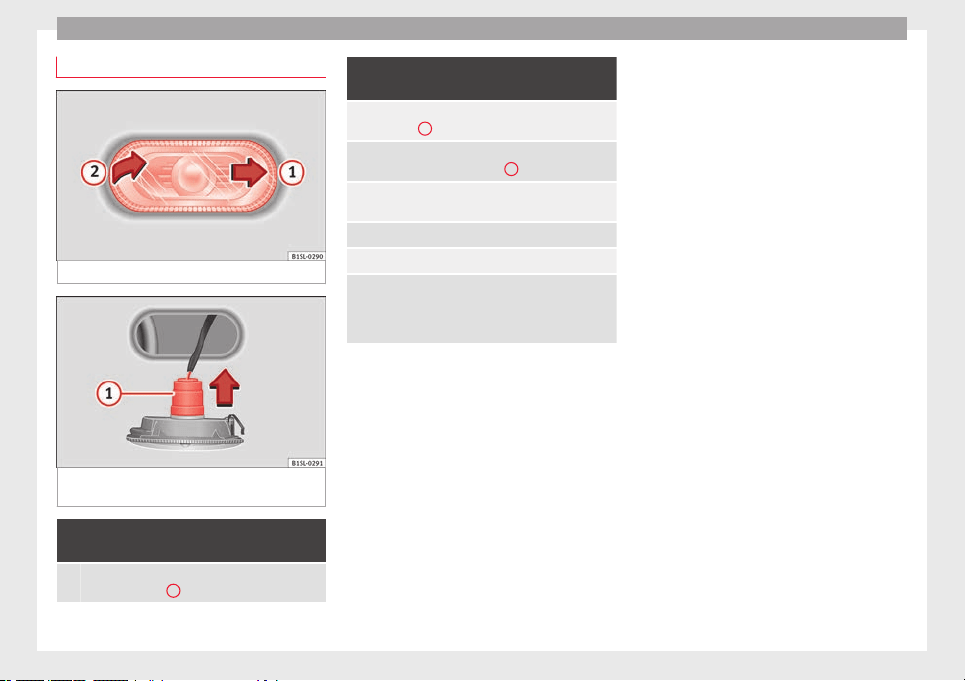
Advice
Changing the side turn signal bulb
Fig. 153 Removing the side turn signal
Fig. 154 Side turn signal: Changing the
bulbs.
Complete operations only in the sequence giv-
en:
1.
With one hand move the side turn signal back-
wards ››› Fig. 153
1
.
Complete operations only in the sequence giv-
en:
2.
Remove the side turn signal from the chassis by
leverage
2
.
3.
Remove the bulb holder with the bulb in the direc-
tion of the arrow ››› Fig. 154
1
.
4.
Remove the bulb holder bulb in a straight direc-
tion.
5. Replace the faulty bulb by a new identical bulb.
6. Install the lamp holder.
7.
Place the side turn signal on the chassis on the
side situated towards the rear of the vehicle until
the spring clicks into the other side of the side turn
signal.
196
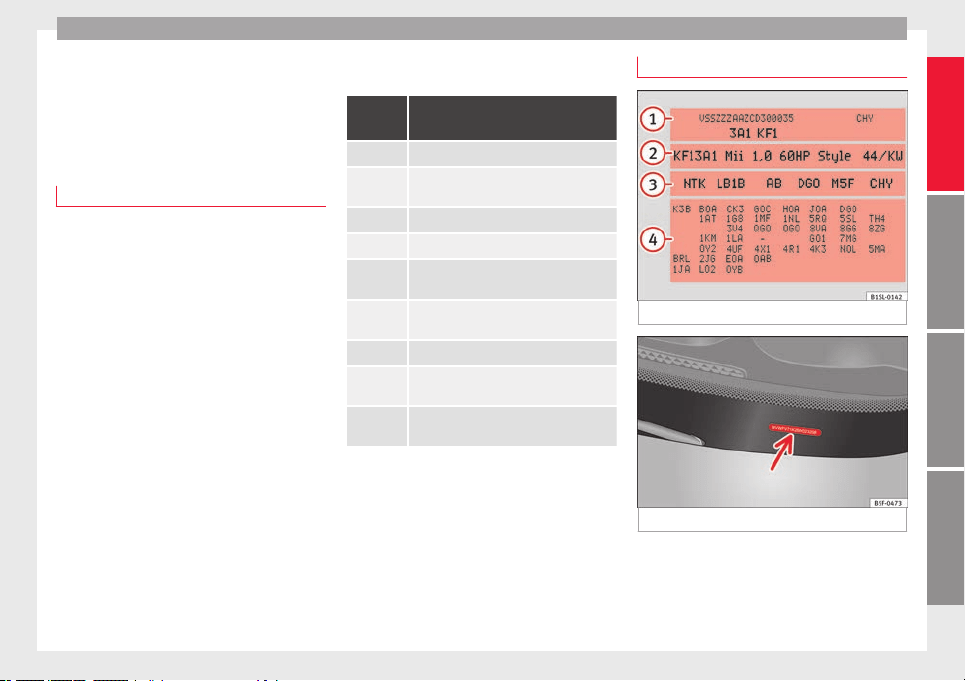
Technical features
Technical specifications
Technical features
Important information
Introduction
The information in the vehicle documentation
always takes precedence over the informa-
tion in this Instruction Manual.
All technical specifications provided in this
documentation are valid for the standard
model in Spain. The vehicle data card inclu-
ded in the Maintenance Programme or the
vehicle registration documents shows which
engine is installed in the vehicle.
The figures may be different depending
whether additional equipment is fitted, for
different models, for special vehicles and for
other countries.
Abbreviations used in the Technical
Specifications section
Abbrevi-
ation
Meaning
kW Kilowatt, engine power measurement.
PS
Pferdestärke (horsepower), formerly used
to denote engine power.
rpm Revolutions per minute - engine speed.
Nm Newton metres, unit of engine torque.
litres per
100 km
Fuel consumption in litres per 100 km (70
miles).
g/km
Carbon dioxide emissions in grams per km
(mile) travelled.
CO
2
Carbon dioxide
CN
Cetane number, indication of the diesel
combustion power.
RON
Research octane number, indication of the
knock resistance of petrol.
Vehicle identification data
Fig. 155 Vehicle data label.
Fig. 156 Vehicle identification number.
Vehicle identification number
The vehicle identification number (chassis
number) can be read from outside the vehicle
through a viewer in the windscreen
›››
Fig. 156
. This viewer is located in the lower
»
197
Technical specifications
AdviceOperationSafety
Technical specifications
part of the windscreen. The vehicle identifica-
tion number (chassis number) is also stam-
ped on the right water drain channel. The wa-
ter drain channel is located between the sus-
pension tower and the wing. Open the bon-
net to read the vehicle identification number
.
V
ehic
le data plate
The vehicle data label ››› Fig. 155 is at the
front of the spare wheel well. It contains the
following data:
Vehicle identification number (chassis
number).
Vehicle type, engine power, gearbox type.
Engine and gearbox code, paint number,
interior equipment.
Optional extras, PR numbers.
These data are also provided in the Mainte-
nance Programme.
Specific vehicle weight information
The instructions in the official vehicle docu-
ments take precedence. All the technical data
provided in this documentation is applicable
to the basic model. The vehicle data label in
the Maintenance Programme or the vehicle
documentation shows which engine is instal-
led in your vehicle.
1
2
3
4
The figures may be different depending
whether additional equipment is fitted, for
different models and for special vehicles.
Kerb weight values shown in the following ta-
ble apply to a vehicle with driver (75 kg), liq-
uids including a fuel tank 90% full, in addi-
tion to tools and a spare wheel ››› . The
kerb weight indicated increases with optional
equipment and retrofitting of accessories,
while proportionally reducing carrying ca-
pacity.
The load is equivalent to the following
weights:
●
Passengers.
●
Total equipment.
●
Roof load, included in the carrier.
WARNING
Exceeding the maximum authorised weight
and the load on the axles could cause dam-
age to the vehicle, accidents and serious in-
juries.
●
The real load on the axles should never ex-
ceed the maximum permitted.
●
The load and its distribution in the vehicle
have effects on the vehicle handling and the
braking ability. Always drive at a suitable
speed.
CAUTION
Distribute the load as uniformly and as low
down on the vehicle as possible. When trans-
porting heavy objects in the luggage com-
partment, these should be placed as far for-
ward as possible or over the rear axle to have
as little influence on handling as possible.
Information on fuel consumption
The consumption and emission values indi-
cated do not refer to one specific vehicle.
They are only to be used to compare the val-
ues of the different vehicle versions. The fuel
consumption and CO
2
emissions of a vehicle
not only depend on the effective use of fuel.
They also depend on your driving style and
other non-technical factors.
Calculation of fuel consumption
Fuel consumption and emission values are
determined according to the current version
of the 715/2007/EC or 80/1268/EEC regula-
tion and are valid for the vehicle kerb weight.
The specifications do not
refer to an individu-
al
vehicle. To measure the fuel consumption,
two measuring cycles are carried out on a
rolling road test bed. The test criteria are as
follows:
198
Technical features
Urban
cycle
Measurement of the urban cycle starts with
an engine cold start. City driving is then si-
mulated at between 0 and 50 km/h (0 and
31 mph).
Road
cycle
In the road cycle simulation, the car under-
goes frequent acceleration and braking in all
gears, as in normal everyday driving. The
road speed ranges from 0 to 120 km/h (0
and 75 mph).
Com-
bined
The average combined consumption is calcu-
lated with a weighting of around 37 % for the
urban cycle and 63 % for the road cycle.
CO
2
emis-
sions of
the
combi-
nation
The exhaust gases are collected during both
driving cycles to calculate carbon dioxide
emissions (urban and road). The gas compo-
sition is analysed below to evaluate the CO
2
content and other emissions.
Note
●
The kerb weight may vary according to the
vehicle equipment. This could raise consump-
tion and the CO
2
emissions slightly.
●
In practice, consumption values could be
different to the values calculated based on
the 715/2007/EC or 80/1268/EEC regula-
tions.
Wheels
Tyre pressure, snow chains, wheel
bolts
Tyre pressures
The sticker with the tyre pressure values can
be found on the inside of the fuel tank flap.
The tyre pressure values given there are for
cold tyres. The slightly raised pressures of
warm ty
res must not be reduced. ›››
Snow chains
Snow chains may be fitted only to the front
wheels
.
C
on
sult the section “wheels” of this manual.
Wheel bolts
After the wheels have been changed, the
tightening torque of the wheel bolts should
be checked as soon as possible with a torque
wrench
›››
. The tightening torque for steel
and alloy wheels is 140
Nm.
WARNING
●
Check the tyre pressure at least once per
month. Checking the tyre pressure is very im-
portant. If the tyre pressure is too high or too
low, there is an increased danger of accidents
- particularly at high speeds.
●
If the tightening torque of the wheel bolts
is too low, they could loosen while the vehi-
cle is in motion. Risk of accident! If the tight-
ening torque is too high, the wheel bolts and
threads can be damaged.
Note
We recommend that you ask your Technical
Service for information about appropriate
wheel, tyre and snow chain size.
199
Technical specifications
AdviceOperationSafety

Technical specifications
Engine specifications
Petrol engine 1.0 44 kW (60 PS)
Engine specifications
Power output in kW (PS) at rpm Maximum torque (Nm at rpm) No. of cylinders/displacement (cm
3
) Fuel
44 (60)/5,000-6,000 95/3,000-4,300 3/999 Super 95 RON
a)
a)
Research Octane Number = Anti-detonation rating of the petrol.
Performance Manual Ecomotive Automatic
Top speed (km/h) 160 161 160
Acceleration from 0-80 km/h (seconds) 9.1 9.1 9.4
Acceleration from 0-100 km/h (seconds) 14.4 14.4 15.3
Consumption (l/100 km)/ CO
2
(g/km)
Urban cycle 5.6/130 5/116 5.3/123
Extra-urban cycle 3.9/91 3.6/84 3.9/91
Combined 4.5/105 4.1/95 4.4/103
Weights (in kg)
Gross vehicle weight 1,290 1,290 1,290
Weight in running order (with driver) 929 940 932
Gross front axle weight 680 680 680
Gross rear axle weight 640 640 640
Permitted roof load 50 50 50
200
Technical features
Petrol engine 1.0 55 kW (75 PS)
Engine specifications
Power output in kW (PS) at rpm Maximum torque (Nm at rpm) No. of cylinders/displacement (cm
3
) Fuel
55 (75)/6,200 95/3,000-4,300 3/999 Super 95 RON
a)
a)
Research Octane Number = Anti-detonation rating of the petrol.
Performance Manual Start-Stop Automatic
Top speed (km/h) 171 172 171
Acceleration from 0-80 km/h (seconds) 8.3 8.3 9.2
Acceleration from 0-100 km/h (seconds) 13.2 13.2 13.9
Consumption (l/100 km)/ CO
2
(g/km)
Urban cycle 5.9/137 5.1/118 5.5/127
Extra-urban cycle 4/93 3.7/86 4/94
Combined 4.7/108 4.2/98 4.5/105
Weights (in kg)
Gross vehicle weight 1,290 1,290 1,290
Weight in running order (with driver) 929 940 932
Gross front axle weight 680 680 680
Gross rear axle weight 640 640 640
Permitted roof load 50 50 50
201
Technical specifications
AdviceOperationSafety
Technical specifications
Petrol/CNG engine 1.0 50 kW (68 PS)
Engine specifications
Power output in kW (PS) at rpm Maximum torque (Nm at rpm) No. of cylinders/capacity (cm
3
) Fuel
50 (68)/6,200 90/3,000 3/999 CNG / Super 95 RON
a)
a)
Research Octane Number = Anti-detonation rating of the petrol.
Performance Petrol CNG
Top speed (km/h) 164
Acceleration from 0-80 km/h (seconds) 10.3
Acceleration from 0-100 km/h (seconds) 16.3
Consumption (l/100 km)/ CO
2
(g/km)
Urban cycle 5.5/99 3.6/99
Extra-urban cycle 3.8/68 2.5/68
Combined 4.4/79 2.9/79
Weights (in kg)
Gross vehicle weight 1,370
Weight in running order (with driver) 1,031
Gross front axle weight 680
Gross rear axle weight 640
Permitted roof load 50
202
Technical features
Dimensions
Longitude 3,557 mm
Width 1,641-1,645 mm
Height, unladen 1,478-1,489 mm
Wheelbase 2,420 mm
Turning circle diameter
a)
approx. 9.8 m
Front track width
a)
1,412-1,428 mm
Rear track width
a)
1,408-1,424 mm
Ground clearance with
maximum authorised load
109 mm
a)
Depending on the dimensions of the wheel trims and tyres,
there may be variations.
CAUTION
●
Special care should be taken when parking
in areas with high kerbs or fixed barriers. Ob-
jects protruding from the ground may dam-
age the bumper or other parts of the vehicle
during manoeuvres.
●
Special attention is required when driving
through entrances, over ramps, kerbs or oth-
er objects. The vehicle underbody, bumpers,
mudguards and running gear, and the engine
and exhaust system could be damaged as
you drive over these objects.
Capacities
Fuel tank capacity
Petrol engines
Around 35.0 l
, of which approximately 4.0 are the
reserve.
Natural gas en-
gine
Natural gas: approx. 11 kg; of which
max. 1.5 kg reserve
Petrol: approx. 10 l; of which approx.
5 l reserve
203
Technical specifications
AdviceOperationSafety


Index
Index
A
Abroad
Extended stay abroad with your vehicle . . . . . 135
Sale of vehicle . . . . . . . . . . . . . . . . . . . . . . . . . 135
ABS
See "Brake assist systems" . . . . . . . . . . . . . . . 104
Accessories . . . . . . . . . . . . . . . . . . . . . . . . . . . . . . 118
Additional equipment . . . . . . . . . . . . . . . . . . . . . 119
Adjust
Headlight range . . . . . . . . . . . . . . . . . . . . . . . . . 58
Adjustment
Correct sitting position . . . . . . . . . . . . . . . . . . . . . 6
Front seat . . . . . . . . . . . . . . . . . . . . . . . . . . . . . . 63
rear head restraints . . . . . . . . . . . . . . . . . . . . . . . 9
Steering wheel . . . . . . . . . . . . . . . . . . . . . . . . . . . 7
Aerial . . . . . . . . . . . . . . . . . . . . . . . . . . . . . . . . . . . 135
Airbags
description . . . . . . . . . . . . . . . . . . . . . . . . . . . . . 19
Airbag system . . . . . . . . . . . . . . . . . . . . . . . . . . 17, 21
activation . . . . . . . . . . . . . . . . . . . . . . . . . . . . . . 20
Cleaning dash panel . . . . . . . . . . . . . . . . . . . . 133
Control lamp . . . . . . . . . . . . . . . . . . . . . . . . . . . . 23
Deactivating the front passenger front airbag . 24
Deactivating using the key switch . . . . . . . . . . . 24
Differences between front passenger front air-
bag systems . . . . . . . . . . . . . . . . . . . . . . . . . . 22
Faults . . . . . . . . . . . . . . . . . . . . . . . . . . . . . . . . . 120
Front airbags . . . . . . . . . . . . . . . . . . . . . . . . . . . . 21
functioning . . . . . . . . . . . . . . . . . . . . . . . . . . . . . 20
Locking the vehicle after airbag deployment . . 46
Repairs . . . . . . . . . . . . . . . . . . . . . . . . . . . . . . . 120
Side airbags . . . . . . . . . . . . . . . . . . . . . . . . . . . . 22
Use of child seats . . . . . . . . . . . . . . . . . . . . . . . . 24
Vehicle care . . . . . . . . . . . . . . . . . . . . . . . . . . . . 133
Air conditioner
Air recirculation . . . . . . . . . . . . . . . . . . . . . . . . . 84
Air vents . . . . . . . . . . . . . . . . . . . . . . . . . . . . . . . 83
Faults . . . . . . . . . . . . . . . . . . . . . . . . . . . . . . . . . . 83
set . . . . . . . . . . . . . . . . . . . . . . . . . . . . . . . . . . . . 82
Things to note . . . . . . . . . . . . . . . . . . . . . . . . . . . 83
User instructions . . . . . . . . . . . . . . . . . . . . . . . . 82
Air conditioning system . . . . . . . . . . . . . . . . . . . . . 80
Controls . . . . . . . . . . . . . . . . . . . . . . . . . . . . . . . . 81
Air recirculation . . . . . . . . . . . . . . . . . . . . . . . . . . . 84
How it works . . . . . . . . . . . . . . . . . . . . . . . . . . . . 84
switch off . . . . . . . . . . . . . . . . . . . . . . . . . . . . . . . 84
temporarily switch off . . . . . . . . . . . . . . . . . . . . . 84
Air vents . . . . . . . . . . . . . . . . . . . . . . . . . . . . . . . . . 83
Alternator . . . . . . . . . . . . . . . . . . . . . . . . . . . . . . . 155
Aluminium care . . . . . . . . . . . . . . . . . . . . . . . . . . 129
Anodized surfaces . . . . . . . . . . . . . . . . . . . . . . . . 129
Anti-lock brake system (ABS) . . . . . . . . . . . . . . . 104
Anti-theft bolts . . . . . . . . . . . . . . . . . . . . . . . . . . . 173
Anti-theft locking bolts . . . . . . . . . . . . . . . . . . . . 174
Anti-theft wheel locking bolts . . . . . . . . . . . . . . . 175
Antifreeze . . . . . . . . . . . . . . . . . . . . . . . . . . . . . . . 150
Ashtray . . . . . . . . . . . . . . . . . . . . . . . . . . . . . . . . . . 71
Aspects to take into account before starting the
vehicle . . . . . . . . . . . . . . . . . . . . . . . . . . . . . . . . . . 5
ASR
see Brake assist systems . . . . . . . . . . . . . . . . . 104
Assistance systems
Brake assist system (BAS) . . . . . . . . . . . . . . . . 104
Cruise control system (CCS) . . . . . . . . . . . . . . . 107
Electronic differential lock system (EDL) . . . . . 104
Electronic stability control (ESC) . . . . . . . . . . . 103
Optical parking system (OPS) . . . . . . . . . . . . . 107
Parking aid . . . . . . . . . . . . . . . . . . . . . . . . . . . . 106
Parking distance warning system . . . . . . . . . . 106
Safety Assist (City Safety Assist function) . . . . 110
Start-Stop . . . . . . . . . . . . . . . . . . . . . . . . . . . . . 115
Traction control system (ASR) . . . . . . . . . . . . . 104
Traction Control (TC) . . . . . . . . . . . . . . . . . . . . . 104
Assist systems
Anti-lock brake system (ABS) . . . . . . . . . . . . . . 104
Audible warnings
Control and warning lamps . . . . . . . . . . . . . . . . 39
Lights . . . . . . . . . . . . . . . . . . . . . . . . . . . . . . . . . 56
Seat belt not fastened . . . . . . . . . . . . . . . . . . . . 12
Speed . . . . . . . . . . . . . . . . . . . . . . . . . . . . . . . . . 42
Automatic belt retainer . . . . . . . . . . . . . . . . . . . . . 16
Automatic car wash . . . . . . . . . . . . . . . . . . . . . . . 126
Automatic device disconnection . . . . . . . . . . . . . 157
automatic gearbox . . . . . . . . . . . . . . . . . . . . . . . . . 93
Automatic gearbox . . . . . . . . . . . . . . . . . . . . . . . . . 95
driving . . . . . . . . . . . . . . . . . . . . . . . . . . . . . . . . . 96
Ignition key removal lock . . . . . . . . . . . . . . . . . . 87
Kickdown . . . . . . . . . . . . . . . . . . . . . . . . . . . . . . . 96
malfunction . . . . . . . . . . . . . . . . . . . . . . . . . . . . . 97
starting on a slope . . . . . . . . . . . . . . . . . . . . . . . 97
stopping on a slope . . . . . . . . . . . . . . . . . . . . . . 97
Axle loads . . . . . . . . . . . . . . . . . . . . . . . . . . . . . . . 198
B
BAS
see Brake assist systems . . . . . . . . . . . . . . . . . 104
Battery
Change in the vehicle key . . . . . . . . . . . . . . . . . 44
Discharging . . . . . . . . . . . . . . . . . . . . . . . . . . . . 172
drains . . . . . . . . . . . . . . . . . . . . . . . . . . . . . . . . . 45
See Vehicle battery . . . . . . . . . . . . . . . . . . . . . . 154
Battery acid . . . . . . . . . . . . . . . . . . . . . . . . . . . . . . 156
Before starting the vehicle . . . . . . . . . . . . . . . . . . . 5
Belt tensioner . . . . . . . . . . . . . . . . . . . . . . . . . . . . . 16
Disposal . . . . . . . . . . . . . . . . . . . . . . . . . . . . . . . 17
Service and disposal . . . . . . . . . . . . . . . . . . . . . 17
Belt tension limiter . . . . . . . . . . . . . . . . . . . . . . . . . 16
Bench . . . . . . . . . . . . . . . . . . . . . . . . . . . . . . . . . . . 74
205

Index
Bonnet
Closing . . . . . . . . . . . . . . . . . . . . . . . . . . . . . . . 145
Opening . . . . . . . . . . . . . . . . . . . . . . . . . . . . . . 145
Boot variable floor
extend below . . . . . . . . . . . . . . . . . . . . . . . . . . . 76
extend forwards . . . . . . . . . . . . . . . . . . . . . . . . . 76
Brake
Brake servo . . . . . . . . . . . . . . . . . . . . . . . . . . . . . 92
Brake assist systems . . . . . . . . . . . . . . . . . . . . . . 103
Brake assist system (BAS) . . . . . . . . . . . . . . . . . . 104
Brake fluid . . . . . . . . . . . . . . . . . . . . . . . . . . . . . . 152
Specification . . . . . . . . . . . . . . . . . . . . . . . . . . . 153
Brakes . . . . . . . . . . . . . . . . . . . . . . . . . . . . . . . . . . . 89
Brake assist systems . . . . . . . . . . . . . . . . . . . . 103
Brake fluid . . . . . . . . . . . . . . . . . . . . . . . . . . . . . 152
Brake fluid level . . . . . . . . . . . . . . . . . . . . . . . . 153
Brake pads . . . . . . . . . . . . . . . . . . . . . . . . . . . . . 91
Changing the brake fluid . . . . . . . . . . . . . . . . . 153
Control lamp . . . . . . . . . . . . . . . . . . . . . . . . . . . . 89
Emergency brake indicator in case of sudden
braking . . . . . . . . . . . . . . . . . . . . . . . . . . . . . 172
Handbrake . . . . . . . . . . . . . . . . . . . . . . . . . . . . . 90
Running-in brake pads . . . . . . . . . . . . . . . . . . . . 91
Warning lamp . . . . . . . . . . . . . . . . . . . . . . . . . . . 89
Brake servo . . . . . . . . . . . . . . . . . . . . . . . . . . 92, 103
Brake system
Malfunction . . . . . . . . . . . . . . . . . . . . . . . . . . . . . 92
Brake systems . . . . . . . . . . . . . . . . . . . . . . . . . . . 103
Breakdown
Securing the vehicle . . . . . . . . . . . . . . . . . . . . . 171
Bulb fault
See changing bulbs . . . . . . . . . . . . . . . . . . . . . 191
C
Capacities
Fuel tank . . . . . . . . . . . . . . . . . . . . . . . . . . . . . . 203
Care
See "Care of your vehicle" . . . . . . . . . . . . . . . . 125
Vehicle interior . . . . . . . . . . . . . . . . . . . . . . . . . 131
Care of your vehicle
Exterior . . . . . . . . . . . . . . . . . . . . . . . . . . . . . . . 125
Caring for paintwork . . . . . . . . . . . . . . . . . . . . . . . 129
Carrier system . . . . . . . . . . . . . . . . . . . . . . . . . . . . . 77
Catalytic converter . . . . . . . . . . . . . . . . . . . . . . . . 102
Control lamp . . . . . . . . . . . . . . . . . . . . . . . . . . . 101
Malfunctions . . . . . . . . . . . . . . . . . . . . . . . . . . . 102
CCS . . . . . . . . . . . . . . . . . . . . . . . . . . . . . . . . . . . . 107
Central locking . . . . . . . . . . . . . . . . . . . . . . . . . . . . 45
Central locking button . . . . . . . . . . . . . . . . . . . . 48
locking and unlocking from the exterior . . . . . . 46
locking and unlocking from the inside . . . . . . . 48
Central locking system
After airbag deployment . . . . . . . . . . . . . . . . . . 46
Description . . . . . . . . . . . . . . . . . . . . . . . . . . . . . 46
Opening doors individually . . . . . . . . . . . . . . . . 46
Changing
Windscreen wiper blades . . . . . . . . . . . . . . . . . 188
Changing a wheel . . . . . . . . . . . . . . . . . . . . . . . . 174
Changing a wheel . . . . . . . . . . . . . . . . . . . . . . . 178
Raising the vehicle . . . . . . . . . . . . . . . . . . . . . . 177
Wheel bolts . . . . . . . . . . . . . . . . . . . . . . . . . . . . 175
Changing bulbs . . . . . . . . . . . . . . . . . . . . . . . . . . 191
Front bumper . . . . . . . . . . . . . . . . . . . . . . . . . . 193
in the headlights . . . . . . . . . . . . . . . . . . . . . . . 192
Number plate light . . . . . . . . . . . . . . . . . . . . . . 195
Rear lights . . . . . . . . . . . . . . . . . . . . . . . . . . . . . 194
Sea changing bulbs . . . . . . . . . . . . . . . . . . . . . 191
Changing gear . . . . . . . . . . . . . . . . . . . . . . . . . . . . 93
Automatic gearbox . . . . . . . . . . . . . . . . . . . . . . . 95
Engaging gears (automatic gearbox) . . . . . . . . 95
Engaging gears (manual gearbox) . . . . . . . . . . 94
Manual gearbox . . . . . . . . . . . . . . . . . . . . . . . . . 94
Warning and control lamps . . . . . . . . . . . . . . . . 93
with Tiptronic . . . . . . . . . . . . . . . . . . . . . . . . . . . 96
Changing gears
Gear recommendation . . . . . . . . . . . . . . . . . . . . 98
Changing the bulbs
Side turn signal . . . . . . . . . . . . . . . . . . . . . . . . 196
Changing the wheel
After changing the wheel . . . . . . . . . . . . . . . . . 178
Chassis number . . . . . . . . . . . . . . . . . . . . . . . . . . 197
Checking
Tyre pressures . . . . . . . . . . . . . . . . . . . . . . . . . . 162
Checking the oil level . . . . . . . . . . . . . . . . . . . . . . 148
Child safety . . . . . . . . . . . . . . . . . . . . . . . . . . . . . . . 25
Child safety seat
Securing with seat belt . . . . . . . . . . . . . . . . . . . 30
Child seat . . . . . . . . . . . . . . . . . . . . . . . . . . . . . . . . 25
Fix with ISOFIX . . . . . . . . . . . . . . . . . . . . . . . . . . 31
ISOFIX child seat on rear seats . . . . . . . . . . . . . 29
Mounting child seats . . . . . . . . . . . . . . . . . . . . . 28
Mounting systems . . . . . . . . . . . . . . . . . . . . . . . 28
On rear seats . . . . . . . . . . . . . . . . . . . . . . . . . . . . 29
On the front passenger seat . . . . . . . . . . . . . . . 28
Regulations . . . . . . . . . . . . . . . . . . . . . . . . . . . . . 27
Securing using a Top Tether retaining strap . . . 32
Transporting children in the vehicle . . . . . . . . . 27
Weight categories . . . . . . . . . . . . . . . . . . . . . . . . 27
Child seats
Disabling the front passenger front airbag . . . . 24
Chromework care . . . . . . . . . . . . . . . . . . . . . . . . . 129
Cigarette lighter . . . . . . . . . . . . . . . . . . . . . . . . . . . 72
City Safety Assist function . . . . . . . . . . . . . . . . . . 110
Control lamp . . . . . . . . . . . . . . . . . . . . . . . . . . . 111
Function . . . . . . . . . . . . . . . . . . . . . . . . . . . . . . 113
Sensor . . . . . . . . . . . . . . . . . . . . . . . . . . . . . . . . 112
Special driving situations . . . . . . . . . . . . . . . . 113
Warning lamp . . . . . . . . . . . . . . . . . . . . . . . . . . 111
206

Index
Cleaning
dash panel . . . . . . . . . . . . . . . . . . . . . . . . . . . . 133
Engine compartment . . . . . . . . . . . . . . . . . . . . 131
Seat belts . . . . . . . . . . . . . . . . . . . . . . . . . . . . . 134
See "Care of your vehicle" . . . . . . . . . . . . . . . . 125
wheels . . . . . . . . . . . . . . . . . . . . . . . . . . . . . . . . 130
Windscreen wiper blades . . . . . . . . . . . . . . . . . 188
Clock . . . . . . . . . . . . . . . . . . . . . . . . . . . . . . . . . . . . 36
Closing
Doors . . . . . . . . . . . . . . . . . . . . . . . . . . . . . . . . . . 49
from the exterior . . . . . . . . . . . . . . . . . . . . . . . . . 46
from the inside . . . . . . . . . . . . . . . . . . . . . . . . . . 48
Rear lid . . . . . . . . . . . . . . . . . . . . . . . . . . . . . . . . 51
Sliding/tilting electric panoramic sunroof . . . . 53
windows . . . . . . . . . . . . . . . . . . . . . . . . . . . . . . . 52
Coat hooks . . . . . . . . . . . . . . . . . . . . . . . . . . . . . . . 70
Cockpit . . . . . . . . . . . . . . . . . . . . . . . . . . . . . . . . . . 35
Code number . . . . . . . . . . . . . . . . . . . . . . . . . . . . 173
Collection of end-of-life vehicles . . . . . . . . . . . . . 136
Compartments
boot variable floor . . . . . . . . . . . . . . . . . . . . . . . 76
Centre console . . . . . . . . . . . . . . . . . . . . . . . . . . 68
Glove compartment . . . . . . . . . . . . . . . . . . . 68, 69
Other storage compartments . . . . . . . . . . . . . . . 70
Passenger side . . . . . . . . . . . . . . . . . . . . . . . 68, 69
Sunglasses storage compartment . . . . . . . . . . . 68
Components . . . . . . . . . . . . . . . . . . . . . . . . . . . . . 118
Conformity certification . . . . . . . . . . . . . . . . . . . . 136
Consumption
How it is determined . . . . . . . . . . . . . . . . . . . . 198
Information . . . . . . . . . . . . . . . . . . . . . . . . . . . . 198
control lamp
on the driver door . . . . . . . . . . . . . . . . . . . . . . . . 49
Vehicle key . . . . . . . . . . . . . . . . . . . . . . . . . . . . . 44
Control lamp
Airbag system . . . . . . . . . . . . . . . . . . . . . . . . . . . 23
Brake pad wear warning . . . . . . . . . . . . . . . . . . 89
Brake system . . . . . . . . . . . . . . . . . . . . . . . . . . . 89
Catalytic converter . . . . . . . . . . . . . . . . . . . . . . 101
Checking the engine oil level . . . . . . . . . . . . . 147
City Safety Assist function . . . . . . . . . . . . . . . . 111
Cruise control system (CCS) . . . . . . . . . . . . . . . 108
Emission control system . . . . . . . . . . . . . . . . . 101
Engine coolant . . . . . . . . . . . . . . . . . . . . . . . . . 150
Engine management . . . . . . . . . . . . . . . . . . . . 101
Engine oil sensor . . . . . . . . . . . . . . . . . . . . . . . 147
ESC . . . . . . . . . . . . . . . . . . . . . . . . . . . . . . . . . . . 89
Fuel level . . . . . . . . . . . . . . . . . . . . . . . . . . . . . . 140
Hill hold . . . . . . . . . . . . . . . . . . . . . . . . . . . . . . . 115
Overview . . . . . . . . . . . . . . . . . . . . . . . . . . . . . . . 39
Steering column lock . . . . . . . . . . . . . . . . . . . . . 85
Control lamps
Lights . . . . . . . . . . . . . . . . . . . . . . . . . . . . . . . . . 55
Controlling function
Electric exterior mirrors . . . . . . . . . . . . . . . . . . . 63
Control units . . . . . . . . . . . . . . . . . . . . . . . . . . . . . 121
Reprogramming . . . . . . . . . . . . . . . . . . . . . . . . 121
Convenience functions
Reprogramming . . . . . . . . . . . . . . . . . . . . . . . . 121
Coolant
See engine coolant . . . . . . . . . . . . . . . . . . . . . . 150
Correct sitting position for vehicle occupants . . . . 6
Crossing a river
Salt water . . . . . . . . . . . . . . . . . . . . . . . . . . . . . 103
Cruise control system . . . . . . . . . . . . . . . . . . . . . . 107
Cruise control system (CCS)
Control lamp . . . . . . . . . . . . . . . . . . . . . . . . . . . 108
Operations . . . . . . . . . . . . . . . . . . . . . . . . . . . . 109
Curb weight . . . . . . . . . . . . . . . . . . . . . . . . . . . . . 198
D
Damaged tyres . . . . . . . . . . . . . . . . . . . . . . . . . . . 163
Dangers in not using the seat belt . . . . . . . . . . . . 14
Dash panel . . . . . . . . . . . . . . . . . . . . . . . . . . . . . . . 35
Airbag system . . . . . . . . . . . . . . . . . . . . . . 21, 133
Data link connector (DLC) . . . . . . . . . . . . . . . . . . 122
Data registry . . . . . . . . . . . . . . . . . . . . . . . . . . . . . 121
Data storage during the journey . . . . . . . . . . . . . 121
Data stored by the control units . . . . . . . . . . . . . 121
Daytime driving light . . . . . . . . . . . . . . . . . . . . . . . 57
De-icing the door lock cylinder . . . . . . . . . . . . . . 130
De-icing the locks . . . . . . . . . . . . . . . . . . . . . . . . . 130
Deadlock
"Safe" security system . . . . . . . . . . . . . . . . . . . . 48
Device disconnection . . . . . . . . . . . . . . . . . . . . . . 157
Diagnostics connection . . . . . . . . . . . . . . . . . . . . 122
Differential lock
See "Brake assist systems" . . . . . . . . . . . . . . . 104
Digital clock . . . . . . . . . . . . . . . . . . . . . . . . . . . . . . 36
Dimensions . . . . . . . . . . . . . . . . . . . . . . . . . . . . . . 203
Dipped beam headlights . . . . . . . . . . . . . . . . . . . . 56
Dipstick . . . . . . . . . . . . . . . . . . . . . . . . . . . . . . . . . 148
Display . . . . . . . . . . . . . . . . . . . . . . . . . . . . . . . . . . 37
Instrument panel . . . . . . . . . . . . . . . . . . . . . . . . 37
Disposal
Airbag system . . . . . . . . . . . . . . . . . . . . . . . . . . 136
Belt tensioner . . . . . . . . . . . . . . . . . . . . . . . . . . . 17
End-of-life vehicle . . . . . . . . . . . . . . . . . . . . . . . 136
Door release lever
interior . . . . . . . . . . . . . . . . . . . . . . . . . . . . . . . . . 35
Doors . . . . . . . . . . . . . . . . . . . . . . . . . . . . . . . . . . . . 49
Childproof locks . . . . . . . . . . . . . . . . . . . . . . . . . 50
Emergency locking and unlocking . . . . . . . . . . 186
Drink holders . . . . . . . . . . . . . . . . . . . . . . . . . . . . . 70
Centre console . . . . . . . . . . . . . . . . . . . . . . . . . . 71
Drinks bottles
see Drink holders . . . . . . . . . . . . . . . . . . . . . . . . 70
Driving
Data storage . . . . . . . . . . . . . . . . . . . . . . . . . . . 121
Driving abroad . . . . . . . . . . . . . . . . . . . . . . . . . 102
207

Index
Driving through water . . . . . . . . . . . . . . . . . . . 103
Driving with an automatic gearbox . . . . . . . . . . 96
Ecological . . . . . . . . . . . . . . . . . . . . . . . . . . . . . . 99
Economical . . . . . . . . . . . . . . . . . . . . . . . . . . . . . 99
Fuel gauge . . . . . . . . . . . . . . . . . . . . . . . . . . . . 140
Fuel level too low . . . . . . . . . . . . . . . . . . . . . . . 141
Parking downhill . . . . . . . . . . . . . . . . . . . . . . . . . 91
Parking uphill . . . . . . . . . . . . . . . . . . . . . . . . . . . 91
starting on a slope . . . . . . . . . . . . . . . . . . . . . . . 97
stopping on a slope . . . . . . . . . . . . . . . . . . . . . . 97
Tips . . . . . . . . . . . . . . . . . . . . . . . . . . . . . . . . . . . . 5
Towing . . . . . . . . . . . . . . . . . . . . . . . . . . . . . . . . 185
Driving abroad
Headlights . . . . . . . . . . . . . . . . . . . . . . . . . . . . . 58
Driving advice
Spare wheel . . . . . . . . . . . . . . . . . . . . . . . . . . . 165
Temporary spare wheel . . . . . . . . . . . . . . . . . . 165
Driving in winter
Fuel consumption . . . . . . . . . . . . . . . . . . . . . . . 101
Snow chains . . . . . . . . . . . . . . . . . . . . . . . . . . . 169
Tread depth . . . . . . . . . . . . . . . . . . . . . . . . . . . . 163
Tyre pressure . . . . . . . . . . . . . . . . . . . . . . . . . . . 162
Windscreen washer bottle . . . . . . . . . . . . . . . . 129
Driving safety . . . . . . . . . . . . . . . . . . . . . . . . . . . . . . 5
Driving through water . . . . . . . . . . . . . . . . . . . . . 103
Driving tips
For a loaded vehicle . . . . . . . . . . . . . . . . . . . . . . 65
Dust filter . . . . . . . . . . . . . . . . . . . . . . . . . . . . . . . . 80
E
Ecological driving . . . . . . . . . . . . . . . . . . . . . . . . . . 99
Economical driving . . . . . . . . . . . . . . . . . . . . . . . . . 99
EDL
See "Brake assist systems" . . . . . . . . . . . . . . . 104
electrical devices . . . . . . . . . . . . . . . . . . . . . . . . . . 72
Electrical devices . . . . . . . . . . . . . . . . . . . . . 73, 172
Electric windows
Buttons . . . . . . . . . . . . . . . . . . . . . . . . . . . . . . . . 52
Closing . . . . . . . . . . . . . . . . . . . . . . . . . . . . . . . . 52
Opening . . . . . . . . . . . . . . . . . . . . . . . . . . . . . . . 52
see Windows . . . . . . . . . . . . . . . . . . . . . . . . . . . . 52
Electronic differential lock system (EDL) . . . . . . 104
Electronic immobiliser . . . . . . . . . . . . . . . . . . . . . . 88
Electronic stability control (ESC) . . . . . . . . . . . . . 103
Emergency brake indicator . . . . . . . . . . . . . . . . . 172
Emergency locking and unlocking . . . . . . . . . . . 186
Driver door . . . . . . . . . . . . . . . . . . . . . . . . . . . . 186
Passenger door . . . . . . . . . . . . . . . . . . . . . . . . . 187
Rear lid . . . . . . . . . . . . . . . . . . . . . . . . . . . . . . . 187
Emission control system
Control lamp . . . . . . . . . . . . . . . . . . . . . . . . . . . 101
Engaging gears
Automatic gearbox . . . . . . . . . . . . . . . . . . . . . . . 95
Manual gearbox . . . . . . . . . . . . . . . . . . . . . . . . . 94
Engine
Noises . . . . . . . . . . . . . . . . . . . . . . . . . . . . . . . . . 88
Running-in . . . . . . . . . . . . . . . . . . . . . . . . . . . . . 98
Engine and ignition . . . . . . . . . . . . . . . . . . . . . . . . 86
12 Volt sockets . . . . . . . . . . . . . . . . . . . . . . . . . . 73
Ignition lock . . . . . . . . . . . . . . . . . . . . . . . . . . . . 86
Immobiliser . . . . . . . . . . . . . . . . . . . . . . . . . . . . . 88
Starting the engine . . . . . . . . . . . . . . . . . . . . . . 87
Stopping the engine . . . . . . . . . . . . . . . . . . . . . . 88
Unauthorised vehicle key . . . . . . . . . . . . . . . . . 86
Engine compartment . . . . . . . . . . . . . . . . . . . . . . 143
Engine coolant . . . . . . . . . . . . . . . . . . . . . . . . . 150
Engine oil . . . . . . . . . . . . . . . . . . . . . . . . . . . . . 146
Vehicle battery . . . . . . . . . . . . . . . . . . . . . . . . . 154
Water box . . . . . . . . . . . . . . . . . . . . . . . . . . . . . 131
Engine coolant . . . . . . . . . . . . . . . . . . . . . . . . . . . 150
Checking the level . . . . . . . . . . . . . . . . . . . . . . 151
Filler neck . . . . . . . . . . . . . . . . . . . . . . . . . . . . . 151
G 12 plus-plus . . . . . . . . . . . . . . . . . . . . . . . . . 150
G 13 . . . . . . . . . . . . . . . . . . . . . . . . . . . . . . . . . . 150
Refilling . . . . . . . . . . . . . . . . . . . . . . . . . . . . . . . 151
Specifications . . . . . . . . . . . . . . . . . . . . . . . . . . 150
Temperature gauge . . . . . . . . . . . . . . . . . . . . . 150
Warning lamp . . . . . . . . . . . . . . . . . . . . . . . . . . 150
Engine management . . . . . . . . . . . . . . . . . . . . . . 101
Control lamp . . . . . . . . . . . . . . . . . . . . . . . . . . . 101
Engine oil . . . . . . . . . . . . . . . . . . . . . . . . . . . . . . . 146
changing . . . . . . . . . . . . . . . . . . . . . . . . . . . . . . 149
Checking the oil level . . . . . . . . . . . . . . . . . . . . 148
Consumption . . . . . . . . . . . . . . . . . . . . . . . . . . 149
Control lamp . . . . . . . . . . . . . . . . . . . . . . . . . . . 147
Dipstick . . . . . . . . . . . . . . . . . . . . . . . . . . . . . . . 148
Filler neck . . . . . . . . . . . . . . . . . . . . . . . . . . . . . 148
Specifications . . . . . . . . . . . . . . . . . . . . . . . . . . 147
Topping up . . . . . . . . . . . . . . . . . . . . . . . . . . . . 148
Warning lamp . . . . . . . . . . . . . . . . . . . . . . . . . . 147
Environment
Environmental friendliness . . . . . . . . . . . . . . . . 99
ESC . . . . . . . . . . . . . . . . . . . . . . . . . . . . . . . . . . . . 103
Event Data Recorder . . . . . . . . . . . . . . . . . . . . . . . 121
Exhaust gas purification system . . . . . . . . . . . . . 101
Exterior aerial . . . . . . . . . . . . . . . . . . . . . . . . . . . . 120
Exterior mirrors . . . . . . . . . . . . . . . . . . . . . . . . . . . . 62
Controlling function . . . . . . . . . . . . . . . . . . . . . . 63
folding . . . . . . . . . . . . . . . . . . . . . . . . . . . . . . . . . 62
Vehicle care . . . . . . . . . . . . . . . . . . . . . . . . . . . . 128
F
Fastening
seat belts . . . . . . . . . . . . . . . . . . . . . . . . . . . . . . 15
Fault
Parking distance warning system . . . . . . . . . . 106
Fault memory
Connector . . . . . . . . . . . . . . . . . . . . . . . . . . . . . 122
Faults
Air conditioner . . . . . . . . . . . . . . . . . . . . . . . . . . 83
208

Index
Filling the tank . . . . . . . . . . . . . . . . . . . . . . . . . . . 139
At the filling station . . . . . . . . . . . . . . . . . . . . . 137
Fire extinguisher . . . . . . . . . . . . . . . . . . . . . . . . . . 171
First-aid kit
Storage . . . . . . . . . . . . . . . . . . . . . . . . . . . . . . . 170
First aid kit . . . . . . . . . . . . . . . . . . . . . . . . . . . . . . 170
see First aid kit . . . . . . . . . . . . . . . . . . . . . . . . . 170
Floor mats . . . . . . . . . . . . . . . . . . . . . . . . . . . . . . . . 10
Fluids . . . . . . . . . . . . . . . . . . . . . . . . . . . . . . . . . . 118
Fog lights . . . . . . . . . . . . . . . . . . . . . . . . . . . . . . . . 56
Front airbags
See "Airbag system" . . . . . . . . . . . . . . . . . . . . . . 21
Front passenger airbag
See "Airbag system" . . . . . . . . . . . . . . . . . . . . . . 21
Front passenger front airbag
Deactivating using the key switch . . . . . . . . . . . 24
Fuel . . . . . . . . . . . . . . . . . . . . . . . . . . . . . . . . . . . . 137
Information on consumption . . . . . . . . . . . . . . 198
Petrol . . . . . . . . . . . . . . . . . . . . . . . . . . . . . . . . . 137
Type of fuel . . . . . . . . . . . . . . . . . . . . . . . . . . . . 137
Fuel consumption
Economical driving . . . . . . . . . . . . . . . . . . . . . . . 99
¿Why does it increase? . . . . . . . . . . . . . . . . . . . 102
Fuel gauge . . . . . . . . . . . . . . . . . . . . . . . . . . . . . . 140
Control lamp . . . . . . . . . . . . . . . . . . . . . . . . . . . 140
Fuel . . . . . . . . . . . . . . . . . . . . . . . . . . . . . . . . . . 140
Refuelling . . . . . . . . . . . . . . . . . . . . . . . . . . . . . 140
Fuel tank flap
close . . . . . . . . . . . . . . . . . . . . . . . . . . . . . . . . . 142
open . . . . . . . . . . . . . . . . . . . . . . . . . . . . . . . . . 142
Petrol . . . . . . . . . . . . . . . . . . . . . . . . . . . . . . . . . 142
Fuses . . . . . . . . . . . . . . . . . . . . . . . . . . . . . . . . . . . 189
Fuse box . . . . . . . . . . . . . . . . . . . . . . . . . . . . . . 190
Identifying blown fuses . . . . . . . . . . . . . . . . . . 191
Identifying by colours . . . . . . . . . . . . . . . . . . . . 190
Preparation before replacing . . . . . . . . . . . . . . 191
Replacement . . . . . . . . . . . . . . . . . . . . . . . . . . . 191
G
Glove compartment
see Compartments . . . . . . . . . . . . . . . . . . . . 68, 69
H
Handbrake . . . . . . . . . . . . . . . . . . . . . . . . . . . . . . . 90
Hazard warning lights . . . . . . . . . . . . . . . . . . . . . 171
Head-on collisions and the laws of physics . . . . . 14
Headlamp range adjustment . . . . . . . . . . . . . . . . . 35
Headlight range control . . . . . . . . . . . . . . . . . . . . . 58
Headlights
Driving abroad . . . . . . . . . . . . . . . . . . . . . . . . . . 58
Headlight washers . . . . . . . . . . . . . . . . . . . . . . . 61
Heated rear window . . . . . . . . . . . . . . . . . . . . . . . . 82
Heated seats . . . . . . . . . . . . . . . . . . . . . . . . . . . . . . 64
Heating and ventilation system
Controls . . . . . . . . . . . . . . . . . . . . . . . . . . . . . . . . 81
See also Air conditioning system . . . . . . . . . . . 80
High pressure cleaning apparatus . . . . . . . . . . . 127
Hill driving assistant . . . . . . . . . . . . . . . . . . . . . . 114
Hill hold
Control lamp . . . . . . . . . . . . . . . . . . . . . . . . . . . 115
Start-Stop system . . . . . . . . . . . . . . . . . . . . . . . 115
Warning lamp . . . . . . . . . . . . . . . . . . . . . . . . . . 115
Horn . . . . . . . . . . . . . . . . . . . . . . . . . . . . . . . . . . . . 35
I
Identification number . . . . . . . . . . . . . . . . . . . . . 197
Identification plate . . . . . . . . . . . . . . . . . . . . . . . . 197
Ignition
See "Engine and ignition" . . . . . . . . . . . . . . . . . 86
Ignition key
see vehicle key . . . . . . . . . . . . . . . . . . . . . . . 43, 44
Ignition lock . . . . . . . . . . . . . . . . . . . . . . . . . . . . . . 86
Key removal lock . . . . . . . . . . . . . . . . . . . . . . . . . 87
Unauthorised vehicle key . . . . . . . . . . . . . . . . . 86
Immobiliser . . . . . . . . . . . . . . . . . . . . . . . . . . . . . . . 88
Immobilizer
Operating fault . . . . . . . . . . . . . . . . . . . . . . . . . . 86
In case of a breakdown
Securing the vehicle . . . . . . . . . . . . . . . . . . . . . 171
In case of an emergency
Hazard warning lights . . . . . . . . . . . . . . . . . . . 171
In case of a breakdown . . . . . . . . . . . . . . . . . . 171
Protecting yourself and securing the vehicle . 171
In case of emergency . . . . . . . . . . . . . . . . . . . . . . 170
Information on consumption . . . . . . . . . . . . . . . . 198
InSP Indicator . . . . . . . . . . . . . . . . . . . . . . . . . . . . . 38
Instrument panel
Display . . . . . . . . . . . . . . . . . . . . . . . . . . . . . . . . 37
Display control functions . . . . . . . . . . . . . . . . . . 41
Instruments . . . . . . . . . . . . . . . . . . . . . . . . . . . . . 36
Lighting . . . . . . . . . . . . . . . . . . . . . . . . . . . . . . . . 58
Screen . . . . . . . . . . . . . . . . . . . . . . . . . . . . . . . . . 36
Service interval display . . . . . . . . . . . . . . . . . . . 38
Symbols . . . . . . . . . . . . . . . . . . . . . . . . . . . . . . . 39
Warning lamp . . . . . . . . . . . . . . . . . . . . . . . . . . . 39
Warning lamps . . . . . . . . . . . . . . . . . . . . . . . . . . 39
Instruments . . . . . . . . . . . . . . . . . . . . . . . . . . . . . . 36
In the event of an emergency
Fire extinguishers . . . . . . . . . . . . . . . . . . . . . . . 170
First aid kit . . . . . . . . . . . . . . . . . . . . . . . . . . . . 170
Warning triangle . . . . . . . . . . . . . . . . . . . . . . . . 170
ISOFIX . . . . . . . . . . . . . . . . . . . . . . . . . . . . . . . . . . . 31
see Child seat . . . . . . . . . . . . . . . . . . . . . . . . . . . 25
J
Jack . . . . . . . . . . . . . . . . . . . . . . . . . . . . . . . . . . . . 174
Raising the vehicle . . . . . . . . . . . . . . . . . . . . . . 177
K
key
see vehicle key . . . . . . . . . . . . . . . . . . . . . . . . . . 44
209

Index
Key
see vehicle key . . . . . . . . . . . . . . . . . . . . . . . . . . 43
Key switch
Deactivating the front passenger front airbag . 24
Kickdown . . . . . . . . . . . . . . . . . . . . . . . . . . . . . . . . 96
L
Labels . . . . . . . . . . . . . . . . . . . . . . . . . . . . . . . . . . 135
Lifting platform . . . . . . . . . . . . . . . . . . . . . . . . . . . 125
Lights . . . . . . . . . . . . . . . . . . . . . . . . . . . . . . . . . . . 55
Audible warnings . . . . . . . . . . . . . . . . . . . . . . . . 56
Control lamps . . . . . . . . . . . . . . . . . . . . . . . . . . . 55
Controls lighting . . . . . . . . . . . . . . . . . . . . . . . . . 58
Daytime driving light . . . . . . . . . . . . . . . . . . . . . 57
Dipped beam headlights . . . . . . . . . . . . . . . . . . 56
Fog lights . . . . . . . . . . . . . . . . . . . . . . . . . . . . . . 56
Functions . . . . . . . . . . . . . . . . . . . . . . . . . . . . . . . 57
Headlight range control . . . . . . . . . . . . . . . . . . . 58
Instrument panel lighting . . . . . . . . . . . . . . . . . 58
Instruments lighting . . . . . . . . . . . . . . . . . . . . . . 58
Light switch . . . . . . . . . . . . . . . . . . . . . . . . . . . . . 56
Main beam lever . . . . . . . . . . . . . . . . . . . . . . . . . 57
Parking light remains on both sides . . . . . . . . . 57
Reading light . . . . . . . . . . . . . . . . . . . . . . . . . . . 58
Side lights . . . . . . . . . . . . . . . . . . . . . . . . . . . . . . 56
turning off . . . . . . . . . . . . . . . . . . . . . . . . . . . . . . 56
turning on . . . . . . . . . . . . . . . . . . . . . . . . . . . . . . 56
Turn signal lever . . . . . . . . . . . . . . . . . . . . . . . . . 57
Load
Driving with the rear lid open . . . . . . . . . . . . . . 66
Transporting a load . . . . . . . . . . . . . . . . . . . . . . 66
Loading . . . . . . . . . . . . . . . . . . . . . . . . . . . . . . . . . . 73
General advice . . . . . . . . . . . . . . . . . . . . . . . . . . 65
Loading luggage compartment . . . . . . . . . . . . . 73
Roof carrier system . . . . . . . . . . . . . . . . . . . . . . . 79
Locking
from the exterior . . . . . . . . . . . . . . . . . . . . . . . . . 46
from the inside . . . . . . . . . . . . . . . . . . . . . . . . . . 48
Rear lid . . . . . . . . . . . . . . . . . . . . . . . . . . . . . . . . 51
Luggage compartment
Rear shelf . . . . . . . . . . . . . . . . . . . . . . . . . . . . . . 75
M
Main beam headlights . . . . . . . . . . . . . . . . . . . . . . 56
Main beam lever . . . . . . . . . . . . . . . . . . . . . . . . . . . 57
Main panel
Turn signal and main beam lever . . . . . . . . . . . 57
Malfunction
automatic gearbox . . . . . . . . . . . . . . . . . . . . . . . 97
Catalytic converter . . . . . . . . . . . . . . . . . . . . . . 102
Manual gearbox . . . . . . . . . . . . . . . . . . . . . . . . . . . 93
see also Changing gear . . . . . . . . . . . . . . . . . . . 93
Manufacturer identification plate . . . . . . . . . . . . 197
mechanical locking
locking and unlocking from the exterior . . . . . . 46
locking and unlocking from the inside . . . . . . . 48
Mirrors
Convenience functions . . . . . . . . . . . . . . . . . . . . 62
Exterior mirrors . . . . . . . . . . . . . . . . . . . . . . . . . . 62
Rear vision mirror . . . . . . . . . . . . . . . . . . . . . . . . 61
Mobile telephone
Using without an exterior aerial . . . . . . . . . . . 122
Modifications . . . . . . . . . . . . . . . . . . . . . . . 119, 135
Modifications to the vehicle . . . . . . . . . . . . . . . . 118
Labels . . . . . . . . . . . . . . . . . . . . . . . . . . . . . . . . 135
Plates . . . . . . . . . . . . . . . . . . . . . . . . . . . . . . . . 135
N
Natural gas . . . . . . . . . . . . . . . . . . . . . . . . . . . . . . 138
Fuel . . . . . . . . . . . . . . . . . . . . . . . . . . . . . . . . . . 138
refuelling . . . . . . . . . . . . . . . . . . . . . . . . . . . . . . 142
Types . . . . . . . . . . . . . . . . . . . . . . . . . . . . . . . . . 138
New engine . . . . . . . . . . . . . . . . . . . . . . . . . . . . . . . 98
New tyres . . . . . . . . . . . . . . . . . . . . . . . . . . . . . . . 161
New tyres and wheels
About your tyres and wheels . . . . . . . . . . . . . . 159
Noises
Brake assist systems . . . . . . . . . . . . . . . . . . . . 105
Engine . . . . . . . . . . . . . . . . . . . . . . . . . . . . . . . . . 88
Notes for the user . . . . . . . . . . . . . . . . . . . . . . . . . 134
Number of seats . . . . . . . . . . . . . . . . . . . . . . . . . . . . 8
O
Octane rating . . . . . . . . . . . . . . . . . . . . . . . . . . . . 137
Odometer . . . . . . . . . . . . . . . . . . . . . . . . . . . . . . . . 36
Oil
See engine oil . . . . . . . . . . . . . . . . . . . . . . . . . . 146
Older tyres . . . . . . . . . . . . . . . . . . . . . . . . . . . . . . 160
Onboard diagnostic system (ODB) . . . . . . . . . . . 122
Opening
Doors . . . . . . . . . . . . . . . . . . . . . . . . . . . . . . . . . . 49
from the exterior . . . . . . . . . . . . . . . . . . . . . . . . . 46
from the inside . . . . . . . . . . . . . . . . . . . . . . . . . . 48
Rear lid . . . . . . . . . . . . . . . . . . . . . . . . . . . . . . . . 51
Sliding/tilting electric panoramic sunroof . . . . 53
windows . . . . . . . . . . . . . . . . . . . . . . . . . . . . . . . 52
Opening doors individually . . . . . . . . . . . . . . . . . . 46
Operating fault
Immobilizer . . . . . . . . . . . . . . . . . . . . . . . . . . . . . 86
Operating faults
Radio reception . . . . . . . . . . . . . . . . . . . . 73, 135
Optical parking system (OPS) . . . . . . . . . . . . . . . 107
Outside temperature indicator . . . . . . . . . . . . . . . 37
Overview
Control lamps . . . . . . . . . . . . . . . . . . . . . . . . . . . 39
dash panel . . . . . . . . . . . . . . . . . . . . . . . . . . . . . 35
Instruments . . . . . . . . . . . . . . . . . . . . . . . . . . . . . 36
Warning lamps . . . . . . . . . . . . . . . . . . . . . . . . . . 39
P
Parking . . . . . . . . . . . . . . . . . . . . . . . . . . . . . . . 89, 91
210

Index
Parking aid . . . . . . . . . . . . . . . . . . . . . . . . . . . . . . 106
Parking distance warning system
Fault . . . . . . . . . . . . . . . . . . . . . . . . . . . . . . . . . . 106
Optical parking system (OPS) . . . . . . . . . . . . . 107
Using high pressure cleaning apparatus . . . . 127
Parking light . . . . . . . . . . . . . . . . . . . . . . . . . . . . . . 57
Parking light remains . . . . . . . . . . . . . . . . . . . . . . . 57
Parking sensor system . . . . . . . . . . . . . . . . . . . . . 105
ParkPilot . . . . . . . . . . . . . . . . . . . . . . . . . . . . . . . . 106
Pedals . . . . . . . . . . . . . . . . . . . . . . . . . . . . . . . . . 6, 10
Petrol . . . . . . . . . . . . . . . . . . . . . . . . . . . . . . . . . . . 137
Additives . . . . . . . . . . . . . . . . . . . . . . . . . . . . . . 137
Fuel . . . . . . . . . . . . . . . . . . . . . . . . . . . . . . . . . . 137
Fuel gauge . . . . . . . . . . . . . . . . . . . . . . . . . . . . 140
Refuelling . . . . . . . . . . . . . . . . . . . . . . . . . . . . . 142
Types . . . . . . . . . . . . . . . . . . . . . . . . . . . . . . . . . 137
Plates . . . . . . . . . . . . . . . . . . . . . . . . . . . . . . . . . . 135
Polishing . . . . . . . . . . . . . . . . . . . . . . . . . . . . . . . . 129
Pollen filter . . . . . . . . . . . . . . . . . . . . . . . . . . . . . . . 80
Pollution filter . . . . . . . . . . . . . . . . . . . . . . . . . . . . . 80
Portable Navigation System . . . . . . . . . . . . . . . . 123
Positioning seat belts . . . . . . . . . . . . . . . . . . . . . . 15
Power socket
12 volts . . . . . . . . . . . . . . . . . . . . . . . . . . . . . . . . 72
Preparation
Checking the engine coolant level . . . . . . . . . 151
Vehicle battery . . . . . . . . . . . . . . . . . . . . . . . . . 156
Preparations
Checking the engine oil level . . . . . . . . . . . . . 148
Topping up the engine oil level . . . . . . . . . . . . 148
Protection of vehicle undercarriage . . . . . . . . . . 130
Pushing . . . . . . . . . . . . . . . . . . . . . . . . . . . . . . . . . . 86
R
Radar sensor . . . . . . . . . . . . . . . . . . . . . . . . . . . . . 112
Radio reception
Aerial . . . . . . . . . . . . . . . . . . . . . . . . . . . . . . . . . 135
Operating faults . . . . . . . . . . . . . . . . . . . . 73, 135
Raising the vehicle
Jack . . . . . . . . . . . . . . . . . . . . . . . . . . . . . . . . . . 177
Raising vehicle
Lifting platform . . . . . . . . . . . . . . . . . . . . . . . . . 125
With a lifting platform . . . . . . . . . . . . . . . . . . . 125
Reading light . . . . . . . . . . . . . . . . . . . . . . . . . . . . . 58
Reading the
Fault memory . . . . . . . . . . . . . . . . . . . . . . . . . . 122
Rear backrest
Folding . . . . . . . . . . . . . . . . . . . . . . . . . . . . . . . . 74
Lifting up . . . . . . . . . . . . . . . . . . . . . . . . . . . . . . . 74
Rear head restraints
Adjustment . . . . . . . . . . . . . . . . . . . . . . . . . . . . . . 9
removing and fitting . . . . . . . . . . . . . . . . . . . . . . 64
Rear lid . . . . . . . . . . . . . . . . . . . . . . . . . . . . . . . . . . 50
Closing . . . . . . . . . . . . . . . . . . . . . . . . . . . . . . . . 51
Driving with the rear lid open . . . . . . . . . . . . . . 66
Emergency locking and unlocking . . . . . . . . . . 187
Opening . . . . . . . . . . . . . . . . . . . . . . . . . . . . . . . 51
see rear lid . . . . . . . . . . . . . . . . . . . . . . . . . . . . . 46
See "Rear lid" . . . . . . . . . . . . . . . . . . . . . . . . . . . 50
Unlocking . . . . . . . . . . . . . . . . . . . . . . . . . . . . . . 51
unlocking and locking . . . . . . . . . . . . . . . . . . . . 46
Rear seat bench . . . . . . . . . . . . . . . . . . . . . . . . . . . 74
Rear vision mirror . . . . . . . . . . . . . . . . . . . . . . . . . . 61
Rear vision mirrors . . . . . . . . . . . . . . . . . . . . . . . . . 61
Rear window wiper . . . . . . . . . . . . . . . . . . . . . . . . . 60
Recommended gear . . . . . . . . . . . . . . . . . . . . . . . . 98
Recycling . . . . . . . . . . . . . . . . . . . . . . . . . . . . . . . . 136
Refuelling
Control lamp . . . . . . . . . . . . . . . . . . . . . . . . . . . 140
Fuel . . . . . . . . . . . . . . . . . . . . . . . . . . . . . . . . . . 142
Fuel gauge . . . . . . . . . . . . . . . . . . . . . . . . . . . . 140
Mistakes . . . . . . . . . . . . . . . . . . . . . . . . . . . . . . 139
Natural gas . . . . . . . . . . . . . . . . . . . . . . . . . . . . 142
Petrol . . . . . . . . . . . . . . . . . . . . . . . . . . . . . . . . . 142
Remote control key
see vehicle key . . . . . . . . . . . . . . . . . . . . . . . . . . 43
Removing ice . . . . . . . . . . . . . . . . . . . . . . . . . . . . 129
Removing snow . . . . . . . . . . . . . . . . . . . . . . . . . . 129
Removing wax deposits . . . . . . . . . . . . . . . . . . . . 128
Repairs . . . . . . . . . . . . . . . . . . . . . . . . . . . . . . . . . 119
Airbag system . . . . . . . . . . . . . . . . . . . . . . . . . . 120
Labels . . . . . . . . . . . . . . . . . . . . . . . . . . . . . . . . 135
Lifting platform . . . . . . . . . . . . . . . . . . . . . . . . . 125
Plates . . . . . . . . . . . . . . . . . . . . . . . . . . . . . . . . 135
Replacement of parts . . . . . . . . . . . . . . . . . . . . . . 118
Reprogramming control units . . . . . . . . . . . . . . . 121
Reservoir capacity
Windscreen washer water reservoir . . . . . . . . 154
Retaining hooks . . . . . . . . . . . . . . . . . . . . . . . . . . . 77
Retro-fitting
Two-way radios . . . . . . . . . . . . . . . . . . . . . . . . . 120
Vehicle telephone . . . . . . . . . . . . . . . . . . . . . . . 120
Rev counter . . . . . . . . . . . . . . . . . . . . . . . . . . . . . . . 36
Roof carrier system . . . . . . . . . . . . . . . . . . . . . . . . . 77
Rubber seals . . . . . . . . . . . . . . . . . . . . . . . . . . . . . 130
Running-in
Brake pads . . . . . . . . . . . . . . . . . . . . . . . . . . . . . 91
First trips . . . . . . . . . . . . . . . . . . . . . . . . . . . . . . . 98
Running-in brake pads
Please also see "Brakes" . . . . . . . . . . . . . . . . . . 91
Running in
Engine . . . . . . . . . . . . . . . . . . . . . . . . . . . . . . . . . 98
Tyres . . . . . . . . . . . . . . . . . . . . . . . . . . . . . . . . . 161
Wheels and tyres . . . . . . . . . . . . . . . . . . . . . . . 161
S
Safe driving . . . . . . . . . . . . . . . . . . . . . . . . . . . . . . . 5
Safety . . . . . . . . . . . . . . . . . . . . . . . . . . . . . . . . . . . . 5
Safety Assist . . . . . . . . . . . . . . . . . . . . . . . . . . . . . 110
211

Index
Safety equipment . . . . . . . . . . . . . . . . . . . . . . . . 6, 19
SAFE (immobilizer) . . . . . . . . . . . . . . . . . . . . . . . . . 88
Sale of vehicle
In other countries / continents . . . . . . . . . . . . 135
Salt water . . . . . . . . . . . . . . . . . . . . . . . . . . . . . . . 103
Scrapping . . . . . . . . . . . . . . . . . . . . . . . . . . . . . . . 136
Screen . . . . . . . . . . . . . . . . . . . . . . . . . . . . . . . . . . . 36
Seat adjuster . . . . . . . . . . . . . . . . . . . . . . . . . . . . . . 6
Seat belt protection . . . . . . . . . . . . . . . . . . . . . . . . 13
Seat belts . . . . . . . . . . . . . . . . . . . . . . . . . . . . . . . . 11
Automatic belt retainer . . . . . . . . . . . . . . . . . . . 16
Belt tensioner . . . . . . . . . . . . . . . . . . . . . . . . . . . 16
Belt tension limiter . . . . . . . . . . . . . . . . . . . . . . . 16
Positioning seat belts . . . . . . . . . . . . . . . . . . . . 15
Seat belt status display . . . . . . . . . . . . . . . . . . . 12
Twisted belt . . . . . . . . . . . . . . . . . . . . . . . . . . . . . 13
unfastened . . . . . . . . . . . . . . . . . . . . . . . . . . . . . 14
Use . . . . . . . . . . . . . . . . . . . . . . . . . . . . . . . . . . . 13
Warning lamp . . . . . . . . . . . . . . . . . . . . . . . . . . . 12
Seat belt tensioners . . . . . . . . . . . . . . . . . . . . . . . . 16
Seat belt warning lamp . . . . . . . . . . . . . . . . . . . . . 12
Seat functions . . . . . . . . . . . . . . . . . . . . . . . . . . . . 64
Seat heating . . . . . . . . . . . . . . . . . . . . . . . . . . . . . . 64
SEAT information system . . . . . . . . . . . . . . . . . . . . 40
Seats . . . . . . . . . . . . . . . . . . . . . . . . . . . . . . . . . . . . . 8
Adjusting the steering wheel position . . . . . . . . 7
Adjust the rear head restraints . . . . . . . . . . . . . . 9
Correct position . . . . . . . . . . . . . . . . . . . . . . . . . . 6
Fitting the rear head restraints . . . . . . . . . . . . . 64
Front seat . . . . . . . . . . . . . . . . . . . . . . . . . . . . . . 63
Heated seats . . . . . . . . . . . . . . . . . . . . . . . . . . . . 64
Number of seats . . . . . . . . . . . . . . . . . . . . . . . . . . 8
Rear backrest . . . . . . . . . . . . . . . . . . . . . . . . . . . 74
Removing and fitting rear head restraints . . . . 64
Service interval display . . . . . . . . . . . . . . . . . . . . . 38
Set
Air conditioner . . . . . . . . . . . . . . . . . . . . . . . . . . 82
Side airbags
See "Airbag system" . . . . . . . . . . . . . . . . . . . . . . 22
Side lights . . . . . . . . . . . . . . . . . . . . . . . . . . . . . . . . 56
Sitting position
Incorrect position . . . . . . . . . . . . . . . . . . . . . . . . . 8
Sliding/tilting electric panoramic sunroof . . . . . . 53
Anti-trap function . . . . . . . . . . . . . . . . . . . . . . . . 54
Close . . . . . . . . . . . . . . . . . . . . . . . . . . . . . . . . . . 54
Open . . . . . . . . . . . . . . . . . . . . . . . . . . . . . . . . . . 54
Small window . . . . . . . . . . . . . . . . . . . . . . . . . . . . . 59
Snow chains . . . . . . . . . . . . . . . . . . . . . . . . 169, 199
Temporary spare wheel . . . . . . . . . . . . . . . . . . 170
Spare fuel canister . . . . . . . . . . . . . . . . . . . . . . . . 139
Spare key
see vehicle key . . . . . . . . . . . . . . . . . . . . . . . 43, 44
Spare parts . . . . . . . . . . . . . . . . . . . . . . . . . . . . . . 118
Spare wheel . . . . . . . . . . . . . . . . . . . . . . . . . . . . . 165
Driving advice . . . . . . . . . . . . . . . . . . . . . . . . . . 165
removing . . . . . . . . . . . . . . . . . . . . . . . . . . . . . . 165
Special features
Automatic car wash . . . . . . . . . . . . . . . . . . . . . 127
High pressure cleaning equipment . . . . . . . . . 128
Parking . . . . . . . . . . . . . . . . . . . . . . . . 89, 91, 203
Pushing . . . . . . . . . . . . . . . . . . . . . . . . . . . . . . . . 86
Radio reception . . . . . . . . . . . . . . . . . . . . . . . . 135
Towing . . . . . . . . . . . . . . . . . . . . . . . . . . . . . . . . . 86
Washing the vehicle . . . . . . . . . . . . . . . . . . . . . 127
Windscreen wipers . . . . . . . . . . . . . . . . . . . . . . . 61
Special notes
Towing . . . . . . . . . . . . . . . . . . . . . . . . . . . 183, 184
Tow starting . . . . . . . . . . . . . . . . . . . . . . . . . . . 184
Speed rating . . . . . . . . . . . . . . . . . . . . . . . . . . . . . 169
Start-Stop . . . . . . . . . . . . . . . . . . . . . . . . . . . . . . . 115
Start-Stop system . . . . . . . . . . . . . . . . . . . . . . . . . 115
Start-up Assistant . . . . . . . . . . . . . . . . . . . . . . . . . 115
Starting assistance . . . . . . . . . . . . . . . . . . . . . . . 181
Description . . . . . . . . . . . . . . . . . . . . . . . . . . . . 182
Jump leads . . . . . . . . . . . . . . . . . . . . . . . . . . . . 182
Starting using an external battery
See Starting assistance . . . . . . . . . . . . . . . . . . 181
Steering . . . . . . . . . . . . . . . . . . . . . . . . . . . . . . . . . 84
Control lamp . . . . . . . . . . . . . . . . . . . . . . . . . . . . 85
Electromechanical . . . . . . . . . . . . . . . . . . . . . . . 85
Power steering . . . . . . . . . . . . . . . . . . . . . . . . . . 85
Steering column lock . . . . . . . . . . . . . . . . . . . . . 85
Tendency to pull to one side . . . . . . . . . . . . . . 163
Warning lamp . . . . . . . . . . . . . . . . . . . . . . . . . . . 85
Steering wheel
Adjustment . . . . . . . . . . . . . . . . . . . . . . . . . . . . . . 7
Storage compartment
Centre console . . . . . . . . . . . . . . . . . . . . . . . . . . 70
Driver side . . . . . . . . . . . . . . . . . . . . . . . . . . . . . . 68
Storage compartments . . . . . . . . . . . . . . . . . . . . . 67
Sudden braking . . . . . . . . . . . . . . . . . . . . . . . . . . 172
Sunglasses storage compartment . . . . . . . . . . . . 68
Sun protection . . . . . . . . . . . . . . . . . . . . . . . . . . . . 59
Sun visor . . . . . . . . . . . . . . . . . . . . . . . . . . . . . . . . . 59
Symbols
see warning lamp . . . . . . . . . . . . . . . . . . . . . . . . 39
Systems
ABS . . . . . . . . . . . . . . . . . . . . . . . . . . . . . . . . . . 104
Anti-lock brake system (ABS) . . . . . . . . . . . . . . 104
ASR . . . . . . . . . . . . . . . . . . . . . . . . . . . . . . . . . . 104
BAS . . . . . . . . . . . . . . . . . . . . . . . . . . . . . . . . . . 104
Brake assist system (BAS) . . . . . . . . . . . . . . . . 104
Cruise control system (CCS) . . . . . . . . . . . . . . . 107
EDL . . . . . . . . . . . . . . . . . . . . . . . . . . . . . . . . . . 104
Electronic differential lock system (EDL) . . . . . 104
Electronic stability control (ESC) . . . . . . . . . . . 103
ESC . . . . . . . . . . . . . . . . . . . . . . . . . . . . . . . . . . 103
Optical parking system (OPS) . . . . . . . . . . . . . 107
Parking aid . . . . . . . . . . . . . . . . . . . . . . . . . . . . 106
212

Index
Parking distance warning system . . . . . . . . . . 106
Safety Assist (City Safety Assist function) . . . . 110
Start-Stop . . . . . . . . . . . . . . . . . . . . . . . . . . . . . 115
TC . . . . . . . . . . . . . . . . . . . . . . . . . . . . . . . . . . . . 104
Traction control system (ASR) . . . . . . . . . . . . . 104
Traction Control (TC) . . . . . . . . . . . . . . . . . . . . . 104
T
Tank flap
close . . . . . . . . . . . . . . . . . . . . . . . . . . . . . . . . . 142
Natural gas . . . . . . . . . . . . . . . . . . . . . . . . . . . . 142
open . . . . . . . . . . . . . . . . . . . . . . . . . . . . . . . . . 142
TC
see Brake assist systems . . . . . . . . . . . . . . . . . 104
Technical data
Axle loads . . . . . . . . . . . . . . . . . . . . . . . . . . . . . 198
Capacities . . . . . . . . . . . . . . . . . . . . . . . . . . . . . 203
Curb weight . . . . . . . . . . . . . . . . . . . . . . . . . . . . 198
Engine oil specifications . . . . . . . . . . . . . . . . . 147
Identification plate . . . . . . . . . . . . . . . . . . . . . . 197
Manufacturer identification plate . . . . . . . . . . 197
Reservoir capacity . . . . . . . . . . . . . . . . . . . . . . 154
Roof load . . . . . . . . . . . . . . . . . . . . . . . . . . . . . . . 79
Total weight . . . . . . . . . . . . . . . . . . . . . . . . . . . 198
Tyre pressures . . . . . . . . . . . . . . . . . . . . . . . . . . 162
Vehicle data label . . . . . . . . . . . . . . . . . . . . . . . 197
Weights . . . . . . . . . . . . . . . . . . . . . . . . . . . . . . . 198
Technical features . . . . . . . . . . . . . . . . . . . . . . . . 197
Technical information
Type of fuel . . . . . . . . . . . . . . . . . . . . . . . . . . . . 137
Technical modifications . . . . . . . . . . . . . . . . . . . . 119
Labels . . . . . . . . . . . . . . . . . . . . . . . . . . . . . . . . 135
Lifting platform . . . . . . . . . . . . . . . . . . . . . . . . . 125
Plates . . . . . . . . . . . . . . . . . . . . . . . . . . . . . . . . 135
Technical specifications
Dimensions . . . . . . . . . . . . . . . . . . . . . . . . . . . . 203
Temperature display
Liquid coolant temperature . . . . . . . . . . . . . . . . 41
Outside temperature . . . . . . . . . . . . . . . . . . . . . 37
Temporary spare wheel . . . . . . . . . . . . . . . . . . . . 165
Driving advice . . . . . . . . . . . . . . . . . . . . . . . . . . 165
Snow chains . . . . . . . . . . . . . . . . . . . . . . . . . . . 170
Things to note
Disconnecting the vehicle's battery . . . . . . . . . 38
Long parking times . . . . . . . . . . . . . . . . . . . . . . . 45
parking distance warning system . . . . . . . . . . 106
Removing the vehicle key . . . . . . . . . . . . . . . . . 87
Water underneath the vehicle . . . . . . . . . . . . . . 83
Tightening torque
Wheel bolts . . . . . . . . . . . . . . . . . . . . . . . . . . . . 176
Tightening torque of wheel bolts . . . . . . . . . . . . 199
TIN . . . . . . . . . . . . . . . . . . . . . . . . . . . . . . . . . . . . . 168
Tips for driving . . . . . . . . . . . . . . . . . . . . . . . . . . . . . 5
Before starting out . . . . . . . . . . . . . . . . . . . . . . . . 5
Tiptronic . . . . . . . . . . . . . . . . . . . . . . . . . . . . . . . . . 96
Tire Mobility Set
Check after 10 minutes . . . . . . . . . . . . . . . . . . 181
Do not use . . . . . . . . . . . . . . . . . . . . . . . . . . . . . 178
Inflating a tyre . . . . . . . . . . . . . . . . . . . . . . . . . . 180
Sealing a tyre . . . . . . . . . . . . . . . . . . . . . . . . . . 180
Tools
See Vehicle tool kit . . . . . . . . . . . . . . . . . . . . . . 172
Total weight . . . . . . . . . . . . . . . . . . . . . . . . . . . . . 198
Towing . . . . . . . . . . . . . . . . . . . . . . . . . . . . . . 86, 183
Driving tips . . . . . . . . . . . . . . . . . . . . . . . . . . . . 185
Front towline anchorage . . . . . . . . . . . . . . . . . 185
Special notes . . . . . . . . . . . . . . . . . . . . . 183, 184
Tow bar . . . . . . . . . . . . . . . . . . . . . . . . . . . . . . . 184
Tow rope . . . . . . . . . . . . . . . . . . . . . . . . . . . . . . 184
Tow starting . . . . . . . . . . . . . . . . . . . . . . . . . . . . . 184
Traction . . . . . . . . . . . . . . . . . . . . . . . . . . . . . . . . . 169
Traction control system (ASR) . . . . . . . . . . . . . . . 104
Traction Control (TC) . . . . . . . . . . . . . . . . . . . . . . . 104
Trailer coupling
Towing bracket . . . . . . . . . . . . . . . . . . . . . . . . . 117
Transporting
Transporting a load . . . . . . . . . . . . . . . . . . . . . . 66
Transporting a load . . . . . . . . . . . . . . . . . . . . . . . . 66
Transporting children in the vehicle . . . . . . . . . . . 27
Transporting objects
Driving tips . . . . . . . . . . . . . . . . . . . . . . . . . . . . . 67
Driving with the rear lid open . . . . . . . . . . . . . . 66
Retaining hooks . . . . . . . . . . . . . . . . . . . . . . . . . 77
Roof carrier system . . . . . . . . . . . . . . . . . . . . 77, 79
Tread depth . . . . . . . . . . . . . . . . . . . . . . . . . . . . . . 163
Treadwear . . . . . . . . . . . . . . . . . . . . . . . . . . . . . . . 169
Trip meter . . . . . . . . . . . . . . . . . . . . . . . . . . . . . . . . 36
Turn signal convenience function . . . . . . . . . . . . . 57
Turn signal lever . . . . . . . . . . . . . . . . . . . . . . . . . . . 57
Two-way radios . . . . . . . . . . . . . . . . . . . . . . . . . . . 120
Type of fuel . . . . . . . . . . . . . . . . . . . . . . . . . . . . . . 137
Tyre load rating . . . . . . . . . . . . . . . . . . . . . . . . . . . 169
Tyre mobility set
Components . . . . . . . . . . . . . . . . . . . . . . . . . . . 179
Tyre mobility system . . . . . . . . . . . . . . . . . . . . . . . 178
Tyre Mobility System
See tyre mobility system . . . . . . . . . . . . . . . . . 178
Tyre monitoring lamp . . . . . . . . . . . . . . . . . . . . . . 164
Tyre pressure
Spare wheel . . . . . . . . . . . . . . . . . . . . . . . . . . . 162
Temporary spare wheel . . . . . . . . . . . . . . . . . . 162
Tyre pressures . . . . . . . . . . . . . . . . . . . . . . . 162, 199
Tyre repair set
See tyre mobility system . . . . . . . . . . . . . . . . . 178
Tyres with directional tread pattern . . . . . . . . . . 169
U
Unfastening
seat belts . . . . . . . . . . . . . . . . . . . . . . . . . . . . . . 15
213

Index
Unlocking
from the inside . . . . . . . . . . . . . . . . . . . . . . . . . . 48
Upholstery . . . . . . . . . . . . . . . . . . . . . . . . . . . . . . 131
Fabric trim cleaning . . . . . . . . . . . . . . . . . . . . . 132
Padding cleaning . . . . . . . . . . . . . . . . . . . . . . . 132
Treating your upholstery . . . . . . . . . . . . . . . . . 132
V
Valve caps . . . . . . . . . . . . . . . . . . . . . . . . . . . . . . . 163
Vehicle
Collection . . . . . . . . . . . . . . . . . . . . . . . . . . . . . 136
Loading . . . . . . . . . . . . . . . . . . . . . . . . . . . . . . . . 65
locking and unlocking from the exterior . . . . . . 46
locking or unlocking from the inside . . . . . . . . . 48
Parking downhill . . . . . . . . . . . . . . . . . . . . . . . . . 91
Parking uphill . . . . . . . . . . . . . . . . . . . . . . . . . . . 91
Recycling . . . . . . . . . . . . . . . . . . . . . . . . . . . . . . 136
Securing in case of a breakdown . . . . . . . . . . 171
Vehicle battery . . . . . . . . . . . . . . . . . . . . . . . . . . . 154
Acid . . . . . . . . . . . . . . . . . . . . . . . . . . . . . . . . . . 156
Automatic device disconnection . . . . . . . . . . . 157
Checking the electrolyte level . . . . . . . . . . . . . 156
Discharging . . . . . . . . . . . . . . . . . . . . . . . . . . . . . 87
Explanation of symbols . . . . . . . . . . . . . . . . . . 154
Location . . . . . . . . . . . . . . . . . . . . . . . . . . . . . . 154
Preparation . . . . . . . . . . . . . . . . . . . . . . . . . . . . 156
Starting assistance . . . . . . . . . . . . . . . . . . . . . . 182
Warning lamp . . . . . . . . . . . . . . . . . . . . . . . . . . 155
Vehicle care
Aerial built into the window . . . . . . . . . . . . . . . 135
Airbag modules (dash panel) . . . . . . . . . . . . . 133
Aluminium wheel rims . . . . . . . . . . . . . . . . . . . 129
anodized surfaces . . . . . . . . . . . . . . . . . . . . . . 129
Automatic car wash . . . . . . . . . . . . . . . . . . . . . 126
Changing windscreen wiper blades . . . . . . . . 188
Chrome wheel rims . . . . . . . . . . . . . . . . . . . . . . 129
Cleaning compartments . . . . . . . . . . . . . . . . . . 133
Cleaning seat belts . . . . . . . . . . . . . . . . . . . . . . 134
Cleaning wheels . . . . . . . . . . . . . . . . . . . . . . . . 130
Cleaning windscreen wiper blades . . . . . . . . . 188
Dash panel . . . . . . . . . . . . . . . . . . . . . . . . . . . . 133
De-icing the door lock cylinder . . . . . . . . . . . . 130
Engine compartment . . . . . . . . . . . . . . . . . . . . 131
Exterior mirrors . . . . . . . . . . . . . . . . . . . . . . . . . 128
Fabric trim . . . . . . . . . . . . . . . . . . . . . . . . . . . . . 132
High pressure cleaning apparatus . . . . . . . . . 127
Padding . . . . . . . . . . . . . . . . . . . . . . . . . . . . . . . 132
Plastic parts . . . . . . . . . . . . . . . . . . . . . . . . . . . 133
Protection of vehicle undercarriage . . . . . . . . 130
Rubber seals . . . . . . . . . . . . . . . . . . . . . . . . . . . 130
Special features . . . . . . . . . . . . . . . . . . . 127, 128
Treating your upholstery . . . . . . . . . . . . . . . . . 132
Vehicle paintwork . . . . . . . . . . . . . . . . . . . . . . . 129
Washing by hand . . . . . . . . . . . . . . . . . . . . . . . 126
Washing the vehicle . . . . . . . . . . . . . . . . . . . . . 126
Windows . . . . . . . . . . . . . . . . . . . . . . . . . . . . . . 128
Windscreen wipers service position . . . . . . . . . 61
Wooden trim . . . . . . . . . . . . . . . . . . . . . . . . . . . 133
Vehicle code
Vehicle data label . . . . . . . . . . . . . . . . . . . . . . . 198
Vehicle data label . . . . . . . . . . . . . . . . . . . . . . . . . 197
Vehicle identification data . . . . . . . . . . . . . . . . . . 197
Vehicle identification number . . . . . . . . . . . . . . . 197
Vehicle key
assign . . . . . . . . . . . . . . . . . . . . . . . . . . . . . . 43, 44
Changing the battery . . . . . . . . . . . . . . . . . . . . . 44
control lamp . . . . . . . . . . . . . . . . . . . . . . . . . . . . 44
Synchronising . . . . . . . . . . . . . . . . . . . . . . . . . . . 45
Vehicle key set . . . . . . . . . . . . . . . . . . . . . . . . . . . . 43
Vehicle mechanical key . . . . . . . . . . . . . . . . . . . . . 44
Vehicle telephone . . . . . . . . . . . . . . . . . . . . . . . . 120
Vehicle tool kit . . . . . . . . . . . . . . . . . . . . . . . . . . . 172
Components . . . . . . . . . . . . . . . . . . . . . . . . . . . 173
Location . . . . . . . . . . . . . . . . . . . . . . . . . . . . . . 172
Vehicle's battery
Charging . . . . . . . . . . . . . . . . . . . . . . . . . . . . . . 156
Connecting . . . . . . . . . . . . . . . . . . . . . . . . . . . . 156
Disconnecting . . . . . . . . . . . . . . . . . . . . . . . . . . 156
Replacing . . . . . . . . . . . . . . . . . . . . . . . . . . . . . 156
Running flat . . . . . . . . . . . . . . . . . . . . . . . . . . . 157
Vibrations
Steering . . . . . . . . . . . . . . . . . . . . . . . . . . . . . . . 163
W
Warning and control lamps
Changing gear . . . . . . . . . . . . . . . . . . . . . . . . . . 93
Warning lamp
Alternator . . . . . . . . . . . . . . . . . . . . . . . . . . . . . 155
Brake system . . . . . . . . . . . . . . . . . . . . . . . . . . . 89
City Safety Assist function . . . . . . . . . . . . . . . . 111
Engine coolant . . . . . . . . . . . . . . . . . . . . . . . . . 150
Engine oil pressure . . . . . . . . . . . . . . . . . . . . . . 147
Hill hold . . . . . . . . . . . . . . . . . . . . . . . . . . . . . . . 115
Overview . . . . . . . . . . . . . . . . . . . . . . . . . . . . . . . 39
Seat belts . . . . . . . . . . . . . . . . . . . . . . . . . . . . . . 12
Vehicle battery . . . . . . . . . . . . . . . . . . . . . . . . . 155
Warning triangle . . . . . . . . . . . . . . . . . . . . . . . . . . 170
Washing . . . . . . . . . . . . . . . . . . . . . . . . . . . . . . . . 125
by hand . . . . . . . . . . . . . . . . . . . . . . . . . . . . . . . 126
with high pressure cleaning apparatus . . . . . 127
Washing the vehicle . . . . . . . . . . . . . . . . . . . . . . . 126
Sensors . . . . . . . . . . . . . . . . . . . . . . . . . . . . . . . 106
Special features . . . . . . . . . . . . . . . . . . . . . . . . 127
Water box . . . . . . . . . . . . . . . . . . . . . . . . . . . . . . . 131
Wear indicators . . . . . . . . . . . . . . . . . . . . . . . . . . 163
Wear of tyres . . . . . . . . . . . . . . . . . . . . . . . . . . . . . 164
Weights . . . . . . . . . . . . . . . . . . . . . . . . . . . . . . . . . 198
Wheel bolts . . . . . . . . . . . . . . . . . . . . . 174, 175, 199
Caps . . . . . . . . . . . . . . . . . . . . . . . . . . . . . . . . . . 175
Tightening torque . . . . . . . . . . . . . . . . . . . . . . . 176
Wheel load capacity . . . . . . . . . . . . . . . . . . . . . . . 168
214

Index
Wheel rims . . . . . . . . . . . . . . . . . . . . . . . . . . . . . . 160
Beadlock . . . . . . . . . . . . . . . . . . . . . . . . . . . . . . 160
Bolted trims . . . . . . . . . . . . . . . . . . . . . . . . . . . 161
See "Wheels and tyres" . . . . . . . . . . . . . . . . . . 158
Wheels . . . . . . . . . . . . . . . . . . . . . . . . . . . . . . . . . 199
Wheels and tyres . . . . . . . . . . . . . . . . . . . . . . . . . 158
Avoiding damage . . . . . . . . . . . . . . . . . . . . . . . 159
Changing a wheel . . . . . . . . . . . . . . . . . . . . . . . 174
Code . . . . . . . . . . . . . . . . . . . . . . . . . . . . . . . . . 167
Damaged tyres . . . . . . . . . . . . . . . . . . . . . . . . . 163
Errors in wheel alignment . . . . . . . . . . . . . . . . 164
Foreign bodies in the tyres . . . . . . . . . . . . . . . 164
Interchanging tyres . . . . . . . . . . . . . . . . . . . . . 159
New tyres . . . . . . . . . . . . . . . . . . . . . . . . . . . . . 161
Older tyres . . . . . . . . . . . . . . . . . . . . . . . . . . . . . 160
Replacing tyres . . . . . . . . . . . . . . . . . . . . . . . . . 161
Run-out . . . . . . . . . . . . . . . . . . . . . . . . . . . . . . . 164
Serial number . . . . . . . . . . . . . . . . . . . . . . . . . . 168
Snow chains . . . . . . . . . . . . . . . . . . . . . . . . . . . 169
Spare wheel . . . . . . . . . . . . . . . . . . . . . . . . . . . 165
Speed rating . . . . . . . . . . . . . . . . . . . . . . 168, 169
storing the replaced wheel . . . . . . . . . . . . . . . 165
Storing tyres . . . . . . . . . . . . . . . . . . . . . . . . . . . 160
Technical data . . . . . . . . . . . . . . . . . . . . . . . . . . 167
Temporary spare wheel . . . . . . . . . . . . . . . . . . 165
Tread depth . . . . . . . . . . . . . . . . . . . . . . . . . . . . 163
Tyre code . . . . . . . . . . . . . . . . . . . . . . . . . . . . . . 167
Tyre identification number (TIN) . . . . . . . . . . . 168
Tyre load rating . . . . . . . . . . . . . . . . . . . . . . . . . 169
Tyre pressures . . . . . . . . . . . . . . . . . . . . . . . . . . 162
Tyres with directional tread pattern . . . . 159, 169
Valve caps . . . . . . . . . . . . . . . . . . . . . . . . . . . . . 163
Wear indicators . . . . . . . . . . . . . . . . . . . . . . . . . 163
Wear of tyres . . . . . . . . . . . . . . . . . . . . . . . . . . . 164
Wheel balance . . . . . . . . . . . . . . . . . . . . . . . . . 164
Wheel rims . . . . . . . . . . . . . . . . . . . . . . . . . . . . 160
Wheel trims
Full hub caps . . . . . . . . . . . . . . . . . . . . . . . . . . . 175
Hub caps . . . . . . . . . . . . . . . . . . . . . . . . . . . . . . 174
Wheel bolts caps . . . . . . . . . . . . . . . . . . . . . . . 175
Windows . . . . . . . . . . . . . . . . . . . . . . . . . . . . . . . . . 52
Window wiper . . . . . . . . . . . . . . . . . . . . . . . . . . . . . 60
Windscreen
Heat-insulating glass . . . . . . . . . . . . . . . . . . . . . 59
Windscreen washer . . . . . . . . . . . . . . . . . . . . . . . . 60
Windscreen washer water
Checking . . . . . . . . . . . . . . . . . . . . . . . . . . . . . . 154
Topping up . . . . . . . . . . . . . . . . . . . . . . . . . . . . 154
Windscreen wiper . . . . . . . . . . . . . . . . . . . . . . . . . . 60
Windscreen wipers
Functions . . . . . . . . . . . . . . . . . . . . . . . . . . . . . . . 61
Headlight washer system . . . . . . . . . . . . . . . . . . 61
Heated windscreen washer jets . . . . . . . . . . . . . 61
Lifting the wiper blades . . . . . . . . . . . . . . . . . . . 61
Replacing the wiper blades . . . . . . . . . . . . . . . . 61
Service position . . . . . . . . . . . . . . . . . . . . . . . . . 61
Special features . . . . . . . . . . . . . . . . . . . . . . . . . 61
Windscreen wipers service position . . . . . . . . . . . 61
Windscreen with metal coating . . . . . . . . . . . . . . . 59
Windscreen with reflective infrared coating . . . . . 59
Other Characters
"Safe" security system
SAFELOCK . . . . . . . . . . . . . . . . . . . . . . . . . . . . . . 48
SAFE locking . . . . . . . . . . . . . . . . . . . . . . . . . . . . 48
215

SEAT S.A. is permanently concerned about continuous development of its types and models. For this reason we ask you to under-
stand, that at any given time, changes regarding shape, equipment and technique may take place on the car delivered. For this reason
no right at all may derive based on the data, drawings and descriptions in this current handbook.
All texts, illustrations and standards in this handbook are based on the status of information at the time of printing. Except for error
or omission, the information included in the current handbook is valid as of the date of closing print.
Re-printing, copying or translating, whether total or partial is not allowed unless SEAT allows it in written form.
SEAT reserves all rights in accordance with the “Copyright” Act.
All rights on changes are reserved.
❀
This paper has been manufactured using bleached non-chlorine cellulose.
© SEAT S.A. - Reprint: 15.11.14
About this manual
This manual contains a description of the
equipment supplied with the vehicle at the
time this manual was published. Some of the
units described herein will not be available
until a later date or are only available in cer-
tain markets.
Because this is a general manual for the
ALTEA range, some of the equipment and
functions that are described in this manual
are not included in all types or variants of the
model; they may vary or be modified depend-
ing on the technical requirements and on the
market; this is in no way deceptive advertis-
ing.
The illustrations are intended as a general
guide and may vary from the equipment fitted
in your vehicle in some details.
The steering indications (left, right, forward,
reverse) appearing in this manual refer to the
normal driving movements of the vehicle ex-
cept when otherwise indicated.
*
The equipment marked with an aster-
isk* is fitted as standard only in certain
versions, and is only supplied as op-
tional extras for some versions, or are
only offered in certain countries.
® All registered marks are indicated with
®. Although the copyright symbol does
not appear, it is a copyrighted mark.
>> The section is continued on the follow-
ing page.
WARNING
Texts preceded by this symbol contain infor-
mation on safety. They warn you about possi-
ble dangers of accident or injury.
CAUTION
Texts with this symbol draw your attention to
potential sources of damage to your vehicle.
For the sake of the environment
Texts preceded by this symbol contain rele-
vant information concerning environmental
protection.
Note
Texts preceded by this symbol contain additio-
nal information.
This manual is divided into five large parts,
which are:
1. Safety
2. Operation
3. Tips
4. Technical data
5. Alphabetical index
At the end of this manual, there is a detailed
alphabetical index that will help you quickly
find the information you require.
OWNER’S
MANUAL
Mii
1SL012720BC
Inglés
1SL012720BC (11.14)
Mii Inglés (11.14)