User manual Gas Range
COOKTOP USE
This manual covers several different models. The range you have purchased may have some or all of the items listed. The locations and appearances of the features shown here may not match those of your model.
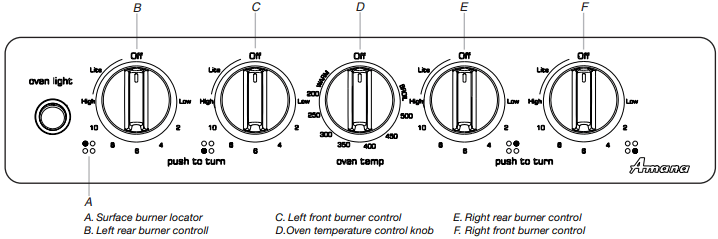
Cooktop/Oven Temperature Controls
Electric igniters automatically light the surface burners when control knobs are turned to LITE.
Before setting a control knob, place filled cookware on the grate. Do not operate a burner using empty cookware or without cookware on the grate.
To Set Burner Temperature:
1. Push in and turn knob counterclockwise to LITE. All four surface burners will click. Only the burner with the control knob turned to LITE will produce a flame.
2. Turn knob to anywhere between HI and LO. The clicking will stop. Use the following chart as a guide when setting heat levels.
| SETTING |
RECOMMENDED USE |
| LITE |
■ Light the burner. |
| HI |
■ Start food cooking.
■ Bring liquid to a boil.
|
| MED (Medium) |
■ Hold a rapid boil.
■ Quickly brown or sear food.
■ Fry or sauté foods.
■ Cook soups, sauces and gravies.
■ Stew or steam foods.
|
| LO |
■ Keep food warm.
■ Simmer.
|
To Set Oven Temperature:
Push in and turn oven control knob to desired temperature setting.
Power failure
In case of prolonged power failure, the surface burners can be lit manually. Hold a lit match near a burner and turn knob counterclockwise to LITE. After burner lights, turn knob to setting.
Surface Burners
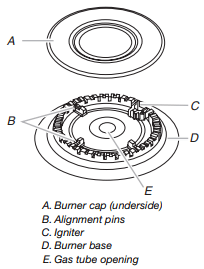
IMPORTANT: Do not obstruct the flow of combustion and ventilation air around the burner grate edges.
Burner cap: Always keep the burner cap in place when using a surface burner. A clean burner cap will help avoid poor ignition and uneven flames. Always clean the burner cap after a spillover and routinely remove and clean the caps and bases according to the “General Cleaning” section.
Gas tube opening: Gas must flow freely throughout the gas tube opening for the burner to light properly. Keep this area free of soil and do not allow spills, food, cleaning agents or any other material to enter the gas tube opening. Keep spillovers out of the gas tube by always using a burner cap.
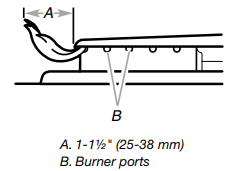
Burner ports: Check burner flames occasionally for proper size and shape as shown above. A good flame is blue in color, not yellow. Keep this area free of soil and do not allow spills, food, cleaning agents or any other material to enter the burner ports.
To Clean:
IMPORTANT: Before cleaning, make sure all controls are off and the oven and cooktop are cool. Do not use oven cleaners, bleach or rust removers.
1. Remove the surface burner grates.
2. Remove burner cap from the burner base and clean according to “General Cleaning” section.
3. Clean the gas tube opening with a damp cloth.
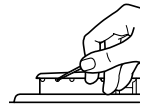
4. Clean clogged burner ports with a straight pin as shown. Do not enlarge or distort the port. Do not use a wooden toothpick. If the burner needs to be adjusted, contact a trained repair specialist.
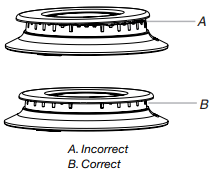
5. Replace the burner cap onto the burner base, making sure the alignment pins are properly aligned with the burner cap.
6. Replace surface burner grates.
7. Turn on the burner. If the burner does not light, check cap alignment. If the burner still does not light, do not service the burner yourself. Contact a trained repair specialist.
Home Canning
When canning for long periods, alternate the use of surface burners between batches. This allows time for the most recently used areas to cool.
- Center the canner on the grate.
- Do not place canner on 2 surface burners at the same time.
- For more information, contact your local agricultural department. Companies that manufacture home canning products can also offer assistance.
Cookware
IMPORTANT: Do not leave empty cookware on a hot surface cooking area, element or surface burner.
Ideal cookware should have a flat bottom, straight sides and a well-fitting lid, and the material should be of medium-to-heavy thickness.
Rough finishes may scratch the cooktop or grates. Aluminum and copper may be used as a core or base in cookware. However, when used as a base they can leave permanent marks on the cooktop or grates.
Cookware material is a factor in how quickly and evenly heat is transferred, which affects cooking results. A nonstick finish has the same characteristics as its base material. For example, aluminum cookware with a nonstick finish will take on the properties of aluminum.
Cookware with nonstick surfaces should not be used under the broiler.
Use the following chart as a guide for cookware material characteristics.
| COOKWARE |
CHARACTERISTICS |
| Aluminum |
■ Heats quickly and evenly.
■ Suitable for all types of cooking.
■ Medium or heavy thickness is best for most cooking tasks.
|
| Cast iron |
■ Heats slowly and evenly.
■ Good for browning and frying.
■ Maintains heat for slow cooking.
|
| Ceramic or Ceramic glass |
■ Follow manufacturer’s instructions.
■ Heats slowly, but unevenly.
■ Ideal results on low to medium heat settings.
|
| Copper |
■ Heats very quickly and evenly. |
| Earthenware |
■ Follow manufacturer’s instructions.
■ Use on low heat settings.
|
| Porcelain enamel-onsteel or cast iron |
■ See stainless steel or cast iron. |
| Stainless steel |
■ Heats quickly, but unevenly.
■ A core or base of aluminum or copper on stainless steel provides even heating.
|
OVEN USE
Odors and smoke are normal when the oven is used the first few times, or when it is heavily soiled.
IMPORTANT: The health of some birds is extremely sensitive to the fumes given off. Exposure to the fumes may result in death to certain birds. Always move birds to another closed and wellventilated room.
Preheating
Preheating is necessary for baking It is not necessary to preheat for roasting. To preheat, set the oven to the desired temperature and allow about 8 to 15 minutes for the oven to preheat.
Selecting a temperature higher than desired will not preheat the oven any faster, and may have a negative effect on baking results.
Oven Control
The OVEN TEMP knob is used to select the oven temperature. Always turn this knob just to the desired temperature. To accurately set the oven temperature, do not turn to a higher temperature and then back.
Aluminum Foil
IMPORTANT: To avoid permanent damage to the oven bottom finish, do not line the oven bottom with any type of foil, liners or cookware.
- On those models with bottom vents, do not block or cover the oven bottom vents.
- For best cooking results, do not cover entire rack with foil because air must be able to move freely.
- To catch spills, place foil on rack below dish. Make sure foil is at least ¹⁄₂" (1.3 cm) larger than the dish and that it is turned up at the edges.
Positioning Racks and Bakeware
IMPORTANT: To avoid permanent damage to the porcelain finish, do not place food or bakeware directly on the oven door or bottom.
RACKS
- Position racks before turning on the oven.
- Do not move racks with bakeware on them.
- Make sure racks are level.
For best performance, cook on one rack. Place the rack so the top of food will be centered in the oven. To move a rack, pull it out to the stop position, raise the front edge, then lift out.
| FOOD |
RACK POSITION |
| Large roasts, turkeys, angel food, bundt and tube cakes, quick breads, pies |
1 or 2 |
| Yeast breads, casseroles, meat and poultry |
2 |
| Cookies, biscuits, muffins, cakes |
2 or 3 |
BAKEWARE
To cook food evenly, hot air must be able to circulate. Allow 2" (5 cm) of space around bakeware and oven walls. Use the following chart as a guide.
| NUMBER OF PAN(S) |
POSITION ON RACK |
| 1 |
Center of rack. |
| 2 |
Side by side or slightly staggered. |
| 3 or 4 |
Opposite corners on each rack. Make sure that no bakeware piece is directly over another. |
Bakeware
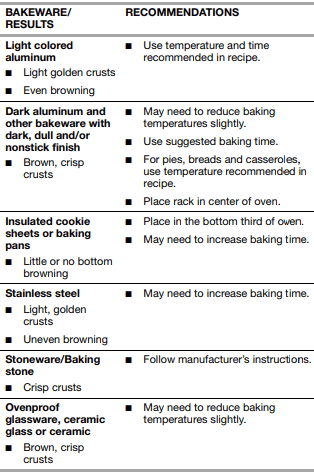
The bakeware material affects cooking results. Follow manufacturer’s recommendations and use the bakeware size recommended in the recipe. Use the following chart as a guide.
Oven Vent
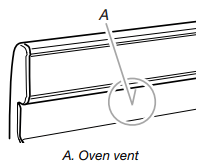
The oven vent releases hot air and moisture from the oven, and should not be blocked or covered. Blocking or covering the oven vent will cause poor air circulation, affecting cooking and cleaning results. Do not set plastics, paper or other items that could melt or burn near the oven vent.
Baking and Roasting
IMPORTANT: To avoid damage to the interior finish, do not place food or cookware directly on the oven door or the oven bottom.
Before baking and roasting, position the racks according to the “Positioning Racks and Bakeware” section. When roasting, it is not necessary to wait for the oven to preheat before putting food in, unless recommended in the recipe.
To Bake or Roast:
- Push in and turn the oven control knob to the desired temperature setting.
- Place food in oven. The oven burner will cycle on and off to keep the oven temperature at the setting.
- Check food for doneness at minimum time in recipe. Cook longer if necessary.
- Push in and turn oven control knob to OFF when finished.
Broiling
BROILER
The broiler is located below the oven door. The broiler pan and grid slide out for easy access. Always broil with the broiler and oven doors closed.
- To avoid damage to the broiler, do not step on or apply weight to the broiler door while it is open.
- Do not preheat broiler before use. Completely close broiler door during broiling.
- It is possible to broil longer cooking foods such as chicken pieces at a lower temperature to avoid overbrowning. Turn the knob to 400°F or 450°F, rather than Broil, for low temperature broiling.
- Do not use broiler cavity for storage.
- Use only the broiler pan and grid provided with the range. It is designed to drain juices and help avert spatter and smoke.
- For proper draining, do not cover the grid with foil. The bottom of the pan may be lined with aluminum foil for easier cleaning.
- Trim excess fat to reduce spattering. Slit the remaining fat on the edges to avert curling.
- Pull out oven rack to stop position before turning or removing food. Use tongs to turn food to avoid the loss of juices. Very thin cuts of fish, poultry or meat may not need to be turned.
- After broiling, remove the pan from the oven when removing the food. Drippings will bake on the pan if left in the heated oven, making cleaning more difficult.
To Broil:
- Open the broiler door and take out the broiler pan and grid.
- Place food on the grid so grease can drain down into the lower part of the broiler pan.
- Place the pan on the broiler rack and close the broiler door.
- Push in and turn the oven control knob to broiler position. The temperature can be lowered at any time during the broiling by turning the oven control knob to the desired temperature.
- Push in and turn oven control knob to OFF position when finished.
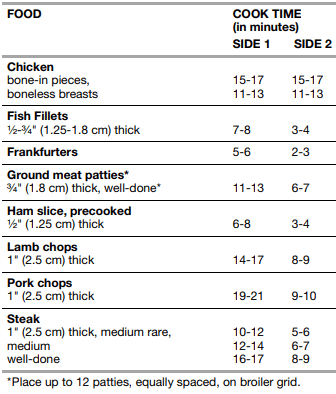
BROILING CHART
For best results, place food 3" (7.0 cm) or more from the broil element. Times are guidelines only and may need to be adjusted for individual foods and tastes.
RANGE CARE
Removing the Oven Bottom
The oven bottom can be removed for standard cleaning of the oven.
Before cleaning, make sure the oven is completely cool.
To Remove:
1. Remove the oven racks.
2. Place fingers in the slots in the bottom panel.
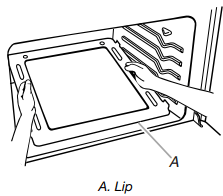
3. Lift the rear of the panel up and back. The lip at the front of the panel should clear the front frame of the oven cavity.
4. Lift the bottom up and out.
To Replace:
Reverse the steps above.
General Cleaning
IMPORTANT: Before cleaning, make sure all controls are off and the oven and cooktop are cool. Always follow label instructions on cleaning products. Do not wipe down any of the inside surfaces until the oven has completely cooled down. To avoid breaking the glass, do not apply a cool damp cloth to the inner door glass before it has completely cooled.
Soap, water and a soft cloth or sponge are suggested first unless otherwise noted
EXTERIOR PORCELAIN ENAMEL SURFACES (on some models)
Food spills containing acids, such as vinegar and tomato, should be cleaned as soon as the entire appliance is cool. These spills may affect the finish.
Cleaning Method:
- Glass cleaner, mild liquid cleaner or nonabrasive scrubbing pad:
Gently clean around the model and serial number plate because scrubbing may remove numbers.
- All-Purpose Appliance Cleaner Part Number 31682 (not included):
See “Assistance or Service” section to order.
COOKTOP CONTROLS
To avoid damage to the cooktop controls, do not use steel wool, abrasive cleansers or oven cleaner.
Do not soak knobs. When replacing knobs, make sure knobs are in the Off position.
On some models, do not remove seals under knobs.
Cleaning Method:
- Soap and water or dishwasher:
Pull knobs straight away from control panel to remove.
CONTROL PANEL
To avoid damage to the control panel, do not use abrasive cleaners, steel-wool pads, gritty washcloths or abrasive paper towels.
Cleaning Method:
- Glass cleaner and soft cloth or sponge:
Apply glass cleaner to soft cloth or sponge, not directly on panel.
- All-Purpose Appliance Cleaner Part Number 31682 (not included):
See “Assistance or Service” section to order.
PORCELAIN-COATED GRATES AND CAPS
Food spills containing acids, such as vinegar and tomato, should be cleaned as soon as the cooktop, grates and caps are cool. These spills may affect the finish.
To avoid chipping, do not bang grates and caps against each other or hard surfaces such as cast iron cookware.
Do not reassemble caps on burners while they are wet.
Cleaning Method:
- Nonabrasive plastic scrubbing pad and mildly abrasive cleanser:
Clean as soon as cooktop, grates and caps are cool.
- Dishwasher (grates only, not caps):
Use the most aggressive cycle. Cooked-on soils should be soaked or scrubbed before going into a dishwasher.
- Gas Grate and Drip Pan Cleaner Part Number 31617:
See “Assistance or Service” section to order.
SURFACE BURNERS
See “Surface Burners” section.
OVEN DOOR EXTERIOR
Cleaning Method:
- Glass cleaner and a soft cloth or sponge:
Apply glass cleaner to soft cloth or sponge, not directly on panel.
- All-Purpose Appliance Cleaner Part Number 31682 (not included):
See “Assistance or Service” section to order.
OVEN CAVITY
Food spills should be cleaned when oven cools. At high temperatures, foods react with porcelain and staining, etching, pitting or faint white spots can result.
On some models, the oven door can be removed. See “Oven Door” first.
Cleaning Method:
- Steel-wool pad
- Oven cleaner: Follow product label instructions.
OVEN RACKS AND ROASTING RACKS
Cleaning Method:
BROILER PAN AND GRID (on some models)
Cleaning Method:
Wash frequently in warm sudsy water. (It is not recommended to wash chrome bowls in a dishwasher).
A mild abrasive cleaner and a plastic scrubber can be used to remove stubborn stains.
For heavily soiled bowls, place an ammonia soaked paper towel on the stains and allow to soak for a short time, then gently scrub with a plastic scrubber.
Porcelain enamel only:
- Warm soapy water or dishwasher
- Oven cleaner: Follow product label instructions.
Oven Light
The oven light is a standard 40-watt appliance bulb. Press the manual oven light switch (on some models) on the backguard to turn on and off. This oven does not have an automatic light switch.
Before replacing, make sure the oven and cooktop are cool and the control knobs are off.
To Replace:
- Unplug range or disconnect power.
- Turn bulb counterclockwise to remove from socket.
- Replace bulb.
- Plug in range or reconnect power.
Oven Door
For normal range use, it is not suggested to remove the oven door. However, if removal is necessary, make sure the oven is off and cool. Then, follow these instructions. The oven door is heavy.
To Remove:
1. Open the oven door. Insert hinge pins, included with your range, into both hinge hangers. Do not remove the pins while the door is removed from the range.
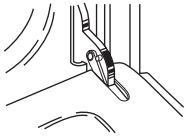
2. Grasp the door on the sides with your fingers on the front of the door and your thumbs on the inside surface.
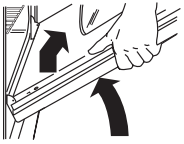
3. Pull door straight up, then toward you. Do not remove hinge pins until the door is replaced on the range.
To Replace:
1. Grasp the door on the sides with your fingers on the front of the door and your thumbs on the inside surface.
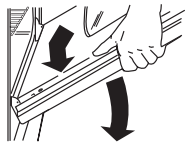
2. Hold oven door so that the top edge of each door slot is horizontal. Insert door hinge into the hinge slots.
3. Tilt top of door toward range. Insert bottom door hinge notch down onto front frame edge.
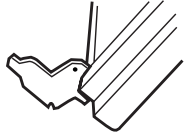
4. Open the door completely and remove the hinge pins. Save hinge pins for future use.
5. Close the door slowly to assure door side panel clearance and proper hinge engagement.
TROUBLESHOOTING
Try the solutions suggested here first in order to avoid the cost of an unnecessary service call.
Nothing will operate
Is the power outlet properly wired and polarized?
- Try another outlet to check for proper wiring and polarity.
Is the power supply cord unplugged?
- Plug into a properly grounded 3 prong outlet.
Has a household fuse blown, or has a circuit breaker tripped?
- Replace the fuse or reset the circuit breaker. If the problem continues, call an electrician.
Is the main or regulator gas shutoff valve in the off position?
- See Installation Instructions.
Is the range properly connected to the gas supply?
- Contact a trained repair specialist or see Installation Instructions.
Surface burners will not operate
Is this the first time the surface burners have been used?
- Turn on any one of the surface burner knobs to release air from the gas lines.
Is the control knob set correctly?
- Push in knob before turning to a setting.
Are the burner ports clogged?
- See “Surface Burners” section.
Surface burner flames are uneven, yellow and/or noisy
Are the burner ports clogged?
- See “Surface Burners” section.
Are the burner caps positioned properly?
- See “Surface Burners” section.
Is the air/gas mixture correct?
- Contact a designated service technician to check the air/gas mixture, or see the Installation Instructions.
Is propane gas being used?
- The range may have been converted improperly. Contact a trained repair specialist.
Surface burner makes popping noises
Is the burner wet?
Cookware not level on cooktop
Is the range level?
- Level the range. See the Installation Instructions.
Is the proper cookware being used?
- Use cookware with a flat bottom. See “Cookware” section.
Excessive heat around cookware on cooktop
Is the cookware the proper size?
- Use cookware about the same size as the surface cooking area, element or surface burner. Cookware should not extend more than ½" (1.3 cm) outside the cooking area.
Oven will not operate
Is the power outlet properly wired and polarized?
- Try another outlet to check for proper wiring and polarity.
Is this the first time the oven has been used?
- Turn any one of the surface burner knobs on to release air from the gas lines.
Is the oven temperature control knob set correctly?
- See “Cooktop/Oven Temperature Controls” section.
Is the main or regulator gas shutoff in the off position?
- Contact a designated service technician or see the Installation Instructions.
Oven makes muffled ticking noise when in use
- This is normal and occurs when the oven burner cycles on and off to hold the set oven temperature.
Oven burner flames are uneven, yellow and/or noisy
Is propane gas being used?
- The range may have been converted improperly. Contact a trained repair specialist.
Is the air/gas mixture correct?
- Contact a designated service technician to check the air/gas mixture or see the Installation Instructions.
Cooktop cooking results not what expected
Is the proper cookware being used?
Is the control knob set to the proper heat level?
- See “Cooktop/Oven Temperature Controls” section.
Baking results not what expected
Was the oven preheated?
- Wait for oven to preheat before placing food in oven.
Are the racks positioned properly?
- See “Positioning Racks and Bakeware” section.
Is there proper air circulation around bakeware?
- See “Positioning Racks and Bakeware” section.
Is the batter evenly distributed in the pan?
- Check that batter is level in the pan.
Is the range level?
- Level the range. See the Installation Instructions.
Are baked items too brown on the bottom?
- Decrease oven temperature 10° F to 30°F (5°C to 15°C).
Are crust edges browning early?
- Use aluminum foil to cover the edge of the crust and/or reduce baking temperature.
Slow baking or roasting
Was the oven preheated?
- Wait for oven to preheat before placing food in oven.
Is there proper air circulation around bakeware?
- See “Positioning Racks and Bakeware” section.
Is the proper length of time being used?
- Increase baking or roasting time.
Is the proper temperature set?
- Increase temperature 25°F (15°C).
Has the oven door been opened while cooking?
- Peeking into the oven while cooking releases oven heat and can result in longer cooking times.
Broiler burner fails to light
Is the ignition system broken?
- Contact a designated service technician to replace it.
Has a household fuse blown, or has a circuit breaker tripped?
- Replace the fuse or reset the circuit breaker. If the problem continues, call an electrician.