242090302 February 2011
Use & Care Guide
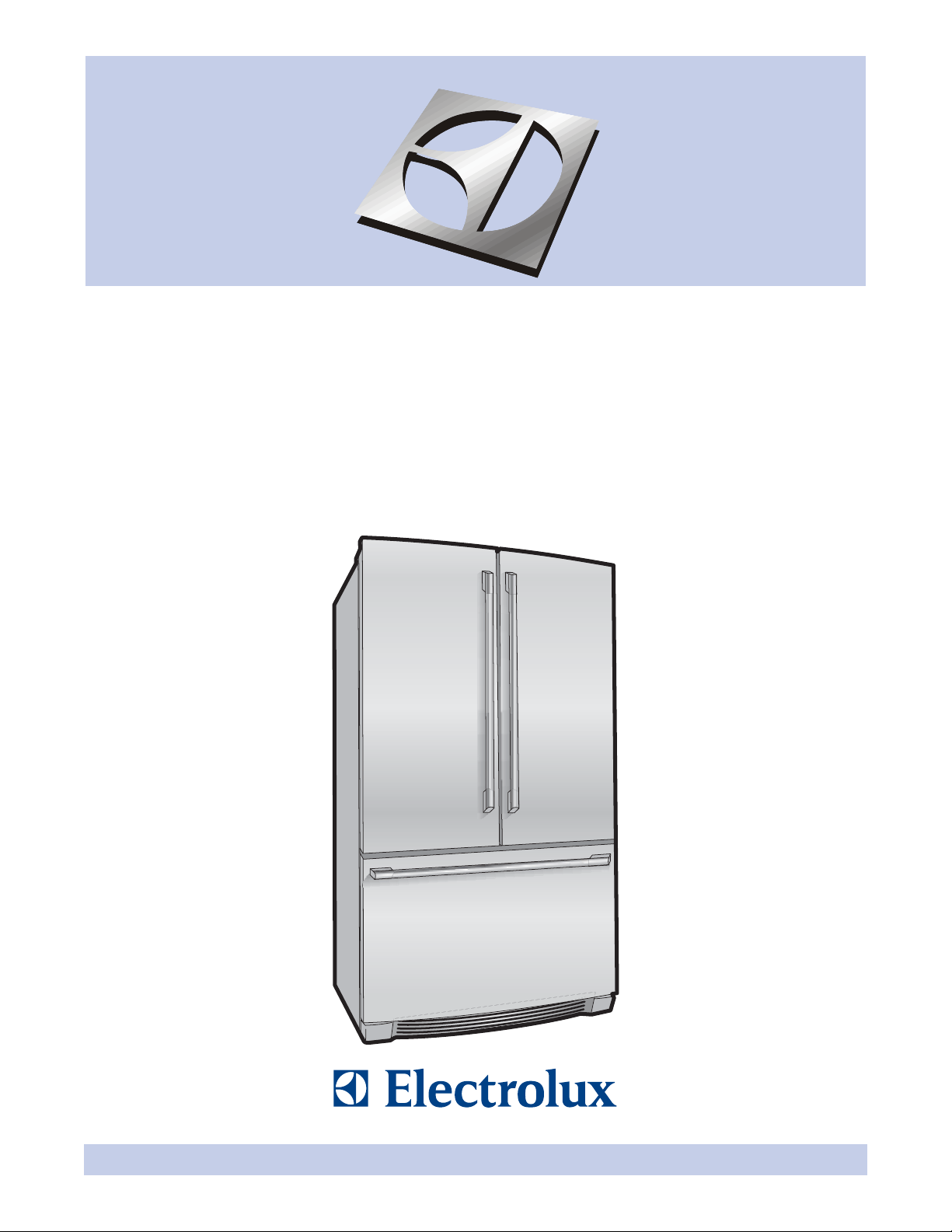
French Door Bottom Freezer/Refrigerator
Guia de Uso y Cuidado
Refrigerador con congelador inferior de puerta doble
Guide d’utilisation et d’entretien
Réfrigérateur à portes françaises/Congélateur en bas
2
Finding Information
Please read and save this guide
Thank you for choosing Electrolux, our new premium
brand in home appliances. This Use & Care Guide is
part of our commitment to customer satisfaction and
product quality throughout the service life of your new
appliance.
Purchase date
Electrolux model number
Electrolux serial number
Keep a record for quick
reference
Finding Information .............................................. 2
Safety ............................................................... 3
Feature Overview ................................................. 5
Installation ......................................................... 6
Removing the Doors ............................................10
Installing Door Handles ........................................12
Connecting the Water Supply ..................................13
Controls ...........................................................14
Automatic Ice Maker ............................................16
Storage Features ................................................17
Storing Food and Saving Energy ..............................22
Normal Operating Sounds & Sights ..........................23
Changing the Water and Air Filters ...........................24
Care and Cleaning ...............................................26
Common Solutions for Concerns..................................29
Warranty ..........................................................32
Table of contents
Questions?
For toll-free telephone support in the U.S. and Canada:
1-877-4ELECTROLUX (1-877-435-3287)
For online support and product information visit http://
www.electroluxappliances.com
NOTE
Registering your product with Electrolux enhances
our ability to serve you. You can register online at
www.electroluxappliances.com or by sending your
Product Registration Card in the mail.
Doors
Handles are secure and tight
Door seals completely to cabinet on all sides
Freezer door is level across the top
Leveling
Refrigerator is level, side-to-side and tilted
1
/
4
inch (6 mm) front-to-back
Toe grille is properly attached to refrigerator
Cabinet is sitting solid on all corners
Electrical Power
House power turned on
Refrigerator plugged in
Ice Maker
House water supply connected to refrigerator
No water leaks present at all connections
Ice maker is turned ON
Ice operates correctly
Front filter must be flush with filter housing
(select models)
Final Checks
Shipping material removed
Fresh food and freezer temperatures set
Installation Checklist
3
Safety
Important safety instructions
General Safety
Safety Precautions
Do not attempt to install or operate your unit until
you have read the safety precautions in this manual.
Safety items throughout this manual are labeled with a
Danger, Warning, or Caution based on the risk type.
Definitions
This is the safety alert symbol. It is used to alert
you to potential personal injury hazards. Obey all safety
messages that follow this symbol to avoid possible
injury or death.
• Donotstoreorusegasolineorotherammable
liquids near this or any other appliance.
Read product labels for warnings regarding
flammability and other hazards.
• Donotoperatetherefrigeratorinthepresenceof
explosive fumes.
• Avoidcontactwithanymovingpartsofthe
automatic ice maker.
WARNING
WARNING indicates a potentially hazardous
situation which, if not avoided, could result in
death or serious injury.
IMPORTANT
Indicates installation, operation, or maintenance
information which is important but not hazard-related.
CAUTION
CAUTION indicates a potentially hazardous
situation which, if not avoided, may result in
minor or moderate injury.
WARNING
Please read all safety instructions before using
your new refrigerator.
DANGER
DANGER indicates an imminently hazardous
situation which, if not avoided, will result in death
or serious injury.
• Removeallstaplesfromthecartontoavoid
injury. Staples can also damage finishes if
they come in contact with other appliances or
furniture.
Child Safety
Packing Materials:
• Packingcartonscoveredwithrugs,bedspreads,
plastic sheets, or stretch wrap may become
airtight chambers and can quickly cause
suffocation.
• Destroyorrecycletheproduct’scarton,plastic
bags, and any other exterior wrapping material
immediately after the refrigerator is unpacked.
Children should never play with these items.
Child Entrapment and Suffocation:
• Theseproblemsarenotlimitedtothepast.
Whether junked, abandoned, or temporarily
stored (even for a few hours), unattended
refrigerators and freezers are dangerous. Please
take the precautions listed below.
Proper Disposal of Refrigerators/Freezers
We strongly encourage responsible appliance recycling/
disposal methods. Check with your utility company or
visit www.energystar.gov/recycle for more information
on recycling your old refrigerator.
Before you recycle or dispose of your old refrigerator/
freezer:
• Removethedoors.
• Leavethe
shelves and
baskets in place
so children may
not easily climb
inside.
• Haverefrigerant
and compressor
oil removed
by a qualified
service
technician.
4
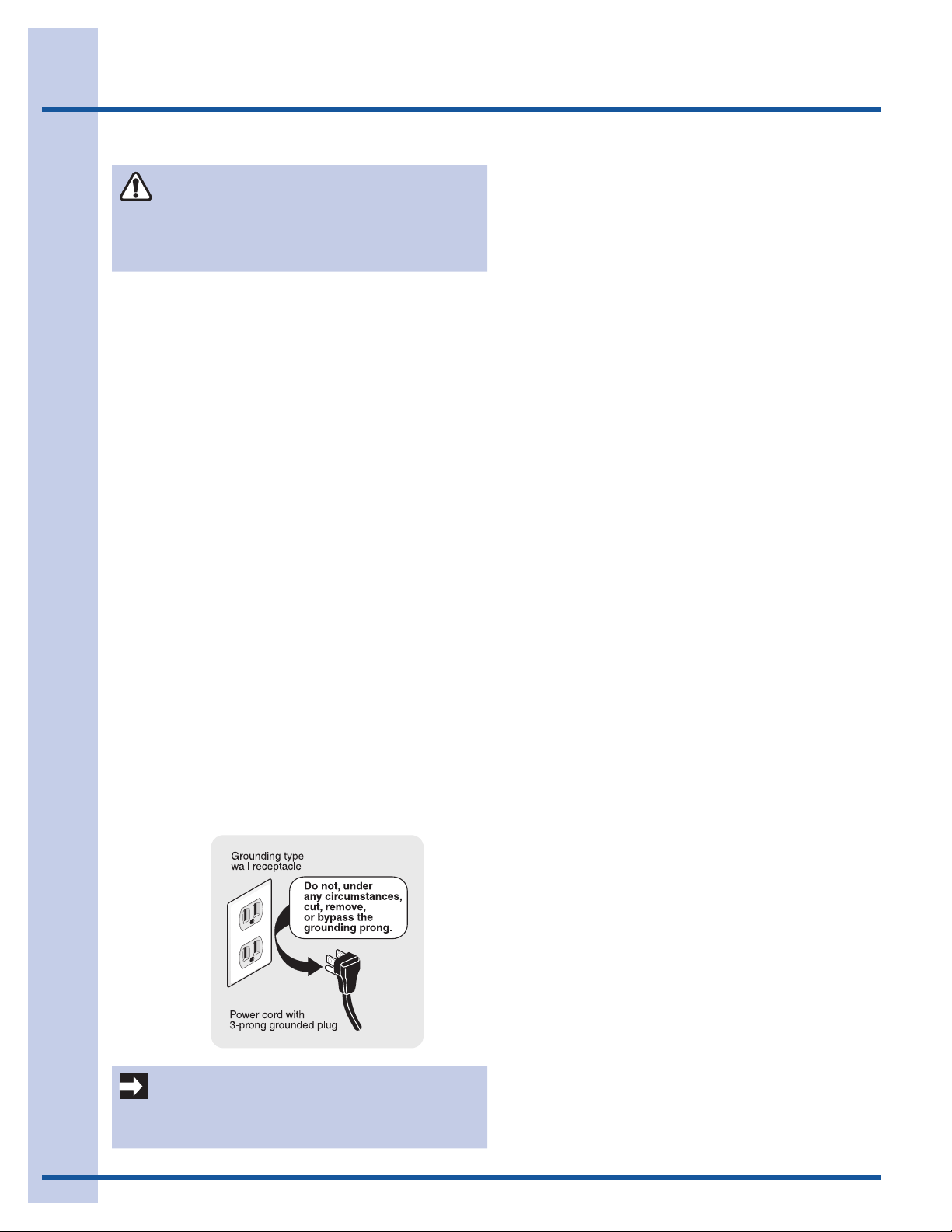
• The refrigerator must be plugged into its own
dedicated 115 Volt, 60 Hz, AC-only non-GFCI
electric outlet. The power cord of the appliance
is equipped with a three-prong grounding plug for
your protection against electrical shock hazards.
It must be plugged directly into a properly
grounded three-prong receptacle. The receptacle
must be installed in accordance with local codes
and ordinances. Consult a qualified electrician.
Do not use an extension cord or adapter plug.
• Ifthepowercordisdamaged,itshouldbe
replaced by the manufacturer, service technician,
or a qualified person.
• Neverunplugtherefrigeratorbypullingonthe
powercord.Alwaysgriptheplugrmlyand
pull straight out from the receptacle to prevent
damaging the power cord.
• Toavoidelectricalshock,unplugtherefrigerator
before cleaning and before replacing a light bulb
or LED light.
• Performancemaybeaffectedifthevoltagevaries
by 10% or more. Operating the refrigerator with
insufficient power can damage the compressor.
Such damage is not covered under your warranty.
• Donotplugtheunitintoanoutletcontrolledbya
wall switch or pull cord to prevent the refrigerator
from being turned off accidentally.
Electrical information
Safety
WARNING
You must follow these guidelines to ensure
that your refrigerator’s safety mechanisms are
operating correctly.
IMPORTANT
To turn off power to your refrigerator, unplug the
power cord from the wall outlet.
5
Feature Overview
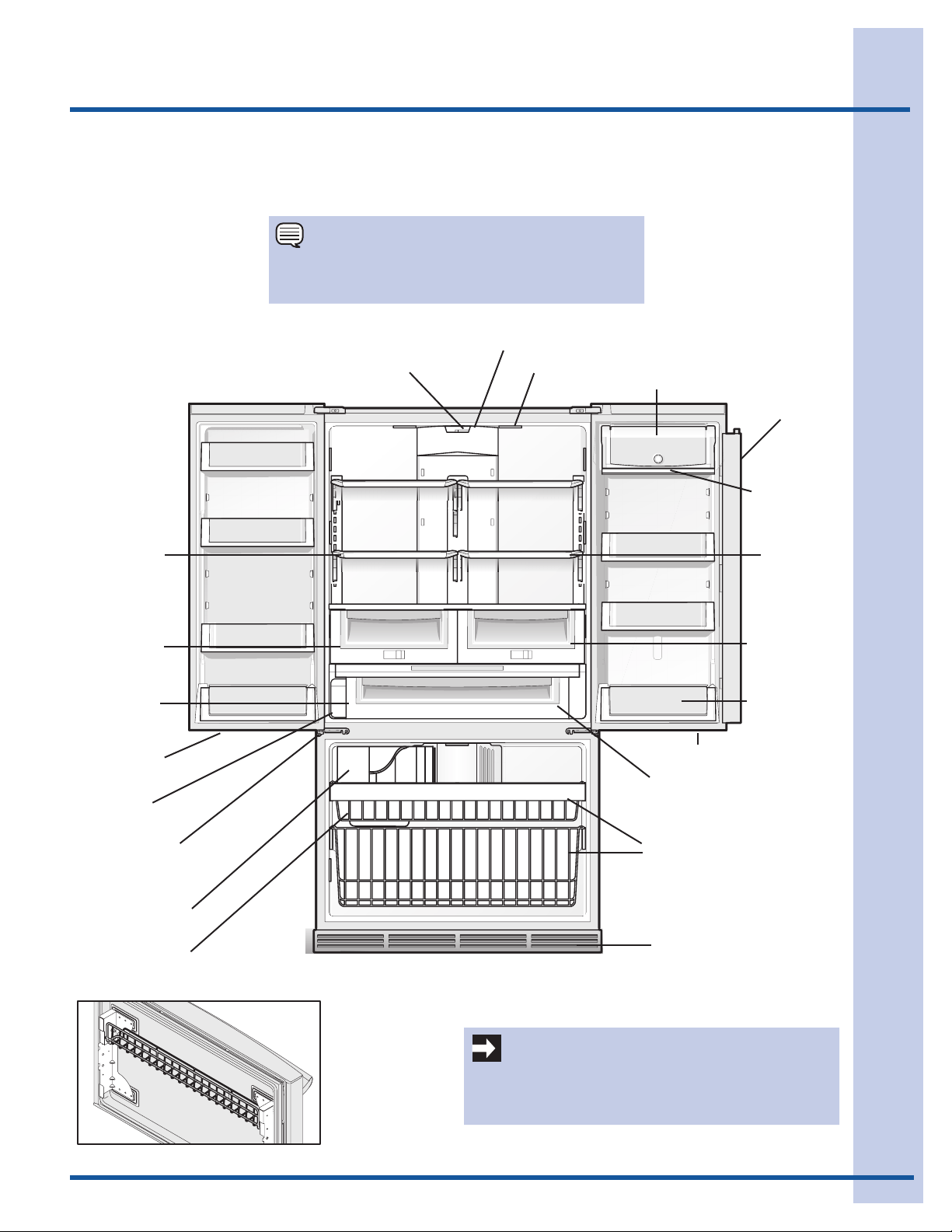
Understanding features and terms
Your Electrolux refrigerator is designed for optimal convenience and storage flexibility. The illustration below is
provided to assist you with familiarizing yourself with product features and terminology.
NOTE
*Features may vary according to model.
Model is shown without freezer drawer cover.
Toe Grille
*Luxury-Design
TM
Shelves
Covered Door Bin
*Luxury-Design
TM
Shelves
Freezer Baskets
*Perfect Temp
TM
Drawer
(PTD)
or *Cool Zone
TM
Drawer
(with humidity slides)
Crisper
Drawer
Crisper
Drawer
Water
Filter
*Adjustable
Hinges
*Incandescent Light
*LED Light
Tilt-Out
Bin
*Special Items
Rack
(inside PTD)
*LED Light
*LED Light
Flipper Guide
Flipper
Mullion
*Wire Tilt-Out Shelf (inside freezer drawer)
Air Filter
Ice
Maker
Ice
Bucket
IMPORTANT
Features not included with your refrigerator can be
purchased at www.electroluxappliances.com or by
calling 1-877-435-3287.
6
This Use & Care Guide provides general installation
and operating instructions for your model. We
recommend using a service or kitchen contracting
professional to install your refrigerator. Use the
refrigerator only as instructed in this Use & Care
Guide. Before starting the refrigerator, follow these
important first steps.
Location
• Chooseaplacethatisnearagrounded,non-
GFCI, electrical outlet. Do Not use an extension
cord or an adapter plug.
• Ifpossible,placetherefrigeratoroutofdirect
sunlight and away from the range, dishwasher, or
other heat sources.
• Therefrigeratormustbeinstalledonaoorthat
is level and strong enough to support a fully
loaded refrigerator.
• Considerwatersupplyavailabilityformodels
equipped with an automatic ice maker.
Installation
• Allowthefollowingclearancesforeaseof
installation, proper air circulation, and plumbing
and electrical connections:
Sides & Top ³⁄₈ inch (9.5 mm)
Back 1 inch (25.4 mm)
Door opening
Installation
Your refrigerator should be positioned to allow easy
access to a counter when removing food. For best
use of refrigerator drawers and freezer baskets, the
refrigerator should be in a position where both can be
fully opened.
CAUTION
DO NOT install the refrigerator where the
temperature will drop below 55°F (13°C) or rise
above 110°F (43°C). The compressor will not be
able to maintain proper temperatures inside the
refrigerator.
DO NOT block the toe grille on the lower front
of your refrigerator. Sufficient air circulation
is essential for the proper operation of your
refrigerator.
NOTE
If your refrigerator is placed with the door hinge
against a wall, you may have to allow additional space
so the door can be opened wider.
NOTE
The refrigerator doors are designed to shut by
themselves within a 20 degree opening.
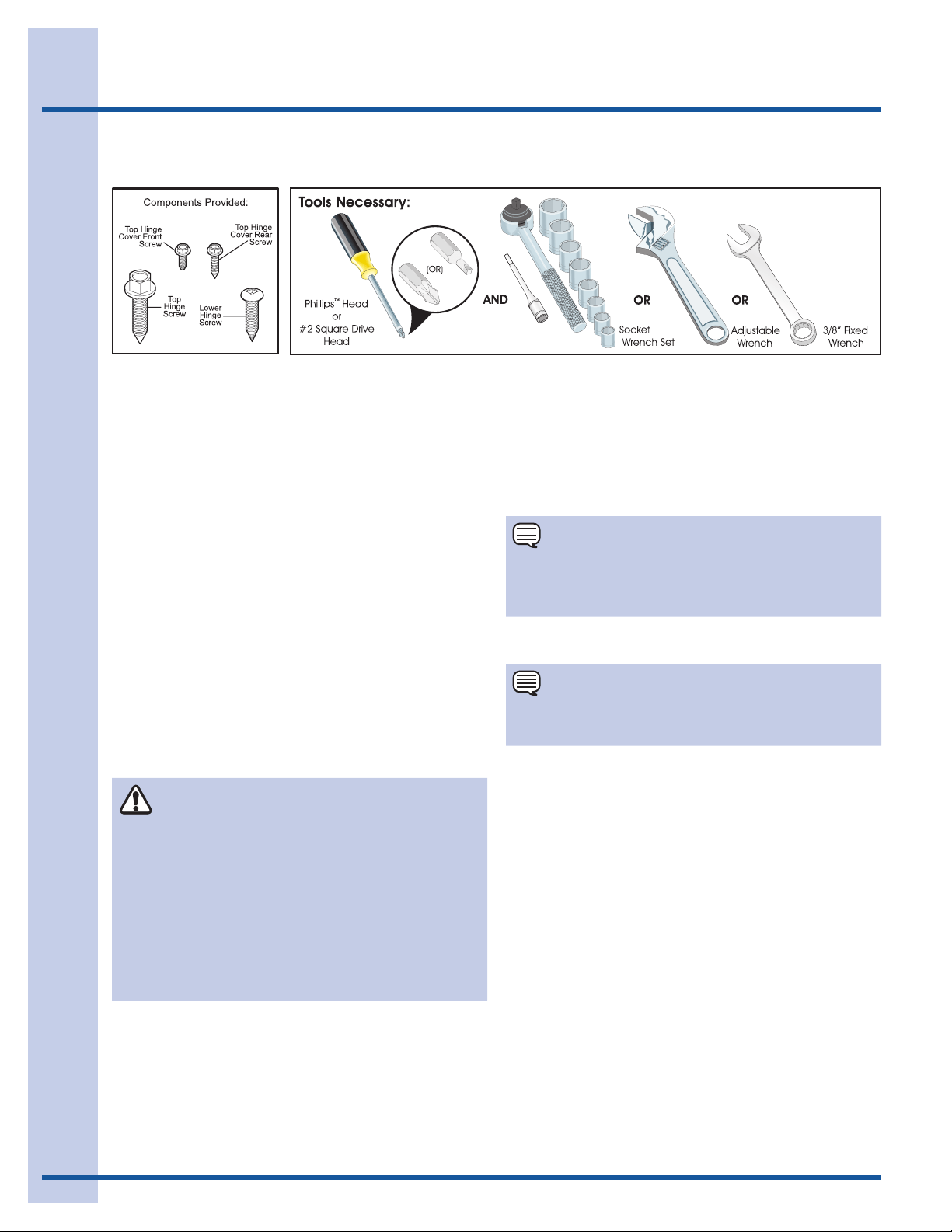
Required Tools
You will need the following tools:
7
Installation
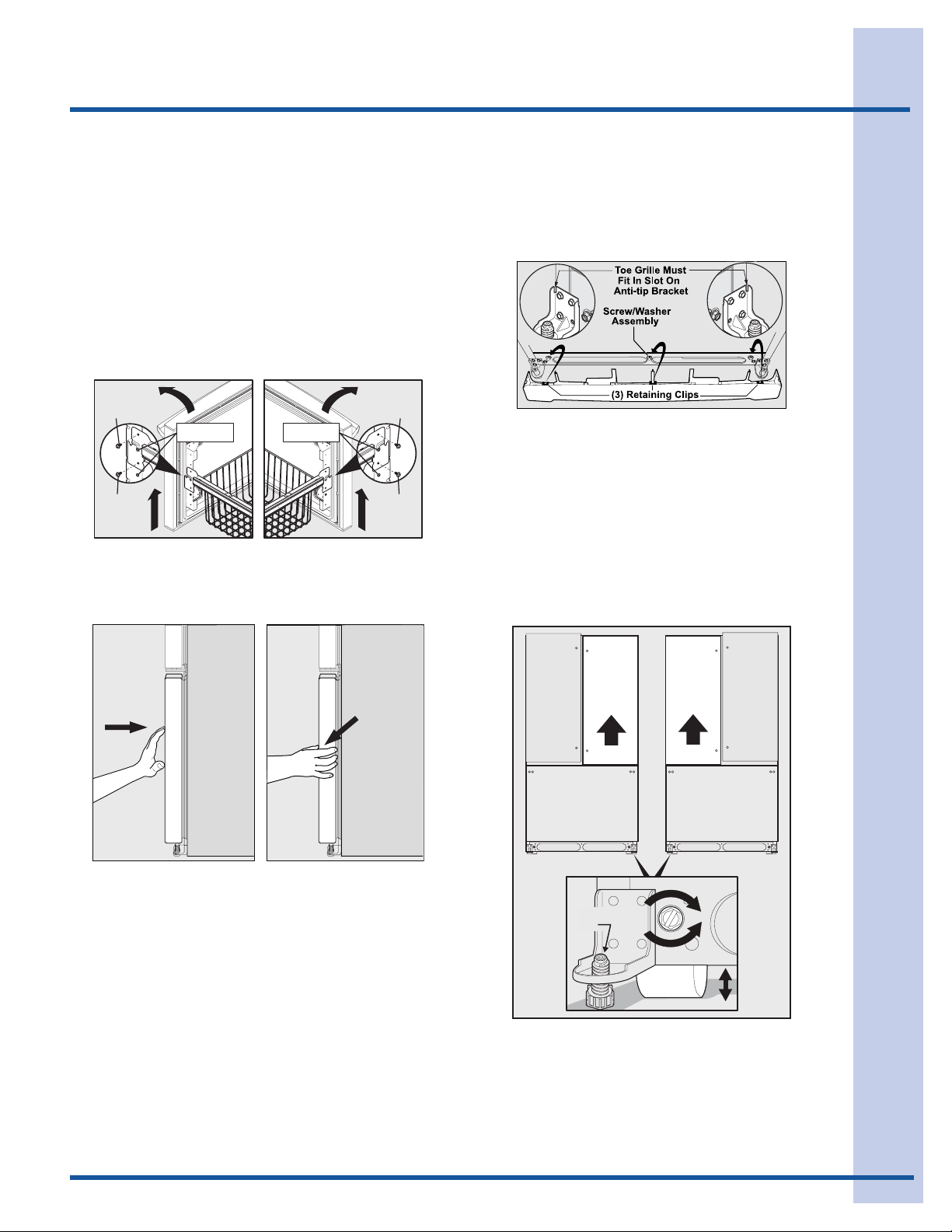
To level the cabinet using the front rollers:
1 Slightly open freezer drawer. Lift the toe grille
and gently pull forward (see illustration).
2 You can raise or lower each door. Use a ³⁄₈ inch
socket wrench to turn the adjustment screws (1
per side).
To raise: turn adjustment screw clockwise.
To lower: turn adjustment screw
counterclockwise.
3 Ensure both doors are bind-free with their seals
touching the cabinet on all four sides and that
cabinet is stable.
4 Afterunitisleveled,loweranti-tipleguntilit
contacts the floor.
Raise
Lower
Anti-tip
Leg
Door
Door
Leveling Freezer Drawer (if nec-
essary)
1 Check gasket seal around top, bottom, and sides
of freezer drawer.
2 If gasket is not sealed, open drawer and slightly
loosen four (4) drawer screws (two (2) on each
side) to allow drawer to rotate.
3 Close drawer and recheck the seal on the gasket
(A).Openthedrawergrabbingbythesidesinthe
center (B). Be careful not to rotate the drawer.
Remove Hex
Head Drawer
Screw
Remove Hex
Head Drawer
Screw
Do Not Remove
Other Screws
Remove Hex
Head Drawer
Screw
Remove Hex
Head Drawer
Screw
Do Not Remove
Other Screws
4 Tighten four (4) drawer screws.
5 Recheck gasket seal.
Pull Drawer Out
From Both Sides
Grab Drawer
At Center
Then
Push Against
Freezer Drawer
5 Install the toe grille by fitting into place.
A
B
Level Refrigerator & Adjust
Doors (if necessary)
Guidelines for final positioning of your refrigerator:
• Allfourcornersofthecabinetmustrestrmlyon
the floor.
• Thesidesshouldtilt
1
/
4
inch (6 mm) from front
to back (to ensure that doors close and seal
properly).
• Doorsshouldalignwitheachotherandbelevel.
Most of these conditions can be met by raising or
lowering the adjustable front rollers.
8
Installation
Loosen or Remove
Screw
Open
Door
90
degrees
Bottom of Door
A
B
Loosen/Remove Screw (where applicable)
Adjusting Door
Retighten Screw
NOTE
View shown is looking up at the bottom of the
refrigerator door.
Adjustable Door Stop
NOTE
Adjustablehingeshouldonlybeusedafterdoors
have been leveled with rollers.
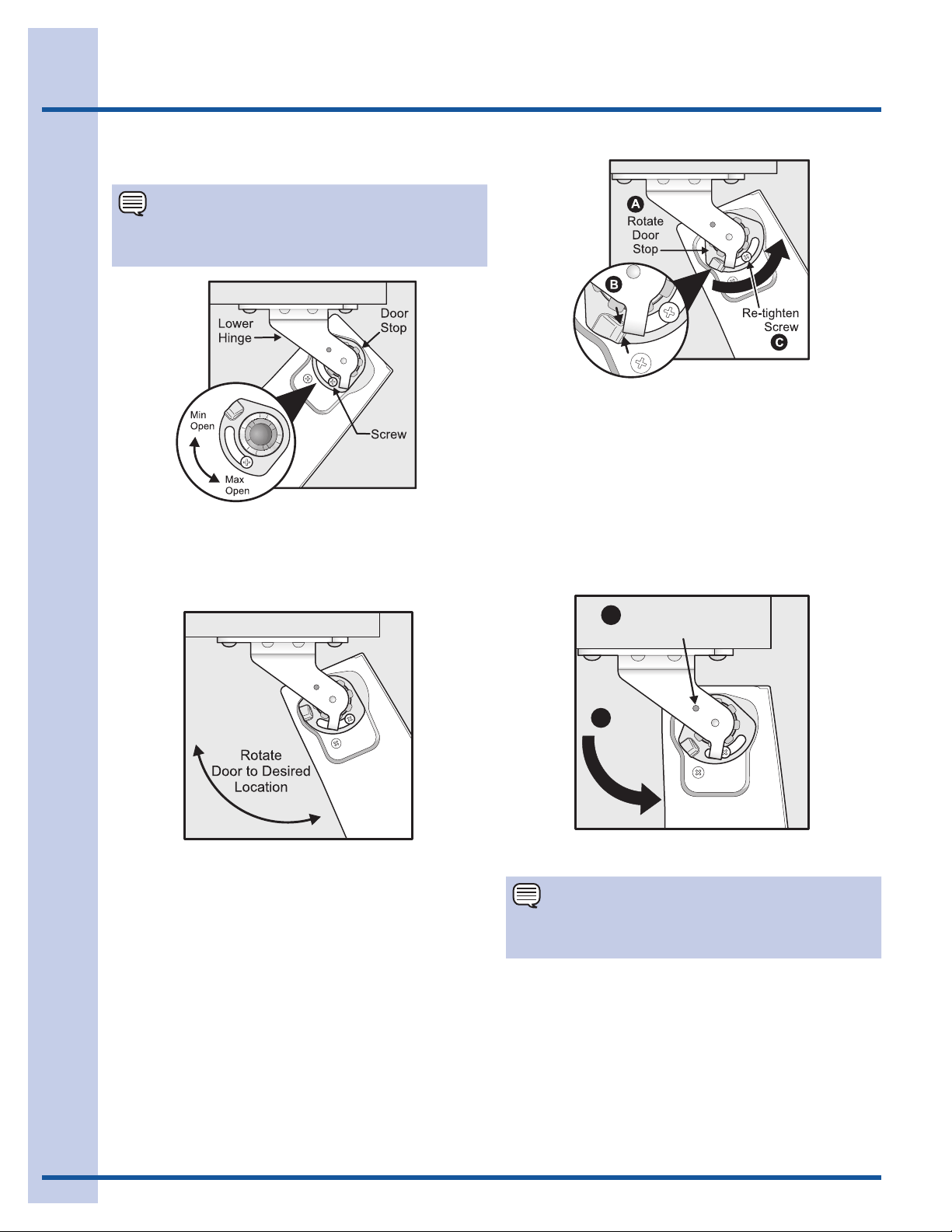
To adjust the door stop:
Door stop is adjustable between 85 to 145 degrees.
1 Open door to provide access to screw.
2 Loosen screw.
3 Adjustdoortodesiredlocation.
To level the doors using the adjustable lower hinge
(select models):
1 Remove all food items from door bins on door
being adjusted.
2 Open doors to 90 degrees.
3 Loosen or remove screw.
4 Rotate door stop until it makes contact with the
lower hinge.
5 Retighten screw.
6 Ensure door stops in desired location before
resuming normal use.
9
Adjusting Flipper Mullion Screw
Installation
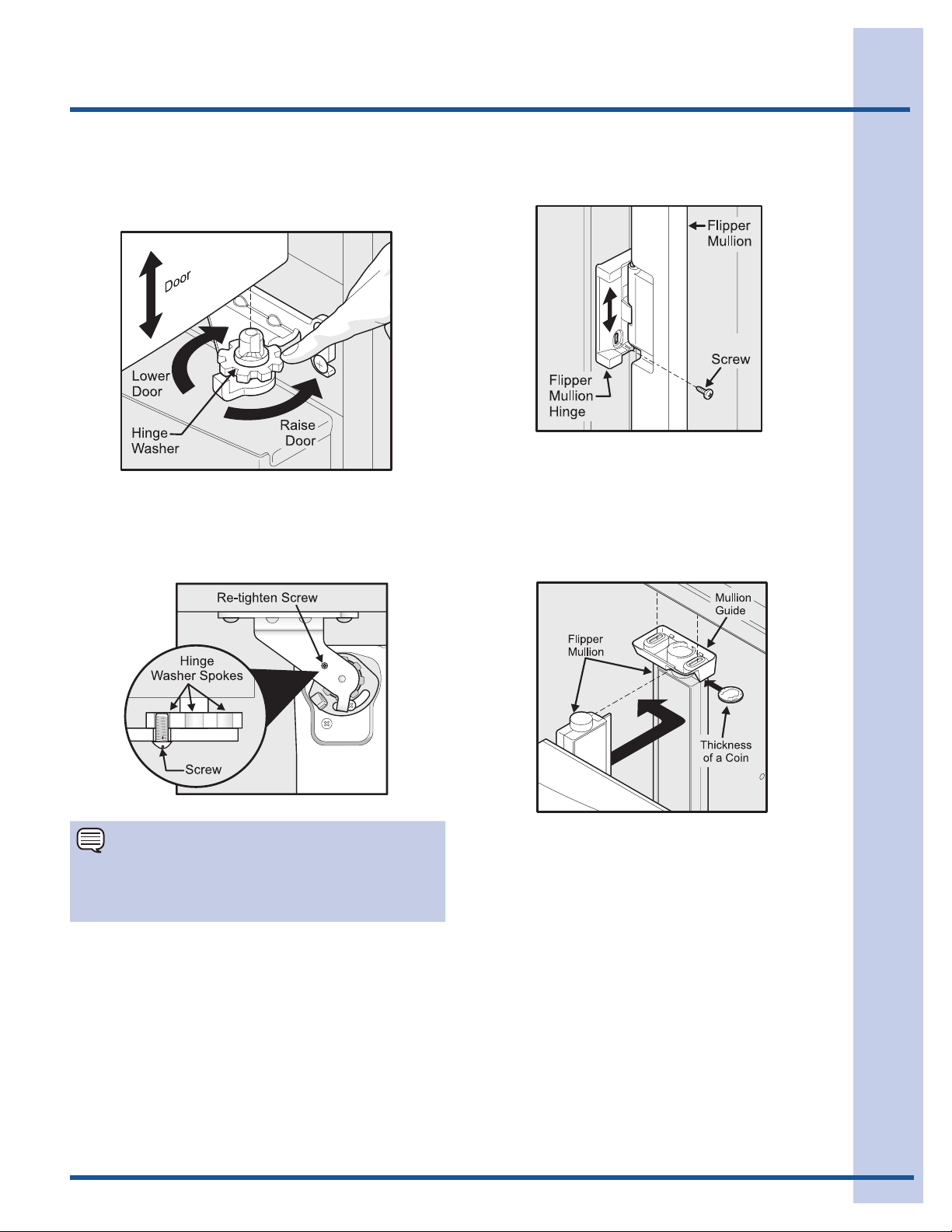
To adjust the flipper mullion:
1 Loosen the screw located on the flipper mullion
hinge.
2 Adjustippermullionheight.Forproper
connection with the flipper mullion guide, there
should be a separation about the thickness of a
coin (0.060 inches, or 1.5 mm) between the guide
and flipper mullion.
3 Retighten screw.
4 Lift the door while adjusting the washer. To raise
the door, rotate washer clockwise (when viewed
from the bottom). To lower door, rotate washer
counterclockwise (when viewed from the bottom).
5 Retighten the screw, where applicable, ensuring it
is between the spokes of the set washer. Screw
will not be tight, just insert until it is flush with the
hinge.
Adjusting Flipper Mullion Height
Screw (where applicable)
Raising/Lowering Door
NOTE
If after adjusting doors higher the door makes a
popping/clicking sound, remove screw and replace
with the longer one supplied in the handle package.
10
Once both doors are in place, ensure they are aligned
with each other and level (please see the “Installation”
section for more details), and replace the top hinge
cover.
CAUTION
Be sure doors are set aside in a secure position
where they cannot fall and cause personal injury,
or damage to the doors or handles.
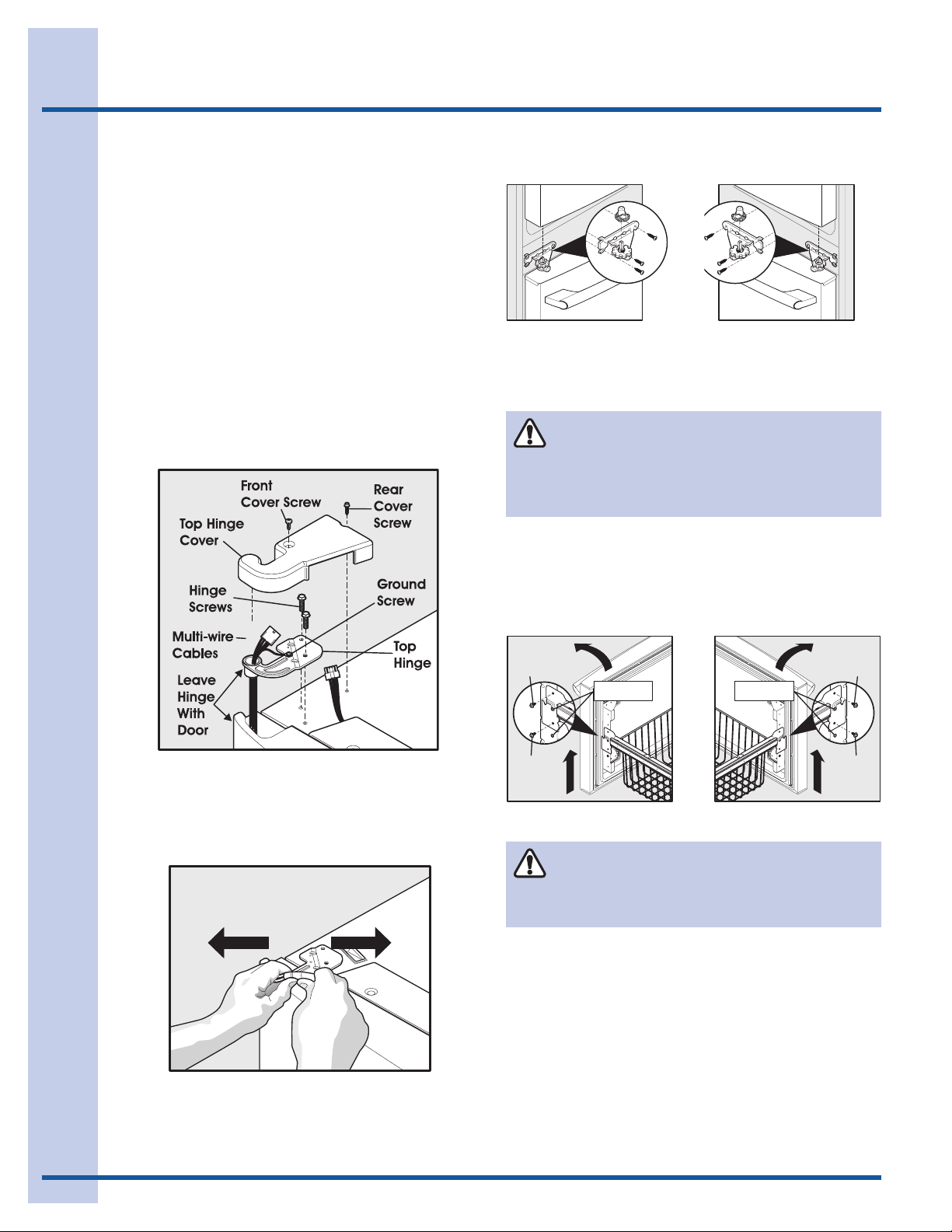
To remove the refrigerator doors:
1 Tracelightlyaroundthedoor’stophingeswitha
pencil. This makes reinstallation easier.
2 Disconnect the harness by grasping both sides of
the connector firmly, depress the latch, and pull
apart. Remove the two (2) screws from the top
hinge. Lift the door off of the bottom hinge and
set it aside.
Lower Hinge Removal
3 Unscrew the three (3) lower hinge screws and
hinge if necessary.
Removing the Doors
Getting through narrow spaces
If your refrigerator will not fit through an entrance area,
you can remove the doors. Check first by measuring the
entrance.
To prepare for removing the doors:
1 Make sure the electrical power cord is unplugged
from the wall outlet.
2 Open the freezer drawer and remove the toe
grille (see “Installation” section).
3 Remove any food from the door shelves and
close the doors.
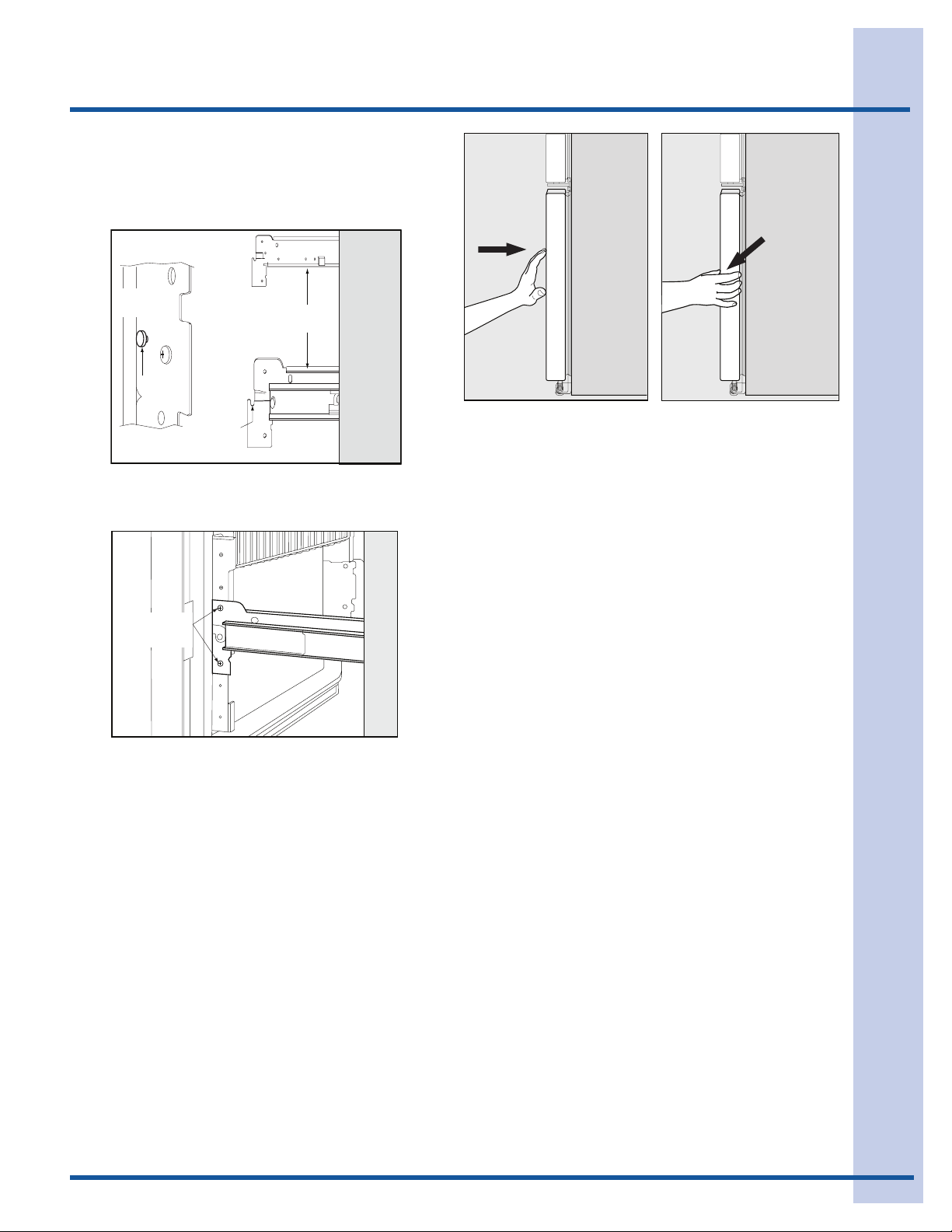
Removing Freezer Drawer
1 Open freezer drawer.
2 Remove drawer screws on right and left sides
(two (2) screws on each side).
3 Lift drawer up and out to remove.
Remove Hex
Head Drawer
Screw
Remove Hex
Head Drawer
Screw
Do Not Remove
Other Screws
Remove Hex
Head Drawer
Screw
Remove Hex
Head Drawer
Screw
Do Not Remove
Other Screws
CAUTION
Drawer is heavy. Use caution when lifting.
To reinstall the right door, reverse the above steps.
11
Removing the Doors
Installing Freezer Drawer
1 With lower slides pulled out, hang drawer onto
slide brackets ensuring pins on each side are
fully inserted into slots on each side.
6 Tighten four (4) drawer screws.
7 Recheck gasket seal.
8 Install the toe grille by fitting into place.
2 Reinstall four (4) drawer screws (two (2) per
side), tighten down, and close drawer (C).
Pull Drawer Out
From Both Sides
Grab Drawer
At Center
Then
Push Against
Freezer Drawer
A B
Fully Extend
Assembly
Drawer Slides
Pin
Slot
Cabinet
Drawer
Install Screws
(2) Each Side
3 Check gasket seal around top, bottom, and sides
of freezer drawer.
4 If gasket is not sealed, open drawer and slightly
loosen four (4) drawer screws (two (2) on each
side) to allow drawer to rotate.
5 Close drawer and recheck the seal on the gasket
(A).Openthedrawergrabbingbythesidesinthe
center (B). Be careful not to rotate the drawer.
12
Installing Door Handles
Door Handle
Mounting
Instructions
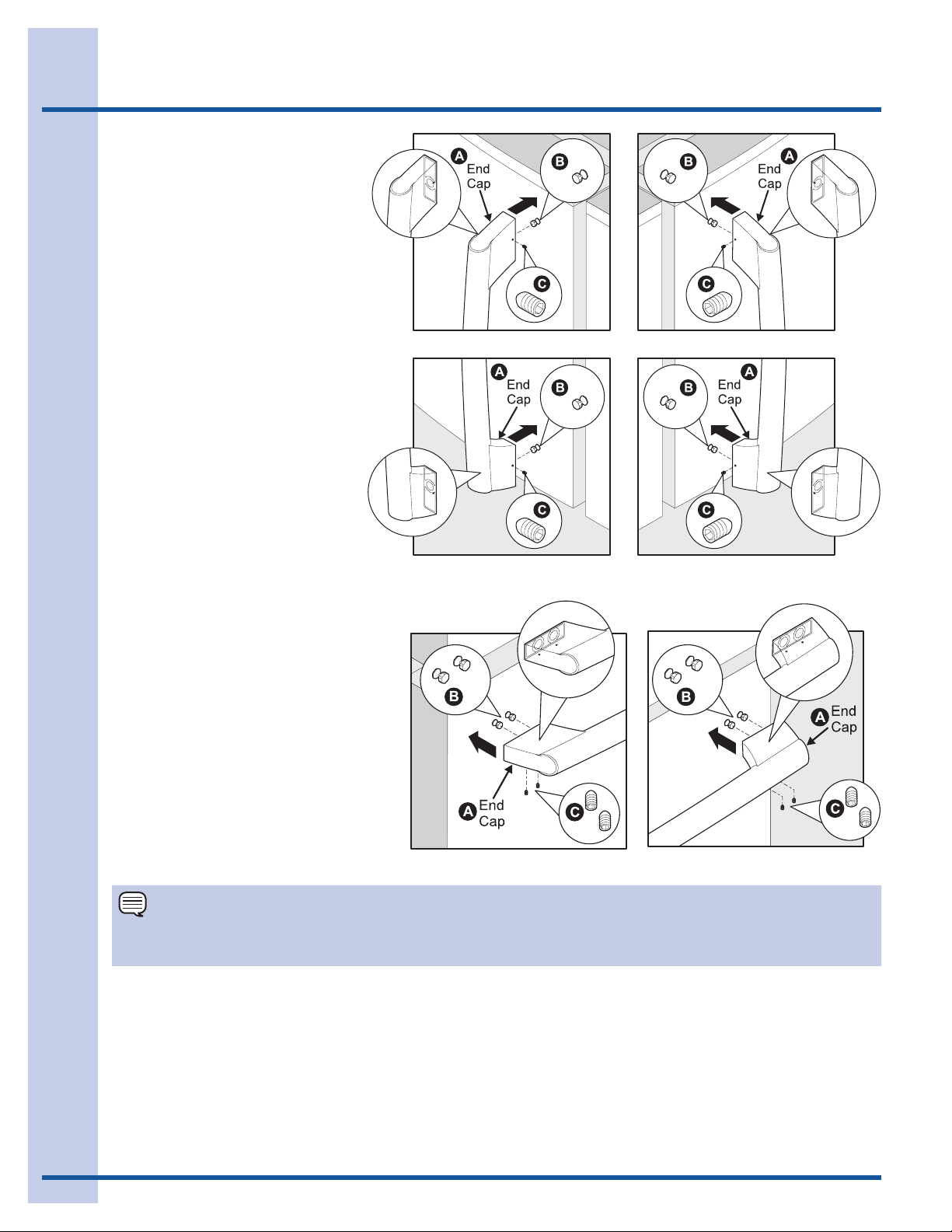
1 Remove handles from
protective packaging.
2 Position fresh food handle
endcaps(A)overupper
and lower pre-installed
shoulder bolts (B) that
are fastened into door,
ensuring the holes for
the set screws are facing
towards the opposite door.
3 While holding handle firmly
against door, fasten upper
andlowerAllensetscrews
(C)withsuppliedAllen
wrench.
4 Repeat steps 2 and 3 to
install opposite handle.
Ensure the holes for the
set screws are facing
towards the first door.
5 Position freezer handle end
caps over left and right pre-
installed shoulder bolts that
are fastened to the drawer,
ensuring the holes for
the set screws are facing
down.
6 While holding handle firmly
against drawer, fasten left
andrightAllensetscrews
(C)withsuppliedAllen
wrench.
Mounting Refrigerator Handles
Mounting Freezer Handle
NOTE
To ensure that handles are flush with doors/drawer, make sure that set screws are completely tightened.
13
Connecting the Water Supply
Before installing the water supply line, you will need:
• BasicTools:adjustablewrench,at-blade
screwdriver, and Phillips
TM
screwdriver
• Accesstoahouseholdcoldwaterlinewithwater
pressure between 30 and 100 psi.
• Awatersupplylinemadeof¼inch(6mm)OD,
copper or stainless steel tubing. To determine the
length of tubing needed, measure the distance
from the ice maker inlet valve at the back of the
refrigerator to your cold water pipe. Then add
approximately 7 feet (2.1 meters), so the refrigerator
can be moved out for cleaning (as shown).
• Ashutoffvalvetoconnectthewatersupplylineto
your household water system. DO NOT use a self-
piercing type shutoff valve.
• Donotreusecompressionttingorusethreadseal
tape.
• Acompressionnutandferrule(sleeve)for
connecting a copper water supply line to the ice
maker inlet valve.
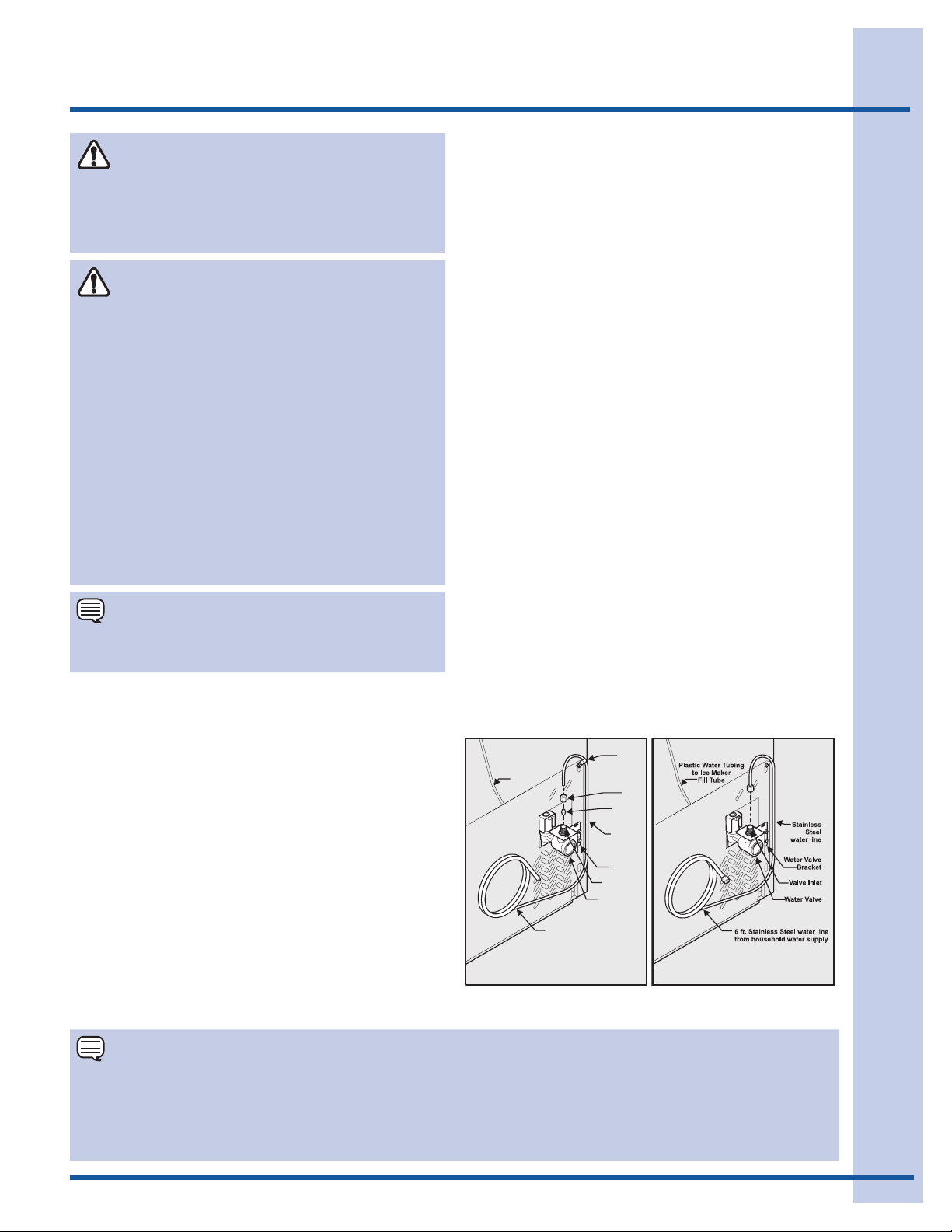
To connect water supply line to ice maker inlet valve:
1. Disconnect refrigerator from electric power source.
2. Place end of water supply line into sink or bucket.
Turn ON water supply and flush supply line until
water is clear. Turn OFF water supply at shutoff valve.
3. Remove plastic cap from water valve inlet and
discard cap.
4. If you use copper tubing - Slide brass compression
nut, then ferrule (sleeve) onto water supply line. Push
water supply line into water valve inlet as far as it will
go(¼inch/6mm).Slideferrule(sleeve)intovalve
inlet and finger tighten compression nut onto valve.
Tighten another half turn with a wrench; DO NOT
overtighten. See Figure 1.
If you use stainless steel tubing - The nut and
ferrule are already assembled on the tubing. Slide
compression nut onto valve inlet and finger tighten
compression nut onto valve. Tighten another half turn
with a wrench; DO NOT overtighten. See Figure 2.
5. With steel clamp and screw, secure water supply line
(copper tubing only) to rear panel of refrigerator as
shown.
6. Coil excess water supply line (copper tubing only),
about 2½ turns, behind refrigerator as shown and
arrange coils so they do not vibrate or wear against
any other surface.
7. Turn ON water supply at shutoff valve and tighten
any connections that leak.
8. Reconnect refrigerator to electrical power source.
9. To turn ice maker on, lower wire signal arm (freezer
icemaker)orsettheicemaker’sOn/Offpower
switch to the “ON” position (fresh food ice maker).
Figure 2Figure 1
Copper water line
from household water supply
(Includeenough tubing in loop to allow
moving refrigerator out for cleaning.)
Ferrule
(Sleeve)
Copper
water line
WaterValve
Valve Inlet
Water Valve
Bracket
Steel
Clamp
Plastic Water Tubing
to Ice Maker
Fill Tube
Brass
Compression
Nut
WARNING
To avoid electric shock, which can cause death or
severe personal injury, disconnect the refrigerator
from electrical power before connecting a water
supply line to the refrigerator.
CAUTION
To Avoid Property Damage:
• CopperorStainlessSteelbraidedtubingis
recommended for the water supply line. Water
supply tubing made of ¼ inch plastic is not
recommended to be used. Plastic tubing greatly
increases the potential for water leaks, and the
manufacturer will not be responsible for any
damage if plastic tubing is used for the supply
line.
• DONOTinstallwatersupplytubinginareas
where temperatures fall below freezing.
• Chemicalsfromamalfunctioningsoftener
can damage the ice maker. If the ice maker
is connected to soft water, ensure that the
softener is maintained and working properly.
IMPORTANT
Ensure that your water supply line connections
comply with all local plumbing codes.
NOTE
Check with your local building authority for recommendations on water lines and associated materials prior to installing your
new refrigerator. Depending on your local/state building codes, Electrolux recommends for homes with existing valves its
Smart Choice® water line kit 5305513409 (with a 6 ft. Stainless Steel Water Line) and for homes without an existing valve,
Electrolux recommends its Smart Choice water® line kit 5305510264 (with a 20 ft. Copper Water Line with self-tapping
saddle valve). Please refer to www.electroluxappliances.com for more information.
14
Controls
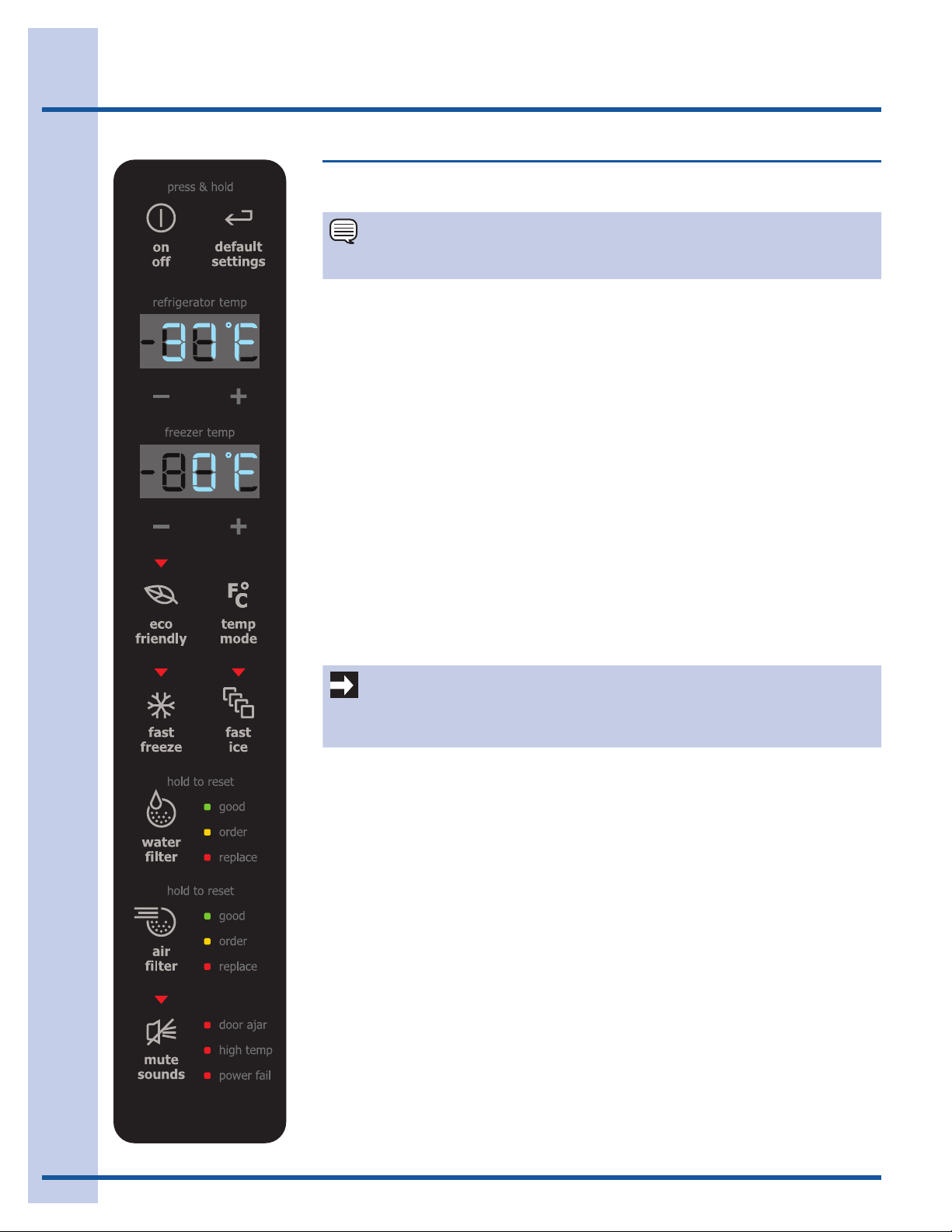
IQ-Touch
TM
Aredindicatorlightwillbeilluminatedabovemostactivefeatures.
Touch the icon to activate the options below.
Setting cooling temperatures
Press the + or – indicator to adjust the temperature to the desired setting.
The temperature display will begin to blink with the first touch. The display will time
out after 10 seconds and return to the basic display.
Alarms
IMPORTANT
Pressing the system on/off icon does not turn off power to your refrigerator. You
must unplug the power cord from the wall outlet.
Door Ajar If the door has been left open for an extended period of time, an alarm will sound
and the door ajar indicator will display on the bottom display of the control panel.
The alarm is turned off by closing the door. The mute sounds key will blink to
prompt the reset of any active alarms. Press this key to reset any system alarms.
High Temp In the event of a high temperature condition, the temperature display will blink and
display “HI”. After 20 minutes, the alarm will sound and the high temp indicator
will be red on the bottom of the control panel. The mute sounds icon will illumi-
nate until pressed, acknowledging the alarm, at which time the highest temperature
reached will be displayed and the refrigerator will resume normal operation. In
case the high temp alarm is not acknowledged at the first alarm sound time out,
when the door is first opened, the alarm sound will be repeated.
Power Fail In the event of a power failure, the power fail alert will be displayed and the
temperature display will blink until the mute sounds icon is pressed, acknowledg-
ing the alarm. Other modes may be turned off until the alarm is acknowledged. The
power fail alert is turned off and the refrigerator will resume normal operation. The
high temp alarm may also be illuminated until a safe operating range tempera-
ture has been reached.
NOTE
*Features may vary according to model.
fast freeze Activates a faster rate for freezing food.
fast ice Increases the production of ice
water filter Press and hold for three (3) seconds to reset after filter change.
air filter Filter condition status is always displayed when door is open. Press and hold for
three (3) seconds to reset after filter change.
temp mode Touch to toggle display from Fahrenheit to Celsius.
mute sounds Tones emitted by each key press can be turned off based on user preference. The
sounds are muted when the red indicator is lit. Warning signals will stay active.
default settings Resets all refrigerator settings such as temp, temp display and tones to their fac-
tory default settings.
on off Press and hold for three (3) seconds to turn off the cooling system to clean the
refrigerator. It also turns off the ice maker. The temperature displays will read OFF.
eco friendly Keep this switch set on eco friendly (light on) for lowest energy usage. If moisture
appears on the cabinet between the doors, pressing this button will turn the light
off and enable an electric heater used to reduce moisture on the cabinet between
the doors.
*vacation mode Conserves energy by increasing the time between automatic defrost. This feature
is automatically activated during long periods between door openings. Vacation
mode is manually activated when the red indicator is lit.
15
Controls
The Sabbath Mode is a feature that disables portions
of the refrigerator and its controls for IQ-Touch
TM
, in
accordance with observance of the weekly Sabbath
and religious holidays within the Orthodox Jewish
community.
Sabbath Mode is turned ON and OFF by pressing and
holding the freezer temp “-” and the refrigerator temp
“+” indicators for five (5) seconds. The display shows
“Sb” while in Sabbath mode.
In the Sabbath Mode, the High Temp alarm is active for
health reasons. If a high temperature alarm is
activated during this time, for example due to a
door left ajar, the alarm will sound intermittently
for about two (2) minutes. The alarm will then
silence on its own and a red high temperature icon
will display. The high temp icon will continue to display,
even if the door is closed, until the Sabbath mode is
exited and the icon reset. The refrigerator will function
normally once the door is closed, without any violation
of the Sabbath/Holidays.
For further assistance, guidelines for proper usage and
a complete list of models with the Sabbath feature,
please visit the web at http:\\www.star-k.org.
IQ-Touch
TM
“Sabbath Mode”
NOTE
During Sabbath Mode, the ice maker is turned off by
main control board.
NOTE
While in Sabbath Mode, neither the lights nor
the control panel will work until Sabbath Mode is
deactivated.
Refrigerator stays in Sabbath Mode after power
failure recovery. It must be deactivated with the
buttons on the control panel.
Sabbath Mode and the Perfect Temp
TM
Drawer
The Perfect Temp
TM
Drawer should be turned off for the
Sabbath/Holidays. Before putting the refrigerator into
the Sabbath mode, turn the Perfect Temp
TM
Drawer off
by pressing the drawer on/off button. The display will
show “OFF” and the drawer will turn off. Then enter the
Sabbath mode function on the main refrigerator display.
See the IQ-Touch “Sabbath Mode” section. When in
Sabbath mode, the display will not illuminate and the
drawer will remain off. The drawer can still be used as
a non-temp controlled drawer in this mode. When the
refrigerator is taken out of Sabbath mode, the Perfect
Temp
TM
Drawer will have to be turned back on.
NOTE
If the Perfect Temp
TM
Drawer is not turned off prior
to putting the unit into Sabbath Mode, it will continue
to adjust itself to maintain the set point even if the
display does not illuminate to show that it is still on.
16
Automatic Ice Maker
Ice maker operation & care
Aftertherefrigeratorisinstalledproperly,theicemaker
can produce ice within 24 hours. It can completely fill an
ice bin in about three (3) days.
When using the ice maker for the first time and in order
for the ice maker to work properly, it is necessary to
clear air from water filter tubing. Once ice maker begins
making ice, allow the bucket to fill completely, then
discard the first TWO (2) FULL buckets of ice. It will
take at least two (2) days to completely fill the bucket on
regular ice making mode or 1
1
/
2
days on fast ice mode.
The ice maker produces approximately four (4) pounds
of ice every 24 hours depending on usage conditions.
IMPORTANT
Your ice maker is turned on at the factory so it can
work as soon as you install your refrigerator. If you
cannotconnectawatersupply,lifttheicemaker’s
wire signal arm to turn it off. Otherwise, the ice
maker’sllvalvemaymakealoudchatteringnoise
when it attempts to operate without water.
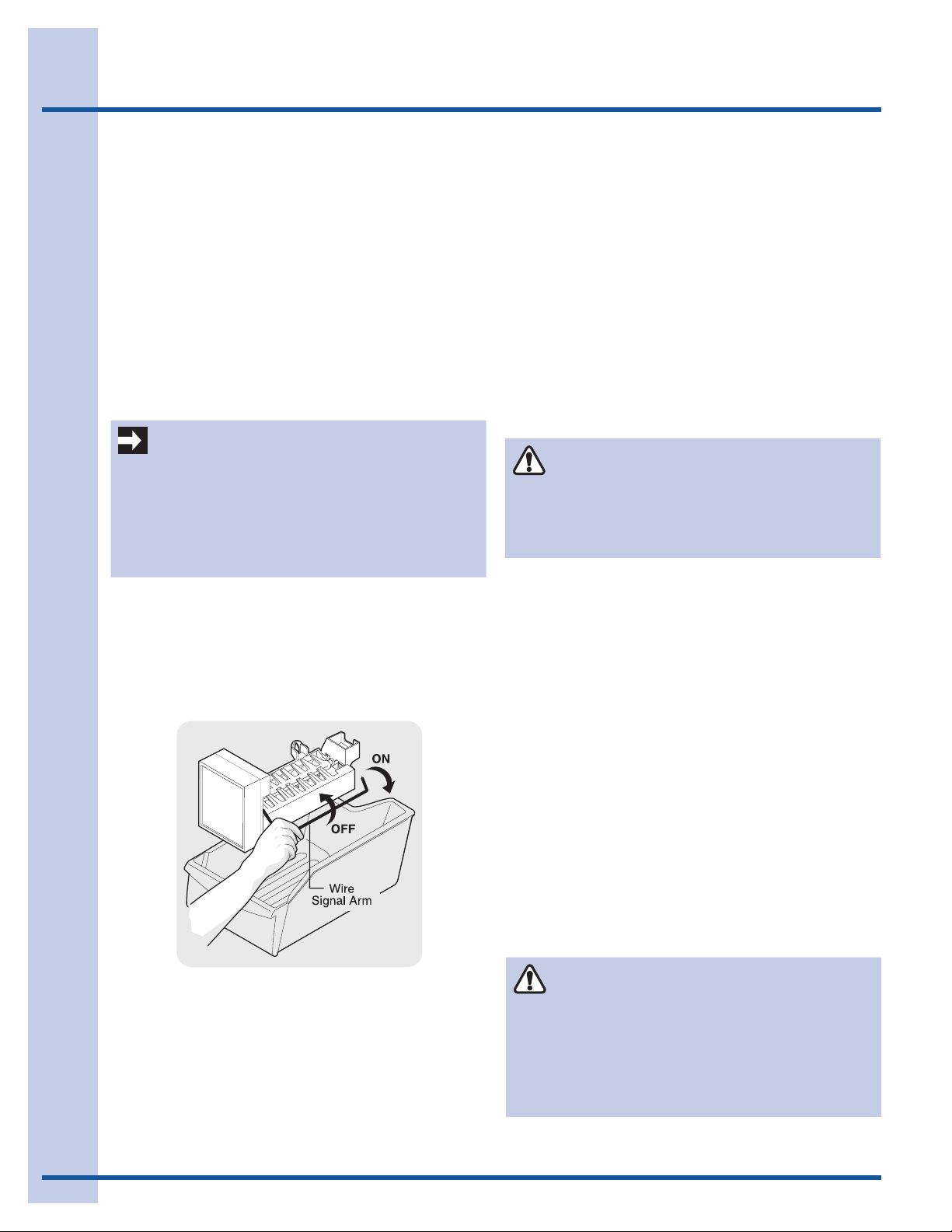
Turning the ice maker on and off
Ice production is controlled by lifting/lowering the ice
maker’swire signal arm. To gain access to the ice
maker, pull the freezer drawer out. Lift the wire signal
arm to turn the ice maker OFF and lower the wire signal
arm to turn it ON.
Ice maker tips
• Ifyourrefrigeratorisnotconnectedtoawater
supply or the water supply is turned off, turn off
the ice maker by lifting wire signal arm.
Cleaning the ice maker
Clean the ice maker and ice bin at regular intervals,
especially prior to vacation or moving.
1 Turn off the ice maker.
2 Remove the ice bin.
3 Empty and carefully clean the ice bin with mild
detergent. Do not use harsh or abrasive cleaners.
Rinse with clean water.
4 Allowtheicebintodrycompletelybefore
replacing in the freezer.
5 Replace the ice bin. Turn the ice maker on.
Remove and empty the ice bin if:
• Anextendedpowerfailure(onehourorlonger)
causes ice cubes in the ice bin to melt and freeze
together.
Remove the ice bin and shake to loosen the cubes or
clean as explained above.
CAUTION
If the water supply to your refrigerator is softened,
be sure the softener is properly maintained.
Chemicals from a water softener can damage the
ice maker.
CAUTION
NEVER use an ice pick or similar sharp
instrument to break up the ice. This could damage
the ice bin.
To loosen stuck ice, use warm water. Before
replacing the ice bin, make sure it is completely
dry.
• Thefollowingsoundsarenormalwhentheice
maker is operating:
- Motor running
- Ice dropping into ice bin
- Water valve opening or closing
- Running water
• Icecubesstoredtoolongmaydevelopanodd
flavor. Empty the ice bin as explained below.
Fast Ice Function
Your refrigerator is equipped with a “Smart” Fast Ice
Function, that will, if activated at your user interface,
allow an increase in ice production. You do not need to
deactivate it, if not needed, your refrigerator will operate
on normal conditions.
17
Storage Features
Your refrigerator includes glass shelves that are
designed to catch and hold accidental spills.
You can easily adjust shelf positions in the fresh food
compartments to suit your needs. The shelves have
mounting brackets that attach to slotted supports at the
rear of each compartment.
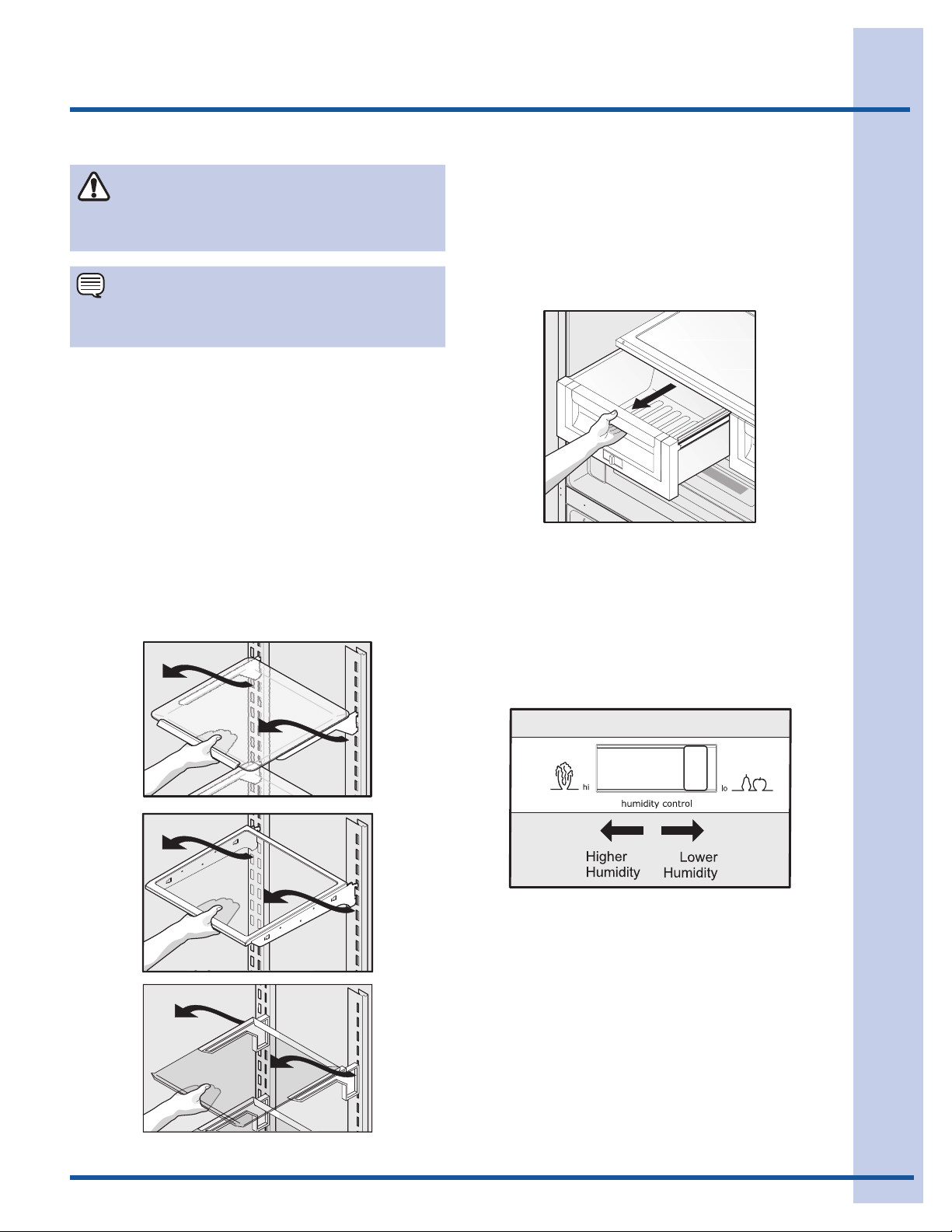
To change the position of a shelf:
1 Before adjusting a shelf, remove all food.
2 Lift the front edge up and pull the shelf out.
3 Replace by inserting the mounting bracket hooks
into the desired support slots.
4 Lower the shelf and lock into position.
Crispers
Crisper drawers are designed for storing fruits,
vegetables, and other fresh produce.
CAUTION
To avoid injury from breakage, handle tempered
glass shelves carefully.
NOTE
Features may vary according to model.
Opening Crisper Drawer
Adjusting Crisper Humidity
(select models)
Drawers
Your refrigerator includes a variety of storage drawers.
These drawers are located in fixed positions at the
bottom of the fresh food compartment.
Crisper humidity control
Crisper drawers include a sliding control for adjusting
the humidity inside the crisper. Leafy vegetables keep
best when stored with the Humidity Control set on
Higher Humidity. Fresh fruits keep best when stored
with the Humidity Control set on Lower Humidity.
Shelf features
Full Luxury-Design
TM
Shelf (varies by model)
18
Storage Features
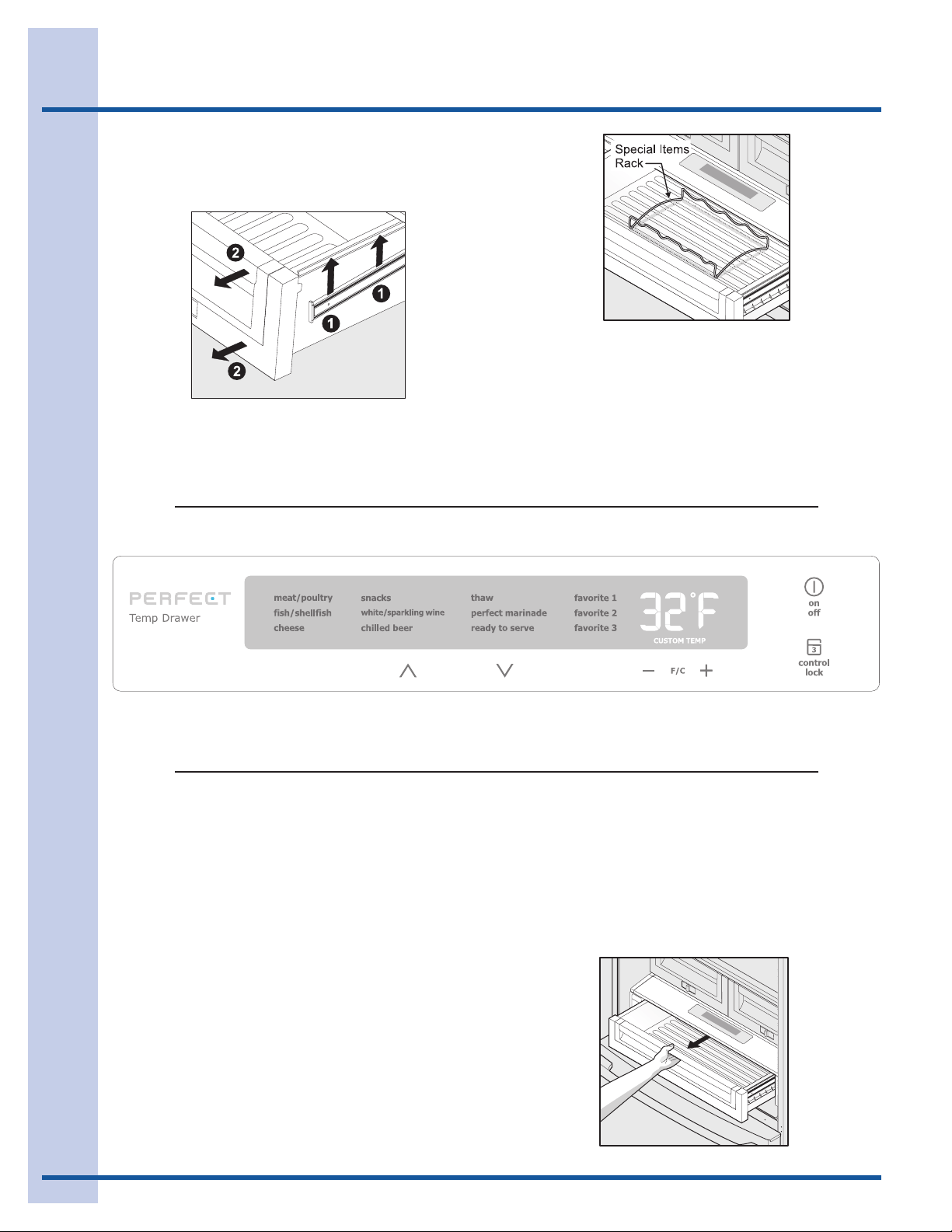
Special items rack (select models)
The innovative design of the special items rack allows
you to store four (4) bottles of wine or soft drink bottles.
Removing Crisper Drawer
To remove the Crisper Drawer for cleaning:
1 Pull the drawer out until it stops.
2 Lift the front slightly and remove the drawer.
Cool Zone
TM
Drawer (select models)
Some models are equipped with a meat keeper drawer
for short-term storage of bulk meat items. This drawer
includes sliding controls for adjusting the humidity
inside.
Anymeattobekeptlongerthantwo(2)daysshouldbe
frozen. If you store fruits or vegetables in this drawer,
set it to a higher humidity.
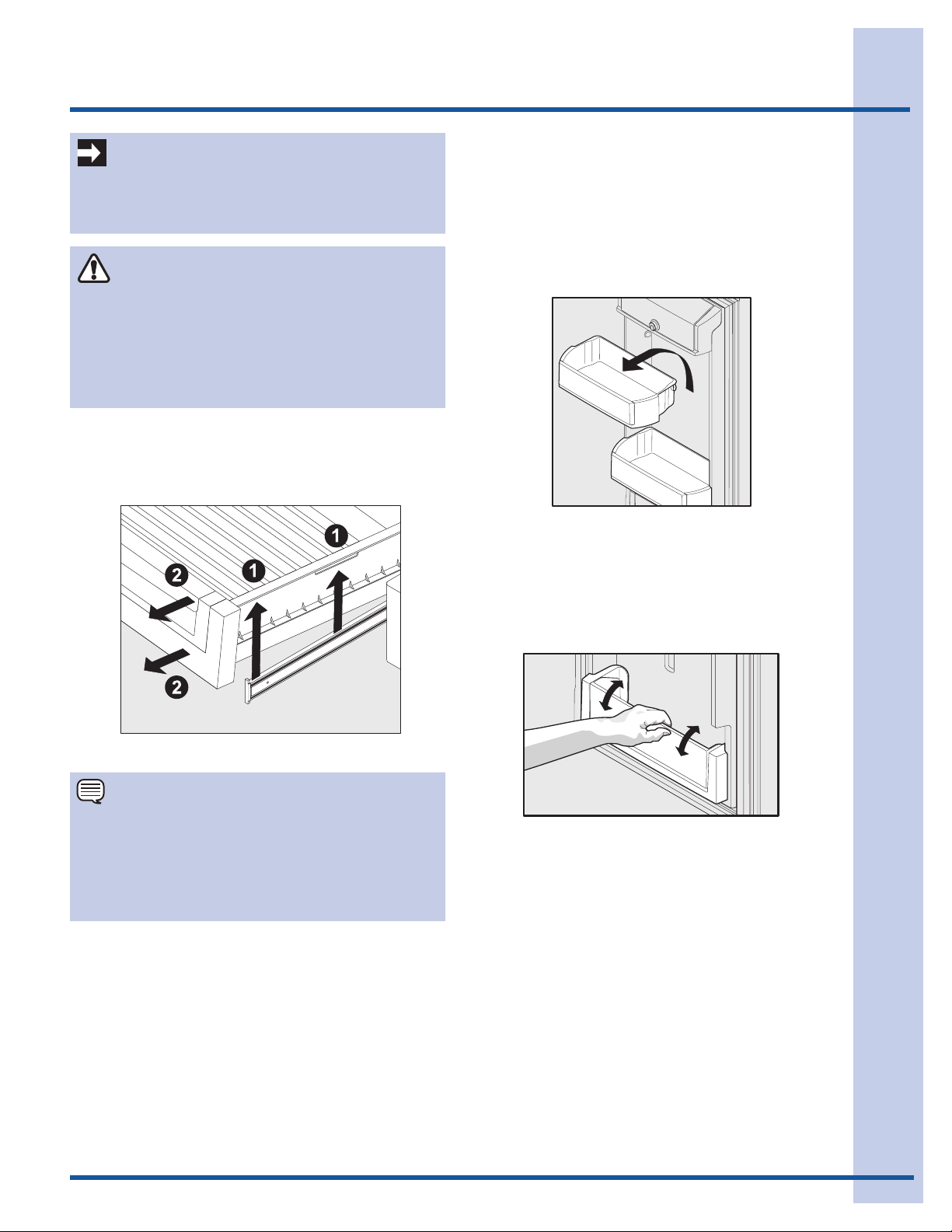
The Perfect Temp
TM
Drawer is designed to keep food items at a precise temperature whether cooler, warmer, or
the same as the fresh food section of the refrigerator. The thaw setting holds a temperature for thawing frozen
foodsfor12hours.Attheendofthattime,itthenswitchestothesnackssettingtostorethethawedfood.
Perfect Temp
TM
Drawer (select models)
To operate:
1 Toturnonandoff,pressthedrawer’sOn/Off
button. The numeric display will show a temperature
between “28°F and 42°F” when on and “OFF” when
off.
2 Press F/C if you prefer to display Fahrenheit “F,”
or Celsius “C”.
3 Press either the up ∧ or down ∨ scroll buttons to
illuminate the desired item.
4 Once an option is selected, the drawer will adjust
and maintain the temperature for the setting
selected.
5 When turned off, the Perfect Temp
TM
Drawer
functions as a standard deli drawer. The Perfect
Temp
TM
Drawer is best used for packaged food
products. Leafy vegetables and unpackaged
fruits are best kept in one of the crisper drawers.
Opening the Drawer
6 The three favorite selections provide flexibility to
set and store personal temperature selections.
The temperature is adjusted up by pressing the
+ or – buttons. The drawer will store the selected
temperature setting until it is changed.
7 The control buttons can be locked to prevent
accidental changes by pressing the control
lock button for three (3)seconds. Deactivate by
pressing for three (3)seconds again.
19
Storage Features
To remove the Perfect Temp
TM
Drawer for cleaning:
1 Pull the drawer out until it stops.
2 Lift the front slightly and remove the drawer.
Removing the Drawer
IMPORTANT
DO NOT clean the display area of the Perfect Temp
TM
Drawer with abrasive or caustic cleaners. Wipe clean
with a moist sponge.
CAUTION
The Perfect Temp
TM
Drawer and cover can
be removed for cleaning but the control unit,
attached to the right side of the fridge, cannot
be removed. Do not immerse the Perfect Temp
TM
Drawer cover in water or put it in a dishwasher.
Clean with a damp cloth or sponge.
NOTE
When the refrigerator is turned off by pressing the
main IQ-Touch
TM
on/off button, the Perfect Temp
TM
Drawer will also be turned off. When the refrigerator
is turned back on, the Perfect Temp
TM
Drawer will
resume operations at the temp setting that was set
before the refrigerator was turned off.
Doors
Storage bins
The doors to your fresh food compartment use a
systemofmodularstoragebins.Allofthesebinsare
removable for easy cleaning. Some of them have fixed
positions, while others can be adjusted to your needs.
Door bins are ideal for storing jars, bottles, cans, and
large drink containers. They also enable quick selection
of frequently used items.
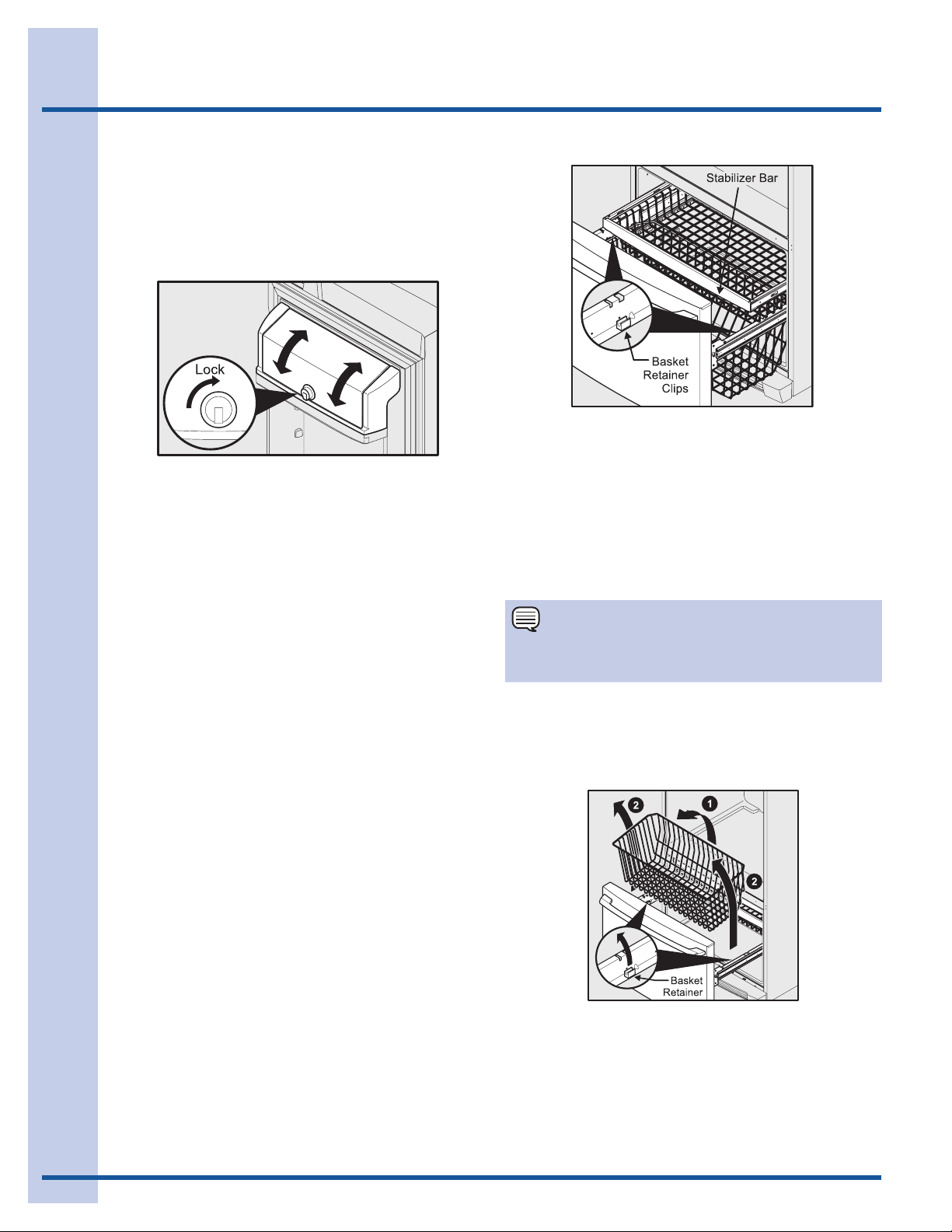
Adjustable Door Bin
To change the position of an adjustable door bin:
1 Before adjusting a bin, remove all food.
2 Grip the bin firmly with both hands and lift it
upward.
3 Remove the bin.
4 Place the bin just above desired position.
5 Lower the bin onto supports until locked in place.
Accessories (varies by model)
Tilt can bins
The can bins allow you to efficiently and securely store
up to eight 12-ounce canned beverages.
Tilt Can Bin
20
Storage Features
Covered Door Bin
Use the covered door bin, at the top of the fresh food
compartment door, for short-term storage of cheese,
spreads, or butter. The covered door bin is designed
to be warmer than the open area and includes a lift-up
cover that may be locked and a dairy divider (select
models).
Covered Door Bin
Freezer Features (varies by model)
To Remove Upper Basket
1 Remove all items from basket.
2 Remove basket by pulling basket out to its full
extension and lift out.
To reinstall upper basket, position basket onto the
retainer clips making sure the front of the basket rests in
the retainer clips on the stabilizer bar.
Tilt Wire Shelf
The freezer tilt wire shelf (located on the inside of the
freezer drawer) is not designed to be removed.
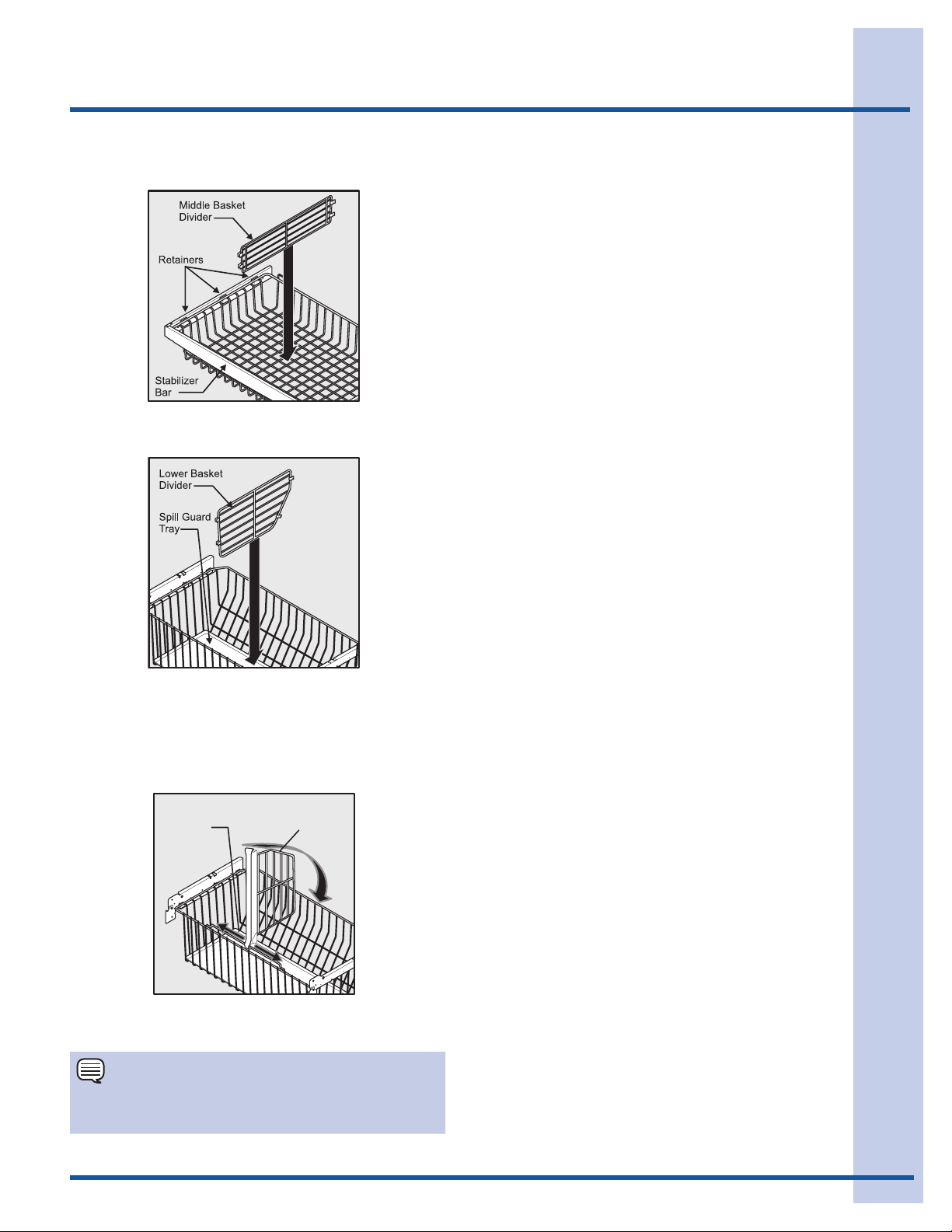
Removing Lower Basket
To reinstall lower basket, insert basket into retainer
clips.
NOTE
If basket is not resting on stabilizer bar retainer clips,
the drawer will not close properly.
Two Freezer Baskets
To Remove Lower Basket
1 Remove all items from basket.
2 Remove the basket by tilting it forward and lifting
it from the retainer clips.
21
Storage Features
Upper Basket Divider
Lower Basket Divider &
Spill Guard Tray
Dividers Removal
Lift up on the front of the upper divider and pull out.
Lift up on the rear of the lower divider and pull out.
NOTE
Spill Guard Tray should be hand washed in warm
water.
To reposition the pivoting divider (some models), lift up
and slide to desired location. The pivoting divider is not
designed to be removed .
Lower Basket Pivoting Divider
(some models)
Spill Guard
Tray
Lower Basket
Pivoting Divider

22
Ideas for storing foods
Fresh food storage
• Keepthefreshfoodcompartmentbetween34°F
and40°Fwithanoptimumtemperatureof37°F.
• Avoidovercrowdingtherefrigeratorshelves,
which reduces air circulation and causes uneven
cooling.
Fruits and vegetables
• Storefruitsandvegetablesincrisperdrawers,
where trapped moisture helps preserve food
quality for longer time periods.
• Washitemsandremoveexcesswater.
• Wrapanyitemsthathavestrongodorsorhigh
moisture content.
Meat
• Wraprawmeatandpoultryseparatelyand
securely to prevent leaks and contamination of
other foods or surfaces.
• UsetheCoolZone
TM
or Perfect Temp
TM
drawer
and set to meat/poultry setting for short-term
storage.Anymeattobekeptlongerthantwo(2)
days should be frozen.
Frozen food storage
• Keepthefreezercompartmentat0°Forlower.
• Afreezeroperatesmostefcientlywhenitisat
least ²⁄₃ full.
Packaging foods for freezing
• Tominimizefooddehydrationandquality
deterioration, use aluminum foil, freezer wrap,
freezer bags, or airtight containers. Force as
much air out of the packages as possible and
seal them tightly. Trapped air can cause food to
dry out, change color, and develop an off-flavor
(freezer burn).
• Wrapfreshmeatsandpoultrywithsuitable
freezer wrap prior to freezing.
• Donotrefreezemeatthathascompletely
thawed.
Loading the freezer
• Priortogroceryshopping,activate“fastfreeze”
so that on your return you can ensure your newly
purchased food designated for the freezer will be
preserved as quickly as possible.
• Activating“fastfreeze”alsowillhelpyour
freezer more efficiently maintain the selected
temperature after placing new purchases with
pre-existing frozen foods.
Storing Food and Saving Energy
• Avoidaddingtoomuchwarmfoodtothefreezer
at one time. This overloads the freezer, slows the
rate of freezing, and can raise the temperature of
frozen foods.
• Leaveaspacebetweenpackages,socoldair
can circulate freely, allowing food to freeze as
quickly as possible.
Ideas for saving energy
Installation
• Locatetherefrigeratorinthecoolestpartof
the room, out of direct sunlight, and away from
heating ducts or registers.
• Donotplacetherefrigeratornexttoheat-
producing appliances such as a range, oven, or
dishwasher. If this is not possible, a section of
cabinetry or an added layer of insulation between
the two (2) appliances will help the refrigerator
operate more efficiently.
• Leveltherefrigeratorsothatthedoorsclose
tightly.
Temperature settings
• Refertothe“Controls”sectionforprocedureson
temperature settings.
Food storage
• Avoidovercrowdingtherefrigeratororblocking
cold air vents. Doing so causes the refrigerator to
run longer and use more energy.
• Coverfoodsandwipecontainersdrybefore
placing them in the refrigerator. This cuts down
on moisture build-up inside the unit.
• Organizetherefrigeratortoreducedoor
openings. Remove as many items as needed at
one time and close the door as soon as possible.
• Donotplaceahotcontainerdirectlyonacold
shelf. Remember, such an extreme temperature
change may damage the glass.
23
Normal Operating Sounds
Understanding the sounds you
may hear
Your new, high-efficiency refrigerator may introduce
unfamiliar sounds. These sounds normally indicate
your refrigerator is operating correctly. Some surfaces
on floors, walls, and kitchen cabinets may make these
sounds more noticeable.
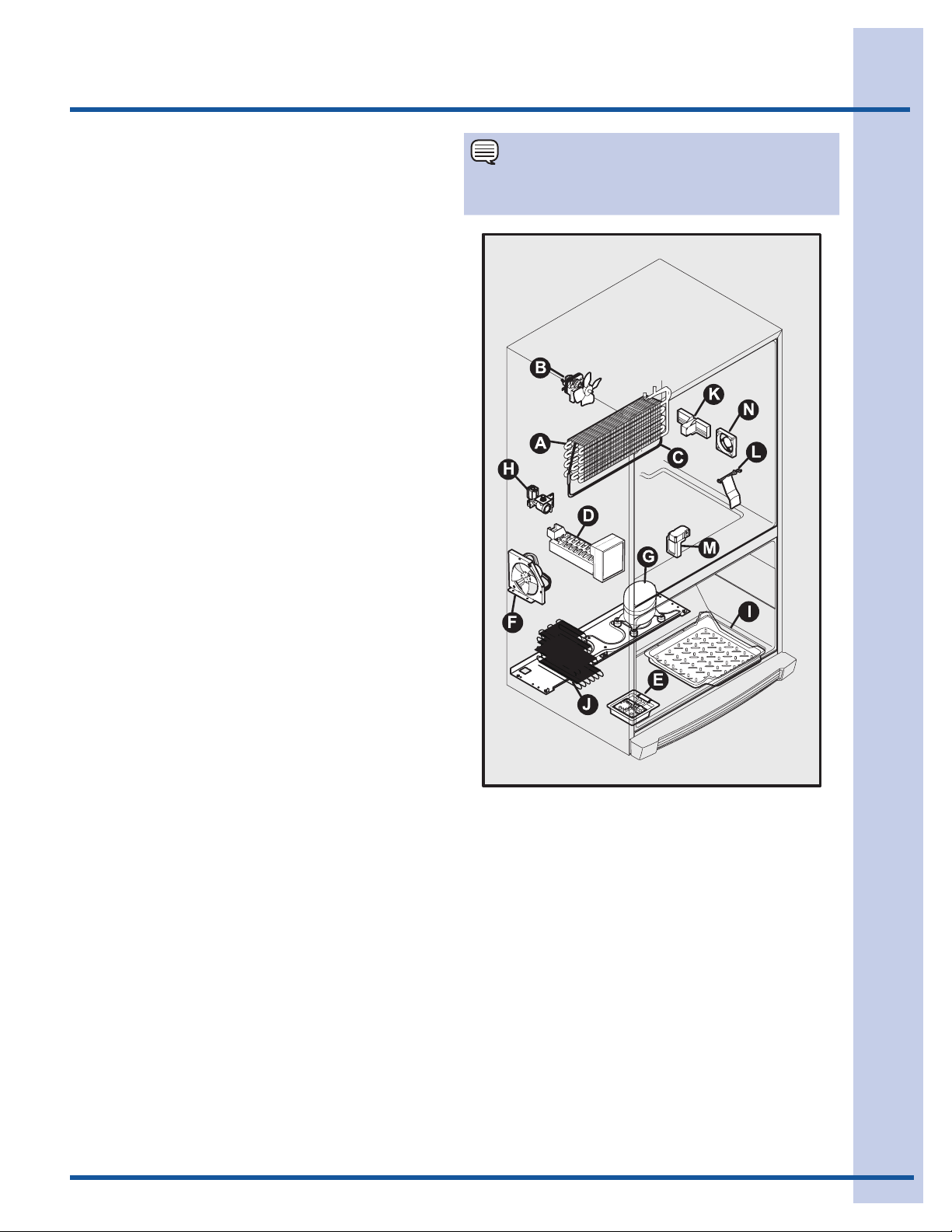
The following is a list of major components in your
refrigerator and the sounds they can cause:
A Evaporator Refrigerant through the evaporator
may create a boiling or gurgling sound.
B Evaporator fan You may hear air being forced
through the refrigerator by the evaporator fan.
C Defrost heater During defrost cycles, water
dripping onto the defrost heater may cause a
hissingorsizzlingsound.Afterdefrosting,a
popping sound may occur.
D Automatic ice maker When ice has been
produced, you will hear ice cubes falling into
the ice bin. Water valve activation may create
sounds from its operation.
E Electronic control & automatic defrost control
These parts can produce a snapping or clicking
sound when turning the cooling system on and
off.
F Condenser fan You may hear air being forced
through the condenser.
G Compressor Modern, high-efficiency
compressors run much faster than older models.
The compressor may have a high-pitched hum or
pulsating sound.
H Water valve Makes a buzzing sound each time it
opens to fill the ice maker.
I Drain pan (not removable) You may hear water
dripping into the drain pan during the defrost
cycle.
J Condenser May create minimal sounds from
forced air.
K Motorized Perfect Temp
TM
drawer damper May
produce a light humming during operation.
M Motorized damper May produce a light
humming during operation.
N Perfect Temp
TM
drawer fan Turns off when door
opens or Perfect Temp
TM
drawer is turned off.
NOTE
Energy efficient foam in your refrigerator is not a
sound insulator.
24
Changing the Water and Air Filters
Your refrigerator is equipped with separate water and
air filtering systems. The water filter system filters all the
water used to produce ice. The air filter removes odors
and impurities from the refrigerator compartment.
Push Water Filter Button
NOTE
The control panel includes controls to monitor the
status of your water and air filters. See the Controls
section for more information.
About your advanced water filter
The PureAdvantage
TM
NGFC-2000 filter
system is tested and certified by NSF
InternationaltoNSF/ANSIStandards
42 and 53 for the reduction of claims
specified on the performance data sheet.
Do not use with water that is microbiologically unsafe
or of unknown quality without adequate disinfection
before or after the system. Systems certified for cyst
reduction may be used on disinfected waters that may
contain filterable cysts.
• RatedCapacity-240gallons
• Ratedserviceow-.5gallonsperminute
• MaximumRatedPressure-100poundsper
square inch
• RecommendedMinimumOperatingPressure:
30 pounds per square inch
• OperatingTemp.:Min.33°F,Max.100°F
Water filter
The water filter is located at the lower left side of the
fresh food compartment.
Replacing your PureAdvantage
TM
water
filter
In general, you should change the water filter every six
(6) months to ensure the highest possible water quality.
The Water Filter Status light on the Touch Panel
prompts you to replace the filter after the 6 month time
period has elasped. The water filter status light on this
model is not performance tested or certified by NSF.
If your refrigerator has not been used for a period of
time (during moving for example), change the filter
before reinstalling the refrigerator.
It is not necessary to turn the water supply off to
change the filter. Be ready to wipe up any small
amounts of water released during the filter replacement.
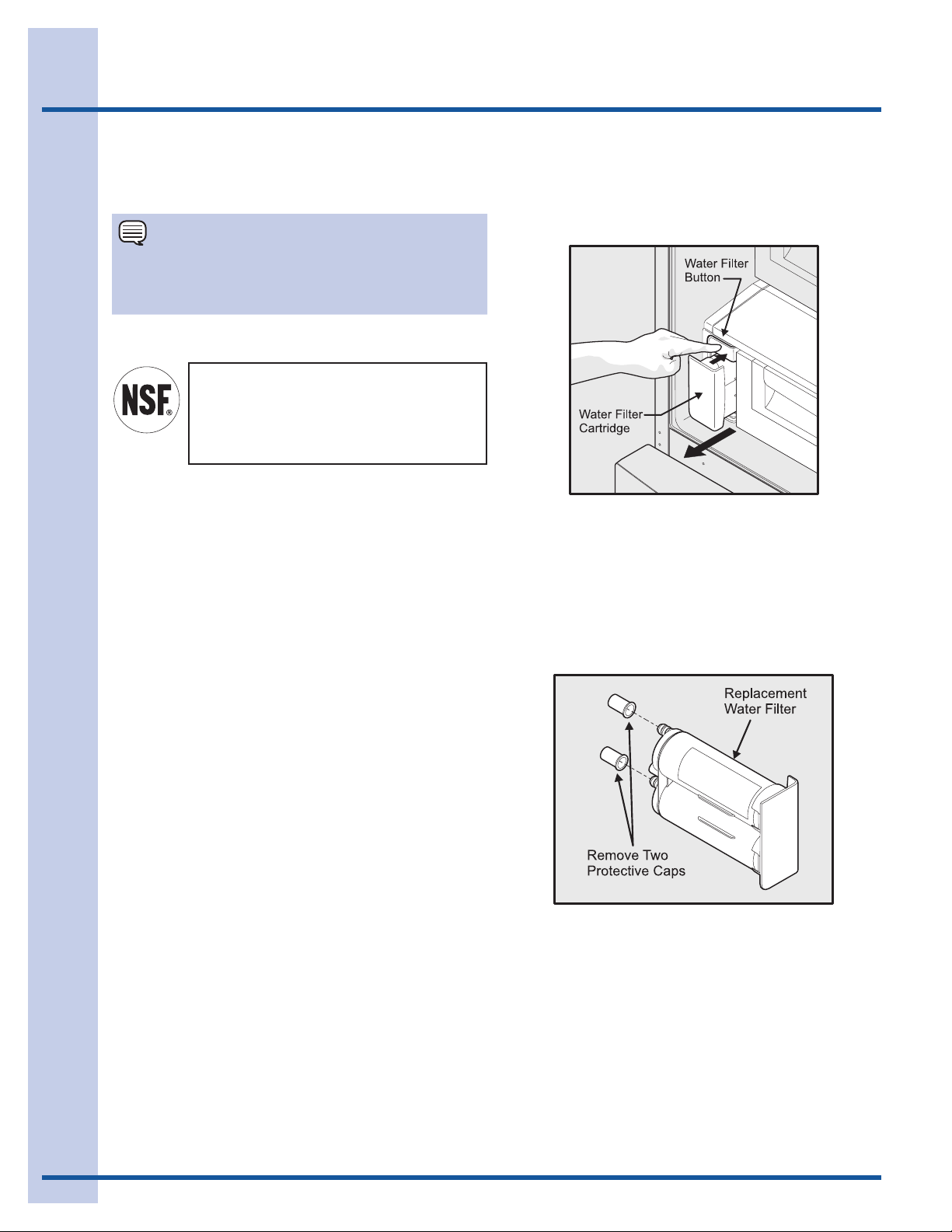
1 Push the filter release button above the cartridge
to disconnect it.
2 Slide the old water filter cartridge straight out of
the housing and discard it.
3 Unpack the new filter cartridge and remove the
two (2) protective caps covering the inlet and exit
of the filter. Slide the filter gently into the housing
until it stops against the snap-in connector at the
back of the housing.
25
Reinstall Water Filter
Ordering replacement filters
Order new filters by calling 877-808-4195, online at
www.electroluxappliances.com, or through the dealer
where you bought your refrigerator. You may want to
consider ordering extra filters when you first install your
refrigerator.
Water Filter FC-300 PureAdvantage
TM
Replacement Cartridge #EWF01
AirFilterReplacementcartridge,part
#EAFCBF
Air filter
The air filter is located under the utility bin.
Replacing your PureAdvantage
TM
air filter
To ensure optimal filtering of refrigerator odors, you
should change the air filter every six (6) months (the
filter status light on the Touch Panel prompts you to
replace the filter after six (6) months).
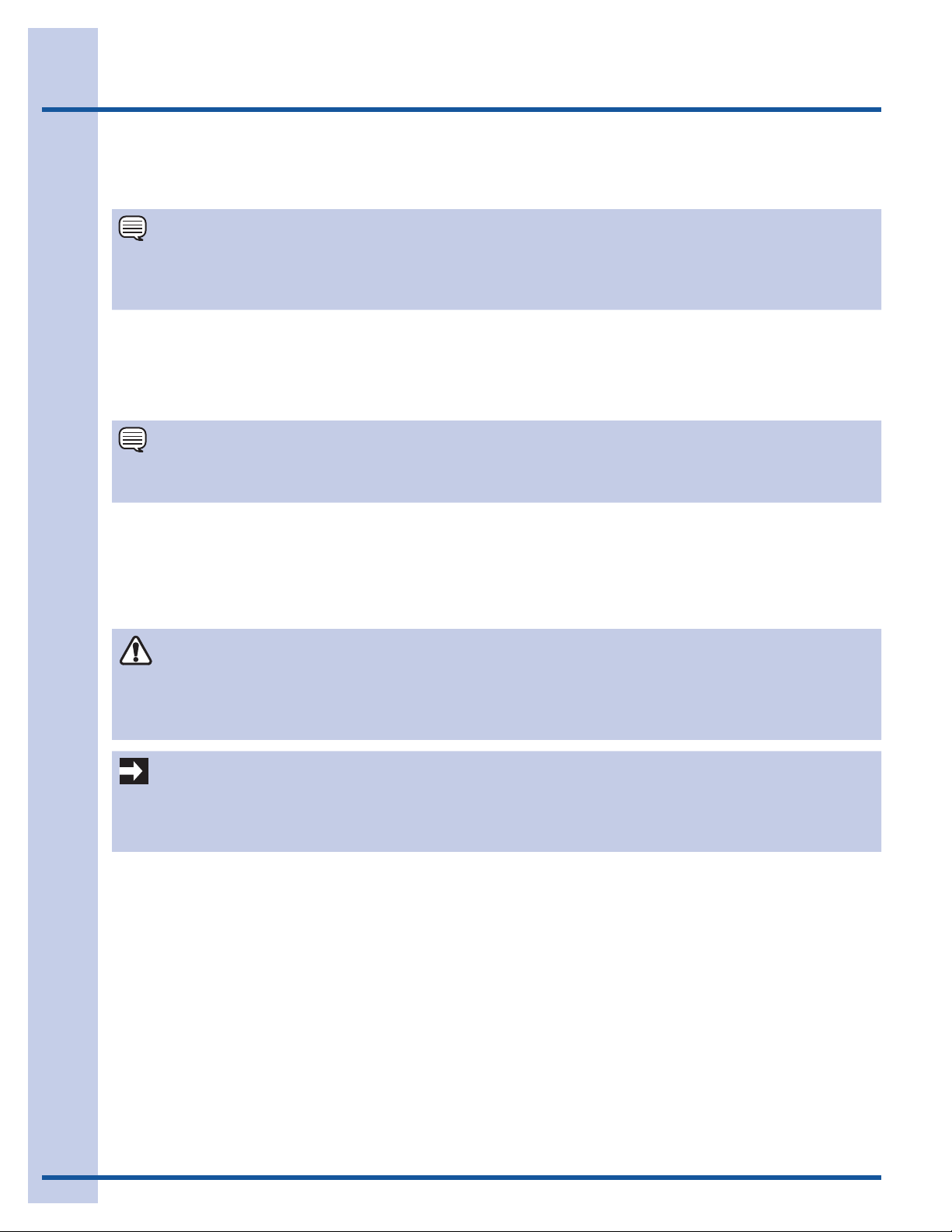
1 Open the air filter door.
2 Remove the old filter and discard it.
3 Unpack the new filter and slide it into the housing.
4 To close the air filter door, push the top and
bottom to lock the door closed.
5 Press and hold the Air Filter Reset button on
the control panel for three (3)seconds. When the
display changes from “Replace” to “Good,” the
status has been reset.
6 The Air Filter Reset will turn itself off after a few
seconds.
Changing the Water and Air Filters
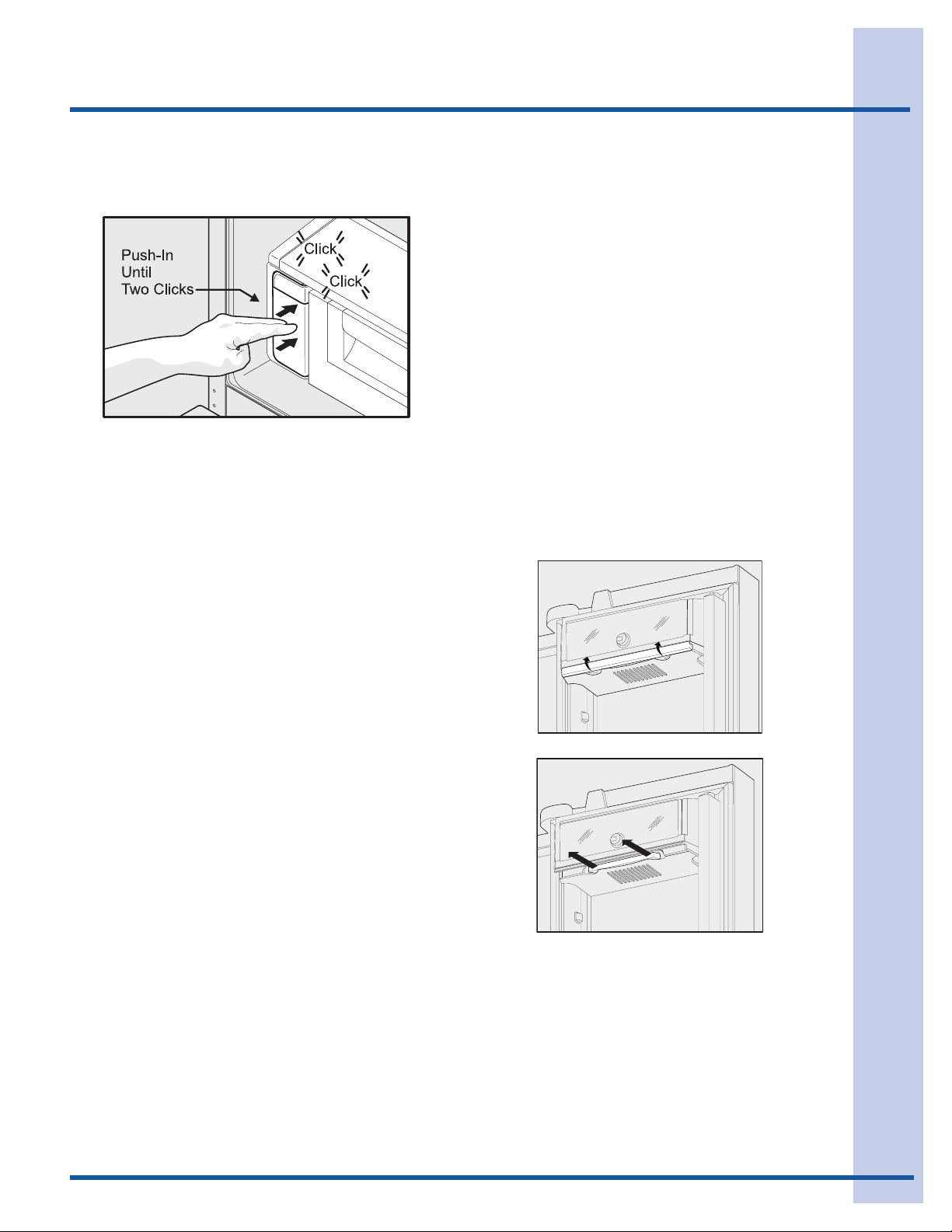
4 Push firmly until the cartridge snaps into
place (you should hear two clicks). When fully
engaged, the front of the filter cartridge should be
flush with the filter release button.
5 Press and hold the Filter Status button on the
control panel for three (3) seconds. When the
display changes from “Replace” to “Good,” the
status has been reset.
6 Afterreplacingthewaterlterandinorderfor
the ice maker to work properly, it is necessary
to clear air from water filter tubing. Once ice
maker begins making ice, allow the bucket to fill
completely, then discard the first TWO (2) FULL
buckets of ice. It will take at least two (2) days to
completely fill the bucket on regular ice making
mode or 1
1
/
2
days on fast ice mode.
26
Care and Cleaning
Protecting your investment
Keepingyourrefrigeratorcleanmaintainsitsappearanceandpreventsodorbuild-up.Wipeupanyspills
immediately and clean the freezer and fresh food compartments at least twice a year.
• Removeadhesivelabelsbyhand.Donotuserazorbladesorothersharpinstrumentswhichcanscratchthe
appliance surface.
• Donotremovetheserialplate.Removalofyourserialplatevoidsyourwarranty.
• Beforemovingyourrefrigerator,raisetheanti-tipbracketssotherollerswillworkcorrectly.Thiswillprevent
the floor from being damaged.
Refer to the guide on the next page for details on caring and cleaning specific areas of your refrigerator.
• Neverusemetallicscouringpads,brushes,abrasivecleaners,orstrongalkalinesolutionsonanysurface.
• NeveruseCHLORIDEorcleanerswithbleachtocleanstainlesssteel.
• Donotwashanyremovablepartsinadishwasher.
• Alwaysunplugtheelectricalpowercordfromthewalloutletbeforecleaning.
IMPORTANT
If you store or move your refrigerator in freezing temperatures, be sure to completely drain the water supply
system. Failure to do so could result in water leaks when the refrigerator is put back into service. Contact a
service representative to perform this operation.
CAUTION
• Pulltherefrigeratorstraightouttomoveit.Shiftingitfromsidetosidemaydamageooring.Be
careful not to move the refrigerator beyond the plumbing connections.
• Dampobjectssticktocoldmetalsurfaces.Donottouchrefrigeratedsurfaceswithwetordamphands.
NOTE
If you set your temperature controls to turn off cooling, power to lights and other electrical components will
continue until you unplug the power cord from the wall outlet.
NOTE
Do not use abrasive cleaners such as window sprays, scouring cleansers, flammable fluids, cleaning waxes,
concentrated detergents, bleaches, or cleansers containing petroleum products on plastic parts, interior doors,
gaskets, or cabinet liners. Do not use paper towels, scouring pads, or other abrasive cleaning materials.
27
Care and Cleaning
Care and cleaning tips
Vacation and moving tips
Part Cleaning Agents Tips and Precautions
Interior & Door
Liners
• Soap and water
• Baking soda and
water
• Use 2 (2) tablespoons of baking soda in 1 (1) quart of warm water.
• Be sure to wring excess water out of sponge or cloth before cleaning
around controls, light bulb or any electrical part.
Door Gaskets • Soap and water • Wipe gaskets with a clean soft cloth.
Drawers & Bins •Soap and water • Use a soft cloth to clean drawer runners and tracks.
• Do not wash any removable items (bins, drawers, etc.) in dishwasher.
Glass Shelves • Soap and water
• Glass cleaner
• Mild liquid
sprays
• Allow glass to warm to room temperature before immersing in warm
water.
Toe Grille • Soap and water
• Mild liquid
sprays
• Vacuum
• Remove toe grille (see Installation Instructions).
• Vacuum both sides and wipe with sudsy cloth or sponge. Rinse and
dry.
Exterior &
Handles
• Soap and water
• Non abrasive
glass cleaner
• Do not use commercial household cleaners containing ammonia,
bleach or alcohol to clean handles.
• Use a soft cloth to clean smooth handles.
• Do not use a dry cloth to clean smooth doors.
Exterior &
Handles
(Stainless Steel
Models Only)
• Soap and water
• Stainless steel
cleaners
• Never use CHLORIDE or cleaners with bleach to clean stainless
steel.
• Clean stainless steel front and handles with non-abrasive soapy water
and a dishcloth. Rinse with clean water and a soft cloth.
• Use a non-abrasive stainless steel cleaner. These cleaners can be
purchased at most home improvement or major department stores.
Always follow manufacturer’s instruction. Do not use household
cleaners containing ammonia or bleach.
• NOTE: Always clean, wipe and dry with grain to prevent scratching.
• Wash the rest of the cabinet with warm water and mild liquid
detergent. Rinse well and wipe dry with a clean soft cloth.
Occasion Tips
Short Vacations • Leave refrigerator operating during vacations of three (3) weeks or less.
• Use all perishable items from refrigerator compartment.
• Turn automatic ice maker off and empty ice bucket, even if you will only be gone a few
days.
Long Vacations • Remove all food and ice if you will be gone one (1) month or more.
• Turn the cooling system off (see “Controls” section for location of On/Off button) and
disconnect power cord.
• Turn water supply valve to closed position.
• Clean interior thoroughly.
• Leave doors open to prevent odors and mold build-up. Block doors open if necessary.
Moving • Remove all food and ice.
• If using a handcart, load from the side.
• Adjust rollers all the way up to protect them during sliding or moving.
• Pad cabinet to avoid scratching surface.
28
Care and Cleaning
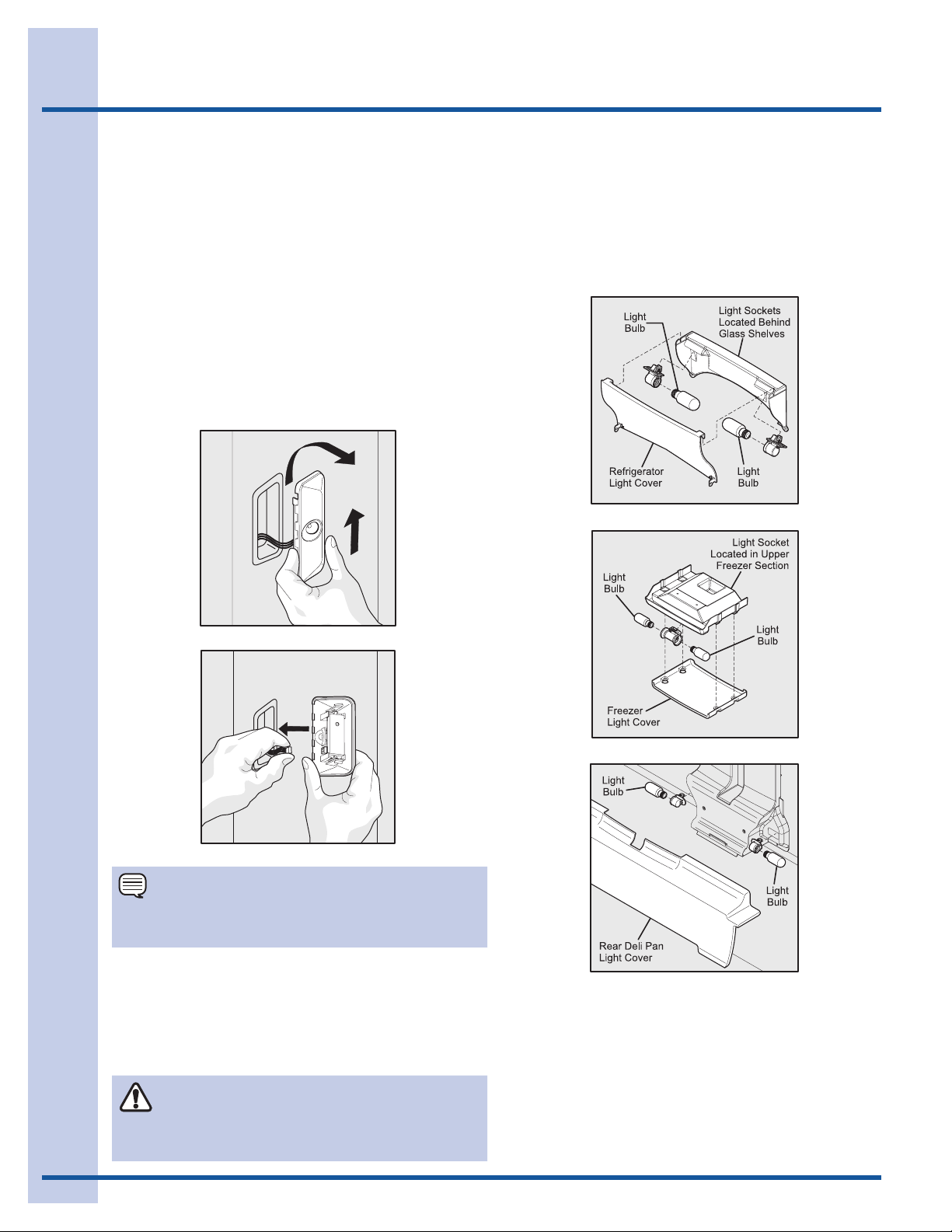
Replacing LED Lights (select models)
Both the freezer and fresh food compartments of your
refrigeratorincludeLEDlights.AlwaysuseElectrolux
parts for replacement.
To replace LED Lights:
1 Unplugyourrefrigerator’spowercord.
2 Remove light cover by pushing up and out.
3 Hold the LED cover with one hand and pull the
connector with the other hand while pressing the
connector latch.
4 Replace LED light and snap in place assuring the
light is facing in toward the unit (inside fresh food
and freezer) or facing outward on bottom of fresh
food doors.
Ordering Replacement LED Lights
Order new LEDs by calling 877-808-4195, online at
www.electroluxappliances.com, or through the dealer
where you bought the refrigerator. Here is the product
number to request when ordering:
LED Light, Part #241891102
Incandescent Lights (40-watt bulb),
Part #5305514148
LED Light Harness Removal
LED Light Removal
NOTE
LED lights are in series so if one is bad or unplugged,
several lights may not light up.
Replacing Light Bulbs (select models)
Both the freezer and fresh food compartments of your
refrigerator include incandescent light bulbs that will need
replacing from time-to-time. Some lights have covers that
needtoberemovedbeforereplacingthebulbs.Always
use bulbs that are designed for appliance lighting.
CAUTION
Wear gloves when replacing incandescent light
bulbs to avoid getting cut.
To replace light bulbs:
1 Unplugyourrefrigerator’spowercord.
2 Wear protective gloves.
3 Remove light cover, if necessary.
4 Unscrew and replace old bulb with an appliance bulb
of the same type and wattage (normally 40 watts).
5 Replace light cover, if necessary.
6 Plugintherefrigerator’spowercord.
Refrigerator Lights
Freezer Lights
Back Wall Lights
29
Common Solutions for Concerns
Before you call...
If you experience a concern with your refrigerator or notice a product behavior or condition that you do not
understand, you can usually avoid a call to your service representative by referring to this section for an answer.
Beginning with the following table, this information includes concerns, potential causes, and common solutions.
Light Is Not On
Concern Potential Cause Common Solution
Light is not on.
• Light bulb is burned out or LED light is
damaged.
• No electric current is reaching refrigerator.
• Control system has disabled lights because
one or both doors were left open too long.
• See Replacing Light Bulbs or LED lights in Care and
Cleaning section.
• See “Concern” section, “Refrigerator Operations”.
• Close and reopen door(s) to enable lights.
Odors In Refrigerator
Concern Potential Cause Common Solution
Interior is dirty.
Odors
• Interior needs to be cleaned.
• Food with strong odors is stored in
refrigerator.
• See Care & Cleaning Tips.
• Cover food tightly. Air filter may need to be changed
more frequently if foods with strong odors are routinely
stored in refrigerator.
Opening/Closing Of Doors/Drawers
Concern Potential Cause Common Solution
Door(s) will not close. • Refrigerator is not level. It rocks on the floor
when moved slightly.
• An object has fallen from the baskets
blocking the door from closing.
• Ensure floor is level and solid, and can adequately
support the refrigerator. Contact a carpenter to correct a
sagging or sloping floor.
• Check for ice or food items blocking drawer.
Drawers are difficult to
move.
• Food is touching shelf on top of drawer.
• Drawer is overloaded
• Keep less food in drawer.
• Remove or redistribute food.
Automatic Ice Maker
Concern Potential Cause Common Solution
Ice maker is not making
any ice.
• Ice maker is turned off.
• Refrigerator is not connected to water line or
water valve is not open.
• The water supply line is kinked.
• The water filter is not seated properly.
• The water filter may be clogged with foreign material.
• Saddle valve on cold water pipe is clogged or
restricted by foreign material.
• Turn on ice maker. For the fresh food ice maker, press
and hold the “Ice Off” button for 4 seconds until the
indicator turns off. For the freezer ice maker, lower the
wire signal arm.
• Connect the unit to the household water supply and
ensure the supply valve is open.
• Ensure that the supply line does not kink when the refrig-
erator is pushed into place against the wall.
• Remove and re-install the water filter. Be sure to push the
filter firmly so that you hear it lock solidly into position.
• If water dispenses slowly or not at all, or if the filter is six
(6) months old or older, it should be replaced.
• Turn off household water line valve. Remove valve.
Ensure that valve is not a self-piercing saddle valve. Clean
valve. Replace valve if necessary.
Ice maker is not making
enough ice.
• Ice maker is producing less ice than you expect.
• The water filter may be clogged with foreign material.
• The water supply line is kinked.
• Saddle valve on cold water pipe is clogged or
restricted by foreign material.
• The fresh food and freezer ice makers will each produce
approximately 2.5 pounds of ice every 24 hours
depending on usage conditions.
• If water dispenses slower than normal, or if the filter is six
(6) months old or older, it should be replaced.
• Ensure that the supply line does not kink when the refrig-
erator is pushed into place against the wall.
• Turn off household water line valve. Remove valve.
Ensure that valve is not a self-piercing saddle valve. Clean
valve. Replace valve if necessary.
Freezer ice maker will not
stop making ice.
• Ice maker wire signal arm is being held down
by some package in the freezer that has fallen
against the ice maker.
• Move the item and release wire signal arm. Remove any
ice cubes that may have frozen together over the wire
signal arm.
Ice cubes are freezing
together.
• Ice cubes are not being used frequently enough.
• Ice cubes are hollow (shells of ice with water
inside). The hollow cubes break open in the bin
and leak their water onto existing ice, which
causes it to freeze together.
• Remove ice container and discard ice. The ice maker will
produce fresh supply. Ice should be used at least twice
weekly to keep the cubes separated.
• This generally occurs when the ice maker does not get
enough water. This is usually the result of a clogged water
filter. Replace the water filter.

30
Common Solutions for Concerns
Refrigerator Operations
Concern Potential Cause Common Solution
Compressor does not
run.
• Cooling system is turned Off.
• Refrigerator is in defrost cycle.
• Plug at wall outlet is disconnected.
• House fuse is blown or a tripped circuit
breaker.
• Power outage.
• Electronic control system keeps the
refrigerator at a constant temperature.
• Turn cooling system On. See Controls Section for
location of cooling system On/Off button.
• This is normal for a fully automatic defrost refrigerator.
The defrost cycle occurs periodically, lasting about 30
minutes.
• Ensure plug is tightly pushed into outlet.
• Check/replace fuse with a 15 amp time-delay fuse.
Reset circuit breaker.
• Check house lights. Call local Electric Company.
• This is normal. Refrigerator goes on and off to keep
temperature constant.
Refrigerator runs too
much or too long.
• Room or outside weather is hot.
• Refrigerator has recently been disconnected
for a period of time.
• Automatic ice maker is operating.
• Doors are opened too frequently or too long.
• Refrigerator/freezer door may be slightly
open.
• Freezer control is set too cold (control found
on side of left hand door).
• Fresh food/freezer gasket is dirty, worn,
cracked, or poorly fitted.
• This model is provided with a high-efficiency,
variable-speed compressor.
• It’s normal for the refrigerator to work longer under
these conditions.
• It takes 8-12 hours for the refrigerator to cool down
completely.
• Ice maker operation causes refrigerator to run slightly
more.
• Warm air entering the refrigerator causes it to run more.
Open doors less often.
• Ensure refrigerator is level. Keep food and containers
from blocking door. See Problem section, Opening/
Closing of Doors/ Drawers.
• Set freezer control to warmer setting until refrigerator
temperature is satisfactory. Allow 24 hours for
temperature to stabilize.
• Clean or change gasket. Leaks in door seal will cause
refrigerator to run longer in order to maintain desired
temperatures.
• It is normal for the compressor to run for long periods
of time.
Digital temperature
displays are flashing.
• Electronic control system has detected a
performance problem.
• Call your Electrolux service representative, who can
interpret any messages or number codes flashing on
the digital displays.
Temperatures Are Too Cold
Concern Potential Cause Common Solution
Freezer temperature
too cold. Refrigerator
temperature is
satisfactory.
• Fast Freeze function is activated.
• Freezer control is set too cold.
• Ice maker is on.
• Fast Ice function is activated.
• Deactivate Fast Freeze function.
• Set freezer control to a warmer setting. Allow 24 hours
for temperature to stabilize.
• It is normal for the freezer compartment to over cool
while automatic ice maker is on.
• Deactivate Fast Ice function.
Refrigerator temperature
too cold. Freezer
temperature is
satisfactory.
• Refrigerator control is set too cold. • Set refrigerator control to a warmer setting. Allow 24
hours for temperature to stabilize.
Food stored in drawers
freezes.
• Refrigerator control is set too cold. • See solution above.
Food stored in Meat
Keeper freezes (select
models).
• Meat Keeper temperature control is set too
cold.
• Adjust Meat Keeper temperature control to a warmer
setting. Meat should be stored at a temperature just
below the freezing point for maximum fresh storage
time. It is normal for ice crystals to form due to the
moisture content of meat.
31
Common Solutions for Concerns
Temperatures Are Too Warm
Concern Potential Cause Common Solution
Freezer/Refrigerator
temperature is too warm.
• Doors are opened too frequently or too long.
• Door is slightly open.
• Warm air enters the refrigerator whenever the door is
opened. Open the door less often.
• See Problem section, Opening/Closing of Doors/
Drawers.
Freezer temperature is
too warm. Refrigerator
temperature is
satisfactory.
• Freezer control is set too warm. • Set freezer control to a colder setting. Allow 24 hours
for temperature to stabilize.
Refrigerator temperature
is too warm. Freezer
temperature is
satisfactory.
• Refrigerator control is set too warm. • Set refrigerator control to a colder setting. Allow 24
hours for temperature to stabilize.
Temperature in the Cool
Zone
TM
or Perfect Temp
TM
Drawer is too warm
(select models).
• Temperature control is set too warm. • Adjust temperature control to a colder setting.
Water/Moisture/Frost Inside Refrigerator
Concern Potential Cause Common Solution
Moisture collects on
inside of refrigerator
walls.
• Weather is hot and humid.
• Door is slightly open.
• Door is opened too often or too long.
• Open containers.
• The rate of frost buildup and internal sweating
increases.
• See Problem section, Opening/Closing of Doors/
Drawers.
• Open door less often to allow internal temperature to
stabilize.
• Keep containers covered.
Water collects on bottom
side of drawer cover.
• Vegetables contain and give off moisture. • Moisture on the bottom side of the cover is not unusual.
• Move humidity control (select models) to lower setting.
Moisture collects in
bottom of drawer.
• Washed vegetables and fruit drain while in
the drawer.
• Fruits and vegetables are kept past their
prime
• Dry items before putting them in the drawer. Water
collecting in bottom of drawer is normal.
• Routinely clean out old fruits and vegetables especially if
they begin to break down.
Moisture collects on
outside of refrigerator or
between doors.
• Weather is humid.
• Door is slightly open, causing cold air from
inside refrigerator to meet warm air from
outside.
• This is normal in humid weather. Press eco friendly
icon to reduce exterior moisture on the cabinet between
the doors. When humidity is lower, the moisture should
disappear and the eco friendly icon can be pressed
again to turn it off.
• See Problem section, Opening/Closing of Doors/
Drawers.

32
Warranty
Major Appliance Warranty Information
Your appliance is covered by a one year limited warranty. For one year from your original date of purchase, Electrolux will repair or
replace any parts of this appliance that prove to be defective in materials or workmanship when such appliance is installed, used, and
maintained in accordance with the provided instructions. In addition, the cabinet liner and sealed refrigeration system (compressor,
condenser, evaporator, dryer or tubing) of your appliance is covered by a two through five year limited warranty. During the 2nd through
5th years from your original date of purchase, Electrolux will repair or replace any parts in the cabinet liner and sealed refrigeration
system which prove to be defective in materials or workmanship when such appliance is installed, used, and maintained in accordance
with the provided instructions.
Exclusions
This warranty does not cover the following:
1. Products with original serial numbers that have been removed, altered or cannot be readily determined.
2. Product that has been transferred from its original owner to another party or removed outside the USA or Canada.
3. Rust on the interior or exterior of the unit.
4. Products purchased “as-is” are not covered by this warranty.
5. Food loss due to any refrigerator or freezer failures.
6. Products used in a commercial setting.
7. Service calls which do not involve malfunction or defects in materials or workmanship, or for appliances not in ordinary
household use or used other than in accordance with the provided instructions.
8. Service calls to correct the installation of your appliance or to instruct you how to use your appliance.
9. Expenses for making the appliance accessible for servicing, such as removal of trim, cupboards, shelves, etc., which are not a
part of the appliance when it is shipped from the factory.
10. Service calls to repair or replace appliance light bulbs, air filters, water filters, other consumables, or knobs, handles, or other
cosmetic parts.
11. Pickup and delivery costs; your appliance is designed to be repaired in the home.
12. Surcharges including, but not limited to, any after hour, weekend, or holiday service calls, tolls, ferry trip charges, or mileage
expense for service calls to remote areas, including the state of Alaska.
13. Damages to the finish of appliance or home incurred during transportation or installation, including but not limited to floors,
cabinets, walls, etc.
14. Damages caused by: services performed by unauthorized service companies; use of parts other than genuine Electrolux
parts or parts obtained from persons other than authorized service companies; or external causes such as abuse, misuse,
inadequate power supply, accidents, fires, or acts of God.
DISCLAIMER OF IMPLIED WARRANTIES; LIMITATION OF REMEDIES
CUSTOMER’S SOLE AND EXCLUSIVE REMEDY UNDER THIS LIMITED WARRANTY SHALL BE REPAIR OR REPLACEMENT
AS PROVIDED HEREIN. CLAIMS BASED ON IMPLIED WARRANTIES, INCLUDING WARRANTIES OF MERCHANTABILITY OR
FITNESS FOR A PARTICULAR PURPOSE, ARE LIMITED TO ONE YEAR OR THE SHORTEST PERIOD ALLOWED BY LAW,
BUT NOT LESS THAN ONE YEAR. ELECTROLUX SHALL NOT BE LIABLE FOR CONSEQUENTIAL OR INCIDENTAL DAMAGES
SUCH AS PROPERTY DAMAGE AND INCIDENTAL EXPENSES RESULTING FROM ANY BREACH OF THIS WRITTEN LIMITED
WARRANTY OR ANY IMPLIED WARRANTY. SOME STATES AND PROVINCES DO NOT ALLOW THE EXCLUSION OR LIMITATION
OF INCIDENTAL OR CONSEQUENTIAL DAMAGES, OR LIMITATIONS ON THE DURATION OF IMPLIED WARRANTIES, SO THESE
LIMITATIONS OR EXCLUSIONS MAY NOT APPLY TO YOU. THIS WRITTEN WARRANTY GIVES YOU SPECIFIC LEGAL RIGHTS.
YOU MAY ALSO HAVE OTHER RIGHTS THAT VARY FROM STATE TO STATE.
If You Need Service
Keep your receipt, delivery slip, or some other appropriate payment record to establish the warranty period should service be required.
If service is performed, it is in your best interest to obtain and keep all receipts. Service under this warranty must be obtained by
contacting Electrolux at the addresses or phone numbers below.
This warranty only applies in the USA, Puerto Rico and Canada. In the USA and Puerto Rico, your appliance is warranted by Electrolux
Major Appliances North America, a division of Electrolux Home Products, Inc. In Canada, your appliance is warranted by Electrolux
Canada Corp. Electrolux authorizes no person to change or add to any obligations under this warranty. Obligations for service and parts
under this warranty must be performed by Electrolux or an authorized service company. Product features or specifications as described
or illustrated are subject to change without notice.
USA
1-877-435-3287
Electrolux Major Appliances North America
10200 David Taylor Drive
Charlotte, NC 28262
Canada
1-800-265-8352
Electrolux Canada Corp.
5855 Terry Fox Way
Mississauga, Ontario, Canada L5V 3E4