User Guide Washer
HOW TO USE
WARNING: To reduce the risk of fire, electric shock, or injury to persons, read and follow this entire Use & Care Guide, including the Important Safety Instructions, before operating this washer.
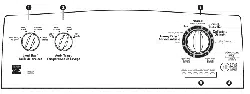
CONTROL PANEL FEATURES
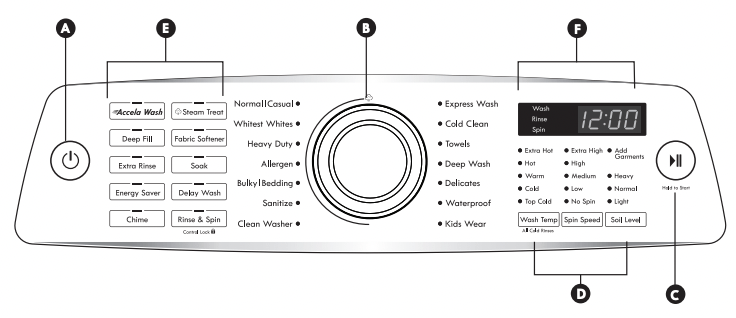
A. POWER (ON/OFF) BUTTON
Press to turn the washer ON. Press again to turn the washer OFF. Pressing the POWER button dur- ing a cycle will cancel that cycle and any load settings will be lost. The lid will unlock after a brief pause.
NOTE: If the washer remains idle for four minutes after turning the washer off, any water left in the tub will automatically be drained. An alarm will sound one minute prior to draining, and ‘dr’ will appear on the display. You may restart the washer at this time. However, once the washer initiates draining, all functions will be suspended and cycle settings lost, and ‘dr’ will be displayed until draining is complete.
B. CYCLE SELECTOR KNOB
Turn this knob to select the desired cycle. Once the desired cycle has been selected, the standard presets will appear in the display. These settings can be adjusted using the cycle setting buttons anytime before starting the cycle.
C. START/PAUSE BUTTON
Press this button to start the selected cycle. If the washer is running, use this button to pause the cycle without losing the current settings.
NOTE: If you do not press the START/PAUSE button within four minutes of selecting a cycle, the washer automatically turns OFF. If the washer is paused during a cycle for more than 60 minutes, the cycle will be cancelled and any water remaining in the tub will be drained. An alarm will sound at three minutes to warn you that the tub is about to drain.
D. CYCLE MODIFIER BUTTONS
Use these buttons to adjust the settings for the se- lected cycle. The settings light up above the buttons to show the current selection.
E. SPECIAL CYCLE AND OPTION BUTTONS
These buttons allow you to select special cycles or options.
F. TIME AND STATUS DISPLAY
The display shows the cycle status and estimated time remaining.
NOTE: To protect your clothing, not all settings are available on all cycle selections
OPERATING THE WASHER
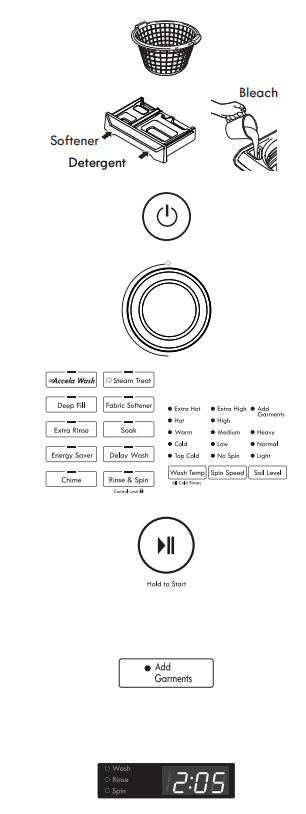
1 SORT LAUNDRY AND LOAD WASHER
Sort laundry by fabric type, soil level, color and load size, as needed. Open the door and load the items into the washer.
2 ADD CLEANING PRODUCT
Add High-Efficiency (HE) detergent to the detergent dispenser drawer. For proper wash performance, always measure the detergent using the measuring device provided by the detergent manufacturer.
3 TURN ON THE WASHER
Press the POWER button to turn ON the washer. The lights around the cycle selector knob will illuminate and a chime will sound.
4 SELECT A CYCLE
Turn the cycle selector knob in either direction to select the de- sired cycle. The preset Wash Temp, Spin Speed, Soil Level, and Option settings for that cycle will be shown.
5 SELECT CYCLE MODIFIERS & OPTIONS (optional)
Default settings for the selected cycle can now be changed if desired. Use the cycle modifier buttons.
NOTE: To protect your fabrics, not all modifiers are available on all cycles. A different chime will sound and the LED will not come on if the selection is not allowed. Cycle op- tions can also be added by using the option buttons.
6 BEGIN CYCLE
Press the START/PAUSE button to begin the cycle. The door will lock, and the washer will briefly tumble the load without water to measure its weight. Once the weight of the load is mea- sured, the washer will begin the selected wash cycle.
7 ADD GARMENTS LIGHT
The ADD GARMENTS light will illuminate near the beginning of the wash cycle to indicate when it is safe to add items to the load. Press the START/PAUSE button to pause the cycle and add garments to the load.
NOTE: It is not recommended to add items unless the ADD GARMENTS light is illuminated, as this could result in poor performance.
8 RESUME CYCLE
Press the START/PAUSE button to resume the wash cycle.
CYCLE GUIDE
The cycle guide below shows the default settings, available options and recommended fabric types for each cycle. Allowable modifier adjustments are shown below the default setting for each cycle.
 = Available Option
 = Default Setting
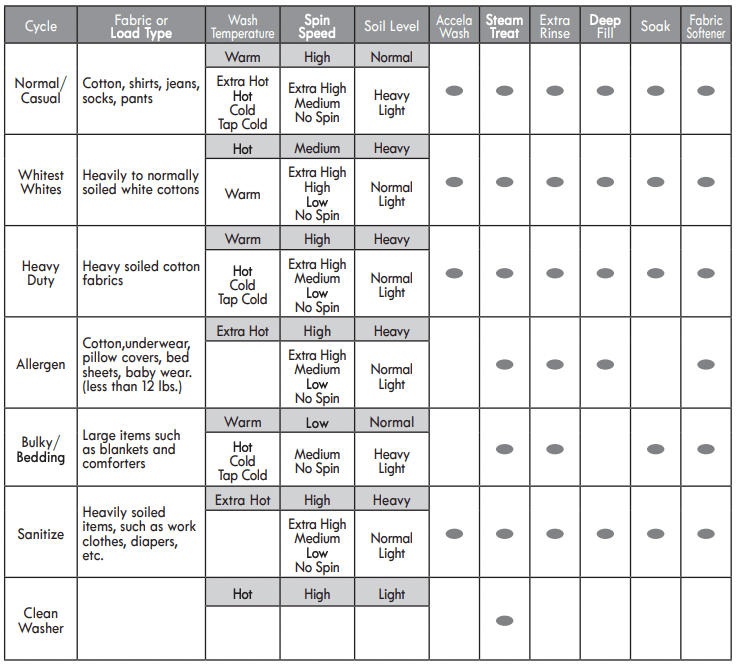
NOTE: To protect your garments, not every wash temperature, spin speed, soil level, or option is available with every cycle. A chime will sound and the LED will not light if the selection is not allowed.
*When a cycle is selected, the default time for that cycle is displayed. This time will change as modifiers or options are selected. Once the START/PAUSE button is pressed, the washer will measure the size of the load. The estimated time may change once the load size has been measured. The washer automatically adjusts the wash time for the amount of laundry, water pressure, water and other operating conditions. These cycles use various wash motions to enhance cleaning and/or fabric care performance. The wash motions may sound different at different stages of the wash cycle. This is normal.
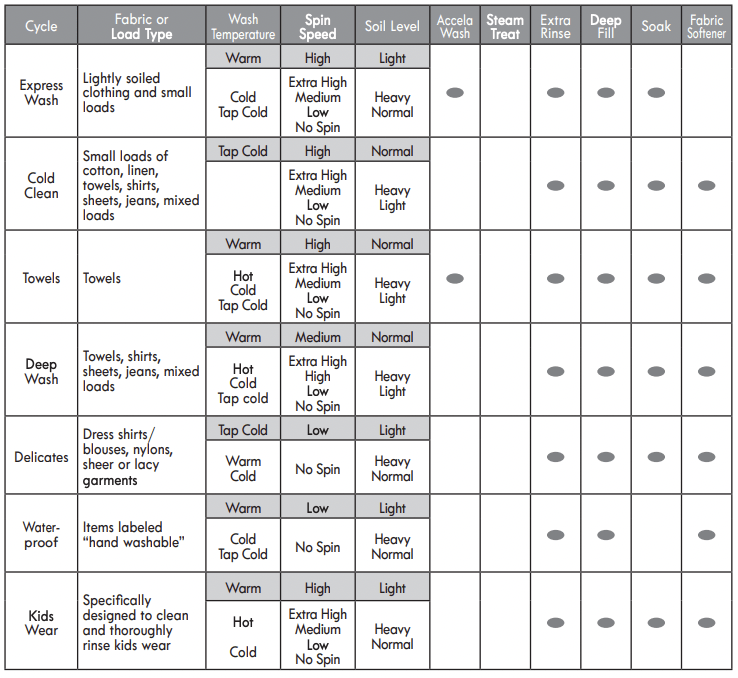
NOTE: To protect your garments, not every wash temperature, spin speed, soil level, or option is available with every cycle. A chime will sound and the LED will not light if the selection is not allowed.
*When a cycle is selected, the default time for that cycle is displayed. This time will change as modifiers or options are selected. Once the START/PAUSE button is pressed, the washer will measure the size of the load. The estimated time may change once the load size has been measured. The washer automatically adjusts the wash time for the amount of laundry, water pressure, water and other operating conditions.
These cycles use various wash motions to enhance cleaning and/or fabric care performance. The wash motions may sound different at different stages of the wash cycle. This is normal.
SORTING WASH LOADS
CAUTION
•Do not load items higher than the top edge of the tub. Failure to follow this caution can result in leakage or damage to fabrics.
•Use the BULKY/BEDDING cycle for buoyant or nonabsorbent items such as pillows or comforters. Failure to follow this caution can result in leakage.
•If possible, do not wash any water-resistant items. If you must, please select the Bulky/Bedding cycle.
- Examples of water-proof or water-resistant items include certain mattress pads, mattress covers, rain gear, camping gear, skiing apparel, outdoor gear and similar items.
Grouping Similar Items
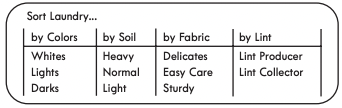
For the best washing results, and to reduce the possibility of damage to clothing, care should be taken to sort the clothing into loads that are made up of similar items. Mixing different fabric types and/or soil levels can result in poor wash performance, color transfer or discoloration, fabric damage or linting. Fabrics should be sorted into groups as described below.
Colors
Sort articles by color. Wash dark clothes together in aseparate load from light colors or whites. Mixing dark clothes with light clothes can result in dye transfer or discoloration of the lighter clothes.
Soil Level
Wash heavily soiled clothing together. Washing lightly soiled clothing in the same load with heavily soiled clothing could result in poor wash performance for the lightly soiled clothing.
Fabric Type
Delicate articles should not be mixed with heavier or sturdier fabric types. Washing delicates in a load with heavy fabrics can result in damage to the more delicate fabrics. Washing heavier fabrics in a delicate load can result in poor wash performance for the heavier fabrics and possible damage to the delicates.
Lint Type
Some fabrics attract and bind lint to them while others give off lint in the laundry process. Avoid mixing these lint collectors and lint producers in the same load. Mixing these fabrics will result in pilling and linting on the lint collectors. (For example, lint collector – knit sweater; lint producer – terrycloth towels.)
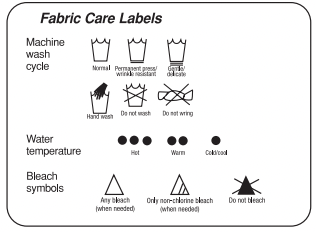
Fabric Care Labels
Many articles of clothing include a fabric care label. Using the chart below, adjust the cycle and option selections to care for your clothing according to the manufacturer’s recommendations.
Loading the Washer
- Check all pockets to make sure that they are empty. Items such as clips, matches, pens, coins, and keys can damage both your washer and your clothes.
- Close zippers, hooks, and drawstrings to prevent these items from snagging or tangling on other clothes.
- Pretreat heavily stained areas for best results.
- Combine large and small items in a load. Load large items first.
- Large items should not be more than half of the total wash load.
- The washer can be fully loaded, but the tub should not be tightly packed with items. The lid of the washer should close easily.
- To prevent an out-of-balance load, do not wash single items. Add one or two similar items to the load. Large, bulky items, such as a blanket, comforter, or bedspread, should be washed individually.
- The washer will not fill or operate with the lid open.
NOTE: Use the Bulky/Bedding cycle for large or bulky items such as poly-filled jackets, comforters, pillows, etc. These items may not be as absorbent as other laundry items and should be sorted into a separate wash load for optimal results.
Bulky items should be placed as far down in the tub as possible for optimal results. Always place buoyant items at the bottom of the tub.
The washer will automatically detect the load size. Because of the high-efficiency wash system, the water level may not completely cover the load.
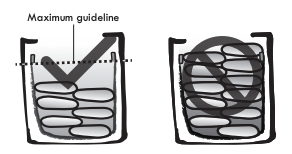
1. For best performance, load clothes as shown.
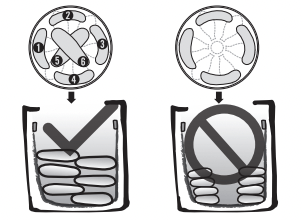
2. Load clothes loosely, and do not load clothes over the maximum guideline on the tub. Clothes need room to circulate in order to get clean.
ABOUT THE DISPENSERS
The automatic dispenser consists of two compartments which hold:
• Liquid fabric softener.
• Liquid or powdered detergent for main wash.
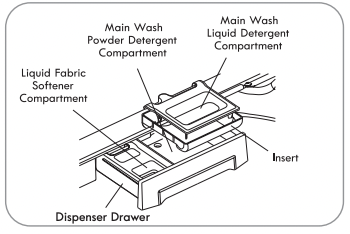
Main Wash Detergent Compartment
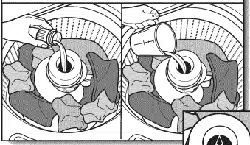
This compartment holds laundry detergent for the main wash cycle. The detergent is added to the load at the beginning of the cycle. Always use High-Efficiency (HE) detergent with your washing machine. Either powdered or liquid detergent may be used.
Never exceed the manufacturer’s recommendations when adding detergent. Using too much detergent can result in detergent buildup in clothing and the washer. When using liquid detergent, make sure the liquid detergent cup and insert are in place. Do not exceed the maximum fill line. When using powdered detergent, remove the liquid detergent cup from the compartment. Powdered detergent will not dispense with the liquid detergent cup in place.
Fabric Softener Compartment
This compartment holds liquid fabric softener, which is automatically dispensed during the final rinse cycle. Never exceed the manufacturer’s recommendations when adding softener. Using too much fabric softener can result in buildup in cloth- ing and the washer.
• Always follow the manufacturer’s recommendations when adding fabric softener. Do not exceed the maximum fill line. Using too much fabric softener may stain clothes.
• Dilute concentrated fabric softeners with warm water. Do not exceed the maximum fill line.
• Never pour fabric softener directly onto the load or into the tub.
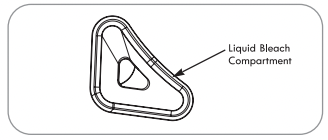
Liquid Bleach Compartment
The bleach dispenser is a separate compartment at the left front of the tub opening. This compartment holds liquid bleach, which is dispensed automatically at the proper time during the wash cycle. Any liquid remaining in the dispenser at the end of the cycle is water, not bleach.
- Do not add powdered bleach to this compartment. The bleach compartment is designed to dispense liquid bleach only. Powdered or liquid color-safe bleach will not dispense properly.
- Always follow the manufacturer’s recommendations when adding bleach. Never add more than one cup and do not exceed the maximum fill line since this can cause the bleach to be dispensed immediately, resulting in damage to fabrics. Using too much bleach can damage fabrics.
- Never pour undiluted liquid chlorine bleach directly onto the load or into the tub. Fabric damage can occur.
- Do not use color-safe bleach or Oxi products in the same cycle with liquid chlorine bleach.
DANGER Do NOT mix chlorine bleach with ammonia or acids, such as vinegar or rust/scale remover. Mixing chemicals like these can produce a lethal gas, resulting in severe injury or death.
DETERGENT AND DISPENSER USE
A Word About Detergents
High-Efficiency (HE) detergents produce fewer suds, dissolve more efficiently to improve washing and rinsing performance, and help to keep the interior of your washer clean. Using detergent that is not HE may cause oversudsing and unsatisfactory performance which could result in error codes, cycle failure, and machine damage.
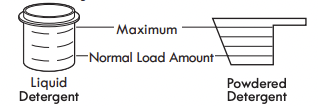
For proper wash performance, always measure the detergent using the measurements provided by the detergent manufacturer.
The normal amount of HE detergent needed, for average loads, is less than ½ of the recommended maximum. Use less detergent for soft water, light soil or smaller loads. Never use more than the maximum amount recommended by the detergent manufacturer.
 Designed to use only High-Efficiency (HE) detergent
IMPORTANT: Your washing machine is designed for use with only High-Efficiency (HE) detergents. HE detergents are formulated specifically for High-Efficiency washers and contain suds-reducing agents. Always look for the HE symbol when purchasing detergent.
IMPORTANT: Not all detergents are the same. Pay careful attention to the amount of detergent used to avoid overusing, poor rinsing and detergent buildup in clothing, and residue buildup that can contribute to odors in the machine. NEVER use a cup or scoop other than the one supplied by the manufacturer of the detergent you are using. Never use more than the maximum amount of detergent recommended by the manufacturer.
Always measure the detergent amount. While HE detergents are designed for this type of washing machine, be careful when measuring the detergent. For most normal loads, no more than 1/4 to 1/2 of cap or scoop of HE detergent should be used.
NOTE: Extra care must be exercised when using 2X and 3X concentrated detergents because even a little bit extra can contribute to the problems mentioned above.
NOTE: Detergents designated as HE compatible may not provide optimal results.
Using the Softener and Detergent Dispenser
To add detergent, bleach, and fabric softener to the automatic dispenser:
- Open the dispenser drawer.
- Load the laundry products into the appropriate compartments.
- Close the drawer before starting the cycle
NOTE: It is normal for a small amount of water to remain in the bleach and softener compartments at the end of the cycle.
IMPORTANT: Do not place or store laundry products, such as detergent, bleach, or liquid fabric softener, on top of your washer or dryer. Wipe up any spills immedi- ately. These products can damage the finish and controls.
Using the Liquid Bleach Dispenser
The bleach dispenser automatically dilutes and dispenses liquid bleach at the proper time in the wash cycle.
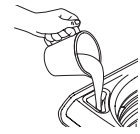
- Check clothing care labels for special instructions.
- Measure liquid bleach carefully, following instructions on the bottle. High-efficiency washers use less water, so less bleach is needed. One half cup is enough for most loads.
- Carefully pour the pre-measured amount of bleach directly into the bleach dispenser. If you are using powdered bleach of any kind, pour it directly into the tub before adding the laundry. Never add powdered bleach to the liquid bleach dispenser.
•Never pour undiluted liquid chlorine bleach directly onto clothes or into the tub.
•Do not pour powdered bleach into bleach dispenser.
•Do not place laundry items on top of the bleach dispenser when loading and unloading the washer.
• Always measure and pour bleach carefully. Avoid overfilling or splashing when adding bleach to the dispenser. The maximum capacity of the bleach dispenser is one cup of bleach per wash cycle. Overfilling could result in bleach being dispensed immediately
TIME AND STATUS DISPLAY
The time and status display shows the estimated time remaining and cycle progress.
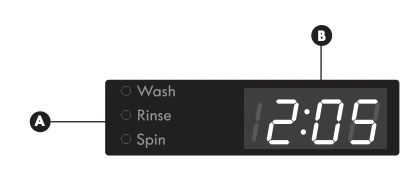
A. CYCLE STATUS INDICATOR
These LEDs will illuminate when a cycle is selected to indicate which stages will run. When a cycle is running, the LED will blink for the active stage. Once a stage is complete, the LED will turn off. If a cycle is paused, the active LED will stop blinking.
B. ESTIMATED TIME REMAINING
When a cycle is selected, the default time for that cycle is displayed. This time will change as modifiers or options are selected. Once the START/ PAUSE button is pressed, the washer will measure the size of the load. The estimated time may change once the load size has been measured.
NOTE: The time shown is only an estimate. This time is based on normal operating conditions. Several external factors (load size, room temperature, incoming water temperature, etc.) can affect the actual time.
CYCLE MODIFIER BUTTONS
Each cycle has default settings that are selected automatically. You may also customize these settings using the cycle modifier buttons. Press the button for the desired modifier until the indicator light for the desired setting is lit. The washer automatically adjusts the water level for the type and size of wash load for best results and maximum efficiency. Due to the high-efficiency nature of this product, water levels may be much lower than expected. This is normal and cleaning/rinsing performance will not be compromised.
NOTE: To protect your garments, not every wash/rinse temperature, spin speed, soil level, or option is avail- able with every cycle. A chime will sound and the LED will not light if a selection is not allowed.
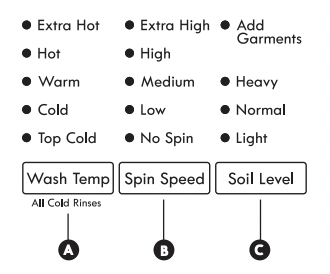
A. WASH TEMP
WASH TEMP selects the wash and rinse temperature combination for the selected cycle. Press the WASH TEMP button until the indicator light for the desired setting is lit.
• Select the wash temperature suitable for the type of load you are washing. Follow the garment fabric care labels for best results.
•Cold rinses use less energy. The actual cold rinse temperature depends on the temperature of the cold water at the faucet.
•Cold water is used for all rinse cycles.
B. SPIN SPEED
Higher spin speeds extract more water from clothes, reducing drying time and saving energy. Press the SPIN SPEED button until the desired speed is selected. Some fabrics, such as delicates, require a slower spin speed. To protect your clothing, not all spin speeds are available for all cycles.
C. SOIL LEVEL
Adjusting the soil level setting will modify the cycle times and/or wash actions. Press the SOIL LEVEL button until the desired soil level is selected.
OPTION BUTTONS
Your washing machine features several additional cycle options that customize cycles to meet your individual needs.
- Turn ON the washer and turn the cycle selector knob to select the desired cycle. If the cycle selection is changed after the options have been selected, all settings will be changed to the default settings for the new cycle.
- Use the cycle modifier buttons to adjust the settings for that cycle.
- Press the cycle option button(s) for the option(s) you would like to add. The button will light when that option is selected. If the selected option is not allowed for the selected cycle, the chime will sound twice to alert you and the LED will not illuminate.
- Press the START/PAUSE button to start the cycle. After a brief delay, the lid will lock and the cycle will begin.
NOTE:
- To protect your garments, not every option is available with every cycle.
- If the START/PAUSE button is not pressed within four minutes to start the cycle, the control will shut off and all settings will be lost.
ACCELA WASH
 Adding this option reduces the cycle time while maintaining wash performance similar to the same cycle without ACCELA WASH.
STEAM TREAT
 Select the STEAM TREAT button to add the cleaning power of steam to the selected cycle.
Adding steam to cycles helps provide improved cleaning performance, giving fabrics the benefit of a deep clean. The steam option is not available on all cycles.
- Turn ON the washer and turn the cycle selector knob to select a cycle that allows the steam option.
- Press the STEAM TREAT button. The washer will automatically adjust the cycle settings.
- Set any other desired options.
- Press the START/PAUSE button to start the cycle.
CAUTION
• The lid may be very warm during steam cycles. This is normal.
•Do not attempt to override the door lock mechanism or reach into the washer during a steam cycle. Steam can cause severe burns.
IMPORTANT NOTES ABOUT STEAM CYCLES:
• Steam may not be visible during the steam cycles. This is normal.
•Do not use steam with delicate fabrics, such as wool and silk, or easily discolored fabrics.
EXTRA RINSE
 This option will add an extra rinse to the selected cycle. Use this option to help ensure the removal of detergent or bleach residue from fabrics. Liquid fabric softener, if used, is always dispensed in the final rinse.
NOTE: You cannot select the EXTRA RINSE option with the RINSE & SPIN cycle.
DEEP FILL
 Use this option to add extra water to the wash cycle for better wash performance (Stain Treatment) with large or bulky items.
NOTE:
•If the washer reaches its maximum water level, the Deep Fill button will have no effect.
• Once the Deep Fill option has been added to a cycle, it is saved as a default option until you deselect it.
Adding the Deep Fill Option to the Normal Cycle
The Deep Fill option can only be added to the Normal cycle while the cycle is running.
- While the Normal cycle is running, press START/PAUSE to pause the cycle.
- Press Deep Fill to add the option as a default for the cycle. (The LED on the Deep Fill button will turn on.)
- Press START/PAUSE to resume the cycle.
- To deselect the option on the Normal cycle, press Deep Fill after starting the cycle. (The LED on the Deep Fill button will turn off.)
Adding the Deep Fill Option to Other Cycles
To activate or deactivate the Deep Fill option as a default on other cycles, press the Deep Fill button before starting the cycle. (The LED will turn on if the option is activated.)
Add Garments
 The Add Garments light will illuminate during the early stage of the wash cycle to indicate that it is safe to pause the cycle to add more items.
Once the Add Garments light goes out, additional laundry should not be added to the load. Doing so may result in unsatisfactory performance because the washer will not compensate for the additional garments.
- Press the START/PAUSE button to pause the washer.
- Open the lid after it unlocks.
- Add your additional items.
- Close the lid.
- Press the START/PAUSE button. The cycle will resume after the lid locks.
CHIME
 Press repeatedly to adjust the volume of the chime. The chime will sound at the new volume with each press of the button. When no chime is heard, the chime is off. The volume settings are LOW – HIGH – OFF. The chime volume can be adjusted at any time as long as the washer is turned ON.
FABRIC SOFTENER
 Fabric softener is dispensed in the final rinse. This washer is designed to save rinse water by using a jet spray rinse system (SMARTRINSE) in NORMAL/CASUAL and HEAVY DUTY cycles. Press the FABRIC SOFTENER button to change the final rinse from spray rinse to regular rinse so that the fabric softener is most effective.
NOTE: Select the FABRIC SOFTENER option or EXTRA RINSE option if liquid fabric softener is used in NORMAL/CASUAL and HEAVY DUTY cycles. Failure to select one of these options will greatly reduce the effectiveness of the softener.
ENERGY SAVER
 This option saves energy by using cooler water while increasing the wash and rinse times to maintain wash performance.
NOTE:
• The Steam Treat feature cannot be selected with the Energy Saver option.
•Wash time will increase up to 50 minutes with the Energy Saver option.
• For best wash results, only wash small loads (less than 8 pounds) with the Energy Saver option.
SOAK
 This option provides up to 180 minutes of presoaking prior to the start of the selected cycle. Use the SOAK option to presoak garments to help remove difficult spots or stains on fabrics. At the end of the presoak time, the selected cycle will begin with the same water used for the soak.
DELAY WASH
 Once you have selected the cycle and other settings, press this button to delay the start of the wash cycle. Each press of the button increases the delay time by one hour, for up to 19 hours. Once the desired delay time is set, press the START/PAUSE button to start the delay time.
NOTE: If the START/PAUSE button is not pressed to begin the delay time, the washer will automatically shut off after four minutes.
RINSE & SPIN
 Select this option to rinse and spin a load separately from a regular cycle. This can be helpful in preventing fresh stains from setting in fabrics. You can change the spin speed by pressing the SPIN SPEED button
- Press the START/PAUSE button to turn on the washer.
- Press the RINSE & SPIN button.
- Press the SPIN SPEED button to select the desired spin speed. Selecting NO SPIN is not allowed.
- Press the START/PAUSE button.
CONTROL LOCK
 Use this option to disable the controls. The washer can only be locked during a cycle. This feature can prevent children from changing cycles or operating the machine. Once the control lock is set, it must be deactivated before any controls, except the power button, can be used. Once the washer has shut off, the power button will al- low the machine to be turned ON, but the controls will still be locked. When the controls are locked,
  will display alternately with the estimated time remaining. Press and hold the RINSE & SPIN button for 3 seconds to activate or deactivate CONTROL LOCK.
SPECIAL DRAIN FEATURE
This washer is equipped with a special feature that is designed to make your washer as safe as possible. If the washer is paused or shut off while there is still water in the tub, the water will drain after several minutes. This helps keep children safe by reducing the possibility of water remaining in the tub. The washer can be restarted any time before the drain begins.
If no action is taken, the error code will display and the water will drain from the tub. Once the washer begins draining the water, the controls are disabled and the drain process cannot be interrupted. Once the water is completely drained, the washer will shut off.
NOTE: In the unlikely event that the washer experiences a problem that causes an error code to be displayed, the washer will still drain after several minutes. However, only the original error code will be displayed.
CARE AND CLEANING
WARNING: To reduce the risk of fire, electric shock, or injury to persons, read and follow this entire Use & Care Guide, including the Important Safety Instructions, before operating this washer.
• Unplug the washer before cleaning to avoid the risk of electric shock. Failure to follow this warning can cause seri- ous injury, fire, electric shock, or death.
• Never use harsh chemicals, abrasive cleaners, or solvents to clean the washer. They will damage the finish.
REGULAR CLEANING
Cleaning the Exterior
Proper care of your washer can extend its life. The outside of the machine can be cleaned with warm water and a mild, nonabrasive household detergent. Immediately wipe off any spills with a soft, damp cloth.
IMPORTANT: Do not use solvents, cleaning alcohols, or similar products. Never use steel wool or abrasive cleaners because they can damage the surface.
Care and Cleaning of the Interior
Use a towel or soft cloth to wipe around the washer lid opening and lid glass.
Always remove items from the washer as soon as the cycle is complete. Leaving damp items in the washer can cause wrinkling, color transfer, and odor. Run the CLEAN WASH- ER cycle once a month, or more often if needed, to remove detergent buildup and other residue.
Clean Washer Cycle
- Remove any clothing in the tub.
- Add liquid chlorine bleach or another tub cleaner designed specifically for cleaning washers.
If using liquid chlorine bleach
Add liquid chlorine bleach to the bleach compartment.
NOTE: Add one cup of liquid bleach. Do not exceed the maximum fill line and do not pour undiluted liquid bleach directly into the tub.
3. If using powdered cleaners
Remove the liquid detergent cup and add powder cleaner to the main wash compartment of the dispenser drawer.
If using a tablet cleaner
Put the tablet directly into the tub.
NOTE:
- Do not add tablet cleaner to the dispenser drawer.
- Do not add any laundry detergent or fabric softener to the dispenser drawer when using CLEAN WASHER.
4. Close the lid and press the POWER button to turn the washer ON. Press the CLEAN WASHER button, then press the START/PAUSE button to begin the cycle. Selecting any other cycle after CLEAN WASHER has been selected will cause the CLEAN WASHER cycle to be cancelled.
After the cycle ends, open the lid and allow the tub interior to dry completely.
NOTE: Run the clean washer cycle once a month. If a mildewy or musty smell is present, run the clean washer cycle once a week for three consecutive weeks.
Storing the Washer
If the washer will not be used for an extended period of time and is in an area that could be exposed to freezing temperatures, perform the following steps to protect the washer from damage.
- Turn OFF the water supply.
- Disconnect hoses from water supply and drain water from hoses.
- Plug the power cord into a properly grounded electrical outlet.
- Add 1 gallon of nontoxic recreational vehicle (RV) an- tifreeze to the empty tub and close the lid. Never use automotive antifreeze.
- Press the POWER button, then press the DRAIN & SPIN button. Press the START/PAUSE button to activate the drain pump. Allow the drain pump to run for one minute, then press the POWER button to shut off the washer. This will expel some of the antifreeze, leaving enough to protect the washer from damage.
- Unplug the power cord, dry the tub interior with a soft cloth, and close the lid.
- Remove the inserts from the dispenser. Drain any water in the compartments and let them dry.
- Store the washer in an upright position.
- To remove the antifreeze from the washer after storage, run a complete express wash cycle using detergent. Do not add laundry to this cycle.
Removing Mineral Buildup
If you live in an area with hard water, mineral scale can form on internal components of the washer. Use of a water softener is recommended in areas with hard water.
Use a descaler, such as Washer Magic®, to remove visible mineral buildup. After descaling, always run the CLEAN WASHER cycle before washing clothing.
Mineral scale and other spots may be removed from the stainless steel tub using a stainless steel cleaner. Do NOT use steel wool or abrasive cleaners.
Leave the Lid Open
If the washer will not be used for several days, leave the lid open overnight to allow the tub to dry.
WARNING: Certain internal parts are intentionally not grounded and may present a risk of electric shock only during servicing. Service personnel - Do not contact the following parts while the appliance is energized: pump, valve, motor, control board.
MAINTENANCE
Cleaning the Water Inlet Filters
If the washer does not fill properly, an error message will show on the display. The inlet valve filter screens could be plugged by hard water scale, sediment in the water supply, or other debris.
NOTE: The inlet screens protect the delicate parts of the inlet valve from being damaged by particles that could enter the valves with the water supply. Operat- ing the washer with these filters removed could cause a valve to stick open resulting in flooding and/or property damage.
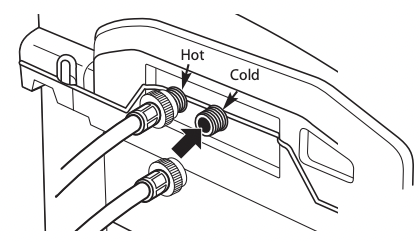
1. Turn OFF both water faucets completely. Unscrew the hot and cold water lines from the back of the washer.
IMPORTANT: Only use inlet hoses provided by KEN- MORE. Aftermarket hoses are not guaranteed to fit or function correctly. Other hoses may not tighten correctly and could cause leaks. Subsequent damage to prod- uct or property will not be covered under the terms of the product warranty. Hoses can be ordered by calling 1-844-553-6667 (U.S.A.).
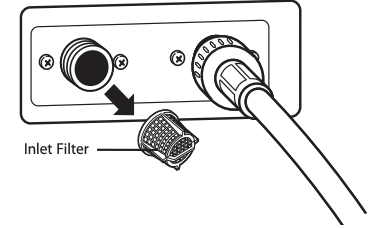
2. Carefully remove the filters from the water valves and soak them in white vinegar or a lime scale re- mover, following the manufacturer’s instructions. Be careful not to damage the filters while cleaning.
3. Rinse thoroughly before reinstalling. Press the filters back into place.
4. Before reattaching the hoses, flush the hoses and water lines by running several gallons of water into a bucket or drain.
CLEANING THE WASHER
Proper Use of Detergent
Using too much detergent is a common cause of laundry problems. Today’s detergents are formulated to be effective without visible sudsing. Be sure to carefully read and follow manufacturer’s recommendations for how much detergent to use in your wash. You can use less detergent if you have soft water, a smaller load, or a lightly soiled load.
NOTE: Use only low-sudsing, high-efficiency detergent. These detergents can be identified by the HE logo.
Care and Cleaning of the Washer
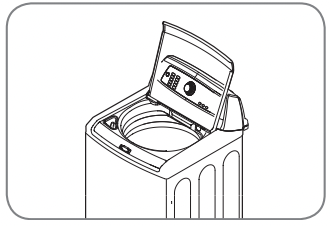
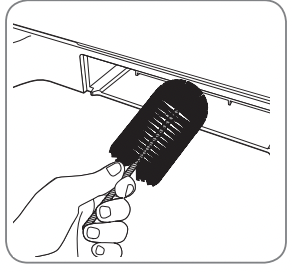
- Lid: Wash with a damp cloth on the outside and inside and then dry with a soft cloth.
- Exterior: Immediately wipe off any spills. Wipe with a damp cloth. Do not touch the surface or the display with sharp objects.
- Moving and Storage: Contact a service technician to remove water from the drain pump and hoses. Reinstall the foam tub block to protect the washer from damage while moving. Do not store the washer where it will be exposed to outdoor weather conditions.
- Long Vacations: Be sure water supply is shut off at the faucets. Follow the instructions if the washer will be exposed to freezing temperatures.
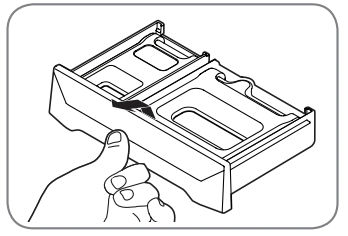
- Dispenser Drawer: Detergent and fabric softener may build up in the dispenser drawer. Remove the drawer and inserts and check for buildup once or twice a month.
1 Remove the drawer by pulling it straight out until it stops. Lift up on the front of the drawer and pull it completely out.
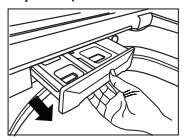
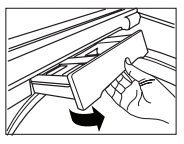
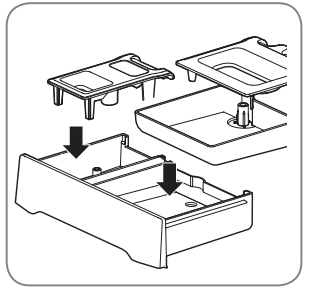
2 Remove the inserts from the two compartments. Rinse the inserts and the drawer with warm water to remove buildup from laundry products.
3 To clean the drawer opening, use a small, nonmetal brush to clean the recess. Remove all residue from the upper and lower parts of the recess.
4 Return the inserts to the proper compartments and replace the drawer. Set the drawer into the opening at an angle as shown above, then lower it and slide it into place.
Diagnostics
Should you experience any problems with your washing machine, it has the capability of transmitting data via your telephone to the Diagnostics Team. This gives you the capability of speaking directly to our specially trained technicians. The technician records the data transmitted from your machine and uses it to analyze the issue, providing a fast and effective diagnosis.
Using Diagnostics
First, call 1-844-553-6667 (U.S.A.). If the number of the phone you are using is on file and is associated with your refrigerator, you will be quickly relayed to a Diagnostics Team agent. Only use the Diagnostics feature when instructed to do so by the Diagnostics Team agent.
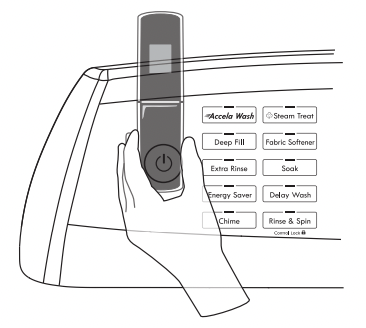
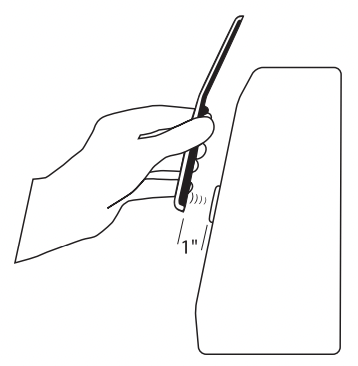
 Hold the mouthpiece of your phone over the power button, when instructed to do so by the call center, no more than one inch from (but not touching) the machine.
NOTE: Do not press any other buttons or turn the cycle selector knob.
 Push and hold the WASH TEMP button while continuing to hold your phone to the POWER button.
 Listen for three beeps. After you hear the three beeps, release the WASH TEMP button. Keep the phone in place until the tone transmission has finished. This takes about 6 seconds, and the display will count down the time. Once the countdown is over and the tones have stopped, resume your conversation with the technician, who will then be able to assist you in using the information transmitted for analysis.
NOTE:
• For best results, do not move the phone while the tones are being transmitted.
•If the call center agent is not able to get an accurate recording of the data, you may be asked to try again.
• Pressing the POWER button during the transmission will shut off Diagnostics.
TROUBLESHOOTING GUIDE
NORMAL SOUNDS YOU MAY HEAR
The following sounds may be heard while the washer is operating. They are normal.
Clicking: Lid lock relay when the lid locks and unlocks.
Spraying or hissing: Water spraying or circulating during the cycle.
Humming or gurgling: Drain pump is pumping water from the washer at times during a cycle.
BEFORE CALLING FOR SERVICE
Your washing machine is equipped with an automatic error-monitoring system to detect and diagnose problems at an early stage. If your washer does not function properly or does not function at all, check the following before you call for service:
Rattling and clanking noise
Foreign objects, such as keys, coins, or safety pins, may be in tub or pump.
- Stop washer, check tub and drain filter for foreign objects. If noise continues after washer is restarted, call for service.
Thumping sound
Heavy wash loads may produce a thumping sound.
- This is normal. If sound continues, washer is probably out of balance.Stop and redistribute wash load.
Washer load may be out of balance.
- Pause the cycle and redistribute the load after the lid unlocks.
Stop and redistribute wash load.
Packaging materials were not removed.
- See the Unpacking and Removing Shipping MATE- RIAL section in the installation requirements.
Wash load may be unevenly distributed in the tub.
- Pause the cycle and redistribute the load after the lid unlocks.
Not all leveling feet are resting firmly and evenly on the floor.
- See Leveling the Washer in the Installation Instructions
Floor not rigid enough.
- Make sure that the floor is solid and does not flex. See Flooring in the Installation Requirements.
Water leaking
Inlet hose connection is loose at faucet or washer.
- Check hoses for leaks, cracks and splits.
- Check and tighten hose connections
House drain pipes are clogged.
- The washer pumps out water very rapidly. Check for water backing up out of the drain pipe during drain. If water is seen coming out of the drain, check for proper drain hose installation and check for restrictions in the drain. Contact a plumber to repair drain pipe.
Drain hose has come out of drain or is not inserted far enough.
- Tie drain hose to inlet hose or standpipe to prevent it from coming out during drain. For smaller drain pipes, insert the drain hose into the pipe as far as the drain hose flange. For larger drain pipes, insert the drain hose into the pipe 1-2 inches past the flange.
A large item such as a pillow or blanket is above the top of the tub.
- Use the BULKY/BEDDING cycle for large or bulky items Use extra care and never wash more than half a load of items that float such as pillows.
- Stop the washer and check the load. Make sure the load does not crest above the top edge of the tub.
Wrinkling
Washer not unloaded promptly.
- Always remove items from the washer as soon as the cycle is complete.
Washer overloaded.
- The washer can be fully loaded, but the tub should not be tightly packed with items. The lid of the washer should close easily.
Hot and cold water inlet hoses are reversed.
- Hot water rinse can set wrinkles in garments. Check the inlet hose connections
Excessive sudsing
Too much detergent or incorrect detergent.
- HE detergents are formulated specifically for High-Efficiency washers and contain suds-reducing agents. Only use detergent with the High-Efficiency (HE) logo. For detergent quantities refer to the How to Use section.
Staining
Bleach or softener dispensed too soon.
- Dispenser compartment is overfilled causing bleach or softener to dispense immediately. ALWAYS measure bleach to prevent overfilling - one cup maximum.
- Dispenser drawer closed too quickly causing softener to dispense immediately.
Bleach or softener was added directly to the wash load in the tub.
- Always use the dispensers to ensure that laundry products are properly dispensed at the right time in the cycle.
Washer was not unloaded promptly.
- Always remove items from the washer as soon as possible after the cycle is complete.
Clothes were not properly sorted.
- Always wash dark colors separately from light colors and whites to prevent discoloration.
- Never wash heavily soiled items washed with lightly soiled items.
Washer will not turn ON NOTE: If the washer stopped during a cycle due to a loss of power, the washer will resume the cycle where it stopped when the power is restored.
Power cord is not properly plugged in.
- Make sure that the plug is plugged securely into a grounded, 3-prong, 120-VAC, 60-Hz outlet.
House fuse is blown, circuit breaker has tripped, or power outage has occurred.
- Reset circuit breaker or replace fuse. Do not increase fuse capacity. If the problem is a circuit overload, have it corrected by a qualified electrician.
House fuse is blown, circuit breaker has tripped, due to multiple appliances on one outlet.
- Reset circuit breaker or replace fuse. If more than one appliance is connected to the outlet, call an electrician to have an additional circuit installed.
Wash cycle time is longer than usual
The washer automatically adjusts the wash time for the amount of laundry, water pressure and other operating conditions.
- This is normal. The washer adjusts cycle time automatically to provide optimal results for the selected cycle. The time remaining shown in the display is only an estimate. Actual time may vary
Musty or mildewy odor in washer
Incorrect or too much detergent has been used.
- Use only High-Efficiency (HE) detergent in accordance with the manufacturer’s instructions.
Inside of tub was not cleaned properly.
- Run the CLEAN WASHER cycle regularly.
Water leaks
Oversudsing of detergent.
- Oversudsing may create leaks, and may be caused by the type and amount of detergent used. High-Efficiency detergent is the only detergent recommended. Make sure that detergent and any additives are put into the correct dispenser compartments. The normal amount of detergent to use is 1/4 to 1/2 of the maximum amount recommended by the detergent manufacturer. Always reduce the amount of detergent if the load is small or lightly soiled, or if your water is very soft. Never use more than the maximum amount recommended by the detergent manufacturer.
Washer will not operate
Control panel has powered off due to inactivity.
- This is normal. Press the POWER button to turn the washer on.
Washer is unplugged.
- Make sure cord is plugged securely into a working outlet.
Water supply is turned off.
- Turn both hot and cold faucets fully on.
Controls are not set properly.
- Make sure the cycle was set correctly, close the lid and press the START/PAUSE button.
Lid is open
- The washer will not operate if the lid is open. Close the lid and make sure that nothing is caught under the lid preventing it from closing completely
Circuit breaker/fuse is tripped/blown.
- Check house circuit breakers/fuses. Replace fuses or reset breaker. The washer should be on a dedicated branch circuit. The washer will resume the cycle where it stopped once power is restored.
Control needs to be reset.
- Press the POWER button, then re-select the desired cycle and press the START/PAUSE button.
START/PAUSE was not pressed after a cycle was set.
- Press the POWER button then re-select the desired cycle and press the START/PAUSE button. The washer will shut off if the START/ PAUSE button is not pressed within four minutes.
Extremely low water pressure.
- Check another faucet in the house to make sure that household water pressure is adequate.
Washer is too cold.
- If the washer has been exposed to temperatures below freezing for an extended period of time, allow it to warm up before pressing the POWER button. Otherwise, the display will not come on.
Washer not filling properly
Filter clogged.
- Make sure the inlet filters on the fill valves are not clogged. Refer to the filter cleaning instructions.
Inlet hoses may be kinked
- Check that inlet hoses are not kinked or clogged.
Energy efficiency.
- This is an energy-efficient washer. As a result, the temperature settings for this washer may be different than non-energy-efficient washers.
Insufficient water supply.
- Make sure that both hot and cold water faucets are turned on all the way.
The washer lid is open.
- The washer will not operate if the lid is open. Close the lid and make sure that nothing is caught under the lid preventing it from closing completely.
Hot and cold inlet hoses are reversed.
- Check inlet hose connections. Make sure the hot water supply is connected to the hot inlet valve, and the cold water supply is connected to the cold inlet valve.
Water level is too low.
- This is a high efficiency washer. The water will not normally cover the clothes. The fill level is optimized for the wash motion to achieve the best wash performance.
Washer will not drain water
Kinked drain hose.
- Ensure that the drain hose is not kinked.
Drain located higher than 96 in. above the floor.
- Make sure that the drain hose is no higher than 8 ft. above the bottom of the washer and is no more than 5 ft. away from the washer.
Poor stain removal
Proper options not selected.
- Heavier soils and tougher stains may require extra cleaning power. Select SOAK to boost the cleaning power of the selected cycle.
Previously set stains.
- Articles that have previously been washed may have stains that have been set. These stains may be difficult to remove and may require hand washing or pre-treating to aid in stain removal.
Bleach does not dispense
Bleach dispenser cover is not properly installed.
- Make sure that the bleach cover is properly installed and snapped into place before the beginning of the cycle.
Bleach dispenser is dirty or clogged.
- Lift out the bleach dispenser cover and clean out the reservoir. Lint and other foreign debris that collects in the inside the dispenser may prevent proper dispensing of the bleach.
Premature dispensing of bleach
Bleach dispenser filled for future load.
- You cannot store bleach in the dispenser for future use. The bleach will be dispensed every load
Overfilling the bleach dispenser.
- Overfilling the bleach dispenser will cause the bleach to dispense immediately, which will damage items in the tub. ALWAYS measure bleach, but never fill above the MAX line on the dispenser. One cup of bleach is normal, but never add more than one cup.
Incomplete or no dispensing of detergent
Detergent compartments clogged from incorrect filling.
- Make sure that detergent and additives are put into the correct dispenser compartments. If liquid detergent is used, make sure that the liquid detergent cup and insert are in the detergent compartment. If powdered detergent is used, make sure that the liquid detergent cup and insert are not used. For all detergent types, always make sure that the dispenser drawer is fully closed before the start of the cycle.
Too much detergent used.
- Make sure that the suggested amount of detergent is used per the manufacturer’s recommendations. You may also dilute the detergent with water to the maximum fill line on the compartment to avoid clogging. Use only HE (High- Efficiency) detergent. NOTE: Always use as little detergent as possible. High-Efficiency washers need very little detergent to achieve optimum results. Using too much detergent will cause poor wash and rinse performance and may contribute to odors in washer.
Insufficient water supply.
- Make sure that both hot and cold water faucets are turned on all the way.
Normal residue.
- It is normal for a small amount of detergent to remain in the dispenser. If this residue builds up it can interfere with normal dispensing of products. Refer to the cleaning instructions
Water leaks every load
Hoses not installed correctly.
- Check all fill and drain hose connections to ensure that they are tight and secure.
Error Codes
The display shows: dE
The lid is not closed properly.
- Make sure that the lid is closed properly and press the START/PAUSE button. After starting a cycle, it may take a few moments before the tub begins to turn or spin. The washer will not spin unless the lid is locked. If the lid is closed and the lid lock error message is displayed, call for service.
The display shows: dL 
Lid lock switch error.
- Make sure that the lid is closed prop- erly and press the START/PAUSE but- ton. The washer will not operate unless the lid is locked.
- Make sure that nothing is caught under the lid, including shipping mate- rial or clothing.
- Make sure that the latch mechanism is fully retracted.
- If the lid is closed and the lid lock error message is displayed, call for service.
The display shows: dr 
Special Drain Feature.
- If the washer is paused during a cycle for more than four minutes, the cycle will be cancelled and any water remaining in the tub will be drained. An alarm will sound at three minutes to warn you that the tub is about to drain.
Washer fills with wa- ter slowly or not at all, or the display shows: I E 
Water supply faucets are not fully open.
- Make sure that the water faucets are fully open.
Water line hoses are kinked, pinched, or crushed.
- Make sure the hoses are not kinked or pinched. Be careful when moving the washer during cleaning and mainte- nance.
Water inlet filters are clogged.
- Clean the inlet filters. See Maintenance in the Care and Cleaning sec- tion.
Water supply pressure to faucet or house is too low.
- Check another faucet in the house to make sure that household water pres- sure is adequate and flow is not restricted. Disconnect the inlet hose from the washer and run a few gallons of water through the hose to flush the water supply lines. If flow is too low, contact a plumber to have the water lines repaired.
Water supply connected with leaklimiting hoses.
- Hoses designed to limit leaks can trip falsely and prevent the washer from filling. The use of leak limiting hoses is not recommended.
NOTE: If an error message is displayed for four minutes, the water in the tub will automatically drain. An alarm will sound one minute prior to draining and the original error code will continue to be displayed.
Water in the washer drains slowly or not at all, or the display shows: OE 
Drain hose is kinked, pinched, or clogged.
- Make sure the drain hose is free of clogs, kinks, etc., and is not pinched behind or under the washer.
Drain discharge is more than 96 inches above bottom of washer.
- Adjust or repair drain. Maximum drain height is 96 inches (8 ft.)
The display shows: uE 
The washer has detected an out of balance load.
- If the washer detects a load that is too far out of balance to spin, it will dis- play this code while it is attempting to rebalance the load. The washer will add water and try to redistribute the load automatically. This display is for your information only, and no action is required.
The display shows: UE 
If the uE rebalance (see above) is not successful, this error will be displayed.
- The automatic attempt to rebalance the load was not successful. The cycle has been paused to allow the load to be manually adjusted.
The load is too small.
- Small loads may need additional items to be added to allow the washer to balance the loads.
Heavy articles are mixed with lighter items.
- The load may have heavy items loaded with lighter items. Always try to wash articles of somewhat similar weight to allow the washer to evenly distribute the weight of the load for spinning.
The load is out of balance.
- Manually redistribute the load if articles have become tangled preventing the automatic distribution from working properly.
The display shows:
Control error.
- Unplug the washer and wait 60 seconds. Reconnect power and try again. If the error reappears, call for service.
The display shows: FE 
Water level is too high due to a faulty water valve.
- Close the water faucets, unplug the washer, and call for service.
The display shows: PE 
The water level sensor is not working correctly.
- Close the water faucets, unplug the wash- er, and call for service.
The display shows: LE 
A motor error has occurred.
- Allow the washer to stand for 30 minutes and then restart the cycle. If the LE error code persists, call for service.
The display shows: E6 
Clutch error.
- Mechanical failure.
- Unplug the washer and call for service.
The display shows: L E1 
Foreign objects, such as coins, pins, clips, etc., caught between the wash plate and the inner basket.
- Turn off the washer and then press the Power button. Press the spin speed button without selecting a cycle to drain and spin the load.
- When the spin is complete, remove the clothes and then find and remove any objects caught in the wash plate. Always check pockets, etc., before wash- ing to prevent error codes or damage to the washer or clothing.