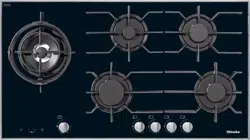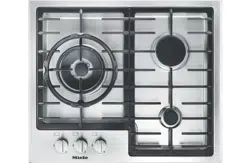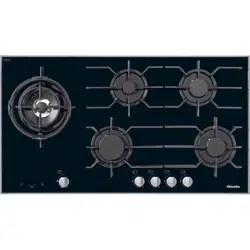
Operating and Installation Instructions
Gas cooktop
To prevent accidents and machine damage, read these instructions be-
fore installation or use.
en-US M.-Nr. 10 810 470
IMPORTANT SAFETY INSTRUCTIONS
2
WARNING: If the information in this manual is not followed exactly, a fire or
explosion may result causing property damage, personal injury, or death.
– Do not use or store gasoline or other combustible liquids or vapors in the vicinity
of this or any other appliance.
– WHAT TO DO IF YOU SMELL GAS
– Do not try to light any appliance.
– Do not touch any electric switches.
– Do not use any phones inside your building.
– Immediately call your gas supplier from a neighbor's phone. Follow the gas
supplier's instructions.
– If you are unable to reach your gas provider, call the fire department.
– Installation and service must be performed by a qualified installer, qualified ser-
vice agency or your gas provider.
(In Massachusetts, installation must be performed by a licensed installer / gas
fitter.)
– Note to the installer:
Please give these installation instructions to the consumer for the local electri-
cal/gas inspector.
®
®

Contents
3
IMPORTANT SAFETY INSTRUCTIONS ................................................................ 2
IMPORTANT SAFETY INSTRUCTIONS ................................................................ 5
Caring for the environment ................................................................................ 16
Overview............................................................................................................... 17
Cooktop................................................................................................................. 17
Control knobs........................................................................................................ 18
Burner.................................................................................................................... 19
Included accessories............................................................................................. 20
Before first use .................................................................................................... 21
Cleaning the cooktop for the first time.................................................................. 21
Turning on the cooktop for the first time ............................................................... 21
Cookware ............................................................................................................. 22
Energy saving tips .............................................................................................. 24
Operation.............................................................................................................. 25
Turning the appliance on ....................................................................................... 25
Adjusting the flame................................................................................................ 26
Turning the appliance off....................................................................................... 26
Safety features..................................................................................................... 27
Ignition safety control............................................................................................ 27
Cleaning and care ............................................................................................... 28
Stainless steel cooktop ......................................................................................... 29
Grates.................................................................................................................... 30
Control knobs........................................................................................................ 30
Burner.................................................................................................................... 30
Frequently Asked Questions .............................................................................. 32
Optional accessories .......................................................................................... 34
IMPORTANT SAFETY INSTRUCTIONS - INSTALLATION ................................. 35
Safety clearances ................................................................................................ 36
Instructions for installation ................................................................................ 39
Installation dimensions....................................................................................... 40
Installation............................................................................................................ 41

Contents
4
Electrical connection .......................................................................................... 43
Gas connection.................................................................................................... 45
Burner ratings ...................................................................................................... 48
Technical Service................................................................................................. 49
Contact in case of fault ......................................................................................... 49
Data plate .............................................................................................................. 49
Warranty ................................................................................................................ 49
MieleCare ............................................................................................................. 50

IMPORTANT SAFETY INSTRUCTIONS
5
This cooktop conforms to current safety requirements. Improper
use can, however, lead to personal injury and damage to property.
To avoid the risk of accidents and damage to the appliance,
please read these instructions carefully before using the appliance
for the first time. They contain important notes on installation,
safety, use and maintenance.
Miele cannot be held liable for damage occurring as a result of
non-compliance with these instructions.
Keep these instructions in a safe place and pass them on to any
future owners.

IMPORTANT SAFETY INSTRUCTIONS
6
Appropriate use
This cooktop is intended for domestic use and use in other similar
environments.
This cooktop is not intended for outdoor use.
The cooktop is intended for domestic use only to prepare food
and keep it warm. Any other use may be dangerous.
Persons (including children) who lack physical, sensory or mental
abilities, or experience with the appliance should not use it without
supervision or instruction by a responsible person.

IMPORTANT SAFETY INSTRUCTIONS
7
Safety with children
As with any other appliance, children must be supervised.
Do not leave children unattended: Children should not be alone or
unsupervised in the area where the appliance is installed. Do not al-
low them to sit or stand on the appliance.
Children must not be allowed to clean the cooktop without super-
vision.
Be sure to supervise any children in the vicinity of the cooktop,
and do not let them play with it.
The cooktop gets hot when in use and remains hot for some time
after being turned off. Keep children away from the appliance until it
has cooled down and is no longer a burn hazard.
Burn hazard!
Keep the spaces above and behind the cooktop clear of any items
that could draw the attention of children. Otherwise, they can be
tempted into climbing onto the appliance.
Risk of burning or scalding.
Turn pot and pan handles inward, so children cannot pull them down
and be burned.
Danger of suffocation! Ensure that any plastic wrappings, bags,
etc. are disposed of safely and kept out of the reach of children.

IMPORTANT SAFETY INSTRUCTIONS
8
Technical safety
Unauthorized installation, maintenance, and repairs can cause
considerable danger for the user. Installation, maintenance, and re-
pairs must only be carried out by a Miele authorized technician.
Maintenance by the user: Never repair or replace any part of the
appliance unless the instructions specifically recommend doing so.
Service work may only be performed by a qualified technician.
Damage to the cooktop can compromise your safety. Check the
cooktop for visible signs of damage. Do not use the cooktop if it is
damaged.
Reliable and safe operation of the cooktop can only be guaran-
teed if it is connected to the public power supply.
Be certain your appliance is properly installed and grounded by a
qualified technician. To guarantee the electrical safety of this appli-
ance, continuity must exist between the appliance and an effective
grounding system. It is imperative that this basic safety requirement
be met. If there is any doubt, have the electrical system of the house
checked by a qualified electrician.
Proper installation: Make sure that your appliance has been in-
stalled correctly and that it has been grounded by a qualified techni-
cian.
To avoid damaging the cooktop, make sure that the connection
data (voltage and frequency) on the data plate correspond to the
building's power supply before connecting the appliance.
When in doubt, consult a qualified electrician.
Do not connect the appliance to the electrical supply with a power
bar or extension cord. These are a fire hazard and do not guarantee
the required safety of the appliance.
For safety reasons, the cooktop may only be used when it has
been fully installed.

IMPORTANT SAFETY INSTRUCTIONS
9
This appliance must not be used in a non-stationary location (e.g.
on a ship).
Any contact with live connections or tampering with the electrical
or mechanical components of the cooktop will endanger your safety
and may lead to appliance malfunctions.
Do not open the casing of the cooktop under any circumstances.
Any repairs not performed by a Miele authorized service techni-
cian will void the warranty.
Defective components should be replaced by Miele original parts
only. Only with these parts can the manufacturer guarantee the
safety of the appliance.
The appliance is not intended for use with an external timer switch
or a remote control system.
The connection to the gas supply must be carried out by a suit-
ably qualified and competent person in accordance with current lo-
cal and national safety regulations. If the plug is removed from the
power cord or if the cord is supplied without a plug, the appliance
must be connected to the electrical supply by a suitably qualified
electrician.
If the power cord is damaged, it must only be replaced by a quali-
fied service technician (see “Electrical connection”).

IMPORTANT SAFETY INSTRUCTIONS
10
During installation, maintenance, and repair work, the appliance
must be completely disconnected from the household electricity
supply. The gas supply must be shut off. Ensure that this is the case
by:
– removing the fuse
– “tripping” the circuit breaker, or
– unplugging the unit. Pull the plug not the cord.
– Shut off the gas supply.
Danger of electric shock.
If the cooktop is defective, immediately turn the appliance off and
discontinue use. Disconnect it from the electricity and gas supply.
Contact Technical Service.
If the cooktop is installed behind a cabinet door, do not close the
door while the cooktop is in operation. Heat and moisture can build
up behind the closed door and cause damage to the cooktop, cabi-
netry and flooring. Do not close the door until the cooktop has com-
pletely cooled down.
Reaching over a hot stovetop to access the cabinets can result in
burns. You can reduce the risk of burns by installing a range hood
that extends at least 4¾" (12cm) past the bottom of the cabinets.
Ask your installer to show you the location of your gas shutoff
valve and fuses or circuit breaker panel in your apartment or home.
Be sure that you know how and where to disconnect the gas and
power supply to your cooktop.

IMPORTANT SAFETY INSTRUCTIONS
11
Correct use
The cooktop gets hot when in use and remains hot for some time
after being turned off. Do not touch the appliance if there is a possi-
bility that it could still be hot.
When in use, the cooktop emits a significant amount of heat,
which can cause objects in the vicinity to catch fire.
Never use the cooktop to heat the room.
Do not leave the cooktop unattended when cooking on high
power. Spilled food will begin to smoke and cause grease splatter,
which can ignite on the cooktop.
Oil and fat can catch fire if overheated. Never leave the appliance
unattended when cooking with oil and fat. If the oil or fat catches
fire, do not attempt to put the flames out with water.
Turn off the cooktop and smother the flames using a lid or a suitable
fire blanket.
Smother the fire or flames, or use a dry chemical extinguishing
agent or foam fire extinguisher.
The flames could set the grease filters of a ventilation hood on fire.
Do not flambé under a ventilation hood.
Spray canisters, aerosols and other inflammable substances can
ignite when heated. Therefore do not store such items or substances
in a drawer under the appliance. Cutlery inserts must be heat-resis-
tant.
Never heat empty cookware.
Do not heat or can food in closed containers, such as tins or
sealed jars, on the cooktop, as pressure will build up in the container
and cause it to explode.

IMPORTANT SAFETY INSTRUCTIONS
12
If the cooktop is covered, there is a risk that the material of the
cover will ignite, explode or melt if the cooktop is still hot or if turned
on inadvertently. Never cover the cooktop with a board, cloth or pro-
tective sheet.
When the appliance is turned on inadvertently or by mistake, or
when there is residual heat present, there is a risk of the metal items
heating up. Other materials can melt or catch fire when the appliance
is switched on. Do not store items on the cooktop.
You can burn yourself on a hot cooktop. When cooking on the ap-
pliance, protect your hands by using heat-resistant pot holders or
oven mitts. Only use dry pot holders or gloves. Wet or damp textiles
conduct heat more effectively and produce steam, which poses a
burn hazard. Be sure to keep all textiles away from the gas flames.
Do not use oversized cloths, dish towels or other similar materials.
When using an electrical appliance, e.g. a hand mixer, near the
cooktop, make sure that the power cable does not come into con-
tact with the hot cooktop. The cable's insulation could become dam-
aged.
Cookware made of plastic or aluminum foil will melt at high tem-
peratures. Do not use any plastic or aluminum foil cookware.
A range hood installed above the cooktop can become damaged
or catch fire as a result of intense heat. Do not use the gas burners
without cookware.
Only light the gas burners after all burner parts have been properly
assembled.
If the cookware is too small, it will not sit properly on the burner
grate. If the cookware is too large, heat emitted from the bottom of
the cookware may damage the countertop, walls with poor heat-re-
sistance (e.g. paneled walls) or portions of the cooktop.
Make sure that the burner flames do not extend beyond the bot-
tom of the cookware and rise up its sides.

IMPORTANT SAFETY INSTRUCTIONS
13
Only use cookware with a thick enough bottom. Failure to do so
may result in damage to the cooktop.
Always use the burner grates supplied with the cooktop. Never
place cookware directly on the burner.
Install the burner grates in an upright position to avoid scratching
the cooktop.
Storage in or on the appliance: Flammable materials should not be
stored in an oven or in the vicinity of the cooktop.
Remove all grease splatters and other flammable (food) residues
on the cooktop. They are a fire hazard.
Avoid allowing liquids or foods containing salt to spill onto the
cooktop. If salty foods or liquids do get on the cooktop, they should
be removed as soon as possible to avoid the risk of corrosion.
Using of a gas cooktop causes heat, moisture and products of
combustion to build up in the room in which it is installed. Make sure
that your kitchen is well ventilated, especially when the appliance is
in use: keep any natural means of ventilation open or install a me-
chanical ventilation system (e.g. a ventilation hood).
If the cooktop is used for very long periods of time, additional
ventilation of the room may be necessary, e.g. by opening windows
or doors, or running the ventilation on the highest setting.
Do not use pots or pans that are large enough to cover several
burners. The resulting heat buildup can damage the appliance.
If the cooktop has not been used for a long period of time, be sure
to thoroughly clean it and have it inspected by an authorized techni-
cian before using it again.
Ensure that the igniters are clean and dry to allow the burners to
ignite and burn properly.

IMPORTANT SAFETY INSTRUCTIONS
14
Fire hazard! Loose-fitting or hanging garments can catch fire. Be
sure to wear appropriately fitting clothing when cooking. Never allow
loose clothing or flammable materials to come into contact with the
burners while the burners are in use.
When you have finished cooking, make sure that the burners are
turned off by checking the position of the knobs.
The grates, burner cap, bottom parts of the burner, and any other
parts located near the burner flame, can still be very hot after cook-
ing and cause burns. Do not touch these components when using
the cooktop.
Wind can blow curtains over the cooktop, causing them to catch
fire. If the cooktop is installed near a window, do not use long cur-
tains.
Only certain types of glass, ceramic or other enamel cookware
can be used on a gas cooktop without breaking as a result of sud-
den temperature changes.
Wet sponges or clothes can cause burns due to hot steam if they
are used to wipe spilled food off a hot burner. Some cleansers can
emit hazardous vapors if they are applied to a hot surface. Be careful
when cleaning the cooktop.

IMPORTANT SAFETY INSTRUCTIONS
15
Cleaning and maintenance
Do not use a steam cleaner to clean the cooktop.
The steam may reach electrical components and cause a short cir-
cuit.
SAVE THESE INSTRUCTIONS AND REVIEW THEM PERIODICALLY

Caring for the environment
16
Disposal of the packing mate-
rial
The cardboard box and packing materi-
als protect the appliance during ship-
ping. They have been designed to be
biodegradable and recyclable.
Ensure that any plastic wrappings,
bags, etc. are disposed of safely and
kept out of the reach of children. Dan-
ger of suffocation!
Disposal of your old appliance
Electrical and electronic appliances
contain valuable materials. They also
contain certain substances, compounds
and components which were essential
for the proper functioning and safe use
of the equipment. Handling these mate-
rials improperly by disposing of them in
your household waste can be harmful to
your health and the environment. There-
fore, please do not dispose of your old
appliance with regular household waste
and follow local regulations on proper
disposal.
Consult with local authorities, dealers or
Miele in order to dispose of and recycle
electrical and electronic appliances.
Miele assumes no responsibility for
deleting any personal data left on the
appliance being disposed. Please en-
sure that your old appliance is kept
away from children until removal. Ob-
serve safety requirements for appli-
ances that may tip over or pose an en-
trapment hazard.
Overview
17
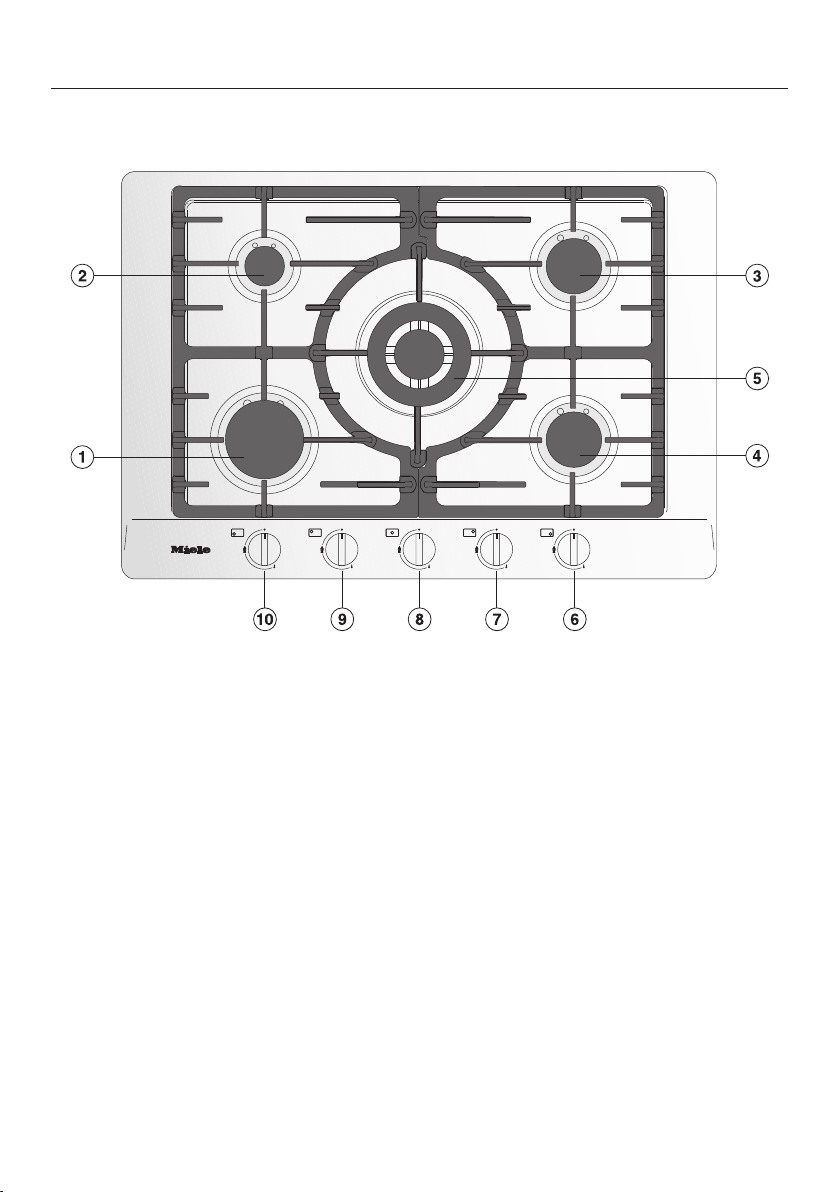
Cooktop
a
Power burner
b
Economy burner
c
Normal burner
d
Normal burner
e
Wok burner
Control knobs for the cooking zones
f
Front right
g
Back right
h
Middle
i
Back left
j
Front left
Overview
18
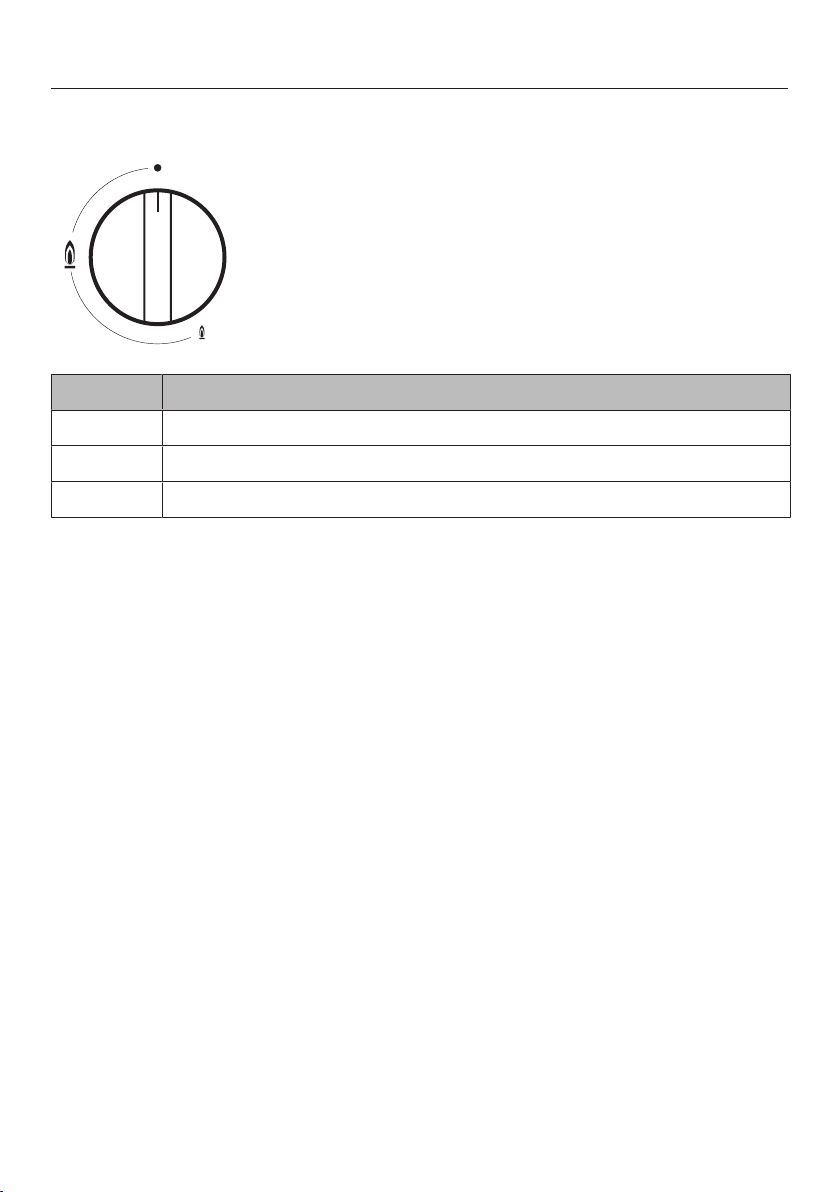
Control knobs
Symbol Description
Burner off, the gas supply is turned off
Strongest flame
Weakest flame
Overview
19
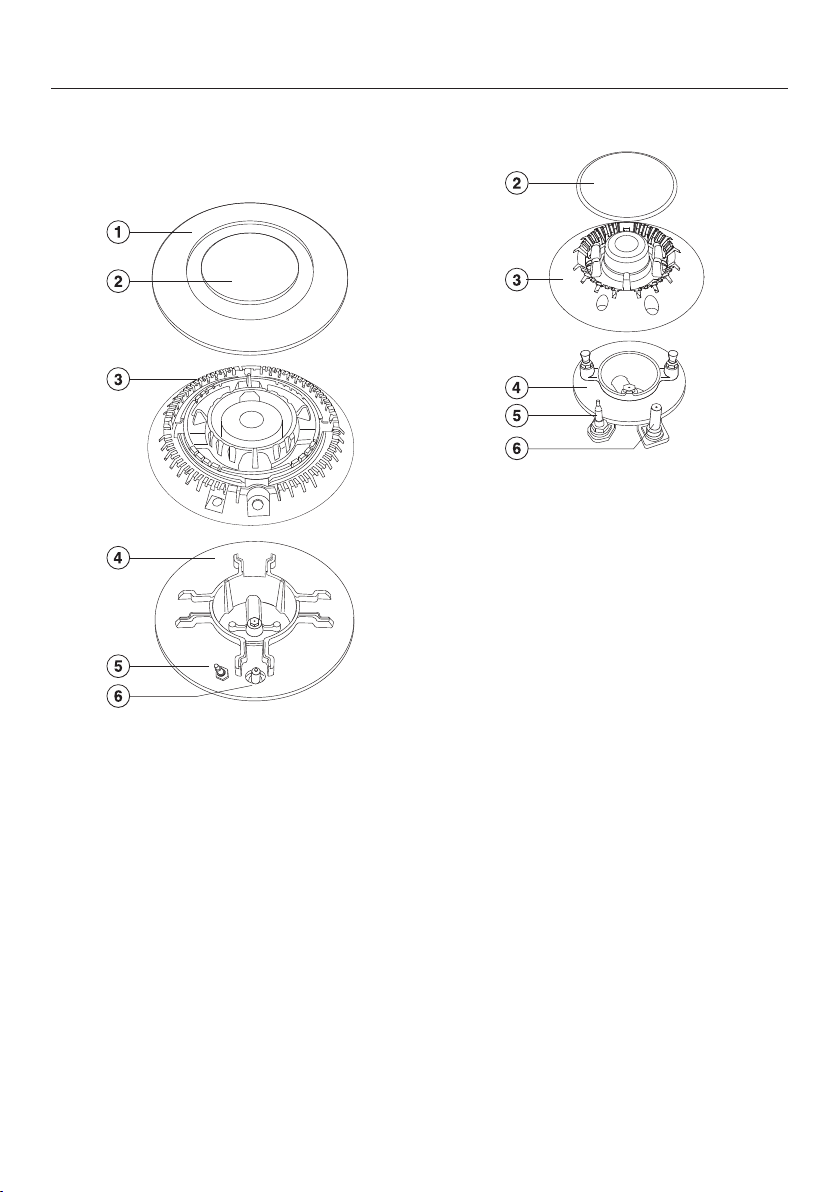
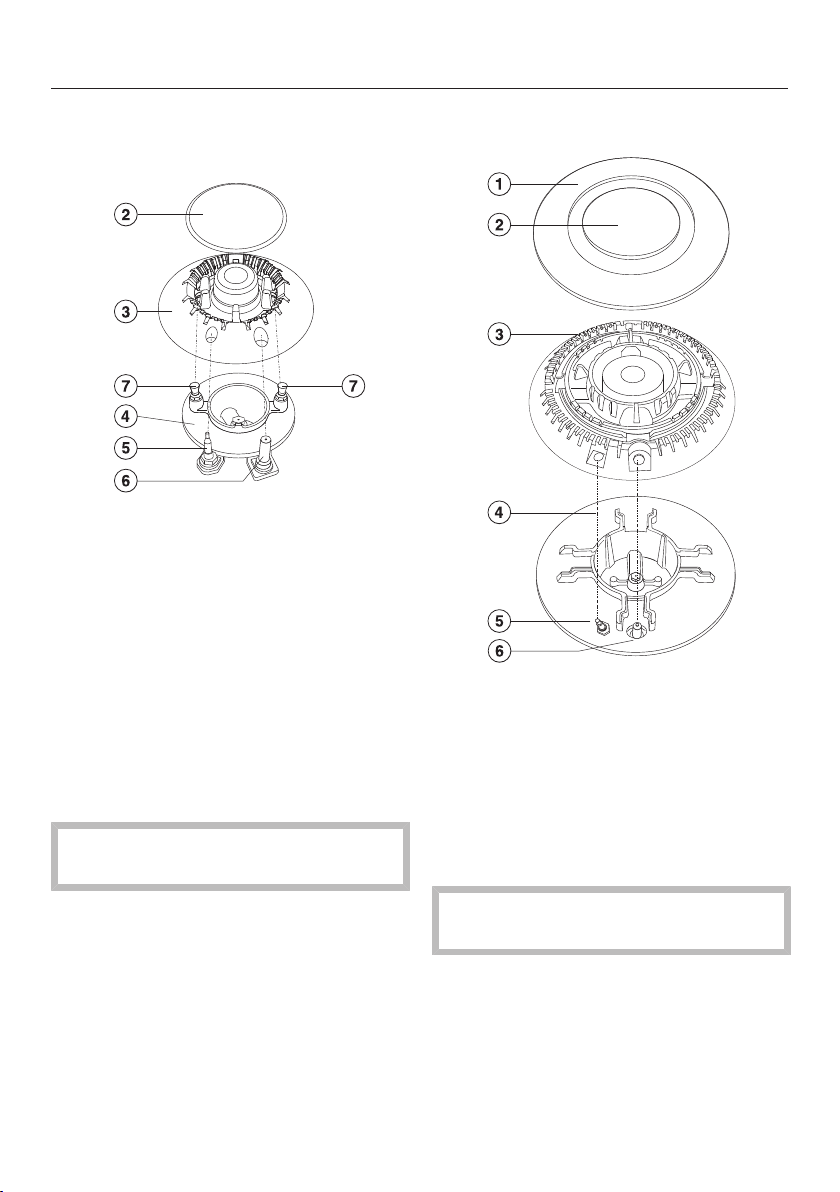
Burner
Wok burner
Economy, power and normal burners
a
Burner ring (wok burner)
b
Burner cap
c
Burner head
d
Burner base
e
Thermocouple
f
Ignition electrode

Overview
20
Included accessories
The accessories supplied with your ap-
pliance, as well as a range of optional
ones, are available to order from Miele
(see “Optional accessories”).
Wok ring
The Wok ring supplied with your appli-
ance can be used in instances where
extra stability is required. It is particu-
larly suitable for wok pans with rounded
bases.

Before first use
21
Please adhere the extra appliance
data plate (supplied) in the space pro-
vided in the “After sales service” sec-
tion of this manual.
Remove any protective foil and stick-
ers.
Cleaning the cooktop for the
first time
Before first use, wipe down the appli-
ance with a damp cloth and dry it.
Using a soft sponge, clean all remov-
able burner parts with a solution of
warm water and a small amount of
liquid dish soap. Dry the parts thor-
oughly after cleaning and reassemble
the burners (see “Cleaning and
care”).
Turning on the cooktop for the
first time
Metal components are protected by a
conditioning agent. Smells and vapor
may occur when the appliance is used
for the first time.
The smell and any vapors do not indi-
cate a faulty connection or a defective
appliance and are not harmful to your
health.

Cookware
22
– Select cookware that fits the size of
the burner:
Large diameter = large burner
Small diameter = small burner
– Using cookware that is too large can
cause the flames to spread out and
damage the surrounding countertop
or other appliances. Choosing the
right cookware size improves effi-
ciency.
– Any cookware that has a diameter
smaller than the burner grate or
which does not rest in a stable posi-
tion on the grate (without wobbling) is
dangerous and should not be used.
– Unlike cookware that is used on an
electric cooktop, the bottom of cook-
ware used on a cooktop does not
have to be flat to deliver effective
cooking performance.
– When purchasing pots and pans,
keep in mind that the diameter indi-
cated is typically the top diameter,
not the bottom diameter.
– All heat-resistant cookware is suitable
for use.
– Cookware with a thick bottom is
preferable, as it distributes heat more
evenly. Cookware with a thin bottom
may cause food to overheat in certain
spots. To avoid this, stir the food fre-
quently.
– Always place the cookware on the
pot rests supplied. Do not place
cookware directly on the burners.
– Position the cookware on the burner
grate so that it cannot tip. There is al-
ways a possibility of a slight tilt, de-
spite the proper position.
– Do not use pots or pans that have
bottoms with pronounced edges.

Cookware
23
Wok ring
Use the wok ring supplied to give ad-
ditional stability to pans, especially to
woks with a rounded base.
Place the wok ring on the pan sup-
port so that it sits securely in position
and cannot move (see diagram).
The wok pan is a special piece of cook-
ware. It has a small base diameter and
a large upper rim diameter (usually
13¾“ - 15¾” (35-40 cm)). The wok
burner is particularly suitable for wok
pans.

Energy saving tips
24
– Whenever possible, keep pots and
pans covered while cooking. Doing
so will prevent unnecessary heat loss.
– Wide, shallow cookware heats up
faster and is therefore preferable to
tall, narrow cookware.
– Cook with as little water as possible.
– Reduce the power setting once the
water has come to a boil or the oil/fat
is hot enough for frying.
– Use a pressure cooker to reduce the
cooking time.

Operation
25
Fire hazard due to overheated
food.
Unattended food can overheat and
ignite.
Do not leave the cooktop unattended
whilst it is being used.
Turning the appliance on
Press in the relevant control and turn
it counter-clockwise to the large
flame symbol. The ignitor “clicks” and
ignites the gas.
When a control knob is activated, a
spark is developed automatically on all
burners. This is normal and does not
indicate a fault.
When a flame is visible, keep the
control knob pressed in for 5-10sec-
onds, and then let it go.
If the burner does not ignite, turn the
knob to“ ”. Ventilate the room or
wait for at least 1minute before trying
again. When making another ignition
attempt, it may be necessary to hold
the control knob for longer.
If the burner does not ignite the sec-
ond time, turn the control knob back
to “ ” and see “Frequently asked
questions”.
Switching on during a power outage
In case of a power failure, the flame can
be ignited manually.
Press in the relevant control and turn
it counter-clockwise towards the
large flame symbol.
Hold the control pressed in and light
the gas at the burner with a match.
Keep the control pressed in for a fur-
ther 5-10seconds and then release it.
Operation
26
Adjusting the flame
The burners can be variably adjusted
between the lowest and highest flame
settings.
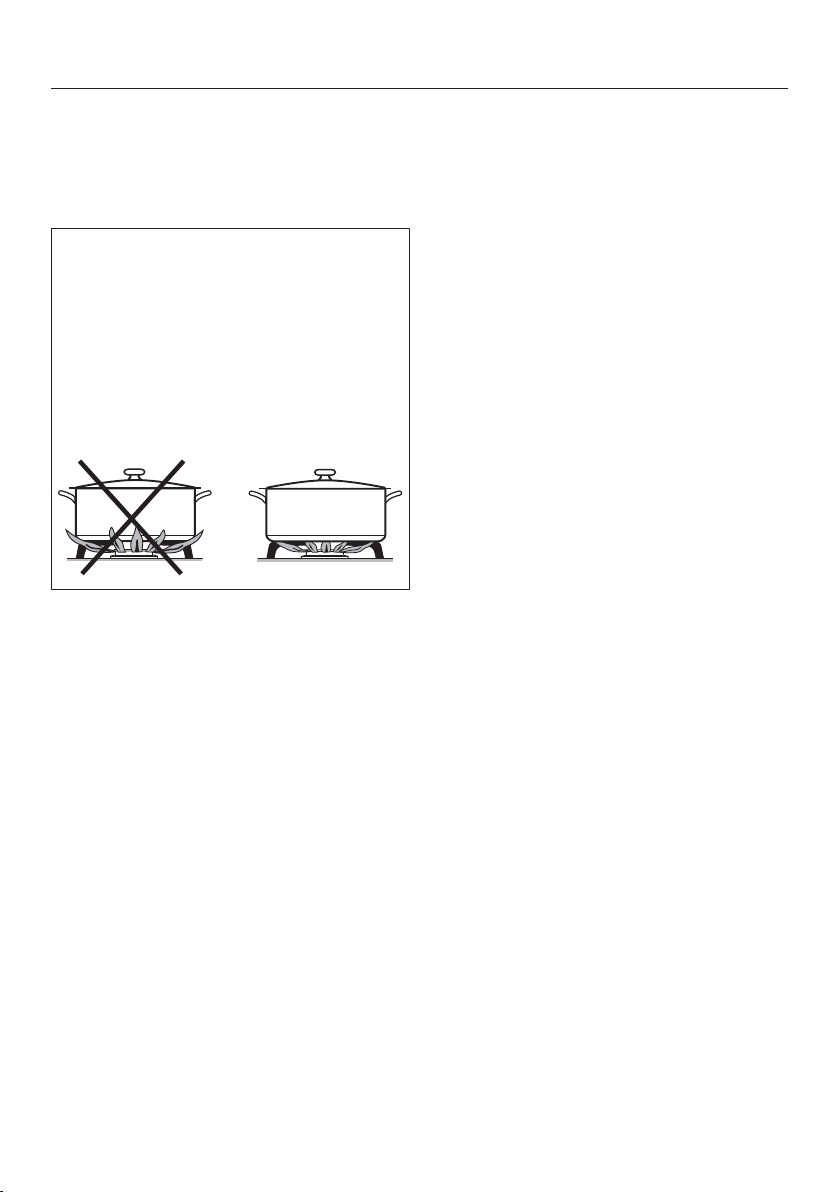
Because the edges of the flame are
much hotter than its center, the flame
tips should stay beneath the bottom of
the cookware. Flame tips which ex-
tend beyond the sides of the cook-
ware emit unnecessary heat into the
room and can also damage cookware
handles, which increases the risk of
injury.
Adjust the flame so that it never ex-
tends up the sides of the cookware.
Turning the appliance off
Turn the control clockwise to position
“ ”.
This stops the flow of gas and the flame
goes out.

Safety features
27
Ignition safety control
Your cooktop is equipped with a
thermo-electric flame failure monitor. If
a gas flame is extinguished, e.g. by
food boiling over or by a draft, the gas
supply is switched off. This prevents the
release of gas. If you turn the control to
the “ ” position, the burner is ready for
use again.
The thermo-electric flame failure moni-
tor operates independently from the
electricity supply. This means that it
will still work if the cooktop is used
during a power outage.

Cleaning and care
28
Danger of burning!
Burners must be switched off. Make
sure the cooktop has cooled down.
Danger of injury!
The steam from a steam cleaning ap-
pliance could reach live electrical
components and cause a short cir-
cuit.
Do not use a steam cleaner to clean
the cooktop.
All surfaces could be discolored or
damaged if unsuitable cleaning
agents are used.
All surfaces are susceptible to
scratching.
Remove all cleaning agent residues
immediately.
Unsuitable cleaning agents
To prevent damage to surfaces, avoid
the following while cleaning:
– cleaners containing soda, alkaline,
ammonia, thinners, or chlorides,
– cleaning agents containing descaling
agents,
– stain or rust removers,
– abrasive cleaning agents, e.g. pow-
der cleaners and cream cleaners,
– solvent-based cleaning agents,
– dishwasher cleaner,
– grill and oven sprays,
– glass cleaners,
– hard, abrasive brushes or sponges,
e.g., pot scourers, brushes or
sponges which have been previously
used with abrasive cleaning agents,
– eraser sponges.

Cleaning and care
29
The surfaces of the burners and pot
rests will become duller in the course
of time. This is quite normal and does
not indicate damage to the burner
cap.
The entire cooktop should be cleaned
after each use.
Soften any stubborn soiling before-
hand.
Dry the appliance after using water to
clean it. This helps prevent lime de-
posits.
Tip: Food which boils over on a hot
cooktop can cause discoloration of the
burner components. Remove any soil-
ing and salt and sugar splashes imme-
diately.
Stainless steel cooktop
Do not clean the area between the
cooktop and the countertop with
sharp, pointed objects.
This could cause damage to the
seals.
Soiling, particularly salty food or liq-
uid and olive oil, can cause damage
if left on the printed surfaces for a
long time.
Remove any soiling which comes
into contact with the printed flame
symbols straight away.
Stainless steel cleaning agents rub
off the printed symbols.
Do not use stainless steel cleaning
agents on printed symbols.
Clean the knobs with a soft sponge,
warm water and a small amount of
liquid dish soap. Soften any stubborn
soiling beforehand. If necessary, the
rough side of a kitchen sponge can
be used.
Finally, dry with a clean soft cloth.
Tip: The Miele conditioning agent for
stainless steel can be used after clean-
ing to help keep your appliance looking
new (see “Optional accessories”). It
should be applied sparingly with a soft
cloth.

Cleaning and care
30
Grates
Do not clean the grates in a dish-
washer.
Remove the grates.
Clean the grates with a soft sponge,
warm water and a small amount of
liquid dish soap. Soften any stubborn
soiling beforehand.
Dry the the grates thoroughly with a
clean cloth.
Control knobs
The control knobs are not dish-
washer safe.
The control knobs should only be
cleaned by hand.
The control knobs may become dis-
colored if they are not cleaned regu-
larly.
Clean the knobs with a soft sponge,
warm water and a small amount of
liquid dish soap.
Burner
Do not clean any parts of the burner
in a dishwasher.
The burner should be dismantled and
then cleaned only by hand using a
solution of warm water and a small
amount of liquid dish soap applied
with a soft sponge.
Parts of the burner that cannot be re-
moved should be wiped clean with a
damp cloth only.
The ignitor and ignition safety device
should be very carefully wiped clean
using a well wrung out cloth.
Do not let the ignitor get wet. If it gets
wet, it will not spark.
Finally dry everything thoroughly with
a clean cloth. Make sure that the
flame openings are completely dry.
The surface of the burner cap will be-
come more matte with time. This is
quite normal and does not indicate
damage to the burner cap.
Cleaning and care
31
Assembling the economy, normal
and power burners
Place the burner head onto the
burner base so that the thermo-
couple , the ignitor and the re-
taining pins fit into their respective
holes in the burner head.
Position the burner cap onto the
burner head so that the retaining
pins fit into their respective recesses.
Gently twist the burner cap clockwise
or anti-clockwise until it locks into
position. When correctly positioned,
the burner cap will not slide about.
Ensure that all parts of the burner are
reassembled in the correct order.
Assembling the wok burner
Place the burner head on to the
burner base so that the thermo-
couple and the ignitor extend
through their respective holes in the
burner head.
Replace the burner ring.
Replace the burner cap.
Ensure that all parts of the burner are
reassembled in the correct order.
Frequently Asked Questions
32
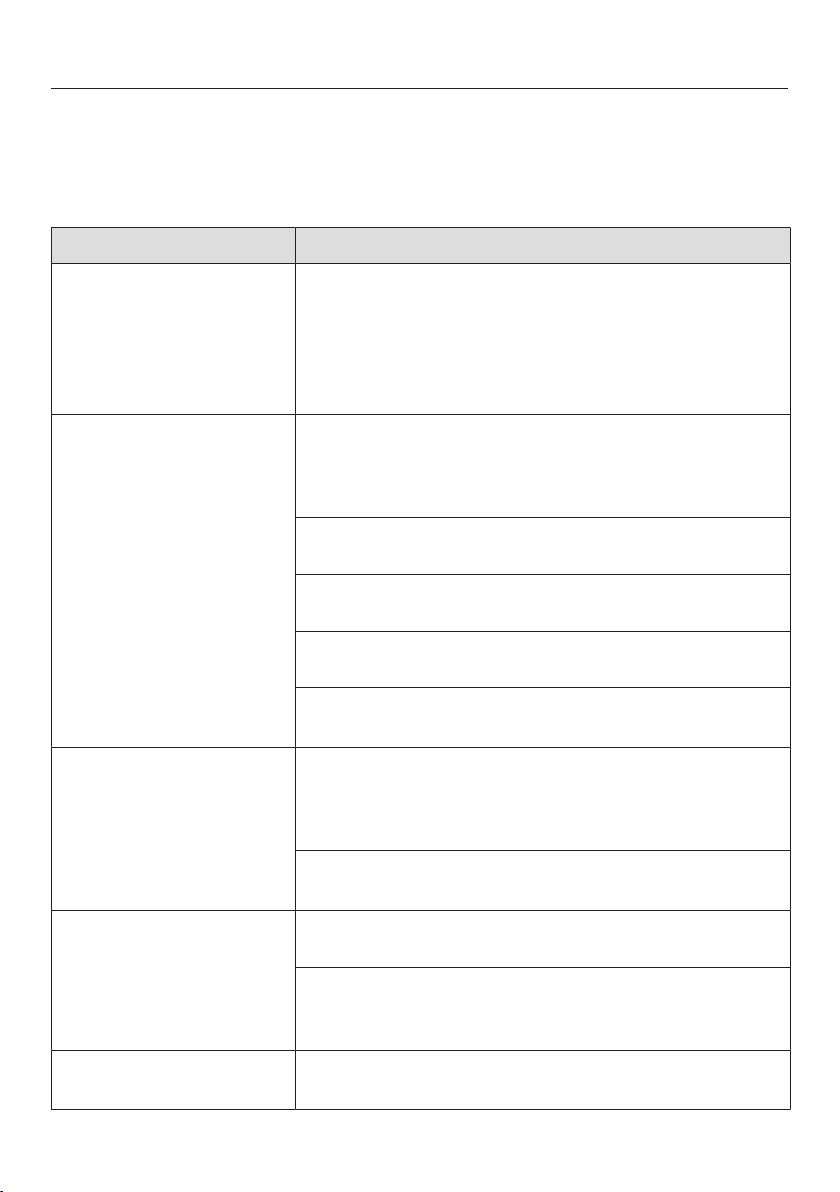
With the help of the following guide minor faults in the performance of the ma-
chine, some of which may result from incorrect operation, can be remedied with-
out contacting the Service Department.
This guide may help you to find the reason for the fault, and how to correct it.
Problem Possible cause and solution
The burners do not ig-
nite when the cooktop
is being used for the
first time or after it has
been out of use for a
longer period.
There may be air in the gas line.
Try to light the burner again, making several at-
tempts if necessary.
The burner does not
light after several at-
tempts.
There is a fault.
Turn all of the controls clockwise to “ ” and inter-
rupt the power supply to the cooktop for a few
seconds.
The burner is not properly assembled.
Assemble the burner correctly.
The gas shutoff valve is closed.
Open the gas shut-off valve.
The burner is wet and/or dirty.
Clean and dry the burner.
The flame holes are clogged and/or wet.
Clean and dry the flame holes.
The gas flame goes out
after being lit.
The flames do not touch the ignition safety device
and the burner does not get hot enough:
The burner parts are not positioned correctly.
Assemble the burner components correctly.
There is soiling on the ignition safety device.
Remove any dirt or grime.
The shape/color of the
gas flame changes.
The burner parts are not in the proper position.
Position the burner parts correctly.
The burner cap itself or the holes in the burner cap
are dirty.
Remove any dirt or grime.
The gas flame goes out
during use.
The burner parts are not in the proper position.
Assemble the burner components correctly.

Frequently Asked Questions
33
Problem Possible cause and solution
The ignitor does not
function properly.
The fuse in the building's wiring system was tripped.
If necessary, contact a qualified electrician or
Miele Service for assistance.
There is food residue stuck between the ignitor and
the burner cap.
There is food residue on the thermocouple.
Remove any dirt or grime. (Please see “Cleaning
and care” for details).

Optional accessories
34
Miele offers a range of useful acces-
sories, as well as cleaning and condi-
tioning products for your appliance.
These products can be easily ordered
from the Miele webshop.
These products can also be ordered
from Miele Technical Service (see the
end of these operating instructions) or
your Miele dealer.
Stainless steel conditioning
agent 250ml
Easily removes water marks, stains and
fingerprints. Also prevents re-soiling

IMPORTANT SAFETY INSTRUCTIONS - INSTALLATION
35
Install the upper cabinets and venti-
lation hood before installing the
cooktop to avoid damaging it.
The room in which the cook-
top is installed must conform to
all relevant local and national
building regulations and safety
regulations.
The countertop must be heat-
resistant (up to 212°F / 100°C),
so that it does not become de-
formed or the veneer detached.
The wall strips must be heat-re-
sistant as well.
The cooktop must not be in-
stalled above refrigerators/freez-
ers, dishwashers, or washer/dry-
ers.
A gas cooktop must not be in-
stalled directly next to a deep fat
fryer as the gas flames could ig-
nite the fat in the fryer. It is es-
sential to maintain a distance of
at least 12" (300mm) between
these two appliances.
The maximum depth of cabi-
nets installed above the cooktop
must be no more than
13" (330mm) or a greater depth
specified by the manufacturers
as tested by the certification
agency.
When installing the cooktop,
make sure that the gas pipe and
power cord cannot come into
contact with hot appliance parts.
The power cord and any flexi-
ble gas connection pipes must
be installed in such a way so that
they do not come into contact
with any moving kitchen parts
(e.g. a drawer), and cannot be-
come trapped.
Observe carefully the safety
clearances listed on the following
pages.
All dimensions in this instruction book-
let are given in mm and inches.
Safety clearances
36
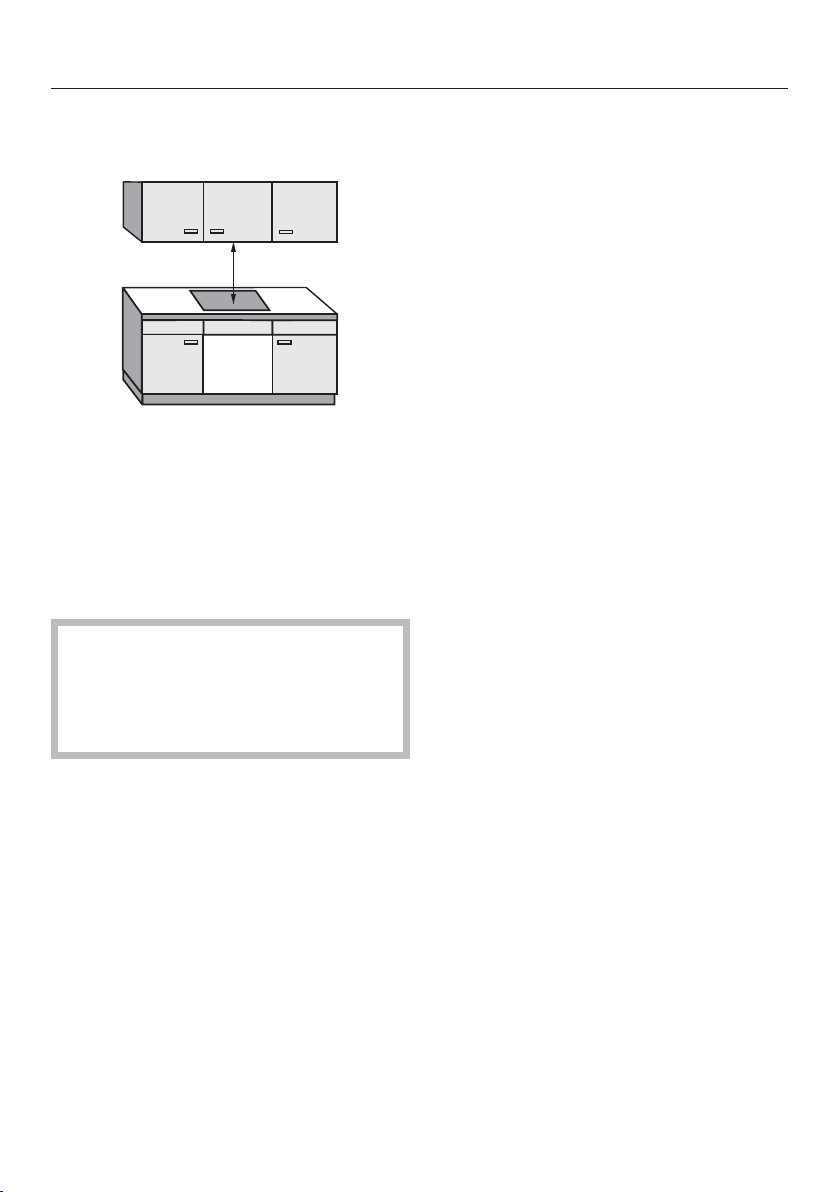
Safety clearance above the
cooktop
For a ventilation hood above the cook-
top, always use the clearance specified
by the hood manufacturer. If there are
no specifications from the hood manu-
facturer or if flammable materials (e.g. a
utensil rail) are installed above the
cooktop, the clearance must be at least
760 mm).
If there is more than one appliance
installed below the ventilation hood,
each with a different safety clear-
ance, the largest clearance must be
used.
Safety clearances
37
Safety clearances to the sides
and back of the cooktop
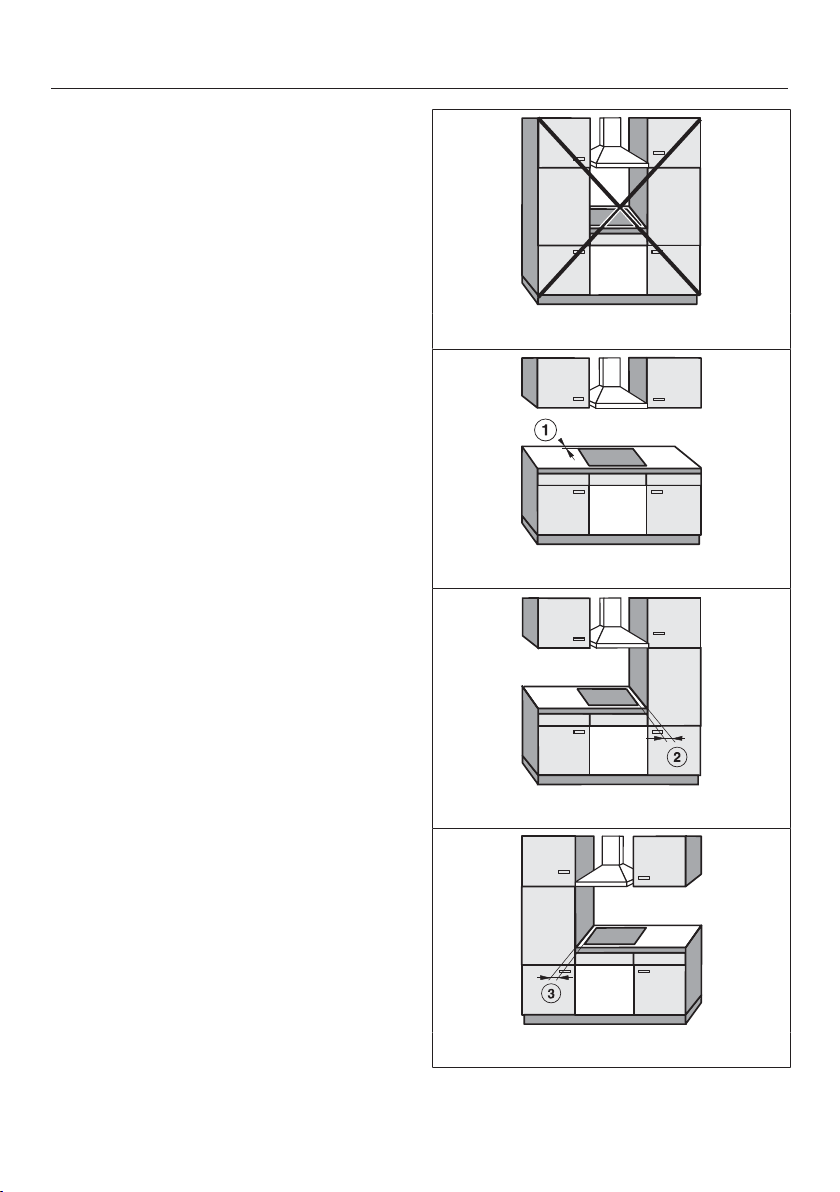
When installing a cooktop there may be
an optionally high cabinet or room wall
against the rear side and one of the
sides (right or left) (see illustrations).
minimum distance between the back
of the counter cut-out and the rear edge
of the counter:
2" (50mm)
minimum distance to the right of the
counter cut-out to the closest adjacent
piece of furniture (for instance, a high
cabinet) or a room wall:
4" (100mm)
minimum distance to the left of the
counter cut-out to the closest adjacent
piece of furniture (for instance, a high
cabinet) or a room wall:
4" (100mm)
Not permitted!
Highly recommended!
Not recommended!
Not recommended!
Safety clearances
38
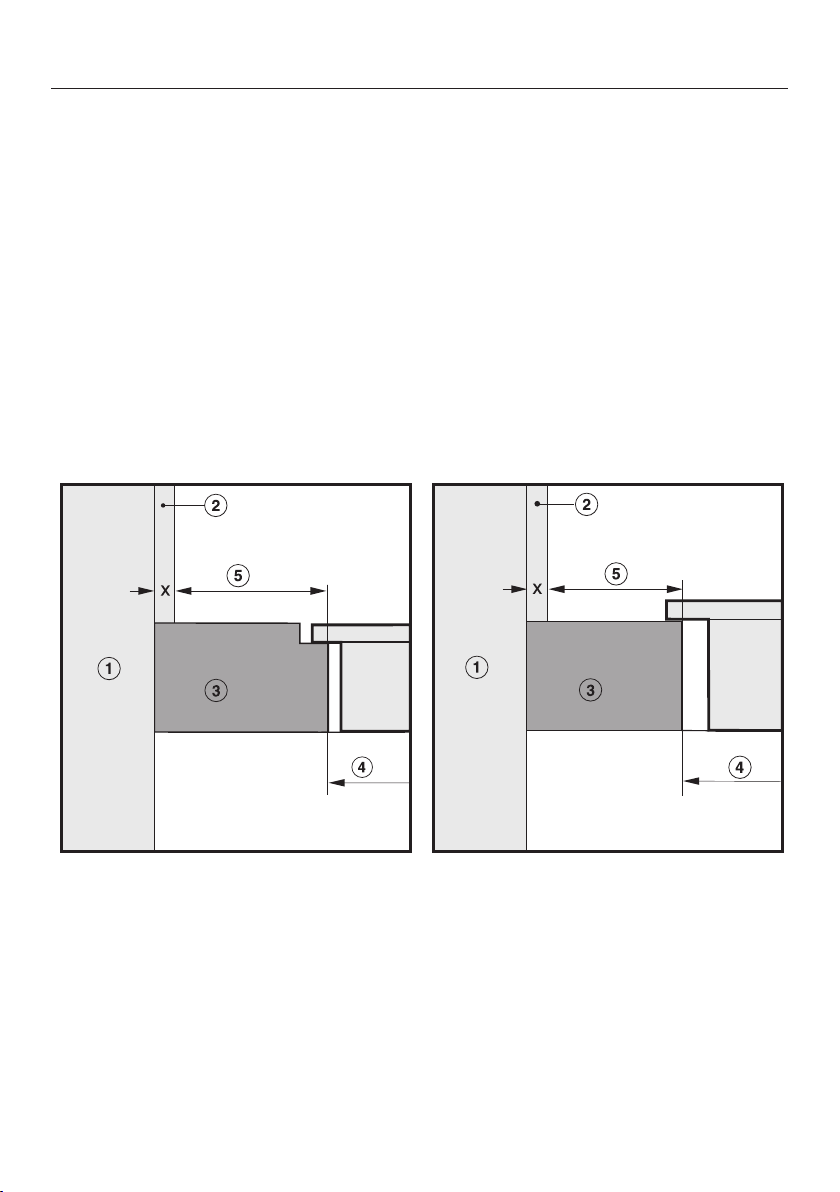
Safety distance from the wall covering
If a wall covering is installed, a minimum safety distance must be maintained be-
tween the countertop cut-out and the covering, since high temperatures can dam-
age these materials.
If the covering is made of a combustible material (such as wood), the distance be-
tween the countertop cut-out and the wall covering must be a minimum of
2" (50mm).
For coverings made of non-combustible materials (such as metal, marble, granite,
ceramic tiles) the minimum safety distance between the countertop cut-out and
the wall covering must be 2“ (50 mm) minus the thickness of the covering. For ex-
ample: thickness of wall covering 2” (50mm) - ⁹/₁₆“ (15mm) = minimum safety dis-
tance 1⁷/₁₆” (35mm).
Flush-mounted cooktops Framed cooktops
Wall frame
Wall covering dimension x = thickness of the niche cladding
Countertop
Countertop cut-out
Minimum distance for
flammable materials 2" (50mm).
non-flammable materials 2" (50mm) - dimension x
Instructions for installation
39
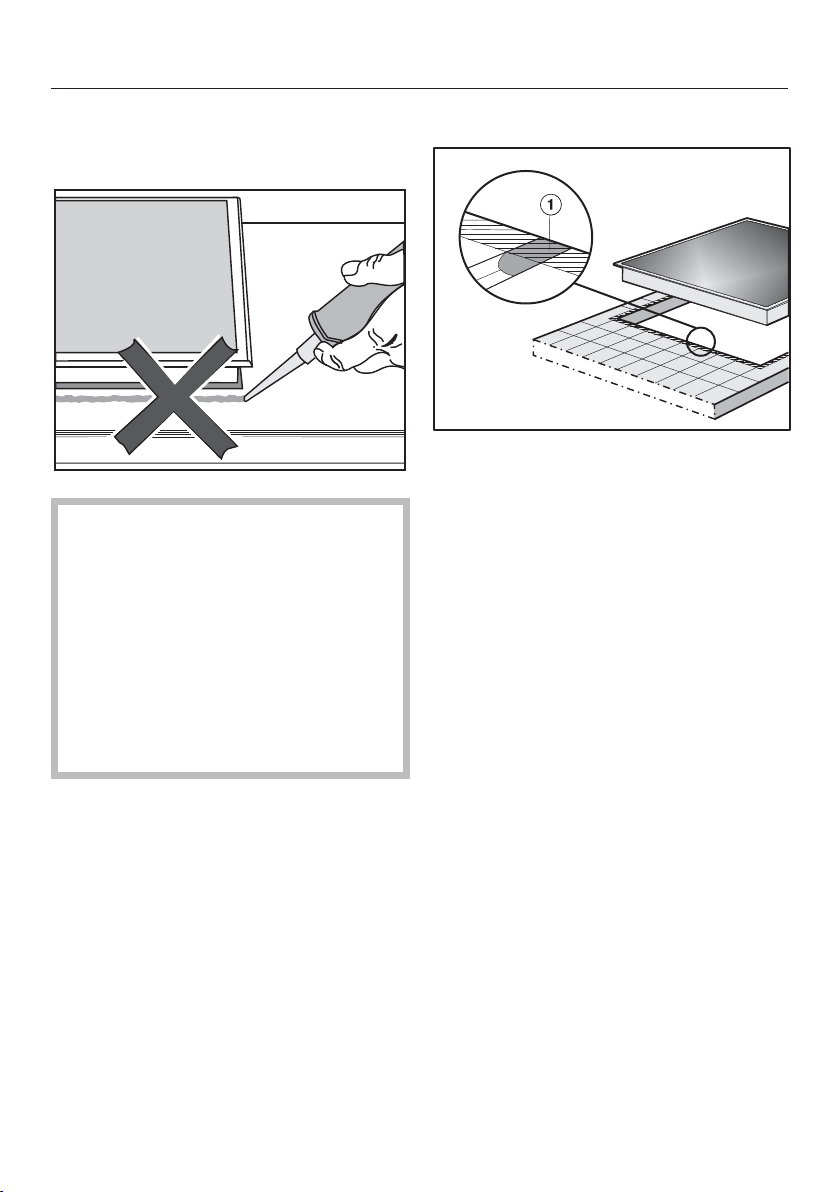
Seal between cooktop and
counter
In case a disassembly is required,
the appliance must not be perma-
nently sealed into the countertop
when installed. The sealing strip un-
der the edge of the appliance pro-
vides a sufficient seal for the coun-
tertop.
If the appliance is sealed into posi-
tion, the countertop or appliance
could be damaged if it needs to be
removed for maintenance or service.
Tiled countertop
The grouting and shaded area under
the appliance frame must be flat and
even so that the frame will lie evenly
and the sealing strip under the edge of
the upper part of the appliance can pro-
vide an adequate seal against the coun-
tertop.
Installation dimensions
40
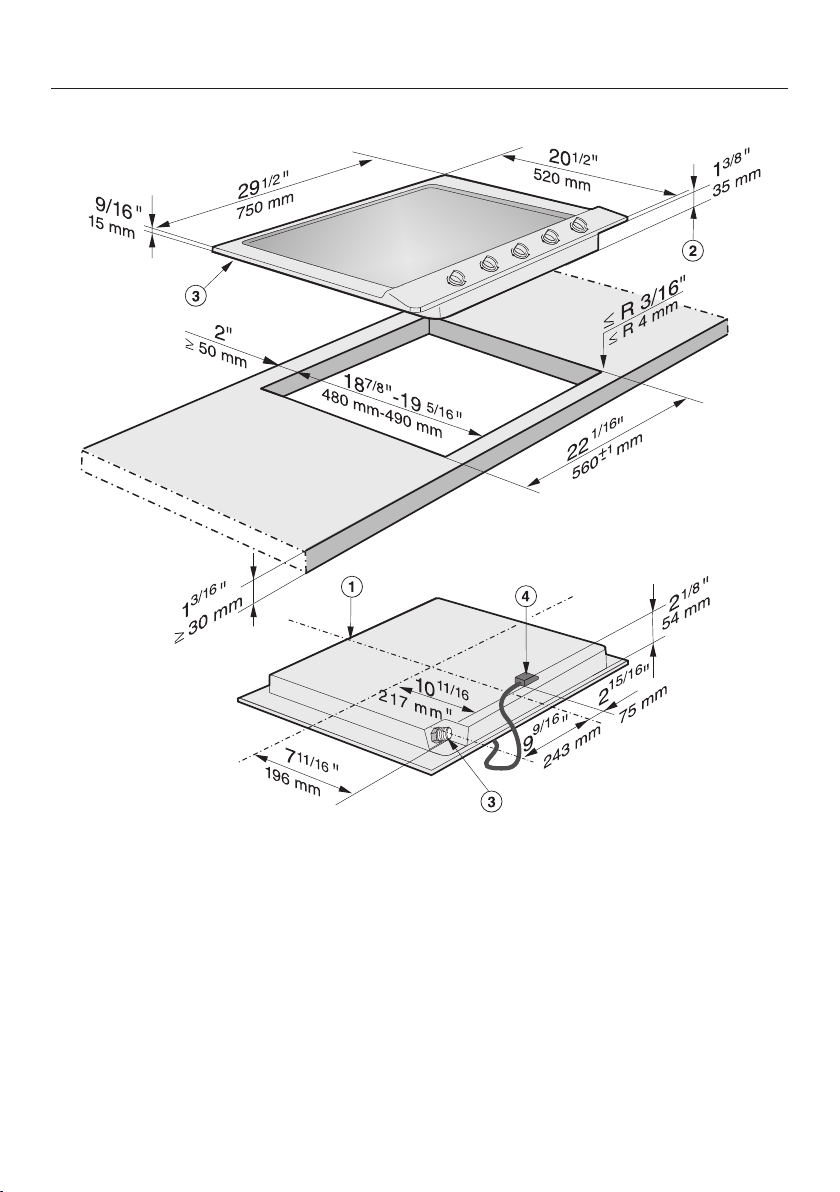
a
Front
b
Installation height
c
Gas connection R ¹/₂ NPT
d
Electrical supply connection box with power cord, L = 6' 6" (2000mm)

Installation
41
Preparing the countertop
Create the countertop cut-out as
shown in the cooktop diagram. Re-
member to maintain the minimum
safety distances (see “Safety dis-
tances”).
Seal any cut surfaces on the wooden
countertop with a special varnish, sili-
cone rubber, or resin to prevent the
wood from swelling as a result of
moisture. The sealant must be tem-
perature-resistant.
Ensure that the sealant does not get
on the top surface of the countertop.
The sealing strip ensures that the
cooktop will sit securely in the cut-out
without slipping. Any gap between the
trim and countertop will become
smaller over time.
Installing the cooktop
Feed the appliance power cord down
through the counter cut-out.
Place the cooktop centrally in the
cut-out. When doing this make sure
that the seal of the appliance sits
flush with the countertop on all sides.
This is important to ensure an effec-
tive seal all round.
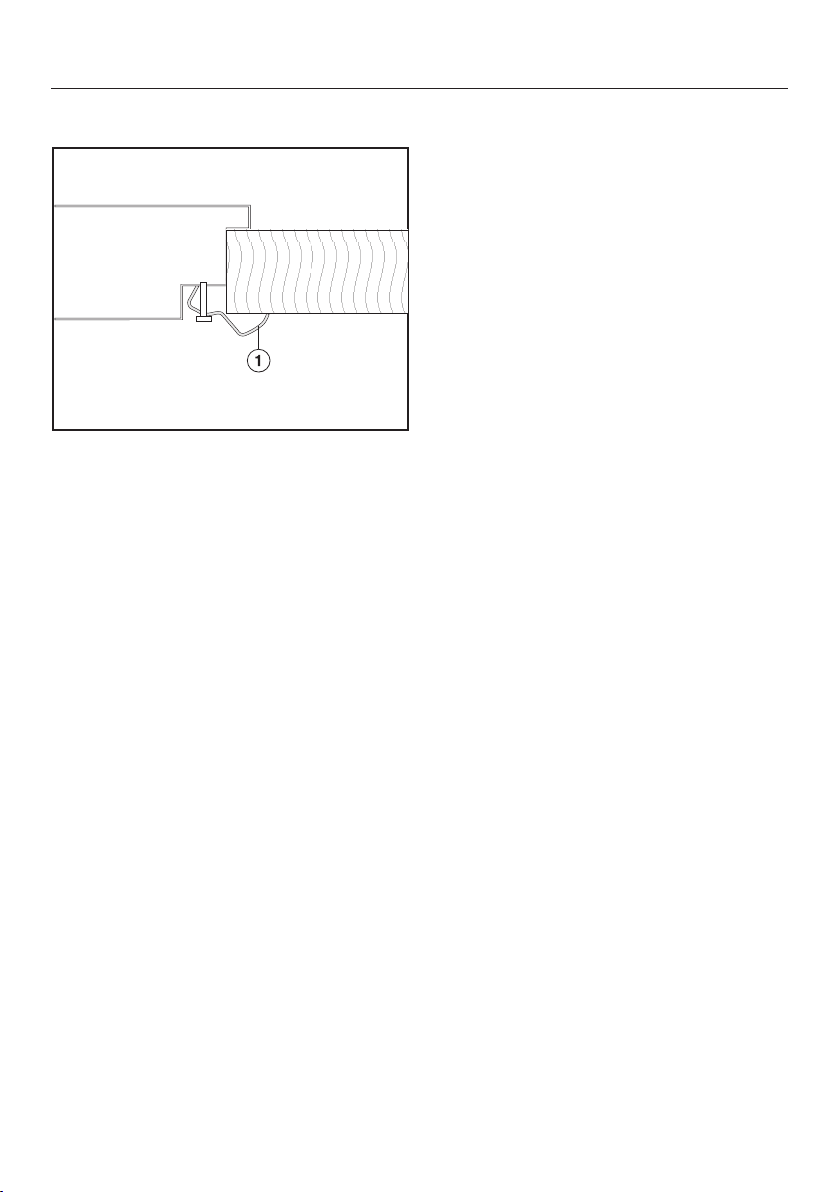
If during installation the seal around
the frame does not sit flush with the
countertop in the corners, the corner
radius, maximum 3/16" (≤R4/ 4mm),
can be carefully filed down to fit.
Do not use any additional sealant
(e.g. silicone).
Connect the cooktop to the electrical
power supply (see “Electrical connec-
tion”).
Connect the cooktop to the gas sup-
ply (see “Gas connection”).
Installation
42
Securing the cooktop
Secure the cooktop using the brack-
ets supplied.
Checking for proper function
After installing the cooktop, ignite all
burners to check that they are operat-
ing correctly:
– The flame must not go out on the
lowest setting, or when the control is
turned quickly from the highest to the
lowest setting.
– On the highest setting, the flame
must have a distinctive and visible
core.

Electrical connection
43
ATTENTION:
During installation, maintenance and
repair work, the appliance must be
disconnected from the electricity
supply. It is only completely isolated
from the electricity supply if the plug
fuses have been fully unscrewed
(where applicable), the main circuit
breaker has been tripped or the
power cable has been unplugged
from the wall outlet.
Do not cut off the plug on the power
cord. If the plug does not fit in the
outlet, have an electrician install an
appropriate outlet.
The socket must be easily accessible
after the appliance has been in-
stalled.
Work by unqualified persons can
cause considerable danger to users.
Miele cannot be held liable for any
damage arising as a result of such
work.
Installation, repair and maintenance
work should only be performed by a
Miele authorized service technician.
To avoid damaging the appliance,
the information (voltage and fre-
quency) on the data plate must cor-
respond to the building's power sup-
ply.
Compare these informations before
connecting the appliance. When in
doubt, consult a qualified electrician.
The plug must be inserted into a suit-
able outlet that has been installed
and grounded in compliance with all
applicable local regulations.
To guarantee the electrical safety of
this appliance, continuity must exist
between the appliance and an effec-
tive grounding system. It is impera-
tive that this basic safety require-
ment be met. If there is any doubt,
have the electrical system of the
house checked by a qualified electri-
cian.
Installation, repair and maintenance
work should only be performed by a
Miele-authorized qualified electrician
in compliance with local regulations
and the ANSI National Electrical
Code / NFPA 70 in the United States
or the Canadian Electrical Code, Part
I in Canada (CSA standard C22.1).

Electrical connection
44
Power cord and plug
The appliance is equipped with a flexi-
ble power cord and a 3-prong ground-
ing plug for your protection against
shock hazard. The plug must be in-
serted into a properly grounded outlet.
Do not cut or remove the grounding
prong from this plug.
Total output
See data plate
Connection data
The connection data is given on the
data plate. Please ensure these match
the household electrical supply.
Installer:
Please leave these instructions with
the customer.

Gas connection
45
Connection to the gas supply
may only be performed by a duly au-
thorized technician. This technician is
responsible for proper function at the
installation site.
In Massachusetts, the gas connec-
tion may be performed only by a cer-
tified gas installer.
The appliance must be connected
with its own shut-off valve.
The shut-off valve must be accessi-
ble and visible, after the opening of a
cabinet door, if necessary.
The gas connection can be to natural
gas or propane gas according to the
model.
Ask your gas company what kind of
gas is used and compare it with the
specifications on the data plate.
The appliance is not connected to an
exhaust vent.
During the setup and connection of
the appliance, observe the applica-
ble installation conditions, especially
suitable ventilation measures.
Arrange the gas connections in such
a way that they are not heated and
damaged by the operation of the ap-
pliance.
In particular, make sure that the gas
hose lines and connection fittings on
the applinace do not come into con-
tact with hot exhaust gases
The gas hose and power cord could
be damaged by hot spots on the ap-
pliance.
Make sure that the gas hose and
power cord do not come into contact
with hot spots on the appliance.
Flexible connection lines can be
damaged by incorrect routing.
Attach flexible connecting lines in
such a way so that they do not come
into contact with any moving kitchen
parts (e.g., a drawer) and are not ex-
posed to mechanical stress.
Disconnect the appliance and the
shut-off valve from the gas supply
before performing a gas pressure
test at a pressure of more than ½psi
(3.5kPA). Close the shut-off valve of
the gas supply before performing a
gas pressure test at a pressure of
less than or equal to ½psi (3.5kPA).
Incorrectly sealed gas lines can lead
to a gas leak and thus to an explo-
sion.
Seal all gas lines with a suitable
thread sealant.
Seal tightness tests on the appliance
must be performed according to
manufacturer specifications.

Gas connection
46
The gas connection must be made in
accordance with local codes or, in
the absence of local codes, with:
National Fuel Gas Code
ANSIZ223.1 / NFPANo.54 for the
United States or the current
Can /CGAB149.1 and 2 Installation
Codes of Gas Appliances for
Canada.
The gas pressure may not under-
shoot or exceed certain values.
Make sure that the maximum gas
pressure upstream of the gas pres-
sure controller does not amount to
more than ½psi (3.5kPA) for natural
and propane gas.
Make sure that the minimum gas
supply pressure amounts to 6“w.c.
for natural gas and 10”w.c. for
propane gas.
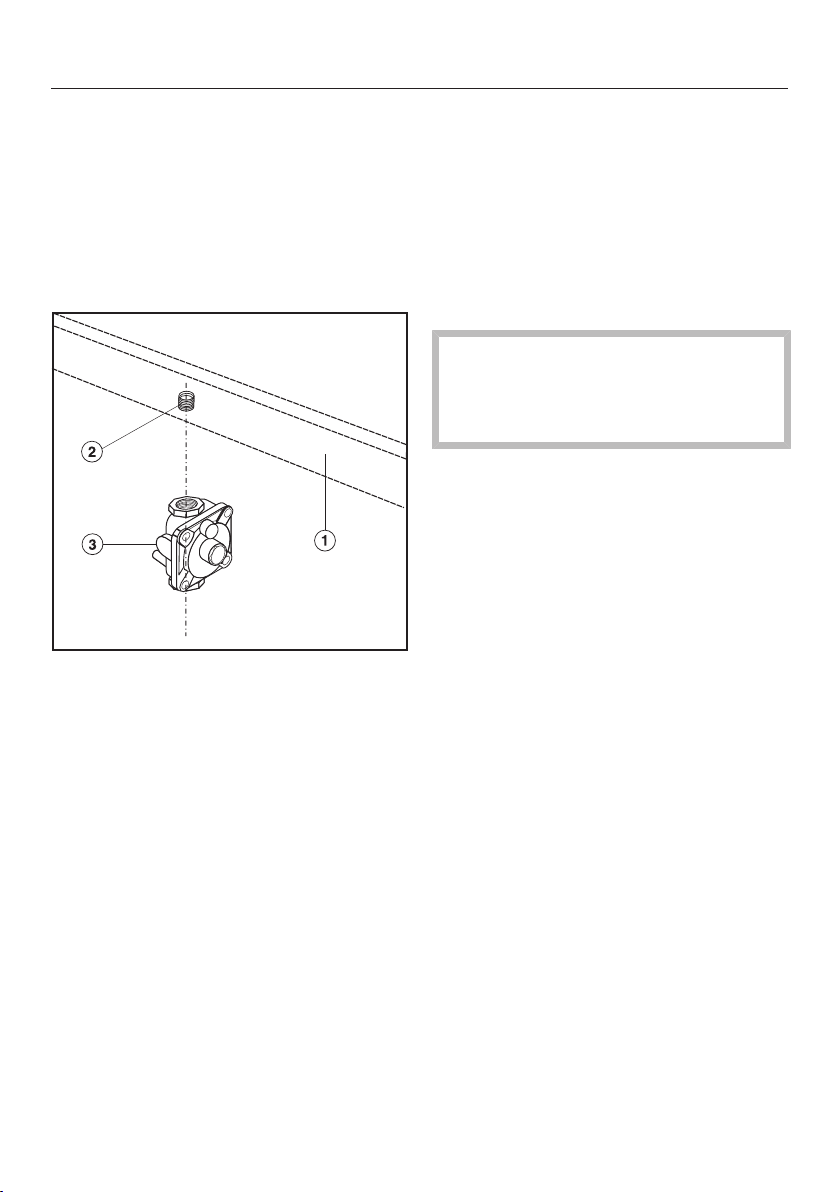
The gas connection of the appliance is
designed for natural gas or propane gas
according to the ordered model.
If the appliance is not equipped with the
correct connection for the gas type in
your household, contact your Miele
dealer.
Gas connection
47
Gas pressure regulator
The included pressure regulator corre-
sponds with the gas type of the appli-
ance. Verify before installing.
The adjusted pressure is:
Natural gas 4“w.c.
LP gas 10”w.c.
a
Appliance
b
½" NPT
c
Regulator
As shown in the above diagram, the in-
cluded regulator must be used when
connecting the Miele appliance to your
gas supply. This item has been custom-
ized by Miele to meet all applicable
safety requirements. Make sure the reg-
ulator is easily accessible for adjust-
ment after the appliance has been in-
stalled.
For convenience, an AGA or CGA ap-
proved flexible stainless steel gas hose
(accordion type) may be used between
the gas connection and the regulator.
This will allow the appliance to be lifted
out of the countertop for cleaning or
servicing. Make sure that any drawers,
cabinet doors, etc., do not rub on this
gas hose.
Unsuitable regulators may cause a
gas leak.
Do not use any regulator unless it
has been supplied by Miele.
If there is any doubt concerning installa-
tion contact the Miele Technical Service
Department.
Leakage test
After connecting the appliance check
all fittings for gas leaks e.g. with
soapy water.

Burner ratings
48
Burner Gas type kW BTU/hr
Economy burner Natural gas NG
Liquid propane LP
1.11
1.11
3800
3800
Normal burner Natural gas NG
Liquid propane LP
1.61
1.61
5500
5500
Power burner Natural gas NG
Liquid propane LP
2.52
2.78
8600
9500
Wok Natural gas NG
Liquid propane LP
3.31
3.31
11300
11300
Total Natural gas NG
Liquid propane LP
10.17
10.43
34700
35600

Technical Service
49
Contact in case of fault
In the event of a fault which you cannot remedy yourself, please contact your
Miele dealer or Miele Technical Service.
Contact information for Miele Technical Service can be found at the end of this
document.
Please quote the model and serial number of your appliance when contacting
Miele. Both pieces of information can be found on the data plate.
Data plate
Adhere the extra data plate supplied with the appliance in the space below. Make
sure that the model number matches the one specified on the back cover of this
document.
Warranty
For further information, please refer to your warranty booklet.

MieleCare
50
This service is available in USA only.
MieleCare, our Extended Service Con-
tract program, gives you the assurance
of knowing that your appliance invest-
ment is covered by 5years of worry free
ownership.
MieleCare is the only Extended Service
Contract in the industry that guarantees
repairs by a Miele Authorized Service
Provider using genuine Miele parts.
Only genuine Miele parts installed by
factory trained professionals can guar-
antee the safety, reliability, and
longevity of your Miele appliance.
Please note that unless expressly ap-
proved in writing by Miele’s Service de-
partment, Extended Service Contracts
offered by other providers for Miele
products will not be recognized by
Miele. Our goal is to prevent unautho-
rized (and untrained) service personnel
from working on your Miele products,
possibly doing further damage to them,
you and/or your home.
To learn more about MieleCare Ex-
tended Service Contracts, please con-
tact your appliance dealer or visit us
online at:
www.mieleusa.com

9 Independence Way
Princeton, NJ 08540
Phone:
Fax:
www.mieleusa.com
U.S.A.
Miele, Inc.
National Headquarters
Please have the model and serial number
of your appliance available when
contacting Technical Service.
Canada
Importer
Miele Limited
Headquarters and Miele Centre
800-843-7231
609-419-4298
Technical Service & Support
Phone:
Fax:
161 Four Valley Drive
Vaughan, ON L4K 4V8
www.miele.ca
800-999-1360
888-586-8056
Customer Care Centre
Phone:
800-565-6435
905-532-2272
International Headquarters
Miele & Cie. KG
Carl-Miele-Straße 29
33332 Gütersloh
Germany

M.-Nr. 10 810 470 / 00en-US
KM 2032