INSTRUCTION AND
RECIPE BOOKLET
For your safety and continued enjoyment of this product,
always read the instruction book carefully before using.
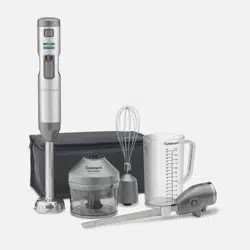
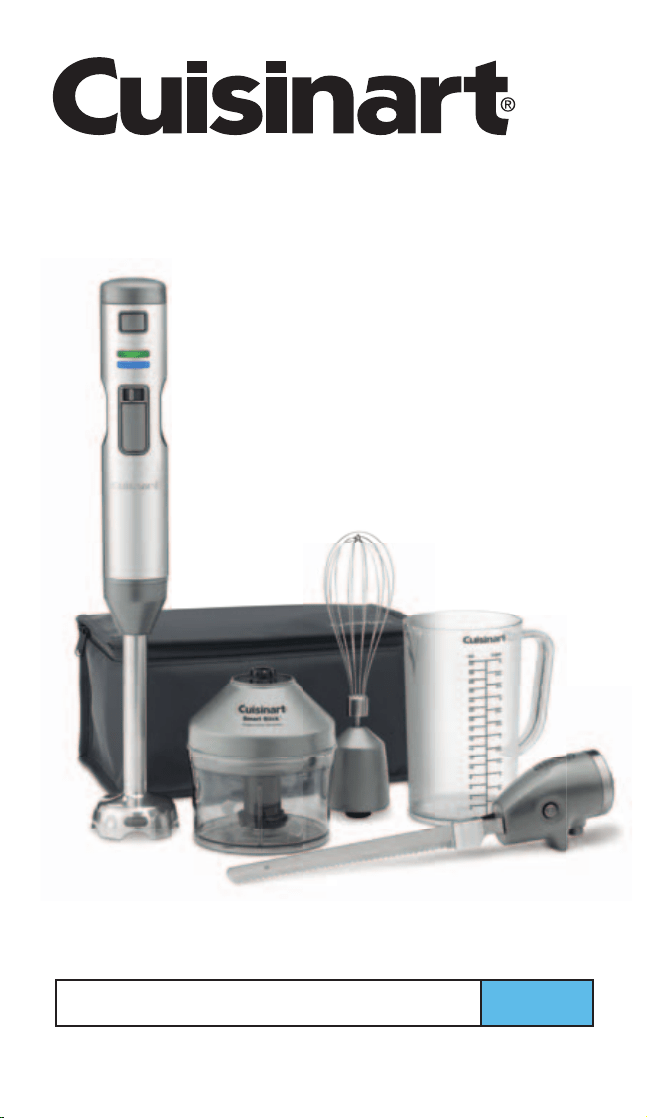
Cordless SmartStick
®
Hand Blender and Knife
CSB-300


3
IMPORTANT SAFEGUARDS
When using an electrical appliance, basic safety precautions should
always be taken, including the following:
WARING: Read all safety warnings and instructions. Failure to
follow the warnings and instructions may result in electric shock,
fire and/or serious injury.
1. READ ALL INSTRUCTIONS.
2. To protect against electrical shock, do not put the charger handle
or motor body of this hand blender in water or other liquids. The
drive shaft of this appliance, where blades are interchanged, has
been designed for submersion in water or other liquids. Never
submerge any other portion of this unit. If hand blender falls into
liquid, remove immediately. Carefully remove, clean and dry unit
thoroughly before continuing.
3. This appliance should not be used by children. To avoid possible
accidental injury, close supervision is necessary when any
appliance is used by or near children or individuals with certain
disabilities.
4. Do not operate in the presence of explosive and/or flammable
fumes.
5. To avoid the possibility of personal injury, always unplug the unit
from the charger before attaching or removing blades and/or
attachments for cleaning or any other purpose.
6. Illuminated lights indicate unit is ready to operate. Avoid any
contact with blades or movable parts.
7. Once blender is unlocked and/or powered on, avoid any contact
with blades or moveable parts.
8. Avoid contact with moving parts. Keep hands, hair, clothing, as
well as spatulas and other utensils away from attachments and
mixing container during operation to reduce risk of injury to
persons, and/or damage to the appliance. A spatula may be used,
but must be used only when the unit is not operating.
9. Remove detachable shaft from the power handle before washing
the blades or shaft.
10. Blades and accessory attachments are SHARP. Handle carefully.
Always handle blades with hand away from cutting edge. Always
store blades with cutting edge away from you.
11. When mixing liquids, use a tall container or make small quantities
at a time to reduce spillage and possibility of injury.
12. Charger should be plugged into an electrical outlet away from sink
or hot surface.
13. Do not use an extension cord. Plug charger directly into an
electrical outlet.
14. Do not attempt to use this charger with any other product. Also,
do not attempt to charge the batteries with any other charger.

4
15. Do not charge batteries with charger plugged into an outdoor
outlet.
16. Do not use appliance for other than intended use.
17. Do not operate any appliance with a damaged cord or plug, or
after the appliance has malfunctioned or has been dropped or
damaged in any way, or is not operating properly. Return the
appliance to the nearest Cuisinart Repair Center for examination,
repair, or mechanical or electrical adjustment.
18. The use of attachments or accessories not recommended by
Cuisinart may cause fire, electrical shock or risk of injury.
19. Make sure the appliance is off and the motor/blade/attachment
has stopped completely before putting on or taking off attach-
ments, and before cleaning.
20. This appliance is intended for household use only and is not for
commercial or outdoor use.
21. Do not use this hand blender for other than its intended use of
preparing foods and beverages.
22. Use extra care when working with hot liquids to avoid
splattering.
23.
To reduce the risk of fire or electric shock, do not operate any
heating appliance beneath or near the mounted charging handle
unit.
24. Do not mount or store/unit over or near a portion of a heating or
cooking appliance, or a sink or washbasin.
25. Unplug the charger from the outlet before attempting any routine
cleaning of the charger.
26. Do not operate a damaged charger. Have damaged charger
replaced immediately.
27. Do not incinerate the hand blender, even if it is severely dam-
aged. The batteries can explode in a fire.
28.
This product contains lithium batteries which must be recycled at
the end of the life of the hand blender and disposed of properly.
(See Disposal/Recycling of Batteries, page 44.) Do not incinerate
or compost batteries, as they will explode at high temperature.
29. Leaks from battery cells can occur under extreme conditions. If
the liquid gets on the skin, (1) wash quickly with soap and water
or (2) neutralize with mild acid such as lemon juice or vinegar. If
the liquid gets into eyes, flush them immediately with clean
water for a minimum of 10 minutes. Seek medical attention.
30. Prevent unintentional starting. Never press the Auto Lock/Unlock
switch on the power handle or electric knife attachment while
pressing the Power On switch or trigger unless you are ready to
use your blender or knife.
31. Recharge only with the charger specified by the manufacturer. A
charger that is suitable for one type of battery pack may create a
risk of fire when used with another battery pack.

5
32.
Use appliances only with specifically designated battery packs.
Use of any other battery packs may create a risk of injury and fire.
33. Under abusive conditions, liquid may be ejected from the battery.
Avoid contact with such liquid. If contact accidentally occurs,
flush with water. If liquid contacts eyes, seek medical help.
Liquid ejected from the battery may cause irritation or burns.
34. Do not use a battery pack or appliance that is damaged or modi-
fied. Damaged or modified batteries may exhibit unpredictable
behavior resulting in fire, explosion or risk of injury.
35. Do not expose a battery pack or appliance to fire or excessive
heat. Exposure to fire or temperatures above 265°F/130°C/ may
cause an explosion.
36. Have servicing performed by a qualified repair person using only
identical replacement parts. This will ensure that the safety of the
product is maintained.
37. Recommended ambient charging temperature 50°F−104°F
(10°C− 40°C).
38. Recommended storage temperature (10°C− 40°C) (50°F− 104°F).
39. Use only the power adapter (10.0VDC/1000mA output) supplied
with this product.
40. Any other servicing should be performed by an authorized
service representative.
41. To reduce the risk of injury, never place chopper/grinder attach-
ment cutting blade assembly on cup shaft without first putting
chopper cup properly in place.
42. Be certain the chopper/grinder attachment cover is securely
locked in place before operating appliance. Do not attempt to
remove cover until blade has stopped rotating.
43. Check chopping cup for presence of foreign objects before
using.
44. Do not operate your appliance in an appliance garage or under a
wall cabinet. When storing in an appliance garage, always
unplug the unit from the electrical outlet. Not doing so could
create a risk of fire, especially if the appliance touches the walls
of the garage or the door touches the unit as it closes.
SAVE THESE INSTRUCTIONS
FOR HOUSEHOLD USE ONLY
Note: The unit comes with overload protection feature if unit stops are
unexpectedly, it must be reset by recharging for a few seconds.

6
CONTENTS
Important Safeguards . . . . . . . . . . . . . . . . . . . . . . . . . . . . . . . . . . . . 3
Unpacking Instructions . . . . . . . . . . . . . . . . . . . . . . . . . . . . . . . . . . . 6
Introduction . . . . . . . . . . . . . . . . . . . . . . . . . . . . . . . . . . . . . . . . . . . . 6
Features and Components . . . . . . . . . . . . . . . . . . . . . . . . . . . . . . . . 7
Assembly . . . . . . . . . . . . . . . . . . . . . . . . . . . . . . . . . . . . . . . . . . . . . . 8
Blending Attachment . . . . . . . . . . . . . . . . . . . . . . . . . . . . . . . . 8
Chopper/Grinder Attachment . . . . . . . . . . . . . . . . . . . . . . . . . 9
Reversible Blade . . . . . . . . . . . . . . . . . . . . . . . . . . . . . . . . . . . 9
Whisk Attachment . . . . . . . . . . . . . . . . . . . . . . . . . . . . . . . . . 10
Knife Attachment . . . . . . . . . . . . . . . . . . . . . . . . . . . . . . . . . . 10
Operation . . . . . . . . . . . . . . . . . . . . . . . . . . . . . . . . . . . . . . . . . . . . . 11
Blending and Mixing . . . . . . . . . . . . . . . . . . . . . . . . . . . . . . . 11
Chopping/Grinding . . . . . . . . . . . . . . . . . . . . . . . . . . . . . . . . 11
Whisking . . . . . . . . . . . . . . . . . . . . . . . . . . . . . . . . . . . . . . . . 12
Carving and Slicing . . . . . . . . . . . . . . . . . . . . . . . . . . . . . . . . 12
Cleaning and Maintenance . . . . . . . . . . . . . . . . . . . . . . . . . . . . . . . 12
Tips and Hints . . . . . . . . . . . . . . . . . . . . . . . . . . . . . . . . . . . . . . . . . 13
Frequent Uses for Chopper/Grinder Attachment . . . . . . . . . . . . . . 16
Recipes . . . . . . . . . . . . . . . . . . . . . . . . . . . . . . . . . . . . . . . . . . . . . . 17
Warranty . . . . . . . . . . . . . . . . . . . . . . . . . . . . . . . . . . . . . . . . . . . . . 43
Disposal/Recycling of Batteries . . . . . . . . . . . . . . . . . . . . . . . . . . . 44
UNPACKING INSTRUCTIONS
Place the package containing the Cuisinart
®
Cordless Rechargeable
Hand Blender on a sturdy surface. Unpack the Hand Blender from its box
by removing the storage pouch containing the power handle, blending
shaft, knife attachment and whisk. Remove all support materials from the
box. Save packaging for possible repacking of the unit.
NOTE: All blades are extremely sharp. Be careful when removing
and/or handling.
Before using the Cuisinart
®
Cordless Rechargeable Hand Blender for
the first time, we recommend that you wipe the unit with a clean,
damp cloth to remove any dirt or dust. Dry it thoroughly with a soft
absorbent cloth. To clean all parts see instructions on page 12. Read
all instructions completely for detailed operating procedures.
INTRODUCTION
Introducing another first from Cuisinart. Your new Cordless
SmartStick
®
Hand Blender and Knife is also a full size, full-power
Electric Knife. Slip our exclusive new attachment onto the power
handle to carve meat or slice bread. With no cord to get in the way,
you can slice a smoked turkey, or blend and whisk right in a bowl on
the counter or pot at the stove. Want to do even more? Attach the
handle onto the chopper/grinder and find out what we mean when we
say we’ve just taken multifunctionality over the top!
7
FEATURES AND
COMPONENTS
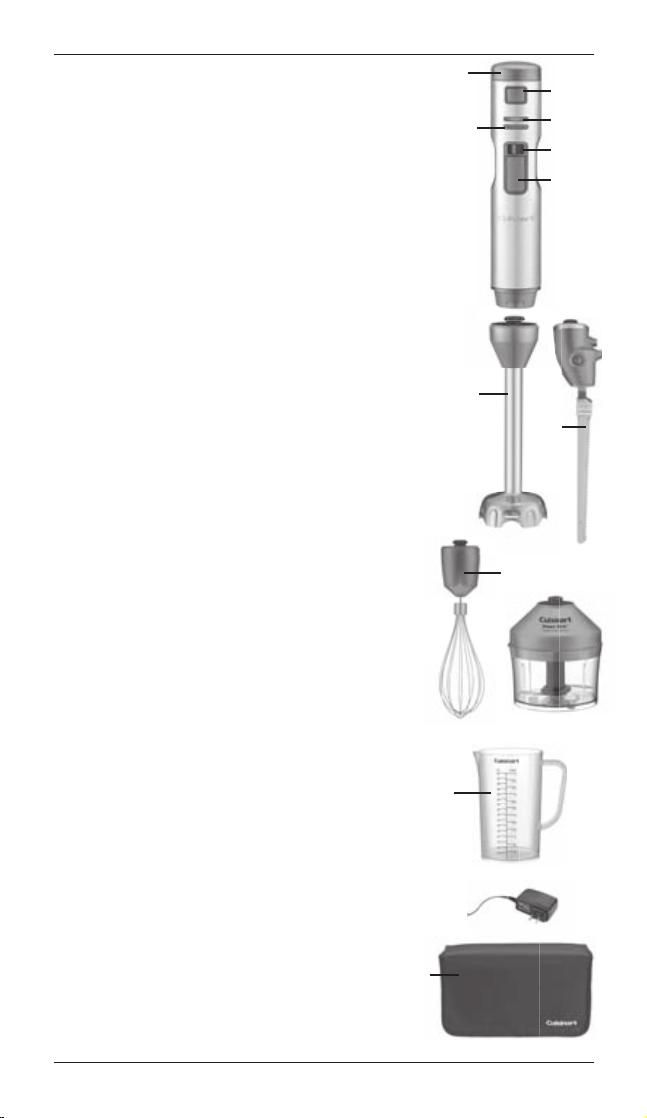
1. Power Handle
No cord! Operates on two rechargeable 4.0 volt
lithium-ion batteries, with power button within
easy reach. Shaped like a stirring utensil for
comfortable control.
a. Auto Lock/Unlock Button for safe operation.
b. Battery Indicator Lights. Red/Low: Less than
25%. Orange/Normal Use Range: 25–75%.
Green/High: 75–100%.
c. Blue Speed Indicators. Five bars light up to
indicate low to high speed selection.
d. Speed Control. Push button to left or right to
select speed.
e. Power On Button. Press and hold before
or right after pushing Auto Lock/Unlock
switch. NOTE: Operation stops instantly
and locks when Power button is released.
2. Blending Shaft
Detachable 8¾" shaft with stainless steel
blade and blade guard snaps on and off power
handle for easy operation and cleanup.
3. Electric Knife Assembly
Snaps onto the power handle creating a
full-size, electric carving knife.
4. Chopper/Grinder Attachment
Chop, mince and grind with the Cuisinart
®
chopper/grinder attachment. Chopper/grinder
attaches to the power handle in place of the
blender shaft or whisk attachment.
5. Whisk Assembly
Whisk attachment snaps into the power handle
housing. This attachment is great for whipping
cream, egg whites and other delectable treats.
6. Mixing/Measuring Beaker
Beaker is marked for liters and cups for
convenient measuring. Use for drinks, shakes,
salad dressings, etc. Designed for easy gripping
and drip-free pouring.
7. Charger Port
Located on back of the power handle at
the top.
8. Storage Pouch
Interior dividers safely store power handle,
blending, shaft, knife and whisk.
1.
a.
b.
c.
d.
e.
5.
2.
8.
3.
6.
4.
8
BEFORE YOU BEGIN
Before using the Cuisinart
®
Cordless SmartStick
®
Hand Blender and
Knife for the first time, we recommend that you wipe the unit with a
clean,damp cloth to remove any dirt or dust. Dry it thoroughly with a
soft, absorbent cloth. Handle carefully. Wash the blending blade,
whipping attachment, chopper cup and blade, mixing beaker, knife
blades and detachable shaft by hand or in the dishwasher (upper rack
only). Dry thoroughly before use.
Read all instructions completely for detailed operating procedures.
The batteries in your Cuisinart
®
Cordless SmartStick
®
Hand Blender
and Knife have not been fully charged. Before the first use of this
appliance, the batteries must be charged until the green light goes on.
See Charging and Battery Life below.
CHARGING YOUR BLENDER/BATTERY
LIFE
The batteries in your Cuisinart
®
Cordless SmartStick
®
Hand Blender
and Knife have not been fully charged. Before the first use of this
appliance, the batteries must be charged until the GREEN battery
indicator light illuminates. With a full charge, your stick blender will run
for approximately 20 minutes, depending on load. Your stick blender
will be fully charged in approximately 2-2.5 hours. You can “quick
charge” your stick blender for 5 minutes of run time in 30 minutes.
Battery Life Indicator Lights: Green: When the unit displays a green
power light, you are between 100% and 75% of battery power
Orange: When illuminated in Orange, you are between 75% and 25%
of battery power. When Red, you are at less than 25%
and will need to charge soon.
Note: do not leave your stick blender uncharged for an
extended period of time, as it will affect the life of the
rechargeable battery.
ASSEMBLY
BLENDING ATTACHMENT
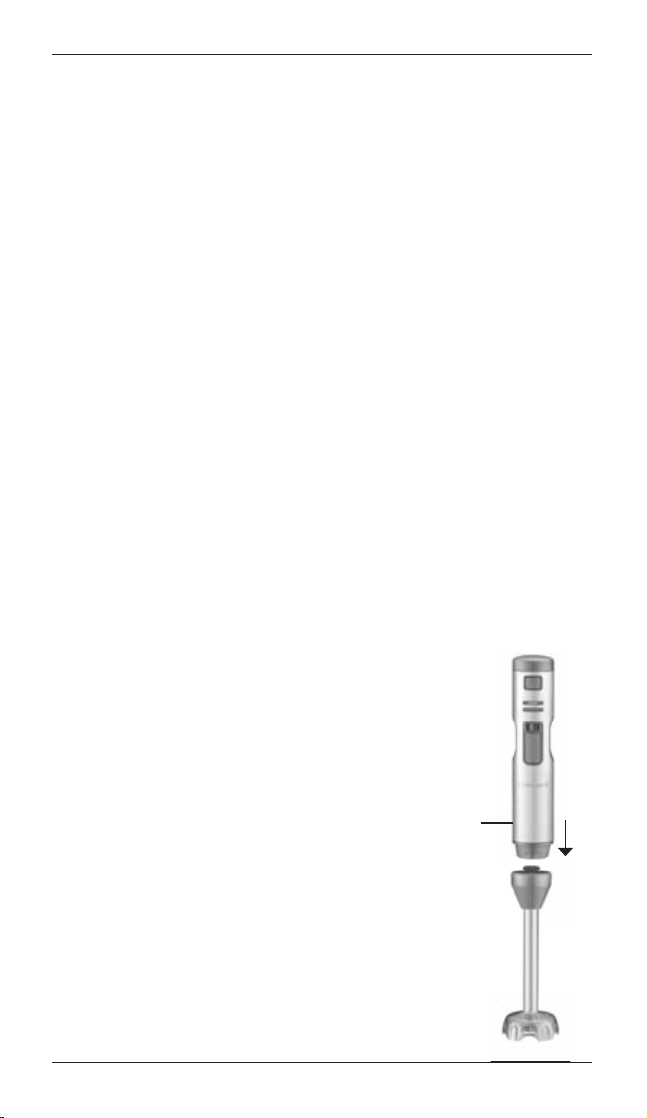
Align the motor body housing with the
blending shaft and push the pieces together
until you hear and feel them click together.
It may be helpful to press the release button
when assembling.
Release
button
9
CHOPPER/GRINDER
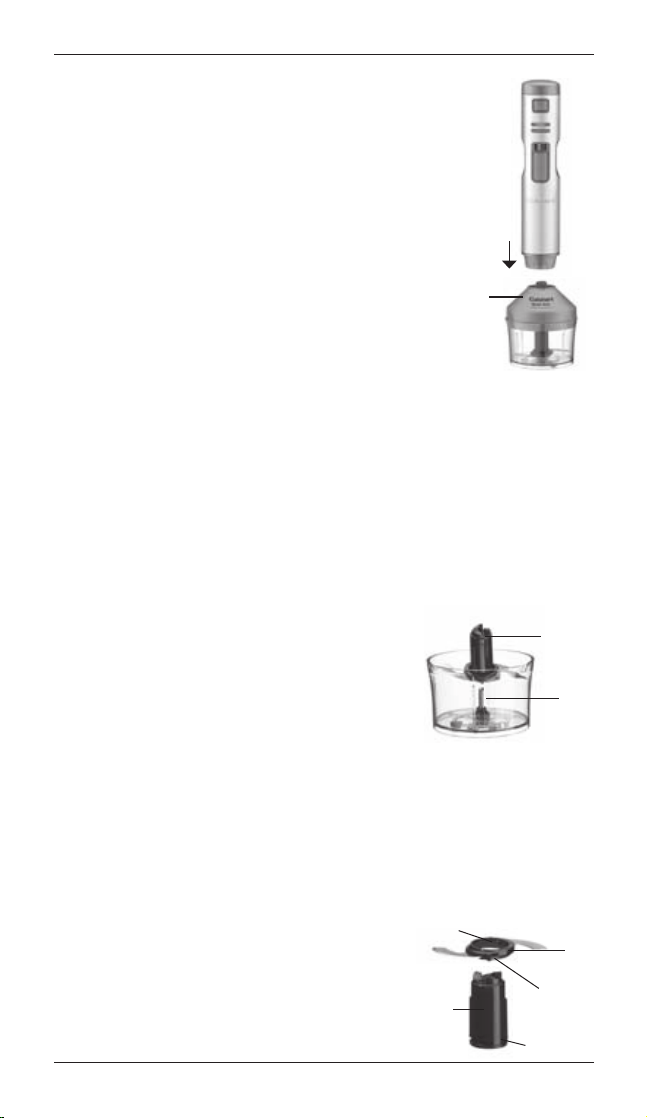
1. Place the chopping/grinding blade
assembly into center of the chopping
cup over metal blade shaft.
2. Place your ingredients into the chopper
cup. Close cover, rotating clockwise to
lock in place.
3. Connect the power handle to the top of
the chopping cup cover until you hear a
slight click.
REVERSIBLE BLADE
The chopper/grinder attachment is equipped
with a reversible blade – sharp on one side
and blunt on the other. The blade is attached
to a plastic ring that slides over the plastic blade shaft, so it can be
easily turned over to select the appropriate blade. To reverse the
blade, see detailed instructions below. Also see Frequent Uses for
Chopper/Grinder (page 16).
Assemble the parts.
1. Place the chopping cup on a flat, dry, stable surface.
2. The metal blade assembly shaft (A) is attached to the bottom of the
chopping cup. If not already in place, slide the fully assembled
blade assembly (B) over the top of the metal blade assembly shaft.
2a. Put together the blade assembly if not
assembled: Very carefully connect the
blade ring (C) to the plastic blade shaft
(D). Line up the blade ring opening with
the plastic sheath. There are notches (E)
on opposite sides of the
interior of the ring. These fit over ridges on
the sides of the plastic blade sheath (G).
Let the blade ring slide to the bottom of
the plastic shaft. HOLD THE BLADE RING BY THE CENTRAL
HUB HOLDING RIBS (grips) (F) ONLY. DO NOT TOUCH THE
RAZOR-SHARP BLADES. Pick up the blade ring by its hub
holding ribs (grips) and turn it very slightly clockwise. This locks it
in place on the plastic blade sheath and prevents it from sliding
up during processing. Note these important features of the blade
ring. The blade ring can be placed over the plastic blade shaft in
two different ways: If you hold it this
way (A), you will see the word “Sharp”
on the blade. Assemble the blade this
side up to use the sharp edge. If you
hold it this way (B), you will see no
writing on the blade. Assemble the
blade this side up to use the blunt
edge. (See the section on processing
B
A
C
D
G
F
E
chopping
cup cover

10
food, page 16, for information about when to use the
blunt edge.)
REMOVING CHOPPER/BLADE ASSEMBLY
To remove rotate assembly right or left to release from the
cup shaft.
WHISK ATTACHMENT ASSEMBLY
Align the motor power handle with the assembled whisk
attachment and push the pieces together
until you hear and feel them click together. It may
be helpful to press the release button when assembling.
Note: Whisk and gearbox are
detachable from one another.
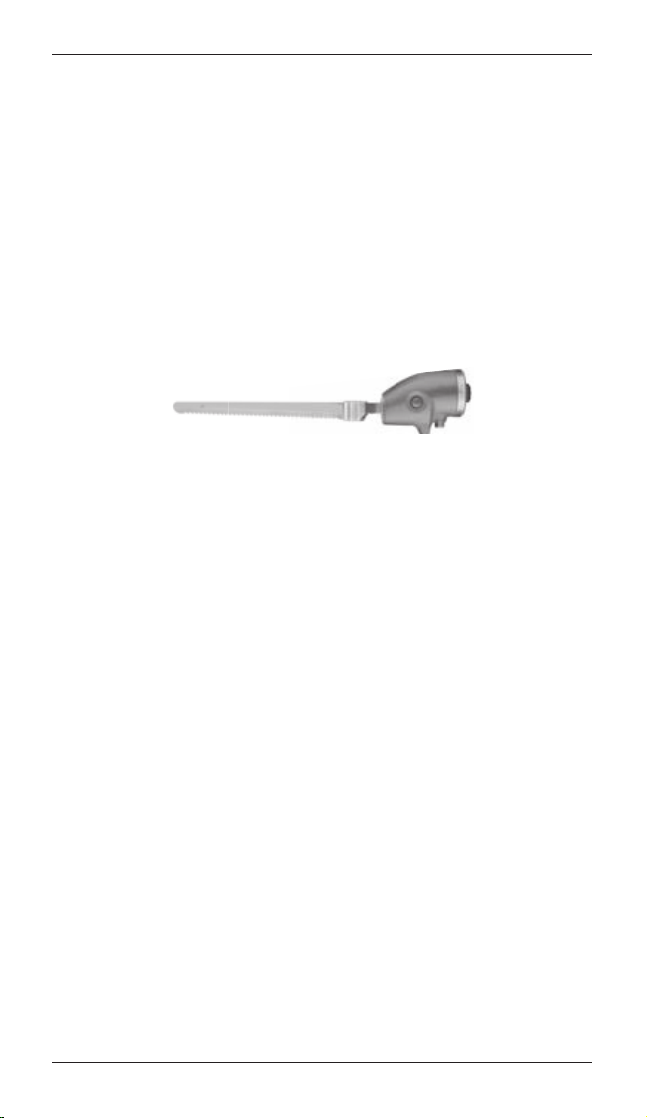
KNIFE ATTACHMENT
1. Before first use, separate the blades and wash them in hot, soapy
water or in the dishwasher. CAUTION: BLADES ARE SHARP.
HANDLE WITH CARE. Dry
thoroughly.
2. The two blades must be
attached before inserting
into the gearbox. Lock the blades together by inserting the rivet on
one blade into the keyhole of the other blade.
3. Holding the blades with the serrated edge facing down, insert
blades into the gearbox until you hear a click. The blades may not
line up evenly when properly inserted. CAUTION: THE BLADES
ARE VERY SHARP. BE CAREFUL WHEN HANDLING THEM.
A BLADE SHEATH IS INCLUDED TO PROTECT YOU AND YOUR
KNIFE BLADE.
B.
BLUNT SIDE UP
B
.
SHARP SIDE
A.
A.

11
OPERATION
TURNING CORDLESS RECHARGEABLE HAND BLENDER
ON/OFF
The power handle lets you operate the blender, chopper whisk and
knife. Keep hands, hair, clothing and other utensils away from all
blades.
BLENDING AND MIXING
The blending shaft is specially designed for mixing and stirring
all kinds of foods, including salad dressings, smoothies, shakes,
powdered drink products and sauces. It is ideal for combining dry
ingredients, and can also be used to make mayonnaise, too. The
blade mixes and stirs while adding only a minimum of air to your
mixture. A gentle up-and down motion is all you need to thoroughly
blend the most flavorful, full-bodied liquid recipes. To avoid splat-
ter, be sure the protective blade guard on the blending shaft remains
submerged in the liquid while blending. Never remove it from liquid
while the motor is running.
Insert the blending attachment into the power handle. (See Assembly
for Blending Attachment, page 8.) Insert blending shaft into mixture to
be blended. Press and hold the Auto Lock/Unlock button and press
and Power On button to turn motor on. Once motor is on, you can
release the Auto Lock/Unlock button. You can also press the Power
button first, holding it down as you press the Auto Lock/Unlock but-
ton to turn motor on. Do not hold Power button down for more than
2 minutes at a time. To turn the blender motor off, release the Power
On button.
CHOPPING AND GRINDING
Put the chopping cup firmly on a flat sturdy surface like a countertop.
Be sure the blade is assembled to use the blade edge that is appro-
priate for the food to be processed.
Put food unto the chopping cup. Be sure the food is cut into small
uniform pieces and the cup is not overloaded.
Put the chopper/grinder cover on top of the chopping cup. Be sure
the cover is properly seated. Then attach power handle to the cup
cover.
NOTE: To pulse – hold the Auto Lock/Unlock button down while
pressing and releasing the Power On button. Due to the powerful
motor provided with this unit, Cuisinart recommends using one hand
to support the chopper/grinder during operation. When you have
finished processing, release Power On button to turn motor off.
WHEN THE BLADE STOPS MOVING, remove the power handle from
the chopper/grinder cover, and remove the cover from the
chopping cup.
NOTE: Do not operate the chopper/grinder attachment without food
in the chopping cup.
12
WHISKING
1. Make sure the whisk is attached to it’s the gearbox before attaching
it to the power handles. (See page 10 Insert the whisk into mixture to
be blended, and turn unit on.
2. Begin whisking at Speed 1, gradually increasing speed to avoid
splatters.
CARVING AND SLICING
The knife blades should be assembled and inserted into gearbox
before attaching gearbox to the power handle.
1. Press gearbox onto power handle until you hear a click.
2. The knife has its own Lock/Unlock switch on top of the gearbox.
Slide the switch and immediately press and hold the power button
on the gearbox.
3. Continue pressing the power button as you cut, keeping the blade
straight so thickness of slices is consistent. CAUTION: NEVER
place your hand on top of the blade to support it while operating
the knife, as the blades are designed to move only back and forth.
4. Blades will automatically stop when power trigger is released.
Press the two blade release buttons on either side of gearbox to
release the blades.
CLEANING AND MAINTENANCE
HAND BLENDER
Always clean the motor body and blending shaft thoroughly after
using.
Remove the blending shaft from the motor body. Clean the
motor body only with a sponge or damp cloth. Do not use abrasive
cleaners that could scratch the surface. To clean the blending shaft,
wash by hand in hot water using mild detergent. Be mindful of the
fixed razor-sharp edges.
CHOPPER
To simplify cleaning, rinse the chopping cup, blade and cover
immediately after use so that food won’t dry on them. Do not
submerge the chopping cup cover in water or put in the dishwasher.
Wash chopping blade and chopping cup in warm, soapy water. Rinse
and dry. Wipe the underside of the chopper/grinder cover with a
sponge or damp cloth to remove any food. Wash the blade carefully.
Avoid leaving it in soapy water where it may disappear from sight.
You can wash the chopping cup and chopping blade on the upper
shelf of your dishwasher. Unload the dishwasher carefully to avoid
contact with the sharp blade. Wipe the motor body and top of the
cover with a damp sponge or cloth. Dry it immediately.

13
WHISK
To clean your whisk attachment, simply release the attachment
from the power handle. Once the whisk is removed, detach
the metal whisk from the gearbox by pulling the pieces apart. To clean
the gearbox, simply wipe with a damp cloth. To clean the metal
whisk, wash with warm, soapy water or put in the dishwasher.
Do not submerge the gearbox in water or any other liquids.
ELECTRIC KNIFE
1. Remove the gearbox from the power handle.
2. To remove the blades, press the blade release buttons on both
sides of the gearbox and grasp the blades with the cutting edge
away from you. Slowly pull blades out from knife handle. To wash,
separate the blades by sliding the rivet out of the keyhole. Wash
them in hot, soapy water or the dishwasher and dry thoroughly.
3. Do not put gearbox into dishwasher or into water. Wipe it with a
damp cloth to clean.
Caution: Do not clean handle with blades in place. Do not immerse
the appliance in water or other liquids or place it under running water.
Any service, other than cleaning and normal user maintenance, should
be performed by an authorized Cuisinart Service Representative.
TIPS AND HINTS
FOR HAND BLENDER
• Be sure the protective blade guard on the blending shaft is fully
submerged before blending ingredients.
• To purée a soup, use the hand blender to blend the soup ingredients
to the desired consistency, using a gentle up-and-down motion
directly in the saucepan or pot.
• When blending ingredients in a pot or pan, tilt the pan away from
you to create a deeper area for blending and to prevent splatter.
• If blending a small volume of liquid, tilt the container slightly for
better results.
• When using a nonstick cooking surface, be careful not to scratch
the coating with the hand blender.
• When blending in the beaker – for example, if making a fruit
smoothie – cut firmer fruit into ½-inch pieces for easy blending.
• When blending in the beaker, put harder ingredients in first, then soft
ingredients. Finish with any liquid you want to add, unless recipe
instructs otherwise.
• Liquid should not come closer than 1 inch of where the shaft
attaches to the motor housing.
• The hand blender is perfect for frothing milk for cappuccino or
lattés. Just warm milk in a small saucepan, and then pulse the hand
blender gently, being sure to keep the blending blade guard fully
submerged.

14
• Do not let hand blender stand in a hot pot on stove while not in use.
• Do not attempt to blend fruit pits, bones or other hard materials, as
these are likely to damage the blades.
• Do not fill mixing containers too full. The level of mixture will rise
when blending and can overflow.
• To whip air into a mixture, always hold the blade just under the
surface.
• Using a gentle up-and-down motion is the best way to blend and
incorporate ingredients uniformly.
• Use the hand blender to make smooth gravies and pan sauces.
• Do not immerse motor body housing in water or any other liquids.
FOR FOOD CHOPPER/GRINDER ATTACHMENT
1. Do not overload work bowl. For best results, most foods should not
reach more than
2
∕
3
of the way up the work bowl.
2. Do not attempt to chop fruit pits, bones or other hard materials, as
these are likely to damage the blades.
3. Pulse food in 1-second increments to chop. For the finest chop,
process continuously. Watch ingredients closely to achieve desired
consistency and scrape the work bowl as necessary
4. For raw ingredients: Peel, core and/or remove seeds and pits. Food
should be between ½ and 1 inch, depending on hardness of the food.
5. The size of pieces you put in bowl should be about the same size to
achieve even results.
6. Do not operate chopper/grinder attachment for more than
30 seconds continuously.
7. Liquids in work bowl should not exceed 1½ cups. Use quantities
given in the recipe section as a guide.
8. Some spices may scratch the work bowl.
9. When making compound butters, remove the butter from the
refrigerator and let it come to room temperature before blending the
ingredients.
10. Do not immerse chopper/grinder cover in water or any other liquids.
FOR WHISK ATTACHMENT
• Do not immerse whisk attachment gearbox in water or any other liquid.
• Use the whisk attachment for beating heavy cream or egg whites.
• When beating egg whites use a very clean metal or glass bowl, never
plastic. Plastic can contain hidden oils and fats that can ruin the
delicate egg white foam. To help stabilize the egg whites, add
1
/
8
teaspoon of cream of tartar per egg white prior to beating them.
(If using a copper bowl omit the cream of tartar.) Beat the egg whites
until desired peaks form.

15
• It may also be used for any task that you would normally whisk by
hand, like crêpe batters or eggs for omelets.
• Beating the egg whites too long causes them to dry out and become
less stable.
• When adding sugar to beaten egg whites, add it slowly when soft
peaks just begin to form, and then continue beating to form desired
peaks.
• When beating heavy cream, if possible and time allows, use a chilled
bowl and chill the whisk attachment. The best-shaped bowl for
whipping cream is one that is deep with a rounded bottom to minimize
any splatter.
• The cream should come out of the refrigerator just before whipping.
Whipped cream may be used at either soft or firm peaks depending
on preference. It may be flavored as desired. For best results, whip
cream just before using.
FOR KNIFE ATTACHMENT
• Do not press down when carving or slicing; let the motion of the
blades control the cutting.
• When slicing bread, keep the blades at a right angle to the cutting
board for consistent thickness.
• Be careful to avoid bones when carving meat or poultry; they could
damage the cutting edges of blades.
• When carving or slicing with one hand, be sure to keep the other hand
(which is often holding the item being cut) away from the blades.

16
FREQUENT USES FOR CHOPPER/GRINDER
Ingredient Suggested Blade* Speed Comments
Baby Foods (always
consult a pediatrician
or family physician for
appropriate food recom-
mendations)
Sharp Blade
Low–
High
Place small amounts of cooked food into chop-
per/grinder bowl. Add small amount of appro-
priate liquid. Pulse to chop, then hold to blend.
BreadCrumbs – fresh
or dry (day old)
Sharp Blade High
Pulse to chop, then process until desired
consistency is reached.
Hard Cheese (Asiago,
Locatelli, Parmesan,
Romano, etc.) (Not
recommended for softer
cheeses unless making
a dip or dressing)
Sharp Blade High
Cut into 1/4-inch pieces. Pulse to chop, then
process until desired consistency is reached.
Chocolate Sharp Blade High
Cut into 1/2- inch pieces; may chill in freezer
for 3 minutes before chopping. Pulse to chop,
then process, no more than 1 ounce at a time,
until desired texture is reached.
Creamy Dressings
and Dips
Sharp Blade Low
Place ingredients in chopper/grinder bowl; do
not cover or spill on stem. Use pulse action to
chop, then continuous-hold action to blend to
desired consistency.
Garlic Sharp Blade High Peeled to 6 cloves. Pulse to chop.
Gingerroot (fresh) Sharp Blade High
Peel, cut into-1/2-inch pieces. Pulse to chop
1/2 ounce at a time.
Hard Spices
(coriander, dill, poppy,
star, anise, etc.)
Sharp Blade High
Pulse to chop until desired consistency is
reached. Pulse with sharp blade to get fine
results.
Herbs (fresh) Sharp Blade High 1/2 cup; must be clean/dry. Pulse to chop.
Nuts Dull Blade High
Shelled; toast first for best flavor. Pulse to
chop, process up to a 1/3 cup at a time, until
desired consistency is reached. May be pro-
cessed to nut-butter stage.
Onion Sharp Blade High
Peel, cut into 1/2-inch pieces. Pulse to chop,
up to 1/2 cup at a time, until desired chop is
reached.
Vegetables (cooked) Sharp Blade
Low–
High
Cut into inch pieces; pulse to chop, up to 1/2
cup at a time. Add cooking liquid, stock or
milk to process to a purée. It is not recom-
mended for making mashed potatoes.
Vegetables (uncooked) Sharp Blade High
Peel as needed; cut into 1/2-inch pieces. Peel
celery with peeler to remove tough strings.
Chop/process up to 1/2 cup at a time.
Raw Meat (beef, pork) Sharp Blade High
6 oz. or 175g, cut into 1/2-inch pieces. Pulse
until desired consistency.
Simple Blending Dull Blade
Low–
High
For light mixing and incorporating.
* See page 9-10 for instructions on how to safely change the blade from the sharp side to
the blunt side.

17
Berry On-the-Go Smoothie ........ 18
Mango-Lime Smoothie ............... 18
Protein Shake ............................. 19
Simple Fruit Smoothie ................ 19
Cherry-Ginger Smoothie ............ 20
Triple Chocolate Shake .............. 20
Baba Ghanoush ......................... 21
Guacamole ................................. 22
Hummus ..................................... 22
Mango Salsa .............................. 23
Spinach, Gruyère and
Artichoke Dip .............................. 23
Tapenade .................................... 24
Tzatziki ....................................... 25
Aioli/Mayonnaise ........................ 25
Cranberry Sauce ........................ 26
Garden Vegetable Sauce............ 26
Horseradish Sauce ..................... 28
Pesto .......................................... 28
Salsa Verde................................. 29
Yogurt Tahini Sauce .................... 29
Basic Vinaigrette ........................ 30
Caesar Dressing ......................... 30
Citrus Vinaigrette ........................ 31
Sesame Ginger Dressing ............ 31
Spring Asparagus Leek Soup .... 32
Butternut Squash Bisque
with Bacon Sage Butter ............. 33
Cauliflower Soup ........................ 34
Zucchini Herb Soup ................... 35
Roasted Tomato and
Red Pepper Soup ....................... 36
Winter White Bean Soup ............ 36
Chocolate Mousse ..................... 37
Whipped Cream ......................... 38
Belgian Waffles ........................... 39
Fresh Herb-Crusted Pork Loin ... 39
Thanksgiving Turkey ................... 40
Middle Eastern Leg of Lamb ...... 41
Easy Weeknight Tenderloin ........ 42
RECIPES

18
SMOOTHIES AND DRINKS
Berry On-the-Go Smoothie
The mint in this recipe pleasantly offsets the sweetness of the berries
and the tartness of the cranberry juice. Try it in any of your favorite
fruit smoothies.
Makes 2 cups
½ cup frozen blueberries
1 cup strawberries, hulled and halved
¼ cup packed fresh mint leaves
1 banana, cut into 1-inch pieces
1
/
3
cup cranberry juice
1
/
3
cup water
1. Put all ingredients, in the order listed, into the mixing beaker. Using
the blending shaft, select Speed 5 and blend, using an up-and-down
motion, for 1 minute 30 seconds.
2. Serve immediately.
Nutritional information per serving (1 cup):
Calories 117 (3% from fat) • carb. 29g • sugars 16g • pro. 1g • fat 0g • sat. fat 0g
• chol. 0mg • sod. 7mg • calc. 38mg • fiber 5g
Mango-Lime Smoothie
For a creamier smoothie, increase the amount of yogurt to ½ cup.
Makes a scant cup
1 cup mango, cut into 1-inch chunks
1
/
3
cup plain full fat yogurt
1½ teaspoons fresh lime juice
½ teaspoon grated lime zest
2 tablespoons cold water
1. Put all ingredients, in the order listed, into the mixing beaker. Using
the blending shaft, select Speed 5 and blend, using an up-and-down
motion, for 30 seconds.
2. Serve immediately or refrigerate until ready to enjoy.
Nutritional information per serving (1 cup):
Calories 195 (15% from fat) • carb. 39g • sugars 35g • pro. 5g • fat 3g • sat. fat 2g
• chol. 10mg • sod. 53mg • calc. 156mg • fiber 3g

19
Protein Shake
Peanut butter, banana and cocoa powder—what’s not to like? Plus, the
combo is packed with protein that is sure to fill you up.
Makes 1¼ cups
2 tablespoons creamy-style peanut butter
1 banana, cut into 1-inch pieces
1 tablespoon protein powder
1 teaspoon unsweetened cocoa powder
1 teaspoon flaxseed*
¾ cup unsweetened almond milk
1. Put all ingredients, in the order listed, into the mixing beaker. Using the
blending shaft, select Speed 5 and blend, using up-and-down motions,
for 1 minute 30 seconds.
2. Serve over ice or refrigerate until ready to enjoy.
Nutritional information per serving (about ½ cup):
Calories 192 (52% from fat) • carb. 18g • sugars 8g • pro. 6g • fat 12g • sat. fat 2g
• chol. 4mg • sod. 111mg • calc. 95mg • fiber 3g
Simple Fruit Smoothie
Less is more, especially when it comes to making a quick and nutritious
snack with your hand blender.
Makes a scant 2 cups
1 cup fresh strawberries, hulled and halved
1 cup frozen pineapple chunks
¾ cup orange juice
1. Put all ingredients, in the order listed, into the mixing beaker. Using the
blending shaft, select Speed 5 and blend, using up-and-down motions,
for about 1 minute.
2. Serve immediately or refrigerate until ready to enjoy.
Nutritional information per serving (1 cup):
Calories 129 (2% from fat) • carb. 30g • sugar 25g • pro. 1g • fat 0g • sat. fat 0g
• chol. 0mg • sod. 5mg • calc. 20mg • fiber 4g

20
Cherry-Ginger Smoothie
Coconut milk beverage, normally found in a carton, is much lighter than
traditional canned coconut milk. Substitute
2
/3 cup of the canned
version for a creamier, richer smoothie.
Makes about 1 cup
1 cup dark, sweet frozen cherries
¾ cup coconut milk beverage
1 piece (¾-inch) fresh ginger, peeled and halved
1. Put all ingredients, in the order listed, into the mixing beaker. Using
the blending shaft, select Speed 5 and blend, using an up-and-down
motion, for about 30 seconds.
2. Serve immediately or refrigerate until ready to enjoy.
Nutritional information per serving (1 cup):
Calories 242 (57% from fat) • carb. 25g • sugars 18g • pro. 3g • fat 16g • sat. fat 14g
• chol. 0mg • sod. 10mg • calc. 14mg • fiber 3g
Triple Chocolate Shake
For the chocolate lover.
Makes about 2 cups
¾ cup milk (any fat variety)
1½ tablespoons chocolate syrup
½ teaspoons cocoa powder
1½ cups premium chocolate ice cream
1. Put all ingredients, in the order listed, into the mixing beaker. Using
the blending shaft, select Speed 3 and blend, using an up-and-down
motion, for 45 seconds.
2. Serve immediately.
Nutritional information per serving (½ cup):
Calories 154 (39% from fat) • carb. 21g • sugars 19g • pro. 3g • fat 7g • sat. fat 4g
• chol. 23mg • sod. 65mg • calc. 110mg • fiber 1g

21
Baba Ghanoush
This popular roasted eggplant dip dish is great as a dip for vegetables
or pita, but is also nice as a sandwich spread. To achieve the signature
charred flavor, cooking the eggplant over an open flame is the way to
go, but you can also just broil or roast it in your oven so until the egg-
plant is cooked to a soft consistency.
Makes about 1¼ cups
1 medium eggplant (about 1 pound), not peeled
1 garlic clove, peeled
1
/
3
cup fresh parsley leaves
2 tablespoons tahini
2 teaspoons fresh lemon juice
2 teaspoons extra virgin olive oil
½ teaspoon kosher salt
1. Prick the eggplant evenly on all sides with the tines of a fork. Char
the eggplant. This can be done in one of two ways: If you have a gas
stove, you can char over the stove (the faster method). Holding the
eggplant with heatproof tongs, place over the flame of the stove and
carefully turn the eggplant until all sides are blackened. Set aside to
cool slightly. The second method is to char in an oven under the broiler.
Set on a rack fit into a foil-lined baking pan. Place as close as possible
to the broiler/top element and turn every 5 to 10 minutes, until all sides
are charred (this may not get as blackened as it would over an open
flame). It is important for the flesh to be very soft, to the point where
the eggplant is falling apart. This can take anywhere between 15 and
30 minutes, depending on your oven. Note: This is a great task for your
toaster oven! Once the eggplant is charred, set aside to cool slightly.
2. Put the garlic into the chopping cup. Process on Speed 5 to chop. Add
the remaining ingredients, and then scrape in the flesh (not the skin)
of the eggplant into the bowl (discard any seeds). Process on Speed 5
until completely combined.
3. Taste and adjust seasoning as desired.
Nutritional information per serving (2 tablespoons):
Calories 37 (54% from fat) • carb. 4g • sugars 1g • pro. 1g • fat 2g • sat. fat 0g
• chol. 0mg • sod. 153mg • calc. 33mg • fiber 2g

22
Guacamole
This popular Mexican specialty is delicious with chips and vegetable
crudités, or as a topping for grilled chicken or fish.
Makes about 1 cup
1 small garlic clove, peeled
½ small jalapeño, seeded and quartered
¼ cup grape tomatoes
1 ripe avocado, halved and pitted
1 teaspoon fresh lime juice
½ teaspoon kosher salt
1. Put the garlic and jalapeño into the chopping cup. Process on Speed
5 for 5 seconds to chop. Add the tomatoes and pulse 2 to 3 times to
chop. Add the remaining ingredients and pulse on Speed 5 until desired
consistency is achieved.
2. Taste and adjust seasoning as desired.
Nutritional information per serving (2 tablespoons):
Calories 30 (72% from fat) • carb. 2g • sugars 0g • pro. 0g • fat 3g • sat. fat 0g
• chol. 0mg • sod. 144mg • calc. 4mg • fiber 1g
Hummus
This is your basic hummus. To change it up a bit, add a cooked
red pepper, or roasted beets or fresh herbs. This hummus is delicious
on its own, but also makes a great foundation for new flavor variations
like roasted pepper or fresh herb.
Makes about 2 cups
1 garlic clove, peeled
1 can (15.5 ounces) chickpeas, drained and rinsed
½ cup tahini
2 tablespoons fresh lemon juice
¾ teaspoon kosher salt, or to taste
Pinch ground cumin
½ cup water (plus more if needed)
1. Put the garlic clove into the chopping cup and process on Speed 5
for 10 to 15 seconds; scrape bowl. Add the remaining ingredients and
process until fully smooth, about 40 to 60 seconds.
2. Taste and adjust seasoning as desired. If a thinner consistency is
desired, add additional water, or olive oil for a richer tasting hummus.
Nutritional information per serving (2 tablespoons):
Calories 71 (47% from fat) • carb. 7g • sugars 0g • pro. 3g • fat 4g • sat. fat 1g
• chol. 0mg • sod. 119mg • calc. 45mg • fiber 2g

23
Mango Salsa
Serve alongside warm tortilla chips or over grilled chicken, fish or pork.
The fresh flavors will brighten any simple meal.
Makes about 1 cup
1 small garlic clove, peeled
¼ jalapeño, seeded and quartered
1 scallion, cut into ½-inch pieces
1 tablespoon packed cilantro leaves
1 cup grape tomatoes, halved
½ cup mango, cut into ½-inch pieces
¼ teaspoon kosher salt
Pinch freshly ground black pepper
1 teaspoon fresh lime juice
1. Put garlic, jalapeño, scallion and cilantro into the chopping cup. Select
Speed 5 and pulse to finely chop, about 6 to 8 times. Transfer to a
medium bowl.
2. Add grape tomatoes and mango to chopping cup. Select Speed 5
and pulse to roughly chop, about 5 to 6 times. Transfer to bowl with
chopped garlic, jalapeño and cilantro. Add salt, pepper and lime juice;
stir to combine. Drain excess liquid if necessary.
3. Taste and adjust seasoning as desired.
Nutritional information per serving (¼ cup):
Calories 23 (6% from fat) • carb. 6g • sugars 4g • pro. 1g • fat 0g • sat. fat 0g
• chol. 0mg • sod. 137mg • calc. 15mg • fiber 1g
Spinach, Gruyère and Artichoke Dip
A bit of a twist on the standard spinach artichoke dip, for the more
grown-up palate. The combination of Gruyère and Parmesan gives the
dip a pleasant nuttiness. No special pan required – we found that using
a pie plate was the best and quickest way to warm this dish.
Makes about 2 cups
Olive oil or nonstick cooking spray
2 ounces Gruyère, cut into ½-inch cubes
1 ounce Parmesan, cut into ½-inch cubes
1 garlic clove, peeled
½ small shallot, cut into 1-inch pieces
8 ounces frozen spinach, thawed and drained well
1 can (15 ounces) quartered artichoke hearts, drained
12 ounces cream cheese, room temperature and cut into 1-inch
pieces (regular or reduced-fat style, such as Neufchâtel,
works)
2 tablespoons heavy cream
½ teaspoon crushed red pepper

24
1. Lightly coat a 9-inch pie or cake pan with olive oil or nonstick cooking
spray. Reserve. Preheat oven, with the rack in the middle position, to
375°F.
2. Put both cheeses into the chopping cup. Process on Speed 5 until
chopped, about 20 to 30 seconds. Add the garlic and shallot and
process on Speed 5 until chopped, another 20 seconds.
3. Put the remaining ingredients into a medium mixing bowl, along with the
chopped mixture. Using the blending shaft, process on Speed 5 until
combined. Use an up-and-down motion, about 1 to 1½ minutes, to be
sure to cut through all ingredients.
4. Transfer mixture to the prepared pie/cake pan and put into the
preheated oven. Bake until the top is nicely browned, about 20 to 25
minutes.
5. Serve immediately with pita chips, crusty bread and crisp vegetables.
Nutritional information per serving (2 tablespoons):
Calories 99 (61% from fat) • carb. 5g • sugars 1g • pro. 5g • fat 7g • sat. fat 4g
• chol. 23mg • sod. 169mg • calc. 93mg • fiber 3g
Tapenade
A traditional French condiment. Serve alongside crackers
or a nice crusty bread.
Makes about 1½ cups
1 garlic clove, peeled
3 tablespoons packed fresh parsley
1½ cups pitted black olives (Kalamata or Niçoise work very well)
¼ cup capers, drained and rinsed
2 tablespoons extra virgin olive oil
1½ teaspoons fresh lemon juice
1½ teaspoons Dijon-style mustard
½ teaspoon freshly ground black pepper
1. Put the garlic and parsley into the chopping cup. Select speed 5 and
process roughly chop, about 20 seconds. Scrape down the sides of the
bowl. Add the olives and capers and continue processing on Speed 5
for to chop another 20 seconds. Add the remaining ingredients. Process
until combined and desired consistency has been achieved. Tapenade is
equally delicious whether puréed or more roughly chopped.
2. Taste and adjust seasoning as desired.
Nutritional information per serving (2 tablespoons):
Calories 42 (84% from fat) • carb. 2g • sugars 0g • pro. 0g • fat 4g • sat. fat 1g
• chol. 0mg • sod. 224mg • calc. 33mg • fiber 2g

25
Tzatziki
The Greek cousin of raita, this sauce benefits from time
in the refrigerator so the flavors can develop.
Makes about 1¾ cups
2 garlic cloves, peeled
1 tablespoon fresh dill
1 piece (½ inch) lemon peel, bitter white pith removed
4 ounces cucumber, seeded (if necessary) and cut into 1-inch
pieces – do not peel
1 cup plain Greek yogurt (any fat variety works)
1 tablespoon fresh lemon juice
2 pinches kosher salt
1. Put the garlic, dill and lemon peel into the chopping cup. Select
Speed 5 and process on Speed 5 to roughly chop, about 20 seconds.
Scrape down the sides of the bowl and add the cucumber. Process
again on Speed 5 until finely chopped, about 10 seconds.
2. Add the remaining ingredients and process until combined.
3. Transfer to a storage container, cover and refrigerate for a minimum of
2 hours, preferably overnight.
4. Taste and adjust seasoning as desired.
Nutritional information per serving (2 tablespoons):
Calories 7 (1% from fat) • carb. 1g • sugars 1g • pro. 2g • fat 3g • sat. fat 0g
• chol. 0mg • sod. 153mg • calc. 33mg • fiber 2g
Aioli/Mayonnaise
Aioli, like mayonnaise, has its roots in France, but it has been adopted
by many cuisines, most notably the Catalans of Spain. This version
makes it simple by using the same base for mayonnaise, but adding a
hefty amount of garlic to the mix. Traditionally, aioli is used as a dip for
crudités, but it can also top burgers, fish and crab cakes.
Makes about 1 cup
2 garlic cloves, peeled (if making aioli)
2 large egg yolks
2 tablespoons fresh lemon juice
1 tablespoon Dijon-style mustard
1 to 2 pinches kosher salt
1
1
/
3
cups vegetable oil

26
Put all ingredients (excluding the garlic if making mayonnaise), in the
order listed, in the mixing beaker. Allow to sit for about 30 seconds to 1
minute. Insert the blending shaft so that it is sitting level on the bottom
of the cup select Speed 3 and blend, being sure to keep the metal blade
completely submerged. Process until the mixture begins to thicken.
Continue processing with a gentle up-and-down motion until thick and
oil is fully incorporated.
Nutritional information per serving (1 tablespoon):
Calories 169 (98% from fat) • carb. 0g • sugars 0g • pro. 0g • fat 19g • sat. fat 2g
• chol. 23mg • sod. 32mg • calc. 3mg • fiber 0g
Cranberry Sauce
Freshly made cranberry sauce beats out the canned variety any day.
Makes about 3 cups
4 cups whole cranberries (fresh, or frozen and thawed)
2 cups water
2
/
3
cup granulated sugar
¼ teaspoon kosher salt
3-inch piece orange peel, bitter white pith removed
1. Put all ingredients into a medium saucepan. Bring to a boil, then lower
heat to achieve a simmer. Continue to simmer until the cranberries
are very plump, about 20 minutes (in addition to the cranberries being
plump, you want to reduce the liquid by about one-third or one-half).
Remove from heat and let come to room temperature.
2. Remove orange peel and then insert the blending shaft. Select Speed 3
and blend for 10 to 15 seconds, depending on desired consistency.
3. Transfer to a storage container, cover and chill in the refrigerator.
4. Cranberry sauce can be stored in the refrigerator for up to 1 week.
Nutritional information per serving (¼ cup):
Calories 57 (1% from fat) • carb.14g • sugars 11g • pro. 0g • fat 0g • sat. fat 0g
• chol. 0mg • sod. 55mg • calc. 7mg • fiber 2g

27
Garden Vegetable Sauce
This all-purpose pasta sauce is a great way to get
your daily dose of vegetables.
Makes about 4 cups
1 tablespoon extra virgin olive oil
1 small onion, cut into ½-inch pieces
1 carrot, cut into ½-inch pieces
½ cup ½-inch cubed eggplant (not peeled)
1 celery stalk, cut into ½-inch pieces
2 garlic cloves, smashed
½ teaspoon kosher salt, divided
½ teaspoon dried oregano
½ teaspoon dried basil
1 roasted red pepper, cut into 1-inch pieces
¼ cup dry white wine
1 tablespoon tomato paste
1 can (28 ounces) diced tomatoes with their juices
Pinch freshly ground black pepper
1 tablespoon granulated sugar
1. Put the oil into a large saucepan set over medium heat. Once oil is hot,
add the onion, carrot, eggplant, celery, garlic and ¼ teaspoon of the
salt. Gently sauté ingredients together until they turn slightly golden.
2. Add the oregano, basil, red pepper and wine. Cook until reduced by at
least half. Add the tomato paste, tomatoes and remaining salt. Bring to
a boil, then reduce heat and simmer for 35 minutes, loosely covered.
Uncover and then simmer for an additional 10 to 15 minutes longer to
thicken. Turn off heat and let sit 5 minutes.
3. Select Speed 3 and blend sauce directly in the pot on using the
blending shaft. Process until desired consistency is achieved, being
sure to keep the metal blade completely submerged in the sauce
(depending on the size of the pot being used, you may need to tilt the
pot to one side – be sure to tilt the pot away from you to prevent any
possible splatter).
4. Taste and adjust seasoning as desired.
5. Serve immediately or cool completely and then transfer to storage
containers to store in the refrigerator. Sauce will keep in the refrigerator
for up to one week. It can also be frozen for up to one month.
Nutritional information per serving (¼ cup):
Calories 41 (25% from fat) • carb. 7g • sugars 4g • pro. 1g • fat 1g • sat. fat 0g
• chol. 0mg • sod. 245mg • calc. 18mg • fiber 2g

28
Horseradish Sauce
Perfect accompaniment for any roast beef dish.
Makes about 1 cup
2
/
3
cup sour cream
1
/
3
cup mayonnaise
1
/
3
cup prepared horseradish
2 teaspoons Dijon-style mustard
¾ teaspoon kosher salt
Pinch freshly ground black pepper
Put all ingredients, in the order listed, into the mixing beaker. Using the
blending shaft, select Speed 3 and blend. While blending, gradually
increase to Speed 5, using a gentle up-and-down motion until
completely combined, about 20 to 30 seconds.
Nutritional information per serving (1 tablespoon):
Calories 56 (89% from fat) • carb. 7g • sugars 1g • pro. 1g • fat 5g • sat. fat 2g
• chol. 10mg • sod. 163mg • calc. 10mg • fiber 0g
Pesto
Make this traditional pesto when basil is abundant in the garden.
Makes about ¾ cup
1½ ounces Parmigiano Reggiano, cut into ½-inch cubes
1
/
3
cup toasted pine nuts (may substitute another nut,
like walnuts, if not available)
2 garlic cloves, peeled
½ to ¾ teaspoon kosher salt
1½ cups packed fresh basil leaves
1
/
3
cup extra virgin olive oil, divided
1. Put the cheese into the chopping cup. Select Speed 5 and pulse to
process until finely ground, about 5 pulses.
2. Add the nuts, garlic and salt. Process on Speed 5 until chopped, about
30 seconds.
3. Add half of the basil and process until chopped. Add the remaining
basil and process until chopped. Add half of the oil and process
until combined. Add the remaining oil and process until mixture is
homogenous and finely chopped, about 1 minute.
4. Taste and adjust seasoning as desired. Transfer pesto to an airtight
container – either drizzle additional olive oil on top of the pesto or press
a piece of plastic wrap directly on top prior to covering the container.
Pesto will keep in the refrigerator for up to a week, or frozen for up to 1
month.
Nutritional information per serving (1 tablespoon):
Calories 94 (89% from fat) • carb. 1g • sugars 0g • pro. 1g • fat 10g • sat. fat 2g
• chol. 2mg • sod. 152mg • calc. 49mg • fiber 0g

29
Salsa Verde
Spoon this green, herby sauce over grilled meat – it will become
an instant favorite.
Makes ¾ cup
1 small garlic clove, peeled
¼ small jalapeño or serrano chile
1 small scallion, trimmed and cut into ½-inch pieces
1 cup fresh parsley leaves
½ teaspoon red wine vinegar
¼ teaspoon kosher salt
Pinch freshly ground black pepper
¾ cup extra virgin olive oil
1. Put the garlic, jalapeño and scallion into the chopping cup. Process on
Speed 5 to finely chop, 5 to 8 seconds. Add parsley. Pulse to medium
chop, about 16 times. Transfer to a small mixing bowl.
2. Add vinegar, salt, pepper and oil to chopped parsley mixture. Stir
together with a spoon.
3. Taste and adjust seasoning as desired.
Nutritional information per serving (2 tablespoons):
Calories 246 (12% from fat) • carb. 1g • sugars 0g • pro. 0g • fat 28g • sat. fat 4g
• chol. 0mg • sod. 105mg • calc. 18mg • fiber 0g
Yogurt Tahini Sauce
From falafel to our Middle Eastern Leg of Lamb (page 41), this tangy
sauce is a fitting accompaniment.
Makes about 1 cup
1 cup plain yogurt, whole or reduced fat
1 tablespoon tahini
½ teaspoon fresh lemon juice
½ teaspoon kosher salt
¼ teaspoon ground cumin
1. Select Speed 1 and blend, using the blending shafts, until homogenous.
2. Taste and adjust seasoning as desired.
3. Serve immediately or reserve in the refrigerator. This can be made in
advance and stored in an airtight container in the refrigerator for up to 1
week.
Nutritional information per serving (2 tablespoons):
Calories 53 (50% from fat) • carb. 4g • sugars 25g • pro. 2g • fat 3g • sat. fat 1g
• chol. 4mg • sod. 180mg • calc. 83mg • fiber 1g

30
Basic Vinaigrette
Use this basic vinaigrette as a guide and change your vinegar/oil flavors
to come up with varying combinations to create exciting salad dressings.
You can add other flavors such as crushed or roasted garlic, chopped
shallots, fresh or dried herbs, sun-dried tomatoes, honey or lemon juice.
Makes about 1 cup
¼ cup red wine vinegar
1 teaspoon Dijon-style mustard
¼ teaspoon kosher salt
1
/
3
teaspoon freshly ground black pepper
¾ cup extra virgin olive oil
1. Put all ingredients, in the order listed, into the mixing beaker.
2. Insert the blending shaft so that it is sitting level on the bottom of the
beaker and select Speed 3 and blend, being sure to keep the metal
blade completely submerged. Process until the mixture begins to
thicken. Continue processing with a gentle up-and-down motion until
dressing is homogenous, about 30 seconds.
3. Taste and adjust seasoning as desired.
Nutritional information per serving (2 tablespoons):
Calories 181 (100% from fat) • carb. 0g • sugars 0g • pro. 0g • fat 21g • sat. fat 3g
• chol. 0mg • sod. 91mg • calc. 0mg • fiber 0g
Caesar Dressing
An old favorite made fresh at home.
Makes about 1 cup
2 small garlic cloves, peeled
6 anchovy fillets
¼ cup egg substitute (may substitute 2 fresh, raw egg yolks; be
sure you use the freshest eggs possible and from a trusted
source – or use ¼ cup mayonnaise)
4 teaspoons fresh lemon juice
4 teaspoons red wine vinegar
2 teaspoons Dijon-style mustard
2 teaspoons Worcestershire sauce
½ teaspoon freshly ground black pepper
2
/
3
cup extra virgin olive oil, divided
1. Put all ingredients except for the olive oil into the mixing beaker. Using
the blending shaft, select Speed 5 and blend, until fully combined.
2. Add half of the olive oil and blend on Speed 5 until well combined. Add
the remaining olive oil and blend until homogenous, about 1 minute.
3. Taste and adjust seasoning as desired.

31
4. Serve immediately. Transfer to an airtight container and store in the
refrigerator for up to 5 days.
Nutritional information per serving (1 tablespoon):
Calories 90 (96% from fat) • carb. 0g • sugars 0g • pro. 1g • fat 10g • sat. fat 2g
• chol. 24mg • sod. 68mg • calc. 3mg • fiber 0g
Citrus Vinaigrette
Use any variety of citrus in this recipe to dress up your typical green
salad. This dressing also makes a great marinade for chicken.
Makes about 1 cup
¼ small shallot, cut into ½-inch pieces
1 teaspoon Dijon-style mustard
2 – 3 teaspoons grated orange zest (zest of 1 orange)
1
/
3
cup freshly squeezed orange juice
½ teaspoon kosher salt
Pinch freshly ground black pepper
2
/
3
cup extra virgin olive oil
1. Put shallot into the chopping cup. Select Speed 5 and process to chop,
about 10 seconds. Add the remaining ingredients and blend about 30
seconds until homogenous.
2. Taste and adjust seasoning as desired.
Nutritional information per serving (2 tablespoons):
Calories 167 (96% from fat) • carb. 2g • sugars 1g • pro. 0g • fat 19g • sat. fat 3g
• chol. 0mg • sod. 163mg • calc. 3mg • fiber 0g
Sesame Ginger Dressing
This Asian-style dressing goes great over cold, crisp vegetables.
Makes about 1 cup
1 scallion, trimmed and cut into 1-inch pieces
1 small garlic clove, peeled
1 piece (¾ inch) fresh ginger, peeled and halved
1 tablespoon toasted sesame seeds
3 tablespoons rice wine vinegar
tablespoon soy sauce
2 tablespoons toasted sesame oil
¾ cup vegetable oil
1. Put all ingredients, except for the oil, into the blending beaker. Using the
blending shafts, select Speed 5 and to chop, about 15 seconds.

32
2. Add oil. Select Speed 3 and blend until homogeneous about 30
seconds.
Nutritional information per serving (2 tablespoons):
Calories 217 (98% from fat) • carb. 1g • sugars 0g • pro. 0g • fat 25g • sat. fat 4g
• chol. 0mg • sod. 85mg • calc. 3mg • fiber 0g
Spring Asparagus Leek Soup
Spring ingredients shine in this simple yet tasty soup.
Makes about 8 cups
2 garlic cloves, peeled
2 medium leeks, white and light green parts only, cut into
1-inch pieces
2 tablespoons unsalted butter
1 – 1½ teaspoons kosher salt, to taste, divided
2 large bunches asparagus (about 2 to 2½ pounds), rough ends
trimmed and cut into 2-inch pieces, tips removed and
reserved for garnish, optional (see note in step 3)
1 large red potato (about 8 ounces), peeled and cut into ½-inch
pieces, held in water to prevent oxidation
¼ cup dry white wine or cognac
¼ teaspoon freshly ground black pepper
5 cups vegetable or chicken broth (the clearer the broth, the
greener the soup will be)
1 teaspoon fresh lemon juice
Crème fraîche for garnish
Chopped chives for garnish
1. Put the garlic and leeks into the chopping cup. Select Speed 5 and
process to chop, about 8 seconds. Remove and reserve.
2. Put the butter in a medium stockpot set over medium heat. Once
melted, add the garlic and leeks with a half teaspoon of salt; stir until
you hear a slight sizzle and then cover pan to sweat the leeks for about
5 to 10 minutes, until they are very soft.
3. Add the asparagus stalks and potato to the pan. Stir to coat all
vegetables and sauté until soft, about 10 minutes. Pour in white wine
or cognac and stir until completely reduced. Add remaining salt and
pepper and stir in the broth. Bring mixture to a boil and then reduce to
a simmer. Simmer until all vegetables are very tender, about 20 to 25
minutes.
4. While soup is simmering, steam the asparagus tips separately, about
5 to 8 minutes, until crisp tender. Shock tips in ice water to maintain a
bright green color. Once cool, thinly slice tips lengthwise to be used for
garnish. (Note: This step is optional, but makes for a great presentation.)
5. Once soup vegetables are tender, select Speed 3 and start blending,
using the blending shafts. Gradually increase to Speed 5, until puréed,
about 1½ minutes. If using a larger pot, tilt the pan away from you
to ensure that the protective guard of the blending blade is fully
submerged to prevent splatter.

33
6. Stir in lemon juice. Taste and adjust seasoning as desired.
7. Serve immediately, garnished with a dollop of crème fraîche, some
chopped chives and asparagus tips.
Nutritional information per serving (based on 6 servings):
Calories 97 (26% from fat) • carb. 13g • sugars 4g • pro. 5g • fat 35g • sat. fat 2g
• chol. 8mg • sod. 650mg • calc. 45mg • fiber 3g
Butternut Squash Bisque with Bacon Sage Butter
The bacon sage butter partners perfectly with this soup. Rave reviews
are almost guaranteed.
Makes about 7 cups
Butter:
2 slices bacon, diced and cooked through,
about ¼ cup bacon crumbles
3 to 4 sage leaves
4 ounces unsalted, good quality butter, room temperature,
cut into tablespoons
1 teaspoon kosher salt
¼ teaspoon freshly ground pepper
Soup:
1 tablespoon unsalted butter
1 medium leek, cleaned well, white and light green parts only
(about 6 ounces trimmed), sliced, about 1 cup
1 medium butternut squash, peeled, seeded and cut into 2-inch
cubes, about 8 cups
1 garlic clove, smashed
1 sprig thyme
1½ teaspoons kosher salt, divided
¼ teaspoon freshly ground black pepper
2 tablespoons sherry
4 cups chicken broth, low sodium
Make the butter:
1. Put the bacon and sage leaves into the chopping cup. Select Speed
5 and pulse until evenly and finely chopped. Add the butter, salt and
pepper and process until combined.
2. Wrap butter in plastic wrap (twist both ends of the plastic wrap so that
butter will form a log shape). Refrigerate until serving. Butter should be
really cold and hard for serving.
Make the soup:
1. Put the butter into a medium stockpot and place over medium/medium
low heat. Once butter melts, add the leeks. Cook until soft and fragrant,
about 5 minutes. Stir in the butternut squash, garlic, thyme, ½ teaspoon
salt and all of the pepper.

34
2. Stir ingredients together well and cook for an additional 5 minutes. Stir
in the sherry. Once the sherry has just about evaporated, add the broth
so that the squash is completely submerged. Increase the heat. When
the liquid comes to a boil, reduce the heat to a simmer, until squash is
very soft and tender, about 20 minutes.
3. Once tender, select Speed 5 and blend, using the blending shafts and
an up-and-down motion until smooth, about 1 to 1½ minutes.
4. Taste and adjust seasoning as desired. Add the remaining salt ½
teaspoon at a time, tasting with each addition until desired seasoning is
achieved.
5. To serve: Ladle soup into individual serving bowls and place a pat of
Bacon Sage Butter in each bowl.
Nutritional information per serving (about 1 cup):
Calories 268 (59% from fat) • carb. 22g • sugars 4g • pro. 5g • fat 18g • sat. fat 11g
• chol. 70mg • sod. 741mg • calc. 92mg • fiber 4g
Cauliflower Soup
Let this soup warm you up on a cold, winter afternoon. It is so easy to
prepare with the Cuisinart
®
Cordless Hand Blender.
Makes 6 cups
1 medium leek, cleaned well, white and light green parts only,
cut into 1-inch pieces
1 tablespoon olive oil
1 medium head cauliflower, about 2½ pounds, cut into florets
2 teaspoons kosher salt, divided
¼ teaspoon freshly ground black pepper
¼ teaspoon caraway seeds
4 cups vegetable broth
Dill, for garnish (optional)
1. Put the leek into the chopping cup. Select Speed 5 and process for
about 8 seconds to chop.
2. Put the olive oil in a medium stockpot over medium heat. Once warm,
add the leeks and gently sauté until soft and fragrant, about 5 minutes.
Be careful not to let the leeks pick up any color.
3. Add the cauliflower florets and 1 teaspoon of the salt, all the pepper
and caraway seeds. Stir together until coated and gently sauté for
an additional couple of minutes. Add the broth and an additional ½
teaspoon of the salt and increase heat. Allow liquid to come to a boil
and then reduce heat so that the liquid is just simmering.
4. Simmer for about 20 minutes, until the cauliflower is tender. Once
tender, select Speed 5 and blend, using the blending attachment, in an
up-and-down motion until smooth, about 1 to 2 minutes. If the soup
seems too thick, add additional broth or water until desired consistency
is achieved.
5. Taste and adjust seasoning as desired. Garnish with a sprig of fresh dill
when serving.

35
Nutritional information per serving (about 1 cup):
Calories 76 (30% from fat) • carb. 10g • sugars 4g • pro. 4g • fat 3g • sat. fat 0g
• chol. 0mg • sod. 991mg • calc. 53mg • fiber 4g
Zucchini Herb Soup
A great way to use up that surplus of summer garden zucchini –
serve cold or warm!
Makes about 7 cups
2 medium leeks, white and light green parts, cut into 1-inch
pieces
1 medium celery stalk, cut into 1-inch pieces
1 tablespoon unsalted butter or olive oil
4 medium zucchini (about 2 pounds), sliced
8 ounces white (waxy) potato, peeled and cut into 2-inch pieces
1½ teaspoons kosher salt, divided
½ teaspoon freshly ground black pepper
½ cup dry white wine
2¾ cups chicken broth low sodium
2 tablespoons fresh mint leaves (about 10 to 12 medium leaves)
2 tablespoons fresh basil leaves (about 14 to 15 large leaves)
¼ cup heavy cream (optional)
1. Put the leeks and celery into the chopping cup. Select Speed 5 and
process to chop, about 8 seconds.
2. Put the butter in a medium stockpot over medium heat. Once the butter
melts, add the leeks and celery. Stir over medium heat until vegetables
soften, about 8 to 10 minutes.
3. When vegetables are soft, add the zucchini and potato and 1 teaspoon
of the salt and the pepper, and stir ingredients together until well
coated. Once coated, add the white wine. Simmer until wine is just
about evaporated. Add the broth and increase the heat to bring mixture
to a boil. Once the soup comes to a boil, reduce the heat in order to
maintain a simmer. Simmer until all vegetables are tender, about 15
minutes.
4. When all vegetables are tender, add the fresh herbs. Blend soup on
Speed 5 with the blending shaft, using an up-and-down motion until
smooth, about 1 to 2 minutes. To help facilitate blending, tilt pot to one
side, away from you, so the protective guard of the blade is completely
submerged. Blend until mixture is completely puréed.
5. If using cream, add at the very end of blending: Stir in cream and
simmer soup for an additional 5 to 10 minutes before seasoning. If
not adding cream, taste and adjust seasoning with remaining salt as
desired.
Nutritional information per serving (about 1 cup):
Calories 93 (19% from fat) • carb. 14g • sugars 5g • pro. 3g • fat 2g • sat. fat 1g
• chol. 4mg • sod. 718mg • calc. 44mg • fiber 3g

36
Roasted Tomato and Red Pepper Soup
Simple to prepare – this soup can be enjoyed hot or cold.
Makes about 5 cups
4 large red peppers, about 2½ pounds
5 large plum tomatoes, about 1½ pounds
1 large shallot, peeled
4 large garlic cloves, crushed
1 cup chicken broth low sodium
¾ teaspoon kosher salt
¼ teaspoon freshly ground black pepper
1. Preheat oven to 425°F.
2. Put the peppers, tomatoes, shallot and garlic on a lined baking sheet
and place in the oven. Roast for about 45 minutes, until all vegetables
are slightly charred.
3. Transfer peppers to a stainless bowl and cover with plastic wrap, allow
to sit for about 30 minutes to steam and loosen the skins. Remove and
discard the pepper skins and seeds. Remove the skins and core of the
tomatoes.
4. Put the roasted vegetables in a saucepan. Using the blending shafts,
select Speed 5 and blend to purée. Stir in the chicken broth, salt and
pepper and turn heat onto medium. Heat soup until hot.
5. Remove from heat and blend again on Speed 5 for about 1 minute until
completely smooth.
6. Taste and adjust seasoning and texture as desired.
Nutritional information per serving (about 1 cup):
Calories 68 (11% from fat) • carb. 13g s• sugars 8g • pro. 3g • fat 1g • sat. fat 0g
• chol. 5mg • sod. 389mg • calc. 20mg • fiber 4g
Winter White Bean Soup
A rich and creamy soup, serve with a nice crusty loaf of breads.
Makes about 6 cups
4 slices bacon, finely chopped
1 garlic clove, peeled
1 medium onion, cut into 1-inch pieces
1 celery stalk, cut into 1-inch pieces
1½ teaspoons olive oil, divided
½ teaspoon kosher salt, divided
1 tablespoon dry white wine, or vermouth
2 cans (15.5 oz cannellini beans drained
(or 1 pound dried, soaked overnight)*
1 rosemary sprig
1 bay leaf

37
Pinch freshly ground black pepper
4 cups chicken or vegetable broth, low sodium
Grated Parmesan for garnish
1. Put the bacon in a medium stockpot or large saucepan set over medium
heat. Cook until crispy. Remove and reserve.
2. While the bacon is cooking, prep the vegetables. Put the garlic, onion
and celery into the chopping cup. Select Speed 5 and process until
chopped, about 5 seconds.
3. Once bacon is done cooking and has been reserved, reduce the heat
to medium low. Add the oil. Once hot, transfer the chopped vegetables
with a pinch of the salt to the pot. Sauté until softened, about 4 to 6
minutes. Add the wine/vermouth, stirring to deglaze the pan (picking up
the brown bits from the bottom of the pan and working into the mixture);
let cook until fully evaporated. Add the beans, rosemary, bay leaf,
remaining salt and pepper and stir to mix. Heat until beans are warmed
through, about 4 to 5 minutes. Add the broth and increase the heat to
bring to a boil. Once boiling, reduce heat and simmer, partially covered,
for about 60 to 75 minutes. Remove the rosemary sprig and bay leaf.
4. Using the blending shaft, select Speed 3 and blend, until smooth. If
using a larger saucepan, tilt the pan to one side, away from you, to
ensure that the protective guard of the blade is fully submerged to
prevent splatter.
5. Taste and adjust seasoning as desired. Garnish with a sprinkling of the
cooked bacon/prosciutto and grated Parmesan.
* When using soaked dried beans, you may have to add more broth and a
bit more salt as well.
Nutritional information per serving (based on 6 servings):
Calories 245 (9% from fat) • carb. 36g • sugars 4g • pro. 18g • fat 2g • sat. fat 0g
• chol. 0mg • sod. 500mg • calc. 119mg • fiber 13g
Chocolate Mousse
While chocolate mousse is light and airy, do not be fooled – this is
incredibly rich! If you want smaller portions, use smaller cups, like
espresso cups. This can also be piped with a pastry bag to make the
perfect presentation.
Makes about 2½ cups (five individual servings)
6 ounces (about 1 cup) semisweet chocolate, chopped or chips
4 large egg yolks
4 tablespoons granulated sugar, divided
Pinch kosher salt
½ teaspoon espresso powder
2 tablespoons unsalted butter, cubed and room temperature
1 cup heavy cream
1 teaspoon pure vanilla extract

38
1. Melt the chocolate in a double boiler.
2. While chocolate is heating, put the yolks, 2 tablespoons of the sugar
and the salt into a medium mixing bowl. Using the whisk attachment,
select Speed 2 and whisk, gradually increasing to Speed 4, until
lightened, about 1½ minutes. Add the espresso powder and whisk on
Speed 4 until combined. Reserve.
3. Once the chocolate has just melted, add the butter and, still using
the whisk attachment, whisk on Speed 2 until butter is completely
incorporated. Add the egg yolk/sugar mixture and whisk on Speeds 3
and 4 until completely combined. Once combined, continue to whisk
over the double boiler for 1 minute to ensure the eggs have reached a
safe, cooked temperature (if you have a thermometer, you want to have
the mixture be 160°F). Remove bowl from the heat and reserve until
cool to the touch.
4. While the chocolate is cooling, put the heavy cream, vanilla and
remaining sugar into a medium to large mixing bowl. Using the whisk
attachment (no need to clean it from the previous task – a quick rinse is
fine if desired), whisk, starting on Speed 1 and gradually increasing to
Speed 5 to reach medium-stiff peaks. This will take about 2½ minutes.
Take about one-third of the whipped cream and stir into the chocolate
mixture to lighten, and then with a large spatula, fold the remaining
whipped cream into the mixture until there are no streaks visible.
5. Divide among five custard cups (about 4 ounces each). Cover and chill
until fully set, minimum 2 hours. These will keep for up to 3 days in the
refrigerator.
Nutritional information per serving (4 ounces):
Calories 447 (58% from fat) • carb. 32g • sugars 28g • pro. 4g • fat 34g • sat. fat 21g
• chol. 224mg • sod. 39mg • calc. 29mg • fiber 2g
Whipped Cream
The whisk attachment on the Cuisinart
®
hand blender makes whipping
cream much easier than whipping it by hand.
Makes 2 cups
1¼ cups chilled heavy cream
2 tablespoons confectioners’ sugar
1½ teaspoons pure vanilla extract
1. Put all ingredients into a large mixing bowl. Using the whisk attachment,
select Speed 1 and whisk, being sure the whisk just skims the surface
of the whipped cream.
2. Continue blending with the whisking until cream begins to thicken. Then
gradually increase speed to Speed 5 and move whisk in an up-and-
down motion until desired stiffness is achieved. You will reach soft
peaks in about 1½ minutes.
Nutritional information per serving (2 tablespoons):
Calories 67 (92% from fat) • carb. 1g • sugar 1g • pro. 0g • fat 6g • sat. fat 4g
• chol. 25mg • sod. 0mg • calc. 0mg • fiber 0g

39
Belgian Waffles
Whipped egg whites make these waffles light, fluffy and irresistible.
Makes 4 cups batter, about 4 large Belgian waffles
2 cups unbleached, all-purpose flour
2 tablespoons yellow cornmeal
¾ teaspoon kosher salt
½ teaspoon baking soda
2 large eggs, separated
Pinch cream of tartar
4 tablespoons vegetable oil
1¾ cups buttermilk
½ teaspoon pure vanilla extract
1. Put dry ingredients into a large mixing bowl. Using the whisk attachment
, select Speed 1 and whisk to combine ingredients, about 10 seconds.
Reserve.
2. Put the egg whites and cream of tartar into a separate clean, large bowl.
Again, using the whisk attachment, select Speed 1 and whisk. As the
egg whites start to thicken, slowly increase the speed to Speed 5 to
achieve medium peaks, which takes about 2 minutes total. Reserve.
3. Put the yolks, oil, buttermilk and vanilla in a small bowl. select Speed 1
and whisk until combined, about 10 seconds. Reserve.
4. Make a well in the dry ingredients and, using Speed 1, whisk in the yolk
mixture until just combined. Then, with a spatula, carefully fold in the
egg whites.
5. Use the recommended amount of batter in your waffle maker’s recipe
booklet to cook waffles.
Nutritional information per serving (1 cup batter):
Calories 411 (38% from fat) • carb. 52g • sugars 6g • pro. 1g • fat 17g • sat. fat 3g
• chol. 97mg • sod. 705mg • calc. 138mg • fiber 1g
Fresh Herb-Crusted Pork Roast
You will love how easy it is to chop fresh herbs in the hand blender’s
chopping cup.
3 garlic cloves, peeled
2 tablespoons fresh oregano leaves
2 tablespoons fresh rosemary leaves
2 tablespoons fresh thyme leaves
1 tablespoon Dijon-style mustard
1 teaspoon fresh lemon juice
1¼ teaspoons kosher salt
¼ teaspoon freshly ground black pepper
1 3-pound pork loin, (previously brined if desired)

40
1. Put the garlic, oregano, rosemary and thyme into the chopping cup.
Select Speed 5 and pulse to roughly chop, about 8 to 10 times. Add
mustard, lemon juice, salt and pepper. Process to fully combine
ingredients, about 20 seconds.
2. Rub pork loin with herb paste. Preheat oven to 425° F. (Allow pork to sit
at room temperature while the oven heats up.)
3. Roast pork until the internal temperature reaches 145°F, about 40
minutes. If you prefer well done, roast until the internal temperature
reaches 155°F.
4. Allow pork to rest for at least 10 minutes before slicing.
5. Using the knife attachment on speed, slice the pork into even slices by
keeping your hand steady and applying medium pressure to the meat in
a downward motion.
Nutritional information per serving (4 oz):
Calories 229 (58% from fat) • carb. 1g • sugars 5g • pro. 22g • fat 14g • sat. fat 5g
• chol. 71mg • sod. 309mg • calc. 31mg • fiber 0g
Thanksgiving Turkey
Makes about 16 servings
4 medium carrots, cut into 2-inch pieces
4 medium celery stalks, cut into 2-inch pieces
2 large onions, cut into 8 pieces
2 fresh thyme sprigs
2 fresh sage sprigs
1 teaspoon black peppercorns
1 teaspoon juniper berries
2 cups water
1 16-pound turkey
1 teaspoon kosher salt
½ teaspoon freshly ground black pepper
2 teaspoons olive oil
1. Preheat oven to 450°F.
2. Put the carrots, celery, onions, thyme, sage, peppercorns and juniper
berries with the water in the bottom of a large roasting pan.
3. Fit the rack in the pan on top of the vegetables. Pat the turkey with
paper towels to completely dry the entire bird, both outside and inside
the cavity. Sprinkle the salt and pepper all over the turkey, including the
cavity. Rub the outside of the turkey with the olive oil and then place on
the rack fitted in the roasting pan.
4. Put turkey into the preheated oven and immediately reduce the
temperature to 350°F. Rotate roasting pan every hour while cooking.
5. Roast until the thickest part of the thigh registers 170°F with an instant-
read thermometer. Begin checking the temperature at 4 hours.
6. Allow turkey to rest at least 30 minutes before carving. while it's resting,
pour off any drippings and place in freezer to separate out the fat,
leaving the rest to add to the gravy.

41
To carve:
Transfer turkey on a stable cutting board. Using the knife attachment on
speed 5, carve turkey by starting with the legs. Cut each drumstick off and
then each thigh. Slice the meat off each as you go. Remove each breast,
using the breastbone as a guide. Slice each breast thinly against the grain.
Nutritional information per serving (meat only):
Calories 141 (17% from fat) • carb. 0g • sugars. 0g• pro. 28g • fat 3g • sat. fat 1g
• chol. 90mg • sod. 223mg • calc. 15mg • fiber 0g
Middle Eastern Leg of Lamb
It seems as though Middle Eastern spices were created to go with lamb;
this recipe will definitely show you why! The potatoes and onions roast
right alongside the meat, making this an impressive and easy main dish
for your next dinner party night. Leftover lamb is great sliced for sand-
wiches, spread with our Yogurt Tahini Sauce (page 29).
Makes 8 to 10 servings
1 teaspoon cumin seeds
1 teaspoon coriander seeds
1½ teaspoons kosher salt, plus more for sprinkling
½ teaspoon freshly ground black pepper, plus more for sprinkling
4 garlic cloves
4 fresh oregano sprigs, leaves only
½ teaspoon cayenne
1
/
3
cup olive oil, divided
½ teaspoon ground cinnamon
1 boneless leg of lamb, 2½ to 3 pounds
1 pound red potatoes, scrubbed, halved and cut into ¼-inch half
moons
12 pearl onions, peeled and halved (alternatively, 2 shallots,
sliced, can be used in place of the pearl onions)
Pita bread, toasted and kept warm for serving
1. Prepare the marinade for the lamb: Put the cumin and coriander seeds
in a small, dry skillet set over medium heat. Cook until seeds are just
toasted and fragrant. Remove. Put the toasted seeds into the chopping
cup with the grinding blade along with the salt, pepper, garlic, oregano
and cayenne. Pulse a few times to break up, scraping down as needed.
Then add ¼ cup of the olive oil and process until a paste has formed.
2. Rub the paste all over the lamb (if it was tied or netted, be sure to
remove string or netting so the lamb can be evenly coated). Transfer to
a large mixing bowl, cover with plastic wrap, or place lamb in a 2-gallon
re-sealable bag. Marinate in the refrigerator overnight.
3. Preheat oven to 400°F, with rack in the middle of the oven. Remove
lamb from bowl/bag and tie well with butcher’s twine. Cover a baking
sheet with foil. Add the potatoes and onions, and toss with the
remaining olive oil and a couple pinches of salt and a pinch of pepper.

42
Place the tied, marinated lamb on top of potatoes and onions, centered
in the pan.
4. Put the lamb in the oven. Roast for about 50 minutes, until the internal
temperature reaches 130°F, for medium rare. Allow it to rest for
10 minutes.
5. Transfer lamb to a stable cutting board. Using the knife attachment
on Speed 5, slice the lamb thinly and serve with the roasted potatoes,
onions, Yogurt Tahini Sauce and toasted pita bread.
Nutritional information per serving (lamb; based on 10 servings):
Calories 270 (46% from fat) • carb. 11g • sugars. 1g • pro. 25g • fat 14g • sat. fat 3g
∙ chol. 37mg • sod. 441mg • calc. 30mg • fiber 1g
Easy Weeknight Tenderloin
For a last-minute special occasion, this delicious cut of meat
can easily be prepared in only 30 minutes. Perfect with the
Horseradish Sauce (page 28).
Makes about 6 servings
1½ pounds beef tenderloin
1 teaspoon kosher salt
½ teaspoon freshly ground black pepper
2 teaspoons olive oil, divided
1. Sprinkle the tenderloin with the salt and the pepper, rub all over with 1
teaspoon of the olive oil and let sit at room temperature for about 20
minutes.
2. Preheat oven or toaster oven to 400°F.
3. While oven is preheating, put the remaining teaspoon of oil into a
large skillet and place over medium heat. Once the oil is hot, place the
tenderloin in the pan and sear until brown on all four sides, about 3 to
4 minutes per side. When browned, put tenderloin into the preheated
toaster oven and roast for about 20 to 25 minutes, until an instant-read
thermometer reads 125°F, for medium rare.
4. Allow tenderloin to rest for at least 10 minutes. Using the knife
attachment, slice on Speed 5.
Nutritional information per serving:
Calories 193 (46% from fat) • carb. 0g • sugars. 0g • pro. 25g • fat 10g • sat. fat 3g
• chol. 75mg • sod. 445mg • calc. 32mg • fiber 0g

43
WARRANTY
LIMITED THREE-YEAR WARRANTY (U.S. ONLY)
This warranty is available to consumers only. You are a consumer if you
own a Cuisinart
®
Cordless Rechargeable Hand Blender that was
purchased at retail for personal, family or household use. Except as
otherwise required under applicable law, this warranty is not available to
retailers or other commercial purchaser or owners.
We warrant that your Cuisinart
®
Cordless Rechargeable Hand Blender
will be free of defects in materials and workmanship under normal home
use for 3 years from the date of original purchase.
We recommend that you visit our website, www.cuisinart.com, for a
fast, efficient way to complete your product registration. However,
product registration does not eliminate the need for the consumer to
maintain the original proof of purchase in order to obtain the warranty
benefits. In the event that you do not have proof of purchase date, the
purchase date for purposes of this warranty will be the date of
manufacture.
If your Cuisinart
®
Cordless Rechargeable Hand Blender should prove to
be defective within the warranty period, we will repair it, or if we think
necessary, replace it. To obtain warranty service, simply call our toll-free
number 1-800-726-0190 for additional information from our Customer
Service Representatives or send the defective product to Customer
Service at
Cuisinart
7475 North Glen Harbor Blvd.
Glendale, AZ 85307.
To facilitate the speed and accuracy of your return, please enclose
$10.00 for shipping and handling of the product.
Please pay by check or money order (California residents need only
supply proof of purchase and should call 1-800-726-0190 for shipping
instructions).
NOTE: For added protection and secure handling of any Cuisinart
product that is being returned, we recommend you use a traceable,
insured delivery service. Cuisinart cannot be held responsible for
in-transit damage or for packages that are not delivered to us. Lost and/
or damaged products are not covered under warranty.
Please be sure to include your return address, daytime phone number,
description of the product defect, product model # (located on bottom of
product), original date of purchase, and any other information pertinent to
the product’s return.
CALIFORNIA RESIDENTS ONLY
California law provides that for In-Warranty Service, California residents
have the option of returning a nonconforming product
(A) to the store where it was purchased or
(B) to another retail store that sells Cuisinart products of the same type.
The retail store shall then, at its discretion, either repair the product, refer
the consumer to an independent repair facility, replace the product, or
refund the purchase price less the amount directly attributable to the
consumer’s prior usage of the product. If either of the above two options
does not result in the appropriate relief to the consumer, the consumer

Trademarks or service marks of third
parties referred to herein are the
trademarks or service marks of their
respective owners.
©2015 Cuisinart
150 Milford Road
East Windsor, NJ 08520
Printed in China
15CE012813
F IB-13523-ESP
44
may then take the product to an independent repair facility if service or
repair can be economically accomplished. Cuisinart and not the
consumer will be responsible for the reasonable cost of such service,
repair, replacement, or refund for nonconforming products under
warranty.
California residents may also, according to their preference, return
nonconforming products directly to Cuisinart for repair, or if necessary,
replacement, by calling our Consumer Service Center toll-free at
1-800-726-0190.
Cuisinart will be responsible for the cost of the repair, replacement, and
shipping and handling for such products under warranty.
BEFORE RETURNING YOUR CUISINART PRODUCT
If you are experiencing problems with your Cuisinart product, we
suggest that you call our Cuisinart Service Center at 1-800-726-0190
before returning the product to be serviced. If servicing is needed, a
Representative can confirm whether the product is under warranty and
direct you to the nearest service location.
Your
Cuisinart
®
Cordless Rechargeable Hand Blender
has been
manufactured to the strictest specifications and has been designed for use
only in 120 volt outlets and only with authorized accessories and replacement
parts. This warranty expressly excludes any defects or damages caused by
attempted use of this unit with a converter, as well as use with accessories,
replacement parts or repair service other than those authorized by Cuisinart.
This warranty does not cover any damage caused by accident, misuse,
shipment or other than ordinary household use. This warranty excludes all
incidental or consequential damages. Some states do not allow the exclusion
or limitation of these damages, so these exclusions may not apply to you. You
may also have other rights, which vary from state to state.
Important: If the nonconforming product is to be serviced by someone
other than Cuisinart’s Authorized Service Center, please remind the
servicer to call our Consumer Service Center at 1-800-726-0190 to ensure
that the problem is properly diagnosed, the product is serviced with the
correct parts, and the product is still under warranty.
DISPOSAL/RECYCLING OF BATTERIES
This product uses two Li-ion rechargeable and recyclable batteries. At the
end of the batteries’ useful life, they should be recycled. These batteries must
not be incinerated or composted. Li-ion batteries should not be put in
municipal waste systems. Contact your local waste collection agency for
proper recycling and disposal information for your area. Please do not
attempt to dismantle the power handle to replace these batteries on your
own. Damage could result to the unit.

Todas las marcas registradas o marcas
de comercio mencionadas en este
documento pertenecen a sus titulares
respectivos.
©2015 Cuisinart
150 Milford Road
East Windsor, NJ 08520
Impreso en China
15CE012813
F IB-13523-ESP

NOTAS:
47

NOTAS:
46

45
cambien. Para esto, se debe llamar a nuestro servicio posventa al
1-800-726-0190.
Cuisinart será responsable por los gastos de reparación, reemplazo,
manejo y envío de los productos defectuosos durante el período de
garantía.
ANTES DE HACER REPARAR SU APARATO
Si su aparato tiene algún problema, le recomendamos que llame a nuestro
servicio posventa al 1-800-726-0190 antes de regresar el aparato a
Cuisinart. Un representante le confirmará si su aparato sigue bajo garantía y
le indicará la dirección del centro de servicio más cercano.
Este aparato satisface las más altas exigencias de fabricación y ha sido
diseñado para uso sobre corriente de 120V, usando accesorios y piezas de
repuesto autorizados solamente
.
Esta garantía excluye expresamente los
daños causados por accesorios, piezas o reparaciones no autorizados por
Cuisinart, así como los daños causados por el uso de un convertidor de
voltaje. Esta garantía no cubre el uso institucional o comercial del producto,
y no es válida en caso de daños causados por mal uso, negligencia o
accidente. Esta garantía excluye expresamente todos los daños incidentales
o consecuentes. Algunos Estados no permiten la exclusión o limitación de
daños incidentales o consecuentes, de modo que las limitaciones
mencionadas pueden no regir para usted. Usted puede tener otros derechos
que varían de un Estado a otro.
Importante: si debe llevar el aparato defectuoso a un centro de servicio no
autorizado, por favor informe al personal del centro de servicio que deberían
llamar al servicio posventa de Cuisinart al 1-800-726-0190 a fin de
diagnosticar el problema correctamente, usar las piezas correctas para
repararlo y asegurarse de que el producto esté bajo garantía.
RECICLAJE DE LAS BATERÍAS
Este producto cuenta con dos baterías recargables y reciclables de iones de
litio. Las baterías deben ser recicladas al final de su vida útil. No queme las
baterías, ni las coloque en un compostador. Tampoco se deben tirar las
baterías de iones de litio con el resto de la basura. Para más información
acerca del reciclaje de las baterías, comuníquese con las autoridades
locales en materia de reciclaje y eliminación de desechos. No intente
desarmar Bloque-motor/Empuñadura para cambiar las baterías. Esto podría
dañar el aparato.

44
GARANTÍA
GARANTÍA LIMITADA DE TRES AÑOS
(VÁLIDA EN LOS EE.UU. Y EN CANADÁ
SOLAMENTE)
Esta garantía es para los consumidores solamente. Usted es un
consumidor si ha comprado su aparato Cuisinart
®
en una tienda, para uso
personal o casero. A excepción de los estados donde la ley lo permita,
esta garantía no es para los detallistas u otros comerciantes.
Cuisinart garantiza este aparato contra todo defecto de materiales o
fabricación durante 3 años después de la fecha de compra original,
siempre que el aparato haya sido utilizado para uso doméstico y según las
instrucciones.
Le aconsejamos que llene el formulario de registro disponible en www.
cuisinart.com a fin de facilitar la verificación de la fecha de compra
original. Sin embargo, no es necesario registrar el producto para recibir
servicio bajo esta garantía. En ausencia del recibo de compra, el período
de garantía será calculado a partir de la fecha de fabricación.
Si este aparato presentara algún defecto de materiales o fabricación
durante el período de garantía, la reparemos o reemplazaremos (a nuestra
opción). Para obtener servicio bajo esta garantía, llame a nuestra línea
directa gratuita al 1-800-726-0190 o regrese el aparato defectuoso a:
Cuisinart, 7475 North Glen Harbor Blvd. Glendale, AZ 85307.
Regrese el aparato defectuoso, junto con su recibo de compra y un
cheque o giro postal de US$10.00 por gastos de manejo y envío.
Los residentes de California sólo necesitan dar una prueba de compra y
deben llamar al 1-800-726-0190 para recibir instrucciones de envío.
NOTA: para más seguridad, le aconsejamos que mande su paquete por
un método de entrega con seguro y seguimiento. Cuisinart no será
responsable por los daños ocurridos durante el transporte o por los
paquetes mandados a una dirección equivocada. Los productos perdidos
y/o lastimados durante el envío no serán cubiertos bajo esta garantía.
Recuerde incluir su nombre, dirección y teléfono, la descripción del
problema, así como cualquier información pertinente.
RESIDENTES DE CALIFORNIA SOLAMENTE
La ley del estado de California ofrece dos opciones bajo el período de
garantía. Los residentes del estado de California pueden
(A) regresar el producto defectuoso a la tienda donde lo compraron o
(B) a otra tienda que venda productos Cuisinart
®
de este tipo.
La tienda, a su opción, reparará el producto, referirá al consumidor a un
centro de servicio independiente, cambiará el producto o reembolsará al
consumidor por el precio original del producto, menos la cantidad
imputable al uso del producto por el consumidor hasta que éste se dañe.
Si estas dos opciones no satisfacen al consumidor, podrá llevar el aparato
a un centro de servicio independiente, siempre que se pueda ajustar o
reparar el aparato de manera económica. Cuisinart será responsable por
los gastos de servicio, reparación, reemplazo o reembolso de los
productos defectuosos durante el período de garantía.
Los residentes de California también pueden, si lo desean, mandar el
aparato defectuoso directamente a Cuisinart para que lo reparen o lo

43
Información nutricional por porción (basada en 10 porciones):
Calorías 270 (46% de grasa) • Carbohidratos 11g • Azúcar 1 g • Proteínas 25g
• Grasa 14g • Grasa saturada 3g • Colesterol 37mg • Sodio 441mg
• Calcio 30mg • Fibra 1g
Filete de res fácil para noche de semana
Esta deliciosa receta lista en menos de una hora es perfecta para las
ocasiones especiales de último minuto. Sírvalo con nuestra salsa de
rábano picante (página 28).
Rinde aproximadamente 6 porciones
1½ libra (680 g) de filete de res
1 cucharadita de sal kosher
½ cucharadita de pimienta negra recién molida
2 cucharaditas de aceite de oliva
1. Rociar la carne con sal y pimienta y restregar con 1 cucharadita del
aceite de oliva. Dejar reposar a temperatura ambiente por 20 minutos.
2. Precalentar el horno (o el horno tostador) a 400°F (200°C).
3. Mientras el horno está calentando, poner el aceite restante a calentar
a fuego medio, en un sartén grande. Cuando el aceite esté caliente,
agregar los filetes y dorar durante 3–4 minutos por lado. Después de
esto, meter al horno por 20–25 minutos, hasta que la temperatura
interna de la carne alcance 125°F (52°C).
4. Retirar del horno y dejar descansar durante por lo menos 10 minutos.
Rebanar a velocidad 5, usando el cuchillo eléctrico.
Información nutricional por porción:
Calorías 193 (46 % de grasa) • Carbohidratos 0g • Azúcar 0g • Proteínas 25g
• Grasa 10g • Grasa saturada 3g • Colesterol 75mg • Sodio 445mg
• Calcio 32mg • Fibra 0g

42
Pierna de cordero al estilo oriental
Pareciera que las especias orientales fueron hechas para el cordero.
¡Esta receta le mostrará por qué! Las papas y las cebollas se asan justo al
costado de la carne, haciendo de este plato un plato fácil e impresionante
para su próxima fiesta. Las sobras de cordero son perfectas para preparar
sándwiches, junto con salsa de yogur-Tahini (página 29).
Rinde 8–10 porciones
1 cucharadita de semillas de comino
1 cucharadita de semillas de cilantro
1½ cucharadita de sal kosher + un poco más para rociar
½ cucharadita de pimienta negra recién molida + un poco más
para rociar
4 dientes de ajo
4 ramitas de tomillo fresco (hojas solamente)
½ cucharadita de pimienta de Cayena
1
/
3
taza (80 ml) de aceite de oliva
½ cucharadita de canela en polvo
1 pierna de cordero de 2½–3 libras (1.1–1.4 kg), deshuesada
1 libra (455 g) de papas rojas, restregadas y cortadas en
media-rodajas gruesas
12 cebollas cambray ("pearl onions"), peladas y cortadas a la
mitad (o 2 chalotes, en rodajas)
Pan pita, tostado y mantenido caliente para servir
1. Preparar la marinada para el cordero: calentar a fuego medio las
semillas de comino y de cilantro, en un sartén seco pequeño. Cocer
hasta que las semillas estén ligeramente tostadas y fragantes. Retirar
del fuego. Colocar las semillas tostadas, la sal, la pimienta, el ajo,
el orégano y la pimienta de Cayena en el bol del accesorio picador/
moledor. Pulsar varias veces para romper, raspando el bol si es
necesario. Agregar ¼ taza (60 ml) del aceite y procesar hasta obtener
una pasta.
2. Restregar el cordero con la pasta (quitar el hilo de cocina para restregar
uniformemente). Colocar en un tazón grande y cubrir con una película
de plástico, o colocar en una bolsa hermética grande. Dejar marinar en
el refrigerador durante 8–12 horas.
3. Poner la rejilla del horno en el centro del horno y precalentar el horno a
400°F (200°C). Retirar el cordero del tazón o de la bolsa y atar con hilo
de cocina. Forrar la bandeja con papel de aluminio. Agregar las papas,
las cebollas, el aceite de oliva restante y dos pizcas de sal y una pizca
de pimienta y revolver. Colocar el cordero encima de los vegetales, en
el centro de la bandeja.
4. Meter al horno por aproximadamente 50 minutos. Para carne poco
hecha, la temperatura interna debe alcanzar 130 °F (54 °C). Dejar
reposar por 10 minutos.
5. Colocar el cordero sobre una tabla de picar estable. Trinchar a
velocidad 5, usando el cuchillo eléctrico. Cortar el cordero en tajadas
finas y servir con las papas y las cebollas asadas, con salsa de yogur y
pan pita.

41
Pavo del Día de Acción de Gracia
Rinde aproximadamente 16 porciones
4 zanahorias medianas, en trozos
4 ramas de apio medianas, en trozos
2 cebollas grandes, en 8 pedazos
2 ramitas de tomillo fresco
2 ramitas de salvia fresca
1 cucharada de granos de pimienta
1 cucharadita de granos de enebro
2 tazas (475 ml) de agua
1 pavo de 16 libras (aproximadamente 7.5 kg)
1 cucharadita de sal kosher
½ cucharadita de pimienta negra recién molida
2 cucharadas de aceite de oliva
1. Precalentar el horno a 450°F (220°C).
2. Colocar los vegetales y las especias en una bandeja de horno; cubrir
con el agua.
3. Colocar una rejilla encima de los vegetales. Secar el pavo por dentro
y fuera con papel absorbente hasta que esté completamente seco.
Espolvorear la sal y la pimienta sobre todo el pavo, incluso la cavidad.
Restregar el exterior del pavo con aceite de oliva y colocarlo sobre la
rejilla/bandeja.
4. Meter al horno y ajustar inmediatamente la temperatura a 350°F
(180°C). Hornear, girando la bandeja cada 30 minutos.
5. Hornear hasta que la temperatura interna en la parte más gruesa del
muslo alcance 170°F (77°C). Nota: empezar a averiguar la temperatura
después de 4 horas.
6. Retirar del horno y dejar reposar durante por lo menos 30 minutos antes
de trinchar. Mientras tanto, verter el jugo de cocción en un recipiente y
meterlo al congelador para que la grasa se solidifique.
Para trinchar:
colocar el pavo sobre una tabla de picar estable. Empezando con las
piernas, trinchar a velocidad 5, usando el cuchillo eléctrico. Cortar las
extremidades de los muslos, y luego los muslos. Cortar la carne en
tajadas a medida que separa las presas. Cortar las pechugas, dejándose
guiar por la espoleta. Cortar las pechugas en tajadas finas, en contra del
grano.
Información nutricional por porción (carne solamente):
Calorías 141 (17% de grasa) • Carbohidratos 0 g • Azúcar 0g • Proteínas 28g
• Grasa 3g • Grasa saturada 1g• Colesterol 90mg • Sodio 223mg
• Calcio 15mg • Fibra 0g

40
4. Hacer un pozo en el centro de los ingredientes secos y agregar la
mezcla de yema, batiendo a velocidad 1 para incorporar ligeramente.
Luego, incorporar delicadamente las claras con una espátula.
5. Cocer los gofres/wafles, usando la cantidad de mezcla recomendada en
el manual de uso de su gofrera/waflera.
Información nutricional por porción de 1 taza (235 ml):
Calorías 411 (38% de grasa) • Carbohidratos 52g • Azúcar 6g • Proteínas 1g
• Grasa 17g • Grasa saturada 3g • Colesterol 97mg • Sodio 705mg
• Calcio 138mg • Fibra 1g
Lomo de cerdo asado con corteza de
hierbas frescas
Le encantará lo fácil que es picar hierbas frescas con el accesorio picador/
moledor de su licuadora de mano.
3 dientes de ajo
2 cucharadas de orégano fresco (hojas solamente)
2 cucharadas de romero fresco (hojas solamente)
2 cucharadas de tomillo fresco (hojas solamente)
1 cucharadita de mostaza de Dijon
1 cucharadita de jugo de limón fresco
1¼ cucharadita de sal kosher
¼ cucharadita de pimienta negra recién molida
1 lomo de cerdo de 3 libras (1.3 kg) (en salmuera si desea)
1. Colocar el ajo, el orégano, el romero y el tomillo en el bol. Pulsar 8–10
veces, usando la velocidad 5, para picar grueso. Agregar la mostaza, el
jugo de limón, la sal y la pimienta. Procesar durante aproximadamente
20 segundos para mezclar.
2. Restregar la carne con la pasta. Precalentar el horno a 425°F (220°C).
Nota: dejar la carne a temperatura ambiente mientras el horno está
calentando.
3. Meter al horno por aproximadamente 40 minutos, hasta que la
temperatura interna alcance 145°F (63°C). Si el gusta la carne muy
hecha, asar hasta que la temperatura interna alcance 155°F (68°C).
4. Retirar del horno y dejar descansar durante por lo menos 10 minutos
antes de trinchar.
5. Rebanar a velocidad 5, usando el cuchillo eléctrico y cerciorándose de
mantener su mano firme y de usar presión moderada.
Información nutricional por porción de 4 onzas (115 g):
Calorías 229 (58% de grasa) • Carbohidratos 1g • Azúcar 5g • Proteínas 22g
• Grasa 14g • Grasa saturada 5g • Colesterol 71mg • Sodio 309mg
• Calcio 31mg • Fibra 0g

39
Crema batida
Preparar crema batida con el accesorio batidor de su licuadora de mano
es mucho más fácil y rápido que hacerlo a mano.
Rinde 2 tazas (475 ml)
1¼ taza (295 ml) de crema líquida para batir ("heavy cream")
2 cucharadas de azúcar glasé
1½ cucharadita de extracto natural de vainilla
1. Colocar todos los ingredientes en un tazón grande. Batir a velocidad 1,
manteniendo el batidor justo debajo de la superficie de la crema.
2. Batir hasta que la crema empiece a espesarse. Luego, ajustar la
velocidad al nivel 5 y seguir batiendo, moviendo el batidor hacia arriba
y abajo y alrededor del tazón, hasta conseguir la consistencia deseada.
Obtendrá picos suaves en aproximadamente 1½ minutos.
Información nutricional por porción de 2 cucharadas:
Calorías 67 (92% de grasa) • Carbohidratos 1g • Azúcar 1g • Proteínas 0g
• Grasa 6g • Grasa saturada 4g • Colesterol 25mg • Sodio 0mg
• Calcio 0mg • Fibra 0g
Gofres/Wafles belgas
Las claras batidas hacen que estos gofres/wafles sean ligeros,
esponjosos e irresistibles.
Rinde 4 tazas (945 ml) de mezcla (aproximadamente 4 gofres/wafles
belgas grandes)
2 tazas (250 g) de harina común
2 cucharadas de harina de maíz amarilla
¾ cucharadita de sal kosher
½ cucharadita de bicarbonato de sodio
2 huevos grandes
1 pizca de crémor tártaro
4 cucharadas de aceite vegetal
1¾ taza (430 g) de suero de leche ("buttermilk")
½ cucharadita de extracto natural de vainilla
1. Colocar los ingredientes secos en un tazón grande. Batir (usando
el accesorio batidor) a velocidad 1 durante aproximadamente 10
segundos para mezclar. Reservar.
2. Colocar las claras y el crémor tártaro en un tazón grande limpio.
Empezar a batir a velocidad 1, usando el accesorio batidor. Aumentar
progresivamente la velocidad al nivel 5 a medida que las claras se
espesan, y seguir batiendo hasta obtener picos medio-firmes (esto
debería demorar aproximadamente 2 minutos). Reservar.
3. Colocar las yemas, el aceite, el suero de leche y la vainilla en un tazón
pequeño. Batir hasta obtener una mezcla homogénea. Reservar.

38
Mousse de chocolate
Nuestro mousse de chocolate es ligero y esponjoso, pero increíblemente
suave. Si desea porciones más pequeñas, utilice tazas pequeñas
como tazas para café expreso. También puede usarlo para decorar
hermosamente pasteles y otros postres, usando una manga pastelera.
Rinde aproximadamente 5 porciones de 4 onzas (120 ml)
6 onzas (170 g) de chocolate semiamargo o semidulce, picado
(también puede usar chispas de chocolate)
4 yemas de huevo grande
4 cucharadas de azúcar granulada
1 pizca de sal kosher
½ cucharadita de café expreso instantáneo
2 cucharadas (85 g) de mantequilla sin sal a temperatura
ambiente, en pedacitos
1 taza (235 ml) de crema líquida para batir ("heavy cream")
1 cucharadita de extracto natural de vainilla
1. Derretir el chocolate a baño María.
2. Mientras el chocolate se está derritiendo, colocar las yemas, 2
cucharadas del azúcar y la sal en un tazón mediano. Usando el
accesorio batidor, durante aproximadamente 1½ minuto, empezando
con la velocidad 2 e incrementando progresivamente la velocidad al
nivel 4, hasta obtener una mezcla ligera. Agregar el expreso en polvo y
batir a velocidad 4 para incorporar. Reservar.
3. Una vez derretido el chocolate, agregar la mantequilla y batir a
velocidad 2 hasta que la mantequilla esté incorporada. Agregar la
mezcla de yema/azúcar y batir a velocidad 3–4 para incorporar. Una vez
incorporado, seguir batiendo al baño María hasta que las yemas estén
cocidas; para esto, la temperatura interna de la mezcla debe alcanzar
160°F (71°C). Retirar el tazón del agua y dejar que se enfríe.
4. Mientras la mezcla de chocolate está enfriándose, colocar la crema
líquida, la vainilla y el azúcar restante en un tazón mediano a grande.
Enjuagar el accesorio batidor si desea (opcional). Batir, empezando
con la velocidad 1 e incrementando progresivamente la velocidad
al nivel 5, hasta obtener picos medio-firmes. Esto debería tomar
aproximadamente 2½ minutos. Agregar un tercio de la crema batida
a la mezcla de chocolate, incorporando ésta delicadamente con una
espátula. Luego, agregar el resto de la crema batida de la misma
manera.
5. Dividir la mezcla entre cinco ramequines de 4 onzas (150 ml). Cubrir
y refrigerar durante un mínimo de 2 horas. Podrán conservarse en el
refrigerador durante 3 días.
Información nutricional por porción de 4 onzas (120 ml):
Calorías 447 (58% de grasa) • Carbohidratos 32g • Azúcar 28g • Proteínas 4g
• Grasa 34g • Grasa saturada 21g • Colesterol 224mg • Sodio 39mg
• Calcio 29mg • Fibra 2g

37
Información nutricional por porción de 1 taza (235 ml):
Calorías 68 (11% de grasa) • Carbohidratos 13g • Azúcar 8g • Proteínas 3g
• Grasa 1g • Grasa saturada 0g• Colesterol 5mg • Sodio 389mg
• Calcio 20mg • Fibra 4g
Sopa invernal de frijoles blancos
Sirva esta sopa rica y cremosa con pan crujiente.
Rinde aproximadamente 6 tazas (1.2 L)
4 lonjas de tocino, finamente picadas
1 diente de ajo
1 cebolla mediana, en cubos
1 rama de apio, en trozos
1½ cucharadita de aceite de oliva
½ cucharadita de sal kosher
1 cucharada de vino blanco seco o vermú
2 latas de 15 onzas (435 g) de frijoles blancos cocidos,
escurridos (o 1 libra/455 g de frijoles secos, remojados
durante 8–12 horas)*
1 ramita de romero
1 hoja de laurel
1 pizca de pimienta negra recién molida
4 tazas (945 ml) de caldo de pollo o de vegetales bajo en sodio
Queso Parmesano rallado para decorar
1. Colocar el tocino en una olla mediana o una cacerola grande y calentar
a fuego medio. Cocer hasta que esté crujiente. Reservar.
2. Mientras el tocino está cociendo, preparar los vegetales. Colocar
el ajo, la cebolla y el apio en el bol. Procesar a velocidad 5 durante
aproximadamente 5 segundos para picar.
3. Regresar la olla/cacerola en la que coció el tocino sobre la hornilla
y ajustar el fuego a medio-lento. Agregar el aceite. Una vez caliente,
agregar los vegetales picados y una pizca de sal. Saltear durante 4–6
minutos, hasta que estén suaves. Agregar el vino y raspar el fondo de
la cacerola con un cucharón para despegar los pedazos. Reducir hasta
que el vino se haya evaporado casi por completo. Agregar los frijoles,
el romero, la hoja de laurel, la sal restante y la pimienta; revolver. Cocer
durante 4–5 minutos, hasta que los frijoles estén calientes. Agregar el
caldo y subir el fuego hasta que hierva. Dejar hervir, y luego reducir
el fuego y hervir a fuego lento, parcialmente tapado, durante 60–75
minutos. Quitar el romero y la hoja de laurel.
4. Licuar a velocidad 3, usando el accesorio licuador, hasta obtener
una mezcla suave. Si usa una cacerola grande, inclinar ligeramente
la cacerola para que el protector de cuchillas esté completamente
sumergido.
5. Probar y ajustar la sazón al gusto. Rociar tocino picado y queso
Parmesano rallado antes de servir.
*Si remoja frijoles secos, puede que tenga que usar más caldo y sal.
Información nutricional por porción (basada en 6 porciones):
Calorías 245 (9% de grasa) • Carbohidratos 36g • Azúcar 4g • Proteínas 18g
• Grasa 2g • Grasa saturada 0g • Colesterol 0mg • Sodio 500mg
• Calcio 119mg • Fibra 13g

36
3. Agregar los calabacines y las papas, junto con 1 cucharadita de la sal
y de la pimienta; revolver bien. Agregar el vino blanco. Seguir cociendo
hasta que el vino se haya evaporado casi por completo. Agregar el
caldo y subir el fuego hasta que hierva. Cuando empiece a hervir,
reducir el fuego. Cocer a fuego lento durante aproximadamente 15
minutos, hasta que los vegetales estén tiernos.
4. Cuando los vegetales estén tiernos, agregar las hierbas frescas. Licuar
la sopa a velocidad 5 durante 1–2 minutos, usando un movimiento
suave hacia arriba y abajo. Si es necesario, inclinar ligeramente la olla
para que el protector de cuchillas esté completamente sumergido.
Seguir licuando hasta obtener una mezcla suave.
5. Si desea usar crema, agregarla después de licuar. Agregar la crema y
calentar la sopa a fuego bajo durante 5–10 minutos antes de ajustar
la sazón. Probar y ajustar la sazón al gusto, agregando más sal si es
necesario.
Información nutricional por porción de 1 taza (235 ml):
Calorías 93 (19% de grasa) • Carbohidratos 14g • Azúcar 5g • Proteínas 3g
• Grasa 2g • Grasa saturada 1g
• Colesterol 4mg • Sodio 718mg • Calcio 44mg • Fibra 3g
Sopa de tomates y pimientos rojos asados
Esta sopa fácil de hacer puede disfrutarse caliente o fría.
Rinde aproximadamente 5 tazas (1.2 L)
4 pimientos rojos grandes
5 tomates italianos grandes
1 chalote grande
4 dientes de ajo grandes, machacados
1 taza (235 ml) de caldo de pollo bajo en sodio
¾ cucharadita de sal kosher
¼ cucharadita de pimienta negra recién molida
1. Precalentar el horno a 425°F (220°C).
2. Disponer los pimientos, los tomates, el chalote y el ajo sobre una placa
para horno forrada con papel sulfurizado. Meter al horno y asar durante
45 minutos, hasta que todos los vegetales estén ligeramente quemados.
3. Colocar los pimientos en un recipiente de acero inoxidable, cubrir con
plástico y dejar enfriar por aproximadamente 30 minutos, hasta que la
piel se despegue. Quitar y tirar la piel y las semillas. Quite la piel y el
corazón de los tomates.
4. Colocar los vegetales asados en una cacerola. Licuar a velocidad 5,
usando el accesorio licuador, hasta conseguir puré. Agregar el caldo de
pollo, la sal y la pimienta; ajustar el fuego a medio. Calentar hasta que
la sopa esté caliente.
5. Retirar del calor y licuar a velocidad 5 durante aproximadamente 1
minuto, hasta obtener una mezcla muy suave.
6. Probar y ajustar la sazón al gusto. Licuar más si es necesario.

35
1. Colocar el puerro en el bol. Procesar a velocidad 5 por
aproximadamente segundos para picar.
2. Calentar el aceite de oliva a fuego medio, en una olla mediana.
Una vez caliente, agregar el puerro y saltear suavemente durante
aproximadamente 5 minutos, hasta que esté suave y fragante pero sin
permitir que se dore.
3. Agregar los cogollos de coliflor y 1 cucharadita de sal/pimienta/comino.
Revolver y saltear suavemente por 2 minutos adicionales. Agregar el
caldo y ½ cucharadita más de sal y pimienta; subir el fuego. Dejar
hervir, luego reducir el fuego para que la mezcla hierva a fuego lento.
4. Cocer a fuego lento durante aproximadamente 20 minutos, hasta que la
coliflor esté tierna. Licuar a velocidad 5 durante aproximadamente 1–2
minutos, usando un movimiento suave hacia arriba y abajo. Si la sopa
parece muy espesa, agregar caldo o agua hasta que la mezcla adquiera
la consistencia deseada.
5. Probar y ajustar la sazón al gusto. Aderezar con un ramito de eneldo
fresco y servir.
Información nutricional por porción de 1 taza (235 ml):
Calorías 76 (30% de grasa) • Carbohidratos 10g • Azúcar 4g • Proteínas 4g
• Grasa 3g • Grasa saturada 0g • Colesterol 0mg • Sodio 991mg
• Calcio 53mg • Fibra 4g
Sopa de calabacines con hierbas
Esta sabrosa sopa, que puede servirse caliente o fría, es una excelente
manera de usar los calabacines del huerto.
Rinde aproximadamente 7 tazas (1.6 L)
2 puerros medianos (parte blanca y verde claro solamente), en
rodajas gruesas
1 rama de apio mediana, en trozos
1 cucharada (15 g) de mantequilla sin sal o de aceite de oliva
4 calabacines ("zucchini") medianos, en rodajas
8 onzas (225 g) de papas blancas, peladas y cortadas en cubos
1½ cucharadita de sal kosher
½ cucharadita de pimienta negra recién molida
½ taza (120 ml) de vino blanco seco
2¾ tazas (650 ml) de caldo de pollo bajo en sodio
2 cucharadas de menta fresca (10–12 hojas medianas)
2 cucharadas de albahaca fresca (14–15 hojas grandes)
¼ taza (60 ml) de crema líquida para batir ("heavy cream")
(opcional)
1. Colocar el puerro y el apio en el bol. Procesar a velocidad 5 durante
aproximadamente 8 segundos para picar.
2. Derretir la mantequilla a fuego medio, en una olla mediana. Una vez
derretido, agregar el puerro y el apio. Cocer a fuego medio durante
8–10 minutos, revolviendo, hasta que las verduras estén tiernas.

34
Preparar la mantequilla:
1. Colocar el tocino y la salvia en el bol. Pulsar, usando la velocidad
5, hasta que estén finamente y uniformemente picados. Agregar la
mantequilla, la sal y la pimienta; procesar hasta conseguir una mezcla
homogénea.
2. Formar una barra de mantequilla y envolverla de manera segura en una
película de plástico, torciendo las extremidades. Refrigerar hasta el
momento de servir. La mantequilla debería estar muy fría y firme.
Preparar la sopa:
1. Poner la mantequilla a derretir a fuego medio/medio-lento, en una olla.
Una vez derretida, agregar el puerro. Cocer durante aproximadamente
5 minutos, hasta que los vegetales estén tiernos y fragantes. Agregar
la calabaza moscada, el ajo, el tomillo, ½ cucharadita de sal y toda la
pimienta.
2. Revolver y cocer durante 5 minutos adicionales. Agregar el jerez.
Después de que el jerez se haya evaporado, agregar suficientemente
caldo como para sumergir completamente la calabaza. Subir el fuego.
Después de que el líquido empiece a hervir, reducir el fuego y seguir
cociendo a fuego lento durante aproximadamente 20 minutos, hasta
que la calabaza esté muy suave.
3. Licuar a velocidad 5 durante aproximadamente 1–1½ minuto, usando
un movimiento suave hacia arriba y abajo.
4. Probar y ajustar la sazón al gusto. Si necesita más sal, agregar sal ½
cucharadita a la vez, probando después de cada adición.
5. Para servir: servir la sopa en cuencos individuales, con una porción de
mantequilla de salvia/tocino.
Información nutricional por porción de 1 taza (235 ml):
Calorías 268 (59% de grasa) • Carbohidratos 22g • Azúcar 4g • Proteínas 5g
• Grasa 18g • Grasa saturada 11g• Colesterol 70mg • Sodio 741mg
• Calcio 92mg • Fibra 4g
Sopa de coliflor
Esta sopa rica y cremosa le calentará durante los días fríos del invierno.
Es muy fácil de preparar gracias a su licuadora de mano inalámbrica
Cuisinart
®
.
Rinde 6 tazas (1.4 L)
1 puerro mediano (parte blanca y verde claro solamente), en
rodajas gruesas
1 cucharada de aceite de oliva
1 coliflor pequeño, en cogollos
2 cucharaditas de sal kosher
¼ cucharadita de pimienta negra recién molida
1 cucharadita de semillas de alcaravea/comino
4 tazas (945 ml) de caldo de vegetales
Eneldo, para aderezar (opcional)

33
Cocer a fuego lento durante 20–25 minutos, hasta que los vegetales
estén muy suaves.
4. Mientras la sopa está cociendo, cocer las puntas de los espárragos al
vapor durante 5–8 minutos, hasta que estén tiernas-crujientes. Enfriar
las puntas en un baño de agua helada para que mantengan su color
verde vivo. Una vez enfriadas, cortar las puntas longitudinalmente a
la mitad y reservarlas. Nota: este paso es opcional, pero provee una
hermosa decoración.
5. Cuando los vegetales de la sopa estén tiernos, agregar las hierbas
frescas y licuar, usando un movimiento suave hacia arriba y
abajo, hasta conseguir una mezcla homogénea. Licuar durante
aproximadamente 1½ minuto, aumentando progresivamente la
velocidad al nivel 5, hasta obtener una mezcla suave. Si usa una olla
grande, inclinar ligeramente la olla para que el protector de cuchillas
esté completamente sumergido para evitar las salpicaduras.
6. Agregar el jugo de limón. Probar y ajustar la sazón al gusto.
7. Decorar con "crème fraîche", cebollinos picados y las puntas de los
espárragos y servir inmediatamente.
Información nutricional por porción (basada en 6 porciones):
Calorías 97 (26% de grasa) • Carbohidratos 13g • Azúcar 4g • Proteínas 5g
• Grasa 35g • Grasa saturada 2g • Colesterol 8mg • Sodio 650mg
• Calcio 45mg • Fibra 3g
"Bisque" de calabaza moscada
con mantequilla de tocino y salvia
La mantequilla de salvia/tocino combina perfectamente con esta sopa.
¡A nadie le dejará frío!
Rinde aproximadamente 7 tazas (1.6 L)
Mantequilla:
2 lonjas de tocino, picado y cocinado
3–4 hojas de salvia fresca
4 onzas (115 g) de mantequilla sin sal a temperatura ambiente,
en pedacitos
1 cucharadita de sal kosher
¼ cucharadita de pimienta recién molida
Sopa:
1 cucharada (15 g) de mantequilla sin sal
1 puerro mediano (parte blanca y verde claro solamente) limpio
y cortado en rodajas
1 calabaza moscada ("butternut squash") mediana, pelada, sin
semillas, y cortada en cubos grandes
1 diente de ajo, machacado
1 ramita de tomillo
1½ cucharadita de sal kosher
¼ cucharadita de pimienta negra recién molida
2 cucharadas de jerez
4 tazas (945 ml) de caldo de pollo bajo en sodio

32
1 cucharada de salsa de soya
2 cucharadas de aceite de sésamo tostado
¾ taza (175 ml) de aceite vegetal
1. Colocar todos los ingredientes, excepto el aceite, en el vaso. Usando
el accesorio licuador, licuar a velocidad 5 durante aproximadamente 15
segundos para picar.
2. Agregar el aceite. Licuar a velocidad 3 durante aproximadamente 30
segundos, hasta conseguir una mezcla homogénea.
Información nutricional por porción de 2 cucharadas:
Calorías 217 (98% de grasa) • Carbohidratos 1g • Azúcar 0g • Proteínas 0g
• Grasa 25g • Grasa saturada 4g • Colesterol 0mg • Sodio 85mg
• Calcio 3mg • Fibra 0g
Sopa primaveral de espárragos y puerro
Sopa de vegetales de primavera simple, sin embargo sabrosa.
Rinde aproximadamente 8 tazas (1.9 L)
2 dientes de ajo
2 puerros medianos (parte blanca y verde claro solamente),
en rodajas
2 cucharadas (180 g) de mantequilla sin sal
1–1½ cucharadita de sal kosher, a gusto
2–2½ libras (910 g–1.1 kg) de espárragos, sin la parte dura del tallo
y las puntas reservadas (opcional), cortados en trozos de
2 pulgadas (5cm)
1 papa roja grande, pelada y cortada en cubitos (mantener en
agua fría hasta el momento de usar)
¼ taza (60 ml) de vino blanco seco o coñac
¼ cucharadita de pimienta negra recién molida
5 tazas (1.2 L) de caldo de vegetales (cuanto más claro el
caldo, más verde la sopa)
1 cucharadita de jugo de limón fresco
"Crème fraîche" para decorar
Cebollinos ("chives") picados para decorar
1. Colocar el ajo y el puerro en el bol. Procesar a velocidad 5 durante
aproximadamente 8 segundos para picar. Reservar.
2. Derretir la mantequilla a fuego medio, en una olla mediana. Una vez
derretida, agregar el ajo, el puerro y ½ cucharadita de la sal; revolver
hasta que empiece a crepitar, y luego tapar la cacerola y rehogar
durante 5–10 minutos, hasta que estén muy suaves.
3. Agregar los espárragos (no las puntas) y la papa. Revolver para cubrir y
saltear durante aproximadamente 10 minutos, hasta que los vegetales
estén suaves. Agregar el vino blanco o el coñac y cocer, revolviendo,
hasta que el vino se haya evaporado. Agregar la sal restante, la
pimienta y el caldo de vegetales. Dejar hervir, luego reducir el fuego.

31
3. Probar y ajustar la sazón al gusto.
4. Servir inmediatamente. O poner en un recipiente hermético y refrigerar
durante hasta 5 días.
Información nutricional por porción (1 cucharada):
Calorías 90 (96% de grasa) • Carbohidratos 0g • Azúcar 0g • Proteínas 1g
• Grasa 10g • Grasa saturada 2g • Colesterol 24mg • Sodio 68mg
• Calcio 3mg • Fibra 0g
Vinagreta de cítricos
Use cualquier tipo de cítrico. Todos son perfectos para aderezar las
ensaladas de verduras. Esta receta también es excelente para hacer
marinar pollo.
Rinde aproximadamente 1 taza (235 ml)
¼ chalote pequeño, en pedazos
1 cucharadita de mostaza de Dijon
2–3 cucharadita de ralladura de naranja
1
/
3
taza (80 ml) de jugo de limón fresco
½ cucharadita de sal kosher
1 pizca de pimienta negra recién molida
2
/
3
taza (80 ml) de aceite de oliva virgen extra
1. Colocar el chalote en el bol. Procesar a velocidad 5 durante
aproximadamente 10 segundos para picar. Agregar el resto de los
ingredientes y procesar durante aproximadamente 30 segundos, hasta
obtener una mezcla homogénea.
2. Probar y ajustar la sazón al gusto.
Información nutricional por porción de 2 cucharadas:
Calorías 167 (96% de grasa) • Carbohidratos 2g • Azúcar 1g • Proteínas 0g
• Grasa 19g • Grasa saturada 3g • Colesterol 0mg • Sodio 163mg
• Calcio 3mg • Fibra 0g
Aderezo de jengibre y sésamo
Este aderezo con sabor oriental acompaña deliciosamente
los vegetales crujientes fríos.
Rinde aproximadamente 1 taza (235 ml)
1 cebolleta ("scallion"), en trocitos
1 diente de ajo pequeño
1 trozo de ¾ pulgada (2 cm) de jengibre, pelado y cortado
a la mitad
1 cucharada de semillas de sésamo tostadas
3 cucharadas de vinagre de vino de arroz

30
Vinagreta básica
Utilice esta vinagreta como base para preparar muchas variaciones,
sustituyendo el vinagre/aceite al gusto para crear aliños interesantes.
También puede añadir otros sabores como ajo, ajo asado, chalote, hierbas
frescas o secas, tomates secados al sol, miel o jugo de limón.
Rinde aproximadamente 1 taza (235 ml)
¼ taza (60 ml) de vinagre de vino tinto
1 cucharadita de mostaza de Dijon
¼ cucharadita de sal kosher
1
/
3
cucharadita de pimienta negra recién molida
¾ taza (175 ml) de aceite de oliva virgen extra
1. Colocar todos los ingredientes en el vaso, en el orden indicado.
2. Licuar a velocidad 3, cerciorándose de mantener la varilla sumergida.
Procesar hasta que la mezcla empiece a espesarse. Seguir licuando
durante aproximadamente 30 segundos, usando un movimiento suave
hacia arriba y abajo, hasta obtener una mezcla homogénea.
3. Probar y ajustar la sazón al gusto.
Información nutricional por porción de 2 cucharadas:
Calorías 181 (100% de grasa) • Carbohidratos 0g • Azúcar 0g • Proteínas 0g
• Grasa 21g • Grasa saturada 3g • Colesterol 0mg • Sodio 91mg
• Calcio 0mg • Fibra 0g
Aderezo César
Un favorito de restaurante de siempre, hecho fresco en casa.
Rinde aproximadamente 1 taza (235 ml)
2 dientes de ajo pequeños
6 filetes de anchoa
¼ taza (60 ml) de sustituto de huevo pasteurizado (por ej.
EggBeaters
®
); también puede usar yemas de huevo (siempre
que se cerciore que estén muy frescos) o mayonesa
4 cucharaditas de jugo de limón fresco
4 cucharaditas de vinagre de vino tinto
2 cucharaditas de mostaza de Dijon
2 cucharaditas de salsa Worcestershire
½ cucharadita de pimienta negra recién molida
2
/
3
taza (80 ml) de aceite de oliva virgen extra
1. Colocar todos los ingredientes, excepto el aceite, en el vaso. Licuar a
velocidad 5, usando el accesorio licuador.
2. Agregar la mitad del aceite de oliva y licuar a velocidad 5 para
incorporar. Agregar el resto del aceite y licuar durante aproximadamente
1 minuto adicional, hasta obtener una mezcla homogénea.

29
Salsa verde
Esta salsa con hierbas es perfecta para acompañar carne asada. Se
volverá su favorita al instante.
Rinde ¾ taza (175 ml)
1 diente de ajo pequeño
¼ jalapeño o chile serrano
1 cebolleta ("scallion") pequeña, en trocitos
1 taza llena (120 g) de hojas de perejil
½ cucharada de vinagre de vino tinto
¼ cucharadita de sal kosher
1 pizca de pimienta negra recién molida
¾ taza (175 ml) de aceite de oliva virgen extra
1. Colocar el ajo, el jalapeño y la cebolleta en el bol. Procesar a velocidad
5 durante 5–8 segundos para picar. Agregar el perejil. Pulsar 16 veces
para picar. Reservar, en un tazón pequeño.
2. Agregar el vinagre, la sal, la pimienta y el aceite. Revolver con una
cuchara.
3. Probar y ajustar la sazón al gusto.
Información nutricional por porción de 2 cucharadas:
Calorías 246 (12% de grasa) • Carbohidratos 1g • Azúcar 0g • Proteínas 0g
• Grasa 28g • Grasa saturada 4g • Colesterol 0mg • Sodio 105mg
• Calcio 18mg • Fibra 0g
Salsa de yogur-Tahini
Esta salsa es perfecta para acompañar una variedad de platos, desde
"falafel" hasta nuestra pierna de cordero al estilo oriental (página 42).
Rinde aproximadamente 1 taza (235 ml)
1 taza (235 ml) de yogur natural entero o bajo en grasa
1 cucharada de salsa Tahini
½ cucharadita de jugo de limón fresco
½ cucharadita de sal kosher
¼ cucharadita de comino en polvo
1. Licuar a velocidad 1 hasta conseguir una mezcla homogénea.
2. Probar y ajustar la sazón al gusto.
3. Servir inmediatamente o refrigerar hasta el momento de usar. Nota: la
salsa puede prepararse por adelantado y conservarse en el refrigerador
durante hasta 1 semana, en un recipiente hermético.
Información nutricional por porción de 2 cucharadas:
Calorías 53 (50% de grasa) • Carbohidratos 4g • Azúcar 25g • Proteínas 2g
• Grasa 3g • Grasa saturada 1g • Colesterol 4mg • Sodio 180mg
• Calcio 83mg • Fibra 1g

28
Salsa de rábano picante
Son perfectos para servir con rosbif.
Rinde aproximadamente 1 taza (235 ml)
2
/
3
taza (160 ml) de crema agria
1
⁄
3
taza (80 ml) de mayonesa
1
/
3
taza (60 g) de salsa de rábano picante preparada
2 cucharaditas de mostaza de Dijon
¾ cucharadita de sal kosher
1 pizca de pimienta negra recién molida
Colocar todos los ingredientes en el vaso, en el orden indicado.
Empezar a licuar a velocidad 3, usando el accesorio licuador. Aumentar
progresivamente la velocidad al nivel 5 y seguir licuando por 20–30
segundos, usando un movimiento suave hacia arriba y abajo.
Información nutricional por porción (1 cucharada):
Calorías 56 (89% de grasa) • Carbohidratos 7g • Azúcar 1g • Proteínas 1g • Grasa 5g
• Grasa saturada 2g • Colesterol 10mg • Sodio 163mg • Calcio 10mg • Fibra 0g
Pesto
Prepare este pesto tradicional cuando la albahaca esté de temporada.
Rinde aproximadamente ¾ taza (175 ml)
1½ onza (40 g) de queso Parmigiano-Reggiano, en cubitos
1
/
3
taza (40 g) de piñones tostados (también puede usar nueces)
2 dientes de ajo
½–¾ cucharadita de sal kosher
1½ taza llena (90 g) de hojas de hojas de albahaca fresca
1
/
3
taza (80 ml) de aceite de oliva virgen extra
1. Colocar el queso en el bol. Pulsar 5 veces, usando la velocidad 5, hasta
que esté finamente picado.
2. Agregar las nueces, el ajo y la sal. Procesar a velocidad 5 por
aproximadamente 30 segundos para picar.
3. Agregar la mita de la albahaca y procesar hasta que esté picada.
Agregar la albahaca restante y seguir procesando hasta que esté
picada. Agregar la mita del aceite y procesar para mezclar. Agregar el
resto del aceite y procesar durante aproximadamente 1 minuto, hasta
obtener una mezcla homogénea.
4. Probar y ajustar la sazón al gusto. Colocar el pesto en un recipiente
hermético y cubrir con una capa de aceite de oliva (o con una película
de plástico puesta directamente sobre él) antes de cerrar el recipiente.
El pesto se conservará durante hasta una semana en el refrigerador; o
durante hasta 1 mes en el congelador.
Información nutricional por porción (1 cucharada):
Calorías 94 (89% de grasa) • Carbohidratos 1g • Azúcar 0g • Proteínas 1g • Grasa 10g
• Grasa saturada 2g • Colesterol 2mg • Sodio 152mg • Calcio 49mg • Fibra 0g

27
Salsa de vegetales del huerto
Esta salsa para pasta multiuso es una buena manera de comer su dosis
diaria de vegetales.
Rinde aproximadamente 4 tazas (945 ml)
1 cucharada de aceite de oliva virgen extra
1 cebolla pequeña, en pedazos
1 zanahoria, en trozos
½ taza (40 g) de cubitos de berenjena (con piel)
1 rama de apio, en trozos
2 dientes de ajo, machacados
½ cucharadita de sal kosher
½ cucharadita de orégano seco
½ cucharadita de albahaca seca
1 pimiento dulce rojo asado, en pedazos
¼ taza (60 ml) de vino blanco seco
1 cucharadita de concentrado de tomate
1 lata de 28 onzas (795 g) de tomates cocidos, con jugo
1 pizca de pimienta negra recién molida
1 cucharada de azúcar granulada
1. Calentar el aceite a fuego medio, en una cacerola grande. Una vez
caliente, agregar la cebolla, la zanahoria, la berenjena, el apio, el ajo y
¼ cucharadita de la sal. Saltear suavemente los ingredientes hasta que
estén ligeramente dorados.
2. Agregar el orégano, la albahaca, el pimiento rojo y el vino. Cocer hasta
reducir el vino a la mitad o menos. Agregar el concentrado de tomate,
los tomates y la sal restante. Dejar hervir, y luego reducir el fuego y
cocer a fuego lento durante 35 minutos, parcialmente tapado. Quitar la
tapa y hervir a fuego lento durante 10–15 minutos adicionales. Apagar
el fuego y dejar reposar durante 5 minutos.
3. Usando el accesorio licuador, licuar la salsa a velocidad 3,
directamente en la cacerola. Procesar hasta obtener la consistencia
deseada, cerciorándose de mantener la cuchilla sumergida en la salsa
(dependiendo del tamaño de la cacerola, puede resultar útil inclinar la
cacerola hacia un lado para evitar las salpicaduras).
4. Probar y ajustar la sazón al gusto.
5. Servir inmediatamente, o dejar enfriar, colocar en un recipiente
hermético y refrigerar. La podrá conservarse en el refrigerador durante
hasta una semana. También puede congelarse durante hasta un mes.
Información nutricional por porción (¼ taza/60 ml):
Calorías 41 (25% de grasa) • Carbohidratos 7g • Azúcar 4g • Proteínas 1g
• Grasa 1g • Grasa saturada 0g • Colesterol 0mg • Sodio 245mg
• Calcio 18mg • Fibra 2g

26
Colocar todos los ingredientes en el vaso, en el orden indicado (omitir
el ajo para hacer mayonesa). Dejar descansar durante 30–60 segundos.
Licuar a velocidad 3, cerciorándose de mantener la varilla sumergida
al licuar. Procesar hasta que la mezcla empiece a espesarse. Seguir
licuando, usando un movimiento suave hacia arriba y abajo, hasta que la
mezcla esté espesa.
Información nutricional por porción (1 cucharada):
Calorías 169 (98% de grasa) • Carbohidratos 0g • Azúcar 0g • Proteínas 0g
• Grasa 19g • Grasa saturada 2g
• Colesterol 23mg • Sodio 32mg • Calcio 3mg • Fibra 0g
Salsa de arándanos agrios
La salsa de arándanos agrios fresca es muchísimo mejor que cualquier
variedad en lata.
Rinde aproximadamente 3 tazas (710 ml)
4 tazas (600 g) de arándanos agrios enteros
(frescos o descongelados)
2 tazas (475 ml) de agua
2
/
3
taza (65 g) de azúcar granulada
¼ cucharadita de sal kosher
1 tira de 3 pulgadas (7.5 cm) de cáscara de naranja
(sin la piel blanca)
1. Colocar todos los ingredientes en una cacerola mediana. Dejar hervir,
y luego reducir el fuego. Cocer a fuego lento por aproximadamente 20
minutos, hasta reducir el líquido a la mitad o a un tercio, y hasta que
los arándanos estén muy gordos. Retirar del horno y dejar enfriar a
temperatura ambiente.
2. Quitar la tira de cáscara de naranja y licuar con el accesorio licuador.
Licuar a velocidad 3 por 10–15 segundos, dependiendo de la
consistencia deseada.
3. Poner la mezcla en un recipiente, cubrir y refrigerar.
4. Guardar en el refrigerador durante hasta 1 semana.
Información nutricional por porción (¼ taza/60 ml):
Calorías 57 (1 % de grasa) • Carbohidratos 11g • Proteínas 0g • Grasa 0g
• Grasa saturada 0g • Colesterol 0mg • Sodio 55mg • Calcio 7mg • Fibra 2g

25
Salsa Tzatziki
El equivalente griego de la salsa "Raita", esta salsa se beneficia de pasar
algunas horas en el refrigerador para combinar y realzar los sabores.
Rinde aproximadamente 1¾ taza (415 ml)
2 dientes de ajo
1 cucharada de eneldo fresco
1 tira de ½ pulgada (1.5 cm) de cáscara de limón
(sin la piel blanca)
4 onzas (115 g) de pepino (sin semillas), en pedazos (no lo pele)
1 taza (235 ml) de yogur griego natural (cualquier variedad)
1 cucharada de jugo de limón fresco
2 pizcas de sal kosher
1. Colocar el ajo, el eneldo y la cáscara de limón en el bol. Procesar a
velocidad 5 durante aproximadamente 20 segundos para picar grueso.
Raspar el bol y agregar el pepino. Procesar por aproximadamente 10
segundos adicionales para picar finamente.
2. Agregar los ingredientes restantes y procesar para mezclar.
3. Poner la mezcla en un recipiente, cubrir y refrigerar durante 2–12 horas.
4. Probar y ajustar la sazón al gusto.
Información nutricional por porción de 2 cucharadas:
Calorías 7 (1% de grasa) • Carbohidratos 1g • Azúcar 1g • Proteínas 2g
• Grasa 3g • Grasa saturada 0g
• Colesterol 0mg • Sodio 153mg • Calcio 33mg • Fibra 2g
Alioli/Mayonesa
El alioli, como la mayonesa, tiene raíces franceses, pero ha sido adoptado
por muchas cocinas, principalmente la cocina catalana. Esta versión
sencilla usa los mismos ingredientes que la mayonesa, con una buena
cantidad de ajo. Tradicionalmente, el alioli sirve para mojar vegetales
crudos, pero también puede servirla con hamburguesas, pescado o
croquetas de cangrejo.
Rinde aproximadamente 1 taza (235 ml)
2 dientes de ajo, pelados (si hace alioli)
2 yemas de huevo grande
2 cucharadas de jugo de limón fresco
1 cucharadita de mostaza de Dijon
1–2 pizcas de sal kosher
1
1
/
3
taza (315 ml) de aceite vegetal

24
1. Engrasar levemente un molde redondo de 9 pulgadas (22 cm) con spray
vegetal. Reservar. Poner la rejilla del horno en el centro del horno y
precalentar el horno a 375°F (190°C).
2. Colocar el queso en el bol. Procesar a velocidad 5 por 20–30 segundos
para picar. Agregar el ajo y el chalote; procesar a velocidad 5 durante
20 segundos para picar.
3. Colocar la mezcla y el resto de los ingredientes en un tazón mediano.
Licuar a velocidad 5, usando el accesorio licuador. Licuar por
1–1½ minuto, usando un movimiento suave hacia arriba y abajo,
cerciorándose de cortar todos los ingredientes.
4. Colocar la mezcla en el molde preparado y meter al horno. Hornear por
20–25 minutos, hasta dorarse.
5. Servir con chips de pan pita, cubos de pan crujiente y vegetales crudos.
Información nutricional por porción de 2 cucharadas:
Calorías 99 (61% de grasa) • Carbohidratos 5g • Azúcar 1g • Proteínas 5g
• Grasa 7g • Grasa saturada 4g • Colesterol 23mg • Sodio 169mg
• Calcio 93mg • Fibra 3g
"Tapenade"
Condimento francés tradicional, Ideal para servir con galletas saladas
o pan crujiente.
Rinde aproximadamente 1½ taza (355 ml)
1 diente de ajo
3 cucharadas de perejil fresco picado
1½ taza (300 g) de aceitunas negras (por ej. Kalamata o Niçoises)
deshuesadas
¼ taza (35 g) de alcaparras, escurridas y lavadas
2 cucharadas de aceite de oliva virgen extra
1½ cucharadita de jugo de limón fresco
1½ cucharadita de mostaza de Dijon
½ cucharadita de pimienta negra recién molida
1. Colocar el ajo y el perejil en el bol. Procesar a velocidad 5 durante
aproximadamente 20 segundos para picar grueso. Raspar el bol.
Agregar las aceitunas y las alcaparras; procesar a velocidad 5 por 20
segundos adicionales. Agregar el resto de los ingredientes; Procesar
hasta obtener la consistencia deseada. La "tapenade" es tan deliciosa
suave o con pedazos.
2. Probar y ajustar la sazón al gusto.
Información nutricional por porción de 2 cucharadas:
Calorías 42 (84% de grasa) • Carbohidratos 2g • Azúcar 0g • Proteínas 0g
• Grasa 4g • Grasa saturada 1g
• Colesterol 0mg • Sodio 224mg • Calcio 33mg • Fibra 2g

23
Salsa de mango
Sírvala con chips de maíz o sobre pollo, pescado o cerdo asados. Su
sabor fresco realzará cualquier comida.
Rinde aproximadamente 1 taza (235 ml)
1 diente de ajo pequeño
¼ jalapeño pequeño, sin semillas, en cuartos
1 cebolleta ("scallion"), en trocitos
1 cucharada de hojas de cilantro fresco
1 taza (150 g) de tomates de pera, partidas a la mitad
½ taza (75 g) de cubos de mango
¼ cucharadita de sal kosher
1 pizca de pimienta negra recién molida
1 cucharadita de jugo de lima/limón verde fresco
1. Poner el ajo, el jalapeño, la cebolleta y el cilantro en el bol del accesorio
picador/moledor. Pulsar 6–8 veces, usando la velocidad 5, para picar
finamente. Reservar, en un tazón mediano.
2. Colocar los tomates y el mango en el bol. Pulsar 5–6 veces, usando
la velocidad 5, para picar grueso. Colocar la mezcla en el tazón, con
el resto de los vegetales. Agregar la sal, la pimienta y el jugo de lima/
limón; revolver. Escurrir el exceso de líquido si es necesario.
3. Probar y ajustar la sazón al gusto.
Información nutricional por porción (¼ taza/60 ml):
Calorías 23 (6% de grasa) • Carbohidratos 6g • Azúcar 4g • Proteínas 1g
• Grasa 0g • Grasa saturada 0g • Colesterol 0mg • Sodio 137mg
• Calcio 15mg • Fibra 1g
Crema para mojar de espinaca,
queso Gruyère y alcachofa
Crema para mojar tradicional, con un giro especial para el paladar de
los adultos. La combinación de quesos Gruyère y Parmesano le da un
agradable sabor a nuez. No requiere ningún tipo de fuente especial; un
molde de tarta es el método más rápido para calentarlo.
Rinde aproximadamente 2 tazas (475 ml)
Aceite de oliva o spray vegetal
2 onzas (55 g) de queso Gruyère, en cubitos
1 onza (30 g) de queso Parmesano, en cubitos
1 diente de ajo
½ chalote pequeño, en pedazos
8 onzas (225 g) de espinaca congelada, descongelada, escurrida
y exprimida
1 lata de 15 onzas (425 g) de corazones de alcachofa, escurridos
12 onzas (340 g) de queso crema regular o bajo en grasa, a
temperatura ambiente, en pedazos
2 cucharadas de crema líquida para batir ("heavy cream")
½ cucharadita de hojuelas de pimiento rojo

22
Guacamole
Esta especialidad mejicana es ideal para servir con chips de maíz o
vegetales crudos. También puede acompañar pollo o pescado asado.
Rinde aproximadamente 1 taza (235 ml)
1 diente de ajo pequeño
½ jalapeño pequeño, en cuartos
¼ taza (40 g) de tomates de pera
1 aguacate maduro, partido a la mitad
1 cucharada de jugo de lima/limón verde fresco
½ cucharadita de sal kosher
1. Colocar el ajo y el jalapeño en el bol. Procesar a velocidad 5 durante
5 segundos para picar. Agregar los tomates; pulsar 2–3 veces para
picar. Agregar los ingredientes y pulsar, usando la velocidad 5, hasta
conseguirla consistencia deseada.
2. Probar y ajustar la sazón al gusto.
Información nutricional por porción de 2 cucharadas:
Calorías 30 (72% de grasa) • Carbohidratos 2g • Azúcar 0g • Proteínas 0g • Grasa 3g
• Grasa saturada 0g • Colesterol 0mg • Sodio 144mg • Calcio 4mg • Fibra 1g
Humus
Puede cambiar esta receta básica, añadiéndole pimiento rojo cocido,
remolacha asada o hierbas frescas. Este humus es delicioso así, pero
también puede servir de base para preparar muchas variaciones incluso
humus de pimiento asado o humus con hierbas frescas.
Rinde aproximadamente 2 tazas (475 ml)
1 diente de ajo
1 lata de 15.5 onzas (425 g) de garbanzos, escurridos y lavados
½ taza (120 ml) de salsa Tahini
2 cucharadas de jugo de limón fresco
¾ cucharadita de sal kosher, o a gusto
1 pizca de comino en polvo
½ taza (120 ml) de agua (usar más si es necesario)
1. Poner el ajo en el bol del accesorio picador/moledor y procesar
a velocidad 5 durante 10–15 segundos; raspar el bol. Agregar los
ingredientes restantes y procesar durante 40–60 segundos, hasta
obtener una mezcla suave.
2. Probar y ajustar la sazón al gusto. Si desea que el humus sea menos
espeso, agregar un poco más de agua o aceite de oliva para un sabor
más rico.
Información nutricional por porción de 2 cucharadas:
Calorías 71 (47% de grasa) • Carbohidratos 7g • Azúcar 0g • Proteínas 3g
• Grasa 4g • Grasa saturada 1g • Colesterol 0mg • Sodio 119mg
• Calcio 45mg • Fibra 2g

21
"Baba Ghanoush"
Esta popular crema de berenjena asada es perfecta para mojar vegetales
o pan pita, o para untar en sándwiches. Para que la berenjena tenga este
sabor rostizado típico, lo mejor es cocerla a fuego abierto, pero también la
puede rostizar al horno hasta que esté suave.
Rinde aproximadamente 1¼ taza (295 ml)
1 berenjena mediana, no pelada
1 diente de ajo
1
/
3
taza llena (40 g) de hojas de perejil
2 cucharadas de salsa Tahini
2 cucharaditas de jugo de limón fresco
2 cucharaditas de aceite de oliva virgen extra
½ cucharadita de sal kosher
1. Pinchar la berenjena por todos lados con un tenedor. Rostizar, de
la manera deseada: Primera opción: a fuego abierto (si tiene cocina
a gas, ésta es la manera más rápida). Sostener la berenjena con
pinzas y colocarla justo encima de la llama. Voltearla hasta que esté
rostizada uniformemente (debe estar negro por todos lados). Dejar
enfriar ligeramente. Segunda opción: asándola a la parrilla del horno.
Colocar la berenjena sobre una rejilla puesta adentro de una bandeja
forrada con papel de aluminio. Meter al horno, lo más cerca posible
de la parrilla, y asar, volteando la berenjena cada 5–10 minutos, hasta
que esté rostizada uniformemente. Es importante que la carne de la
berenjena esté muy suave, al punto que la berenjena se desbarate.
Este proceso puede demorar entre 15 y 30 minutos, dependiendo de la
potencia de su horno. Nota: ¡este es un excelente trabajo para su horno
tostador! Una vez rostizada, reservar y dejar enfriar ligeramente.
2. Colocar el ajo en el bol. Procesar a velocidad 5, para picar. Agregar
los ingredientes restantes, incluso la pulpa de la berenjena, teniendo
cuidado de no incluir la piel ni las semillas. Procesar a velocidad 5 para
mezclar.
3. Probar y ajustar la sazón al gusto.
Información nutricional por porción de 2 cucharadas:
Calorías 37 (54% de grasa) • Carbohidratos 4g • Azúcar 1g • Proteínas 1g
• Grasa 2g • Grasa saturada 0g
• Colesterol 0mg • Sodio 153mg • Calcio 33mg • Fibra 2g

20
"Smoothie" de jengibre-cereza
Las bebidas hechas con leche de coco contienen menos calorías y grasa
que la leche de coco en lata. Sin embargo, si desea un batido más espeso
y cremoso, sustituya la bebida de leche de coco por
2
/3 taza (160 ml) de
leche de coco en lata.
Rinde aproximadamente 1 taza (235 ml)
1 taza (150 g) de cerezas congeladas
¾ taza (175 ml) de bebida de leche de coco
1 trozo de ¾ pulgada (2 cm) de jengibre, pelado y cortado a la
mitad
1. Colocar todos los ingredientes en el vaso, en el orden indicado. Licuar
a velocidad 5 durante aproximadamente 30 segundos, usando un
movimiento suave hacia arriba y abajo.
2. Servir inmediatamente o refrigerar hasta el momento de tomar.
Información nutricional por porción de 1 taza (235 ml):
Calorías 242 (57% de grasa) • Carbohidratos 25g • Azúcar 18g • Proteínas 3g
• Grasa 16g • Grasa saturada 14g
• Colesterol 0mg • Sodio 10mg • Calcio 14mg • Fibra 3g
Batido de triple chocolate
Para los amantes del chocolate.
Rinde aproximadamente 2 tazas (475 ml)
¾ taza (175 ml) de leche (cualquier tipo)
1½ cucharada de jarabe de chocolate
½ cucharada de cacao en polvo
1½ taza (355 ml) de helado de chocolate fino
1. Colocar todos los ingredientes en el vaso, en el orden indicado. Licuar
a velocidad 3 durante 45 segundos, usando un movimiento suave hacia
arriba y abajo.
2. Servir inmediatamente.
Información nutricional por porción de ½ taza (120 ml):
Calorías 154 (39% de grasa) • Carbohidratos 21g • Azúcar 19g • Proteínas 3g
• Grasa 7g • Grasa saturada 4g
• Colesterol 23mg • Sodio 65mg • Calcio 110mg • Fibra 1g

19
Batido proteico
Mantequilla de maní, banano y cacao – ¿Cómo no va a gustar? Además,
este combo está repleto de sustanciosas proteínas.
Rinde 1¼ taza (295 ml)
2 cucharadas (30 g) de mantequilla de maní cremosa
1 banano, en trozos
1 cucharada de proteínas en polvo
1 cucharadita de cacao amargo en polvo
1 cucharadita de aceite de linaza/semilla de lino
¾ taza (175 ml) de leche de almendra sin grasa
1. Colocar todos los ingredientes en el vaso, en el orden indicado. Licuar
a velocidad 5 durante 1 minuto y 30 segundos, usando un movimiento
suave hacia arriba y abajo.
2. Servir inmediatamente o refrigerar hasta el momento de tomar.
Información nutricional por porción de ½ taza (120 ml):
Calorías 192 (52% de grasa) • Carbohidratos 18g • Azúcar 8g • Proteínas 6g
• Grasa 12g • Grasa saturada 2g
• Colesterol 4mg • Sodio 111mg • Calcio 95mg • Fibra 3g
Batido de frutas simple
Menos es más, especialmente cuando se trata de preparar este batido
rápido y nutritivo con su licuadora de mano.
Rinde 2 taza (475 ml)
1 taza (200 g) de fresas, partidas en dos
1 taza (200 g) de trocitos de piña congelada
¾ taza (175 ml) de jugo de naranja
1. Colocar todos los ingredientes en el vaso, en el orden indicado. Licuar a
velocidad 5 durante aproximadamente 1 minuto, usando un movimiento
suave hacia arriba y abajo.
2. Servir inmediatamente o refrigerar hasta el momento de tomar.
Información nutricional por porción de 1 taza (235 ml):
Calorías 129 (2% de grasa) • Carbohidratos 30g • Azúcar 25g • Proteínas 1g
• Grasa 0g • Grasa saturada 0g
• Colesterol 0mg • Sodio 5mg • Calcio 20mg • Fibra 4g

18
BATIDOS Y BEBIDAS
"Smoothie" de frutas del bosque para llevar
La menta en esta receta compensa agradablemente la dulzura de las
frutas del bosque y la acidez del jugo de arándanos agrios. ¡Pruébela en
su batido de fruta favorito!
Rinde 2 tazas (475 ml)
½ taza (70 g) de arándanos azules congelados
1 taza (200 g) de fresas, partidas en dos
¼ taza (15 g) de menta fresca
1 banano, en trozos
1
/
3
taza (80 ml) de jugo de arándano agrio
1
⁄
3
taza (80 ml) de agua
1. Colocar todos los ingredientes en el vaso, en el orden indicado. Licuar
a velocidad 5 durante 1 minuto y 30 segundos, usando un movimiento
suave hacia arriba y abajo.
2. Servir inmediatamente.
Información nutricional por porción de 1 taza (235 ml):
Calorías 117 (3% de grasa) • Carbohidratos 29g • Azúcar 16g • Proteínas 1g
• Grasa 0g • Grasa saturada 0g
• Colesterol 0mg • Sodio 7mg • Calcio 38mg • Fibra 5g
"Smoothie" de mango y limón
Para conseguir un "smoothie" aún más cremoso,
utilice ½ taza (120 ml) de yogur.
Rinde 1 taza (235 ml)
1 taza (140 g) de cubitos de mango
1
⁄
3
taza (80 ml) de yogur natural sin grasa
1½ cucharadita de jugo de lima/limón verde fresco
½ cucharadita de ralladura de lima/limón verde
2 cucharadas de agua fría
1. Colocar todos los ingredientes en el vaso, en el orden indicado. Licuar
a velocidad 5 durante 30 segundos, usando un movimiento suave hacia
arriba y abajo.
2. Servir inmediatamente o refrigerar hasta el momento de tomar.
Información nutricional por porción de 1 taza (235 ml):
Calorías 195 (15% de grasa) • Carbohidratos 39g • Azúcar 35g • Proteínas 5g
• Grasa 3g • Grasa saturada 2g
• Colesterol 10mg • Sodio 53mg • Calcio 156mg • Fibra 3g

17
"Smoothie" de frutas del bosque
para llevar ................................... 18
"Smoothie" de mango y limón ... 18
Batido proteico ........................... 19
Batido de frutas simple .............. 19
"Smoothie" de jengibre-cereza .. 20
Batido de triple chocolate .......... 20
"Baba Ghanoush" ...................... 21
Guacamole ................................. 22
Humus ........................................ 22
Salsa de mango ......................... 23
Crema para mojar de espinaca,
queso Gruyère y alcachofa ........ 23
"Tapenade" ................................ 24
Salsa Tzatziki .............................. 25
Alioli/Mayonesa .......................... 25
Salsa de arándanos agrios......... 26
Salsa de vegetales del huerto .... 26
Salsa de rábano picante ............ 28
Pesto .......................................... 28
Salsa verde ................................. 29
Salsa de yogur-Tahini ................ 29
Vinagreta básica ......................... 30
Aderezo César ............................ 30
Vinagreta de cítricos .................. 31
Aderezo de jengibre y sésamo... 31
Sopa primaveral de espárragos y
puerro ......................................... 32
"Bisque" de calabaza moscada con
mantequilla de tocino y salvia .... 33
Sopa de coliflor .......................... 34
Sopa de calabacines con hierbas 35
Sopa de tomates y pimientos rojos
asados ........................................ 36
Sopa invernal de frijoles blancos 36
Mousse de chocolate ................. 37
Crema batida .............................. 38
Gofres/Wafles belgas ................. 39
Lomo de cerdo asado con corteza
de hierbas frescas ...................... 39
Pavo del Día de Acción de
Gracia ......................................... 40
Pierna de cordero al
estilo oriental .............................. 41
Filete de res fácil para noche de
semana ....................................... 42
RECETAS

16
PAUTAS DE USO DEL ACCESORIO PICADOR/MOLEDOR
Ingrediente Lado de
la cuchilla
recomendado*
Velocidad Comentarios
Papillas (pida consejo
a su pediatra/médico)
Afilado Baja a alta
Colocar una pequeña cantidad de alimentos cocidos en
el bol. Agregar una pequeña cantidad de líquido. Pulsar
para picar, y luego procesar continuamente para licuar.
Pan rallado (pan fresco
o pan del día anterior)
Afilado Alta
Pulsar para picar, y luego procesar continuamente hasta
obtener la textura deseada.
Queso rallado
(Asiago,
Locatelli, Parmesano,
Romano, etc.) (no se
recomienda procesar
queso suave a menos
que sea para preparar
un aderezo o una salsa
para mojar)
Afilado Alta
Cortar el queso en pedazos de ¼ pulgada (0.5 cm).
Pulsar para picar, y luego procesar continuamente hasta
obtener la textura deseada.
Chocolate Afilado Alta
Cortar el chocolate en pedazos de ½ pulgada (1.5 cm)
y congelarlo durante 3 minutos antes de picarlo. Pulsar
para picar, y luego procesar continuamente hasta
obtener la textura deseada. No procesar más de 1 onza
(30 g) a la vez.
Aderezos y cremas
para mojar
Afilado Baja
Colocar los ingredientes en el bol, sin cubrir el eje
de la cuchilla. Pulsar para picar, y luego procesar
continuamente hasta obtener la textura deseada.
Ajo Afilado Alta Hasta 6 dientes, pelados. Pulsar para picar.
Jengibre
(fresco)
Afilado Alta
Pelar y cortar en pedazos de ½ pulgada (1.5 cm). Pulsar
para picar. No procesar más de ½ onza (15 g) a la vez.
Especias duras
(semillas de cilantro,
eneldo, semillas
de amapola, anís
estrellado, etc.)
Afilado Alta
Pulsar hasta obtener la consistencia deseada. Usar el
lado afilado para obtener resultados más finos.
Hierbas
(frescas)
Afilado Alta
Colocar ½ taza (30 g) de hierbas limpias y secas en el
bol. Pulsar para picar.
Nueces Recto Alta
Quitar las cáscaras; tostar primero para maximizar el
sabor. Pulsar para picar, y luego procesar continuamente
hasta obtener la textura deseada. No procesar más de
1/3 taza (75 g) a la vez. Para conseguir mantequilla de
nuez, procesar por más tiempo.
Cebolla Afilado Alta
Pelar y cortar en pedazos de ½ pulgada (1.5 cm). Pulsar
para picar, y luego procesar continuamente hasta
obtener la textura deseada. No procesar más de ½ taza
(100 g) a la vez.
Vegetales
(cocidos)
Afilado Baja a alta
Cortar en pedazos de 1 pulgada (2.5 cm). Pulsar para
picar. No procesar más de ½ taza (100 g) a la vez.
Agregar un poco de líquido de cocción, caldo o leche
para preparar puré. No se aconseja preparar puré de
papas.
Vegetales
(crudos)
Afilado Alta
Pelar y cortar en pedazos de ½ pulgada (1.5 cm). Pelar
el apio con un pelador para eliminar los hilos duros.
Pulsar para picar. No procesar más de ½ taza (100 g)
a la vez.
Carne cruda (res,
cerdo)
Afilado Alta
Cortar en pedazos de ½ pulgada (1.5 cm). No procesar
más de 6 onzas (170 g) a la vez. Pulsar hasta obtener la
consistencia deseada.
Licuado simple Recto Baja a alta Usar para mezclar e incorporar.
* Véase las instrucciones de instalación de la cuchilla en las páginas 9–10.

15
ACCESORIO BATIDOR
• No sumerja la caja de engranaje en agua u otro líquido.
• Utilice el accesorio batidor para montar claras o batir crema.
• Monte las claras en un tazón de metal o de vidrio muy limpio; nunca
utilice tazones de plástico (el plástico suele contener aceites que
pueden impedir montar las claras). Para ayudar a estabilizar las claras,
añada
1
/
8
cucharadita de crémor tártaro por clara antes de montarlas.
Nota: no use crémor tártaro si usa un recipiente de cobre. Bata las
claras a punto de nieve.
• El accesorio batidor también puede usarse para preparar mezcla para
"crêpes" (crepas) o tortillas de huevos.
• Batir las claras durante un tiempo excesivo hace que se sequen y
sean menos estables.
• Cuando añada azúcar a las claras, haga esto despacio, justo cuando
empiecen a formarse picos suaves, y luego siga batiendo.
• Si el tiempo lo permite, es aconsejable refrigerar el tazón y el batidor
antes de batir crema. El mejor tazón para preparar crema batida es un
tazón profundo con un fondo redondo que minimiza las salpicaduras.
• Refrigere la crema/nata antes de batirla. Bata la crema hasta
conseguir picos suaves o firmes, al gusto. Añada saborizante (por ej.
extracto de vainilla) si desea. Para conseguir resultados óptimos,
prepare la crema batida justo antes de usarla.
CUCHILLO ELÉCTRICO
• No haga presión sobre el cuchillo; deje que el movimiento de las
hojas controlen la velocidad a la que corta el cuchillo.
• Cuando rebane pan, mantenga las hojas a un ángulo recto en relación
con la tabla de picar; esto logrará un groso uniforme.
• Cuando rebane carne o aves, tenga cuidado de evitar los huesos o
podría dañar las hojas.
• Cerciórese de mantener la mano con la cual no sostiene el cuchillo
lejos de las hojas.

14
• No sumerja la varilla hasta menos de 1 pulgada (2.5 cm) del
bloque-motor.
• La licuadora de mano es perfecta para espumar la leche, para
servir con capuchino o "latté" (café con leche). Simplemente
caliente la leche en una cacerola, y luego lícuela suavemente,
pulsando mientras mantiene la cuchilla sumergida.
• No deje la licuadora en una cacerola/olla caliente.
• No licue alimentos que contengan materias duras como hueso,
pepas, etc.; esto podría dañar las cuchillas.
• No sobrellene los recipientes en los cuales licua; la mezcla se
expande durante el licuado y puede desbordarse.
• Para incorporar aire a una mezcla, mantenga la cuchilla justo
debajo de la superficie.
• Un movimiento suave hacia arriba y abajo es la mejor manera para
conseguir resultados uniformes y homogéneos.
• Utilice la licuadora de mano para preparar salsas suaves y
homogéneas.
• No sumerja el bloque-motor en agua u otro líquido.
ACCESORIO PICADOR/MOLEDOR
1. No sobrellene el bol. Para lograr resultados óptimos, los ingredientes
no deben pasar los
2
∕
3
del bol.
2. No pique alimentos que contengan materias duras como hueso,
pepas, etc.; esto podría dañar las cuchillas.
3. Pulse, usando pulsaciones de 1 segundo, hasta obtener la
consistencia deseada. Para conseguir resultados más finos, procesa
los alimentos de manera continua. Averiguar la consistencia de los
alimentos a menudo y raspar el bol con una espátula si es necesario.
4. Alimentos crudos: pele las frutas y los vegetales y quite las partes
duras (corazón, pepas, semillas, huesos, etc.). Corte los alimentos en
pedazos de ½–1 pulgada (1.5–2.5 cm), según su textura.
5. Obtendrá resultados más homogéneos si los pedazos son del mismo
tamaño.
6. No haga funcionar el accesorio picador/moledor durante más de 30
segundos seguidos.
7. No procese más de 1½ taza (355 ml) de líquido a la vez. Utilice las
cantidades indicadas en nuestras recetas como pauta.
8. Algunas especias pueden rayar el bol; esto no afectará en rendimiento
del aparato.
9. Para preparar mantequilla aromatizada, utilice mantequilla a
temperatura ambiente.
10. No sumerja la tapa del accesorio picador/moledor en agua u otro
líquido.

13
motor y la parte superior de la tapa con una esponja o un paño
ligeramente húmedos. Seque inmediatamente.
ACCESORIO BATIDOR
Separe el accesorio batidor del bloque-motor. Separe el batidor de la
caja de engranaje, jalando cada pieza en dirección opuesta. Limpie la
caja de engranaje con un paño ligeramente húmedo. Lave el batidor
en agua jabonosa tibia, o en el lavavajillas.
No sumerja la caja de engranaje en agua u otro líquido.
CUCHILLO ELÉCTRICO
1. Separe la caja de engranaje del bloque-motor.
2. Separe las hojas de la caja de engranaje: presione los botones de
liberación de las hojas ubicados en ambos lados de la caja de
engranaje, agarre cuidadosamente las hojas por el filo que no corta
y jale suavemente las hojas del mango. Separe las hojas para
lavarlas, deslizando el remache fuera del ojo. Lave las hojas en
agua jabonosa caliente o en el lavavajillas; seque bien.
3. No sumerja la caja de engranaje en ningún líquido, ni la meta al
lavavajillas. Límpiela con un paño ligeramente húmedo.
Precaución: no limpie la empuñadura mientras las hojas siguen
puestas. No sumerja el aparato en agua u otro líquido y no lo
enjuague bajo agua corriente.
Toda reparación, excepto la limpieza y el mantenimiento por parte del
usuario, debe ser llevada a cabo por personal de servicio autorizado.
CONSEJOS Y SUGERENCIAS
ACCESORIO LICUADOR
• Asegúrese de que el protector de cuchillas esté completamente
sumergido antes de empezar a licuar.
• Licue las sopas directamente en la cacerola/olla, usando un
movimiento suave hacia arriba y abajo hasta obtener la
consistencia deseada.
• Cuando licue directamente en la cacerola/olla, incline ligeramente
la cacerola/olla para evitar las salpicaduras.
• Cuando licue pequeños volúmenes de líquido, incline el recipiente
para obtener mejores resultados.
• Si usa cacerolas/ollas antiadherentes, no permita que la licuadora
haga contacto con el revestimiento antiadherente.
• Cuando licue directamente en el vaso, por ejemplo para preparar
batidos de frutas, corte los alimentos en cubitos de ½ pulgada (1.5
cm).
• Cuando licue directamente en el vaso, siempre agregue los
ingredientes duros primero, y luego los ingredientes suaves.
Finalmente, agregue el líquido (salvo indicación contraria en la
receta).
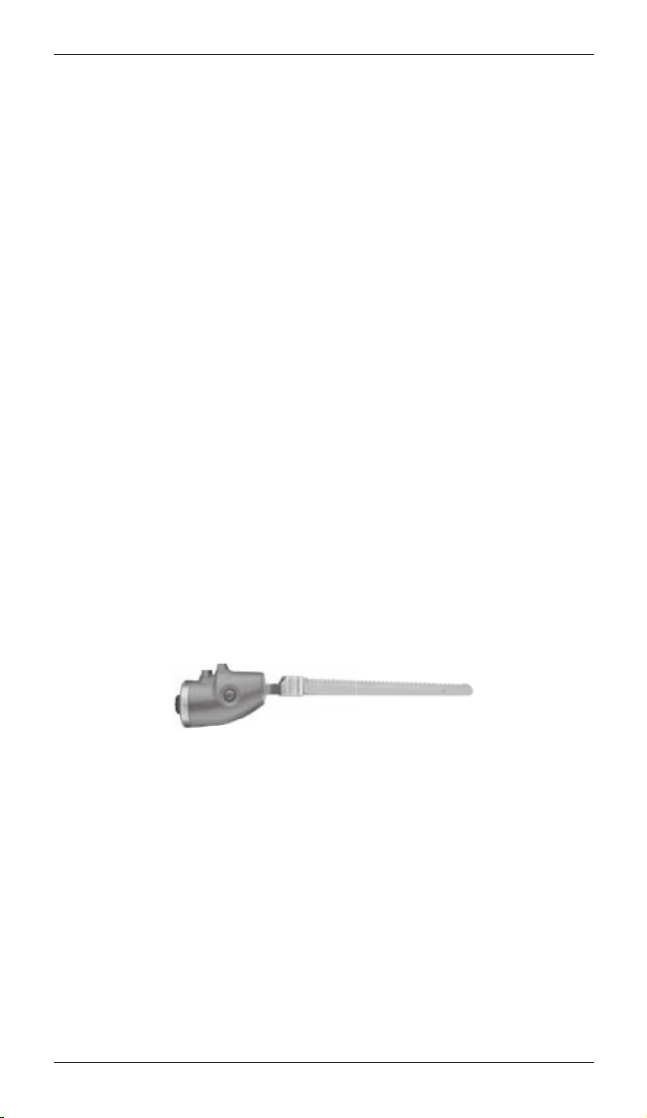
12
CÓMO BATIR
1. Cerciórese que el accesorio batidor está debidamente conectado a
la caja de engranaje antes de conectarlo al bloque-motor (véase la
página 10). Sumerja el batidor en la mezcla y encienda la unidad.
2. Para evitar las salpicaduras, empiece a batir a velocidad baja y
aumente progresivamente la velocidad.
CÓMO TRINCHAR/REBANAR
Ensamble las cuchillas y conéctelas a la caja de engranaje antes de
conectar el accesorio al bloque-motor
1. Conecte la caja de engranaje al bloque-motor, presionando hasta
que encajen.
2. El cuchillo tiene su propio botón de desbloqueo, ubicado sobre la
caja de engranaje. Deslice el botón y presione inmediatamente el
botón de encendido ubicado sobre la caja de engranaje.
3. Mantenga oprimido el botón de encendido para cortar, mientras
mantiene la hoja bien recta para obtener rebanadas/lonjas/lonchas
uniformes. PRECAUCIÓN: NUNCA coloque su mano encima las
hojas durante el funcionamiento, ya que éstas se mueven hacia
adelante y atrás para cortar.
4. Las hojas se detendrán automáticamente al soltar el botón de
encendido. Para quitar las hojas, presione los botones de liberación
ubicados en ambos lados de la caja de engranaje.
LIMPIEZA Y MANTENIMIENTO
ACCESORIO LICUADOR
Limpie el bloque-motor y la varilla cuidadosamente después de cada
uso.
Retire el accesorio licuador del bloque-motor. Limpie el bloque-
motor con una esponja o un paño ligeramente húmedos. No utilice
limpiadores abrasivos, los cuales podrían dañarlo. Lave la varilla a
mano o en el lavavajillas, con un detergente suave. Tenga mucho
cuidado al manipular la varilla, ya que la cuchilla es muy filosa.
ACCESORIO PICADOR/MOLEDOR
Le recomendamos que enjuague el bol, la cuchilla y la tapa
inmediatamente después del uso, ya que alimentos secos podrían
dificultar la limpieza. No sumerja la tapa del bol en agua y no la
meta al lavavajillas. Lave la cuchilla y el bol en agua jabonosa tibia.
Enjuague y seque las piezas. Limpie la parte inferior de la tapa con
una esponja o un paño ligeramente humedecido para eliminar los
residuos de alimentos. Lave la cuchilla cuidadosamente. No la deje
en agua jabonosa, donde la pueda perder de vista. El bol y la cuchilla
también pueden lavarse en el lavavajillas (nivel superior solamente).
Tenga cuidado al sacar la cuchilla del lavavajillas. Limpie el bloque-

11
FUNCIONAMIENTO
CÓMO ENCENDER/APAGAR EL APARATO
Todos los accesorios se conectan al bloque-motor y se encienden/
apagan de la misma manera (nota: el cuchillo tiene su propio botón
de desbloqueo, ubicado sobre la caja de engranaje). Mantenga
los dedos, cabello, ropa, espátulas y otros utensilios lejos de las
cuchillas durante el funcionamiento.
CÓMO LICUAR/MEZCLAR
El accesorio licuador ha sido diseñado para procesar una gran
variedad de alimentos, incluso aderezos, "smoothies", batidos,
bebidas en polvo y salsas. Es ideal para mezclar ingredientes secos,
y también puede usarse para hacer mayonesa. La cuchilla licua los
alimentos sin incorporar mucho aire a la
mezcla. Un movimiento suave hacia arriba y abajo es todo lo
que necesita para preparar las más sabrosas recetas. Para evitar
las salpicaduras, asegúrese de que el protector de cuchilla esté
completamente sumergido antes de empezar a licuar, y que
permanezca en la mezcla durante el licuado. Nunca lo saque del
líquido durante el uso.
Conecte el accesorio licuador al bloque-motor (véase las
instrucciones de ensamblaje
en la página 8). Sumerja la varilla en la mezcla. Para encender el
motor, mantenga oprimido el botón de desbloqueo y presione el
botón de encendido. Una vez encendido el motor, puede soltar el
botón de desbloqueo. Nota: también puede oprimir el botón de
encendido primero, y luego el botón de desbloqueo. No presione
el botón de encendido durante más de 2 minutos seguidos. Para
apagar, suelte el botón de encendido.
CÓMO PICAR/MOLER
Coloque el bol del accesorio picador/moledor sobre una superficie
plana y segura, como una encimera. Asegúrese de que la cuchilla
esté debidamente instalada.
Coloque los ingredientes en el bol, cerciorándose que los alimentos
están cortados en pedazos pequeños y uniformes, y que el bol no
está muy lleno.
Cierre la tapa del bol, asegurándose de que esté debidamente
puesta. Conecte el bloque-motor (la empuñadura) a la tapa del bol.
NOTA: para pulsar, mantenga oprimido el botón de desbloqueo
mientras presiona repetidamente el botón de encendido. Debido a
la potencia del motor, le recomendamos que sostenga el bol con
una mano durante el funcionamiento. Después de terminar, suelte el
botón de encendido; el motor se apagará
TRAS INMOVILIZARSE LA CUCHILLA, separe el bloque-motor
de la tapa y quite la tapa del bol.
NOTA: no haga funcionar el accesorio picador/moledor con el bol
vacío.
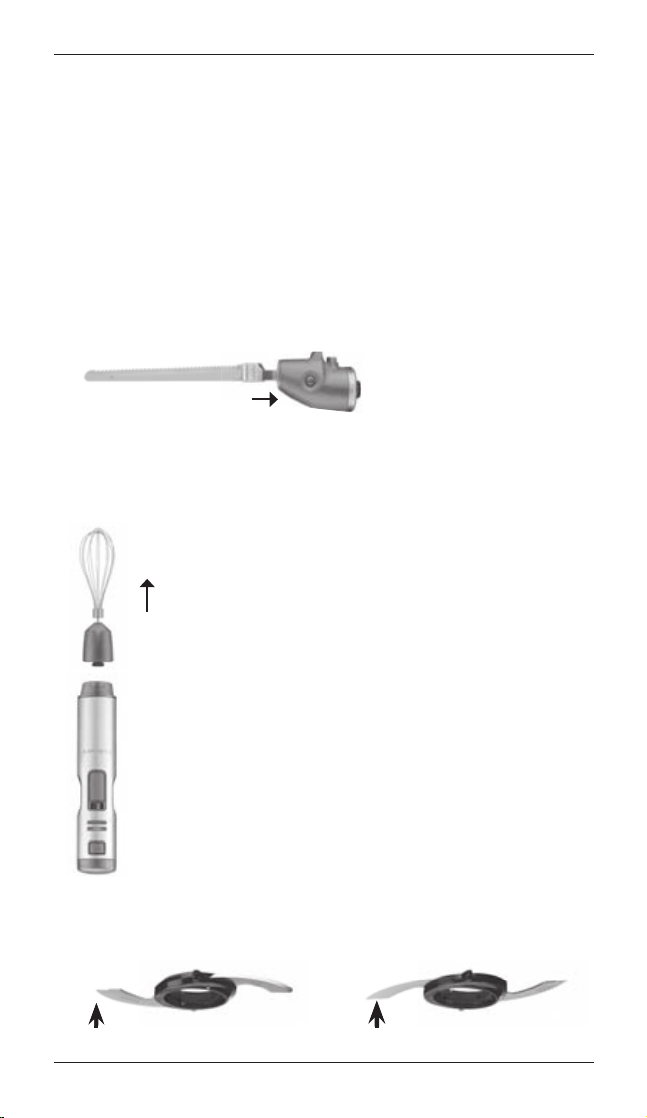
10
REMOCIÓN DE LA CUCHILLA REVERSIBLE
Para sacar la cuchilla del bol, gírela hacia la izquierda o la derecha
para soltarla del árbol motor.
ACCESORIO BATIDOR
Haga coincidir la varilla con el bloque-motor (la
empuñadura) y conecte ambas piezas, presionando hasta
que encajen. Nota: puede resultar útil oprimir el botón de
liberación de la varilla. Nota: la caja de engranaje es
desmontable.
ACCESORIO "CUCHILLO ELÉCTRICO"
1. Antes del primer uso, separe y lave las hojas en agua
jabonosa caliente o en el lavavajillas. PRECAUCIÓN: LAS HOJAS
SON MUY FILOSAS. MANIPÚLELAS CON CUIDADO. Seque
bien.
2. Ensamble las hojas antes de instalarlas sobre la caja de engranaje.
Junte las hojas, insertando
el remache de la hoja
grande en el ojo de la hoja
pequeña.
3. Sostenga las hojas con el filo apuntando hacia abajo e
introdúzcalas en la caja de engranaje, presionando hasta que
encajen. Puede que las hojas no queden perfectamente alineadas;
esto es normal. PRECAUCIÓN: LAS HOJAS SON MUY FILOSAS.
MANIPÚLELAS CON CUIDADO. CUANDO NO LAS USA,
GUARDE LAS HOJAS EN LA FUNDA PROVEÍDA.
B.
LADO RECTO
B.
LADO AFILADO
(marcado SHARP)
A.
A.
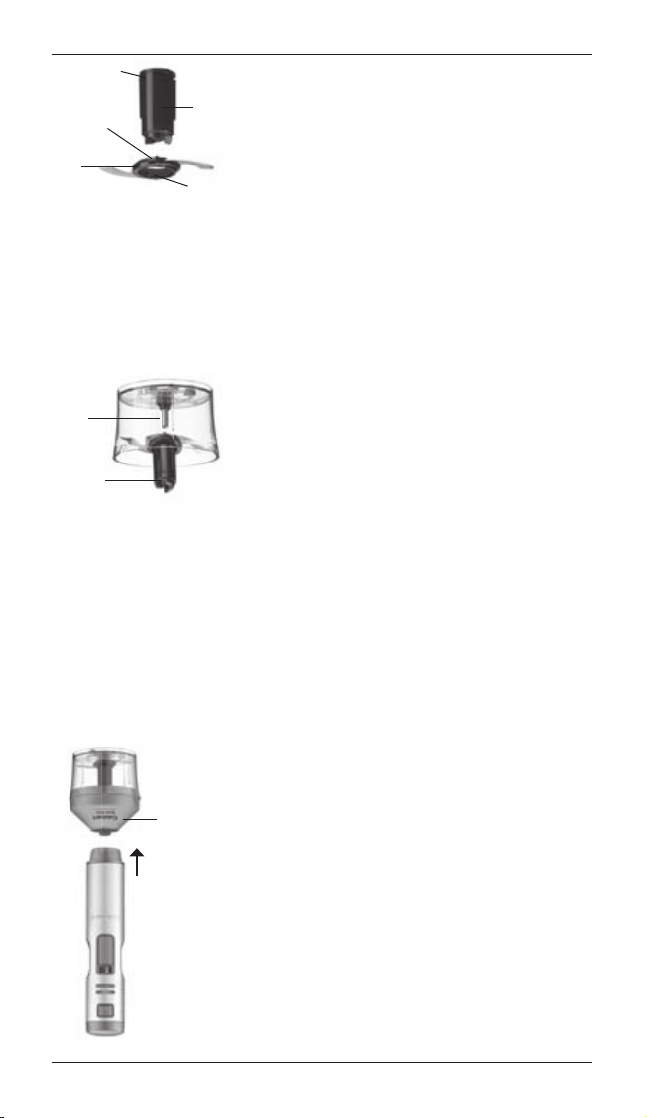
9
ACCESORIO PICADOR/
MOLEDOR
1. Instale la cuchilla picadora/moledora
sobre el eje en el centro del bol.
2. Ponga los ingredientes en el bol y cierre
la tapa, girando en sentido horario para
sujetar.
3. Conecte el bloque-motor (la
empuñadura) a la tapa del bol,
presionando hasta que encaje.
CUCHILLA REVERSIBLE
El accesorio picador/moledor cuenta con una
cuchilla reversible con un filo afilado para
moler, y otro recto para picar. La cuchilla
está conectada a un aro de plástico que permite darle vuelta
fácilmente para elegir el lado deseado. (véase las instrucciones a
continuación). También véase las pautas de uso del accesorio
picador/moledor en la página 16.
Ensamblaje.
1. Coloque el bol sobre una superficie plana, seca y segura,
2. Note el eje de metal (A) en el fondo del bol. Deslice la cuchilla
ensamblada (B) sobre el eje.
2a. Para ensamblar la cuchilla: conecte muy cuidadosamente el aro
(C) al poste de plástico (D), haciendo
coincidir el orificio del aro con el poste.
Note las muescas (E) en el interior del aro.
Haga coincidir estas muescas con los
resaltos en los costados del poste. Deje
que la cuchilla se deslice a lo largo del
poste. SOSTENGA LA CUCHILLA POR EL
CENTRO (F) SOLAMENTE. NO TOQUE
LOS FILOS DE LA CUCHILLA; SON MUY
AFILADOS. Agarre la cuchilla por el centro y gírela ligeramente
en sentido horario; esto la bloqueará sobre el poste.
IMPORTANTE: la cuchilla encaja sobre el poste de dos maneras
diferentes. Si la sostiene de la manera ilustrada sobre la Fig. A,
notará la palabra “SHARP” escrita sobre la cuchilla. Ensamble la
cuchilla de esta manera (con la palabra "SHARP" apuntando
hacia arriba) para usar el filo afilado. Si la sostiene de la manera
ilustrada sobre la Fig. B, no notará
ninguna palabra sobre la cuchilla.
Ensamble la cuchilla de esta manera
para usar el filo recto. Véase las pautas
de uso del accesorio picador/moledor
en la página 16 para más información.
B
A
C
D
G
F
E
Tapa
del accesorio
picador/moledor
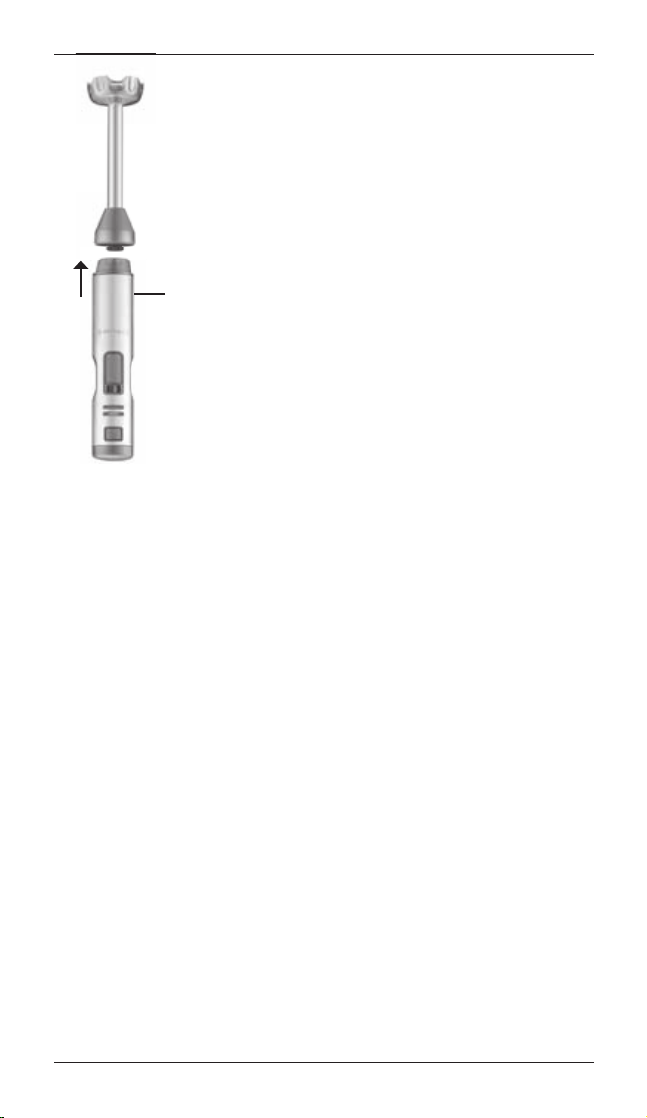
8
ANTES DE EMPEZAR
Le aconsejamos que limpie el aparato con un paño limpio y
ligeramente humedecido antes del primer uso. Seque todas las piezas
con un paño suave y absorbente, manipulándolas con cuidado. Lave
la cuchilla del accesorio licuador, el accesorio batidor, el bol y la
cuchilla del accesorio picador/moledor, el vaso medidor, las hojas del
cuchillo eléctrico y la varilla removible a mano o en el lavavajillas
(bandeja superior solamente). Seque todas las piezas antes de usar el
aparato.
Lea cuidadosamente las instrucciones antes de usar el aparato.
Las baterías de su licuadora de mano inalámbrica SmartStick
®
no han
sido precargadas en la fábrica. Antes del primer uso, las deberá
cargar hasta que el indicador del nivel de carga verde se encienda.
Véase la sección "Instrucciones de carga" a continuación.
CARGA Y VIDA ÚTIL DE LAS BATERÍAS
Las baterías de su licuadora de mano inalámbrica SmartStick
®
no han
sido precargadas en la fábrica. Antes del primer uso, las deberá
cargar hasta que el indicador del nivel de carga VERDE se encienda.
Una carga completa ofrecerá una autonomía de aproximadamente 20
minutos, dependiendo de la tarea. Cargar el aparato debería tomar
aproximadamente 2–2.5 horas Una "carga rápida" de 30 minutos
ofrecerá una autonomía de 5 minutos. Indicadores del nivel de carga:
Verde: nivel de carga entre el 100 % y el 75 %.
Anaranjado: nivel de carga entre el 75% y el 25%. Rojo: nivel de
carga inferior al 25 %; póngalo a cargar pronto.
Nota: no deje el aparato descargado por un tiempo prolongado, ya
que esto puede afectar la vida de las baterías
recargables.
ENSAMBLAJE
ACCESORIO LICUADOR
Haga coincidir la varilla con el bloque-motor
(la empuñadura) y conecte ambas piezas,
presionando hasta que encajen.
Nota: puede resultar útil oprimir el botón
de liberación de la varilla.
Botón de
liberación
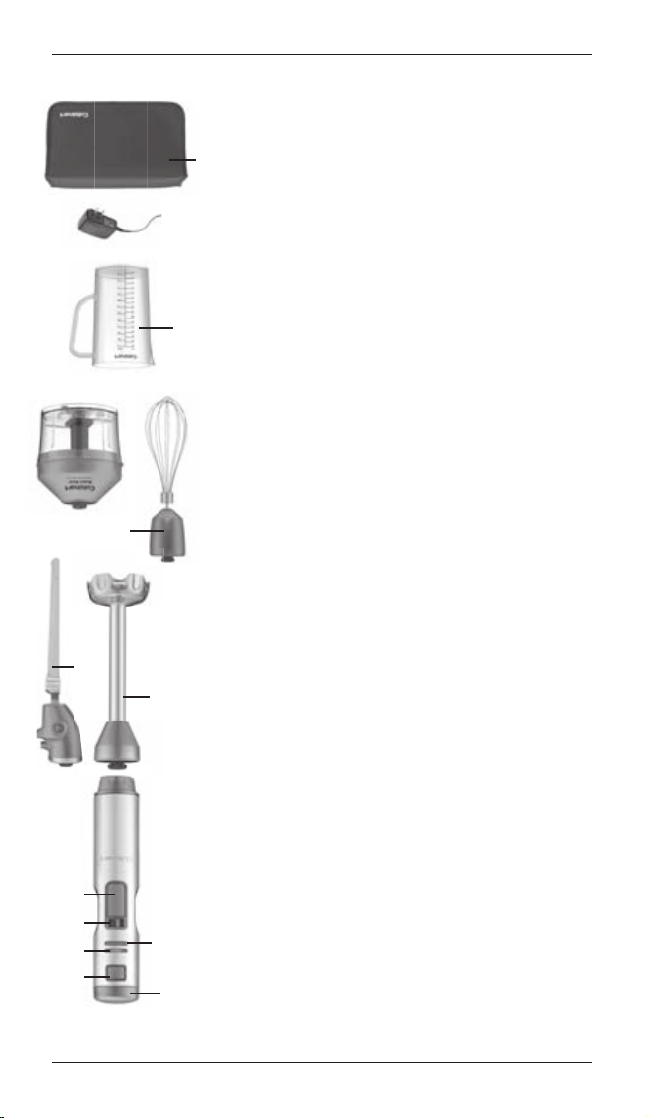
7
PIEZAS Y CARACTERÍSTICAS
1. Bloque-motor (empuñadura)
¡Inalámbrico! Contiene dos baterías recargables
de iones de litio de 4.0V y cuenta un botón de
encendido al alcance de los dedos. Diseñado en
forma de utensilio para mezclar, para máxima
comodidad y control.
a. Botón de desbloqueo para mayor seguridad.
b. Indicadores del nivel de carga. Rojo (nivel
bajo): menos del 25 %. Anaranjado (nivel
medio): 25–75 %. Verde (nivel alto): 75–100%.
c. Indicador de velocidad. Cinco barras se
iluminan para indicar el nivel de velocidad.
d. Control de velocidad. Deslice el botón hacia la
izquierda o la derecha para elegir/ajustar la
velocidad.
e. Botón de encendido. Manténgalo oprimido
antes o justo después de presionar el botón de
desbloqueo. NOTA: el aparato se apaga y se
bloquea automáticamente al soltar el botón
de encendido.
2. Varilla
Varilla removible de 8¾ pulgadas (22 cm) con
cuchilla y protector de cuchilla de acero
inoxidable. Fácil de instalar/quitar del bloque-
motor, para una operación y una limpieza simples.
3. Accesorio "cuchillo eléctrico"
Conéctelo al bloque-motor para conseguir un
cuchillo eléctrico de tamaño estándar.
4. Accesorio picador/moledor
Permite picar y moler fácilmente. La tapa del
accesorio picador/moledor se conecta al
bloque-motor de la misma manera que el
accesorio batidor y el accesorio licuador.
5. Accesorio batidor
Fácil de instalar sobre el bloque-motor. Ideal
para montar claras y preparar crema batida y
otras delicias.
6. Vaso medidor/para mezclar
Vaso transparente con medidas en ml y tazas,
para medir fácilmente. Ideal para preparar bebidas,
batidos, aderezos para ensalada, etc. Diseñado
para agarrarse fácilmente y servir sin gotear.
7. Puerto de conexión del cargador
Ubicado en la parte trasera del bloque-motor.
8. Bolsa de almacenaje
Paneles divisorios permiten guardar el bloque-
motor, el accesorio licuador, el accesorio "cuchillo
eléctrico" y el accesorio batidor de manera segura.
s.
o
1.
a.
b.
c.
d.
e.
5.
2.
8.
3.
6.
4.

6
ÍNDICE
Medidas de seguridad importantes . . . . . . . . . . . . . . . . . . . . . . . . . 3
Instrucciones de desembalaje . . . . . . . . . . . . . . . . . . . . . . . . . . . . . 6
Introducción . . . . . . . . . . . . . . . . . . . . . . . . . . . . . . . . . . . . . . . . . . . 6
Piezas y características . . . . . . . . . . . . . . . . . . . . . . . . . . . . . . . . . . . 7
Ensamblaje . . . . . . . . . . . . . . . . . . . . . . . . . . . . . . . . . . . . . . . . . . . . 8
Accesorio licuador . . . . . . . . . . . . . . . . . . . . . . . . . . . . . . . . . . 8
Accesorio picador/moledor . . . . . . . . . . . . . . . . . . . . . . . . . . . 9
Cuchilla reversible . . . . . . . . . . . . . . . . . . . . . . . . . . . . . . . . . . 9
Accesorio batidor . . . . . . . . . . . . . . . . . . . . . . . . . . . . . . . . . 10
Cuchillo eléctrico . . . . . . . . . . . . . . . . . . . . . . . . . . . . . . . . . . 10
Funcionamiento . . . . . . . . . . . . . . . . . . . . . . . . . . . . . . . . . . . . . . . . 11
Cómo licuar/mezclar . . . . . . . . . . . . . . . . . . . . . . . . . . . . . . . 11
Cómo picar/moler . . . . . . . . . . . . . . . . . . . . . . . . . . . . . . . . . 11
Cómo batir . . . . . . . . . . . . . . . . . . . . . . . . . . . . . . . . . . . . . . . 12
Cómo trinchar/rebanar . . . . . . . . . . . . . . . . . . . . . . . . . . . . . 12
Limpieza y mantenimiento . . . . . . . . . . . . . . . . . . . . . . . . . . . . . . . 12
Consejos útiles . . . . . . . . . . . . . . . . . . . . . . . . . . . . . . . . . . . . . . . . 13
Pautas de uso del accesorio picador/moledor . . . . . . . . . . . . . . . . 16
Recetas . . . . . . . . . . . . . . . . . . . . . . . . . . . . . . . . . . . . . . . . . . . . . . 17
Garantía . . . . . . . . . . . . . . . . . . . . . . . . . . . . . . . . . . . . . . . . . . . . . . 43
Reciclaje de las baterías . . . . . . . . . . . . . . . . . . . . . . . . . . . . . . . . . 44
INSTRUCCIONES DE DESEMBALAJE
Coloque la caja sobre una superficie llana y segura. Retire de la caja la
bolsa que contiene el bloque-motor, el accesorio licuador, el accesorio
"cuchillo eléctrico" y el accesorio batidor. Retire la documentación
técnica de la caja. Le aconsejamos que guarde el material de embalaje.
NOTA: todas las cuchillas/hojas son muy filosas. Tenga cuidado
al retirarlas de la caja o al manipularlas.
Le aconsejamos que limpie el aparato con un paño limpio y
ligeramente humedecido antes del primer uso. Seque todas las piezas
con un paño suave y absorbente. Véase la sección "Limpieza y
mantenimiento" para más información acerca de la limpieza. Lea
cuidadosamente las instrucciones antes de usar el aparato.
INTRODUCCIÓN
Estamos orgullosos de presentar aún otro aparato revolucionario de
Cuisinart. ¡Su nueva licuadora de mano multifunción inalámbrica
SmartStick
®
se transforma en un potente cuchillo eléctrico de tamaño
estándar! Simplemente conecte el accesorio "cuchillo eléctrico" al
bloque-motor para trinchar carne o cortar pan fácilmente. Sin cable
para hacerle estorbo, puede trinchar, licuar o batir donde quiera. Y
esto no es todo... ¡Conecte el bloque-motor al accesorio picador/
moledor para descubrir todo lo que tiene que ofrecer este increíble
aparato multifunción!

5
32.
No utilice el aparato con una batería recargable que no haya sido
diseñada específicamente para él; esto presenta un riesgo de herida
y/o incendio.
33. En condiciones abusivas, líquido puede ser eyectado de la batería. Si
esto ocurriera, evite el contacto con el líquido. En caso de contacto
accidental, enjuague la piel con abundante agua. En caso de
contacto con los ojos, busque atención médica. El líquido eyectado
de la batería puede causar irritaciones o quemaduras.
34. No intente modificar la batería recargable o el aparato, ni los use si
están dañados; esto presenta un riesgo de incendio, explosión o
herida.
35. No exponga la batería recargable ni el aparato al fuego o a un calor
excesivo. Exponerlos al fuego o a temperaturas superiores a
265°F/130°C puede provocar una explosión.
36. Cualquier reparación debe ser realizada por un técnico calificado,
usando repuestos idénticos. No seguir estas instrucciones puede
presentar un riesgo para el usuario.
37. Le recomendamos que cargue el aparato a temperatura ambiente
(50°F−104°F/10°C–40°C).
38. Le recomendamos que guarde el aparato a temperatura ambiente
(50°F–104°F/10°C–40°C).
39. Solamente use el adaptador de 10.0V DC/1000mA proveído con el
aparato.
40. Cualquier otro servicio debe ser realizado por un técnico autorizado.
41. Para reducir el riesgo de heridas, asegúrese de que el bol del
accesorio picador/moledor esté debidamente ensamblado antes de
instalar la cuchilla.
42. Asegúrese de que la tapa del accesorio picador/moledor esté
debidamente cerrada antes de encender el aparato. No intente abrir
la tapa hasta que la cuchilla se haya detenido por completo.
43. Averigüe que no hay objetos extraños en el bol antes de usarlo.
44. No haga funcionar el aparato debajo o dentro de un armario/
gabinete. Siempre desconecte el aparato antes de guardarlo en un
armario/gabinete. Dejar el aparato conectado presenta un riesgo de
incendio, especialmente si éste toca las paredes o la puerta del
armario/gabinete cuando cierra.
GUARDE ESTAS INSTRUCCIONES
PARA USO DOMÉSTICO SOLAMENTE
Nota: este aparato está equipado con un dispositivo de protección
que apaga el motor en caso de sobrecalentamiento. Si la unidad se
apaga de repente, cárguela durante unos segundos para reiniciarla.

4
14. No intente utilizar el cargador con otro aparato. Tampoco intente
cargar este aparato con otro cargador.
15. No conecte el cargador en exteriores.
16. No utilice el aparato para ningún otro fin que no sea el indicado.
17. No utilice este aparato si el cable o la clavija estuviesen dañados,
después de que hubiese funcionado mal o que se hubiese caído o si
estuviese dañado; regréselo a un centro de servicio autorizado para
su revisión, reparación o ajuste.
18. El uso de accesorios/aditamentos no recomendados por Cuisinart
presenta un riesgo de incendio, electrocución o herida.
19. Asegúrese de que el aparato esté apagado, y de que el motor se
haya detenido completamente, antes de instalar/retirar accesorios o
limpiar el aparato.
20. Para uso doméstico solamente; no aprobado para uso comercial, ni
para uso en exteriores.
21. Solamente utilice este aparato para preparar comida y bebidas.
22. Tenga cuidado de evitar las salpicaduras al mezclar líquidos
calientes.
23.
Para reducir el riesgo de incendio o electrocución, no haga funcionar
ningún aparato que produzca calor debajo del bloque-motor (por ej.
cuando está montado a la pared).
24. No instale/guarde la unidad a proximidad de una fuente de calor, de
un aparato de cocción o de un fregadero.
25. Siempre desconecte el cargador antes de limpiarlo.
26. No utilice el cargador si está dañado; reemplácelo inmediatamente.
27. No incinere el aparato, aunque esté gravemente dañado; las baterías
pueden explotar si se calientan.
28.
Este aparato está equipado con baterías recargables de litio, las
cuales deben reciclarse según las leyes vigentes al final de la vida útil
del aparato. Véase la sección "Reciclaje de las baterías" en la página
44. No queme ni coloque las baterías en un compostador, ya que
pueden explotar por el calor.
29. Las baterías pueden tener fugas bajo condiciones extremas. Si el
líquido adentro de las baterías entrara en contacto con la piel, (1)
lave la piel rápidamente con agua y jabón y (2) neutralice la acidez
de la piel con jugo de limón o vinagre. Si el líquido entrara en
contacto con los ojos, enjuáguelos inmediatamente con abundante
agua durante 10 minutos o más. Busque atención médica.
30. Procure no encender el aparato a menos que esté listo/a para usarlo.
Nunca presione el botón de desbloqueo al mismo tiempo que el
botón de encendido a menos que esté listo/a para usar la licuadora
o el cuchillo.
31. Utilice solamente el cargador proveído para cargar el aparato. Usar
cargadores diseñados para otro tipo de batería recargable puede
causar un incendio.

3
MEDIDAS DE SEGURIDAD
IMPORTANTES
Al usar aparatos eléctricos, siempre debe tomar precauciones
básicas de seguridad, incluso las siguientes:
ADVERTENCIA: lea todas las instrucciones y medidas de
seguridad antes de utilizar este aparato. El incumplimiento de las
advertencias e instrucciones puede provocar una electrocución,
un incendio y/o heridas graves.
1. LEA TODAS LAS INSTRUCCIONES.
2. Para reducir el riesgo de electrocución, no ponga el bloque-motor (la
empuñadura) en agua u otro líquido. Sólo la varilla desmontable es
sumergible. No sumerja ninguna otra parte del aparato en agua u otro
líquido. Si el aparato cayera en líquido, desconéctelo y luego retírelo
del líquido. Limpie y seque cuidadosamente la unidad antes de
continuar.
3. Este aparato no debe ser usado por niños. Supervise el uso de este
aparato cuidadosamente cuando sea usado por o cerca de niños o
personas con alguna discapacidad.
4. No haga funcionar el aparato en la presencia de vapores explosivos o
inflamables.
5. Para evitar las heridas, siempre desconecte el cargador antes de
instalar/sacar las cuchillas y/o los accesorios.
6. Luces encendidas significan que el aparato está listo. Evite el
contacto con las cuchillas o las piezas móviles.
7. Evite el contacto con las cuchillas o las piezas móviles después de
haber quitado el seguro o encendido el aparato.
8. Evite el contacto con las piezas móviles. Para evitar el riesgo de
heridas y/o daños al aparato, mantenga los dedos, cabello, ropa,
espátulas y otros utensilios lejos de los accesorios durante el
funcionamiento. Se podrá usar una espátula de goma, siempre que el
aparato esté apagado.
9. Separe la varilla desmontable del bloque-motor (la empuñadura) antes
de lavar las cuchillas o la varilla.
10. Las cuchillas y otros accesorios son MUY FILOSOS; manipúlelos con
sumo cuidado. Manipule las hojas con mucho cuidado,
sosteniéndolas por el lado opuesto al filo. Guarde las hojas de manera
que su filo apunte hacia el lado opuesto a su cuerpo.
11. Para reducir el riesgo de salpicadura o quemadura al mezclar líquidos,
especialmente líquidos calientes, utilice un recipiente alto o procese
pequeñas cantidades a la vez.
12. Conecte el cargador una toma de corriente alejada del fregadero y de
las superficies calientes.
13. No utilice una extensión. Conecte el cargador directamente a una
toma de corriente.


INSTRUCCIONES Y
LIBRO DE RECETAS
Para su seguridad y para disfrutar plenamente de este producto, siempre
lea las instrucciones cuidadosamente antes de usarlo.
Licuadora de mano multifunción recargable
SmartStick
®
con cuchillo eléctrico
CSB-300

B C M Y
100 95 90 85 80 75 70 65 60 55 50 45 40 35
100 95 90 85 80 75 70 65 60 55 50 45 40 35
100 95 90 85 80 75 70 65 60 55 50 45 40 35
100 95 90 85 80 75 70 65 60 55 50 45 40 35
50 45 40 3595 90 85 80 75 70 65 60 55
100
Tel: 0769-87720314 87886328 Fax: 0769-87720324
E-MAIL: [email protected]
LIAO
Version no.: CSB300 IB-13523-ESP
IB Size:
Die Cut: new
Operator: Revise Ver:
Date:
SEP/08/2015
Co-ordinator:
F CSB300 IB-13523-ESP (0.0)
Astor You / Andy WS Chan
114 mm(W) x 197 mm(H)
Material: 105gsm gloss art paper for whole book
Coating: gloss varnishing in cover
Colors(Cover): 4C+1C(BLACK)
(Inside): 1C+1C(BLACK)