MODEL
OPERATION MANUAL
FACSIMILE
1. Installation
2. Using the Answering System
3. Sending Faxes
4. Receiving Faxes
5. Making Copies
6. Special Functions
7. Printing Lists
8. Maintenance
9. Troubleshooting
UX-A260

WARNING - FCC Regulations state that any unauthorized changes or modifications to this equipment
not expressly approved by the manufacturer could void the user’s authority to operate this equipment.
Note: This equipment has been tested and found to comply with the limits for a Class B digital
device, pursuant to Part 15 of the FCC Rules.
These limits are designed to provide reasonable protection against harmful interference in a
residential installation.
This equipment generates, uses and can radiate radio frequency energy and, if not installed
and used in accordance with the instructions, may cause harmful interference to radio
communications. However, there is no guarantee that interference will not occur in a
particular installation. If this equipment does cause harmful interference to radio or television
reception, which can be determined by turning the equipment off and on, the user is
encouraged to try to correct the interference by one or more of the following measures:
- Reorient or relocate the receiving antenna.
- Increase the separation between the equipment and the receiver.
- Connect the equipment into an outlet on a circuit different from that to which the receiver is
connected.
- Consult the dealer or an experienced radio/TV technician for help.
ABOUT THE TELEPHONE CONSUMER PROTECTION ACT OF 1991
"The Telephone Consumer Protection Act of 1991 makes it unlawful for any person to use a
computer or other electronic device to send any message via a telephone facsimile machine
unless such message clearly contains in a margin at the top or bottom of each transmitted
page or on the first page of the transmission the following information:
(1) The date and time of transmission.
(2) Identification of either the business, business entity or individual sending the message.
(3) Telephone number of either the sending machine, business, business entity or individual.
In order to program this information into your facsimile machine, please refer to the
appropriate instructions in the operation manual."
As an
ENERGY STA R
partner, SHARP has
determined that this product meets the
ENERGY
STAR
guidelines for energy efficiency.
FOR YOUR RECORDS
Please record the model number and serial number below, for easy
reference, in case of loss or theft. These numbers are located on the
rear side of the unit.Space is also provided for other relevant
information.
Model Number UX-A260
Serial Number
Date of Purchase
Place of Purchase
all.bookPage1Wednesday,June4,20031:07PM
1
Introduction
*Based on Sharp Standard No. 1 Chart at standard resolution in Sharp special mode,
excluding time for protocol signals (i.e., ITU-T phase C time only).
Automatic dialing 40 numbers
Imaging film Initial starter roll (included with machine):
32 ft. (10 m) (approx. 30 letter-size pages)
Replacement roll (not included):
UX-5CR 164 ft. (50 m) (one roll yields
approx. 150 letter-size pages)
Memory size* 448 KB (approx. 24 average pages with no
voice messages recorded, or 20 minutes of
voice messages (including OGMs) with no
documents in memory)
Modem speed 14,400 bps with automatic fallback to lower
speeds.
Transmission time* Approx. 6 seconds (only when ECM is on)
Resolution Horizontal: 203 pels/inch (8 pels/mm)
Vertical:
Standard: 98 lines/inch (3.85 lines/mm)
Fine /Halftone:
196 lines/inch (7.7 lines/mm)
Super fine:
391 lines/inch (15.4 lines/mm)
Automatic document
feeder
10 pages max. (letter/A4 size, 20 lb paper)
Recording system Thermal transfer recording
Halftone (grayscale) 64 levels
Compression scheme MR, MH, MMR
Welcome, and thank you for
choosing a Sharp fax
machine! The features and
specifications of your new
Sharp fax are shown below.
all.bookPage1Wednesday,June4,20031:07PM

2
Display 16-digit LCD display
Applicable telephone line Public switched telephone network
Paper tray capacity Letter: Approx. 50 sheets (20-lb. copier paper
at room temperature; maximum stack height
should not be higher than the line on the tray)
Legal: 5 sheets
Recommended paper weight is 20-lb. Copy
Bond
Compatibility ITU-T (CCITT) G3 mode
Input document size Automatic feeding:
Width: 5.8 to 8.5" (148 to 216 mm)
Length: 5.5 to 11" (140 to 279 mm)
Manual feeding:
Width: 5.8 to 8.5" (148 to 216 mm)
Length: 5.5 to 23.6" (140 to 600 mm)
Effective scanning width 8.3" (210 mm) max.
Effective printing width 8.3" (210 mm) max.
Contrast control Automatic/Dark selectable
Reception modes TEL/FAX/TAD
Copy function Single / Multi (99 copies/page)
Telephone function Yes (cannot be used if power fails)
Power requirements 120 V AC, 60 Hz
Operating temperature 41 - 95°F (5 - 35°C)
Humidity 25 - 85% RH
Power consumption Standby: 3.6 W
Maximum: 100 W
Dimensions (without
attachments)
Width: 12.9" (327 mm)
Depth: 7.6" (193 mm)
Height: 6.4" (163 mm)
Weight (without
attachments)
Approx. 6.2 lbs. (2.8 kg)
all.bookPage2Wednesday,June4,20031:07PM

3
As a part of our policy of continuous improvement, SHARP reserves the right to make
design and specification changes for product improvement without prior notice. The
performance specification figures indicated are nominal values of production units. There
may be some deviations from these values in individual units.
Important safety information
Do not disassemble this machine or attempt any procedures not described in this manual.
Refer all servicing to qualified service personnel.
Do not install or use the machine near water, or when you are wet. For example, do not
use the machine near a bath tub, wash bowl, kitchen sink or laundry tub, in a wet
basement, or near a swimming pool. Take care not to spill any liquids on the machine.
Unplug the machine from the power outlet and telephone jack and consult a qualified
service representative if any of the following situations occur:
- Liquid has been spilled into the machine or the machine has been
exposed to rain or water.
- The machine produces odors, smoke, or unusual noises.
- The power cord is frayed or damaged.
- The machine has been dropped or the housing damaged.
Do not allow anything to rest on the power cord, and do not install the machine where
people may walk on the power cord.
This machine must only be connected to a 120 V, 60 Hz, grounded (3-prong) outlet.
Connecting it to any other kind of outlet will damage the machine and invalidate the
warranty.
Never insert objects of any kind into slots or openings on the machine. This could create a
risk of fire or electric shock. If an object falls into the machine that you cannot remove,
unplug the machine and consult a qualified service representative.
Do not place this machine on an unstable cart, stand or table. The machine could be
seriously damaged if it falls.
Never install telephone wiring during a lightning storm.
Never install telephone jacks in wet locations unless the jack is specifically designed for
wet locations.
Never touch bare telephone wires or terminals unless the telephone line has been
disconnected at the network interface.
Use caution when installing or modifying telephone lines.
Avoid using a telephone (other than a cordless type) during an electrical storm. There
may be a remote risk of electric shock from lightning.
Do not use a telephone to report a gas leak in the vicinity of the leak.
The power outlet must be installed near the equipment and must be easily accessible.
all.bookPage3Wednesday,June4,20031:07PM

4
Table of Contents
A Look at the Operation Panel 6
1. Installation 9
Unpacking Checklist . . . . . . . . . . . . . . . . . . . . . . . . . . . . . . . . . . . . . . 9
Connections . . . . . . . . . . . . . . . . . . . . . . . . . . . . . . . . . . . . . . . . . . . 10
Loading the Imaging Film . . . . . . . . . . . . . . . . . . . . . . . . . . . . . . . . . 13
Loading Printing Paper . . . . . . . . . . . . . . . . . . . . . . . . . . . . . . . . . . . 15
Entering Your Name and Fax Number . . . . . . . . . . . . . . . . . . . . . . . 17
Setting the Date and Time . . . . . . . . . . . . . . . . . . . . . . . . . . . . . . . . 19
Setting the Reception Mode . . . . . . . . . . . . . . . . . . . . . . . . . . . . . . . 21
Volume Adjustment . . . . . . . . . . . . . . . . . . . . . . . . . . . . . . . . . . . . . 22
2. Using the Answering System 24
Recording an Outgoing Message. . . . . . . . . . . . . . . . . . . . . . . . . . . 24
Operating the Answering System. . . . . . . . . . . . . . . . . . . . . . . . . . . 25
Optional Answering System Settings . . . . . . . . . . . . . . . . . . . . . . . . 29
Transfer Function . . . . . . . . . . . . . . . . . . . . . . . . . . . . . . . . . . . . . . . 32
Override Ringing. . . . . . . . . . . . . . . . . . . . . . . . . . . . . . . . . . . . . . . . 35
Remote Operations . . . . . . . . . . . . . . . . . . . . . . . . . . . . . . . . . . . . . 37
3. Sending Faxes 43
Transmittable Documents. . . . . . . . . . . . . . . . . . . . . . . . . . . . . . . . . 43
Loading the Document . . . . . . . . . . . . . . . . . . . . . . . . . . . . . . . . . . . 44
Adjusting the Resolution and Contrast . . . . . . . . . . . . . . . . . . . . . . . 45
Sending a Fax by Normal Dialing . . . . . . . . . . . . . . . . . . . . . . . . . . . 47
Sending a Fax by Automatic Dialing. . . . . . . . . . . . . . . . . . . . . . . . . 48
Sending a Fax From Memory . . . . . . . . . . . . . . . . . . . . . . . . . . . . . . 57
4. Receiving Faxes 59
Using FAX Mode . . . . . . . . . . . . . . . . . . . . . . . . . . . . . . . . . . . . . . . 59
Using TEL Mode. . . . . . . . . . . . . . . . . . . . . . . . . . . . . . . . . . . . . . . . 60
Optional Reception Settings . . . . . . . . . . . . . . . . . . . . . . . . . . . . . . . 63
Substitute Reception to Memory . . . . . . . . . . . . . . . . . . . . . . . . . . . 64
5. Making Copies 65
all.bookPage4Wednesday,June4,20031:07PM

Table of Contents
5
6. Special Functions 67
Caller ID (Requires Subscription to Service) . . . . . . . . . . . . . . . . . . 67
Distinctive Ring (Requires Subscription to Service) . . . . . . . . . . . . . 72
Blocking Reception of Unwanted Faxes . . . . . . . . . . . . . . . . . . . . . . 73
Polling (Requesting a Fax Transmission) . . . . . . . . . . . . . . . . . . . . . 74
7. Printing Lists 75
8. Maintenance 79
9. Troubleshooting 82
Problems and Solutions . . . . . . . . . . . . . . . . . . . . . . . . . . . . . . . . . . 82
Messages and Signals . . . . . . . . . . . . . . . . . . . . . . . . . . . . . . . . . . . 86
Clearing Paper Jams . . . . . . . . . . . . . . . . . . . . . . . . . . . . . . . . . . . . 89
Ordering Parts. . . . . . . . . . . . . . . . . . . . . . . . . . . . . . . . . . . . . . . . . . 91
FCC Regulatory Information . . . . . . . . . . . . . . . . . . . . . . . . . . . . . . . 92
Quick Reference Guide 95
Guía de referencia rápida 96
Index 97
all.bookPage5Wednesday,June4,20031:07PM
6
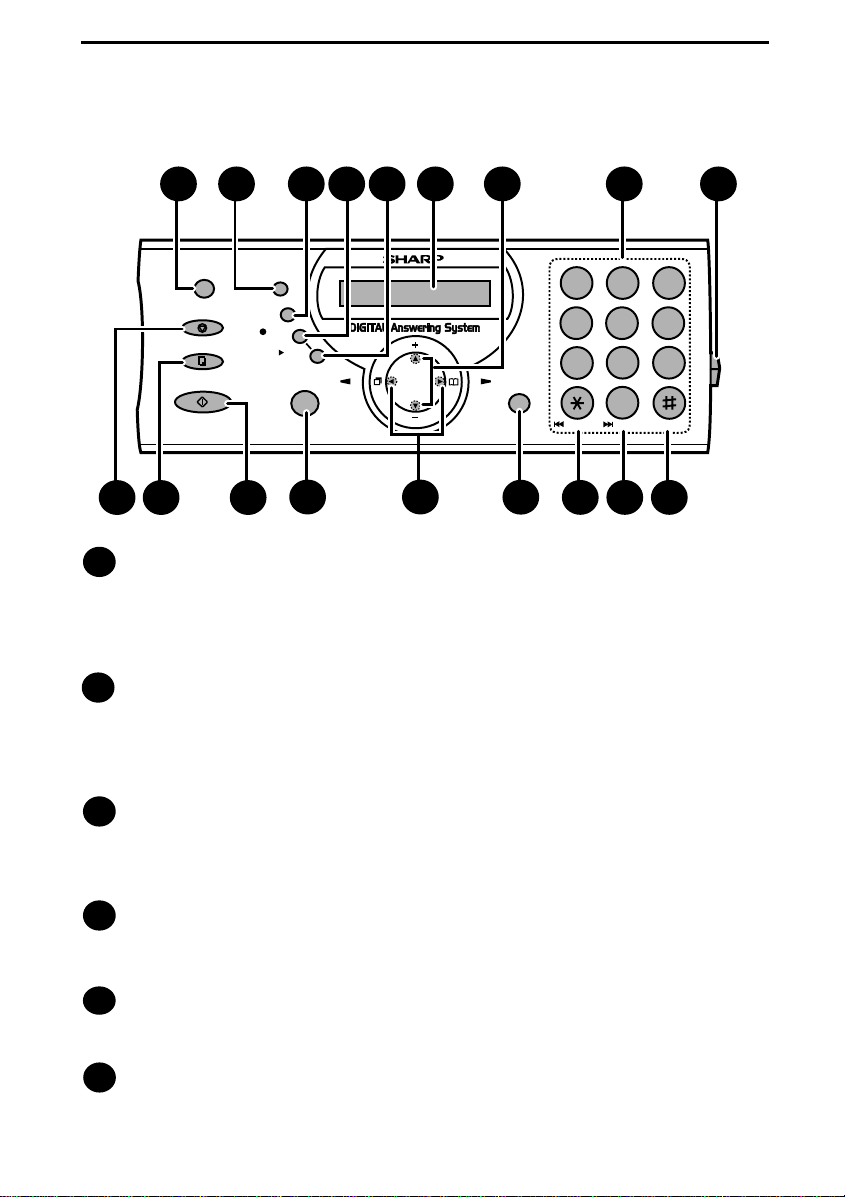
SPEAKER key
Press this key to listen to the line and fax tones through the speaker when
faxing a document (page 47).
Note: This is not a speakerphone. You must pick up the handset to talk with
the other party.
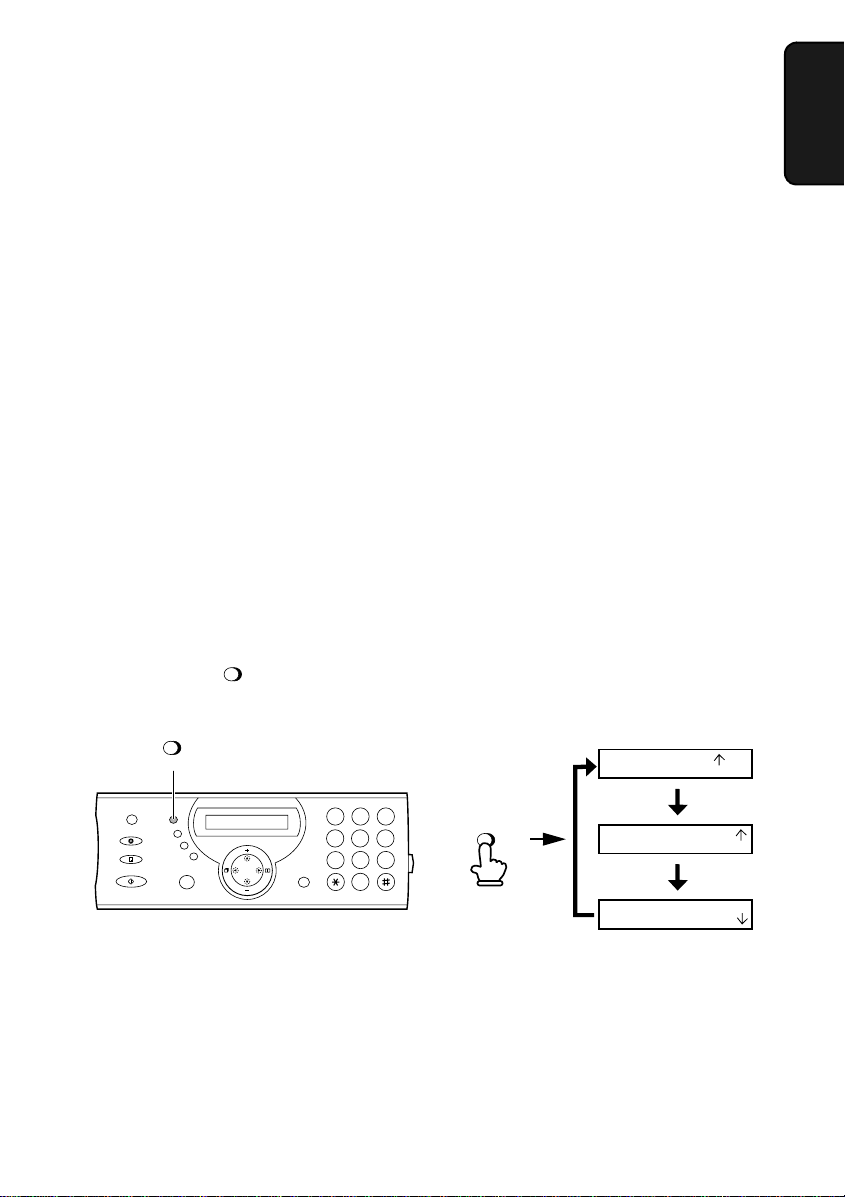
RESOLUTION / RECEPTION MODE key
When a document is in the feeder, press this key to adjust the resolution for
faxing or copying (page 45). At any other time, press this key to select the
reception mode (an arrow in the display will point to the currently selected
reception mode; page 21).
FLASH key
This key is used for Call Waiting and other special services that require
subscription from your phone company. Your phone company will provide you
with details on how to use the key.
REC/MEMO key
Press this key to record an outgoing message, phone conversation, or memo
(pages 24 and 28).
PLAY/HOLD key
Press this key to play recorded messages (page 27). At any other time, press
this key to put the other party on hold during a phone conversation (page 62).
Display
This displays messages and prompts to help you operate the machine.
A Look at the Operation Panel
1
2
3
4
5
JKL
ABC
1
DEF
WXYZ
9
GHI
4
5
MNO
6
PQRS
7
TUV
8
0
2 3
RESOLUTION/
RECEPTION MODE
FUNCTION
STOP
SPEED
COPY/HELP/POLL
START/MEMORY
ZA
TEL FAX
TAD
SPEAKER
FLASH
REDIAL
PLAY/
HOLD
DELETEREPEAT
SKIP
REC/
MEMO
16 17 18
13
1210 11
15
1 2 3 4 5 86 9
14
7
6
all.bookPage6Wednesday,June4,20031:07PM
7
UP and DOWN arrow keys
Enlarge/reduce setting: When making a copy of a document, press these
keys to select an enlarge/reduce setting (page 65).
Volume setting: When a document is not in the feeder, press these keys to
change the handset volume when the handset is lifted, the speaker volume
when the SPEAKER key has been pressed, or the ringer volume at any other
time (page 22).
FUNCTION key settings: Press these keys after pressing the FUNCTION
key to scroll through the FUNCTION MODE settings.
Number keys
Use these keys to dial numbers, and enter numbers and letters when storing
auto-dial numbers.
Panel release
Press this release to open the operation panel.
STOP key
Press this key to cancel an operation before it is completed.
COPY/HELP/POLL key
When a document is in the feeder, press this key to make a copy of a
document (page 65). When a document is not in the feeder, press this key to
print out the Help List, a quick reference guide to the operation of your fax
machine. This key is also used after dialling to poll (request fax transmission
from) another machine(page 74).
START/MEMORY key
Press this key after dialing to begin fax transmission (page 47). Press this key
before dialing to send a fax through memory (page 58). The key can also be
pressed in the date and time display to show the percentage of memory
currently used.
SPEED key
Press this key to dial a fax or voice number using an abbreviated 2-digit
Speed Dial number (pages 48 and 52).
Left and right arrow keys
Auto-dial numbers: When sending a fax or making a phone call, press these
keys to scroll through your auto-dial numbers (page 53), the “REVIEW
CALLS” list (only available if you have Caller ID; page 69), and the last
number dialed (redial; page 55).
FUNCTION key settings: Press the right arrow key after scrolling with the up
and down arrow keys to select a FUNCTION key setting.
FUNCTION key
Press this key followed by the arrow keys to select special functions and
settings.
12
11
10
9
13
14
15
7
8
all.bookPage7Wednesday,June4,20031:07PM

8
REPEAT key
Press this key while listening to a message to play it again (page 27).
SKIP key
Press this key while listening to a message to skip to the next message (page
27).
DELETE key
Press this key to erase recorded messages (page 28).
17
16
18
all.bookPage8Wednesday,June4,20031:07PM
9
1. Installation
1. Installation
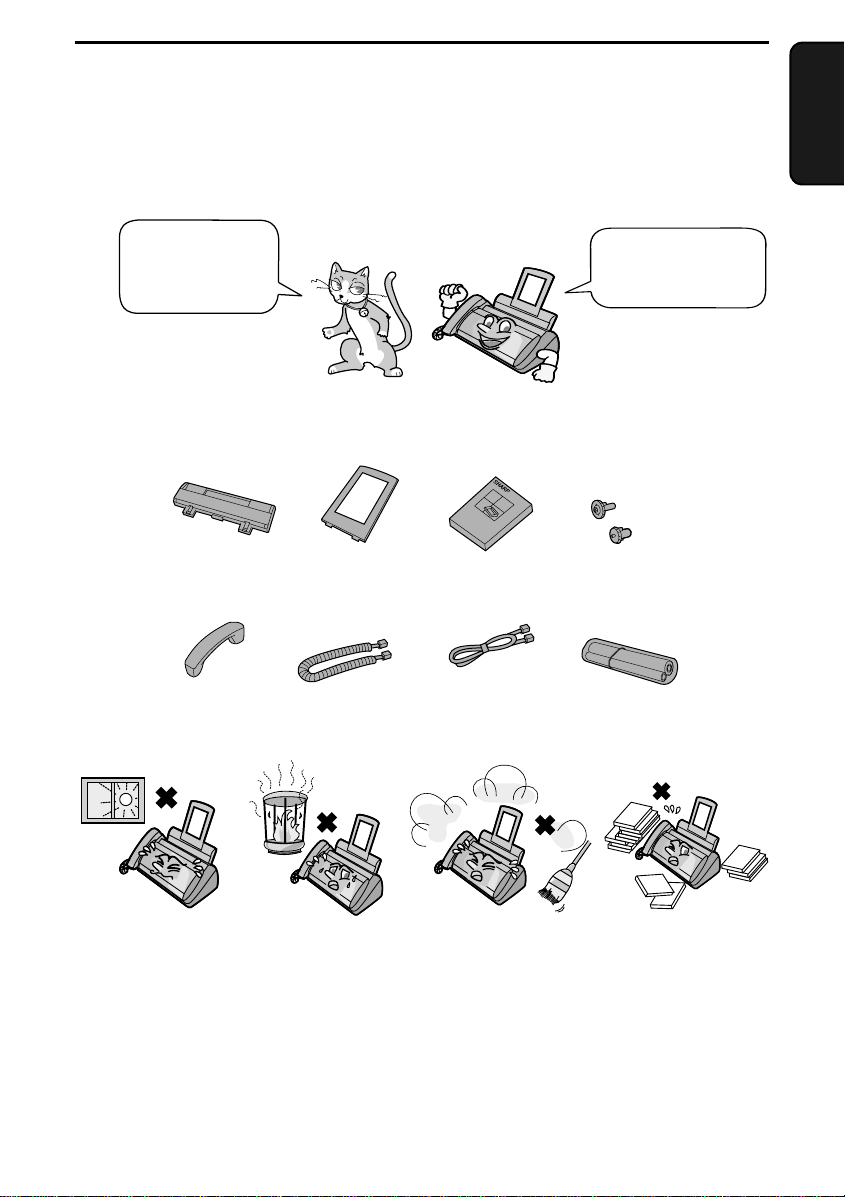
Unpacking Checklist
Points to keep in mind when setting up
Do not place the
machine in direct
sunlight.
Do not place the
machine near
heaters or air
conditioners.
Keep dust away from
the machine.
Keep the area
around the
machine clear.
About condensation
If the machine is moved from a cold to a warm place, it is possible that
condensation may form on the scanning glass, preventing proper scanning of
documents for transmission. To remove the condensation, turn on the power
and wait approximately two hours before using the machine.
Paper tray Paper tray
extension
Operation
manual
Gears (2)
Handset Handset cord
Telephone
line cord
Imaging film
(initial starter roll)
If any are missing,
contact your
dealer or retailer.
Before setting up,
make sure you
have all of the
following items.
all.bookPage9Wednesday,June4,20031:07PM
Connections
10
Connections
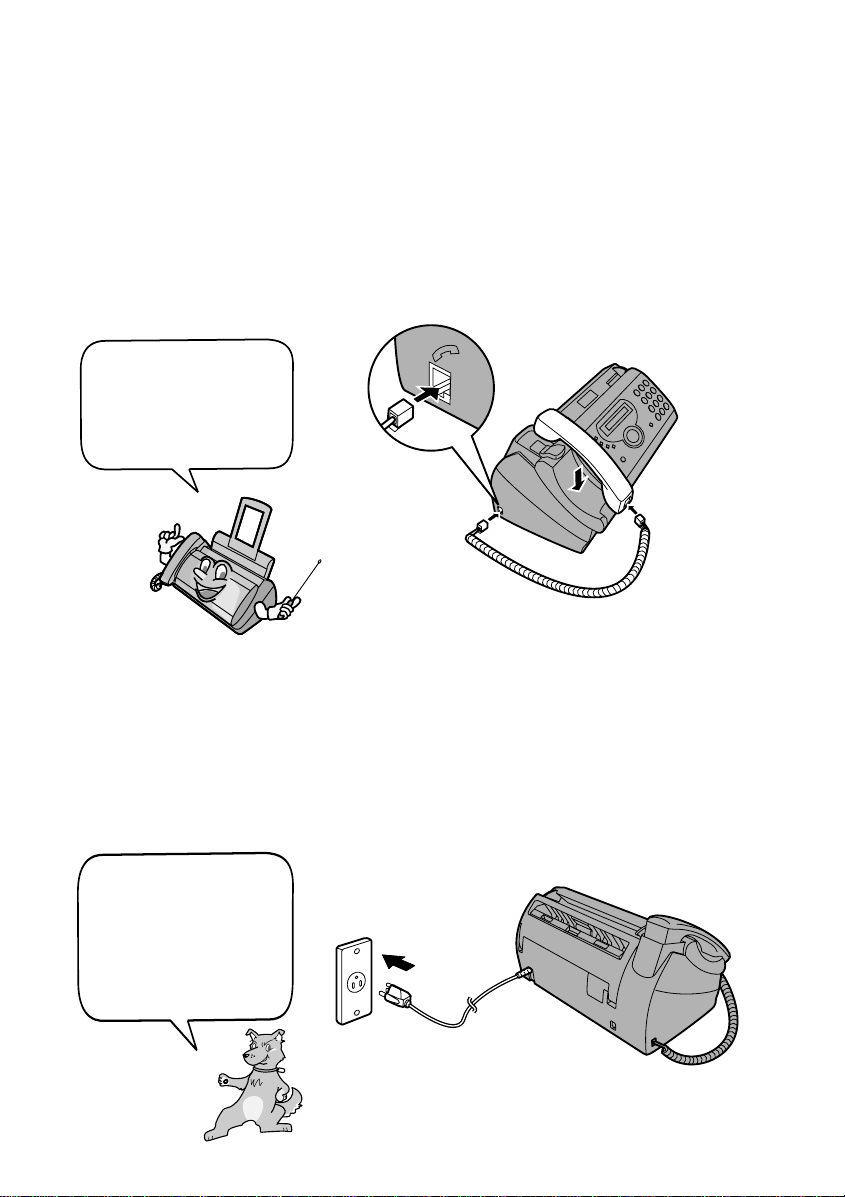
Connecting the handset
Connect the handset as shown and place it on the handset rest.
♦ The ends of the handset cord are identical, so they will go into either jack.
Make sure the handset
cord goes into the jack
marked with a handset
symbol on the side of
the machine!
Use the handset to make ordinary phone calls,
or to transmit and receive faxes manually.
Connecting the power cord
Plug the power cord into a 120 V, 60 Hz, grounded AC (3-prong) outlet.
Caution!
Do not plug the power cord into any other kind of outlet. This will damage the
machine and is not covered under the warranty.
The machine does not
have a power on/off
switch, so the power is
turned on and off by
simply plugging in or
unplugging the power
cord.
all.bookPage10Wednesday,June4,20031:07PM
Connections
11
1. Installation
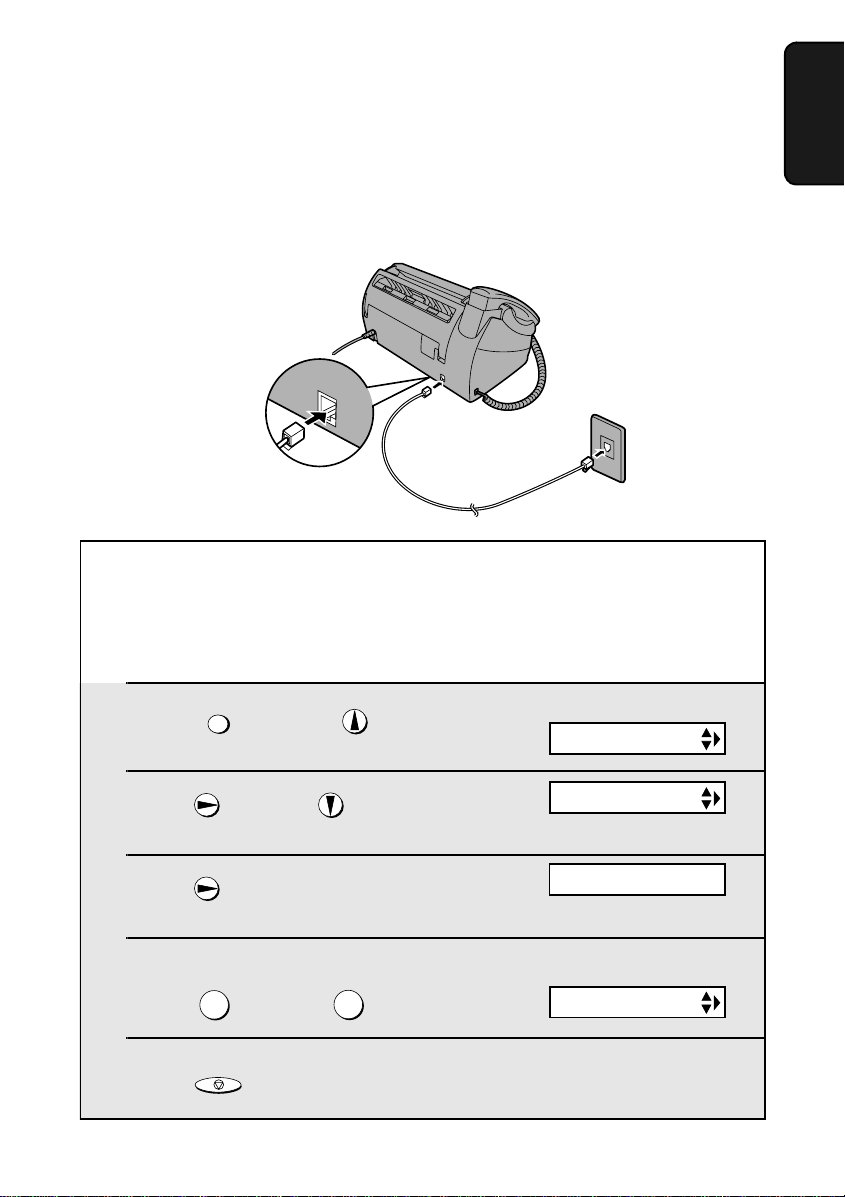
Connecting the telephone line cord
Insert one end of the line cord into the jack on the back of the machine
marked TEL. LINE. Insert the other end into a standard (RJ11C) single-line
wall telephone jack.
Setting the dial mode:
The fax machine is set for tone dialing. If you are on a pulse dial line, you must
set the fax machine for pulse dialing. Press the keys on the operation panel as
follows:
1
Press once and once.
2
Press once and twice.
3
Press once.
4
Select the dial mode:
TONE: PULSE:
5
Press to exit.
FUNCTION
1
2
STOP
T
E
L
.L
IN
E
Display:
The display briefly shows
your selection, then:
OPTION SETTING
DIAL MODE
DISTINCTIVE
1=TONE, 2=PULSE
all.bookPage11Wednesday,June4,20031:07PM
Connections
12
Comments:
♦ The fax machine is not designed for use on a line which has call waiting,
call forwarding, or certain other special services offered by your telephone
company. If you attempt to use the fax machine in conjunction with any of
these services, you may experience errors during transmission and
reception of facsimile messages.
♦ The fax machine is not compatible with digital telephone systems.
♦ If your area experiences a high incidence of lightning or power surges, we
recommend that you install surge protectors for the power and telephone
lines. Surge protectors can be purchased at most telephone specialty
stores.
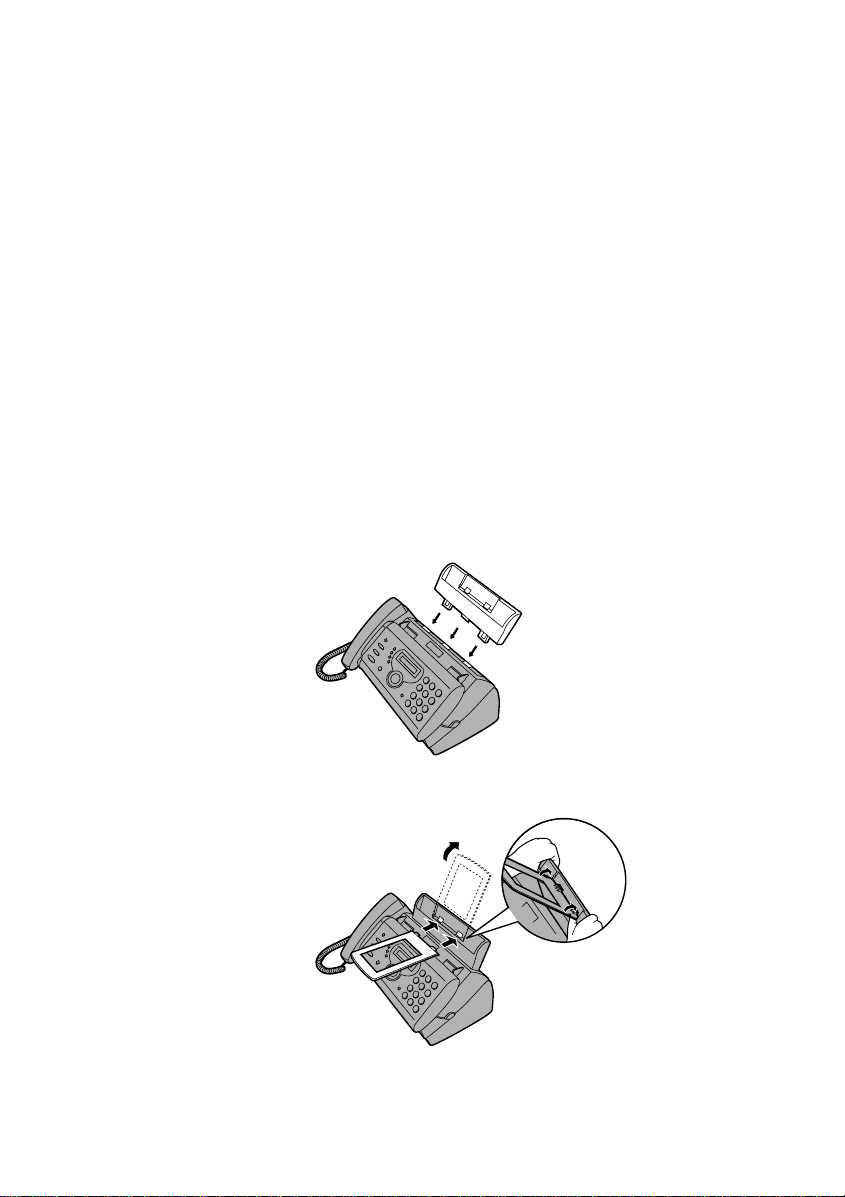
Attach the paper tray and paper tray extension
Attach the paper tray.
Note: The paper tray extension has a top side and a
bottom side. If you cannot insert the tabs into the
holes, turn the support over.
Attach the paper tray extension.
Click!
Insert horizontally
and rotate up
all.bookPage12Wednesday,June4,20031:07PM
Loading the Imaging Film
13
1. Installation
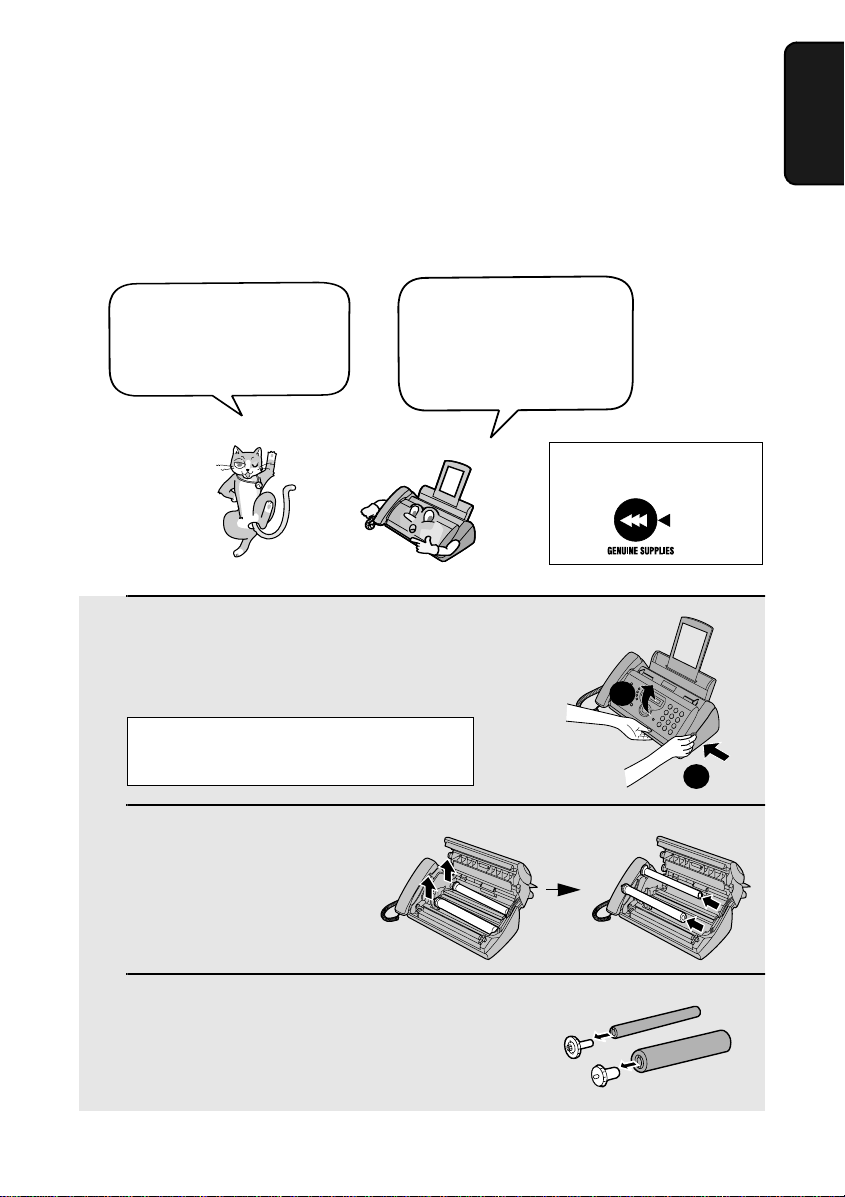
Loading the Imaging Film
Your fax uses a roll of imaging film to create printed text and images. The print
head in the fax applies heat to the imaging film to transfer ink to the paper.
Follow the steps below to load or replace the film.
1
Remove the paper from the paper tray
and open the operation panel (press
➊).
2
Remove the used film and
empty spool.
3
Remove the two green gears from the
spools.
DO NOT DISCARD THE TWO GREEN
GEARS!
1
2
When replacing the film,
use a roll of Sharp UX-
5CR imaging film. One
roll can print about 150
letter-size pages.
The initial starter roll of
imaging film included with
your fax can print about
30 letter-size pages.
If you are loading the imaging film for
the first time, go to Step 4.
Use only Sharp Genuine
Supplies with this logo:
all.bookPage13Wednesday,June4,20031:07PM
Loading the Imaging Film
14
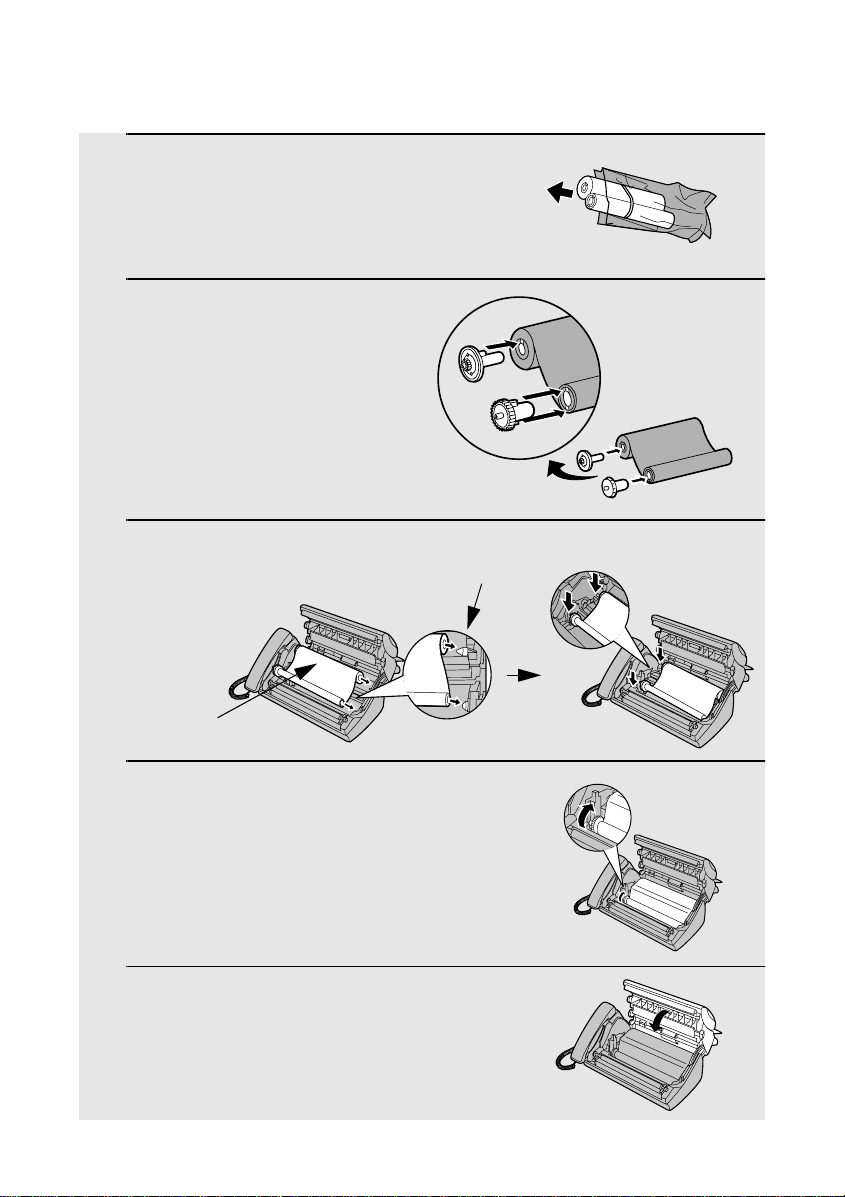
4
Remove the new roll of imaging film
from its packaging.
• Cut the band that holds the rolls
together.
5
Insert the green gears.
6
Insert the film into the print
compartment.
7
Rotate the front gear as shown until
the film is taut.
8
Close the operation panel (press down
on both sides to make sure it clicks
into place).
Fit ends of rolls
onto hubs
Make sure the
gears fit into the
slots in the ends
of the rolls.
1 slot
2 slots
Thick roll
to rear
all.bookPage14Wednesday,June4,20031:07PM
Loading Printing Paper
15
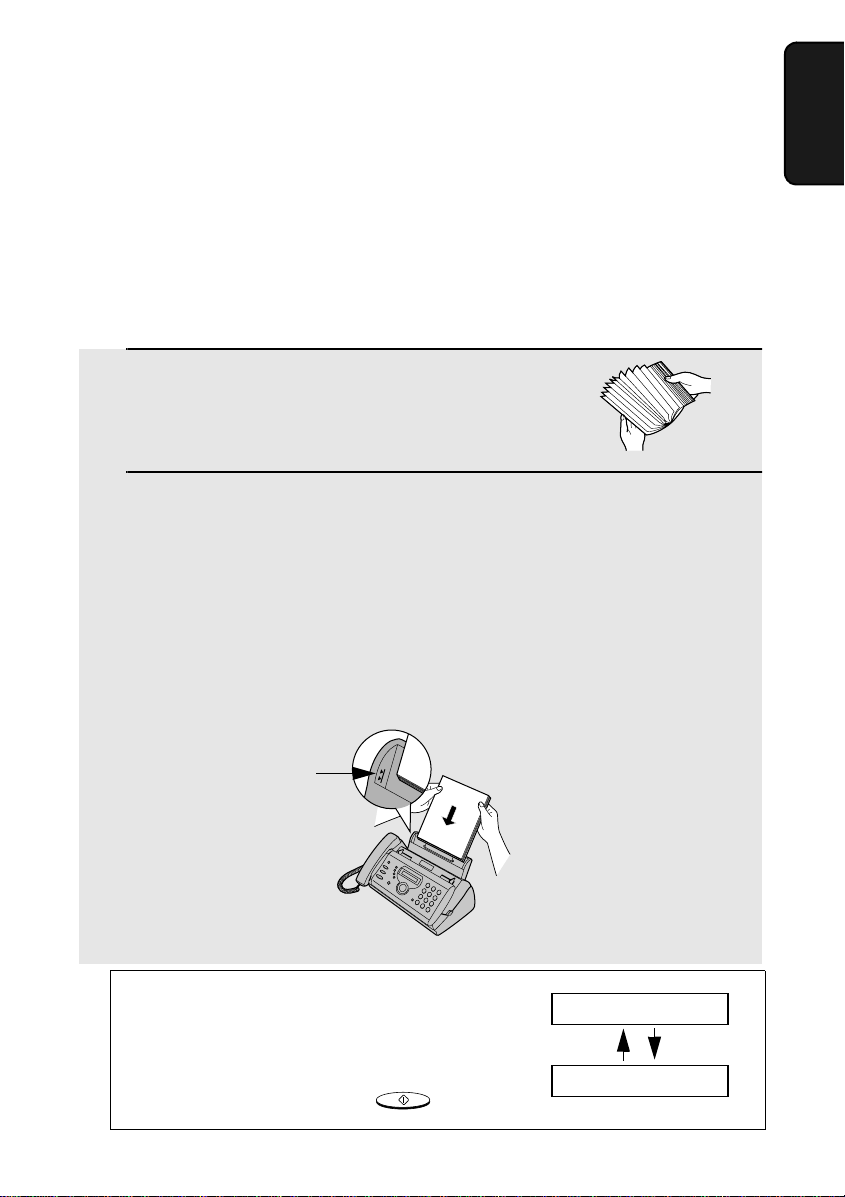
1. Installation
1
Fan the paper, and then tap the edge
against a flat surface to even the stack.
Make sure the stack edges are even.
2
Insert the stack of paper into the tray,
PRINT SIDE DOWN
.
• If paper remains in the tray, take it out and combine it into a single stack
with the new paper.
• Be sure to load the paper so that printing takes place on the print side of
the paper. Printing on the reverse side may result in poor print quality.
•
GENTLY LOAD PAPER INTO THE PAPER TRAY
.
•
DO NOT FORCE IT DOWN INTO THE FEED SLOT
.
Note: Do not use paper that has already been printed on, or paper that is curled.
Loading Printing Paper
You can load letter or legal size paper in the paper tray. Recommended paper
weight is 20-lb. Copy Bond. The maximum number of sheets is as follows:
Letter size:
Approx. 50 sheets (20-Ib. copier paper at room temperature;
maximum stack height should not be higher than the line on the
tray)
Legal size: 5 sheets
Note: If at any time the display shows the
alternating messages at right, check the printing
paper. If the tray is empty, add paper. If there is
paper in the tray, take it out and then reinsert it.
When you are finished, press .
START/MEMORY
ADD PAPER &
PRESS START KEY
The stack
should not
be higher
than this line
all.bookPage15Wednesday,June4,20031:07PM
Loading Printing Paper
16
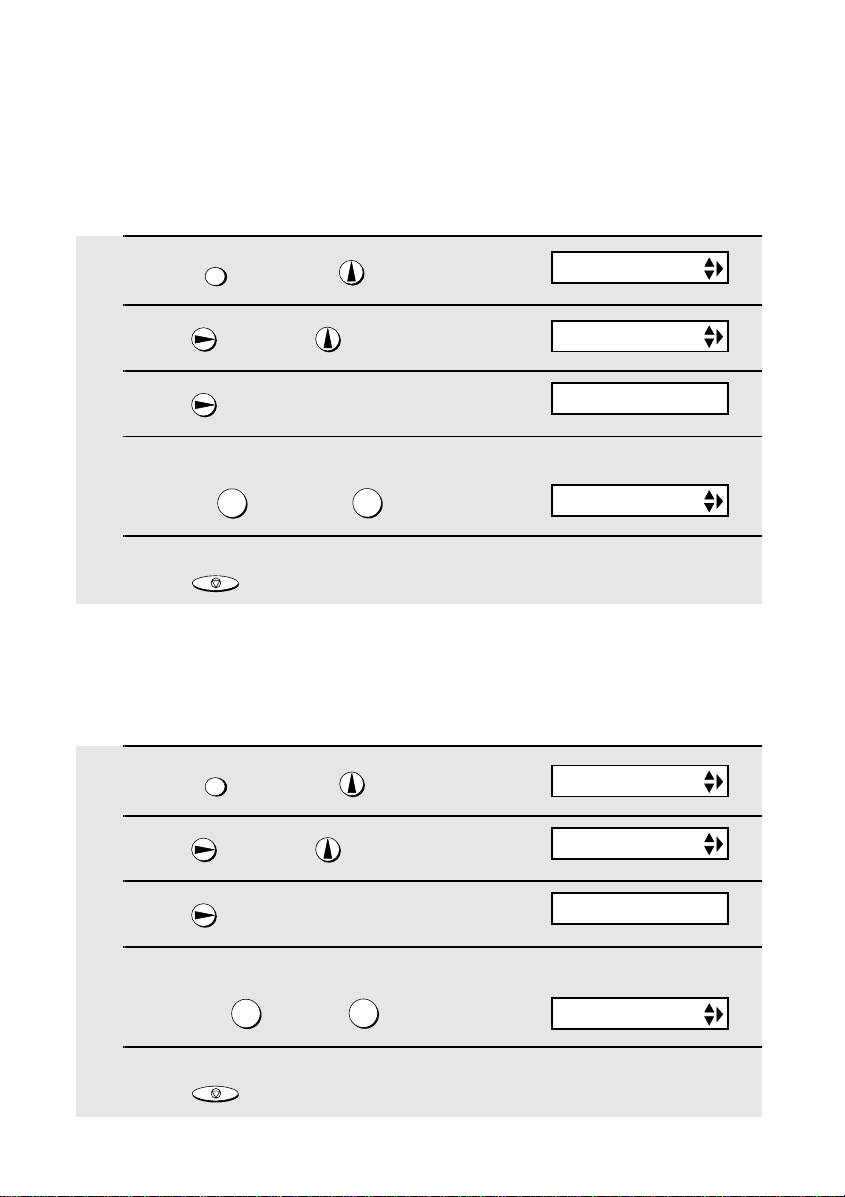
1
Press once and once.
2
Press once and twice.
3
Press once.
4
Select the paper size:
LETTER: LEGAL:
5
Press to return to the date and time display.
FUNCTION
1
2
STOP
Print contrast setting
Your fax has been set at the factory to print at normal contrast. If desired, you
can change the print contrast setting to LIGHT.
The display briefly shows
your selection, then:
1
Press once and once.
2
Press once and 3 times.
3
Press once.
4
Select the print contrast:
NORMAL: LIGHT:
5
Press to return to the date and time display.
FUNCTION
1
2
STOP
Display:
The display briefly shows
your selection, then:
PAPER SIZE SET
COPY CUT-OFF
OPTION SETTING
PRINT CONTRAST
PAPER SIZE SET
1=LETTER,2=LEGAL
1:NORMAL
Display:
OPTION SETTING
Setting the paper size
The fax has been set at the factory to scale received faxes to letter size paper.
If you loaded legal paper, you must change the paper size setting to LEGAL.
all.bookPage16Wednesday,June4,20031:07PM
Entering Your Name and Fax Number
17
1. Installation
Entering Your Name and Fax Number
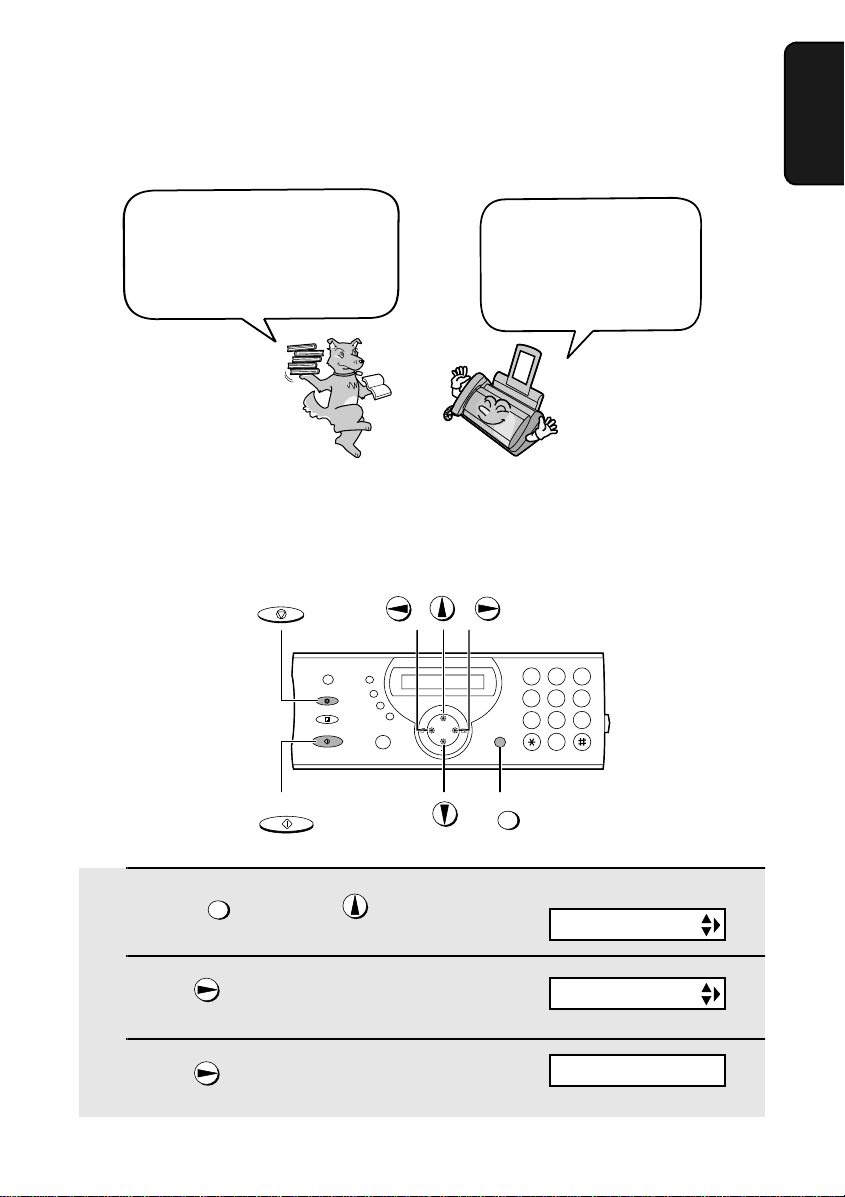
Once you enter this
information, it will
automatically appear at
the top of each fax page
you send.
Before you can begin sending
faxes, you must enter your
name and fax (telephone)
number. You also need to set
the date and time.
FUNCTION
START/MEMORY
STOP
Important!
FCC regulations require that your name, telephone/fax number, and the date and
time appear on each fax message you send. Enter your name and fax number
here and set the date and time as explained in the following section to have the fax
machine include this information automatically at the top of your fax messages.
1
Press once and 3 times.
2
Press once.
3
Press once.
FUNCTION
1
9
4
5 6
7
8
0
2 3
Display:
ENTER FAX #
ENTRY MODE
OWN NUMBER SET
all.bookPage17Wednesday,June4,20031:07PM
Entering Your Name and Fax Number
18
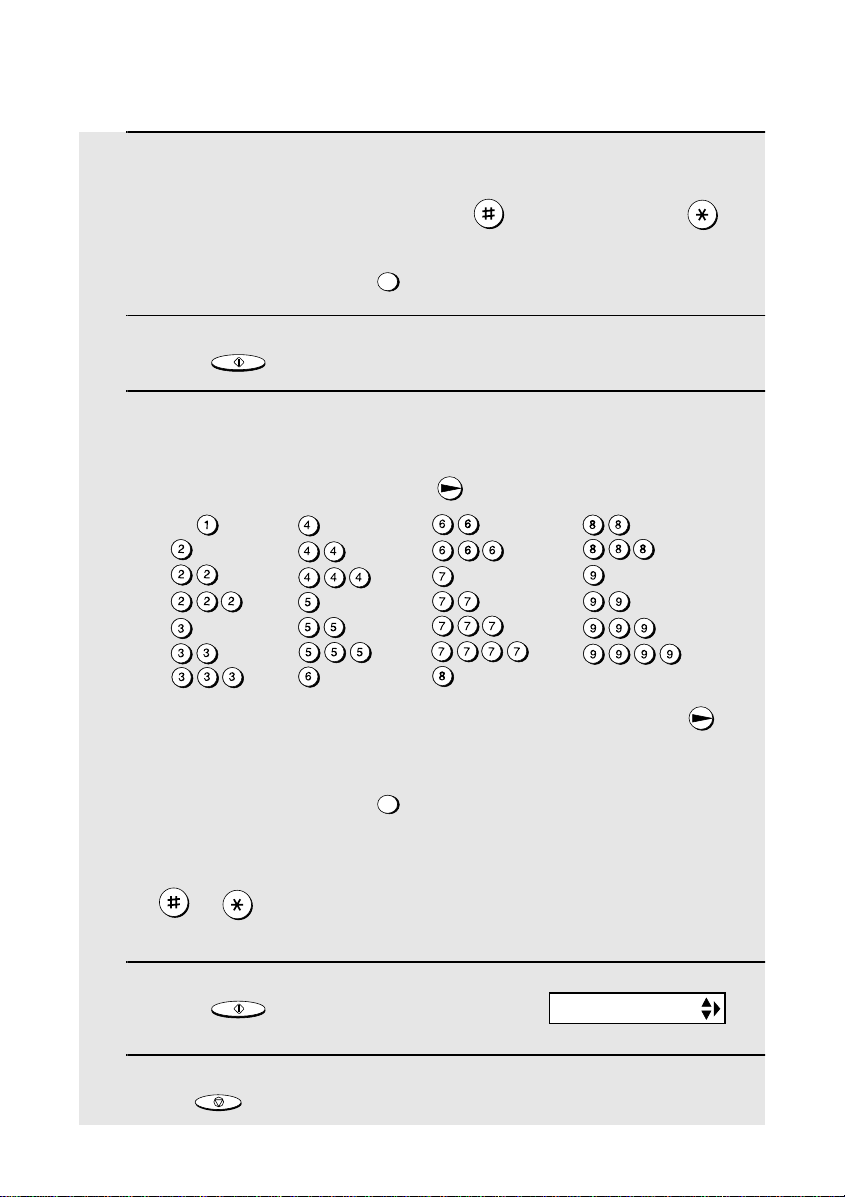
4
Enter your fax number by pressing the number keys (max. 20 digits).
• To insert a space between digits, press . To enter a “+”, press
• To clear a mistake, press .
5
Press to enter the fax number in memory.
6
Enter your name by pressing number keys for each letter as shown in
the chart below. Up to 24 characters can be entered.
Example: SHARP = 7777 44 2 777 7
♦ To enter two letters in succession that require the same key, press
after entering the first letter.
♦ To clear a mistake, press .
♦ To enter a lower case letter, continue pressing the key for the letter until the
lower case letter appears. To enter one of the following symbols, press
or repeatedly: . / ! " # $ % & ’ ( ) + + , - : ; < = > ? @ [ ¥ ] ^ _ ' { |
} ) (
7
Press .
8
Press to return to the date and time display.
SPEAKER
START/MEMORY
SPEAKER
START/MEMORY
STOP
Display:
DATE&TIME SET
A =
B =
C =
D =
E =
F =
G =
H =
I =
J =
K =
L =
M =
N =
O =
P =
Q =
R =
S =
T =
U =
V =
W =
X =
Y =
Z =
SPACE =
all.bookPage18Wednesday,June4,20031:07PM
Setting the Date and Time
19
1. Installation
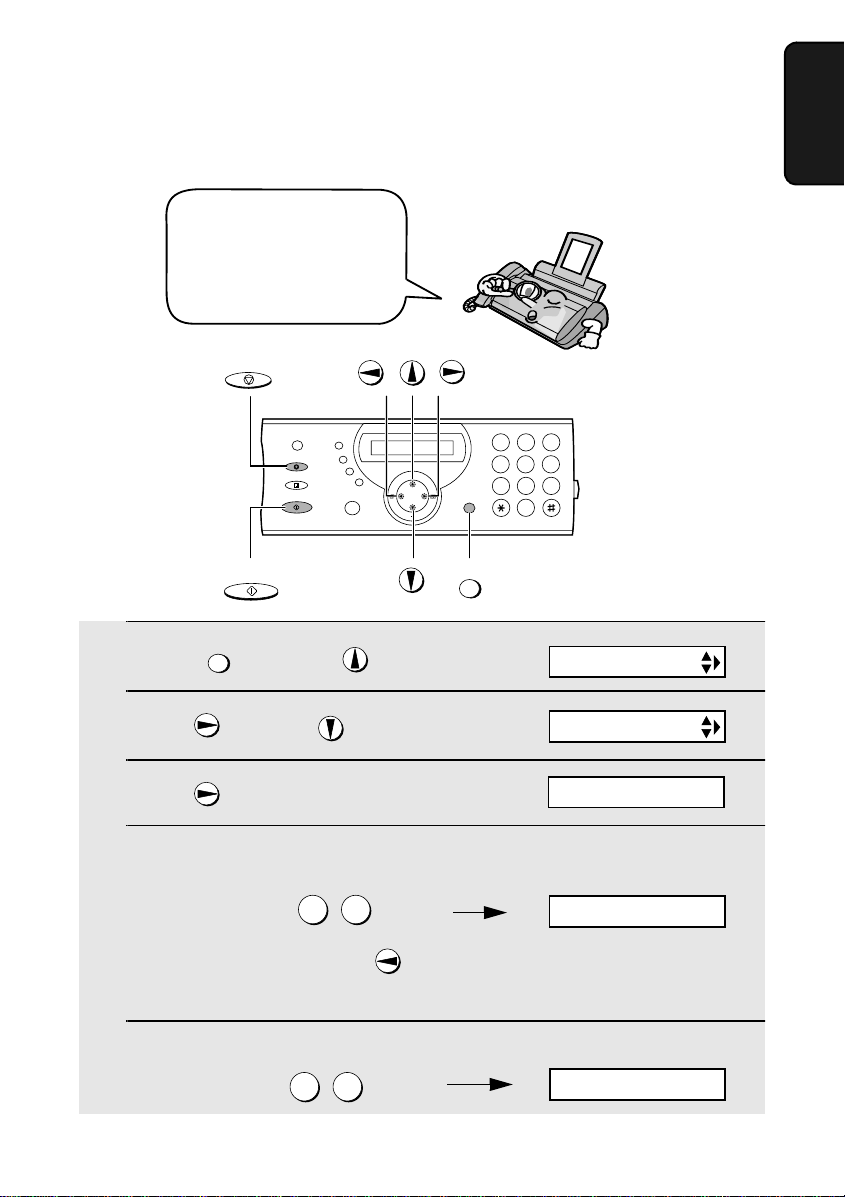
Setting the Date and Time
1
Press once and 3 times.
2
Press once and once.
3
Press .
4
Enter a two-digit number for the month (“01” for January, “02” for
February, “12” for December, etc.).
Example: January
• To correct a mistake, press to move the cursor back to the mistake and
then enter the correct number.
5
Enter a two-digit number for the day (“01” to “31”).
Example: the 5
th
FUNCTION
0 1
0 5
The date and time appear
in the display and are
printed at the top of every
page you fax. Set the date
and time as shown below.
FUNCTION
STOP
1
9
4
5 6
7
8
0
2 3
Display:
The currently set date
appears (example):
ENTRY MODE
DATE&TIME SET
DATE 08-15-2003
DATE 01-15-2003
DATE 01-05-2003
START/MEMORY
all.bookPage19Wednesday,June4,20031:07PM
Setting the Date and Time
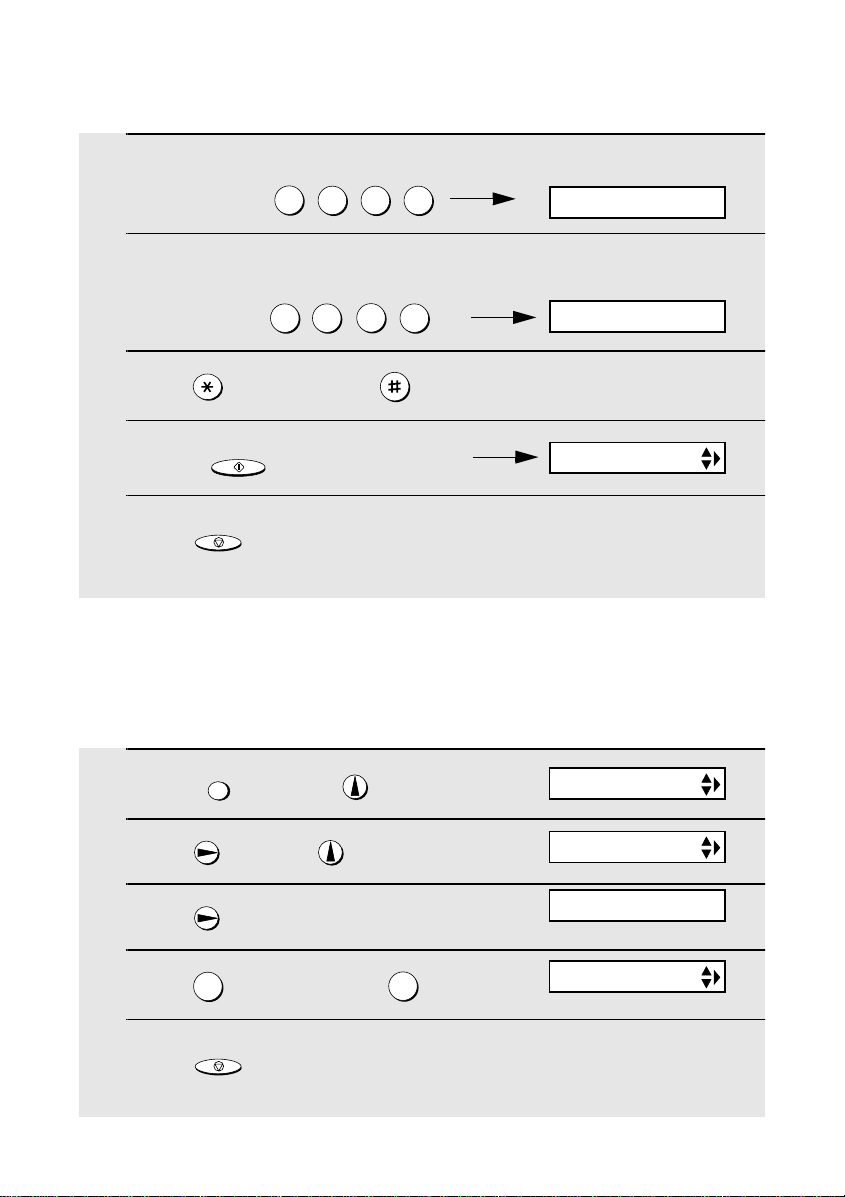
20
1
Press once and once.
2
Press once and 5 times.
3
Press once.
4
Press to select YES, or to select NO.
5
Press to return to the date and time display.
FUNCTION
1
2
STOP
Daylight Saving Time
If desired, you can set the clock to move forward and backward automatically
at the beginning and end of Daylight Saving Time. Follow these steps:
6
Enter the year (four digits).
Example: 2003
7
Enter a two-digit number for the hour (“01” to “12”) and a two-digit
number for the minute (“00” to “59”).
Example: 9:25
8
Press to select A.M. or to select P.M.
9
Press to start the clock.
10
Press to return to the date and time display.
2
0 0 3
0 9
2
5
START/MEMORY
STOP
The currently set time
appears (example):
TIME 12:19 PM
TIME 09:25 PM
ANTI JUNK #
RECEIVE RATIO
OPTION SETTING
DAY LIGHT SAVE
1=YES, 2=NO
all.bookPage20Wednesday,June4,20031:07PM
Setting the Reception Mode
21
1. Installation
Setting the Reception Mode
Your fax has three modes for receiving incoming faxes:
FAX mode:
Select this mode when you only want to receive faxes on your line. The fax
machine will automatically answer all calls on four rings and receive incoming
faxes.
TEL mode:
Select this mode when you want to receive both phone calls and faxes on the
line connected to the fax machine. All calls, including faxes, must be
answered by picking up the fax machine's handset or an extension phone
connected to the same line.
TAD mode:
Select this mode when you go out and want the built-in answering system to
answer all calls. Voice messages will be recorded, and fax messages will be
received automatically (“TA D” stands for “Telephone Answering Device”.)
Setting the reception mode
Make sure a document
is not loaded in the document feeder
, and then
press until the arrow in the display points to the desired mode.
RESOLUTION/
RECEPTION MODE
Note: TAD mode cannot be selected unless a general outgoing message has
been recorded as explained on page 24.
For more information on receiving faxes in FAX and TEL modes, see Chapter
4,
Receiving Faxes
. For more information on using TAD mode, see Chapter 2,
Using the Answering System
.
1
9
4
5 6
7
8
0
2 3
RESOLUTION/
RECEPTION MODE
RESOLUTION/
RECEPTION MODE
FAX
TEL
JAN-01 10:30
FAX
TEL
JAN-01 10:30
FAX
TEL
JAN-01 10:30
TAD
TAD
TAD
all.bookPage21Wednesday,June4,20031:07PM
Volume Adjustment
22
Volume Adjustment
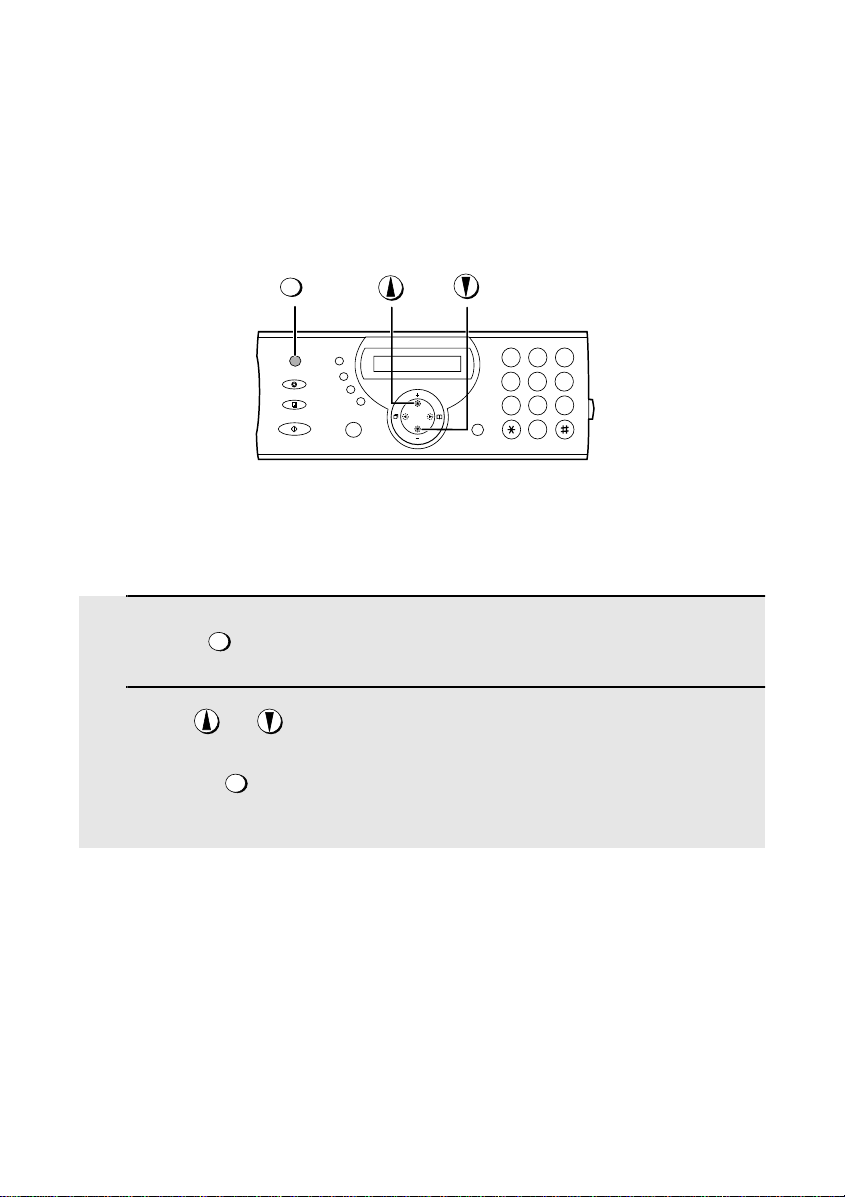
You can adjust the volume of the speaker, handset, and ringer using the up
and down arrow keys.
1
Press .
2
Press or until the display shows the desired volume level.
• Press again to turn off the speaker.
SPEAKER
SPEAKER
Speaker
1
9
4
5 6
7
8
0
2 3
SPEAKER
all.bookPage22Wednesday,June4,20031:07PM
Volume Adjustment
23
1. Installation
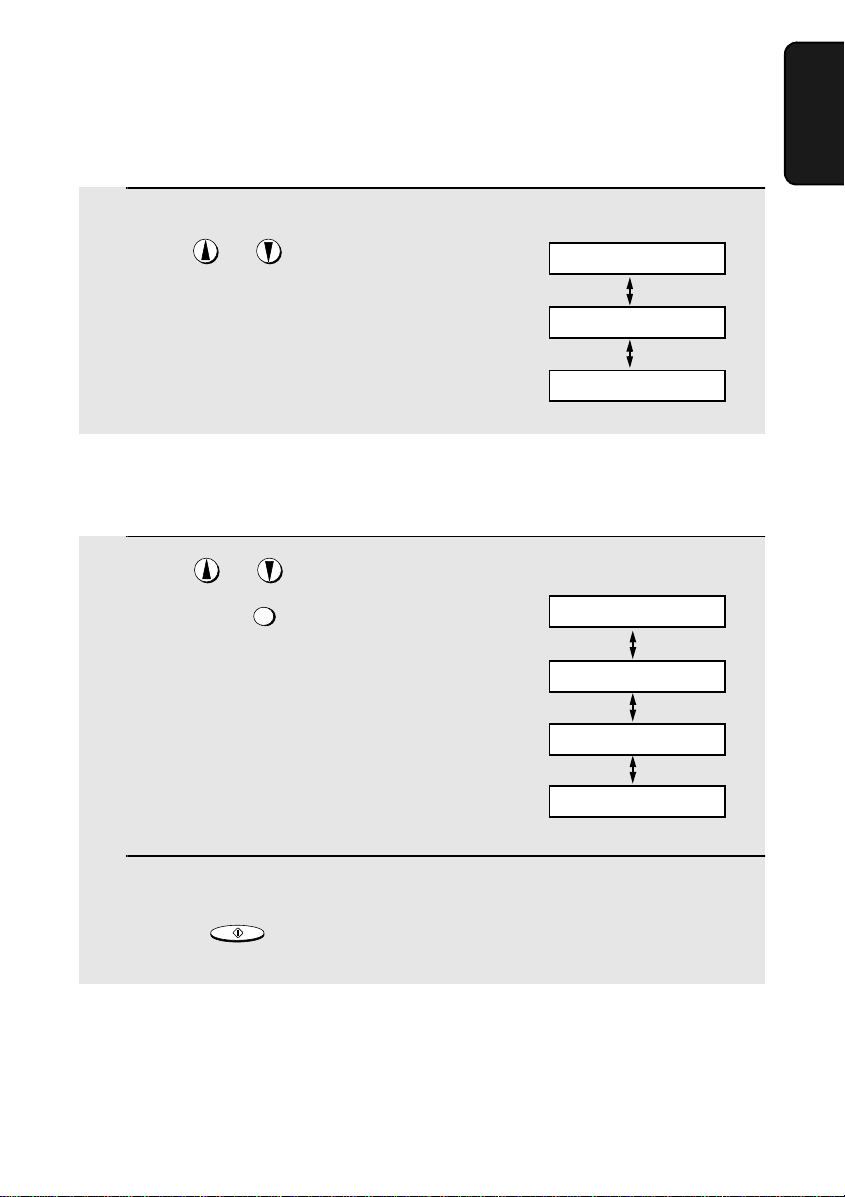
1
Press or .
(Make sure has not been
pressed, the handset is not lifted, and a
document is not loaded in the feeder.)
• The ringer will ring once at the selected
level, then the date and time will
reappear in the display.
2
If you selected RINGER: OFF OK ?,
press .
SPEAKER
START/MEMORY
1
When talking through the handset,
press or until the display
shows the desired volume level.
• Note: The volume reverts to MIDDLE
each time you replace the handset.
Ringer
Display:
Handset
Display:
RINGER: HIGH
RINGER: MIDDLE
RINGER: LOW
RINGER: OFF OK ?
RECEIVER: HIGH
RECEIVER: MIDDLE
RECEIVER: LOW
all.bookPage23Wednesday,June4,20031:07PM
24
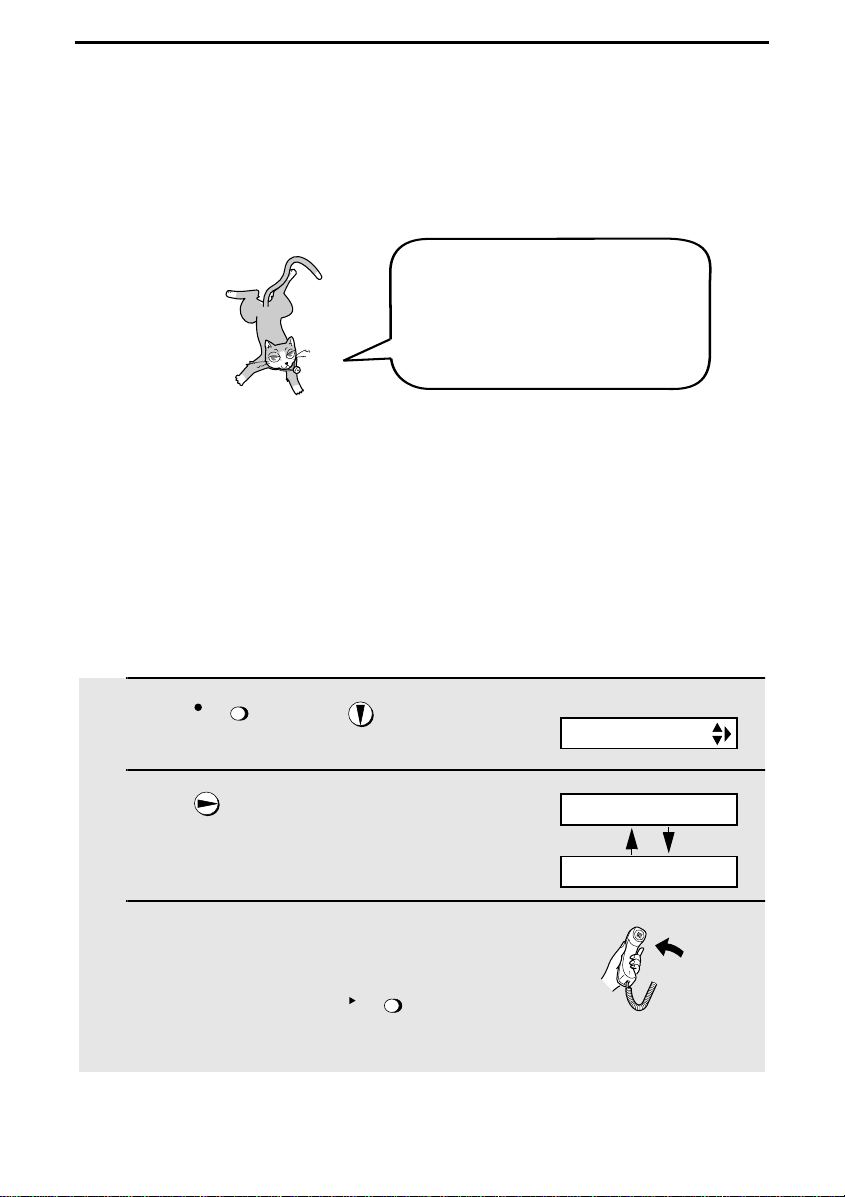
1
Press once and once.
2
Press once.
3
Lift the handset.
(If you have already recorded a
message, you can press to
listen to the message.)
REC/
MEMO
PLAY/
HOLD
2. Using the Answering System
The built-in answering system allows you to receive both voice messages and
faxes while you are out.
Recording an Outgoing Message
The outgoing message (OGM) is the greeting that the machine plays after
answering a call to inform callers that they can leave a message or send a fax.
Follow the steps below to record a message.
Example:
“Hello. You've reached ______ . No one is available to take your call right now.
Please leave a message after the beep or press your facsimile Start key to
send a fax. Thank you for calling.”
Display:
OGM1(GENERAL)
LIFT HANDSET OR
PLAY: PLAYBACK
To use the answering system, you
will first need to record an outgoing
message. When you go out, turn
on the answering system by setting
the reception mode to TAD.
all.bookPage24Wednesday,June4,20031:07PM
Operating the Answering System
25
2. Answering
Machine
To listen to the outgoing message
To listen to the outgoing message, follow Steps 1 and 2 of the above
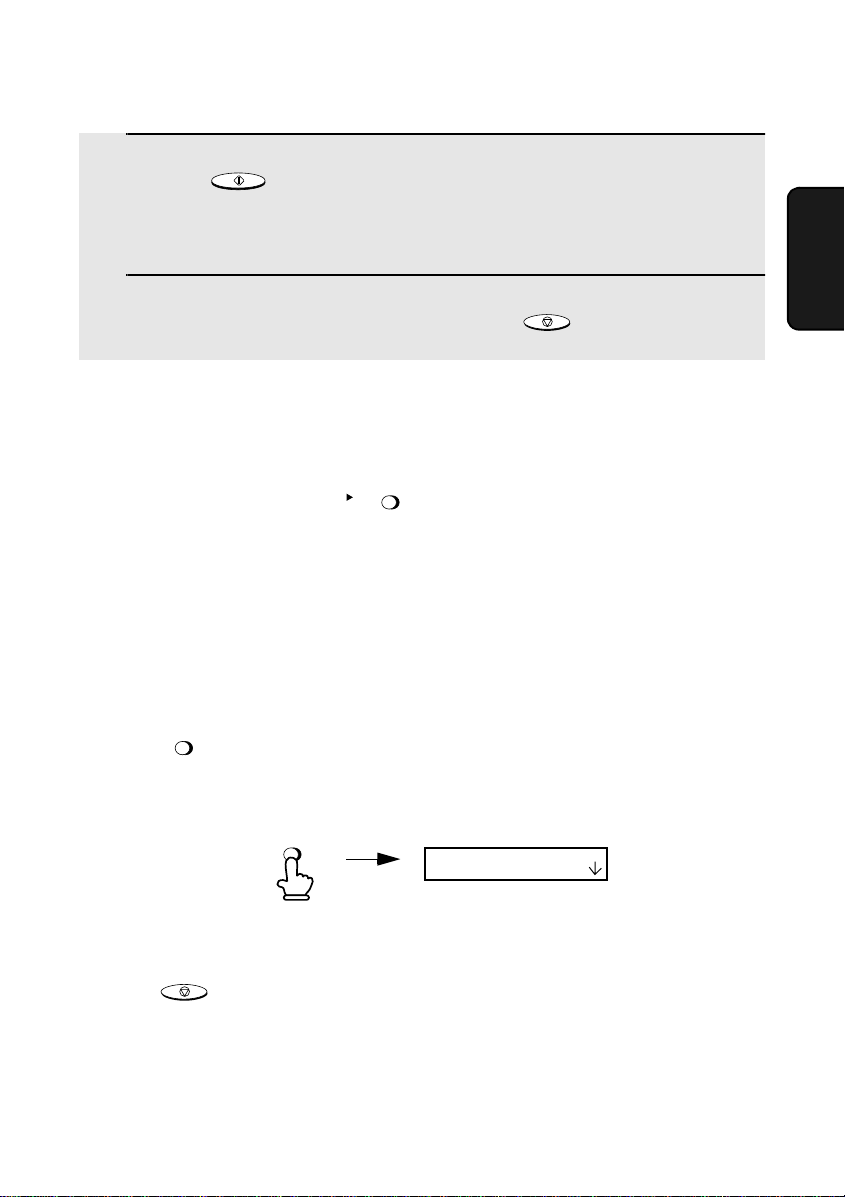
procedure and then press . Note that the general outgoing message
cannot be erased. If you need to change it, simply repeat the recording
procedure.
Operating the Answering System
Activating the answering system
To turn on the answering system so that callers can leave messages, press
until the arrow in the display points to TAD. (TAD stands for
“Telephone Answering Device”.)
PLAY/
HOLD
RESOLUTION/
RECEPTION MODE
4
Press and speak into the handset to record a message.
• The outgoing message can be up to 60 seconds long. While recording, the
display will show the time left to record.
5
When finished, replace the handset or press .
START/MEMORY
STOP
RESOLUTION/
RECEPTION MODE
♦ The outgoing message will play (you can stop playback by pressing
).
♦ It will not be possible to set the reception mode to TAD if an outgoing
message has not been recorded.
STOP
FAX
TEL
TAD
all.bookPage25Wednesday,June4,20031:07PM
Operating the Answering System
26
Note: In TAD mode, the machine will automatically switch to fax reception if it
detects six seconds of silence after answering a call. For this reason, if a
caller pauses for this length of time while leaving a message, they will be cut
off.
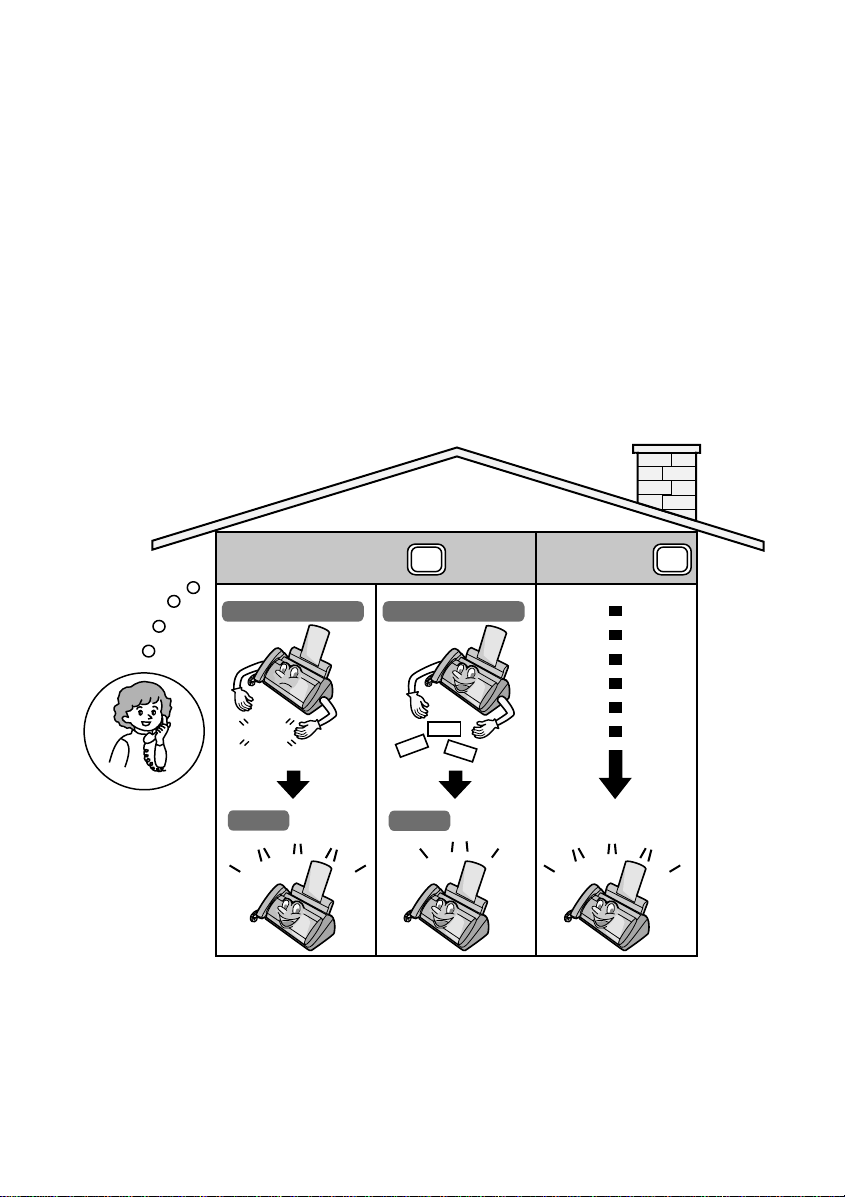
Number of rings in TAD mode (Toll Saver function)
The number of rings on which the machine answers incoming calls in TAD
mode depends on whether the Toll Saver function is turned on, and if it is on,
whether you have messages.
♦ The Toll Saver function is initially turned on.
ON
OFF
No received messages
4 Rings
Received messages
2 Rings
Toll Saver Toll Saver
NOTHING
Hello!
H
i!
Hi!
Ring
Ring
Ring
Ring
Ring
R
ing
Ring
Ring
R
ing
Ring
(Answer according to
NUMBER OF RINGS setting)
To adjust the NUMBER
OF RINGS setting, see
page 59.
To turn off the Toll Saver
function, see page 37.
all.bookPage26Wednesday,June4,20031:07PM
Operating the Answering System
27
2. Answering
Machine
Listening to received messages
When you return, the display will show the number of messages recorded.
Follow the steps below to listen to your messages.
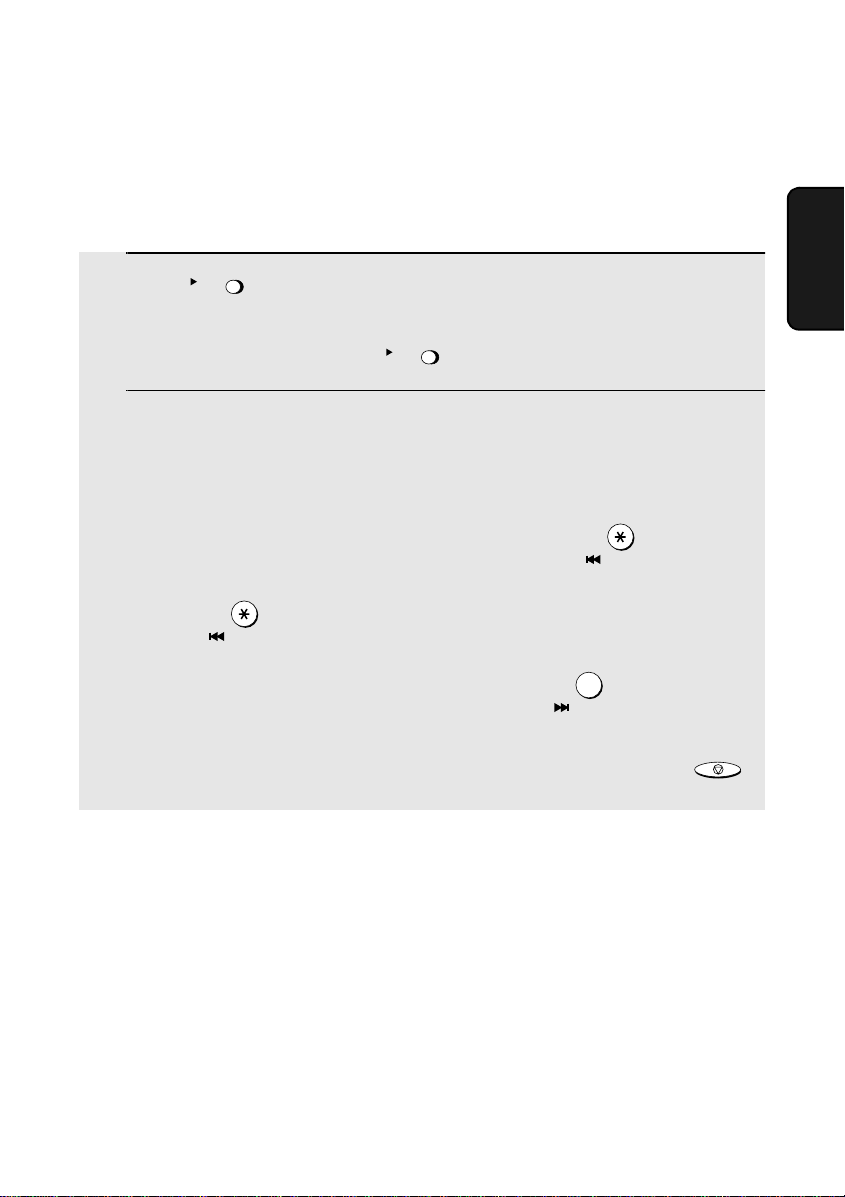
1
Press .
• If you only want to listen to new messages (messages not previously
listened to), continue to hold down for at least two seconds.
2
The messages will play.
• As each message plays, the date and time of recording will appear briefly in
the display. If no messages were received, NO MESSAGES will appear.
• Repeat: To listen to a message a second time, press before
playback of that message ends. To move back to the previous message,
press within 3 seconds of the beginning of the current message.
• Skip: To skip forward to the next message, press .
Note: Playback will stop if you receive a call, lift the handset, or press .
PLAY/
HOLD
PLAY/
HOLD
REPEAT
REPEAT
SKIP
0
STOP
♦ You can print out a list of your received messages that shows the date and
time that each was received. See page 75.
all.bookPage27Wednesday,June4,20031:07PM
Operating the Answering System
28
Erasing received messages
It is important to erase received messages after you listen to them to ensure
that the memory does not become full.
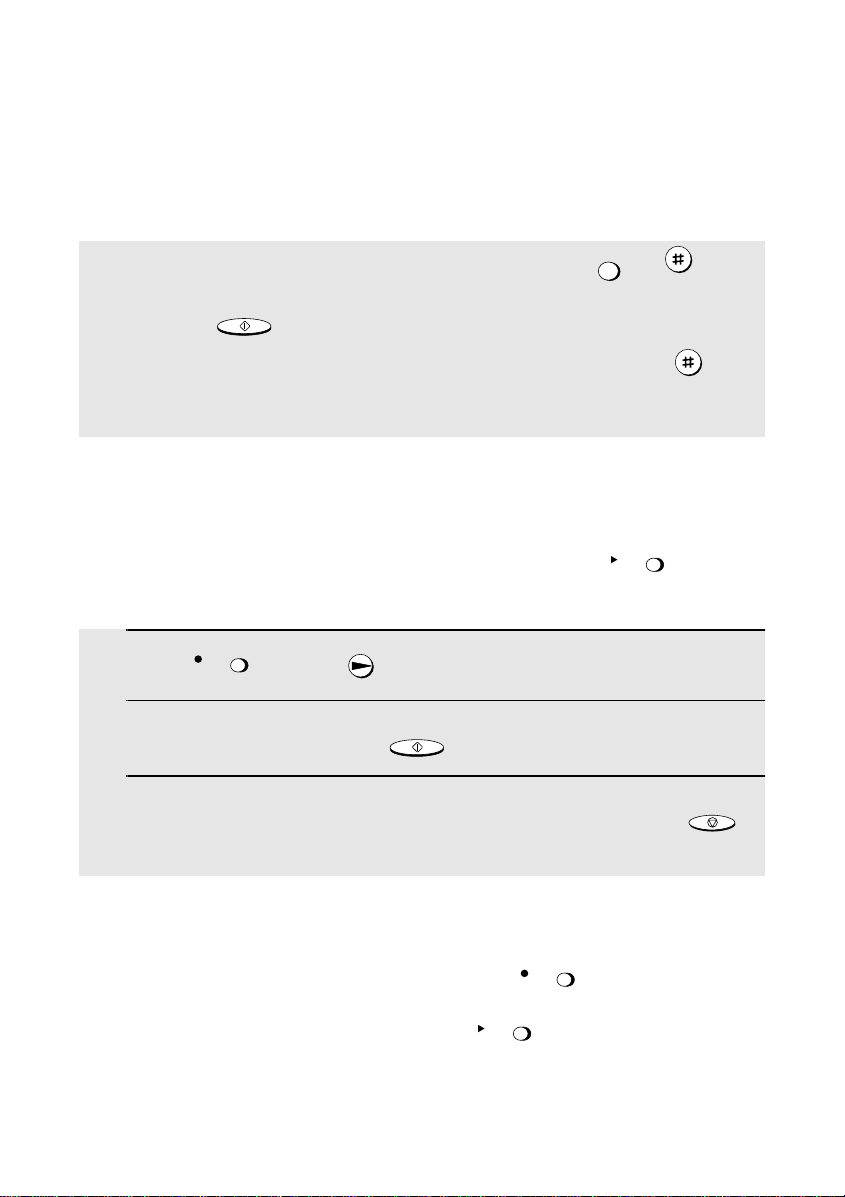
♦ Erasing all messages: To erase all messages, press , , and
then .
♦ Erasing a single message: To erase a single message, press
while the message is being played.
FUNCTION
DELETE
START/MEMORY
DELETE
Recording memos
You can record memos for yourself and other users of the machine. These will
be played back together with incoming messages when the key is
pressed.
PLAY/
HOLD
1
Press once and once.
2
Pick up the handset, press , and speak into the handset.
3
When you have finished speaking, replace the handset or press .
REC/
MEMO
START/MEMORY
STOP
Recording phone conversations (2-way recording)
To record a phone conversation, hold down the key during the
conversation you want to record. When you are finished, release the key. The
conversation will be played back when the key is pressed.
REC/
MEMO
PLAY/
HOLD
all.bookPage28Wednesday,June4,20031:07PM
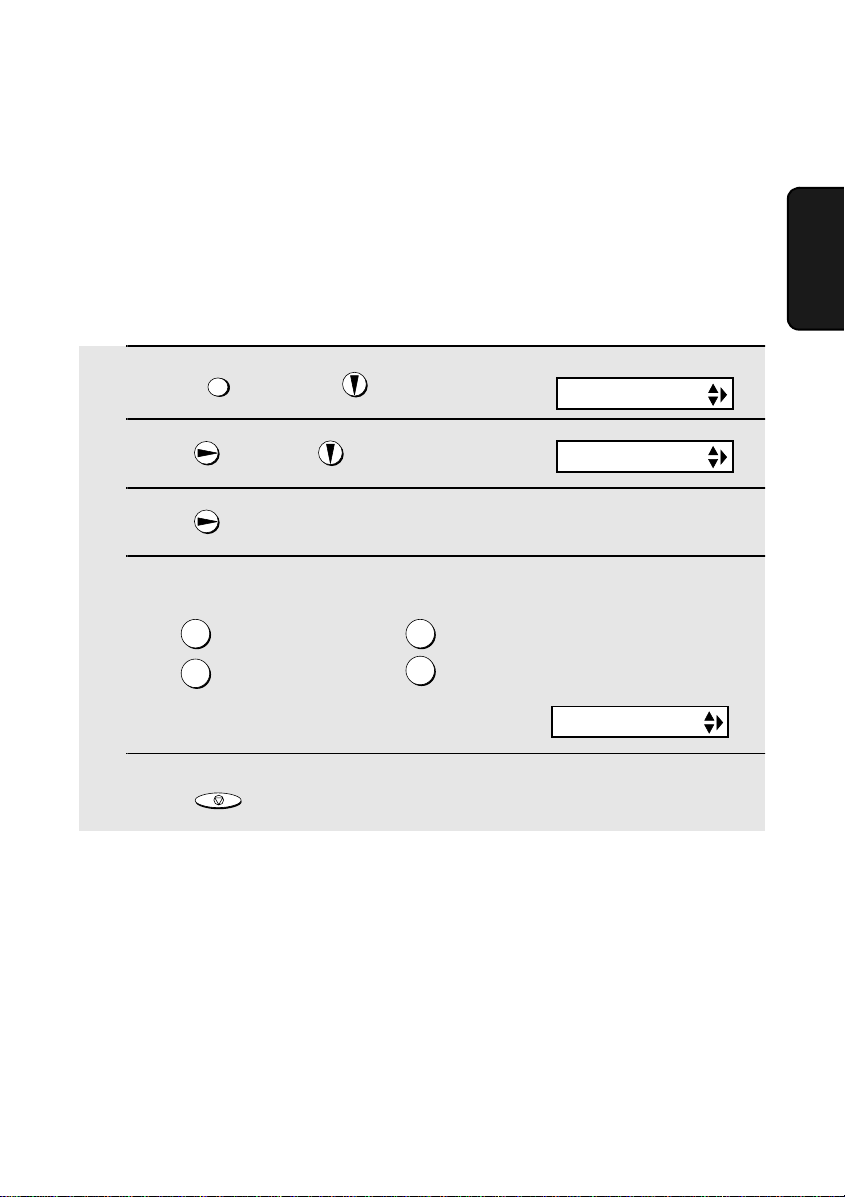
Optional Answering System Settings
29
2. Answering
Machine
1
Press once and once.
2
Press once and once.
3
Press .
4
Press a number from 1 to 4 to select the desired ICM recording time.
5
Press to return to the date and time display.
15 seconds 60 seconds
30 seconds 4 minutes
FUNCTION
STOP
Optional Answering System Settings
Setting ICM time
Incoming messages (ICMs) are the messages which callers leave for you on
the built-in answering system. The answering system is set at the factory to
allow each caller a maximum of 4 minutes to leave a message. If desired, you
can change this setting to 15, 30, or 60 seconds.
Display:
T.A.D. SETTING
RECORDING TIME
1
2
3
4
The display briefly shows
your selection, then:
REMOTE CODE
FAX mode on TAD failure
If the memory for recording incoming messages becomes full while you are
out, the answering system will no longer be able to record messages. The ON
TAD FAILURE setting is used to select whether or not the reception mode will
switch to FAX mode when this happens:
♦ YES (switch to FAX mode): The reception mode will switch to FAX mode,
allowing the machine to continue to receive faxes automatically. With this
setting, you can still use the remote commands to listen to your messages
and then erase them (see
Remote Operations
on page 37).
all.bookPage29Wednesday,June4,20031:07PM
Optional Answering System Settings
30
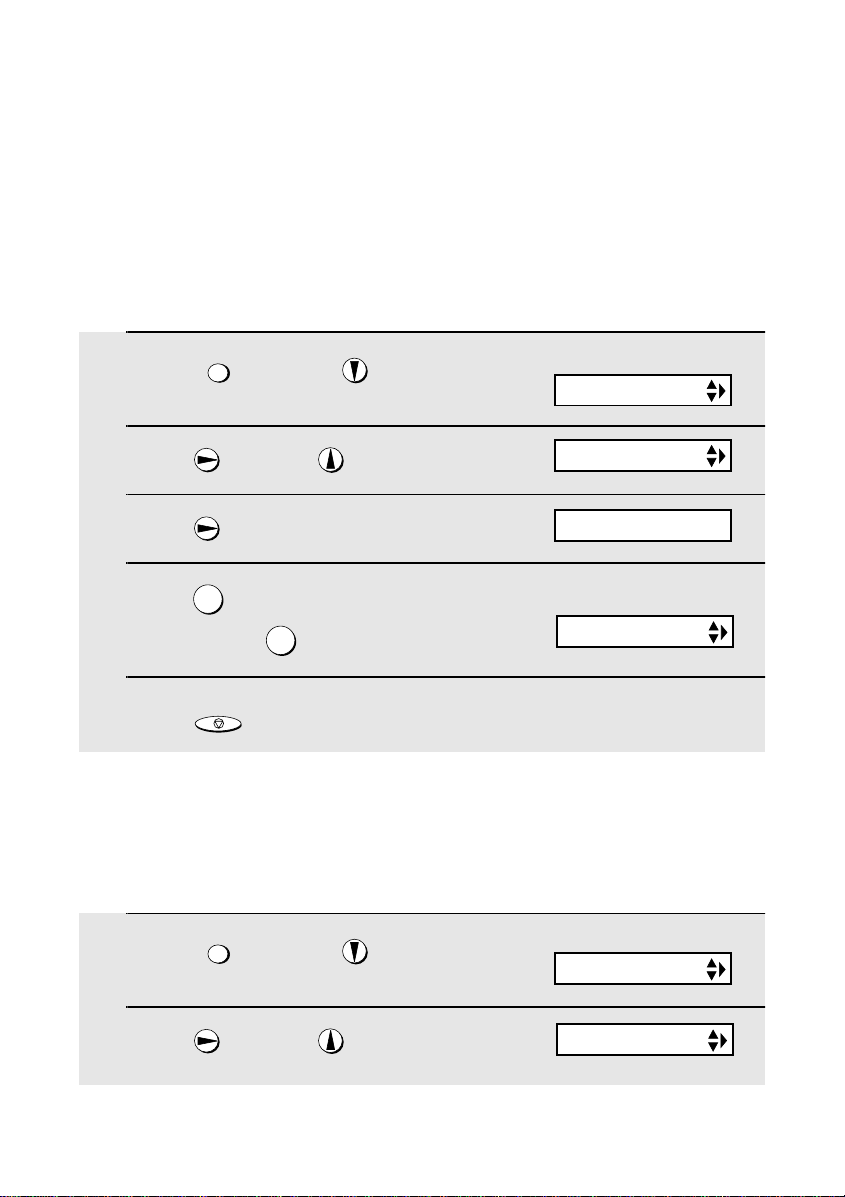
1
Press once and once.
2
Press once and 3 times.
3
Press .
4
Press to select YES (switch to
FAX mode), or to select NO.
5
Press to return to the date and time display.
FUNCTION
1
2
STOP
ON TAD FAILURE
♦ NO (do not switch to FAX mode): The machine will answer after 20 rings,
after which it will wait to receive a remote command. Most callers will hang
up before it answers; however, when you call the machine from a remote
location, you can wait until it answers, listen to your messages, and then
erase them (see
Remote Operations
on page 64).
The initial setting is NO . If you want to change the setting to YES, press the
panel keys as follows:
Display:
T.A.D. SETTING
1=YES, 2=NO
The display briefly shows
your selection, then:
OGM ONLY MODE
OGM only mode
If needed, you can turn off recording of incoming messages. In this case, your
outgoing message will play, but callers will not be able to leave a message.
(The machine will still receive faxes sent by automatic dialing.)
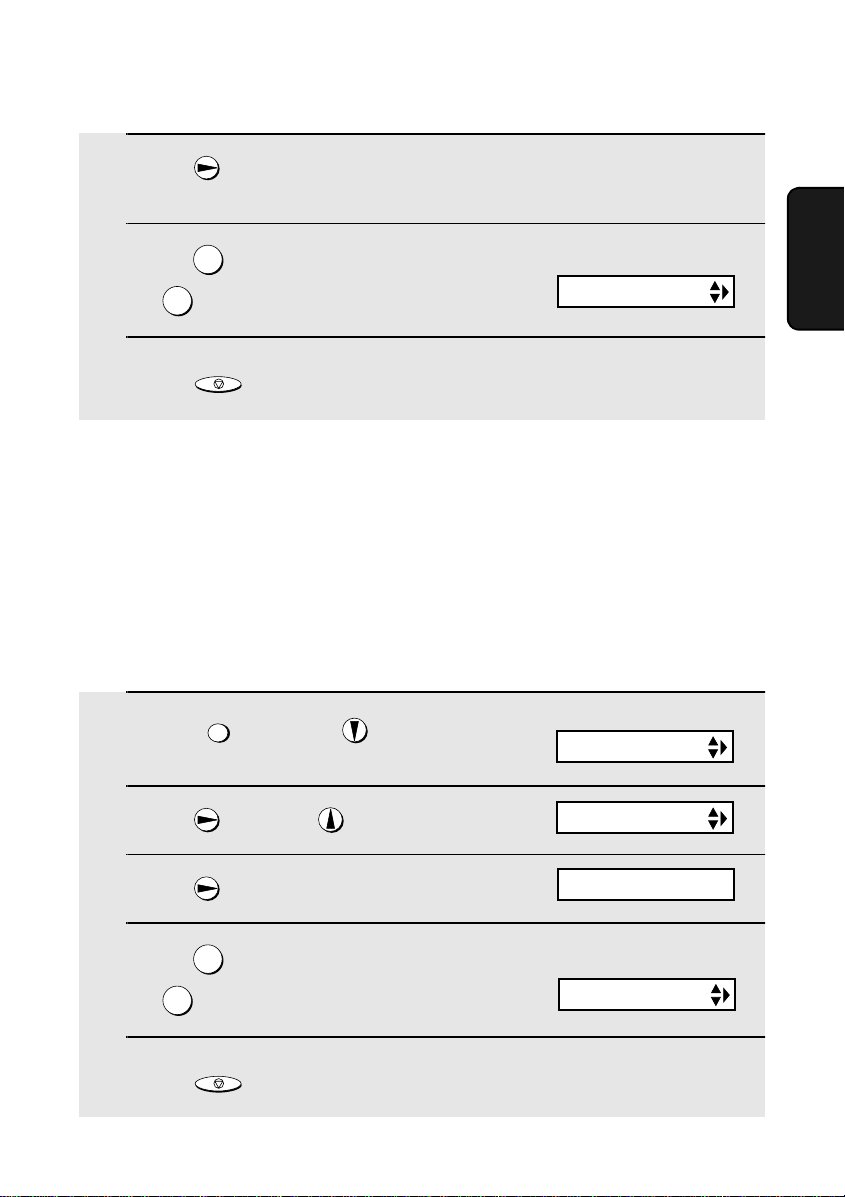
1
Press once and once.
2
Press once and twice.
FUNCTION
OGM ONLY MODE
Display:
T.A.D. SETTING
all.bookPage30Wednesday,June4,20031:07PM
Optional Answering System Settings
31
2. Answering
Machine
3
Press .
4
Press to turn on OGM only mode,
or to turn it off.
5
Press to return to the date and time display.
1
2
STOP
The display briefly shows
your selection, then:
CPC DETECTION
CPC Detection
When a caller hangs up, the central telephone exchange issues a CPC
(Calling Party Control) signal. When the answering system detects this signal,
it stops recording so that periods of silence are not recorded.
However, if you subscribe to special services such as Call Waiting or Call
Forwarding, signals used by these services may be mistaken for a CPC
signal, causing the answering system to hang up during a call. If you
experience this problem, follow these steps to turn off CPC Detection.
1
Press once and once.
2
Press once and once.
3
Press .
4
Press to turn on CPC Detection,
or to turn it off.
5
Press to return to the date and time display.
FUNCTION
1
2
STOP
The display briefly shows
your selection, then:
TOLL SAVER
CPC DETECTION
Display:
T.A.D. SETTING
1=YES, 2=NO
all.bookPage31Wednesday,June4,20031:07PM
Transfer Function
32
Transfer Function
The Transfer function is used to have the machine automatically call you at a
specified number every time it receives an incoming message. This lets you
hear your messages immediately after they come in, even when you are at a
remote location.
To use the Transfer function, you must first program the number that you wish
the machine to call (the transfer number), and record the transfer message
that plays when you answer the phone at the remote location.
When you go out and wish to use the transfer function, turn it on. When you
return and no longer wish to use the transfer function, turn it off.
Programming the transfer number
To use the Transfer function, you must first give the machine the number to
call (the transfer number).
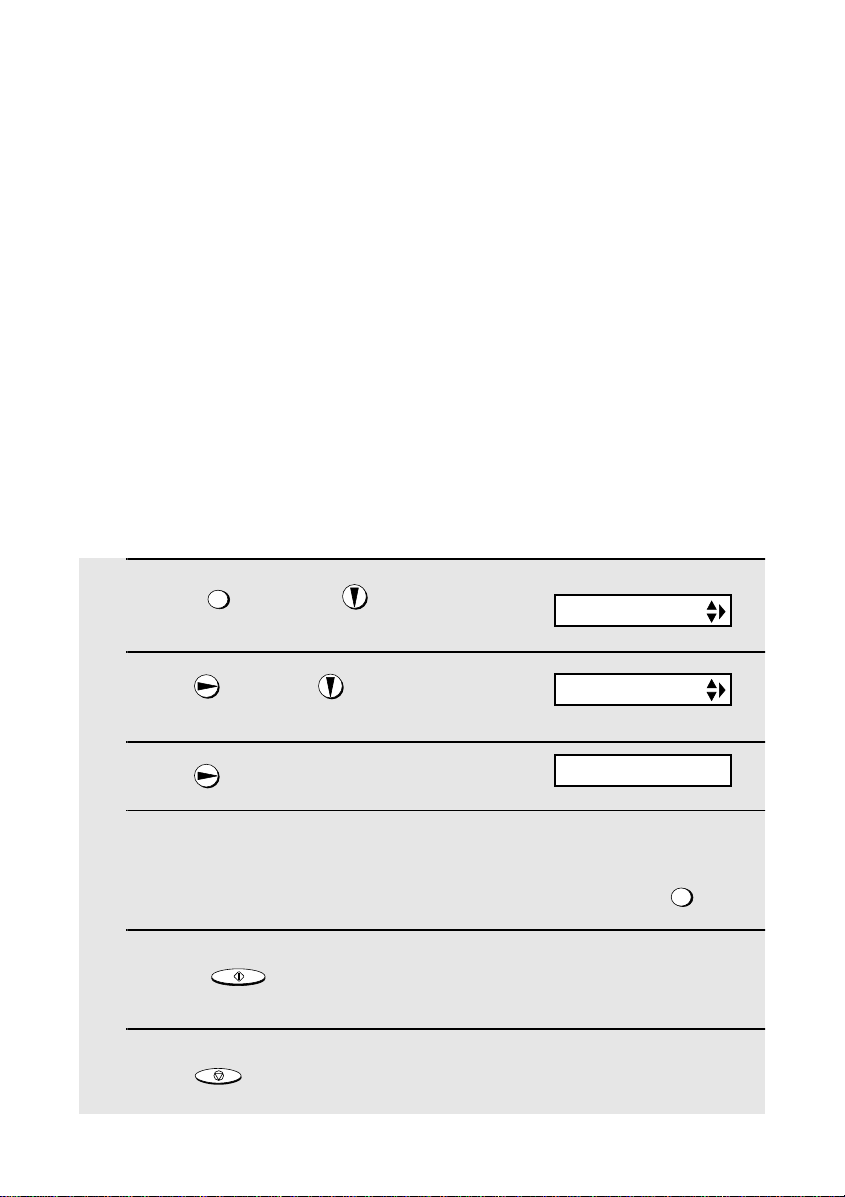
1
Press once and once.
2
Press once and 4 times.
3
Press .
4
Press the number keys to enter the transfer number.
• To insert a pause between any two digits of the number, press .
5
Press .
6
Press to return to the date and time display.
FUNCTION
FUNCTION
START/MEMORY
STOP
TRANSFER TEL #
Display:
T.A.D. SETTING
ENTER TEL #
all.bookPage32Wednesday,June4,20031:07PM
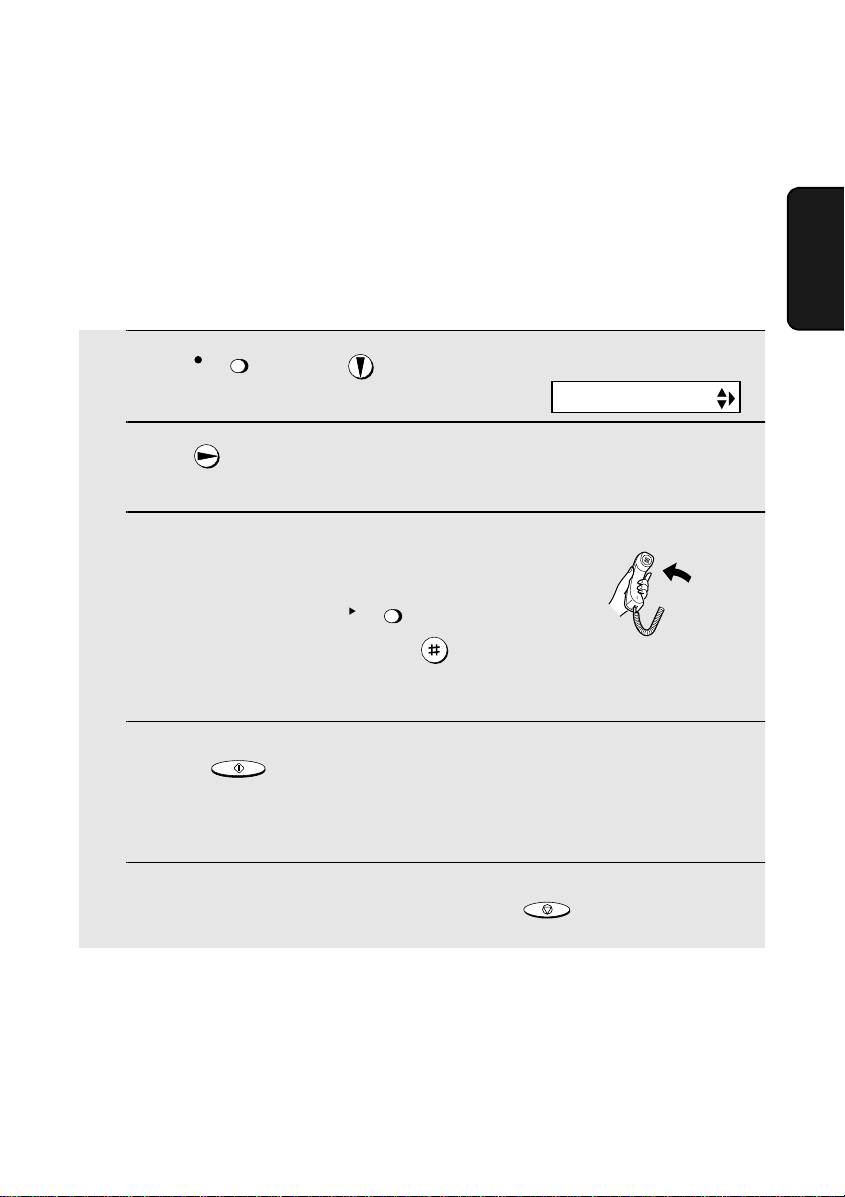
Transfer Function
33
2. Answering
Machine
Recording the transfer message
The transfer message plays when you answer the telephone, and informs you
that the call is a transfer call. It can be up to 15 seconds long. To record a
transfer message, follow the steps below. The following is an example:
“Hello. This is a transfer call for (YOUR NAME). Enter your remote code
number now.”
1
Press once and twice.
2
Press once.
3
Lift the handset.
(If you have already recorded a
message, you can press to
listen to the message, or press
to delete the message.)
4
Press and speak into the handset to record the message.
• The transfer message can be up to 15 seconds long. While recording, the
display will show the time left to record.
5
When finished, replace the handset or press .
REC/
MEMO
PLAY/
HOLD
DELETE
START/MEMORY
STOP
Display:
OGM2(TRANSFER)
all.bookPage33Wednesday,June4,20031:07PM
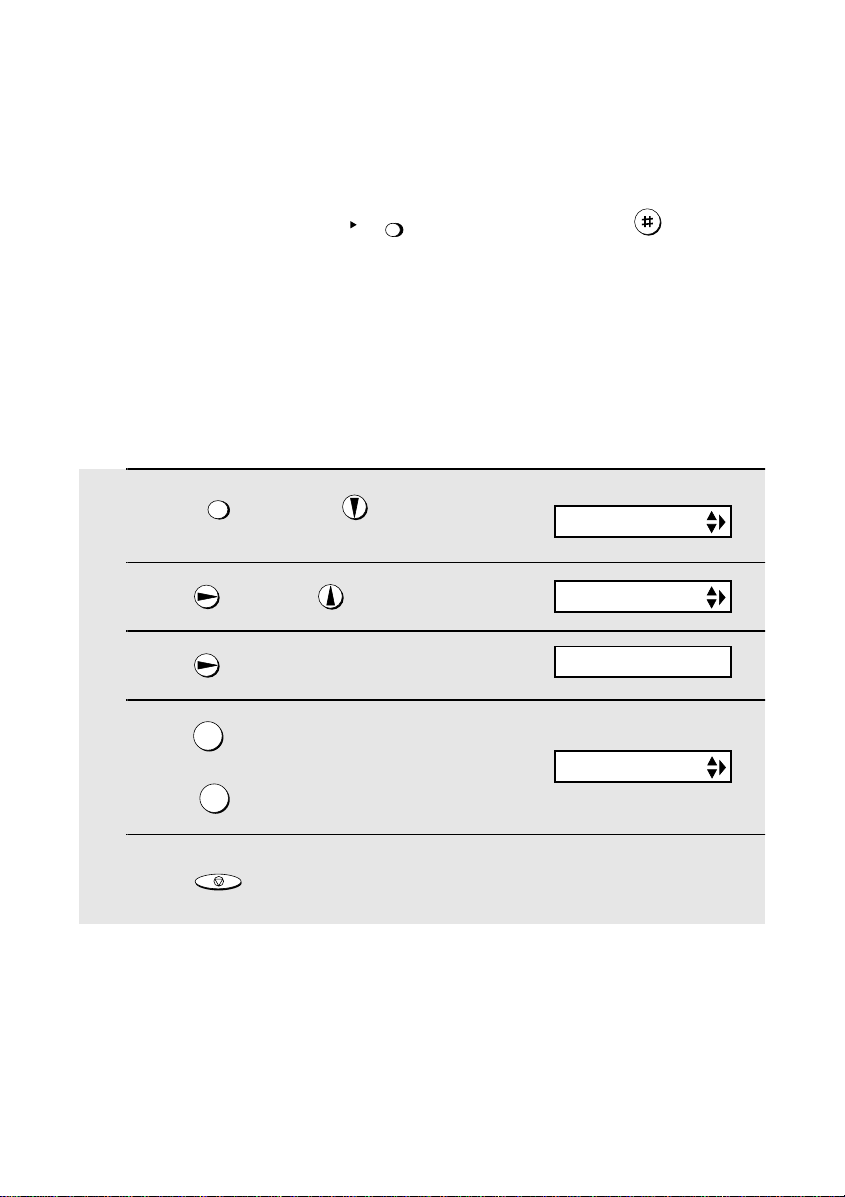
Transfer Function
34
Checking or erasing the transfer message
To check or erase the transfer message, follow Steps 1 and 2 of the above
procedure, and then press to check the message, or to erase
the message.
PLAY/
HOLD
DELETE
Turning the Transfer function on and off
When you go out and wish to use the Transfer function, turn it on as follows:
1
Press once and once.
2
Press once and 4 times.
3
Press .
4
Press to turn on the Transfer
function.
(Press to turn the function off.)
5
Press to return to the date and time display.
FUNCTION
1
2
STOP
TRANSFER FUNC
Display:
T.A.D. SETTING
1=YES, 2=NO
The display briefly shows
your selection, then:
ON TAD FAILURE
all.bookPage34Wednesday,June4,20031:07PM
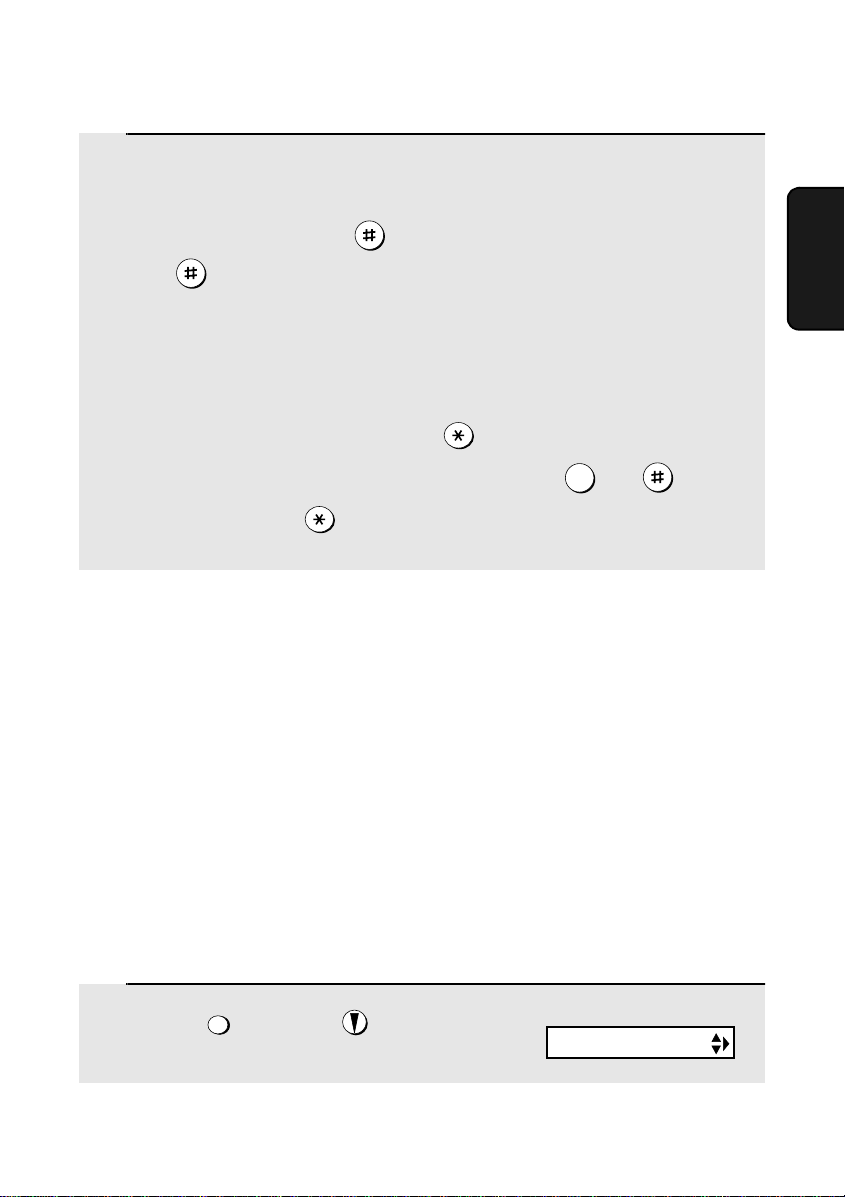
Override Ringing
35
2. Answering
Machine
6
Each time the machine receives an incoming message, it will call your
programmed transfer number. When you answer, you will hear your
recorded message telling you that the call is a transfer call. On the dial
pad of your phone, enter , your remote code number (see page 37),
and . The machine will play back your messages.
• You can also perform any of the remote operations described in
Remote
Operations
later in this chapter (see page 37).
Note: When you hang up after a transfer call, the machine will not
immediately resume normal operation. If you want the machine to accept calls
immediately after a transfer call, enter twice before hanging up (if you
want to hang up during message playback, first enter and to stop
playback, then enter twice).
0
Override Ringing
This function allows selected callers using a touch-tone telephone to override
the answering system's outgoing message and cause the machine to make a
special ringing sound, alerting you that they are calling. This is useful when
you are near the machine but only want to talk with certain callers, taking all
other calls on the answering system.
Programming the override code
To override the answering system, your callers must enter a 3-digit override
code from their telephone. This code has been set to "009" at the factory. If
you wish to change the code, press the panel keys as shown below.
Important! Make sure the override code is different from the remote code
used for remote operations.
1
Press once and once.
FUNCTION
Display:
T.A.D. SETTING
all.bookPage35Wednesday,June4,20031:07PM
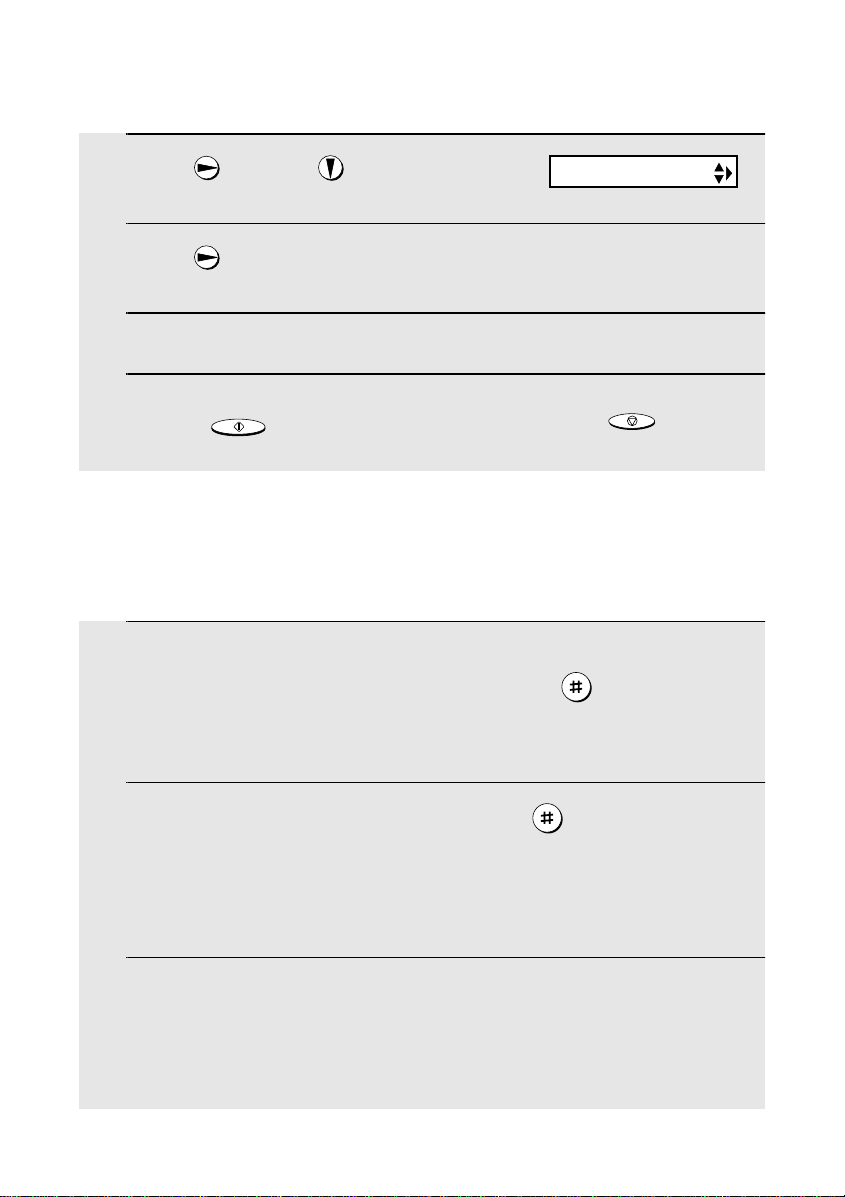
Override Ringing
36
2
Press once and 3 times.
3
Press .
4
Press the number keys to enter a 3-digit override code.
5
Press to store the override code, and then to return
to the date and time display.
START/MEMORY
STOP
OVERRIDE CODE
Overriding the answering system
Your callers should follow the steps below to override the answering system.
1
The caller calls your machine from a touch-tone telephone. When the
outgoing message begins, they should press the key on their
telephone.
• The caller will hear a short beep, and the outgoing message will stop.
2
The caller should enter the override code and by pressing the
appropriate keys on their telephone.
• If an incorrect code is entered, the caller will hear four beeps. He or she
must re-enter the correct code within 10 seconds or the line will be
disconnected.
3
Your machine will make a special ringing sound. Pick up the handset to
answer the call.
• If you do not answer within 30 seconds, the outgoing message will play
again and the caller can leave a message.
all.bookPage36Wednesday,June4,20031:07PM
Remote Operations
37
2. Answering
Machine
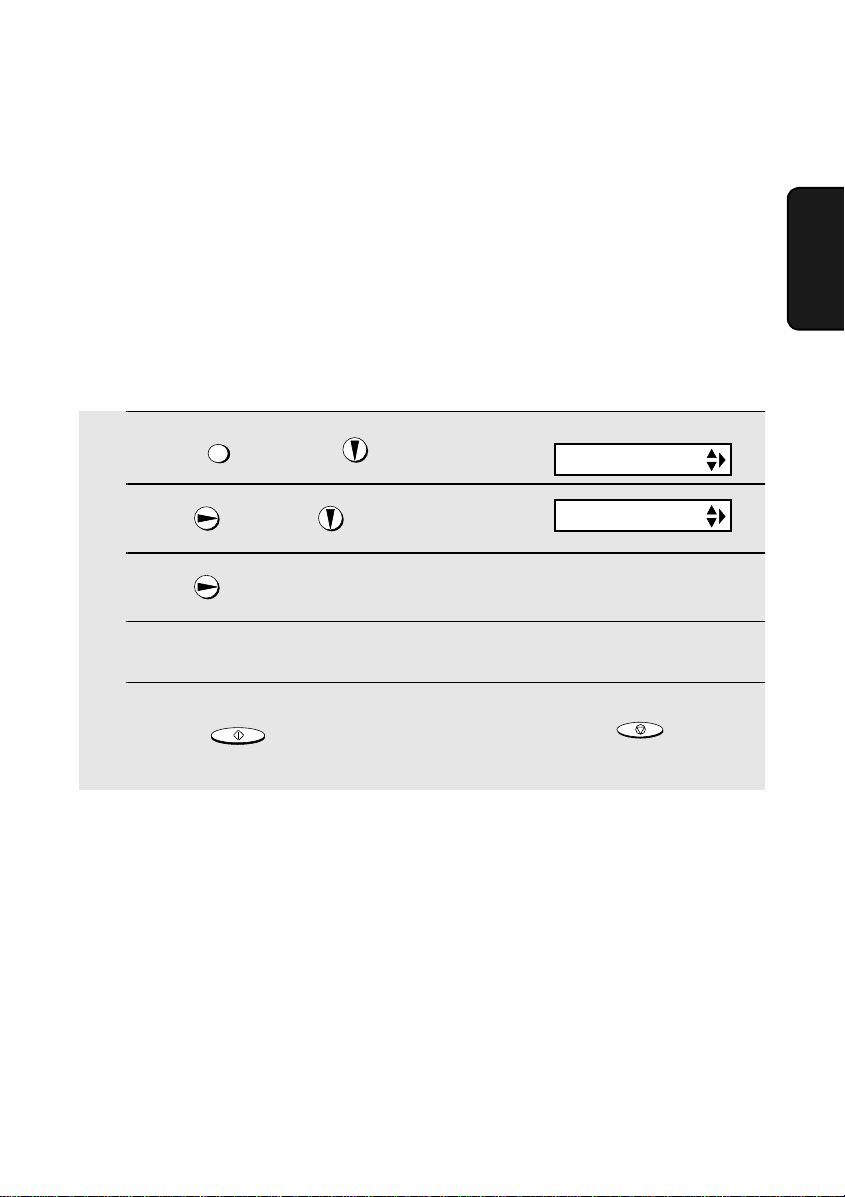
1
Press once and once.
2
Press once and twice.
3
Press .
4
Press the number keys to enter a 3-digit remote code number.
5
Press to store the remote number, and then to return
to the date and time display.
FUNCTION
START/MEMORY
STOP
Remote Operations
When you are out, you can call the machine from any touch-tone telephone
and play back your messages using the remote commands. You can also use
these commands to change the reception mode and other settings.
Remote code number
To access the machine to perform remote operations, you must first enter your
remote code number. The remote code number has been set to "001" at the
factory. If you wish to use a different number, follow these steps:
Display:
T.A.D. SETTING
REMOTE CODE
Toll Saver
When you call the machine to listen to your messages, it will answer after two
rings if it has received at least one message, or after four rings if it has not
received any messages.
This allows you to save money on telephone charges, particularly if you are
calling long distance. If the machine does not answer after the second ring,
you can simply hang up before it answers, saving yourself the cost of that call.
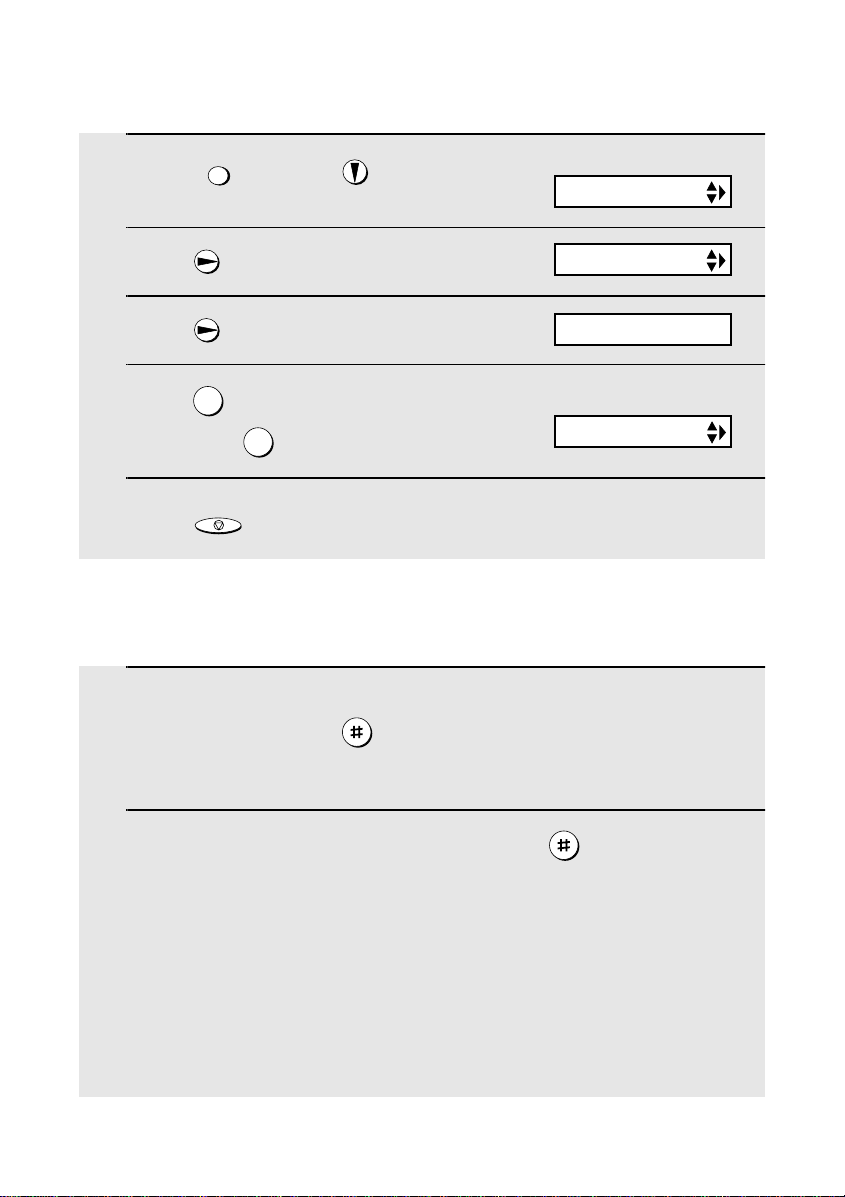
If you do not want to use the Toll Saver function, you can turn it off by following
the steps below. In this case, the machine will answer after the number of
rings set with the NUMBER OF RINGS setting (see
Changing the number of
rings
on page 59).
all.bookPage37Wednesday,June4,20031:07PM
Remote Operations
38
1
Press once and once.
2
Press once.
3
Press once.
4
Press to turn on the Toll Saver
function, or to turn it off.
5
Press to return to the date and time display.
FUNCTION
1
2
STOP
TOLL SAVER
Display:
T.A.D. SETTING
1=YES, 2=NO
The display briefly shows
your selection, then:
RECORDING TIME
Retrieving your messages
1
Call the machine from a touch-tone telephone. When your outgoing
message begins, press on the telephone.
• You will hear a short beep, and the outgoing message will stop.
2
Enter your remote code number and then press .
• You will hear a series of beeps equal to the number of messages recorded,
or one long beep if four or more messages have been received. The
machine will then play back the messages, beeping once at the end of each
message. When all messages have been played back, you will hear a long
beep.
• If no messages have been received, you will hear a short beep. You can
either hang up, or perform any of the operations described in the following
section,
Other remote operations
.
all.bookPage38Wednesday,June4,20031:07PM
Remote Operations
39
2. Answering
Machine
3
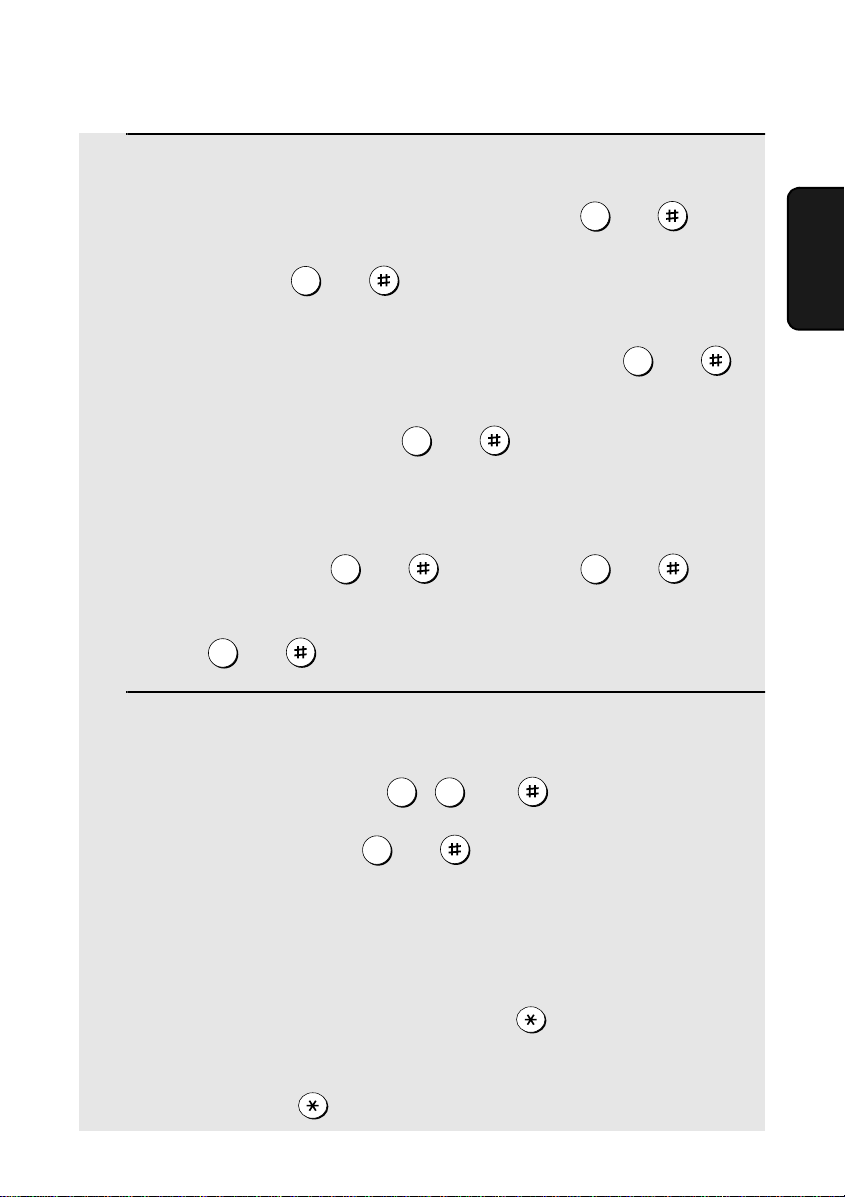
While the messages are playing, you can do any of the following:
• Repeat: To listen to a message a second time, press and on the
telephone before that message ends. To move back to the previous
message, press and during the first 3 seconds of the current
message.
• Skip forward: To skip forward to the next message, press and
on the telephone.
• Stop: To stop playback, press and on the telephone. After this,
you can enter any of the commands described in the following section,
Other remote operations
.
• Play new messages: To listen to only your new messages, first stop
playback by pressing and , and then press and .
• Erase a message: To erase the message you are currently listening to,
press and before it ends.
4
When you have finished listening to your messages, you can do any of
the following:
• Erase all messages: Press , , and .
• Repeat playback: Press and .
• Perform other operations: You can enter any of the commands described
in the following section,
Other remote operations
.
• Hang up: If you do not erase your messages first, they will be saved and
any new messages will be recorded after them. If you want the machine to
resume normal operation immediately, press twice before hanging up
(in some cases, particularly when the Transfer function is used, the
machine may not accept new calls for one or two minutes after you hang up
unless you press twice).
2
2
5
0
0 6
3
3 3
7
all.bookPage39Wednesday,June4,20031:07PM
Remote Operations
40
Note: You can also call the machine and perform remote operations when the
reception mode is set to FAX. In this case, when you call the machine, press
immediately after it answers (before you hear the fax tone), and then
continue from Step 2 above.
Comments:
♦ When a remote command is accepted by the machine, you will hear one
beep. If an incorrect command is entered, you will hear four beeps. In the
latter case, re-enter the correct command.
♦ When entering a command, do not pause longer than 10 seconds between
each digit. If you do, you will hear a 4-beep error signal and the digits
entered up to that point will be cleared. In this case, re-enter the command
from the beginning.
♦ If you pause for longer than 10 seconds before entering a command, or
make two errors while entering your remote code number, the line will be
disconnected. (This prevents unauthorized people from attempting to
guess your remote code number.)
Other remote operations
After listening to your messages, you can perform any of the following
operations by pressing the appropriate keys on the telephone.
Note: The following commands cannot be entered while messages are being
played back. If you do not want to wait until playback ends to enter a
command, first stop playback by pressing and , and then enter the
command.
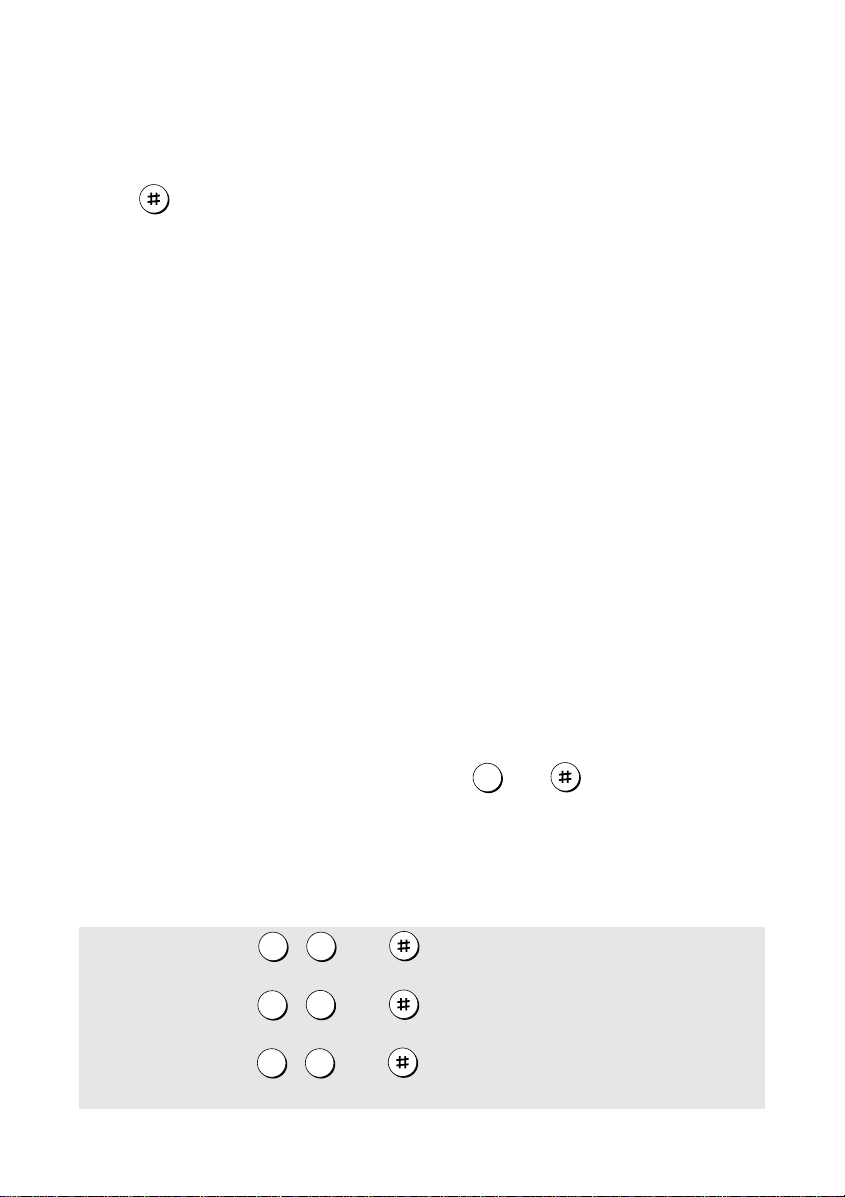
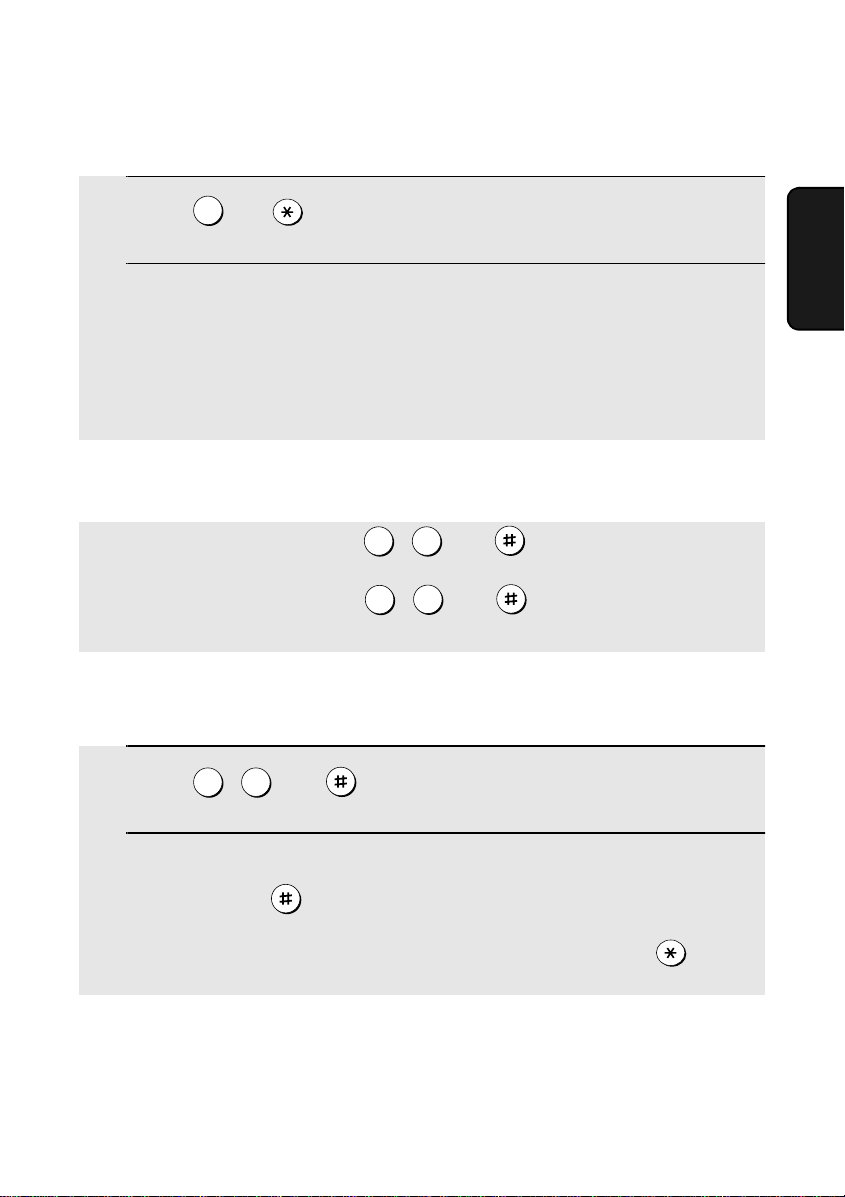
Changing the fax reception mode
Select a new reception mode by pressing the keys as follows:
0
♦ TAD mode: , , and .
♦ FAX mode: , , and .
♦ TEL mode: , , and .
8 1
8
2
8 3
Caution: If you select TEL mode,
you will not be able to change the
reception mode again.
all.bookPage40Wednesday,June4,20031:07PM
Remote Operations
41
2. Answering
Machine
Recording a new outgoing message
1
Press and on the telephone.
2
When you hear a short beep, speak into the telephone to record the new
message.
• The message can be up to 15 seconds long. After 15 seconds (or earlier if
the machine detects silence after you finish speaking), you will hear a beep,
and the new message will be played back.
4
Turning the Transfer function on or off
To turn Transfer on: Press , , and on the telephone.
To turn Transfer off: Press , , and on the telephone.
9 1
9
2
Changing the transfer telephone number
1
Press , , and on the telephone.
2
After you hear a short beep, enter the new telephone number. When
finished, press .
• To insert a pause between any two digits of the number, press .
9 0
all.bookPage41Wednesday,June4,20031:07PM
Remote Operations
42
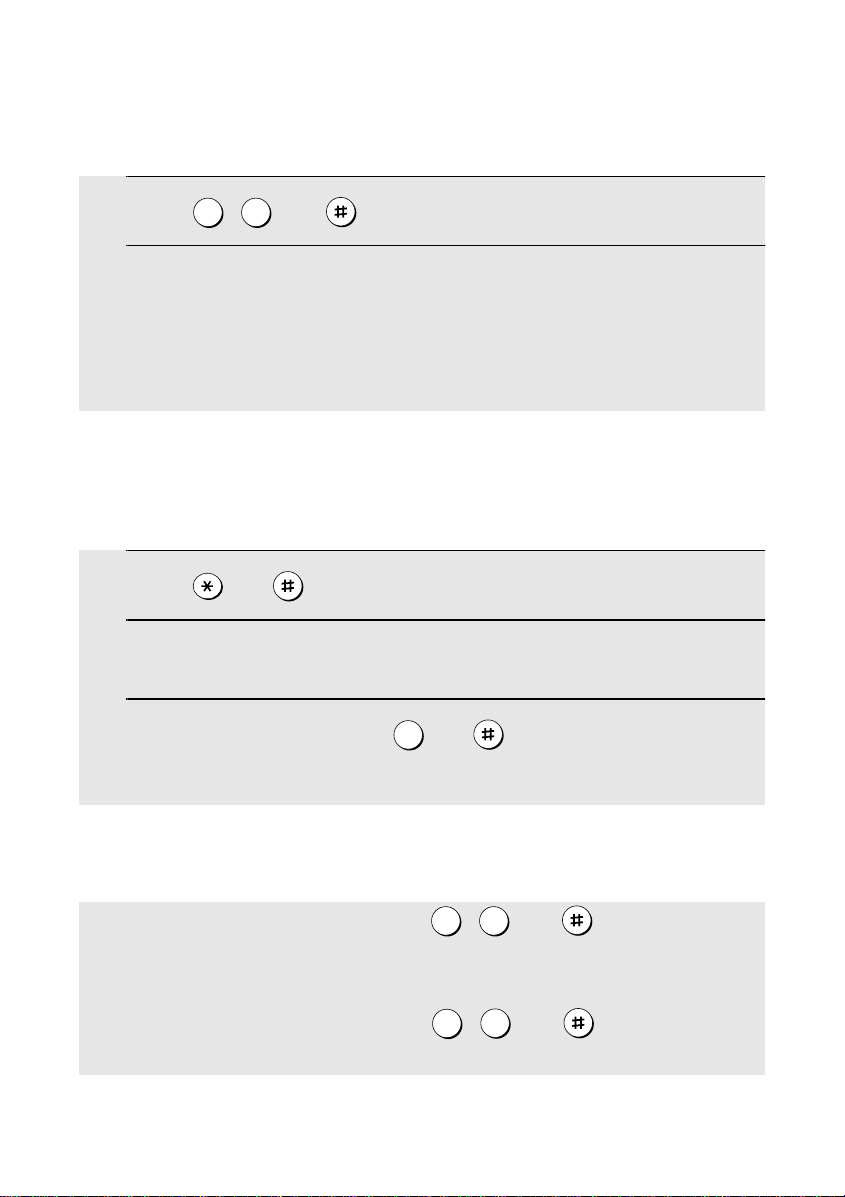
Recording a "Memo"
You can record a "memo" for yourself or other users of the machine. The
memo will be played back when incoming messages are listened to.
1
Press and on the telephone.
2
When you hear a short beep, speak into the telephone to record the
memo.
3
When you are finished, press and on the telephone.
• If the machine detects silence, it will stop recording automatically.
0
Recording a new transfer message
1
Press , , and on the telephone.
2
When you hear a short beep, speak into the telephone to record the new
message.
• The time for the transfer message is fixed at 15 seconds. After 15 seconds
(or earlier if the machine detects silence after you finish speaking), you will
hear a beep, and the new message will be played back automatically.
9 3
OGM only mode
To turn on OGM only mode: Press , , and on the telephone.
(Your outgoing message will play, but callers will not be able to record a
message. Faxes sent by automatic dialling will be received)
To turn off OGM only mode: Press , , and on the telephone.
1 1
1
2
all.bookPage42Wednesday,June4,20031:07PM
43
3. Sending
Faxes
3. Sending Faxes
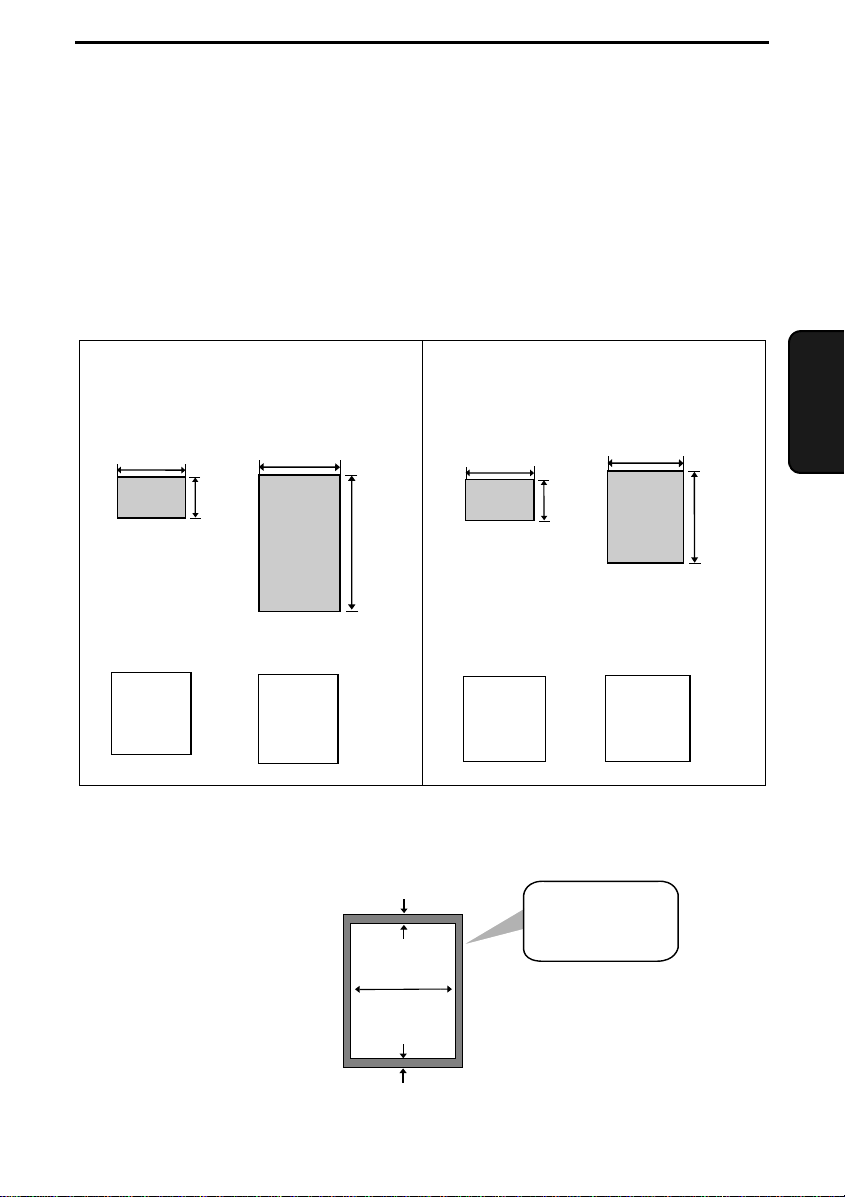
Transmittable Documents
Size and weight
The size and weight of documents that you can load in the document feeder
depend on whether you load one page at a time or several pages at once.
Note: Letters or graphics on the edges of a document will not be scanned.
Letters in the
shaded area will
not be scanned.
8.5"
(216 mm)
23.6"
(600 mm)
14 lbs.
(52 g/m² )
42 lbs.
(157 g/m²)
11"
(279 mm)
8.5"
(216 mm)
21.5 lbs.
(80 g/m²)
Loading one page at a time:
Minimum size
Maximum size
Minimum weight Maximum weight
Minimum size Maximum size
Minimum weight Maximum weight
14 lbs.
(52 g/m² )
Loading up to 10 pages at once:
5.5"
(140 mm)
5.8"
(148 mm)
5.5"
(140 mm)
5.8"
(148 mm)
8.3"(210 mm)
0.2"(5 mm)
0.2"(5 mm)
Note: The full width of
documents less than
8.3” (210 mm) wide is
scanned.
all.bookPage43Wednesday,June4,20031:07PM
Loading the Document
44
Other restrictions
♦ The scanner cannot recognize yellow, greenish yellow, or light blue ink.
♦ Ink, glue, and correcting fluid on documents must be dry before they pass
through the document feeder.
♦ All clips, staples, and pins must be removed from documents before loading
in the feeder. If these are not removed, they may damage the machine.
♦ Documents which are patched, taped, torn, smaller than the minimum size,
carbon backed, easily smudged, or have a slippery coated surface should
be photocopied, and the copy loaded in the feeder.
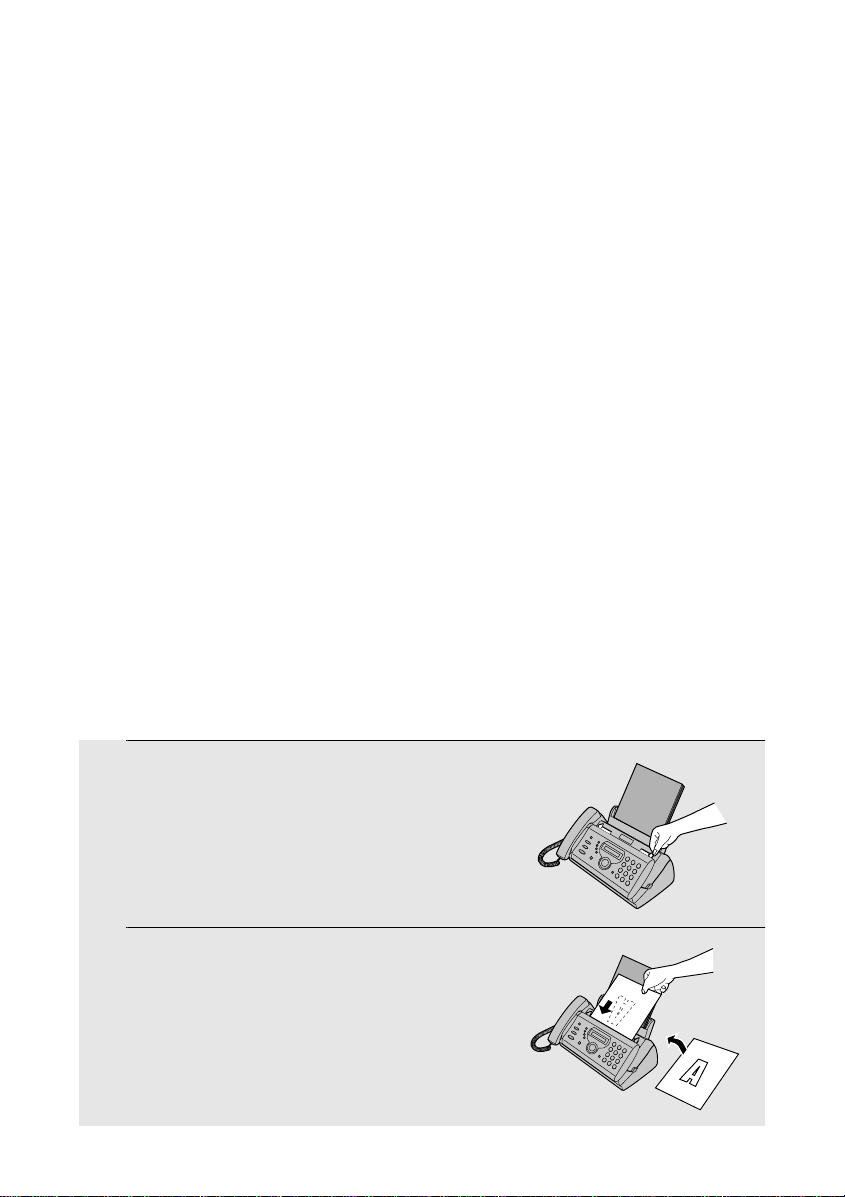
Loading the Document
Up to 10 pages can be placed in the feeder at one time. The pages will
automatically feed into the machine starting from the bottom page.
♦ If you need to send or copy more than 10 pages, place the additional pages
gently and carefully in the feeder just before the last page is scanned. Do
not try to force them in, as this may cause double-feeding or jamming.
♦ If your document consists of several large or thick pages which must be
loaded one at a time, insert each page into the feeder as the previous page
is being scanned. Insert gently to prevent double-feeding.
1
Adjust the document guides to the
width of your document.
2
Insert the document face down in the
document feeder. The top edge of the
document should enter the feeder first.
• READY TO SEND will appear in the
display.
all.bookPage44Wednesday,June4,20031:07PM
Adjusting the Resolution and Contrast
45
3. Sending
Faxes
Adjusting the Resolution and Contrast
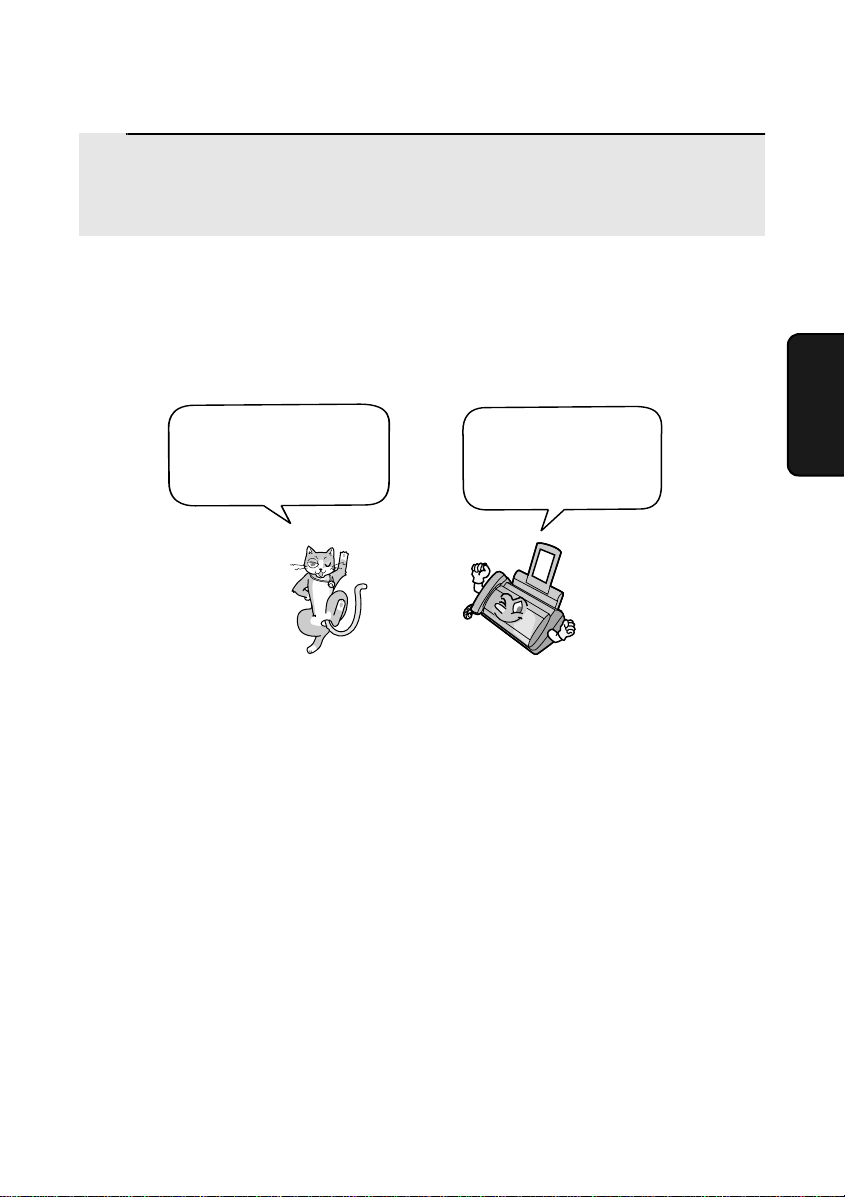
If desired, you can adjust the resolution and contrast before sending a
document.
Note: The resolution and contrast settings are only effective for sending a
document. They are not effective for receiving a document.
Resolution settings
STANDARD Use STANDARD for ordinary documents. This
setting gives you the fastest and most
economical transmission.
FINE Use FINE for documents containing small letters
or fine drawings.
SUPER FINE Use SUPER FINE for documents containing
very small letters or very fine drawings.
HALF TONE Use HALF TONE for photographs and
illustrations. The original will be reproduced in
64 shades of gray.
You must adjust the
settings each time
you don’t want to use
the default settings.
The default resolution
setting is STANDARD
and the default contrast
setting is AUTO.
3
Adjust the resolution and/or contrast settings as explained in
Resolution and Contrast
below, then dial the receiving machine as
explained on page 46.
all.bookPage45Wednesday,June4,20031:07PM
Adjusting the Resolution and Contrast
46
Note: In order to transmit in SUPER FINE resolution, the receiving fax machine
must also have that resolution. If it doesn’t, your machine will automatically step
down to the next best available setting.
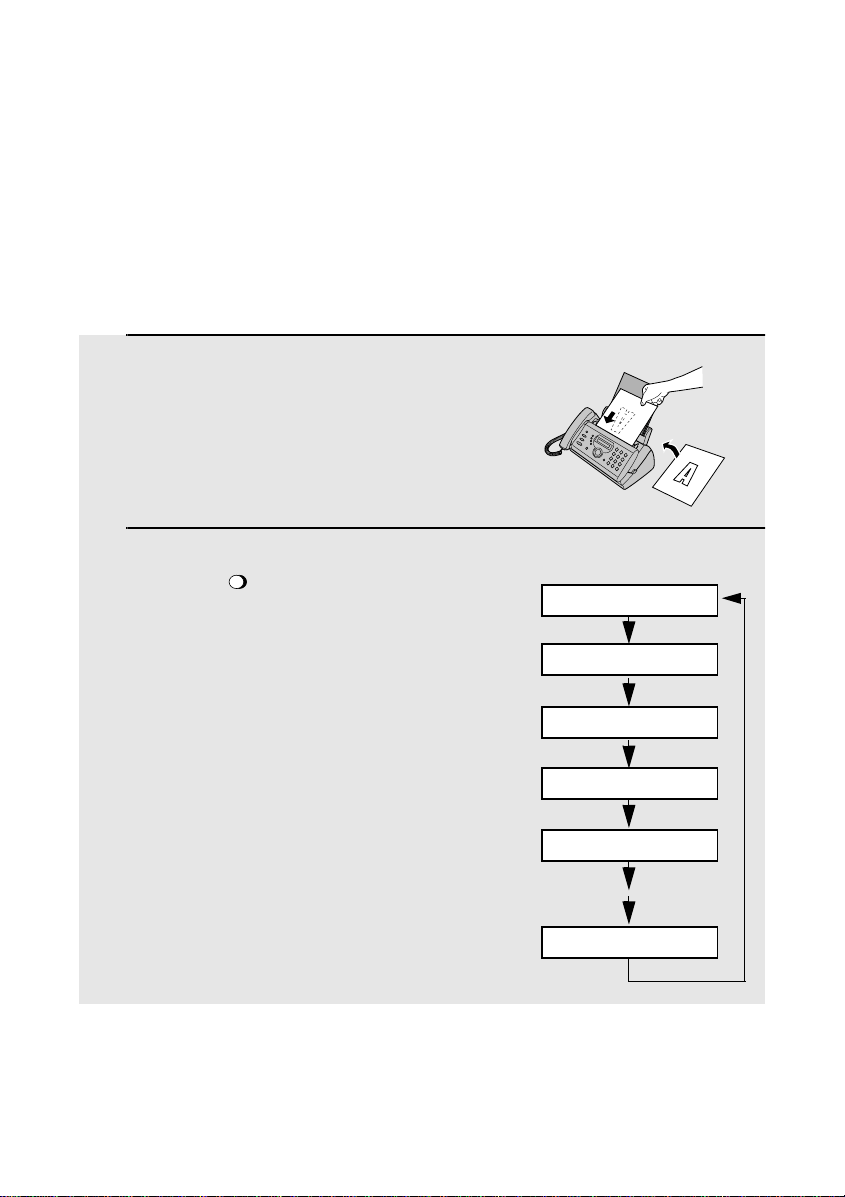
1
Load the document(s).
• The document must be loaded before
the resolution and contrast can be
adjusted.
2
Press one or more times
until the desired resolution and
contrast settings appear in the display.
• The first time you move through the list
of resolution settings, the contrast
setting AUTO will appear next to each
resolution setting. The second time you
move through the list, the contrast
setting DARK will appear.
RESOLUTION/
RECEPTION MODE
Display:
STANDARD :AUTO
FINE :AUTO
SUPER FINE :AUTO
HALF TONE :AUTO
STANDARD :DARK
HALF TONE :DARK
Contrast settings
AUTO Use AUTO for normal documents.
DARK Use DARK for faint documents.
all.bookPage46Wednesday,June4,20031:07PM
Sending a Fax by Normal Dialing
47
3. Sending
Faxes
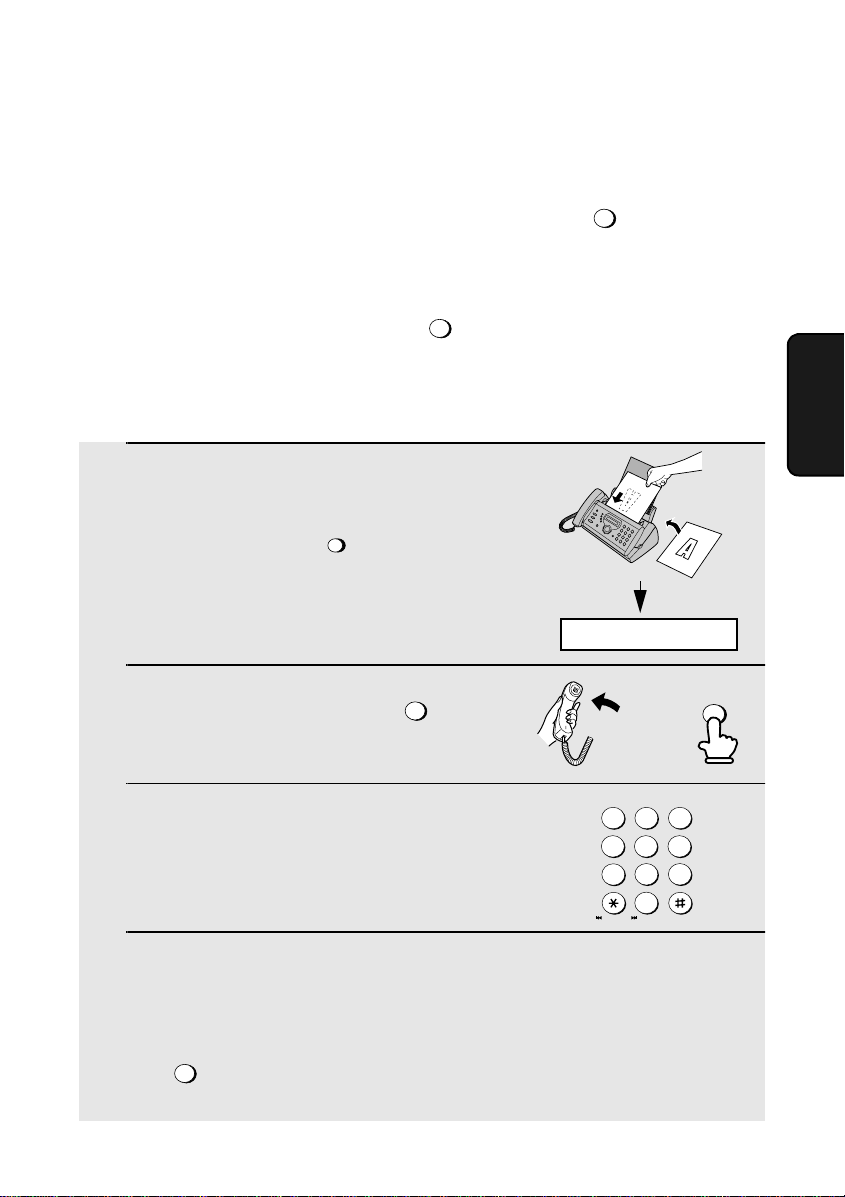
1
Load the document(s).
• If desired, press to set the
resolution and/or contrast.
2
Pick up the handset or press .
Listen for the dial tone.
3
Dial the number of the receiving
machine by pressing the number keys.
4
Wait for the connection. Depending on the setting of the receiving
machine, you will either hear a fax tone or the other person will answer.
• If the other party answers, ask them to press their Start key (if you pressed
, pick up the handset to speak with them). This causes the receiving
machine to issue a fax tone.
RESOLUTION/
RECEPTION MODE
SPEAKER
SPEAKER
or
Sending a Fax by Normal Dialing
With Normal Dialing, you pick up the handset (or press ) and dial by
pressing the number keys.
♦ If a person answers, you can talk with them through the handset before
sending the fax. (If you pressed , you must pick up the handset to
talk.)
♦ Normal Dialing allows you to listen to the line and make sure the other fax
machine is responding.
SPEAKER
SPEAKER
JKL
ABC
1
DEF
WXYZ
9
GHI
4
5
MNO
6
PQRS
7
TUV
8
0
2 3
DELETE
REPEAT
SKIP
READY TO SEND
SPEAKER
all.bookPage47Wednesday,June4,20031:07PM
Sending a Fax by Automatic Dialing
48
Sending a Fax by Automatic Dialing
You can store up to 40 fax or phone numbers in the machine for automatic
dialing. When you store a number, you select a two-digit Speed Dial number
for it.
♦ Auto-dial numbers are dialed by pressing , entering the two-digit
Speed Dial number, and then pressing .
♦ You can also search for an auto-dial number by pressing or until
the desired number appears in the display, and then to dial it.
Storing fax and phone numbers for automatic dialing
SPEED
START/MEMORY
START/MEMORY
1
Press once and once.
FUNCTION
5
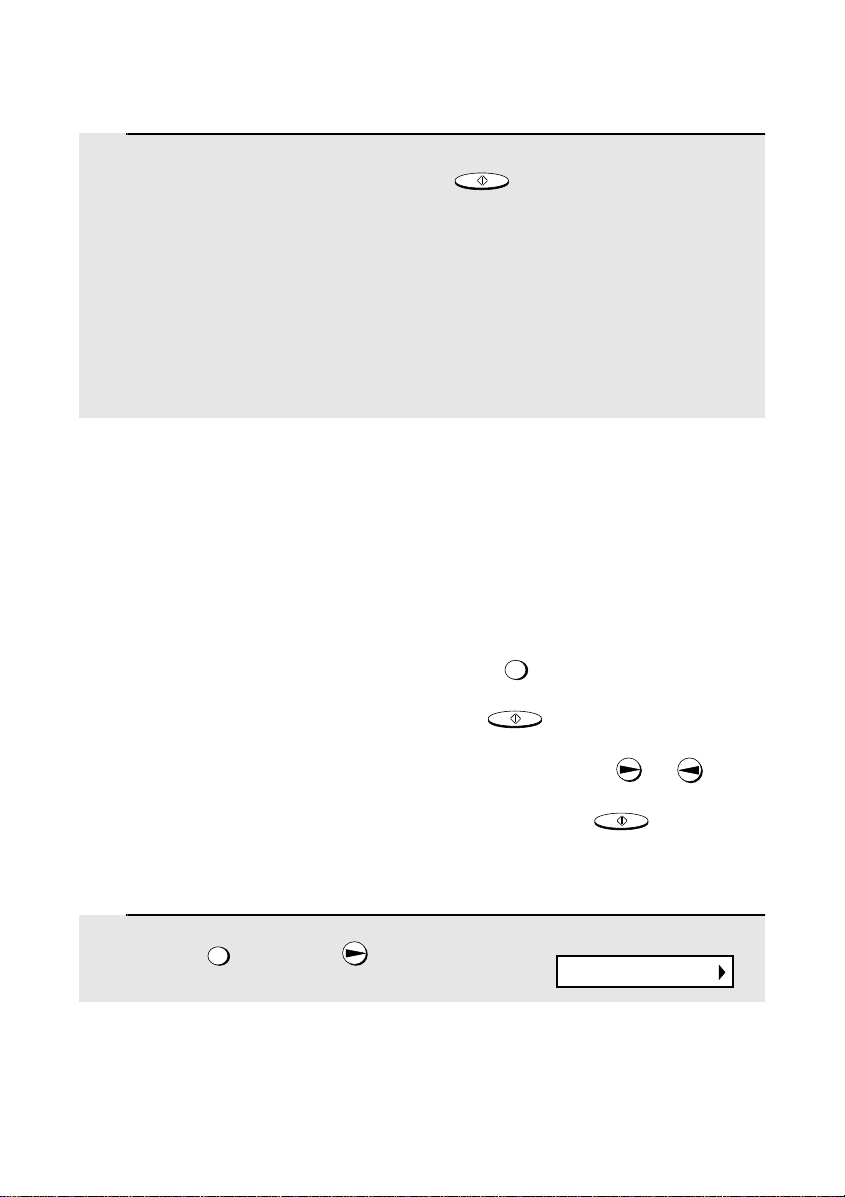
When you hear the fax tone, press . Replace the handset.
• If the transmission is completed successfully, the fax will beep once.
• If an error occurs, the fax will beep three times and print a Transaction
Report to inform you of the problem (see page 77).
Note: If the transmission is unsuccessful and DOCUMENT JAMMED appears
in the display, remove the document as explained on page 89. (This may
occur if the other fax machine doesn’t respond properly when you attempt to
send the document.)
START/MEMORY
Display:
<NEW NUMBER>
all.bookPage48Wednesday,June4,20031:07PM
Sending a Fax by Automatic Dialing
49
3. Sending
Faxes
2
If you know the Speed Dial number that
you want to use, enter that number (for
example, press for Speed
Dial 01).
Otherwise, press once.
3
Enter the fax or voice number by pressing the number keys.
(Note: A space cannot be entered.)
• To clear a mistake, press .
• If a pause is required between any of the digits to access a special service
or an outside line, press . The pause appears as a hyphen (two
seconds per pause). Several pauses can be entered in a row.
4
Press .
5
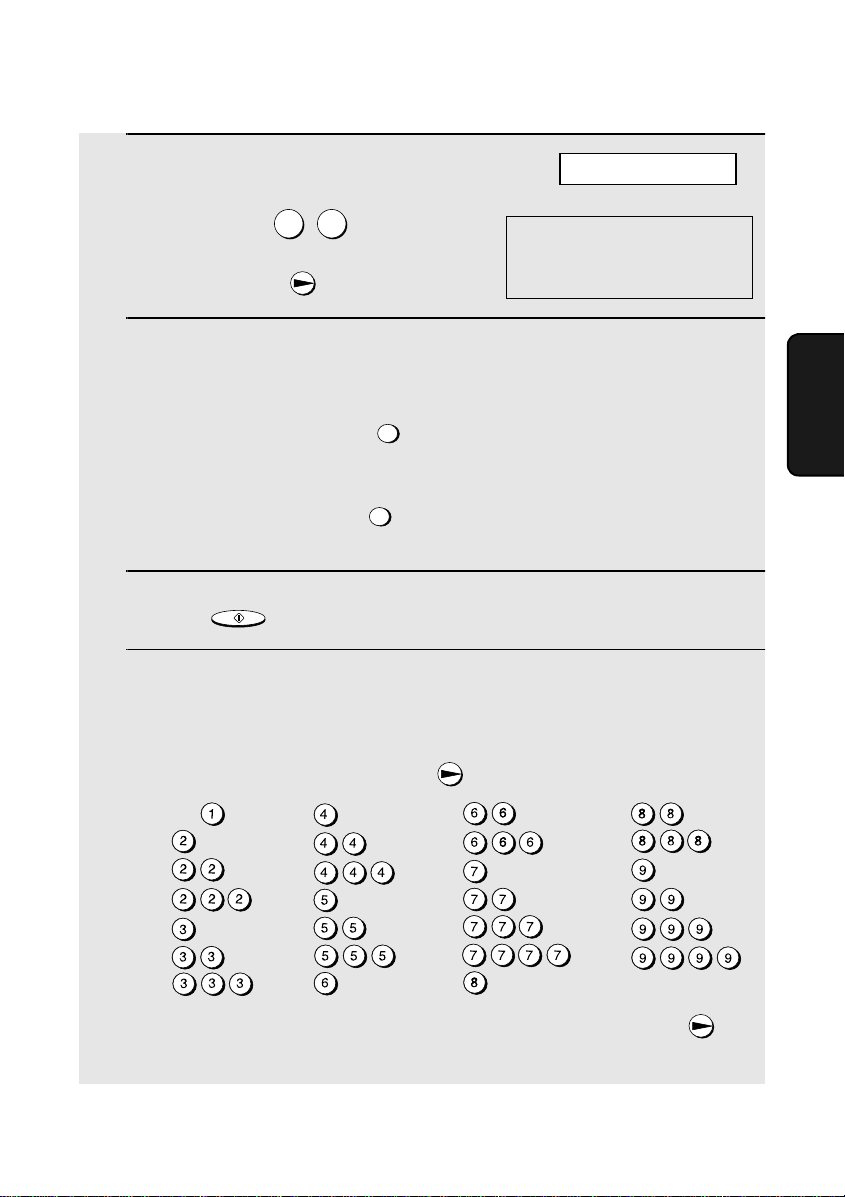
Enter a name by pressing number keys for each letter as shown in the
chart below. Up to 15 characters can be entered. (If you do not wish to
enter a name, go directly to Step 6.)
Example: SHARP = 7777 44 2 777 7
♦ To enter two letters in succession that require the same key, press
after entering the first letter.
0 1
SPEAKER
FUNCTION
START/MEMORY
A =
B =
C =
D =
E =
F =
G =
H =
I =
J =
K =
L =
M =
N =
O =
P =
Q =
R =
S =
T =
U =
V =
W =
X =
Y =
Z =
SPACE =
ENTER FAX #
Any number from 01 to 40 can
be selected as a Speed Dial
number. The number must be 2
digits long (01, 02, 10, etc.).
all.bookPage49Wednesday,June4,20031:07PM
Sending a Fax by Automatic Dialing
50
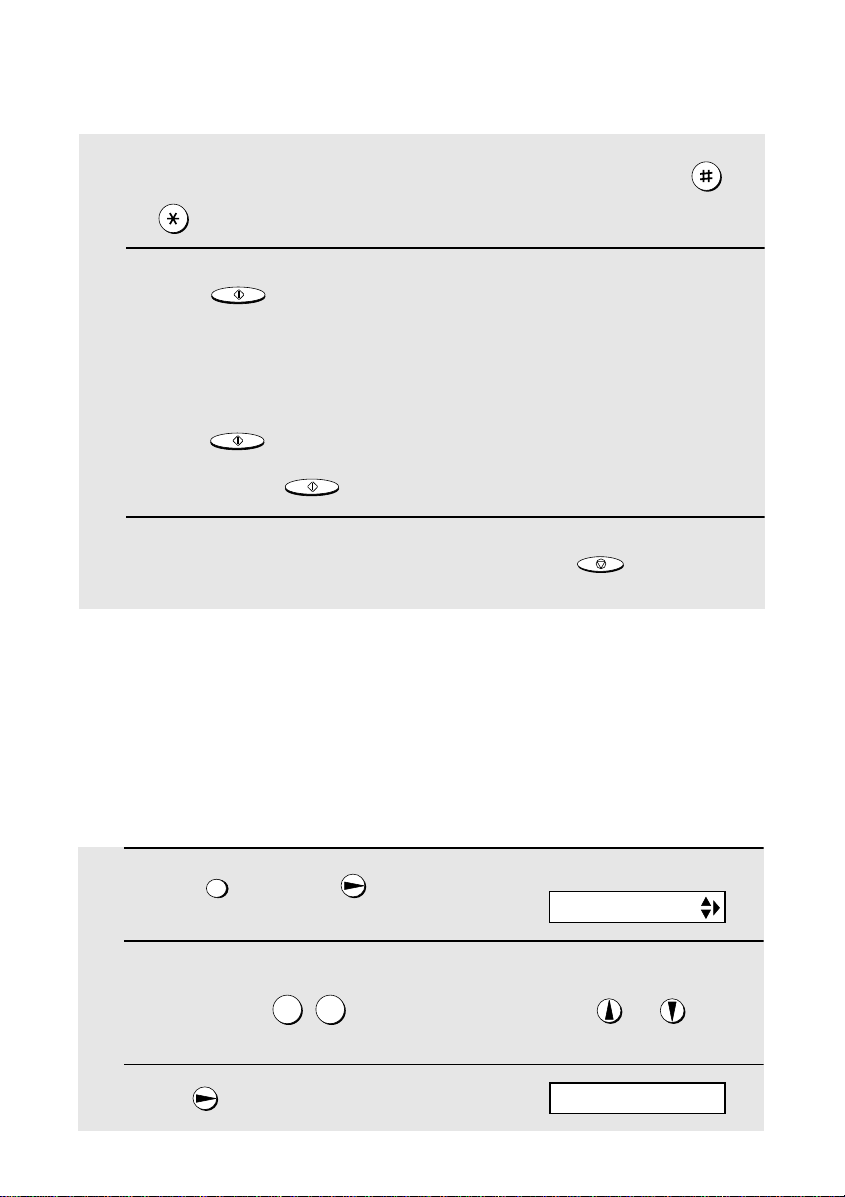
♦
To enter a lower case letter, continue pressing the key for the letter until the
lower case letter appears. To enter one of the following symbols, press or
repeatedly: . / ! " # $ % & ’ ( )
+
+ , - : ; < = > ? @ [ ¥ ] ^ _ ' { | }
) (
6
Press .
If you selected a Speed Dial number in Step 2, the display will briefly
show STORED, and then <NEW NUMBER>. Go to Step 7.
If you did not select a Speed Dial number in Step 2, the display will show
the next available Speed Dial number. If that number is acceptable,
press and go to Step 7. If not, enter the desired two digit
number, press , and go to Step 7.
7
Return to Step 2 to store another number, or press to return to
the date and time display.
START/MEMORY
START/MEMORY
START/MEMORY
STOP
Note: The fax machine uses a lithium battery to keep automatic dialing numbers
and other programmed information in memory when the power is turned off.
Battery power is consumed primarily when the power is off. With the power kept
continuously off, the life of the battery is about 5 years. If the battery dies, have
your dealer or retailer replace it. Do not try to replace it yourself.
Editing and clearing auto-dial numbers
If you need to make changes to a previously stored auto-dial number, or clear
a number, follow these steps:
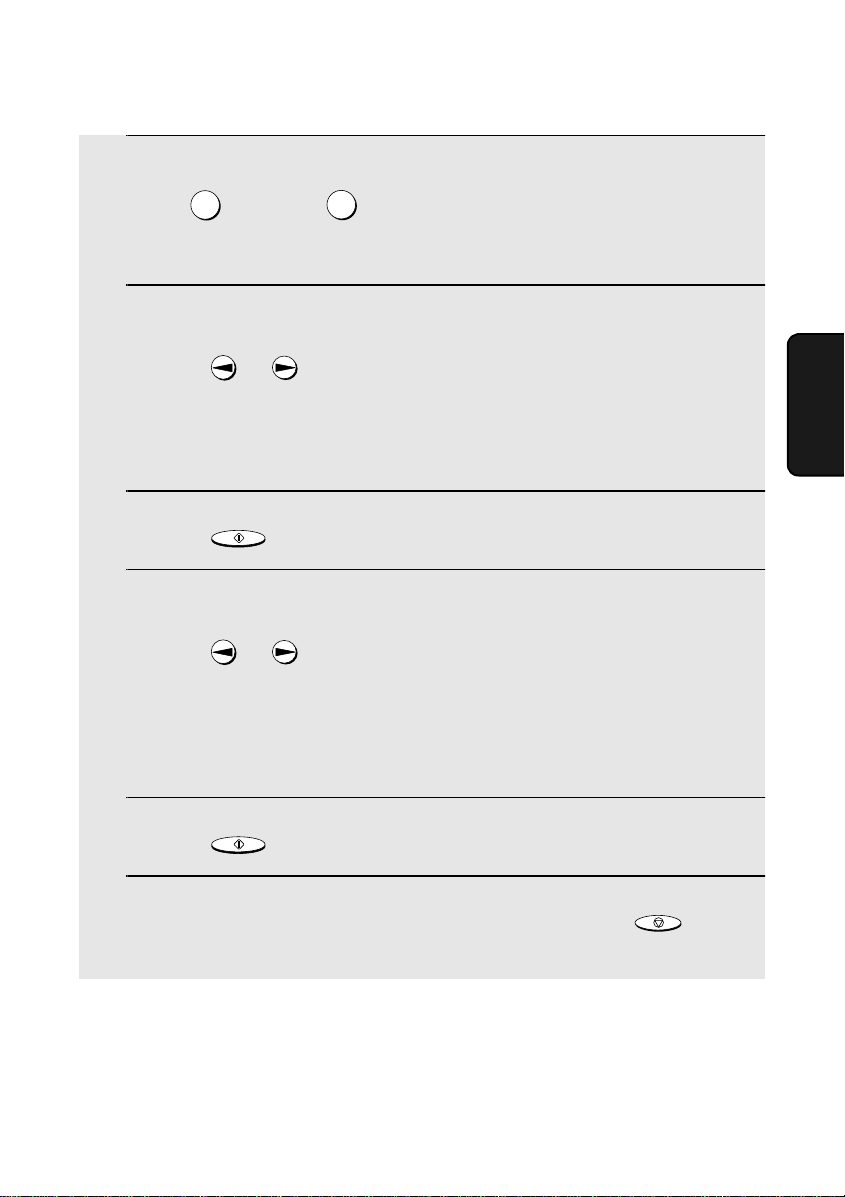
1
Press once and once.
2
Enter the 2-digit Speed Dial number that you wish to edit or clear (for
example, press for Speed Dial 01), or press or until
the number you wish to edit or clear appears in the display.
3
Press .
FUNCTION
0 1
Display:
1=EDIT, 2=CLEAR
<NEW NUMBER>
all.bookPage50Wednesday,June4,20031:07PM
Sending a Fax by Automatic Dialing
51
3. Sending
Faxes
4
Select EDIT or CLEAR:
EDIT: CLEAR:
• If you selected CLEAR, go to Step 8.
5
If you selected EDIT, make the desired changes to the number.
• Press or to move the cursor to the digit or digits you wish to
change, and then enter the new digit. The new digit will replace the old
digit.
• If you do not wish to change the number, go directly to Step 6.
6
Press .
7
Make the desired changes to the name.
• Press or to move the cursor to the letter or letters you wish to
change, and then press the appropriate number key repeatedly until the
desired letter appears (see Step 5 on page 49). The new letter will replace
the old letter.
• If you do not wish to change the name, go directly to Step 8.
8
Press .
9
Return to Step 2 to edit or clear another number, or press to
return to the date and time display.
1
2
START/MEMORY
START/MEMORY
STOP
all.bookPage51Wednesday,June4,20031:07PM
Sending a Fax by Automatic Dialing
52
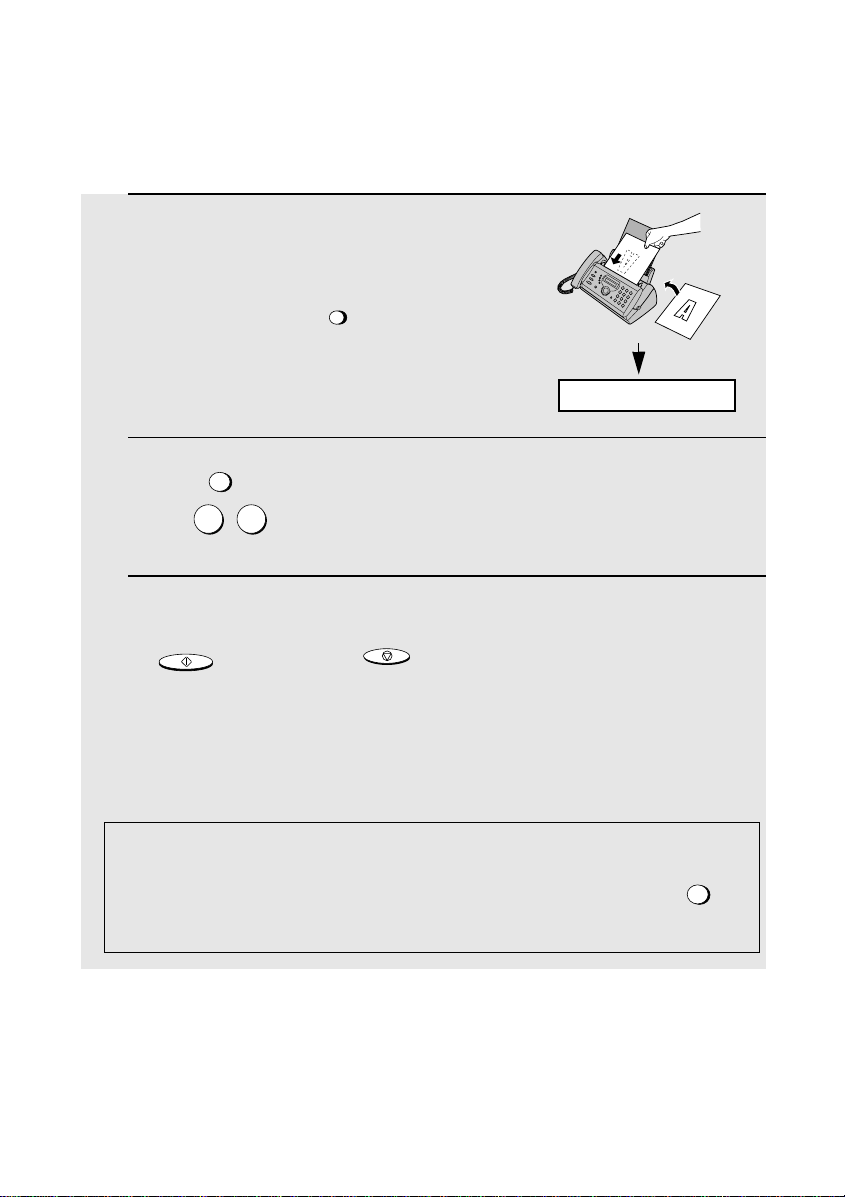
Dialing an auto-dial number with the SPEED key
1
If you are sending a fax, load the
document(s).
• If desired, press to set the
resolution and/or contrast.
2
Press and then enter the 2-digit Speed Dial number (for example,
press ).
3
Check the display. If the name or number shown is correct, press
. (If not, press and repeat Step 2.)
• If the transmission is completed successfully, the fax will beep once.
• If an error occurs, the fax will beep three times and print a Transaction
Report to inform you of the problem (see page 77).
Using a Speed Dial number for a voice call
To use a Speed Dial number for a voice call, lift the handset, press ,
and enter the Speed Dial number.
RESOLUTION/
RECEPTION MODE
SPEED
0 1
START/MEMORY
STOP
SPEED
READY TO SEND
all.bookPage52Wednesday,June4,20031:07PM
Sending a Fax by Automatic Dialing
53
3. Sending
Faxes
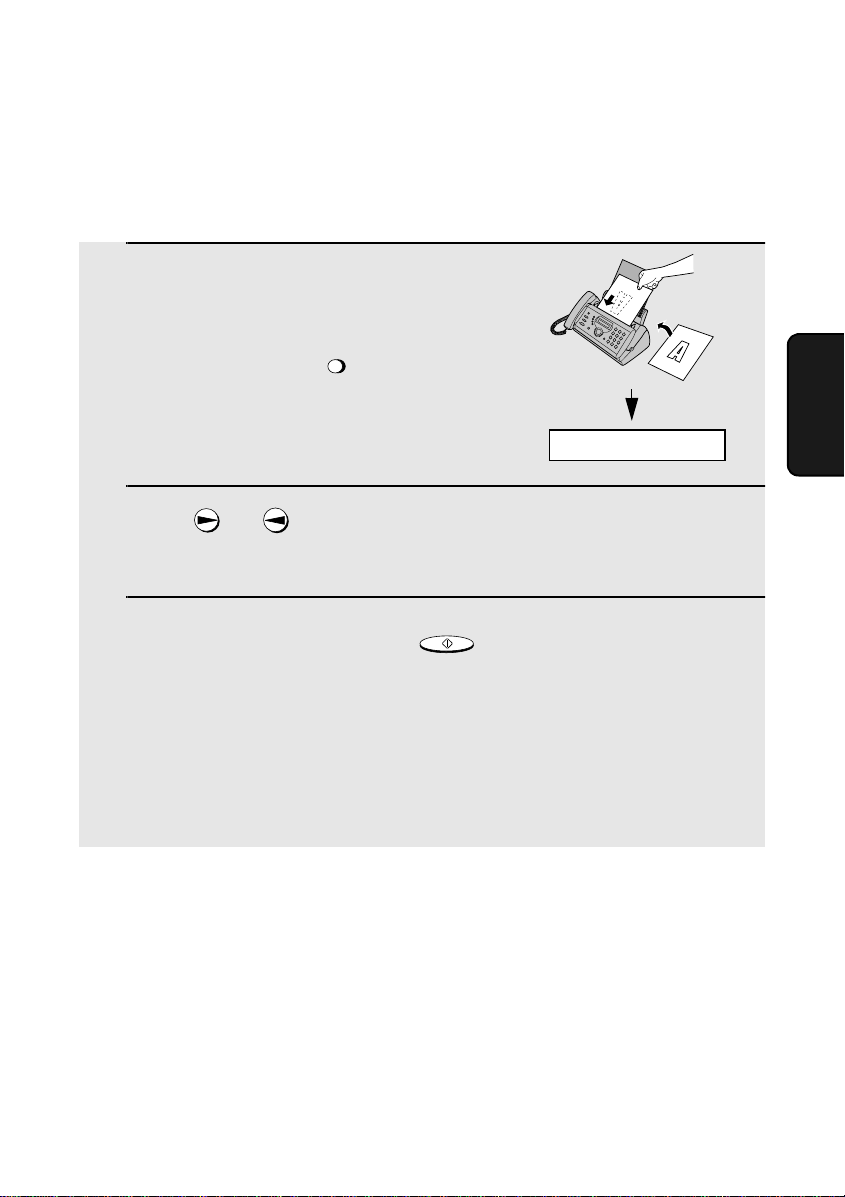
Searching for an auto-dial number
If you don’t remember the Speed Dial number in which you have stored a full
fax or phone number, follow these steps to search for the number.
1
If you are sending a fax, load the
document(s).
• If desired, press to set the
resolution and/or contrast.
2
Press (or ) until the name of the other party appears in the
display (if no name was stored, the number will appear).
3
If you are sending a fax, press . Dialing and transmission
begins.
• If the transmission is completed successfully, the fax will beep once.
• If an error occurs, the fax will beep three times and print a Transaction
Report to inform you of the problem (see page 77).
If you are making a phone call, lift the handset. Dialing begins.
RESOLUTION/
RECEPTION MODE
START/MEMORY
READY TO SEND
all.bookPage53Wednesday,June4,20031:07PM
Sending a Fax by Automatic Dialing
54
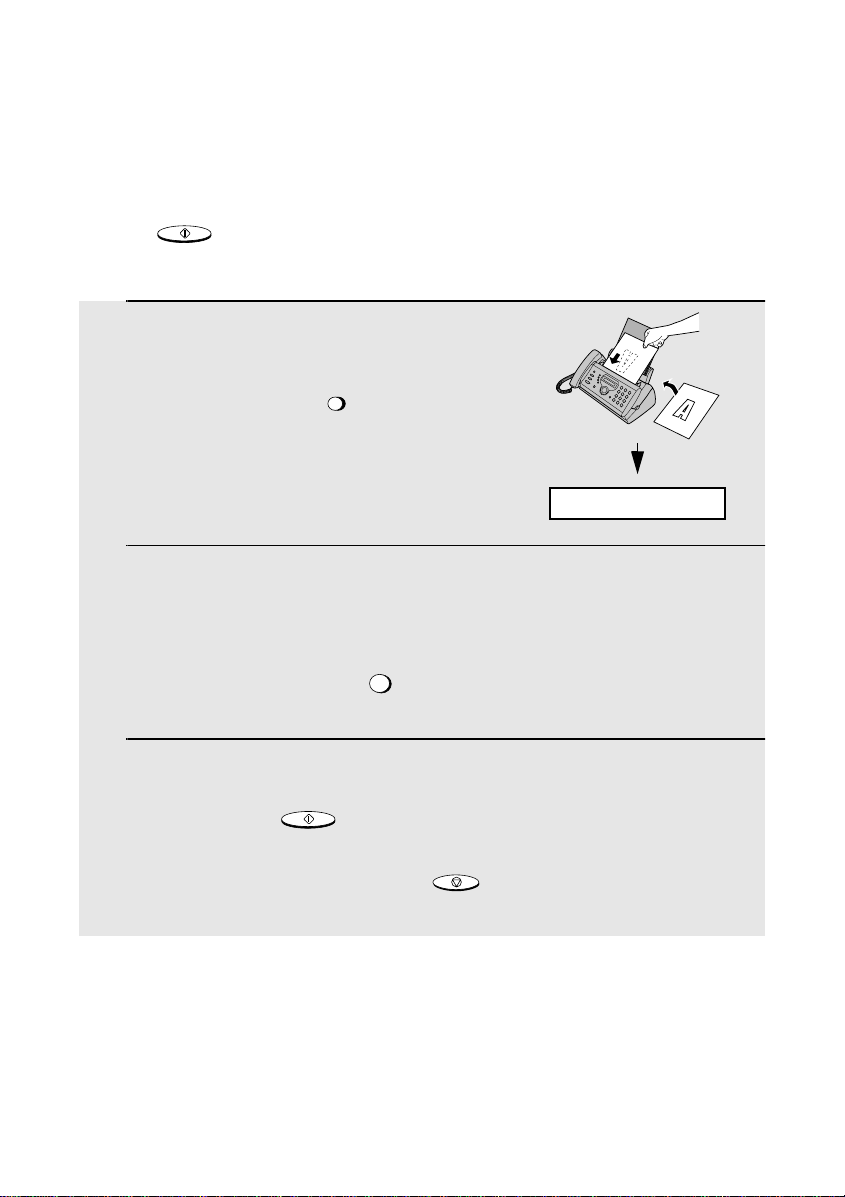
Sending a fax by Direct Keypad Dialing
You can also enter a full number with the number keys and then press the
key to begin dialing. You can use this method to dial a full
number when you don't need to speak to the other party before faxing.
START/MEMORY
1
Load the document(s).
• If desired, press to set the
resolution and/or contrast.
2
Enter the number of the receiving machine by pressing the number
keys.
• If a pause is required between any of the digits to access a special service
or an outside line, press . The pause will appear as a hyphen (two
seconds per pause). Several pauses can be entered in a row.
3
Check the display. If the number of the receiving machine shown is
correct, press .
• If the number is not correct, press to backspace and clear one digit
at a time, and then re-enter the correct digit(s).
RESOLUTION/
RECEPTION MODE
FUNCTION
START/MEMORY
STOP
READY TO SEND
all.bookPage54Wednesday,June4,20031:07PM
Sending a Fax by Automatic Dialing
55
3. Sending
Faxes
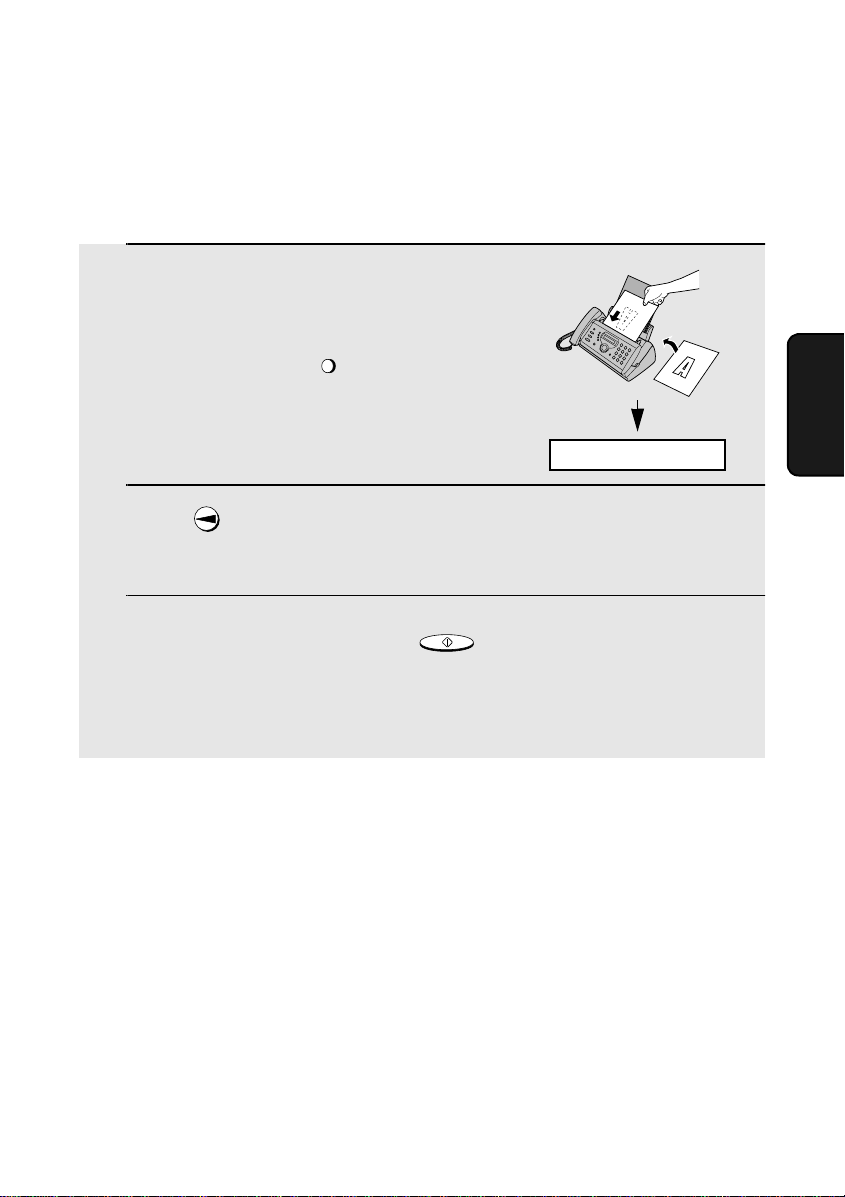
1
If you are sending a fax, load the
document(s).
• If desired, press to set the
resolution and/or contrast.
2
Press once. <REDIAL> appears in the display, followed by the last
number dialed. Make sure the number that appears is the number you
wish to dial.
3
If you are sending a fax, press . Dialing and transmission
begins.
If you are making a phone call, lift the handset. Dialing begins.
RESOLUTION/
RECEPTION MODE
START/MEMORY
Redial
You can automatically redial the last number dialed. This procedure can be
used to send a fax or make a phone call.
Note:
If a fax transmission is unsuccessful and DOCUMENT JAMMED appears in
the display, remove the document as explained on page 89. (This may occur if
the other fax machine doesn’t respond properly when you attempt to send the
document.)
Automatic redialing
If you use automatic dialing (including Direct Keypad Dialing) to send a fax
and the line is busy, the fax machine will automatically redial the number. The
fax machine will make three redial attempts at an interval of five minutes.
During this time, RECALLING will appear in the display, followed by a two-digit
number assigned to the fax job. You will not be able to dial any other locations
while the message appears.
READY TO SEND
all.bookPage55Wednesday,June4,20031:07PM
Sending a Fax by Automatic Dialing
56
♦ To stop automatic redialing, press .
♦ Under certain conditions (for example if a person answers the call on a
telephone), automatic redialing may stop before three redialing attempts
are made.
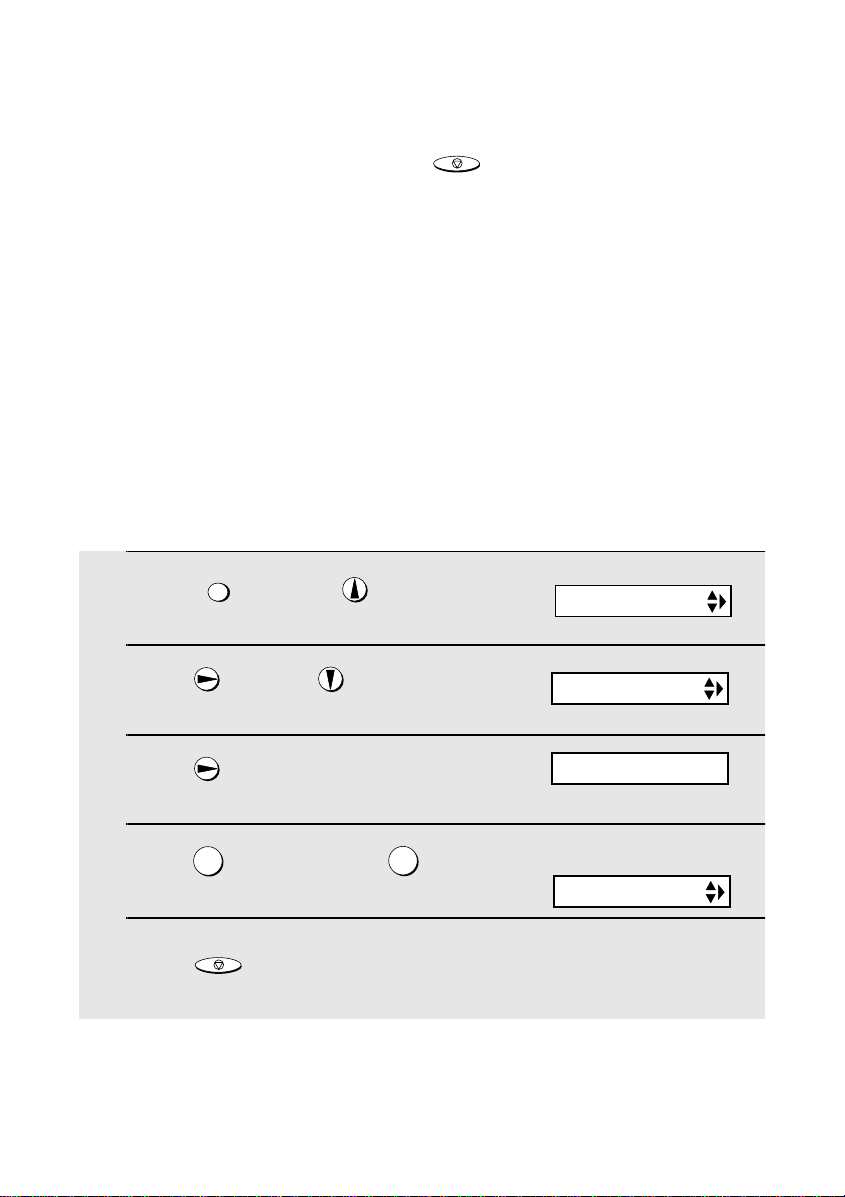
Error Correction Mode
The fax machine is set to automatically correct any distortions in a
transmission due to noise on the telephone line before printing at the
receiving end. This function is called Error Correction Mode (ECM). ECM is
effective for both transmissions and receptions, and is only effective when the
other fax machine has ECM as well.
When there is considerable noise on the line, you may find that transmission
with ECM turned on takes longer than normal. If you prefer a faster
transmission time, you can try turning ECM off.
STOP
1
Press once and once.
2
Press once and 6 times.
3
Press once.
4
Press to select YES, or to
select NO.
5
Press to return to the date and
time display.
FUNCTION
1
2
STOP
OPTION SETTING
ECM MODE
1=YES, 2=NO
The display briefly shows
your selection, then:
DAY LIGHT SAVE
Display:
all.bookPage56Wednesday,June4,20031:07PM
Sending a Fax From Memory
57
3. Sending
Faxes
Sending a Fax From Memory
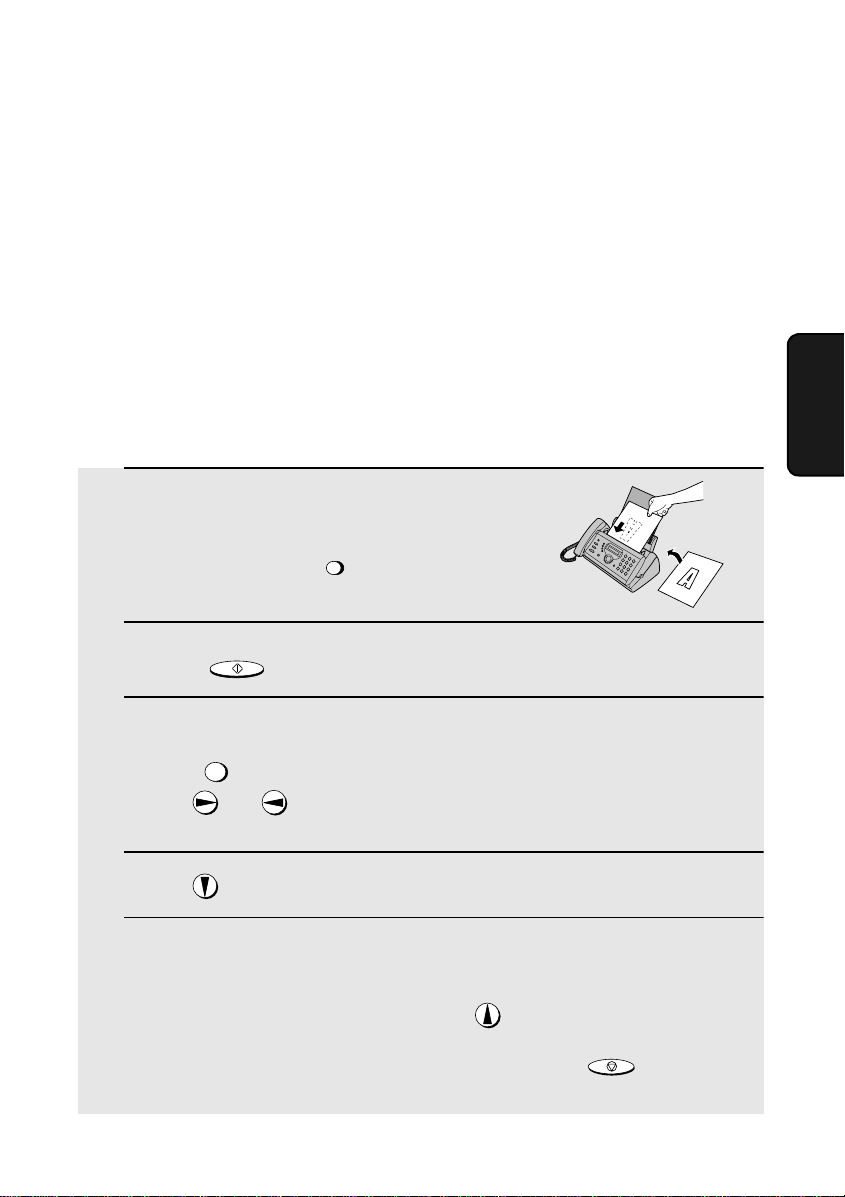
You can scan a document into the fax’s memory and send the document from
memory. This increases transmission speed and allows you to send a fax to
multiple destinations in a single operation. After transmission, the document is
automatically cleared from memory.
Broadcasting (sending a fax to multiple destinations)
This function allows you to send the same fax to as many as 20 different
locations in just one operation.
♦ When sending to multiple locations, only auto-dial numbers can be used to
dial the numbers of the receiving machines.
1
Load the document(s).
• If desired, press to set the
resolution and/or contrast.
2
Press .
3
Select a destination using one of the following methods:
Press and enter a 2-digit Speed Dial number.
Press (or ) until the name of the number appears in the display
(if no name was stored, the number will appear).
4
Press to select the number.
5
Repeat Steps 3 and 4 for each of the other locations to which you wish
to send the fax (maximum of 20).
• To check your selected locations, press to scroll through them. To
delete a location, scroll to the location and then press .
RESOLUTION/
RECEPTION MODE
START/MEMORY
SPEED
STOP
all.bookPage57Wednesday,June4,20031:07PM
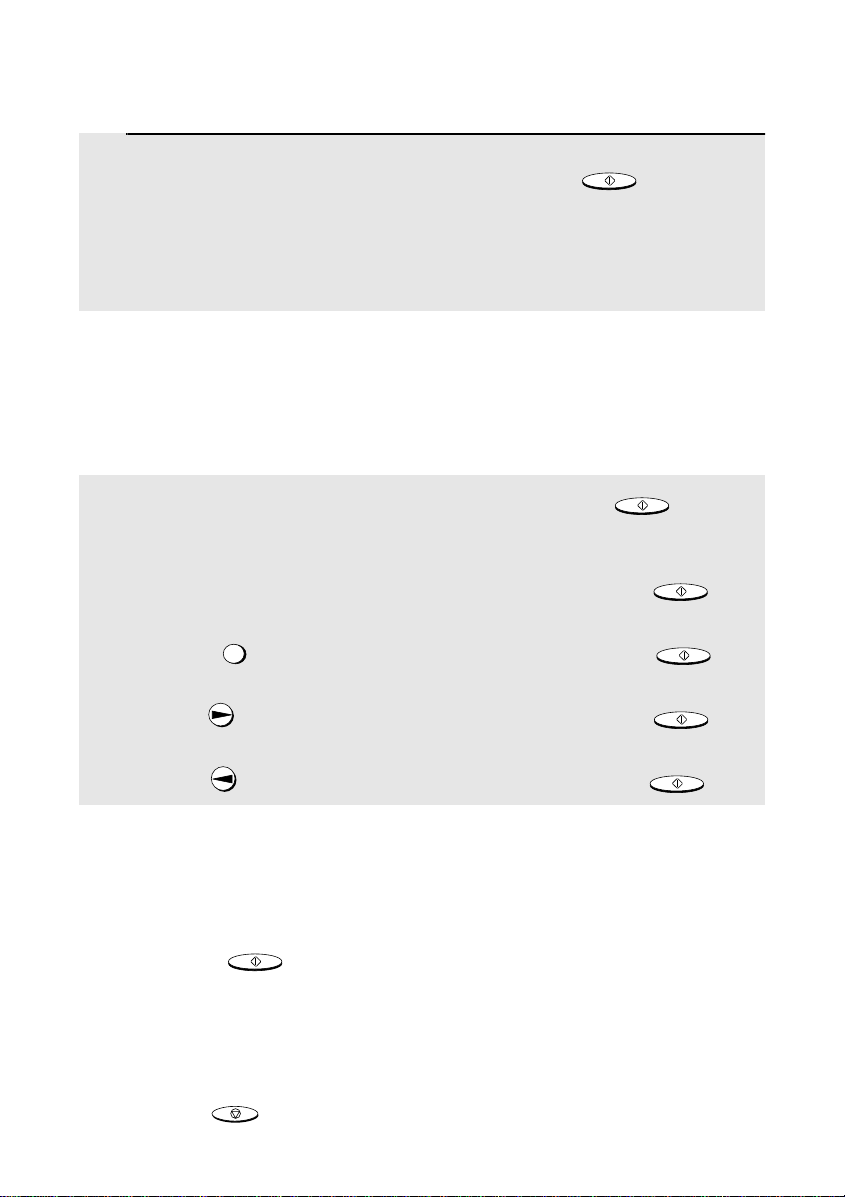
Sending a Fax From Memory
58
Memory transmission
You can also send a fax through memory when sending to a single location.
This is convenient when sending to locations where the line is often busy, as it
saves you from waiting to pick up the original document and frees the feeder
for other operations.
6
When you are ready to begin transmission, press .
• A Transaction Report is automatically printed out after Broadcasting is
completed. Check the "Note" column of the report to see if any of the
locations are marked "Busy" or have a communication error code. If so,
send the document to those locations again.
START/MEMORY
To send a fax through memory, load the document, press , and
then dial using one of the following methods:
♦
Press the number keys to enter the fax number and then press .
♦ Press , enter a 2-digit Speed Dial number, and press .
♦
Press repeatedly to select an auto-dial number and press .
♦ Press once to select the last number dialed and press .
START/MEMORY
START/MEMORY
SPEED
START/MEMORY
START/MEMORY
START/MEMORY
If the memory becomes full...
If the memory becomes full while the document is being scanned, MEMORY
IS FULL and SEE MANUAL will alternately appear in the display.
♦ Press if you want to transmit the pages which have been
stored up to that point in memory. The remaining pages will be ejected from
the feeder. After transmission, the memory will be cleared and you can
transmit the remaining pages. You will also need to transmit the page which
was being scanned when the memory filled up.
♦ Press if you want to cancel the entire transmission.
START/MEMORY
STOP
all.bookPage58Wednesday,June4,20031:07PM
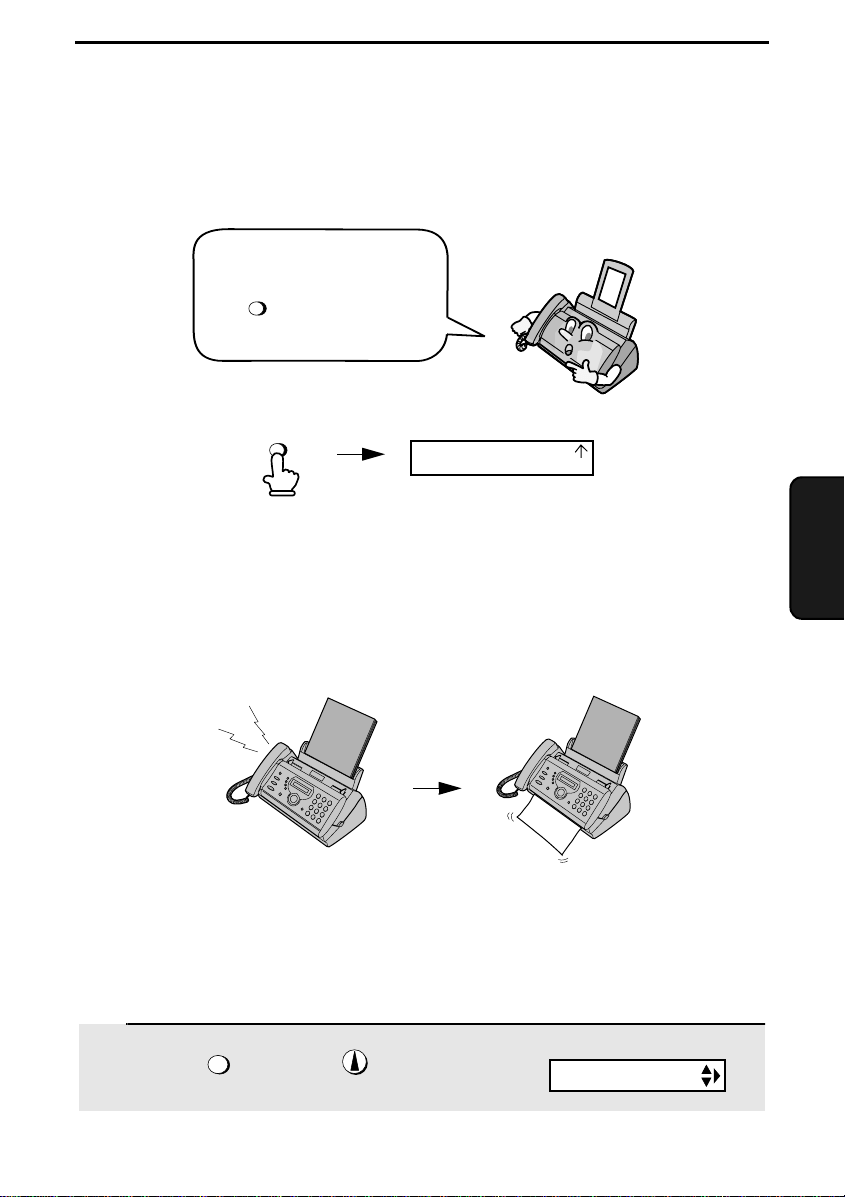
59
4. Receiving
Faxes
When the reception mode is set to FAX, the fax machine will automatically
answer all calls on four rings and receive incoming faxes.
♦ If you pick up the handset before the machine answers, you can talk to the
other party and/or receive a fax as explained in
Using TEL Mode
on page
60.
4 rings Fax reception
4. Receiving Faxes
Using FAX Mode
Changing the number of rings
If desired, you can change the number of rings on which the fax machine
answers incoming calls in FAX mode. Any number from 2 to 5 can be
selected.
1
Press once and once.
FUNCTION
Display:
FAX
TEL
TAD
OPTION SETTING
To select FAX mode, press
until the arrow
in the display points to FAX.
RESOLUTION/
RECEPTION MODE
RESOLUTION/
RECEPTION MODE
all.bookPage59Wednesday,June4,20031:07PM
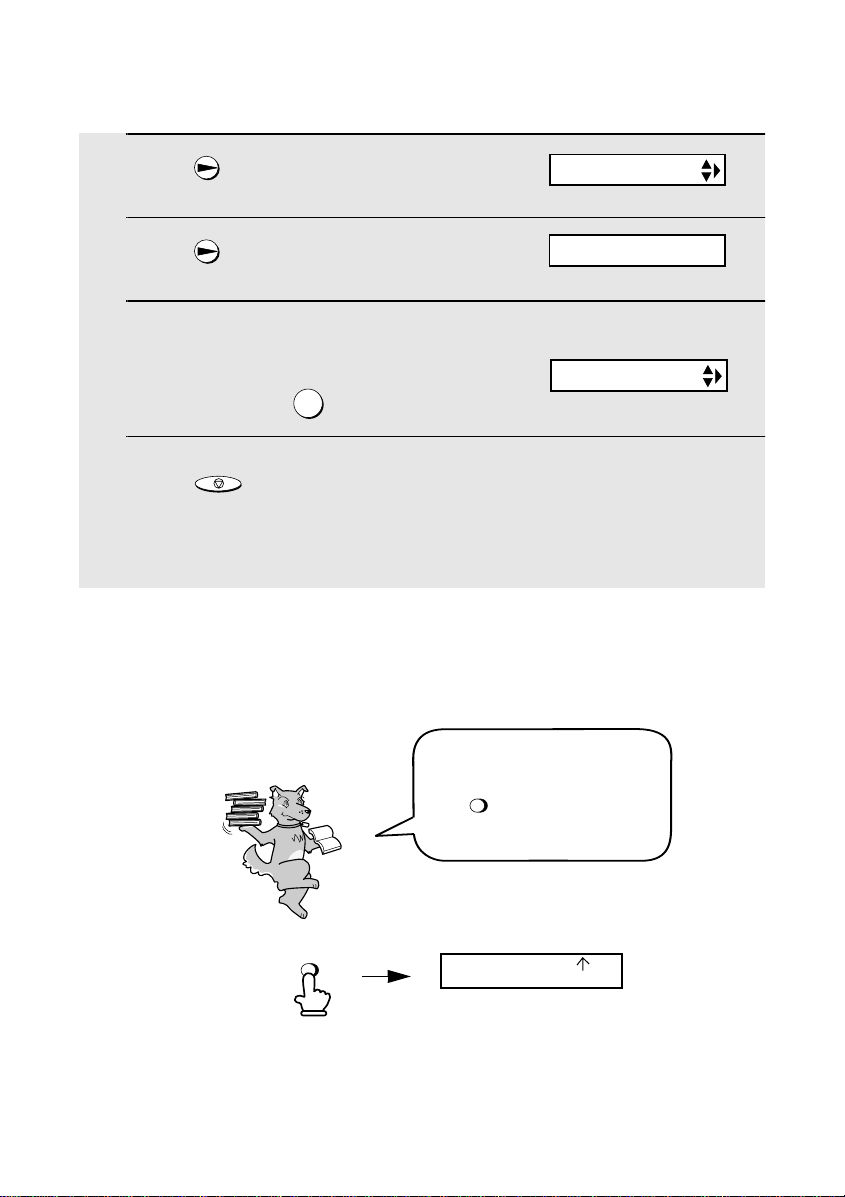
Using TEL Mode
60
2
Press once.
3
Press once.
4
Enter the desired number of rings (any
number from 2 to 5).
Example: 3 rings
5
Press to return to the date and time display.
Note: If you are using Distinctive Ring, the fax machine will answer calls after two
rings regardless of the above setting.
3
STOP
Using TEL Mode
The display briefly shows
your selection, then:
To select TEL mode, press
until the arrow
in the display points to TEL.
RESOLUTION/
RECEPTION MODE
When the reception mode is set to TEL, you must answer all calls by picking
up the fax machine’s handset or an extension phone connected to the same
line.
FAX
TEL
TAD
NUMBER OF RING
TRANSACTION
ENTER (2-5) (4)
FAX
TEL
TAD
RESOLUTION/
RECEPTION MODE
all.bookPage60Wednesday,June4,20031:07PM
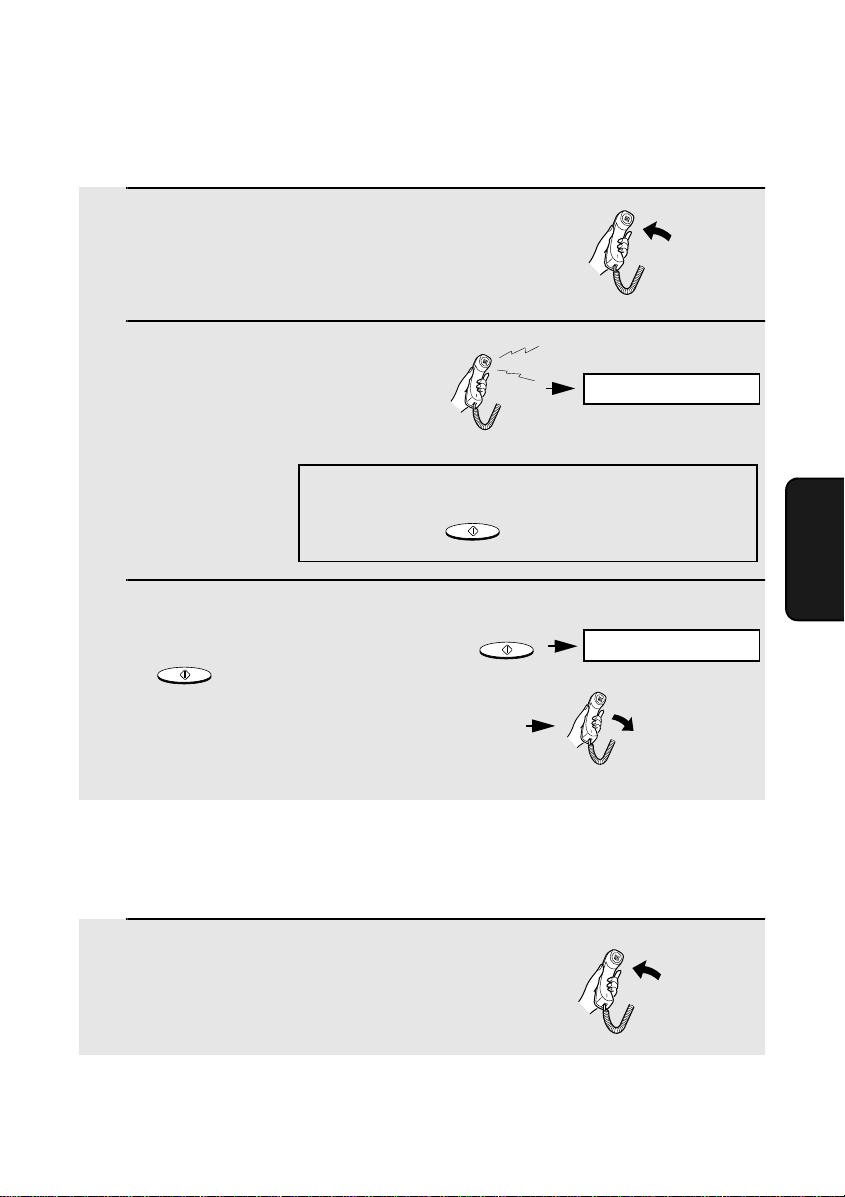
Using TEL Mode
61
4. Receiving
Faxes
1
When the fax machine rings, pick up
the handset.
2
If you hear a fax tone, wait until the
display shows RECEIVING and then
replace the handset.
3
If the other party first speaks with you
and then wants to send a fax, press
after speaking. (Press
before the sender presses their Start
key.)
• When RECEIVING appears in the
display, hang up.
START/MEMORY
Answering on an extension phone connected to the
same line
Answering with the fax’s handset
Note: If you have set the Fax Signal Receive setting
to NO, press to begin reception.
START/MEMORY
Beep
START/MEMORY
1
Answer the extension phone when it
rings.
RECEIVING
RECEIVING
all.bookPage61Wednesday,June4,20031:07PM
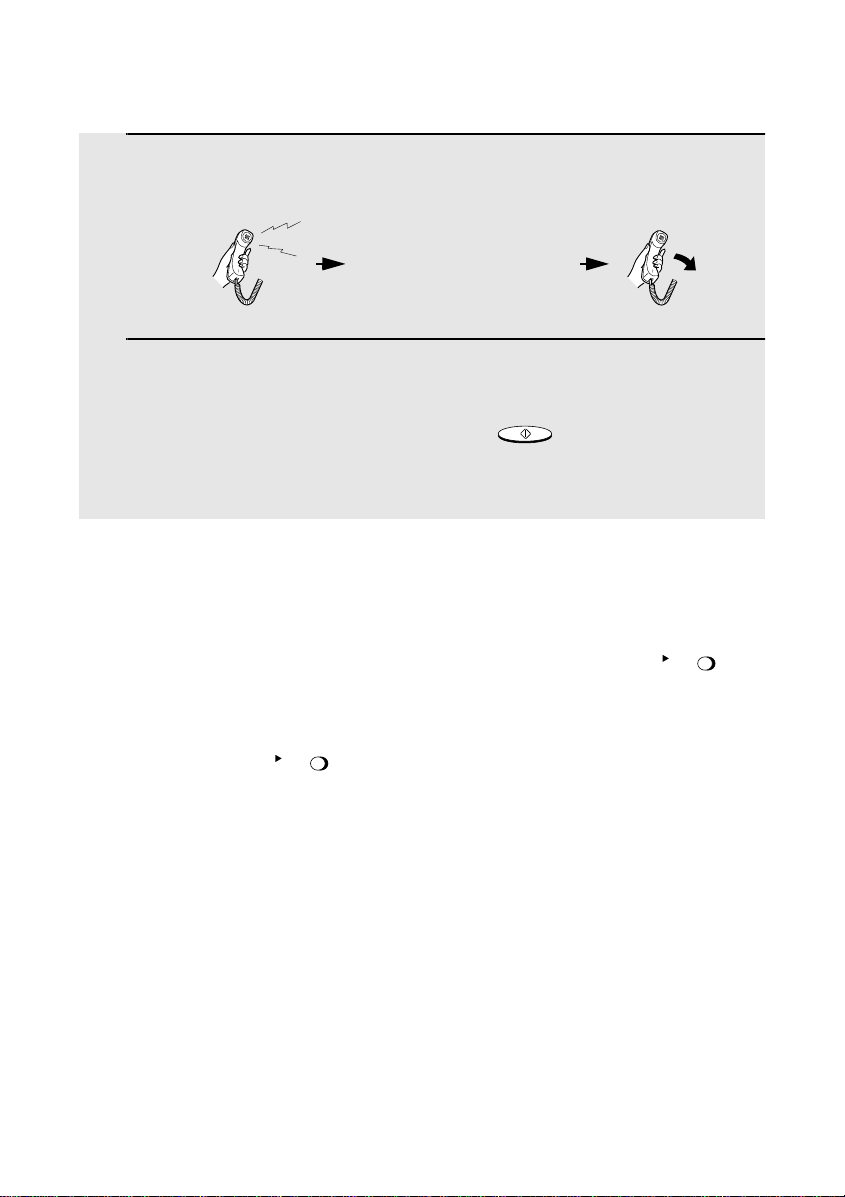
Using TEL Mode
62
2
If you hear a soft fax tone, wait until your fax responds (you will hear
pronounced, high-pitched tones), then hang up.
3
If the fax doesn't respond, or if the other party first talks to you and then
wants to send a fax, set the phone done (do not hang up), walk over to
the fax, lift the fax’s handset, and press .
• The above step is necessary if you have set the Fax Signal Receive setting
to NO.
START/MEMORY
Pronounced, high-pitched
tones
Beep
Putting a call on hold
To put the other party on hold during a phone conversation, press .
When this is done, they cannot hear you. You can put the handset back in the
cradle without breaking the connection. When you are ready to speak with the
other party again, pick up the handset. If you did not put the handset back in
the cradle, press again to resume conversation.
PLAY/
HOLD
PLAY/
HOLD
all.bookPage62Wednesday,June4,20031:07PM
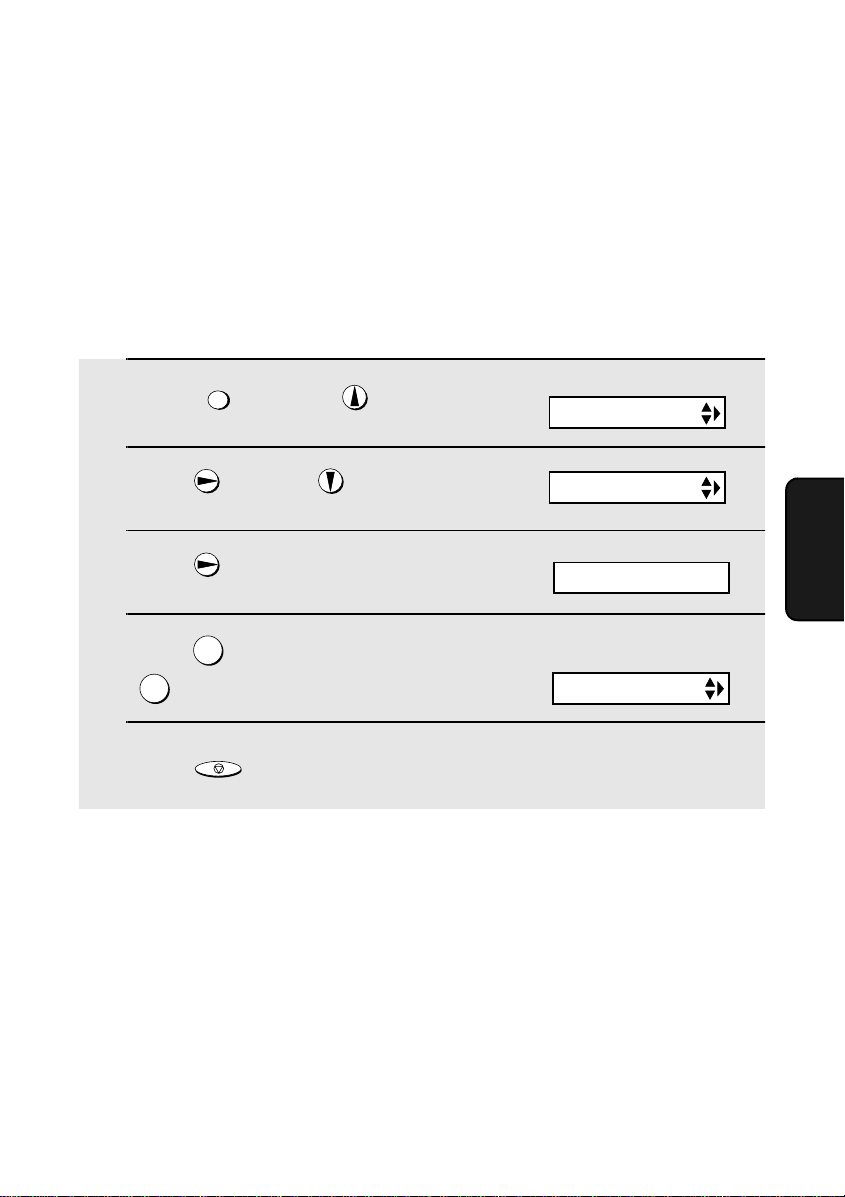
Optional Reception Settings
63
4. Receiving
Faxes
1
Press once and once.
2
Press once and 4 times.
3
Press once.
4
Press to turn on the function, or
to turn it off.
5
Press to return to the date and time display.
FUNCTION
1
2
STOP
Reception Ratio
The fax has been set at the factory to automatically reduce the size of
received documents to fit the size of the printing paper. This ensures that data
on the edges of the document are not cut off. If desired, you can turn this
function off and have received documents printed at full size.
♦
If a document is too long to fit on the printing paper, the remainder will be printed on
a second page. In this case, the cut-off point may occur in the middle of a line.
♦
Automatic reduction may not be possible if the received document is too large,
contains too many fine graphics or images, or is sent at high resolution. In this
case, the remainder of the document will be printed on a second page.
The display briefly shows
your selection, then:
CALLER-ID
Display:
OPTION SETTING
FAX SIGNAL RX
1=YES, 2=NO
Optional Reception Settings
Fax Signal Receive
Your fax will automatically begin reception if you hear a soft fax tone after
answering a call on your fax or an extension phone. If you use a computer fax
modem to send documents on the same line, you must turn this function off in
order to prevent your fax from mistakenly attempting to receive documents
from the computer fax modem. Follow the steps below to change the setting.
all.bookPage63Wednesday,June4,20031:07PM
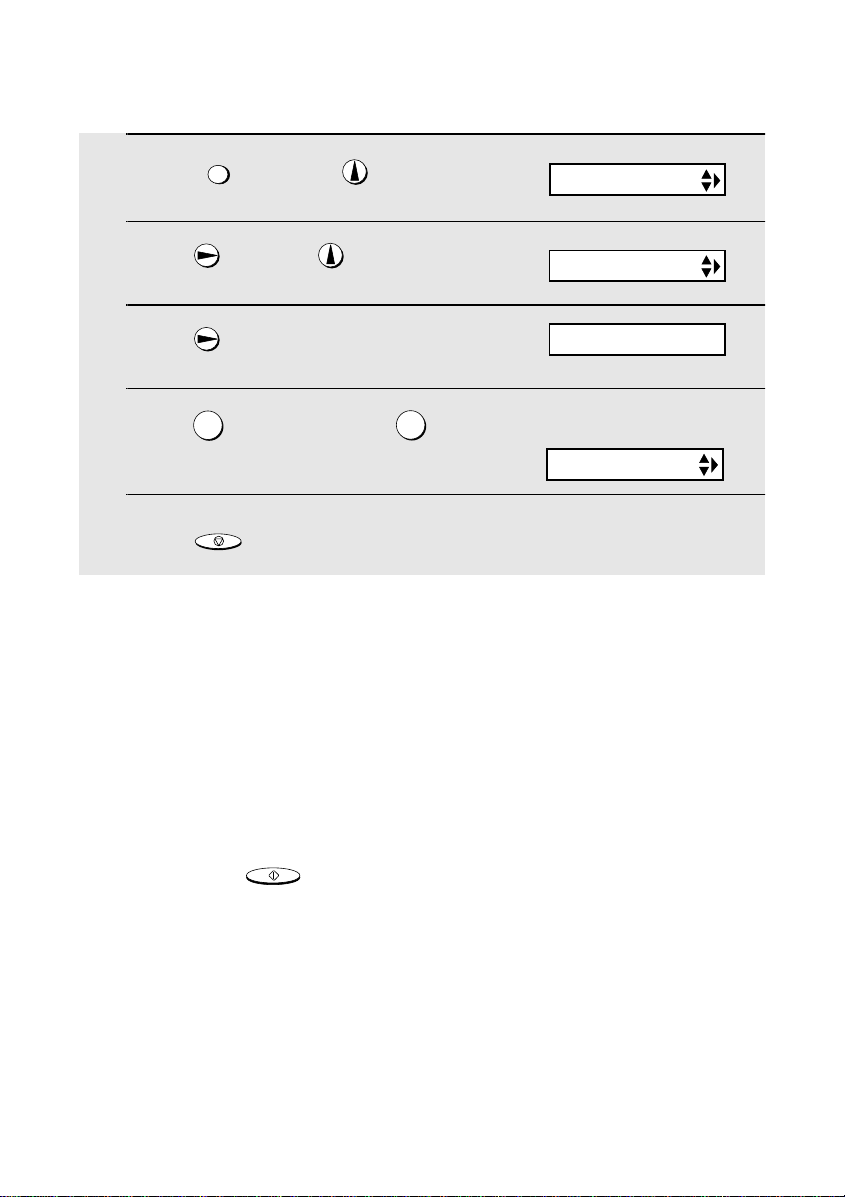
Substitute Reception to Memory
64
Substitute Reception to Memory
In situations where printing is not possible, such as when your fax runs out of
paper, the imaging film needs replacement, or the paper jams, incoming faxes
will be received to memory.
When you have received a document in memory, FAX RX IN MEMORY will
appear in the display, alternating with ADD PAPER & PRESS START KEY or
CHECK FILM / CHECK COVER / CHECK PAPER JAM. When you add paper
(and press ), replace the imaging film, or clear the jam, the stored
documents will automatically print out.
♦ If you received documents in memory because the fax ran out of paper, be
sure to add paper which is the same size as the paper previously used. If
not, the document print-out size may not match the size of the printing
paper.
START/MEMORY
1
Press once and once.
2
Press once and 4 times.
3
Press once.
4
Press to select AUTO, or to
select 100%.
5
Press to return to the date and time display.
FUNCTION
1
2
STOP
Display:
OPTION SETTING
RECEIVE RATIO
The display briefly shows
your selection, then:
PRINT CONTRAST
1=AUTO, 2=100%
all.bookPage64Wednesday,June4,20031:07PM
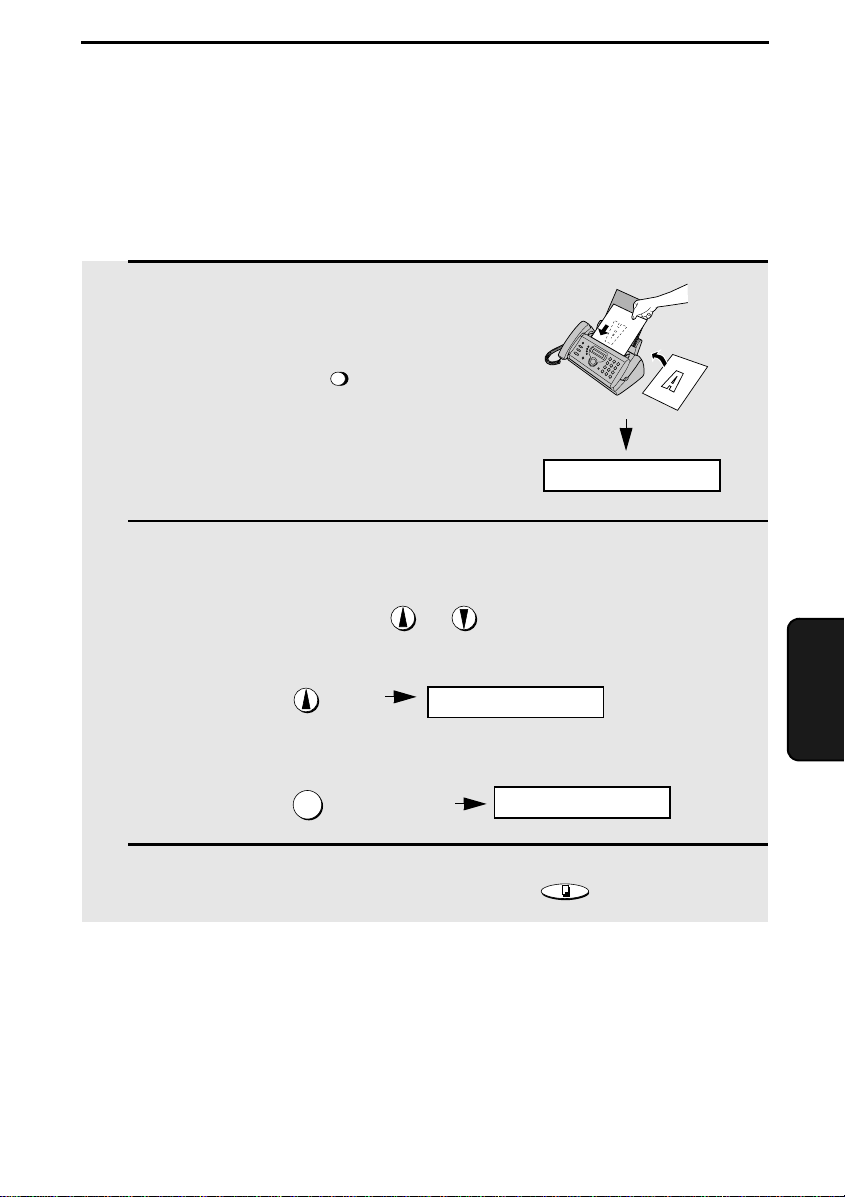
65
5. Making
Copies
5. Making Copies
Your fax machine can also be used to make copies. Single and multiple copies
(up to 99 per original) can be made, enabling your fax to double as a
convenience office copier.
1
Load the document(s) face down.
(Maximum of 10 pages.)
• If desired, press to set the
resolution and/or contrast.
(The default resolution setting for
copying is FINE.)
2
If desired, select an enlarge/reduce setting, and/or select the number of
copies per original:
• ENLARGE/REDUCE: Press or until the desired setting appears
in the display. Settings are 100%, 125%, 135%, 50%, 73%, 88%, 94%, and
AUTO. (The default setting is 100%.)
Example: Press twice
• Number of copies per original: Press the number keys to enter a number
from 1 to 99. (The default setting is 1.)
Example: Press for five copies
3
When you are ready to begin copying, press .
RESOLUTION/
RECEPTION MODE
5
COPY/HELP/POLL
READY TO SEND
RATIO: 125%
5
If MEMORY IS FULL appears...
If the memory becomes full while a document is being scanned, MEMORY IS
FULL and SEE MANUAL will alternately appear in the display and the
document will automatically feed out. This may happen if the resolution is set
to SUPER FINE, or if you selected an enlarge/reduce setting, or if you are
making more than one copy per original. To avoid using memory, use
STANDARD or FINE for the resolution, 100% for the enlarge/reduce setting,
and make only one copy per original.
all.bookPage65Wednesday,June4,20031:07PM
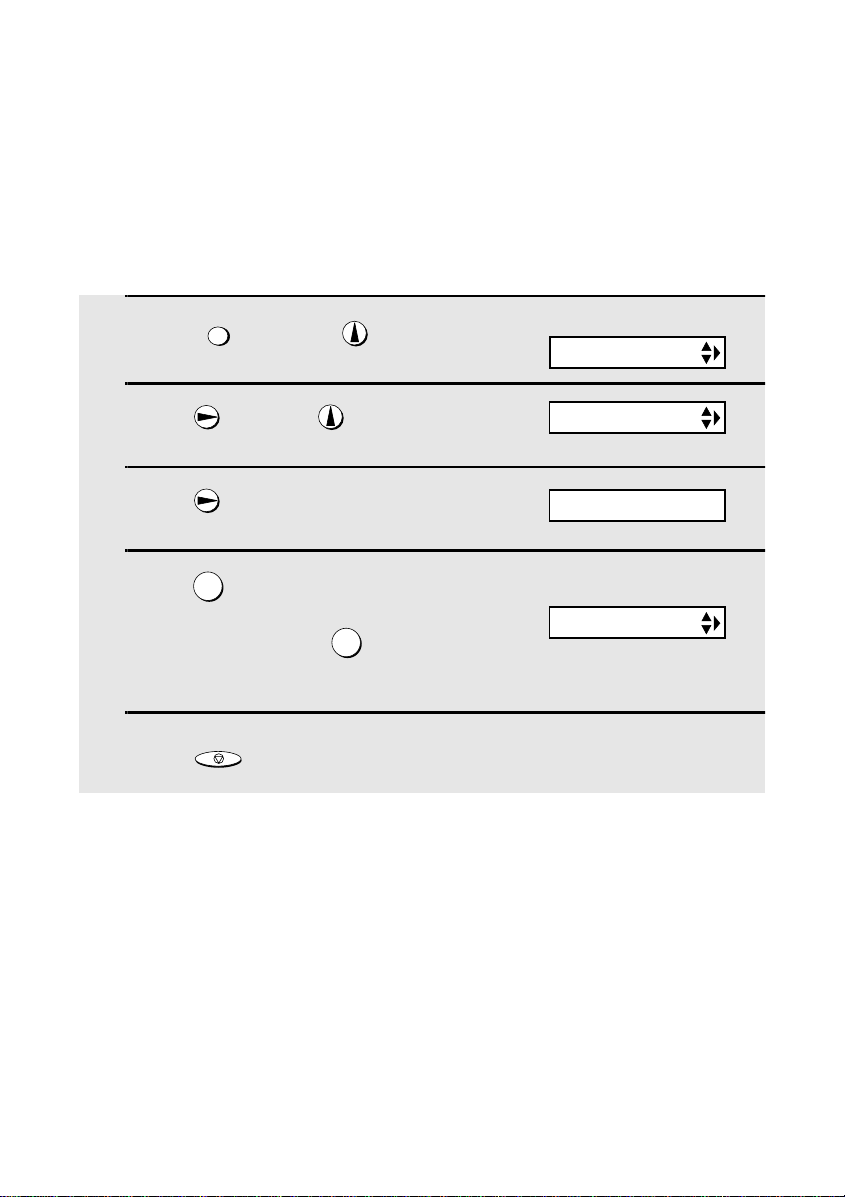
Making Copies
66
1
Press once and once.
2
Press once and once.
3
Press once.
4
Press to set copy cut-off to YES
(the remaining part of the document
will not be printed), or to set copy
cut-off to NO (the remaining part will be
printed on a second page).
5
Press to return to the date and time display.
FUNCTION
1
2
STOP
Display:
The display briefly shows
your selection, then:
OPTION SETTING
COPY CUT-OFF
NUMBER OF RING
1=YES, 2=NO
Copy Cut-off
When making a copy of a document that is longer than the printing paper, use
the copy cut-off setting to select whether the remaining part of the document
will be cut off or printed on a second page. The initial setting is YES (cut off
the remainder). To change the setting, follow the steps below.
all.bookPage66Wednesday,June4,20031:07PM
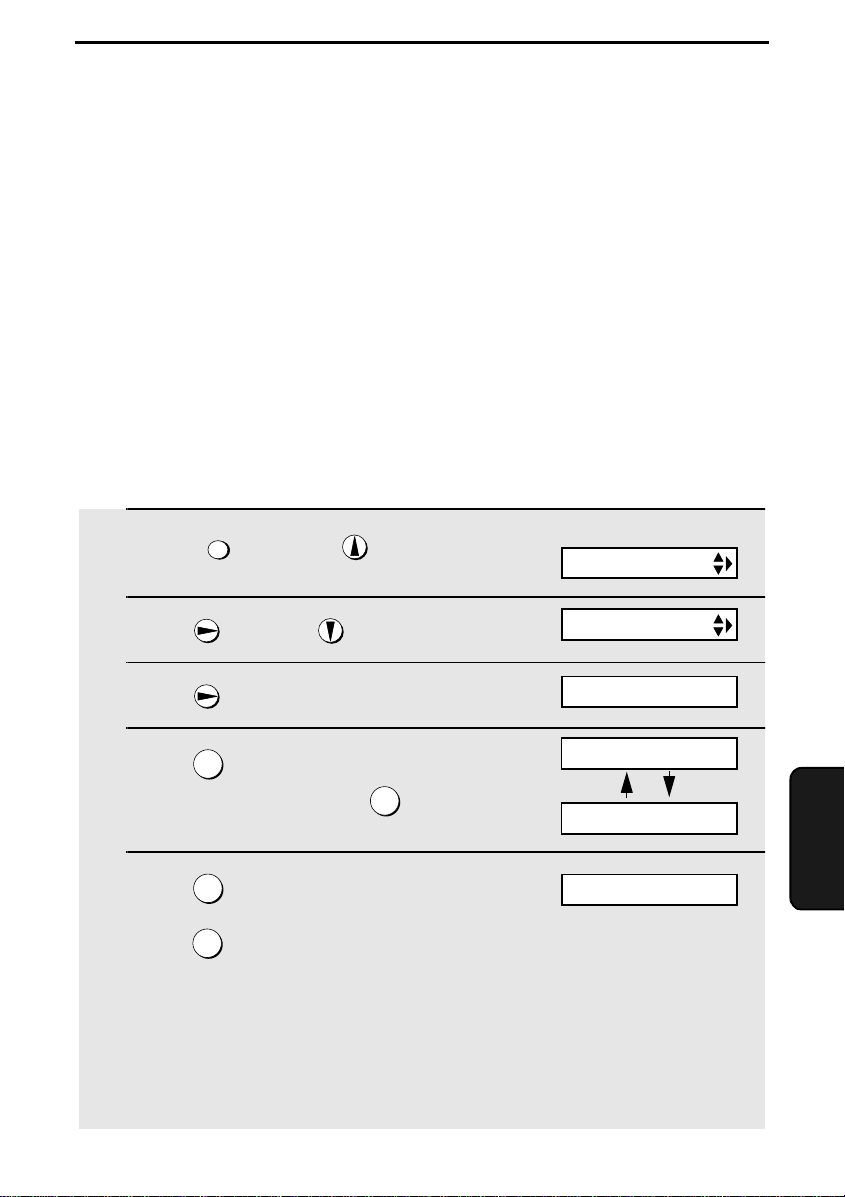
67
6. Special
Functions
6. Special Functions
Caller ID (Requires Subscription to Service)
If you subscribe to a caller identification service from your telephone
company, you can set your fax machine to display the name and number of
the caller while the fax rings.
Important:
♦ To use this function, you must subscribe to a caller identification service
from your telephone company. Note that the machine may not be
compatible with some caller identification services.
♦ Area Code mode: This step is needed if your telephone exchange cannot
dial a local phone number (within your calling area code) when the area
code is dialed with the phone number (see Step 5).
1
Press once and once.
2
Press once and 5 times.
3
Press once.
4
Press (YES) to turn on Caller ID.
(To turn off Caller ID, press and go
to Step 8.)
5
Press to select SET.
(To clear a previously set area code,
press and go to Step 8.)
Note: Entering your area code in this step causes it to be automatically removed
from local numbers in the Caller ID list (page 69). This is only required if you need
to eliminate dialing of the area code when dialing a local number from the list.
Example (using the area code “123”): If Step 5 is skipped, the Caller ID display will
show 123-444-1234, and the number that will dial from the Caller ID list is 123-
444-1234. If the area code 123 is entered in Step 5, the Caller ID display will show
444-1234, and the number that will dial from the Caller ID list is 444-1234.
FUNCTION
1
2
1
2
Display:
OPTION SETTING
CALLER-ID
AREA CODE # MODE
ENTER AREA CODE
1=YES, 2=NO
1=SET, 2=CLEAR
all.bookPage67Wednesday,June4,20031:07PM
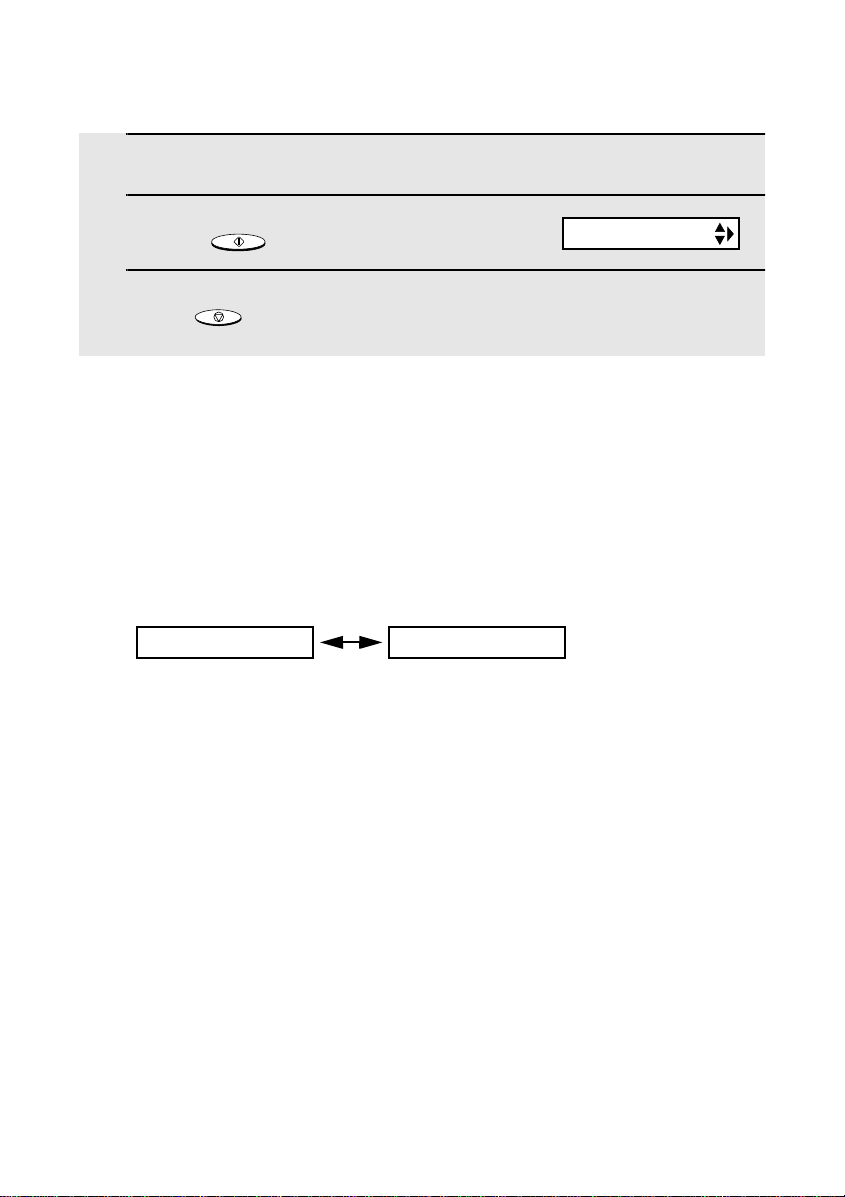
Caller ID (Requires Subscription to Service)
68
6
Enter the three digits of your area code.
7
Press to store your area code.
8
Press to return to the date and time display.
START/MEMORY
STOP
How Caller ID operates
When you receive a call, the name and phone number of the caller will
alternately appear in the display, beginning just before the second ring. The
information will continue to be displayed until the line is disconnected.
Note: Some caller ID services may not provide the name of the caller. In this case,
only the phone number will appear.
Display messages
One of the following messages will appear while the fax rings if caller
information is not available.
NO SERVICE No caller information was received from your telephone
company. Make sure that the telephone company has
activated your service.
CALLER-ID ERROR Noise on the telephone line prevented reception of
caller information.
OUT OF AREA The call was made from an area which does not have a
caller identification service, or the caller’s service is not
compatible with that of your local phone company.
PRIVATE CALL Caller information was not provided by the telephone
company at the caller’s request.
Display example
Caller’s name Caller’s number
JOHN DOE 525-8693
ECM MODE
all.bookPage68Wednesday,June4,20031:07PM
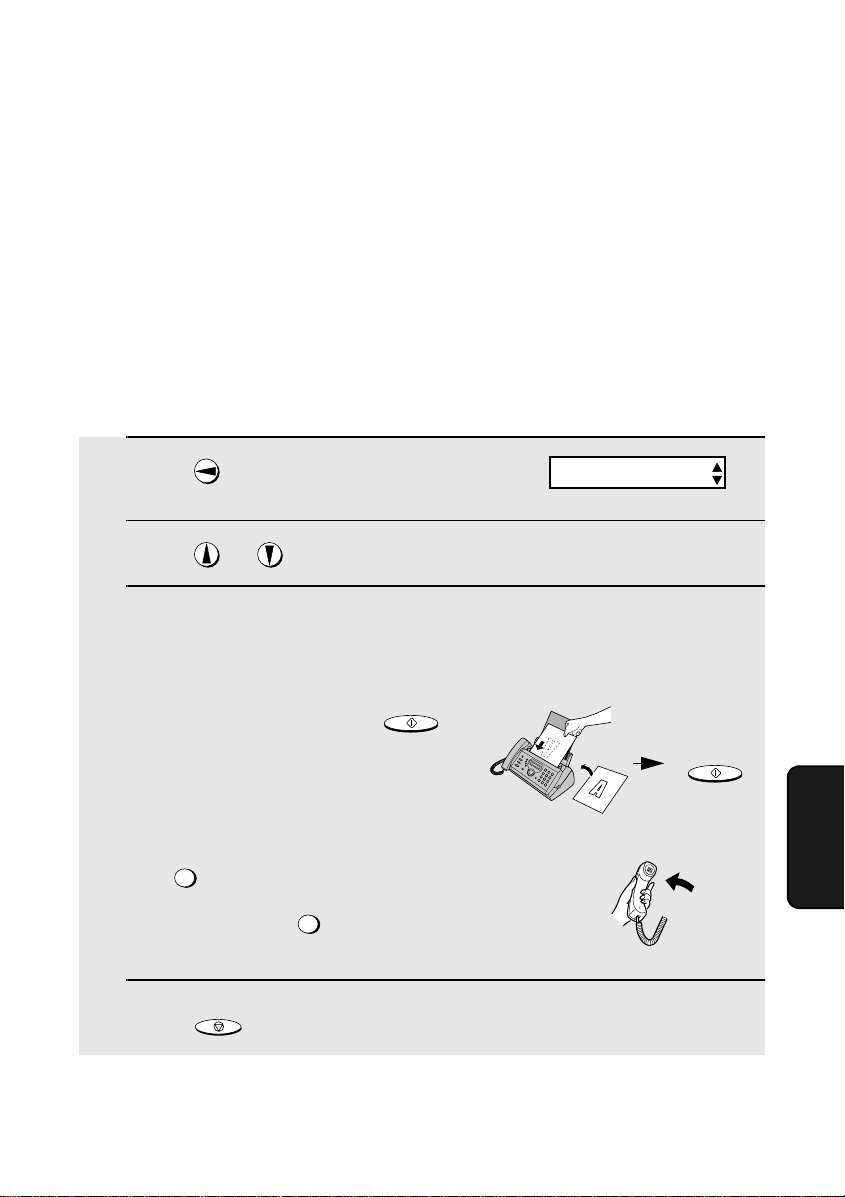
Caller ID (Requires Subscription to Service)
69
6. Special
Functions
Viewing the Caller ID list
If you subscribe to a Caller ID service and have turned on the Caller ID
function, your fax machine will keep information on the most recent 30 calls
and faxes you have received. You can view this information, which consists of
the name and number of each caller, in the Caller ID List.
♦ After you have received 30 calls, each new call will delete the oldest call.
♦ All calls will be erased if you unplug the fax or a power failure occurs.
Follow the steps below to view the Caller ID List in the display. If desired, you
can immediately dial a number when it appears.
1
Press twice.
2
Press or to scroll through the list.
3
If you want to dial one of the numbers in the list, scroll through the list
until the number appears in the display.
• Fax: If you want to send a fax, load the
document and then press .
Dialing and transmission begin.
• Voice call: If you want to make a voice
call, pick up the handset (or press
). Dialing begins automatically.
(If you pressed , pick up the
handset when the other party answers.)
4
Press when you have finished viewing the list.
START/MEMORY
SPEAKER
SPEAKER
STOP
START/MEMORY
Fax:
Voice
call:
<REVIEW CALLS>
all.bookPage69Wednesday,June4,20031:07PM
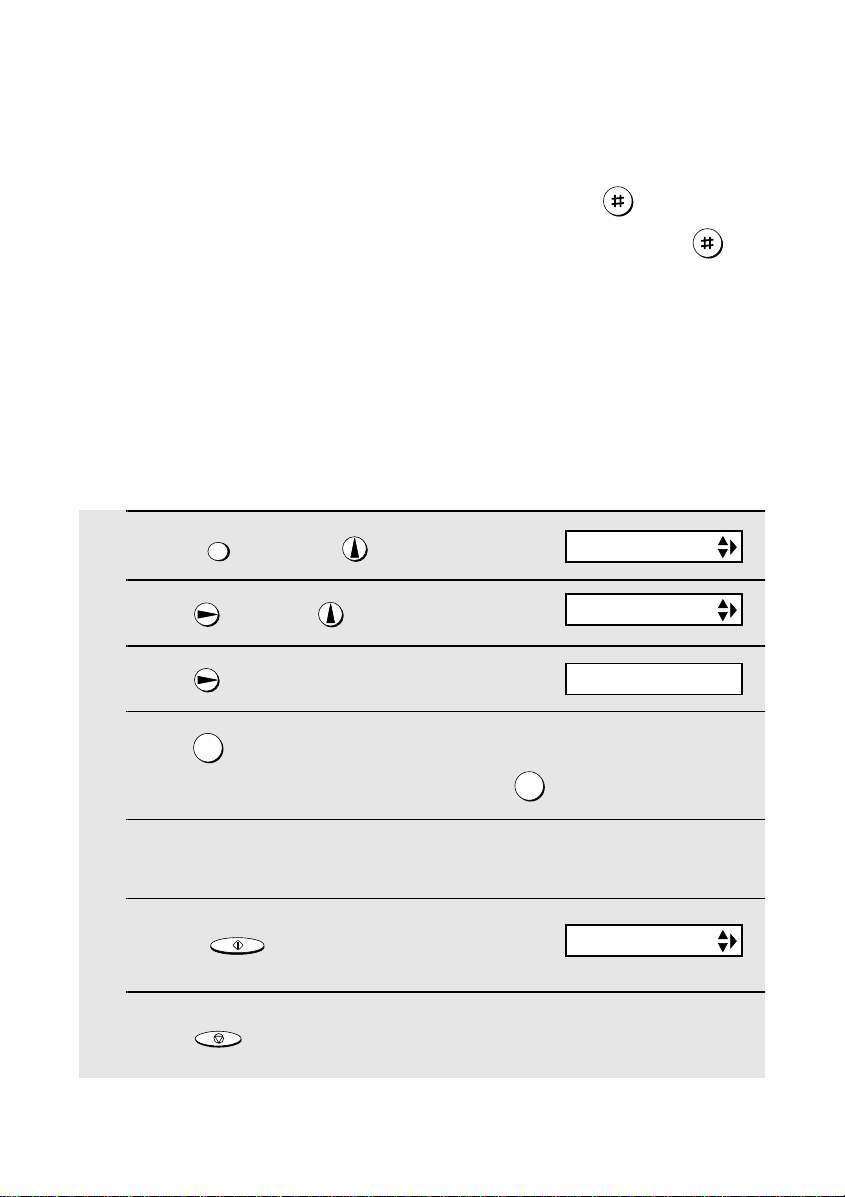
Caller ID (Requires Subscription to Service)
70
1
Press once and 3 times.
2
Press once and once.
3
Press once.
4
Press to store a number.
(To clear a previously stored number, press and go to Step 6.)
5
Enter the number by pressing the number keys (max. 20 digits).
6
Press to store (or clear) the
number.
7
Press to return to the date and time display.
FUNCTION
1
2
START/MEMORY
STOP
To delete calls from the Caller ID list
If you want to delete a single call from the caller list, press while the call
appears in the display. If you want to delete all calls from the list, hold
down for at least 3 seconds while you are viewing any number in the list.
Priority Call
With Caller ID turned on, you can set your fax to make a special ringing sound
when you receive a call from a designated phone number. This lets you know
immediately who is calling without having to look at the display.
To use this function, enter the desired phone number by following the steps
below (only one phone number can be entered).
Display:
ENTRY MODE
PRIORITY #
1=SET, 2=CLEAR
OWN NUMBER SET
all.bookPage70Wednesday,June4,20031:07PM

Caller ID (Requires Subscription to Service)
71
6. Special
Functions
Blocking voice calls
With Caller ID turned on, you can use the Anti Junk Fax function described in
Blocking Reception of Unwanted Faxes
in this chapter to block voice calls as
well as faxes from your specified Anti Junk Number.
In this case, when a voice call or a fax transmission comes in from the number
you have specified as a "Junk Number", your fax will break the connection as
soon as it receives the calling phone number from the caller ID service (before
the second ring).
To use this function, enter the number that you wish to block as explained in
Blocking Reception of Unwanted Faxes
(see page 73). Only one number can
be blocked.
Note: This function cannot be used if you are using the Distinctive Ring function.
all.bookPage71Wednesday,June4,20031:07PM
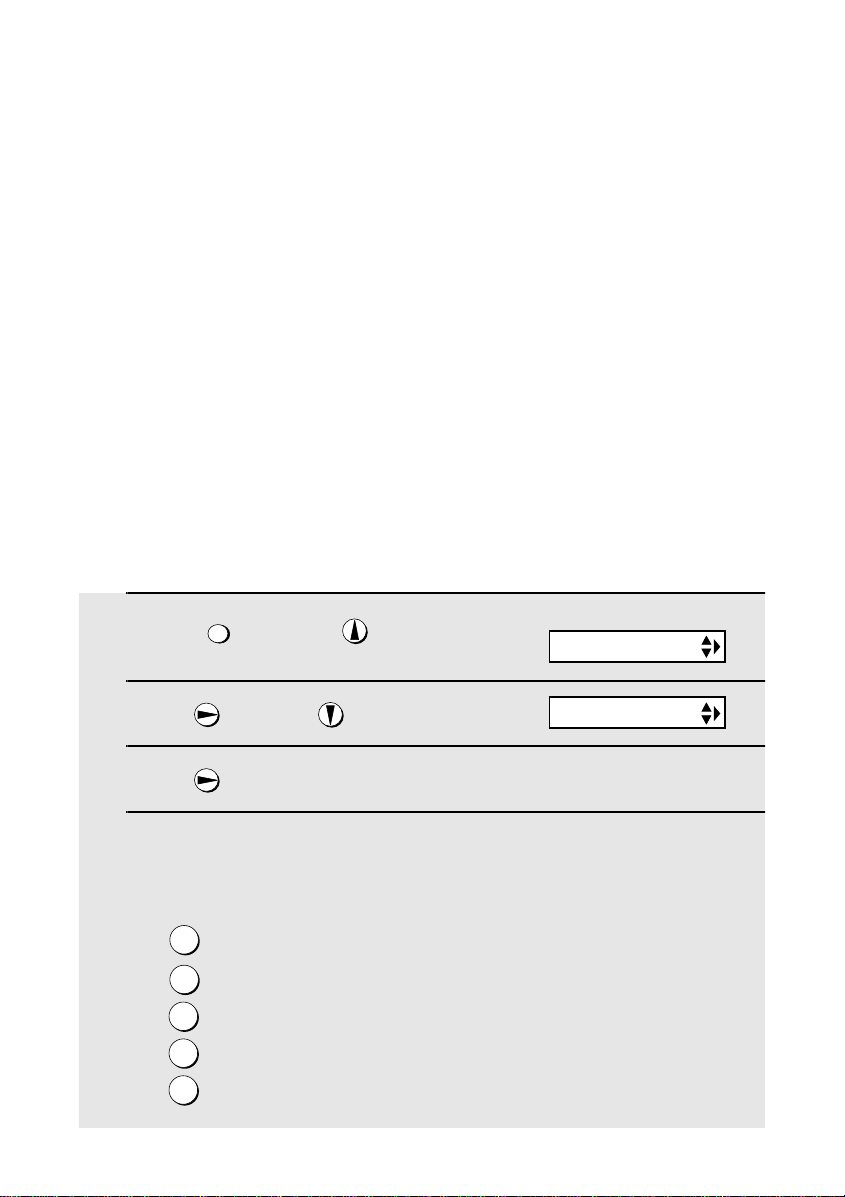
Distinctive Ring (Requires Subscription to Service)
72
Distinctive Ring (Requires Subscription to
Service)
Important:
♦ To use distinctive ring, you must subscribe to a distinctive ring
service from your local phone company.
♦ Your fax machine may not be compatible with some distinctive ring
services.
Distinctive ring is a service offered by some local telephone companies
whereby they assign an additional second number to your regular single line.
The second number rings differently from your normal number.
If you subscribe to a distinctive ring service, you can set the fax machine to
automatically answer when your second number is called. This allows you to
use the second number as an exclusive fax number. To have your fax
automatically answer when your second number is called, follow the steps
below:
1
Press once and once.
2
Press once and 3 times.
3
Press once.
4
Press a number from 1 to 3 to select the ring pattern below that matches
your second number’s ring pattern. Or, press 4 to have your fax
automatically answer your normal telephone number. Press 5 to turn off
the distinctive ring function.
RING PATTERN 1 Two short rings
RING PATTERN 2 One short, one long, and one short ring
RING PATTERN 3 Two short rings and one long ring
STANDARD RING Your standard (normal) ring pattern
OFF SETTING Turn distinctive ring off
FUNCTION
Display:
1
2
3
4
5
OPTION SETTING
DISTINCTIVE
all.bookPage72Wednesday,June4,20031:07PM
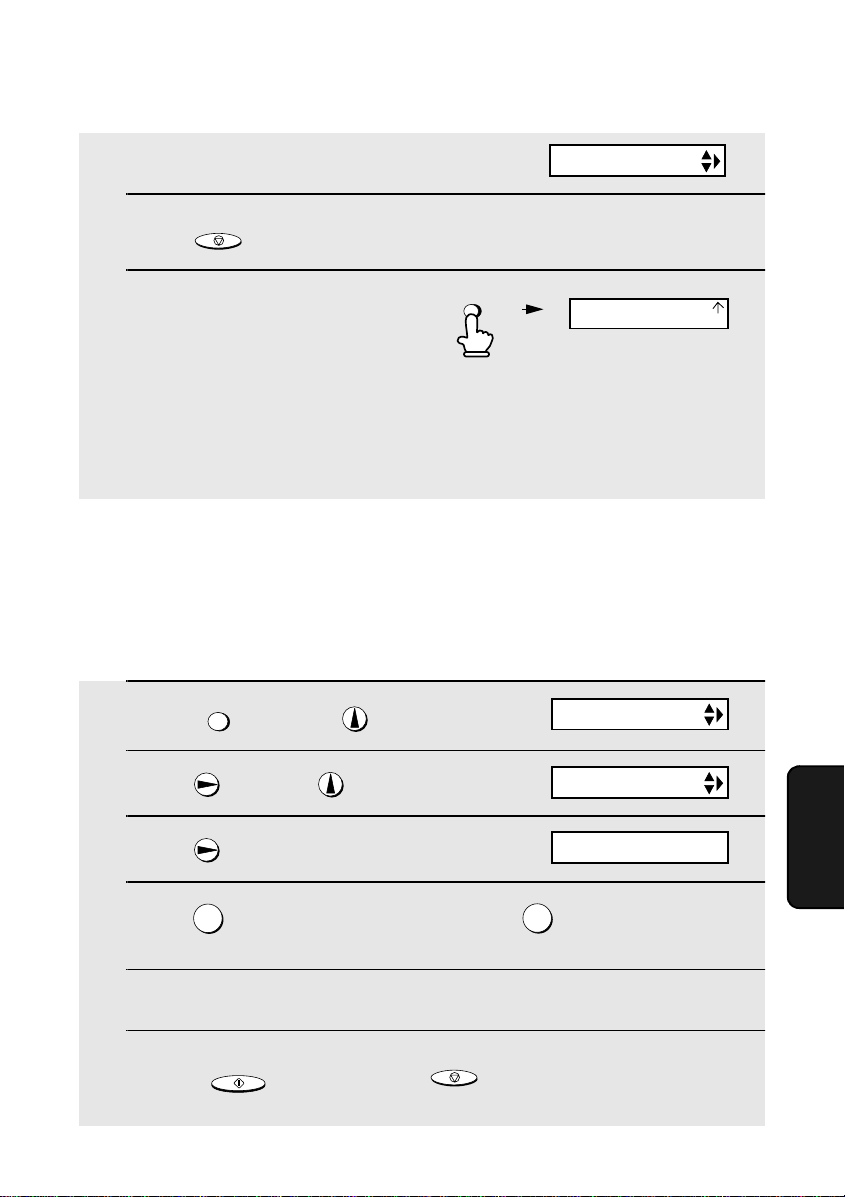
Blocking Reception of Unwanted Faxes
73
6. Special
Functions
5
Press to return to the date and time display.
6
Set the reception mode to FAX.
♦ When using distinctive ring, you must set the reception mode of your fax
machine to FAX. When your designated fax number is dialed, your fax will
automatically answer and begin reception after two rings. Note that other
devices on the same line will also ring until your fax answers. If one of your
other numbers is dialed, the fax will ring; however, it will not answer.
STOP
1
Press once and 3 times.
2
Press once and twice.
3
Press once.
4
Press to store an Anti Junk number, or to clear a previously
stored number (if you are clearing a number, go to Step 6).
5
Enter the fax number by pressing the number keys (max. 20 digits).
6
Press and then press to return to the date and time
display.
FUNCTION
1
2
START/MEMORY
STOP
Blocking Reception of Unwanted Faxes
The Anti Junk Fax function allows you to block reception of faxes from a party
that you specify. This saves paper by not printing out unwanted "junk" faxes.
To use this function, follow the steps below to enter the fax number from which
you do not wish to receive faxes. One fax number can be entered.
The display briefly shows
your selection, then:
Display:
FAX
TEL
TAD
FAX SIGNAL RX
ENTRY MODE
ANTI JUNK #
1=SET, 2=CLEAR
RESOLUTION/
RECEPTION MODE
all.bookPage73Wednesday,June4,20031:07PM
74
Polling (Requesting a Fax Transmission)
Polling allows you to call another fax machine and have it send a document
(previously loaded in its feeder) to your machine without assistance from the
operator of the other machine.
Hint: Polling is useful when you want the receiving fax machine, not the
transmitting fax machine, to bear the cost of the call.
1
Dial the fax machine you want to poll
using one of the following methods:
• Enter the full number using the numeric keys.
• Pick up the handset (or press ) and dial the full number. Wait for the
fax answerback tone.
• If the number has been stored for automatic dialling, press or
until the name (or number) of the other party appears in the display.
2
Press .
• If you used the handset, replace it when POLLING appears in the display.
Reception will begin.
SPEAKER
COPY/HELP/POLL
all.bookPage74Wednesday,June4,20031:07PM
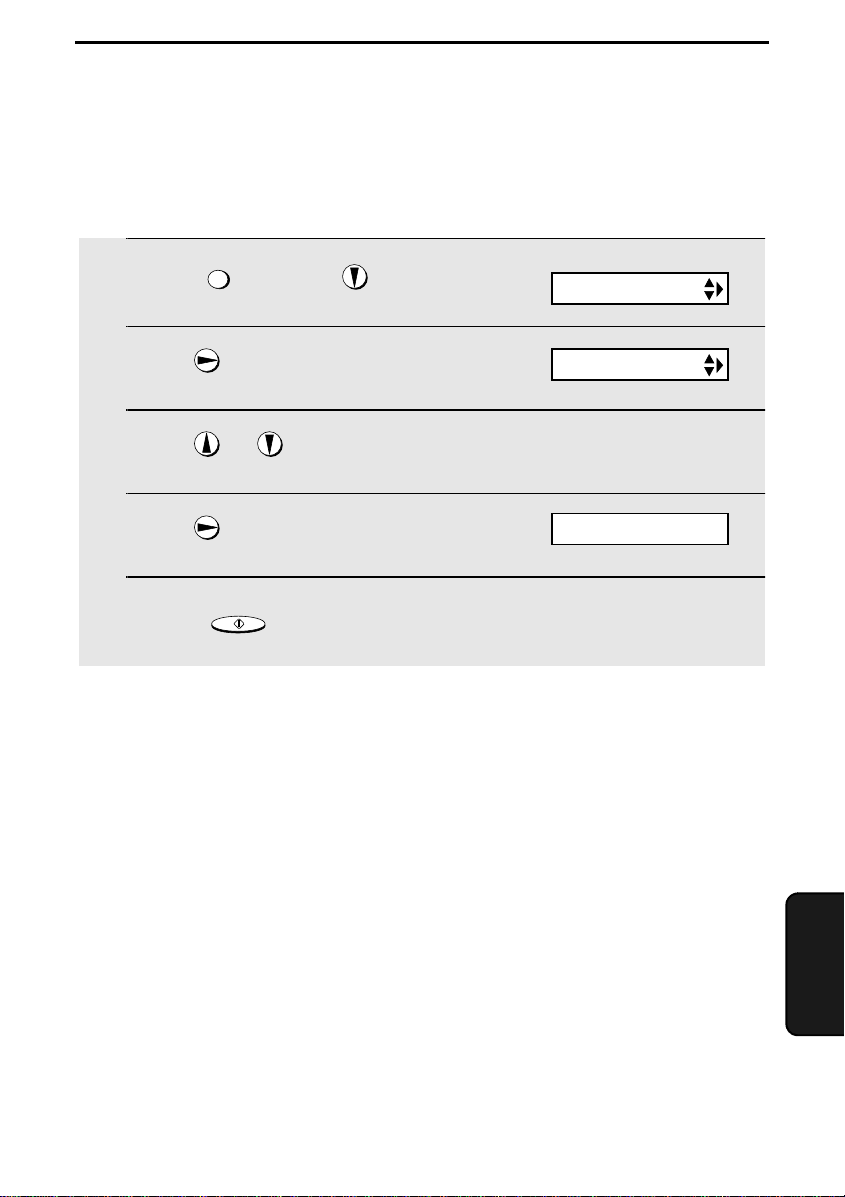
75
7. Printing
Lists
7. Printing Lists
You can print lists showing settings and information entered in the fax
machine. The lists are described below. To print a list, follow these steps.
1
Press once and twice.
2
Press once.
3
Press or until the desired list appears in the display.
4
Press once.
5
Press to print the list.
FUNCTION
START/MEMORY
Display:
LISTING MODE
TEL # LIST
PRESS START KEY
all.bookPage75Wednesday,June4,20031:07PM
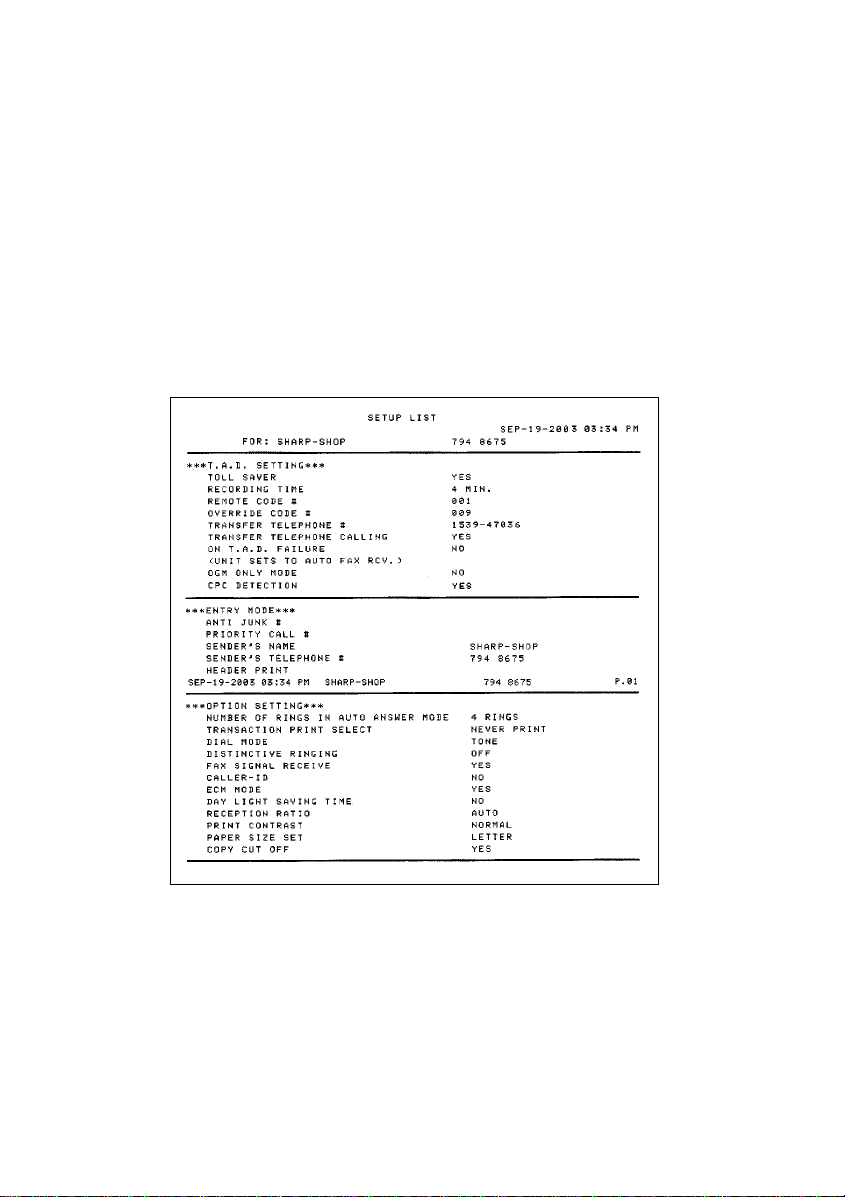
Printing Lists
76
Message List
This list shows information about the messages currently recorded in the
answering system, including the date and time each messages was recorded,
the length, and the type.
Caller-ID List
This list shows information about your 30 most recent calls. (This list is only
available if you are using the Caller ID function.)
Telephone Number List
This list shows the fax and phone numbers that have been stored for
automatic dialing.
Setup List
This list shows your current selections for the FUNCTION key settings. The
list also shows your name and fax/telephone number as entered in the
machine, and a sample of the header printed at the top of every page you
transmit (HEADER PRINT).
all.bookPage76Wednesday,June4,20031:07PM

Printing Lists
77
7. Printing
Lists
Transaction Report
This report is printed out automatically after an operation is completed to
allow you to check the result. Your fax machine is set at the factory to print out
the report only when an error occurs.
♦ The Transaction report cannot be printed on demand.
Headings in Transaction Report
SENDER/
RECEIVER
The name or fax number of the other machine involved in the
transaction. If that machine does not have an ID function, the
communication mode will appear (for example, "G3").
START The time at which transmission/reception started.
TX/RX TIME Total time taken for transmission/reception.
PAGE S Number of pages transmitted/received.
NOTE (One of the following notes will appear under NOTE in the
report to indicate whether the transaction was successful,
and if not, the reason for the failure.)
OK - Transmission/reception was successful.
P. FA IL - A power failure prevented the transaction.
JAM - The printing paper or document jammed, preventing
the transaction.
BUSY - The fax was not sent because the line was busy.
COM.E-X - (Where “X” is a number.) A telephone line error
prevented the transaction. See
Line error
on page 82.
CANCEL - The transaction was cancelled because the
STOP key was pressed, no document was in the feeder, or
the other machine requested transmission using a function
which your fax machine does not have. If you were
attempting to fax, make sure a document is in the feeder. If
you were receiving, contact the faxing party to see how they
are trying to send to you.
all.bookPage77Wednesday,June4,20031:07PM
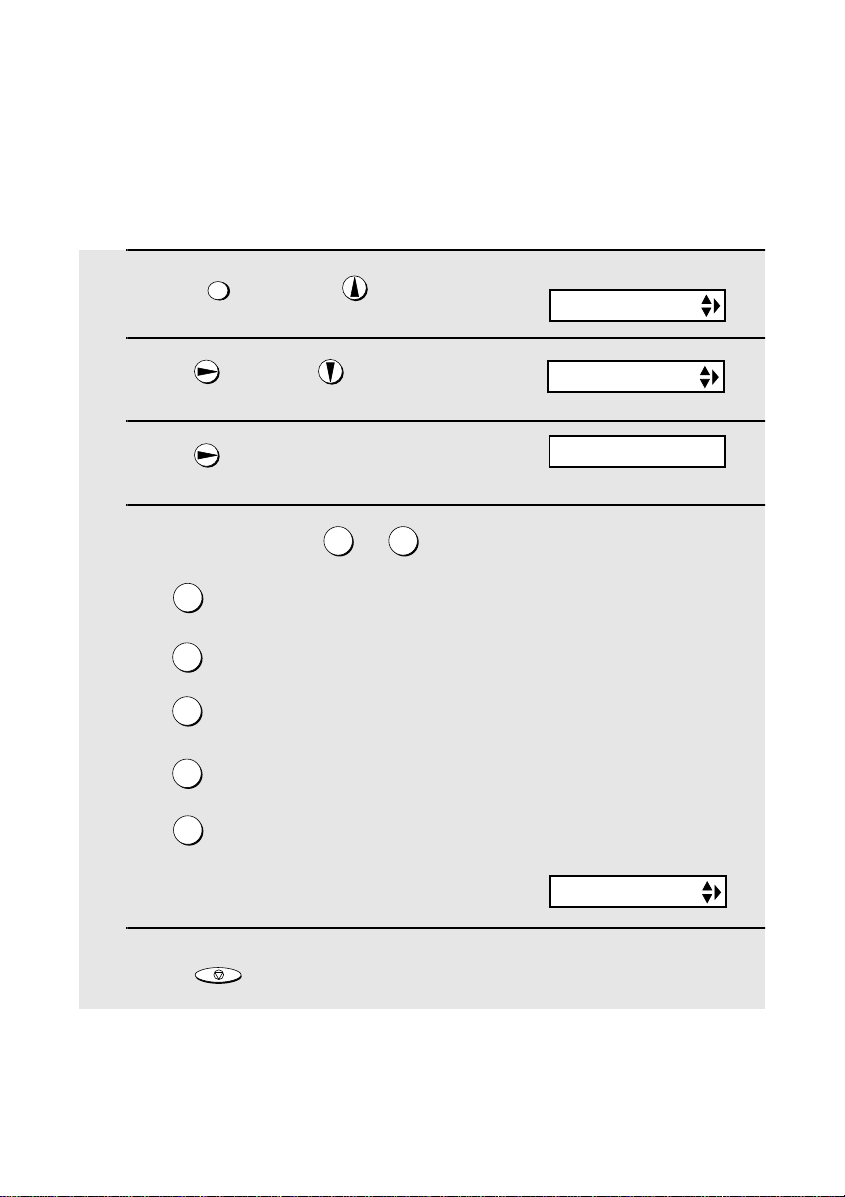
Printing Lists
78
Transaction Report print condition
You can change the condition under which a Transaction Report is printed out.
Follow the steps below.
1
Press once and once.
2
Press once and once.
3
Press once.
4
Press a number from to to select the condition for printing.
5
Press to return to the date and time display.
ALWAYS PRINT A report will be printed after each
transmission, reception, or error.
ERROR/MEMORY A report will be printed after an error or a
memory operation.
SEND ONLY A report will be printed after each
transmission.
ERROR ONLY A report will be printed only when an error
occurs.
NEVER PRINT A report will never be printed.
FUNCTION
1 5
STOP
Display:
The display briefly shows
your selection, then:
1
2
3
4
5
OPTION SETTING
TRANSACTION
DIAL MODE
1:ALWAYS PRINT
(Selections appear alternately)
all.bookPage78Wednesday,June4,20031:07PM
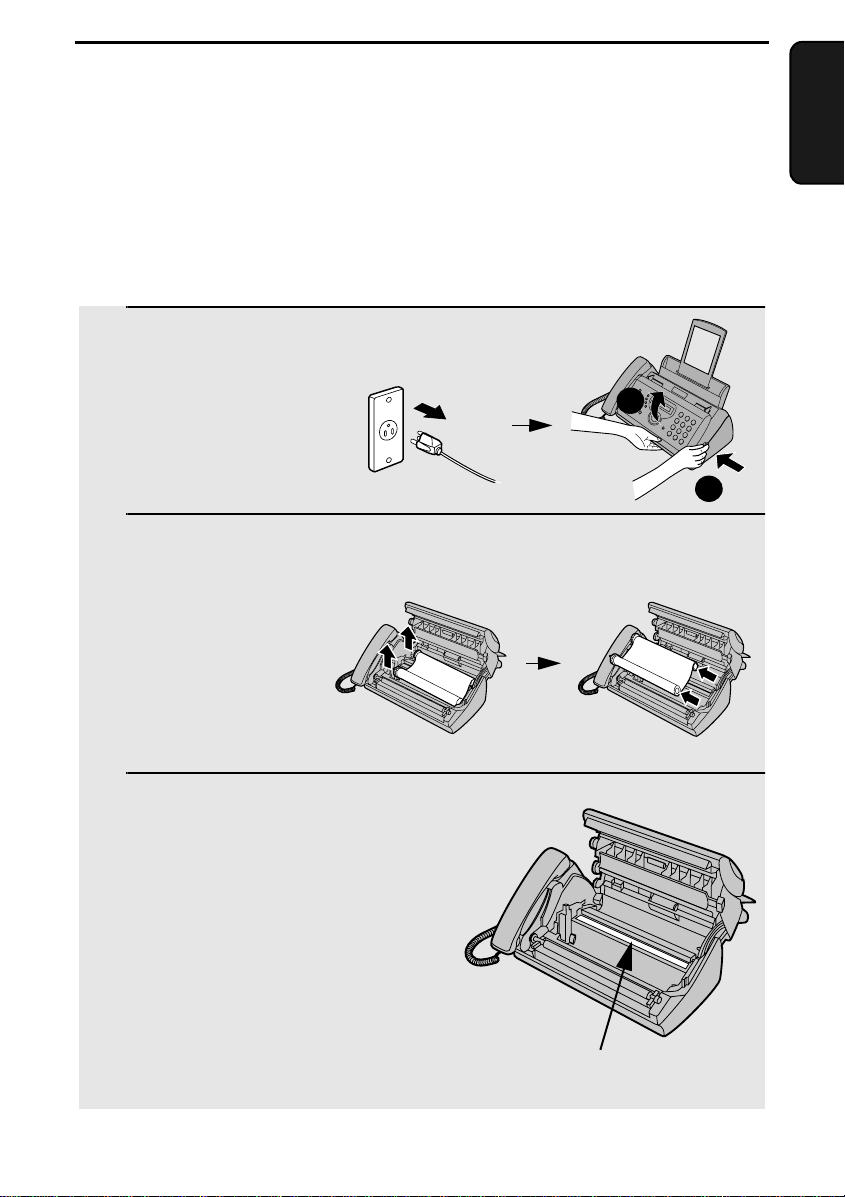
79
8. Maintenance
8. Maintenance
Print head
Clean the print head frequently to ensure optimum printing performance.
Note: Remove the paper from the paper tray before cleaning the print head.
1
Unplug the power cord, and open the
operation panel (press
➊).
2
Take the imaging film out of the print
compartment and place it on a sheet of
paper.
3
Wipe the print head with isopropyl
alcohol or denatured alcohol.
Caution!
• Do not use benzene or thinner. Avoid
touching the print head with hard
objects.
• The print head may be hot if your fax
machine has just received a large
number of documents. If this is the
case, allow the print head to cool prior
to cleaning.
1
2
Print head
all.bookPage79Wednesday,June4,20031:07PM
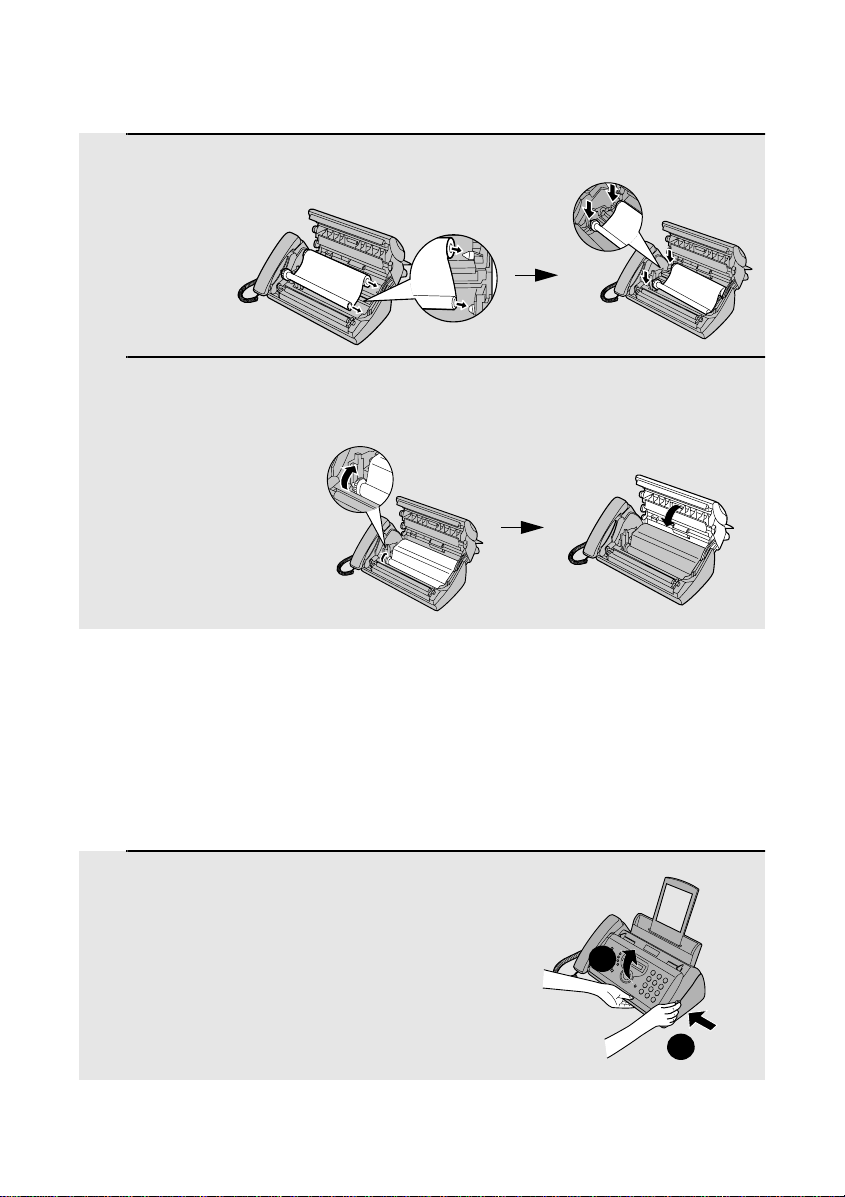
Maintenance
80
4
Place the imaging film back in the print
compartment.
5
Rotate the front gear until the film is taut, and then close the operation
panel (press down on both sides to make sure it clicks into place).
Scanning glass and rollers
Clean the scanning glass and rollers frequently to ensure the quality of
transmitted images and copies.
Note: Remove the paper from the paper tray before cleaning the scanning
glass and rollers.
1
Open the operation panel (press ➊).
1
2
all.bookPage80Wednesday,June4,20031:07PM
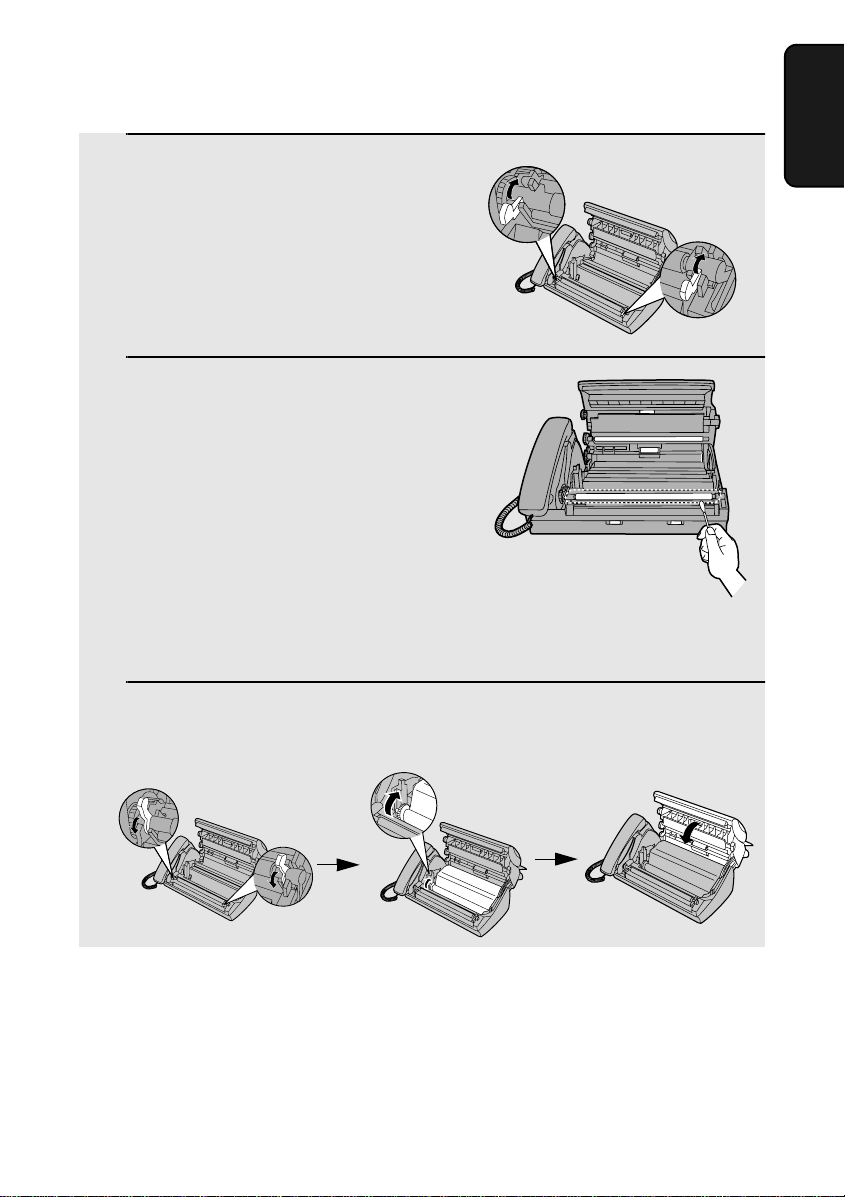
Maintenance
81
8. Maintenance
2
Flip up the green levers on each side of
the white roller.
3
Wipe the scanning glass (under the
white roller) and rollers with a cotton
swab.
• Make sure that all dirt and stains (such
as correcting fluid) are removed. Dirt
and stains will cause vertical lines on
transmitted images and copies.
If the scanning glass is difficult to clean
If you find it difficult to remove dirt from the scanning glass, you can try moistening
the swab with isopropyl alcohol or denatured alcohol. Take care that no alcohol
gets on the rollers.
4
Flip down the green levers on each side of the white roller. Rotate the
front gear until the film is taut, and then close the operation panel (press
down on both sides to make sure it clicks into place).
The housing
Wipe the external parts and surface of the machine with a dry cloth.
Caution!
Do not use benzene or thinner. These solvents may damage or discolor the
machine.
all.bookPage81Wednesday,June4,20031:07PM

82
9. Troubleshooting
Problems and Solutions
If you have any problems with your fax, first refer to the following
troubleshooting guide. If you cannot solve the problem, call Sharp's Customer
Assistance Center at 1-800-BE SHARP.
Line error
Problem Solution
LINE ERROR appears in
the display.
Try the transaction again. If the error persists, check
the following:
• Check the connection. The cord from the TEL.
LINE jack to the wall jack should be no longer than
six feet.
• Make sure there are no modem devices sharing the
same telephone line.
• Check with the other party to make sure their fax
machine is functioning properly.
• Have your telephone line checked for line noise.
• Try connecting the fax machine to a different
telephone line.
• If the problem still occurs, your fax machine may
need service.
all.bookPage82Wednesday,June4,20031:07PM
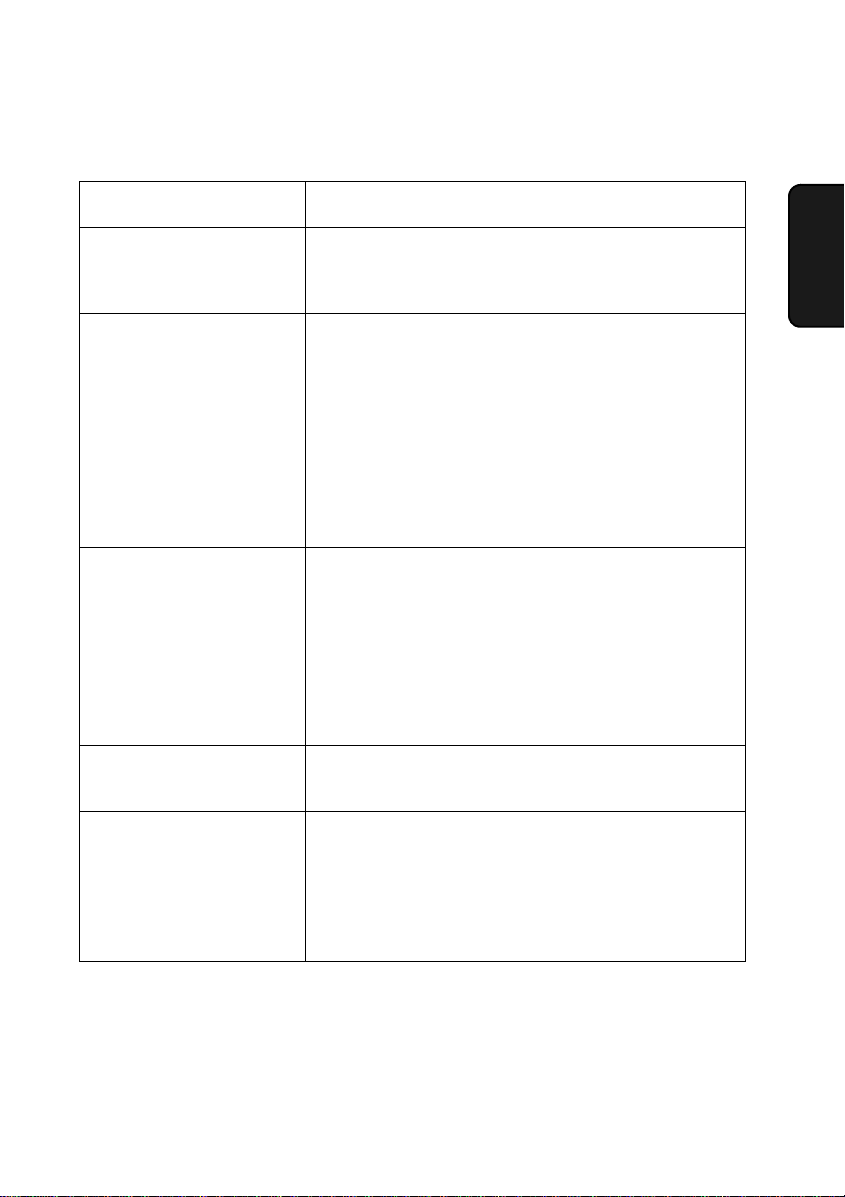
Problems and Solutions
83
9. Trouble-
shooting
Dialing and transmission problems
Problem Solution
No dial tone when you
pick up the handset or
press the SPEAKER key.
• Make sure the handset cord is connected to the
correct jack. See
Connecting the handset
on page
10.
Dialing is not possible. • Make sure the power cord is properly plugged into
a power outlet.
• Make sure that the telephone line is properly
connected to both the TEL. LINE jack and the wall
jack.
• Make sure that the fax machine is set to the correct
dialing mode for your telephone line. See
Dial
mode
on page 11.
The power is on, but no
transmission takes place.
• Make sure that the receiving machine has paper.
• If the receiving machine is in manual mode with no
attendant, reception will not be possible.
• Check the display for error messages.
• Pick up the handset and check for a dial tone.
Nothing is printed at the
receiving end.
• Make sure that the document for transmission is
placed face down in the feeder.
A distorted image is
received at the other end.
• Noise on the telephone line may cause distortion.
Try sending the document again.
• Make a copy of the document on your fax machine.
If the copy is also distorted, your fax machine may
need service.
all.bookPage83Wednesday,June4,20031:07PM

Problems and Solutions
84
Reception and copying problems
Problem Solution
The fax machine doesn't
receive documents
automatically.
• Make sure that the reception mode is set to FAX. If
you subscribe to a distinctive ring service, make
sure that the Distinctive Ring function is set to the
correct ring pattern. If you do not subscribe to a
distinctive ring service, make sure that Distinctive
Ring is set to OFF SETTING. (See
Distinctive Ring
on page 72.)
The printing paper comes
out blank when you try to
receive a document.
• Make sure that the document is loaded properly in
the feeder of the transmitting machine. Make a
copy or print a report to confirm the printing ability
of your machine.
General print quality is
poor.
• It is important to select a paper that is appropriate
for the thermal transfer printer in your fax. We
recommend using laser quality paper that has a
very smooth finish. Copier paper will work, but it
sometimes tends to yield a lighter print quality.
The received document is
faint.
• Ask the other party to send higher contrast
documents. If the contrast is still too low, your fax
machine may need service. Make a copy or print a
report to check your machine’s printing ability.
Received images are
distorted.
• Noise on the telephone line may cause distortion.
Have the other party try sending the document
again.
• The print head may be dirty. See
Print head
on
page 79.
• Make a copy or print a report on your fax machine.
If the copy or report is also distorted, your fax
machine may need service.
A received document or
copy prints out in strips.
• Make sure the operation panel is completely closed
(press down on both sides of the panel).
all.bookPage84Wednesday,June4,20031:07PM
Problems and Solutions
85
9. Trouble-
shooting
The quality of copies is
poor and/or dark vertical
lines appear.
• Any dirt or material on the scanning glass will
cause spots to appear on copies and transmitted
faxes. Clean the scanning glass as explained on
page 80.
Reception/copying is
interrupted.
• If reception or copying takes place continuously for
a long time, the print head may overheat. Turn off
the power and let it cool down. If overheating
frequently occurs, try changing the print contrast
setting to LIGHT (see page 16).
Dark vertical lines appear
on copies and received
faxes.
• Try changing the print contrast setting to LIGHT
(see page 16).
General problems
Problem Solution
Auto-dial numbers cannot
be stored in the fax.
• Make sure the fax is plugged in and the imaging
film has been loaded. (Auto-dial numbers cannot
be stored if the imaging film has not been loaded.)
See
Loading the Imaging Film
in Chapter 1.
Nothing appears in the
display.
• Make sure the power cord is properly plugged into
a power outlet.
• Connect another electrical appliance to the outlet to
see if it has power.
The machine does not
respond when you press
any of its keys.
• If a beep sound is not made when you press the
keys, unplug the power cord and then plug it in
again several seconds later.
Automatic document
feeding does not work for
transmission or copying.
• Check the size and weight of the document (see
Transmittable Documents
on page 43).
all.bookPage85Wednesday,June4,20031:07PM
Messages and Signals
86
Messages and Signals
Display messages
Note: If you have turned on the Caller ID function, see page 68 for display
messages related to Caller ID.
ADD PAPER & /
PRESS START KEY
(alternating messages)
Check the printing paper. If the tray is empty, add
paper and then press the START/MEMORY key. If
there is paper in the tray, make sure it is inserted
correctly (take out the stack, align the edges evenly,
and then reinsert it in the tray) and then press the
START/MEMORY key.
CHECK FILM/
CHECK COVER/
CHECK PAPER JAM
(alternating messages)
These alternating messages appear when there is a
problem in the print compartment that prevents
printing. Check to see if the imaging film is not loaded
properly or if it has been used up and needs
replacement. Make sure the operation panel is
completely closed (press down on both sides). If a
paper jam has occurred, clear the jam as explained in
the following section,
Clearing Paper Jams
.
CHECK PAPER SIZE The paper size setting is incorrect. Change the paper
size setting as explained on page 16.
DOCUMENT JAMMED The original document is jammed. See the following
section,
Clearing Paper Jams
. Document jams will
occur if you load more than 10 pages at once or load
documents that are too thick (see page 43). The
document may also jam if the receiving machine
doesn’t respond properly when you attempt to send a
fax.
FAX RX IN MEMORY A fax has been received in memory because the
imaging film needs replacement, you have run out of
printing paper, or the paper is jammed. The fax will
print out automatically when the problem is fixed.
FUNCTION MODE The FUNCTION key has been pressed.
LINE ERROR Transmission or reception was not successful. Press
the STOP key to clear the message and then try
again. If the error persists, see
Line Error
on page 82.
all.bookPage86Wednesday,June4,20031:07PM
Messages and Signals
87
9. Trouble-
shooting
MEMORY IS FULL/
SEE MANUAL
(alternating messages)
The memory is full. You may have too many
messages recorded in the answering system. To
erase messages, see page 28.
This message may also occur during fax reception if
too much data is received before the pages can be
printed out. If faxes have been received to memory
because printing is not possible (an additional
message will indicate the problem), resolve the
problem so that printing can continue (see
Substitute
Reception to Memory
on page 64).
If you are attempting to transmit from memory, see
If
the memory becomes full
on page 58.
If you are copying, see
If MEMORY IS FULL appears
on page 65.
MEMORY PRINTING The fax is preparing to or printing out a document
from memory.
NO DATA This appears if you attempt to search for an auto-dial
number when none have been stored.
OFF HOOK This appears if you forgot to replace the handset after
using it to dial and send a fax. Replace the handset or
press the STOP key to clear the message.
ON HOOK DIAL The SPEAKER key has been pressed and the fax
machine is waiting for you to dial.
OVER HEAT The print head has overheated. Operation can be
continued after it cools. If overheating frequently
occurs, try changing the print contrast setting to
LIGHT (see page 16).
PRINT HEAD FAIL/
YOU NEED SERVICE
(alternating messages)
The print head has failed and requires service.
READY TO SEND A document has been loaded and the fax machine is
waiting for you to begin faxing or copying.
RECALLING This appears if you attempt to send a fax by
automatic dialing and the line is busy or the receiving
fax machine does not answer. Your fax machine will
automatically reattempt the call. (See
Automatic
redialing
on page 55.)
all.bookPage87Wednesday,June4,20031:07PM
Messages and Signals
88
Audible signals
T.A.D. TRANSFER The answering system's transfer function has been
turned on (see page 32).
TOTAL MSGS:XX This indicates that you have received messages in
the answering system. “XX” is the number of
messages.
TOTAL PAGE(S) 01 Number of pages transmitted, received, or copied.
Continuous tone 3 seconds Indicates the end of transmission,
reception, or copying.
Intermittent tone
(3 beeps)
5 seconds
(1 second on, 1
second off)
Indicates incomplete transmission,
reception, or copying.
Rapid intermittent
tone
35 seconds
(0.7 seconds on,
0.3 seconds off)
Indicates that the handset is off hook.
all.bookPage88Wednesday,June4,20031:07PM
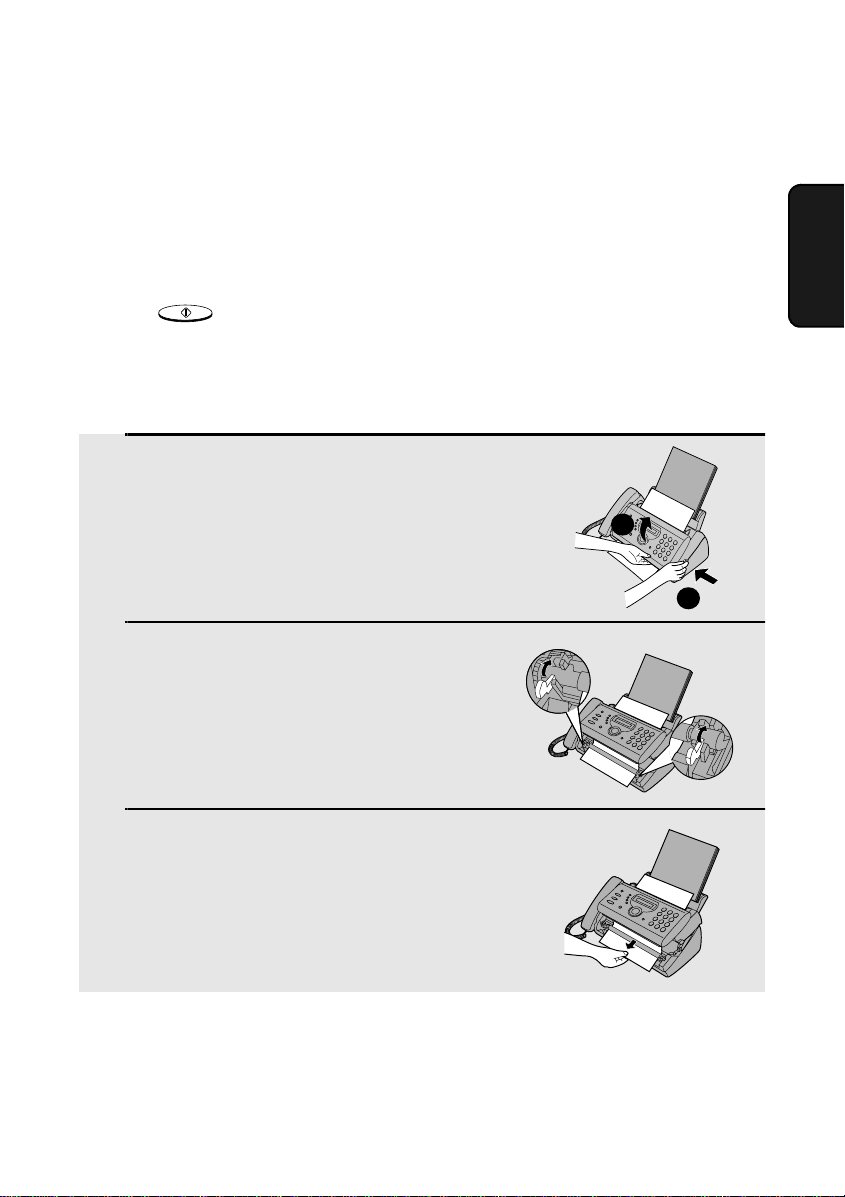
Clearing Paper Jams
89
9. Trouble-
shooting
Clearing Paper Jams
Clearing a jammed document
If the original document doesn’t feed properly during transmission or copying,
or DOCUMENT JAMMED appears in the display, first try pressing
. If the document doesn't feed out, remove it as explained below.
Important:
Do not try to remove a jammed document without releasing it as explained
below. This may damage the feeder mechanism.
START/MEMORY
1
Press ➊ and slowly open the operation
panel until it is half open.
2
Flip up the green levers on each side of
the white roller.
3
Gently and remove the document.
• Be careful not to tear the document.
1
2
all.bookPage89Wednesday,June4,20031:07PM
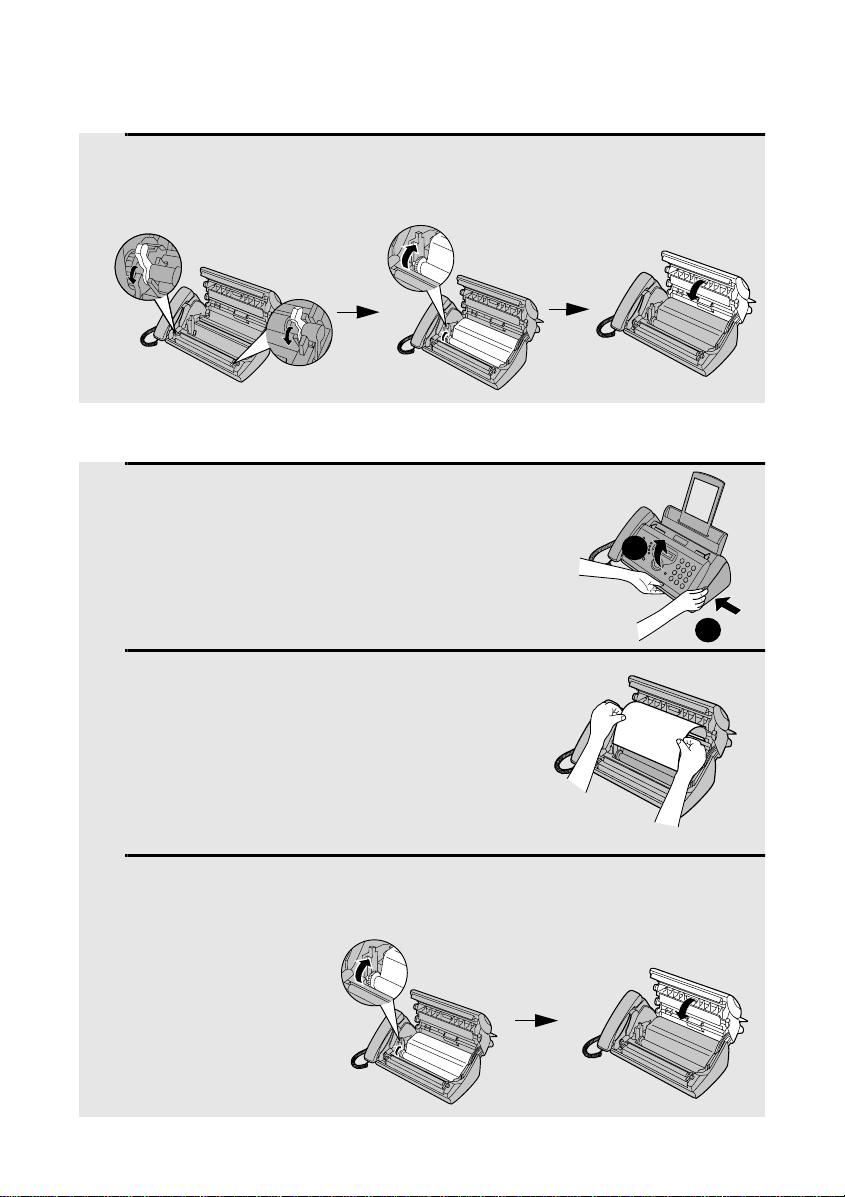
Clearing Paper Jams
90
1
Open the operation panel (press ➊).
2
Gently pull the jammed paper out of
the machine, making sure no torn
pieces of paper remain in the print
compartment or rollers.
3
Rotate the front gear until the film is taut, and then close the operation
panel (press down on both sides to make sure it clicks into place).
Clearing jammed printing paper
4
Flip down the green levers on each side of the white roller. Rotate the
front gear until the film is taut, and then close the operation panel (press
down on both sides to make sure it clicks into place).
1
2
all.bookPage90Wednesday,June4,20031:07PM

Ordering Parts
91
Ordering Parts
To order parts, contact the parts distribution center located nearest
you. When ordering a part, use the part order number shown below.
Operation manual TINSE4356XHTZ
Setup Guide TCADZ3598XHZZ
Handset cord QCNWG209BXHOW
Telephone line cord QCNWG208BXHZZ
Hand set DUNTK468BXHFW
Paper tray CPLTP3183XHR7
Paper tray extension LPLTP3184XHZZ
Gears CGERH2566XH01
NGERH2568XHZZ
Part distribution centers
Tritronics, Inc.
1306 Continental Drive
Abingdon, MD 21009
Tel: 1-800-638-3328
Fax: 1-800-888-FAXD
Tritronics, Inc.
1015 NW 52nd Street
Ft. Lauderdale, FL 33309
Tel:1-800-365-8030
Fax: 1-800-999-FAXD
Fox International, Ltd.
23600 Aurora Road
Bedford Heights, OH 44146
Tel: 1-800-321-6993
Fax: 1-800-445-7991
Andrews Electronics
25158 Avenue Stanford
Santa Clarita, CA 91355
Tel: 1-800-274-4666
Fax: 1-805-295-5126
Sharp Accessories and
Supply Center
2130 Townline Road
Peoria, IL 61615
Tel: 1-800-642-2122
all.bookPage91Wednesday,June4,20031:07PM

FCC Regulatory Information
92
FCC Regulatory Information
This equipment complies with Part 68 of the FCC rules and the requirements adopted
by the ACTA. On the rear of this equipment is a label that contains, among other
information, a product identifier in the format US:AAAEQ##TXXXX. If requested, this
number must be provided to the telephone company.
A plug and jack used to connect this equipment to the premises wiring and telephone
network must comply with the applicable FCC Part 68 rules and requirements adopted
by the ACTA. A compliant telephone cord and modular plug is provided with this
product. It is designed to be connected to a compatible modular jack that is also
compliant. See installation instructions for details. This equipment connects to the
telephone network through a standard USOC RJ-11C network interface jack.
The REN is used to determine the number of devices that may be connected to a
telephone line. Excessive RENs on a telephone line may result in the devices not
ringing in response to an incoming call. In most but not all areas, the sum of RENs
should not exceed five (5.0). To be certain of the number of devices that may be
connected to a line, as determined by the total RENs, contact the local telephone
company. For products approved after July 23, 2001, the REN for this product is part of
the product identifier that has the format US:AAAEQ##TXXXX. The digits represented
by ## are the REN without a decimal point (e.g., 03 is a REN of 0.3). For earlier
products, the REN is separately shown on the label.
If this equipment causes harm to the telephone network, the telephone company will
notify you in advance that temporary discontinuance of service may be required. But if
advance notice isn't practical, the telephone company will notify the customer as soon
as possible. Also, you will be advised of your right to file a complaint with the FCC if you
believe it is necessary.
The telephone company may make changes in its facilities, equipment, operations or
procedures that could affect the operation of the equipment. If this happens the
telephone company will provide advance notice in order for you to make necessary
modifications to maintain uninterrupted service.
If trouble is experienced with this equipment, or for repair or warranty information,
please contact Sharp’s Customer Assistance Center. The number is 1-877-794-8675. If
the equipment is causing harm to the telephone network, the telephone company may
request that you disconnect the equipment until the problem is resolved.
This equipment may not be used on coin service provided by the telephone company.
Connection to party line service is subject to state tariffs. Contact the state public utility
commission, public service commission or corporation commission for information.
If your home has specially wired alarm equipment connected to the telephone line,
ensure the installation of this equipment ID does not disable your alarm equipment. If
you have questions about what will disable alarm equipment, consult your telephone
company or a qualified installer.
This equipment is hearing-aid compatible.
When programming and/or making test calls to emergency numbers:
♦ Remain on the line and briefly explain to the dispatcher the reason for the call.
♦ Perform such activities in the off-peak hours, such as early morning or late evening.
all.bookPage92Wednesday,June4,20031:07PM
93
S H A R P
Date Revised: .
Date Issued :July. 3. 2001
MATERIAL SAFETY DATA SHEET (1/2)
MSDS No. B-1026
Section 1. Product and Company Identification
Product Name : IMAGING FILM UX-5CR
Supplier Identification : Sharp Corporation
22-22 Nagaike-cho, Abeno-ku, Osaka, Japan
Manufacturer : DAINIPPON PRINTING CO. LTD.
591-2, Kamihirose, Higashikubo, Sayamashi, Saitama, 350-1321 JAPAN
Emergency telephone number : +81-42-952-9666
Local suppliers are listed below. Please contact the nearest supplier for additional information.
Section 2. Ingredients
Ingredients CAS No. Proportion OSHA PEL ACGIH TLV Other
Polyethylene terephthalate film
25038-59-9 47 ~ 52% - - None
Coating layer substances
Carbon Black 1333-86-4 7 ~ 10% 3.5 mg/m
3
3.5 mg/m
3
None
Ester wax 8015-86-9 2 ~ 7% - - None
Parraffin Wax 8002-74-2 10 ~ 14% - 2.0 mg/m
3
None
Microcrystalline wax 63231-60-7 16 ~ 22% - - None
Ethylene Vinyl Acetate Copolymer
24937-78-8 1 ~ 5% - - None
Others 1 ~ 6% - - None
Section 3. Hazardous Identification
Route(s) of Entry: Inhalation? Skin? Ingestion?
NO NO Possible but very unusual
Signs and Symptoms of Exposure: None
Medical Conditions Aggravated by Exposure: None
POTENTIAL HEALTH EFFECTS:
Inhalation: None
Skin Contact: None
Eye Contact: None
Ingestion: None
Section 4. First-Aid Measures
Inhalation: No applicable
Skin Contact: In case of contact, usually special care in not necessary. If it dirties skin, clear with water and soap.
Eye Contact: In case of contact, immediately flush eyes with plenty of water. If necessary, then care for medical attention.
Ingestion: Immediately make vomit it and rinse mouth with water. If necessary, then care for medical attention.
Section 5. Fire-Fighting Measures
Flash Point: about 250
°
C for ink
Autoignition: None
Flammability Limits: Not applicable
Extinguishing Media: CO2, Water, Dry chemicals, Foam
Firefighting: None
Fire and Explosion Hazard: None
Hazardous Combustion Products: None
(Country) (Name and Telephone Number)
U.S.A. Sharp Electronics Corporation
Telephone number for information: 1-800-237-4277
Canada Sharp Electronics of Canada Ltd.
Telephone number for information : 905-890-2100
Emergency telephone number : 1-800-255-3924
all.bookPage93Wednesday,June4,20031:07PM
94
S H A R P
Date Revised: .
Date Issued :July. 3. 2001
MATERIAL SAFETY DATA SHEET (2/2)
MSDS No. B-1026
Section 6. Accidental Release Measures
Rumpling the product may cause the wax layer to peel off. Sweep up or vacuum. When sweeping, avoid
raising film or dust. If a vacuum is used , motor should be rated as dust tight. Wash any residue off skin with
soap and water. Garments may be wasted or dry cleaned after removal of loose film or dust.
Section 7. Handling and Storage
No special precautions for safety reason.
Store in cool, dry place ,avoid direct sunlight.
Section 8. Exposure Control/Personal Protection
Ventilation: None
Eye Protection: None
Protective Clothing: None
Gloves: None
Section 9. Physical and Chemical Properties
Description: Not applicable
Melting Point: 71
°
C Freezing Point: None
Pressurized: None Boiling Point: None
pH: None Specific Gravity (H20 = 1): about 1.2
Evaporation Rate: Negligible Water Solubility: Not applicable
Volatility: None
Section 10. Stability and Reactivity
Stability: Stable
Conditions to Avoid: None
Incompatibility(Materials to Avoid): None
Hazardous Decomposition or Byproducts: CO, CO2, NOX and H2O
Hazardous Polymerization: Will not occur
Section 11. Toxicological Information
Acute Toxicity: None
Chronic Toxicity: None
Section 12. Ecological Information
No environmental effect at normal use.
Section 13. Disposal Consideration
Dispose by the same method of ordinary plastic products in accordance with all applicable regulations. Any
disposal practice must be in compliance with local, state and federal laws and regulations. If necessary,
contact government office and ensure conformity with disposal regulations.
Section 14. Transport Information
No specific precautionary transport measure for safety reasons.
As to storage conditions, see section 7.
Section 15. Regulatory Information
None
Section 16. Other Information
The information herein is given in good faith, but no warranty, if used any process.
Final determination of suitability of any material is the sole responsibility of the user.
Although certain information are described herein, we cannot guarantee, that these are the only hazard, which exist.
Information on this data sheet represents our current data and best opinion as to the proper use in handling of
this product under normal conditions.
Restrictions: This information relates only to the specific material designated as supplied by the manufacturer. This
information is supplied to us by the manufacturer and Sharp offers no warranties as to its accuracy and
accepts no responsibilities for any typographical errors which may appear on these sheets. It is the
responsibility of the user to determine the suitability of this product for each particular use.
all.bookPage94Wednesday,June4,20031:07PM
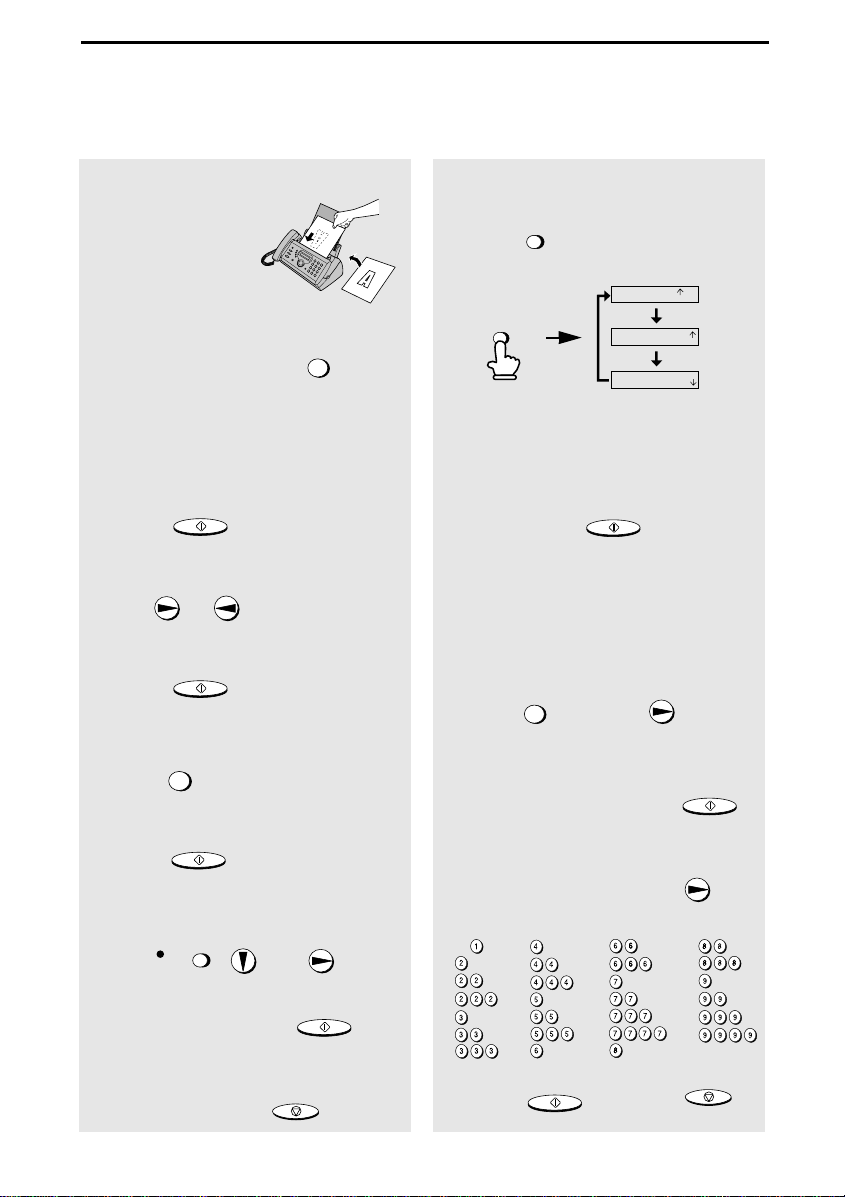
95
Quick Reference Guide
Sending Faxes
Place your document
(up to 10 pages) face
down in the document
feeder.
Normal Dialing
1. Lift the handset or press .
2. Dial the fax number.
3. Wait for the reception tone (if a person
answers, ask them to press their Start
key).
4. Press .
Search Dialing
1. Press or until the desired des-
tination appears in the display.
2. Press .
Speed Dialing
1. Press
and enter the Speed
Dial number
.
2. Press .
Recording an OGM
1. Press , , and .
2. Lift the handset, press ,
and speak into the handset.
3. When finished, press .
SPEAKER
START/MEMORY
START/MEMORY
SPEED
START/MEMORY
REC/
MEMO
START/MEMORY
STOP
Receiving Faxes
Press until the arrow in the
display points to the desired reception
mode.
FAX mode: The fax machine automatically
answers and receives faxes.
TEL mode: Answer all calls (even faxes)
by picking up the handset. To begin fax
reception, press .
TAD mode: Select this mode when you go
out to receive both voice messages and
faxes.
Storing Auto Dial Numbers
1. Press once and once.
2.
Enter a 2-digit Speed Dial number (01 to 40).
3.
Enter the fax number and press
.
4. Enter a name by pressing number keys.
(To enter two letters in succession that
require the same key, press after
entering the first letter.)
5. Press and then .
RESOLUTION/
RECEPTION MODE
START/MEMORY
FUNCTION
START/MEMORY
START/MEMORY
STOP
FAX
TEL
JAN-01 10:30
FAX
TEL
JAN-01 10:30
FAX
TEL
JAN-01 10:30
TAD
TAD
TAD
RESOLUTION/
RECEPTION MODE
A =
B =
C =
D =
E =
F =
G =
H =
I =
J =
K =
L =
M =
N =
O =
P =
Q =
R =
S =
T =
U =
V =
W =
X =
Y =
Z =
SPACE =
all.bookPage95Wednesday,June4,20031:07PM
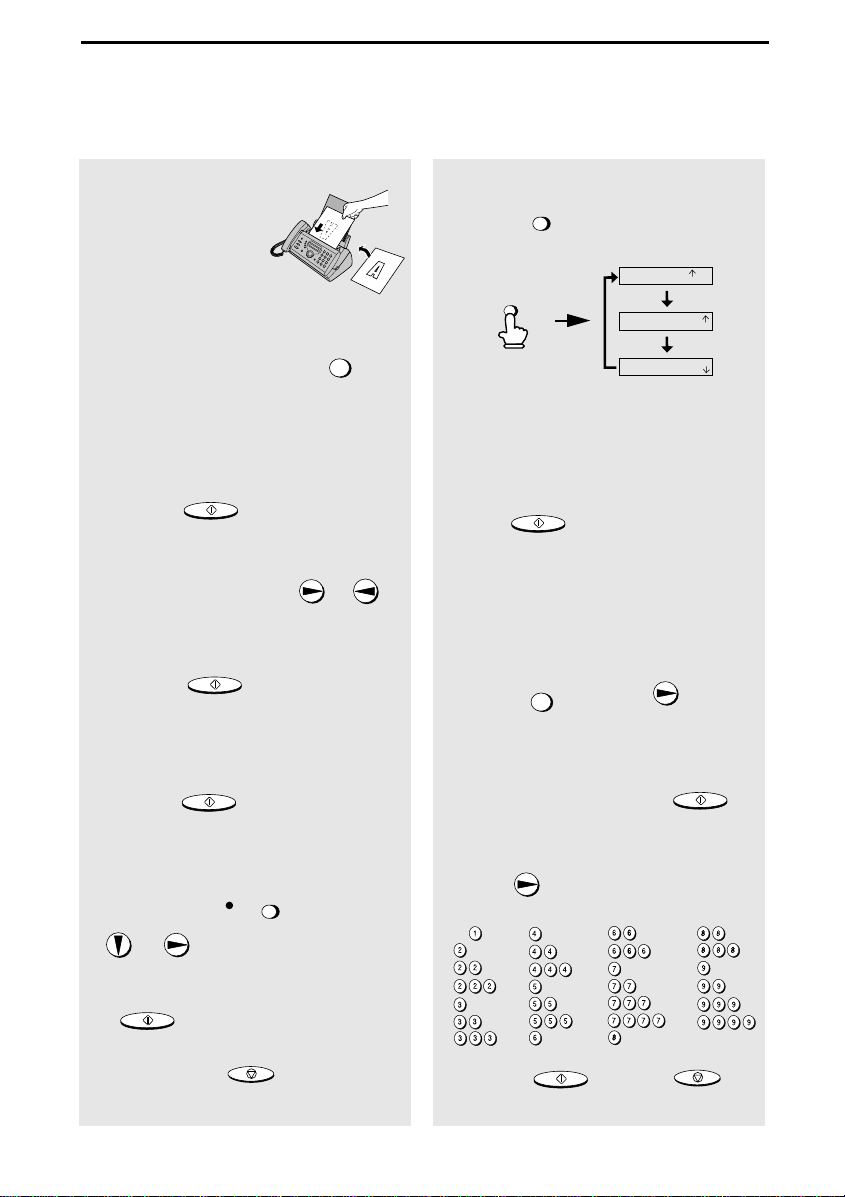
96
Guía de referencia rápida
Transmisión de mensajes telefax
Coloque el original
(hasta 10 páginas) cara
abajo en el alimentador
de documentos.
Marcación normal
1.
Levante el auricular u oprima: .
2. Marque el número de telefax.
3. Espere hasta escuchar el tono de
recepción (si contestara una persona,
pídale oprimir su tecla Start).
4. Oprima: .
Marcación automática
1. Oprima la tecla de flecha o
hasta que en el visor aparazca el destino
deseado.
2. Oprima: .
Marcación directa por teclado
1.
Marque el número de fax.
2. Oprima: .
Grabacion de un mensaje de
bienvenida
1. Oprima la tecla , tecla de flecha
, y .
2. Levante el auricular, oprima la tecla
y hable en el microteléfono.
3. Oprima la tecla cuando haya
finalizado.
SPEAKER
START/MEMORY
START/MEMORY
START/MEMORY
REC/
MEMO
START/MEMORY
STOP
Recepción de mensajes telefax
Oprima hasta que la flecha que
hay en el display señale hacia el número de
recepción deseado
Modo FAX
: El aparato telefax contesta y
transmite automáticamente mensajes telefax.
Modo TEL: Responda a todas las llamadas
(incluso mensajes de fax), levantando el
auricular. Para iniciar la recepción de fax,
oprima .
Modo TAD: Seleccione este modo cuando
salga para recibir tanto mensajes hablados
como telefax.
Memorizar números marc.
automática
1. Oprima una vez y una vez.
2. Introduzca un número de 2 dígitos de
Marcación abreviada (01 a 30).
3. Introduzca el
número de telefax y pulse
.
4. Ingrese el nombre oprimiendo las teclas
numéricas. (Para ingresar sucesivamente
dos letras que requieren la misma tecla,
oprima después de ingresar la
primera letra).
5. Oprima y luego .
RESOLUTION/
RECEPTION MODE
START/MEMORY
FUNCTION
START/MEMORY
START/MEMORY
STOP
FAX
TEL
JAN-01 10:30
FAX
TEL
JAN-01 10:30
FAX
TEL
JAN-01 10:30
TAD
TAD
TAD
RESOLUTION/
RECEPTION MODE
A =
B =
C =
D =
E =
F =
G =
H =
I =
J =
K =
L =
M =
N =
O =
P =
Q =
R =
S =
T =
U =
V =
W =
X =
Y =
Z =
SPACE =
all.bookPage96Wednesday,June4,20031:07PM

97
A
Anti Junk Fax, 73
Audible signals, 88
Auto-dial numbers
Storing, 25, 48
Using, 52, 53
C
Caller ID, 67-71
Caller ID List, 76
Contrast, 46
Copies, 65
Copy cut-off setting, 66
CPC Detection, 31
D
Date, setting, 19-20
Daylight Saving Time, 20
Dial mode, 11
Dialing
Direct Keypad, 54
Normal, 47
Search, 53
Speed, 52
Direct Keypad Dialing, 54
Display messages, 86
Distinctive ring, 72
Document feeder, 44
Document guides, 44
Document restrictions, 44
Document sizes, 43
Document, maximum scanning size, 43
E
ECM (Error Correction Mode), 56
Extension telephone
Using, 61
F
FAX reception mode, 21, 59
Fax mode on TAD failure, 29
Fax Signal Receive, 63
H
Halftone setting, 45
Handset, 10
Handset receiver volume, 23
Hold, 62
Housing, cleaning, 81
I
Imaging film, replacing, 13
J
Jams, clearing, 89-90
L
Letters, entering, 18, 49
Line error, 82
Loading paper, 15
Loading the document, 44
M
Memory transmission, 58
Memory, substitute reception to, 64
Message List, 76
Messages
Erasing, 28
Listening to, 27
Listening to remotely, 38
Setting allowed time, 29
N
Normal Dialing, 47
Number of rings in FAX reception mode,
59
Number of rings in TAD mode, 26
Index
all.bookPage97Wednesday,June4,20031:07PM

Index
98
O
OGM only mode, 30
Ordering parts, 91
Outgoing message, 24
Override Ringing, 35
P
Paper jams, clearing, 89-90
Paper size setting, 16
Paper tray extension, 12
Paper, loading, 15
Polling, 74
Power cord, 10
Print contrast setting, 16
Print head, cleaning, 79-80
Priority Call, 70
R
Reception mode
FAX mode, 21, 59
TAD mode, 21, 25
TEL mode, 21, 60
Reception Ratio setting, 63
Redialing, 55
Remote code number, 37
Remote operations, 37
Resolution, 45
Ringer volume, 23
S
Scanning glass, cleaning, 80
Search Dialing, 53
Sender’s name and number, entering,
17-18
Setup List, 76
Speaker volume, 22
Speed Dialing, 52
T
TAD reception mode, 21, 25
TEL reception mode, 21, 60
TEL. LINE jack, 11
Telephone line cord, 11
Telephone Number List, 76
Time, setting, 19-20
Toll Saver function, 26, 37
Transaction Report, 77
Setting print condition, 78
Transfer Function, 32
all.bookPage98Wednesday,June4,20031:07PM

all.bookPage99Wednesday,June4,20031:07PM

all.bookPage100Wednesday,June4,20031:07PM

all.bookPage101Wednesday,June4,20031:07PM

all.bookPage102Wednesday,June4,20031:07PM
1. Call your fax from a touch-tone telephone, and
press # when the outgoing message begins.
2. Enter your remote code: .
3. Press # .
4. After listening to your messages, you can either
hang up to save them, or enter one of the
commands on the reverse side.
REMOTE OPERATION CARD
The card below is provided as a quick guide to remote operation. Cut it out
and carry it with you when you go out.
Remote Operation Guide
all.bookPage103Wednesday,June4,20031:07PM
REMOTE COMMANDS
• FAX RECEPTION MODES
TAD mode......................... 81#
FAX mode......................... 82#
TEL mode......................... 83#
• TRANSFER FUNCTION
Turn on ............................. 91#
Turn off ............................. 92#
New transfer number ........ 90#
(Tel. #)
#
Record transfer OGM ....... 93#
To quickly disconnect........ **
• OGM ONLY MODE
Turn on ............................. 11#
Turn off ............................. 12#
• PLAYBACK
Play messages ................. 7#
Move backward/repeat...... 2#
Skip forward...................... 5#
Stop .................................. 0#
Play new messages only .. 6#
(first stop playback)
• ERASING MESSAGES
Erase single message ...... 3#
Erase all messages .......... 33#
• RECORDING A MEMO
Start .................................. * #
End ................................... 0#
• RECORDING A NEW OGM
Start .................................. 4 *
all.bookPage104Wednesday,June4,20031:07PM

LIMITED WARRANTY
SHARP ELECTRONICS CORPORATION warrants to the first end user purchaser that this Sharp
brand product (the "Product"), when shipped in its original container, will be free from defective
workmanship and materials, and agrees that it will, at its option, either repair the defect or replace
the defective Product or part thereof with a new or remanufactured equivalent at no charge to the
purchaser for parts or labor for the period(s) set forth below.
This warranty does not apply to any appearance items of the Product nor to the additional excluded
item(s) set forth below nor to any product the exterior of which has been damaged or defaced,
which has been subjected to misuse, abnormal service or handling, or which has been altered or
modified in design or construction.
In order to enforce the rights under this limited warranty, the purchaser should follow the steps set
forth below and provided proof of purchase to the servicer.
To the extent permitted by applicable state law, the warranties set forth herein are in lieu of, and
exclusive of, all other warranties, express or implied. Specifically,ALL OTHER WARRANTIES
OTHER THAN THOSE SET FORTH ABOVE ARE EXCLUDED. ALL EXPRESS AND IMPLIED
WARRANTIES INCLUDING THE WARRANTIES OF MERCHANTABILITY, FITNESS FOR USE,
AND FITNESS FOR A PARTICULAR PURPOSE ARE SPECIFICALLY EXCLUDED. If, under
applicable state law, implied warranties may not validly be disclaimed or excluded, the duration of
such implied warranties is limited to the period(s) from the date of purchase set forth below.
Neither the sales personnel of the seller nor any other person is authorized to make any warranties
other than those described above, or to extend the duration of any warranties beyond the time
period described above on behalf of Sharp.
The warranties described herein shall be the sole and exclusive warranties granted by Sharp and
shall be the sole and exclusive remedy available to the purchaser. Correction of defects, in the
manner and for the period of time described herein, shall constitute complete fulfillment of all
liabilities and responsibilities of Sharp to the purchaser with respect to the Product, and shall
constitute full satisfaction of all claims, whether based on contact, negligence, strict liability or
otherwise. In no event shall Sharp be liable, or in any way responsible, for any damages or defects
in the Product which were caused by repairs or attempted repairs performed by anyone other than
an authorized servicer. Nor shall Sharp be liable or in any way responsible for any incidental or
consequential economic or property damage. Some states do not allow limits on warranties or on
remedies for breach in certain transactions; in such state the limits herein may not apply.
Your Product: Personal Facsimile
Warranty Period for this Product:
Ninety (90) days parts and labor from date of purchase.
Additional items excluded
Any consumable items such as paper supplied with the
from warranty coverage:
Product.
Where to obtain service:
At a Sharp Authorized Servicer located in the United States.
To find out the location of the nearest Sharp Authorized Servicer,
call Sharp toll free at 1--800-BE-SHARP.
What to do to obtain service:
Ship (prepaid) or carry in your Product to a Sharp Authorized Servicer.
Be sure to have proof of purchase available. If you ship or mail the
Product, be sure it is packaged carefully.
For product information or customer assistance, please visit http://www.sharpusa.com on the
World Wide Web or call 1-800-BE SHARP.
SHARP ELECTRONICS CORPORATION
Sharp Plaza,
Mahwah, New Jersey 07430-2135
all.bookPage105Wednesday,June4,20031:07PM

PRINTED IN THAILAND
(TINSE4356XHTZ)
SHARP ELECTRONICS CORPORATION
Sharp Plaza, Mahwah, New Jersey 07430-2135
SHARP CORPORATION
all.bookPage106Wednesday,June4,20031:07PM