User Manual
Childproof lock
The childproof lock lets you protect children from possible hazards resulting from the appliance. Depending on the features of the model, the appliance comes with a door lock.
1 Door lock
The door lock is a mechanical safety system and makes it more difficult to open the appliance door. You can activate or deactivate the door lock.
WARNING Risk of suffocation!
Children may become trapped in the appliance and thus suffocate.
▶ Activate the door lock and close the appliance door
Activating the door lock
Note: The door lock remains activated until it is deactivated manually.
1. Open the appliance door.
2. Pull the catch of the childproof lock forwards 1 and close the appliance door 2 .
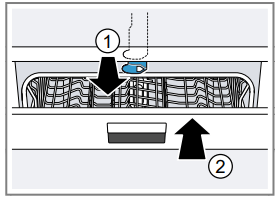
Deactivating the door lock
1. Open the appliance door.
2. Push the catch of the childproof lock to the right 1 and slide it backwards 2 .
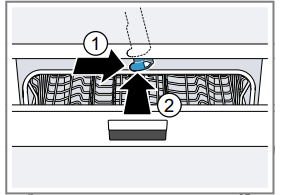
3. Close the appliance door.
Environmental protection and saving energy
Help protect the environment by using your appliance in a way that conserves resources and by disposing of reusable materials properly.
1 Disposing of packaging
The packaging materials are environmentally compatible and can be recycled.
▶ Sort the individual components by type and dispose of them separately.
Information about current disposal methods are available from your specialist dealer or local authority.
2 Saving energy
If you follow these instructions, your appliance will use less electricity and less water.
Use the Eco 50° programme.
- The Eco 50° programme is energy efficient and environmentally friendly.→ "Programmes"
If you do not have much tableware to wash, use the additional Half Load function.
- The programme will adjust to a lower load and consumption will be reduced.→ "Additional functions"
3 AquaSensor
The AquaSensor is an optical measuring device (light barrier) which measures the turbidity of the washing water. You can save water with the AquaSensor.
Use of the AquaSensor depends on the programme. If the soiling level is low, the washing water is used in the next wash cycle, so reducing water consumption by 3-6 litres. If the soiling level is is greater, the washing water is drained off and replaced with fresh water. In the automatic programmes the temperature and running time are additionally adjusted to the level of soiling.
Installation and connection
To ensure proper operation, connect the appliance to the power and water supply correctly. Observe the specified criteria and the installation instructions.
1 Scope of supply
After unpacking all parts, check for any damage in transit and completeness of the delivery.
If you have any complaints, contact the dealer who sold you the appliance or our Customer Service.
Note: The appliance has been tested at the factory to check it is in working order. It is possible that water has left marks on the appliance. These marks will disappear after the first wash cycle.
The delivery consists of the following:
- Dishwasher
- Installation Instructions
- Warranty
- Installation material
- Steam guard plate
- Rubber apron
- Mains cable
- Quick reference guide
2 Installing and connecting the appliance
You can position your built-under or integrable appliance in a fitted kit�chen between wooden and plastic walls. If you subsequently install your dishwasher as a free-standing appli�ance, you must stop it from tipping over, e.g. by screwing it to the wall or installing it under a continuous work�top that is securely connected to adjacent cabinets.
- Follow the safety instructions.
- Follow the instructions for electrical connection.
- Check the Scope of supply and the condition of the appliance.
- Consult the installation instructions for the installation dimensions required.
- Make the appliance level using the height-adjustable feet. Make sure that the appliance is standing on the floor securely.
- Install the drainage connection.
- Install the drinking water connection.
- Connect the appliance to the power supply.
3 Drainage connection
Connect your appliance to drainage connection so dirty water is dis�charged via the wash cycle.
Installing the drainage connection
- Consult the installation instructions supplied for the steps required here.
- Connect the wastewater hose to the outlet connection of the siphon using the enclosed parts.
- When doing so, check that the wastewater hose is not kinked, crushed or twisted.
- Also check that there is no cover in the drainage system preventing the wastewater from being discharged.
4 Drinking water connection
Connect your appliance to a drinking water connection.
Installing the drinking water connection
Note
- If you are replacing the appliance, you must use a new water supply hose.
- Consult the installation instructions supplied for the steps required here.
- Connect the appliance to the drinking water connection using the enclosed parts. Observe the Technical data
- When doing so, check that the drinking water connection is not kinked, crushed or twisted.
5 Electrical connection
Connect your appliance to the power supply.
Connecting the appliance to the electricity supply
Notes
- Please follow the Safety instructions
- Connect the appliance to alternating current only, in the range of 220 - 240 V and 50 Hz or 60 Hz.
- Please note that the water safety system is only functional if there is a power supply.
- Insert the non-heating appliance plug of the power cable into the appliance.
- Insert the mains plug of the appliance into a nearby socket. The connection data for the appliance can be found on the rating plate.
- Check that the mains plug is inserted properly.
Familiarising yourself with your appliance
1 Appliance
You can find an overview of the parts of your appliance here.
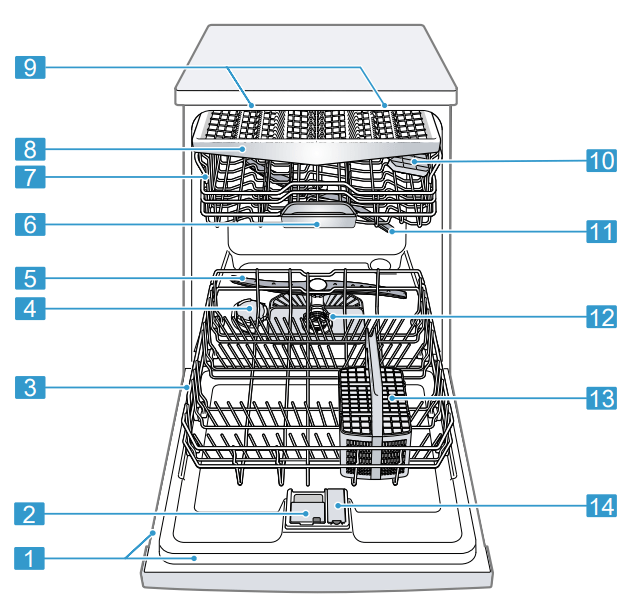
1 Rating plate
Rating plate with E number and FD number.
The data you need for Customer Service
2 Detergent dispenser Detergent
3 Bottom basket Bottom basket
4 Dispenser for special salt Add special salt for the Water softening system
5 Lower spray arm
The lower spray arm washes the tableware in the bottom basket.
If the tableware has not been washed properly, clean the spray arms. → "Cleaning spray arms"
6 Tablet collecting tray During the wash cycle tablets automatically fall out of the detergent dispenser into the tablet collecting tray where they can fully dissolve.
7 Top basket Top basket
8 Cutlery drawer Cutlery drawer
9 EmotionLight Interior lighting of the appliance. → "Overview of basic settings"
10 Etagere Etagere
11 Upper spray arm
The upper spray arm washes the tableware in the top basket.
If the tableware has not been washed properly, clean the spray arms. → "Cleaning spray arms"
12 Filter system Filter system
13 Cutlery basket Cutlery basket
14 Dispenser for rinse aid
Add rinse aid for the Rinse aid system
2 Controls
The controls are used to configure all functions of your appliance and to obtain information about the operating status.
With some buttons you can perform different functions.
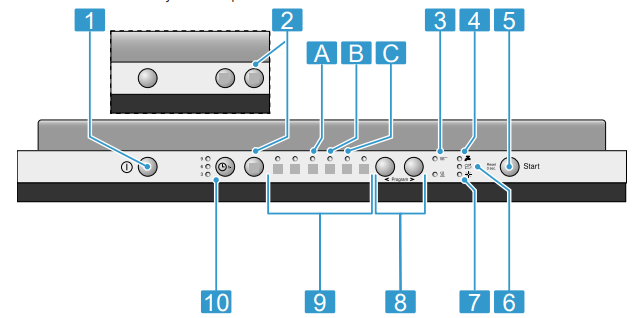
1 ON/OFF button
Switching on the appliance
Switching off the appliance
2 Additional functions
3 Programme sequence display The programme sequence display shows the current cycle of the appliance, e.g. washing or drying.
4 Water supply display Display for water supply lights up
5 Start button and reset button Reset 3 sec
Starting the programme
Terminating the programme
6 Special salt refill indicator Water softening system
7 Rinse aid refill indicator Rinse aid system
8 Setting buttons Setting a programme
Changing basic settings
9 Programmes
10 Timer programming
Programmes
You can find an overview of the programmes that can be selected here.Different programmes, which can be found on the control panel of your appliance, are available depending on the appliance configuration. The running time may vary depending on the programme selected. The running time depends on the water temperature, the quantity of tableware, the level of soiling and the Additional function selected. The runtime will change if the rinse aid system is switched off or rinse aid needs to be added. The consumption values can be found in the quick reference guide. The consumption values relate to normal conditions and a water hardness of 9 - 20 °E. Different influencing factors suc
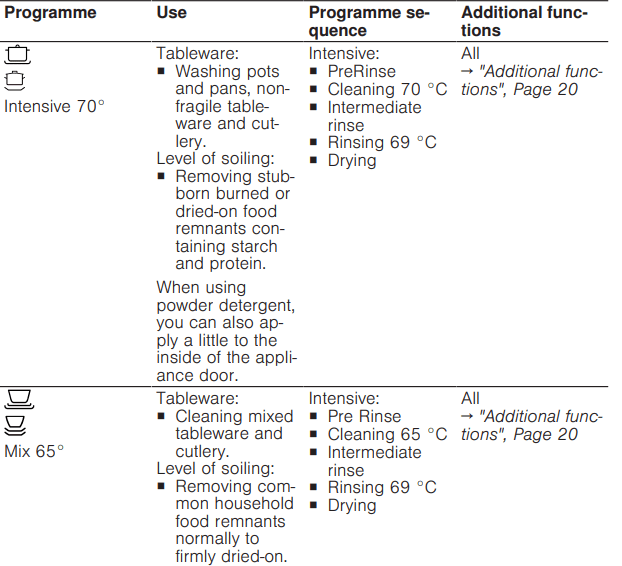
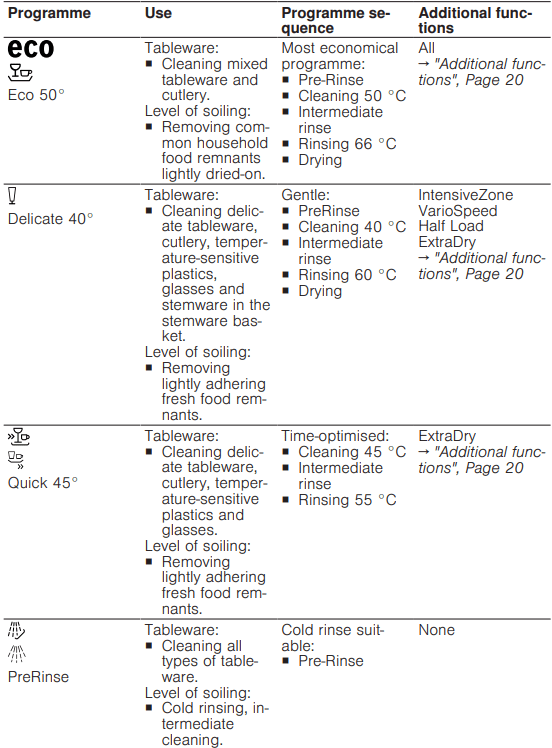
1 Information for test institutes
Test institutes are provided with information for comparability tests, e.g. according to EN60436.
These are the conditions for conducting the tests, however they are not the results or consumption values.
The product number (E-Nr.) and the production number (FD) are required here. They can be found on the rating plate on the appliance door.
Additional functions
You can find an overview of the additional functions that can be selected here. Different additional functions, which can be found on the control panel of your appliance, are available depending on the appliance configuration.
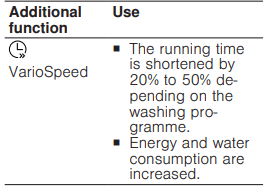
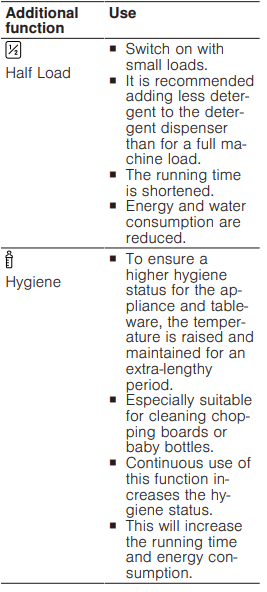
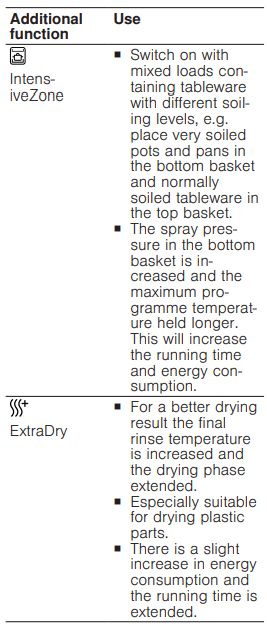
Features
You can find an overview of the possible features of your appliance and how to use them here.
These features depend on the model of your appliance.
1 Top basket
Arrange cups and glasses in the top basket.
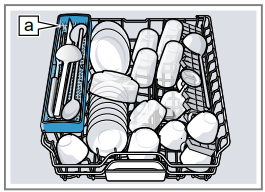
Knife shelf 
You can adjust the height of the top basket to make room for larger items of tableware.
Adjusting top basket with side levers
To wash large items of tableware in the baskets, adjust the shelf position of the top basket.
1. Pull out the top basket.
2. To prevent the basket from suddenly dropping down, hold the side of the basket by the top edge.
3. Press in the levers on the right and left on the outside of the basket.

The basket can then slip down slightly.
4. Raise or lower the basket evenly to the right level. → "Basket heights"
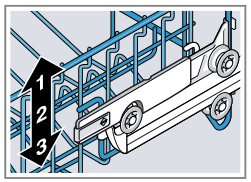
Check that the basket is level on both sides.
5. Slide the basket back in.
Adjusting top basket with pairs of rollers
To wash large items of tableware in the baskets, adjust the shelf position of the top basket.
1. Pull out the top basket.
2. Remove the basket.
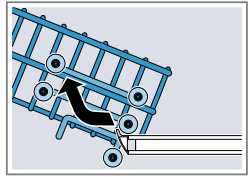
3. Insert the basket at the right basket height. → "Basket heights"
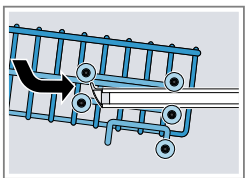
Check that the basket is level on both sides.
4. Slide the basket back in
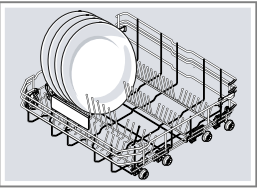
2 Bottom basket
Arrange pans and plates in the bottom basket.
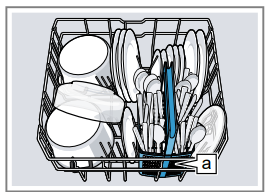
Cutlery basket 
Large plates up to a diameter of 31/34 cm can be arranged as shown.
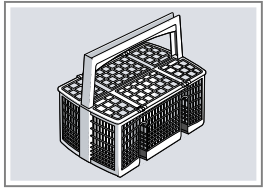
3 Cutlery basket
Arrange cutlery in the cutlery basket, always without sorting it and with the sharp points downwards.
4 Cutlery drawer
Arrange cutlery in the cutlery drawer.
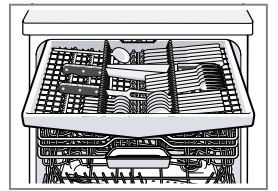
Arrange cutlery with the points and sharp edges downwards.
You can reorganise the cutlery drawer to make more space for longer/wider items of cutlery.
Reorganising cutlery drawer
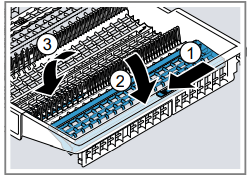
You can fold down the side shelves and front prongs to make more space for longer/wider items of cutlery.
1. To fold down a side shelf, push the lever forwards 1 and fold down the side shelf 2 .
2. To fold down the front prongs, push the lever forwards and fold down the prongs 3 .
Tip
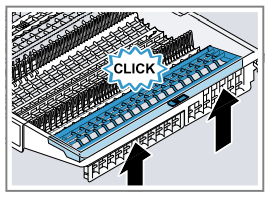
If you want to return the cutlery drawer to the original position, fold the side shelf back up until it clicks into position.
5 Etagere
Use the etagere and space underneath for small cups and glasses or for large items of cutlery, e.g. wooden spoons or serving cutlery.
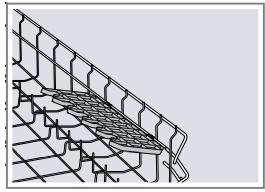
You can adjust the height of the etagere.
If you do not need the etagere, you can fold it up.
Adjusting etagere
You can adjust the height of the etagere.
1. Position the etagere vertically and pull it upwards 1 .
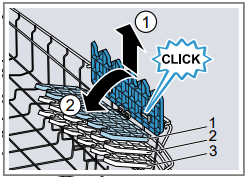
2. Position the etagere at a slight angle and move to the right height 2
3. Push the etagere down.
- The etagere clicks into position.
Water softening system
Hard water leaves limescale on the tub and tableware and parts of the appliance may become blocked. To ensure good dishwashing results, you can treat the water with special salt and the water softening system. To avoid damage to the appliance, water with a hardness above 9 °E must be softened.
1 Overview of water hardness settings
You can find an overview of the water hardness values that can be selected here.
You can find out how hard your water is from your local water company or by using a water hardness tester.
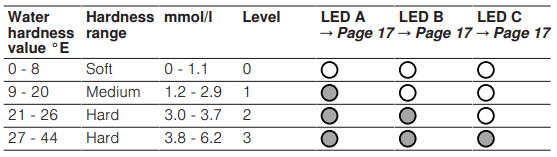
Note: Set the water hardness determined on your appliance. → "Setting water softening system"
With a water hardness of 0 - 8 °E you can dispense with special salt and switch off the water softening system. → "Switching off water softening system"
2 Setting water softening system
Set the water hardness on your appliance.
1. Determine the water hardness and the appropriate setting value. → "Overview of water hardness settings"
2. Press -45472.png) .
.
3. Press and hold > and Start until  and
and  flash.
4. Release buttons.
5. < repeatedly until the required level has been selected.
0, 1, 2 or 3 LEDs will light up accordingly. → "Overview of water hardness settings"
The factory setting is level 1
6. Press to save the setting.
3 Special salt
You can use special salt to soften water.
Adding special salt
If the special salt refill indicator lights up, add special salt to the dispenser for special salt just before the programme starts. The amount of special salt required depends on the water hardness: the higher the water hardness, the greater the amount of special salt required.
ATTENTION!
Detergent may damage the water softening system.
▶Only fill the dispenser of the water softening system with special dishwasher salt. Special salt can damage the tub due to corrosion.
▶To make sure that any special salt that escapes is washed out of the tub, add the special salt to the dispenser for special salt immediately before the programme starts.
1. Unscrew the lid of the dispenser for special salt and remove.
2. On initial start-up: Fill the dispenser right up with water.
3. Note: Only use special salt for dishwashers.
Do not use salt tablets.
Do not use table salt.
Add the special salt to the dispenser.
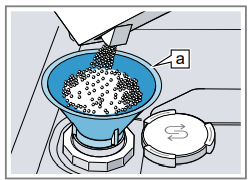
Funnel -68313.png)
Fill the dispenser right up with special salt. The water in the dispenser is displaced and forced out.
4. Place the lid back on the dispenser and turn to close.
4 Switching off water softening system
If you find the special salt refill indicator irritating, e.g. when using combined detergents with salt replacement substances, you can switch the salt refill indicator off.
Note
To avoid damage to the appliance, only switch off the water softening system in the following cases:
- The water hardness is max. 26 °E and you are using combined detergents with salt replacement substances. According to manufacturers, combined detergents with salt replacement substances can generally only be used up to a water hardness of 26 °E without adding special salt.
- The water hardness is 0 - 8 °E. You do not need to use special salt.
- Press
 .
.
- Press and hold > and until
 and
and  flash.
- Release buttons.
- Press < repeatedly until no LED lights up (level 0). → "Overview of water hardness settings"
- Press to save the setting.
- The LEDs go out.
- The water softening system is switched off and the salt refill indicator is deactivated.
5 Regeneration of the water softening system
In order to obtain fault-free function of the water softening system, the appliance performs reheating of the water softening system at regular intervals.Regeneration of the water softening system takes place before the end of the main rinse cycle in all programmes. It will increase the run time and consumption values, e.g. water and electricity
Overview of consumption values with regeneration the water softening system
Here you can find an overview of the maximum additional running time and consumption values during regeneration of the water softening system.
You can find the column applicable to your model in the quick reference guide according to its water consumption in the Eco 50° programme.
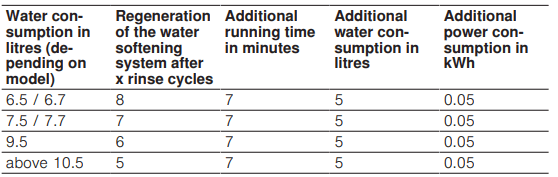
The consumption values specified are laboratory measurements determined in accordance with the currently applicable standard and using the Eco 50° programme and the factory value of the water hardness is set to 9 - 20°E.
Rinse aid system
You can use the rinse aid system and rinse aid to get tableware and glasses rinsed perfectly without marks.
1 Rinse aid
For optimum drying results, use rinse aid.
Only use rinse aid for domestic dishwashers.
Adding rinse aid
If the rinse aid refill indicator lights up, top up with rinse aid. Only use rinse aid for domestic dishwashers.
1. Press the catch on the lid of the dispenser for rinse aid 1 and lift 2
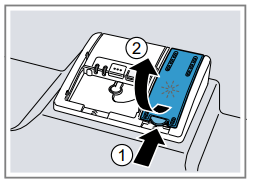
2. Add rinse aid up to the max mark. max
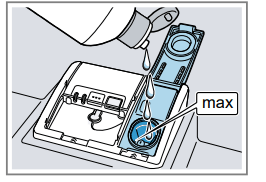
3. If rinse aid spills out, remove it from the tub.
Spilled rinse aid can cause excessive frothing during the wash cycle.
4. Close the lid of the dispenser for rinse aid.
- The lid clicks into position.
2 Setting the amount of rinse aid
If there are streaks or water marks on tableware, change the amount of rinse aid.
1. Press  .
.
2. Press and hold > and Start until  and
and  flash.
3. Release buttons.
4. Press > repeatedly until  flashes.
5. Press < repeatedly until the right amount of rinse aid has been set.
0, 1, 2 or 3 LEDs will light up accordingly.
The factory setting is level 2
- A low setting adds less rinse aid during the wash cycle and reduces streaking on tableware.
- A higher setting adds more rinse aid during the wash cycle, reduces water marks and improves the drying result
6. Press to save the setting.
3 Switching rinse aid system off
If you find the rinse aid refill indicator irritating, e.g. when using combined detergents with a rinse aid component, you can switch the rinse aid system off.
Tip: The function of rinse aid is limited with combined detergents. You will generally get better results using rinse aid.
1. Press  .
.
2. Press and hold > and until  and
and  flash.
3. Release buttons.
4. Press > repeatedly until  flashes.
5. Press < repeatedly until no LED lights up (level 0).
6. Press to save the setting.
- The LEDs go out.
- The rinse aid system is switched off and the rinse aid refill indicator is deactivated
Detergent
Find out which detergents are suitable for your appliance.
1 Suitable detergents
Only use detergents that are suitable for dishwashers. Both separate and combined detergents are suitable.
For optimum washing and drying results, use separate detergent, adding Special salt and Rinse aid separately.
Modern, powerful detergents mainly use a low-alkaline formulation with enzymes. Enzymes break down starch and remove protein. Oxygenbased bleaching agents are generally used to remove coloured marks, e.g. tea or ketchup.
Note: Follow the manufacturer's instructions for each detergent.
Tabs
- Tabs are suitable for all cleaning functions and do not need to be measured out. With shorter Programmes tabs sometimes do not dissolve entirely and leave residues of detergent. This may impair the cleaning effect.
Powder detergent
- Powder detergent is recommended for shorter Programmes. The dosage can be adjusted to the level of soiling.
Liquid detergent
- Liquid detergent works faster and is recommended for shorter Programmes without PreRinse. Sometimes liquid detergent may leak out despite the detergent dispenser being closed. This is not a fault and is non-critical if you remember the following:
- Only choose a programme without PreRinse.
- Do not select timer programming for starting the programme.
- The dosage can be adjusted to the level of soiling.
Tip: Suitable detergents are available online via our website or from Customer Services .
Separate detergents
Separate detergents are products that do not contain components other than detergent, e.g. powder detergent or liquid detergent.
With powder and liquid detergent the dosage can be individually adjusted to the level of soiling of the tableware.
For better washing and drying results and to avoid damage to the appliance, please additionally use Special salt and Rinse aid
Combined detergent
Besides conventional separate detergents, a number of products are available with additional functions.
These products contain not only detergent but also rinse aid and salt replacement substances (3in1) and, depending on the combination (4in1, 5in1, ...), additional components such as glass protection or stainless steel cleaner.
According to manufacturers, combined detergents generally only function up to a water hardness of 26 °E.
With a water hardness above 26 °E you will need to add special salt and rinse aid. For the best washing and drying results we recommend using special salt and rinse aid from a water hardness of 17 °E. If you are using combined detergent, the washing programme is adjusted automatically to ensure the best possible washing and drying result.
2 Unsuitable detergents
Do not use detergent which could cause damage to the appliance or present a risk to health.
Detergent Description
Hand washing-up liquid
- Hand washing-up liquid can cause increased frothing and damage the appliance.
Detergent containing chlorine
- Chlorine residue on tableware may present a risk to health.
3 Adding detergent
1. To open the detergent dispenser, press the locking latch.
2. Add the detergent to the dry detergent dispenser.
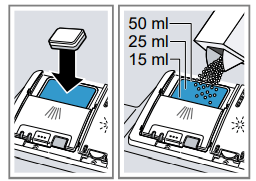
If you are using tablets, one is enough. Insert the tablets in a horizontal position.
If you are using powder or liquid detergent, follow the manufacturer's instructions and quantities for dosage in the detergent dispenser. 20 ml – 25 ml detergent is sufficient for normal soiling. If tableware is only lightly soiled, slightly less than the amount of detergent specified is usually sufficient.
3. Close the lid of the detergent dispenser.
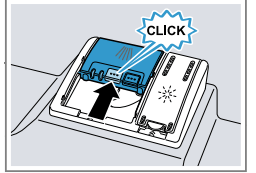
- The lid clicks into position.
- The detergent dispenser will open automatically at the optimum time during the programme. Powder or liquid detergent will spread around the washing tank and dissolve there. Tablets will fall into the tablet collecting tray and dissolve in the right dosage. In order to ensure that tablets can dissolve evenly, do not place any other objects in the tablet collecting tray.
Cleaning and servicing
To keep your appliance working efficiently for a long time, it is important to clean and maintain it carefully.
1 Cleaning the tub
WARNING
Risk of harm to health!
Using detergents containing chlorine may result in harm to health.
▶ Never use detergents containing chlorine.
- Remove any coarse soiling in the interior with a damp cloth.
- Add detergent to the detergent dispenser.
- Select the programme with the highest temperature.→ "Programmes"
- Start the programme without tableware.
2 Self-cleaning interior
To remove deposits, the appliance self-cleans the interior at regular intervals.
The programme sequence is automatically adjusted for self-cleaning, e.g. the cleaning temperature is briefly increased. Consumption values, e.g. water and electricity, may also increase.
If the interior is no longer self-cleaned adequately and deposits occur, see this information: → "Cleaning the tub".
3 Cleaning products
Only use suitable cleaning products to clean your appliance.→ "Safe use"
4 Tips on appliance care
Follow the tips on appliance care to make sure your appliance functions properly at all times.
Wipe the door seals, the front of the dishwasher and the control panel regularly using a damp cloth and washing-up liquid.
- This ensures the parts of the appliance will remain clean and hygienic.
If the appliance is not going to be used for a while, leave the door slightly ajar.
- This will prevent unpleasant odour
5 Filter system
The filter system removes coarse soiling from the dishwashing cycle.
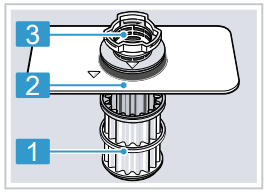
- Micro filter
- Fine filter
- Coarse filter
Cleaning filters
Soiling in the dishwashing water may block the filters.
1. After each wash check the filters for residue.
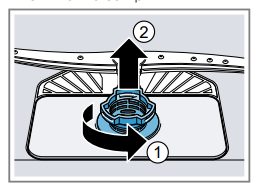
2. Turn the coarse filter anticlockwise 1 and remove the filter system 2 .
- Check that no foreign objects fall into the sump.
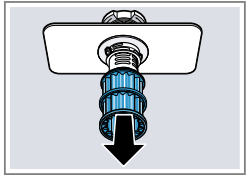
3. Pull down the micro filter to remove.
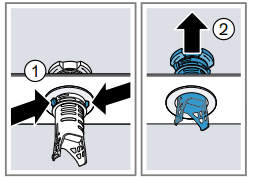
4. Press the locking catches 1 together and lift the coarse filter out 2.
5. Clean the filter elements under running water.
Carefully clean the rim of dirt between the coarse and the fine filter.
6. Re-assemble the filter system.
Make sure that the locking catches on the coarse filter click into position.
7. Insert the filter system into the appliance and turn the coarse filter clockwise.
Make sure that the arrow markings match up.
6 Cleaning spray arms
Limescale and soiling in the dishwashing water may block the nozzles and bearings on the spray arms.Clean the spray arms regularly.
1. Unscrew the upper spray arm 1 and pull down to remove 2 .
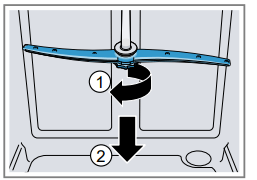
2. Pull up the lower spray arm to remove.
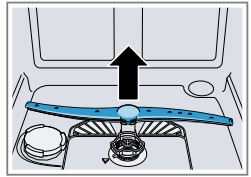
3. Check the outlet nozzles on the spray arms for blockages under running water and remove any foreign bodies.
4. Insert the lower spray arm.
- The spray arm clicks into position.
5. Insert the upper spray arm and screw it firmly in place
Troubleshooting
You can rectify minor faults on your appliance yourself. Read the troubleshooting information before contacting after-sales service. This will avoid unnecessary costs.
WARNING
Risk of electric shock!
Improper repairs are dangerous.
- Repairs to the appliance should only be carried out by trained specialist staff.
- Only use genuine spare parts when repairing the appliance.
- If the power cord of this appliance is damaged, it must be replaced with a special connection cable, which is available from the manufacturer or his Customer Service
Appliance door will not open or cannot be opened easily.
- Childproof lock is activated.▶ Open the appliance door.
Display for water supply lights up
- Supply hose is kinked.▶ Install the supply hose without kinks.
- Water tap is turned off.▶ Turn on the water tap.
- Water tap is jammed or furred up.▶ Turn on the water tap.
- Filter in the water supply is blocked.
- Switch off the appliance.
- Pull out the mains plug.
- Turn off the water tap.
- Unscrew the water connection.
- Remove the filter from the supply hose
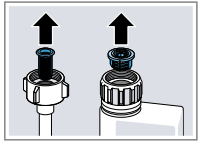
- Clean the filter.
- Re-insert the filter in the supply hose.
- Screw the water connection back on.
- Check the water connection for leaks.
- Restore the power supply.
- Switch the appliance on.
- Filters are soiled or blocked.▶ Clean the filters. → "Cleaning filters"
- Wastewater hose is blocked or kinked.
- Reposition the wastewater hose without kinks.
- Remove residues.
- Siphon connection is still sealed.▶ Check the connection to the siphon and open if necessary.
- Cover of the wastewater pump is loose.▶ Secure the cover of the Wastewater pump
Display "Check water supply" flashes
- A technical fault is present.
- Press
 .
.
- Unplug the appliance or switch off the fuse.
- Wait at least 2 minutes.
- Insert the mains plug of the appliance in a socket or switch on the fuse.
- Switch the appliance on.
- If the problem occurs again:
- Press
 .
.
- Turn off the water tap.
- Pull out the mains plug.
- Contact Customer Service → Page 55 and give the error code.
Displays flash
- Appliance door is not closed properly.▶ Close the appliance door.
- Arrange the tableware so that no parts project beyond the basket and prevent the appliance door from closing properly
Tableware is not dry.
- No rinse aid used or dosage set too low.
- Add Rinse aid.
- Set the amount of rinse aid to be dispensed. → "Setting the amount of rinse aid"
- Selected programme has no drying phase▶ Select a programme with drying.
- Water collects in recesses of the tableware or cutlery.▶ Position tableware at an angle where possible.
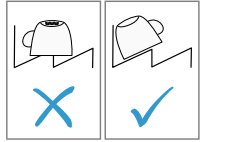
- The combined detergent used has a poor drying performance.
- Use rinse aid to improve drying performance.
- Use a different combined detergent with a better drying performance.
- Extra Dry not activated to improve drying performance.▶ Activate Extra Dry.
- Tableware removed too early or drying process not yet ended.
- Wait until the programme ends.
- Only remove tableware 30 minutes after the programme has ended.
- Rinse aid used has a limited drying performance.▶ Use a name-brand rinse aid.
Eco products may have limited effectiveness.
Plastic tableware is not dry.
- Not a fault. As plastic does not store heat so well, it also does not dry as well.▶ No remedial action possible.
Cutlery is not dry.
- Cutlery not arranged properly in the cutlery basket or cutlery drawer.
- Arrange the cutlery properly. → "Arrange tableware"
- Arrange cutlery individually where possible.
- Avoid points of contact.
Appliance interior still wet after wash cycle.
- Not a fault. The condensation drying principle causes water droplets in the tub – they are indeed desirable here. The moisture in the air condenses on the inside walls, runs off and is pumped out. No action required.
Remnants of food on tableware.
- Tableware was placed too close together.
- Arrange tableware with sufficient space in between. The spray jets must reach the surfaces of the tableware.
- Avoid points of contact.
- Arrange tableware with sufficient space in between. The spray jets must reach the surfaces of the tableware.
- Avoid points of contact.
- Spray arm rotation is blocked.▶ Arrange tableware so that it does not obstruct spray arm rotation.
- Spray arm nozzles are blocked.▶ Clean the Spray arms .
- Filters are soiled.▶ Clean the filters. → "Cleaning filters"
- Filters are inserted incorrectly and/or not engaged.
- Insert the filters properly. → "Filter system"
- Engage the filters.
- Washing programme selected too weak.▶ Select a more intensive washing programme.▶ Adjust the sensitivity of the sensors.
- Tableware has been precleaned too intensely. The sensors chose a weaker programme. Stubborn soiling cannot be entirely removed. ▶ Only remove large remnants of food and do not prerinse tableware.
- Tall narrow receptacles in corner areas are not rinsed adequately.▶ Do not position tall narrow receptacles at too great an angle or in corner areas.
- Top baskets on right and left are not set to same height.▶ Set the top baskets on the left and right to the same level. → "Top basket"
Detergent residue in the appliance
- Lid of the detergent dispenser is blocked by items of tableware parts and will not open.
- Arrange tableware in the top basket tableware so the tab collecting tray is not obstructed by tableware. → "Arrange tableware" Items of tableware are blocking the dispenser lid.
- Do not place tableware or fragrance dispensers in the tablet collecting tray.
- The lid of the detergent dispenser is blocked by the tab and will not open.▶ Position the tab in the detergent dispenser crosswise, not vertically.
- Tabs are used in the quick or short programme. Dissolving time of the tab is not attained.▶ Select a more intensive Programme or use Powder detergent.
- Washing effect and dissolving performance are reduced after a prolonged storage time or detergent is very lumpy.▶ Change your detergent
Water marks on plastic parts.
- Due to laws of physics droplet formation on plastic surfaces is unavoidable. After drying water marks are visible.
▶ Select a more intensive programme.
▶ Position tableware at an angle. → "Arrange tableware"
▶ Use rinse aid. → "Rinse aid"
▶ Set the water softening system higher.
Wipeable or water-soluble coatings are present inside the appliance or on the door.
- Detergent substances are deposited there. These coatings cannot generally be removed with chemicals.
▶ Change your detergent .
▶ Clean the appliance mechanically.
- White coating is deposited in the appliance interior.
- Set the water softening system correctly. In most cases you will need to increase the setting.
- Change your detergent if required.
- Special salt dispenser is not screwed tight.▶ Screw the special salt dispenser tight.
Stubborn white coatings are present on tableware, inside the appliance or the door.
- Detergent substances are deposited there. These coatings cannot generally be removed with chemicals.
▶ Change your detergent .
▶ Clean the appliance mechanically.
- The hardness range is set incorrectly or the water hardness is greater than 44 °E (6,2 mmol/l).
▶ Set the Water softening system to the water hardness or add special salt.3in1/organic/eco detergent is not effective enough.
▶ Set the Water softening system to the water hardness and use separate detergents (proprietary detergent, special salt, rinse aid).
- Too little detergent is being used.▶ Increase the amount of detergent used or changeDetergent .
- Washing programme selected too weak.
▶ Select a more intensive washing programme.
▶ Adjust the sensitivity of the sensors.
Tea residue or lipstick marks on tableware.
- Washing temperature is too low.▶ Select a programme with a higher washing temperature.
- Too little detergent is being used or is unsuitable.▶ Use a suitable Detergent and follow the manufacturer's instructions for the amount to be used.
- Tableware has been precleaned too intensely. The sensors chose a weaker programme. Stubborn soiling cannot be entirely removed.▶ Only remove large remnants of food and do not prerinse tableware.
Coloured coatings(blue, yellow, brown) that are difficult or impossible to remove are present inside the appliance or on stainless steel tableware.
- The formation of films is due to substances contained in vegetables (cabbage, celery, potatoes, noodles, etc.) or tap water (manganese). ▶ Clean the appliance.
You can remove deposits with Mechanical cleaning or a machine cleaning product. It may not always be possible to completely remove deposits but they are harmless to health.
- The formation of films is due to metal components on silver or aluminium tableware. ▶ Clean the appliance.
You can remove deposits with Mechanical cleaning or a machine cleaning product. It may not always be possible to completely remove deposits but they are harmless to health.
Coloured deposits (yellow, orange, brown) that are easy to remove are present inside the appliance (mainly at the bottom).
- The formation of films is due to ingredients of food remnants and tap water (limescale) "soaplike".
- Check the setting of the water softening system.→ "Setting water softening system"
- Add special salt.→ "Adding special salt"
- If you are using combined detergents (tabs), activate the water softening system.
Follow the information about detergents. → "Information on detergents"
Plastic parts inside the appliance are discoloured.
- Plastic parts inside the appliance may become discoloured during the life of the dishwasher.▶ Discolouration can come about and will not impair functioning of the appliance.
Plastic parts are discoloured.
- Washing temperature is too low.▶ Select a programme with a higher washing temperature.
- Tableware has been precleaned too intensely. The sensors chose a weaker programme. Stubborn soiling cannot be entirely removed.▶ Only remove large remnants of food and do not prerinse tableware.
Removable streaks are present on glasses, glassware with a metallic appearance and cutlery.
- Amount of rinse aid to be dispensed is set too high.▶ Set the rinse aid system to a lower setting.
- No rinse aid has been added.▶ → "Adding rinse aid"
Removable streaks are present on glasses, glassware with a metallic appearance and cutlery.
- Detergent residue is present in the final rinse. Lid of the detergent dispenser is blocked by tableware items and will not open fully.
- Arrange tableware in the top basket tableware so the tab collecting tray is not obstructed by tableware. → "Arrange tableware" Items of tableware are blocking the dispenser lid.
- Do not place tableware or fragrance dispensers in the tablet collecting tray.
- Tableware has been precleaned too intensely. The sensors chose a weaker programme. Stubborn soiling cannot be entirely removed.
▶ Only remove large remnants of food and do not prerinse tableware.
▶ Adjust the sensitivity of the sensors.Irreversible clouding of glassware.
- Glasses are not dishwasher-proof, only suitable for dishwashers.
▶ Use dishwasher-proof glasses.
▶ Avoid a lengthy steam phase (standing time after wash cycle ends).
▶ Use a programme with a lower temperature.
▶ Set the softening system to the water hardness.
▶ Use detergent with a glass protection component.
Rust spots on cutlery.
- Cutlery is not sufficiently rust-resistant. Knife blades are often more severely affected.▶ Use rust-resistant tableware.
- Cutlery may also rust if washed together with rusting items.▶ Do not wash rusting items.
- Salt content in washing water is too high.
- Remove any spilled special salt from the tub.
- Screw the cap of the special salt dispenser on tight.
Detergent residue is present in the detergent dispenser or the tablet collecting tray.
- Spray arms were blocked by tableware so detergent was not rinsed out.▶ Check that the spray arms are not blocked and can rotate freely.
- Detergent dispenser was damp when detergent was added.▶ Only add detergent to a detergent dispenser when dry
Excessive formation of foam occurs.
- Hand washing-up liquid is present in dispenser for rinse aid.▶ Immediately add rinse aid to the dispenser. → "Adding rinse aid"
- Rinse aid has been spilled.▶ Remove the rinse aid with a cloth.
- Detergent or appliance care product used causes excessive foaming.▶ Change the brand of detergent.
Special salt refill indicator lights up.
- Insufficient special salt.▶ Add Special salt
- Sensor does not detect special salt tablets.▶ Do not use special salt tablets.
Refill indicator for special salt does not light up.
- Water softening system is switched off.▶ Setting water softening system
Refill indicator for rinse aid lights up.
- Add Rinse aid
- Set the amount of rinse aid to be dispensed. → "Setting the amount of rinse aid"
Refill indicator for rinse aid does not light up.
- Rinse aid system is switched off.▶ → "Setting the amount of rinse aid"
Water is left in the appliance at the end of the programme.
- Filter system or area under the filters is blocked.
- Clean the Filters
- Clean the Wastewater pump
- Programme has not yet ended.▶ Wait until the programme ends or cancel the programme with reset.▶ → "Terminate programme"
Appliance cannot be switched on or operated.
- Appliance functions have failed.
- Pull out the mains plug or switch off the fuse.
- Wait at least 2 minutes.
- Connect the appliance to the power supply.
- Switch the appliance on.
Appliance does not start.
- The mains fuse has tripped. ▶ Check the relevant fuse.
- Mains cable is not inserted.
- Check whether the socket works.
- Check whether the mains cable is properly inserted in the socket and on the rear of the appliance.
- Appliance door is not closed properly.▶ Close the appliance door.
Programme starts automatically.
- You did not wait until programme ended.▶ → "Terminate programme"
Appliance stops during the programme or cuts out.
- Appliance door is not closed properly.▶ Close the appliance door.
- Power and/or water supply has been interrupted.
- Check the power supply.
- Check the water supply.
- Top basket is pressing against inner door and preventing appliance door from being closed securely.
▶ Check whether the rear panel of the appliance is being pressed in by a socket or hose holder that has not been removed.
▶ Arrange the tableware so that no parts project beyond the basket and prevent the appliance door from closing properly.
Appliance door can not be closed.
- Door lock has been activated.▶ Close the appliance door with greater force.
- Door cannot be closed due to installation method.▶ Check whether the appliance has been installed properly.
When closed, the appliance door, its decor or attached parts should not knock against adjacent cabinets or the worktop.
Lid on the detergent dispenser cannot be closed.
- Detergent dispenser or lid are blocked by sticky detergent residue.▶ Remove detergent residue.
Filling valves making knocking noises.
- Caused by the domestic installation. No appliance fault present. Does not affect functioning of the appliance.▶ Can only be remedied in the domestic installation.
Knocking or rattling noise.
- Spray arm is striking tableware.▶ Arrange tableware so that the spray arms do not strike tableware.
- With a small load the water jets directly strike against the tub.
▶ Distribute the tableware evenly.
▶ Load the appliance with more tableware.
- Light items of tableware move about during the wash cycle.▶ Position light items of tableware securely.
1 Clean wastewater pump
Large remnants of food or foreign bodies can block the wastewater pump. As soon as the washing water no longer drains properly, the wastewater pump must be cleaned.
WARNING
Risk of injury!
Sharp and pointed objects or fragments of glass may block the waste water pump and cause injury.
- Remove any foreign bodies carefully.
- Disconnect the appliance from the power supply.
- Remove the top and bottom basket.
- Remove the filter system.
- Scoop out any water. Use a sponge if necessary.
- Prise off the pump cover using a spoon and grip it by the crosspiece.
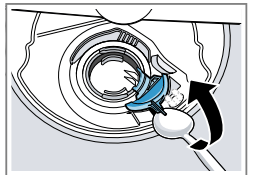
- Lift the pump cover inwards at an angle and remove.
- Remove any remnants of food and foreign bodies in the area of the impeller.
- Insert the pump cover 1 and press down 2 .
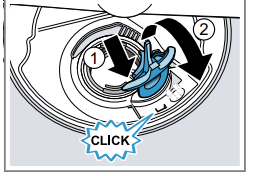 The pump cover clicks into position.
- Install the filter system.
- Insert the top and bottom basket.