Owner's Manual and
installation instructions
Three-Speed
AUTOMATIC WASHERS
IMPORTANT:
Read and follow all safety
and operating instructions
before first use of this product,
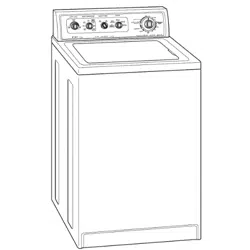
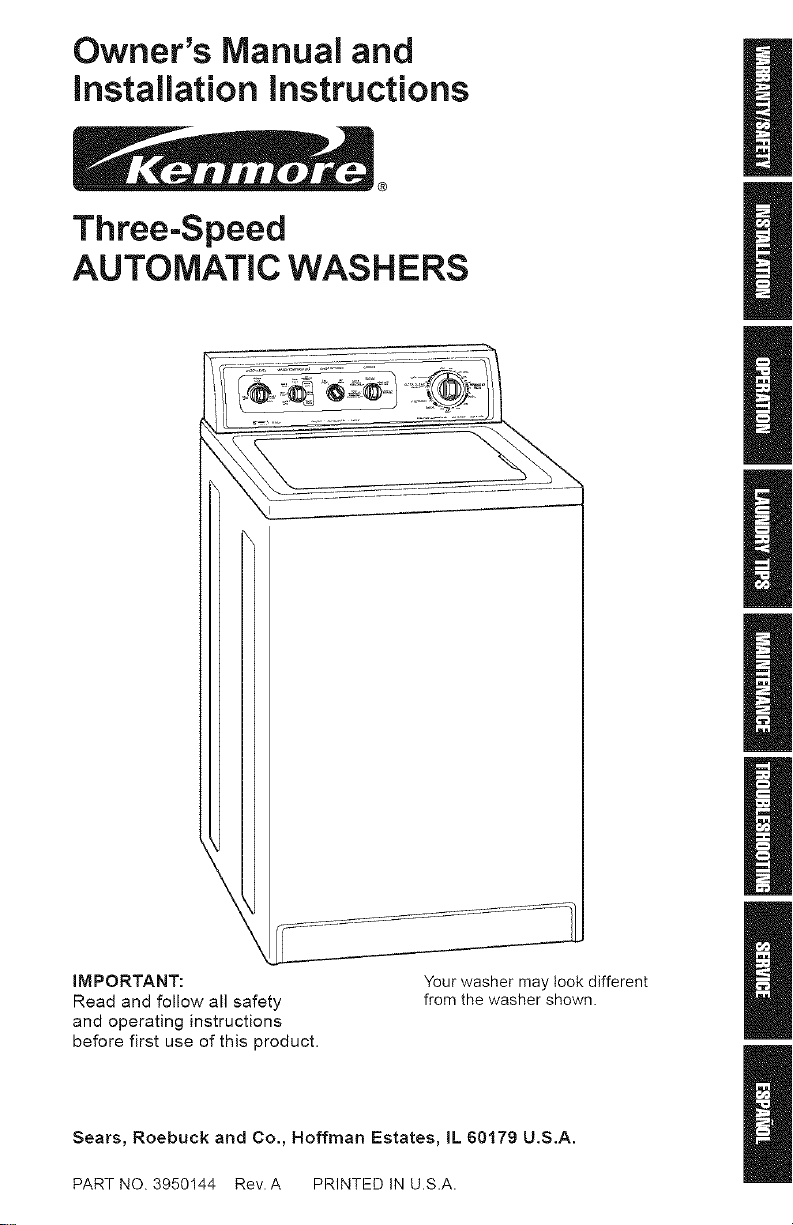
Your washer may look different
from the washer shown.
Sears, Roebuck and Co., Hoffman Estates, IL 60179 U.S.A.
PART NO. 3950144 Rev. A PRINTED IN U.S.A.
BEFORE USING YOUR NEW WASHER
SEARS AUTOMATIC WASHER WARRANTY
iMPORTANT SAFETY iNSTRUCTiONS
iNSTALLATION iNSTRUCTiONS
OPERATING YOUR WASHER
LAUNDRY TiPS
CARING FOR YOUR WASHER
TROUBLESHOOTING
SEARS MAINTENANCE AGREEMENT
2
3
4
5
20
29
31
32
36
Please read this manual. It will help
you install and operate your new
Kenmore washer in the safest and
most economical way.
For more information about the care
and operation of Kenmore appliances
call your nearest Sears store. You will
need the complete model and serial
numbers when requesting information.
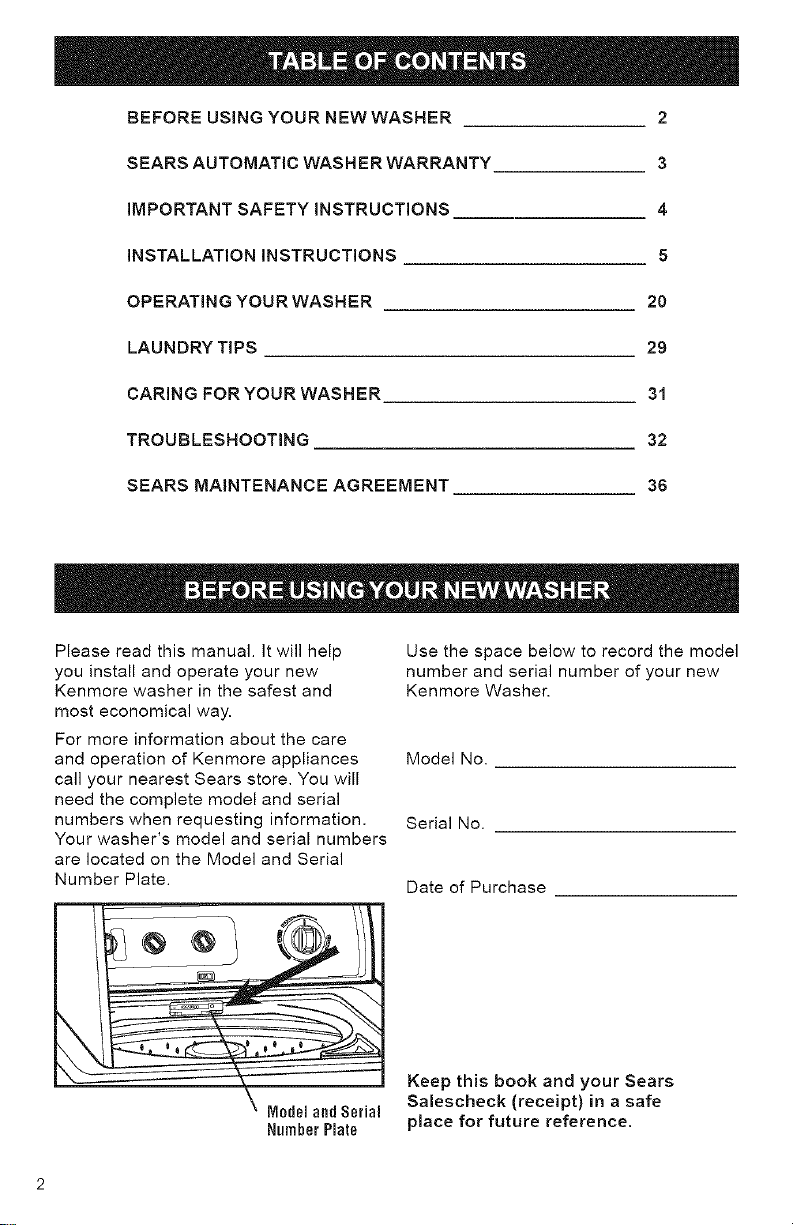
Your washer's model and serial numbers
are located on the Model and Serial
Number Plate.
Use the space below to record the model
number and serial number of your new
Kenmore Washer.
Model No.
Serial No.
Date of Purchase
ModelandSerial
NumberPlate
Keep this book and your Sears
Salescheck (receipt) in a safe
place for future reference.
FULLI-YEARWARRANTY
ON MECHANICAL AND
ELECTRICAL PARTS
For one year from the date of purchase,
when the washer is installed and operated
in accordance with the instructions in
the Owner's Manual, Sears will repair or
replace any mechanical or electrical parts
in this washer, if defective in material or
workmanship.
LiMiTED 5-YEAR WARRANTY
ON GEARCASE PARTS
After one year and until five years from
the date of purchase, Sears will furnish
replacement parts for any defective gear-
case parts. You will be charged for labor.
LIMITED 10-YEAR WARRANTY
ON PLASTIC TUB
After one year and until ten years from
date of purchase, Sears will furnish a
replacement plastic tub for any plastic
tub which is defective in material or work-
manship. You will be charged for labor.
If the washer is subjected to other than
private family use, the above warranty
coverage is effective for only 90 days.
WARRANTY SERVICE IS AVAILABLE
BY CONTACTING THE NEAREST
SEARS SERVICE CENTER IN THE
UNITED STATES.
This warranty applies only while this
product is in use in the United States.
This warranty gives you specific legal
rights, and you may also have other
rights which vary from state to state.
Sears, Roebuck and Co., Dept. 817WA,
Hoffman Estates, IL 60179.
Your safety and the safety of others is very important.
We have provided many important safety messages in this manual
and on your appliance. Always read and obey all safety messages.
This is the safety alert symbol. This symbol alerts
you to hazards that can kill or hurt you and others.
A!l safety messages will be preceded by the safety
alert symbol and the word "DANGER" or "WARNING."
These words mean:
You will be killed or seriously
injured if you don't follow
instructions.
You can be killed or seriously
injured if you don't follow
instructions,
All safety messages will identify the hazard, tell you how to reduce the
chance of injury, and tell you what can happen if the instructions are
not followed.
YOUR SAFETY IS IMPORTANT TO US
WARNING: To reduce the risk of fire,
electric shock, or injury to persons
when using your washer, follow basic
precautions, including the following:
• Read all instructions before using
the washer.
• Do not wash articles that have been
previously cleaned in, washed in, soaked
in, or spotted with gasoline, dry-cleaning
solvents, other flammable or explosive
substances as they give off vapors that
could ignite or explode.
• Do not add gasoline, dry-cleaning
solvents, or other flammable or explosive
substances to the wash water. These
substances give off vapors that could
ignite or explode.
• Under certain conditions, hydrogen gas
may be produced in a hot water system
that has not been used for 2 weeks or
more. HYDROGEN GAS IS EXPLOSIVE.
If the hot water system has not been
used for such a period, before using a
washing machine, turn on all hot water
faucets and let the water flow from each
for several minutes. This will release any
accumulated hydrogen gas. As the gas is
flammable, do not smoke or use an open
flame during this time.
• Do not allow children to play on or in
the washer. Close supervision of children
is necessary when the washer is used
near children.
• Before the washer is removed from
service or discarded, remove the lid.
• Do not reach into the washer if the tub
or agitator is moving.
• Do not install or store this washer where
it will be exposed to the weather.
• Do not tamper with controls.
• Do not repair or replace any part of the
washer or attempt any servicing unless
specifically recommended in the Owner's
Manual or in published user-repair
instructions that you understand and
have the skills to carry out.
SAVE THESE INSTRUCTIONS
IMPORTANT: Observe all governing codes and ordinances.
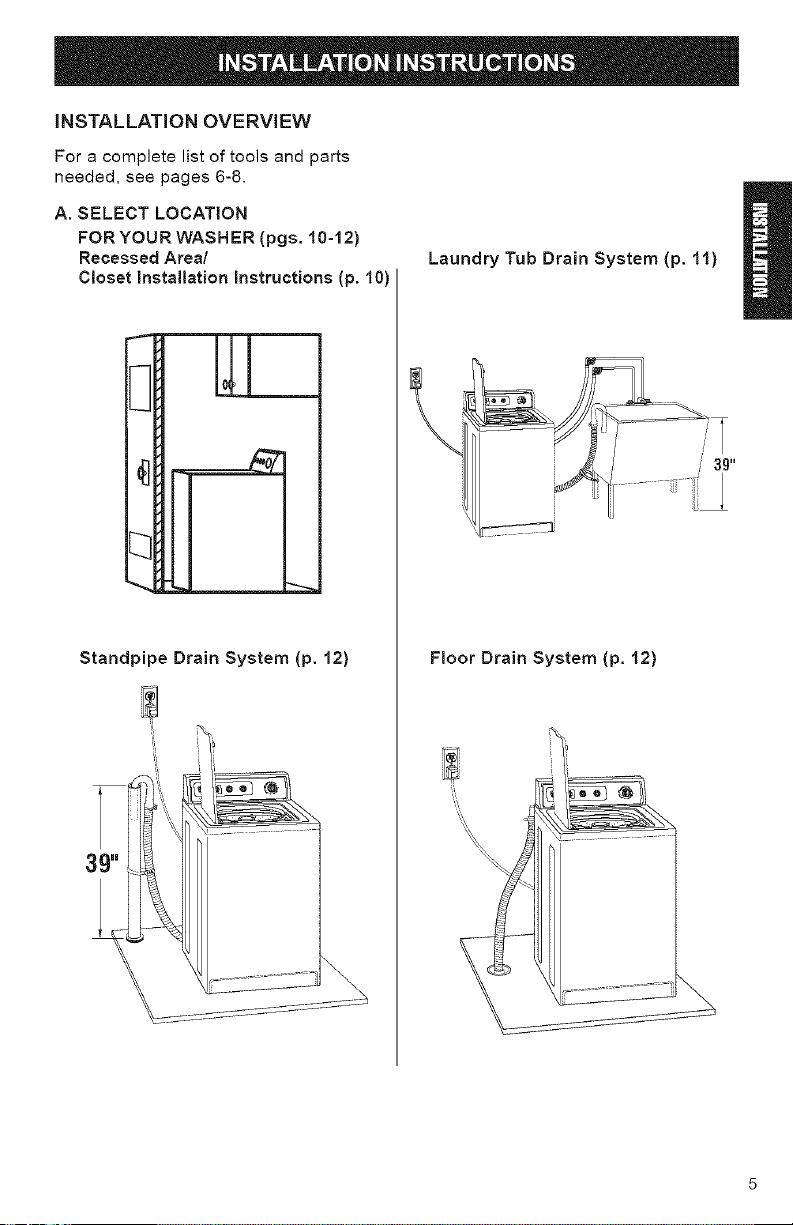
INSTALLATION OVERVIEW
For a complete list of tools and parts
needed, see pages 6-8.
A. SELECT LOCATION
FOR YOUR WASHER (pgs. 10-12)
Recessed Areal
Closet Installation Instructions (p. 10)
Standpipe Drain System (p. 12)
39"
Laundry Tub Drain System (p. 11)
Floor Drain System (p. 12)
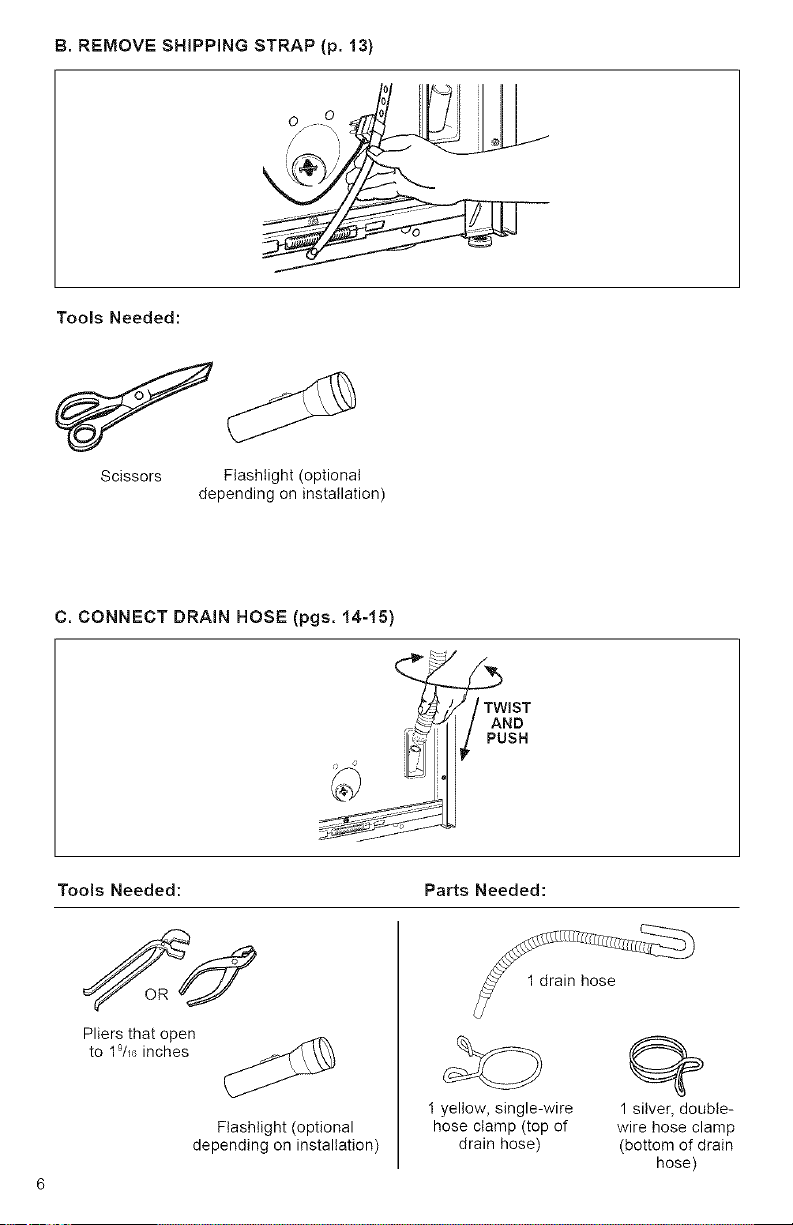
B. REMOVE SHIPPING STRAP (p. 13)
Tools Needed:
Scissors Flashlight (optional
depending on installation)
C. CONNECT DRAIN HOSE (pgs. i4-i5)
__/TWl ST
_,_Yl / AND
_ _i PUSH
Tools Needed: Parts Needed:
Pliers that open
to I9/_6inches
Flashlight (optional
depending on installation)
I yellow, single-wire
hose clamp (top of
drain hose)
1 silver, double-
wire hose clamp
(bottom of drain
hose)
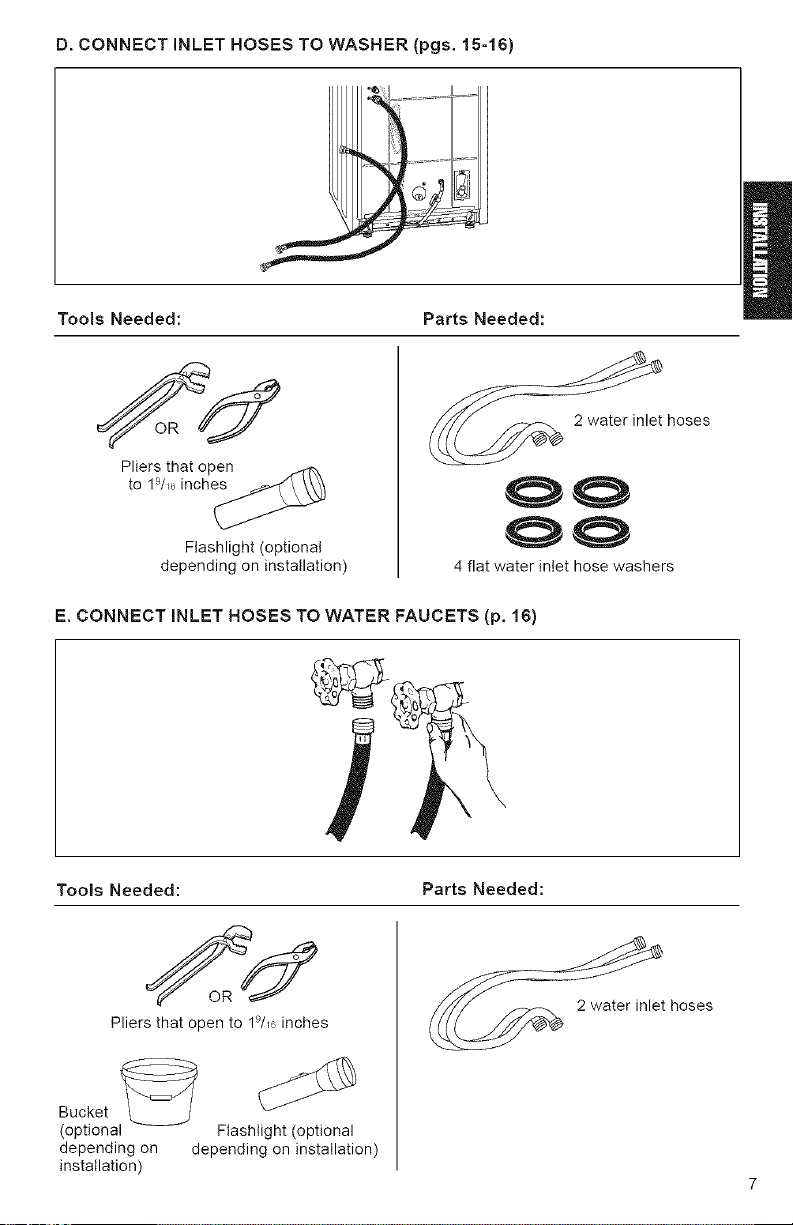
D, CONNECT iNLET HOSES TO WASHER (pgs. 15-16)
Tools Needed: Parts Needed:
1
Su
Pliers that open
to 19/[_inches
Flashlight (optional
depending on installation)
2 water inlet hoses
4 flat water inlet hose washers
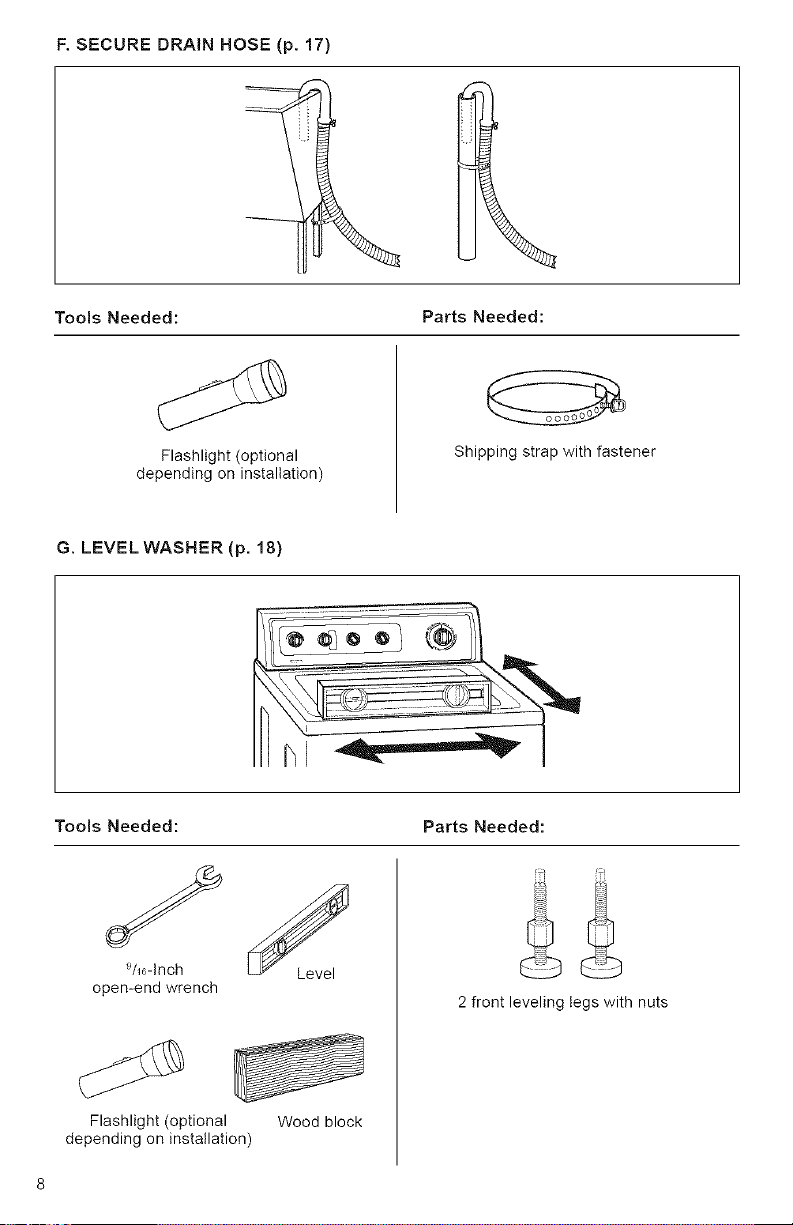
E. CONNECT INLET HOSES TO WATER FAUCETS (p, 16)
Tools Needed: Parts Needed:
9
Pliers that open to 1 /_6inches
(optional Flashlight (optional
depending on depending on installation)
installation)
2 water inlet hoses
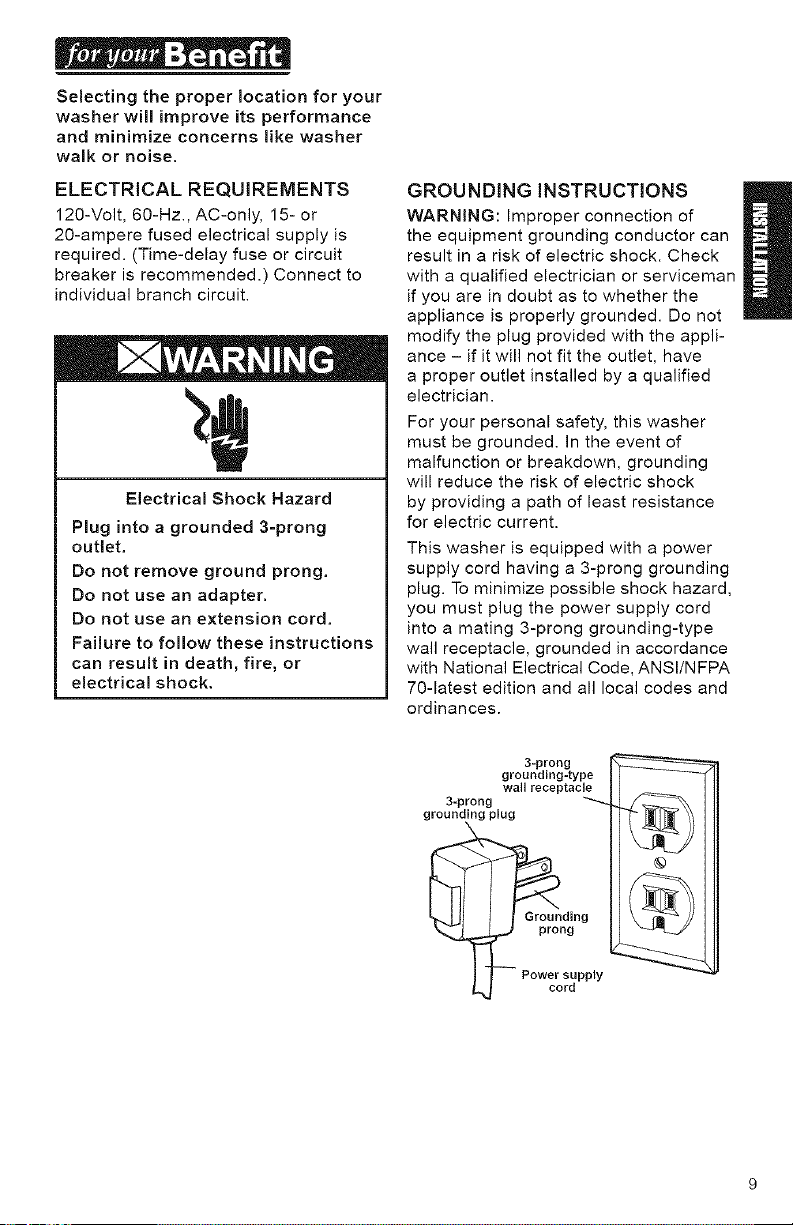
F. SECURE DRAIN HOSE (p. 17)
Tools Needed: Parts Needed:
Flashlight (optional
depending on installation)
Shipping strap with fastener
G. LEVELWASHER (p, 18)
Tools Needed: Parts Needed:
U16-1nch
open-end wrench
Flashlight (optional
depending on installation)
Wood block
2 front leveling legs with nuts
Selecting the proper location for your
washer will improve its performance
and minimize concerns like washer
walk or noise.
ELECTRICAL REQUIREMENTS
120-Volt, 60-Hz., AC-only, 15- or
20-ampere fused electrical supply is
required. (Time-delay fuse or circuit
breaker is recommended.) Connect to
individual branch circuit.
Electrical Shock Hazard
Plug into a grounded 3-prong
outlet.
Do not remove ground prong.
Do not use an adapter.
Do not use an extension cord.
Failure to follow these instructions
can result in death, fire, or
electrical shock.
GROUNDING INSTRUCTIONS
WARNING: improper connection of
the equipment grounding conductor can
result in a risk of electric shock. Check
with a qualified electrician or serviceman
if you are in doubt as to whether the
appliance is properly grounded. Do not
modify the plug provided with the appli-
ance - if it will not fit the outlet, have
a proper outlet installed by a qualified
electrician.
For your personal safety, this washer
must be grounded, in the event of
malfunction or breakdown, grounding
wiii reduce the risk of electric shock
by providing a path of least resistance
for electric current.
This washer is equipped with a power
supply cord having a 3-prong grounding
plug. To minimize possible shock hazard,
you must plug the power supply cord
into a mating 3-prong grounding-type
wall receptacle, grounded in accordance
with National Electrical Code, ANSl/NFPA
70-latest edition and all local codes and
ordinances.
3-prong
grounding-type
wail receptacle
3-prong
grounding plug
Grounding
prong
Power supply
©
\ I11 //
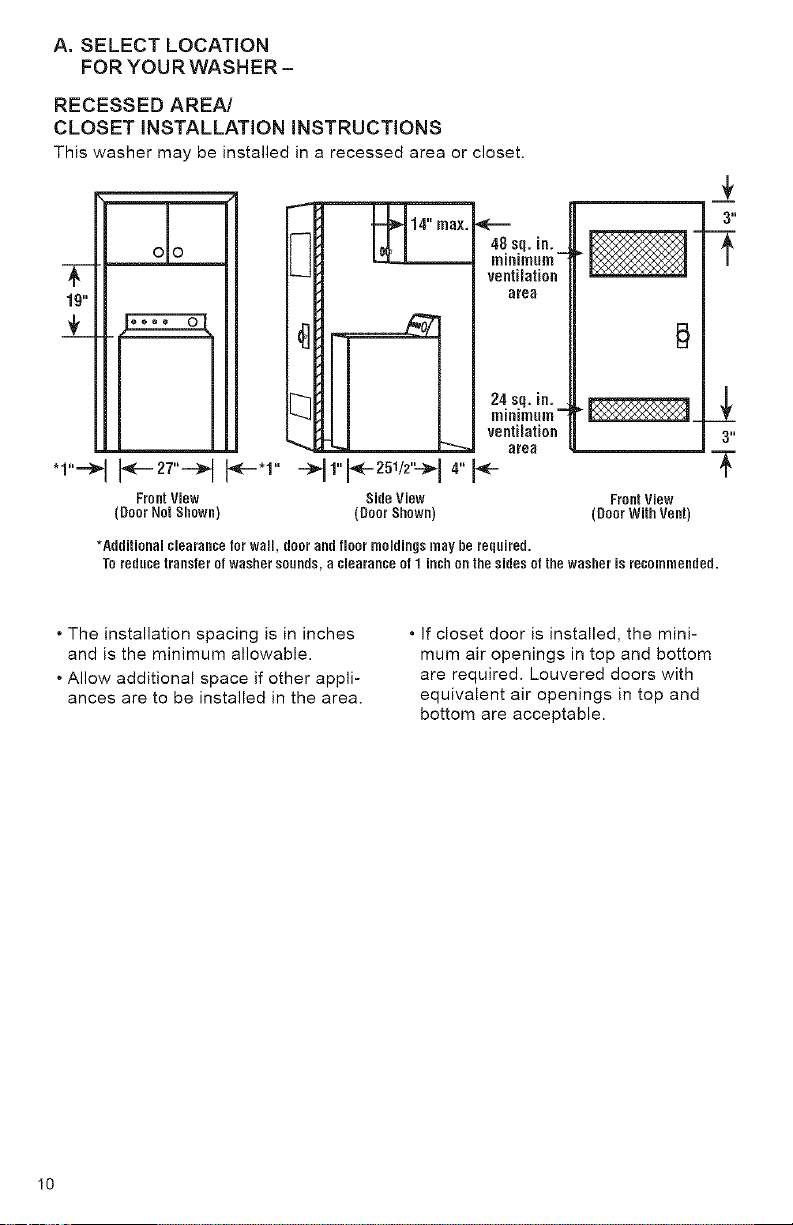
A. SELECT LOCATION
FOR YOUR WASHER -
RECESSED AREAl
CLOSET INSTALLATION INSTRUCTIONS
This washer may be installed in a recessed area or closet.
48 sq. in.
minimum
ventilation
area
24 sq. in.
minimum
ventilutiun
al'ea
FrontView
(DoorWithVent)
3"
f
3"
*Additionalclearancetot wall, doorandtloor moldingsmay berequired.
Toreducetransferofwashersounds,aclearanceot 1 inchonthesidesotthewasheris recommended.
• The installation spacing is in inches
and is the minimum allowable.
• Allow additional space if other appli-
ances are to be installed in the area.
• if closet door is installed, the mini-
mum air openings in top and bottom
are required. Louvered doors with
equivalent air openings in top and
bottom are acceptable.
I0
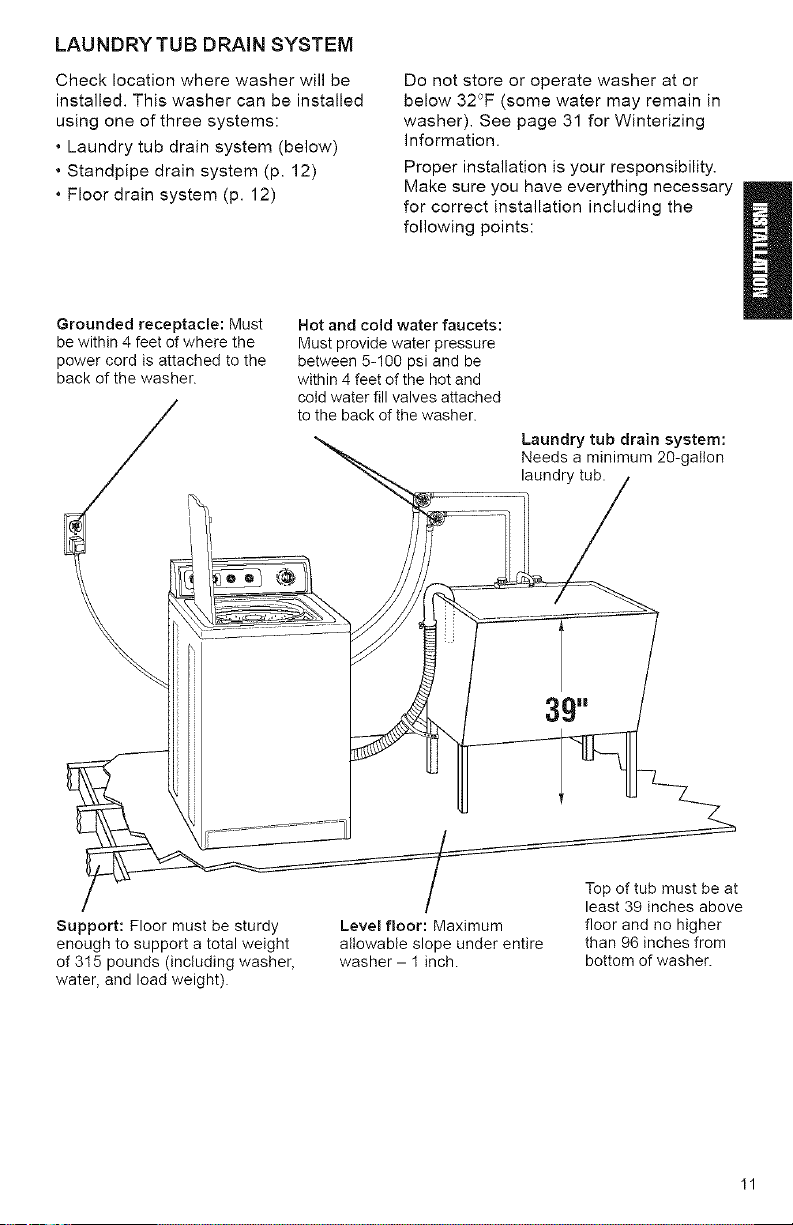
LAUNDRY TUB DRAIN SYSTEM
Check location where washer will be
installed. This washer can be installed
using one of three systems:
• Laundry tub drain system (below)
• Standpipe drain system (p. 12)
• Floor drain system (p. 12)
Do not store or operate washer at or
below 32°F (some water may remain in
washer). See page 31 for Winterizing
Information.
Proper installation is your responsibility.
Make sure you have everything necessary
for correct installation including the
following points:
Grounded receptacle: Must
be within 4 feet of where the
power cord is attached to the
back of the washer.
Hot and cold water faucets:
Must provide water pressure
between 5-100 psi and be
within 4 feet of the hot and
cold water fill valves attached
to the back of the washer.
Laundry tub drain system:
Needs a minimum 20-gallon
laundry tub.
Support: Floor must be sturdy
enough to support a total weight
of 315 pounds (including washer,
water, and load weight).
Level floor: Maximum
allowable slope under entire
washer- I inch.
Top of tub must be at
least 39 inches above
floor and no higher
than 96 inches from
bottom of washer.
I1
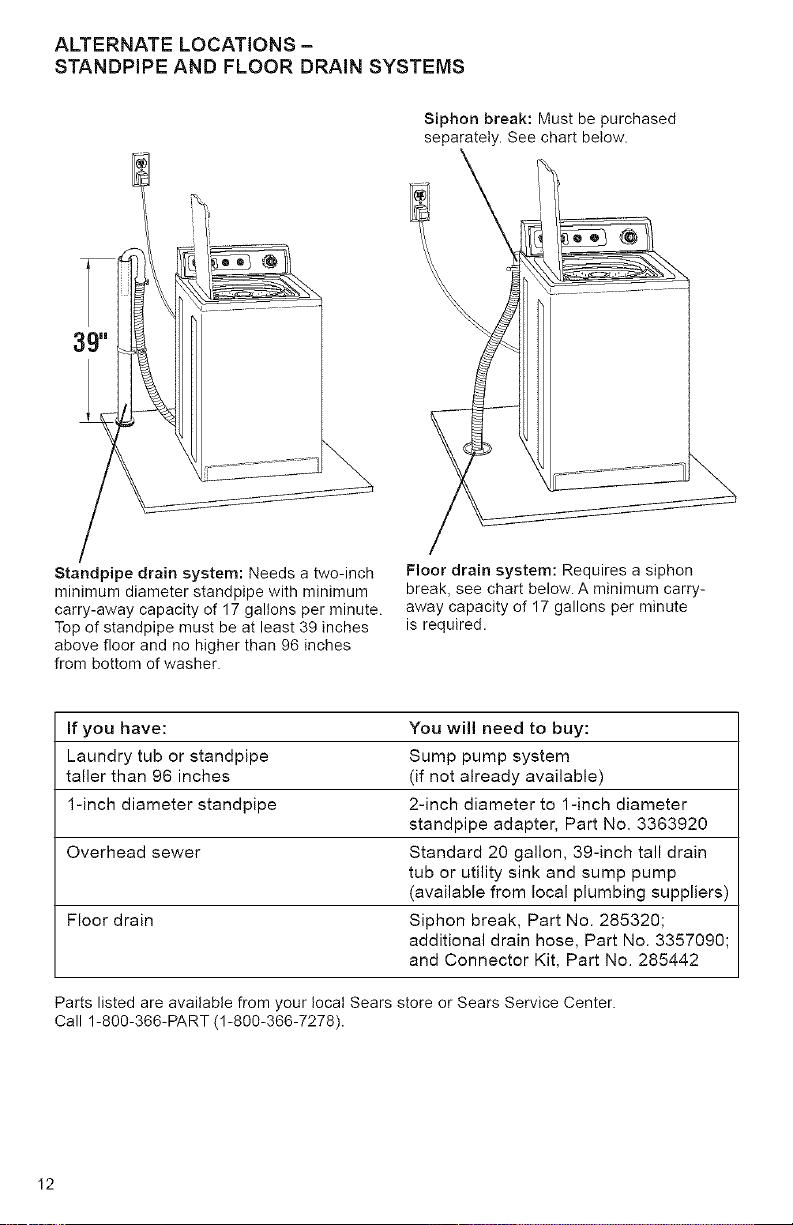
ALTERNATE LOCATIONS-
STANDPIPE AND FLOOR DRAIN SYSTEMS
Siphon break: Must be purchased
separately. See chart below.
Standpipe drain system: Needs a two-inch
minimum diameter standpipe with minimum
carry-away capacity of 17 gallons per minute.
Top of standpipe must be at least 39 inches
above floor and no higher than 96 inches
from bottom of washer.
Floor drain system: Requires a siphon
break, see chart below. A minimum carry-
away capacity of 17 gallons per minute
is required.
If you have: You will need to buy:
Laundry tub or standpipe Sump pump system
taller than 96 inches (if not already available)
1-inch diameter standpipe 2-inch diameter to 1-inch diameter
standpipe adapter, Part No. 3363920
Overhead sewer Standard 20 gallon, 39-inch tall drain
tub or utility sink and sump pump
(available from local plumbing suppliers)
Floor drain Siphon break, Part No. 285320;
additional drain hose, Part No. 3357090;
and Connector Kit, Part No. 285442
Parts listed are available from your local Sears store or Sears Service Center.
Call 1-800-366-PART (1-800-366-7278).
I2
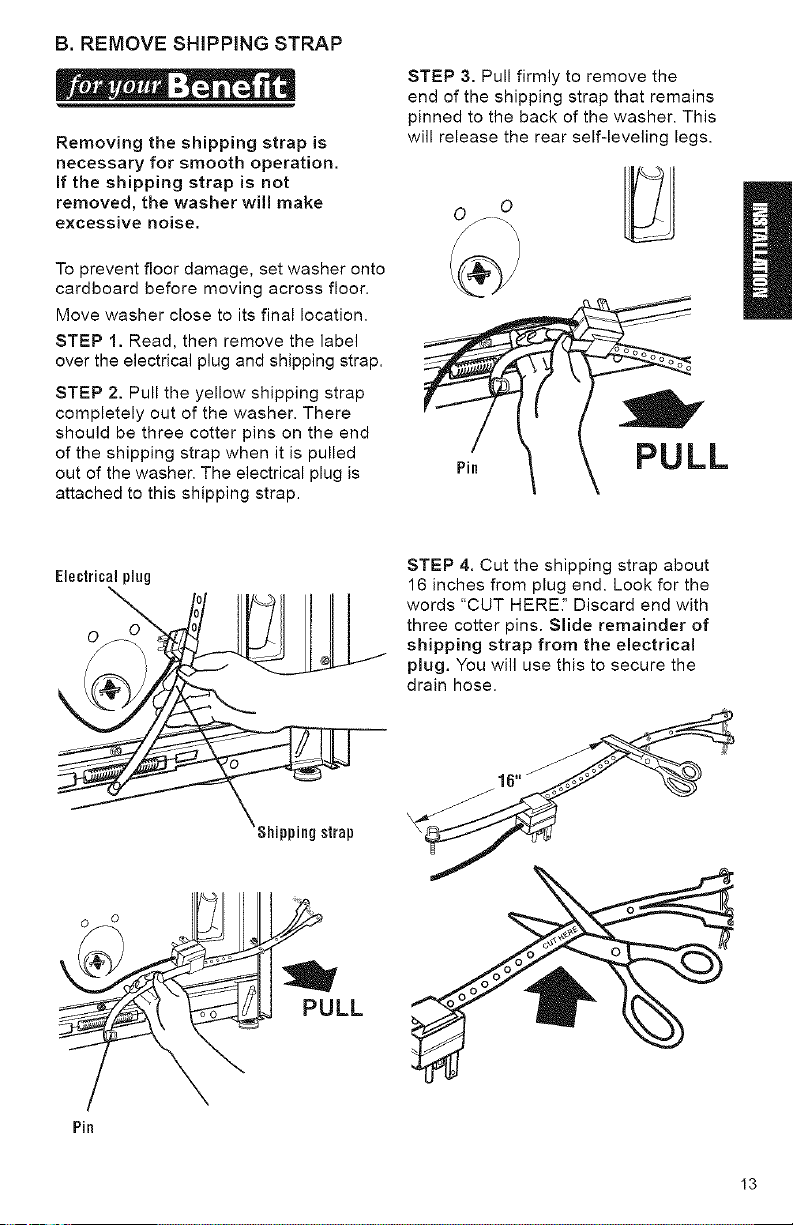
B. REMOVE SHIPPING STRAP
Removing the shipping strap is
necessary for smooth operation,
If the shipping strap is not
removed, the washer will make
excessive noise.
To prevent floor damage, set washer onto
cardboard before moving across floor.
Move washer close to its final location.
STEP 1. Read, then remove the label
over the electrical plug and shipping strap.
STEP 2. Pull the yellow shipping strap
completely out of the washer. There
should be three cotter pins on the end
of the shipping strap when it is pulled
out of the washer. The electrical plug is
attached to this shipping strap.
STEP 3. Pull firmly to remove the
end of the shipping strap that remains
pinned to the back of the washer. This
will release the rear self-leveling legs.
\ PULL
Electrical plug
ipplng s rap
STEP 4. Cut the shipping strap about
16 inches from plug end. Look for the
words "CUT HERE;' Discard end with
three cotter pins. Slide remainder of
shipping strap from the electrical
plug. You will use this to secure the
drain hose.
Pin
I3
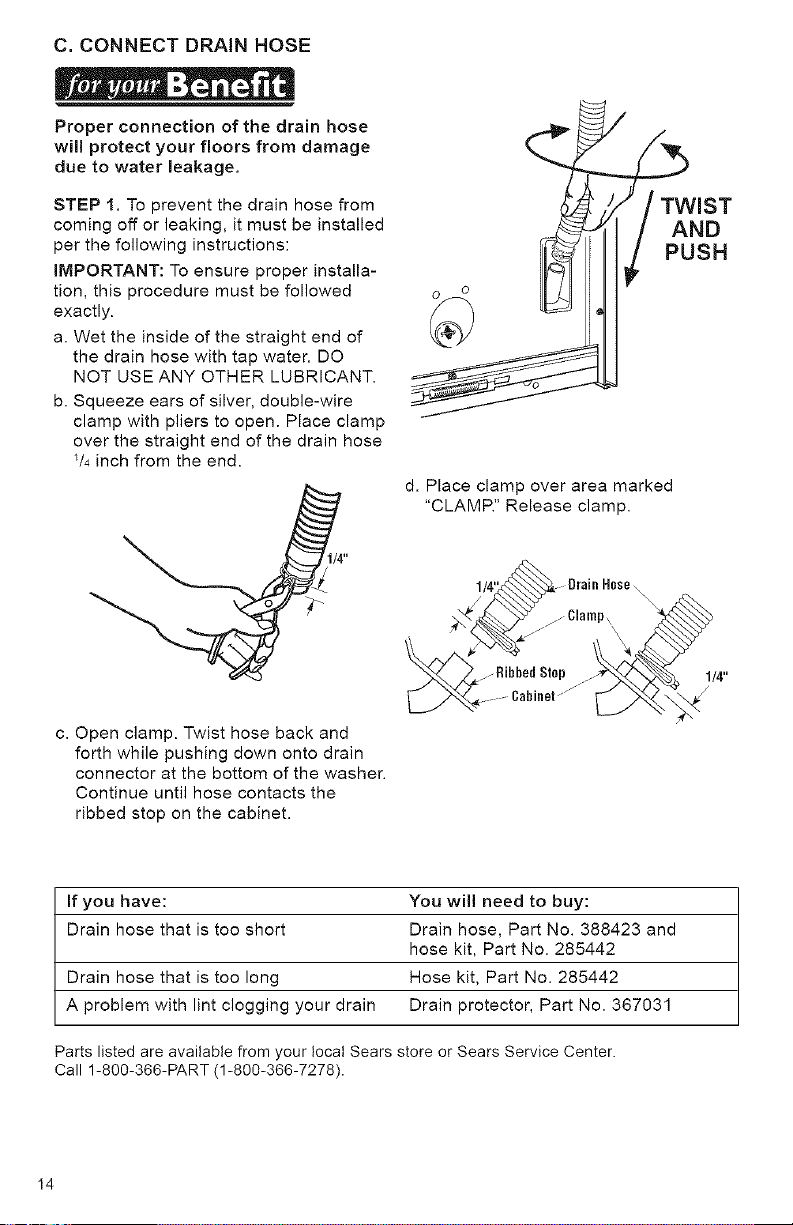
C. CONNECT DRAIN HOSE
Proper connection of the drain hose
will protect your floors from damage
due to water leakage.
STEP 1. To prevent the drain hose from
coming off or leaking, it must be installed
per the following instructions:
IMPORTANT: To ensure proper installa-
tion, this procedure must be followed
exactly.
a. Wet the inside of the straight end of
the drain hose with tap water. DO
NOT USE ANY OTHER LUBRICANT.
b. Squeeze ears of silver, double-wire
clamp with pliers to open. Place clamp
over the straight end of the drain hose
1/4inch from the end.
d. Place clamp over area marked
"CLAMR" Release clamp.
c. Open clamp. Twist hose back and
forth while pushing down onto drain
connector at the bottom of the washer.
Continue until hose contacts the
ribbed stop on the cabinet.
1/4'_ DrainHnsex
If you have: You will need to buy:
Drain hose that is too short Drain hose, Part No. 388423 and
hose kit, Part No. 285442
Drain hose that is too long Hose kit, Part No. 285442
A problem with lint clogging your drain Drain protector, Part No. 367031
Parts listed are available from your local Sears store or Sears Service Center.
Call 1-800-366-PART (1-800-366-7278).
I4
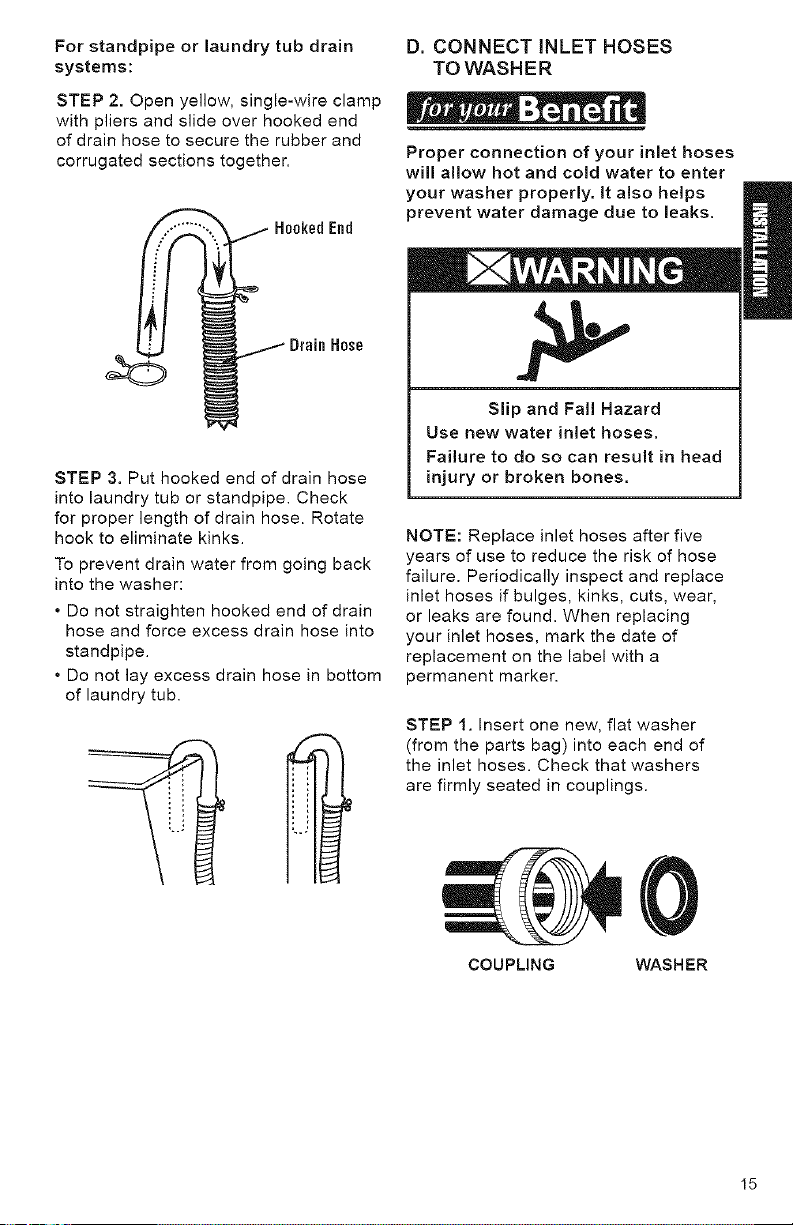
Forstandpipeorlaundrytubdrain
systems:
STEP2.Openyellow,single-wireclamp
withpliersandslideoverhookedend
ofdrainhosetosecuretherubberand
corrugatedsectionstogether.
HookedEnd
D. CONNECT INLET HOSES
TOWASHER
Proper connection of your inlet hoses
will allow hot and cold water to enter
your washer properly, it also helps
prevent water damage due to leaks.
STEP 3. Put hooked end of drain hose
into laundry tub or standpipe. Check
for proper length of drain hose. Rotate
hook to eliminate kinks.
To prevent drain water from going back
into the washer:
• Do not straighten hooked end of drain
hose and force excess drain hose into
standpipe.
• Do not lay excess drain hose in bottom
of laundry tub.
Slip and Fall Hazard
Use new water inlet hoses.
Failure to do so can result in head
injury or broken bones.
NOTE: Replace inlet hoses after five
years of use to reduce the risk of hose
failure. Periodically inspect and replace
inlet hoses if bulges, kinks, cuts, wear,
or leaks are found. When replacing
your inlet hoses, mark the date of
replacement on the label with a
permanent marker.
STEP 1. Insert one new, flat washer
(from the parts bag) into each end of
the inlet hoses. Check that washers
are firmly seated in couplings.
COUPLING WASHER
I5
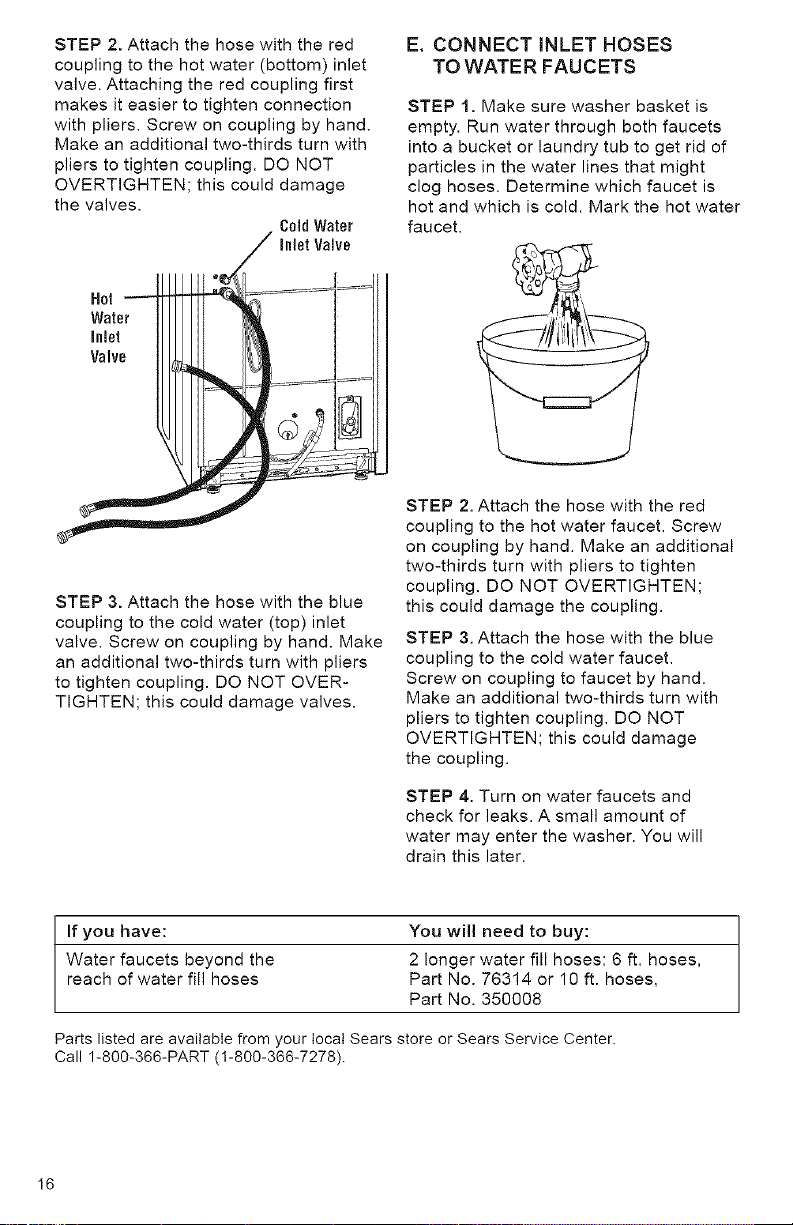
STEP2.Attachthehosewiththered
couplingtothehotwater(bottom)inlet
valve.Attachingtheredcouplingfirst
makesiteasier to tighten connection
with pliers. Screw on coupling by hand.
Make an additional two-thirds turn with
pliers to tighten coupling. DO NOT
OVERTIGHTEN; this could damage
the valves.
Cold Water
inlet Valve
Hot
Water
Inlet
Valve
STEP 3. Attach the hose with the blue
coupling to the cold water (top) inlet
valve. Screw on coupling by hand. Make
an additional two-thirds turn with pliers
to tighten coupling. DO NOT OVER-
TIGHTEN; this could damage valves.
E. CONNECT INLET HOSES
TO WATER FAUCETS
STEP 1. Make sure washer basket is
empty. Run water through both faucets
into a bucket or laundry tub to get rid of
particles in the water lines that might
clog hoses. Determine which faucet is
hot and which is cold. Mark the hot water
faucet.
STEP 2. Attach the hose with the red
coupling to the hot water faucet. Screw
on coupling by hand. Make an additional
two-thirds turn with pliers to tighten
coupling. DO NOT OVERTIGHTEN;
this could damage the coupling.
STEP 3. Attach the hose with the blue
coupling to the cold water faucet.
Screw on coupling to faucet by hand.
Make an additional two-thirds turn with
pliers to tighten coupling. DO NOT
OVERTIGHTEN; this could damage
the coupling.
STEP 4. Turn on water faucets and
check for leaks. A small amount of
water may enter the washer. You will
drain this later.
If you have: You will need to buy:
Water faucets beyond the 2 longer water fill hoses: 6 ft. hoses,
reach of water fill hoses Part No. 76314 or 10 ft. hoses,
Part No. 350008
Parts listed are available from your local Sears store or Sears Service Center.
Call 1-800-366-PART (1-880-366-7278).
I6
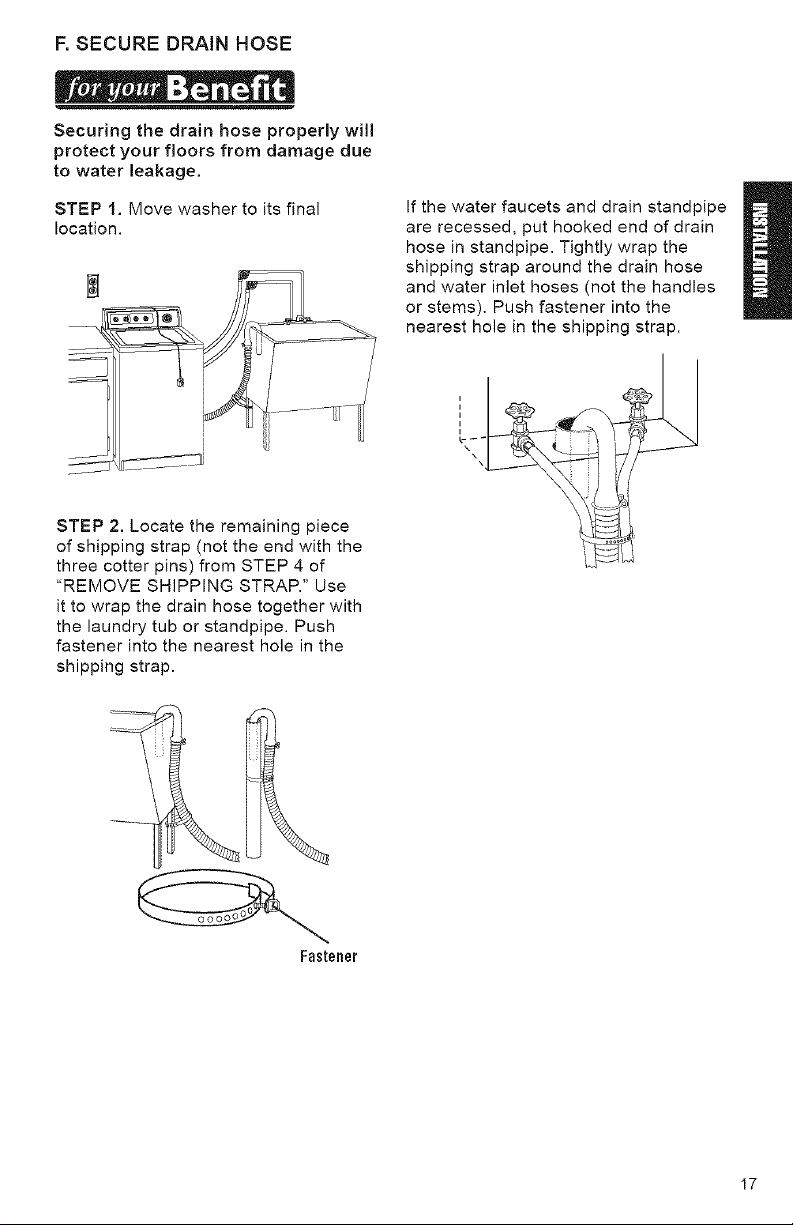
F. SECURE DRAIN HOSE
Securing the drain hose properly will
protect your floors from damage due
to water leakage.
STEP 1. Move washer to its final
location.
-4
u
STEP 2. Locate the remaining piece
of sMpping strap (not the end with the
three cotter pins) from STEP 4 of
"REMOVE SHIPPING STRAP." Use
it to wrap the drain hose together with
the laundry tub or standpipe. Push
fastener into the nearest hole in the
shipping strap.
If the water faucets and drain standpipe
are recessed, put hooked end of drain
hose in standpipe. Tightly wrap the
shipping strap around the drain hose
and water inlet hoses (not the handles
or stems). Push fastener into the
nearest hole in the shipping strap.
Fastener
I7
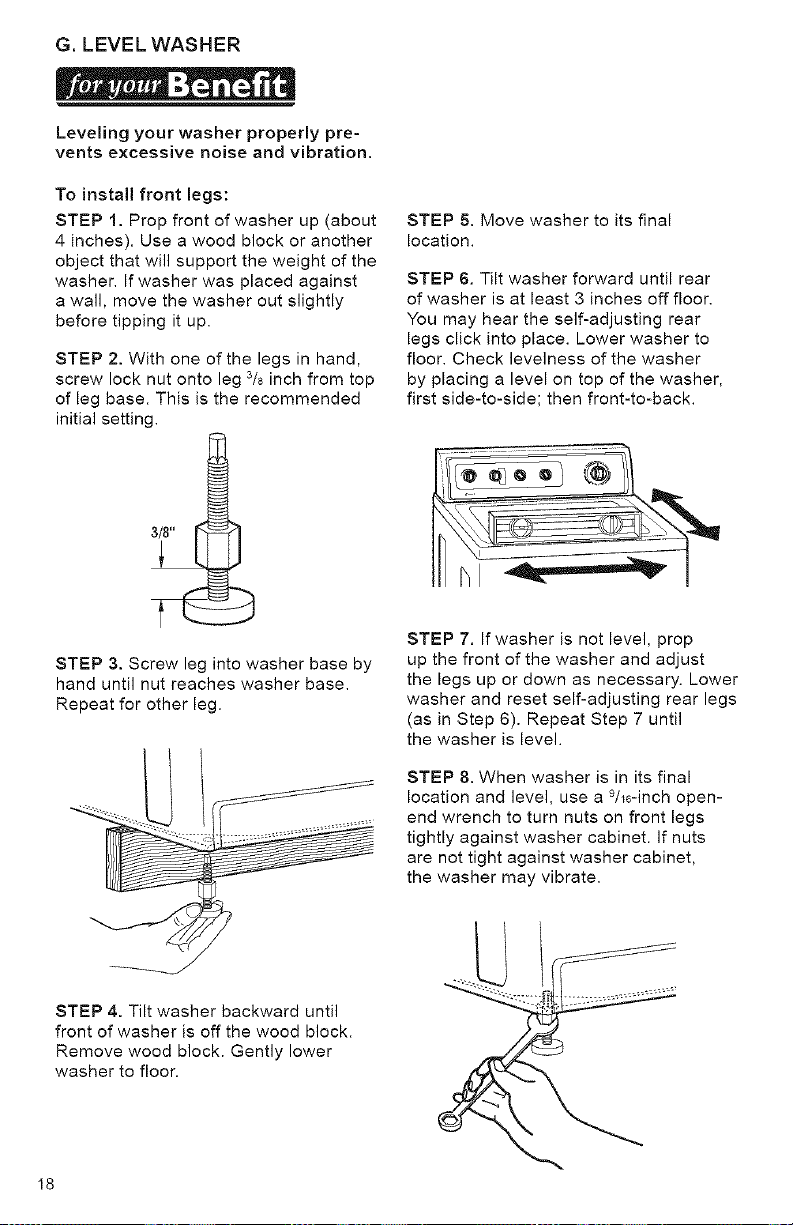
G. LEVEL WASHER
Leveling your washer properly pre-
vents excessive noise and vibration.
To install front legs:
STEP 1. Prop front of washer up (about
4 inches). Use a wood block or another
object that will support the weight of the
washer. If washer was placed against
a wall, move the washer out slightly
before tipping it up.
STEP 2. With one of the legs in hand,
screw lock nut onto leg 3/8inch from top
of leg base. This is the recommended
initial setting.
STEP 3. Screw leg into washer base by
hand until nut reaches washer base.
Repeat for other leg.
STEP 5. Move washer to its final
location.
STEP 6. Tilt washer forward until rear
of washer is at least 3 inches off floor.
You may hear the self-adjusting rear
legs click into place. Lower washer to
floor. Check levelness of the washer
by placing a level on top of the washer,
first side-to-side; then front-to-back.
STEP 7. If washer is not level, prop
up the front of the washer and adjust
the legs up or down as necessary. Lower
washer and reset self-adjusting rear legs
(as in Step 6). Repeat Step 7 until
the washer is level.
STEP 8. When washer is in its final
location and level, use a 9/16-inch open-
end wrench to turn nuts on front legs
tightly against washer cabinet. If nuts
are not tight against washer cabinet,
the washer may vibrate.
STEP 4. Tilt washer backward until
front of washer is off the wood block.
Remove wood block. Gently lower
washer to floor.
I8
REVIEW INSTALLATION
Take a few minutes to complete
this checklist, it will help assure you
that you have a proper installation
and increase your satisfaction with
your Kenmore washer,
[] Check electrical requirements.
Be sure you have correct electrical
supply and recommended grounding
method.
[] Check that you have:
• All the tools you started with.
• Removed all packaging materials.
• Removed shipping strap with
three cotter pins.
• Installed all parts listed on
pages 6-8.
[] Check that:
• The washer is level.
• The nuts on the front legs are tight.
[] Check that the water faucets are
turned on.
FINAL STEPS
[] Plug power supply cord into
grounded outlet.
[] Remove the blue protective film on
the console and any tape remaining
on washer.
[] Take a few minutes and read the
Operating instructions (pages 20-28)
to fully understand your new washer.
Then, start the washer and allow it to
complete the ULTRA CLEAN Cycle.
I9
Togetthemaximumcleaningand
fabriccarefromyourwasher,please
readand follow these instructions.
NOTE: The drawings in this section
show the basic features of all models
covered by this manual. Refer to the
supplied "Feature Sheet" for your
washer's particular features.
Explosion Hazard
Never place items in the washer
that are dampened with gasoline
or other flammable fluids.
No washer can completely
remove oil.
Do not dry anything that has ever
had any type of oil on it (including
cooking oils).
Failure to follow these instructions
can result in death, explosion,
or fire.
STARTING YOUR WASHER
STEP 1. Add measured detergent
directly into washer basket. Then place
a load of sorted clothes in the washer.
STEP 2. (OPTIONAL STEP) If desired,
add measured liquid chlorine bleach to
the liquid bleach dispenser (see page 26).
STEP 3. (OPTIONAL STEP) If desired,
add measured liquid fabric softener to
the fabric softener dispenser (see page 27).
STEP 4. Close washer lid.
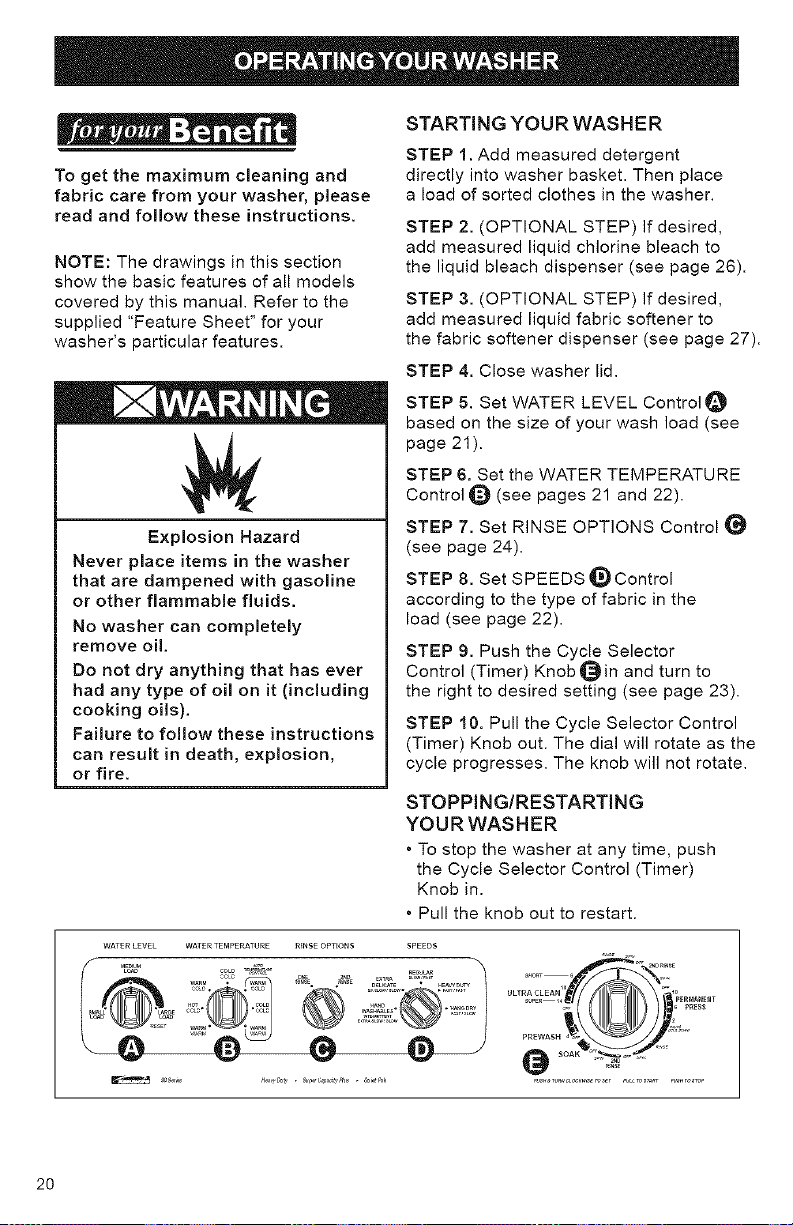
STEP 5. Set WATER LEVEL ControlQ
based on the size of your wash load (see
page 21 ).
STEP 6. Set the WATER TEMPERATURE
Control Q (see pages 21 and 22).
STEP 7. Set RINSE OPTIONS Control
(see page 24).
STEP 8. Set SPEEDS _)Control
according to the type of fabric in the
load (see page 22).
STEP 9. Push the Cycle Selector
Control (Timer) Knob Q in and turn to
the right to desired setting (see page 23).
STEP 10. Pull the Cycle Selector Control
(Timer) Knob out. The dial will rotate as the
cycle progresses. The knob will not rotate.
STOPPING/RESTARTING
YOURWASHER
• To stop the washer at any time, push
the Cycle Selector Control (Timer)
Knob in.
• Pull the knob out to restart.
2O

SET WATER LEVEL CONTROL
This control gives you the flexibility to
save water when washing small loads.
Your washer lets you select a water
setting based on the size of your wash
load.
• For normal loads, start with the
MEDIUM LOAD Setting. Adjust up
or down depending on your load.
Clothes should move freely and roll
toward the agitator.
Washers with a variable
WATER LEVEL Control
• To change to a higher water level
setting after the washer has started
to agitate, turn the knob to RESET,
then to the desired new setting.
f MEDIUM
LOAD
Washers with a 5-position
WATER LEVEL Control
• To change to a higher water level
setting after the washer has started to
agitate, turn the knob to the desired
new setting.
MEDIUM
LOAD
SET WATER TEMPERATURE
CONTROL
Your washer lets you select a wash and
rinse water temperature setting based on
the type of load you are washing.
• Using warm rinse water will leave loads
dryer after the spin cycle than if you use
cold rinse water. However, warm rinses
may increase wrinkling when line drying.
• In cold climates, warm rinse water also
provides a more comfortable temperature
for handling the wash load. Warm rinse
is controlled to 75°F.
AU_
COLD _MPERATURE
CONTROL
WARM CO_D
COLD e_!!_ I
HOT COLD
COLD ° eCOLD
WARM
WARM
SELECTING WATER TEMPERATURES
Wash Water
Temperature Suggested Fabrics Comments
HOT • Work clothes • Best cleaning for heavily soiled items
120°F or above • Sturdy whites/ • Removes oils, perspiration, greasy soils
colorfast pastels and stains
• Diapers • Prevents graying or yellowing
WARM • Dark/non-colorfast colors • Best for moderately soiled to lightly soiled items
90°-110°F • Permanent press items • Safe for most fabric finishes
• Nylon, polyester, acrytics, • Less fading and dye bleeding
silks, woolens • Reduces wrinkling
• Knits/delicate fabrics
COLD* • Extra-sensitive colors • Best for very lightly soiled items
70°-90°F • Non-colorfast items • Saves hot water
• Hand washables
*In wash water temperatures colder than 70_F, detergents do not dissolve welt. Also, soils may
be difficult to remove and some fabrics may retain wear wrinkles and have increased pilling -
the formation of small lint-like balls on the surface of garments. Pilling is the natural result of
wearing and washing of garments.
21
AUTOMATIC TEMPERATURE
CONTROL (ATC)
ATC takes away the worry of
undissolved detergent and ensures
consistent cleaning results from
season to season with warm and
cold washes.
ATC electronically senses and maintains
a uniform water temperature by regulating
incoming hot and cold water.
• Even in cold wash, some AUTO
warm water is let into the TEMPERATURE
CONTROL
washer to maintain a
temperature of approxi- (,.,... _
mately 75°F. in very cold
i vwKivl
water, detergent may not _° COLD
dissolve and clothes will
not be cleaned completely. _ COLD
• Warm wash is regulated • COLD
at approximately 100°F.
ATC does not control
the hot wash water _ WARM
temperature.
• Warm rinse is regulated at
approximately 75°F for all warm
rinse settings. This may be a cooler
warm rinse than what you are used to,
but it saves energy and still gives you
proper rinsing and a load that is com-
fortable to remove.
extra-slow speed agitation (10 seconds)
and soaking (20 seconds). Slow spin
speeds help reduce wrinkling. Do not use
HAND WASHABLES for large items like
blankets.
NOTE: Some "HAND WASH" items, par-
ticularly wool, naturally shrink when washed
either in the sink or in the washer HAND
WASHABLES Cycle. Keep this in mind
when you purchase items labeled "HAND
WASH'.' Items that shrink should be dried
flat. Block these items by gently stretch-
ing to original measurements.
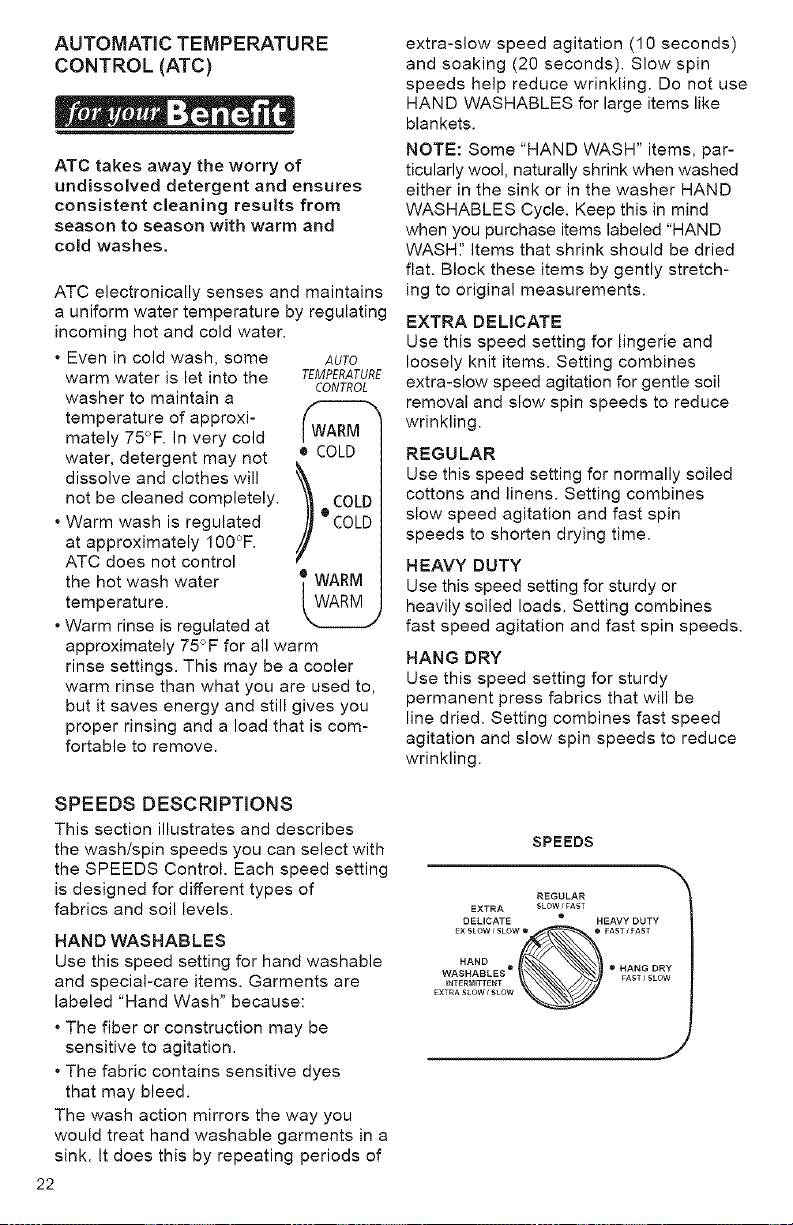
EXTRA DELICATE
Use this speed setting for lingerie and
loosely knit items. Setting combines
extra-slow speed agitation for gentle soil
removal and slow spin speeds to reduce
wrinkling.
REGULAR
Use this speed setting for normally soiled
cottons and linens. Setting combines
slow speed agitation and fast spin
speeds to shorten drying time.
HEAVY DUTY
Use this speed setting for sturdy or
heavily soiled loads. Setting combines
fast speed agitation and fast spin speeds.
HANG DRY
Use this speed setting for sturdy
permanent press fabrics that will be
line dried. Setting combines fast speed
agitation and slow spin speeds to reduce
wrinkling.
SPEEDS DESCRIPTIONS
This section illustrates and describes
the wash/spin speeds you can select with
the SPEEDS Control. Each speed setting
is designed for different types of
fabrics and soil levels.
HAND WASHABLES
Use this speed setting for hand washable
and special-care items. Garments are
labeled "Hand Wash" because:
• The fiber or construction may be
sensitive to agitation.
• The fabric contains sensitive dyes
that may bleed.
The wash action mirrors the way you
would treat hand washable garments in a
sink. It does this by repeating periods of
SPEEDS
REGULAR
EXTRA SLOW/FAST
m
DELICATE HEAVY DUTY
EXHANDSLOW_SLOWo@o° @ FASTI FAST
WASHABLES HANG DRY
_NTEEMITTENT _AST/SLOW
EXTRASLOW/SLOW
J
22
SETTING YOUR CYCLE
SELECTOR (TIMER) CONTROL
Use this control to choose the agitation
time and to start the washer.
• For heavy soil and sturdy fabrics,
use the full time.
• For light soil and delicate fabrics,
use less time.
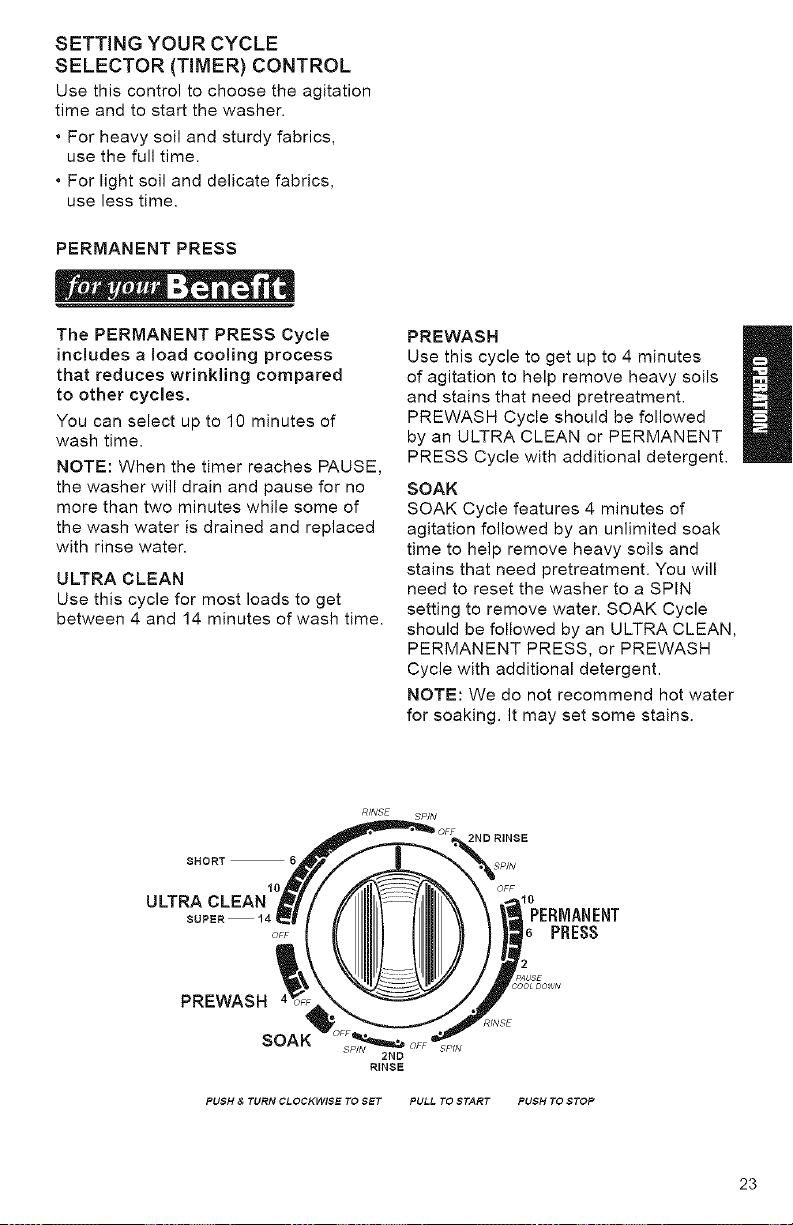
PERMANENT PRESS
The PERMANENT PRESS Cycle
includes a load cooling process
that reduces wrinkling compared
to other cycles.
You can select up to 10 minutes of
wash time.
NOTE: When the timer reaches PAUSE,
the washer will drain and pause for no
more than two minutes while some of
the wash water is drained and replaced
with rinse water.
ULTRA CLEAN
Use this cycle for most loads to get
between 4 and 14 minutes of wash time.
PREWASH
Use this cycle to get up to 4 minutes
of agitation to help remove heavy soils
and stains that need pretreatment.
PREWASH Cycle should be followed
by an ULTRA CLEAN or PERMANENT
PRESS Cycle with additional detergent.
SOAK
SOAK Cycle features 4 minutes of
agitation followed by an unlimited soak
time to help remove heavy soils and
stains that need pretreatment. You will
need to reset the washer to a SPIN
setting to remove water. SOAK Cycle
should be followed by an ULTRA CLEAN,
PERMANENT PRESS, or PREWASH
Cycle with additional detergent.
NOTE: We do not recommend hot water
for soaking. It may set some stains.
SHORT 6
ULTRA CLEAN 1{
SUPER
RINSE
SPIN
2ND RINSE
OFF
lo
PERMANENT
PRESS
PREWASH 4
PUSH & TURN CLOCKWISE TO SET PULL TO START PUSH TO STOP
23

SETTING YOUR RINSE OPTIONS
CONTROL
A second rinse will remove more
detergent residue. It is especially
beneficial if extra detergent has
been used to remove heavy soils.
AUTOMATIC SECOND RINSE
Your washer allows you to add an auto-
matic second rinse to the ULTRA CLEAN
Cycle or PERMANENT PRESS Cycle.
Simply set the RINSE OPTIONS Control
on 2ND RINSE before you start the
washer. You won't have to come back to
select a second rinse.
ONE 2ND
RINSE RINSE
® o
@
RINSE AND SPIN
When using extra detergent for heavily
soiled clothes, or washing special-care
items, you may find an extra rinse and
spin is needed.
STEP 1. Set WATER LEVEL Control.
STEP 2. Set WATER TEMPERATURE
Control.
STEP 3. Set RINSE OPTIONS Control
to ONE RINSE.
STEP 4. Set SPEEDS Control:
• For fast agitation and spin,
use the HEAVY DUTY setting.
• For slow agitation and spin,
use the EXTRA DELICATE setting.
• For slow agitation and fast spin,
use the REGULAR setting.
STEP 5. Set the Cycle Selector Control
(Timer) Knob to a RINSE setting.
STEP 6. Pull Cycle Selector Control
(Timer) Knob out to start washer.
SHORT 6
ULTRACLEAN
SUPER 14 t
PREWASH
SOAK
SPIN ONLY
A drain and spin may help shorten drying
times for some heavy fabrics or special-
care items by removing excess water.
STEP 1. Set RINSE OPTIONS Control
to ONE RINSE.
STEP 2. Set SPEEDS Control:
• For fast spin, use the HEAVY DUTY
setting.
• For slow spin, use the EXTRA
DELICATE setting.
STEP 3. Set the Cycle Selector Control
(Timer) Knob to a SPIN setting.
STEP 4. Pull the Cycle Selector Control
(Timer) Knob out to start washer.
24
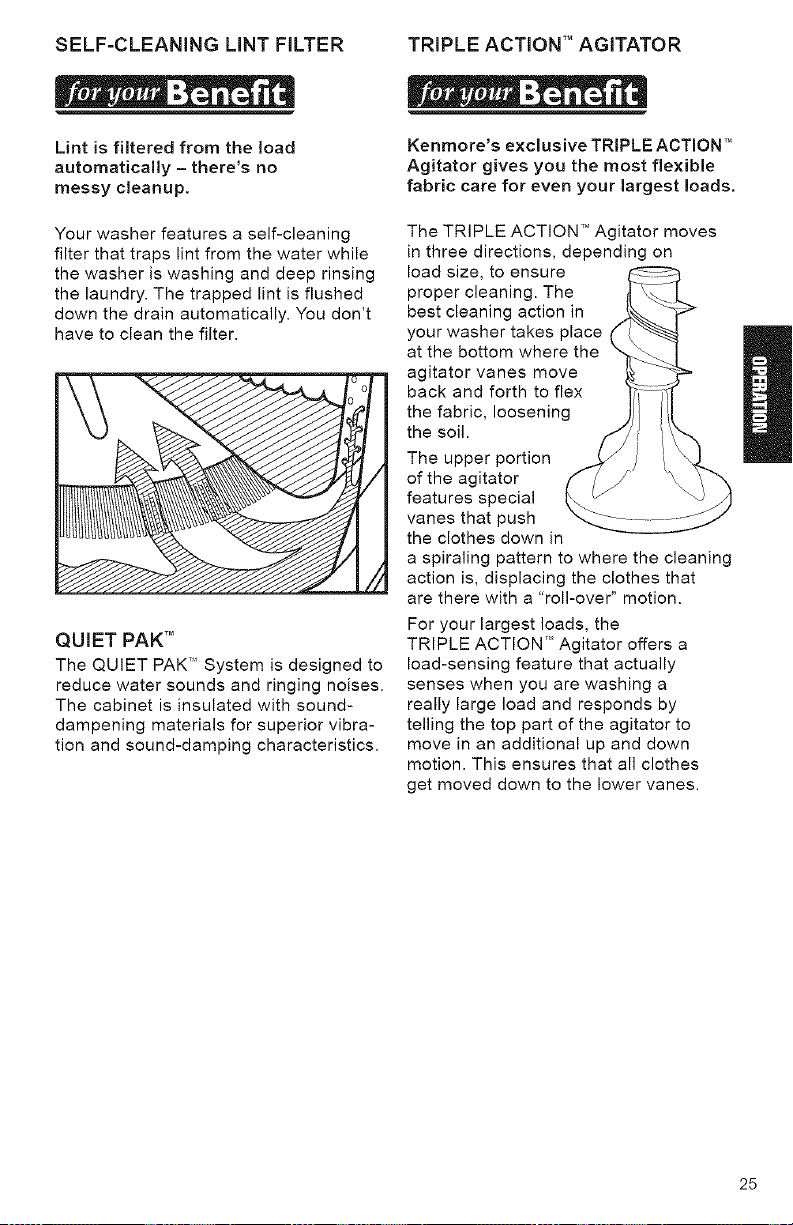
SELF-CLEANING LINT FILTER
Lint is filtered from the load
automatically - there's no
messy cleanup.
Your washer features a self-cleaning
filter that traps lint from the water while
the washer is washing and deep rinsing
the laundry. The trapped lint is flushed
down the drain automatically. You don't
have to clean the filter.
F
QUIET PAK TM
The QUIET PAK" System is designed to
reduce water sounds and ringing noises.
The cabinet is insulated with sound-
dampening materials for superior vibra-
tion and sound-damping characteristics.
TRIPLE ACTION" AGITATOR
Kenmore's exclusive TRIPLE ACTION"
Agitator gives you the most flexible
fabric care for even your largest loads,
The TRIPLE ACTION"' Agitator moves
in three directions, depending on
load size, to ensure
proper cleaning. The
best cleaning action in
your washer takes place
at the bottom where the
agitator vanes move
back and forth to flex
the fabric, loosening
the soil.
The upper portion
of the agitator
features special
vanes that push
the clothes down in
a spiraling pattern to where the cleaning
action is, displacing the clothes that
are there with a "roll-over" motion.
For your largest loads, the
TRIPLE ACTION T''Agitator offers a
load-sensing feature that actually
senses when you are washing a
really large load and responds by
telling the top part of the agitator to
move in an additional up and down
motion. This ensures that all clothes
get moved down to the lower vanes.
25
UNDERSTANDINGNORMAL
WASHER SOUNDS
Your new washer may make sounds
that your old one didn't. Because the
sounds are unfamiliar, you may be
concerned about them.
The following describes some of the
normal sounds you may hear and what
causes them.
During Washing
When you select a small load size set-
ting for a small wash load, your washer
has a lower water level. With this lower
water level, you may hear a clicking sound
from the upper portion of the agitator.
During Drain
The rate that water is drained from your
washer depends on your installation, if
water is drained quickly from the washer,
you may hear air being pulled through
the pump. This happens during the end
of draining.
After Drain and Before Spin
When the cycle changes from draining
to spinning, you may hear a noise as the
gearcase shifts.
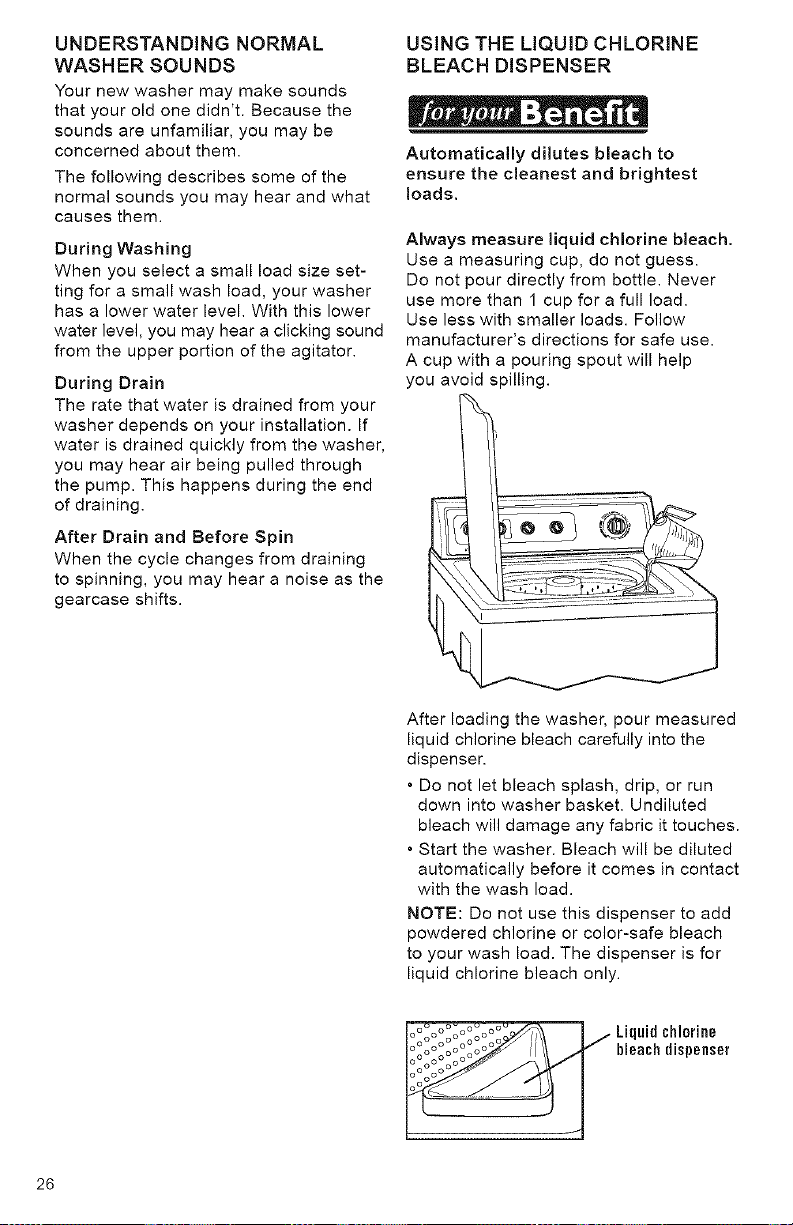
USING THE LiQUiD CHLORINE
BLEACH DISPENSER
Automatically dilutes bleach to
ensure the cleanest and brightest
loads.
Always measure liquid chlorine bleach.
Use a measuring cup, do not guess.
Do not pour directly from bottle. Never
use more than 1 cup for a full load.
Use less with smaller loads. Follow
manufacturer's directions for safe use.
A cup with a pouring spout will help
you avoid spilling.
After loading the washer, pour measured
liquid chlorine bleach carefully into the
dispenser.
• Do not let bleach splash, drip, or run
down into washer basket. Undiluted
bleach will damage any fabric it touches.
• Start the washer. Bleach will be diluted
automatically before it comes in contact
with the wash load.
NOTE: Do not use this dispenser to add
powdered chlorine or color-safe bleach
to your wash load. The dispenser is for
liquid chlorine bleach only.
_ Liquidchlorine
bleachdispenser
26
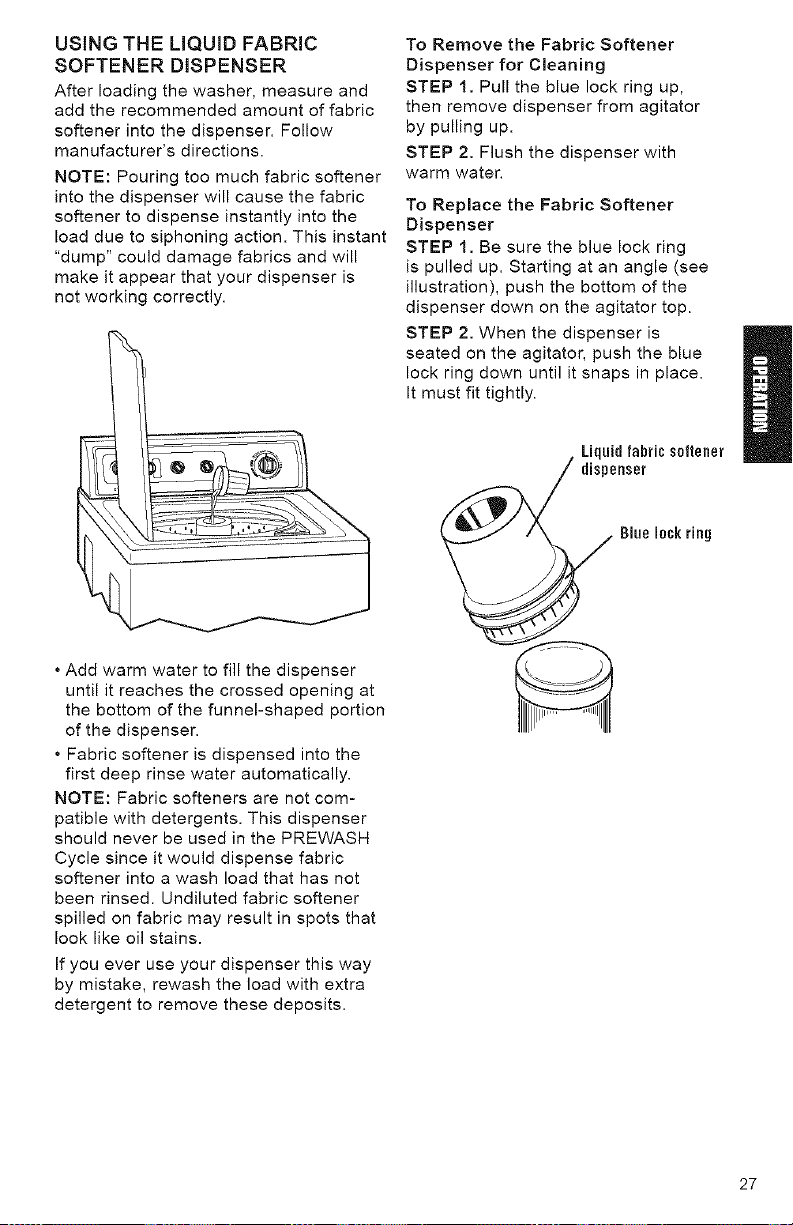
USINGTHELIQUIDFABRIC
SOFTENERDISPENSER
Afterloadingthewasher,measureand
addtherecommendedamountoffabric
softenerintothedispenser.Follow
manufacturer'sdirections.
NOTE:Pouringtoomuchfabricsoftener
intothedispenserwillcausethefabric
softenertodispenseinstantlyintothe
loadduetosiphoningaction.Thisinstant
"dump"coulddamagefabricsandwill
makeitappearthatyourdispenseris
notworkingcorrectly.
\
\
•Addwarmwatertofillthedispenser
untilitreachesthecrossedopeningat
thebottomofthefunnel-shapedportion
ofthedispenser.
•Fabricsoftenerisdispensedintothe
firstdeeprinsewaterautomatically.
NOTE:Fabricsoftenersarenotcom-
patiblewithdetergents.Thisdispenser
shouldneverbeusedinthePREWASH
Cyclesinceitwoulddispensefabric
softenerintoawashloadthathasnot
beenrinsed.Undilutedfabricsoftener
spilledonfabricmayresultinspotsthat
looklikeoilstains.
Ifyoueveruseyourdispenserthisway
bymistake,rewashtheloadwithextra
detergenttoremovethesedeposits.
ToRemovetheFabricSoftener
Dispenser for Cleaning
STEP 1. Pull the blue lock ring up,
then remove dispenser from agitator
by pulling up.
STEP 2. Flush the dispenser with
warm water
To Replace the Fabric Softener
Dispenser
STEP 1. Be sure the blue lock ring
is pulled up. Starting at an angle (see
illustration), push the bottom of the
dispenser down on the agitator top.
STEP 2. When the dispenser is
seated on the agitator, push the blue
lock ring down until it snaps in place.
It must fit tightly.
Liquid fabric softener
I -Jlll
27
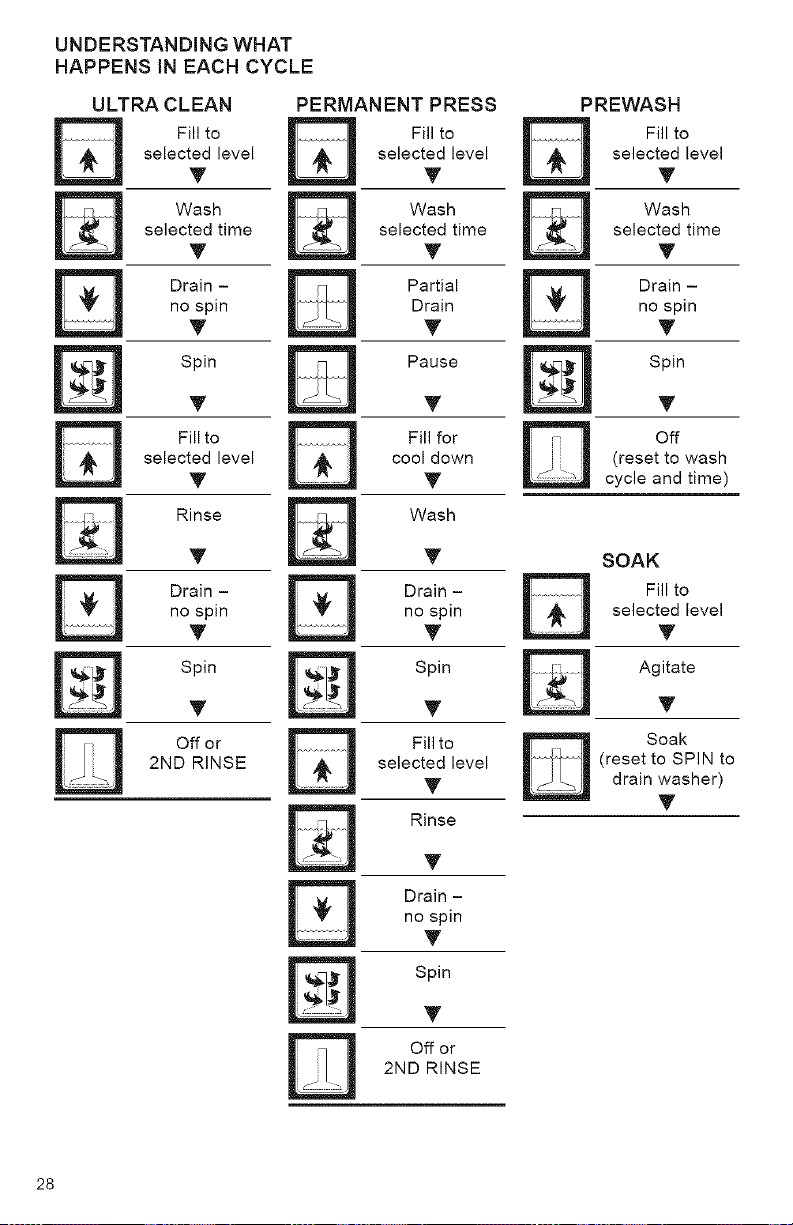
UNDERSTANDING WHAT
HAPPENS IN EACH CYCLE
ULTRA CLEAN
Fill to
selected level
T
Wash
selected time
T
no spin
T
Spin
T
-I
......... Fill to
selected level
Rinse
T
Drain -
no spin
T
Spin
T
Off or
2ND RINSE
PERMANENT PRESS PREWASH
Fill to _ Fill to
selected level selected level
T T
D @ W sh
selected time selected time
T T
I-!
- Partial Drain -
........ Drain no spin
z_ T ........... T
I-I @
Pause Spin
T T
!=!
............. Fill for Off
,_ cool down (reset to wash
'V" _ cycle and time)
I-i
........ Wash
Y SOAK
Drain - _ Fill to
no spin selected level
T T
Spin _ Agitate
T T
Fill to _ Soak
selected level (reset to SPIN to
'V" drain washer)
T
Rinse
T
Drain -
no spin
T
Spin
T
D Off or
2ND RINSE
28
PREPARING CLOTHES
FORWASHING
Follow these recommendations
to help you prolong the life of
your garments.
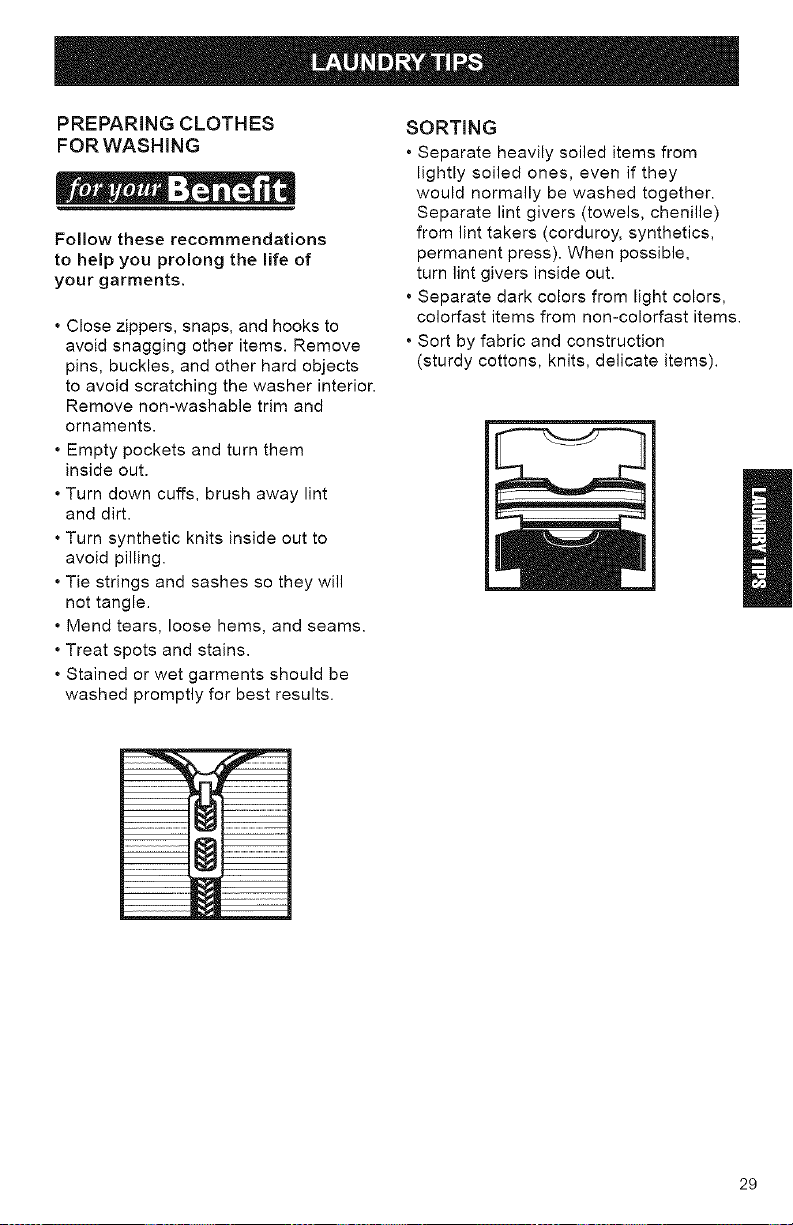
• Close zippers, snaps, and hooks to
avoid snagging other items. Remove
pins, buckles, and other hard objects
to avoid scratching the washer interior.
Remove non-washable trim and
ornaments.
• Empty pockets and turn them
inside out.
• Turn down cuffs, brush away lint
and dirt.
• Turn synthetic knits inside out to
avoid pilling.
• Tie strings and sashes so they will
not tangle.
• Mend tears, loose hems, and seams.
• Treat spots and stains.
• Stained or wet garments should be
washed promptly for best results.
SORTING
• Separate heavily soiled items from
lightly soiled ones, even if they
would normally be washed together.
Separate lint givers (towels, chenille)
from lint takers (corduroy, synthetics,
permanent press). When possible,
turn lint givers inside out.
• Separate dark colors from light colors,
colorfast items from non-colorfast items.
• Sort by fabric and construction
(sturdy cottons, knits, delicate items).
29
LOADING
Proper loading of your washer con-
tributes to proper cleaning and fabric
care and reduces machine noise,
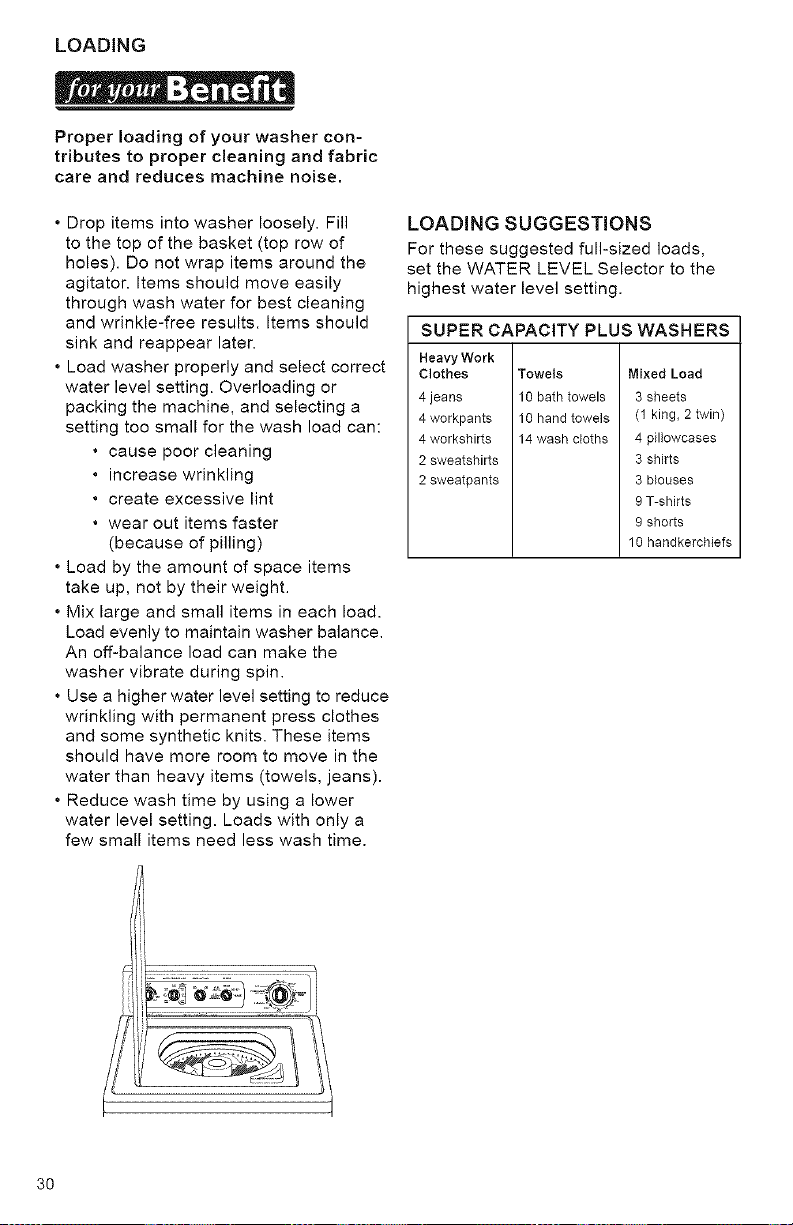
• Drop items into washer loosely. Fill
to the top of the basket (top row of
holes). Do not wrap items around the
agitator. Items should move easily
through wash water for best cleaning
and wrinkle-free results. Items should
sink and reappear later.
• Load washer properly and select correct
water level setting. Overloading or
packing the machine, and selecting a
setting too small for the wash load can:
• cause poor cleaning
• increase wrinkling
• create excessive lint
• wear out items faster
(because of pilling)
• Load by the amount of space items
take up, not by their weight.
• Mix large and small items in each load.
Load evenly to maintain washer balance.
An off-balance load can make the
washer vibrate during spin.
• Use a higher water level setting to reduce
wrinkling with permanent press clothes
and some synthetic knits. These items
should have more room to move in the
water than heavy items (towels, jeans).
• Reduce wash time by using a lower
water level setting. Loads with only a
few small items need less wash time.
LOADING SUGGESTIONS
For these suggested full-sized leads,
set the WATER LEVEL Selector to the
highest water level setting.
SUPER CAPACITY PLUS WASHERS
Heavy Work
Clothes
4 jeans
4 workpants
4 workshirts
2 sweatshirts
2 sweatpants
Towels Mixed Load
10 bath towels 3 sheets
10 hand towels (1 king, 2 twin)
14 wash cloths 4 pillowcases
3 shirts
3 blouses
9 T-shirts
9 shorts
10 handkerchiefs
?,
3O
CLEANING YOUR WASHER
Proper care of your washer can extend
its life. This section explains how to care
for your washer properly and safely.
Exterior
Wipe up detergent, bleach, and other
spills with a soft, damp cloth or sponge
as they occur. Occasionally wipe the
outside of the washer to keep it looking
like new.
Do not put sharp or metal objects in your
washer. They can damage the finish.
Check all pockets for pins, clips, money,
bolts, nuts, etc. Do not lay these objects
on your washer after emptying pockets.
Interior
Clean interior with 1 cup of chlorine
bleach mixed with 2 cups of detergent.
Run washer through a complete cycle
using hot water. Repeat process if
necessary.
NOTE: Remove hard water deposits using
only cleaners labeled as washer safe.
Water Inlet Hoses
Replace inlet hoses after five years
of use to reduce the risk of hose
failure. Periodically inspect and
replace inlet hoses if bulges, kinks,
cuts, wear or leaks are found. When
replacing your inlet hoses, mark the
date of replacement on the label with
a permanent marker.
WINTER STORAGE OR
MOVING CARE
Install and store your washer where
it will not freeze. Because some water
may stay in the hoses, freezing can
damage your washer. If storing or
moving your washer during freezing
weather winterize it.
To winterize washer:
1. Shut off both water faucets.
2. Disconnect and drain water inlet
hoses.
3. Put 1 quart of R.V.-type antifreeze
in the basket.
4. Run washer on a SPIN setting for
about 30 seconds to mix the anti-
freeze and water. Some of the mixture
will pump out while the washer spins.
5. Unplug the power supply cord.
To use washer again:
1. Flush water pipes and hoses.
2. Reconnect water inlet hoses.
3. Turn on both water faucets.
4. Reconnect power supply cord.
5. Run the washer through a complete
cycle with 1 cup of detergent to clean
out antifreeze.
NON-USE OR VACATION CARE
Operate your washer only when you
are at home. if you will be on vacation or
not using your washer for an extended
period of time, you should:
• Unplug the power supply cord or turn
off electrical power to the washer.
• Turn off the water supply to the washer.
This helps avoid accidental flooding
(due to a water pressure surge) while
you are away.
31
Mostlaunderingproblemsareeasily andwasherproblems.Ifyouneed
solvedifyouunderstandthecause, furtherassistance,seepage37.
Checktheselistsforcommonlaundry
Problem Possible Cause Solution
Washer Leaks Household ptumbing is leaking. Repair plumbing.
Inlet hoses not tight. Tighten hoses (see "INSTALLATION,"
Sections D & E).
Inlet hose washers not Reseat washers
properly seated. (see "INSTALLATION:' Section D).
Drain hose not properly Clamp drain hose
clamped or is off. (see "INSTALLATION:' Section C).
Drain is clogged. Remove drain clogs. Sink, standpipe,
or floor drain must be able to handle
17 galtons of water per minute.
Tub moved forward during Ensure tub is centered before
unloading, causing water to starting washer.
deflect off of tub ring.
Unit not level causing water Ensure front feet are installed and
to deflect off of tub ring. nuts are tightened. Level washer.
Reset rear legs
(see "INSTALLATION:' Section G).
Load is unbalanced. Spray Redistribute the load.
rinses are deflecting off of toad.
Washer is overloaded. Fills or Reduce load size.
spray rinses are deflecting off
of load.
Won't Drain/ Drain hose is kinked or Straighten or unplug hose
Won't Spin/ clogged. (see "INSTALLATION:' Section C).
Wet Loads
Correct operation of After a wash or rinse, the washer will
neutral drain, drain without spinning. After draining,
the spinning begins.
Lid is open. Close the lid.
Drain hose is more than Lower drain hose
96 inches above floor. (see "INSTALLATION:' Section C).
Too much detergent - Use tess detergent.
excessive sudsing.
Wrong cycle for load Choose a cycle with a higher spin
being washed, speed (see "OPERATION").
32
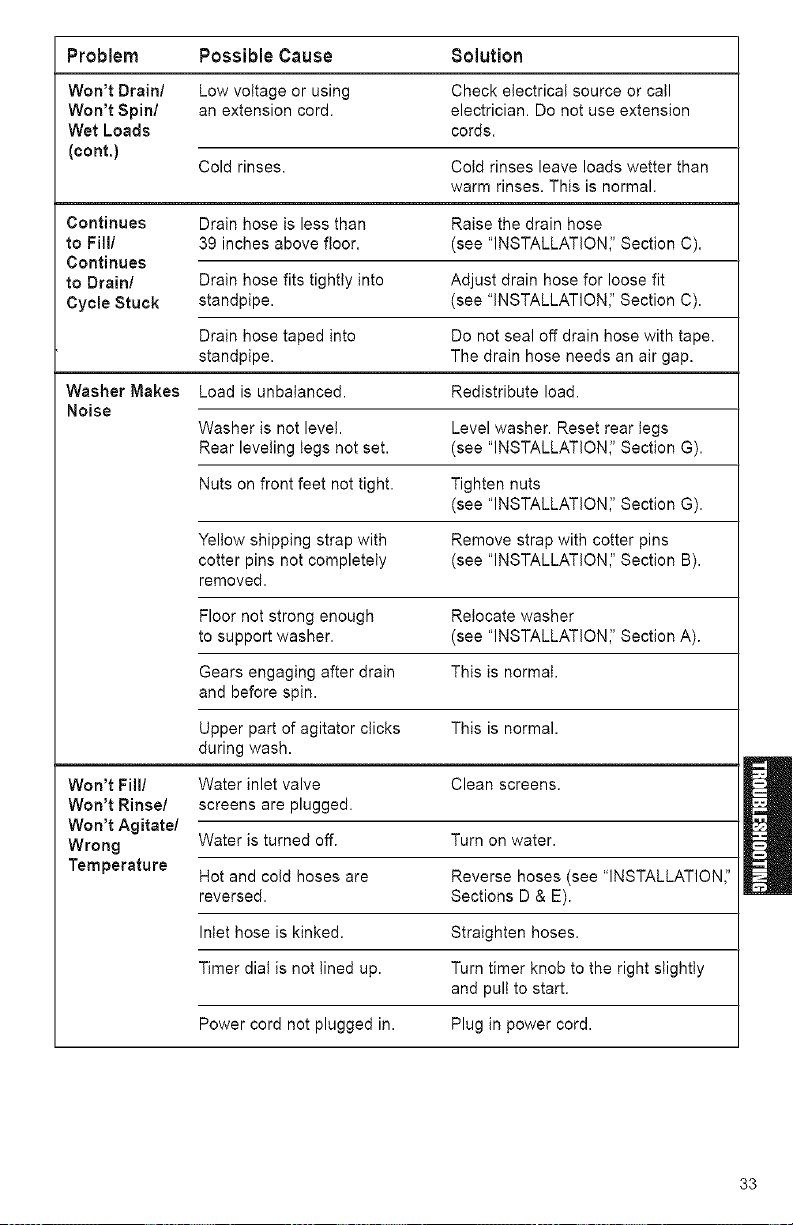
Problem Possible Cause Solution
Won't Drain/ Low vottage or using Check electrical source or call
Won't Spin/ an extension cord. electrician. Do not use extension
Wet Loads cords.
(cont.)
Cold rinses. Cotd rinses leave loads wetter than
warm rinses. This is normal.
Continues Drain hose is less than Raise the drain hose
to Fill/ 39 inches above floor. (see "INSTALLATION_' Section C).
Continues
to Drain/ Drain hose fits tightty into Adjust drain hose for loose fit
Cycle Stuck standpipe. (see "INSTALLATION," Section C).
Drain hose taped into Do not seal off drain hose with tape.
standpipe. The drain hose needs an air gap.
Washer Makes Load is unbalanced. Redistribute load.
Noise
Washer is not levet. Level washer. Reset rear legs
Rear leveling tegs not set. (see "INSTALLATION_' Section G
Nuts on front feet not tight. Tighten nuts
(see "INSTALLATION_' Section G
Yellow shipping strap with Remove strap with cotter pins
cotter pins not completely (see "INSTALLATION," Section B
removed.
Floor not strong enough Relocate washer
to support washer. (see "INSTALLATION_' Section A).
Gears engaging after drain This is normal.
and before spin.
Upper part of agitator clicks This is normal.
during wash.
Won't Fill/ Water inlet valve Clean screens.
Won't Rinse/ screens are plugged.
Won't Agitate/
Wrong Water is turned off. Turn on water.
Temperature Hot and cold hoses are Reverse hoses (see "INSTALLATION
reversed. Sections D & E).
Inlet hose is kinked, Straighten hoses,
Timer dial is not lined up. Turn timer knob to the right slightly
and pull to start,
Power cord not plugged in. Plug in power cord.
33
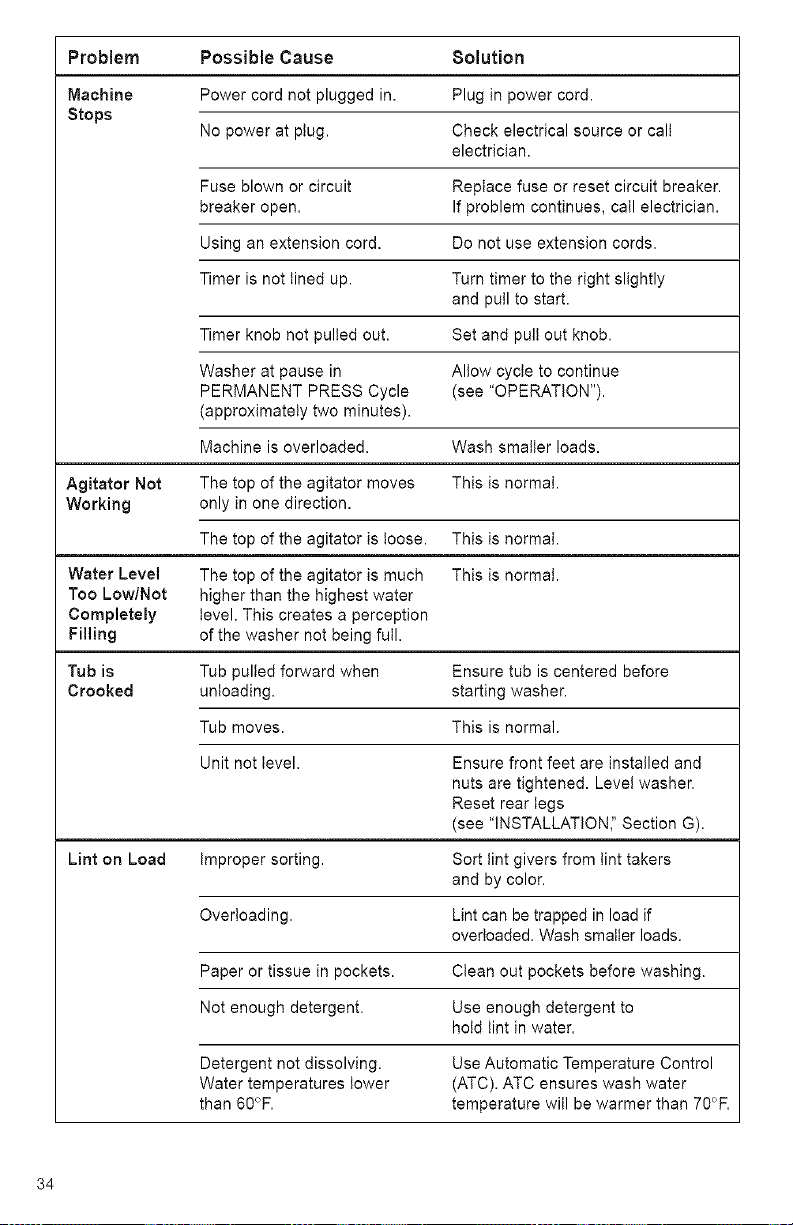
Problem Possible Cause 8olution
Machine Power cord not plugged in. Plug in power cord.
Stops
No power at plug. Check electrical source or call
electrician.
Fuse blown or circuit Replace fuse or reset circuit breaker.
breaker open. If problem continues, call electrician.
Using an extension cord. Do not use extension cords.
Timer is not lined up. Turn timer to the right slightly
and pull to start.
Timer knob not pulled out. Set and pull out knob.
Washer at pause in Allow cycle to continue
PERMANENT PRESS Cycle (see "OPERATION").
(approximately two minutes).
Machine is overloaded. Wash smaller loads.
Agitator Not The top of the agitator moves This is normal.
Working only in one direction.
The top of the agitator is loose. This is normal.
Water Level The top of the agitator is much This is normal.
Too Low/Not higher than the highest water
Completely level. This creates a perception
Filling of the washer not being full.
Tub is Tub pulled forward when Ensure tub is centered before
Crooked unloading, starting washer.
Tub moves. This is normal.
Unit not level. Ensure front feet are installed and
nuts are tightened. Level washer.
Reset rear legs
(see "INSTALLATION," Section G).
Lint on Load Improper sorting. Sort lint givers from tint takers
and by color.
Overloading. Lint can be trapped in load if
overloaded. Wash smaller loads.
Paper or tissue in pockets. Clean out pockets before washing.
Not enough detergent. Use enough detergent to
hold tint in water.
Detergent not dissolving. Use Automatic Temperature Control
Water temperatures lower (ATC). ATC ensures wash water
than 6O°F. temperature will be warmer than 7O°R
34
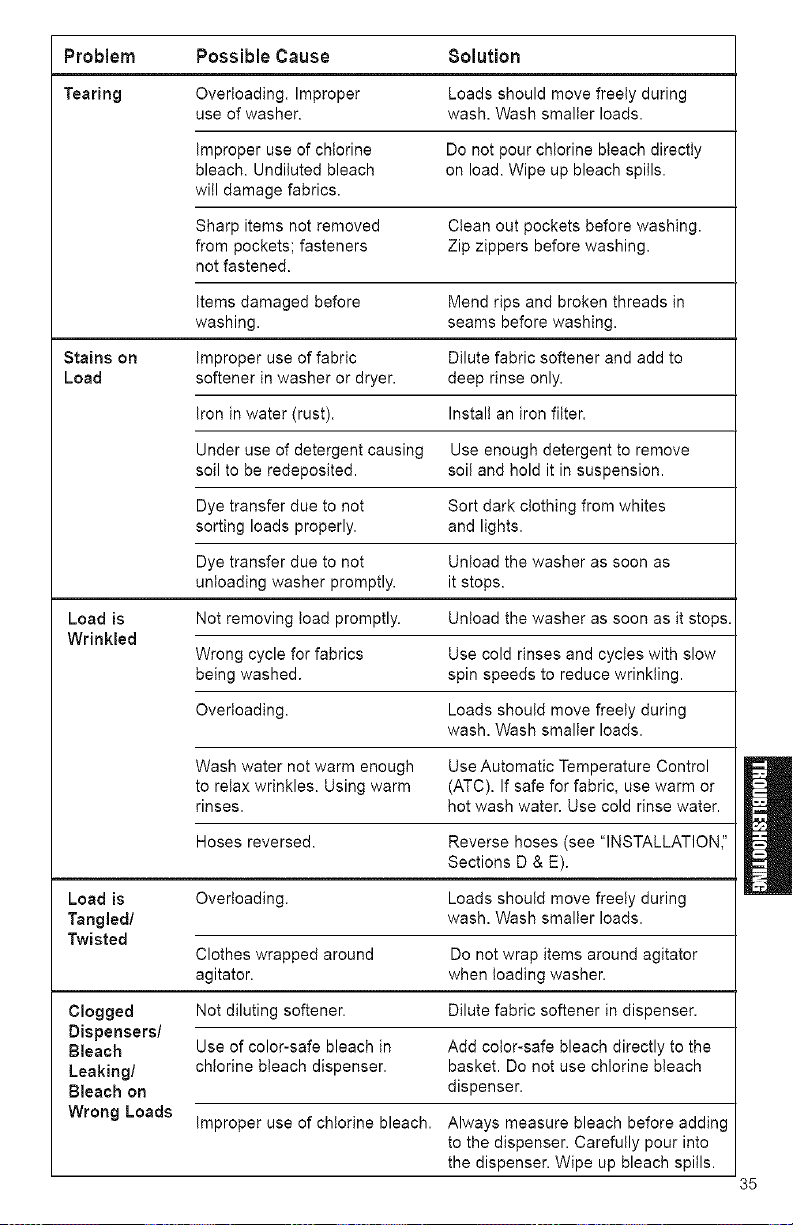
Problem Possible Cause 8olution
Tearing Overloading. Improper Loads should move freely during
use of washer, wash. Wash smaller loads.
improper use of chlorine Do not pour chlorine bleach directly
bleach. Undiluted bleach on load. Wipe up bleach spills.
will damage fabrics.
Sharp items not removed Clean out pockets before washing.
from pockets; fasteners Zip zippers before washing.
not fastened.
items damaged before Mend rips and broken threads in
washing, seams before washing.
Stains on improper use of fabric Dilute fabric softener and add to
Load softener in washer or dryer, deep rinse only.
Iron in water (rust). Install an iron filter.
Under use of detergent causing Use enough detergent to remove
soil to be redeposited, soil and hold it in suspension.
Dye transfer due to not Sort dark clothing from whites
sorting loads properly, and lights.
Dye transfer due to not Unload the washer as soon as
unloading washer promptly, it stops.
Load is Not removing toad promptly. Unload the washer as soon as it stops.
Wrinkled
Wrong cycle for fabrics Use cold rinses and cycles with slow
being washed, spin speeds to reduce wrinkling.
Overloading. Loads should move freely during
wash. Wash smaller loads.
Wash water not warm enough Use Automatic Temperature Control
to relax wrinkles. Using warm (ATC). If safe for fabric, use warm or
rinses, hot wash water. Use cold rinse water.
Hoses reversed. Reverse hoses (see "INSTALLATION,"
Sections D & E).
Load is Overloading. Loads should move freely during
Tangled/ wash. Wash smaller loads.
Twisted
Clothes wrapped around Do not wrap items around agitator
agitator, when loading washer.
Clogged Not diluting softener. Dilute fabric softener in dispenser.
Dispensers/
Bleach Use of color-safe bleach in Add color-safe bleach directly to the
Leaking/ chlorine bleach dispenser, basket. Do not use chlorine bleach
Bleach on dispenser.
Wrong Loads
Improper use of chlorine bleach. Always measure bleach before adding
to the dispenser. Carefully pour into
the dispenser. Wipe up bleach spills.
35
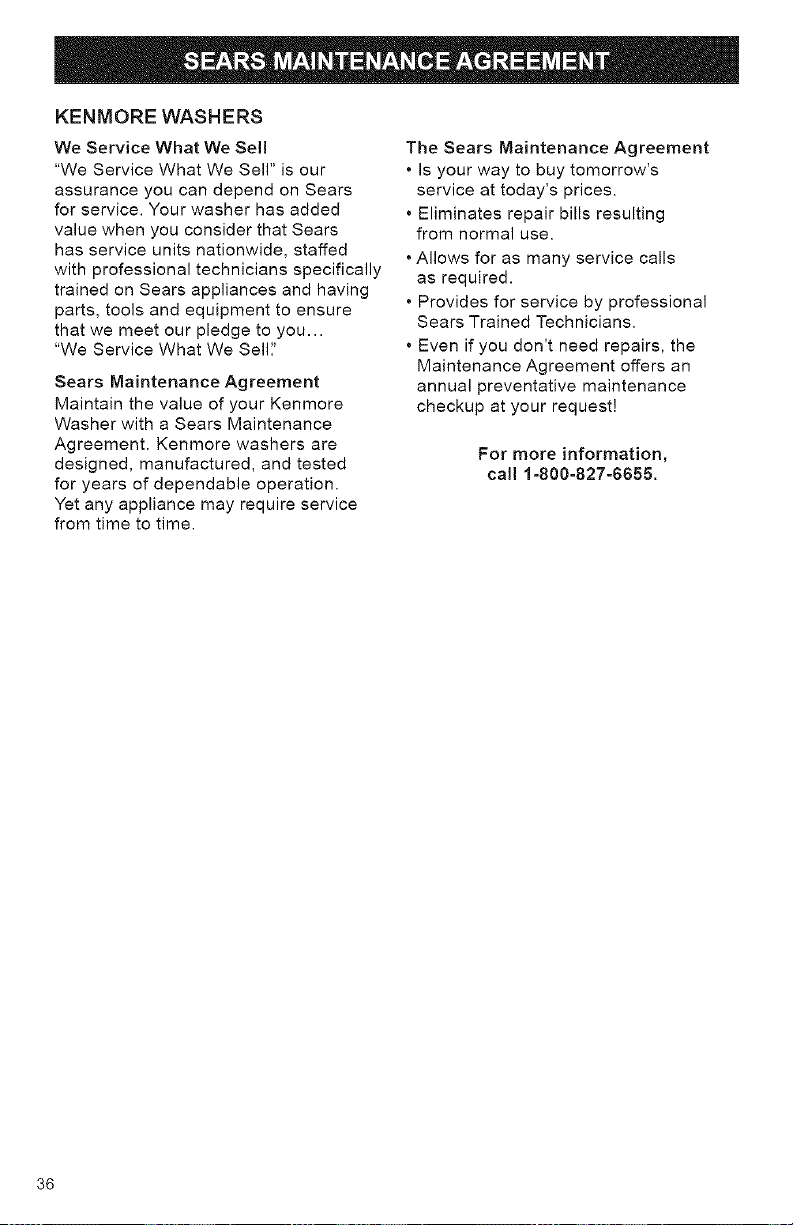
KENMOREWASHERS
WeServiceWhatWeSell
"WeServiceWhatWeSell"isour
assuranceyoucandependonSears
forservice.Yourwasher has added
value when you consider that Sears
has service units nationwide, staffed
with professional technicians specifically
trained on Sears appliances and having
parts, tools and equipment to ensure
that we meet our pledge to you...
"We Service What We Sell:'
Sears Maintenance Agreement
Maintain the value of your Kenmore
Washer with a Sears Maintenance
Agreement. Kenmore washers are
designed, manufactured, and tested
for years of dependable operation.
Yet any appliance may require service
from time to time.
The Sears Maintenance Agreement
• Is your way to buy tomorrow's
service at today's prices.
• Eliminates repair bills resulting
from normal use.
• Allows for as many service calls
as required.
• Provides for service by professional
Sears Trained Technicians.
• Even if you don't need repairs, the
Maintenance Agreement offers an
annual preventative maintenance
checkup at your request!
For more information,
call 1-800-827-6655,
36
Forthe repair or replacement partsyou
need delivered directlyto your home
Call7 am - 7 pro, 7 days a week
1-800-366-PART
(1-800-366-7278)
Forin-home major brandrepair service
Call24 hours a day,7 days a week
1-800-4-REPAIR
(1-800-473-7247)
Forthe locationof a Sears Partsand
Repair Center in your area
Call24 hours a day, 7 days a week
1-800-488-1222
Forinformation on purchasinga Sears
Maintenance Agreement or to inquire
about an existing Agreement
Call9 am - 5 pro, Monday- Saturday
1-800-827-6655
Whenrequestingserviceor ordering
parts,alwaysgivethefollowing
information:
• ProductName • PartName
• Model Number • PartNumber
America'sRepairSpecialists
37