
Monogram
®
Owner’s Manual
monogram.com
Free-Standing
Side-by-Side
Stainless Steel
Refrigerator
Consumer Information
Stainless Steel Refrigerator
2
Introduction
Your new Monogram refrigerator makes an eloquent statement of style, convenience and kitchen
planning flexibility. Whether you chose it for its purity of design, practical storage arrangements
or assiduous attention to detail—or for all of these reasons—you’ll find that your Monogram
refrigerator’s superior blend of form and function will delight you for years to come.
The information on the following pages will help you operate and maintain your refrigerator
properly.
If you have any other questions, visit our Website at: monogram.com
Contents
Consumer Services
Important Phone Numbers . . . . . . . . . . . . . . . .31
Model and Serial Numbers . . . . . . . . . . . . . . . . .3
Performance Data Sheet . . . . . . . . . . . . . . . . . .27
Problem Solver . . . . . . . . . . . . . . . . . . . . . . .22–26
Product Registration . . . . . . . . . . . . . . . .3, 29, 30
Safety Instructions . . . . . . . . . . . . . . . . . . . . . . 4–7
State of California
Water Treatment Device Certificate . . . . . . . . .28
Warranty . . . . . . . . . . . . . . . . . . . . . . .Back Cover
Care and Cleaning
Cleaning—Outside and Inside . . . . . . . . . . . . .19
Light Bulb Replacement . . . . . . . . . . . . . . . . . . 21
Moving . . . . . . . . . . . . . . . . . . . . . . . . . . . . . . . . .20
Vacation . . . . . . . . . . . . . . . . . . . . . . . . . . . . . . . .20
Operating Instructions
Automatic Icemaker . . . . . . . . . . . . . . . . . . . . . .16
Additional Features . . . . . . . . . . . . . . . . . . . . . .14
Crispers and Pans . . . . . . . . . . . . . . . . . . . . . . . .15
CustomCool . . . . . . . . . . . . . . . . . . . . . . . . . .9, 10
Ice and Water Dispenser . . . . . . . . . . . . . . .17, 18
Shelves and Bins . . . . . . . . . . . . . . . . . . . . . .12, 13
Temperature Controls . . . . . . . . . . . . . . . . . . . . .8
Water and FreshSaver Filters . . . . . . . . . . . . . .11
Before
using
your
refrigerator
Read this manual carefully. It is intended to
help you operate and maintain your new
refrigerator properly.
Keep it handy for answers to your questions.
If you don’t understand something or need
more help, call in the USA:
GE Answer Center
®
800.626.2000
24 hours a day, 7 days a week
In Canada, call 1.888.880.3030.
3
Write
down the
model &
serial
numbers
You’ll see them on a label inside the fresh food
compartment at the top on the right side.
Please write these numbers on the Consumer
Product Ownership Registration Card included
with this manual.
Before sending in this card, please also write
these numbers here:
Model Number
Serial Number
Use these numbers in any correspondence or
service calls concerning your refrigerator.
If you
received a
damaged
refrigerator
Immediately contact the dealer (or builder)
that sold you the refrigerator.
Save time
& money
Before you request service, check the Problem
Solver in the back of this manual.
It lists causes of minor operating problems that
you can correct yourself.
If you
need
service
To obtain service, see the Consumer Services
page in the back of this manual.
We’re proud of our service and want you to
be pleased. If for some reason you are not
happy with the service you receive, here are
steps to follow for further help.
For customers in the USA:
FIRST, contact the people who serviced your
appliance. Explain why you are not pleased. In
most cases, this will solve the problem.
NEXT, if you are still not pleased, write all the
details—including your phone number—to:
Manager, Customer Relations
GE Appliances
Appliance Park
Louisville, KY 40225
For customers in Canada:
FIRST, contact the people who serviced your
appliance. Explain why you are not pleased.
In most cases, this will solve the problem.
NEXT, if you are still not pleased, write all the
details—including your phone number to:
Manager, Consumer Relations
Camco Inc.
1 Factory Lane, Suite 310
Moncton, N.B. E1C 9M3
4
IMPORTANT SAFETY INSTRUCTIONS
READ AND SAVE THESE INSTRUCTIONS
w WARNING—When using
this appliance, always exercise basic safety
precautions, including the following:
• Use this appliance only for its intended
purpose as described in this Owner’s
Manual.
• This refrigerator must be properly installed
in accordance with the Installation
Instructions before it is used.
• Do not allow children to climb, stand or hang
on the shelves in the refrigerator. They could
damage the refrigerator and seriously injure
themselves.
• Do not touch the cold surfaces in the freezer
compartment when hands are damp or wet.
Skin may adhere to these extremely cold
surfaces.
• Do not store or use gasoline or other
flammable vapors and liquids in the vicinity
of this or any other appliance.
• In refrigerators with automatic icemakers,
avoid contact with moving parts of the ejector
mechanism, or with the heating element
located on the bottom of the icemaker.
Do not place fingers or hands on the
automatic icemaking mechanism while
the refrigerator is plugged in.
• Keep fingers out of the “pinch point” areas:
clearances between the doors and between
the doors and cabinet are necessarily small.
Be careful closing doors when children are
in the area.
• Unplug your refrigerator before cleaning
and making repairs. NOTE: We strongly
recommend that any servicing be performed
by a qualified individual.
• Before replacing a burned-out light bulb,
the refrigerator should be unplugged in
order to avoid contact with a live wire
filament. (A burned-out light bulb may break
when being replaced.) NOTE: Turning
control to OFF does not remove power to
the light circuit.
• Do not refreeze frozen foods which have
thawed completely.
• Always clean the CustomCool™ Tray after
thawing food.
w DANGER: RISK OF CHILD ENTRAPMENT
Child entrapment and suffocation are not
problems of the past. Junked or abandoned
refrigerators are still dangerous…even if they
will sit for “just a few days.” If you are getting
rid of your old refrigerator, please follow the
instructions below to help prevent accidents.
Before You Throw Away Your Old Refrigerator
or Freezer:
• Take off the doors.
• Leave the shelves in place so that children
may not easily climb inside.
CFC DISPOSAL
Your old refrigerator may have a cooling
system that used CFCs (chlorofluorocarbons).
CFCs are believed to harm stratospheric ozone.
If you are throwing away your old refrigerator,
make sure the CFC refrigerant is removed for
proper disposal by a qualified servicer. If you
intentionally release this CFC refrigerant you
can be subject to fines and imprisonment
under provisions of environmental legislation.
5
LIRE ET CONSERVER CES INSTRUCTIONS
w AVERTISSEMENT :
Lorsque vous utilisez le réfrigérateur, observez
toujours certaines précautions de base,
notamment :
• N’utilisez le réfrigérateur que pour son usage
prévu, comme décrit dans le présent manuel.
• Installez le réfrigérateur conformément aux
directives d’installation avant de l’utiliser.
• Ne laissez pas les enfants grimper, s’asseoir,
se tenir debout ni se pendre aux clayettes du
réfrigérateur. Ils pourraient endommager le
réfrigérateur et se blesser gravement.
• Une fois le réfrigérateur en marche, ne
touchez pas les surfaces froides du
congélateur, surtout si vous avez les mains
humides ou mouillées : la peau risque
d’adhérer à ces surfaces très froides.
• N’entreposez et n’utilisez pas d’essence ou
autres vapeurs et liquides inflammables à
proximité de cet appareil ou de tout autre
appareil électroménager.
• Pour les réfrigérateurs dotés d’une machine
à glaçons automatique, évitez le contact avec
les pièces mobiles du mécanisme éjecteur,
ou avec l’élément chauffant situé à la partie
inférieure de la machine à glaçons. Ne posez
pas les doigts ou les mains sur le mécanisme
de la machine à glaçons pendant que le
réfrigérateur est branché.
• Éloignez les doigts des parties du
réfrigérateur où l’on peut facilement se
pincer : les espaces entre les portes et entre
les portes et les placards sont toujours étroits.
Soyez prudent lorsque vous fermez les portes
de l’appareil en présence des enfants.
• Débranchez votre réfrigérateur avant
de le nettoyer et de le réparer.
REMARQUE : Nous vous recommandons
vivement de confier toute réparation à un
technicien qualifié.
• Avant de remplacer une ampoule grillée,
le réfrigérateur doit être débranché afin
d’éviter tout contact avec un fil sous tension.
(Une ampoule grillée peut se briser pendant
l’opération). REMARQUE : Lorsque vous
placez la commande sur «0» (éteint),
l’alimentation électrique de l’ampoule
n’est pas coupée.
• Ne faites PAS recongeler des aliments
surgelés qui ont complètement dégelé.
• Nettoyez toujours le contenant CustomCool™
après avoir dégelé les aliments.
w DANGER: RISQUES POUR LES ENFANTS
Les enfants pris au piège ou morts d’asphyxie
sont toujours d’actualité. Les appareils de
réfrigération abandonés sont toujours aussi
dangereux, même si on n’attend que “quelque
jours” pour s’en débarasser. Si vous ne gardez
pas votre ancien appareil, veuillez suivre les
directives ci-dessous afin de prévenir les
accidents.
Avant de vous débarasser de votre vieux
appareil de réfrigération :
• Démontez les portes.
• Laissez les clayettes en place afin d’empêcher
les enfants de grimper à l’intérieur.
SE DÉBARRASSER DU CFC
Votre ancien réfrigérateur peut avoir un
système de refroidissement qui a utilisé les
CFC (chlorofluorocarbones). Les CFCs sont
jugés nocifs pour l’ozone stratosphérique.
Si vous débarrassez de votre viel appareil de
réfrigération, assurez-vous que le frigorigène
avec CFC soit enlevé correctement par un
technicien qualifié. Si vous libérez
intentionnellement ce frigogène avec CFC
vouz pouvez être soumis aux contraventions
et à l’emprisonnement après les stipulations
des lois sur l’environment.

6
HOW TO CONNECT ELECTRICITY
Do not, under any circumstances, cut or
remove the third (ground) prong from the
power cord. For personal safety, this appliance
must be properly grounded.
The power cord of this appliance is equipped
with a 3-prong (grounding) plug which mates
with a standard 3-prong (grounding) wall
outlet to minimize the possibility of electric
shock hazard from this appliance.
Have the wall outlet and circuit checked by
a qualified electrician to make sure the outlet
is properly grounded.
Where a standard 2-prong wall outlet is
encountered, it is your personal responsibility
and obligation to have it replaced with a
properly grounded 3-prong wall outlet.
The refrigerator should always be plugged into
its own individual electrical outlet which has
a voltage rating that matches the rating plate.
This provides the best performance and also
prevents overloading house wiring circuits
which could cause a fire hazard from
overheated wires.
Never unplug your refrigerator by pulling on
the power cord. Always grip plug firmly and
pull straight out from the outlet.
Repair or replace immediately all power cords
that have become frayed or otherwise
damaged. Do not use a cord that shows cracks
or abrasion damage along its length or at
either end.
When moving the refrigerator away from the
wall, be careful not to roll over or damage the
power cord.
IMPORTANT SAFETY INSTRUCTIONS
Because of potential safety hazards under
certain conditions, we strongly recommend
against the use of an adapter plug.
However, if you must use an adapter, where
local codes permit, a temporary connection
may be made to a properly grounded 2-prong
wall outlet by use of a UL-listed adapter
available at most local hardware stores.
The larger slot in the adapter must be
aligned with the larger slot in the wall outlet
to provide proper polarity in the connection
of the power cord.
When disconnecting the power cord from the
adapter, always hold the adapter in place with
one hand while pulling the power cord plug
with the other hand. If this is not done, the
adapter ground terminal is very likely to break
with repeated use.
If the adapter ground terminal breaks,
DO NOT USE the appliance until a proper
ground has been established.
Attaching the adapter ground terminal to
a wall outlet cover screw does not ground the
appliance unless the cover screw is metal, and
not insulated, and the wall outlet is grounded
through the house wiring. You should have the
circuit checked by a qualified electrician to
make sure the outlet is properly grounded.
Use of an adapter plug will increase the
clearance needed for the back of the
appliance.
USE OF ADAPTER PLUGS (Adapter plugs not permitted in Canda)
USE OF EXTENSION CORDS
Because of potential safety hazards under
certain conditions, we strongly recommend
against the use of an extension cord.
However, if you must use an extension cord,
it is absolutely necessary that it be a UL-listed,
3-wire grounding type appliance extension
cord having a grounding type plug and outlet
and that the electrical rating of the cord be
15 amperes (minimum) and 120 volts.
SAVE THESE INSTRUCTIONS

CONSERVEZ CES DIRECTIVES
7
RACCORDEMENT ÉLECTRIQUE
Ne coupez ni retirez en aucun cas la troisième
broche (mise à la terre) de la fiche du cordon
d’alimentation. Pour votre sécurité, cet
appareil doit être correctement mis à la terre.
Le cordon d’alimentation de cet appareil est
muni d’une fiche à 3 broches (mise à la terre)
qui se branche dans une prise mural ordinaire
à 3 alvéoles (mise à la terre) pour réduire au
minimum les risques du chocs électriques.
Faites examiner la prise de courant et le circuit
par un électricien qualifié pour vous assurer
que la prise est correctement mise à la terre.
Si la prise murale est du type standard à
2 alvéoles, il vous incombe de la faire
remplacer par une prise à 3 alvéoles
correctement mise à la terre.
La machine à glaçons doit toujours être branché
dans sa propre prise de courant, dont la tension
nominale est identique à celle indiquée sur la
plaque signalétique.
Cette précaution est recommandée pour
garantir un rendement optimum et éviter
une surcharge des circuits électriques de la
résidence, ce qui pourrait créer un risque
d’incendie par surschauffe des fils.
Ne débranchez jamais l’appareil en tirant le
cordon d’alimentation. Saisissez fermement
la fiche du cordon et tirez droit pour la retirer
de la prise.
Réparez ou remplacez immédiatement tout
cordon effiloché ou endommagé. N’utilisez
pas un cordon fendillé ou présentant des
signes d’usure.
Lorsque vous déplacez l’appareil du mur,
faites attention de ne pas la faire rouler sur
le cordon d’alimentation afin de ne pas
l’endommager.
FICHE D’ADAPTATION (Fiches d’adaptation non permises au Canada)
Toutefois, si vous décidez d’utiliser tout de
même une fiche d’adaptation, vous pouvez
effectuer un raccordement temporaire, si les
codes locaux le permettent, dans une prise de
courant à 2 alvéoles adéquatement mise à la
terre en utilisant une fiche d’adaptation
homologuée UL, en vente dans la plupart
des quincailleries.
La fente la plus longue de la fiche doit être
alignée avec la fente la plus longue de la prise
murale afin d’assurer la polarité appropriée
pour le branchement du cordon d’alimentation.
Lorsque vous débranchez le cordon
d’alimentation de la fiche d’adaptation, saisissez
toujours la fiche d’une main pendant que vous
tirez sur la fiche du cordon d’alimentation de
l’autre. Sinon, la borne de mise à la terre de la
fiche d’adaptation risque de casser avec le temps.
Si la borne de mise à la terre de la fiche casse,
N’UTILISEZ PAS l’appareil tant qu’une mise
à la terre adéquate n’aura pas été rétablie.
Le fait de fixer la borne de mise à la terre de la
fiche d’adaptation à la plaque de la prise de
courant n’assure pas automatiquement la mise
à la terre de l’appareil. Il faut que la vis soit en
métal, non isolée, et que la prise de courant
soit mise à la terre par l’entremise du câblage
de résidence. Faites vérifier le circuit par un
électricien qualifié pour vous assurer que la
prise est adéquatement mise à la terre.
Nous vous recommandons fortement de ne pas utiliser une fiche d’adaptation à cause des risques potentiels
qu’elle présente dans certaines circonstances.
CORDONS PROLONGATEURS
Nous vous recommandons fortement de ne pas
utíliser de cordons prolongateurs à cause des
risques potentiels qu’ils présentent dans
certaines conditions.
Toutefois si vous décidez d’utiliser tout
de même un cordon prolongateur, il est
absolument nécessaire qu’il s’agisse d’un
cordon à 3 fils avec mise à la terre pour
appareils électroménagers homologué UL
(aux États-Unis) ou homologué CSA (au
Canada), pourvu d’une fiche et d’une prise
mises à la terre de 15 ampères (minimum)
et de 120 volts.
8
Operating Instructions
Stainless Steel Refrigerator
Temperature
controls
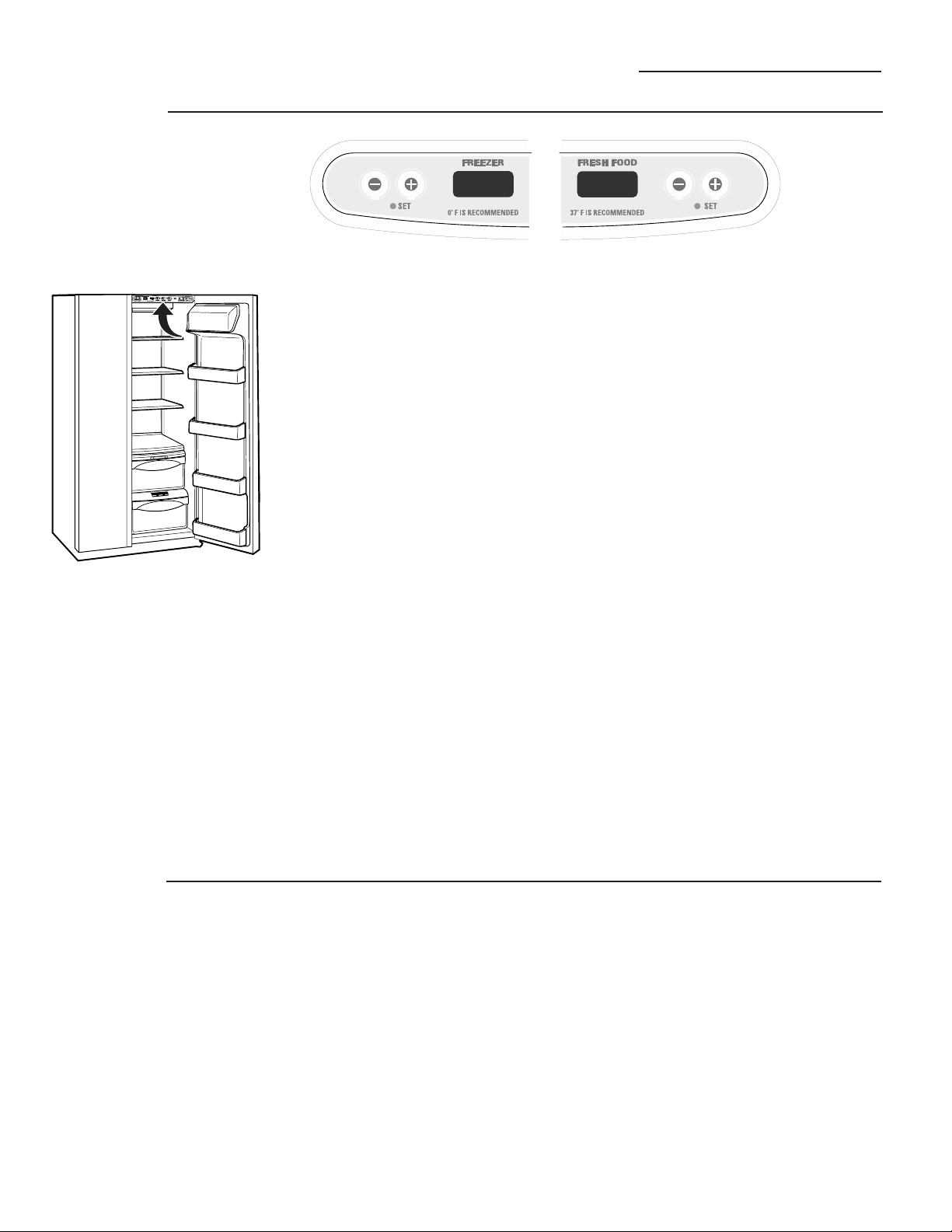
The temperature controls are preset in the factory at 37°F for the fresh food compartment
and 0°F for the freezer compartment. Allow 24 hours for the temperature to stabilize to the
preset recommended settings.
The temperature controls can display both the SET temperature as well as the actual
temperature in the fresh food and freezer compartments. The actual temperature may vary
slightly from the SET temperature based on usage and operating environment.
Setting either or both controls to OFF stops cooling in both the freezer and fresh food
compartments, but does not shut off electrical power to the refrigerator.
NOTE: The refrigerator is shipped with protective film covering the temperature controls.
If this film was not removed during installation, remove it now.
To change the temperature, press and release the
WARMER or COLDER pad. The SET light will
come on and the display will show the set
temperature. To change the temperature, tap
either the WARMER or COLDER pad until the
desired temperature is displayed. Fresh food
temperatures can be adjusted between 34°F and
44°F and the freezer temperatures can be
adjusted between -6°F and +6°F.
Once the desired temperature has been set, the
temperature display will return to the actual fresh
food and freezer temperatures after 5 seconds.
Several adjustments may be required. Each
time you adjust controls, allow 24 hours for the
refrigerator to reach the temperature you have set.
To turn the cooling system off, tap the WARMER
pad for either the fresh food compartment or the
freezer until the display shows OFF. To turn the
unit back on, press the COLDER pad for either
the fresh food compartment or freezer. The SET
light will illuminate on the side you selected. Then
press the COLDER pad again (on the side where
the SET light is illuminated) and it will go to the
preset points of 0°F for the freezer and 37°F for
the fresh food compartment.
The Performance Air-Flow System is designed to
maximize temperature control in the fresh food
and freezer compartments. This unique special
feature consists of the Air Tower along the top
and back walls of the fresh food compartment and
the Air Tunnel on the bottom portion of the
freezer rear wall. Placing food in front of the
louvers on these components will not affect
performance. Although the Air Tower and the
Air Tunnel can be removed, doing so will affect
temperature performance. (For removal
instructions, on-line, 24 hours a day, contact us
at www.monogram.com or call 800.444.1845.
In Canada, call us at 1.888.880.3030.)
Performance
Air Flow
System
CustomCool™
Stainless Steel Refrigerator
How it works
9
1 Empty the pan. Place the Chill/Thaw
tray in the pan with the metal plate
facing down to chill and store items, or
with the metal plate facing up to thaw
items. Place the items on the tray and
close the pan completely.
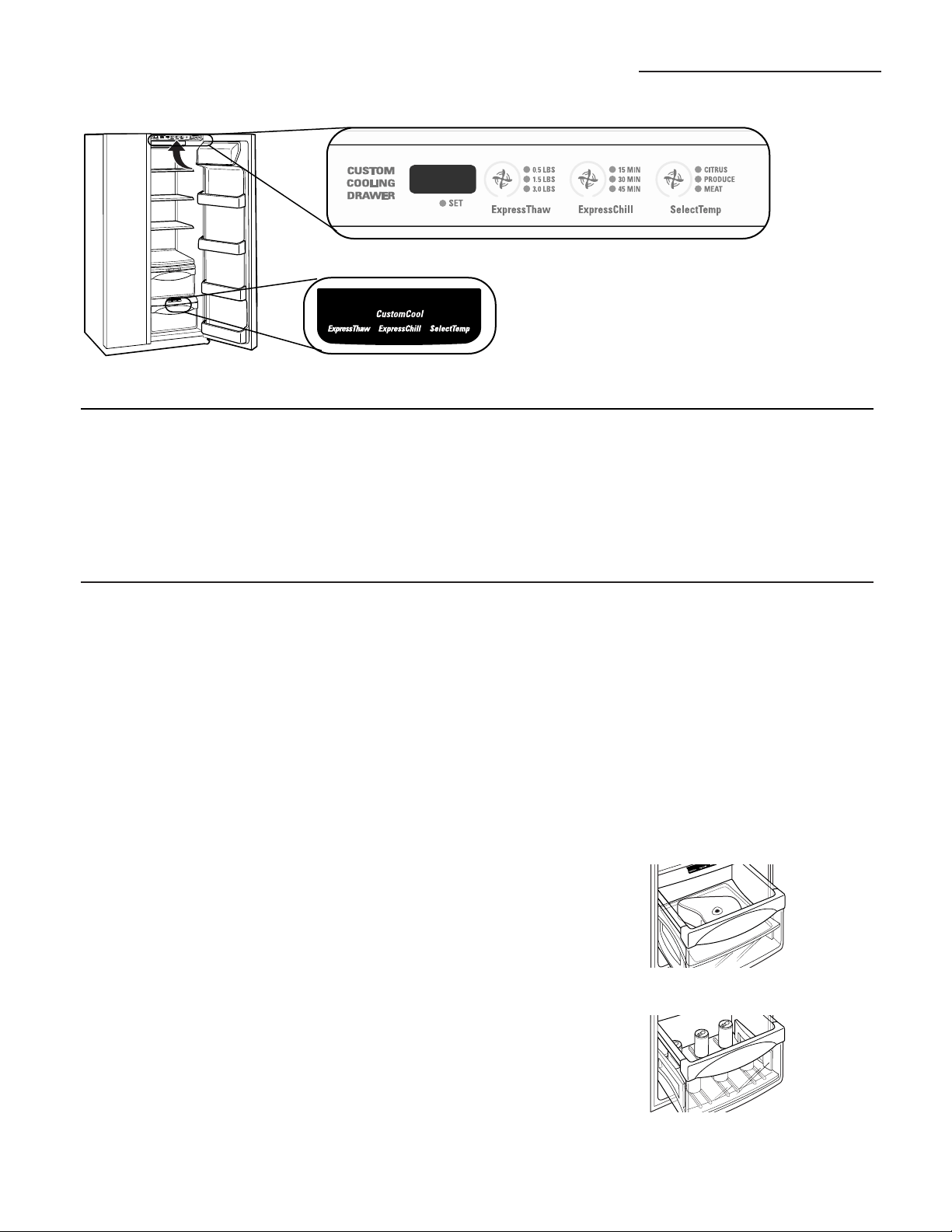
2 Select the ExpressThaw™, ExpressChill™
or SelectTemp™ pad. The display and
SET light will come on. Tap the pad
until the light appears next to the
desired setting. Use the chart to
determine the best setting to use.
• To stop a feature before it is finished,
tap that feature’s pad until no options
are selected and the display is off.
• During ExpressThaw™ and ExpressChill™,
the display on the controls will count
down the time in the cycle.
• After the ExpressThaw™ cycle is
complete, the pan will reset to the
MEAT setting (30°F) to help preserve
thawed items until they are used.
• The displayed actual temperature of
the CustomCool pan may vary slightly
from the SET temperature based on
usage and operating environment.
NOTE: For food safety reasons, it is
recommended that foods be wrapped
in plastic wrap when using ExpressThaw™.
This will help contain meat juices and
improve thawing performance.
The CustomCool™ feature is a system of
dampers, a fan, a temperature thermistor,
and a heater. Depending on the function
selected, a combination of these will be
used to quickly chill items, thaw items or
hold the pan at a specific temperature.
The pan is tightly sealed to prevent
the pan’s temperature from causing
temperature fluctuations in the rest
of the refrigerator.
The controls for this pan are located at
the top of the fresh food compartment
with the temperature controls.
ExpressThaw™
ExpressChill™
How to use
10
CustomCool™
Stainless Steel Refrigerator
CustomCool
™
rack and tray
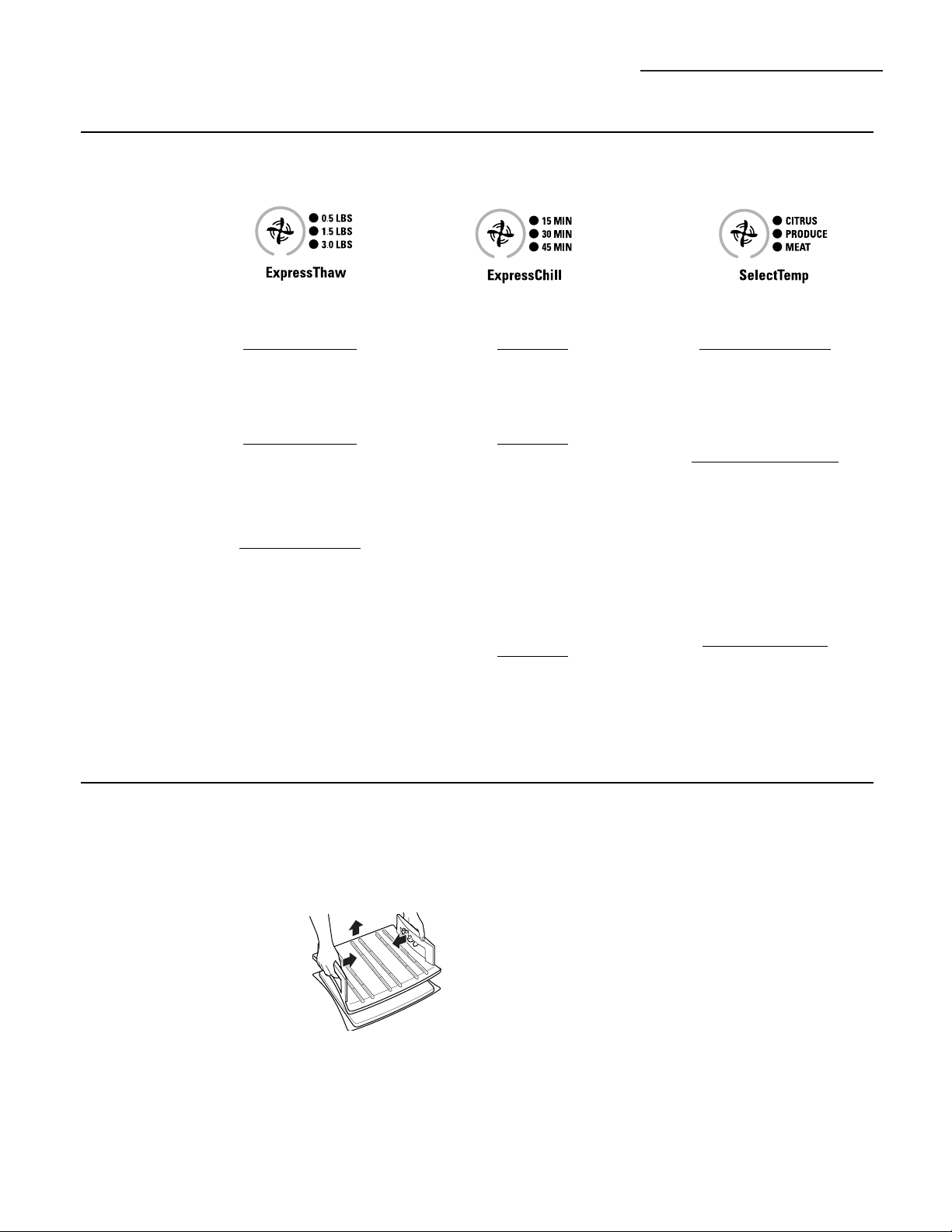
NOTE: Results may vary depending on packaging, starting temperature, and other food traits.
To clean the Chill/Thaw tray, disassemble the
metal tray from the plastic stand by lightly
pushing in on the handles of the plastic stand
and removing the metal tray. Both the metal
tray and the plastic stand are dishwasher safe.
To reassemble the tray, place the plastic stand
upside down (handles on bottom) on a solid
surface. Place the metal plate on top of the
stand matching up the curved side of the
plate with the curved side of the stand. Insert
one side of the plate into the notches on the
stand. Push in on the handle on the other
side of the stand while pushing that end of
the plate down and into place. You should
hear the plate “click” into place.
Disassembling the
Chill/Thaw tray
0.5 Lbs. (4 hours)
• Hamburger Patties (0.5 lb)
• Individually Wrapped
Filet Mignon (0.5 lb)
1.5 Lbs. (8 hours)
• Chicken Breasts (1.5 lbs)
• Ground Beef (1.5 lbs)
• Steak (1.5 lbs)
3.0 Lbs. (12 hours)
• Chicken Breasts (3.0 lbs)
• Ground Beef (3.0 lbs)
• Steak (3.0 lbs)
15 Minutes
• 1 Beverage Can (12 oz)
• 2 Small Juice Boxes
(6–8 oz each)
30 Minutes
• 2 to 6 Beverage Cans
(12 oz each)
• 2 Plastic 20 oz Bottles of
Beverage
• 4 to 6 Small Juice Boxes
(6–8 oz each)
• 3 Foil Juice Packets
• Wine (750 ml bottle)
45 Minutes
• 2 Liter of Beverage
• 1/2 Gallon of Juice
• Gelatin – 1 package
Citrus Setting (43°F)
• Oranges, Lemons, Limes,
Pineapple, Cantaloupe
• Beans, Cucumbers, Tomatoes,
Peppers, Eggplant, Squash
Produce Setting (34°
F)
• Strawberries, Raspberries,
Kiwifruit, Pears, Cherries,
Blackberries, Grapes, Plums,
Nectarines, Apples
• Asparagus, Broccoli, Corn,
Mushrooms, Spinach,
Cauliflower, Kale, Green
Onion, Beets, Onions
Meat Setting (30°F)
• Raw Meat, Fish and Poultry
CustomCool
™
chart
11
Water and FreshSaver™ Filters
Stainless Steel Refrigerator
Water filter
cartridge
The water filter cartridge is located
in the back upper right corner of
the fresh food compartment.
When to Replace
the Filter
There is a replacement indicator
light for the water filter cartridge on the
dispenser. This light will turn orange to tell you
that you need to replace the filter soon.
The filter cartridge should be replaced when
the replacement indicator light turns red or if
the flow of water to the dispenser or icemaker
decreases.
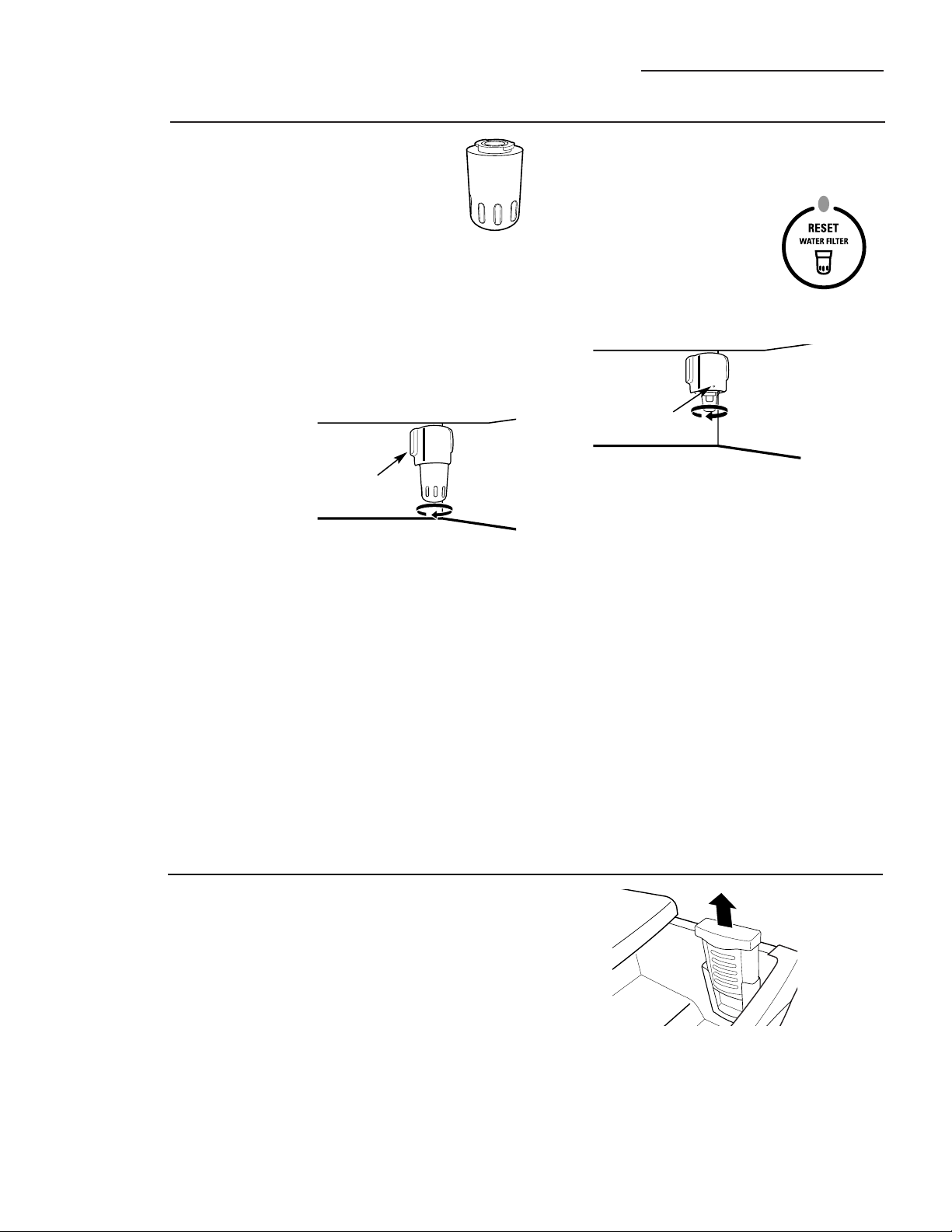
Installing the Filter Cartridge
1 If you are replacing the cartridge, first
remove the old one by slowly turning it to
the left. Do not pull down on the cartridge.
A small amount of water may drip down.
2 Fill the replacement cartridge with water
from the tap to allow for better flow from
the dispenser immediately after installation.
3 Lining up the arrow on the cartridge and
the cartridge holder, place the top of the
new cartridge up inside the holder.
Do not push it up into the holder.
4 Slowly turn it to the right until the filter
cartridge stops. DO NOT OVERTIGHTEN.
As you turn the cartridge, it will
automatically raise itself into position.
Cartridge will rotate about 1/4 turn.
5 Run water from the dispenser for 3 minutes
(about one and a half gallons) to clear the
system and prevent sputtering.
6 Press and hold the RESET
WATER FILTER pad on the
dispenser for 3 seconds.
NOTE: A newly-installed water
filter cartridge may cause water
to spurt from the dispenser.
Filter Bypass Plug
You must use the filter bypass plug when
a replacement filter cartridge is not available.
The dispenser and the icemaker will not
operate without the filter or filter bypass plug.
Replacement Filters:
To order additional filter cartridges in
the United States, call GE Parts and
Accessories, 800.626.2002.
GWF
Suggested Retail $34.95
Customers in Canada should consult the yellow
pages for the nearest Camco Service Center.
Place the top
of the cartridge
up inside the
cartridge holder
and slowly turn
it to the right.
Cartridge
Holder
Filter Bypass Plug
This filter is located inside the fresh
produce drawer.
The filter should last approximately eight years.
FreshSaver™
filter
12
Shelves and Bins
Stainless Steel Refrigerator
Fresh food
compartment
door bins
and freezer
door tilt-out
bins
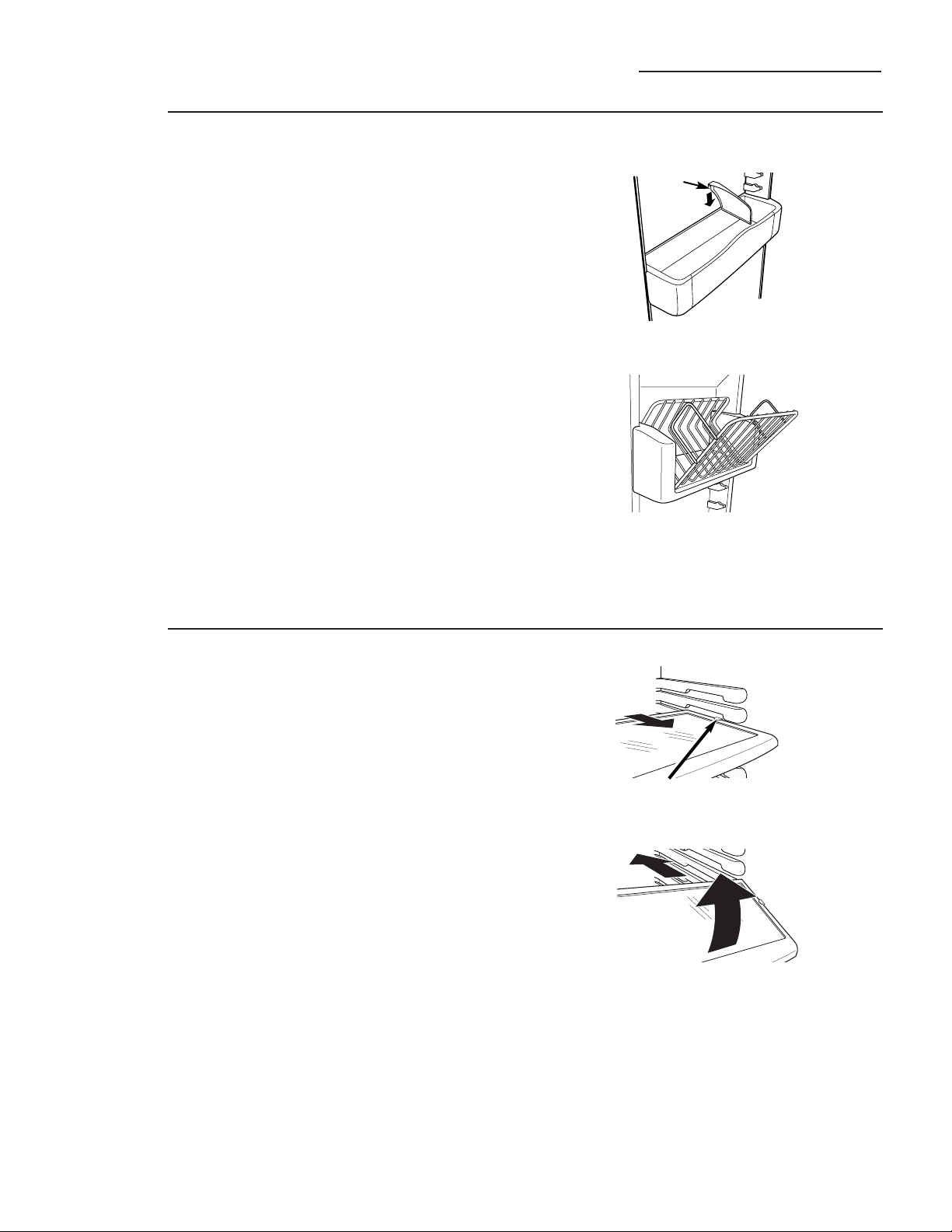
Large Bins
The larger fresh food compartment door bins
and freezer tilt-out door bins are adjustable.
To remove: Lift the front of the bin straight up,
then lift up and out.
To replace or relocate: Engage the back side of
the bin in the molded supports of the door.
Then push down on the front of the bin. Bin
will lock in place.
Small Bins
To remove: Lift the front of the bin straight up
then out.
To replace: Position the bin above the
rectangular molded supports on the door.
Then slide the bin down onto the support to
lock it in place.
The snugger helps prevent tipping, spilling
or sliding of small items stored on the door
shelf. Place a finger on either side of the
snugger near the rear and move it back
and forth to fit your needs.
Slide-out
spillproof
shelf
The slide-out spillproof shelf allows you to
reach items stored behind others. The special
edges are designed to help prevent spills from
dripping to lower shelves.
To remove:
Slide the shelf out until it reaches the stop,
then press down on the tab and slide the shelf
straight out.
To replace or relocate:
Line the shelf up with the supports and slide
it into place. The shelf can be repositioned
when the door is at 90° or more. To reposition
the shelf, slide the shelf past the stops and
angle downward. Slide shelf down to the
desired position, line up with the supports
and slide into place.
Make sure you push the shelves all the way back in
before you close the door.
Press tab and pull shelf
forward to remove
Fresh food compartment
door bin
Freezer tilt-out bin
Snugger
13
Shelves and Bins
Stainless Steel Refrigerator
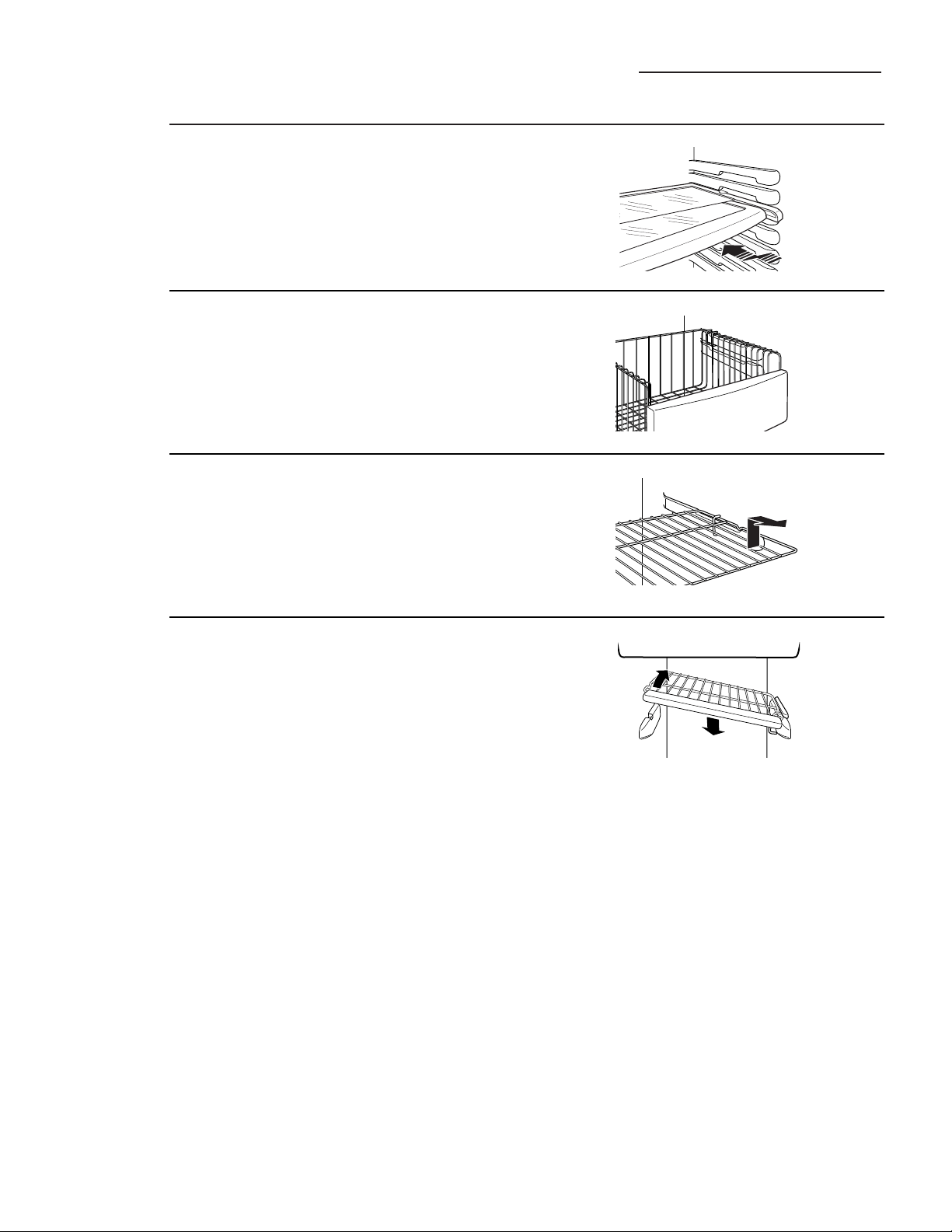
QuickSpace
™
shelf
This shelf splits in half and slides under itself
for storage of tall items on the shelf below.
This shelf can be removed and replaced or
relocated just like Slide-Out Spillproof Shelves.
On some models, this shelf can not be used in
the lowest position.
Freezer baskets
To remove, push the basket all the way to the
back of the freezer. Lift up until the back pins
are disengaged. Lift the entire basket up and
pull out.
Make sure you push the baskets all the way back in
before you close the door.
Slide-out
freezer shelves
To remove, slide out to the stop position, lift
the front past the stop position, and slide out.
Make sure you push the shelves all the way back in
before you close the door.
Fixed freezer
shelves
To remove, lift the shelf up at the left side and
then bring the shelf out.
14
Additional Features
Stainless Steel Refrigerator
Removable
beverage
rack
Refrigerator
doors
The refrigerator doors may feel different than
the ones you are used to. The special door
opening/closing feature makes sure the doors
close all the way and are securely sealed.
When opening and closing the door you will
notice a stop position. If the door is opened
past this stop point, the door will remain open
to allow you to load and unload food more
easily. When the door is only partially open it
will automatically close.
The resistance you feel at the stop position will
be reduced as the door is loaded with food.
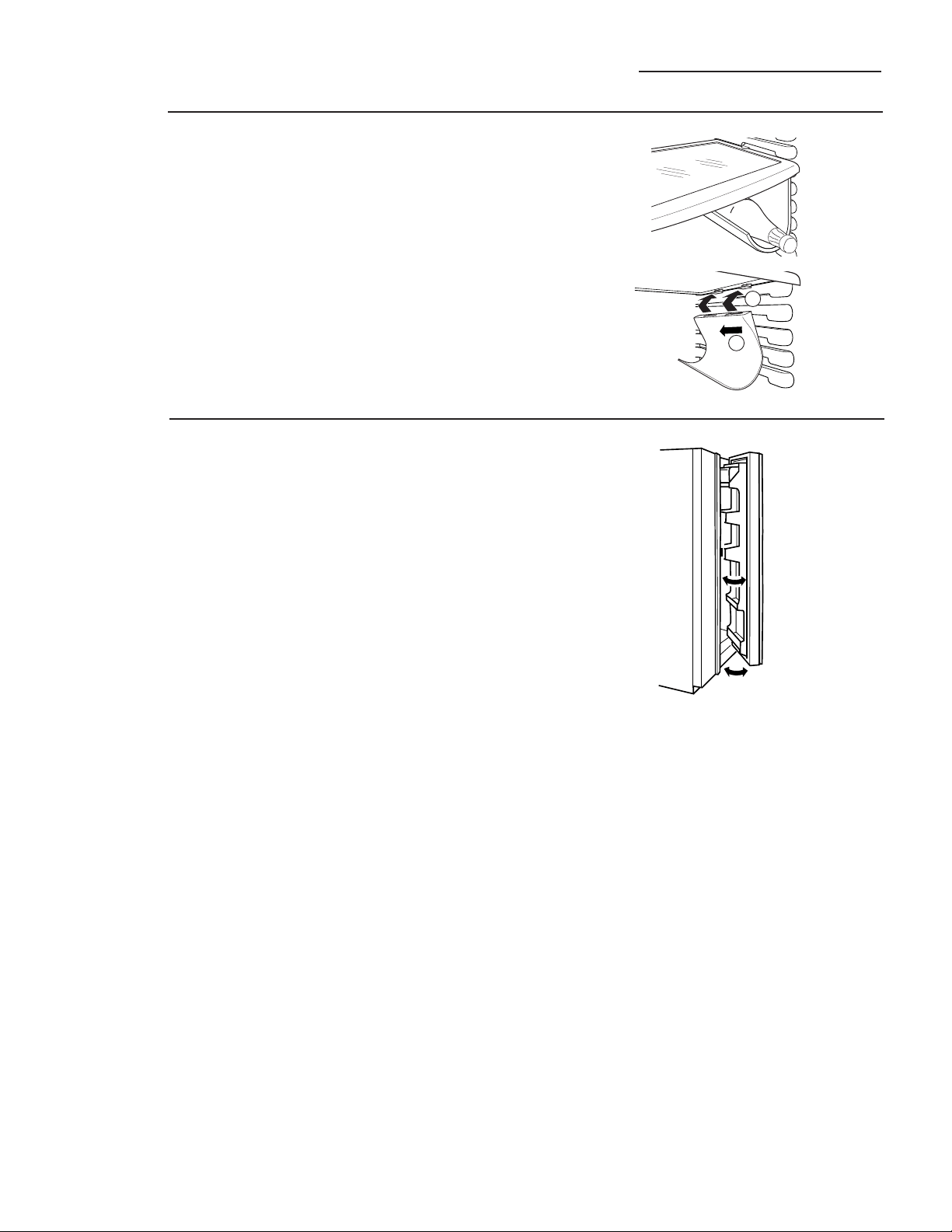
The beverage rack is designed to hold
a bottle on its side. It can be attached to
any slide-out shelf.
To install:
1 Line up the large part of the slots on
the top of the rack with the tabs under
the shelf.
2 Then slide the rack back to lock it
in place.
1
2
When the door is only
partially open it will
automatically close.
Beyond this stop the door will
stay open.
Crispers and Pans
Stainless Steel Refrigerator
15
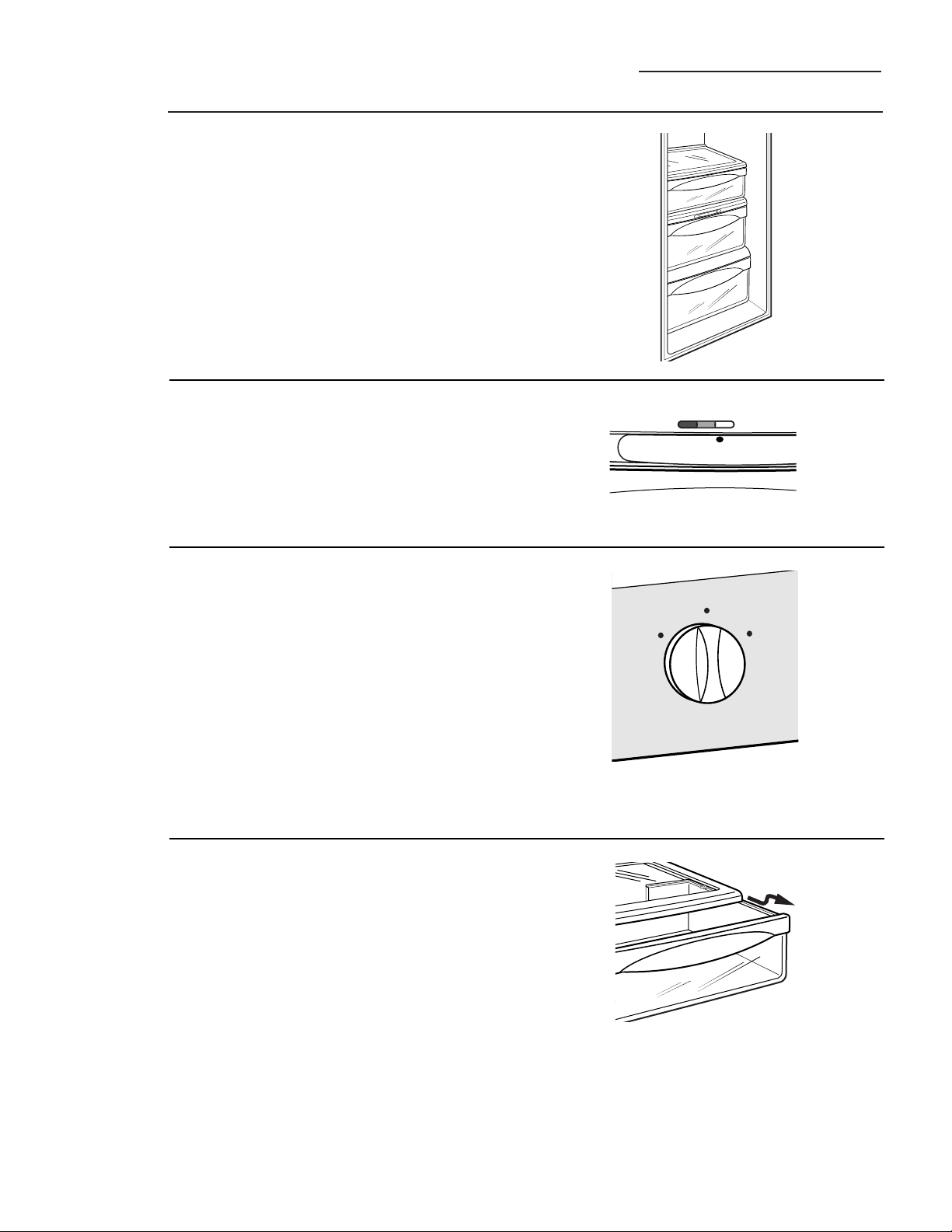
Fruit and
vegetable
crispers
Excess water that may accumulate in the
bottom of the drawers should be wiped dry.
The bottom drawer has a cover that slides back
as the drawer is opened. This allows full access
to the drawer. As the drawer is closed, the cover
will slide forward into its original position.
Adjustable
humidity
crispers
Slide the control all the way to the HI setting
to provide high humidity recommended for
most vegetables.
Slide the control all the way to the LO setting
to provide lower humidity levels recommended
for most fruits.
HI LO
Convertible
meat pan
The convertible meat pan has its own cold air
duct to allow a stream of cold air from the
freezer compartment to flow to the pan.
The variable temperature control regulates the
air flow from the Climate Keeper.
Set the control to the coldest setting to store
fresh meats.
Set the control to cold to convert the pan to
normal refrigerator temperature and provide
extra vegetable storage space. The cold air duct
is turned off. Variable settings between these
extremes can be selected.
C
O
L
D
C
O
L
D
E
S
T
Crisper
removal
Crispers can easily be removed by pulling the
drawer straight out and lifting the drawer up
and over the stop location.
If the door prevents you from taking out the
drawers, first try to remove the door bins.
If this does not offer enough clearance, the
refrigerator will need to be rolled forward
until the door opens enough to slide the
drawers out. In some cases, when you roll the
refrigerator out, you will need to move the
refrigerator to the left or right as you roll it out.
16
Automatic Icemaker
Stainless Steel Refrigerator
Automatic
icemaker
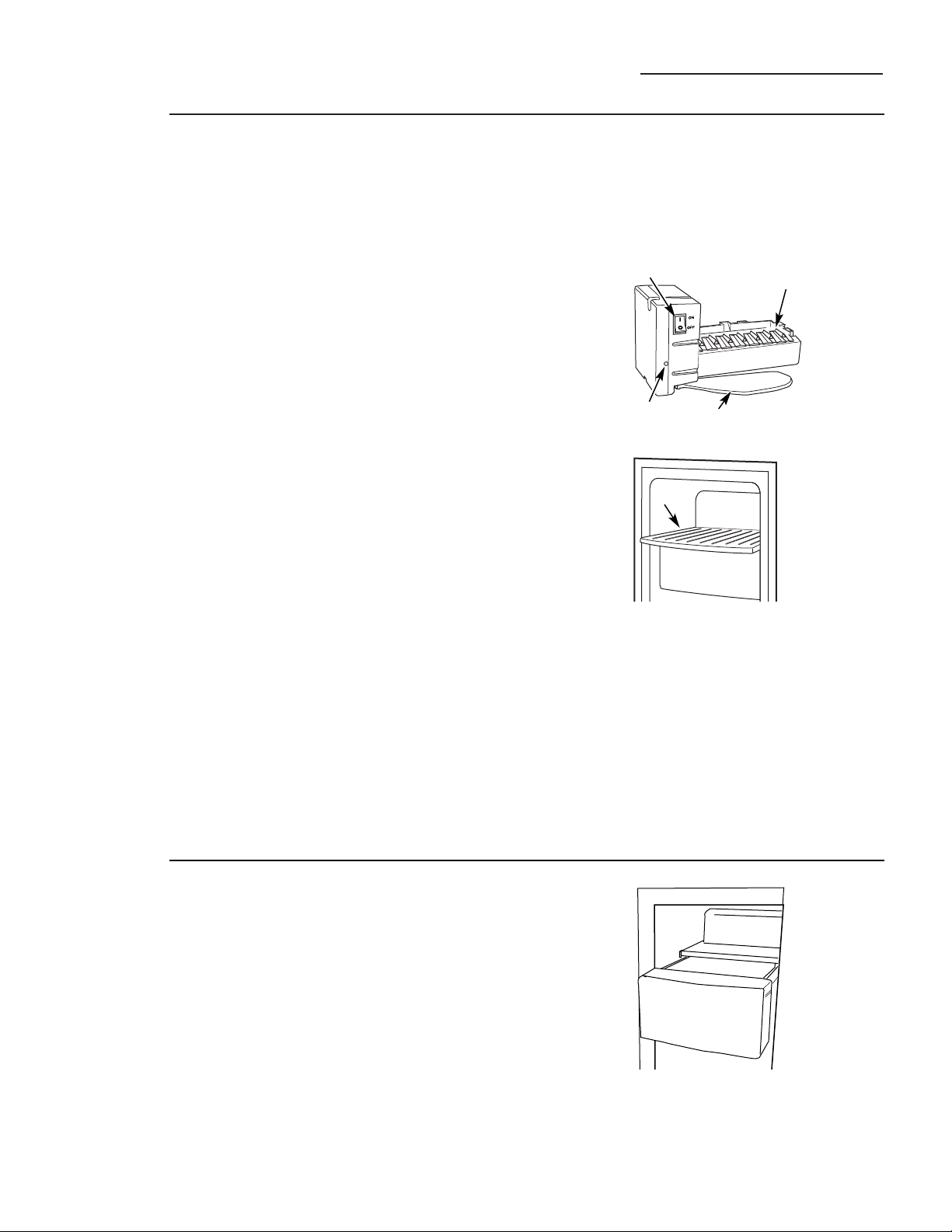
The icemaker will produce seven cubes
per cycle—approximately 100–130 cubes
in a 24-hour period, depending on freezer
compartment temperature, room temperature,
number of door openings and other use
conditions.
If the refrigerator is operated before the water
connection is made to the icemaker, set the
power switch in the
O
(off) position.
When the refrigerator has been connected
to the water supply, set the power switch to
the
l
(on) position.
The icemaker will fill with water when it
cools to 15°F (–10°C). A newly-installed
refrigerator may take 12 to 24 hours to begin
making ice cubes.
Throw away the first few batches of ice to allow
the water line to clear.
Be sure nothing interferes with the sweep
of the feeler arm.
When the bin fills to the level of the feeler
arm, the icemaker will stop producing ice. It is
normal for several cubes to be joined together.
If ice is not used frequently, old ice cubes will
become cloudy, taste stale and shrink.
If ice cubes get stuck in the icemaker, the green
power light will blink. To correct this, set the
power switch to
O
(off) and remove the cubes.
Set the power switch to
l
(on) to restart the
icemaker. After the icemaker has been turned
on again, there will be a delay of about
45 minutes before the icemaker resumes
operation.
NOTE: In homes with lower-than-average water
pressure, you may hear the icemaker cycle multiple
times when making one batch of ice.
A newly-installed refrigerator may take 12 to 24 hours to begin making ice.
Pull the upper freezer shelf
straight out to access the
icemaker. Always be sure to
replace the shelf. The shelf
can be used for storage.
Icemaker
Feeler Arm
Power
Switch
Green Power
Light
Ice Drawer
Shelf
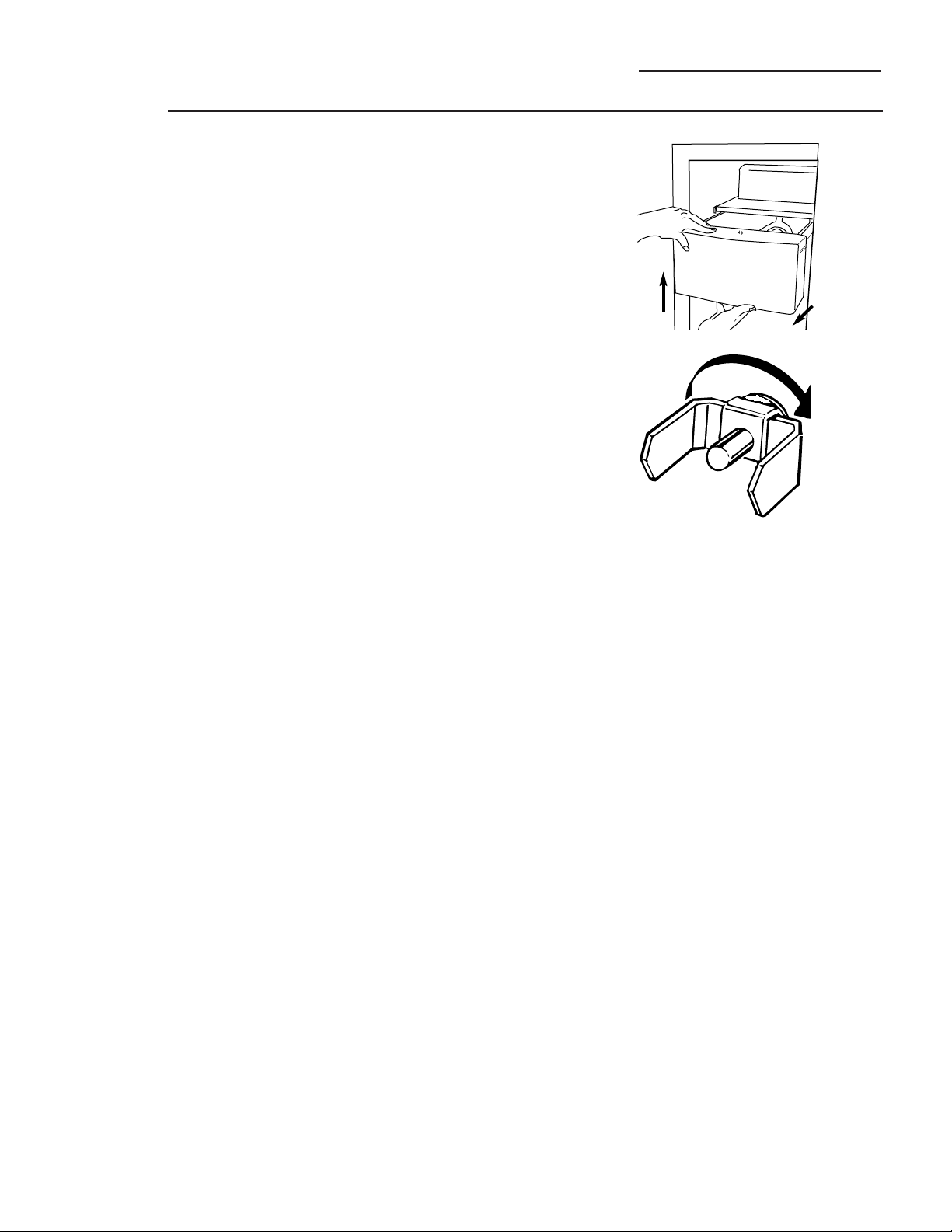
Ice storage
drawer
To access ice, pull the drawer forward.
To remove the drawer, pull it straight out and
lift it past the stop location.
Ice Drawer

Ice and Water Dispenser
Stainless Steel Refrigerator
17
Using the
dispenser
Select CUBED ICE , CRUSHED ICE
or WATER .
Press the glass gently against the top of the
dispenser cradle.
The spill shelf is not self-draining. To reduce
water spotting, the shelf and its grille should be
cleaned regularly.
If no water is dispensed when the refrigerator is first
installed, there may be air in the water line system.
Press the dispenser arm for at least two minutes to
remove trapped air from the water line and to fill the
water system. To flush out impurities in the water
line, throw away the first six glassfuls of water.
CAUTION: Never put fingers or any other
objects into the ice crusher discharge opening.
ATTENTION : Ne mettez jamais les doigts ou
d’autres objets dans l’ouverture du distributeur.
Locking the Dispenser
Press the LOCK CONTROL
pad for 3 seconds to lock the
dispenser and control panel.
To unlock, press and hold the
pad again for 3 seconds.
Dispenser Light
This pad turns the night light
in the dispenser on and off.
The light also comes on when
the dispenser cradle is pressed.
If this light burns out, it should
be replaced with a 6 watt 12V
maximum bulb.
Quick Ice
When you need ice in a hurry,
press this pad to speed up ice
production. This will increase
ice production for the
following 48 hours or until
you press the pad again.
Door Alarm
To set the alarm, press this pad
until the indicator light comes
on. This alarm will sound if
either door is open for more
than 3 minutes. The light goes
out and the beeping stops
when you close the door.
Spill Shelf
Other
dispenser
controls
• Do not add ice from trays or bags to
the storage drawer. It may not crush or
dispense well.
• Avoid overfilling glass with ice and use of
narrow glasses. Backed-up ice can jam the
chute or cause the door in the chute to
freeze shut. If ice is blocking the chute,
poke it through with a wooden spoon.
• Beverages and foods should not be
quick-chilled in the ice storage drawer.
Cans, bottles or food packages in the
storage drawer may cause the icemaker
or auger to jam.
• To keep dispensed ice from missing the
glass, put the glass close to, but not
touching, the dispenser opening.
• Some crushed ice may be dispensed even
though you selected CUBED ICE. This
happens occasionally when a few cubes
accidentally get directed to the crusher.
• After crushed ice is dispensed, some water
may drip from the chute.
• Sometimes a small mound of snow will form
on the door in the ice chute. This condition
is normal and usually occurs when you have
dispensed crushed ice repeatedly. The snow
will eventually evaporate.
Important facts
about your
dispenser
18
Ice and Water Dispenser
Stainless Steel Refrigerator
Ice storage
drawer
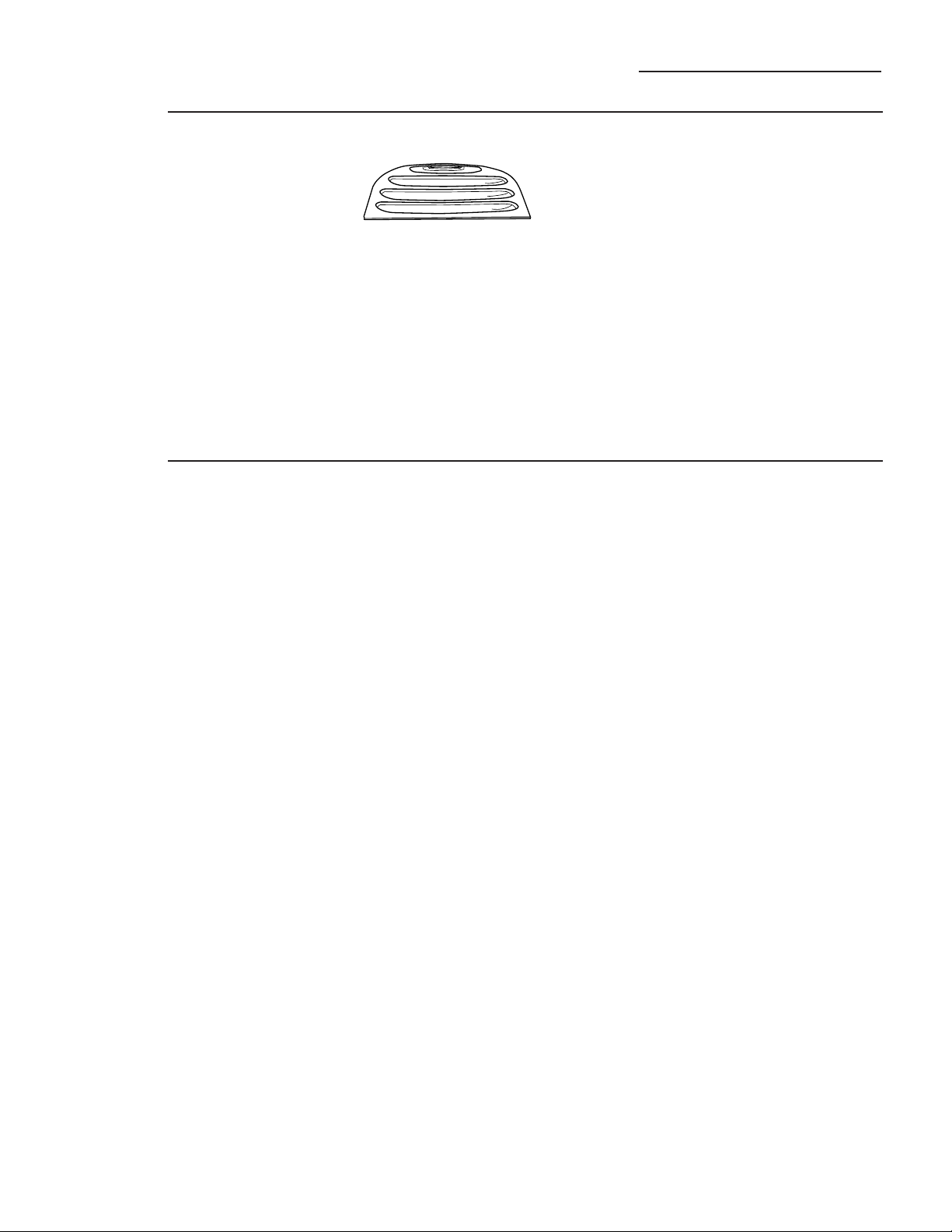
To remove:
Set the icemaker power switch to the
0
(off)
position. Pull the drawer straight out and
then lift past the stop position.
To replace:
When replacing the drawer, be sure to press
it firmly into place. If it does not go all the
way back, remove it and rotate the drive
mechanism 1/4 turn. Then push the
drawer back again.
Drive
Mechanism
19
Care and Cleaning
Stainless Steel Refrigerator
Cleaning
the outside
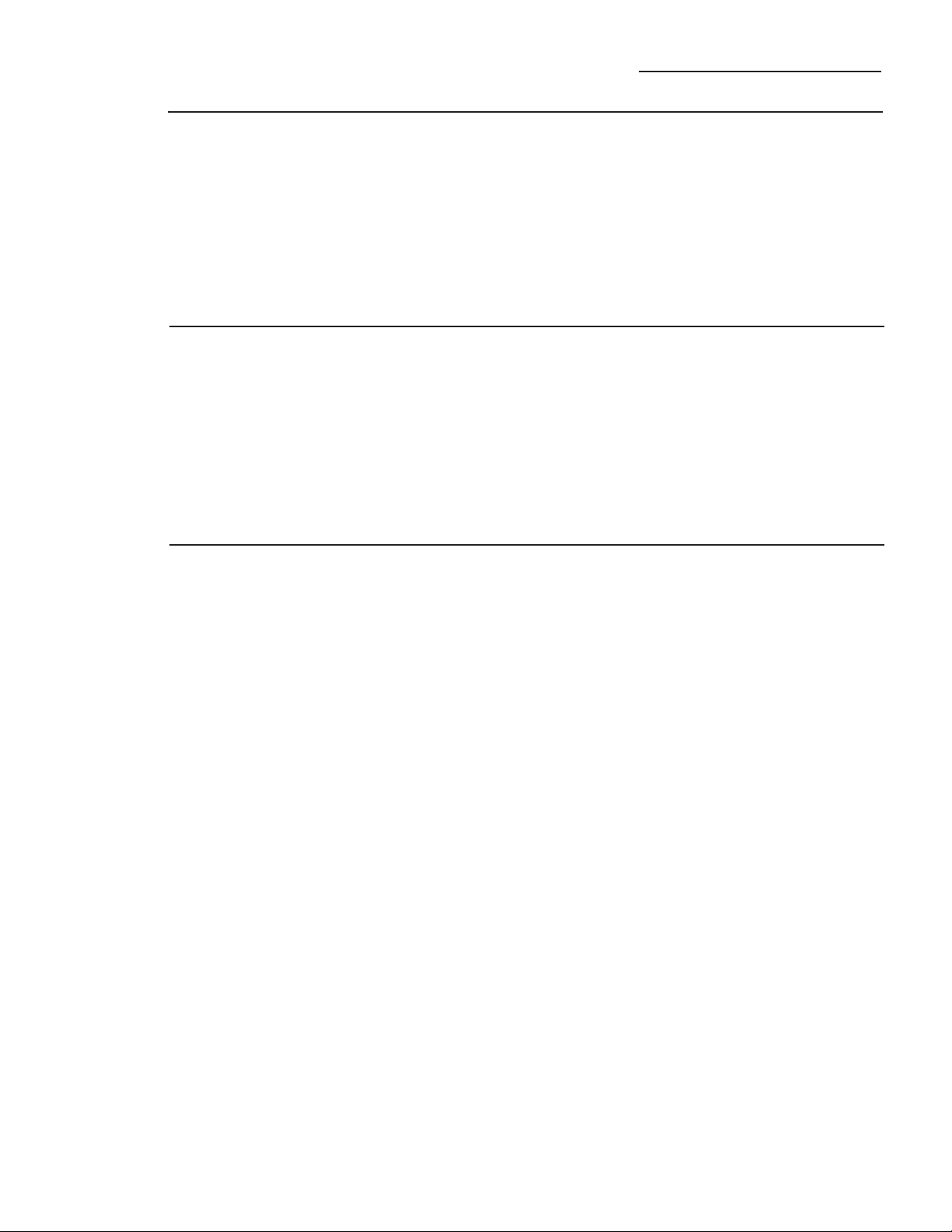
The dispenser drip
area, beneath the
grille, should be
wiped dry. Water left
in this area may leave
deposits. Remove the
deposits by adding undiluted vinegar to the
well. Soak until the deposits disappear or
become loose enough to rinse away.
The dispenser cradle. Before cleaning, lock
the dispenser by pressing and holding the
LOCK CONTROL pad for 3 seconds.
Clean with warm water and baking soda
solution—about a tablespoon (15 ml) of
baking soda to a quart (1 liter) of water.
Rinse thoroughly and wipe dry.
The stainless steel panels and handles can be
cleaned with a commercially available stainless
steel cleaner such as Stainless Steel Magic™.
Stainless Steel Magic™ is available at Ace,
True Value, Servistar, HWI and other leading
stores. It is also available through GE Parts and
Accessories, 800.626.2002. Order part number
WX10X15.
Do not use appliance wax or polish on the
stainless steel.
Cleaning
the inside
To help prevent odors, leave an open box of
baking soda in the fresh food and freezer
compartments.
Unplug the refrigerator before cleaning.
If this is not practical, wring excess moisture
out of sponge or cloth when cleaning around
switches, lights or controls.
Use warm water and baking soda
solution—about a tablespoon (15 ml)
of baking soda to a quart (1 liter) of water.
This both cleans and neutralizes odors.
Rinse and wipe dry.
Use of any cleaning solution other than that
which is recommended, especially those that
contain petroleum distillates, can crack or
damage the interior of the refrigerator.
Avoid cleaning cold glass shelves with hot water
because the extreme temperature difference
may cause them to break. Handle glass shelves
carefully. Bumping tempered glass can cause
it to shatter.
Do not wash any plastic refrigerator parts in
the dishwasher.
Dispenser drip area.
Care and Cleaning
Stainless Steel Refrigerator
20
Behind the
refrigerator
Be careful when moving the refrigerator away
from the wall. All types of floor coverings can
be damaged, particularly cushioned coverings
and those with embossed surfaces.
Pull the refrigerator straight out and return it
to position by pushing it straight in. Moving the
refrigerator in a side direction may result in
damage to the floor covering or refrigerator.
When pushing the refrigerator back, make sure
you don’t roll over the power cord or icemaker
supply line.
Preparing
for
vacation
For long vacations or absences, remove food
and unplug the refrigerator. Clean the interior
with a baking soda solution of one tablespoon
(15 ml) of baking soda to one quart (1 liter) of
water. Leave the doors open.
Set the icemaker power switch to the
0
(off)
position and shut off the water supply to
the refrigerator.
If the temperature can drop below freezing,
have a qualified servicer drain the water supply
system to prevent serious property damage due
to flooding.
Preparing
to move
Secure all loose items such as shelves and
drawers by taping them securely in place
to prevent damage.
When using a hand truck to move the
refrigerator, do not rest the front or back of
the refrigerator against the hand truck. This
could damage the refrigerator. Handle only
from the sides of the refrigerator.
Be sure the refrigerator stays in an upright
position during moving.
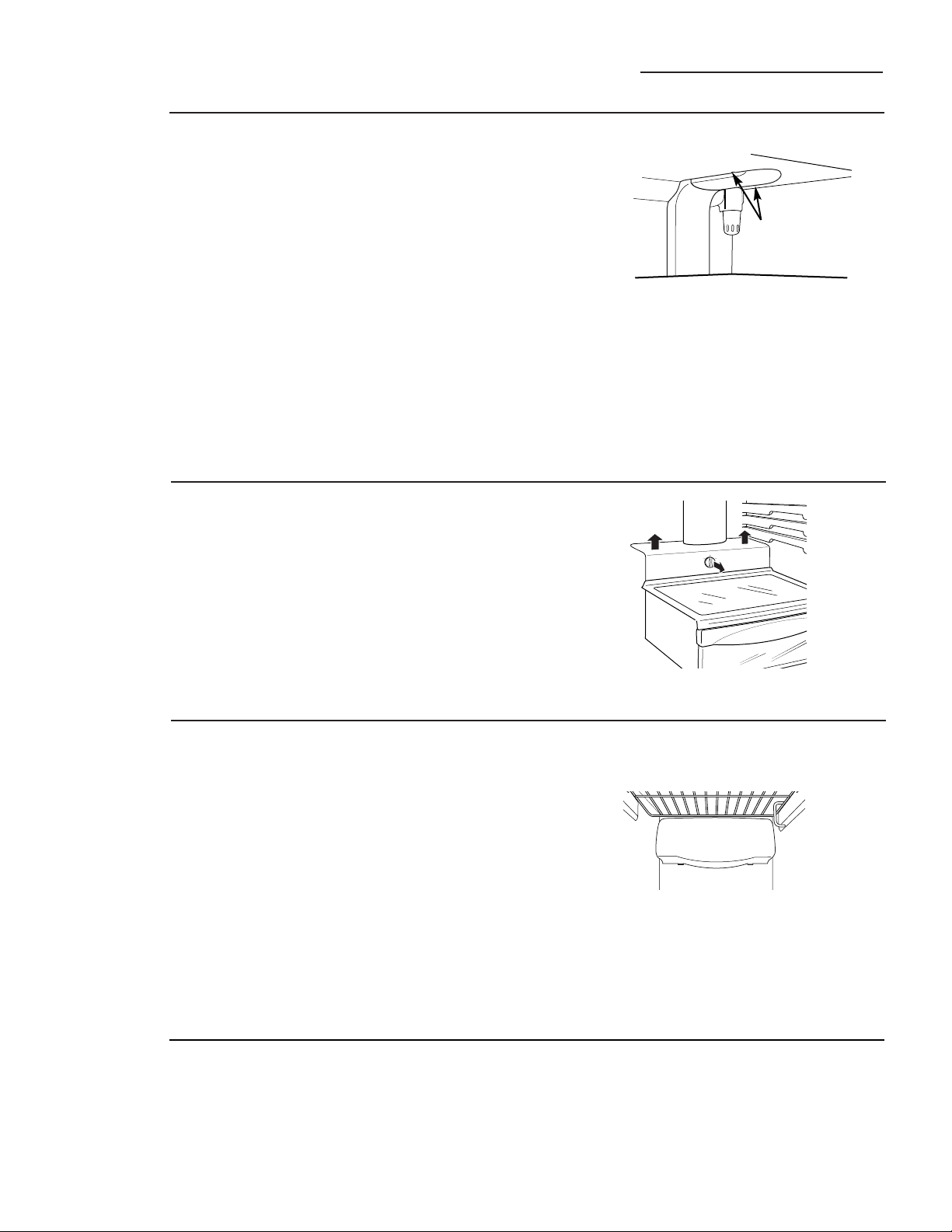
Setting the controls to OFF does not remove
power to the light circuit.
1 Unplug the refrigerator.
2 The bulbs are located at the top of the
compartment, inside the light shield.
On some models, a screw at the front of
the light shield will have to be removed.
3 To remove the light shield, press in on the
tabs on the sides of the shield and slide
forward and out.
4 After replacing the bulb with an appliance
bulb of the same or lower wattage, replace
the light shield and screws (on some
models). When replacing the light shield,
make sure that the tabs at the back of the
shield fit into the slots at the back of the
light shield housing.
5 Plug the refrigerator back in.
21
Replacing the Light Bulbs
Stainless Steel Refrigerator
Fresh food
compartment—
upper light
Fresh food
compartment—
lower light
Setting the controls to OFF does not remove
power to the light circuit.
This light is located above the top pan.
1 Unplug the refrigerator.
2 Remove the convertible meat drawer control
knob by pulling straight out.
3 Lift the light shield up and pull it out.
4 After replacing the bulb with an appliance
bulb of the same or lower wattage, replace
the shield and the knob.
5 Plug the refrigerator back in.
Freezer
compartment
Setting the controls to OFF does not remove
power to the light circuit.
1 Unplug the refrigerator.
2 Remove the shelf just above the light shield.
(The shelf will be easier to remove if it is
emptied first.) On some models, a screw at
the top of the light shield will need to be
removed.
3 To remove the light shield, press in on the
sides, and lift up and out.
4 Replace the bulb with an appliance bulb of
the same or lower wattage, and reinstall the
light shield. When reinstalling the light
shield, make sure the top tabs snap securely
into place. Replace the screw (on some
models).
5 Reinstall the shelf and plug the refrigerator
back in.
Tabs
C
O
L
D
C
O
L
D
E
S
T
Dispenser
Setting the controls to OFF does not remove
power to the light circuit.
1 Unplug the refrigerator.
2 The bulb is located on the dispenser under
the control panel. Remove the light bulb by
turning it counterclockwise.
3 Replace the bulb with a bulb of the same
size and wattage.
4 Plug the refrigerator back in.
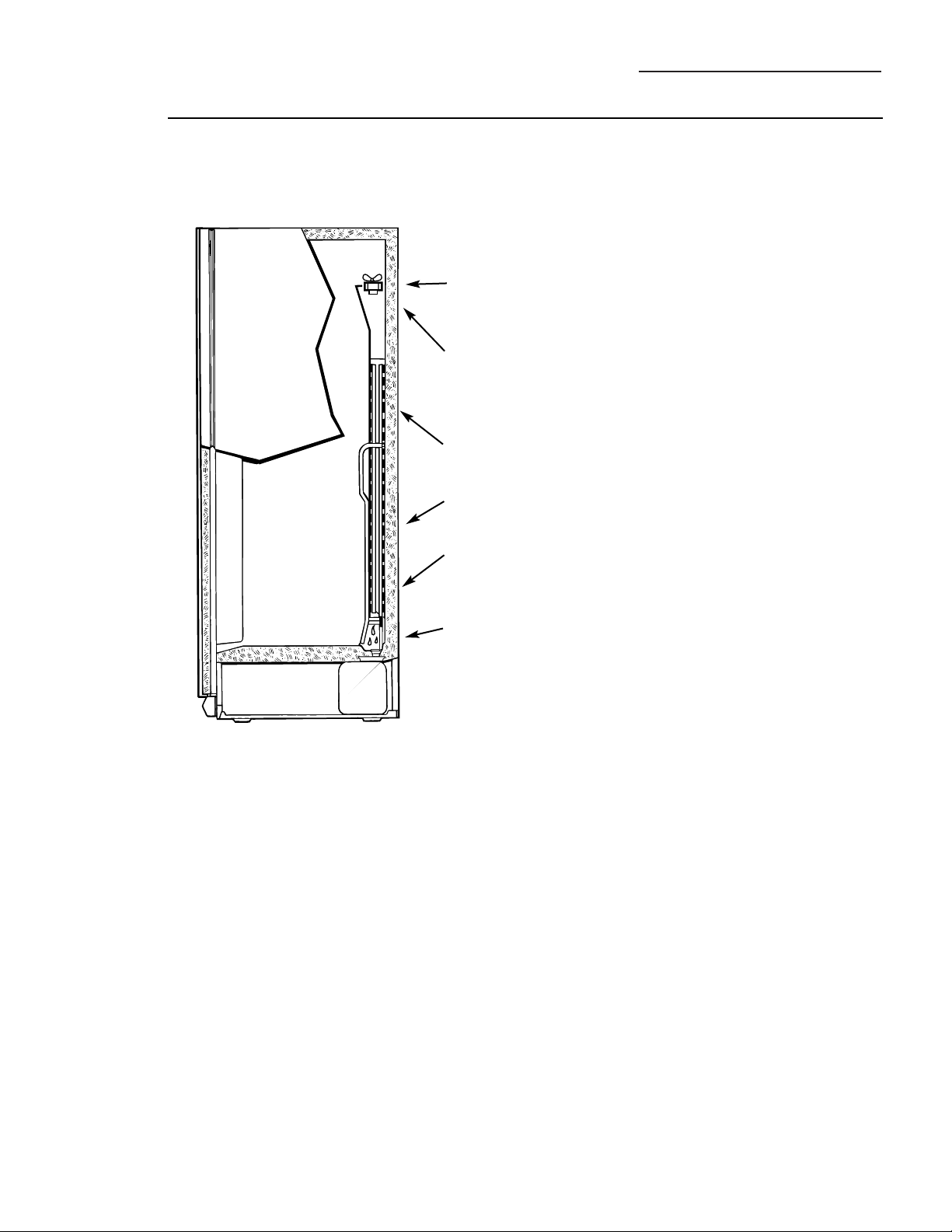
The Problem Solver
Stainless Steel Refrigerator
22
The new high efficiency compressor runs faster and will have
a higher pitch hum or pulsating sound while operating.
The fans circulating air inside the freezer and fresh food
compartments which keep the temperatures uniform
throughout.
The fans operating at a high speed. This happens when the
refrigerator is first plugged in, when the doors are opened
frequently, or when a large amount of food is added to the
fresh food or freezer compartments.
Water dropping on the defrost heater causing a sizzling,
hissing or popping sound during the defrost cycle.
The flow of refrigerant through the freezer cooling coils
sounds like boiling water or a gurgling noise.
Cracking or popping of cooling coils caused by expansion
and contraction during defrost and refrigeration following
defrost.
Water dripping as it melts from the evaporator and flows to
the drain pan during the defrost cycle.
Icemaker
The icemaker water valve will buzz when the icemaker fills
with water. If the power switch is in the
l
(on) position it will
buzz even if it has not yet been hooked up to water. Keeping
the power switch in the
l
(on) position before it is hooked up
to water can damage the icemaker. To prevent this, set the
power switch to the
0
(off) position. This will stop the buzzing.
The sound of cubes dropping into the bin and water running
in pipes as icemaker refills.
Normal
operating
sounds
These sounds are normal and are due mostly to highly efficient operation.
The Problem Solver
Stainless Steel Refrigerator
23
Questions?
Use this
problem
solver!
PROBLEM POSSIBLE CAUSE
REFRIGERATOR • Refrigerator may be in defrost cycle when motor does not operate for
DOES NOT OPERATE about 30 minutes.
• Either or both controls set to OFF. Set to a temperature setting.
• If interior light is not on, refrigerator may not be plugged in at
wall outlet. Push the plug completely into the wall outlet.
• The fuse is blown/circuit breaker is tripped. Replace fuse or reset
the breaker.
• The refrigerator is in showroom mode. Unplug it and plug it back in.
VIBRATION OR • Adjust the rollers as shown in the Installation Instructions.
RATTLING
(Slight vibration
is normal.)
MOTOR OPERATES • Normal when refrigerator is first plugged in. Wait 24 hours for the
FOR LONG PERIODS refrigerator to completely cool down.
OR CYCLES ON AND
• Often occurs when large amounts of food are placed in refrigerator.
OFF FREQUENTLY
This is normal.
• Door left open or package holding door open.
• Hot weather or frequent door openings. This is normal.
• Temperature controls set at the coldest setting.
See Temperature Controls.
FRESH FOOD • Temperature controls not set cold enough.
OR FREEZER See Temperature Controls.
COMPARTMENT
• Warm weather or frequent door openings.
TOO WARM
• Door left open for long time.
• Package may be holding door open.
FROST OR ICE • Door left open or package holding door open.
CRYSTALS ON
• Too frequent or too long door openings.
FROZEN FOOD
(Frost within package
is normal.)
DIVIDER BETWEEN • Automatic energy saver system circulates warm liquid around the
FRESH FOOD front edge of the freezer compartment to help prevent condensation
AND FREEZER from forming on the outside.
COMPARTMENTS
FEELS WARM
AUTOMATIC • Icemaker power switch is in the O (off) position.
ICEMAKER
• Water supply turned off or not connected. See Installation Instructions.
DOES NOT WORK
• Freezer compartment too warm. Allow 24 hours for the refrigerator
to completely cool down.
• Piled up cubes in storage bin cause icemaker to shut off.
Level cubes in bin.
• Ice cubes stuck in icemaker (green power light on the icemaker is
blinking). Turn off the icemaker, remove cubes and turn the
icemaker back on.
(Modern refrigerators
with more storage
space and a larger
freezer require more
operating time. They
start and stop often
to maintain even
temperatures.)
24
The Problem Solver
Stainless Steel Refrigerator
Questions?
Use this
problem
solver!
PROBLEM POSSIBLE CAUSE
ICE CUBES HAVE • Old cubes need to be discarded.
ODOR/TASTE
• Ice storage bin needs to be emptied and washed.
• Unsealed packages in fresh food and/or freezer compartments may
be transmitting odor/taste to ice cubes.
• Interior of refrigerator needs cleaning. See Care and Cleaning.
SMALL OR • Water filter clogged. Replace the filter or use the filter bypass plug.
HOLLOW CUBES
SLOW ICE CUBE • Door may have been left open.
FREEZING
• Turn temperature of freezer compartment colder.
See Temperature Controls.
CUBE DISPENSER • Icemaker or water supply turned off. Turn icemaker or water supply.
DOES NOT WORK
• Ice cubes are frozen to the icemaker feeler arm. Remove the cubes.
• Irregular clumps in the storage bin. Break up with fingertip pressure
and discard remaining clumps. The freezer may be too warm.
Adjust the freezer temperature control colder one step at a time
until clumps do not form.
• The dispenser is LOCKED. Press and hold the LOCK CONTROL
pad for 3 seconds.
WATER HAS POOR • Water dispenser has not been used for a long time. Dispense water
TASTE/ODOR until all water in the system has been replenished.
WATER IN FIRST • Normal when refrigerator is first installed. Allow 24 hours for the
GLASS IS WARM refrigerator to completely cool down.
• Water dispenser has not been used for a long time. Dispense water
until all water in the system has been replenished.
• Water system has been drained. Allow several hours for the
replenished water supply to chill.
WATER DISPENSER • Water supply line turned off or not connected. See the
DOES NOT WORK Installation Instructions.
• Water filter clogged. Replace the filter or use the filter bypass plug.
• Air may be trapped in the system. Press the dispenser arm for at
least two minutes.
• The dispenser is LOCKED. Press and hold the LOCK CONTROL
pad for 3 seconds.
WATER SPURTING • Newly installed filter cartridge. Run water from the dispenser for
FROM DISPENSER about 3 minutes (about one and a half gallons).
WATER IS NOT • Water in reservoir is frozen. Call for service.
DISPENSED BUT
• Fresh food control setting is too cold. Set to a warmer setting.
ICEMAKER
IS WORKING
NO WATER OR ICE • Water supply line or shutoff valve is clogged. Call a plumber.
CUBE PRODUCTION
• Replace the filter or use the filter bypass plug.
• The dispenser is LOCKED. Press and hold the LOCK CONTROL
pad for 3 seconds.
25
Questions?
Use this
problem
solver!
PROBLEM POSSIBLE CAUSE
CUBED ICE WAS • • The last setting was CRUSHED ICE and a few cubes were left in the
SELECTED BUT crusher from the previous setting. This is normal.
CRUSHED ICE
WAS DISPENSED
ORANGE GLOW • Defrost heater is on. This is normal.
IN FREEZER
REFRIGERATOR • Foods with strong odors should be tightly wrapped.
HAS ODOR
• Interior needs cleaning. See Care and Cleaning.
• Keep open box of baking soda in refrigerator; replace every 3 months.
DOOR NOT CLOSING • Door gasket on hinge side is sticking or folding over. Apply paraffin
PROPERLY wax to the face of the gasket.
• A door bin is hitting a shelf inside the refrigerator. Move the door
bin up one position.
MOISTURE FORMS • Not unusual during periods of high humidity. Wipe surface dry.
ON OUTSIDE OF
• Door left open or package holding door open.
REFRIGERATOR
MOISTURE • Too frequent or too long door openings.
COLLECTS INSIDE
• In humid weather, air carries moisture into refrigerator when doors
are opened.
INTERIOR LIGHT • No power at outlet.
DOES NOT WORK
• Light bulb needs replacing. See Care and Cleaning.
WATER ON KITCHEN • Ice cubes jammed in chute. Poke ice through with a wooden spoon.
FLOOR OR BOTTOM
OF FREEZER
HOT AIR FROM • Normal air flow cooling motor. In the refrigeration process, it is
BOTTOM OF normal that heat be expelled in the area under the refrigerator.
REFRIGERATOR Some floor coverings are sensitive and will discolor at these safe
and normal temperatures.
REFRIGERATOR • Adaptive defrost keeps compressor running during door openings.
NEVER SHUTS OFF This is normal. The refrigerator will cycle off after the door remains
BUT TEMPERATURES closed for two hours.
ARE OK
REFRIGERATOR • Door is open and DOOR ALARM is on.
BEEPING
FOOD ISN’T • Packaging insulating food. Increase time or re-package in plastic.
THAWING/CHILLING
• The wrong weight is selected. Select a larger weight.
• Item with high fat content. Select a larger weight.
• Not using Chill/Thaw tray. Place items on tray and allow space in
between items for better air flow.
The Problem Solver
Stainless Steel Refrigerator
26
Questions?
Use this
problem
solver!
PROBLEM POSSIBLE CAUSE
ACTUAL • Unit just plugged in. Allow 24 hours for the system to stabilize.
TEMPERATURE NOT
• Door open for too long. Allow 24 hours for the system to stabilize.
EQUAL TO SET
• Warm food added to refrigerator. Allow 24 hours for the system
TEMPERATURE
to stabilize.
• Defrost cycle is in process. Allow 24 hours for the system to stabilize.
SELECTTEMP • Fresh food compartment temperature control is set at the warmest
FEATURE IS setting. This is normal. In order to minimize energy usage, the
NOT WORKING SELECTTEMP feature is disabled when the fresh food compartment
temperature control is set at the warmest setting.
DOORS ARE • Unlevel floor. Adjust rollers then align doors by adjusting the fresh
NOT ALIGNED food compartment hinge. See Installation Instructions.
The Problem Solver
Stainless Steel Refrigerator
27
Performance Data Sheet
GE SmartWater Filtration System
GWF Cartridge
Health Claim Performance Certified by NSF/ANSI*
(100% safety factors built in for unmetered usage)
Standard No. 42: Aesthetic Effects
Parameter USEPA Influent Effluent % Reduction
MCL Challenge Average Maximum Average Minimum
Chlorine – 1.9 ppm 0.02 ppm 0.05 ppm 98.90% 97.37%
T & O – – – – – –
Particulate** – 200,000 3,978 7,800 98.00% 96.10%
Standard No. 53: Health Effects
Parameter USEPA Influent Effluent % Reduction
MCL Challenge Average Maximum Average Minimum
Turbidity 1 NTU*** 24.3 NTU 0.07 NTU 0.1 NTU 99.71% 99.59%
Cysts 99.95% Reduction 105,750 26 55 99.97% 99.95%
Lead at PH 6.5 15 ppb 160 ppb 1 ppb 1 ppb 99.37% 99.37%
Lead at pH 8.5 15 ppb 150 ppb 1.8 ppb 4.3 ppb 98.80% 97.13%
Lindane 0.0002 ppm 0.00062 ppm 0.00005 ppm 0.00005 ppm 91.93% 91.93%
Atrazine 0.003 ppm 0.0084 ppm 0.002 ppm 0.003 ppm 76.19% 64.28%
2,4-D 0.100 ppm 0.272 ppm 0.042 ppm 0.090 ppm 84.89% 67.63%
Asbestos 99% 690 MFL/ml 0.32 MFL/ml 1.2 MFL/ml 99.95% 99.82%
* Tested using a flow rate of 0.5 gpm (1.8927 l/m); pressure of 120 psig (8.437 kg/cm
2
); pH of 7.5±0.5; temp. of 68°±4.5° F (20°±2.5° C)
** Measurement in particles/ml
*** NTU = Nephelometric Units
Operating Specifications
• Capacity: certified for up to 300 gallons (1135 l); up to one year
• Pressure requirement: 40-120 psi (2.8-8.2 bar), non-shock
• Temperature: 33°-100° F (0.6°-38° C)
• Flow rate: 0.5 gpm (1.9 lpm)
General Installation/Operation/Maintenance Requirements
• Flush new cartridge at full flow for 3 minutes to purge out trapped air.
• Replace cartridge when flow becomes too slow.
Special Notices
•
Installation instructions; parts and service availability; and standard warranty are included with the product when shipped.
• This drinking water system must be maintained according to manufacturer’s instructions, including replacement of
filter cartridges.
• Do not use with water that is microbiologically unsafe or of unknown quality without adequate disinfection before or
after the system. Systems certified for cyst reduction may be used on disinfected water that may contain filterable cysts.
•
The contaminants or other substances removed or reduced by this water treatment system are not necessarily in your water.
• Check for compliance with the state and local laws and regulations.
Manufactured for: General Electric Company, Louisville, KY 40225
NSF
®
System Tested and Certified by NSF International against ANSI/NSF
Standard 42 & 53 for the reduction of:
Standard No. 42: Aesthetic Effects
Chemical Unit
Taste and Odor Reduction
Chlorine Reduction, Class I
Mechanical Filtration Unit
Particulate Reduction, Class I
Standard No. 53: Health Effects
Chemical Reduction Unit
Lead and Atrazine Reduction
Lindane and 2,4-D Reduction
Mechanical Filtration Unit
Turbidity Reduction
Cyst and Asbestos Reduction
28
State of California
Department of Health Services
Water Treatment Device
Certificate Number
Date Issued: May 30, 2000
Date Revised: February 9, 2001
1434
00-
GE Smart Water Filtration Systems - GWF06 GWF06
GE Smart Water Filtration Systems - GWF GWF
Hotpoint Refrigerator Systems - HWF HWF
General Electric Appliances
Cysts (protozoan)
Turbidity
Asbestos
Lead
Atrazine
Lindane
2,4-D
300 gallons* 0.5 gpm
For Purchases Made In Iowa: This form must be signed and dated by the buyer and seller prior to the consummation of
this sale. This form should be retained on file by the seller for a minimum of two years.
BUYER: SELLER:
Name Name
Address Address
City State Zip City State Zip
Signature Date Signature Date
29
General Electric Company
Warranty Registration Department
P.O. Box 32150
Louisville, KY 40232-2150
Place
1st Class
Letter
Stamp
Here
GE Appliances
Consumer Product
Ownership Registration
Important Mail Today
30
Consumer Product Ownership Registration
Dear Customer:
Thank you for purchasing our product and thank you for placing your confidence in us. We are proud to
have you as a customer!
Follow these three steps to protect your new appliance investment:
1
Complete and mail your
separate Consumer Product
Ownership Registration
today. Have the peace of
mind of knowing we can
contact you in the unlikely
event of a safety modification.
2
After completing the
registration, write your
model and serial numbers
in this manual. You will
need this information
should you require service.
Our service number in
the U.S.A.: 800.444.1845.
In Canada: 888.880.3030.
3
Read your “Owner’s
Manual” carefully. It will
help you operate your
new appliance properly.
If you have questions, or
need more information
call the GE Answer
Center
®
800.626.2000.
Important: To ensure that your product is registered, fold and mail this form. No envelope is needed.
Consumer Product Ownership Registration
Product Model Serial
Important
Mail
Today!
First
Name
Apt. #
Street
Address
City
Last
Name
Zip
CodeState
Date Placed
In Use
Month Day Year
Phone
Number
GE Appliances
General Electric Company
Louisville, Kentucky
www.geappliances.com
CUT HERE
Mr. l Ms. l Mrs. l Miss l
Stainless Steel Refrigerator
31
Consumer Services
Stainless Steel Refrigerator
With the purchase of your new Monogram appliance, receive the
assurance that if you ever need information or assistance from GE,
we’ll be there. All you have to do is call—toll- free!
GE Answer
Center
®
In the USA:
800.626.2000
Whatever your question about any Monogram major appliance, GE Answer Center
®
information service is available to help. Your call—and your question—will be answered
promptly and courteously. And you can call any time. GE Answer Center
®
service is open
24 hours a day, 7 days a week.
In Canada, call 1.888.880.3030.
In-Home Repair
Service
In the USA:
800.444.1845
In Canada:
1.888.880.3030
A GE consumer service professional will provide expert repair service, scheduled at a time
that’s convenient for you. Many GE Consumer Service company-operated locations offer
you service today or tomorrow, or at your convenience (7:00 a.m. to 7:00 p.m. weekdays,
9:00 a.m. to 2:00 p.m. Saturdays). Our factory-trained technicians know your appliance
inside and out—so most repairs can be handled in just one visit.
Service Contracts
In the USA:
800.626.2224
In Canada:
1.888.880.3030
You can have the secure feeling that GE Consumer Service will still be there after your
warranty expires. Purchase a GE contract while your warranty is still in effect and you’ll
receive a substantial discount. With a multiple-year contract, you’re assured of future
service at today’s prices.
Parts and
Accessories
In the USA:
800.626.2002
In Canada:
1.888.880.3030
Individuals qualified to service their own appliances can have parts or accessories sent directly
to their home. The GE parts system provides access to over 47,000 parts…and all GE Genuine
Renewal Parts are fully warranted. VISA, MasterCard and Discover cards are accepted.
User maintenance instructions contained in this manual cover procedures intended to be
performed by any user. Other servicing generally should be referred to qualified service
personnel. Caution must be exercised, since improper servicing may cause unsafe operation.
For Customers
With Special
Needs…
In the USA:
800.626.2000
GE offers Braille controls for a variety of GE appliances, and a
brochure to assist in planning a barrier-free kitchen for persons
with limited mobility.
Consumers with impaired hearing or speech who have access to a
TDD or a conventional teletypewriter may call 800.TDD.GEAC
(800.833.4322) to request information or service.
Warranty
Stainless Steel Refrigerator
YOUR MONOGRAM REFRIGERATOR WARRANTY
Staple sales slip or cancelled check here. Proof of original purchase
date is needed to obtain service under warranty.
WHAT IS
COVERED
From the Date
of the Original
Purchase
FULL ONE-YEAR WARRANTY
For one year from date of original purchase, we will provide, free of charge, parts and service labor in
your home to repair or replace any part of the refrigerator that fails because of a manufacturing defect.
FULL FIVE-YEAR WARRANTY
For five years from date of original purchase, we will provide, free of charge, parts and service labor
in your home to repair or replace any part of the sealed refrigerating system (the compressor, condenser,
evaporator and all connecting tubing) that fails because of a manufacturing defect.
This warranty is extended to the original purchaser and any succeeding owner for products
purchased for ordinary home use in the 48 mainland states, Hawaii and Washington, D.C.
or Canada. In Alaska the warranty is the same except that it is LIMITED because you must pay to ship
the product to the service shop or for the service technician’s travel costs to your home.
All warranty service will be provided by our Factory Service Centers or by our authorized Customer
Care
®
servicers during normal working hours.
Should your appliance need service, during warranty period or beyond, in the U.S.A.
call 800.444.1845. In Canada: 888.880.3030.
Some states/provinces do not allow the exclusion or limitation of incidental or consequential
damages, so the above limitation or exclusion may not apply to you. This warranty gives you specific
legal rights, and you may also have other rights which vary from state to state/province to province.
To know what your legal rights are in your state/province, consult your local or state/provincial
consumer affairs office or your state’s Attorney General.
Warrantor in USA: General Electric Company, Louisville, KY 40225
Warrantor in Canada: Camco Inc. If further help is needed concerning this warranty, write:
Manager, Consumer Relations, Camco Inc., 1 Factory Lane, Suite 310, Moncton, N.B. E1C 9M3.
WHAT IS NOT
COVERED
• Service trips to your home to teach you how
to use the product.
• Replacement of house fuses or resetting of
circuit breakers.
• Damage to the product caused by accident,
fire, floods or acts of God.
• Failure of the product if it is used for
other than its intended purpose or used
commercially.
• Improper installation.
If you have an installation problem, contact
your dealer or installer. You are responsible
for providing adequate electrical, plumbing
and other connecting facilities.
• Loss of food due to spoilage (in the U.S.A.
only).
• Incidental or consequential damage caused by
possible defects with this appliance.
197D3359P001
49-60156
Printed in the United States
07-01 JR
General Electric Company
Louisville, KY 40225
Monogram®

