TELESCOPE PRODUCT GUIDE
2005/2006
01
ABOUT CELESTRON
TABLE OF CONTENTS
C14 • Rosette Nebula • Image courtesy of Richard Hedrick
A
B
O
U
T
C
E
L
E
S
T
R
O
N
The history of Celestron dates
back to 1957 when it was
founded and incorporated as
Valor Electronics by Mr.Tom
Johnson, an electrical engineer
and avid amateur astronomer.
Mr. Johnson’s passion for
telescope making became the
basis for the future of his company. The name of the company was soon
changed to Celestron. In 1980, Celestron was acquired by the Swiss firm
Diethelm Ltd. In 1998 Tasco International, a large global marketer and
distributor of telescopes binoculars and other
sport optics products, purchased Celestron
from Diethelm. In June of 2002, Tasco Intl.
ceased operations and as a result three
members of Celestron’s senior management
purchased Celestron. This acquisition initiated
a new era for Celestron and began the
implementation and realization of long-term
goals of designing, manufacturing, and
marketing a new generation of telescope, binocular, and sport optics products
to an ever-increasing market. Under its new management, Celestron has
expanded its channels of distribution and increased its product selection in
order to better serve its customers.
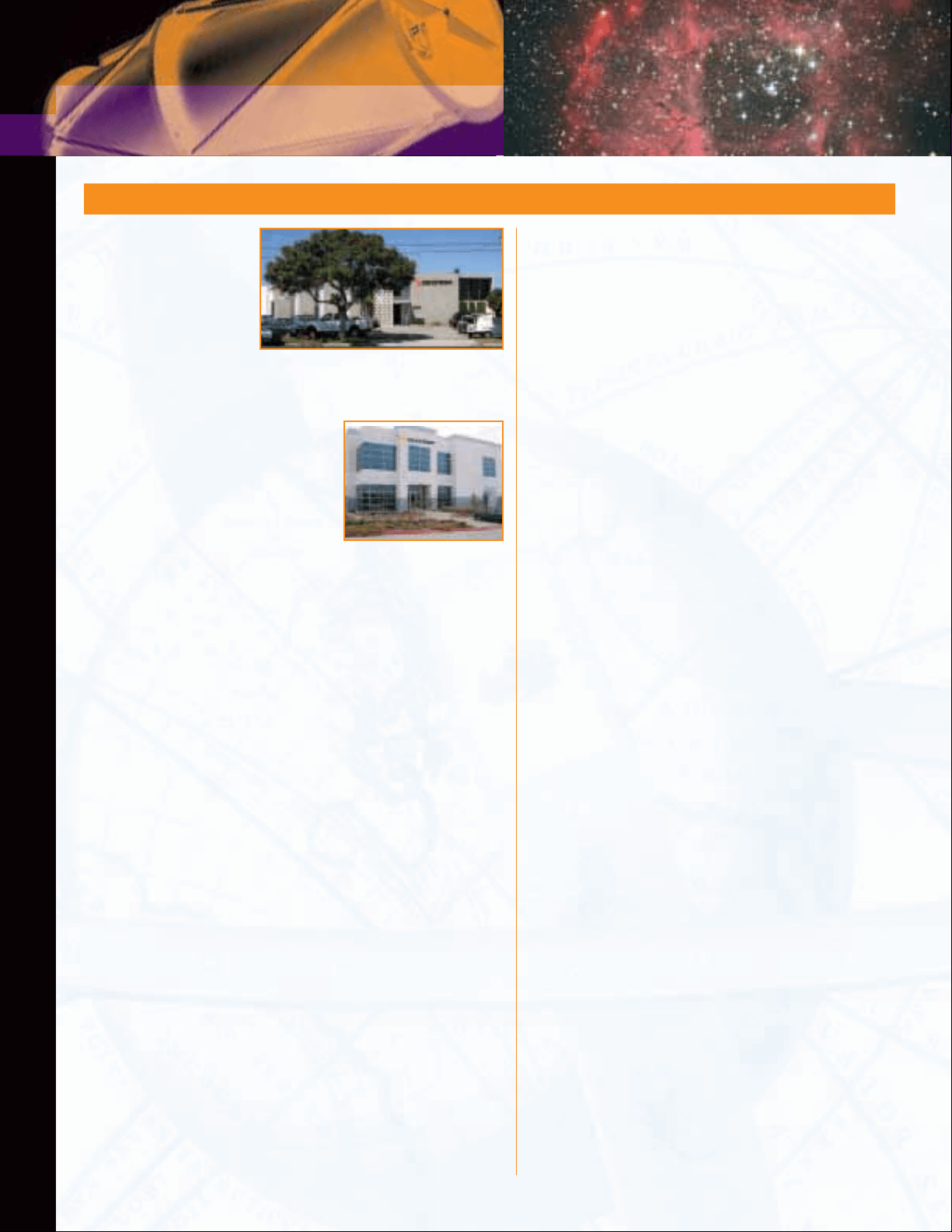
Celestron is a U.S.-based company with manufacturing and corporate offices
located in Torrance, California and a new and extensive warehouse and
distribution center located in nearby Carson, California. Celestron’s Schmidt-
Cassegrain optical systems are manufactured entirely in the Torrance facility.
All of Celestron’s products are designed and manufactured to meet the highest
production and quality standards. This commitment to quality and value has
always been the foundation for Celestron and the products we offer to our
customers. We emphasize the attention to detail that goes into each of
our products and the strict quality control standards that are enforced.
In all of these products, our mission is to provide the highest quality optical
products at a competitive price.
Celestron takes pride in its reputation for innovation.These
innovations, which have changed the landscape of amateur
astronomy, began with the introduction of the first commercially
available Schmidt-Cassegrain telescope. Below are some of the
notable innovations Celestron has introduced over the years*.
• 1966 — Introduced the first commercially available
Schmidt-Cassegrain telescopes.
• 1969 — First to have an entire line of Schmidt-Cassegrain
telescopes; the now famous C6, C8, C10, C12, C16,
and C22.
• First to offer commercially available Observatory Class Telescopes,
the C16 and C22.
• First to offer commercially available Schmidt Cameras
in the late 1960’s.
• Popularized the Cold Camera in the early 1970’s.
• Popularized piggyback photography.
• 1979 — Popularized the Maksutov-Cassegrain optical design
in astronomy with the introduction of the C90 Astro
for $495.
• 1979 — Popularized Maksutov-Cassegrains as spotting scopes
with the introduction of the C90 Spotter.
• Popularized eyepiece projection with the introduction of tele-
extenders for Celestron’s line of Schmidt-Cassegrain telescopes.
• Popularized off-axis guiders for long exposure photography.
• 1983 — First to offer enhanced reflectivity and transmission
coatings with the introduction of StarBright
®
coatings.
• First to offer a telescope drive system that utilized 9V batteries.
• 1987 — First to introduce the Compustar 14, a mass-produced
fully-integrated computerized GoTo observatory class
telescope.
• 1996 — First to offer the Ultima 2000, a computerized telescope
that utilized AA batteries as a power source.
• First to introduce a commercially available reducer/corrector
for Schmidt-Cassegrain telescopes.
• First and currently the only commercial telescope manufacturer
to offer true hand-figured and matched optics in Schmidt-
Cassegrain telescopes.
• First to offer a commercially available 8” fork mounted Schmidt-
Cassegrain for under $1,000 with the introduction of the Celestar.
• 1997 — First to offer a commercially available Schmidt-Cassegrain
telescope capable of f/2 CCD imaging with the
introduction of the Fastar
®
System.
• 2001 — Introduced the first commercially available
Schmidt-Cassegrain telescope with carbon fiber
optical tube, the NexStar 11 GPS.
• 2001 — First to offer a commercially available fully computerized
GoTo telescope with integrated GPS and compass with
the introduction of the NexStar 11GPS.
• 2002 — Introduced the NexStar 5i and 8i, the first commercially
available telescopes to be GPS compatible.
• 2002 — Introduced the CN16 GPS, a commercially available
GPS accessory with an integrated compass that provides
GPS functions to Celestron GPS-compatible computerized
telescopes.
*For information on Celestron’s latest telescope innovations, see pg. 2
CONTENTS
History of Celestron...........................................................................................1
New Telescope Technologies .............................................................................2
Telescope Basics ...........................................................................................3-5
FirstScope Series...........................................................................................7-8
StarHopper Series........................................................................................9-10
NexStar SLT Series ....................................................................................11-12
Advanced Series........................................................................................13-16
CPC Series.................................................................................................17-18
CGE Series.................................................................................................19-20
C20 Astrograph..........................................................................................21-22
Optical Tube Assemblies..................................................................................23
Mounts, Tripods & Accessories...................................................................24-25
Detailed Product Specifications..................................................................26-34
Celestron. Over 40 Years Of Telescope History
02
INNOVATION
C8 • Whirlpool Galaxy • Image courtesy of Sebastian Voltmer
I
N
N
O
V
A
T
I
O
N
TELESCOPE TECHNOLOGIES
NexRemote
™
Remote Control Software
Celestron has been in the forefront of computerized telescope
technology for over two decades. We have taken this expertise
in telescope technology one step further by introducing the
NexRemote™ Telescope Remote Control Software. NexRemote
allows the user to control their Celestron computerized telescope
from their personal computer. Every function that is normally done using the
telescope’s hand control can now be duplicated remotely from a PC or laptop. This
software was developed for Celestron’s telescopes that use the NexStar control
system. These include the NexStar SLT Series, Advanced Series, CPC Series and
CGE Series (NexRemote ships standard with CPC and CGE Series models).
NexRemote provides full emulation of every aspect of the Celestron Computerized
Hand Control including functions such as:
• All telescope alignment options
• Access to the database of objects
• User objects
• Hibernation
• Integration with popular planetarium programs
NexRemote has additional powerful new features that include:
• NexRemote voice output - Allows you to keep your eyes on the stars instead of
the LCD by enabling speech support.
• Select the objects you want to see and the order that you want to see them.
• Create and save custom tours using the NexTour feature.
• Reduce the effect of the laptop screen illumination on your eyes
using Night Vision Mode.
• Wireless control of the telescope with optional game pad support.
• Use your personal GPS device to interface with NexRemote using NexGPS™.
• Download the latest NexRemote updates online.
Contact your Celestron dealer to find out availability of upgraded models that
include NexRemote. NexRemote software comes with a RS-232 cable to connect
your Celestron telescope to a PC. The software can be also be purchased
separately as a kit from an Authorized Celestron Dealer (Item #93710). The kit
includes the NexRemote software and license, a RS-232 cable, and a Serial-to-
USB adapter.
StarBright
®
XLT — An Optical System Breakthrough!
Celestron has elevated its renowned StarBright
®
technology to an even higher level of light transmission
with the introduction of our optional StarBright
®
XLT
High Performance Optical System.
One of the most important factors in the evaluation of
a Schmidt-Cassegrain telescope’s optical system performance is
its transmission — the percentage of incoming light that reaches the
focal plane. The design of the XLT System accomplishes two crucial
objectives — 1. To develop a coating system that is optimized for visual
use and, 2. To optimize the coating system and optics for
CCD/Photographic imaging.
The StarBright
®
XLT High Performance Optical System design consists of:
1. Unique enhanced multi-layer mirror coatings
Our mirror coatings are made from precise layers of Aluminum (Al),
SiO
2
(Quartz), TiO
2
(Titanium Dioxide), and Si0
2
. Reflectivity is fairly flat
across the spectrum, optimizing it for both CCD imaging and visual use.
2. Multi-layer anti-reflective coatings
Made from precise layers of MgF
2
(Magnesium Fluoride), and HfO
2
(Hafnium Dioxide), which costs nearly $2000 per kilogram, Hafnium
results in a wider band pass than Titanium, used in competitive
coatings.
3. High Transmission Water White glass
Our Schmidt-Cassegrain optical systems with optional StarBright
®
XLT
coatings use Water White glass instead of Soda Lime glass for the
corrector lens. Water White glass transmits about 90.5% without anti-
reflective coatings. That is 3.5% better transmission than uncoated
Soda Lime glass. When Water White glass is used in conjunction with
StarBright
®
XLT's anti-reflective coatings, the average transmission
reaches 97.4% — an 8% improvement!
These three components of our StarBright
®
XLT coatings result in one
of the finest coatings available. The peak transmission for the systems
is 89% at 520 nm. The overall system transmission is 83.5% averaged
over the spectrum from 400 to 750 nm.
Introducing Celestron's Revolutionary SkyAlign
Pick three stars, any stars…
Aligning your telescope is easier and faster than ever.
Simply input the date, time and your location (GPS
models obtain all this information automatically) and
then point the telescope at three bright stars of your
choosing. You do not need to know the names of the
stars — you could even pick the moon or bright planets! The NexStar
computer system will figure out which stars were chosen and then align
the telescope. SkyAlign is standard with NexStar SLT and CPC models.
There is no need to point the telescope north or to level the optical tube.
The initial position of the telescope is irrelevant. This makes for a fast
and very easy method for aligning the telescope.
How does it work?
The NexStar
®
software with SkyAlign calculates the angles measured
between the objects and then compares them to the known angles
between objects. Using this method, the telescope determines what
objects were chosen. The display will tell you which three objects you
aligned to for confirmation.
CN16 GPS Accessory Kit
The CN16 will automatically establish your location by
downloading the exact time, date, longitude, and latitude
from one of many global positioning satellites orbiting the
Earth. The CN16 plugs into your telescope’s base Aux port
and adds an extra element of simplicity, convenience, and
accuracy to your stargazing.
NexRemote
®
Remote Control
Software
ALIGN
ENTER
UNDO
StarBright
®
XLT
COATINGS
CN16
GPS Accessory
News “Flash” — Upgradeable Hand Controls!
Available with NexStar SLT, CPC and C20 Astrograph Telescopes…
The wait is over. The latest NexStar Computerized Control System is now
completely upgradeable using flash technology.
Users can download the latest firmware for their telescopes directly from
Celestron's website and ensure that their telescope is always on the cutting
edge of technology.

03
TELESCOPE BASICS
C14 • Dumbbell Nebula • Image courtesy of Ted Inoue
T
E
L
E
S
C
O
P
E
B
A
S
I
C
S
TELESCOPE CHARACTERISTICS
This section looks at the separate component parts of a telescope. This will help
you in making important decisions when selecting a telescope model. This section
also discusses the uses of a telescope for astronomy or terrestrial (land viewing)
use. It is important to read this section if you aren't sure which Celestron
telescope product is right for you.
What Is A Telescope?
A telescope is, simply, a light collector. Its main task is to form the brightest
possible optical image of the object on which it is focused. This task is
accomplished by the primary optical element, called the “primary” or “objective”
inside the telescope’s optical tube. “Primary” usually refers to the mirror in a
reflecting telescope while “objective” refers to the main lens of a refracting
telescope. The image formed by the primary is then magnified by a removable
component called an eyepiece. By using different eyepieces, you can change the
magnification and the field of view of what you see through the telescope.
When comparing telescopes, there are a number of characteristics that can help
identify their differences. The most common ones are: Light Gathering Power,
Limiting Magnitude, Resolution, and Magnification. No matter what types of optical
designs you compare, these characteristics provide valuable information that will
help you determine what you can expect to see through a telescope.
Light Gathering Power
The most important characteristic of a telescope is its light gathering ability.
The light gathering capability of a telescope is determined by the diameter of its
aperture. The larger the aperture, the more light it collects. When looking at a star,
nebula, or galaxy it’s especially important that as much light be gathered as
possible. Fainter celestial objects may be invisible to smaller aperture telescopes.
Without enough light, dim objects cannot be seen, no matter how much they
might be magnified!
The relationship between a telescope’s light gathering power and the diameter of
its lens or mirror is not directly proportional. As the diameter gets larger, the
amount of light gathered increases by the square of the diameter. So if you double
the diameter of the primary lens, its light gathering ability increases by four times!
To calculate the light collecting area:
Light Collecting Area =π
r
2
(where π= 3.1416 and r = the radius of the primary
For an 8” primary: Light Collecting Area = 3.1416 x 4
2
= 50.24 square inches
For an 4” primary: Light Collecting Area = 3.1416 x 2
2
= 12.56 square inches
Limiting Magnitude
Astronomers use a system of “magnitudes” to indicate the brightness of a stellar
object. An object is said to have a certain numerical magnitude with 0 (the star
Vega ) as the baseline. The larger the magnitude number, the fainter the object.
Each magnitude is a difference in brightness by a factor of 2.51 times. For
example, a star that is considered 5th magnitude is 100 times fainter than Vega,
a zero magnitude star (2.51
5
). The faintest star you can see with your unaided eye
is about sixth magnitude (from dark skies) whereas the brightest stars are
magnitude zero (or even a negative number).
The faintest star you can see with a telescope (under excellent seeing conditions)
is referred to as the “limiting magnitude”. The limiting magnitude of a telescope
is directly related to aperture. Larger apertures allow you to see fainter objects.
A rough formula for calculating the visual limiting magnitude of any telescope is:
7.5 + 5 LOG (aperture in cm). For example, the limiting magnitude of an 8”
(20.32cm) aperture telescope is 14.0.
Limiting Magnitude =7.5 + 5 LOG 20.32 = 7.5 + (5x1.3) = 14.0.
Atmospheric conditions and the visual acuity of the observer will often reduce
limiting magnitude.
Resolution
Resolution is the ability of a telescope to render fine detail. Higher
resolution lets you see more detail on the surface of a planet or
separate stars that are close together. Resolution is measured in terms
of degrees of arc (called degrees), minutes of arc (called arcminutes),
and seconds of arc (called arcseconds). Thus, something that spans
one degree of arc is also 60 arcminutes, or 3600 arcseconds (60 x
60). So, something that is one arcsecond is very small — only
1/3600th of a degree.
Resolution for a given telescope is calculated using the formula:
Resolution = ((1.22 x l ) / D) x 206265 where resolution is in
arcseconds, “l” is the wavelength of light (.00055mm for common
visible wavelengths), “D” is the diameter of the primary in millimeters
and 206265 is the number of arcseconds in one Radian.
Magnification
Magnification is frequently referred to as “power” and is a function
of the focal lengths of both the primary and the eyepiece. The focal
length is the distance from the primary lens or mirror to the point
where an image is formed. The eyepiece magnifies the image formed
by the primary.
The highest magnification you can reasonably achieve with your
telescope is once again determined by the size and light gathering
ability of the primary. The practical limit is about 60 times the diameter
of the primary in inches. So, an 8” telescope should not be expected
to produce reasonable images if the telescope/eyepiece combination
produces a magnification greater than 480x. In practice, the amount
of magnification that can be used will often be reduced by
atmospheric conditions.
Since many astronomical objects are relatively large but faint,
moderate magnification and a larger diameter primary to gather light
is the best combination for viewing most celestial objects. When
looking at stars, high power is of little use since they always look like
pinpoints (stars are so far away they can not be resolved as anything
other than a pinpoint).
To calculate magnification:
(Focal Length of Primary in mm)
Magnification = —————————————
(Focal Length of Eyepiece in mm)
So, for a 8” SCT using a 25mm eyepiece:
Magnification = 2000/25 = 80 times the power of the unaided eye.
The Mount and Tripod
To a large extent, a telescope is only as good as its tripod and mount.
A telescope magnifies everything, including vibration. That’s why many
telescopes with good optics are rendered useless when supplied on an
inexpensively made mount. Since you’ll be using a mount’s controls to
track the slow and steady apparent movement of the stars, a suitable
mount’s adjustments should be smooth, yet precise.
Altazimuth vs. Equatorial
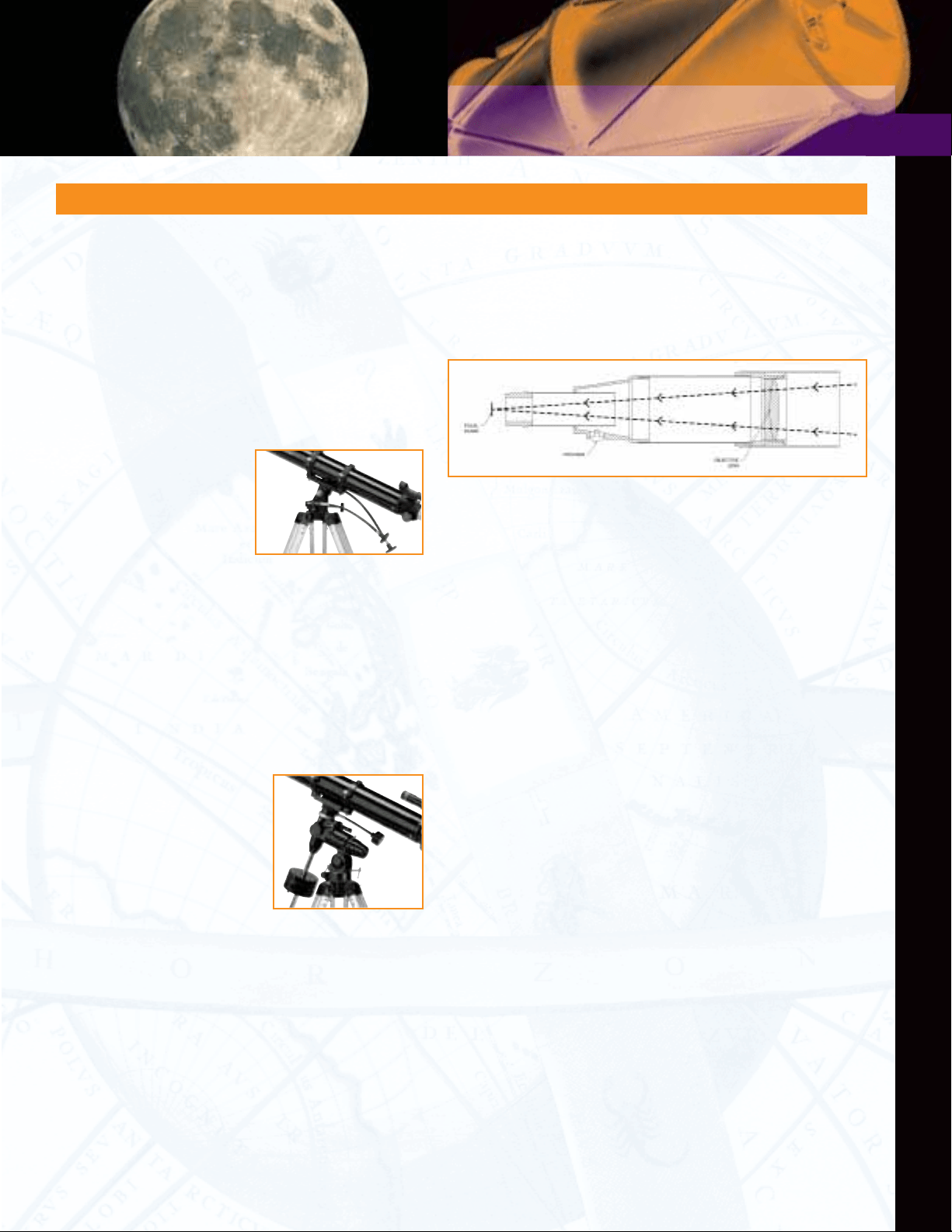
There are two basic types of mounts: Altazimuth (Alt-Azimuth) and
Equatorial. Altazimuth mounts are the simplest type of mount with two
motions: altitude (up and down/vertical) and azimuth (side-to-
side/horizontal). Good Altazimuth mounts will have slow motion cable
controls to make precise adjustments, which aid in keeping tracking
motion smooth.
04
TELESCOPE BASICS
T
E
L
E
S
C
O
P
E
B
A
S
I
C
S
MOUNT AND TELESCOPE TYPES
Altazimuth vs. Equatorial (cont.)
These type mounts are good for terrestrial observing and for scanning
the sky at lower power but are not advised for deep sky photography.
Both Altazimuth and Equatorial mounts can track the stars sufficiently
for visual use, however, only equatorials can be used for long exposure
astrophotography. Since Altazimuth mounts are not aligned with the
Earth’s axis, they must use both axes to track an object. With Altazimuth
mounts you will be able to accurately track an object centered in the
field of view, however over time all the other stars in the field will
appear to rotate around the center of the field. This is hardly noticeable
in an eyepiece, but is obvious on film.
Altazimuth Advantages
• Easy to setup and use
• Least expensive type of mount
• Ideal for terrestrial observing
Altazimuth Disadvantages
• Cannot be used for long
exposure photography
• Non-computerized models cannot
track stars and planets
On an Equatorial mounting, the two axes are perpendicular to each
other as they are on an Altazimuth mount. But on an Equatorial
mounting, the left-to-right axis has been tilted so that it is parallel to the
Earth’s axis instead of at the horizon. On an Equatorial mount, only the
axis that is parallel to the Earth’s axis, needs to be rotated. On an
Altazimuth mount, BOTH axes must be moved.
If you would like to do long exposure photography, the telescope must
be mounted on an equatorial mount. Some Celestron telescopes that
are on Altazimuth mountings can be tilted up (with the use of an
equatorial wedge) to orient the azimuth axis parallel to the Earth’s axis.
Equatorial Advantages
• Best for long exposure photography
• Easy to use visually because only one
axis movement compensates for
Earth’s rotation
• Setting circles on non-computerized
models help locate astronomical
objects
Equatorial Disadvantages
• Set-up is more extensive because of polar alignment requirements
• Not suitable for terrestrial use
Do you want a GoTo computerized telescope?
Many Celestron telescopes are computerized “GoTo” telescopes. GoTo
capability is very useful for the novice who needs assistance in finding
objects in the night sky. Since there is a large database of celestial
objects, it is unnecessary to refer to star charts to identify objects.
Once the telescope is properly aligned and an object is selected, the
telescope will automatically “go to” the object. GoTo equipped Celestron
telescopes include both altazimuth and equatorial models. Even without
GoTo, many Celestron equatorial scopes have manual setting circles
that allow you to find objects in the sky with the help of a good
star map.
There are a number of factors to consider when selecting a particular telescope.
These factors will usually depend on your individual requirements including cost,
portability, versatility, usability and appearance. You should also consider how you
plan to use the instrument both now and in the future. Most important, consider
your budget and portability requirements, and select a telescope with the largest
aperture possible.
Types of Telescopes
Refractor Telescope
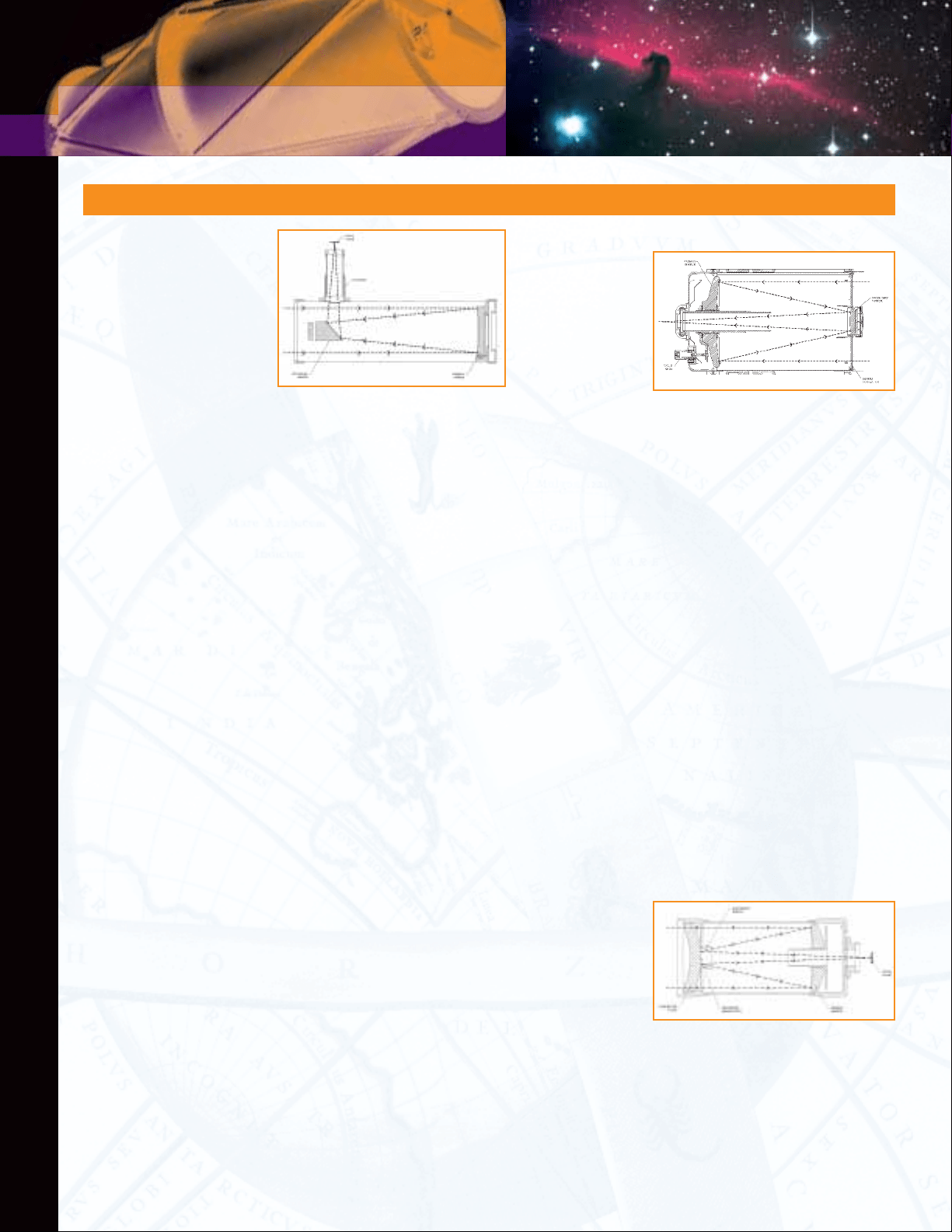
A refractor telescope uses a lens as the primary. The lens at the front of the
telescope bends the light passing through it until it comes to a single point
called the “focal plane”.
The long, thin tubes of refractor telescopes look much the same as those Galileo
used centuries ago. High quality optical glass and multi-coatings provide today’s
sky watchers views Galileo never dreamed of. The refractor type of telescope is
very popular with individuals who want mechanical simplicity, rugged reliability
and ease of use. Because the focal length is limited by the length of the tube,
refractor telescopes become quite bulky and expensive beyond a four inch
aperture. This limits the light gathering properties of refractor telescopes, but it
is an excellent choice for beginners and those who prefer simple operation and
versatility. Refractor telescopes are also a popular choice because of their
unobstructed view, high contrast and good definition.
Refractor Advantages:
• Easy to set up and use
• Simple and reliable design
• Little or no maintenance
• Excellent for lunar, planetary and binary star observing especially in larger
apertures
• Good for terrestrial viewing
• High contrast images with no secondary mirror or diagonal obstruction
• Color correction is good in achromatic designs and excellent in apochromatic
and fluorite designs
• Sealed optical tube reduces image-degrading air currents and protects optics
• Objective lens is permanently mounted and aligned
Refractor Disadvantages
• More expensive per inch of aperture than Newtonians or Catadioptrics
• Heavier, longer and bulkier than equivalent aperture Newtonians and
Catadioptrics
• The cost and size factors limit the practical maximum size primary to smaller
apertures
• Some color aberration in achromatic designs (doublet)
C8 • Moon • Image courtesy of Sebastian Voltmer
C8 • Moon • Image courtesy of Sebastian Voltmer
05
TELESCOPE BASICS
C14 • Horsehead Nebula • Image courtesy of Richard Hedrick
T
E
L
E
S
C
O
P
E
B
A
S
I
C
S
TELESCOPE TYPES
Newtonian Reflector Telescope
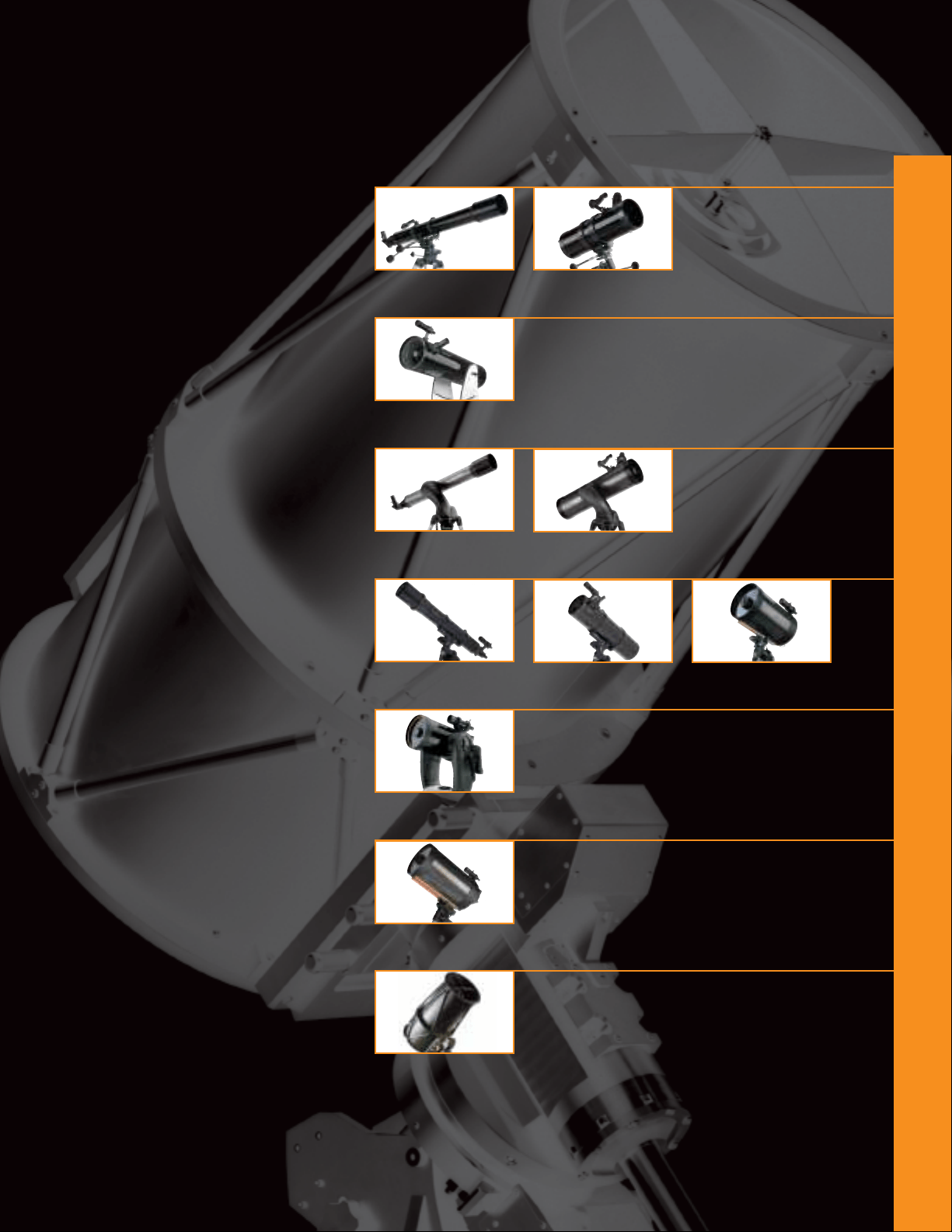
A Newtonian reflector uses a single
concave mirror as its primary. Light
enters the tube traveling to the
mirror at the back end. Light is then
“bent” forward in the tube to a
single point, its focal plane. A flat
mirror called a “diagonal” intercepts
the light and points it out the side of
the tube at right angles to the tube
through the eyepiece. The eyepiece is placed there for easy viewing.
Newtonian Reflector telescopes replace heavy lenses with mirrors to collect and
focus the light, providing much more light gathering power for the money. You can
have focal lengths up to 1000mm and still enjoy a telescope that is relatively
compact and portable. Newtonian Reflector telescopes do require more care and
maintenance because the primary mirror is exposed to air and dust. However, this
small drawback does not hamper this type of telescope’s popularity with those
who want an economical telescope that can still resolve faint, distant objects.
Newtonian reflectors produce a “right-side-up image” but the image will appear
rotated based on the location of the eyepiece holder in relation to the ground.
Newtonian reflectors are best for astronomical use where right-side-up does
not matter.
Newtonian Advantages
• Lowest cost per inch of aperture compared to Refractors and Catadioptrics since
mirrors can be produced at less cost than lenses in medium to large apertures
• Reasonably compact and portable up to focal lengths of 1000mm
• Excellent for faint deep sky objects such as remote galaxies, nebulae and star
clusters due to the generally fast focal ratios (f/4 to f/8)
• Adequate for lunar and planetary work
• Good for deep sky astrophotography (but not as convenient and more difficult to
use than Catadioptrics)
• Free of color aberration due to the use of a primary mirror
Newtonian Disadvantages
• Generally not suited for terrestrial applications
• Slight light loss due to secondary (diagonal) obstruction when compared
with Refractors
Catadioptric Telescopes
Catadioptrics use a combination of mirrors and lenses to “fold” (reflect) the light
path and form an image. There are two popular designs: the Schmidt-Cassegrain
and the Maksutov-Cassegrain. In a Schmidt-Cassegrain, the light enters through
a thin aspheric Schmidt correcting lens. It then strikes the spherical primary mirror.
It is reflected back up the tube and intercepted by a small secondary mirror which
reflects the light out an opening in the rear of the instrument where the image is
formed at the eyepiece. Catadioptrics are the most popular and most modern type
of telescope optical design and are marketed throughout the world in 3.5” and
larger apertures.
Catadioptric telescopes combine the practical advantages of lenses and mirrors
while eliminating their disadvantages. They offer the clarity and contrast of
refractors with the low aberration of reflectors. Catadioptrics have an average focal
ratio of f/10 which is wide enough for all types of photography. They are also
easier to maintain because all optical elements are solidly mounted and rigidly
collimated. Catadioptric telescopes provide the best possible combination of light
gathering power, long focal length, portability and affordability.
Schmidt-Cassegrain Advantages
• Best all-purpose
telescope design
• Combines the
optical advantages
of both lenses and
mirrors while
eliminating their
disadvantages
• Excellent optics and
razor sharp images over a wide field
• Excellent for deep sky observing and astrophotography
• Very good for lunar, planetary and binary star observing
• Excellent for terrestrial viewing and photography
• Focal ratio generally around f/10
• Closed tube design reduces image-degrading air currents
• Extremely compact and portable
• Easy to use
• Durable and virtually maintenance free
• Large apertures at reasonable cost and less expensive than
equivalent aperture refractors
• Most versatile type of telescope
• More accessories available than with other types of telescopes
• Best near focus capability of any type of telescope
Schmidt-Cassegrain Disadvantages
• More expensive than Newtonians of equal aperture
• Slight light loss due to secondary mirror obstruction compared
to refractors
Maksutov-Cassegrain Telescopes
The Maksutov-Cassegrain is similar to the Schmidt-Cassegrain with
essentially the same advantages and disadvantages. It uses a thick
meniscus correcting lens with a strong curvature and a secondary
mirror that is usually an aluminized spot on the corrector. The Maksutov
secondary mirror is typically smaller than the Schmidt’s which gives it
slightly better resolution for planetary observing.
Advantages of Maksutov-Cassegrain Compared
to Schmidt-Cassegrain
• Smaller secondary
obstruction results
in a slight increase
in planetary detail
and contrast
• Less expensive to
manufacture
• Longer focal
lengths resulting in higher magnifications for planetary viewing
Disadvantages of Maksutov-Cassegrain Compared
to Schmidt-Cassegrain
• Slightly heavier because of the thick meniscus correcting lens
• Increased time to reach thermal stability in larger apertures
over 90mm
• Longer focal lengths resulting in smaller field of views
06
TELESCOPES
T
E
L
E
S
C
O
P
E
S
FirstScope Series
StarHopper Series
NexStar SLT Series
Advanced Series
CPC Series
CGE Series
C20 Astrograph
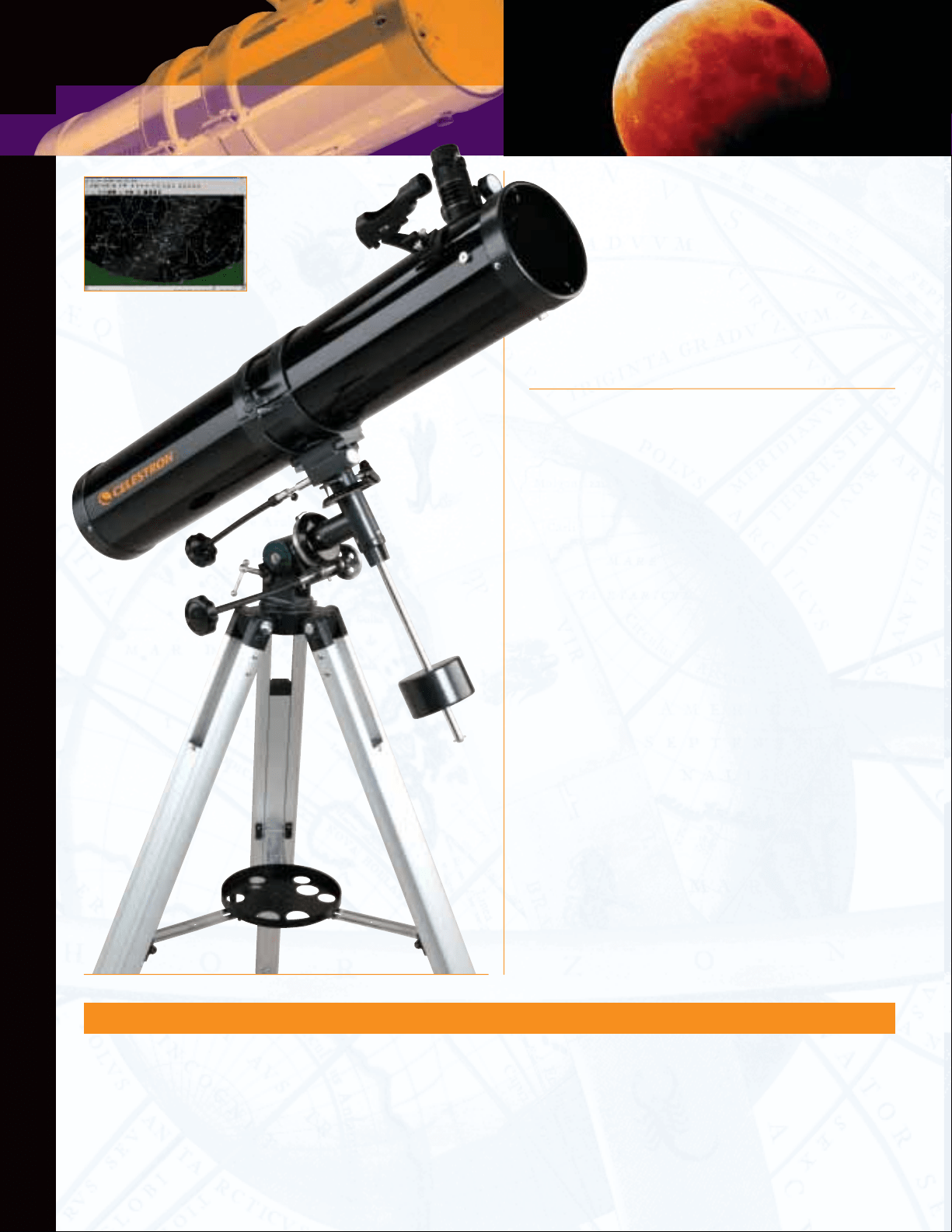
The Celestron FirstScope Series was
designed with the first-time telescope
buyer in mind.
Offering exceptional value, these scopes feature
compact and portable designs with ample optical
performance to excite any newcomer to the world
of amateur astronomy. Each telescope has its own design
characteristics to help you choose which is best for you. The
smaller FirstScopes feature refractor optical designs while the
larger aperture models feature Newtonian reflector optical systems.
Standard Features and Accessories Include:
• All coated glass optics for clear, crisp images
• Rugged pre-assembled aluminum tripod for increased sturdiness
• StarPointer™ advanced red dot LED finderscope for accurately locating
celestial objects
• Choice of German Equatorial mount with setting circles and slow motion
adjustment controls or Altazimuth mount with slow motion control
• Quick and easy no-tool setup
• Deluxe accessory tray for convenient storage of accessories
•1
1
/4” eyepieces for wider fields of view and increased
magnification power
• “The Sky” Level 1 planetarium software with 10,000 object database and
enhanced images
FirstScope 114EQ
Which FirstScope model best fits your needs?
If you’re looking for a dual-purpose telescope appropriate for both
terrestrial and celestial viewing, then a refractor model is for you.
Refractors produce bright, clear images of the Moon and planets
as well. It is easy to see the moons of Jupiter and the rings of Saturn
with every one of these fine instruments. For views of the brighter
deep space objects like galaxies and nebulae, we recommend the
larger aperture and light gathering ability of the Newtonian reflectors.
If your interest is strictly watching whales, spotting birds, or viewing
nature, altazimuth-mounted models are ideal. A model featuring a
German Equatorial mount is a good choice for viewing stars, nebulae,
star clusters, and planets
When used for astronomical viewing, FirstScopes yield breathtaking
views of the Moon, Saturn with its ring structure, Jupiter and its belts
and moons, nebulae and star clusters. Add an optional solar filter,
and you can observe activity on the Sun.
Every instrument features all glass optical elements as well as
smooth operating aluminum tripod mountings featuring slow motion
controls on most models. Refractor models feature coated optics for
enhanced image brightness and clarity. There are FirstScope models
that use altazimuth mountings suitable for terrestrial as well as
astronomical viewing.
Equatorial models are intended for astronomical use only. Adding
a motor drive that moves one axis to compensate for the Earth’s
rotation can enhance equatorial mounts. When properly aligned, the
motor keeps objects in the field of view for longer periods without
having to move the telescope by hand. Alignment also improves the
accuracy of the setting circles. Setting Circles are used to locate
objects by means of coordinates found in optional star charts.
Every FirstScope model features Celestron’s commitment to quality
and design features.
07
FIRSTSCOPE SERIES
F
I
R
S
T
S
C
O
P
E
S
E
R
I
E
S
FIRSTSCOPE SERIES FEATURES AT A GLANCE
C11 • Lunar Eclipse • Image courtesy of Jose Suro
Locate and identify thousands of
celestial objects on your laptop
or PC with “The Sky” Level 1
software included FREE with
every FirstScope model.
08
FIRSTSCOPE SERIES
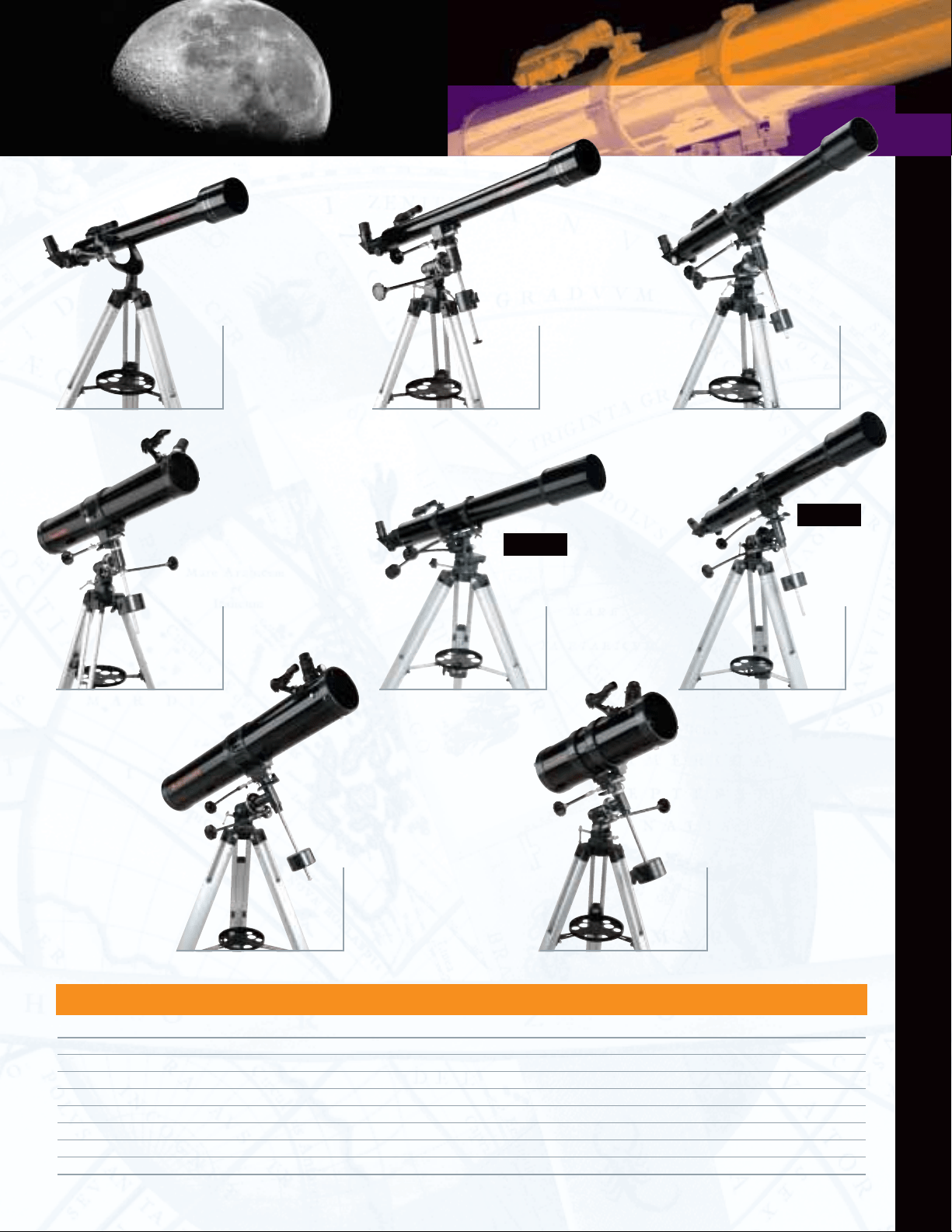
Model Item # Aperture Type Focal Length Eyepieces Finderscope Mount Weight
60AZ 21052 60mm (2.4”) Refractor 700mm f/12 20mm (35x), 10mm (70x) StarPointer
™
Altazimuth 7 lbs
60EQ 21067 60mm (2.4”) Refractor 900mm f/15 20mm (45x), 10mm (90x) StarPointer
™
Equatorial 11 lbs
70EQ 21076 70mm (2.8”) Refractor 900mm f/13 20mm (45x), 10mm (90x) StarPointer
™
Equatorial 17 lbs
76EQ 31032 76mm (3”) Reflector 700mm f/9 20mm (35x), 10mm (70x) StarPointer
™
Equatorial 15 lbs
90AZ 21084 90mm (3.5”) Refractor 1000mm f/11 20mm (50x), 10mm (100x) StarPointer
™
Altazimuth 19 lbs
90EQ 21085 90mm (3.5”) Refractor 1000mm f/11 20mm (50x), 10mm (100x) StarPointer
™
Equatorial 22 lbs
114EQ 31044 114mm (4.5”) Reflector 900mm f/8 20mm (45x), 10mm (90x) StarPointer
™
Equatorial 19 lbs
114EQ Compact 31041 114mm (4.5”) Reflector 1000mm f/9 20mm (50x), 10mm (100x) StarPointer
™
Equatorial 16 lbs
For complete specifications and product information, visit: www.celestron.com
FirstScope
60AZ
NexStar 4 • Moon • Image courtesy of Mario Mariani
FIRSTSCOPE SERIES SPECIFICATIONS
F
I
R
S
T
S
C
O
P
E
S
E
R
I
E
S
NEW!
NEW!
FirstScope
60EQ
FirstScope
70EQ
FirstScope
76EQ
FirstScope
90AZ
FirstScope
90EQ
FirstScope
114
FirstScope
114 Compact
Standard Features and Accessories Include:
• Adjustable roller track bearing on the azimuth surface provides
a smooth motion
• Variable tension clutch system for proper balance and control
in both altitude and azimuth
• Optical quality BK7 annealed glass provides better thermal
expansion properties than standard plate glass mirrors
• Built-in cooling fan improves mirror cooling time and reduces damaging
tube currents (for StarHopper 10" and 12" models)
• 9-point flotation mirror cell gives equal support of the primary mirror
to minimize mirror deflection (for StarHopper 12" model)
• Quick release finder bracket with spring loaded pivot and x-y
adjustments
• Carrying handle and eyepiece holder for convenience
09
STARHOPPER
SERIES
S
T
A
R
H
O
P
P
E
R
S
E
R
I
E
S
STARHOPPER SERIES FEATURES AT A GLANCE
C11 • Saturn • Image courtesy of Damian Peach
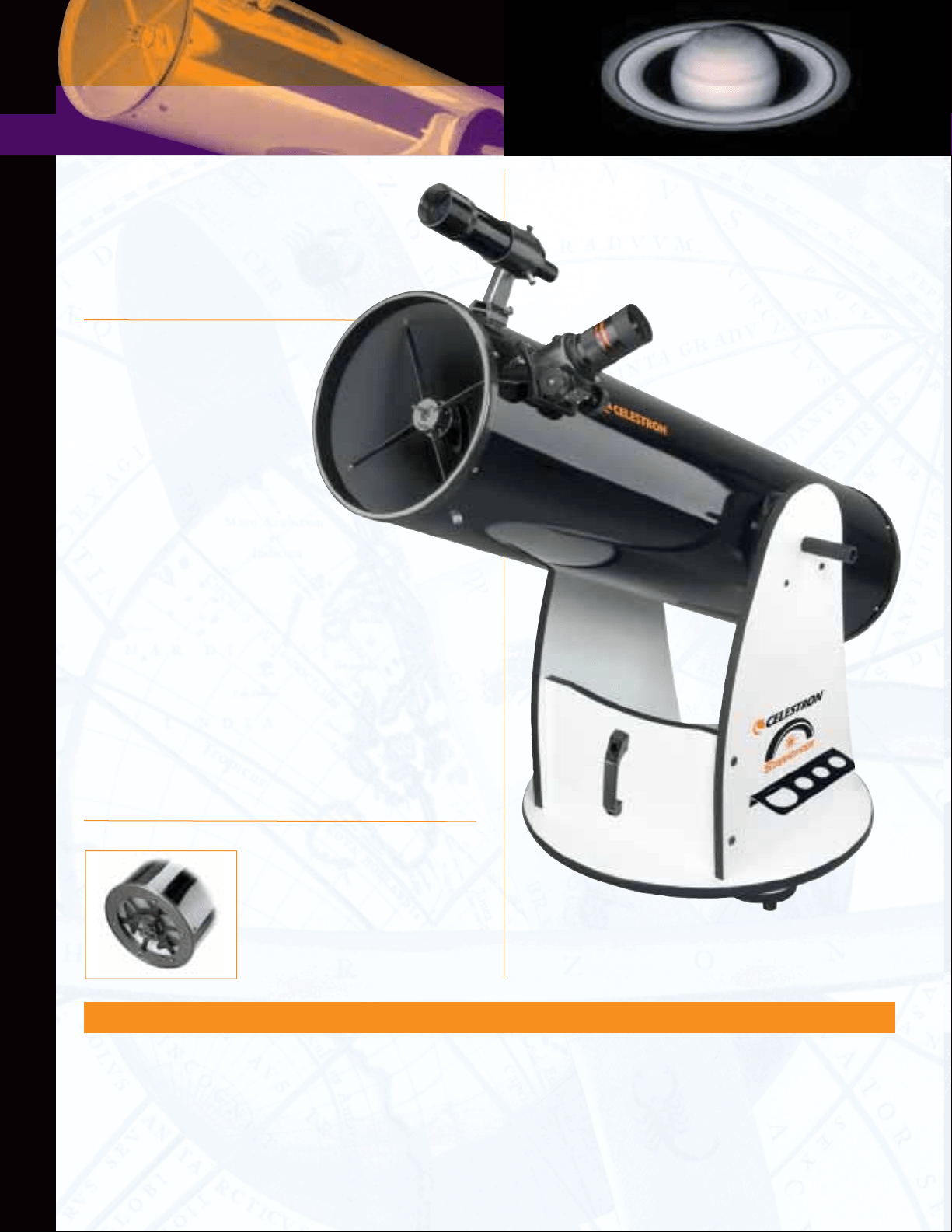
StarHopper 10
The StarHopper
Configuration is
a Newtonian Optical
Tube Mounted on an
Altazimuth Mount.
This optical system is characterized by
a large primary mirror at the bottom of
the tube which collects light and
concentrates it onto a small secondary
mirror. The light is then reflected out the side
of the tube and into the eyepiece. Best of all,
StarHopper Dobsonians are easy to observe with. The user
navigates through the night sky by simply moving the tube up or down,
or side to side, by hand.
All Celestron StarHoppers use optical quality BK-7 glass. This is the same
high-quality glass used in most binocular prisms and refractor telescope
lenses. All StarHoppers use a roller track bearing on the azimuth surface
providing dozens of support points for smooth swivel motion. They also
use a variable tension clutch system for proper balance and control in
both altitude and azimuth. The 10" & 12" StarHoppers have cooling fans
built into the rear cell to decrease cooling times.
The 8", 10" and 12" models come standard with 2" focuser and 1.25"
adapter. The 10" & 12" models come standard with a 32mm 2" eyepiece.
12" StarHoppers use a 9-point flotation mirror cell for equal support of the
primary mirror.
10" & 12" StarHoppers have
cooling fans built-in to the rear cell
to decrease cooling times.
Celestron’s StarHopper series of Dobsonian telescopes
are available in 6", 8", 10" and 12" apertures. Dobsonian
telescopes are recognized by amateur astronomers as an
excellent value for the aperture size, and our StarHopper line
is as rich in features as it is in value.
StarHopper 12
10
STARHOPPER
SERIES
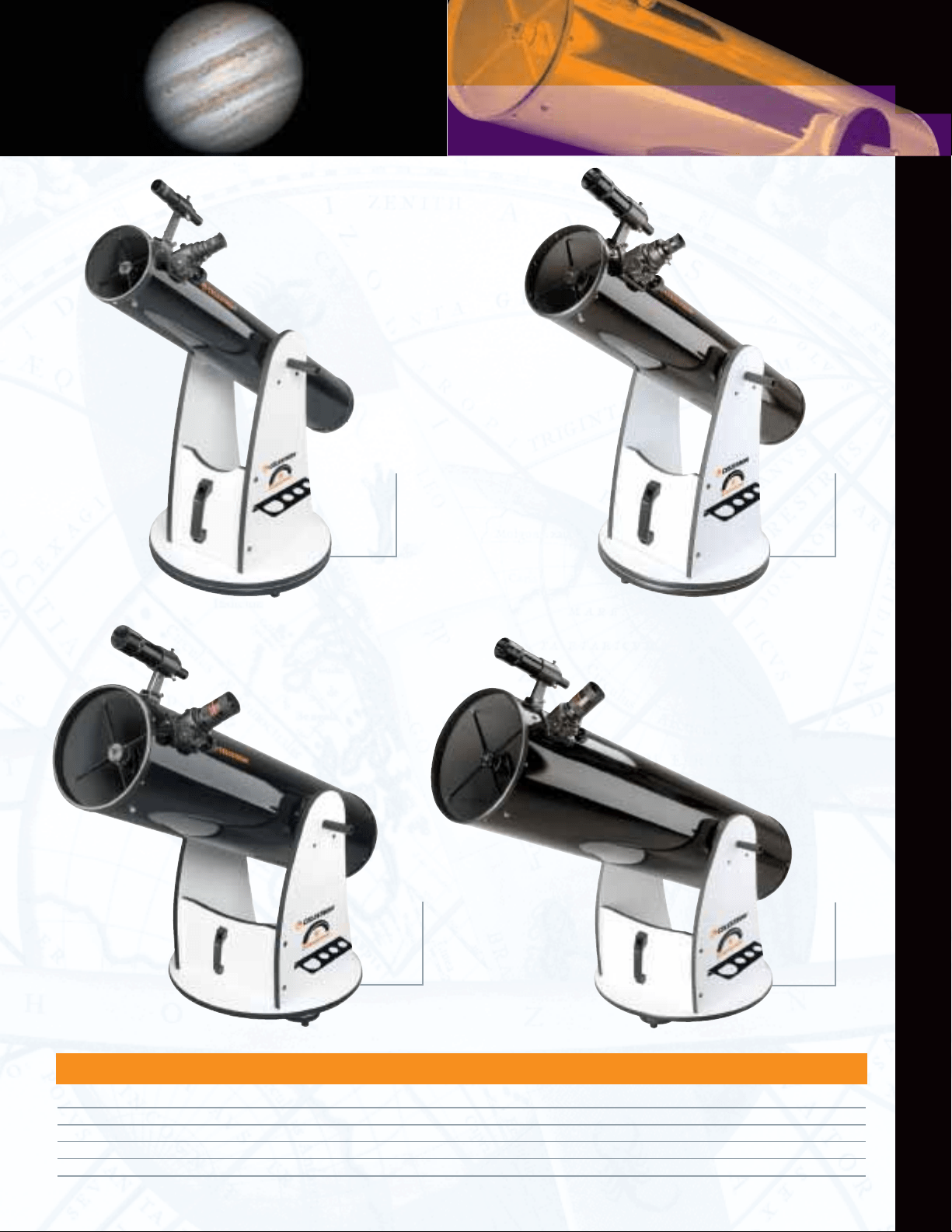
Model Item # Primary Mirror Type Focal Length Eyepieces Finderscope Focuser
StarHopper 6 10600 6” Dobsonian 48” 25mm-1
1
/4” 6x30 1
1
/4”
StarHopper 8 10800 8” Dobsonian 48” 25mm-1
1
/4” 9x50 2” with 1
1
/4” adapter
StarHopper 10 10110 10” Dobsonian 50” 32mm E-Lux
™
2” 9x50 2” with 1
1
/4” adapter
StarHopper 12 10112 12” Dobsonian 60” 32mm E-Lux
™
2” 9x50 2” with 1
1
/4” adapter
For complete specifications and product information, visit: www.celestron.com
C11 • Jupiter • Image courtesy of Damian Peach
STARHOPPER SERIES SPECIFICATIONS
S
T
A
R
H
O
P
P
E
R
S
E
R
I
E
S
StarHopper 10
StarHopper 6
StarHopper 8
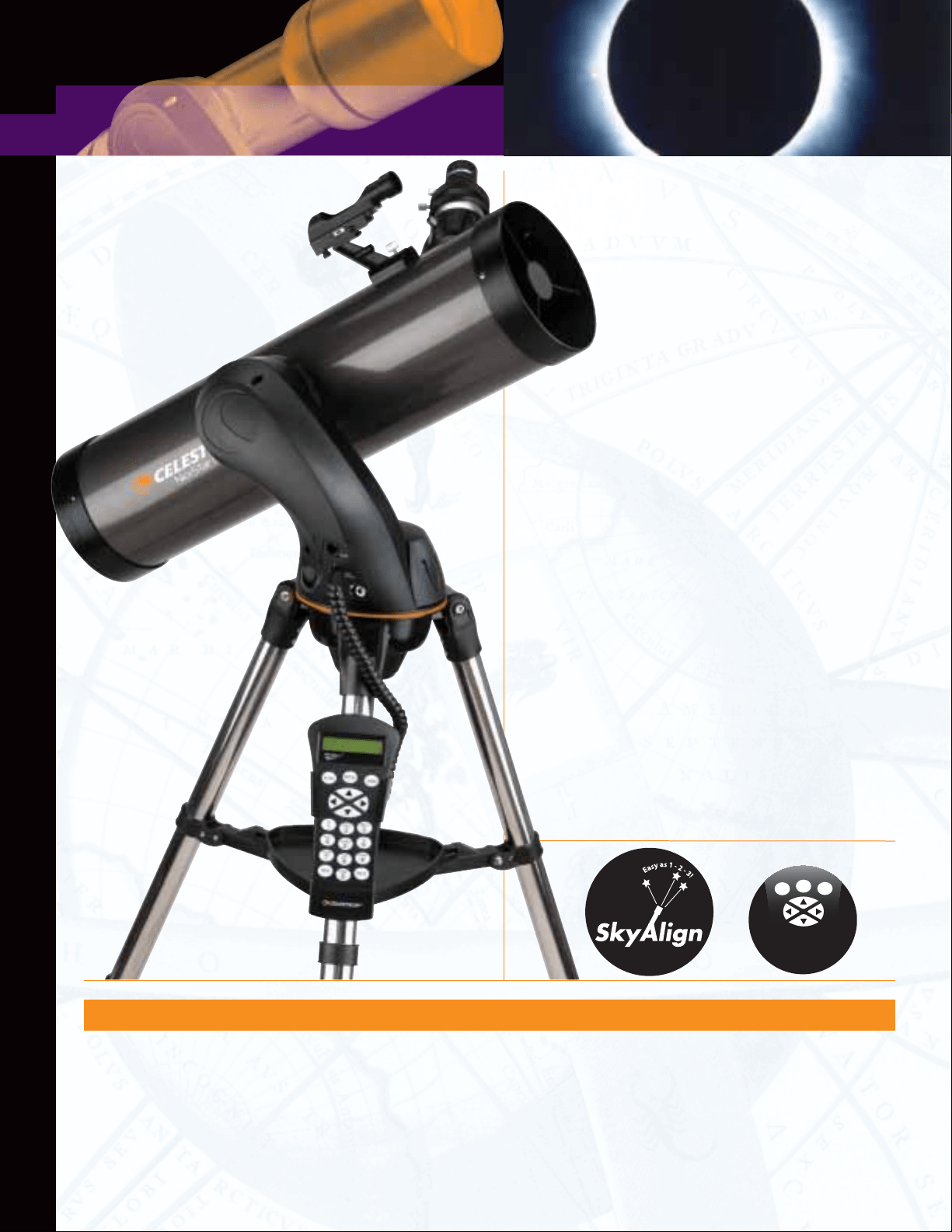
Standard Features and Accessories Include:
• Computerized hand control with 4,000+ object database
• Quick-release fork arm mount, optical tube and accessory tray for quick
no tool set up
• SkyAlign allows you to align on any three bright celestial objects, making
for a fast and easy alignment process
• Comes with “The Sky” Level 1 planetarium software and NSOL telescope
control software for controlling your telescope via computer
• Internal battery compartment to prevent cord wrap during use
• Sturdy stainless steel tripod
• StarPointer finderscope to help with alignment
• Auxiliary port for additional accessories such as GPS accessory
• Motorized altazimuth mount and fully computerized hand control
• U.S. and International city database to easily set your location
• Flash upgradeable hand control software and motor control units
11
NEXSTAR
SLT SERIES
NEXSTAR SLT SERIES FEATURES AT A GLANCE
NexRemote
®
Remote Control
Software
ALIGN
ENTER
UNDO
Compatible with:
The completely new NexStar series....
Designed to be an affordable entry level to mid-level
computerized GoTo telescope,the NexStar SLT
refractors and reflectors are available in the most
popular sizes and are loaded with valuable design
features. With pre-assembled, adjustable stainless
steel tripods, and quick release fork arms and
tubes, NexStar SLT telescopes can be set up
in a matter of minutes — with no tools required!
You can see details of the lunar surface, Venus
and its phases, Mars resolved as an orange disc,
Jupiter and its four moons, Saturn with its rings plainly
visible and much more! Most NexStar SLT's can also be used
as a land-based spotting telescope.
Intelligent Design
Powered by 8 AA user supplied batteries or an optional
AC adapter (#18773) these NexStar GoTo's love to travel.
The internal battery compartment provides power to the high
precision servo motors for rigid low-vibration performance
while eliminating cord wrap issues associated with external
battery packs.
With the NexStar's ergonomically-designed hand control,
the user is free to remove the hand control from its holder
for remote use or leave it cradled for hands-free operation.
With a touch of a button you can select the object catalog,
change the slew speed, view fascinating information about
an object, or simply know if a desired object is visible in
the sky.
Celestron's Revolutionary SkyAlign
Using Celestron's patented SkyAlign* (patent pending), simply
input the date, time and location into the hand control then
slew the telescope to any three bright celestial objects in the
sky. You do not need to know the names of the stars — you
could even pick the moon or bright planets!
*For more information on SkyAlign, see information on page 2
C5 • Solar Eclipse • Image courtesy of Jason Fournier
C5 • Solar Eclipse • Image courtesy of Jason Fournier
NexStar 130 SLT
N
E
X
S
T
A
R
S
L
T
S
E
R
I
E
S
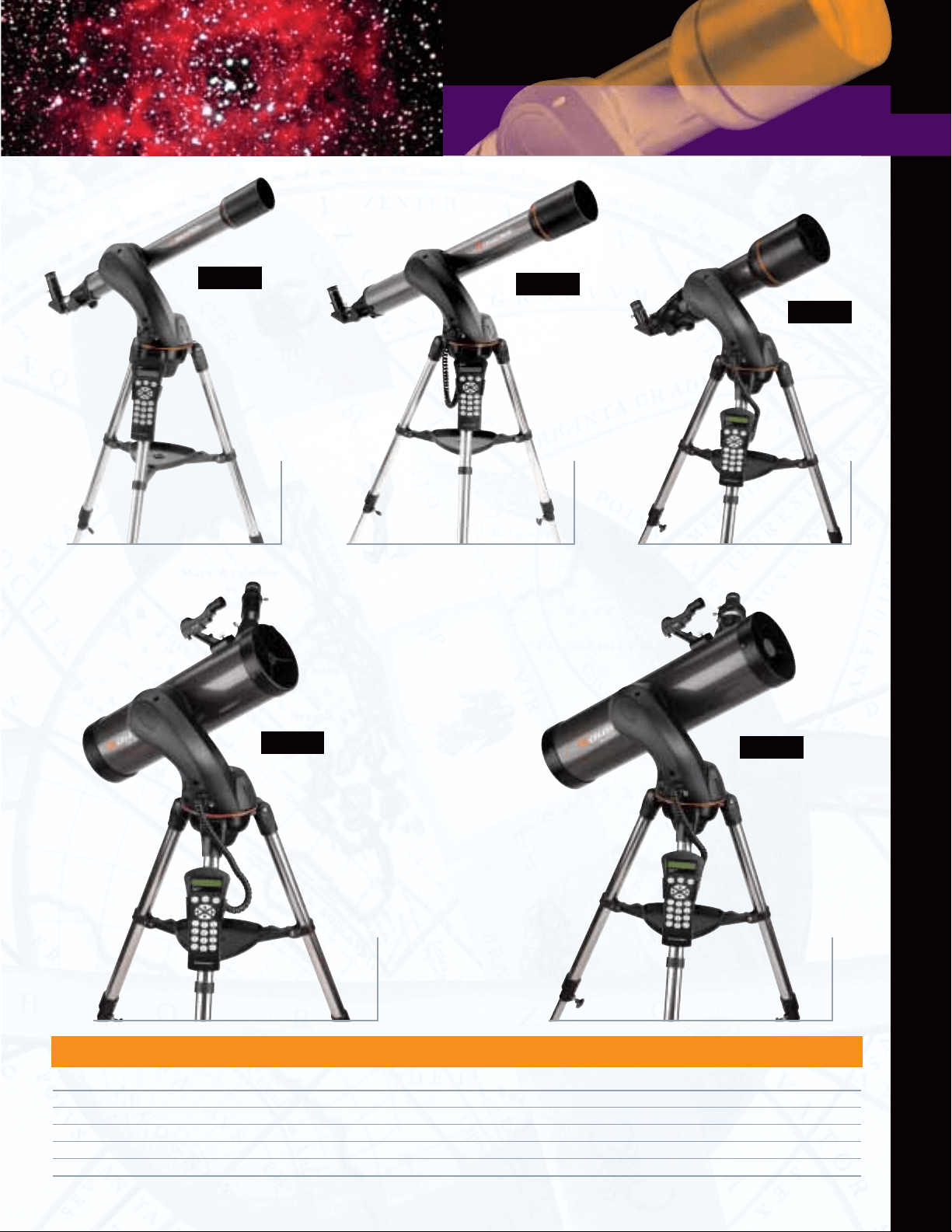
NexStar
102 SLT
NexStar
114 SLT
12
NEXSTAR
SLT SERIES
Model Item # Aperture Type Focal Length Eyepieces Finderscope Mount Weight
60 SLT 22076 60mm (2.4”) Refractor 700mm f/12 25mm (28x), 9mm (78x) StarPointer
™
Altazimuth 9.5 lbs
80 SLT 22086 80mm (3.1”) Refractor 900mm f/11 25mm (36x), 9mm (100x) StarPointer
™
Altazimuth 14 lbs
102 SLT 22096 102mm (4”) Refractor 660mm f/6.5 25mm (26x), 9mm (73x) StarPointer
™
Altazimuth 14 lbs
114 SLT 31143 114mm (4.5”) Reflector 1000mm f/9 25mm (40x), 9mm (111x) StarPointer
™
Altazimuth 15 lbs
130 SLT 31145 130mm (5”) Reflector 650mm f/5 25mm (26x), 9mm (62x) StarPointer
™
Altazimuth 18 lbs
For complete specifications and product information, visit: www.celestron.com
NexStar
60 SLT
NexStar
80 SLT
NEXSTAR SLT SERIES SPECIFICATIONS
N
E
X
S
T
A
R
S
L
T
S
E
R
I
E
S
NexStar
130 SLT
NEW!
NEW!
NEW!
NEW!
NEW!
C102 • Rosette Nebula • Image courtesy of Frederic Caron
C102 • Rosette Nebula • Image courtesy of Frederic Caron
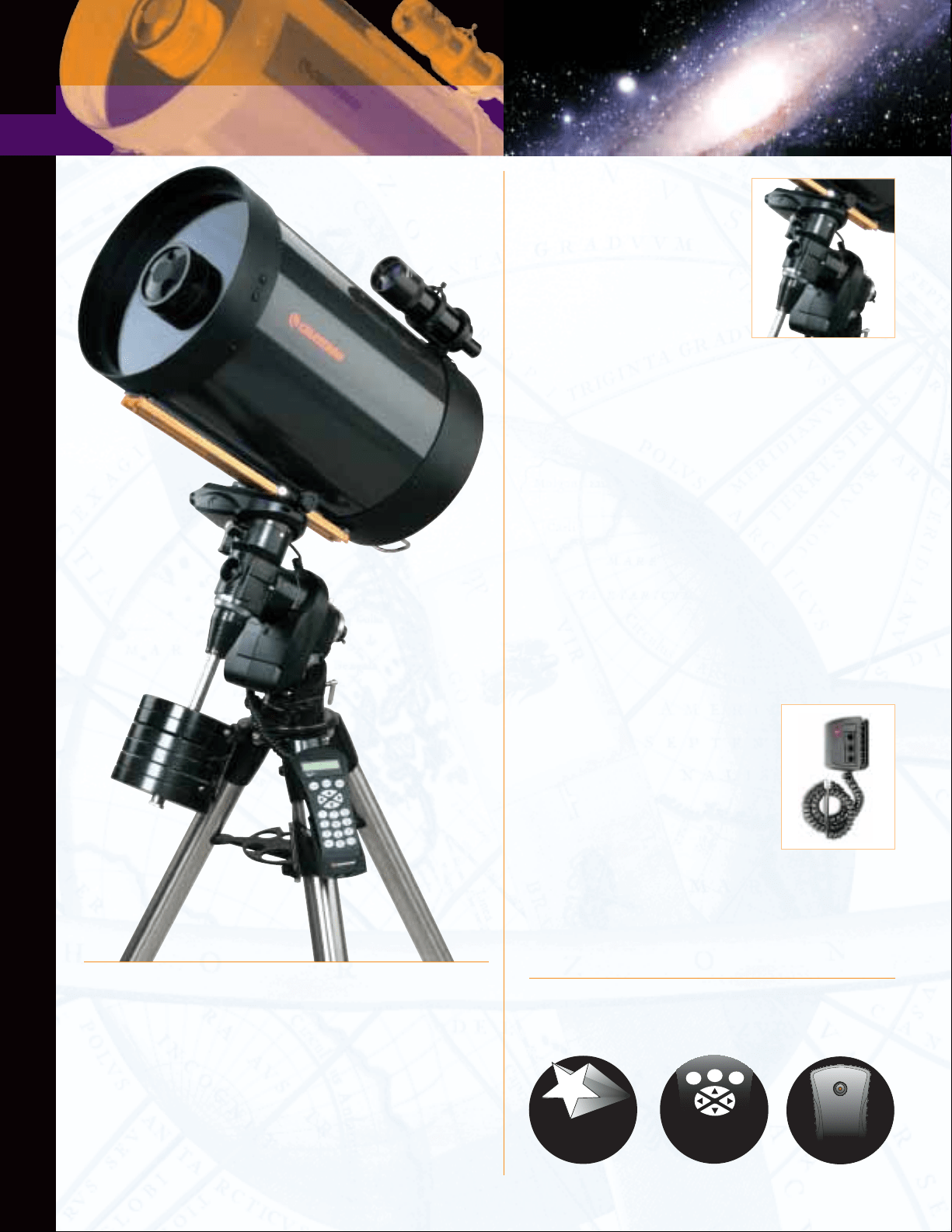
The Advanced Series family of computerized GoTo and non-computerized
telescopes was designed to offer the novice or more advanced user a selection of
models with the features and quality that serious amateurs can appreciate. These
scopes come on heavy-duty German Equatorial mounts with ultra-sturdy 2"
stainless steel legs and center tray for superior rigidity and vibration dampening.
The Advanced Series comes in refractor, reflector, Maksutov-Cassegrain and
Schmidt-Cassegrain models. The refractor models range from a 3" (80mm) to an
impressive 6" aperture and include our NEW 80ED and 100ED refractors. For even
more light gathering power there are 6", 8" and 10" Newtonian Reflectors. We
added a 5” Maksutov-Cassegrain with our NEW C130 model. There are also 8",
9
1
/4" and our NEW 11” Schmidt-Cassegrain optical designs that feature
Celestron's precision matched and hand-figured optical systems.
GoTo Convenience and GPS Compatibility
For Precision Accuracy
We are proud to offer the GT versions of the Advanced Series on
a computerized GoTo version of Celestron's sturdy CG-5 mount.
Couple this solidly-built mount with the included NexStar
®
computerized control system to utilize many of the same functions
and features as Celestron's most advanced GoTo telescopes. GoTo
models are also upgradeable to GPS with the optional CN16 GPS
Accessory (#93966). This accessory allows your telescope to pinpoint
your location on the Earth, the date and time, and makes the
alignment process faster and easier than ever before! These GoTo
versions of the Advanced Series also come loaded with new software
features and over 40,000 database objects. Capable of holding over
35 lbs of payload and slewing at 3º per second, you will be able
to instantly point to any of the celestial objects in the database.
Advanced
C11-SGT
CG-5 Mount —
Precision Engineered
For Stability
Our new CG-5 German Equatorial mount
has precision worm gears on both axes
for extremely smooth operation. The key
component that makes this system the
most stable in its class is the heavy-
duty tripod. It features larger and more
substantial legs that offer excellent damping characteristics for more
stable views. The CG-5 also has a convenient latitude scale for easier
alignment and an optional polar finderscope for the ultimate in
precision alignments.
Options Available On Selected Advanced Models
See product specifications for applicable models.
13
ADVANCED SERIES
A
D
V
A
N
C
E
D
S
E
R
I
E
S
Auxiliary Port Accessory Kit
The Auxiliary Port Accessory (Item #93965)
was designed to expand your Advanced GT's
ability to interface with multiple devices
including personal computers and the
Celestron CN16 GPS accessory. The Auxiliary
Port Accessory has a PC port which allows the
user to download and update motor control
firmware from the internet. It has two auxiliary
ports, one for the NexStar Hand Control and
one for the CN16 GPS accessory.
Note: The Auxiliary Port Accessory comes standard in the CN16 GPS Accessory Kit
for the Advanced GT Series (#93966). The Programming Cable is NOT included in the
CN16 GPS Accessory Kit for the Advanced GT Series.
C8 • Andromeda Galaxy • Image courtesy of Sebastian Voltmer
StarBright
®
XLT
COATINGS
NexRemote
®
Remote Control
Software
ALIGN
ENTER
UNDO
CN16
GPS Accessory
C8 • Andromeda Galaxy • Image courtesy of Sebastian Voltmer
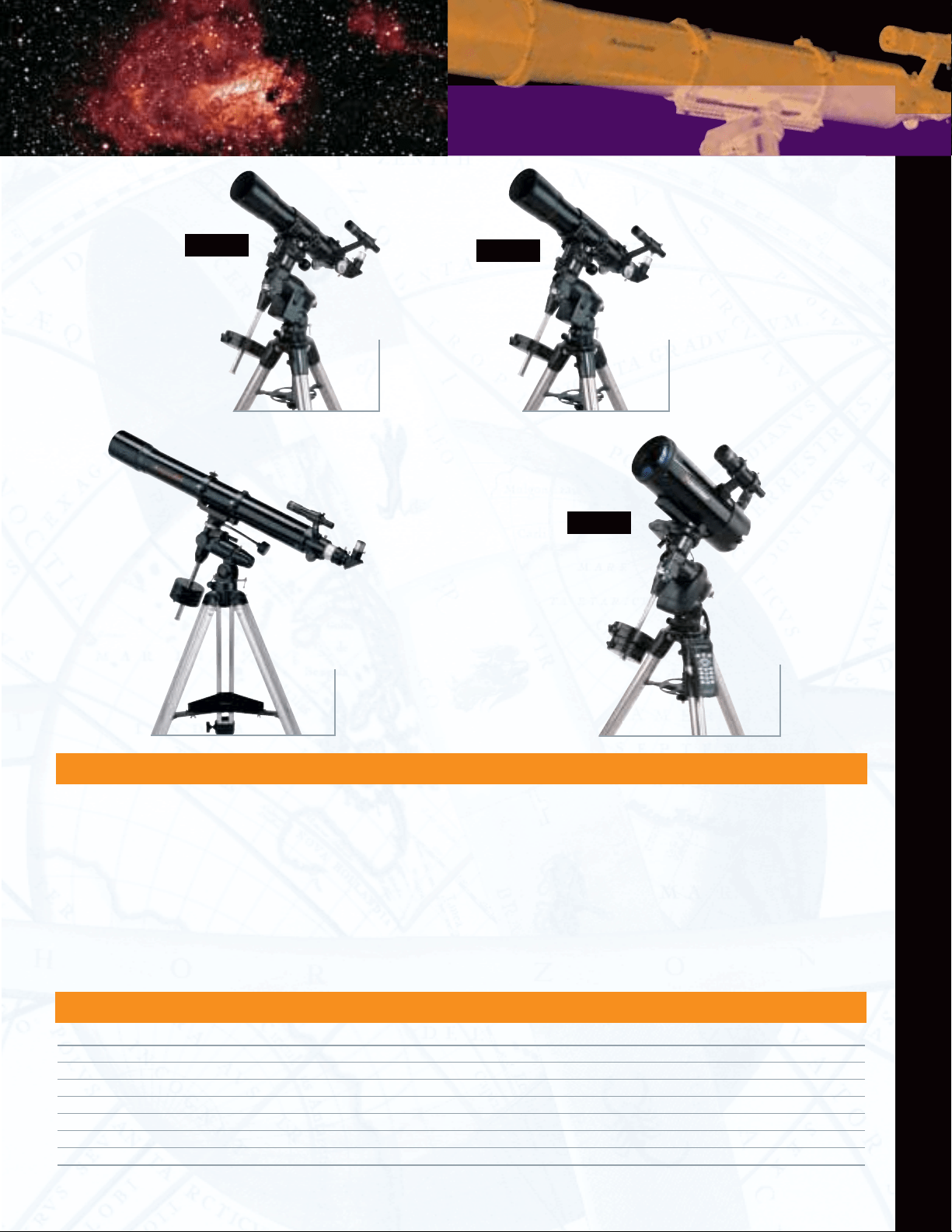
Standard Features and Accessories Include:
• Computerized or non-computerized CG-5 German Equatorial Mount
(CG-4 with C4-R and C6-N)
• CG-5 Mount features precision worm gears on both axes for extremely
smooth tracking and slewing
• CG-5 Mount uses large shafts and bearings and substantial base castings
for additional stability
• Ultra sturdy adjustable tripod with 2” stainless steel legs
• 2” focuser that allows use of 2” eyepieces on C6-R, C6-R GT, C8-N,
C8-N GT, C10-N, C10N GT, C80ED, C80ED-RGT, C100ED, C100ED-RGT
• “The Sky” Level 1 software
Computerized GT Model Features Include:
• 40,000+ object database
• DC servo motors with encoders on both axes
• Hand control with double line, 16 character LCD display; red night vision
backlighting
• RS-232 communication port on hand control; Auxiliary Port and
Autoguider port on motor drive
14
ADVANCED SERIES
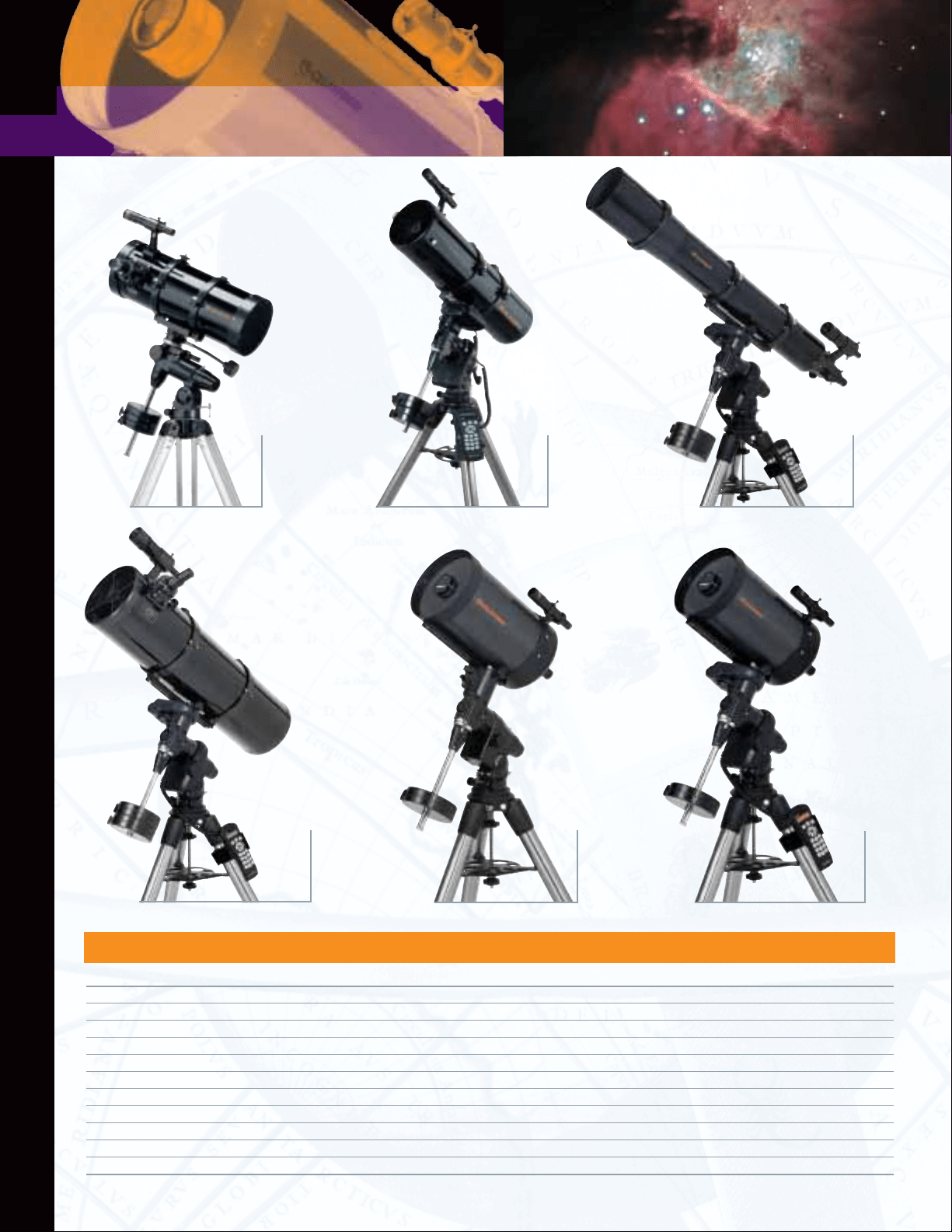
Model Item # Aperture Type Focal Length Eyepieces Finderscope Mount Computerized Weight
C80ED-R 21021 80mm (3.1”) Refractor 600mm f/7.5 20mm (30x) 6x30 CG-5 No 42 lbs
C80ED-RGT 21022 80mm (3.1”) Refractor 600mm f/7.5 20mm (30x) 6x30 CG-5 Yes 42 lbs
C100ED-R 21026 100mm (4”) Refractor 900mm f/9 20mm (45x) 9x50 CG-5 No 50 lbs
C100ED-RGT 21027 100mm (4”) Refractor 900mm f/9 20mm (45x) 9x50 CG-5 Yes 50 lbs
C4-R 21016 102mm (4”) Refractor 1000mm f/10 20mm (50x) 6x30 CG-4 No 36 lbs
C130-M 31063 130mm (5”) Maksutov 2000mm f/15 32mm (63x) 10x50 CG-5 No 51 lbs
C130-MGT 31064 130mm (5”) Maksutov 2000mm f/15 32mm (63x) 10x50 CG-5 Yes 51 lbs
For complete specifications and product information, visit: www.celestron.com
Advanced
C4-R
A
D
V
A
N
C
E
D
S
E
R
I
E
S
ADVANCED SERIES FEATURES AT A GLANCE
C8 • Swan Nebula • Image courtesy of Sebastian Voltmer
ADVANCED SERIES SPECIFICATIONS
Advanced
C130-MGT
Computerized
Advanced
C80ED-R
Advanced
C100ED-R
NEW!
NEW!
NEW!
15
A
D
V
A
N
C
E
D
S
E
R
I
E
S
ADVANCED SERIES
C11 • Orion Nebula • Image courtesy of Sebastian Voltmer
Advanced
C8-SGT
Computerized
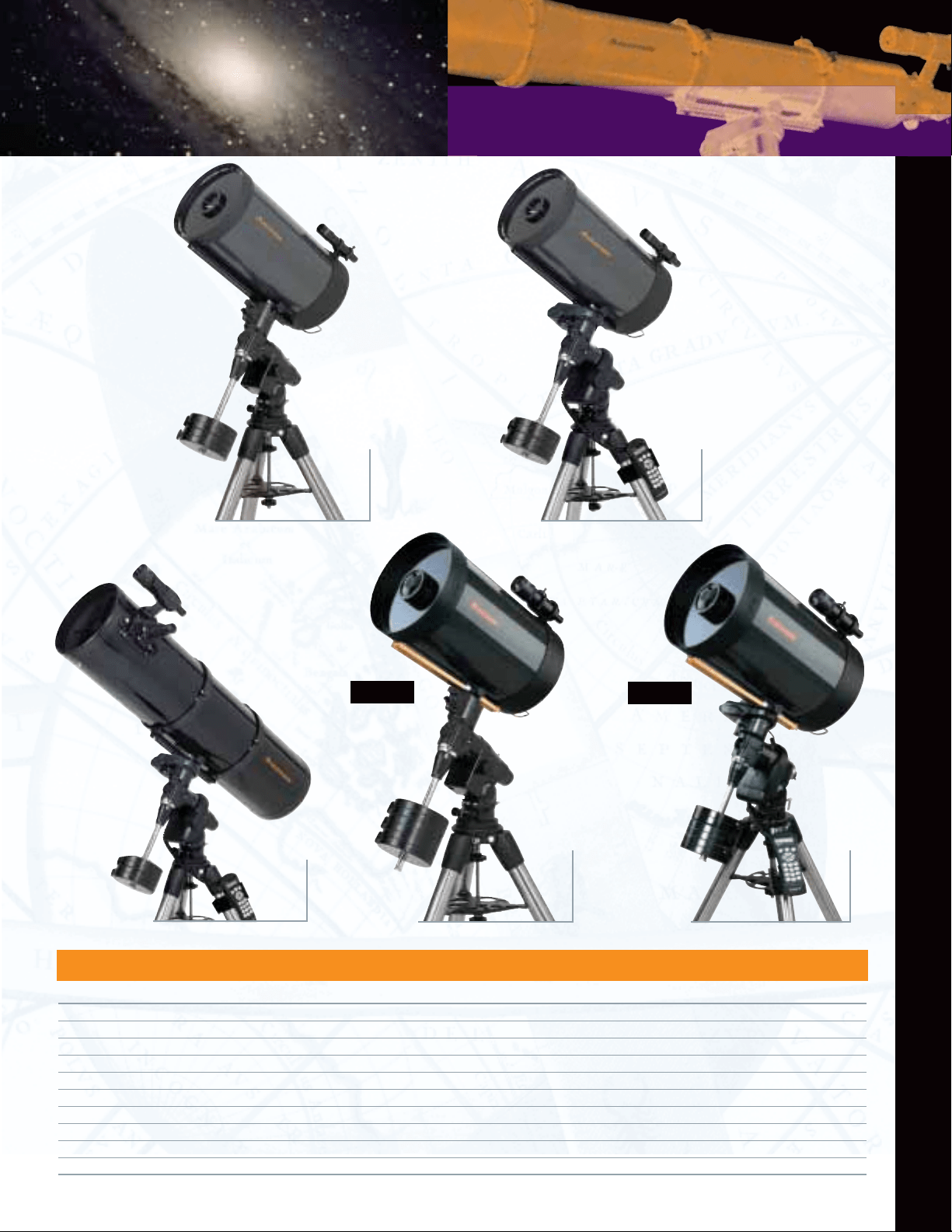
Model Item # Aperture Type Focal Length Eyepieces Finderscope Mount Computerized Weight
C6-N 31056 150mm (6”) Reflector 750mm f/5 20mm (38x) 6x30 CG-4 No 35 lbs
C6-N-HD 31053 150mm (6”) Reflector 750mm f/5 20mm (38x) 6x30 CG-5 No 54 lbs
C6-NGT 31054 150mm (6”) Reflector 750mm f/5 20mm (38x) 6x30 CG-5 Yes 54 lbs
C6-R 21019 150mm (6”) Refractor 1200mm f/8 20mm (60x) 9x50 CG-5 No 68 lbs
C6-RGT 21020 150mm (6”) Refractor 1200mm f/8 20mm (60x) 9x50 CG-5 Yes 68 lbs
C8-N 31061 200mm (8”) Reflector 1000mm f/5 20mm (50x) 9x50 CG-5 No 67 lbs
C8-NGT 31062 200mm (8”) Reflector 1000mm f/5 20mm (50x) 9x50 CG-5 Yes 67 lbs
C8-S 11025 203mm (8”) Schmidt-Cassegrain 2032mm f/10 25mm (81x) 6x30 CG-5 No 54 lbs
C8-S (XLT) 11025-XLT 203mm (8”) Schmidt-Cassegrain 2032mm f/10 25mm (81x) 6x30 CG-5 No 54 lbs
C8-SGT 11026 203mm (8”) Schmidt-Cassegrain 2032mm f/10 25mm (81x) 6x30 CG-5 Yes 54 lbs
C8-SGT (XLT) 11026-XLT 203mm (8”) Schmidt-Cassegrain 2032mm f/10 25mm (81x) 6x30 CG-5 Yes 54 lbs
ADVANCED SERIES SPECIFICATIONS
Advanced
C8-NGT
Computerized
Advanced
C8-S
Advanced
C6-N
Advanced
C6-RGT
Computerized
Advanced
C6-NGT
Computerized
16
ADVANCED SERIES
A
D
V
A
N
C
E
D
S
E
R
I
E
S
C8 • Andromeda Galaxy • Image courtesy of Sebastian Voltmer
For complete specifications and product information, visit: www.celestron.com
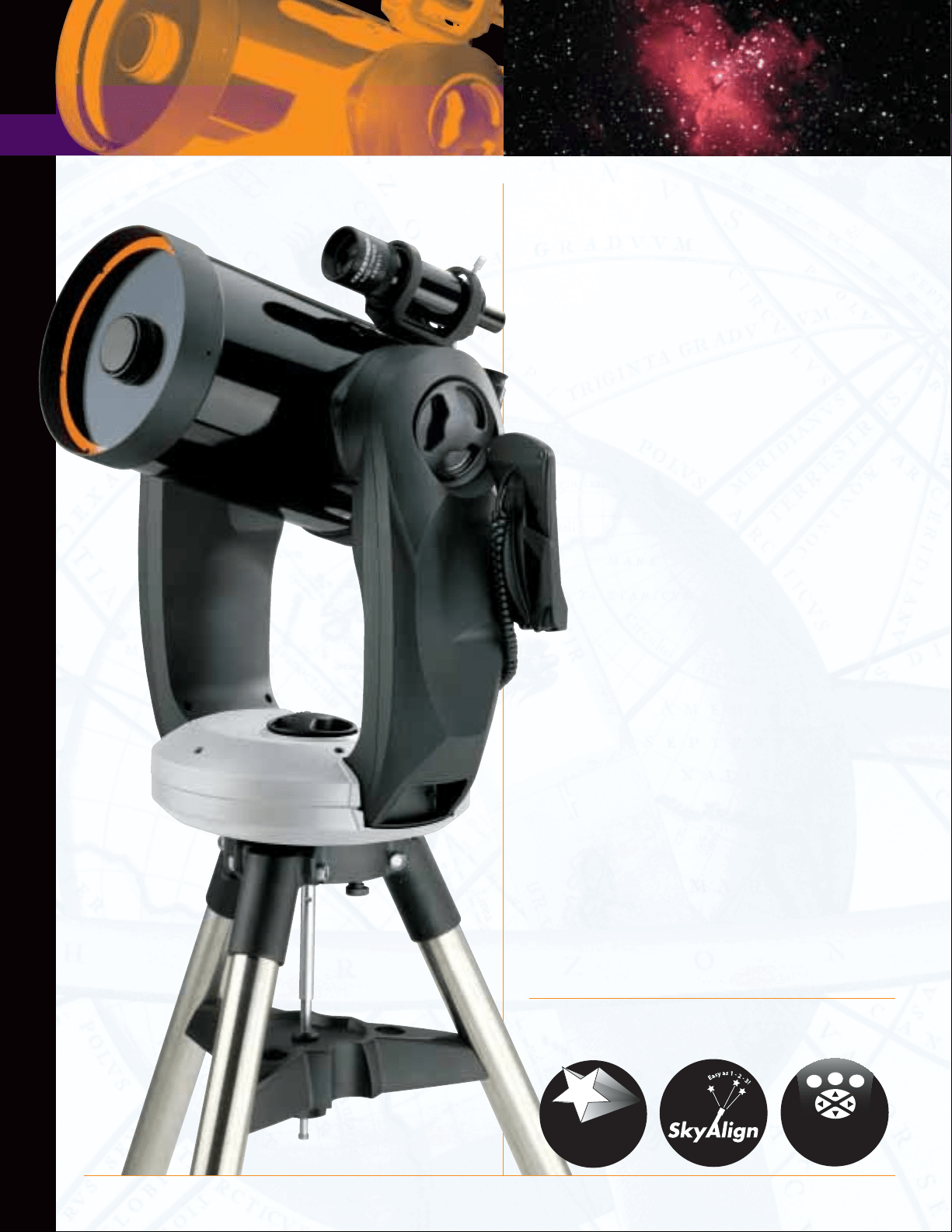
Advanced
C10-NGT
Computerized
Advanced
C11-S
Advanced
C11-SGT
Computerized
Model Item # Aperture Type Focal Length Eyepieces Finderscope Mount Computerized Weight
C9
1
/4-S 11045 235mm (9
1
/4”) Schmidt-Cassegrain 2350mm f/10 25mm (94x) 6x30 CG-5 No 74 lbs
C9
1
/4-S (XLT) 11045-XLT 235mm (9
1
/4”) Schmidt-Cassegrain 2350mm f/10 25mm (94x) 6x30 CG-5 No 74 lbs
C9
1
/4-SGT 11046 235mm (9
1
/4”) Schmidt-Cassegrain 2350mm f/10 25mm (94x) 6x30 CG-5 Yes 74 lbs
C9
1
/4-SGT (XLT) 11046-XLT 235mm (9
1
/4”) Schmidt-Cassegrain 2350mm f/10 25mm (94x) 6x30 CG-5 Yes 74 lbs
C10-N 11047 254mm (10”) Reflector 1200mm f/4.7 20mm (60x) 9x50 CG-5 No 93 lbs
C10-NGT 11048 254mm (10”) Reflector 1200mm f/4.7 20mm (60x) 9x50 CG-5 Yes 93 lbs
C11-S 11066 279mm (11”) Schmidt-Cassegrain 2800mm f/10 40mm (70x) 9x50 CG-5 No 91 lbs
C11-S (XLT) 11066-XLT 279mm (11”) Schmidt-Cassegrain 2800mm f/10 40mm (70x) 9x50 CG-5 No 91 lbs
C11-SGT 11067 279mm (11”) Schmidt-Cassegrain 2800mm f/10 40mm (70x) 9x50 CG-5 Yes 91 lbs
C11-SGT (XLT) 11067-XLT 279mm (11”) Schmidt-Cassegrain 2800mm f/10 40mm (70x) 9x50 CG-5 Yes 91 lbs
Advanced
C9
1
/4-S
Advanced
C9
1
/4-SGT
Computerized
ADVANCED SERIES SPECIFICATIONS
NEW!
NEW!
Celestron Professional Computerized Series
(CPC) 8”, 9.25”, 11”
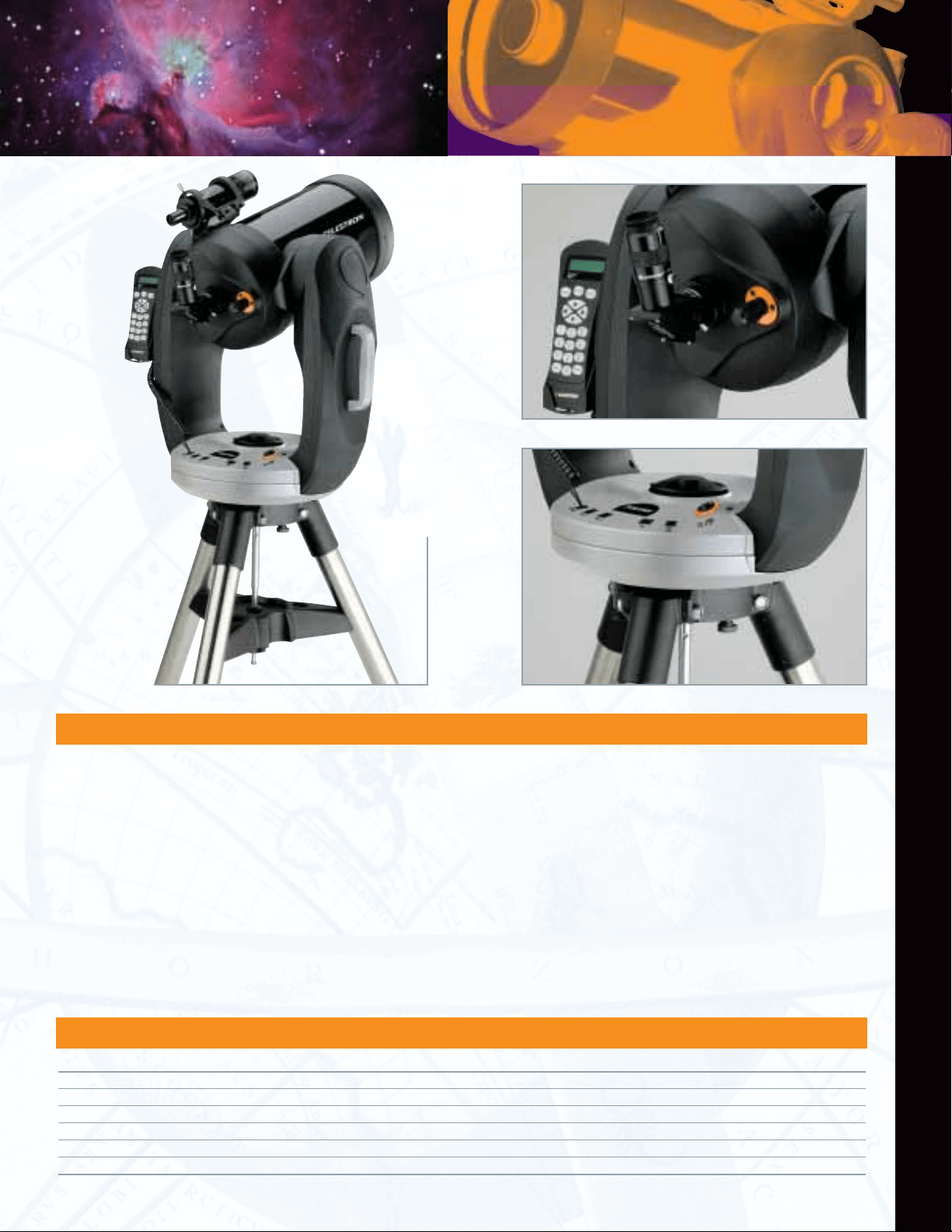
The telescopes of tomorrow are here today! New alignment
technology, advanced engineering, and a bold new design at a price
that is out of this world!
Celestron's new CPC Series with revolutionary SkyAlign Alignment
Technology re-defines everything that amateur astronomers are
looking for — quick and simple alignment, GPS, unsurpassed optical
quality, ease of set-up and use, ergonomics, enhanced
computerization and, most important, affordability.
Internal GPS
The CPC Series' internal GPS receiver automatically downloads
the date and time from orbiting satellites and pinpoints its
exact location on Earth. This eliminates the need for you to
manually enter the date, time, longitude and latitude.
Celestron's Revolutionary SkyAlign
Once the CPC's internal GPS has established the telescope's
position, aligning the telescope is as easy as 1-2-3! Simply
locate and manually point (slew) the telescope to three bright
celestial objects. You do not need to know the names of the
stars — you may even pick the moon or bright planets!
Celestron's NexStar
®
software technology will model the
night sky to determine the position of every star, planet and
celestial object above the horizon. Once aligned, the remote
hand control allows direct access to each of the celestial
catalogs in its user-friendly database.
Celestial Object Database
The CPC database contains over 40,000 celestial objects including
Messier objects, the Caldwell Catalog, as well as NGC Galaxies,
nebulae and planets. User-definable filter limits make navigating
through this expansive database quicker and easier. When using the
"filter limits" feature, only those objects that are above the horizon
are displayed for your exact date, time and location.
Innovative Features
The new CPC Series telescopes, like our acclaimed Advanced Series
and premium CGE Series telescopes feature meticulously matched
and hand-figured optical systems that are manufactured in our
facilities in Torrance, California. In addition, all CPC models are
available with optional StarBright XLT High Performance Optical
Coatings. With the introduction of the CPC Series, Celestron has
“gone back to the drawing board” and re-designed, re-engineered,
and re-invented a telescope family that provides superior quality,
unsurpassed ease of use, and incomparable value. All CPC models
ship standard with our NexRemote telescope control software.
17
CPC
™
SERIES
C8 • Eagle Nebula • Image courtesy of Sebastian Voltmer
CPC 800
C
P
C
S
E
R
I
E
S
StarBright
®
XLT
COATINGS
NexRemote
®
Remote Control
Software
ALIGN
ENTER
UNDO
Features Available On Selected CPC Models
See product specifications for applicable models.
18
CPC
™
SERIES
Model Item # Aperture Type Focal Length Eyepieces Finderscope Coating Weight
CPC 800 11073 203mm (8”) Schmidt-Cassegrain 2032mm f/10 40mm (51x) 8x50 Starbright
®
61 lbs
CPC 800 (XLT) 11073-XLT 203mm (8”) Schmidt-Cassegrain 2032mm f/10 40mm (51x) 8x50 Starbright
®
XLT 61 lbs
CPC 925 11074 235mm (9.25”) Schmidt-Cassegrain 2350mm f/10 40mm (59x) 8x50 Starbright
®
77 lbs
CPC 925 (XLT) 11074-XLT 235mm (9.25”) Schmidt-Cassegrain 2350mm f/10 40mm (59x) 8x50 Starbright
®
XLT 77 lbs
CPC 1100 11075 279mm (11”) Schmidt-Cassegrain 2800mm f/10 40mm (70x) 8x50 Starbright
®
84 lbs
CPC 1100 (XLT) 11075-XLT 279mm (11”) Schmidt-Cassegrain 2800mm f/10 40mm (70x) 8x50 Starbright
®
XLT 84 lbs
For complete specifications and product information, visit: www.celestron.com
CPC FEATURES AT A GLANCE
C8 • Orion Nebula • Image courtesy of Sebastian Voltmer
CPC SPECIFICATIONS
• Re-designed drive base and drive mechanics — quiet operation; large drive gears, quick release clutch; Auxiliary ports for AutoGuider, PC; easily mounts
to tripod
• SkyAlign Alignment Technology — simply choose three bright celestial objects, the telescope does the rest
• Convenient remote hand control holder — allows you to view information hands-free while using the scope
• 40,000+ object database
• Flash upgradeable hand control software and motor control units
• Easy to locate over-sized clutching knobs on both axes for manual use
• All metal quick release finderscope bracket with spring loaded pivot and easy to use x-y adjustment screws
• Ultra-wide 9.8” bearing track drive base provides smooth stable tracking at any rate
• Ergonomic design — comfortably lift and move the telescope from location to location
• Permanent Periodic Error Correction (PEC)
• NexRemote™ Included
• Newly designed tripod: heavy-duty steel leg tripod with accessory tray/center leg support bracket for rock solid stability; spring-loaded mounting screws
and recessed mounting platform for quick setup
C
P
C
S
E
R
I
E
S
CPC 800
Rear View
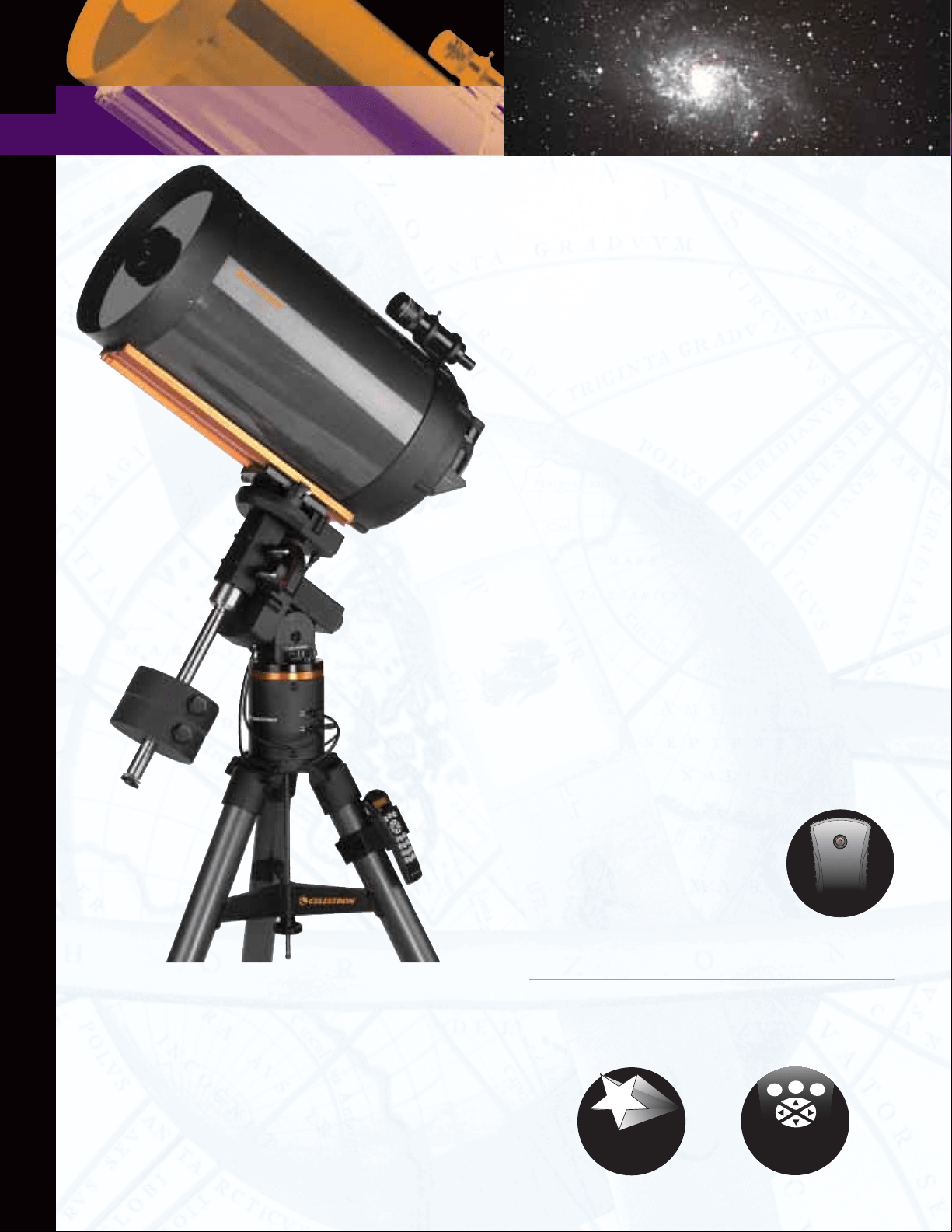
The CGE series is Celestron’s line of observatory class Schmidt-Cassegrain
telescopes. Offered in 8", 9
1
/4", 11" and 14" apertures, all are mounted on
the state of the art CGE GoTo German Equatorial mount. The German
Equatorial mount has long been the favored choice of astronomy buffs and
astrophotographers because of its stability and portability. More stable
because the center of gravity is directly over the center of its base, and more
portable because it can be disassembled into smaller component parts for
easy storage and transportation. For astrophotography, the German Equatorial
mount offers easier balancing, unlimited space at the rear of the telescope
tube to mount a camera, and whole sky access. All CGE models ship standard
with our NexRemote telescope control software.
CGE 1400
In addition to being fully computerized with a database of over
40,000 celestial objects, the CGE German Equatorial mount offers
numerous design advantages:
Designed For Portability
Set up and transportation of the CGE telescopes is made easy
by separating the CGE instruments into individual, easy-to-carry
components. Unlike fork arm mounted telescopes, the CGE’s optical
tubes can be quickly removed from its mounts making even the CGE
1400 easily assembled by only one person.
Recognized For Superior Stability
German Equatorial mounts place the center of gravity directly over
the tripod legs making the system extremely stable. This proven
design reduces the “tuning fork” vibration that can be associated
with undersized fork mounts. An improved Super HD Tripod supports
the CGE mount. This fully extendable tripod is made from the finest
cold rolled carbon steel and can be raised to a height of 50". The
tripod uses a dual leg support for maximum rigidity with an upper leg
brace to provide an outward preload and a lower leg brace providing
inward tension.
CGE Equatorial Mounts Can Easily Be Balanced
In Both Axes
Balancing the weight of camera equipment and other visual
accessories is accomplished by simply sliding the counterweight
for Right Ascension and moving the optical tube along its dovetail
mounting for Declination. This means that no additional weight needs
to be added to balance the telescope when additional accessories
are added.
Clearance For Accessories
CGE mounts support their tubes at a single contact point allowing
the tube to move freely around its polar axis without making contact
with the telescope’s mount. This is particularly useful when adding
photographic and CCD instruments that extend from the rear of
the telescope.
GPS Compatible
All CGE mounted telescopes are compatible with
Celestron’s CN16 GPS accessory (Item #93967).
Combine the GPS and built-in Hibernate mode
and these telescopes will keep track and
remember their exact location and time without
the need to re-enter the information into the remote
hand control.
Features Available On Selected CGE Models
See product specifications for applicable models.
19
CGE SERIES
C
G
E
S
E
R
I
E
S
C14 • Pinwheel Galaxy • Image courtesy of Richard Hedrick
StarBright
®
XLT
COATINGS
NexRemote
®
Remote Control
Software
ALIGN
ENTER
UNDO
CN16
GPS Accessory
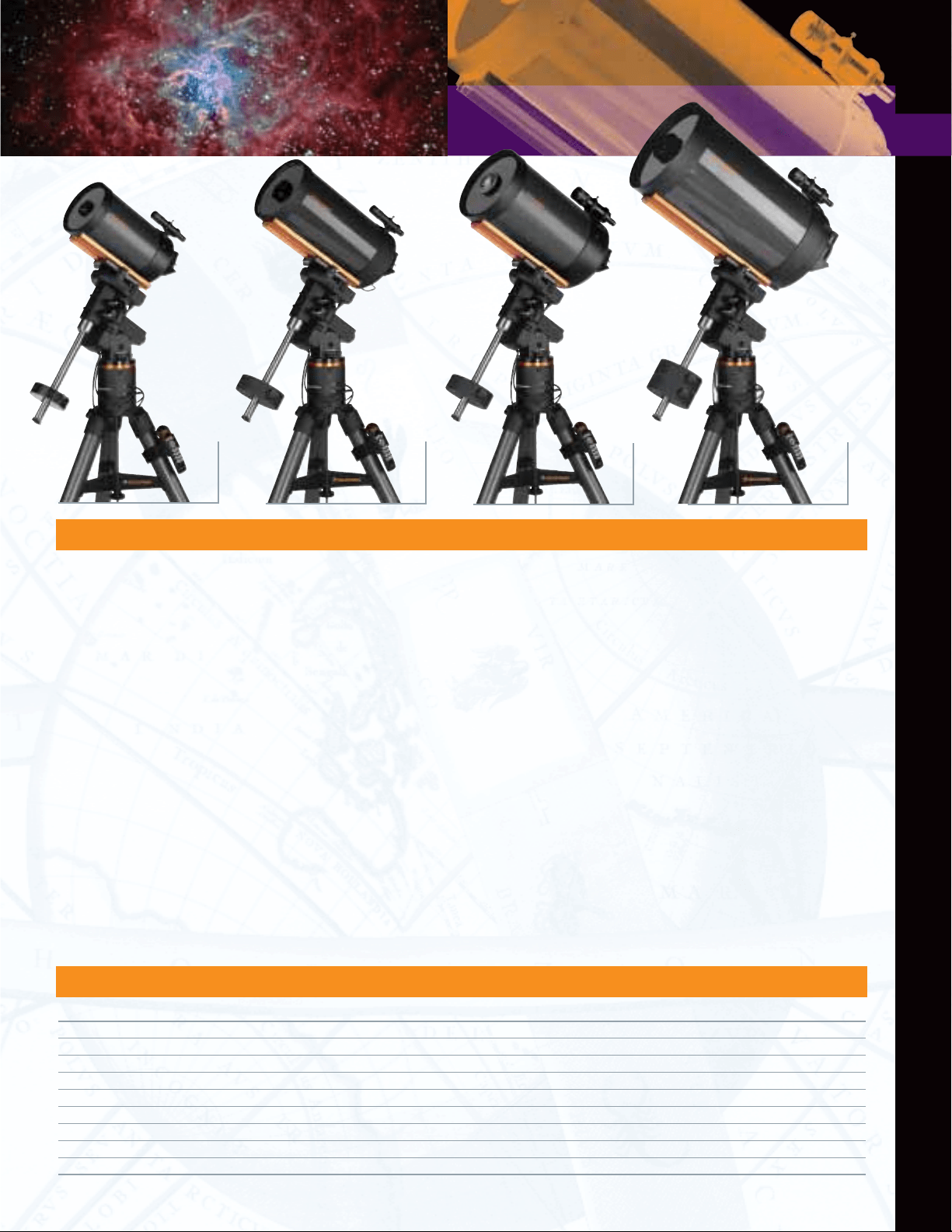
CGE 1400
20
CGE SERIES
Model Item # Aperture Type Focal Length Eyepieces Finderscope Mount Computerized Weight
CGE 800 11058 200mm (8”) Schmidt-Cassegrain 2032mm f/10 25mm (81x) 6x30 CGE Yes 113 lbs
CGE 800 (XLT) 11058-XLT 200mm (8”) Schmidt-Cassegrain 2032mm f/10 25mm (81x) 6x30 CGE Yes 113 lbs
CGE 925 11059 235mm (9
1
/4”) Schmidt-Cassegrain 2350mm f/10 25mm (94x) 6x30 CGE Yes 134 lbs
CGE 925 (XLT) 11059-XLT 235mm (9
1
/4”) Schmidt-Cassegrain 2350mm f/10 25mm (94x) 6x30 CGE Yes 134 lbs
CGE 1100 11061 279mm (11”) Schmidt-Cassegrain 2800mm f/10 40mm (70x) 9x50 CGE Yes 142 lbs
CGE 1100 (XLT) 11061-XLT 279mm (11”) Schmidt-Cassegrain 2800mm f/10 40mm (70x) 9x50 CGE Yes 142 lbs
CGE 1400 11063 355mm (14”) Schmidt-Cassegrain 3910mm f/11 40mm (90x) 9x50 CGE Yes 184 lbs
CGE 1400 (XLT) 11063-XLT 355mm (14”) Schmidt-Cassegrain 3910mm f/11 40mm (90x) 9x50 CGE Yes 184 lbs
CGE 1400 11064-XLT 355mm (14”) Schmidt-Cassegrain 3910mm f/11 40mm (90x) 9x50 CGE Yes 184 lbs
For complete specifications and product information, visit: www.celestron.com
CGE 800
CGE 925
CGE 1100
C
G
E
S
E
R
I
E
S
CGE SERIES FEATURES AT A GLANCE
CGE SERIES SPECIFICATIONS
Mechanical Features
• Carbon Fiber Tube – Strong and lightweight (CGE 925 and 1400 feature
aluminum optical tubes)
• CNC machined aluminum and stainless steel components
• Autoguide port, PC port and auxiliary ports located on the electronic pier
• Strain relief power cord cable protection
• Backlit power switch
• Drive Motors – Made in the U.S.A., Pittman
®
LO-COG™
brush-commutated DC motors offer smooth, quiet operation and long life
• Precision Bronze Worm Gear – 32 pitch, 5.625" pitch diameter, 180 tooth
bronze gear. Manufactured to AGMA Quality Class 10 standard, which
minimizes total composite error and backlash
• Bearing and Shaft – Stainless steel worm shaft has 0.4375 pitch
diameter and is preloaded with two ball bearings; the single piece steel
worm is made to minimize run-out, which is a source of periodic error
• No-slip clutch system for pointing precision
• Schmidt-Cassegrain mechanism that moves the primary mirror to adjust
focus is supported by two pre-loaded ball bearings, minimizing the
“mirror flop” typical of bushing focus mechanisms
• Latitude range: 10º to 60º northern or southern hemispheres
• Maximum payload: 65 lbs
Tripod
• Adjustable height: 36" to 50"
• Leg material: cold rolled carbon steel
• Upper leg diameter: 2.75"; lower leg diameter: 2.375"
Electronic and Software Features
• GoTo system is precision accurate to 1.5 arcminutes
• 40,000+ object database with 400 user-defined objects
• Hibernate – maintains alignment even while powered down
• Polar alignment routines for Northern and Southern hemispheres
• Filter limits – displays only objects above the horizon, also allows for
user-defined limits
• Permanent programmable periodic error correction (PEC) – corrects for
periodic tracking errors inherent to all worm drives
• Smooth ramping of slew motors to reduce wear on the drive train
• Home sensors on R.A. and Dec axes
• Fail-safe slew limit switches in R.A.
• Real-time clock – maintains time even when powered down
• 12VDC Servo Motors with integrated optical encoders with
0.11 arcsecond resolution
• NexRemote™ Included
C14 • Tarantula Nebula • Image courtesy of Sebastian Voltmer
C14 • Tarantula Nebula • Image courtesy of Sebastian Voltmer
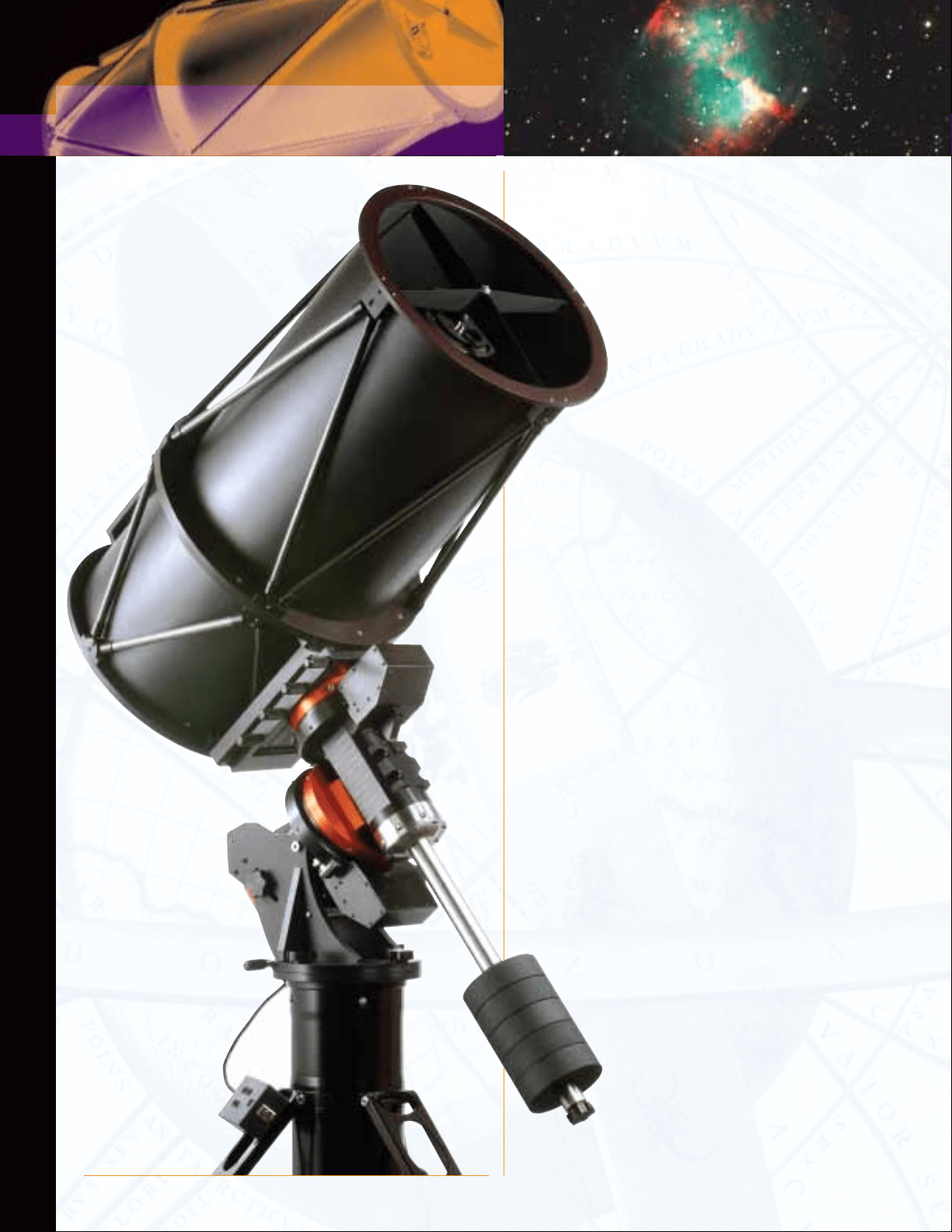
CGE Pro
Observatory-Class
Computerized
German Equatorial
Mount
The C20 Astrograph is a complete telescope system
featuring a revolutionary optical design that delivers
pinpoint stars across the entire field.
Goal: To design, engineer, and manufacture the finest
large aperture optical system possible for both imaging
and visual observation.
Achievement: The C20 Astrograph is the first telescope
system of its kind ever offered by a large commercial
telescope manufacturer.
After evaluating numerous design options, our
solution to the design of this instrument is a 20”
(
1
/2 meter) diameter f/6.8 coma-correct flat-field
Dall-Kirkham Cassegrain (corrected Dall-Kirkham)
optical assembly that is mounted on a newly designed,
massive CGE Pro observatory-class computerized German
Equatorial mount.
Revolutionary Optical System
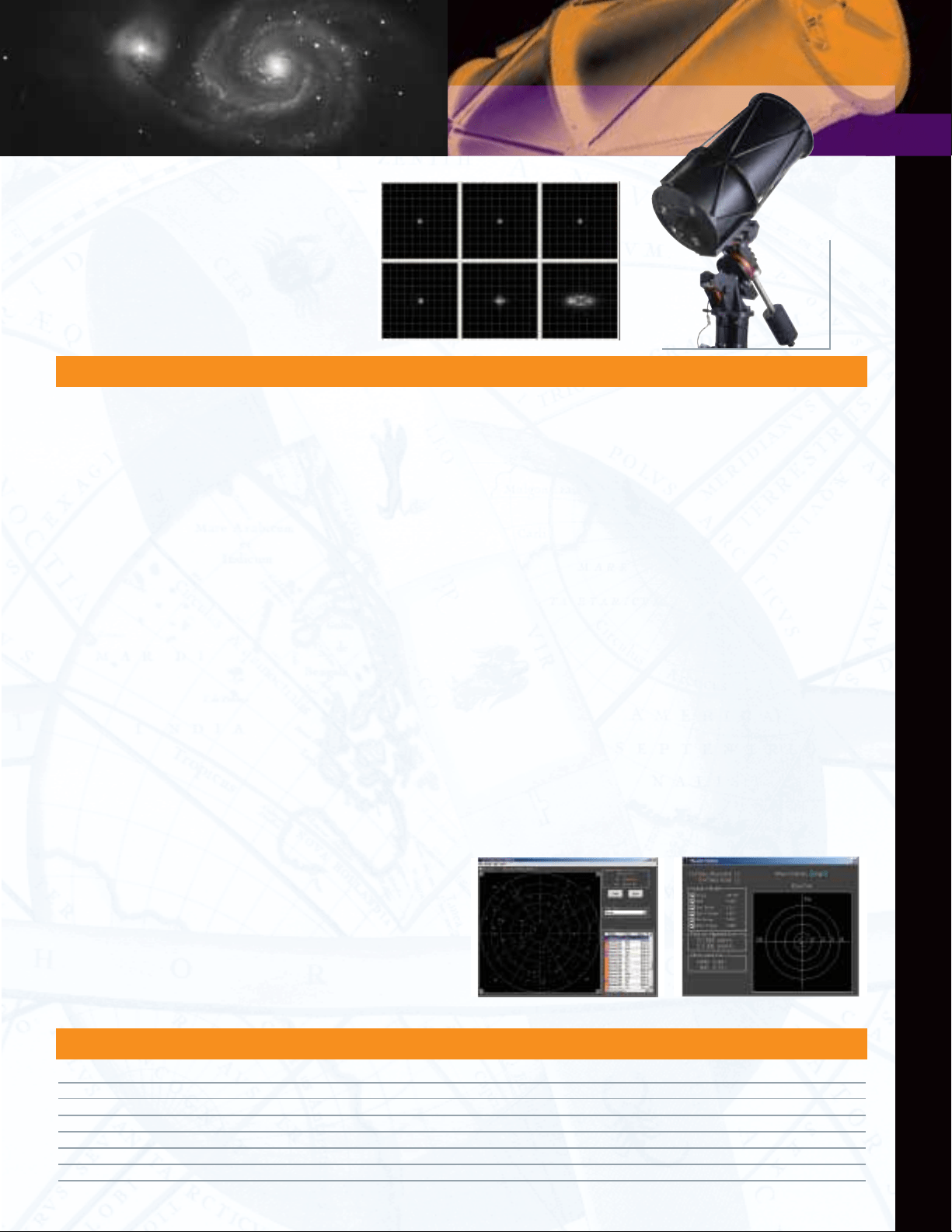
Celestron’s Corrected Dall-Kirkham design exceeds the
off-axis performance of even the Ritchey-Chrétien design. RMS
spot sizes at the edge of a 35mm frame remain smaller than a single
pixel on the most advanced CCD cameras available to amateurs
today. The optical system also features a conical primary mirror with
low thermal mass and three cooling fans to minimize the cool down
time. This no-compromise design provides the superb resolving
power Dall-Kirkham telescopes are known for, but without the coma
and field curvature that has previously limited their wide-field
performance. Because of its flat-field design, you’ll find it a joy to use
for imaging as well as visual use. The C20 optical system will come
standard with Celestron’s advanced StarBright
®
XLT High
Performance Optical system.
The CGE Pro Mount
The tracking accuracy of this observatory-class mount is better than
5 arcseconds peak to valley without enabling the PEC function. The
C20 Astrograph mount separates into three components for easier
transporting and includes fully integrated electronics as well as
Celestron’s renowned and proven NexStar
®
software. It is also
supplied with NexRemote
®
Pro, a software package that creates
models of the mount which yields observatory class pointing
accuracy.
In A Class Of Its Own
Other telescopes that are in this premium category, such as the
Ritchey-Chrétien, cost many thousands of dollars more than a C20
and require that the optical tube, mount, and tripod be purchased
separately. In contrast, the C20 Astrograph is a complete package.
The C20 system includes the optical assembly, a carbon-fiber
truss system which minimizes refocusing due to temperature
changes, high performance computerized German Equatorial
mount, and professional class pier/tripod. The pier will be
available in both portable and permanent versions.
An Engineering Triumph
The C20 is without a doubt the most sophisticated
telescope that Celestron has ever designed and
manufactured. The C20 is a system that meets the
highest standards Celestron sets for technical
innovation, design and engineering superiority,
precision performance, and uncompromising optical quality.
We are now proud to offer our C20 OTA, CGE Pro Mount, CGE Pro
Tripod and CGE Pro Pier for sale separately.
21
C20 ASTROGRAPH
C20 • Dumbbell Nebula • Image courtesy of Richard Hedrick
C20 Astrograph
C
2
0
A
S
T
R
O
G
R
A
P
H
22
Model Item # Aperture Type Focal Length Pier/Tripod
C20 Astrograph 11095 0.51m (20”) Corrected Dall-Kirkham 3454mm f/6.8 Professional Class Portable
C20 Astrograph 11096 0.51m (20”) Corrected Dall-Kirkham 3454mm f/6.8 Professional Class Permanent
C20 OTA 91095 0.51m (20”) Corrected Dall-Kirkham 3454mm f/6.8 N/A
CGE Pro Mount 91520 N/A Computerized German EQ N/A N/A
CGE Pro Tripod 93490 N/A Heavy Duty Field Tripod N/A Professional Class Portable
CGE Pro Pier 93491 N/A Heavy Duty Pier N/A Professional Class Permanent
For complete specifications and product information, visit: www.celestron.com
C20 ASTROGRAPH FEATURES AT A GLANCE
C20 • Whirlpool Galaxy • Image courtesy of Richard Hedrick
C20 ASTROGRAPH SPECIFICATIONS
OTA Features
• Coma-Corrected Flat-Field Dall-Kirkham Cassegrain (Corrected Dall-Kirkham) - The
C20 is called an Astrograph because it is designed for a coma free flat field which
gives pinpoint stars across a large CCD chip or a wide field eyepiece.
• 20” (Half meter) aperture - Large aperture for imaging faint objects with ultra fine
resolution.
• F/6.8 Focal Ratio - A fast system f-ratio for shorter image times and a wider field
of view. This is 28% faster than f/8 and 54% faster than f/10.
• Carbon Fiber Dual Truss Design - both the lower primary mirror cage and the upper
cage are supported by a truss design made of carbon fiber tubes; this minimizes
expansion and contraction due to temperature change, and therefore limits
the change in focus.
• Carbon Fiber Light Shrouds - Carbon fiber light shrouds are available for the C20
OTA; the lower light shroud comes standard while the upper light shroud is optional
and removable. The shrouds physically protect the mirror and block unwanted stray
light.
• Filtered Cooling Fans - Three fans blow filtered air onto the back of the primary
mirror to minimize cool-down times.
• Fixed Conical Primary Mirror - The primary is fixed at Celestron to ensure that the
focal plane of the optics is true to the focal plane of the mechanics; the primary
is molded in a conical shape to reduce thermal mass (for quick cooling) and
minimize flexure of the optics.
• Spherical Secondary - A spherical secondary is much more forgiving to centering
errors compared to ellipsoidal or hyperbolic secondaries used in competing high-end
telescope designs; the result is that with the C20 you can easily align the system
to get the performance you paid for. With aspheric secondaries, you may never
achieve the performance you paid for.
• Dovetail Expansion Joint - the dovetail is made of aluminum and thus expands and
contracts due to temperature changes; the C20 dovetail has a built-in expansion joint
which allows it to expand and contract without inducing stress to the optical tube.
• 3.5” Heavy Load Focuser - This Crayford style focuser has been modified to run
on a lead screw rather than a friction surface; the result is a focuser that can
handle heavy imaging equipment without the focus shifting due to changes
in the telescope’s orientation.
• Temperature Sensors - The C20 has built-in temperature sensors; with the optional
control electronics, the sensors detect the temperature of the primary mirror and
the ambient air, and automatically control the fans to minimize any temperature
differential that may exist.
Mount Features
• Heavy Duty Computerized CGE Pro Mount - Weighing over 150 pounds the mount
is massive enough to hold payloads of 180 pounds.
• Meridian Limits - This mount can track more than 30 degrees beyond the meridian;
this is more than any other German Equatorial mount in the high-end market.
• Internal Wiring - For a permanent setup, the mount has an internal path through
which cable can be routed; for a CCD Camera for instance, the control cable,
the Autoguider cable and the power cable can be routed through the mount
to minimize dangling wires.
• Internal Switches - Built-in optical switches on both axes give the mount a very
accurate home position and will prevent the mount from tracking or slewing
to the point where the Dec axis hits the RA axis.
• Clutch System - Four set screws, orthogonal to the RA and Dec axes, lock the axes
so there is no slipping; when the set screws are loosened, the axes move freely
to facilitate precise balancing of the system.
• NexStar Computerized Control System - The mount comes standard with the latest
NexStar Computerized Control System; both the hand control and motor control
firmware are upgradeable with the latest firmware revisions which can be
downloaded from Celestron’s website.
• NexRemote Pro: Software for controlling the C20 from a personal computer;
NexRemote Pro models the mount to the sky using multiple alignment stars in order
to dramatically increase pointing accuracy. NexRemote Pro has a built-in polar
alignment algorithm accurate enough for a permanent observatory and quick enough
for a one night observing run; this alignment algorithm does not require sighting
on Polaris. Also included is a Finder Screen that acts like a mini-planetarium
program, a Mount Model Screen that displays the mount errors and the expected
pointing accuracy, and a virtual hand control that has most of the features of the
NexStar hand control unit — all displayed on the user’s computer screen.
C
2
0
A
S
T
R
O
G
R
A
P
H
C20 Astrograph
Rear View
Optical performance comparison of the
C20 astrograph with an equivalent
Ritchey-Chrétien (RC) system.
Grid squares are 9 microns and represent the pixel size of the
KAF-6303 CCD. The RC has a curved field and requires a field
flattener to achieve optimum imaging performance. The C20
has an inherently flat field. Simulated wavelength is 550 nm.
Note: The C20 optical performance is the same whether using the system
visually or using the system for imaging since it has a flat field. The RC
design has a curved field. This means that the system will perform
visually like the example labeled RC curved field because the eye can
accommodate the curved field of the design. When imaging, the design
will perform like the example labeled RC flat field.
C20 Astrograph RC Curved Field RC Flat Field
On-axis
Corner of
KAF-6303
CCD (17mm
off-axis)
C20 ASTROGRAPH
NexRemote Pro Finder Screen
NexRemote Pro Mount Model Screen
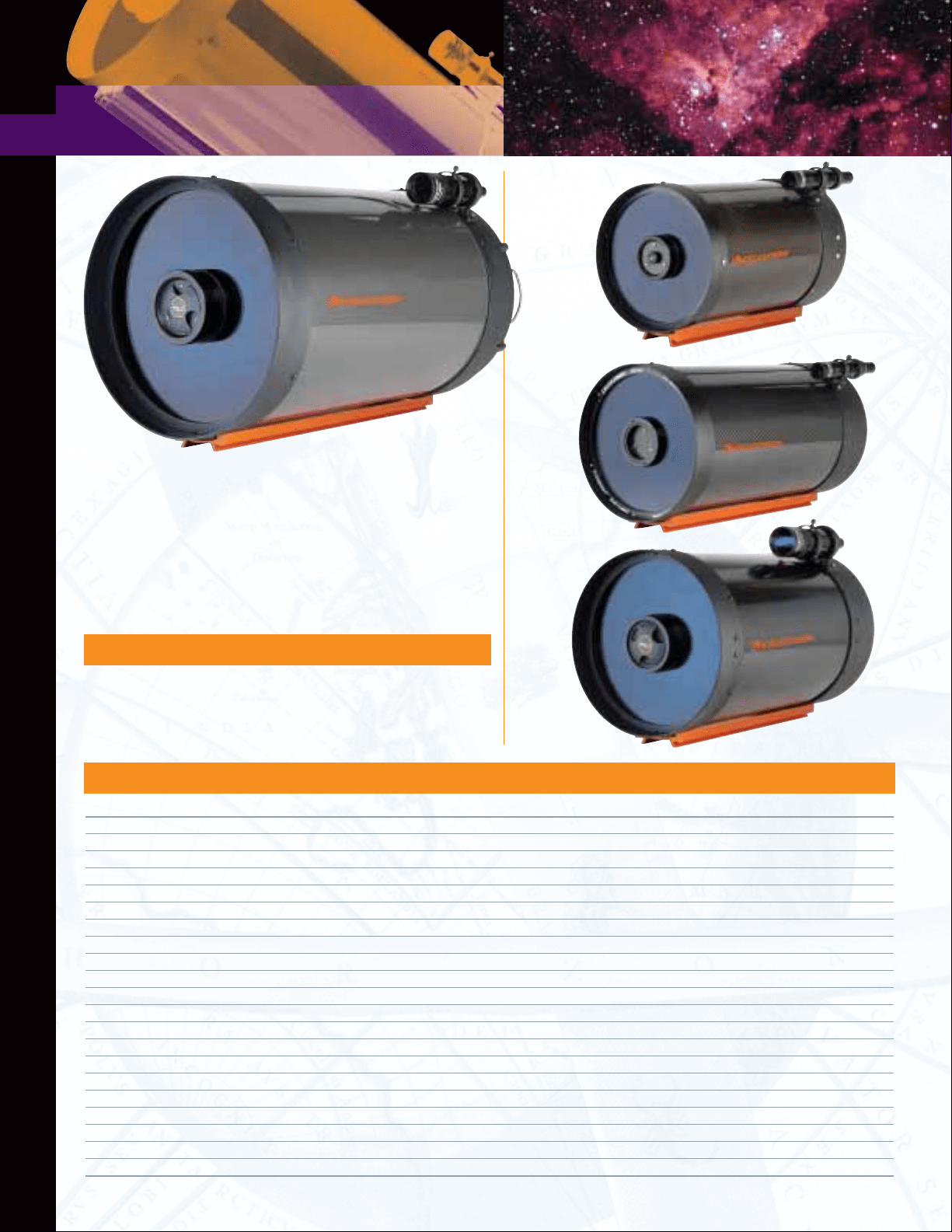
23
OPTICAL TUBE ASSEMBLIES
O
P
T
I
C
A
L
T
U
B
E
A
S
S
E
M
B
L
I
E
S
C8 • Eta Carinae • Image courtesy of Sebastian Voltmer
Model Item # Aperture Type Focal Length Eyepieces Finderscope Dovetail Coatings Weight
C8-A 91024 200mm (8”) Aluminum 2032mm f/10 25mm (81x) 6x30 CGE StarBright
®
12 lbs
C8-A (XLT) 91024-XLT 200mm (8”) Aluminum 2032mm f/10 25mm (81x) 6x30 CGE StarBright
®
XLT 12 lbs
C8-A 91020 200mm (8”) Aluminum 2032mm f/10 25mm (81x) 6x30 CG-5 StarBright
®
12 lbs
C8-A (XLT) 91020-XLT 200mm (8”) Aluminum 2032mm f/10 25mm (81x) 6x30 CG-5 StarBright
®
XLT 12 lbs
C8-CF 91023 200mm (8”) Carbon Fiber 2032mm f/10 25mm (81x) 6x30 CGE StarBright
®
12 lbs
C8-CF (XLT) 91023-XLT 200mm (8”) Carbon Fiber 2032mm f/10 25mm (81x) 6x30 CGE StarBright
®
XLT 12 lbs
C9
1
/4-A 91027 235mm (9
1
/4”) Aluminum 2350mm f/10 25mm (94x) 6x30 CGE StarBright
®
20 lbs
C9
1
/4-A (XLT) 91027-XLT 235mm (9
1
/4”) Aluminum 2350mm f/10 25mm (94x) 6x30 CGE StarBright
®
XLT 20 lbs
C9
1
/4-A 91025 235mm (9
1
/4”) Aluminum 2350mm f/10 25mm (94x) 6x30 CG-5 StarBright
®
20 lbs
C9
1
/4-A (XLT) 91025-XLT 235mm (9
1
/4”) Aluminum 2350mm f/10 25mm (94x) 6x30 CG-5 StarBright
®
XLT 20 lbs
C9
1
/4-CF 91026 235mm (9
1
/4”) Carbon Fiber 2350mm f/10 25mm (94x) 6x30 CGE StarBright
®
20 lbs
C9
1
/4-CF (XLT) 91026-XLT 235mm (9
1
/4”) Carbon Fiber 2350mm f/10 25mm (94x) 6x30 CGE StarBright
®
XLT 20 lbs
C11-A 91036 279mm (11”) Aluminum 2800mm f/10 40mm (70x) 9x50 CGE StarBright
®
27 lbs
C11-A (XLT) 91036-XLT 279mm (11”) Aluminum 2800mm f/10 40mm (70x) 9x50 CGE StarBright
®
XLT 27 lbs
C11-CF 91035 279mm (11”) Carbon Fiber 2800mm f/10 40mm (70x) 9x50 CGE StarBright
®
27 lbs
C11-CF (XLT) 91035-XLT 279mm (11”) Carbon Fiber 2800mm f/10 40mm (70x) 9x50 CGE StarBright
®
XLT 27 lbs
C11-A 91067 279mm (11”) Aluminum 2800mm f/10 40mm (70x) 9x50 CG-5 StarBright
®
27 lbs
C11-A (XLT) 91067-XLT 279mm (11”) Aluminum 2800mm f/10 40mm (70x) 9x50 CG-5 StarBright
®
XLT 27 lbs
C14-A 91037 355mm (14”) Aluminum 3910mm f/11 40mm (98x) 9x50 CGE StarBright
®
45 lbs
C14-A (XLT) 91037-XLT 355mm (14”) Aluminum 3910mm f/11 40mm (98x) 9x50 CGE StarBright
®
XLT 45 lbs
C14-A (XLT) 91038-XLT 355mm (14”) Aluminum 3910mm f/11 40mm (98x) 9x50 CGE StarBright
®
XLT 45 lbs
OPTICAL TUBE ASSEMBLY SPECIFICATIONS
For complete specifications and product information, visit: www.celestron.com
Celestron Schmidt-Cassegrain Optical Tube Assemblies (OTA) are available
individually for use with your favorite mount. Each OTA is made to the same
exacting standards as those used on all our high quality telescopes.
All optical surfaces are coated with Celestron’s high efficiency StarBright
®
multi-layered coating group. These tube assemblies are equipped with the
same dovetail mounting bar used on the CGE and Advanced Series for easy
attachment to a variety of popular mounts. Every tube assembly is made,
assembled and quality control tested at our manufacturing facility in
Torrance, California.
C14-A
C8-CF
C9
1
/4-CF
C11-CF
OTA FEATURES AT A GLANCE
• Carbon fiber or aluminum tube available on 8” through 11” tubes
• 14” models available only in aluminum
• Optional StarBright
®
XLT coating is available on all models
• Item #s 91023 and 91038 are FASTAR compatible
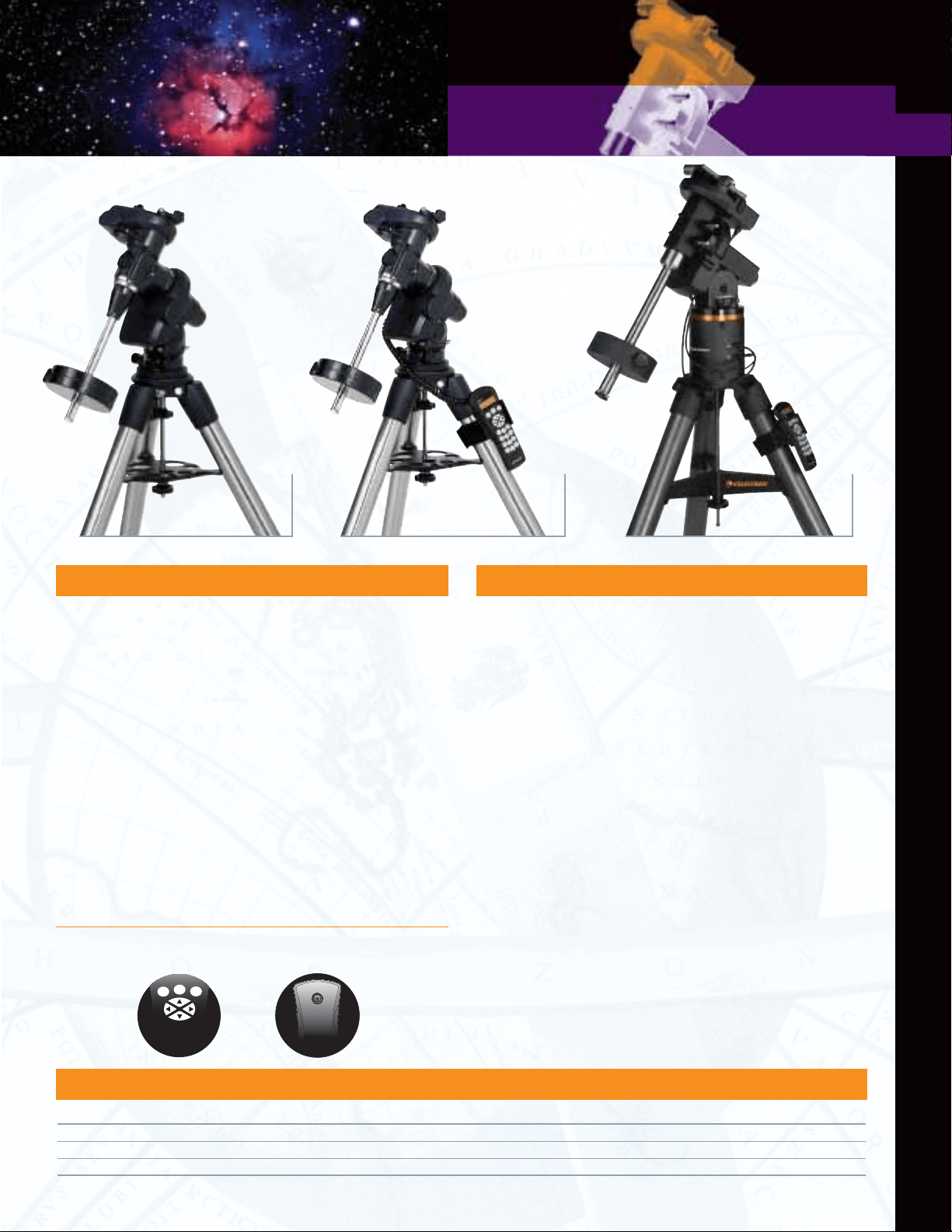
24
MOUNTS
For complete specifications and product information, visit: www.celestron.com
CG-5
Mount
M
O
U
N
T
S
CG-5 MOUNT FEATURES
C8 • Trifid Nebula • Image courtesy of Sebastian Voltmer
MOUNT SPECIFICATIONS
CG-5 Mount — Precision engineered for stability
The CG-5 German Equatorial mount has precision worm gears on both axes for
extremely smooth operation. The key element that makes this system the most
stable in its class is the heavy-duty tripod with larger and more substantial legs
that offer excellent damping characteristics for more stable views. The CG-5
also has a convenient latitude scale for easier alignment and an optional polar
finder scope for the ultimate in precision alignments.
CG-5 Computerized — GoTo convenience and
GPS compatibility for precision accuracy
We are proud to offer a computerized GoTo version of Celestron's sturdy CG-5
mount. Couple this solid mount with the included computerized control system
to utilize many of the same functions and features — like the NexStar
computer control system and an Autoguider port for long exposure deep sky
astrophotography — as Celestron's most advanced GoTo telescopes. GoTo
models are also upgradeable to GPS with the optional CN16 GPS Accessory
(#93966) allowing your telescope to pinpoint your position on the earth, the
date and time, making the alignment process faster and easier than ever
before!
CG-5
Computerized
Mount
Recognized For Superior Stability
An improved Super HD Tripod supports the CGE mount. This fully
extendable tripod is made from the finest cold rolled carbon steel and
can be raised to a height of 50". The tripod uses a dual leg support for
maximum rigidity with an upper leg brace to provide an outward preload
and a lower leg brace providing inward tension.
CGE Equatorial Mounts Can Easily be Balanced
on Both Axes
Balancing the weight of camera equipment and other visual accessories is
accomplished by simply sliding the counterweight for Right Ascension and
moving the optical tube along its dovetail mounting for Declination. This
means that no additional weight needs to be added to balance the
telescope when additional accessories are added.
Clearance For Accessories
CGE mounts support their tubes at a single contact point allowing the tube
to move freely around its polar axis without making contact with the
telescope’s mount. This is particularly useful when adding photographic
and CCD instruments that extend from the rear of the telescopes.
GPS Compatible
All CGE mounts are compatible with Celestron’s CN16 GPS accessory
(Item #93967). Combine the GPS and built-in Hibernate mode and these
mounts will keep track and remember their exact location and time
without the need to re-enter the information into the remote hand control.
CGE MOUNT FEATURES
Model Item # Description Weight
CG-5 Mount 91517 German Equatorial Mount and Tripod. Includes one 11lb. Weight 41 lbs
CG-5 Computerized Mount 91518 Same as #91517 plus dual-axis slew motors and computerized hand control w/ 40,000+ object database 42 lbs
CGE Computerized Mount 91524 German Equatorial Mount and Tripod. Includes one 25lb. weight 114 lbs
CGE
Mount
Options Available On Computerized Mounts
See product specifications for applicable models.
NexRemote
®
Remote Control
Software
ALIGN
ENTER
UNDO
CN16
GPS Accessory
25
ACCESSORIES
A
C
C
E
S
S
O
R
I
E
S
C11 using Celestron’s NexImage • Jupiter • Image courtesy of Jason Fournier
For complete specifications and product information, visit: www.celestron.com
Astro Imaging Made Easy
Whether you currently own a telescope
or are contemplating a purchase, Celestron’s
NexImage™ Solar System Imaging Kit is a
MUST HAVE!
NexImage is a complete CCD solar system
imager capable of producing high quality
planetary images with greater light sensitivity
and color fidelity than comparable CMOS imagers. Combined with the
NexImage software package, NexImage can bring out tremendous detail and
reveal a final image that will rival those taken with astronomical CCD
cameras costing thousands of dollars more.
• View and capture live video on your computer screen
• Software automatically filters out video frames most affected by poor
atmospheric "seeing" leaving only the sharpest, clearest frames to be
stacked and aligned into one high quality image
• Easy to follow quick start instructions and tutorial with sample video file
that will have you producing quality images your first night out
• Camera control software allows you to manually change the gain, contrast,
exposure time, frame rate and color saturation using your PC
• Compatibility – threaded on 1.25" adapter barrel makes NexImage
compatible with most any telescope.
• Versatility – 1.25"adapter is threaded for standard eyepiece filters and can
be removed and replaced with optional focal reducer lens.
• Tutorial – step-by-step Quick start and tutorial complete with sample video
file that will have you producing quality images your first night out.
• Power – NexImage uses a
1
/4" format color CCD chip that gives the same
approximate magnification as a 5mm, 50° field of view eyepiece.
NexImage comes with the following:
• NexImage Camera with 1.25” adapter and USB cable attached (7ft long)
• CD-ROM including:
-Image capture software – to capture streaming video of image
-Image processing software – to align and stack individual frame into one
high quality image.
• Quick Setup and Tutorial – complete with sample images
NexImage Specifications
• Chip:
1
/4" format, HAD, color CCD chip
• Resolution: VGA 640x480; Size: 3.6mm x 2.7 (4.5mm diagonal)
• Pixel Size: 5.6 micron square
• Sensitivity: <1 lux
Recommended Minimum System Requirements:
• PC running Windows 98SE or better; 333Mhz Pentium II or better
• 128 MB of RAM; 40 MB of hard drive space
• Screen resolution of 1024x768 or higher
NEXIMAGE FEATURES
Model Item # Description
NexImage 93712 CCD Solar System Imager
Please visit our web site to see our full line of
accessories designed to enhance your astronomical
experience. www.celestron.com
PowerTank 7 & 17
Take your telescope anywhere with this
portable rechargeable power supply.
PowerTanks include an emergency light, and
booster terminals to start weak car batteries.
POWER TANK FEATURES
Model Item # Description
PowerTank 7 18774 Portable Rechargeable Power Supply
PowerTank 17 18777 Portable Rechargeable Power Supply
Eyepiece and Filter Kit
All eyepieces are fully multi-coated offering
superb color resolution, edge sharpness and
clarity. Supplied are a 4mm,6mm, 9mm,
15mm, and 32mm.
A 2x Barlow Lens complements the Plössl
eyepieces in this kit and gives you a total of
ten power combinations. High grade glass
optics with fully multi-coated lenses are used
so there is no degradation of image. Also included are a variety of lunar
and planetary filters, a moon filter and aluminum carrying case.
• Five Superior Grade Plössl Eyepieces - 1.25” — 4-element design with
a 52° AFOV (32mm has 44° ); Barlow Lens - 2x 1.25”
• Six Colored Eyepiece (Lunar & Planetary) Filters - 1.25” — Included are
Kodak Wratten #12, #21, #25, #56, #58A, and #80A. These filters will
greatly enhance your enjoyment of our solar system.
• Moon Filter - 1.25” — A neutral density filter which allows you
maximum enjoyment of the moon especially during the brighter phases.
• Aluminum Carrying Case — This sturdy case fits all of the above items
in the die-cut foam interior and has room for additional accessories.
Model Item # Description
Eyepiece & Filter Kit 94303 1.25” Eyepieces & Filters
EYEPIECE & FILTER KIT FEATURES
PowerTank 7
• 7-amp hour, 12 Volt D.C.
• Two 12V output cigarette
lighter ports
• 3V, 6V and 9V outputs for
accessories
• Built-in flashlight with red filter cap
• 800,000 candle power Halogen
emergency spotlight
• Booster terminal on rear side
• Built-in Circuit Breaker for safety
• Cigarette lighter adapter included
• 110V/220V switchable universal
AC adapter included
PowerTank 17
• 17 amp hour, 12 Volt D.C.
• 2 x 12V DC output car jack socket
• 3V, 6V, 9V output jacks
• Built-in AM/FM Radio and Siren
• Removable red filtered flashlight
with magnetic back
• Built-in multi-angle 800,000cp
emergency Halogen spotlight
• Handy jump-start system - 250
cranking AMPS (5 sec.)
• Built-in circuit breaker for safety
• Cigarette lighter adapter included
• Switchable 110V-220V AC adapter
26
FIRSTSCOPE SERIES
SPECIFICATIONS
F
I
R
S
T
S
C
O
P
E
S
E
R
I
E
S
S
P
E
C
S
FirstScope 21052 21067 21076 31032
Models FirstScope 60AZ FirstScope 60EQ FirstScope 70EQ FirstScope 76 EQ
Specifications
Optical Design Refractor Refractor Refractor Reflector
Aperture 60mm (2.4") 60mm (2.4") 70mm (2.8") 76mm (3")
Focal Length/Ratio 700mm F/12 900mm F/15 900mm F/13 700mm F/9
Finderscope StarPointer StarPointer StarPointer StarPointer
Mount Altazimuth Equatorial Equatorial Equatorial
Eyepiece 20mm (35X) 20mm (45x) 20m (45x) 20mm (35x)
Eyepiece 10mm (70X) 10mm (90x) 10mm (90x) 10mm (70x)
Star Diagonal / Erect Image Eyepiece 1.25" / 1.5x E.I. Eyepiece 1.25" 90º 1.25" 90º n/a
Accessory Tray Round, Thread-in Round, Thread-in Round, Thread-in Round, Thread-in
Tripod Aluminum Aluminum Aluminum Aluminum
CD ROM The Sky L1 The Sky L1 The Sky L1 The Sky L1
Technical Specifications
Highest Useful Magnification 142x 142x 165x 180x
Limiting Stellar Magnitude 11.4 11.4 11.7 11.9
Resolution: Rayleigh 2.31 arc seconds 2.31 arc seconds 1.98 arc seconds 1.82 arc seconds
Dawes Limit 1.93 arc seconds 1.93 arc seconds 1.66 arc seconds 1.53 arc seconds
Light Gathering Power 73x unaided eye 73x unaided eye 100x unaided eye 118x unaided eye
Field of View: standard eyepiece 1.20º .90º .90º 1.20º
Linear FOV (@1000 yds) 75 ft. 58 ft 48 ft 62 ft.
Secondary Mirror Obstruction n/a n/a n/a .75" (25% by diameter, 6% by area)
Optical Coatings Fully Coated Fully Coated Fully Coated Aluminum
Optical Tube Length 28 inches 30 inches 30 inches 27 inches
Telescope Weight 7 lbs 11 lbs 17 lbs 15 lbs
FirstScope 21084 21085 31041 31044
Models FirstScope 90AZ FirstScope 90EQ FirstScope 114 Compact FirstScope 114
Specifications
Optical Design Refractor Refractor Reflector Reflector
Aperture 90mm (3.5") 90mm (3.5") 114mm (4.5") 114mm (4.5")
Focal Length 1000mm F/11 1000mm F/11 1000mm F/9 900mm F/8
Finderscope StarPointer StarPointer StarPointer StarPointer
Mount Altazimuth Equatorial Equatorial Equatorial
Eyepiece 20mm (50x) 20mm (50x) 20mm (50x) 20mm (45x)
Eyepiece 10mm (100x) 10mm (100x) 10mm (100x) 10mm (90x)
Star Diagonal / Erect Image Eyepiece 1.25" 45º Erect Image 1.25" 90º n/a n/a
Accessory Tray Round, Thread-in Round, Thread-in Round, Thread-in Round, Thread-in
Tripod Aluminum Aluminum Aluminum Aluminum
CD ROM The Sky L1 The Sky L1 The Sky L1 The Sky L1
Technical Specifications
Highest Useful Magnification 213x 213x 269x 269x
Limiting Stellar Magnitude 12.3 12.3 12.8 12.8
Resolution: Rayleigh 1.54 arc seconds 1.54 arc seconds 1.21 arc seconds 1.21 arc seconds
Dawes Limit 1.29 arc seconds 1.29 arc seconds 1.02 arc seconds 1.02 arc seconds
Light Gathering Power 165x unaided eye 165x unaided eye 265x unaided eye 265x unaided eye
Field of View: standard eyepiece .80º .80º .80º .90º
Linear FOV (@1000 yds) 43 ft. 43 ft. 43 ft. 48 ft.
Secondary Mirror Obstruction n/a n/a 1.4" (31% by diameter, 10% by area) 1" (22% by diameter, 5% by area)
Optical Coatings Multi-Coated Multi-Coated Aluminum Aluminum
Optical Tube Length 40 inches 40 inches 20 inches 34 inches
Telescope Weight 19 lbs 22 lbs 16 lbs 19 lbs
Specifications are subject to change without notice or obligation.
FirstScope 60 • Moon • Image courtesy of Klaus Modinger
FirstScope 60 • Moon • Image courtesy of Klaus Modinger
27
STARHOPPER SERIES
SPECIFICATIONS
S
T
A
R
H
O
P
P
E
R
S
E
R
I
E
S
S
P
E
C
S
C14 • Mars • Image courtesy of Sebastian Voltmer
StarHopper 10600 10800 10110 10112
Models StarHopper 6 StarHopper 8 StarHopper 10 StarHopper 12
Optical Design Dobsonian Reflector Dobsonian Reflector Dobsonian Reflector Dobsonian Reflector
Aperture 6” (152mm) 8” (203mm) 10” (254mm) 12” (305mm)
Focal Length 48" (1219mm) 48" (1219mm) 50" (1270mm) 60" (1500mm)
Focal Ratio f/8 f/6 f/5 f/5
Eyepieces 25mm Plossl 1.25” 25mm Plossl 1.25” 32mm e-lux 2" 32mm e-lux 2"
Collimation Cap Yes Yes Yes Yes
Eyepiece Tray Yes Yes Yes Yes
Focuser 1.25" 2" 2" 2"
Finder 6x30 9x50 9x50 9x50
Primary BK7 BK7 BK7 BK7
Cooling N/A N/A Fan Fan
Mirror Cell 3-point 3-point 3-point 9-point
Azimuth Bearing Roller track Roller track Roller track Roller track
Altitude Bearing Nylon Cylinder Nylon Cylinder Nylon Cylinder Nylon Cylinder
Tension System Variable friction clutch Variable friction clutch Variable friction clutch Variable friction clutch
Handle Base Base Base Base
Tube Steel Steel Steel Steel
Highest Useful Magnification 359x 480x 600x 721x
Lowest Useful Magnification 22x 29x 36x 44x
Limiting Stellar Magnitude 13.4 14 14.5 14.9
Resolution: Rayleigh .91 arcsec .68 arcsec .54 arcsec .45 arcsec
Dawes Limit .76 arcsec .57 arcsec .46 arcsec .38 arcsec
Light Gathering Power 472 843 1317 1898
Field of View: standard eyepiece (°) 1.03 1.03 1.0 0.83
Linear FOV (@1000 yds) 54.1 54.1 52.5 43.6
Secondary Mirror Obstruction (inches) 1.5 1.95 2.5 2.75
by Diameter 25% 24% 25% 23%
by Area 6.3% 5.9% 6.3% 5.3%
Optical Tube Length 45” 45” 48” 58”
Telescope Weight 46 lbs 54 lbs 65 lbs 80 lb
Specifications are subject to change without notice or obligation.
28
N
E
X
S
T
A
R
S
L
T
S
E
R
I
E
S
S
P
E
C
S
C8 • NGC 772 • Image courtesy of Sebastian Voltmer
NexStar SLT 22076 22086 22096 31143 31145
Models NexStar 60 SLT NexStar 80 SLT NexStar 102 SLT NexStar 114 SLT NexStar 130 SLT
Specifications
Optical Design Refractor Refractor Refractor Reflector Reflector
Aperture (mm) 60mm (2.4') 80mm (3.1") 102mm (4") 114mm (4.5") 130mm (5")
Focal Length (mm) 700mm 900mm 660mm 1000mm 650mm
Focal Ratio F/12 F/11 F/6.5 F/9 F/5
Finderscope StarPointer StarPointer StarPointer StarPointer StarPointer
Mount Motorized Altazimuth Motorized Altazimuth Motorized Altazimuth Motorized Altazimuth Motorized Altazimuth
Eyepiece (mm) 25mm (28x) 25mm (36x) 25mm (26x) 25mm (40x) 25mm (26x)
Eyepiece (mm) 9mm (78x) 9mm (100x) 9mm (73x) 9mm (111x) 9mm (72x)
Star Diagonal 1.25" 1.25" 1.25" n/a n/a
Accessory Tray No Tool, Quick release No Tool, Quick release No Tool, Quick release No Tool, Quick release No Tool, Quick release
Tripod Pre-assembled Steel Pre-assembled Steel Pre-assembled Steel Pre-assembled Steel Pre-assembled Steel
CD ROM The Sky L1 & NSOL The Sky L1 & NSOL The Sky L1 & NSOL The Sky L1 & NSOL The Sky L1 & NSOL
Telescope Control System NexStar Computer NexStar Computer NexStar Computer NexStar Computer NexStar Computer
Control System Control System Control System Control System Control System
Computerized Hand Control Double line 16 character, Double line 16 character, Double line 16 character, Double line 16 character, Double line 16 character,
Liquid Crystal Display; Liquid Crystal Display; Liquid Crystal Display; Liquid Crystal Display; Liquid Crystal Display;
19 LED backlit buttons 19 LED backlit buttons 19 LED backlit buttons 19 LED backlit buttons 19 LED backlit buttons
Database 4,000 Object Database 4,000 Object Database 4,000 Object Database 4,000 Object Database 4,000 Object Database
Slew Speeds Nine slew speeds: 4º /sec, Nine slew speeds: 4º /sec, Nine slew speeds: 4º /sec, Nine slew speeds: 4º /sec, Nine slew speeds: 4º /sec,
2º /sec, 1º/sec, .5 /sec, 2º /sec, 1º/sec, .5 /sec, 2º /sec, 1º/sec, .5 /sec, 2º /sec, 1º/sec, .5 /sec, 2º /sec, 1º/sec, .5 /sec,
32x,16x, 8x, 4x, 2x 32x,16x, 8x, 4x, 2x 32x,16x, 8x, 4x, 2x 32x,16x, 8x, 4x, 2x 32x,16x, 8x, 4x, 2x
Tracking Rates Sidereal, Solar and Lunar Sidereal, Solar and Lunar Sidereal, Solar and Lunar Sidereal, Solar and Lunar Sidereal, Solar and Lunar
Tracking Modes Alt-Az, EQ North & EQ South Alt-Az, EQ North & EQ South Alt-Az, EQ North & EQ South Alt-Az, EQ North & EQ South Alt-Az, EQ North & EQ South
GPS Compatible CN-16 GPS Accessory CN-16 GPS Accessory CN-16 GPS Accessory CN-16 GPS Accessory CN-16 GPS Accessory
Alignment Procedures SkyAlign, Auto 2-Star Align, SkyAlign, Auto 2-Star Align, SkyAlign, Auto 2-Star Align, SkyAlign, Auto 2-Star Align, SkyAlign, Auto 2-Star Align,
1-Star Align, 2-Star Align, 1-Star Align, 2-Star Align, 1-Star Align, 2-Star Align, 1-Star Align, 2-Star Align, 1-Star Align, 2-Star Align,
Solar System Align Solar System Align Solar System Align Solar System Align Solar System Align
Technical Specifications
Highest Useful Magnification 142x 189x 240x 269x 306x
Limiting Stellar Magnitude 11.4 12 12.5 12.8 13.1
Resolution: Rayleigh (arc sec) 2.31 arc seconds 1.73 arc seconds 1.36 arc seconds 1.21 arc seconds 1.06 arc seconds
Dawes Limit (arc sec) 1.93 arc seconds 1.45 arc seconds 1.14 arc seconds 1.02 arc seconds .89 arc seconds
Photographic Resolution 171 lines/mm 182 lines/mm 308 lines/mm 228 line/mm 400 line/mm
Light Gathering Power 73x unaided eye 131x unaided eye 212x unaided eye 265x unaided eye 345x unaided eye
Field of View (degrees)
w/ low power eyepiece 1.6º 1.3º 1.7º 1.1º 1.7º
Linear FOV (ft@1000 yds) 84 ft. 66 ft. 91 ft. 59 ft 91 ft.
Optical Coatings Fully Coated Fully Coated Multi-Coated Aluminum Aluminum
Secondary Mirror Obstruction n/a n/a n/a 1.6" 1.7"
Secondary Mirror Obstruction (dia.) n/a n/a n/a 36% 34%
Secondary Mirror Obstruction (area) n/a n/a n/a 13% 12%
Optical Tube Length 28 inches 34 inches 23 inches 19 inches 21 inches
Telescope Weight 10 lbs 14 lbs 14 lbs 15 lbs 18 lbs
NEXSTAR SLT SERIES
SPECIFICATIONS
Specifications are subject to change without notice or obligation.
29
A
D
V
A
N
C
E
D
S
E
R
I
E
S
S
P
E
C
S
ADVANCED SERIES
SPECIFICATIONS
C11 • Flame Nebula • Image courtesy of Sebastian Voltmer
Advanced 21021 21026 21016 31063 31056 31053
Model C80ED-R C100ED-R C4-R C130-M C6-N C6-N HD
Specifications
Optical Design Refractor Refractor Refractor Maksutov-Cassegrain Reflector Reflector
Aperture 80mm (3.2") 100mm (4") 102mm (4") 130mm(5") 150mm (6") 150mm (6")
Focal Length/Ratio 600mm F/7.5 900mm F/9 1000mm F/10 2000mm F/15.3 750mm f/5 750mm f/5
Eyepiece 20mm (30x) 20mm (45x) 20mm (50x) 32mm (63x) 20mm (38x) 20mm (38x)
Finderscope 6x30 9x50 6x30 10x50 6x30 6x30
Mount CG-5 Equatorial CG-5 Equatorial CG-4 Equatorial CG-5 Equatorial CG-4 Equatorial CG-5 Equatorial
Star Diagonal 1.25" 1.25" 1.25" 1.25" n/a n/a
Accessory Tray yes yes yes yes yes yes
Tripod 2" Stainless Steel 2" Stainless Steel Aluminum 2" Stainless Steel Aluminum 2" Stainless Steel
CD ROM The Sky L1 The Sky L1 The Sky L1 The Sky L1 The Sky L1 The Sky L1
Counterweights 1-7lbs 1-11 lbs 1-7lb, 1-4lbs 1-11lbs 1-7lbs, 1-4lbs 1-7lbs, 1-4lbs
Power (GT versions only) Car Battery Adapter Car Battery Adapter Car Battery Adapter Car Battery Adapter Car Battery Adapter Car Battery Adapter
Fastar Compatible n/a n/a n/a n/a n/a n/a
Highest Useful Magnification 189x 236x 241x 300x 354x 354x
Lowest Useful Magnification 11x 14x 15x 18x 21x 21x
Limiting Stellar Magnitude 12 12.5 12.5 14 13.4 13.4
Resolution: Rayleigh 1.73 arc seconds 1.38 arc seconds 1.36 arc seconds 1.1arc seconds .92 arc seconds .92 arc seconds
Dawes Limit 1.45 arc seconds 1.16 arc seconds 1.14 arc seconds .91 arc seconds .77 arc seconds .77 arc seconds
Light Gathering Power 131x unaided eye 204x unaided eye 212x unaided eye 329x unaided eye 459x unaided eye 459x unaided eye
Field of View: standard eyepiece 1.67º 1.1º 1º .83º 1.3º 1.3º
Linear FOV (@1000 yds) 87.5 ft 70 ft 52.5 ft 44 ft. 68 ft. 68 ft.
Optical Coatings Fully Multi-Coated Fully Multi-Coated Multi-Coated Multi-Coated Aluminum Aluminum
Secondary Mirror Obstruction n/a n/a n/a 1.5” 1.75" 1.75"
by Area n/a n/a n/a 9% 8.5% 8.5%
by Diameter n/a n/a n/a 29% 29% 29%
Optical Tube Length 23 inches 34 inches 40 inches 18 inches 27 inches 27 inches
Telescope Weight 42 lbs 50 lbs 36 lbs 51 lbs 35 lbs 54 lbs
Advanced 21022 21027 31064 31054
Computerized Models C80ED-RGT C100ED-RGT C130-MGT C6-N GT
Additional Specifications for Computerized Models
Computerized Hand Control Double line 16 character, Double line 16 character, Double line 16 character, Double line 16 character,
Liquid Crystal Display; Liquid Crystal Display; Liquid Crystal Display; Liquid Crystal Display;
19 LED backlit buttons 19 LED backlit buttons 19 LED backlit buttons 19 LED backlit buttons
Max Slew Speed 3º/second 3º/second 3º/second 3º/second
Software Precision 24bit, 0.08 24bit, 0.08 24bit, 0.08 24bit, 0.08
arcsec calculation arcsec calculation arcsec calculation arcsec calculation
Hand Control Ports RS-232 communication RS-232 communication RS-232 communication RS-232 communication
port on hand control port on hand control port on hand control port on hand control
Motor Ports Aux Port, Autoguide Ports Aux Port, Autoguide Ports Aux Port, Autoguide Ports Aux Port, Autoguide Ports
Tracking Rates Sidereal, Solar and Lunar Sidereal, Solar and Lunar Sidereal, Solar and Lunar Sidereal, Solar and Lunar
Tracking Modes EQ North & EQ South EQ North & EQ South EQ North & EQ South EQ North & EQ South
Alignment Procedures AutoAlign, 2-Star AutoAlign, 2-Star AutoAlign, 2-Star AutoAlign, 2-Star
Alignment, Quick Align Alignment, Quick Align Alignment, Quick Align Alignment, Quick Align
Database 40,000+ objects, 40,000+ objects, 40,000+ objects, 40,000+ objects,
400 user defined 400 user defined 400 user defined 400 user defined
programmable objects programmable objects programmable objects programmable objects
Enhanced information Enhanced information Enhanced information Enhanced information
on over 200 objects on over 200 objects on over 200 objects on over 200 objects
Complete Revised NGC Catalog 7,840 7,840 7,840 7,840
Complete Messier Catalog 110 110 110 110
Complete IC Catalog 5,386 5,386 5,386 5,386
Complete Caldwell 109 109 109 109
Abell Galaxies 2,712 2,712 2,712 2,712
Solar System objects 9 9 9 9
Famous Asterisms 20 20 20 20
Selected CCD Imaging Objects 25 25 25 25
Selected SAO Stars 29,500 29,500 29,500 29,500
Total Object Database 45,492 45,492 45,492 45,492
Specifications are subject to change without notice or obligation.
Advanced 21019 11025/11025-XLT 31061 11045/11045-XLT 11047 11066/11066-XLT
Standard Models C6-R C8-S C8-N C9.25-S C10-N C11-S
Specifications
Optical Design Refractor Schmidt-Cassegrain Reflector Schmidt-Cassegrain Reflector Schmidt-Cassegrain
Aperture 150mm (6") 203mm (8") 200mm (8") 235mm (9.25") 254mm (10") 279mm (11")
Focal Length/Ratio 1200mm F/8 2032mm F/10 1000mm F/5 2350mm F/10 1200mm F/4.7 2800mm F/10
Eyepiece 20mm (60x) 25mm (81x) 20mm (50x) 25mm (94x) 20mm (60x) 40mm (70x)
Finderscope 9x50 6x30 9x50 6x30 9x50 9x50
Mount CG-5 Equatorial CG-5 Equatorial CG-5 Equatorial CG-5 Equatorial CG-5 Equatorial CG-5 Equatorial
Star Diagonal 1.25" 1.25" n/a 1.25" n/a 1.25"
Accessory Tray yes yes yes yes yes yes
Tripod 2" Stainless Steel 2" Stainless Steel 2" Stainless Steel 2" Stainless Steel 2" Stainless Steel 2" Stainless Steel
CD ROM The Sky L1 The Sky L1 The Sky L1 The Sky L1 The Sky L1 The Sky L1
Counterweights 2-11lbs 1-11lbs 2-11lbs 2-11lbs 3-11lbs 3-11lbs
Power (GT versions only) Car Battery Adapter Car Battery Adapter Car Battery Adapter Car Battery Adapter Car Battery Adapter Car Battery Adapter
Fastar Compatible n/a yes n/a n/a n/a n/a
Highest Useful Magnification 354x 480x 480x 555x 600x 660x
Lowest Useful Magnification 21x 29x 29x 34x 36x 40x
Limiting Stellar Magnitude 13.4 14 14 14.4 14.5 14.7
Resolution: Rayleigh .92 arc seconds .68 arc seconds .69 arc seconds .59 arc seconds .54 arc seconds .50 arc seconds
Dawes Limit .77 arc seconds .57 arc seconds .58 arc seconds .49 arc seconds .46 arc seconds .42 arc seconds
Light Gathering Power 459x unaided eye 843x unaided eye 843 unaided eye 1127x unaided eye 1316 unaided eye 1593x unaided eye
Field of View: standard eyepiece .83º .64º 1º .55º .83º .71º
Linear FOV (@1000 yds) 43.8 ft 33.6 ft. 52.5 ft. 29 ft. 43.8 ft. 38 ft.
Optical Coatings Multi-Coated StarBright Coating/XLT Aluminum StarBright Coating/XLT Aluminum StarBright Coating/XLT
Secondary Mirror Obstruction n/a 2.7" 2.2" 3.35" 2.3" 3.75"
by Area n/a 11% 8% 13% 5% 12%
by Diameter n/a 34% 28% 36% 23% 34%
Optical Tube Length 50.5 inches 17 inches 37 inches 22 inches 45 inches 24 inches
Telescope Weight 68 lbs 54.5 lbs 67 lbs 73 lbs 93 lbs 91 lbs
Advanced 21020 11026/11026-XLT 31062 11046/11046-XLT 11048 11067/11067-XLT
Computerized Models C6-R GT C8-S GT C8-N GT C9.25-S GT C10-N GT C11-S GT
Additional Specifications for Computerized Models
Computerized Hand Control Double line 16 character, Double line 16 character, Double line 16 character, Double line 16 character, Double line 16 character, Double line 16 character,
Liquid Crystal Display; Liquid Crystal Display; Liquid Crystal Display; Liquid Crystal Display; Liquid Crystal Display; Liquid Crystal Display;
19 LED backlit buttons 19 LED backlit buttons 19 LED backlit buttons 19 LED backlit buttons 19 LED backlit buttons 19 LED backlit buttons
Max Slew Speed 3º/second 3º/second 3º/second 3º/second 3º/second 3º/second
Software Precision 24bit, 0.08 24bit, 0.08 24bit, 0.08 24bit, 0.08 24bit, 0.08 24bit, 0.08
arcsec calculation arcsec calculation arcsec calculation arcsec calculation arcsec calculation arcsec calculation
Hand Control Ports RS-232 communication RS-232 communication RS-232 communication RS-232 communication RS-232 communication RS-232 communication
port on hand control port on hand control port on hand control port on hand control port on hand control port on hand control
Motor Ports Aux Port, Autoguide Ports Aux Port, Autoguide Ports Aux Port, Autoguide Ports Aux Port, Autoguide Ports Aux Port, Autoguide Ports Aux Port, Autoguide Ports
Tracking Rates Sidereal, Solar and Lunar Sidereal, Solar and Lunar Sidereal, Solar and Lunar Sidereal, Solar and Lunar Sidereal, Solar and Lunar Sidereal, Solar and Lunar
Tracking Modes EQ North & EQ South EQ North & EQ South EQ North & EQ South EQ North & EQ South EQ North & EQ South EQ North & EQ South
Alignment Procedures AutoAlign, 2-Star AutoAlign, 2-Star AutoAlign, 2-Star AutoAlign, 2-Star AutoAlign, 2-Star AutoAlign, 2-Star
Alignment, Quick Align Alignment, Quick Align Alignment, Quick Align Alignment, Quick Align Alignment, Quick Align Alignment, Quick Align
Database 40,000+ objects, 40,000+ objects, 40,000+ objects, 40,000+ objects, 40,000+ objects, 40,000+ objects,
400 user defined 400 user defined 400 user defined 400 user defined 400 user defined 400 user defined
programmable objects programmable objects programmable objects programmable objects programmable objects programmable objects
Enhanced information Enhanced information Enhanced information Enhanced information Enhanced information Enhanced information
on over 200 objects on over 200 objects on over 200 objects on over 200 objects on over 200 objects on over 200 objects
Complete Revised NGC Catalog 7,840 7,840 7,840 7,840 7,840 7,840
Complete Messier Catalog 110 110 110 110 110 110
Complete IC Catalog 5,386 5,386 5,386 5,386 5,386 5,386
Complete Caldwell 109 109 109 109 109 109
Abell Galaxies 2,712 2,712 2,712 2,712 2,712 2,712
Solar System objects 9 9 9 9 9 9
Famous Asterisms 20 20 20 20 20 20
Selected CCD Imaging Objects 25 25 25 25 25 25
Selected SAO Stars 29,500 29,500 29,500 29,500 29,500 29,500
Total Object Database 45,492 45,492 45,492 45,492 45,492 45,492
30
ADVANCED SERIES
SPECIFICATIONS
C9-1/4 • Trifid Nebula • Image courtesy of Richard Jacobs
A
D
V
A
N
C
E
D
S
E
R
I
E
S
S
P
E
C
S
Specifications are subject to change without notice or obligation.
31
CPC SERIES
SPECIFICATIONS
C
P
C
S
E
R
I
E
S
S
P
E
C
S
CPC 11073/11073-XLT 11074/11074-XLT 11075/11075-XLT
Models CPC 800 CPC 925 CPC 1100
Specifications
Optical Design Schmidt-Cassegrain Schmidt-Cassegrain Schmidt-Cassegrain
Aperture 8” (203mm) 9.25” (235mm) 11” (279mm)
Focal Length/Ratio 2032mm F/10 2350mm F/10 2800mm F/10
Finderscope 8x50mm Finderscope w/ quick release bracket 8x50mm Finderscope w/ quick release bracket 8x50mm Finderscope w/ quick release bracket
Mount Dual Fork Arm Dual Fork Arm Dual Fork Arm
Optical Tube Aluminum Aluminum Aluminum
Eyepiece 40mm Plossl (51x) 40mm Plossl (59x) 40mm Plossl (70x)
Star Diagonal 1.25" 1.25" 1.25"
Accessory Tray Leg Brace / Eyepiece Holder Leg Brace / Eyepiece Holder Leg Brace / Eyepiece Holder
Tripod Heavy Duty Steel Adjustable Heavy Duty Steel Adjustable Heavy Duty Steel Adjustable
Power Supply Car Battery Adapter Car Battery Adapter Car Battery Adapter
Telescope Control System NexStar Computer Control System NexStar Computer Control System NexStar Computer Control System
Software NexRemote control NexRemote control NexRemote control
software w/RS232 cable software w/RS232 cable software w/RS232 cable
Computerized Hand Control Double line 16 character, Double line 16 character, Double line 16 character,
Liquid Crystal Display; Liquid Crystal Display; Liquid Crystal Display;
19 LED backlit buttons 19 LED backlit buttons 19 LED backlit buttons
Hand Control Ports RS-232 communication port on hand control RS-232 communication port on hand control RS-232 communication port on hand control
Drive Base Ports Aux Port, Autoguide Ports Aux Port, Autoguide Ports Aux Port, Autoguide Ports
Database 40,000 Object Database 40,000 Object Database 40,000 Object Database
GPS Internal 16 channel Internal 16 channel Internal 16 channel
Software Specifications
Motor: Type DC Servo motors with encoders, both axes DC Servo motors with encoders, both axes DC Servo motors with encoders, both axes
Resolution .1406 arcsecond .1406 arcsecond .1406 arcsecond
Slew Speeds Nine slew speeds: 3º /sec, 2º /sec, Nine slew speeds: 3º /sec, 2º /sec, Nine slew speeds: 3º /sec, 2º /sec,
.5º/sec, 64x, 16x, 8x, 4x, 1x, .5x .5º/sec, 64x, 16x, 8x, 4x, 1x, .5x .5º/sec, 64x, 16x, 8x, 4x, 1x, .5x
Software Precision 24bit, 0.08 arcsec calculations 24bit, 0.08 arcsec calculations 24bit, 0.08 arcsec calculations
Tracking Rates Sidereal, Solar and Lunar Sidereal, Solar and Lunar Sidereal, Solar and Lunar
Tracking Modes Altazimuth, EQ North & EQ South Altazimuth, EQ North & EQ South Altazimuth, EQ North & EQ South
Alignment Procedures SkyAlign, Auto Two Star Align, SkyAlign, Auto Two Star Align, SkyAlign, Auto Two Star Align,
One-Star Align, EQ Align, Solar System Align One-Star Align, EQ Align, Solar System Align One-Star Align, EQ Align, Solar System Align
Mechanical Specifications
Fork Arm Dual fork arm, cast aluminum Dual fork arm, cast aluminum Dual fork arm, cast aluminum
w/ detachable HC cradle w/ detachable HC cradle w/ detachable HC cradle
Gear 5.625" 180 tooth hard anodized 5.625" 180 tooth hard anodized 5.625" 180 tooth hard anodized
aluminum gear mated w/ brass worm aluminum gear mated w/ brass worm aluminum gear mated w/ brass worm
Bearings 9.8" azimuth bearing 9.8" azimuth bearing 9.8" azimuth bearing
Periodic Error Correction Permanently Programmable Permanently Programmable Permanently Programmable
Optical Specifications
Highest Useful Magnification 480x 555x 660x
Lowest Useful Magnification 29x 34x 40x
Limiting Stellar Magnitude 14 14.4 14.7
Resolution: Rayleigh .68 arc seconds .59 arc seconds .50 arc seconds
Dawes Limit .57 arc seconds .49 arc seconds .42 arc seconds
Light Gathering Power 843x unaided eye 1127x unaided eye 1593x unaided eye
Field of View :standard eyepiece .8º .7º .6º
Linear FOV (@1000 yds) 42 ft. 38 ft. 32 ft.
Optical Coatings Standard: StarBright Coatings Standard: StarBright Coatings Standard: StarBright Coatings
Optional: StarBright XLT Coatings Optional: StarBright XLT Coatings Optional: StarBright XLT Coatings
Secondary Mirror Obstruction 2.5" 3.35" 3.75"
by Area 10% 13% 12%
by Diameter 31% 36% 34%
Optical Tube Length 17 inches 22 inches 23 inches
Telescope Weight 42 lbs 58 lbs 65 lbs
Tripod/Mount Weight 19 lbs 19 lbs 19 lbs
C11 • Dumbbell Nebula • Image courtesy of Sebastian Voltmer
Specifications are subject to change without notice or obligation.
32
CGE SERIES
SPECIFICATIONS
C
G
E
S
E
R
I
E
S
S
P
E
C
S
CGE 11058/11058-XLT 11059/11059-XLT 11061/11061-XLT 11063/11063-XLT 11064-XLT
Models CGE 800 CGE 925 CGE 1100 CGE 1400 CGE 1400
Specifications
Optical Design Schmidt-Cassegrain Schmidt-Cassegrain Schmidt-Cassegrain Schmidt-Cassegrain Schmidt-Cassegrain
Aperture 8” (203mm) 9.25” (235mm) 11” (279mm) 14” (356mm) 14” (356mm)
Focal Length/Ratio 2032mm F/10 2350mm F/10 2800mm F/10 3910mm F/11 3910mm F/11
Finderscope 6x30 6x30 9x50 9x50 9x50
Mount Computerized Computerized Computerized Computerized Computerized
Equatorial Mount Equatorial Mount Equatorial Mount Equatorial Mount Equatorial Mount
Optical Tube Carbon Fiber Aluminum Carbon Fiber Aluminum Aluminum
Fastar Compatible Yes No No No Yes
Eyepiece 25mm Plossl- 1.25" (81x) 25mm Plossl - 1.25" (94x) 40mm Plossl - 1.25" (70x) 40mm 2" (98x) 40mm 2" (98x)
Star Diagonal 1.25" 1.25" 1.25" 2" with 1.25" adapter 2" with 1.25" adapter
Tripod Adjustable, Carbon Steel Adjustable, Carbon Steel Adjustable, Carbon Steel Adjustable, Carbon Steel Adjustable, Carbon Steel
Software NexRemote control NexRemote control NexRemote control NexRemote control NexRemote control
software w/RS232 cable software w/RS232 cable software w/RS232 cable software w/RS232 cable software w/RS232 cable
Power Supply Car Battery Adapter Car Battery Adapter Car Battery Adapter Car Battery Adapter Car Battery Adapter
Technical Specs
Highest Useful Magnification 480x 555x 660x 840x 840x
Lowest Useful Magnification 29x 34x 40x 51x 51x
Limiting Stellar Magnitude 14 14.4 14.7 15.3 15.3
Resolution: Rayleigh .68 arc seconds .59 arc seconds .50 arc seconds .39 arc seconds .39 arc seconds
Dawes Limit .57 arc seconds .49 arc seconds .42 arc seconds .33 arc seconds .33 arc seconds
Light Gathering Power 843x unaided eye 1127x unaided eye 1593x unaided eye 2581x unaided eye 2581x unaided eye
Field of View :standard eyepiece .62º .53º .71º .51º .51º
Linear FOV (@1000 yds) 32 ft. 28 ft. 38 ft. 27 ft. 27 ft.
Optical Coatings Standard: StarBright Standard: StarBright Standard: StarBright Standard: StarBright Standard: StarBright
Optional: StarBright XLT Optional: StarBright XLT Optional: StarBright XLT Optional: StarBright XLT Optional: StarBright XLT
Secondary Mirror Obstruction 2.7" 3.35" 3.75" 4.5" 4.5"
by Area 11% 13% 12% 10% 10%
by Diameter 34% 36% 34% 32% 32%
Optical Tube Length 17 inches 22 inches 24 inches 31 inches 31 inches
Optical Tube Weight 12.5 lbs 20 lbs 27.5 lbs 45 lbs 45 lbs
Tripod and Pier 41.5 lbs 41.5 lbs 41.5 lbs 41.5 lbs 41.5 lbs
EQ Mount Weight 42 lbs 42 lbs 42 lbs 42 lbs 42 lbs
Counterweight bar 5 lbs 5 lbs 5 lbs 5 lbs 5 lbs
Counterweight 1 x 11 lbs 1 x 25 lbs 1 x 25 lbs 2 x 25 lbs 2 x 25 lbs
CGE Mount Specifications
Motor Drive DC Servo motors DC Servo motors DC Servo motors DC Servo motors DC Servo motors
with encoders, both axes with encoders, both axes with encoders, both axes with encoders, both axes with encoders, both axes
Computerized Hand Control Double line 16 character, Double line 16 character, Double line 16 character, Double line 16 character, Double line 16 character,
Liquid Crystal Display; Liquid Crystal Display; Liquid Crystal Display; Liquid Crystal Display; Liquid Crystal Display;
19 LED backlit buttons 19 LED backlit buttons 19 LED backlit buttons 19 LED backlit buttons 19 LED backlit buttons
Slew Speeds Nine slew speeds: 4º /sec, Nine slew speeds: 4º /sec, Nine slew speeds: 4º /sec, Nine slew speeds: 4º /sec, Nine slew speeds: 4º /sec,
2º /sec, .5º/sec, 64x, 8x, 4x, 2º /sec, .5º/sec, 64x, 8x, 4x, 2º /sec, .5º/sec, 64x, 8x, 4x, 2º /sec, .5º/sec, 64x, 8x, 4x, 2º /sec, .5º/sec, 64x, 8x, 4x,
1x, .5x 1x, .5x 1x, .5x 1x, .5x 1x, .5x
Tracking Rates Sidereal, Solar and Lunar Sidereal, Solar and Lunar Sidereal, Solar and Lunar Sidereal, Solar and Lunar Sidereal, Solar and Lunar
Tracking Modes EQ North & EQ South EQ North & EQ South EQ North & EQ South EQ North & EQ South EQ North & EQ South
Alignment Procedures AutoAlign, 2-Star Align, AutoAlign, 2-Star Align, AutoAlign, 2-Star Align, AutoAlign, 2-Star Align, AutoAlign, 2-Star Align,
Quick Align, 1-Star Align, Quick Align, 1-Star Align, Quick Align, 1-Star Align, Quick Align, 1-Star Align, Quick Align, 1-Star Align,
Recall Last Alignment, Recall Last Alignment, Recall Last Alignment, Recall Last Alignment, Recall Last Alignment,
3-Star Align 3-Star Align 3-Star Align 3-Star Align 3-Star Align
Software Precision 24bit, 0.08 arcsec calculation 24bit, 0.08 arcsec calculation 24bit, 0.08 arcsec calculation 24bit, 0.08 arcsec calculation 24bit, 0.08 arcsec calculation
Database 40,000+ objects, 400 user 40,000+ objects, 400 user 40,000+ objects, 400 user 40,000+ objects, 400 user 40,000+ objects, 400 user
defined programmable defined programmable defined programmable defined programmable defined programmable
objects. Enhanced information objects. Enhanced information objects. Enhanced information objects. Enhanced information objects. Enhanced information
on over 200 objects on over 200 objects on over 200 objects on over 200 objects on over 200 objects
Power Requirements 12 VDC 2.0A 12 VDC 2.0A 12 VDC 2.0A 12 VDC 2.0A 12 VDC 2.0A
Idle Current 215mA 215mA 215mA 215mA 215mA
Slew one axis 600mA 600mA 600mA 600mA 600mA
Slew both axes 850mA (with 1A spikes) 850mA (with 1A spikes) 850mA (with 1A spikes) 850mA (with 1A spikes) 850mA (with 1A spikes)
Internal clock Yes Yes Yes Yes Yes
GPS Compatible CN-16 GPS Accessory CN-16 GPS Accessory CN-16 GPS Accessory CN-16 GPS Accessory CN-16 GPS Accessory
C11 • M51 Whirlpool Galaxy • Image courtesy of Sebastian Voltmer
C11 • M51 Whirlpool Galaxy • Image courtesy of Sebastian Voltmer
Specifications are subject to change without notice or obligation.

33
C20 ASTROGRAPH
SPECIFICATIONS
C
2
0
A
S
T
R
O
G
R
A
P
H
S
P
E
C
S
C20 11095 11096
Models C20 Astrograph C20 Astrograph w/ Permanent Pier
Standard Equipment
Optical Tube 20" (0.51 m) Corrected Dall-Kirkham 20" (0.51 m) Corrected Dall-Kirkham
Mount CGE Pro German Equatorial Mount CGE Pro German Equatorial Mount
Pier/Tripod Super Heavy Duty Portable Tripod Permanent Pier
Computerized Drive Control NexStar Computer Control System NexStar Computer Control System
Software NexRemote Pro NexRemote Pro
Optical Tools Spacing and collimation tools provided Spacing and collimation tools provided
Counterweights 6x 22 lbs counterweights 6x 22 lbs counterweights
Focuser 3.5” Heavy Payload Focuser 3.5” Heavy Payload Focuser
Finderscope 8x50 Finderscope w/ quick release bracket 8x50 Finderscope w/ quick release bracket
Power Supply Car Battery Adapter Car Battery Adapter
C20 ASTROGRAPH SPECIFICATIONS
OTA Specifications
• Design: Coma-Corrected Flat-Field Dall-Kirkham Cassegrain
(Corrected Dall-Kirkham)
• Aperture: 20" (0.51 m)
• Focal Length: 3454 mm; System Focal Ratio: 6.8
• Central Obstruction: 39%
• Optical Performance: Flat field over 42mm film plane, 6 micron RMS
spot size 21mm off axis
• Weight: 140 lbs
• Back focus: 8.9” (from the Focuser mounting surface of the back plate)
Primary
• Diameter: 20.25”; Aperture: 20”; F-ratio: 3
• Material: Precision Annealed Pyrex
• Shape: Prolate Ellipsoid
• Coating: StarBright XLT Multilayer Reflective Coating
Secondary
• Diameter: 7.5”
• Magnification ratio: 2.3x
• Material: Annealed Pyrex
• Coating: StarBright XLT Multilayer Reflective Coating
Lens Group
• Coma correcting, field flattening, doublet lens group
• Lens Diameter: 90mm
• Coating: StarBright
®
XLT High Transmission Coating
Mount Specifications
• Type: Computerized German Equatorial
• Instrument: Capacity 180 lbs
• RA Gear Diameter: 11.25" Anodized Aluminum
• RA Gear tooth count: 360
• RA Worm: 1.0” diameter stainless steel
• RA Shaft Diameter: 2.5” aluminum to match the thermal expansion of the
RA bearing housing
• RA Axis Bearings: Contains 4 separate bearings, a 9.8” thrust bearing,
8.16” thrust bearing, 4.33” ball bearing, and 4.33” tapered roller bearing
• DEC Gear Diameter: 9"
• DEC Gear tooth count: 360
• DEC Worm Diameter: .745” diameter stainless steel
• DEC Shaft Diameter: 2.5” aluminum to match the thermal expansion
of the DEC bearing housing
• DEC Axis Bearings Contains: 4 separate bearings, a 6.7” thrust bearing,
6.1” thrust bearing, 4.33” ball bearing, and a 4.33” tapered roller bearing
• Latitude Range: 25 - 60 deg (optional latitude wedge for 0 - 90 deg)
• Tracking Accuracy: 5 arcseconds or less without Periodic Error
Correction enabled
• Weight: 156 lbs without counterweight shaft
• RA Axis + Latitude Base: 90 lbs
• Dec Axis with dovetail: 66 lbs
• RA Axis: 64 lbs
• Counterweight shaft: 24 lbs
• Counterweight, individual: 22.5 lbs
Electronics
• Hand Control: NexStar Computerized Hand Control with 40,000+ objects
and flash upgradeable
• Software: NexRemote Pro Precision Telescope Guidance Software
(for PC Control)
• Power Required: 12V DC, 5 amps; Sidereal Tracking = .33 amps
Slew Dual Axis = 2 amps
C20 ASTROGRAPH RECOMMENDED ACCESSORIES
Description Item # Description Item #
Upper Cage Carbon Fiber Light Shroud 62230 PowerTank 17 18777
2” Mirror Diagonal w/ Dielectric Coatings 93530 Focus Motor w/ Electronics Panel 94150
5 Amp Regulated Power Supply 18780
C20 • Eagle Nebula • Image courtesy of Richard Hedrick
Specifications are subject to change without notice or obligation.
34
OPTICAL TUBE
SPECIFICATIONS
T
U
B
E
&
M
O
U
N
T
S
P
E
C
S
Optical Sec. Mirror
Tubes Focal Optical Obstruction Tube
Model Item # Aperture Tube Length/Ratio Eyepieces Finderscope Mount Coatings (in., dia., area) Length Weight
C8-A 91024 200mm (8”) Aluminum 2032mm f/10 25mm (81x) 6x30 CGE StarBright
®
2.5”, 31%, 10% 17” 12.5 lbs
C8-A (XLT) 91024-XLT 200mm (8”) Aluminum 2032mm f/10 25mm (81x) 6x30 CGE StarBright
®
XLT 2.5”, 31%, 10% 17” 12.5 lbs
C8-A 91020 200mm (8”) Aluminum 2032mm f/10 25mm (81x) 6x30 CG-5 StarBright
®
2.5”, 31%, 10% 17” 12.5 lbs
C8-A (XLT) 91020-XLT 200mm (8”) Aluminum 2032mm f/10 25mm (81x) 6x30 CG-5 StarBright
®
XLT 2.5”, 31%, 10% 17” 12.5 lbs
C8-CF 91023 200mm (8”) Carbon Fiber 2032mm f/10 25mm (81x) 6x30 CGE StarBright
®
2.7”, 34%, 11% 17” 12.5 lbs
C8-CF (XLT) 91023-XLT 200mm (8”) Carbon Fiber 2032mm f/10 25mm (81x) 6x30 CGE StarBright
®
XLT 2.7”, 34%, 11% 17” 12.5 lbs
C9
1
/4-A 91027 235mm (9
1
/4”) Aluminum 2350mm f/11 25mm (94x) 6x30 CGE StarBright
®
3.35”, 36%, 13% 22” 20 lbs
C9
1
/4-A (XLT) 91027-XLT 235mm (9
1
/4”) Aluminum 2350mm f/11 25mm (94x) 6x30 CGE StarBright
®
XLT 3.35”, 36%, 13% 22” 20 lbs
C9
1
/4-A 91025 235mm (9
1
/4”) Aluminum 2350mm f/11 25mm (94x) 6x30 CG-5 StarBright
®
3.35”, 36%, 13% 22” 20 lbs
C9
1
/4-A (XLT) 91025-XLT 235mm (9
1
/4”) Aluminum 2350mm f/11 25mm (94x) 6x30 CG-5 StarBright
®
XLT 3.35”, 36%, 13% 22” 20 lbs
C9
1
/4-CF 91026 235mm (9
1
/4”) Carbon Fiber 2350mm f/11 25mm (94x) 6x30 CGE StarBright
®
3.35”, 36%, 13% 22” 20 lbs
C9
1
/4-CF (XLT) 91026-XLT 235mm (9
1
/4”) Carbon Fiber 2350mm f/11 25mm (94x) 6x30 CGE StarBright
®
XLT 3.35”, 36%, 13% 22” 20 lbs
C11-A 91036 279mm (11”) Aluminum 2800mm f/10 40mm (70x) 9x50 CGE StarBright
®
3.75”, 34%, 12% 24” 27.5 lbs
C11-A (XLT) 91036-XLT 279mm (11”) Aluminum 2800mm f/10 40mm (70x) 9x50 CGE StarBright
®
XLT 3.75”, 34%, 12% 24” 27.5 lbs
C11-CF 91035 279mm (11”) Carbon Fiber 2800mm f/10 40mm (70x) 9x50 CGE StarBright
®
3.75”, 34%, 12% 24” 27.5 lbs
C11-CF (XLT) 91035-XLT 279mm (11”) Carbon Fiber 2800mm f/10 40mm (70x) 9x50 CGE StarBright
®
XLT 3.75”, 34%, 12% 24” 27.5 lbs
C11-A 91067 279mm (11”) Aluminum 2800mm f/10 40mm (70x) 9x50 CG-5 StarBright
®
3.75”, 34%, 12% 24” 27.5 lbs
C11-A (XLT) 91067-XLT 279mm (11”) Aluminum 2800mm f/10 40mm (70x) 9x50 CG-5 StarBright
®
XLT 3.75”, 34%, 12% 24” 27.5 lbs
C14-A 91037 355mm (14”) Aluminum 3910mm f/11 40mm (98x) 9x50 CGE StarBright
®
4.5”, 32%, 10% 31” 45 lbs
C14-A (XLT) 91037-XLT 355mm (14”) Aluminum 3910mm f/11 40mm (98x) 9x50 CGE StarBright
®
XLT 4.5”, 32%, 10% 31” 45 lbs
C14-A (XLT) 91038-XLT 355mm (14”) Aluminum 3910mm f/11 40mm (98x) 9x50 CGE StarBright
®
XLT 4.5”, 32%, 10% 31” 45 lbs
C14 • NGC104 • Image courtesy of Sebastian Voltmer
C14 • NGC104 • Image courtesy of Sebastian Voltmer
Specifications are subject to change without notice or obligation.
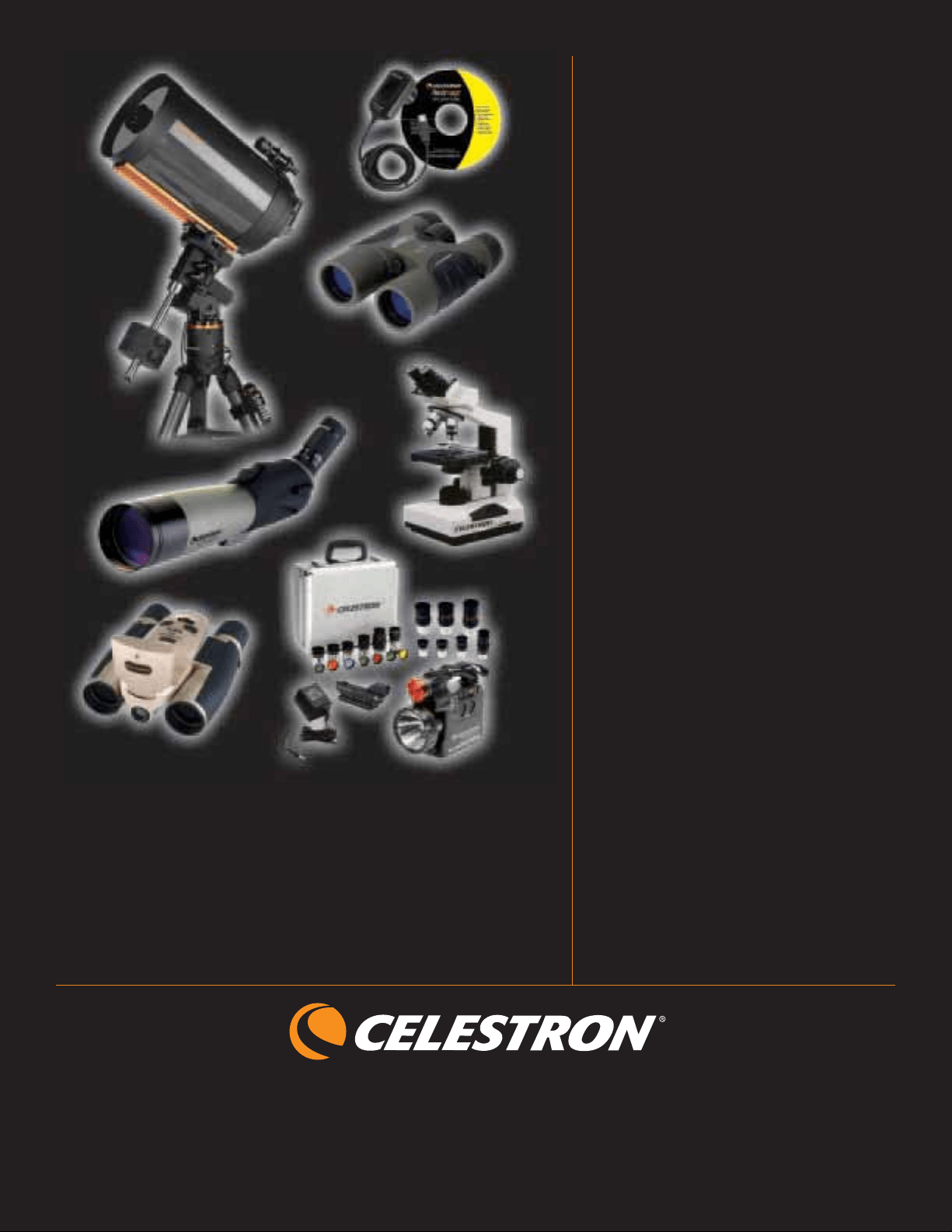
The foundation of Celestron’s
commitment to product design and
engineering innovation is based
upon its longstanding ability
to manage and control all aspects
of the design-to-market process.
Celestron’s staff of experienced
engineers, industrial designers, and
optical experts are consistently
improving and refining our
products as well as developing
new products and technologies
for our customers.
Celestron’s passion for continuous
product improvement, innovation,
and design excellence ensures
products that provide our customers
with years of enjoyment, reliability,
and, most important — VALUE.
93895-05
The photographs appearing in this catalog are for graphic illustration purposes only. All astro photos shown were taken through
Celestron telescopes but the images on each page do not necessarily represent objects or subjects viewed or photographed
using the products described. Astro photographs are not intended to represent what a user will see during visual observation.
All items designated TM or ® are trademarks or registered trademarks of Celestron or the specific companies designated.
Product designs and specifications are subject to change or modification without obligation or prior notification.
2835 Columbia Street • Torrance, CA 90503 U.S.A. • 310.328.9560
www.celestron.com
• Computerized and non-computerized telescopes
• Telescope Accessories
• NexImage™ Solar System Imager
• Binoculars
• Spotting Scopes
• VistaPix™ Digital Camera/Binocular
• Microscopes