1
• Mac
®
is a registered trademark of Apple Inc.
• Windows
®
, DirectDraw
®
and Direct3D
®
are registered trademarks of Microsoft Corporation
in the U.S. and/or other countries.
• VESA and DDC are trademarks of the Video Electronics Standard Association.
•
HDMI
TM
, the HDMI logo, and High-Denition Multimedia Interface are trademarks or registered
trademarks of HDMI Licensing LLC in the United States and other countries.
•
Trademark PJLink is a trademark applied for trademark rights in
Japan, the United States of America and other countries and areas.
• Blu-ray Disc
TM
and Blu-ray
TM
are trademarks of Blu-ray Disc Association.
• DICOM
®
is the registered trademark of the National Electrical Manufacturers Association
for its standards publications relating to digital communications of medical information.
• DLP
®
and the DLP logo are registered trademarks of Texas Instruments.
• HDBaseT™ and the HDBaseT Alliance logo are trademarks of the HDBaseT Alliance.
All other trademarks are the properties of their respective owners.
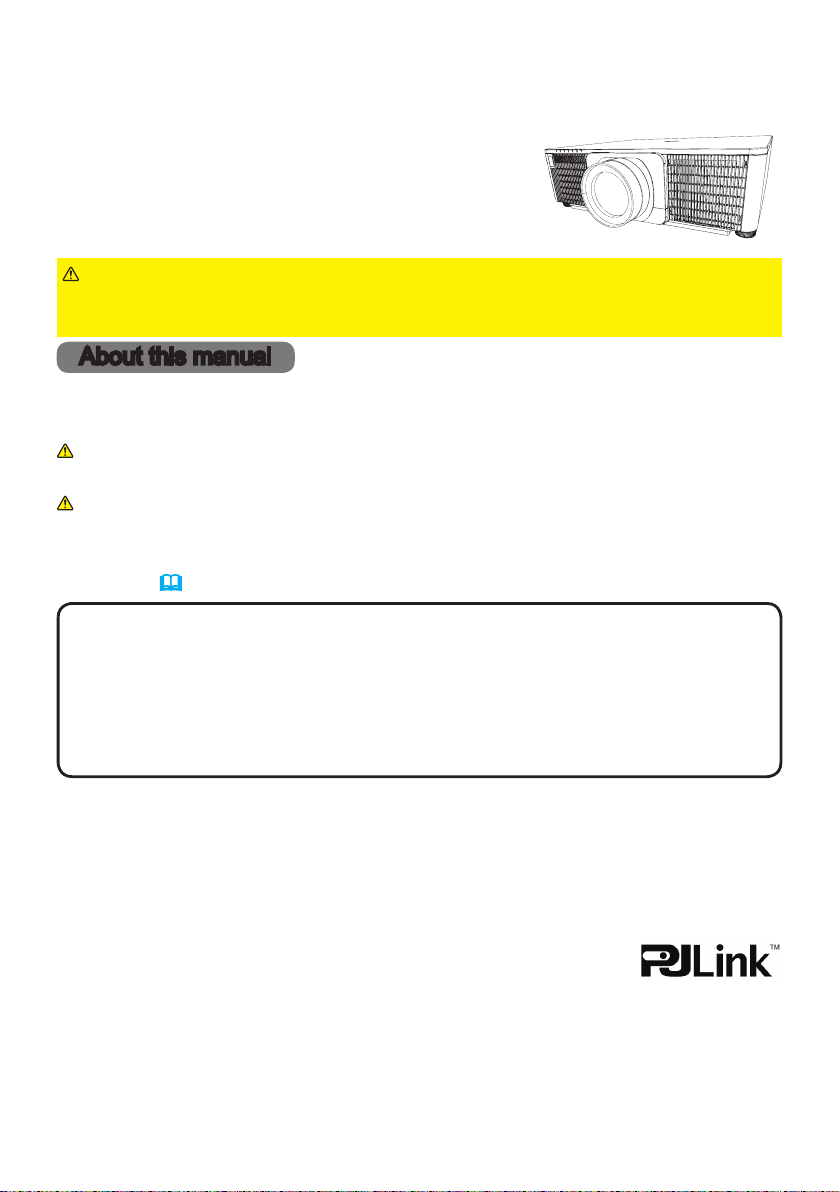
Projector
CP-WU9100/CP-HD9950
User's Manual (detailed)
Operating Guide
Thank you for purchasing this projector.
►Before using this product, read all the manuals for this
product. Read Safety Guide rst. After reading the manuals, store them in a
safe place for future reference.
WARNING
NOTE
Trademark acknowledgment
Various symbols are used in this manual. The meanings of these symbols are
described below.
About this manual
WARNING
CAUTION
This symbol indicates information that, if ignored, could possibly
result in personal injury or even death due to incorrect handling.
This symbol indicates information that, if ignored, could possibly
result in personal injury or physical damage due to incorrect handling.
Refer to the pages written following this symbol.
NOTICE
This entry notices of fear of causing trouble.
• The information in this manual is subject to change without notice.
• The illustrations in this manual are for illustrative purposes. They may differ
slightly from your projector.
• The manufacturer assumes no responsibility for any errors that may appear in
this manual.
• The reproduction, transfer or copy of all or any part of this document is not
permitted without express written consent.

2
Contents
Introduction ...............3
Features ......................3
Checking the contents of package
....3
Part names ....................4
Projector, Control panel and Indicators,
Ports, Remote control
Setting up .................8
Installing the lens unit ............8
Arrangement ...................8
Connecting with your devices ..... 11
Fastening the cables
Fastening the adapter cover ......19
Using the security bar and slot ....20
Connecting to a power supply .....21
Remote control ............22
Installing the batteries ...........22
Using the REMOTE ID function ...22
Changing the frequency of remote control signal
. . 23
About the remote control signal ...23
Status Monitor ............24
Displaying the condition of the projector
. . 24
Switching the display
..............25
The current status
(Warnings and Errors)
..............27
Error log
. . . . . . . . . . . . . . . . . . . . . . . 27
Lamp log
......................28
Filter log
. . . . . . . . . . . . . . . . . . . . . . . 29
Network Information ............29
Power on/off ..............30
Operating ................31
Selecting an input signal .........31
Selecting an aspect ratio .........32
Adjusting the projector's elevator
....33
Adjusting the lens ..............34
Adjusting the zoom and focus,
Adjusting the lens position, Lens memory,
Lens lock
Using the automatic adjustment feature
. . 36
Other buttons ..................37
Correcting the distortion
........... 38
Using the EDGE BLENDING feature
41
Using the magnify feature ........45
Temporarily freezing the screen ...46
Temporarily shading the screen ...46
PbyP (Picture by Picture) /
PinP (Picture in Picture)
...47
Using the menu function .........51
Indication in OSD, Menu items
EASY MENU. . . . . . . . . . . . . . . 54
PICTURE menu ............56
IMAGE menu ..............61
INPUT menu ..............64
SETUP menu ..............70
SCREEN menu .............76
OPTION menu .............82
NETWORK menu ...........95
SECURITY menu ...........96
Maintenance .............102
Replacing the lamp ............102
Cleaning and replacing the air lter . 105
Replacing the
internal clock battery ...........107
Other care ...................108
Regarding the
indicator lamps ...........109
Resetting all settings ......115
Troubleshooting ..........116
Specications ............125
3
Introduction
• Keep the original packing materials, for future shipment. Use the
original packing materials when moving the projector. Use special caution for
the lens.
• The projector may make a rattling sound when tilted, moved or shaken, since
a ap to control the air ow inside of the projector has moved. Be aware that
this is not a failure or malfunction.
NOTE
Introduction
The projector provides you with the broad use by the following features.
Checking the contents of package
Refer to the Contents of package section in the User’s Manual (concise) which
is a book. Your projector should come with the items shown there.
Consult of your dealer immediately if any items are missing.
Features
►Keep small parts away from children and pets. Take care not
to put in the mouth. If swallowed, consult a physician immediately for emergency
treatment.
WARNING
ü The HDMI/DVI-D/HDBaseT™ ports can support various image equipment
which have digital interface to get clearer pictures on a screen.
ü Equipped with two COLOR WHEEL, to enhance brightness and color.
ü Optional lens units and a wide range of lens shift feature provide more
exibility in where you can install the product.
ü HDCR and ACCENTUALIZER feature are Hitachi'soriginal image stabilizer for
a clearer image.
ü The multiple of I/O ports is believed to support any business scene.
ü Equipped with geometry correction which corresponds to aspect and different
kinds of screen.

4
Introduction
Projector
(1) Dust protector
(2) Remote sensors(23)
(3) Elevator feet (x2) (33)
(4) AC (AC inlet) (21)
(5) Holes for Cable Tie(18)
(6) Security slot (20)
(7) Security bar (20)
(8) Control panel (5)
(9) Status Monitor(24)
(10) Ports (6)
(11) Indicators (5)
(12) Intake vents (105)
(13) Exhaust vents(105)
(14) LAMP - 1 lamp cover (102)
(15) LAMP - 2 lamp cover (102)
(16) Battery cover
The internal clock battery is
inside (107).
(1)
(3) (2)
(4)
(5)
(6)
(7)
(8)
(9)
(10)
(11)
(12)
(11)
(13)
(14)
(15)
(16)
►Do not open or remove any portion of the product, unless the
manuals direct it.
►Do not subject the projector to unstable conditions.
►Do not apply a shock or pressure to this product. Remove all the attachments
including the power cord and cables, from the projector when carrying the
projector.
►Do not look into the lens and the openings on the projector while the lamp is
on as the projection ray may cause a trouble on your eyes.
►Do not touch the lamp cover and the exhaust vents during use or just
after use, due to excessive heat.
WARNING
►Do not attach anything onto the lens, it could damage the
lens, such as melting the lens.
CAUTION
Part names
(continued on next page)
5
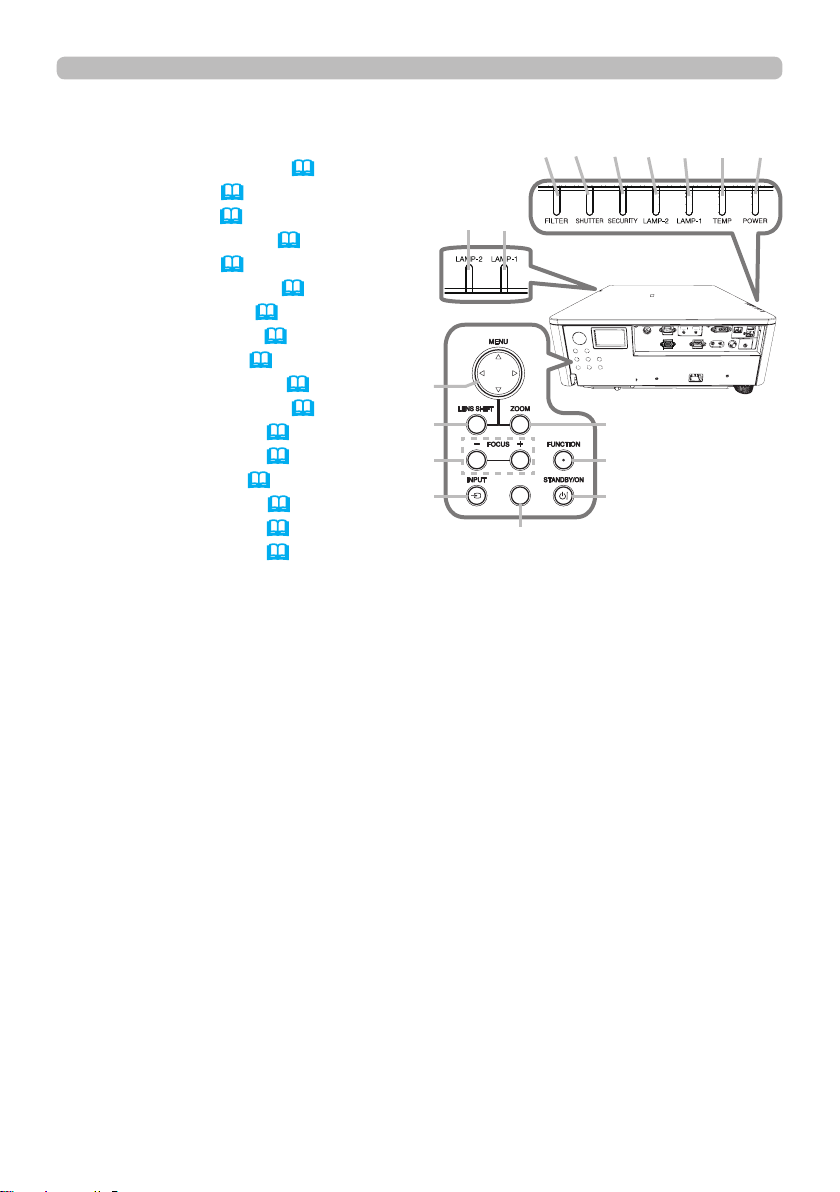
Control panel and Indicators
(1) STANDBY/ON button (30)
(2) INPUT button (31)
(3) MENU button (51)
(4) LENS SHIFT button (34)
(5) ZOOM button (34)
(6) FOCUS - / + buttons (34)
(7) SHUTTER button (46)
(8) FUNCTION button (34, 35)
(9) FILTER indicator (113, 115)
(10) SHUTTER indicator (114)
(11) SECURITY indicator (114)
(12) LAMP-2 indicator (112)
(13) LAMP-1 indicator (112)
(14) TEMP indicator (110 to 114)
(15) POWER indicator (109 , 110)
(16) LAMP-2 indicator (112)
(17) LAMP-1 indicator (112)
Introduction
(continued on next page)
SHUTTER
(5)
(8)
(1)
(3)
(4)
(6)
(2)
(7)
(9) (10) (11) (12) (13) (14) (15)
(16) (17)
6
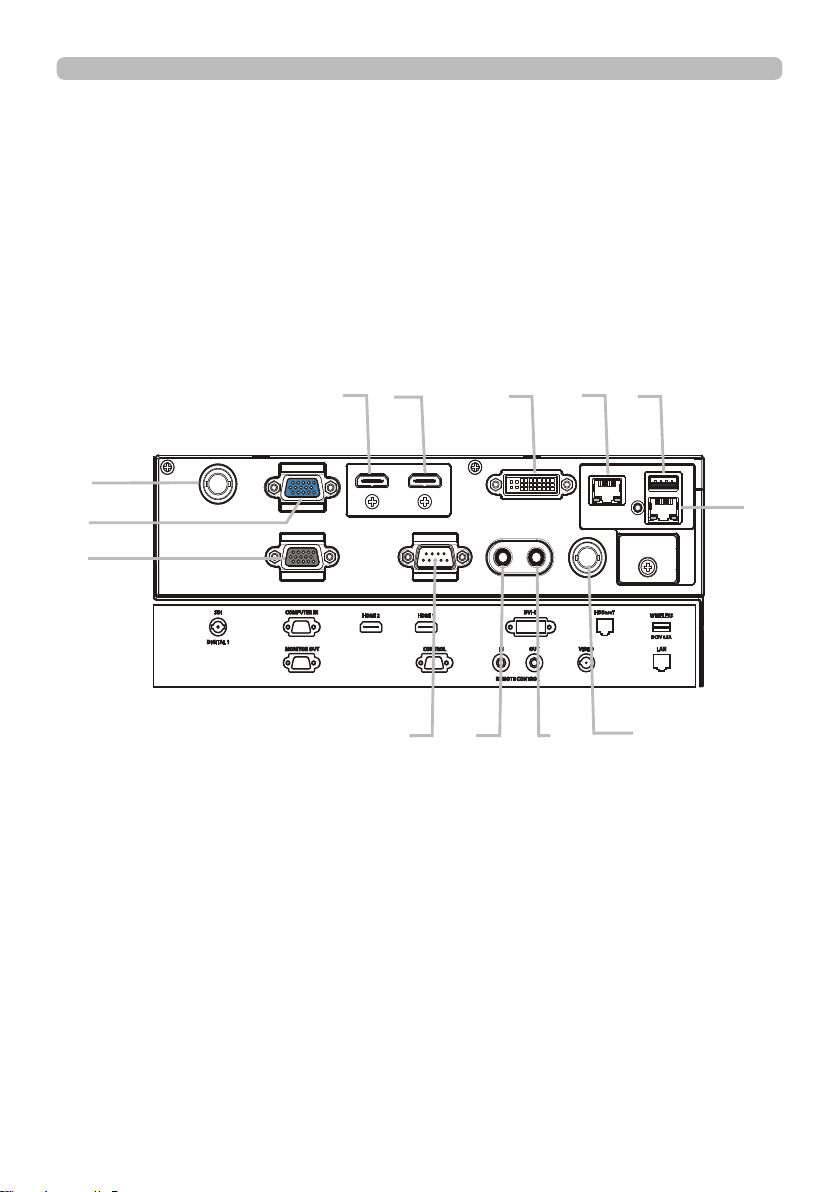
Ports
Introduction
(1) MONITOR OUT port
(2) COMPUTER IN port
(3) HDMI 2 port
(4) HDMI 1 port
(5) DVI-D port
(6) HDBaseT™ port
(7) WIRELESS port
(8) LAN
(9) SDI/DIGITAL 1 port
(10) CONTROL port
(11) REMOTE CONTROL IN port
(12) REMOTE CONTROL OUT port
(13) VIDEO port
(2)
(1)
(3)
(4)
(5)
(6)
(7)
(8)
(9)
(10) (11)
(12)
(13)
7
• Any button
marked with * is not
supported on this
projector (31).
• Each time you
press any button
(except ID buttons),
the ID button of
current selected ID
number will light
(22).
NOTE
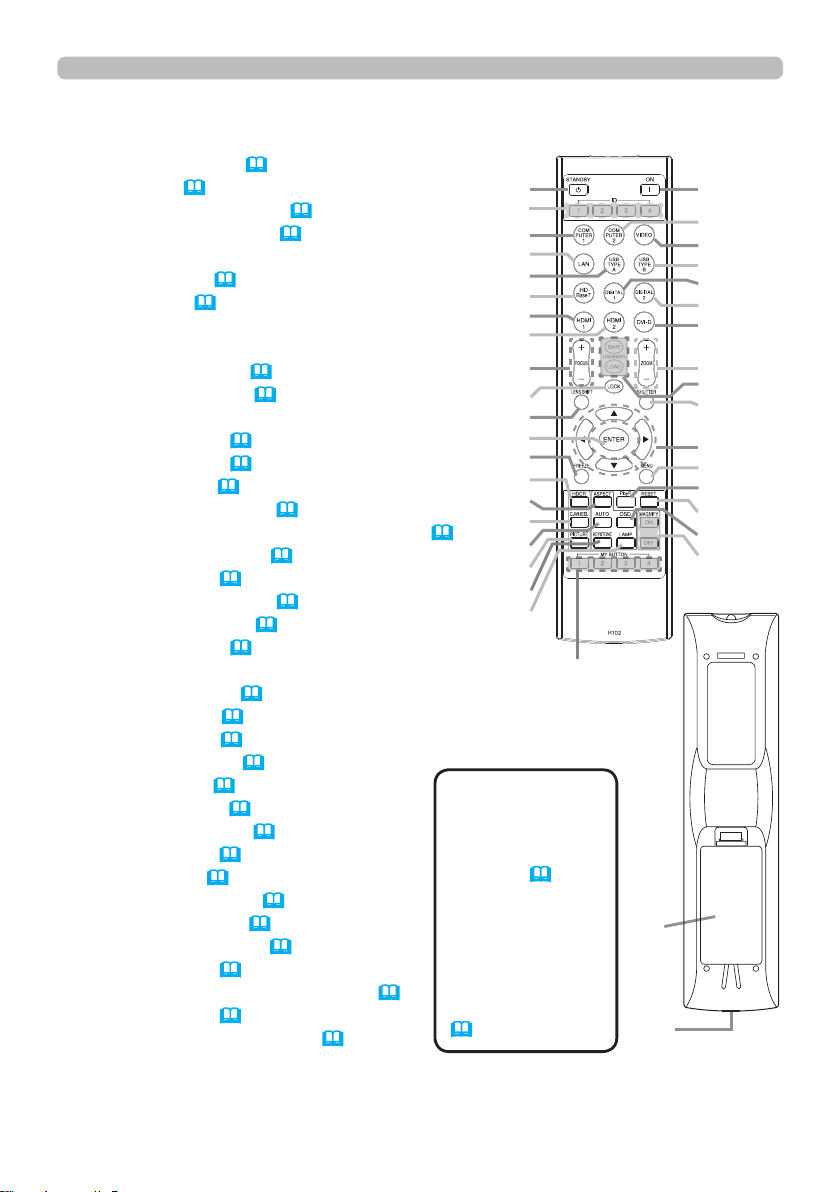
Remote control
(1) STANDBY button (30)
(2) ON button (30)
(3) ID - 1 / 2 / 3 / 4 buttons (22)
(4) COMPUTER 1 button (31)
(5) COMPUTER 2 button *
(6) VIDEO button (31)
(7) LAN button (31)
(8) USB TYPE A button *
(9) USB TYPE B button *
(10) HDBaseT button (31)
(11) DIGITAL 1 button (31)
(12) DIGITAL 2 button *
(13) HDMI 1 button (31)
(14) HDMI 2 button (31)
(15) DVI-D button (31)
(16)
FOCUS
+ / -
buttons
(34)
(17) LENS MEMORY SAVE / LOAD button (35)
(18) ZOOM + / - buttons (34)
(19) LOCK button (36)
(20) LENS SHIFT button (34)
(21) SHUTTER button (46)
(22) ENTER button (51)
(23) ▲/▼/◄/►cursor buttons
(24) FREEZE button (46)
(25) MENU button (51)
(26) HDCR button (37)
(27) ASPECT button (32)
(28) PbyP button (47)
(29) RESET button (51)
(30) C.WHEEL button (37)
(31) AUTO button (36)
(32) OSD button (37)
(33) MAGNIFY buttons (45)
(34) PICTURE button (37)
(35) KEYSTONE button (38)
(36) LAMP button (37)
(37) MY BUTTON - 1, 2, 3, 4 buttons (84)
(38) Battery cover (22)
(39) Wired remote control port (16)
Back of
the remote
control
(1)
(3)
(4)
(7)
(8)
(10)
(13)
(14)
(16)
(19)
(20)
(22)
(2)
(5)
(6)
(9)
(11)
(12)
(15)
(18)
(17)
(21)
(23)
(38)
(25)
(39)
(26)
(24)
(27)
(28)
(29)
(30)
(31)
(32)
(33)
(34)
(35)
(36)
(37)
Introduction
8
Setting up
Setting up
Install the projector according to the environment and manner the projector will be
used in.
For the case of installation in a special state such as ceiling mount, the specied
mounting accessories (Specications in the User’s Manual (concise)) and
service may be required. Before installing the projector, consult your dealer about
your installation.
Arrangement
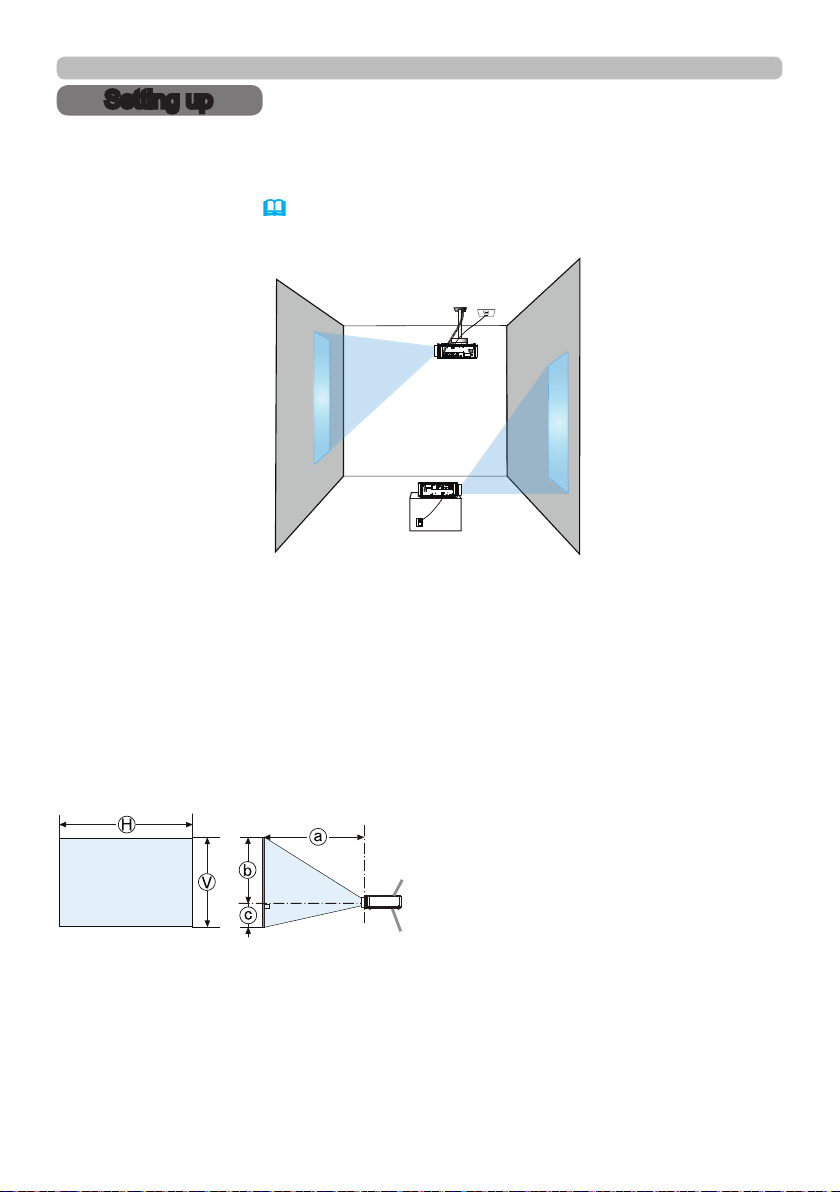
Refer to tables T-1 to T-2 at the back of User's Manual (concise) as well as the
following to determine the screen size and projection distance. The values shown
in the table are calculated for a full size screen.
Ⓗ × Ⓥ :
Screen size
ⓐ :
Projection distance
(from the front of the projector unit)
ⓑ
,
ⓒ
: Screen height
Projector top
Projector bottom
Installing the lens unit
See the manual of the optional lens.
(continued on next page)

9
Setting up
WARNING
►Install the projector where you can access the power
outlet easily. If an abnormality should occur, unplug the projector urgently.
Otherwise it could cause a re or electric shock.
►Do not subject the projector to unstable conditions. If the projector falls
or topples over, it could result in injury or damage to the projector and the
surrounding things. Using a damaged projector could result in a re and an
electric shock.
• Do not place the projector in unstable places, such as an inclined surface,
places subject to vibration, on top of a wobbly table or cart, or a surface that is
smaller than the projector.
• Do not set the projector on the terminal side, rear end, or front.
• Do not attach nor place anything on the projector unless otherwise specied in
the manual.
• Do not use any mounting accessories except the accessories specied by the
manufacturer. Read and keep the manuals of the accessories used.
• For special installation such as ceiling mounting, be sure to consult your dealer
beforehand.
• It is possible to install the projector for any direction with specied mounting
accessories. Consult with your dealer about such a special installation.
• DLP chip(s) is/are precision-made parts. In rare cases, pixels may be missing
or lit, but this is not a malfunction.
• Direct high-power laser beam onto the lens surface can damage the DLP
chip(s).
• The projector is equipped with precision-made parts, handle with care while
moving. Remove all the attachments including the power cord and cables, from
the projector when carrying the projector.
►Do not install the pro
jector near thermally conductive or ammable
things. Such things when heated by the projector could result in a re and burns.
• Do not place the projector on a metal stand.
►Do not place the projector where any oils, such as cooking or machine
oil, are used. Oil may harm the product, resulting in malfunction, or falling from
the mounted position.
►Do not place the projector in a place where it may get wet. Getting the
projector wet or inserting liquid into the projector could cause a re and an
electric shock, and damage the projector.
• Do not place the projector near water, such as in a bathroom, kitchen, or
poolside.
• Do not place the projector outdoors or by the window.
• Do not place anything containing liquid near the projector.
(continued on next page)

10
Setting up
►Place the projector in a cool place with sufcient
ventilation. The projector may shutdown automatically or may malfunction if its
internal temperature is too high.
Using a damaged projector could result in a re and an electric shock.
• Do not place the projector in direct sunlight or near hot objects such as heaters.
• Do not place the projector where the air from an air conditioner or similar unit
will directly blow on it.
• Keep a space of 50 cm or more between the projector and other objects such
as walls.
• Do not place the projector on carpet, cushions or bedding.
• Do not stop up, block nor cover the projector's vent holes. Do not place
anything around the projector that could be sucked in or stuck to the projector's
intake vents.
• Do not place the projector at places that are exposed to magnetic elds, doing
so can cause the cooling fans inside the projector to malfunction.
►Avoid placing the projector in smoky, humid or dusty place. Placing the
projector in such places could cause a re, an electric shock and malfunction of
the projector.
• Do not place the projector near humidiers. Especially for an ultrasonic
humidier, chlorine and minerals contained in tap water are atomized and could
be deposited in the projector causing image degradation or other problems.
• Do not place the projector in a smoking area, kitchen, passageway or by the
window.
• Position the projector to prevent light from directly hitting the
projector's remote sensor.
• Do not place the product in a place where radio interference may be caused.
• Set the ALTITUDE of the SERVICE item in the OPTION menu correctly. It is
recommended to leave it at AUTO usually (88). If the projector is used with a
wrong setting, it may cause damage to the projector itself or the parts inside.
• Keep heat-sensitive things away from the projector. Otherwise, they may be
damaged by the heat from the projector.
CAUTION
NOTICE
(continued on next page)
11
Setting up
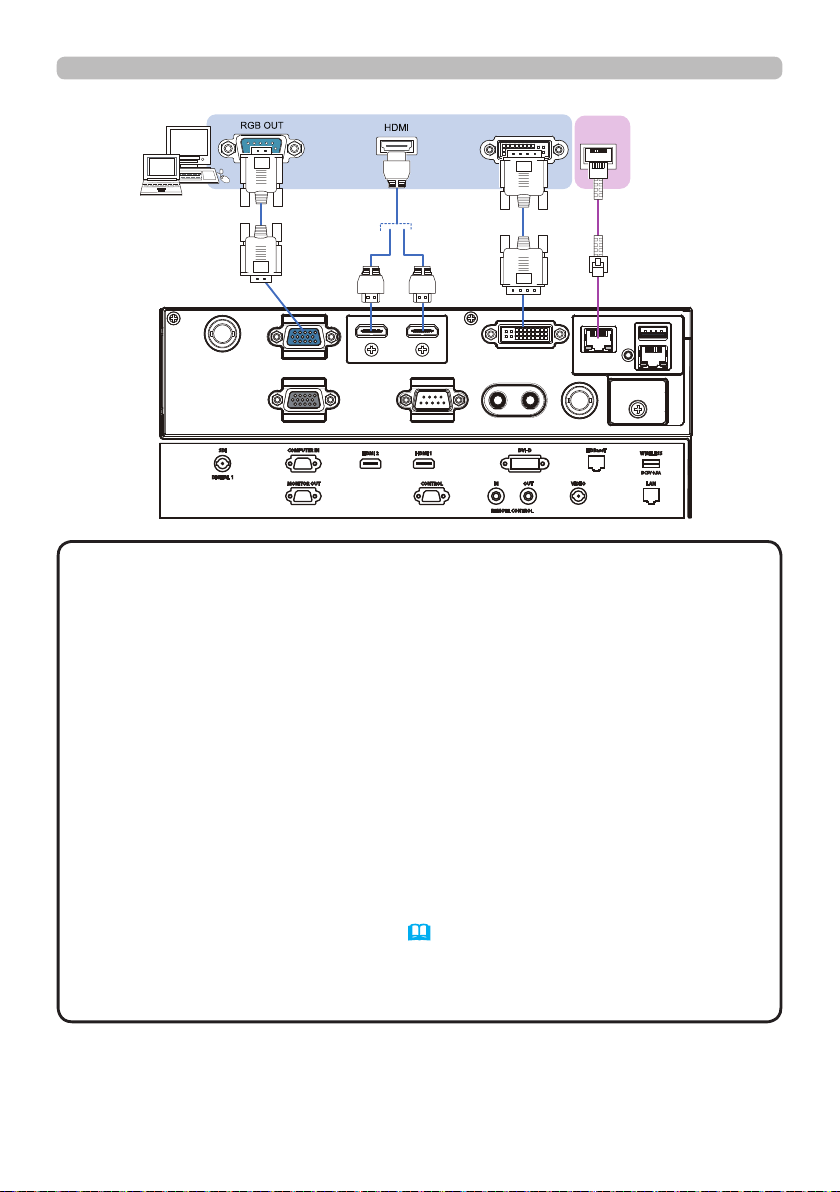
Connecting with your devices
Before connecting the projector to a device, consult the manual of the device to
conrm that the device is suitable for connecting with this projector and prepare
the required accessories, such as a cable in accord with the signal of the device.
Consult your dealer when the required accessory did not come with the product or
the accessory is damaged.
After making sure that the projector and the devices are turned off, perform
the connection, according to the following instructions. Refer to the gures in
subsequent pages.
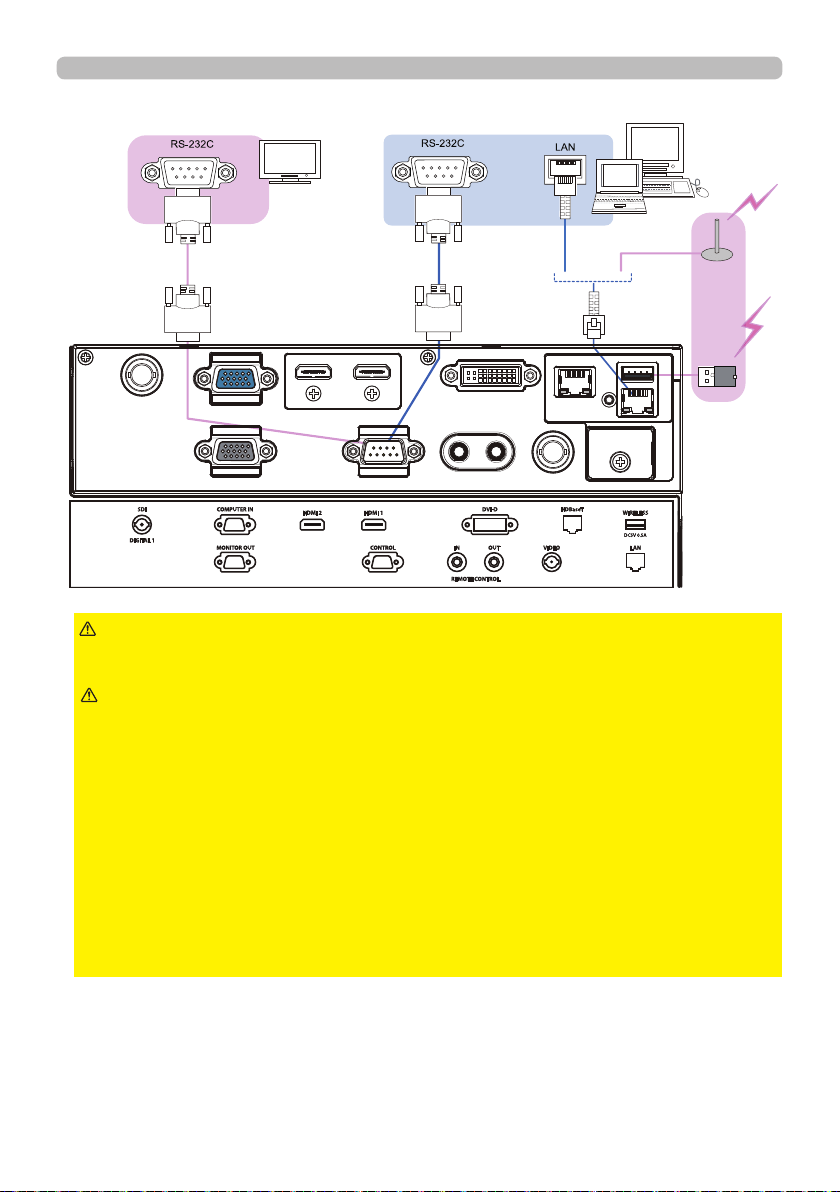
Before connecting the projector to a network system, read Network Guide too.
WARNING
CAUTION
• Do not turn on or off the projector while connected to a device in
operation, unless directed in the manual of the device. Otherwise it may cause
malfunction in the device or projector.
• The function of some input ports can be selected according to your usage
requirements. Check the reference page indicated beside each port in the
following illustration.
• Be careful not to mistakenly connect a connector to a wrong port. Otherwise it
may cause malfunction in the device or projector.
- When connecting a connector to a port, make sure that the shape of the
connector ts the port.
- Tighten the screws to connect a connector equipped with screws to a port.
- Use the cables with straight plugs, not L-shaped ones, as the input ports of
the projector are recessed.
2B compatible. Plug-and-Play can be used by connecting this projector to a
computer that is VESA DDC (display data channel) compatible.
- Take advantage of this feature by connecting a computer cable to the
COMPUTER IN port. Plug-and-Play may not work properly if any other type of
connection is attempted.
- Use the standard drivers in your computer as this projector is a Plug-and-Play
monitor.
About Plug-and-Play capability
NOTE
►Use only the appropriate accessories. Otherwise it could
cause a re or damage the projector and devices.
• Use only the accessories specied or recommended by the projector’s
manufacturer. It may be regulated under some standard.
• Neither disassemble nor modify the projector and the accessories.
• Do not use the damaged accessory. Be careful not to damage the accessories.
Route a cable so that it is neither stepped on nor pinched out.
►For a cable with a core at only one end, connect the end
with the core to the projector. That may be required by EMI regulations.
(continued on next page)
12
Setting up
Computer
DVI
HDBaseT
TM
• Before connecting the projector to a computer, consult the computer’s
manual and check the compatibility of the signal level, the synchronization
methods and the display resolution output to the projector.
- Some signal may need an adapter to input this projector.
- Some computers have multiple screen display modes that may include some
signals which are not supported by this projector.
- Although the projector can display signals with a resolution up to UXGA
(1600x1200) or up to W-UXGA (1920x1200) , the signal will be converted
to the projector’s panel resolution before being displayed. The best display
performance will be achieved if the resolutions of the input signal and the
projector panel are identical.
• If you connect this projector and a notebook computer, you must output the
display to an external monitor, or output simultaneously to the internal display
and an external monitor. Consult the computer's manual for the setting.
• Depending on the input signal, the automatic adjustment function of this
projector may take some time and not function correctly.
- A composite sync signal or sync-on-green signal may confuse the automatic
adjustment function of this projector (36).
- If the automatic adjustment function does not work correctly, you may not see
the dialog to set the display resolution. In such a case, use an external display
device. You may see the dialog and set an appropriate display resolution.
NOTE
(continued on next page)
13
External device
Computer
Setting up
Access
point
USB
wireless
adapter
(optional)
WARNING
►Heat may build up in the USB wireless adapter, to avoid
possible burns disconnect the projector power cord for 10 minutes before
touching the adapter.
► Before connecting the projector to a network system be
sure to obtain the consent of the administrator of the network.
►Do not connect the LAN port to any network that might have the excessive
voltage.
►The designated USB wireless adapter that is sold as an option is required to
use the wireless network function of this projector. Before connecting the USB
wireless adapter, turn off the power of the projector and disconnect the power
cord. Do not use any extension cable or device when connecting the adapter
to the projector.
►To connect both the LAN cable and USB wireless adapter to the projector,
use a LAN cable that is at on the side where the plug’s wire is visible.
Otherwise, both of them cannot be connected correctly, or the wire may break
(malfunction).
CAUTION
(continued on next page)
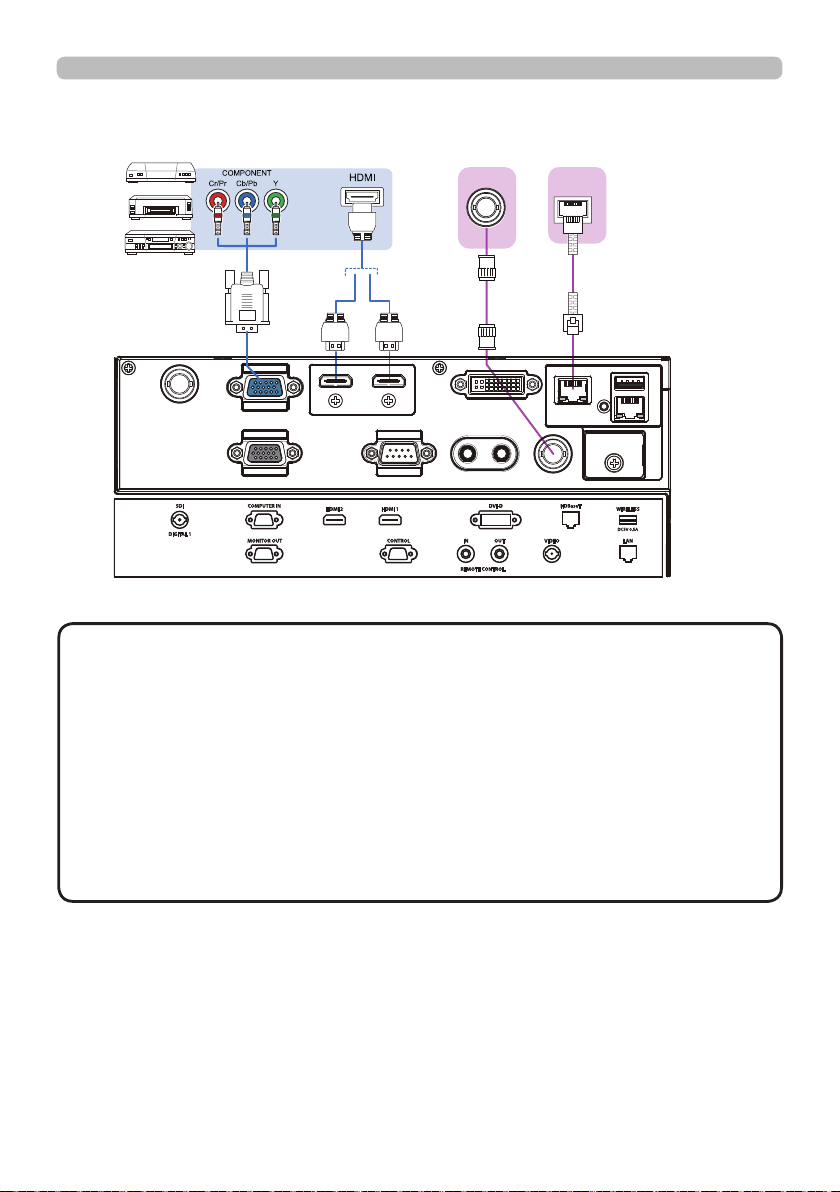
14
Setting up
VCR/DVD/Blu-ray Disc
TM
player
VIDEO OUT
HDBaseT
TM
• HDBaseT is a technology to transmit image, sound, ethernet or serial control
signal using a LAN cable.
• Go to the following URL regarding the device of other company that supports
HDBaseT and has been conrmed compatible with this projector.
http://www.hitachi.co.jp/proj/
LAN or HDBaseT input port can be selected as ethernet signal input by
switching in the menu.
• Use LAN cables of up to 100m long. Exceeding this length, the image
and sounds will be deteriorated, and even experience malfunction on LAN
transmission.
About HDBaseT™ connection
(continued on next page)
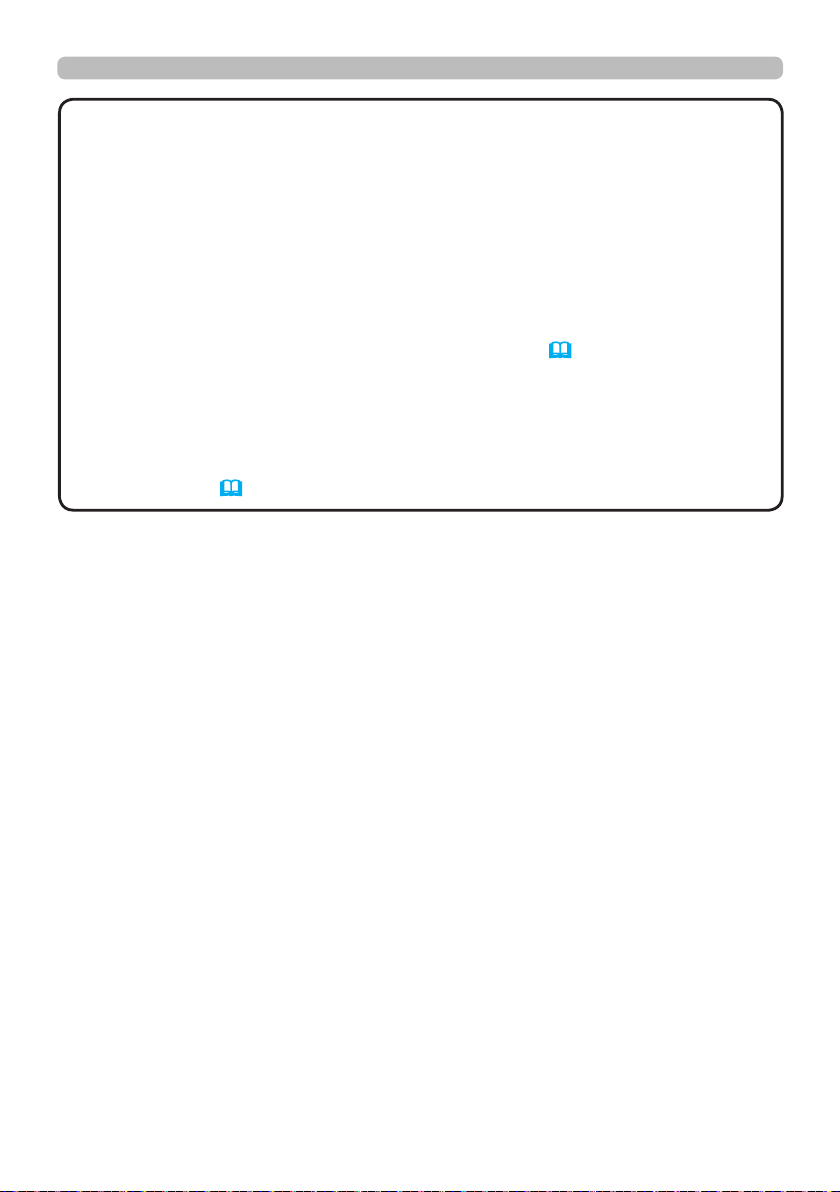
15
Setting up
• The HDMI ports of this model are compatible with HDCP (High-band-
width Digital Content Protection) and therefore capable of displaying video
signals from HDCP compatible DVD players or the like.
- The HDMI ports support the following signals:
Video signal : 480i@60, 480p@60, 576i@50, 576p@50, 720p@50/60,
1080i@50/60, 1080p@50/60
PC signals : See User’s Manual (detailed) Technical
- This projector can be connected with another equipment that has HDMI
connector, but with some equipment the projector may not work properly,
something like no video.
- Qualied cable is required for HDBaseT connection (14).
- Be sure to use an HDMI cable that has the HDMI logo.
- Use a Category 2-certied HDMI cable to input 1080p@50/60 signal to the
projector.
• The HDMI cables might come off due to the lack of a mechanical lock on the
cables and connectors. Fasten the cables to the projector to prevent the cables
from coming off (18).
NOTE
(continued on next page)

16
Monitor
Setting up
(Wired)
Remote
control
Another
projector
• To use a wired remote control, connect a wired remote control to the
REMOTE CONTROL IN port. You can also connect another projector to the
REMOTE CONTROL OUT port to control it from the wired remote control. You
can use this projector as a remote control-relay with the REMOTE CONTROL
IN and OUT ports. To connect the wired remote control or another projector
to the REMOTE CONTROL IN or OUT ports, use audio cables with 3.5 mm
diameter stereo mini plugs. This function is useful when a wireless remote
signal may not reliably reach the projector.
NOTE
(continued on next page)
17
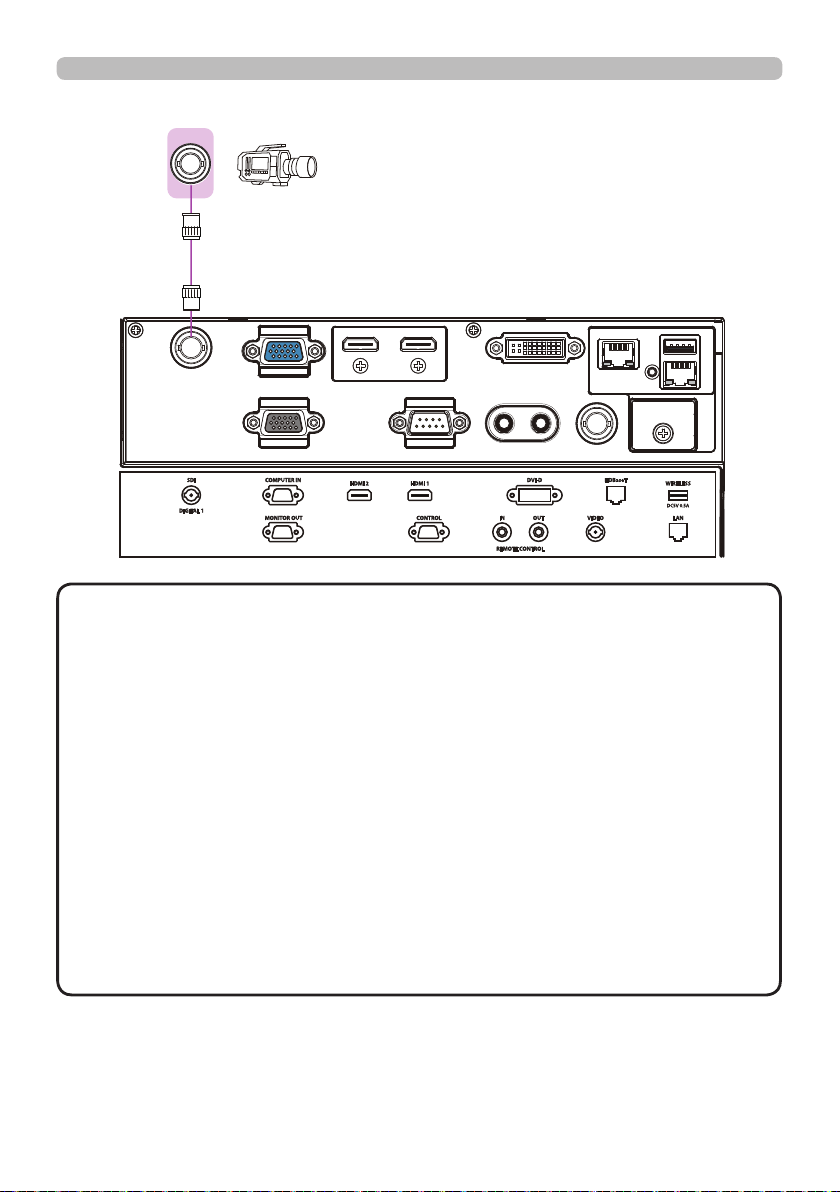
SDI OUT
Setting up
• The SDI port of this model supports the following SDI signals:
SD-SDI signal: conforming to SMPTE ST 259-C standard
YCBCR 4:2:2 10-bit
480i, 576i
Single link HD-SDI signal: conforming to SMPTE ST 292 standard
YPBPR 4:2:2 10-bit
720p@50/60, 1080i@50/60, 1080Psf@25/30
3G-SDI Level-A signal: conforming to SMPTE ST 424 standard
YPBPR 4:2:2 10-bit
1080p@50/60
- This projector can be connected with other equipment that has SDI connector,
but with some equipment the projector may not work properly.
- Use a cable of 5CFB or greater (5CFB, 7CFB, and so on), or Belden 1694A or
greater to transmit the image properly. Use a cable with a length of 100m or
less.
- Setting by MENU is necessary depending on a connected device.
NOTE
Camera for commercial use, and so on.
(continued on next page)

18
►Use only a plastic tie to get together or fasten the cables. A
metallic tie may cause damage to the cables and tie holder.
►Do not bind the cables too tightly. The cables or the hole might be damaged.
CAUTION
Fastening the cables
Use the supplied cable tie
to fasten the cables.
Cable tie
Holes for
Cable tie
Holes for
Cable tie
Setting up
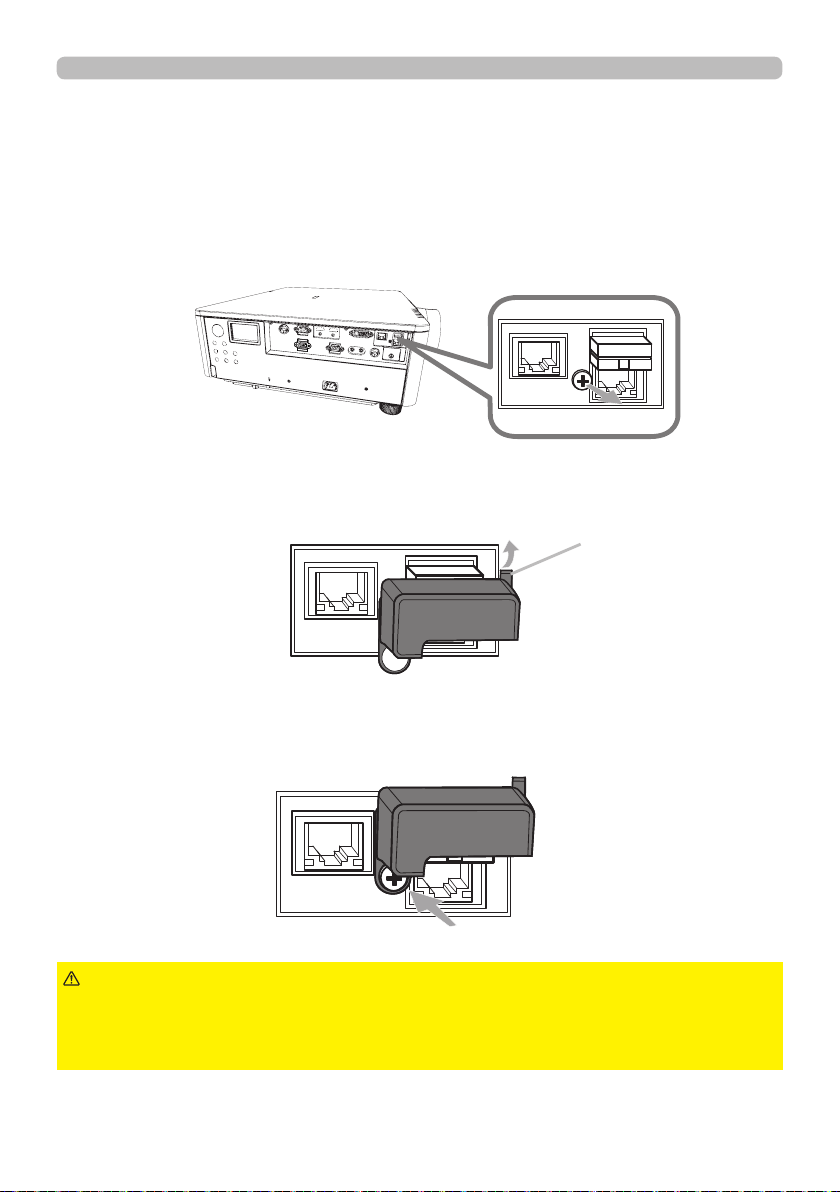
19
1.
Loosen the screw on the bottom left of the
WIRELESS
port.
Tab
2.
Insert the tab of the cover into the hole at the upper right of the
WIRELESS
port in the direction of the arrow.
3.
Align the screw holes on the projector and the cover. Then insert the screw
removed from the projector into the hole and tighten the screw.
Fastening the adapter cover
►Keep small parts away from children and pets. Take care not
to put in the mouth.
►Heat may build up in the USB wireless adapter, to avoid possible burns
disconnect the projector power cord for 10 minutes before touching the adapter.
WARNING
Setting up
When using the USB wireless adapter, use the supplied adapter cover to avoid
possible burns.
USB wireless adapter: USB-WL-11N
Temperature range: 0 ~ 45°C(operating)

20
Using the security bar and slot
A commercially available anti-theft chain or
wire can be attached to the security bar on
the projector. Refer to the gure to choose
an anti-theft chain or wire.
Also this product has the security slot for
the Kensington lock.
For details, see the manual of the security
tool.
►Do not use the security bars and slot to prevent the projector
from falling down, as it is not designed for it.
►Do not place anti-theft chain or wire near the exhaust vents.
It may become too hot.
WARNING
CAUTION
• The security bar and slot is not comprehensive theft prevention
measures. It is intended to be used as supplemental theft prevention measure.
• The safety bar can be used for the same purpose as the security bar.
NOTE
Setting up
Anti-theft
chain or wire
security bar
18mm
11mm
Security slot
18mm
21
Setting up
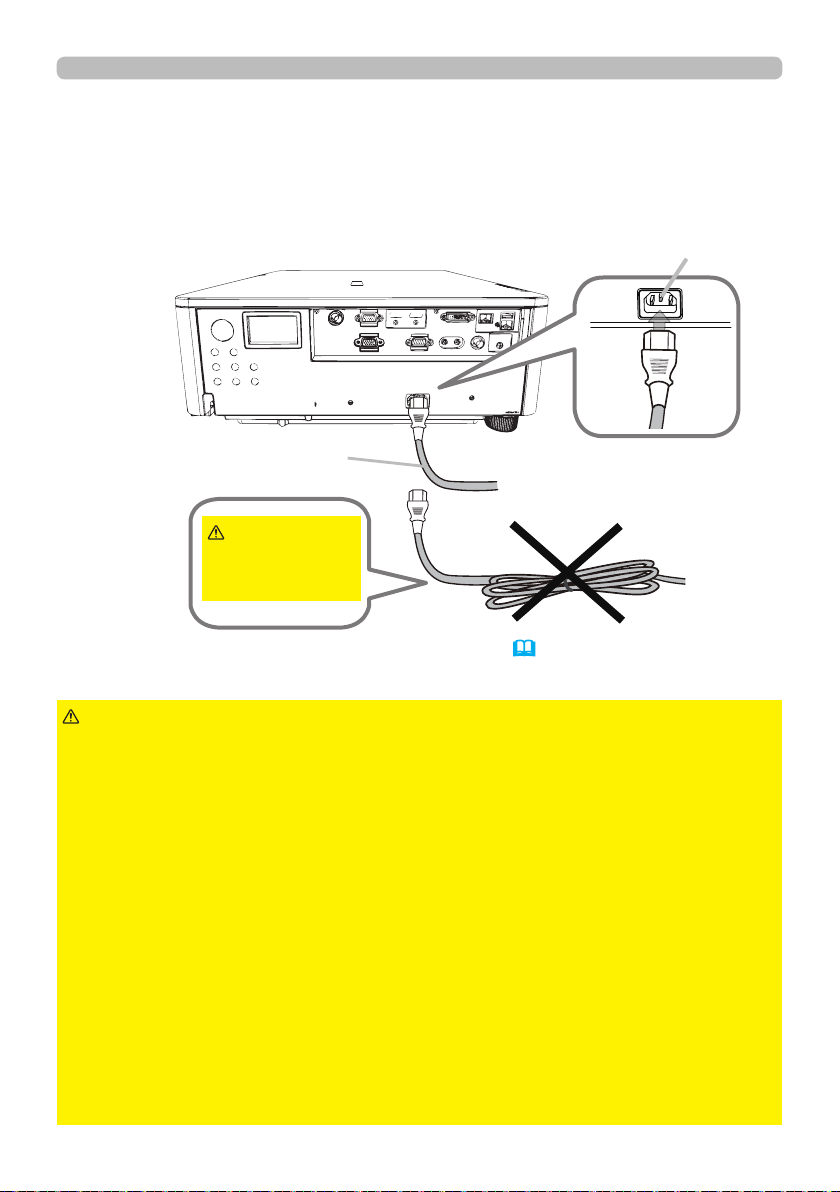
Connecting to a power supply
►Do not connect the projector to a power supply while no lens
unit is attached to it.
►Use extra caution when connecting the power cord, as incorrect or faulty
connections may result in re and/or electrical shock.
• Do not touch the power cord with a wet hand.
• Only use the power cord that came with the projector. If it is damaged, consult
your dealer to get a new one. Never modify the power cord.
• Only plug the power cord into an outlet whose voltage is matched to the power
cord. The power outlet should be close to the projector and easily accessible.
Remove the power cord for complete separation.
• Do not distribute the power supply to multiple devices. Doing so may overload
the outlet and connectors, loosen the connection, or result in re, electric shock
or other accidents.
• Connect the ground terminal for the AC inlet of this unit to the ground terminal
of the building using an appropriate power cord (bundled).
• This product is also designed for IT power systems with a phase-to-
phase voltage of 220 to 240 V.
WARNING
When the DIRECT POWER ON function activated (83), the connection of the
power supply makes the projector turn on.
NOTICE
1.
Insert the connector of the power cord into the AC (AC inlet) of the projector.
2.
Firmly plug the power cord’s plug into the outlet. In a couple of seconds after
the power supply connection, the POWER indicator will light up in steady
orange.
AC
Power cord
WARNING
►Do not use
tied power cord.
22
Remote control
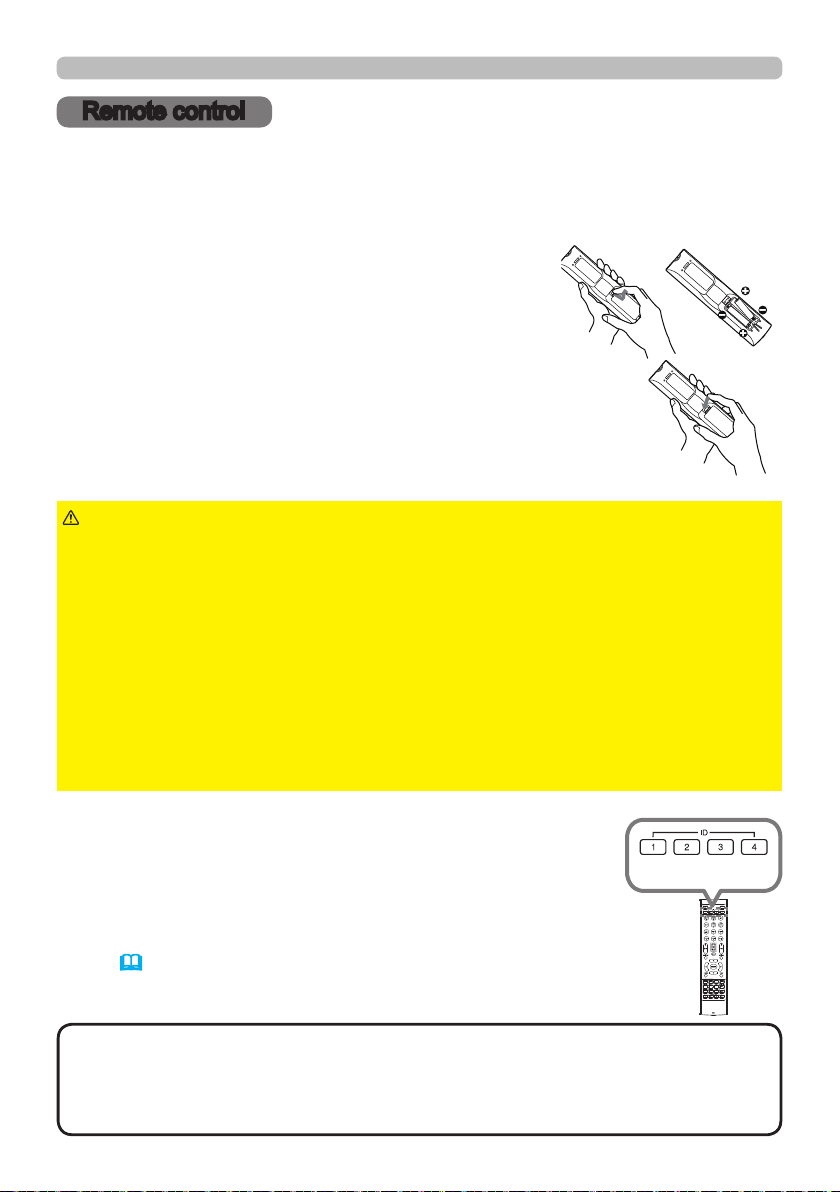
Installing the batteries
Insert the batteries into the remote control before using it. If the remote control
starts to malfunction, replace the batteries. If not use the remote control for long
period, remove the batteries from the remote control and store them in a safe
place.
1.
Holding the hook part of the battery cover, remove it.
2.
Align and insert the two AA batteries according to
their plus and minus terminals as indicated in the
remote control.(Use the appropriate AA carbon-
zinc or alkaline batteries (non-rechargeable)
according to laws and regulations. )
3.
Replace the battery cover in the direction of the arrow
and snap it back into place.
►Always handle the batteries with care and use them only as
directed. Improper use may result in battery explosion, cracking or leakage, which
could result in re, injury and/or pollution of the surrounding environment.
• Be sure to use only the batteries specied. Do not use batteries of different types at
the same time. Do not mix a new battery with used one.
• Make sure the plus and minus terminals are correctly aligned when loading a battery.
• Keep a battery away from children and pets.
• Do not recharge, short circuit, solder or disassemble a battery.
• Do not place a battery in a re or water. Keep batteries in a dark, cool and dry place.
• If you observe battery leakage, wipe out the leakage and then replace a battery.
If the leakage adheres to your body or clothes, rinse well with water immediately.
• Obey the local laws on disposing the battery.
WARNING
Remote control
Using the REMOTE ID function
Use this function to control specic projectors by the remote
control assigned the same ID number when you use multiple
projectors of the same type at the same time.
Assign an ID number to each projector before using the
REMOTE ID item in the SERVICE menu of the OPTION
menu (90). Press the ID button with the same ID number
as assigned to the projector you are going to control. The ID
button selected will light for several seconds.
• Each time you press any button (except ID buttons), the ID button of
current selected ID number will light.
• To conrm the projector's current ID, press any ID button for three seconds.
Its number will be shown on each screen regardless of set ID of projector.
NOTE
2
1
3
ID
buttons
23
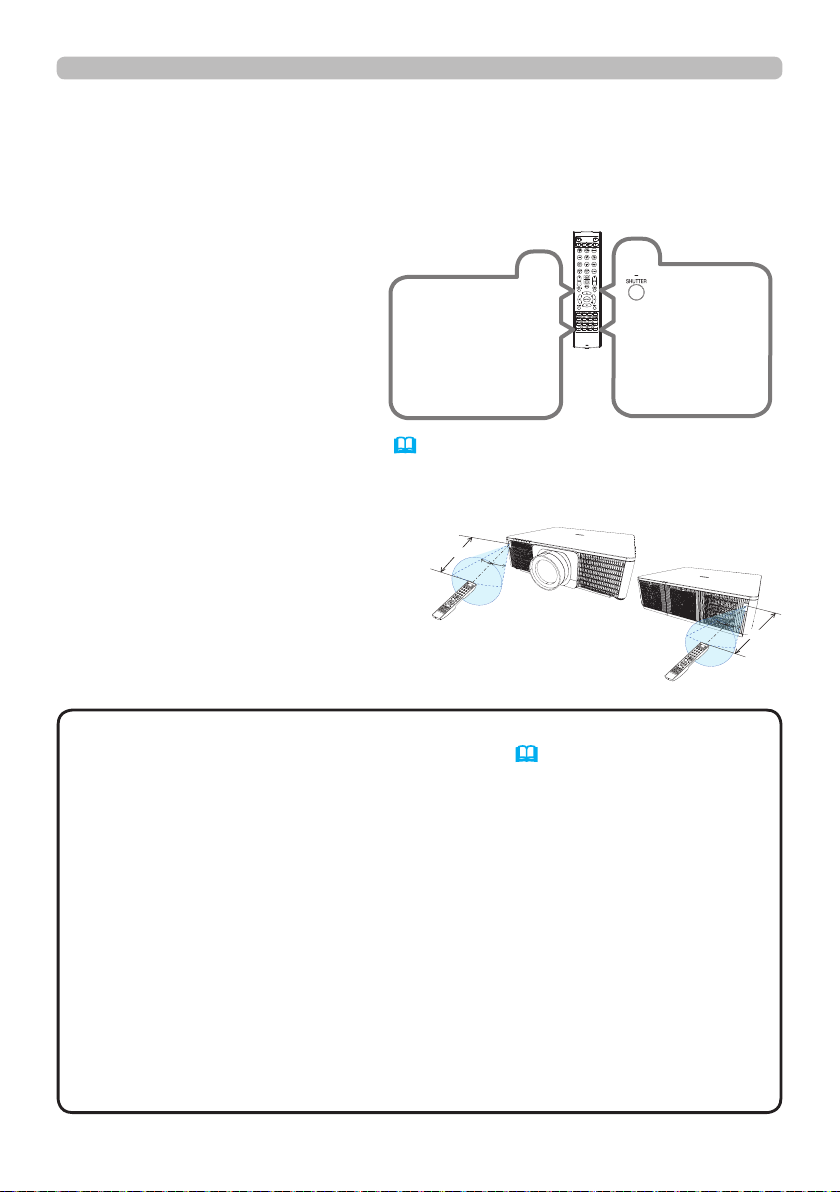
About the remote control signal
The remote control works with the
projector’s remote sensor. This projector
has two remote sensors on the front and
back sides.
The sensors can sense signals within
the following range:
60 degrees (30 degrees to the left and right of the
sensor) within 3 meters about.
• You can deactivate one of the sensors using the REMOTE RECEIV.
item in the SERVICE menu of the OPTION menu (90) .
• The remote control signal reected in the screen may be available. If it is
difcult to send the signal to the sensor directly, try to make the signal reect.
• The remote control uses infrared light to send signals to the projector (Class 1
LED), use the remote control in an area free from obstacles that could block the
remote control’s signal to the projector.
• The remote control may not work correctly if strong light (such as direct
sun light) or light from an extremely close range (such as from an inverter
uorescent lamp) shines on the remote sensor of the projector. Adjust the
position of projector avoiding those lights.
• The projector cannot receive a remote signal from the connected equipment
using HDBaseT™, while the projector is receiving a signal directly from the
projector's remote sensor.
• The projector cannot receive a remote signal from the connected equipment
using HDBaseT right after turning the power on.
NOTE
Changing the frequency of remote control signal
Remote control
The accessory remote control has the two choices on signal frequency Mode
1:NORMAL and Mode 2:HIGH. If the remote control does not function properly,
attempt to change the signal frequency.
To set the Mode, press the combination of two buttons listed below simultaneously
for about three seconds.
(1) S et to Mode 1:NORMAL
SHUTTER and
MY BUTTON-4 buttons
(2) S et to Mode 2:HIGH
LENS SHIFT and
MY BUTTON-1 buttons
The REMOTE FREQ. in the
SERVICE item of the OPTION menu
(
90
)
of the projector to be controlled
should be set to the same mode as the remote control.
(1)
MY
BUTTON-4
button
SHUTTER
button
(2)
LENS SHIFT
button
MY
BUTTON-1
button
30°
30°
3m
30°
30°
3m
(approx.)
24
Status Monitor
Status Monitor
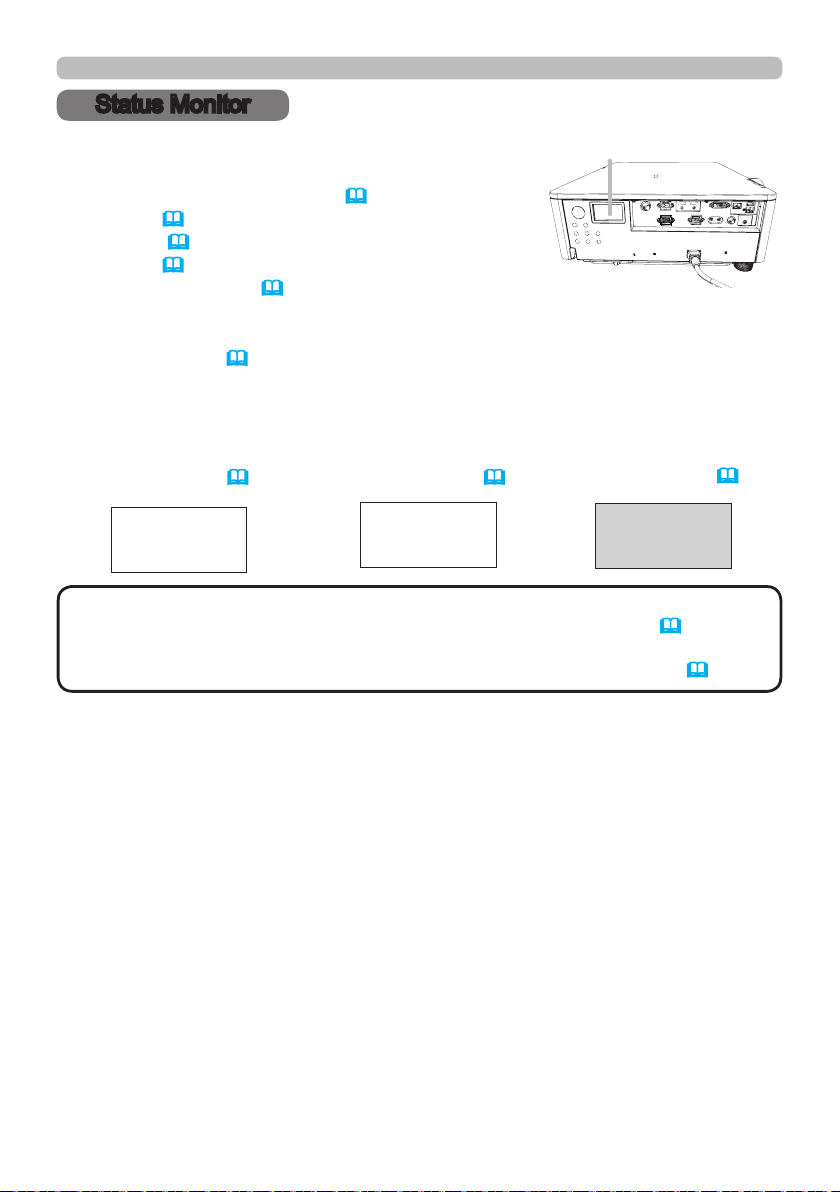
Displaying the condition of the projector
The Status Monitor is the sub LCD in the side panel
that displays the information in the following.
If no buttons are pressed, the Status Monitor displays the current status (Normal,
Warning or Error) as below.
Status Monitor
• The Status Monitor displays nothing while the projector is in standby
mode if the STANDBY MODE item of SETUP menu is set to SAVING (74).
• When INSTALLATION in the SETUP menu is set to FRONT / CEILING or REAR /
CEILING, the contents on the Status Monitor are displayed upside down (74).
NOTE
• Current status of the projector. (
27
)
• Error log. (
27
)
• Lamp log. (
28
)
• Filter log. (
29
)
• Network information. (
29
)
You can execute the following operation in the Status
Monitor.
• Lamp Time reset (
28
)
•Normal (example) (
26
) •Warning (example) (
27
)
•Error (example) (
27
)
AIR
LAMP1
@
A C 2 4 0 V 3 5 ° C
1
6 0 0 x 1 2 0 0 1 0 0
C OM P U T E R I N

25
Status Monitor
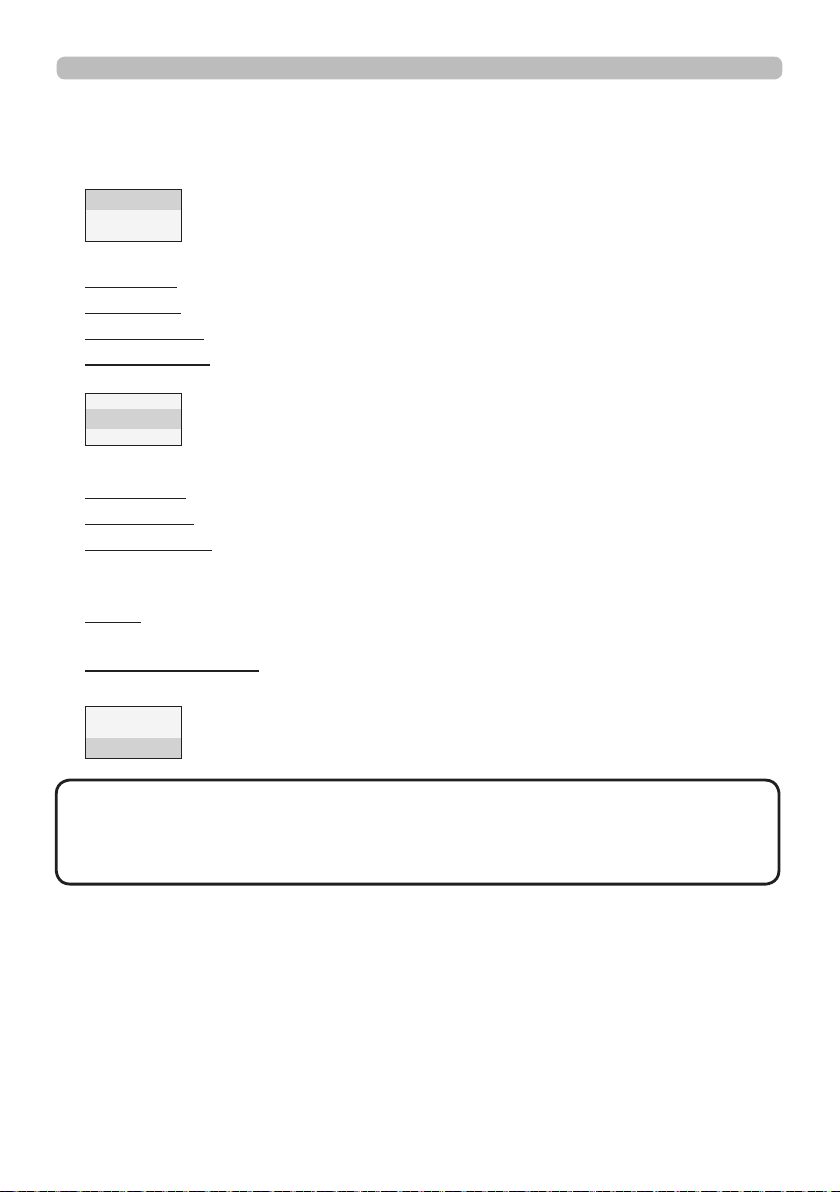
You can switch the display to see Error log, Lamp log, Filter log and Network
information.
•When Normal or Warning is displayed:
1. Press one of the following buttons.
1) FUNCTION button on the control panel
2) ENTER button on the remote control for 3 sec.
3) MY BUTTON button on the remote control which assigned as STATUS
MONITOR.(84)
2. Backlight turns on, and you can switch the display by pressing the ▲/▼or ◄/►
buttons.
•When Error is displayed:
You can switch the display by pressing the ▲/▼or ◄/► buttons.
Switching the display
• While the projector is warming up, buttons are not available.
• The Status Monitor and its backlight returns to the rst state if the following occurs.
□Any button except cursor buttons is pressed.
□No button is pressed for about 30 seconds.
• The Status Monitor and the OSD menu cannot be operated at the same time.
NOTE
R
A C 8 2 V 3 5 ° C
3
L A M P E R
1 P R E V I O U S
@
A C 2 4 0 V 3 5 ° C
1
6 0 0 x 1 2 0 0 1 0 0
C OM P U T E R I N
5
N 2 5 5 2 5 5 2 5 5 0 0 0
W
2 5 5 2 5 5 2 5 0 0 0
S U B N E T M A S K
Error log LAMP time Filter/System time Default Gateway
3
L A M P 2 1 0 3 4 5 h
L
A M P 1 1 0 4 5 h
1 P R E V I O U S
3
S Y S T E M 1 2 1 4 5 6 h
F
I L T E R 1 0 4 5 h
1 P R E V I O U S
3
L A M P 2 1 2 3 4 5 h
L
A M P 1 1 2 4 5 h
0 C Y C L E - - - h - - m
3
S Y S T E M 1 2 3 4 5 6 h
F
I L T E R 1 2 4 5 h
0
1
N 1 9 2 1 6 8 0 0 2 2 1 0
W
1 9 2 1 6 8 0 0 2 1 0
I P A D D R E S S
Default GatewayError log
LAMP time
Filter/System time
1. The current status
and error log (
27
)
2. Lamp log (
28
) 3. Filter log (
29
)
4. Network
information
(
29
)
current
status
log
(continued on next page)
26
Status Monitor
In a normal state
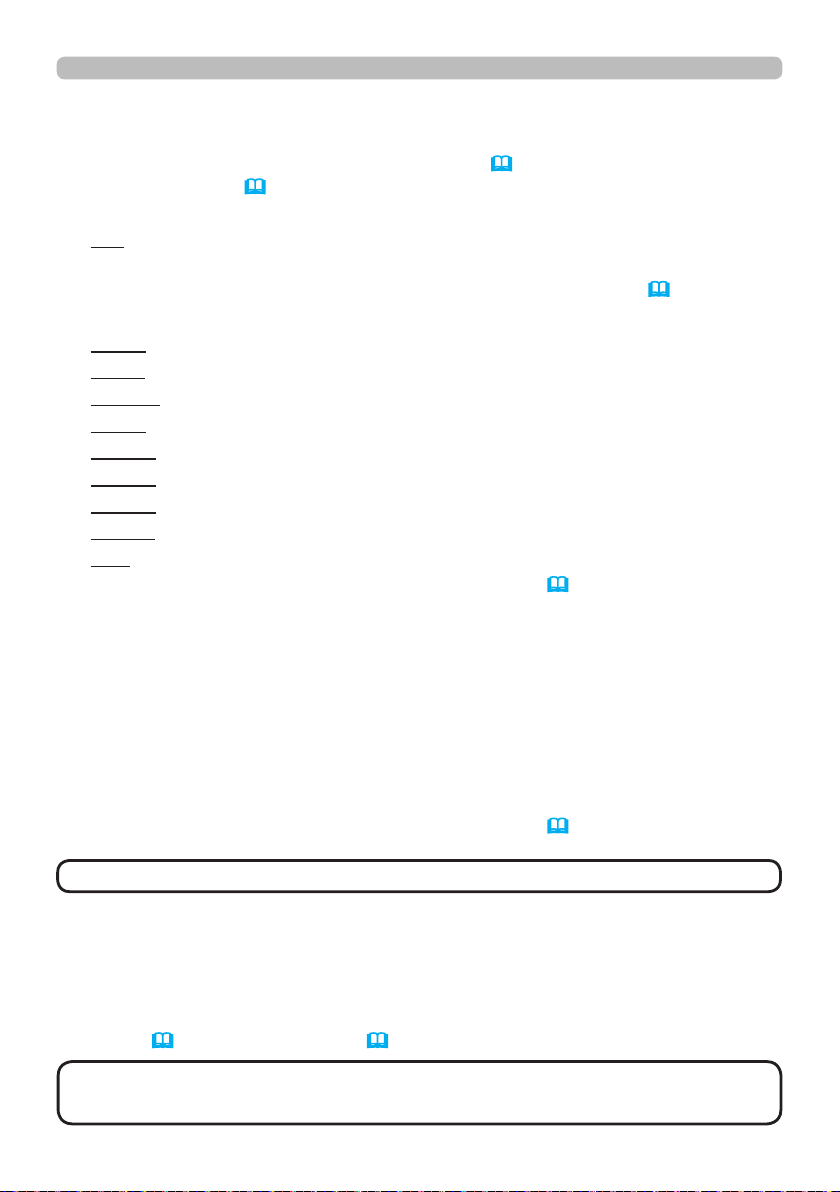
The Status Monitor displays the state of the projector in
three lines.
1st line
: Displays the condition of the projector. While the lamp is on, the
selected port is displayed.
Displayed conditions are as below;
STANDBY: The projector is in standby mode.
WARM UP: The projector is warming up.
SEARCHING: The projector is searching an input signal.
COOL DOWN: The projector is cooling down.
2nd line
: Displays the condition of the detected input signal while the lamp
is on. Otherwise, displays the serial number of the projector.
Displayed conditions are as below;
SYNC OUT: Detected input signal is out of specied range.
NO SIGNAL: There is no input signal.
CONNECTED: The projector has connected to the network or the computer
and some image is transferred to the projector while the LAN is
selected.
HOLD: The projector has connected to the network but no image is transferred
while the LAN port is selected.
NOT CONNECTED: The projector is not connected to the network or the
computer while the LAN port is selected.
3rd line
: Displays supplied voltage and peripheral temperature in Celsius
while the lamp is on.
• While the projector is searching an input signal in normal condition,
nothing is displayed on the 2nd line of the monitor.
• Displayed temperature may be different from actual peripheral temperature
because the displayed temperature is measured inside the projector.
NOTE
27
Status Monitor
The current status (Warnings and Errors)
The Status Monitor displays a warning or an error with larger letters. When it is
displayed, refer to the table "Related messages"(
Troubleshooting
) or “Regarding
the indicator lamps"
(
109)
Warnings;
AIR (AIR FLOW): The internal temperature is rising.
Refer to the message "There is a possibility that the interior portion has
become heated" in the table “Regarding the indicator lamps"
(
109)
COLD: The inside of the projector is cooled excessively.
FILTR: Clean the air lter.
SHUTR: Shutter Error
SHIFT: Lens Shift Error
LAMP1: Lamp 1 Warning
LAMP2: Lamp 2 Warning
HUMID: Humidity is too high.
C.WHL: Error of one of the two color wheels
IRIS: Active Iris Error
Refer to the table “Regarding the indicator lamps”.
(
109)
Errors;
COVER: The lamp cover has not been xed properly.
FAN: The cooling fan is not operating.
LAMP: Error of both lamps.
TEMP: The inside of the projector is overheating.
ACBLK: Refer to the LAMP indication light in the table.
OTHER: Errors other than the above
Refer to the table “Regarding the indicator lamps”.
(
109)
• The backlight blinks when an error is displayed.
NOTE
Error log
Press the ▲ button to display the previous error log when the current status is
displayed with the backlight on. Up to 10 error logs can be displayed. The log
contains the log number, occurred error, the supplied voltage and peripheral
temperature at that time. Press the ► button to display the usage time in the
Lamp log (28) and the Filter log (29) when each error occurred.
• If no error or less than 10 errors have occurred, "NO DATA" is
displayed regardless of what error occurred in the error log.
NOTE

28
Status Monitor
Lamp log
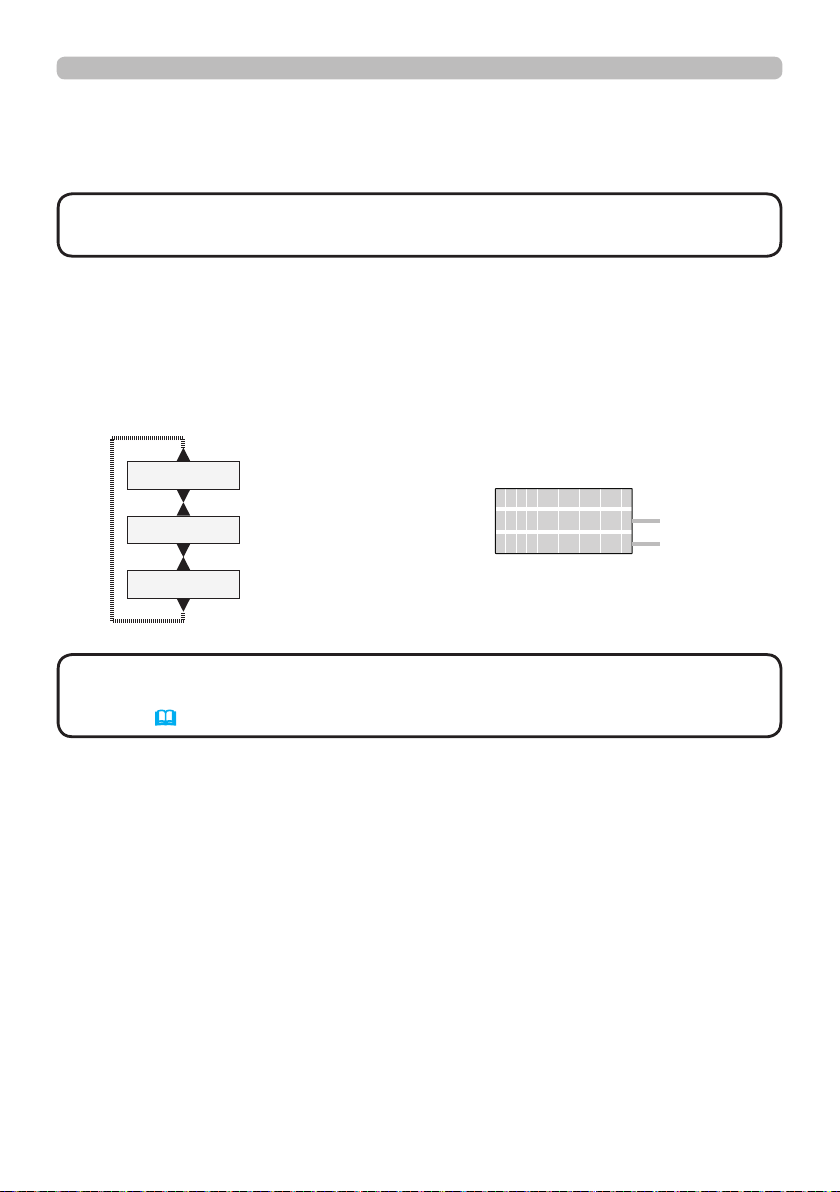
Displays the usage time of the lamp1 & 2, and executes Lamp Time Reset. You can
display the previous logs by pressing the ▲ button.
Usage time;
•Displays remaining cycle time and the lamp 1 & 2 usage time.
Lamp Time Reset;
•The lamp 1 & 2 usage time shall be reset when changing the lamp(s).
1. Display the Lamp log and press INPUT button on the control panel or ENTER
button on the remote control.
2. Select LAMP1 or LAMP2 by pressing INPUT or ENTER button, and press the
► button.
3. Select OK by pressing INPUT, ENTER or the ▲ button in the LAMP RESET
display
4. Press the ► button to execute the Lamp Time reset.
• Lamp Time Reset can also be executed in the SETUP of the
ADVANCED MENU(72).
NOTE
1
3
L A M P 2 1 2 3 4 5 h
L
A M P 1 1 2 4 5
►
0 C Y C L E - - - h - - m
2
3
INPUT or
ENTER
button
INPUT or
ENTER
button
3
L A M P 2 1 2 3 4 5
L
A M P 1 1 2 4 5 h
0 C Y C L E - - - h - - m
►
C A N C E L
►
O K
L A M P 1 R E S E T
C A N C E L
O K
►
L A M P 1 R E S E T
INPUT or
ENTER
button
RIGHT
►button:
Reset the
Lamp 1 time
C A N C E L
►
O K
L A M P 2 R E S E T
C A N C E L
O K
►
L A M P 2 R E S E T
INPUT or
ENTER
button
►button:
Reset the
Lamp 2 time
3
L A M P 2 1 2 3 4 5 h
L
A M P 1 1 2 4 5 h
0 C Y C L E - - - h - - m
4
29
Filter log
Displays the usage time of the lter and projector. You can display the previous logs
by pressing the ▲ button.
• The system usage time is the total lamp time from the projector is
manufactured. It cannot be reset.
NOTE
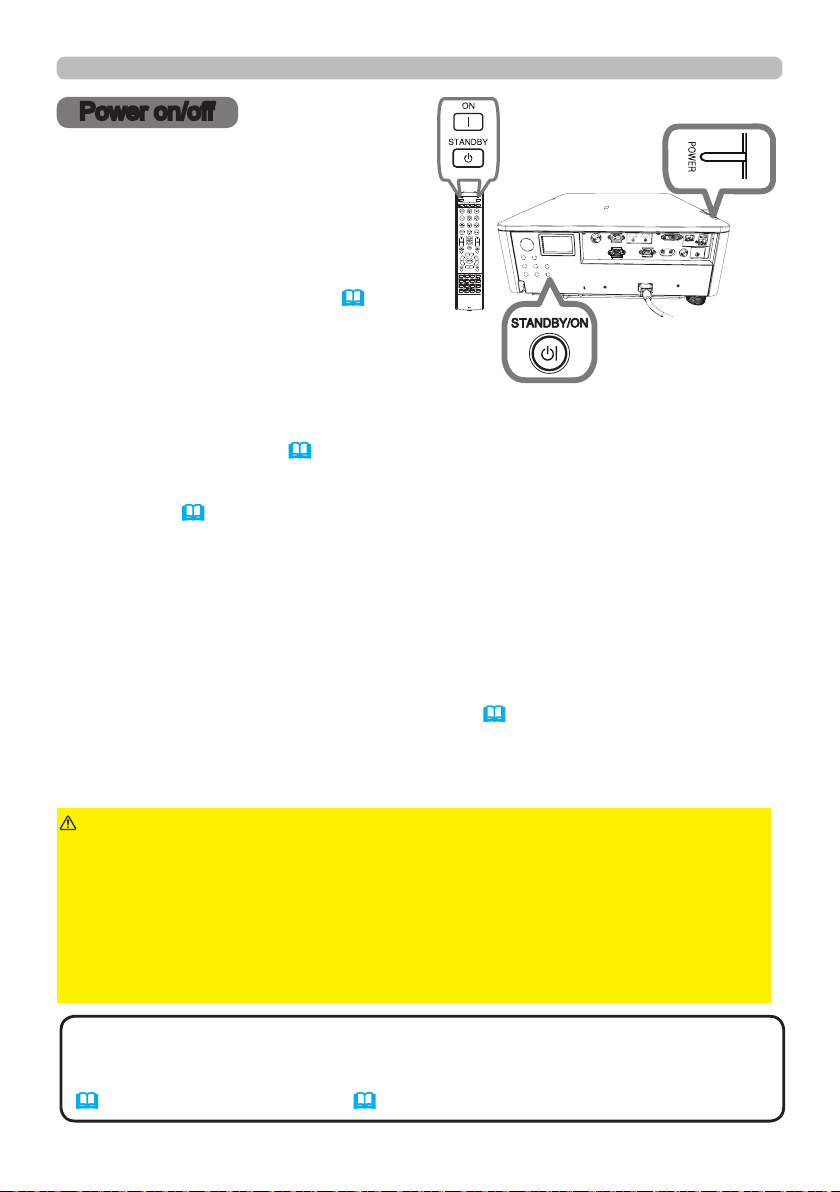
Network information
The network information is displayed on three pages. You can refer IP address,
Subnet mask and Default gateway each for wireless and wired settings. Use the
▲/▼ buttons to switch the page.
Displayed information in each page is as below;
• Network information is available only by switching from the display
of the Filter log with log number 0. Refer to the ow chart in “Switching the
display”.
(
25)
NOTE
3rd page
: Default gateway
(wireless and wired)
2nd page
: Subnet mask
(wireless and wired)
1st page
: IP address
(wireless and wired)
2
N 1 9 2 1 6 8 0 0 1 0 7 5
W
1 9 2 1 6 8 0 0 1 9 6
I P A D D R E S S
Network information
(example)
Wired
Wireless
Status Monitor
30
Power on/off
1.
Make sure that the power cord is
rmly and correctly connected to the
projector and the outlet.
Turning on the power
2.
Make sure that the POWER indicator
is lighted in steady orange (109).
3.
Press STANDBY/ON button on the projector
or the ON button on the remote control.
The projection lamp will light up and the POWER indicator will begin blinking
in green. When the power is completely on, the indicator will stop blinking and
light in steady green (109).
Power on/off
To display the picture, select an input signal according to the section Selecting an
input signal (31).
►A strong light is emitted when the projector’s power is on.
Do not look into the lens of the projector or look inside of the projector through
any of the projector’s openings, as the projection ray may cause a trouble on
your eyes.
►Keep objects away from concentrated projection light beam. Blocking the
beam by something causes high temperature and could result in re or smoke.
►Do not touch around the lamp cover and the exhaust vents during use or just
after use, as it is too hot.
WARNING
1.
Press the STANDBY/ON button on the projector or the STANDBY button on
the remote control.
The message “Power off?” will appear on the screen for about ve seconds.
Turning off the power
2.
Press the STANDBY/ON or STANDBY button again while the message
appears. The projector lamp will go off, and the POWER indicator will begin
blinking in orange. The POWER indicator stops blinking and lights in a steady
orange when the lamp cooling is complete (109).
Do not turn the projector on for about 10 minutes or more after turning it off.
Also, do not turn the projector off shortly after turning it on. Such operations might
cause the lamp to malfunction or shorten the lifetime of some parts including the lamp.
POWER
indicator
ON
button
STANDBY/ON
button
STANDBY
button
• Turn the power on/off in the right order. Power on the projector prior
to the connected devices.
•
This projector can automatically turn on/off. Refer to the DIRECT POWER ON
(83)
and AUTO POWER OFF
(83)
items of the OPTION menu.
NOTE

31
Operating
Selecting an input signal
1.
Activate your signal source. Turn the signal source on, to send signal to the
projector.
2.
Press the
INPUT
button on the projector.
When you press the button, the projector switches its input port in turn.
You can also use the remote control to select an input signal.
Select from the buttons for input ports as the following.
• If you have set SKIP to some ports from SOURCE SKIP in the
OPTION menu, the input from the ports cannot be selected (82).
• While ON is selected for AUTO SEARCH item in OPTION menu, the projector
will keep checking the ports in the above order repeatedly until an input signal is
detected (82).
NOTE
INPUT
button
Operating
COMPUTER IN
LAN
HDMI 1 HDMI 2
HDBaseTVIDEO
DVI-D
SDI/DIGITAL 1
Buttons for input ports

32
Selecting an aspect ratio
For a video signal
4:3 16:9 16:10 14:9 ZOOM NATIVE
For an input signal from the LAN, or if there is no signal
CP-WU9100: 16:10 (xed)
CP-HD9950: 16:9 (xed)
1.
Press the ASPECT button on the remote control.
Each time you press the button, the projector switches
the mode for aspect ratio in sequence.
For an HDMI
TM
, DVI-D and HDBaseT™ signal
NORMAL 4:3 16:9 16:10 14:9 ZOOM NATIVE
• The ASPECT button does not work when no proper signal is inputted.
• NORMAL mode keeps the original aspect ratio setting.
NOTE
Operating
For a computer signal
NORMAL 4:3 16:9 16:10 ZOOM NATIVE
ASPECT
button
For a SDI/DIGITAL 1 signal
CP-WU9100
NORMAL 4:3 16:9 16:10 ZOOM NATIVE
CP-HD9950
NORMAL
4:3
16:9
ZOOM
NATIVE
33
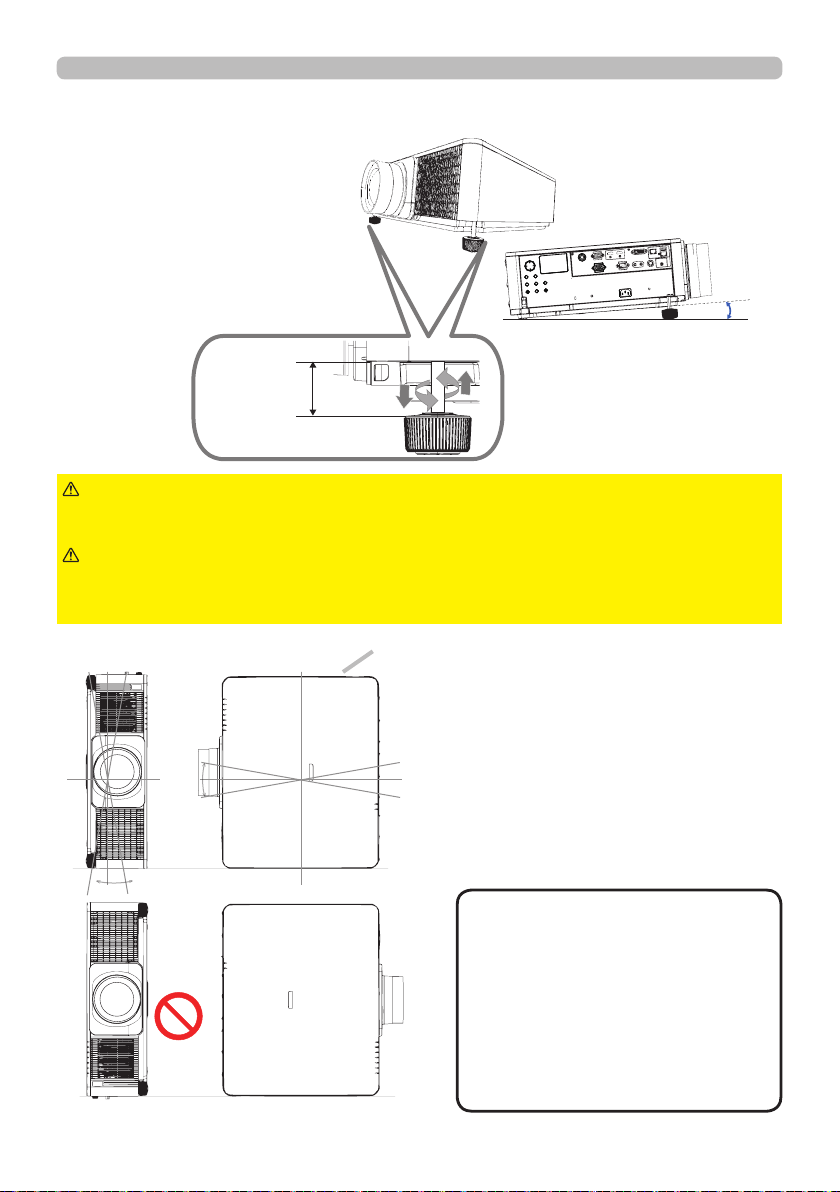
►Do not place the projector with an inclination exceeding
5 degrees. The projector leaned exceeding the limit could cause malfunction and
shorten the life of the projector.
CAUTION
Increasing or shortening the
length of the elevator feet shifts
the projection position and the
projection angle.
Turn the elevator feet each to
adjust their length.
5°
max. 30 mm
►Do not lengthen the elevator feet exceeding 30 mm. The foot
lengthened exceeding the limit may come off and drop the projector down, and
result in an injury or damaging the projector.
WARNING
Adjusting the projector’s elevator
Operating
Installation angle
Vertical and horizontal direction in
portrait mode
The projector may be installed at
horizontal angle of ±10°.
The projector may be installed at
vertical angle of ±10°.
• The terminal side of the
projector must face upward for
vertical installations.
•
If other error has occurred, check
installation. Install the projector
correctly, and restart it.
• When using portrait mode, the
service life of a lamp becomes
shorter.
NOTE
10°
10°
10°
10°
Terminal side
34
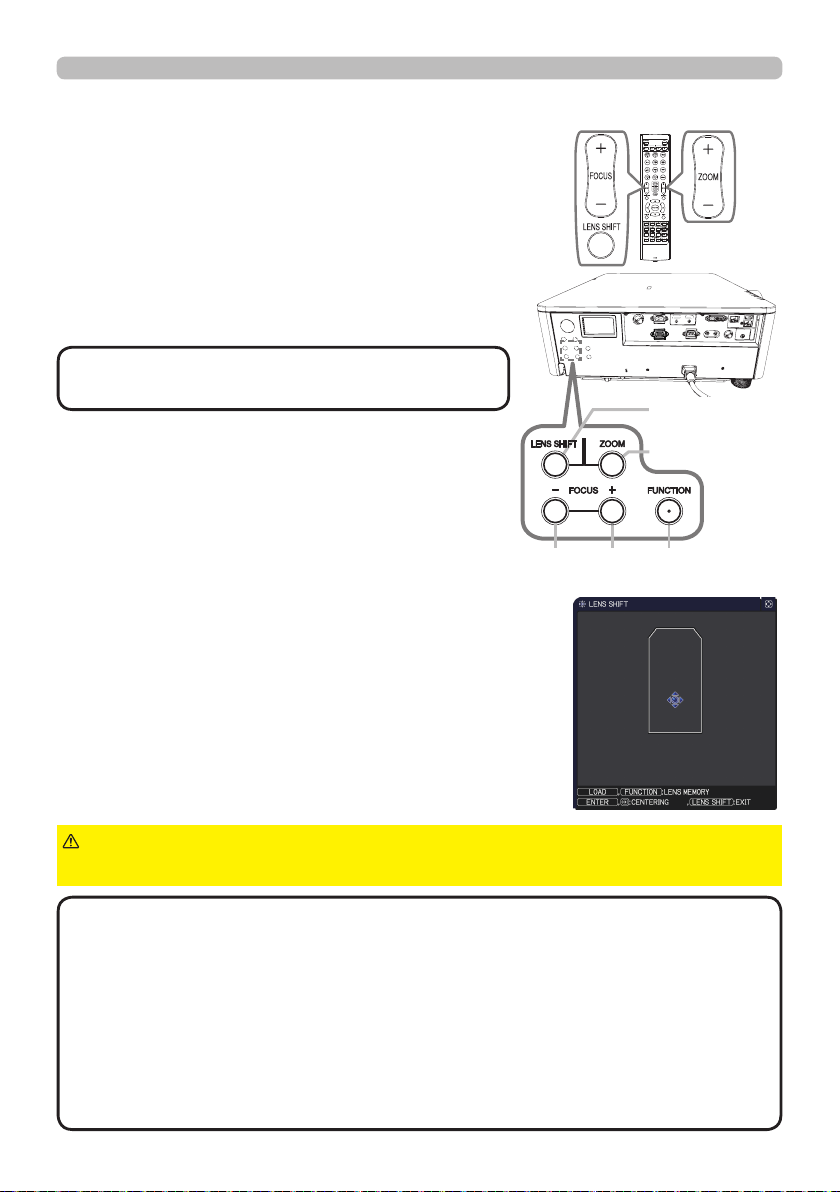
The ZOOM or FOCUS dialog will appear when
you press any of the buttons from
ZOOM
,
ZOOM -
,
ZOOM +
,
FOCUS +
and
FOCUS -
.
1.
Use the
ZOOM
+
/ -
buttons to adjust
the screen size.
2.
Use the
FOCUS
+ /
-
buttons to focus
the picture.
Adjusting the lens
Adjusting the zoom and focus
• The projector may ignore the operation
by other buttons while the lens is moving.
NOTE
Press the
LENS SHIFT
button. The LENS SHIFT
dialog will appear. Using the ▲/▼/◄/►buttons while
the dialog is displayed shifts the lens. Generally, better
image quality can be got when the lens is set to the
center.
Press the
LENS SHIFT
button again to exit the
LENS SHIFT function.
CENTERING
Press the
ENTER
or
INPUT
button while the dialog is
displayed to execute the CENTERING feature, which
adjusts the lens to the center. A message dialog is dis-
played for conrmation. Pressing the ►button performs
CENTERING. You can also perform CENTERING in the
standby mode by pressing the
FUNCTION
and
LENS
SHIFT
buttons on the control panel for three seconds at
the same time.
Adjusting the lens position
►Do not put your ngers or any other things around the lens. The
moving lens could catch them in the space around the lens and result in an injury.
CAUTION
• While the lens is moving to the center, the menu will disappear and an
hourglass icon will appear on the screen. CENTERING may take some time till the
lens reaches the center.
• The projector may ignore operation by buttons while moving the lens.
•
The CENTERING feature while the projector is in the standby mode is disabled if the
STANDBY MODE item of SETUP menu is set to SAVING. Perform CENTERING before
the projector's power is turned off, or set the STANDBY MODE to NORMAL.
• The adjustable range of LENS SHIFT varies depending on the lens unit mounted
on the projector to maintain picture quality. Therefore, LENS SHIFT adjustment may
not reach the end of the indicator in the dialog. This is not a failure.
NOTE
ZOOM +
/
-
buttons
FOCUS +
/
-
buttons
LENS SHIFT
button
FOCUS -
/
+
buttons
ZOOM
button
FUNCTION
button
LENS SHIFT
button
SHUTTER
Operating
35
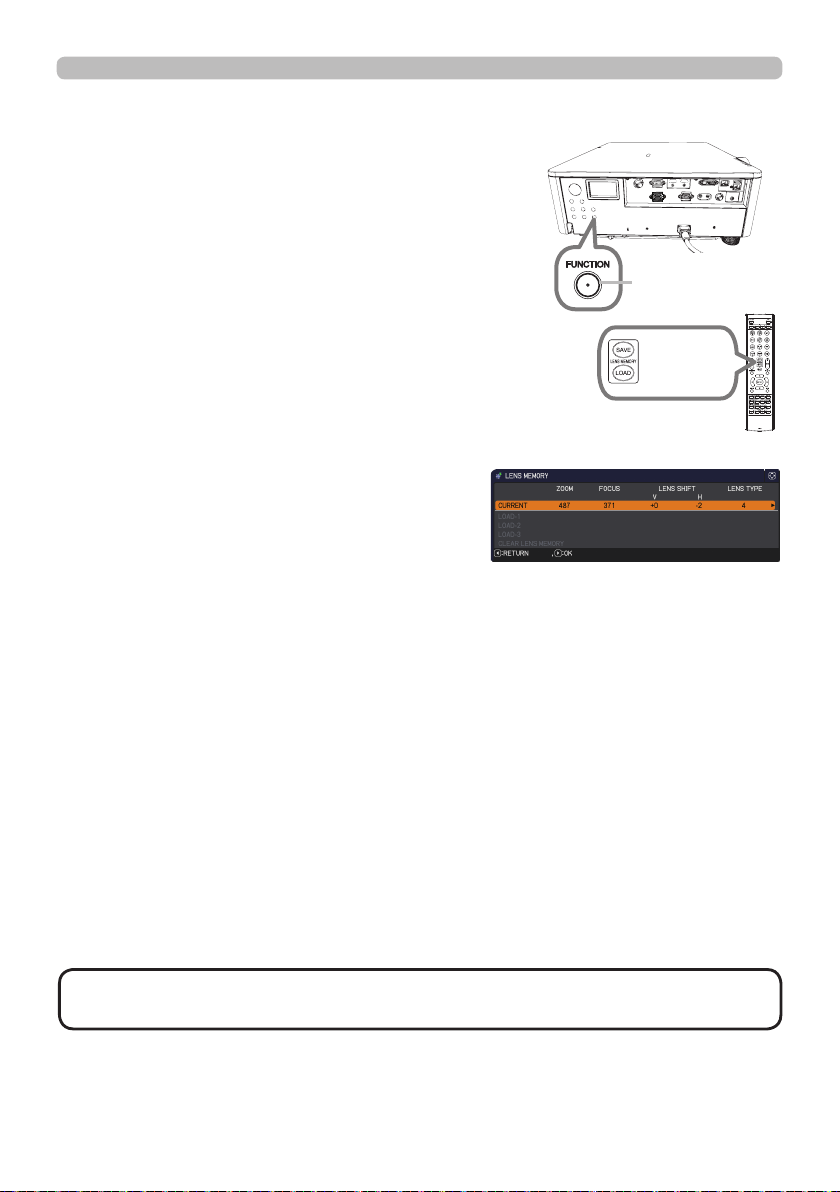
This projector is equipped with memory functions for the
lens adjustments (ZOOM, FOCUS, LENS SHIFT and
LENS TYPE). Up to three sets of adjustments can be
stored.
To use the lens memory feature, press the
LOAD
or
FUNCTION
button while the LENS SHIFT dialog is dis-
played, or press ▲ button while the ZOOM or FOCUS
dialog is displayed. Then the LENS MEMORY dialog will
appear. The current lens adjustments are displayed on
the “CURRENT” line. The adjustments already stored
in the lens memory are displayed on the lines of SAVE
and LOAD-1 to 3.
Lens memory
FUNCTION
button
SHUTTER
LENS
MEMORY
button
SAVE:
To
utilize the save lens memory feature,
press the ► button while CURRENT is
selected on LENS MEMORY dialog or press
the
SAVE
button on the remote control.
To
store the current lens adjustments, select one
of the "SAVE" options numbered 1 to 3 (number of the lens memory) and press the
►or
ENTER
button, while LENS MEMORY OSD is displayed.
Remember that the current data being stored of a memory will be lost by saving
new data into the memory.
LOAD:
To recall stored adjustments, select one of the "LOAD" options numbered 1 to
3 (number of the lens memory) and press the ►or
ENTER
button, while LENS
MEMORY OSD is displayed.
Remember that the current adjusted condition will be lost by loading data. If you
want to keep the current adjustment, save it before performing a LOAD function.
CLEAR LENS MEMORY:
To clear the adjustment stored in a lens memory, select CLEAR LENS MEMORY
and press the ►or
ENTER
button, while LENS MEMORY OSD is displayed. Press
the ►button. A message dialog is displayed for conrmation. Press the ►button
again to clear all of the lens memory.
Operating
• The projector may ignore the operation by buttons while moving the lens.
・Depending on the lens type, this function may not support.
NOTE
36
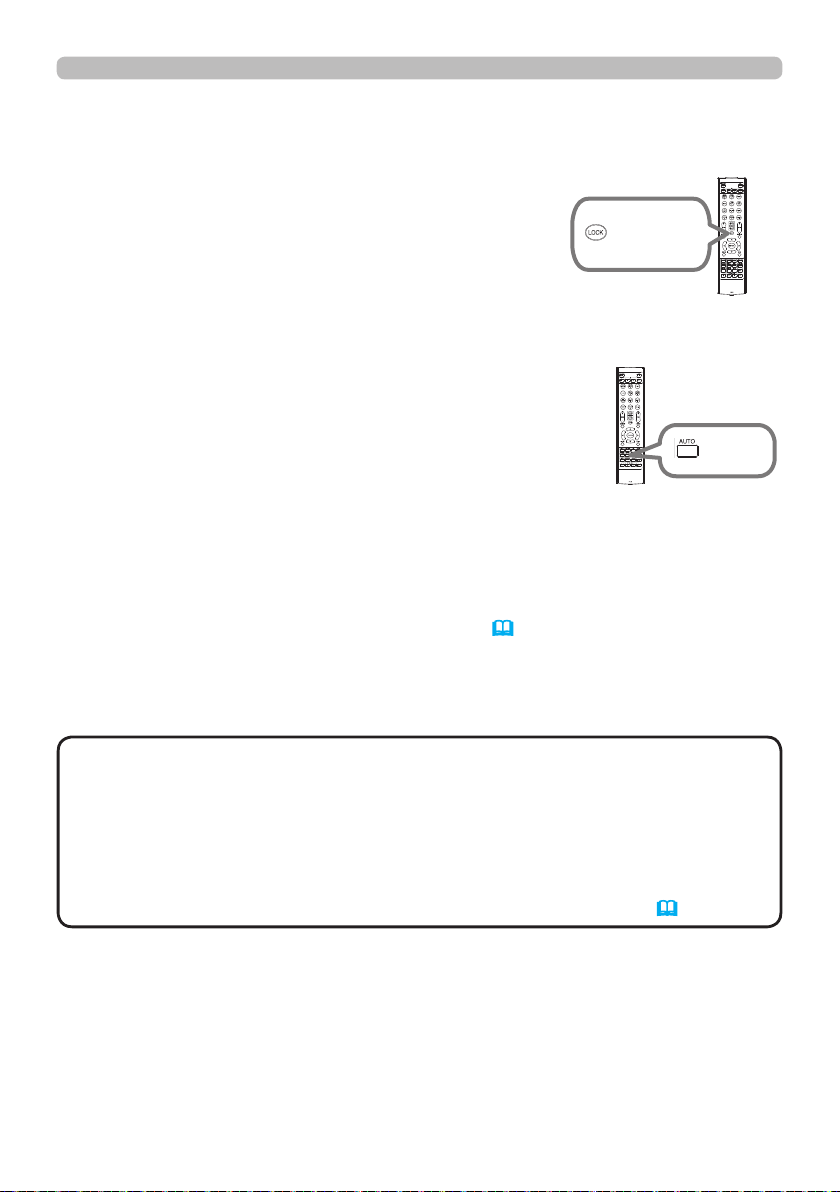
1.
Press AUTO button on the remote control.
Pressing this button performs the following.
Using the automatic adjustment feature
For a computer signal
The vertical position, the horizontal position and the
horizontal phase will be automatically adjusted.
Make sure that the application window is set to its
maximum size prior to attempting to use this feature. A dark picture may still be
incorrectly adjusted. Use a bright picture when adjusting.
For a component video signal
The vertical position and horizontal position will be automatically set to the default.
The horizontal phase will be automatically adjusted.
• The automatic adjustment operation requires approximately 10 seconds.
It may not function correctly with some input.
• When this function is performed for a video signal, an extra line may appear
outside a picture.
• When this function is performed for a computer signal, a black frame may be
displayed on the edge of the screen, depending on the computer model.
•
The items adjusted by this function may vary when the FINE or DISABLE is selected
for the AUTO ADJUST item of the SERVICE item in the OPTION menu (
88
).
NOTE
For a video signal
The video format best suited for the respective input signal will be selected
automatically. This function is available only when the AUTO is selected for
the VIDEO FORMAT item in the INPUT menu (65).
The vertical position and
horizontal position will be automatically set to the default.
AUTO
button
Operating
Using the
LOCK
buttons turns on/off the lens lock
feature. When ON is selected, the buttons (ZOOM,
ZOOM + / -, FOCUS + / -, LENS SHIFT,
LENS MEMORY) are locked.
Lens lock
LOCK
button
37
Operating
Other buttons
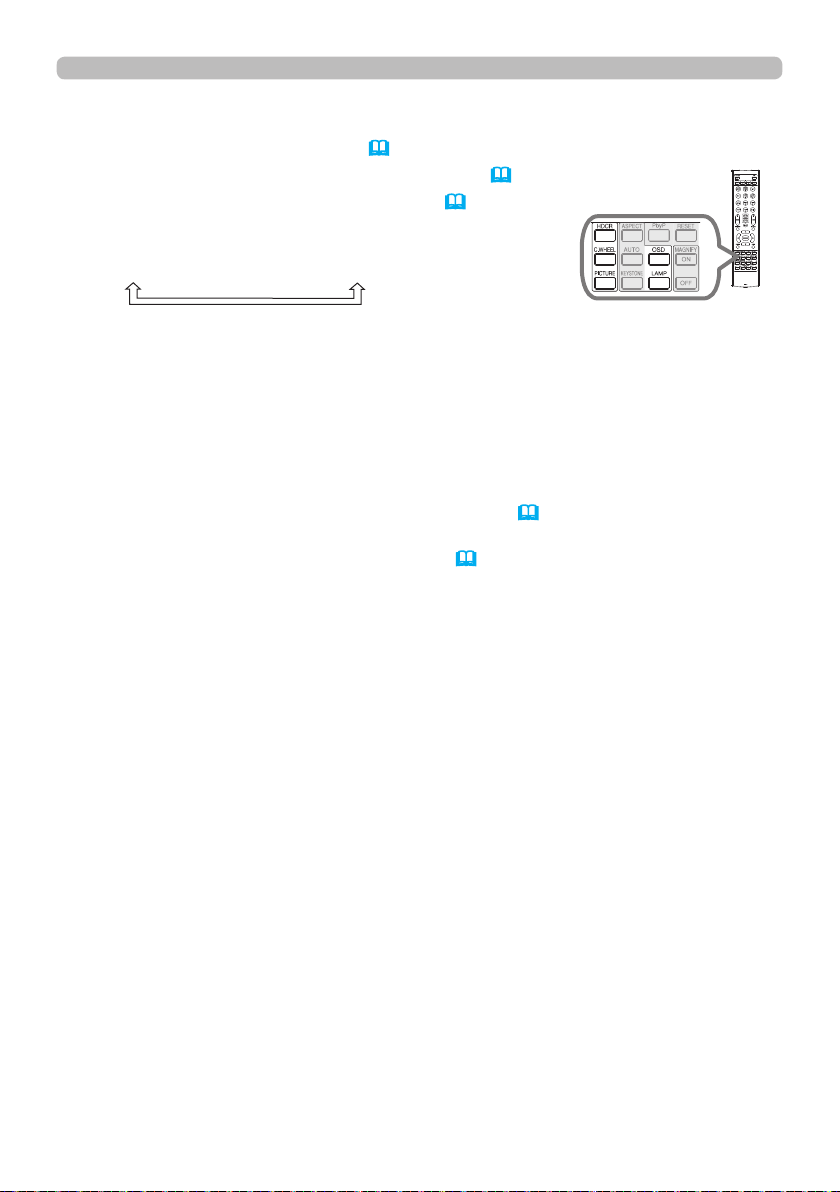
HDCR: Displays the HDCR menu
(
59
)
.
C.WHEEL: Displays the COLOR WHEEL menu
(
60
)
.
OSD: Displays the OSD MESSAGE menu
(
75
)
,
and it switches the function by pressing
the button again.
NORMAL SILENT INHIBIT
All message functions do not work by selecting INHIBIT
.
• To change this function, follow the steps below.
1. Press the OSD button on the remote control for 3
sec.
2. The INHIBIT OSD will be displayed.
While this OSD is displayed, press the OSD button
again on the remote control.
3. Toggle and change the function.
PICTURE: Displays the PICTURE QUALITY menu
(
57
).
LAMP: Displays the LAMP & FILTER menu
(
71
)
.

38
KEYSTONE:
When KEYSTONE is pointed at, pressing the ► or
ENTER
button displays the KEYSTONE dialog.
1.
Select the vertical or horizontal keystone ( /
) with the ▲/▼ buttons.
2.
Use the ◄/► buttons to adjust the keystone distortion.
• When the zoom adjustment is set to the TELE (telephoto focus),
this function may be excessive. This function should be used when the zoom
adjustment is set to the full WIDE (wide-angle focus) .
• When the horizontal lens shift is not set to the center, this function may not
work correctly.
• Point at RETURN in the dialog with the ▲/▼ buttons and press ◄ or ENTER
button to return to the GEOMETRY CORRECTION menu.
NOTE
To correct the distortion of projected screen, you can select from two
options, KEYSTONE and PERFECT FIT. First press the KEYSTONE button
to display the GEOMETRY CORRECTION menu, and select using the ▲/▼
buttons.
KEYSTONE
button
KEYSTONE: Adjust the vertical and horizontal keystone.
PERFECT FIT: Adjust each of the screen corners and
sides to correct the distortion.
WARPING: Project an image on several types of screen.
Use Keystone/PERFECT FIT/Warping for adjustment. When one is selected,
other items are not available.
Complete the following procedure for the item you selected.
Correcting the distortion
NOTE
Operating
• The menu or dialog will automatically disappear after several seconds
of inactivity. Press the KEYSTONE button again, or point the cursor at EXIT in
the dialog and press the ►or ENTER button to end the operation and close the
menu or dialog.

39
Operating
PERFECT FIT:
When PERFECT FIT is pointed at, pressing the
► or
ENTER
button displays the PERFECT FIT
dialog.
This projector is equipped with a test pattern for
PERFECT FIT. Select PATTERN with the
▲/▼
buttons, then press the
◄/►
buttons to switch on
and off.
1.
Select SETUP with the
▲/▼
buttons and
press the
►
or
ENTER
button.
2.
Select one of the corners or sides to be adjusted
with the ▲/▼/◄/► buttons and press the
ENTER
or
INPUT
button.
3.
Adjust the selected part as below.
● To adjust a corner, use the ▲/▼/◄/► buttons to adjust the position of the
corner.
● To adjust the upper or lower side, use the ▲/▼ buttons to adjust the
distortion of the side.
● To adjust the left or right side, use the ◄/► buttons to adjust the distortion
of the side.
● To adjust another corner or side, press the ENTER or INPUT button and
follow the procedure from step 2.
(continued on next page)

40
Operating
4.
This projector is equipped with a memory feature for PERFECT FIT
adjustment. Up to three sets of adjustments can be stored.
● SAVE:
To store the current PERFECT FIT adjustment, select one of the "SAVE"
options numbered 1 to 3 (number of the memory) with the ▲/▼ buttons and
press the ►,
ENTER
or
INPUT
button.
The current data being stored is lost by saving new data.
● LOAD:
To recall stored adjustments, select one of the "LOAD" options numbered
1 to 3 (number of the memory) with the ▲/▼ buttons and press the ►,
ENTER
or
INPUT
button.
The current adjusted condition is lost by loading data. If you want to keep
the current adjustment, save it before performing a LOAD function.
•
The LOAD functions whose linked memories have no data are skipped.
• There may be some noise and the screen may icker for a moment when
loading data. This is not malfunction.
NOTE
WARPING:
Projection on several types of screen can be performed by WARPING function.
This function is operated by using dedicated PC tool, "Warping Tool".
PC and projector are required to be connected with LAN cable to use this
function.
You can get the PC tool from the following URL.
http://www.hitachi.co.jp/proj/
Refer to Application Manual for operations.
41
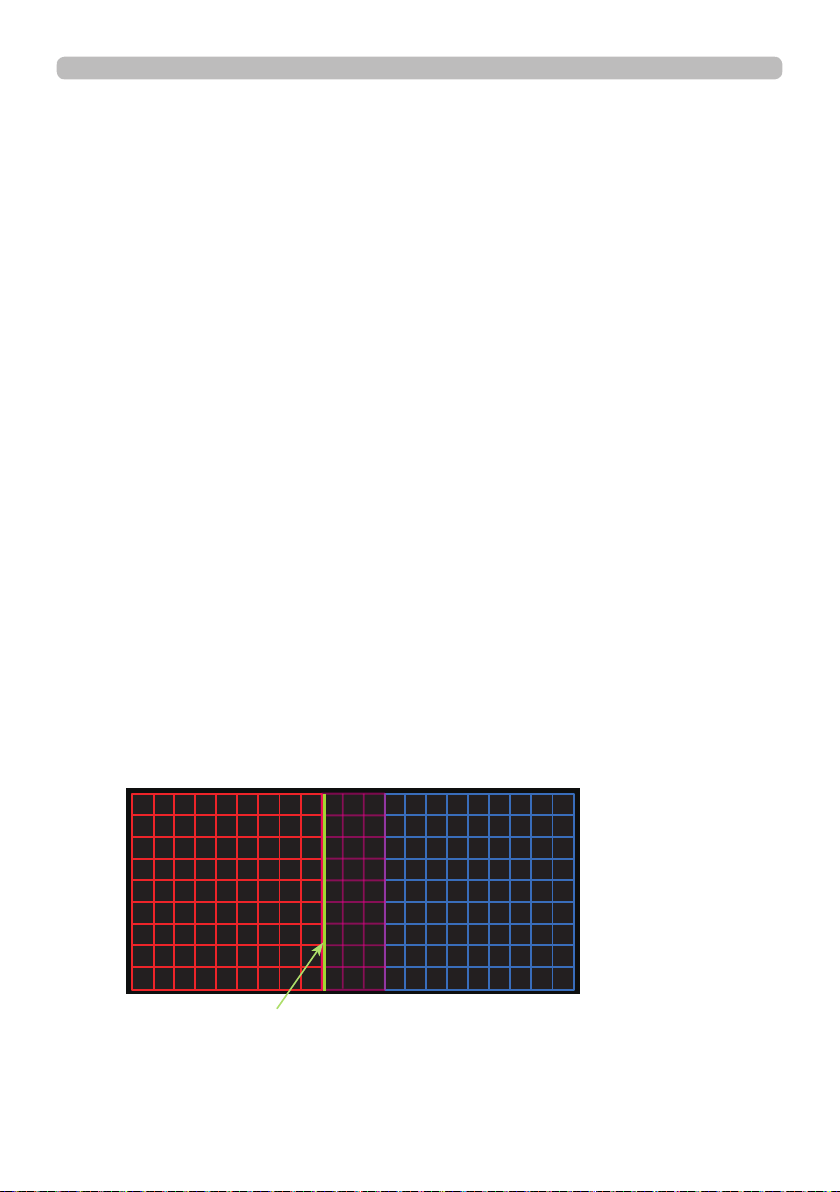
Blend Region
Left Image
Right Image
Using the EDGE BLENDING feature
Operating
Guide line
1. Mode (Manual/Camera)
OFF:
Disables the Blending function.
Manual: Allows you to adjust Blending Region or Blending Level by using menu.
Camera: Allows you to perform automatic adjustment by using Camera in Projector
Blending Tool.
•
ECO MODE is not selectable when Blending is set to other than OFF.
•
Keystone/PERFECT FIT/Warping are not selectable when Camera is selected in
Blending.
•
Camera Feedback (BLENDING) function is operated by using dedicated PC tool,
"Blending Tool".
PC and projector are required to be connected with LAN cable in order to use this
function.
You can get the PC tool from the URL below.
http://www.hitachi.co.jp/proj/
Refer to Application Manual for operations.
2. Blending Region
2.1 Specifying Blending Region
Select one of the four sides with ▲/▼/
◄/► buttons
and press ENTER or INPUT
button. Blending Region can be specied for left and right sides with
◄/► but-
tons
and for top and bottom sides with ▲/▼
buttons
.
Specify Blending Region for each projector.
Adjust them referring to the guide displayed during the adjustment of Blending
Region.
* The minimum value of Blending Region is 200 dots.
(continued on next page)
42
Operating
3. Cropping
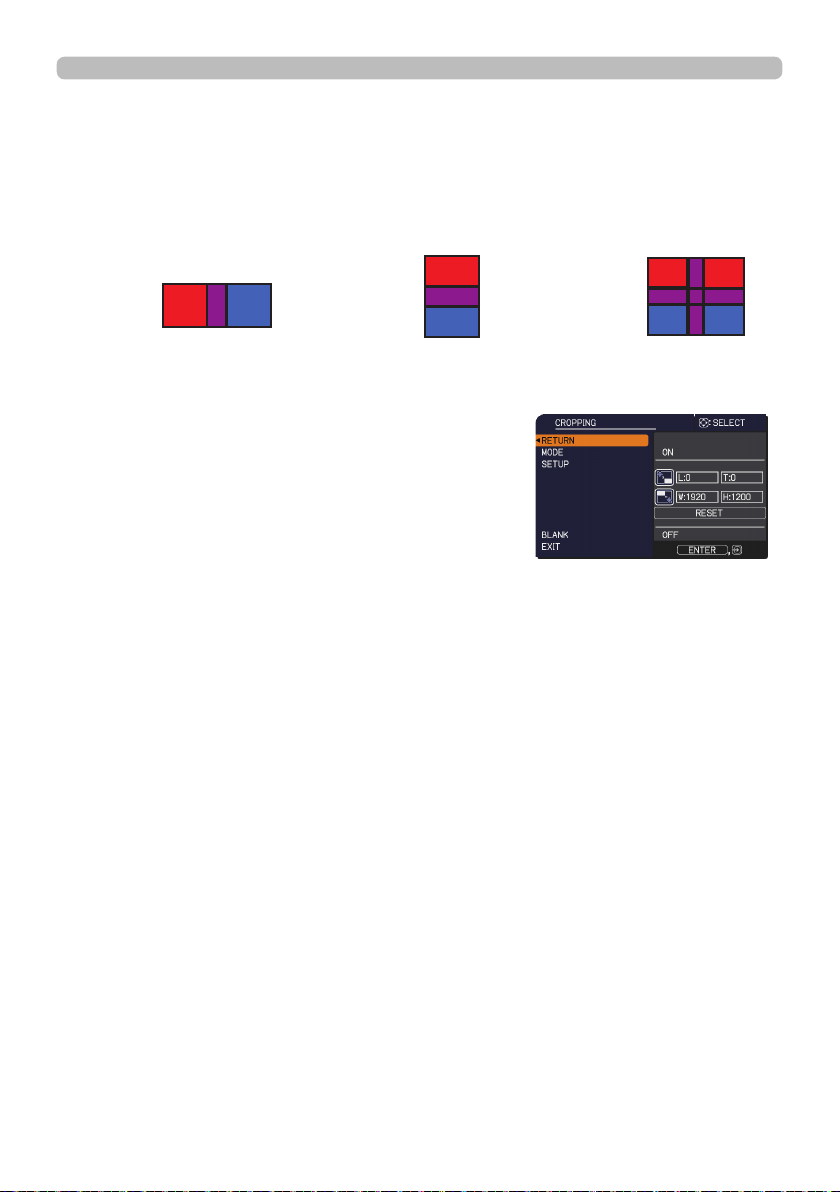
When inputting the same image to each projector, the Cropping function enables
projectors to cut out a part of input image and display one image on a large
screen. The following patterns are supported.
3.1 Displaying Cropping Menu
Select CROPPING with ▲/▼ buttons and press
►
, ENTER or INPUT button to display Cropping
Menu.
3.2 Setting Cropping
Select MODE with ▲/▼ buttons and select ON
with
◄/► buttons
.
The input image is automatically cut out according to the settings of Blending
Region.
1 x 2
2 x 2
2 x 1
(continued on next page)
43
Operating
3.3 Adjusting Cropping Area
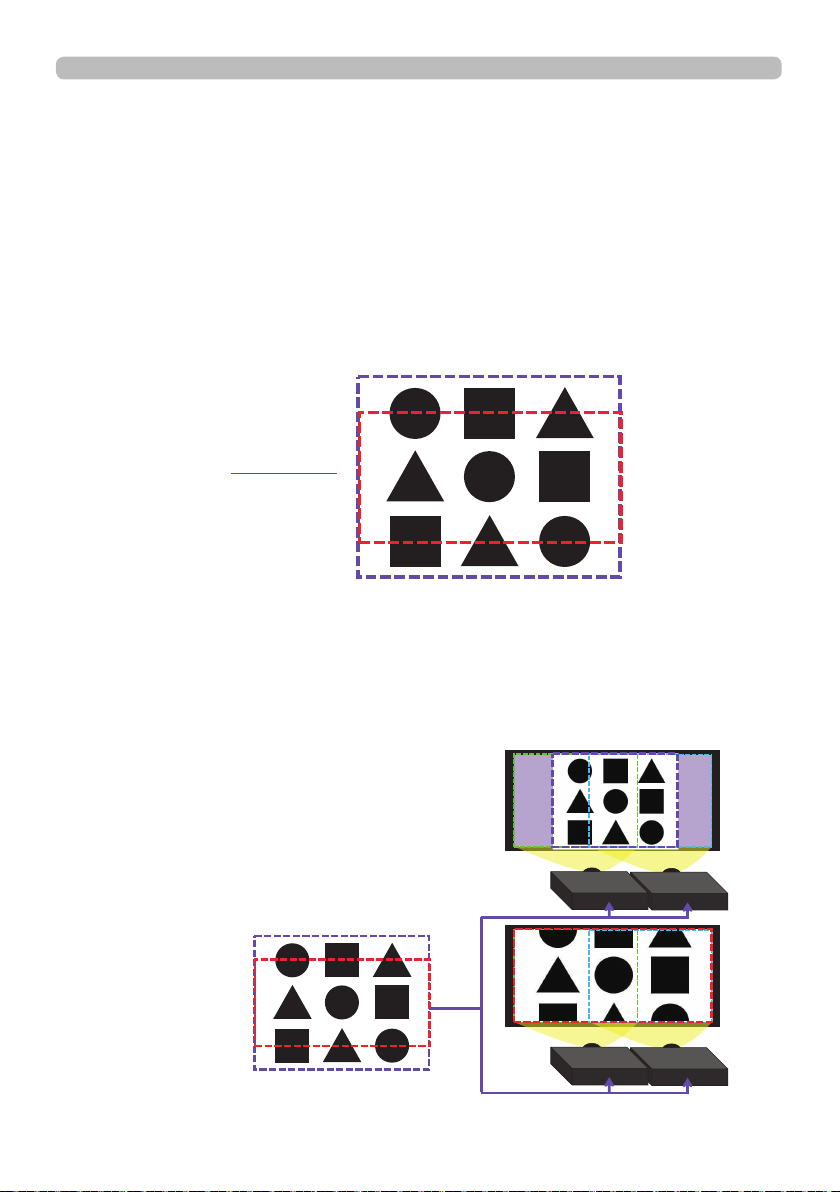
Adjust the Cropping Area when cutting out a part of input image.
Select SETUP with ▲/▼ buttons and press
►
, ENTER or INPUT button.
* MODE is set to [OFF] temporarily and the guide of the Cropping Area
is displayed.
Select [LT]/[WH] with ▲/▼ buttons and press the ENTER or INPUT button.
Move the guide display with ▲/▼/
◄/► buttons
to select the region of the
screen to be cut out.
Press the ENTER or INPUT button and then press
◄ button
to select SETUP,
and MODE switches to ON automatically.
Input Image
Cropping
3.4 Adjust Cropping Area of the other projector.
Set the Cropping Area of the other projector with the same value as one
projector.
The input image is automatically cut out according to the settings of the
Blending Region.
* To keep input image from not being seen while setting up, set BLANK to ON.
(continued on next page)

44
4. Selecting Blending Level
Select the BLENDING LEVEL with ▲/▼ buttons.
[1-25] can be selected with
◄/► buttons
.
Adjust the brightness of the Blending Region according to the settings.
5. DIMMING LEVEL
Adjusts the brightness of the projectors which are using Blending.
Using the ◄/► buttons to adjust the DIMMING LEVEL.
6. WHITE BALANCE
Adjusts the white balance of the whole screen.
6.1. OFFSET
Changes the color intensity on the whole tones.
6.2. GAIN
Mainly affects color intensity on the brighter tones.
7. BLACK LEVEL
Adjusts black color level of the projectors which are using Blending.
Adjusts the adjustment value of R/G/B at the same time when W is selected.
When each of R/G/B is selected, the adjustment value of R/G/B can be
adjusted respectively.
• The positional deviation of the screen may occur after installing the
projector over time. Perform the screen adjustment again to correct the
positional deviation.
NOTE
Operating
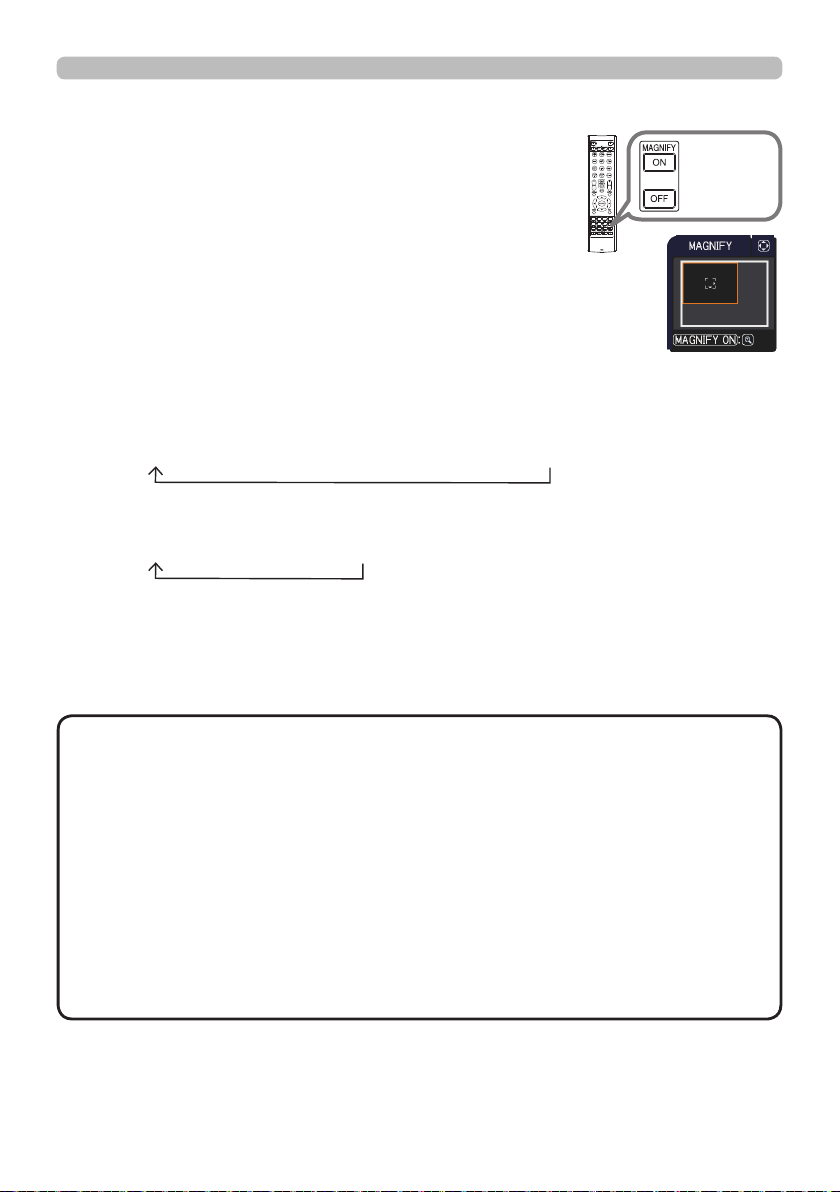
45
1.
Using the magnify feature
2.
3.
4.
Press the MAGNIFY ON button on the remote
control.
The picture will be magnied, and the MAGNIFY
dialog will appear on the screen. When the
MAGNIFY ON button is pressed for the rst time
after the projector is turned on, the picture will be
zoomed by 1.5 times. On the dialog, triangle marks
to show each direction will be displayed.
While the triangles are displayed on the dialog, use the ▲/▼/◄/► cursor
buttons to shift the magnifying area.
Press the MAGNIFY OFF button on the remote control to exit magnication.
• The MAGNIFY dialog will automatically disappear in several seconds
with no operation. The dialog will appear again if the MAGNIFY ON button is
pressed when the dialog has automatically disappeared.
• The magnication is automatically disabled when the displaying signal or its
display condition is changed.
• While the magnication is active, the keystone distortion condition may vary. It
will be restored when the magnication is disabled.
• Some horizontal stripes might be visible on the image while magnication is
active.
• This function is not available in the following cases:
- A sync signal in the range not supported is input.
- There is no input signal.
NOTE
The display magnication of the projector switches with every
press of the MAGNIFY ON button.
For computer signals, HDMI
TM
(RGB) signals, HDBaseT™ signals,
input signals from the LAN ports
1.5 times 2 times 3 times 4 times 1 time
For video signals, component video signals, HDMI
TM
(Component)
signals, HDBaseT signals
1.5 times 2 times 1 time
MAGNIFY
ON / OFF
buttons
Operating
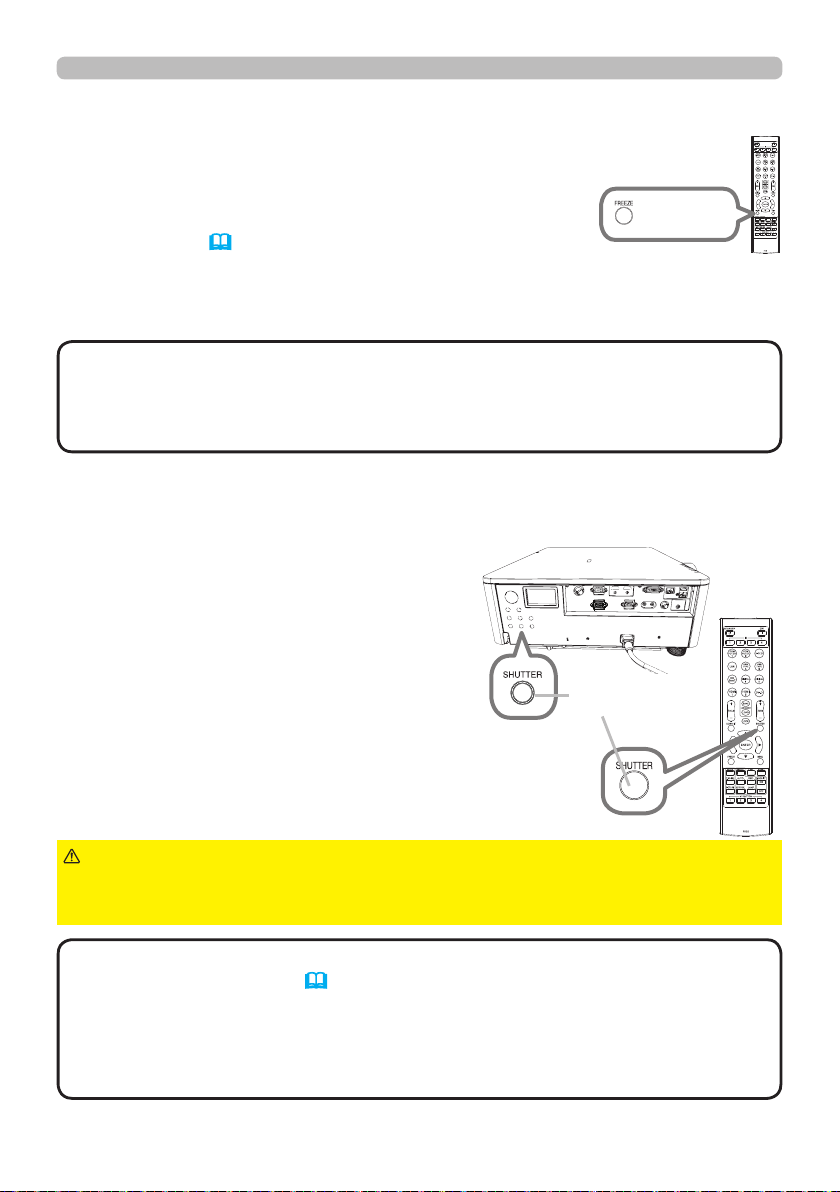
46
1.
Press the SHUTTER button on the control
panel. or on the remote control.
The mechanical lens shutter closes and
the screen turns to black. The SHUTTER
indicator on the projector blinks in yellow
while the shutter is closed.
To open the shutter and restore the screen,
press the SHUTTER button again.
Temporarily shading the screen
1.
Press the FREEZE button on the remote control.
The “FREEZE” indication will appear on the screen
(however, the indication will not appear when the
SILENT is selected for the OSD MESSAGE item in
the SETUP (75), and the projector will go into the
FREEZE mode, which the picture is frozen.
To exit the FREEZE mode and restore the screen to normal, press the
FREEZE button again.
Temporarily freezing the screen
►If you want a blank screen while the projector's lamp is on,
use the lens SHUTTER function. Any other action may cause the damage on the
projector.
WARNING
• The projector automatically exits from the FREEZE mode when some
control buttons are pressed.
• Images might appear degraded when this function is operated, but it is not a
malfunction.
NOTE
•
The projector will turn off automatically when the time set up by the
SHUTTER TIMER passes
(83)
.
• When turning off the power by the normal procedure, the shutter opens
automatically. If AC power supply is disconnected while opening or closing the
shutter, the moving of the shutter stops. However, the next time the projector is
turned on, the shutter opens again automatically.
NOTE
SHUTTER
button
FREEZE
button
Operating
47
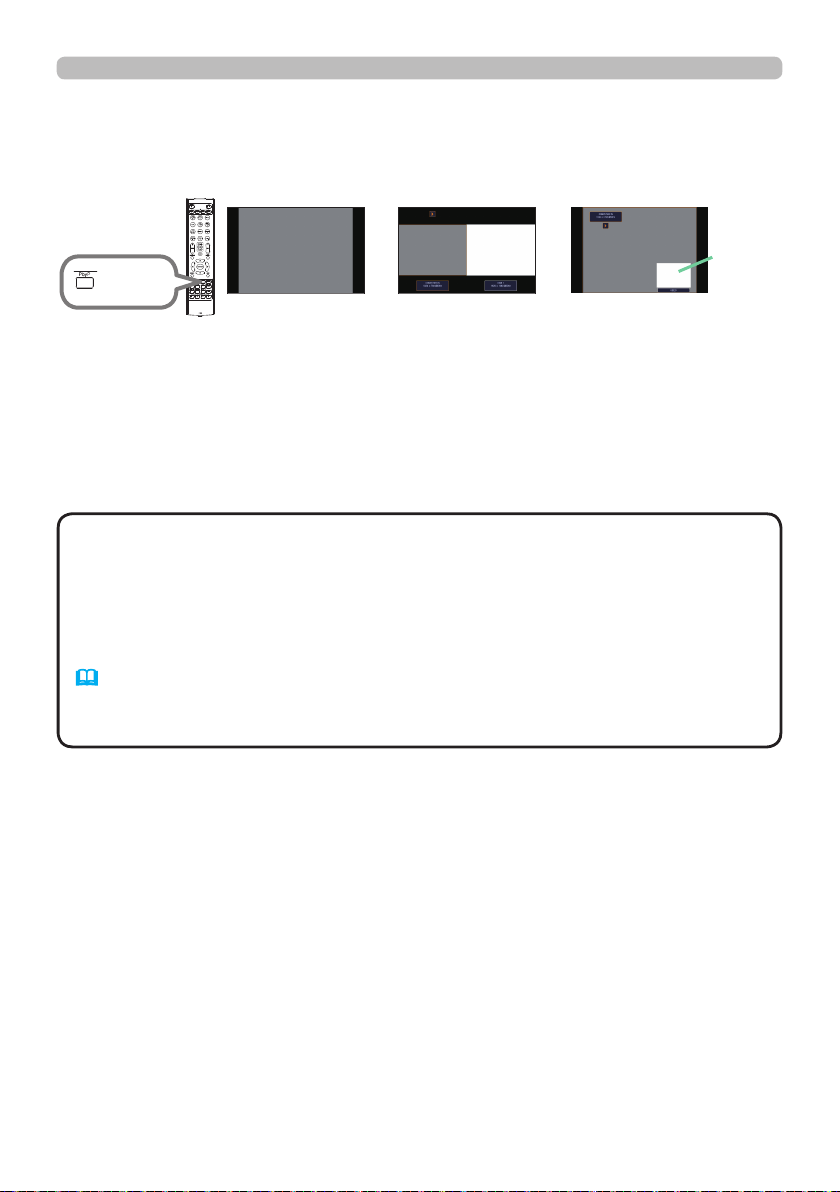
The PbyP / PinP is a function for displaying two different picture signals on a
screen that is separated into main and sub areas for each signal.
PbyP (Picture by Picture) / PinP (Picture in Picture)
PbyP
button
Normal mode PbyP mode
main
area
sub
area
PinP mode only
Press the PbyP button on the remote control. This activates the PbyP mode.
Then, press the PbyP button again. The projector goes into PinP mode. The
screen displayed before the PbyP button was pressed will be displayed as the
main area. Most of operations are effective for the main area only.
To quit the PinP mode, press the PbyP button again.
main
area
sub
area
• If the LAN port is selected when the PbyP button is pressed, input
from other port is displayed on the main area.
• When in the PbyP / PinP mode, use the MENU button on the remote control
or ▲/▼ buttons on the control panel to display the OSD menu.
• Some functions that cannot be used when in the PbyP / PinP mode.
• A message will be displayed when buttons that cannot be used are pressed
( 7). However, messages are not displayed for some unusable buttons.
• The functions on the OSD menu that cannot be used are displayed in gray
and cannot be selected.
NOTE
Operating
(continued on next page)
48
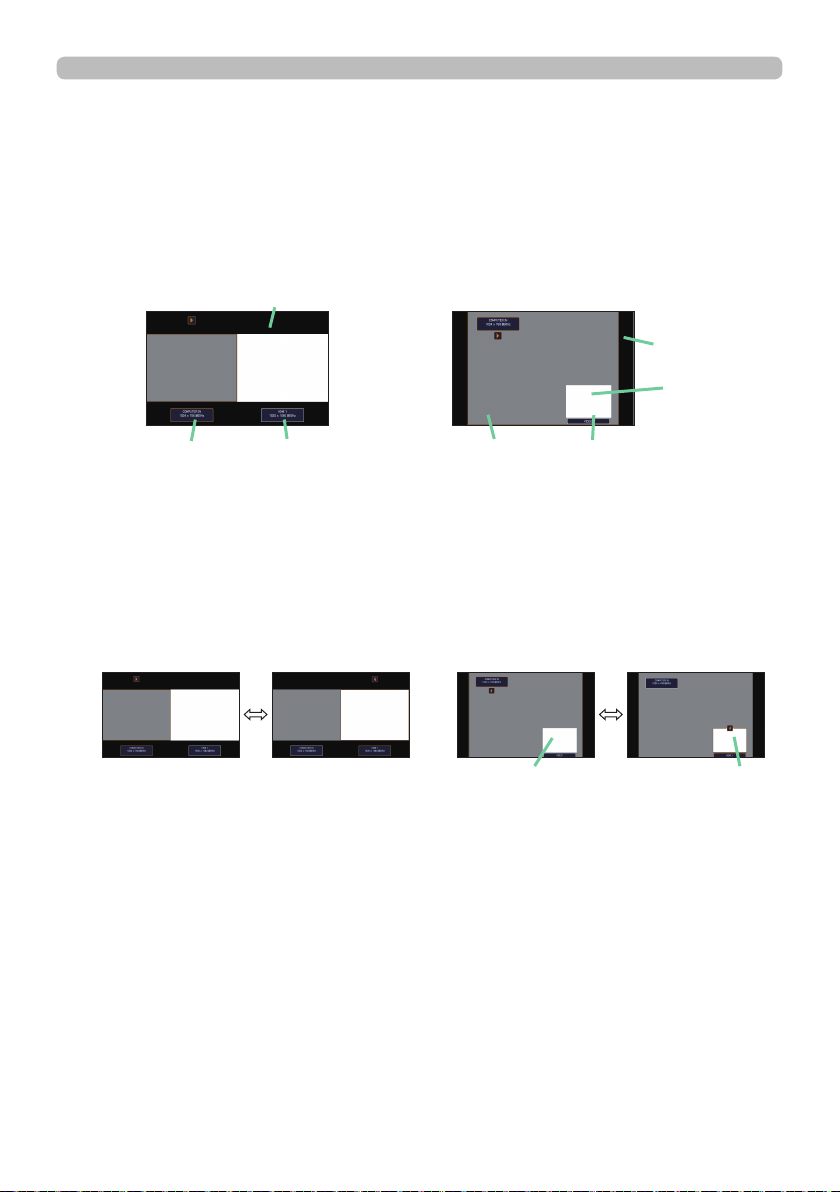
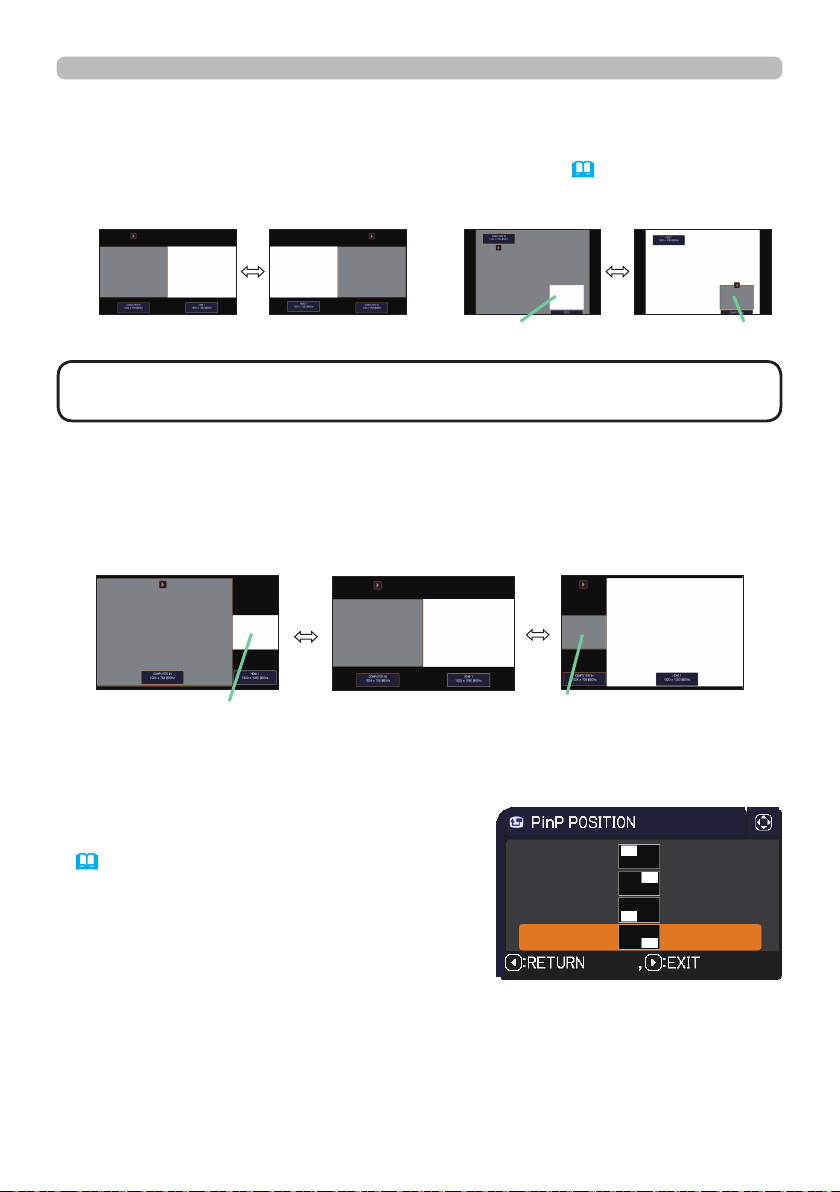
The position of the main area can be toggled with the ◄/► buttons when the
setting information is displayed on the screen. The frame will move together with
it.
Changing the main area
main
area
sub
area
main
area
sub
area
The setting information appears for several seconds when the PbyP / PinP
function is started. Displays the input information for each area. A frame around
the main area will be displayed. The information can be redisplayed with the
◄/► buttons after it has been erased.
Setting information
main area
Input information
Frame
PbyP mode
PbyP mode
main area sub area
main area
PinP mode
sub area
PinP mode
main area
sub area
Input information
Frame
Operating
sub area
(continued on next page)
49
Press any button to select an input port on the remote control or press the
INPUT button on the control panel. A dialog box to select the input signal for
the main area will be displayed. Choose a signal using the ▲/▼ buttons. To
change the signal in the sub area, switch temporarily across to the main area
with the ◄/► buttons.
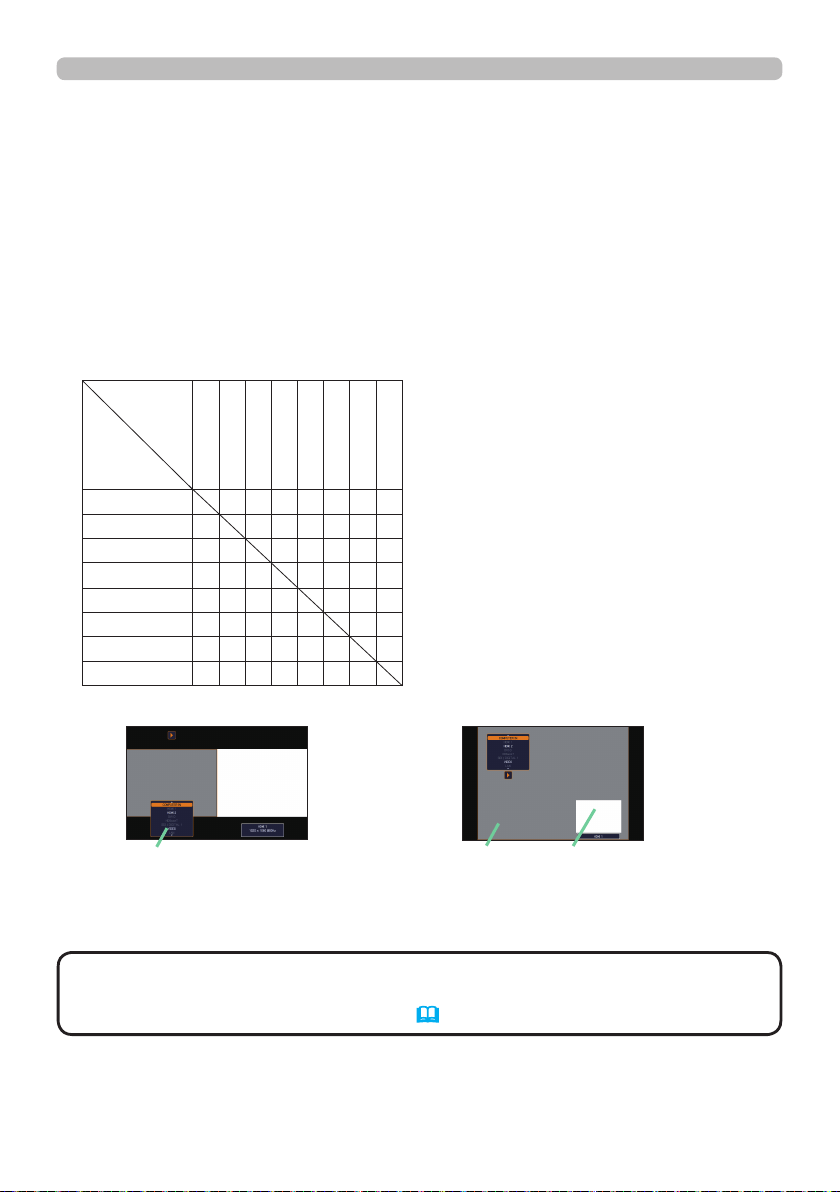
Displaying the same signal on the both areas is not allowed. Refer to the table
for details on available input signal combinations. Any combinations marked
with "X" cannot be selected.
Changing the picture input signal
• The combined input signals marked with an "O" can be selected and
displayed in the PbyP / PinP mode even when the port is set to SKIP with the
SOURCE SKIP on the OPTION menu (82).
NOTE
PbyP mode
main area sub area
Input signal
PinP mode
Operating
Sub area
Main area
COMPUTER IN
HDMI 1
HDMI 2
DVI-D
HDBaseT
SDI/DIGITAL 1
VIDEO
LAN
COMPUTER IN
O O O O O O X
HDMI 1
O O X X X O X
HDMI 2
O O O O O O X
DVI-D
O X O X X O X
HDBaseT
O X O X X O X
SDI/DIGITAL 1
O X O X X O X
VIDEO
O O O O O O X
LAN
X X X X X X X
main area
sub area
Input signal
(continued on next page)
50
Using ▲/▼ buttons on the remote control changes the size of main area in
PbyP mode.
Changing the size of main area in PbyP mode
Changing the position of sub area in PinP mode
• For some signals, it may not be displayed correctly in the PbyP /
PinP mode, even if it can be displayed properly in the normal mode.
NOTE
Press the MY BUTTON assigned the PbyP / PinP SWAP (84). The position of
the area is exchanged without any setting change.
PbyP / PinP SWAP function
main
area
sub
area
main
area
sub
area
main area
sub area
main area
sub area
PbyP mode
PinP mode
main area
sub area
main area
sub area
main area
sub area
Operating
1. Select PinP POSITION in INPUT MENU
(69).
2. Using ▲/▼ buttons on the remote control
changes the position of sub area in PinP
mode.
51
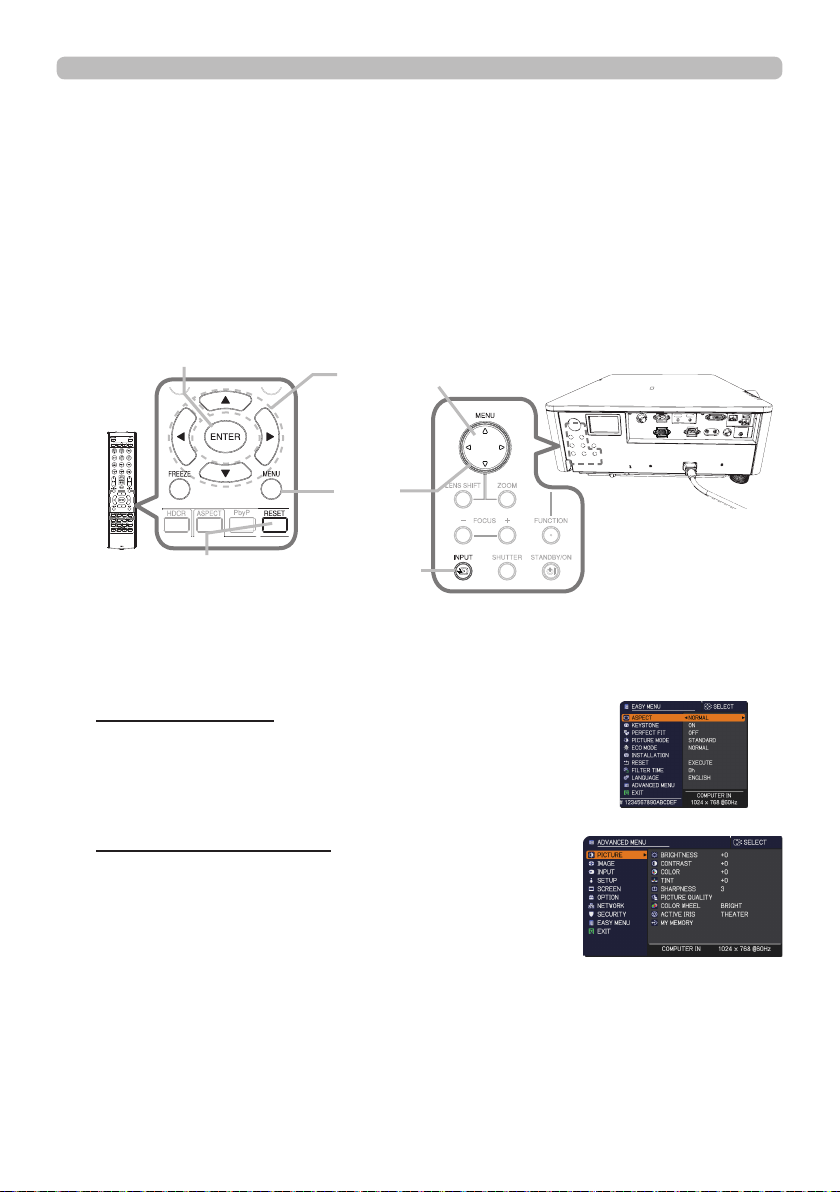
1.
To start the MENU, press the MENU button. The MENU you last used (EASY
or ADVANCED) will appear. EASY MENU has priority to appear just after
powered on.
Using the menu function
2.
(1) Use the ▲/▼ cursor buttons to select an item to
operate. To change it to the ADVANCED MENU, select
the ADVANCED MENU.
(2) Use the ◄/► cursor buttons to operate the item.
This projector has the following menus:
PICTURE, IMAGE, INPUT, SETUP, SCREEN menu, OPTION, NETWORK,
SECURITY and EASY MENU.
EASY MENU consists of functions often used, and the other menus are classied
into each purpose and brought together as the ADVANCED MENU.
Each menus is operated using the same methods. While the projector is
displaying any menu, the MENU button on the projector works as the cursor
buttons. The basic operations of these menus are as follows.
In the EASY MENU
(1) Use the ▲/▼ cursor buttons to select a menu.
To change it to the EASY MENU, select the EASY
MENU.
The items in the menu appear on the right side.
(2) Press the ► cursor button or ENTER button to
move the cursor to the right side. Then use the
▲/▼ cursor buttons to select an item to operate and press the ► cursor
button or ENTER button to progress. The operation menu or dialog of the
selected item will appear.
(3) Use the buttons as instructed in the OSD to operate the item.
In the ADVANCED MENU
MENU
button
RESET
button
ENTER
button
Cursor buttons
INPUT
button
Operating
(continued on next page)
52
3.
To close the MENU, press the MENU button again or select EXIT and press
the ◄ cursor button or ENTER button. Even if you do not do anything, the
dialog will automatically disappear after about 30 seconds.
Indication in OSD (On Screen Display)
The meanings of the general words on the OSD are as follows.
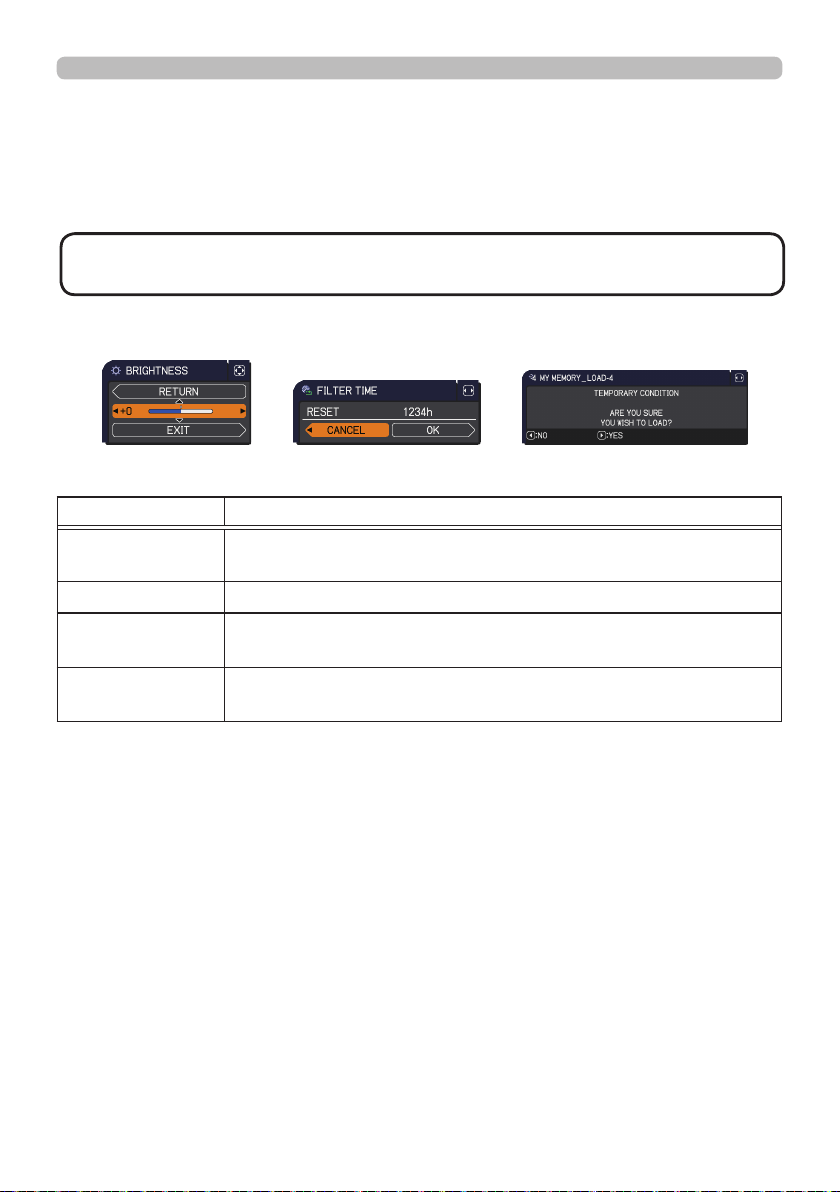
Indication Meaning
EXIT
Closes the OSD menu. It is the same as pressing the MENU
button.
RETURN Returns the menu to the previous menu.
CANCEL or NO
Cancels the operation in the present menu and returns to the
previous menu.
OK or YES
Executes the prepared function or shifts the menu to the next
menu.
• The functions on the OSD menu that cannot be used are displayed in
gray and cannot be selected
NOTE
Operating
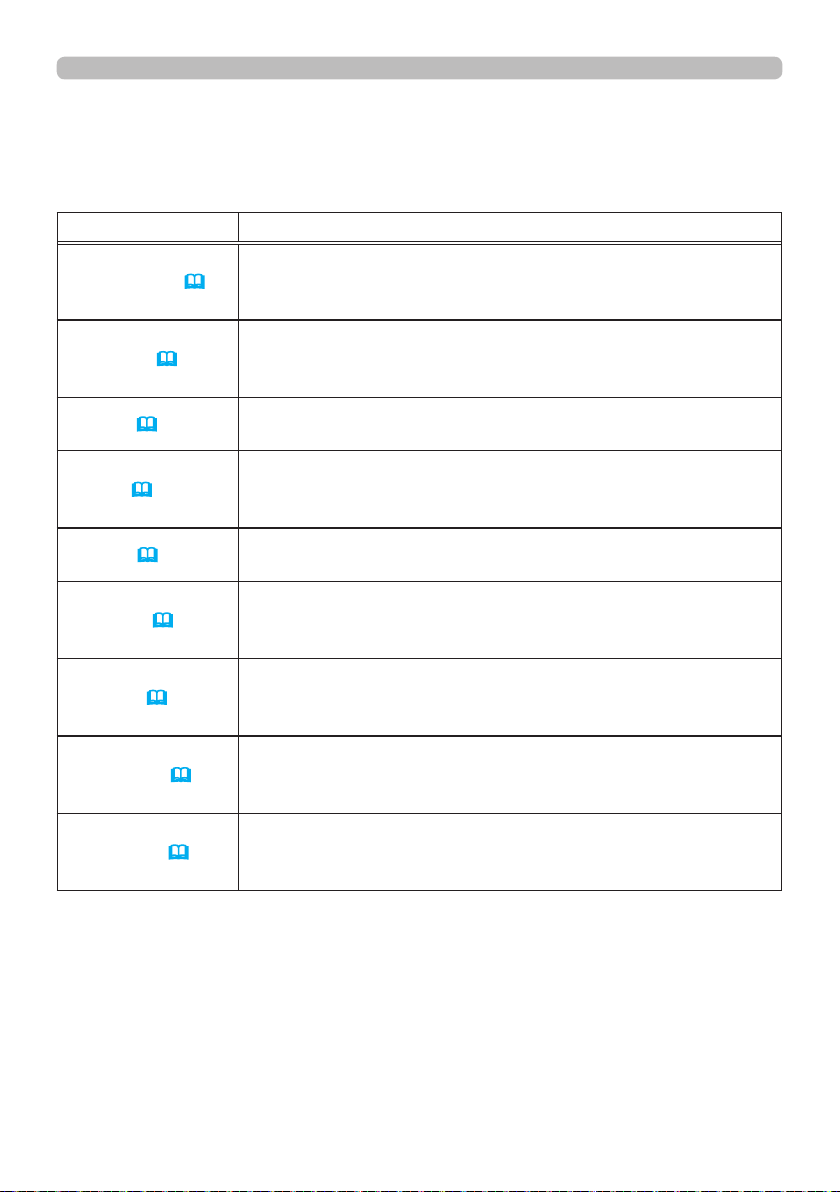
53
Menu items
The items contained in the menus are as below:
Menu Items
EASY MENU
(
54
)
ASPECT, KEYSTONE, PERFECT FIT, PICTURE MODE,
ECO MODE, INSTALLATION, RESET, FILTER TIME,
LANGUAGE, ADVANCED MENU, EXIT
PICTURE
(
56
)
BRIGHTNESS, CONTRAST, COLOR, TINT, SHARPNESS,
PICTURE QUALITY, COLOR WHEEL, ACTIVE IRIS, MY
MEMORY
IMAGE
(
61
)
ASPECT, OVER SCAN, V POSITION, H POSITION, H PHASE,
H SIZE, AUTO ADJUST EXECUTE
INPUT
(
64
)
PROGRESSIVE, VIDEO NR, COLOR SPACE, VIDEO FORMAT,
DIGITAL FORMAT, DIGITAL RANGE, COMPUTER IN, FRAME
LOCK, RESOLUTION, PbyP/PinP SETUP
SETUP
(
70
)
GEOMETORY CORRECTION, LAMP & FILTER, PICTURE
POSITION, INSTALLATION, STANDBY MODE, OSD MESSAGE
SCREEN
(
76
)
LANGUAGE, MENU POSITION, BLANK, AUTO BLANK, START
UP, MyScreen, MyScreen Lock, SOURCE NAME, TEMPLATE,
C.C.
OPTION
(
82
)
SOURCE SKIP, AUTO SEARCH, DIRECT POWER ON, AUTO
POWER OFF, SHUTTER TIMER, MY BUTTON, SCHEDULE,
SERVICE
NETWORK
(
95
)
PROJECTOR NAME, WIRELESS SETUP, WIRED SETUP,
NETWORK INFORMATION, SNTP SETUP, MY IMAGE,
EXTERNAL CONTROL, PRESENTATION, WIRED NETWORK
SECURITY
(
96
)
SECURITY PASSWORD CHANGE, MyScreen PASSWORD,
PIN LOCK, MY TEXT PASSWORD, MY TEXT DISPLAY, MY
TEXT WRITING, SECURITY INDICATOR, STACK LOCK
Operating
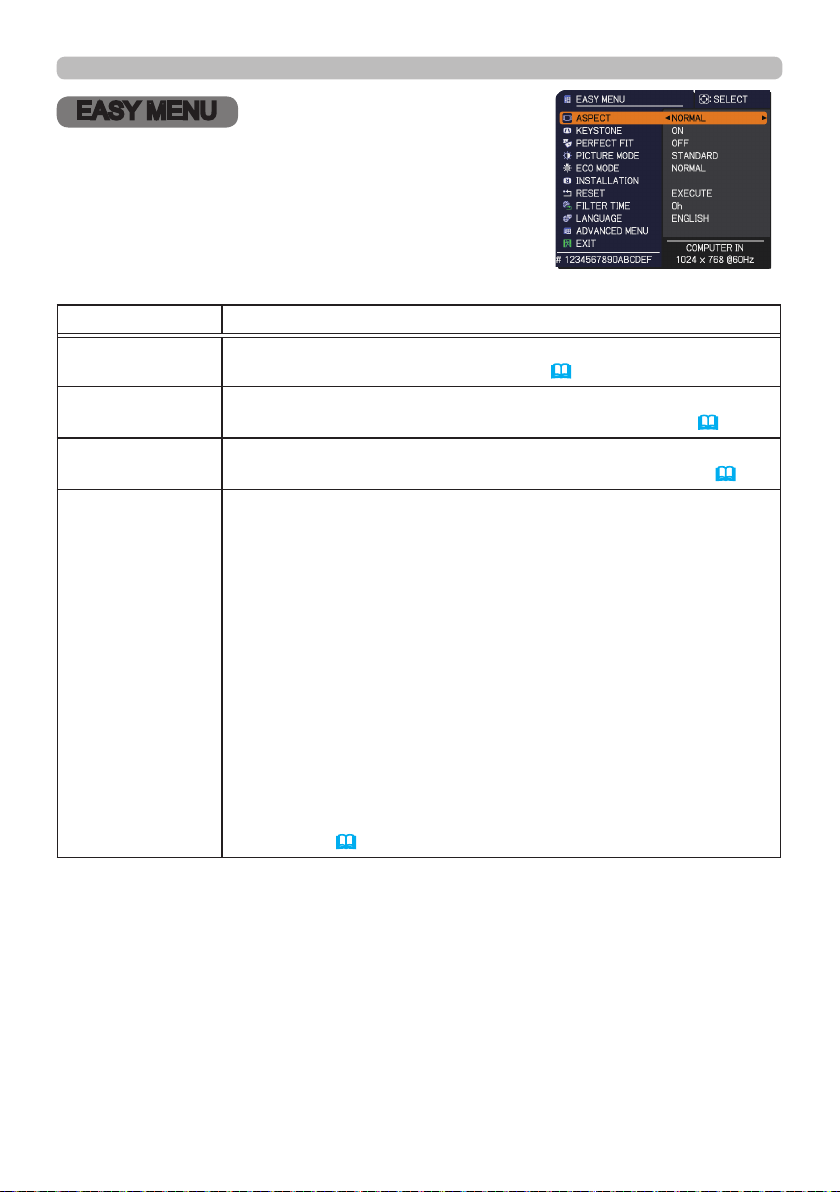
54
EASY MENU
EASY MENU
Select an item from the EASY menu using the ▲/▼
cursor buttons. Then perform it according to the
following table.
Item Description
ASPECT
Using the ◄/► buttons switches the mode for aspect ratio.
See the ASPECT item in IMAGE menu (
61
).
KEYSTONE
Using the ► cursor button to start the settings.
For details, see KEYSTONE in
Correcting the distortion
(
38
).
PERFECT FIT
Pressing the ► button displays the PERFECT FIT dialog.
For details, see PERFECT FIT in
Correcting the distortion
(
38
).
PICTURE MODE
Using the ◄/► buttons switches the picture mode.
The picture modes are combinations of GAMMA, COLOR TEMP
and ACCENTUALIZER settings. Choose a suitable mode according
to the projected source.
For more details of USER-1, -2 and -3, refer to PICTURE
QUALITY (
57
).
STANDARD
NATURAL
CINEMA
BOARD(BLACK)
BOARD(GREEN)
WHITEBOARDDAYTIMEDICOM SIM.
DYNAMIC
USER-1
USER-2
USER-3
(continued on next page)
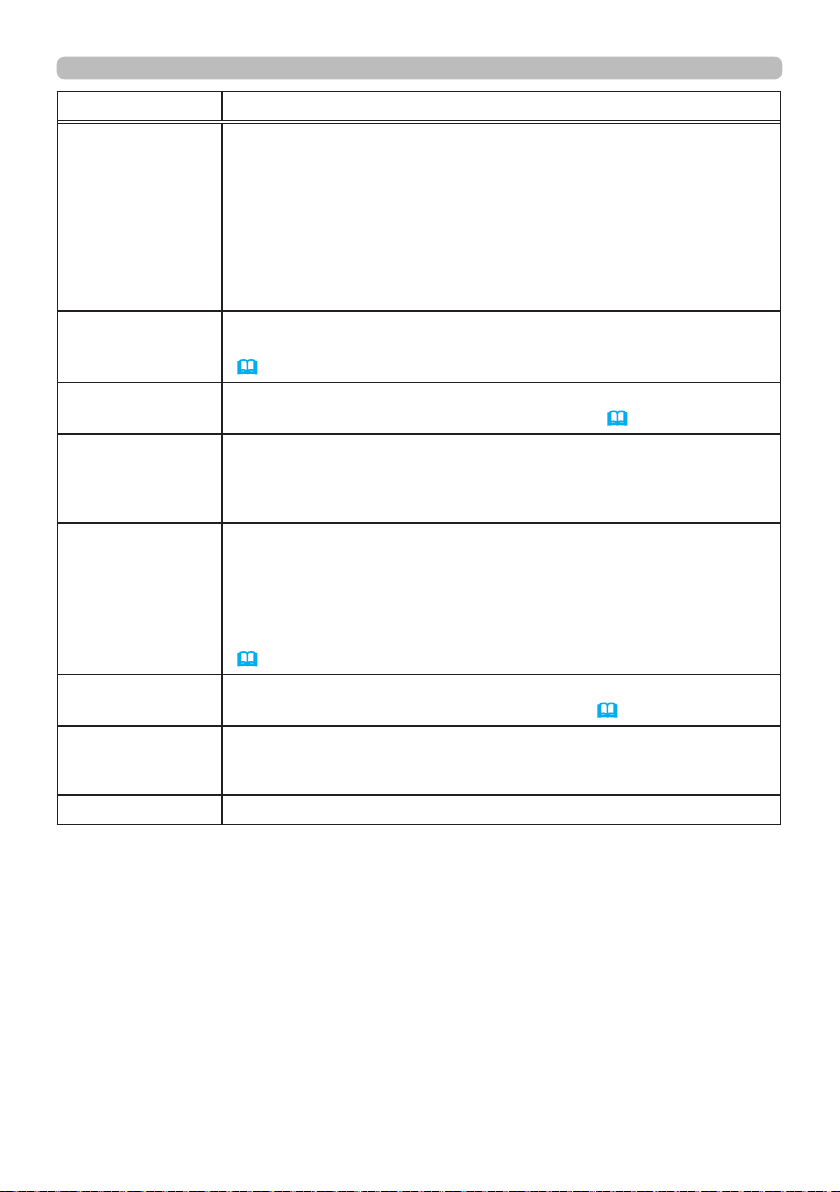
55
EASY MENU
Item Description
PICTURE MODE
(continued)
• Lines or other noise might appear on the screen when this function
is operated, but it is not a malfunction.
•
DICOM SIM. is the projector's DICOM
®
("Digital Imaging and
Communication in Medicine") simulation mode. This mode simulates
the DICOM standard, which is a standard applicable to digital
communications in medicine, and can be useful for displaying medical
images, such as X-rays photos. This projector is not a medical device
and is not compliant to the DICOM standard, and neither the projector
nor the DICOM SIM. mode should be used for medical diagnosis.
ECO MODE
Using the ◄/► buttons turns off/on the Eco mode.
See the ECO MODE item in SETUP, then LAMP & FILTER menu
(
71
).
INSTALLATION
Pressing the ► button displays the INSTALLATION dialog.
See the INSTALLATION item in SETUP menu (
74
).
RESET
Selecting this item resets all of the EASY MENU items except the
FILTER TIME and LANGUAGE.
A dialog is displayed for conrmation. Selecting the OK using the ►
button performs resetting.
FILTER TIME
The usage time of the air lter is shown in the menu.
Selecting this item resets the lter time which counts usage time of
the air lter.
A dialog is displayed for conrmation. Selecting OK using the ►
button initiates the reset.
See the FILTER TIME item in SETUP, then LAMP & FILTER menu
(
73
).
LANGUAGE
Using the ◄/► buttons changes the display language.
See the LANGUAGE item in SCREEN menu (
76
).
ADVANCED MENU
Press the ► or
ENTER
button to use the menu of PICTURE
, IMAGE, INPUT, SETUP, SCREEN, OPTION, NETWORK or
SECURITY.
EXIT
Press the ◄ or
ENTER
button to close the OSD menu.
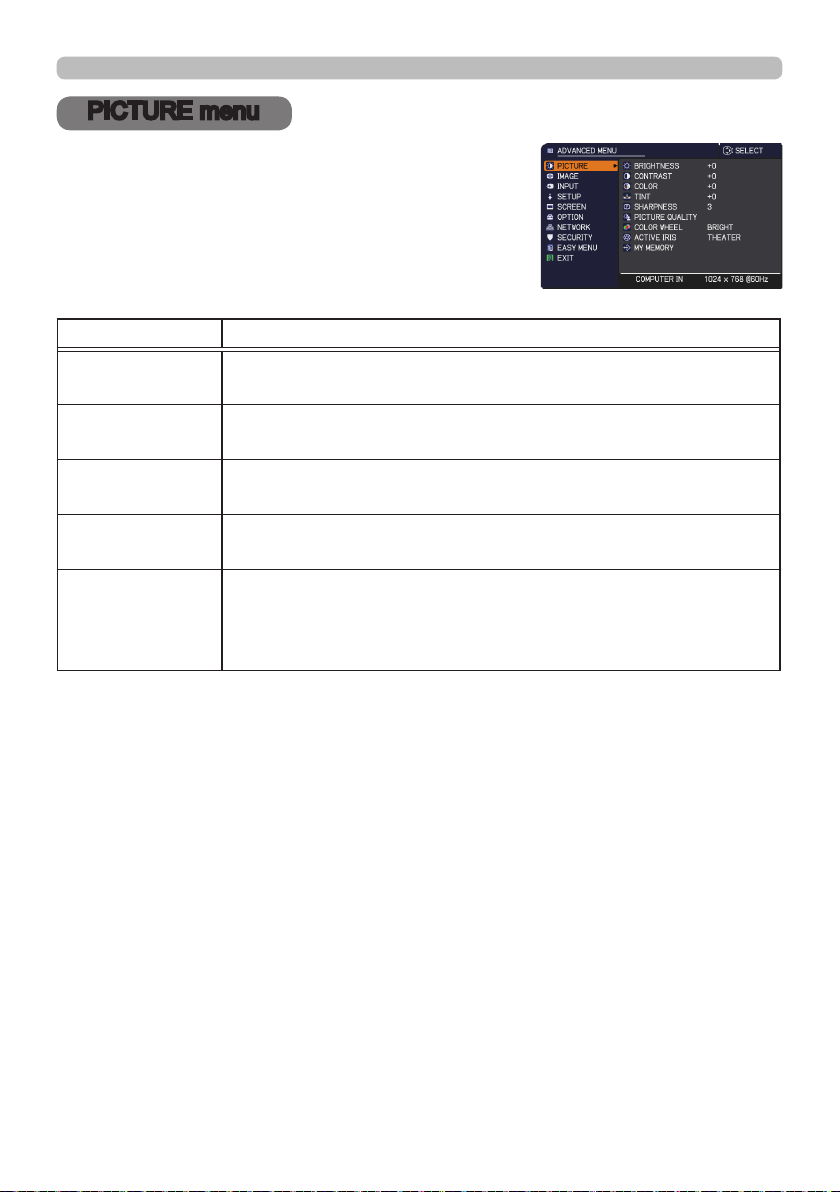
56
PICTURE menu
PICTURE menu
Select an item from the PICTURE menu using the
▲/▼ cursor buttons, and press the ► cursor button
or ENTER button to execute the item. Then perform
it according to the following table.
Item Description
BRIGHTNESS
Using the
◄/►
buttons adjusts the brightness.
Dark
Light
CONTRAST
Using the
◄/►
buttons adjusts the contrast.
Weak
Strong
COLOR
Using the ◄/► buttons adjusts the strength of whole color.
Weak
Strong
TINT
Using the ◄/► buttons adjusts the tint.
Reddish
Greenish
SHARPNESS
Using the ◄/► buttons adjusts the sharpness.
Weak
Strong
• There may be some noise and/or the screen may icker for a
moment when an adjustment is made. This is not a malfunction.
(continued on next page)
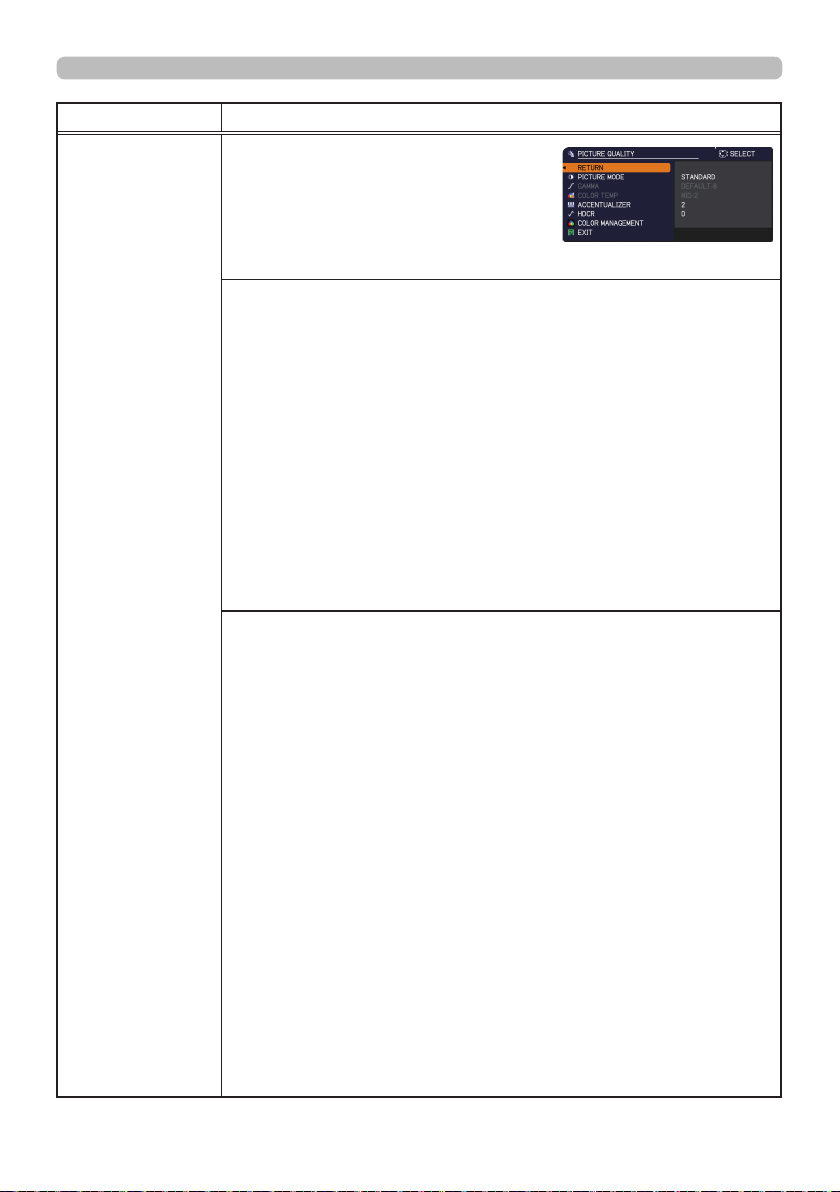
57
PICTURE menu
Item Description
PICTURE
QUALITY
Selecting this item displays the PICTURE
QUALITY menu.
Select an item using the ▲/▼ buttons,
and press the ► button or the
ENTER
button on the remote control to execute
the item.
PICTURE MODE
After selecting USER-1 / USER-2 / USER-3, the following features
are adjustable.
Gamma, Color Temp
GAMMA
This feature is only available when USER-1 / USER-2 / USER-3 is
selected.
Using the ▲/▼ buttons switches the gamma mode.
DEFAULT-1
CUSTOM-1
DEFAULT-2
CUSTOM-2
DEFAULT-3
CUSTOM-3
DEFAULT-4
CUSTOM-4
DEFAULT-5
CUSTOM-5
DEFAULT-6
CUSTOM-6
DEFAULT-8
CUSTOM-8
DEFAULT-7
CUSTOM-7
(continued on next page)
STANDARD
NATURAL
CINEMA
BOARD(BLACK)
BOARD(GREEN)
WHITEBOARDDAYTIMEDICOM SIM.
DYNAMIC
USER-1
USER-2
USER-3

58
PICTURE menu
Item Description
PICTURE
QUALITY
(continued)
GAMMA (continued)
Selecting a mode whose name includes CUSTOM and then
pressing the ► button or the
ENTER
button displays
a dialog to help you in adjusting the mode. This function is useful
when you want to change the brightness of particular tones.
Choose an item using the ◄/► buttons, and adjust the level using
the ▲/▼ buttons.
• Lines or other noise might appear on the screen when this function
is operated, but it is not a malfunction.
COLOR TEMP
This feature is only available when USER-1 / USER-2 / USER-3 is
selected.
Using the ▲/▼ buttons switches the color temperature mode.
HIGH
CUSTOM-1
MID-1
CUSTOM-2
CUSTOM-7 MID-2
Hi-BRIGHT-3 CUSTOM-3
CUSTOM-6 LOW
Hi-BRIGHT-2
CUSTOM-5
Hi-BRIGHT-1
CUSTOM-4
Selecting a mode whose name includes CUSTOM and then pressing
the ► button or the
ENTER
button displays a dialog to aid you in
adjusting the OFFSET and GAIN of the selected mode.
OFFSET adjustments change the color intensity on the whole tones
of the test pattern. GAIN adjustments mainly affect color intensity on
the brighter tones of the test pattern.
Choose an item using the ◄/► buttons, and adjust the level using
the ▲/▼ buttons.
• Lines or other noise might appear on the screen when this function
is operated, but it is not a malfunction.
(continued on next page)
59
PICTURE menu
Item Description
PICTURE
QUALITY
(continued)
ACCENTUALIZER
ACCENTUALIZER
is a function to improve the legibility.
Using the ◄/► buttons adjusts the sharpness.
Weak
Strong
• There may be some noise and/or the screen may icker for a
moment when an adjustment is made. This is not a malfunction
HDCR
A function to show a clear picture in a bright room.
Using the◄/► buttons adjusts the contrast.
COLOR MANAGEMENT
A function to adjust color phase, color saturation, and brightness
respectively for red, yellow, green, cyan, blue, and magenta.
(continued on next page)
60
PICTURE menu
Item Description
COLOR WHEEL
Using the ▲/▼ buttons switches the Color Wheel.
BRIGHT
RICH COLOR
BRIGHT : Enhances the amount of light given out.
RICH COLOR : Enhances the color.
ACTIVE IRIS
Using the ▲/▼ cursor buttons changes the active iris control mode.
PRESENTATION
THEATER
OFF
PRESENTATION : The active iris displays the best presentation
image for both bright and dark scenes.
THEATER : The active iris displays the best theater image for
both bright and dark scenes.
OFF : The active iris is always open.
• The screen may icker when the PRESENTATION or THEATER
modes are selected. If this occurs, select OFF.
MY MEMORY
This projector has four memories for adjustment data (for all the
items of the PICTURE menu).
Selecting a function using the ▲/▼ buttons and pressing the ► or
ENTER
button performs each function.
LOAD-1
LOAD-2
LOAD-3
LOAD-4
SAVE-4
SAVE-3
SAVE-2
SAVE-1
LOAD-1, LOAD-2, LOAD-3, LOAD-4
Performing a LOAD function loads the data from the memory linked
in the number included in the function’s name, and adjusts the
picture automatically depending on the data.
•
The LOAD functions whose linked memory has no data are skipped.
• Remember that the current adjusted condition will be lost by
loading data. To keep the current adjustment, save it before
performing a LOAD function.
• There may be some noise and the screen may icker for a moment
when loading data. This is not malfunction.
• You can perform the LOAD function using
MY BUTTON
. See MY
BUTTON item in OPTION menu (
84
).
SAVE-1, SAVE-2, SAVE-3, SAVE-4
Performing a SAVE function saves the current adjustment data into
the memory linked in the number included in the function’s name.
• Remember that the current data being stored of a memory will be
lost by saving new data into the memory.
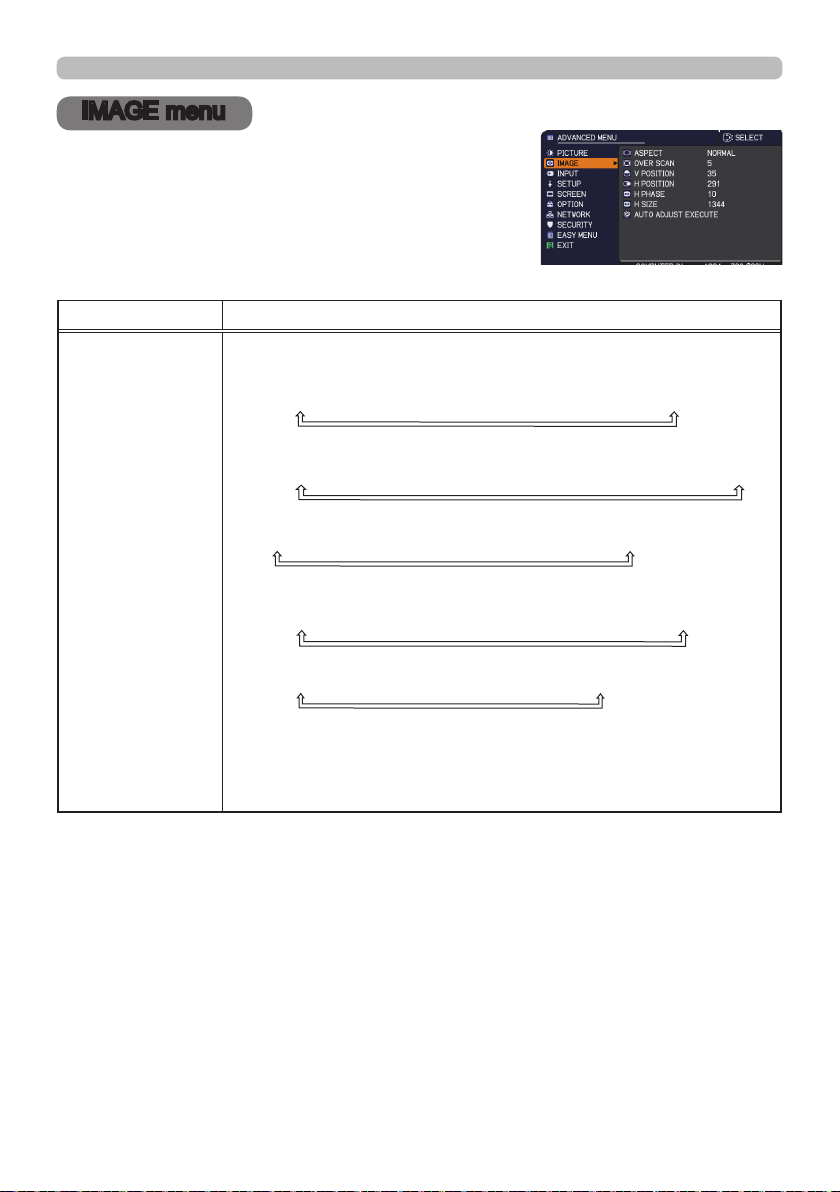
61
IMAGE menu
IMAGE menu
Select an item from the IMAGE menu using the ▲/▼
cursor buttons, and press the ► cursor button or
ENTER button to execute the item. Then perform it
according to the following table.
Item Description
ASPECT
Using the ▲/▼ buttons switches the mode for aspect ratio.
For a computer signal
NORMAL
4:3
16:9
16:10
ZOOM
NATIVE
For an HDMI
TM
, DVI-D and HDBaseT™ signal
NORMAL
4:3
16:9
16:10
14:9
ZOOM
NATIVE
For a video signal or component video signal
4:3
16:9
16:10
14:9
ZOOM
NATIVE
For a SDI/DIGITAL 1 signal
CP-WU9100
NORMAL
4:3
16:9
16:10
ZOOM
NATIVE
CP-HD9950
NORMAL
4:3
16:9
ZOOM
NATIVE
For an input signal from the LAN ports, or if there is no signal
CP-WU9100
: 16:10 (xed)
CP-HD9950: 16:9 (xed)
• The NORMAL mode keeps the original aspect ratio of the signal.
(continued on next page)
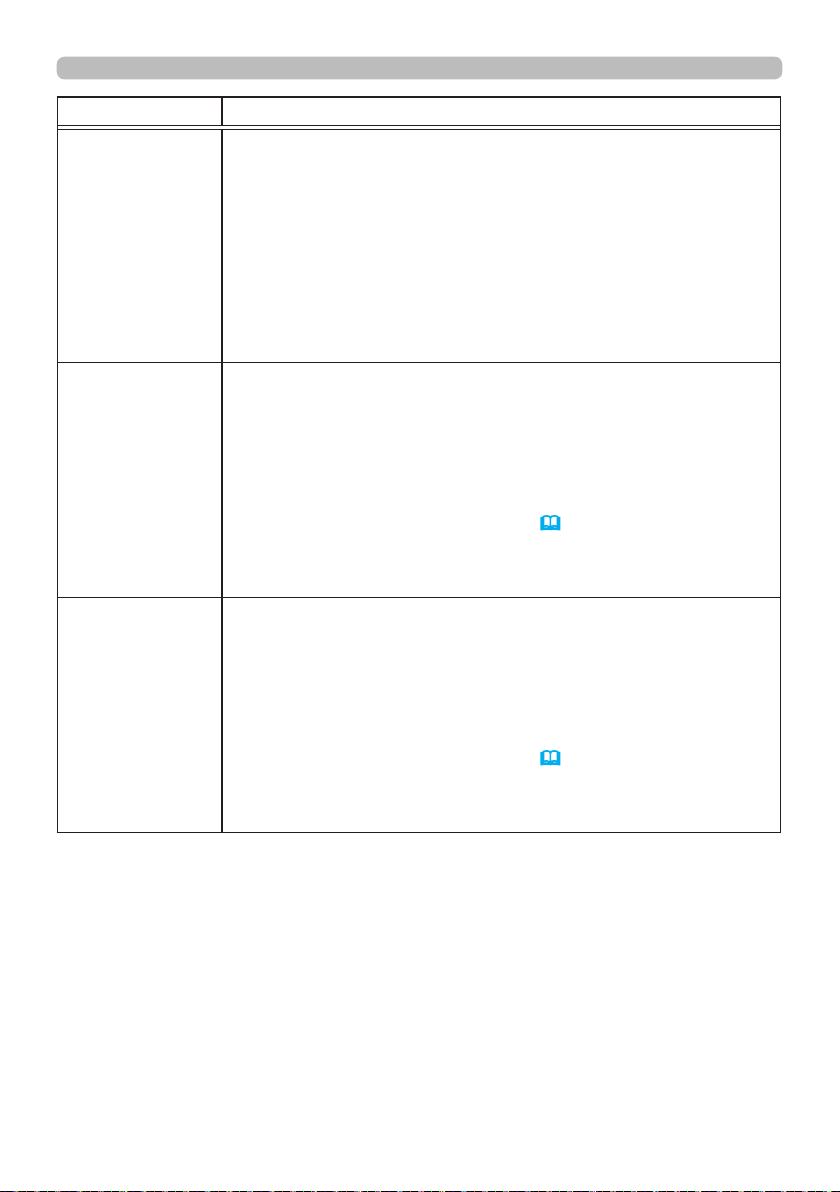
62
IMAGE menu
Item Description
OVER SCAN
Using the ◄/► buttons adjusts the over-scan ratio.
Small (It magnies picture)
Large (It reduces picture)
• This item can be selected only for a video and component video
signal.
• For an HDMI
TM
, HDBaseT™, DVI-D and SDI/DIGITAL 1 signal, this
item can also be selected if either (1) or (2) applies.
(1) DIGITAL FORMAT item in the INPUT menu for selected port is
set to VIDEO.
(2) DIGITAL
FORMAT item in the INPUT menu for selected port is
set to AUTO, and the projector recognizes that it receives video
signals.
V POSITION
Using the ◄/► buttons adjusts the vertical position.
Down
Up
• Over-adjusting the vertical position may cause noise to appear on
the screen. If this occurs, reset the vertical position to the default
setting. Pressing the
RESET
button when the V POSITION is
selected will reset the V POSITION to the default setting.
• When this function is performed on a video signal the range of this
adjustment depends on OVER SCAN (
above
) setting. You cannot
adjust when OVER SCAN is set to 10.
• This function is unavailable for a signal from the LAN, HDMI 1 / 2,
HDBaseT™, DVI-D or SDI/DIGITAL 1 port.
H POSITION
Using the ◄/► buttons adjusts the horizontal position.
Right
Left
•
Over-adjusting the horizontal position may cause noise to appear on
the screen. If this occurs, reset the horizontal position to the default
setting. Pressing the
RESET
button when the H POSITION is selected
will reset the H POSITION to the default setting.
• When this function is performed on a video signal the range of this
adjustment depends on OVER SCAN (
above
) setting. You cannot
adjust when OVER SCAN is set to 10.
• This function is unavailable for a signal from the LAN, HDMI 1 / 2,
HDBaseT™, DVI-D or SDI/DIGITAL 1 port.
(continued on next page)
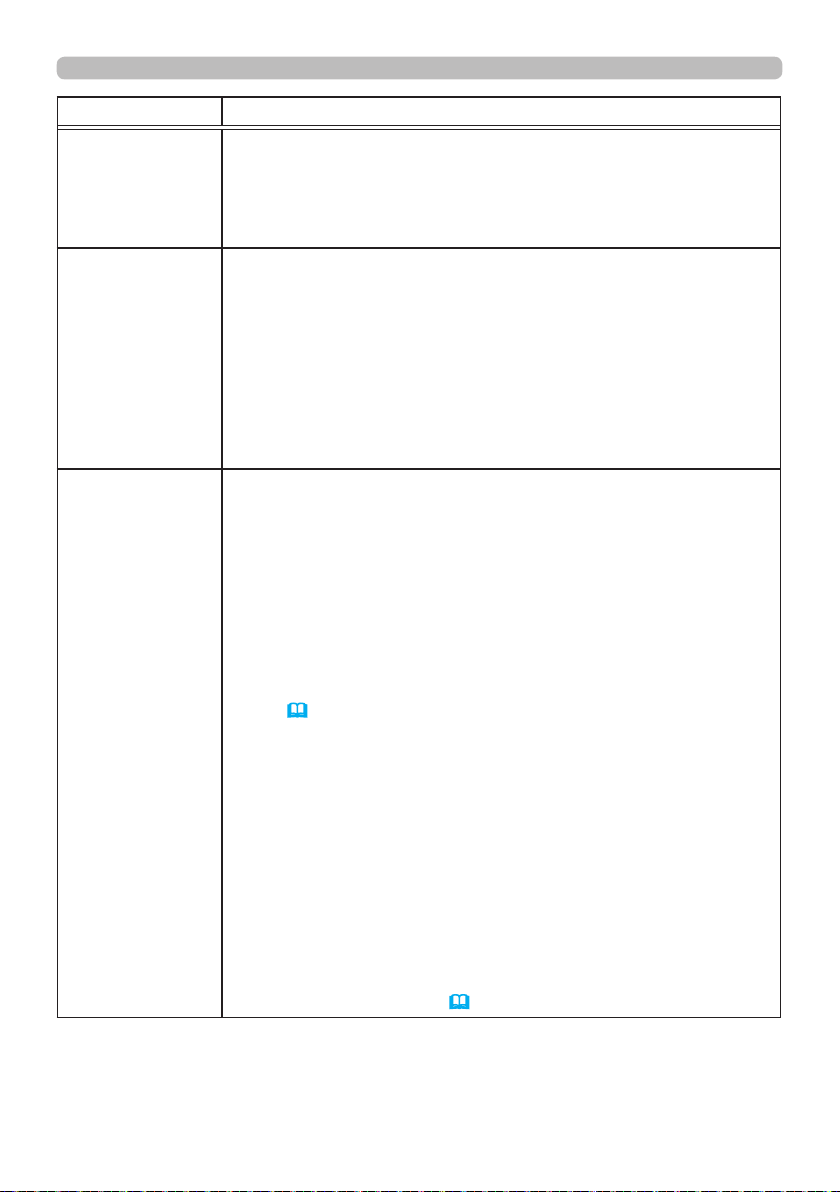
63
IMAGE menu
Item Description
H PHASE
Using the
◄/►
buttons adjusts the horizontal phase to eliminate icker.
Right
Left
• This item can be selected only for a computer signal or a
component video signal. This function is unavailable for a signal from
the LAN, HDMI 1 / 2, HDBaseT™, DVI-D or SDI/DIGITAL 1 port.
H SIZE
Using the ◄/► buttons adjusts the horizontal size.
Small
Large
• This item can be selected only for a computer signal. This function
is unavailable for a signal from the LAN, HDMI 1 / 2, HDBaseT™,
DVI-D or SDI/DIGITAL 1 port.
• When this adjustment is excessive, the picture may not be
displayed correctly. If this occurs, reset the adjustment by pressing
the
RESET
button on the remote control during this operation.
• Images might appear degraded when this function is operated, but
it is not a malfunction.
AUTO ADJUST
EXECUTE
Selecting this item performs the automatic adjustment feature.
For a computer signal
The vertical position, the horizontal position and the horizontal
phase will be automatically adjusted.
Make sure that the application window is set to its maximum size
prior to attempting to use this feature. A dark picture may still be
incorrectly adjusted. Use a bright picture when adjusting.
For a video signal
The video format best suited for the respective input signal will
be selected automatically. This function is available only when
the AUTO is selected for the VIDEO FORMAT item in the INPUT
menu (
65
).
The vertical position and horizontal position will be
automatically set to the default.
For a component video signal
The vertical position and horizontal position will be automatically set
to the default. The horizontal phase will be automatically adjusted.
• The automatic adjustment operation requires approx. 10 seconds.
Note that it may not function correctly with some input.
• When this function is performed for a video signal, an extra line
may appear outside a picture.
• When this function is performed for a computer signal, a black
frame may be displayed on the edge of the screen, depending on
the computer model.
• The items adjusted by this function may vary when the FINE or
DISABLE is selected for the AUTO ADJUST item of the SERVICE
item in the OPTION menu (
88
).

64
INPUT menu
INPUT menu
Select an item from the Input menu using the ▲/▼
cursor buttons, and press the ► cursor button or
ENTER button to execute the item. Then perform it
according to the following table.
Item Description
PROGRESSIVE
Using the ▲/▼ buttons switches the progress mode.
TV
FILM
OFF
•
This function works only for a video signal, component video signal (of
480i@60 or 576i@50 or 1080i@50/60), an HDMI
TM
signal (of 480i@60
or 576i@50 or 1080i@50/60), HDBaseT™ signal (of 480i@60 or
576i@50 or 1080i@50/60)
, DVI-D signal
(of 480i@60 or 576i@50 or
1080i@50/60) and SDI/DIGITAL signal (of 480i@60 or 576i@50 or
1080i@50/60).
• When TV or FILM is selected, the screen image will be sharp.
FILM adapts to the 2-3 Pull-Down conversion system. But these
may cause a certain defect (for example, jagged line) of the picture
for a quick moving object. If this occurs, select OFF, even if the
screen image loses sharpness.
VIDEO NR
Using the ▲/▼ buttons switches the noise reduction mode.
HIGH
MID
LOW
•
This function works only for a video signal, component video signal
(of 480i@60 or 576i@50 or 1080i@50/60), an HDMI signal (of
480i@60 or 576i@50 or 1080i@50/60), HDBaseT signal (of 480i@60
or 576i@50 or 1080i@50/60)
, DVI-D signal
(of 480i@60 or 576i@50
or 1080i@50/60) and SDI/DIGITAL signal (of 480i@60 or 576i@50 or
1080i@50/60).
COLOR SPACE
Using the ▲/▼ buttons switches the mode for color space.
AUTO
RGB
SMPTE240
REC709
REC601
• This item can be selected only for a computer signal (except for
signals from the
LAN
ports) or a component video signal.
• The AUTO mode automatically selects the optimum mode.
• The AUTO operation may not work correctly at some signals. If
this occurs, select a suitable mode except AUTO.
(continued on next page)
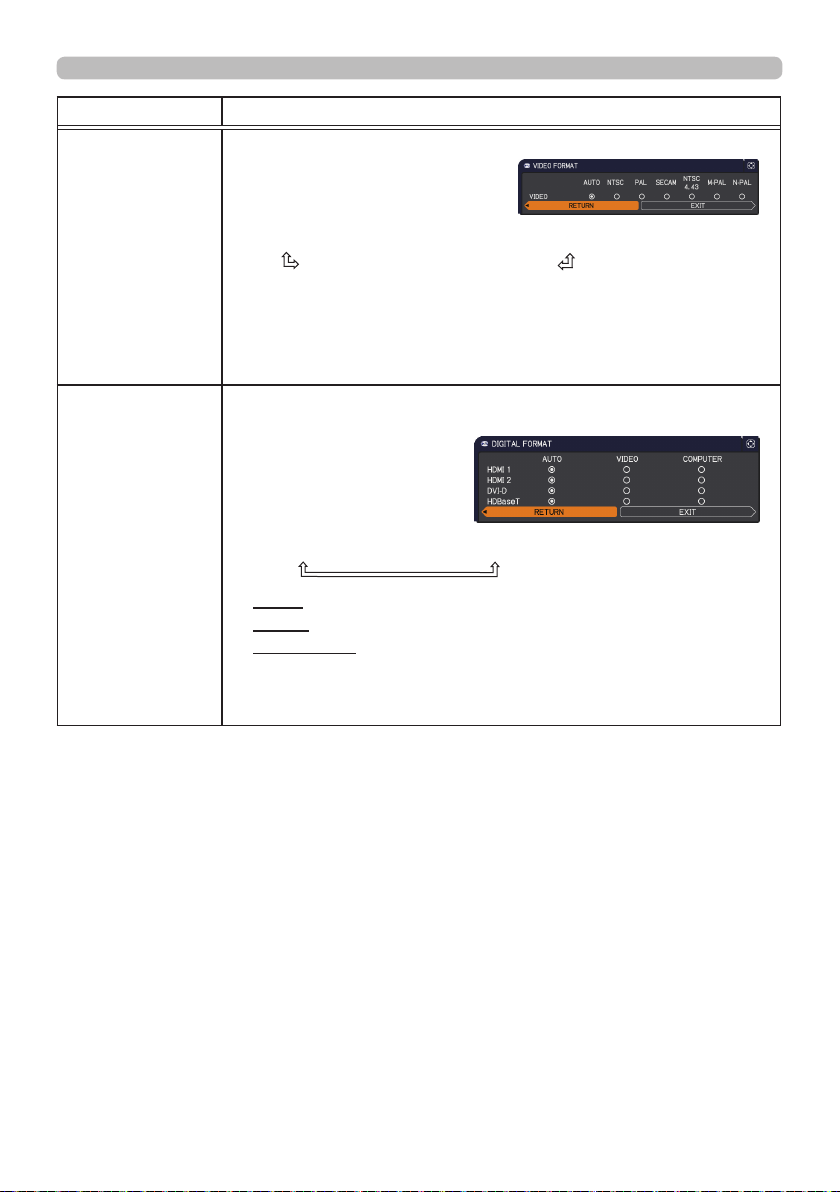
65
INPUT menu
Item Description
VIDEO FORMAT
The video format for
VIDEO
port can be set.
Using the ◄/► buttons
switches
the mode for video
format.
AUTO
NTSC
PAL
SECAM
N-PAL
M-PAL
NTSC4.43
• This item is used only for a video signal from the
VIDEO
port.
• The AUTO mode automatically selects the optimum mode.
• The AUTO operation may not work well for some signals. If the
picture becomes unstable (for example, an irregular picture, lack of
color), select the mode according to the input signal.
DIGITAL FORMAT
The video format of digital input signals from the
HDMI 1
/
2
,
DVI-D
and
HDBaseT™
ports can be set.
(1) Use the ▲/▼ buttons to
select the port to be set.
(2) Use the ◄/►buttons to
select the video format.
AUTO
VIDEO
COMPUTER
AUTO: automatically sets the optimum mode.
VIDEO: sets the suitable mode for DVD signals.
COMPUTER: sets the suitable mode for computer signals.
• When the COMPUTER is selected, the functions COLOR
(PICTURE menu), TINT (PICTURE menu) and OVER SCAN
(IMAGE menu) are unavailable.
(continued on next page)
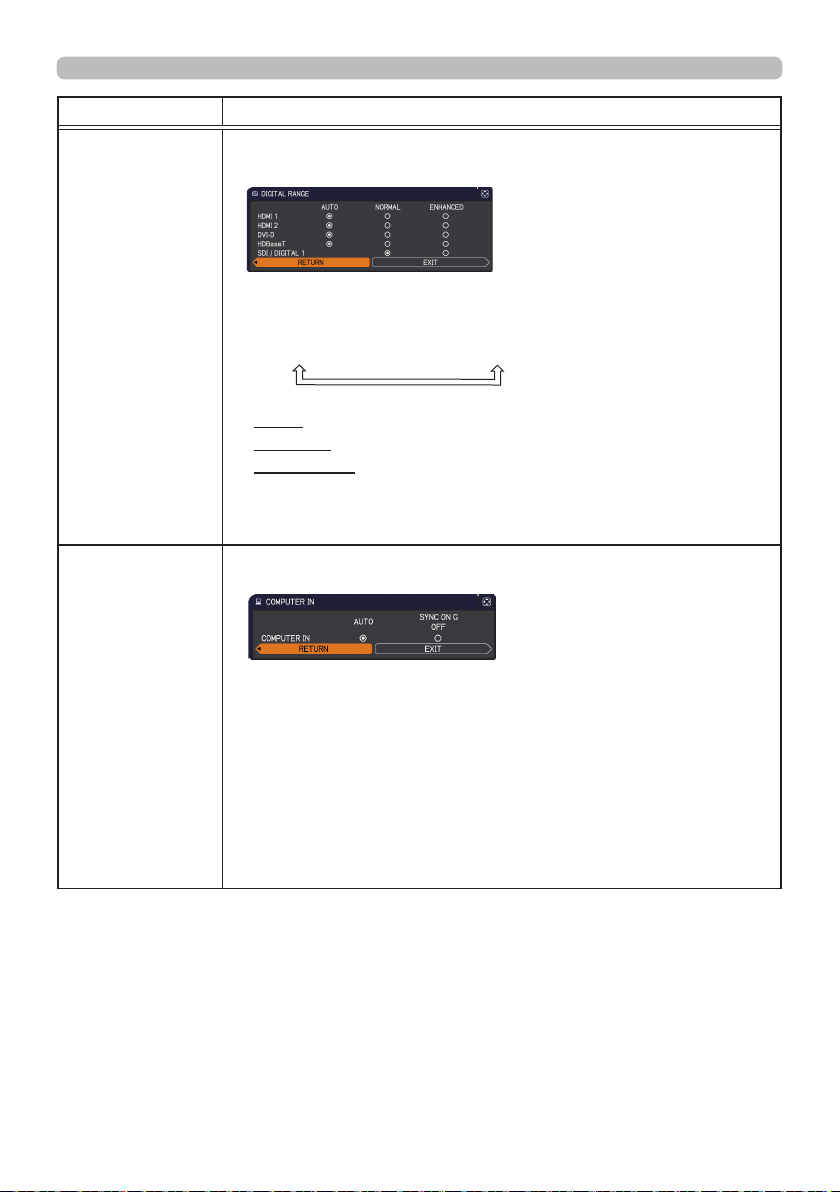
66
INPUT menu
Item Description
DIGITAL RANGE
The video format of digital input signals from the
HDMI 1
/
2
,
DVI-D
,
HDBaseT™
and
SDI/DIGITAL 1
ports can be set.
(1) Use the ▲/▼ buttons to select the port to be set.
(2) Use the ◄/►buttons to select the digital range.
AUTO
NORMAL
ENHANCED
AUTO: automatically sets the optimum mode.
NORMAL: sets the suitable mode for DVD signals. (16-235)
ENHANCED: sets the suitable mode for computer signals. (0-255)
((1-254) for SDI)
• If the contrast of the screen image is too strong or too weak, try
nding a more suitable mode.
COMPUTER IN
The computer input signal type for
COMPUTER IN
port can be set.
(1)
Use the ▲/▼ buttons to select the
COMPUTER IN
port to be set.
(2) Use the ◄/► buttons to select the computer input signal type.
AUTO
SYNC ON G OFF
• Selecting the AUTO mode you can input a sync on G signal or
component video signal from the port.
• In the AUTO mode, the picture may be distorted with certain input
signals. If this occurs, remove the signal connector so that no signal
is received and select the SYNC ON G OFF, and then reconnect the
signal.
(continued on next page)
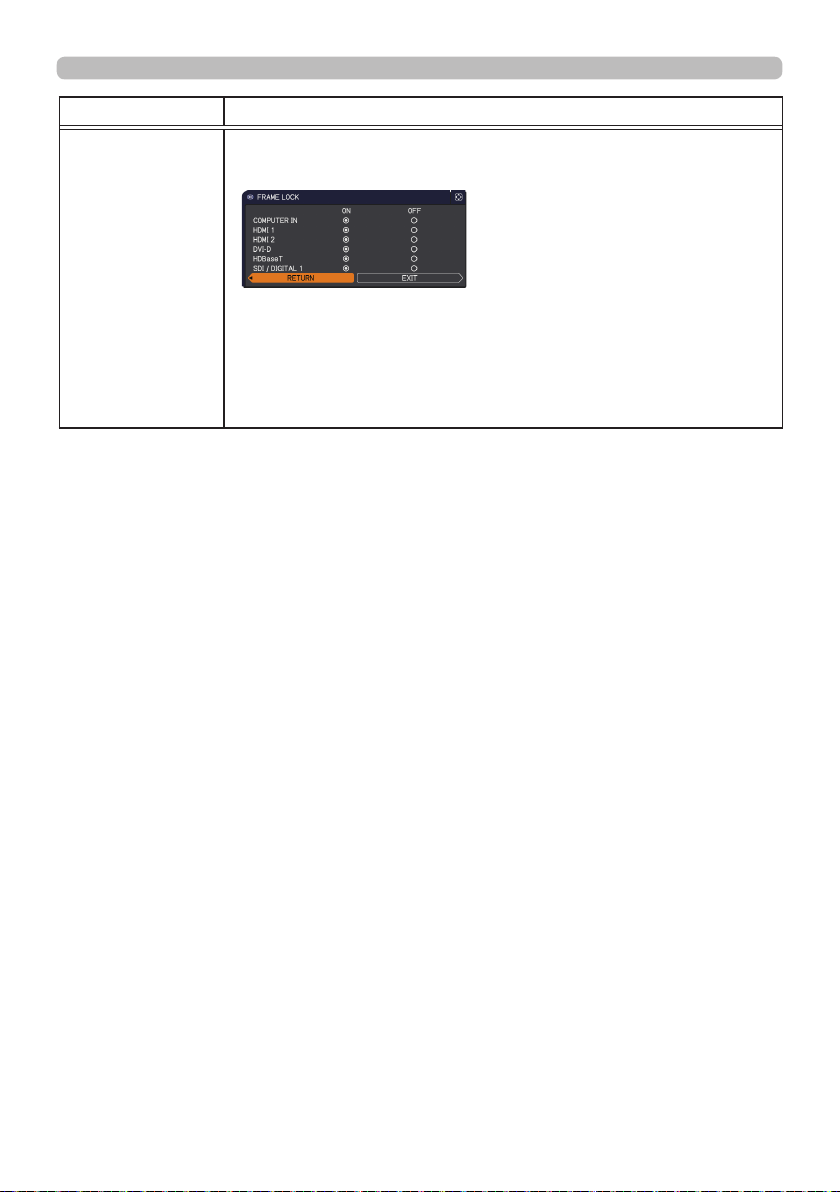
67
INPUT menu
Item Description
FRAME LOCK
When ON is selected, moving pictures are displayed more smoothly
Set the frame lock function on/off for each port.
(1) Use the ▲/▼ buttons to select the input ports.
(2) Use the ◄/► buttons to turn the frame lock function on/off .
ON
OFF
• This item can be performed only on a signal with a vertical
frequency of 49 to 51Hz, 59 to 61 Hz.
(continued on next page)
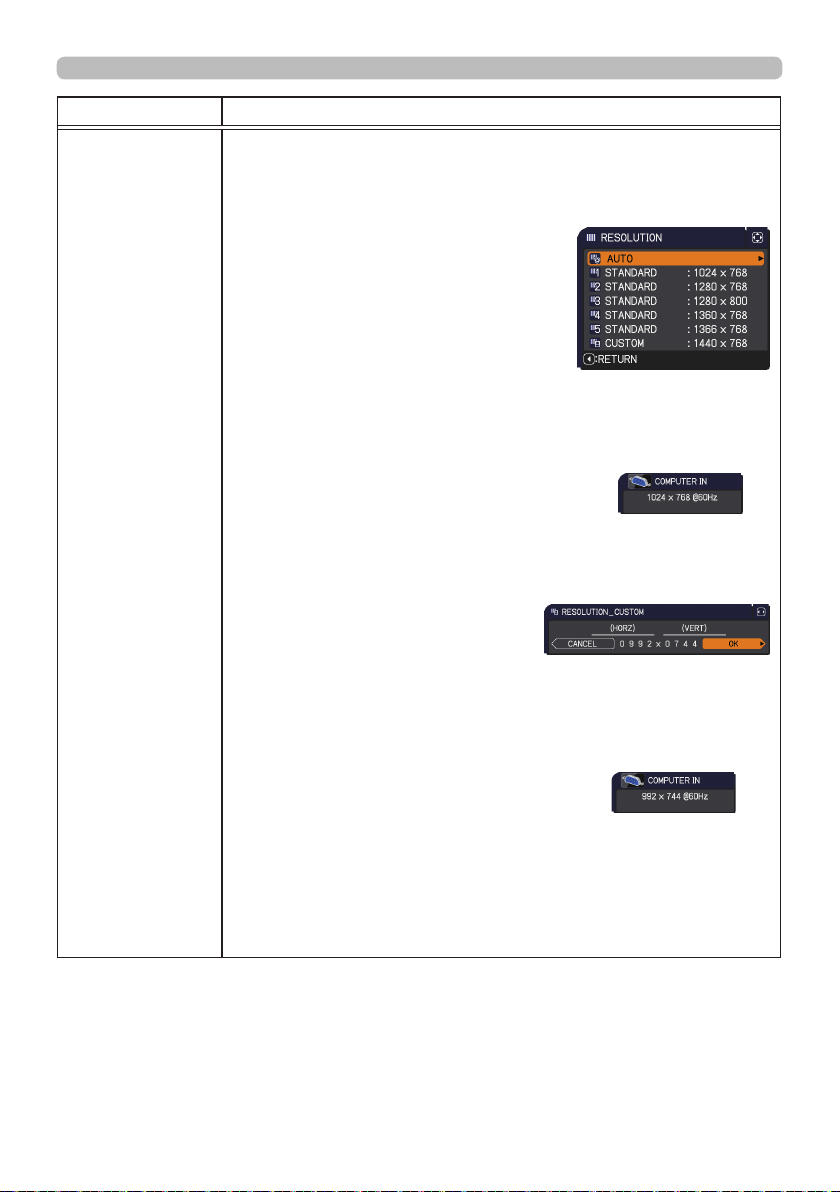
68
INPUT menu
Item Description
RESOLUTION
The resolution for the
COMPUTER IN
input signals can be set on
this projector.
(1) In the INPUT menu select the RESOLUTION using the ▲/▼
buttons and press the ► button.
The RESOLUTION menu will be
displayed.
(2) In the RESOLUTION menu select the
resolution you wish to display using
the ▲/▼ buttons.
Selecting AUTO will set a resolution
appropriate to the input signal.
(3) Pressing the ► or
ENTER
button when
selecting a STANDARD resolution will
automatically adjust the horizontal and
vertical positions, clock phase and
horizontal size.
The INPUT INFORMATION dialog will be
displayed.
(4) To set a custom resolution use the ▲/▼ buttons to select the
CUSTOM and the RESOLUTION CUSTOM box will be displayed.
Set the (HORZ) and (VERT)
resolutions using the ▲/▼/◄/►
buttons.
This function may not support all
resolutions.
(5) Move the cursor to OK on the screen and press the ► or
ENTER
button. The message "ARE YOU SURE YOU WISH TO
CHANGE RESOLUTION?" appears. To save the setting, press
the ► button.
The horizontal and vertical positions, clock phase and horizontal
size will be automatically adjusted.
The INPUT INFORMATION dialog
will be displayed.
(6) To revert to the previous resolution without saving changes,
move the cursor to CANCEL on screen and press the ◄ or
ENTER
button.
The screen will then return to the RESOLUTION menu displaying
the previous resolution.
• For some pictures, this function may not work well.
STANDARD
↓
CUSTOM
↓
(continued on next page)

69
Item Description
PbyP / PinP
SETUP
PinP Position
Using ▲/▼ buttons on the remote control changes the position of
sub area in PinP mode (
50
).
PbyP / PinP FRAME LOCK
Select the screen that enables FRAME LOCK function when using
PbyP or PinP.
LEFT / PRIMARY: Enables FRAME LOCK function for input on left
screen of PbyP or on primary area of PinP.
RIGHT / SECONDARY: Enables FRAME LOCK function for input
on right screen of PbyP or on secondary area of PinP.
INPUT menu
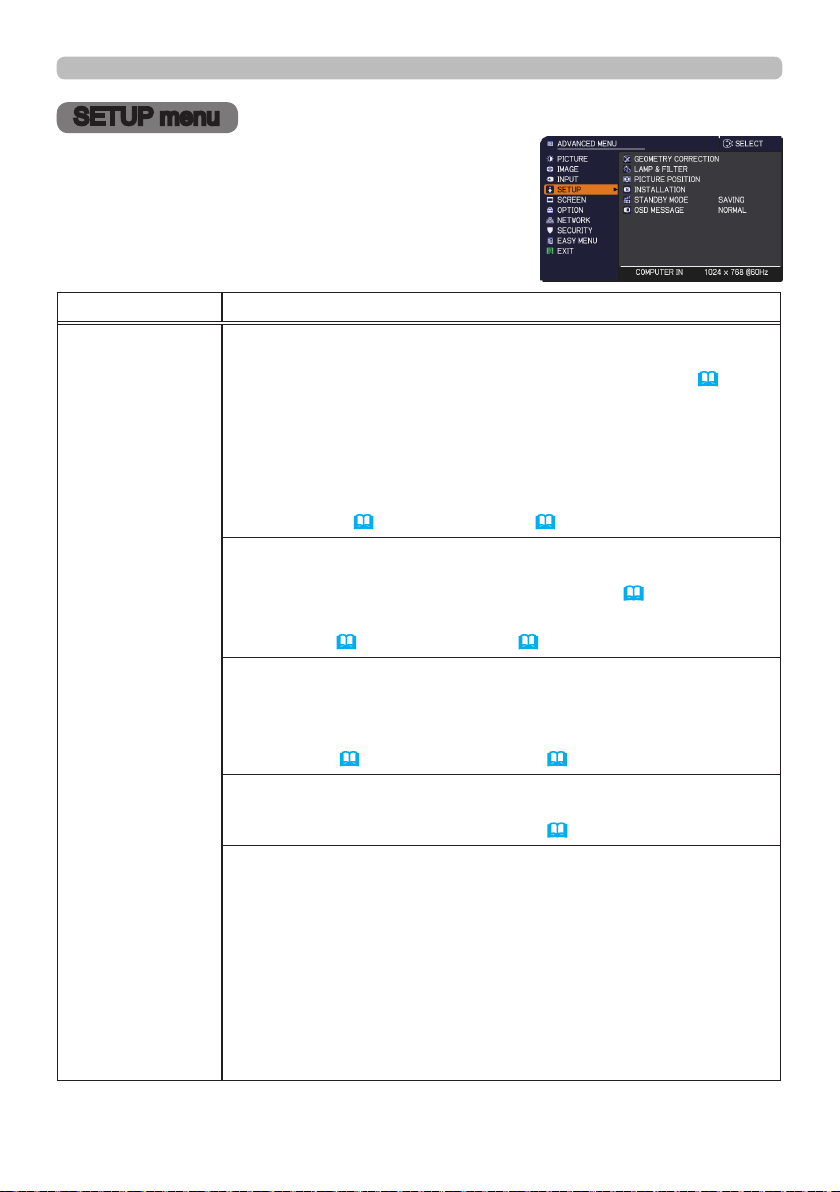
70
SETUP menu
Select an item from the Setup menu using the ▲/▼
cursor buttons, and press the ► cursor button or
ENTER button to execute the item. Then perform it
according to the following table.
SETUP menu
Item Description
GEOMETRY
CORRECTION
KEYSTONE
Selecting this item displays the KEYSTONE dialog.
For details, see KEYSTONE in
Correcting the distortion
(
38
).
• When the zoom adjustment is set to the TELE (telephoto focus),
this function may be excessive. This function should be used when
the zoom adjustment is set to the full WIDE (wide-angle focus).
• When the horizontal lens shift is not set to the center, this function
may not work correctly.
•
This function is unavailable when the screen is activated by
PERFECT FIT (
39
), and WARPING (
40
)
.
PERFECT FIT
Selecting this item displays the
PERFECT FIT
dialog. For details,
see
PERFECT FIT
in
Correcting the distortion
(
38
).
•
This function is unavailable when the screen is activated by
KEYSTONE (
38
), and WARPING (
40
)
.
WARPING
Selecting this item displays the WARPING dialog. For details, see
Application Manual of this feature.
• This function is unavailable when the screen is activated by
KEYSTONE
(
38
)
and
PERFECT FIT
(
39
)
.
EDGE BLENDING
Selecting this item displays the EDGE BLENDING dialog. For
details, see EDGE BLENDING feature (
41
~
44
).
TEST PATTERN
Select PATTERN with ▲/▼ buttons.
Displayed pattern [Off/1/2/3/4/5/6] can be switched with ◄/► but-
tons.
PATTERN 1: Frame
PATTERN 2: Red Grid
PATTERN 3: Green Grid
PATTERN 4: Blue Grid
PATTERN 5: Vertical 9 steps
PATTERN 6: Horizontal 9 steps
OFF: Displays the input signal.
(continued on next page)
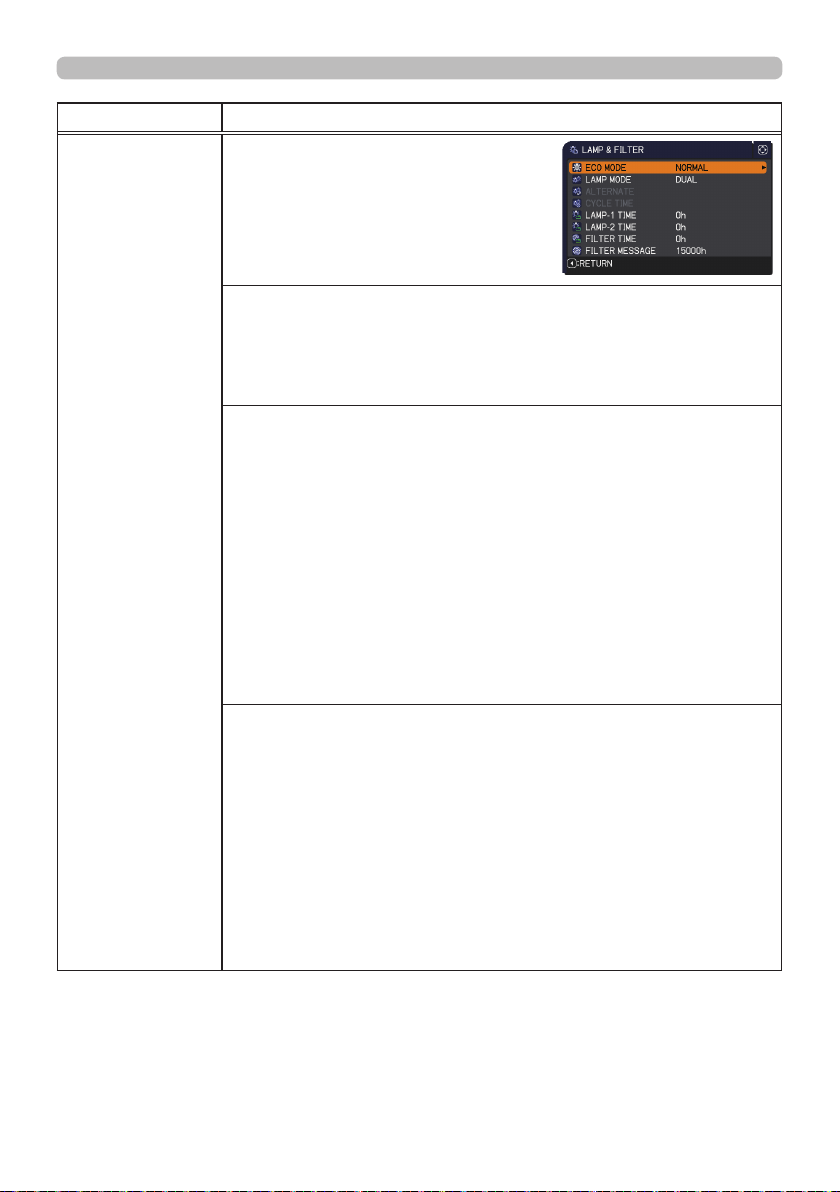
71
Item Description
LAMP & FILTER
Selecting this item displays the LAMP
& FILTER menu.
Select an item using the ▲/▼ buttons,
and press the ► button or the
ENTER
button on the remote control to
execute the item.
ECO MODE
Using the ▲/▼ buttons turns off/on the Eco mode.
NORMAL
ECO
• When the ECO is selected, acoustic noise and screen brightness
are reduced.
LAMP MODE
Using the ▲/▼ cursor buttons changes the Lamp Mode.
DUAL : Use both lamp at the same time.
ALTERNATE : Use the lamps alternately according to the settings of
ALTERNATE
LAMP-1 : Use LAMP-1 only
LAMP-2 : Use LAMP-2 only
• To maintain the lamp performance,
LAMP MODE
cannot be
switched for a few minutes right after switching to other modes.
ALTERNATE
Using the ▲/▼ cursor buttons changes the Alternate.
AUTO
CYCLE
AUTO : The lamp with less operating hours will turn on every start-
up.
Or, the lamp with more operating hours will turn on, only
if the lamp with less operating hours turned on for ve
consecutive.
CYCLE : Switches the lamp automatically according to the settings
of CYCLE TIME
• This function is only available if ALTERNATE is selected at LAMP MODE.
DUAL ALTERNATE
LAMP-1
LAMP-2
SETUP menu
(continued on next page)
72
Item Description
LAMP & FILTER
(continued)
CYCLE TIME
Using the ▲/▼ cursor buttons changes the CYCLE TIME.
6h
12h
18h
24h
1 week
Lamp switches according to the setting here.
• This function is only available if CYCLE TIME is selected at ALTERNATE
of LAMP MODE.
LAMP-1 TIME
The lamp time is the usage time of the lamp-1, counted after the last
resetting. It is shown in the LAMP & FILTER menu.
Pressing the
RESET
button on the remote control or the ► button
of the projector displays a dialog.
To reset the lamp time, select the OK using the ► button.
CANCEL
OK
• Reset the lamp time only when you have replaced the lamp, for a
suitable indication about the lamp.
• For the lamp replacement, see the section
Replacing the lamp
(
102
).
• The lamp time can be checked also with the Status Monitor (
24
).
LAMP-2 TIME
The lamp time is the usage time of the lamp-2, counted after the last
resetting. It is shown in the LAMP & FILTER menu.
Pressing the
RESET
button on the remote control or the ► button
of the projector displays a dialog.
To reset the lamp time, select the OK using the ► button.
CANCEL
OK
• Reset the lamp time only when you have replaced the lamp, for a
suitable indication about the lamp.
• For the lamp replacement, see the section
Replacing the lamp
(
102
).
• The lamp time can be checked also with the Status Monitor (
24
).
SETUP menu
(continued on next page)
73
Item Description
LAMP & FILTER
(continued)
FILTER TIME
Displays the usage time of the air lter, counted after the last
resetting. It is shown in the LAMP & FILTER menu.
Pressing the
RESET
button on the remote control or the ► button
of the projector displays a dialog.
To reset the lter time, select the OK using the ► button.
CANCEL
OK
• Reset the lter time only when you have cleaned or replaced the
air lter, for a suitable indication about the air lter.
• For the air lter cleaning, see the section Cleaning and replacing
the air lter (
105
).
• The lter time can also be checked with the Status Monitor (
24
).
FILTER MESSAGE
Use the ▲/▼ button to set the timer for notifying by the message
when to replace the lter unit
1000h
2000h
5000h
10000h
15000h
OFF
After choosing an item except OFF, the message “REMINDER ***
HRS PASSED ....” will appear after the timer reaches the interval
time set by this feature.
When the OFF is chosen, the message will not appear. Use this
feature to keep the air lter clean, setting the suitable time according
to your environment of this projector.
• Clean the lter periodically. If the air lter becomes to be blocked
by dust or other matter, the internal temperature will rise, which
could cause malfunction, or reduce the lifetime of the projector.
• Be careful with the operating environment of the projector and the
condition of the lter unit.
PICTURE
POSITION
Using the ▲/▼/◄/► cursor buttons selects required picture
position.
The PICTURE POSITION is not changed if any of the following
cases apply.
・
There is no non-display area (black display or background display)
or it is not displayed on the screen.
• One of the following messages is displayed on the screen:
"NO INPUT IS DETECTED"
"SYNC IS OUT OF RANGE"
"INVALID SCAN FREQ."
• The BLANK or TEMPLATE function is selected.
SETUP menu
(continued on next page)
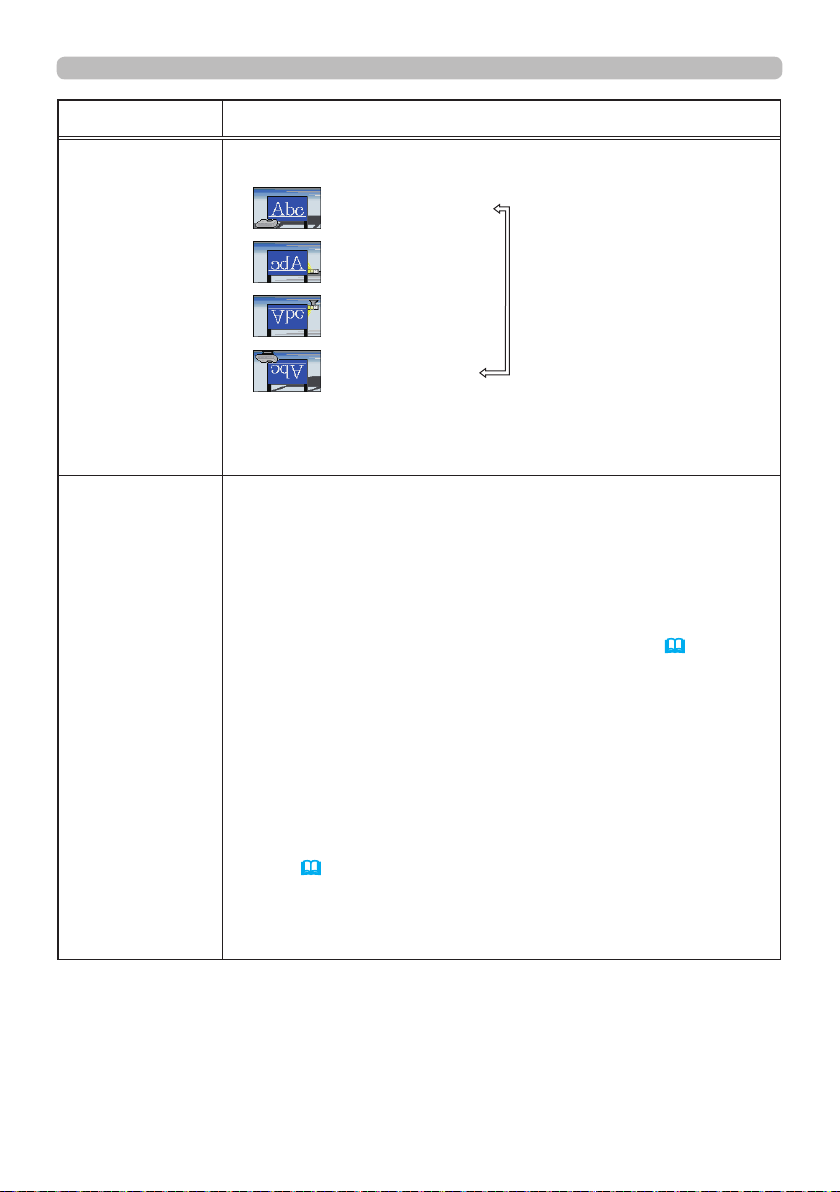
74
Item Description
INSTALLATION
Pressing the ►button displays the dialog for changing the
INSTALLATION setting.
FRONT / DESKTOP
REAR / DESKTOP
REAR / CEILING
FRONT / CEILING
Use the ▲/▼ buttons to select the required setting on the
INSTALLATION dialog, and press the
ENTER
button of the remote
control or the
INPUT
button of the projector to execute.
STANDBY MODE
Using ▲/▼ buttons switches the standby mode setting between
NORMAL and SAVING.
NORMAL
SAVING
• When SAVING is selected, the RS-232C communication control
except to turn the projector on and the network function are disabled
while the projector is in the standby mode. If the COMMUNICATION
TYPE in the COMMUNICATION menu is set to NETWORK
BRIDGE, all of the RS-232C commands are disabled (
91
).
• When SAVING is selected, STANDBY setting of MONITOR OUT
is invalid, and no signal is output from
MONITOR OUT
port in the
standby mode.
• When SAVING is selected, the CENTERING feature while the
projector is in the standby mode is disabled.
•
When
SAVING
is selected, the Status Monitor and its button
operation are unavailable while the projector is in the standby mode.
•
When
SAVING
is selected, the HDMI Link and HDBaseT™
functions are disabled while the projector is in the standby mode.
•
This function is available only when OFF is selected for STACK
MODE. (
OPTION menu > SERVICE > COMMUNICATION >
STACK)
.
• When SAVING is selected, SCHEDULE function (Ex. POWER-
ON) at STANDBY MODE will not be operated.
SETUP menu
(continued on next page)
75
Item Description
OSD MESSAGE
SETUP menu
Using the ▲/▼ buttons turns on/off the message function.
NORMAL
SILENT
INHIBIT
■SILENT
: The following message functions do not work.
“AUTO IN PROGRESS” while automatically adjusting
“NO INPUT IS DETECTED”
“SYNC IS OUT OF RANGE”
“INVALID SCAN FREQ.”
“NOT AVAILABLE”
“Searching….” while searching for the input
“Detecting….” while an input signal is detected
The indication of the ZOOM displayed by changing
*While operating from the remote control only.
The indication of the FOCUS displayed by changing
The indication of the input signal displayed by changing
The indication of the aspect ratio displayed by changing
The indication of the PICTURE MODE displayed by changing
The indication of the ACTIVE IRIS displayed by changing
The indication of the MY MEMORY displayed by changing
The indication of “FREEZE” and “II” while freezing the screen by
pressing the
FREEZE
button.
The indication of the TEMPLATE displayed by changing.
The indication of the ECO MODE displayed by changing.
■INHIBIT
: All message functions does not work.
The following buttons function:
STANDBY, ON
Status Monitor can be operated.
• To change this function, follow the steps below.
1. Press the
OSD MSG
button on the remote control for three
seconds.
2. The INHIBIT OSD is displayed.
While this OSD is displayed, press the
OSD MSG
button again on
the remote control.
3. Toggle and change the function.
NORMAL
SILENT
INHIBIT
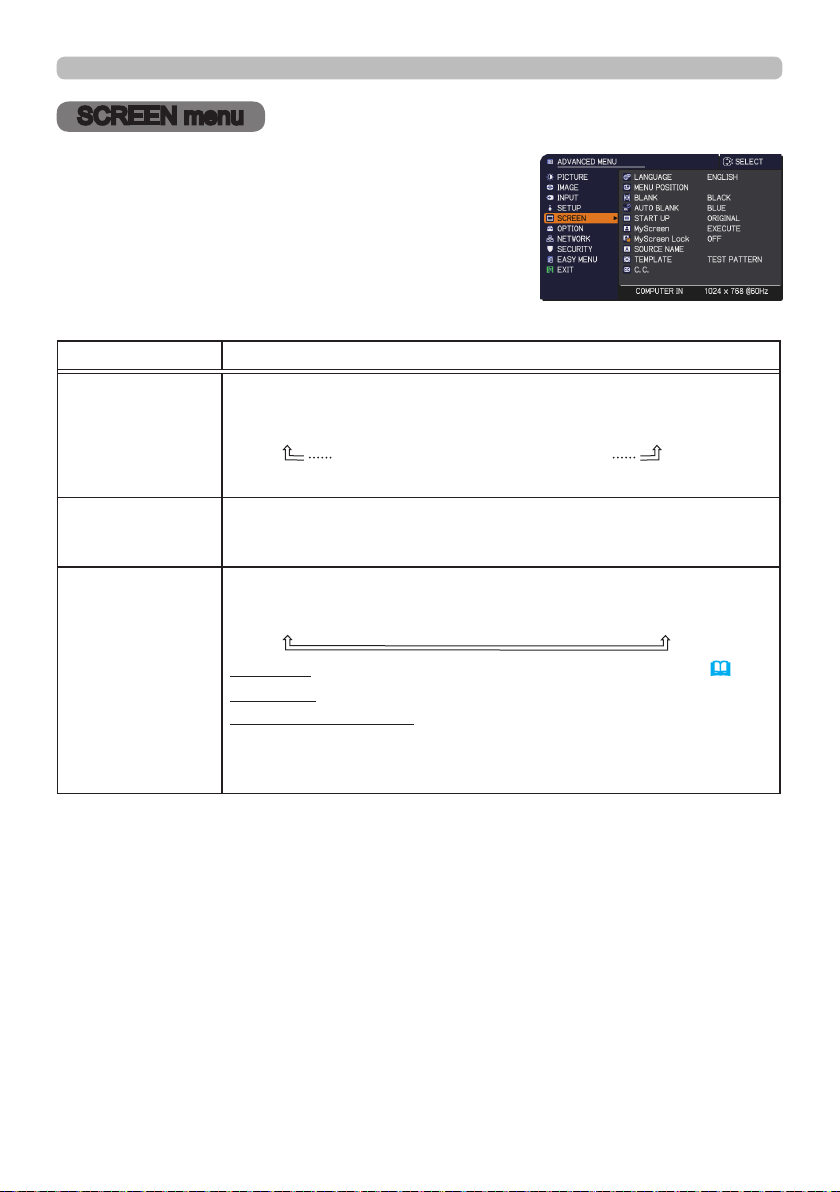
76
SCREEN menu
Item Description
LANGUAGE
Using the ▲/▼/◄/► buttons switches the OSD (On Screen
Display) language.
ENGLISH
FRANÇAIS
DEUTSCH
ESPAÑOL
(shown in the LANGUAGE dialog)
Press the
ENTER
or
INPUT
button to save the language setting.
MENU POSITION
Using the ▲/▼/◄/► buttons adjusts the menu position.
To quit the operation, press the
MENU
button on the remote control
or do not perform any operation for about 10 seconds.
BLANK
Using the ▲/▼ buttons switches the mode for the blank screen.
The blank screen is a screen for the temporarily blanking feature.
MyScreen
ORIGINAL
BLUE
WHITE
BLACK
MyScreen :
Screen can be registered by the MyScreen item (
78
).
ORIGINAL : Screen preset as the standard screen.
BLUE, WHITE, BLACK : Plain screens in each color.
• To avoid remaining as an afterimage, the MyScreen or ORIGINAL
screen will change to the AUTO BLANK screen after several
minutes.
SCREEN menu
From the SCREEN menu, items shown in the table
below can be performed.
Select an item from the SCREEN menu using the
▲/▼ cursor buttons, and press the ► cursor button
or ENTER button to execute the item. Then perform
it according to the following table.
(continued on next page)
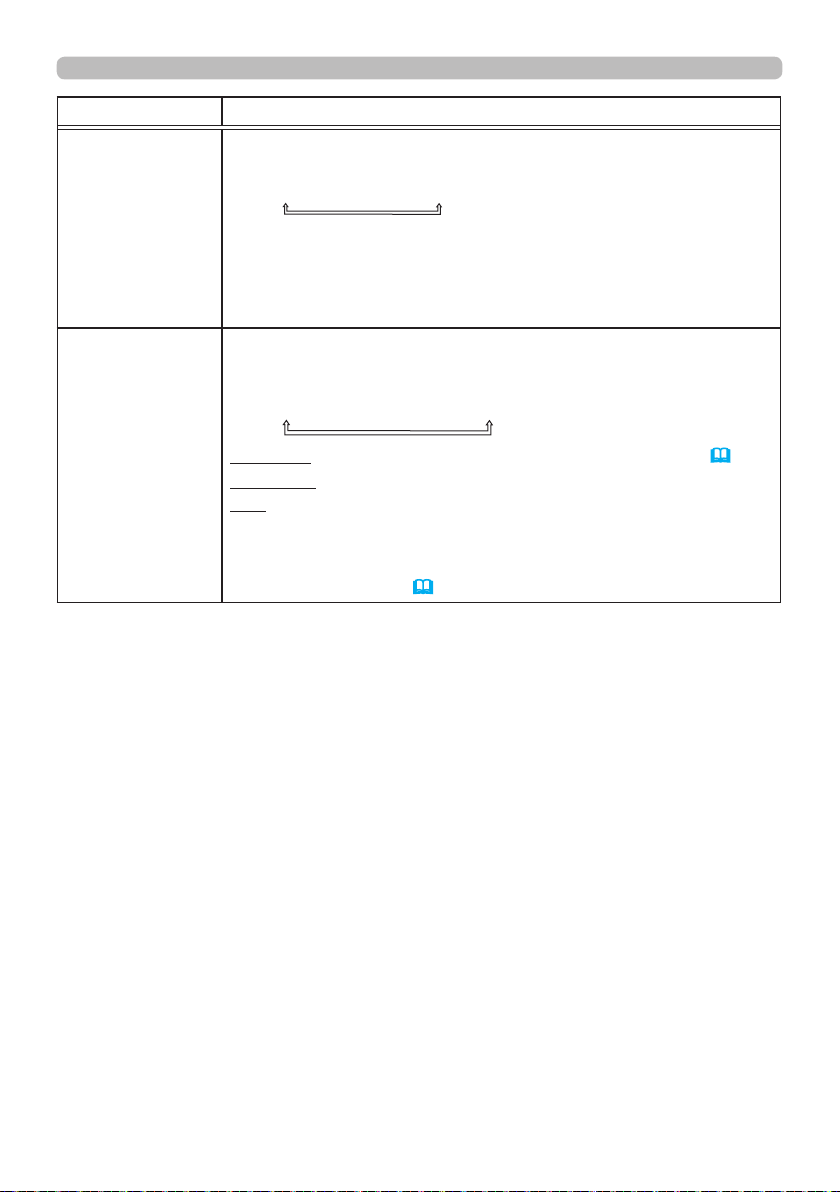
77
SCREEN menu
Item Description
AUTO BLANK
Using the ▲/▼ buttons switches the mode for the AUTO BLANK
screen.
BLUE
WHITE
BLACK
• To avoid remaining as an afterimage, displayed image will change
to the designated blank color screen by AUTO BLANK after several
minutes at the following conditions.
- When MyScreen or ORIGINAL is displayed as BLANK screen.
- When start-up screen is displayed.
START UP
Using the ▲/▼ buttons switches the mode for the start-up screen.
The start-up screen is a screen displayed when no signal or an
unsuitable signal is detected.
MyScreen
ORIGINAL
OFF
MyScreen :
Screen can be registered by the MyScreen item (
78
).
ORIGINAL : Screen preset as the standard screen.
OFF : Plain black screen.
• To avoid the image burning into the screen, the START UP screen
will change to the AUTO BLANK screen after several minutes.
• When the ON is selected to the MyScreen PASSWORD item in
the SECURITY menu (
97
), the START UP is fixed to MyScreen.
(continued on next page)
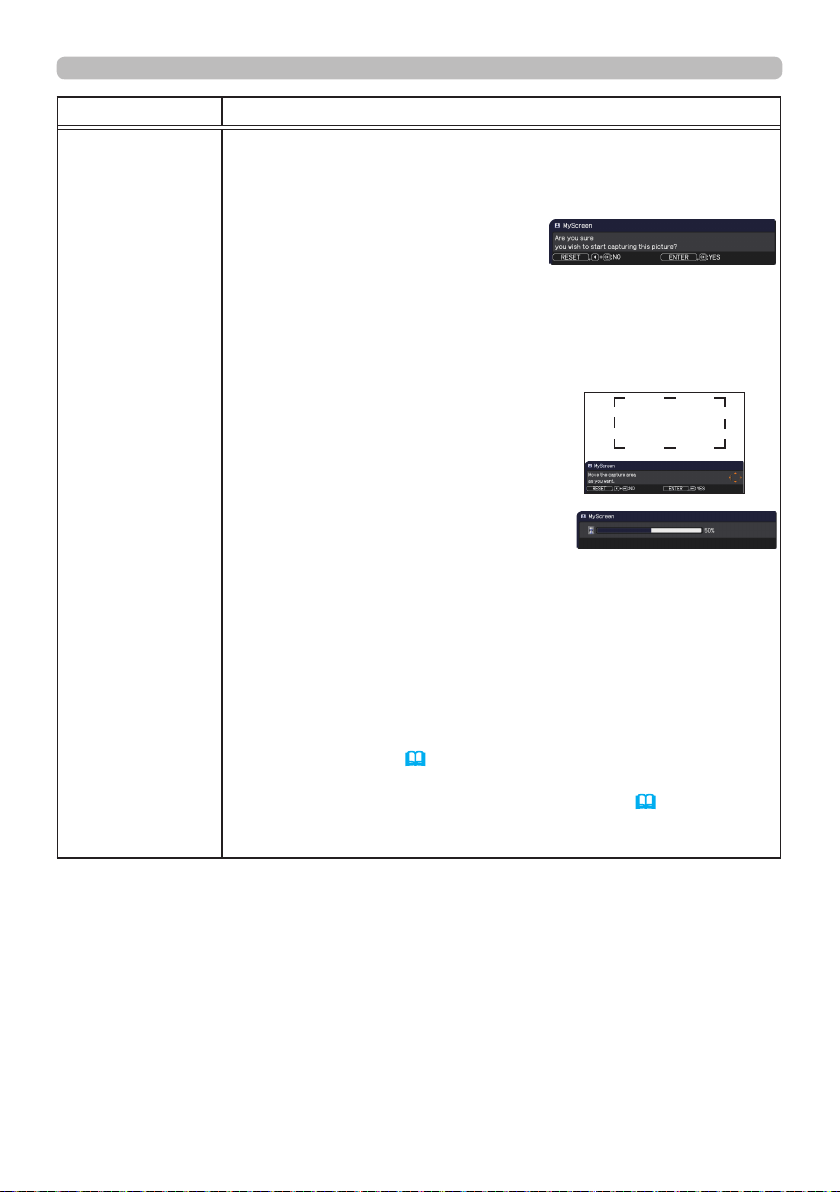
78
SCREEN menu
Item Description
MyScreen
You can capture an image for use as a MyScreen image which
can be used as the BLANK screen and START UP screen. Display
the image you want to capture before executing the following
procedure.
(1) Selecting this item displays a dialog
titled “MyScreen”. It will ask you if
you start capturing an image from
the current screen.
Wait for the target image to be displayed, and press the
ENTER
or
INPUT
button when the image is displayed. The image will
freeze and the frame for capturing will appear.
To stop performing, press the
RESET
button on the remote
control.
(2) Using the ▲/▼/◄/► buttons adjusts
the frame position.
Move the frame to the position of the
image which you want to use. The frame
may not be able to be moved for some
input signals.
To start registration, press the
ENTER
or
INPUT
button on the remote control.
To restore the screen and return to the previous dialog, press the
RESET
button on the remote control.
Registration may take several minutes.
When the registration is completed, the registered screen and
the following message is displayed for several seconds:
“MyScreen registration is nished.”
If the registration failed, the following message is displayed:
“A capturing error has occurred. Please try again.”
• This function cannot be selected when ON is selected for the
MyScreen Lock item (
79
).
• This function cannot be selected when ON is selected for the
MyScreen PASSWORD item in SECURITY menu (
97
).
• This function is unavailable for a signal from the LAN, HDMI 1 / 2,
HDBaseT™, DVI-D or SDI/DIGITAL 1 port.
(continued on next page)
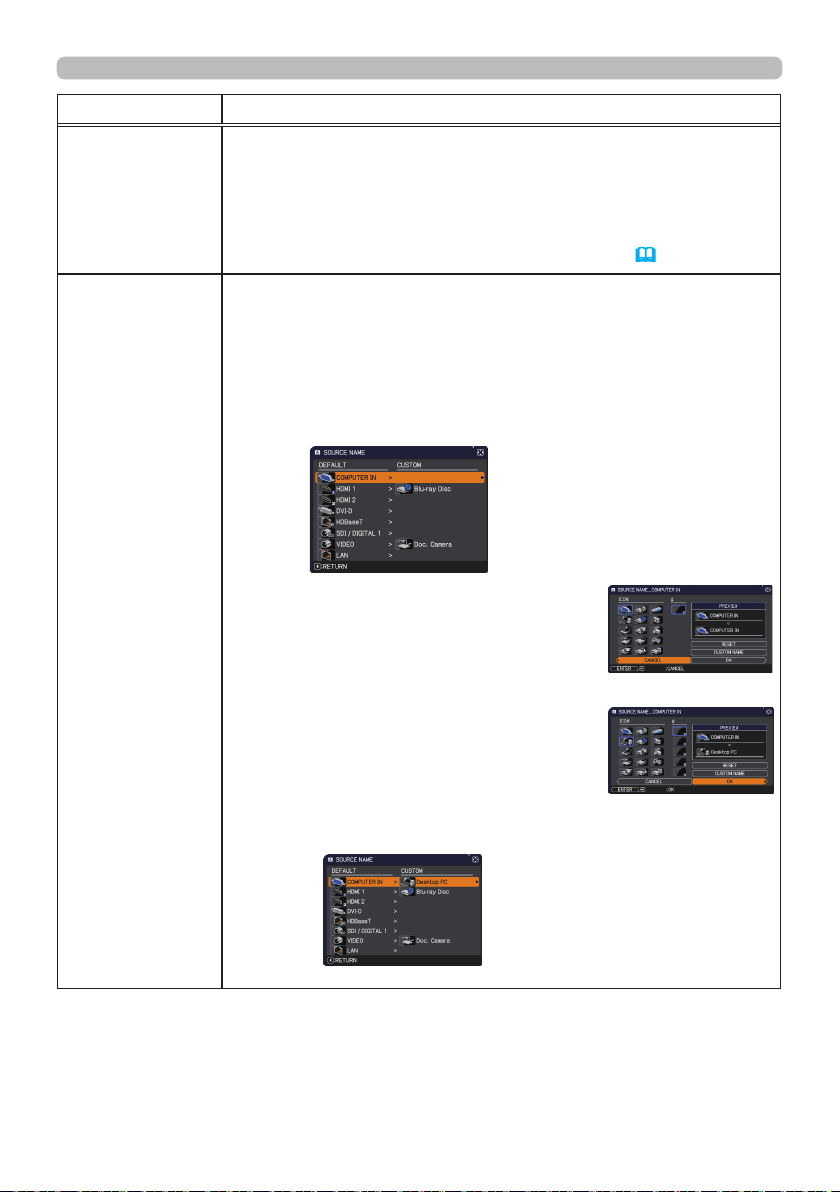
79
SCREEN menu
Item Description
MyScreen Lock
Using the ▲/▼ buttons turns on/off the MyScreen lock function.
ON
OFF
When the ON is selected, the item MyScreen is locked. Use this
function for protecting the current MyScreen.
• This function cannot be selected when the ON is selected to the
MyScreen PASSWORD item in SECURITY menu (
97
).
SOURCE NAME
Each input port for this projector can have a name applied to it.
(1)
Use the ▲/▼ buttons on the SCREEN menu to select SOURCE NAME
and press the ► or
ENTER
button. The SOURCE NAME menu will be
displayed.
(2) Use the ▲/▼ buttons on the SOURCE NAME menu to select
the port to be named and press the ► button. The SOURCE
NAME dialog will be displayed.
Right side of the menu is blank until a name is specied.
(3) Select an icon you want to assign to the
port in the SOURCE NAME dialog.
The name assigned to the port will also
be automatically switched according to your
icon selection. Press the
ENTER
or
INPUT
button to determine your icon selection.
(4) Select a number you want to assign to the
port along with the icon. You can select
the number either from blank (no number
assigned), 1, 2, 3, or 4.
Then press the
ENTER
or
INPUT
button.
(5) If you want to modify the name assigned to the port, select
CUSTOM NAME and press the
ENTER
or
INPUT
button.
(continued on next page)
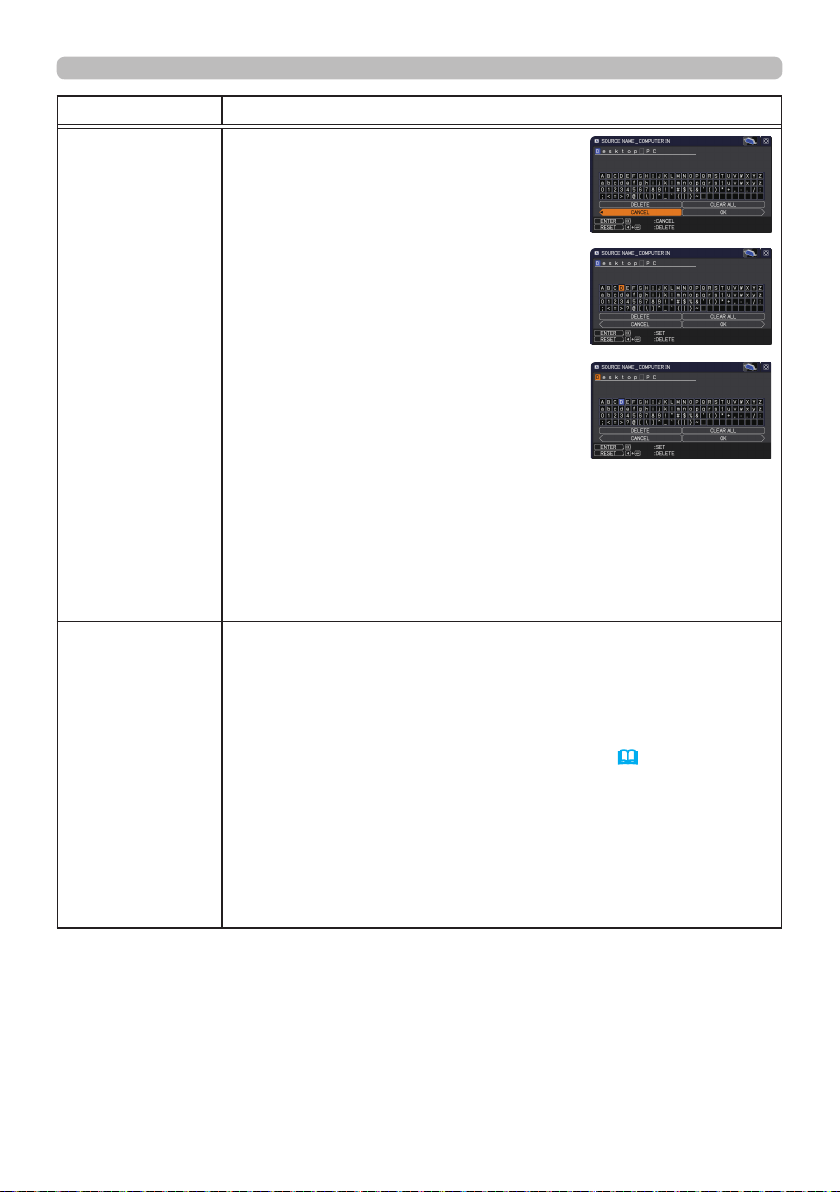
80
SCREEN menu
Item Description
SOURCE NAME
(
continued
)
(6) The current name will be displayed on
the rst line. Use the ▲/▼/◄/► buttons
and the
ENTER
or
INPUT
button to
select and enter characters. To erase one
character at a time, press the
RESET
button or press the ◄ and
INPUT
button
simultaneously. Also if you move the
cursor to DELETE or CLEAR ALL on
screen and press the
ENTER
or
INPUT
button, one or all characters will be
erased. The name can be a maximum of
16 characters.
(7) To change an already inserted character,
press the ▲ button to move the cursor to
the rst line, and use the ◄/► buttons to
move the cursor on the character to be
changed.
After pressing the
ENTER
or
INPUT
button, the character is
selected. Then, follow the same procedure as described at the
item (6) above.
(8) To nish entering text, move the cursor to the OK on screen and
press the ►,
ENTER
or
INPUT
button. To revert to the previous
name without saving changes, move the cursor to the CANCEL
on screen and press the ◄,
ENTER
or
INPUT
button.
TEMPLATE
Using the ▲/▼ cursor buttons switches the mode for the template
screen.
Press the ► cursor (or the
ENTER
) button to display the selected
template, and press the ◄ cursor button to close the displayed
screen.
The last selected template is displayed when the
MY BUTTON
allocated to the TEMPLATE function is pressed (
84
).
TEST PATTERN
DOT-LINE1
DOT-LINE2
DOT-LINE3
STACK
MAP2
MAP1
CIRCLE2
CIRCLE1
DOT-LINE4
You can turn a map upside down and scroll it horizontally when
MAP1 or MAP2 is selected. To invert or scroll the map, display
the guidance by pressing the
RESET
button on the remote three
seconds or more when MAP1 or MAP2 appears.
(continued on next page)
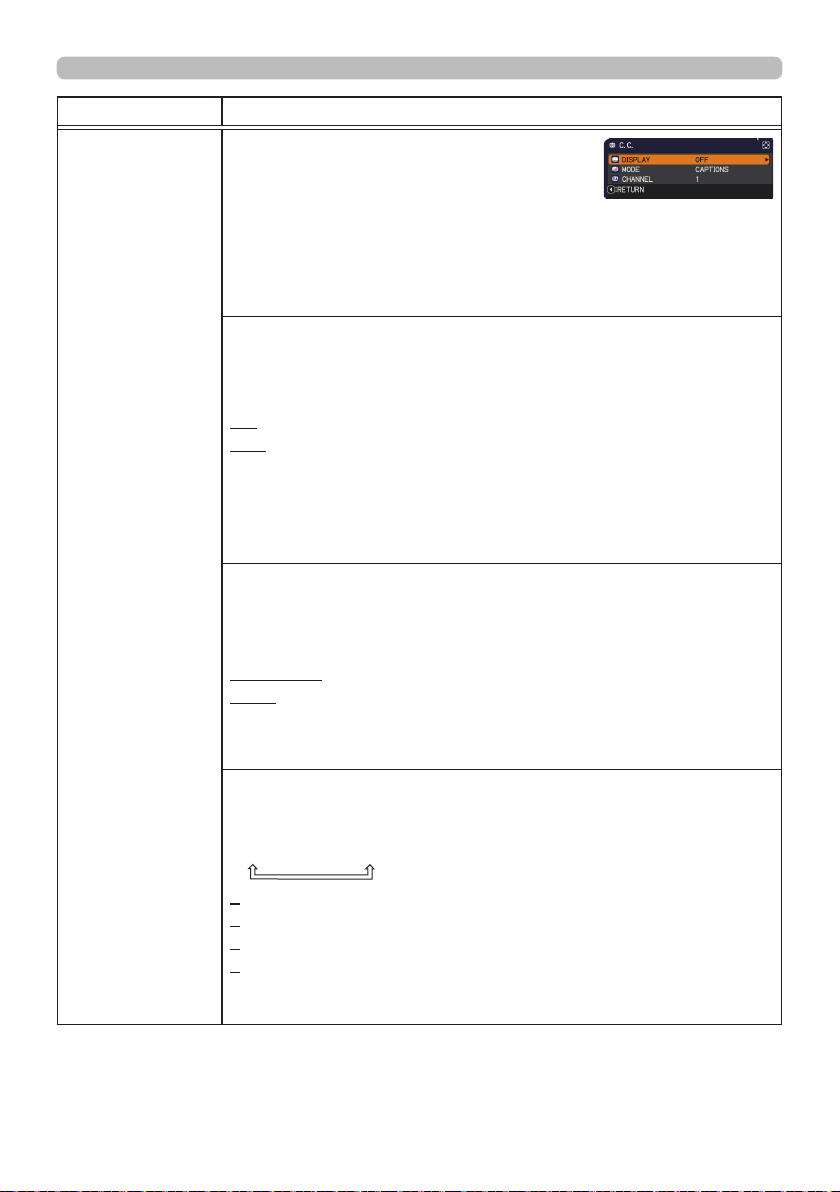
81
SCREEN menu
Item Description
C.C.
The C.C. is the function that displays a
transcript or dialog of the audio portion of
a video, les or other presentation or other
relevant sounds. It must have NTSC format
video or 480i@60 format component video
source supporting C.C. feature to utilize this
function.
It may not work properly, depending on equipment or signal source.
In this case, turn off the Closed Caption.
DISPLAY
Select Closed Caption DISPLAY setting from following options using
▲/▼ buttons.
ON
OFF
ON : Closed Caption is on.
OFF : Closed Caption is off.
• The caption is not displayed when the OSD menu is active.
• The Closed Caption is the function to display the dialogue,
narration, and / or sound effects of a television program or other
video sources. The Closed Caption availability depends upon
broadcaster and/or content.
MODE
Select Closed Caption MODE setting from following options using
▲/▼ buttons.
CAPTIONS
TEXT
CAPTIONS : Display Closed Caption.
TEXT : Display Text data, which is for additional information such
as news reports or a TV program guide. The information
covers the entire screen. Not all of the C.C. program has Text
information.
CHANNEL
Select Closed Caption CHANNEL from following options using ▲/▼
buttons.
1
2
3
4
1: Channel 1, primary channel / language
2: Channel 2
3: Channel 3
4: Channel 4
The channel data may vary, depending on the content. Some
channel might be used for secondary language or empty.
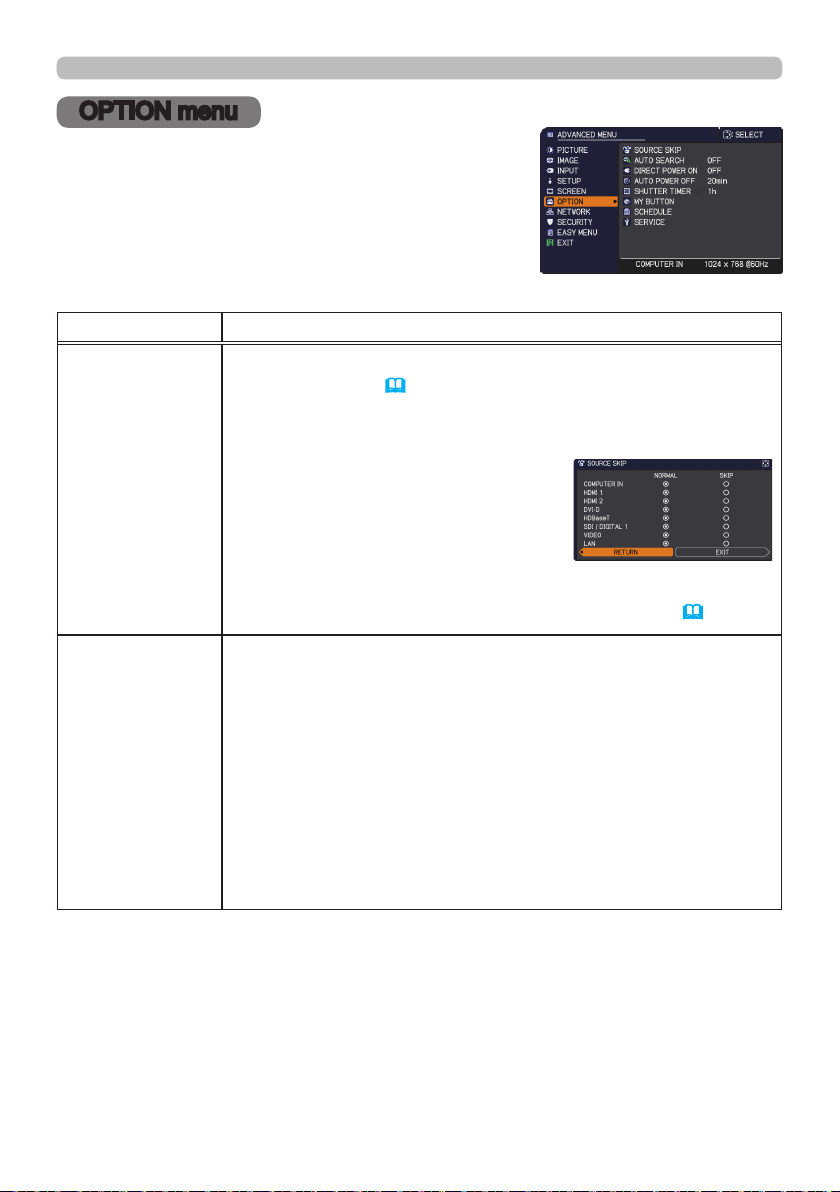
82
OPTION menu
OPTION menu
Select an item from the Option menu using the ▲/▼
cursor buttons, and press the ► cursor button or
ENTER button to execute the item, except for the
items LAMP TIME and FILTER TIME. Then perform it
according to the following table.
Item Description
SOURCE SKIP
The ports can be set to be ignored in searching by the AUTO
SEARCH function (
below
) or in selecting by buttons on the control
panel.
(1) Choose a picture input port using the
▲/▼ buttons.
(2) Using the ◄/►buttons turns on/off the
SOURCE SKIP function.
NORMAL
SKIP
The port that is set to SKIP will be
ignored.
• It is not possible to set SKIP to all ports at the same time.
• This setting is not valid when in the PbyP / PinP mode (
47
).
AUTO SEARCH
Using the ▲/▼ buttons turns on/off the automatic signal search
function.
ON
OFF
When ON is selected, detecting no signal automatically cycles
through input ports in the following order. The search is started
from the current port. When an input is found, the projector will stop
searching and display the image.
COMPUTER IN
LAN
HDMI 1
HDMI 2
HDBaseT
VIDEO
DVI-D
SDI/DIGITAL 1
(continued on next page)
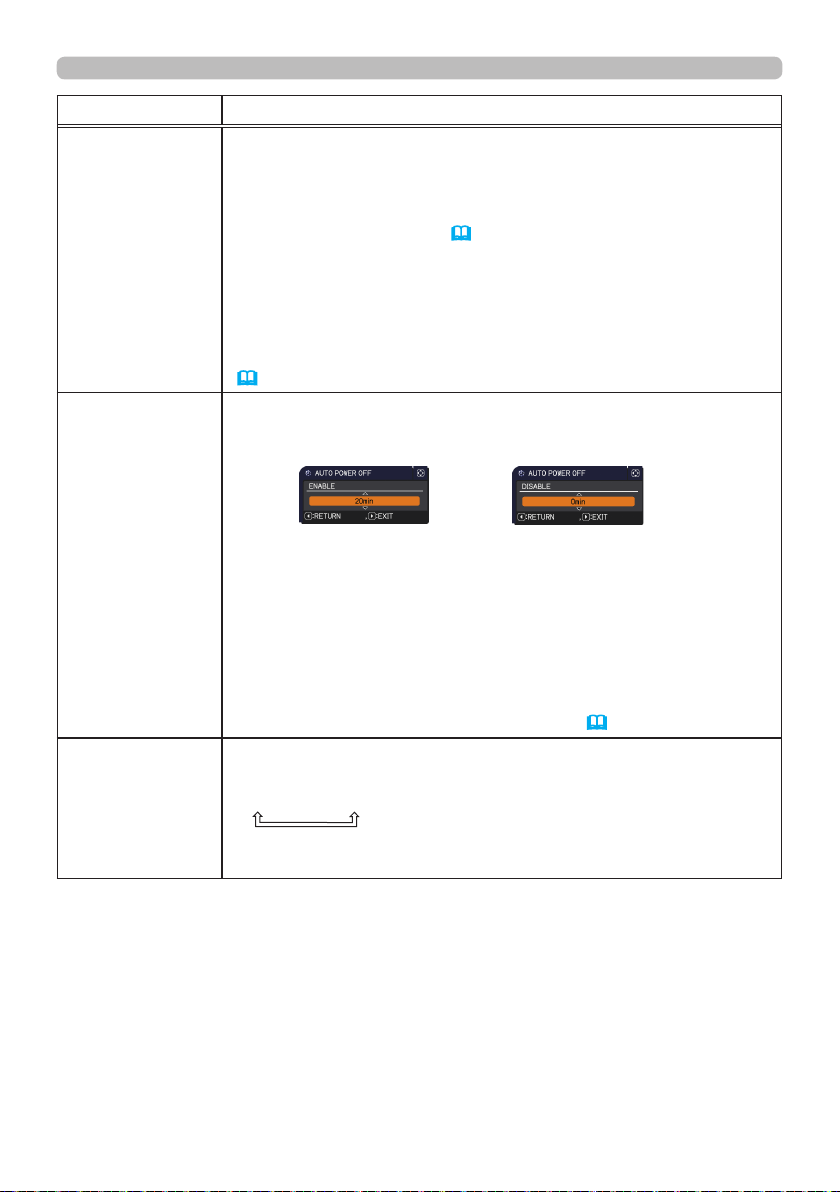
83
OPTION menu
Item Description
DIRECT POWER
ON
Using the ▲/▼ buttons turns on/off the DIRECT POWER ON
function.
ON
OFF
When set to ON, the lamp in projector will be automatically turned on
without the usual procedure (
30
), only when the projector is supplied
with the power after the power was cut while the lamp was on.
• This function does not work as long as the power has been
supplied to the projector while the lamp is off.
• After turning the lamp on by the DIRECT POWER ON function,
if neither input nor operation is detected for about 30 minutes, the
projector is turned off, even though the AUTO POWER OFF function
(
below
) is disabled.
AUTO POWER
OFF
Using the ▲/▼ buttons adjusts the time to count down to
automatically turn the projector off.
Long (max. 99 minutes)
Short (min. 0 minute = DISABLE)
When the time is set to 0, the projector is not turned off
automatically.
When the time is set to 1 to 99, and when the passed time with
no-signal or an unsuitable signal reaches at the set time, the
projector lamp will be turned off.
If one of the projector's buttons or the remote control buttons
is pressed or one of the commands (except get commands) is
transmitted to the
CONTROL
port during the corresponding time,
projector will not be turned off.
Refer to the section
Turning off the power
(
30
).
SHUTTER TIMER
Using the ▲/▼ buttons sets the time from closing the lens shutter to
automatically turning the projector off.
1h
3h
6h
• The shutter will open automatically when turning the projector on
again.
(continued on next page)
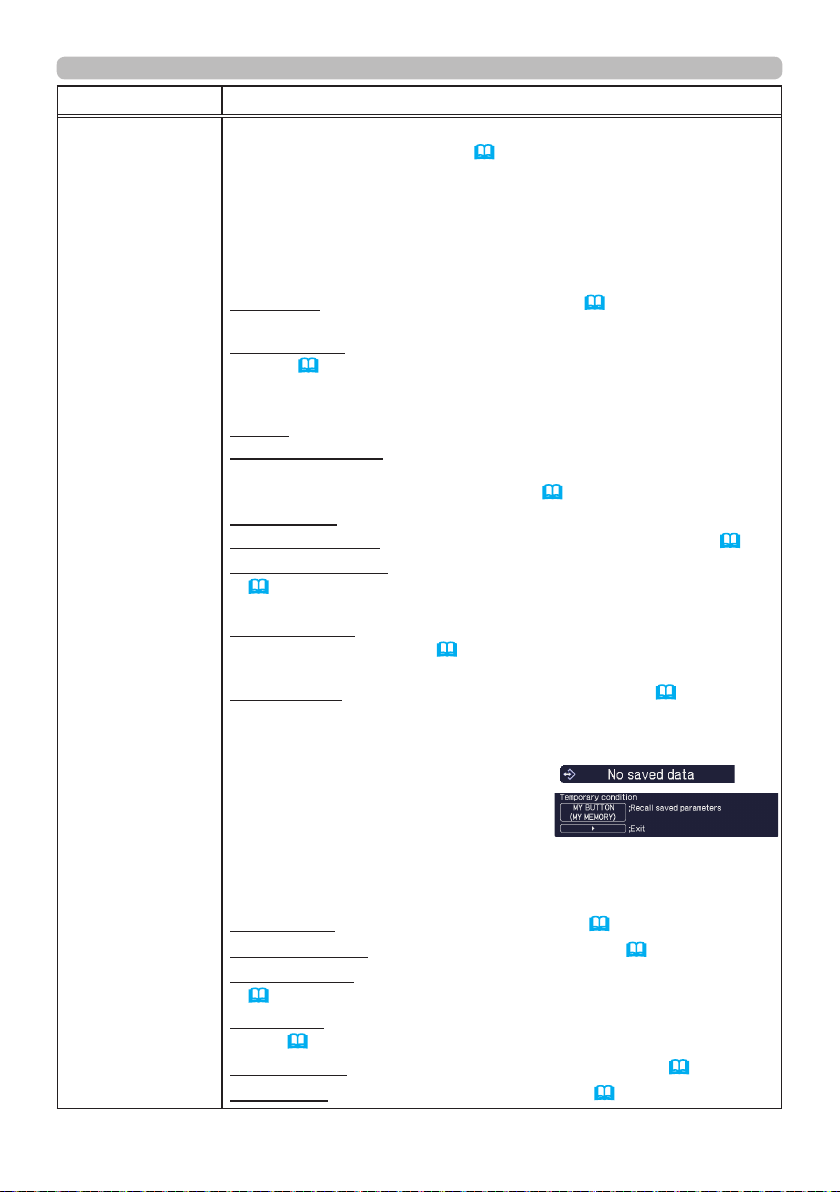
84
OPTION menu
Item Description
MY BUTTON
This item is to assign one of the following functions to
MY BUTTON
(
1
to
4
) on the remote control (
7
).
(1) Use the ▲/▼ buttons on the MY BUTTON menu to select a
button from MY BUTTON - 1 to 4 and press the ► or
ENTER
button to display the MY BUTTON setup dialog.
(2) Then using the ▲/▼/◄/► buttons sets one of the following
functions to the chosen button. Press the
ENTER
or
INPUT
button to save the setting.
MY IMAGE: Displays the MY IMAGE menu (
MY IMAGE
in the
Network Guide
).
MESSENGER: Turns the messenger text displayed on the screen
on/off (
Messenger Function
in the
Network Guide
).
When there is no transferred text data to display, the message ”NO
MESSENGER DATA" appears.
BLANK: Switches the BLANK function to on and off.
PbyP / PinP SWAP: Swaps the picture on the right with one on
the left in the PbyP mode. Swaps the primary picture and the
secondary picture in the PinP mode. (
47
)
PinP Position: Toggles the PinP position.
ACCENTUALIZER: Turn on/off the ACCENTUALIZER dialog(
59
).
STATUS MONITOR: Turns on/off the back light of status monitor
(
24
).
This function is unavailable when SAVING is
selected in
STANDBY MODE while the projector is in the standby mode
.
INFORMATION: Displays SYSTEM_INFORMATION,
INPUT INFORMATION (
94
), WIRELESS INFORMATION,
WIRED INFORMATION, OTHER INFORMATION or nothing.
MY MEMORY: Loads one of adjustment data stored (
60
).
When more than one data are saved, the adjustment
changes every time the
MY BUTTON
is pressed.
When no data is saved in memory, the
dialog "No saved data" appears.
When the current adjustment is not
saved to memory, the dialog as shown
in the right appears.
To keep the current adjustment, press the ► button to exit.
Otherwise loading a data will overwrite the current adjusted
condition.
ACTIVE IRIS: Changes the active iris mode (
60
).
PICTURE MODE: Change the PICTURE MODE (
57
).
FILTER RESET: Displays the lter time reset conrmation dialogue
(
73
).
TEMPLATE: Makes the template pattern selected to the TEMPLATE
item (
80
) appear or disappear.
RESOLUTION: Turns on/off the RESOLUTION dialog (
68
).
ECO MODE: Change the ECO MODE dialog(
71
).
(continued on next page)
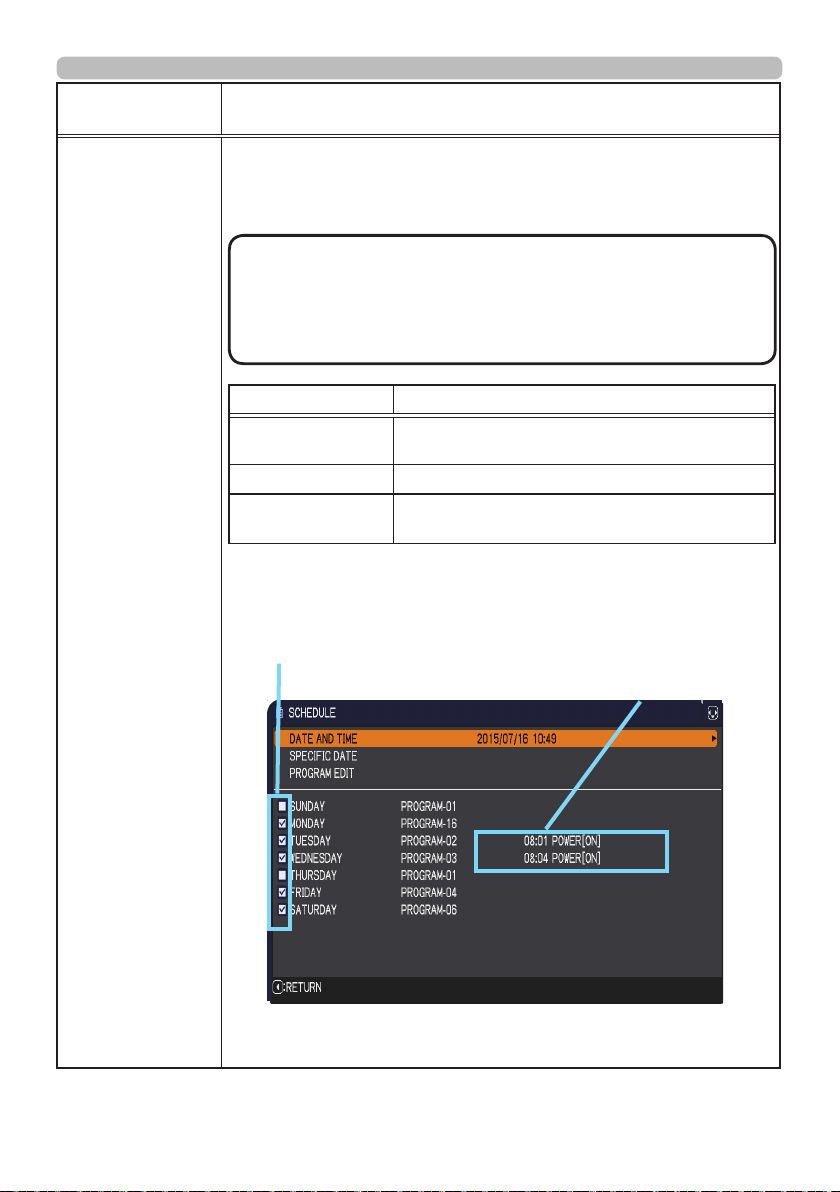
85
OPTION menu
Item Description
SCHEDULE
■ How to setup the item
1. Use the ▲/▼/◄/► cursor buttons to select or adjust.
2. Select OK to nish the settings.
■ How to activate (DATE AND TIME / SPECIFIC DATE)
Place a checkmark in the box.
checkmark
in the box
Date and rst
setup info could
be seen with the
check mark.
Item Description
DATE & TIME
Set the DATE (Year/Month/Date) and Time (24-
hour scale).
SPECIFIC DATE
Set specic date from 1 to 10.
PROGRAM EDIT
The TIME and EVENT for Program 1 to 16
can be edited.
NOTE
1/2 page (Set the DATE(Year/Month/Date) and Time(24-hour scale).)
・
Refer to the actual on-screen display(OSD) for
appropriate operation.
When the STANDBY MODE is set to SAVING, SCHEDULE
function (Ex:POWER-ON) at STANBY MODE will not be
operated.
(continued on next page)
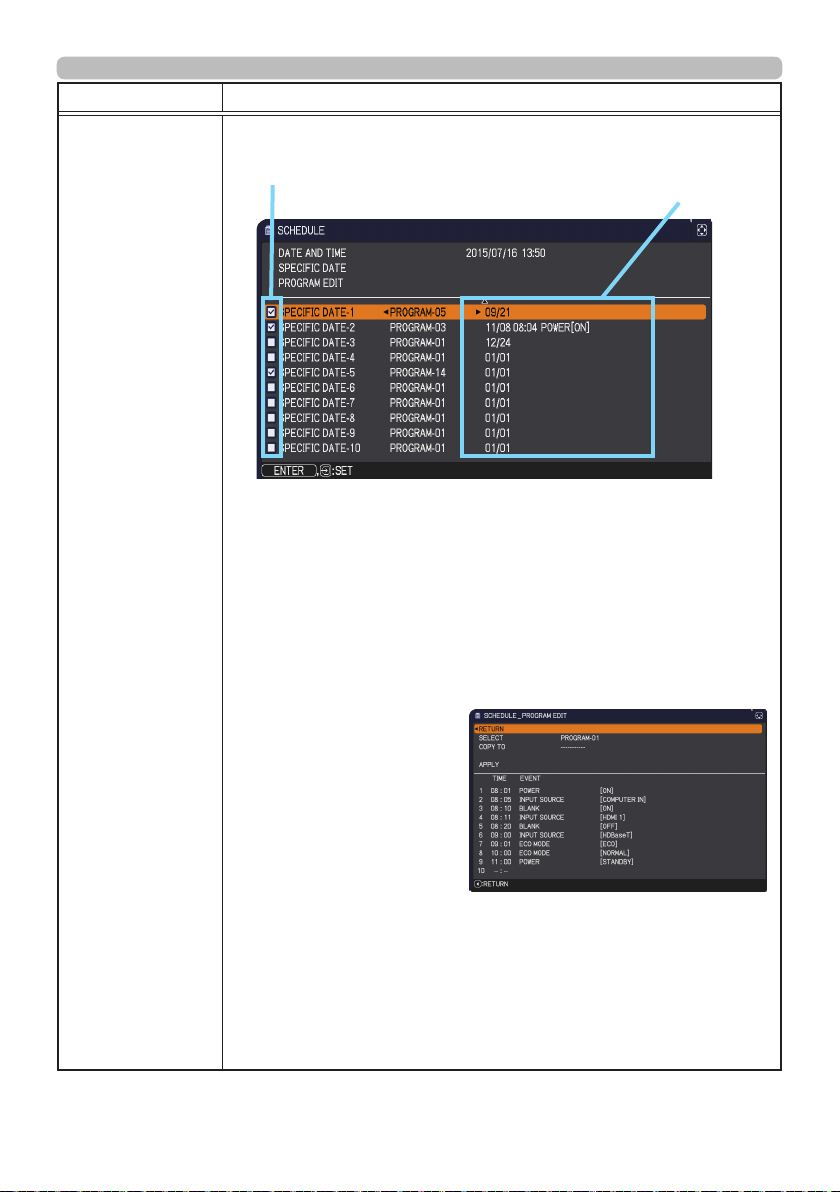
86
OPTION menu
Item Description
SCHEDULE
(continued)
■ PROGRAM EDIT
The TIME and EVENT for Program 1 to 16 can be edited.
• RETURN
Select this to return to
the top menu of the
SCHEDULE.
• SELECT
Select from PROGRAM-01
to 16 to edit.
Each PROGRAM can be
setup up to 20 settings.
• COPY TO
The selected program
(with the settings of TIME
and EVENT) can be
copied to other program.
• APPLY
Select this to apply and
save all adjustments and
settings.
Checkmark
in the box
Date and rst
setup info could
be seen with the
check mark.
2/2 page (Set specic date from 1 to 10.)
(continued on next page)
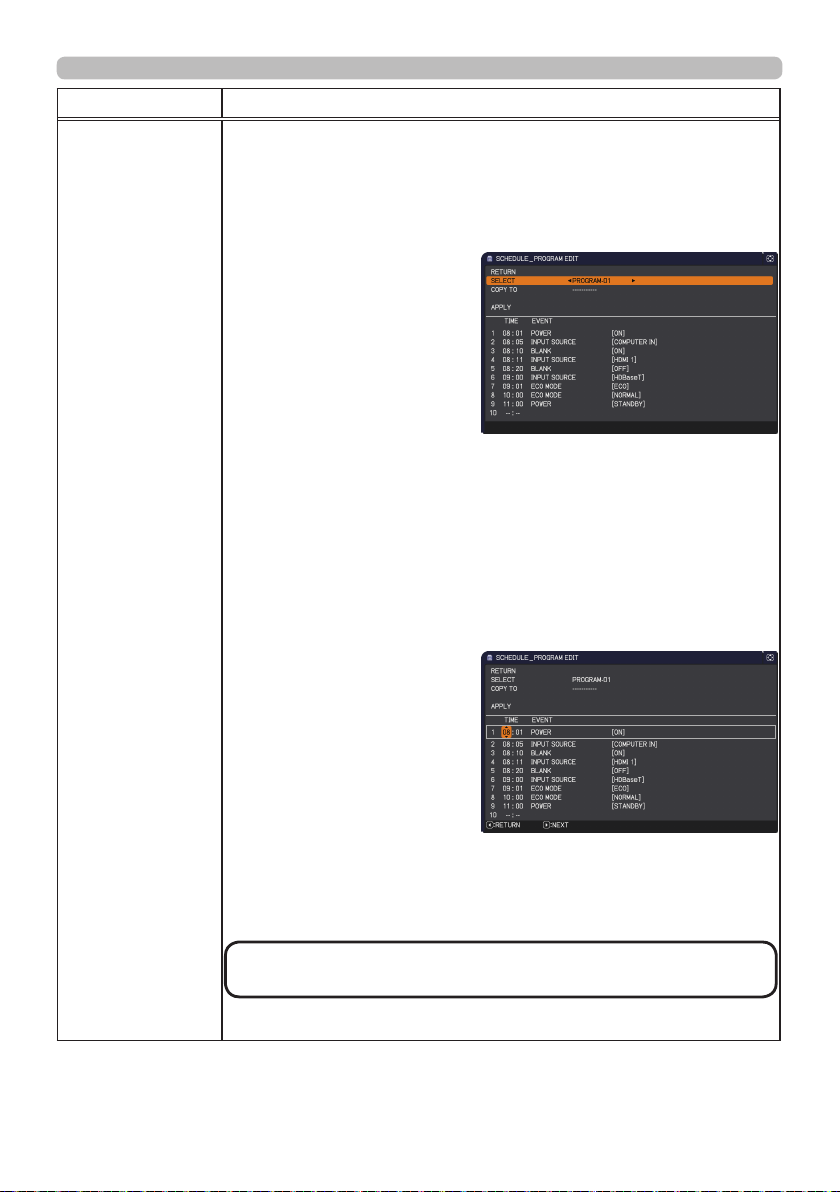
87
OPTION menu
Item Description
SCHEDULE
(continued)
■ How to edit the selected PROGRAM
1. Select from 1 to 20 events.
Use the ▲/▼ cursor buttons to select.
Press ► cursor button to set the TIME and EVENT.
2. Use the ◄/► cursor
buttons to select.
3. Use the ▲/▼ cursor
buttons to adjust.
EVENT can be selected as listed below.
◦ POWER − ON, STANDBY
◦ INPUT SOURCE − "input source" channel
◦ MY IMAGE − IMAGE-1 to 4, IMAGE OFF
◦ MESSENGER − TEXT-1 to 12, TEXT OFF
◦ ECO MODE − NORMAL, ECO
◦ BLANK − ON, OFF
4. Press ► cursor button to finish the settings.
5. Select APPLY to save the settings.
NOTE
・
Refer to the on-screen display(OSD) for the
appropriate operation.
(continued on next page)
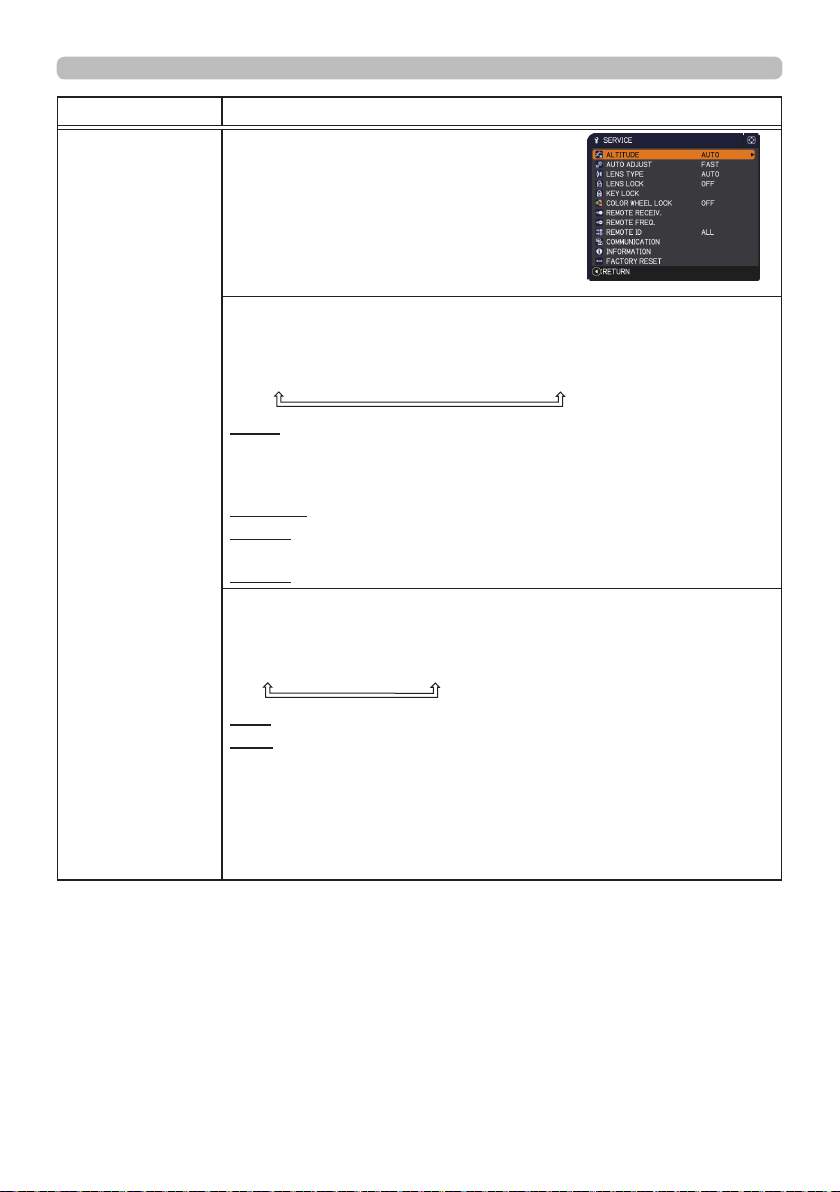
88
OPTION menu
Item Description
SERVICE
Selecting this item displays the SERVICE
menu.
Select an item using the ▲/▼ buttons,
and press the ► button or the
ENTER
button on the remote control to execute
the item.
ALTITUDE
Using the ▲/▼ buttons switches the rotation speed of the cooling
fans. It is recommended to leave it at AUTO.
HIGH-2
HIGH-1
NORMAL
AUTO
AUTO: The projector changes the rotation speed automatically to
suit the altitude and other environmental factors.
Choose an option below when there is a trouble with the
AUTO mode.
NORMAL: This mode can be used below 1600m (5250ft.).
HIGH-1: This mode can be used between 1600 to 2300m (5250 to
7550ft.).
HIGH-2: This mode can be used above 2300m (7550ft.).
AUTO ADJUST
Using the ▲/▼ buttons to select one of the mode. When the
DISABLE is selected, the automatic adjustment feature is disabled.
FINE
FAST
DISABLE
FINE: Finer tuning including H.SIZE adjustment.
FAST: Faster tuning, setting H.SIZE to prearranged data for the
input signal.
• Depending on conditions, such as input image, signal cable to
the projector, environment around the projector, and so on, the
automatic adjustment may not work correctly. If this occurs, choose
DISABLE to disable the automatic adjustment, and make the
adjustment manually.
(continued on next page)
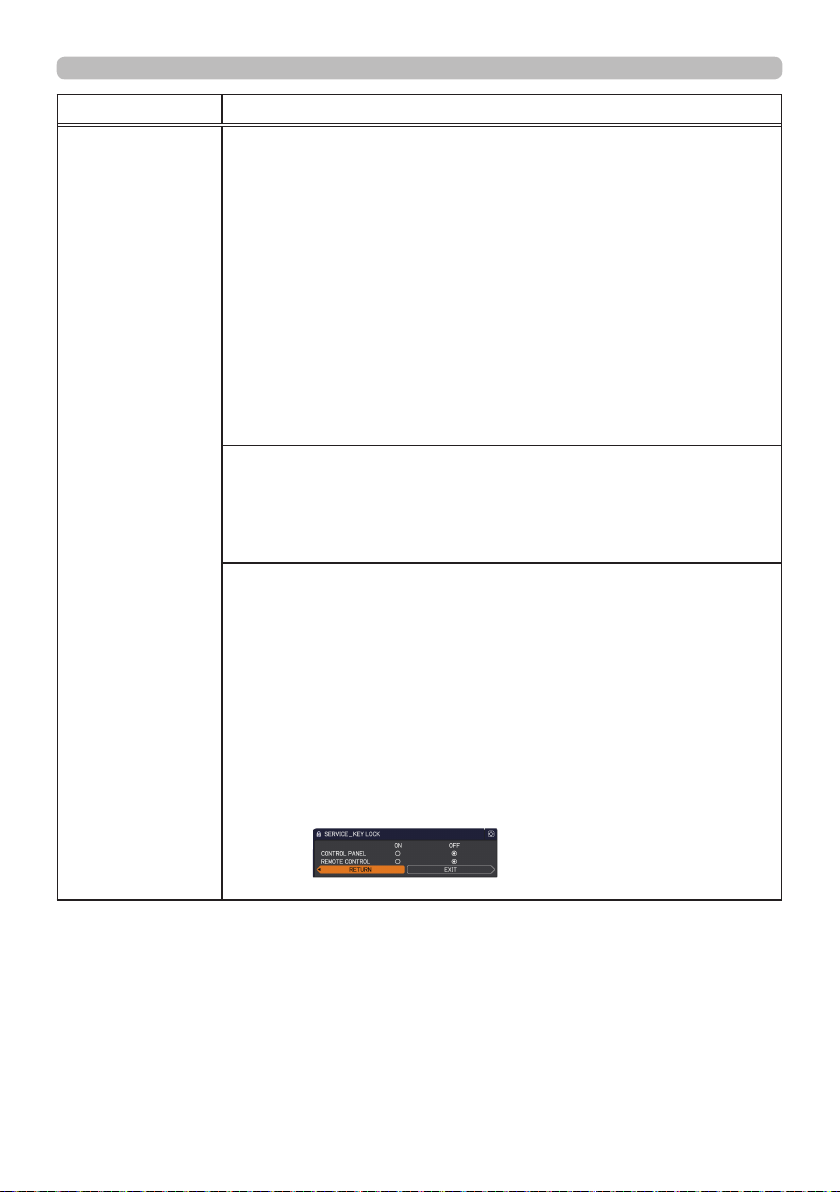
89
OPTION menu
Item Description
SERVICE
(continued)
LENS TYPE
(1) Select the lens type currently used using the ▲/▼ buttons and
press the ► or
ENTER
button. If AUTO is selected, the projector
determines the lens type automatically.
(2) A message dialog is displayed for conrmation. Press the ► or
ENTER
button to save the lens type.
• This setting has an inuence on the keystone distortion and so on.
• The lens type determined by the projector will be displayed on the
right of "AUTO".
• If the projector cannot determine the lens type automatically when
this item is set to AUTO, "UNKNOWN LENS" is displayed on the
right of "AUTO".
• For information about the optional lens, contact your dealer.
USL-901CH, SL-902CH, SD-903CH, ML-904CH,
LL-905CH, UL-906CH, FL-900CH
LENS LOCK
Using the ▲/▼ buttons turns on/off the lens lock feature. When ON
is selected, the buttons (
ZOOM
,
ZOOM +
/
-
,
FOCUS +
/
-
,
LENS
SHIFT
,
LENS MEMORY
) are locked.
ON
OFF
KEY LOCK
(1) Use the ▲/▼ buttons to choose the operations control.
CONTROL PANEL
REMOTE CONTROL
(2) Use the ◄/► buttons to select ON or OFF.
ON
OFF
Selecting ON in Step 2 locks the buttons except
STANDBY
,
ON
and
STANDBY/ON
on the operations control selected in Step 1.
Selecting OFF releases the locked buttons on the operations control
selected in Step 1.
• Use this function to prevent tampering or accidental operation.
• You cannot disable both options at the same time.
(continued on next page)
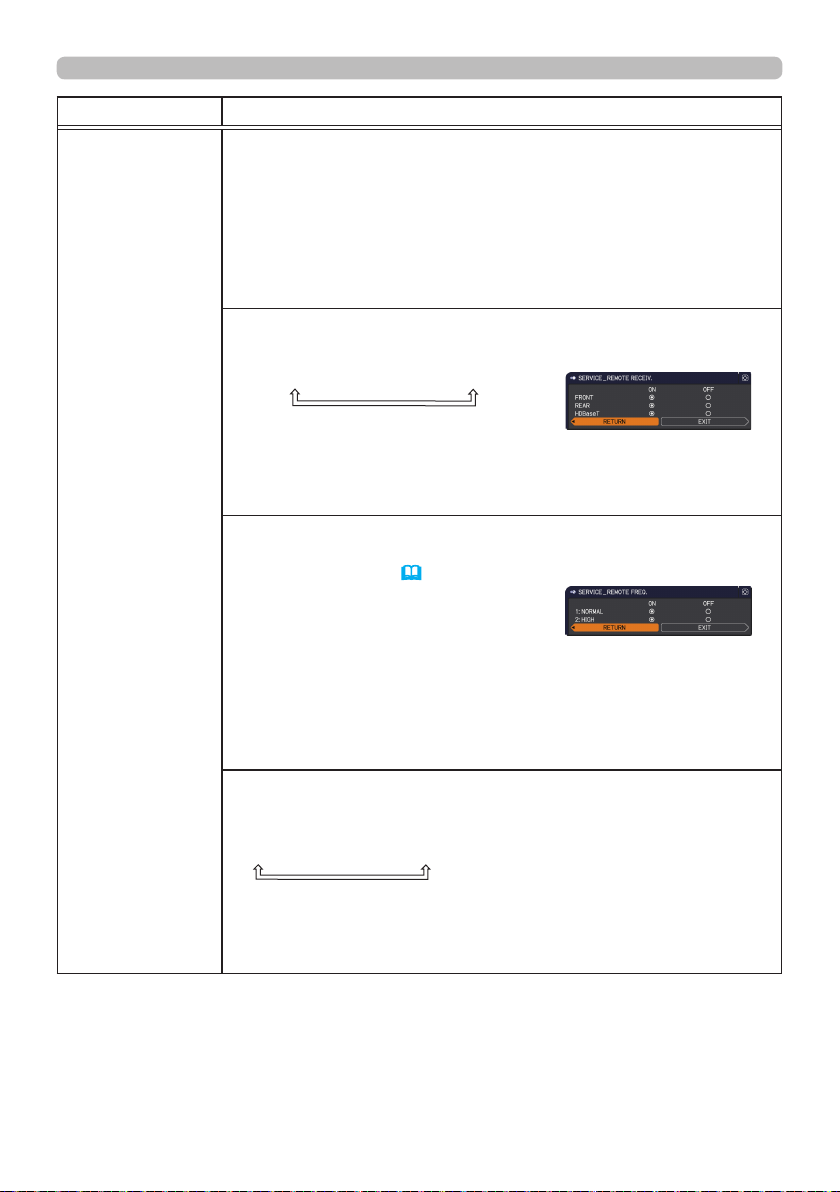
90
OPTION menu
Item Description
SERVICE
(continued)
COLOR WHEEL LOCK
Using the ▲/▼ buttons turns off/on the COLOR WHEEL LOCK.
ON
OFF
ON : COLOR WHEEL is locked and the settings cannot be changed
from PICTURE MENU.
OFF : COLOR WHEEL settings can be change from PICTURE
MENU.
REMOTE RECEIV.
(1) Select a remote sensor using the ▲/▼ button.
FRONT
REAR
HDBaseT
(2) Switch it using the ◄/► button.
ON
OFF
•Both FRONT and REAR sensor cannot be turned OFF at the same
time.
REMOTE FREQ.
(1) Use the ▲/▼ button to change the projector's remote sensor
frequency setting (
23
).
1:NORMAL
2:HIGH
(2) Use the ◄/► button to change the
projector's remote sensor on or off.
ON
OFF
The factory default setting is for both 1:NORMAL and 2:HIGH to be
on. If the remote control does not function correctly, disable either of
them.
• You cannot disable both options at the same time.
REMOTE ID
Use the ▲/▼ buttons on the REMOTE ID menu to select ID and
press the ► button.
ALL
1
2
3
4
The projector is controlled by the remote control whose
ID
button
is set the same number as this number. When the ALL is selected,
the projector is controlled by a remote control irrespective of the ID
setting.
(continued on next page)

91
OPTION menu
Item Description
SERVICE
(continued)
COMMUNICATION
Selecting this item displays COMMUNICATION
menu.
In this menu, you can congure the serial
communication settings of the projector using the
CONTROL
port.
• Select an item using the cursor buttons ▲/▼.
Then pressing the ► button opens the submenu
for the setting item you selected. Or, pressing
the ◄ button instead of the ► button makes the
menu back to the previous one without changing
the setup. Each submenu can be operated as
described above.
• When COMMUNICATION TYPE (
below
) is
set to OFF, the other items except STACK in
COMMUNICATION menu are invalid.
• For the function of serial communication, refer to
the Network Guide.
COMMUNICATION TYPE
Select the communication type for transmission
using the
CONTROL
port.
NETWORK BRIDGE (WIRELESS)
NETWORK BRIDGE (WIRED)
OFF
NETWORK BRIDGE: Select this type, if it is
required to control an external device as a
network terminal, using this projector from the
computer. Select WIRELESS or WIRED as your
network connection mode.
The
CONTROL
port doesn't accept RS-232C
commands (
Network Bridge Function
in the
Network Guide
)
OFF: Select this mode to receive RS-232C
commands using the
CONTROL
port.
• OFF is the default setting.
• When you select the NETWORK BRIDGE, check
the item, TRANSMISSION METHOD (
92
).
(continued on next page)
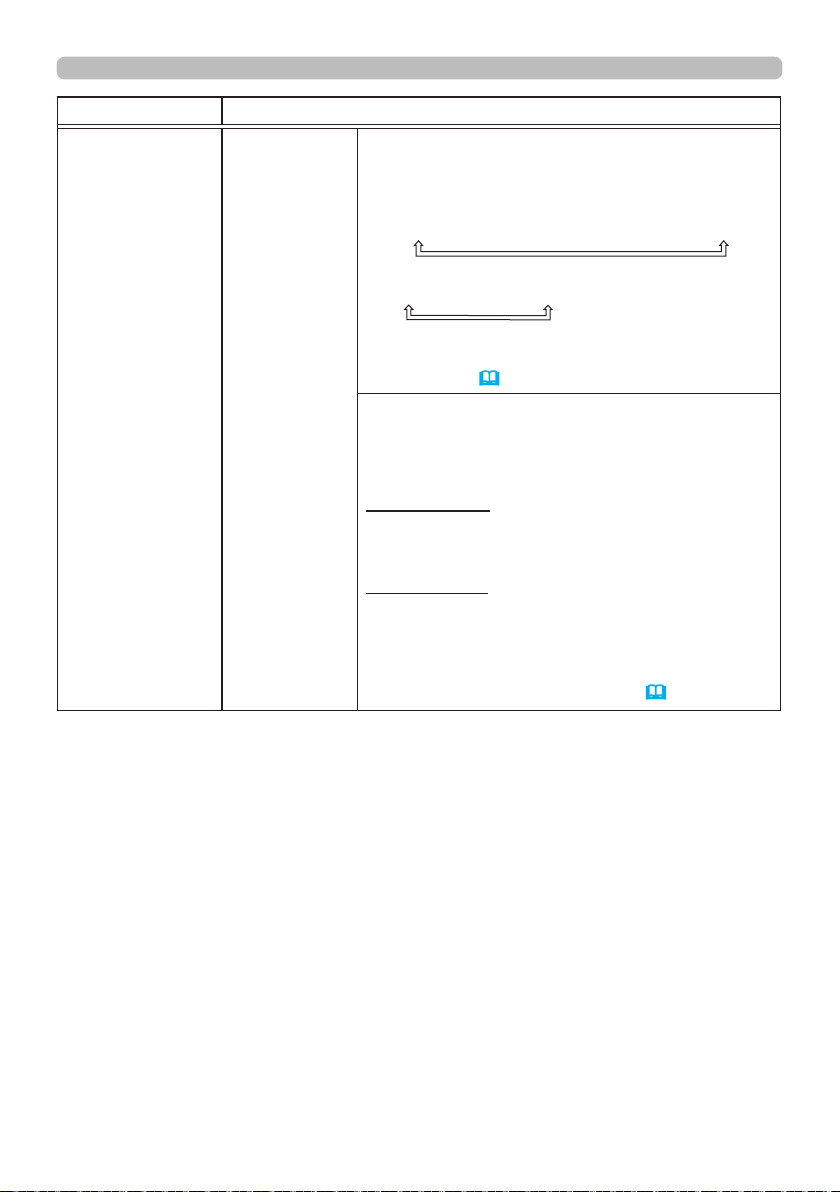
92
OPTION menu
Item Description
SERVICE
(continued)
COMMUNICATION
(continued)
SERIAL SETTINGS
Select the serial communication condition for the
CONTROL
port.
BAUD RATE
4800bps
9600bps
19200bps
38400bps
PARITY
NONE
ODD
EVEN
•
The BAUD RATE is xed to 19200bps and PARITY
is xed NONE when the COMMUNICATION TYPE
is set to OFF
(
91
)
.
TRANSMISSION METHOD
Select the transmission method for communication by
the NETWORK BRIDGE from the
CONTROL
port.
HALF-DUPLEX
FULL-DUPLEX
HALF-DUPLEX: This method lets the projector
make two way communication, but only one
direction, either transmitting or receiving data, is
allowed at a time.
FULL-DUPLEX: This method lets the projector
make two way communication, transmitting and
receiving data at the same time.
• HALF-DUPLEX is selected as the default setting.
• If you select HALF-DUPLEX, check the setting of
the item RESPONSE LIMIT TIME
(
93
)
.
(continued on next page)
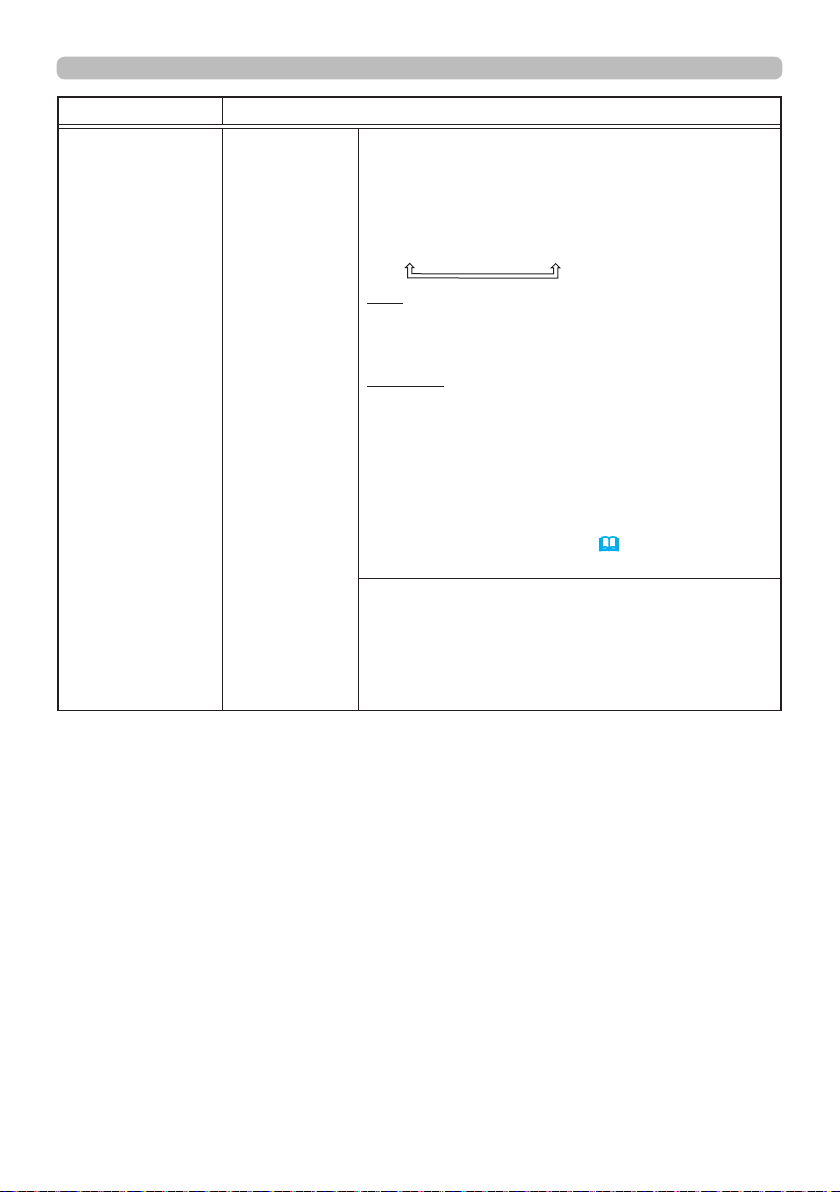
93
OPTION menu
Item Description
SERVICE
(continued)
COMMUNICATION
(continued)
RESPONSE LIMIT TIME
Select the time period to wait for receiving
response data from other device communicating by
the NETWORK BRIDGE and the HALF-DUPLEX
through the
CONTROL
port.
OFF
1s
2s
3s
OFF: Select this mode if it is not required to check
the responses from the device that the projector
sends data to. In this mode, the projector can
send out data from the computer continuously.
1s /2s /3s: Select the time period to keep the
projector waiting for response from the device
that the projector sends data to. While waiting a
response, the projector does not send out any
data from the
CONTROL
port.
• This menu is available only when the NETWORK
BRIDGE is selected for the COMMUNICATION
TYPE and the HALF-DUPLEX is selected for the
TRANSMISSION METHOD (
92
).
• OFF is selected as the default setting.
STACK
Selecting this item displays the STACK menu. For
more information, see the
Instant Stack Guide
.
• When STACK MODE is set to MAIN or SUB,
the other items in COMMUNICATION menu are
invalid.
(continued on next page)
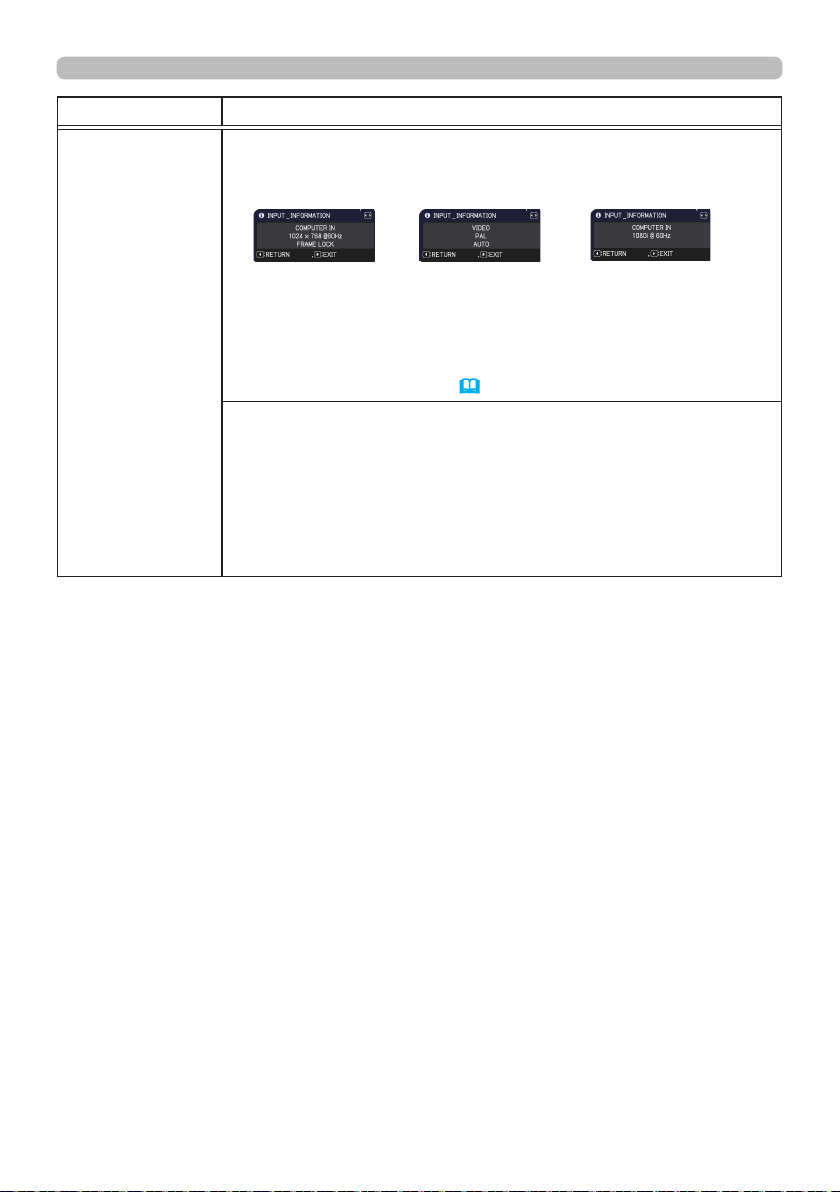
94
OPTION menu
Item Description
SERVICE
(continued)
INFORMATION
Selecting this item displays a dialog titled “INPUT INFORMATION”.
It shows the information about the current input.
• The “FRAME LOCK” message on the dialog means the frame lock
function is working.
• This item cannot be selected for no signal and sync out.
• When the MY TEXT DISPLAY is set to ON, the MY TEXT is
displayed together with the input information in the
INPUT INFORMATION box (
100
).
FACTORY RESET
Selecting OK using the ► button performs this function. By this
function, all menu items are collectively returned to the initial setting.
Note that the settings of the following items cannot be reset:
LAMP-1 TIME, LAMP-2 TIME, FILTER TIME, LANGUAGE, AUTO
BLANK, FILTER MESSAGE, STANDBY MODE, COMMUNICATION,
NETWORK, SECURITY
CANCEL
OK

95
NETWORK menu
See the Network Guide for details of NETWORK operation.
Remember that incorrect network settings on this projector may cause trouble
on the network. Consult with your network administrator before connecting to an
existing access point on your network.
NETWORK menu
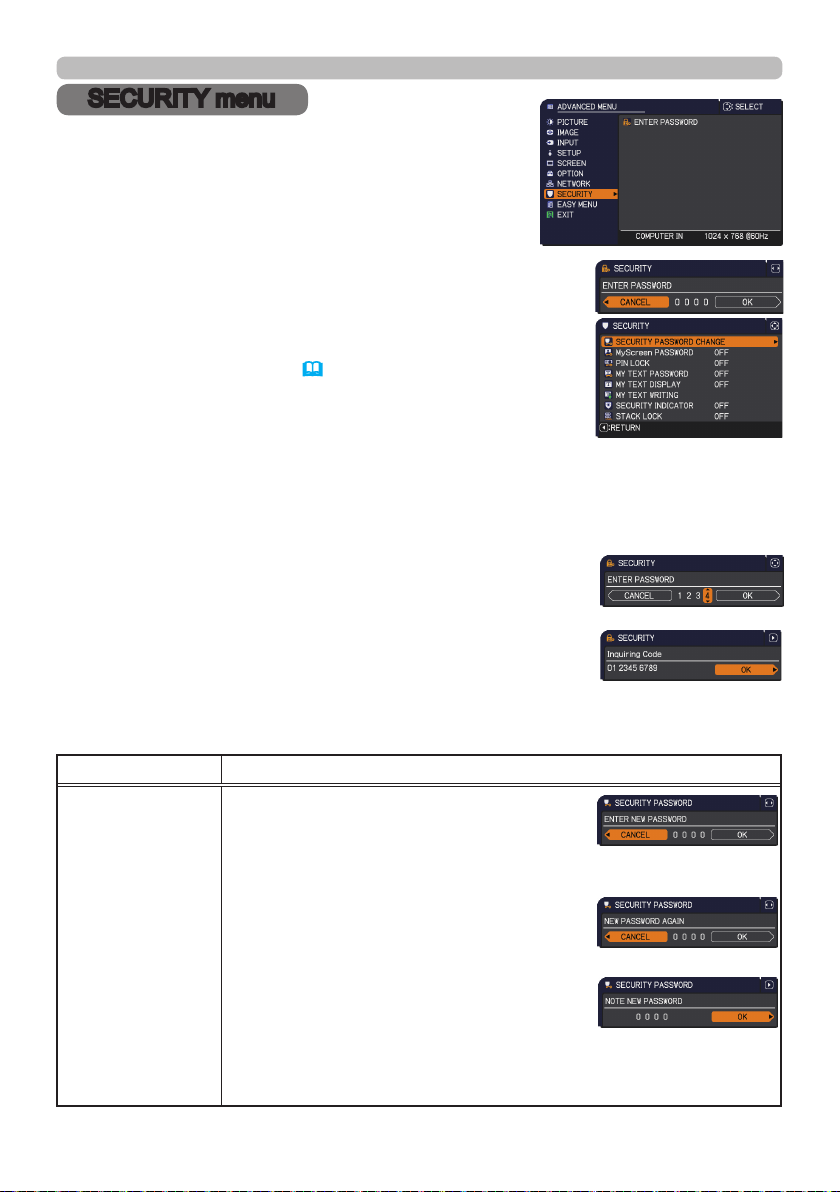
96
Security
Item Description
SECURITY
PASSWORD
CHANGE
(1) Use the ▲/▼ buttons on the SECURITY menu
to select SECURITY PASSWORD CHANGE
and press the ► button to display the ENTER
NEW PASSWORD box.
(2) Use the ▲/▼/◄/► buttons to enter the new password.
(3) Move the cursor to the right side of the ENTER
NEW PASSWORD box and press the ► button
to display the NEW PASSWORD AGAIN box,
enter the same password again.
(4)
Move the cursor to the right side of the NEW
PASSWORD AGAIN box and press the ►
button and the NOTE NEW PASSWORD box
will be displayed for about 30 seconds. Make
note of the password during this time.
Pressing the
ENTER
button on the remote control or
►
button on the
projector will close the NOTE NEW PASSWORD box.
• Do not forget your password.
SECURITY menu
This projector is equipped with security functions.
From the SECURITY menu, items shown in the table
below can be performed.
To use SECURITY menu: User registration is required
before using the security functions.
Enter to the SECURITY menu
1. Press the ► button. The ENTER PASSWORD box will be displayed.
2. Use the ▲/▼/◄/► buttons to enter the registered password. The
factory default password is as follows.
CP-WU9100
:1728
CP-HD9950
: 6125
This password can be changed
(
below
)
. Move the cursor to the
right side of the ENTER PASSWORD box and press the ► button to
display the SECURITY menu.
• It is strongly recommended the factory default password to be
changed as soon as possible.
• If an incorrect password is input, the ENTER PASSWORD box will be
displayed again. If incorrect password is input three times, the projector will turn
off. Afterwards the projector then will turn off every time an incorrect password is
input.
3. Items shown in the table below can be performed.
If you have forgotten your password
(1) While the ENTER PASSWORD box is displayed, press and hold
the
RESET
button on the remote control for approximately three
seconds or press and hold the
INPUT
button for three seconds while
pressing the ► button on the projector.
(2) The 10 digit Inquiring Code will be displayed. Contact your dealer
with the 10 digit Inquiring Code. Your password will be sent after
your user registration information is conrmed.
• If there is no key input for approximately 55 seconds while the Inquiring Code is displayed, the menu
will close. If necessary, repeat the process from (1).
(continued on next page)
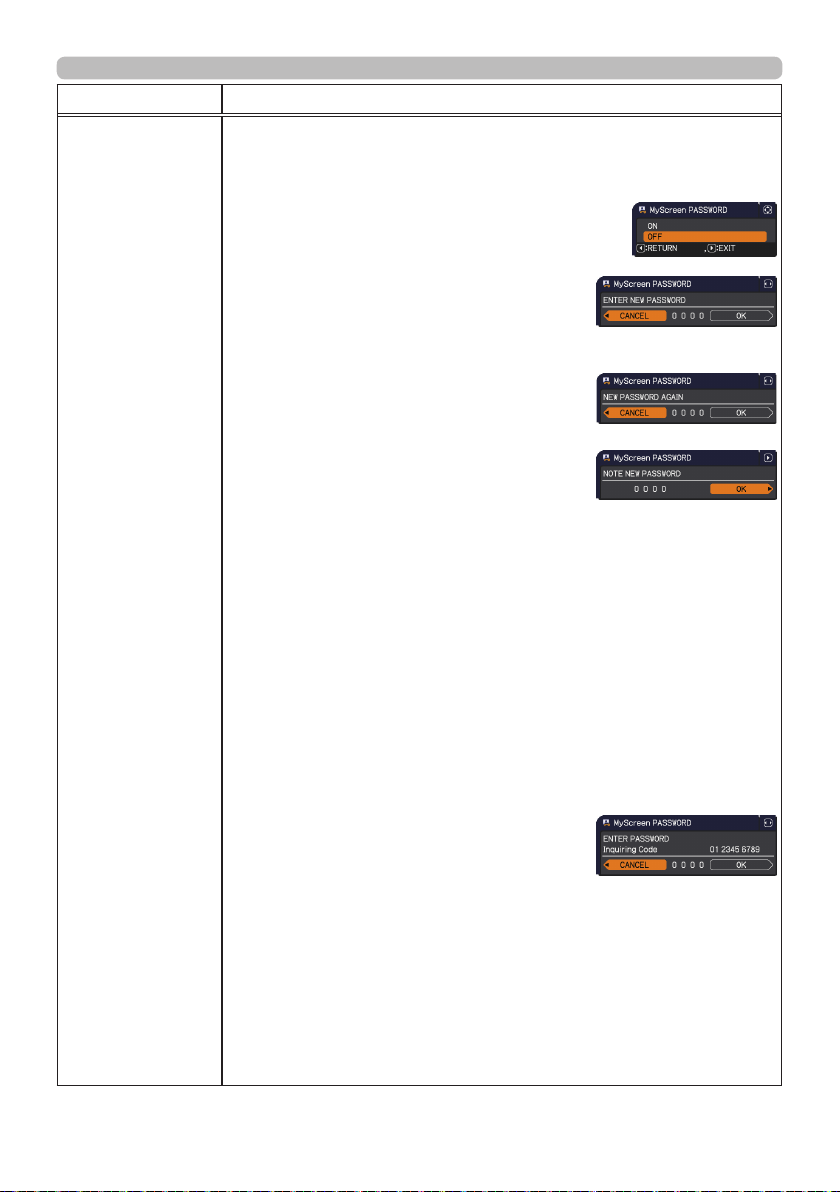
97
Security
Item Description
MyScreen
PASSWORD
The MyScreen PASSWORD function can be used to prohibit access to the
MyScreen function and prevent the currently registered MyScreen image
from being overwritten.
1 Turning on the MyScreen PASSWORD
1-1 Use the ▲/▼ buttons on the SECURITY menu to
select MyScreen PASSWORD and press the ►
button to display the MyScreen PASSWORD on/
off menu.
1-2 Use the ▲/▼ buttons on the MyScreen
PASSWORD on/off menu to select ON.
The ENTER NEW PASSWORD box (small)
will be displayed.
1-3 Use the ▲/▼/◄/► buttons to enter the
password. Move the cursor to the right side
of the ENTER NEW PASSWORD box (small)
and press the ► button to display the NEW
PASSWORD AGAIN box, enter the same
PASSWORD again.
1-4 Move the cursor to the right side of the
NEW PASSWORD AGAIN box and press
the ► button to display the NOTE NEW
PASSWORD box for about 30 seconds.
Make note of the password during this time.
Pressing the
ENTER
button on the remote control or ► button on the
projector will return to MyScreen PASSWORD on/off menu.
When a password is set for MyScreen:
•
The MyScreen registration function (and menu) will be unavailable.
•
The MyScreen Lock menu will be unavailable.
•
The START UP setting will be locked on MyScreen (and the menu will be
unavailable).
Turning the MyScreen PASSWORD off will allow normal operation of these
functions.
•
Do not forget your MyScreen PASSWORD.
2 Turning off the MyScreen PASSWORD
2-1 Follow the procedure in 1-1 to display the MyScreen PASSWORD on/off
menu.
2-2
Select OFF to display the ENTER
PASSWORD box (large). Enter the registered
password and the screen will return to the
MyScreen PASSWORD on/off menu.
If an incorrect PASSWORD is entered, the menu
will close. If necessary, repeat the process from
2-1.
3 If you have forgotten your password
3-1 Follow the procedure in 1-1 to display the MyScreen PASSWORD on/off
menu.
3-2 Select OFF to display the ENTER PASSWORD box (large). The 10 digit
Inquiring Code will be displayed inside the box.
3-3 Contact your dealer with the 10 digit Inquiring Code. Your password will
be sent after your user registration information is conrmed.
ENTER NEW PASSWORD
box (small)
ENTER PASSWORD box
(large)
(continued on next page)

98
Security
Item Description
PIN LOCK
PIN LOCK is a function which prevents the projector from being used unless
a registered Code is input.
1 Turning on the PIN LOCK
1-1 Use the ▲/▼ buttons on the SECURITY menu
to select PIN LOCK and press the ► button or
the
ENTER
button to display the PIN LOCK on/off
menu.
1-2 Use the ▲/▼ buttons on the PIN LOCK on/
off menu to select ON and the Enter PIN
Code box will be displayed.
1-3 Input a 4 part PIN code using the ▲/▼/◄/►,
COMPUTER 1
or
INPUT
button.
The PIN Code again box will appear. Reenter
the same PIN code. This will complete the PIN
code registration.
•
If there is no key input for about 55 seconds
while the Enter PIN Code box or the PIN Code again box is displayed,
the menu will close. If necessary, repeat the process from 1-1.
Anytime the projector is restarted after AC power is turned off the Enter PIN
Code box will be displayed. Enter the registered PIN code.
The projector can be used after entering the registered PIN code. If an
incorrect PIN code is input, the Enter PIN code box will be displayed again.
If an incorrect PIN code is input three times, the projector will turn off.
Afterwards the projector will turn off every time an incorrect PIN code is
input. The projector will also turn off if there is no key input for approximately
ve minutes while the Enter PIN code box is displayed.
This function will activate only when the projector is started after AC power is
turned off.
•
Do not forget your PIN code.
2 Turning off the PIN LOCK
2-1 Follow the procedure in 1-1 to display the PIN LOCK on/off menu.
2-2 Use the ▲/▼ buttons to select OFF and the Enter PIN Code box will be
displayed.
Enter the registered PIN code to turn the PIN LOCK function off.
If an incorrect PIN code is input three times, the projector will turn off.
3 If you have forgotten your PIN code
3-1 While the Enter PIN code box is displayed, press and hold the
RESET
button for three seconds or press and hold the
INPUT
button for three
seconds while pressing the ► button on the projector.
The 10 digit Inquiring Code will be displayed.
•
If there is no key input for approximately
ve minutes while the Inquiring Code is
displayed, the projector will turn off.
3-2 Contact your dealer with the 10 digit Inquiring Code. Your PIN code will
be sent after your user registration information is conrmed.
(continued on next page)
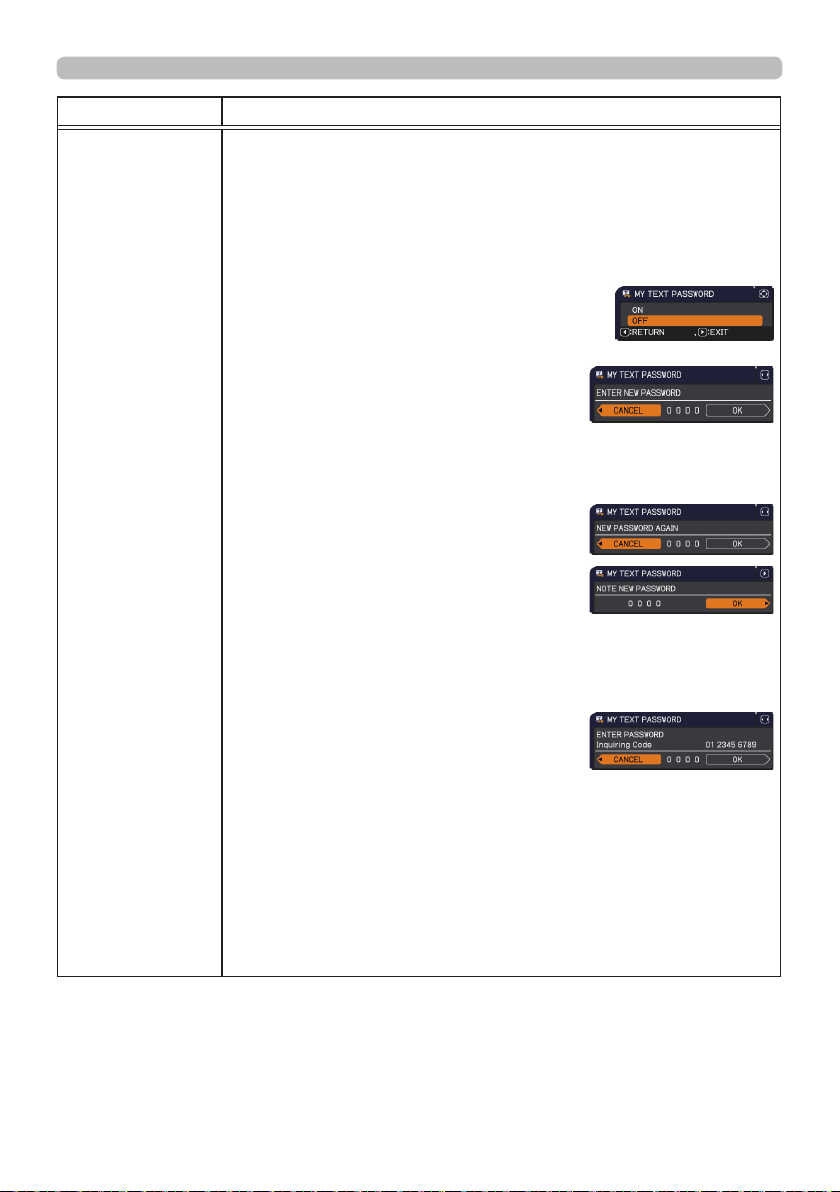
99
Security
Item Description
MY TEXT
PASSWORD
The MY TEXT PASSWORD function can prevent the MY TEXT from being
overwritten. When the password is set for the MY TEXT;
• The MY TEXT DISPLAY menu will be unavailable, which can prohibit
changing the DISPLAY setting.
• The MY TEXT WRITING menu will be unavailable, which can prevent the
MY TEXT from being overwritten.
1 Turning on the MY TEXT PASSWORD
1-1 Use the ▲/▼ buttons on the SECURITY menu to
select the MY TEXT PASSWORD and press the
► button to display the MY TEXT PASSWORD
on/off menu.
1-2 Use the ▲/▼ buttons on the MY TEXT
PASSWORD on/off menu to select ON. The
ENTER NEW PASSWORD box (small) will
be displayed.
1-3 Use the ▲/▼/◄/► buttons to enter the
password. Move the cursor to the right side
of the ENTER NEW PASSWORD box (small)
and press the ► button to display the NEW
PASSWORD AGAIN box, and then enter the
same password again.
1-4 Move the cursor to the right side of the NEW
PASSWORD AGAIN box and press ► button
to display the NOTE NEW PASSWORD
box for about 30 seconds. Make note of the
password.
Pressing the
ENTER
button on the remote control or ► button on the
projector will return to the MY TEXT PASSWORD on/off menu.
2 Turning off the MY TEXT PASSWORD
2-1 Follow the procedure in 1-1 to display the MY TEXT PASSWORD on/off
menu.
2-2 Select OFF to display the ENTER
PASSWORD box (large). Enter the registered
password and the screen will return to the
MY TEXT PASSWORD on/off menu.
If an incorrect password is input, the menu will close.
If necessary, repeat the process from 2-1
3 If you have forgotten your password
3-1 Follow the procedure in 1-1 to display the MY TEXT PASSWORD on/off
menu.
3-2 Select OFF to display the ENTER PASSWORD box (large). The 10 digit
inquiring code will be displayed inside the box.
3-3 Contact your dealer with the 10 digit inquiring code. Your password will
be sent after your user registration information is conrmed.
ENTER NEW PASSWORD
box (small)
ENTER PASSWORD box
(large)
(continued on next page)
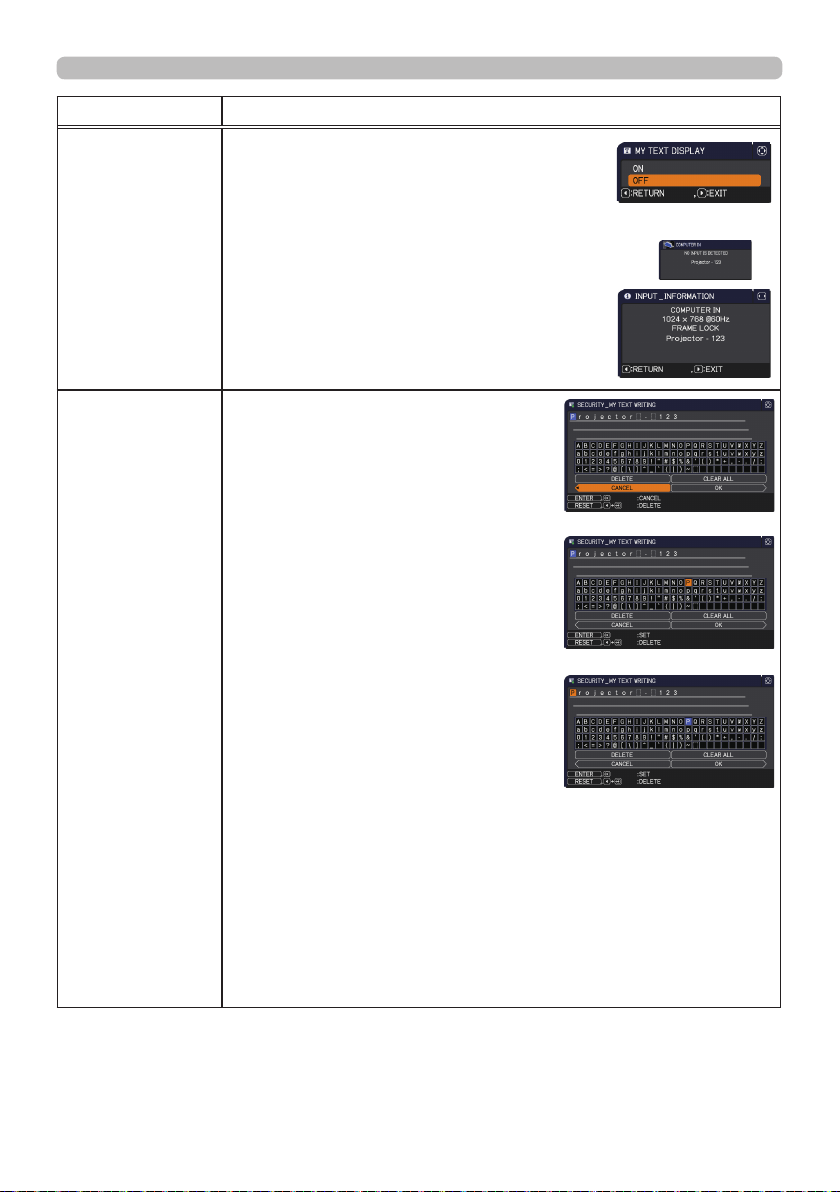
100
Security
Item Description
MY TEXT
DISPLAY
(1) Use the ▲/▼ buttons on the SECURITY menu to
select the MY TEXT DISPLAY and press the ► or
ENTER
button to display the MY TEXT DISPLAY
on/off menu.
(2) Use the ▲/▼ buttons on the MY TEXT DISPLAY on/off menu to select
on or off.
ON
OFF
When it is set ON, the MY TEXT will be displayed
on the START UP screen and the INPUT
INFORMATION when the INFORMATION on the
SERVICE menu is chosen.
• This function is available only when the MY TEXT
PASSWORD function is set to the OFF.
MY TEXT
WRITING
(1) Use the ▲/▼ buttons on the
SECURITY menu to select the MY
TEXT WRITING and press the ►
button. The MY TEXT WRITING dialog
will be displayed.
(2) The current MY TEXT will be displayed
on the rst three lines. If not yet written,
the lines will be blank.
Use the ▲/▼/◄/► buttons and the
ENTER
or
INPUT
button to select
and enter characters. To erase one
character at one time, press the
RESET
button or press the ◄ and
INPUT
button at the same time. If you move
the cursor to DELETE or CLEAR ALL
on screen and press the
ENTER
or
INPUT
button, one or all characters will
be erased. The MY TEXT can be input
up to 24 characters on each line.
(3) To change an already inserted
character, press the ▲/▼ button to
move the cursor to one of the rst three
lines, and use the ◄/► buttons to
move the cursor on the character to be
changed.
After pressing the
ENTER
or
INPUT
button, the character is selected.
Then, follow the same procedure as described at the item (2) above.
(4) To nish entering text, move the cursor to the OK on screen and press
the ►,
ENTER
or
INPUT
button. To revert to the previous MY TEXT
without saving changes, move the cursor to the CANCEL on screen and
press the ◄,
ENTER
or
INPUT
button.
•
The MY TEXT WRITING function is available only when the MY TEXT
PASSWORD function is set to OFF.
(continued on next page)

101
Security
Item Description
SECURITY
INDICATOR
Selecting this item displays the SECURITY INDICATOR dialog. Use
the ▲/▼ buttons to select ON or OFF.
ON
OFF
When ON is selected while PIN LOCK is ON, the
SECURITY
indicator blinks in yellow in the standby mode (
98,114
).
STACK LOCK
Selecting this item displays the STACK LOCK dialog. For more
information, see the
Instant Stack Guide
.
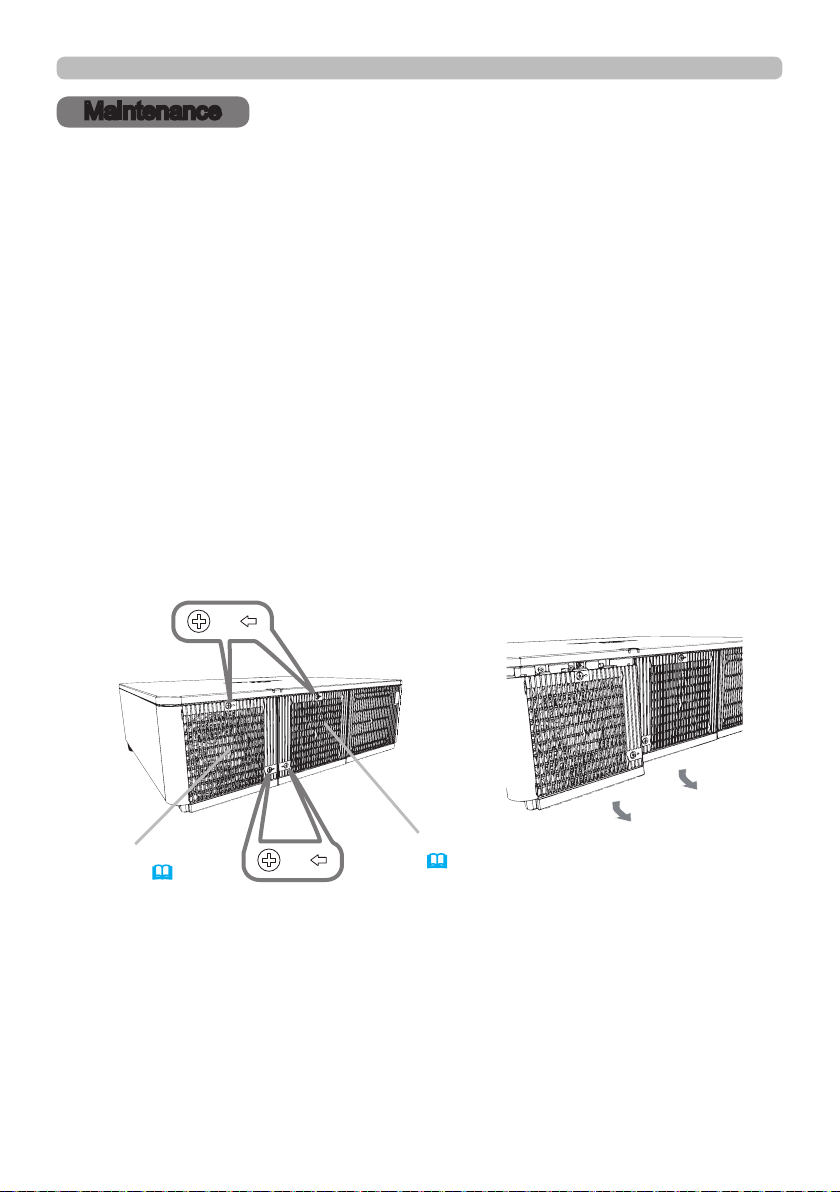
102
Maintenance
Maintenance
Replacing the lamp
A lamp has nite product life. Using the lamp for long periods of time could cause
the pictures darker or the color tone poor. Each lamp has a different lifetime, and
some may burst or burn out soon after you start using them.
New lamp preparation and early replacement are recommended. To prepare a
new lamp, contact your dealer and indicate the lamp type number.
Type number : DT01911
1.
Turn the projector off, and unplug the power cord. Allow the projector to cool
for at least 20 minutes.
2.
Prepare a new lamp. If the projector is mounted with specied mounting
accessories, or if the lamp has broken, also ask the dealer to replace the lamp.
In case of replacement by yourself, follow the following procedure.
3.
Loosen the screw (marked by arrow) of the lamp cover and then slide down
and lift the lamp cover to remove it. The lamp cover is tied to a short wire to
prevent from falling.
3
Lamp cover
(LAMP1)
(
4
)
Lamp cover
(LAMP2)
(
4
)
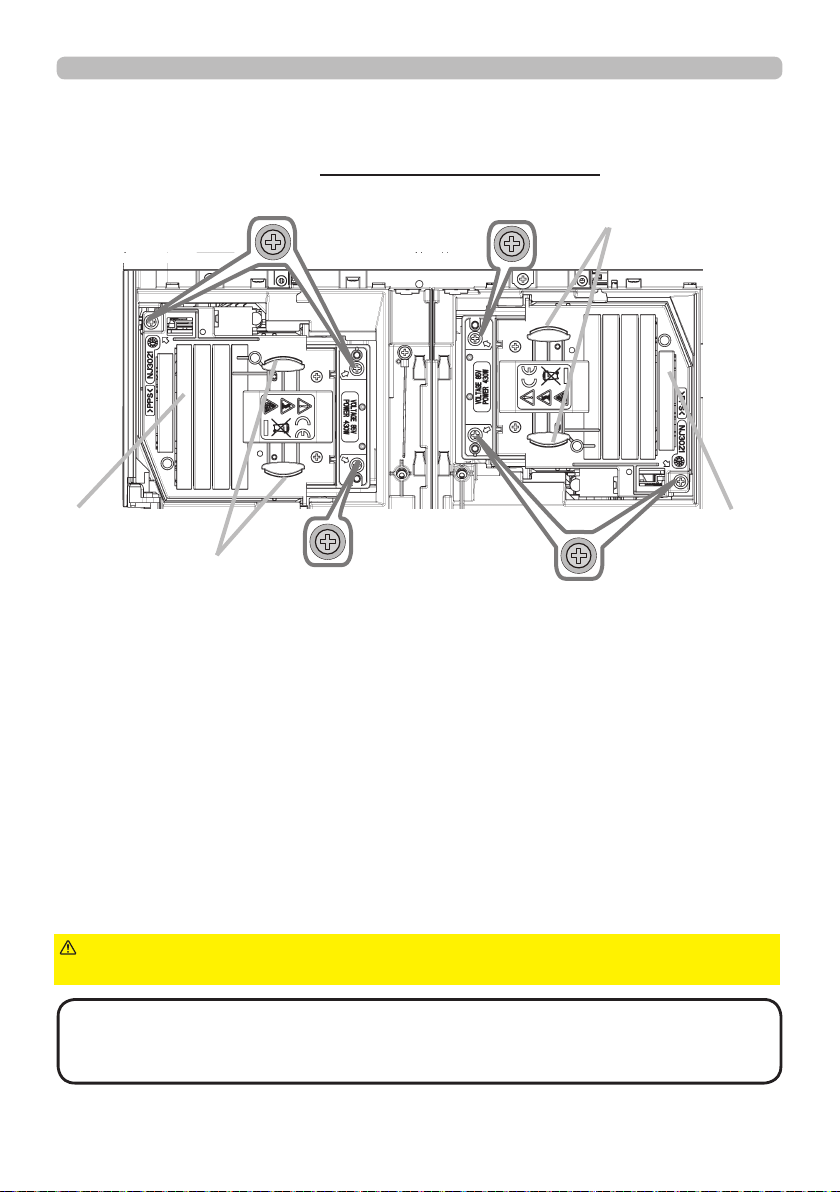
103
►Do not touch the interior of the projector, while the lamp is
removed.
CAUTION
5.
Insert the new lamp, and retighten the three screws of the lamp loosened in
the previous step to lock it in place.
6.
While putting the interlocking parts of the lamp cover and the projector
together, slide the lamp cover back in place. Then rmly fasten the screw of
the lamp cover.
7.
Turn the projector on and reset the lamp time using the LAMP TIME item in
the OPTION menu.
(1) Press the
MENU
button to display a menu.
(2) Select as the following using the cursor button.
EASY MENU > ADVANCED MENU > SETUP > LAMP & FILTER
(3) Select LAMP-1 TIME or LAMP-2 TIME.
(4)
Press the
►
button to select “OK” on the dialog. It performs resetting the lamp time
.
4.
Loosen the three screws (marked by arrow) of the lamp, and slowly pull the
lamp out by the handles. Never loosen any other screws.
NOTE • Reset the lamp time only when you have replaced the lamp, for a
suitable indication about the lamp.
Lamp cover is assembled with cooling fan, handle with care.
Maintenance
4, 5
Handles
Handles
LAMP1 UNIT
(in the middle)
LAMP2 UNIT
(on the left side)
(continued on next page)
104
Maintenance
Lamp warning
HIGH VOLTAGE
HIGH TEMPERATURE
HIGH PRESSURE
►
The projector uses a high-pressure mercury glass lamp. The lamp
can break with a loud bang, or burn out, if jolted or scratched, handled while hot, or
worn over time. Note that each lamp has a different lifetime, and some may burst or
burn out soon after you start using them. In addition, if the bulb bursts, shards of glass
can y into the lamp housing, and gas containing mercury and dust containing ne
particles of glass can escape from the projector’s vent holes.
►About disposal of a lamp: This product contains a mercury lamp; do not put
it in a trash. Dispose of it in accordance with environmental laws.
• For lamp recycling, go to www.lamprecycle.org (in the US).
• For product disposal, consult your local government agency
or www.eiae.org (in the US) or www.epsc.ca (in Canada).
For more information, call your dealer.
WARNING
• If the lamp breaks (it will make a loud bang), unplug the power cord
from the outlet, and make sure to request a replacement lamp from your
local dealer. Note that shards of glass could damage the projector’s
internals, or cause injury during handling, so do not try to clean the
projector or replace the lamp yourself.
•
If the lamp should break (it will make a loud bang), ventilate the room well,
and make sure not to inhale the gas or ne particles that come out from the
projector's vent holes, and not to get them into your eyes or mouth.
• Before replacing the lamp, turn the projector off and unplug the power
cord, then wait at least 20 minutes for the lamp to cool sufficiently.
Handling the lamp while hot can cause burns, as well as damaging the lamp.
• Never unscrew except the appointed (marked by an arrow) screws.
• Do not open the lamp cover while the projector is suspended from a
ceiling. This is dangerous, because if the lamp’s bulb has broken, the
shards will fall out when the cover is opened. Working in high places is
dangerous, so ask your local dealer to have the lamp replaced even if
the bulb is not broken.
• Do not use the projector with the lamp cover removed. At the lamp
replacing, make sure that the screws are screwed in firmly. Loose
screws could result in damage or injury.
• Use only the lamp of the specified type. Use of a lamp that does not
meet the lamp specications for this model could cause a re, damage or
shorten the life of this product.
• If the lamp breaks soon after the first time it is used, there may be
electrical problems elsewhere besides the lamp. If this happens, consult
your local dealer or a service representative.
•
Handle with care: jolting or scratching could cause the lamp bulb to burst during use.
•
Using the lamp for long periods of time, could cause it to darken, not to light up or to
burst. When the pictures appear dark, or when the color tone is poor, replace the lamp
as soon as possible. Do not use old (used) lamps; this is a cause breakage.
Disconnect
the plug
from the
power
outlet
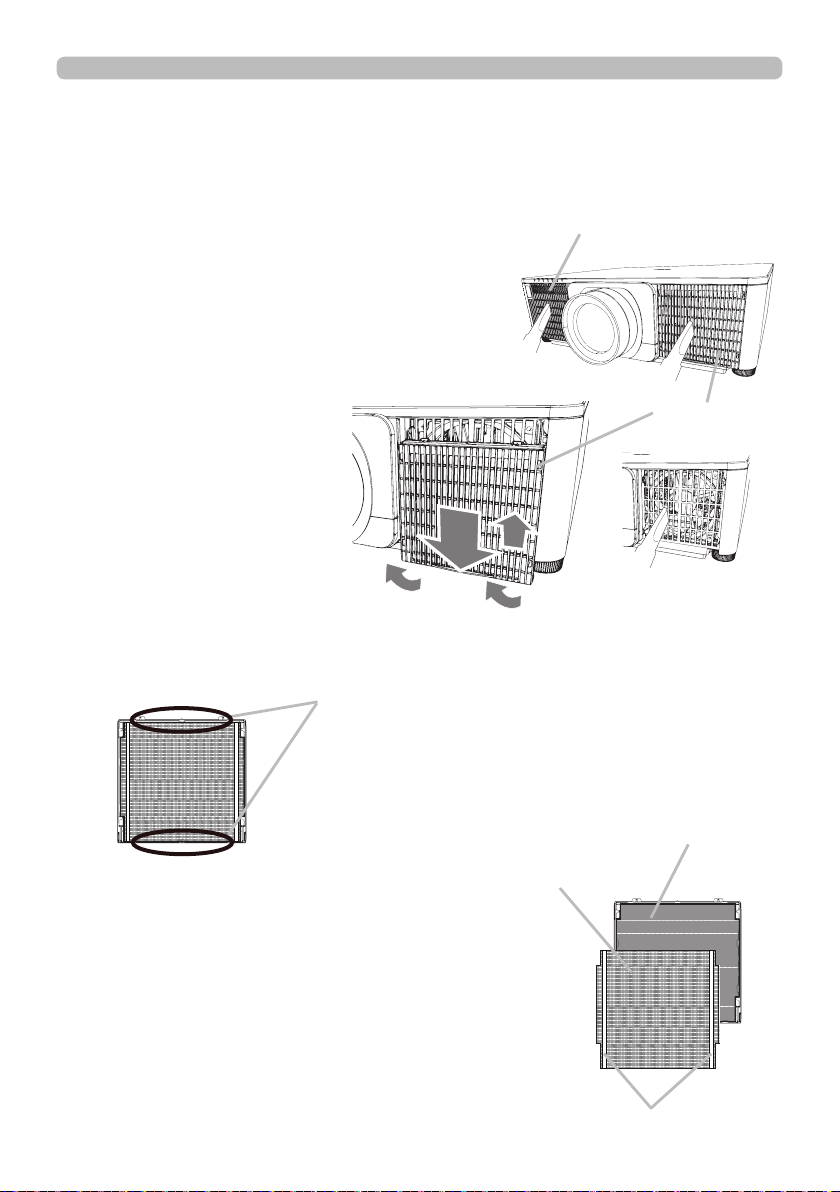
105
Maintenance
5.
Use a vacuum cleaner to clean on both
sides of the ne meshed lter while
holding it so it will not be sucked in. Use a
vacuum cleaner to clean the inside of the
lter cover to clean up the coarse meshed
lter. If the lters are damaged or heavily
soiled, replace them with new ones.
Cleaning and replacing the air lter
Plastic band
4, 5
Filter
(coarse meshed)
Filter
(ne meshed)
Check and clean the air lter periodically. When the indicators or a message
prompts you to clean the air lter, comply with it as soon as possible.
Replace the lters when they are damaged or too soiled.
Request for a lter set with the following type number from your dealer when
purchasing a new one.
Type number : UX39551
1.
Turn the projector off, and unplug the power
cord. Allow the projector to sufciently cool
down.
2.
Use a vacuum cleaner on and around the
lter cover.
4.
Take the ne meshed lter out while holding the lter cover. It is
recommended to leave the coarse meshed lter in the lter cover as it is.
3.
Slide the lter unit
downward to the lower
end. Then, slightly lift to
remove it.
Remove the Filter(ne meshed) either from upper
side or from lower side only.
Do not remove the Filter(ne meshed) from the
other sides to prevent from tearing apart.
(continued on next page)
1
2
3
3
Filter cover
2
3
Filter (FIXED)
106
Maintenance
► Before taking care of the air lter, make sure the power cable
is not plugged in, then allow the projector to cool sufciently.
►Use only the air lter of the specied type. Do not use the projector without the
air lter or the lter cover. It could result in a re or malfunction to the projector.
►Clean the air lter periodically. If the air lter becomes clogged by dust or the
like, internal temperatures rise and could cause a re, a burn or malfunction to
the projector.
WARNING
• Reset the lter time only when you have cleaned or replaced the air
lter, for a suitable indication about the air lter.
• The projector may display the message such as the “CHECK THE AIR
FLOW” or turn off the projector, to prevent the internal heat level rising.
NOTE
6.
Place the lter back into the lter cover, making sure the plastic band is on
the upper side.
7.
Install the lter unit back into the projector.
8.
Turn the projector on and reset the lter time using the FILTER TIME item in
the EASY MENU.
(1) Press the MENU button to display a menu.
(2) Point at the FILTER TIME using the ▲/▼ cursor buttons, then press the
► cursor (or the ENTER / the RESET) button. A dialog will appear.
(3) Press the ► cursor button to select the “OK” on the dialog. It performs
resetting the lter time.
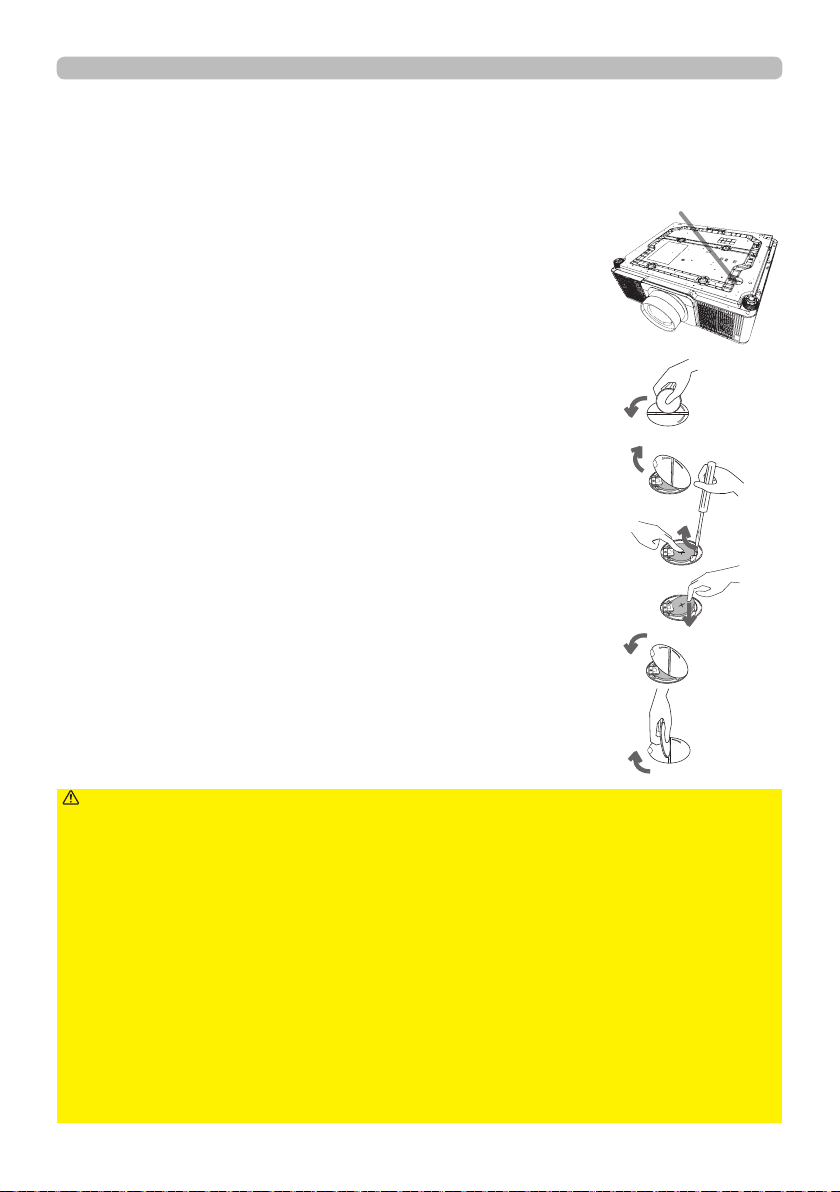
107
Replacing the internal clock battery
Consumption of the battery makes the clock not to work correctly. When the clock is
inaccurate or stopped, replace the battery according to the following procedures.
1.
Turn the projector off, and unplug the power cord. Allow the
projector to cool sufciently.
2.
After making sure that the projector has cooled adequately,
slowly turn over the projector, so that the bottom is facing
up.
3.
Turn the battery cover fully in the direction indicated “
OPEN
”
using a coin, and pick the cover up to
remove it.
4.
Pry up the battery using a athead screwdriver to take it
out. Do not use any metal tools. While prying it up, put a nger
lightly on the battery as it may pop out of the holder.
5.
Replace the battery with a new
HITACHI MAXELL
,
Part No.
CR2032
or
CR2032H
.
Slide the battery in under the plastic claw, and push it
into the holder until it clicks.
6.
Replace the battery cover in place, then turn it in the
direction indicated “
CLOSE
” using a coin.
WARNING
►Always handle the batteries with care and use them only as
directed. Battery may explode if mistreated. Do not recharge, disassemble or
dispose of in re.
And also improper use may result in cracking or leakage, which could result in
re, injury and/or pollution of the surrounding environment.
・ Be sure to use only the batteries specied.
・ Make sure the plus and minus terminals are correctly aligned when loading a battery.
・
Keep a battery away from children and pets. If swallowed consult a physician
immediately for emergency treatment.
・ Do not short circuit or solder a battery.
・ Do not allow a battery in a re or water. Keep batteries in a dark, cool and dry place.
・
If you observe battery leakage, wipe out the leakage and then replace a battery. If the
leakage adheres to your body or clothes, rinse well with water immediately.
・ Obey the local laws on disposing a battery.
OPEN
CLOSE
OPEN
CLOSE
OPEN
CLOSE
90°
OPEN
CLOSE
90°
Battery Cover
Maintenance

108
Maintenance
Other care
To ensure the safe use of your projector, have it cleaned and inspected by your
dealer every year.
1.
Turn the projector off, and unplug the power cord. Allow the projector to cool
sufciently.
2.
After making sure that the projector is cool adequately, lightly wipe the lens
with a commercially available lens-cleaning wipe. Do not touch the lens
directly with your hand.
If the lens is awed, soiled or fogged, it could cause deterioration of display
quality. Take care of the lens, being cautious of handling.
►Make sure the power cord is not plugged in, and allow the
projector to cool sufciently. The high temperature state of the projector could
cause a burn and/or malfunction to the projector.
►Do not clean or service the onside of the projector. Doing is so dangerous.
►Avoid wetting the projector or inserting liquids in the projector. It could result in
a re, an electric shock, and/or malfunction to the projector.
• Do not put anything containing water, cleaners or chemicals near the projector.
• Do not use aerosols or sprays.
WARNING
► Incorrect care of the projector could cause not only an injury
but adverse inuence such as discoloration, peeling paint, and so on.
►Do not use cleaners or chemicals other than those specied in this manual.
►Do not polish or wipe with hard objects.
NOTICE ►Do not directly touch the lens surface with hands.
CAUTION
Inside of the projector
Caring for the lens
1.
Turn the projector off, and unplug the power cord. Allow the projector to cool
sufciently.
2.
After making sure that the projector is cool adequately, lightly wipe with gauze
or a soft cloth.
If the projector is extremely dirty, dip a soft cloth in water or a neutral cleaner
diluted in water, and wipe lightly after wringing well. Then, wipe lightly with a
soft, dry cloth.
Incorrect care could have adverse inuence such as discoloration, peeling paint,
and so on.
Caring for the cabinet and remote control
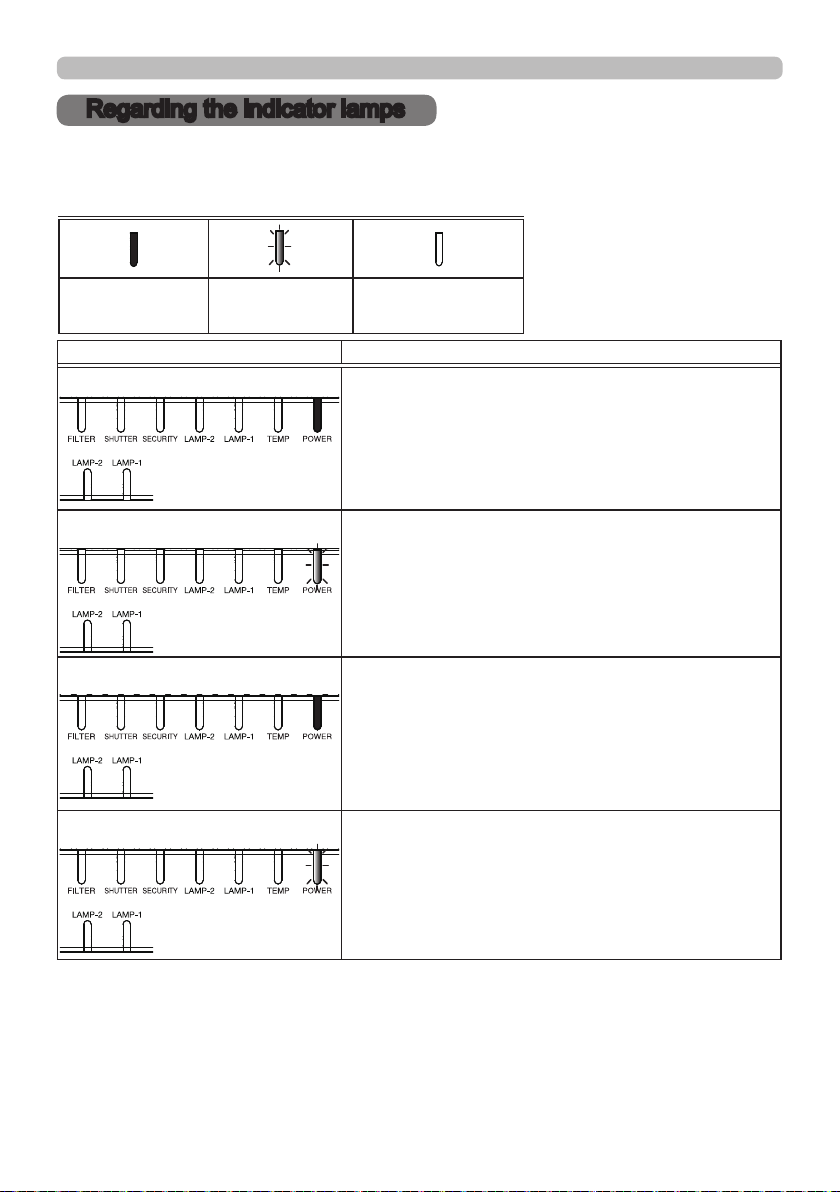
109
Indicator Status Description
The projector is in a standby state.
Refer to the section “Power on/off”.
The projector is warming up.
Wait for the projector to warm up..
The projector is in an on state.
Ordinary operations may be performed.
The projector is cooling down.
Wait for the projector to cool down.
The indicators may differ from this manual, check and deal with it according to the
following table.
The indicators are described as below.
Lit
Steady light
Blinking Off
Regarding the indicator lamps
Regarding the indicator lamps
(continued on next page)
Orange
Green
Green
Orange
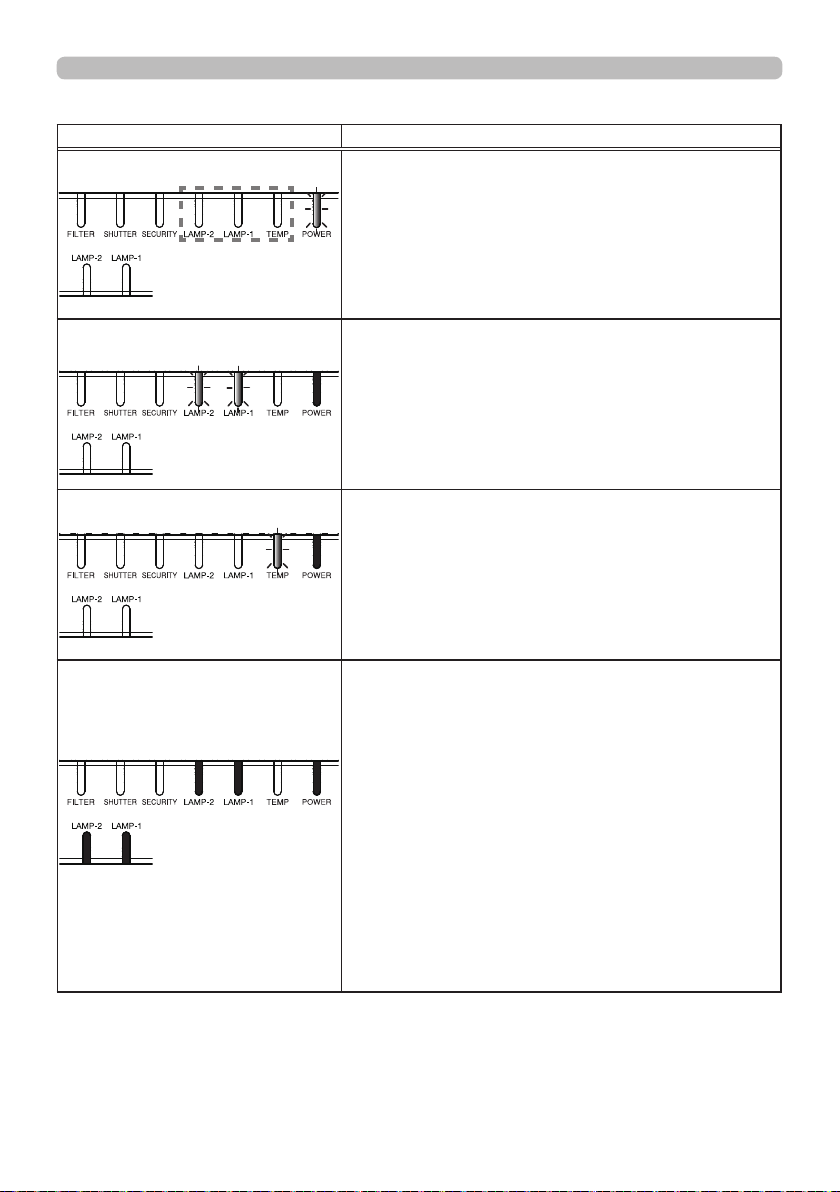
110
Regarding the indicator lamps
Indicator Status Description
The projector is cooling down. A certain error
has been detected.
Wait until
POWER
indicator nishes blinking, and
then perform the proper measure using the item
descriptions below.
The lamp cover has not been properly xed.
Turn the power off, and allow the projector to cool
down at least 20 minutes. After the projector has
sufciently cooled down, conrm the attachment
state of the lamp cover. After performing any needed
maintenance, turn the power on again. If the same
indication is displayed after the remedy, contact your
dealer or service company.
The cooling fan is not operating.
Turn the power off, and allow the projector to cool
down at least 20 minutes. After the projector has
sufciently cooled down, conrm that no foreign
matter has become caught in the fan, and so on, and
then turn the power on again.
If the same indication is displayed after the remedy,
contact your dealer or service company.
The lamp does not light, and there is a
possibility that interior portion has become
heated.
Turn the power off, and allow the projector to cool
down at least 20 minutes. After the projector has
sufciently cooled down, conrm the following items,
and then turn the power on again.
• Is there blockage of the air passage aperture?
• Is the air lter dirty?
• Use the unit within the temperature range.
NORMAL MODE: 0 to 45°C
ECO MODE: 0 to 50°C
HIGH ALTITUDE: 0 to 40°C
If the same indication is displayed after the remedy,
change the lamp referring to the section
Replacing
the lamp
.
(continued on next page)
Red
descretionary
Red
Red
Red
Red
Red
RedRedRed
RedRed
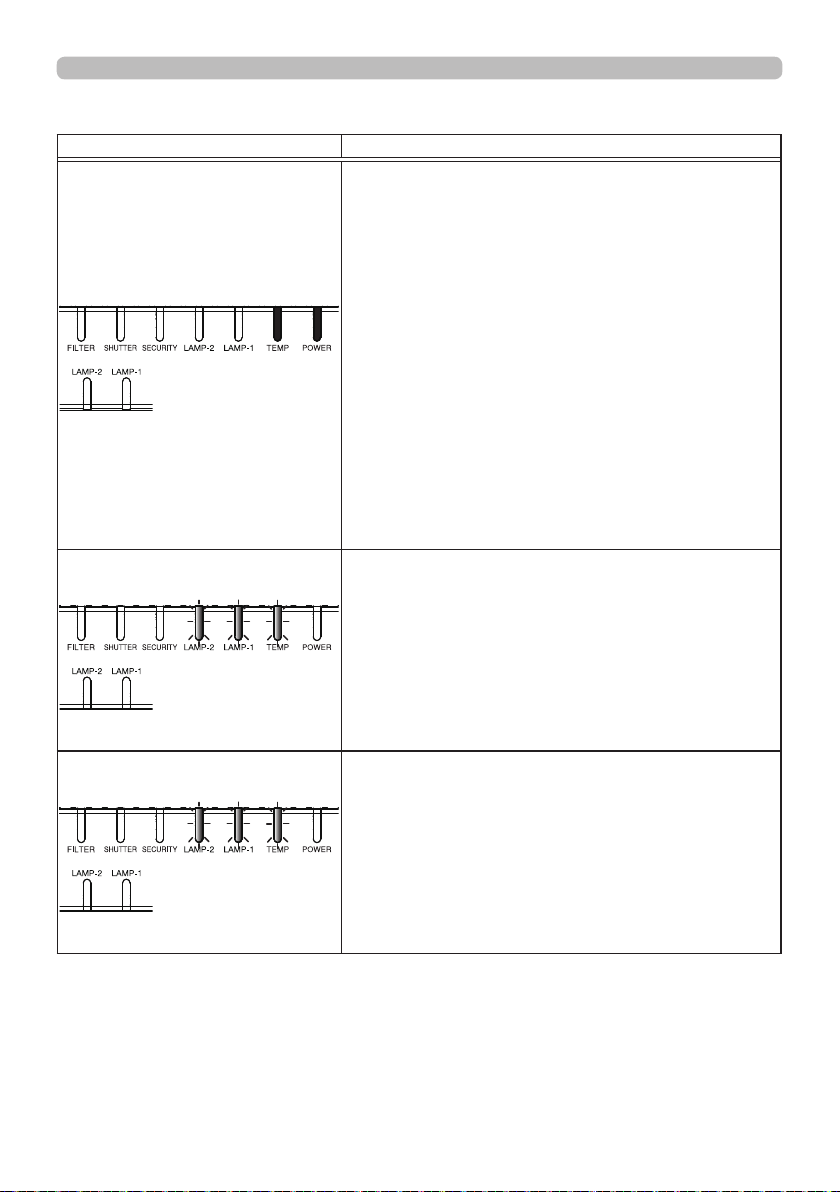
111
Regarding the indicator lamps
Indicator Status Description
The interior portion has become heated.
Turn the power off, and allow the projector to cool
down at least 20 minutes. After the projector has
sufciently cooled down, conrm the following items,
and then turn the power on again.
• Is there blockage of the air passage aperture?
• Is the air lter dirty?
• Use the unit within the temperature range.
NORMAL MODE: 0 to 45°C
ECO MODE: 0 to 50°C
HIGH ALTITUDE: 0 to 40°C
• Is the setting for ALTITUDE appropriate?
• Is the exhaust air (hot/cold) from peripheral
equipment blowing against the ventilation opening
of projector?
For details on ALTITUDE, refer to ALTITUDE of
SERVICE in the OPTION menu. If the projector is
used with a wrong setting, it may cause damage to
the projector itself or the parts inside.
The interior portion is cold.
Use the unit within the temperature range.
NORMAL MODE: 0 to 45°C
ECO MODE: 0 to 50°C
HIGH ALTITUDE: 0 to 40°C
After the treatment, restart the projector.
It is time to clean the air lter.
Turn the power off immediately, and clean or change
the air lter referring to the section
Cleaning and
replacing the air lter
. After cleaning or changing
the air lter, reset the lter time.
After the remedy, restart the projector.
(continued on next page)
RedRed
Red
Red
Red
Blinking
alternately
Red
Red
Red
Blinking at the
same time

112
Indicator Status Description
This is a Lamp-1 warning.
Lamp-1 is turned off.
Turn the power off, and allow the projector to cool
down at least 20 minutes.
Restart the projector.
If the same indication is displayed, contact your
dealer or service company.
This is a Lamp-2 warning.
Lamp-2 is turned off.
Turn the power off, and allow the projector to cool
down at least 20 minutes.
Restart the projector.
If the same indication is displayed, contact your
dealer or service company.
Other error has occurred.
• Use the unit within the temperature range.
NORMAL MODE: 0 to 45°C
ECO MODE: 0 to 50°C
HIGH ALTITUDE: 0 to 40°C
• Check installation.
Install the projector correctly, and restart it.
If the same indication is displayed after the remedy,
contact your dealer or service company.
Regarding the indicator lamps
(continued on next page)
Red
Red
Red
Red
Blinking
alternately
Red
Red
Blinking at the
same time
or

113
Indicator Status Description
Color Wheel error occurred.
If the same indication is displayed, contact your
dealer or service company.
The air lter is clogged or dirty.
(
115
)
Check and clean the air lter
Make sure the power cable is not plugged in, then
allow the projector to cool sufciently.
See the section "The interior portion has become
heated" (
111
).
Regarding the indicator lamps
(continued on next page)
Blinking twice
alternately
Red
Red
Red
Orange or Red
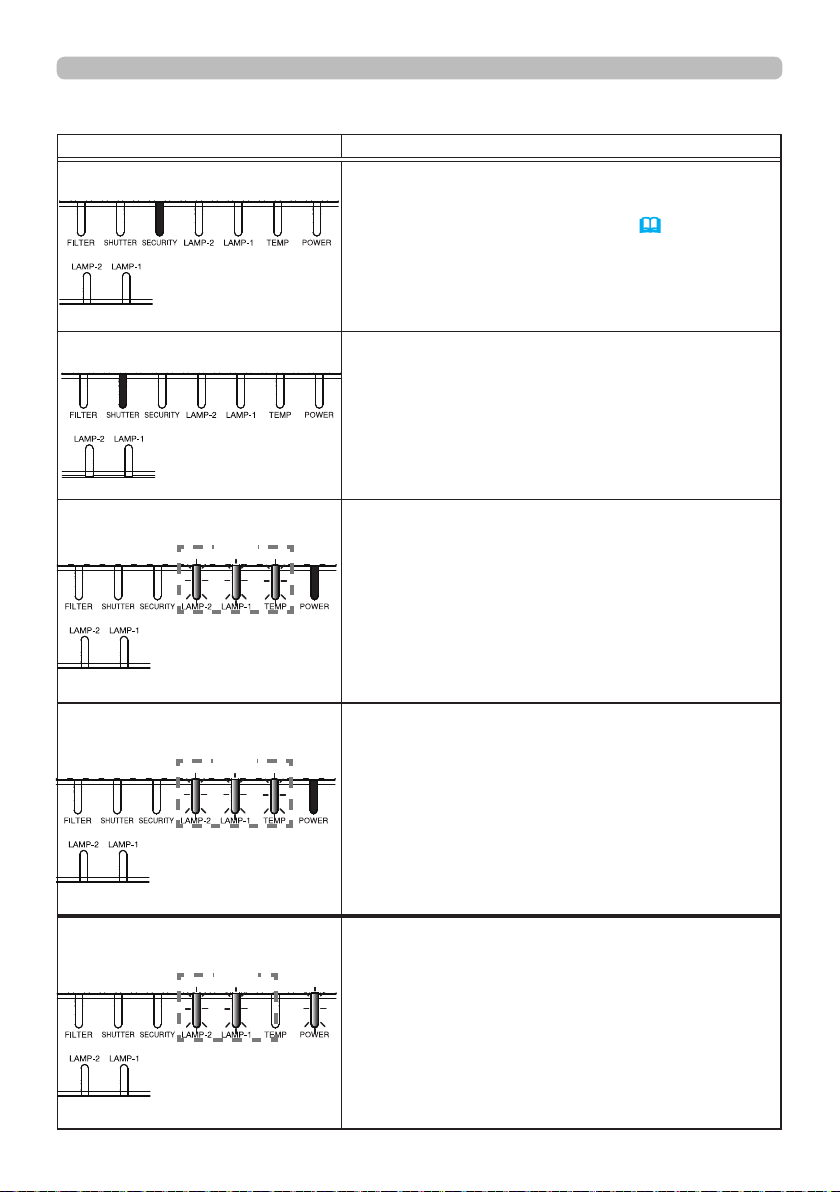
114
Indicator Status Description
PIN LOCK function is active.
See SECURITY menu > PIN LOCK
(
98
).
If the same indication is displayed after the remedy,
contact your dealer or service company.
The shutter is closed.
Press the SHUTTER button on the remote control or
on the control panel to open the shutter.
This is the indication while cleaning or
replacing the air lter .
Reset the lter time for a suitable indication.
There is a possibility that the interior portion
has become overcooled.
• Use the unit within the temperature range.
NORMAL MODE: 0 to 45°C
ECO MODE: 0 to 50°C
HIGH ALTITUDE: 0 to 40°C
Regarding the indicator lamps
AC BLACK OUT error has occurred.
Turn the power off, and allow the projector to cool
down at least 20 minutes. Restart the projector.
Yellow
Yellow
Green
Red
Blinking at the
same time
Blinking
alternately
Green
Red
Blinking
alternately
Red
Red
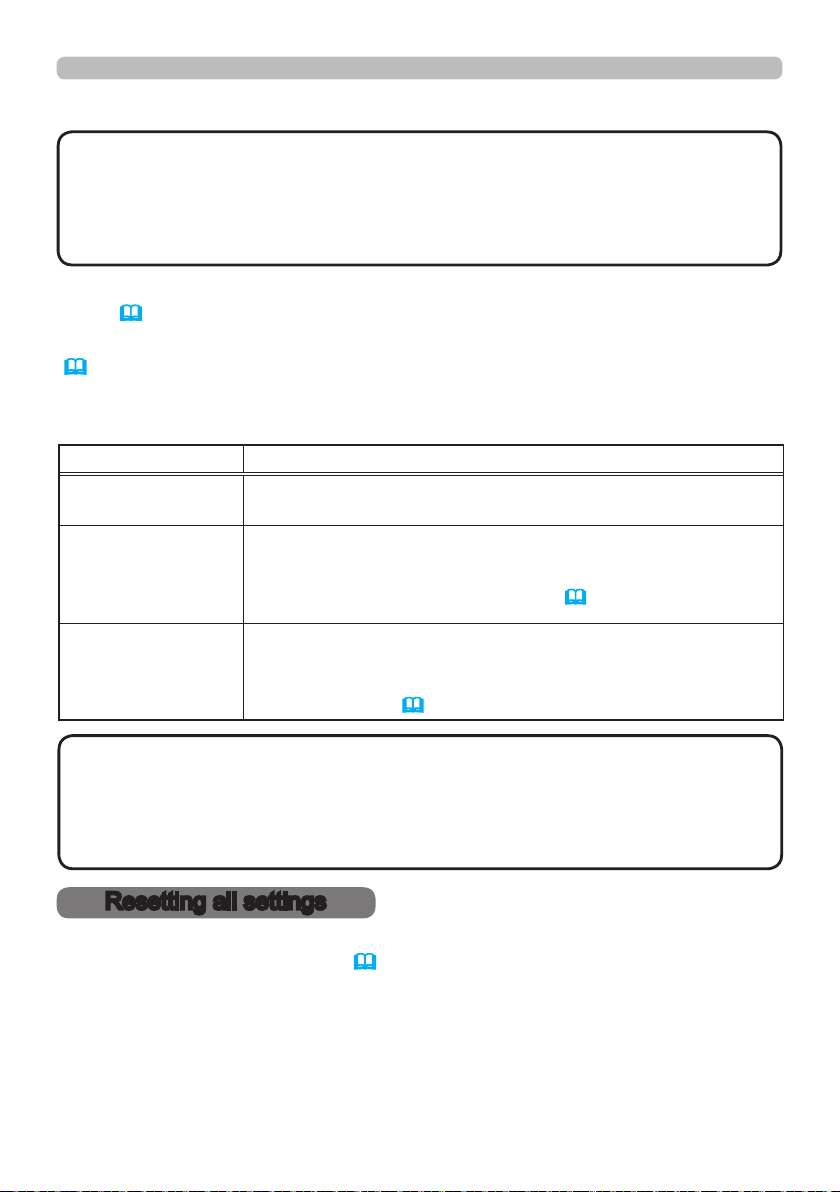
115
• When the interior portion has become overheated, for safety
purposes, the projector is automatically shut down, and the indicator lamps
may also be turned off. In such a case, disconnect the power cord, and wait at
least 20 minutes. After the projector has sufciently cooled down, conrm the
attachment state of the lamp and lamp cover, and turn the power on again.
NOTE
For the SECURITY indicator, see SECURITY INDICATOR in the SECURITY
menu (101).
For the SHUTTER indicator, see the section "Temporarily shading the screen"
(46).
The FILTER indicator shows the condition of the air lter. Use this feature to keep
the interior of the projector in good condition.
FILTER indicator Description
Turned
off
The air lter is clean.
No need to clean up.
Lighting In
Orange
The air lter is going to be choked.
Clean the lter. See the section "There is a possibility that the
interior portion has become heated" (
113
).
Lighting In
Red
The air lter is choked.
Turn the power off and clean the air lter immediately. See
the section "There is a possibility that the interior portion has
become heated" (
111
).
Regarding the indicator lamps
When it is difcult to correct wrong settings, the FACTORY RESET function of
SERVICE item in OPTION menu (94) can reset all settings (except settings such
as LANGUAGE, LAMP-1 TIME, LAMP-2 TIME, FILTER TIME, AUTO BLANK,
FILTER MESSAGE, STANDBY MODE, COMMUNICATION, SECURITY and
NETWORK) to the factory default.
• The FILTER indicator might light up in orange or red when something
blocks the intake vents even though the air lter is clean.
•
The FILTER indicator might light up differently from other indicators or display
messages related to cleaning the air lter. Follow the prompt that is displayed
earlier.
NOTE
Resetting all settings
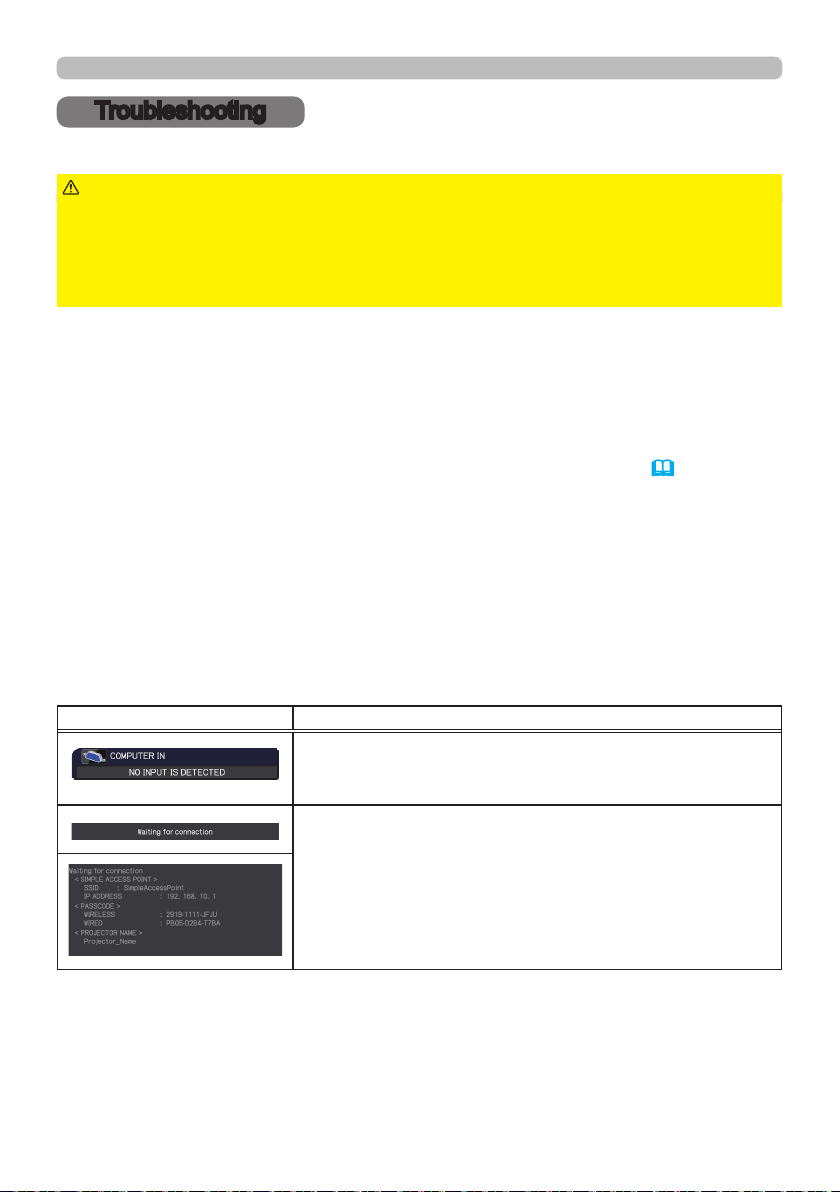
116
Troubleshooting
Troubleshooting
Related messages
When some messages appear, check and deal with it according to the following
table. Although these messages will be automatically disappear after several
minutes, they will reappear when the power is turned on.
Warnings displayed on the Status Monitor
If an error occurs, a warning will be displayed on the Status Monitor (User's
manual - Operating guide). Resolve the errors referring to the table of the sections
"Related messages" and "Regarding the indicator lamps" when the warning is
displayed.
Troubleshooting
If an abnormal operation should occur, stop using the projector immediately.
If a problem occurs with the projector, the following checks and measures are
recommended before requesting repair.
If this does not resolve the problem, contact your dealer or service company. They
will tell you what warranty condition is applied.
►Never use the projector if abnormal operations such as
smoke, strange odor, excessive sound, damaged casing or elements or cables,
penetration of liquids or foreign matter, and so on, should occur. In such cases,
immediately disconnect the power plug from the power outlet. After making sure
that the smoke or odor has stopped, contact to your dealer or service company.
WARNING
Message Description
There is no input signal.
Conrm the signal input connection, and the status of
the signal source.
Projector is waiting for an image le.
Check the hardware connection, settings on the projector
and network-related settings.
The computer-Projector network connection might be
disconnected. Re-connect them.
(continued on next page)
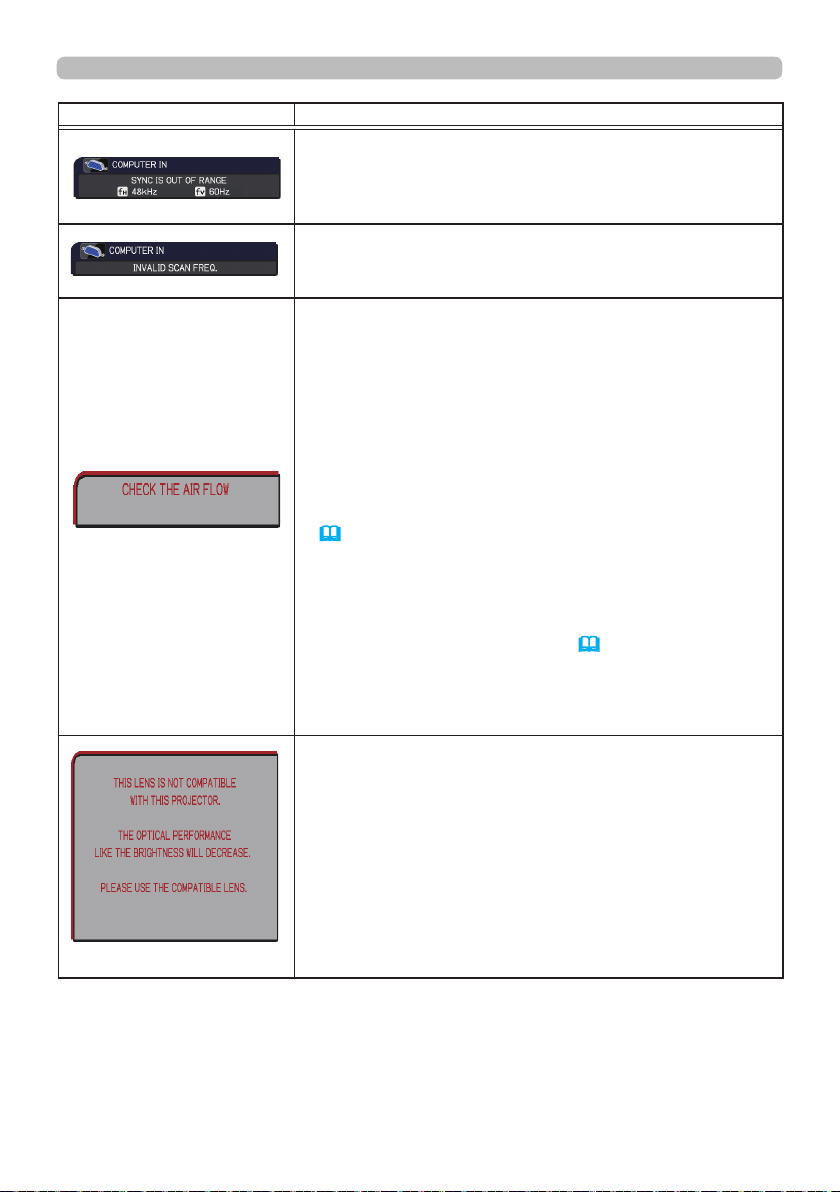
117
Troubleshooting
Message Description
The horizontal or vertical frequency of the input
signal is not within the specied range.
Conrm the specs for your projector or the signal source
specs.
An improper signal is input.
Conrm the specs for your projector or the signal source
specs.
The internal temperature is rising.
Turn the power off, and allow the projector to cool down
at least 20 minutes. After having conrmed the following
items, turn the power ON again.
• Is there blockage of the air passage aperture?
• Is the air lter dirty?
• Use the unit within the temperature range;
NORMAL MODE: 0 to 45 °C
ECO MODE: 0 to 50 °C
HIGH ALTITUDE : 0 to 40 °C
(
User's Manual (concise
)).
• Is the setting for ALTITUDE appropriate?
• Is the exhaust air (hot/cold) from peripheral equipment
blowing against the ventilation opening of projector?
For details of ALTITUDE, refer to ALTITUDE of
SERVICE in the OPTION menu (
User's Manual -
Operating guide
). If the projector is used with a
wrong setting, it may cause damage to the
projector itself or the parts inside.
The installed lens is incompatible.
Optical performance will decrease.
• The LENS TYPE may not be properly set.
Check and set for appropriate LENS TYPE.
(continued on next page)
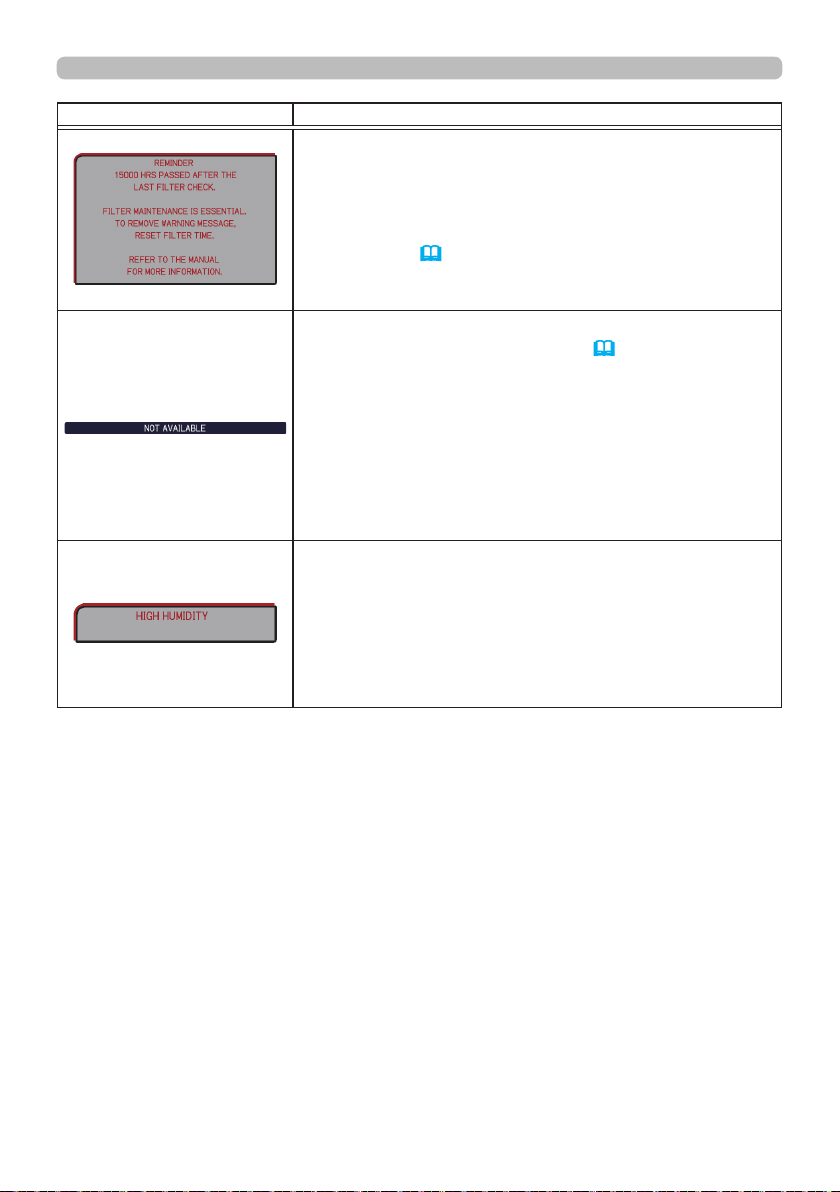
118
Troubleshooting
Message Description
A note of precaution when cleaning the air lter.
Immediately turn the power off, and clean or change the
air lter referring to the
Cleaning and replacing the air
lter
section of this manual.
After you have cleaned or changed the air lter, reset
the lter time (
73
).
The button operation is not available.
Check the button you want to use (
7
). Even when a
usable button is pressed, all button operations are not
available under the following conditions.
- While the lens is moving, button operation from the
control panel or the remote control might be ignored.
- Pressing one of buttons to call a signal input might
be ignored. When all the input ports belonging to the
category the button's name shows are set to the "SKIP"
by the item SOURCE SKIP of the OPTION menu.
The humidity around the projector exceeds the
operating humidity range.
Turn the power off.
- Set up the projector in a location with a humidity of
10% to 80% (no condensation).
If the same indication is displayed after the remedy,
contact your dealer or service company.
(continued on next page)

119
Troubleshooting
Issues that may be easy to be mistaken for machine defects
An issue may be confused with a machine defect, check and deal with it according
to the following table.
Issues Cases not involving a machine defect Page
Power does not
come on.
The electrical power cord is not plugged in.
Connect the power cord correctly.
21
The main power source has been interrupted during
operation such as by a power outage (blackout), and
so on.
Disconnect the power plug from the power outlet, and
allow the projector to cool down at least 20 minutes, then
turn the power on again.
21
Either there is no lamp and/or lamp cover, or either
of these has not been properly xed.
Turn the power off and disconnect the power plug from
the power outlet, and allow the projector to cool down
at least 20 minutes. After the projector has sufciently
cooled down, conrm the attachment state of the lamp
and lamp cover, and then turn the power on again.
102~
103
Pictures are not
displayed
Signal source does not correctly work.
Set up the signal source device correctly by referring to
the manual of the source device.
-
The input changeover settings are mismatched.
Select the input signal, and correct the settings.
31
(continued on next page)
120
Troubleshooting
Issues Cases not involving a machine defect Page
Pictures are not
displayed.
(continued)
The signal cables are not correctly connected.
Correctly connect the connection cables.
11~17
The brightness is adjusted to an extremely low level.
Adjust BRIGHTNESS to a higher level using the menu
function.
56
The computer cannot detect the projector as a plug
and play monitor.
Make sure that the computer can detect a plug and play
monitor using another plug and play monitor.
11
The shutter is closed.
Check whether the
SHUTTER
indicator is blinking. If it is
blinking, press
SHUTTER
button on the control panel.
46
The remote
control does not
work.
Batteries in the remote control may be drained.
Replace the batteries.
22
The ID numbers set in the projector and the remote
control are different.
Press the
ID
button with the same ID number as the
projector, then perform the desired operation. The ID
number set in the projector can be displayed by pressing
any of the
ID
buttons on the remote control for three
seconds while the lamp is on.
22
Buttons does
not work
OSD MESSAGE is set to INHIBIT.
Press the
OSD
button on the remote control for 3sec.
The INHIBIT OSD will be displayed. While this OSD is
displayed, press the
OSD
button again on the remote
control.
Select NORMAL.
37
Video screen
display freezes.
The FREEZE function is working.
Press
FREEZE
button to restore the screen to normal.
46
Colors have
a faded- out
appearance,
or color tone is
poor.
Color settings are not correctly adjusted.
Perform picture adjustments by changing the COLOR TEMP,
COLOR and/or TINT settings, using the menu functions.
56,
58
COLOR SPACE setting is not suitable.
Change the COLOR SPACE setting to AUTO, RGB,
SMPTE240, REC709 or REC601.
64
(continued on next page)
121
Troubleshooting
Issues Cases not involving a machine defect Page
Pictures appear
dark.
The brightness and/or contrast are adjusted to an
extremely low level.
Adjust BRIGHTNESS and/or CONTRAST settings to a
higher level using the menu function.
56
The projector is operating in Eco mode.
Set ECO MODE to NORMAL in the SETUP menu.
71
The lamp is approaching the end of its product
lifetime.
Replace the lamp.
102~
103
Only one lamp is running.
Check the LAMP MODE.
71
The ambient temperature and humidity of the
projector is too high.
The projector will operate in ECO mode as the ambient
temperature exceeds 45°C and humidity exceeds 80%.
27,
110
RICH COLOR mode is selected in COLOR WHEEL.
Try to switch the COLOR WHEEL to BRIGHT mode.
60
High humidity environment
The brightness may decrease automatically, if the
projector is used at high humidity environment.
- Use the unit within the humidity range.
10 to 80% (no condensation)
27
DIMMING LEVEL of Blending function is working.
Set DIMMING LEVEL to a higher level or set Blending -
Mode to OFF.
44
Displayed
image is
partially dark.
Blending Region is set.
Set all Blending Region to OFF or set Blending – Mode to
OFF.
41
ECO MODE
setting cannot
be changed.
Blending - Mode is set to MANUAL or CAMERA
.
Set Blending – Mode to OFF.
41
Menu is not
displayed
normally.
Blending - Mode is set to CAMERA.
Set Blending – Mode to other than CAMERA. Mode can
be set forcibly to OFF by holding the KEYSTONE button.
41
(continued on next page)
122
Troubleshooting
Issues Cases not involving a machine defect Page
Pictures appear
blurry
Either the focus and/or horizontal phase settings are
not properly adjusted.
Adjust the focus using the
FOCUS + / -
buttons, and/or H
PHASE using the menu function.
34,
63
The lens is dirty or misty.
Clean the lens referring to the Optional Lens User's Manual.
108
Some kind
of image
degradation
such as
ickering or
stripes appear
on screen.
Flicker may appear on screen
Switch the lamp ON and OFF or try to switch the Lamp
mode once from NORMAL to ECO.
71
The OVER SCAN ratio is too big.
Adjust OVER SCAN in the IMAGE menu smaller.
62
Excessive VIDEO NR.
Change the setting of VIDEO NR in the INPUT menu.
64
The FRAME LOCK function cannot work on the
current input signal.
Set FRAME LOCK in the INPUT menu to OFF.
67
The image
is unstable
or is output
intermittently.
When LAN, HDBaseT port is selected, some parts of
the output may be missing due to signal processing
delay.
Change the signal or use another port.
31
RS-232C does
not work.
The SAVING function is working.
Select NORMAL for STANDBY MODE item in the SETUP menu.
74
The COMMUNICATION TYPE for the CONTROL port is
set to NETWORK BRIDGE.
Select OFF for COMMUNICATION TYPE item in the
OPTION - SERVICE - COMMUNICATION menu.
91
Network does
not work
The SAVING function is working.
Select NORMAL for STANDBY MODE item in the SETUP menu.
74
The same network address is set for both wireless
and wired LAN.
Change the network address setting for wireless or wired
LAN.
*
Wrong settings on WIRED NETWORK
Select the correct port for LAN connection at the WIRED
NETWORK under NETWORK menu.
*
*see the Network Guide
(continued on next page)
123
Troubleshooting
Issues Cases not involving a machine defect Page
The
IR
and RS-
232C does not
work on
HDBaseT
connection
The SAVING function is working.
Select NORMAL for STANDBY MODE item in the SETUP
menu.
74
HDBaseT
connection
does not work
The SAVING function is working.
Select NORMAL for STANDBY MODE item in the SETUP
menu.
74
The connected equipment may not be supported by
HDBaseT.
Refer to User's manual (detailed) for connection.
12~
14
IR and LAN
does not
work through
HDBaseT
Check if the IR setting is OFF under HDBaseT.
EASY MENU > ADVANCED MENU > OPTION >
SERVICE
> REMOTE RECEIV.
90
Check if the LAN setting is HDBaseT.
EASY MENU > ADVANCED MENU > NETWORK >
WIRED NETWORK
*
LAN does not
work, if LAN is
connected to
the projector
while having
an input signal
from HDBaseT
Check if the LAN setting is HDBaseT.
EASY MENU > ADVANCED MENU > NETWORK >
WIRED NETWORK
*
This projector is compatible with 100BASE-T only.
Check the specication of the connected equipment.
-
If the LAN cable is connected with the hub, try to change
the connected port at the hub.
-
If the LAN cable is connected directly to the computer, try
to connect to other computer.
-
No image
is displayed
through
HDBaseT
Check the LAN cable if it is CAT5e certied or higher.
-
Try to change the LAN cable.
-
If the LAN cable is connected with more than three
extension connector, the transmission of 100 meters may
fail.
-
Check if the extension connector is compatible with
CAT5e.
All LAN cable and extension connector connected with
HDBaseT port must be CAT5e certied.
-
*see the Network Guide
(continued on next page)
124
Troubleshooting
Issues Cases not involving a machine defect Page
No image
is displayed
through SDI/
DIGITAL1
Check if it is connected with a cable of 5CFB or
greater, or Belden 1694A or greater.
-
Check if a cable with a length of 100m or less is used.
-
Try to change the cable.
-
Check if a supported signal format is input.
-
NETWORK
BRIDGE
function does
not work
The NETWORK BRIDGE function is turned off.
Select NETWORK BRIDGE for COMMUNICATION TYPE
item in the OPTION - SERVICE - COMMUNICATION
menu.
91
Schedule
function does
not work
The SAVING function is working.
Select NORMAL for STANDBY MODE item in the SETUP
menu.
74
The internal clock has been reset.
Once you turn off the projector in the SAVING mode or the
AC power, the current date and time setting is reset.
Check the DATE AND TIME setting for WIRELESS SETUP
or WIRED SETUP in the NETWORK menu.
*
When the
projector is
connected to
the network, it
powers off and
on as described
below.
Powers off
POWER
indicator blinks
in orange a few
times
Goes into
standby mode
Disconnect the LAN cable and check that the projector
is working properly.
If this issue occurs after connecting to the network, there
may be a loop between two Ethernet switching hubs within
the network,
- Two or more Ethernet switching hubs are in a network.
- Two of the hubs are doubly connected by LAN cables.
- This double connection forms a loop between the two
hubs.
Such a loop may have an adverse effect on the projector
as well as the other network devices.
Check the network connection and remove the loop by
disconnecting the LAN cables such that there is only one
connecting cable between two hubs.
*
*see the Network Guide
125
Specications
Specications
See the Specications in the User’s Manual (concise) which is a book.
End User License Agreement for the Projector Software
• Software in the projector consists of the plural number of independent software
modules and there exist our copyright or/and third party copyrights for each of
such software modules.
• Read “End User License Agreement for the Projector Software” which is
separated document.