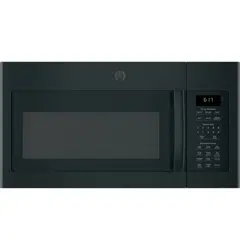
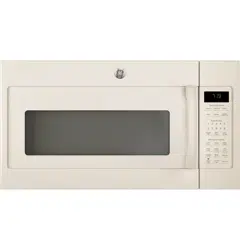
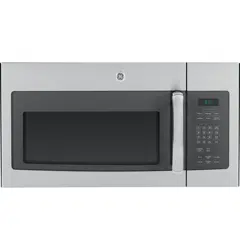
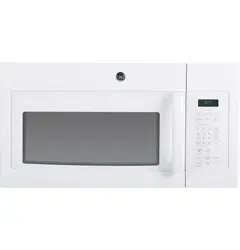
Throughout this manual, features and appearance may vary from your model.
1000 Watts
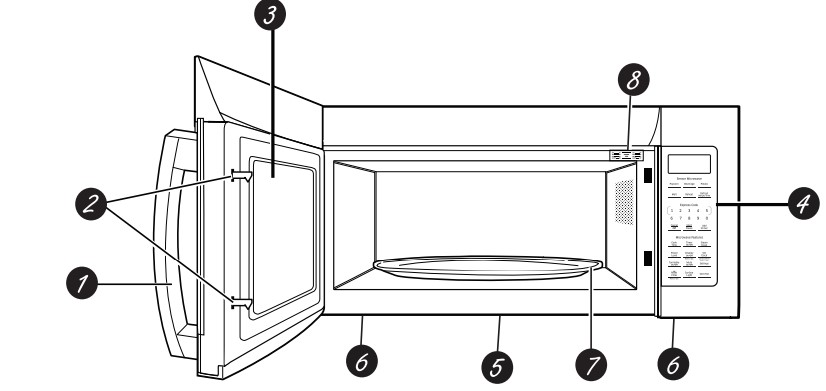
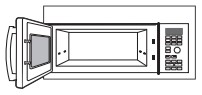
Door Handle. Pull to open the door. The door must be securely latched for the microwave to operate.
Door Latches.
Window with Metal Shield. Screen allows cooking to be viewed while keeping microwaves confined in the oven.
Touch Control Panel.
Cooktop Light.
Grease Filter.
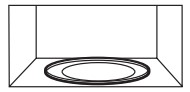
Removable Turntable. Turntable and support must be in place when using the oven. The turntable may be removed for cleaning.
Rating Plate.
NOTE: Oven vent(s) and oven light are located on the inside walls of the microwave oven.
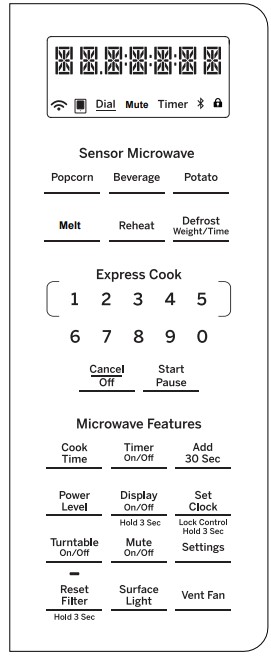
You can microwave by time or with the sensor features. Not all features on all models.
Features
Changing the Power Level
The power level may be entered or changed immediately after entering the feature time for Cook Time, Time Defrost, Add 30 Sec or Express Cook. The power level may also be changed during the time countdown.
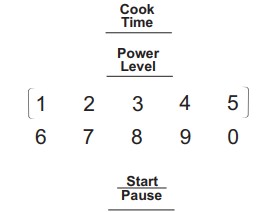
Press Cook Time.
Enter cooking or defrosting time
Press Power Level.
Select desired power level 1-10.
Press Start/Pause. Pressing Start/Pause is not necessary for Express Cook buttons.
Variable power levels add flexibility to microwave cooking. The power levels on the microwave oven can be compared to the surface units on a range. Each power level gives you microwave energy a certain percent of the time. Power level 7 is microwave energy 70% of the time. Power level 3 is energy 30% of the time. Most cooking will be done on HI which gives you 100% power.
Power Level 10 will cook faster but food may need more frequent stirring, rotating or turning over. A lower setting will cook more evenly and need less stirring or rotating of the food.
Some foods may have better flavor, texture or appearance if one of the lower settings is used. Use a lower power level when cooking foods that have a tendency to boil over, such as scalloped potatoes.
Rest periods (when the microwave energy cycles off) give time for the food to “equalize” or transfer heat to the inside of the food. An example of this is shown with power level 3—the defrost cycle. If microwave energy did not cycle off, the outside of the food would cook before the inside was defrosted.
Here are some examples of uses for various power levels:
Power Level 10: Fish, bacon, vegetables, boiling liquids.
Power Level 7: Gentle cooking of meat and poultry; baking casseroles and reheating.
Power Level 5: Slow cooking and tenderizing for stews and less tender cuts of meat.
Power Level 2 or 3: Defrosting; simmering; delicate sauces.
Power Level 1: Keeping food warm; softening butter.
Time Features
Cook Time I
Allows you to microwave for any time up to 99 minutes and 99 seconds.
Power level 10 (high) is automatically set, but you may change it for more flexibility
Press Cook Time.
Enter cooking time.
Change power level if you don’t want full power. (Press Power Level. Select a desired power level 1–10.)
Press Start/Pause.
You may open the door during Cook Time to check the food. Close the door and press Start/Pause to resume cooking.
Cook Time II
Lets you change power levels automatically during cooking. Here’s how to do it:
Press Cook Time.
Enter the first cook time.
Change the power level if you don’t want full power. (Press Power Level. Select a desired power level 1–10.)
Press Cook Time again.
Enter the second cook time.
Change the power level if you don’t want full power. (Press Power Level. Select a desired power level 1–10.)
Press Start/Pause.
At the end of Cook Time I, Cook Time II counts down.
Weight Defrost
The Defrost Weight/Time feature gives you two ways to defrost food.
Press Defrost Weight/Time once for weight defrost or twice for Time Defrost.
Use Weight Defrost for meat, poultry and fish up to 6 pounds. Use Time Defrost for most other frozen foods.
Weight Defrost automatically sets the defrosting times and power levels to give even defrosting results for meats, poultry and fish.
Press Defrost Weight/Time once.
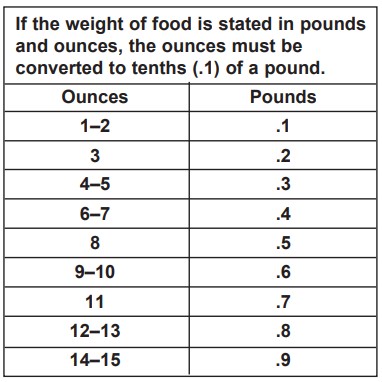
Using the conversion guide, enter food weight. For example, press pads 1 and 2 for 1.2 pounds (1 pound, 3 ounces).
Press Start/Pause.
(Time Defrost is explained in the Time Features section.)
Remove meat from package and place on microwave-safe dish
When the oven signals, turn the food over. Remove defrosted meat or shield warm areas with small pieces of foil.
After defrosting, most meats need to stand 5 minutes to complete defrosting. Large roasts should stand for about 30 minutes.
Time Defrost
Time Defrost allows you to defrost for a selected length of time. See the Defrosting Guide for suggested times. (Weight Defrost is explained in the Auto Feature section.)
Press Defrost Weight/ Time twice.
Enter defrosting time.
Press Start/Pause.
Turn food over when the oven signal.
Press Start/Pause.
When the oven signals, turn food over and break apart or rearrange pieces for more even defrosting. Shield any warm areas with small pieces of foil. The oven will continue to defrost if you don’t open the door and turn the food.
Power level is automatically set at 3, but can be changed. You can defrost small items quickly by raising the power level after entering the time. Power level 7 cuts the total defrosting time in about half; power level 10 cuts the total time to approximately 1/3. However, food will need more frequent attention than usual.
A dull thumping noise may be heard during defrosting. This is normal when oven is not operating at High power.
Defrosting Tips
Foods frozen in paper or plastic can be defrosted in the package. Closed packages should be slit, pierced or vented AFTER food has partially defrosted. Plastic storage containers should be partially uncovered.
Family-size, prepackaged frozen dinners can be defrosted and microwaved. If the food is in a foil container, transfer it to a microwave-safe dish.
For more even defrosting of larger foods, such as roasts, use Defrost Weight. Be sure large meats are completely defrosted before cooking.
Foods that spoil easily should not be allowed to sit out for more than one hour after defrosting. Room temperature promotes the growth of harmful bacteria.
When defrosted, food should be cool but softened in all areas. If still slightly icy, return to the microwave very briefly, or let it stand a few minutes counts down.
CARE AND CLEANING
Helpful Hints
An occasional thorough wiping with a solution of baking soda and water keeps the inside fresh.
Be sure the power is off before cleaning any part of this oven
How to Clean the Inside
Walls, Floor, Inside Window, Metal and Plastic Parts on the Door
Some spatters can be removed with a paper towel; others may require a damp cloth. Remove greasy spatters with a sudsy cloth, then rinse with a damp cloth. Do not use abrasive cleaners or sharp utensils on oven walls.
Never use a commercial oven cleaner on any part of your microwave.
Removable Turntable and Turntable Support
To prevent breakage, do not place the turntable into water just after cooking. Wash it carefully in warm, sudsy water or in the dishwasher. The turntable and support can be broken if dropped. Remember, do not operate the oven in the microwave mode without the turntable and support seated and in place.
How to Clean the Outside
We recommend against using cleaners with ammonia or alcohol, as they can damage the appearance of the microwave oven. If you choose to use a common household cleaner, first apply the cleaner directly to a clean cloth, then wipe the soiled area.
Case
Clean the outside of the microwave with a sudsy cloth. Rinse and then dry. Wipe the window clean with a damp cloth.
Control Panel
Wipe with a damp cloth. Dry thoroughly. Do not use cleaning sprays, large amounts of soap and water, abrasives or sharp objects on the panel—they can damage it. Some paper towels can also scratch the control panel.
Door Panel
Before cleaning the front door panel, make sure you know what type of panel you have. Refer to the eighth digit of the model number. “S” is stainless steel, “L” is CleanSteel and “B”, “W” or “C” are plastic colors.
Stainless Steel (on some models)
The stainless steel panel can be cleaned with Stainless Steel Magic or a similar product using a clean, soft cloth. Apply stainless cleaner carefully to avoid the surrounding plastic parts. Do not use appliance wax, polish, bleach or products containing chlorine on Stainless Steel finishes.
Plastic Color Panels
Use a clean, soft, lightly dampened cloth, then dry thoroughly.
Door Seal
It’s important to keep the area clean where the door seals against the microwave. Use only mild, nonabrasive detergents applied with a clean sponge or soft cloth. Rinse well.
Bottom
Clean off the grease and dust on the bottom often. Use a solution of warm water and detergent.
Cooktop Light/Nite Light
Replace with a 120 volt, 50 watt (max.) halogen bulb. See back cover for ordering online at geappliances. com.
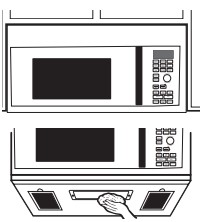
To replace the cooktop light/nite light, first disconnect the power at the main fuse or circuit breaker panel, or pull the plug
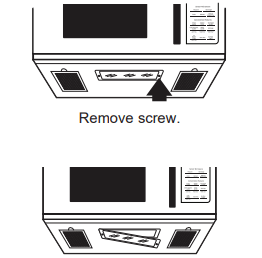
Remove the screw from the side of the light compartment cover and lower the cover until it stops.
Be sure the bulb is cool before removing. Break the adhesive seal by gently unscrewing the bulb.
Screw in the new bulb, then raise the light cover and replace the screw. Connect electrical power to the oven.
Vent Fan
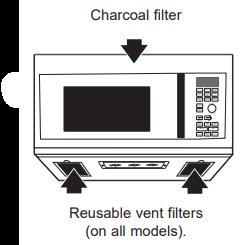
The vent fan has two metal reusable vent filters.
Models that recirculate air back into the room also use a charcoal filter.
Reusable Vent Filters
The metal filters trap grease released by foods on the cooktop. They also prevent flames from foods on the cooktop from damaging the inside of the oven.
For this reason, the filters must always be in place when the hood is used. The vent filters should be cleaned once a month, or as needed.
Removing and Cleaning the Filters
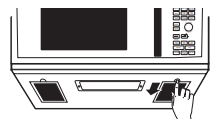
To remove, slide them to the rear using the tabs. Pull down and out
To clean the vent filters, soak them and then swish around in hot water and detergent. Don’t use ammonia or ammonia products because they will darken the metal. Light brushing can be used to remove embedded dirt.
Rinse, shake and let dry before replacing.
To replace, slide the filters into the frame slots on the back of each opening. Press up and to the front to lock into place.
Charcoal Filter
The charcoal filter cannot be cleaned. It must be replaced. See back cover for ordering online at GEAppliances website.
If the model is not vented to the outside, the air will be recirculated through a disposable charcoal filter that helps remove smoke and odors.
The charcoal filter should be replaced when it is noticeably dirty or discolored (usually after 6 to 12 months, depending on usage). See Optional Kits page 24, for more information.
CHARCOAL FILTER REPLACEMENT
Unplug the microwave oven.
Remove the vent grille mounting screws.
Tip the grille forward, then lift out to remove.
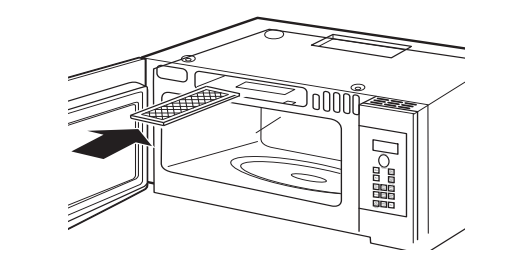
Remove the charcoal filter.
Slide a new charcoal filter into place.
Slide the bottom of the vent grille into place. Push the top until is snaps into place. Replace the mounting screws
Plug in the microwave oven.
TROUBLESHOOTING TIPS
Problem
Possible Cause
What to Do
Oven will not start
A fuse in your home may be blown or the circuit breaker tripped.
Replace fuse or reset circuit breaker.
Power surge.
Unplug the microwave oven, then plug it back in.
Plug not fully inserted wall outlet.
Make sure the 3-prong plug on the into oven is fully inserted into wall outlet.
Door not securely closed.
Open the door and close securely.
Floor of the oven is warm, even when the oven has not been used
Heat from the cooktop light may make the oven floor get warm.
This is normal.
“LOCKED” appears on display
The control has been locked
Press and hold SET CLOCK for about 3 seconds to unlock the control.
You hear an unusual, low-tone beep
You have tried to start the Reminder without a valid time of day.
Start over and enter a valid time of day
You have tried to change the power level when it is not allowed.
Many of the oven’s features are preset and cannot be changed.
“SENSOR ERROR” appears on display
When using a Sensor feature, the door was opened before steam could be detected.
Do not open door until steam is sensed and time is shown counting down on display.
Steam not detected in maximum amount of time.
Use Time Cook to heat for more time.
Food amount too large for Sensor Reheat
Sensor Reheat is for single servings of recommended foods.
Use Time Cook for large amounts of food.
Things That Are Normal With Your Microwave Oven
Steam or vapor escaping from around the door.
Light reflection around door or outer case.
Dimming oven light and change in the blower sound at power levels other than high.