Safety and Troubleshooting Information
•Safety
Precautions
and
Maintenance
• Installation
Locations
• FAQs
• Troubleshooting
• Regulatory
Information
• Other Related
Information
Safety and Troubleshooting Information
Safety precautions and maintenance
WARNING: Use of controls, adjustments or procedures other than those
specified in this documentation may result in exposure to shock,
electrical hazards and/or mechanical hazards.
Read and follow these instructions when connecting and using your computer monitor:
● Unplug the monitor if you are not going to use it for an extensive period of time.
● Unplug the monitor if you need to clean it with a slightly damp cloth. The screen may be wiped
with a dry cloth when the power is off. However, never use alcohol, solvents or ammonia-based
liquids.
● Consult a service technician if the monitor does not operate normally when you have followed
the instructions in this manual.
● The casing cover should be opened only by qualified service personnel.
● Keep the monitor out of direct sunlight and away from stoves or any other heat source.
● Remove any object that could fall into the vents or prevent proper cooling of the monitor’s
electronics.
● Do not block the ventilation holes on the cabinet.
● Keep the monitor dry. To avoid electric shock, do not expose it to rain or excessive moisture.
● When positioning the monitor, make sure the power plug and outlet are easily accessible.
● If turning off the monitor by detaching the power cable or DC power cord, wait for 6 seconds
before attaching the power cable or DC power cord for normal operation.
● To avoid the risk of shock or permanent damage to the set, do not expose the monitor to rain or
excessive moisture.
● IMPORTANT: Always activate a screen saver program during your application. If a still image in
high contrast remains on the screen for an extended period of time, it may leave an 'after-image'
or 'ghost image' on front of the screen. This is a well-known phenomenon that is caused by the
shortcomings inherent in LCD technology. In most cases, the after-image will disappear
gradually over a period of time after the power has been switched off. Be aware, that the after-
image symptom cannot be repaired and is not covered under warranty.
Consult a service technician if the monitor does not operate normally when the operating instructions
given in this manual have been followed.
RETURN TO TOP OF THE PAGE
Installation Locations
● Avoid exposure to heat and extreme cold.
file:///D|/My%20documents/dfu/J/english/200p4/safety/safety.htm (1 of 2) [4/15/2004 1:44:37 PM]

Safety and Troubleshooting Information
● Do not store or use the LCD monitor in locations exposed to heat, direct sunlight or extreme
cold.
● Avoid moving the LCD monitor between locations with large temperature differences. Choose a
site that falls within the following temperature and humidity ranges.
❍ Temperature: 5-35°C 41-95°F
❍ Humidity: 20-80% RH
● Do not subject the LCD monitor to severe vibration or high impact conditions. Do not place the
LCD monitor in the trunk of a car.
● Take care not to mishandle this product by either knocking or dropping it during operation or
transportation.
● Do not store or use the LCD monitor in locations where there is a high level of humidity or in
dusty environments. Do not allow water or other liquids to spill on or into the LCD monitor.
RETURN TO TOP OF THE PAGE
file:///D|/My%20documents/dfu/J/english/200p4/safety/safety.htm (2 of 2) [4/15/2004 1:44:37 PM]

About This Manual
• About This
Guide
• Notational
Descriptions
About This Manual
About This Guide
This electronic user's guide is intended for anyone who uses the Philips LCD Monitor. It describes the
LCD monitor's features, setup, operation and other important information. Its contents are identical to the
information in our printed version.
It includes the following sections:
● Safety and Troubleshooting Information provides tips and solutions for common problems as well
as other related information you may need.
● About This Electronic User's Manual gives an overview of information included, along with
notation icon descriptions and other documentation for your reference.
● Product Information gives an overview of the monitor's features as well as the technical
specifications for this monitor.
● Installing Your Monitor describes the initial setup process and gives an overview of how to use the
monitor.
● On-Screen Display provides information on adjusting the settings on your monitor.
● Customer Care and Warranty contains a list of worldwide Philips Consumer Information Centers
along with help desk phone numbers and information on the warranty applicable to your product.
● Glossary defines technical terms.
● Download and Print Option transfers this entire manual to your hard drive for easy reference.
RETURN TO TOP OF THE PAGE
Notational Descriptions
The following subsections describe notational conventions used in this document.
Notes, Cautions and Warnings
Throughout this guide, blocks of text may be accompanied by an icon and printed in bold or italic type.
These blocks contain notes, cautions or warnings. They are used as follows:
file:///D|/My%20documents/dfu/J/english/200p4/about/about.htm (1 of 2) [4/15/2004 1:44:40 PM]
About This Manual
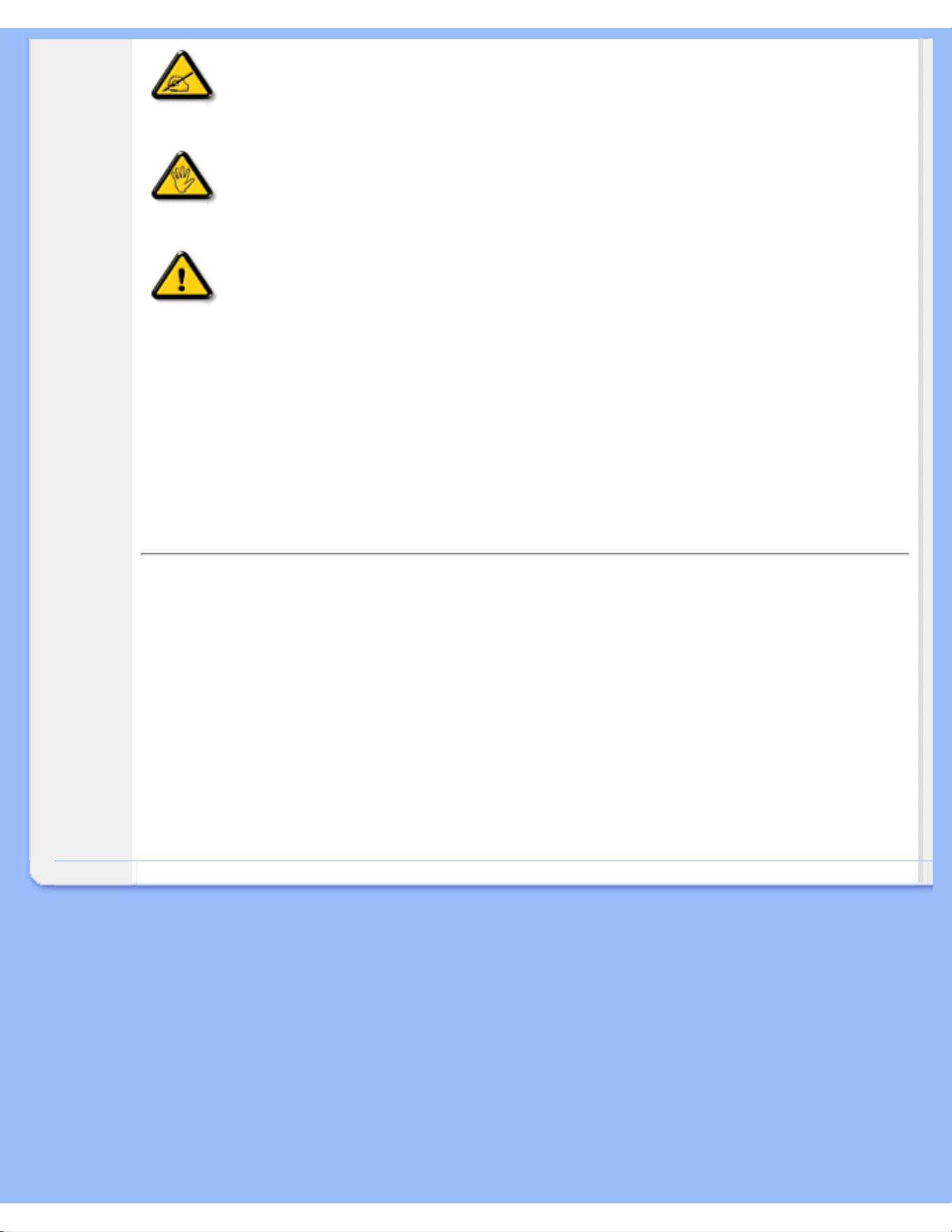
NOTE: This icon indicates important information and tips that help you make better
use of your computer system.
CAUTION: This icon indicates information that tells you how to avoid either potential
damage to hardware or loss of data.
WARNING: This icon indicates the potential for bodily harm and tells you how to
avoid the problem.
Some warnings may appear in alternate formats and may not be accompanied by an icon. In such cases,
the specific presentation of the warning is mandated by the relevant regulatory authority.
RETURN TO TOP OF THE PAGE
©2003 Koninklijke Philips Electronics NV
All rights reserved. Reproduction, copying, use, modification, hiring, renting, public performance, transmission and/or
broadcasting in whole or in part is prohibited without written consent of Philips Electronics NV
file:///D|/My%20documents/dfu/J/english/200p4/about/about.htm (2 of 2) [4/15/2004 1:44:40 PM]
Product Information
• Product
Features
•Technical
Specifications
•Resolution &
Preset Modes
•Philips Pixel
Defect Policy
•Automatic
Power Saving
•Physical
Specification
•Pin
Assignment
•Product
Views
•Physical
Function
Product Information
Product Features
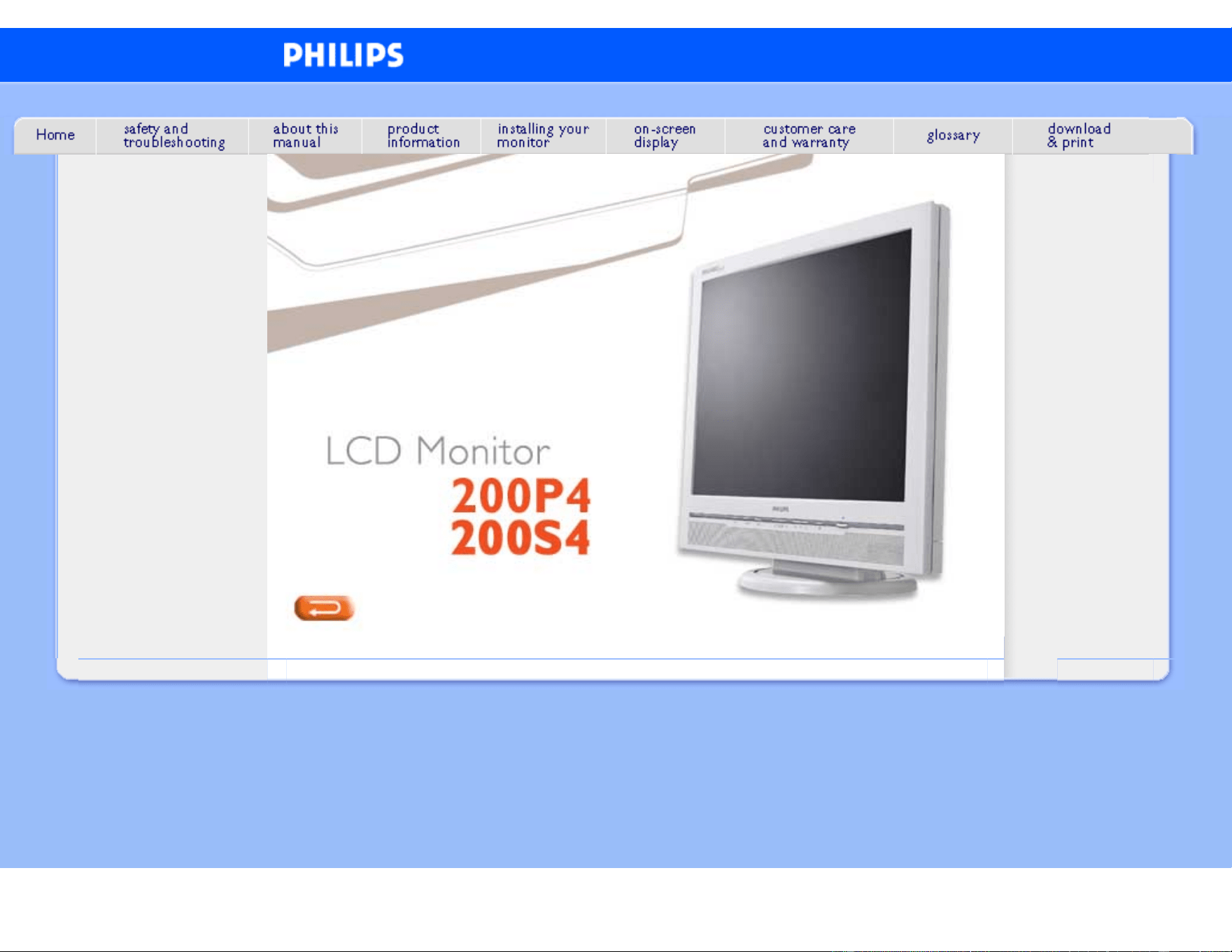
BRILLIANCE 200P4
200S4
● 20-inch color LCD monitor with excellent display performance
● Multiple video input allowing connection of DVI-D digital and VGA analog
● Embedded AC power supply
● Front firing speakers with stereo 2x2W RMS stereo sound output
● Advanced AUTO adjustment optimizes picture quality
● Adjustable tilt and swivel function
● Picture-in-Picture (PIP) function for displaying both PC and video simultaneously on the screen
● Built in module to provide S-Video & CVBS Video inputs(200P4VS, 200P4VG, 200P4VB models)
● Optional module to provide S-video and CVBS video inputs(200P4SS, 200P4SG, 200P4SB,
200S4SS models)
● Optional super-ergo base for height adjustment
● sRGB compliant
RETURN TO TOP OF THE PAGE
Technical Specifications*
LCD PANEL
• Type TFT LCD
• Screen size 20.1" / 51cm
• Pixel Pitch 0.255 x 0.255mm
• LCD Panel type
1600 x 1200 pixels
R.G.B. vertical stripe
Anti-glare polarizer, hard coated
• Effective viewing area 408 x 306 mm
• Display Colors 8 bits interface (16M colors)
SCANNING
Vertical refresh rate 56Hz-85Hz
Horizontal Frequency 30kHz-94kHz (Analog input)
file:///D|/My%20documents/dfu/J/english/200p4/product/product.htm (1 of 8) [4/15/2004 1:44:43 PM]
Product Information
VIDEO
• Video dot rate 165 MHz
• Input impedance
- Video
75 ohm
- Sync
2K2 ohm
• Input signal levels 0.7 Vpp
• Sync input signal
Separate sync
Composite sync
Sync on green
• Sync polarities Positive and negative
• S-Video Y input 1.0Vpp, C input 0.3Vpp, 75ohm input impedance
• CVBS Composite, 1.0Vpp, 75 ohm input impedance
•Video interface
D-Sub (Analog)
DVI-D (Digital)
AUDIO-IN
• Input signal level 0.7 Vpp
• Headphone out signal level
20mW x 2, 32
• Input signal connector 3.5mm mini jack
• Loudspeaker
4W Stereo Audio (2W/channel RMSx2, 200Hz-12kHz, 4
ohm,THD=10%)
Optical characteristics
• Contrast ratio:
200P4: 400:1 (typ.)
200S4: 350:1 (typ.)
• Brightness:
250 cd/m
2
(typ.)
• Peak contrast angle 6 o'clock
• White Chromaticity:
x: 0.283 y: 0.297 (at 9300°K)
x: 0.313 y: 0.329 (at 6500°K)
file:///D|/My%20documents/dfu/J/english/200p4/product/product.htm (2 of 8) [4/15/2004 1:44:43 PM]
Product Information
• Viewing Angle:
(C/R>10)
200P4:
Upper >88° (typ.)
Lower >88° (typ.)
Left >88° (typ.)
Right >88° (typ.)
200S4:
Upper >80° (typ.)
Lower >80° (typ.)
Left >80° (typ.)
Right >80° (typ.)
• Response time
200P4: 16 ms (typ.)
200S4: 20 ms (typ.)
sRGB
sRGB is a standard for ensuring correct exchange of colors between different devices (e.g. digital
cameras, monitors, printers, scanners, etc.)
Using a standard unified color space, sRGB will help represent pictures taken by an sRGB compatible
device correctly on your sRGB enabled Philips monitors. In that way, the colors are calibrated and you
can rely on the correctness of the colors shown on your screen.
Important with the use of sRGB is that the brightness and contrast of your monitor is fixed to a
predefined setting as well as the color gamut. Therefore it is important to select the sRGB setting in the
monitor's OSD.
To do so, open the OSD by pressing the OK button on the front of your monitor. Use the down button
to go to Adjust Color and press OK again. Then move the down button to go to sRGB and press OK
again.
Exit this OSD.
After this, please do not change the brightness or contrast setting of your monitor. If you change either
of these, the monitor will exit the sRGB mode and go to a color temperature setting of 6500K.
For more information on sRGB, please visit: www.srgb.com
* This data is subject to change without notice.
RETURN TO TOP OF THE PAGE
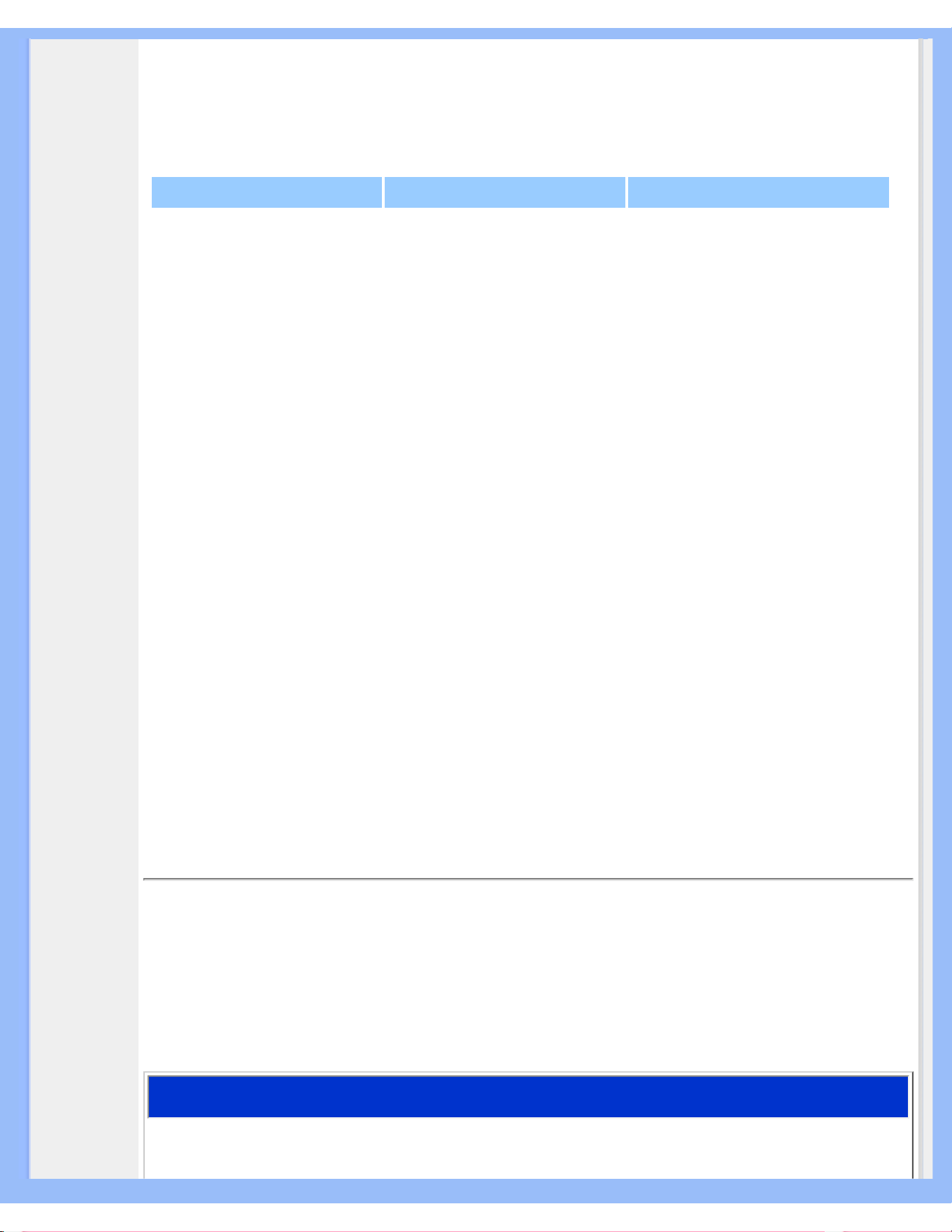
Resolution & Preset Modes
file:///D|/My%20documents/dfu/J/english/200p4/product/product.htm (3 of 8) [4/15/2004 1:44:43 PM]
Product Information
• Maximum
1600 x 1200 at 60Hz(analog input)
1600 x 1200 at 60Hz(digtal input)
• Recommended 1600 x 1200 at 60Hz * at DVI digital input
37 user definable modes
15 factory preset modes:
H. freq (kHz) Resolution V. freq (Hz)
31.5 640*350 70 (IBM VGA 10h)
31.5 720*400 70
31.5 640*480 60
37.5 640*480 75
35.2 800*600 56
37.9 800*600 60
46.9 800*600 75
48.4 1024*768 60
60.0 1024*768 75
69.0 1152*870 75
63.9 1280*1024 60
80.0 1280*1024 75
75.0 1600*1200 60
33.8 1080i 60
45.0 720p 60
(Interlace mode is not applicable except 1080i)
RETURN TO TOP OF THE PAGE
Automatic Power Saving
If you have VESA DPMS compliance display card or software installed in your PC, the monitor can
automatically reduce its power consumption when not in use. If an input from a keyboard, mouse or other
input device is detected, the monitor will 'wake up' automatically. The following table shows the power
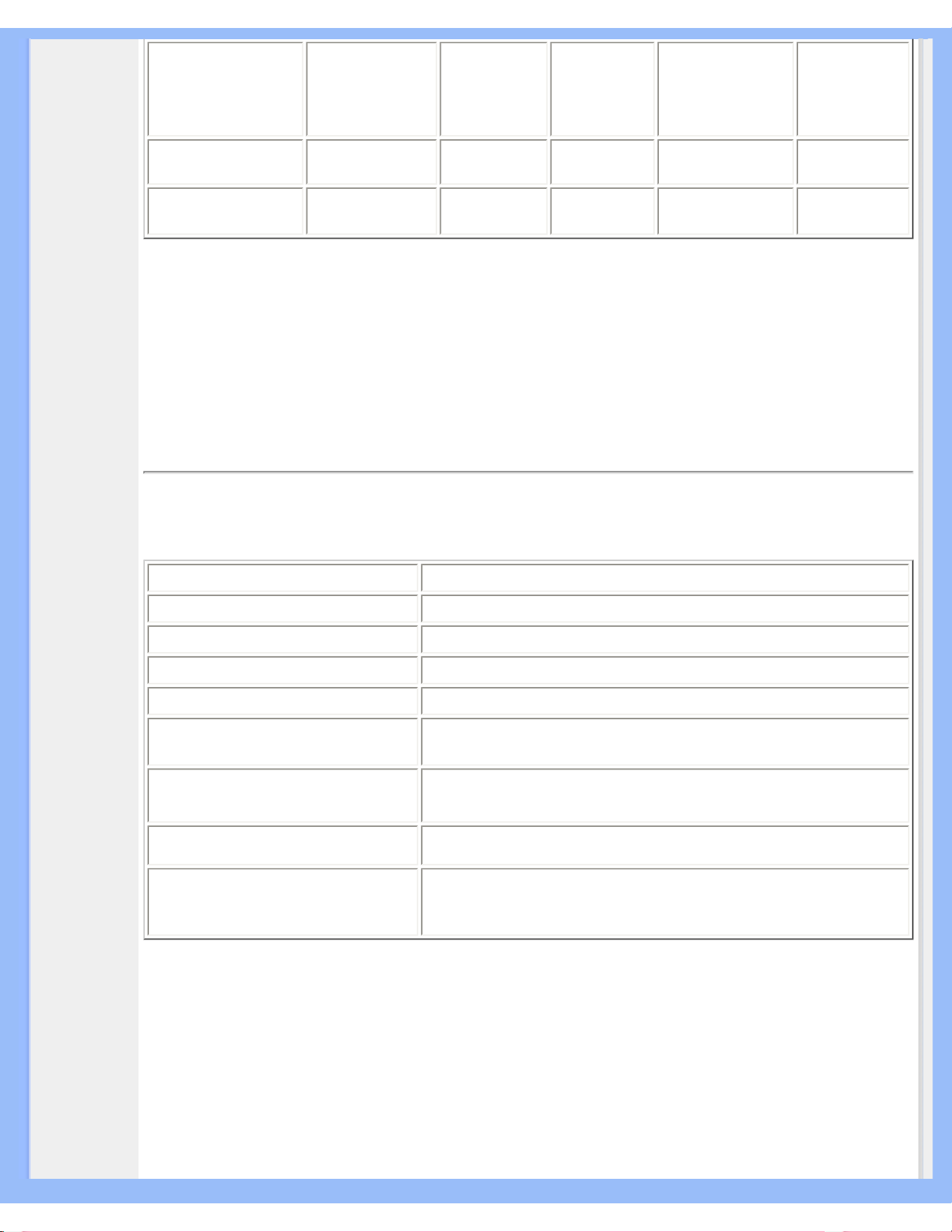
consumption and signaling of this automatic power saving feature:
Power Management Definition
file:///D|/My%20documents/dfu/J/english/200p4/product/product.htm (4 of 8) [4/15/2004 1:44:43 PM]
Product Information
VESA Mode Video H-sync V-sync Power Used LED color
ON Active Yes Yes < 65W Green
OFF Blanked No No < 1.5W Amber
This monitor is ENERGY STAR
®
compliant. As an ENERGY STAR
®
Partner, PHILIPS has
determined that this product meets the
ENERGY STAR
®
guidelines for energy efficiency.
RETURN TO TOP OF THE PAGE
Physical Specifications
• Dimension (WxHxD) 488 x 459 x220 mm (incl. Pedestal)
• Weight 7.5 Kg
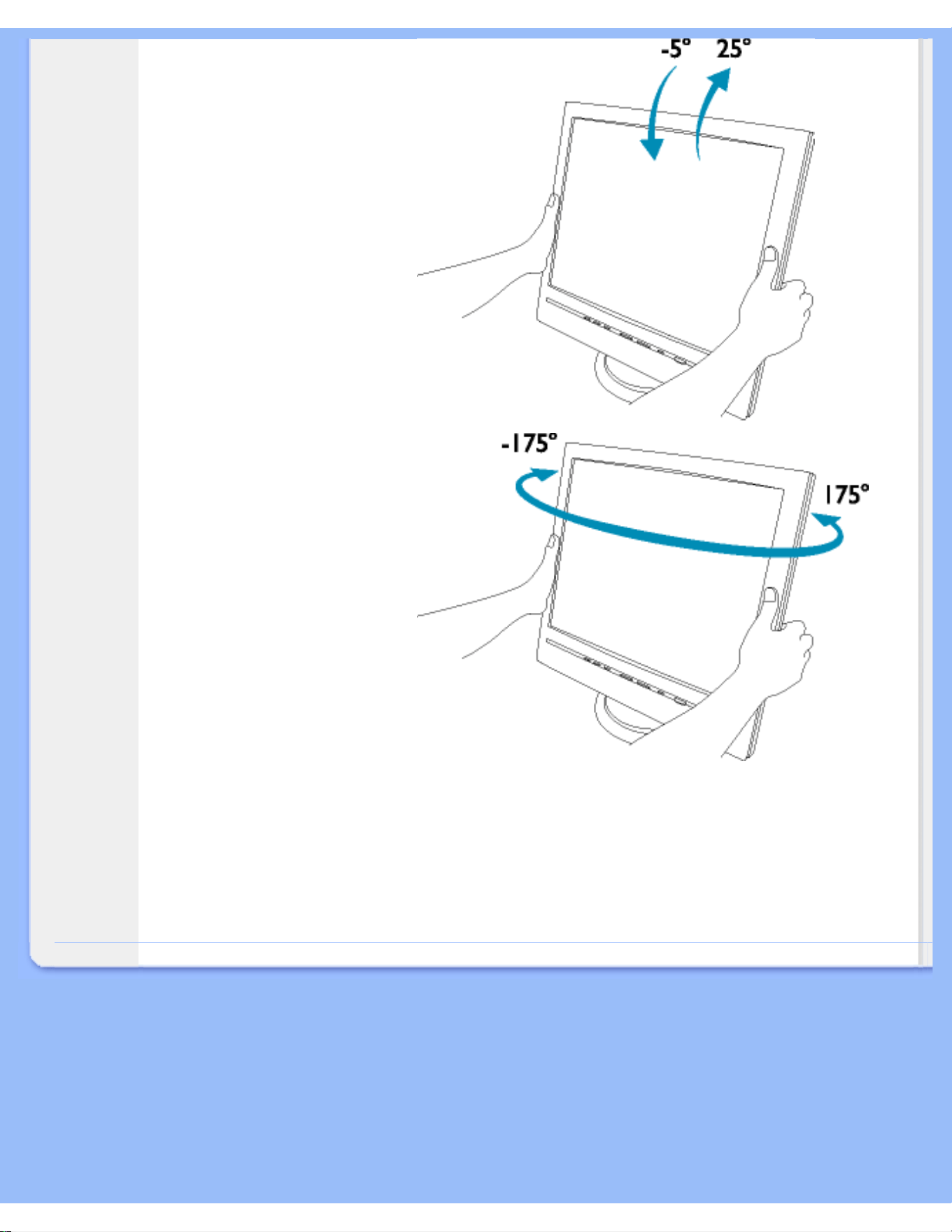
• Tilt / Swivel -5° ~ 25° / + - 175°
• Power supply 100 — 240 VAC, 50/60 Hz
• Power consumption 50 W* (typ.)
• Temperature
5° C to 35° C (operating)
-20° C to 60° C (storage)
• Relative humidity
20% to 80%
• System MTBF 50K hrs (excluding CCFL 40K hrs)
• Cabinet color
200P4VG/200P4SG: Light Gray
200P4VB/200P4SB: Black
200P4VS/200P4SS/200S4SS: Silver
* This data is subject to change without notice.
* Resolution 1600x1200, standard size, contrast max., brightness 50%, 9300° K, full white pattern,
without audio/USB.
RETURN TO TOP OF THE PAGE
file:///D|/My%20documents/dfu/J/english/200p4/product/product.htm (5 of 8) [4/15/2004 1:44:43 PM]
Product Information
Pin Assignment
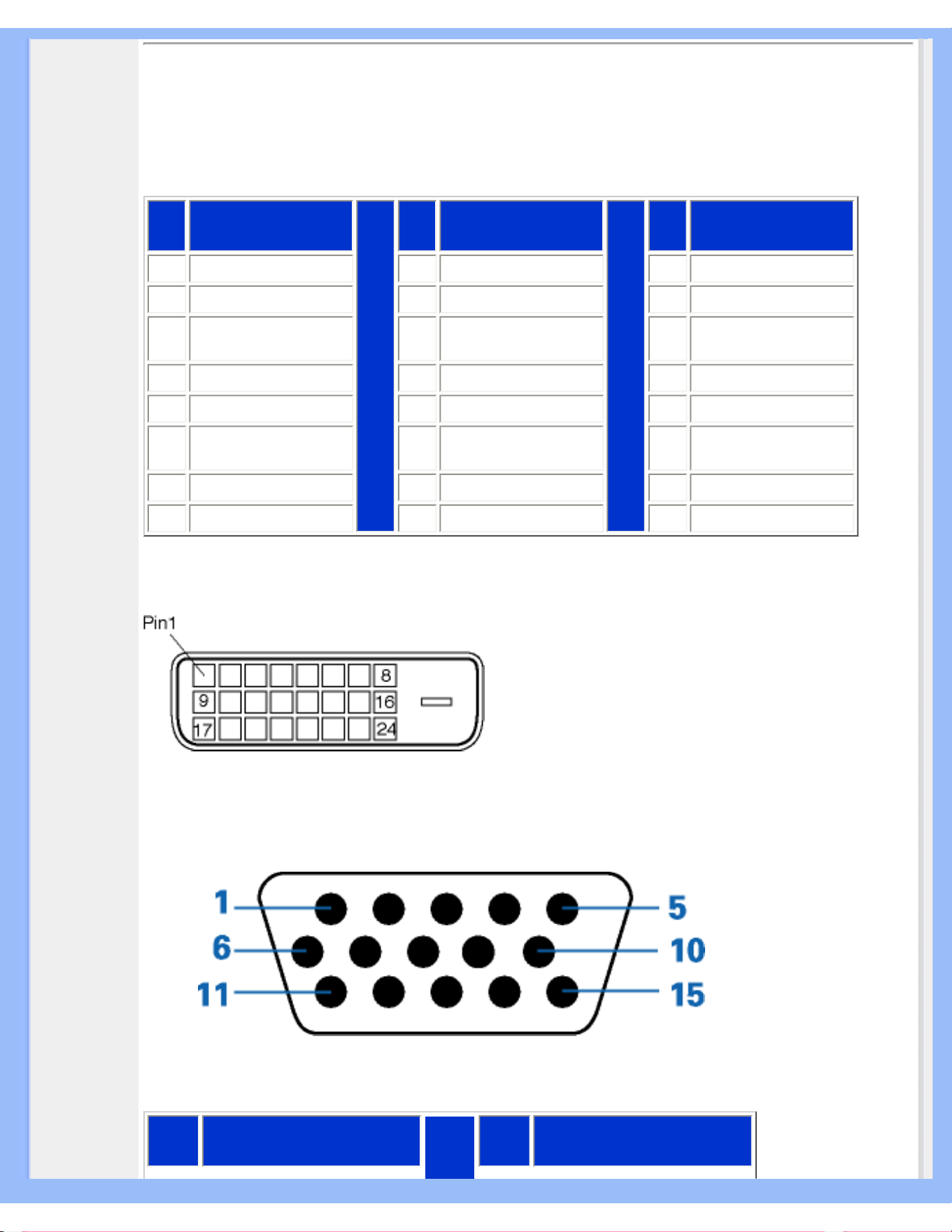
1. The digital only connector contains 24 signal contacts organized in three rows of eight contacts. Signal
pin assignments are listed in the following table:
Pin
No.
Signal
Assignment
Pin
No.
Signal
Assignment
Pin
No.
Signal
Assignment
1
T.M.D.S. Data2-
9
T.M.D.S. Data1- 17 T.M.D.S. Data0-
2
T.M.D.S. Data2+
10
T.M.D.S. Data1+ 18 T.M.D.S. Data0+
3
T.M.D.S. Data2/4
Shield
11
T.M.D.S. Data1/3
Shield
19
T.M.D.S. Data0/5
Shield
4
No connect
12
No connect 20 No connect
5
No connect
13
No connect 21 No connect
6
DDC Clock
14
+5V Power 22
T.M.D.S. Clock
Shield
7
DDC Data
15
Ground (for +5V) 23 T.M.D.S. Clock+
8
No connect 16 Hot Plug Detect 24 T.M.D.S. Clock-
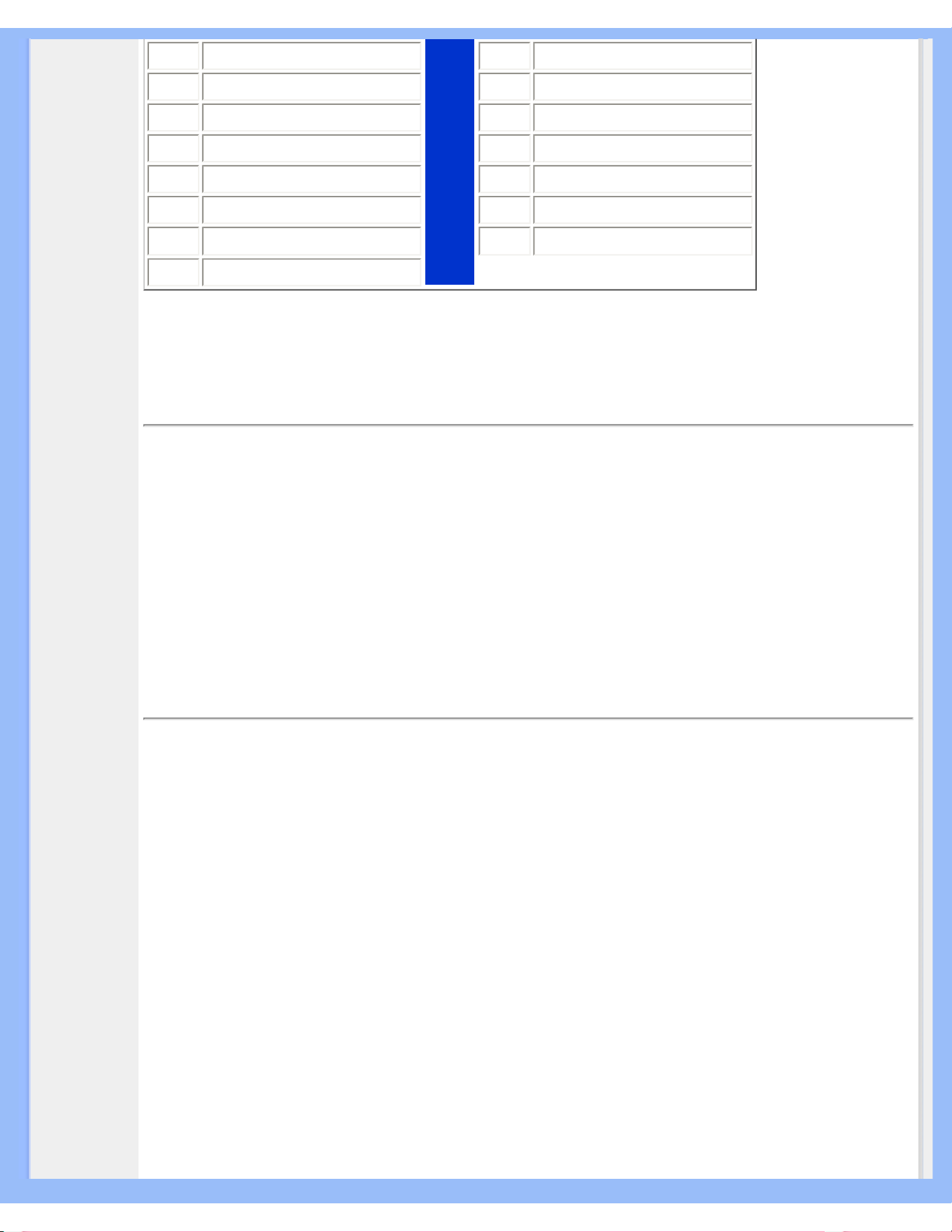
2. The 15-pin D-sub connector (male) of the signal cable:
Pin
No.
Assignment
Pin
No.
Assignment
file:///D|/My%20documents/dfu/J/english/200p4/product/product.htm (6 of 8) [4/15/2004 1:44:43 PM]
Product Information
1
Red video input
9
+5V
2
Green video input/SOG
10
Logic ground
3
Blue video input
11
Ground
4
Ground
12
Serial data line (SDA)
5
No connect
13
H. Sync / H+V
6
Red video ground
14
V. Sync (VCLK for DDC)
7
Green video ground
15
Data clock line (SCL)
8
Blue video ground
RETURN TO TOP OF THE PAGE
Product Views
Follow the links to see various views of the monitor and its components.
Front View Product Description
RETURN TO TOP OF THE PAGE
Physical Function
1) Tilt
file:///D|/My%20documents/dfu/J/english/200p4/product/product.htm (7 of 8) [4/15/2004 1:44:43 PM]
Installing Your LCD Monitor
•
Front View
Produt
Description
•
Setting Up
and
Connecting
Your Monitor
•
VESA
Standard
Mounting
•
Getting
Started
•
Optimizing
Performance
Installing Your LCD Monitor
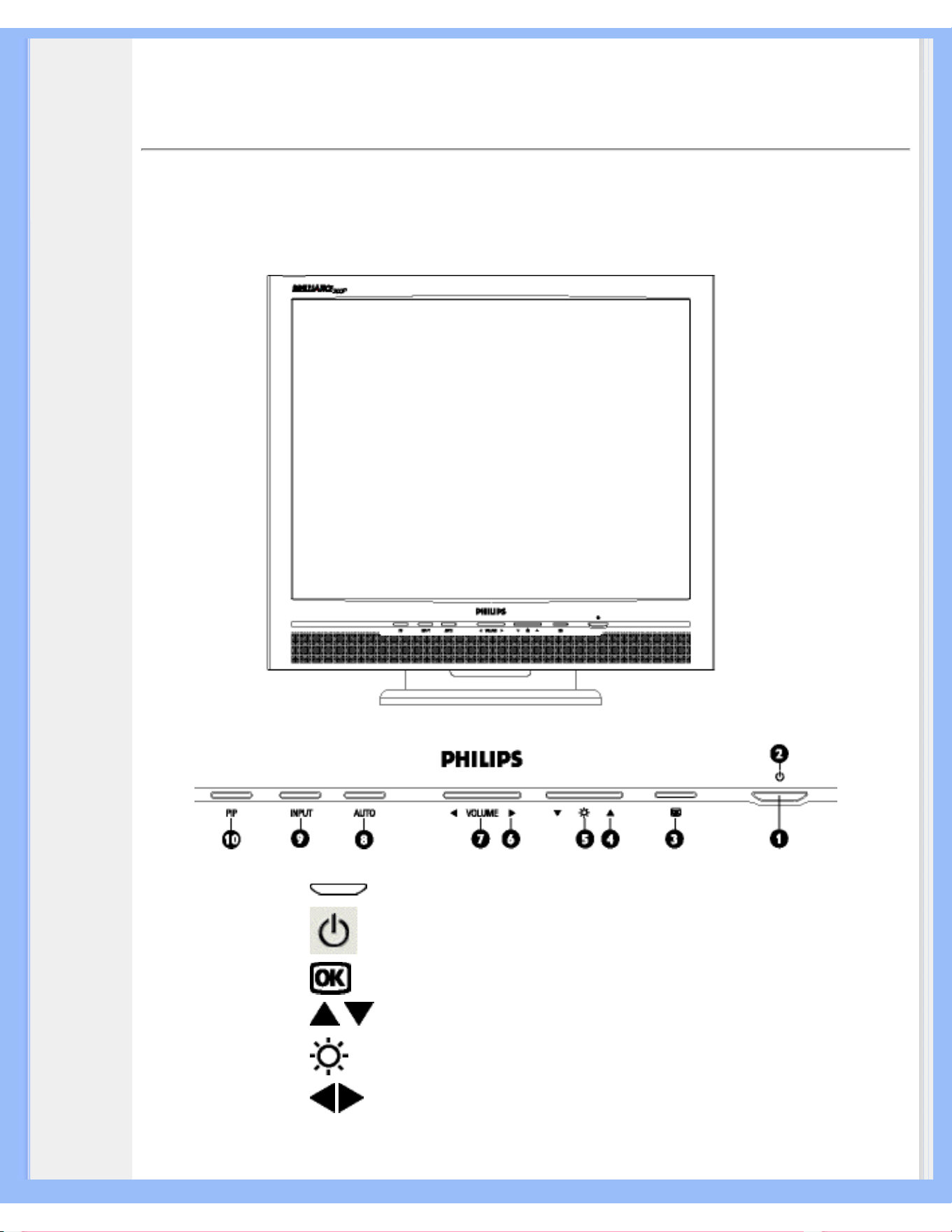
Front View Product Description
1 To switch monitor's power On and Off
2
Power LED
3
To access OSD menu
4
To adjust the OSD
5
To adjust brightness of the display
6
To adjust the OSD
7
VOLUME
To adjust speaker volume
file:///D|/My%20documents/dfu/J/english/200p4/install/install.htm (1 of 3) [4/15/2004 1:44:46 PM]
Installing Your LCD Monitor
8
AUTO
Automatically adjust the horizontal position, vertical position,
phase and clock setting
9
INPUT
Signal input selection
10
PIP/SIZE
Activate PIP (Picture in Picture) window (200P4V)
or
adjust screen size (200P4S, 200S4S)
RETURN TO TOP OF THE PAGE
Rear View
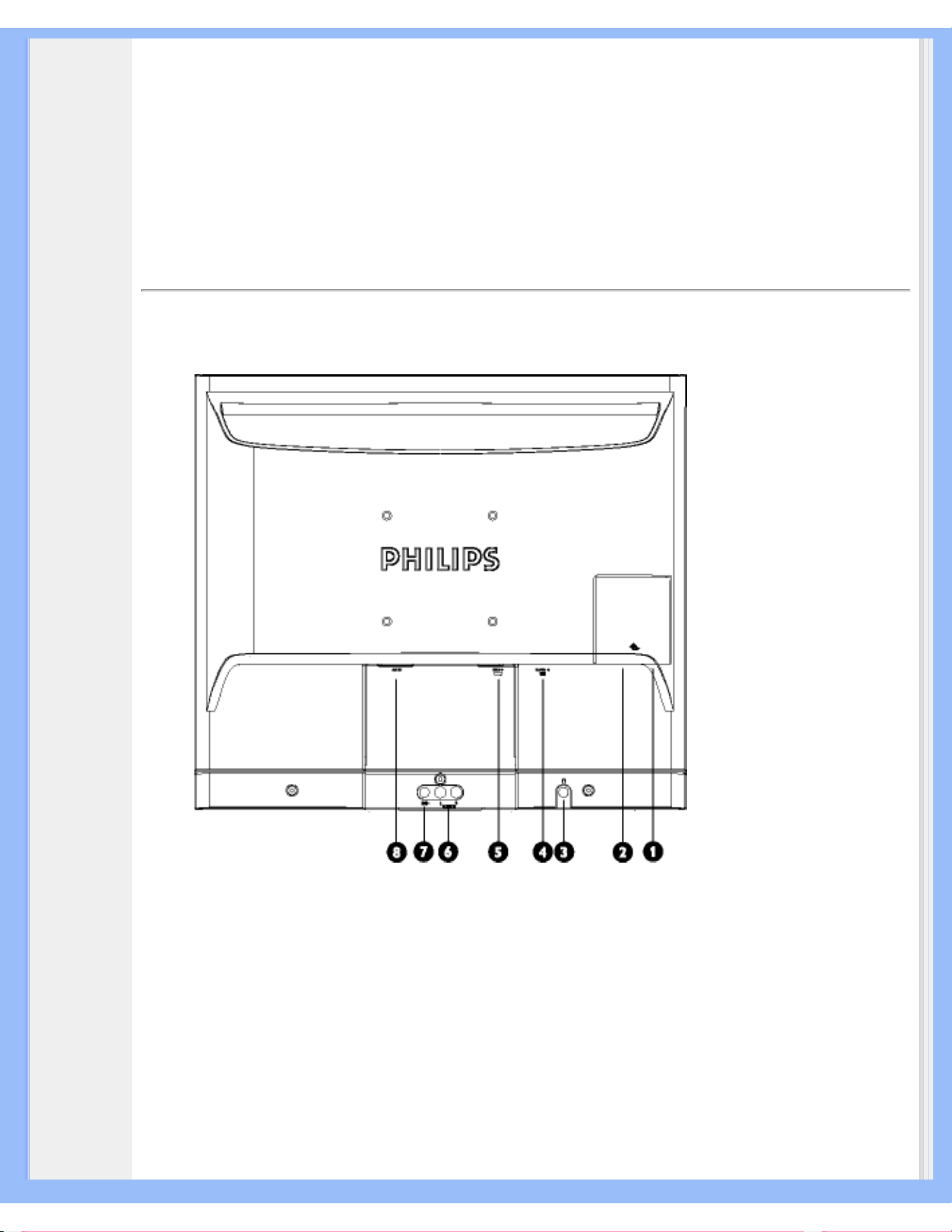
1 CVBS video input (for video model 200P4V- only )
2 S-Video input (for video model 200P4V- only )
3 Earphone jack
4 VGA input
5 DVI-D input
6 Audio R/L input
7 PC audio input
8 AC power input
file:///D|/My%20documents/dfu/J/english/200p4/install/install.htm (2 of 3) [4/15/2004 1:44:46 PM]
Installing Your LCD Monitor
RETURN TO TOP OF THE PAGE
Optimizing Performance
● For best performance, ensure that your display settings are set at 1600x1200@60Hz
Note: You can check the current display settings by pressing the 'OK' button once.
Go into the Product Information. The current display mode is shown on the item
called RESOLUTION.
● You can also install the Flat Panel Adjust (FP Adjust) program, a program for getting the best
performance out of your monitor. This is included on this CD. Step-by-step instructions are provided
to guide you through the installtion process. Click on the link to know more about this program.
More about FP_setup04.exe
RETURN TO TOP OF THE PAGE
file:///D|/My%20documents/dfu/J/english/200p4/install/install.htm (3 of 3) [4/15/2004 1:44:46 PM]
On-Screen Display
•Description
of the On-
Screen
Display
•
The OSD
Tree
On-Screen Display
Description of the On Screen Display
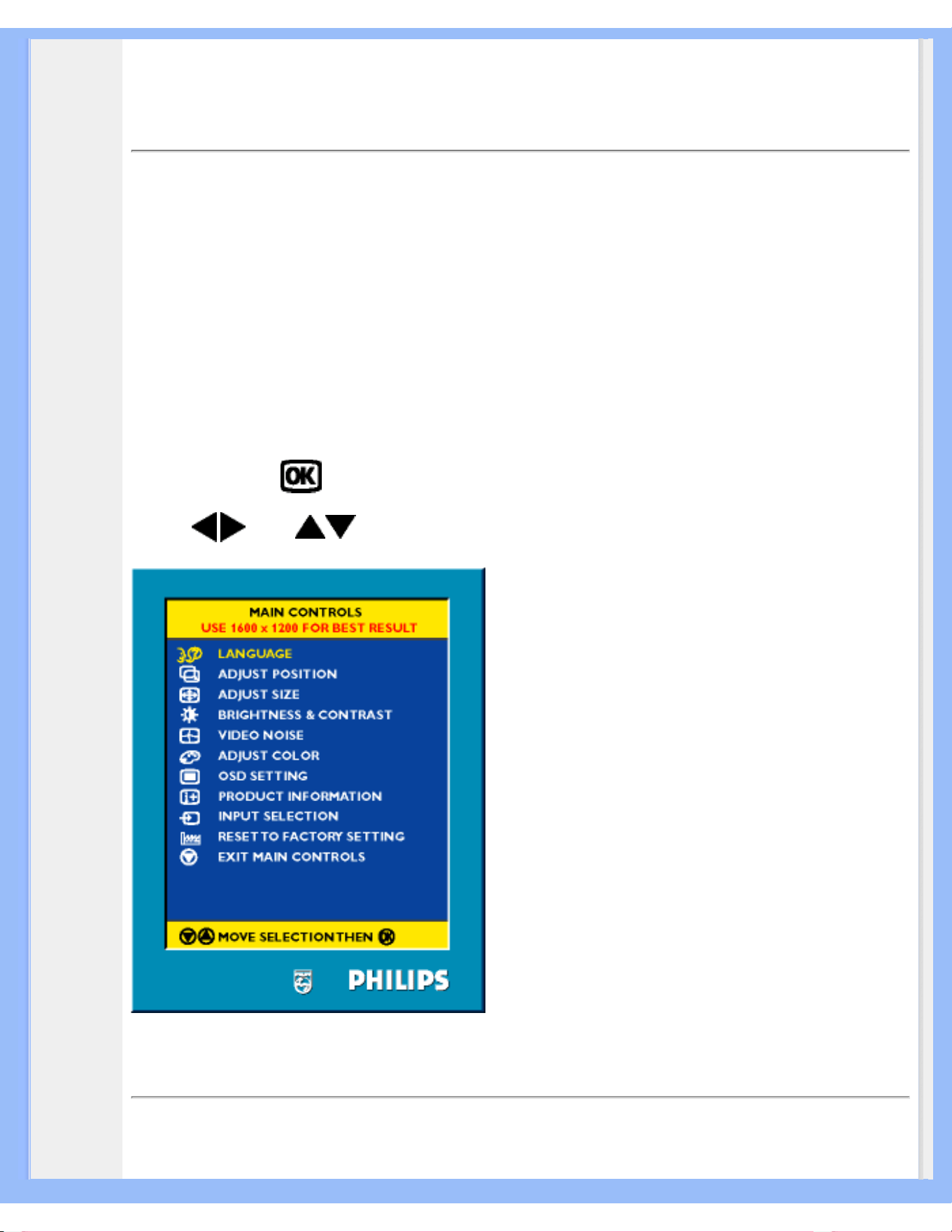
What is the On-Screen Display?
This is a feature in all Philips LCD monitors. It allows an end user to adjust screen performance of the
monitors directly through an on-screen instruction window. The user interface provides user-friendliness and
ease-of-use when operating the monitor.
Basic and simple instruction on the control keys.
When you press the
button on the front control of your monitor, the On-Screen Display (OSD) Main
Controls window will pop up and you can then start making adjustments to your monitor's various features.
Use the
or the keys to make your adjustments.
RETURN TO TOP OF THE PAGE
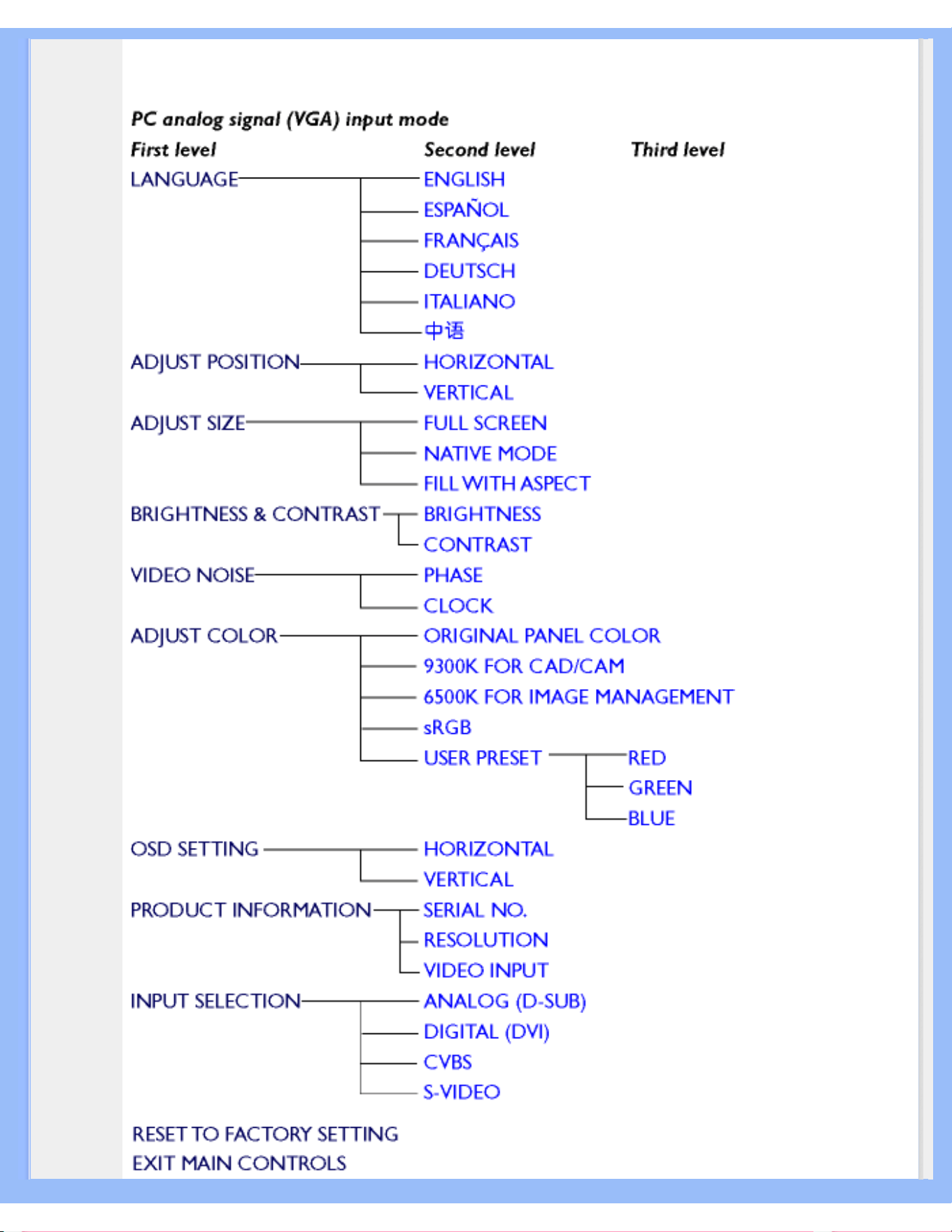
The OSD Tree
file:///D|/My%20documents/dfu/J/english/200p4/osd/osddesc.htm (1 of 6) [4/15/2004 1:44:49 PM]
On-Screen Display
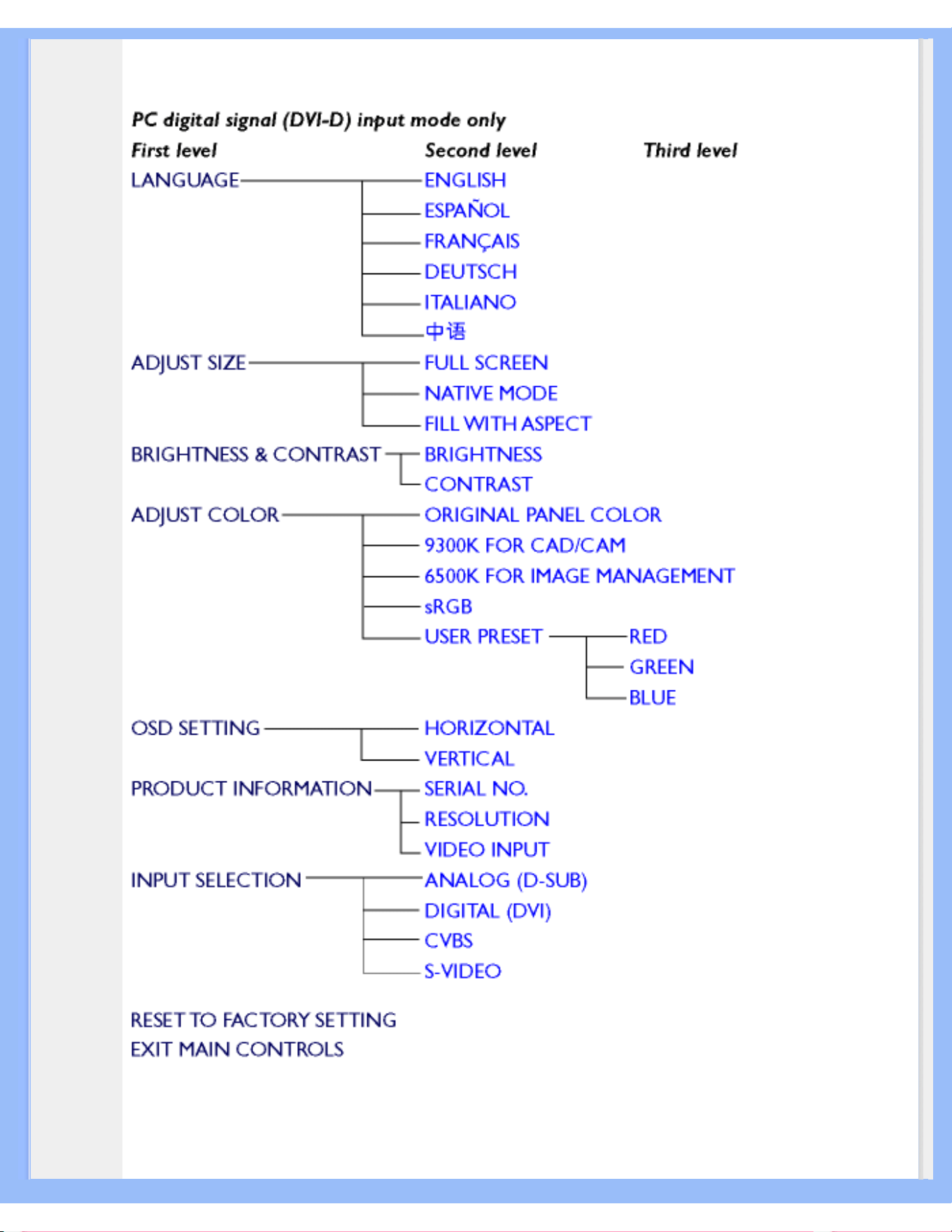
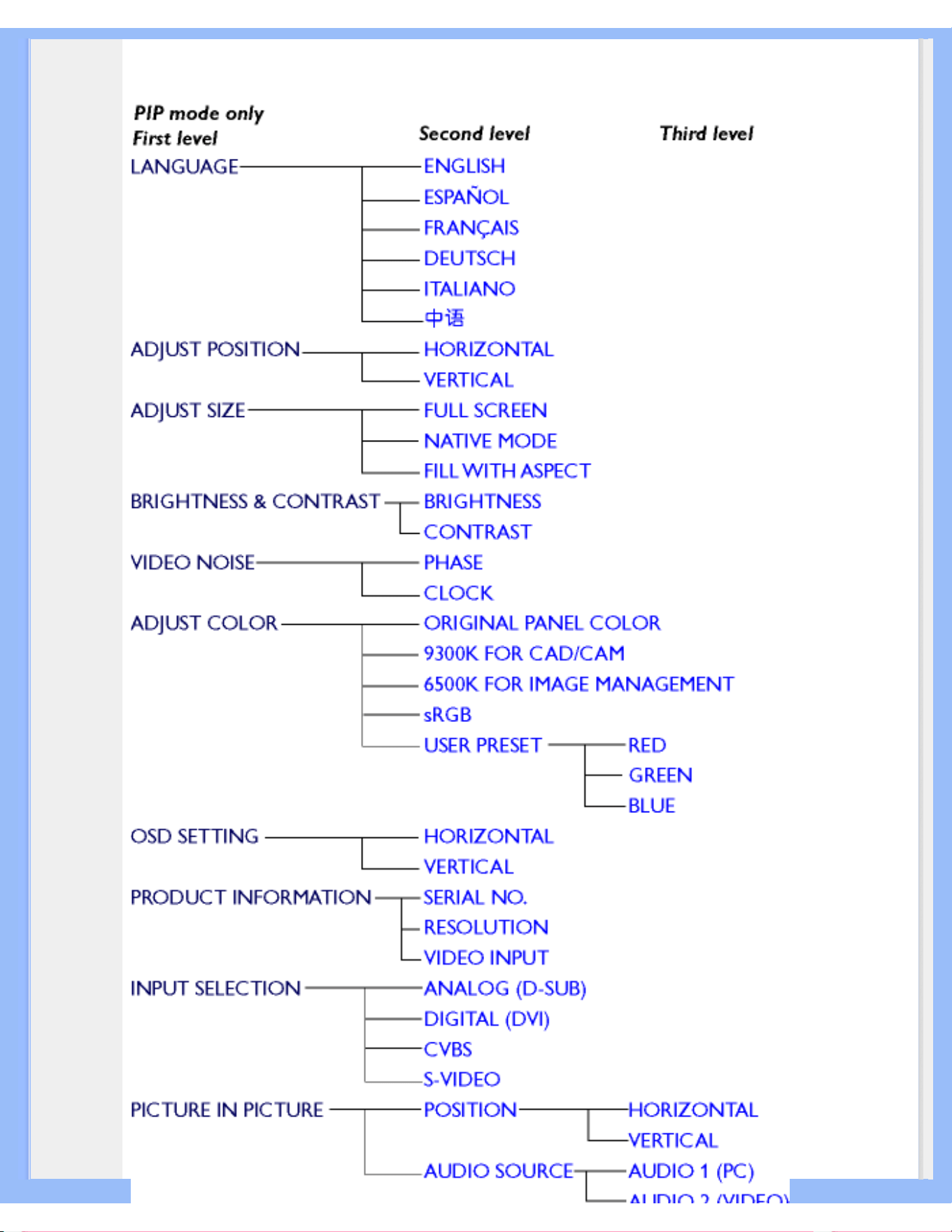
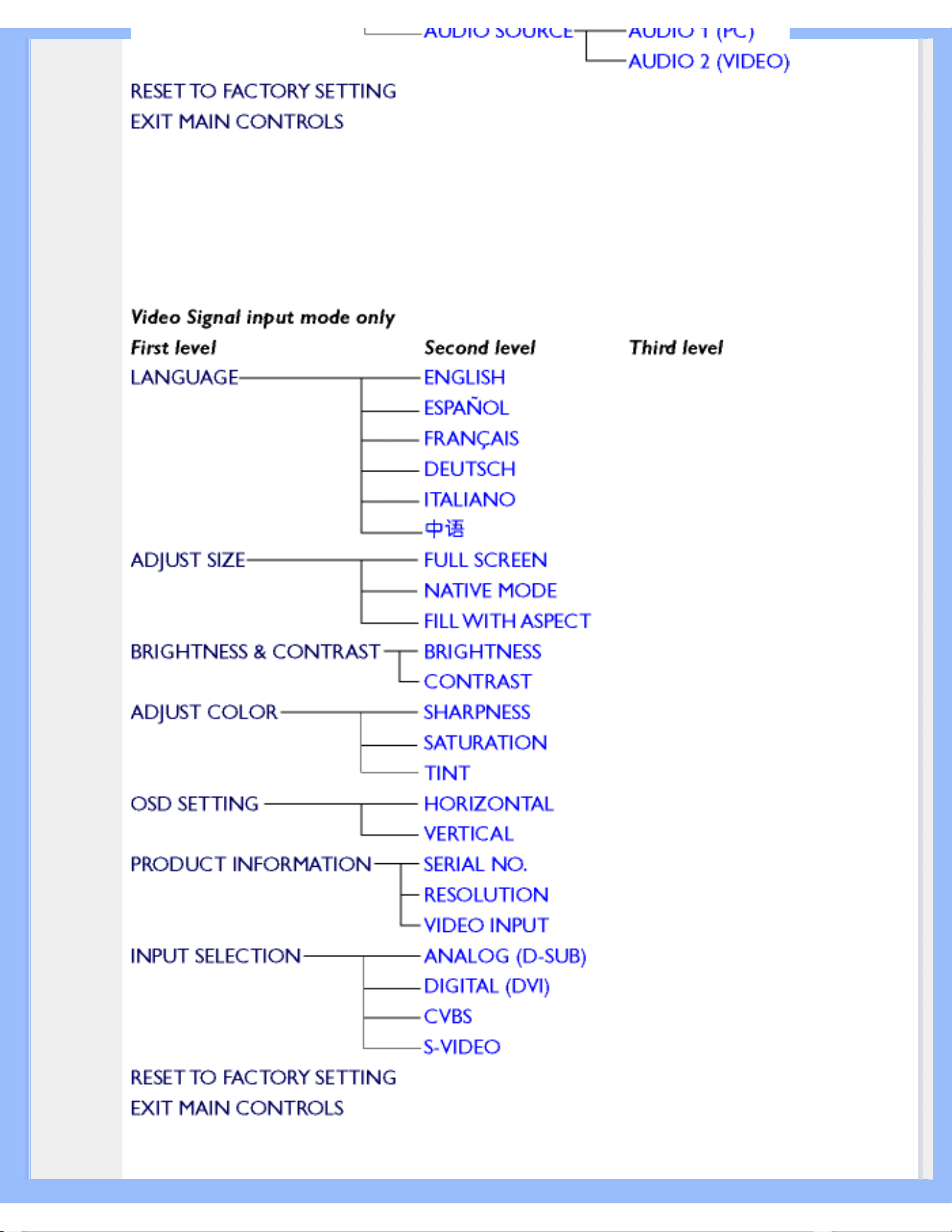
Below is an overall view of the structure of the On-Screen Display. You can use this as a reference when
you want to work your way around the different adjustments later on.
file:///D|/My%20documents/dfu/J/english/200p4/osd/osddesc.htm (2 of 6) [4/15/2004 1:44:49 PM]
On-Screen Display
file:///D|/My%20documents/dfu/J/english/200p4/osd/osddesc.htm (3 of 6) [4/15/2004 1:44:49 PM]
On-Screen Display
file:///D|/My%20documents/dfu/J/english/200p4/osd/osddesc.htm (4 of 6) [4/15/2004 1:44:49 PM]
On-Screen Display
file:///D|/My%20documents/dfu/J/english/200p4/osd/osddesc.htm (5 of 6) [4/15/2004 1:44:49 PM]


Customer Care & Warranty
Customer Care & Warranty
PLEASE SELECT YOUR COUNTRY/AREA TO REVIEW DETAILS OF YOUR WARRANTY
COVERAGE
WESTERN EUROPE: Austria • Belgium • Cyprus • Denmark • France • Germany • Greece •
Finland • Ireland • Italy • Luxembourg • the Netherlands • Norway • Portugal • Sweden •
Switzerland • Spain • United Kingdom
EASTERN EUROPE: Czech Republic • Hungary • Poland • Russia • Turkey
LATIN AMERICA: Antilles • Argentina • Brasil • Chile • Colombia • Mexico • Paraguay • Peru
• Uruguay • Venezuela
NORTH AMERICA: Canada • USA
PACIFIC: Australia • New Zealand
ASIA: Bangladesh • China • Hong Kong • India • Indonesia • Japan • Korea • Malaysia •
Pakistan • Philippines • Singapore • Taiwan • Thailand
AFRICA: Morocco • South Africa
MIDDLE EAST: Dubai • Egypt
file:///D|/My%20documents/dfu/J/english/warranty/warranty.htm [4/15/2004 1:44:51 PM]

Glossary
Glossary
A B C D E F G H I J K L M N O P Q R S T U V W X Y Z
C
Color temperature
A way of describing the color of a radiating source in terms of the temperature (in degrees Kelvin) of a black
body radiating with the same dominant frequency as the source.
Most Philips monitors offer the possibility of setting the color temperature to any desired value.
RETURN TO TOP OF THE PAGE
D
D-SUB
Your monitor comes with a D-Sub cable.
Digital Visual Interface (DVI)
The Digital Visual Interface (DVI) specification provides a high-speed digital connection for visual data types
that is display technology independent. The interface is primarily focused at providing a connection between
a computer and its display device. The DVI specification meets the needs of all segments of the PC industry
(workstation, desktop, laptop, etc.) and will enable these different segments to unite around one monitor
interface specification.
file:///D|/My%20documents/dfu/J/english/200p4/glossary/glossary.htm (1 of 5) [4/15/2004 1:44:55 PM]

Glossary
The DVI interface enables:
1. Reduce signal loss and video noise in signal due to less signal conversion.
2. Independent from display technology, and can be used on LCD, Plasma, LCOS, etc.
3. Plug and play through hot plug detection, EDID and DDC2B.
4. Digital and Analog support in a single connector (DVI-I only).
RETURN TO TOP OF THE PAGE
E
Energy Star Computers Program
An energy conservation program launched by the US Environmental Protection Agency (EPA), promotes
the manufacture and marketing of energy-efficient office automation equipment. Companies joining this
program, must be willing to commit themselves to manufacture one or more products capable of going into
a low -power state (< 30 W) either after a period of inactivity, or after a predetermined time selected by the
user.
RETURN TO TOP OF THE PAGE
L
LCD Liquid Crystal Display
An alphanumeric display, using the unique properties of liquid crystal, to form characters. The latest flat-
panel displays, contains a matrix of hundreds or thousands of individual LCD cells that generate text and
colorful graphics on a screen. They consume little power, though they do require external lighting to make
them legible to the user.
RETURN TO TOP OF THE PAGE
file:///D|/My%20documents/dfu/J/english/200p4/glossary/glossary.htm (2 of 5) [4/15/2004 1:44:55 PM]

Glossary
U
USB or Universal Serial Bus
A smart plug for PC peripherals. USB automatically determines resources (like driver software and bus
bandwidth) required by peripherals. USB makes necessary resources available without user intervention.
● USB eliminates "case anxiety" -- the fear of removing the computer case to install add-on
peripherals. USB also eliminates adjustment of complicated IRQ settings when installing new
peripherals.
● USB does away with "port gridlock." Without USB, PCs are normally limited to one printer, two Com
port devices (usually a mouse and modem), one Enhanced Parallel Port add-on (scanner or video
camera, for example) and a joystick. More and more peripherals for multimedia computers arrive on
the market every day. With USB, up to 127 devices can run simultaneously on a computer.
● USB permits "hot plug-in." There's no need to shut down, plug in, reboot and run set-up to install
peripherals. And no need to go through the reverse process to unplug a device.
In short, USB transforms today's "Plug-and-Pray" into true Plug-and-Play!
Hub
A Universal Serial Bus device that provides additional connections to the Universal Serial Bus.
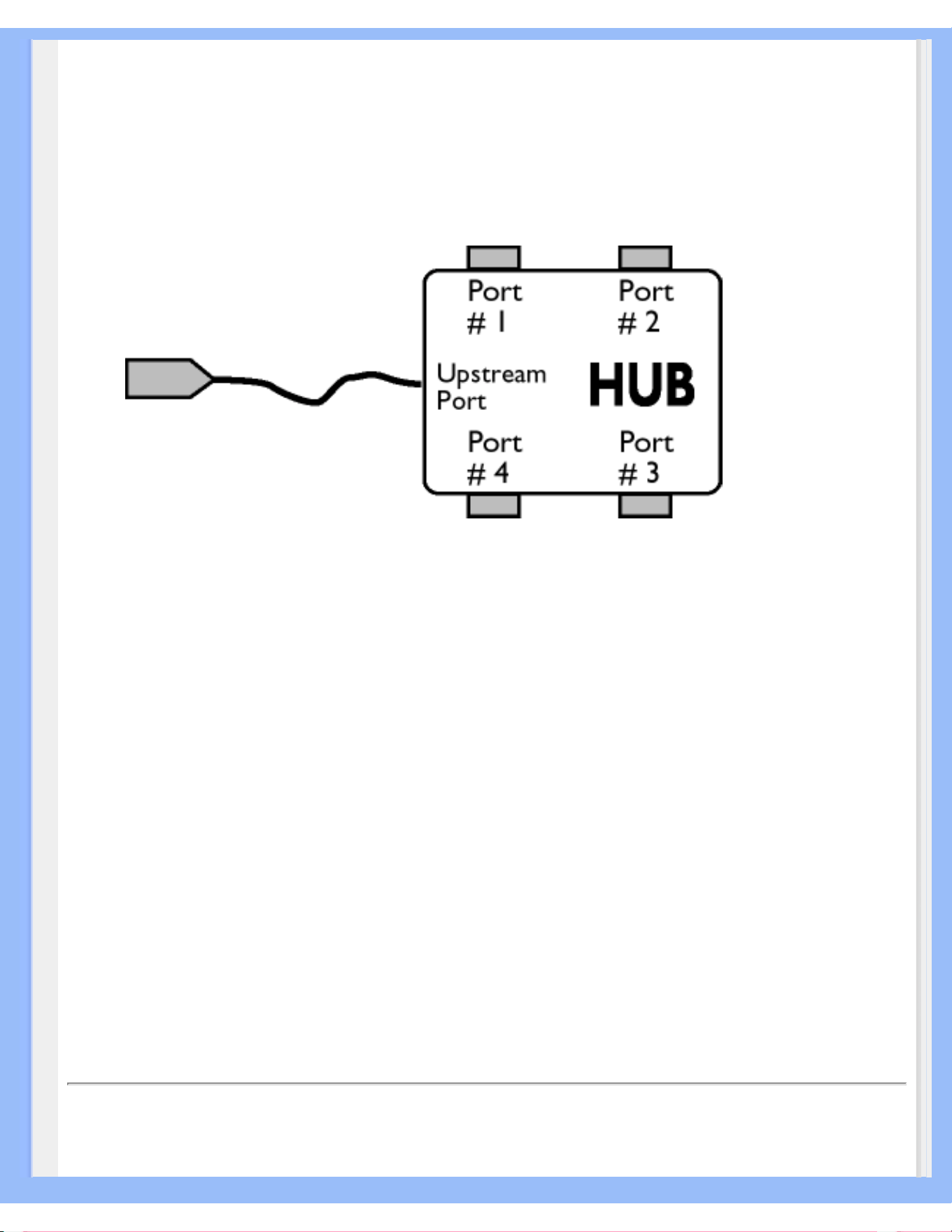
Hubs are a key element in the plug-and-play architecture of USB. The Figure shows a typical hub. Hubs
serve to simplify USB connectivity from the user's perspective providing low cost and complexity.
Hubs are wiring concentrators and enable the multiple attachment characteristics of USB. Attachment points
are referred to as ports. Each hub converts a single attachment point into multiple attachment points. The
architecture supports concatenation of multiple hubs.
The upstream port of a hub connects the hub towards the host. Each of the other downstream ports of a
hub allows connection to another hub or function. Hubs can detect, attach and detach at each downstream
port and enable the distribution of power to downstream devices. Each downstream port can be individually
enabled and configured at either full or low speed. The hub isolates low speed ports from full speed
signaling.
A hub consists of two portions: the Hub Controller and Hub Repeater. The repeater is a protocol-controlled
switch between the upstream port and downstream ports. It also has hardware support for reset and
suspend/resume signaling. The controller provides the interface registers to allow communication to/from
the host. Hub specific status and control commands permit the host to configure a hub and to monitor and
control its ports.
Device
file:///D|/My%20documents/dfu/J/english/200p4/glossary/glossary.htm (3 of 5) [4/15/2004 1:44:55 PM]
Glossary
A logical or physical entity that performs a function. The actual entity described depends on the context of
the reference. At the lowest level, device may refer to a single hardware component, as in a memory device.
At a higher level, it may refer to a collection of hardware components that perform a particular function, such
as a Universal Serial Bus interface device. At an even higher level, device may refer to the function
performed by an entity attached to the Universal Serial Bus; for example, a data/FAX modem device.
Devices may be physical, electrical, addressable, and logical.
Downstream
The direction of data flow from the host or away from the host. A downstream port is the port on a hub
electrically farthest from the host that generates downstream data traffic from the hub. Downstream ports
receive upstream data traffic.
Upstream
The direction of data flow towards the host. An upstream port is the port on a device electrically closest to
the host that generates upstream data traffic from the hub. Upstream ports receive downstream data traffic.
RETURN TO TOP OF THE PAGE
V
file:///D|/My%20documents/dfu/J/english/200p4/glossary/glossary.htm (4 of 5) [4/15/2004 1:44:55 PM]

Download and Print
•Installing
your LCD
monitor
driver
•Download
and
Printing
Instructions
•
Installing
FPadjust
Program
Download and Print
Installing Your LCD monitor driver
System requirements:
● PC running Windows 95, Windows® 98, Windows® 2000 , Windows® Me, Windows® XP or later
● Find your driver ".inf/.icm/.cat" at : /PC/drivers/
Read the "Driver_install02.txt" file before installing.
This page provides an option to read the manual in .pdf format. PDF files can be downloaded into your
hard disk, then viewed and printed with Acrobat Reader or through your browser.
If you do not have Adobe® Acrobat Reader installed, click on the link to install the application. Adobe®
Acrobat Reader for PC / Adobe® Acrobat Reader for Mac.
Download instructions:
To download the file:
1. Click-and-hold your mouse over the icon below. (Windows® 95/98/2000/Me/XP users right-click)
Download
200P4/200S4.pdf
2. From the menu that appears, choose 'Save Link As...', 'Save Target As...' or 'Download Link to Disk'.
3. Choose where you would like to save the file; click 'Save' (if prompted to save as either 'text' or
'source', choose 'source').
Printing instructions:
To print the manual:
file:///D|/My%20documents/dfu/J/english/download/download.htm (1 of 3) [4/15/2004 1:44:58 PM]

Download and Print
1. With the manual file open, follow your printer's instructions and print the pages you need.
RETURN TO TOP OF THE PAGE
Installing FPadjust Program
The FP Adjust program generates alignment patterns which will help you adjust monitor settings such as
CONTRAST, BRIGHTNESS, HORIZONTAL & VERTICAL POSITION, PHASE and CLOCK.
System requirements:
● PC running Windows® 95, Windows® 98, Windows® 2000, Windows® Me, Windows® XP or
later
To install FPadjust Program:
● Click on the link or icon to install FPadjustment Program.
or
● Click-and-hold your mouse over the icon. (Win95/98/2000/Me/XP users right-click)
Download
FP_setup04.exe
● From the menu that appears, choose 'Save Link As...', 'Save Target As...' or 'Download Link to
Disk'.
● Choose where you would like to save the file; click 'Save' (if prompted to save as either 'text' or
'source', choose 'source').
● Exit your browser and install the FPadjust Program.
Read the "FP_Readme04.txt" file before installing.
RETURN TO TOP OF THE PAGE
file:///D|/My%20documents/dfu/J/english/download/download.htm (2 of 3) [4/15/2004 1:44:58 PM]

Download and Print
file:///D|/My%20documents/dfu/J/english/download/download.htm (3 of 3) [4/15/2004 1:44:58 PM]

FAQs (Frequently Asked Questions)
• Safety and
Troubleshooting
• General FAQs
• Screen
Adjustments
• Compatibility
with Other
Peripherals
• LCD Panel
Technology
• Ergonomics,
Ecology and
Safety
Standards
• Troubleshooting
• Regulatory
Information
• Other Related
Information
FAQs (Frequently Asked Questions)
General FAQs
Q:
When I install my monitor what should I do if the screen shows 'Cannot display this video
mode'?
A: Recommended video mode for Philips 20": 1600x1200 @60Hz.
1. Unplug all cables, then connect your PC to the monitor that you used previously.
2. In the Windows Start Menu, select Settings/Control Panel. In the Control Panel Window, select the
Display icon. Inside the Display Control Panel, select the 'Settings' tab. Under the setting tab, in box
labeled 'desktop area', move the slidebar to 1600x1200 pixels (20").
3. Open 'Advanced Properties' and set the Refresh Rate to 60Hz, then click OK.
4. Restart your computer and repeat step 2 and 3 to verify that your PC is set at 1600x1200@60Hz
(20").
5. Shut down your computer, disconnect your old monitor and reconnect your Philips LCD monitor.
6. Turn on your monitor and then turn on your PC.
Q: What does 'refresh rate' mean in connection with an LCD monitor?
A: The refresh rate is of much less relevance for LCD monitors. LCD monitors display a stable,
flicker-free image at 60Hz. There is no visible difference between 85Hz and 60Hz.
Q: What are the .inf and .icm files on the set-up disk & CD-ROM? How do I install the drivers (.inf
and .icm)?
A: These are the driver files for your monitor. Follow the instructions in your user manual to install
the drivers. Your computer may ask you for monitor drivers (.inf and .icm files) or a driver disk when
you first install your monitor. Follow the instructions to insert the driver disk (either floppy or CD-
ROM) included in this package. Monitor drivers (.inf and .icm files) will be installed automatically.
Q: How do I adjust the resolution?
A: Your video card/graphic driver and monitor together determine the available resolutions. You
can select the desired resolution under Windows® 95/98 with the 'Display properties/Settings'
control panel
.
file:///D|/My%20documents/dfu/J/english/200p4/safety/saf_faq.htm (1 of 7) [4/15/2004 1:45:08 PM]

FAQs (Frequently Asked Questions)
Q: What if I get lost when I am making monitor adjustments?
A: Simply press the OSD button, then select 'Reset' to recall all of the original factory settings.
Q: What is the Auto function?
A: The AUTO adjustment key restores the optimal screen position, phase and clock settings at the
press of a single button – without the need to navigate through OSD menus and control keys.
Q: My Monitor has no power (Power LED does not light up). What should I do?
A: Make sure the AC power cord is connected to the Monitor.
Q: Will the LCD monitor accept an Interlace signal?
A: No. If an Interlace signal is used, the screen displays both odd and even horizontal scanning
lines at the same time, thus distorting the picture.
Q: What does the Refresh Rate mean for LCD?
A: Unlike CRT display technology, in which the speed of the electron beam is swept from the top to
the bottom of the screen determines flicker, an active matrix display uses an active element (TFT) to
control each individual pixel and the refresh rate is therefore not really applicable to LCD
technology.
Q: Will the LCD screen be resistant to scratches?
A: A protective coating is applied to the surface of the LCD, which is durable to a certain extent
(approximately up to the hardness of a 2H pencil). In general, it is recommended that the panel
surface is not subject to any excessive shocks or scratches. An optional protective cover with
greater scratch resistance is also available.
Q: How should I clean the LCD surface?
A: For normal cleaning, use a clean, soft cloth. For extensive cleaning, please use isopropyl
alcohol. Do not use other solvents such as ethyl alcohol, ethanol, acetone, hexane, etc.
file:///D|/My%20documents/dfu/J/english/200p4/safety/saf_faq.htm (2 of 7) [4/15/2004 1:45:08 PM]

FAQs (Frequently Asked Questions)
Q: Can the Philips LCD Monitor be mounted on the wall or used as a touch panel?
A: Yes. Philips LCD monitors have this optional feature. The standard VESA mount holes on the
back cover allows the user to mount the Philips monitor on any VESA standard ARM or accessories.
Touch panels are being developed for future applications. Check with your Philips sales
representative for more information.
RETURN TO TOP OF THE PAGE
Screen Adjustments
Q: What is the FPadjust program on the setup disk and CD-ROM?
A: The FPadjust program generates alignment patterns that help you adjust monitor settings such
as Contrast, Brightness, Horizontal Position, Vertical Position, Phase and Clock for optimal
performance.
Q: When I install my monitor, how do I get the best performance from the monitor?
A:
1.
For best performance, make sure your display settings are set at 1600x1200@60Hz for 20". Note:
You can check the current display settings by pressing the OSD OK button once.
The current display mode is shown in product information in OSD main controls.
2. To install the Flat Panel Adjust (FPadjust) program located on the monitor setup CD-ROM, open the
CD-ROM and double-click the FP_setup04.exe icon. This will install FP Adjust automatically and
place a shortcut on your desktop.
3. Run FPadjust by double clicking the shortcut. Follow the instructions step by step to optimize image
performance with your system's video controller.
Q: How do LCDs compare to CRTs in terms of radiation?
A: Because LCDs do not use an electron gun, they do not generate the same amount of radiation at
the screen surface.
file:///D|/My%20documents/dfu/J/english/200p4/safety/saf_faq.htm (3 of 7) [4/15/2004 1:45:08 PM]

FAQs (Frequently Asked Questions)
RETURN TO TOP OF THE PAGE
Compatibility with other Peripherals
Q:
Can I connect my LCD monitor to any PC, workstation or Mac?
A: Yes. All Philips LCD monitors are fully compatible with standard PCs, Macs and workstations.
You may need a cable adapter to connect the monitor to your Mac system. Please contact your
dealer/retailer for more information.
Q: Are Philips LCD monitors Plug-and-Play?
A: Yes, the monitors are Plug-and-Play compatible with Windows® 95, 98, 2000 and the PC98/99
platforms.
Q: What is USB (Universal Serial Bus)?
A: Think of USB as a smart plug for PC peripherals. USB automatically determines resources (like
driver software and bus bandwidth) required by peripherals. USB makes necessary resources
available without user intervention. There are three main benefits of USB. USB eliminates "case
anxiety," the fear of removing the computer case to install circuit board cards -- that often requires
adjustment of complicated IRQ settings -- for add-on peripherals. USB does away with "port
gridlock." Without USB, PCs are normally limited to one printer, two Com port devices (usually a
mouse and modem), one Enhanced Parallel Port add-on (scanner or video camera, for example), and
a joystick. More and more peripherals for multimedia computers come on the market every day.
With USB, up to 127 devices can run simultaneously on one computer. USB permits "hot plug-in."
No need to shut down, plug in, reboot and run set up to install peripherals. No need to go through
the reverse process to unplug a device. Bottom line: USB transforms today's "Plug-and-Pray" into
true Plug-and-Play!
Q: What is a USB hub ?
A: A USB hub provides additional connections to the Universal Serial Bus. A hub's upstream port
connects a hub to the host, usually a PC. Multiple downstream ports in a hub allows connection to
another hub or device, such as a USB keyboard, camera or printer.
RETURN TO TOP OF THE PAGE
file:///D|/My%20documents/dfu/J/english/200p4/safety/saf_faq.htm (4 of 7) [4/15/2004 1:45:08 PM]

FAQs (Frequently Asked Questions)
LCD Panel Technology
Q:
What is a Liquid Crystal Display?
A: A Liquid Crystal Display (LCD) is an optical device that is commonly used to display ASCII
characters and images on digital items such as watches, calculators, portable game consoles, etc.
LCD is the technology used for displays in notebooks and other small computers. Like light-emitting
diode and gas-plasma technologies, LCD allows displays to be much thinner than cathode ray tube
(CRT) technology. LCD consumes much less power than LED and gas-displays because it works on
the principle of blocking light rather than emitting it.
Q: How are LCDs made?
A: LCDs are created from two glass plates separated from each other at a distance of a few
microns. The plates are filled with liquid crystal and then sealed together. The top plate is colored
with an RGB pattern to make the color filter. Polarizers are then glued to both plates. This
combination is sometimes called 'glass' or 'cell.' The LCD cell is assembled into a 'module' by
adding the backlight, driver electronics and frame.
Q: What is polarization ?
A: Polarization is basically directing light to shine in one direction. Light is electromagnetic waves.
Electric and magnetic fields oscillate in a direction perpendicular to the propagation of the light
beam. The direction of these fields is called the 'polarization direction'. Normal or non-polarized light
has fields in several directions; polarized light has a field in only one direction.
Q: What differentiates passive matrix LCDs from active matrix LCDs?
A: An LCD is made with either a passive matrix or an active matrix display grid. An active matrix has
a transistor located at each pixel intersection, requiring less current to control the luminance of a
pixel. For this reason, the current in an active matrix display can be switched on and off more
frequently, improving the screen refresh time (your mouse pointer will appear to move more
smoothly across the screen, for example). The passive matrix LCD has a grid of conductors with
pixels located at each intersection in the grid.
Q: How does a TFT LCD Panel work?
A: On each column and row of the TFT LCD panel, a data source drive and a gate drive are attached,
respectively. The TFT drain of each cell is connected to the electrode. The molecular arrangement of
liquid crystal elements differ according to whether it is impressed with voltage or not. It varies the
file:///D|/My%20documents/dfu/J/english/200p4/safety/saf_faq.htm (5 of 7) [4/15/2004 1:45:08 PM]

FAQs (Frequently Asked Questions)
direction of polarized light and the amount of light by letting it through different arrays of liquid
crystal elements. When two polarized filters are arranged vertically on a polarized light pole, the
light that passes through the upper polarized panel is turned 90 degrees along with the spiral
structure of the liquid crystal molecules and goes through the polarized filter at the bottom. When
impressed with voltage, liquid crystal molecules are arranged vertically from the original spiral
structure and the direction of the light is not turned through 90 degrees. In this case, light that
comes through the top polarized panel may not go through the polarized panel at the bottom.
: What are the advantages of TFT LCD compared with CRT?
A: In a CRT monitor, a gun shoots electrons and general light by colliding polarized electrons on
fluorescent glass. Therefore, CRT monitors basically operate with an analog RGB signal. A TFT LCD
monitor is a device that displays an input image by operating a liquid crystal panel. The TFT has a
fundamentally different structure than a CRT: Each cell has an active matrix structure and
independent active elements. A TFT LCD has two glass panels and the space between them is filled
with liquid crystal. When each cell is connected with electrodes and impressed with voltage, the
molecular structure of the liquid crystal is altered and controls the amount of inlet lighting to display
images. A TFT LCD has several advantages over a CRT, since it can be very thin and no flickering
occurs because it does not use the scanning method.
Q: Why is vertical frequency of 60Hz optimal for an LCD monitor?
A: Unlike a CDT monitor, the TFT LCD panel has a fixed resolution. For example, an XGA monitor
has 1024x3 (R, G, B) x 768 pixels and a higher resolution may not be available without additional
software processing. The panel is designed to optimize the display for a 65MHz dot clock, one of the
standards for XGA displays. Since the vertical/horizontal frequency for this dot clock is 60Hz/48kHz,
the optimum frequency for this monitor is 60Hz.
Q: What kind of wide-angle technology is available? How does it work?
A: The TFT LCD panel is an element that controls/displays the inlet of a backlight using the dual-
refraction of a liquid crystal. Using the property that the projection of inlet light refracts toward the
major axis of the liquid element, it controls the direction of inlet light and displays it. Since the
refraction ratio of inlet light on liquid crystal varies with the inlet angle of the light, the viewing angle
of a TFT is much narrower than that of a CDT. Usually, the viewing angle refers to the point where
the contrast ration is 10. Many ways to widen the viewing angle are currently being developed and
the most common approach is to use a wide viewing angle film, which widens the viewing angle by
varying the refraction ratio. IPS (In Plane Switching) or MVA (Multi Vertical Aligned) is also used to
give a wider viewing angle.
Q: Why is there no flicker on an LCD Monitor?
A: Technically speaking, LCDs do flicker, but the cause of the phenomenon is different from that of
a CRT monitor -- and it has no impact of the ease of viewing. Flickering in an LCD monitor relates to
usually undetectable luminance caused by the difference between positive and negative voltage. On
the other hand, CRT flickering that can irritate the human eye occurs when the on/off action of the
fluorescent object becomes visible. Since the reaction speed of liquid crystal in an LCD panel is
file:///D|/My%20documents/dfu/J/english/200p4/safety/saf_faq.htm (6 of 7) [4/15/2004 1:45:08 PM]

FAQs (Frequently Asked Questions)
much slower, this troublesome form of flickering is not present in an LCD display.
Q: Why is an LCD monitor virtually free of Electro Magnetic Interference?
A: Unlike a CRT, an LCD monitor does not have key parts that generate Electro Magnetic
Interference, especially magnetic fields. Also, since an LCD display utilizes relatively low power, its
power supply is extremely quiet.
RETURN TO TOP OF THE PAGE
Ergonomics, Ecology and Safety Standards
Q:
What is the CE mark?
A: The CE (Conformité Européenne) mark is required to be displayed on all regulated products
offered for sale on the European market. This 'CE' mark means that a product complies with the
relevant European Directive. A European Directive is a European 'Law' that relates to health, safety,
environment and consumer protection, much the same as the U.S. National Electrical Code and UL
Standards.
Q: Does the LCD monitor conform to general safety standards?
A: Yes. Philips LCD monitors conform to the guidelines of MPR-II and TCO 99/03 standards for the
control of radiation, electromagnetic waves, energy reduction, electrical safety in the work
environment and recyclability. The specification page provides detailed data on safety standards.
More information is provided in the Regulatory Information section.
RETURN TO TOP OF THE PAGE
file:///D|/My%20documents/dfu/J/english/200p4/safety/saf_faq.htm (7 of 7) [4/15/2004 1:45:08 PM]
Troubleshooting
• Safety and
Troubleshooting
• FAQs
• Common
Problems
• Imaging
Problems
• Regulatory
Information
• Other Related
Information
Troubleshooting
This page deals with problems that can be corrected by the user. If the problem still persists after you have
tried these solutions, contact your nearest Philips dealer.
Common Problems
Having this problem? Check these items
No Picture
(Power LED not lit)
● Make sure the power cord is plugged into the
power outlet and into the back of the monitor.
● First, ensure that the power button on the
front of the monitor is in the OFF position,
then press it to the ON position.
No Picture
(Power LED is amber or yellow)
● Make sure the computer is turned on.
● Make sure the signal cable is properly
connected to your computer.
● Check to see if the monitor cable has bent
pins.
● The Energy Saving feature may be activated
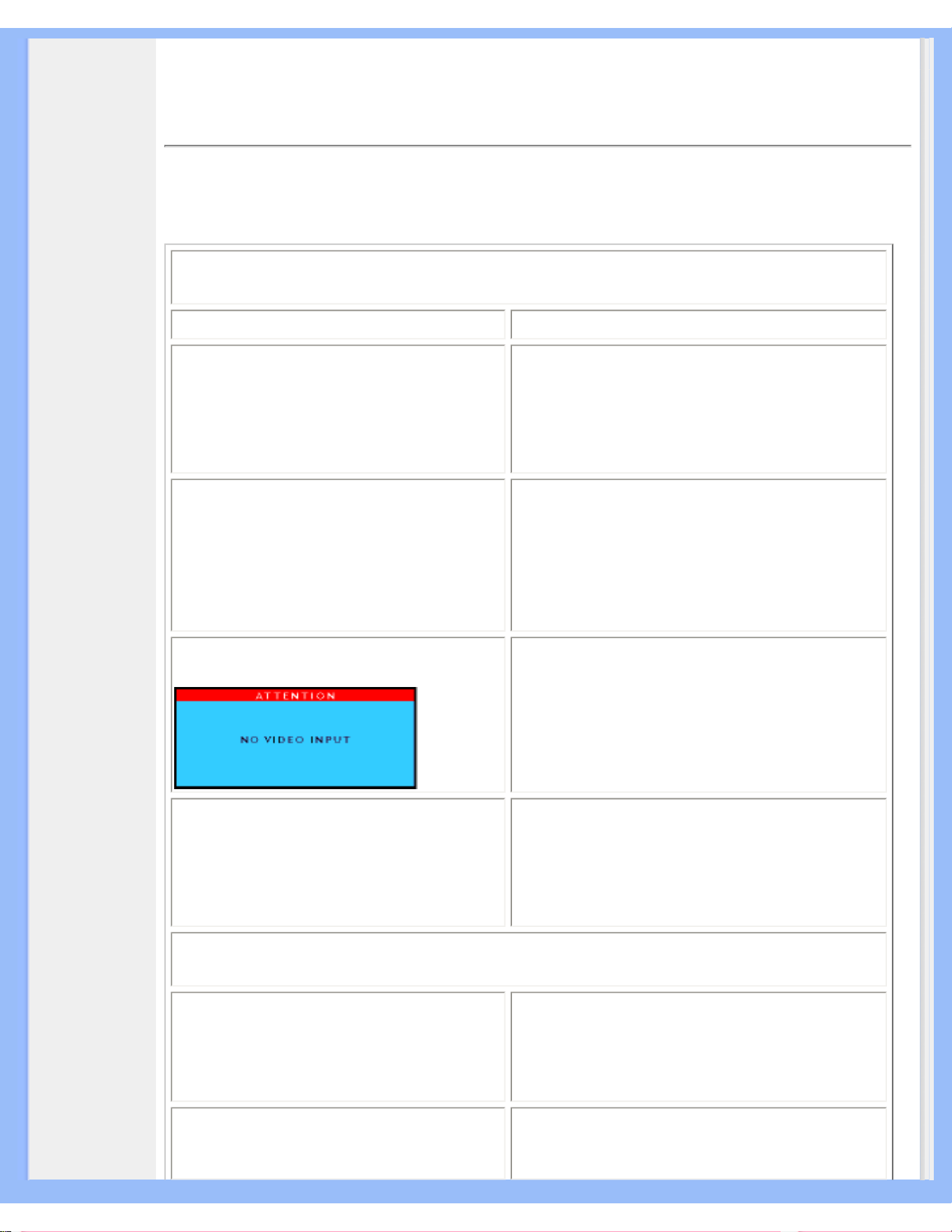
Screen says
● Make sure the monitor cable is properly
connected to your computer. (Also refer to
the Quick Set-Up Guide).
● Check to see if the monitor cable has bent
pins.
● Make sure the computer is turned on.
AUTO button not working properly
● The Auto Function is designed for use on
standard Macintosh or IBM-compatible PCs
running Microsoft Windows.
● It may not work properly if using nonstandard
PC or video card.
Imaging Problems
Display position is incorrect
● Press the Auto button.
● Adjust the image position using the
Horizontal Position and/or Vertical Position in
OSD Main Controls.
Image vibrates on the screen
● Check that the signal cable is properly
connected to the graphics board or PC.
file:///D|/My%20documents/dfu/J/english/200p4/safety/saf_troub.htm (1 of 3) [4/15/2004 1:45:09 PM]
Troubleshooting
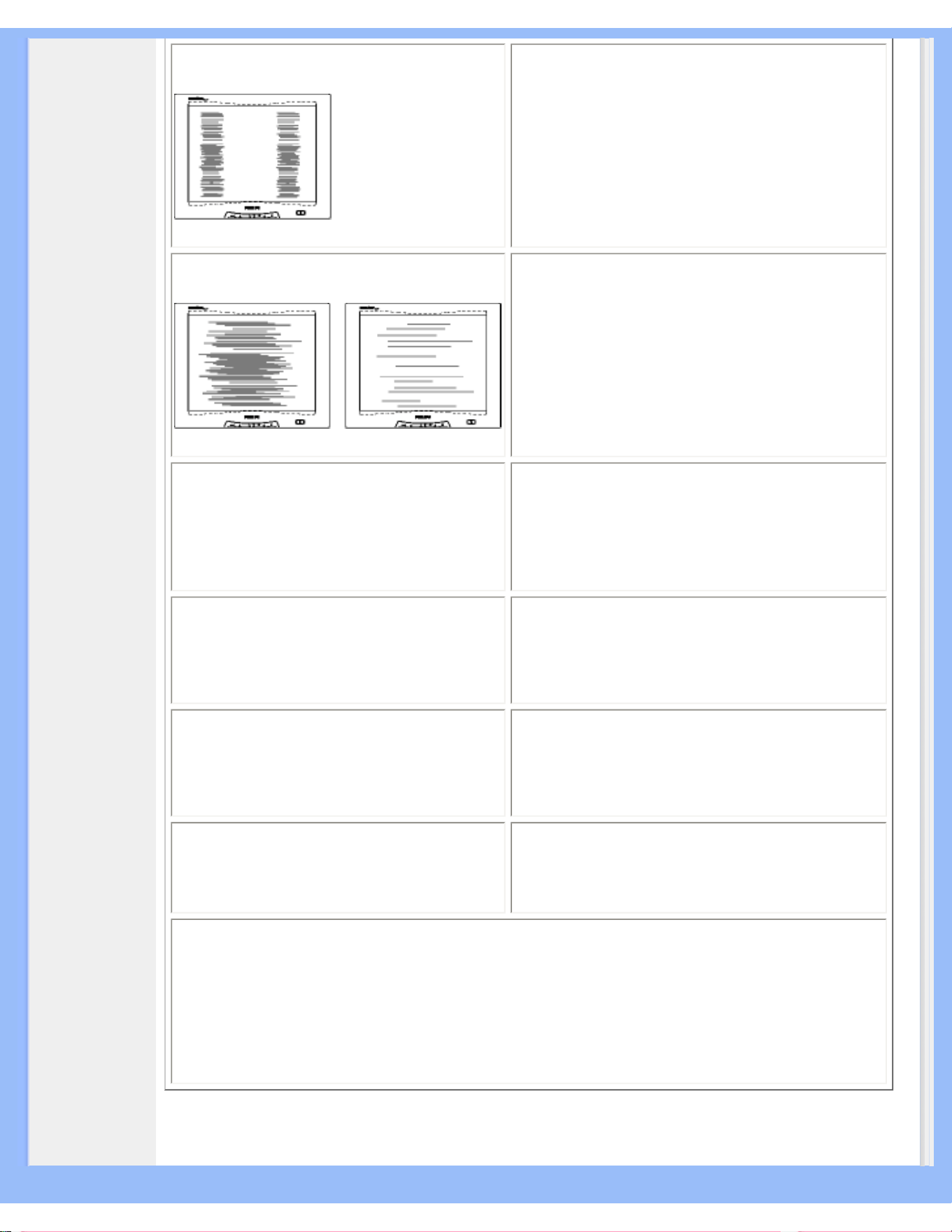
Vertical flicker appears
● Press the Auto button.
● Eliminate the vertical bars using the Clock
Adjustment of VIDEO NOISE in OSD Main
Controls.
Horizontal flicker appears
● Press the Auto button.
● Eliminate the horizontal bars using the Phase
Adjustment of VIDEO NOISE in OSD Main
Controls.
The screen is too bright or too dark
● Adjust the contrast and brightness on OSD
Main Controls. (The backlight of the LCD
monitor has a fixed life span. When the
screen becomes dark or begins to flicker,
please contact your dealer).
An after-image appears
● If an image remains on the screen for an
extended period of time, it may be imprinted
in the screen and leave an after-image. This
usually disappears after a few hours
An after-image remains after the power
has been turned off.
● This is characteristic of liquid crystal and is
not caused by a malfunction or deterioration
of the liquid crystal. The after-image will
disappear after a peroid of time.
Green, red, blue, dark, and white dots
remains
● The remaining dots are normal characteristic
of the liquid crystal used in today’s
technology.
For further assistance, refer to the Consumer Information Centers list and contact your local Philips
distributor.
RETURN TO TOP OF THE PAGE
file:///D|/My%20documents/dfu/J/english/200p4/safety/saf_troub.htm (2 of 3) [4/15/2004 1:45:09 PM]

Troubleshooting
file:///D|/My%20documents/dfu/J/english/200p4/safety/saf_troub.htm (3 of 3) [4/15/2004 1:45:09 PM]

Regulatory Information
• TCO'99
Information
•TCO'99
Environmental
Requirements
•TCO'03
Information
•Recycling
Information for
Customers
•
CE Declaration
of Conformity
•
Energy Star
Declaration
•Federal
Communications
Commission
(FCC) Notice
(U.S. Only)
•Commission
Federale de la
Communication
(FCC
Declaration)
•EN 55022
Compliance
(Czech Republic
Only)
•VCCI Class 2
Notice (Japan
Only)
•MIC Notice
(South Korea
Only)
•Polish Center
for Testing and
Certification
Notice
•North Europe
(Nordic
Countries)
Information
•BSMI Notice
(Taiwan Only)
•Ergonomie
Hinweis (nur
Deutschland)
•Philips End-of-
Life Disposal
Regulatory Information
TCO '99 Information
Congratulations! You have just purchased a TCO '99 approved
and labeled product! Your choice has provided you with a product
developed for professional use. Your purchase has also contributed
to reducing the burden on the environment and also to the further
development of environmentally adapted electronics products.
Why do we have environmentally labeled computers?
In many countries, environmental labeling has become an established method for encouraging the
adaptation of goods and services to the environment. The main problem, as far as computers and other
electronics equipment are concerned, is that environmentally harmful substances are used both in the
products and during their manufacture. Since it is not so far possible to satisfactorily recycle the majority of
electronics equipment, most of these potentially damaging substances sooner or later enter nature.
There are also other characteristics of a computer, such as energy consumption levels, that are important
from the viewpoints of both the work (internal) and natural (external) environments. Since all methods of
electricity generation have a negative effect on the environment (e.g. acidic and climate-influencing
emissions, radioactive waste), it is vital to save energy. Electronics equipment in offices is often left running
continuously and thereby consumes a lot of energy.
What does labeling involve?
This product meets the requirements for the TCO'99 scheme which provides for international and
environmental labeling of personal computers. The labeling scheme was developed as a joint effort by the
TCO (The Swedish Confederation of Professional Employees), Svenska Naturskyddsforeningen (The
Swedish Society for Nature Conservation) and Statens Energimyndighet (The Swedish National Energy
Administration).
Approval requirements cover a wide range of issues: environment, ergonomics, usability, emission of electric
and magnetic fields, energy consumption and electrical and fire safety.
The environmental demands impose restrictions on the presence and use of heavy metals, brominated and
chlorinated flame retardants, CFCs (freons) and chlorinated solvents, among other things. The product must
be prepared for recycling and the manufacturer is obliged to have an environmental policy which must be
adhered to in each country where the company implements its operational policy.
The energy requirements include a demand that the computer and/or display, after a certain period of
inactivity, shall reduce its power consumption to a lower level in one or more stages. The length of time to
reactivate the computer shall be reasonable for the user.
Labeled products must meet strict environmental demands, for example, in respect of the reduction of
electric and magnetic fields, physical and visual ergonomics and good usability.
Below you will find a brief summary of the environmental requirements met by this product. The complete
file:///D|/My%20documents/dfu/J/english/200p4/safety/regs/regulat.htm (1 of 13) [4/15/2004 1:45:13 PM]

Regulatory Information
•
Information for
UK only
•Troubleshooting
•
Other Related
Information
•Frequently
Asked
Questions
(FAQs)
environmental criteria document may be ordered from:
TCO Development
SE-114 94 Stockholm, Sweden
Fax: +46 8 782 92 07
Email (Internet): [email protected]
Current information regarding TCO'99 approved and labeled products may also be obtained via the
Internet, using the address: http://www.tco-info.com/
RETURN TO TOP OF THE PAGE
Environmental Requirements
Flame retardants
Flame retardants are present in printed circuit boards, cables, wires, casings and housings. Their purpose is
to prevent, or at least to delay the spread of fire. Up to 30% of the plastic in a computer casing can consist of
flame retardant substances. Most flame retardants contain bromine or chloride, and those flame retardants
are chemically related to another group of environmental toxins, PCBs. Both the flame retardants containing
bromine or chloride and the PCBs are suspected of giving rise to severe health effects, including
reproductive damage in fish-eating birds and mammals, due to the bio-accumulative* processes. Flame
retardants have been found in human blood and researchers fear that disturbances in fetus development
may occur.
The relevant TCO'99 demand requires that plastic components weighing more than 25 grams must not
contain flame retardants with organically bound bromine or chlorine. Flame retardants are allowed in the
printed circuit boards since no substitutes are available.
Cadmium**
Cadmium is present in rechargeable batteries and in the color-generating layers of certain computer
displays. Cadmium damages the nervous system and is toxic in high doses. The relevant TCO'99
requirement states that batteries, the color-generating layers of display screens and the electrical or
electronics components must not contain any cadmium.
Mercury**
Mercury is sometimes found in batteries, relays and switches. It damages the nervous system and is toxic in
high doses. The relevant TCO'99 requirement states that batteries may not contain any mercury. It also
demands that mercury is not present in any of the electrical or electronics components associated with the
labeled unit.
CFCs (freons)
The relevant TCO'99 requirement states that neither CFCs nor HCFCs may be used during the manufacture
and assembly of the product. CFCs (freons) are sometimes used for washing printed circuit boards. CFCs
file:///D|/My%20documents/dfu/J/english/200p4/safety/regs/regulat.htm (2 of 13) [4/15/2004 1:45:13 PM]
Regulatory Information
break down ozone and thereby damage the ozone layer in the stratosphere, causing increased reception on
earth of ultraviolet light with increased risks e.g. skin cancer (malignant melanoma) as a consequence.
Lead**
Lead can be found in picture tubes, display screens, solders and capacitors. Lead damages the nervous
system and in higher doses, causes lead poisoning. The relevant TCO'99 requirement permits the inclusion
of lead since no replacement has yet been developed.
* Bio-accumulative is defined as substances which accumulate within living organisms.
** Lead, Cadmium and Mercury are heavy metals which are bio-accumulative.
RETURN TO TOP OF THE PAGE
TCO'03 Information
(Optional, only available for TCO'03 version)
Congratulations!
The display you have just purchased carries the TCO'03 Displays label. This
means that your display is designed, manufactured and tested according to
some of the strictest quality and environmental requirements in the world. This
makes for a high performance product, designed with the user in focus that also
minimizes the impact on our natural environment.
Some of the features of the TCO'03 Display requirements.
Ergonomics
● Good visual ergonomics and image quality in order to improve the working environment for the user
and to reduce sight and strain problems. Important parameters are luminance, contrast, resoluction,
reflectance, colour rendition and image stability.
Energy
● Energy-saving mode after a certain time-beneficial both for the user and the environment
● Electrical safety
Emissions
file:///D|/My%20documents/dfu/J/english/200p4/safety/regs/regulat.htm (3 of 13) [4/15/2004 1:45:13 PM]

Regulatory Information
● Electromagnetic fields
● Noise emissions
Ecology
● The product must be prepared for recycling and the manufacturer must have a certified
environmental management system such as EMAS or ISO 14 000
● Restrictions on
❍ chlorinated and brominated flame retardants and polymers
❍ heavy metals such as cadmium, mercury and lead.
The requirements included in this label have been developed by TCO Development in co-operation with
scientists, experts, users as well as manufacturers all over the world. Since the end of the 1980s TCO has
been involved in influencing the development of IT equipment in a more user-friendly direction. Our labelling
system started with displays in 1992 and is now requested by users and IT-manufacturers all over the world.
For more information, please visit
www.tcodevelopment.com
RETURN TO TOP OF THE PAGE
Recycling Information for Customers
Philips establishes technically and economically viable objectives to optimize the environmental performance
of the organization's product, service and activities.
From the planning, design and production stages, Philips emphasizes the important of making products that
can easily be recycled. At Philips, end-of-life management primarily entails participation in national take-back
initiatives and recycling programs whenever possible, preferably in cooperation with competitors.
There is currently a system of recycling up and running in the European countries, such as The Netherlands,
Belgium, Norway, Sweden and Denmark.
In U.S.A., Philips Consumer Electronics North America has contributed funds for the Electronic Industries
Alliance (EIA) Electronics Recycling Project and state recycling initiatives for end-of-life electronics products
from household sources. In addition, the Northeast Recycling Council (NERC) - a multi-state non-profit
organization focused on promoting recycling market development - plans to implement a recycling program.
In Asia Pacific, Taiwan, the products can be taken back by Environment Protection Administration (EPA) to
follow the IT product recycling management process, detail can be found in web site www.epa.gov.tw
For help and service, please contact Consumers Information Center or F1rst Choice Contact Information
Center in each country or the following team of Environmental specialist can help.
Mr. Job Chiu - Environment manager
Philips Electronics Industries (Taiwan) Ltd, Monitor Business Unit
E-mail: [email protected]
Tel: +886 (0) 3 454 9839
Mr. Maarten ten Houten - Senior Environmental Consultant
Philips Consumer Electronics
E-mail: [email protected]
file:///D|/My%20documents/dfu/J/english/200p4/safety/regs/regulat.htm (4 of 13) [4/15/2004 1:45:13 PM]

Regulatory Information
Tel: +31 (0) 40 27 33402
Mr. Delmer F. Teglas
Philips Consumer Electronics North America
E-mail: [email protected]
Tel: +1 865 521 4322
RETURN TO TOP OF THE PAGE
CE Declaration of Conformity
Philips Consumer Electronics declare under our responsibility that the product is in conformity with the
following standards
- EN60950:2000 (Safety requirement of Information Technology Equipment)
- EN55022:1998 (Radio Disturbance requirement of Information Technology Equipment)
- EN55024:1998 (Immunity requirement of Information Technology Equipment)
- EN61000-3-2:1995 (Limits for Harmonic Current Emission)
- EN61000-3-3:1995 (Limitation of Voltage Fluctuation and Flicker)
following provisions of directives applicable
- 73/23/EEC (Low Voltage Directive)
- 89/336/EEC (EMC Directive)
- 93/68/EEC (Amendment of EMC and Low Voltage Directive)
and is produced by a manufacturing organization on ISO9000 level.
The product also comply with the following standards
- ISO9241-3, ISO9241-7, ISO9241-8 (Ergonomic requirement for Visual Display)
- ISO13406-2 (Ergonomic requirement for Flat panels)
- GS EK1-2000 (GS specification)
- prEN50279:1998 (Low Frequency Electric and Magnetic fields for Visual Display)
- MPR-II (MPR:1990:8/1990:10 Low Frequency Electric and Magnetic fields)
- TCO'95, TCO'99, TCO'03 (Requirement for Environment Labelling of Ergonomics, Energy, Ecology and
Emission, TCO: Swedish Confederation of Professional Employees) for TCO versions
RETURN TO TOP OF THE PAGE
Energy Star Declaration
PHILIPS
200P4
This monitor is equipped with a function for saving energy which supports the VESA Display Power
Management Signaling (DPMS) standard. This means that the monitor must be connected to a
computer which supports VESA DPMS to fulfill the requirements in the NUTEK specification 803299/94.
Time settings are adjusted from the system unit by software.
NUTEK VESA State LED Indicator Power Consumption
file:///D|/My%20documents/dfu/J/english/200p4/safety/regs/regulat.htm (5 of 13) [4/15/2004 1:45:13 PM]
Regulatory Information
Normal operation ON Green < 65 W
Power Saving
Alternative 2
One step
OFF Amber < 1.5 W
As an ENERGY STAR
®
Partner, PHILIPS has determined that this product meets
the
ENERGY STAR
®
guidelines for energy efficiency.
We recommend you switch off the monitor when it is not in use for quite a long time.
RETURN TO TOP OF THE PAGE
Federal Communications Commission (FCC) Notice (U.S. Only)
This equipment has been tested and found to comply with the limits for a Class B digital
device, pursuant to Part 15 of the FCC Rules. These limits are designed to provide
reasonable protection against harmful interference in a residential installation. This
equipment generates, uses and can radiate radio frequency energy and, if not installed and
used in accordance with the instructions, may cause harmful interference to radio
communications. However, there is no guarantee that interference will not occur in a
particular installation. If this equipment does cause harmful interference to radio or television
reception, which can be determined by turning the equipment off and on, the user is
encouraged to try to correct the interference by one or more of the following measures:
● Reorient or relocate the receiving antenna.
● Increase the separation between the equipment and receiver.
● Connect the equipment into an outlet on a circuit different from that to which the receiver is
connected.
● Consult the dealer or an experienced radio/TV technician for help.
Changes or modifications not expressly approved by the party responsible for compliance
could void the user's authority to operate the equipment.
Use only RF shielded cable that was supplied with the monitor when connecting this monitor to a computer
device.
To prevent damage which may result in fire or shock hazard, do not expose this appliance to rain or
excessive moisture.
THIS CLASS B DIGITAL APPARATUS MEETS ALL REQUIREMENTS OF THE CANADIAN
INTERFERENCE-CAUSING EQUIPMENT REGULATIONS.
RETURN TO TOP OF THE PAGE
Commission Federale de la Communication (FCC Declaration)
file:///D|/My%20documents/dfu/J/english/200p4/safety/regs/regulat.htm (6 of 13) [4/15/2004 1:45:13 PM]
Regulatory Information
Cet équipement a été testé et déclaré conforme auxlimites des appareils numériques de
class B,aux termes de l'article 15 Des règles de la FCC. Ces limites sont conçues de façon
à fourir une protection raisonnable contre les interférences nuisibles dans le cadre d'une
installation résidentielle. CET appareil produit, utilise et peut émettre des hyperfréquences
qui, si l'appareil n'est pas installé et utilisé selon les consignes données, peuvent causer
des interférences nuisibles aux communications radio. Cependant, rien ne peut garantir
l'absence d'interférences dans le cadre d'une installation particulière. Si cet appareil est la
cause d'interférences nuisibles pour la réception des signaux de radio ou de télévision, ce
qui peut être décelé en fermant l'équipement, puis en le remettant en fonction, l'utilisateur
pourrait essayer de corriger la situation en prenant les mesures suivantes:
● Réorienter ou déplacer l'antenne de réception.
● Augmenter la distance entre l'équipement et le récepteur.
● Brancher l'équipement sur un autre circuit que celui utilisé par le récepteur.
● Demander l'aide du marchand ou d'un technicien chevronné en radio/télévision.
Toutes modifications n'ayant pas reçu l'approbation des services compétents en matière de
conformité est susceptible d'interdire à l'utilisateur l'usage du présent équipement.
N'utiliser que des câbles RF armés pour les connections avec des ordinateurs ou périphériques.
CET APPAREIL NUMERIQUE DE LA CLASSE B RESPECTE TOUTES LES EXIGENCES DU
REGLEMENT SUR LE MATERIEL BROUILLEUR DU CANADA.
RETURN TO TOP OF THE PAGE
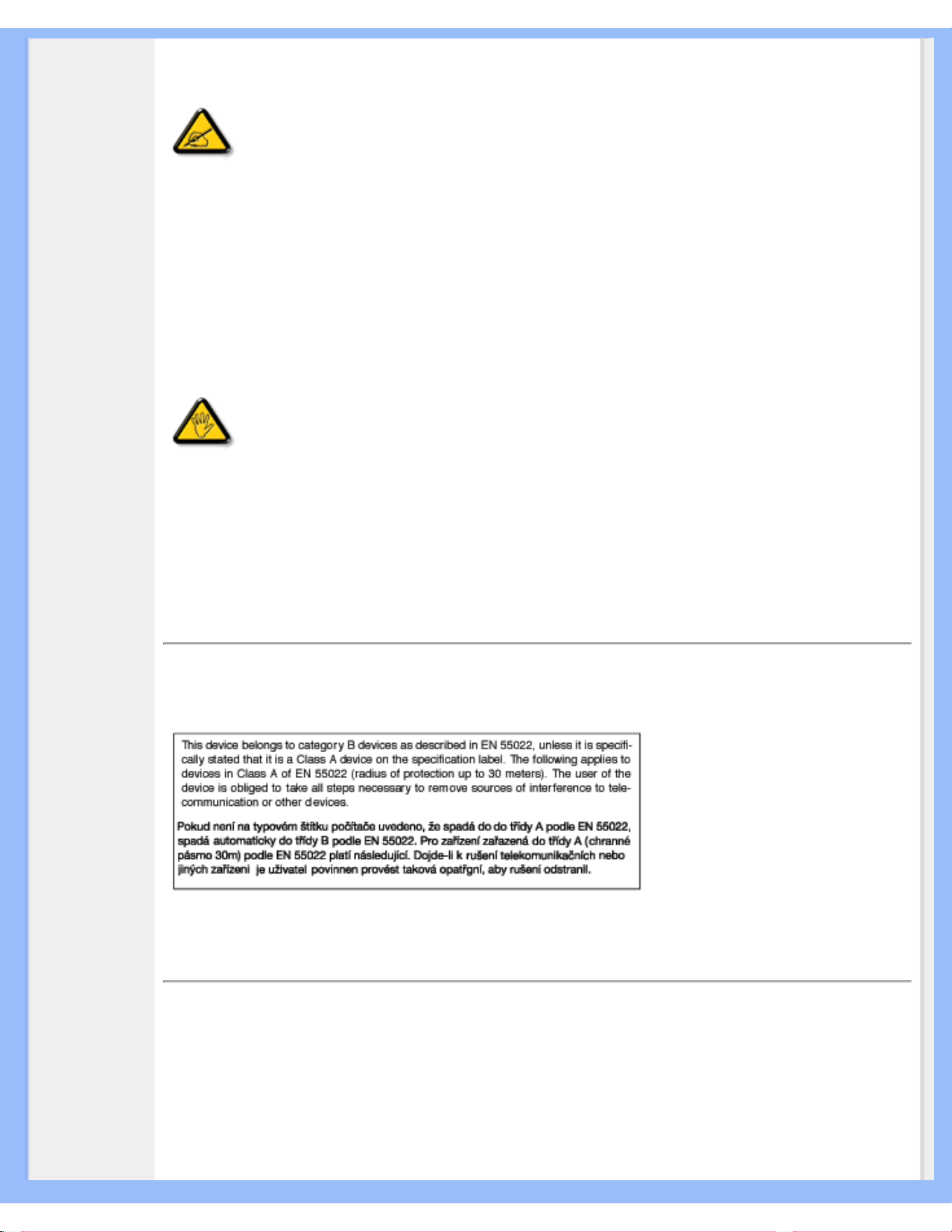
EN 55022 Compliance (Czech Republic Only)
RETURN TO TOP OF THE PAGE
VCCI Notice (Japan Only)
This is a Class B product based on the standard of the Voluntary Control Council for Interference (VCCI) for
Information technology equipment. If this equipment is used near a radio or television receiver in a domestic
environment, it may cause radio Interference. Install and use the equipment according to the instruction
manual.
file:///D|/My%20documents/dfu/J/english/200p4/safety/regs/regulat.htm (7 of 13) [4/15/2004 1:45:13 PM]
Regulatory Information
Class B ITE
RETURN TO TOP OF THE PAGE
MIC Notice (South Korea Only)
Class B Device
Please note that this device has been approved for non-business purposes and may be used in any
environment, including residential areas.
RETURN TO TOP OF THE PAGE
Polish Center for Testing and Certification Notice
The equipment should draw power from a socket with an attached protection circuit (a three-prong socket).
All equipment that works together (computer, monitor, printer, and so on) should have the same power
supply source.
file:///D|/My%20documents/dfu/J/english/200p4/safety/regs/regulat.htm (8 of 13) [4/15/2004 1:45:13 PM]
Regulatory Information
The phasing conductor of the room's electrical installation should have a reserve short-circuit protection
device in the form of a fuse with a nominal value no larger than 16 amperes (A).
To completely switch off the equipment, the power supply cable must be removed from the power supply
socket, which should be located near the equipment and easily accessible.
A protection mark "B" confirms that the equipment is in compliance with the protection usage requirements of
standards PN-93/T-42107 and PN-89/E-06251.
RETURN TO TOP OF THE PAGE
North Europe (Nordic Countries) Information
Placering/Ventilation
VARNING:
FÖRSÄKRA DIG OM ATT HUVUDBRYTARE OCH UTTAG ÄR LÄTÅTKOMLIGA, NÄR
DU STÄLLER DIN UTRUSTNING PÅPLATS.
file:///D|/My%20documents/dfu/J/english/200p4/safety/regs/regulat.htm (9 of 13) [4/15/2004 1:45:13 PM]
Regulatory Information
Placering/Ventilation
ADVARSEL:
SØRG VED PLACERINGEN FOR, AT NETLEDNINGENS STIK OG STIKKONTAKT ER
NEMT TILGÆNGELIGE.
Paikka/Ilmankierto
VAROITUS:
SIJOITA LAITE SITEN, ETTÄ VERKKOJOHTO VOIDAAN TARVITTAESSA HELPOSTI
IRROTTAA PISTORASIASTA.
Plassering/Ventilasjon
ADVARSEL:
NÅR DETTE UTSTYRET PLASSERES, MÅ DU PASSE PÅ AT KONTAKTENE FOR
STØMTILFØRSEL ER LETTE Å NÅ.
RETURN TO TOP OF THE PAGE
BSMI Notice (Taiwan Only)
RETURN TO TOP OF THE PAGE
Ergonomie Hinweis (nur Deutschland)
Der von uns gelieferte Farbmonitor entspricht den in der "Verordnung über den Schutz vor Schäden durch
Röntgenstrahlen" festgelegten Vorschriften.
Auf der Rückwand des Gerätes befindet sich ein Aufkleber, der auf die Unbedenklichkeit der Inbetriebnahme
hinweist, da die Vorschriften über die Bauart von Störstrahlern nach Anlage III ¤ 5 Abs. 4 der
Röntgenverordnung erfüllt sind.
file:///D|/My%20documents/dfu/J/english/200p4/safety/regs/regulat.htm (10 of 13) [4/15/2004 1:45:13 PM]
Regulatory Information
Damit Ihr Monitor immer den in der Zulassung geforderten Werten entspricht, ist darauf zu achten, daß
1. Reparaturen nur durch Fachpersonal durchgeführt werden.
2. nur original-Ersatzteile verwendet werden.
3. bei Ersatz der Bildröhre nur eine bauartgleiche eingebaut wird.
Aus ergonomischen Gründen wird empfohlen, die Grundfarben Blau und Rot nicht auf dunklem
Untergrund zu verwenden (schlechte Lesbarkeit und erhöhte Augenbelastung bei zu geringem
Zeichenkontrast wären die Folge).
Der arbeitsplatzbezogene Schalldruckpegel nach DIN 45 635 beträgt 70dB (A) oder weniger.
ACHTUNG: BEIM AUFSTELLEN DIESES GERÄTES DARAUF ACHTEN, DAß
NETZSTECKER UND NETZKABELANSCHLUß LEICHT ZUGÄNGLICH SIND.
RETURN TO TOP OF THE PAGE
End-of-Life Disposal
Your new monitor contains materials that can be recycled and reused. Specialized companies can recycle
your product to increase the amount of reusable materials and to minimize the amount to be disposed of.
Please find out about the local regulations on how to dispose of your old monitor from your local Philips
dealer.
(For customers in Canada and U.S.A.)
This product may contain lead and/or mercury. Dispose of in accordance to local-state and federal
regulations.
For additional information on recycling contact www.eia.org (Consumer Education Initiative)
RETURN TO TOP OF THE PAGE
Information for UK only
WARNING - THIS APPLIANCE MUST BE
EARTHED.
Important:
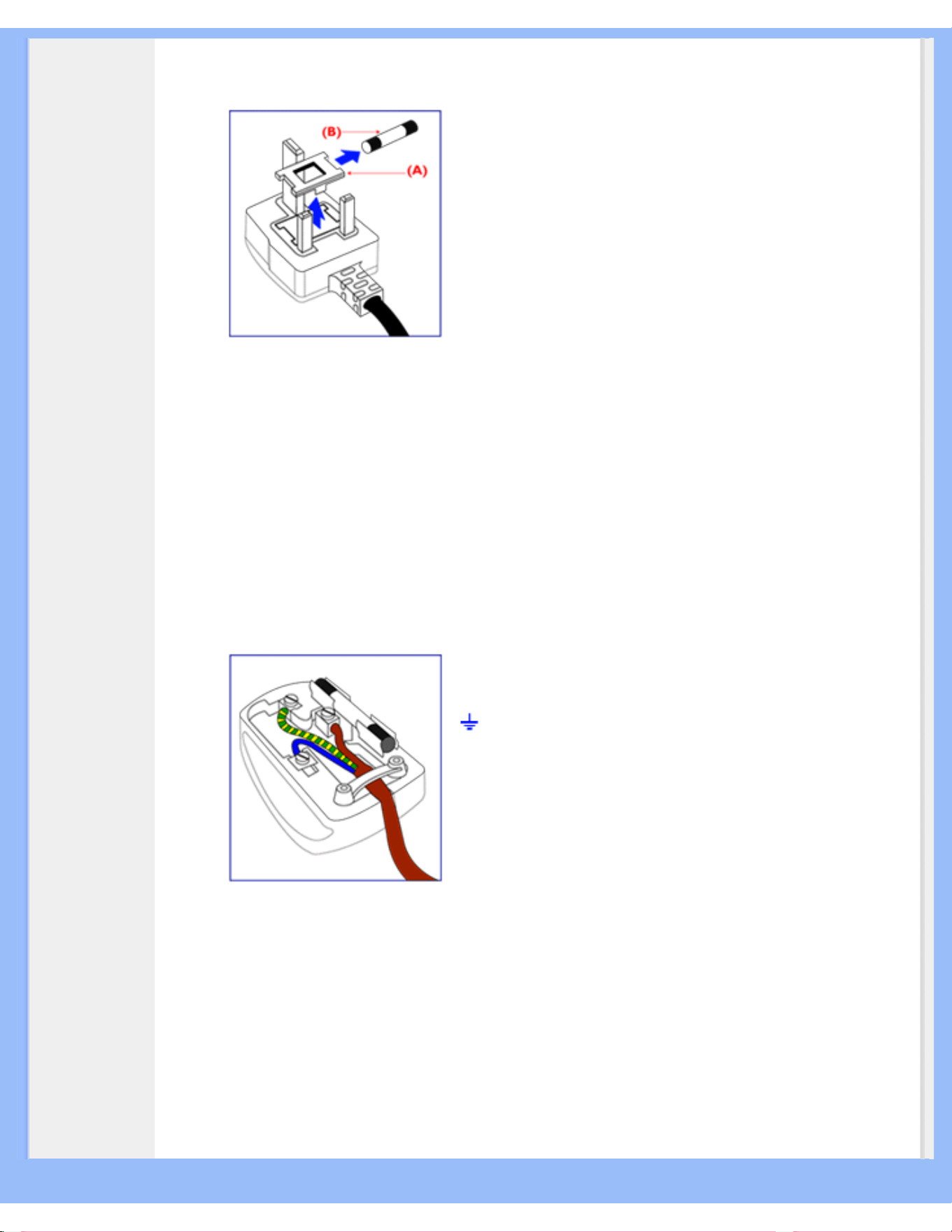
This apparatus is supplied with an approved
moulded 13A plug. To change a fuse in this type
of plug proceed as follows:
1. Remove fuse cover and fuse.
2. Fit new fuse which should be a BS 1362
5A,A.S.T.A. or BSI approved type.
file:///D|/My%20documents/dfu/J/english/200p4/safety/regs/regulat.htm (11 of 13) [4/15/2004 1:45:13 PM]
Regulatory Information
3. Refit the fuse cover.
If the fitted plug is not suitable for your socket
outlets, it should be cut off and an appropriate 3-
pin plug fitted in its place.
If the mains plug contains a fuse, this should
have a value of 5A. If a plug without a fuse is
used, the fuse at the distribution board should
not be greater than 5A.
Note: The severed plug must be destroyed to
avoid a possible shock hazard should it be
inserted into a 13A socket elsewhere.
How to connect a plug
The wires in the mains lead are coloured in
accordance with the following code:
BLUE - "NEUTRAL" ("N")
BROWN - "LIVE" ("L")
GREEN & YELLOW - "EARTH" ("E")
1. The GREEN AND YELLOW wire must be
connected to the terminal in the plug which is
marked with the letter "E" or by the Earth symbol
or coloured GREEN or GREEN AND
YELLOW.
2. The BLUE wire must be connected to the
terminal which is marked with the letter "N" or
coloured BLACK.
3. The BROWN wire must be connected to the
terminal which marked with the letter "L" or
coloured RED.
Before replacing the plug cover, make certain
that the cord grip is clamped over the sheath of
the lead - not simply over the three wires.
RETURN TO TOP OF THE PAGE
file:///D|/My%20documents/dfu/J/english/200p4/safety/regs/regulat.htm (12 of 13) [4/15/2004 1:45:13 PM]

Regulatory Information
file:///D|/My%20documents/dfu/J/english/200p4/safety/regs/regulat.htm (13 of 13) [4/15/2004 1:45:13 PM]

Other Related Information
• Safety and
Troubleshooting
• FAQs
• Troubleshooting
• Regulatory
Information
•Information
for Users in the
U.S
•Information
for Users
Outside the U.S
Other Related Information
Information for Users in the U. S.
For units set at 115 V :
Use a UL Listed Cord Set consisting of a minimum 18 AWG, Type SVT or SJT three conductor cord a
maximum of 15-feet long and a parallel blade, grounding type attachment plug rated 15 A, 125 V.
For units set at 230 V:
Use a UL Listed Cord Set consisting of a minimum 18 AWG, Type SVT or SJT three conductor cord a
maximum of 15-feet long and a tandem blade, grounding type attachment plug rated 15 A, 250 V.
Information for Users outside the U.S.
For units set at 230 V:
Use a Cord Set consisting of a minimum 18 AWG cord and grounding type attachment plug rated 15 A, 250
V. The Cord Set should have the appropriate safety approvals for the country in which the equipment will be
installed and / or be marked HAR.
RETURN TO TOP OF THE PAGE
file:///D|/My%20documents/dfu/J/english/200p4/safety/saf_other.htm [4/15/2004 1:45:14 PM]
Philips Pixel Defect Policy
• Product
Features
•Technical
Specifications
•Resolution &
Preset Modes
•Automatic
Power Saving
•Physical
Specification
•Pin
Assignment
•Product
Views
Philips Pixel Defect Policy
Philips' Flat Panel Monitors Pixel Defect Policy
Philips strives to deliver the highest quality products. We use some of the industry's most advanced
manufacturing processes and practice stringent quality control. However, pixel or sub pixel defects on the
TFT LCD panels used in flat panel monitors are sometimes unavoidable. No manufacturer can guarantee
that all panels will be free from pixel defects, but Philips guarantees that any monitor with an unacceptable
number of defects will be repaired or replaced under warranty. This notice explains the different types of
pixel defects and defines acceptable defect levels for each type. In order to qualify for repair or replacement
under warranty, the number of pixel defects on a TFT LCD panel must exceed these acceptable levels. For
example, no more than 0.0004% of the sub pixels on a 15" XGA monitor may be defective. Furthermore,
Philips sets even higher quality standards for certain types or combinations of pixel defects that are more
noticeable than others. This policy is valid worldwide.
Pixels and Sub pixels
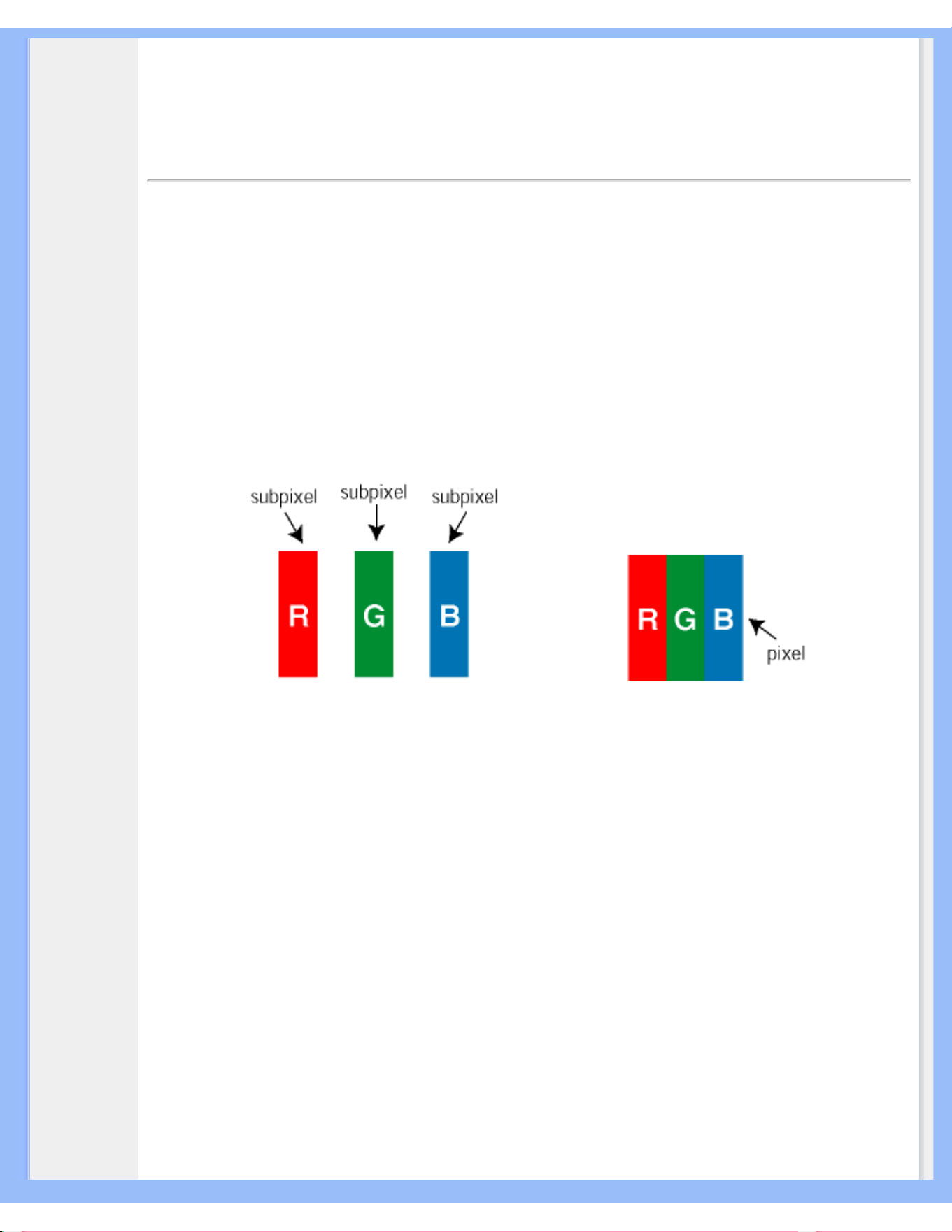
A pixel, or picture element, is composed of three sub pixels in the primary colors of red, green and blue.
Many pixels together form an image. When all sub pixels of a pixel are lit, the three colored sub pixels
together appear as a single white pixel. When all are dark, the three colored sub pixels together appear as a
single black pixel. Other combinations of lit and dark sub pixels appear as single pixels of other colors.
Types of Pixel Defects
Pixel and sub pixel defects appear on the screen in different ways. There are two categories of pixel defects
and several types of sub pixel defects within each category.
Bright Dot Defects Bright dot defects appear as pixels or sub pixels that are always lit or 'on'. These are the
types of bright dot defects:
file:///D|/My%20documents/dfu/J/english/200p4/product/pixel.htm (1 of 3) [4/15/2004 1:45:23 PM]
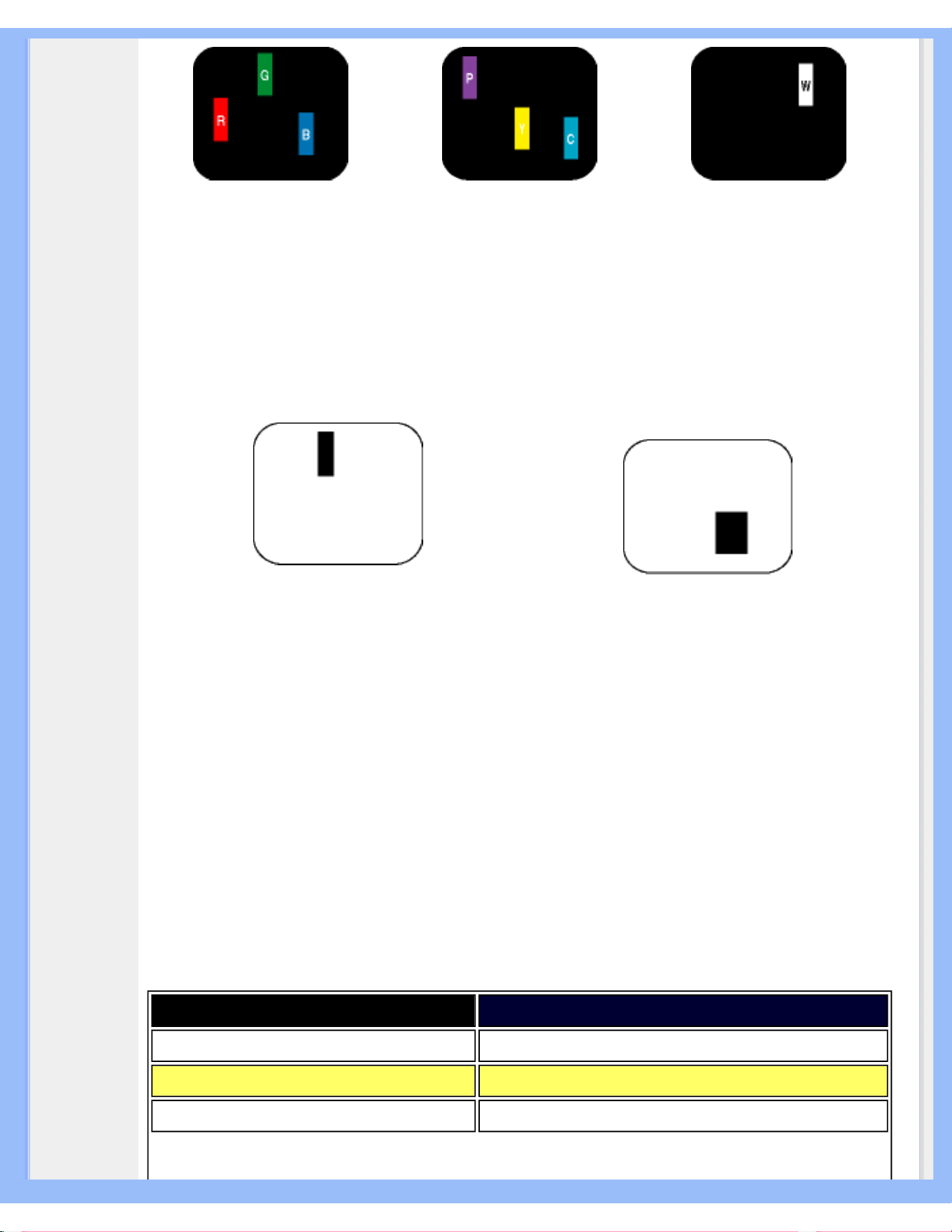
Philips Pixel Defect Policy
One lit red, green or blue sub
pixel
Two adjacent lit sub pixels:
- Red + Blue = Purple
- Red + Green = Yellow
- Green + Blue = Cyan (Light Blue)
Three adjacent lit sub pixels
(one white pixel)
Black Dot Defects Black dot defects appear as pixels or sub pixels that are always dark or 'off'. These are
the types of black dot defects:
One dark sub pixel Two or three adjacent dark sub pixels
Proximity of Pixel Defects
Because pixel and sub pixels defects of the same type that are near to one another may be more
noticeable, Philips also specifies tolerances for the proximity of pixel defects.
Pixel Defect Tolerances
In order to qualify for repair or replacement due to pixel defects during the warranty period, a TFT LCD
panel in a Philips flat panel monitor must have pixel or sub pixel defects exceeding the tolerances listed in
the following tables.
BRIGHT DOT DEFECTS ACCEPTABLE LEVEL
MODEL
200P4/200S4
1 lit subpixel 4 or fewer
2 adjacent lit subpixels 2 or fewer
file:///D|/My%20documents/dfu/J/english/200p4/product/pixel.htm (2 of 3) [4/15/2004 1:45:23 PM]
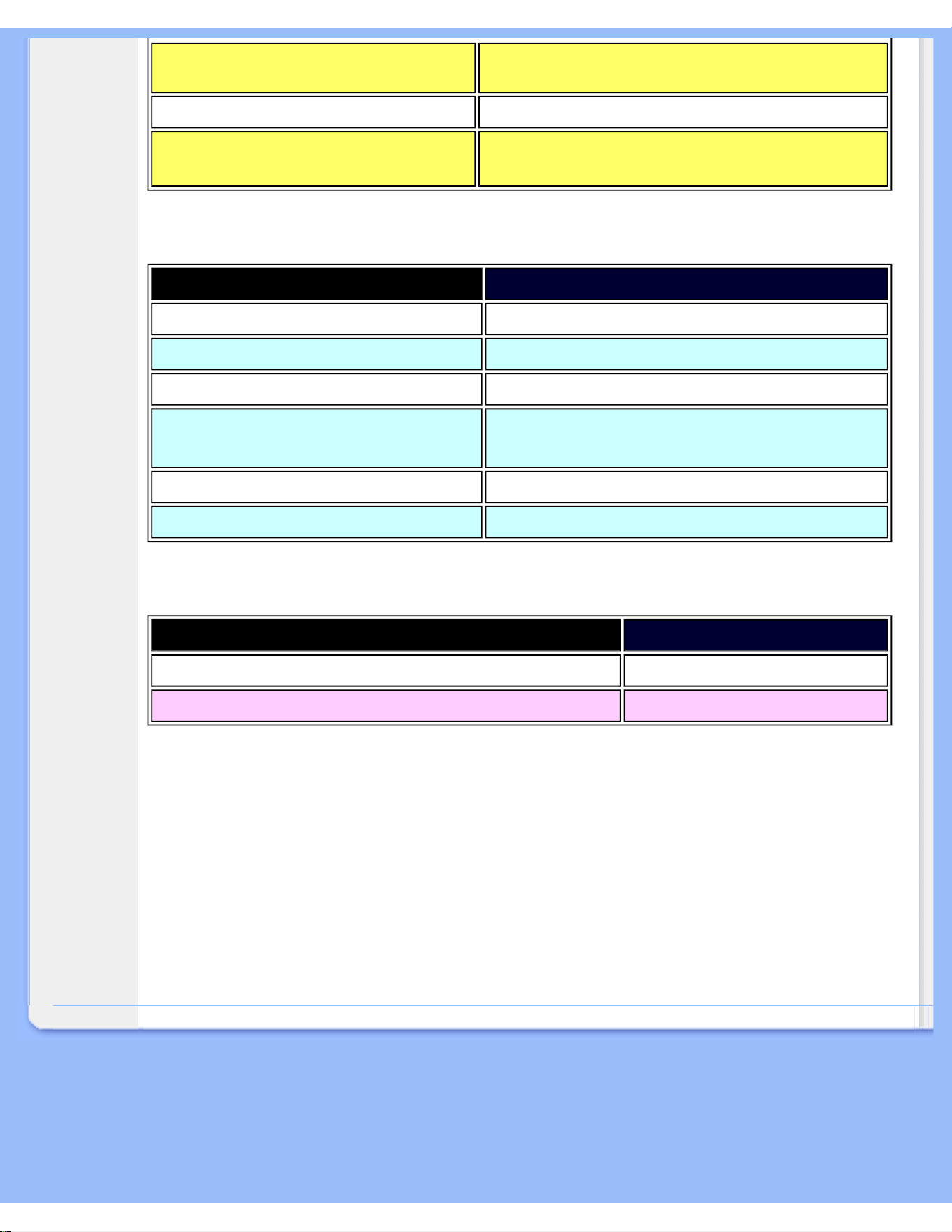
Philips Pixel Defect Policy
3 adjacent lit subpixels (one white pixel) 0
Distance between two bright dot defects* 15 mm or more
Total bright dot defects of all types 4 or fewer
BLACK DOT DEFECTS ACCEPTABLE LEVEL
MODEL
200P4/200S4
1 dark subpixel 4 or fewer
2 adjacent dark subpixels 2 or fewer
3 adjacent dark subpixels 0
Distance between two black dot defects* 15 mm or more
Total black dot defects of all types 4 or fewer
TOTAL DOT DEFECTS ACCEPTABLE LEVEL
MODEL
200P4/200S4
Total bright or black dot defects of all types 5 or fewer
Note:
* 1 or 2 adjacent sub pixel defects = 1 dot defect
All Philips monitors are ISO13406-2 Compliant
RETURN TO TOP OF THE PAGE
file:///D|/My%20documents/dfu/J/english/200p4/product/pixel.htm (3 of 3) [4/15/2004 1:45:23 PM]
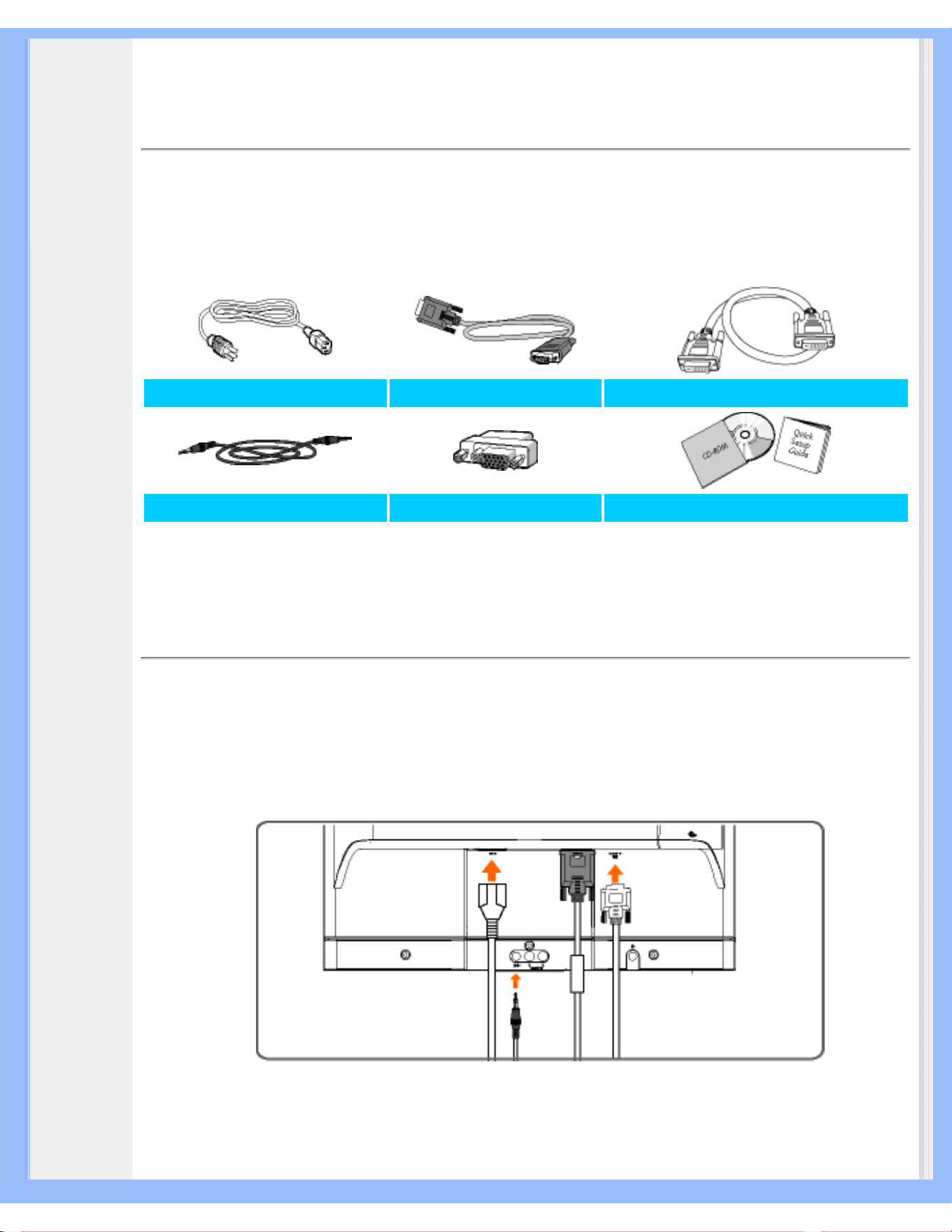
Setting up and Connecting Your Monitor
Your LCD
Monitor :
•Front View
Product
Description
• Accessory
Pack
• Setting Up
and
Connecting
Your Monitor
• Getting
Started
• Optimizing
Performance
• VESA
Standard
Mounting
Setting Up and Connecting Your Monitor
Accessory Pack
Unpack all the parts.
Power cord VGA signal cable DVI-D cable (optional for 200S4)
PC audio cable (lime) Mac adaptor (optional) EDFU pack
RETURN TO TOP OF THE PAGE
Connect to PC
Connect the power cord, DVI and audio cable to the back of the monitor firmly. (Philips
has pre-connected VGA cable for the first installation.)
file:///D|/My%20documents/dfu/J/english/200p4/install/connect.htm (1 of 4) [4/15/2004 1:45:29 PM]
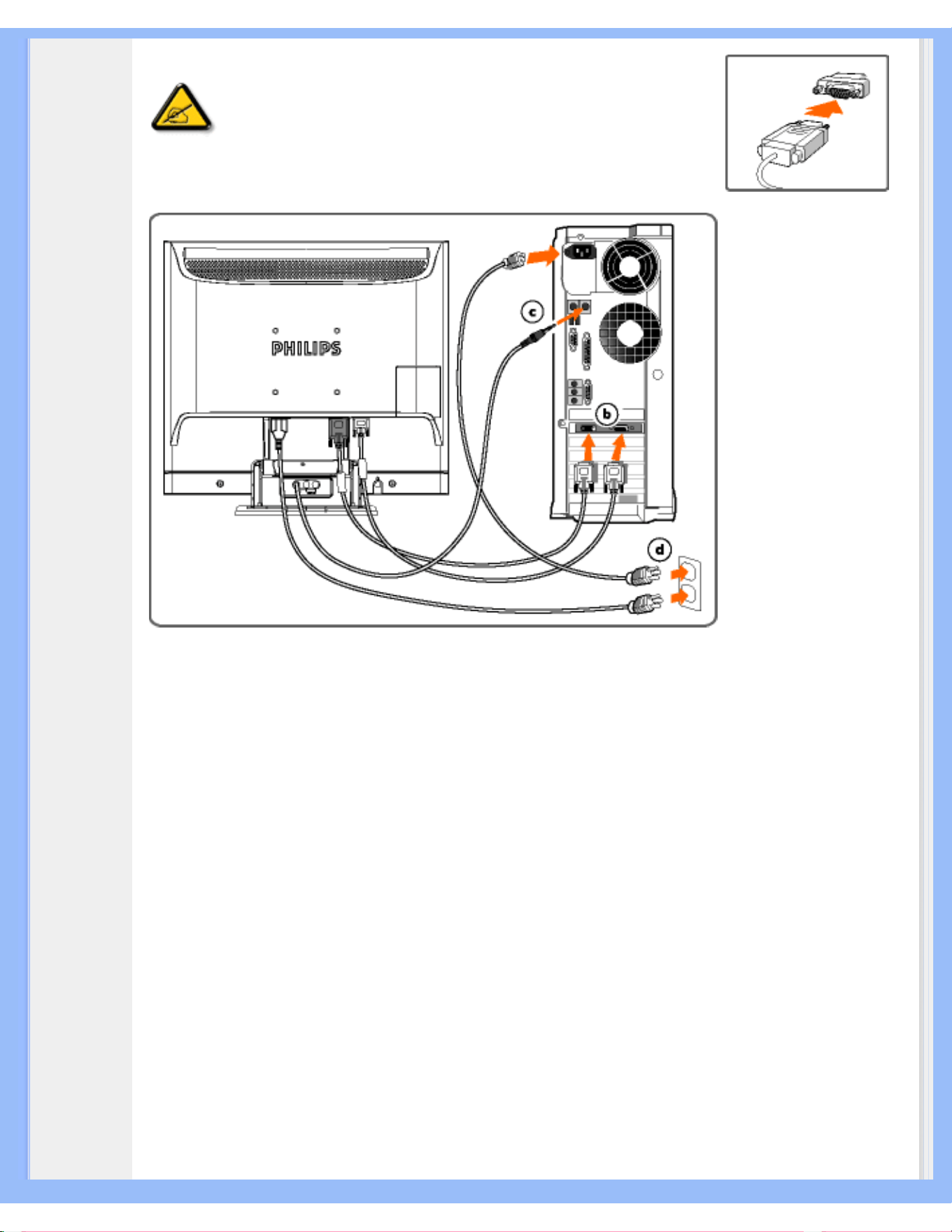
Setting up and Connecting Your Monitor
If you use an Apple Macintosh
TM
, you need to connect the
special Mac adapter to one end of the monitor signal cable.
Connect the cables to the back of your computer by following these steps:
(a) Turn off your computer and unplug its power cord.
(b) Connect the VGA or DVI cable to the video connector.
(c) Connect the audio cable.
(d) Plug the power cord of the computer and the monitor into a nearby outlet.
(e)
Turn on your computer and monitor. If the monitor displays an image,
installation is complete.
file:///D|/My%20documents/dfu/J/english/200p4/install/connect.htm (2 of 4) [4/15/2004 1:45:29 PM]
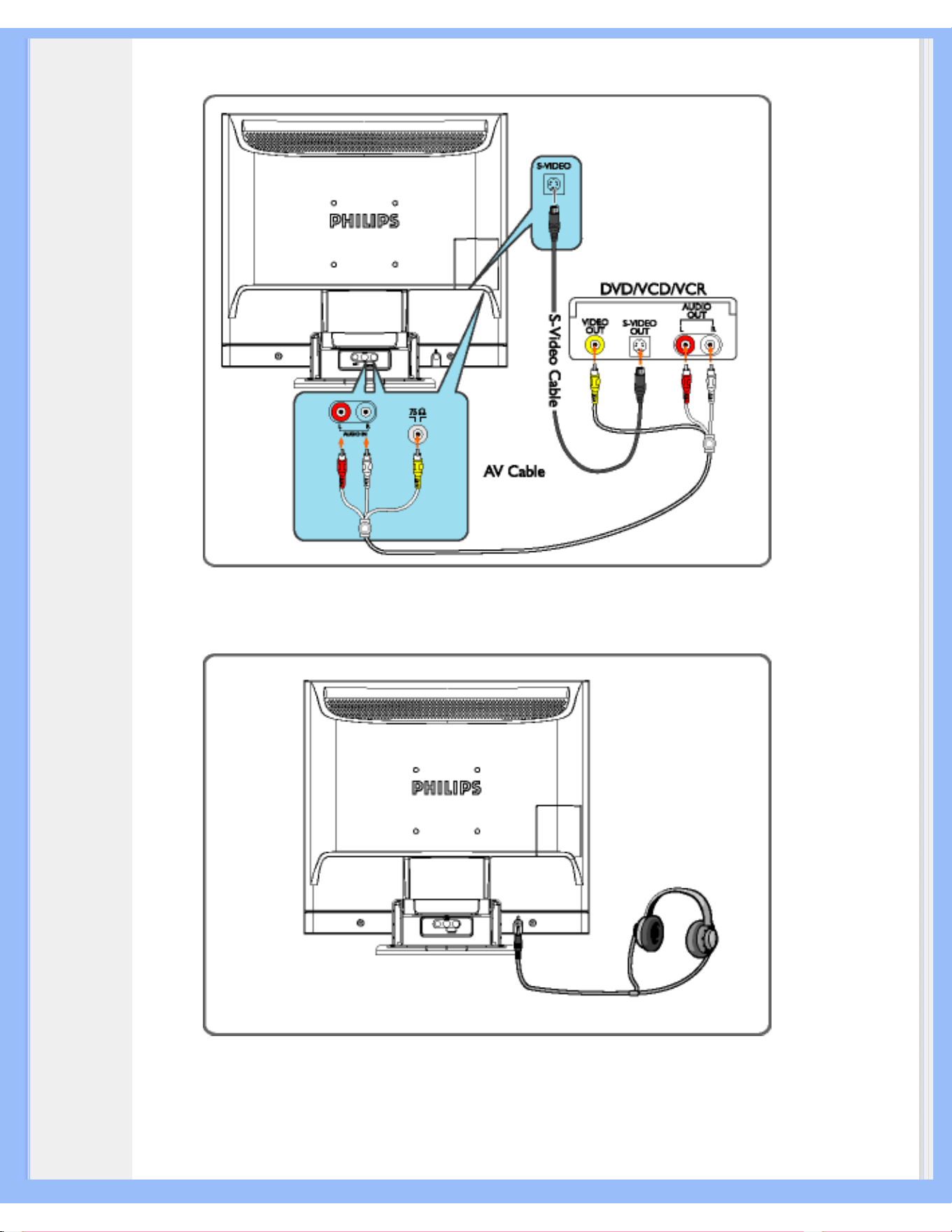
Setting up and Connecting Your Monitor
Connect to DVD/VCR/VCD
Connect to Earphone
file:///D|/My%20documents/dfu/J/english/200p4/install/connect.htm (3 of 4) [4/15/2004 1:45:29 PM]

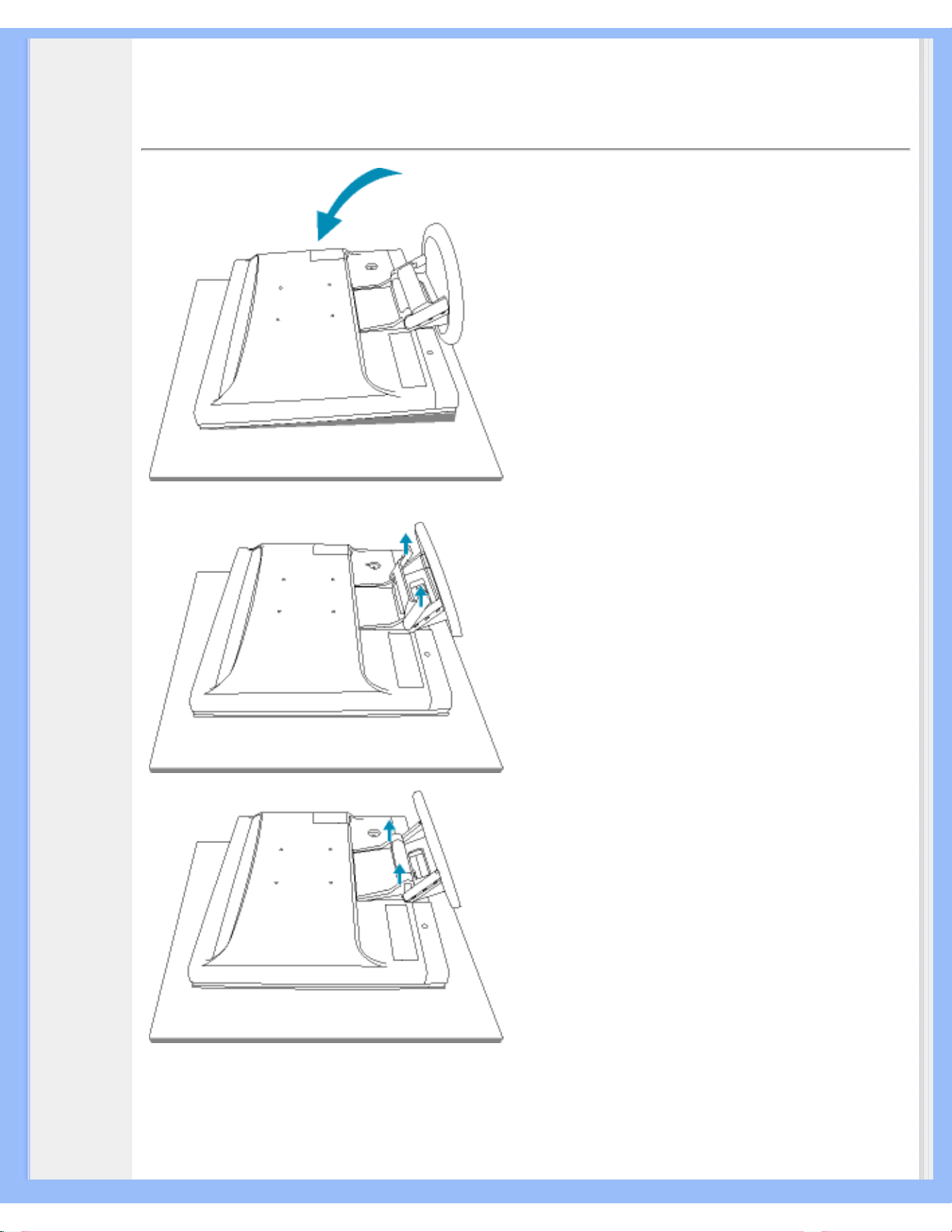
VESA Standard Mounting
Your LCD
Monitor :
•Front View
Product
Description
• Accessory
Pack
• Setting up
and
connecting
your monitor
• Getting
Started
• Optimizing
Performance
VESA Standard Mounting
1) Place monitor face down on a safe
surface.
2) Remove the cable cover.
3) Remove the base cover.
file:///D|/My%20documents/dfu/J/english/200p4/install/base.htm (1 of 2) [4/15/2004 1:45:30 PM]
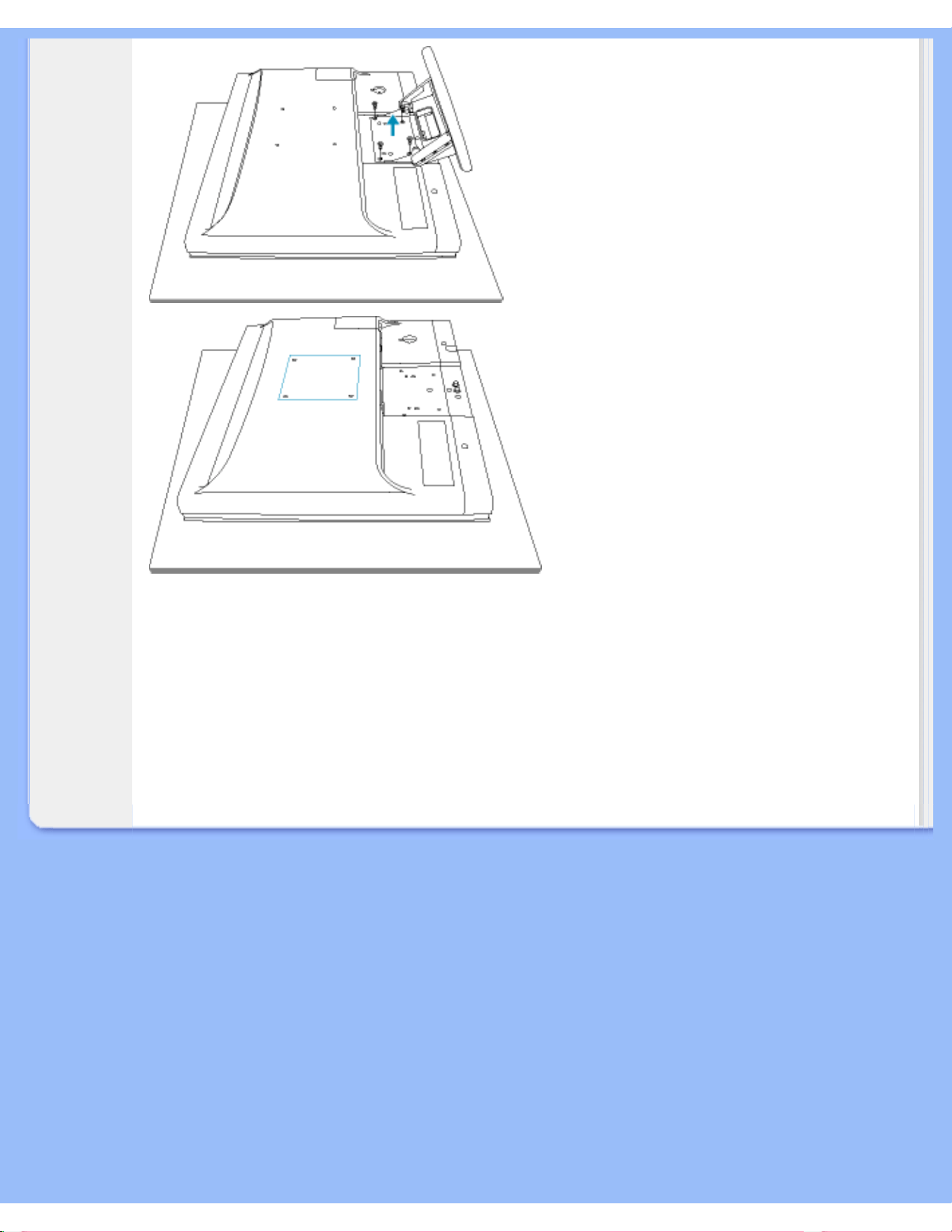

Getting Started
Your LCD
Monitor :
•Front View
Product
Description
• Setting Up
and
Connecting
Your Monitor
• Getting
Started
• Optimizing
Performance
Getting Started
Getting Started
Use the information file ( .inf) for Windows® 95/98/2000/Me/XP or later
The built-in VESA DDC2B feature in Philips Monitors supports Plug & Play requirements for Windows®
95/98/2000/Me/XP. This information file ( .inf) should be installed in order that your Philips monitor can
be enabled from the 'Monitor' dialog box in Windows® 95/98/2000/Me/XP and the Plug & Play
application can be activated. The installation procedure based on Windows® '95 OEM Release 2 , 98 ,
Me, XP and 2000 is specified as follows.
For Windows® 95
1. Start Windows® '95
2. Click on the 'Start' button, point to 'Settings', and then click on 'Control Panel'.
3. Double click on the 'Display' Icon.
4. Select the 'Settings' tab then click on 'Advanced...'.
5. Select the 'Monitor' button, point to 'Change...' then click on 'Have Disk...'.
6. Click on the 'Browse...' button, select the appropriate drive F: ( CD-ROM Drive) then click on the
'OK' button.
7. Click on the 'OK' button then select your monitor model and click on 'OK'.
8. Click on the 'Close' button.
For Windows® 98
1. Start Windows® 98
2. Click on the 'Start' button, point to 'Settings', and then click on 'Control Panel'.
3. Double click on the 'Display' Icon.
4. Select the 'Settings' tab then click on 'Advanced...'.
5. Select the 'Monitor' button, point to 'Change...' then click on 'Next'
6. Select 'Display a list of all the drivers in a specific location, so you can choose the driver you
want.' then click on 'Next' and then click on 'Have Disk...'.
7. Click on the 'Browse...' button, select the appropriate drive F: ( CD-ROM Drive) then click on the
'OK' button.
8. Click on the 'OK' button then select your monitor model and click on the 'Next' button.
9. Click on the 'Finish' button then the 'Close' button.
For Windows® Me
1. Start Windows® Me
2. Click on the 'Start' button, point to 'Settings', and then click on 'Control Panel'.
3. Double click on the 'Display' Icon.
4. Select the 'Settings' tab then click on 'Advanced...'.
5. Select the 'Monitor' button, then click on 'Change...' button.
6. Select 'Specify the location of the driver(Advanced)' and click on the 'Next' button.
file:///D|/My%20documents/dfu/J/english/200p4/install/gt_start.htm (1 of 3) [4/15/2004 1:45:31 PM]

Getting Started
7. Select 'Display a list of all the drivers in a specific location, so you can choose the driver you
want', then click on 'Next' and then click on 'Have Disk...'.
8. Click on the 'Browse...' button, select the appropriate drive F: ( CD-ROM Drive) then click on the
'OK' button.
9. Click on the 'OK' button, select your monitor model and click on the 'Next' button.
10. Click on 'Finish' button then the 'Close' button.
For Windows® 2000
1. Start Windows® 2000
2. Click on the 'Start' button, point to 'Settings', and then click on 'Control Panel'.
3. Double click on the 'Display' Icon.
4. Select the 'Settings' tab then click on 'Advanced...'.
5. Select 'Monitor'
- If the 'Properties' button is inactive, it means your monitor is properly configured. Please stop
installation.
- If the 'Properties' button is active. Click on 'Properties' button. Please follow the steps given
below.
6. Click on 'Driver' and then click on 'Update Driver...' then click on the 'Next' button.
7. Select 'Display a list of the known drivers for this device so that I can choose a specific driver',
then click on 'Next' and then click on 'Have disk...'.
8. Click on the 'Browse...' button then select the appropriate drive F: ( CD-ROM Drive).
9. Click on the 'Open' button, then click on the 'OK' button.
10. Select your monitor model and click on the 'Next' button.
11. Click on the 'Finish' button then the 'Close' button.
If you can see the 'Digital Signature Not Found' window, click on the 'Yes' button.
For Windows® XP
1. Start Windows® XP
2. Click on the 'Start' button and then click on 'Control Panel'.
3. Select and click on the category 'Printers and Other Hardware'
4. Click on the 'Display' Item.
5. Select the 'Settings' tab then click on the 'Advanced' button.
6. Select 'Monitor' tab
- If the 'Properties' button is inactive, it means your monitor is properly configured. Please stop
installation.
- If the 'Properties' button is active, click on 'Properties' button.
Please follow the steps below.
7. Click on the 'Driver' tab and then click on 'Update Driver...' button.
8. Select the 'Install from a list or specific location [advanced]' radio button and then click on the
'Next' button.
9. Select the 'Don't Search. I will choose the driver to install' radio button. Then click on the 'Next'
button.
10. Click on the 'Have disk...' button, then click on the 'Browse...' button and then select the
appropriate drive F: (CD-ROM Drive).
11. Click on the 'Open' button, then click the 'OK' button.
12. Select your monitor model and click on the 'Next' button.
- If you can see the 'has not passed Windows® Logo testing to verify its compatibility with
Windows® XP' message, please click on the 'Continue Anyway' button.
13. Click on the 'Finish' button then the 'Close' button.
14. Click on the 'OK' button and then the 'OK' button again to close the Display_Properties dialog
box.
If your Windows® 95/98/2000/Me/XP version is different or you need more detailed installation
file:///D|/My%20documents/dfu/J/english/200p4/install/gt_start.htm (2 of 3) [4/15/2004 1:45:31 PM]


file:///D|/My%20documents/dfu/J/english/warranty/war_1st.htm
Your Philips F1rst Choice Warranty
Thank you for purchasing this Philips monitor.
All Philips monitors are designed and manufactured to high standards and deliver high-
quality performance, ease of use and ease of installation. Should you encounter any
difficulties while installing or using this product, please contact the Philips helpdesk
directly to benefit from your Philips F1rst Choice Warranty. This three-year service
warranty entitles you to a swap model on-site if your monitor turns out to be faulty or
defective. Philips aims at a swap within 48 hours of your call being received.
What is covered?
The Philips F1rst Choice Warranty applies within Andorra, Austria, Belgium, Cyprus, Denmark, France,
Germany, Greece, Finland, Ireland, Italy, Liechtenstein, Luxembourg, Monaco, the Netherlands, Norway,
Portugal, Sweden, Switzerland, Spain and the United Kingdom and only for monitors originally designed,
manufactured, approved and/or authorized for usage within these countries.
Warranty coverage begins as from the day you buy your monitor. For three years thereafter, your monitor
will be swapped by at least an equivalent monitor in case of defects provided for under the warranty
coverage.
The swap monitor remains yours and Philips keeps the defective/original monitor. For the swap monitor the
warranty period remains equal to that of your original monitor, being 36 months as from the purchase date
of your original monitor.
What is excluded?
The Philips F1rst Choice Warranty applies provided the product is handled properly for its intended use, in
accordance with its operating instructions and upon presentation of the original invoice or cash receipt,
indicating the date of purchase, dealer's name and model and production number of the product.
The Philips F1rst Choice Warranty may not apply if:
● The documents have been altered in any way or made illegible;
● The model or production number on the product has been altered, deleted, removed or made
illegible;
● Repairs or product modifications and alterations have been executed by unauthorized service
organizations or persons;
● Damage is caused by accidents including but not limited to lightning, water or fire, misuse or neglect;
● Reception problems caused by signal conditions or cable or antenna systems outside the unit;
● Defects caused by abuse or misuse of the monitor;
● Product requires modification or adaptation to enable it to comply with local or national technical
standards, which apply in countries for which the product was not originally designed, manufactured,
approved and/or authorized. Therefore always check whether a product can be used in a specific
country.
file:///D|/My%20documents/dfu/J/english/warranty/war_1st.htm (1 of 2) [4/15/2004 1:45:39 PM]

file:///D|/My%20documents/dfu/J/english/warranty/war_1st.htm
● Note that products that are not originally designed, manufactured, approved and/or authorized for
usage within the Philips F1rst Choice countries, do not apply to the Philips F1rst Choice Warranty. In
these cases the Philips global warranty terms are valid.
Just a phone call away
In order to avoid unnecessary inconvenience, we advise you to read the operating instructions carefully
before contacting the Philips helpdesk.
To solve your problem quickly, please prepare the following details before contacting the Philips helpdesk:
● Philips type number
● Philips serial number
● Purchase date (copy of purchase may be required)
● PC environment Processor:
❍ 286/386/486/Pentium Pro/Internal memory
❍ Operating system (Windows, DOS, OS/2, MAC)
❍ Fax/Modem/Internet program?
● Other cards installed
Having the following information available will also help speed up the process:
● Your proof of purchase indicating: date of purchase, dealer name, model and product serial number.
● The full address to which the faulty monitor has to be collected and the swap model should be
delivered.
Philips’ customer help desks are located worldwide. You can contact Philips Monday - Friday from 08.00 -
20.00 hrs Central European Time (CET) and on Saturdays and Sundays from 10.00 to 18.00 hrs CET by
using one of the helpdesk telephone numbers. Click here to access the F1rst Choice Contact Information.
Or you can reach us via:
Website: http://www.philips.com
file:///D|/My%20documents/dfu/J/english/warranty/war_1st.htm (2 of 2) [4/15/2004 1:45:39 PM]

International Guarantee
Your International Guarantee
Dear Customer,
Thank you for purchasing this Philips product which has been designed and manufactured to the highest
quality standards.
If, unfortunately, something should go wrong with this product Philips guarantees free of charge labor and
replacement parts irrespective of the country where it is repaired during a period of 12 months from date of
purchase. This international Philips guarantee complements the existing national guarantee obligations to
you of dealers and Philips in the country of purchase and does not affect your statutory rights as a
customer.
The Philips guarantee applies provided the product is handled properly for its intended use, in accordance
with its operating instructions and upon presentation of the original invoice or cash receipt, indicating the
date of purchase, dealer's name and model and production number of the product.
The Philips guarantee may not apply if:
● the documents have been altered in any way or made illegible;
● the model or production number on the product has been altered, deleted, removed or made
illegible;
● repairs or product modifications and alterations have been executed by unauthorized service
organizations or persons;
● damage is caused by accidents including but not limited to lightning, water or fire, misuse or neglect.
Please note that the product is not defective under this guarantee in the case where modifications become
necessary in order for the product to comply with local or national technical standards which apply in
countries for which the product was not originally designed and/or manufactured. Therefore always check
whether a product can be used in a specific country.
In case your Philips product is not working correctly or is defective, please contact your Philips dealer. In the
event you require service whilst in another country a dealer address can be given to you by the Philips
Consumer Help Desk in that country, the telephone and fax number of which can be found in the relevant
part of this booklet.
In order to avoid unnecessary inconvenience, we advise you to read the operating instructions carefully
before contacting your dealer. If you have questions which your dealer cannot answer or any related
question please contact the Philips Consumer Information Centers or via:
Website:
http://www.philips.com
file:///D|/My%20documents/dfu/J/english/warranty/war_intl.htm (1 of 2) [4/15/2004 1:45:40 PM]

International Guarantee
file:///D|/My%20documents/dfu/J/english/warranty/war_intl.htm (2 of 2) [4/15/2004 1:45:40 PM]

United States Guarantee
LIMITED WARRANTY (Computer Monitor)
Click here to access the Warranty Registration Card.
Three Years Free Labor / Three Years Free Service on Parts / One Year Exchange*
*Product will be exchanged with a new or renewed to original specifications unit within two business days
for the first year. This product must be shipped in at your expense for service during years two and three.
WHO IS COVERED?
You must have proof of purchase to receive warranty service. A sales receipt or other document showing
that you purchased the product is considered proof of purchase. Attach it to this owner's manual and keep
both nearby.
WHAT IS COVERED?
Warranty coverage begins the day you buy your product. For three years thereafter, all parts will be
repaired or replaced, and labor is free. After three years from the day of purchase, you pay for the
replacement or repair of all parts, and for all labor charges.
All parts, including repaired and replaced parts, are covered only for the original warranty period. When the
warranty on the original product expires, the warranty on all replaced and repaired products and parts also
expires.
WHAT IS EXCLUDED?
Your warranty does not cover:
● labor charges for installation or setup of the product, adjustment of customer controls on the
product, and installation or repair of antenna systems outside of the product.
● product repair and/or part replacement because of misuse, accident, unauthorized repair or other
cause not within the control of Philips Consumer Electronics.
● reception problems caused by signal conditions or cable or antenna systems outside the unit.
● a product that requires modification or adaptation to enable it to operate in any country other than
the country for which it was designed, manufactured, approved and/or authorized, or repair of
products damaged by these modifications.
● incidental or consequential damages resulting from the product. (Some states do not allow the
exclusion of incidental or consequential damages, so the above exclusion may not apply to you.
file:///D|/My%20documents/dfu/J/english/warranty/war_usa.htm (1 of 3) [4/15/2004 1:45:42 PM]

United States Guarantee
This includes, but is not limited to, prerecorded material, whether copyrighted or not copyrighted.)
● a product used for commercial or institutional purposes.
Where IS SERVICE AVAILABLE?
Warranty service is available in all countries where the product is officially distributed by Philips Consumer
Electronics. In countries where Philips Consumer Electronics does not distribute the product, the local
Philips service organization will attempt to provide service (although there may be a delay if the appropriate
spare parts and technical manual(s) are not readily available).
Where CAN I GET MORE INFORMATION?
For more information, contact the Philips Customer Care Center by calling (877) 835-1838 (U.S.A.
customers only) or (402) 536-4171.
Before Requesting Service...
Please check your owner's manual before requesting service. Adjustments of the controls discussed there
may save you a service call.
TO GET WARRANTY SERVICE IN U.S.A., PUERTO RICO OR U.S. VIRGIN ISLANDS...
Contact the Philips Customer Care Center phone number listed below for product assistance and
procedures for servicing:
Philips Customer Care Center
(877) 835-1838 or (402) 536-4171
(In U.S.A., Puerto Rico and U.S. Virgin Islands, all implied warranties, including implied warranties of
merchantability and fitness for a particular purpose, are limited in duration to the duration of this express
warranty. But, because some states do not allow limitations on how long an implied warranty may last, this
limitation may not apply to you.)
TO GET WARRANTY SERVICE IN CANADA...
Please contact Philips at:
(800) 479-6696
file:///D|/My%20documents/dfu/J/english/warranty/war_usa.htm (2 of 3) [4/15/2004 1:45:42 PM]

United States Guarantee
Three years free parts and three years free labor will be provided at Philips Canada depot or any one of its
authorized service centers.
(In Canada, this warranty is given in lieu of all other warranties. No other warranties are expressed or
implied, including any implied warranties of merchantability or fitness for a particular purpose. Philips is not
liable under any circumstances for any direct, indirect, special, incidental or consequential damages,
howsoever incurred, even if notified of the possibility of such damages.)
REMEMBER... Please record the model and serial numbers found on the product below.
MODEL # ________________________________________________
SERIAL # ________________________________________________
This warranty gives you specific legal rights. You may have other rights which vary from state/province to
state/province.
Philips Customer Care Center, P. O. Box 2976, Longview, TX 75601
file:///D|/My%20documents/dfu/J/english/warranty/war_usa.htm (3 of 3) [4/15/2004 1:45:42 PM]

file:///D|/My%20documents/dfu/J/english/warranty/warfirst.htm
F1rst Choice Contact Information
Telephone numbers:
Austria
01 546 575 603
Luxembourg
026 84 3000
Belgium
02 275 0701
Netherlands
053 482 9800
Cyprus (Greek)
800 92256
Norway
22 70 82 50
Denmark
35 25 87 61
Portugal
0800 831 363
France
03 8717 0033
Sweden
08 632 0016
Germany
0696 698 4712
Switzerland
02 23 10 21 16
Greece
00800 3122 1223
Spain
09 17 45 62 46
Finland
09 2290 1908
United Kingdom
0207 949 0069
Ireland
01 601 1161
Italy
02 48 27 11 53
file:///D|/My%20documents/dfu/J/english/warranty/warfirst.htm [4/15/2004 1:46:01 PM]

Consumer Information Centers
Consumer Information Centers
Antilles • Argentina • Australia • Bangladesh • Brasil • Canada • Chile • China • Colombia •
Czech Republic • Dubai • Egypt • Hong Kong • Hungary • India • Indonesia • Korea •
Malaysia • Mexico • Morocco • New Zealand • Pakistan • Paraguay • Peru • Philippines •
Poland • Russia • Singapore • Slovakia • Slovenia • South Africa • Taiwan • Thailand
• Turkey • Uruguay • Venezuela
Eastern Europe
CZECH REPUBLIC
Xpectrum
Lužná 591/4
CZ - 160 00 Praha 6
Phone: 800 100 697
Email:[email protected]
www.xpectrum.cz
HUNGARY
Serware Szerviz
Vizimolnár u. 2-4
HU - 1031 Budapest
Phone: +36 1 2426331
Email: [email protected]
www.serware.hu
SLOVAKIA
Datalan Servisne Stredisko
Puchovska 8
SK - 831 06 Bratislava
Phone: +421 2 49207155
Email: [email protected]
file:///D|/My%20documents/dfu/J/english/warranty/warcic.htm (1 of 9) [4/15/2004 1:46:30 PM]

Consumer Information Centers
SLOVENIA
PC HAND
Brezovce 10
SI - 1236 Trzin
Phone: +386 1 530 08 24
Email: [email protected]
POLAND
Zolter
ul.Zytnia 1
PL - 05-500 Piaseczno
Phone:+48 22 7501766
Email: [email protected]
www.zolter.com.pl
RUSSIA
Phone: +7 095 961-1111
Phone: 8-800-200-0880
Web-site: www.philips.ru
TURKEY
Türk Philips Ticaret A.S.
Yukari Dudullu Org.San.Bolgesi
2.Cadde No:22
34776-Umraniye/Istanbul
Phone: (0800)-261 33 02
Latin America
ANTILLES
Philips Antillana N.V.
Kaminda A.J.E. Kusters 4
Zeelandia, P.O. box 3523-3051
Willemstad, Curacao
Phone: (09)-4612799
Fax : (09)-4612772
file:///D|/My%20documents/dfu/J/english/warranty/warcic.htm (2 of 9) [4/15/2004 1:46:30 PM]

Consumer Information Centers
ARGENTINA
Philips Antillana N.V.
Vedia 3892 Capital Federal
CP: 1430 Buenos Aires
Phone: (011)-4544 2047
BRASIL
Philips da Amazônia Ind. Elet. Ltda.
Av. Luis Carlos Berrini,
1400 - Sao Paulo -SP
Phone: 0800-701-0203
CHILE
Philips Chilena S.A.
Avenida Santa Maria 0760
P.O. box 2687Santiago de Chile
Phone: (02)-730 2000
Fax : (02)-777 6730
COLOMBIA
Industrias Philips de Colombia
S.A.-Division de Servicio
CARRERA 15 Nr. 104-33
Bogota, Colombia
Phone:(01)-8000 111001 (toll free)
Fax : (01)-619-4300/619-4104
MEXICO
Consumer Information Centre
Norte 45 No.669
Col. Industrial Vallejo
C.P.02300, -Mexico, D.F.
Phone: (05)-3687788 / 9180050462
Fax : (05)-7284272
file:///D|/My%20documents/dfu/J/english/warranty/warcic.htm (3 of 9) [4/15/2004 1:46:30 PM]

Consumer Information Centers
PARAGUAY
Philips del Paraguay S.A.
Avenida Artigas 1513
Casilla de Correos 605
Asuncion
Phone: (021)-211666
Fax : (021)-213007
PERU
Philips Peruana S.A.
Customer Desk
Comandante Espinar 719
Casilla 1841
Limab18
Phone: (01)-2136200
Fax : (01)-2136276
URUGUAY
Ind.Philips del Uruguay S.A.
Luis Alberto de Herrera 1248
Customer Help Desk
11300 Montevideo
Phone: (02)-6281111
Fax : (02)-6287777
VENEZUELA
Industrias Venezolanas Philips S.A.
Apartado Postal 1167
Caracas 1010-A
Phone: (02) 2377575
Fax : (02) 2376420
Canada
CANADA
Philips Electronics Ltd.
281 Hillmount Road
Markham, Ontario L6C 2S3
Phone: (800) 479-6696
Pacific
file:///D|/My%20documents/dfu/J/english/warranty/warcic.htm (4 of 9) [4/15/2004 1:46:30 PM]

Consumer Information Centers
AUSTRALIA
Philips Consumer Service.
Customer Information Centre.
3 Figtree Drive
Homebush Bay NSW 2140
Phone: CIC: 1300-363 391 PCE Service: 1300-361 392 (toll free)
Fax : +61 2 9947 0063
NEW ZEALAND
Philips New Zealand Ltd.
Consumer Help Desk
2 Wagener Place, Mt.Albert
P.O. box 1041
Auckland
Phone: 0800 477 999 (toll free)
Fax : 0800 288 588 (toll free)
Asia
BANGLADESH
Philips Service Centre
100 Kazi Nazrul Islam
Avenue Kawran Bazar C/A
Dhaka-1215
Phone: (02)-812909
Fax : (02)-813062
CHINA
BEIJING
Beijing Authorized Service Centre.
Consumer Information Centre
Building 6, West Street
Chong Wen Men, Beijing, Jin Bang Co. Led.
100051 BEIJING
GUANGZHOU
Philips Authorized Service Centre
801 Dong Feng Road East
Guangzhou 510080
SHANGHAI
Philips Service Logistic Centre
Consumer Information Centre
P.O.Box 002-027, Nextage Department Store
file:///D|/My%20documents/dfu/J/english/warranty/warcic.htm (5 of 9) [4/15/2004 1:46:30 PM]

Consumer Information Centers
Puding New District
200002 SHANGHAI
Philips Authorized Service Centre
Consumer Information Centre
148 Fu Jian Road M
200001 Shanghai
Phone: 800 820 5128 (toll free)
Fax: 21-656 10647
HONG KONG
Philips Hong Kong Limited
Consumer Information Centre
16/F Hopewell Centre
17 Kennedy Road, WANCHAI
Phone: 2619 9663
Fax : 2481 5847
INDIA
Phone: 91-20-712 2048 ext: 2765
Fax: 91-20-712 1558
BOMBAY
Philips India
Customer Relation Centre
Bandbox House
254-D Dr. A Besant Road, Worli
Bombay 400 025
CALCUTTA
Customer Relation Centre
7 justice Chandra Madhab Road
Calcutta 700 020
MADRAS
Customer Relation Centre
3, Haddows Road
Madras 600 006
NEW DELHI
Customer Relation Centre
68, Shivaji Marg
New Dehli 110 015
file:///D|/My%20documents/dfu/J/english/warranty/warcic.htm (6 of 9) [4/15/2004 1:46:30 PM]

Consumer Information Centers
INDONESIA
Philips Group of Companies in Indonesia
Consumer Information Centre
Jl.Buncit Raya Kav. 99-100
12510 Jakarta
Phone: (021)-794 0040 / 798 4255 ext: 1612
Fax : (021)-794 7511 / 794 7539
KOREA
Philips Korea Ltd.
Philips House
C.P.O. box 3680
260-199, Itaewon-Dong.
Yongsan-Ku, Seoul 140-202
Phone:080-600-6600 (Local toll free)
Fax : (02)-709-1245
MALAYSIA
Philips Malaysia Sdn. Berhad
Service Dept.
No.51,sect.13 Jalan University.
46200 Petaling Jaya, Selagor.
P.O.box 12163
50768 Kuala Lumpur.
Phone: (03)-7950 5501/02
Fax : (03)-7954 8504
PAKISTAN
KARACHI
Philips Electrical Ind. of Pakistan
Consumer Information Centre
F-54, S.I.T.E, P.O.Box 7101
75730 KARACHI
Philips Consumer Service Centre
168-F, Adamjee Road
Rawalpindi Cantt
Phone: (021)-7731927
Fax : (021)-7721167
file:///D|/My%20documents/dfu/J/english/warranty/warcic.htm (7 of 9) [4/15/2004 1:46:30 PM]

Consumer Information Centers
PHILIPPINES
Philips Electronics and Lighting Inc.
106 Valero St., Salcedo Village
Makati, Metro Manilla.
Phone: (02)-888 05 72
Domestic toll free: 1-800-10-PHILIPS or 1-800-10-744 5477
Fax : (02)-888 05 71
SINGAPORE
Philips Singapore Private Ltd.
Consumer Service Dept.
Lorong 1,Toa Payoh., P.O. box 340
Singapore 1231
Phone: 6882 3999
Fax : 6250 8037
TAIWAN
Philips Taiwan Ltd.
Consumer Information Centre
13F, No. 3-1 Yuan Qu St., Nan Gang Dist.,
Taipei 115, Taiwan
Phone: 0800-231-099
Fax : (02)-3789-2641
THAILAND
Philips Electronics (Thailand) Ltd.
Philips Service Centre
209/2 Sanpavut Road,
Bangna, Bangkok 10260
Phone : (02)-652 8652
Fax : (02)-614 3531
Africa
MOROCCO
Philips Electronique Maroc
304,BD Mohamed V
Casablanca
Phone: (02)-302992
Fax : (02)-303446
file:///D|/My%20documents/dfu/J/english/warranty/warcic.htm (8 of 9) [4/15/2004 1:46:30 PM]

Consumer Information Centers
SOUTH AFRICA
South African Philips.
S.V. Div. 195 Main R.D.
Martindale., Johannesburg
P.O.box 58088
Newville 2114
Phone: +27 11 471 5000
Fax : +27 11 471 5020
Middle East
DUBAI
Philips Middle East B.V.
Consumer Information Centre
P.O.Box 7785
DUBAI
Phone: (04)-335 3666
Fax : (04)-335 3999
EGYPT
Philips Egypt
Consumer Information Centre
10, Abdel Rahman El Rafei
Mohandessin - Cairo, P.O.Box 242
DOKKI
Phone: (02)-3313993
Fax : (02)-3492142
file:///D|/My%20documents/dfu/J/english/warranty/warcic.htm (9 of 9) [4/15/2004 1:46:30 PM]