

Online Edition for Part no. 01 41 2 603 632 - © 09/09 BMW AG

ActiveHybrid X6
Supplementary Owner's Manual of the vehicle
We are happy that you have decided on a BMW ActiveHybrid X6.
The more familiar you are with your BMW, the greater command
you will have of it in traffic.
We therefore ask you to:
Read the information contained in this Supplementary Owner's
Manual before you start off in your new BMW. It contains impor-
tant notes on vehicle operation that will allow you to make full use
of the technical advantages of your BMW.
We wish you a pleasant and safe driving experience
BMW Group
Online Edition for Part no. 01 41 2 603 632 - © 09/09 BMW AGOnline Edition for Part no. 01 41 2 603 632 - © 09/09 BMW AG

© 2009 Bayerische Motoren Werke
Aktiengesellschaft
Munich, Germany
Reprinting, including excerpts,
only with the written consent of
BMW AG, Munich.
US English IX/09, 09 09 500
Printed on environmentally friendly paper,
bleached without chlorine, suitable for recycling.
Online Edition for Part no. 01 41 2 603 632 - © 09/09 BMW AGOnline Edition for Part no. 01 41 2 603 632 - © 09/09 BMW AG

Reference At a glanceControlsDriving tipsMobility
Contents
The fastest way to find specific topics is to use
the index, refer to page 48.
Using this Owner's Manual
4 Notes
At a glance
8 Cockpit
Controls
12 Driving
21 Everything under control
23 Climate
Driving tips
26 Things to remember when driving
Mobility
32 Refueling
34 Wheels and tires
35 Engine compartment
36 Replacing components
37 Giving and receiving assistance
Reference
44 Technical data
48 Everything from A to Z
Online Edition for Part no. 01 41 2 603 632 - © 09/09 BMW AGOnline Edition for Part no. 01 41 2 603 632 - © 09/09 BMW AG

Notes
4
Notes
BMW ActiveHybrid X6
Your BMW ActiveHybrid X6 has two different
types of drive: A combustion engine and elec-
tric motors. This combination enables a partic-
ularly efficient energy management. Additional
advantages include special performance speci-
fications such as an optimized acceleration
through assistance to the combustion engine
provided by the two electric motors.
About this Owner's Manual
This Supplementary Owner's Manual contains
all essential equipment, instructions, and tech-
nical data in which the BMW ActiveHybrid X6 M
differs from the BMW X6. For a description of
equipment not contained in this Supplementary
Owner's Manual, please refer to the BMW X6
Owner's Manual or possibly to other brochures
included with the onboard literature.
We have made every effort to ensure that you
are able to find what you need in this Owner's
Manual as quickly as possible. The fastest way
to find specific topics is to refer to the detailed
index at the back of the manual. If you wish to
gain an initial overview of your vehicle, you will
find this in the first chapter.
Should you sell your BMW some day, please
remember to also pass the Owner's Manual on
to the new owner; it is an important component
of your vehicle.
Additional sources of information
If you have additional questions, your BMW
Sports Activity Vehicle Center is always happy
to advise you.
You can find information on BMW, e.g. on tech-
nology, on the Internet at www.bmwusa.com.
Symbols used
Indicates precautions that must be fol-
lowed precisely in order to avoid the pos-
sibility of personal injury and serious damage to
the vehicle.<
Indicates information that will assist you
in gaining the optimum benefit from your
vehicle and enable you to care more effectively
for your vehicle.<
Refers to measures that can be taken to
help protect the environment.<
< Marks the end of a specific item of informa-
tion.
*
Indicates special equipment, country-spe-
cific equipment and optional accessories, as
well as equipment and functions not yet avail-
able at the time of printing.
"..." Identifies Control Display texts used to
select individual functions.
{...} Verbal instructions to use with the voice
activation system.
Symbols on vehicle components
Indicates that you should consult the rel-
evant section of this Owner's Manual for
information on a particular part or assembly.
Indicates vehicle parts that are high-
voltage components of the hybrid
system.
Improper work on these vehicle parts can lead
to life-threatening injuries.
Online Edition for Part no. 01 41 2 603 632 - © 09/09 BMW AGOnline Edition for Part no. 01 41 2 603 632 - © 09/09 BMW AG

Reference At a glanceControlsDriving tipsMobility
5
The individual vehicle
When purchasing your BMW, you have decided
in favor of a model with individualized equip-
ment and features. This Owner's Manual
describes the entire array of options and equip-
ment available with a specific BMW model.
Please bear in mind that the manual may con-
tain information on accessories and equipment
that you have not specified for your own vehicle.
Sections describing options and special equip-
ment are marked by asterisks
*
to assist you in
identifying possible differences between the
descriptions in this manual and your own vehi-
cle's equipment.
If equipment in your BMW is not described in
this Owner's Manual, please refer to the BMW
X6 Owner's Manual.
Editorial notice
BMW pursues a policy of continuous, ongoing
development that is conceived to ensure that
our vehicles continue to embody the highest
quality and safety standards combined with
advanced, state-of-the-art technology. For this
reason, it is possible that the features described
in this Owner's Manual could differ from those
on your vehicle.
For your own safety
The BMW ActiveHybrid X6 has special fea-
tures, e.g. electric driving, that can require spe-
cial alertness in traffic.
During electric driving, please note that
pedestrians and other road users may fail
to notice the vehicle in the usual way due to the
lack of engine noise. For example, proceed with
particular caution when pulling into and out of a
parking space.<
Maintenance and repairs
Advanced technology, e.g. the use of
modern materials and high-performance
electronics, requires specially adapted mainte-
nance and repair methods. Therefore, have cor-
responding work on your BMW performed only
by your BMW Sports Activity Vehicle Center or
a repair shop that works according to BMW
repair procedures with correspondingly trained
personnel. If this work is not carried out prop-
erly, there is a danger of subsequent damage
and related safety hazards. Particularly when
work is performed on the high-voltage systems,
lack of expertise can lead to life-threatening
injuries.<
Teleservice Report*
Transmits technical data about your vehicle as
needed to BMW at regular intervals; these data
are used in the development of BMW products.
The service is only used in vehicles with partic-
ular technical equipment. A Teleservice Report
is only activated in connection with the BMW
SIM card-equipped phone unit installed in the
vehicle and does not cost you anything. Neither
personal data nor location data are transmitted.
Online Edition for Part no. 01 41 2 603 632 - © 09/09 BMW AGOnline Edition for Part no. 01 41 2 603 632 - © 09/09 BMW AG

Online Edition for Part no. 01 41 2 603 632 - © 09/09 BMW AG

At a glance
This overview of buttons, switches and displays
is intended to familiarize you with your vehicle's
operating environment. The section will also
assist you in becoming acquainted with the
control concepts and options available
for operating the various systems.
At a glance
Online Edition for Part no. 01 41 2 603 632 - © 09/09 BMW AG
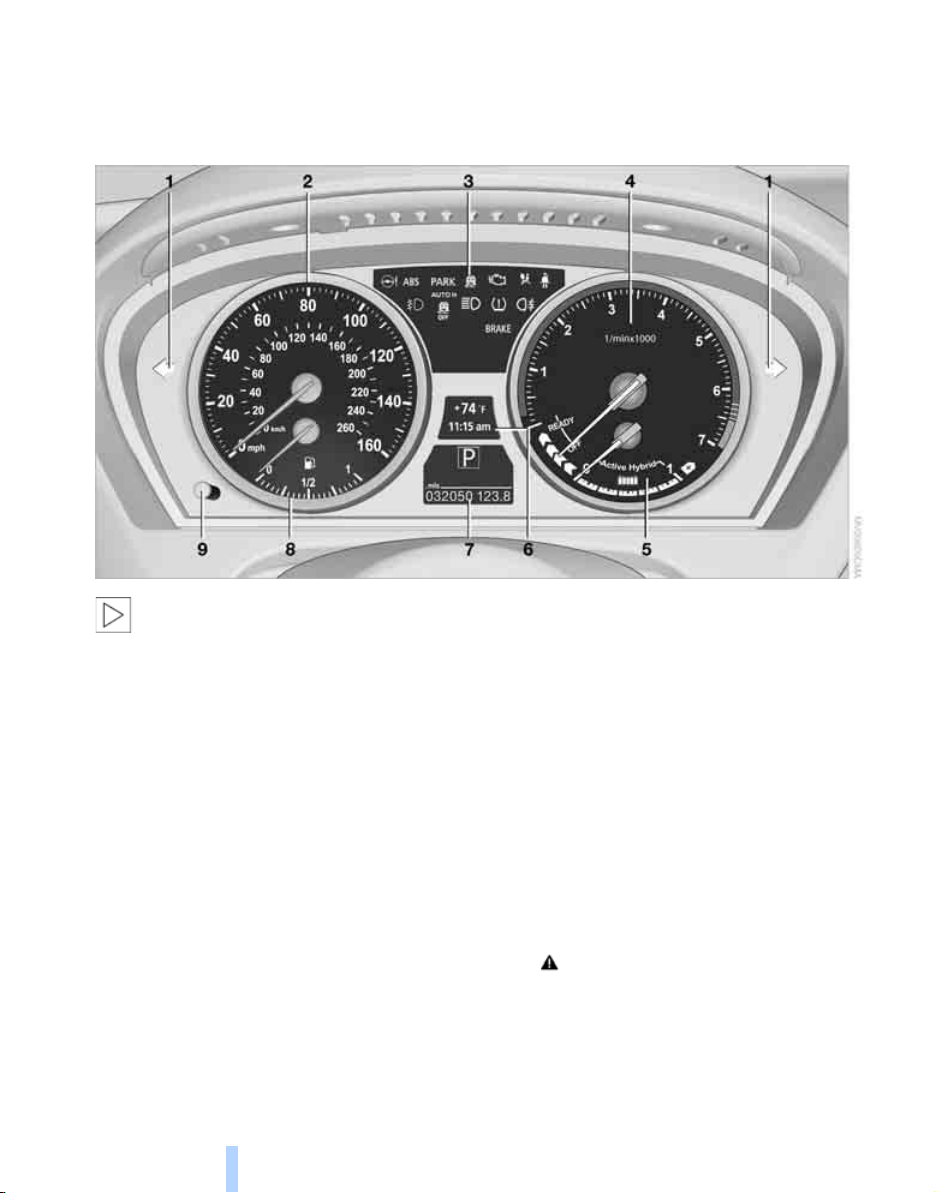
Cockpit
8
Cockpit
Instrument panel
For the description of components with-
out page references, please refer to the
respective keyword in the Owner's Manual of
the BMW X6.<
1 Indicator lamps for turn signals
2 Speedometer
3 Indicator and warning lamps
4 Tachometer
5 Display for
> Charge state 21
> Activating/deactivating drive
readiness 14
> Electric driving: eDRIVE 15
> Assisted combustion engine:
eBOOST 16
> Energy recovery/regeneration:
CHARGE 16
6 Display for
> Clock/date
> Outside temperature
> Indicator/warning lamps
> Speed of cruise control 19
7 Display for
> Odometer and trip odometer
> Computer
> Date and remaining travel distance
for service requirements
> Transmission positions 16
> HDC Hill Descent Control
> High-beam assistant
*
> There is a Check Control message
8 Fuel gauge 22
9 Resetting trip odometer Displaying service
requirement
Online Edition for Part no. 01 41 2 603 632 - © 09/09 BMW AGOnline Edition for Part no. 01 41 2 603 632 - © 09/09 BMW AG

Online Edition for Part no. 01 41 2 603 632 - © 09/09 BMW AG

Controls
This chapter is intended to provide you with
information for complete control of your vehicle.
Its extensive array of features and accessories,
both for driving and for your own safety,
comfort and convenience, are described here.
Controls
Online Edition for Part no. 01 41 2 603 632 - © 09/09 BMW AG
Driving
12
Driving
BMW ActiveHybrid X6
The concept
Through the interplay of the combustion engine
and electric motors, your BMW ActiveHybrid X6
achieves a particularly efficient fuel consump-
tion and optimizes vehicle performance.
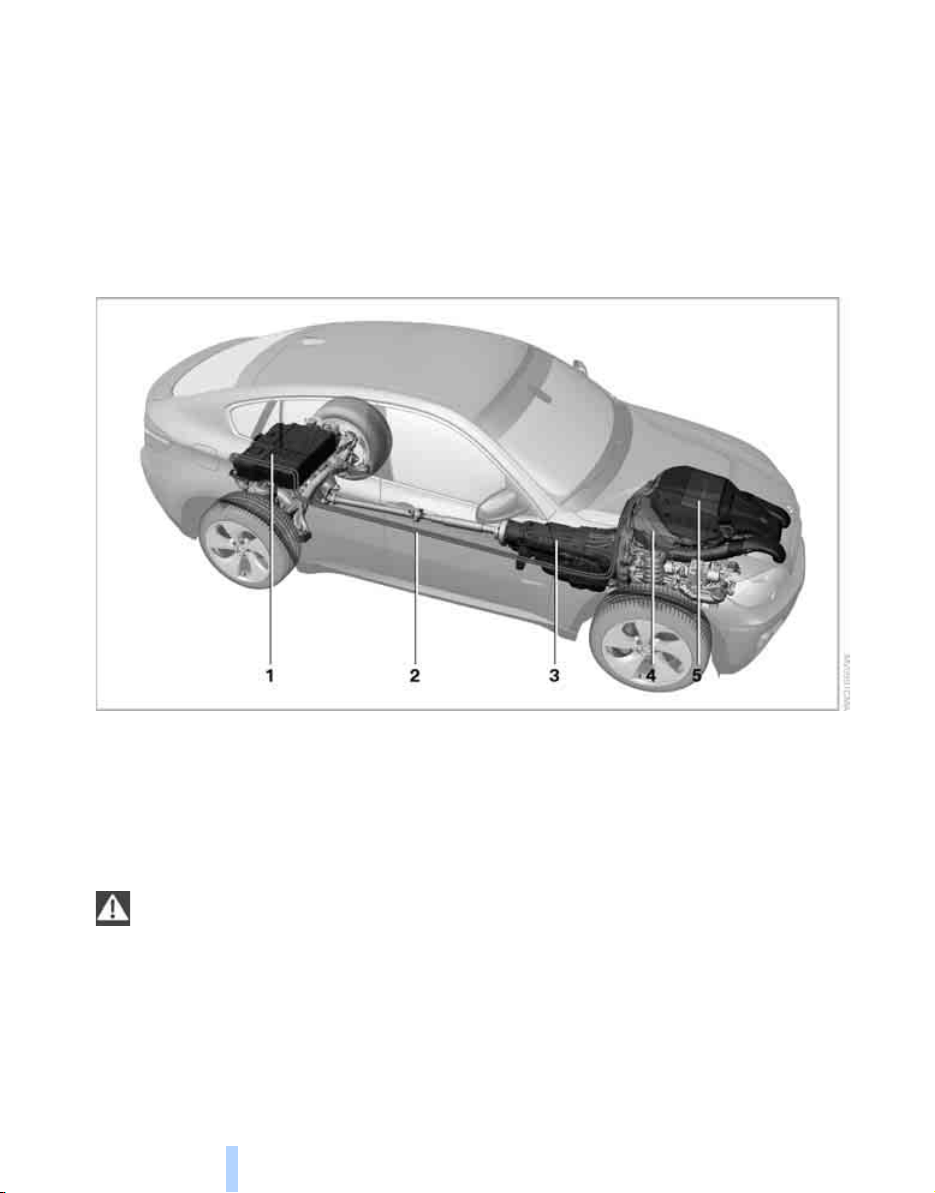
Components of the system
1 High-voltage battery
2 High-voltage wires: orange
3 Two-Mode Active Transmission with 2
integrated electric motors
4 Combustion engine
5 Control-system electronics
Do not damage orange high-voltage
wires. Otherwise, there is the risk of fatal
injury by electrocution.<
The energy required to drive the electric motors
is stored in the high-voltage battery stored
under the luggage compartment floor in the
luggage compartment.
To produce electrical energy, the two electric
motors in the Two-Mode Active Transmission
function as generators. They are driven by the
combustion engine or by kinetic energy during
braking.
This permits an energy conversion of kinetic
energy into electrical current.
Online Edition for Part no. 01 41 2 603 632 - © 09/09 BMW AGOnline Edition for Part no. 01 41 2 603 632 - © 09/09 BMW AG
Reference At a glanceControlsDriving tipsMobility
13
Functions of the hybrid system
The hybrid system of your BMW ActiveHybrid
X6 offers the following functions.
Electric driving: eDRIVE
Under certain conditions, refer to page 15, the
vehicle is powered exclusively by its electric
motors.
Driving with combustion engine: DRIVE
The combustion engine supplies the drive out-
put for moving the vehicle. The high-voltage
battery is charged at the same time.
The hybrid system always starts the combus-
tion engine automatically, refer to page 16.
Assisted combustion engine: eBOOST
The combustion engine supplies the main drive
output for moving the vehicle.
In this mode, the electric motors assist the
combustion engine with additional power as
needed.
Energy recovery: CHARGE
When reducing vehicle speed, the kinetic
energy can be converted into electrical energy,
refer to page 16.
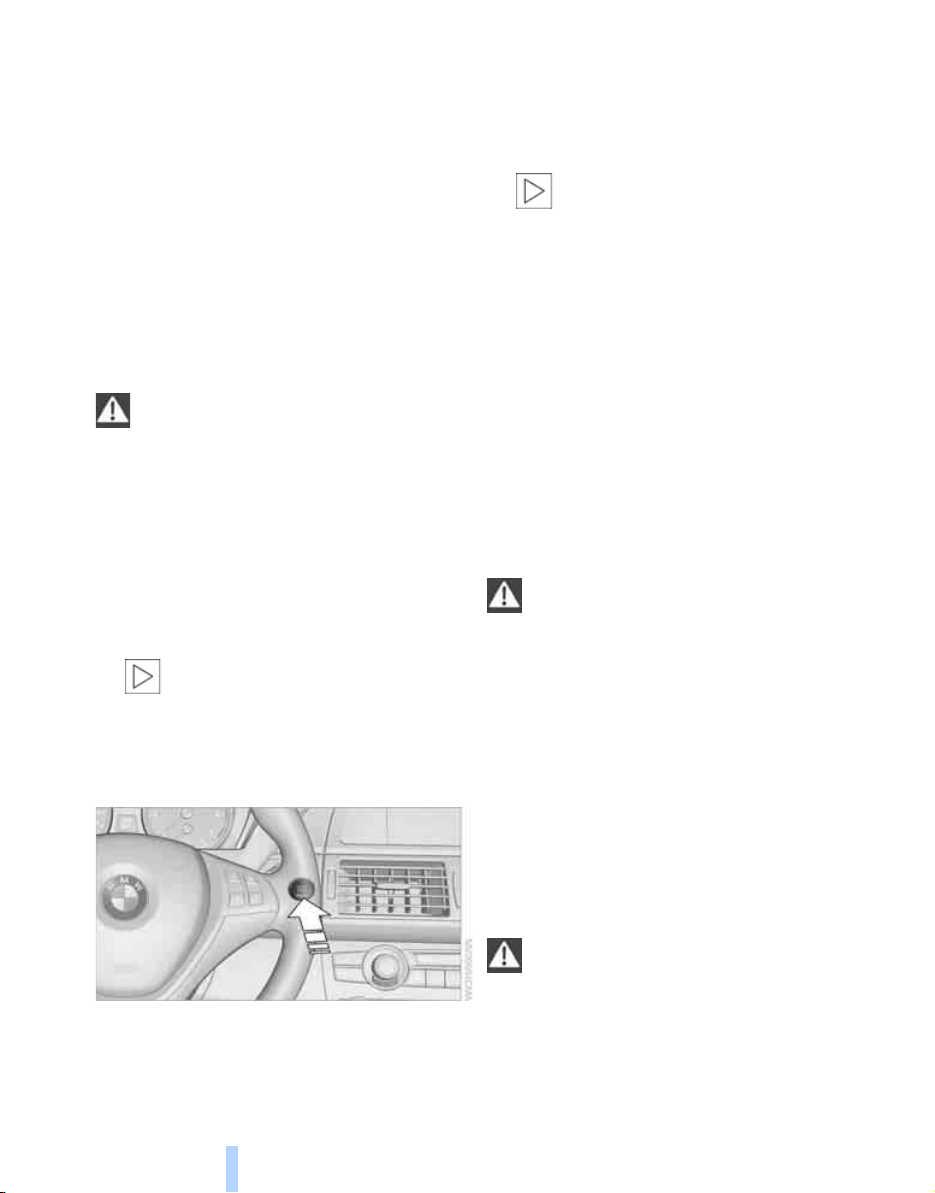
Start/Stop button, ready
modes
The following readiness modes can be
achieved by pressing the Start/Stop button:
> Radio readiness on/off
> Ignition on/off
> Drive readiness activate/deactivate
In order to switch on drive readiness
mode, also step on the brake.<
Radio readiness on/off
Some electrical equipment is operational. The
time and outside temperature are displayed in
the instrument panel.
Radio readiness is switched on:
> when the remote control is inserted into the
ignition lock
> with comfort access
*
, when the Start/Stop
button is pressed without stepping on the
brake.
Radio readiness is automatically switched off:
> when the remote control is removed from
the ignition lock
> with comfort access
*
, by touching the sur-
face above the door lock, refer to BMW X6
Owner's Manual.
Ignition on/off
When the ignition is switched on, all electrical
equipment is operational. The odometer and
trip meter are displayed in the instrument panel.
When the ignition is switched off, all indicator
lamps and warning lamps go out again.
The ignition is automatically switched off:
> when the remote control is removed from
the ignition lock
> with comfort access
*
, by touching the sur-
face above the door lock, refer to BMW X6
Owner's Manual.
Pressing the start/stop button again switches
the ignition back on.
For example, the ignition is not switched off in
the following situations:
> the brakes are actuated
> the low beams are switched on
If you do not plan to start driving, switch
off the ignition and unneeded electrical
equipment in order to reduce the drain on the
battery.<
Online Edition for Part no. 01 41 2 603 632 - © 09/09 BMW AGOnline Edition for Part no. 01 41 2 603 632 - © 09/09 BMW AG
Driving
14
Drive readiness
With drive readiness activated, the vehicle is
ready to drive.
Switching on drive readiness corresponds to
starting the engine in conventional vehicles.
Drive readiness can take the following forms:
> Electric driving
The combustion engine is not switched on.
> Driving with combustion engine
The vehicle is driven by the combustion
engine.
Drive readiness in detail
Never leave the vehicle unattended with
drive readiness activated; such a vehicle
represents a potential safety hazard.<
Activating drive readiness
1. Close the driver's door.
2. Insert the remote control as far as possible
into the ignition lock. With comfort access
*
,
place the remote control into the vehicle,
refer to BMW X6 Owner's Manual.
3. Depress brake pedal.
To initialize the brake system, the
brake pedal travel is longer than usual
during activation of drive readiness. After
the brake pedal is released, the pedal travel
returns to normal.<
4. Press the Start/Stop button.
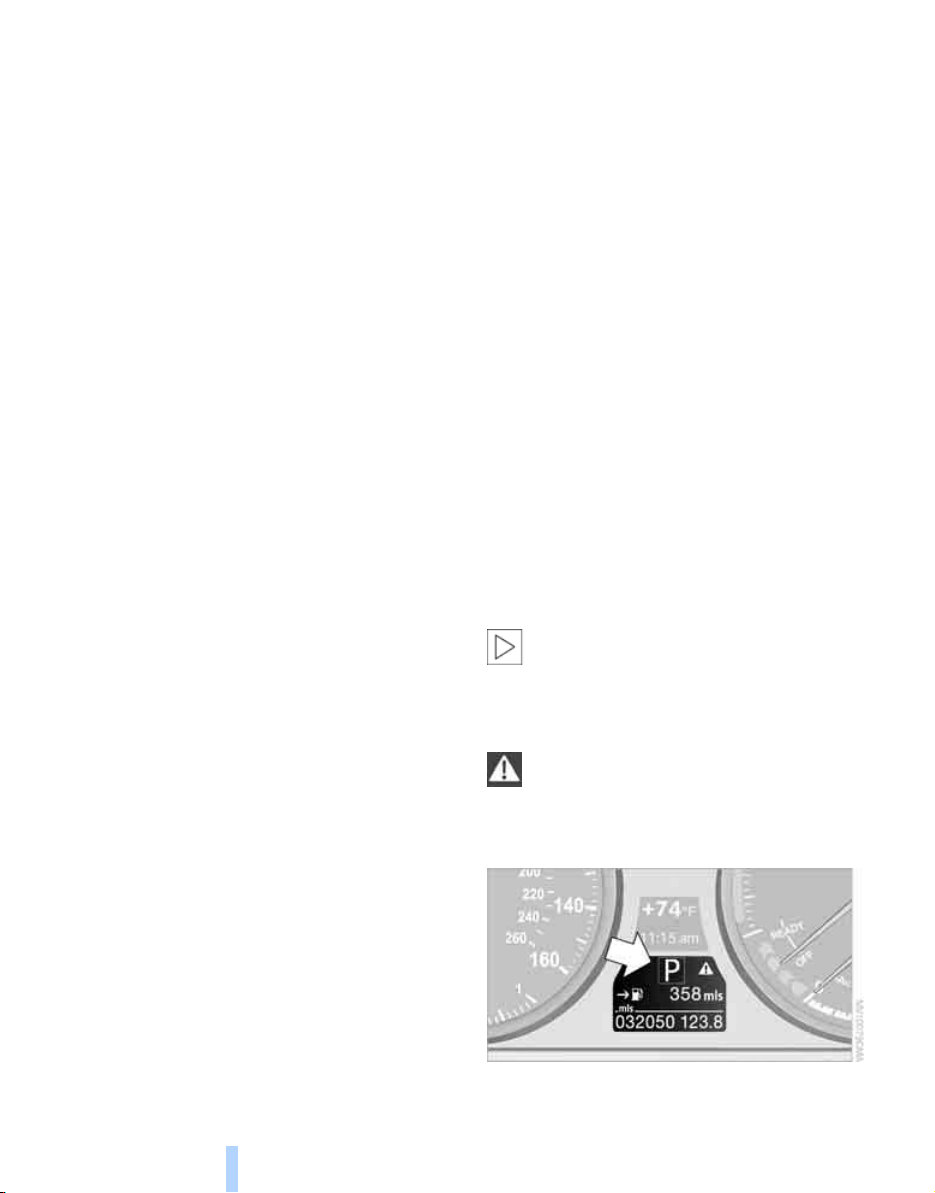
5. Drive readiness is active:
> Starting the combustion engine
> or electric drive readiness, silent start:
The tachometer pointer moves into the
READY position.
Electric drive readiness can be acti-
vated within an interval of approx. 2 to
60 seconds after radio readiness is
switched on, provided that the function
conditions for electric driving have been
met, refer to page 15.<
Electric drive readiness, silent start
The vehicle is ready to drive without starting the
combustion engine.
Silent start, the noiseless starting of the vehicle,
can be activated within an interval of approx. 2
to 60 seconds after radio readiness is switched
on, under the following conditions:
> driver's door closed
> conditions met to allow electric driving,
refer to page 15
During electric driving, please note that
pedestrians and other road users may fail
to notice the vehicle in the usual way due to the
lack of engine noise. For example, proceed with
particular caution when pulling into and out of a
parking space.<
Starting the combustion engine
When drive readiness is switched on under the
following circumstances, the combustion
engine is started:
> drive system not at operating temperature
> high temperature of hybrid system
> insufficient charge state of high-voltage
battery or fully charged high-voltage battery
If a Silent start is not possible:
Avoid frequent starting of the combustion
engine in quick succession or repeated starting
attempts in which the engine does not start.
Otherwise, the fuel is not burned or inade-
quately burned and there is a danger of over-
heating and damaging the catalytic converter.<
Online Edition for Part no. 01 41 2 603 632 - © 09/09 BMW AGOnline Edition for Part no. 01 41 2 603 632 - © 09/09 BMW AG

Reference At a glanceControlsDriving tipsMobility
15
Do not run the combustion engine in
enclosed spaces; otherwise, the inhala-
tion of toxic exhaust gases can cause loss of
consciousness and death. The exhaust gases
contain carbon monoxide, an odorless and col-
orless, but highly toxic gas.
Never leave the vehicle unattended with the
combustion engine running; such a vehicle rep-
resents a potential safety hazard.<
Deactivating drive readiness
When drive readiness is switched off, the
tachometer pointer is in the OFF position.
When leaving the vehicle, always take
along the remote control.
Set the parking brake firmly when parking; oth-
erwise, the vehicle could roll.<
After the vehicle is switched off, audible operat-
ing sounds may issue from the hybrid system,
e.g. the cooling of the high-voltage battery.
Procedure
1. Select transmission position P with the
vehicle stationary.
2. Press the Start/Stop button.
3. Set the parking brake.
4. Remove the remote control from the igni-
tion lock.
Before removing the remote control, first
press it in as far as possible to release the
locking device.
Before driving into a car wash
The vehicle can roll if you proceed according to
the following steps:
1. With comfort access
*
: insert the remote
control into the ignition lock.
2. Depress brake pedal.
3. Select transmission position N.
4. Release the parking brake or deactivate
Automatic Hold.
5. Press the Start/Stop button to deactivate
drive readiness.
Transmission position P will be selected:
> automatically after approx. 30 minutes
> if you remove the remote control from the
ignition lock
Starting to drive
1. Activate drive readiness.
2. Select transmission position D, M/S, or R.
3. Release the parking brake.
4. Start to drive.
Driving
Electric driving: eDRIVE
Requirements
Electric driving is possible under the following
conditions:
> driving speed:
a maximum of approx. 37 mph/60 km/h
> charge state display of the high-voltage
battery: at least 15%
> transmission in position D or R, refer to
page 17
> drive system at operating temperature
> accelerator pedal not pressed down too far
> driver's door closed
Possible driving speed
The possible speed that can be reached in elec-
tric driving depends on the charge state of the
high-voltage battery.
> charge state display 15% to 40%:
maximum driving speed is approx. 25 mph/
40 km/h
> charge state display 40% to 100%:
maximum driving speed is approx. 40 mph/
65 km/h
When accelerating past a speed of 25 mph/
40 km/h, the combustion engine is started
briefly in order to assure smooth acceleration.
Indicators of electric driving in the instrument
panel, refer to page 22.
Online Edition for Part no. 01 41 2 603 632 - © 09/09 BMW AGOnline Edition for Part no. 01 41 2 603 632 - © 09/09 BMW AG
Driving
16
Possible range
The vehicle can travel approx. 1.5 miles/2.5 km
under electric power.
Driving with combustion engine: DRIVE
The combustion engine supplies the drive out-
put for moving the vehicle. The high-voltage
battery is charged at the same time.
Automatic starting while driving
Under the following circumstances, the com-
bustion engine is started automatically while
driving:
> transmission position M/S selected
> driving speed greater than 40 mph/65 km/h
> low charge state or fully charged high-volt-
age battery, e.g. when driving downhill
> to protect the high-voltage system from
overheating, e.g. when driving downhill
> high output request, e.g. by accelerator
pedal position.
Automatic switching off while driving
When decelerating under the conditions for
electric driving, refer to page 15, the combus-
tion engine is switched off.
Assisted combustion engine
The combustion engine supplies the main drive
output for moving the vehicle.
The electric motors assist by providing addi-
tional drive output as needed.
eBOOST
When accelerating quickly, e.g. when passing
another vehicle, power from the two electric
motors simultaneously is requested in addition
to that of the combustion engine. To trigger
this, step down hard on the accelerator pedal.
Display in the instrument panel, refer to
page 22.
Energy recovery: CHARGE
The hybrid system makes it possible to convert
kinetic energy into electrical current, e.g. during
braking. This energy recovery is used to charge
the high-voltage battery. The battery supplies
this stored energy back to the electric motors
as needed.
To recover the braking energy, the following
conditions must be met:
> The vehicle is in motion.
> The selector lever is in the position D, R, or
M/S.
> The high-voltage battery is not completely
charged.
Display of energy recovery in the instrument
panel, refer to page 22
Two-Mode Active
Transmission with Steptronic
The Das Two-Mode Active Transmission is an
automatic transmission in which the gears can
be shifted in a fully automatic fashion or can be
shifted manually on demand. The manual shift-
ing is performed using the selector lever or the
shifting paddles of the Steptronic, refer to
page 18.
Automatic shifting may be perceptible
when decelerating at a low speed.<
Transmission positions
P R N D M/S + –
Hold the brake pedal down until starting
to drive; otherwise, the vehicle can begin
to roll.<
Displays in instrument panel
P R N D, S1 through S7, M1 through M7
Online Edition for Part no. 01 41 2 603 632 - © 09/09 BMW AGOnline Edition for Part no. 01 41 2 603 632 - © 09/09 BMW AG
Reference At a glanceControlsDriving tipsMobility
17
The transmission position and the currently
engaged gear are displayed.
Selecting transmission position
> You can select transmission positions D, R
or N only when drive readiness is activated.
> With the vehicle stationary, depress the
brake pedal before shifting out of P or N;
otherwise the shift command will not be
executed: shiftlock.
Hold the brake pedal down until start-
ing to drive; otherwise, the vehicle can
begin to move.<
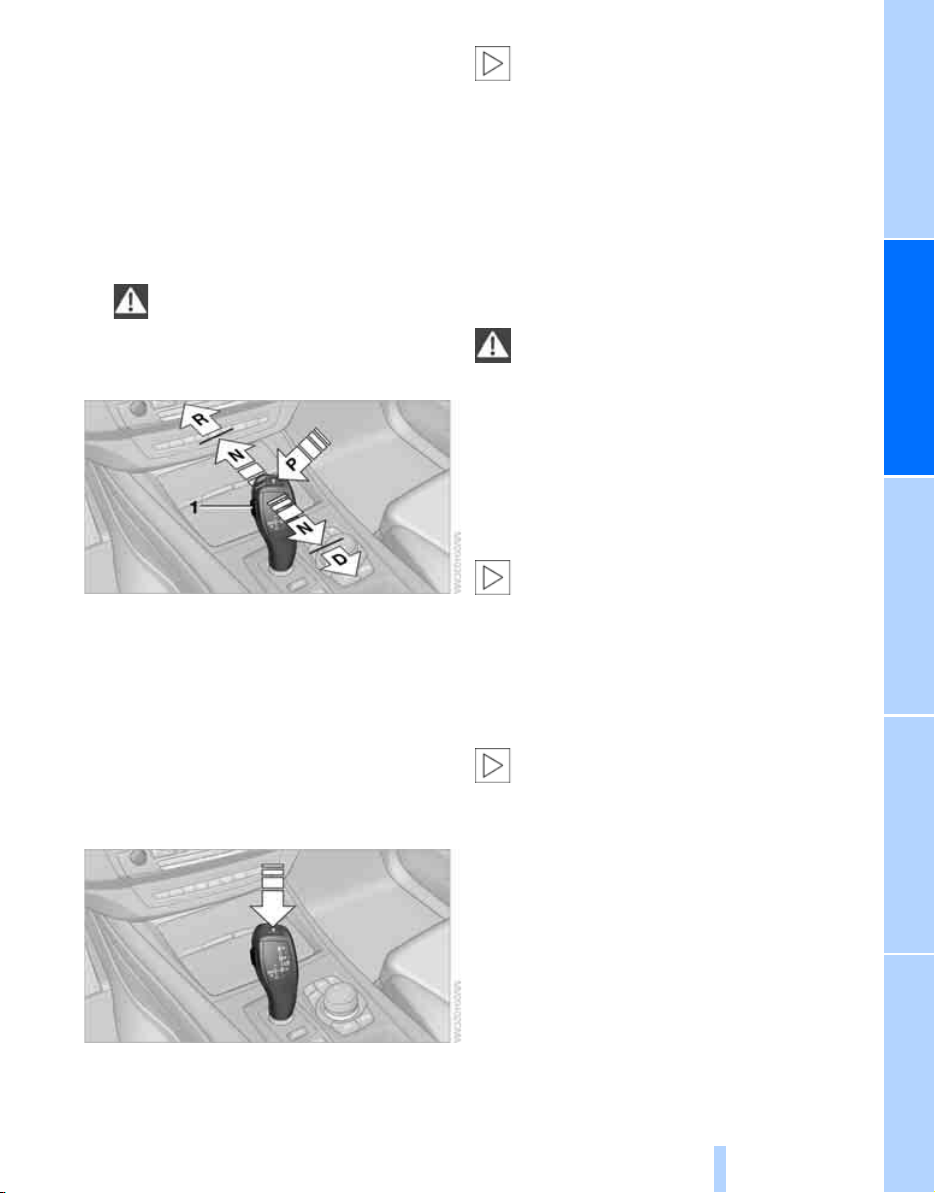
Shifting into D, R, N
Briefly press the selector lever in the desired
direction, beyond a resistance point if neces-
sary. When shifting out of P or into R, simulta-
neously push the unlock button 1.
The engaged transmission position is displayed
on the selector lever.
The selector lever immediately returns to the
center position when released.
Shifting into P
Press button P.
When the vehicle is stationary and the
transmission is in the R, D, or M/S posi-
tion, if you disconnect the driver's seat safety
belt and open the driver's door without stepping
on any of the pedals, then the transmission
shifts into position P.<
R Reverse
Select only with the vehicle stationary.
An interlock prevents inadvertent gearshifts
into transmission position R. To release the
lock, push the unlock button 1.
During electric driving, please note that
pedestrians and other road users may fail
to notice the vehicle in the usual way due to the
lack of engine noise. For example, proceed with
particular caution when pulling into and out of a
parking space.<
P Park
Select only with the vehicle stationary. The rear
wheels are locked.
The transmission automatically shifts into
P as soon as you switch off the engine.
Unless position N is selected and the remote
control is in the ignition lock.<
N Neutral
Can be selected in automatic car washes, for
example. The vehicle can roll.
The transmission remains in N even after
the engine is switched off whenever you
leave the remote control in the ignition lock.
This function is used, for example, in a car wash,
refer to page 15. After approx. 30 minutes P is
automatically engaged.<
Shifting into N
It is possible to select N even when the ignition
is switched on.
It is thus possible to move the vehicle, e.g. in the
event of a malfunction, even if it is not possible
to activate drive readiness.
Online Edition for Part no. 01 41 2 603 632 - © 09/09 BMW AGOnline Edition for Part no. 01 41 2 603 632 - © 09/09 BMW AG
Driving
18
D Drive, automatic position
Position for normal vehicle operation. All for-
ward gears are shifted automatically. Depend-
ing on operating conditions, the vehicle is
driven electrically or with the combustion
engine.
The fuel consumption is the lowest in transmis-
sion position D.
Kick-down
The kick-down mode provides maximum accel-
eration.
Press the accelerator pedal beyond the
increased resistance at full throttle.
Due to the high power requested, the combus-
tion engine is started and is assisted by the
electric motors as needed.
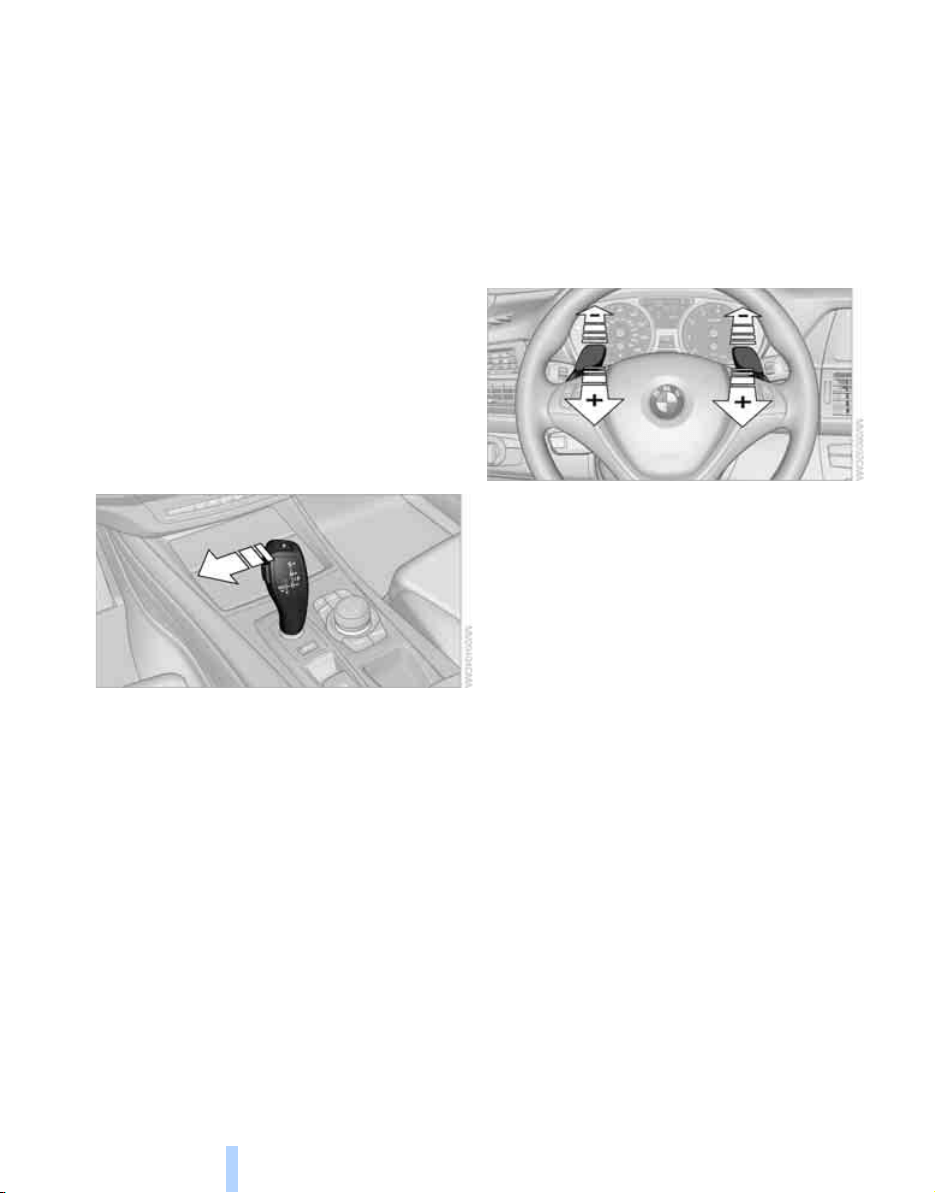
Sport program and manual mode M/S
Press selector lever out of transmission
position D toward the left:
The sport program is activated, S and the
engaged gear are displayed in the instrument
panel. This position is recommended for a per-
formance-oriented driving style.
With the sport program activated, the combus-
tion engine is always started.
When the selector lever is pressed forward or
back, the manual mode is activated and the
Steptronic shifts the gear. For example, M3 is
displayed in the instrument panel.
Upshifts and downshifts are executed only
when they will result in a plausible combination
of engine and vehicle speed; thus, for example,
a downshift that would cause the engine to
overrev will not be executed by the system. The
selected gear is briefly displayed in the instru-
ment panel, followed by the current gear.
To use the automatic function again, press the
selector lever to the right into position D.
Changing gears using shifting paddles
on steering wheel
The shifting paddles make it possible to quickly
change gears since both hands can remain on
the steering wheel.
> Upshifting: pull on one of the shifting pad-
dles, arrows +.
> Downshifting: press on one of the shifting
paddles, arrows –.
The gear change using the shifting paddles can
be executed in automatic mode D or in manual
mode M/S.
When the shifting paddles are actuated during
electric driving, the combustion engine starts.
Changing gears in manual mode M/S
With manual mode activated, gear changes are
executed using the shifting paddles or the
selector lever.
With the transmission position M/S selected,
the manual mode remains active.
Changing gears in automatic mode D
Even in automatic mode D, gear shifts can be
executed using the shifting paddles.
The combustion engine starts.
Then if a certain amount of time passes without
a gear change being executed using the shifting
paddles or a corresponding acceleration, then
the transmission returns to automatic shifting
of the forward gears.
Online Edition for Part no. 01 41 2 603 632 - © 09/09 BMW AGOnline Edition for Part no. 01 41 2 603 632 - © 09/09 BMW AG
Reference At a glanceControlsDriving tipsMobility
19
Cruise control
The concept
The cruise control is available for use at speeds
of approx. 20 mph/30 km/h. The vehicle stores
and maintains the speed that you set using the
lever mounted on the steering column.
The cruise control can also be activated
during electric driving, eDRIVE. The
cruise control provides a particularly sensitive
adjustment of the electric drive output.<
Do not use the cruise control under driv-
ing conditions that do not permit a con-
stant speed, e.g. when driving on winding
roads, in heavy traffic or in poor road conditions
such as snow, rain, ice, and loose road surface.
Otherwise you could lose control of the vehicle
and cause an accident.<
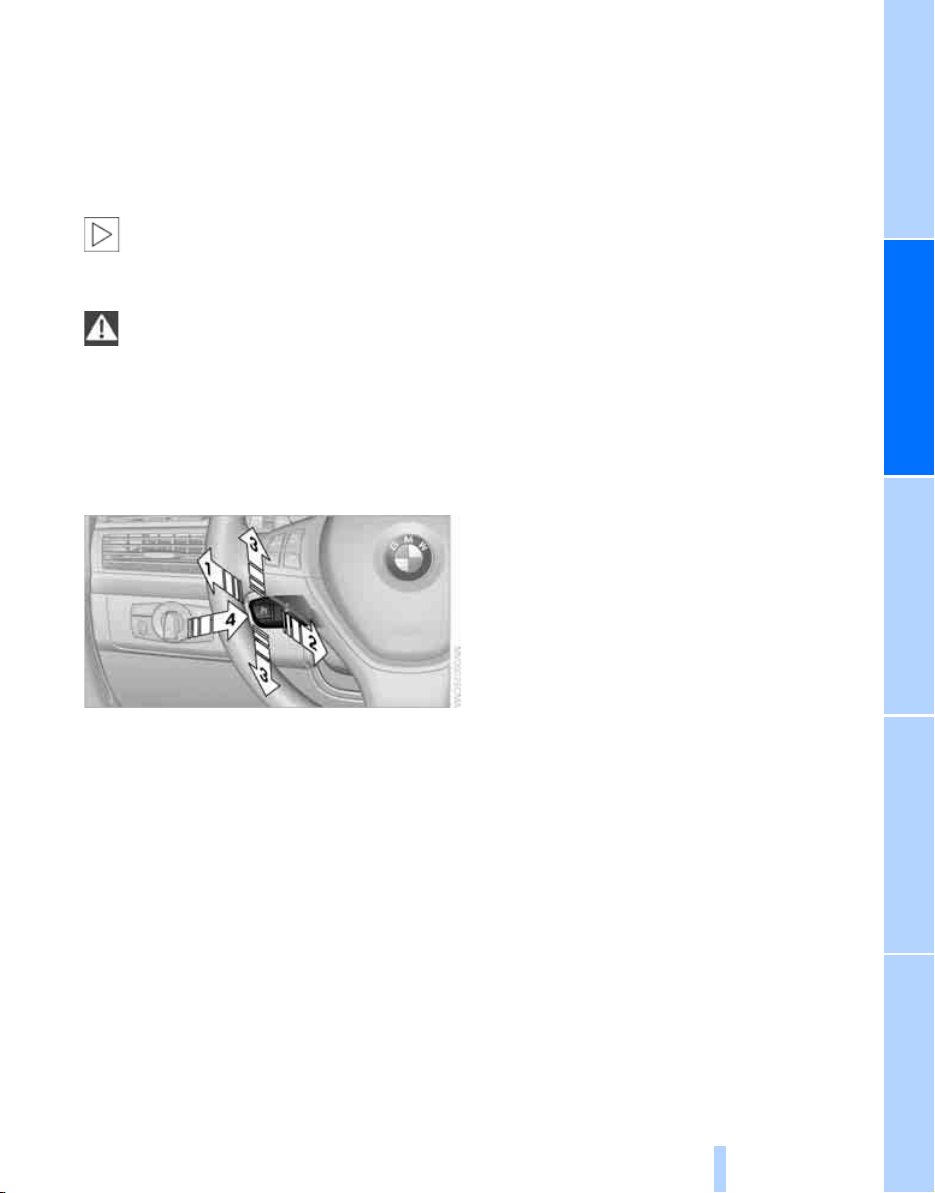
One lever for all functions
1 Storing speed and maintaining or increas-
ing
2 Storing speed and maintaining or decreas-
ing
3 Deactivating cruise control
4 Resuming stored speed
Maintaining current speed
Briefly press, arrow 1, or briefly pull, arrow 2
lever.
The speed currently being driven is stored and
maintained. It is indicated on the speedometer
and briefly in the instrument panel.
If the engine braking effect is not sufficient on
steep downhill slopes, the vehicle may exceed
the set speed.
Increasing speed
Repeatedly press the lever up to or beyond the
resistance point, arrow 1, until the desired
speed is set.
> Each time the lever is pressed to the resis-
tance point, the speed is increased by
approx. 1 mph or 1 km/h.
> Each time the lever is pressed beyond the
resistance point, the desired speed
increases by a maximum of 5 mph or
10 km/h.
The system stores the setting and maintains
the set speed.
Accelerating with lever
Accelerate slightly:
Press the lever up to the resistance point,
arrow 1, until the desired speed is reached.
Accelerate more rapidly:
Press the lever beyond the resistance point,
arrow 1, until the desired speed is reached.
The vehicle accelerates without pressure on
the accelerator pedal. The system stores the
setting and maintains the set speed.
Reducing speed
Repeatedly pull the lever up to the resistance
point or beyond, arrow 2, until the desired
speed is displayed.
> Each time the lever is pulled up to the resis-
tance point, the desired speed decreases
by approx. 1 mph or 1 km/h.
> Each time the lever is pulled beyond the
resistance point, the desired speed is
decreased by a maximum of 5 mph or
10 km/h until the minimum speed of
20 mph or 30 km/h is reached.
The system stores the setting and maintains
the set speed.
Deactivating cruise control
Briefly press the lever up or down, arrow 3.
The displays in the speedometer go out.
In addition, the system is automatically deacti-
vated:
Online Edition for Part no. 01 41 2 603 632 - © 09/09 BMW AGOnline Edition for Part no. 01 41 2 603 632 - © 09/09 BMW AG
Driving
20
> when braking
> when transmission position N is engaged
> when DTC is activated or DSC is deacti-
vated
> when HDC is activated
> when the parking brake is set
> when driving stability control systems inter-
vene
Accelerating does not deactivate the cruise
control. After releasing the accelerator pedal,
the stored speed is reached and maintained
again.
Warning lamp
The warning lamp lights up if the
cruise control has been deactivated
automatically, e.g. by a control inter-
vention of the DSC. A message appears on the
Control Display.
Resuming stored speed
Briefly press the button, arrow 4. The stored
speed is resumed and maintained.
With the ignition switched off, the stored speed
value is deleted and cannot be resumed again.
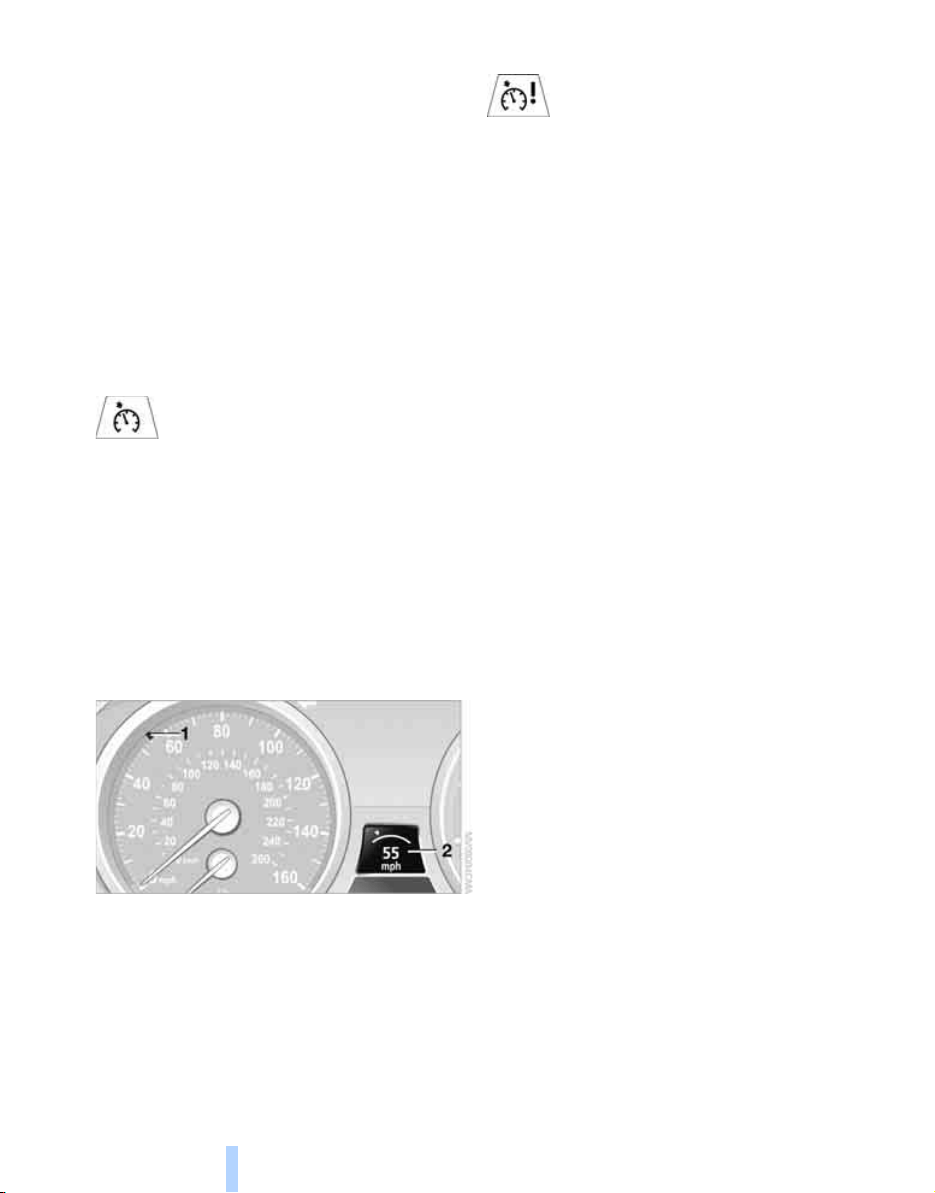
Displays in instrument panel
1 Stored desired speed
2 Selected desired speed appears briefly
If --- mph or --- km/h temporarily appears in the
instrument panel display, it is possible that the
system prerequisites for operation are currently
not met.
Malfunction
The warning lamp lights up if the sys-
tem has failed. A message appears on
the Control Display.
Online Edition for Part no. 01 41 2 603 632 - © 09/09 BMW AGOnline Edition for Part no. 01 41 2 603 632 - © 09/09 BMW AG
Reference At a glanceControlsDriving tipsMobility
21
Everything under control
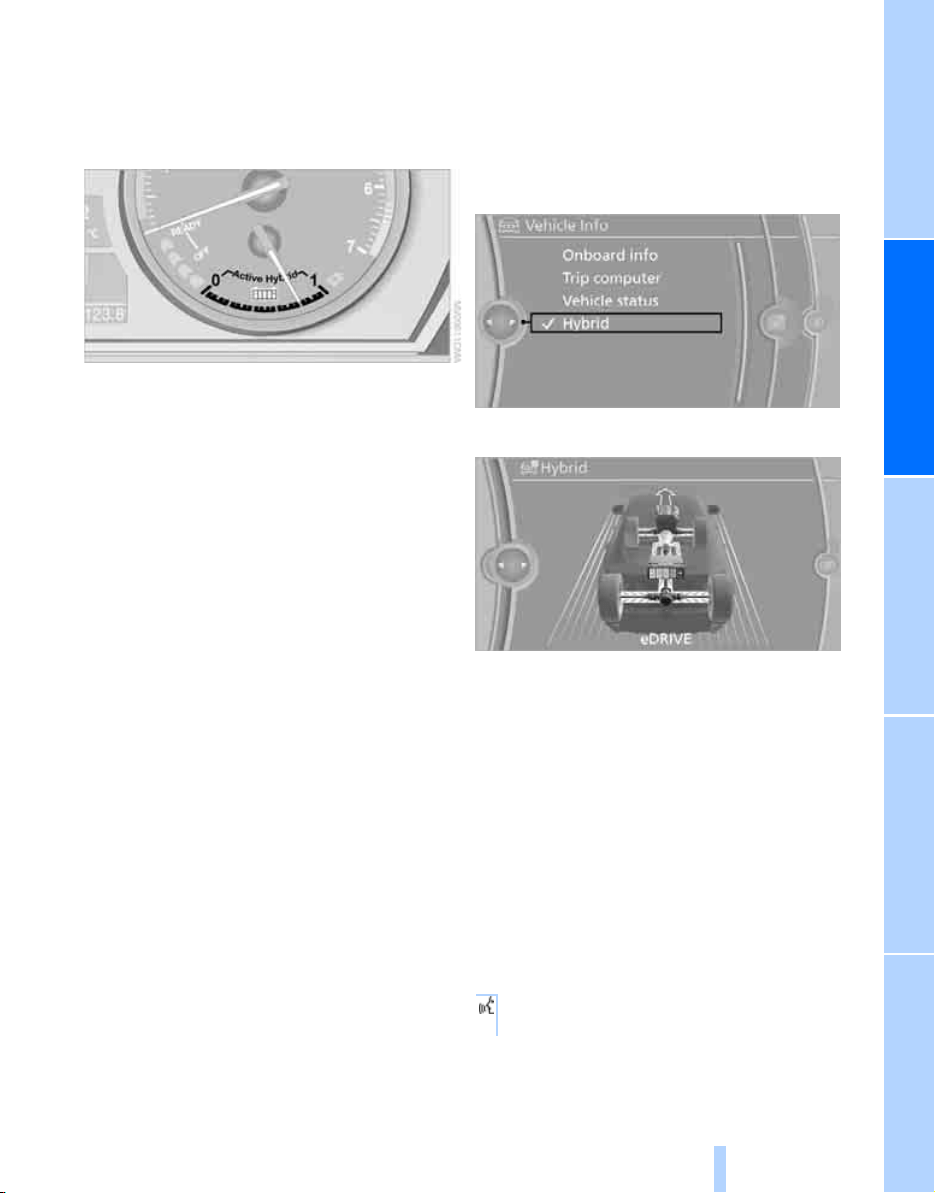
Charge state display
Shows the available charge on a scale from 0 to
1 when drive readiness is switched on. At the
scale value 1, the high-voltage battery is fully
charged. The five segments divide the scale
into ranges of 20% each.
In normal driving operation, the high-voltage
battery is charged to approx. 80%. This permits
the hybrid system to make optimal use of the
energy recovery when decelerating or driving
downhill.
Even at the scale value 0, the hybrid system is
still under high voltage.
Displaying operating modes
Energy flows
In all operating modes of the vehicle, the energy
flows can be displayed on the Control Display.
This gives you an overview of the functioning of
the hybrid system in different driving condi-
tions.
Accessing the energy flow display
1. "Vehicle Info"
2. "Hybrid"
3. Energy flows are displayed.
The energy flow display functions according to
the following principle:
> Blue: Electrical energy.
> Red: Energy from the combustion engine.
> Arrow: Direction of the energy flow.
> Segments of the high-voltage battery sym-
bolize the charge state.
> The operating modes are displayed: DRIVE,
eDRIVE, CHARGE, eBOOST
Operating by voice activation*
You can also select the "Hybrid" menu using
voice activation.
{Hybrid}.
The menu is selected.
Online Edition for Part no. 01 41 2 603 632 - © 09/09 BMW AGOnline Edition for Part no. 01 41 2 603 632 - © 09/09 BMW AG
Everything under control
22
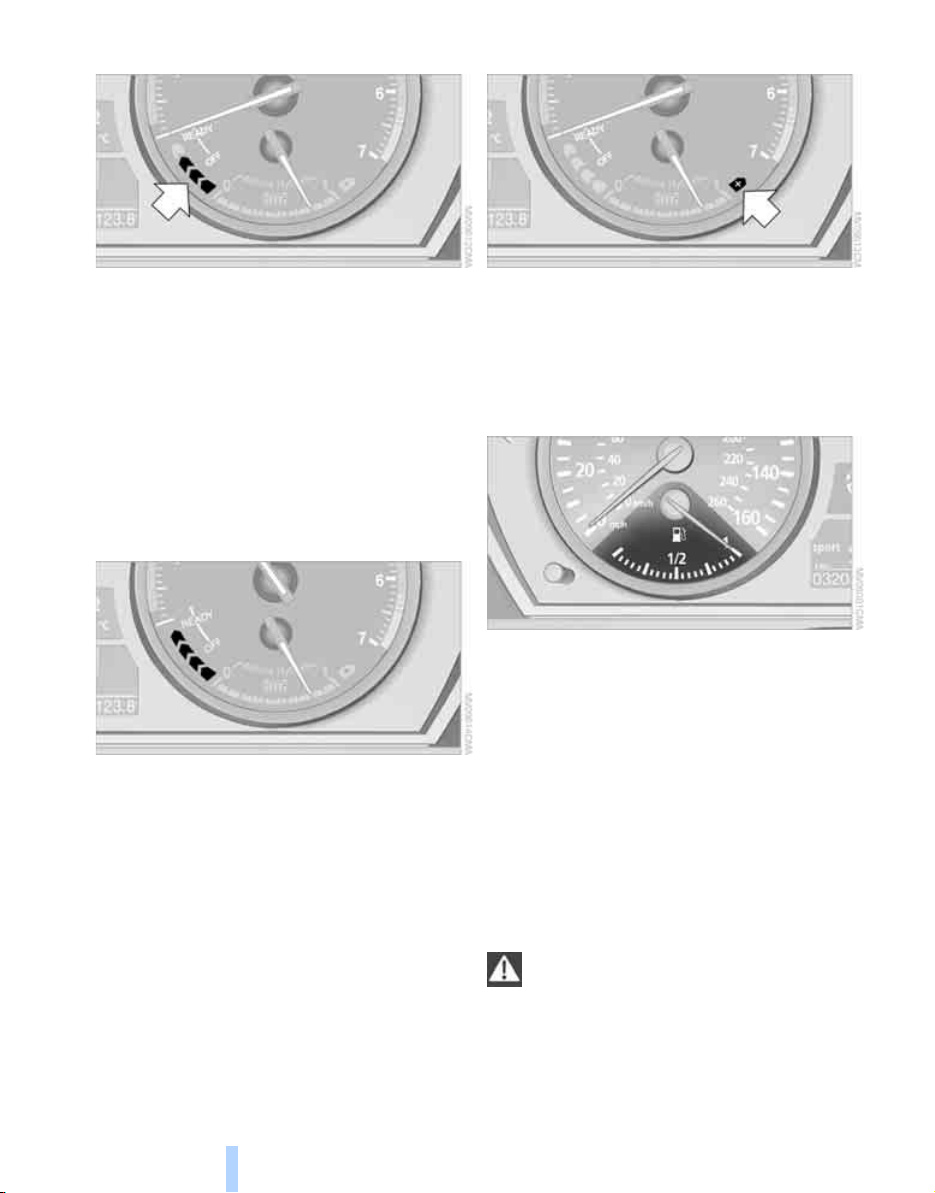
Electric driving: eDRIVE
During electric driving, the power output by the
electric motors is indicated by arrows:
Depending on the position of the accelerator
pedal, up to four arrows light up one after
another.
The tachometer pointer is in the READY posi-
tion.
If all four arrows have already lit up, when addi-
tional drive power is needed, e.g. for accelera-
tion, the combustion engine is switched on.
Assisted combustion engine: eBOOST
At the maximum output from the electric
motors, all four arrows light up simultaneously.
Energy recovery: CHARGE
The energy recovery is indicated in the tachom-
eter as an arrow with the + symbol: The high-
voltage battery is charged.
Fuel gauge
Fuel tank capacity: approx. 22.5 US gal/
85 liters. You will find information on refueling
on page 32.
If the tilt of the vehicle varies for a longer period,
when you are driving in mountainous areas, for
example, the indicator may fluctuate slightly.
Reserve
After the reserve quantity has been reached, a
message briefly appears on the Control Display;
the remaining range is shown in the computer.
Below a range of approx. 30 miles/50 km, the
message remains on the Control Display.
Refuel as soon as possible once your
cruising range falls below 30 miles/
50 km, otherwise engine functions are not
ensured and damage can occur.<
Online Edition for Part no. 01 41 2 603 632 - © 09/09 BMW AGOnline Edition for Part no. 01 41 2 603 632 - © 09/09 BMW AG

Reference At a glanceControlsDriving tipsMobility
23
Climate
Air-conditioning functions, refer to BMW X6
Owner's Manual.
Special features of the automatic air-
conditioning system
The automatic air-conditioning system of your
BMW with an electric air-conditioning com-
pressor is independent of the combustion
engine.
It is thus possible to have a comfortable climate
in the vehicle interior even when the combus-
tion engine is switched off.
Automatic air-conditioning system
with drive readiness
The automatic air-conditioning system can be
used as usual whenever drive readiness is
switched on, for example during electric driving.
If there is no longer a sufficient charge in the
high-voltage battery, then the combustion
engine is switched on.
Cooling function while stationary
The cooling function can be acti-
vated while stationary if the ignition
is switched on.
1. Switch on the ignition.
2. Press the button.
The cooling function is switched on.
If there is no longer a sufficient charge in the
high-voltage battery, then the cooling function
is switched off.
More information can be found in the BMW X6
Owner's Manual.
Cooling of the high-voltage system
The automatic air-conditioning system is also
used to cool the high-voltage system.
Therefore the air-conditioning compressor can
automatically switch on, even when the cooling
function of the automatic air-conditioning sys-
tem is switched off.
After the vehicle is switched off, audible operat-
ing sounds may issue from the hybrid system,
e.g. the cooling of the high-voltage battery.
Online Edition for Part no. 01 41 2 603 632 - © 09/09 BMW AGOnline Edition for Part no. 01 41 2 603 632 - © 09/09 BMW AG

Online Edition for Part no. 01 41 2 603 632 - © 09/09 BMW AG

Driving tips
This section is designed to provide you
with extra support by supplying information
useful in dealing with specific driving
and operating conditions.
Driving tips
Online Edition for Part no. 01 41 2 603 632 - © 09/09 BMW AG

Things to remember when driving
26
Things to remember when driving
Break-in period
Moving parts need breaking-in time to adjust to
each other. To ensure that your vehicle contin-
ues to provide optimized economy of operation
throughout an extended service life, we request
that you devote careful attention to the follow-
ing section.
Engine and rear axle differential
Always obey all official speed limits.
Up to 1,200 miles/2,000 km
Drive at various engine and vehicle speeds, but
do not exceed:
> 4,500 rpm or 100 mph/160 km/h
Avoid full-throttle operation and use of the
transmission's kick-down mode during these
initial miles.
From 1,200 miles/2,000 km
The engine and vehicle speed can gradually be
increased.
Brake system
Brakes require an initial break-in period of
approx. 300 miles/500 km to achieve optimized
contact and wear patterns between brake pads
and rotors. Drive in a reserved manner during
this break-in period.
Following part replacement
Observe the break-in instructions again if com-
ponents mentioned above must be replaced
after subsequent driving operation.
Saving fuel
The fuel consumption of your vehicle depends
on various factors. Through a few simple steps,
your driving style, and regular maintenance, you
can have a positive influence on your fuel con-
sumption and environmental impact.
Removing unnecessary cargo
Additional weight increases fuel consumption.
Removing add-on parts after use
Remove unneeded auxiliary mirrors, roof or rear
luggage racks after use. Add-on parts attached
to the vehicle impede the aerodynamics and
increase the fuel consumption.
Closing windows and glass sunroof*
An open glass sunroof or window likewise
increases air resistance and thus fuel consump-
tion.
Checking tire inflation pressures
regularly
Check and correct the tire inflation pressure as
needed at least twice a month and before long
trips.
An insufficient tire inflation pressure increases
the rolling resistance and thus increases the
fuel consumption and tire wear.
Driving off immediately
Do not allow the engine to warm up by leaving it
running while the vehicle remains stationary.
Instead, begin to drive at a moderate engine
speed. This is the fastest way for the cold
engine to reach its operating temperature.
Thinking ahead when driving
Avoid unnecessary acceleration and braking.
To do so, maintain the appropriate distance
from the vehicle in front of you. An anticipatory
and smooth driving style reduces fuel con-
sumption.
Avoiding high engine speeds
Driving at a low engine speed reduces fuel con-
sumption and minimizes wear.
Online Edition for Part no. 01 41 2 603 632 - © 09/09 BMW AGOnline Edition for Part no. 01 41 2 603 632 - © 09/09 BMW AG
Reference At a glanceControlsDriving tipsMobility
27
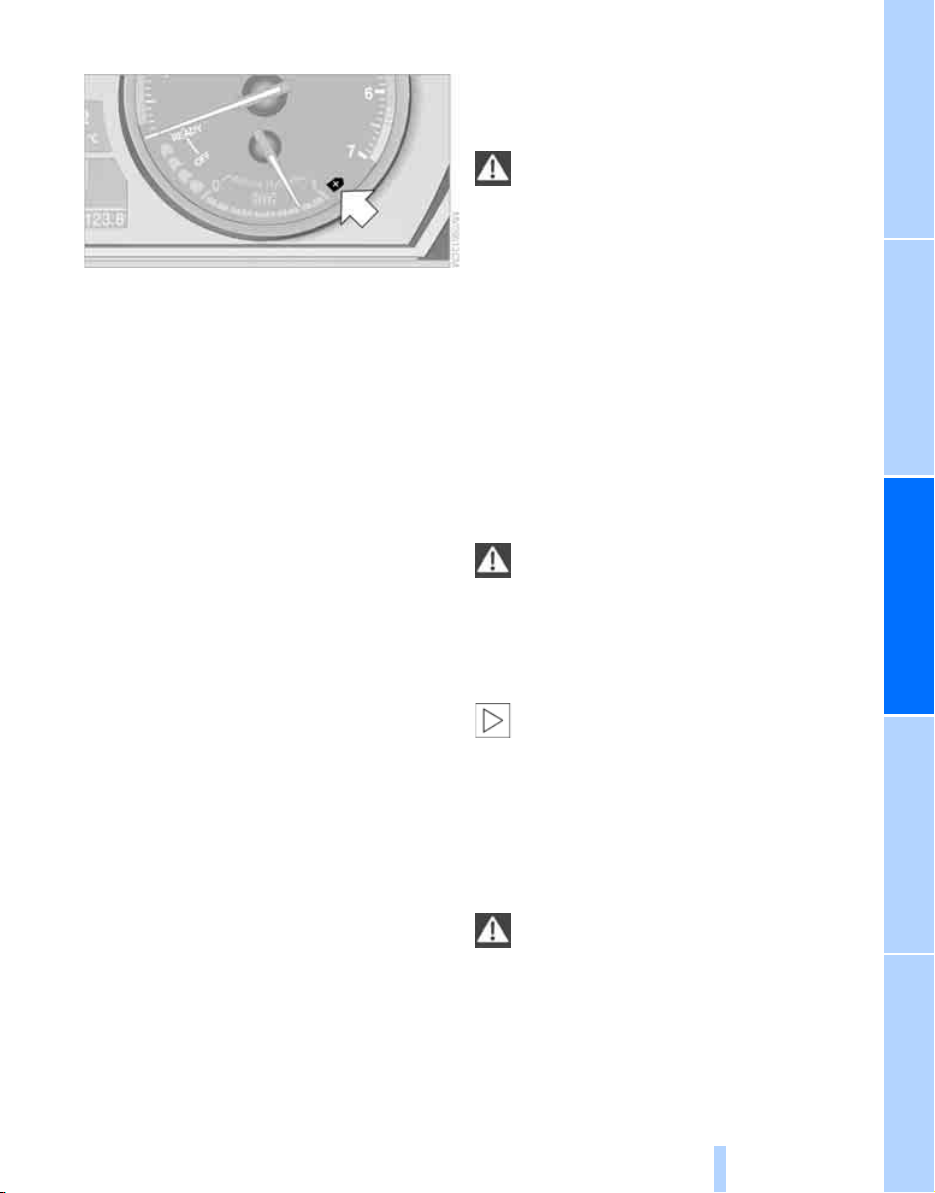
Using energy recovery
Energy recovery is displayed in the instrument
panel.
Coasting mode
In coasting mode, e.g. when rolling toward a
traffic signal, the high-voltage battery is
charged by energy recovery.
Braking
The most efficient energy recovery and charg-
ing of the high-voltage battery are achieved
with moderate braking.
Switching off functions currently not
required
Functions such as air conditioning, seat heat-
ing, or rear window defrosting consume a lot of
energy and require additional fuel. Their influ-
ence is particularly pronounced in city traffic
and stop & go operation. For this reason, it is a
good idea to switch these functions off when
they are not really needed.
Having maintenance carried out
Have the vehicle serviced regularly in order to
achieve the optimum economy and service life
of your vehicle. BMW recommends having the
maintenance performed by a BMW Sports
Activity Vehicle Center. Also pay attention to
the BMW maintenance system, refer to the
BMW X6 Owner's Manual.
General driving notes
Driving through water
Maximum water depth: 17 in/45 cm
Only drive through water up to the above-
mentioned depth at no greater than walk-
ing speed; otherwise, the engine, electrical sys-
tem, and transmission can be damaged.<
Braking safely
Your BMW is equipped with ABS as a standard
feature. In situations that require it, it is best to
brake with full force. Since the vehicle maintains
steering responsiveness, you can still avoid
possible obstacles with a minimum of steering
effort.
Pulsation of the brake pedal, combined with
sounds from the hydraulic circuits, indicate that
ABS is in its active mode.
Hills
To prevent overheating and the resulting
reduced efficiency of the brake system,
drive long or steep downhill gradients in the
gear in which the least braking is required. Even
light but consistent pressure on the brake pedal
can lead to high temperatures, brake wear and
possibly even brake failure.<
With a fully charged high-voltage battery,
the combustion engine is switched on
when driving downhill in order to avoid over-
loading the high-voltage battery.<
The braking effect of the engine can be further
increased by downshifting in the manual mode
of the automatic transmission, if necessary into
first gear, refer to page 18. This prevents an
excessive strain on the brakes.
Do not drive in idle or with drive readiness
mode deactivated; otherwise, there is no
braking action from the energy recovery or from
the engine and no power-assistance for braking
and steering.
Never allow floor mats, carpets or any other
objects to protrude into the area of movement
of the pedals and impair their operation.<
Online Edition for Part no. 01 41 2 603 632 - © 09/09 BMW AGOnline Edition for Part no. 01 41 2 603 632 - © 09/09 BMW AG

Things to remember when driving
28
Corrosion on brake rotors
When the vehicle is driven only occasionally,
during extended periods when the vehicle is not
used at all, and in operating conditions where
brake applications are less frequent, there is an
increased tendency for corrosion to form on
rotors, while contaminants accumulate on the
brake pads. This occurs because the minimum
pressure which must be exerted by the pads
during brake applications to clean the rotors is
not reached.
Should corrosion form on the brake rotors, the
brakes will tend to respond with a pulsating
effect that even extended application will fail to
cure.
Online Edition for Part no. 01 41 2 603 632 - © 09/09 BMW AGOnline Edition for Part no. 01 41 2 603 632 - © 09/09 BMW AG


Online Edition for Part no. 01 41 2 603 632 - © 09/09 BMW AG

Mobility
This section helps you maintain your
mobility by supplying important information
on vital topics including fuels and lubricants,
wheels and tires, service, maintenance
and roadside assistance.
Mobility
Online Edition for Part no. 01 41 2 603 632 - © 09/09 BMW AG
Refueling
32
Refueling
Before refueling, deactivate drive readi-
ness. When handling fuel, always observe
all applicable precautionary measures and reg-
ulations. Never transport reserve fuel contain-
ers in the vehicle. These could become leaky
and cause an explosion or a fire in an accident.<
Refueling
The BMW ActiveHybrid X6 is equipped with a
special fuel tank. It is designed for special
requirements that arise in the hybrid operation
of the vehicle, e.g. alternating driving with the
combustion engine or electric motors. Fuel
vapors can cause pressure to build up in the fuel
tank, which is reduced before the fuel tank
catch is opened.
Preparation
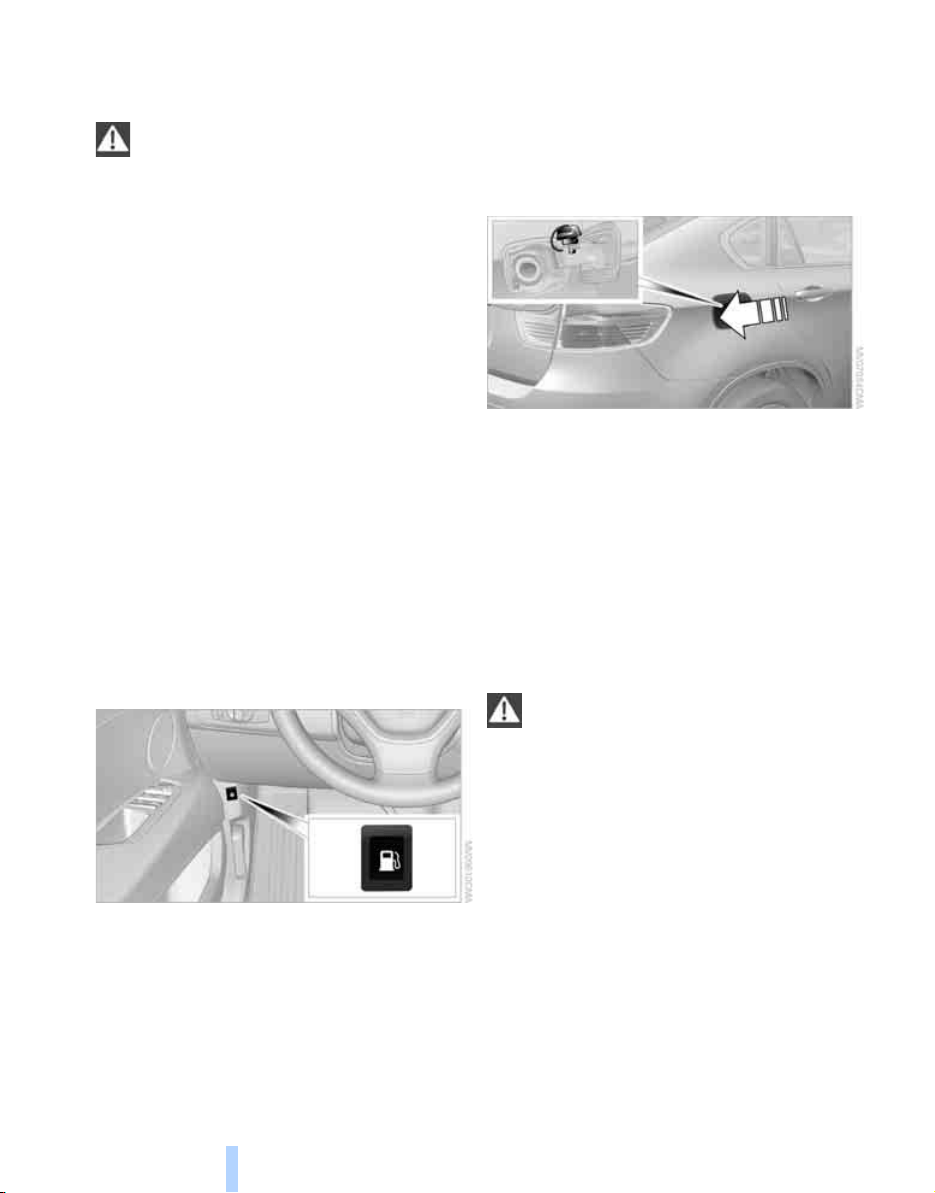
Unlocking fuel filler door
1. Deactivate drive readiness, refer to
page 15.
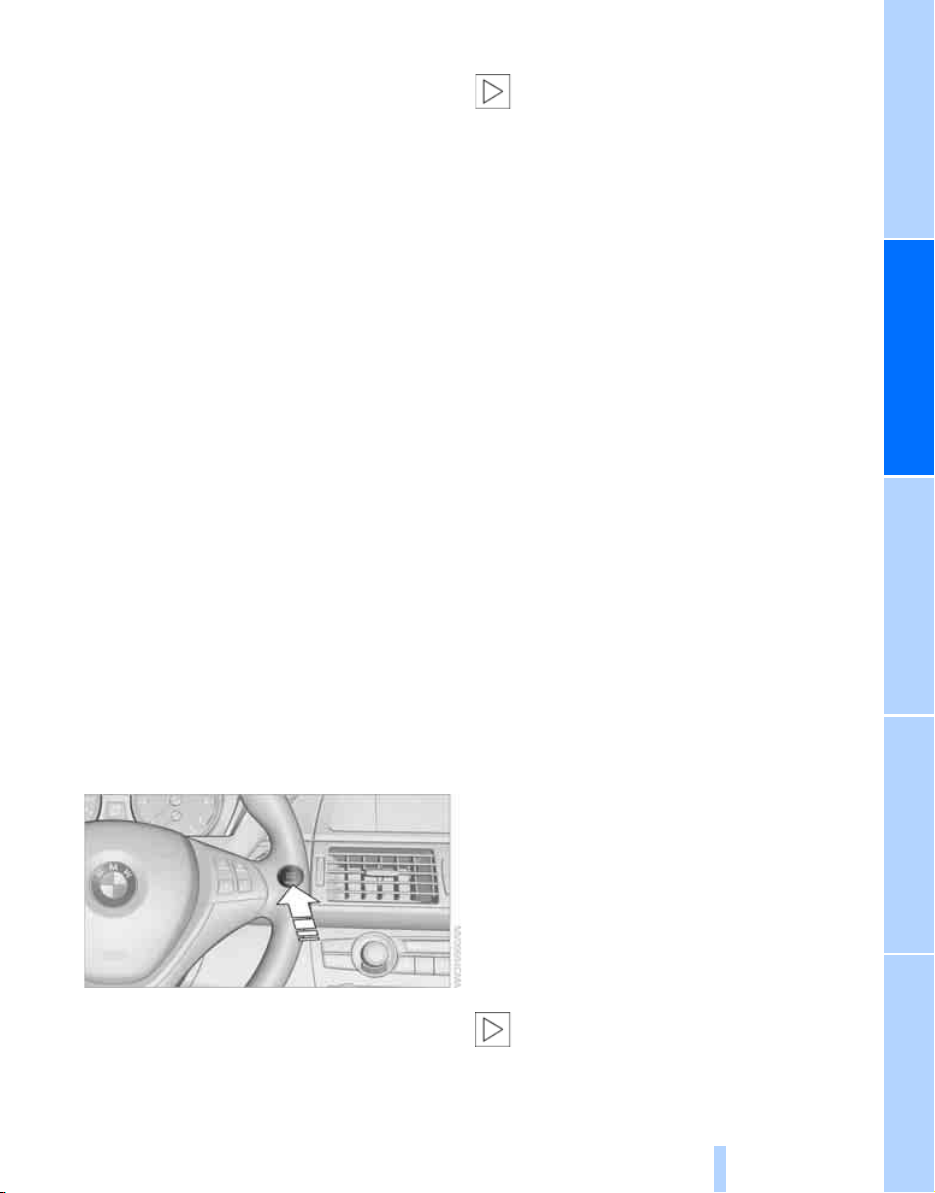
2. Push the button to start pressure compen-
sation.
3. Messages indicate that the fuel filler door
has been released and refueling is possible.
In rare cases, the pressure decrease can
take several seconds. A message on the
Control Display indicates when the fuel filler
door has been released.
4. Open the fuel filler door.
If the fuel filler door is not opened within
10 minutes after the fuel tank catch is
released, the fuel filler door locks again.
Press the button again.
Opening fuel filler door
1. Open the fuel filler door. To do this, briefly
press the lower edge.
The fuel filler door can only be opened if the
fuel tank catch has been released.
2. Turn the fuel filler cap counterclockwise.
3. Place the fuel filler cap in the bracket
attached to the fuel filler door.
Closing
Fit the cap and turn it clockwise until you clearly
hear a click.
Do not crush the band attached to the
cap; otherwise, the cap may not properly
seal and fuel vapors can escape.<
Manually releasing fuel filler door
If an electrical malfunction should occur and the
system does not release the fuel filler door, you
can unlock the fuel filler door manually.
Online Edition for Part no. 01 41 2 603 632 - © 09/09 BMW AGOnline Edition for Part no. 01 41 2 603 632 - © 09/09 BMW AG
Reference At a glanceControlsDriving tipsMobility
33
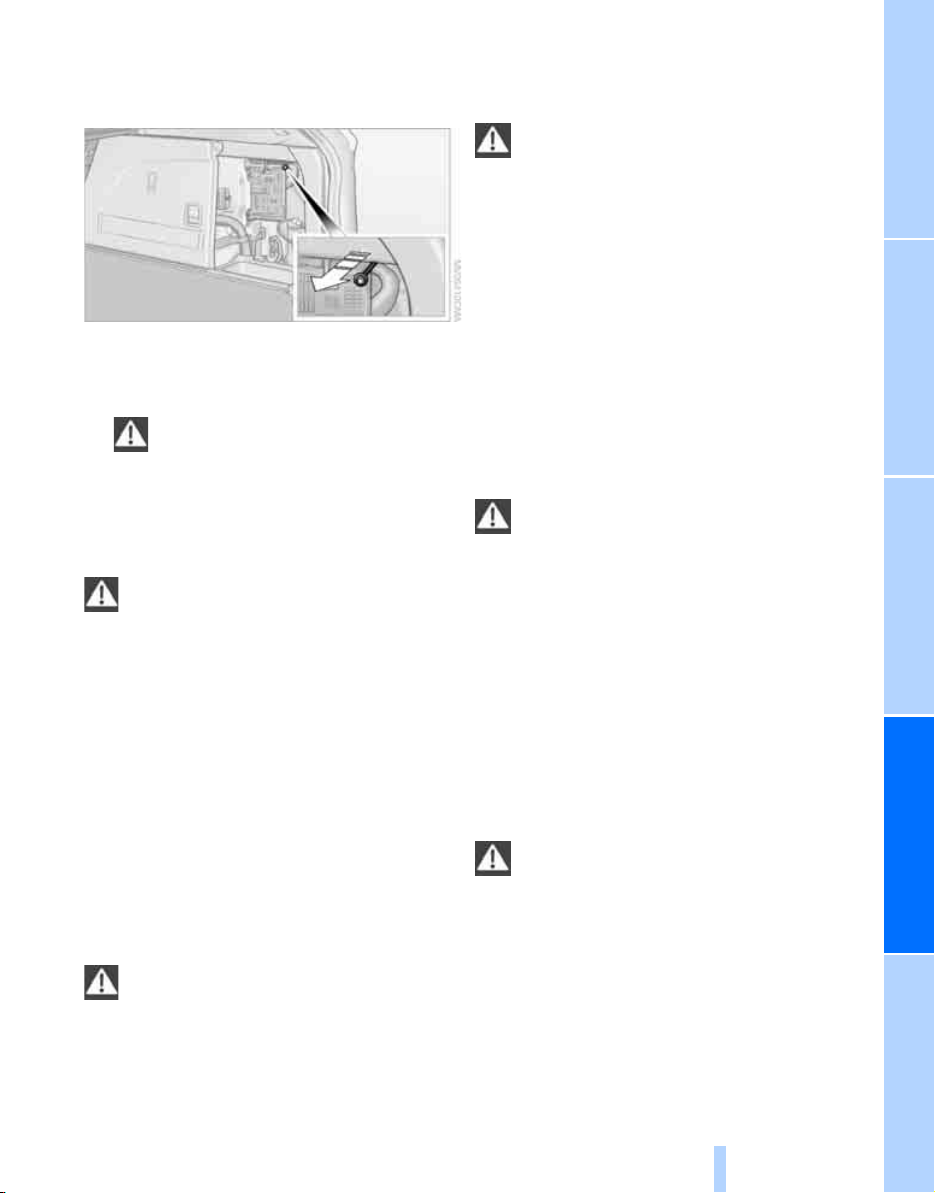
1. Open the right-hand side panel in the cargo
bay.
2. Pull the knob with the gas pump symbol.
3. Open the fuel filler door. To do this, briefly
press the lower edge.
4. Turn the fuel filler cap counterclockwise.
When the fuel tank catch is opened,
stay as far away from the vehicle as
possible since gasoline and pressurized
gasoline vapors may suddenly escape from
the fuel tank.<
Observe the following when refueling
When handling fuels, follow the safety
precautions posted at the filling station.
Otherwise, there is a danger of personal injury
or property damage.<
When refueling, insert the filler nozzle com-
pletely into the filler pipe. Avoid raising the filler
nozzle during refueling, otherwise this leads to
> premature pump shutoff.
> a reduced efficiency of the fuel-vapor
recovery system.
The fuel tank is full when the filler nozzle clicks
off the first time.
Fuel tank capacity
Approx. 22.5 gallons/85 liters, including approx.
2.1 gallons/8 liters of reserve
Refuel as soon as possible once your
cruising range falls below 30 miles/
50 km, otherwise engine functions are not
ensured and damage can occur.<
Fuel specifications
Gasoline engine: required fuel
Do not use leaded gasoline, otherwise
damage to the catalytic converter will
result.
Do not refuel with E85, i.e. fuel that consists of
85% ethanol, or Flex Fuel, otherwise perma-
nent damage to the engine and the fuel supply
system will result.<
Super Premium Gasoline/AKI 91
This gasoline is highly recommended.
However, you may also use gasoline with less
AKI. The minimum AKI Rating is 89.
If you use gasoline with this minimum AKI Rat-
ing, the engine may produce knocking sounds
when starting at high outside temperatures.
This has no affect on the engine life.
Do not use gasoline below the specified
minimum quality, otherwise engine dam-
age can result.<
Use high-quality brands
Field experience has indicated significant dif-
ferences in fuel quality: volatility, composition,
additives, etc., among gasolines offered for sale
in the United States and Canada. Fuels contain-
ing up to and including 10% ethanol or other
oxygenates with up to 2.8% oxygen by weight,
that is, 15% MTBE or 3% methanol plus an
equivalent amount of co-solvent, will not void
the applicable warranties with respect to
defects in materials or workmanship.
The use of poor-quality fuels may result in
drivability, starting and stalling problems
especially under certain environmental condi-
tions such as high ambient temperature and
high altitude.
Should you encounter drivability problems
which you suspect could be related to the fuel
you are using, we recommend that you respond
by switching to a recognized high-quality brand
such as gasoline that is advertised as Top Tier
Detergent Gasoline.
Failure to comply with these recommendations
may also result in unscheduled maintenance.<
Online Edition for Part no. 01 41 2 603 632 - © 09/09 BMW AGOnline Edition for Part no. 01 41 2 603 632 - © 09/09 BMW AG
Wheels and tires
34
Wheels and tires
Tire inflation pressure
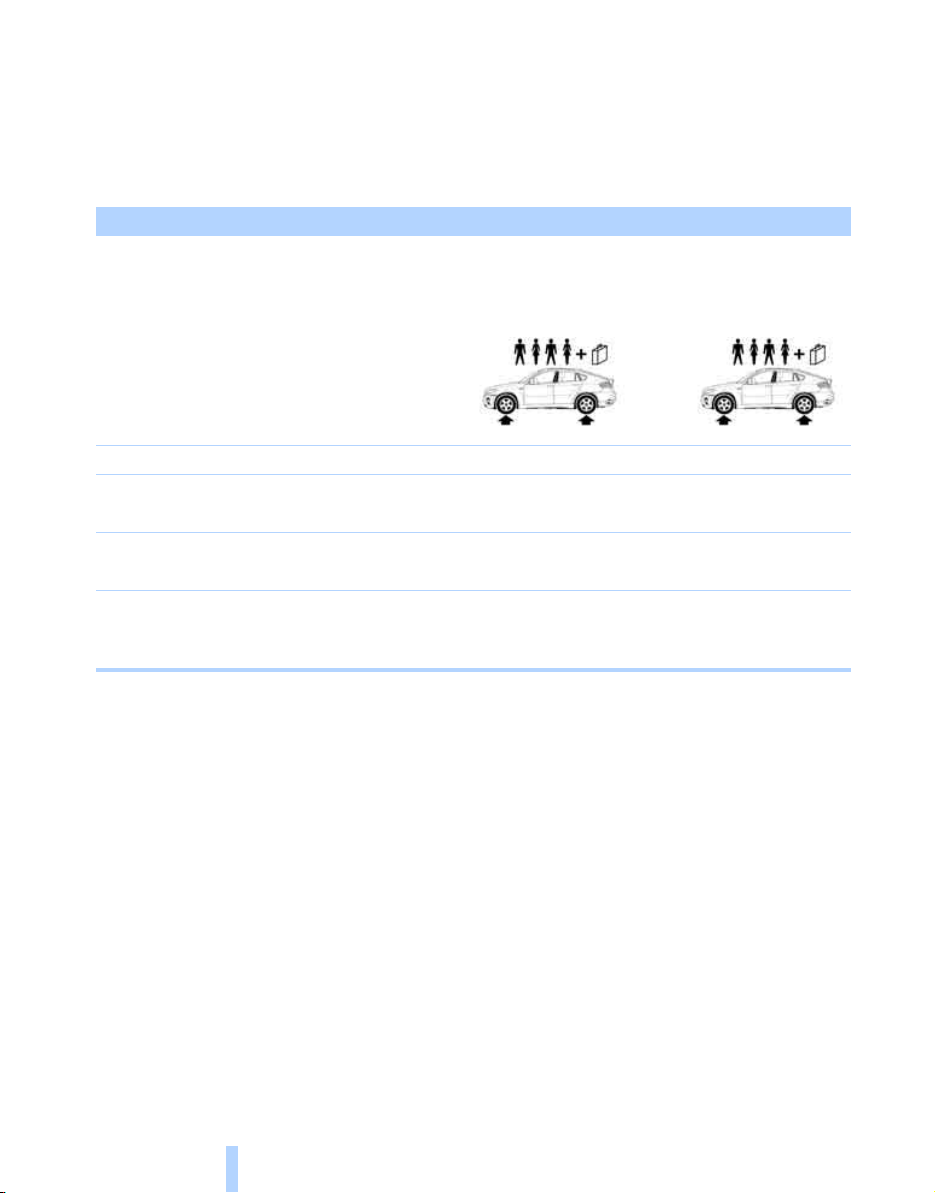
Tire inflation pressure BMW ActiveHybrid X6
Tire size Pressure specifications in psi/kPa
Traveling speeds
up to a max. of
100 mph/160 km/h
Traveling speeds
including those
exceeding
100 mph/160 km/h
All pressure specifications
in the table are indicated in
psi/kilopascal with cold tires.
Cold = ambient temperature
255/50 R 19 107 H M+S XL 35/240 38/260 38/260 41/280
Front: 275/40 R 20 106 W XL 38/260 - 41/280 -
Rear: 315/35 R 20 110 W XL - 38/260 - 41/280
Front: 285/35 R 21 105 W XL 38/260 - 41/280 -
Rear: 325/30 R 21 108 W XL - 38/260 - 41/280
Compact wheel
*
:
T 155/80 R 19 114 M
60/420 60/420 60/420 60/420
More details on the permissible load and weights can be found on page 46.
Online Edition for Part no. 01 41 2 603 632 - © 09/09 BMW AGOnline Edition for Part no. 01 41 2 603 632 - © 09/09 BMW AG
Reference At a glanceControlsDriving tipsMobility
35
Engine compartment
Only have work on the vehicle carried out
by a BMW Sports Activity Vehicle Center
or a repair shop that works in accordance with
BMW guidelines and uses appropriately trained
personnel. Otherwise, there is the risk of life-
threatening injury by electrocution due to the
high voltage of the hybrid system.<
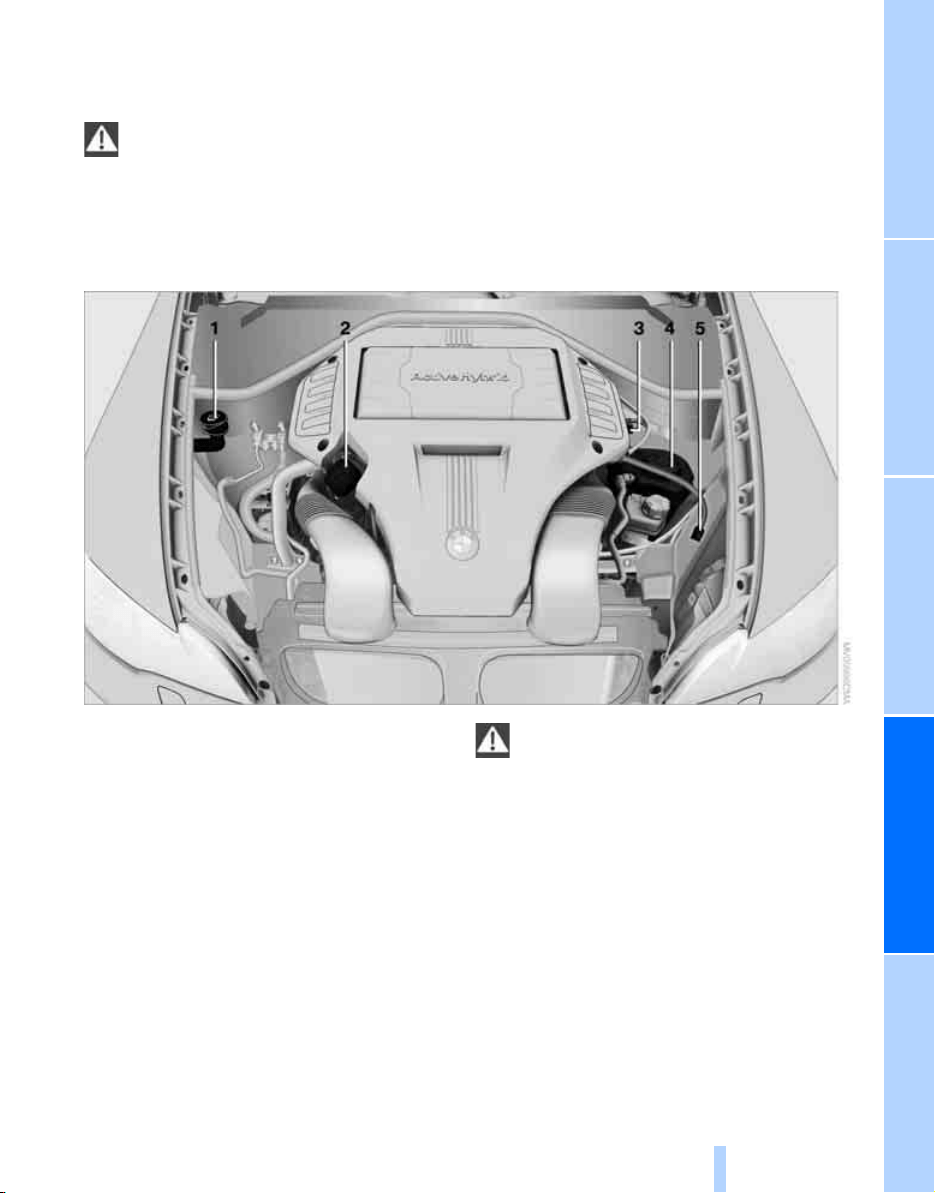
Engine compartment
1 Filler neck for washing fluid of the headlamp
and windshield washer system
2 Filler neck for engine oil, refer to Adding
engine oil, BMW X6 Owner's Manual
3 Jump starting terminal plus/+, refer to
page 37
4 Expansion tank for coolant
5 Jump starting terminal minus/-, refer to
page 37
Do not work in the engine compartment
with a tool that could damage the orange
high-voltage cable or high-voltage compo-
nents. Otherwise, there is the risk of fatal injury
by electrocution.<
Online Edition for Part no. 01 41 2 603 632 - © 09/09 BMW AGOnline Edition for Part no. 01 41 2 603 632 - © 09/09 BMW AG

Replacing components
36
Replacing components
For more information on replacing parts, please
refer to the BMW X6 Owner's Manual.
Working on the vehicle
Your BMW ActiveHybrid X6 is equipped with a
high-voltage system.
The BMW X6 Owner's Manual only describes
work on the vehicle that will not bring you into
contact with the high-voltage system.
Have more extensive work on your vehicle car-
ried out only by your BMW Sports Activity Vehi-
cle Center or a repair shop that works according
to BMW repair procedures with correspond-
ingly trained personnel.
Have maintenance and repair on the vehi-
cle carried out only by your BMW Sports
Activity Vehicle Center or a repair shop that
works in accordance with BMW guidelines and
uses appropriately trained personnel. Other-
wise, there is the risk of life-threatening injury
by electrocution due to the high voltage of the
hybrid system.<
Never touch the high-voltage compo-
nents of the hybrid system; otherwise,
there is the risk of life-threatening injury by
electrocution due to the high voltage of the
hybrid system.<
Do not remove the cover panel of the
cargo bay floor; otherwise, the high-volt-
age battery could be damaged.<
12 Volt batteries
Battery care
The 12 Volt batteries are maintenance-free, i.e.
the electrolyte will last for the life of the battery
when the vehicle is operated under temperate
climatic conditions. Your BMW Sports Activity
Vehicle Center will be glad to advise in all mat-
ters concerning the battery.
Charging batteries
Only charge the battery in the vehicle via the
terminals in the engine compartment with the
engine switched off. Connections, refer to
Jump starting on page 37.
Disposal
Have old batteries disposed of following
replacement at your BMW Sports Activity
Vehicle Center or bring them to a collection
point. Maintain the battery in an upright position
for transport and storage. Always restrain the
battery to prevent it from tipping over during
transport.<
High-voltage battery
Battery care
Your BMW Sports Activity Vehicle Center will
be glad to advise you in all matters concerning
the high-voltage battery
Charging battery
Charging high-voltage battery, refer to Energy
recovery on page 16 and Jump starting on
page 37.
Online Edition for Part no. 01 41 2 603 632 - © 09/09 BMW AGOnline Edition for Part no. 01 41 2 603 632 - © 09/09 BMW AG
Reference At a glanceControlsDriving tipsMobility
37
Giving and receiving assistance
Jump starting, charging
high-voltage battery
Your BMW ActiveHybrid X6 is equipped with
two types of battery:
> 12 Volt battery
> High-voltage battery
If the 12 Volt battery or high-voltage battery is
dead, the combustion engine can be started
with the aid of another vehicle using two jumper
cables.
Only use jumper cables with fully insulated ter-
minal clamps and do not deviate from the
described procedure.
To avoid the risk of potentially fatal injury,
always avoid all contact with electrical
components while the engine is running. Care-
fully adhere to the following sequence, both to
prevent damage to one or both vehicles, and to
guard against possible personal injuries.<
Identifying the dead battery
> Dead 12 Volt battery: Ignition cannot be
switched on.
> Dead high-voltage battery: Ignition can be
switched on. Drive readiness cannot be
activated.
A message appears on the Control Display.
Preparation
1. Check whether the battery of the other
vehicle is a 12 Volt battery and has approxi-
mately the same capacitance in Ah. This
information can be found on the battery.
2. Switch off the engine of the assisting vehi-
cle.
3. Switch off any electrical systems and com-
ponents in both vehicles.
There must not be any contact between
the bodies of the two vehicles, otherwise
there is a danger of shorting.<
Connecting jumper cables
To avoid personal injury from sparks, fol-
low this sequence when connecting
jumper cables.<
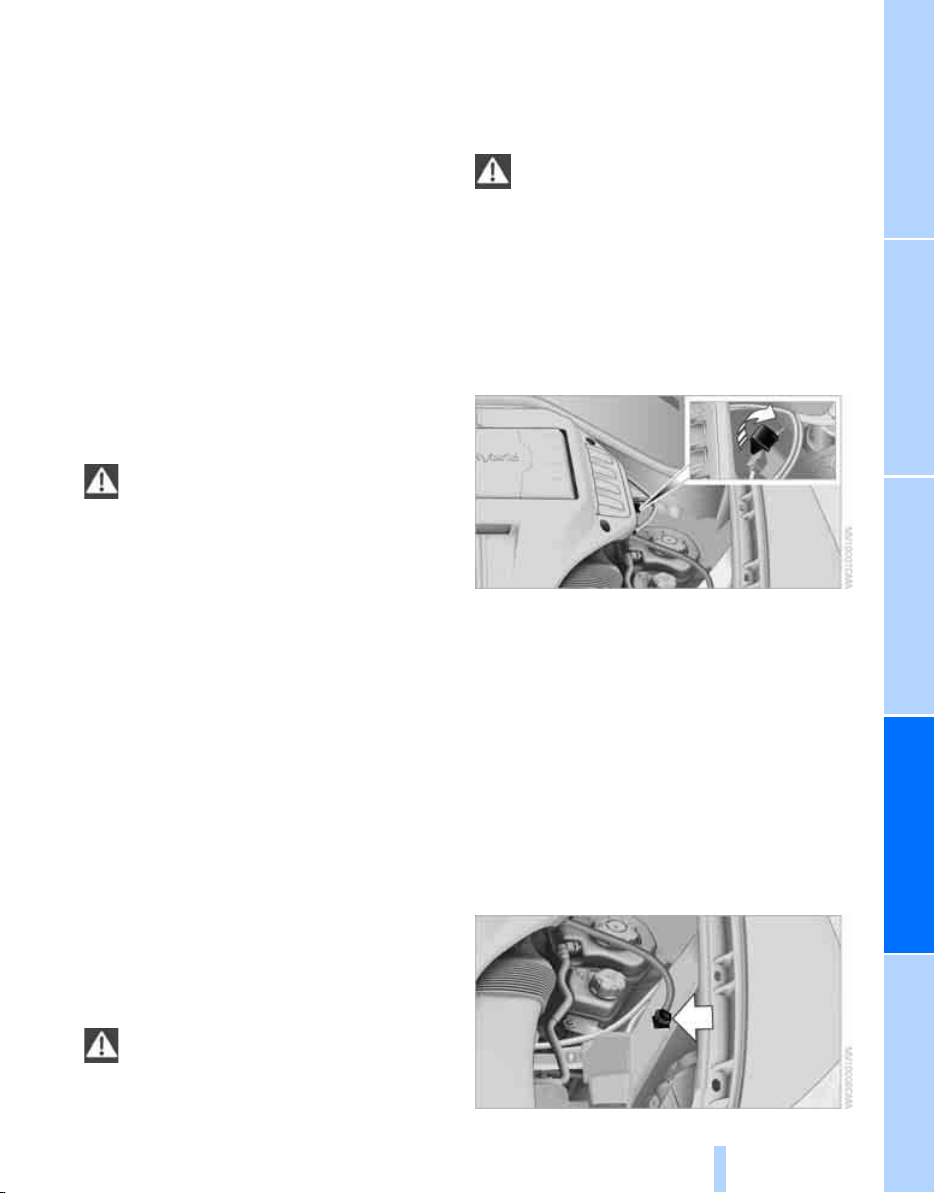
In your BMW, the so-called jump-starting termi-
nal in the engine compartment functions as the
positive battery terminal, also refer to the
engine compartment overview on page 35. The
cover cap is marked with a + symbol.
1. Fold open the cover of the BMW starting-
aid terminal. To do so, pull the tab.
2. Attach one end of the jumper cable plus/+
to the positive terminal of the battery or a
starting-aid terminal of the vehicle provid-
ing assistance.
3. Attach the second end of the cable to the
positive terminal of the battery or to a start-
ing-aid terminal of the vehicle to be started.
4. Attach one end of the jumper cable minus/–
to the negative terminal of the battery or to
an engine or body ground of the assisting
vehicle.
Your BMW has a special nut as body ground
or negative pole.
Online Edition for Part no. 01 41 2 603 632 - © 09/09 BMW AGOnline Edition for Part no. 01 41 2 603 632 - © 09/09 BMW AG
Giving and receiving assistance
38
5. Attach the second end of the cable to the
negative terminal of the battery or to the
engine or body ground of the vehicle to be
started.
Charging: 12 Volt battery
1. Start the engine on the assisting vehicle
and activate drive readiness, allowing the
assisting vehicle to run at idle for several
minutes at slightly increased speed.
2. Start the engine on your vehicle in the usual
way.
If the first starting attempt is not successful,
wait a few minutes before another attempt
in order to allow the discharged battery to
recharge.
3. Let the engines run for a few minutes.
4. Disconnect the jumper cables by reversing
the connection sequence.
Have the battery checked if necessary.
Never use spray fluids to start the
engine.<
Charging: High-voltage battery
1. Start the engine on the assisting vehicle
and activate drive readiness, allowing the
assisting vehicle to run at idle for several
minutes at slightly increased speed.
2. Switch on the ignition of your vehicle when
prompted by the corresponding message
on the Control Display. The charging
begins.
3. The charging is concluded when this is
prompted by a corresponding message on
the Control Display.
4. Start the combustion engine of your own
vehicle.
5. Disconnect the jumper cables by reversing
the connection sequence.
Have the hybrid system checked if necessary.
Never use spray fluids to start the
engine.<
Charging interrupted
The charging may be interrupted, for example if
the battery power of the assisting vehicle is
insufficient.
Disconnect the jumper cables in the reverse of
the sequence described above and contact
your BMW Sports Activity Vehicle Center.
Tow-starting and towing
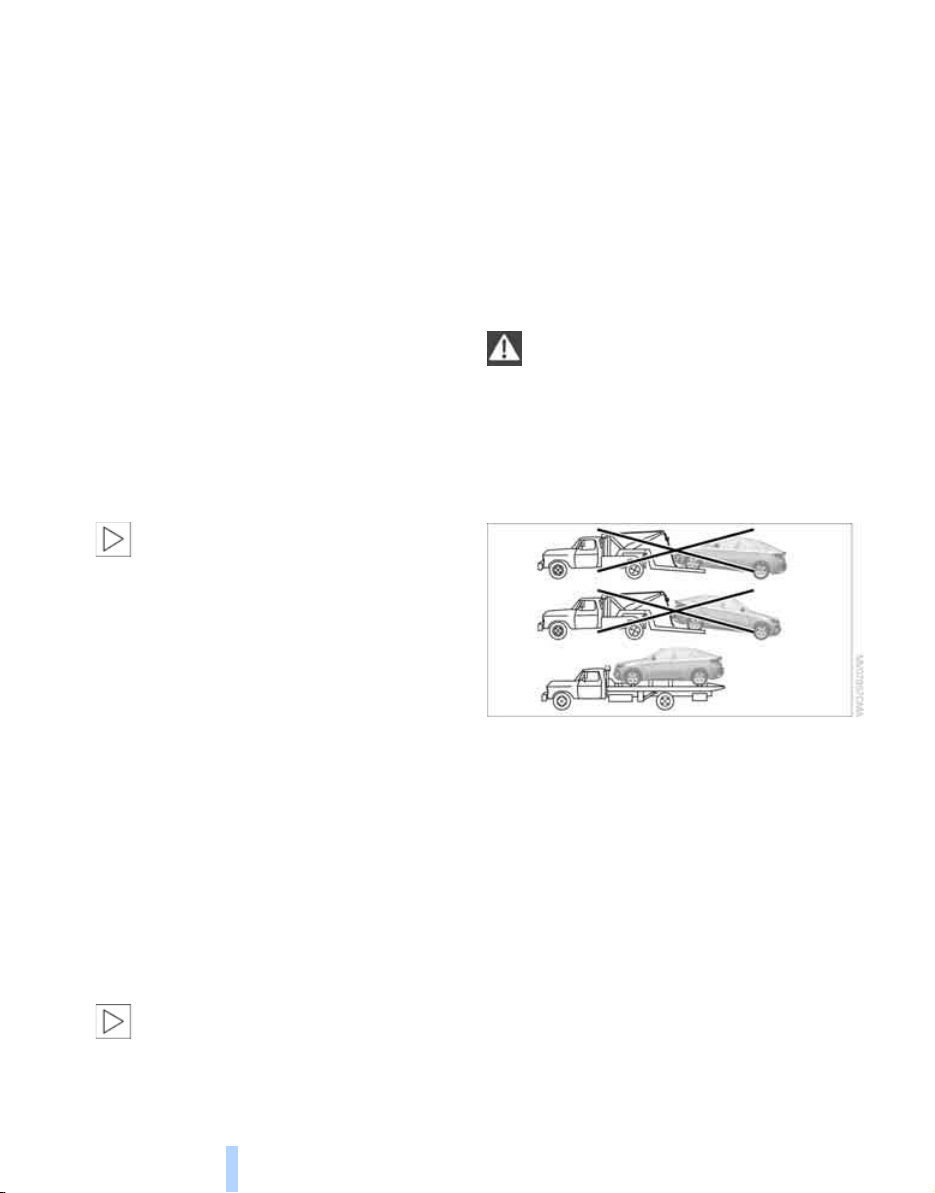
Getting towed:
Have your BMW ActiveHybrid X6 trans-
ported only on a flat bed of a tow truck;
otherwise, the high-voltage system may be
damaged.<
In special circumstances, it is possible to have
the vehicle towed on the road for short dis-
tances, e.g. in order to remove the vehicle from
a dangerous area.
No tow-starting
The engine cannot be started by tow-starting.
Start the engine by jump starting it, refer to
page 37.
Have the cause of the starting difficulties elimi-
nated.
Towing the vehicle
Towing your BMW ActiveHybrid X6 with a tow
rope or tow bar is only possible in special cir-
cumstances for short distances, e.g. in order to
remove the vehicle from a dangerous area. Oth-
erwise, the hybrid system can be damaged.
Online Edition for Part no. 01 41 2 603 632 - © 09/09 BMW AGOnline Edition for Part no. 01 41 2 603 632 - © 09/09 BMW AG
Reference At a glanceControlsDriving tipsMobility
39
Using a tow fitting
The screw-in tow-fitting should always be car-
ried in the vehicle. It can be screwed in at the
front or rear of the BMW.
It is located in the onboard toolkit under the
floor panel flap in the cargo bay.
Use only the tow fitting provided with the
vehicle and screw it all the way in. Use the
tow fitting for towing only on roads. Avoid lateral
loading of the tow fitting, e.g. do not lift the vehi-
cle by the tow fitting. Otherwise damage to the
tow fitting and the vehicle can occur.<
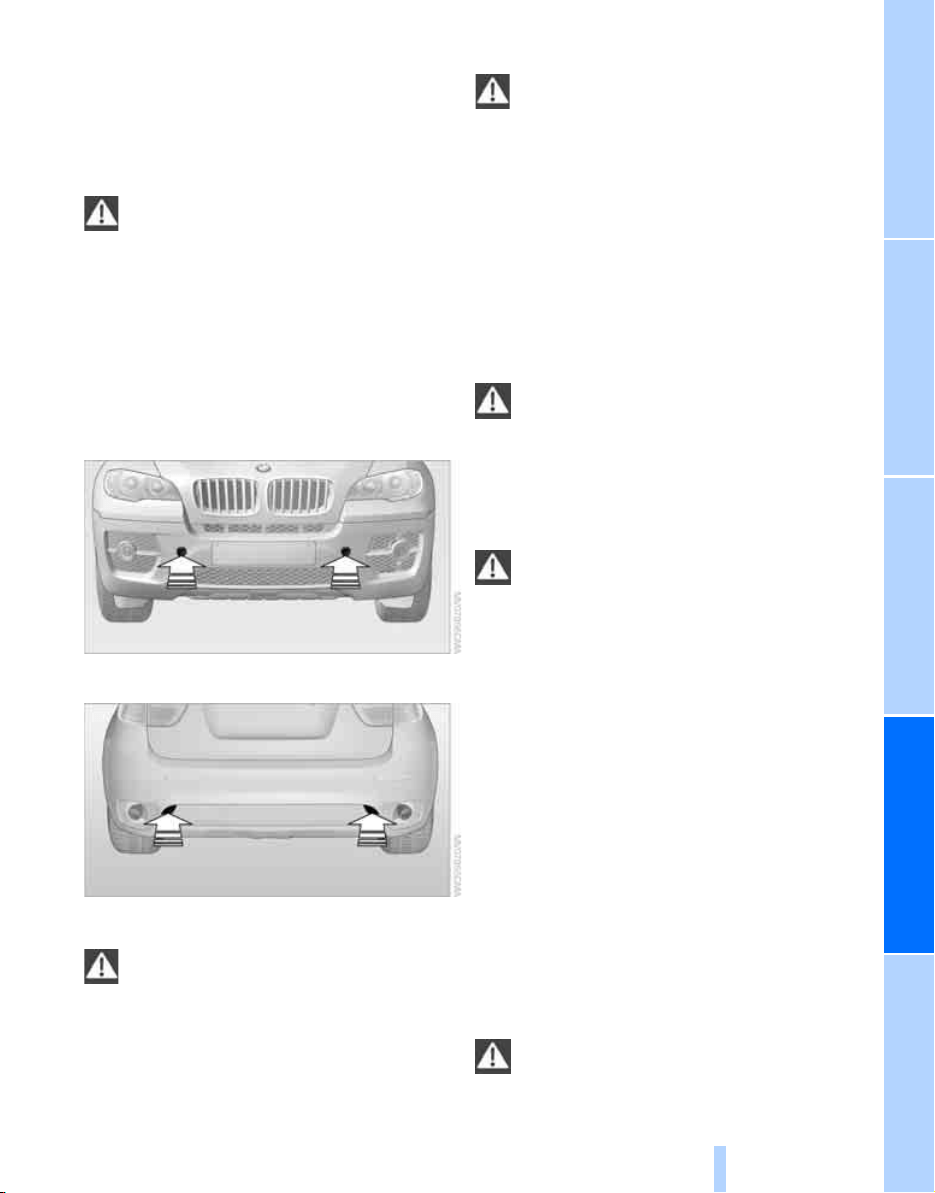
Access to screw thread
Cover panel on left and right side of bumper:
press on the arrow symbol on the cover panel.
Front:
Rear:
Towing methods
Do not lift vehicle by tow fitting or body
and chassis parts, otherwise damage may
result.<
In some countries, towing with tow bars or
ropes in public traffic is not permitted. Familiar-
ize yourself with the regulations on towing in the
respective country.
With tow bar
The towing vehicle may not be lighter
than the vehicle to be towed, otherwise it
will not be possible to reliably control vehicle
response.<
The tow fittings used should be on the same
side on both vehicles. Should it prove impossi-
ble to avoid mounting the tow bar at an offset
angle, observe the following:
> Clearance and maneuvering capability will
be sharply limited during cornering.
> When mounted at an angle, the tow bar will
exert lateral forces, tending to push the
vehicle sideways.
Only attach the tow bar to the tow fittings,
as attachment to other vehicle parts can
lead to damage.<
With tow rope
When starting off in the towing vehicle, make
sure that the tow rope is taut.
To avoid jerking and the associated
stresses on vehicle components when
towing, always use nylon ropes or nylon straps.
Only attach tow ropes to the tow fittings, as
attachment to other vehicle parts can lead to
damage.<
Hybrid system safety
Working on the vehicle
The hybrid system of the BMW ActiveHybrid X6
is a closed system.
Safety is assured as long as no work is per-
formed on the technical components.
Therefore, have changes to and work on the
vehicle, e.g. installation of accessories, carried
out only by your BMW Sports Activity Vehicle
Center or by a repair shop that works in accor-
dance with BMW guidelines using appropriately
trained personnel.
Have maintenance and repair of the vehi-
cle carried out only by the service depart-
ment or by a repair shop that works in accor-
dance with BMW guidelines using appropriately
Online Edition for Part no. 01 41 2 603 632 - © 09/09 BMW AGOnline Edition for Part no. 01 41 2 603 632 - © 09/09 BMW AG

Giving and receiving assistance
40
trained personnel. Otherwise, there is the risk of
life-threatening injury by electrocution due to
the high voltage of the hybrid system.<
Hybrid system: Contact with water
The hybrid system is generally safe, even in the
following sample situations:
> Water in the footwell, e.g. when rain show-
ers occur with an open glass roof.
> The vehicle is in water, e.g. in a flood.
> Fluid escapes in the cargo bay.
In these cases, there is no danger of being
injured by electrocution. Other types of damage
to the vehicle are possible.
Hybrid system: Automatic deactivation
In the event of an accident, the hybrid system is
switched off automatically in order to protect
passengers and other road users from injury.
The high-voltage system is automatically
switched off in the following sample situations:
> Sensors of the airbag system detect an
accident
> Obstacles on the road damage the under-
body and high-voltage cables
After an accident, do not touch any
exposed high-voltage components. Oth-
erwise, there is the risk of life-threatening injury
by electrocution due to the high voltage of the
hybrid system.<
Also follow the instructions for what to do after
an accident.
What to do after an accident
If you should get into an accident with your
vehicle, the following safety precautions must
be taken with regard to the hybrid system:
> Secure the accident site.
> Immediately inform the paramedics, police,
or fire department of the fact that it is a vehi-
cle equipped with a hybrid system.
> Move the selector lever into position P, set
the parking brake, and switch off drive
readiness.
> Do not touch any orange high-voltage
cables and connectors or high-voltage
components. Otherwise, there is the risk of
life-threatening injury by electrocution.
> Do not inhale gases emanating from the
high-voltage battery. Stay away from the
vehicle if necessary.
> Contact a service center in order to ascer-
tain the damage.
Online Edition for Part no. 01 41 2 603 632 - © 09/09 BMW AGOnline Edition for Part no. 01 41 2 603 632 - © 09/09 BMW AG


Online Edition for Part no. 01 41 2 603 632 - © 09/09 BMW AG

Reference
This chapter contains technical data and the
index that is the fastest way to find the
information you are looking for.
Reference
Online Edition for Part no. 01 41 2 603 632 - © 09/09 BMW AG

Technical data
44
Technical data
Drive system
Combustion engine
Hybrid system
Simultaneous operation of combustion engine
and electric motors.
High-voltage battery
BMW ActiveHybrid X6
Displacement cu in/cmμ 268.2/4,395
No. of cylinders 8
Maximum output hp 400
at engine speed rpm 5,500-6,400
Maximum torque lb ft/Nm 450/610
at engine speed rpm 1,750-4,500
BMW ActiveHybrid X6
Maximum output hp 480
Maximum torque lb ft/Nm 575/780
BMW ActiveHybrid X6
Type NiMH
Output kW 57
Online Edition for Part no. 01 41 2 603 632 - © 09/09 BMW AGOnline Edition for Part no. 01 41 2 603 632 - © 09/09 BMW AG
Reference At a glanceControlsDriving tipsMobility
45
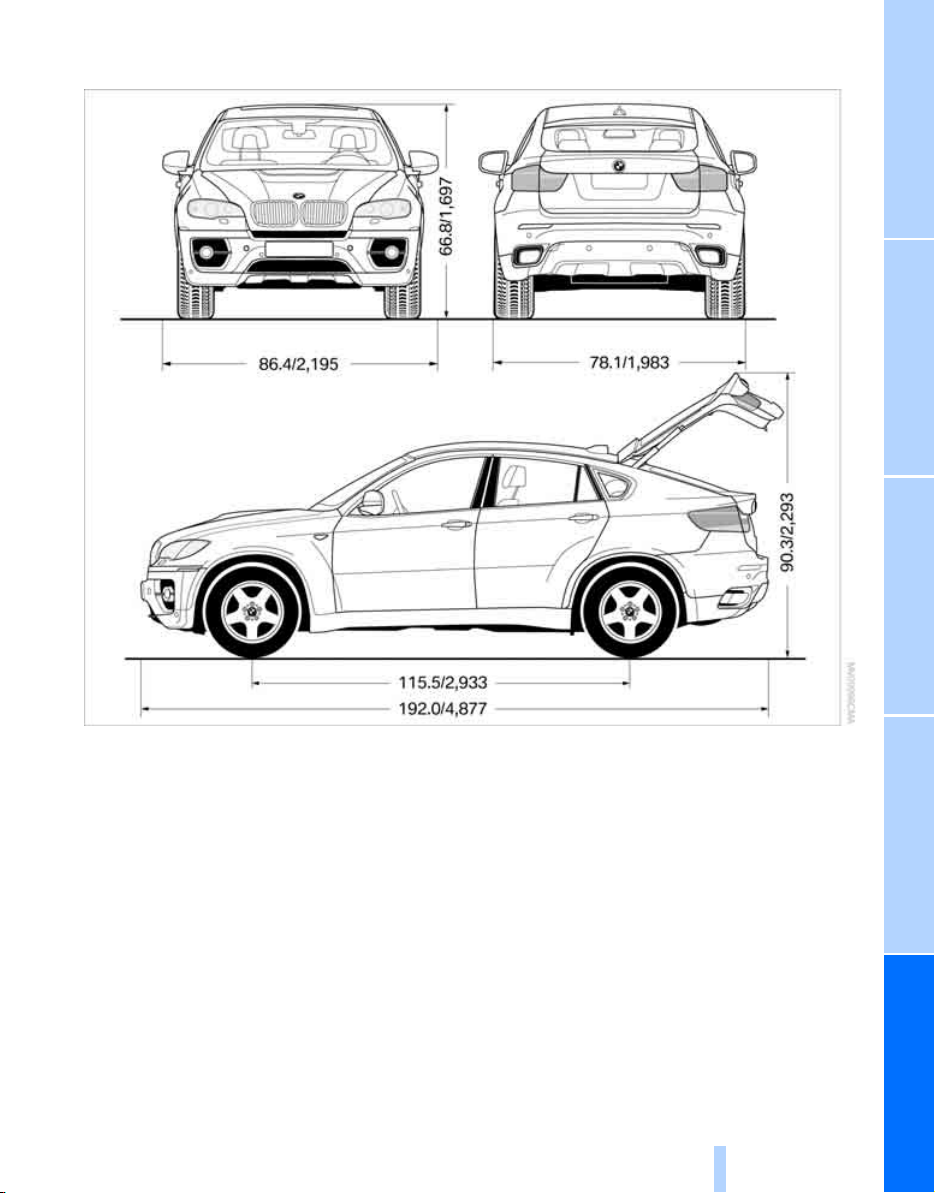
Dimensions
All dimensions given in inches/mm.
Smallest turning circle diam.: 42.0 ft/12.8 m
Height with roof rack
*
: 67.2 in/1,706 mm
With mixed tires
*
the vehicle width may exceed the specified dimension.
Online Edition for Part no. 01 41 2 603 632 - © 09/09 BMW AGOnline Edition for Part no. 01 41 2 603 632 - © 09/09 BMW AG

Technical data
46
Weights
Never exceed either the approved axle loads or
the gross vehicle weight.
Capacities
ActiveHybrid X6
Approved gross vehicle weight Ibs./kg 6,669/3,025
Load Ibs./kg 882/400
Approved front axle weight Ibs./kg 3,285/1,490
Approved rear axle weight Ibs./kg 3,505/1,590
Approved roof load capacity Ibs./kg 220/100
Cargo bay capacity cu ft/l 25.6-59.7/
470-1,350
Notes
Fuel tank
including reserve
gal/liters approx. 22.5/85
approx. 2.1/8
Also refer to BMW X6
Owner's Manual
Windshield washer with headlamp
washer system US quarts/liters approx. 6.9/6.5
Online Edition for Part no. 01 41 2 603 632 - © 09/09 BMW AGOnline Edition for Part no. 01 41 2 603 632 - © 09/09 BMW AG


Everything from A to Z
48
Everything from A to Z
Index
A
Accident, what to do after 40
After an accident 40
AKI, refer to Fuel
specifications 33
Alterations, technical, refer to
For your own safety 5
Approved axle weights, refer
to Weights 46
Approved gross vehicle
weight, refer to Weights 46
Axle weights, refer to
Weights 46
B
Battery
– 12 V battery 36
– charging 36
– high-voltage battery 36
Battery disposal
– vehicle battery 36
BMW homepage 4
BMW website 4
Brake rotors 28
Brakes
– breaking-in 26
– refer to Braking safely 27
Brake system
– breaking-in 26
– disk brakes 28
Braking safely 27
Breaking-in rear axle
differential 26
Break-in period 26
Button for starting engine 13
C
Capacities 46
Capacity of cargo bay 46
Cargo bay
– capacity 46
Car wash
– before driving in 15
Changes, technical, refer to
For your own safety 5
CHARGE, Energy recovery 16
Charge state display 21
Charging high-voltage
battery 37
Checking the air pressure,
refer to Tire inflation
pressure 34
Climate 23
Closing fuel filler cap 32
Cockpit 8
Components, high-voltage
system 12
Consumption display
– charge state display 21
Copyright 2
Cruise control 19
Cylinders, refer to Drive
system 44
D
Data
– capacities 46
– dimensions 45
– engine 44
– high-voltage system 44
– hybrid system 44
– technical data 44
– weights 46
Dimensions 45
Displacement, refer to Drive
system 44
Displays, refer to Instrument
panel 8
Disposal
– vehicle battery 36
DRIVE, Driving with
combustion engine 16
Drive readiness 14
Driving through water 27
Driving tips, refer to General
driving notes 26
E
eBOOST 16
eDRIVE, Electric driving 15
Electrical malfunction
– fuel filler door 32
Electric drive readiness 14
Electric driving, eDRIVE 15
Emergency operation, refer to
Manually operating fuel filler
door 32
Energy recovery, CHARGE 16
Engine
– breaking-in 26
– data 44
– speed 44
– starting 14
Engine compartment 35
Engine output, refer to Drive
system 44
Engine speed 44
Eye for tow-starting and
towing, refer to Tow
fitting 39
F
Footbrake, refer to Braking
safely 27
For your own safety 5
Online Edition for Part no. 01 41 2 603 632 - © 09/09 BMW AGOnline Edition for Part no. 01 41 2 603 632 - © 09/09 BMW AG

Reference At a glanceControlsDriving tipsMobility
49
Fuel 33
– capacity 46
– display 22
– high-quality brands 33
– quality 33
– saving 26
– specifications 33
Fuel clock, refer to Fuel
gauge 22
Fuel display, refer to Fuel
gauge 22
Fuel filler door 32
– closing 32
– releasing manually 32
G
Gasoline, refer to Required
fuel 33
Gasoline display, refer to Fuel
gauge 22
General driving notes 26, 27
Getting towed 38
Gross vehicle weight, refer to
Weights 46
H
Height, refer to
Dimensions 45
High-voltage battery 36
High-voltage system
– components 12
High water, refer to Driving
through water 27
Hills 27
Homepage 4
Hybrid system
– air-conditioning
functions 23
– components 12
– contact with water 40
– deactivation 40
– display 21
– functions 13
– safety 39
Hybrid system safety 39
I
Ignition 13
– switched on 13
Ignition key position 1, refer to
Radio readiness 13
Ignition key position 2, refer to
Ignition on 13
Imprint 2
Inflation pressure, refer to Tire
inflation pressure 34
Instrument cluster, refer to
Instrument panel 8
Instrument panel 8
J
Jumpering, refer to Jump
starting 37
Jump starting 37
K
Knock control 33
L
Length, refer to
Dimensions 45
Luggage compartment
capacity, refer to Cargo bay
capacity 46
M
Malfunction
– fuel filler door 32
Manual operation
– fuel filler door 32
N
Noises, refer to Cooling of the
high-voltage system 23
Nylon rope, refer to Tow-
starting and towing 38
O
Octane ratings, refer to Fuel
specifications 33
P
Power, refer to Drive
system 44
Pressure, tires 34
Pressure compensation,
refueling 32
R
Radio position, refer to Radio
readiness 13
Radio readiness 13
– switched on 13
Refueling 32
– preparation 32
– pressure compensation 32
Regeneration, refer to Energy
recovery 16
Reserve warning, refer to Fuel
gauge 22
Roof load capacity 46
Rope, refer to Tow-starting
and towing 38
S
Safety 5
Screw thread for tow fitting 39
Silent start 14
Speedometer 8
Sport program, manual mode
M/S 18
Start/Stop button 13
Starting, refer to Starting
engine 14
Starting assistance, refer to
Jump starting 37
Starting difficulties, jump
starting 37
Status of this Owner's Manual
at time of printing 5
Summer tires, refer to Wheels
and tires 34
Online Edition for Part no. 01 41 2 603 632 - © 09/09 BMW AGOnline Edition for Part no. 01 41 2 603 632 - © 09/09 BMW AG

Everything from A to Z
50
Symbols 4
T
Tank contents, refer to
Capacities 46
Technical alterations, refer to
For your own safety 5
Technical data 44
Teleservice Report 5
Tempomat, refer to Cruise
control 19
The individual vehicle 5
Tire inflation pressures 34
Tires
– inflation pressure 34
Torque
– engine 44
Tow fitting 39
Towing 38
– tow fitting 39
Tow-starting 38
Turning circle, refer to
Dimensions 45
Turn signals
– indicator lamp 8
Two-Mode Active
Transmission 16
U
Used batteries
– refer to Disposal 36
V
Vehicle
– breaking-in 26
– measurements, refer to
Dimensions 45
– weights 46
Vehicle battery, refer to
12 Volt batteries 36
W
Water on roads, refer to
Driving through water 27
Website 4
Weights 46
What to do after an
accident 40
Wheelbase, refer to
Dimensions 45
Wheels and tires 34
Width, refer to Dimensions 45
Online Edition for Part no. 01 41 2 603 632 - © 09/09 BMW AGOnline Edition for Part no. 01 41 2 603 632 - © 09/09 BMW AG

Online Edition for Part no. 01 41 2 603 632 - © 09/09 BMW AGOnline Edition for Part no. 01 41 2 603 632 - © 09/09 BMW AG

01 41 2 603 632 ue
*BL260363200O*
The Ultimate
Driving Machine
More about BMW
bmwusa.com
Online Edition for Part no. 01 41 2 603 632 - © 09/09 BMW AGOnline Edition for Part no. 01 41 2 603 632 - © 09/09 BMW AG