
User Guide
[UG template version 15a]
[Sprint-Samsung-G925P-ug-en-071017-FINAL]

TOC i
Table of Contents
Introduction 1 ...........................................................................................................................................
...................................................................................................................
.......................................................................................................
..........................................................................................................................
..................................................................................................
............................................................................................................................................
......................................................................................................................
........................................................................................................................
........................................................................................................................
........................................................................................................
....................................................................................................................
...................................................................................................................
......................................................................................................
.................................................................................................................................
..........................................................................................................................................
........................................................................
..........................................................................................................
.......................................................................
..........................................................................................................
...............................................................................................................................
.................................................................................................................................
............................................................................................................
.............................................................................................................................
............................................................................................................................
.............................................................................................................................
....................................................................................................................................
............................................................................................................
...........................................................................................................
............................................................................................................
..........................................................................................................................
...................................................................................................
About the User Guide 1
Access Instructions on Phone 2
Access Help 2
Get Support from My Sprint 3
Get Started 4
Parts and Functions 4
Phone Layout 4
Charge the Battery 6
Turn Your Phone On and Off 8
Use the Touchscreen 9
Activate Your Phone 12
Complete the Setup Screens 13
Basic Operations 14
Basics 14
Home Screen and Applications (Apps) List 14
Phone Settings Menu 15
Portrait and Landscape Screen Orientation 15
Capture Screenshots 16
Edge Screen 16
Applications 19
Launch Applications 19
Apps List 19
Phone Number 24
Airplane Mode 24
Enter Text 24
Samsung Keyboard 24
Google Voice Typing 26
Tips for Editing Text 26
Google Account 27
Create a Google Account 27

TOC ii
Sign In to Your Google Account 29 .........................................................................................
....................................................................................................
.......................................................................................................................
.......................................................................................................
.......................................................................................
....................................................................................................................
..................................................................................................................
..................................................................................................
....................................................................................................
....................................................................................................................
.............................................................................................
.............................................................................................................
................................................................................................................
................................................................................................................
..................................................................................................................
..........................................................................................................
....................................................................................................
...............................................................................................
...........................................................................................................................
................................................................................................................
...............................................................................................................................
......................................................................................................
........................................................................................................
....................................................................................
......................................................................................
.......................................................................................
..........................................................................................................................................
................................................................................................................................
..............................................................................................................
................................................................................................
...................................................................................................
............................................................................................................
................................................................................
..........................................................................................
.................................................................................................
Factory Reset Protection 29
Google Play Store 30
Find and Install an App 30
Request a Refund for a Paid App 31
Update an App 32
Uninstall an App 33
Get Help with Google Play 34
Lock and Unlock Your Screen 34
Update Your Phone 35
Update Your Phone Software 35
Update Your Profile 38
Update Your PRL 39
Your Phone's Home Screen 40
Home Screen Basics 40
Home Screen Layout 40
Extended Home Screens 41
Status Bar and Notification Panel 42
Status Bar 42
Notification Panel 44
Multi Window 46
Customize the Home Screen 47
Change the Wallpaper 47
Add Shortcuts to the Home Screen 48
Add Widgets to the Home Screen 48
Add Folders to the Home Screen 49
Phone App 50
Wi-Fi Calling 50
Place and Answer Calls 51
Call Using the Phone Dialer 51
Call Emergency Numbers 52
Answer Phone Calls 53
In-Call Screen Layout and Operations 56
Place Calls from Contacts/Call Logs 57
Place a Call from Contacts 57

TOC iii
Call from Call Log 58 ...............................................................................................................
........................................................................................................................
..................................................................................................................
......................................................................................................
.....................................................................................................
....................................................................................................
...................................................................................
...............................................................................................
........................................................................................................
...............................................................................................................
.........................................................................................................................
.............................................................................................................
...................................................................................................................
........................................................................................................................
..............................................................................................................................................
.............................................................................................................................
.............................................................................................................................
..............................................................................................................
..............................................................................................................................
.........................................................................................................................
.....................................................................................................................................
........................................................................................................................................
..........................................................................................................................
............................................................................................................................
...........................................................................................................................
.......................................................................................................................
........................................................................................................................
......................................................................................................................
.................................................................................................
.........................................................................................................
...................................................................................
..................................................................................................
...................................................................................
................................................................................................
.......................................................................................
Optional Services 59
Voicemail Setup 59
Set Up Visual Voicemail 60
Review Visual Voicemail 61
Visual Voicemail Options 61
Configure Visual Voicemail Settings 62
Change Your Main Greeting 63
Edit the Display Name 63
Caller ID Blocking 63
Call Waiting 64
Conference Calling 65
Call Forwarding 66
Call Settings 66
Contacts 70
Add a Contact 70
View Contacts 73
Contacts Screen Layout 73
Edit a Contact 74
Delete a Contact 74
Favorites 75
Groups 75
Share a Contact 77
Profile Sharing 80
Import Contacts 81
Back Up Contacts 82
Contacts Settings 82
Messaging and Internet 84
Text and Multimedia Messaging 84
Send a Text Message 84
Send a Multimedia Message (MMS) 85
Use Enhanced Messaging 87
Save and Resume a Draft Message 90
New Messages Notification 90
Manage Message Conversations 90

TOC iv
Messages Settings 92 ..............................................................................................................
..............................................................................................................
....................................................................................
......................................................................................
...................................................................................................
...................................................................................................................
.........................................................................................................................................
..................................................................................................
.......................................................................................................
.............................................................................
................................................................................
......................................................................................................
..................................................................................................
................................................................................................
..............................................................................
...................................................................................................................
..............................................
..............................................................................................................................
...............................................................................................................
............................................................................
.....................................................................................................................................
...............................................................................................................
...............................................................................................................
........................................................................................................
..................................................................................................
...............................................................................................................
.......................................................................................................................
..................................................................................................................................
...................................................................................................................................
..................................................................................................................................
................................................................................................................................
............................................................................................................................
............................................................................................
...................................................................................................................
.............................................................................................................
Create and Send Gmail 94
Create and Send a Gmail Message 94
Check Received Gmail Messages 96
Manage Gmail Messages 97
Gmail Settings 101
Email 101
Set Up an Email Account 101
Add an Email Account 102
Add an Exchange ActiveSync Account 104
Create and Send an Email Message 105
Open Email Messages 106
Delete an Email Account 107
Manage Your Email Inbox 107
Exchange ActiveSync Email Features 109
Email Settings 110
Data Services General Information (4G LTE and 3G Networks) 112
4G LTE 112
Your User Name 113
Data Connection Status and Indicators 114
Browser 114
Use the Browser 115
Add a Bookmark 116
View Browser History 117
Open New Browser Tabs 118
Browser Settings 119
Chrome Browser 119
Facebook 120
Hangouts 121
Instagram 121
Messenger 122
Camera and Video 123
Take Pictures and Record Videos 124
Take a Picture 125
Viewfinder Screen 125

TOC v
Record Videos 126 ..................................................................................................................
................................................................................................................
..................................................................................
..............................................................................................................................
.......................................................................................................
....................................................................................
.............................................................
.........................................................................
....................................
................................................................................................
.......................................................................................................................
................................................................................................................
......................................................................................................
..................................................................................................................
............................................................................................................................
...................................................................................................................................
...........................................................................................................................................
.....................................................................................................................
.............................................................................................................................
..................................................................................................................................
....................................................................................................................................
...........................................................................................
.......................................................................................................
.................................................................................................................
.............................................................
.............................................................................................................
....................................................................................................................................
.........................................................................................................................................
........................................................................................................................
.................................................................................................
..........................................................................................................................................
..............................................................................................................................
.............................................................................................................................
...................................................................................................................
..................................................................................................................
Shooting Modes 127
View Pictures and Videos Using Gallery 128
Edit Pictures 129
Share Pictures and Videos 133
Send Pictures or Videos by Email 133
Send a Picture or Video by Multimedia Message 134
Send Pictures or Videos Using Bluetooth 135
Share Pictures or Videos Using Additional Apps or Social Media 136
Share Videos on YouTube 137
Camera Settings 138
Switch Cameras 138
Set Camera Functions 139
Live Broadcast 140
Apps and Features 144
1Weather 144
AAA 144
Amazon Shopping 144
App Spotlight 144
Calculator 144
Calendar 145
Add an Event to the Calendar 145
View Calendar Events 146
Sync Calendars 147
Synchronize an Exchange ActiveSync Calendar 148
Calendar Settings 148
Caller ID 149
Clock 149
Set Alarms 149
Additional Clock Features 150
Drive 151
Galaxy Apps 151
Google Maps 151
Google Play Books 153
Google Play Games 153

TOC vi
Google Play Movies & TV 153 .........................................................................................................
.............................................................................................................
............................................................................................
....................................................................................
..............................................................................
............................................................................................................
....................................................................................................................................
..........................................................................................................................
.......................................................................................................................
.....................................................................................................................................
........................................................................................................................................
.........................................................................................................................................
.....................................................................................................................................
...................................................................................................................................
.......................................................................................................................
.................................................................................................................................
...................................................................................................................................
....................................................................................................................................
.............................................................................................................................
.......................................................................................................................................
......................................................................................................................................
.......................................................................................................................
............................................................................................................................
.................................................................................................................................
................................................................................................................
......................................................................................................................
......................................................................................................................
............................................................................................................................
................................................................................................................................
...................................................................................................................
.......................................................................................................................
..........................................................................................................................................
.........................................................................................................................................
.........................................................................................................................
....................................................................................................................................
Google Play Music App 153
Play Music with Google Play 154
Google Play Music Screen Layout 155
Create Playlists in Google Play Music 156
Google Play Newsstand 157
Google+ 157
Google Search 157
Hancom Office S 158
Lookout 158
Memo 158
Music 159
My Files 161
My Sprint 162
NASCAR Mobile 162
NextRadio 163
OneDrive 163
OneNote 163
Peel Remote 163
Photos 163
S Voice 164
Samsung Health 165
Samsung Pay 167
Samsung+ 168
Sprint Family Locator 168
Sprint FamilyWall 169
Sprint Music Plus 169
Sprint Protect 170
Sprint Spot 170
Sprint TV & Movies 170
Sprint Worldwide 171
Uber 171
Video 171
Voice Recorder 172
YouTube 177

TOC vii
Connectivity 179 .......................................................................................................................................
..............................................................
..........................................................................................................................................
.......................................................
....................................................................................................................
...............................................................................................................
.......................................................................................................................
......................................................................................................................................
...................................................................................................................................
........................................................................................................
...........................................................................................
......................................................................................................
..............................................................................
....................................................................................
...............................................................................
...................................................................................................................................
.................................................................................................................................
................................................................
.........................................................
..................................................................................................
......................................................................
.........................................................................................................................
.........................................................................................
......................................................................................
..........................................
..............................................................................
......................................................................................................
..............................................................
..........................................................
.............................................................................................................................................
...........................................................................................................................
..................................................................................................................
.....................................................................................................................
..........................................................................................................................
.................................................................................................................
Transfer Files between Your Phone and a Computer 179
Wi-Fi 180
Turn Wi-Fi On and Connect to a Wireless Network 180 ...
Wi-Fi Settings 182
Disconnect Wi-Fi 182
Wi-Fi Direct 183
Hotspot 183
Bluetooth 185
Bluetooth Information 185
Enable the Bluetooth Feature 185
Pair Bluetooth Devices 187
Connect to a Paired Bluetooth Device 188
Send Information Using Bluetooth 189
Receive Information Using Bluetooth 190
Tethering 190
Global Services 192
Activate Sprint Worldwide Service on Your Account 192
Your Phone’s SIM Card for International GSM Roaming 192
Enable Global Roaming Mode 193
Set the Communications Method for Global Use 194
Select a Carrier 194
Make and Receive Worldwide Calls 194
Sprint International Voicemail Service 195
Set Up Your Voicemail Access Number for International Use 196
Access Your Voicemail Internationally 196
International Data Roaming 197
Access Email and Data Services Internationally 197
Contact Sprint for Assistance with International Service 198
Settings 200
Basic Settings 200
Wi-Fi Settings Menu 202
Bluetooth Settings 204
Phone Visibility 205
Data Usage Settings 206

TOC viii
Airplane Mode Settings 207 .............................................................................................................
....................................................................................................................
.........................................................................................................
.....................................................................................................................................
.........................................................................................................
..................................................................................................
..............................................................................................................................
..........................................................................................................................
.........................................................................................
................................................................................................................
................................................................................................
................................................................................................................
.............................................................................................................
..................................................................................................
......................................................................................................................
.......................................................................................................
..............................................................................................................................
.............................................................................................................
......................................................................................................
...............................................................................................................
.............................................................................................................
..................................................................................................................
.................................................................................................................
.............................................................................................................
................................................................................................
................................................................................................................
........................................................................................................................
.........................................................................................................................
.................................................................................................................
.....................................................................................................................
.....................................................................................................
......................................................................................................
........................................................................................................................
......................................................................................................................
.......................................................................................................
NFC and Payment 208
Mobile Networks Settings 210
Location 211
More Connection Settings 213
Nearby Device Scanning 214
Printing 215
MirrorLink 216
Virtual Private Networks (VPN) 217
Wi-Fi Calling Settings 221
Hotspot and Tethering Settings 221
Hotspot Settings 221
Tethering Settings 222
Sounds and Vibration Settings 224
Sound Mode 226
Vibrate While Ringing 227
Volume 228
Vibration Intensity 229
Ringtones and Sounds 230
Vibration Pattern 231
Notification Sound 232
Do Not Disturb 233
System Sounds 236
Key-tap Feedback 237
Sound Quality and Effects 238
Notifications Settings 239
Display Settings 239
Brightness 241
Blue Light Filter 242
Screen Mode 243
Screen Zoom and Font 244
Home Screen Settings 245
Easy Mode 246
Icon Frames 247
Edge Screen Settings 248

TOC ix
Night Clock 253 ........................................................................................................................
....................................................................................................................
...........................................................................................................
.................................................................................................................
....................................................................................................................
...................................................................................................
.................................................................................................................
.......................................................................................................
..........................................................................................................
...................................................................................................................
...........................................................................................................
..........................................................................................................................
.............................................................................................................................
..................................................................................................................................
...........................................................................................
.................................................................................
......................................................................................................................
...................................................................................................
.................................................................................................................
................................................................................................................
.............................................................................................
...........................................................................................
.....................................................................................
..............................................................................
..................................................................................................................
................................................................................................................
...........................................................................................................................
.........................................................................................................
........................................................................................................................
.................................................................................................
............................................................................................
....................................................................................................
......................................................................................................
.................................................................................................................................
...........................................................................................................
LED Indicator 254
Status Bar Settings 254
Screen Timeout 255
Screen Saver 256
Keep Screen Turned Off 257
Applications Settings 257
Applications Overview 258
Default Applications 260
Advanced Features 261
Wallpapers and Themes 262
Wallpaper 262
Themes 263
Icons 264
Lock Screen and Security Settings 265
Lock Screen and Security Overview 265
Screen Lock 266
Disable the Screen Lock 268
Device Security 269
Accessibility Settings 270
Vision Accessibility Settings 271
Hearing Accessibility Settings 272
Dexterity and Interaction Settings 273
Configure Other Accessibility Settings 274
Cloud and Accounts 275
Samsung Cloud 275
Accounts 276
Backup and Restore 277
Google Settings 280
General Management Settings 281
Language and Input Settings 282
Date and Time Settings 283
Report Diagnostic Info 284
Reset 284
Factory Data Reset 286

TOC x
Device Maintenance Settings 288 ...................................................................................................
....................................................................................................................
.................................................................................................................
...............................................................................................................
.............................................................................................................................
...........................................................................................................................................
.................................................................................................................
........................................................................................................................
.............................................................................................................................
..................................................................................................................................
........................................................................................................................
........................................................................................
................................................................................................
......................................................................................................
....................................................................................................
................................................................................................................
......................................................................................................................
..........................................................................................................
......................................................................................................
........................................................................
....................................................................................................
..........................................................................................................................
...............................................................
..........................................................................................
..........................................................................................................................................................
Optimize Now 288
Battery Settings 289
Storage Settings 290
Memory 292
Help 293
Activate This Device 294
System Updates 295
About Device 295
For Assistance 298
Troubleshooting 298
Sprint Account Information and Help 299
Sprint Account Passwords 299
Manage Your Account 300
Sprint Support Services 300
Copyright Information 301
Legal Information 301
Intellectual Property 302
Open Source Software 302
Disclaimer of Warranties; Exclusion of Liability 302
Modification of Software 303
Samsung Knox 303
Restricting Children’s Access to Your Mobile Device 303
Samsung Electronics America, Inc. 303
Index 305

Introduction 1
Introduction
The following topics describe the basics of using this guide and your new phone.
About the User Guide
Thank you for purchasing your new Samsung Galaxy S6 edge. The following topics explain how best to
use this guide to get the most out of your phone.
Before Using Your Phone
Read the Get Started guide and Important Information booklet that were packaged with your phone
thoroughly for proper usage.
Accessible services may be limited by subscription contract conditions.
Descriptions in the User Guide
Note that most descriptions in this guide are based on your phone's setup at the time of purchase.
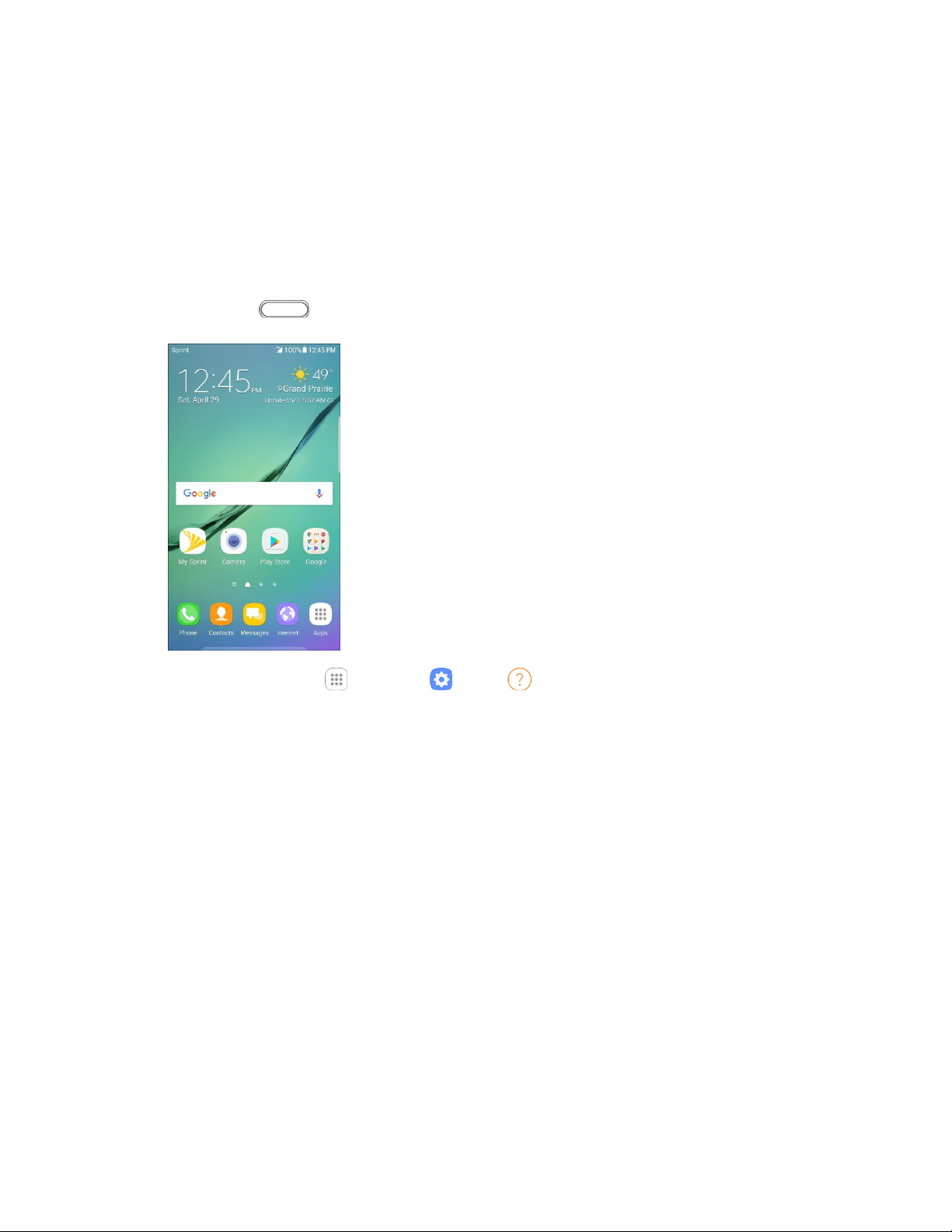
Unless otherwise noted, instructions begin from the phone's home screen, which is displayed by
pressing Home . Some operation descriptions may be simplified.
Screenshots and Key Labels
Screenshots and other illustrations in this user guide may appear differently on your phone. Key labels in
the user guide are simplified for description purposes and differ from your phone's display.
Other Notations
In the user guide, the phone may be referred to either as “phone,” “device,” or “handset.”
Introduction 2
Access Instructions on Phone
These topics will help you find help on your new phone and will introduce the basics of using your phone's
touchscreen if you are a new user.
Access Help
Use the phone's Help menu to learn about your phone.
1. Press Home to display the home screen.
2. From home, tap Apps > Settings > Help .
3. Tap a topic to view its contents, or tap Search to search for a topic.
Introduction 3
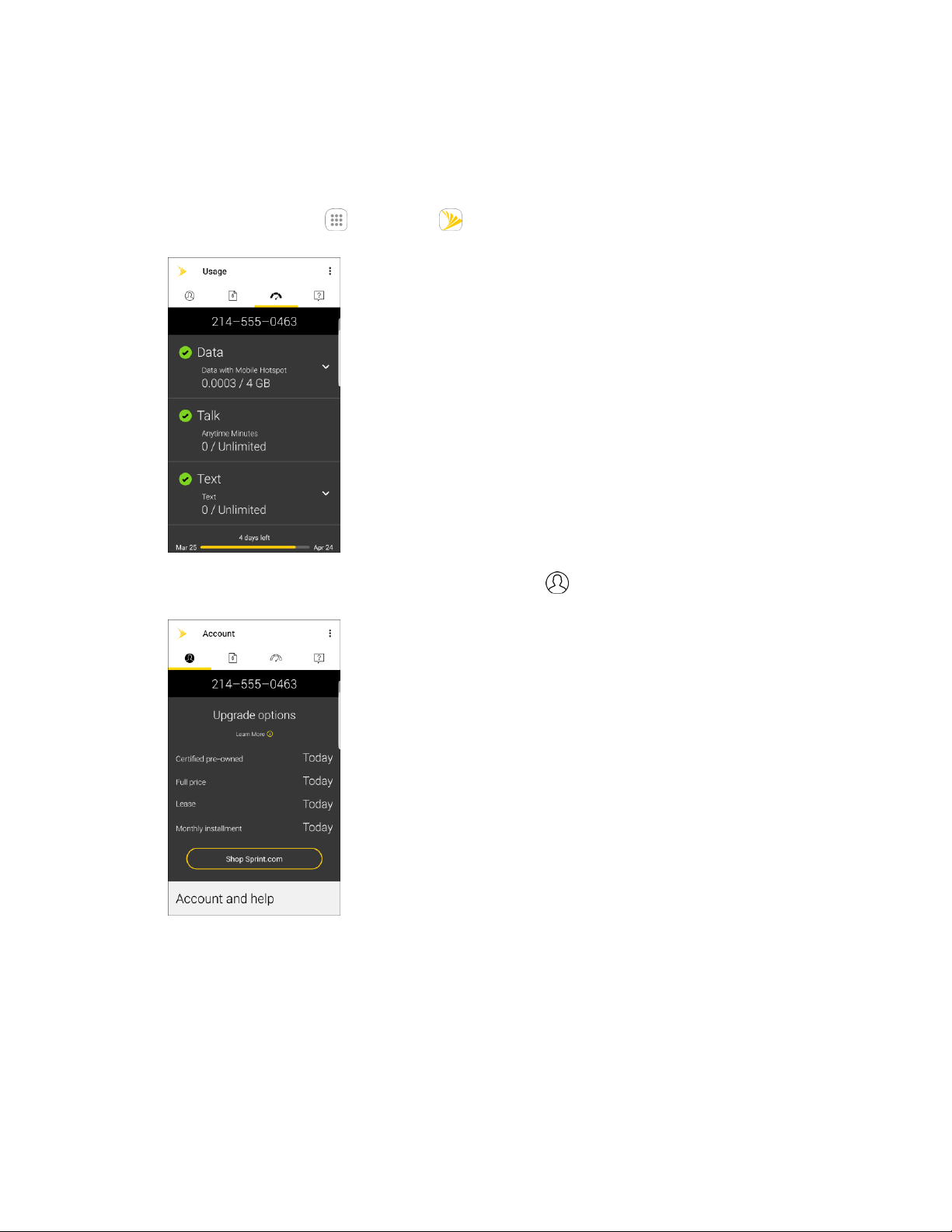
Get Support from My Sprint
In addition to your phone's built-in Help menu, you can also access support for your phone and service
through the preloaded My Sprint app.
1. From home, tap Apps > My Sprint .
2. From the My Sprint main page, tap Account and help .
3. Tap a topic to view its contents.
Get Started 4
Get Started
The following topics give you all the information you need to set up your Samsung phone and wireless
service the first time.
Parts and Functions
These topics illustrate your phone’s primary parts and key functions.
Note: Your phone's screens and apps layouts are subject to change. This user guide uses sample
images only.
Phone Layout
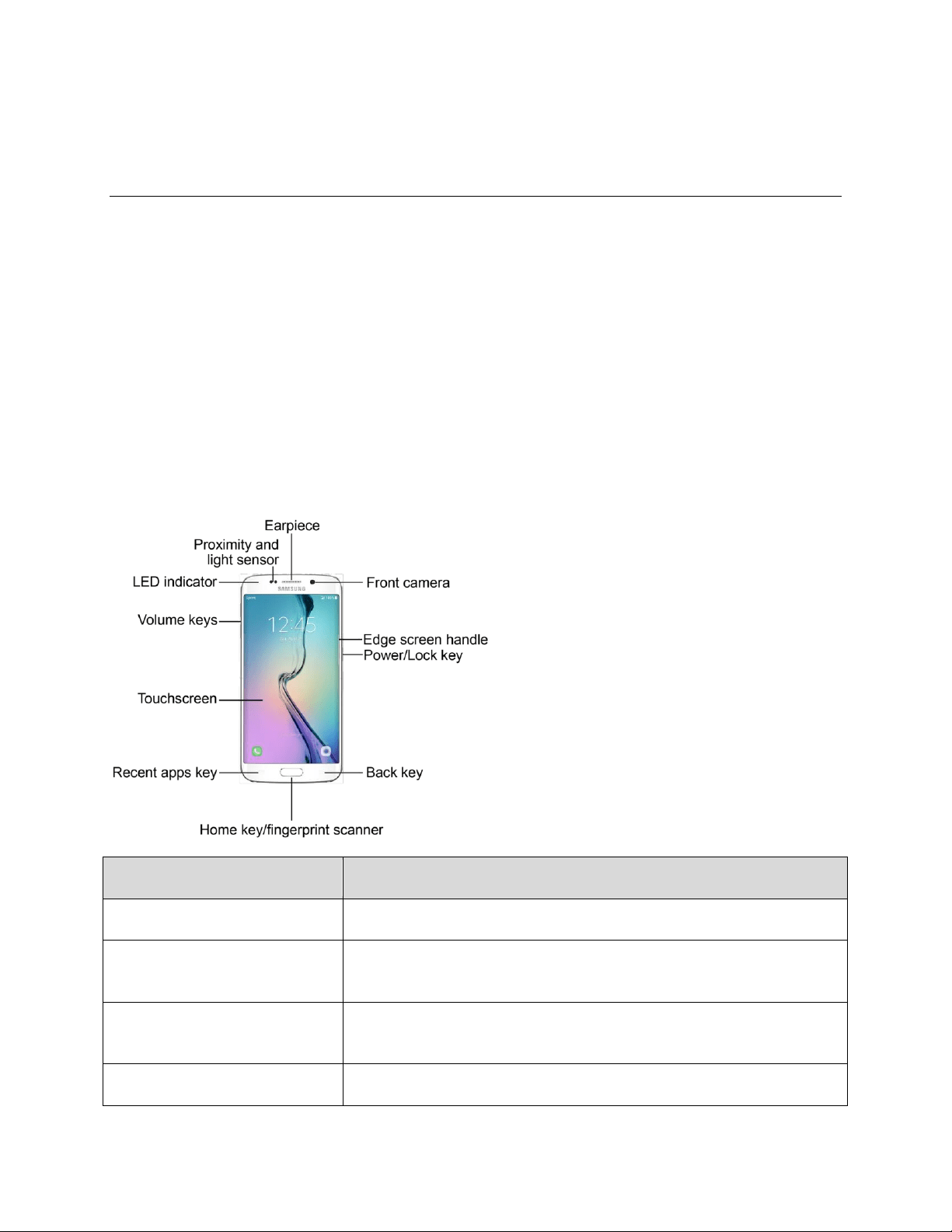
The following illustration outlines your phone’s primary external features and keys.
Front View
Part
Description
Earpiece
Listen to calls and automated prompts when using the phone.
Front camera
Takes pictures and records videos while facing the screen, and allows
you to video conference.
Power/Lock key
Turn the phone or screen on or off, or switch your phone to
Emergency mode.
Edge screen handle
Swipe to reveal the Edge screen.
Get Started 5
Part
Description
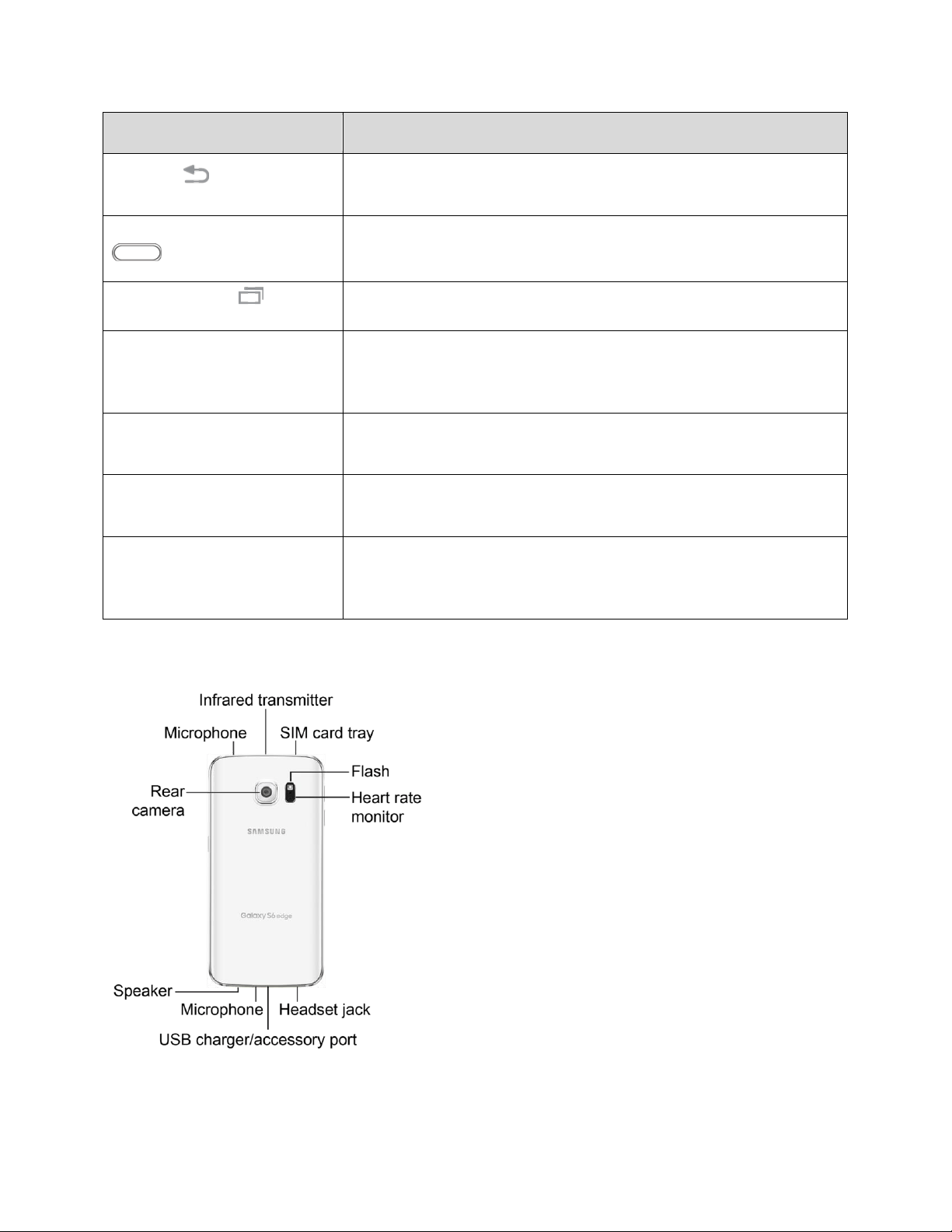
Back key
Return to the previous screen, or close a dialog box, options menu,
the notification panel, or keyboard.
Home key/fingerprint sensor
Return to the home screen. Press and hold to open Google
™
Search/Google Now
™
. Use to register fingerprints for security.
Recent apps key
Access recently used apps.
Touchscreen
Display information needed to operate your phone, such as the call
status, the Contacts list, and the date and time. Also provides one-tap
access to all of your features and applications.
Volume keys
Adjust the ringtone or media volume or adjust the voice volume during
a call.
LED indicator
The LED indicator blinks or glows when charging, to indicate low
battery, to announce new notifications, and when voice recording.
Proximity and light sensor
Detect when objects are close to the screen. For example, when you
hold the phone to your ear while on a phone call, the sensors
temporarily lock the screen to prevent accidental screen touches.
Back View
Get Started 6
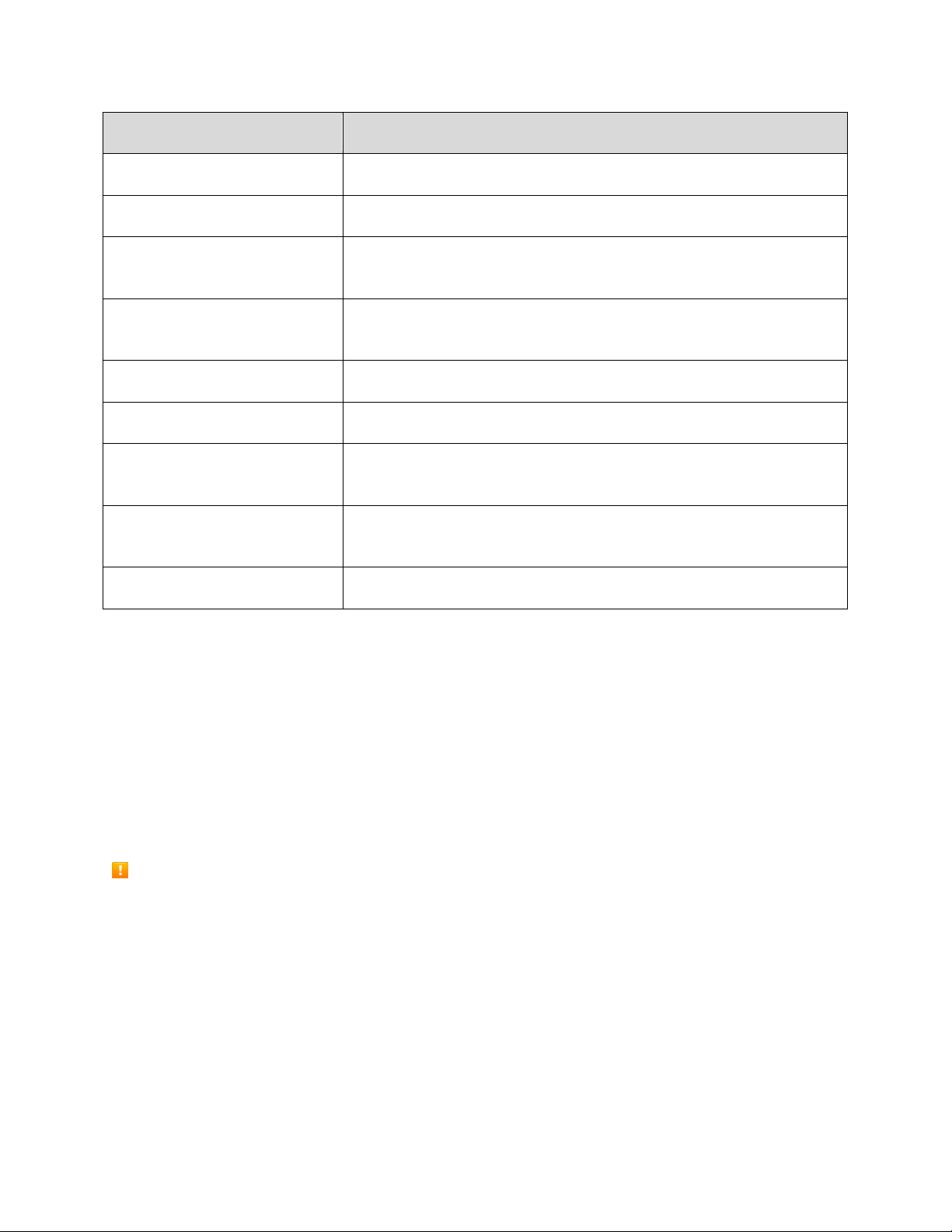
Part
Description
Infrared transmitter
Control other devices using infrared light.
SIM card tray
Location of the SIM card.
Flash
Help illuminate subjects in low-light environments when the camera is
focusing and capturing a picture or video.
Heart rate monitor
Measure your heart rate using your fingertip when using the Samsung
Health app. See Samsung Health.
Headset jack
Plug in a headset for convenient, hands-free conversations.
USB charger/accessory port
Connect the phone to the charger using a USB cable.
Microphone
Transmit your voice for phone calls or record your voice or ambient
sounds for voice recordings and videos.
Speaker
Play ringtones and sounds. The speaker also lets you hear the caller’s
voice in speakerphone mode.
Rear camera
Take pictures and videos.
Caution: Inserting an accessory into the incorrect jack may damage the phone.
Charge the Battery
Follow these instructions to charge your phone’s battery using either the included charging head and USB
cable or using a USB connection on your computer.
Tip: This device is also compatible with Samsung-approved wireless charging devices (sold separately).
Note: This phone has an integrated battery that cannot be removed by the user.
Battery Cautions
Caution: Use only charging devices approved by Samsung. Samsung accessories are designed for
your device to maximize battery life. Using other accessories may invalidate your warranty and may
cause damage.
Storage: Avoid storing or leaving the phone with no battery charge remaining. Saved information and
settings may become lost or changed, or the phone may become unusable. Charge once every six
months before storing or leaving unused for a long period.
Get Started 7
Charge Using the AC Adapter
It is recommended you fully charge the battery before using your device for the first time. For fastest
charging times, use the Samsung Adaptive Fast Charger that came with your device. This charger
provides faster charging only when connected to devices that support Adaptive Fast Charging.
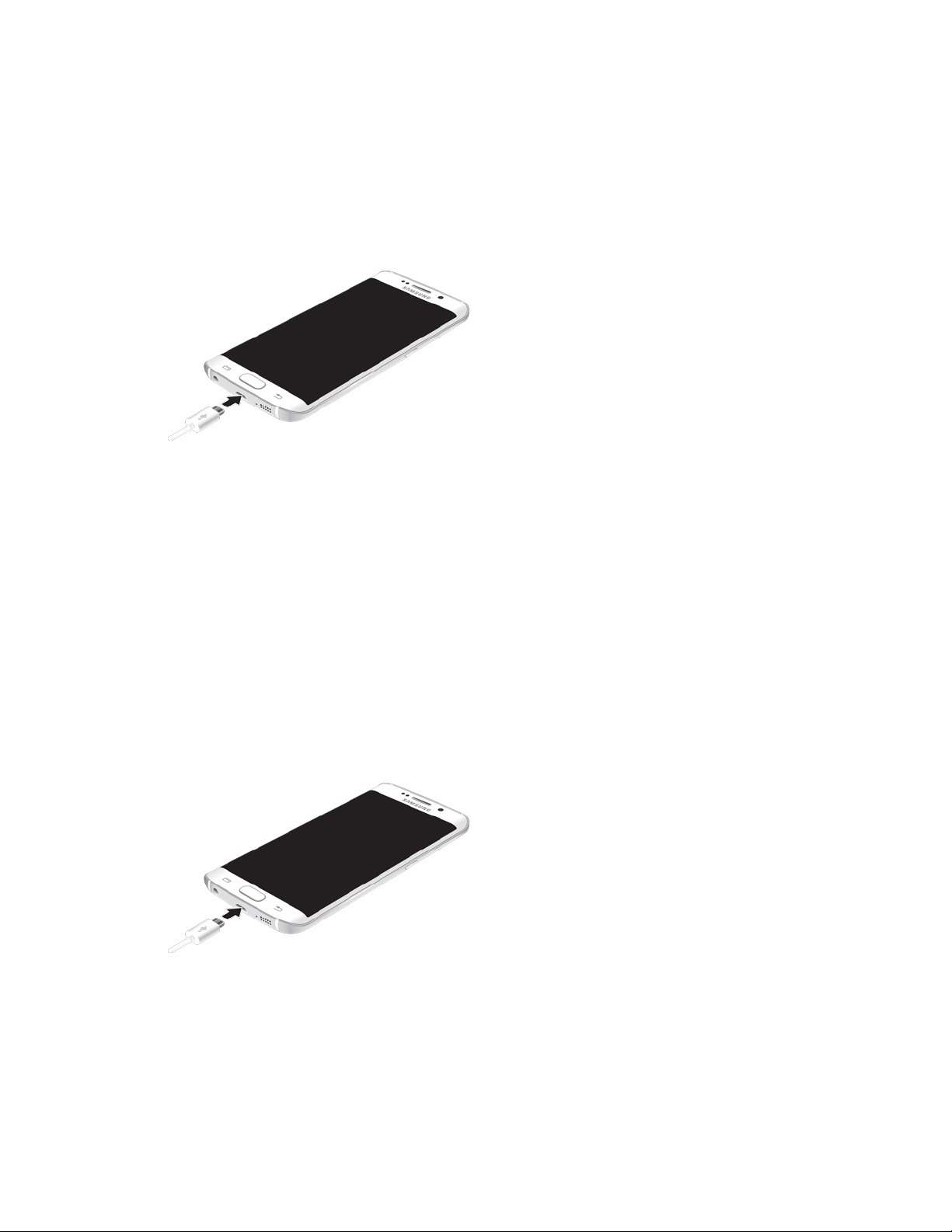
1. Plug the USB cable into the USB charger/accessory port on the bottom of your phone.
2. Plug the other end of the USB cable into the charging head.
3. Plug the charging head into an electrical outlet.
4. After charging, disconnect the phone from the charger.
Unplug the charging head from the outlet, and remove the micro USB cable from the phone
and the charging head.
Charge Using a PC Connection
Before using a PC connection to charge your phone, ensure that the computer is turned on. Depending
on the type of connection, your phone’s battery may not charge.
1. Insert the small end of the USB cable into the USB charger/accessory port on the bottom of your
phone.
2. Insert the large end of the USB cable into a USB port on your computer.
3. After charging, remove the USB cable from both the phone and the computer.

Get Started 8
Turn Your Phone On and Off
The instructions below explain how to turn your phone on and off.
Turn Your Phone On
■ Press and hold the Power/Lock key.
Your phone will power on. Depending on the settings, you may see the lock screen.
See Lock and Unlock Your Screen and Screen Lock for information about using the screen
lock.
The first time you turn the phone on, you will see the startup screens. See Complete the
Setup Screens for details.
If your phone is not yet activated, see Activate Your Phone for more information.
Turn Your Phone Off
1. Press and hold the Power/Lock key to display the device options menu.
2. Tap Power off to turn the phone off.
Your phone will power off.
Your screen remains blank while your phone is off (unless the battery is charging).
Get Started 9
Use the Touchscreen
Your phone’s touchscreen lets you control actions through a variety of touch gestures.
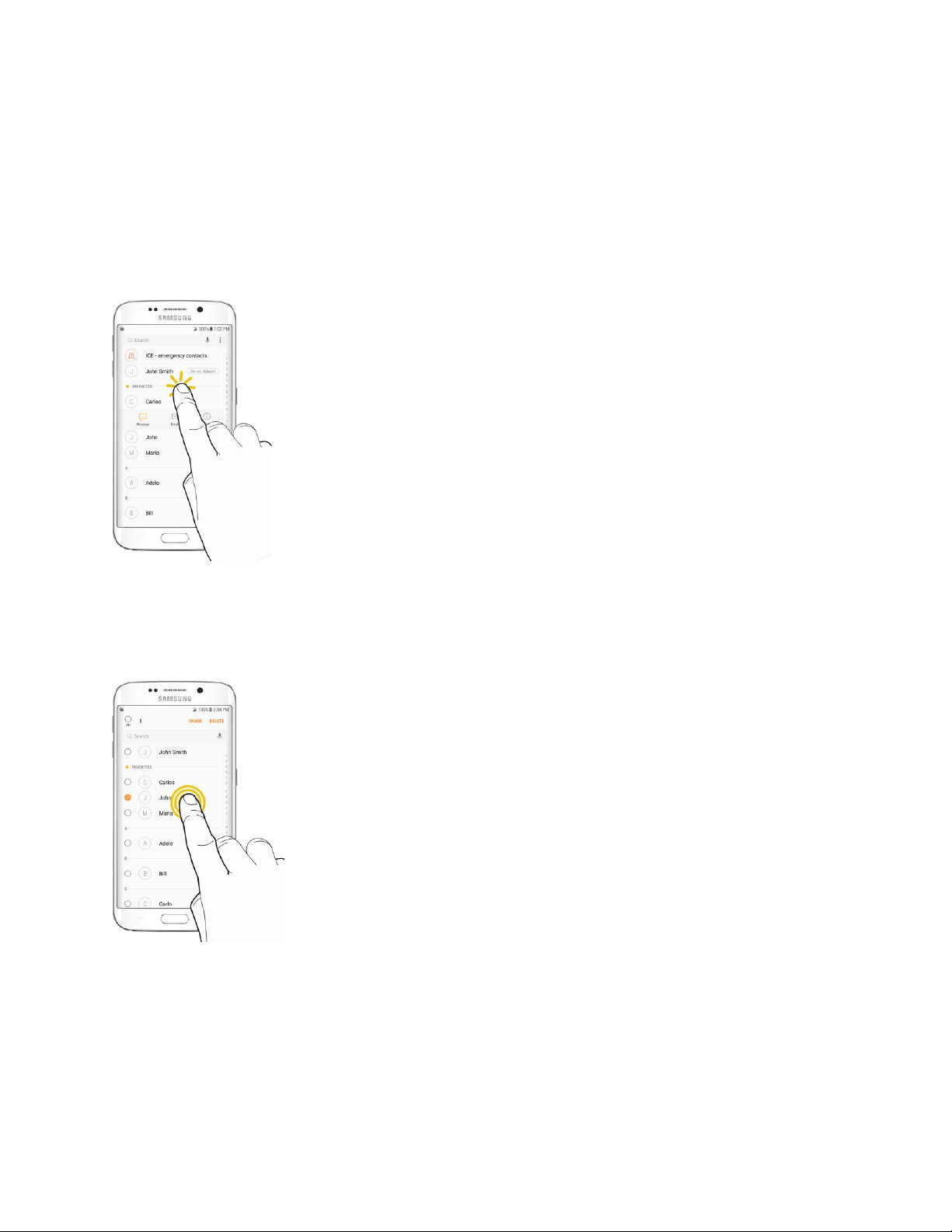
Tap
When you want to type using the keyboard, select items such as application and settings icons, or press
buttons, simply tap or touch them with your finger.
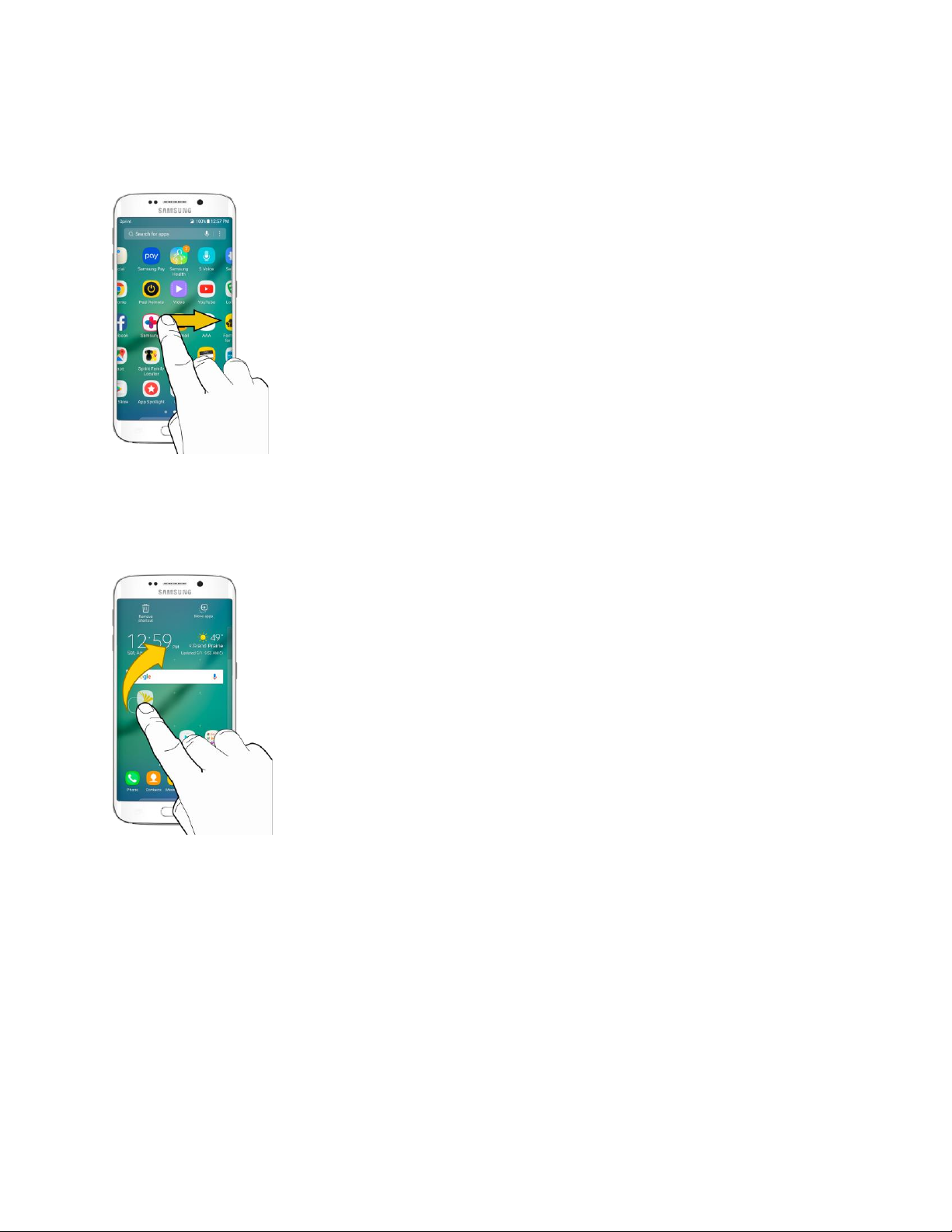
Touch and Hold
To open the available options for an item (for example, a contact or link in a Web page), touch and hold
the item.
Get Started 10
Swipe or Slide
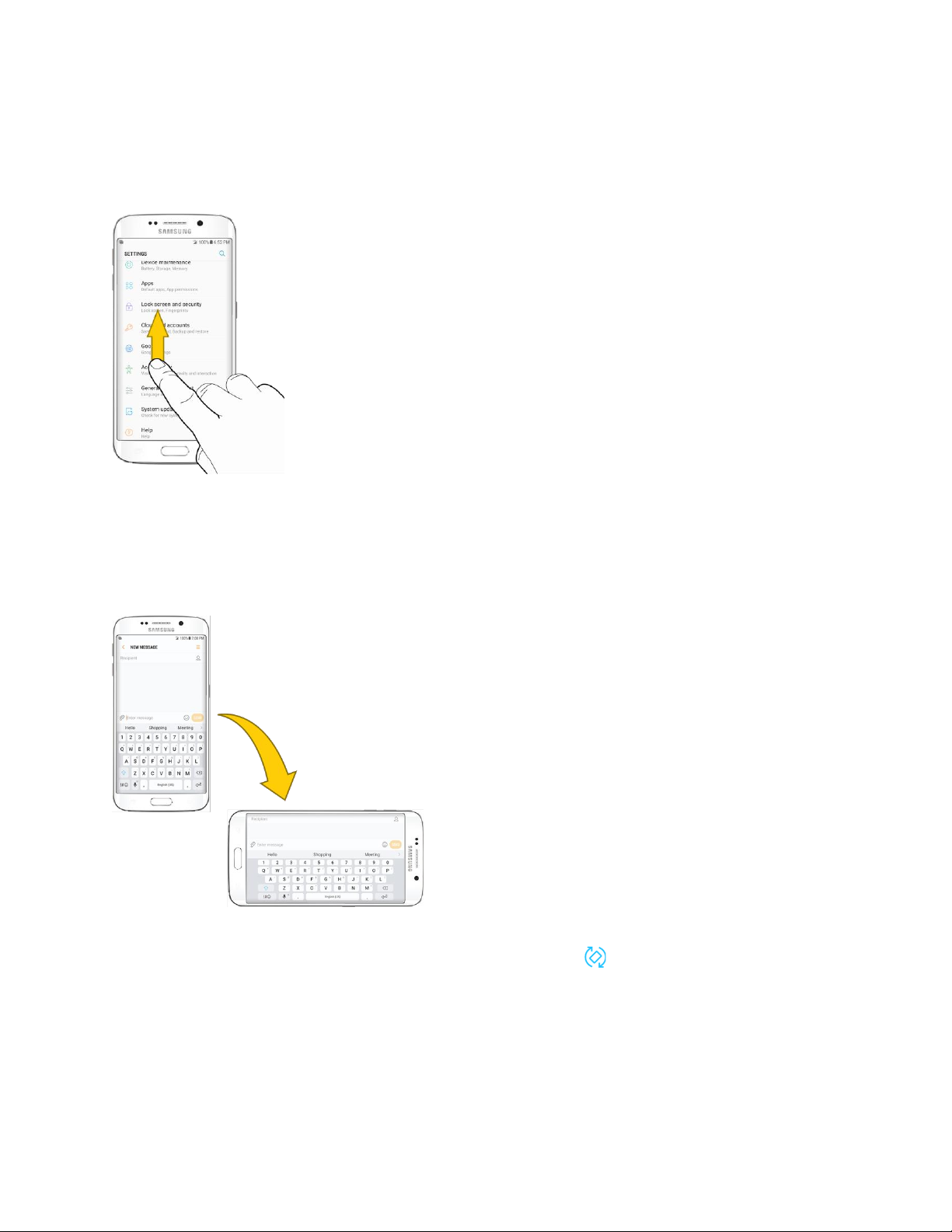
To swipe or slide means to quickly drag your finger vertically or horizontally across the screen.
Drag
To drag, press and hold your finger with some pressure before you start to move your finger. While
dragging, do not release your finger until you have reached the target position.
Get Started 11
Flick
Flicking the screen is similar to swiping, except that you need to swipe your finger in light, quick strokes.
This finger gesture is always in a vertical direction, such as when flicking the contacts or message list.
Rotate
For most screens, you can automatically change the screen orientation from portrait to landscape by
turning the phone sideways. When entering text, you can turn the phone sideways to bring up a bigger
keyboard. See Samsung Keyboard for more details.
Note: Auto rotate needs to be enabled for the screen orientation to automatically change. Pull down the
status bar to display the notification panel, and then tap Auto rotate to enable the option.
Get Started 12
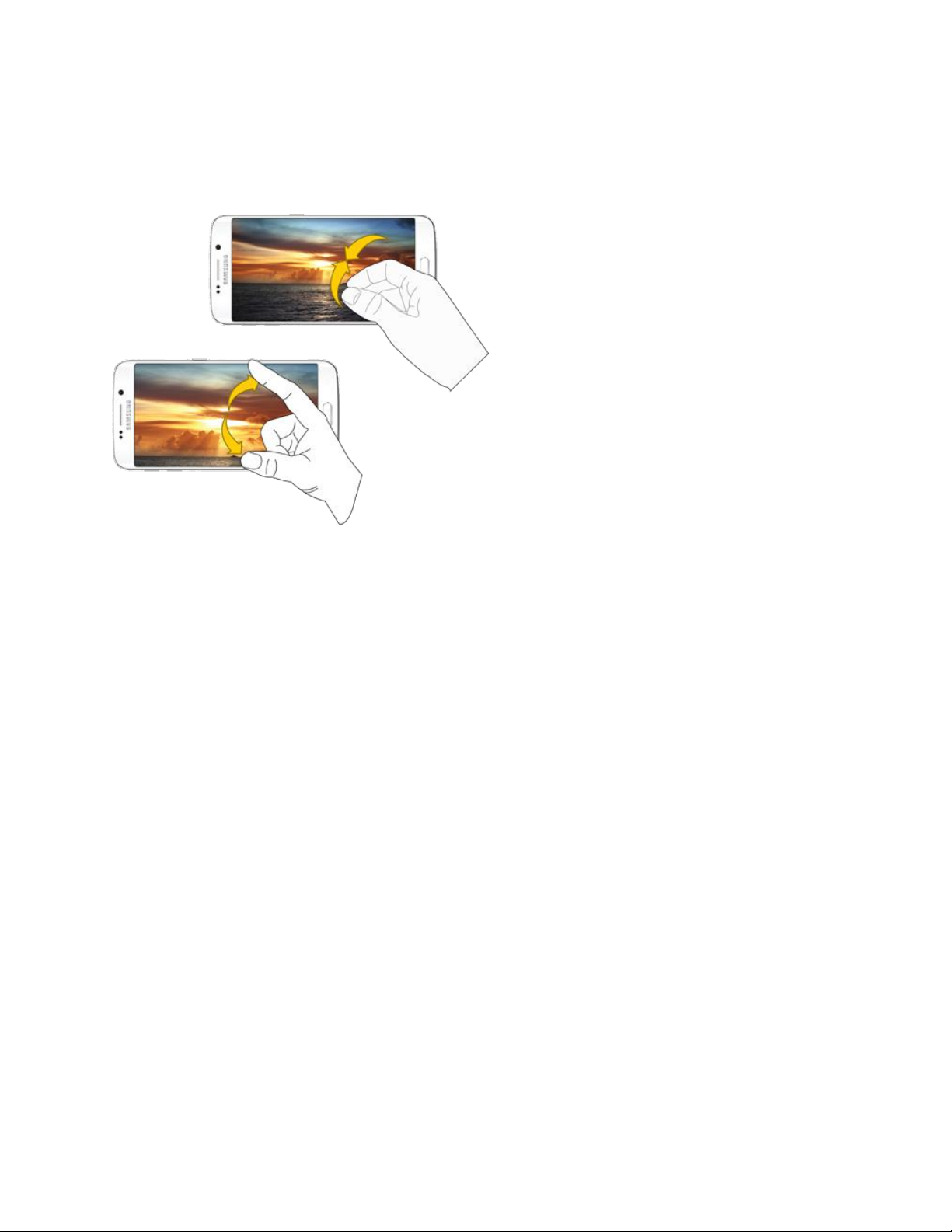
Pinch and Spread
Pinch the screen using your thumb and forefinger to zoom out or spread the screen to zoom in when
viewing a picture or a Web page. (Move fingers inward to zoom out and outward to zoom in.)
Activate Your Phone
Follow the instructions below to activate your phone if it has not already been activated. Depending on
your account or how and where you purchased your phone, it may be ready to use or you may need to
activate it on your Sprint account.
● If you purchased your phone at a Sprint Store, it should be activated and ready to use.
● If you received your phone in the mail, and it is for a new Sprint account or a new line of service,
it will activate automatically when you first turn it on.
● If you’re swapping phones for a number already on your Sprint account, go to sprint.com/activate
and follow the instructions.
To confirm activation, make a phone call. If your phone is still not activated, visit sprint.com/support for
assistance. If you do not have access to the Internet, call Sprint Customer Service at 1-888-211-4727
from another phone.
Note: Do not press the Power key while the phone is being activated. Pressing the Power key cancels
the activation process. If you are having any difficulty with activation, visit sprint.com/support.

Get Started 13
Complete the Setup Screens
The setup screens help you set up certain features and preferences on your phone. Once your phone has
been turned on, you will see a Welcome message. You can then complete the setup process.
Note: You may be able to complete the setup screens before your phone has been activated on your
account.
■ From the Welcome screen, select a language and tap Start to get started. To skip any section,
tap Next or Skip.
Note: On the Welcome screen, there may also be an Accessibility button. If you are visually impaired or
hard of hearing, tap Accessibility to change the accessibility settings.
Basic Operations 14
Basic Operations
The following topics outline basic features and operations of your phone.
Basics
The following topics offer an overview of your phone’s basic operations.
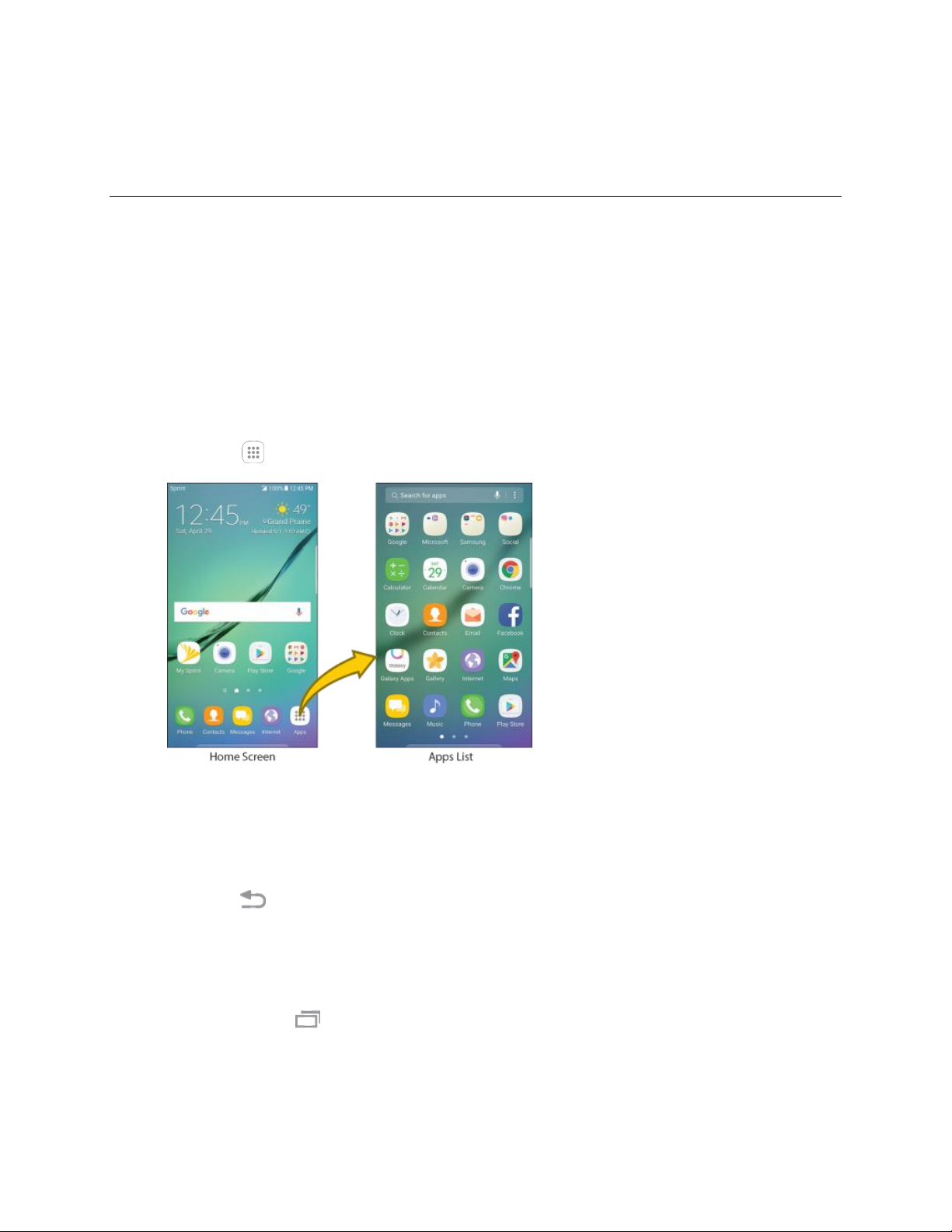
Home Screen and Applications (Apps) List
Most of your phone’s operations originate from the home screen or the Apps list.
1. From any screen press the Home key to display the home screen.
2. Tap Apps to display the Apps list.
For information about using the home screen, see Home Screen Basics.
Select Options and Navigate Screens
Tap icons, keys, and other items to open or activate the assigned function.
■ Tap Back to return to the previous screen.
Recent Applications
You can display a list of recently used applications using the Recent apps key.
■ Tap Recent apps to view a list of recently used applications.
Basic Operations 15
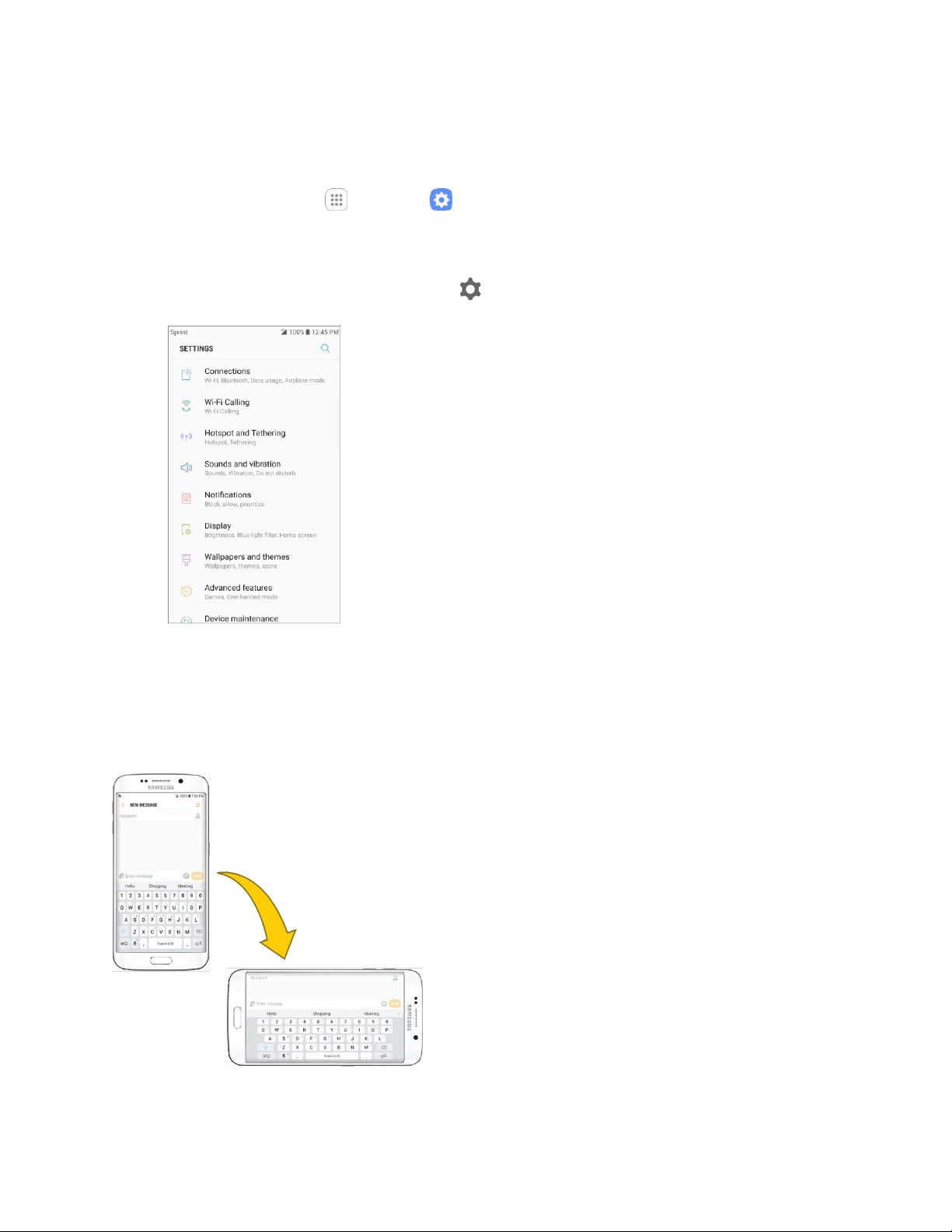
Phone Settings Menu
You can customize your phone’s settings and options through the Settings menu.
■ From home, tap Apps > Settings .
– or –
Pull down the status bar and tap Settings .
For more information, see Basic Settings.
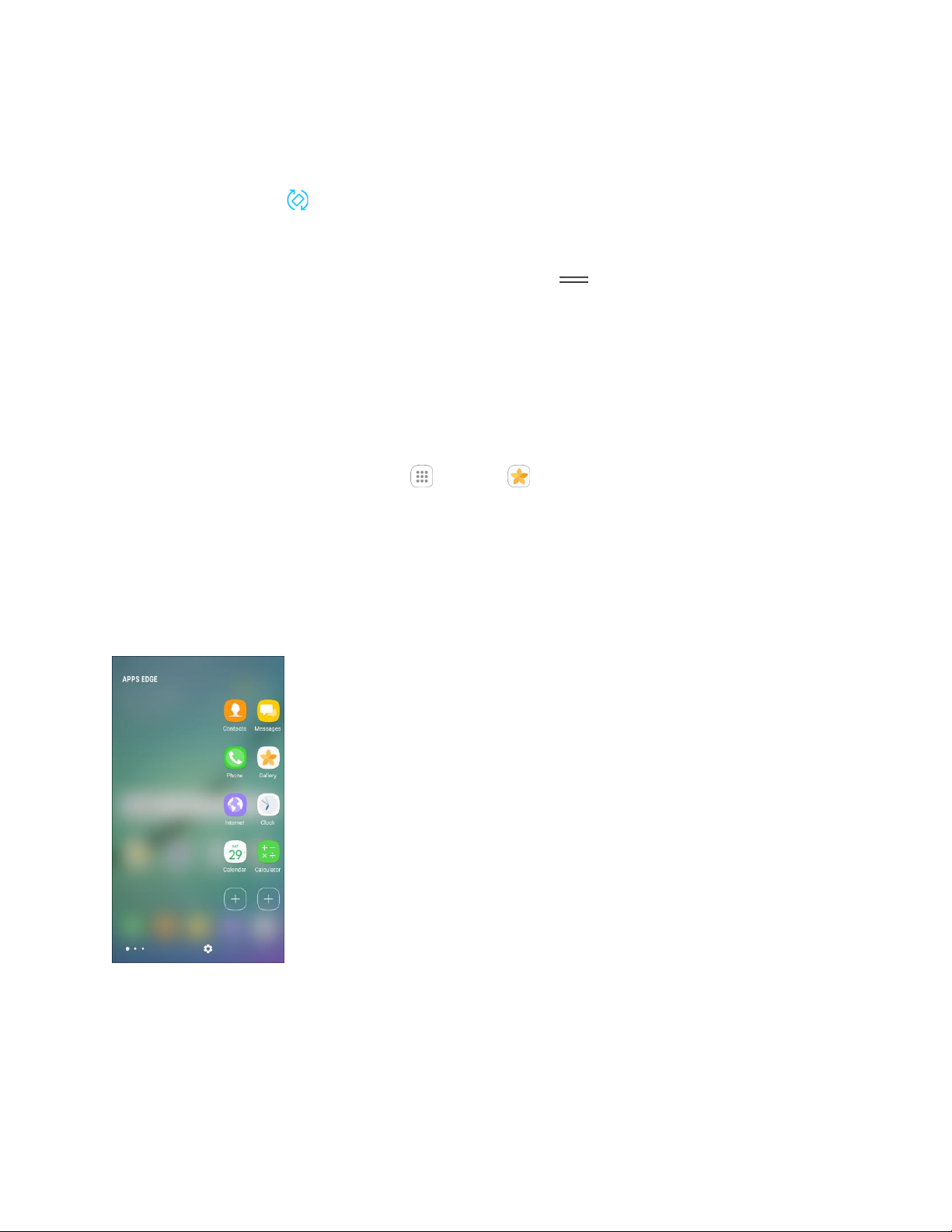
Portrait and Landscape Screen Orientation
The default orientation for your phone’s screen is portrait (vertical), but many apps will change to
landscape orientation (widescreen) when you rotate the phone sideways.
Note: Not all screens will adjust for landscape orientation.
Basic Operations 16
Turn Screen Rotation On or Off
1. Pull down the status bar to display the quick settings menu.
2. Tap Auto rotate to turn the option on or off.
You may need to scroll left or right to see the Auto rotate option.
If the Auto rotate option is not available, tap Expand to display the full options list.
Capture Screenshots
You can use your phone’s power and home keys to capture screenshots.
■ Press and hold the Power/Lock key and Home key at the same time to capture a screenshot of
the current screen.
The current screenshot will be captured and stored in the Screenshots album in the phone’s
Gallery. From home, tap Apps > Gallery .
Tip: Depending on your settings, you may also be able to capture screenshots by swiping your palm
across the screen. See Advanced Features for details.
Edge Screen
The Edge screen provides a variety of useful tools for notifications, information feeds, and timekeeping.

Basic Operations 17
Edge Panels
Edge panels can be used to access apps, tasks, and contacts, as well as view news, sports, and other
information on the Edge screen.
To view Edge panels:
■ When the screen is turned on, swipe the Edge panel handle from the edge of the screen to the
center. Keep swiping to view other panels.
To configure Edge panels:
■ From any screen, open the Edge screen, and then tap Settings .
For more information, see Edge Panel Settings.
Apps Edge
You can add up to ten apps in two columns to the Apps edge panel.
To view Apps edge:
■ When the screen is turned on, swipe the Edge panel handle from the edge of the screen to the
center. Keep swiping until the Apps edge panel is seen.
To configure Apps edge:
1. From any screen, open the Edge screen, and swipe until the Apps edge panel is displayed.
2. Tap Add to add additional apps to the Apps edge.
To add an app to the Apps edge, find it on the left side of the screen and tap it to add it to an
available space on a column on the right.
To change the order of the apps on the Edge panel, drag each app to the desired location.
To remove an app, tap Remove .
3. Tap Back to save changes.
Tasks Edge
You can add shortcuts to common tasks performed with stock apps to the Tasks edge panel. Up to ten
tasks in two columns can be added.
To view Tasks edge:
■ When the screen is turned on, swipe the Edge panel handle from the edge of the screen to the
center. Keep swiping until the Tasks edge panel is seen.

Basic Operations 18
To configure Tasks edge:
1. From any screen, open the Edge screen, swipe until the Tasks edge panel is displayed.
2. Tap Add to add additional tasks to the Tasks edge.
To add a shortcut to the Tasks edge, find it on the left side of the screen and tap it or drag it
on to an available space on a column on the right.
To change the order of the tasks on the Edge panel, drag each task to the desired location.
To remove a task, tap Remove .
3. Tap Back to save changes.
People Edge
People edge allows you to set the Edge screen to light up with distinct colors when you receive
notifications about contacts in your My people list. You can also use this panel to quickly communicate
with contacts on your My people list.
To view People edge:
■ When the screen is turned on, swipe the Edge panel handle from the edge of the screen to the
center. Keep swiping until the People edge panel is seen.
To configure People edge:
1. From any screen, open the Edge screen, swipe until the People edge panel is displayed.
Tap Add to add additional contacts to the People edge.
To remove a contact, touch and hold the contact, and then drag it to Remove .
To change the order of the contacts on the Edge panel, drag each contact to the desired
location.
2. Tap Back to save changes.
Edge Feeds
Edge feeds display select information and notifications on the Edge screen when the screen is turned off.
To view Edge feeds:
■ When the screen is turned off, quickly swipe your finger along the Edge screen in one direction,
and then back in the opposite direction.
For more information, see Edge Feeds Settings.
Basic Operations 19
Applications
The following topics describe how to access the applications (apps) list and launch apps on your phone.
Launch Applications
All installed apps can be accessed and launched from the Apps list.
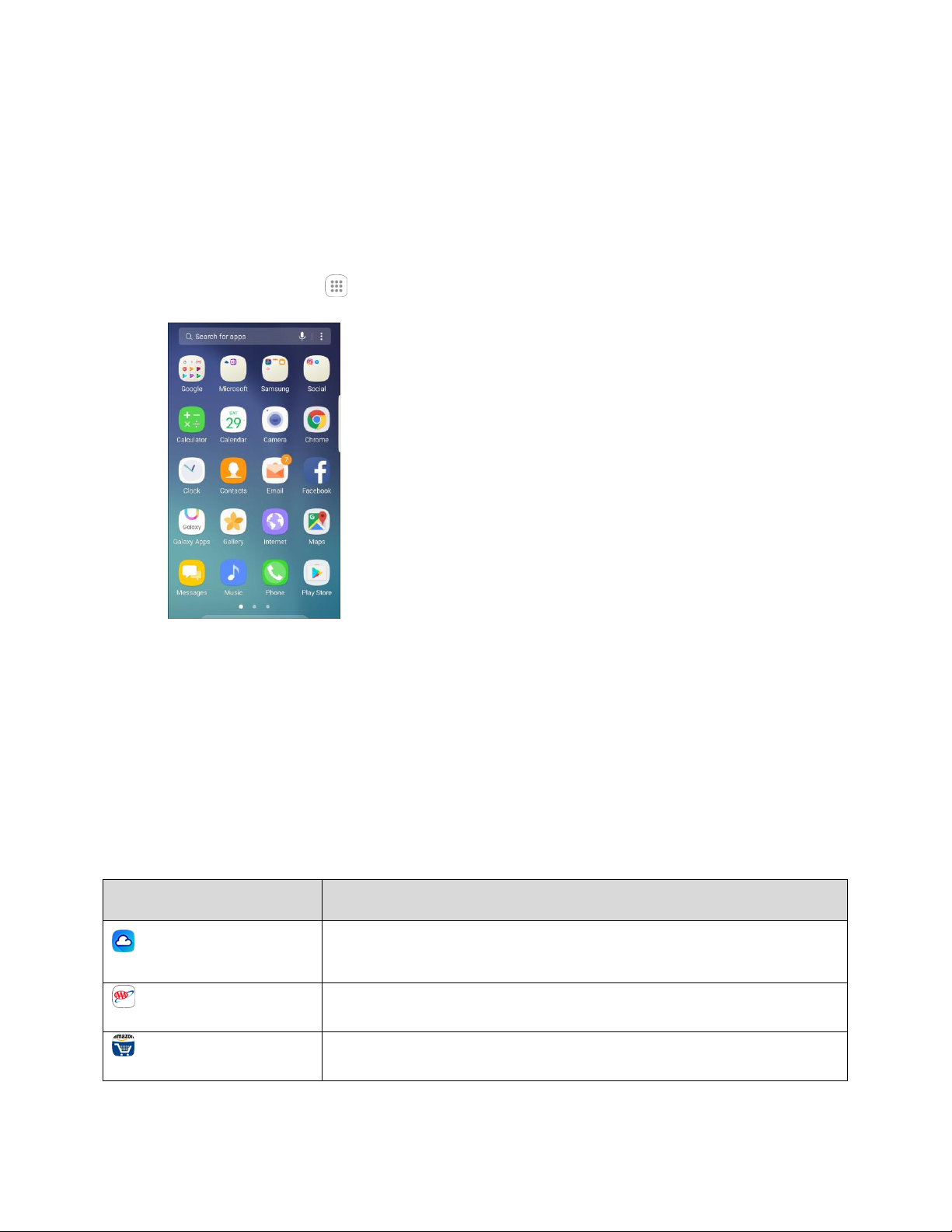
1. From home, tap Apps .
The Apps list opens.
2. Tap and app icon to launch the corresponding application.
The application opens.
Apps List
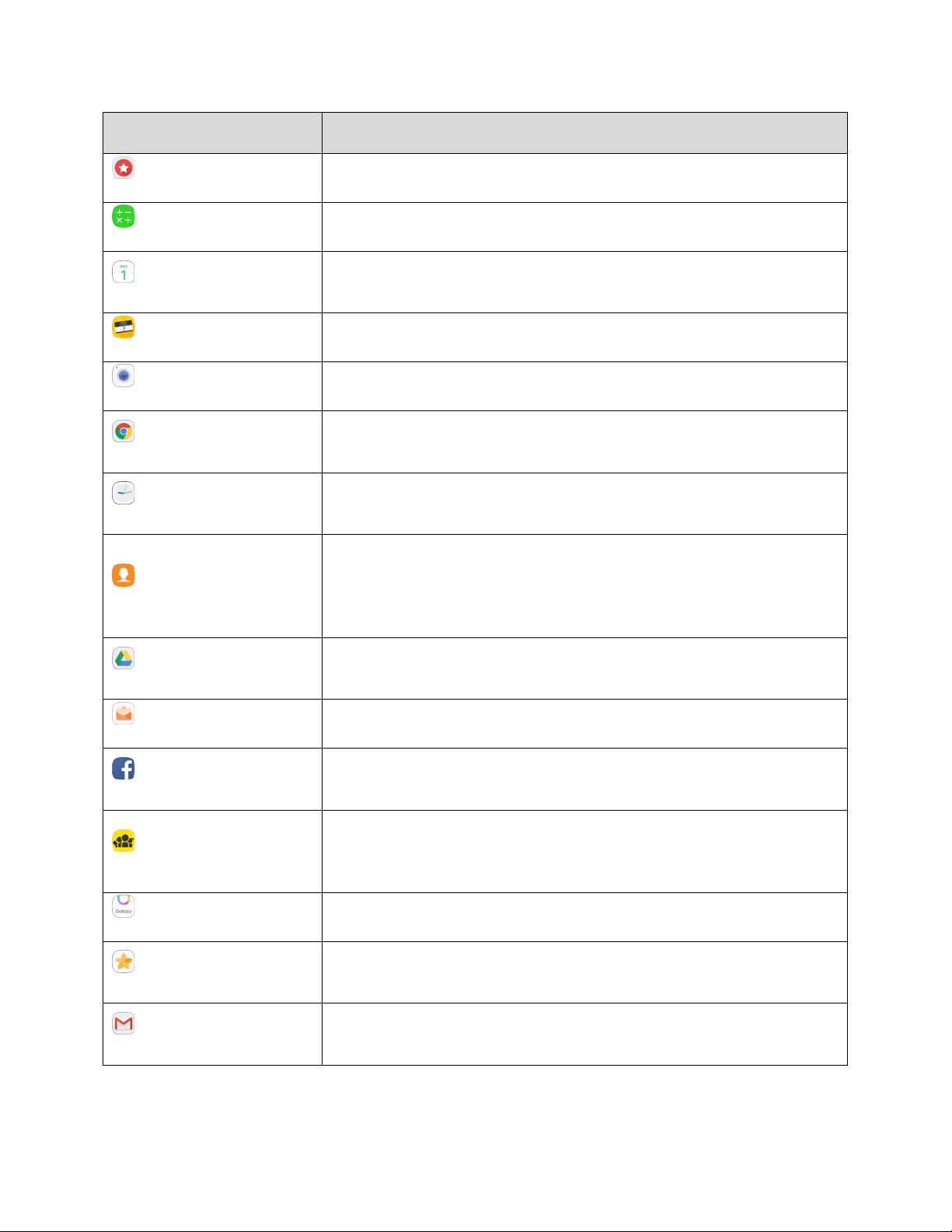
The Apps list expands to include any apps you download and install on your phone. The following table
outlines the primary apps that have been preinstalled on your phone.
Note: Available apps are subject to change.
App
Function/Service
1Weather
Receive real-time local weather information at any location in the world.
Access 7-day and hourly weather forecasts for your area.
AAA
Plan trips and access AAA member services.
Amazon Shopping
Shop at amazon.com
™
from your device.
Basic Operations 20
App
Function/Service
App Spotlight
Discover new apps from the Google Play
™
store.
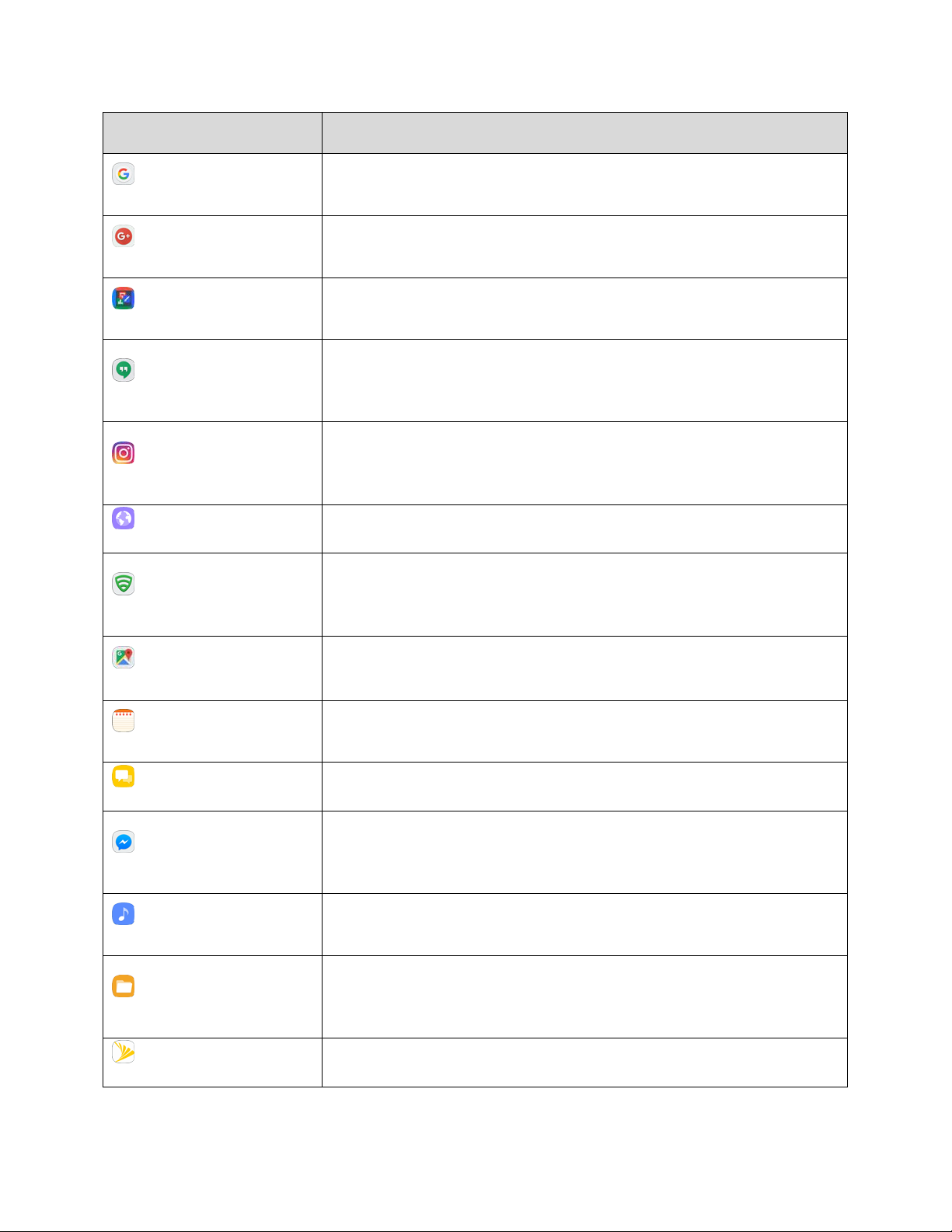
Calculator
Perform basic and advanced mathematical calculations.
Calendar
Use Calendar to create and manage events, meetings, and
appointments, organize your time, and be reminded of important events.
Caller ID
See who is calling, even if the caller is not in your contact list.
Camera
Take pictures and record videos using the front and rear cameras.
Chrome
Browse the Internet and bring your open tabs, bookmarks and address
bar data from your computer to your mobile device.
Clock
Set alarms, view time in time zones around the world, use a stopwatch,
set a timer, and use your phone as a desk clock.
Contacts
Store and manage contacts from a variety of sources, including contacts
you enter and save directly in your phone as well as contacts
synchronized with your Google Account, compatible email programs
(including Microsoft
®
Exchange Server), and your Facebook
™
friends.
Drive
Open, view, rename, and share your Google Docs
™
and files. Located in
the Google folder in the Apps list.
Email
Send and receive email from a variety of email service providers.
Facebook
Keep up with friends and family with the Facebook app. Share updates,
photos, and videos, as well as text, chat, and play games.
FamilyWall for Sprint
Communicate, organize, share, remember, and locate friends and family
members. Users get all the benefits of social sharing in a totally private
space.
Galaxy Apps
Discover apps designed exclusively for your Galaxy device.
Gallery
View and edit pictures and watch videos that you have taken with your
phone’s camera or downloaded.
Gmail
Send and receive email with Gmail
™
, Google’s web-based email service.
Located in the Google folder in the Apps list.
Basic Operations 21
App
Function/Service
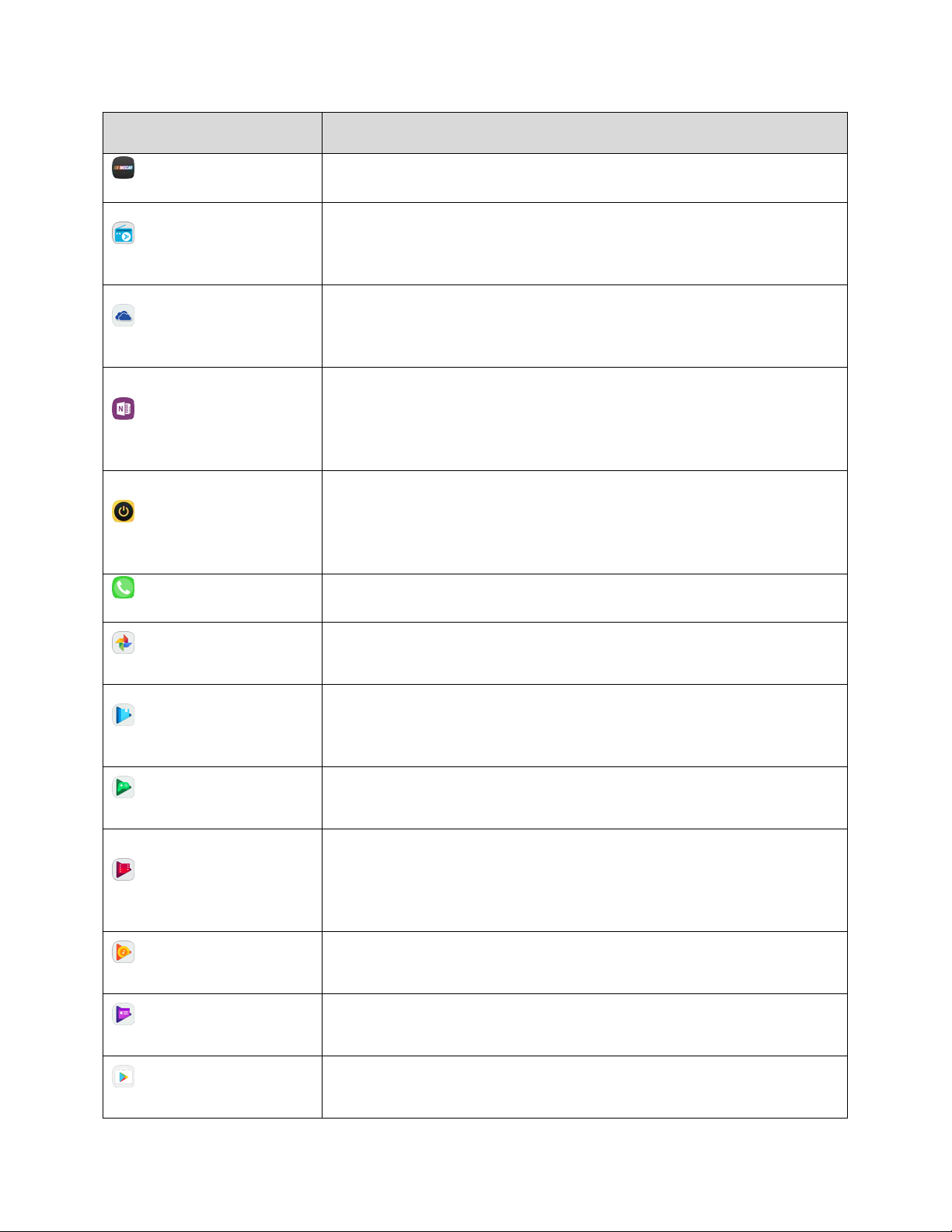
Google
Search not only the Internet, but also the apps and contents of your
device. Located in the Google folder in the Apps list.
Google+
Chat with friends and family, post photos, and see what others are
sharing. Located in the Google folder in the Apps list.
Hancom
™
Office S
View, edit, and create Hancom Office
™
Hanword (*.hwp) and Hanshow
(*.show) documents. Located in the Samsung folder in the Apps list.
Hangouts
Meet friends and family online, share photos, host video calls, and send
SMS and Hangouts messages. Located in the Google folder in the Apps
list.
Instagram
Capture and share photos and videos with your friends using Instagram
™
.
Customize what you capture, then share it on your feed or post it directly
to your friends. Located in the Social folder in the Apps list.
Internet
Browse the Internet using a full-featured browser.
Lookout
Configure and manage key security options, such as anti-virus and anti-
malware technology, a lost and stolen device locater service, an
application privacy adviser, and a backup service.
Maps
Find your current location and get directions and other location‑based
information.
Memo
Organize your life by creating, editing, and managing memos. Located in
the Samsung folder in the Apps list.
Messages
Send and receive text and multimedia messages.
Messenger
Reach out to your friends and family with Facebook Messenger
™
, which
works just like texting. A data plan is required to use Messenger. Located
in the Social folder in the Apps list.
Music
Use Music to browse your music library, play songs, and create playlists.
You can also set songs as ringtones for incoming calls, or as alarm tones.
My Files
Manage your sounds, images, videos, Bluetooth
®
files, Android
™
files,
and other data in one convenient location. Located in the Samsung folder
in the Apps list.
My Sprint
Access your Sprint account, get device information and help, and more.
Basic Operations 22
App
Function/Service
NASCAR Mobile
Follow NASCAR
™
news, view video highlights and driver stats, and more.
NextRadio
Listen to your favorite FM radio stations on the go with NextRadio
®
. Tune
in to any FM frequency in your area and listen to the radio without the
cost of streaming music.
OneDrive
Stay organized using text, pictures, or audio notes. Create Quick Notes or
review and edit shared OneNote
®
notebooks using OneDrive
®
. Located in
the Microsoft folder in the Apps list.
OneNote
Store and share photos, videos, documents, and more in your free online
OneDrive account, which you can then access from your personal
computer, tablet, or phone. Located in the Microsoft folder in the Apps
list.
Peel Remote
Control select Wi-Fi
®
-enabled Samsung TV models using your Samsung
Galaxy device. Now you can control all of your TV’s settings, such as on
and off functions, channel navigation, and volume control from the same
Samsung device you already know.
Phone
Make and receive phone calls.
Photos
Automatically back up your photos and videos to your Google Account.
Located in the Google folder in the Apps list.
Play Books
Shop the world's largest selection of eBooks and read them anywhere
you like—on a tablet, phone, eReader, or the Web. Located in the Google
folder in the Apps list.
Play Games
Discover hundreds of games for download and purchase through the
Google Play store. Located in the Google folder in the Apps list.
Play Movies & TV
Watch movies and TV shows purchased from Google Play. You can
stream them instantly, or download them for viewing when you are not
connected to the Internet. You can also view videos saved on your
device. Located in the Google folder in the Apps list.
Play Music
Play music and audio files on your device. Located in the Google folder in
the Apps list.
Play Newsstand
Subscribe to your favorite magazines to read on your device at your
leisure. Located in the Google folder in the Apps list.
Play Store
Find new apps, movies and TV shows, music, books, magazines, and
games in the Google Play store.

Basic Operations 23
App
Function/Service
S Voice
Use the S Voice
™
voice recognition application to activate a wide variety
of functions on your phone.
Samsung Health
Manage your health with the Samsung Health wellness application. Set
fitness goals, check your progress, and keep track of your overall health.
Samsung Pay
Use your phone to pay at more places than any other mobile payment
service out there, from the grocery store to the coffee shop to your
favorite department store.
Samsung+
Get live help, discover new features, and unlock promotions for your
Samsung device.
Settings
Configure settings and options on your phone.
Sprint Family Locator
Use Sprint Family Locator to locate any phone on your Sprint family plan
instantly—from your mobile phone, tablet or computer.
Sprint Music Plus
Purchase, download, and play music, ringtones, and ringback tones for
your phone.
Sprint Protect
Protect your phone from loss, theft, or breakage. In most cases, you save
hundreds on a replacement device and get it the next day.
Sprint Spot
Access top quality applications, games, TV, music, and entertainment
from Sprint.
Sprint TV & Movies
Use Sprint TV & Movies to watch live TV and access movies and other on
demand entertainment on the go.
Sprint Worldwide
Access information about Sprint Worldwide international voice and data
service.
Uber
Hire a private driver in more than 130 cities and 30 countries. Uber is an
entirely new and modern way to travel.
Video
View videos on your phone.
Voice Recorder
Record voice memos and share them with others. Located in the
Samsung folder in the apps list.
Voicemail
Use Visual Voicemail for a quick and easy way to access your voicemail.
Now you can find exactly the message you are looking for without having
to listen to every voicemail message first.
Basic Operations 24
App
Function/Service
Voice Search
Use voice commands to search the web with Google. Located in the
Google folder in the Apps list.
Phone Number
Follow the instructions below to display your phone’s wireless phone number.
■ From home, tap Apps > Settings > About device .
You will see the number listed under My phone number.
Airplane Mode
Airplane mode turns off all functions that emit or receive signals, while leaving your phone on so you can
use apps that do not require a signal or data.
To turn on airplane mode:
■ Pull down the status bar and tap Airplane mode > Turn on.
Your phone is now in airplane mode. You will see the airplane mode icon in the status
bar.
To turn off airplane mode:
■ Pull down the status bar and tap Airplane mode .
Your phone’s wireless connection features are now restored.
Enter Text
You can type on your phone using the touchscreen Samsung keyboard or Google Voice
™
typing.
Note: Keyboard layouts and options may change depending on where you are using them. For example,
if you are entering text to do a Web search, a search icon may be available instead of an enter key.
Samsung Keyboard
Use the touchscreen Samsung keyboard for entering text. The keyboard appears automatically when you
tap a text entry field, and can be used in either portrait or landscape mode. You can also use the Google
Voice typing option to enter text using your voice (see Google Voice Typing for details).
The Samsung keyboard offers a traditional QWERTY keyboard setup for entering text by tapping keys
(like on a computer), along with enhancements and options that allow you to enter text faster and more
accurately, such as continuous key input, personalized usage dictionaries, and more.

Basic Operations 25
Assign Samsung Keyboard for Text Entry
If you have multiple text input methods installed on your device, you can select the Samsung keyboard to
be your default text input method from Settings, or you can choose it at any time while entering text.
Note: The Samsung keyboard is the default text input method on your phone. Additional keyboards and
input methods are available for download from the Google Play store. See Google Play Store.
From Settings:
■ From home, tap Apps > Settings > General management > Language and input >
Default keyboard, and then choose Samsung keyboard.
Use Samsung Keyboard to Enter Text
■ Tap keys to enter text. While entering text, use these options:
If you make a mistake, tap Delete to delete incorrect characters. Touch and hold Delete
to delete a whole word or field.
Tap Shift to change the case of the text (the arrow will turn blue). Tap Shift twice to
switch to all capitals (the key will turn blue).
Tap Symbols to switch to a symbols keyboard. There are two symbol keyboards; to
switch between them, tap Symbols (1 of 2) or Symbols (2 of 2) .
Touch and hold Options to open an options menu. Select from the following options:
Voice input to switch to Google Voice typing.
Clipboard to attach a screenshot or other item from the clipboard.
Emoticon to display a list of emoticons.
One-handed input keyboard: Use a keyboard designed for one hand.
Keyboard settings to view the Samsung keyboard settings menu.
If you have more than one language selected in Samsung Keyboard settings, you can swipe
your finger over Spacebar to switch between languages.
Basic Operations 26
Configure Samsung Keyboard
■ From home, tap Apps > Settings > General management > Language and input >
Virtual keyboard > Samsung keyboard.
Google Voice Typing
Google Voice typing uses Google voice recognition to convert speech to text.
Use Google Voice Typing to Enter Text
1. Touch and hold Options on the Samsung keyboard, and then tap Voice input .
2. Speak into the microphone and watch your text being entered onscreen.
3. If the text is incorrect, tap Delete .
4. Once you have completed entering your text, tap Exit . The keyboard will reappear.
Note: You can assign a new language to Google Voice typing. Tap Settings > Languages and tap a
language to select it. To add more languages, tap Settings > Languages, tap the language(s) you
want to add, tap Save, and then tap the Back key.
Configure Google Voice Typing
■ From home, tap Apps > Settings > General management > Language and input >
Virtual keyboard > Google voice typing.
Tips for Editing Text
Your phone gives you many options to make entering text easier, including copying, cutting, and pasting.
■ Touch and hold text to highlight it, and then select from the following options:
Select all: Highlights all the text in the field.
Cut: Removes the selected text and saves it to the clipboard.
Copy: Copies the selected text to the clipboard.

Basic Operations 27
Paste: Insert the last copied or cut text into the current field.
Sharing: Send the text with others using a variety of sharing methods.
Clipboard: Display the clipboard to choose previously cut or copied text.
Dictionary: Access your personal dictionary.
Assist: Perform a Google search on the selected term.
Google Account
You will need a Google Account to access several phone features such as Gmail, Google Maps
™
,
Hangouts, and the Google Play applications. Before you are able to access Google applications, you
must enter your account information. These applications sync between your phone and your online
Google Account.
Create a Google Account
If you do not already have a Google Account, you can create one online or using your phone.
Note: You can also create and sign into your Google/Gmail account through your phone’s Setup
application.
Note: Although you need a Gmail account to use certain features of your phone, such as Google Play,
you do not need to use Gmail as the default account for your phone.
Create a Google Account Online
1. From a computer, launch a Web browser and navigate to google.com.
2. On the main page, click Sign-in > Add account.
3. Follow the prompts to create your free account.
4. Look for an email from Google in the email box you provided, and respond to the email to confirm
and activate your new account.
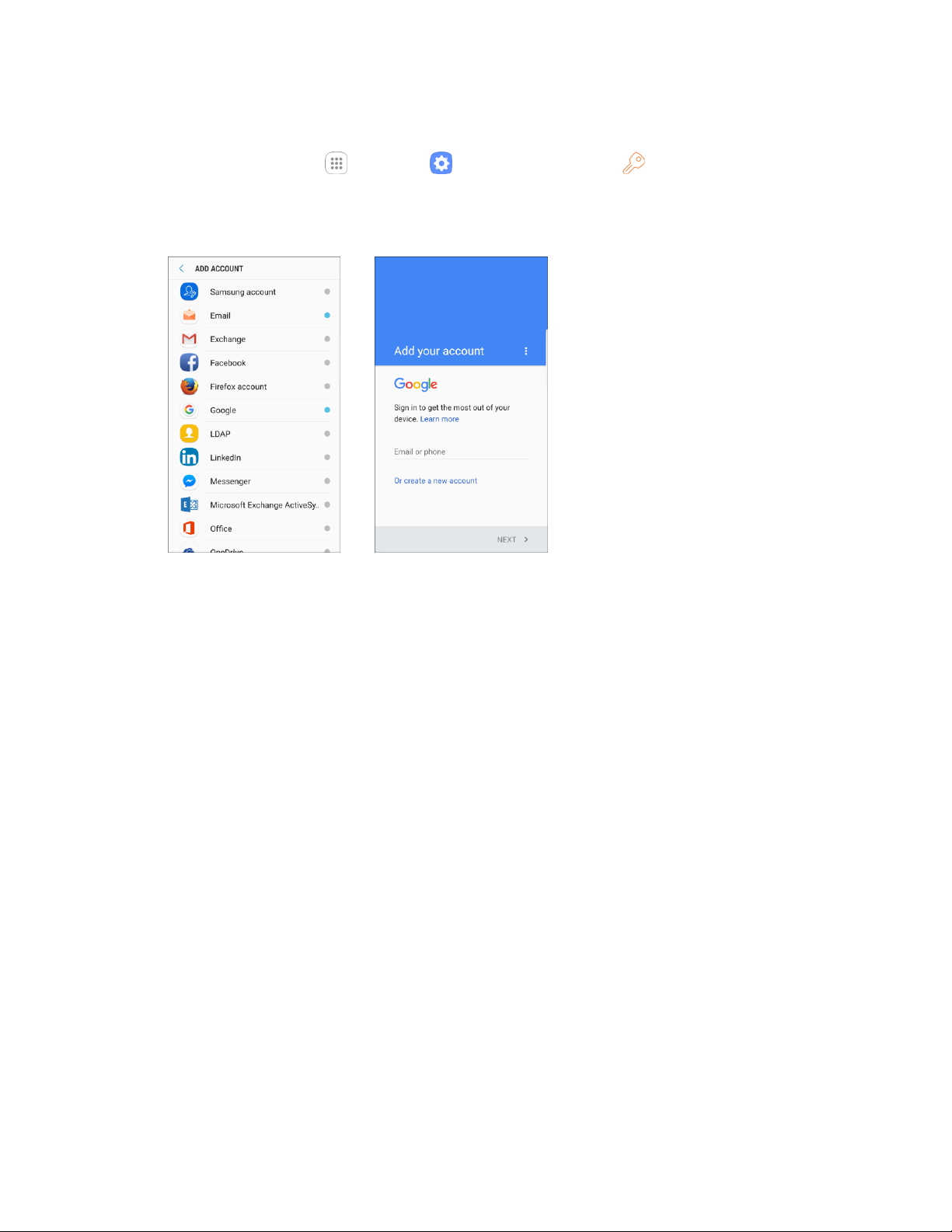
Basic Operations 28
Create a Google Account Using Your Phone
1. From home, tap Apps > Settings > Cloud and accounts > Accounts >
Add account.
2. Tap Google, and then tap Or create a new account.
3. Follow the prompts to set up your account.
You are signed in to your Google Account, and your phone will synchronize the selected
items.
Note: When setting up a new Google Account, either on your phone or online, you will be prompted to
add a secondary email address. Enter a second Gmail address or any other email address from which
you currently send and receive email. This address is used to authenticate your account should you ever
encounter problems or forget your password. It is strongly encouraged for Android users so you can
regain access to Google services and purchases on your phone.
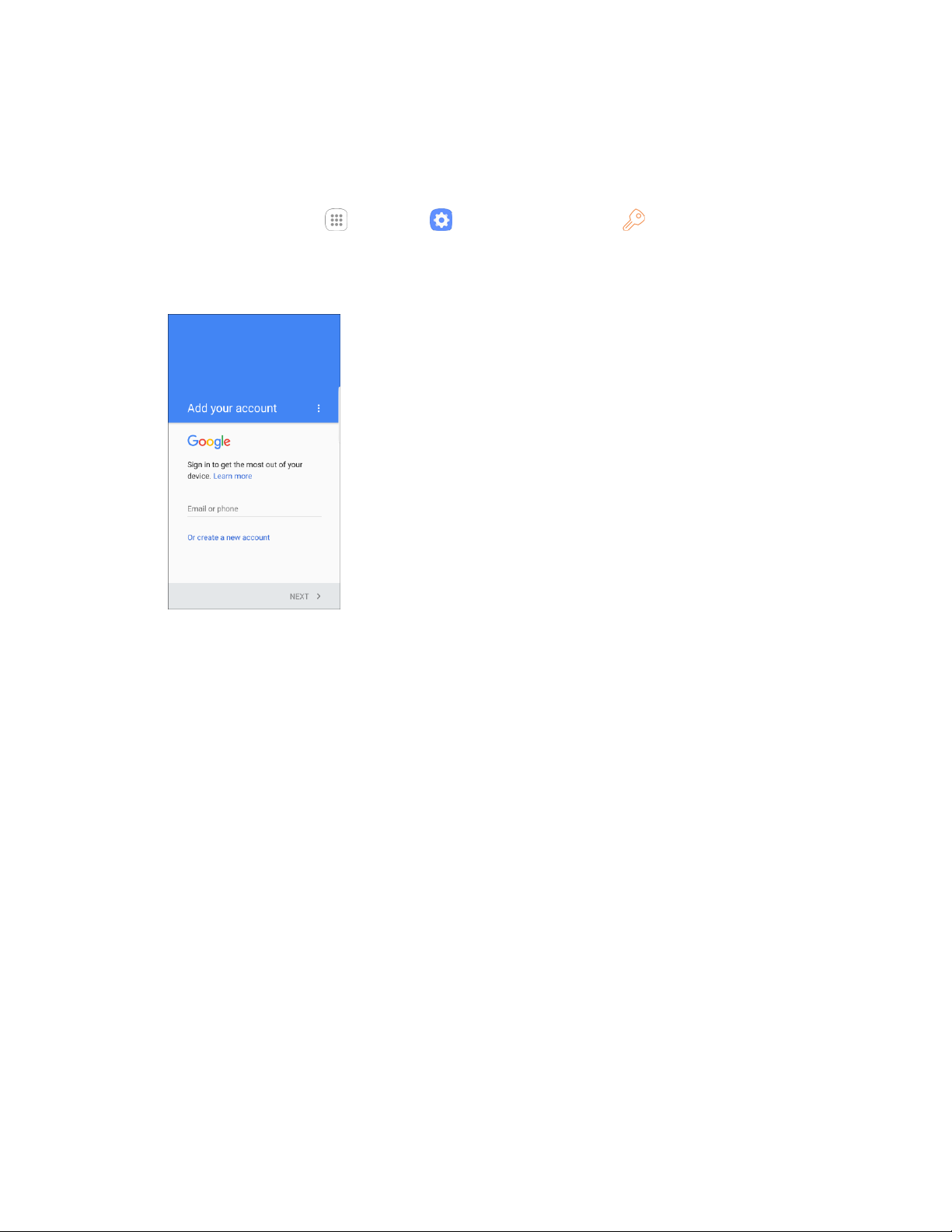
Basic Operations 29
Sign In to Your Google Account
If you have a Google Account but have not yet signed in with your phone, follow these instructions to sign
in to your Google Account.
1. From home, tap Apps > Settings > Cloud and accounts > Accounts >
Add account.
2. Tap Google, and then tap Email or phone.
3. Enter your Gmail address and password, and then tap Next.
4. Complete any additional screens if prompted.
You are signed in to your Google Account.
Factory Reset Protection
When you sign in to a Google Account on your device, Factory Reset Protection is turned on. Factory
Reset Protection (FRP) prevents other people from using your device if it is reset to factory settings
without your permission. For example, if your device is lost or stolen and a factory data reset is
performed, only someone with your Google Account username and password can use the device.
You will not be able to access the device after a factory data reset if you do not have your
Google Account username and password. For more information, see Factory Data Reset.
Caution: You should remove your Google Account before shipping your device to Samsung or any other
service provider for service and before resetting the device to factory settings. For more information, visit
samsung.com/us/support/frp.

Basic Operations 30
Enable Factory Reset Protection
Adding a Google Account to your device automatically turns on the Factory Reset Protection (FRP)
security feature.
Disable Factory Reset Protection
To disable FRP, remove all Google Accounts from the device.
1. From home, tap Apps > Settings > Cloud and accounts .
2. Tap Accounts > Google.
3. Tap More options > Remove account.
Google Play Store
Google Play is the place to go to find new Android apps, books, movies, and music for your phone.
Choose from a wide variety of free and paid content ranging from productivity apps and games to
bestselling books and blockbuster movies and music. When you find what you want, you can easily
download and install it on your phone.
To access the Google Play store app, you must first connect to the Internet using your phone’s Wi-Fi or
mobile data connection and sign in to your Google Account. See Browser and Sign In to Your Google
Account for details.
Installing Applications
Many different kinds of applications can be installed on your phone from Google Play (provided by
Google Inc.). Sprint is not responsible in any way for user-installed applications (quality, reliability,
legality, fitness for a purpose, credibility, accuracy, etc.) or resulting malfunctions (viruses, etc.).
Important: Our policies often do not apply to third-party applications. Third-party applications may access
your personal information or require us to disclose your customer information to the third-party application
provider. To find out how a third-party application will collect, access, use, or disclose your personal
information, check the application provider’s policies, which can usually be found on their website. If you
aren’t comfortable with the third-party application’s policies, do not use the application.
Find and Install an App
When you install apps from Google Play app and use them on your phone, they may require access to
your personal information (such as your location, contact data, and more) or access to certain functions
or settings of your phone. Download and install only apps that you trust.
1. From home, tap Apps > Play Store .
2. When you open the Google Play store app for the first time, the Terms of Service window will
appear. Tap Accept to continue.

Basic Operations 31
3. Browse through the categories, find an item you are interested in, and tap the name.
Search for an app. Tap the Google Play search field, enter the name or type of app you are
looking for, and then tap Search on the keyboard.
4. Tap an app to read a description about the app and user reviews.
5. Tap Install (for free applications) or the price (for paid applications).
Note: If you have not already done so, you will need to set up a payment method to purchase paid apps
from Google Play.
6. The subsequent screen notifies you whether the app will require access to your personal
information or access to certain functions or settings of your phone. If you agree to the conditions,
tap Accept (for free apps) or Accept and then Buy (for paid apps) to begin downloading and
installing the app.
If you have not already set up a payment method, tap Continue and then follow the prompts
to arrange payment and complete the purchase.
The selected app is downloaded and installed on your phone.
Warning: Read the notification carefully! Be especially cautious with applications that have access to
many functions or a significant amount of your data. Once you tap Ok on this screen, you are responsible
for the results of using this item on your phone.
Purchasing Applications
Purchase apps at your own risk. Sprint is not responsible for any harm to you or third parties resulting
from the use of purchased applications.
Request a Refund for a Paid App
If you are not satisfied with an app, you can ask for a refund within 15 minutes of the purchase. Your
credit card is not charged and the app is uninstalled from your phone.
If you change your mind, you can install the app again, but you cannot request a refund a second time.
1. From home, tap Apps > Play Store .
2. Tap Menu > My apps & games.
3. Tap the app to uninstall for a refund. The details screen for the app opens.
4. Tap Refund, and then tap Yes to confirm. Your app is uninstalled and the charge is cancelled.
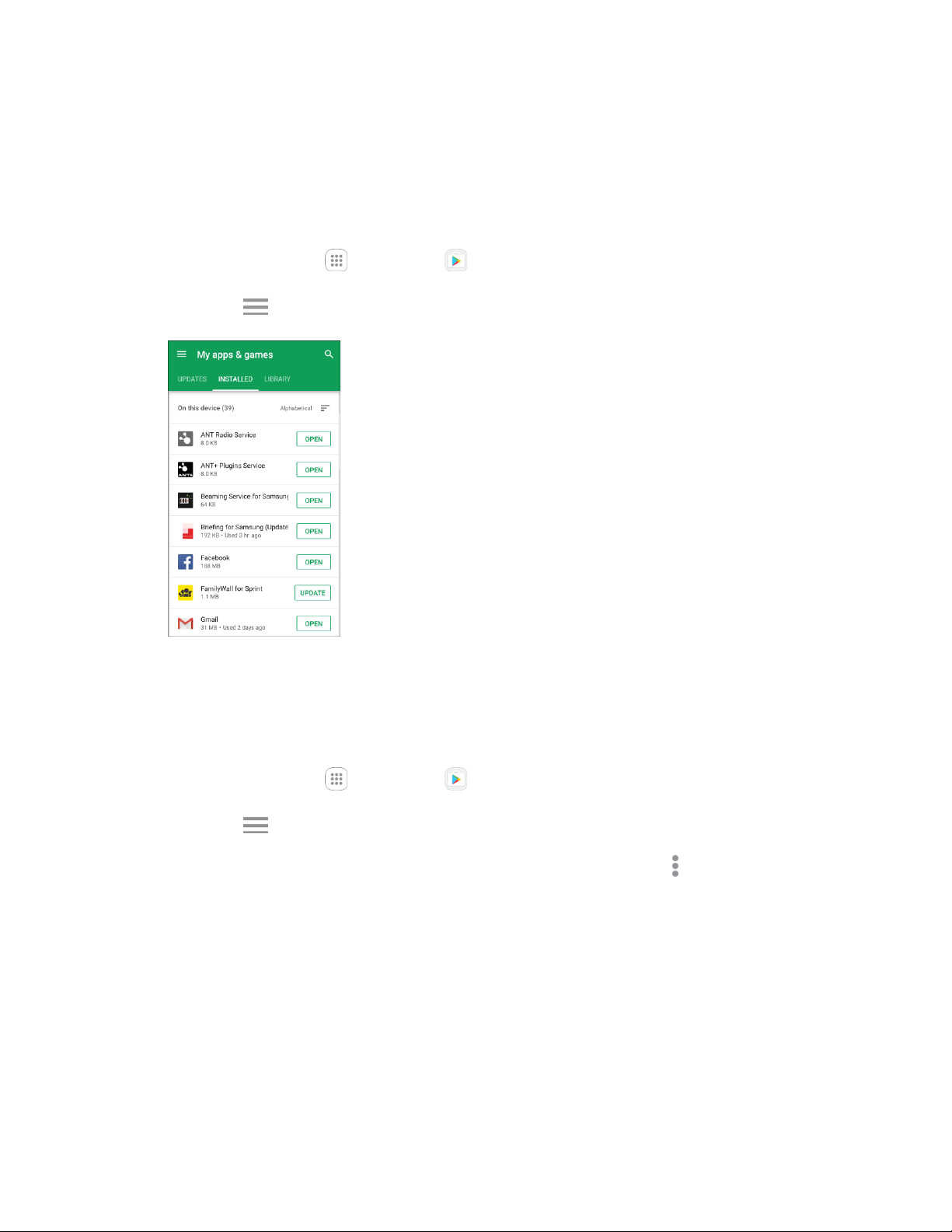
Basic Operations 32
Update an App
Depending on your settings, many apps will update automatically, or you can update apps directly from
the Play store app.
Update an App Directly
1. From home, tap Apps > Play Store .
2. Tap Menu > My apps & games.
3. Tap the app you want to update, and then tap Update.
The app update is downloaded and installed.
Set Automatic App Updates
1. From home, tap Apps > Play Store .
2. Tap Menu > My apps & games.
3. Tap the app you want to set for auto-update, and then tap More options > Auto-update.
The app is set to update automatically whenever an update becomes available.
Note: Automatic updates are unavailable for some apps.
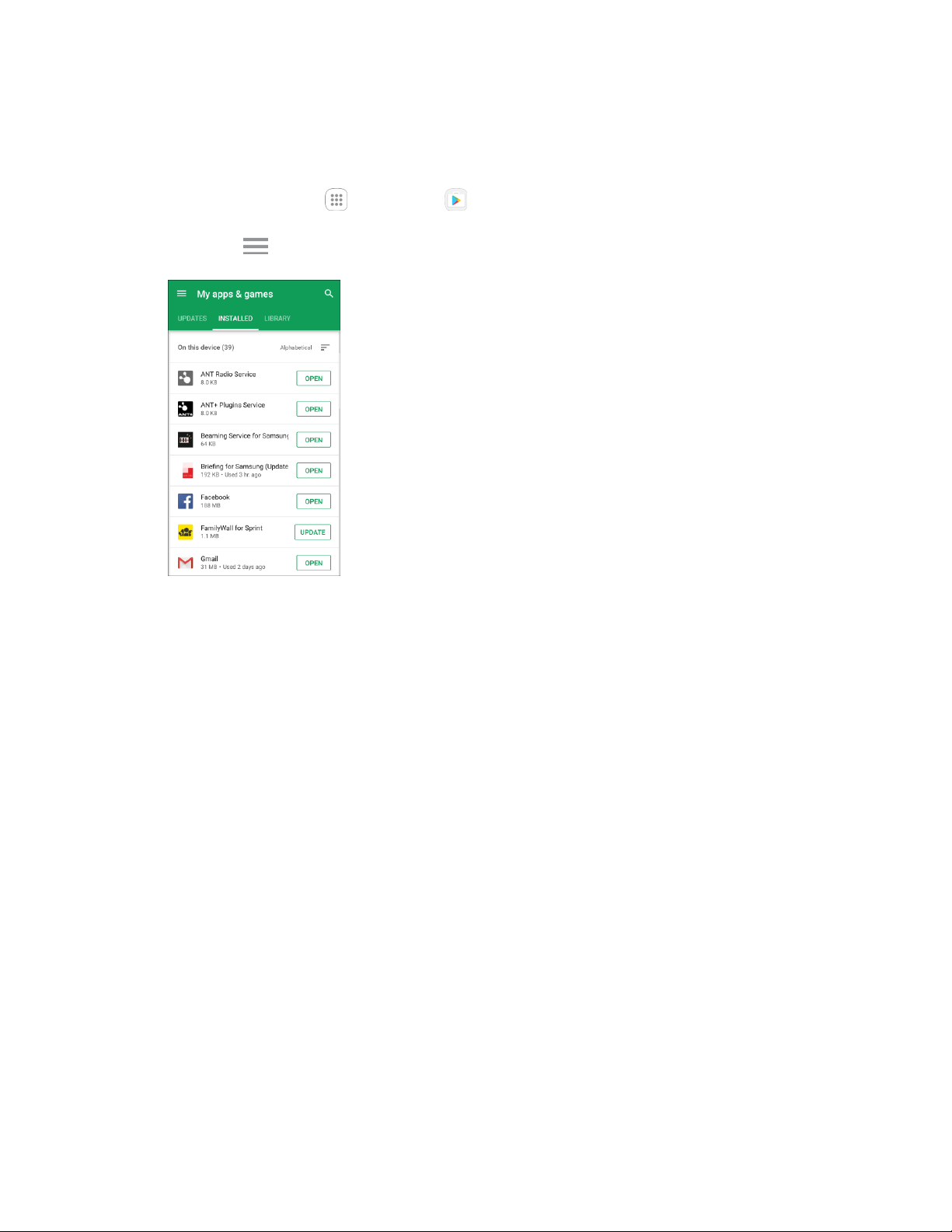
Basic Operations 33
Uninstall an App
You can uninstall any app that you have downloaded and installed from Google Play.
1. From home, tap Apps > Play Store .
2. Tap Menu > My apps & games.
3. On the Installed screen, tap the app you want to uninstall, and then tap Uninstall > OK.
The app is uninstalled and removed from your phone.
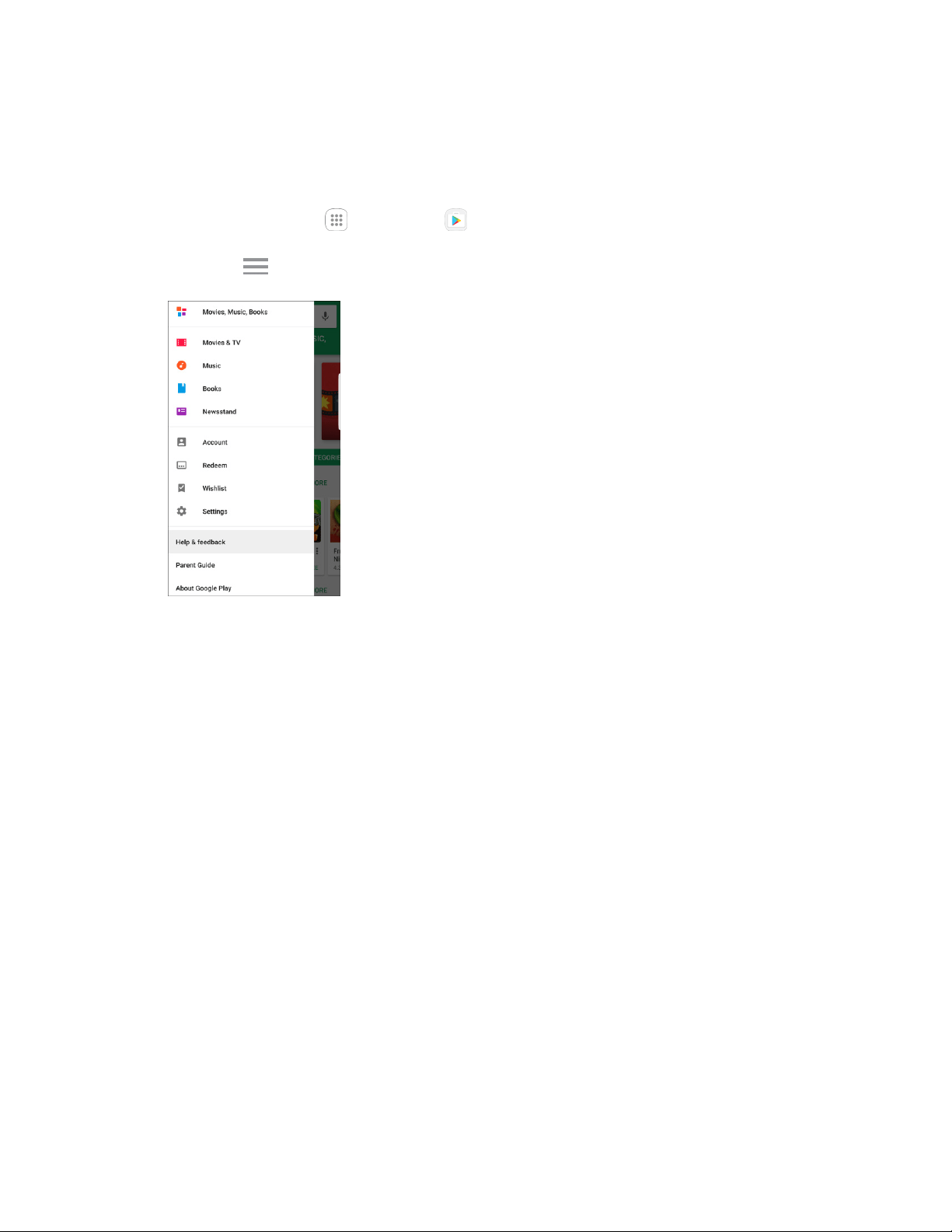
Basic Operations 34
Get Help with Google Play
The Google Play store app offers an online help option if you have questions or want to know more about
the app.
1. From home, tap Apps > Play Store .
2. Tap Menu > Help & feedback.
The Web browser will take you to the Google Play Help Web page, where you will find
comprehensive, categorized information about Google Play.
Lock and Unlock Your Screen
Your phone allows you to quickly turn the screen off when not in use and to turn it back on and unlock it
when you need it.
Turn the Screen Off When Not in Use
■ To quickly turn the screen off, press the Power/Lock key. Pressing the Power/Lock key again or
receiving an incoming call will turn on your phone screen and show the lock screen.
To save battery power, the phone automatically turns off the screen after a certain period of time when
you leave it idle. You will still be able to receive messages and calls while the phone’s screen is off.
Note: For information on how to adjust the time before the screen turns off, see Display Settings.

Basic Operations 35
Turn the Screen On and Unlock It
1. To turn the screen on, press the Power/Lock key.
The lock screen appears.
2. Swipe your finger across the screen to unlock it.
The screen is unlocked.
If you have set up a screen lock, you will be prompted to draw the pattern, enter the
password or PIN, or scan your fingerprint. See Screen Lock.
Update Your Phone
From time to time, updates may become available for your phone. You can download and apply updates
through the Settings > System updates menu.
Software Update Cautions
During update: The phone cannot be used until the software update is complete. It may take time to
update your phone’s software.
Signal during update: Update your phone where signal reception is good, and do not change
location during the update process. Make sure the battery is adequately charged before beginning an
update. A weak signal or low battery during an update may cause the update to fail. An update failure
may disable the phone.
Other functions during update: Other phone functions cannot be used during a software update.
Update Your Phone Software
You can update your phone's software using the System Update option.
Before Updating Your Phone
Updating your phone may result in a loss of saved data depending on the condition of your phone
(malfunctioning, damaged, water seepage, etc.). You must back up all critical information before updating
your phone firmware.
Back Up All Data Prior to Update
To back up your Gmail information:
1. From home, tap Apps > Settings > Cloud and accounts > Accounts >
Google.
If you have multiple accounts, tap an account name.
2. Tap On/Off next to each option to enable backup.
3. Tap More options > Sync now to sync your Google Account information.

Basic Operations 36
To back up your Exchange Mail information:
1. From home, tap Apps > Settings > Cloud and accounts > Accounts >
Microsoft Exchange ActiveSync.
2. Tap On/Off next to each option to enable backup.
3. Tap More options > Sync now to sync your Google Account information.
To back up stored text messages:
1. From home, tap Apps > Messages .
2. Select the text message from the list to view the message thread.
3. Touch and hold on a portion of the text message from the string. The Message options context
menu appears.
Note: You can back up stored text messages by forwarding them to your own phone number. Open the
messages after you have updated your firmware.
4. Tap Forward.
5. Enter your phone number and tap Send.
To restore your Google apps following the update:
1. From home, tap Apps > Play Store .
2. Tap Menu > My apps & games > All tab.
3. Scroll through the list of previously downloaded Google apps and choose those you wish to
reinstall.
4. Follow the prompts.
Note: Your Google app purchases are reloaded remotely and can be re-installed after the update is
applied.
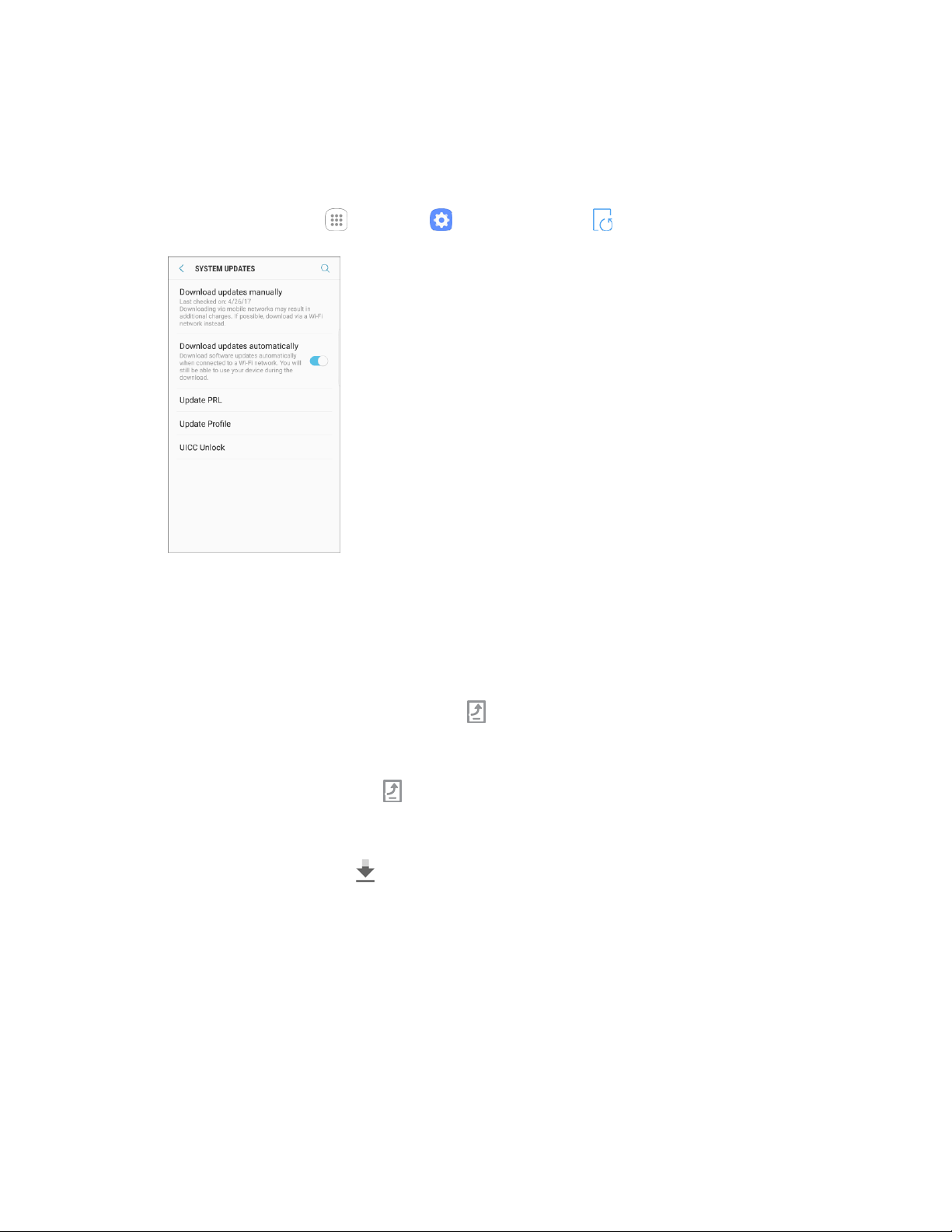
Basic Operations 37
Update Your Phone’s Software
Once you have backed up all your data, use the Download updates manually option to update your
phone’s software.
1. From home, tap Apps > Settings > System updates .
2. Tap Download updates manually.
Your phone automatically downloads and installs any available updates. You may be
required to power your phone off and back on to complete the software upgrade.
Alternatively, you can access system updates through the notification panel.
1. Locate the System update available icon in notifications. (
2. Pull down the status bar.
3. Tap System update available to open the System updates screen.
4. Tap Download and follow the prompts.
The downloading icon appears within the status bar to indicate the phone is downloading
the necessary files.
( )
5. Tap Restart and install to complete the process.
)
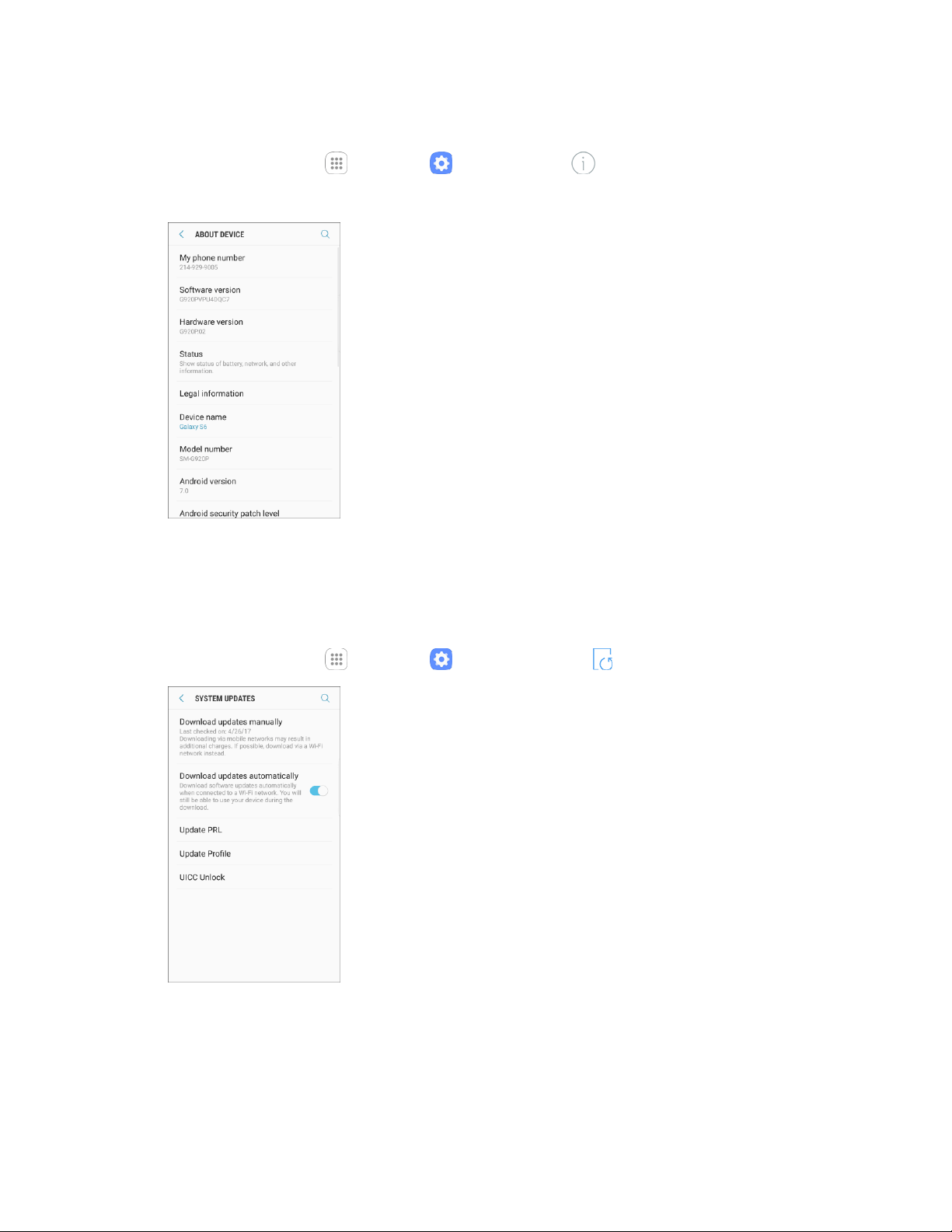
Basic Operations 38
Confirm Your Current Phone Software
1. From home, tap Apps > Settings > About device .
2. Locate the Software version read-only field.
Update Your Profile
This option allows you to automatically update your online user profile information. If you choose to
change your user name and select a new one online, you must then update the user name on your
phone.
1. From home, tap Apps > Settings > System updates > Update Profile.
2. Follow the prompts.
The phone will download and install the profile update and you will see a confirmation when
complete.
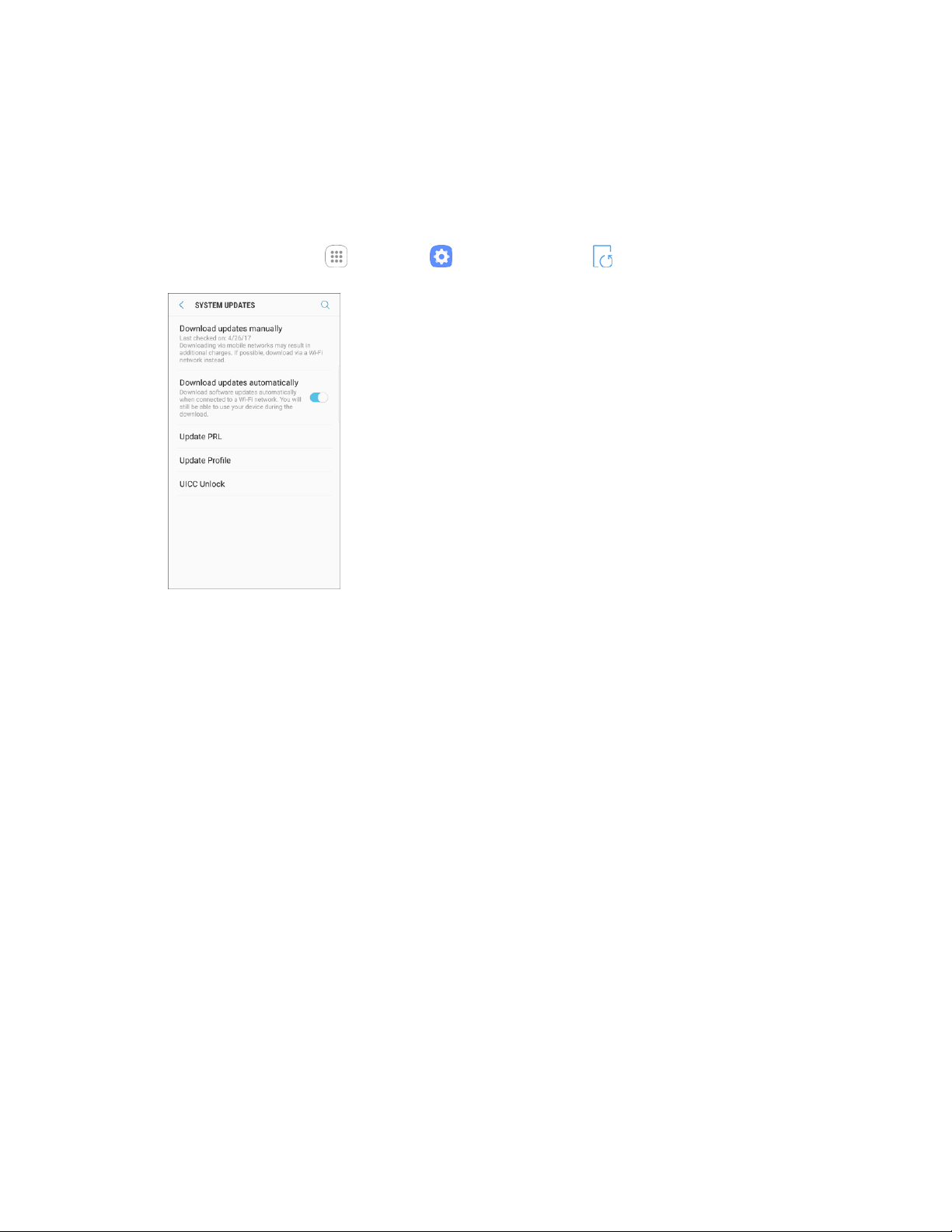
Basic Operations 39
Note: If your data services or account syncing ever seems to go out unexpectedly, use this feature to
reconnect with the network.
Update Your PRL
This option allows you to download and update the PRL (preferred roaming list) automatically.
1. From home, tap Apps > Settings > System updates > Update PRL.
2. Follow the prompts.
The phone will download and install the PRL update and you will see a confirmation when
complete.
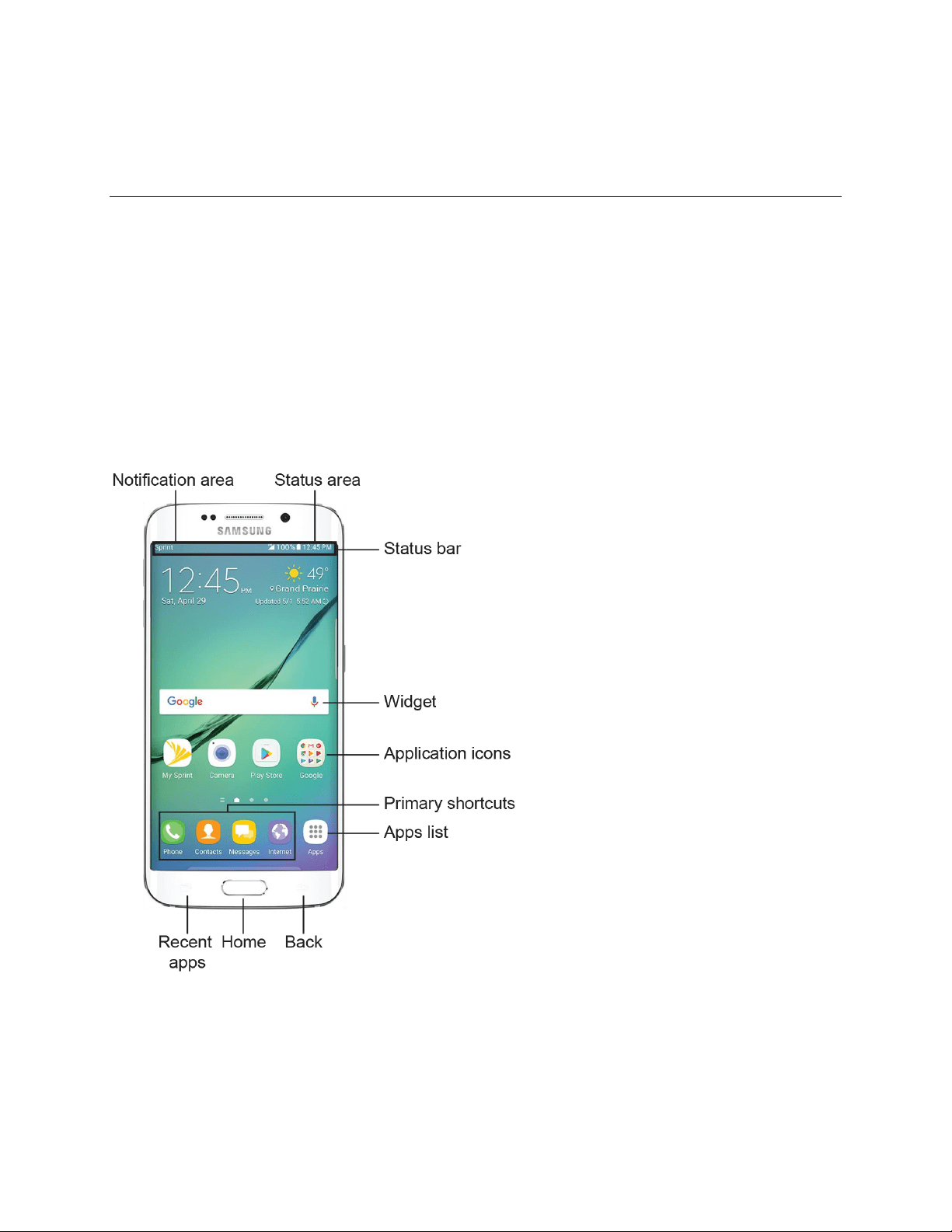
Your Phone's Home Screen 40
Your Phone's Home Screen
The following topics describe how to use and customize your phone’s home screen, understand the
status bar, and use the notification panel.
Home Screen Basics
The home screen is the starting point for your phone’s applications, functions, and menus. You can
customize your home screen by adding application icons, shortcuts, folders, widgets, and more.
Home Screen Layout
Your home screen extends beyond the initial screen. Swipe the screen left or right to display additional
screens.
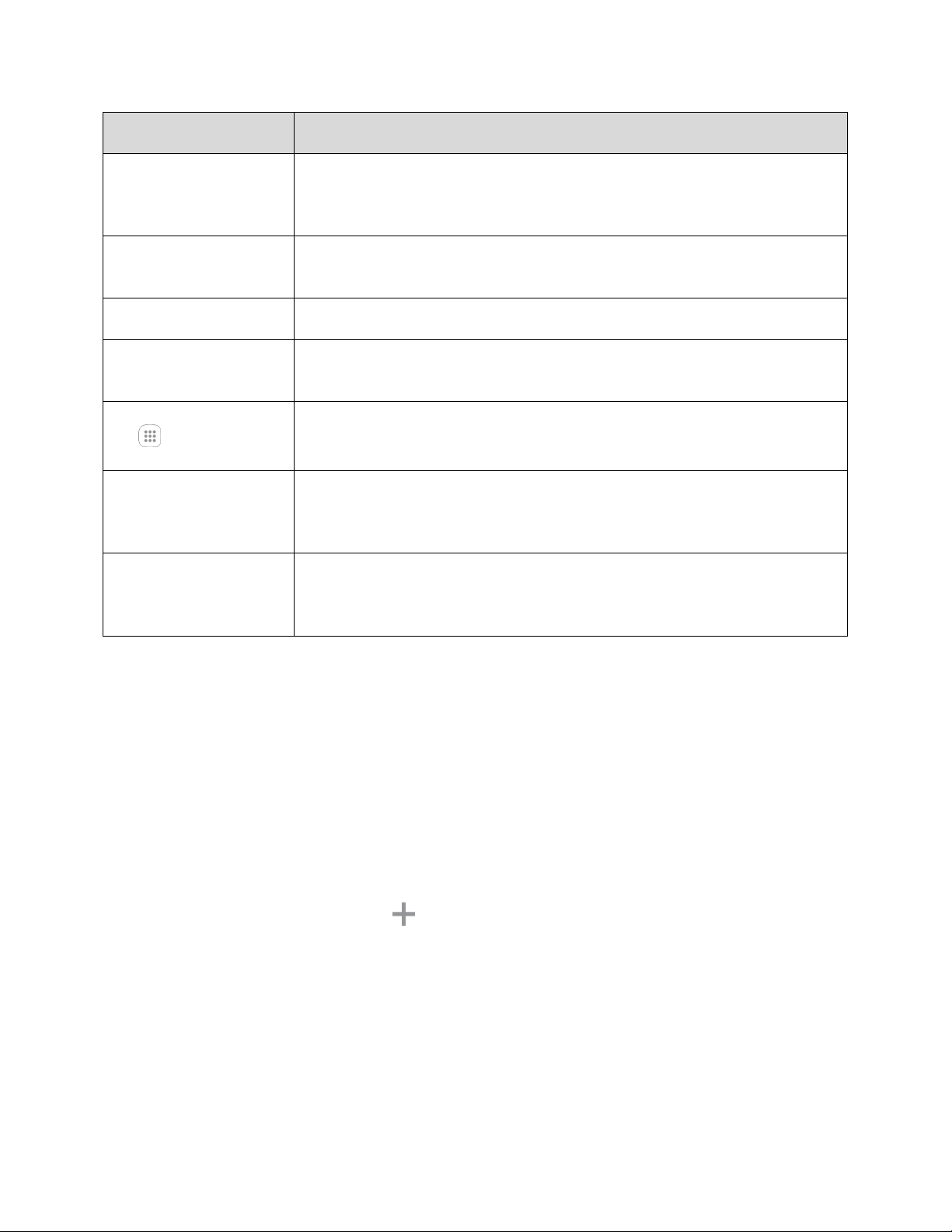
Your Phone's Home Screen 41
Item
Description
Status area
The status area of the status bar (on the right) displays phone and service
status information such as signal strength, battery status, Wi-Fi and data
connectivity, ringer status, and time.
Status bar
The status bar displays icons to notify you of your phone’s status (on the right
side) and notifications (on the left side).
Widget
Widgets are self-contained apps that reside on your phone’s home screen.
Application icons
Application icons are shortcuts to favorite applications. You can add and
remove these shortcuts as you wish.
Applications (Apps)
list
Tap to open the applications (apps) list. The Apps list key is a primary
shortcut available from all home screens.
Primary shortcuts
Primary shortcuts are application shortcuts that appear in the same location
on all of your phone’s home screens. These are customizable except for the
Applications (Apps) shortcut, which remains static.
Notification area
The notification area of the status bar (on the left) displays notifications for
incoming messages, missed calls, application updates, and more. Pull down
the status bar to display the notification panel.
Tip: Press the Home key to return to the main home screen from any other screen.
Extended Home Screens
In addition to the main home screen, your phone features extended home screens to provide more space
for adding icons, widgets, and more. Press the Home key to display the main home screen and then
swipe the screen right or left to move from the main screen to an extended screen.
Additional screens are available in addition to the main home screen.
● If you are not already using the maximum number of screens for your phone, you can add more
screens by touching and holding an empty space on a home screen, sliding the thumbnails to the
left, and then tapping Add page .
● While on an extended screen, press the Home key to return to the main home screen.
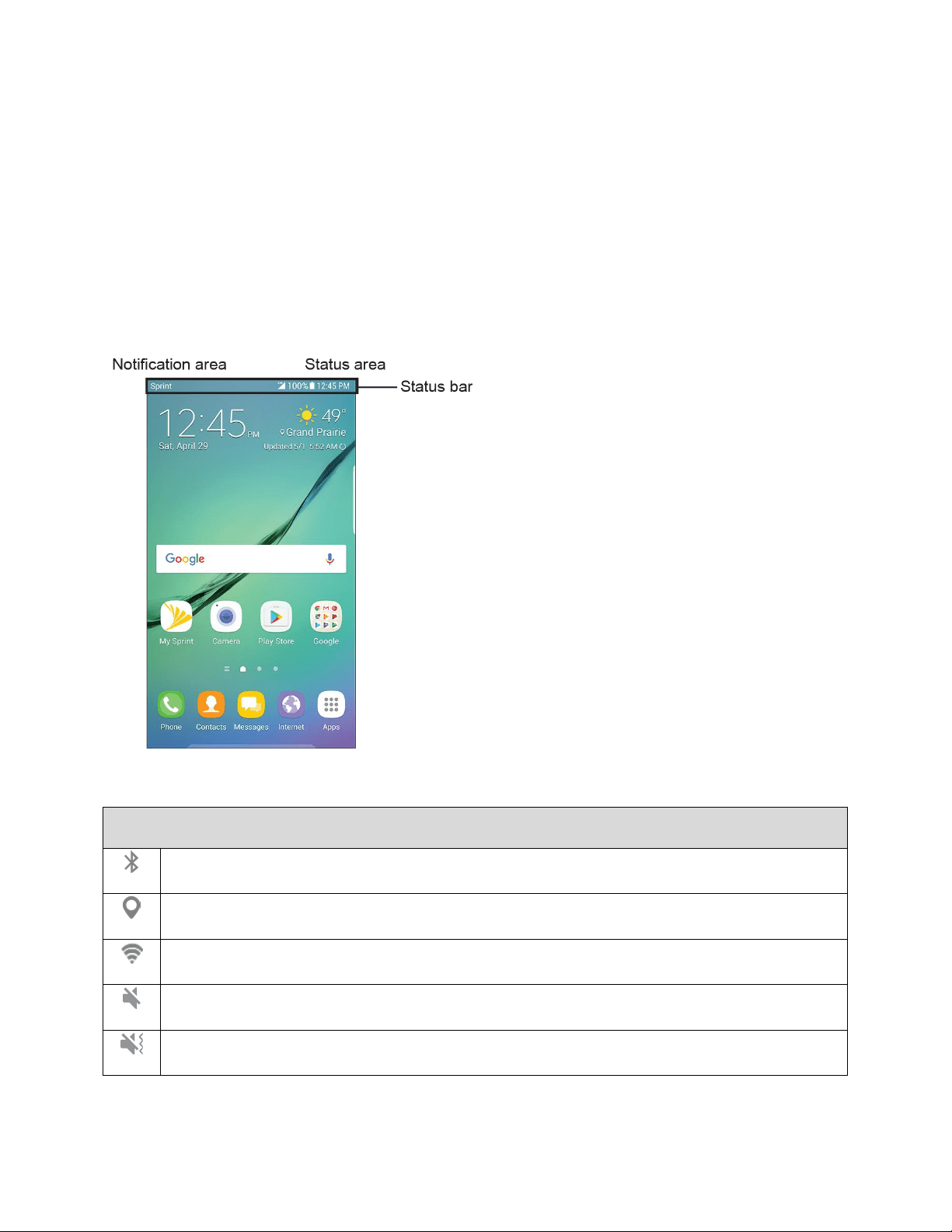
Your Phone's Home Screen 42
Status Bar and Notification Panel
Your phone’s status and notifications are available at a glance at the top of the screen.
Status Bar
The status bar at the top of the home screen provides phone and service status information on the right
side and notification alerts on the left. To view the notification panel or access the quick settings menu,
pull down the status bar from the top of the screen.
Status Bar Layout
Main Status Icons
Main Status Icons
Bluetooth is active.
GPS is active.
Wi‑Fi is active.
Mute mode is enabled.
Vibrate mode is enabled.
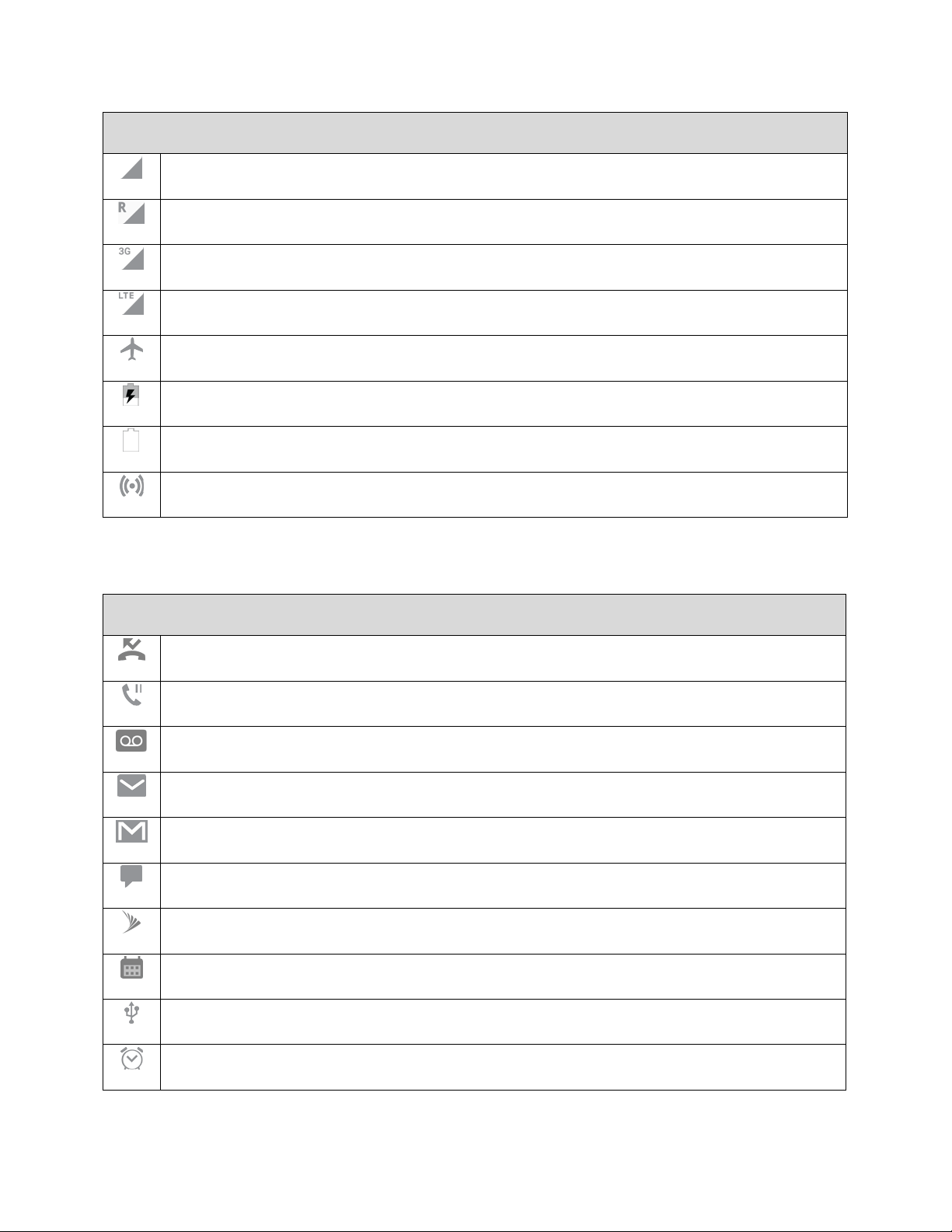
Your Phone's Home Screen 43
Main Status Icons
Cellular network signal strength is displayed.
Roaming network signal strength is displayed.
The device is connected to a 3G wireless network.
The device is connected to a 4G LTE wireless network.
Airplane mode is active.
Battery is charging.
Battery is fully charged.
Connected as a mobile hotspot.
Main Notification Icons
Main Notification Icons
A call has been missed.
A call is on hold.
New voicemail message has been received.
New email has arrived.
New Gmail has arrived.
New text or MMS message.
New My Sprint message has arrived.
A calendar event is approaching.
A USB connection is active.
An alarm has been set.
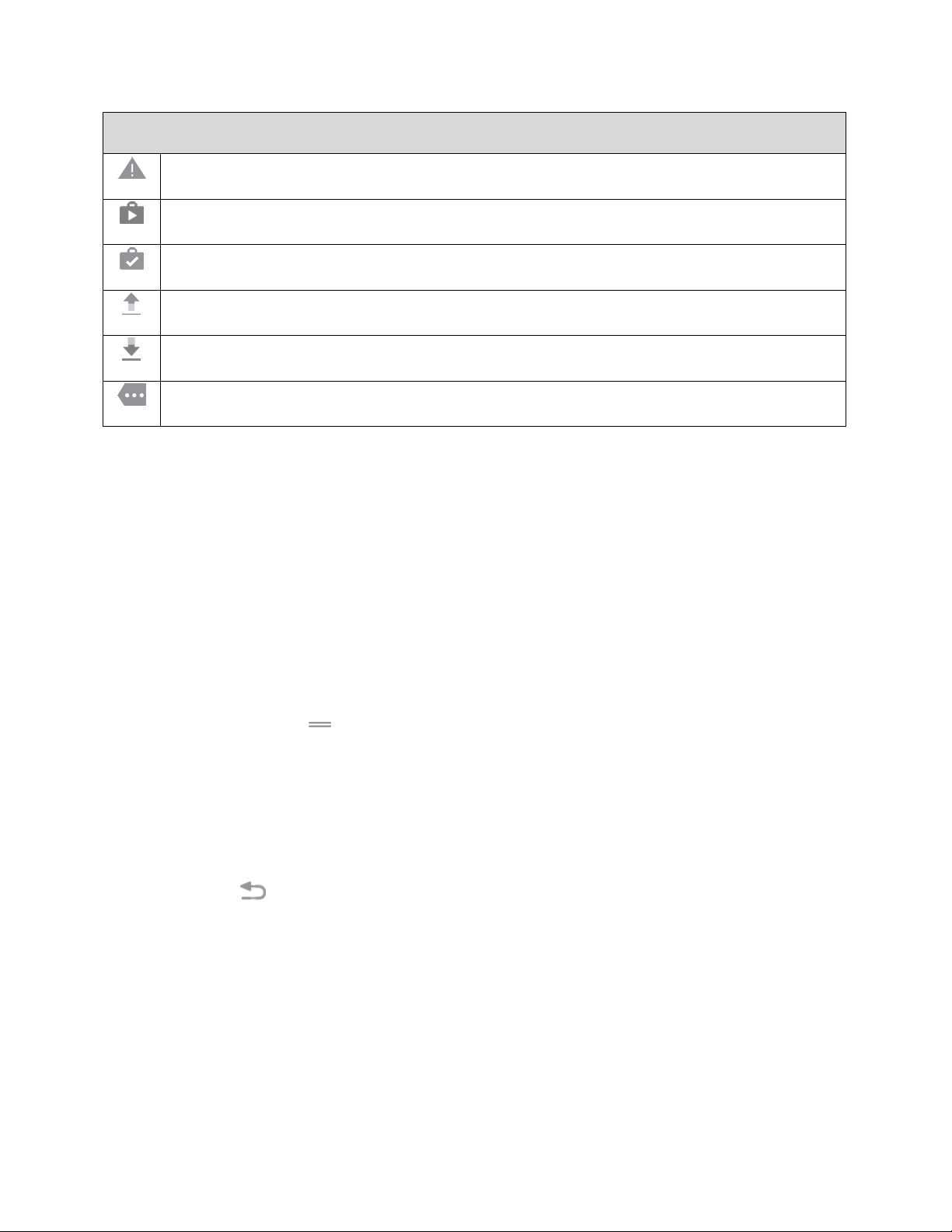
Your Phone's Home Screen 44
Main Notification Icons
A new Emergency alert has arrived.
An app update is available from the Google Play store.
An app update was successful.
File is being uploaded or sent.
Download of a file or app is in progress.
View additional notifications.
Note: Additional notification icons may appear. All notifications may be accessed through the notification
panel.
Notification Panel
Your phone’s notifications appear at the left side of the status bar, and you can access the full notification
panel by pulling down the status bar. From there, you can check notifications, download updates, open
messaging apps, use the quick settings menu, and more.
Open the Notification Panel
1. Pull down the status bar. (Slide your finger down from the top of the screen.)
2. Drag down View all to display additional quick settings.
Close the Notification Panel
■ Slide the notification panel up. (Slide your finger up from the bottom of the screen.)
– or –
Tap Back to close the notification panel.
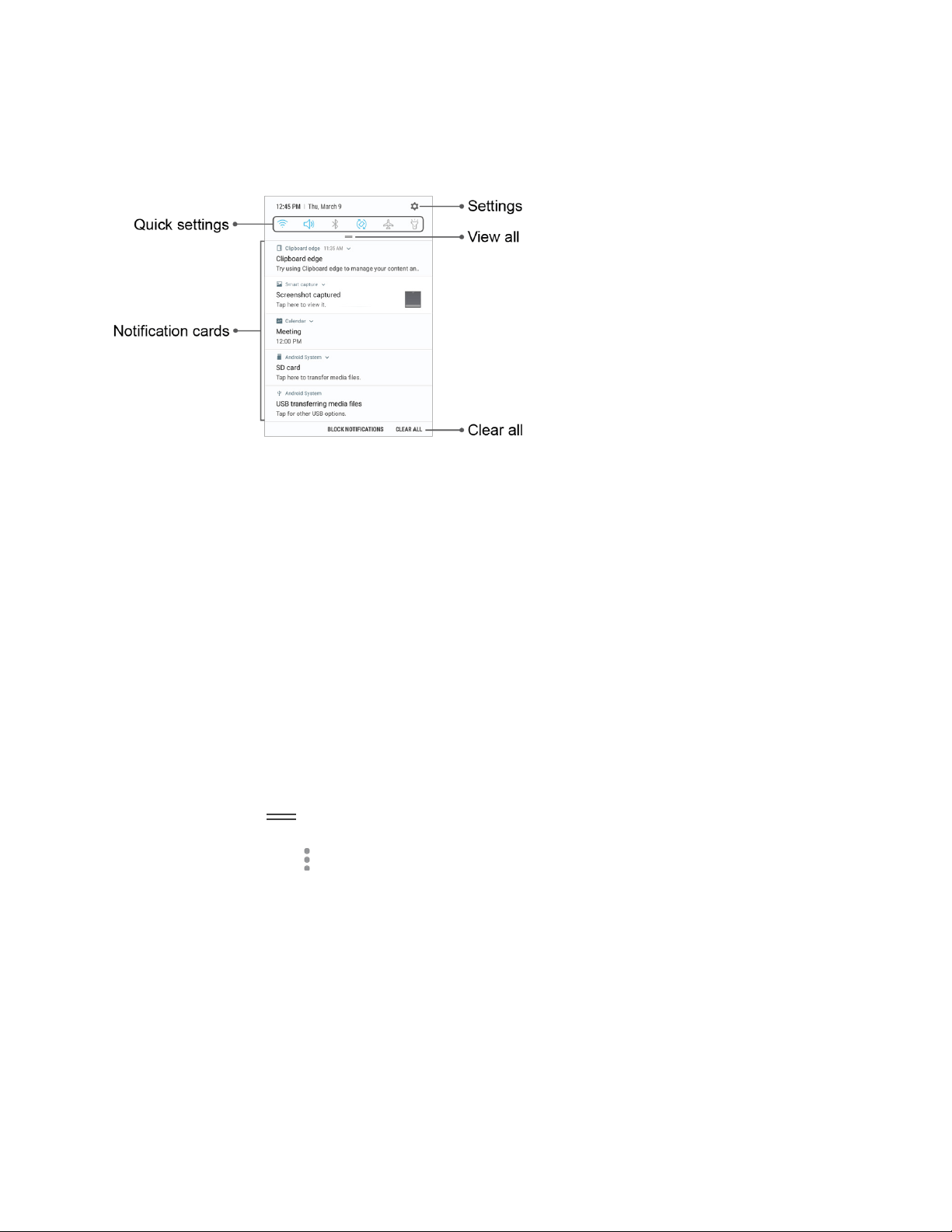
Your Phone's Home Screen 45
Notification Panel Layout
The notification panel gives you access both to notifications and the quick settings menu.
● Settings: Display the Settings screen.
● View all: See all available Quick settings, adjust screen brightness, and more.
● Clear all: Clear all notifications.
● Notification cards: View details about notifications.
● Quick settings: Quickly enable or disable a feature.
Notification Panel Quick Settings
The Quick settings list at the top of the notification panel lets you quickly access frequently used settings
options. Tap an icon to turn the selected feature on or off.
You can customize which settings are available in your Quick Settings list.
1. From home, drag the status bar down to display the notification panel.
2. Drag View all to display the additional quick settings.
3. Tap More options to reorder or change the layout of the quick setting buttons.

Your Phone's Home Screen 46
Multi Window
The Multi window
™
feature lets you multitask by using multiple applications at the same time on the same
screen.
Activate Multi Window
Apps that support Multi window display together on a split screen. You can switch between the apps,
adjust the size of their display on the screen, and copy information from one app to the other.
Note: Multi window is not available for all apps.
1. From any screen, tap Recent apps .
2. Tap two apps that support Multi window to open them in split screen view.
– or –
If you are currently using an app that supports Multi window, tap another app to add it in split
screen view.
You can also launch recently used apps directly into Multi window view:
1. From any screen, touch and hold Recent apps .
Recently used apps that support Multi window have a Multi window icon in their title bar.
2. Tap Multi window in the title bar to launch an application in split screen view.
Other recently used apps that support Multi window display below the launched app.
3. Tap an app shortcut to add it to the split screen view.
Note: Only applications that support Multi window have the Multi window icon.
Window Controls
Use Window controls to switch windows, drag and drop content, minimize or maximize windows, or to
close a window.
1. Select an app window, and then tap the center of the divider bar.
2. The following options are available:
Switch windows: Switch locations between Multi window apps.
Open in pop-up view: Open the selected app in a pop-up window.
Close app: Close the selected app.
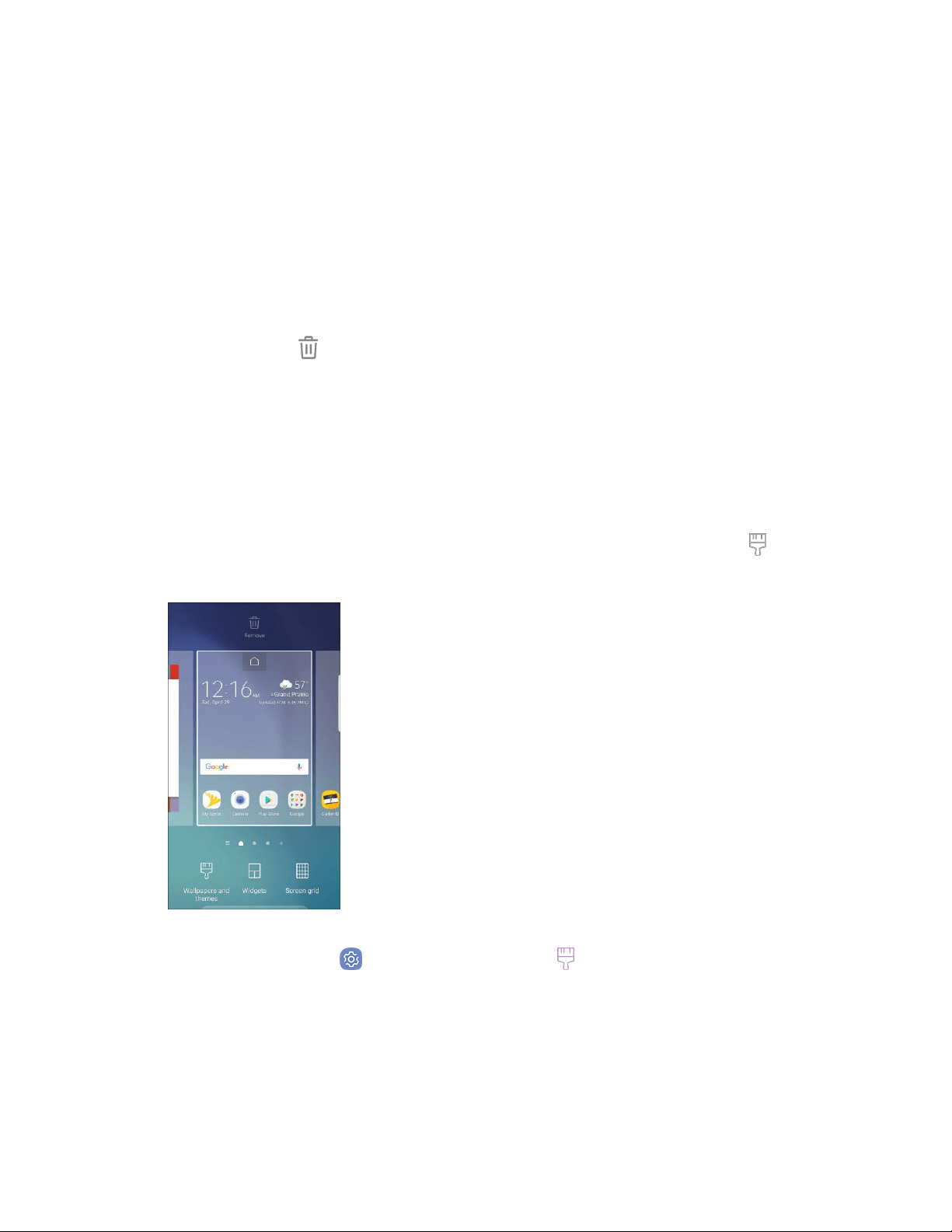
Your Phone's Home Screen 47
Customize the Home Screen
Learn how to set the wallpaper and add, move, or remove shortcuts, widgets, and folders from the home
screen.
Operations for Rearranging the Home Screen
● Moving Widgets and Icons: From home, touch and hold an item and then drag it to the desired
location.
● Deleting Widgets and Icons: From home, touch and hold an item and then drag it to
Remove shortcut .
● Displaying the Home Screen Menu: From home, touch and hold an empty space to display the
home screen menu. Menu options include Wallpapers, Widgets, Themes, and Screen grid
settings. You also have the option to add or remove home screens.
Change the Wallpaper
Select and assign your phone’s background wallpaper.
1. From home, touch and hold an empty space, and then tap Wallpapers and themes >
Wallpapers.
You can also access the wallpaper menu through settings. From home, swipe up to access
Apps. Tap Settings > Wallpapers and themes > Wallpapers.
2. Tap an option to select the wallpaper, and then select:
Home screen to set the background wallpaper for your home screen.
Lock screen to set the wallpaper for your phone’s lock screen.
Home and lock screens to set a wallpaper for both your home screen and your lock screen.
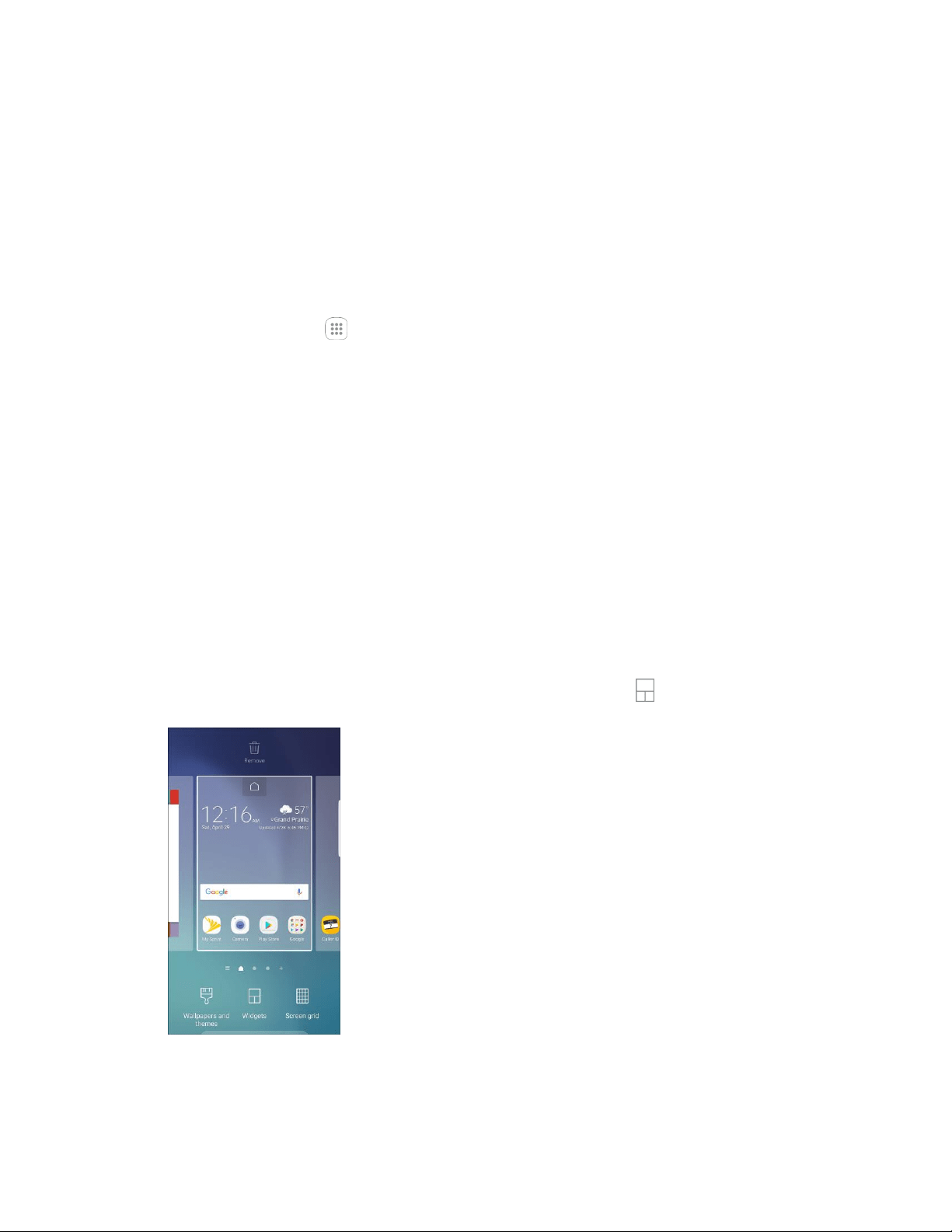
Your Phone's Home Screen 48
3. Tap Set as wallpaper.
The wallpaper is set.
Note: Tap On/Off next to Motion effect to enable or disable this feature. It allows the wallpaper to shift
slightly as you move the device, creating a 3D effect.
Add Shortcuts to the Home Screen
You can add shortcuts for quick access to favorite apps from the home screen.
1. From home, tap Apps .
The Apps list opens.
2. Touch and hold an app icon.
The icon will disengage and you will see the current home screen.
3. Drag the icon to an empty location on one of the home screens.
The shortcut is added to the home screen.
Add Widgets to the Home Screen
You can add widgets to your phone’s home screen. Widgets are self-contained apps that display on a
home screen. Unlike a shortcut, the Widget works like as an onscreen application. There are all kinds of
widgets, including links to a specific contact, Internet bookmarks, Facebook status windows, Gmail and
email accounts, and many others.
1. From home, touch and hold an empty space, and then tap Widgets .
The Widgets list opens.

Your Phone's Home Screen 49
2. Touch and hold a widget icon.
The icon will disengage and you will see the current home screen.
3. Drag the icon to an empty location on one of the home screens.
The widget is added to the home screen.
Add Folders to the Home Screen
You can group home screen shortcuts into folders for convenient access.
1. From home, touch and hold an app shortcut and drag it on top of another app shortcut until a
highlighted box appears.
2. Release the app shortcut to create the folder.
Enter folder name: Enter a name for the folder.
Palette : Change the color.
3. Add apps : Place more apps in the folder. Tap apps to select them, and then tap Add.
4. Tap anywhere outside of the folder to close it.
To add more apps, touch and hold an app shortcut and drag it to the folder.
Change Folder Names
Once you have added folders, you can change the name easily from the folder display.
1. From home, tap the folder to open it, and then tap the folder name.
2. Type a new name, and then tap Back .
Change the Folder Color
You can change the color of a folder.
1. From home, tap the folder to open it.
2. Tap Palette , select a color, and then tap Back .
Phone App 50
Phone App
The following topics outline the use of your device’s phone app to place and receive calls, use voicemail,
and more.
Wi-Fi Calling
Wi-Fi Calling uses Wi-Fi networks to help improve voice and data coverage. It sends and receives calls
and text messages over a connected Wi-Fi network and may offer better coverage in buildings and areas
of poor cellular reception.
Set Up Wi-Fi Calling
1. From home, tap Apps > Settings .
2. Tap Wi-Fi Calling and follow the prompts to set up Wi-Fi Calling.
You will see in the status bar when Wi-Fi Calling is active and connected, or if Wi-Fi
Calling is set up but you are not connected to a Wi-Fi network.
Note: When using Wi-Fi calling, the phone app icons differ slightly. You will tap Dial to place a
call, and tap End to end a call.
Tip: For more information about Wi-Fi Calling, visit this FAQ link at sprint.com/support.
Enable or Disable Wi-Fi Calling
1. From home, tap Apps > Settings .
2. Tap Wi‑Fi Calling .
– or –
Pull down the status bar to display the quick settings menu and tap Wi-Fi Calling .
3. Tap On/Off to turn Wi-Fi Calling on or off.

Phone App 51
Place and Answer Calls
The following topics describe how to directly dial calls, how to answer incoming calls, and how to use the
in-call screen options.
Adjust In-Call Volume
■ Adjusting Call Volume: Press the Volume key up or down during the call.
Troubleshooting
Problem: Difficulty during call.
Solution 1: It may not be possible to make a call properly in a noisy location.
Solution 2: When calling using Speaker, check the call volume. Raising the call volume may make
calling difficult.
Problem: Sound pops momentarily during a call.
Solution: Are you changing location while calling? Sound pops when signal is weak and the phone
switches to a different area.
Emergency Call Cautions
Emergency calls are restricted in Airplane mode.
Call Using the Phone Dialer
The most “traditional” way to place a call is by using the phone’s dialer screen.
1. From home, tap Phone to display the phone screen.
The phone app opens. If necessary, tap Keypad to display the dialer screen.
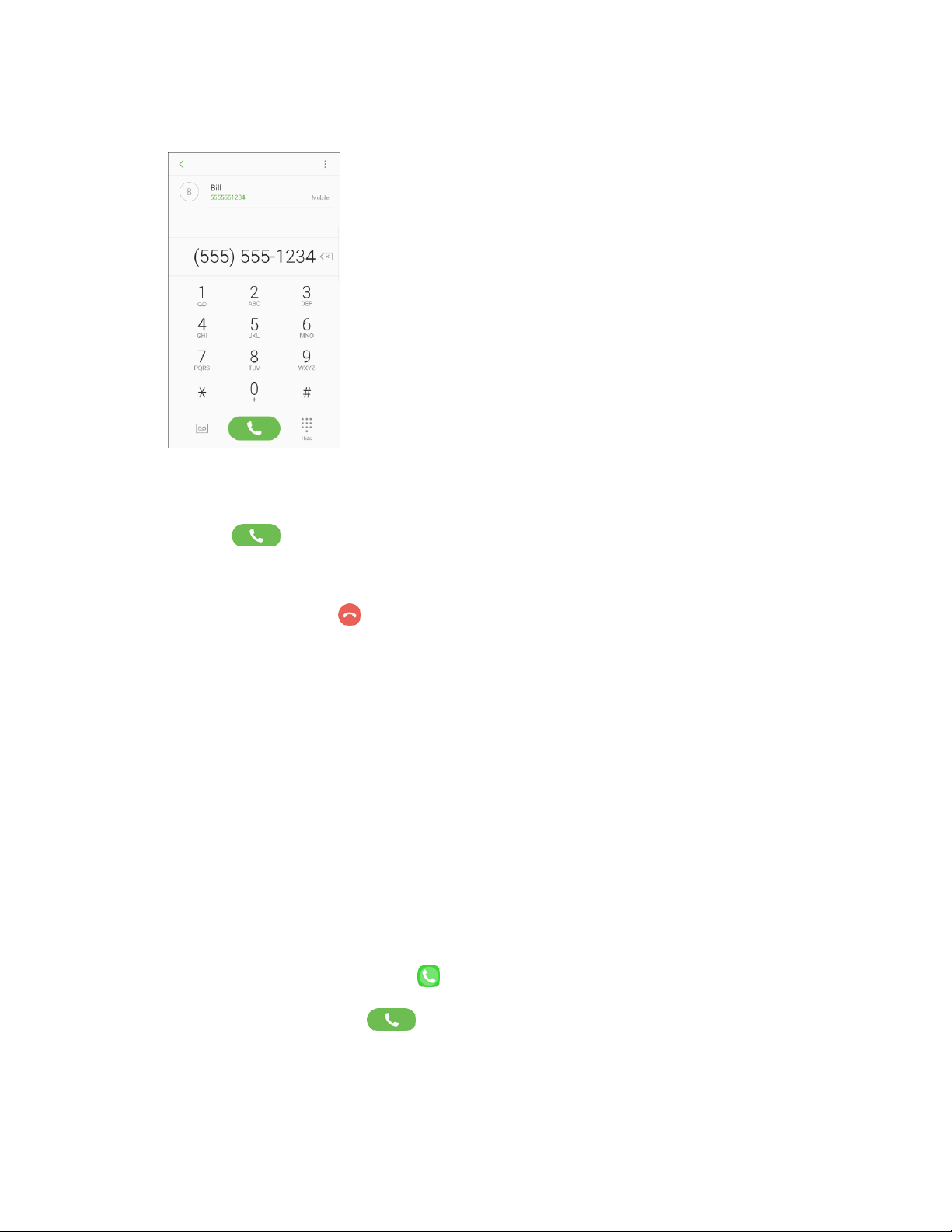
Phone App 52
2. Tap the number keys on the keypad to enter the phone number.
As you enter digits, Smart Dial searches for contacts that match. If you see the number you
want to dial, tap it to place the call immediately without entering the rest of the number.
3. Tap Dial to call the number.
The phone dials the number. The call begins when the other party answers.
4. To end the call, tap End .
The call ends.
Troubleshooting
Question: Call does not connect.
Answer 1: Was the number dialed using the area code? If not, try dialing using the full 10-digit
number including the area code.
Answer 2: Are you in an area with poor wireless coverage? Try calling again from another area.
Call Emergency Numbers
You can place calls to 9-1-1 even if the phone’s screen is locked or your account is restricted.
To call the 9-1-1 emergency number when the phone’s screen is locked with a screen lock:
1. From the lock screen, swipe Phone up, and then tap Emergency call.
2. Tap 9-1-1, and then tap Dial .
As long as you are in an area covered by wireless service, the emergency call is placed.

Phone App 53
To call the 9-1-1 emergency number normally or when your account is restricted:
1. Unlock the screen. For more information, see Lock and Unlock Your Screen.
2. From home, tap Phone > Keypad .
3. Tap 9-1-1, and tap Dial .
As long as you are in an area covered by wireless service, the emergency call is placed.
Enhanced 9-1-1 (E 9-1-1) Information
This phone features an embedded Global Positioning System (GPS) chip necessary for utilizing E 9-1-1
emergency location services where available.
When you place an emergency 9-1-1 call, the GPS feature of your phone seeks information to calculate
your approximate location. Depending on several variables, including availability and access to satellite
signals, it may take up to 30 seconds or more to determine and report your approximate location.
Important: Always report your location to the 9-1-1 operator when placing an emergency call. Some
designated emergency call takers, known as Public Safety Answering Points (PSAPs), may not be
equipped to receive GPS location information from your phone.
Answer Phone Calls
The following information lets you know how to answer incoming calls, mute the ringer on incoming calls,
reject incoming calls, and more.
When you receive a phone call from a contact, the Incoming call screen appears and displays the caller
ID icon, name, and phone number of the calling party. When you receive a phone call from someone who
is not stored in Contacts, only the default caller ID icon and phone number appear on the Incoming call
screen.
Note: If your phone is turned off, all calls automatically go to voicemail.
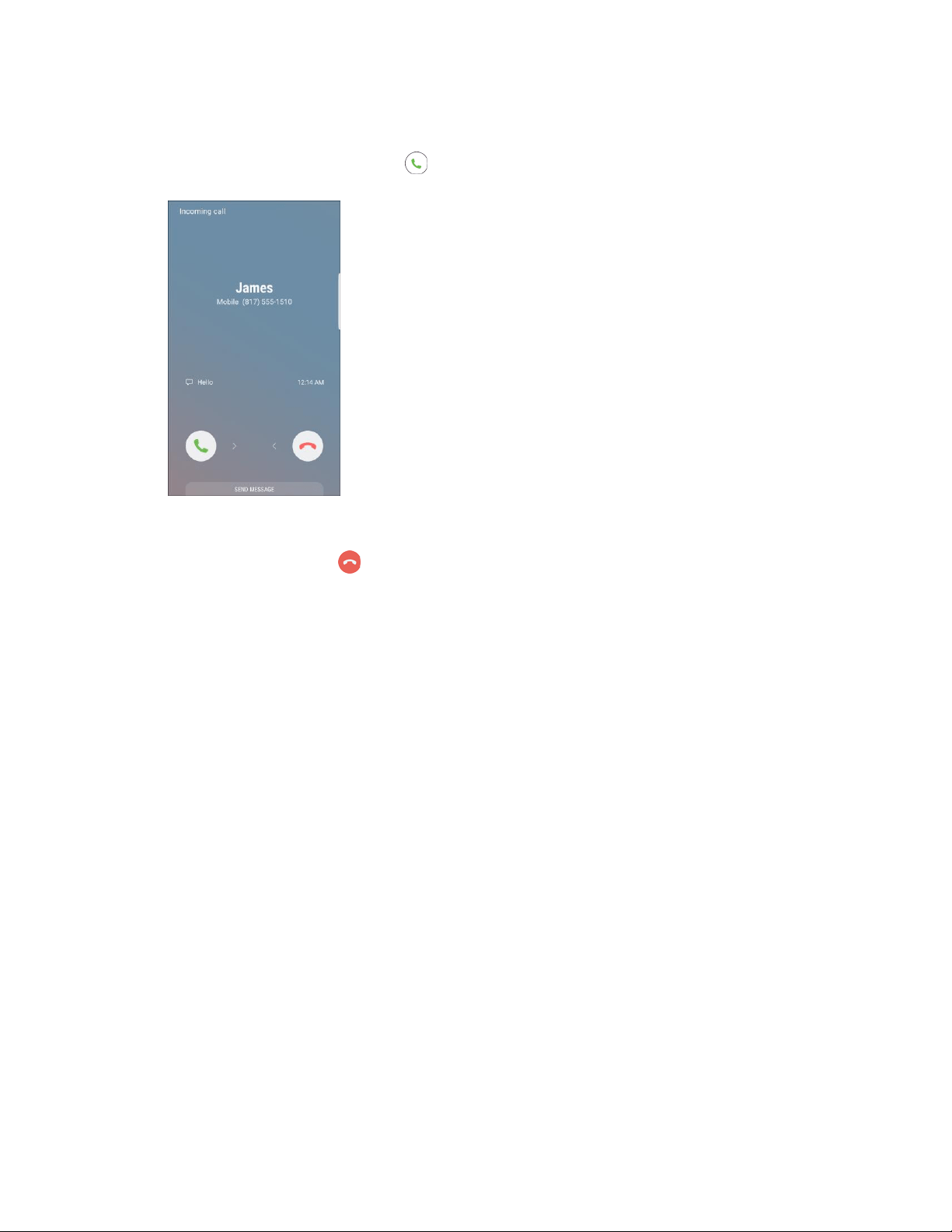
Phone App 54
Answer an Incoming Call
1. When a call arrives, slide Answer to the right to answer it.
The call begins.
2. To end the call, tap End .
The call ends.
Mute the Ringing Sound
To mute the ringer without rejecting the call, you can do either of the following:
● Press the Volume key down.
● Place the phone face down on a level surface.
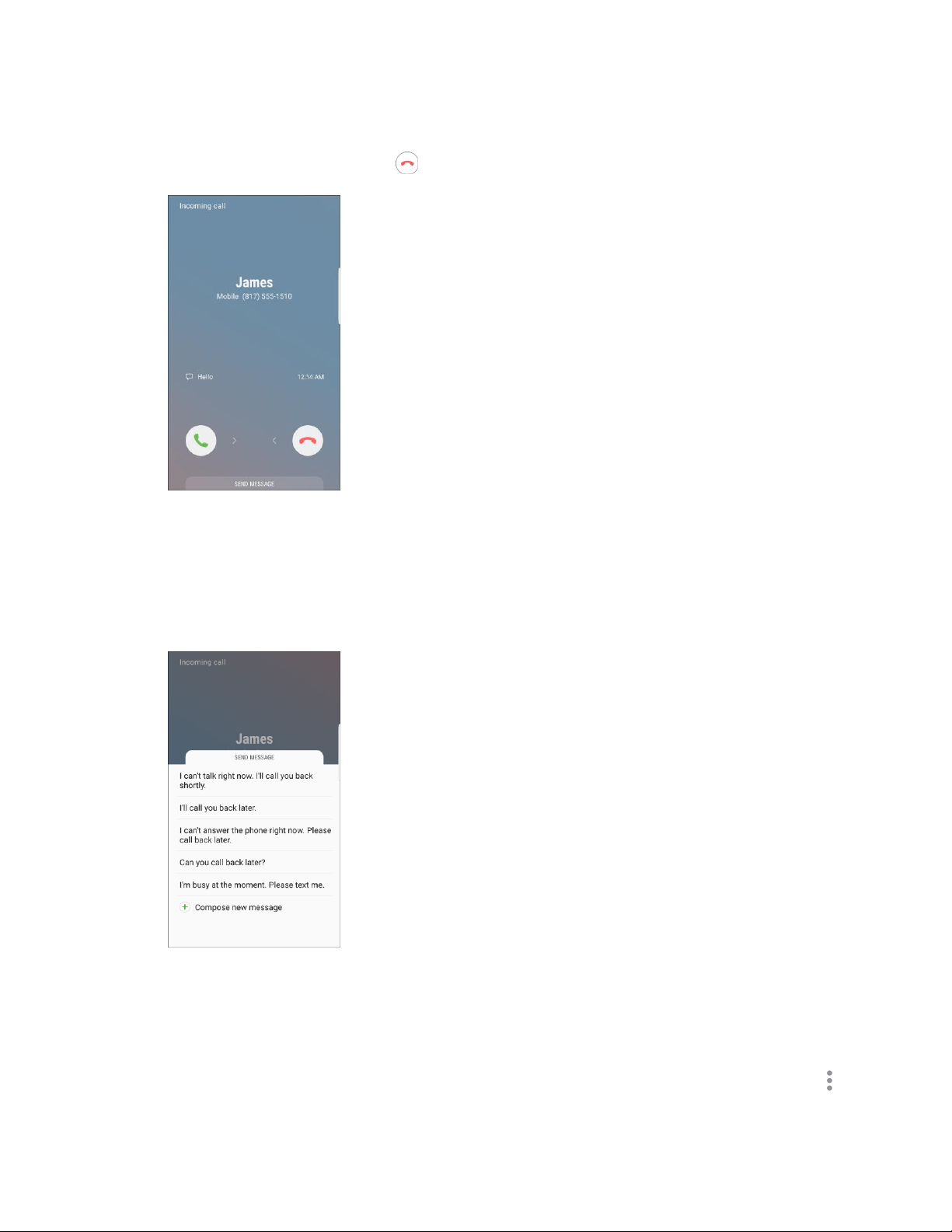
Phone App 55
Reject an Incoming Call
■ When a call arrives, slide Reject to the left to reject it.
The ringtone or vibration will stop and the call will be sent directly to voicemail.
Reject a Call and Send a Text Message
You can reject an incoming call and automatically send a text message to the caller.
1. When a call arrives, slide Send message up from the bottom of the screen.
The ringtone or vibration will stop and you will see a list of preset text messages.
2. Tap one of the messages to send it to the caller.
The selected message will be delivered to the caller.
You can edit the reject messages through the Call settings menu. From the phone app, tap
More options > Settings > Quick decline messages and edit or create a reject message.
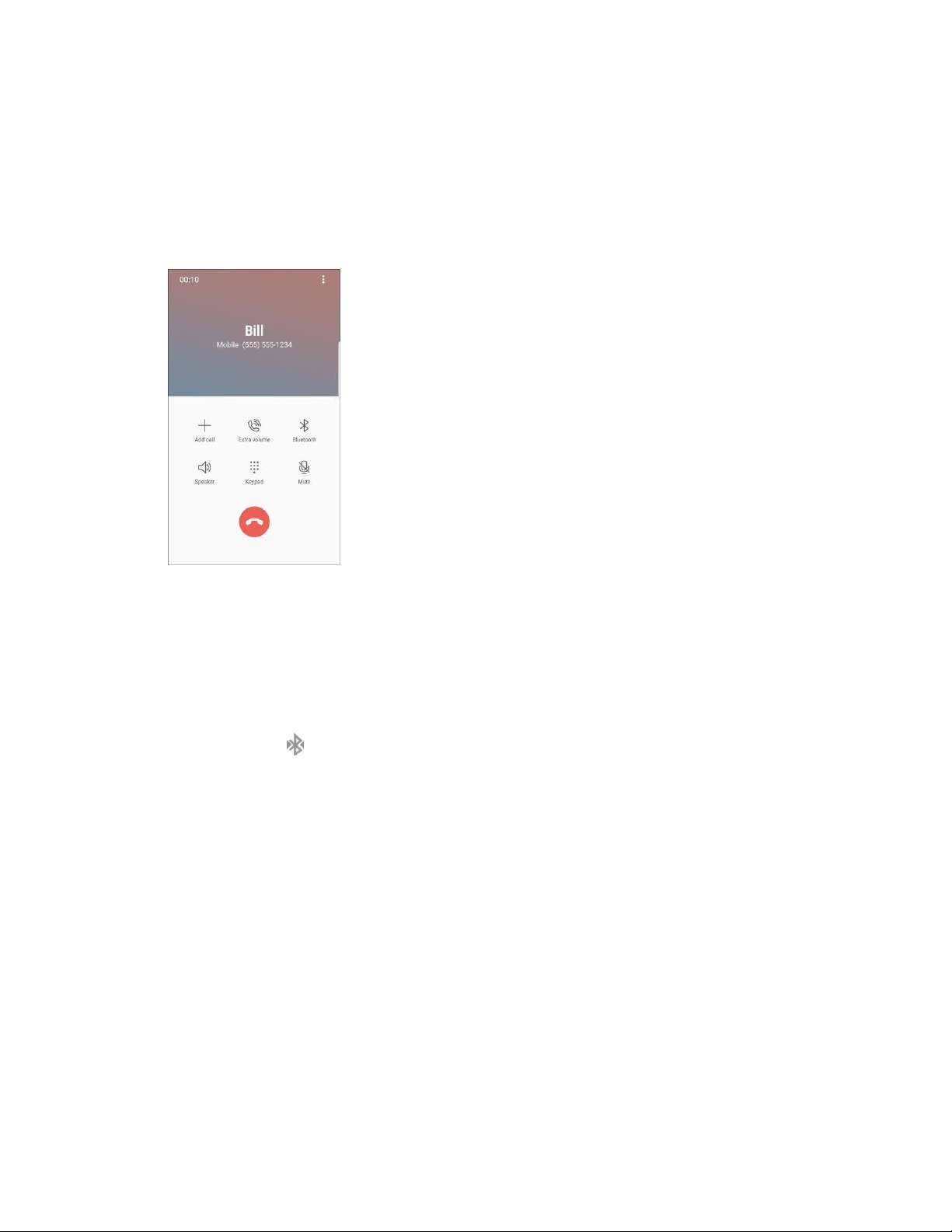
Phone App 56
In-Call Screen Layout and Operations
While you are on a call, you will see a number of options.
In-Call Screen Layout
■ Tap options to activate them during a call.
Add call: Tap to initiate a conference call (3-way call).
Extra volume: Increase the call volume.
Bluetooth: Route the phone’s audio through a connected Bluetooth headset (On) or through
the speaker (Off).
• When the call is routed to a Bluetooth headset, the current call area shows the Bluetooth
call icon .
Note: The Headset button is activated to show the current call is routed to the connected Bluetooth
headset (not included).
• To route the current call back to the phone, tap Headset to temporarily use the phone.
Tap it again to route the call back to the connected Bluetooth headset.
Speaker: Route the phone’s audio through the speaker (On) or through the earpiece (Off).
• Activate Speaker to route the phone’s audio through the speaker. (You can adjust the
speaker volume using the Volume key.)
• Deactivate Speaker to use the phone’s earpiece.
Warning: Because of higher volume levels, do not place the phone near your ear during speakerphone
use.
Keypad/Hide: Toggle the appearance of the onscreen keypad. Show the keypad to enter
additional numbers, for example, an extension or access code.
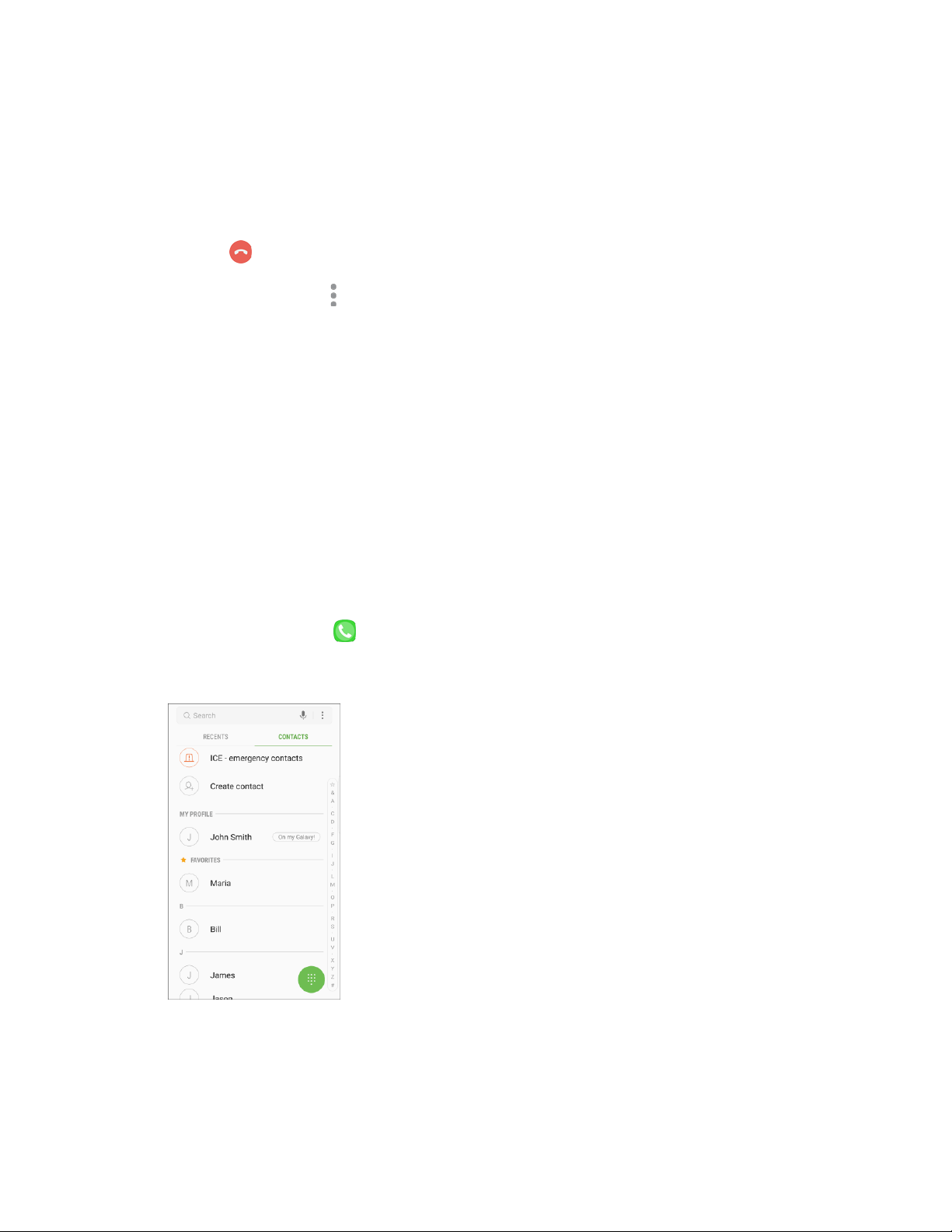
Phone App 57
• For example: When you call your bank’s 800 number, use the keypad to enter your
account number and PIN.
Mute: Mute the microphone during an active call. Tap again to unmute the microphone.
Note: If Mute is activated, the speaker mode is deactivated.
End : End the current call.
Tap More options during a call to display a list of additional in-call features:
• Add to Contacts: Add the current caller to your Contacts list.
• View contact: If the current caller is in your Contacts list, this option displays the current
caller’s contact information.
• Send message: Send a text or multimedia message while remaining on the call.
Place Calls from Contacts/Call Logs
Make calls quickly using Contacts and Call Logs.
Place a Call from Contacts
You can place phone calls directly from entries in your Contacts list.
1. From home, tap Phone to display the phone app.
2. Tap Contacts to display the Contacts list.
The contacts list appears.
3. Tap a contact.
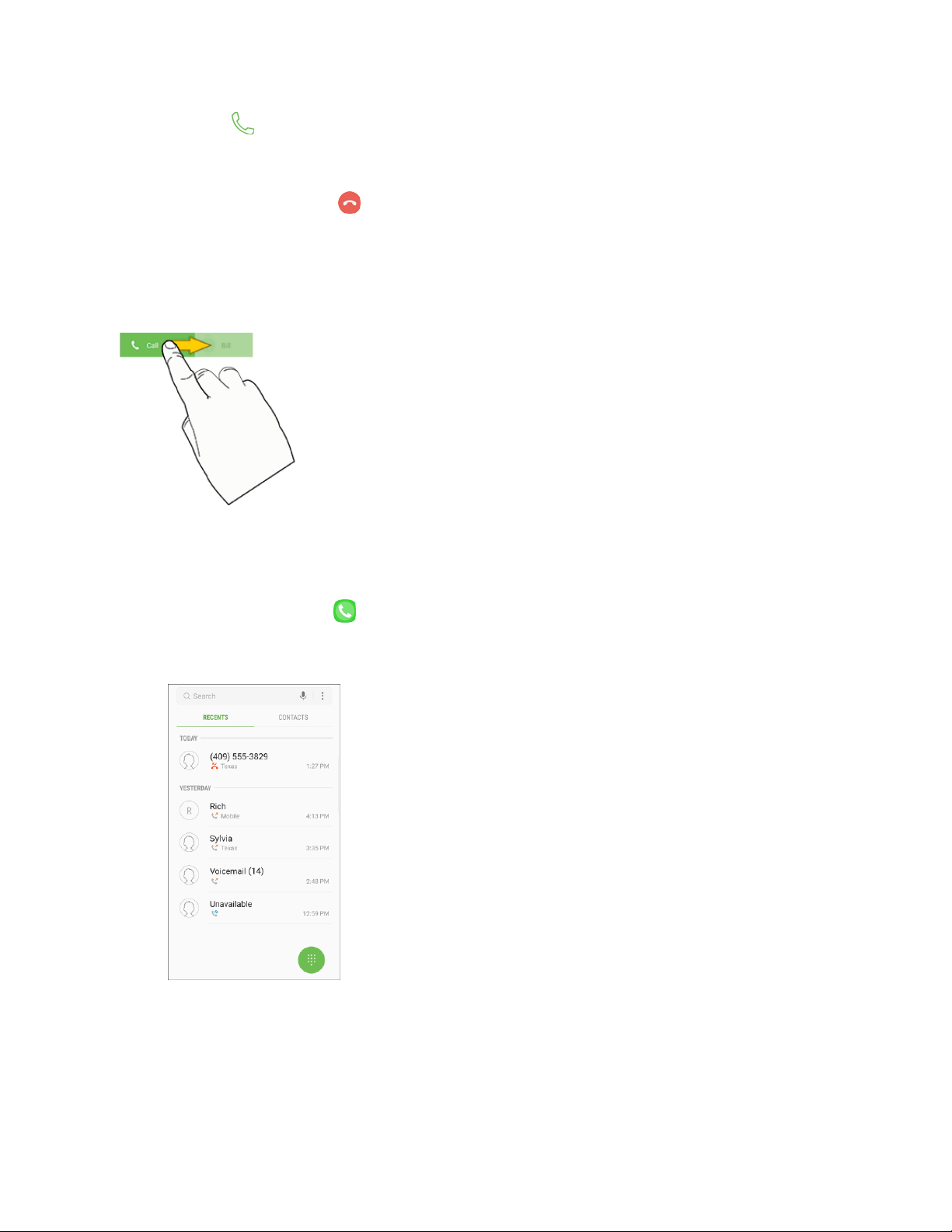
Phone App 58
4. Tap Call to call th entry’s default number.
The phone dials the number. The call begins when the other party answers.
5. To end the call, tap End .
The call ends.
Tip: You can also place a call directly from the Contacts list. Swipe the entry you want to call from left to
right to place a call to the entry’s primary number.
Call from Call Log
The call log list lets you quickly place calls to recent incoming, outgoing, or missed numbers.
1. From home, tap Phone to display the phone app.
2. Tap Recents to display the call log list.
The call log list appears.
3. Tap an entry to display the call details.
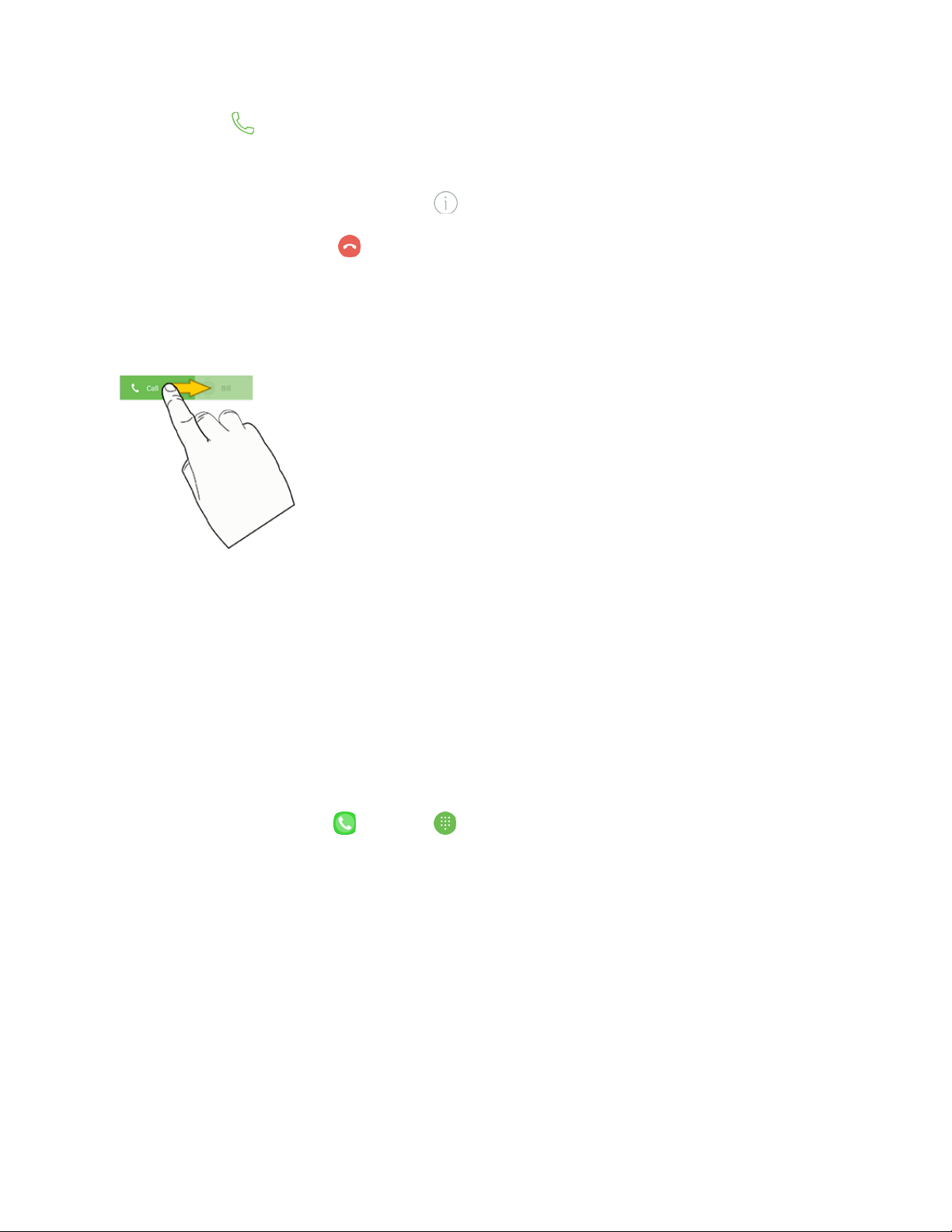
Phone App 59
4. Tap Call to place a call.
The phone dials the number. The call begins when the other party answers.
For additional options, tap Details .
5. To end the call, tap End .
The call ends.
Tip: You can also place a call directly from the call log list. Swipe the entry you want to call from left to
right to place a call.
Optional Services
The following topics outline additional voice-related services available with your phone, including call
services, voicemail, and more.
Voicemail Setup
Follow the instructions below to set up voicemail on your phone. You should set up your voicemail and
personal greeting as soon as your phone is activated. Always use a passcode to protect against
unauthorized access. Your phone automatically transfers all unanswered calls to your voicemail, even if
your phone is in use or turned off.
1.
From home, tap Phone > Keypad .
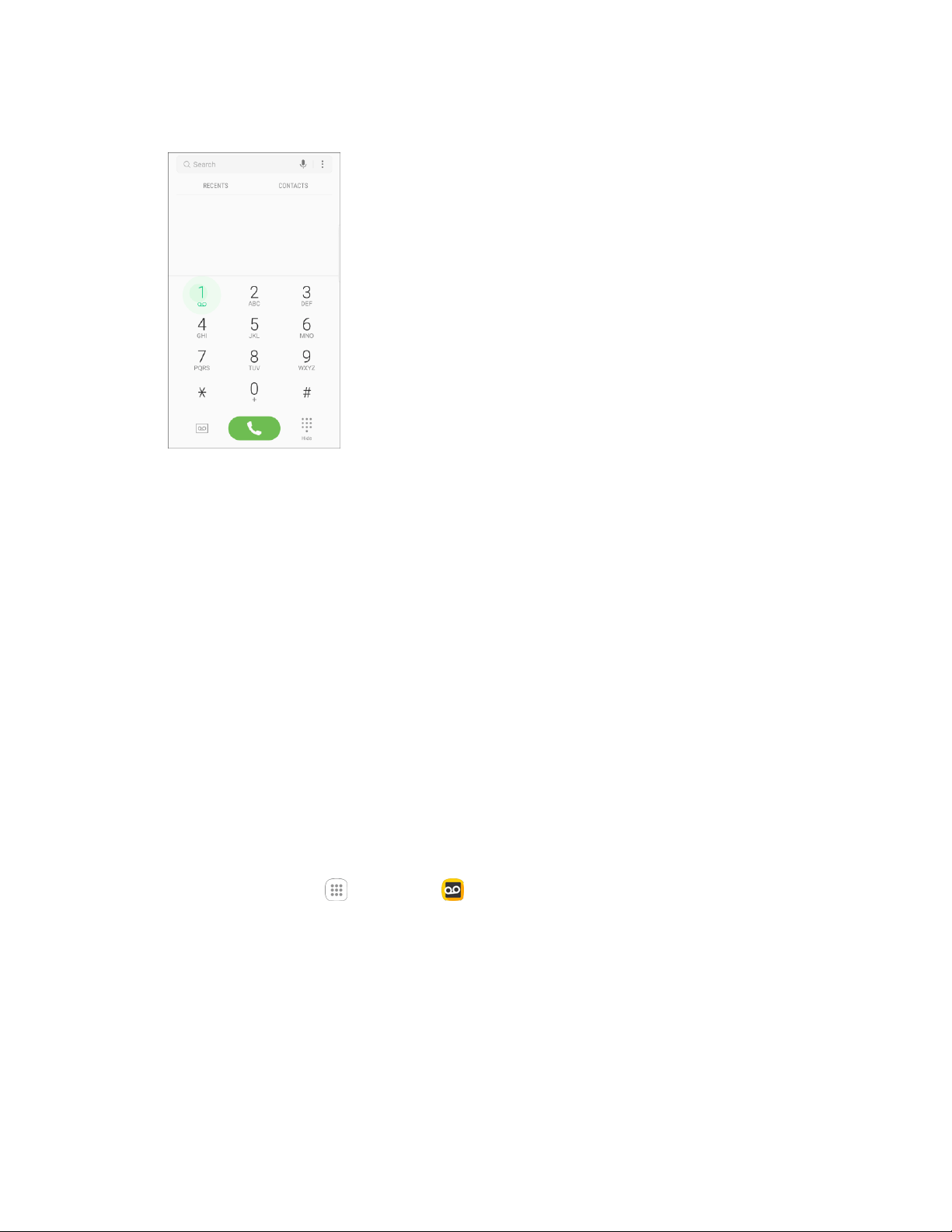
Phone App 60
2. Touch and hold the 1 key to dial your voicemail number.
Your phone dials the voicemail access number.
3. Follow the system prompts to:
Create your passcode.
Record your name announcement.
Record your greeting.
Important: Voicemail Passcode – It is strongly recommended that you create a passcode when setting
up your voicemail to protect against unauthorized access. Without a passcode, anyone who has access
to your phone is able to access your voicemail messages.
Set Up Visual Voicemail
Setting up Visual voicemail follows many of the same procedures as setting up traditional voicemail. You
should set up your voicemail and personal greeting as soon as your phone is activated. Your phone
automatically transfers all unanswered calls to your voicemail, even if your phone is in use or turned off.
Note: To set up your traditional voicemail, see
Voicemail Setup.
1. From home, tap Apps > Voicemail .
2. Scroll through the introduction screens to view a brief explanation of the visual voicemail services.
3. At the end of the welcome screens, a Personalize your voicemail prompt displays.
If prompted, grant Visual Voicemail permissions to access your phone, contacts, and so on.
4. Tap Personalize and follow the system prompts to:
Create a passcode (part of standard voicemail).

Phone App 61
Record your name announcement.
Record your greeting.
Important: Voicemail Passcode – It is strongly recommended that you create a passcode when setting
up your voicemail to protect against unauthorized access. Without a passcode, anyone who has access
to your phone is able to access your voicemail messages.
Review Visual Voicemail
Visual voicemail lets you easily access and select which messages you want to review.
1. From home, tap Apps > Voicemail .
2. Tap a message, and then tap Play to review it.
3. Tap Back to return to the voicemail inbox to review additional messages.
Visual Voicemail Options
Your visual voicemail options are available through the options menus found in the voicemail inbox and
while reviewing messages.
1. From home, tap Apps > Voicemail .
2. The following options are available when viewing the voicemail Inbox:
More options: Access Search, Settings, and Help features.
• New Voice SMS: Send a voice message to friends.
• New Avatar message: Send an animated voice message to friends.
• Search: Search your voice messages.
• Upgrade to Premium: Subscribe to the premium Voice-to-Text transcription service.
This service requires an additional monthly charge.
• Store: Access the Visual Voicemail store to purchase avatars, backgrounds, and more.
• Help: View help topics for Visual Voicemail.
• Settings: Customize your Visual Voicemail settings.
3. Tap a message to review it. The following options are available while listening to voicemail
messages.
Call : Dial the number the message came
Reply : Reply to the message using text or voice message.

Phone App 62
More options: Access Archive, Settings, and Help features.
• Delete: Delete selected messages.
• Share: Send the message using Wi-Fi Direct, social accounts, and so on.
• Archive message: Save this message.
• Upgrade to premium: Subscribe to the premium Voice-to-Text transcription service. This
service requires an additional monthly charge.
• Help: View help topics for Visual Voicemail.
• Settings: Customize your Visual Voicemail settings.
4. Touch and hold a message to manage your messages. The following options are available:
Delete : Delete selected messages.
More options: Select additional options.
• Archive: Save this message.
• Mark as Read: Mark this voicemail as being read.
• Mark as Unread: Mark this voicemail as not being read.
Configure Visual Voicemail Settings
The Visual Voicemail settings menu lets you access settings for notifications, pictures, greetings, and
more.
1. From home, tap Apps > Voicemail .
2. Tap More options > Settings.
3. Select an option to change its settings:
Avatar: Configure you Avatar options.
Display: Change your voicemail message theme and enter a name to identify yourself to
people when replying or forwarding messages.
Help/Info: View help topics for using Visual Voicemail.
Preferences: Change your Visual Voicemail application preferences.
Sound: Change your sound/speakerphone options.
Updates: Check for updates.
About Voicemail: View information about the application.

Phone App 63
Change Your Main Greeting
Your main greeting can be changed directly via the Visual Voicemail system. This direct access saves
you from having to navigate within the voicemail menu.
1. From home, tap Apps > Voicemail .
2. Tap More options > Settings > Preferences > Personalize voicemail.
3. Tap OK to connect to the voicemail system. Follow the prompts to change your current greeting.
Edit the Display Name
From your Visual Voicemail menu, you can quickly change the name or number attached to your voice
messages. This name or number identifies you to recipients of your voicemail messages.
1. From home, tap Apps > Voicemail .
2. Tap More options > Settings > Display > Display name.
3. Tap the existing identification field and enter a new identifying name or number (used to identify
you to recipients of your voice messages).
4. Tap OK to save your information.
Caller ID Blocking
Caller ID identifies a caller before you answer the phone by displaying the number of the incoming call. If
you do not want your number displayed when you make a call, follow these steps.
1. From home, tap Phone > Keypad.
2. Tap * 6 7.
3. Enter a phone number.
4. Tap Dial .
Your caller information will not appear on the recipient’s phone.
To permanently block your number, call Sprint Customer Service.
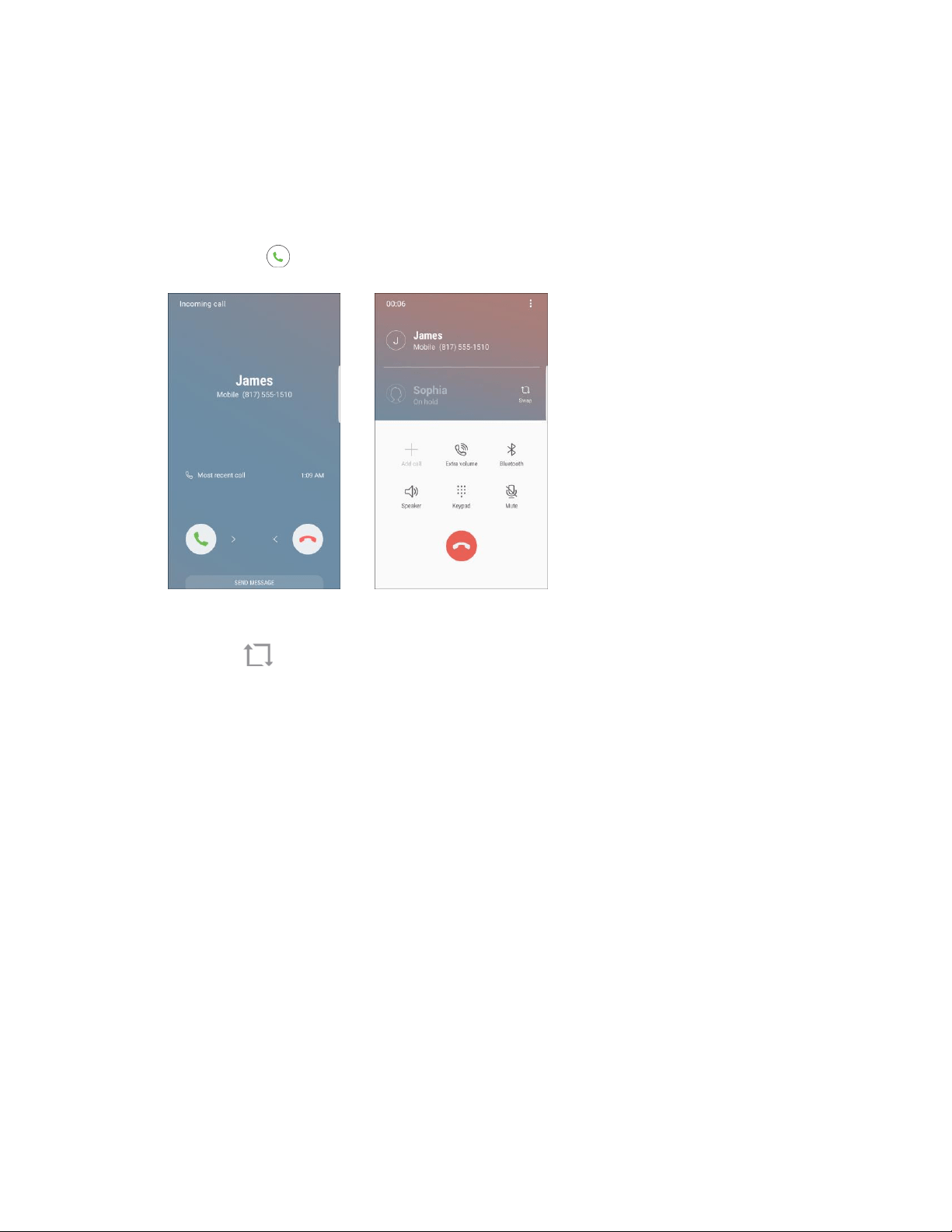
Phone App 64
Call Waiting
When you are on a call, Call Waiting alerts you to incoming calls by sounding two beeps. Your phone’s
screen informs you that another call is coming in and displays the caller’s phone number (if it is available).
To respond to an incoming call while you are on a call:
■ Slide Answer to the right. (This puts the first caller on hold and answers the second call.)
To switch back to the first caller:
■ Tap Swap .
Note: For those calls where you do not want to be interrupted, you can temporarily disable Call Waiting
by pressing * 7 0 before placing your call. Call Waiting is automatically reactivated once you end the call.
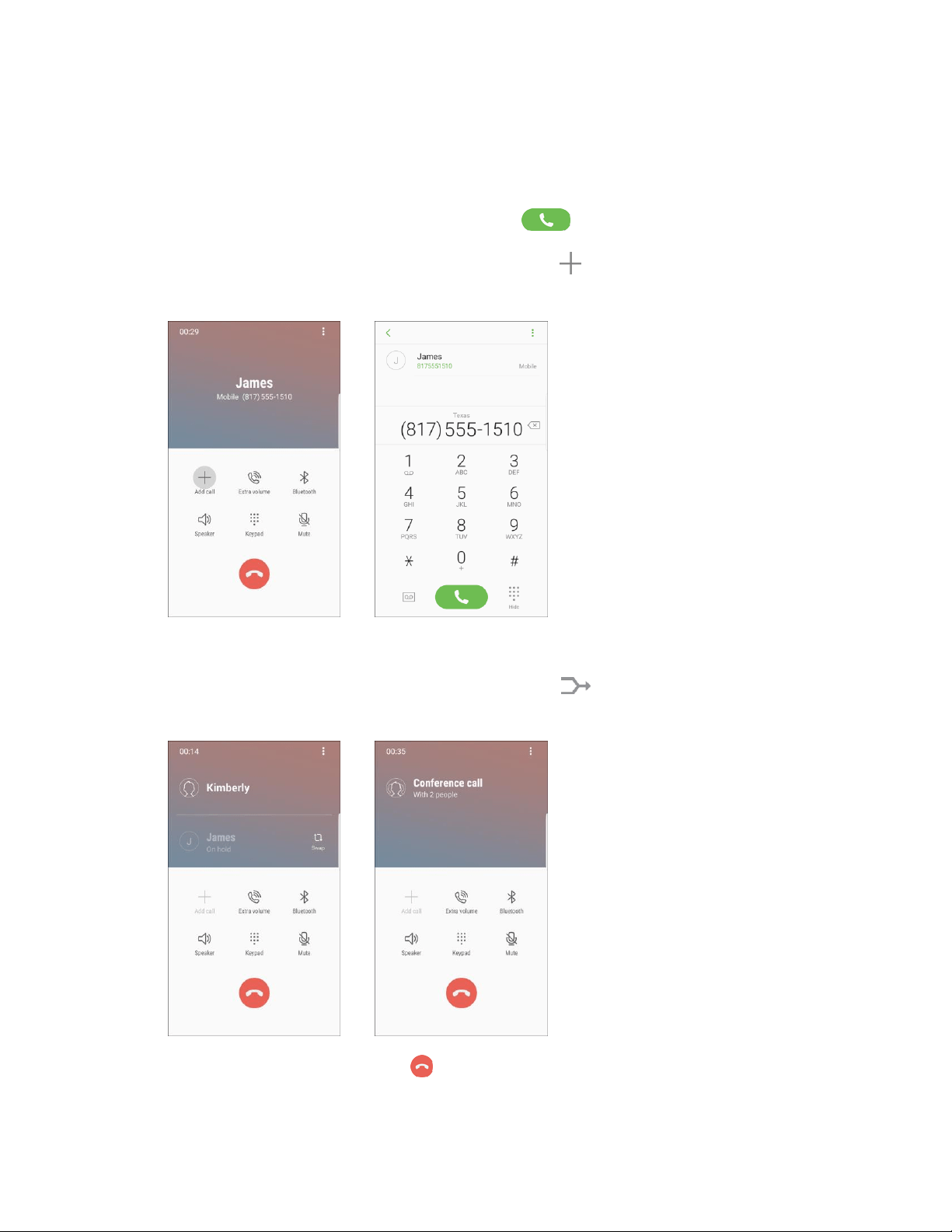
Phone App 65
Conference Calling
With conference calling, also known as 3-way calling, you can talk to two people at the same time. When
using this feature, the normal airtime rates will be charged for each of the two calls.
1. On the Phone screen, enter a number and tap Dial (or place a call from Log or Contacts).
2. Once you have established the connection, tap Add call , and dial the second number (or
place the call from Log or Contacts).
This puts the first caller on hold and dials the second number.
3. When you are connected to the second party, tap Merge . Your conference call is now in
session.
4. To end the three-way call, tap End .
Phone App 66
Note: If one of the people you called hangs up during your call, you and the remaining caller stay
connected. If you initiated the call and are the first to hang up, all callers are disconnected.
Call Forwarding
Call Forwarding lets you forward all your incoming calls to another phone number – even when your
phone is turned off. You can continue to make calls from your phone when you have activated Call
Forwarding.
Note: You are charged a higher rate for calls you have forwarded.
To activate Call Forwarding:
1. From home, tap Phone .
2. Tap * 7 2.
3. Enter the area code and phone number to which you want your calls forwarded.
4. Tap Dial .
You will hear a tone to confirm the activation of Call Forwarding. All calls to your wireless
number will be forwarded to the designated phone number.
To deactivate Call Forwarding:
1. From home, tap Phone .
2. Tap * 7 2 0.
3. Tap Dial .
You will hear a tone to confirm the deactivation.
Call Settings
Your phone’s Call Settings menu lets you configure your voicemail options and a number of other settings
for the phone application.
Call Settings Options
Use the Call Settings menu to adjust the following settings:
Setting
Description
Swipe to call or send
messages
Place a call to a displayed contact by swiping right. Send a message to
a displayed contact by swiping left.
Hide contacts without
numbers
Show contacts with phone numbers and hide other contacts.
Phone App 67
Setting
Description
Block numbers
Manage a list of automatically blocked phone numbers, and create or
edit messages to block incoming calls.
Quick decline messages
Compose or edit response messages to send when declining incoming
calls.
Answering and ending calls
Answer calls by pressing the Home key or using voice commands. End
calls by pressing the Power/Lock key or using voice commands.
Show caller information
Show the communication history and related information for each caller.
Call alerts
Vibrate or play tones when calls are answered or ended. Alarms and
notifications can be turned off during calls.
Ringtones and keypad tones
Select or create your default ringtone, set the phone to vibrate when
ringing, and play a tone when the dialing keypad is tapped.
More settings
●
TTY mode: Enable service on your phone.
●
Hearing aids: Improve the sound quality of your phone when
using hearing aids.
●
US dialing: Replace + with the international dialing code,
except when entering +1.
●
International dialing: Enter the international dialing code
automatically (only when US dialing is disabled).
●
DTMF tones: Set the length of DTMF tones, which are used
when pressing the keypad while on a call.
Voicemail
●
Service provider: View your service provider.
●
Notification sound: Select your default new voicemail alert
sound.
●
Vibrate: Set the phone to vibrate when new voicemail arrives.
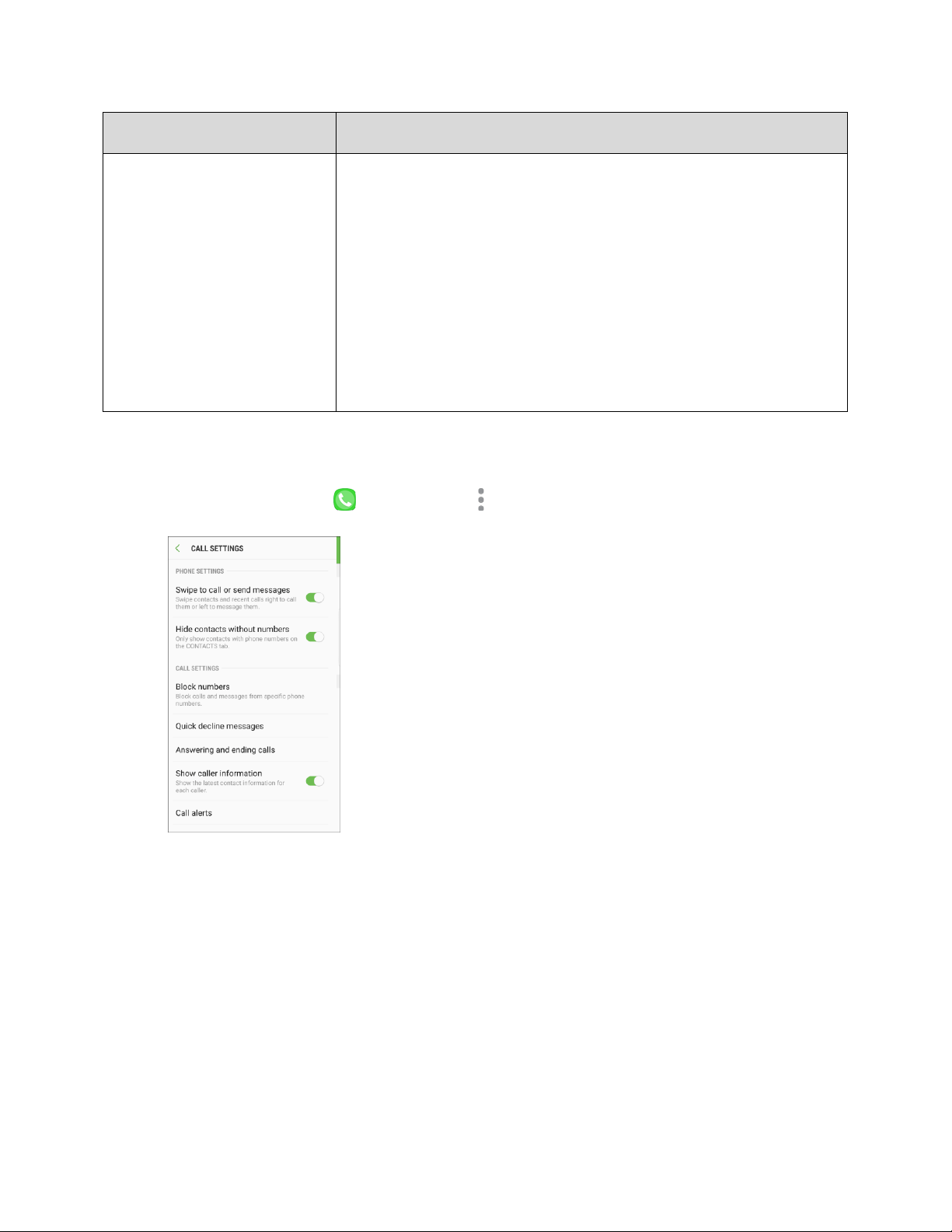
Phone App 68
Setting
Description
Voicemail settings
●
Avatar: Configure your Avatar settings.
●
Display: Configure your display name.
●
Help/Info: View application help topics.
●
Preferences: Change applications preferences.
●
Sound: Change sound/speakerphone options.
●
Updates: Check for software update.
●
About Voicemail: View software information about this app.
Use the Call Settings Menu
1. From home, tap Phone > More options > Settings.
The call settings menu appears.
2. Configure your options.
Tap a menu item to display its options.
Select your options and follow the prompts to set them.
Your call settings options are set.

Phone App 69
TTY Mode
A TTY (teletypewriter, also known as a TDD or Text Telephone) is a telecommunications device that
allows people who are deaf, hard of hearing, or who have speech or language disabilities, to
communicate by telephone.
Your phone is compatible with select TTY devices. Please check with the manufacturer of your TTY
device to ensure that it supports digital wireless transmission. Your phone and TTY device will connect
using a special cable that plugs into your phone’s headset jack. If this cable was not provided with your
TTY device, contact your TTY device manufacturer to purchase the connector cable.
To turn TTY Mode on or off:
1. From home, tap Phone > More options > Settings.
2. Tap More settings > TTY mode.
3.
Tap TTY Full, TTY HCO, or TTY VCO to turn TTY mode on.
– or –
Tap TTY Off to turn TTY mode off.
Your phone’s TTY mode is set.
Note: When enabled, TTY mode may impair the audio quality of non-TTY devices connected to the
headset jack.
Warning: 9-1-1 Emergency Calling
It is recommended that TTY users make emergency calls by other means, including Telecommunications
Relay Services (TRS), analog cellular, and landline communications. Wireless TTY calls to 9-1-1 may be
corrupted when received by public safety answering points (PSAPs), rendering some communications
unintelligible. The problem encountered appears related to TTY equipment or software used by PSAPs.
This matter has been brought to the attention of the FCC, and the wireless industry and the PSAP
community are currently working to resolve this.
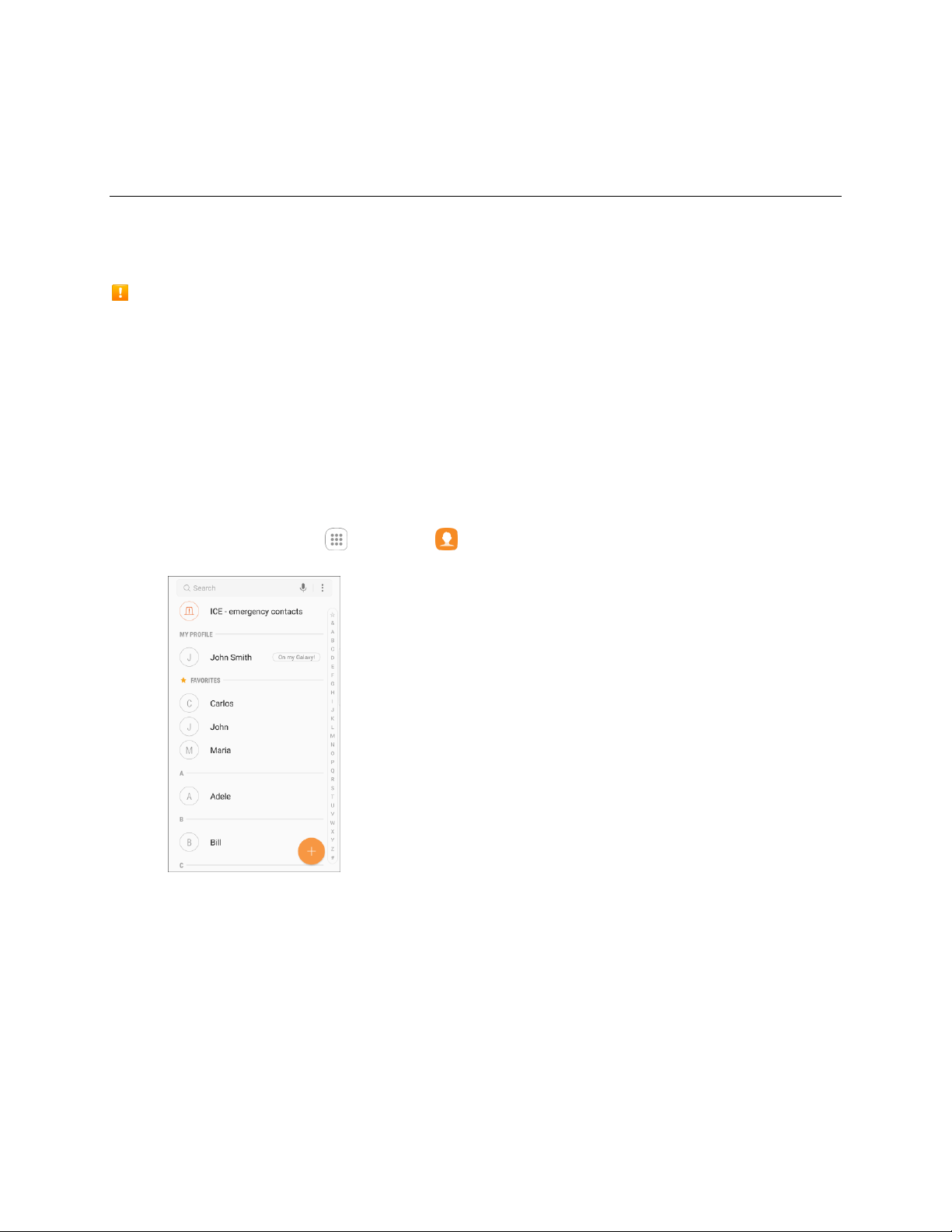
Contacts 70
Contacts
The Contacts application lets you store and manage contacts from a variety of sources, including
contacts you enter and save directly in your phone as well as contacts synchronized with your Google
Account, your PC, compatible email programs (including Exchange Server), and your Facebook friends.
Contacts Cautions
Information saved in Contacts may be lost or changed if the battery is removed for a long period or
left uncharged. Accident or malfunction may also cause loss or change to information. It is
recommended that you keep a separate copy of contacts and other important information. Sprint is
not responsible for any damages from lost or changed contacts.
Add a Contact
You can add contacts from the Contacts application. Enter details such as name, phone numbers, email
addresses, mailing addresses, and more.
1. From home, tap Apps > Contacts .
You will see the Contacts list.
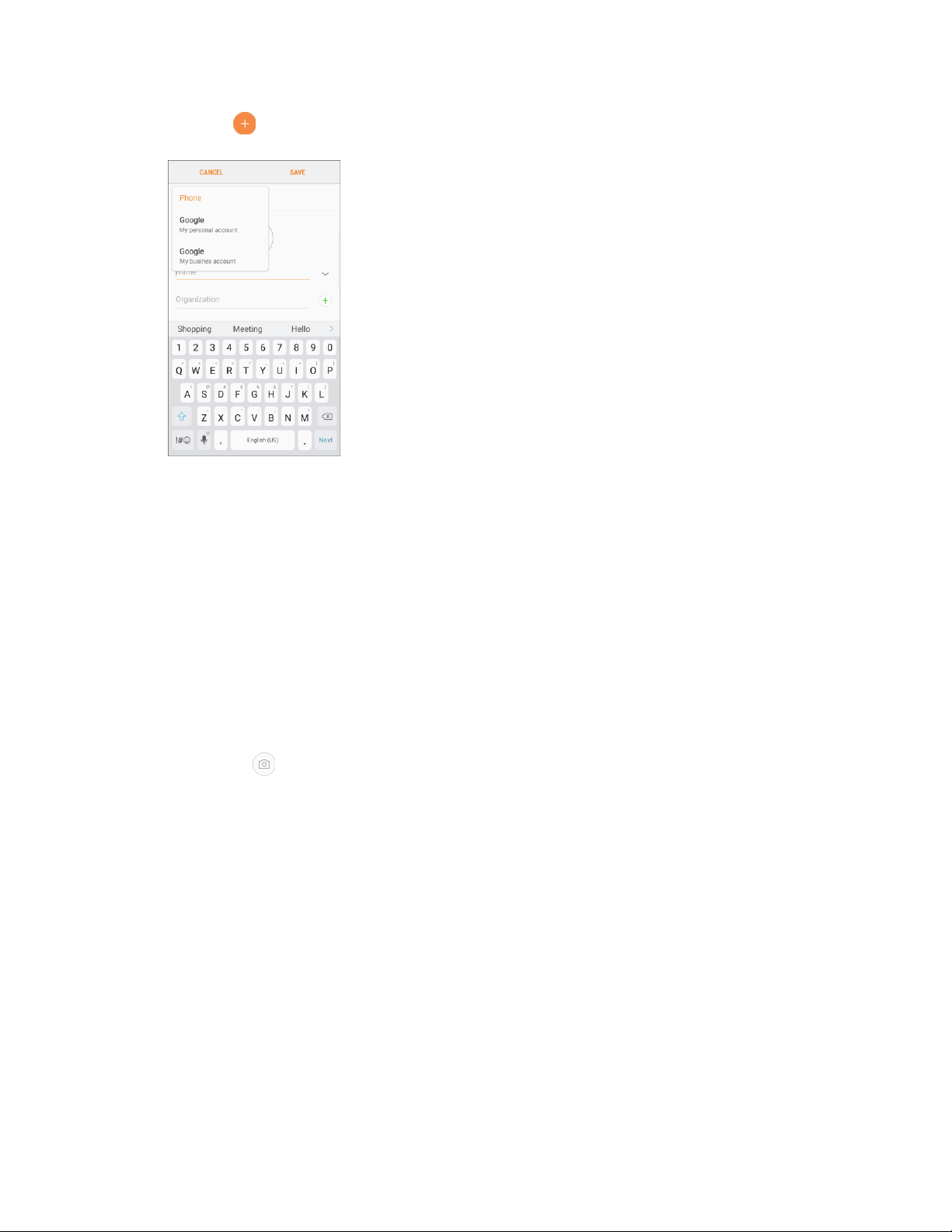
Contacts 71
2. Tap Add to add a contact.
The Add Contact screen appears.
3. If you have multiple account types associated with your phone, select a contact type.
Select Google if you want to save contacts to your Google Account; these will be synced
automatically with your Google Account online.
Select Phone as the sync account if you want your contacts on your phone only; they will not
be synced with your Google Account.
Select Samsung account if you want to save contacts to your Samsung account; these will
be synced automatically with your Samsung account online.
4. Use the keyboard to enter as much information as you want.
Picture : Tap the picture icon to assign a picture to the contact.
Name: Enter the name of the contact.
Organization: Enter organization information for the contact.
Phone: Enter the phone number for the contact.
Email: Enter email addresses for the contact.
Groups: Assign the contact to a group.
View more: Show additional fields such as Address, Web address, Events, Notes, etc.
Scan business card: Take a picture of a business card to add the information for the
contact.
Note: To select a type (label) for a phone number, email address, or postal address (such as Mobile,
Home, Work, etc.), tap the type to the right of the field and select the appropriate type.
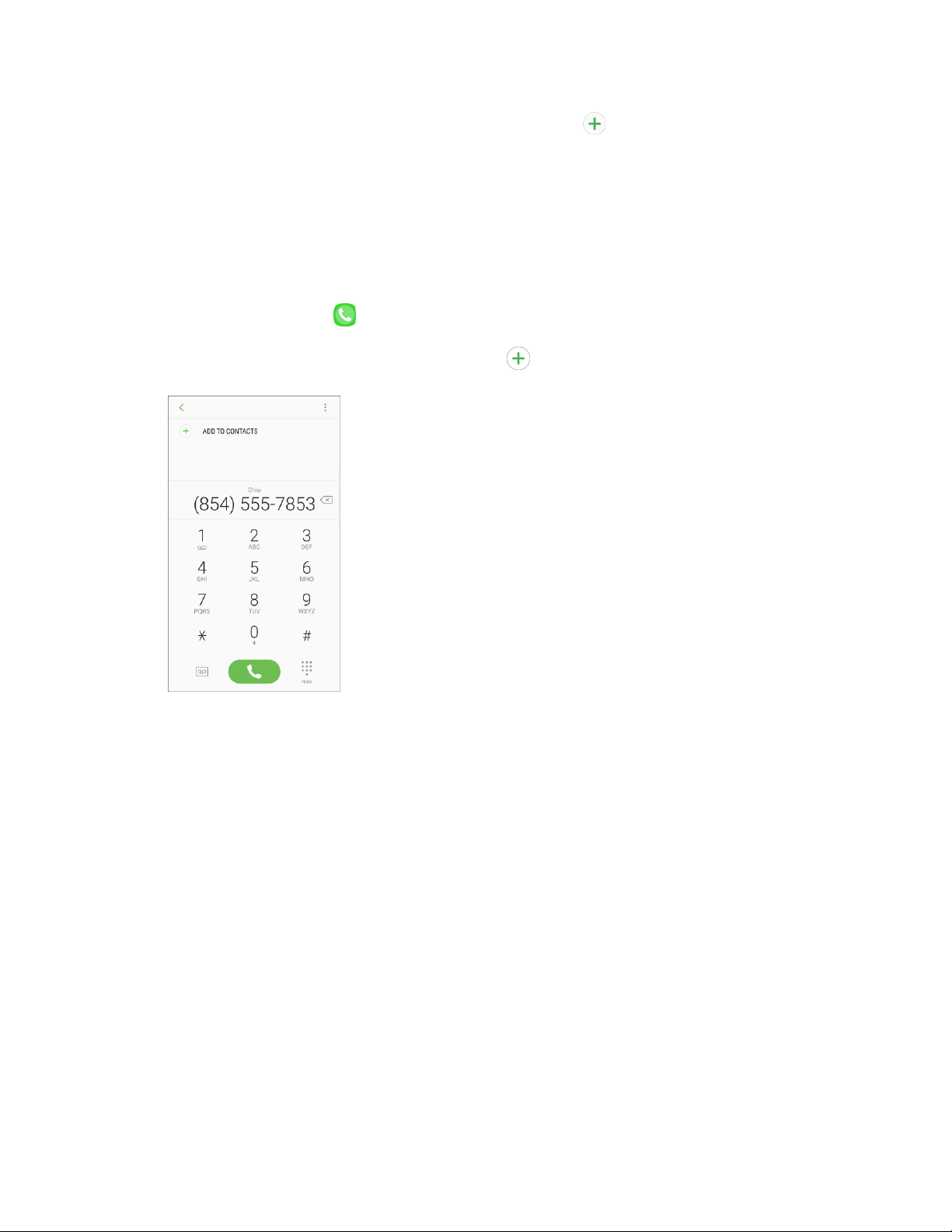
Contacts 72
Note: To add more phone numbers, email addresses, etc., tap Add on the right side of the entry field.
5. When you have finished adding information, tap Save.
The contact is added.
Save a Phone Number
You can save a phone number to Contacts directly from the phone keypad.
1. From home, tap Phone .
2. Enter a phone number and tap Add to Contacts .
3. To add the number to an existing contact, tap Update existing. To add a new contact, tap
Create contact.
For an existing contact, tap the contact name and select a number type for the new number.
For a new contact, enter the name and any additional information.
4. Tap Save.
The contact is added.
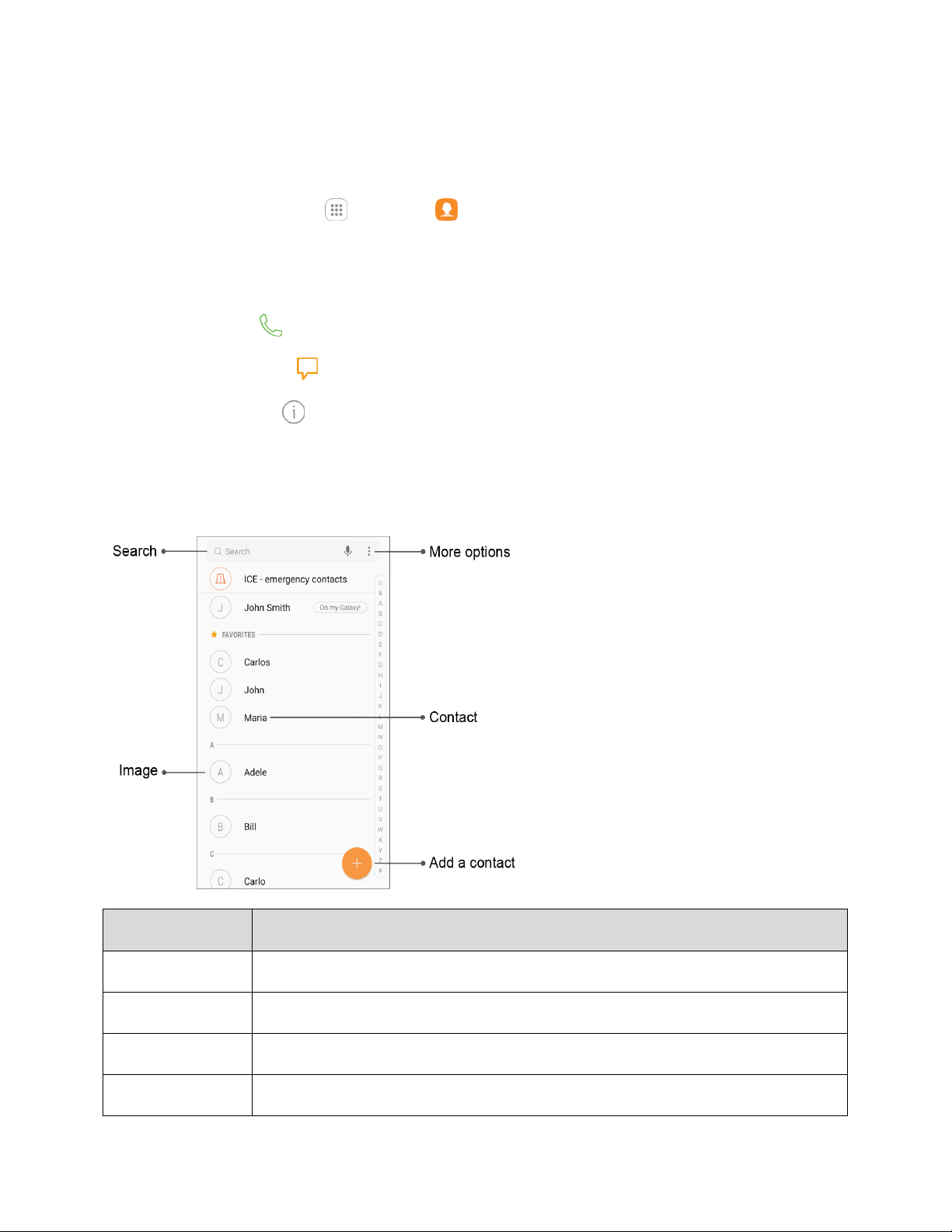
Contacts 73
View Contacts
View a contact’s details by displaying a contact entry.
1. From home, tap Apps > Contacts .
You will see the Contacts list.
2. Tap a contact to view quick options.
Tap Call to dial the contact’s default phone number.
Tap Message to send the contact a message.
Tap Details to view more information about the contact.
Contacts Screen Layout
The following illustration show’s your Contacts app layout and describes the various features.
Item
Description
More options
Access additional options.
Contact
Tap to view quick options.
Add a contact
Add a new contact.
Image
Tap to show the contact’s details.
Contacts 74
Item
Description
Search
Search contacts.
Edit a Contact
Once you have added a contact, you can add or edit any of the information in the entry, assign a caller ID
picture, customize with a unique ringtone, and more.
1. From home, tap Apps > Contacts .
You will see the Contacts list.
2. Tap a contact to view quick options.
3. Tap Details > Edit.
4. Tap any field you want to change or add. See Add a Contact.
5. Tap Save.
Your changes are saved to the contact entry.
Delete a Contact
You can delete a contact from the contacts details page.
1. From home, tap Apps > Contacts .
You will see the Contacts list.
2. Touch and hold a contact to select it.
You can also tap other contacts or tap the All checkbox at the top of the screen to select all
contacts.
3. Tap Delete, and then confirm when prompted.
The contact is deleted.
Contacts 75
Favorites
The Favorites tab is a listing that can help you quickly access your most used or preferred Contacts
entries.
Mark Contacts as Favorites
1. From home, tap Apps > Contacts .
2. Tap a contact to select it.
4. Tap Details .
5. Tap Add to Favorites (the star brightens ).
Remove Contacts from Favorites
1. From home, tap Apps > Phone > Favorites.
2. Tap a contact to select it.
3. Tap Details .
4. Tap Remove from Favorites (the star dims ).
Make a Call from Favorites
1. From home, tap Apps > Phone > Favorites.
2. Tap a favorite contact to view quick options.
3. Tap Call to dial the contact’s default phone number.
Groups
You can use groups to organize your contacts. Your phone comes with preloaded groups, and you can
create your own. You might create a group for your family, for coworkers, or a team. Groups make it easy
to find contacts, and you can send messages to the members of a group.
Create a Group
1. From home, tap Apps > Contacts .
2. Tap More options > Groups, and then tap Create.

Contacts 76
3. Tap fields to enter information about the group:
Tap Device storage and all accounts to choose where to save the group. You can save it to
a specific account, to the device memory, or to all accounts.
Tap Group name to enter a name for the new group.
Tap Group ringtone to select a ringtone for notifications for incoming calls from group
members.
4. Tap Add member and select a member or members to add to the new group, and then tap
Done.
5. Tap Save to save the new group.
Add Contacts to a Group
1. From home, tap Apps > Contacts .
2. Tap More options > Groups, and then tap a group.
3. Tap Edit > Add member and select a member or members to add to the new group, and then
tap Done.
4. Tap Save.
Send a Message to a Group
You can send a message to members of a group, if the members have a telephone number stored in their
contact record.
A message to multiple recipients is treated as a group conversation.
1. From home, tap Apps > Contacts .
2. Tap More options > Groups, and then tap a group.
3. Tap More options > Send message.
4. Tap Recipients to edit the group’s members receiving the message.
5. Continue to enter your message and send it. For more information, see Text and Multimedia
Messaging.

Contacts 77
Send an Email to a Group
You can send an email to members of a group, if the members have an email address stored in their
contact record.
1. From home, tap Apps > Contacts .
2. Tap More options > Groups, and then tap a group.
3. Tap More options > Send email.
4. Tap the check boxes next to the members you want to include in the email, or tap the All check
box to send the email to all members, and then tap Done.
5. Continue to choose an email account, or Gmail, and then enter your email and send it. For more
information, see Create and Send an Email Message or Create and Send a Gmail Message.
Delete a Group
You can delete any group you created. When removing a group, you will have the option to also remove
any members of the group from your accounts.
1. From home, tap Apps > Contacts > Groups.
2. Tap More options > Groups, and then tap a group.
3. Tap More options > Delete, and then tap Group only to delete only the group, or Group and
members to delete the group and all of its members.
Share a Contact
You can quickly share contacts using Bluetooth, email, Gmail, or text messaging.
1. From home, tap Apps > Contacts .
2. Tap a contact to select it.
3. Tap Details .
4. Tap Share.
Tap vCard file (VCF) to share the contact as a vCard file, or tap Text to share the contact
information in a text file.
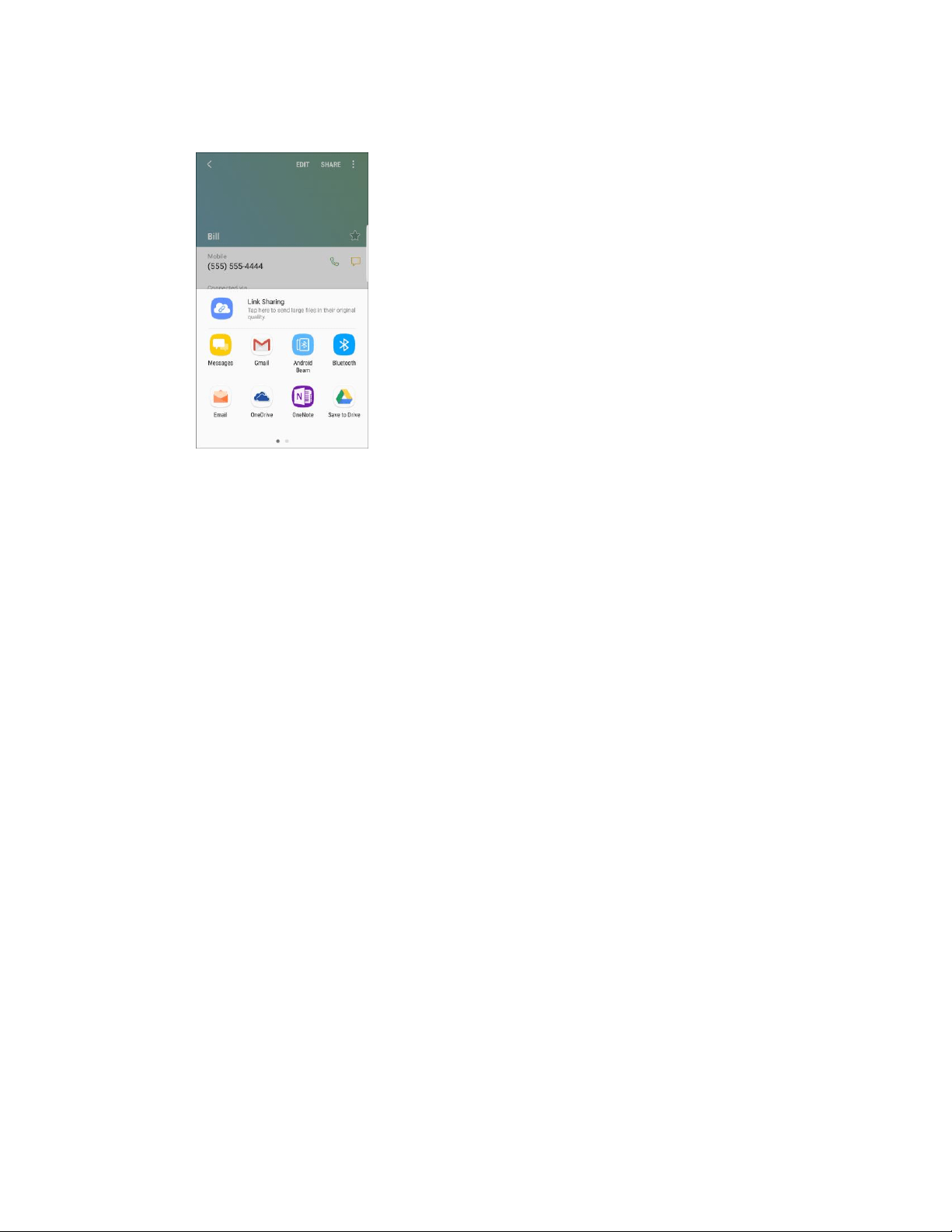
Contacts 78
Select a sharing method:
When sharing a contact as a.vcf file, the following sharing methods are available:
• Android Beam: Send the information using NFC and Android Beam.
• Bluetooth: Send the information using Bluetooth. See Bluetooth for information on
pairing and sending using Bluetooth.
• Email: Send the information as an email attachment. If prompted, select an email
account. Address the message, add a subject and a message, and then tap Send. See
Create and Send an Email Message for details on sending email.
• Gmail: Send the information as a Gmail attachment. Address the message, add a subject
and a message, and then tap Send. See Create and Send a Gmail Message for details.
• Link sharing: Send large files to others, even to people who are not in your Contacts
(vCard only).
• Messages: Send the information in a text message. Select a contact or enter a wireless
phone number or email address, enter any additional information, and then tap Send. For
more information on text messaging, see Send a Multimedia Message (MMS).
• OneDrive: Save the information to your OneDrive account.
• OneNote: Save the contact to your OneNote account.
• Save to Drive: Save the information to your Google Drive
™
account.
• Wi-Fi Direct: Send the information to another device using Wi-Fi Direct. See Wi-Fi Direct.
When sharing a contact as a text file, the follow sharing methods are available:
• Android Beam: Send the information using NFC and Android Beam.
• Bluetooth: Send the information using Bluetooth. See Bluetooth for information on
pairing and sending using Bluetooth.

Contacts 79
• Copy to clipboard: Save the information to the clipboard.
• Email: Send the information as an email attachment. If prompted, select an email
account. Address the message, add a subject and a message, and then tap Send. See
Create and Send an Email Message for details on sending email.
• Gmail: Send the information as a Gmail attachment. Address the message, add a subject
and a message, and then tap Send. See Create and Send a Gmail Message for details.
• Google+: Save the contact to your Google+
™
account.
• Hangouts: Save the contact to your Hangouts account.
• Memo: Save the contact as a note in Memo.
• Messages: Send the information in a text message. Select a contact or enter a wireless
phone number or email address, enter any additional information, and then tap Send. For
more information on text messaging, see Send a Multimedia Message (MMS).
• OneDrive: Save the information to your OneDrive account.
• OneNote: Save the contact to your OneNote account.
• Save to Drive: Save the information to your Google Drive account.
• Wi-Fi Direct: Send the information to another device using Wi-Fi Direct. See Wi-Fi Direct.
5. Complete the required steps as prompted for the selected method.
The selected contact will be shared.
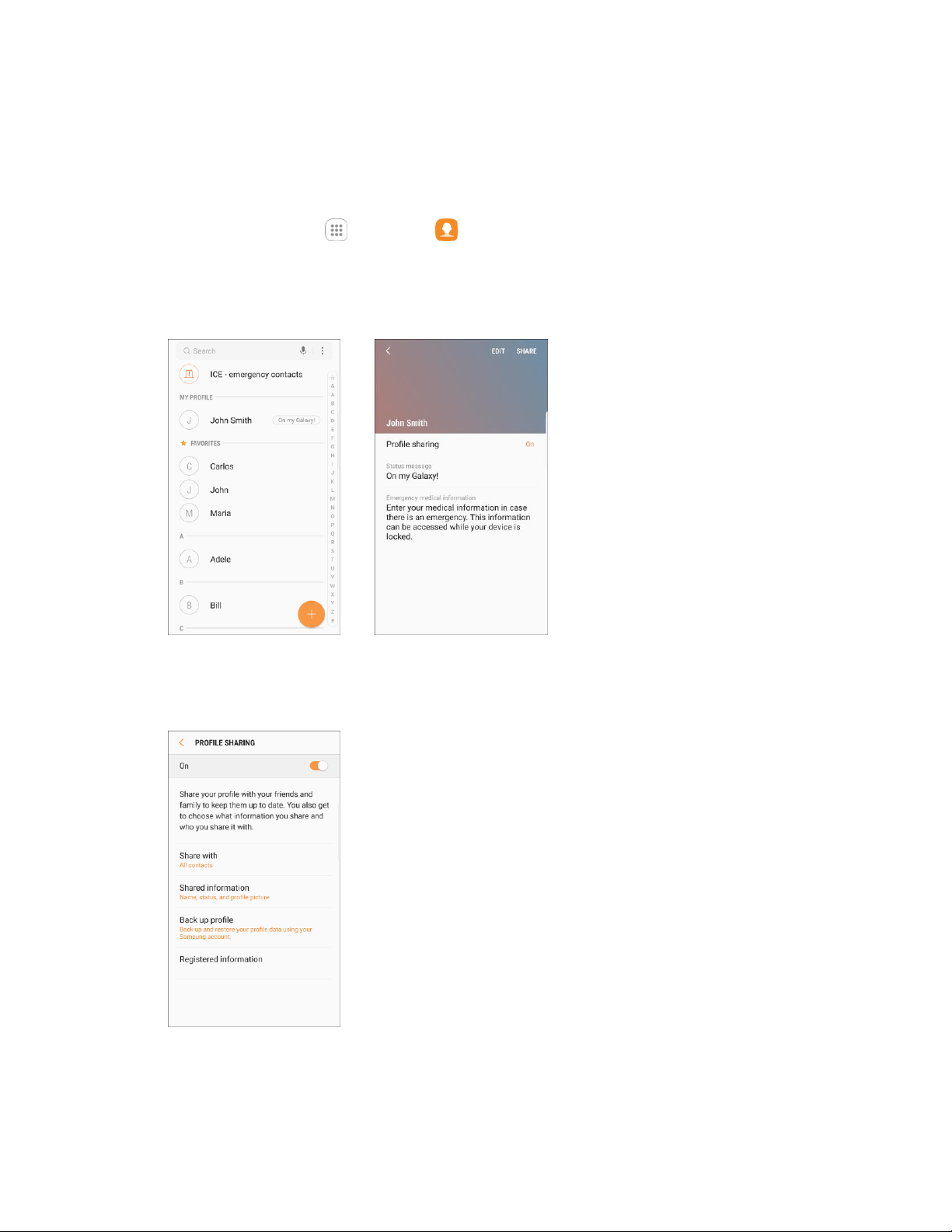
Contacts 80
Profile Sharing
Share your profile information with your contacts. You can select which contacts you want to share it with,
as well as select additional information you want to share.
1. From home, tap Apps > Contacts .
You will see the Contacts list.
2. Tap your profile under My profile.
Your profile displays.
3.
Tap Profile sharing, and then tap On/Off to enable the feature.
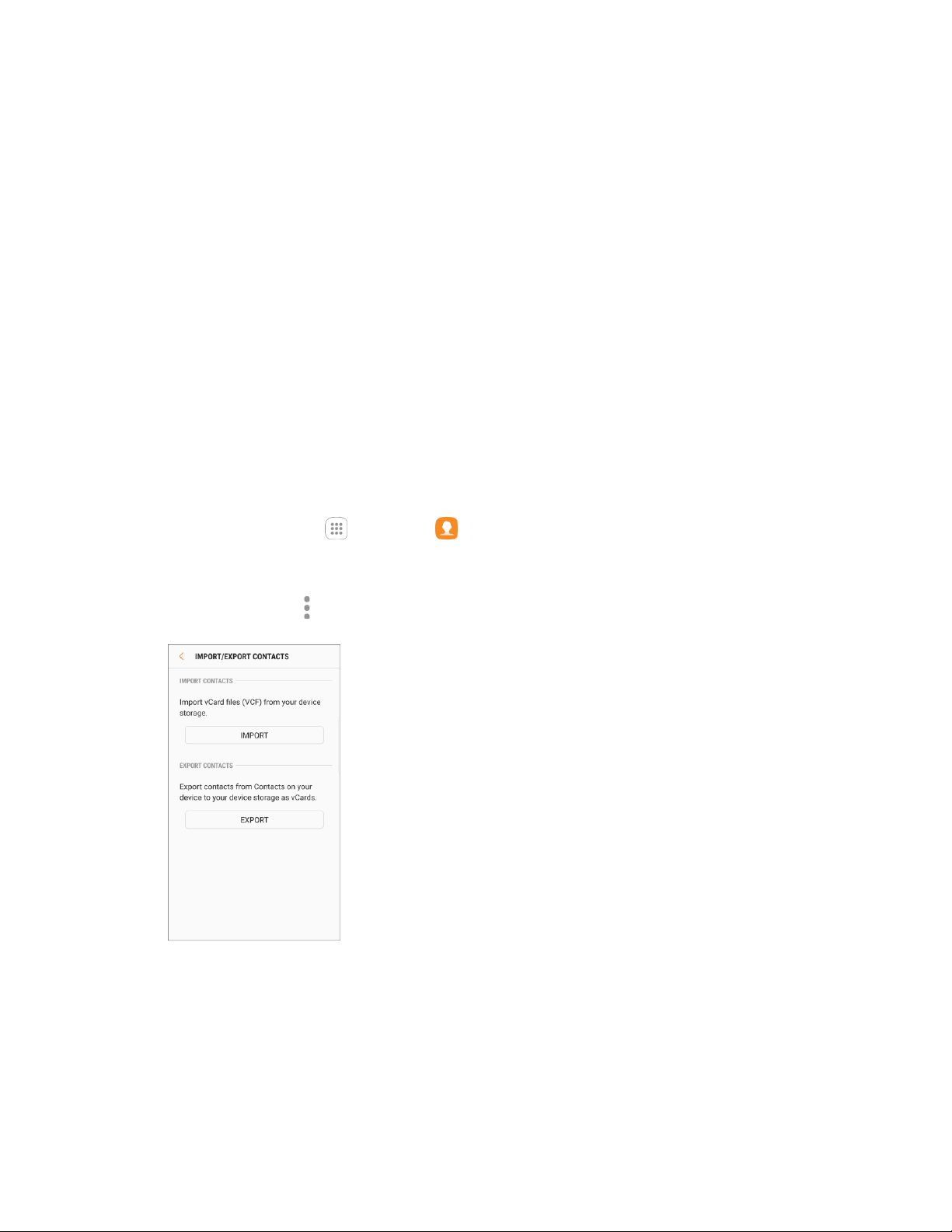
Contacts 81
4. Set Profile sharing options:
Share with: Share your profile with the public, all contacts, your favorite contacts, or selected
contacts.
Shared information: In addition to your name, status, and profile picture, you can share your
email, organization, address, and date of birth.
Back up profile: Back up and restore your profile using your Samsung account.
Registered information: View and set the registered information for your phone number.
Note: The first time you turn on Profile sharing, you may be prompted to agree to the Enhanced features
Terms and Conditions and Privacy Policy. Review the terms and tap Agree to continue.
Import Contacts
Your phone offers a couple of options for importing contacts from external devices using USB.
Import Contacts from USB Storage
1. From home, tap Apps > Contacts .
You will see the Contacts list.
2. Tap More options > Settings > Import/Export contacts.
You will see the Import/Export contacts menu.
3. Tap Import and follow the prompts to complete the import.
The contacts are imported and stored in the selected account.
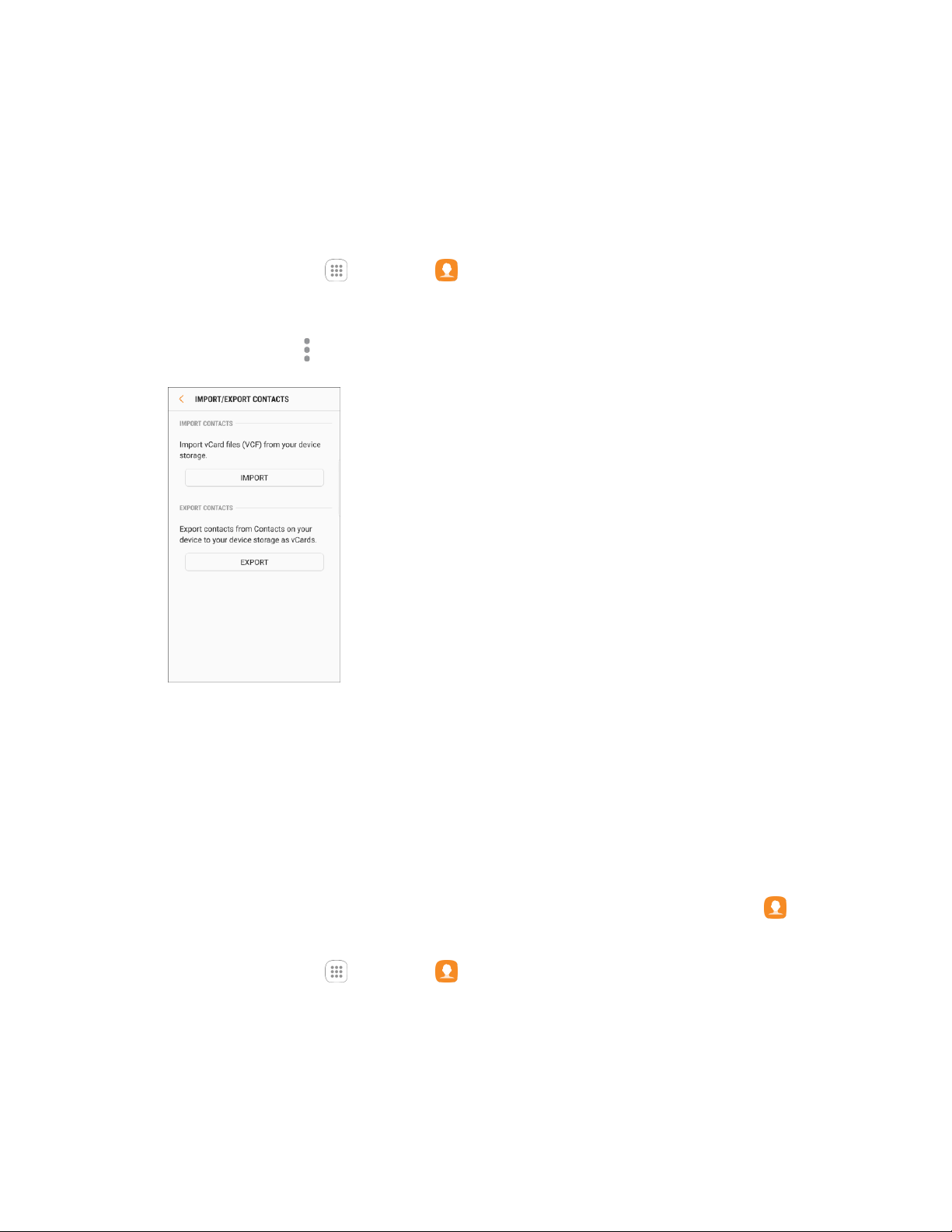
Contacts 82
Back Up Contacts
If you are saving contacts to an account that does not automatically back them up to the Cloud, you can
manually back them up to your device for re-import if needed.
Back Up Contacts to Your Device
1. From home, tap Apps > Contacts .
You will see the Contacts list.
2. Tap More options > Settings > Import/Export contacts.
You will see the Import/Export contacts menu.
3. Tap Export and follow the prompts to complete the export.
The contacts are exported.
Contacts Settings
Configure options for contacts stored on your phone.
Tip: You can also access Contacts Settings from the Contacts app. From home, tap Contacts >
More > Settings.
1. From home, tap Apps > Contacts .
You will see the Contacts list.

Contacts 83
2. Tap More options > Settings to configure options:
Import/Export contacts: Import contacts from device memory.
Merge duplicate contacts: Merge duplicate contact entries into one contact.
Move device contacts to: Move contacts saved on your device to your Google or Samsung
accounts.
Contacts to display: Choose contacts to display in Contacts. You can choose only contacts
from your phone’s memory, or from an account, or choose other sources. You can also
create a customized list of contacts to display.
Sort by: Choose how contacts are sorted, by first or last name.
Name format: Choose how contacts are displayed, by first or last name.
Show Frequently contacted: Show frequently contacted contacts at the beginning of the
contact list.
Share multiple contacts: You can choose how to transfer contacts, when sharing them with
other devices, such as using Bluetooth.
• As one file: Multiple contacts are sent together. This method can be faster, but depends
on whether the target device can accept multiple name cards. If not, only one contact will
be sent.
• Individually: Name cards are sent individually. This method may take longer, because
the other device must accept each name card individually, but it helps ensure that no
name cards are missed.

Messaging and Internet 84
Messaging and Internet
With wireless service and your phone’s messaging capabilities, you have the opportunity to share
information through many different channels and accounts, including Gmail (Google), personal and
corporate email, and text and multimedia messaging.
Text and Multimedia Messaging
With text messaging (SMS), you can send and receive instant text messages between your wireless
phone and another messaging-ready phone.
Multimedia messages, or MMS, can contain text and pictures, recorded voice, audio or video files, picture
slideshows, contact cards (vCard), or appointments (vCalendar).
See your service plan for applicable charges for messaging.
Send a Text Message
Quickly compose and send text messages on your phone.
1. From home, tap Apps > Messages .
2. On the Messaging screen, tap Compose .
3. Fill in one or more recipients. You can:
4. To add recipients, you can:
Enter phone numbers directly in the Recipient field. If you are sending the message to
several phone numbers, separate the phone numbers with a comma. As you enter
information, any matching phone numbers from your contacts list are displayed. Tap a match
to enter that number or address directly.
Tap Add from Contacts, and then select the contacts to whom you want to send the
message. You can also select contact groups as recipients. When you have selected all the
message recipients, tap Compose.
5. Tap the Enter message field and then start composing your message.
When done, tap Send to send the text message.
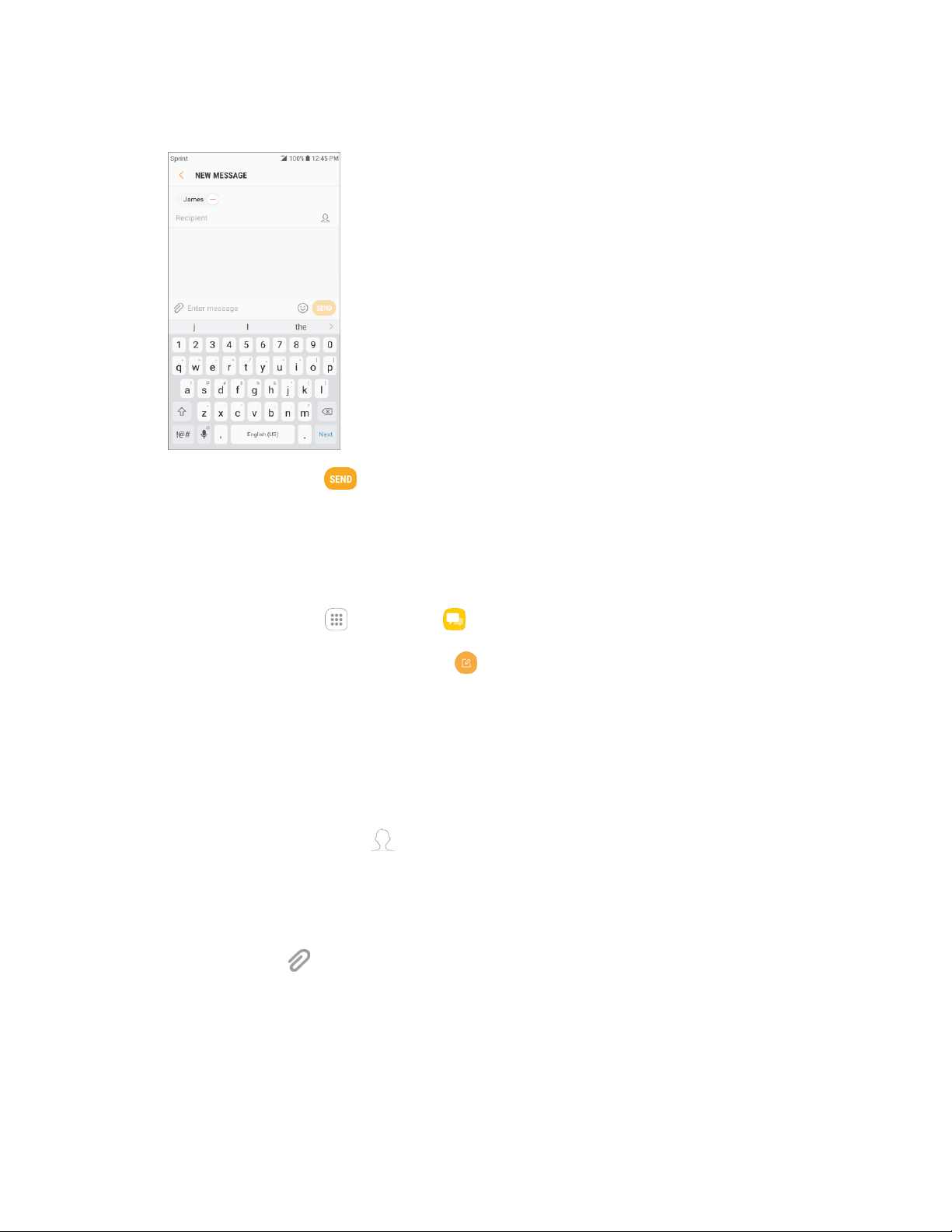
Messaging and Internet 85
6. Tap the Enter message field and then start composing your message.
7. When done, tap Send to send the text message.
Send a Multimedia Message (MMS)
When you need to add a little more to a text message, you can send a multimedia message (MMS) with
pictures, voice recordings, audio or video files, contact cards (vCard), or appointments (vCalendar).
1. From home, tap Apps > Messages .
2. On the Messaging screen, tap Compose . The Compose screen opens.
3. To add recipients, you can:
Enter phone numbers directly in the Recipient field. If you are sending the message to
several phone numbers, separate the phone numbers with a comma. As you enter
information, any matching phone numbers from your contacts list are displayed. Tap a match
to enter that number or address directly.
Tap Add from Contacts , and then select the contacts to whom you want to send the
message. You can also select contact groups as recipients. When you have selected all the
message recipients, tap Compose.
4. Tap the Enter message field, and then start composing your message.
5. Tap Attachment .
6. In the Attach window, select from the following file attachments:
Camera: Take a new picture.
Gallery: Attach a picture from the Gallery app.

Messaging and Internet 86
Other: Select from the following sources:
• Image: Attach a stored picture. See View Pictures and Videos Using Gallery.
• Video: Attach a stored video. See View Pictures and Videos Using Gallery.
• Audio: Attach a stored music file or voice recording.
• Voice record: Make a voice recording and attach it.
• Memo: Attach a Memo. See Memo.
• Calendar: Select the calendar event you want to attach. See Calendar.
• Location: Add your current location (requires GPS to be turned on) or a location you pick
on a map to your message. See Google Maps.
• Contacts: Select a contact from your phone, and then select which contact information
you want to attach. See Contacts.
• Cloud server: Attach a file from your OneDrive account.
7. Tap Send to send the MMS message.
Create a Slideshow
In a multimedia message, you can add slides, each containing a picture, video, or audio.
1. In the multimedia message you are composing, tap Menu > Create slideshow to add space
for a new slide.
2. Tap the space for the slide.
3. To compose your slideshow, do any of the following:
Add a picture: Tap Attachment > Other > Image and select a picture.
Add a video: Tap Attachment > Other > Video and select a video. (You cannot add
both a picture and a video on the same slide.)
Add music or a voice recording: Tap Attachment > Other > Audio and select a file.
Add a new slide: Tap Menu > Add slide.
Preview your slideshow: Tap Menu > Preview.
For more options, tap Menu and select an option.
4. When you have completed creating the slideshow, tap Done to return to the new message page
to complete your message.
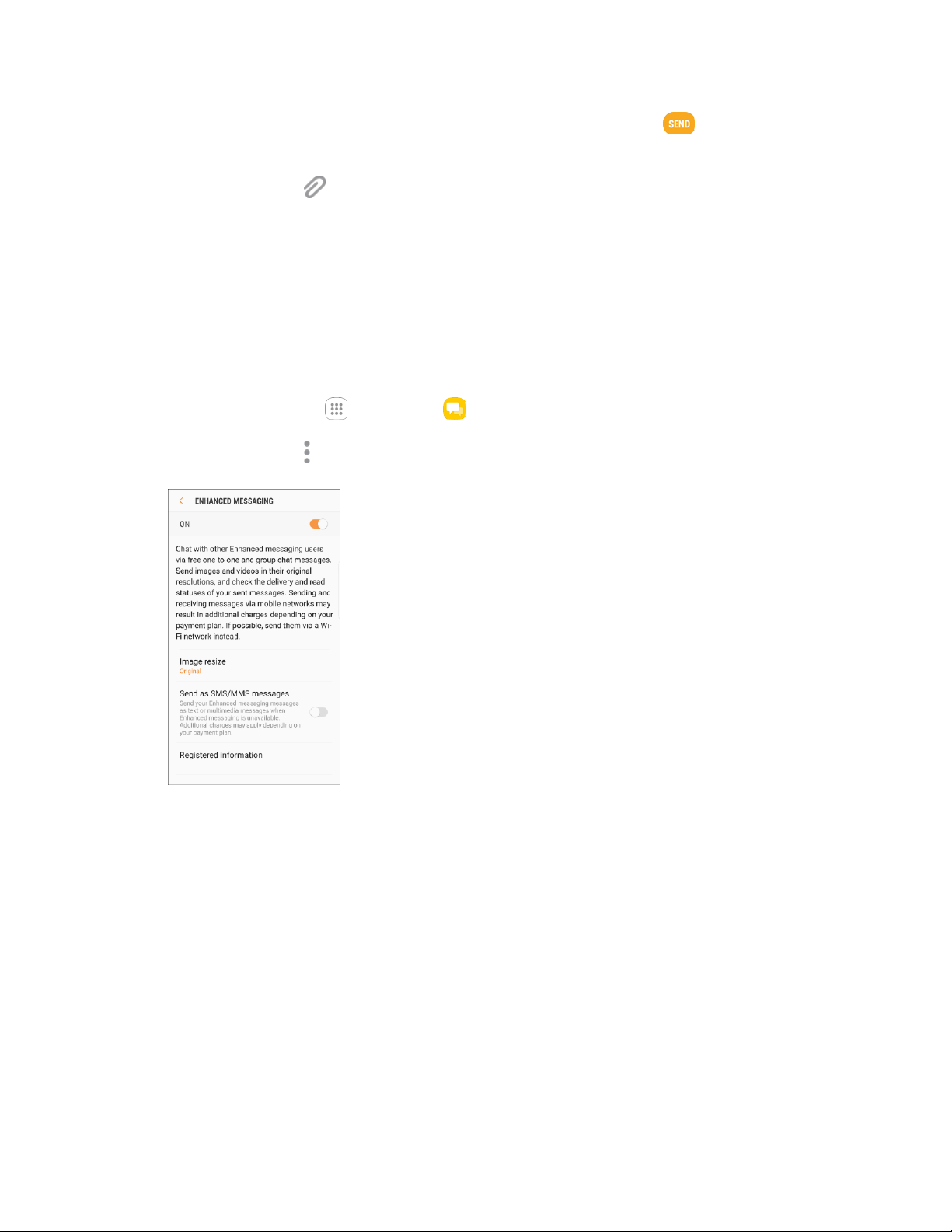
Messaging and Internet 87
5. When you have finished composing the multimedia message, tap Send .
Tip: To compose a slide show, you can also simply attach multiple items separately to the MMS
message. Tap Attachment and select a file type, location, and file and then repeat it for additional
slides. Your phone will automatically compile a slide show.
Use Enhanced Messaging
Enhanced messaging allows you to exchange multimedia chat messages with pictures, voice recordings,
audio or video files, contact cards (vCard), appointments (vCalendar), as well as large files to other
phones which support Enhanced messages.
Enable Enhanced Messaging
1. From home, tap Apps > Messages .
2. Tap More options > Settings > Enhanced messaging.
3. Tap On/Off to enable Enhance messaging.
4. Set options:
Image resize: Set the standard size of images sent with Enhanced messages.
Send as SMS/MMS messages: Send your Enhanced messaging messages as text or
multimedia messages when Enhanced messaging is unavailable.
Registered information: View and set the registered information for your phone number.
Note: The first time you turn on Enhanced messaging, you may be prompted to agree to the Enhanced
features Terms and Conditions and Privacy Policy. Review the terms and tap Agree to continue.
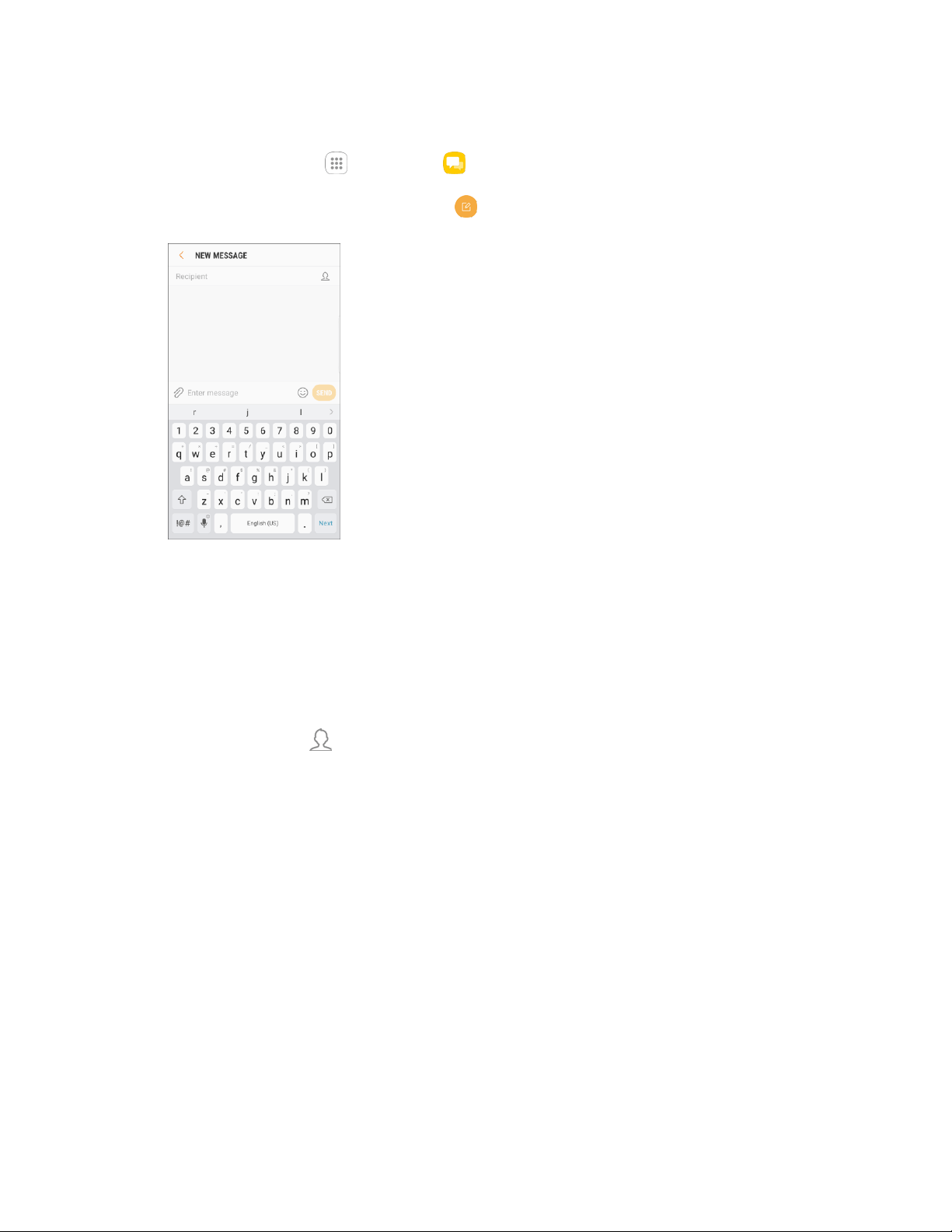
Messaging and Internet 88
Send an Enhanced Message
1. From home, tap Apps > Messages .
2. On the Messaging screen, tap Compose .
The Compose screen opens.
3. Fill in one or more recipients. You can:
Enter phone numbers directly in the Enter recipients field. If you are sending the message to
several phone numbers, separate the phone numbers with a comma. As you enter
information, any matching phone numbers from your Contacts list are displayed. Tap a match
to enter that number or address directly.
Tap Recipients , and then select the contacts to whom you want to send the message.
You can also select contact groups as recipients. When you have selected all the message
recipients, tap Done.
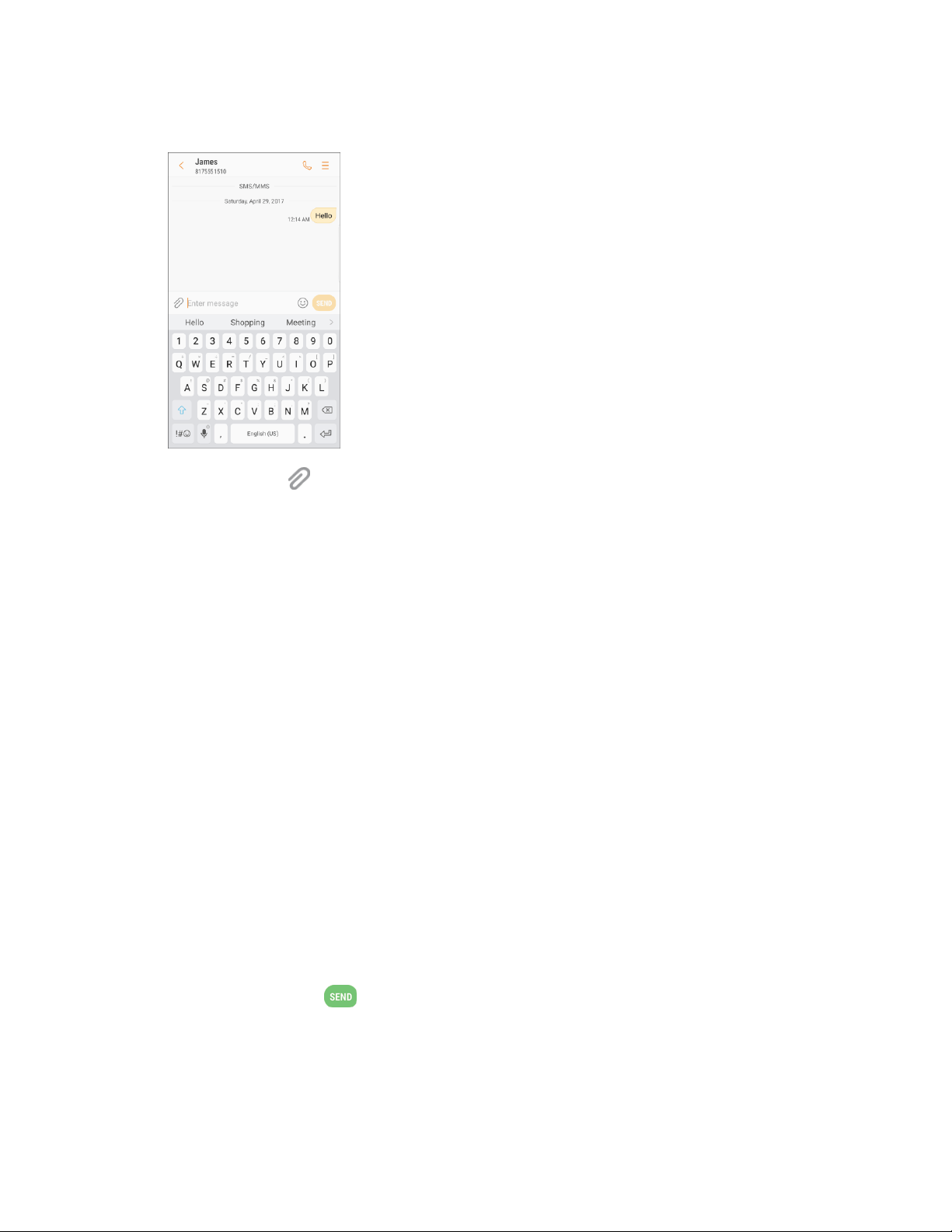
Messaging and Internet 89
4. Tap the Enter message field, and then start composing your message.
5. Tap Attachment and select from the following file attachments:
Camera: Take a new picture.
Gallery: Attach a picture from the Gallery app.
Other: select from the following sources:
• Image: Attach a stored picture. See View Pictures and Videos Using Gallery.
• Video: Attach a stored video. See View Pictures and Videos Using Gallery.
• Audio: Attach a stored music file or voice recording.
• Record audio: Make a voice recording and attach it.
• Memo: Attach a Memo. See Memo.
• Calendar: Select the calendar event you want to attach. See Calendar.
• Location: Add your current location (requires GPS to be turned on) or a location you pick
on a map to your message. See Google Maps.
• Contacts: Select a contact from your phone, and then select which contact information
you want to attach. See Contacts.
• Cloud server: Attach a file from your OneDrive account.
6. When done, tap Send to send the enhanced message.

Messaging and Internet 90
Save and Resume a Draft Message
While composing a text or multimedia message, tap Back to automatically save your message as a
draft.
To resume composing the message:
1. From home, tap Apps > Messages .
2. Tap the message to resume editing it.
3. When you finish editing the message, tap Send .
New Messages Notification
Depending on your notification settings, the phone will play a ringtone, vibrate, or display the message
briefly in the status bar when you receive a new text or multimedia message. To change the notification
for new text and multimedia messages, see Messages Settings for details.
New message also appears in the notifications area of the status bar to notify you of a new text or
multimedia message. The Messages app shortcut (if shown on the home screen) also displays the
number of new messages.
■ To open the message, pull down the status bar to open the notification panel. Tap the new
message to open and read it. For more information on reading and replying to messages see
Manage Message Conversations.
Manage Message Conversations
Text and multimedia messages that are sent to and received from a contact (or a number) are grouped
into conversations or message threads in the Messaging screen. Text or MMS conversations let you see
exchanged messages (similar to a chat program) with a contact on the screen.
Read a Text Message
■ Do one of the following:
On the Messaging screen, tap the text message or conversation to open and read it.
If you have a new message notification, pull down the status bar to open the notification
panel. Tap the new message to open and read it.
To return to the Messaging screen from a conversation, tap Back .
Note: If a message contains a link to a Web page, tap the message and then tap the link to open it in the
Web browser.
Note: If a message contains a phone number, tap the message and then tap the phone number to dial
the number or add it to your contacts.

Messaging and Internet 91
View a Multimedia Message (MMS)
1. From home, tap Apps > Messages .
2. On the Messaging screen, tap a multimedia message or conversation to open it.
3. Tap the attachment to open it.
If the attachment is a vCard contact, it is imported to your phone’s contacts list. For more
information, see Contacts.
If the attachment is a vCalendar file, you can choose the calendar where you want to save
the event. For information on using Calendar, see Calendar.
4. To save the attachment to device memory, touch and hold the attachment, and then tap Save
attachment on the options menu.
Note: When Auto retrieve in MMS settings is disabled, only the message header is downloaded. To
download the entire message, tap Download . For details, see Messages Settings.
Note: If you are concerned about the size of your data downloads, check the multimedia message size
before you download it.
Reply to a Message
1. From home, tap Apps > Messages .
2. On the Messaging screen, tap a conversation to open it.
3. Tap the text box at the bottom of the screen, enter your reply message, and then tap Send .
Note: To reply to a text message with a multimedia message, open the text message, tap More and then
tap More > Add subject, or Attach. The text message is automatically converted into a multimedia
message.
Protect (Lock) a Message
You can lock a message so that it will not be deleted even if you delete the other messages in the
conversation.
1. From home, tap Apps > Messages .
2. On the Messaging screen, tap a conversation.
3. Touch and hold the message that you want to lock.
4. Tap Lock on the options menu. A lock icon is displayed at the right hand side of the message.

Messaging and Internet 92
Delete Conversations
1. From home, tap Apps > Messages .
2. On the Messaging screen, tap More > Delete.
3. Select the conversations you want to delete.
4. Tap Delete and then tap Delete to confirm. Any locked messages will not be deleted.
Tip: You can also delete a conversation while you are viewing it. While viewing a conversation, tap More
> Delete, select messages to delete, and then tap Delete > Delete. Any locked messages in the
conversation will not be deleted unless you select the Include protected message check box.
Delete a Single Message
1. While viewing a conversation, touch and hold the message that you want to delete.
If the message is locked, touch and hold the message, and then tap Unlock. Touch and hold
the message to display the options menu again.
2. Tap Delete on the options menu.
3. When prompted to confirm, tap Delete.
View Contact Information from a Message
When you have received a message from someone in your stored contacts, you can tap the contact’s
picture or icon in the conversation to open a menu of options. Depending on the stored contact
information, you can view the contact details, place a phone call or send an email message to the
contact, and more.
Messages Settings
The messages settings menu lets you control options for your text and MMS messages including
message limits, size settings, and notifications.
1. From home, tap Apps > Messages .
2. Tap More options > Settings to configure settings:
Swipe to call or send messages: Make calls or send messages by swiping right or left
across an item in the Conversations or Contacts tabs.
Enhanced messaging: Send large files to other phones which support Enhanced messages.
Notifications: When turned on, notifications for new messages display in the status bar. Tap
On/Off to turn the setting on, and then configure options:
• Notification sound: Choose a sound to play for new message notifications.

Messaging and Internet 93
• Vibrations when sound plays: Choose whether vibration plays along with the sound for
new message notifications.
• Pop-up display: Choose whether a new message pops up on the display to notify you.
• Preview message: Show previews of new messages on the status bar and lock screens,
and in pop-ups.
Backgrounds: Choose backgrounds and bubble styles.
Quick responses: Create and manage text phrases that you can add to messages.
Block messages: Block messages by filtering based on criteria you set. Tap Block
messages, and then configure filters:
• Block numbers: Enter telephone numbers to automatically block.
• Block phrases: Enter text phrases to automatically block.
• Blocked messages: View blocked messages.
Font size: Set the font size for messages.
More settings > Text messages:
• Auto combination: Choose whether long messages that are received in multiple parts
are automatically re-assembled to display as a single message.
More settings > Multimedia messages:
• Group conversation: Control how messages to multiple recipients are handled. When
enabled, a single message is sent to multiple recipients. When disabled, a separate
message is sent to each recipient.
• Auto retrieve: Choose whether message attachment(s) are automatically downloaded
when you display a multimedia message. If you disable this option, only the message
header displays in the message list, and you will be prompted to download the
attachment(s).
• Roaming auto retrieve: Choose whether message attachment(s) are automatically
downloaded when your phone is outside its home network.
More settings > Delete old messages: Automatically delete the oldest messages when the
maximum number of text (1000) and multimedia (100) messages has been exceeded.
Emergency alert settings: Configure emergency alert settings. You can enable or disable
some alerts: Extreme Alert, Severe Alert, Amber Alert, and Emergency alert test messages.
You cannot disable Presidential alerts.
• Emergency alerts: Choose types of messages to receive. You can enable or display any
of the message types, except for Presidential Alert. You can also choose to receive
emergency alert test messages.

Messaging and Internet 94
Important: The Commercial Mobile Alert System (CMAS) system provides the government the ability to
send geographically targeted notifications of emergencies, such as threats to public safety, severe
weather events, a hazardous material spill or a missing child in the phone user’s area.
• Emergency notification preview: Play a sample emergency alert tone. Tap Stop to
cancel the playback.
• Vibrate when sound plays: Select vibration options for emergency message
notifications.
• Alert reminder: Configure the reminder interval.
Create and Send Gmail
Use Google’s Gmail service and your Google Account to send, receive, and manage your Gmail
messages. Before using Gmail, you must register a Google (Gmail) Account on your phone. See Google
Account for details.
Visit support.google.com/mail to learn more.
Gmail Cautions
Gmail is handled as email from a PC. Restricting email from PCs on your phone prevents your phone
from receiving Gmail.
Create and Send a Gmail Message
Use your phone to create and send Gmail messages.
1. From home, tap Apps > Google > Gmail .
The Gmail Inbox opens.
2. In the Inbox, tap Compose .
The Gmail composition window opens.
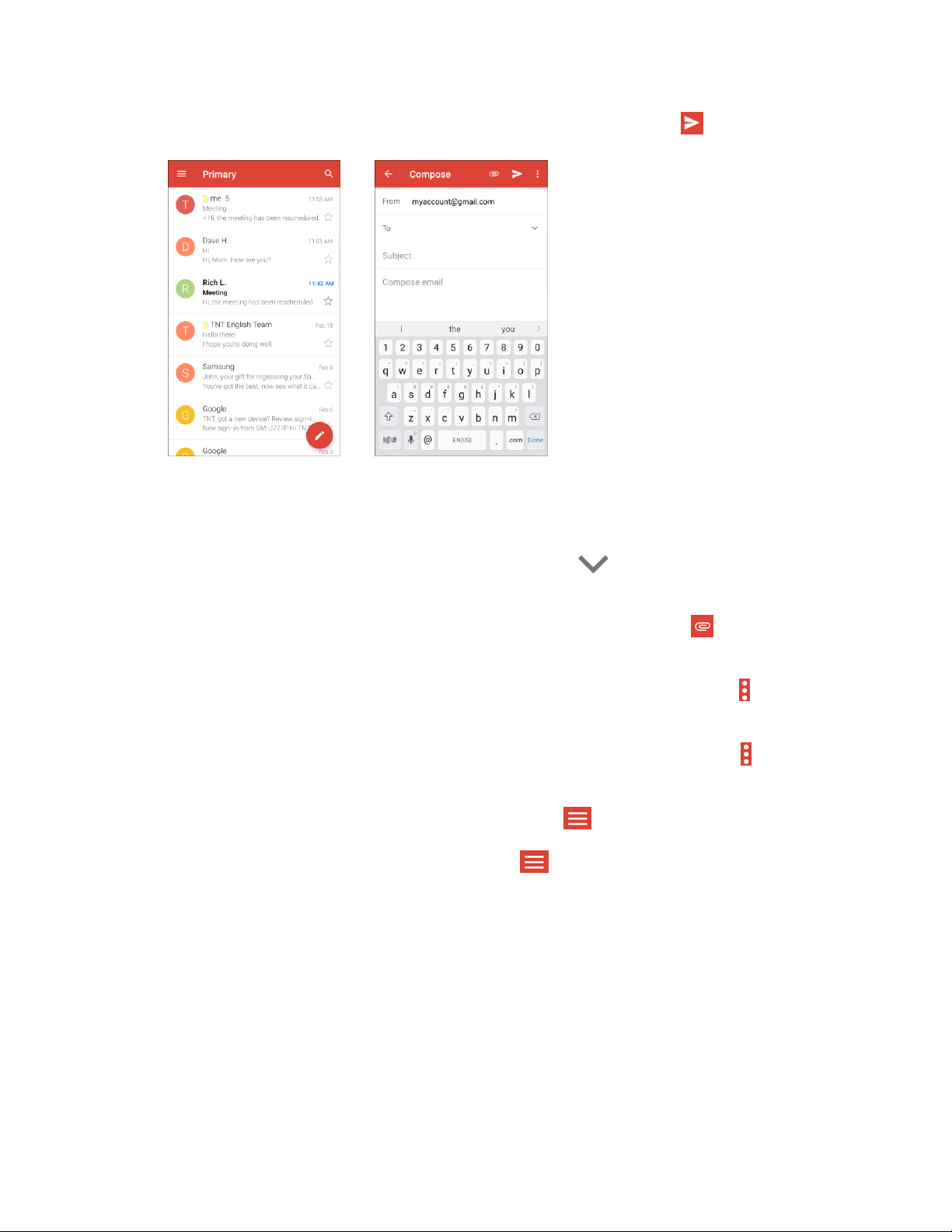
Messaging and Internet 95
3. Enter the message recipient(s), subject, and message, and then tap Send .
The Gmail message is sent.
Gmail Composition Options
● Adding Cc/Bcc: In the mail composition window, tap More in the To field to view the Cc and
Bcc fields.
● Attaching Pictures or Videos: In the mail composition window, tap Attach > Attach file or
Insert from Drive. Locate and then tap the item you want to attach.
● Save as a Draft (Send Later): While composing your message, tap More options > Save
draft. The message is saved as a draft for later.
● Delete Mail Being Composed: In the mail composition window, tap More options > Discard
> Discard.
Note: To view your draft email messages, in the Inbox, tap Menu > Drafts.
Note: To view your sent messages, in the Inbox, tap Menu > Sent.
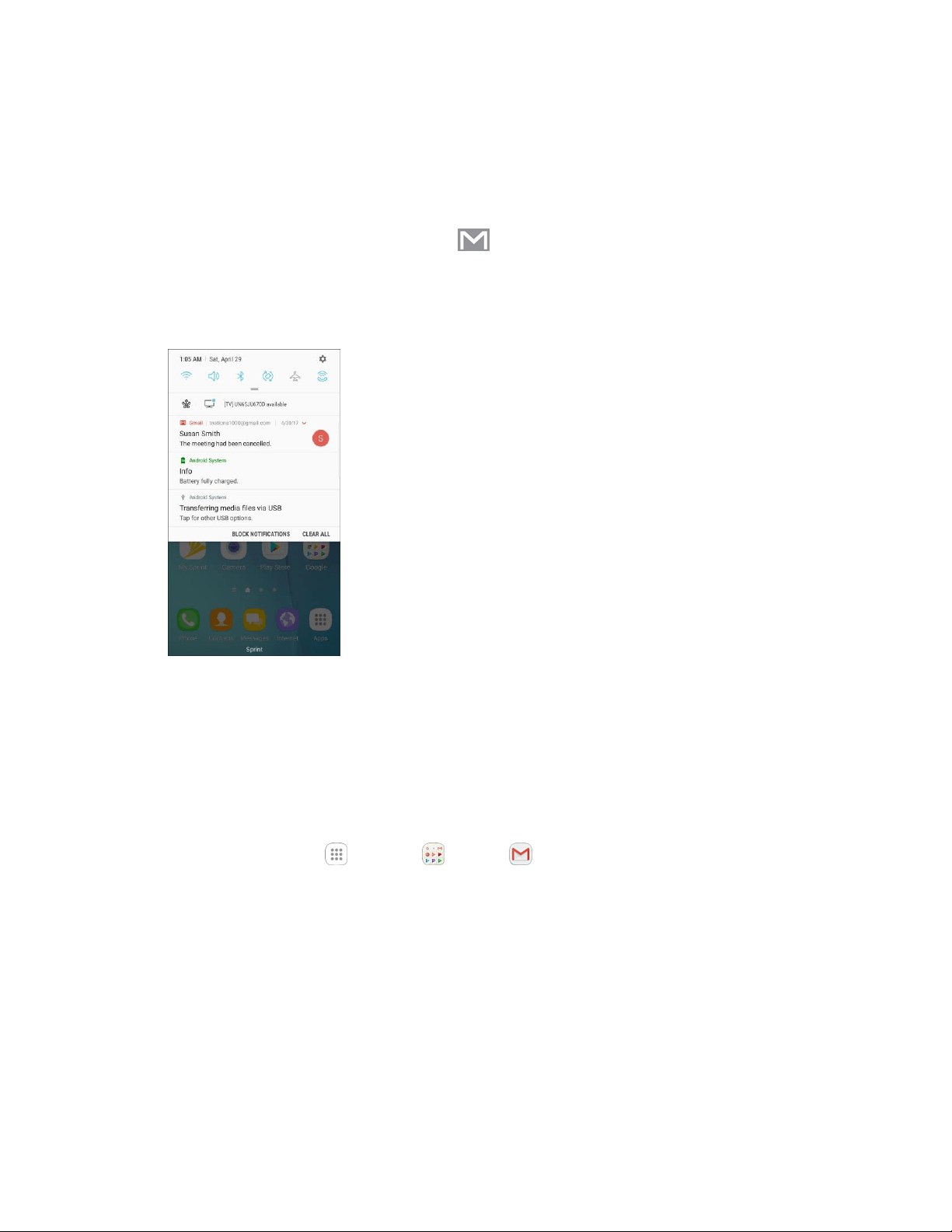
96
Check Received Gmail Messages
Your phone allows you to access, read, and reply to all your Gmail messages.
Open New Gmail Messages
When new Gmail arrives, you will see New Gmail in the status bar.
1. Pull down the status bar to display the notification panel.
2. Tap the new message from the notification panel.
The new Gmail message opens.
If you have two or more new Gmail messages, tapping the notification opens the Gmail
Inbox.
Open Gmail Messages
You can also read and reply to all your Gmail messages from the Gmail Inbox.
1. From home, tap Apps > Google > Gmail .
The Gmail Inbox opens.
Messaging and Internet
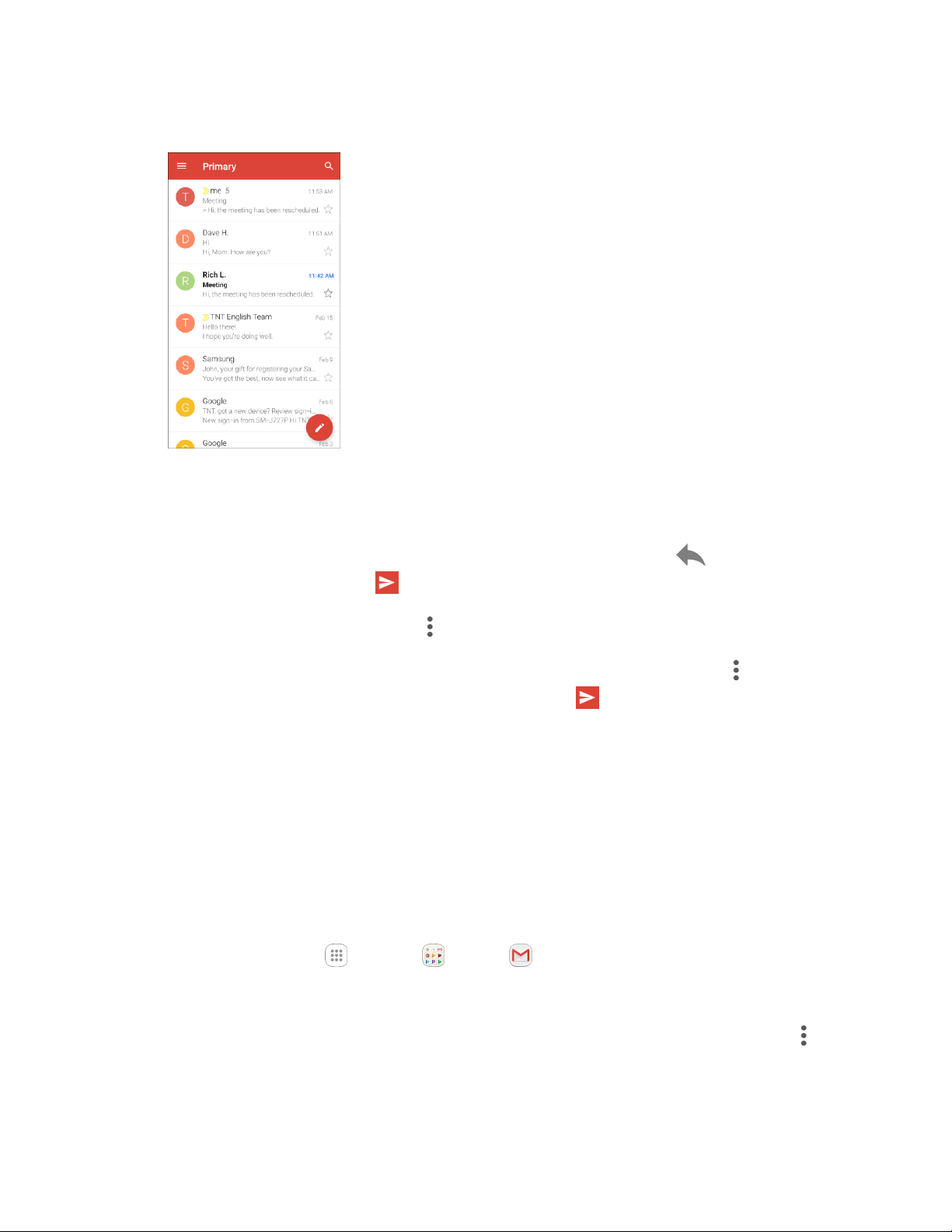
Messaging and Internet 97
2. Tap the message thread you want to view.
The message thread opens, with the newest message displayed.
Options when Reviewing Gmail Messages
● Replying to Gmail Messages: With the Gmail message open, tap Reply , compose your
reply message, and tap Send .
To reply to all, tap More options > Reply all.
● Forwarding Gmail Messages: With the Gmail message open, tap More options > Forward,
enter a recipient and an additional message, and tap Send .
Manage Gmail Messages
Your phone give you control over how you manage your Gmail messages, with labels, thread
management, search capabilities, adding multiple Google Accounts, and more.
Use Gmail Labels
Gmail saves all mail in one box, but you can add labels that allow you to sort your Gmail conversation
threads. For example, when a new thread starts with a received mail, the label "Inbox" is automatically
added to the thread. By then adding the label "travel," all threads with "travel" are shown in a list.
1.
From home, tap Apps > Google > Gmail .
The Inbox opens.
2. Touch and hold a conversation thread to add a checkmark to it, and then tap More options >
Move to.
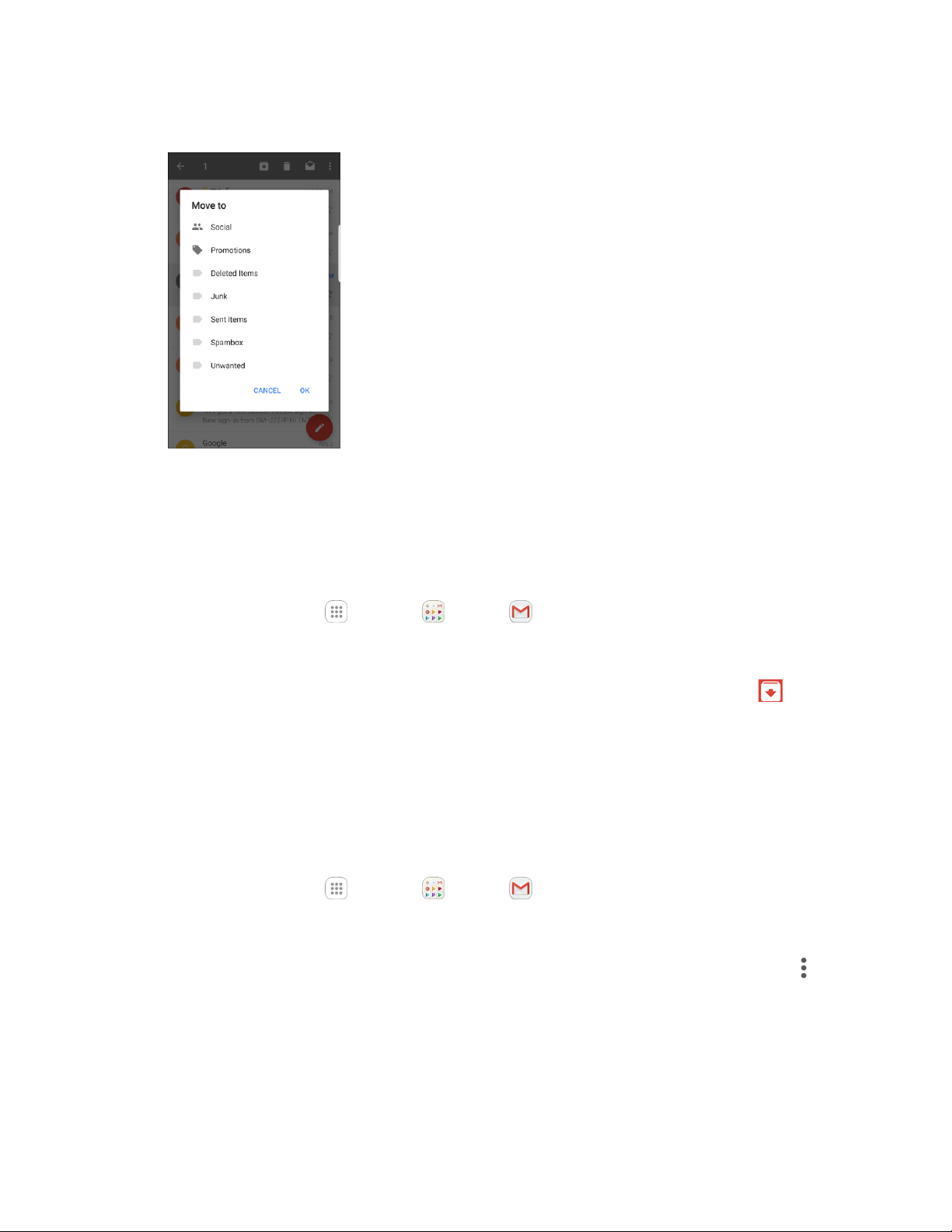
Messaging and Internet 98
3. Tap a label for the thread.
The thread is added to the selected label.
Archive Gmail Threads
Remove sent and received Gmail threads so they do not appear in the Inbox. When replies arrive for
archived threads, they appear in the Inbox again.
1. From home, tap Apps > Google > Gmail .
The Inbox opens.
2. Touch and hold a conversation thread to add a checkmark to it, and then tap Archive .
The thread is now archived.
Mute Gmail Threads
If registered on a mailing list, there will be threads with always-continuing conversations. For long threads
that are not important, mute the threads and they will no longer appear in the Inbox. When mail arrives
that includes user's address as a recipient or in Cc, mail will again appear in the Inbox.
1.
From home, tap Apps > Google > Gmail .
The Inbox opens.
2. Touch and hold a conversation thread to add a checkmark to it, and then tap More options >
Mute.
The thread is now hidden.

Messaging and Internet 99
Delete Gmail Threads
If you no longer wish to keep a Gmail conversation thread, you can simply delete it from the Inbox.
1. From home, tap Apps > Google > Gmail .
The Inbox opens.
2. Touch and hold a conversation thread to add a checkmark to it, and then tap Delete .
The thread is deleted.
Search Gmail Messages
If you need to find a specific message or message thread, you can search Gmail from the Inbox.
1. From home, tap Apps > Google > Gmail .
The Inbox opens.
2. Tap Search .
3. Enter your search text and tap Search .
The search results appear. Tap a message or thread from the list to display it.
Report Spam
You can report spam messages from your phone’s Gmail Inbox.
1. From home, tap Apps > Google > Gmail .
The Inbox opens.
2. Touch and hold a conversation thread to add a checkmark to it, and then tap More options >
Report spam.
The selected message is reported as spam.
Add Another Google (Gmail) Account
If you have multiple Gmail accounts you wish to view on your phone, you can add them from the Settings
> Accounts menu.
1. From home, tap Apps > Settings > Cloud and accounts > Add account.
2. Tap Google, and then tap Enter your email.
3. Enter your Gmail username and password, and then tap Next.
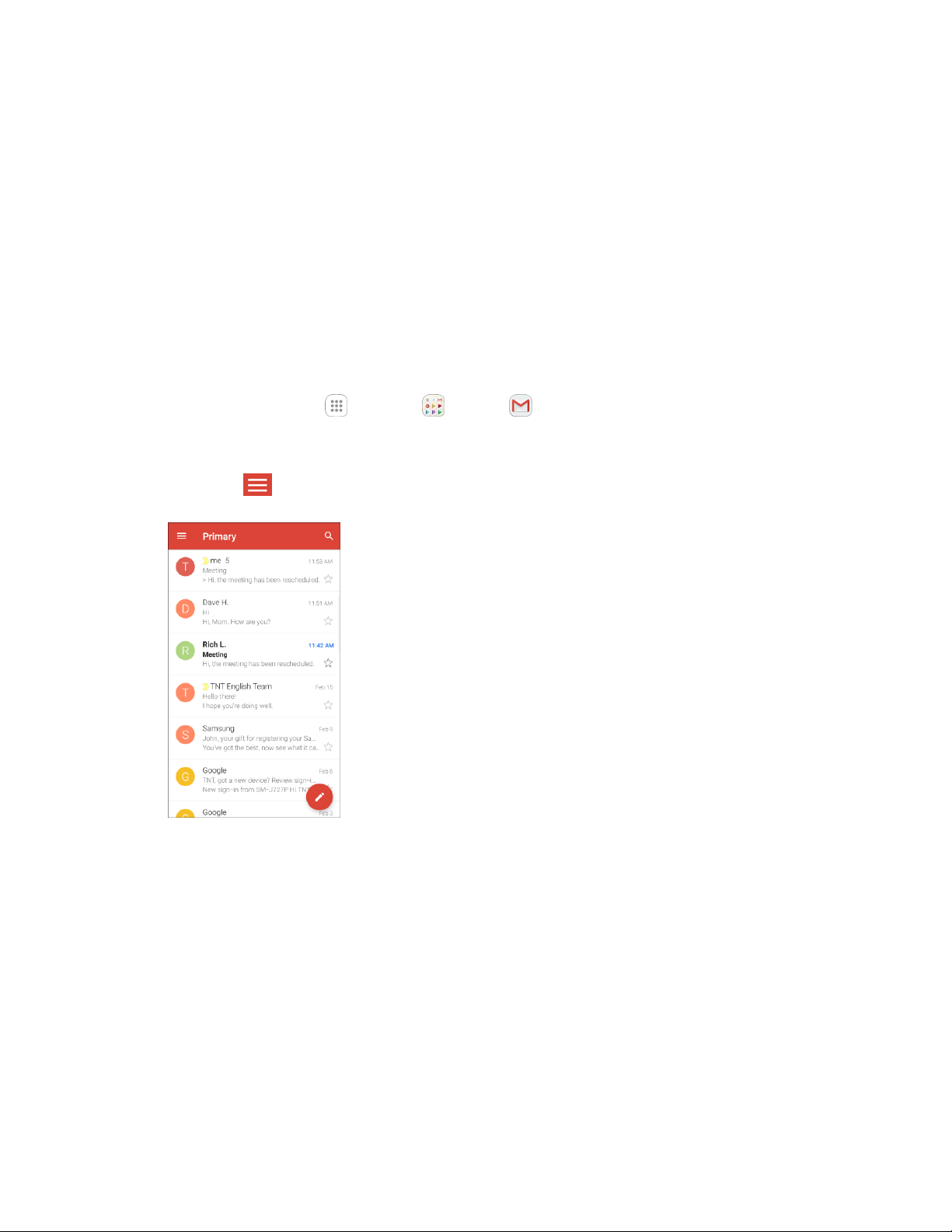
Messaging and Internet 100
4. After your phone connects with the Google servers, select the items you would like to sync with
your phone and then tap Sync now.
5. Tap Finish setup.
You are signed in to your Google Account, and you can access both of your Gmail accounts
from the Gmail app.
Note: You can also sign up for a new Gmail account from the Settings menu. In step 2 above, tap Or
create a new account and follow the prompts.
Switching Between Gmail Accounts
If you have more than one Gmail account set up, you can switch between them in the Gmail app.
1. From home, tap Apps > Google > Gmail .
The Inbox opens.
2. Tap Menu .
3. Tap the icon for the account you want to view from the list at the top of the menu.
The selected account Inbox is displayed.
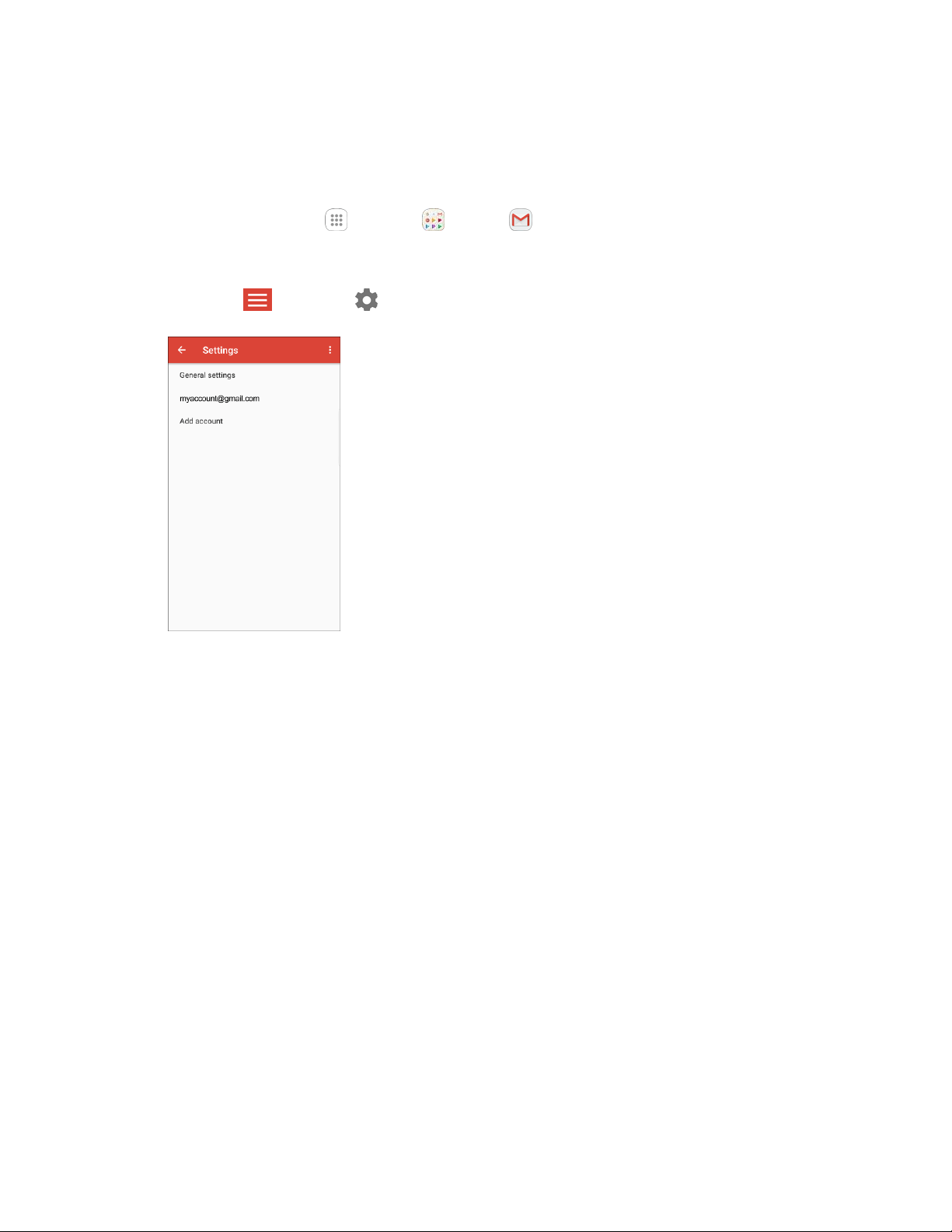
Messaging and Internet 101
Gmail Settings
You can access settings for the Gmail app and for your individual Gmail accounts from the Gmail Settings
menu.
1. From home, tap Apps > Google > Gmail .
The Primary Inbox opens.
2. Tap Menu > Settings .
Email
Use the Email application to send and receive email from your webmail or other accounts, using POP3 or
IMAP, or access your Exchange ActiveSync account for your corporate email needs.
Set Up an Email Account
Your phone supports several types of email accounts and allows you to have multiple email accounts set
up at one time.
Before setting up an email account, make sure you have the username (user ID), password, server name,
etc., so you can get set up successfully.
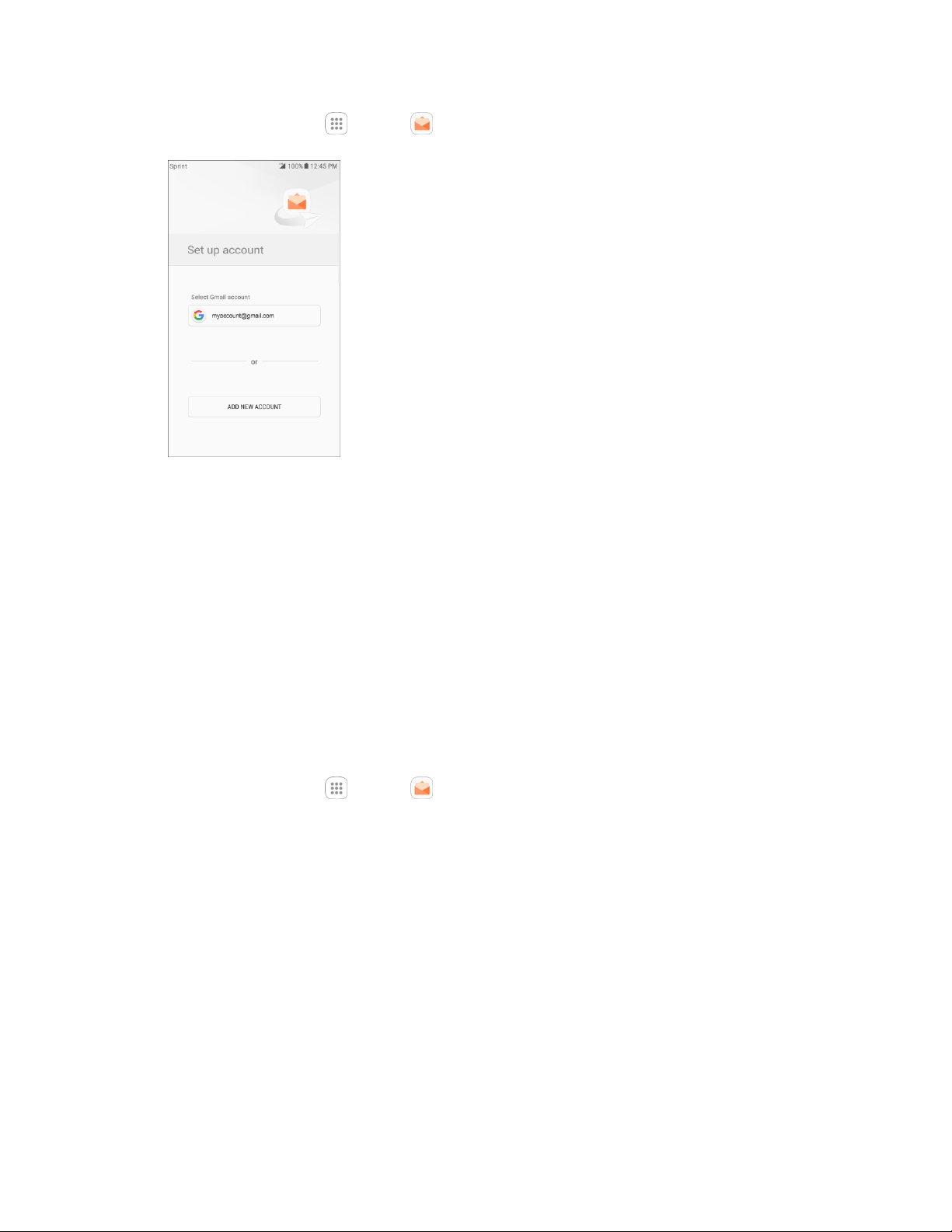
Messaging and Internet 102
1. From home, tap Apps > Email .
A popup window for adding an account appears if no email account has been previously set
up.
2. Follow the prompts to set up your email account.
The email account is set up and you will begin receiving email.
Add an Email Account
You can add several types of personal email accounts, such as POP3 and IMAP accounts, on your
phone.
Add an Email Account from the Email App
You can add email accounts directly from the email app, even if you have another email account set up.
1. From home, tap Apps > Email .
The email Inbox opens.
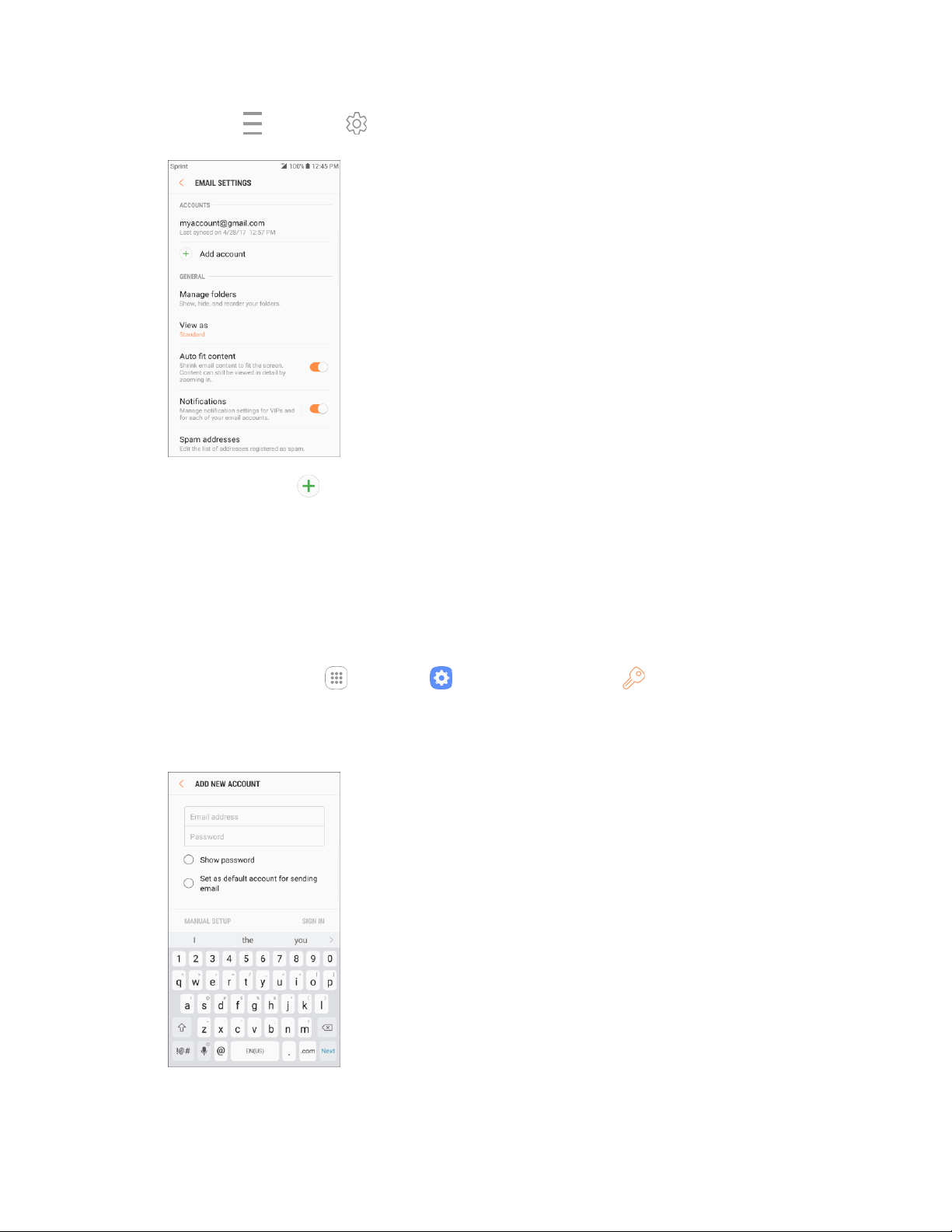
Messaging and Internet 103
2. Tap Menu > Settings .
3. Tap Add account .
4. Follow the prompts to complete the account setup.
The email account is added and you will begin receiving email for the account.
Add an Email Account from the Settings Menu
You can also set up email accounts from the Settings > Accounts menu.
1. From home, tap Apps > Settings > Cloud and accounts > Accounts >
Add account > Email.
2. Enter the Email address and Password for the email account and then tap Sign in.

Messaging and Internet 104
Tapping Sign in prompts your phone to attempt a "regular" email setup and test the incoming
and outgoing servers.
If you have custom settings you need to configure, tap Manual setup and enter your settings.
These may include mail type, user name, password, server, security type, etc.
3. Select your sync settings and then tap Next.
4. Enter an account name and a display name and tap Done to complete setup.
The email account is set up and you will begin receiving email for the account.
Important: If the account type you want to set up is not in the phone database, you will be asked to enter
more details. You should get all pertinent information for the email account, such as incoming and
outgoing server settings, before you proceed.
Add an Exchange ActiveSync Account
If you synchronize your phone with your Exchange ActiveSync account, you can read, manage, and send
email in the same easy way as with a POP3/IMAP account. However, you can also access some powerful
Exchange features.
Important: Before setting up a Microsoft Exchange ActiveSync Account, contact your company’s
Exchange Server administrator for required account settings information.
1. From home, tap Apps > Settings > Accounts > Add account > Microsoft
Exchange ActiveSync.
2. Enter the Email address and Password for the email account and then tap Manual setup.
3. Enter the required information:
Domain\username: Enter your network domain and username, separated by “\”.
Password: Enter your network access password (case-sensitive).
Exchange server: Enter your system’s Exchange server remote email address. Obtain this
information from your company network administrator.
Use secure connection (SSL): Tap to place a checkmark in the box, if your system requires
SSL encryption.
Use client certificate: Tap to place a checkmark in the box, if your system requires
certification.
4. Follow the prompts to configure options for the account.
5. Enter an account name and a display name and tap Done to complete setup.
Your corporate email account is set up and you will begin receiving email for the account.
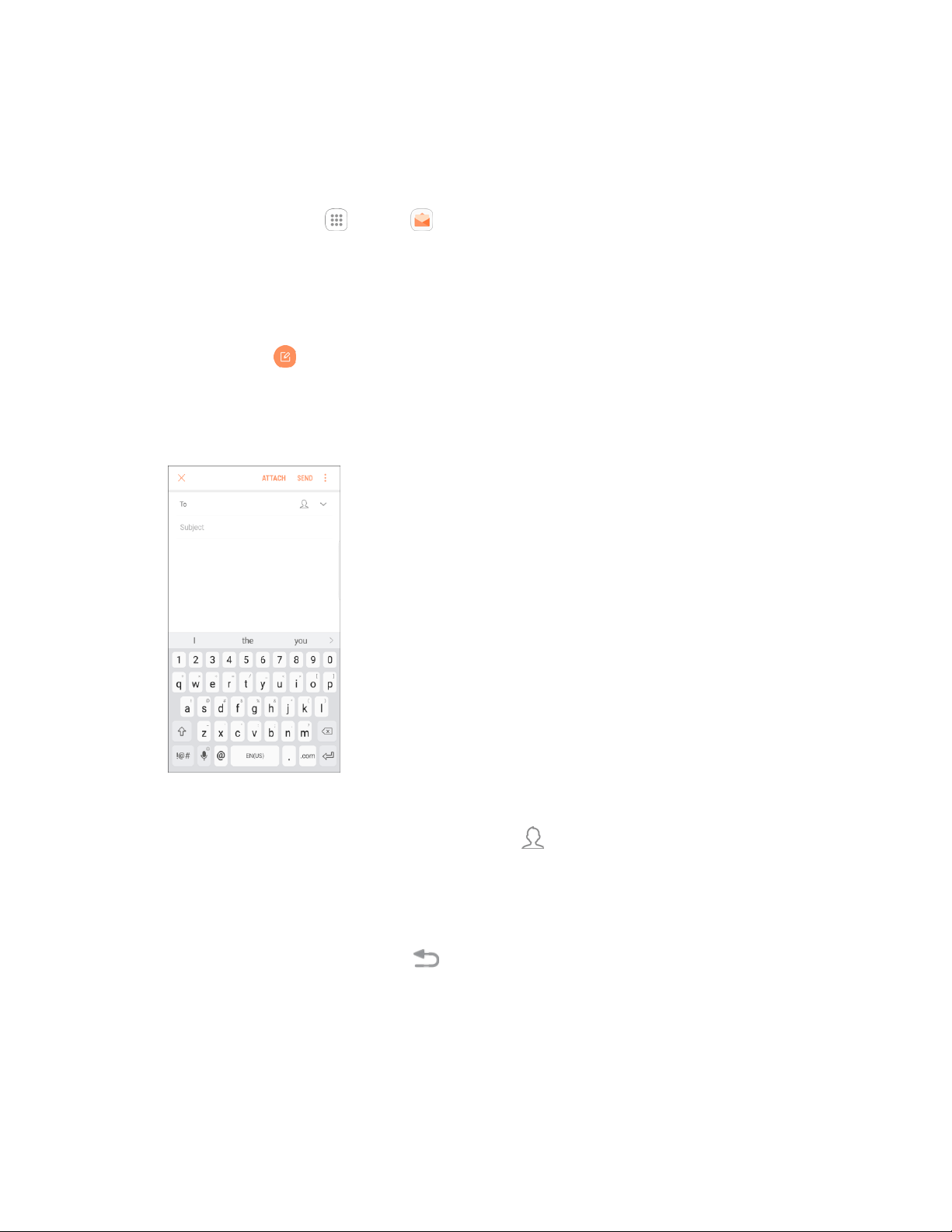
Messaging and Internet 105
Create and Send an Email Message
Compose and send email using any account you have set up on your phone. Increase your productivity
by attaching files such as pictures, videos, or documents to your email messages.
1. From home, tap Apps > Email .
The email Inbox opens.
If you want to switch to a different email account, tap the account name at the top of the
screen and select another account.
2. Tap Compose .
The email composition window opens.
3. Enter the message recipient(s).
You can add multiple recipients to an email message.
To add recipients from Contacts, tap Contacts , select the contact(s) you wish to include,
and then tap Done.
4. Enter the email subject and message.
To add an attachment to the message, tap Attach, select an attachment type and an
attachment, and then tap Back .
5. Tap Send.
The email message is sent.
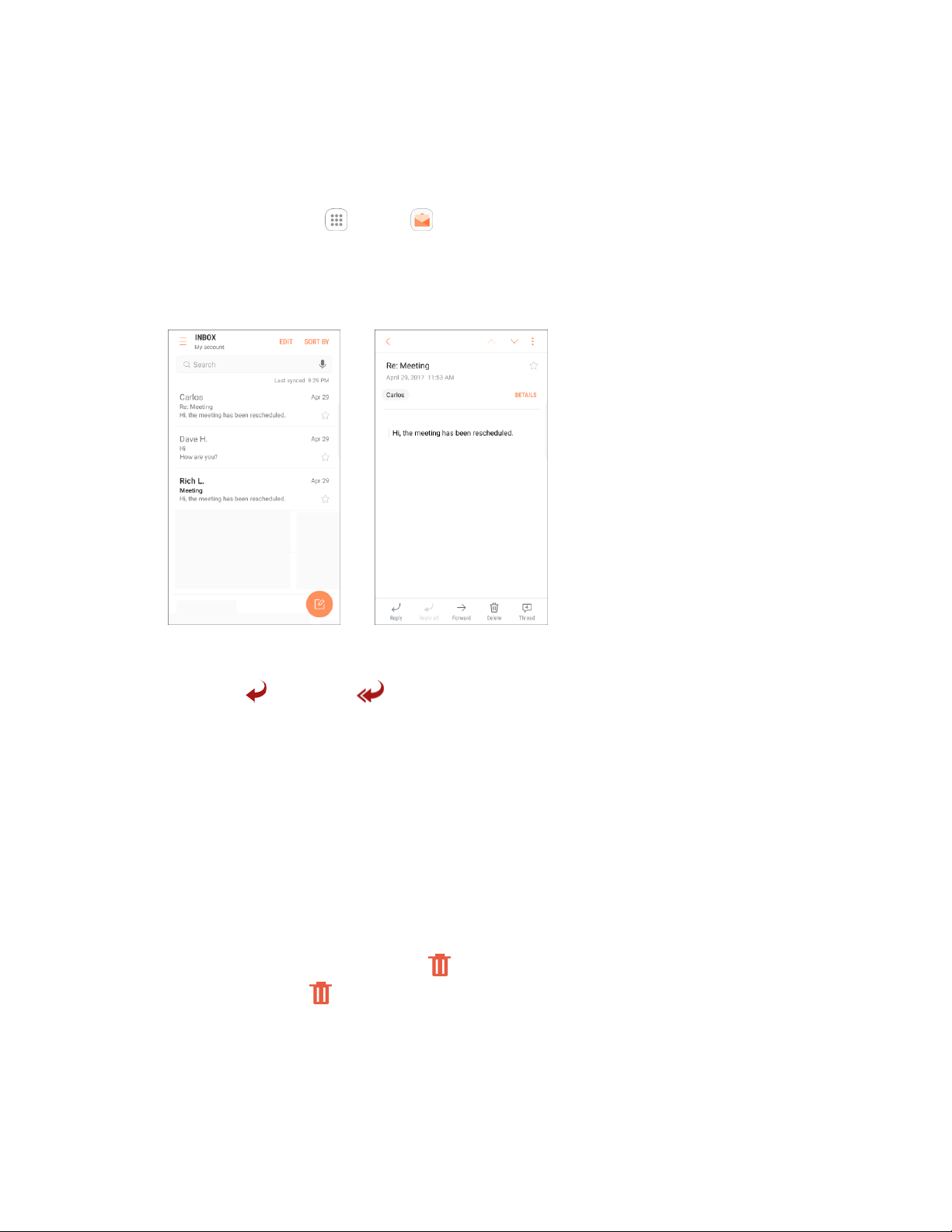
Messaging and Internet 106
Open Email Messages
You can open and read email messages directly from the email Inbox. Reading and replying to email on
your phone is as simple as on your computer.
1. From home, tap Apps > Email .
The email Inbox opens.
2. Tap the message you want to view.
The email message opens.
3.
Tap Reply or Reply all to reply to the message.
Tip: Tap the account name at the top of the screen to switch to a different email account.
Tip: You can also access new email messages from the notification panel. Pull down the status bar to
display the notification panel, and then tap an email notification. The email Inbox will open and display the
new email message.
Options when Reviewing Email Messages
● Resetting Mail as Unread: Touch and hold a message to select it, and then tap More > Mark as
unread.
● Deleting Email: Touch and hold a message to select it, tap the check box on the left side of any
other messages, and then tap Delete > Delete. To delete a single message, tap to open it
and then tap Delete > Delete.
● Syncing Accounts Manually: Sync sent and received email messages manually at any time
regardless of the automatic sync settings. Switch to the account you want to sync, and then swipe
down.
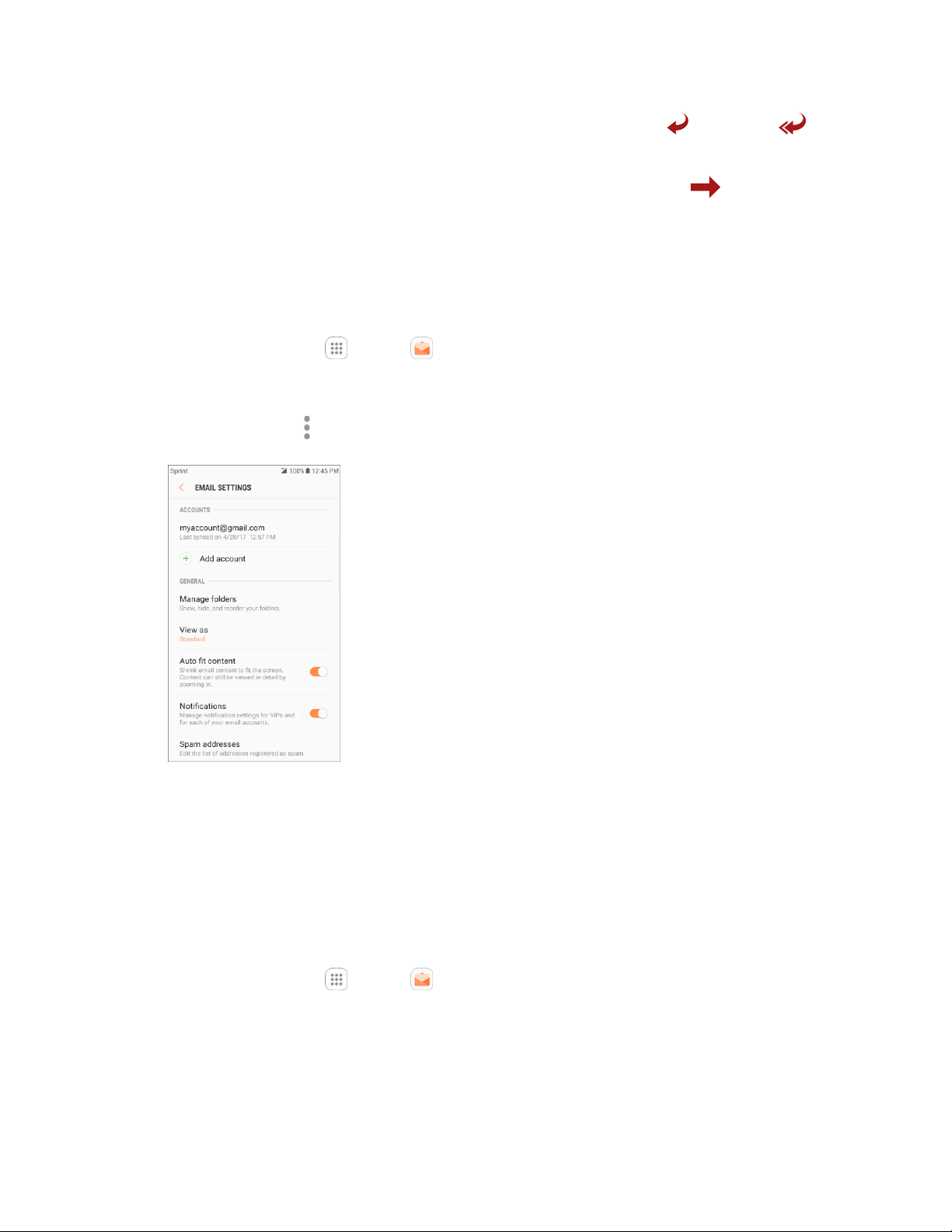
Messaging and Internet 107
● Replying to Email Messages: With an email message open, tap Reply or Reply all ,
compose your reply message, and tap Send.
● Forwarding Email Messages: With the email message open, tap Forward , enter a
recipient and an additional message, and tap Send.
Delete an Email Account
You can delete an email account from your phone if you no longer wish to receive messages for the
account on your phone.
1. From home, tap Apps > Email .
The email Inbox opens.
2. Tap More options > Settings.
3. Tap an account name, and then tap Remove > Remove.
The account is deleted from your phone
Manage Your Email Inbox
Your email Inbox provides management options for viewing, sorting, and deleting your email messages.
View Your Email Inbox
1. From home, tap Apps > Email .
The email Inbox opens.
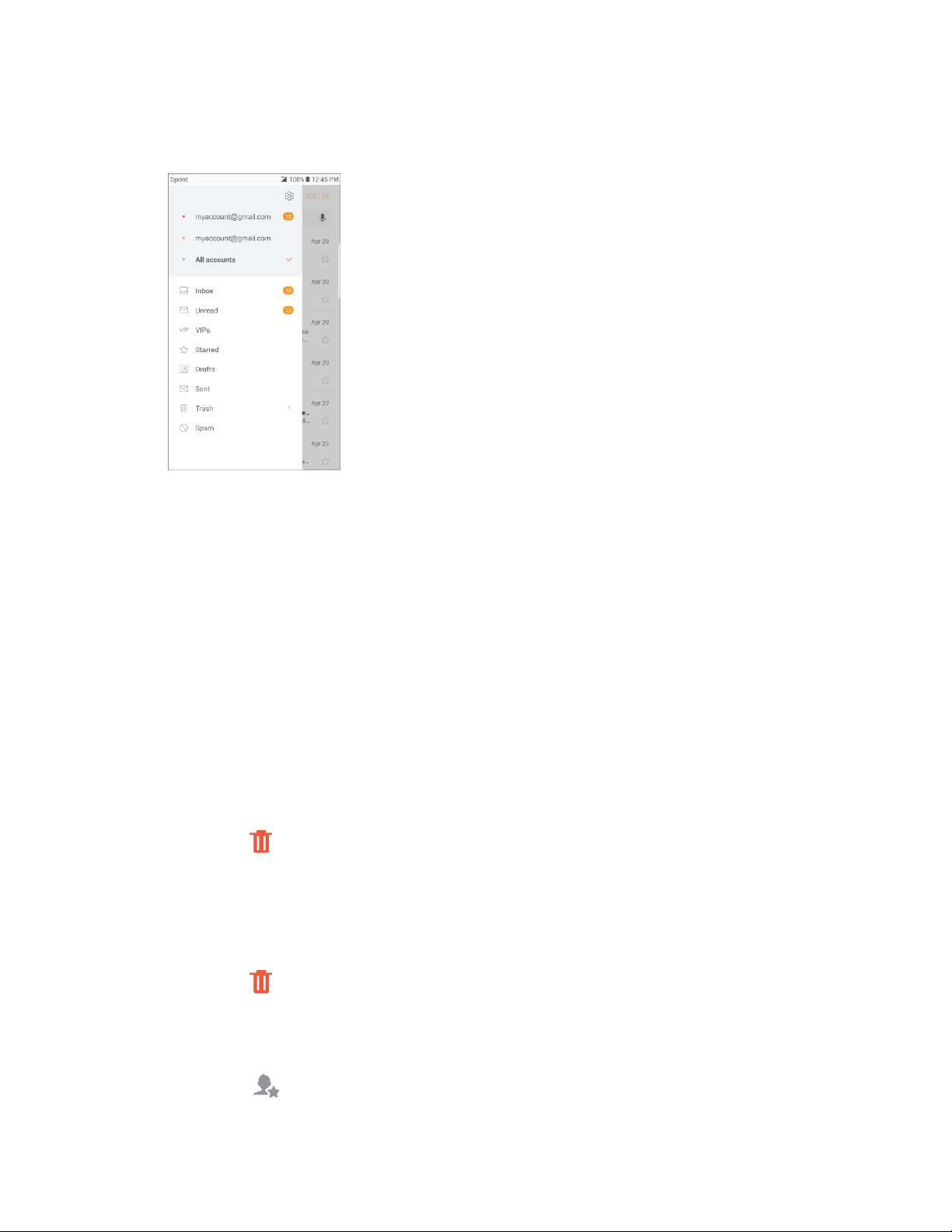
Messaging and Internet 108
2. Tap the email account at the top of the screen to select a different Inbox, or tap Combined inbox
to see all your email Inboxes at once.
Refresh an Email Account
Whatever your automatic synchronization settings are, you can also synchronize your sent and received
email messages manually at any time.
■ While viewing the account you want to synchronize, swipe down.
Sort Email Messages
1. On the email account Inbox, tap More > Sort by.
2. Select from the options to sort email messages by date received, sender, read/unread,
attachments, or priority.
Delete an Email Message
1. On the email account Inbox, tap a message to open it.
2. Tap Delete > Delete.
Delete Multiple Email Messages
1. On the email account Inbox, touch and hold a message to select it and display check boxes, and
then tap the check box next to the messages you want to delete.
2. Tap Delete > Delete.
Priority Senders
Messages from priority senders automatically display at the top of your email Inbox. Emails from priority
senders display VIP in their subject line.

Messaging and Internet 109
To add priority senders:
1. On the email account Inbox, tap the Inbox name at the top of the screen and then tap VIPs.
2. Tap Tap to add VIPs.
3. Select a contact to add it as a priority sender.
To view only emails from priority senders:
■ On the email account Inbox, tap the Inbox name at the top of the screen and then tap VIPs.
Exchange ActiveSync Email Features
Set options for your corporate Exchange ActiveSync email messages, including synchronization options,
flagging messages, out-of-office messages, meeting requests, and message priority.
To access Exchange ActiveSync settings:
1. From home, tap Apps > Email .
2. Tap More > Settings.
3. Tap the Exchange ActiveSync account name to view its options.
The following options are available:
• Sync account: Keep the account synchronized on your phone.
• Account name: Change the account name.
• Always Cc/Bcc myself: Send a copy of each email you send to yourself.
• Signature: Enable and configure your signature for each email you send.
• Show images: Show all images in emails.
• Auto download attachments: Automatically download attachments when connected to
a Wi-Fi network.
• Sync schedule: Configure a schedule for syncing your email account.
• Period to sync Email: Configure how far back in time you want to sync your email
account.
• Limit retrieval size: Set a limit to the size of email messages you want to receive on
your phone.
• Limit retrieval size while roaming: Set a different email size limit when your phone is
on roaming.
• Out of office settings: You can set your Out of Office status and auto-reply message
right from your phone.

Messaging and Internet 110
• Folder sync settings: Select which email folders to sync with the server.
• Period to sync Calendar: Set the time period for syncing your calendar with the server.
• Empty server trash: Delete the content of the trash folder on the server.
• In case of sync conflict: Select whether the device or the server has priority during a
sync conflict.
• Sync Contacts: Sync your Contacts with your Exchange account.
• Sync Calendar: Sync your calendar with your Exchange account.
• Sync Task: Sync your tasks with your Exchange account.
• Security options: Manage encryption and signature options for outgoing email.
• Exchange server settings: Modify the Exchange server settings for this email account.
Email Settings
Configure options for email accounts you set up on your phone.
General Email Preferences
1. From home, tap Apps > Email .
2. Tap Menu > Settings to configure options. General email settings, which affect all email
accounts, include:
Manage accounts: Configure options for specific accounts. Available settings depend on the
type of account.
Add account: Add additional email accounts.
Manage folders: Show, hide, and reorder your folders.
View as: View emails in standard or conversational mode.
Auto fit content: Shrink email content to fit the screen. Content can still be viewed in detail
by zooming in.
Notifications: Notifications for new emails display in the status bar. When disabled, you can
control notifications for each of your email accounts individually in the account’s settings.
Spam addresses: Create and maintain a list of email addresses and domains to
automatically block emails from those senders.
Confirm deletions: Ask for confirmation before deleting email.
About Email: View information about the Email app.
Help: View help topics on using the Email app.

Messaging and Internet 111
Manage Email Account Settings
You can edit settings for your individual email accounts, such as email address and password, name
display and signature, frequency of retrieval, and more.
Note: Available settings depend on the type of email account.
1. From home, tap Apps > Email .
2. Tap Menu > Settings , and then tap an account to set its options. Individual email account
settings may vary; see your service provider for details. Common settings include:
Sync account: Configure options for synchronizing your phone with your account.
Account name: Enter a name to identify this email account.
Your name: Add your name.
Always Cc/Bcc myself: Choose options for sending a copy of emails you send to yourself,
as a copy (Cc) or blind copy (Bcc).
Signature: Customize or delete the text signature that is automatically added to emails you
send.
Show images: Choose whether to automatically display embedded images in the body of an
email.
Auto download attachments: Choose whether the phone automatically downloads email
attachments when you are connected to Wi-Fi. You might use this option to control how and
whether you use your plan’s data services to download attachments.
Sync schedule: Set a sync schedule for email, such as choosing different sync options for
peak days or times, or when roaming.
Period to sync Email: Choose the period for synchronizing email between your phone and
account.
Limit retrieval size: Choose the email retrieval size for each message.
Limit retrieval size while roaming: Choose the email retrieval size while roaming.
Out of office settings: Configure options for automatically sending replies when you are out
of the office.
Folder sync settings: Choose which folders to sync.
Period to sync Calendar: Choose the period for synchronizing calendar events between
your phone and account.
Empty server trash: Delete the contents of the trash folder on the account server.
In case of sync conflict: Choose whether information from the server or phone has priority
when there is a conflict.

Messaging and Internet 112
Sync Contacts: Choose whether contacts are synchronized between your phone and the
account.
Sync Calendar: Choose whether calendar events are synchronized between your phone and
the account.
Sync Task: Choose whether tasks are synchronized between your phone and the account.
Sync Messages: Choose whether messages are synchronized between your phone and the
account.
Security options: Manage encryption and signature options for outgoing mail.
Exchange server settings: Configure the Domain\user name, Password, and other
Exchange server settings.
Data Services General Information (4G
LTE and 3G Networks)
The following topics will help you learn the basics of using your data services, including managing your
user name, launching a data connection, and navigating the Web with your phone.
Important: Certain data services requests may require additional time to process. While your phone is
loading the requested service, the touchscreen or QWERTY keyboard may appear unresponsive when in
fact they are functioning properly. Allow the phone some time to process your data usage request.
4G LTE
The Sprint 4G LTE network provides your phone with wireless Internet access over greater distances
than Wi-Fi and delivers data transfer rates of up to 60 Mbps. To connect your phone to the 4G LTE
network, you must be in an area covered by the 4G LTE network.
For more information about the availability of Sprint 4G LTE service in your location, visit
sprint.com/coverage.
Note: The availability and range of the network depends on a number of factors including your distance to
the base station, and infrastructure and other objects through which the signal passes.
Set Your Network Options
1. From home, tap Apps > Settings > Connections > Mobile networks > Network
mode.
2. Select CDMA, LTE / CDMA, GSM / UMTS, or Automatic.
The phone will scan for the best available Sprint network and will automatically connect to it.
When your phone is connected using 4G LTE, LTE appears above the signal strength indicator in the
status bar.
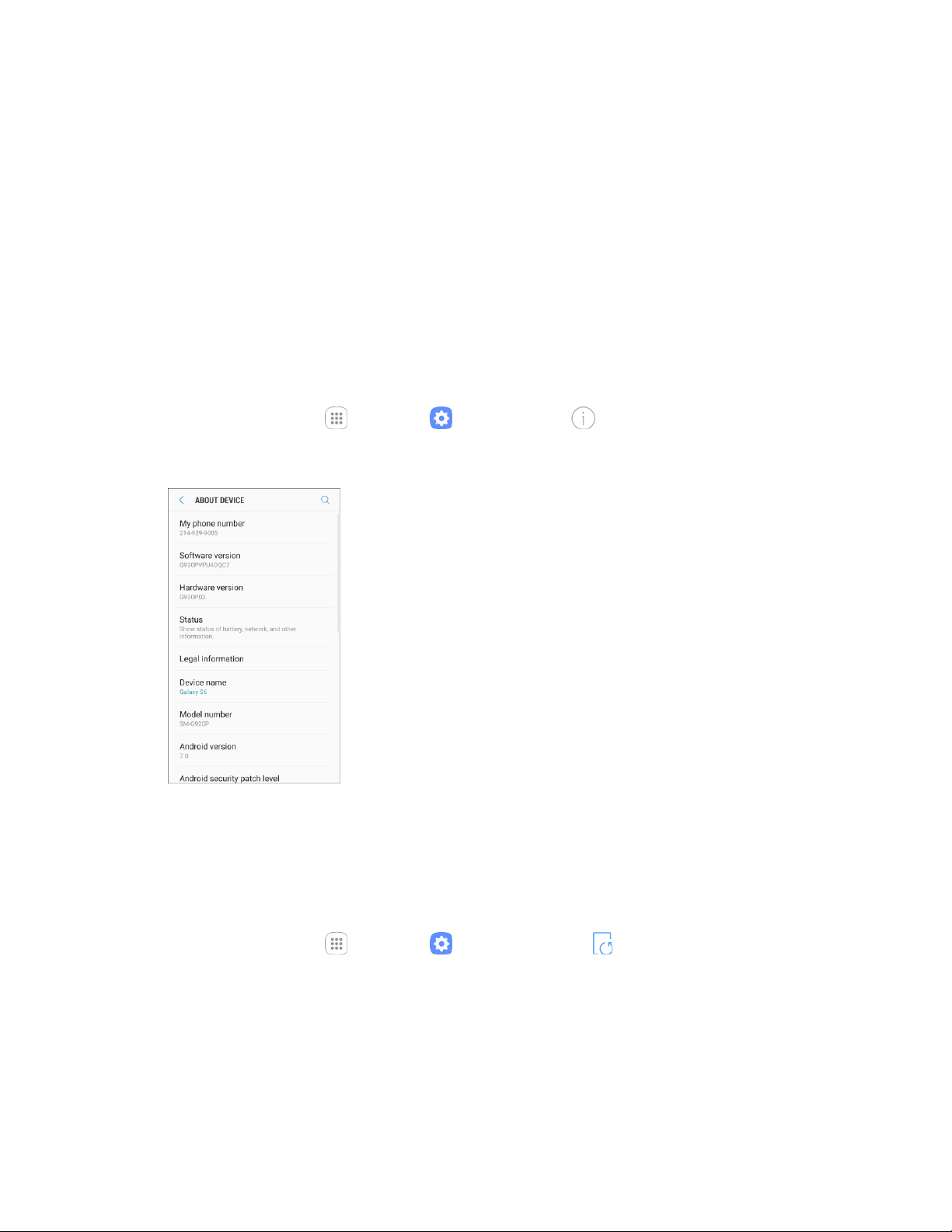
Messaging and Internet 113
Note: The Sprint networks are self-discoverable, which means no additional steps are required for your
phone to connect to them.
Your User Name
When you buy your phone and sign up for service, you are automatically assigned a user name, which is
typically based on your name and a number, followed by “@sprintpcs.com.” (For example, the third John
Smith to sign up for Sprint data services might have jsm[email protected] as his user name.)
When you use data services, your user name is submitted to identify you to the network. Your user name
is automatically programmed into your phone. You do not have to enter it.
Find Your User Name
You can find your user name through your phone's device menu.
1. From home, tap Apps > Settings > About device .
2. Tap Status.
You will see your user name under the "Username" heading.
Update Your User Name
If you choose to change your user name and select a new one online, or make any changes to your
services, you must then update the profile on your phone.
1. From home, tap Apps > Settings > System updates .
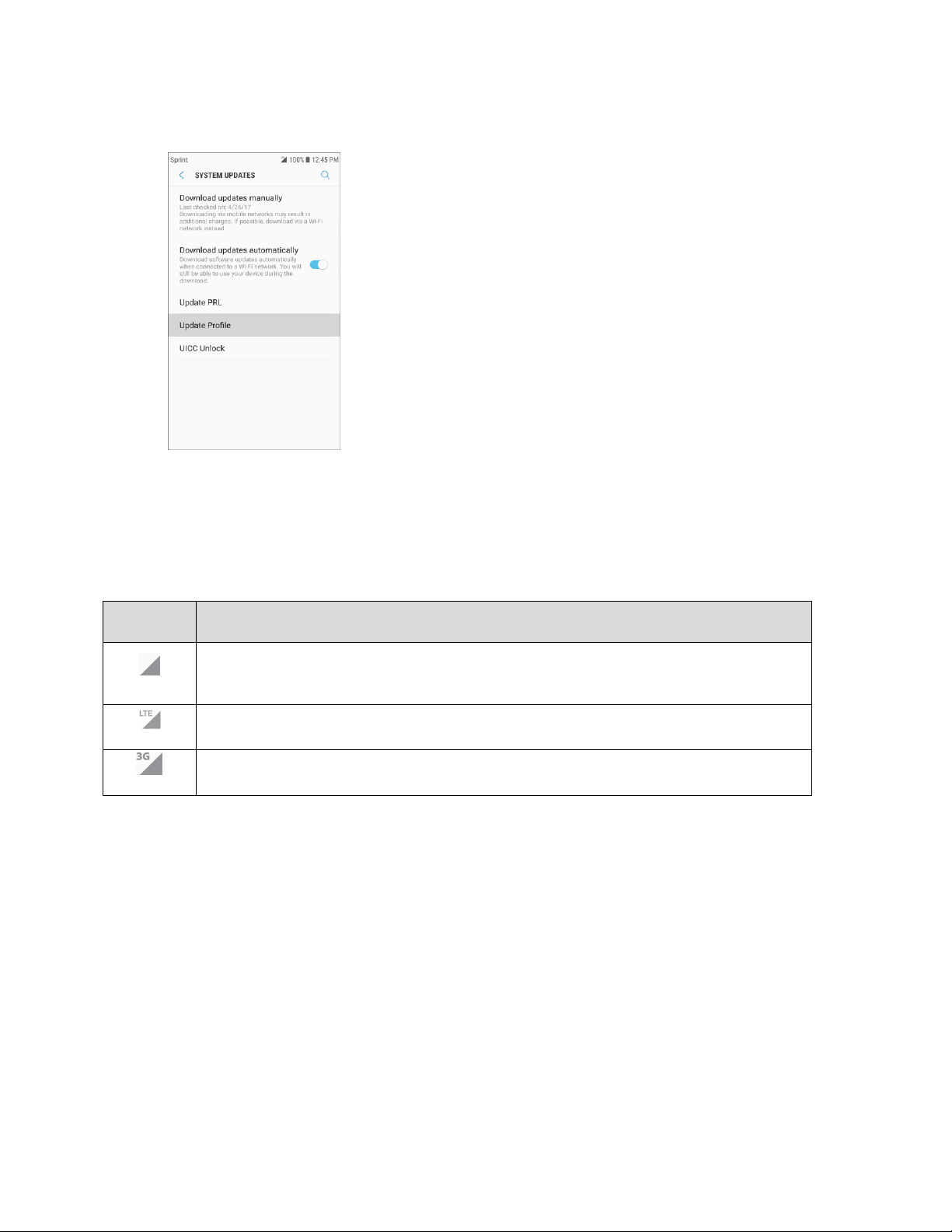
Messaging and Internet 114
2. Tap Update Profile.
Your phone will download and install the profile update.
Data Connection Status and Indicators
Your phone displays the current status of your data connection through indicators at the top of the screen.
The following symbols are used:
Icon
Status
Network (full signal): The fullness of the triangle icon indicates the strength of the
signal. A fuller icon means a better signal.
4G LTE data service: Your phone is connected to a 4G LTE network.
3G (data service): Your phone is connected to a 3G network.
Browser
Browse the Internet using a full-featured browser.
SSL/TLS
SSL (Secure Sockets Layer) and TLS (Transport Layer Security) are protocols for encrypting
sent/received data. While in a screen connected by SSL/TLS, data is encrypted to safely send/receive
private information, credit card numbers, corporate secrets, etc., and provide protection against online
threats (eavesdropping, falsification, impersonation, etc.).
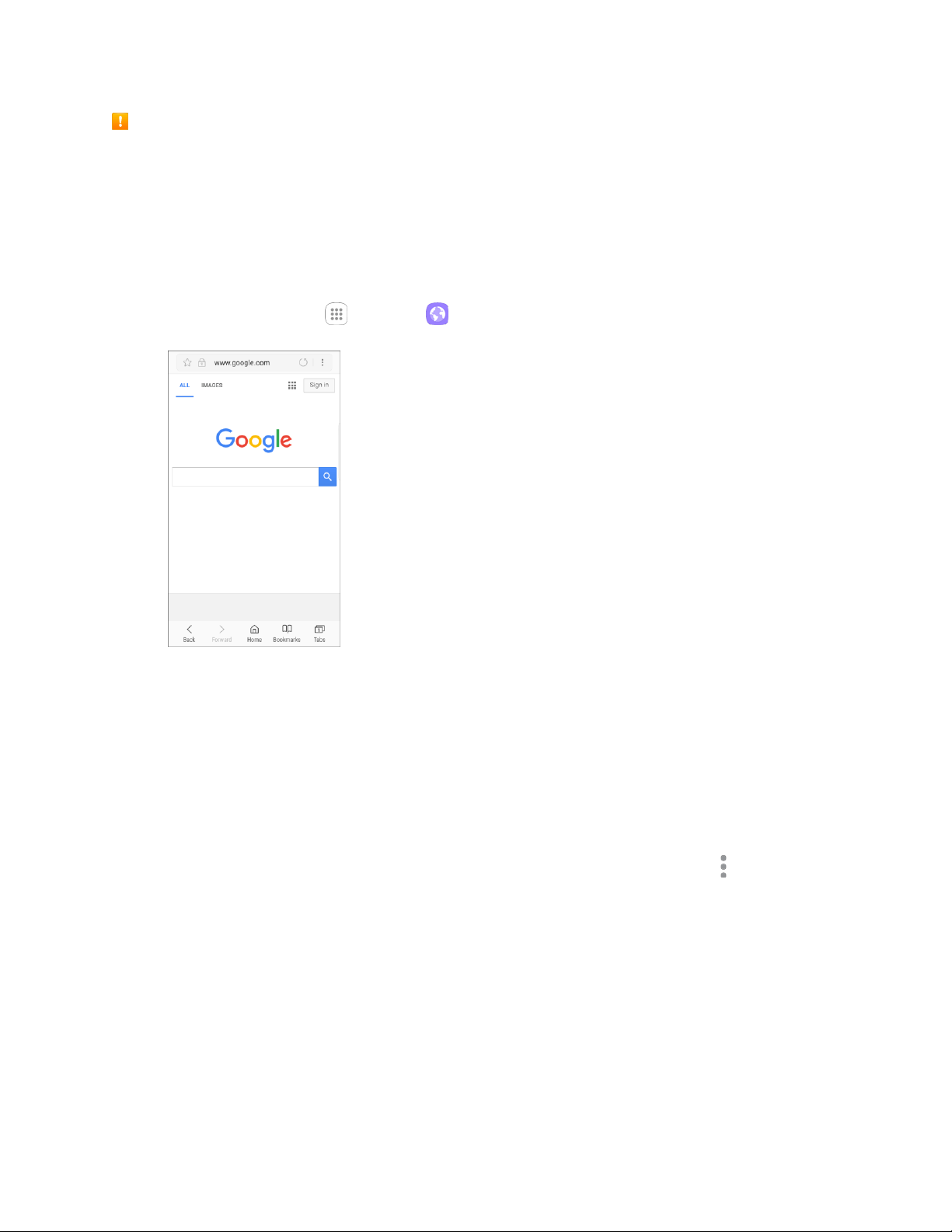
Messaging and Internet 115
SSL/TLS Cautions
When opening a secured page, users must decide as their responsibility whether or not to open the
page with use of SSL/TLS. Sprint and the applicable Certification Authorities make no guarantees
whatsoever to users regarding security of SSL/TLS.
Use the Browser
Launching the browser is as easy as tapping an icon.
■ From home, tap Apps > Internet .
The browser opens.
The first time you launch Internet, you may be prompted to enter your 10-digit wireless phone
number to access the Sprint home page.
You can also launch the browser by tapping a URL in a text message, email message, or
Gmail message.
Browser Use Options
■ Searching within a Web Page: With a Web page displayed, tap More options > Find on
page, and enter your search text.
Tip: To change the phone’s default launch page to your current page, tap More > Settings > Home page
> Current page.
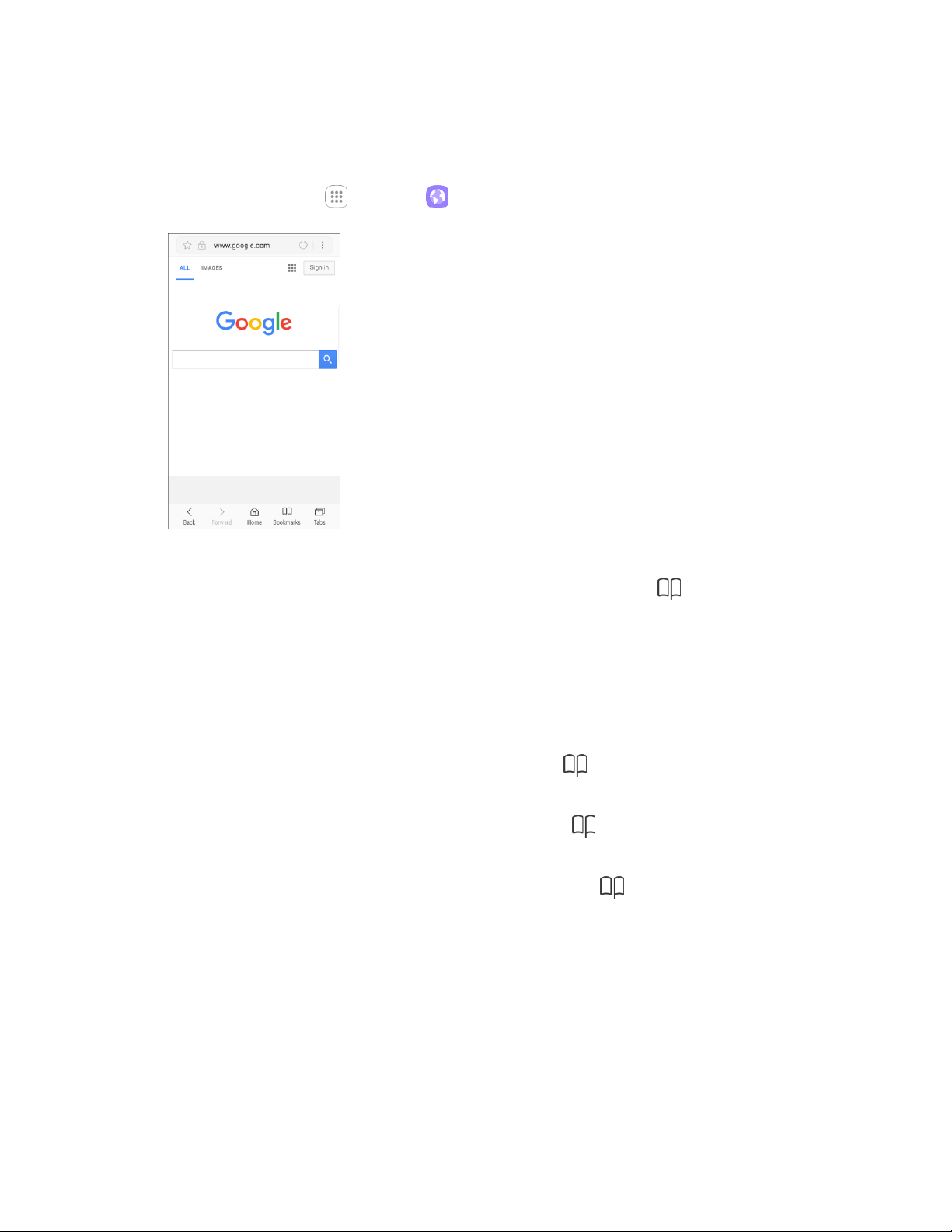
Messaging and Internet 116
Add a Bookmark
Bookmark favorite sites using the browser menu options.
1. From home, tap Apps > Internet .
The browser opens.
2. Navigate to the Web page you want to bookmark, and tap Bookmarks > Add.
The add bookmark window opens.
3. Check or change the bookmark title, URL, etc., and then tap Save.
The Web page is added to bookmarks.
Bookmark Options
● Editing Bookmarks: From the browser, tap Bookmarks , touch and hold a bookmark, tap
More > Edit bookmark, edit the bookmark, and then tap OK.
● Deleting Bookmarks: From the browser, tap Bookmarks , touch and hold a bookmark, and
then tap Delete.
● Show Saved Web Pages: From the browser, tap Bookmarks > Saved pages, and then tap
a saved page to open it.
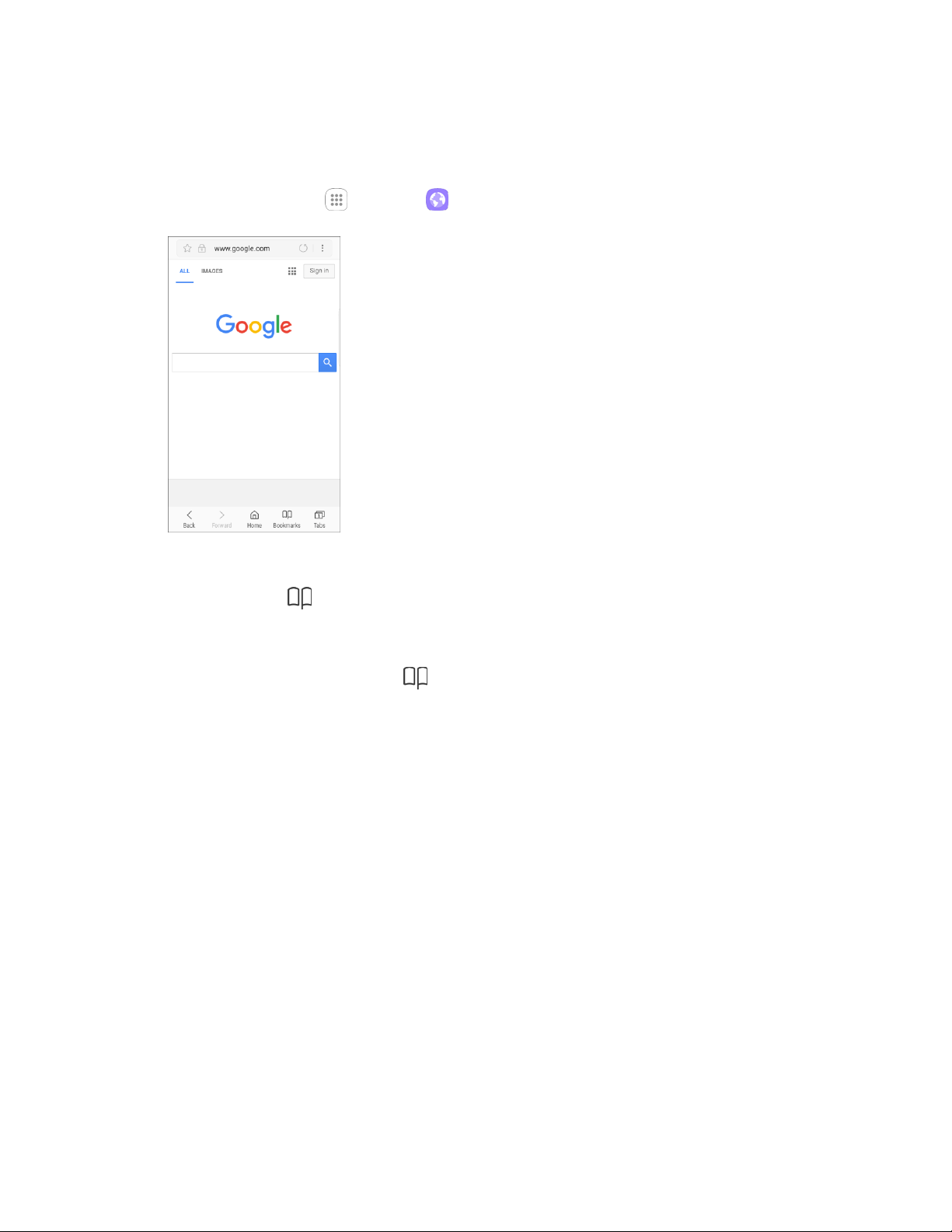
Messaging and Internet 117
View Browser History
Use the browser menu options to view your browsing history.
1. From home, tap Apps > Internet .
The browser opens.
2. Tap Bookmarks .
The bookmark window opens.
If you do not see Bookmarks , pull down the Web page to display the address bar.
3. Tap the History tab, and then tap an entry.
The Web page opens.
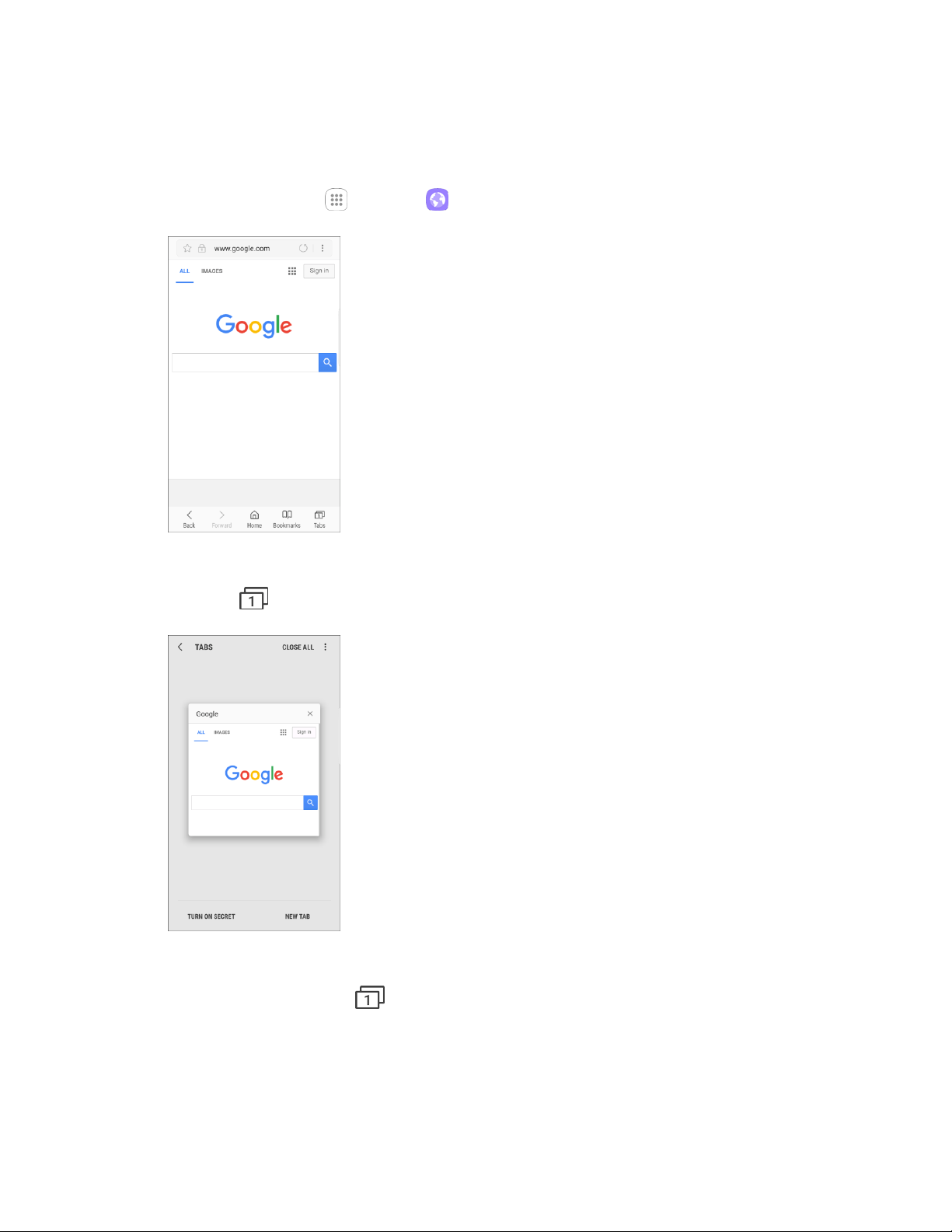
Messaging and Internet 118
Open New Browser Tabs
Use tabbed browsing to switch between websites quickly and easily.
1. From home, tap Apps > Internet .
The browser opens.
2. Tap Tabs .
The tabs window opens.
If you do not see Tabs , drag the Web page down to display the address bar.
3. Tap New tab.
A new tab appears.

Messaging and Internet 119
To switch tabs, tap Tabs and then tap one of the available thumbnails in the tabs window.
Browser Settings
1. From home, tap Apps > Internet .
The browser opens.
2. Tap More options > Settings to configure options:
Homepage: Choose a homepage to display when you launch Internet.
Default search engine: Choose a default search engine.
Auto fill forms: Manage your Auto fill forms.
Manual zoom: Override website requests to control zoom level.
Privacy: Choose options related to privacy.
Advanced: Choose settings to control how the browser treats content, such as allowing
JavaScript, blocking pop-ups, and managing website data.
About internet: View information about the Browser app.
Chrome Browser
You can use the Google Chrome
™
browser to browse the Internet and bring your open tabs, bookmarks
and address bar data from your computer to your mobile device.
Visit support.google.com/chrome to learn more about Chrome.
1. From home, tap Apps > Chrome .
Chrome opens.
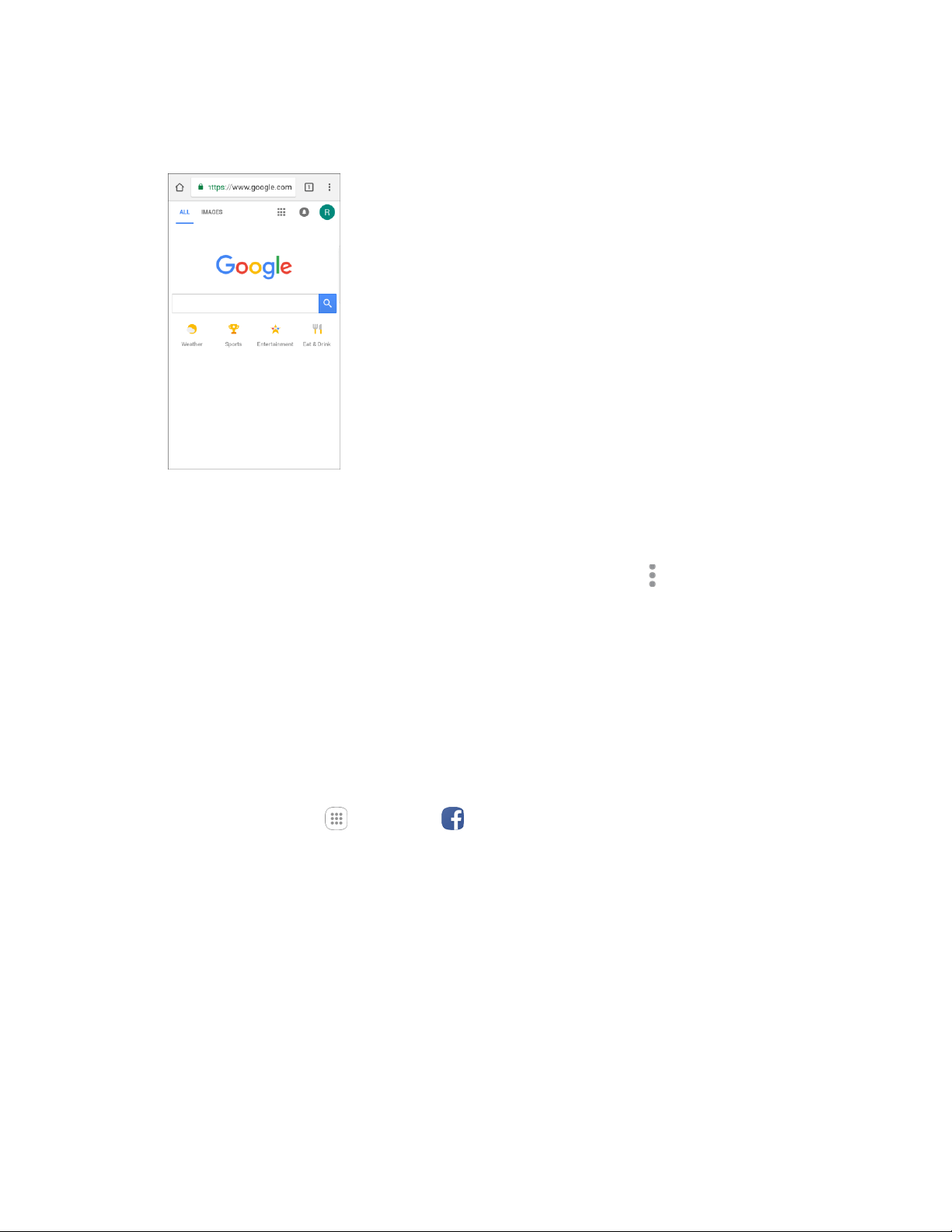
Messaging and Internet 120
2. Tap the address bar at the top and enter search words (for a Google search) or a Web address
(URL).
The search results appear or a Web page opens.
Chrome Support
■ To find on-phone help with Chrome, from Chrome, tap More options > Help & feedback.
A Web page will open displaying Google help for Chrome.
Facebook
Keep up with friends and family with the Facebook app. Share updates, photos, and videos, as well as
text, chat, and play games.
Once you have signed in in Facebook, you can post and read updates, upload pictures, tag locations, and
more, all from your phone.
1. From home, tap Apps > Facebook .
The Facebook app launches.
If this is the first time you have used Facebook on your phone, enter your Facebook ID and
password and tap Log in to sign in to an existing account, or tap Create New Facebook
Account to set up a new Facebook account.
2. Tap Status and type an update, tap Photo and upload a picture from the gallery, tap Check In to
share your location, “Like” and comment on friends’ posts, and more.
Messaging and Internet 121
Hangouts
Meet friends and family online, share photos, host video calls, and send SMS and Hangouts messages.
Log in to a Google Account beforehand (see Google Account).
Using Hangouts
1. From home, tap Apps > Google > Hangouts .
The Hangouts app will open.
2. Tap Add to start a new Hangout.
3. Type a name, email, number, or circle, or select a contact from the list.
4. Tap New conversation or New video call .
A chat window or a video chat window opens.
Each time text is entered, the corresponding friend appears.
If a friend is not in a Hangout, you will see a message. Tap Send invitation to invite them to
join the Hangout.
Hangouts Operations
● Ending a Chat: In the Hangouts window, tap Back .
● Ending a Video Chat: In the video chat window, tap End .
Note: You can use Hangouts as your phone’s default messaging app, or as a standalone IM app. If you
set Hangouts as the default messaging app, the Messages app will be disabled. For more information,
see Default Applications.
Instagram
Capture and share photos and videos with your friends using the Instagram app. Customize what you
capture, and then share it on your feed or post it directly to your friends.
■ From home, tap Apps > Social > Instagram .
The first time you access Instagram, follow the prompts to sign up for an account, or sign in
with Facebook or an existing account.

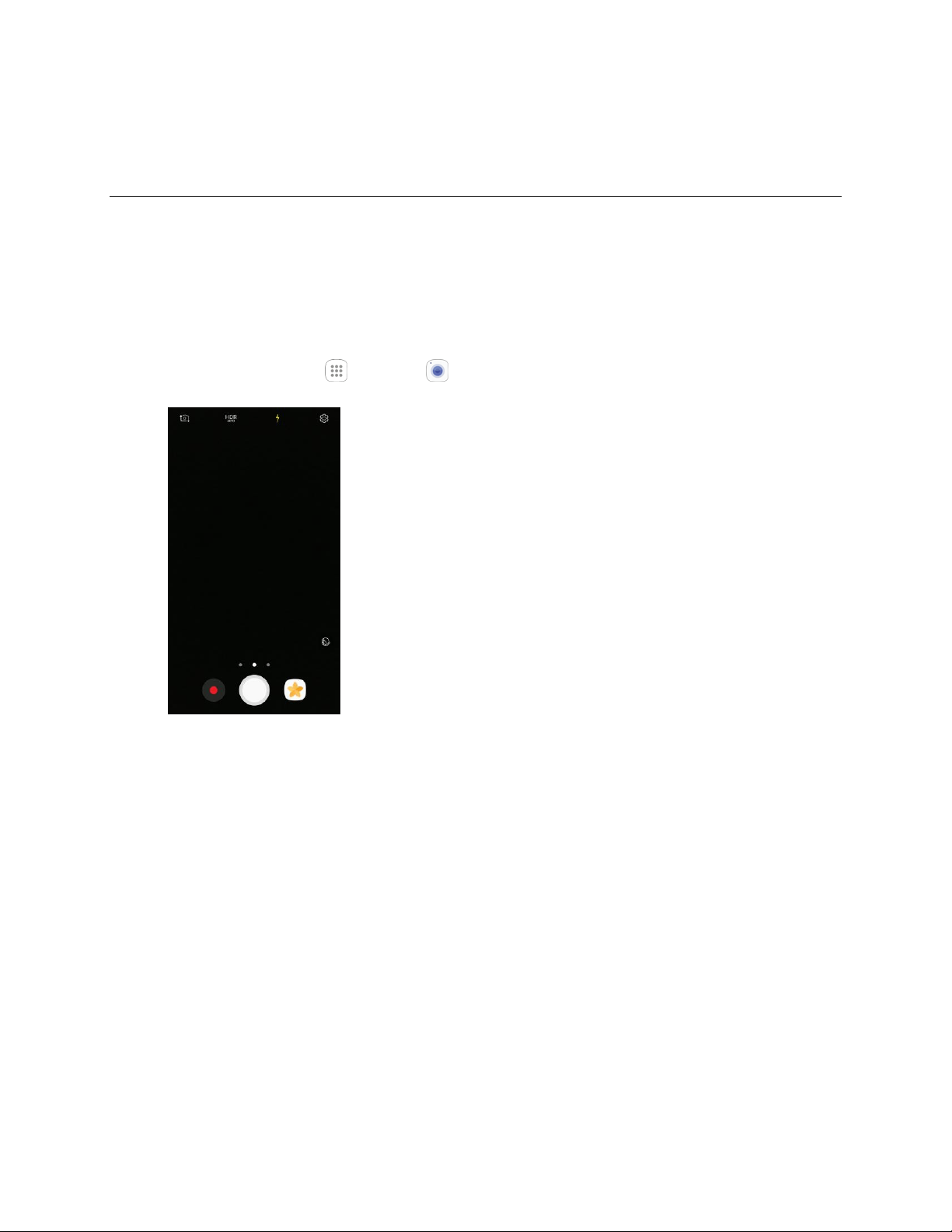
Camera and Video 123
Camera and Video
You can use the camera or video camera to take and share pictures and videos. Your phone comes with
a camera with an autofocus feature that lets you capture sharp pictures and videos.
Learn About Your Phone’s Camera
For an overview of your phone's camera and its features, you can access more information through the
phone's settings menu.
1. From home, tap Apps > Camera .
The camera viewfinder appears.
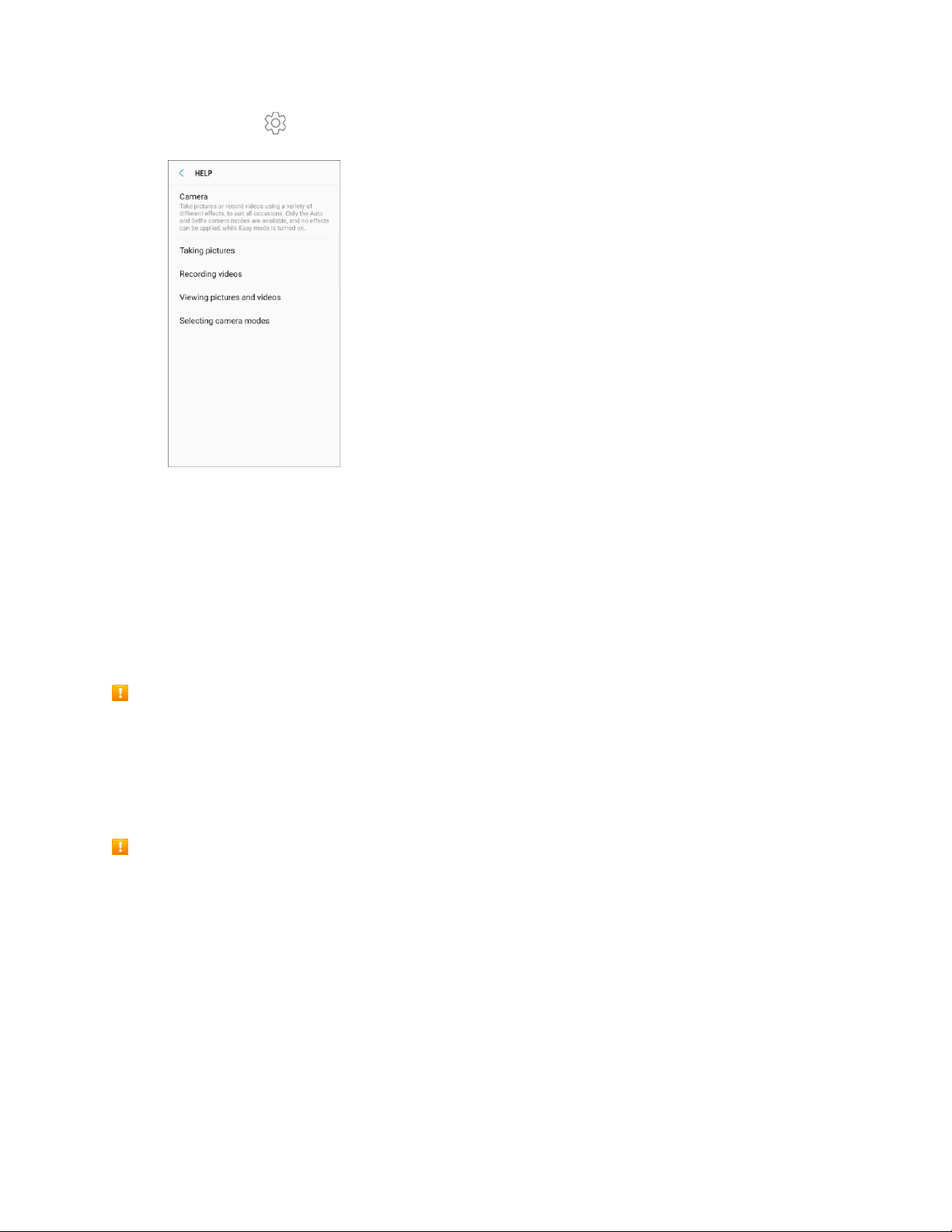
Camera and Video 124
2. Tap Settings > Help, and tap a topic to learn more.
Take Pictures and Record Videos
The following topics teach you how to take pictures and record videos with your phone’s camera.
Capturing Pictures/Videos
● File Format for Pictures: File format for pictures is JPEG or RAW format.
● File Format for Videos: File format for videos is MPEG4.
Camera Cautions
If Lens Becomes Dirty: Fingerprints/smudges on lens prevent capturing of clear still images/videos.
Wipe lens with a soft cloth beforehand.
Avoid Exposure to Direct Sunlight: Be careful not to expose lens to direct sunlight for long periods.
May discolor color filter and affect color of images.
Flash Warning
Do not shine the flash close to eyes. Do not look directly at the flash when shining. Do not shine the
flash at other people's eyes. May affect eyesight, etc.
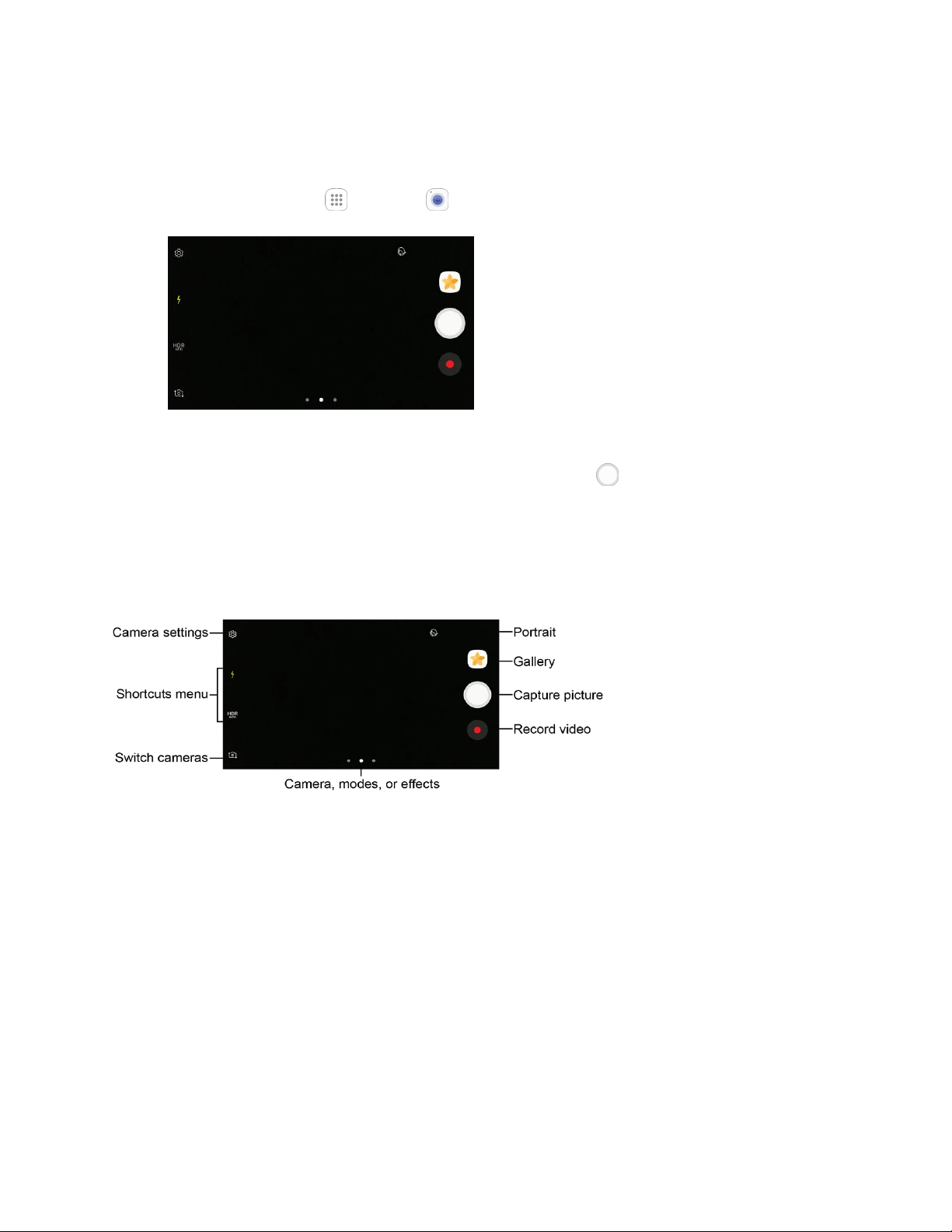
Camera and Video 125
Take a Picture
You can take high-resolution pictures using your phone’s camera.
1. From home, tap Apps > Camera .
The camera viewfinder appears.
2. Aim the camera at your subject and then tap Capture picture .
The shutter clicks and the picture is captured and saved to your phone.
Viewfinder Screen
The camera's viewfinder screen lets you view your subject and access camera controls and options.
● Beauty: Adjust skin tone of faces.
● Gallery: View your picture or video in the Gallery application.
● Capture picture: Take a picture.
● Record video: Begin recording video.
● Modes, camera, or effects: Swipe right to change the shooting mode. Swipe left to add an
effects filter.
● Switch cameras: Switch between the rear camera and the front camera.
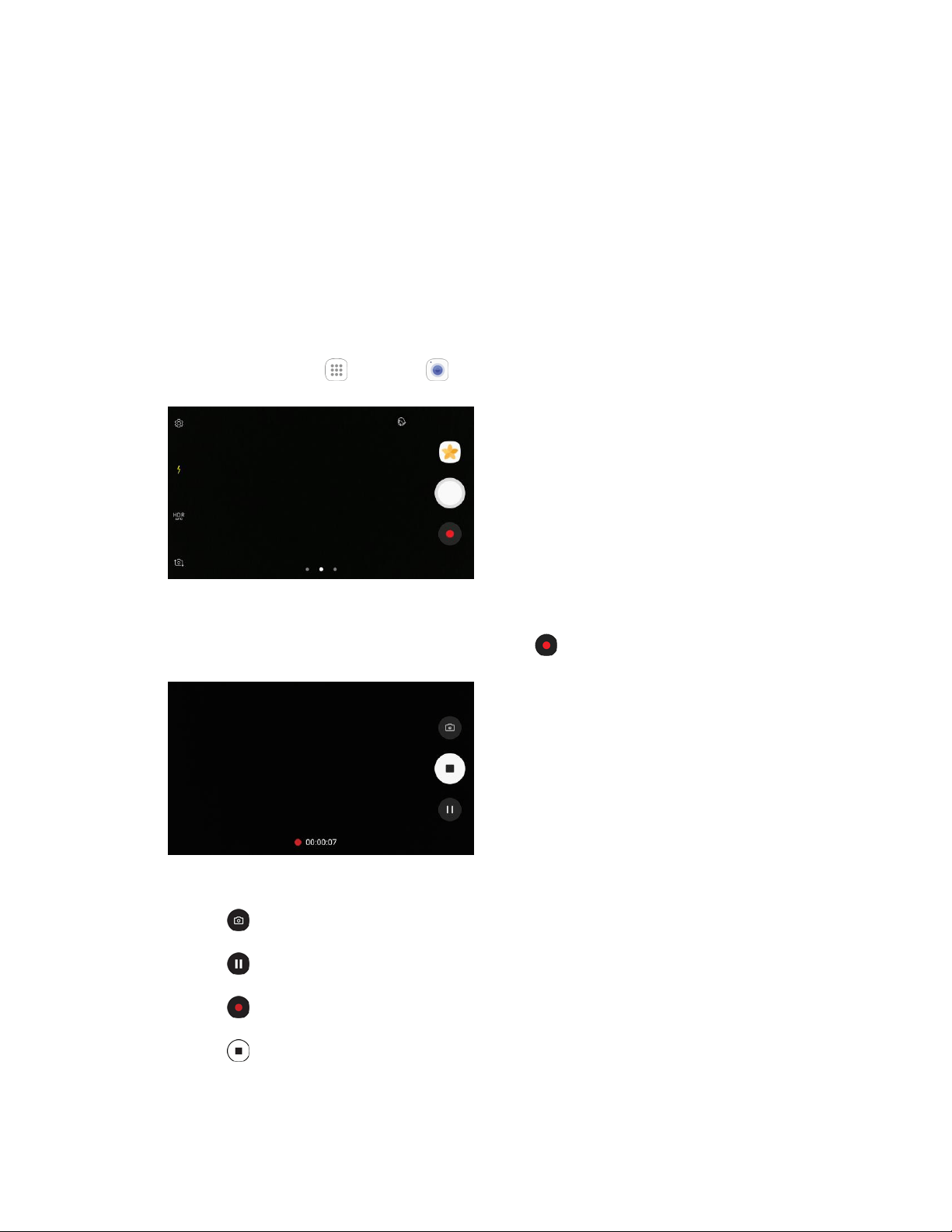
Camera and Video 126
● HDR (Rich tone): Enables the light sensitivity and color depth features of the device to produce a
brighter and richer picture.
● Flash: Activate or deactivate the flash. Toggle through flash options—on, auto, or off (rear
camera only).
● Camera settings: Opens the camera settings menu and lets you change additional camera
settings. See Camera Settings.
Record Videos
Record high-quality videos using your phone’s video camera.
1. From home, tap Apps > Camera .
The camera viewfinder appears.
2. Aim the camera at your subject and then tap Record .
Video recording begins.
Tap Capture to take a picture while recording.
Tap Pause to pause recording.
Tap Resume to resume recording.
Tap Stop to stop recording.
The camera stops recording and the video is captured and saved to your phone.
Camera and Video 127
Shooting Modes
Your phone’s camera offers many shooting modes, to make your pictures or videos special.
1. From home, tap Apps > Camera .
2. The camera viewfinder appears.
3. On the Camera screen, swipe to the right for the Mode options. Each section indicates which
camera (front or rear) the modes are available for.
Both cameras
• Video collage: Create your own short collages and slow-motion videos without any
editing tools.
• Live broadcast: Broadcast live on YouTube
™
. Share your link with friends so they can
watch your video in real time. For more information, see Live Broadcast.
• Virtual shot: Create multi-directional views of objects.
• Download: Download additional shooting modes from the Galaxy Apps store.
Rear camera
• Auto: Allow the camera to evaluate the surroundings and determine the ideal mode for
the picture.
• Pro: Manually adjust the ISO sensitivity, exposure value, white balance, and color tone
while taking pictures.
• Selective focus: Change the focus of pictures after they have been taken. You can focus
on subjects near to the camera, far away from the camera, or both.
•
Panorama: Create a linear image by taking pictures in either a horizontal or vertical
direction.
• Slow motion: Record videos at a high frame rate for viewing in slow motion. You can
play a specific section of each video in slow motion after recording it.
• Fast motion: Record videos for viewing in fast motion. You can play a specific section of
each video in fast motion after recording it.
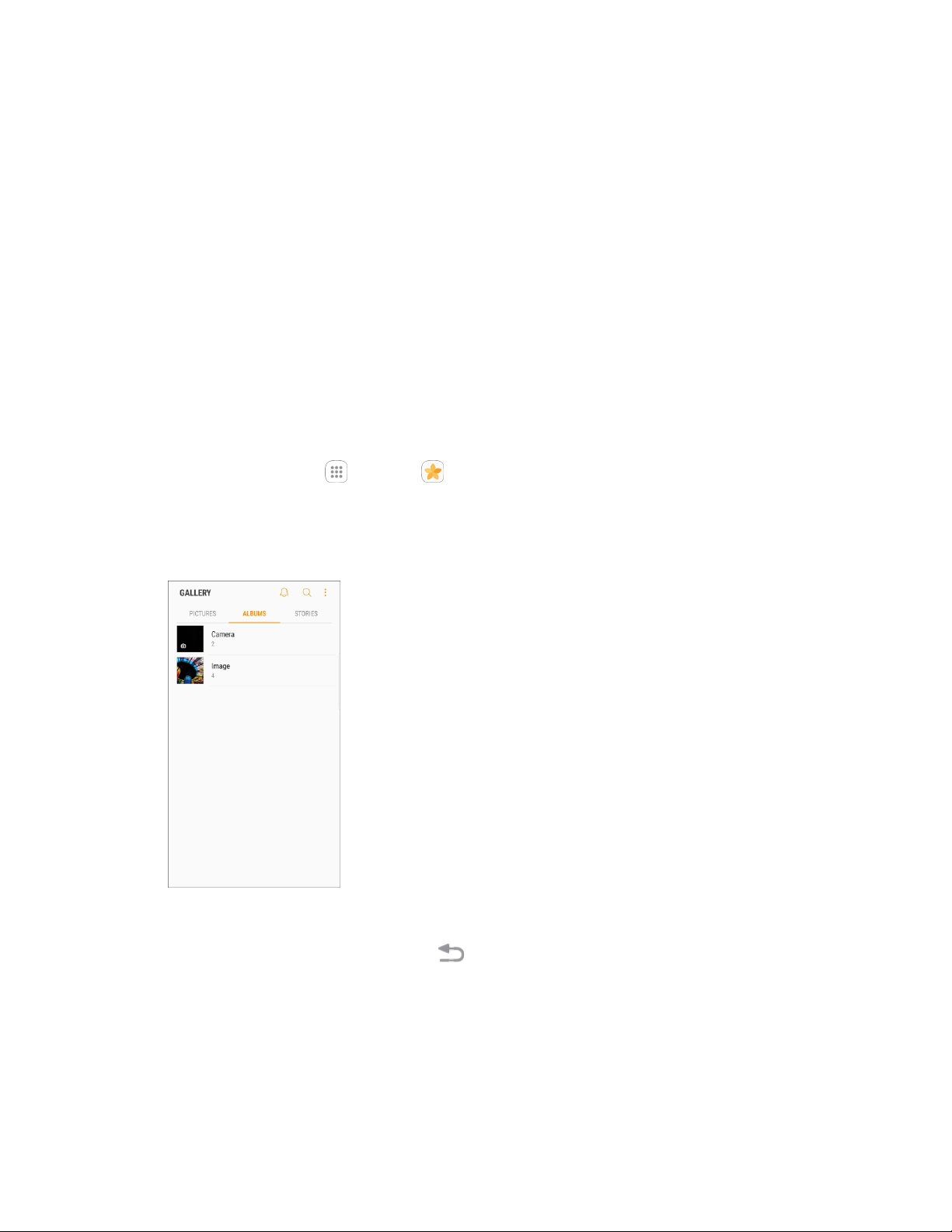
Camera and Video 128
Front camera
• Selfie: Take selfie shots and apply various effects, such as an airbrushed effect.
• Wide selfie: Take wide-angle selfie shots to fit more people into your pictures.
View Pictures and Videos Using Gallery
Using the Gallery application, you can view pictures and watch videos that you have taken with your
phone’s camera, downloaded, or copied into your phone memory.
For pictures that are on your phone memory, you can do basic editing such as rotating and cropping. You
can also easily assign a picture as your contact picture or wallpaper and share pictures with your friends.
View Pictures and Videos
You can access and view all your stored pictures and videos from your phone’s Gallery.
1. From home, tap Apps > Gallery .
The album list opens.
2. Tap an album (such as Camera).
The list of pictures and videos for the album opens.
To select another album, tap Back to return to the Albums tab.
3. Tap an image to view the picture or video.
The picture opens or the video begins playing.
Tap a picture or video to view it full screen.

Camera and Video 129
When viewing pictures and videos, you can tap an image to open a selection menu and
choose what to do with the picture or video.
Pictures and Videos: Review Screen
After capturing a picture or video, from the camera screen, tap the thumbnail image to see the item in the
review screen. From there, you can access options such as save, view, send, or delete the picture or
video.
Pictures and Videos: Options While Viewing
● Zoom in or out on a picture or video: Tap the screen twice or pinch the screen to zoom in or
out on a picture or video.
● Viewing videos: Use the controls to play, pause, or stop the video playback.
After selecting an album from the Albums tab, you can browse through the pictures and videos of that
album. Tap a picture or video to view it in full screen. By default, the pictures and videos in an album are
displayed in grid view.
Note: When viewing pictures, you can tap a picture or video to open a selection menu and choose what
to do with the picture or video.
Edit Pictures
Whether you are browsing pictures in filmstrip or grid view in the Gallery application, you can tap a picture
to open a selection menu and choose to delete the picture, rotate or crop it, and more.
Auto Adjust a Picture
Use the Auto adjust option to automatically enhance your pictures.
1. From home, tap Apps > Gallery .
The Gallery app opens.
2. Tap the picture you want to Auto adjust.
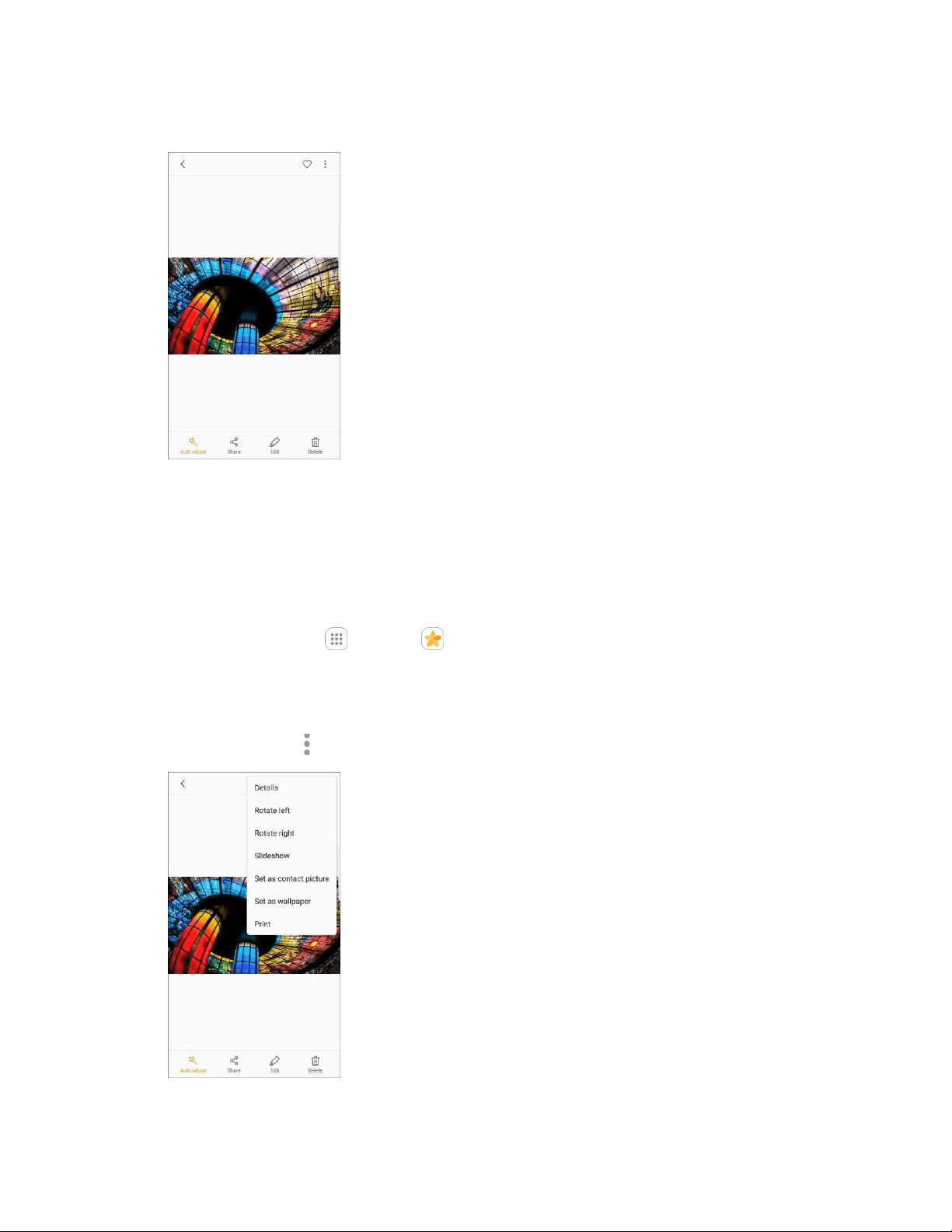
Camera and Video 130
3. Tap Auto adjust.
The picture's color, brightness, and saturation are automatically enhanced, and the picture is
saved to the phone.
Rotate a Picture
The editing options let you rotate pictures 90 degrees clockwise. Repeat the action for additional
rotations.
1. From home, tap Apps > Gallery .
The Gallery app opens.
2. Tap the picture you want to rotate.
3. Tap More options > Rotate left or Rotate right.
The picture is rotated and saved to the phone.

Camera and Video 131
Crop a Picture
Use the editing tools to crop your pictures.
1. From home, tap Apps > Gallery .
The Gallery app opens.
2. Tap the picture you want to crop.
3. Tap Edit > Transform.
A crop box appears on the picture.
4. To adjust the crop box size, touch and hold the edge of the box. Drag your finger inward or
outward to resize the crop box.
To move the crop box to the part of the picture that you want to crop, drag the crop box to the
desired size and position.
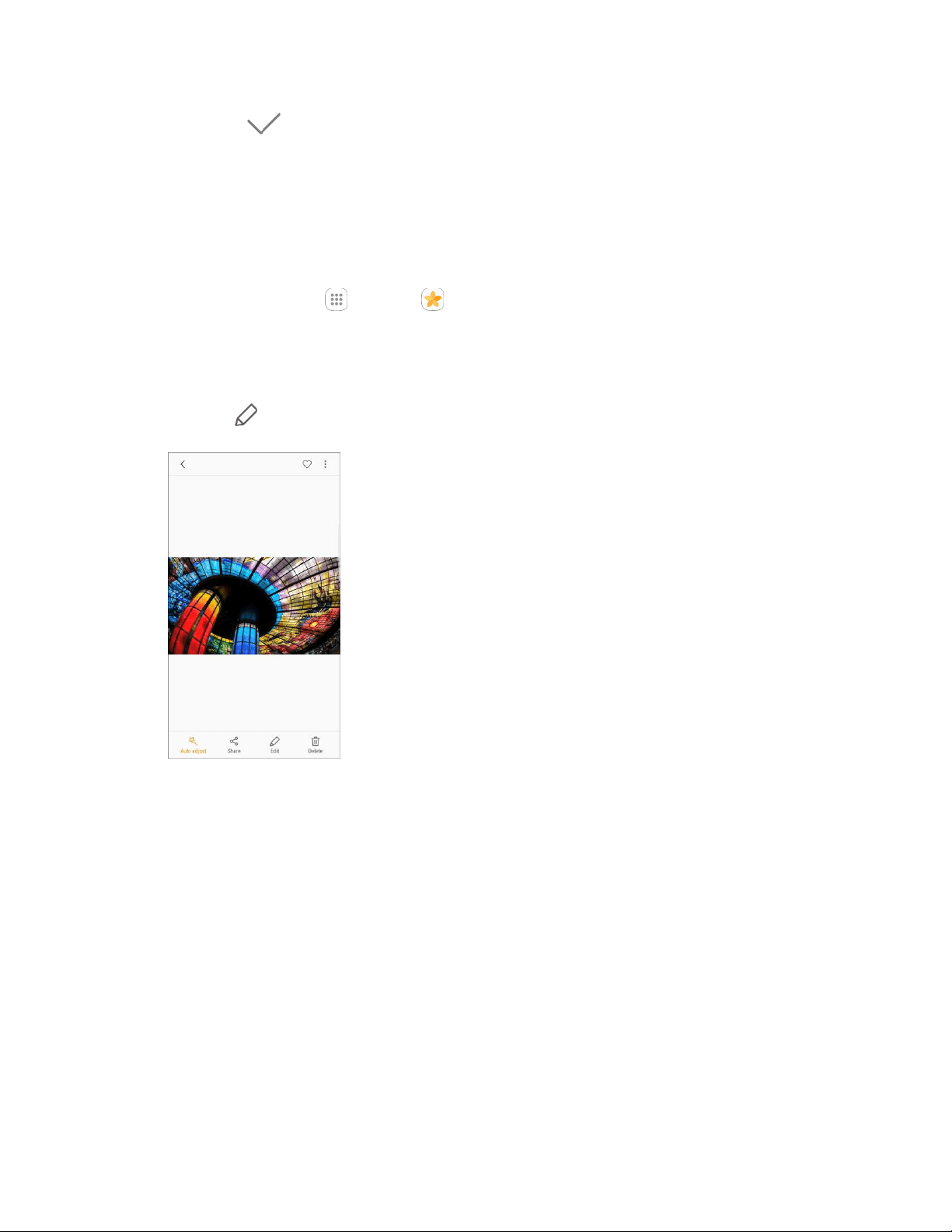
Camera and Video 132
5. Tap Apply to apply the changes to the picture.
The cropped picture is saved in the album as a copy. The original picture remains unedited.
Photo Editor
Perform advanced edits on your pictures, including straightening, adjusting the tone, adding visual
effects, and enhancing portraits.
1. From home, tap Apps > Gallery .
The Gallery app opens.
2. Tap the picture you want to edit.
3. Tap Edit .
Enhancement tools display.
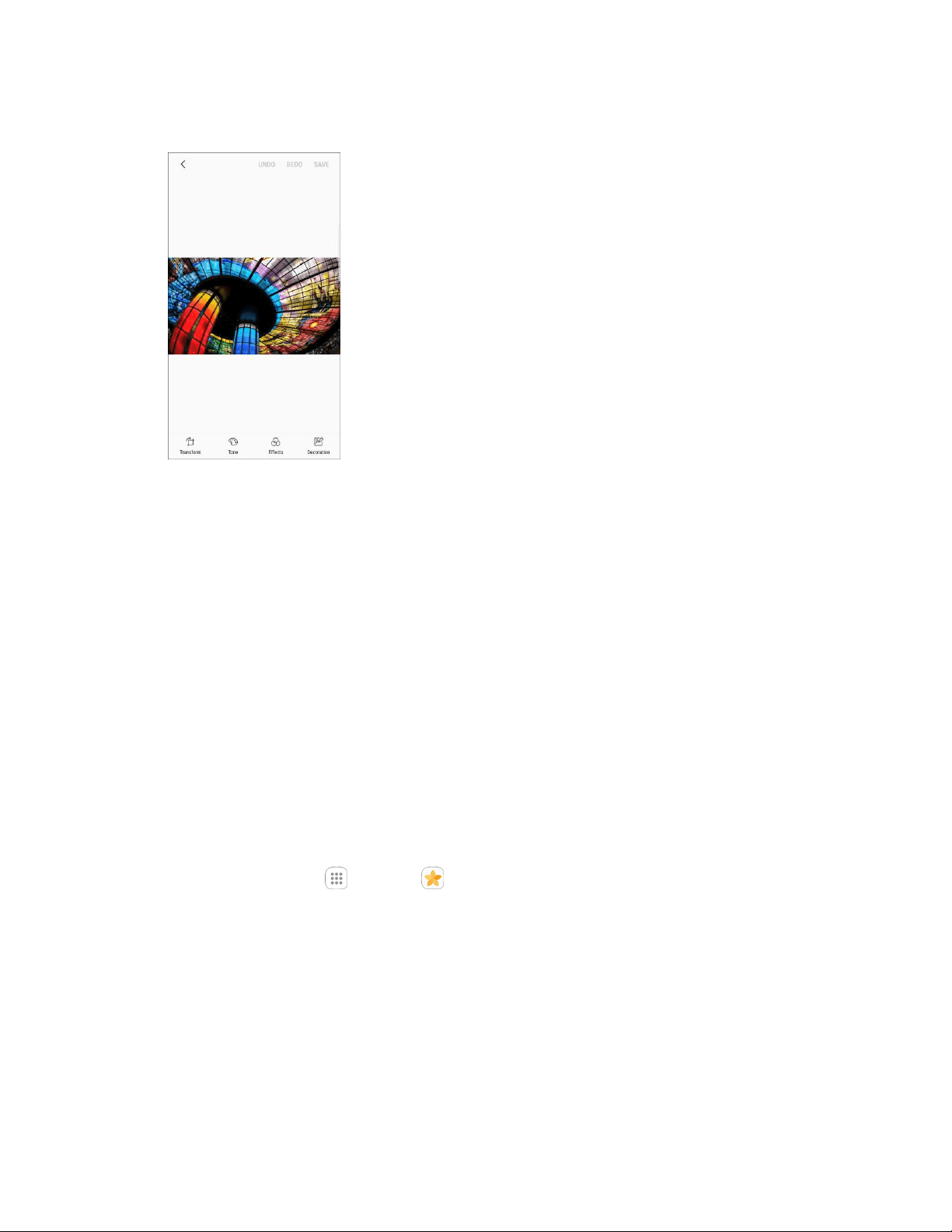
Camera and Video 133
4. Adjust your picture with these tools:
Transform: Straighten and freely rotate your picture.
Tone: Adjust the brightness, contrast, saturation, temperature, and hue of the picture.
Effect: Add color effects to your picture.
Decoration: Draw or write on your picture.
Share Pictures and Videos
The Gallery application lets you send pictures and videos using email or multimedia messages. You can
share pictures on your social networks (such as Facebook, Flickr
®
, and Twitter) and share videos on
YouTube. You can also send them to another phone or your computer using Bluetooth.
Send Pictures or Videos by Email
You can send several pictures, videos, or both in an email or Gmail message. They are added as file
attachments in your email. For more information about using email and Gmail, see Create and Send an
Email Message or Create and Send a Gmail Message.
1. From home, tap Apps > Gallery .
The album list opens.
2. Tap an album (such as Camera).
The list of pictures and videos for the album opens.
3. Tap the picture or video you want to share.
To select multiple items, touch and hold an image to turn on multiple select. Tap all the items
you want to include.
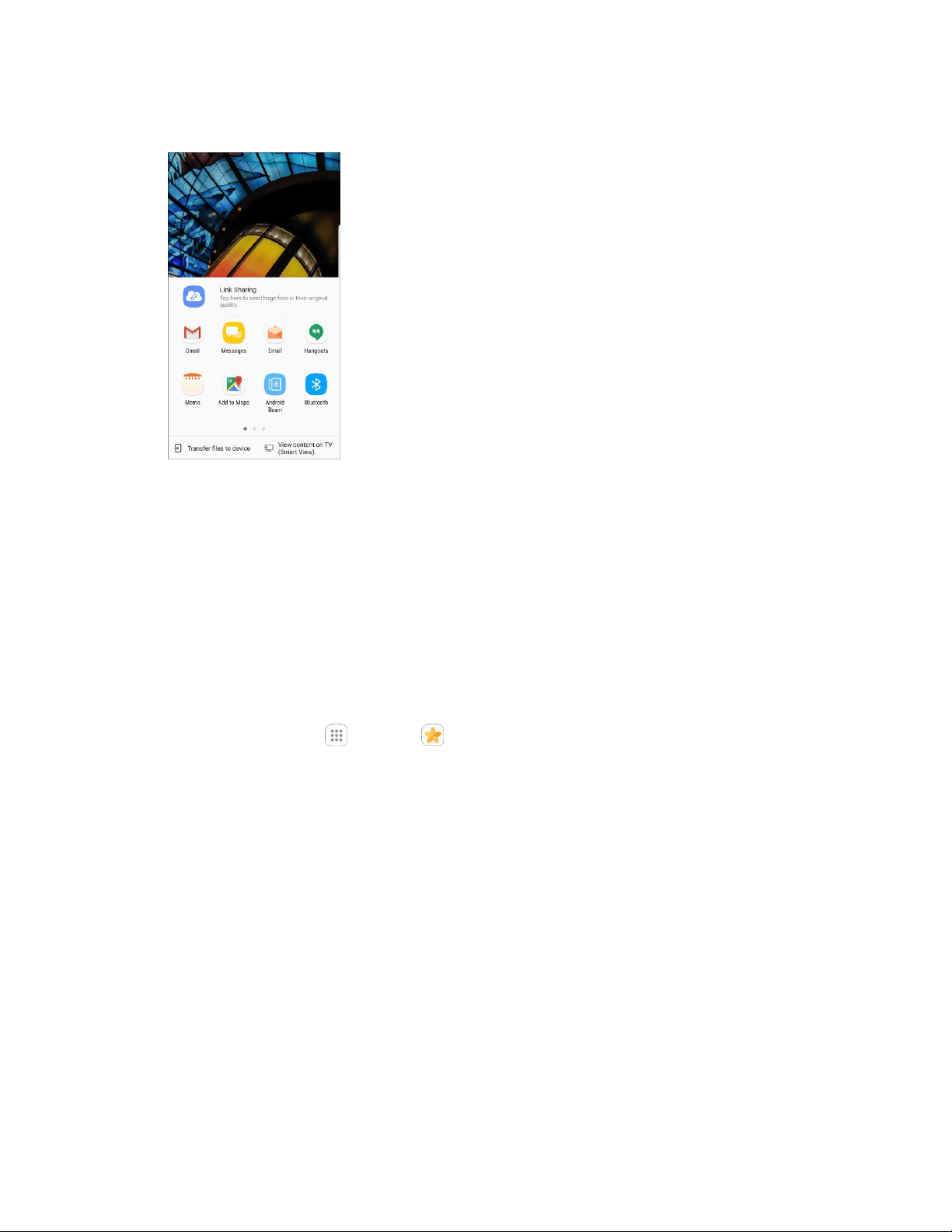
Camera and Video 134
4. Tap Share, and then on the Share menu, tap Email or Gmail.
5. Follow the prompts to complete and send the message.
Note: If you selected Email and you have multiple email accounts, the default email account will be used.
For more information about using email and Gmail, see Create and Send an Email Message or Create
and Send a Gmail Message.
Send a Picture or Video by Multimedia Message
Multimedia Messaging (MMS) lets you send pictures and videos using your phone’s messaging app.
Although you can send several pictures or videos in a multimedia message, it may be better to just send
one at a time, especially if the files are large in size.
1. From home, tap Apps > Gallery .
The album list opens.
2. Tap an album (such as Camera).
The list of pictures and videos for the album opens.
3. Tap the picture or video you want to share.
To select multiple items, touch and hold an image to turn on multiple select. Tap all the items
you want to include.
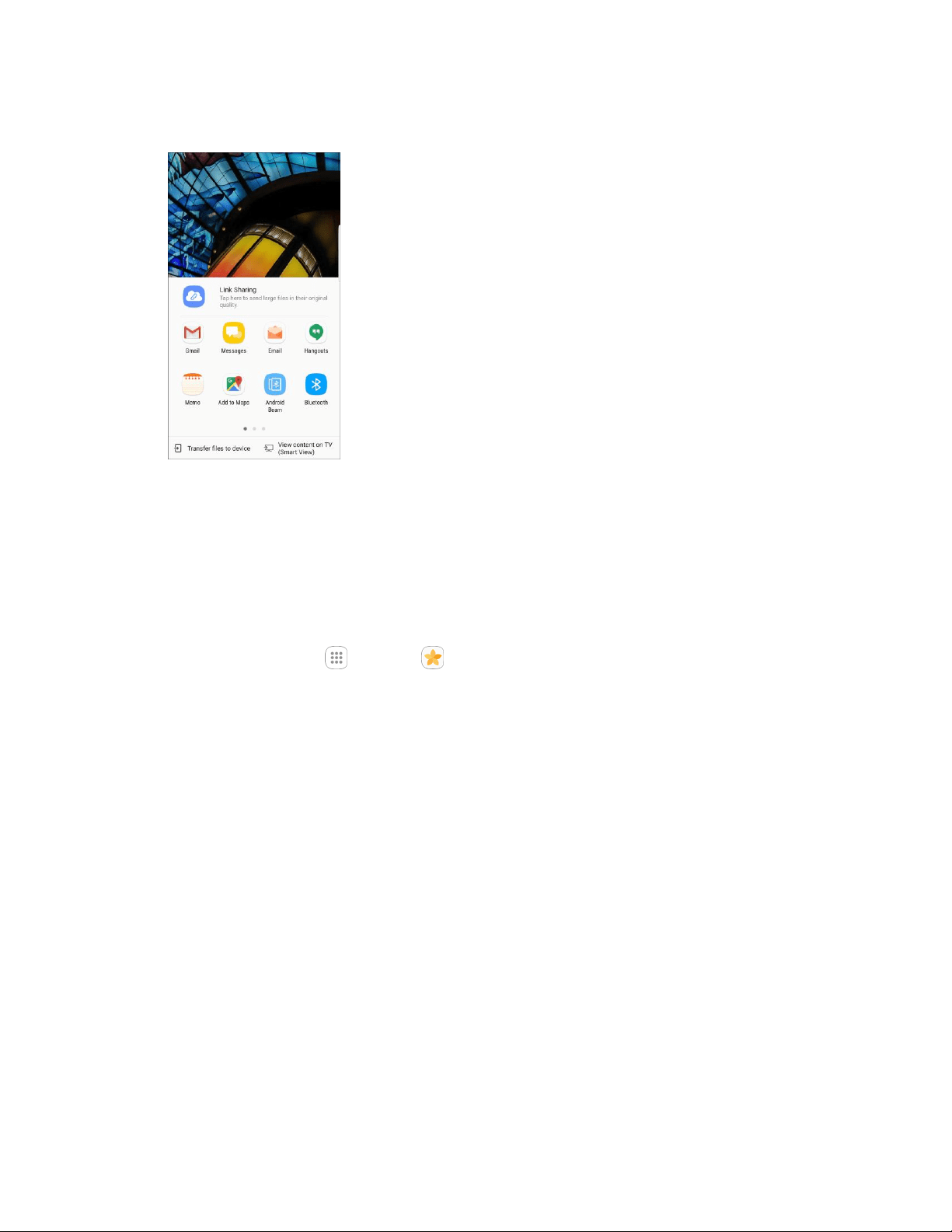
Camera and Video 135
4. Tap Share, and then on the Share menu, tap Messages.
5. Follow the prompts to complete and send the message.
For more information about sending multimedia messages, see Send a Multimedia Message (MMS).
Send Pictures or Videos Using Bluetooth
You can select several pictures, videos, or both and send them to someone’s phone or your computer
using Bluetooth.
1. From home, tap Apps > Gallery .
The album list opens.
2. Tap an album (such as Camera).
The list of pictures and videos for the album opens.
3. Tap the picture or video you want to share.
To select multiple items, touch and hold an image to turn on multiple select. Tap all the items
you want to include.
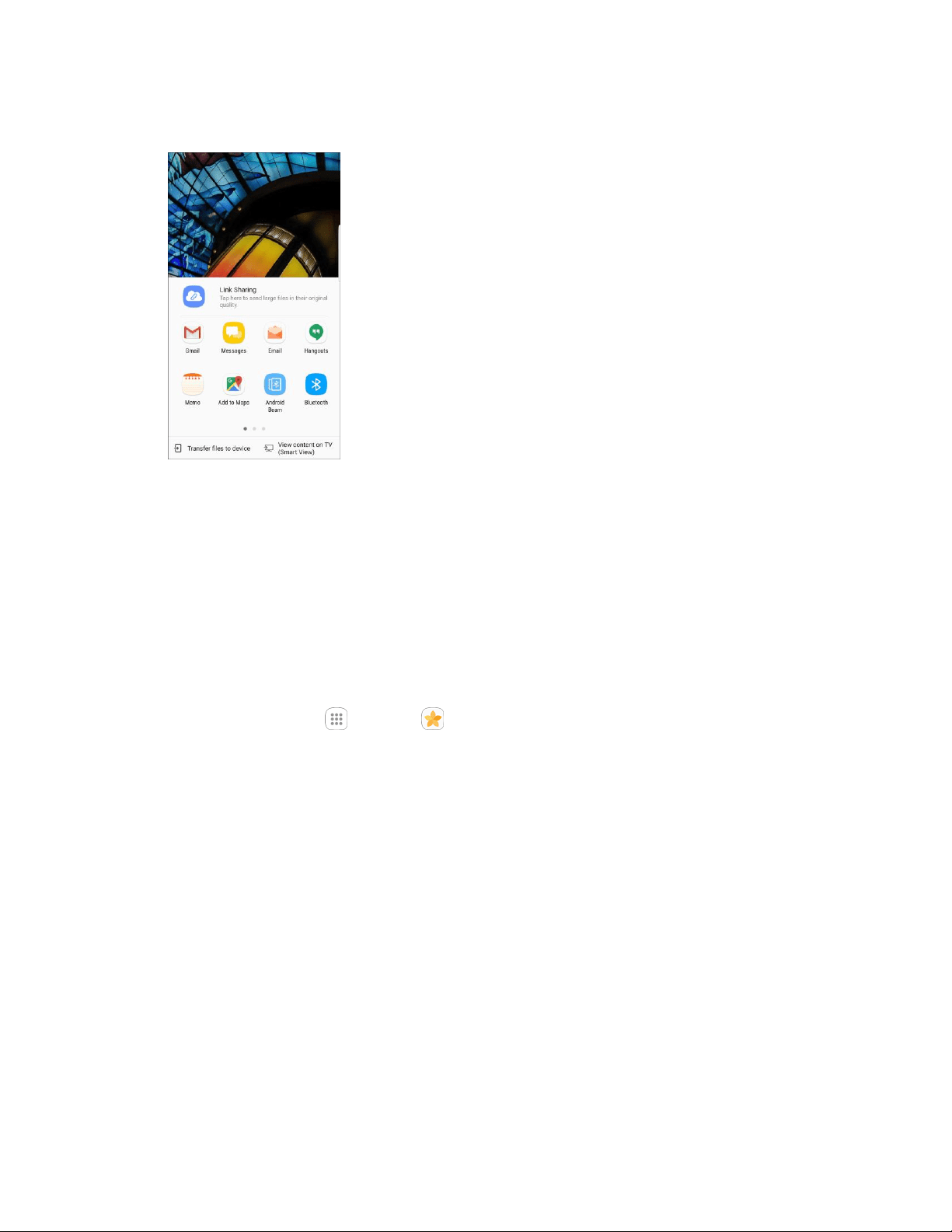
Camera and Video 136
4. Tap Share, and then on the Share menu, tap Bluetooth.
5. Follow the prompts to complete and send the files.
For more information, see
Bluetooth.
Share Pictures or Videos Using Additional Apps or
Social Media
From Gallery, you can share your pictures and videos from a variety of apps and social media sites, such
as Facebook, Hangouts, Instagram, and more. Available apps will vary depending on what you have
installed on your phone.
1. From home, tap Apps > Gallery .
2. Tap the album that contains the photos or videos you want send.
3. Select the picture or video you want to send.
To select multiple items, touch and hold an image to turn on multiple select. Tap all the items
you want to include.
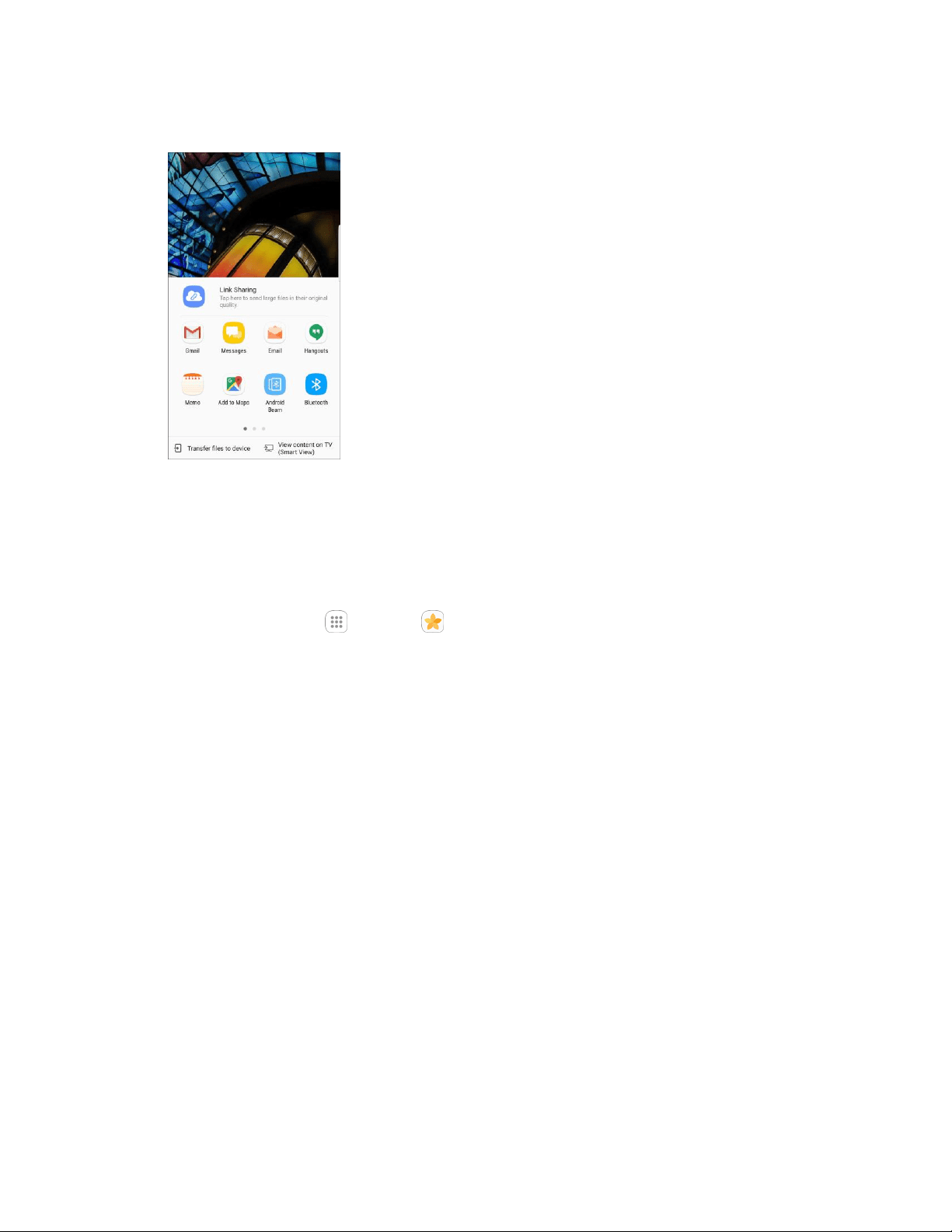
Camera and Video 137
4. Tap Share, and then tap the app you want to use.
5. Follow the prompts to complete the share.
Share Videos on YouTube
You can share your videos by uploading them to YouTube. Before you do this, you must create a
YouTube account and sign in to that account on your phone.
1. From home, tap Apps > Gallery .
The album list opens.
2. Tap an album (such as Camera).
The list of pictures and videos for the album opens.
3. Tap the video you want to share.
To select multiple videos, touch and hold an image to turn on multiple select. Tap all the
videos you want to include.
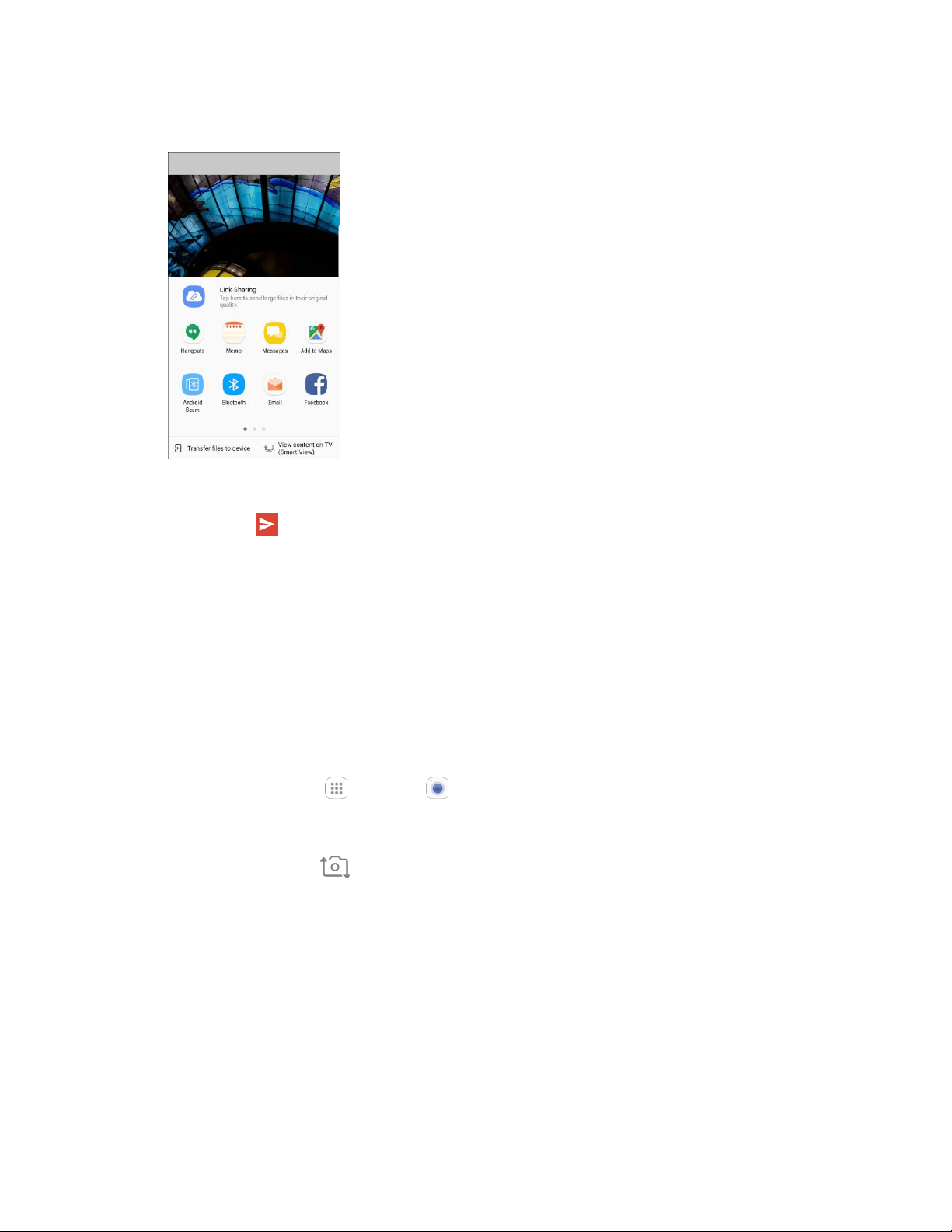
Camera and Video 138
4. Tap Share, and then on the Share menu, tap YouTube.
5. Enter the prompted information, such as description and tags, and select a privacy option.
6.
Tap Upload .
The upload is completed.
Camera Settings
You can adjust your camera’s settings using the icons on the main camera screen and the full camera
settings menu.
Switch Cameras
Your phone lets you switch between the front and rear cameras.
1. From home, tap Apps > Camera .
The camera viewfinder appears.
2. Tap Switch cameras .
– or –
Swipe the screen up or down.
The camera changes from the rear camera to the front camera or vice versa.
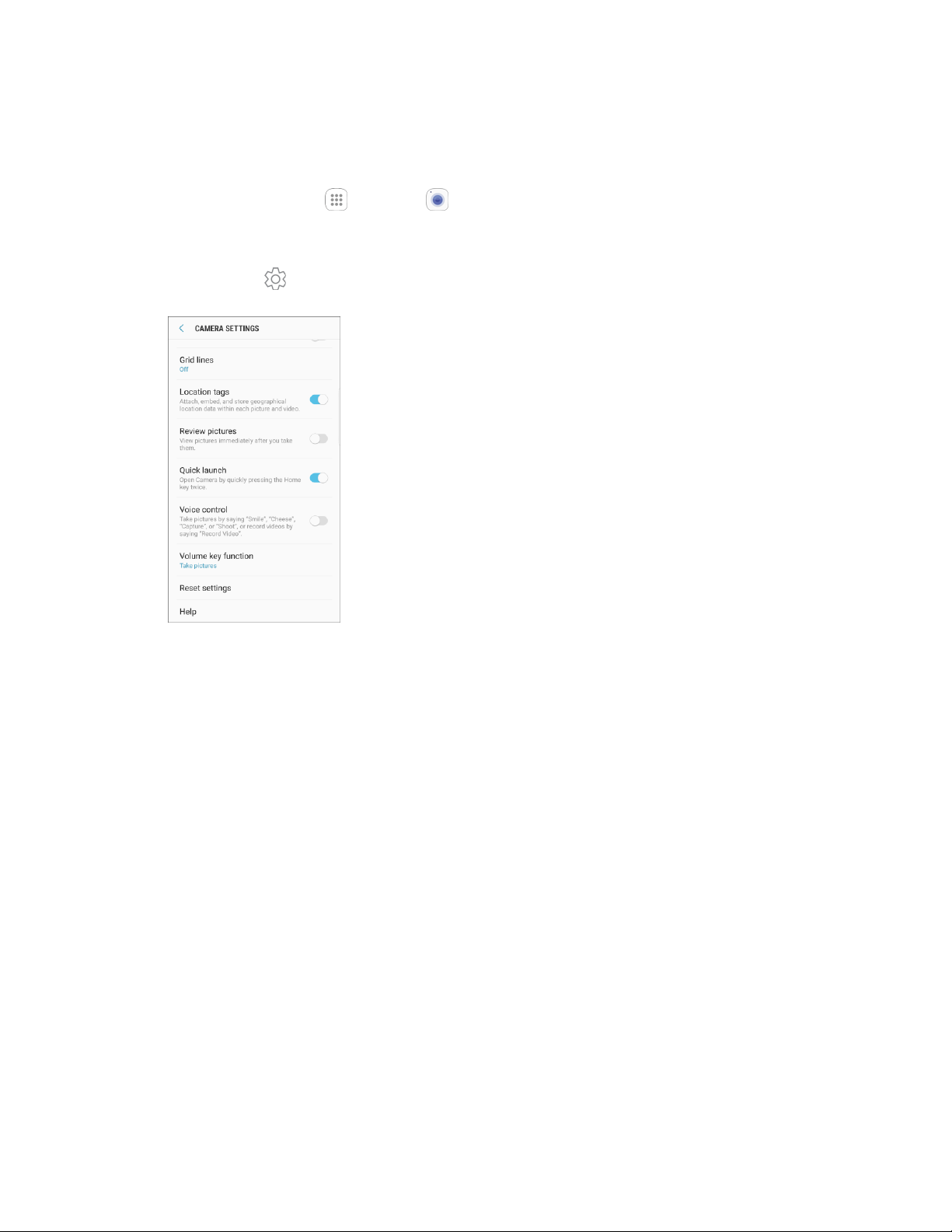
Camera and Video 139
Set Camera Functions
You can configure your camera’s settings to fit any situation and event.
1. From home, tap Apps > Camera .
The camera viewfinder appears.
2. Tap Settings .
The camera settings menu opens.
3. Select your desired settings.
Both cameras
• Timer: Take time-delayed pictures or videos.
• Video stabilization: Activate anti-shake. Anti‑shake helps to keep the focus steady
when the camera is moving.
• Grid lines: Display viewfinder grid lines to help composition when selecting subjects.
• Location tags: Attach a GPS location tag to the picture.
• Review pictures: Set to show pictures after taking them.
• Quick launch: Open camera by pressing the Home key twice in quick succession.
• Voice control: To take pictures say “smile,” “cheese,” “capture,” or “shoot.” To record
videos, say “Record video.”
• Volume keys function: Use the Volume key as the camera key, the record key, or as a
zoom key.
• Reset settings: Reset the camera settings.

Camera and Video 140
• Help: View information on using the camera.
Rear camera
• Picture size: Select a resolution. Use higher resolution for higher quality. Higher
resolution pictures take up more memory.
• Video size: Select a resolution. Use higher resolution for higher quality. Higher resolution
videos take up more memory.
• Tracking AF: Focus on and track a subject selected on the preview screen.
• Save as raw file: Save pictures as a high-resolution uncompressed image file. A viewer
app is required to view pictures saved as raw files.
Front camera
• Picture size: Select a resolution. Use higher resolution for higher quality. Higher
resolution pictures take up more memory.
• Video size: Select a resolution. Use higher resolution for higher quality. Higher resolution
videos take up more memory.
• Gesture control: Hold your hand out with your palm facing the camera to have your
picture taken after a few seconds.
• Save pictures as previewed: Save the self‑portrait or self‑recording as viewed on the
camera screen, not as flipped images.
• Ways to take pictures: Tap to take pictures (tap the screen to take selfies), Gesture
control (hold your hand out with your palm facing the camera to have your picture taken
in a few seconds), and Use heart rate sensor (once your face has been recognized, tap
the heart rate sensor to take a selfie).
Live Broadcast
Use Live Broadcast to share what is happening around you using YouTube.
To access the Live Broadcast:
1. From home, tap Apps > Camera .
The camera viewfinder appears.
2. On the Camera screen, swipe to the right for the Mode options, and then tap Live broadcast.
Note: You need to sign in to your Google Account and enable Live Broadcast in your YouTube settings to
use this feature.

Camera and Video 141
Live Broadcast Options
The following options are available:
● Rear/Front: Choose which camera to record from.
● Invite: Invite contacts to view your live broadcast by sending them a link.
● Settings: Set your privacy settings, Video size, Auto save, and manage your account.
● Live: Start recording your live broadcast.
● Share: Share while recording your live broadcast.
● Stop: End your live broadcast.
Record a Live Broadcast
Record and instantly share your videos to YouTube.
1. From home, tap Apps > Camera .
The camera viewfinder appears.
2. Tap Mode > Live broadcast.
3. Tap Invite and select contacts to share your live broadcast with. You will also have the option
to share your live broadcast during recording and when you finish recording.
4. Tap Live to begin recording.
5. When you are finished, tap Stop .
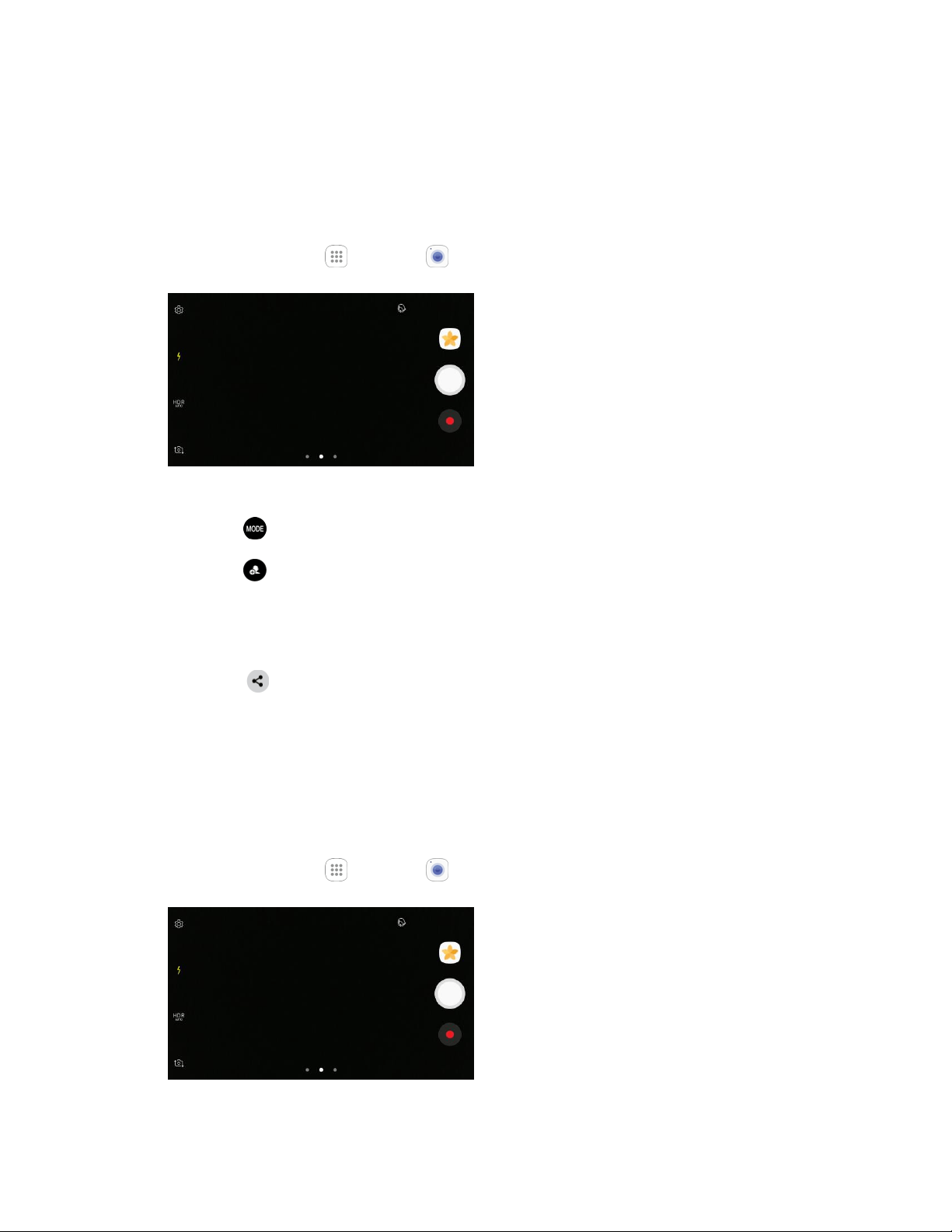
Camera and Video 142
Share a Broadcast
You can share your live broadcast with contacts before recording, or share the link after you have finished
recording and it has been posted to YouTube.
To invite contacts:
1. From home, tap Apps > Camera .
The camera viewfinder appears.
2. Tap Mode > Live broadcast.
3. Tap Invite and select contacts or groups to share your live broadcast with.
4. Tap Save to send invites.
To share a Live broadcast while broadcasting:
■ Tap Share and select a sharing method to share your Live broadcast.
To share a Live broadcast after broadcasting:
■ After recording, tap Share link and select a sharing method to share your Live broadcast.
Live Broadcast Settings
Customize your Live Broadcasts.
1. From home, tap Apps > Camera .
The camera viewfinder appears.

Camera and Video 143
2. Tap Mode > Live broadcast.
3. Tap Settings and select an option to customize:
Account: Select a Google Account for Live broadcast.
Privacy: Choose either to have your videos unlisted where only friends with a link can view
them, or public where anyone can view them.
Video size: Tap to choose a size option.
Auto save: Tap to enable auto saving your videos to the Gallery app.
Auto dim: Dims the brightness if you broadcast without touching the screen.
Add shortcut on Home screen: Tap to create a shortcut to Live broadcast on the Home
screen.
Apps and Features 144
Apps and Features
The following topics detail many of your phone’s tools and features such as maps and navigation,
calendar, clock, social networking apps, music, memos, and more.
1Weather
Receive real-time local weather information at any location in the world. Access 7-day and hourly weather
forecasts for your area.
■ From home, tap Apps > 1Weather .
AAA
Plan trips and access AAA member services.
■ From home, tap Apps > AAA .
Amazon Shopping
Shop at Amazon
™
.com from your device.
■ From home, tap Apps > Amazon Shopping .
App Spotlight
Discover new apps from the Google Play store.
■ From home, tap Apps > App Spotlight .
Calculator
Your phone’s convenient built-in calculator lets you perform basic mathematical equations.
1. From home, tap Apps > Calculator .
The calculator app launches.
2. Tap keys for calculations.
Calculation results appear.
Tip: To use the scientific calculator, make sure Auto rotate is turned on (notification panel > Auto rotate
) and rotate the screen to the landscape orientation.
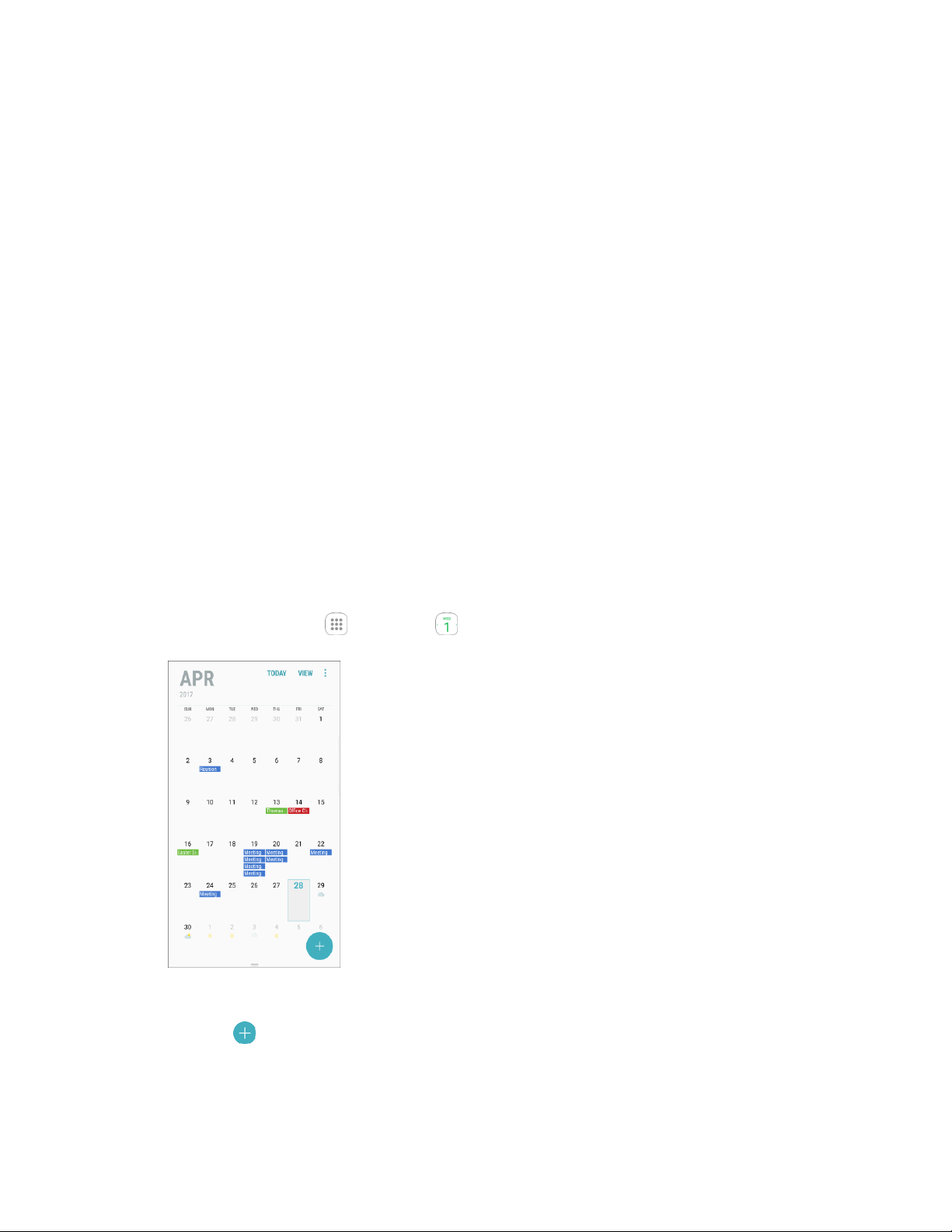
Apps and Features 145
Calendar
Use Calendar to create and manage events, meetings, and appointments. Your Calendar helps organize
your time and reminds you of important events. Depending on your synchronization settings, your
phone’s Calendar stays in sync with your Calendar on the Web, Exchange ActiveSync calendar, Google
Calendar
™
, and Outlook
®
calendar.
In order to sync with your Google calendar, you must sign in to a Google Account on your phone. See
Google Account.
Calendar Operations
● View Today’s Calendar: From the Calendar, tap Today.
● Change Calendar View: From the Calendar, tap View > Year, Month, Week, Day, or Task to
change the current view.
● View Next/Previous Month (Month View): From the Calendar, swipe left or right.
● View Next/Previous Week (Week View): From the Calendar, swipe left or right.
● View Next/Previous Day (Day View): From the Calendar, swipe left or right.
Add an Event to the Calendar
Add events to your calendar directly from the Calendar application.
1. From home, tap Apps > Calendar .
The Calendar app opens.
2. Tap Add .
The add event window opens.
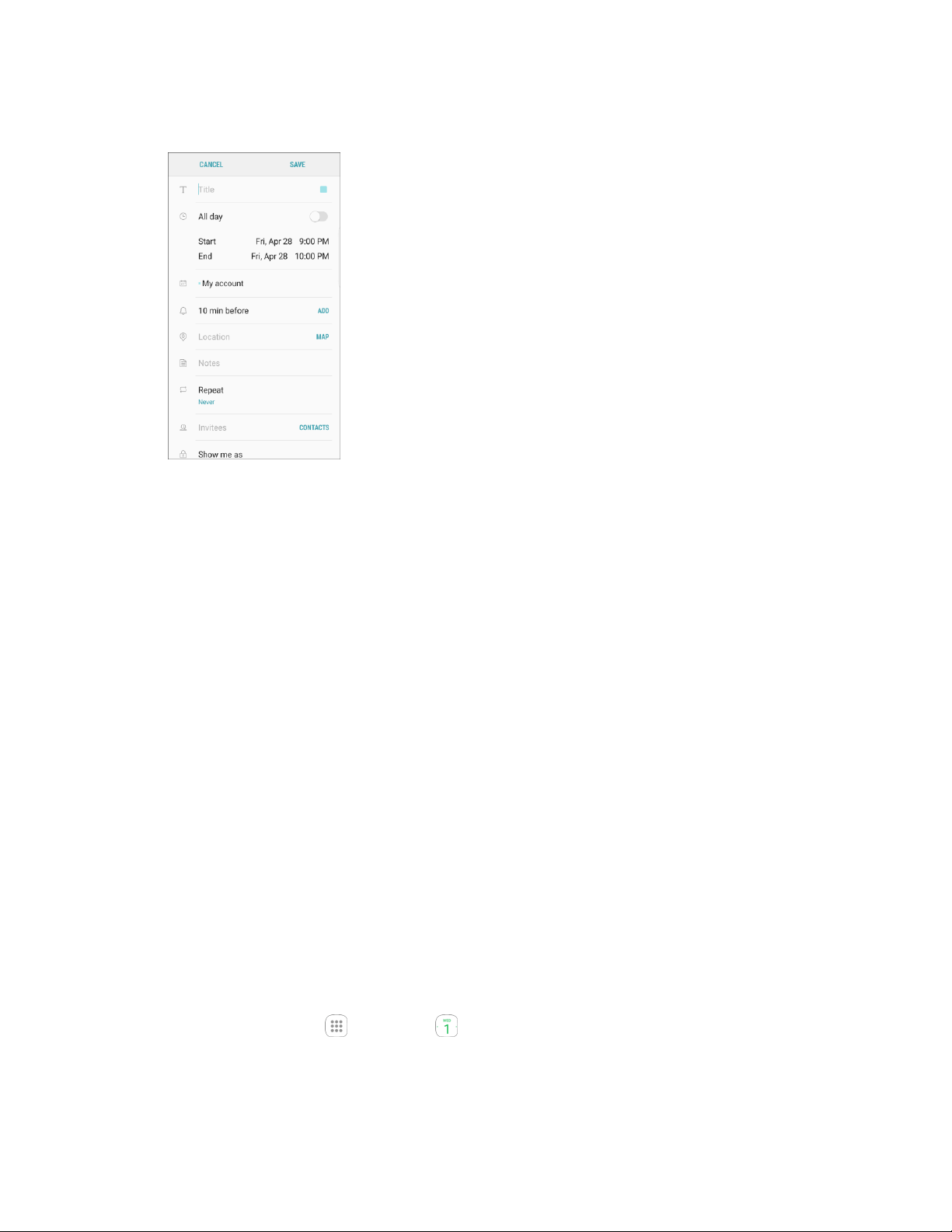
Apps and Features 146
3. Enter an event title, start date/time, end date/time, etc., and then tap Save.
The event is added to your calendar.
Selecting a Calendar
If you have more than one calendar, select a calendar in which to add events:
● Select My calendars to create an event that will appear only on your phone.
● Select Samsung Calendar to save events to your Samsung account.
● Select your Google Account to create a Google Calendar event. If you have several Google
Calendars on the Web, select one in which to add your event.
You can create multiple Google Calendars only in Google Calendar on the Web. After
creating them in Google Calendar on the Web, you will be able to see them in the Calendar
application on your phone. For more information about creating and managing multiple
Google Calendars, visit the Google website: support.google.com/calendar.
● If you have synchronized your phone with an Exchange ActiveSync account or Outlook on your
computer, you can also select these calendars.
● Select PC Sync to create an Outlook Calendar event to sync with your computer.
● Select Exchange to create an Exchange ActiveSync calendar event.
View Calendar Events
You can display the Calendar in daily, weekly, monthly, or agenda view. To change the Calendar view,
tap the current view in the top left corner, and then tap Year, Month, Week, Day, or Tasks.
1. From home, tap Apps > Calendar .
The Calendar app opens.
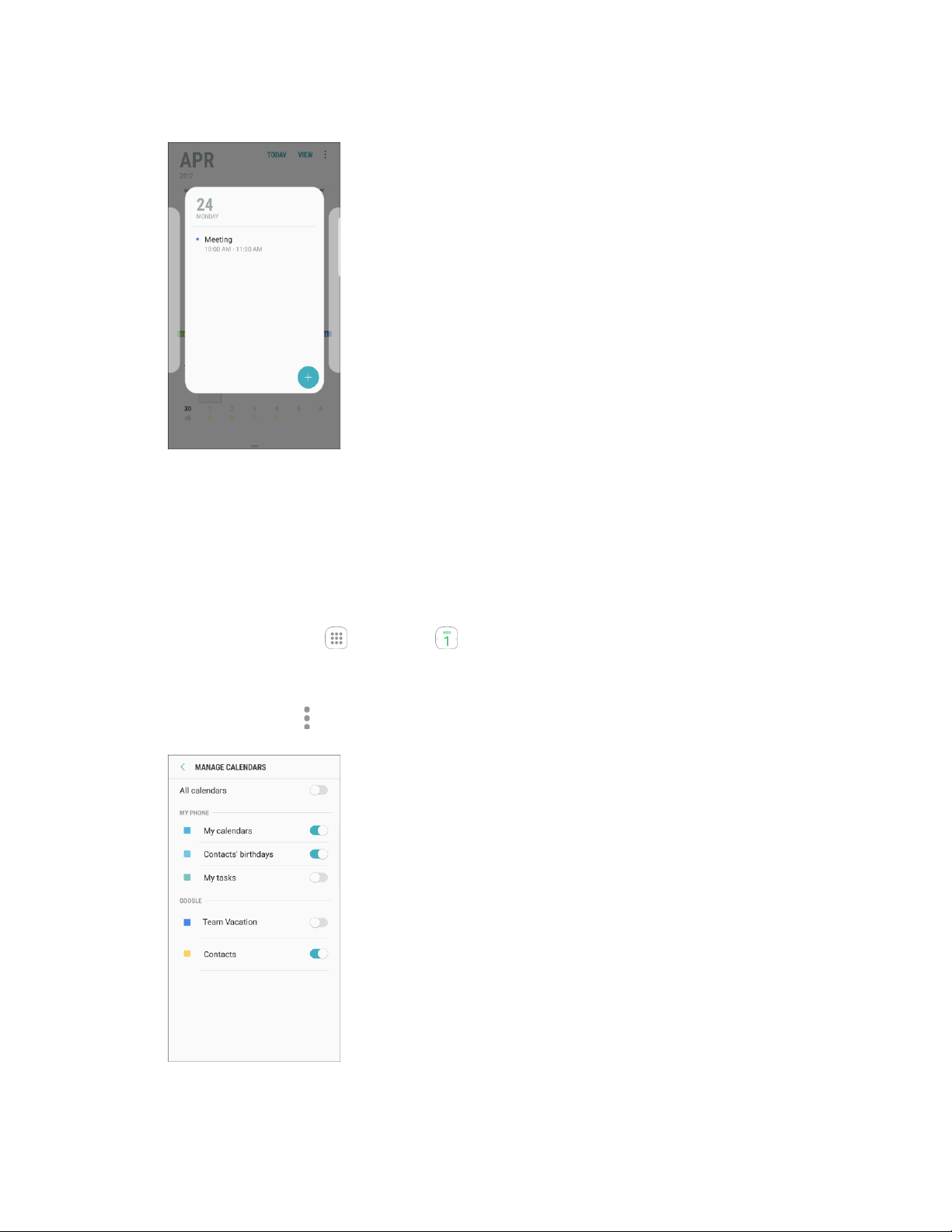
Apps and Features 147
2. Tap a date and then tap an event.
The event details appear.
Tap the event to edit it.
Sync Calendars
You can select which calendars you would like to sync on your phone, along with what types of
information you want to sync.
1. From home, tap Apps > Calendar .
The Calendar app opens.
2. Tap More options > Manage calendars.

Apps and Features 148
3. Select sync options by adding or removing check marks from the items.
The sync settings have been updated.
4. Tap Back to return to Calendar view.
The selected calendars sync.
Synchronize an Exchange ActiveSync Calendar
If you have set up a Microsoft Exchange ActiveSync account on your phone, you can also synchronize
Exchange ActiveSync calendar events on your phone. Calendar events on your Exchange ActiveSync will
also show in Calendar if you chose to synchronize with the Exchange ActiveSync Server.
1. From home, tap Apps > Settings > Cloud and accounts > Accounts > Microsoft
Exchange ActiveSync.
To confirm your sync settings, tap the account name and make sure the Sync Calendar box
is selected. Tap Back to return to the sync menu.
2. Tap Sync all.
Note: If Microsoft Exchange ActiveSync doesn’t appear under the Accounts heading in the Settings
menu, you do not have an Exchange ActiveSync account configured on the phone. For information about
adding an account, see Add an Exchange ActiveSync Account.
Calendar Settings
Configure settings for your phone’s Calendar app.
1. From home, tap Apps > Calendar .
The Calendar app opens.
2. Tap More options > Settings to configure these options:
First day of week: Choose a day to start each calendar week.
Show week numbers: Enable or disable display of week numbers on the calendar.
Hide declined events: When enabled, events for which you declined the invitation are not
shown on the calendar.
7-day weather forecast: When enabled, weather information from AccuWeather.com
displays on the calendar.
Notifications:
• Notification sound: Choose a sound for calendar event notifications.
• Vibrate when sound plays: Enable or disable vibration, to play for calendar event
notifications.
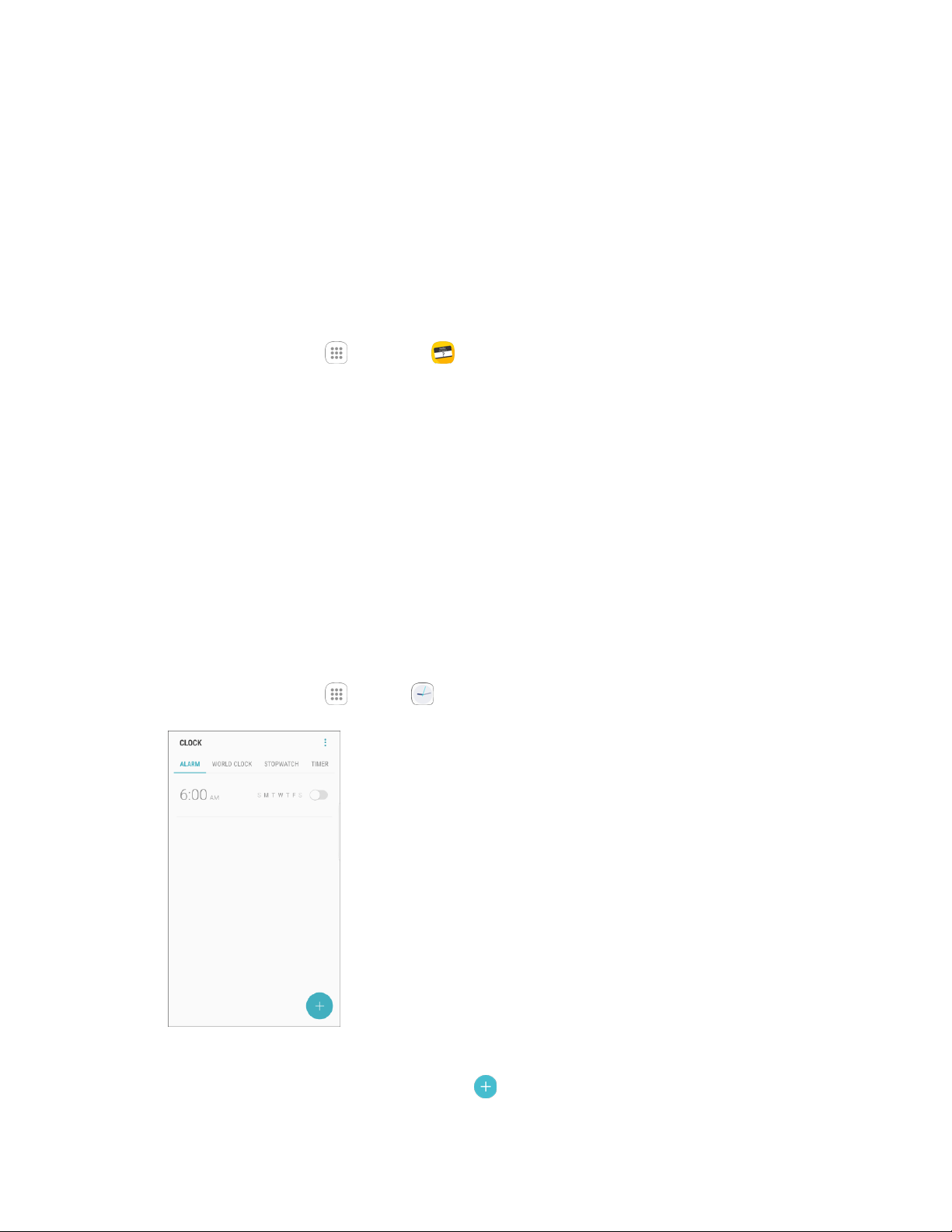
Apps and Features 149
Set default reminders: Set default reminders for Events and All-day events.
Lock time zone: When enabled, event times will be locked to the time zone you select.
Times and dates will not change, even if you travel to another time zone.
About Calendar: View information about the Calendar app.
Caller ID
With the Caller ID app, see who is calling, even if the caller is not in your contact list. The Caller ID app
requires a subscription.
■ From home, tap Apps > Caller ID .
Clock
Your phone has a clock app that lets you set alarms, view time in time zones around the world, use a
stopwatch, or set a timer.
Check the Time
You can check the phone any time on your phone. The current time displays in the upper right corner of
the status bar. Many widgets and lock screens also display the time and provide options for how time is
displayed.
Set Alarms
Set multiple alarms using your phone’s Clock app.
1. From home, tap Apps > Clock .
The Clock appears.
2. Tap the Alarm tab, and then tap Add alarm .
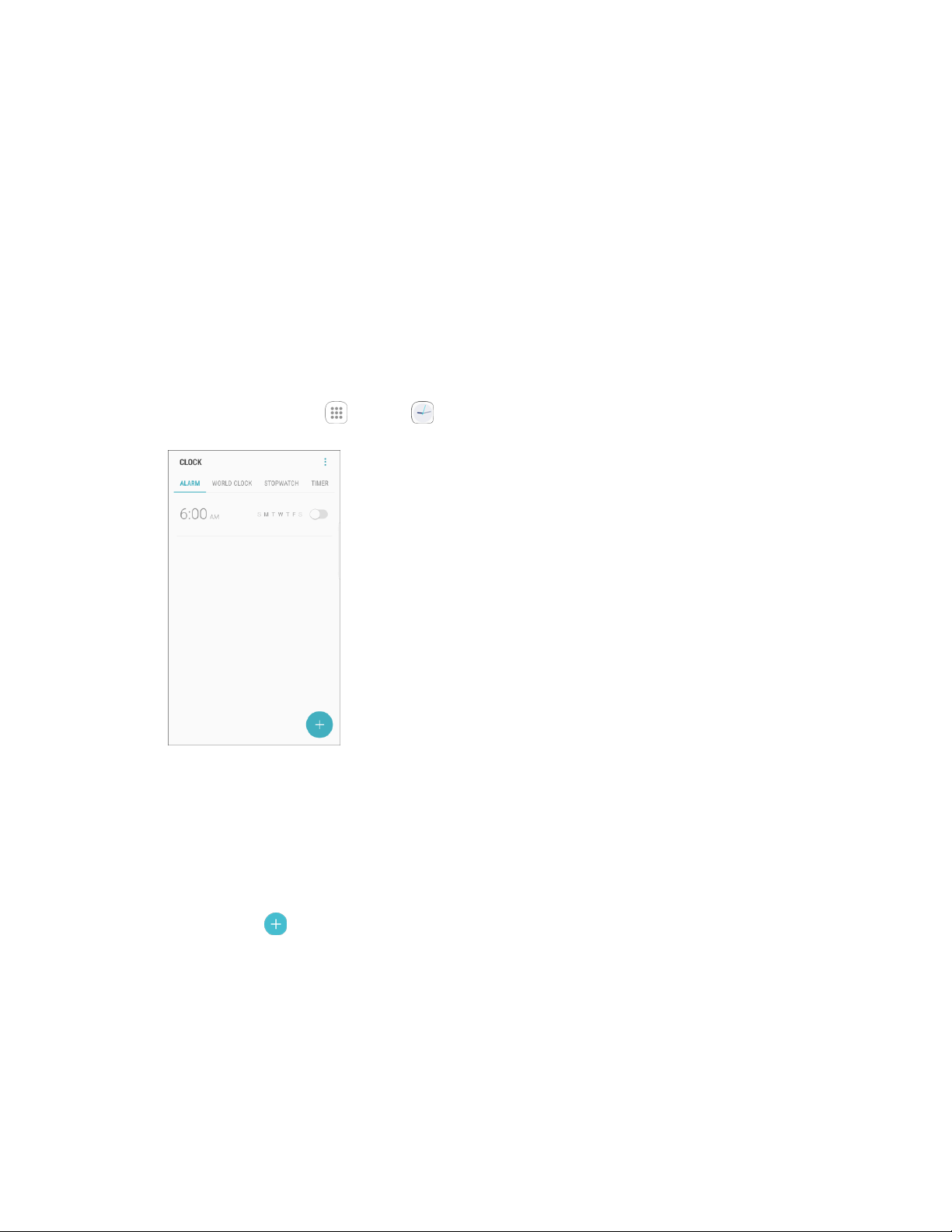
Apps and Features 150
3. Set the alarm options, including time, days, repeat pattern, alarm type, alarm tone, and volume,
and then tap Save.
The alarm is set.
Phone at Alarm Time
● At the set alarm time, the phone sounds the alarm and/or vibrates.
● Stopping an alarm: When the alarm sounds, tap Dismiss.
Additional Clock Features
Your phone’s clock app provides additional useful features including world clock, stopwatch, and timer
functions. All features are available from the clock app display.
■ From home, tap Apps > Clock .
The Clock appears.
World Clock
The world clock lets you keep track of the current time in multiple cities around the globe.
1. From the clock app, tap World clock.
2. Tap Add city and select a city.
3. Repeat to add multiple cities.

Apps and Features 151
Stopwatch
The stopwatch lets you time events down to the hundredth of a second.
1. From the clock app, tap Stopwatch.
2. Tap Start to begin timing.
3. Tap Stop to stop timing.
Additional options include Lap to keep track of laps, Restart to continue timing, and Reset to
reset the stopwatch to zero.
Timer
The timer provides a countdown timer for up to 99 hours, 59 minutes, and 59 seconds.
1. From the clock app, tap Timer.
2. Use the keypad to set the length of the timer.
3. Tap Start to begin the timer.
Drive
Use Google Drive to open, view, rename, and share your Google Docs and files.
■ From home, tap Apps > Google > Drive .
Visit support.google.com/drive to learn more about Google Drive.
Galaxy Apps
Discover apps designed exclusively for your Galaxy phone.
Note: You must sign in to a Samsung account in order to download Galaxy Apps.
■ From home, tap Apps > Galaxy Apps .
Google Maps
Use the Google Maps app to determine your location, find directions, browse local businesses and
attractions, rate and review places, and more.
Visit support.google.com/maps to learn more.
Enable Location Services on Your Phone
Before using any location-based services, you must enable your phone’s location feature. For information
about setting your phone’s location options, see Location Settings.
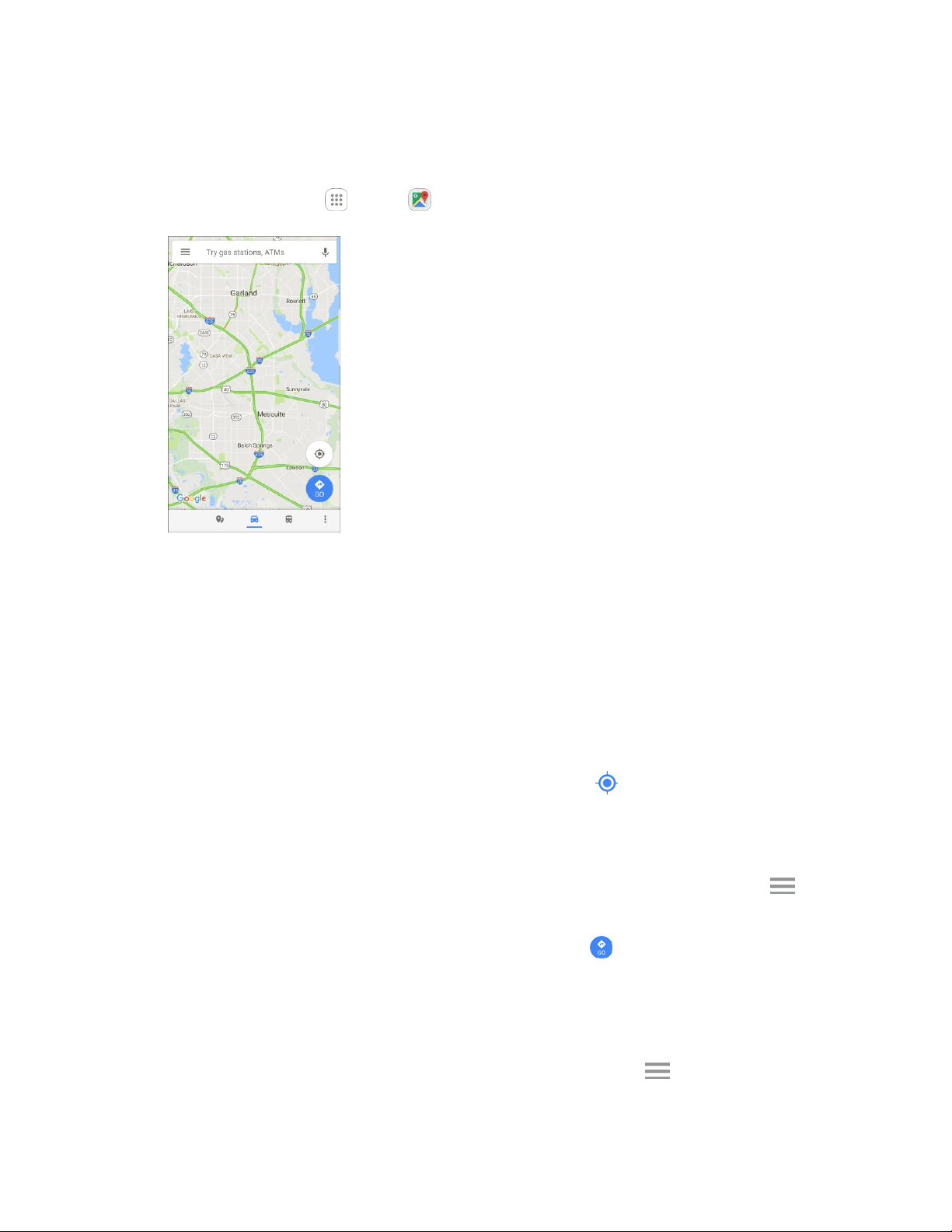
Apps and Features 152
View Maps of Specified Places
Use Google Maps to locate and map a specific address or destination.
1. From home, tap Apps > Maps .
Google Maps opens.
If prompted, follow the prompts to accept terms of use.
2. Tap the Search here field to start a search.
3. Enter an address, city, facility name, etc., and then tap a candidate in the results list.
A map of the specified location opens.
Google Maps Operations
● Viewing current location: From the Maps app, tap Location .
● Obtain useful area information for current location: From the Maps app, tap the Search field,
enter the information you are looking for, and then tap a result to view it.
● View traffic information, aerial photos, etc., in Maps: From the Maps app, tap Menu and
then tap Traffic, Satellite, Google Earth, etc.
● Check route to destination: From the Maps app, tap Route , enter your current location and
your destination, tap a method of transport (car, public transit, bicycle, or on foot), and then tap
Search for route.
Route candidates appear in a list.
● Check detailed operation for maps: From the Maps app, tap Menu > Help.

Apps and Features 153
Google Play Books
Discovering your favorite books and authors has never been easier. With Google Play Books, you can
shop the world's largest selection of eBooks and read them anywhere you like—on a tablet, phone,
eReader, or the Web.
Visit support.google.com/googleplay to learn more.
■ From home, tap Apps > Google > Play Books .
Google Play Games
Google Play Games is the easiest way for you to discover new games, track achievements and scores,
and play with friends around the world. It brings all your gaming on Google Play together in a unified
Android experience.
Visit support.google.com/googleplay to learn more.
■ From home, tap Apps > Google > Play Games .
Google Play Movies & TV
Google Play Movies & TV allows you to watch movies and TV shows purchased on Google Play. You can
stream instantly on your Android phone or tablet, or download so you can watch from anywhere, even
when you are not connected. Also, get quick access to your personal video collection, including those
taken on your phone or tablet.
Visit support.google.com/googleplay to learn more.
■ From home, tap Apps > Google > Play Movies & TV .
Google Play Music App
The Google Play Music app lets you browse, shop, and play back songs purchased from Google Play as
well as songs you have loaded from your own music library. The music you choose is automatically
stored in your Google Play Music library and instantly ready to play by streaming or download.
Visit support.google.com/googleplay to learn more.
Note: For information about loading music onto your phone, see Transfer Files between Your Phone and
a Computer.
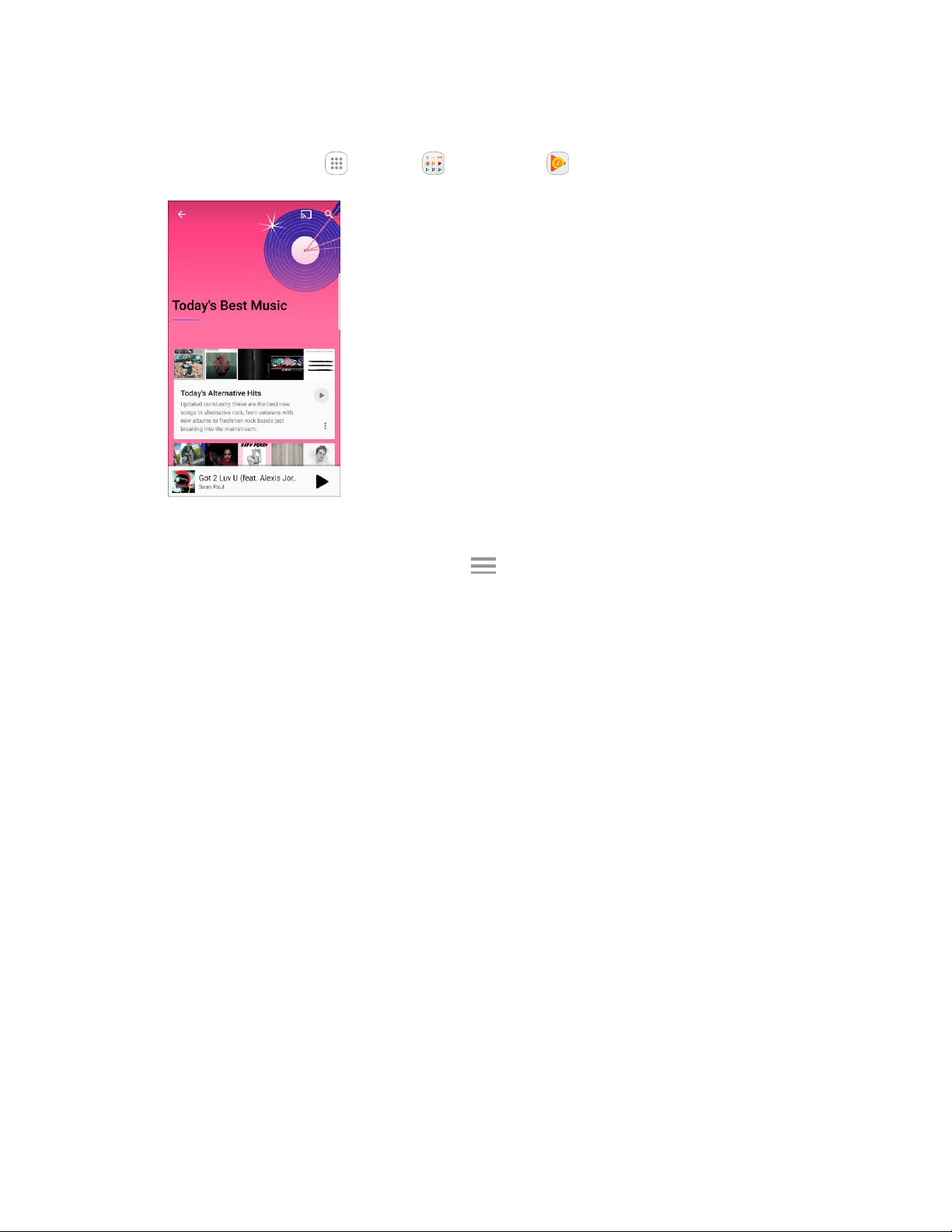
Apps and Features 154
Play Music with Google Play
1. From home, tap Apps > Google > Play Music .
The Play Music app opens to the Listen Now screen.
2. To view additional music options, tap Menu and select an option (Listen now, Top charts,
New releases, Music library, Browse stations, or Shop).
3. Tap an item from the category window and then tap a song.
The song begins playing.
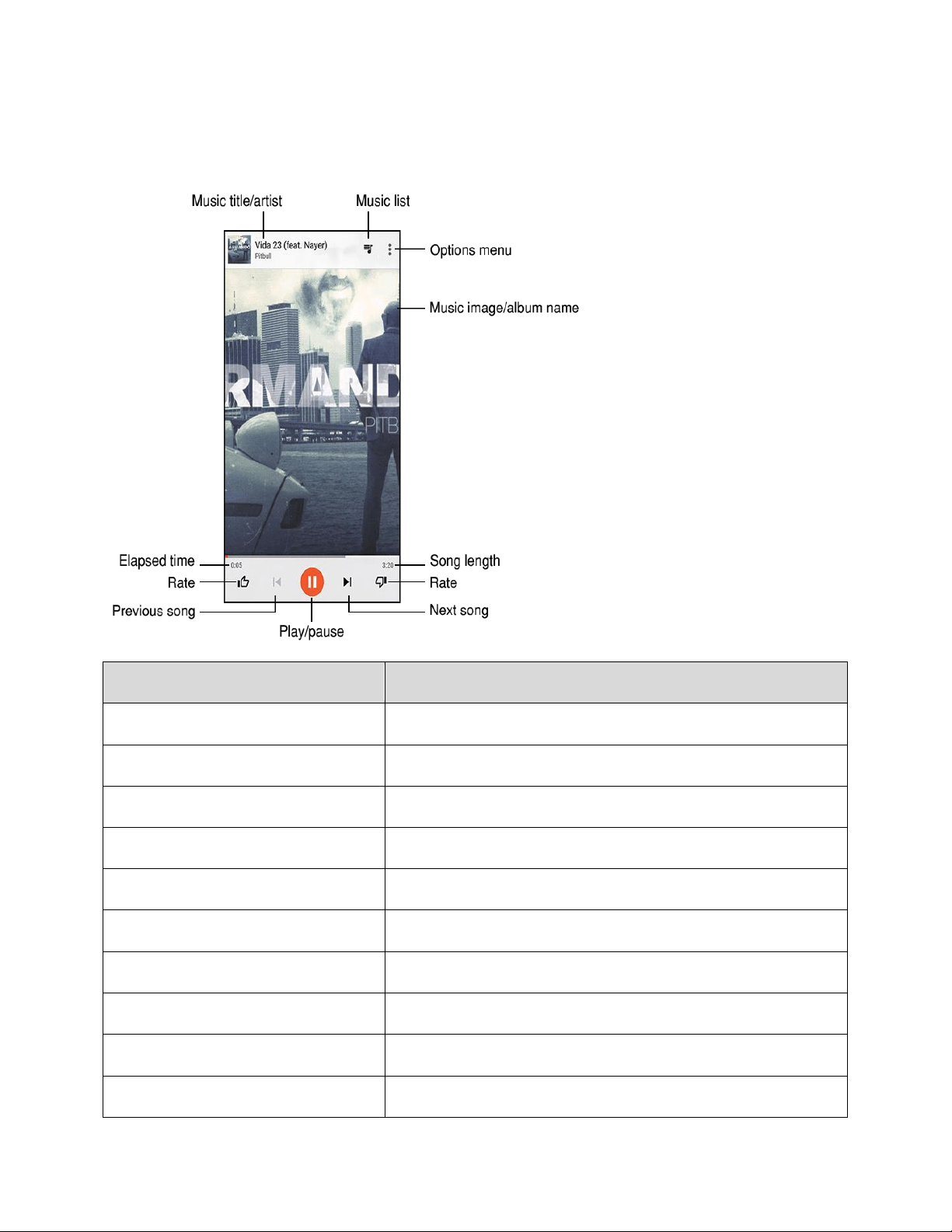
Apps and Features 155
Google Play Music Screen Layout
The following diagram outlines the main features of the Play Music app player screen.
Feature
Description
Music list
View current playlist or queue.
Options menu
Access the options menu.
Music image/album name
Display music images and album names (if available).
Shuffle playlist
Shuffle the current playlist or queue.
Song length
The length of the song.
Rate (thumbs up/thumbs down)
Rate the current song.
Next song
Play the next song.
Play/pause
Play or pause the current song.
Previous song
Play the previous song.
Elapsed time
Amount of time the song has been playing.
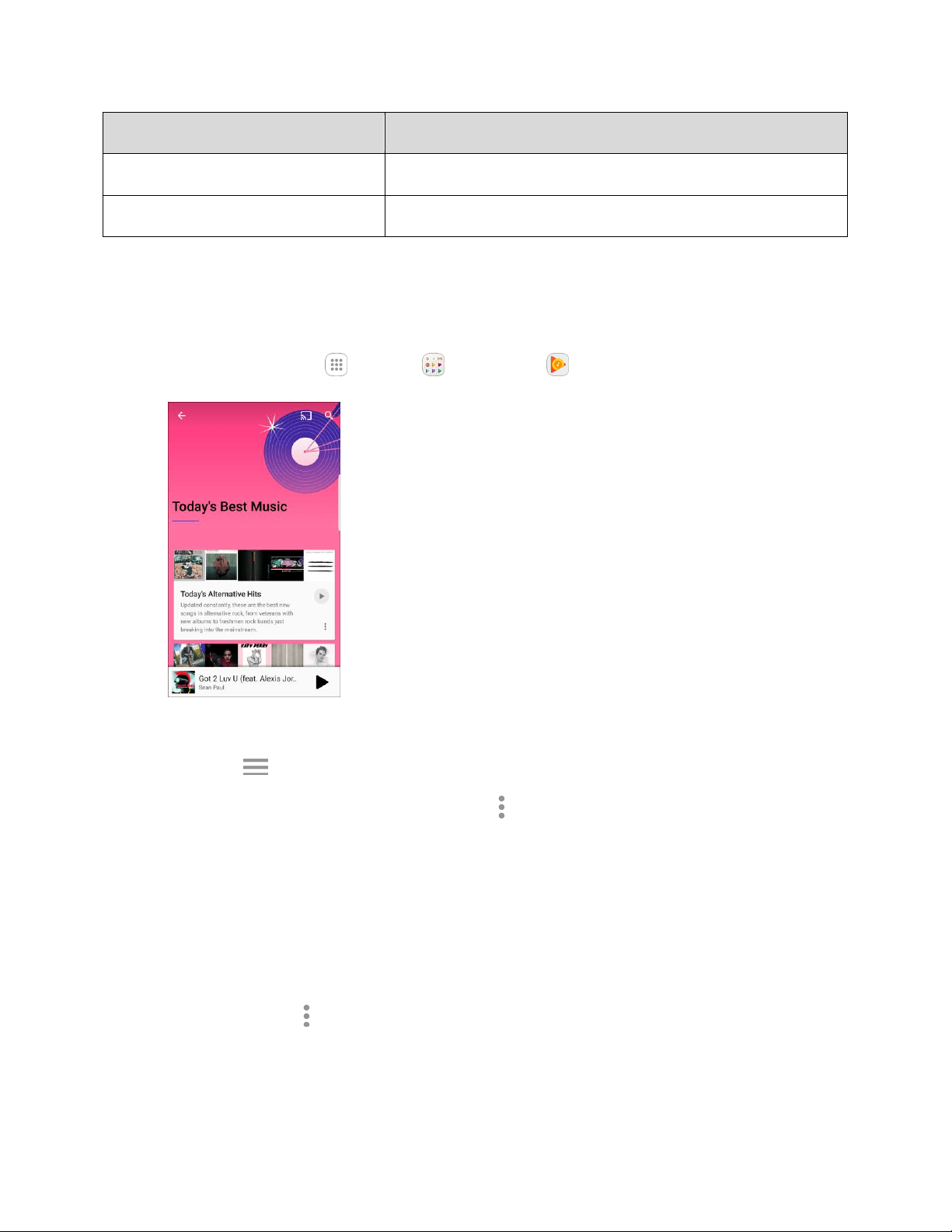
Apps and Features 156
Feature
Description
Repeat/play next
Repeat the current song or play the next song queued.
Music title/artist
Displays music title and artist (if available).
Create Playlists in Google Play Music
Organize music into playlists to fit every occasion.
1. From home, tap Apps > Google > Play Music .
The Play Music app opens to the Listen Now screen.
2. Tap Menu to view your library or playlists, or to access Google Play Music online.
3. From a list displaying songs, tap More options next to an item from the category window and
then tap Add to playlist.
4. Tap New playlist.
5. Enter a name and tap Create playlist.
The playlist is created.
6. Return to the library view and select Albums or Songs.
7. Tap More options next to an item and then tap Add to playlist > [playlist name].
The song or album is added to the playlist. Repeat to add more items to the playlist.

Apps and Features 157
Adding Currently Playing Music to a Playlist
■ From the player view, tap More options > Add to playlist > [playlist name].
The music is added to the playlist.
Google Play Newsstand
With Google Play Newsstand, discover more of the news and magazines you care about all in one app on
your Android tablet or phone. Enjoy breaking news and in-depth articles featuring audio, video and more.
Visit support.google.com/googleplay to learn more.
Access Google Play Newsstand
■ From home, tap Apps > Google > Play Newsstand .
Google+
Chat with friends and family, post photos, and see what others are sharing. Located in the Google folder
in the Apps list.
■ From home, tap Apps > Google > Google+ .
Google Search
Search not only the Internet, but also the apps and contents of your device.
Visit support.google.com/websearch to learn more.
1. From home, tap the Google search bar or tap Apps > Google > Google .
The Search window opens.
If confirmation appears, follow the prompts.
If a description for Google Now appears, tap Next and read information. Tap Enable on the
last page if you want to use Google Now.
2. Type your search keywords and tap Search .
Search results appear.
To search by voice, tap Voice search in the search bar and speak your search terms.
To change your search settings, tap Menu > Settings.
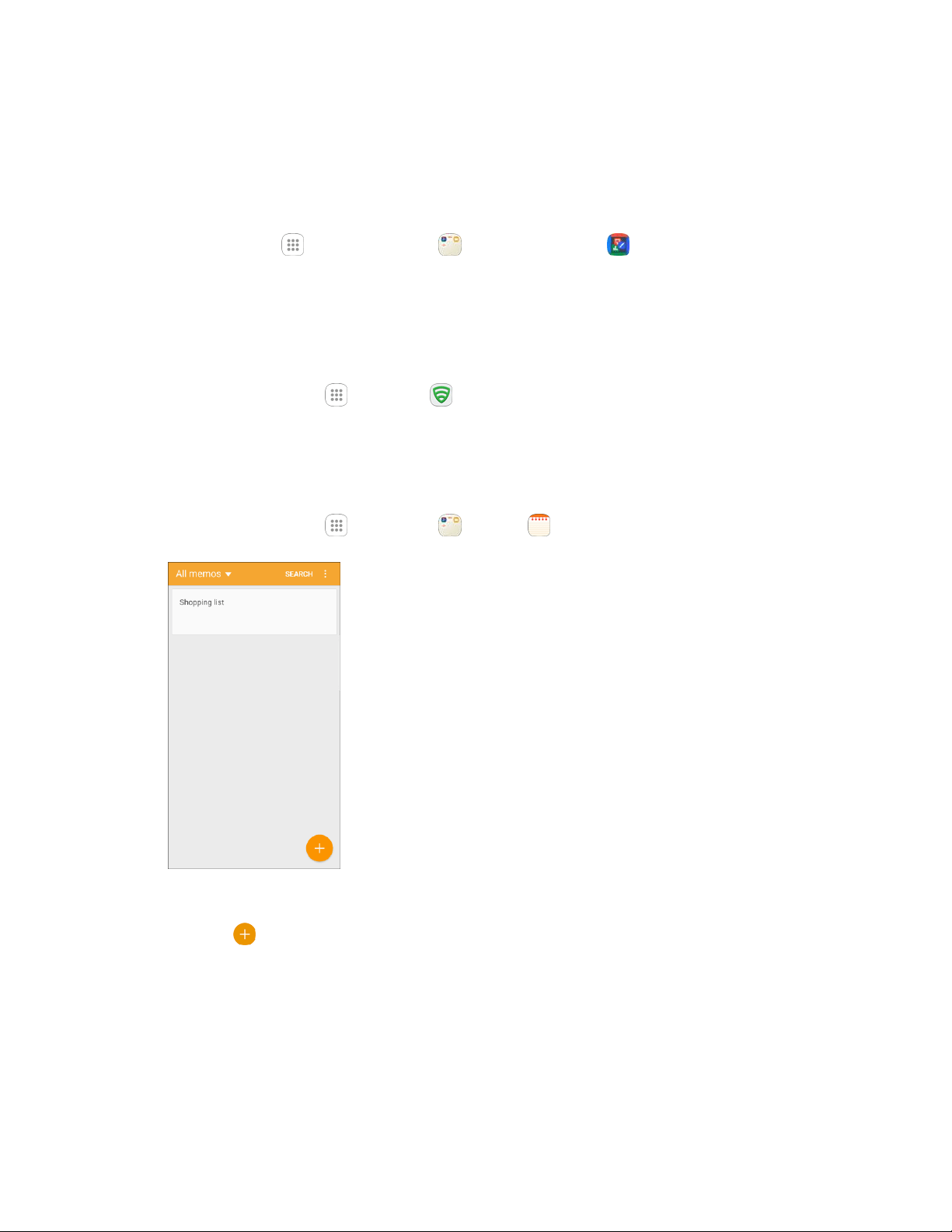
Apps and Features 158
Hancom Office S
Hancom Office S includes a word processor program (Hanword), a spreadsheet program (Hancell), and a
presentation program (Hanshow). In addition to opening, editing, and saving MS Office documents,
Hancom Office S supports standard ODF files and quick and easy conversion to the PDF file format.
■ From home, tap Apps > Samsung > Hancom Office S .
Lookout
Configure and manage key security options, such as anti-virus and anti-malware technology, a lost and
stolen device locater service, an application privacy adviser, and a backup service.
■ From home, tap Apps > Lookout .
Memo
Organize your life by creating, editing, and managing memos.
1. From home, tap Apps > Samsung > Memo .
The Memo list appears.
2. Tap Add and enter your memo title and text.
3. Tap Save.
The memo is saved.
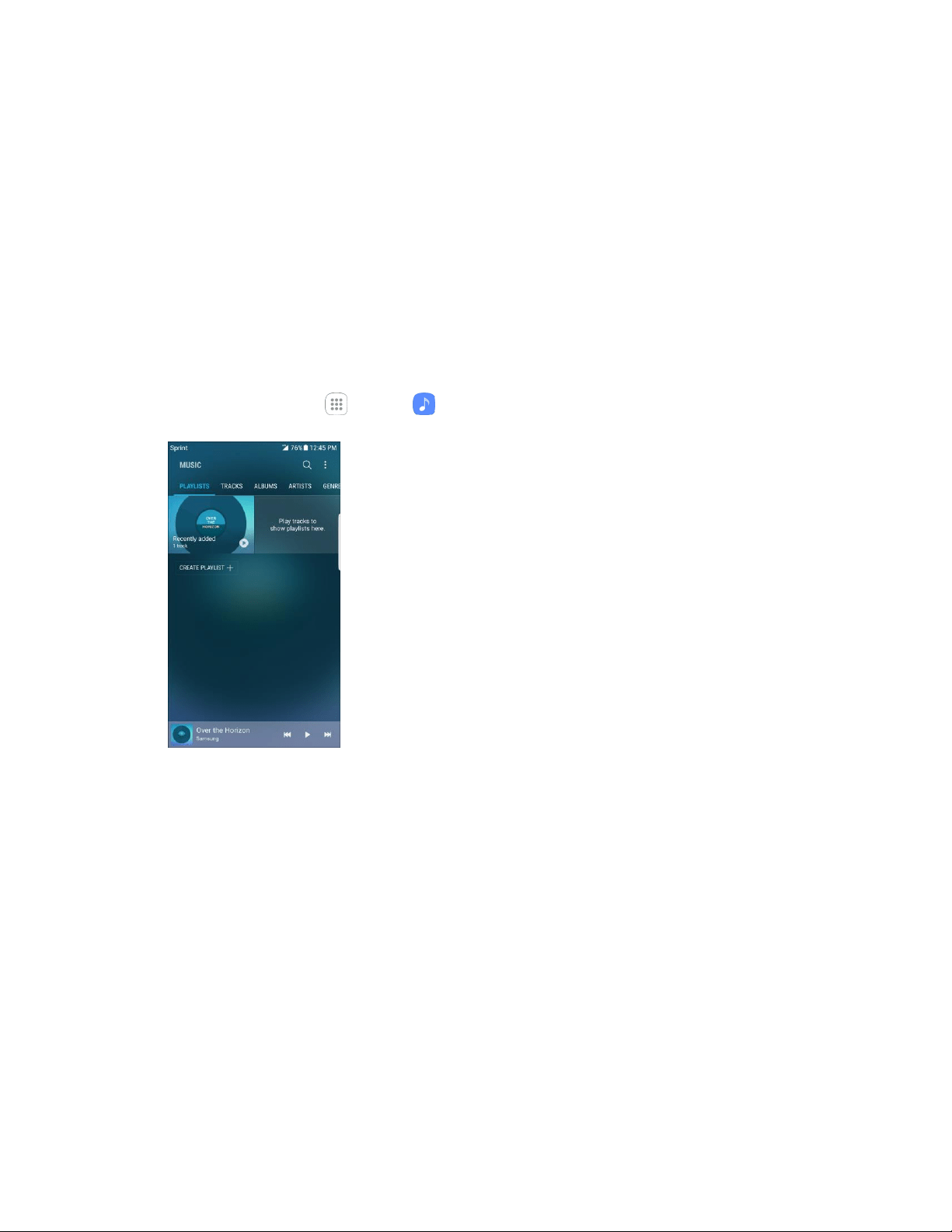
Apps and Features 159
Music
The Music app plays music files. Use Music to browse your music library, play songs, and create playlists.
You can also set songs as ringtones for incoming calls, or as alarm tones.
Note: For information about loading music onto your phone, see Transfer Files Between Your Phone and
a Computer.
When you close the Music screen, playback will continue in the background, so you can listen to music
while you use other features of your phone. When music is playing in the background, you can access
playback controls from the notification panel.
Play Music
1. From home, tap Apps > Music .
The music app opens to the Playlists category.
• The default categories are Playlists, Tracks, Albums, Artists, Genres, Folders, and
Composers. Tap the drop-down list at the upper left corner and tap a category to
display it.
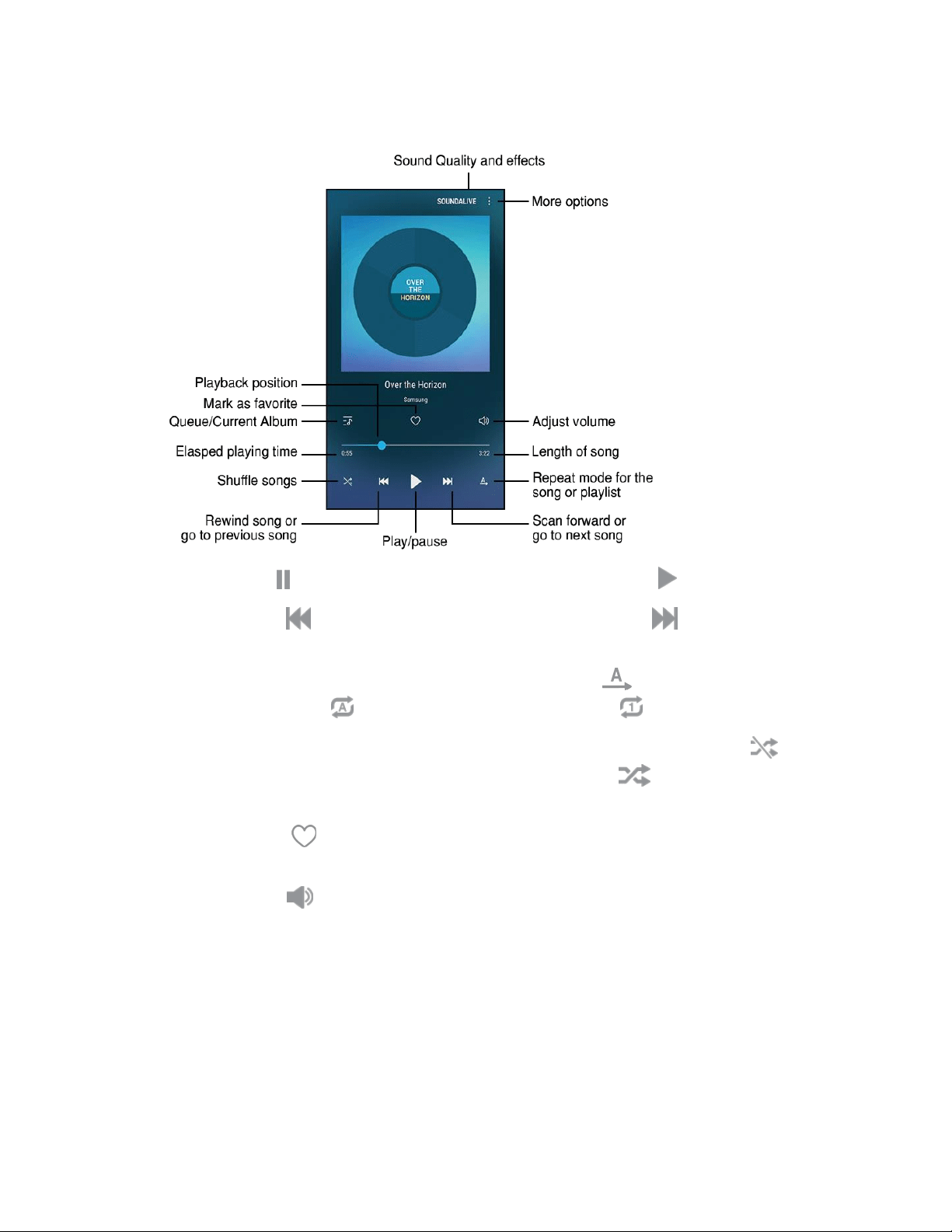
Apps and Features 160
2. Scroll through the list and tap a song to begin. While playing music, use these controls:
Tap Pause to pause playback. To start playback again, tap Play .
Tap Rewind to move to the previous song. Tap Fast-forward to move to the next
song.
Tap the repeat button to control playback. Choose Play all to play all songs once.
Choose Repeat all to repeat all songs. Choose Repeat 1 to repeat the current song.
Tap the shuffle button to control the order songs are played. Choose Shuffle off to play
songs in the order they appear in the list. Choose Shuffle on to play songs in random
order.
Tap Favorite to mark a song as a favorite. Whenever a song is a favorite, the star is
bright. Favorite songs are included in the Favorites playlist.
Tap Volume to set the volume. You can also set volume by pressing the Volume key on
the side of the phone.

Apps and Features 161
My Files
Manage your sounds, images, videos, Bluetooth files, Android files, and other data in one convenient
location.
To view files in My Files:
1. From home, tap Apps > Samsung > My Files .
2. Tap a category to view the relevant files or folders.
3. Tap a file or folder to open it.
Note: Different folders may appear depending on how your phone is configured.
File Groups
Files stored in the device are organized into the following groups:
● Recent files: View recently accessed files.
This option appears if one or more files have been accessed recently.
● Categories
Images: View image files.
Audio: View audio files.
Videos: View video files.
Documents: View document files.
Downloads: View all apps and files that have been downloaded to the device.
Installation files: View all APK files.
● Phone storage
Internal storage: View folders and files located on the device.
● Cloud storage
Samsung Cloud Drive: Use a Samsung account for cloud storage.
Google Drive: Use a Google account for cloud storage.
Note: Cloud drives vary depending on the services you sign in to.
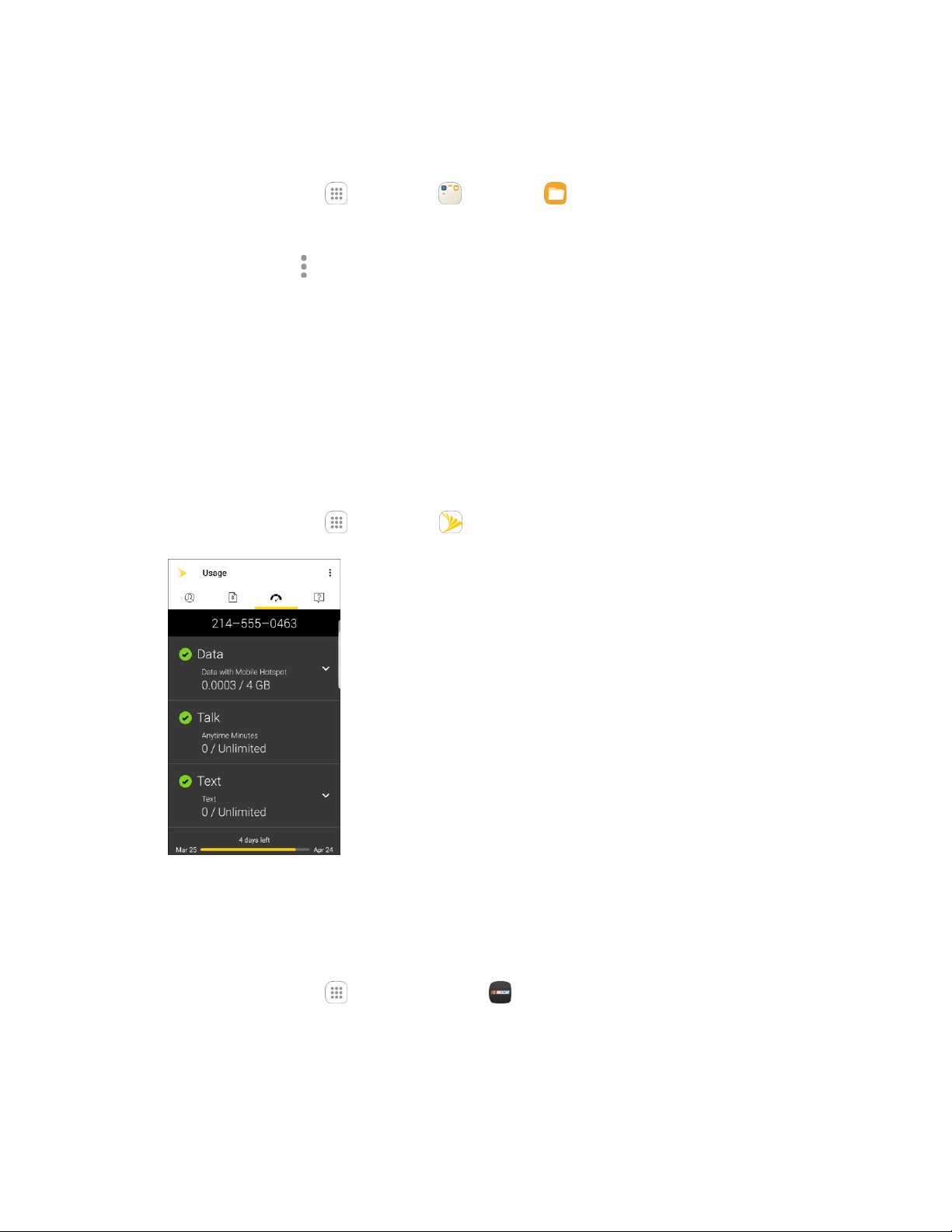
Apps and Features 162
My Files Options
Use My File options to search, edit, clear file history, and more.
■ From home, tap Apps > Samsung > My Files . The following options are available:
Search: Search for a file or folder.
More options : Tap for the following options:
• Clear recent file history: Delete list of recent files. (This option appears if one or more
files have been accessed recently.)
• Manage storage usage: View storage information for your device.
• Settings: View settings for the My Files app.
My Sprint
Access your Sprint account, get device information and help, and more.
■ From home, tap Apps > My Sprint .
NASCAR Mobile
The NASCAR Mobile app is the official mobile app of NASCAR. Follow NASCAR news, video highlights,
and immerse yourself even further into the NASCAR experience with driver stats and live leaderboards.
■ From home, tap Apps > NASCAR Mobile .
Note: The first time you access the NASCAR Mobile app, you will be prompted to install or update it on
your phone. Tap Install or Update and follow the prompts.

Apps and Features 163
NextRadio
Listen to your favorite FM radio stations on the go with NextRadio. Tune in to any FM frequency in your
area and listen to the radio without the cost of streaming music.
■ From home, tap Apps > NextRadio .
Note: To listen to radio from your device, you must plug in either headphones or a speaker cable to the
headphone jack. To listen through the device's speaker (after plugging in headphones), tap More options
> Output to speaker.
OneDrive
OneDrive gives you free online storage for all your personal files so you can get to them from your
Android device, computer, and any other devices you use.
■ From home, tap Apps > Microsoft > OneDrive .
OneNote
Stay organized using text, pictures, or audio notes. Create Quick Notes or review and edit shared
OneNote notebooks using OneDrive.
■ From home, tap Apps > Microsoft > OneNote .
Peel Remote
Use the Peel Remote app on your phone to control your TV, set-top box, DVR, stereos, and other
electronic devices.
1. From home, tap Apps > Peel Remote .
2. Tap Let’s go and follow the prompts to select a television or cable service provider, set
personalization preferences, and program your television, cable/satellite box, and more.
Photos
The Photos app automatically backs up your photos and videos to your Google Account.
1. From home, tap Apps > Google > Photos .
2. Follow the prompts to update the app.

Apps and Features 164
S Voice
Use the S Voice voice recognition application to activate a wide variety of functions on your phone.
This is a natural language recognition application. You can ask questions (Is it raining in Dallas?) or
speak commands (Show me where to find cheap gas).
1.
From home, tap Apps > S Voice .
2. Tap Start.
3. Review and accept the terms and conditions, and then tap I agree > Next.
4. Follow the instructions to set up a wake-up command
5. To use S Voice, speak a command.
6.
Tap Microphone if the phone does not hear you, or to give it a command.
S Voice Settings
Configure options for using your voice to interact with your phone.
1. From home, tap Apps > S Voice .
2. Tap Settings to configure options:
Voice wake-up: Launch S Voice by speaking a wake-up command.
Wake up in secured lock: Make calls, take pictures, play music, or perform tasks using S
Voice using voice commands without unlocking your phone.
Language: Choose a language to use for S Voice.
Voice feedback: Enable spoken feedback when using S Voice.
Auto start speakerphone: When enabled, the speaker is automatically turned on when you
make a call with S Voice.
Home address: Configure your home address.
Erase data: Erase the data you have stored on the server and restore the default S Voice
settings.
Help: View information about using S Voice.
About S Voice: View S Voice version information.

Apps and Features 165
Samsung Health
Manage your health with the Samsung Health wellness application. Set fitness goals, check your
progress, and keep track of your overall health.
Caution: The information gathered from this device, Samsung Health, or related software is not intended
for use in the diagnosis of disease or other conditions, or in the cure, mitigation, treatment or prevention
of disease.
The accuracy of the information and data provided by this device and its related software, including heart
rate readings, may be affected by factors such as environmental conditions, skin condition, specific
activity performed while using/wearing the device, settings of the device, user configuration/user-provided
information, placement of the sensor on the body, and other end-user interactions. For more information
on proper wear and use, see samsung.com/us/heartratesensor.
1. From home, tap Apps > Samsung Health .
2. Follow the prompts to get started:
Read the introduction and tap Start.
Read and agree to the terms and conditions, and then tap Next.
Sign in to your Samsung account if you have not already done so. You must sign in to a
Samsung account to set and save goals, and use other advanced Samsung Health features.
Follow the onscreen instructions to enter information about yourself, and then tap Start.
3. Use Samsung Health to track your health activities.
Steps (automatic): Count the number of steps you take. Tap Start to start counting. You can
pause counting and then tap Start to begin again. If you signed in to your Samsung account,
you can set goals, track your progress, and share your results.
Running: Use Samsung Health as a pace-setter while running.
Heart rate: Measure your heart rate, using the heart rate sensor on the back of your phone
(next to the Camera flash). Place your finger over the sensor, and then tap the screen to
start. Hold your finger on the sensor, and keep still until the sensor reports your heart rate.
Stress: Measure your stress level using your heart rate variable.
SpO
2
: Measure the amount of oxygen in your blood.
Why not track your water intake?: Monitor how much water you are drinking.
Manage items: Manage additional Samsung Health-compatible apps you install here.

Apps and Features 166
Before You Start Exercising
This app can be used to monitor your exercise. While moderate physical activity, such as brisk walking, is
safe for most people, health experts suggest that you talk with your doctor before you start an exercise
program, particularly if you have any of the following conditions:
● Heart disease;
● Asthma or lung disease;
● Diabetes, or liver or kidney disease;
● Arthritis.
You should also check with your doctor if you have symptoms suggestive of heart, lung, or other serious
disease, such as:
● Pain or discomfort in your chest, neck, jaw, or arms during physical activity;
● Dizziness or loss of consciousness;
● Shortness of breath with mild exertion or at rest, or when lying down or going to bed;
● Ankle swelling, especially at night;
● A heart murmur or a rapid or pronounced heartbeat;
● Muscle pain when walking upstairs or up a hill that goes away when you rest.
Finally, the American College of Sports Medicine recommends that you see your doctor before engaging
in vigorous exercise if two or more of the following apply:
● You are a man older than age 45 or a woman older than age 55;
● You have a family history of heart disease before age 55;
● You smoke or quit smoking in the past six months;
● You have not exercised for three months or more;
● You are overweight or obese;
● You have high blood pressure or high cholesterol;
● You have impaired glucose tolerance, also called pre-diabetes.
When in Doubt – Check it Out
If you are unsure of your health status, have several health problems, or are pregnant, you should speak
with your doctor before starting a new exercise program. Working with your doctor ahead of time is a
good way to plan an exercise program that is right and safe for you. Consider it the first step on your path
to physical fitness.

Apps and Features 167
Samsung Pay
Samsung Pay
™
is the new way to pay with your Samsung Galaxy device. It is simple, secure and works in
more stores than any other mobile payment service.
Samsung Pay is accepted almost anywhere you can swipe or tap your credit card.
Note: Before use, please confirm the NFC feature is enabled on your device (see NFC and Payment).
Note: For added security protection, if using Samsung Pay on multiple devices; you must first sign-in and
then add all of your cards in again per each device. Your card information is not stored on a cloud
service.
Set Up Samsung Pay
Samsung Pay is secure, easy to set up, and simple to use with your Samsung Galaxy device.
To set up Samsung Pay:
1. From home, tap Apps > Samsung Pay .
2. Tap Start and follow the prompts.
Note: You must log in to your Samsung account or create a new Samsung account to use Samsung Pay.
Simple Pay
Access Samsung Pay from the Screen off, Lock Screen or Home screen using Simple Pay.
To customize Simple Pay:
1. From home, tap Apps > Samsung Pay .
2. Tap More options > Settings > Use favorite cards.
3. Tap On/Off to enable Simple Pay on each screen.
To use Simple Pay:
1. From any screen, swipe up from the Home key.
Your payment card and Simple Pay are displayed.
2. Drag the card down to close Simple Pay.

Apps and Features 168
Use Samsung Pay
Use Samsung Pay quickly and conveniently whenever you have your device with you.
1. From home, tap Apps > Samsung Pay .
– or –
From any screen, swipe up from the Home key.
2. Select a card to pay with and authorize payments by scanning your finger on the Home key or
entering your Samsung Pay PIN.
3. Hold your phone over the store’s card reader.
When your payment is complete, a receipt is sent to your registered email.
Use Gift Cards with Samsung Pay
Purchase, send, and redeem gift cards from an expanding selection of your favorite retailers.
To view the list of supported retailers:
1. Visit samsung.com/us/samsung-pay.
2. Scroll down to “Gift cards” and click the See merchants link.
Secure Your Information
Samsung Pay is designed with the latest security technology and works on most recent Samsung Galaxy
devices. Payments are authorized with your fingerprint or PIN and each transaction uses a unique token
each time, so your device only allows payments with your consent.
For more information about Samsung Pay, visit samsung.com/SamsungPay
For Samsung Pay support, visit samsung.com/us/support/owners/app/samsung-pay
Samsung+
Get live help, discover new features, and unlock promotions for your Samsung device.
■ From home, tap Apps > Samsung+ .
Sprint Family Locator
Use Sprint Family Locator to locate any phone on your Sprint family plan instantly—from your mobile
phone, tablet or computer.
■ From home, tap Apps > Sprint Family Locator .

Apps and Features 169
Sprint FamilyWall
Communicate, organize, share, remember, and locate friends and family members. Users get all the
benefits of social sharing in a totally private space.
■ From home, tap Apps > FamilyWall for Sprint .
Sprint Music Plus
Purchase, download, and play music, ringtones, and ringback tones for your phone.
Install the Sprint Music Plus App
Before you use Sprint Music Plus on your phone, you must download and install the app.
1. From home, tap Apps > Sprint Music Plus .
2. Tap Install and follow the prompts to download and install the app.
3. When the download has completed, tap Open.
The app opens.
Access Sprint Music Plus
1. From home, tap Apps > Sprint Music Plus .
The app opens.
The first time you use the app, tap Accept to agree to the Premium Services Terms of Use.
2. Tap a store option from the main page (Ringbacks Store, Music Store, or Ringtones Store), or
tap More options > Music (under Library) to access your music.
Tap the navigation tools to skip ahead or rewind. Tap More options at any time to see
additional options.
For more information, tap Menu > Settings > About or Help.
Note: If you have loaded music on to your phone from your computer (see Transfer Files between Your
Phone and a Computer), you will need to sync your music to listen to it through Sprint Music Plus. From
the Sprint Music Plus app, tap > Settings > Synchronize your music library. Once synced, you will
see your music in the library.
Purchase and Download Music from the Sprint Music Plus Store
From the Sprint Music Plus Store, you can shop for songs to purchase and download to your phone.
1. From home, tap Apps > Sprint Music Plus > Music Store.
The app will open and display the Music Store.

Apps and Features 170
2. Enter a song or artist in the search field or browse through options in the tabs in the center of the
screen.
3. Tap a song to select it.
The song information screen is displayed.
4. Follow the prompts to preview or purchase the song. Tap More options at any time to
display the Sprint Music Plus menu.
Tip: For ringtones or ringback tones, tap Ringtone Store or Ringback Tone Store from the Sprint Music
Plus main menu.
Sprint Protect
Protect your phone from loss, theft, or breakage. In most cases, you save hundreds on a replacement
device and get it the next day.
■ From home, tap Apps > Sprint Protect .
Sprint Spot
Access top quality applications, games, TV, music, and entertainment from Sprint.
■ From home, tap Apps > Sprint Spot .
Sprint TV & Movies
Use Sprint TV & Movies to watch live TV and access movies and other on demand entertainment on the
go.
Note: Coverage not available everywhere. Content and lineup subject to change. Select channels also
available for casual usage.
Your Sprint TV Channel Options
The Sprint TV application offers a wide variety of accessible channels. Subscription options include
comprehensive basic packages as well as a full menu of “a la carte” channels.
Watch TV
1. From home, tap Apps > Sprint TV & Movies .
2. Follow the prompts to browse categories and find programs.
Depending on your settings, your phone may prompt you to accept a data connection.
Browse horizontally through the category options in the center of the screen to see what's
available. For quick access, touch a featured item in the center of the screen or select a live
channel from the bottom bar.

Apps and Features 171
Scroll up and down in a category list and then touch a clip or channel to view the program.
Note: The first time you access a channel that requires a subscription, you will be prompted to purchase
access. Touch Subscribe to purchase access, or touch Preview to see a preview of the selected
channel.
Sprint Worldwide
Learn about international services from Sprint, including international calling, texting, and roaming plans.
■ From home, tap Apps > Sprint Worldwide .
Uber
Use Uber to hire a private driver in more than 130 cities and 30 countries. Uber is an entirely new and
modern way to travel.
■ From home, tap Apps > Uber .
Video
View videos on your phone.
1. From home, tap Apps > Video .
2. Scroll through the videos stored on your phone. After a few seconds, each video thumbnail
begins playing a preview of the clip.
3. Tap a video to view it.
Use Pop-Up Play
Multitask with Pop-Up Play by transforming your video player into a pop-up window floating on the
screen. The video will continue to play, and the pop-up window can be resized or moved anywhere on the
screen.
1. From home, tap Apps > Video .
2. Tap a video to view it.

Apps and Features 172
3. Tap the screen to display playback options, and then tap Pop-up .
The video will continue playing in a floating window. Drag the window to any location on the
screen, and use two fingers to pinch or spread to resize the floating window.
Voice Recorder
The Voice recorder allows you to record an audio file up to one minute long and then immediately share
it. Recording time will vary based on the available memory within the phone.
Make a Voice Recording
1. From home, tap Apps > Samsung > Voice Recorder .
Apps and Features 173
2. Tap an option at the top to choose the appropriate recording mode:
Standard: This recording mode picks up any sounds detected by the microphones.
Interview: The top and bottom microphones are used for two-directional recording. The top
and bottom of the device pick up equal amounts of sound. Microphones can be muted during
recording and playback.
Speech-to-text: Voice input is converted to text on screen. The maximum recording time is
five minutes.
3. Use the Voice Recorder controls:
To start recording, tap Record and speak into the microphone.
To pause recording, tap Pause .
• Tap Play to listen to the recording.
• Tap Resume to resume the recording.
• Tap Stop to stop recording.
To end the recording, tap Save.
• To cancel the recording, tap Back > Discard.
Tap block incoming calls while recording, tap More options > Settings > Block calls
while recording.
To mark a spot in the recording so you can find it later, tap Bookmark .
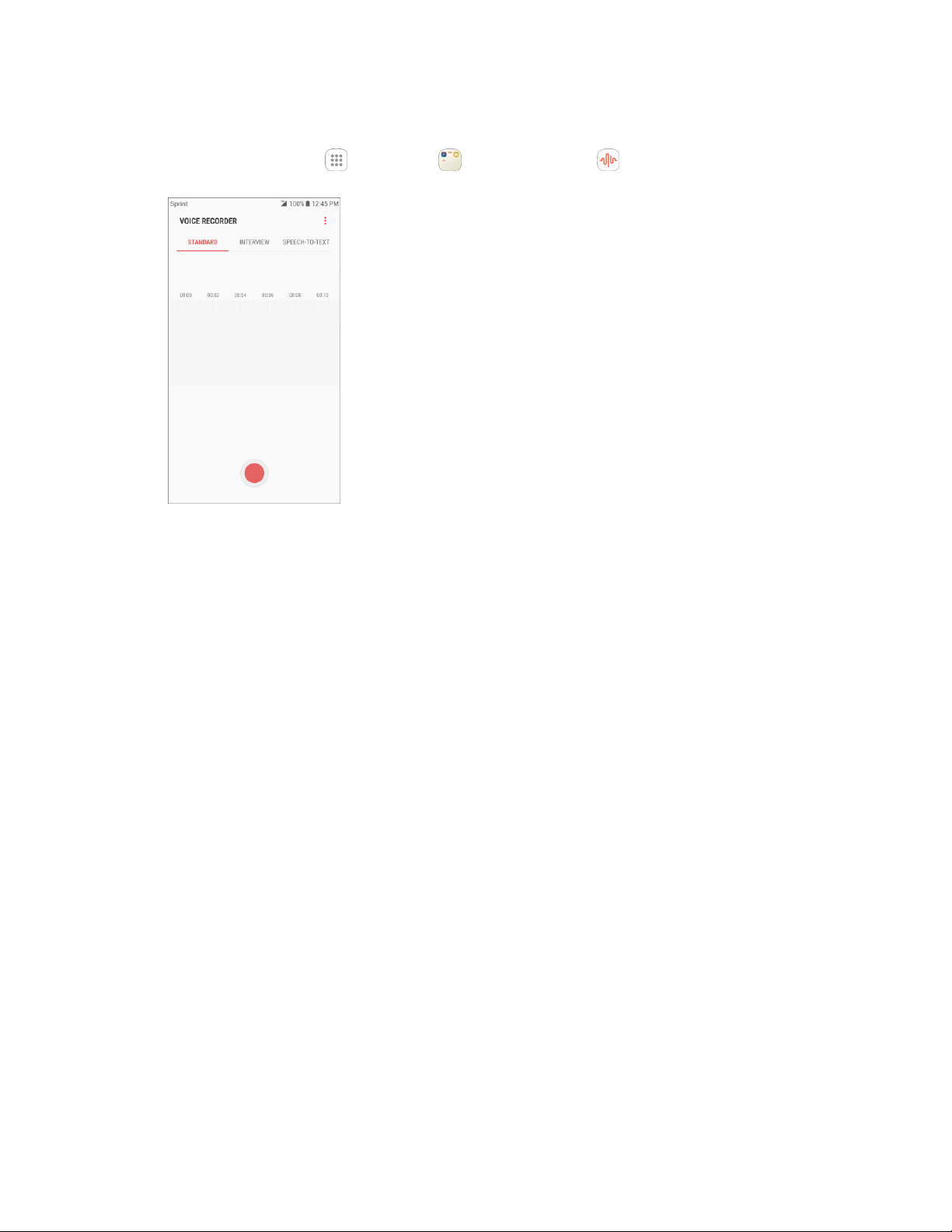
Apps and Features 174
Play Back a Voice Recording
1. From home, tap Apps > Samsung > Voice Recorder .
2. Tap List.
3. Tap a recording to play it back.
4. During playback, you have the following tools available:
Skip muted: Tap to skip muted portions of the recording.
Repeat: Tap to repeat the recording once it reaches the end.
Speed: Tap to change the playback speed.
Bookmark: Tap to mark spots in the recording for later reference.
-1s/+1s: Start the playback one second before or after the current position.
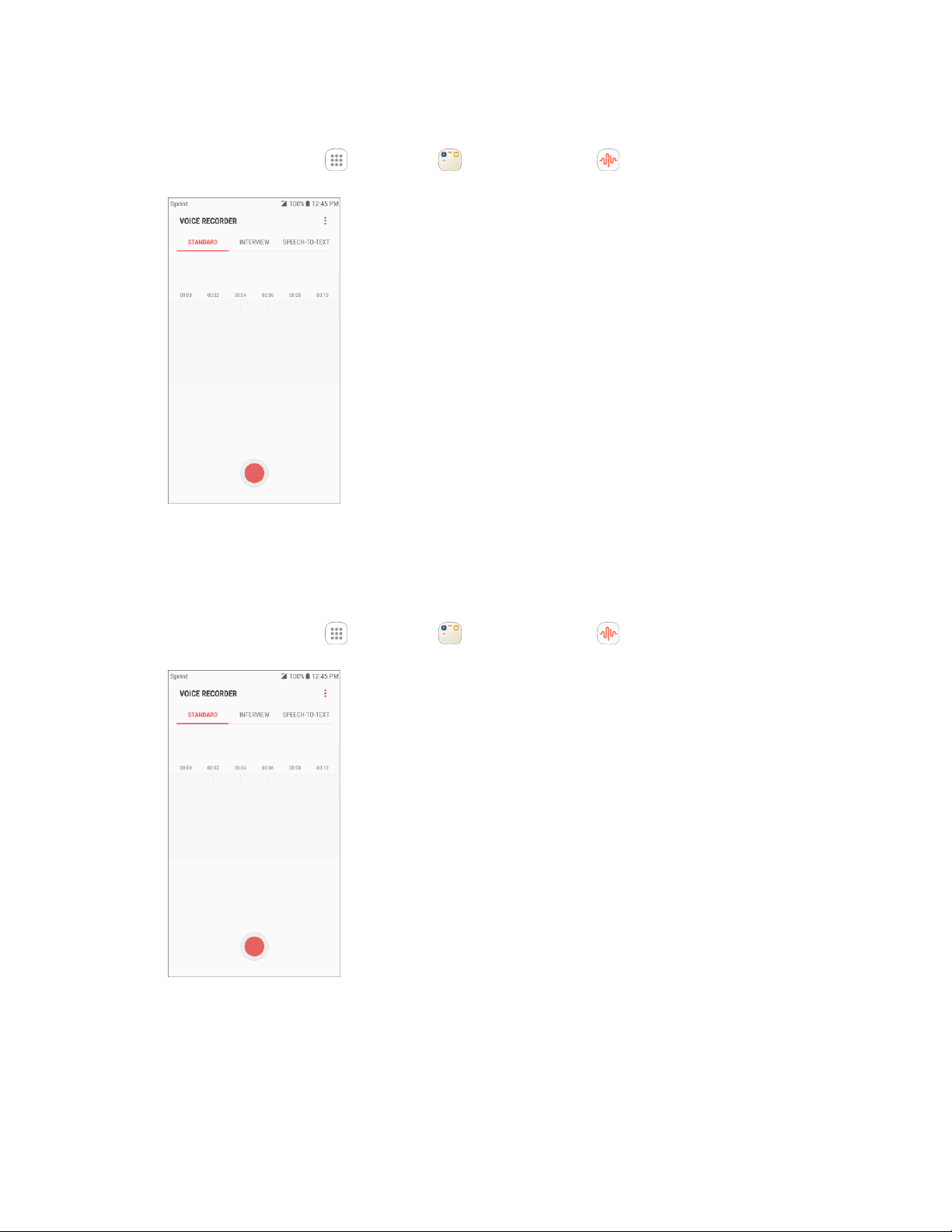
Apps and Features 175
Share a Voice Recording
1. From home, tap Apps > Samsung > Voice Recorder .
2. Tap List, and then touch and hold on a recording to display options.
3. Tap Share, and then follow the prompts to choose a sharing method.
Modify a Voice Recording
1. From home, tap Apps > Samsung > Voice Recorder .
2. Tap List, and then touch and hold on a recording to select it.
3. The following options are available:
Share: Share the voice recording.
Delete: Delete the voice recording.
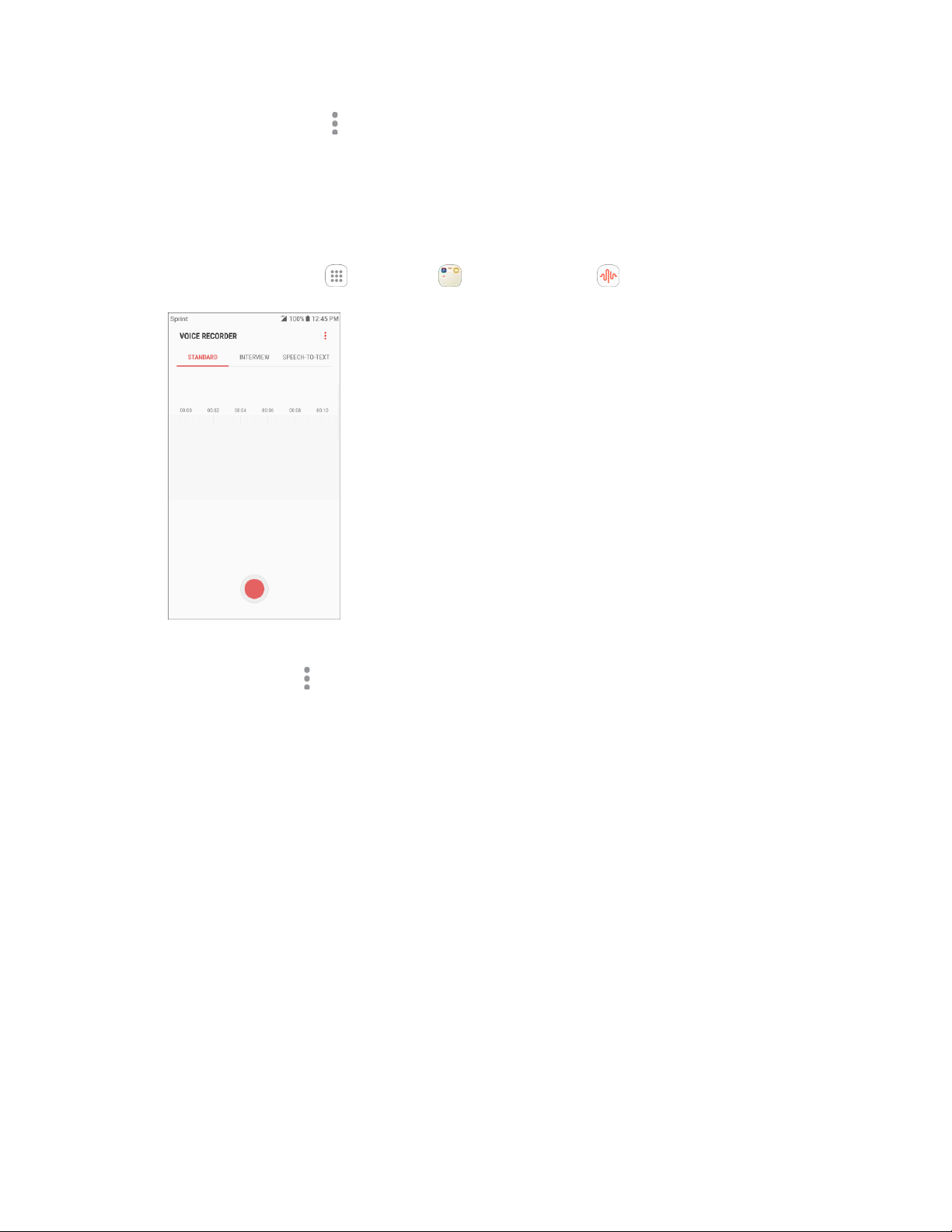
Apps and Features 176
Tap More options for options:
• Rename: Change the name of the voice recording.
• Move: Move the recording to a different category.
Voice Recorder Options
1. From home, tap Apps > Samsung > Voice Recorder .
2. Tap List to view a list of recordings.
3. Tap More options for options:
Edit: Tap on recordings to select them. After selection, you can delete, rename, or move the
recording to a different category.
Share: Select voice recordings to share.
Sort by: Change the way the recordings are sorted.
Settings: Change the recording quality, record audio in stereo, and block calls while
recording.
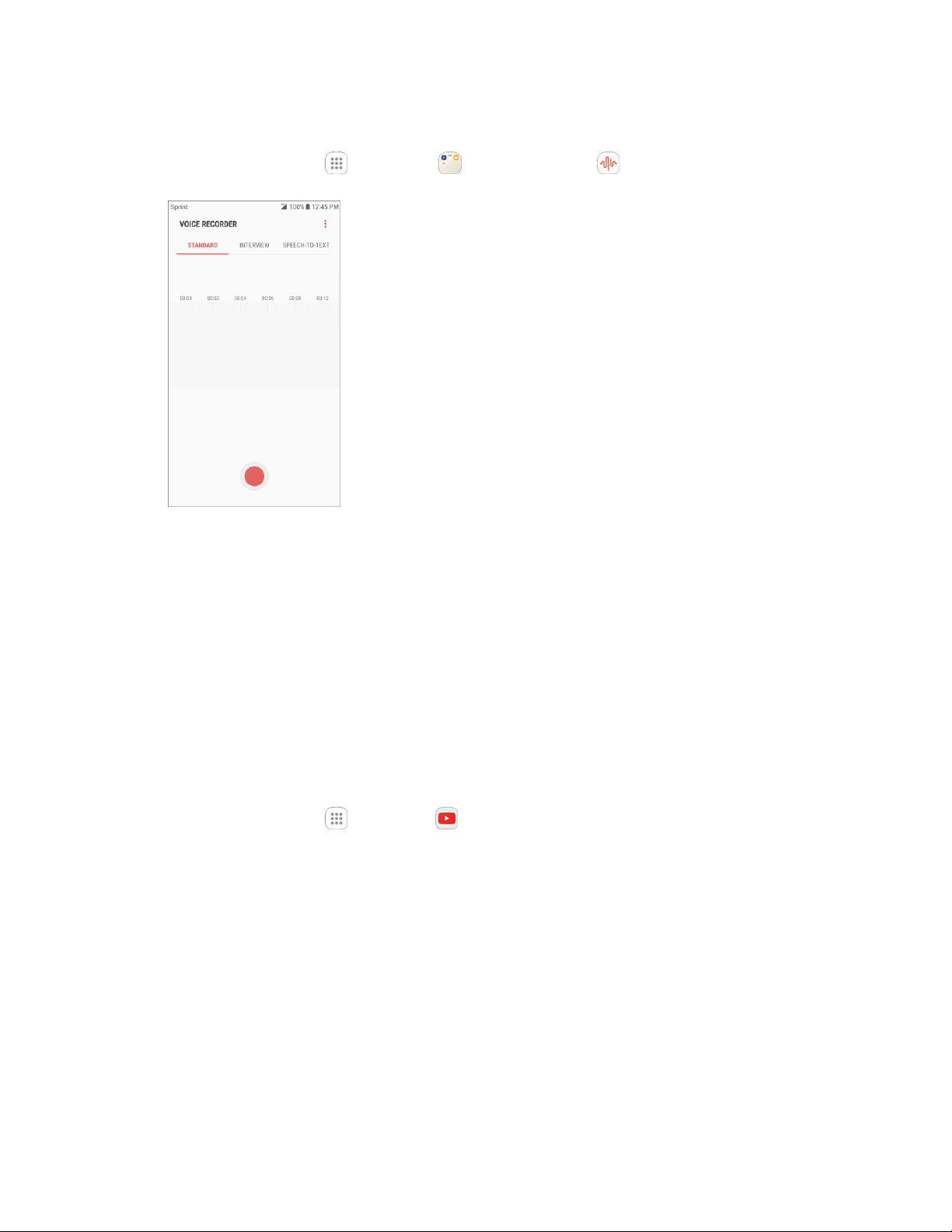
Apps and Features 177
Delete a Voice Recording
1. From home, tap Apps > Samsung > Voice Recorder .
2. Tap List, and then touch and hold on a recording to select it.
3. Tap Delete > Delete.
YouTube
View and upload YouTube videos from your device.
View YouTube Videos
You can use the YouTube app to view videos on YouTube even if you aren’t signed in to a YouTube
account.
1. From home, tap Apps > YouTube .
The YouTube app launches.
If you are prompted to provide confirmation to use the site, follow the prompts to continue.
2. Search through the YouTube channels and tap a video you want to see.
The video plays on your phone screen.
Tap the screen to pause or resume play while watching.
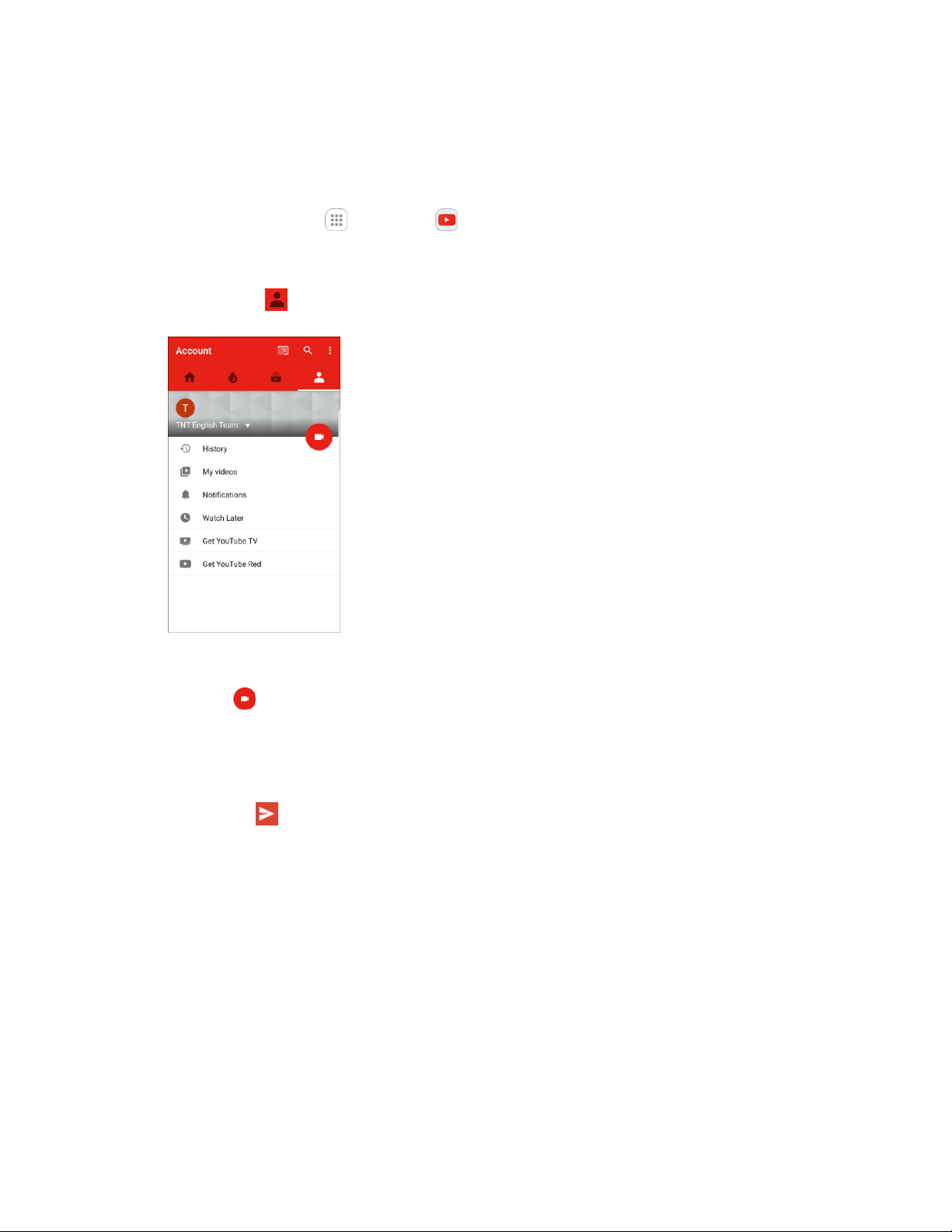
Apps and Features 178
Post a Video to YouTube
You can post videos to your YouTube account from your phone. Before posting, you must set up a
YouTube account and sign in to it on your phone.
1. From home, tap Apps > YouTube .
The YouTube app launches.
2. Tap Account .
The Account menu appears.
3. Tap Add .
4. Find a stored video and tap the thumbnail to select it.
Enter a title, description, and tags, and select a privacy setting.
5. Tap Upload .
The video is uploaded to your YouTube channel.
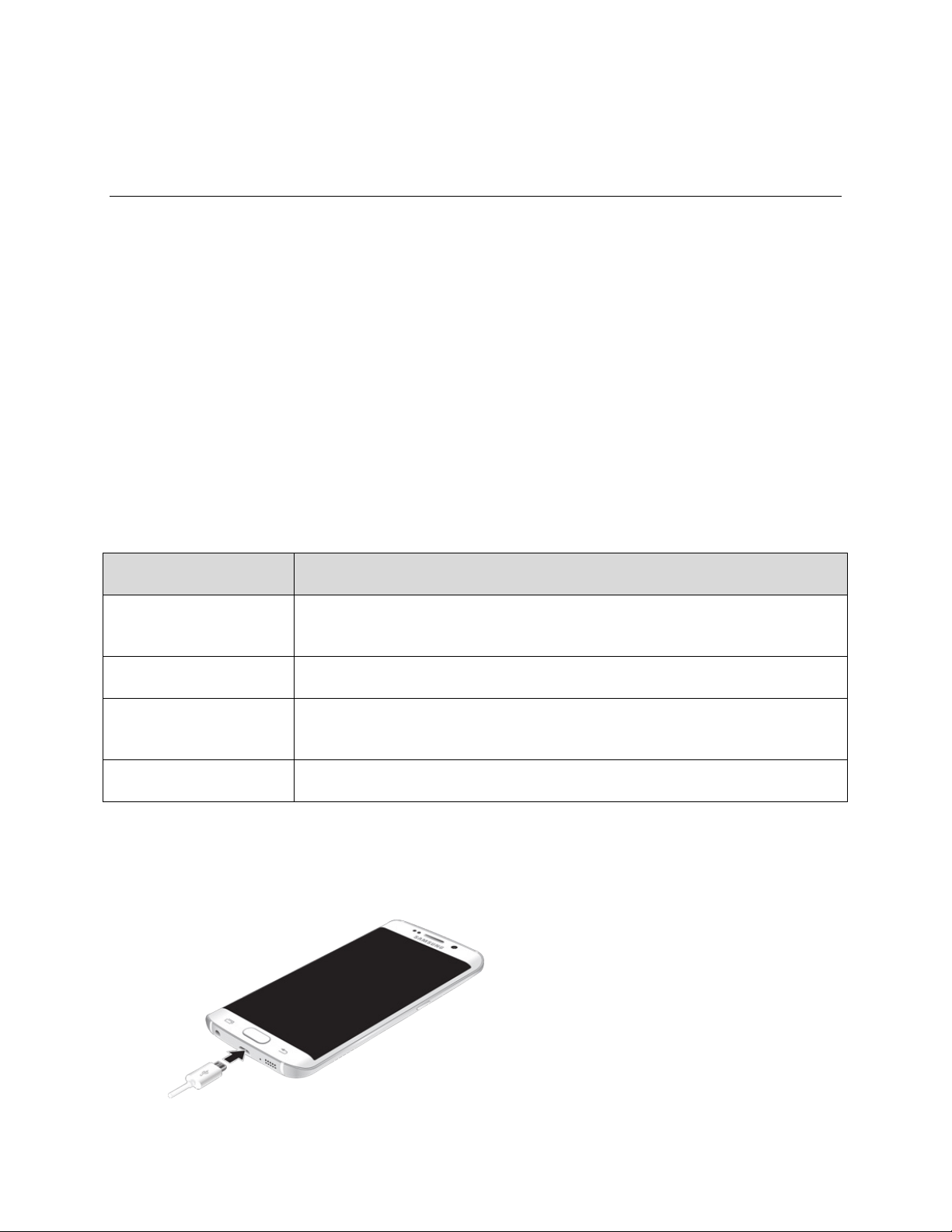
Connectivity 179
Connectivity
The following topics address your phone’s connectivity options, including USB file transfer and tethering,
Wi-Fi, Bluetooth, and more.
Transfer Files between Your Phone and a
Computer
You can use the supplied USB cable to connect your phone directly to your computer and transfer music,
pictures, and other content files.
For example, if you have a music album stored on your computer that you want to listen to on your phone
with any of the music apps, just attach your phone to the computer and copy the files to the music folder.
File Transfer Tips
Data exchange may use the methods outlined in the following table:
Method
Description
Transferring media
files
Transfer files between your phone and PC such as pictures, videos, and
music.
Transferring images
Transfer picture and video files between your phone and PC.
Connecting MIDI
devices
Connect to MIDI-compatible devices.
Charging
Charge your device using a USB cable.
Transfer Files between the Phone and a Computer
1. Connect your phone to your computer using the supplied USB/charging cable.

Connectivity 180
Insert the larger end of the cable to the charger/accessory jack at the bottom of the phone.
Insert the USB end of the cable into an available USB port on your computer. You may need
to remove the USB cable from the charging head to access it.
2. Pull down the status bar to display the notification panel. You will see either Connected as a
media device, Connected as a camera, or USB for Midi.
The files on your phone can now be accessed using your computer.
For most transfers, you will want to use Connected as a media device.
To change the option, tap it in the notification panel to open the Use USB for window, and
then tap the desired option.
3. On your computer, navigate to the detected device (such as through the My Computer menu) and
open it.
4. Select a folder (for example, Music for songs and albums) and copy files to it from your
computer.
5. When you are done, disconnect your phone from your computer.
The transferred files are now saved to your phone.
Wi-Fi
Wi-Fi provides wireless Internet access over distances of up to 300 feet. To use your phone’s Wi-Fi, you
need access to a wireless access point or “hotspot.”
The availability and range of the Wi-Fi signal depends on a number of factors, including infrastructure and
other objects through which the signal passes.
Turn Wi-Fi On and Connect to a Wireless Network
Use the Wi-Fi settings menu to enable your phone’s Wi-Fi radio and connect to an available Wi-Fi
network.
1. From home, tap Apps > Settings .
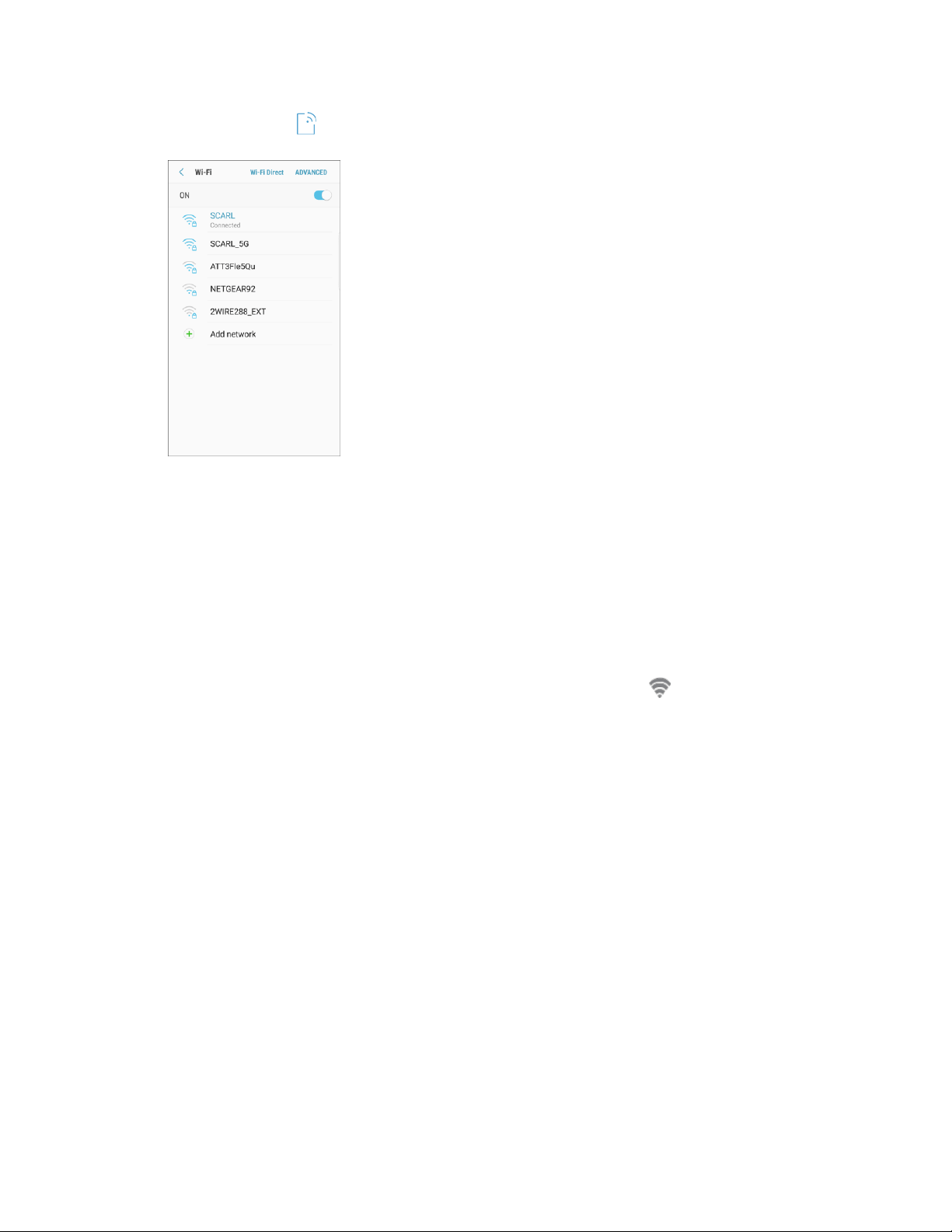
Connectivity 181
2. Tap Connections > Wi-Fi.
The Wi-Fi settings menu appears.
3. Tap On/Off to turn Wi-Fi on.
Wi-Fi is enabled. You will see the names and security settings of in-range Wi-Fi networks.
To disable Wi-Fi, tap On/Off again.
4. Tap a Wi-Fi network to connect, enter the password (if it is not an open network), and then tap
Connect.
Your phone is connected to the Wi-Fi network. You will see Wi-Fi in the status bar.
The password, for a household wireless LAN router, is sometimes found on a sticker on the
router (WEP, WPA, KEY, etc.). Contact the router manufacturer for information. For
password for a public wireless LAN, check with user's service provider.
Entering a password is not required if an access point is not security protected.
Note: The next time your phone connects to a previously accessed secured wireless network, you will not
be prompted to enter the password again, unless you reset your phone to its factory default settings or
you instruct the phone to forget the network.
Note: Wi-Fi networks are self-discoverable, which means no additional steps are required for your phone
to connect to a Wi-Fi network. It may be necessary to provide a user name and password for certain
closed wireless networks.
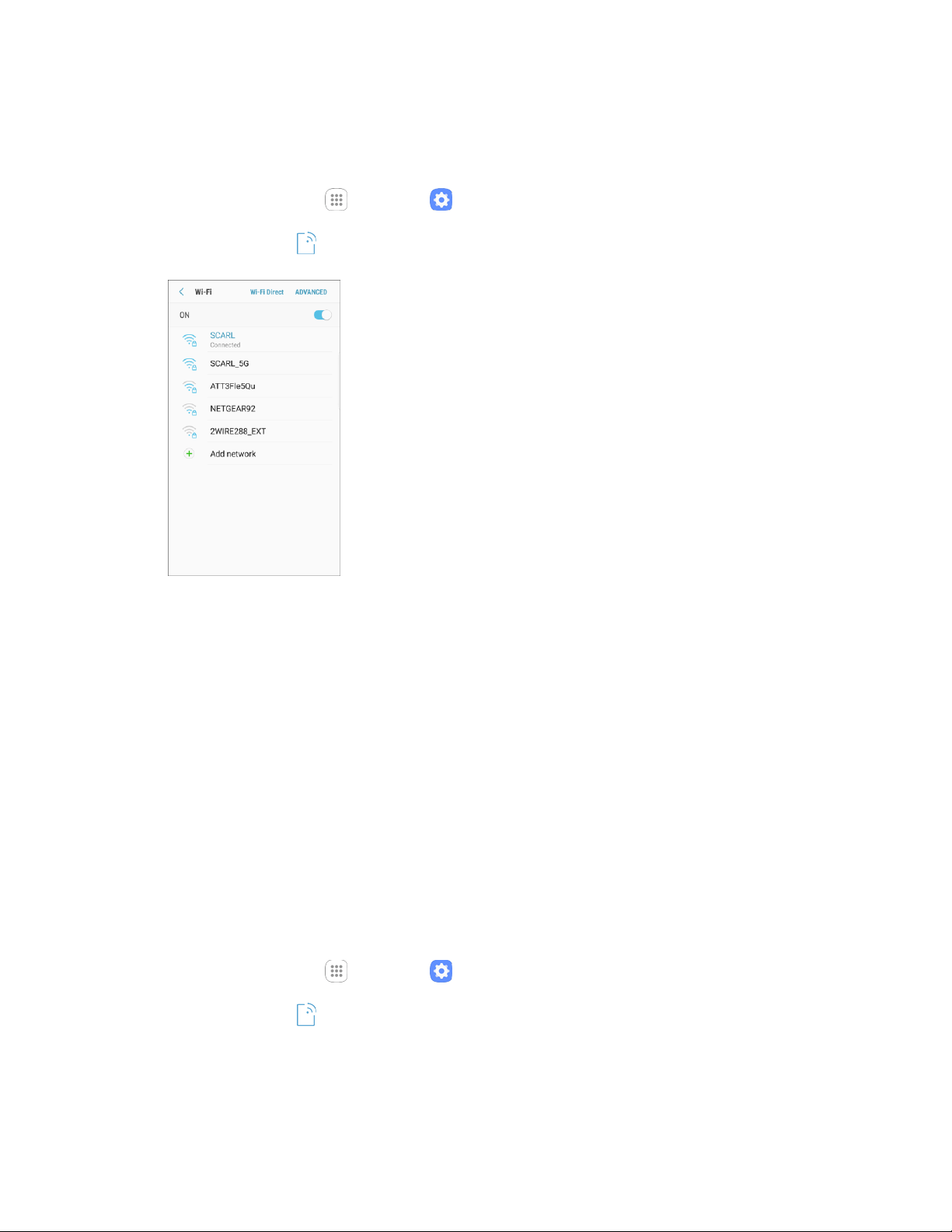
Connectivity 182
Wi-Fi Settings
Use the Wi-Fi settings menu to manually set your Wi-Fi connection options.
1. From home, tap Apps > Settings .
2. Tap Connections > Wi-Fi.
The Wi-Fi settings menu appears.
3. Tap On/Off to turn Wi-Fi on.
Wi-Fi is enabled. You will see the names and security settings of in-range Wi-Fi networks.
To disable Wi-Fi, tap On/Off again.
4. Tap Advanced.
The advanced Wi-Fi settings menu appears.
5. Configure your Wi-Fi settings.
Your Wi-Fi settings changes are saved.
Disconnect Wi-Fi
You may wish to disconnect from a connected Wi-Fi network without turning Wi-Fi off.
1. From home, tap Apps > Settings .
2. Tap Connections > Wi-Fi.
The Wi-Fi settings menu appears.

Connectivity 183
3. Tap the name of the connected access point and then tap Forget.
Wi-Fi is disconnected.
After disconnecting from an access point, you may need to re-enter the password to
reconnect.
Wi-Fi Direct
Use Wi-Fi Direct to connect directly to other Wi-Fi Direct devices simply using Wi-Fi, without an access
point or using the Internet.
1. From home, tap Apps > Settings .
2. Tap Connections > Wi-Fi.
The Wi-Fi settings menu appears.
3. Tap On/Off to turn Wi-Fi on.
Wi-Fi is enabled. You will see the names and security settings of in-range Wi-Fi networks.
4. Tap Wi-Fi Direct.
The Wi-Fi Direct settings menu appears.
Wi-Fi Direct and Wi-Fi are unavailable at the same time.
5. Tap a device with which to connect.
If connected using Wi-Fi, you will see a confirmation. Follow the prompts.
6. Accept the connection on the other device.
The phone is connected using Wi-Fi Direct.
If a connection is not accepted after a certain period, the connection request is canceled.
To stop a connection, tap Tap here to disconnect.
Hotspot
Hotspot allows you to turn your phone into a Wi-Fi hotspot. When this feature is turned on, you can share
your phone's mobile data services using Wi-Fi with other Wi-Fi enabled devices. The feature works best
when used in conjunction with 4G data services (although 3G service can also be used).
Important: Use of the Hotspot feature requires an additional subscription. Sign on to your account at
sprint.com/mysprint or access your account using My Sprint (tap Apps > My Sprint ) to learn
more.
Note: Turning Hotspot on will disable your phone's connection to other Wi-Fi networks.
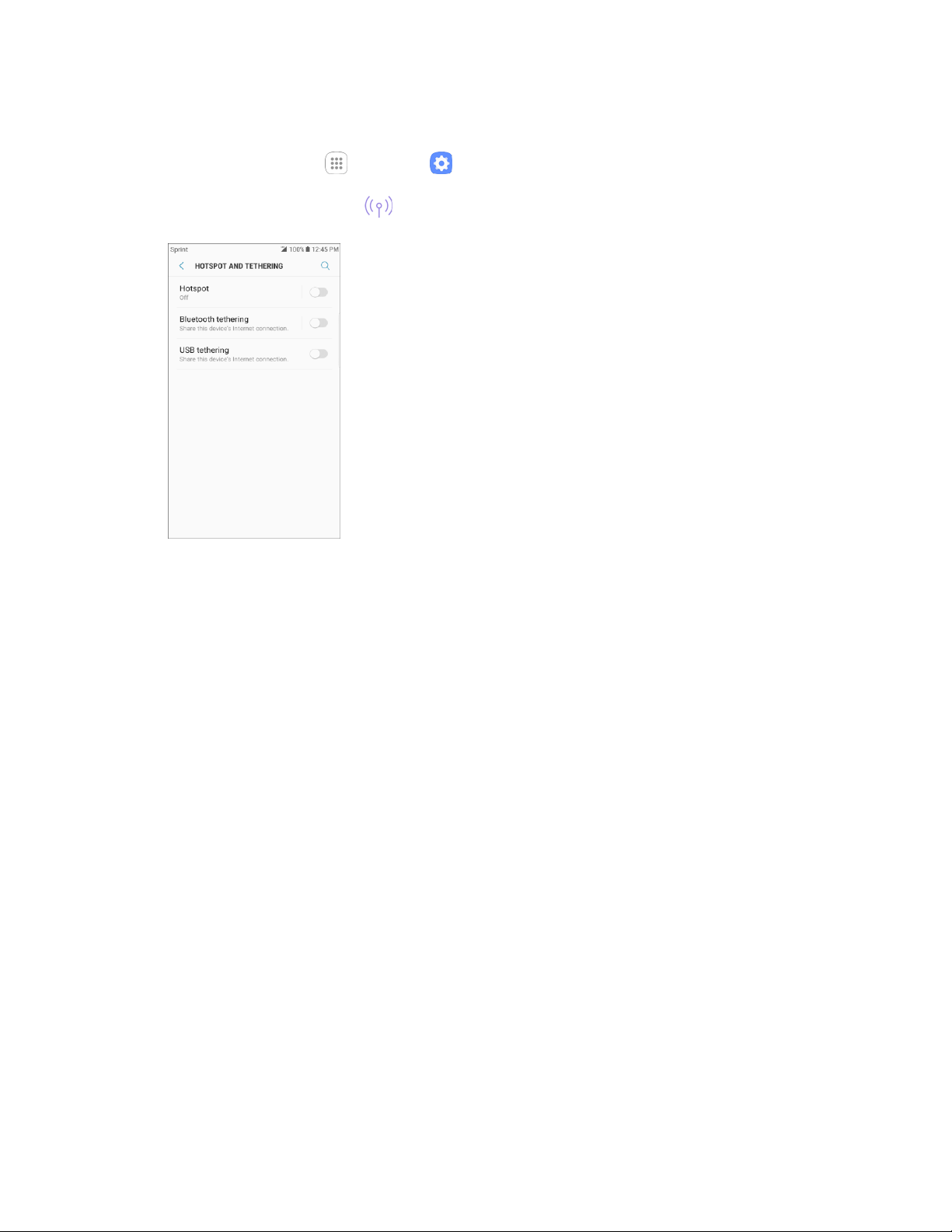
Connectivity 184
Set Up Hotspot
1. From home, tap Apps > Settings .
2. Tap Hotspot and tethering > Hotspot.
The Hotspot window opens.
3.
Tap On/Off to turn Hotspot on.
Hotspot is enabled.
To disable Hotspot, tap On/Off again.
Note: The best way to keep using the phone as a hotspot is to have it connected to a power supply.
Important: Write down the passkey (password) for this communication (shown onscreen).
Connect to Hotspot
1. Enable Wi-Fi (wireless) functionality on your target device (laptop, media device, etc.).
2. Scan for Wi-Fi networks from the device and select your phone hotspot from the network list.
You can change the default name by tapping More > Configure Hotpot and entering a new
Network name.
3. Select this phone and follow your prompts to enter the passkey (provided on the Hotspot page).
The device is connected using your phone’s Hotspot.
4. Launch your Web browser to confirm you have an Internet connection.
Connectivity 185
Bluetooth
Bluetooth is a short-range communications technology that allows you to connect wirelessly to a number
of Bluetooth devices, such as headsets and hands-free car kits, and Bluetooth-enabled handhelds,
computers, printers, and wireless phones. The Bluetooth communication range is usually approximately
30 feet.
Bluetooth Hints
Question: Cannot use Bluetooth?
Answer: Is your phone in airplane mode? Airplane mode initially turns Bluetooth off, but you can
manually turn it on again.
Bluetooth Function Cautions
Information may not appear correctly on connected devices depending on the transferred data.
Bluetooth Information
Bluetooth is a technology that enables wireless connection with PCs, Bluetooth devices with hands-free
features, etc.
Function
Description
Audio output
Listen to music, etc., wirelessly.
Hands-free calls
Call hands-free, using Bluetooth-capable hands-free devices and headsets.
Data exchange
Exchange data with Bluetooth devices.
Enable the Bluetooth Feature
Use the settings menu to enable or disable your phone’s Bluetooth capabilities.
● Wireless connection to all Bluetooth functions is not guaranteed for the phone.
● The phone may not connect properly depending on the other device.
● Noise may be experienced with wireless calls and hands-free calls depending on the conditions.
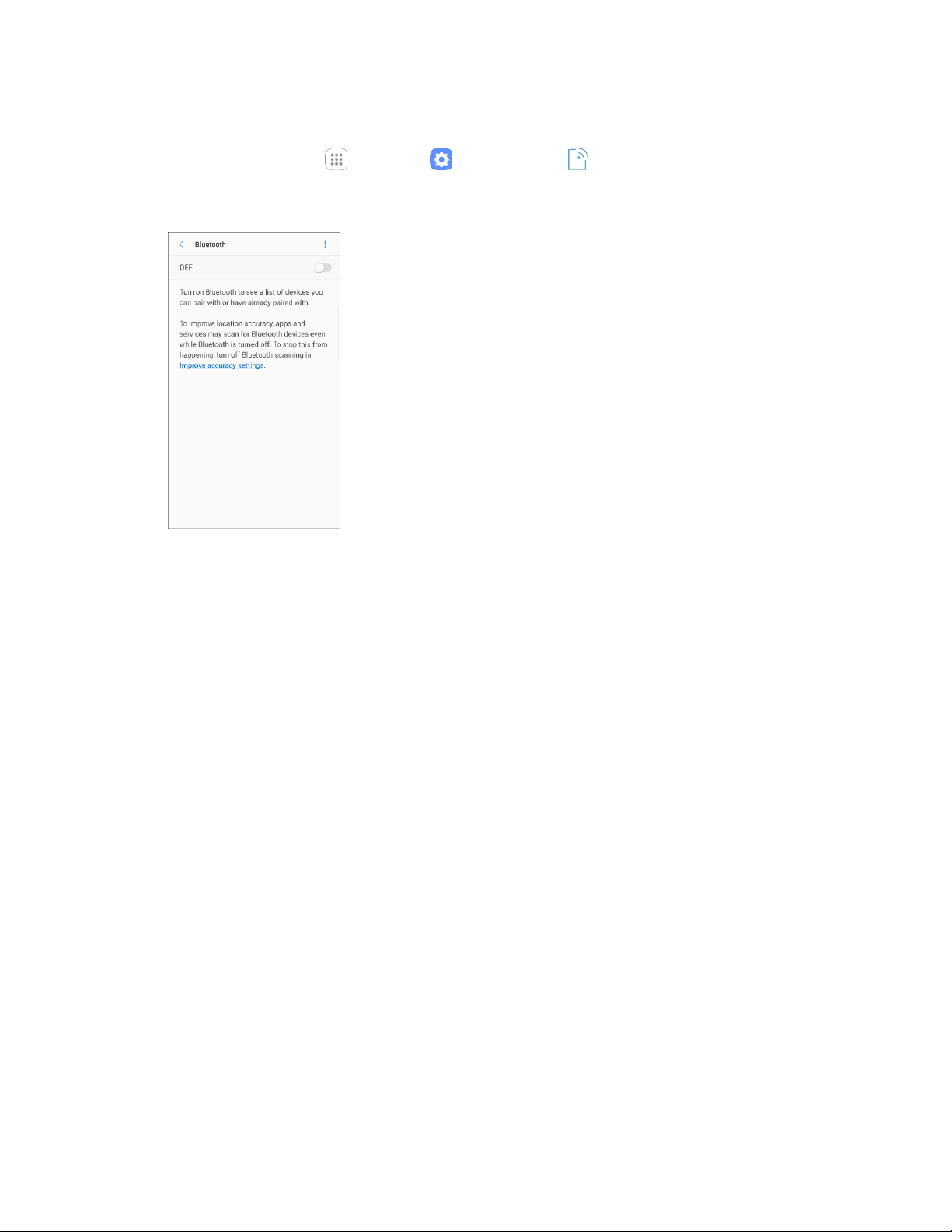
Connectivity 186
To enable Bluetooth
1. From home, tap Apps > Settings > Connections .
2. Tap Bluetooth.
The Bluetooth settings open.
3.
Tap On/Off to turn Bluetooth on.
Bluetooth is enabled.
To disable Bluetooth, tap On/Off again.
Tip: You can also turn Bluetooth on or off with the toggle menu in the notification panel. Pull down the
status bar to display the notification panel and then tap Bluetooth to turn Bluetooth on or off.
Note: Turn off Bluetooth when not in use to conserve battery power, or in places where using a wireless
phone is prohibited, such as aboard an aircraft and in hospitals.
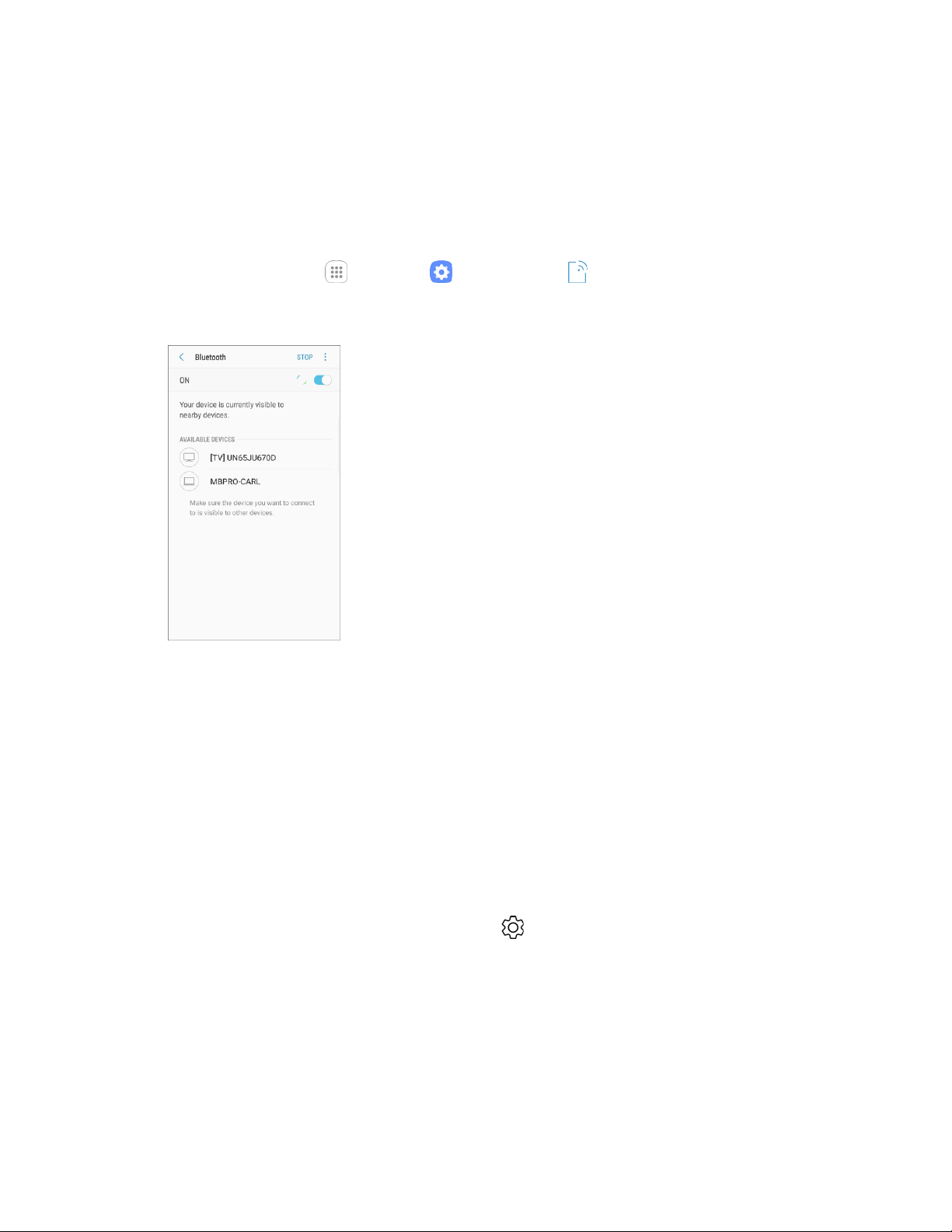
Connectivity 187
Pair Bluetooth Devices
Search for and pair nearby Bluetooth devices. Registered Bluetooth devices can be connected simply.
■ Enable the Bluetooth function on the Bluetooth devices being paired beforehand.
To pair Bluetooth devices:
1. From home, tap Apps > Settings > Connections .
2. Tap Bluetooth.
The Bluetooth settings open.
Nearby devices appear in the “Available devices” list.
If a target device is not detected, tap Scan to search again.
3. Tap a device from the “Available devices” list, and follow the prompts to pair with the device.
The Bluetooth device is paired to your phone.
Methods to accept a Bluetooth connection differ depending on the devices used.
Unpairing from a Paired Device
1. From the Bluetooth settings menu, tap Settings next to the paired device you wish to unpair.
2. Tap Unpair.
The device is unpaired from your phone. To make another connection with the device, you
will need to pair again.
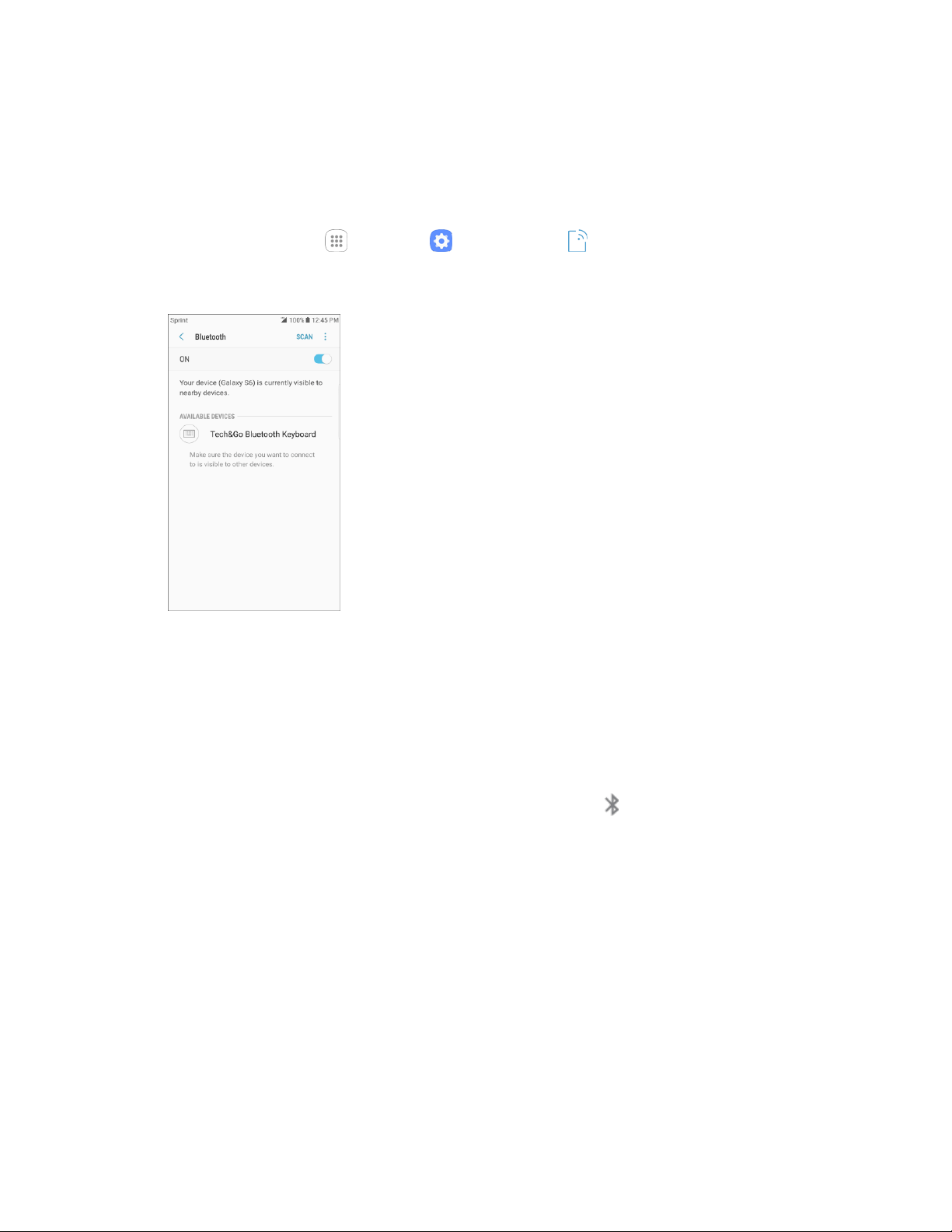
Connectivity 188
Connect to a Paired Bluetooth Device
You can listen to music over a Bluetooth stereo headset, or have hands-free conversations using a
compatible Bluetooth headset or car kit. It is the same procedure to set up stereo audio and hands-free
devices.
1. From home, tap Apps > Settings > Connections .
2. Tap Bluetooth.
The Bluetooth settings open.
Paired Bluetooth devices appear in the “Paired devices” list.
3. Tap a device from the “Paired devices” list.
Your phone connects to the paired device.
The pairing and connection status is displayed below the device’s name in the Bluetooth devices section.
When the device is connected to your phone, the Bluetooth paired icon is displayed in the status bar.
Depending on the type of device you have connected, you can then start using the headset or car kit to
listen to music or make and receive phone calls.
Note: Due to different specifications and features of other Bluetooth-compatible devices, display and
operations may be different, and functions such as transfer or exchange may not be possible with all
Bluetooth-compatible devices.
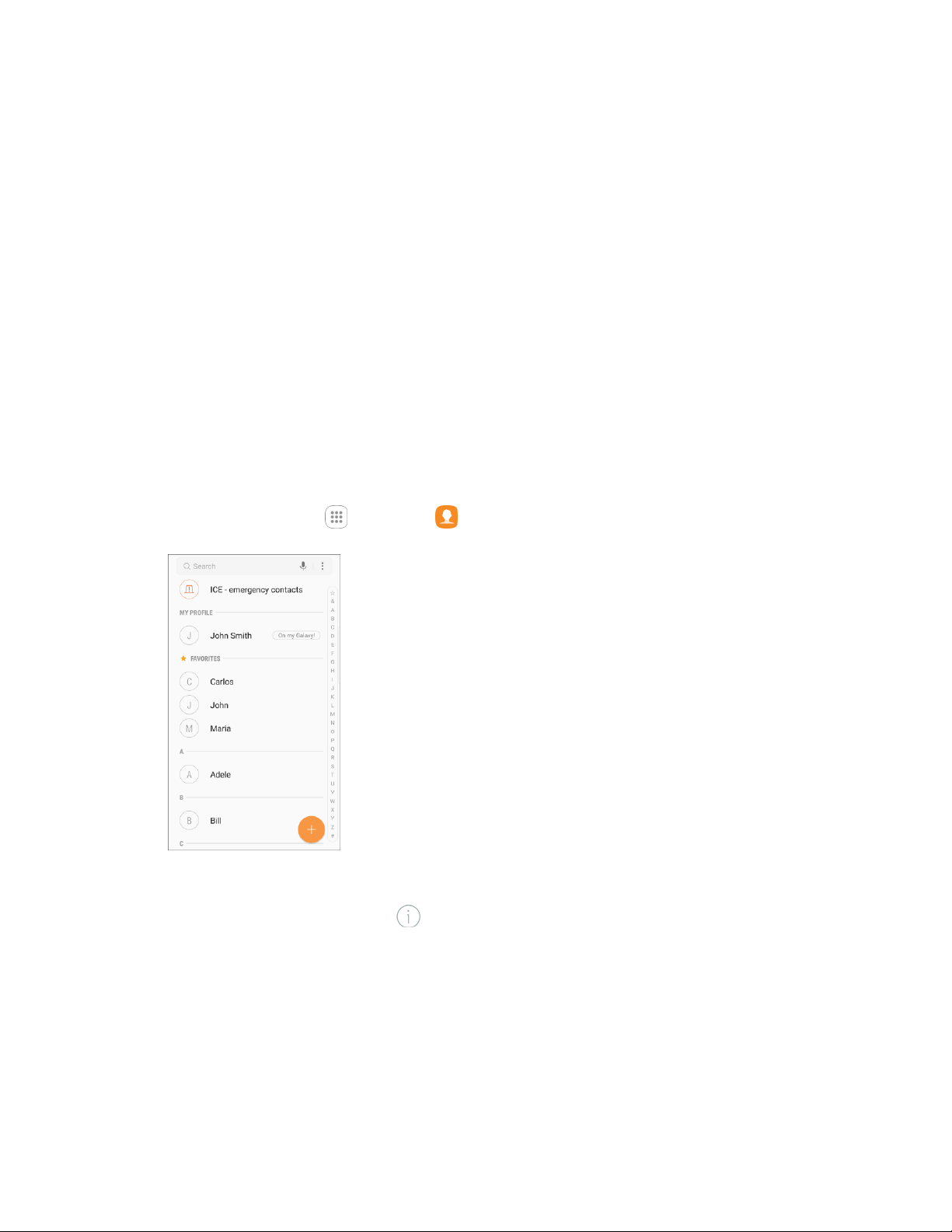
Connectivity 189
Send Information Using Bluetooth
You can use Bluetooth to transfer information between your phone and another Bluetooth-enabled device
such as a phone or notebook computer.
Types of Data You Can Send Using Bluetooth
You can send the following types of information, depending on the device you are sending to:
● Images and videos
● Calendar events
● Contacts
● Audio files
In the instructions below, Contacts data is being used as an example.
Sending Contacts Data Using Bluetooth
1. From home, tap Apps > Contacts .
You will see the Contacts list.
2. Tap a contact and select Details .
3. Tap Share, choose to share the contact as a vCard file (VCF) or Text, and then tap Bluetooth.
4. Tap a paired device to receive the data.
The contact information is sent.
If you see a message to confirm, follow the prompts.
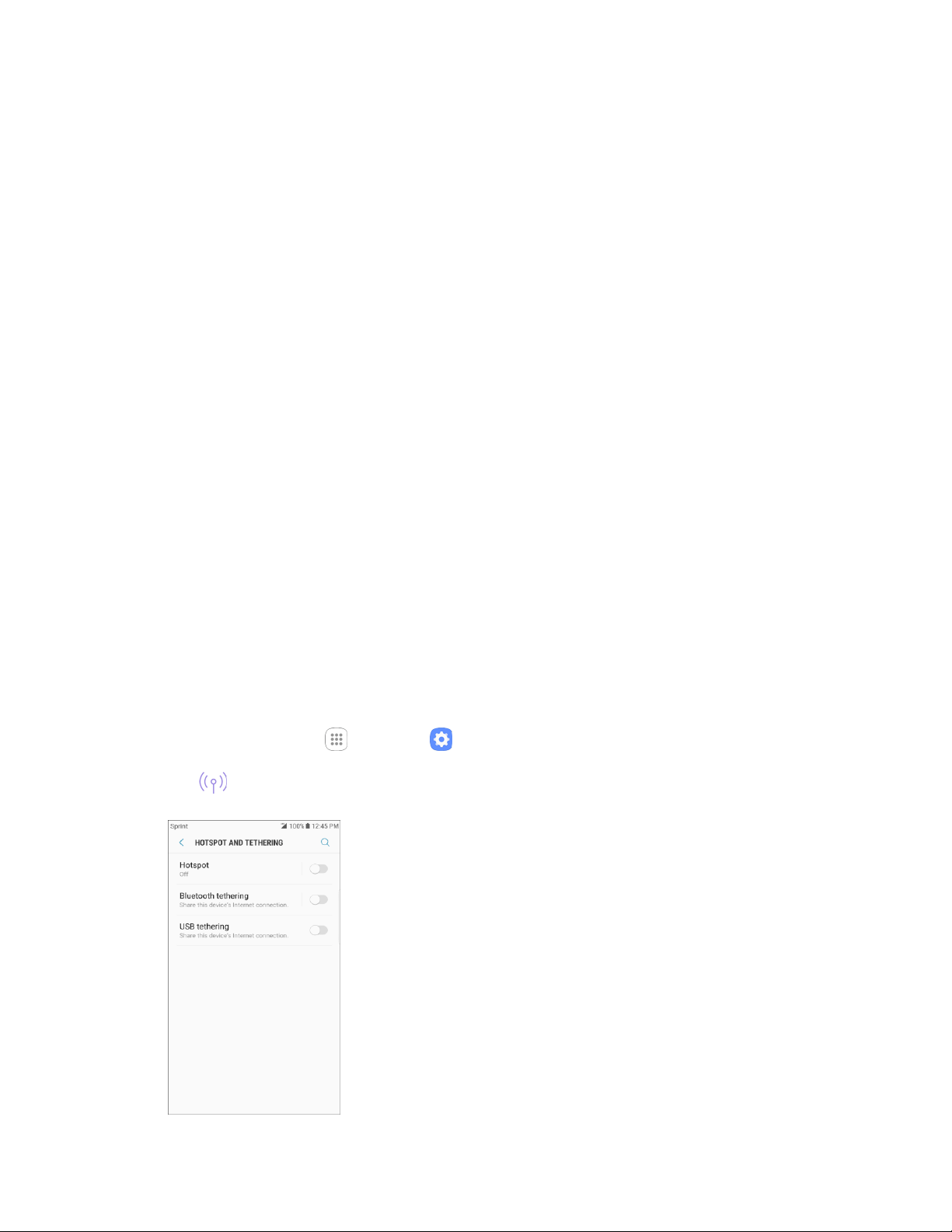
Connectivity 190
Receive Information Using Bluetooth
Your phone is capable of receiving a wide variety of file types with Bluetooth, including pictures, music
tracks, and documents such as PDFs.
1. When another device attempts to send a file to your phone using Bluetooth, you will see a
request to accept the file.
2. Tap Accept.
The file is sent to your phone.
When your phone receives a file, you will see a notification. To open the file immediately, pull
down the status bar to display the notification panel, and then tap the notification.
When you open a received file, what happens next depends on the file type:
• Media files and documents are usually opened directly in a compatible application. For
example, if you open a music track, it starts playing in the Music application.
• For a vCalendar file, select the calendar where you want to save the event, and then tap
Import. The vCalendar is added to your Calendar events. (For more information on using
the Calendar, see Calendar.)
• For a vCard contact file, if there are multiple vCard files on your storage card, you can
choose to import one, several, or all of those contacts to your contacts list.
Tethering
Use Tethering to share your device’s Internet connection with a computer that connects to your device
using USB cable, or by Bluetooth.
1. From home, tap Apps > Settings .
2. Tap Hotspot and Tethering.

Connectivity 191
3. Select a tethering option: Bluetooth tethering or USB tethering.
Tethering is turned on, and your phone’s Internet connection can be shared with a connected
device.
For USB tethering, connect your phone to the target device with the supplied USB cable.
For Bluetooth tethering, pair your phone with the other device using Bluetooth.

Global Services 192
Global Services
With your phone and global roaming service from Sprint Worldwide
SM
Wireless Service, you can make
phone calls and use wireless data services around the globe on compatible CDMA and GSM/UMTS
networks. For a country-specific travel guide, select your phone and destination from sprint.com/traveltips.
Note: Global roaming is auto-enabled on your phone. Visit sprint.com/globalroaming for more information.
Activate Sprint Worldwide Service on Your
Account
Before using your phone in global roaming mode, you must activate Sprint Worldwide service.
To activate Sprint Worldwide service:
■ Chat with or email an international support rep by visiting sprint.com/swwsupport.
– or –
■ Call Sprint Worldwide Customer support at 1-888-226-7212.
Your Phone’s SIM Card for International
GSM Roaming
Your phone comes with a preinstalled SIM (Subscriber Identity Module) card to support roaming on
compatible GSM networks.
Note: Your SIM card should be preinstalled. If you need to reinstall your SIM card, follow the instructions
below.
Note: The SIM card included with your phone contains information specific to your phone and should be
retained for use on GSM networks.
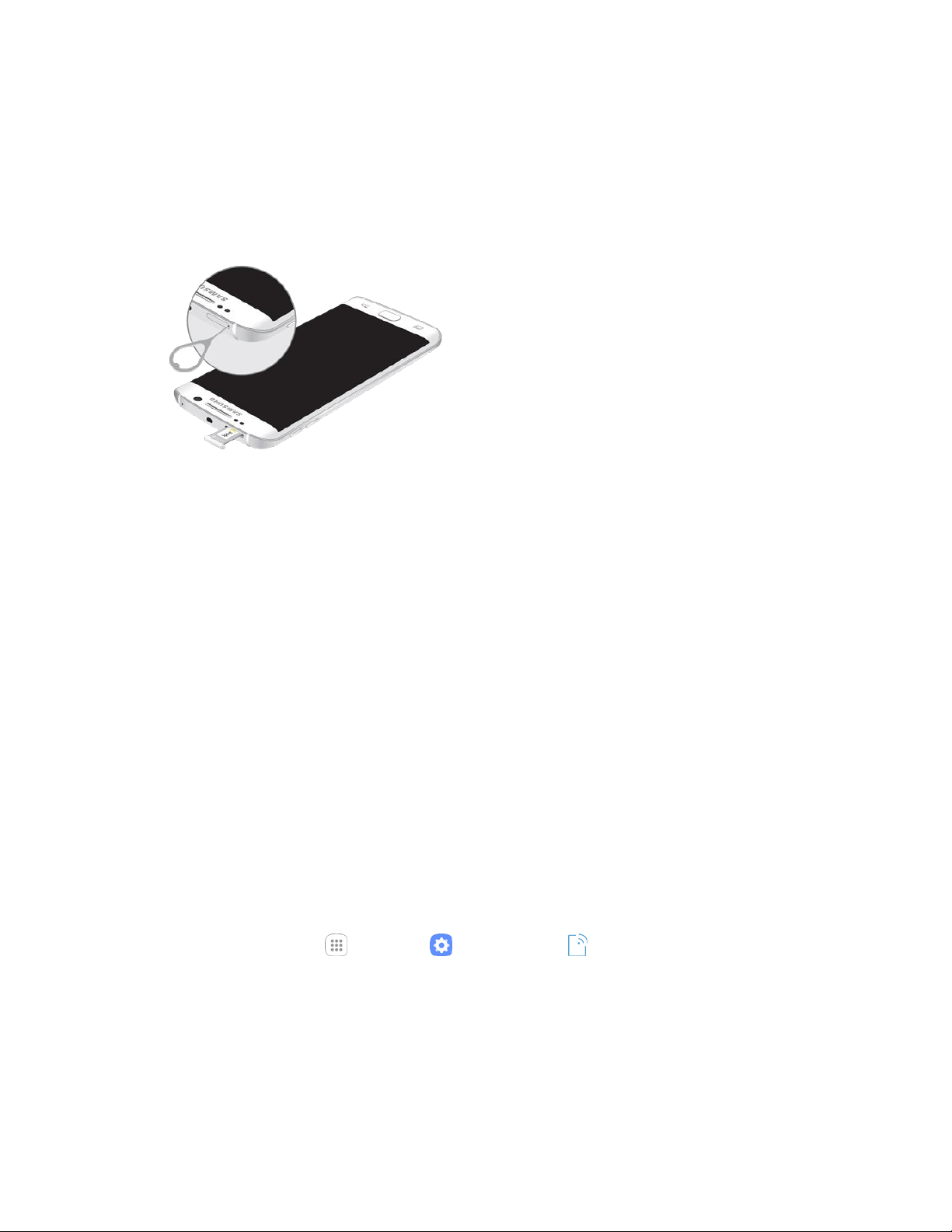
Global Services 193
Insert a SIM Card
Caution: Exercise care when using the removal tool to eject the internal SIM card.
1. Insert the removal tool into the hole on the SIM card tray, and push until the tray pops out.
2. Place the SIM card on the tray.
Make sure that the card’s gold contacts face down into the device and that the card is
positioned as shown.
3.
Slide the SIM card tray back into the slot.
Important: To prevent water and dust from entering the device, remove any dust on the O-Ring and
ensure that the SIM card tray is closed tightly.
Caution: If the card is not inserted correctly, the device cannot detect the SIM card. Re-orient the card
and place it back into the slot if the SIM is not detected.
Enable Global Roaming Mode
Your phone is designed to enter global roaming mode automatically when you activate your Sprint
Worldwide service, meaning that it should automatically connect to an appropriate CDMA/LTE network or
GSM/UMTS network when you travel. You may set global roaming options through the settings menu.
You may also need to set your network mode options through the settings menu. See Set the
Communications Method for Global Use.
Note: Global roaming is auto-enabled on your phone. Visit sprint.com/globalroaming for more information.
To set your roaming options manually:
1. From home, tap Apps > Settings > Connections .
2. Tap Mobile networks > Data roaming.
3. Tap Roaming network.
4. Tap Home only or Automatic.
The selected roaming method is set.

Global Services 194
5. Tap Roaming guard.
6. Select roaming guard options for each category.
The selected options are set.
Set the Communications Method for
Global Use
Select a communications method for an overseas carrier as needed.
1. From home, tap Apps > Settings > Connections .
2. Tap Mobile networks.
3. Tap Network mode > CDMA / LTE/CDMA / GSM/UMTS / Automatic.
The communications method is set.
Note: At the time of purchase, your phone is set to the Automatic mode by default. This allows global
usage and normally will not need to be changed.
Select a Carrier
You can select a specific local carrier to use when traveling internationally. At the time of purchase, your
phone is preset to connect automatically to an appropriate carrier in your current area.
1. From home, tap Apps > Settings > Connections .
2. Tap Mobile networks.
3. Tap Network operators.
4. Tap an available network.
The selected carrier is set.
To automatically select an appropriate carrier (default), tap Choose automatically.
To search for all available networks, tap Search networks.
Make and Receive Worldwide Calls
When traveling on international networks, you can place and answer calls as you would on the Sprint
network (see Place and Answer Calls), although some additional instructions may be required to place a
call. Some features and services are not available in all countries. For more information on services that
are available while roaming, visit sprint.com/sww.

Global Services 195
Make Calls Using Plus (+) Code Dialing
Placing calls from one country to another country is simple with the Plus (+) Code Dialing feature. When
placing international calls, you can use Plus Code Dialing to enter the appropriate international access
code for your location (for example, 011 for international calls placed from the United States).
Note: Plus Code Dialing is only available when roaming internationally on GSM networks and on certain
CDMA networks in the United States, Canada, and the Caribbean.
Note: International access codes and dialing information are available online at sprint.com/sww.
To use Plus Code Dialing to place an international call:
1. From home, tap Phone > Keypad to display the phone screen.
2. If you are on the GSM network, touch and hold 0 to insert a “+” on the phone dial screen. (The “+”
symbol automatically inserts the international access code for the country from which you are
calling.)
3. If you are on the CDMA network outside Canada or the Caribbean, enter the international access
code for the country from which you are calling.
4. Tap 1 to insert the US country code, and then enter the area code and number.
5. Tap Dial to place the call.
Sprint International Voicemail Service
Your Sprint voicemail will follow you as you travel. All of your unanswered calls will be forwarded to your
Sprint voicemail. You will need to be sure your voicemail box is already set up and that you know your
voicemail passcode.
Note: Sprint voicemail may not be available on all networks; check sprint.com/sww for service
information.
International Voicemail Troubleshooting
There are a few tips to keep in mind when using Sprint voicemail while traveling.
● Some carriers may not support voicemail indicators. It may be necessary to call your voicemail to
see if you have any new messages.
● If you hear the message “Please enter the number of the subscriber you wish to call,” enter your
10-digit wireless phone number.

Global Services 196
Set Up Your Voicemail Access Number for
International Use
To simplify accessing your Sprint Voicemail while traveling, you can set up your voicemail access number
as a Contacts entry. This will make it faster and easier to access your messages while roaming
internationally.
1. From home, tap Apps > Contacts .
2. Tap Add to add a contact.
3. Type the contact information (for example, “My Voicemail”).
4. Touch and hold 0, and then tap 1 (+1), your area code, and your wireless phone number.
5. Tap Save.
Your voicemail access number is saved as a contact.
Access Your Voicemail Internationally
You will need to call your voicemail number to access your voicemail while roaming internationally.
New Message Indicators
Your voicemail message indicators may be displayed differently when roaming internationally.
● A “Message Waiting” indicator icon or a text message is displayed when a voicemail message is
received.
● You may see “Missed Call” on your screen prior to receiving a message notification.
● You must call voicemail in order to retrieve messages. Follow the instructions on the previous
page to store your voicemail number for easy access.
Retrieve Voicemail Messages
The voicemail retrieval process while traveling is the same as on the Sprint Network; however, you will be
required to enter your voicemail passcode.
To retrieve your voicemail messages:
1. From home, tap Apps > Contacts .
2. Tap the voicemail entry and then tap the number to call it.
Your phone dials your voicemail number.
3. When your voicemail answers, tap *, enter the passcode, and then tap # to access your
voicemail.
Your voicemail box is accessed.

Global Services 197
International Data Roaming
Sprint Worldwide Wireless Service can also keep you connected using email and Web browsing when
traveling in countries in which Sprint offers data service.
Data services are available on both CDMA and GSM/UMTS networks. Check sprint.com/traveltips and
sprint.com/sww to determine the services available where you are traveling.
Note: Prior to using your Sprint Worldwide GSM/UMTS Data Services, you must establish and utilize your
CDMA data services domestically on the Sprint Network.
Get Started With Sprint Worldwide Data Services
To use Sprint Worldwide Data Services, you will need to have these services activated on your account.
■ To activate, call Sprint Worldwide Customer Support at 1-888-226-7212. Representatives are
available 24 hours a day, 7 days a week to assist you.
Access Email and Data Services Internationally
To access your email and browse the Web when traveling, you may need to manually select the carrier
that provides Sprint service in your location. You can find a list of carriers for each country where GSM
data service is offered at sprint.com/sww. Then, follow the instructions below to select the appropriate
carrier network on your phone.
Access International Data Services on GSM/UMTS Networks
To select a GSM data service carrier for a specific country:
1. From home, tap Apps > Settings > Connections .
2. Tap Mobile networks > Roaming.
3. Tap the On/Off switch next to Data under International to allow international data roaming.
Data roaming on GSM/UMTS networks is set.
Access Email and Data Services Internationally on CDMA Networks
If data service is available on an international CDMA network, then you only need to set the phone to
CDMA; you will not need to select the specific carrier. Selecting a specific carrier is only necessary for
providers on the GSM network. If your phone has automatically selected a GSM network while traveling,
then you will need to set the phone to CDMA to access CDMA data services. (See Enable Global
Roaming Mode.) Visit sprint.com/sww for a list of services available in each country.

Global Services 198
Contact Sprint for Assistance with
International Service
If you experience any issues with voice or data services while outside of the United States, Sprint offers
customer support 24 hours a day. In the event that you do experience an issue, try the following actions:
● First try powering your phone off and then back on; this will force your phone to reregister with the
network.
● Try manually selecting another network. Information for selecting networks can be found in the
phone guide.
If neither of these actions resolves your issue, you will need to contact customer service (see below).
When calling to report an issue, the following information will be beneficial in trying to resolve your issue
as quickly as possible:
● Your wireless phone number.
● The city and country you are traveling in.
● Any error message that displays on your phone or that you heard when trying to place a call.
● If the issue is with data, were you able to place voice calls?
● If the issue is with voice service, were you able to access data?
Please call the numbers below if you need assistance:
While in the United States: Call 1-888-226-7212.
While traveling outside the United States:
● In GSM mode: touch and hold 0 and then dial 1-817-698-4199.
● In CDMA mode: enter the country code and then dial 1-817-698-4199.
There is no charge for this call from your wireless phone.
From a landline phone when outside the United States:
Sprint Worldwide Customer Support can be reached from a landline phone at 1-817-698-4199. Access or
connection fees may apply. The toll free numbers below can also be used to contact Sprint Worldwide
Customer Support in the following countries:
Country
From Landline Phone
Canada
1-866-805-9890
Caribbean (Anguilla, Barbados,
Cayman Islands, and Dominica)
1-888-226-7212
Global Services 199
Country
From Landline Phone
France
0800-903200
Germany
0800-180-0951
Italy
800-787-986
Mexico
001-877-294-9003
Trinidad and Tobago
1-800-201-7545
United Kingdom
0808-234-6616
Note: This toll free service is available on ordinary landline phones and some public pay phones. This
service does not cover any hotel access charges.
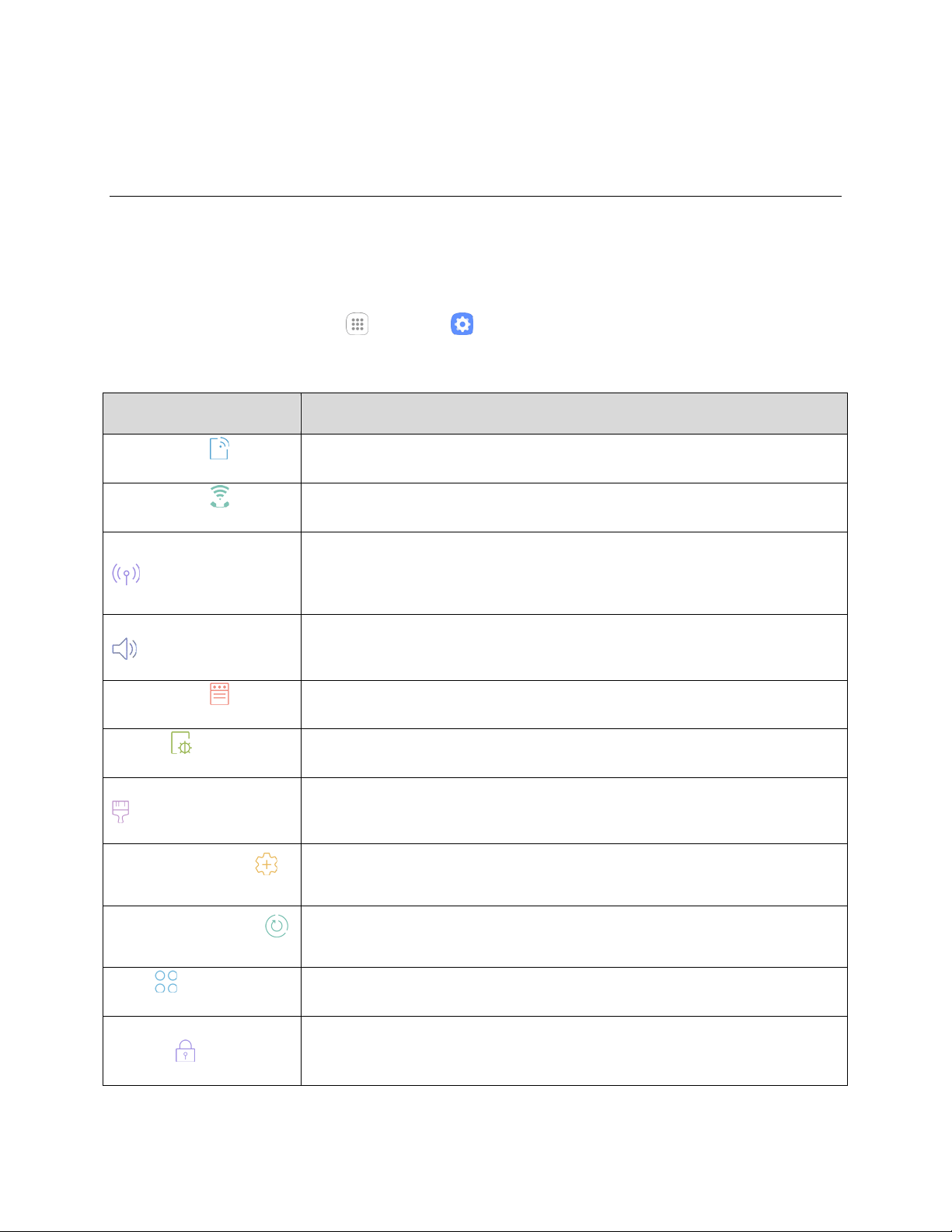
Settings 200
Settings
The following topics introduce your phone’s basic settings menus and cover your phone’s Settings
menus.
Basic Settings
From the home screen, tap Apps > Settings to access your phone’s settings menu.
The table below outlines the top-level settings categories.
Category
Description
Connections
Configure various connection settings.
Wi-Fi Calling
Enable and set Wi-Fi calling options.
Hotspot and tethering
Use the Mobile Hotspot feature and tethering feature to share your phone’s
data connection with other devices using Wi-Fi, Bluetooth, or USB
connection.
Sounds and vibration
Configure ringtone and vibration settings.
Notifications
Select which apps can send you alerts, notifications, sounds, and vibrations.
Display
Set display features, font, brightness, etc.
Wallpaper and themes
Set wallpaper for the home and lock screens.
Advanced features
Configure features for launching the camera, using the phone with one hand,
screen capture gestures, and more.
Device maintenance
View the status of your device’s battery, storage, and memory. You can also
automatically optimize your device’s system resources.
Apps
Manage applications, default apps, and system processes.
Lock screen and
security
Set your phone’s lock screen options. Set security features such as device
administrators, encryption, and trusted credentials.
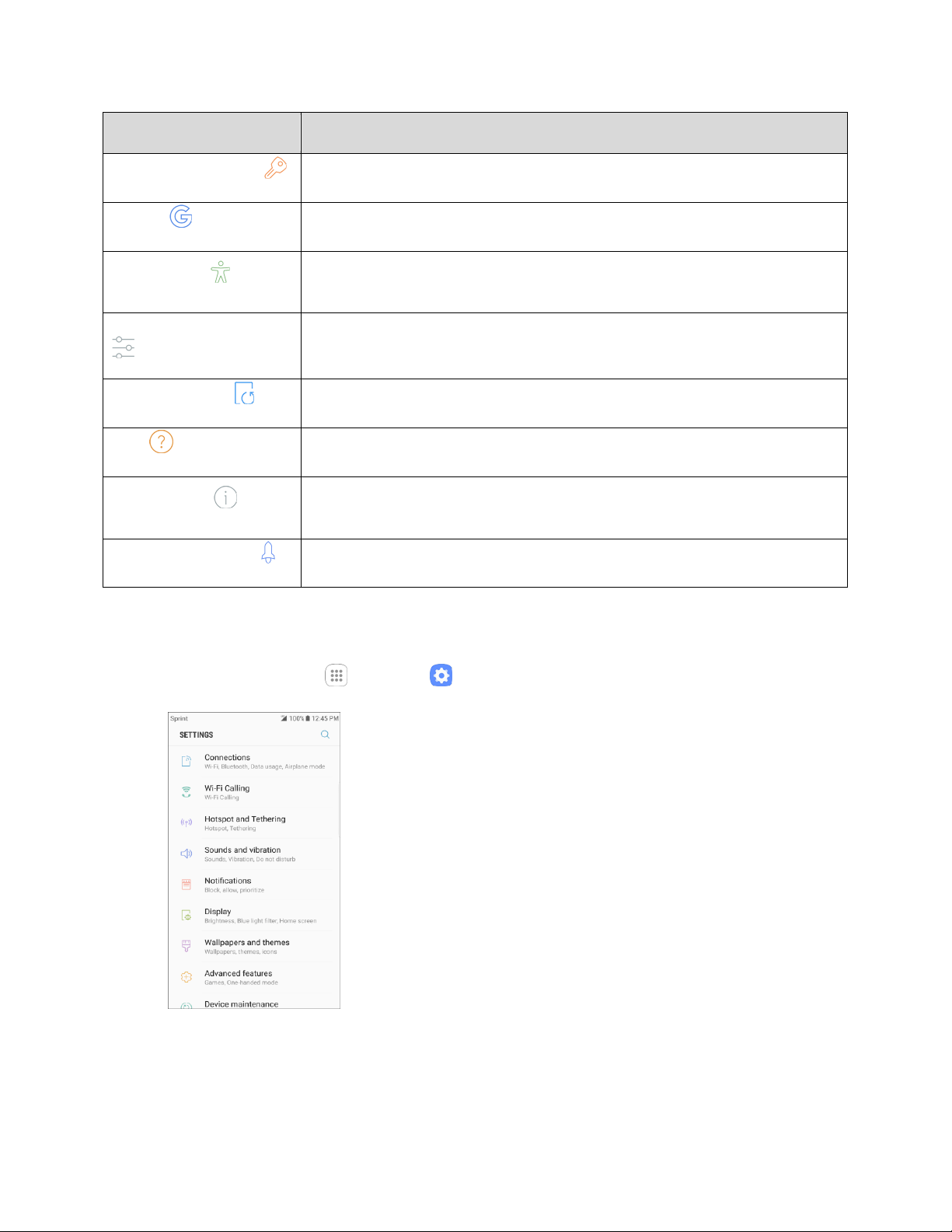
Settings 201
Category
Description
Cloud and accounts
Set up accounts such as Samsung, Google, and more.
Google
Configure Google settings.
Accessibility
Set accessibility options such as screen magnification, hearing aid
compatibility, etc.
General management
Configure your phone’s language and input options, set the date and time,
and report diagnostic information.
System updates
Update your system’s software, PRL, and Profile.
Help
View tips and guidelines for using your phone.
About device
View device status, legal information, and hardware information about your
device.
Activate this device
Activate your device with the Sprint network.
Access Settings
1. From home, tap Apps > Settings .
The settings menu opens.
2. Select categories and then select your settings options.
Settings are made and applied.
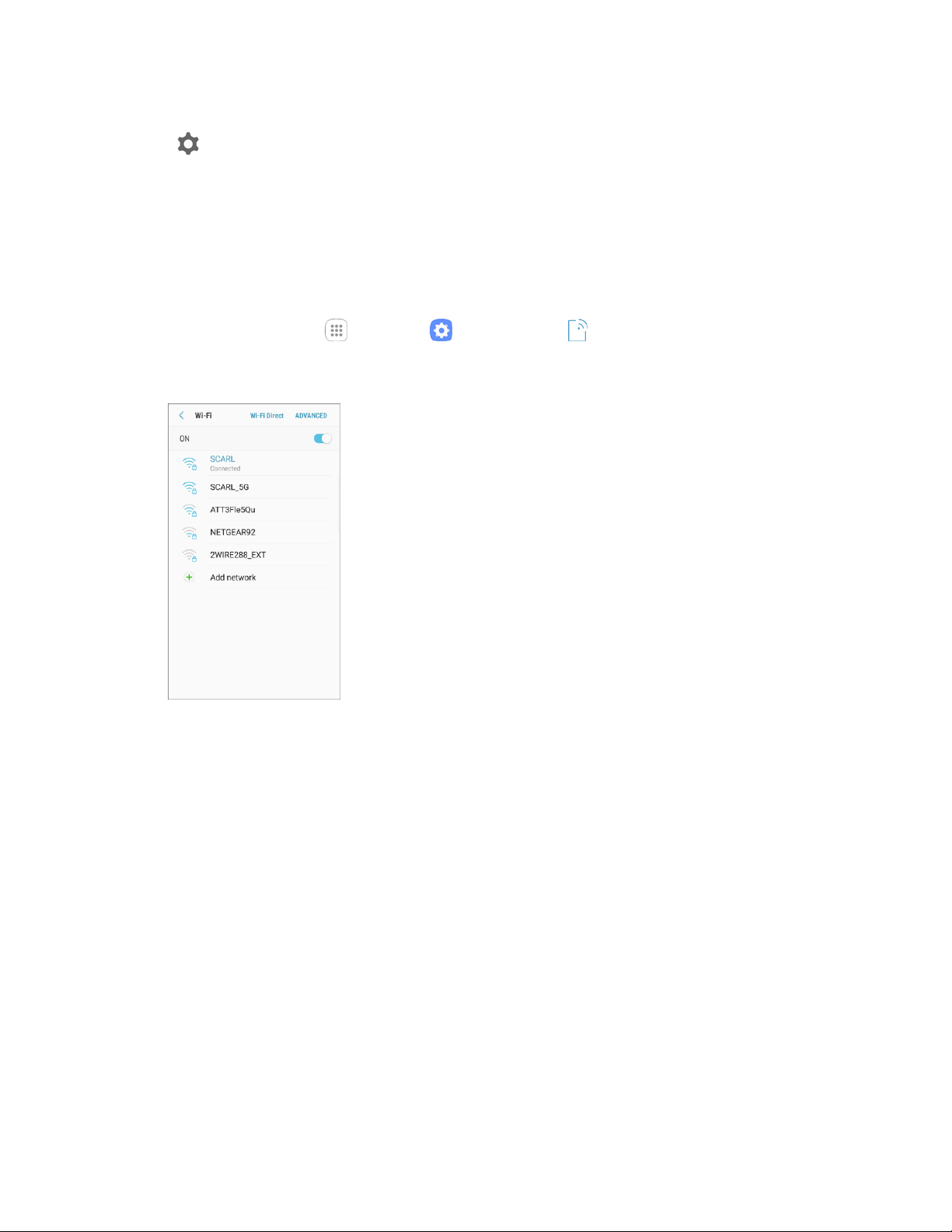
Settings 202
Tip: You can also access settings from the notification panel. Pull down the status bar and tap
Settings .
Wi-Fi Settings Menu
The Wi-Fi settings menu lets you turn Wi-Fi on or off, set up and connect to available Wi-Fi networks, and
configure advanced Wi-Fi options.
For more information about Wi-Fi settings, see Wi-Fi.
1. From home, tap Apps > Settings > Connections .
2. Tap Wi-Fi.
The Wi-Fi settings menu appears.
3.
Tap On/Off to turn Wi-Fi on.
Wi-Fi is enabled. You will see the names and security settings of in-range Wi-Fi networks.
To disable Wi-Fi, tap On/Off again.
4. Tap a Wi-Fi network, enter the password, and tap Connect.
Your phone is connected to the selected Wi-Fi network.
5. Configure your Wi-Fi settings.
Your Wi-Fi settings changes are saved.
The password, for a household wireless LAN router, is sometimes found on a sticker on the
router (WEP, WPA, KEY, etc.). Contact the router manufacturer for information. For the
password for a public wireless LAN, check with user's service provider.
Entering a password is not required if an access point is not security protected.

Settings 203
Connect to a Wi-Fi Network via WPS
Wi-Fi Protected Setup (WPS) is a network security standard that allows you to easily secure a wireless
network connection between your phone and a router.
To connect using a WPS button:
1. From Wi-Fi settings, tap Advanced > WPS push button.
2. Press the WPS button on your router.
3. Follow the prompts to complete the connection.
To connect using a Personal Identification Number (PIN):
1. From Wi-Fi settings, tap Advanced > WPS PIN entry.
2. Enter the PIN displayed on your router.
3. Follow the prompts to complete the connection.
Smart Network Switch
Smart network switch lets your phone automatically switch to the wireless network data connection when
the current Wi-Fi connection is unstable.
1. From the Wi-Fi settings menu, tap Advanced > Smart network switch.
2. Tap On/Off to enable the feature.
Advanced Wi-Fi Settings
The advanced Wi-Fi settings menu lets you set up and manage wireless access points.
■ From the Wi-Fi menu, tap Advanced to access Wi-Fi settings:
Smart network switch: Connect automatically to a mobile network connection when the Wi-
Fi connection is unstable.
Network notification: Receive notifications when open networks in range are detected.
Hotspot 2.0: Automatically connect to Wi-Fi access points that support Hotspot 2.0.
Manage networks: Manage your saved Wi-Fi networks.
WPS push button: Set up a connection to a WPS (Wi-Fi Protected Setup) router or other
equipment.
WPS PIN entry: View the PIN used by your device to set up a PIN-secured connection to a
Wi-Fi router or other equipment (not configurable).
Keep Wi-Fi on during sleep: Specify when to disconnect from Wi-Fi.
Install network certificates: Install authentication certificates.
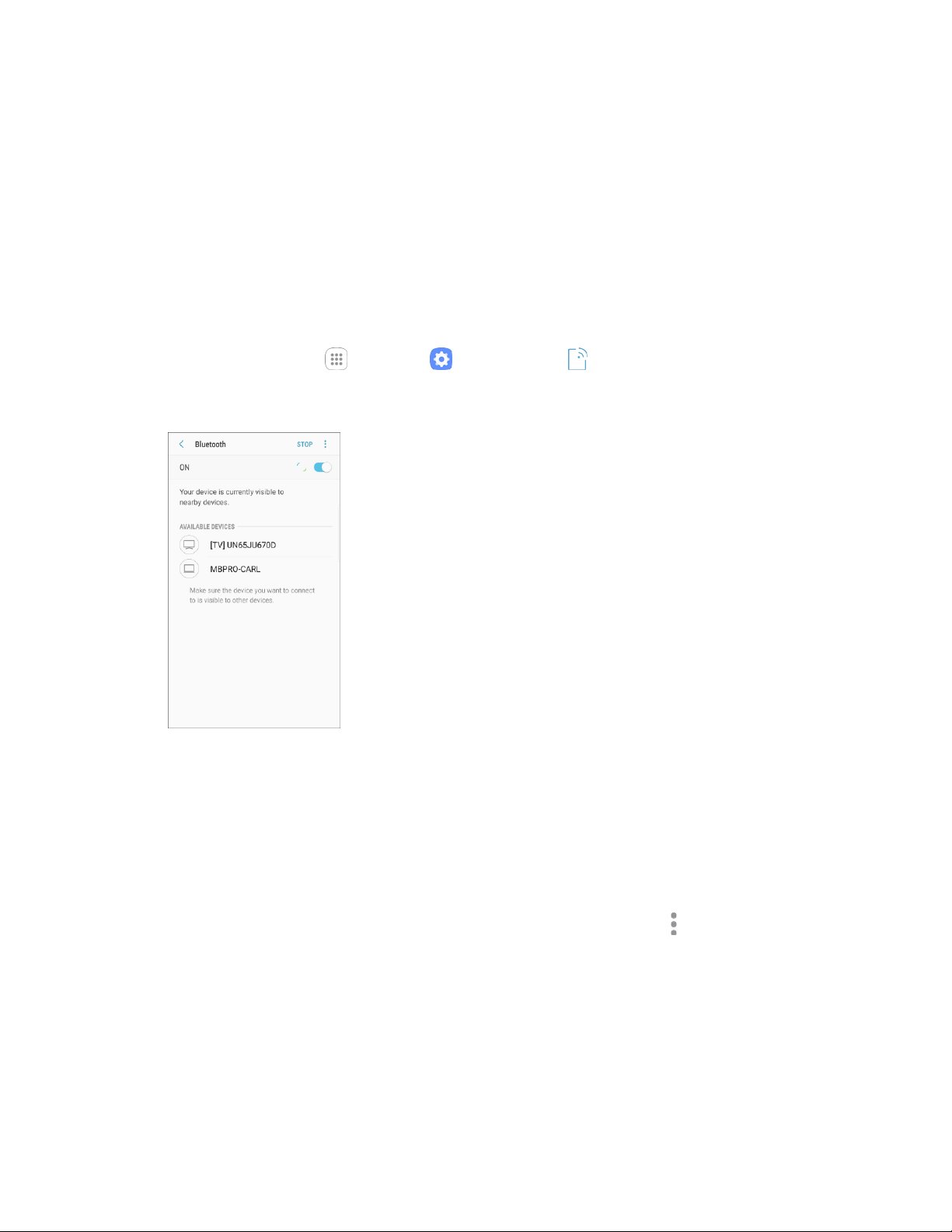
Settings 204
Wi-Fi control history: View which apps have turned Wi-Fi on or off most recently.
MAC address: View your device’s MAC address, which is required when connecting to some
secured networks (not configurable).
IP address: View your device’s IP address (not configurable).
Bluetooth Settings
Your phone’s Bluetooth capabilities let you use wireless headsets, send and receive pictures and files,
and more. For details on your phone’s Bluetooth usage, see Bluetooth.
1. From home, tap Apps > Settings > Connections .
2. Tap Bluetooth.
The Bluetooth settings open.
Bluetooth Settings Operations
● Enable Bluetooth: From Bluetooth settings, tap On/Off.
When enabled, confirmation appears for your phone to be discoverable by other devices.
Follow the prompts.
● Change your phone name: From Bluetooth settings, tap More options > Rename device,
enter a new name, and tap Done.
This changes the name of your phone as seen by other devices.
● Pairing Bluetooth devices: Make sure the other devices are set to be discovered. From
Bluetooth settings, tap the device name in “Available devices” and follow the prompts.
Depending on the device, you may be required to enter or accept a passkey.

Settings 205
If the target device does not appear, tap Scan to search again.
This setting is available when Bluetooth is enabled.
● Change the name of a paired device: From Bluetooth settings, tap Settings next to a
paired device name, tap Rename, enter a new name, and tap Rename.
Emoji cannot be used in a device name.
This setting is available when Bluetooth is enabled.
● Canceling pairing: From Bluetooth settings, tap Settings next to a paired device name, and
then tap Unpair.
This setting is available when Bluetooth is enabled.
● Enable service from paired device: From Bluetooth settings, tap Settings next to a paired
device name, and then tap the listing under Profiles.
If a confirmation prompt appears, follow the prompts.
This setting is available when Bluetooth is enabled.
This setting is available when the paired device is providing a service.
Tap the setting to toggle On/Off.
● Search for other devices: From Bluetooth settings, tap Scan.
This setting is available when Bluetooth is enabled.
● Check files received using Bluetooth transfer: From Bluetooth settings, tap More options >
Received files, and then follow the prompts.
Phone Visibility
Make your device visible to allow other devices to find it and share content.
1. From home, tap Apps > Settings > Connections .
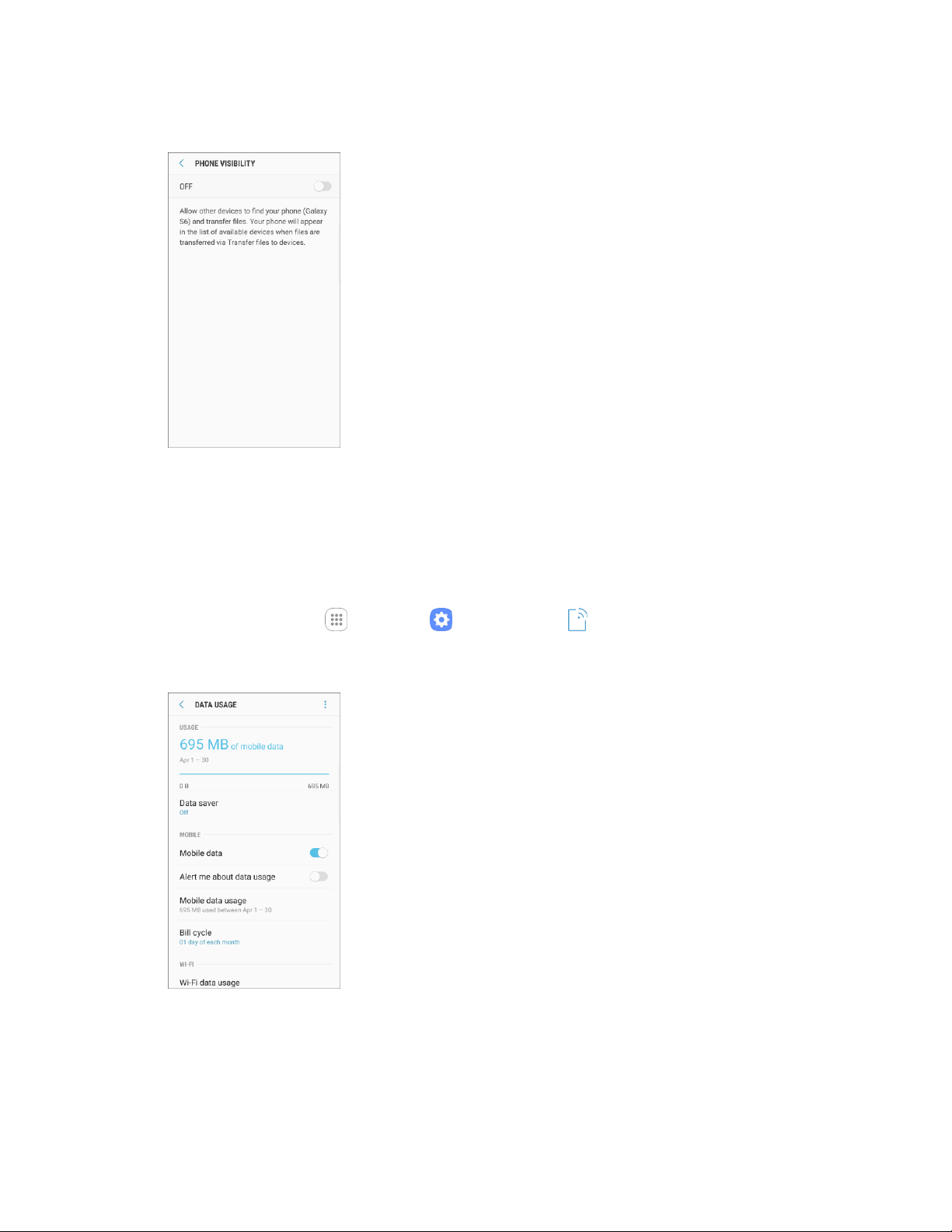
Settings 206
2. Tap Phone visibility.
3. Tap On/Off to turn on visibility.
Data Usage Settings
The data usage menu lets you view your phone’s mobile and Wi-Fi data usage, set data limits, restrict
hotspot usage, and more.
1. From home, tap Apps > Settings > Connections .
2. Tap Data usage.
The data usage window opens.

Settings 207
3. Data usage settings operations:
Usage: View mobile data usage for the current billing cycle.
Data saver: Reduce data usage by preventing some apps from sending or receiving data in
the background, or by reducing the frequency of data access by apps in use.
Mobile data: Enable or disable mobile data.
Alert me about data usage: Receive an alert when your mobile data usage reaches the
amount you selected.
Mobile data usage: Tap the drop-down menu, and then choose a time period for data usage.
Data usage for the period is displayed on the graph, along with usage by application at the
bottom of the screen.
Bill cycle: Set mobile data usage warnings and limits during your billing cycle.
Wi-Fi data usage: Display your Wi-Fi data usage.
Restrict networks: Select Wi-Fi networks that are mobile hotspots. You can restrict apps
from using these networks, and you can configure apps to warn you before using these
networks for large downloads.
4. Tap More options > Help to view help topics for data usage.
Airplane Mode Settings
When you enable Airplane mode, your phone disconnects from all networks, meaning you cannot make
calls, send or receive messages, or access the Internet. It also turns off other connectivity features, such
as Wi-Fi and Bluetooth.
While in airplane mode, you can use other features of your phone, such as playing music, watching
videos, or using other applications.
To use Wi-Fi and Bluetooth after enabling Airplane mode, turn them on either in Settings or on the
notification panel.
1. From home, tap Apps > Settings > Connections > Airplane mode.
2. Tap On/Off to enable Airplane mode.
Note: You can also enable or disable Airplane mode through the notification panel quick settings (drag
down the status bar and tap Airplane mode > Turn on).
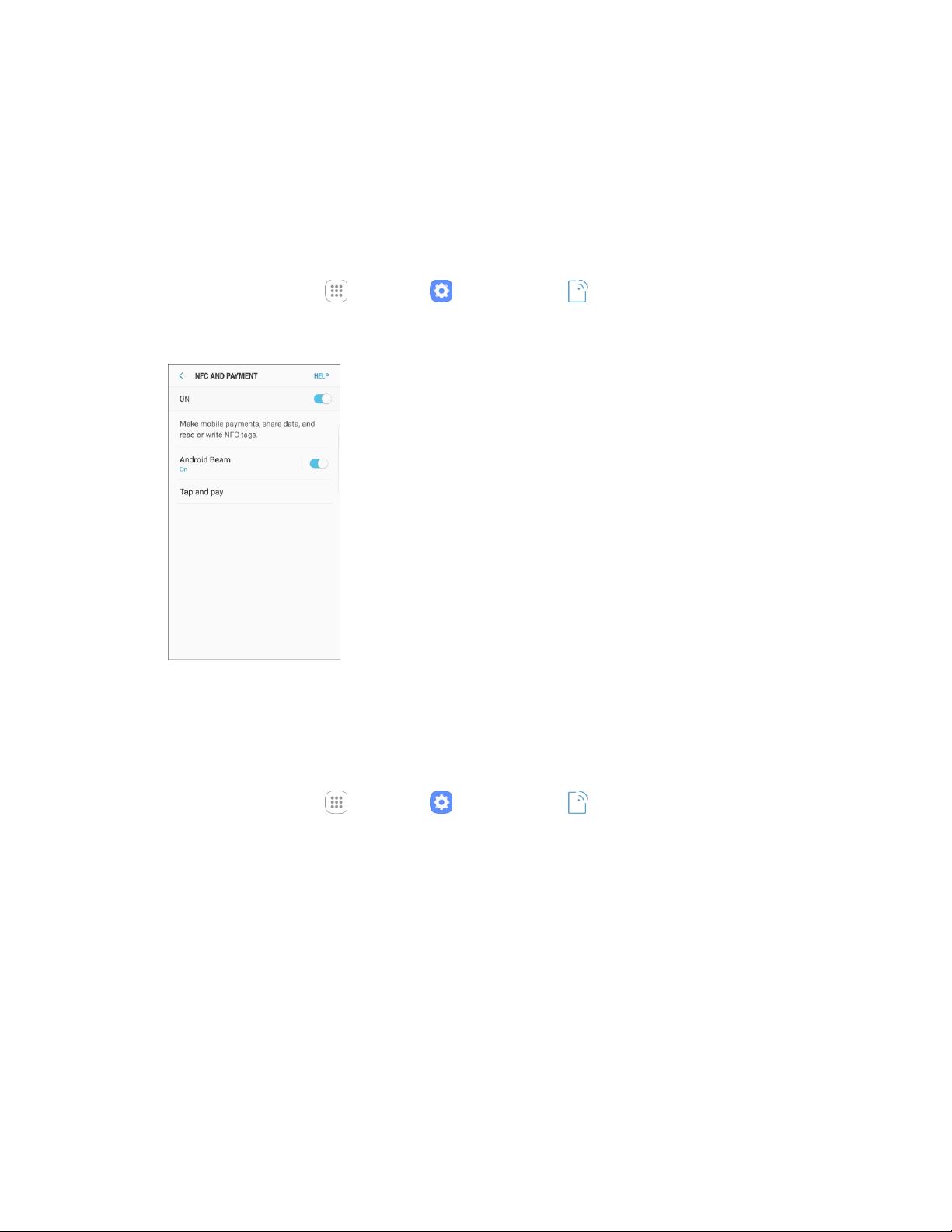
Settings 208
NFC and Payment
NFC and payment uses the Near-Field Communication (NFC) feature of your phone. You can send
information using NFC, including payment through mobile payment services at businesses that support
this function.
Access NFC and Payment
1. From home, tap Apps > Settings > Connections .
2. Tap NFC and payment.
3. Tap settings to configure them.
Your settings are saved and implemented.
Enable NFC and Android Beam
1. From home, tap Apps > Settings > Connections .
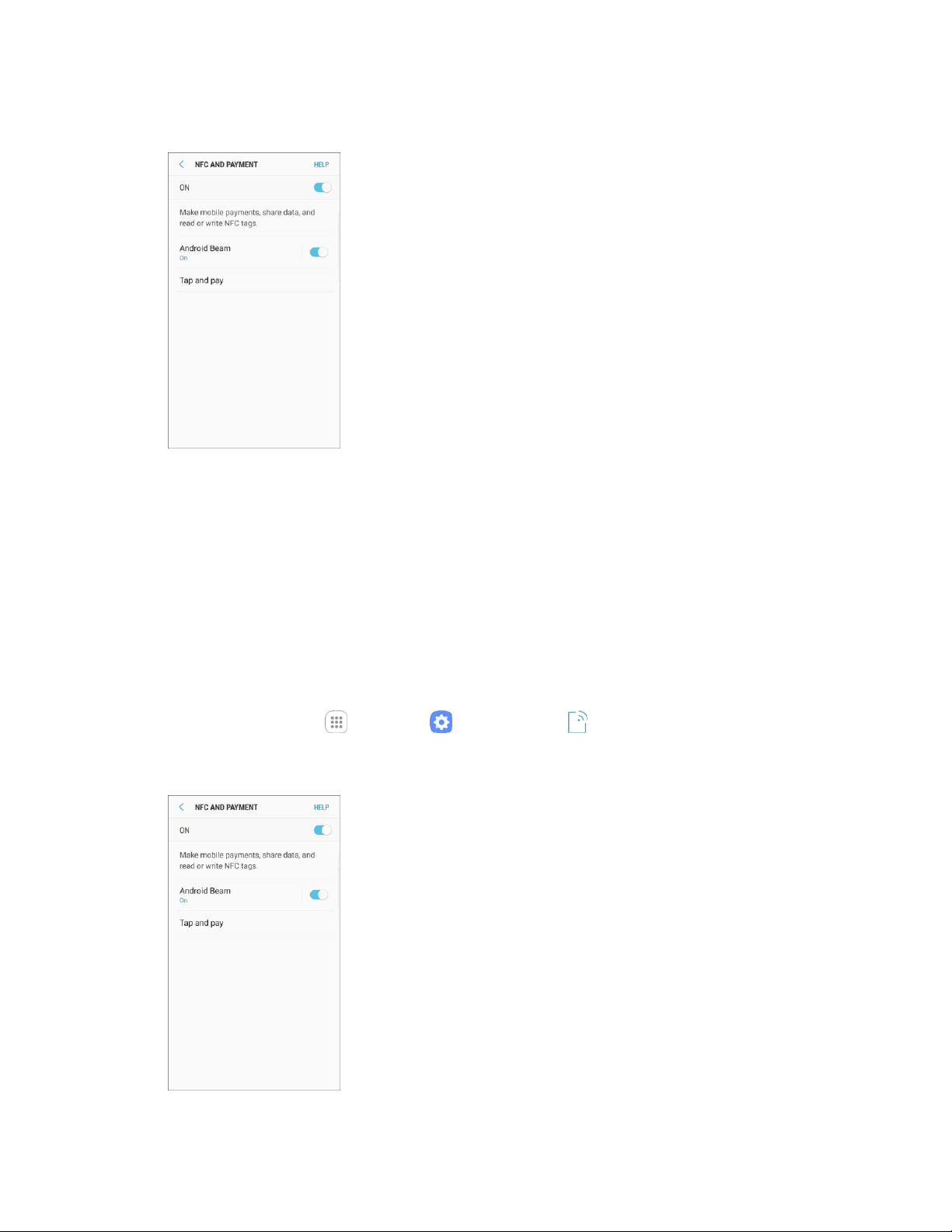
Settings 209
2. Tap NFC and payment.
3. Tap On/Off to enable NFC.
4.
Tap Android Beam, and then tap On/Off to enable Android Beam.
NFC and Android Beam are enabled.
Tap and Pay
With your phone and a payment app (such as Samsung Pay), you can use your phone to pay for items by
tapping it to an item at the point-of-purchase. You must have a payment app set up on your phone to use
it with Tap and Pay.
Note: Tap and Pay payment apps may be downloaded from Google Play store. See Google Play Store.
1. From home, tap Apps > Settings > Connections .
2. Tap NFC and payment.
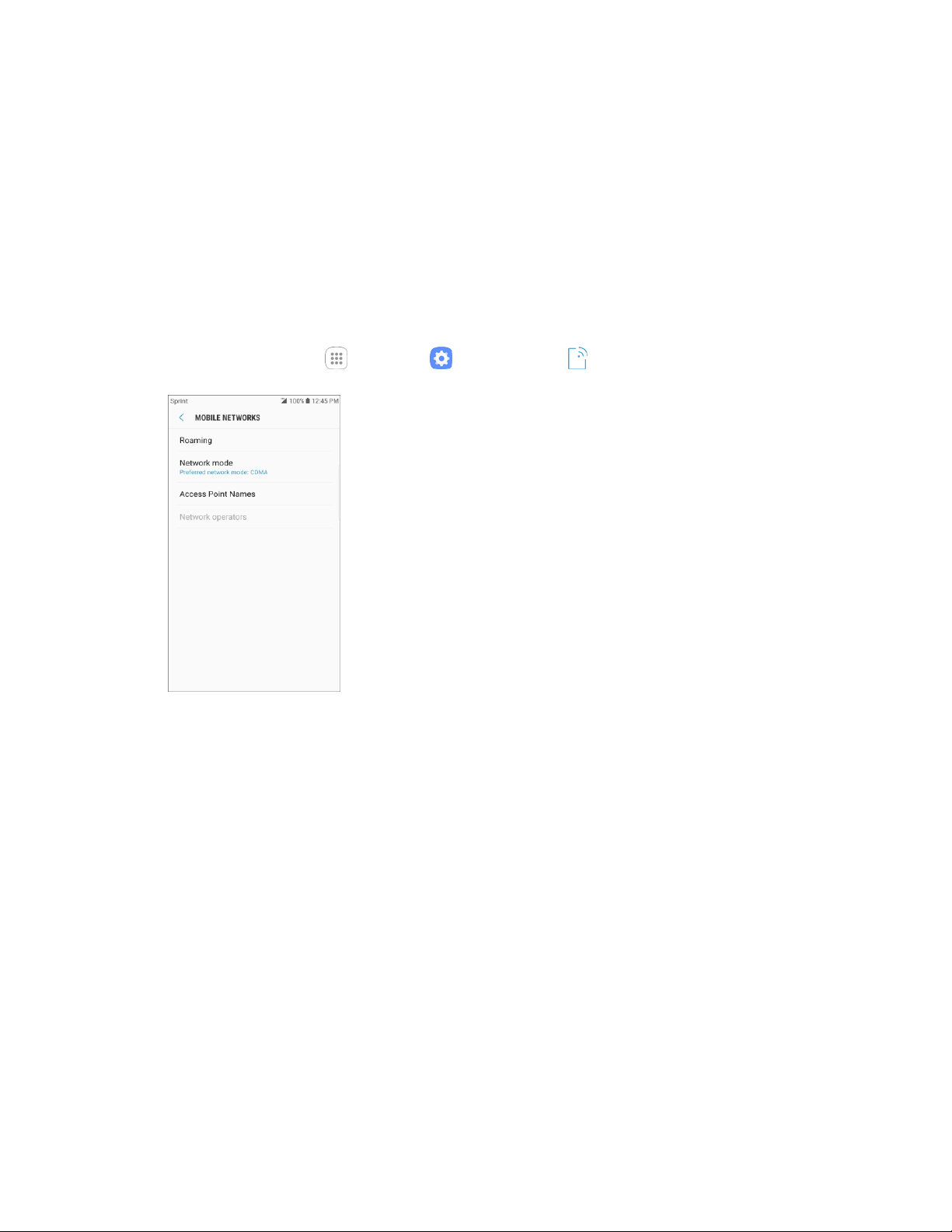
Settings 210
3. Tap Tap and pay.
Tap and pay payment apps you have installed are display.
Available options depend on the payment app(s) you have set up on your phone.
Mobile Networks Settings
The Mobile networks settings menu allows you to configure your mobile network connections.
Set options for network selection and data service.
1. From home, tap Apps > Settings > Connections > Mobile networks.
2. Configure options:
Roaming: When you are outside your home network area, your phone can still connect to
other networks that your provider supports using roaming. There may be additional costs for
accessing networks while roaming, so you may want to control your phone’s roaming
behavior with Roaming settings.
• Roaming network: Select a roaming default. Choose Home only, to only connect to the
Sprint network, or Automatic to allow connections to Sprint’s partner networks, when
available.
• Roaming guard: Choose options for displaying an onscreen roaming notice for certain
functions. Enable or disable roaming notices for Voice and Data for Domestic use, Voice,
Data and Outgoing text message for International networks, and Voice, Data and
Outgoing text message for GSM networks (if supported by your phone).
• Roaming settings: Enable or disable roaming options, including Voice and Data for
Domestic and International networks, and Data for GSM networks (if supported by your
phone).
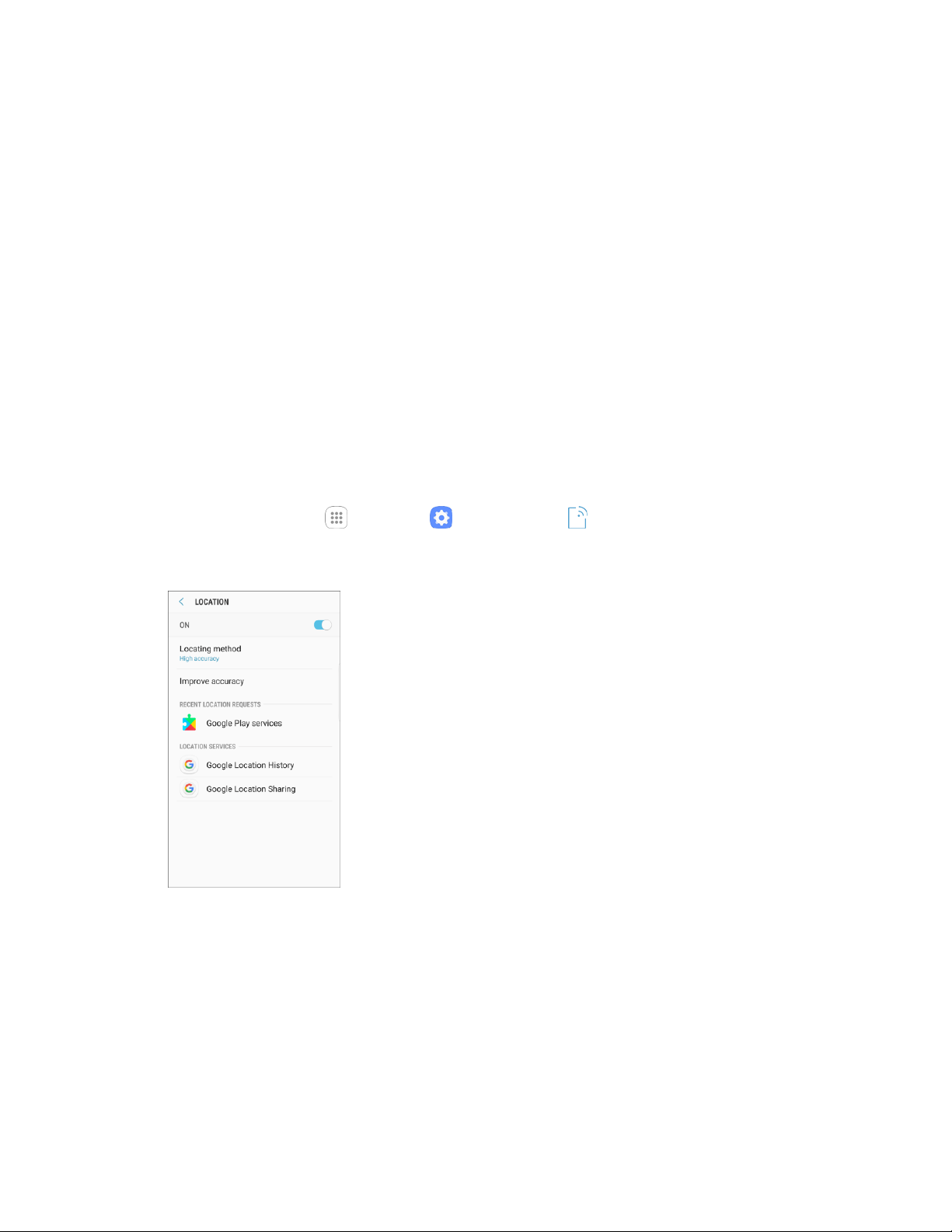
Settings 211
Network mode: Choose a preferred network mode. Available options depend on your
phone’s features, but may include: CDMA, LTE / CDMA, GSM / UMTS, and Automatic (the
recommended setting).
Access Point Names: View, configure, and add access point names (APNs) for your
phone’s data connection.
Network operators: View mobile network operator information for international GSM
networks.
Location
Some apps, such as Google Maps, may require one or more location services be turned on for full
functionality.
Locating Method
Before using any features that require location assistance, you must enable your device’s location
services.
1. From home, tap Apps > Settings > Connections .
2. Tap Location.
3. Tap On/Off to turn on Location services.
4.
Tap Locating method to select how your location is determined:
High accuracy: Use GPS, Wi-Fi, and mobile networks.
Battery saving: Use Wi-Fi and mobile networks (no GPS).
Device only: Use GPS only.
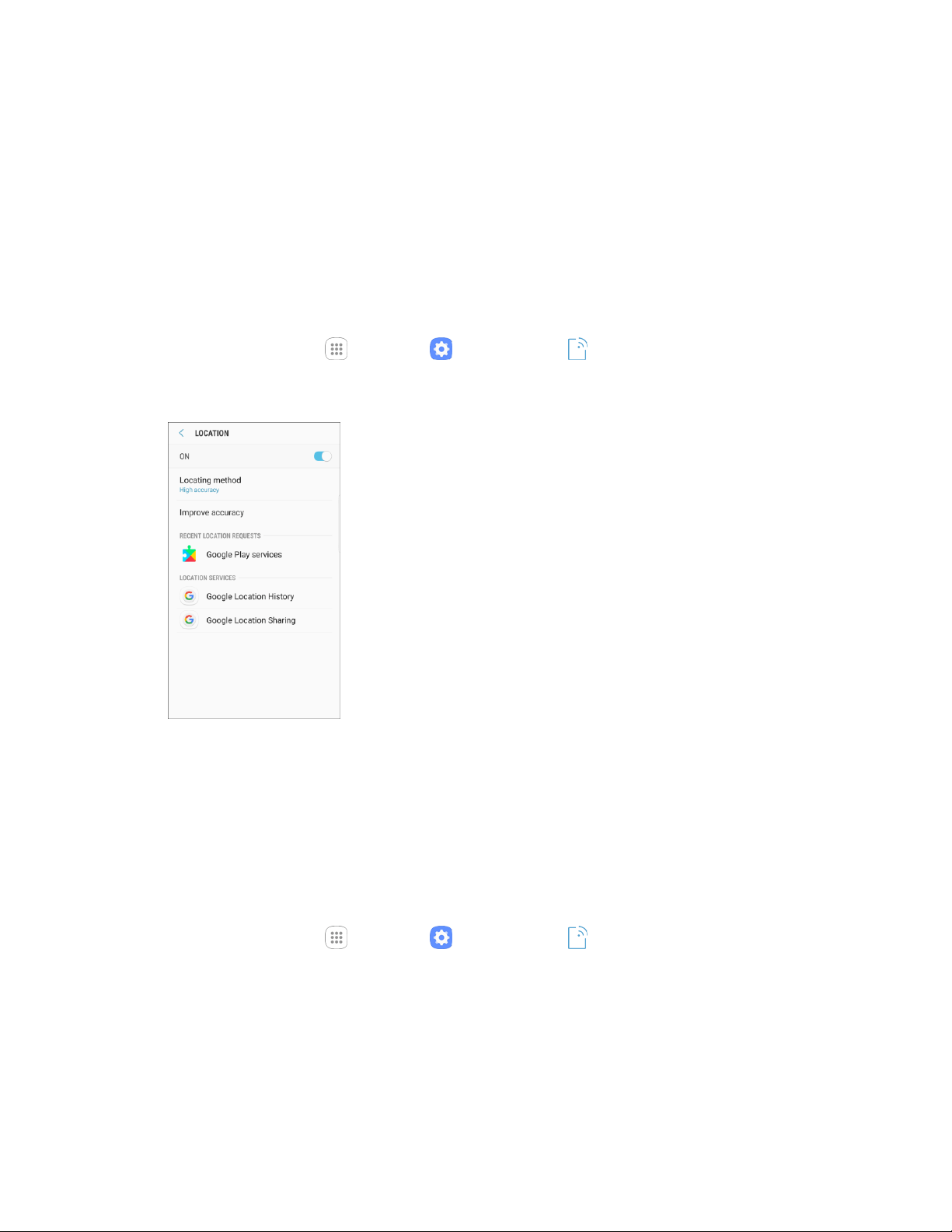
Settings 212
5. Tap Improve accuracy to use other connections for determining your location:
Wi-Fi scanning: Allow apps and services to scan for Wi-Fi networks automatically, even
when Wi-Fi is turned off.
Bluetooth scanning: Allow apps to scan for and connect to nearby devices automatically
through Bluetooth, even when Bluetooth is turned off.
Recent Location Requests
Apps that have requested your location are listed under Recent location requests.
1. From home, tap Apps > Settings > Connections .
2. Tap Location.
3. Tap On/Off to turn on Location services.
4. Tap an entry under Recent location requests to view the app’s settings.
Location Services
Google uses Location History to store and use your device’s most recent location data. Google apps,
such as Google Maps, can use this data to improve your search results based on places that you have
visited.
1. From home, tap Apps > Settings > Connections .
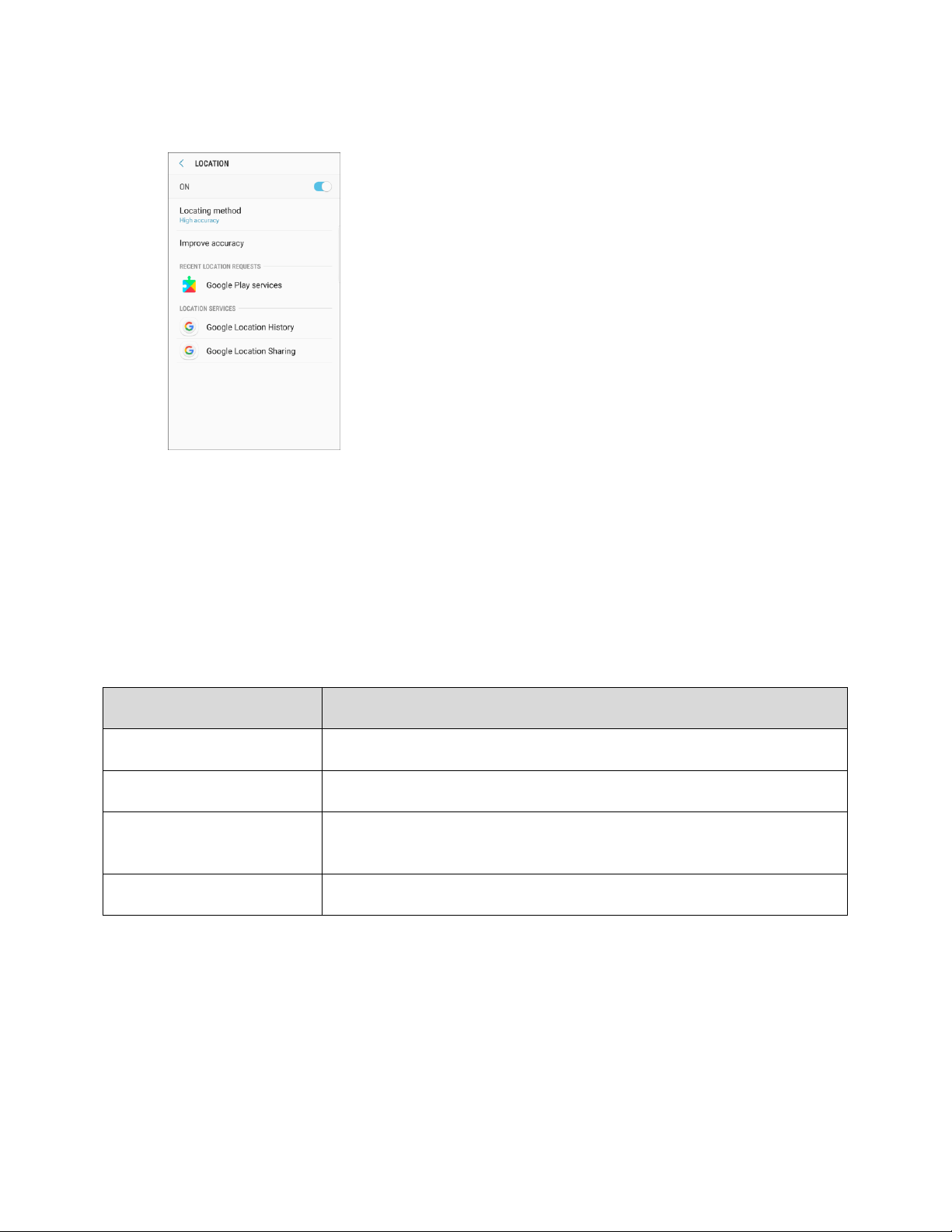
Settings 213
2. Tap Location.
3. Tap On/Off to turn on Location services.
4. Tap Google location history and sign in to your Google Account for more options.
More Connection Settings
The more connection settings menu provides access to additional connection options, such as Nearby
device scanning, Printing, MirrorLink, and VPN.
More Connection Settings Options
Setting
Description
Nearby device scanning
Scan for and connect to nearby devices.
Printing
Set up printers to print from your phone.
MirrorLink
Mirror your phone’s display on your car’s entertainment and information
screen using a USB connection.
VPN
Add a Virtual Private Network (VPN)
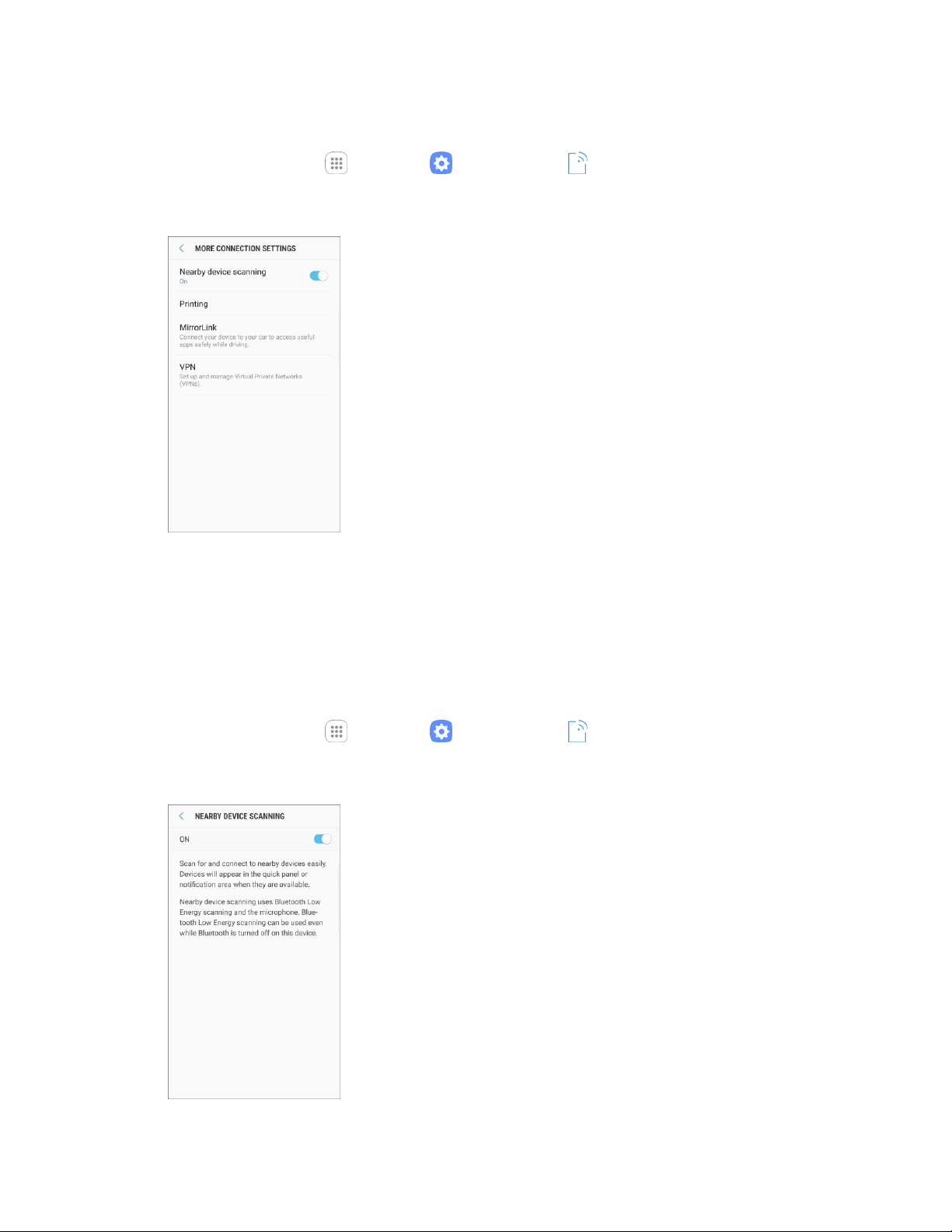
Settings 214
Access More Connection Settings Options
1. From home, tap Apps > Settings > Connections .
2. Tap More connection settings.
3. Set items.
Your settings are saved and implemented.
Nearby Device Scanning
Scan for and connect to nearby devices. You will receive notifications when there are available devices to
connect to.
1. From home, tap Apps > Settings > Connections > More connection settings.
2. Tap Nearby device scanning.
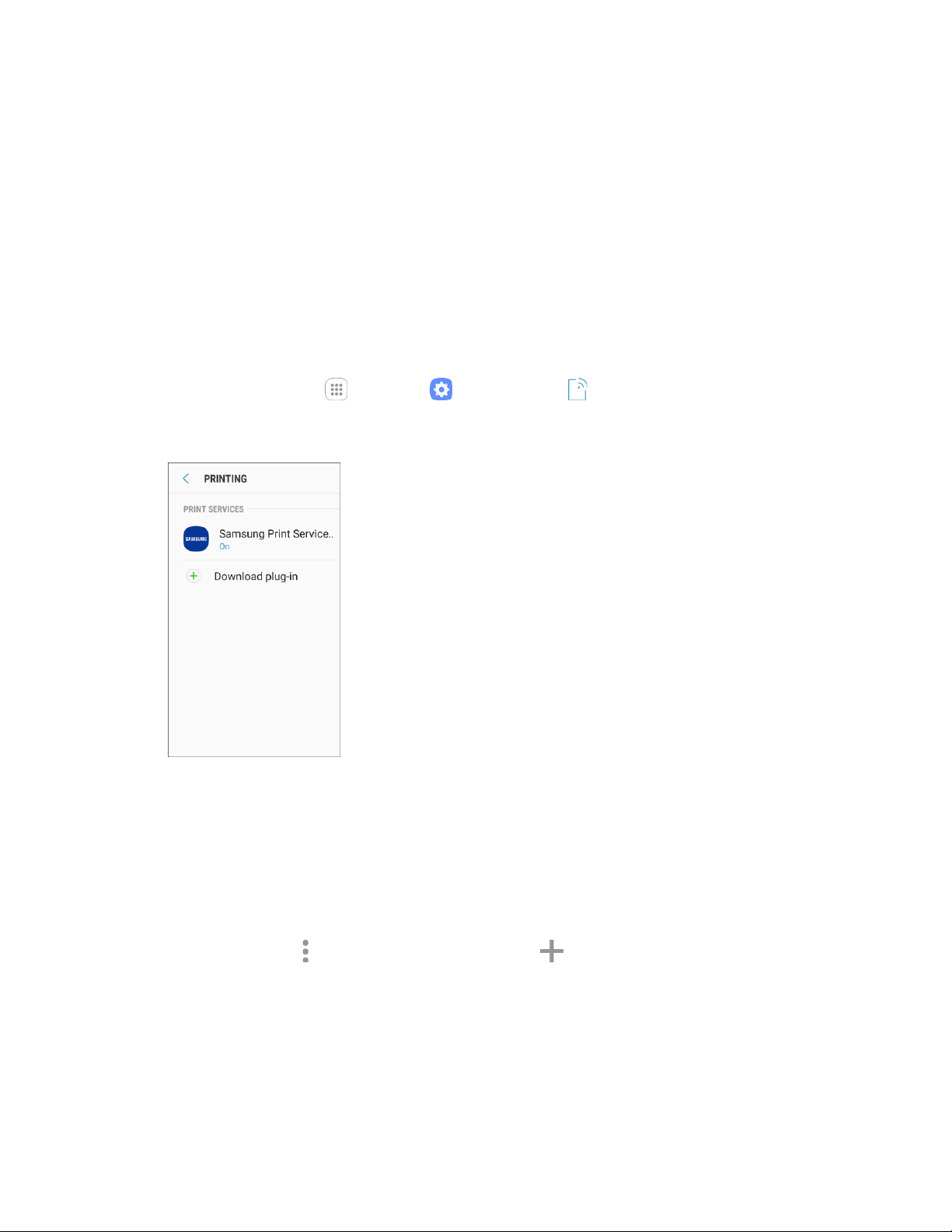
Settings 215
The Nearby device scanning screen displays.
3. Tap On/Off to enable the feature.
Printing
You can print from your phone, via Wi-Fi, to an optional compatible printer (not included). Your phone and
the optional printer must be connected to the same Wi-Fi network.
Add a Printer
Before you can print to a printer, you must add and set it up on your phone. You will need to know the IP
address of the printer; consult the printer’s documentation for this information.
1. From home, tap Apps > Settings > Connections > More connection settings.
2. Tap Printing.
The Printing settings screen displays.
3. From the Printing settings screen, tap Download plug-in.
4. Follow the prompts to download and install a print driver from the Google Play store.
5. Choose a print service from the list, and then tap On/Off to turn the service on or off. The service
must be on to add a printer.
6. Tap More options > Add printer > Add printer (or , depending on the plug-in), and then
enter a name and the IP address of the printer.
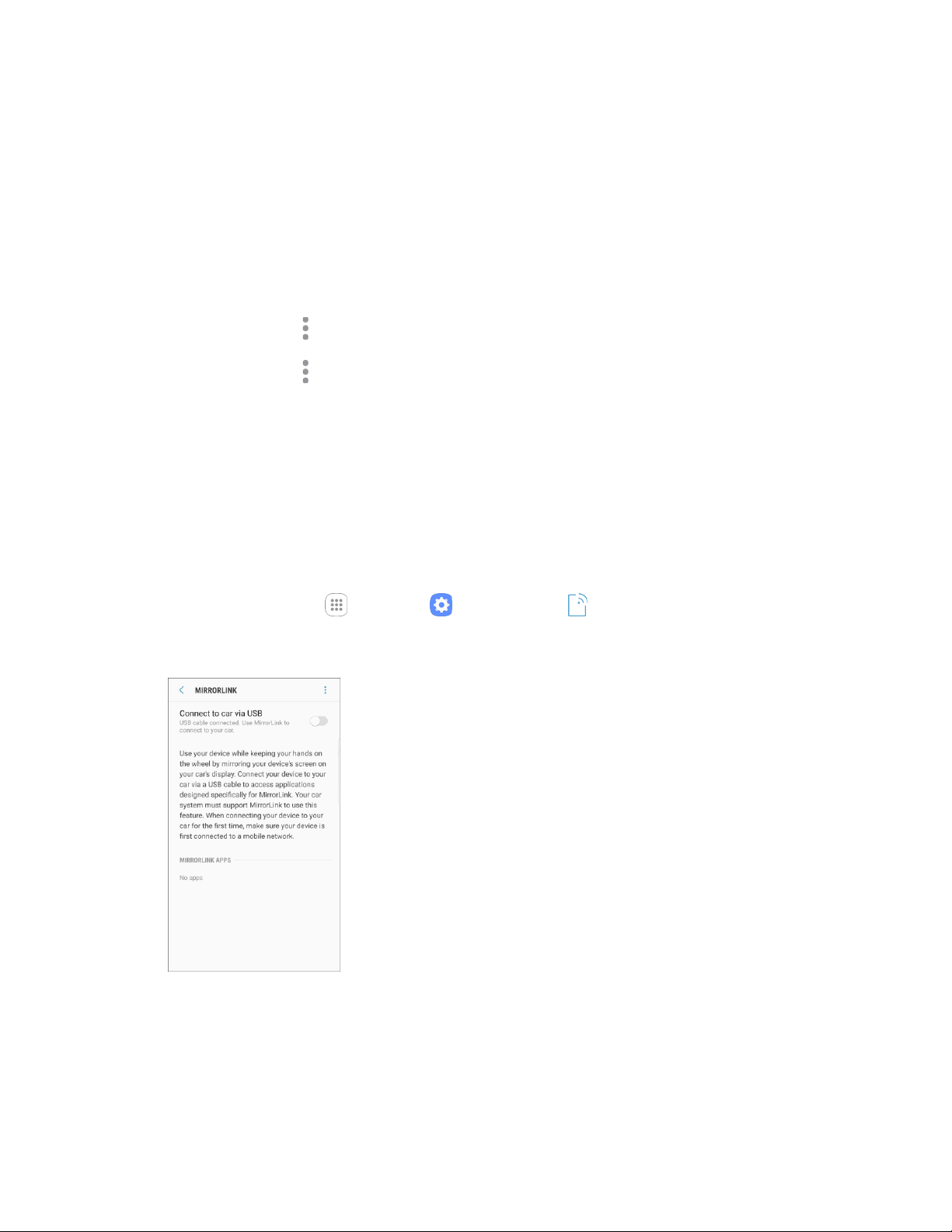
Settings 216
Set Up a Printer
Add a printer to a print service and configure settings.
Note: Below settings are examples only. Available settings will differ depending on the type of print
service and printer you are using.
1. From the Printing settings screen, select a print service from the list.
2. Tap On/Off to turn the service on. The service must be on to add a printer.
3. Tap More options > Add printer and follow the prompts to add a printer.
4. Tap More options > Printer settings to configure printer options. Available options may vary
depending on the type of printer, and not all printers support all options.
MirrorLink
Mirror your phone’s display on your car’s entertainment and information screen using a USB connection.
To use this feature, your car system must support MirrorLink.
To turn on MirrorLink:
1. Connect your phone to your car’s system using the USB cable.
2. From home, tap Apps > Settings > Connections > More connection settings.
3. Tap MirrorLink.
4. Tap Connect to vehicle via USB.
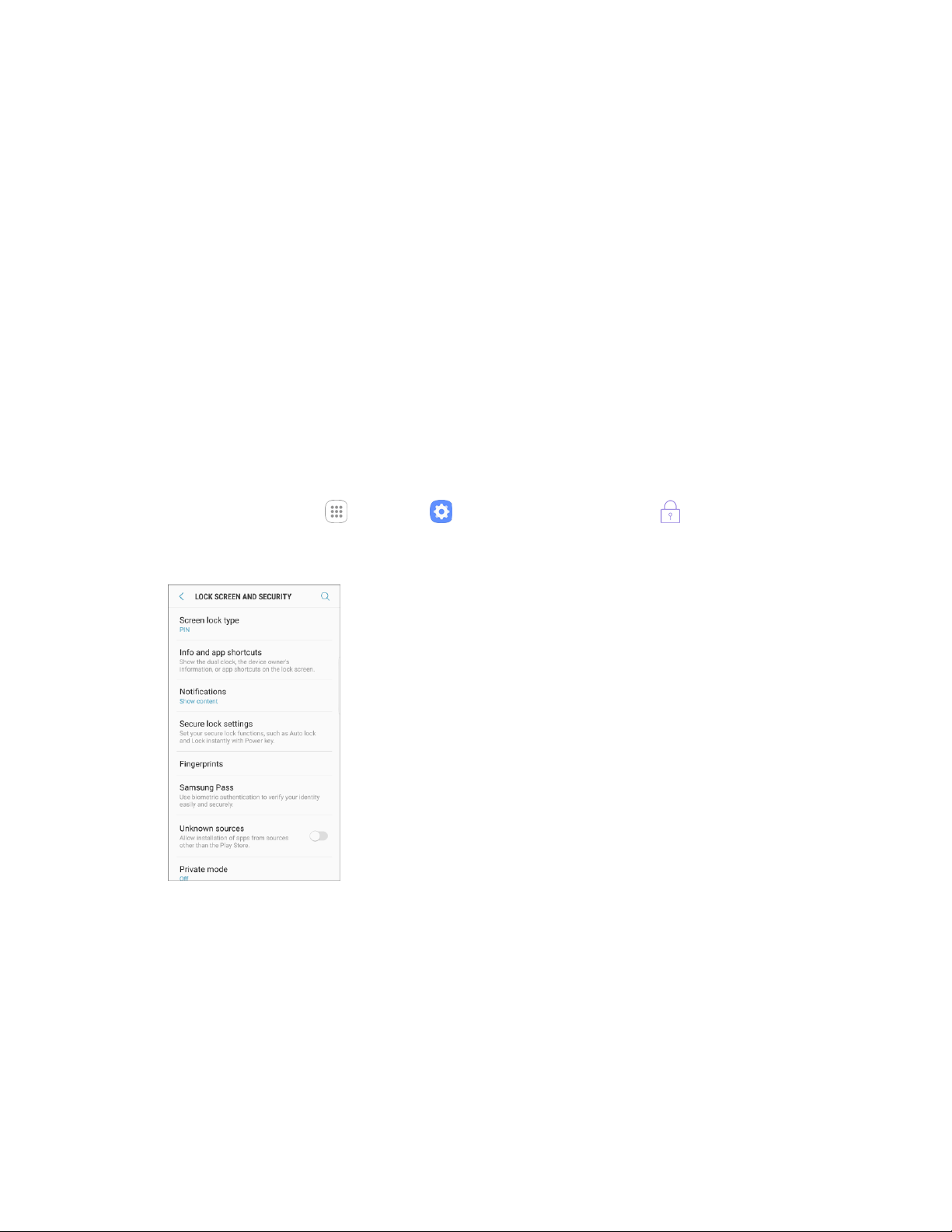
Settings 217
Virtual Private Networks (VPN)
From your phone, you can add, set up, and manage virtual private networks (VPNs) that allow you to
connect and access resources inside a secured local network, such as your corporate network.
Prepare Your Phone for VPN Connection
Depending on the type of VPN you are using at work, you may be required to enter your login credentials
or install security certificates before you can connect to your company’s local network. You can get this
information from your network administrator.
Before you can initiate a VPN connection, your phone must first establish a Wi-Fi or data connection. For
information about setting up and using these connections on your phone, see Browser and Turn Wi-Fi On
and Connect to a Wireless Network.
Set Up Secure Credential Storage
If your network administrator instructs you to download and install security certificates, you must first set
up the phone’s secure credential storage before setting up a VPN.
1. From home, tap Apps > Settings > Lock screen and security .
2. Tap Screen lock type > Pattern, PIN, Password, or Fingerprints.
3. Enter a new password (at least eight characters without any spaces) for the credential storage,
scroll down and confirm the password, and then tap OK.
The password is set, allowing secure credential storage.
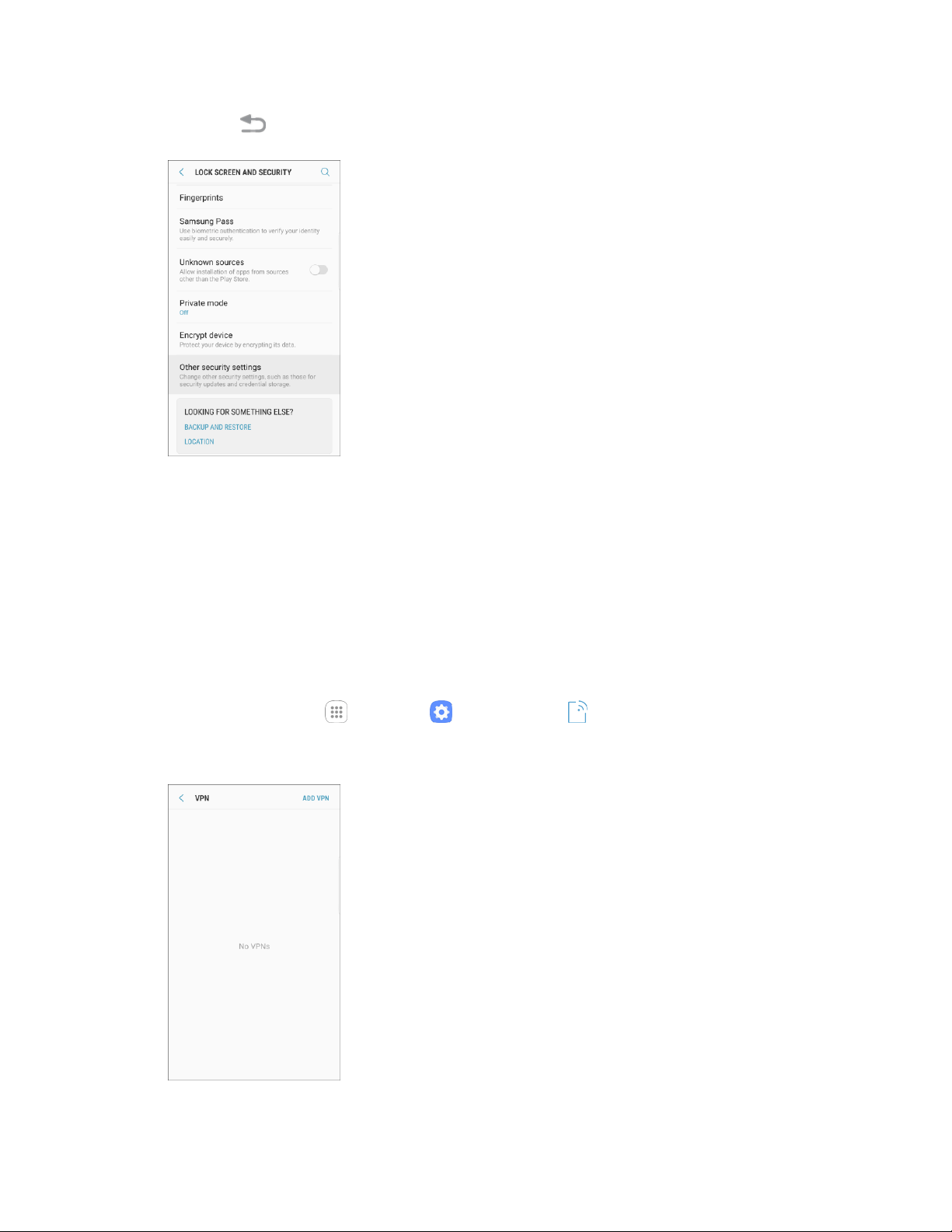
Settings 218
4. Tap Back to return to the main settings menu, and then tap Other security settings.
5. Swipe down to View security certificates, User certificates, or Install from device storage,
and then tap your preferred system and user credentials.
Your secure credentials storage is set.
You can then download and install the certificates needed to access your local network. Your network
administrator can tell you how to do this.
Add a VPN Connection
Use the VPN settings menu to add a VPN connection to your phone.
1. From home, tap Apps > Settings > Connections > More connection settings.
2. Tap VPN.
The VPN settings window appears.
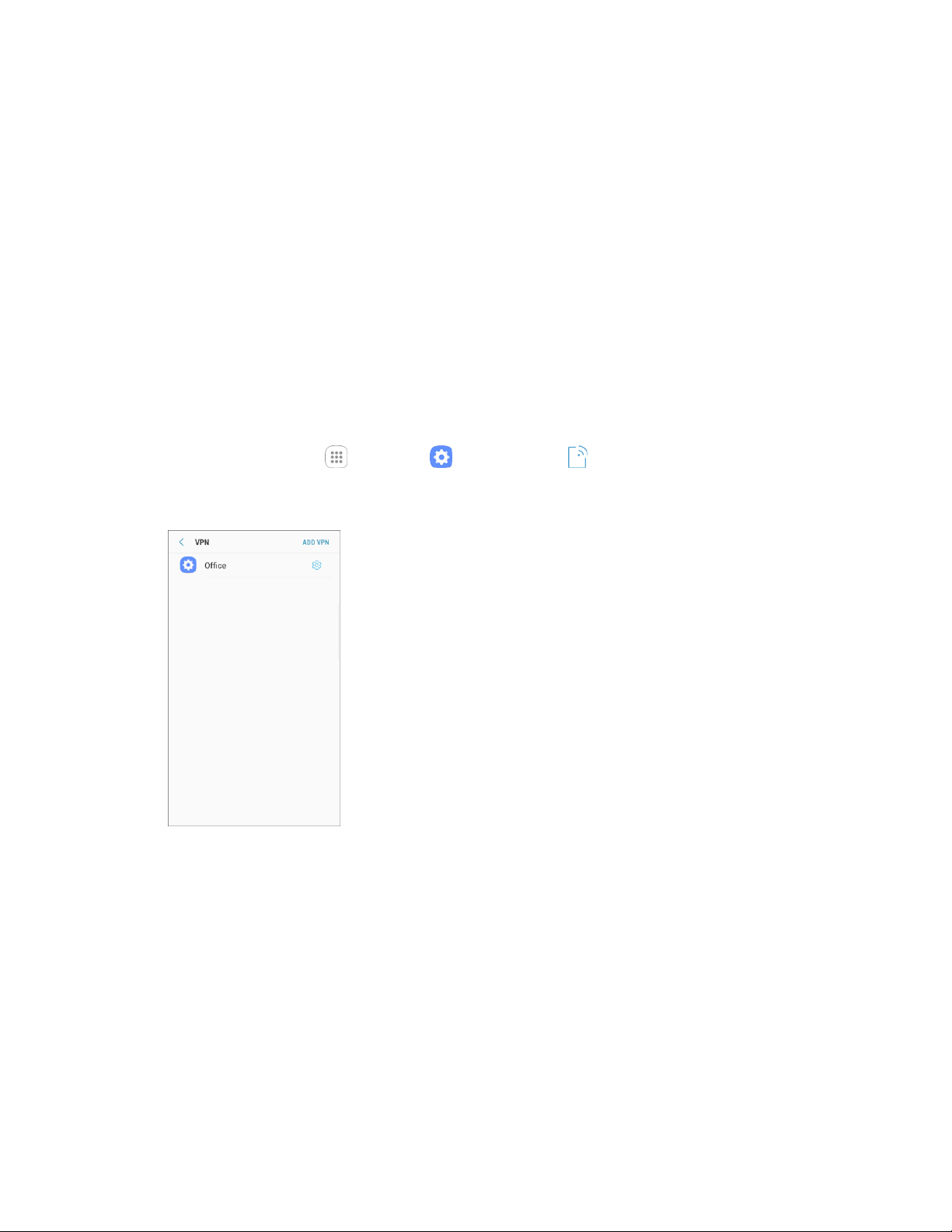
Settings 219
3. Tap Add VPN, and then enter the information for the VPN you want to add.
Information may include Name, Type, Server address, PPP encryption (MPPE), and
advanced options.
Set up all options according to the security details you have obtained from your network
administrator.
4. Tap Save.
Your VPN is added to the VPNs section of the VPN settings window.
Connect to or Disconnect from a VPN
Once you have set up a VPN connection, connecting and disconnecting from the VPN is easy.
To access the VPN settings window:
1. From home, tap Apps > Settings > Connections > More connection settings.
2. Tap VPN.
The VPN settings window appears.
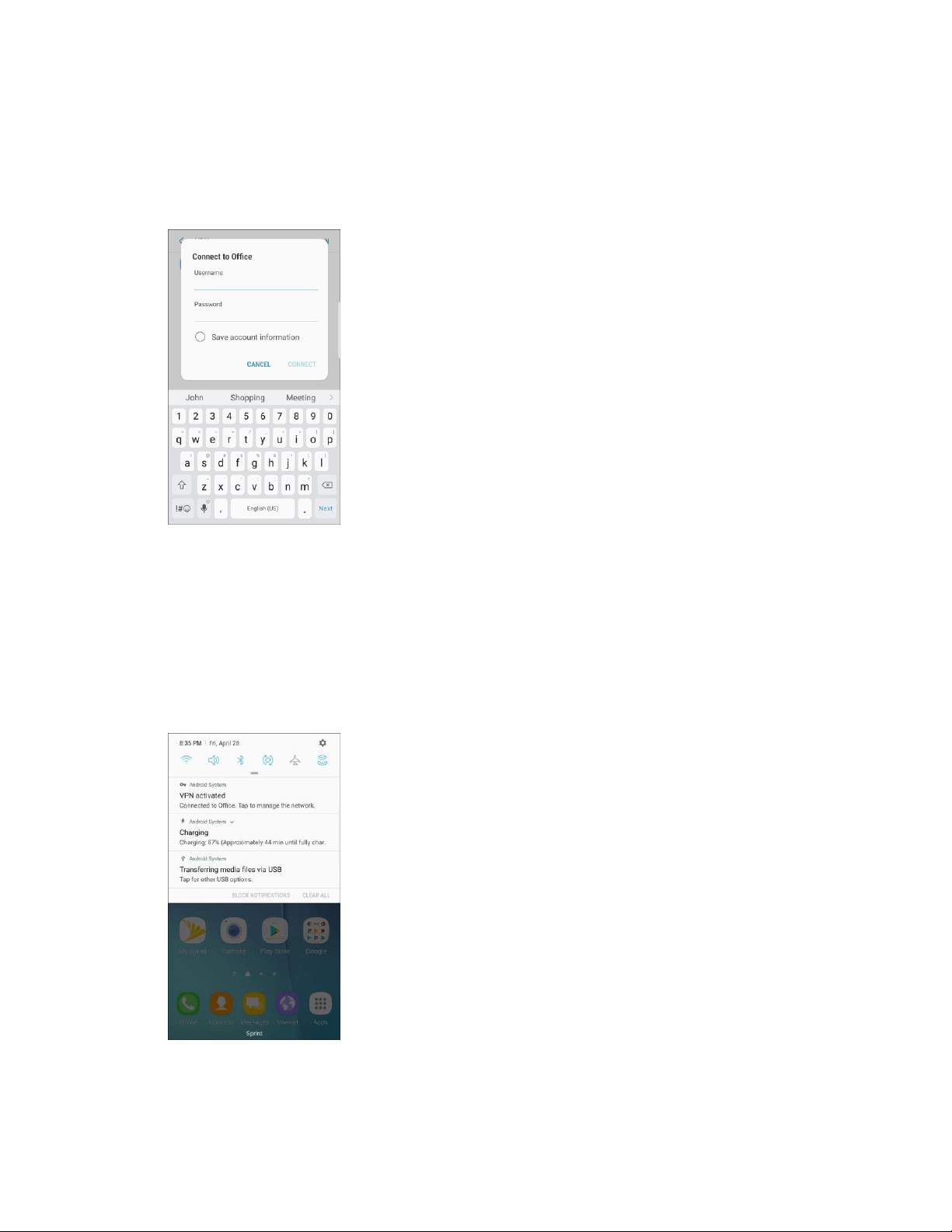
220
Connect to a VPN
1. From the VPNs section of the VPN setting window, tap the VPN that you want to connect to.
2. When prompted, enter your login credentials, and then tap Connect.
You will connect to the selected VPN.
When you are connected, a VPN connected icon appears in the notification area.
3. Open the Web browser to access resources such as intranet sites on your corporate network.
Disconnect from a VPN
1. Pull down the status bar to open the notification panel.
2. Tap the VPN connection, and then tap Disconnect to disconnect from it.
Your phone disconnects from the VPN.
Settings
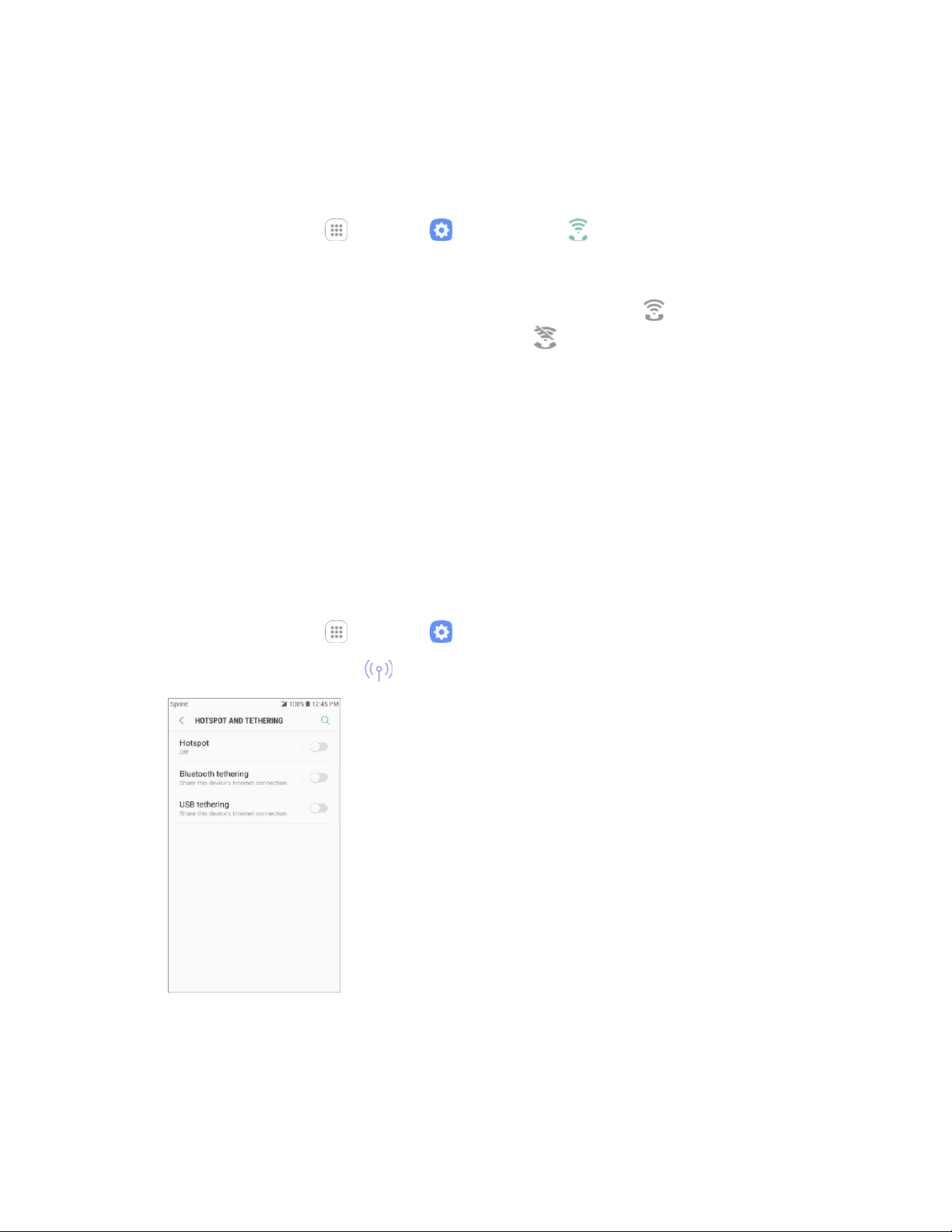
Settings 221
Wi-Fi Calling Settings
The Wi-Fi Calling settings menu lets you set your Wi-Fi Calling options, including updating your 9-1-1
information. For information about setting up Wi-Fi Calling, see Wi-Fi Calling.
1. From home, tap Apps > Settings > Wi-Fi Calling .
2. Follow the prompts to change your Wi-Fi Calling settings.
When Wi-Fi Calling is set up, you will see Wi-Fi calling enabled in the status bar when
Wi-Fi Calling is active, or Wi-Fi calling disabled if it is set up but you are not currently
connected to a Wi-Fi network.
Tip: For more information about Wi-Fi Calling, visit this FAQ link at sprint.com/support.
Hotspot and Tethering Settings
Use Mobile hotspot and tethering to share your device’s Internet connection with other devices.
For more information, see Hotspot.
Hotspot Settings
Use Hotspot to share your device’s Internet connection with other devices
1. From home, tap Apps > Settings .
2. Tap Hotspot and tethering > Hotspot.
The Hotspot window opens.
3.
Tap On/Off to turn Hotspot on.
Hotspot is enabled.

Settings 222
To disable Hotspot, tap On/Off again.
Advanced Hotspot Settings
The hotspot settings menu lets you configure advanced options.
● Set Network SSID: From the Hotspot window, tap More options > Configure Hotspot >
Network name, enter a name for your hotspot, and then tap Save.
● Hide your Hotspot: From the Hotspot window, tap More options > Configure Hotspot > Hide
my device to make your Mobile hotspot invisible to other Wi-Fi devices during a scan. When
hidden, other devices can still connect to your Mobile hotspot, but have to set up the connection
manually with your Network SSID and Password.
● Set Hotspot security: From the Hotspot window, tap More options > Configure Hotspot >
Security, select a security settings option, and then tap Save.
● Set Hotspot password: From the Hotspot window, tap More options > Configure Hotspot >
Password, enter a password, and then tap Save.
● Set allowed devices: To select which devices are allowed to connect to the Hotspot, in the
Hotspot window, tap More options > Allowed devices > Add, enter a device name and MAC
address, and then tap Add.
To remove allowed devices, tap Delete.
● Set Hotspot timeout settings: From the Hotspot window, tap More options >
Timeout settings, and then choose an option.
Tethering Settings
Use Tethering to share your device’s Internet connection with a computer that connects to your device via
USB cable or by Bluetooth.
For more information, see Tethering.
Note: Using the tethering feature consumes battery power and uses data services.
1. From home, tap Apps > Settings .
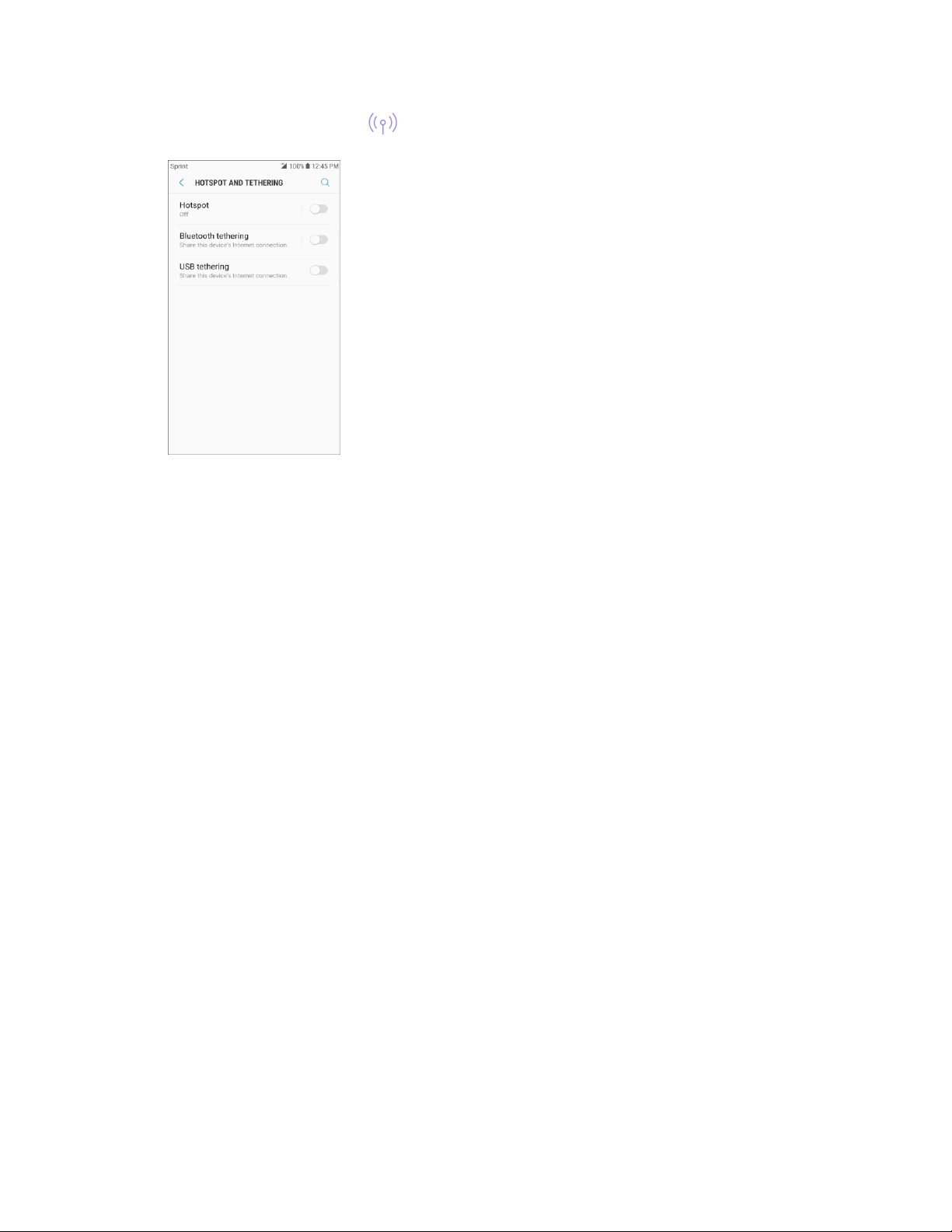
Settings 223
2. Tap Hotspot and Tethering .
3. Choose an option:
Bluetooth tethering: Pair your device with the computer via Bluetooth. Consult the
computer’s documentation for more information about configuring your computer to pair using
Bluetooth. Tap Bluetooth tethering to turn tethering on.
USB tethering: Connect the computer to your phone via USB cable, and then tap
USB tethering to turn tethering on.
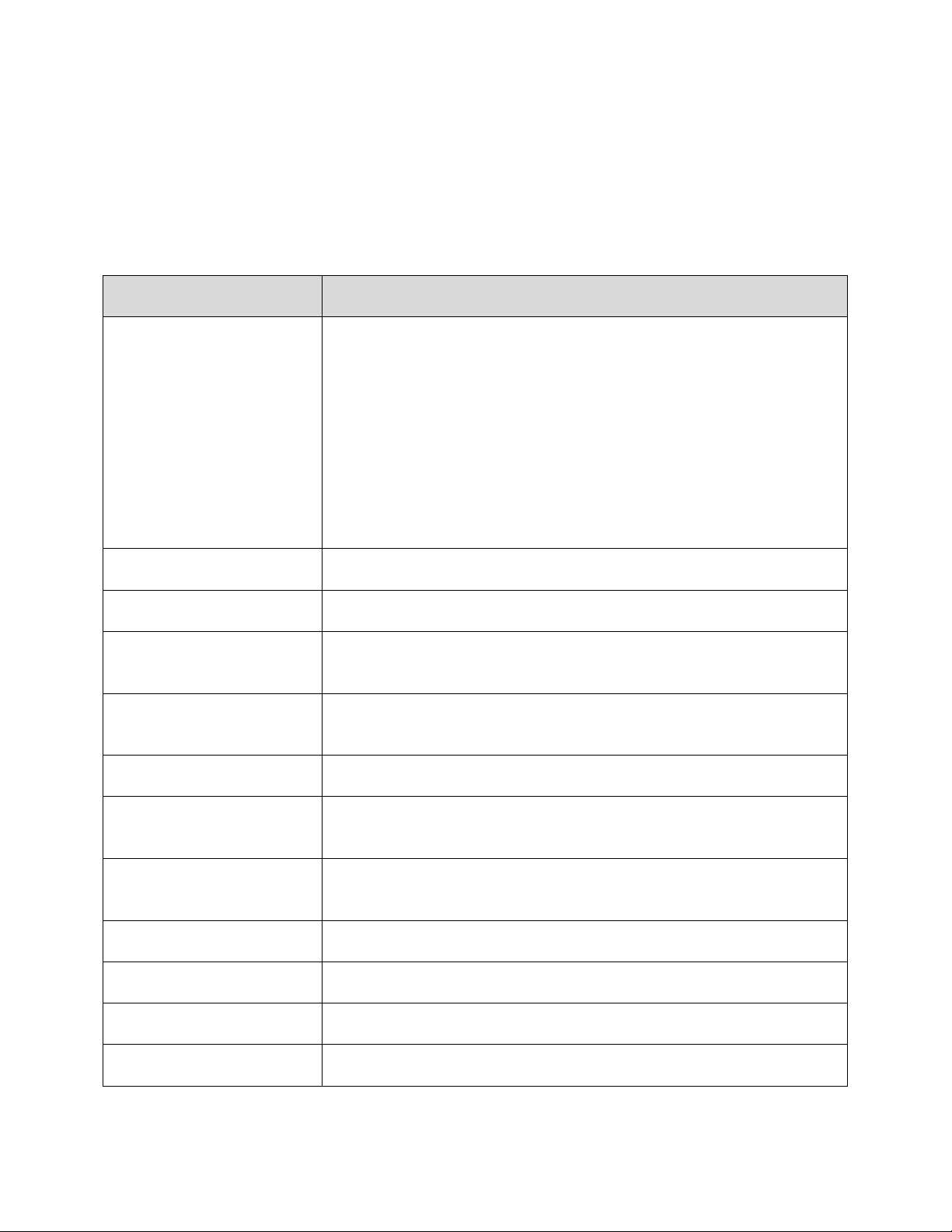
Settings 224
Sounds and Vibration Settings
The sounds and vibration settings menu lets you control your phone’s audio and vibration.
Sounds and Vibration Settings Overview
The sounds and vibration settings menu allows you to configure the following options:
Sound Setting
Description
Sound mode
Set the sound mode for the phone.
●
Sound: Your phone uses the sounds, vibrations, and volume
levels you have chosen in Sound settings for notifications and
alerts.
●
Vibrate: Your phone vibrates for notifications and alerts. This
uses the Vibration intensity you choose in Sound settings.
●
Mute: Your phone plays no sounds or vibrations. Onscreen
reminders will still occur.
Vibrate while ringing
Set your device to vibrate in addition to ringing when you receive a call.
Volume
Set volume for ringtones, media, system features, etc.
Vibration intensity
Set the amount of vibration for incoming calls, notifications, and haptic
feedback.
Ringtone
Set your ringtones and notification sounds for your phone, apps, keypad,
and other features.
Vibration pattern
Choose from preset vibration patterns or create your own pattern.
Notification sounds
Choose a sound for notifications, such as for new messages and event
reminders.
Do not disturb
Configure the Do not disturb feature to mute calls and alerts at will or on a
schedule, as well as set exceptions.
Touch sounds
Play tones when you touch or tap the screen to make selections.
Screen lock sounds
Play sounds when locking or unlocking the screen.
Emergency tone
Set emergency tones to Alert, Vibrate, or Silent.
Charging sound
Play a sound when a charger is connected.
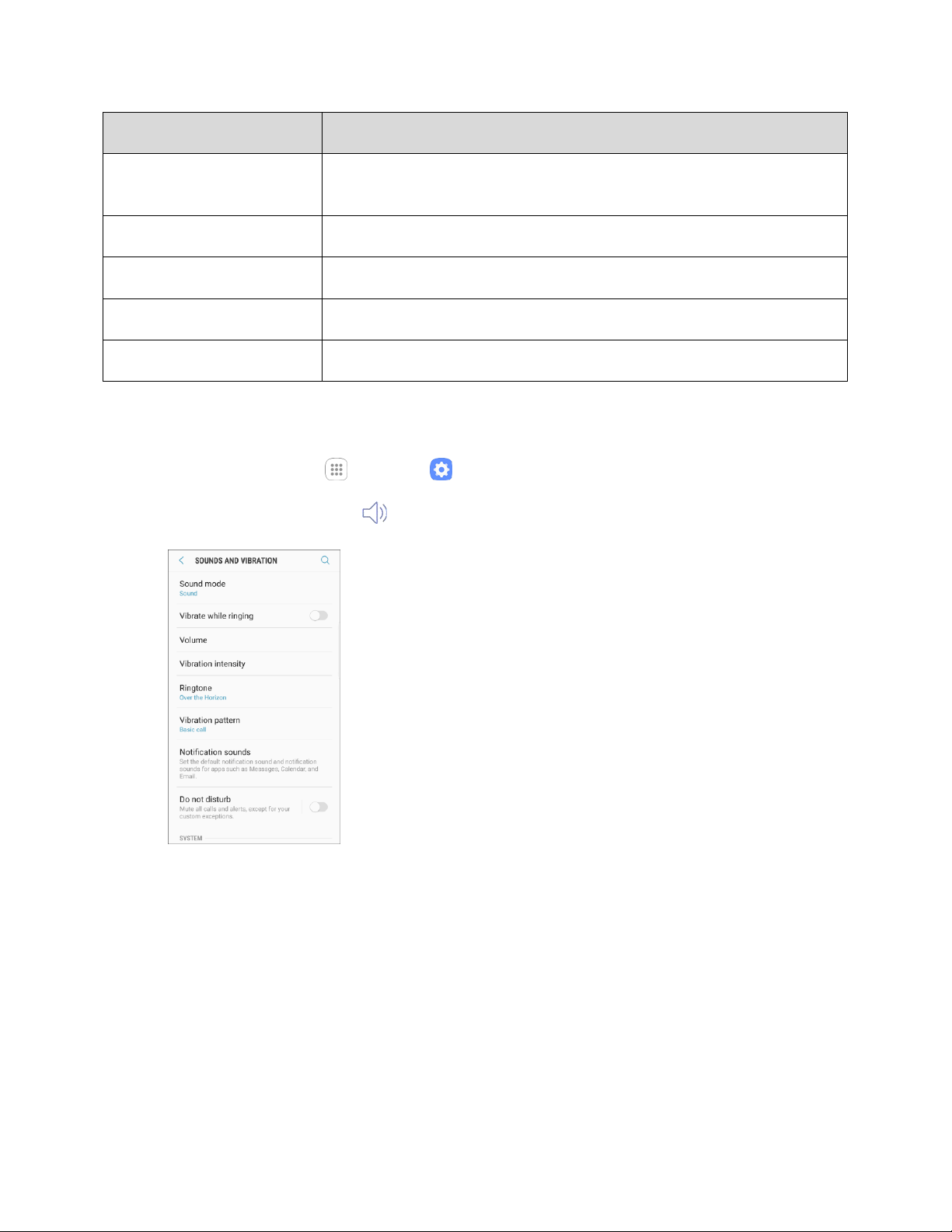
Settings 225
Sound Setting
Description
Vibration feedback
Set the phone to vibrate when the Back key or Recent apps key are
tapped, and for other actions.
Dialing keypad tone
Play tone when the dialing keypad is tapped.
Keyboard sound
Play a sound when the Samsung keyboard is tapped.
Keyboard vibration
Set the phone to vibrate when the Samsung keyboard is tapped.
Sound quality and effects
Set sound quality and sound effects for your phone.
Access Sound Settings
1. From home, tap Apps > Settings .
2. Tap Sounds and vibration .
3. Set your sound and vibration options.
Your sound and vibration settings are saved and applied.
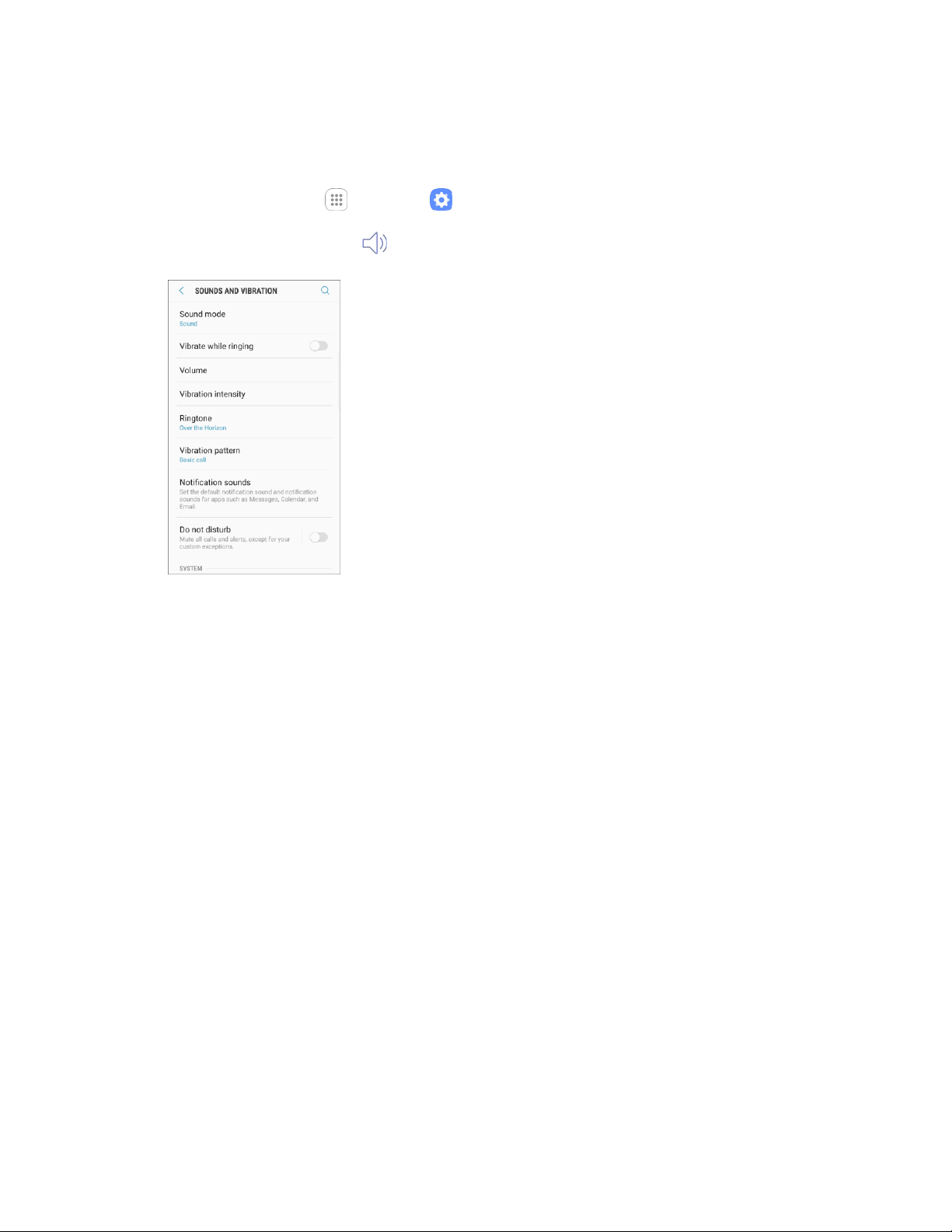
Settings 226
Sound Mode
You can switch between sound modes, while preserving the individual sound settings you have made.
1. From home, tap Apps > Settings .
2. Tap Sounds and vibration .
3. Tap Sound mode, and then choose a mode:
Sound: Your phone uses the sounds, vibrations, and volume levels you have chosen in
Sound settings for notifications and alerts.
Vibrate: Your phone vibrates for notifications and alerts. This uses the Vibration intensity you
choose in Sound settings.
Mute: Your phone plays no sounds or vibrations. Onscreen reminders will still occur.
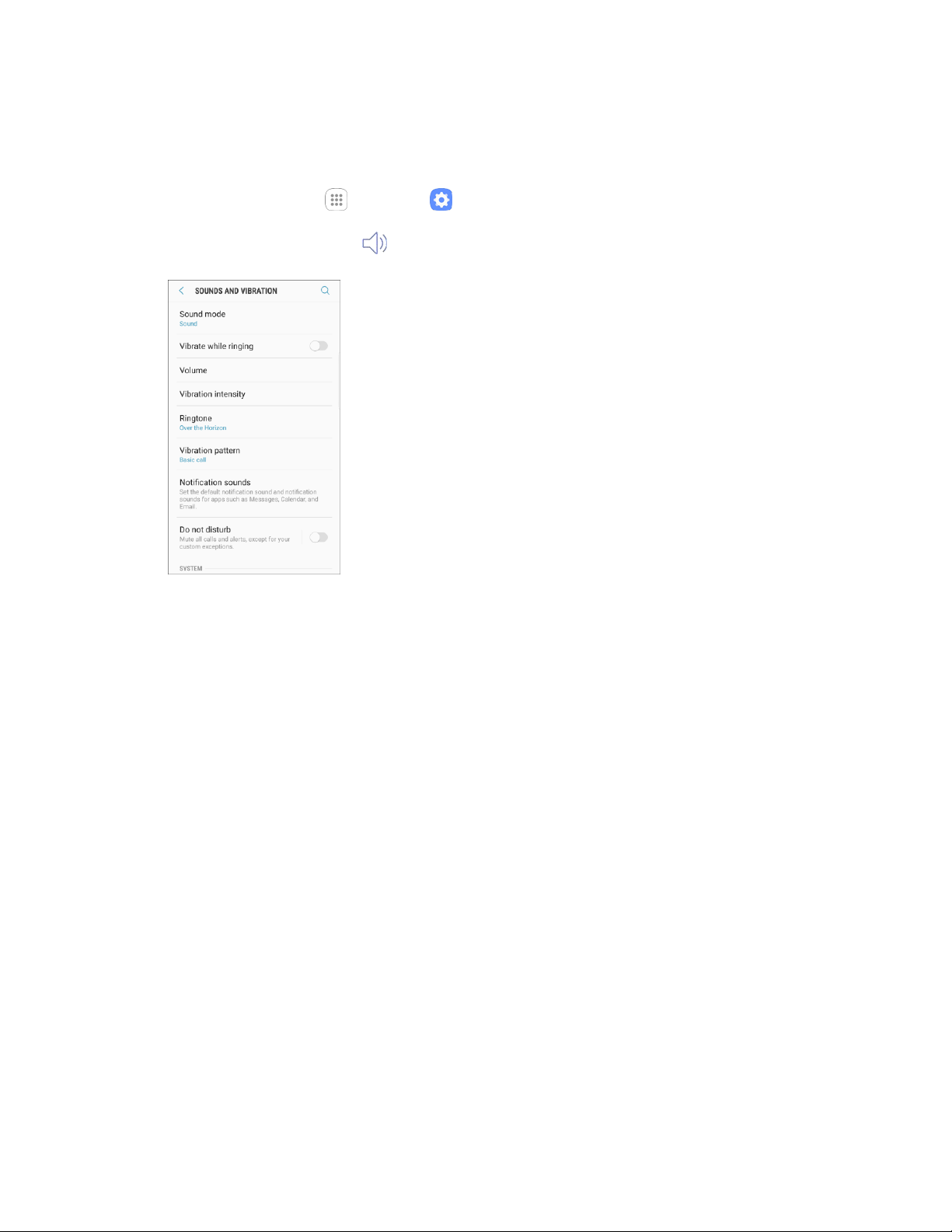
Settings 227
Vibrate While Ringing
Set the phone to vibrate while ringing.
1. From home, tap Apps > Settings .
2. Tap Sounds and vibration .
3. Tap On/Off next to Vibrate while ringing to enable the feature.
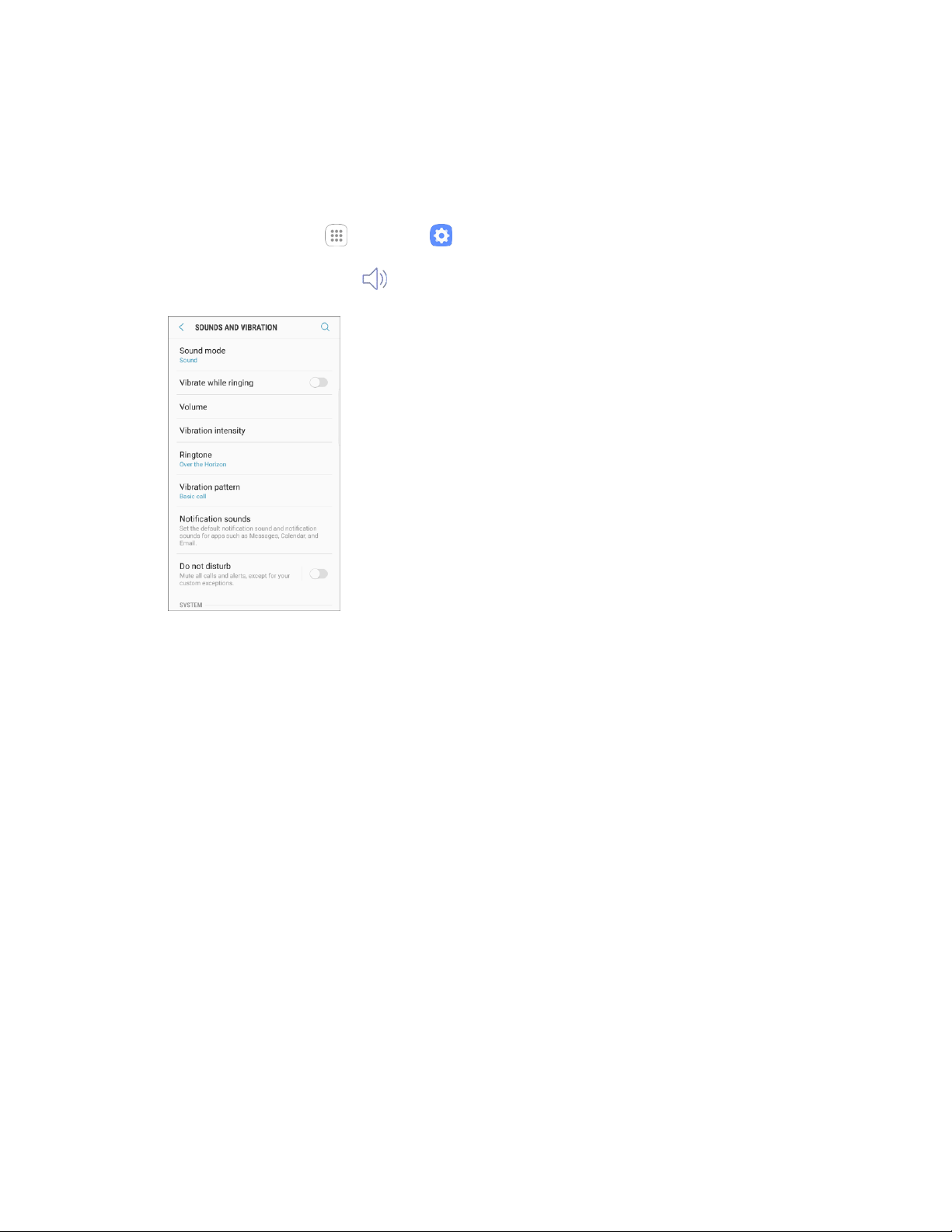
Settings 228
Volume
Set the system volume level, and set default volume for call ringtones, notifications, and other media.
Note: You can also set System volume from the home screen by pressing the Volume key.
1. From home, tap Apps > Settings .
2. Tap Sounds and vibration .
3. Tap Volume and then drag the sliders to set the default volume for:
Ringtone
Media
Notifications
System
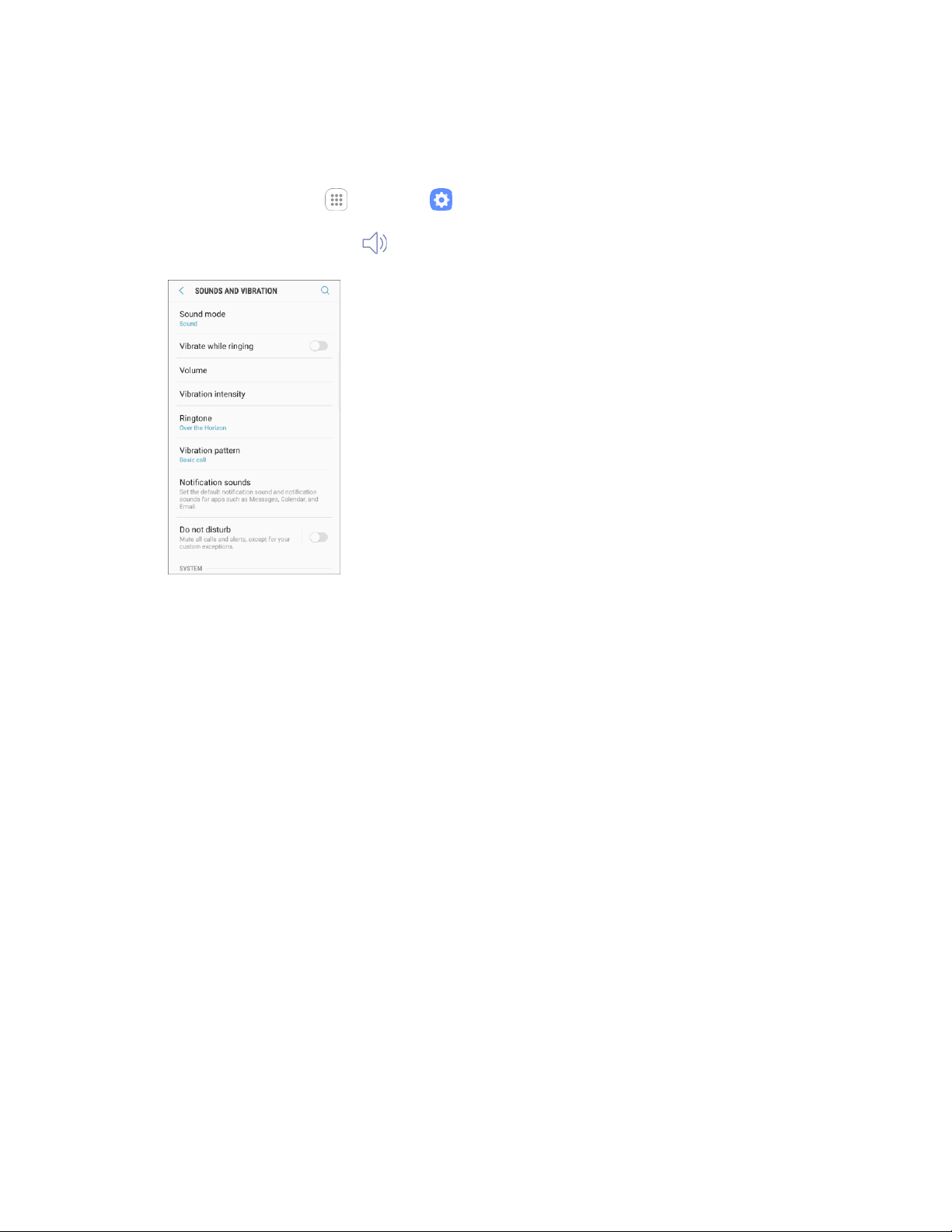
Settings 229
Vibration Intensity
Set the vibration intensity for incoming calls, notifications, and vibration feedback.
1. From home, tap Apps > Settings .
2. Tap Sounds and vibration .
3. Tap Vibration intensity.
4. Use the sliders to set the intensity of vibration for:
Incoming call: The phone vibrates when receiving an incoming call.
Notifications: The phone vibrates when receiving notifications.
Vibration feedback: The phone vibrates when soft keys are tapped and for certain software
actions.
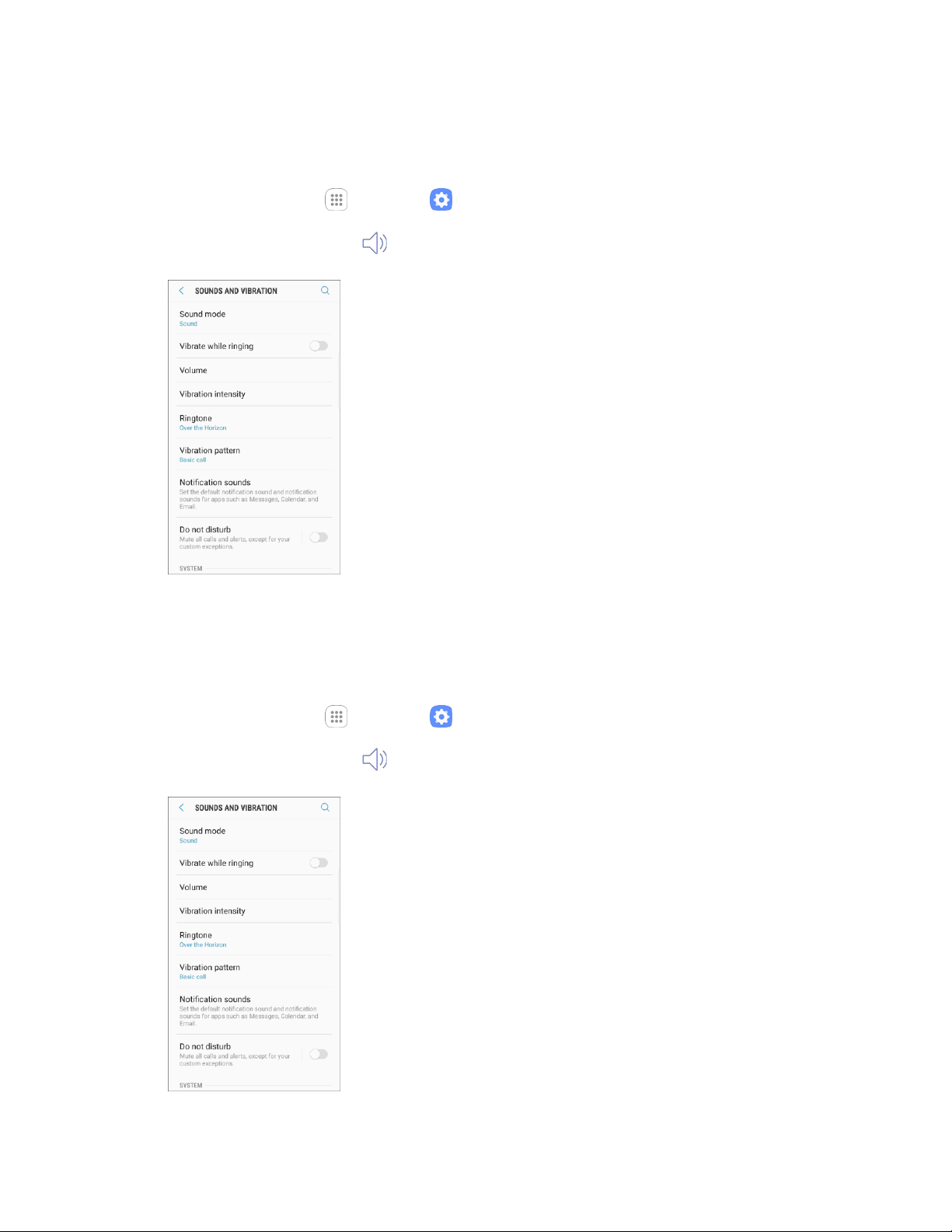
Settings 230
Ringtones and Sounds
Choose a ringtone for incoming calls.
1. From home, tap Apps > Settings .
2. Tap Sounds and vibration .
3. Tap Ringtone to select a default ringtone.
Add a Ringtone
When you select a ringtone, you can add a custom ringtone.
1. From home, tap Apps > Settings .
2. Tap Sounds and vibration .
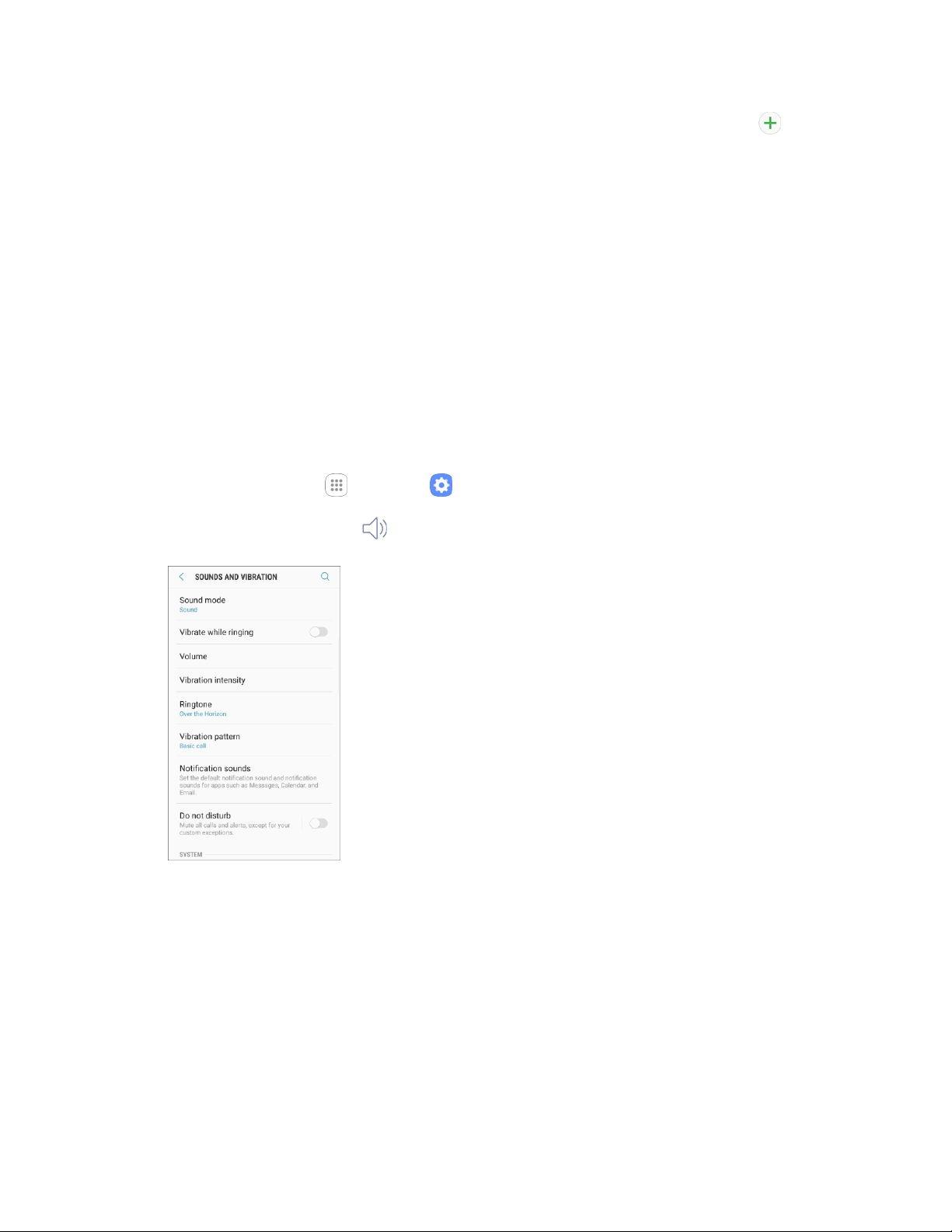
Settings 231
3. Tap Ringtone, scroll to the bottom of the list, and then tap Add from device storage .
4. Select a source for the ringtone.
You will see a list of compatible songs or audio files. To load music on your phone, see
Transfer Files between Your Phone and a Computer.
5. Tap a song to hear a preview, and then tap Done to save it as a ringtone.
The new ringtone is saved to the list and will be available to be assigned as a default ringtone
or as a ringtone for individual contacts, groups, etc.
Tip: When choosing music for a ringtone, select the Highlights only checkbox to allow the system to
select what part of the song to use. Clear the checkbox to play the song from the beginning.
Vibration Pattern
Choose a vibration pattern.
1. From home, tap Apps > Settings .
2. Tap Sounds and vibration .
3. Tap Vibration pattern to select a default vibration pattern.
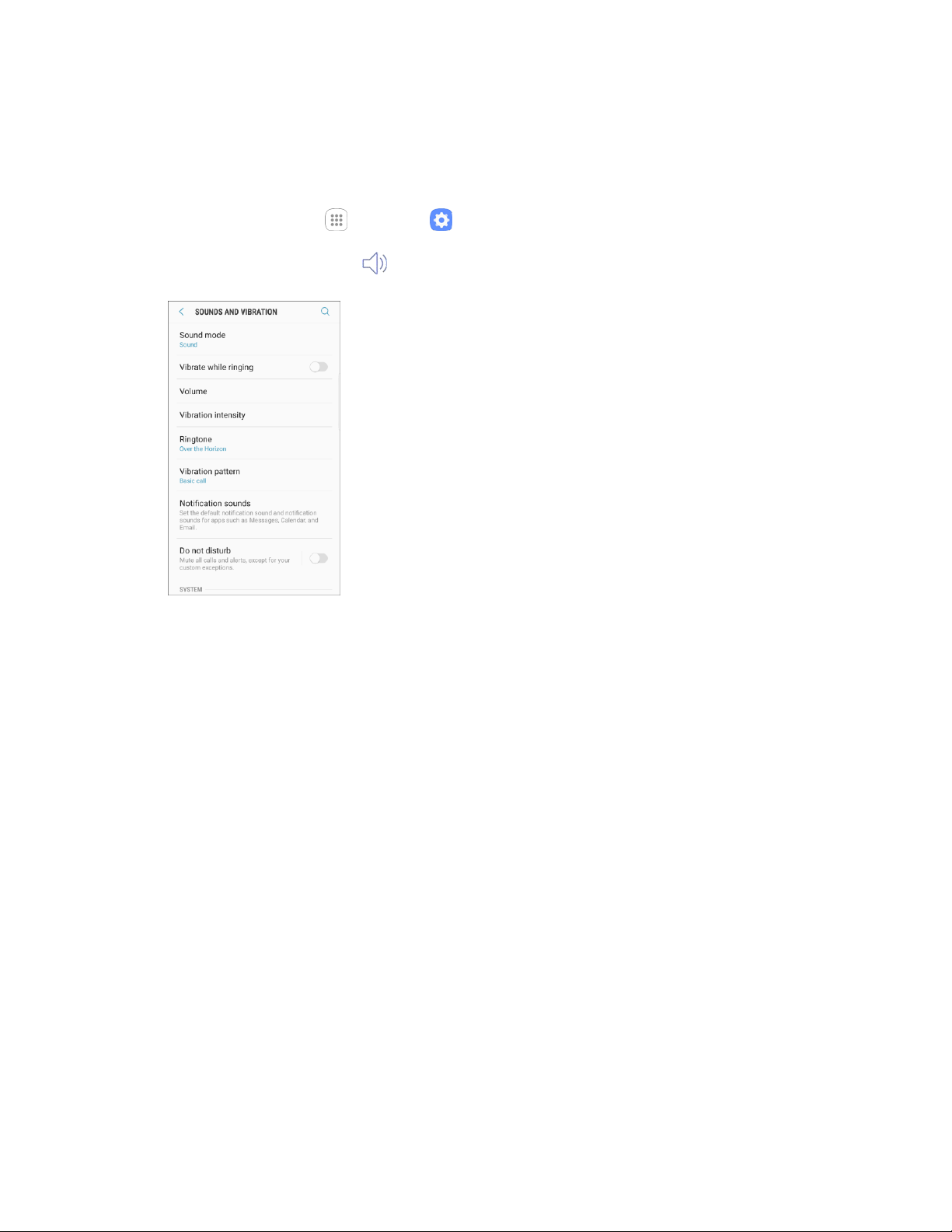
Settings 232
Notification Sound
Set the default notification sound and notification sounds for apps such as Messages, Calendar, and
Email.
1. From home, tap Apps > Settings .
2. Tap Sounds and vibration .
3. Tap Notification sound to set options:
Default notification sound: Set the default sound for notifications.
Messages notifications: Set the default sound for new messages.
Calendar notifications: Set the default sound for calendar events.
Email notifications: Set the default sound for new email. (This option is only displayed if you
have an email account set up.)
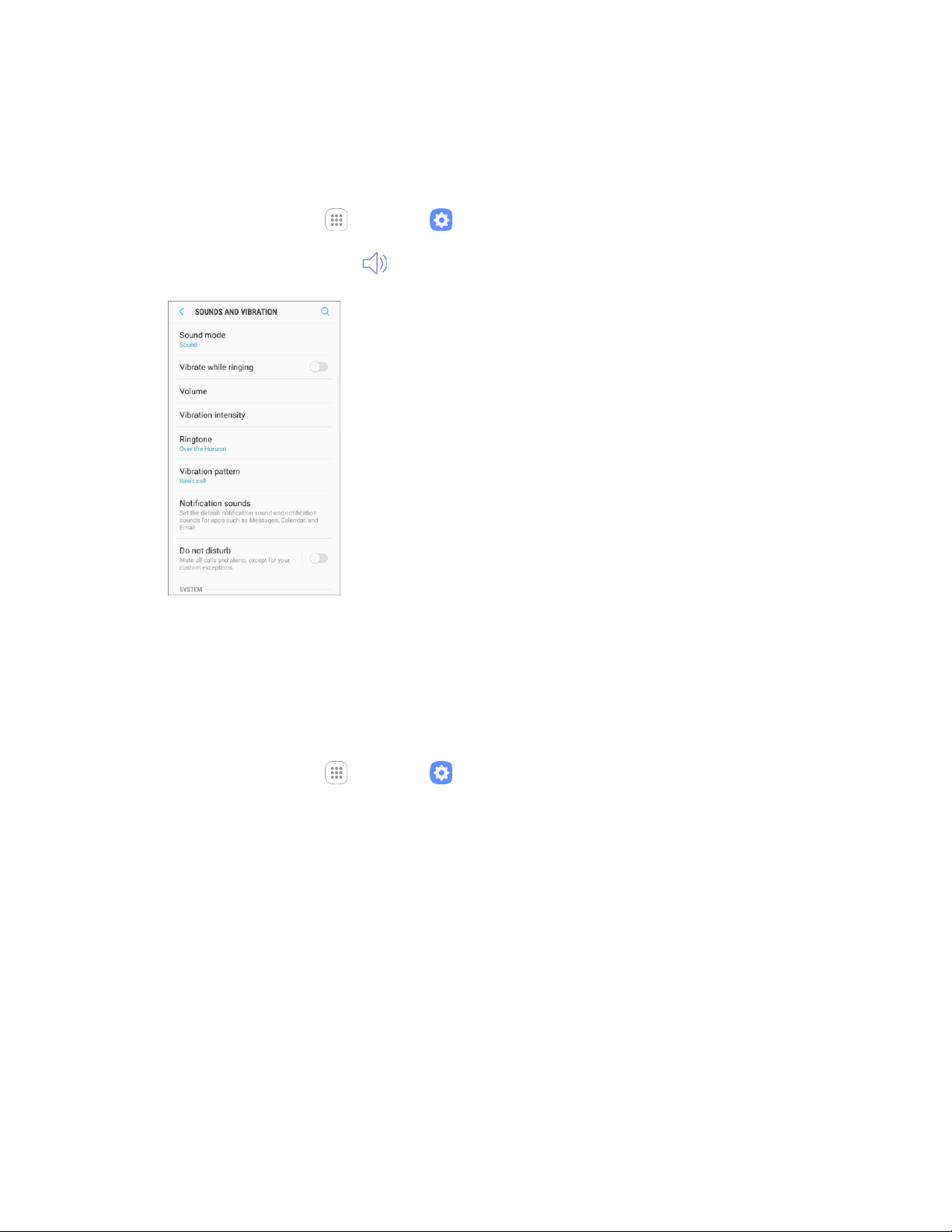
Settings 233
Do Not Disturb
This setting allows you to block all notifications and alerts. The options below determine what notifications
can make sounds, and during what time periods you want to enter this mode.
1. From home, tap Apps > Settings .
2. Tap Sounds and vibration .
3. Tap Do not disturb to enable the feature.
Scheduling
This option allows you to turn Do not disturb mode on or off automatically at scheduled times.
Note: Scheduling is not available if Do not disturb mode has been turned on manually.
1. From home, tap Apps > Settings .
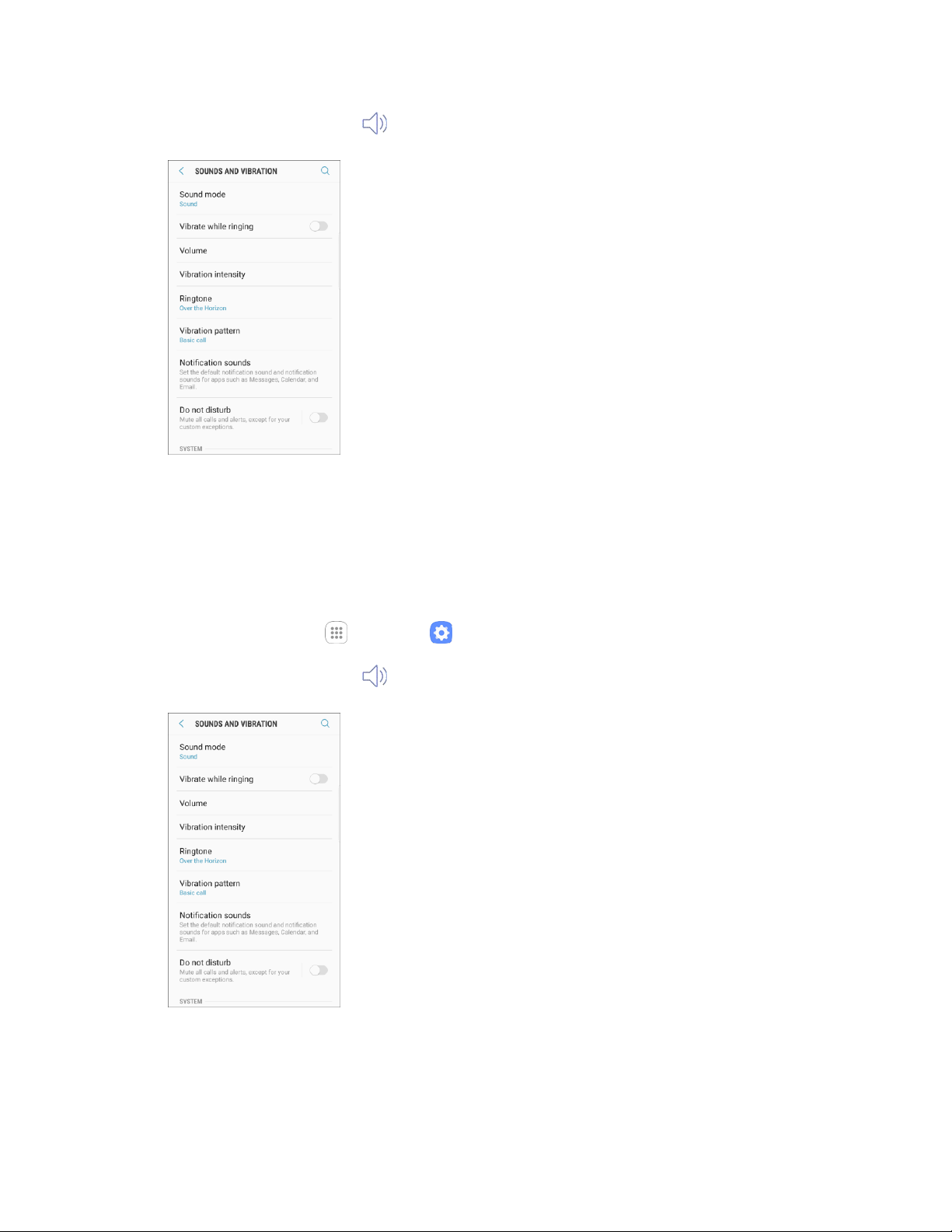
Settings 234
2. Tap Sounds and vibration .
3. Tap Do not disturb.
4. Tap Turn on as scheduled, and set the Days, Start time, and End time.
Allow Exceptions
This option lets you customize which notifications are allowed while your device is in Do not disturb mode.
1. From home, tap Apps > Settings .
2. Tap Sounds and vibration .
3. Tap Do not disturb.
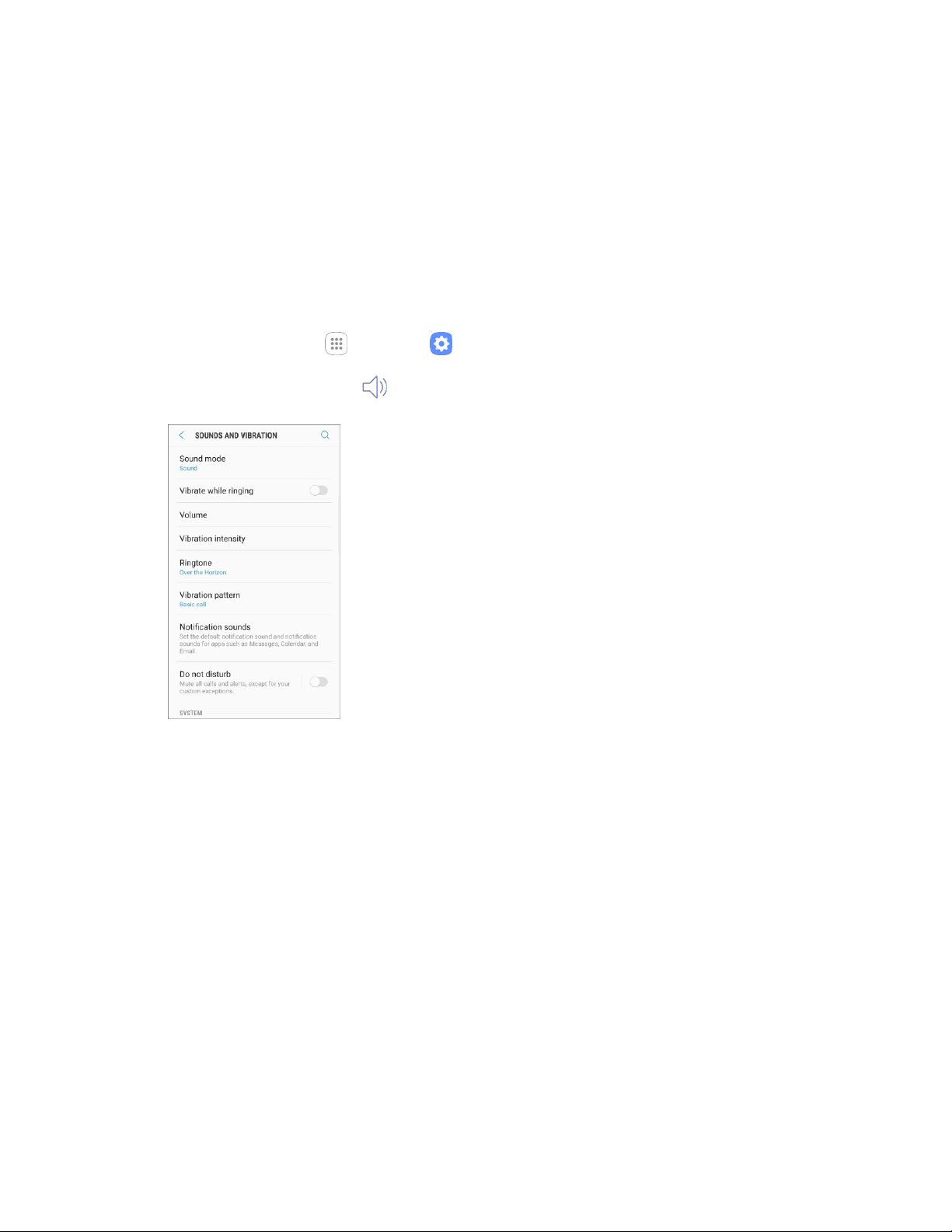
Settings 235
4. Tap Allow exceptions, and then tap one of the following options:
• No exceptions: Allow no exceptions.
• Alarms only: Allow exceptions for alarms.
• Custom: Set your own exceptions.
Notification Pop-ups
Configure notifications that pop up on your screen while your device is in Do not disturb mode.
1. From home, tap Apps > Settings .
2. Tap Sounds and vibration .
3. Tap Do not disturb.
4. Tap Notification pop-ups and enable or disable the following options:
Show when screen is on
Show when screen is off
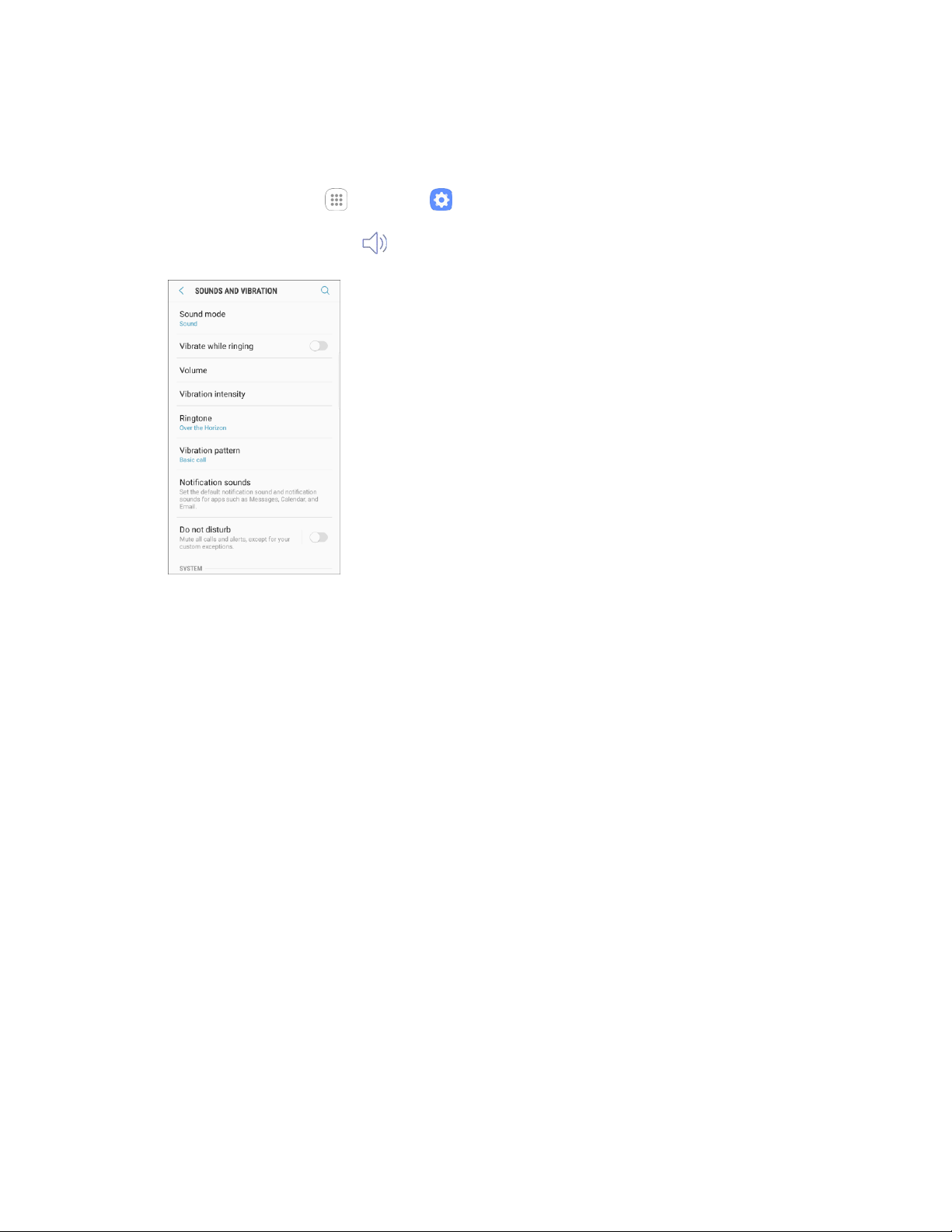
Settings 236
System Sounds
Set various other system sound options.
1. From home, tap Apps > Settings .
2. Tap Sounds and vibration .
3. Tap On/Off to enable each option:
Touch sounds: Play tones when you touch or tap the screen to make selections.
Screen lock sounds: Play a sound when you unlock the screen.
Emergency tone: Play a sound or vibrate for emergency alerts.
Charging sound: Play a sound when a charger is connected.
Vibration feedback: Vibrate when Back or Recent are tapped, and for other actions
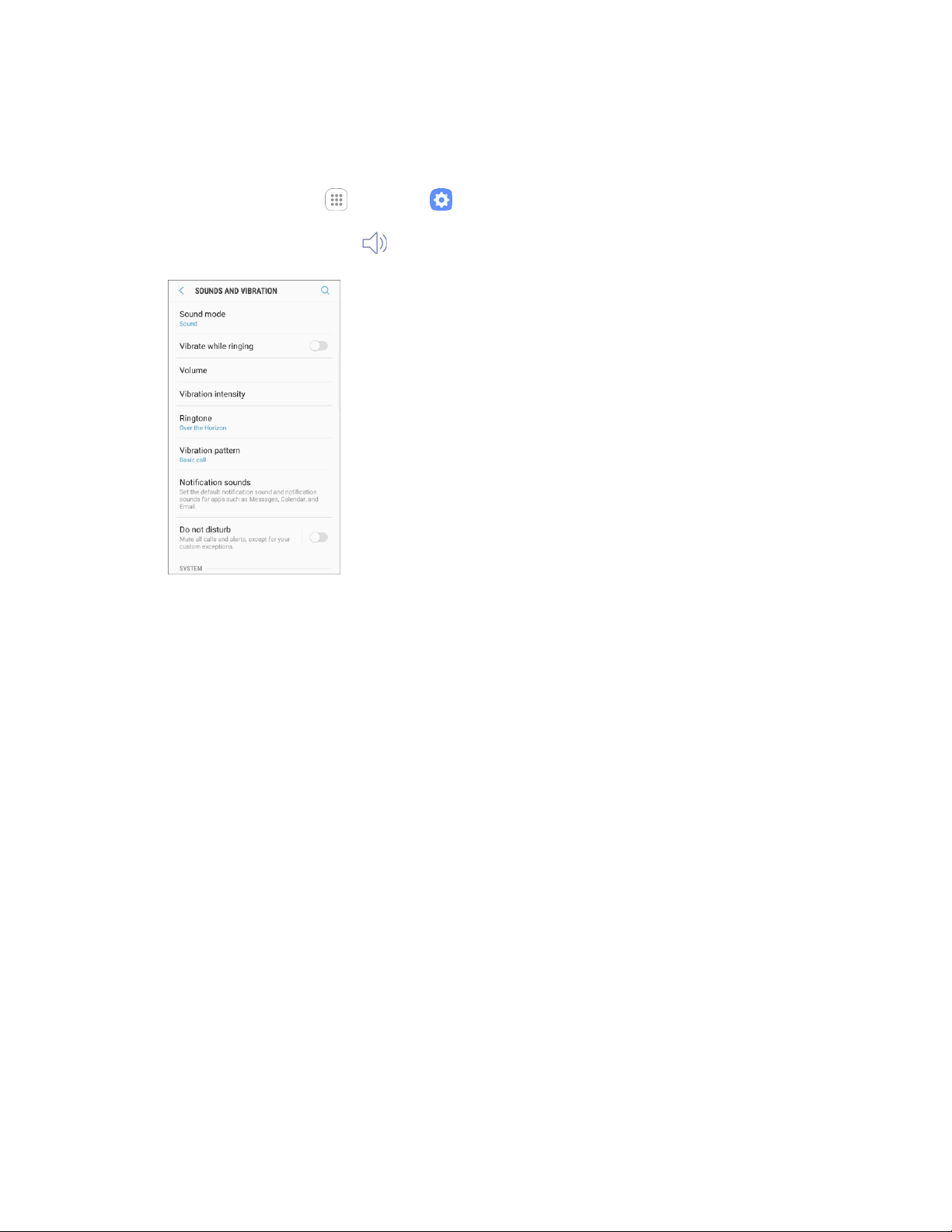
Settings 237
Key-tap Feedback
Play tones when the dialing keypad or the keyboard is tapped.
1. From home, tap Apps > Settings .
2. Tap Sounds and vibration .
3. To On/Off to enable each option:
Dialing keypad tones: Play a tone when the dialing keypad is tapped.
Keyboard sound: Play a sound when the Samsung keyboard is tapped.
Keyboard vibration: Vibrate when the Samsung keyboard is tapped.
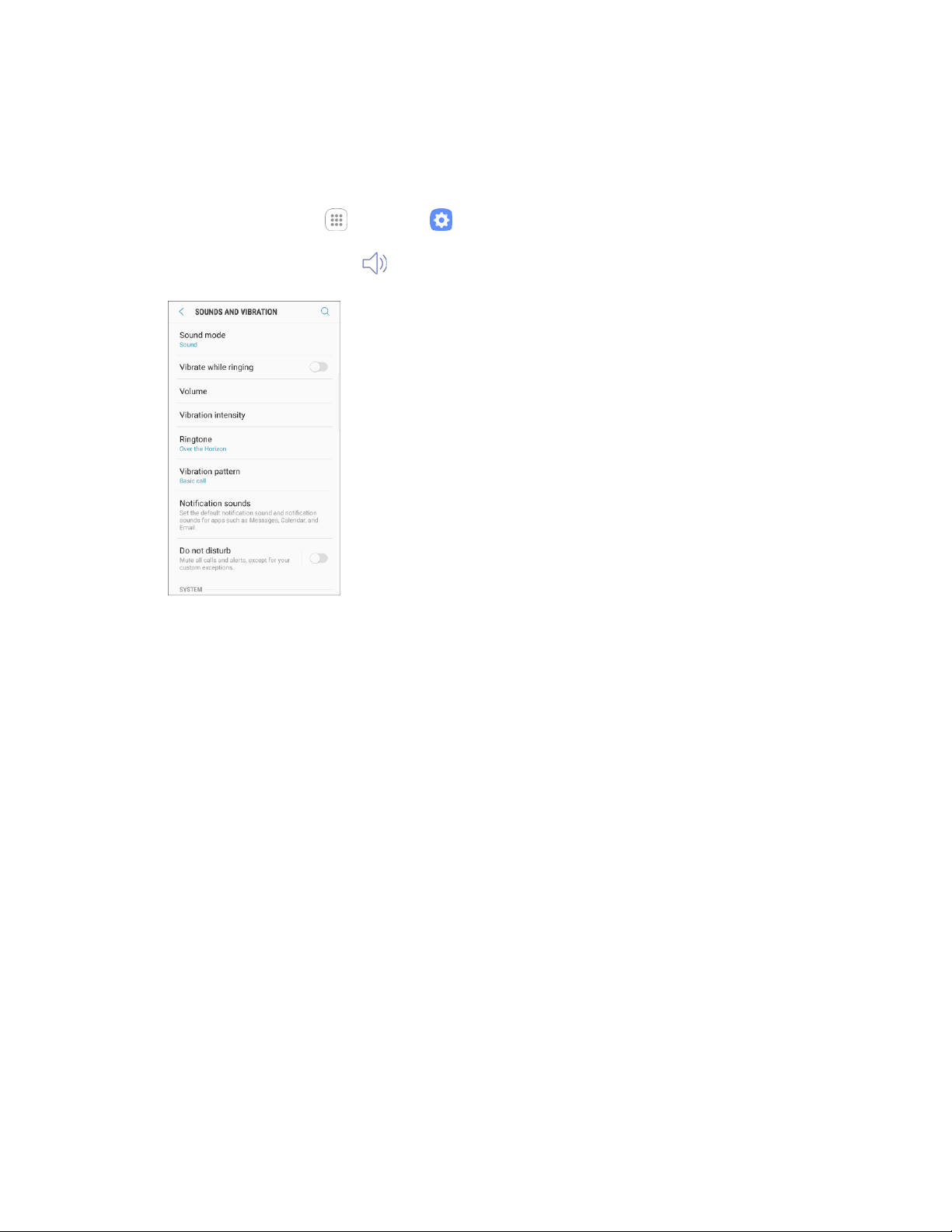
Settings 238
Sound Quality and Effects
Select options for sound quality while headphones or compatible Bluetooth headsets or speakers are
connected.
1. From home, tap Apps > Settings .
2. Tap Sounds and vibration .
3. Tap Sound quality and effects.
4. Tap Equalizer and choose a setting, or tap Advanced or Basic to customize your sound
settings.
5. Tap On/Off to enable each option:
UHQ upscaler: Enhance the sound resolution of music and videos for a clearer listening
experience.
Surround: Recreate the effects of rich surround sound.
Tube Amp Pro: Simulate the soft timbre of a tube amplifier.
Concert hall: Simulate the reverb of a concert hall.
6. Tap Adapt sound and follow the prompts to customize your sound settings.
Note: Sound effects are only available while headphones or a compatible Bluetooth headset is
connected.
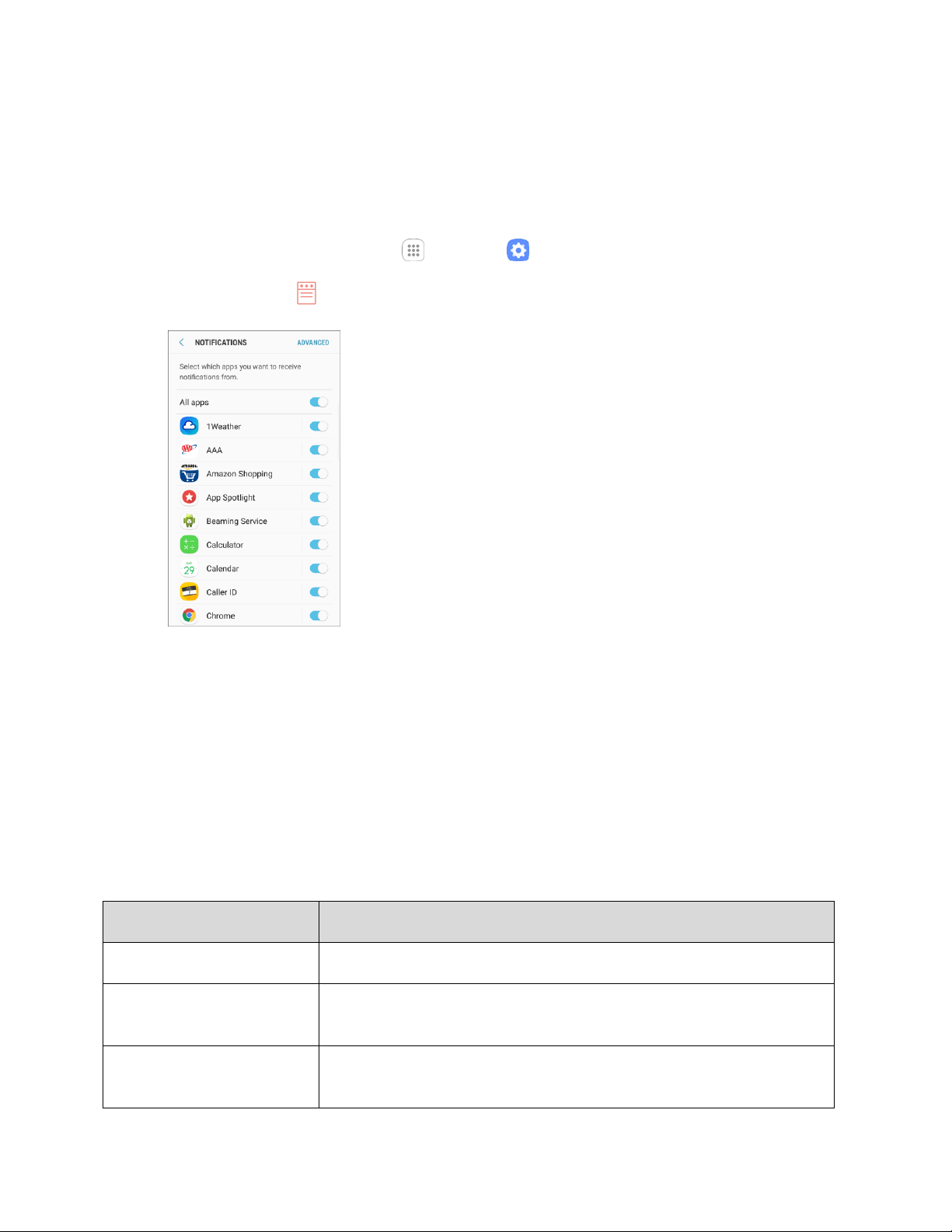
Settings 239
Notifications Settings
The following topics cover your phone’s Notifications settings options.
Access Connection Settings
1. From the home screen, tap Apps > Settings .
2. Tap Notifications .
3. Tap On/Off next to an app to enable or disable notifications.
4. Tap Advanced to configure more notification options for individual apps.
Display Settings
Use the phone's display settings menu to adjust items such as wallpaper, brightness, screen timeout, and
more.
Display Settings Overview
The display settings menu allows you to configure the following options:
Display Setting
Description
Brightness
Set the display brightness.
Auto adjust brightness
Adjust the screen brightness automatically based on the lighting
conditions.
Blue light filter
Use Blue light filter at night to help you sleep better. You can set a
schedule to automatically turn this feature on and off.
Settings 240
Display Setting
Description
Screen mode
Select a screen display mode to optimize it for the content being
displayed.
Screen zoom and font
Set the screen zoom, font size, and font style for all text displayed on
the screen
Home screen
Customize your Home screen by adding application shortcuts, widgets,
folders, and using wallpapers.
Easy mode
Set your device to use Easy mode.
Icon frames
Display icons with a shaded background to make them stand out on the
Home screen and Apps screen.
Edge screen
Set your Edge screen settings.
Night clock
Show a clock on the Edge screen while the main screen is turned off.
LED indicator
Light up the LED indicator when charging, voice recording, or receiving
notifications.
Status bar
Determine which notifications appear on the status bar.
Screen timeout
Set a screen timeout duration.
Note: Longer durations discharge the battery more quickly
Screen saver
Select a screen saver to be displayed when the device is docked (dock
not included) or while charging.
Keep screen turned off
Prevent the screen from turning on accidentally while the device is in a
dark place, such as a pocket or bag.
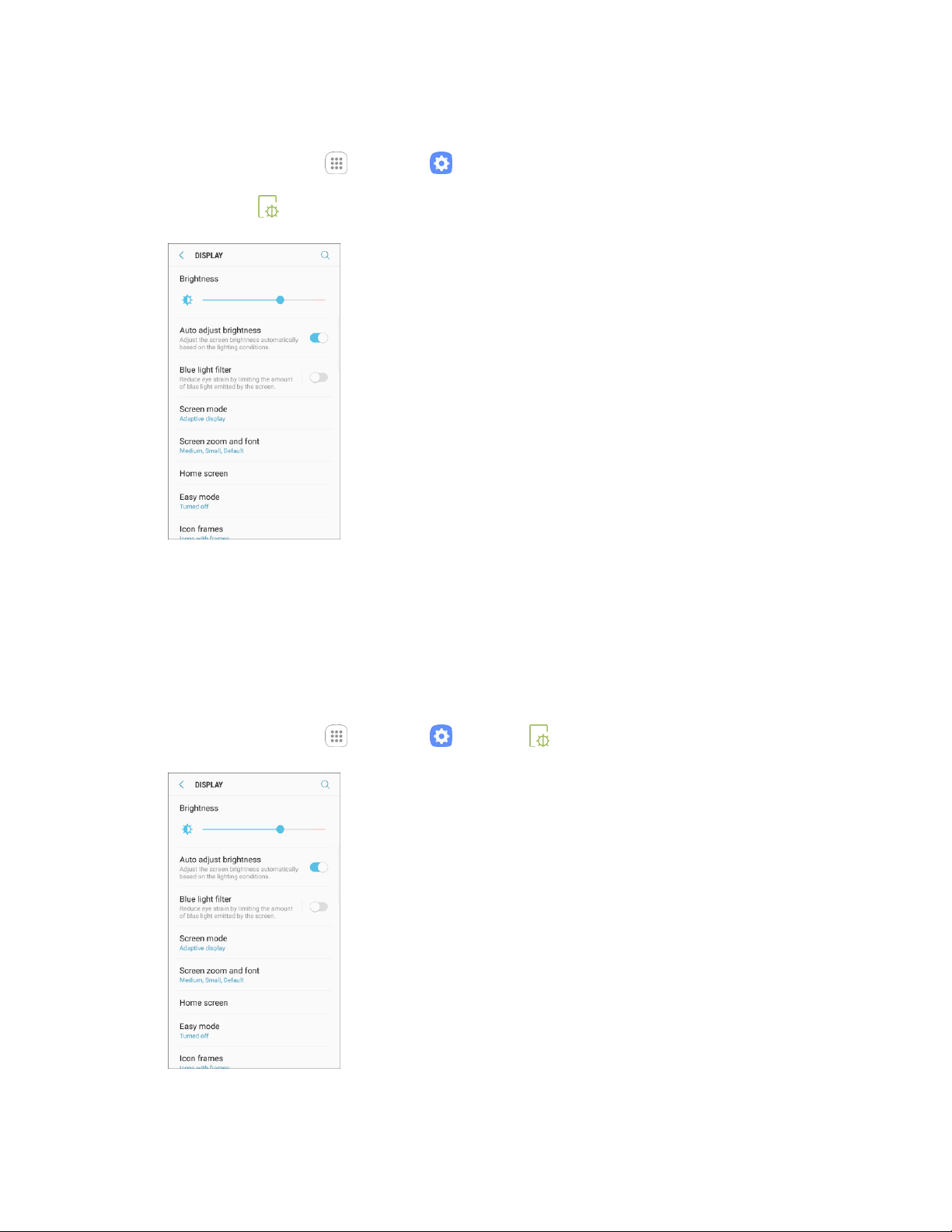
Settings 241
Access Display Settings
1. From home, tap Apps > Settings .
2. Tap Display .
3. Set your display options.
Your display settings are saved and applied.
Brightness
Adjust the screen brightness to suit your surroundings or personal preference. You may also want to
adjust screen brightness to conserve battery power.
1. From home, tap Apps > Settings > Display .
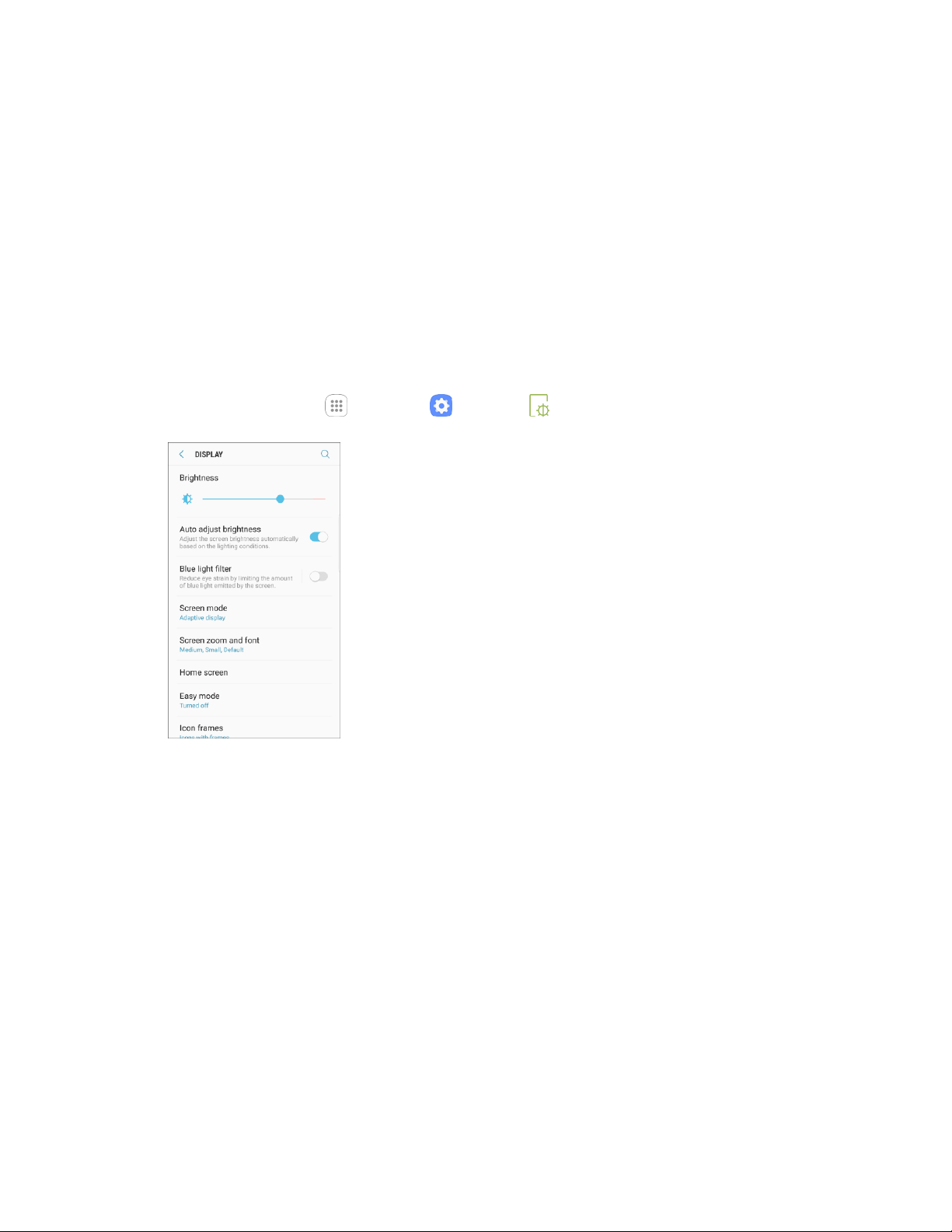
Settings 242
2. Customize options under Brightness:
Drag the Brightness slider to set a custom brightness level.
Tap Auto adjust brightness to allow the device to adjust brightness automatically based on
the lighting conditions.
Note: You can also control Brightness from the Notification panel.
Blue Light Filter
1. From home, tap Apps > Settings > Display .
2. Tap Blue light filter.
3. Tap On/Off to enable this feature.
When enabled, drag the Opacity slider to set the opacity of the filter.
Set a schedule for when Blue light filter should be enabled. You can choose Turn on now,
Sunset to sunrise, or Custom schedule.
Use Blue light filter at night to help you sleep better. It adjusts your screen color to reduce the amount of
blue light, helping your eyes to relax and making it easier for you to fall asleep. You can set a schedule to
automatically turn this feature on and off.
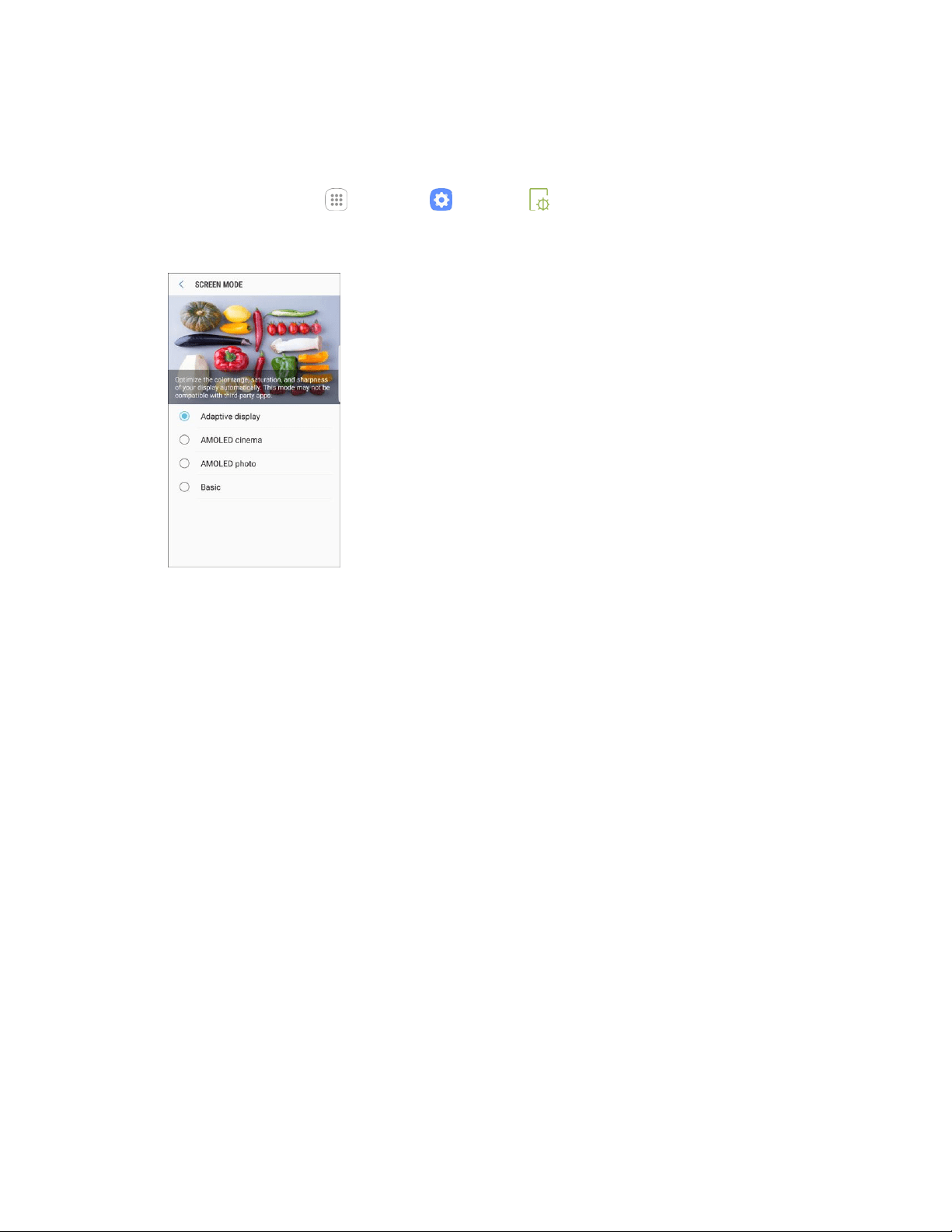
Settings 243
Screen Mode
Choose a screen mode to match your type of viewing.
1. From home, tap Apps > Settings > Display .
2. Tap Screen mode.
3. Tap Adaptive display if you want your device to automatically optimize the display to match the
type of image displayed and other criteria, such as battery level.
– or –
Choose a specific type of screen mode based on what you are viewing.
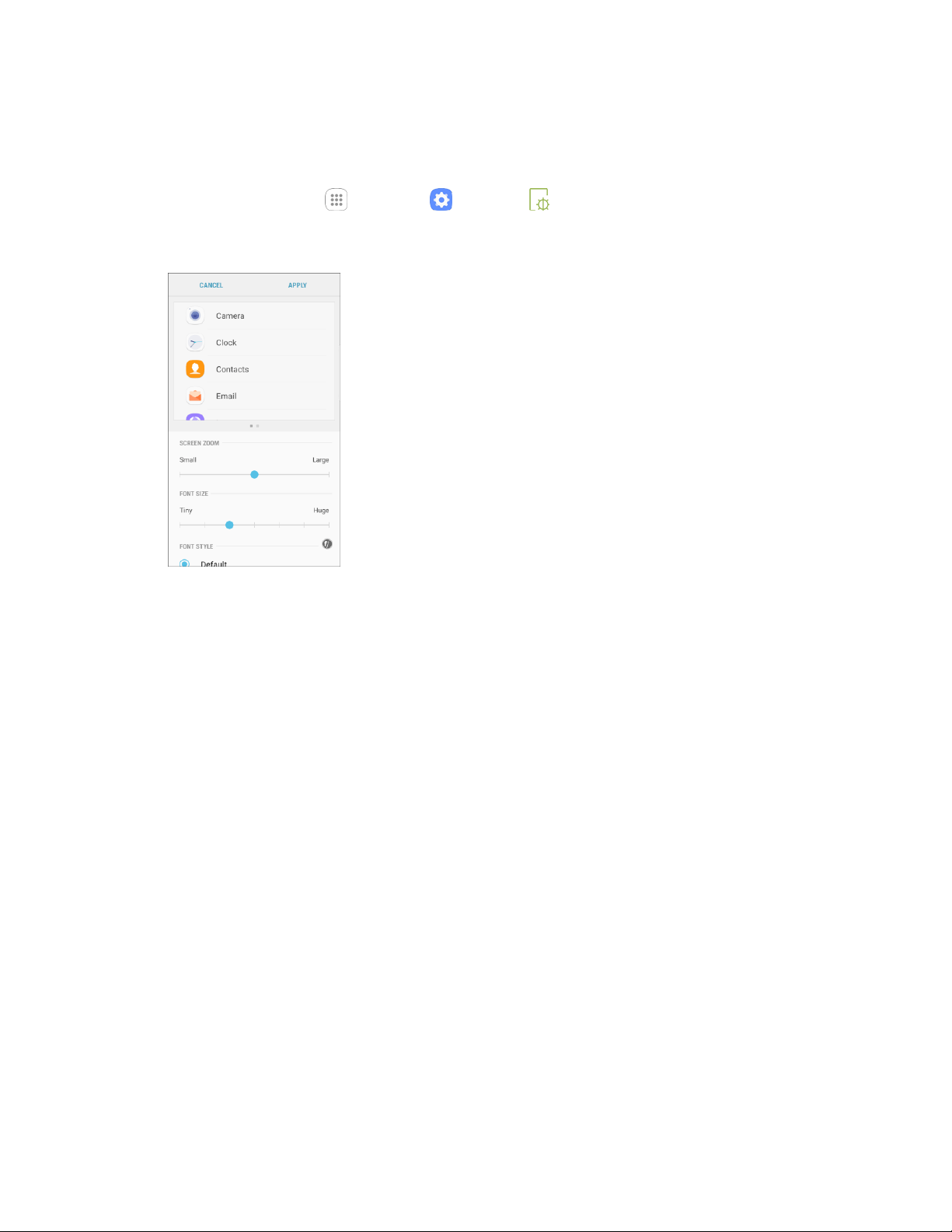
Settings 244
Screen Zoom and Font
You can set the screen zoom, font size, and font style for all text that is displayed on the screen.
1. From home, tap Apps > Settings > Display .
2. Tap Screen zoom and font.
Drag the Screen zoom slider to adjust screen zoom. The preview above it will adjust
accordingly.
Drag the Font size slider to adjust the font size.
Tap a font style to select a font, or tap Download fonts to find new fonts from Galaxy Apps.
3. Tap Apply to set the font size and style.
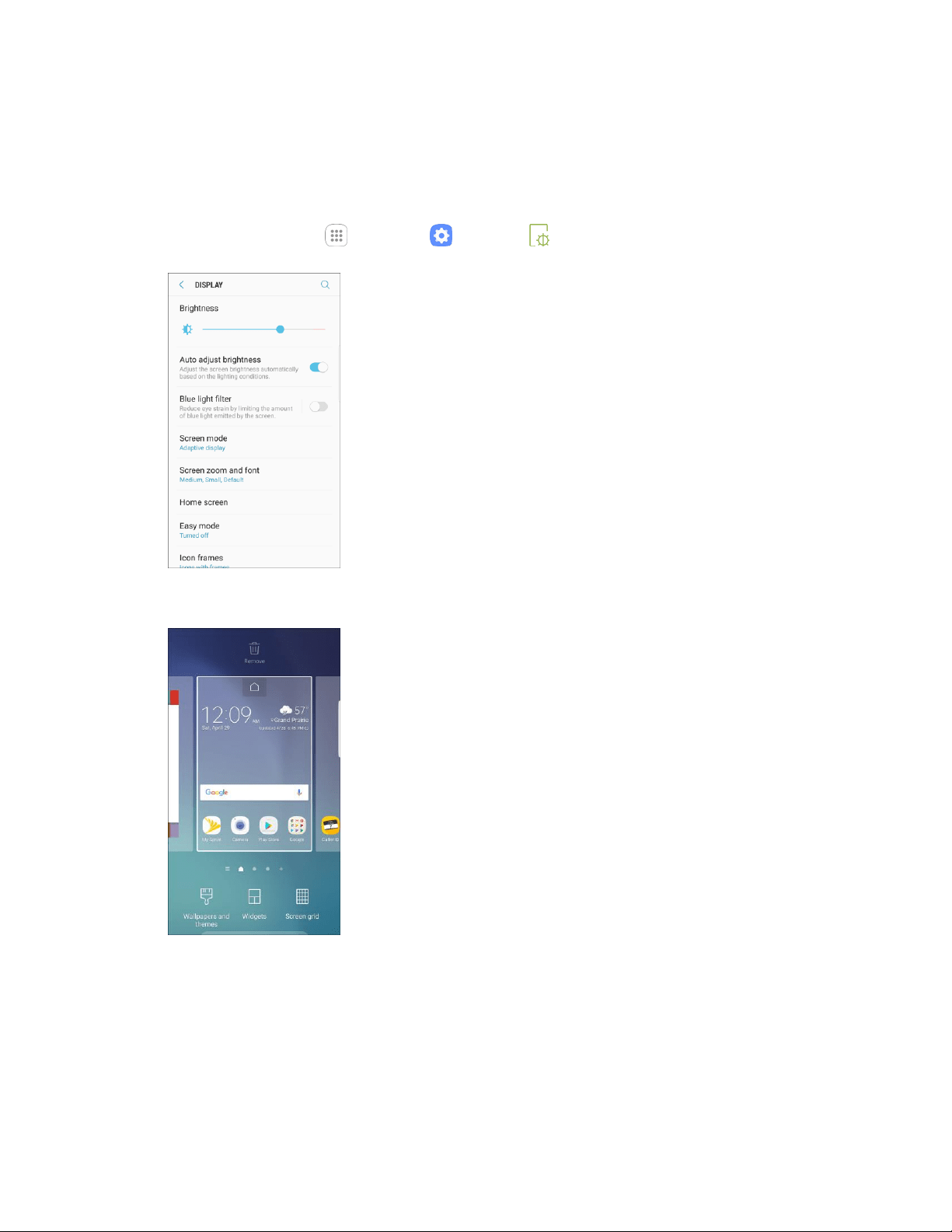
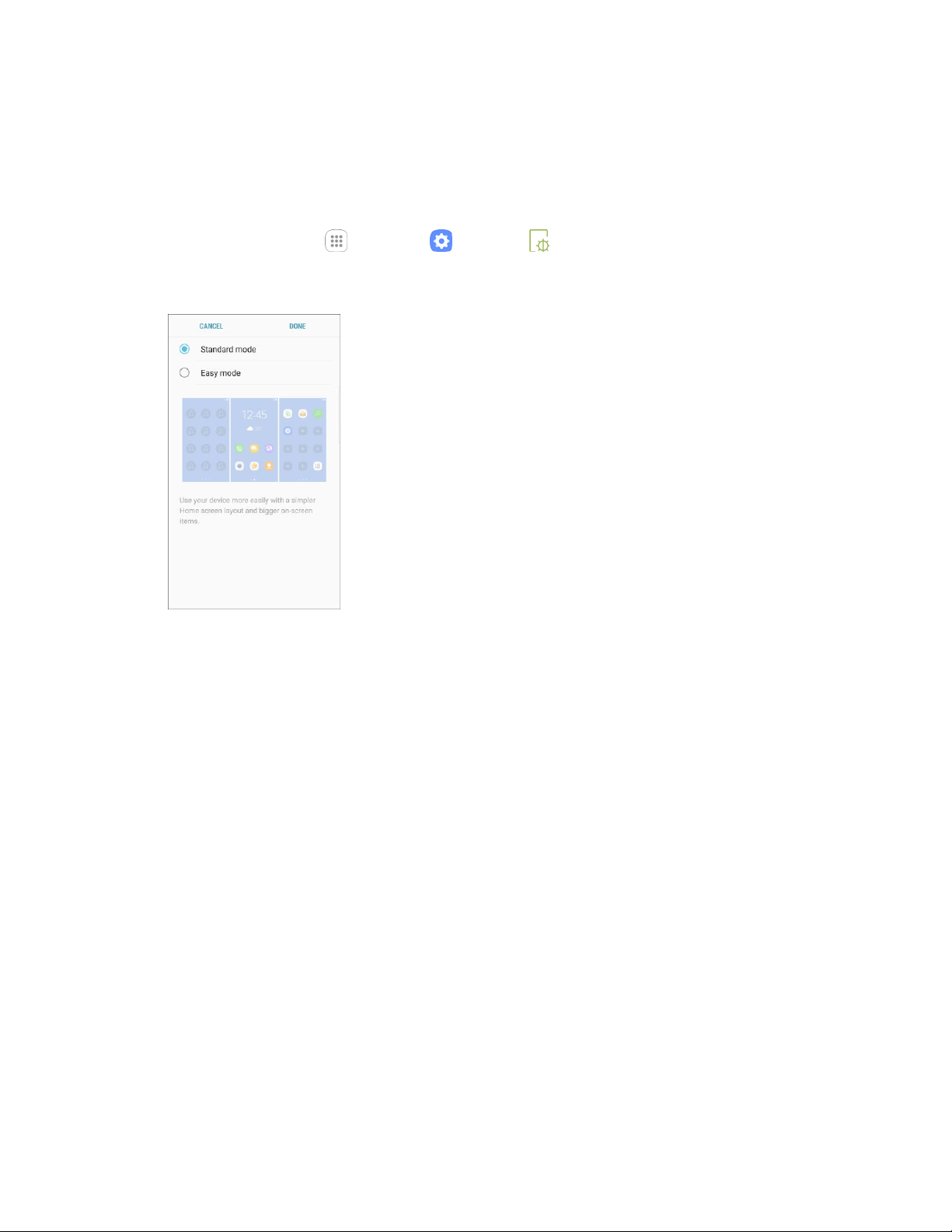
Settings 246
Easy Mode
Easy mode provides a simpler experience using your phone, with a simpler home screen layout and
simpler app interactions. If you are a first-time smartphone user, or just to want to simplify the operation of
your phone, you can turn on Easy mode at any time.
1. From home, tap Apps > Settings > Display .
2. Tap Easy mode > Easy mode.
3. Select the apps you want to use from the Easy applications list.
4. Tap Done to apply your Easy mode settings.
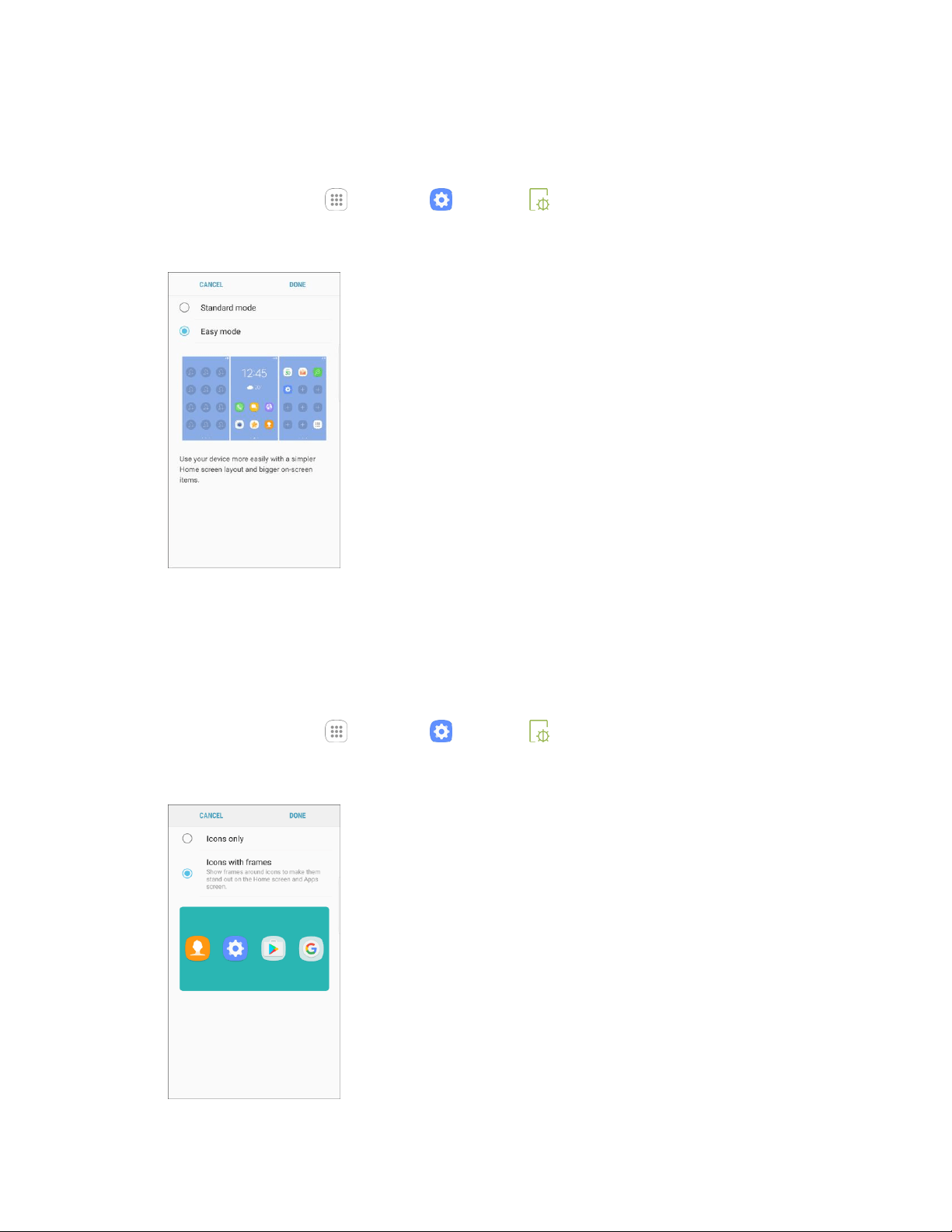
Settings 247
Return to Standard Mode
You can use the Easy mode Settings menu to return to Standard mode.
1. From home, tap Apps > Settings > Display .
2. Tap Easy mode.
3. Tap Standard mode, and then tap Done.
Icon Frames
You can show icons with a shaded background to make them stand out on the Home screen and
Apps list screen.
1. From home, tap Apps > Settings > Display .
2. Tap Icon frames.
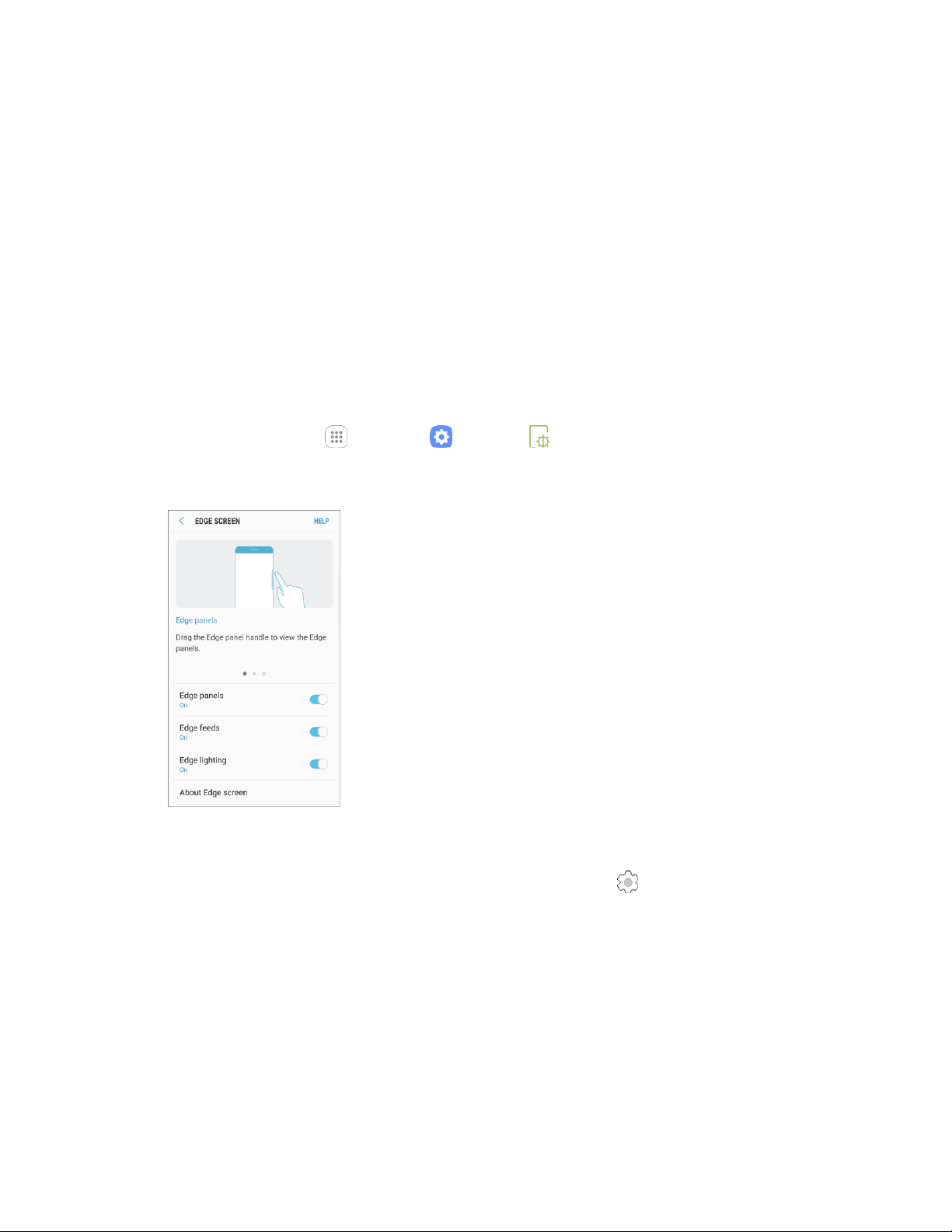
Settings 248
3. Choose one of the following options:
Icons only: Show icons only.
Icons with frames: Show icons with shaded backgrounds.
4. Tap Done, and confirm when prompted.
Edge Screen Settings
Manage the panels that display on the Edge screen, including your own custom panels, and set up night
mode.
For more details on using the Edge screen, see Edge Screen.
To access Edge screen settings:
1. From home, tap Apps > Settings > Display .
2. Tap Edge screen.
– or –
Swipe the Edge screen toward the center, and then tap Settings .
The following options are available:
Edge panels: Configure Edge for accessing apps, tasks, and contacts, as well as view news,
sports, and other information on the Edge screen.
Edge feeds: Configure Edge feeds, which display select information and notifications on the
Edge screen when the screen is turned off.
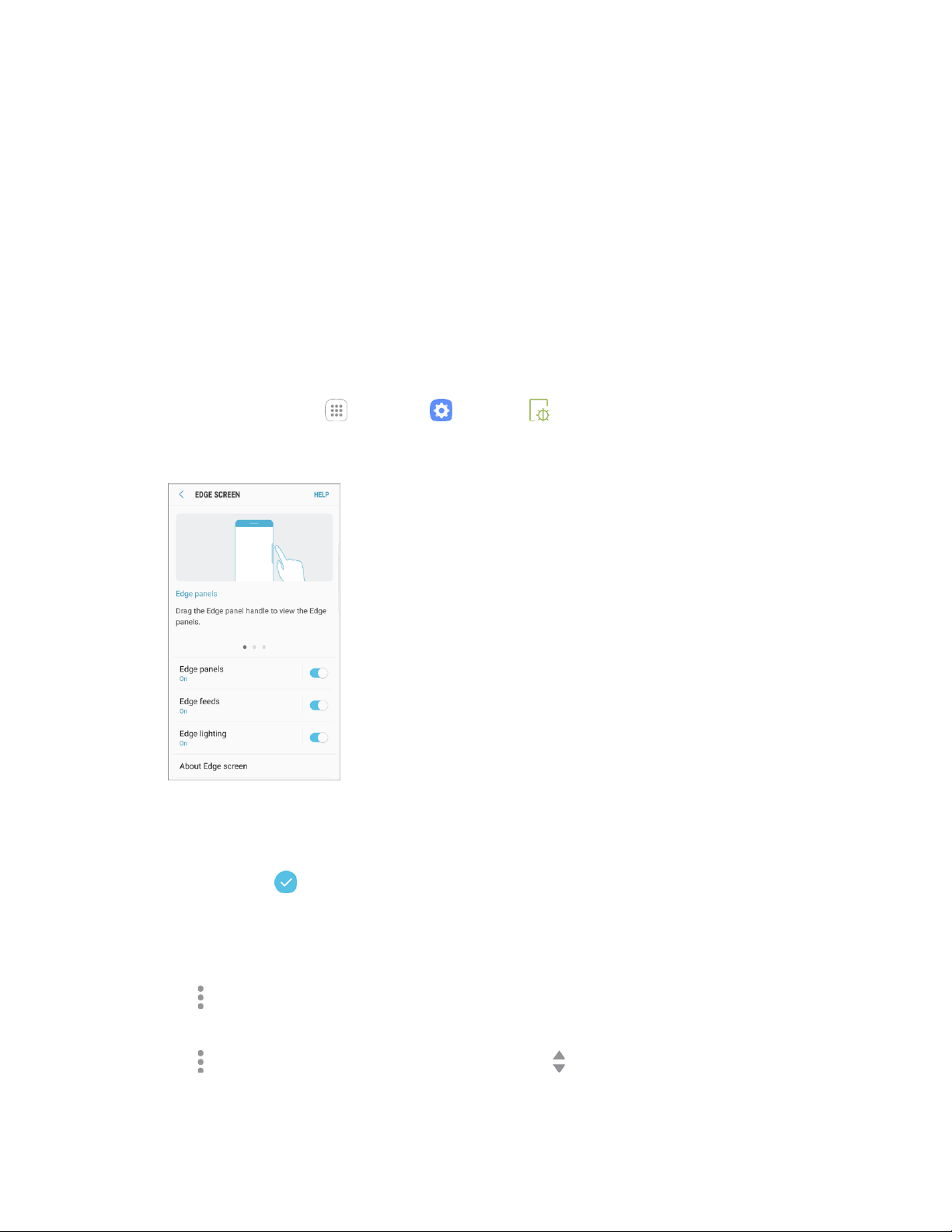
Settings 249
Edge lighting: Set the Edge screen to light up when you receive calls or notifications while
the phone is turned over. If People edge is also turned on, the color of the indicator depends
on your My people settings.
• Quick reply: Tap On/Off to enable this feature, which lets you reject an incoming call
and send a preset message to the caller by placing your finger on the heart rate sensor
and holding it in place for 2 seconds while the device is turned over.
About Edge screen: View the Edge screen version number, check for updates, and view
open source licenses.
Edge Panels Settings
Customize your Edge panels:
1. From home, tap Apps > Settings > Display .
2. Tap Edge screen.
3. Tap Edge panels.
4. Tap On/Off to enable the feature. The following options are available:
Checkbox : Enable or disable each panel.
Download: Search for and download more Edge panels from Galaxy Apps.
Edit (if available): Configure individual panels by tapping.
More options > Reorder: Change the order of the panels by dragging them to the left or
right.
More options > Handle settings: Drag Position to change the position of the Edge
panel handle along the edge of the screen, and then configure the following Edge panel
handle settings:
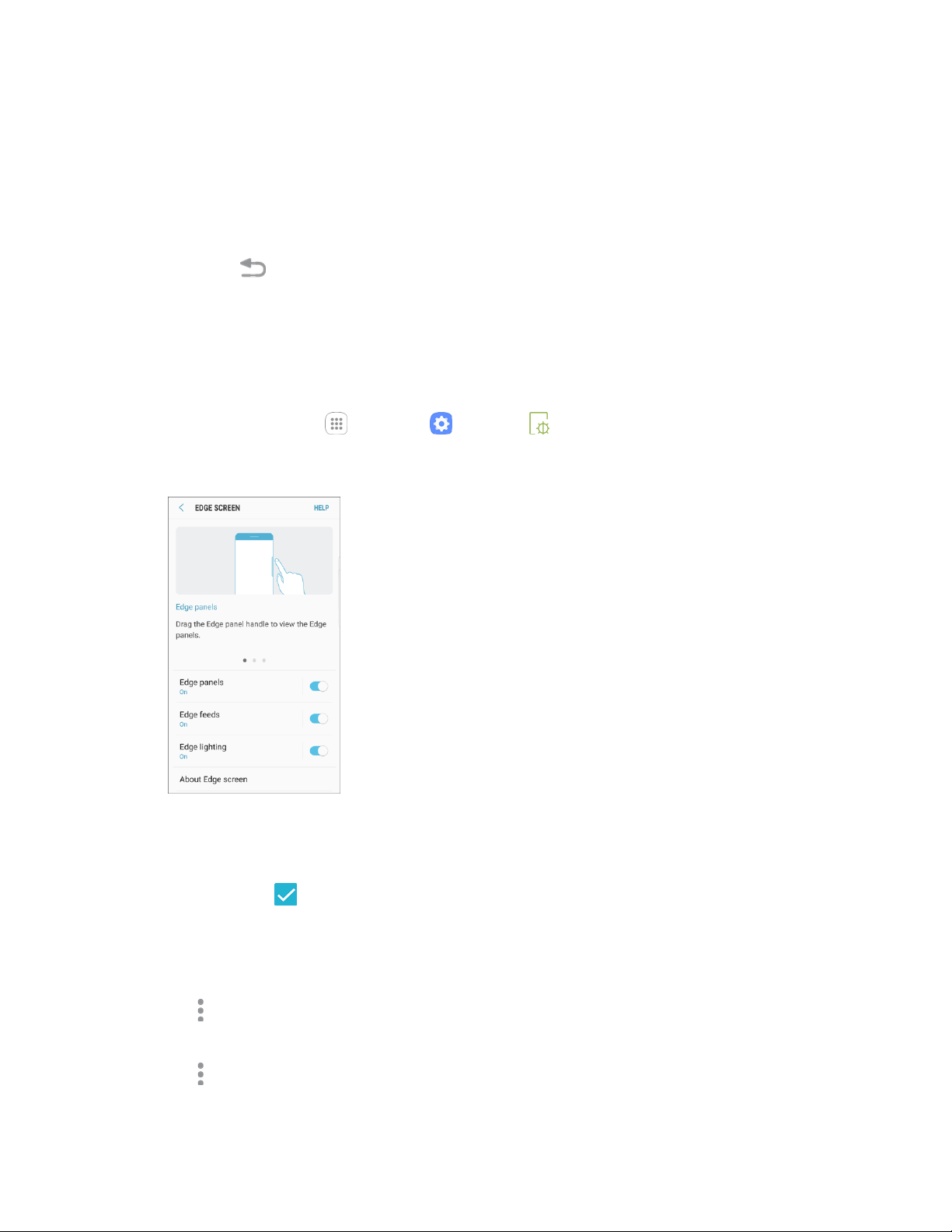
Settings 250
• Position: Choose either Right or Left to set which side the Edge screen appears on.
• Size: Choose the size of the Edge screen handle. Drag the slider to change the size.
• Transparency: Drag the slider to adjust the transparency of the Edge screen handle.
• Vibration: Vibrate when the Edge panel handle is tapped.
5. Tap Back to save changes.
Edge Feeds Settings
Edge feeds display select information and notifications on the Edge screen when the screen is turned off.
To configure the Edge feeds:
1. From home, tap Apps > Settings > Display .
2. Tap Edge screen.
3. Tap Edge feeds.
4. Tap On/Off to activate the Edge feeds feature.
Checkbox : Enable or disable each feed.
Download: Search for and download more Edge feeds from Galaxy Apps.
Edit (if available): Configure a feed.
More options > Edge feed settings: Configure how long the Edge screen stays on when
activated.
More options > Reorder: Change the order of the feeds by dragging them to the left or
right.
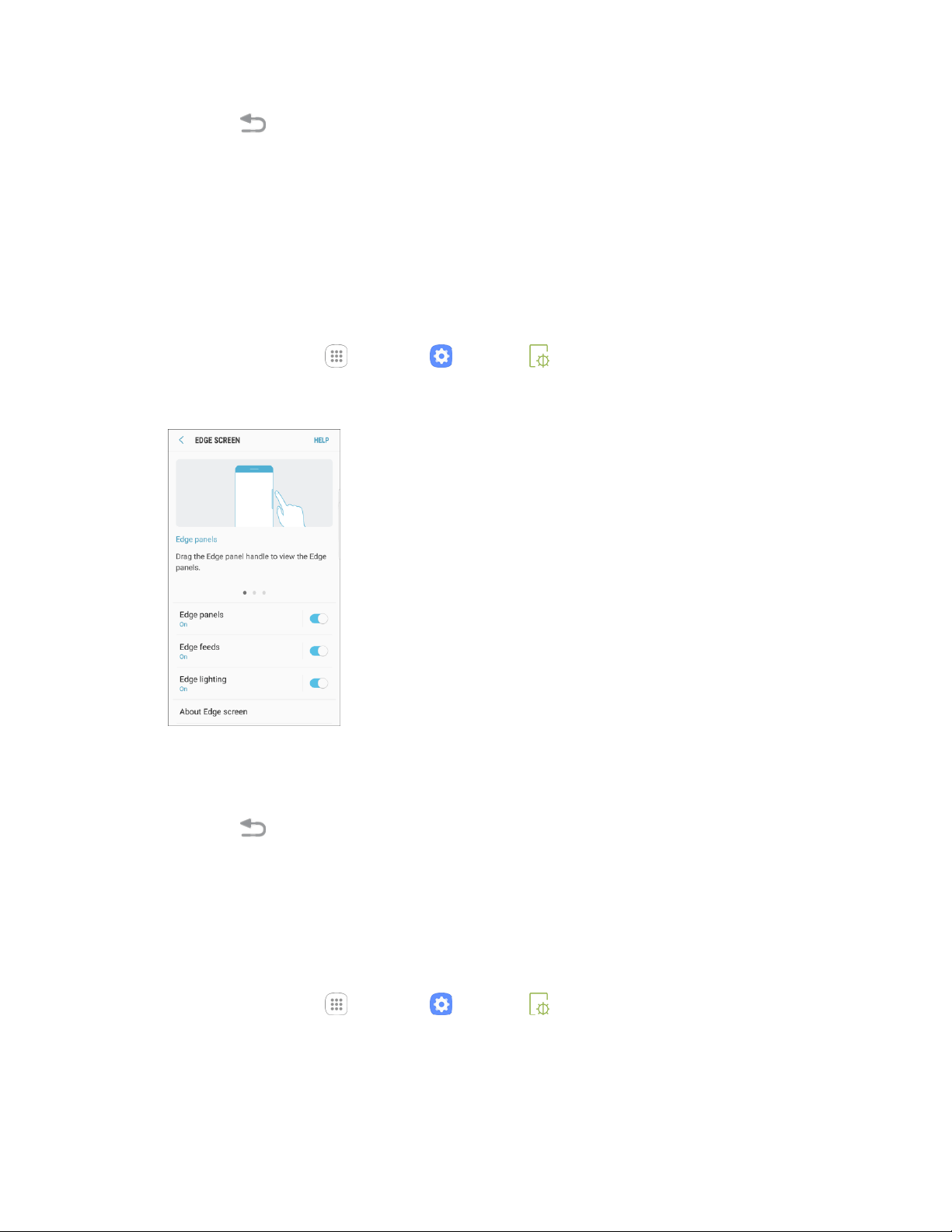
Settings 251
5. Tap Back to save changes.
Edge Lighting Settings
Edge lighting and Quick reply are features that activate when your device is turned over (display side
down).
Edge lighting illuminates the Edge screen when a notification is received. If People edge is also on, the
color of the indicator is the one assigned to the contact who is calling or messaging.
To turn on Edge lighting:
1. From home, tap Apps > Settings > Display .
2. Tap Edge screen.
3. Tap Edge lighting.
4. Tap On/Off to turn on the feature.
5. Tap Back to save changes.
Quick Reply Settings
Quick reply allows you to reject an incoming phone call with a text message by placing your finger on the
heart rate sensor for two seconds. The call is rejected, and a preset message is sent to the caller.
To turn on and configure Quick reply:
1. From home, tap Apps > Settings > Display .
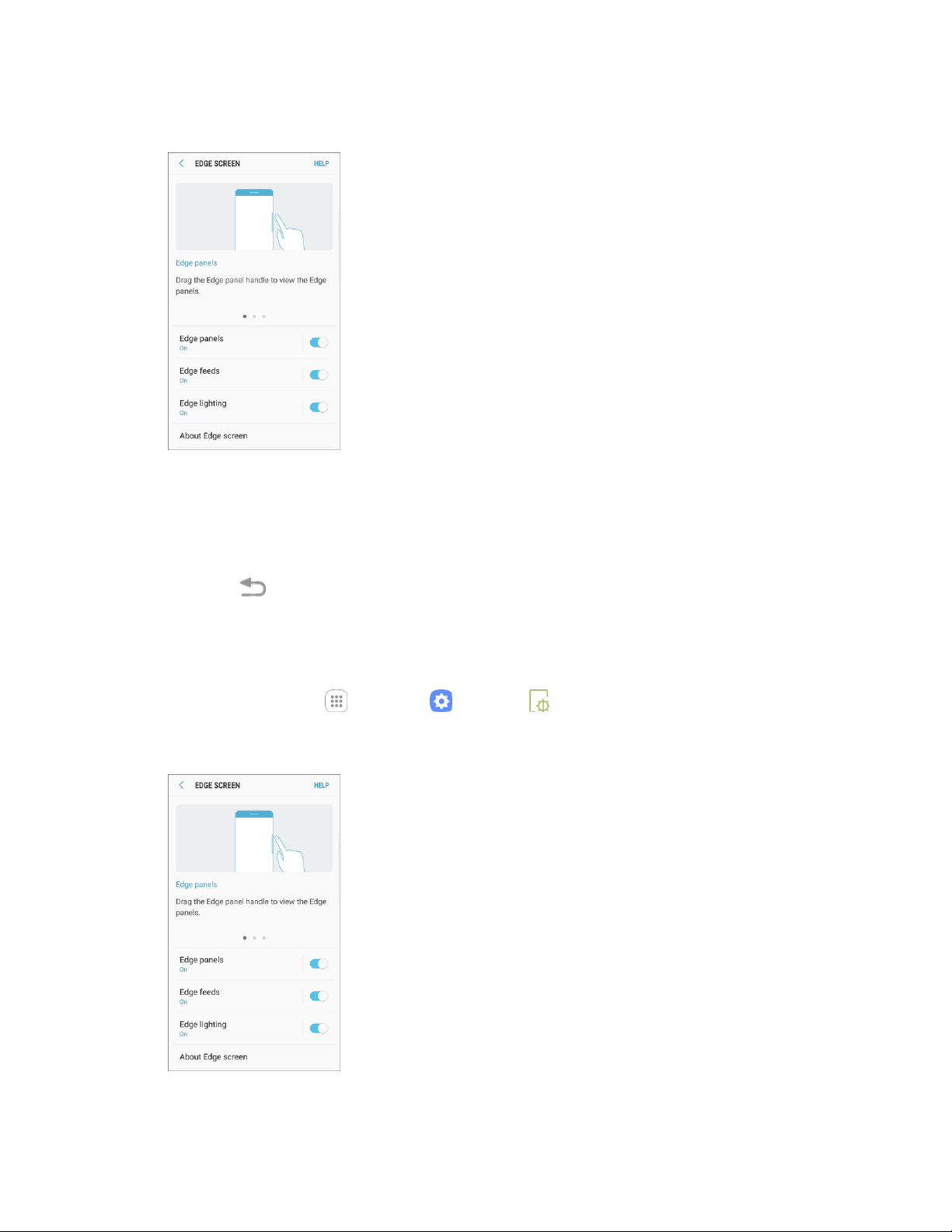
Settings 252
2. Tap Edge screen.
3. Tap Edge lighting > Quick reply.
4. Tap On/Off to enable Quick reply.
5. Tap the message to edit the text reply.
6. Tap Back to save changes.
About Edge Screen
You can view the current software version and license information for the Edge screen feature.
1. From home, tap Apps > Settings > Display .
2. Tap Edge screen.
3. Tap About Edge screen.
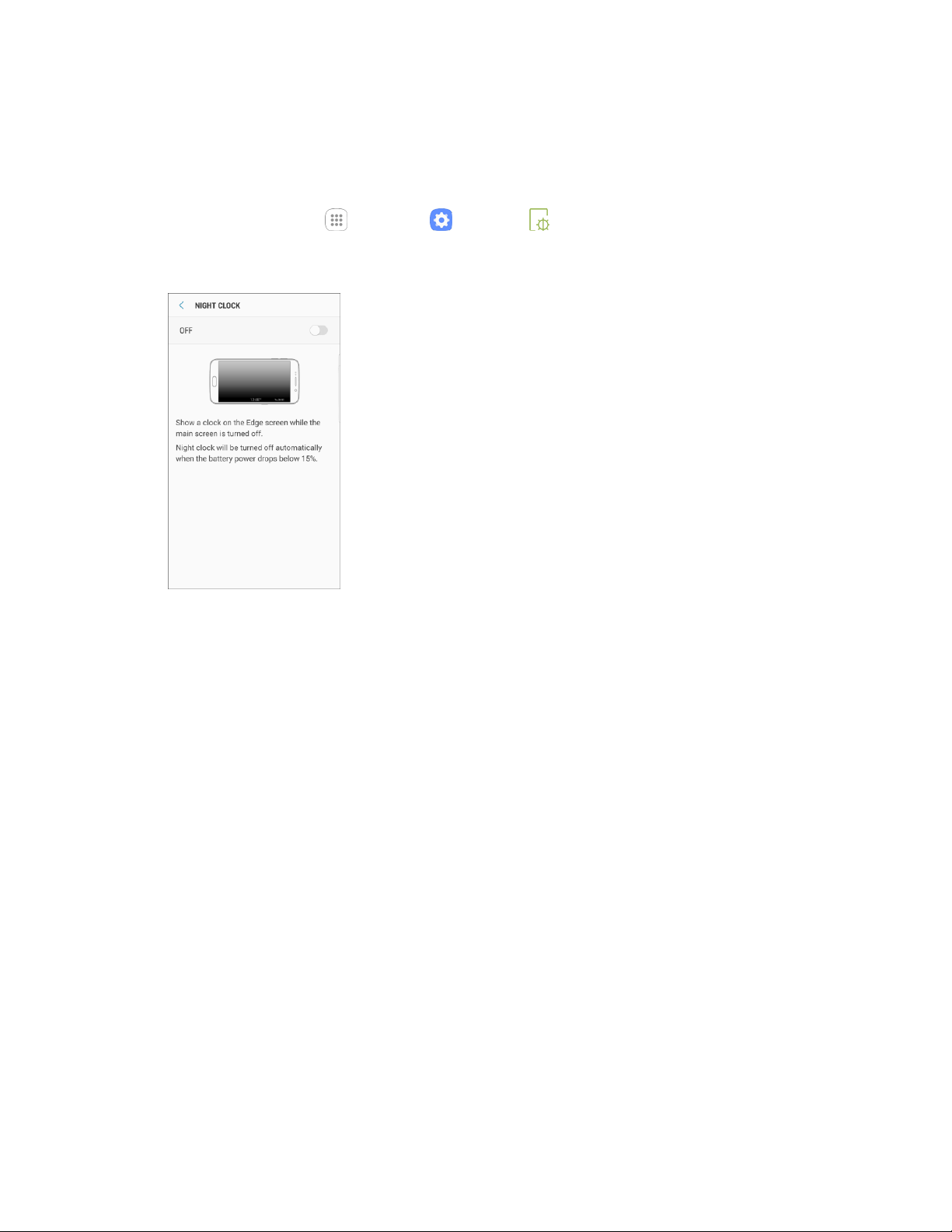
Settings 253
Night Clock
Set up a clock that displays on the Edge screen when the screen is off. Night mode is available for a
maximum of 12 hours.
1. From home, tap Apps > Settings > Display .
2. Tap Night clock.
3. Tap On/Off to enable the Night clock feature.
Tap Start to set the time for the Night clock to activate.
Tap End to set the time for the Night clock to deactivate.
Tap Night clock position to position the Night clock on the Right side or the Left side.
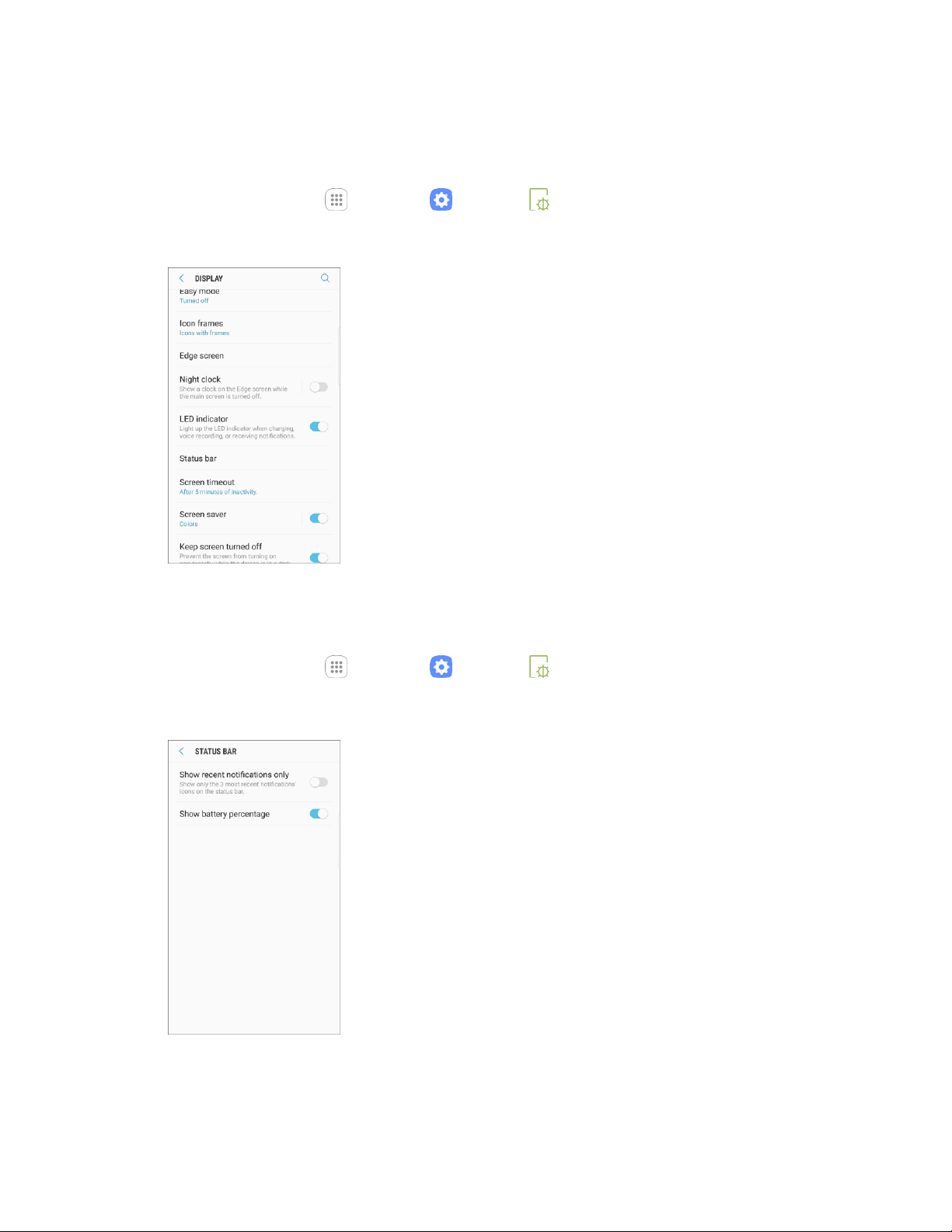
Settings 254
LED Indicator
Light up the LED indicator when charging, voice recording, or receiving notifications.
1. From home, tap Apps > Settings > Display .
2. Tap LED indicator to turn the feature on or off.
Status Bar Settings
You can determine which notifications appear on the status bar.
1. From home, tap Apps > Settings > Display .
2. Tap Status bar.
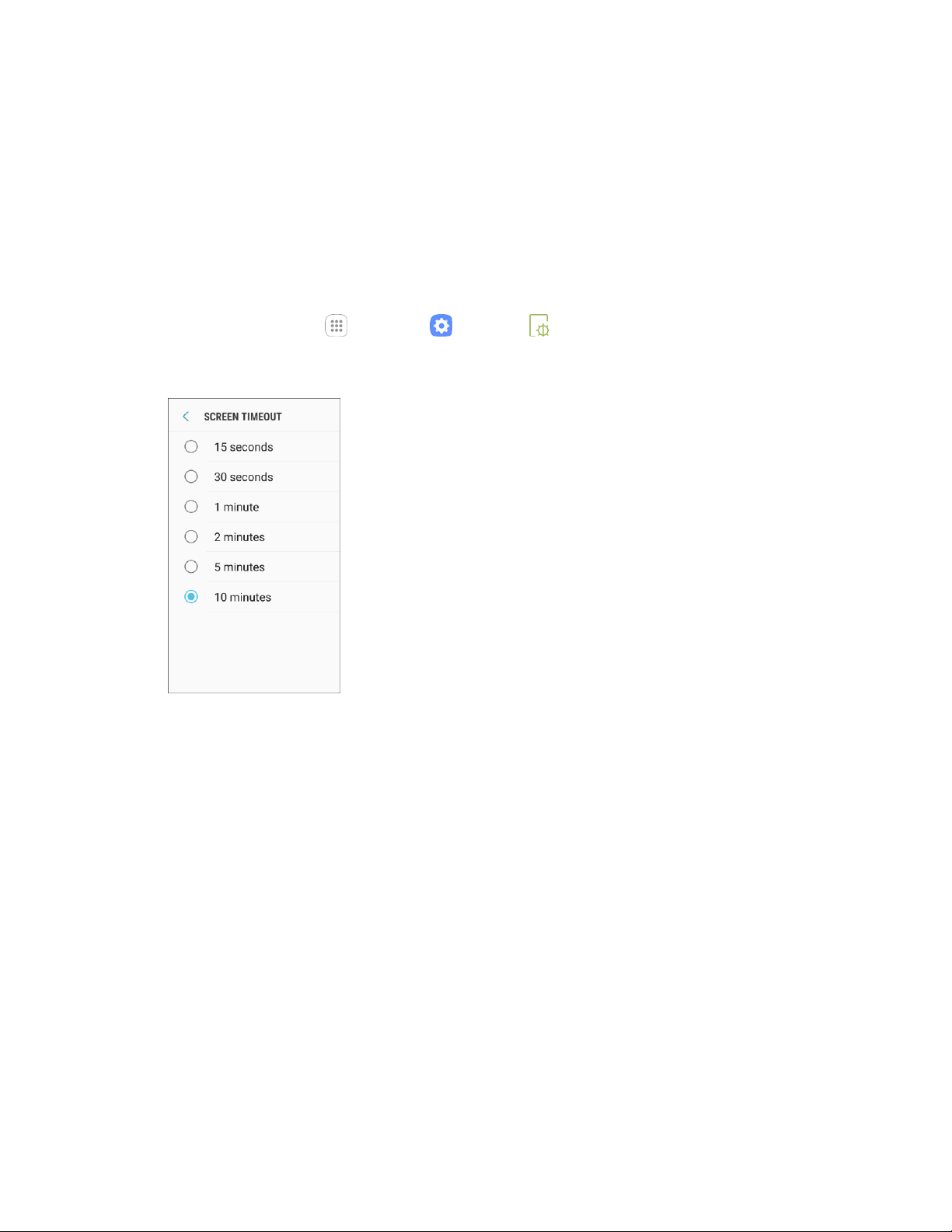
Settings 255
3. Tap On/Off to enable or disable the following options:
Show recent notifications only: Show only the three most recent notifications in the
status bar.
Show battery percentage: Show the battery charge percentage.
Screen Timeout
Turn the screen off after a set amount of time.
1. From home, tap Apps > Settings > Display .
2. Tap Screen timeout.
3. Choose a time period.
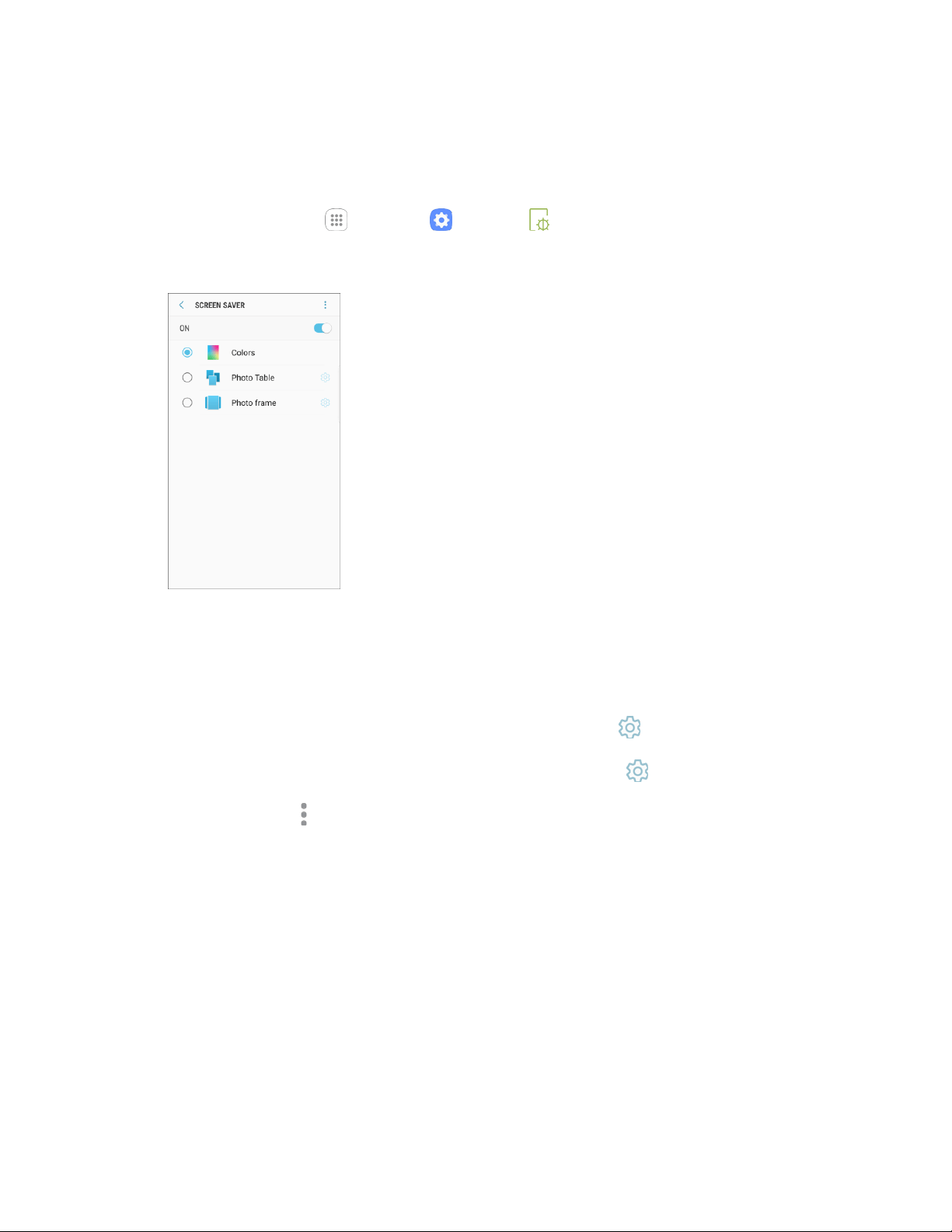
Settings 256
Screen Saver
Screen saver controls what is displayed on the screen when the device is charging. You can choose to
display colors or photos.
1. From home, tap Apps > Settings > Display .
2. Tap Screen saver.
3. Tap On/Off to enable Screen saver.
4. Configure options:
Colors: Tap the selector to display a changing screen of colors.
Photo Table: Display pictures in a photo table. Tap Settings for options.
Photo frame: Display pictures in a photo frame. Tap Settings for options.
More options :
• Preview: See a demonstration of Screen saver.
•
Select when to use: Turn on screen saver while the phone is docked (dock not
included), while charging, or both.
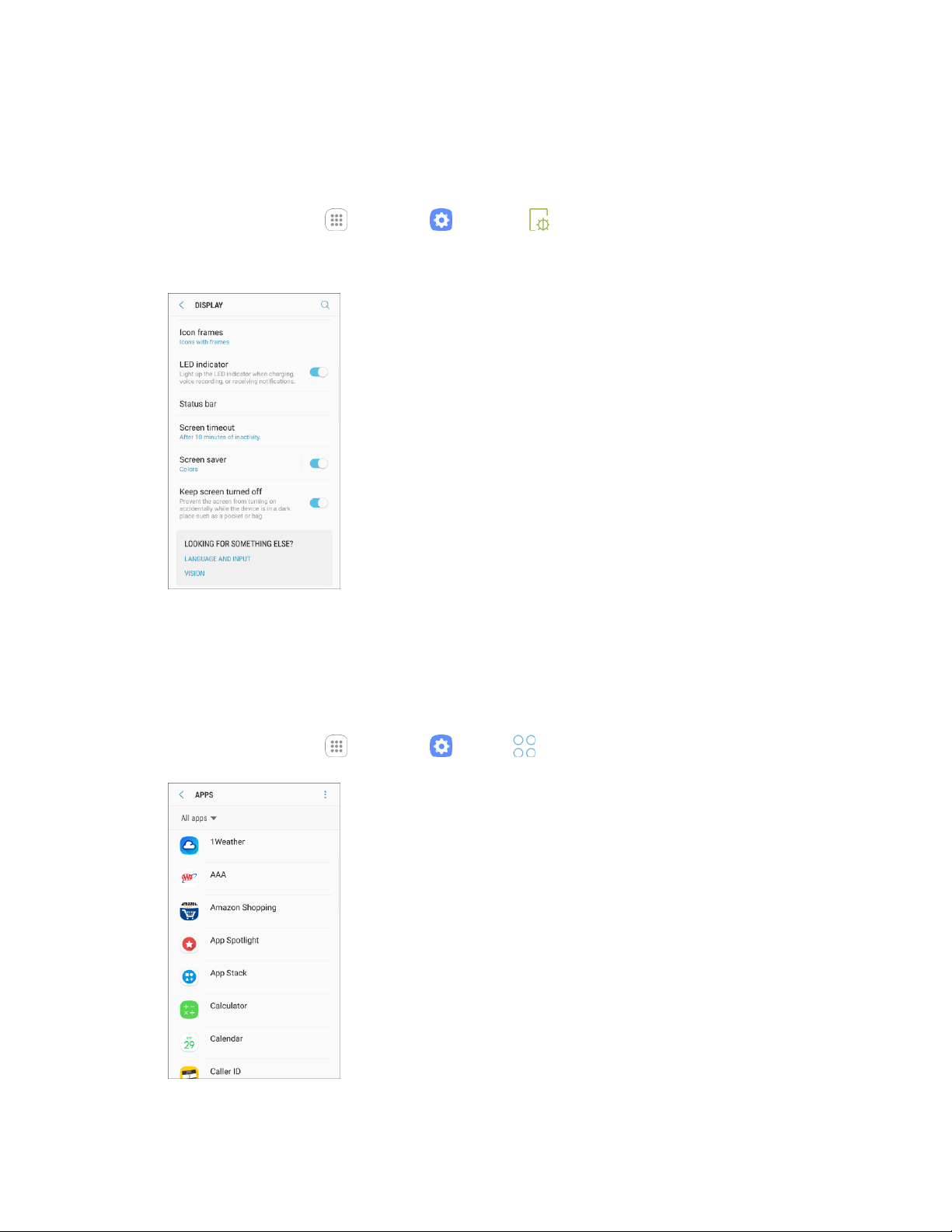
Settings 257
Keep Screen Turned Off
Prevent the screen from turning on accidentally while the device is in a dark place, such as a pocket or
bag.
1. From home, tap Apps > Settings > Display .
2. Tap Keep screen turned off to enable this feature.
Applications Settings
View information and configure settings for all apps on your phone.
Access Applications Settings
1. From home, tap Apps > Settings > Apps .
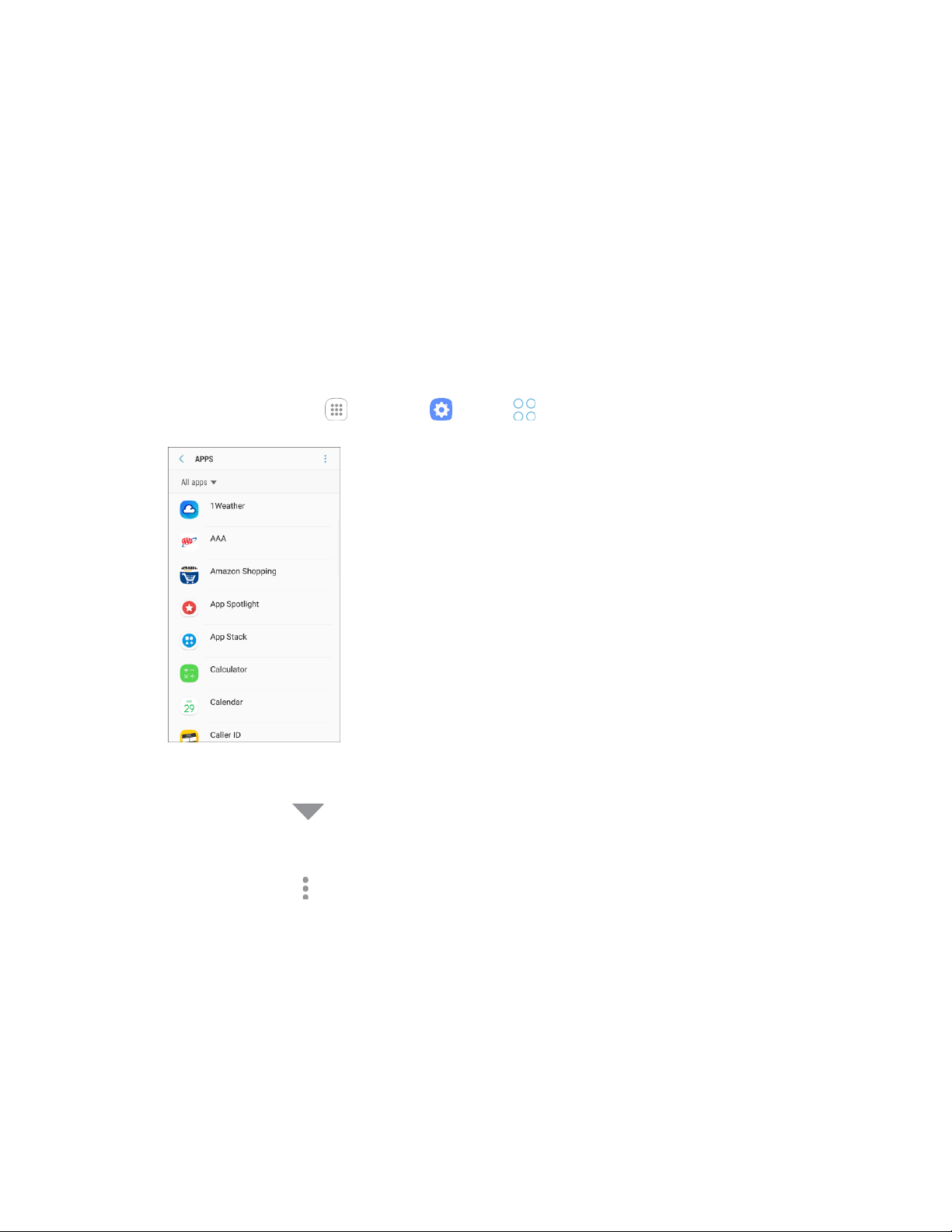
Settings 258
2. Tap on an app to view and configure its settings.
Depending on the app and its location, you may be able to force the app closed, uninstall or
disable the app, clear cache and data, and more.
Applications Overview
You can download and install new applications on your device. Use Application settings to manage your
downloaded and preloaded applications.
Warning: Because this device can be configured with system software not provided by or supported by
Google or any other company, you operate this software at your own risk.
Application Options
1. From home, tap Apps > Settings > Apps .
2. If you have disabled applications:
Tap All apps at the top left of the screen.
Tap All apps, Enabled, or Disabled.
3. Tap More options to configure the following:
Sort by size/name: Sort the apps by size or name.
Default apps: Choose or change apps that are used by default for certain features, like email
or browsing the Internet.
App permissions: Control which apps have permissions to use certain features of your
device.
Show/Hide system apps: Show or hide system (background) apps.
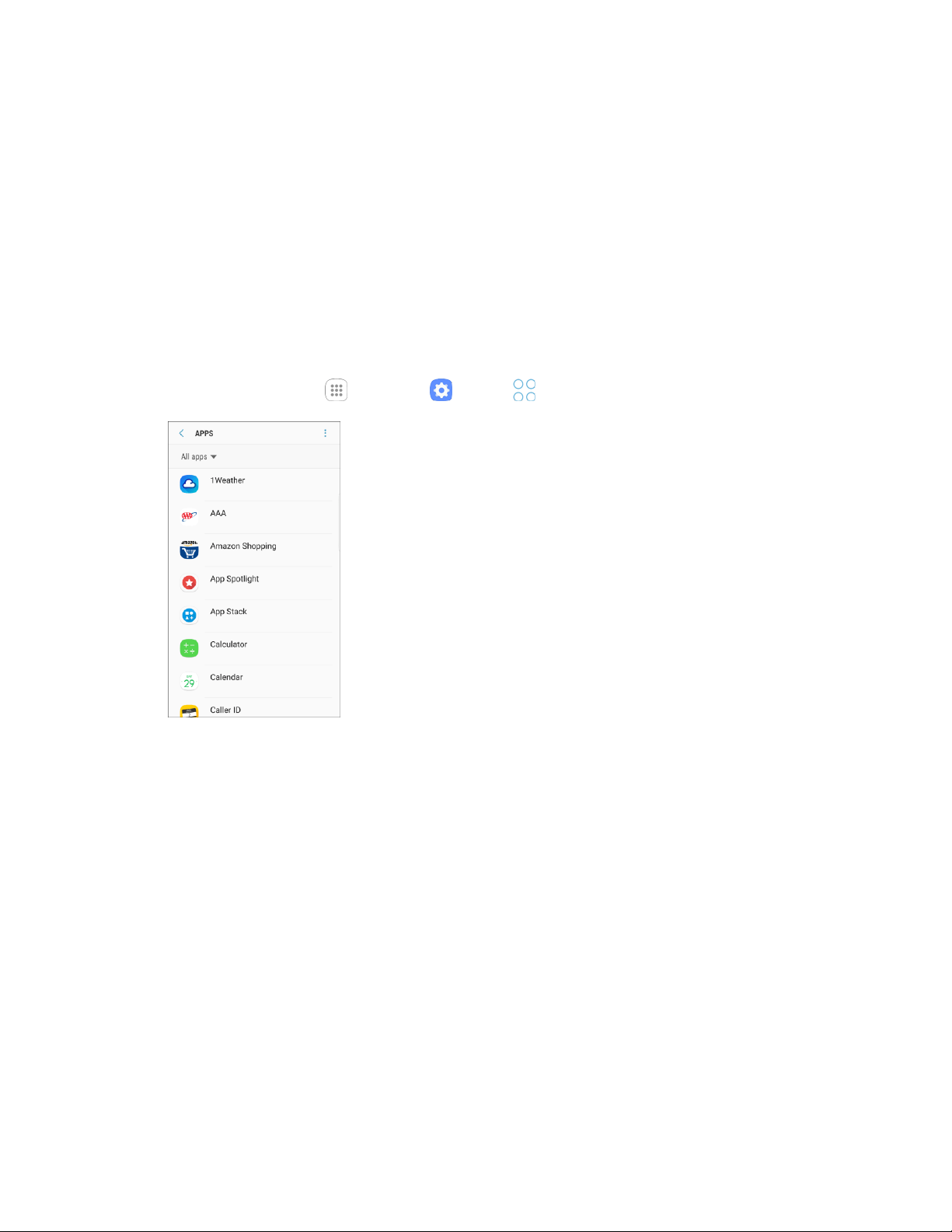
Settings 259
Special access: Optimize battery usage for individual apps, enable device administrator
apps, choose apps that can appear over other running apps, select which apps can change
system settings, and more.
Reset app preferences: Reset options that have been changed. Existing app data is not
deleted.
Note: Options vary by application.
Manage Apps
You can view and update information about an application, including memory usage, default settings, and
permissions.
1. From home, tap Apps > Settings > Apps .
2. Tap an application to view and update information about the application. The following options
are displayed:
Uninstall/Disable: Uninstall or disable the application. Preloaded apps can only be disabled.
Force stop: Stop an app that is misbehaving. Restart your device if stopping an app,
process, or service causes your device to stop working correctly.
Mobile data: View mobile data usage.
Battery: View battery usage since the last full charge.
Storage: Manage the app’s storage usage.
Memory: View memory usage.
Notifications: Configure notifications from the app.
Permissions: View permissions granted to the app for access to your device’s information.
Set as default: Set the app as a default for a certain category of apps.
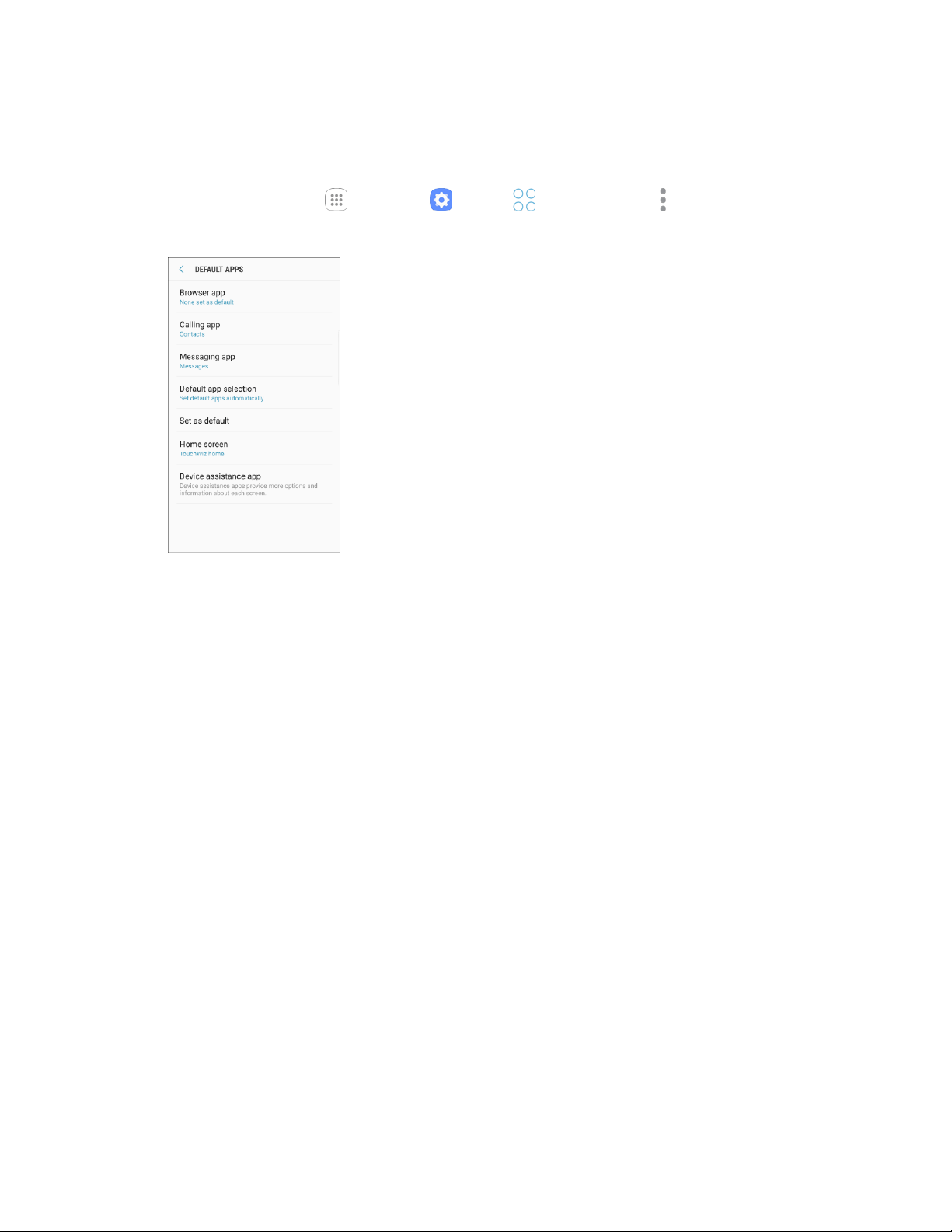
Settings 260
Default Applications
Set or clear default applications for certain built-in features of the phone.
1. From home, tap Apps > Settings > Apps > More options >
Default apps.
2. Tap each default setting to see what services or applications are available to set as the default.
Browser app: Choose a default browser app.
Calling app: Choose a default calling app.
Messaging app: Choose a default messaging (text and multimedia) app.
Default app selection: Automatically set default apps or be asked before setting an app as
the default.
Set as default: Choose default apps for other functions.
Home screen: Choose a Home screen type.
Device assistance app: Choose an app that provides assistance for using your device.
Note: If you choose a default messaging app other than Messages (Google Hangouts
™
for example), you
will not be able to use the Messages app unless you restore it as the default messaging app.
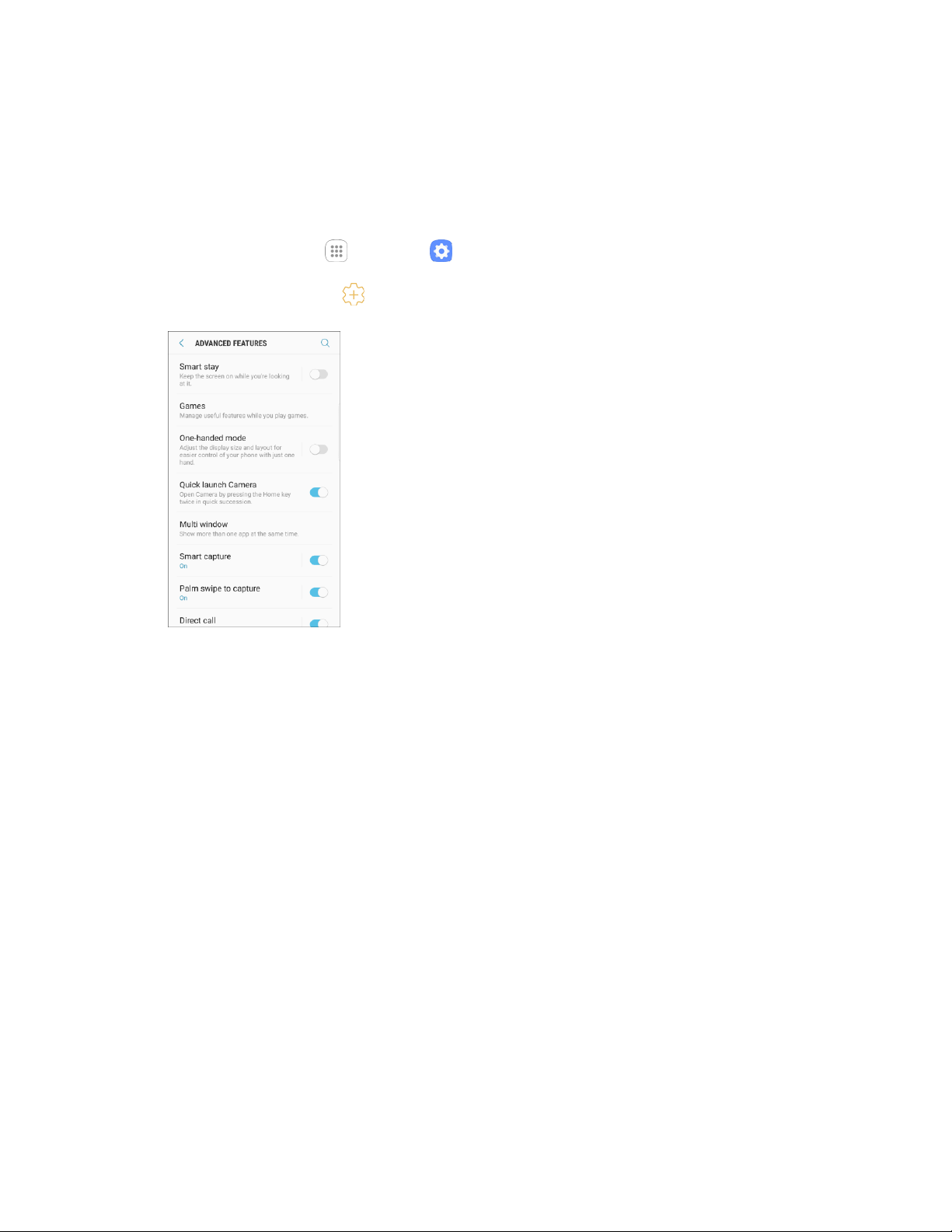
Settings 261
Advanced Features
Configure features on your device that make it easier to use. For example, you can control certain device
actions by picking up the phone and by touching the screen with the palm of your hand or turning over the
device.
1. From home, tap Apps > Settings .
2. Tap Advanced features .
3. Configure the following settings:
Smart Stay: Smart stay detects your face with the front camera so that the screen stays on
while you are looking at it.
Games: Manage useful features while you play games.
• Game Launcher: Automatically arranges all your games in one place.
• Game Tools: When enabled, a button floating over top of your game provides convenient
game features, such as No alerts during game, Minimize and alive, Screenshot, and
Record. Game tools can also access your Contacts, Storage, Microphone, and Camera.
One-handed mode: Adjust the screen size and layout for easy control of your device with
one hand.
Quick launch Camera: Open the Camera by quickly pressing the Home key twice.
Multi window: Show more than one app at the same time.
Smart capture: Capture an image of any scrollable areas of the screen that are currently
hidden, as well as the area that is visible, and crop and share the screenshot immediately.
Palm swipe to capture: Capture an image of the screen by swiping the edge of your hand
across it, from side to side, keeping in contact with the screen.
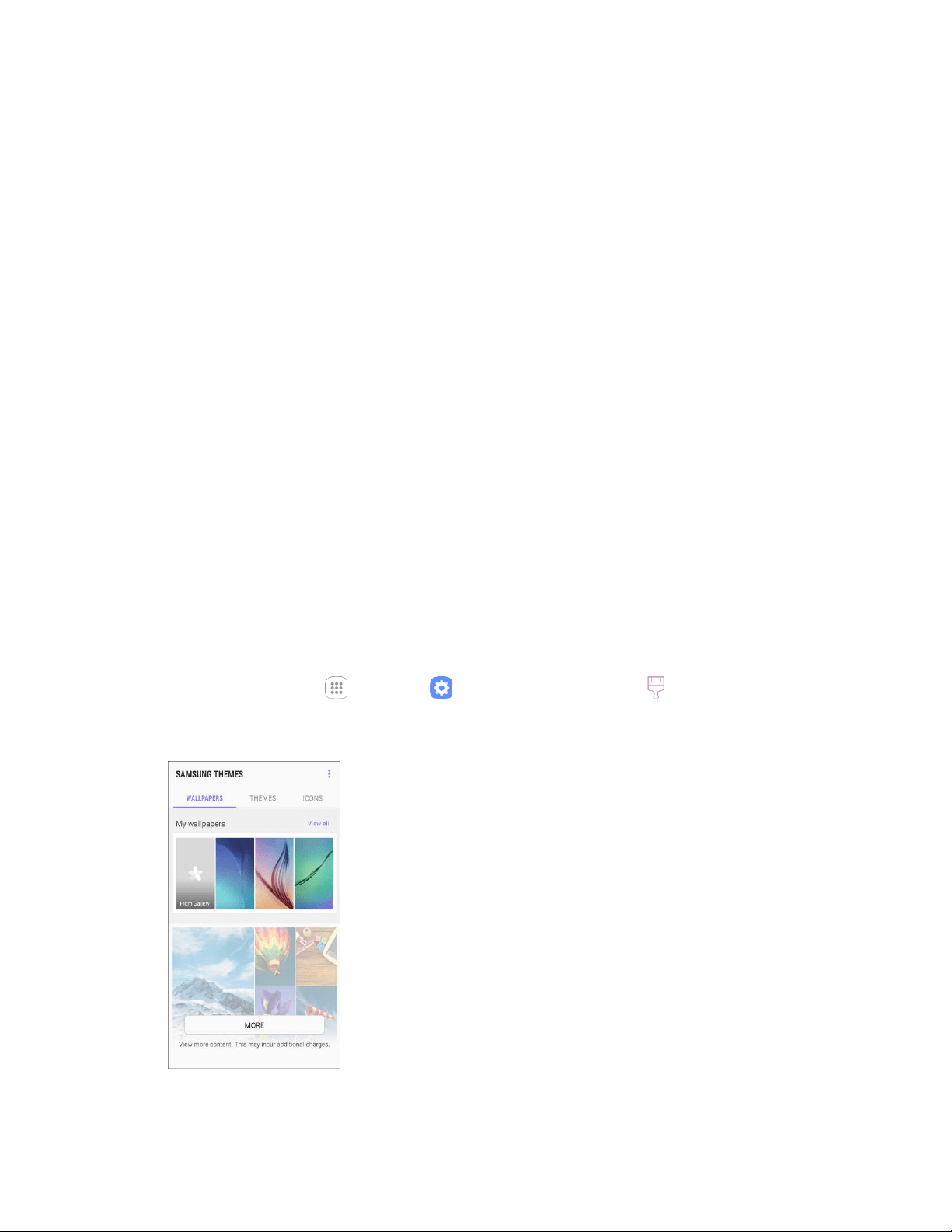
Settings 262
Direct call: Call the contact whose call log, message, or contact details are currently on the
screen by bringing the device close to your ear.
Smart alert: Set the device to vibrate when you pick it up to notify you about missed calls
and messages.
Easy mute: Mute sounds and video by covering the screen or turning over the device.
Send SOS messages: Send a quick alert to your primary contacts when you are in an
emergency situation by pressing the Power key quickly three times.
• Send messages to: Add recipients by creating new contacts or selecting from Contacts.
• Attach pictures: Send pictures to your emergency contacts.
• Attach audio recording: Send a short audio message to your emergency contacts.
Direct share: Share content with specific people directly using the sharing panel from within
any app.
Wallpapers and Themes
The following topics cover your phone’s Wallpapers and themes settings options.
Wallpaper
You can change the wallpaper for the Home and lock screens.
Change the Wallpaper
1. From home, tap Apps > Settings > Wallpapers and themes .
2. Tap Wallpaper.
For more information, see Change the Wallpaper.
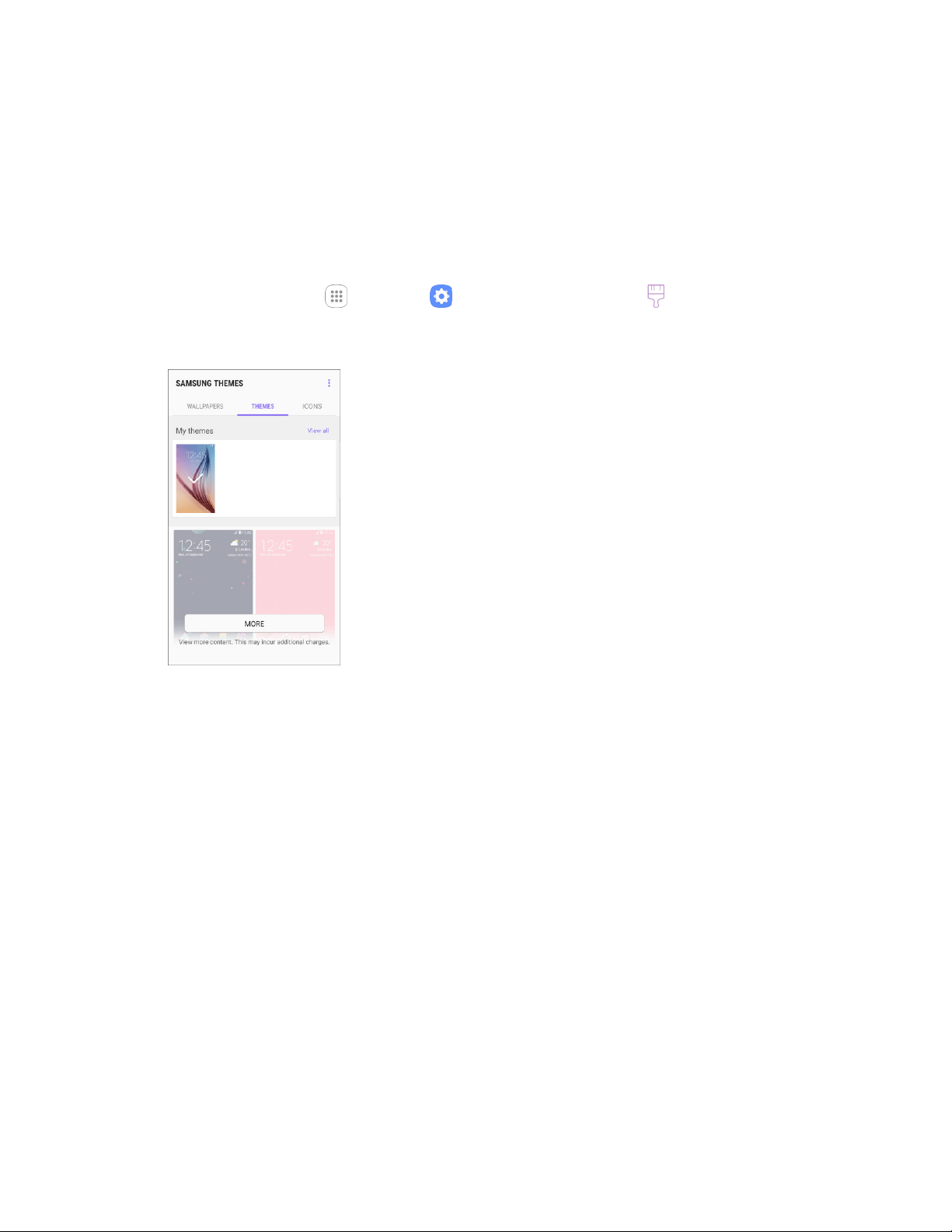
Settings 263
Note: Tap Motion effect to allow the wallpaper to shift slightly as you move the device, creating a 3D
effect.
Themes
Themes are packages of visual content that provide different wallpapers and icons for your phone.
Change the Theme
1. From home, tap Apps > Settings > Wallpapers and themes .
2. Tap Themes.
3. Tap a theme to preview it.
Tap View all to see all available themes.
4. To apply a theme, tap the theme, and then tap Apply.
Your theme is changed.
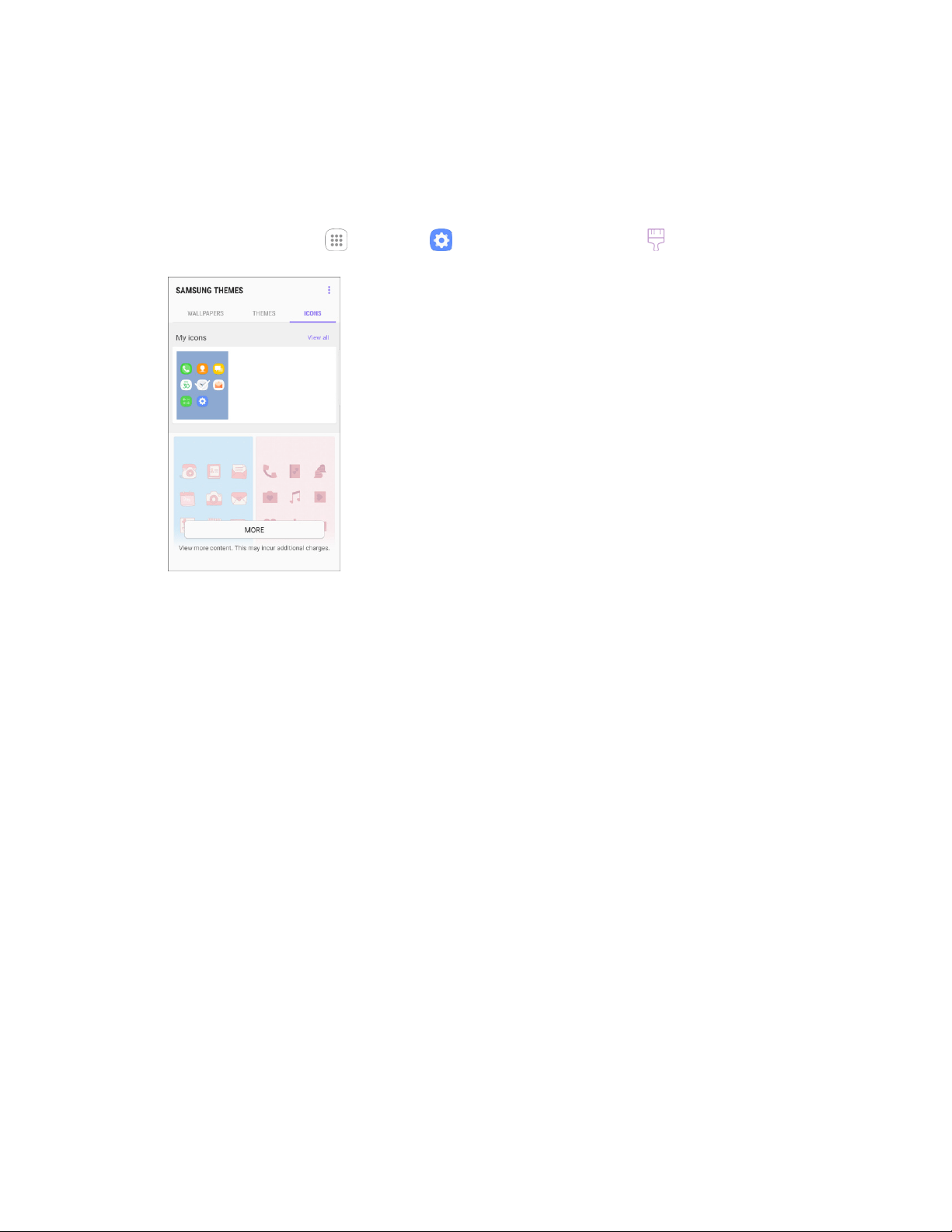
Settings 264
Icons
Apply custom icons to replace built-in app icons.
Change Icons
1. From home, tap Apps > Settings > Wallpapers and themes > Icons.
2. Tap an icon set to view a preview of the icons.
Tap View all to see all available icon sets.
3. Tap Apply to apply the selected icon set.
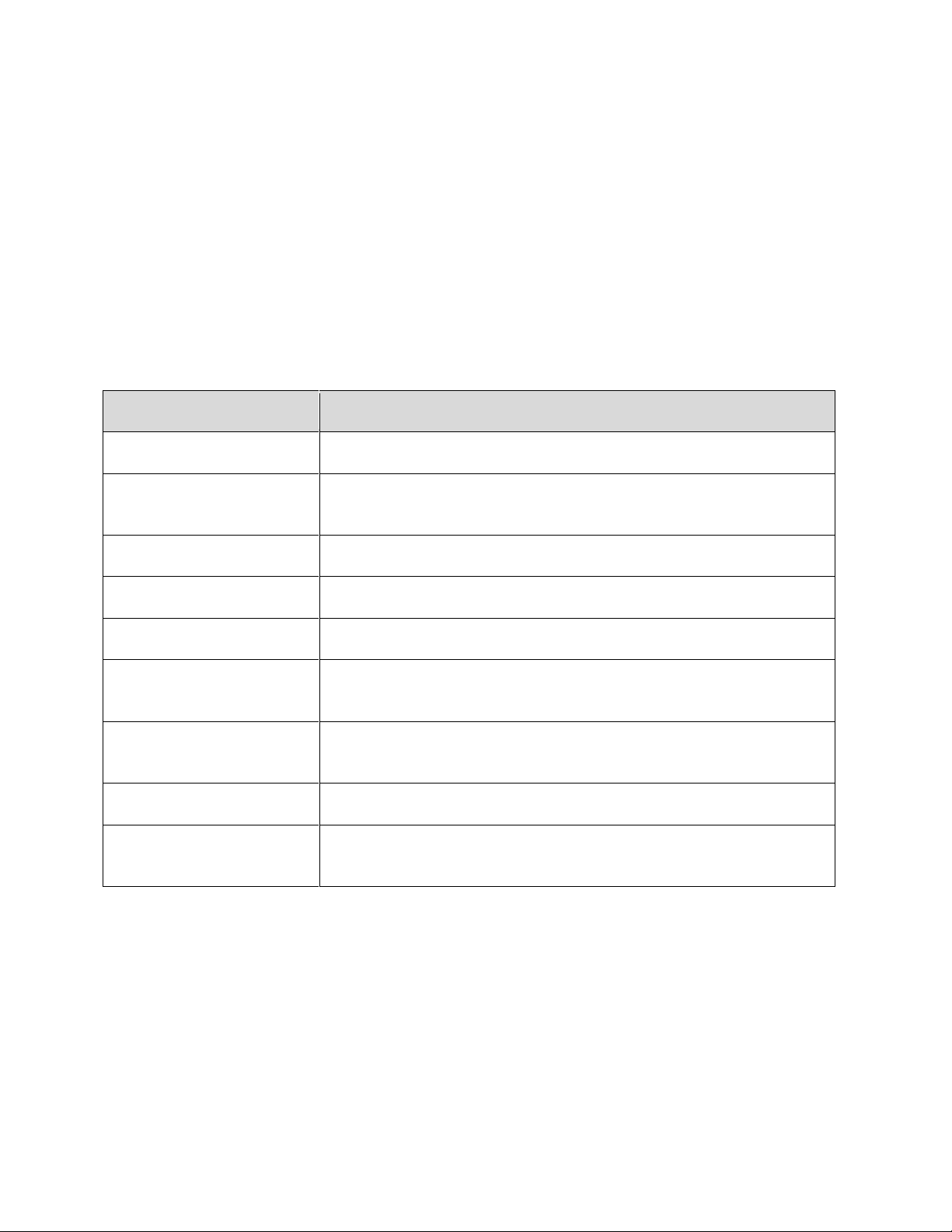
Settings 265
Lock Screen and Security Settings
The lock screen settings let you set your method for unlocking your phone, customize lock screen
options, determine whether to show tips for unlocking the phone, and enter your owner information to be
displayed on the lock screen.
The Security settings let you set encryption options, password visibility, administrator settings, and
credential storage options.
Lock Screen and Security Overview
The following options are available in the lock screen and security menu (options vary depending on the
screen lock selected):
Setting
Description
Screen lock type
Set your screen lock.
Info and app shortcuts
Select items to show on the lock screen, like a Dual clock, Owner
information, and app shortcuts.
Notifications
Show content and notifications on the lock screen.
Fingerprints
Register your fingerprint on your phone.
Samsung Pass
Use biometric authentication to verify your identity.
Unknown sources
Allow or deny installation of apps from sources other than the Google
Play store app.
Private mode
Hide personal content from being accessed by anyone else using your
device. Private mode is only available for certain applications.
Encrypt device
Protect your device by encrypting its data.
Other security settings
Configure settings for encryption, password visibility, security updates,
credentials, and other security features.
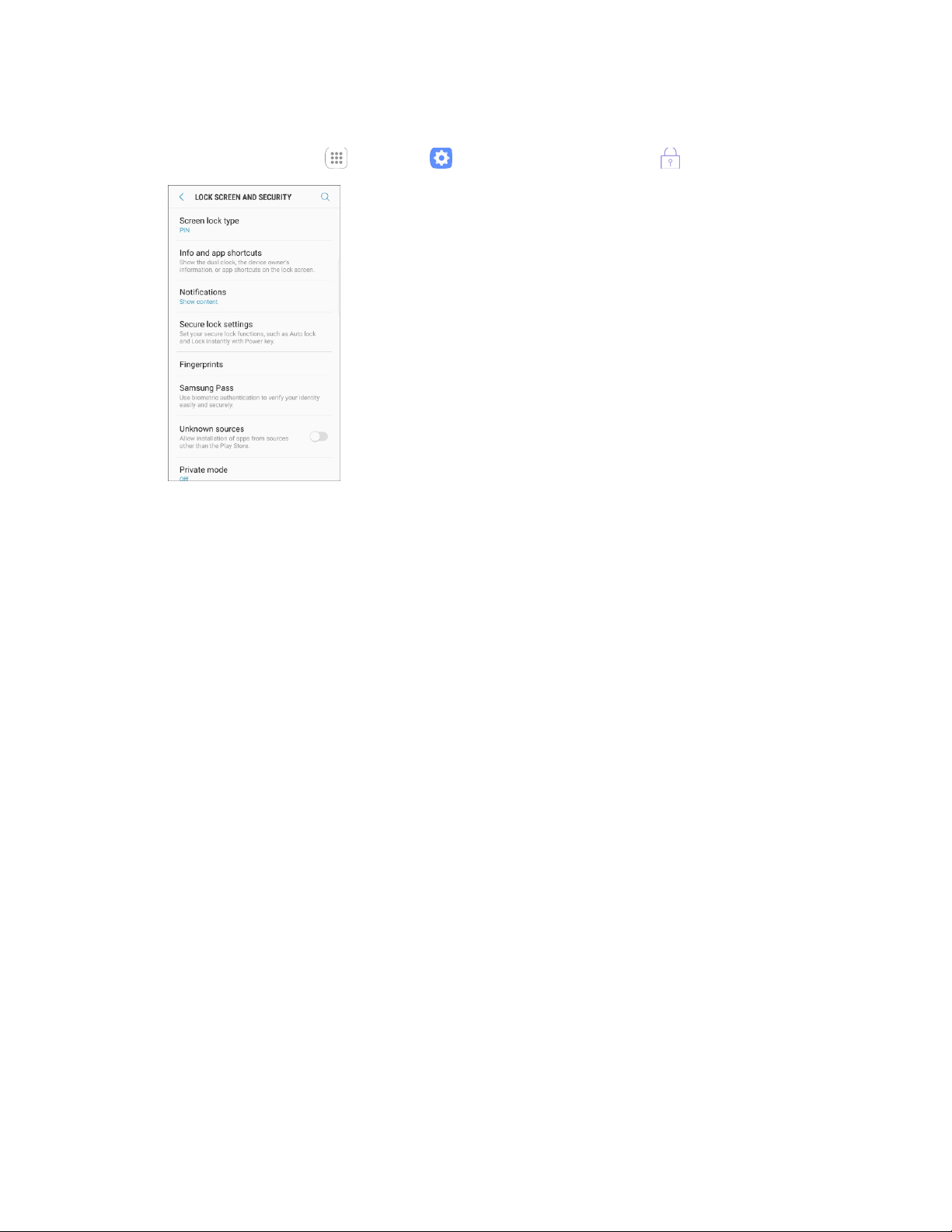
Settings 266
Access Lock Screen and Security Options
■ From home, tap Apps > Settings > Lock screen and security .
The lock screen and security menu opens.
Screen Lock
You can increase the security of your phone by creating a screen lock. When enabled, you have to draw
the correct unlock pattern on the screen, enter the correct PIN, enter the correct password, or scan your
fingerprint to unlock the phone’s control keys, buttons, and touchscreen.
In order from least secure to most secure, the available screen lock options are:
● None
● Swipe
● Pattern
● PIN
● Password
● Fingerprints
Important: To protect your phone and data from unauthorized access, it is recommended that you use
the highest security level available (Password or Fingerprint protection). It is also recommended you
frequently change your password to ensure the safety of your phone and personal data.

Settings 267
Access Screen Lock Settings
1. From home, tap Apps > Settings > Lock screen and security .
The lock screen and security menu opens.
2. Tap Screen lock type.
The Screen lock settings menu opens.
Use Swipe to Unlock the Screen
■ From the Screen lock type menu, tap Swipe to save the setting.
The screen lock is set.
Use a Screen Unlock Pattern
1. From the Screen lock type menu, tap Pattern.
2. Draw the screen unlock pattern by connecting at least four dots in a vertical, horizontal, or
diagonal direction. Lift your finger from the screen when finished.
The phone records the pattern.
3. Tap Continue.
4. When prompted, draw the screen unlock pattern again, and then tap Confirm.
The screen unlock pattern is saved.
Note: If you do not want the unlock pattern to display on the screen when you unlock it, from home, tap
Apps > Settings > Lock Screen and Security > Secure lock settings, and then tap On/Off
next to Make pattern visible to turn it off.
Use a Screen Unlock PIN
1. From the Screen lock type menu, tap PIN.
2. Enter a PIN, tap Continue, re-enter your PIN, and tap OK to save the setting.
The screen lock is set
If you fail to enter the correct PIN after five attempts, you will be prompted to wait for 30
seconds before you can try again.

Settings 268
Use a Screen Unlock Password
1. From the Screen lock type menu, tap Password.
2. Enter a password with at least 4 characters, including at least one letter, tap Continue, and then
enter your password again to confirm it.
The screen lock is set.
Important: To protect your phone and data from unauthorized access, it is recommended that you use
the screen unlock password (highest security). It is also recommended that you frequently change your
password to ensure the safety of your phone and personal data.
Use a Fingerprint Screen Lock
With a Fingerprint screen lock, swipe your finger over the Home key.
Note: Before using the Fingerprint screen lock option, you will need to register your fingerprint on your
phone.
1. From the Screen lock type menu, tap Fingerprints.
2. Follow the prompts to set up your fingerprints.
Note: Fingerprint recognition uses the unique characteristics of each fingerprint to enhance the security of
your device. The likelihood of the fingerprint sensor confusing even small areas of two different
fingerprints is very low. But in rare cases, the sensor may recognize a fingerprint that is similar to a
registered fingerprint.
Disable the Screen Lock
Follow the instructions below to turn off your current screen lock.
1. From home, tap Apps > Settings > Lock screen and security .
The lock screen and security menu opens.
2. Tap Screen lock type.
The Screen lock settings menu opens.
3. Draw your unlock screen pattern, enter your PIN or password, or scan your fingerprint.
4. Tap None.
The screen lock is disabled.

Settings 269
Device Security
Configure security for your phone.
1. From home, tap Apps > Settings > Lock screen and security .
The lock screen and security menu opens.
2. Tap On/Off next to Unknown sources to enable installation of non-Google Play applications.
Warning: Enabling installation of third-party applications can cause your device and personal data to be
more vulnerable to attacks by unknown sources.
3. Tap Private mode to hide personal content from being accessed by anyone else using your
device. Private mode is only available for certain applications.
4. Tap Encrypt device and follow the prompts to encrypt all data on your phone.
5. Tap Other security settings to configure the following options:
Make passwords visible: Display password characters briefly as you type them.
Security policy updates: Automatically or manually check for security policy updates.
Send security reports: Send security reports to Samsung via Wi-Fi for threat analysis.
Device administrators: Manage your device administrators and application installation
privileges.
Storage type: Select a storage location for credential contents.
View security certificates: Display certificates in your device’s ROM and other certificates
you have installed.
User certificates: View user certificates.
Install from device storage: Install a new certificate from storage.
Clear credentials: Erase the credential contents from the device and reset the password.
Trust agents: Perform selected actions when trusted devices are connected.
• To view Trust agents, set up a screen lock (Password, PIN, Pattern, or Fingerprint). For
more information, see Screen Lock.
Pin windows: Pin an app on your device screen, preventing access to other features of your
phone.
Usage data access: View the applications that can access your device’s usage history.
Notification access: View the applications that can access notifications you receive on your
phone.
Do not disturb permission: View which apps have permission to change the Do not disturb
settings.
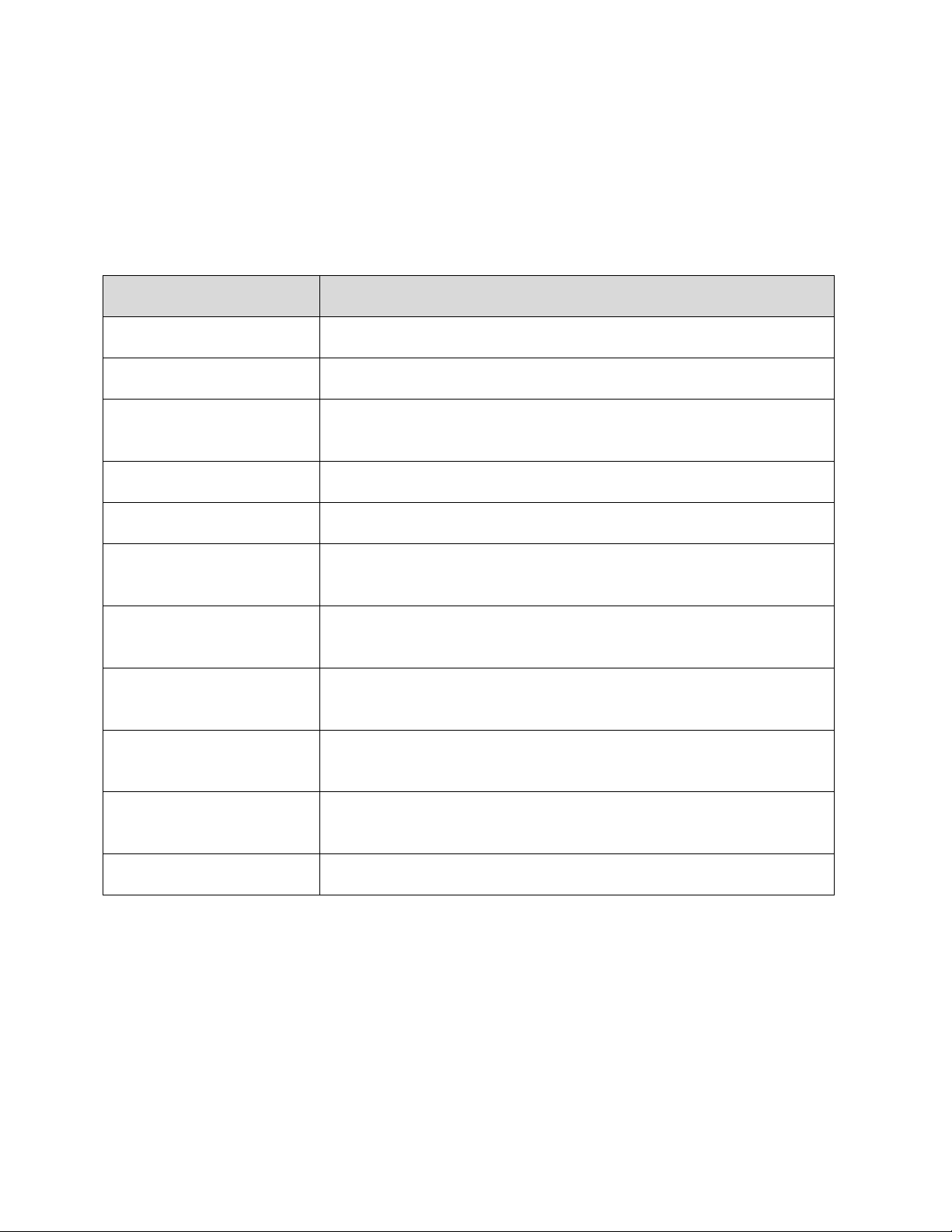
Settings 270
Accessibility Settings
The Accessibility menu lets you enable and manage accessibility-related applications.
Accessibility Settings Overview
The following Accessibility options may be configured:
Accessibility Option
Description
Vision
Configure accessibility features for vision.
Hearing
Configure accessibility features for hearing and sounds.
Dexterity and interaction
Configure accessibility features for handling and interactions with the
phone.
Text-to-speech
Configure options for converting text to speech.
Direction lock
Unlock the screen by swiping in a series of directions.
Direct access
Open your accessibility settings by pressing the Home key three times
in quick succession.
Notification reminder
Set the phone to beep or vibrate at set intervals to remind you of any
unread notifications from selected applications.
Answering and ending
calls
Answer calls by pressing the Home key, and end calls by pressing the
Power key.
Single tap mode
Dismiss or snooze alarms, calendar events, and timer alerts, and
answer or reject incoming calls with a single tap.
Manage accessibility
Import and export your accessibility settings, or share them with other
devices.
Services
Configure other accessibility services, if installed.
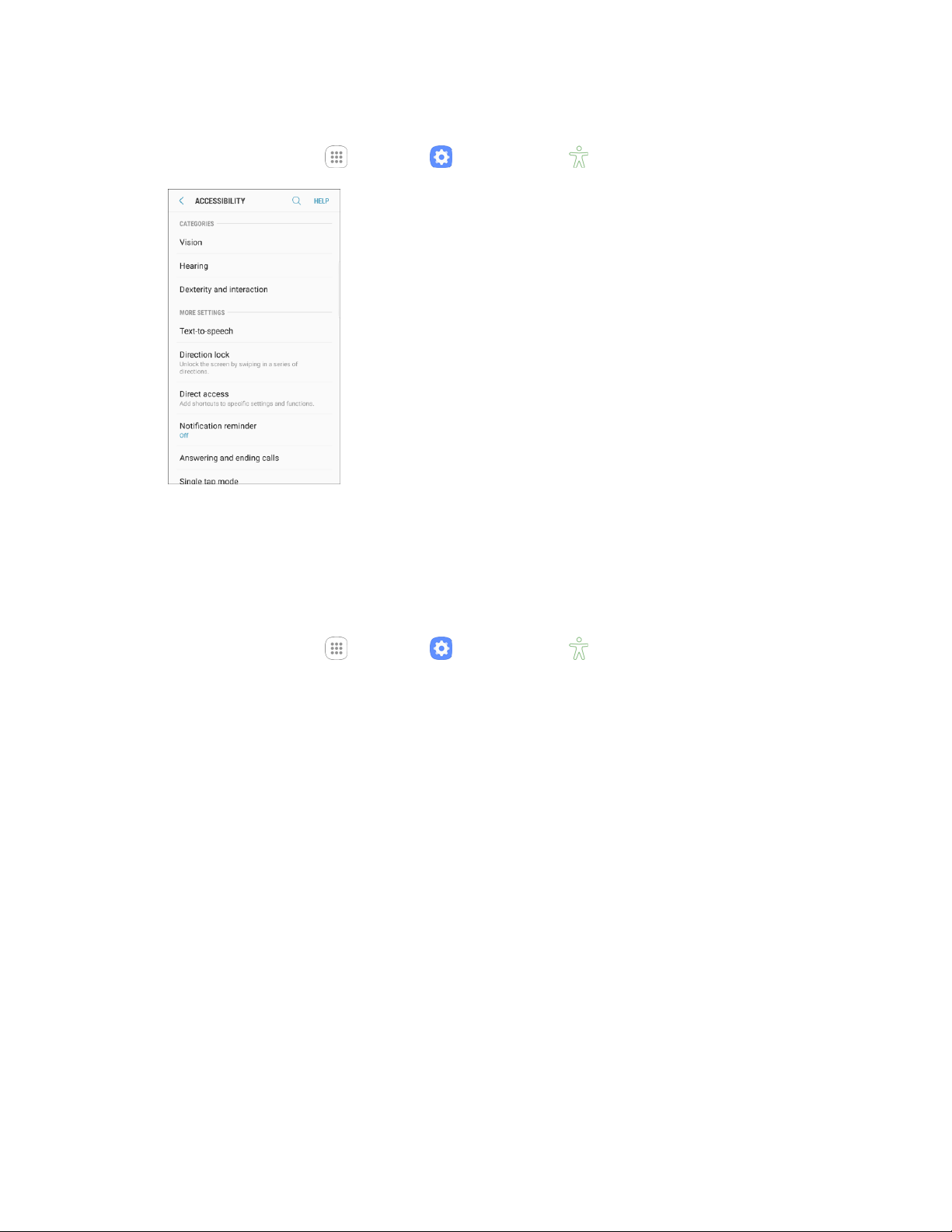
Settings 271
Access Accessibility Options
1. From home, tap Apps > Settings > Accessibility .
2. Set available accessibility options.
Your accessibility settings are applied and saved.
Vision Accessibility Settings
Your phone offers many features to assist users who are blind or low-vision.
1. From home, tap Apps > Settings > Accessibility .
2. Tap Vision to configure options:
Voice Assistant: Enable the Voice Assistant feature and configure options. When Voice
Assistant is on, your phone speaks descriptions of items you tap or activate on your phone, to
help blind and low-vision users. When Voice Assistant is turned on, you may need to use a
double-tap to select items, because a single tap is used to trigger Voice Assistant.
Voice Assistant help: View tutorials on using Voice Assistant.
Dark screen: Keeps your phone’s screen turned off at all times. When Dark screen is
enabled, double-press the Power key to turn it on or off while using your phone.
Rapid key input: Release your finger to enter a selection, instead of double-tapping it. By
default, when you have Voice Assistant turned on, you must double-tap items on the screen
to select them. If you turn on Rapid key input, you can tap and release your finger to select
and item instead of double-tapping.
Speak passwords: The phone reads out characters entered in password fields. Use caution
with this feature, because others near you will be able to hear your passwords.
Accessibility shortcut: Quickly turns on accessibility features by pressing and holding the
Power key until you hear a sound or feel a vibration, and then pressing and holding with two
fingers until you hear an audio confirmation.

Settings 272
Voice label: Write voice recordings to NFC tags to provide information about nearby objects.
Screen zoom and font size: Set the zoom size, font size, and style
High contrast fonts: Adjust the color and outline of fonts to increase the contrast with the
background.
High contrast keyboard: Adjust the size of the Samsung keyboard and change its colors to
increase the contrast between the keys and the background.
Show button shapes: Show buttons with shaded backgrounds to make them stand out.
Magnifier window: Magnify content shown on the screen.
Magnification gestures: Control zoom and pan options with specific gestures such as triple-
tapping, double pinching, and dragging two fingers across the screen.
Large mouse/touchpad pointer: Enable to display a large mouse or touchpad pointer.
Grayscale: Display screens in grayscale instead of color.
Negative colors: Screen colors are reversed.
Color adjustment: Adjusts the color of the screen if you have difficulty reading the screen
because of the color. Follow the prompts to fine-tune screen colors.
Hearing Accessibility Settings
Your phone offers many features to assist users who are deaf or hearing-impaired.
1. From home, tap Apps > Settings > Accessibility .
2. Tap Hearing to configure options:
Sound detectors: Vibrate when the phone detects a baby crying or doorbell ring.
Flash notification: Flash the camera light when you receive notifications or when alarms
sound. Turn the device over to stop the flashing.
Mute all sounds: Sounds made by the phone during taps, selections, notifications, are
muted.
Hearing aids: Automatically adjusts to attempt to improve the sound quality for use with
hearing aids.
Samsung subtitles (CC): Displays Samsung subtitles where available. Tap On/Off to turn
the option on or off, and then configure options.
Google subtitles (CC): Displays Google subtitles where available. Tap On/Off to turn the
option on or off, and then configure options like Language, Text size, and Caption style.
Left/right sound balance: Adjust the sound sent to the left and right when using earphones.
Mono audio: Enable or disable the compression of stereo audio into a single mono audio
stream for use with a single earphone.

Settings 273
Dexterity and Interaction Settings
Your phone offers many features to improve accessibility related to the way you interact with touch and
movement.
1. From home, tap Apps > Settings > Accessibility .
2. Tap Dexterity and interaction to configure options:
Universal switch: Use customizable switches to interact with your phone and to select items
on the screen. Set your personal interaction method by connecting external accessories,
tapping the screen, or using the front camera to detect the rotation of your head, the opening
of your mouth, and the blinking of your eyes.
Assistant menu: Assistant menu can improve phone accessibility by providing quick access
to important functions. A shortcut appears on all screens to give you access to the
Assistant menu. Tap Assistant menu to configure options:
• Tap On/Off beside Assistant menu to turn the feature on or off. When you turn on
Assistant menu, Single tap mode is also enabled.
• Edit: Re-order or remove items from the Assistant menu.
• Assistant plus: When turned on, Assistant plus displays contextual menu options for
some apps in Assistant menu. Not all apps support this option. Tap Assistant plus, and
then tap On/Off to turn the option on or off. After you turn on Assistant plus, enable or
disable apps to use with Assistant plus.
• Touchpad size: Choose a size for touchpads for use in your phone’s screens.
• Cursor size: Choose the size of cursors, to display on the screen.
• Cursor speed: Choose a speed for cursor blinks.
• Zoom percentage: Set the percentage of zooming in when using Assistant menu.
• Magnifier size: Set the size of magnification when using Assistant menu.
Easy screen turn on: Move your hand over the screen to turn it on when the phone is face
up on a stable surface.
Press and hold delay: Choose how long your phone waits during a touch and hold gesture
on the screen, before continuing with the touch and hold action.
Click after pointer stops: If you use a mouse with your device, tap On/Off to enable this
option, which causes your device to automatically click when the mouse cursor stops moving.
Drag the Delay before click slider to set the amount of time to delay the click once the
mouse cursor stops moving

Settings 274
Interaction control: Control how your phone interprets motions and screen touches. To turn
Interaction control on or off at any time, press and hold the Home key and the down Volume
key at the same time. When Interaction control is on, you can use motions to control your
phone, and screen timeout is turned on. You can also block areas of the screen from touch
interaction. Automatic screen rotation and hard-key functions (Power/Lock key, Volume key,
etc.) will be turned off, and app notifications will only be shown in the notification panel and
status bar.
Configure Other Accessibility Settings
Your phone offers many features to improve phone accessibility.
1. From home, tap Apps > Settings > Accessibility .
2. Configure additional accessibility options:
Text-to-speech: Set your preferred TTS engine and options. For more information, see
Language and Input Settings.
Direction lock: Unlock the screen by swiping in a series of directions.
Direct access: Access common accessibility settings from any screen by pressing the Home
key rapidly 3 times in a row.
Notification reminder: Phone beeps at set intervals to remind you of unread notifications.
Answering and ending calls: Select options for answering and ending calls.
• Press Home key to answer calls: Answer calls by pressing the Home key.
• Answer calls with voice: Say “Answer” or “Reject” to answer or reject calls with your
voice.
• Automatic answering: Answer incoming calls automatically after 2 seconds while a
headset or a Bluetooth device is connected.
• Press Power key to end calls: End calls by pressing the Power key.
Single tap mode: When enabled, you can use a single tap to dismiss or snooze alarms,
notifications and alerts, and answer or reject calls.
Manage accessibility: Choose settings for exporting, updating, and sharing the accessibility
settings as a file.
Note: Additional accessibility services you have installed are displayed under the Services heading.
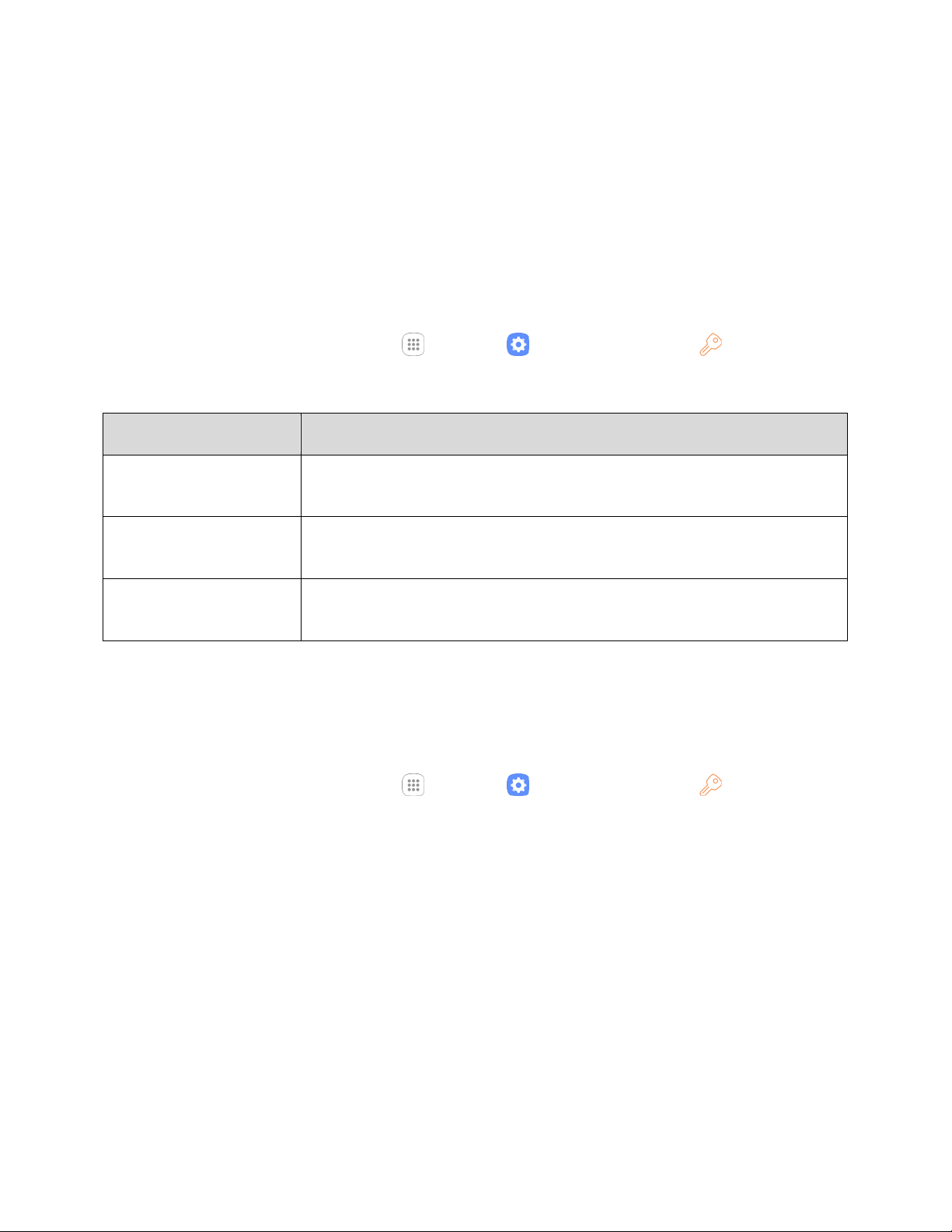
Settings 275
Cloud and Accounts
The Accounts settings menu lets you add and manage all your email, social networking, and picture and
video sharing accounts.
Set up and manage accounts, including your Google Account, Samsung account, email, and social
networking accounts. Depending on the account, you can choose to synchronize your calendar, contacts,
and other types of content.
Access Cloud and Accounts Settings
■ From the home screen, tap Apps > Settings > Cloud and accounts .
The table below outlines your Cloud and accounts settings.
Category
Description
Samsung Cloud
Keep your data safe by backing up and restoring your device. You can also
sync your data from multiple devices.
Accounts
Add and manage all your email, social networking, and picture and video
sharing accounts.
Backup and Reset
Back up your phone’s data and settings to Google servers before resetting
your phone to the original factory settings.
Samsung Cloud
Keep your data safe by backing up and restoring your device. You can also sync your data from multiple
devices.
1. From the home screen, tap Apps > Settings > Cloud and accounts .
2. Tap Samsung cloud.
If a Samsung account has not been added, tap Create account and follow the prompts.
3. From the Samsung cloud menu, the following options are available:
Manage cloud storage: View how much cloud storage your data is using.
Backup settings: Choose which content from your device to back up to the cloud. Tap Auto
back up to automatically back up your data every 24 hours.
Restore: Choose the device that you have recently backed up and the backup package that
you want to restore.
Data to sync: Tap the following items to enable or disable syncing:
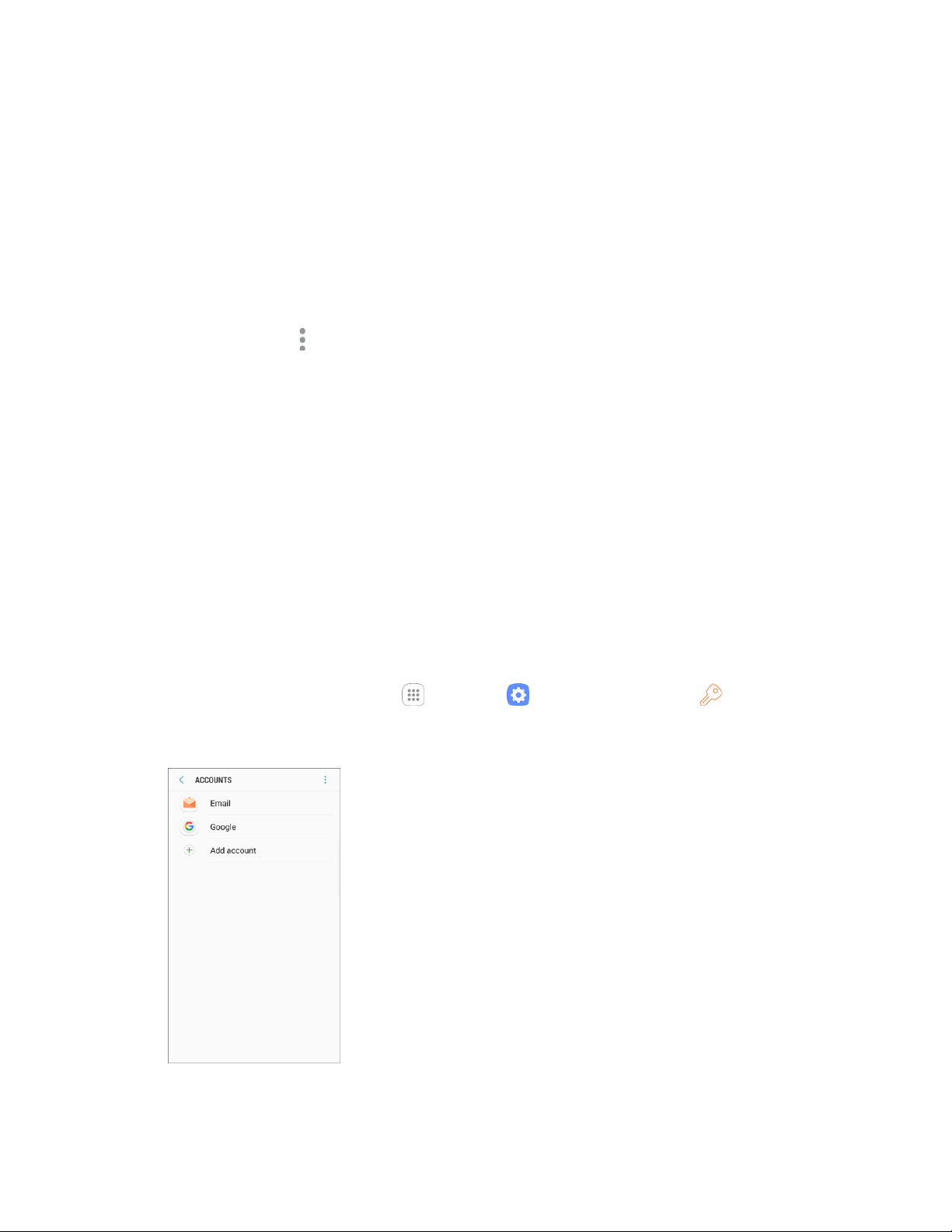
Settings 276
• Contacts (Samsung account): Sync contact info.
• Calendar (Samsung account): Sync your events and tasks.
• Memo: Sync your notes and categories.
• Internet: Sync bookmarks, saved pages, and opened tabs from your browser.
• Keyboard data: Sync predictive text data.
• Gallery: Sync your images and videos.
More options :
• Sync now: Sync all selected settings.
• Sync information: View what information will be synced on your phone.
• Settings: Limit syncing data to when the device is connected to a Wi-Fi network. Receive
push notifications. Remove your Samsung account.
• FAQ: Go to the Customer Support website for Samsung Cloud information.
• Contact us: Go to the Customer Support website and submit a question online.
Accounts
Add and manage all your email, social networking, and picture and video sharing accounts.
Set Up a New Account
1. From the home screen, tap Apps > Settings > Cloud and accounts .
2. Tap Accounts > Add account.
An Add account window appears.
Settings 277
3. Tap an account type and then follow the prompts to add the required account information.
The account is added to the accounts list.
Manage Existing Accounts
1. From home, tap Apps > Settings > Cloud and accounts > Accounts.
2. Tap the account type to see the existing accounts.
The account settings menu appears.
3. View and configure your account settings as desired.
The account options are updated.
Backup and Restore
Your phone’s Backup and restore menu lets you back up your phone’s data and settings to Google
servers before resetting your phone to the original factory settings. The Factory data reset erases all data
from the phone’s application storage, including:
● Your Samsung account
● Your Google Account
● All other email and social networking accounts
● System and application data and settings
● Downloaded applications
Backup and Restore Overview
The following options are available in the Backup and restore menu:
Backup and Restore Option
Description
Backup settings
Enable backup for application data, Wi-Fi passwords, and other
settings to your Samsung account.
Restore
When reinstalling an application, backed up settings and data will be
restored from your Samsung account.
Back up my data
Enable backup for application data, Wi-Fi passwords, and other
settings to your Google Account.
Backup account
Select the Google Account used to back up data.
Automatic restore
When reinstalling an application, backed up settings and data will be
restored from your Google Account.
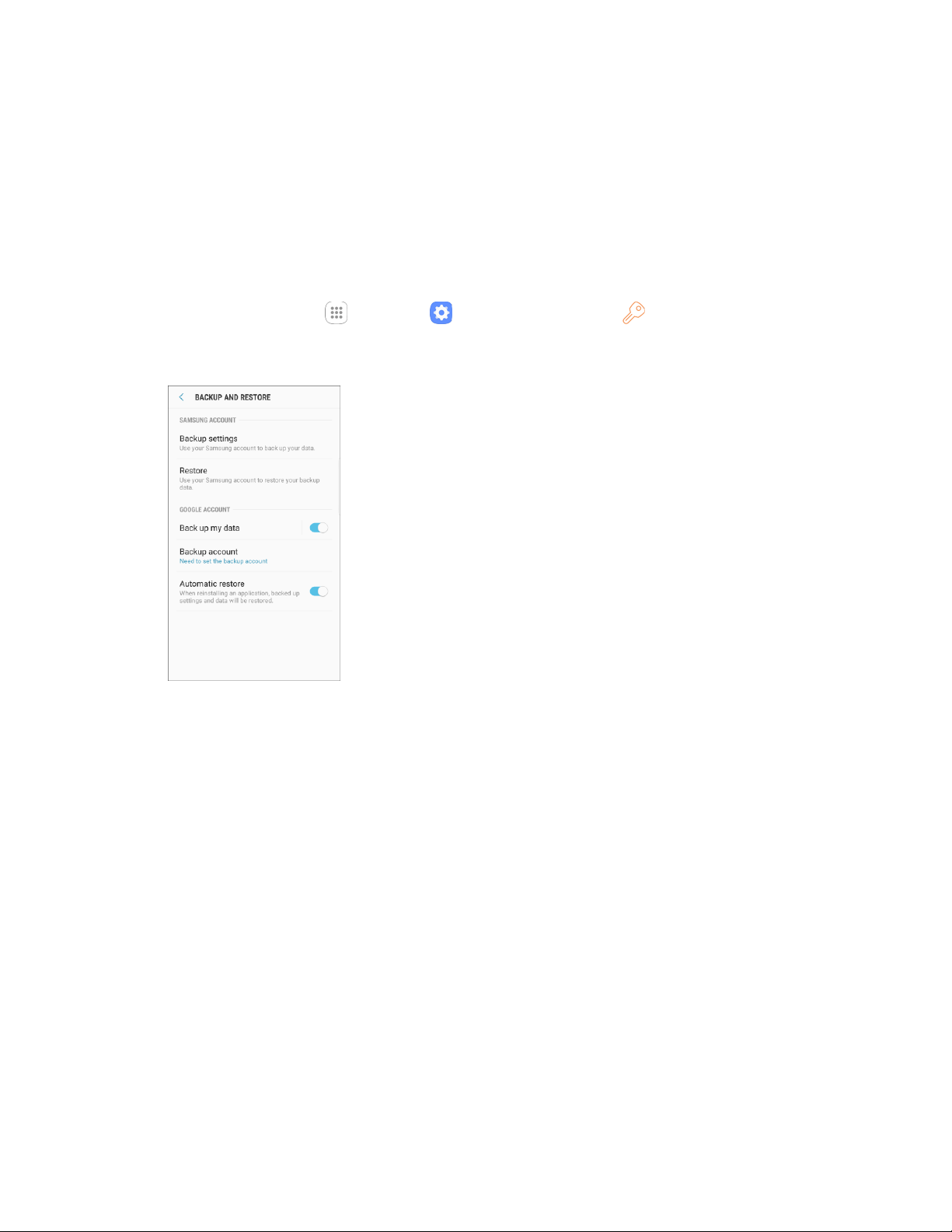
Settings 278
● Performing a factory data reset erases all data on the phone. It is recommended that you back up
important data before performing a factory data reset.
● Erased information cannot be restored. Only erase data after you are sure you have saved
everything you need.
Access Backup and Restore Options
1. From home, tap Apps > Settings > Cloud and accounts .
2. Tap Backup and restore.
The Backup and restore menu opens.
3.
Set options.
The backup and restore settings are applied and saved.
If you are performing a Factory data reset, follow the prompts to confirm the data removal.
The phone will erase all data and reboot.
Important: After performing a Factory data reset, you will need to sign in to the phone using the same
Google Account and password previously associated with the phone. If you wish to remove this
restriction, you will need to remove all Google Accounts from the phone before performing the Factory
data reset. See Factory Reset Protection for details.
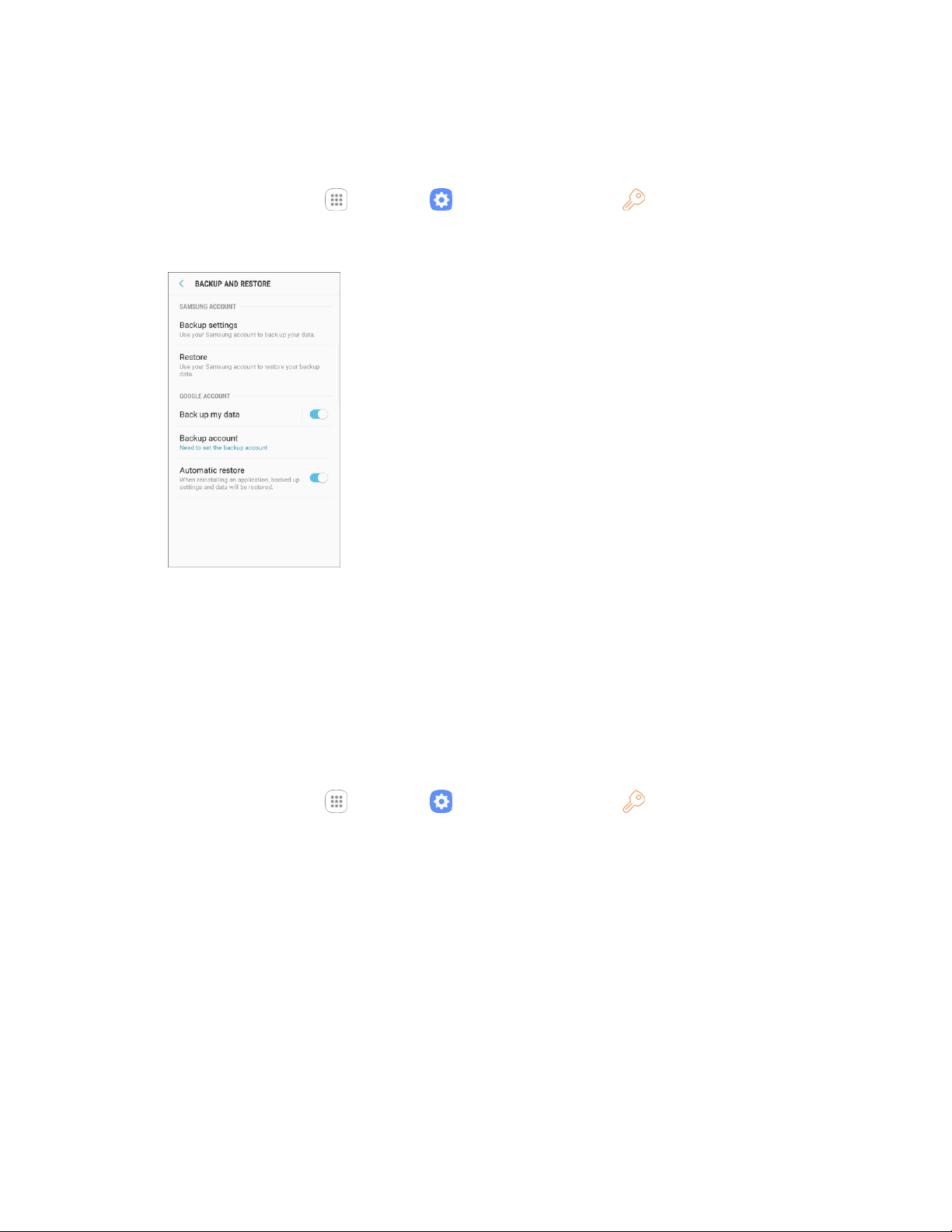
Settings 279
Samsung Account Backup Settings
Enable backup of your information to your Samsung account.
1. From home, tap Apps > Settings > Cloud and accounts .
2. Tap Backup and restore.
3. Configure these options:
Backup settings: Enable back up of your phone log, messages and more through your
Samsung account.
Restore: Use your Samsung account to restore your backup data.
Google Account Backup Settings
Enable backup of your information to Google servers.
1. From home, tap Apps > Settings > Cloud and accounts .
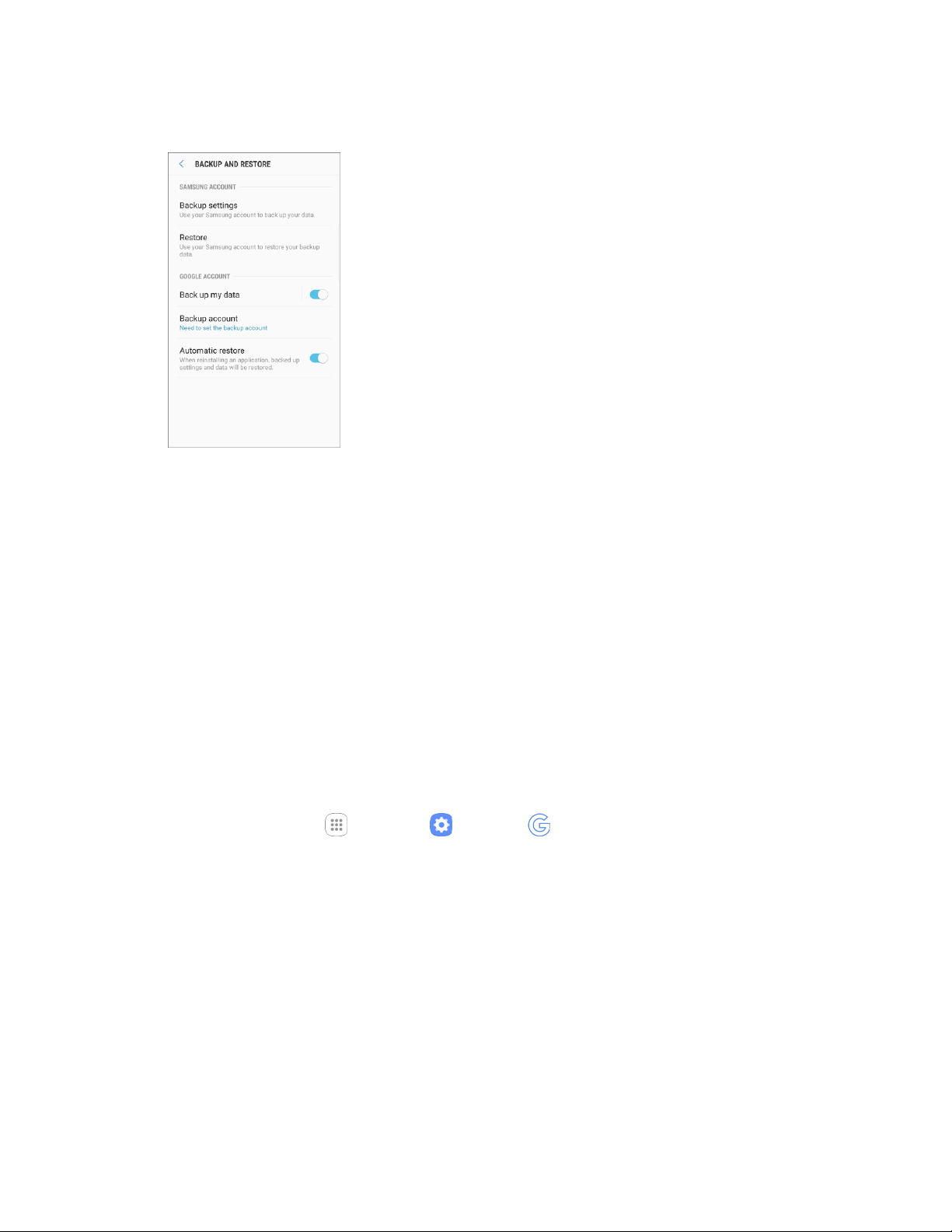
Settings 280
2. Tap Backup and restore.
3. Configure these options:
Back up my data: Enable back up of application data, Wi-Fi passwords, and other settings to
Google servers.
Backup account: Select a Google Account to be used as your backup account.
Automatic restore: Enable automatic restoration of settings from Google servers. When
enabled, backed-up settings are restored when you reinstall an application.
Google Settings
Configure your device’s Google settings.
Customize Google
To customize your Google settings:
1. From home, tap Apps > Settings > Google .
2. Select an option to customize:
Sign-in & security: Configure how you sign in to your Google Account, device access and
notifications, and connected apps and sites.
Personal info & privacy: Manage your personal information, activity controls, ads settings,
account overview, and control your content.
Account preferences: Configure your Google account language, Google Drive storage,
accounts and services.
Smart Lock for Passwords: Configure your saved Google passwords and auto sign-in
settings.

Settings 281
Location: Configure your Google location settings.
Security: Configure the Android Device Manager and apps security settings.
Set up nearby device: Set up another device using Wi-Fi and Bluetooth.
Android Pay: Configure your Android Pay settings.
Ads: Configure your Google advertising profile.
App preview messages: Receive and reply to messages sent from messaging apps that are
not installed on your device.
Connected apps: Configure apps which use your Google account.
Data management: Configure your Google Drive app.
Google Cast: Configure your Google Cast settings.
Google Fit: Configure Google Fit apps and devices (not included).
Nearby: Use your device’s sensors to connect with nearby devices.
Play Games: Configure your Google Play Games settings.
Search: Configure your Google search settings.
Note: These options may change if you are signed in to your Google Account.
General Management Settings
Configure your phone’s language and input options, set the date and time, and report diagnostic
information.
Access General Management Settings
1. From the home screen, tap Apps > Settings .
2. Tap General management , and then tap items for more details:
Language and input: Configure your device’s language and input settings.
Date and time: Configure date and time settings.
Report diagnostic info: Choose to send diagnostic information about your device to
Samsung when it experiences technical issues.
Reset: Reset device and network settings. You can also reset your device to its factory
defaults.
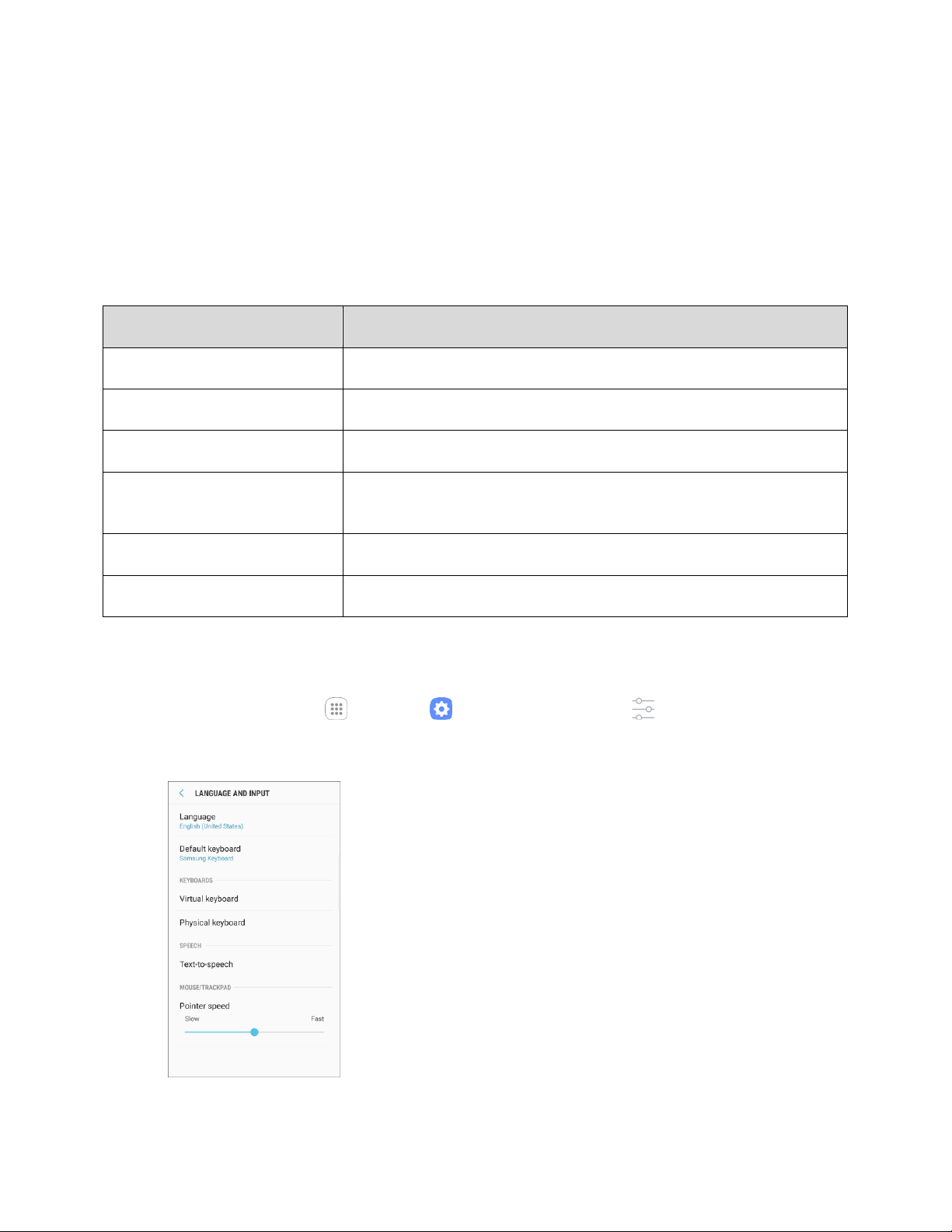
Settings 282
Language and Input Settings
Your phone’s language and input settings let you select a language for the phone’s menus and
keyboards, select and configure keyboard settings, configure speech input settings, and set your phone’s
mouse/trackpad options.
Language and Input Settings Overview
You can set the following options in the Language and input settings menu:
Language and Input Setting
Description
Language
Set the language for your display and menus.
Default keyboard
Set the default keyboard.
Virtual keyboard
Set the default virtual keyboard for entering text.
Physical keyboard
Show the virtual keyboard while using a physical keyboard. View
explanations of the keyboard shortcuts.
Text-to-speech
Set text-to-speech options.
Pointer speed
Set the speed of the pointer for a mouse/trackpad.
Access Language and Input Setting Options
1. From home, tap Apps > Settings > General management .
2. Tap Language and input.
The Language and input settings menu opens.
Settings 283
3. Set options.
The language and input settings are applied and saved.
Select the Default Language for Your Phone
1. From home, tap Apps > Settings > General management .
2. Tap Language and input > Language.
3. Tap Add language .
4. Tap an available language.
Language and Input Options
Some of the language and input options are detailed below.
1. From home, tap Apps > Settings > General management .
2. Tap Language and input.
3. Set options:
Language: Tap a language to assign it.
Virtual keyboard: Set the default virtual keyboard for entering text.
Physical keyboard: Show the virtual keyboard while using a physical keyboard. View
explanations of the keyboard shortcuts.
Text-to-speech: Tap a settings option and follow the prompts.
Pointer speed: Drag the slider to adjust the speed.
Date and Time Settings
Use the Date and Time settings menu either to automatically use the network-provided date and time or
manually set these values, as well as select time and date format options.
Date and Time Overview
The following Date and time options may be configured:
Date and Time Options
Description
Automatic date and time
Set the date, time, and time zone automatically via the connected
wireless network.
Set date
Set the date manually (only available when Automatic date and time
option is disabled).
Settings 284
Date and Time Options
Description
Set time
Set the time manually (only available when Automatic date and time
option is disabled).
Select time zone
Set the time zone manually (only when Automatic time zone is disabled).
Use 24-hour format
Enable or disable 24-hour time format.
Access Date and Time Options
1. From home, tap Apps > Settings > General management .
2. Tap Date and time.
3. Set available date and time options.
Your date and time settings are applied and saved.
Report Diagnostic Info
This feature sends diagnostic information about your device when you are having technical problems.
1. From home, tap Apps > Settings > General management .
2. Tap Report diagnostic info.
3. Read the consent information, and then tap Yes to enable this feature or tap No thanks.
Reset
Restore your device to its default settings.
Reset Settings
You can reset your device to its factory default settings, which resets everything except the security,
language, and account settings. Personal data is not affected.
1. From home, tap Apps > Settings > General management .
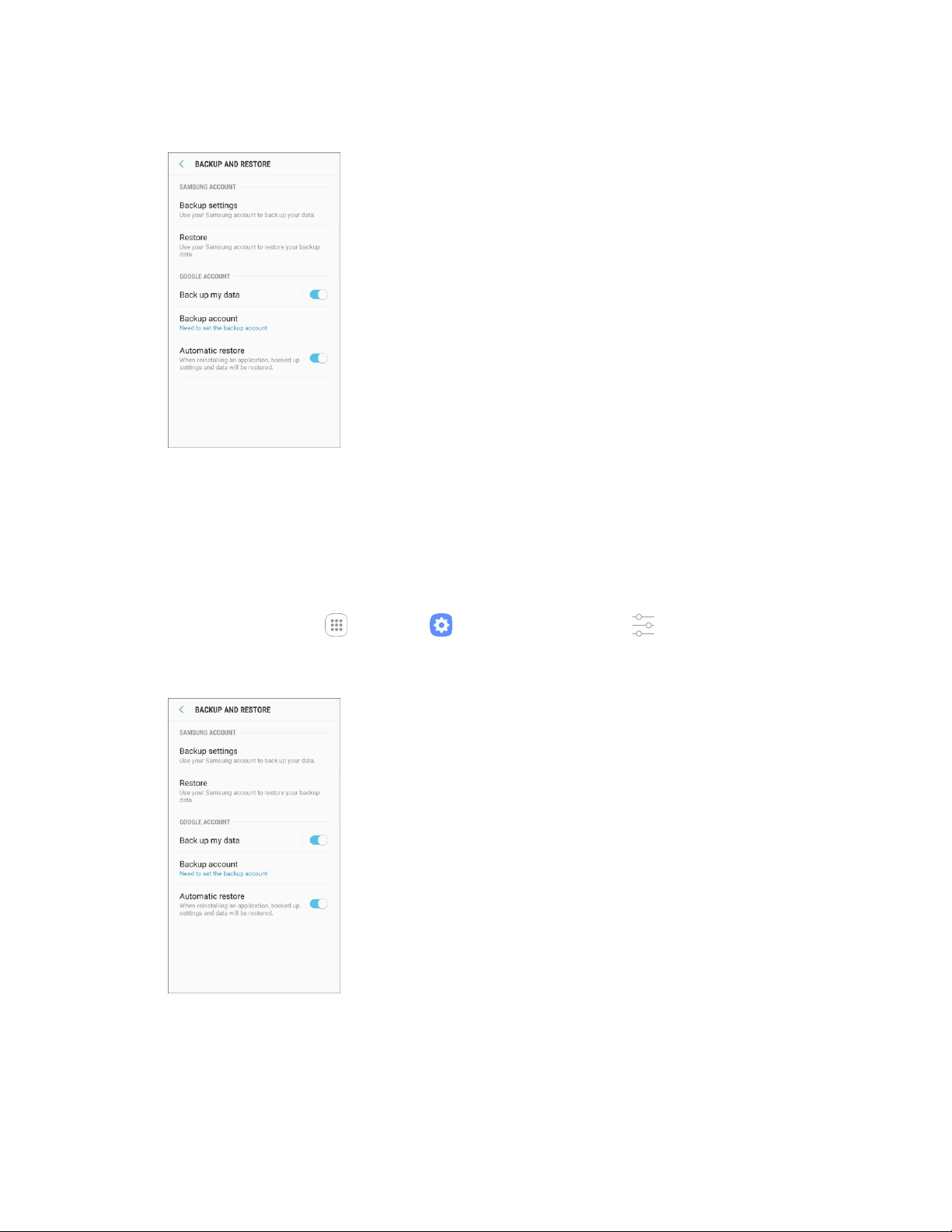
Settings 285
2. Tap Reset.
3. Tap Reset settings.
4.
Tap Reset settings, and confirm when prompted.
Reset Network Settings
You can reset Wi-Fi, Mobile data, and Bluetooth settings with Reset network settings.
5. From home, tap Apps > Settings > General management .
1. Tap Reset.
2. Tap Reset network settings.
3.
Tap Reset settings, and confirm when prompted.
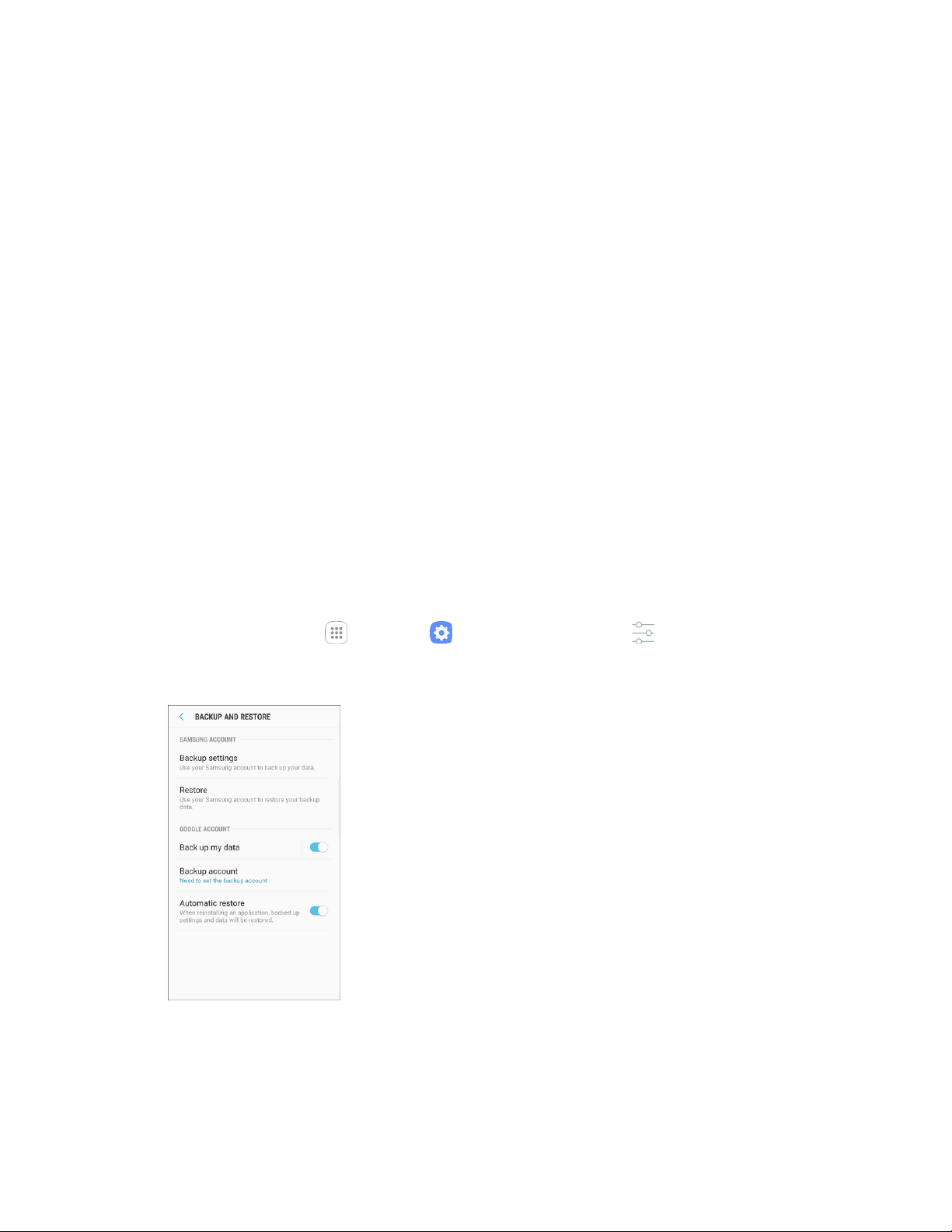
Settings 286
Factory Data Reset
Reset your device to factory defaults, erasing all data from your device.
This action permanently erases ALL data from the device, including Google or other account settings,
system and application data and settings, downloaded applications, as well as your music, photos,
videos, and other files. Any data found on an external SD card is not affected.
Note: When you sign in to a Google Account on your device, Factory Reset Protection is automatically
activated. This protects your device in the event it is lost or stolen. For more information, see Factory
Reset Protection.
If you reset your device to factory default settings with the Factory Reset Protection (FRP) feature turned
on, you must enter the user name and password for a registered Google Account used on this device to
regain access to the device. You will not be able to access the device without the correct credentials.
Warning: If you reset your Google Account password, you must wait 24 hours after changing your
password to perform a factory data reset on your device.
Before resetting your device:
1. Verify that the information you want to keep has transferred to your storage area.
2. Log in to your Google Account and confirm your user name and password.
To reset your device:
1. From home, tap Apps > Settings > General management .
2. Tap Reset.
3. Tap Factory data reset.
4. Tap Reset device and follow the prompts to perform the reset.
5. When the device restarts, follow the prompts to set up your device.
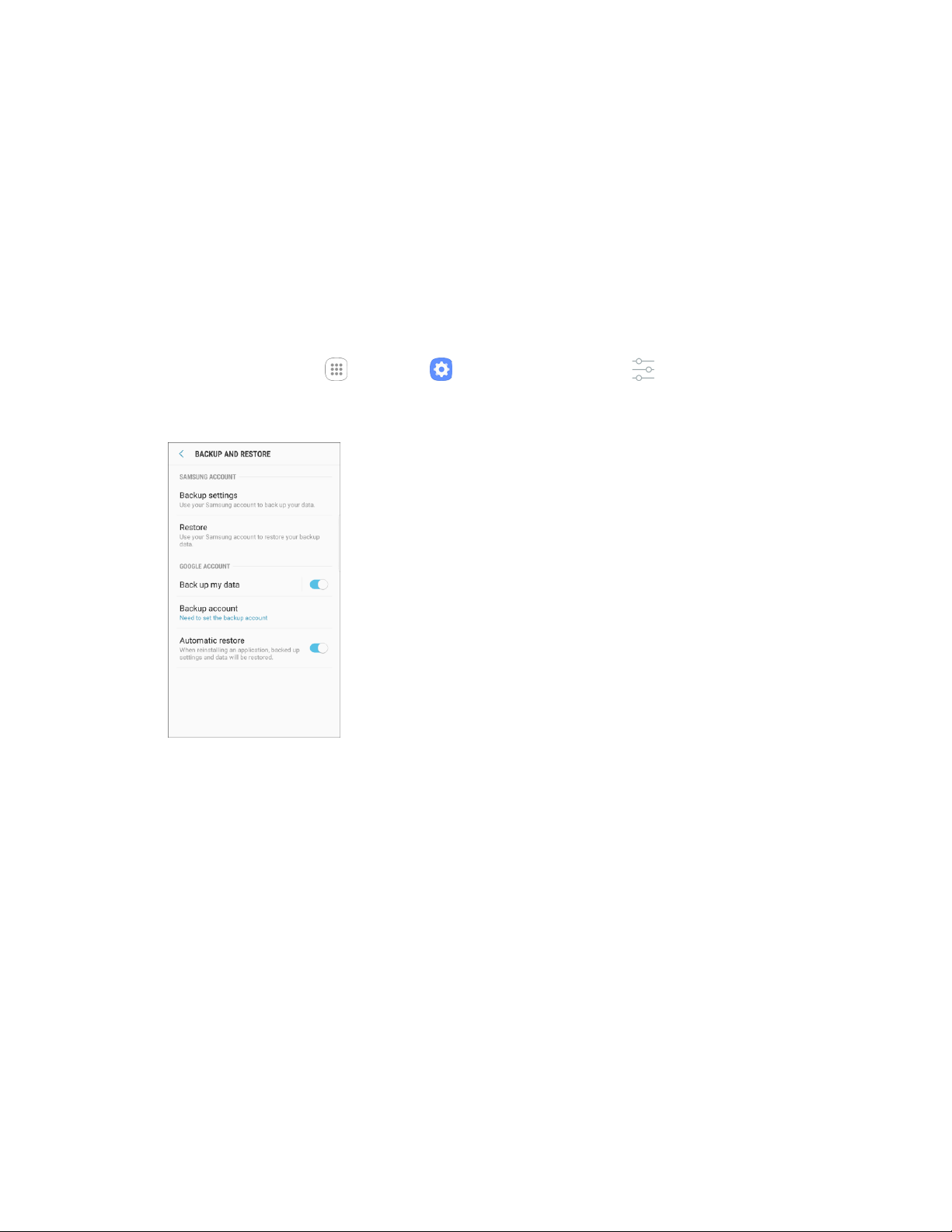
Settings 287
Note: Unless you removed all Google Accounts from the phone before performing the Factory data reset,
you will need to sign in to the Google Account that was previously assigned to the phone to complete
setup.
Auto Restart
Optimize your phone by restarting it automatically at set times. The phone only restarts if it is not in use
and battery power is more than 30 percent.
Note: Any unsaved data is lost when the phone restarts.
To enable Auto restart:
1. From home, tap Apps > Settings > General management .
2. Tap Reset.
3. Tap Auto restart.
4.
Tap On/Off to activate Auto restart, and then set the following parameters:
Time: Set the time of day to restart your device.
Day: Select the day of the week to automatically restart your device.
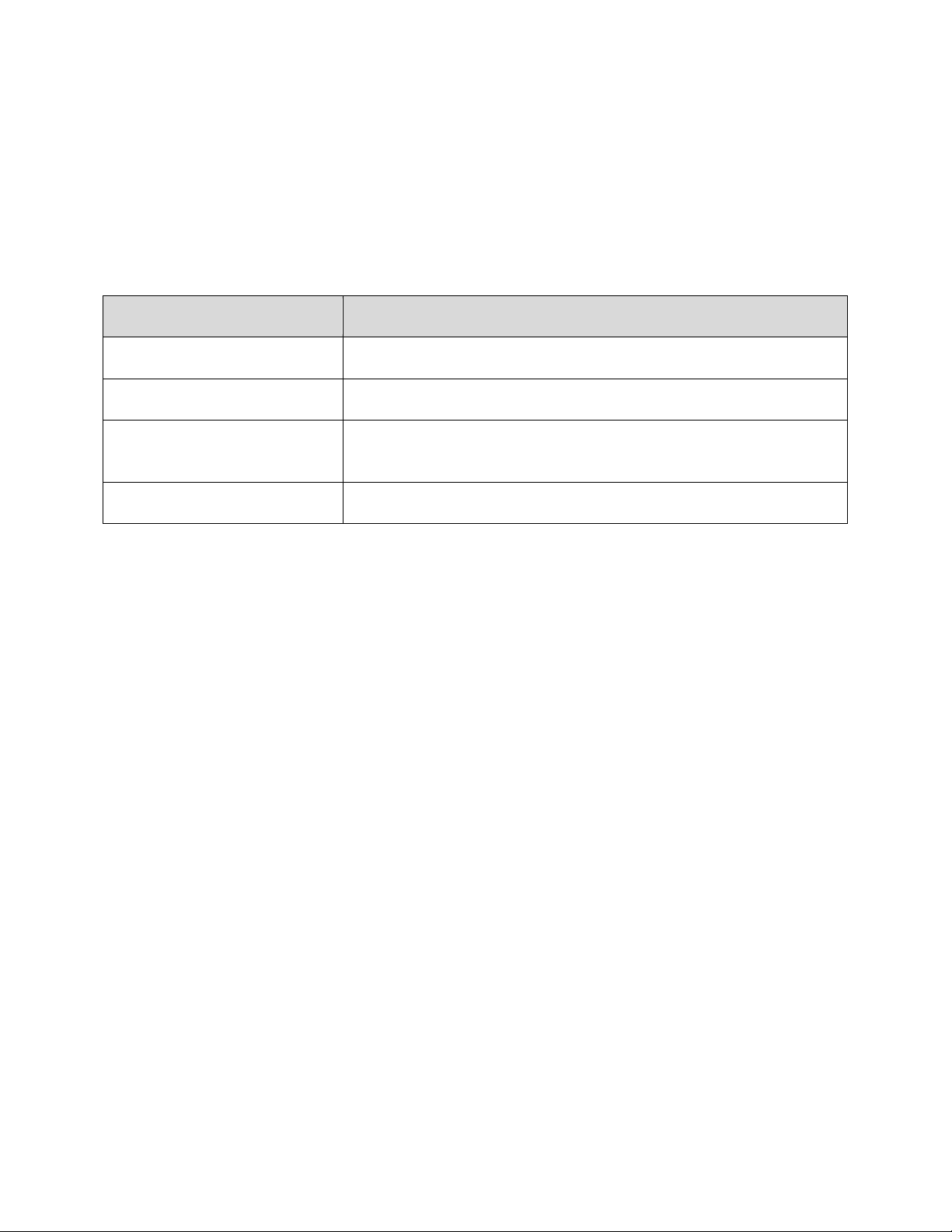
Settings 288
Device Maintenance Settings
Device maintenance provides an overview of the status of your device’s battery, storage, and memory.
You can also automatically optimize your device’s system resources.
Device Maintenance Settings Overview
You can set the following options in the Device Maintenance Settings menu:
Device Maintenance Setting
Description
Optimize Now
Improves device performance.
Battery
Monitor your phone’s battery usage.
Storage
Manage internal and optional installed SD card (not included) storage
on your phone.
Memory
Check the amount of available memory.
Optimize Now
The Optimize Now feature improves device performance. When used, it accomplishes this through the
following actions:
● Identifying apps that use excessive battery power and clearing unneeded items from memory.
● Deleting unnecessary files and closing apps running in the background.
● Scanning for malware.
To use the quick optimization feature:
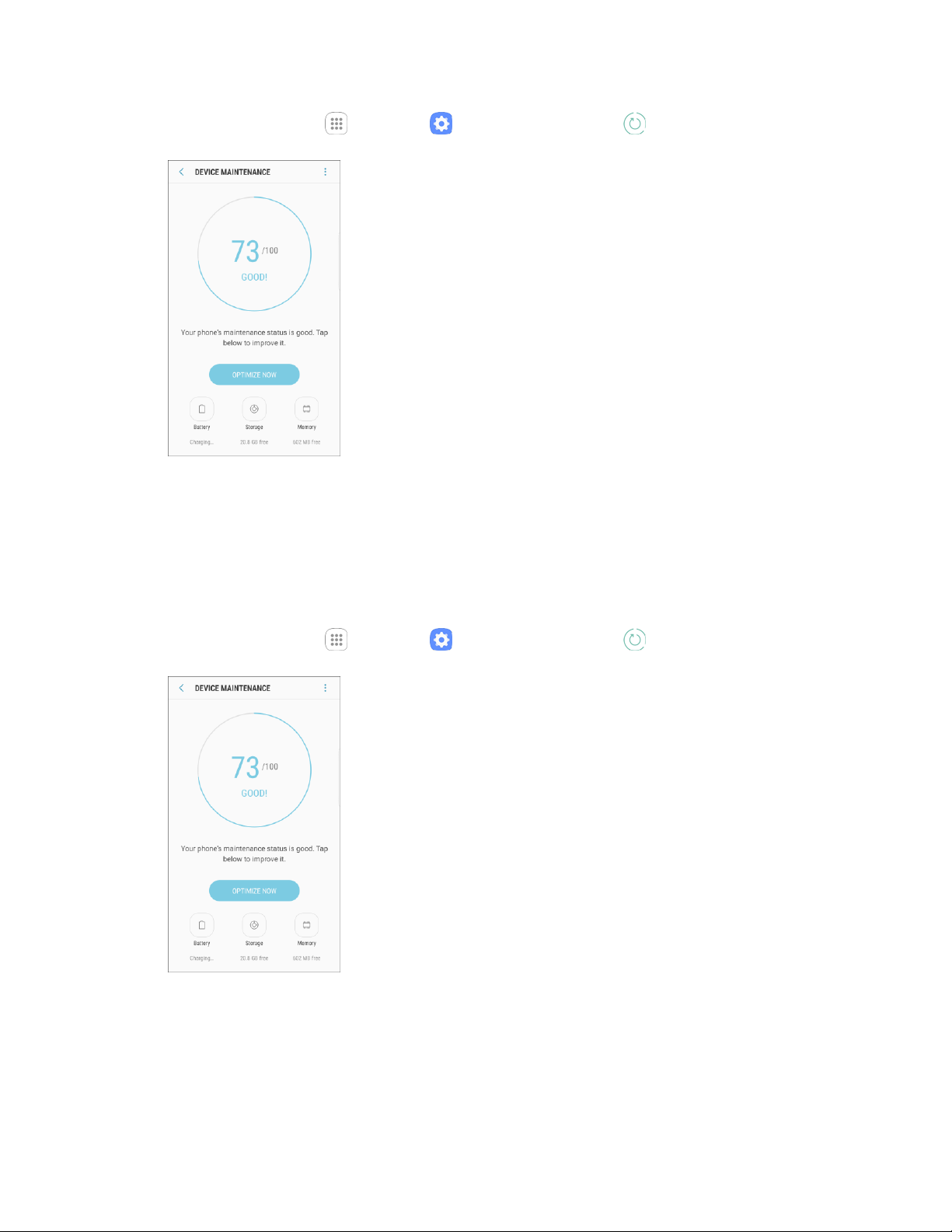
Settings 289
1. From home, tap Apps > Settings > Device maintenance .
2. Tap Optimize now.
Battery Settings
Monitor your phone’s battery usage through this settings menu. View which functions are consuming your
battery’s charge and at what percentage. You can also display the battery charge remaining as a
percentage on the status bar.
1. From home, tap Apps > Settings > Device maintenance .
2. Tap Battery for options:
Battery usage: View battery usage since the battery was last fully charged.
Power saving mode: Extend battery life by selecting a power saving mode level. Choose
Off, Mid, or Max. Estimated remaining battery life for each mode is provided.

Settings 290
App power monitor: Put apps to sleep so that they do not use battery power when not in
use. Tap Save power to enable.
Unmonitored apps: Add apps that will be put to sleep.
More options > Advanced settings: Configure advanced battery settings.
Storage Settings
The Storage settings menu lets you manage internal storage on your phone.
Storage Settings Overview
The storage settings menu allows you to configure the following options:
Storage Device
Description
More options >
Storage settings
●
Total space: View the total space/free space in your phone’s memory.
●
Available space: The amount of storage space currently available.
●
System memory: The minimum amount of storage space required to run
the system.
●
Used space: The amount of storage space currently being used.
●
●
Cached data: The amount of data currently cached.
●
Explore: Launch My Files to view content stored on your device.
Other: The space used by app data, downloaded files, and Android
system files.
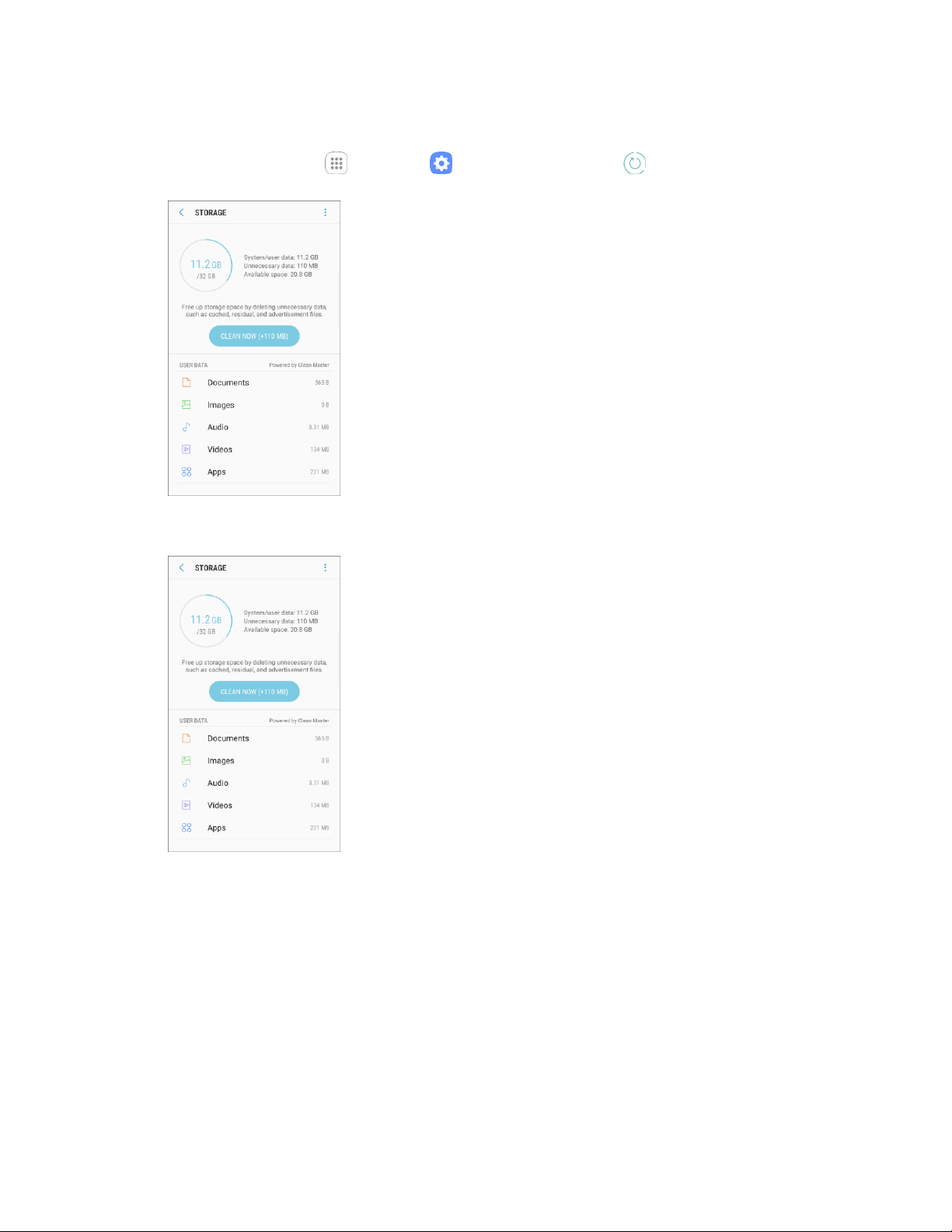
Settings 291
Access Storage Settings
1. From home, tap Apps > Settings > Device maintenance .
2. Tap Storage.
3. View memory usage for the different types of information stored in your phone’s memory. Tap an
item for more information.
Note: Tap Clean now to free up storage space by removing unneeded files.
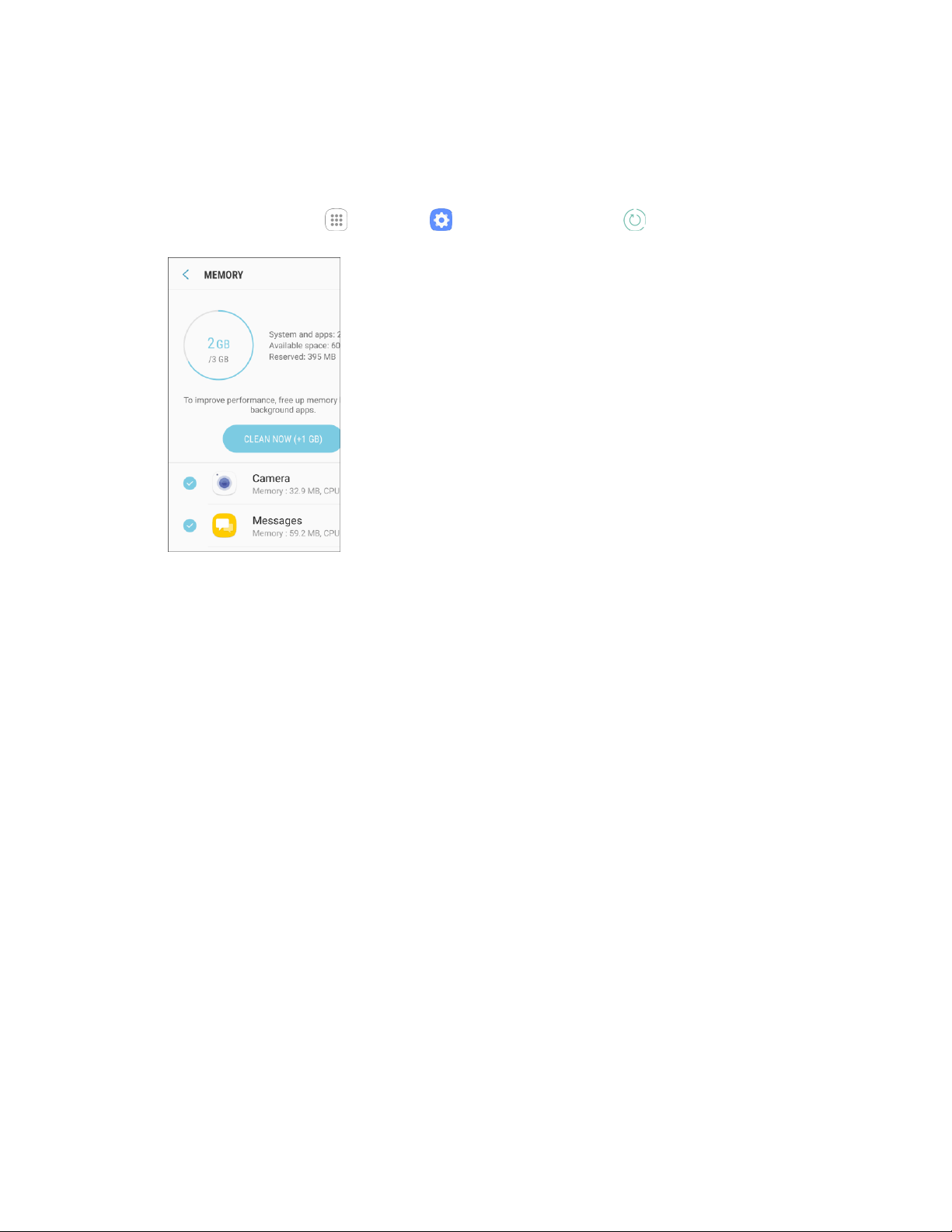
Settings 292
Memory
Check the amount of available memory. You can close background apps and reduce the amount of
memory you are using to speed up your device.
1. From home, tap Apps > Settings > Device maintenance > Memory.
The used and available memory are shown.
2.
To free up as much memory as possible, tap Clean now and follow the prompts.
The selected apps and services in the list will be closed.
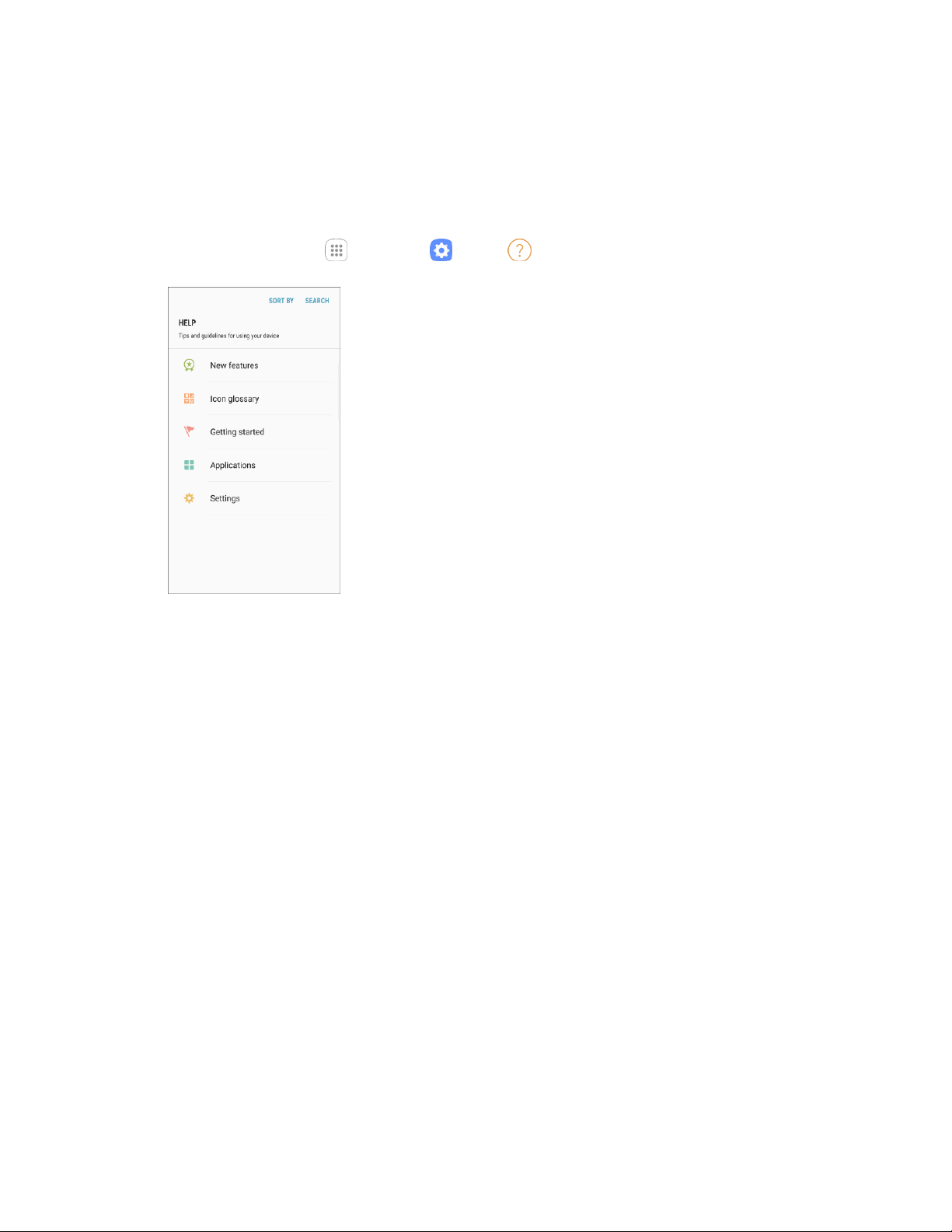
Settings 293
Help
The Help menu provides tips and guidelines to help you use your phone.
Access Help
1. From home, tap Apps > Settings > Help .
The Help menu and topics appear.
2. Tap on a topic to view its contents.
3. Tap Search to search for a topic.
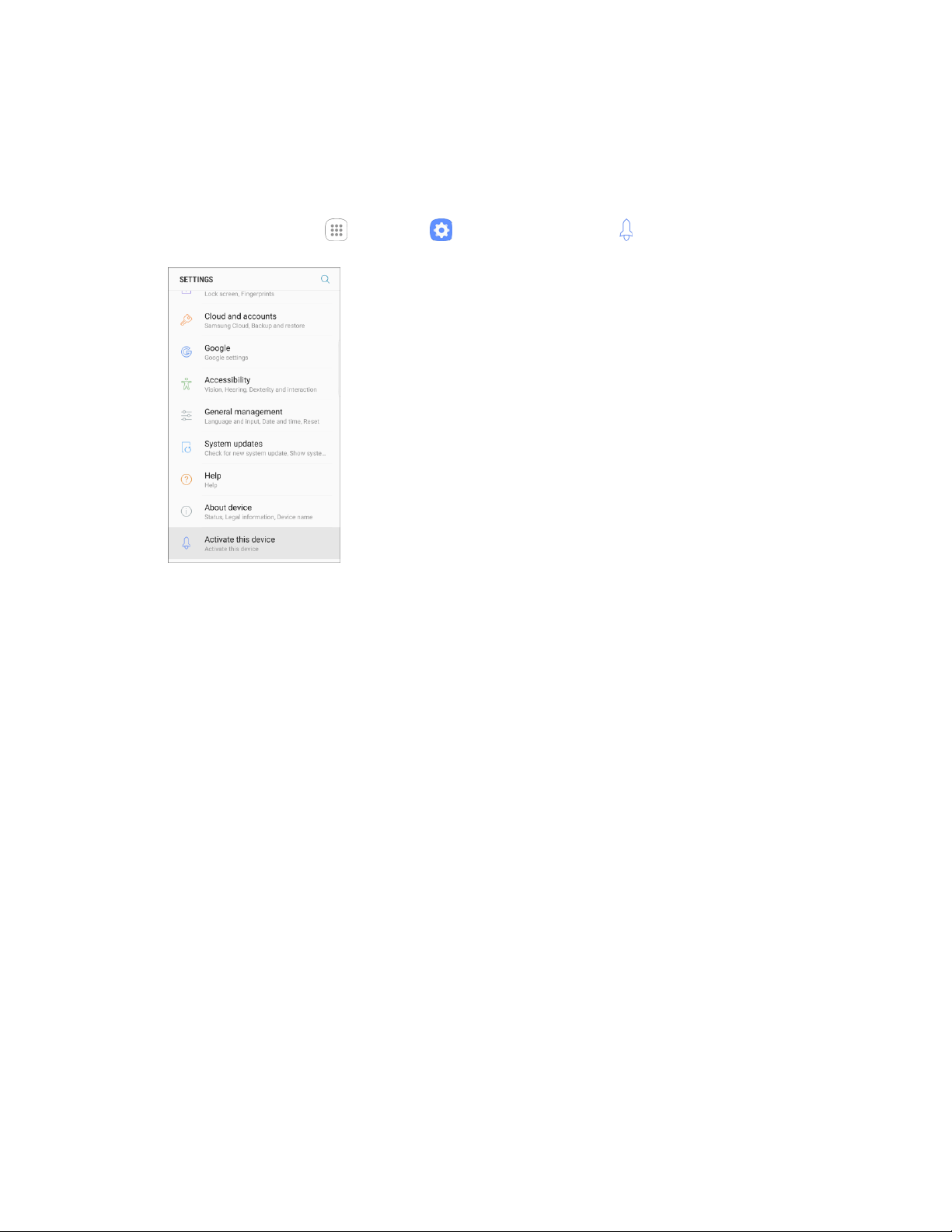
Settings 294
Activate This Device
The Activate this device menu lets you activate a new phone or use additional self-service options such
as checking the status of an in-service phone.
1. From home, tap Apps > Settings > Activate this device .
The Self Service menu appears.
2. Follow the prompts to activate your phone or review your summary.
Your phone activates. If already activated on an account, you will see a usage and plan
summary.

Settings 295
System Updates
The System updates menu provides settings for keeping your phone up-to-date with the latest software.
Access System Updates
■ From home, tap Apps > Settings > System updates .
The System updates menu appears.
For details about updating your phone, see Update Your Phone.
About Device
The About device menu lets you access important phone information, search for and apply updates, and
view legal and safety information.
About Device Overview
The following About device items may be reviewed or set:
About Device Item
Description
My phone number
View your phone number.
Software version
Check your current software version.
Hardware version
Check your current hardware version.

Settings 296
About Device Item
Description
Status
Check your phone’s status.
●
Battery status and level
●
SIM card status (network, signal strength, mobile network type,
service state, roaming, and mobile network state)
●
IMEI information (MIN, PRL version, MEID, IMEI, and ICCID)
●
Brand
●
Username
●
IP address
●
Wi-Fi MAC address
●
Bluetooth address
●
Up time
●
Device status
Legal information
Review various types of important legal information, including Open
source licenses, Google legal information, System WebView licenses,
Samsung legal information, and the Privacy Alert.
Device name
Change the name of your device (other devices see this name when
using Mobile hotspot or Bluetooth).
Model number
Check the phone’s model number.
Android version
Check the Android version number.
Android security patch
level
Check the Android security patch level.
Baseband version
Check the phone’s baseband version.
Kernel version
Check the phone’s kernel version.
Build number
Check the current phone build number.
SE for Android status
Check the phone's SE for Android status.
Security software version
Check the phone's security software version.
Knox version
Check the current Knox version.
Settings 297
About Device Item
Description
FCC certification
Check the phone's FCC certification.
Rated
Check the phone's voltage rating.
Battery capacity
Check the phone's battery capacity.
Access About Device Options
1. From home, tap Apps > Settings > About device .
2. Select or view available options.
Your phone information is displayed.

For Assistance 298
For Assistance
The following topics address areas of support for your phone, including troubleshooting, specifications,
account information, warranty information, and customer service contact information.
Troubleshooting
Check the questions and answers below for troubleshooting solutions for common phone issues.
Check Here First
Problem: Phone freezes/operation is unstable.
Solution: Turn the phone on again. Data that was being edited is erased after your phone is powered
on again.
Problem: Operation is unstable after a new application was installed.
Solution: The newly installed application may be the cause. Uninstall the application in Safe mode.
See Uninstall an App. To turn the phone on in Safe mode:
Press and hold the Power/Lock key > touch and hold Power off, read the disclaimer for safe
mode, and then tap OK.
• After turning the phone on in Safe mode, "Safe Mode" appears at lower left.
• After restarting in Safe mode, your phone can be powered on as usual.
• Before turning the phone on in Safe mode, it is recommended that you back up important
data.
• By powering the phone on in Safe mode, added widgets may be deleted.
Problem: Cannot use phone, mail, or Internet.
Solution 1: Check whether you are where signal is weak or out of service area.
Solution 2: Power the phone on again.
Solution 3: Is the phone in Airplane mode? To check that Airplane mode is canceled:
From home, tap Apps > Settings > Connections > Airplane mode.
Solution 4: Is data communication disabled? To check that data communication is enabled:
From home, tap Apps > Settings > Connections > Data usage > Mobile data.

For Assistance 299
Solution 5: Is a disabled access point set? To reset to initial settings:
From home, tap Apps > Settings > Connections > Mobile networks > Access
Point Names > More options > Reset to default.
Problem: Battery level goes down quickly.
Solution: Are you where signal is weak or have been out of service area for a long period? Calling
where signal is weak or being out of service area uses a lot of Battery.
Problem: Cannot install applications.
Solution: Applications cannot be installed with only a little free space on the phone. To check free
space, see Storage Settings. Applications not supported by your phone cannot be installed.
Problem: Cannot unlock screen.
Solution: Power the phone on again. If you are unable to turn the phone off, remove and replace the
Battery, and then power the phone on again. Data that was being edited is erased after the phone is
powered on again.
Sprint Account Information and Help
Find out about account passwords and information about managing your account and finding help.
Sprint Account Passwords
You will need to create passwords to protect access to your personal account information, your voicemail
account, and your data services account. As a Sprint customer, you enjoy unlimited access to all your
information.
Account User Name and Password
If you are the account owner, you will create an account user name and password when you sign on to
sprint.com/mysprint. (Click Register and follow the prompts to get started.) If you are not the account
owner (if someone else receives the bill for your Sprint service), you can get a sub-account password at
sprint.com/mysprint.
Voicemail Passcode
You will create your voicemail passcode when you set up your voicemail. See Voicemail Setup for more
information on your voicemail passcode.
Data Services Password
With your Sprint phone, you may elect to set up an optional data services password to control access and
authorize purchases.
For more information, or to change your passwords, sign on to sprint.com/mysprint.

For Assistance 300
Manage Your Account
Manage your Sprint account from your computer, your Sprint phone, or any other phone.
Online: sprint.com/mysprint
● Access your account information.
● Check your minutes used (depending on your Sprint service plan).
● View and pay your bill.
● Enroll in Sprint online billing and automatic payment.
● Purchase accessories.
● Shop for the latest Sprint phones.
● View available Sprint service plans and options.
● Learn more about data services and other products like games, ringtones, screen savers, and
more.
From Your Sprint Phone
1. From home, tap Phone > Keypad .
2. Do any of the following:
Tap * 2, and then tap Dial to access a summary of your Sprint service plan or get
answers to other questions.
Tap * 3, and then tap Dial to access bill pay support to make a payment.
Tap * 4, and then tap Dial to check minute usage and account balance.
Sprint Support Services
Sprint 411 and Sprint Operator Services let you easily access information and calling assistance from
your Sprint phone.
Sprint 411
Sprint 411 gives you access to a variety of services and information, including residential, business, and
government listings; movie listings or show times; driving directions, restaurant reservations, and major
local event information. You can get up to three pieces of information per call, and the operator can
automatically connect your call at no additional charge.
There is a per-call charge to use Sprint 411, and you will be billed for airtime.
■ From home, tap Phone > Keypad , tap 4 1 1, and then tap Dial .

For Assistance 301
Sprint Operator Services
Sprint Operator Services provides assistance when you place collect calls or when you place calls billed
to a local telephone calling card or third party.
■ From home, tap Phone > Keypad , tap 0, and then tap Dial .
For more information or to see the latest in products and services, visit us online at sprint.com/mysprint.
Copyright Information
©2017 Sprint. Sprint and the logo are trademarks of Sprint. Other marks are trademarks of their
respective owners.
Legal Information
READ THIS INFORMATION BEFORE USING YOUR MOBILE DEVICE.
Arbitration Agreement - This Product is subject to a binding arbitration agreement between you
and SAMSUNG ELECTRONICS AMERICA, INC. (“Samsung”). You can opt out of the agreement
within 30 calendar days of the first consumer purchase by emailing optout@sea.samsung.com or
calling 1-800-SAMSUNG (726-7864) and providing the applicable information. For complete terms
and conditions that bind you and Samsung, refer to the “Arbitration Agreement” section of the
Terms & Conditions, included with the Product.
Find Legal Information Online
The full Arbitration Agreement, Standard Limited Warranty, End User License Agreement (EULA), and
Health & Safety Information for your device are available online.
Arbitration Agreement, Standard Limited Warranty, and Health & Safety Information:
Phone:
● English: samsung.com/us/Legal/Phone-HSGuide
● Spanish: samsung.com/us/Legal/Phone-HSGuide-SP
Tablet:
● English: samsung.com/us/Legal/Tablet-HSGuide
● Spanish: samsung.com/us/Legal/Tablet-HSGuide-SP
End User License Agreement:
● English: samsung.com/us/Legal/SamsungLegal-EULA4
● Spanish: samsung.com/us/Legal/SamsungLegal-EULA4/#SPANISH

For Assistance 302
Find Legal Information on the Mobile Device
The full Arbitration Agreement, Standard Limited Warranty, End User License Agreement (EULA) and
Health & Safety Information are also available on the device, in the Samsung legal section of Settings.
The location depends on the device, and is usually in the “About device” or “About phone” section, for
example:
● Settings > About phone or About device > Legal information > Samsung legal
● Or, use the Search feature to search for “Legal”.
Intellectual Property
All Intellectual Property, as defined below, owned by or which is otherwise the property of Samsung or its
respective suppliers relating to the Product, including but not limited to, accessories, parts, or software
relating thereto, is proprietary to Samsung and protected under federal laws, state laws, and international
treaty provisions. Intellectual Property includes, but is not limited to, inventions (patentable or
unpatentable), patents, trade secrets, copyrights, software, computer programs, and related
documentation and other works of authorship.
You may not infringe or otherwise violate the rights secured by the Intellectual Property. Moreover, you
agree that you will not (and will not attempt to) modify, prepare derivative works of, reverse engineer,
decompile, disassemble, or otherwise attempt to create source code from the software. No title to or
ownership in the Intellectual Property is transferred to you. All applicable rights of the Intellectual Property
shall remain with Samsung and its suppliers.
Open Source Software
Some software components of this product, including but not limited to ‘PowerTOP’ and ‘e2fsprogs’,
incorporate source code covered under GNU General Public License (GPL), GNU Lesser General Public
License (LGPL), OpenSSL License, BSD License and other open source licenses. To obtain the source
code covered under the open source licenses, please visit: opensource.samsung.com
Disclaimer of Warranties; Exclusion of
Liability
The information below explains that a user accepts this Product as sold, including the hardware
and software components as created and packaged for sale. If the user changes these parameters
through a unique modification, Samsung will not be held responsible for damages or issues that
result from these end-user changes.
Except as set forth in the Standard Limited Warranty that accompanies the Product, the purchaser
takes the product “as is”, and Samsung makes no express or implied warranty of any kind
whatsoever with respect to the product, including but not limited to the:
● merchantability of the product or its fitness for any particular purpose or use;
● design, condition or quality of the product;

For Assistance 303
● performance of the product;
● workmanship of the product or the components contained therein; or
● compliance of the product with the requirements of any law, rule, specification or contract
pertaining thereto.
Nothing contained in the User Manual shall be construed to create an express or implied warranty
of any kind whatsoever with respect to the Product. In addition, Samsung shall not be liable for
any damages of any kind resulting from the purchase or use of the product or arising from the
breach of the express warranty, including incidental, special or consequential damages, or loss of
anticipated profits or benefits.
Modification of Software
Samsung is not liable for performance issues or incompatibilities caused by your editing of
registry settings, or your modification of Operating System (OS) software.
Using custom OS software may cause your device and applications to work improperly. Your
carrier may not permit users to download certain software, such as custom OS.
Samsung Knox
Samsung Knox is Samsung’s security platform and is a mark for a Samsung device tested for security
with enterprise use in mind. Additional licensing fee may be required. For more information about Knox,
please refer to: samsung.com/us/knox
Restricting Children’s Access to
Your Mobile Device
Your device is not a toy. Do not allow children to play with it because they could hurt themselves and
others, damage the device, or make calls that increase your device bill. Keep the device and all its parts
and accessories out of the reach of small children.
Samsung Electronics America, Inc.
Address:
85 Challenger Road
Ridgefield Park,
New Jersey 07660
Phone: 1-800-SAMSUNG (726-7864)
Internet: samsung.com
©2017 Samsung Electronics America, Inc.
Samsung, Samsung Galaxy, Multi Window, Samsung Gear, S Voice, and Samsung Pay are all
trademarks of Samsung Electronics Co., Ltd.

For Assistance 304
Other marks are the property of their respective owners.
Some multimedia (audio/video) files contain Digital Rights Management (DRM) technology to verify you
have the right to use the files. Preloaded apps on your device may not be compatible with DRM-protected
files.
Screen images are simulated. Appearance of device may vary.
The actual available capacity of the internal memory is less than the specified capacity because the
operating system and default applications occupy part of the memory. The available capacity may change
when you upgrade the device.

Index 305
Index
1Weather, 144
3-way Calling, 65
4G, 112
AAA, 144
About Device, 295
Accessibility Settings, 270
Accessory Port, 6
Accounts
Add new, 276
Manage, 277
Settings, 275, 276
Activation, 12, 294
Advanced Features, 261
Airplane Mode, 24
Settings, 207
Alarm, 149
Amazon Shopping, 144
Answer a Call, 54
App Spotlight, 144
Application Manager, 258
Apps
Find and install, 30
Request refunds, 31
Uninstall, 33
Update, 32
Apps Settings, 257
Back Key, 5
Backup and Reset, 277
Battery
Settings, 289
Blue Light Filter, 242
Bluetooth
Connect, 188
Receive information, 190
Send information, 189
Settings, 204
Share pictures and videos, 135
Turn on or off, 185
Bookmark, 116
Brightness, 241
Browser, 114
Bookmark, 116
History, 117
Launch connection, 115
Settings, 119
Tabs, 118
Calculator, 144
Calendar, 145
Add event, 145
Settings, 148
Sync, 147
Sync Exchange ActiveSync calendar, 148
View events, 146
Call Forwarding, 66
Call Log
Make call from, 58
Call Waiting, 64
Caller ID, 63, 149
Camera, 123
Settings, 138
Shooting modes, 127
Take a picture, 125
Viewfinder, 123
Car Kit
Connect, 188
Charger/Accessory Port, 6
Chrome, 119
Clock, 149
Alarm, 149
Stopwatch, 151
Timer, 151
World Clock, 150
Conference Calling, 65
Contacts, 70
Add contact, 70
Delete, 74
Edit, 74
Favorites, 75
Groups, 75
Import, 81
Make call from, 57
Profile sharing, 80
Save a phone number, 72
Settings, 82
Share, 77
View, 73
Data Services, 112
Password, 299

Index 306
Status indicators, 114
User name, 113
Data Usage Settings, 206
Date Settings, 283
Default Applications, 260
Device Security, 269
Dexterity and Interaction Settings, 273
Drag, 10
Drive (App), 151
Easy Mode, 246
Edge Screen, 16
Settings, 248
Editing Text, 26
Email
Add account, 102
Add Exchange ActiveSync account, 104
Delete account, 107
Manage inbox, 107
Send Gmail, 94
Send message, 105
Settings, 110
Setup, 101
Share pictures, 133
View and reply, 106
Emergency Numbers, 52
Enhanced 9-1-1 (E 9-1-1), 53
Enter Text, 24
Exchange ActiveSync
Add account, 104
Features, 109
Extended Home Screen, 41
Facebook, 120
Messenger, 122
Favorites, 75
Files
Transfer between phone and computer, 179
Finger Scanner
Fingerprint Screen Lock, 268
Flash, 6
Flick, 11
Folders, 49
Galaxy Apps, 151
Gallery, 128
View pictures and videos, 128
Global Roaming Mode, 193
Gmail
Archive threads, 98
Create account, 27
Delete threads, 99
Labels, 97
Mute threads, 98
New messages, 96
Read and reply, 96
Read messages, 96
Report phishing, 99
Report spam, 99
Search, 99
Send message, 94
Share pictures, 133
Switch accounts, 100
Google
Chrome, 119
Create account, 27
Drive, 151
Google+, 157
Hangouts, 121
Photos, 163
Play Books, 153
Play Games, 153
Play Movies & TV, 153
Play Newsstand, 157
Search, 157
Sign in, 29
Google Maps, 151
Google Play
Find and install apps, 30
Help, 34
Store, 30
Google Play Music, 153
Google Voice Typing, 26
Configuring, 26
Using, 26
Groups, 75
Hancom Office S, 158
Hangouts, 121
Headset
Connect, 188
Headset Jack, 6
Hearing Accessibility, 272
Help, 293
Home Screen, 40
Add Folders, 49
Add Shortcuts, 48
Add Widgets, 48
Customize, 47
Extended, 41
Home Screen Settings, 245
Hotspot, 183

Index 307
Settings, 221
Icon Frames, 247
Icons, 264
Import Contacts, 81
Incoming Call
Answer, 54
Reject, 55
Input Settings, 282
Instagram, 121
International Data Roaming, 197
Internet, 84
Keep Screen Turned Off, 257
Keyboard
Samsung keyboard, 24
Language Settings, 282
LED Indicator, 254
Lock Screen
Settings, 265
Lookout, 158
Maps, 151
Memo, 158
Memory, 290
Messages
Settings, 92
Messaging, 84
Messenger, 122
Microsoft
OneDrive, 163
OneNote, 163
MirrorLink, 216
MMS
Send messages, 85
Mobile Hotspot, 183
Mobile Networks Settings, 210
Multimedia Messaging
Share pictures and videos, 134
Music
Google Play Music, 153
Music (App), 159
Sprint Music Plus, 169
Music (App), 159
Play music, 159
My Files, 161
My Sprint, 162
NASCAR Mobile, 162
Nearby Device Scanning, 214
NextRadio, 163
NFC and Payment, 208
Night Clock, 253
Notification Icons, 43
Notification Panel, 44
Notifications, 43
OneDrive, 163
OneNote, 163
Peel Remote, 163
Phone
Dialer, 51
Visibility, 205
Phone App, 50
Phone Calls
Answer, 53
Emergency numbers, 52
Using Call Log, 58
Using contacts, 57
Using phone keypad, 51
Phone Layout (illustration), 4
Phone Number
Save to contacts, 72
Phone Status, 295
Phone Update
PRL, 39
Profile, 38
Software, 35
Photos (App), 163
Pictures
Crop, 131
Rotate, 129, 130
Share using Bluetooth, 135
Share using email, 133
Share using messaging, 134
Take with camera, 125
View, 128
Pinch, 12
Play Music, 153
Play Store, 30
Find and install apps, 30
Plus (+) Code Dialing, 195
Power Off, 8
Power On, 8
Printing, 215
PRL Update, 39
Reject Incoming Call, 55
Ringtone, 224
Ringtones
Settings, 230, 231, 232
Rotate, 11
S Voice, 164
Settings, 164

Index 308
Samsung Cloud, 275
Samsung Health, 165
Samsung Keyboard, 24
Samsung Pay, 167
Samsung+, 168
Save a Phone Number, 72
Screen Lock, 266
Screen Mode, 243
Screen Saver, 256
Screen Timeout, 255
Screen Unlock
Motion, 267
Swipe, 267
Screen Unlock Password, 268
Screen Unlock Pattern, 267
Screen Unlock PIN, 267
Screen Zoom and Font, 244
Secure Credential Storage, 217
Security, 269
Security Settings, 265
Settings
Overview, 200
Setup Screens, 13
Share
Contacts, 77
SIM Card, 192
Slide, 10
Sound Settings, 224
Speaker, 6
Spread, 12
Sprint 411, 300
Sprint Account
Management, 300
Passwords, 299
Sprint Family Locator, 168
Sprint FamilyWall, 169
Sprint Music Plus, 169
Sprint Operator Services, 301
Sprint Protect, 170
Sprint Spot, 170
Sprint TV & Movies, 170
Sprint Worldwide, 171
Sprint Worldwide Wireless Service, 192
Status Bar, 42
Status Bar Settings, 254
Status Icons, 42
Stopwatch, 151
Storage
Settings, 290
Swipe, 10
System updates, 295
Tap, 9
Tap and Pay, 209
Tethering, 190
Tethering Settings, 222
Text Editing, 26
Text Entry, 24
Text Messaging
Conversations, 90
Draft messages, 90
Notifications, 90
Send messages, 84
Themes, 263
Time Settings, 283
Timer, 151
Touch, 9
Touch and Hold, 9
Touchscreen
Turn off, 34
Turn on, 35
TTY Mode, 69
Turn Device Off, 8
Turn Device On, 8
Typing, 24
Uber, 171
Vibration, 236
Video, 123
Video (App), 171
Video Camera
Record video, 126
Videos
Record, 126
Share using Bluetooth, 135
Share using messaging, 134
Share using YouTube, 137
View, 128
Vision Accessibility, 271
Visual Voicemail
Display name, 63
Review messages, 61
Set up, 60
Settings, 62
Voice Recorder, 172
Voice Typing, 26
Configuring, 26
Using, 26
Voicemail
Greeting, 63

Index 309
International, 195
Passcode, 299
Setup, 59
Volume, 224, 228
Key, 5
VPN, 217
Add connection, 218
Connect or disconnect, 219
Prepare for connection, 217
Secure credential storage, 217
Wallpaper, 47, 262
Web
Launch connection, 115
Widgets, 48
Wi-Fi, 180
Settings, 202
Turn on and connect, 180
Wi-Fi Calling, 50
Settings, 221
World Clock, 150
YouTube, 177
Share videos, 137
Zoom, 12