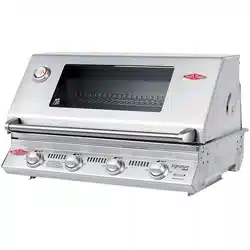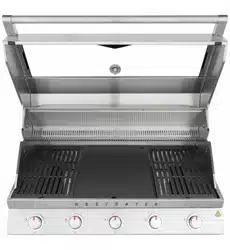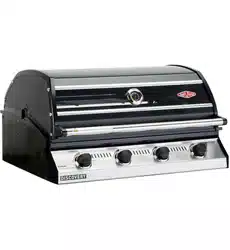
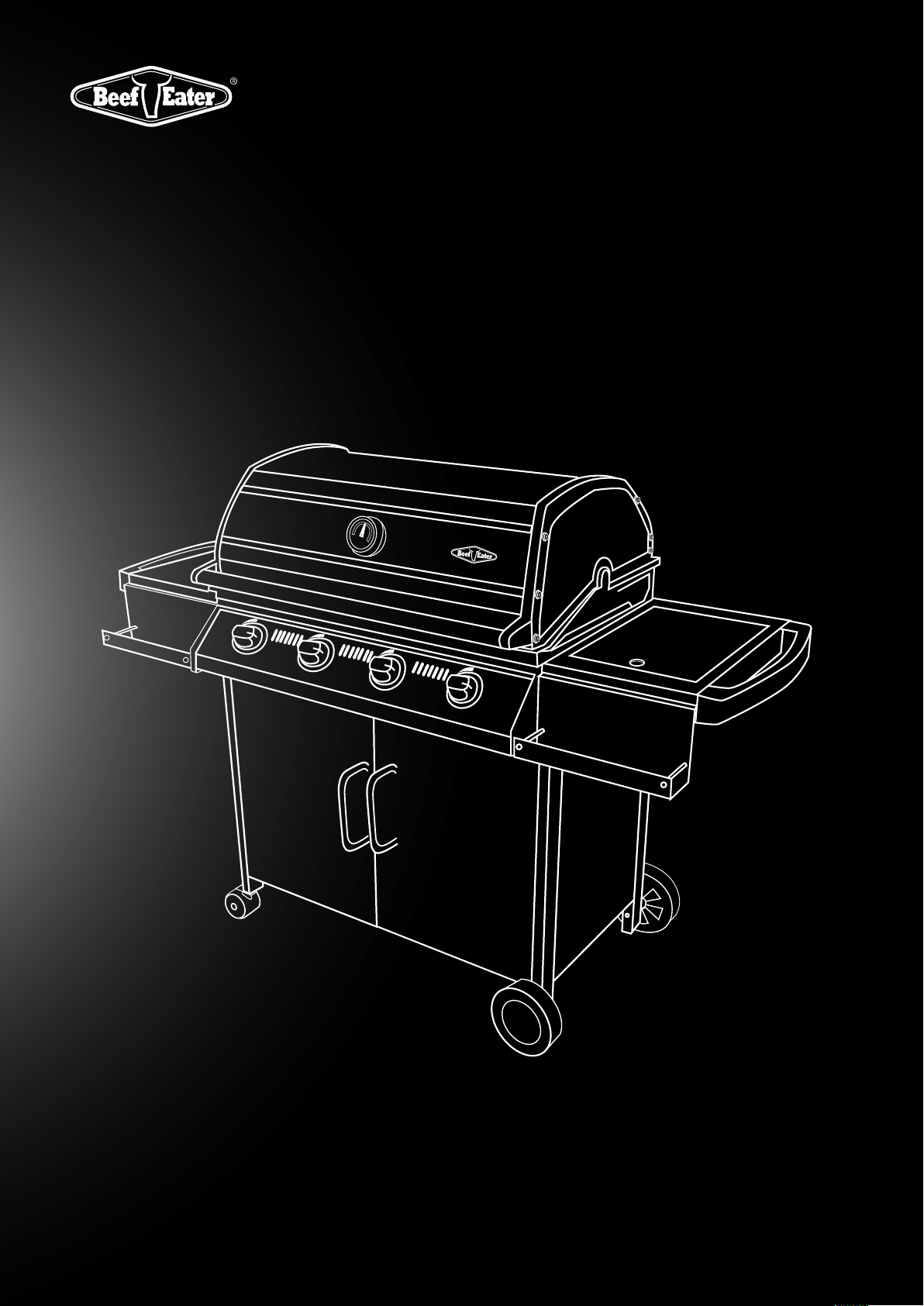
FOR OUTDOOR USE ONLY AUSTRALIA / NEW ZEALAND
Assembly and Operating Instructions
DISCOVERY
SERIES
i-1000R

2 CONTENTS
Important safety instructions ��������������������������������������������������������3
Locating your barbecue�����������������������������������������������������������������4
Installation options ������������������������������������������������������������������������5
For built-in units only ��������������������������������������������������������������������6
Assembly instructions �������������������������������������������������������������������8
Cabinet trolley assembly �������������������������������������������������������������10
Assembly procedure ��������������������������������������������������������������������11
Assembly instructions for trolley ������������������������������������������������12
Side burner assembly �����������������������������������������������������������������17
Operating instructions ����������������������������������������������������������������18
Connection to barbecue & gas supply ����������������������������������������19
Using your barbecue �������������������������������������������������������������������21
Getting the most from your barbecue ����������������������������������������23
Cleaning and storing your barbecue ����������������������������������������� 24
Service and maintenance ����������������������������������������������������������� 25
Barbecue dimensions �����������������������������������������������������������������27
Notes ��������������������������������������������������������������������������������������������28
Warranty ��������������������������������������������������������������������������������������31
Please read the user manual carefully and store in a handy
place for later reference�
The symbols you will see in this booklet have these
meanings:
WARNING
WARNING
This symbol indicates information concerning your
personal safety.
WARNING
CAUTION
This symbol indicates information on how to avoid
damaging the appliance.
TIPS & INFORMATION
IMPORTANT
This symbol indicates tips and information about use
of the appliance.
ENVIRONMENTAL TIPS
ENVIRONMENT
This symbol indicates tips and information about
economical and ecological use of the appliance.
Dear customer,
Congratulations and thank you for choosing our barbecue�
We are sure you will find it a pleasure to use� Before you use
the barbecue, we recommend that you read through the
relevant sections of this manual, which provide a description
of your appliance and its functions�
To avoid the risks that are always present when you use
an appliance, it is important that the appliance is installed
correctly and that you read the safety instructions carefully to
avoid misuse and hazards�
We recommend that you keep this instruction booklet
for future reference and pass it on to any future owners�
After unpacking the appliance, please check it is not
damaged� If in doubt, do not use the appliance but contact
your local customer care centre�
This appliance complies with requirements of Australian
Standards AS4557�
CONDITIONS OF USE
These important notes apply to your appliance, failure to
adhere to these conditions of use may affect your ability to
make a claim under the manufacture’s warranty.
• This appliance MUST be installed and serviced only
by a qualified licensed person�
• This product is intended for personal, domestic or
household use only, not commercial use�
• This product is intended for outdoor use only�
• This product must be installed, operated and maintained
as per the instructions�
• Ventilation holes in the unit must not be obscured by the
installation�
Please ensure you read the instruction manual fully
before you call for service, or a full service fee could
be applicable.
Record model and serial number here:
Model number: �������������������������������������������������������������������������������
Serial number: ��������������������������������������������������������������������������������
PNC: ������������������������������������������������������������������������������������������������
CONTENTSCONGRATULATIONS
3SAFETY
Please read the user manual carefully and store in a handy
place for later reference�
TIPS & INFORMATION
IMPORTANT
Important – check for any damages or marks
If you find the barbecue is damaged or marked, you must
report it within 7 days if you wish to claim for damage/
marks under the manufacturer’s warranty. This does not
affect your statutory rights.
ENVIRONMENTAL TIPS
ENVIRONMENT
Information on disposal for users
• Most of the packing materials are recyclable. Please
dispose of those materials through your local recycling
depot or by placing them in appropriate collection
containers.
• If you wish to discard this product, please contact
your local authorities and ask for the correct method
of disposal.
WARNING
WARNING
This appliance must be serviced only by a qualified
licensed person.
Improper installation, adjustment, alteration or
maintenance can cause injury or property damage and
may affect your ability to claim under the manufacturer’s
warranty.
Please contact your nearest Electrolux Service
Department for additional information or assistance
for an approved installer.
NOTE: This manual must remain with the owner for
future reference�
WARNING
WARNING
• Do not lean over barbecue when lighting.
• Do not leave the barbecue unattended when alight.
• Do not delay lighting once the gas has been turned on.
• Do not store or use aerosol cans in the vicinity of
the barbecue.
• Do not store flammable liquids in the vicinity of the
barbecue.
• Do not use caustic or abrasive based cleaners on
the barbecue.
• Do not attempt to dismantle or adjust the control
valves.
• Do not attempt to dismantle or adjust the regulator.
• Do not test for leaks with a naked flame.
• Do not modify the construction of this appliance or
modify the injector orifice size.
• Do not obstruct any ventilation of the barbecue.
• Do not allow children to operate or play near the
barbecue.
Failure to adhere to the above warnings may cause injury
or property damage and affect your ability to make a claim
under the manafacturer’s warranty.
WARNING
CAUTION
This barbecue is supplied set up for Natural Gas and
is labelled accordingly. A Universal LPG and propane
conversion kit is included if required. Conversion of this
unit to Universal LPG or propane must be carried out by a
qualified licensed person and a Certificate of Compliance
must be issued to the owner at the completion of the
installation and conversion.
IMPORTANT SAFETY INSTRUCTIONS
4
Most importantly, this is an outdoor appliance. Ensure your
barbecue is positioned safely away from anything that can
catch fire.
Indoor Use Only: Under no circumstances is this barbecue to
be used indoors� This includes garages or any
other enclosed area�
Clearance From Combustibles: Ensure your barbecue
remains at a distance of at least 45 cm (18”) from any
combustible material such as wood, gyprock, paper and
plants� Do not store combustible materials, gasoline or
flammable liquids or vapours within 45 cm (18”) of the
barbecue�
Adequate Ventilation: Ensure there is adequate ventilation
for both the barbecue and cylinder� This is required not only
for proper combustion, but also to prevent gas build up�
Firm Level Surface: Use your barbecue only on a firm level
surface� This barbecue is not designed for recreational
vehicles, and shall not be installed on a boat or any
marine craft�
Protection From Weather: Keep the barbecue protected
from adverse weather, including rain and high winds�
Polyvinyl covers are available that have been specially
designed for this range of barbecues�
Allow clear access to the entire gas supply hose and
regulator�
Maintenance Access: When your barbecue is installed,
you should be able to access the gas supply line including
the gas piping or hose, gas regulator, gas cylinder and any
shut off valves�
Partial Enclosures: Many backyards have areas that are
partially closed off, such as balconies and pergolas� In some
cases, it is hard to decide whether these partially enclosed
areas should be classified as indoor areas, particularly in
terms of permanent (non-closable) ventilation� The gas
safety authorities have agreed on the definition of partial
enclosures below�
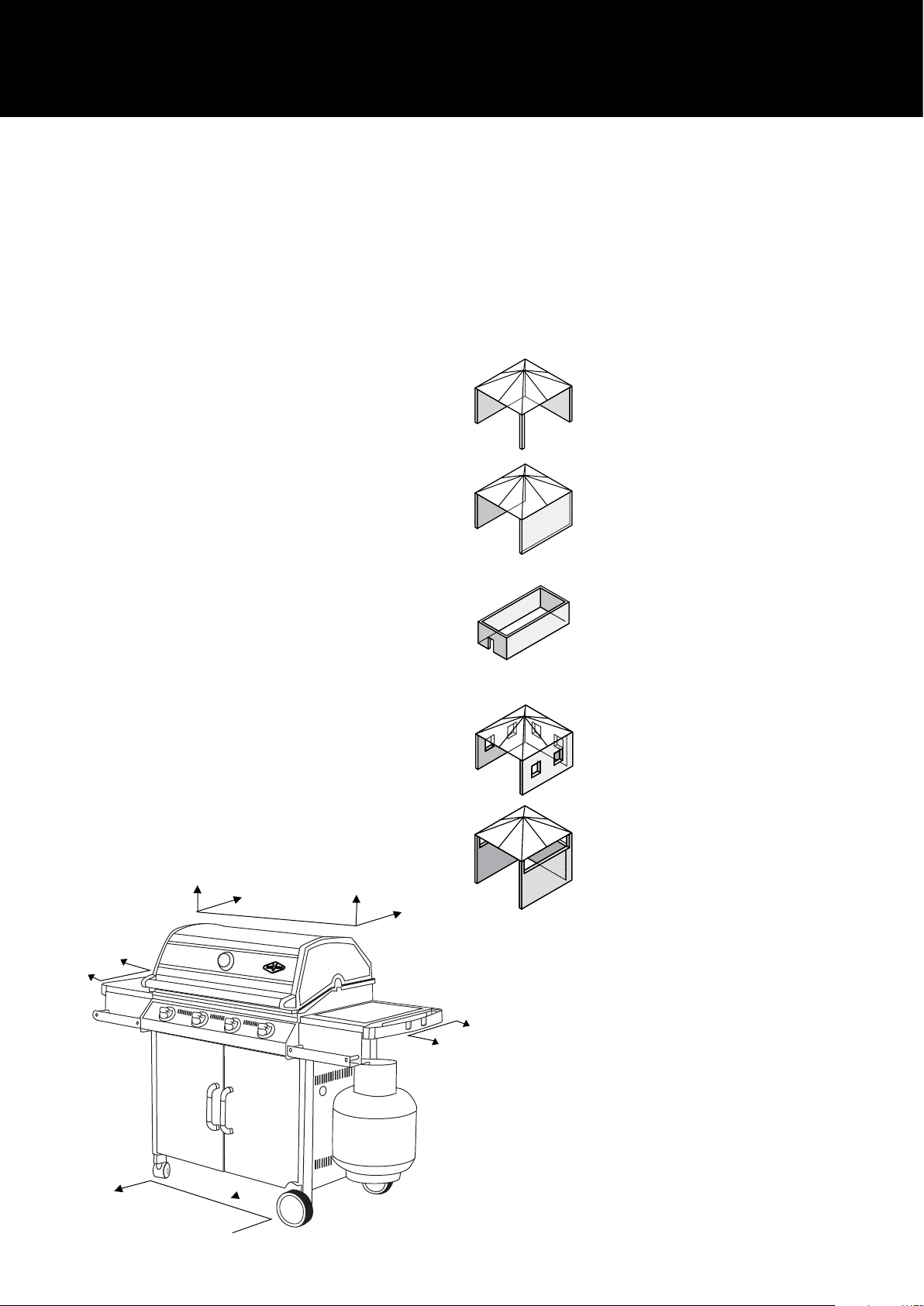
Distance to combustible materials (min):
LOCATING YOUR BARBECUE
LOCATING YOUR BARBECUE
Partial Enclosures (Australia Only)
This appliance shall only be used in an above ground, open
air situation with natural ventilation, without stagnant
areas, where gas leakage and products of combustion are
rapidly dispersed by wind and natural convection� Failure to
adhere to these installation instructions may cause injury
or property damage and affect your ability to make a claim
under the manufacturer’s warranty� Any enclosure in which
the appliance is used shall comply with one of the following:
Within a partial enclosure that includes an
overhead cover and no more than two walls�
A common example is an outdoor gazebo�
Any enclosure with walls on all sides, but at least
one permanent opening at ground level, and no
overhead cover�
A common example is an enclosed back yard�
Typically, the walls are less than 3m high� If they
are higher, there is a danger of gas build up�
The barbecue may be within a partial enclosure
that includes an overhead cover and more than
two walls, the following shall apply:
• At least 25% of the total wall area is
completely open; and
• at least 30% of the remaining wall area is
open and unrestricted�
In the case of balconies, at least 20% of the total
of the side, back and front wall areas shall be and
remain open and unrestricted�
Min 450mm (18’’)
Min 450mm (18’’)
Min 1000mm (40’’)
Min 450mm (18’’)
Min 450mm (18’’)
5INSTALLATION OPTIONS
INSTALLATION OPTIONS
Before proceeding, you need to establish the gas
type which your barbecue will run on, and the style of
installation you need.
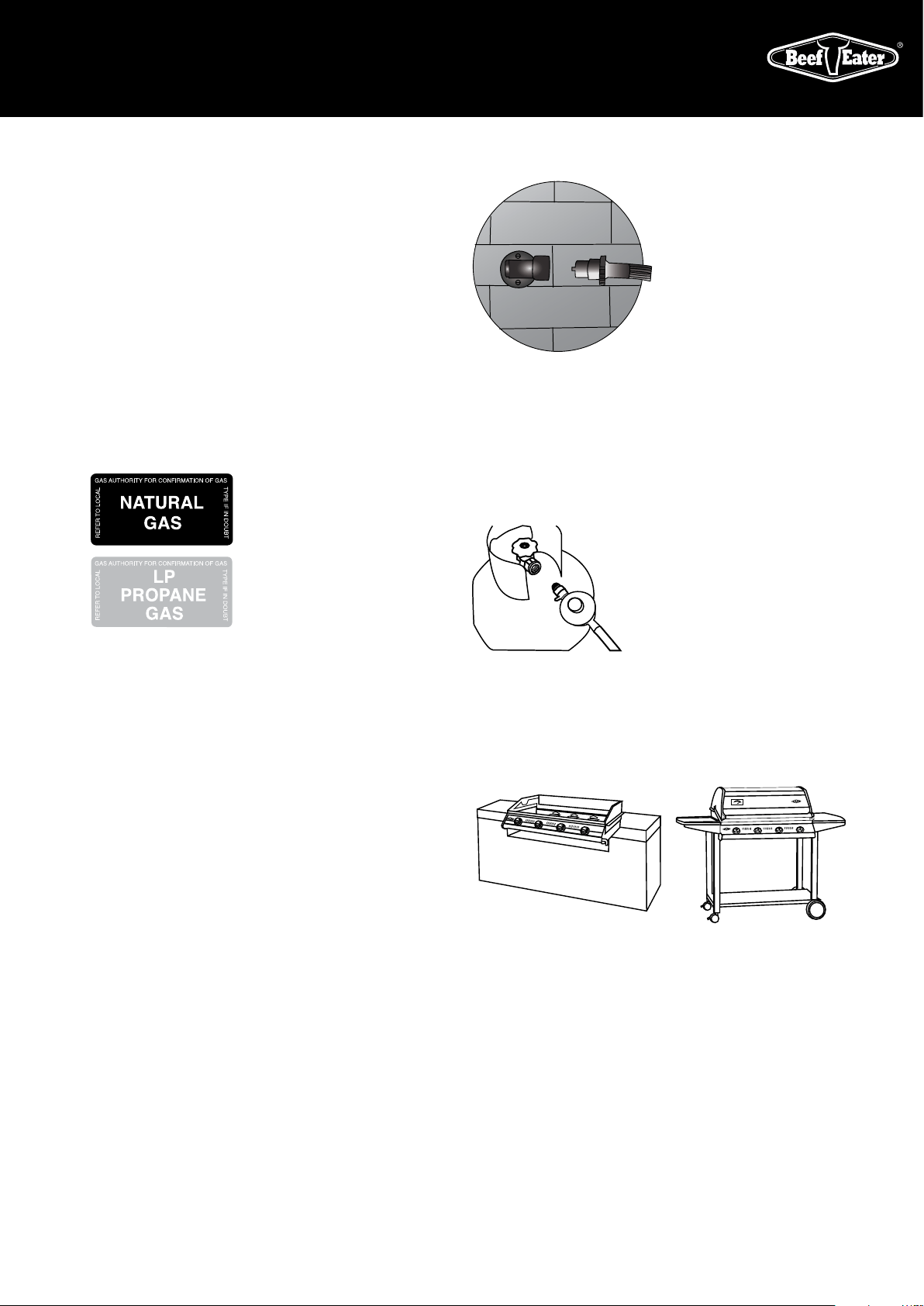
Natural Gas or LPG/Propane
Before beginning installation or assembly, check that the gas
type which the barbecue is designed for is correct for the gas
available to you� In most countries the choices are natural
gas or LPG/propane� You will find the gas type label on the
side of your barbecue� If your barbecue uses the incorrect
gas type, or if you are unsure, consult your dealer before
going any further� Using the wrong type of gas for a barbecue
is extremely dangerous�
Natural Gas Conversion: Most newly purchased barbecues
are made for LPG/ propane� A natural gas conversion kit is
available to allow your barbecue to run on natural gas�
Fixed (Piped) Installations
Piped Natural Gas: Although installation costs are higher,
this is typically the least expensive way to run your barbecue�
Natural gas is delivered via pipeline to a gas meter near the
perimeter of your home� From the gas meter, gas is taken
by a further series of pipes to each appliance that uses
natural gas�
Piped LPG/Propane: Some properties do not have natural
gas available to them� In these cases, the local gas supply
company may be able to provide two 45 Kg (100 lb) cylinders
permanently installed on the outside of your home� These
are refilled for you by the gas company based on your usage
patterns� Copper pipe is then run from these cylinders to
each appliance that uses LPG/propane�
There are two methods of connecting the gas to your
barbecue, both of which require the services of a licensed
gas fitter:
• For built in (ie non-mobile) installations, the barbecue
inlet can be connected directly to copper piping� From
here the barbecue cannot be moved�
• The copper piping can terminate in a “bayonet point” on
a wall or other structure� A special hose and terminator
allows the barbecue to be connected and disconnected
rom the bayonet point safely and conveniently� This
allows the barbecue to be moved if necessary�
Portable LPG/Propane Cylinder
The most flexible arrangement is a portable LPG/propane
gas cylinder attached by a special hose and regulator to
your barbecue� Although the cylinder needs to be refilled or
exchanged when empty, this installation has the advantage
of being more mobile, and not requiring the services of
a licensed gas fitter
Built in or Mobile Trolley/Cart
Whatever gas option you choose, your barbecue can be
mounted on a mobile trolley/cart, or it can be permanently
built-in� This user manual contains details for both
configurations�
6
FOR BUILT-IN UNITS ONLY
FOR BUILT-IN UNITS ONLY
The Discovery series of barbecues comes in both trolley-
mounted and built-in models. These two pages contain
information relating to setting up the built-in model only.
General Requirements
We recommend that th is installation be done in a masonry
structure and carried out by a professional tradespe rson�
Other non-combustible material such as Hard iplank,
Villaboard with metal studs may also be used�
This appliance must not be installed under or on any
combustible material� Minimum clearance from combustible
construction materia ls to all sides of the appliance is
450mm (18”)�
Warning: Contact your local municipality for any building
codes regulating the installation of outdoor barbecue
appliances� Outdoor installations must conform to local
codes or, in the absence of local codes, with:
• USA: National Fuel Gas Code, ANSI Z223�1/NFPA 54
• CAN: 8149�1 Natural Gas & Propane Installation Code�
• AUST: Australian Standards Code AS: 5601
as well as the requirements of any local council, gas,
electricity authority or other statutory regulation�
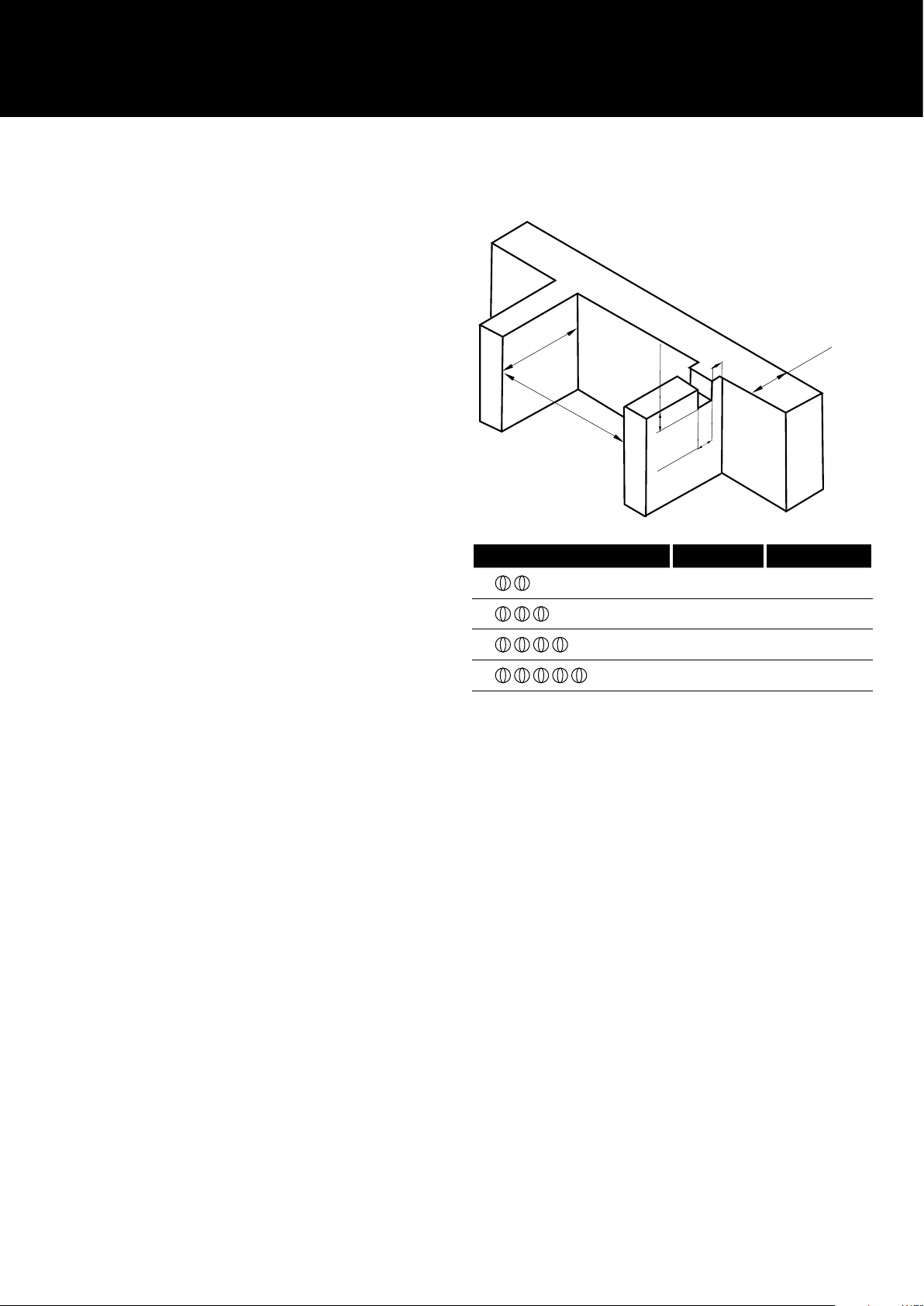
The Barbecue Cavity
Your barbecue has been designed to sit into a cavity or
cutout rather than be placed directly onto a flat surface� It is
important that the dimemsions of the cavity conform exactly
to those listed be low� This will ensure the barbecue sits
correct ly in the cavity, and that the barbecue has sufficient
ventilation to operate efficiently and safely� It also allows
room for any roasting hood to open freely,
In creating the cavity, you should ensure that you have
convenient access to the gas connection point and
associated hardware:
• If the gas for your barbecue is supplied by a portable gas
bottle, you will need access to the gas connection point,
the gas hose and the gas cylinder at all times�
• If the gas for your barbecue is supplied by a fixed piped
gas supply (either natural gas or 45kg LPG cylinders),
you will need access to the gas connection point, the
piping and the shutoff valve�
Built-in Cavity Dimensions
WIDTH
x2
20 5/8” 523mm
x3
27 1/8” 690mm
x4
33 1/4” 846mm
x5
39 1/2” 1003mm
520mm
120mm
Width
65mm
250mm
100mm
7FOR BUILT-IN UNITS ONLY
FOR BUILT-IN UNITS ONLY
The Cylinder Compartment
If the gas for your barbecue is to be supplied by a portable
LPG/propane cylinder, you will need to ensure that adequate
provision is made to house the cylinder safely� The following
must be adhered to:
Keep out of heat: The cylinder and hose must be sheltered
from the sun’s direct heat� The flexible PVC hose assembly
supplied must not be exposed to temperatures in excess of
60°C (140°F)� DO NOT allow the hose to come in contact with
the hot surface of the barbecue body�
Keep cylinder upright: The cylinder must be housed
securely� It must remain upright at all times� It can be either
attached to a firm vertical wall by a cylinder bracket, or
stored on a firm level base�
Requirements for cylinder base: If the cylinder is to be
stored on a flat base, the base must be made from non-
combustible material� Soil or grass is not an appropriate
surface� Ensure there is adequate drainage, and that water
cannot collect around the cylinder�
Requirements for cylinder compartment: Where the
cylinder is to be kept inside an enclosure, you must ensure
there is 200 square centimetres of open ventilation at each
of the top and the bottom of the enclosure, for each cylinder
stored in it� This prevents leaking gas from building up in a
confined space� Gas vapour is highly explosive and can cause
serious bodily injury or damage to property if allowed to
accumulate in a confined space and ignited�
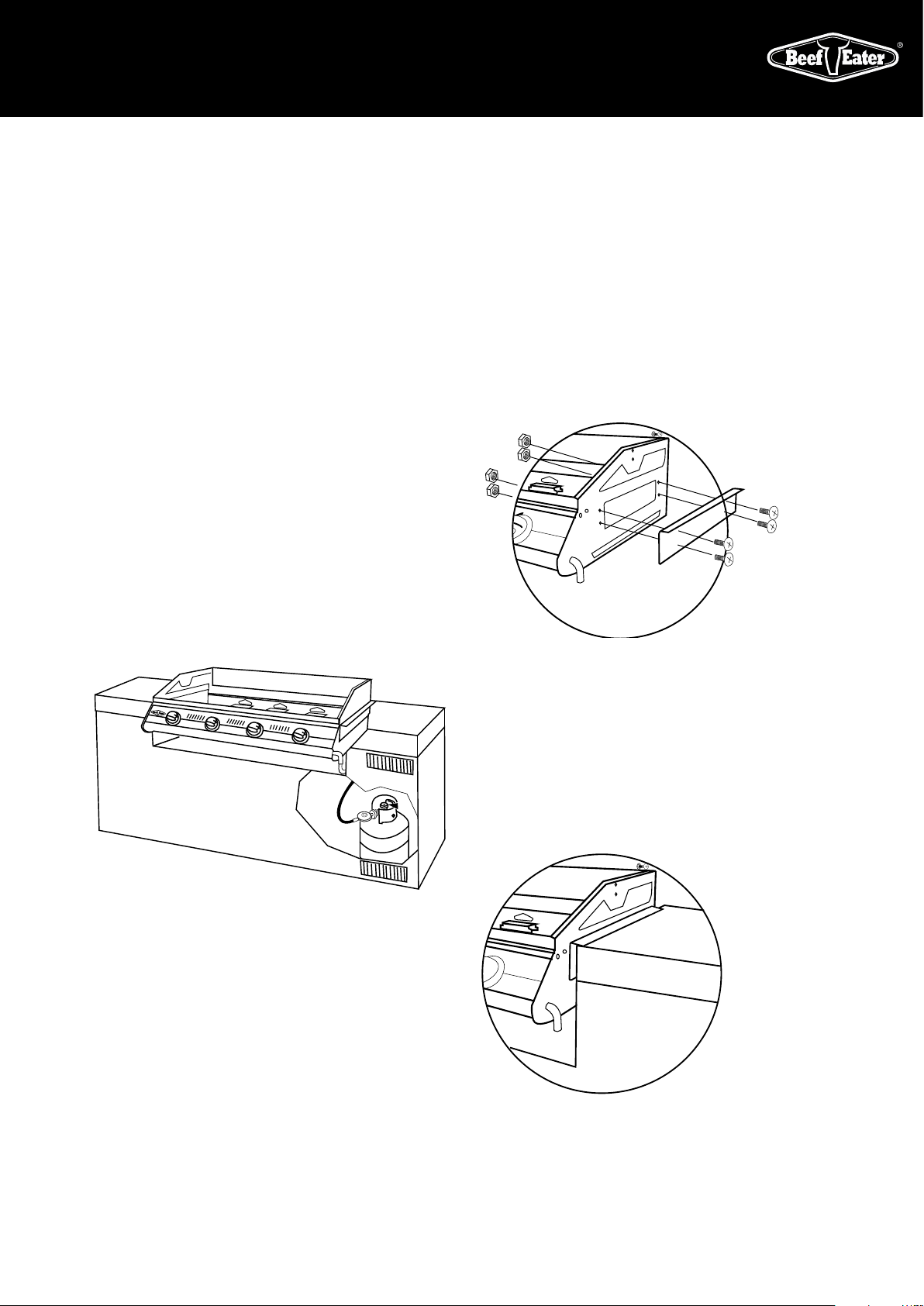
Attach The Brackets
Screw the built-in brackets to the side of the barbecue as
shown� These brackets are designed to rest on the sides of
the brickwork� This performs two important functions:
• The ventilation slots in the brackets allow air to pass
between the sides of the barbecue and the brickwork�
This prevents the barbecue from overheating and
provides air to allow the barbecue to burn gas correctly�
• The brackets allow the barbecue body to be lifted above
the flat surface underneath� This allows the grease tray
to slide out freely, and for combustion air to enter from
underneath�
Lower The Barbecue Into Position
When lowering the barbecue onto the brickwork, do not
push the barbecue back as far as it will go� Ensure there is
at least 50 mm clearance behind the rear of the barbecue to
allow for proper ventilation, and to allow any roasting hood to
open freely�
Note in the illustration how there is an air gap between
the side of the barbecue body and the wall of the cavity� It
is important for the proper operation of the gas barbecue
that air can flow freely up past the side of the barbecue and
through the air slots on the brackets�
8
ASSEMBLY INSTRUCTIONS
ASSEMBLY INSTRUCTIONS
Before You Start
Note the tools you will need before you begin�
Remove any packaging material or protective plastic from
components�
Check for damaged or missing parts, and consult your
retailer if necessary�
Mobile carts and trolleys are optional� You should follow
the separate instructions that came with the trolley before
assembling and installing your barbecue�
adjustable spanner / wrench
Phillips Head Screwdriver
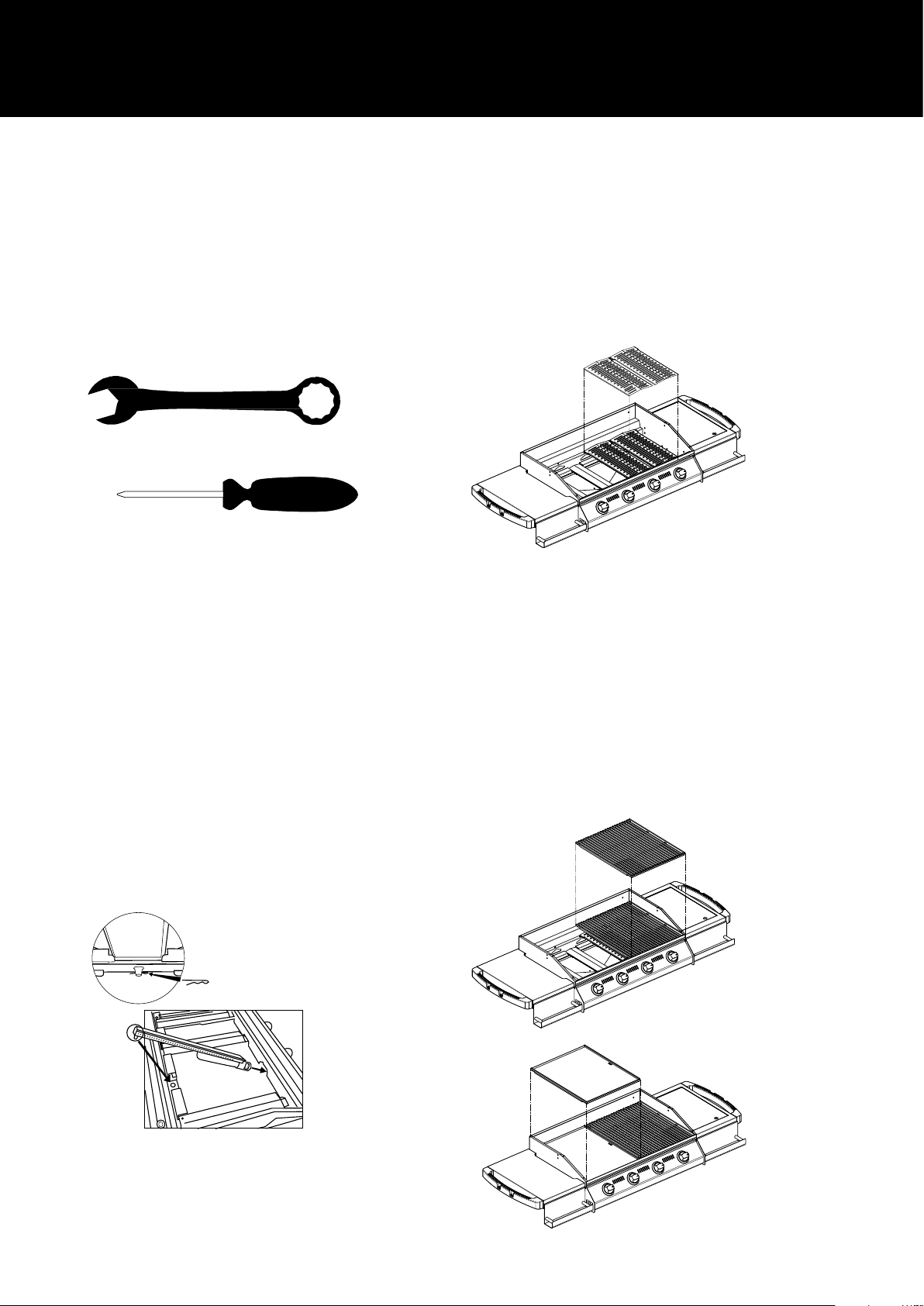
Check The Cross Lighting Channels
The cross lighting channels should already be in place� If
they are not, or if they moved during shipping, they need to
be replaced as follows: place each cross-lighting channel
onto the back support panel� The keyed tabs on the bottom
of each cross-light channel fits into the slots on the burner
support rail� The cross lighting channels are required for
all models�
Check The Burners
The burners should already be fitted to the barbecue� If they
are not, or if they moved during shipping, they need to be
replaced as follows:
Remove the retaining clip from the burners� Fit the burners,
open end first, over the stem of the control valves at the front
of the barbecue� Lower the other end of the burner so the
lug locates into the corresponding hole at the rear of the
barbecue�
Replace the retaining clips into the burner lugs so the
burners stay in position� You need to do this from behind the
barbecue, underneath the back panel�
Fit The Vaporizers
The Vaporizers are designed to vapourise fats and juices
from your food� The Vaporizers reduce flare-ups and help to
add that great barbecue flavour�
To install the Vaporizer(s), remove all plastic and/or
cardboard packaging material and place the Vaporizer
into position on the right hand side of the barbecue� The
Vaporizers must be fitted to the same side of the barbecue
as the grill� They will not work if fitted under the solid plate�
Note: Vaporizer grid style may vary between barbecues
Fit The Cooking Plates And Grills
We recommend fitting the solid plate to the left-hand side
of the barbecue frame (with the drain hole on the right hand
side)� The grills can be fitted to any side of the barbecue
frame�
IMPORTANT: the grills must always be positioned over the
Vaporizers�
This appliance is designed to ventilate air through the
barbecue while it is operating� Do not fit additional cooking
plates to the top of the barbecue� Doing so will prevent the
unit from ventilating and will cause serious damage to the
barbecue�
9
ASSEMBLY INSTRUCTIONS
ASSEMBLY INSTRUCTIONS
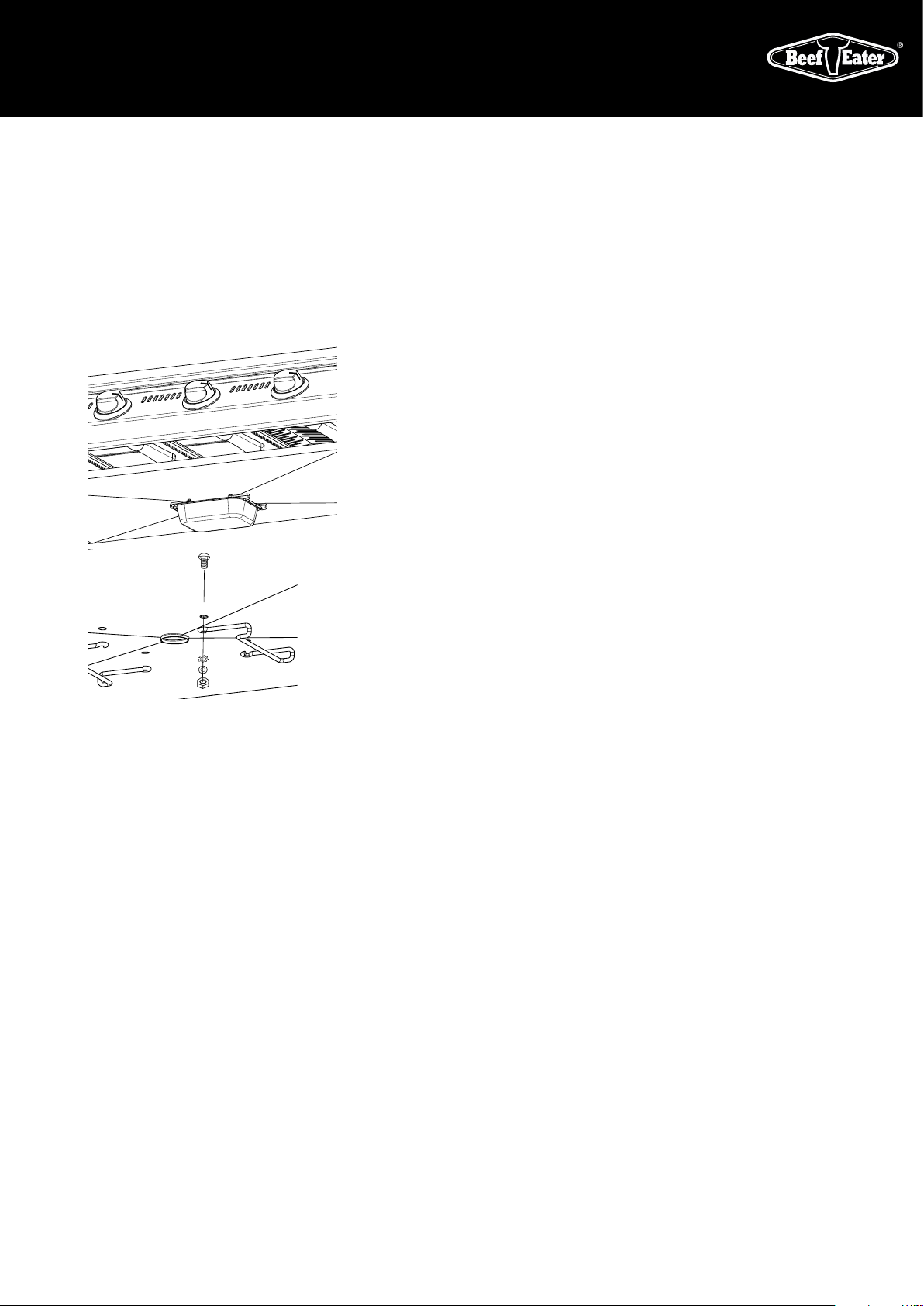
Set Up The Grease Tray
Assemble the grease tray as shown in the diagram below�
Attach the waste tray brackets to the grease tray using the
screws, nuts and washers provided� Slide the smaller waste
tray into place�
You may line the grease tray with a sheet of aluminium foil
if you wish� Remember to place a hole in the centre so the
grease can flow into the smaller waste tray�

10
1
2
3
10
4
7
12
11
13
8
9
5
6
CABINET TROLLEY ASSEMBLY
CABINET TROLLEY ASSEMBLY
Content:
INDEX PART QUANTITY
1 Top Panel 1
2 Shelf 1
3 Side Burner 1
4 RHS Panel and legs 1
5 LHS Panel and legs 1
6 Rear Panel 1
7 Base Panel 1
8 RHS Door 1
9 LHS Door 1
10 Cylinder Hook 1
11 Castors 2
12 Wheels 2
13 Wheel Spacers 2
MRK QTY DESCRIPTION
A 16 M6 x 40mm Screw
B 24 M6 washer
C 6 M6 Fiber Washer
D 6 M6 x 12mm screw
E 2 ‘R’ Clips
F 2 M6 x 25mm Screw
G 2 M6 Nut
H 1 M4 x 12mm screw
I 1 M4 Washer
J 2 Rubber Grommet
K 1 Cylinder Strap
11
ASSEMBLY PROCEDURE
ASSEMBLY PROCEDURE
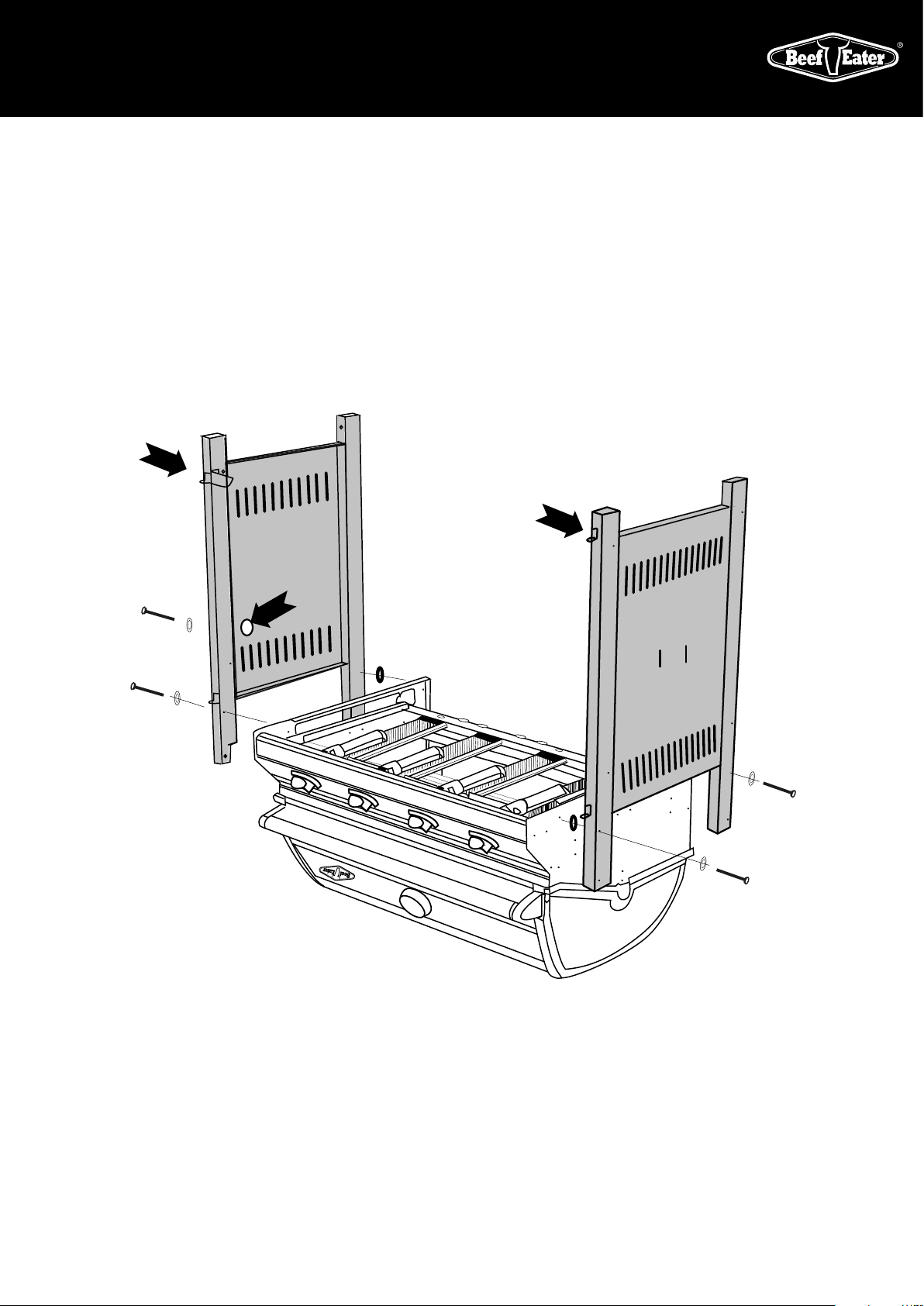
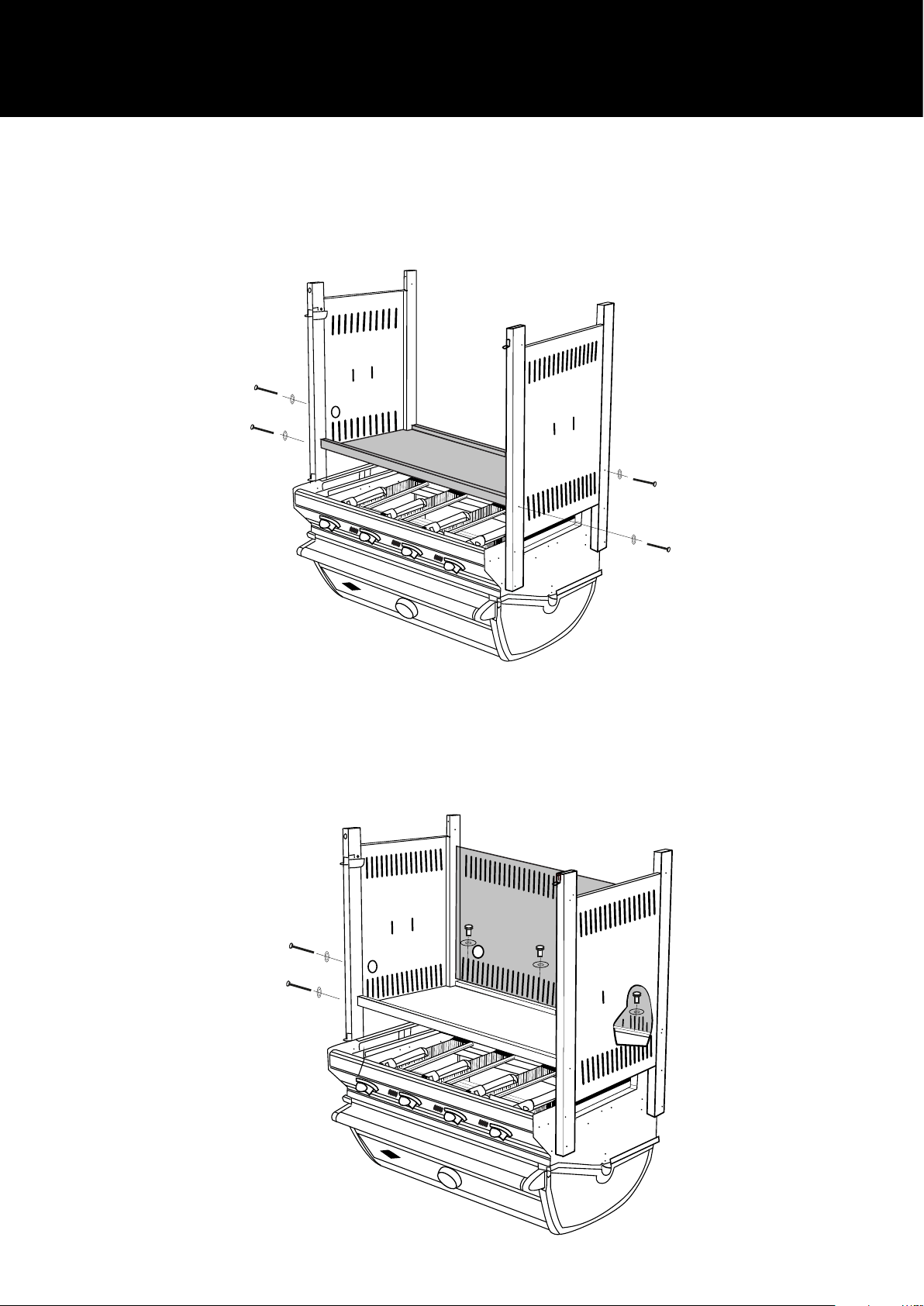
Step 1
Remove all loose parts from inside the BBQ, close the
hood, and turn it upside-down on a padded surface (BBQ
packaging can be used for this purpose)�
Step 2
Use: 4 x ‘A’, 4 x ‘B’, 4 x ‘C’
Attach the Sides of the trolley (Parts 4, 5) to the BBQ body�
Note the direction, position and orientation:
Note: Only put in the 4 lower screws! Turn the screws all the
way in, but do NOT tighten them� Other 4 screws and final
tightening will only be done after installing the shelf and
side-burner at a later stage�
12
ASSEMBLY INSTRUCTIONS FOR TROLLEY
ASSEMBLY INSTRUCTIONS FOR TROLLEY
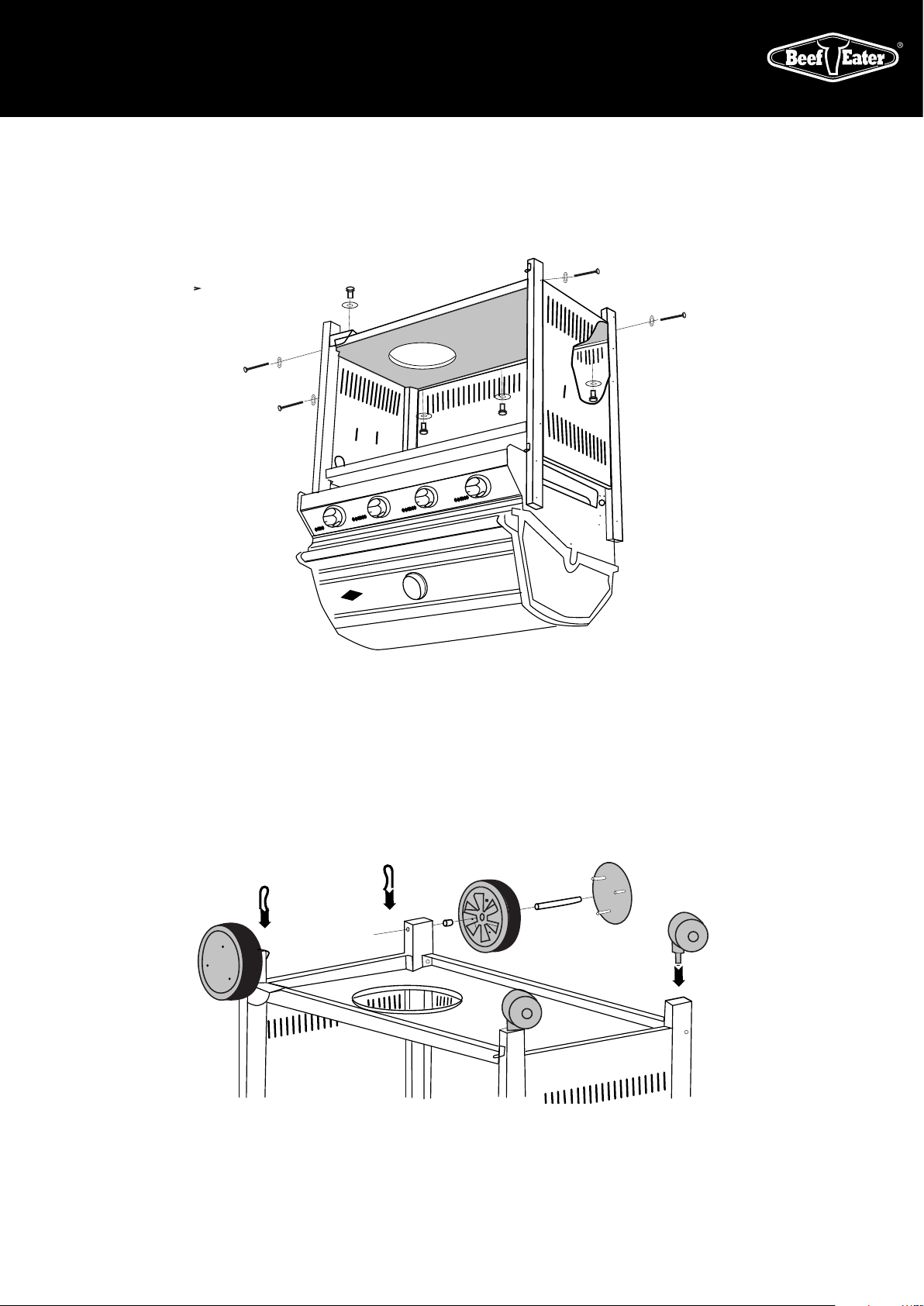
Step 3
Use: 4 x ‘A’, 4 x ‘B’
Attach the Top panel (Part 1) to the sides:
Step 4
Use: 3 x ‘D’, 3 x ‘B’
Attach the Back panel (Part 6) to the Top panel:
13
ASSEMBLY INSTRUCTIONS FOR TROLLEY
ASSEMBLY INSTRUCTIONS FOR TROLLEY
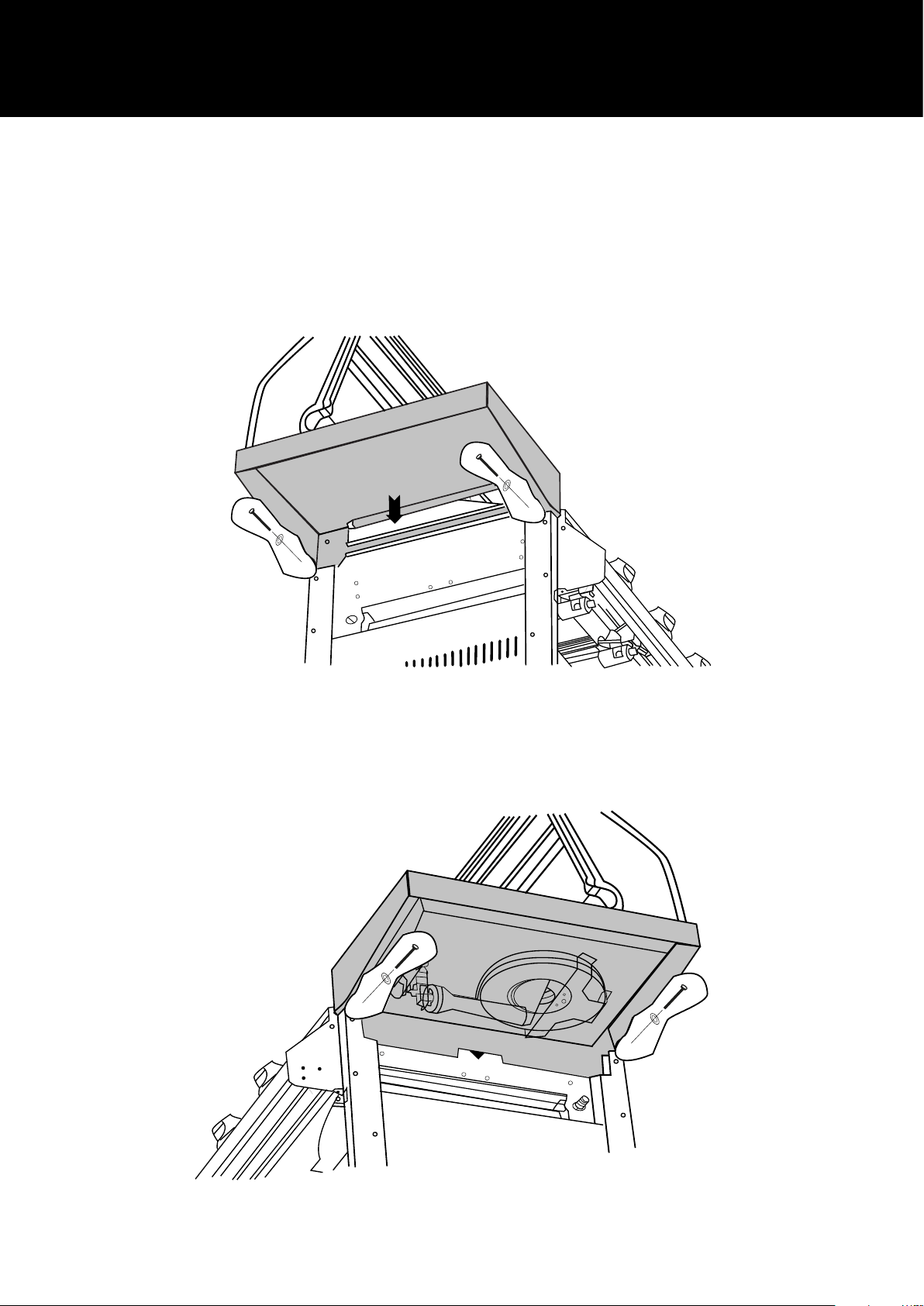
Step 5
Use: 4 x ‘A’, 7 x ‘B’, 3 x ‘D’, 1 x ‘H’, 1 x ‘I’
Attach the Base of the trolley (Part 7) to the Sides and Back panel:
Step 6
Use: 2 x ‘E’
Fit the Wheels (parts 12, 13) and the castors (parts 11):
14
ASSEMBLY INSTRUCTIONS FOR TROLLEY
ASSEMBLY INSTRUCTIONS FOR TROLLEY
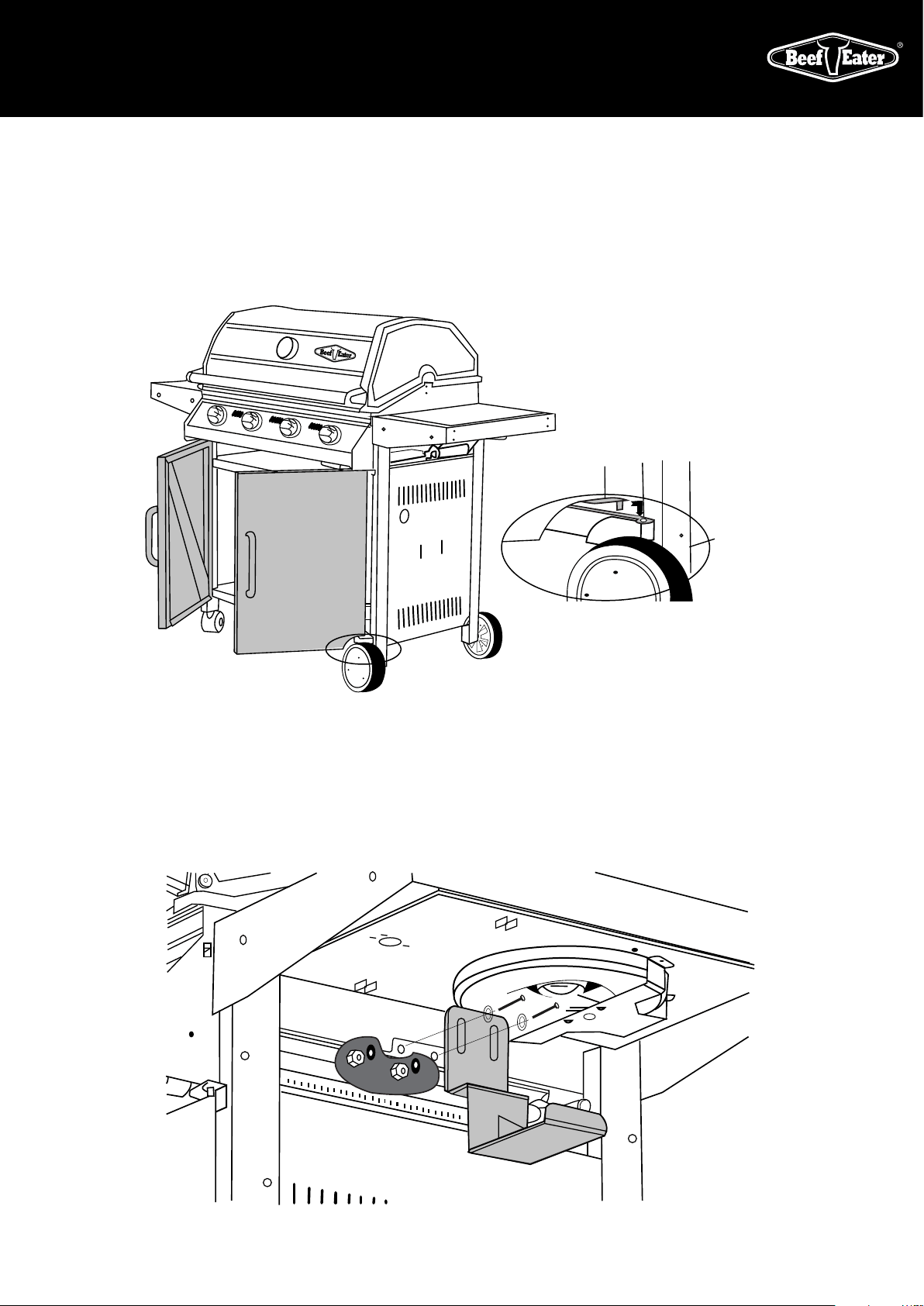
Step 7
Carefully turn the trolley and Barbecue upright Carefully turn the trolley and Barbecue upright
Step 8
Use: 2 x ‘A’, 2 x ‘B’
To the Left Hand Side, install the shelf (Part 2)� Insert over the two legs and between the barbecue body and the leg, and
secure with the screws�
Step 9
Use: 2 x ‘A’, 2 x ‘B’
To the Right Hand Side, install the Side-Burner (Part 3) � Insert over the two legs and between the barbecue body and the leg,
and secure with the screws�
1
1
2
2
2
2
15
ASSEMBLY INSTRUCTIONS FOR TROLLEY
ASSEMBLY INSTRUCTIONS FOR TROLLEY
Step 10
Ensure all screws are now tightened (but do not over-tighten)
Step 11
Assemble both doors (Parts 8, 9) over the hinge brackets:
Note: ensure that in each door, both hinge pins are inserted into the brackets simultaneously�
It may be required to assemble the handles onto the doors�
Step 12
Use: 2 x ‘F’, 2 x ‘G’, 2 x ‘B’, 2 x ‘C’
Assemble Cylinder Hook (Part 10), if required:
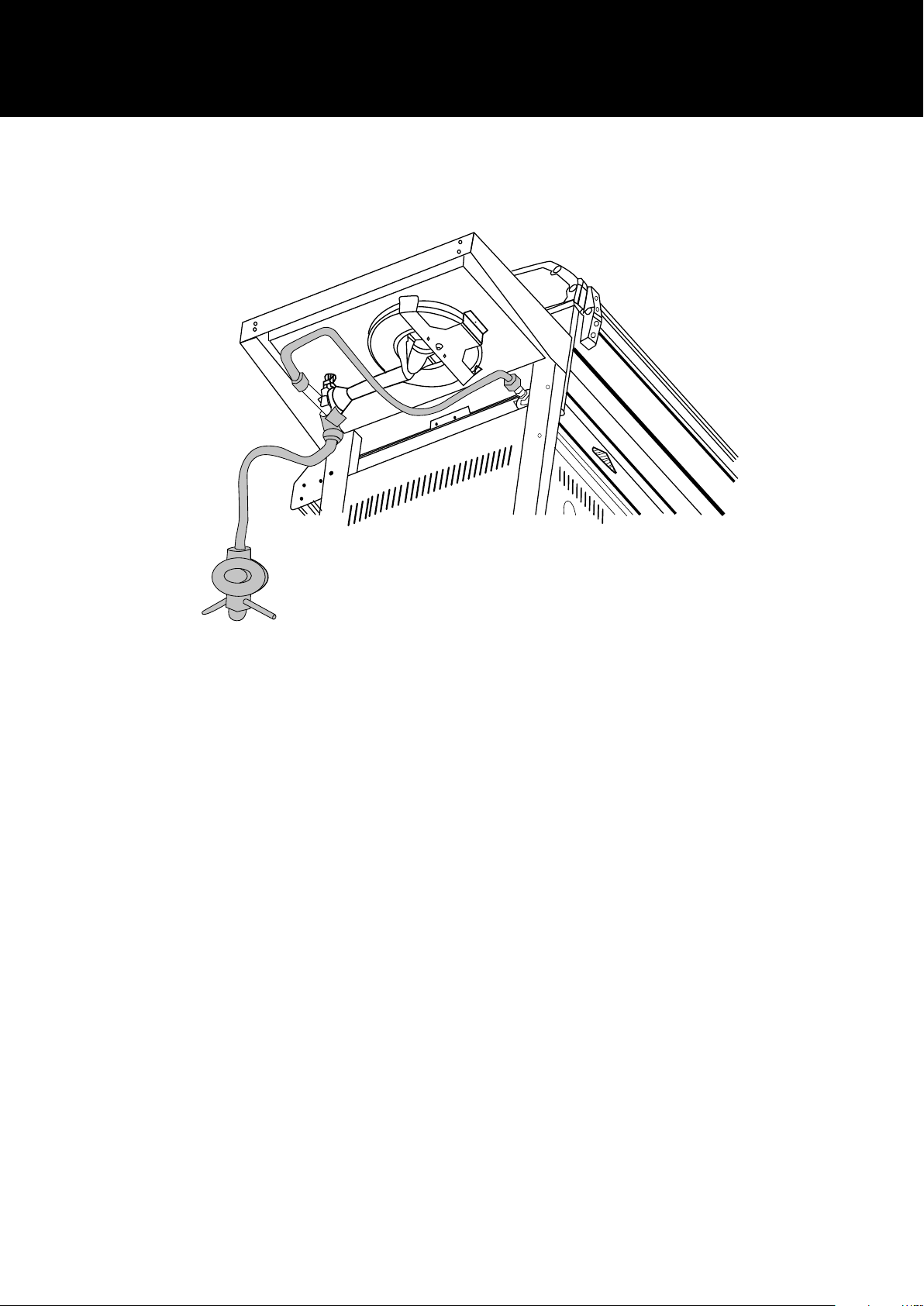
16
ASSEMBLY INSTRUCTIONS FOR TROLLEY
ASSEMBLY INSTRUCTIONS FOR TROLLEY
Step 13
Make gas connections and leak test as per the instructions on page 20�
17
SIDE BURNER ASSEMBLY
SIDE BURNER ASSEMBLY
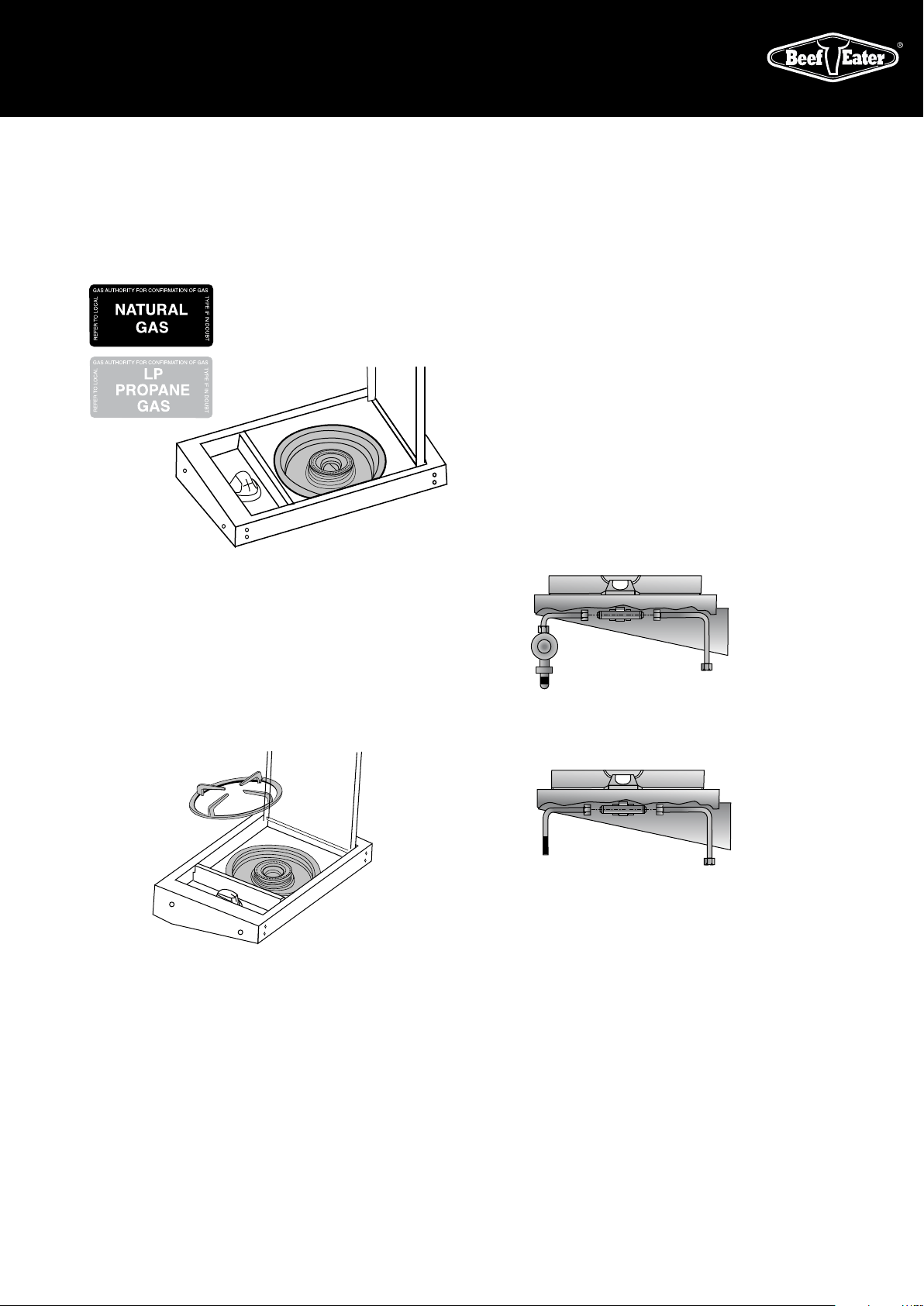
Check Gas Type
Check that the gas type is correct for your type of gas,�
You will find the gas type label on the underside of your side
burner� If your side burner is of the incorrect gas type, or if
you are unsure, consult your dealer before going any further�
Assembly
Attach side burner to your barbecue trolley as per step 9
on page 14
The spill bowl and burner cap are put into place at the
factory, but may have moved in transit� Make sure the burner
cap sits neatly on the burner, and the two holes in the spill
bowl line up with the holes on the side burner body�
Place the trivet onto the side burner, making sure the pins
on the bottom of the trivet go into the holes on the spill bowl�
Connection to Barbecue & Gas Supply
The side burner becomes the first burner of your barbecue�
The gas comes into the side burner from the left side, and
continues through a hose to the main barbecue unit�
First, connect the side burner to the gas supply� For portable
LPG/propane bottles, use the hose and regulator supplied�
Natural gas systems must be installed by a licenced
gas fitter�
Connect the side burner directly to the barbecue gas inlet�
When assembling all hoses, ensure they are not in contact
with any surface that could become hot during use� In places
where they goe through metal panels a rubber grommet
must be installed
Secure all joints using two Spanner/Wrenches� Do not over
tighten�
Check for leaks after turning on the gas supply by brushing
a solution of water and detergent� Leaks will be indicated by
vigorous bubbling�
Retighten or reseal any leaking joints. If leaks persist
consult the manufacturer or dealer.
To barbecue
gas inlet
To barbecue
gas inlet
To gas
bottle outlet
Hard plumbing
to gas supply
For bottled LPG/propane
For natural gas
18
OPERATING INSTRUCTIONS
OPERATING INSTRUCTIONS
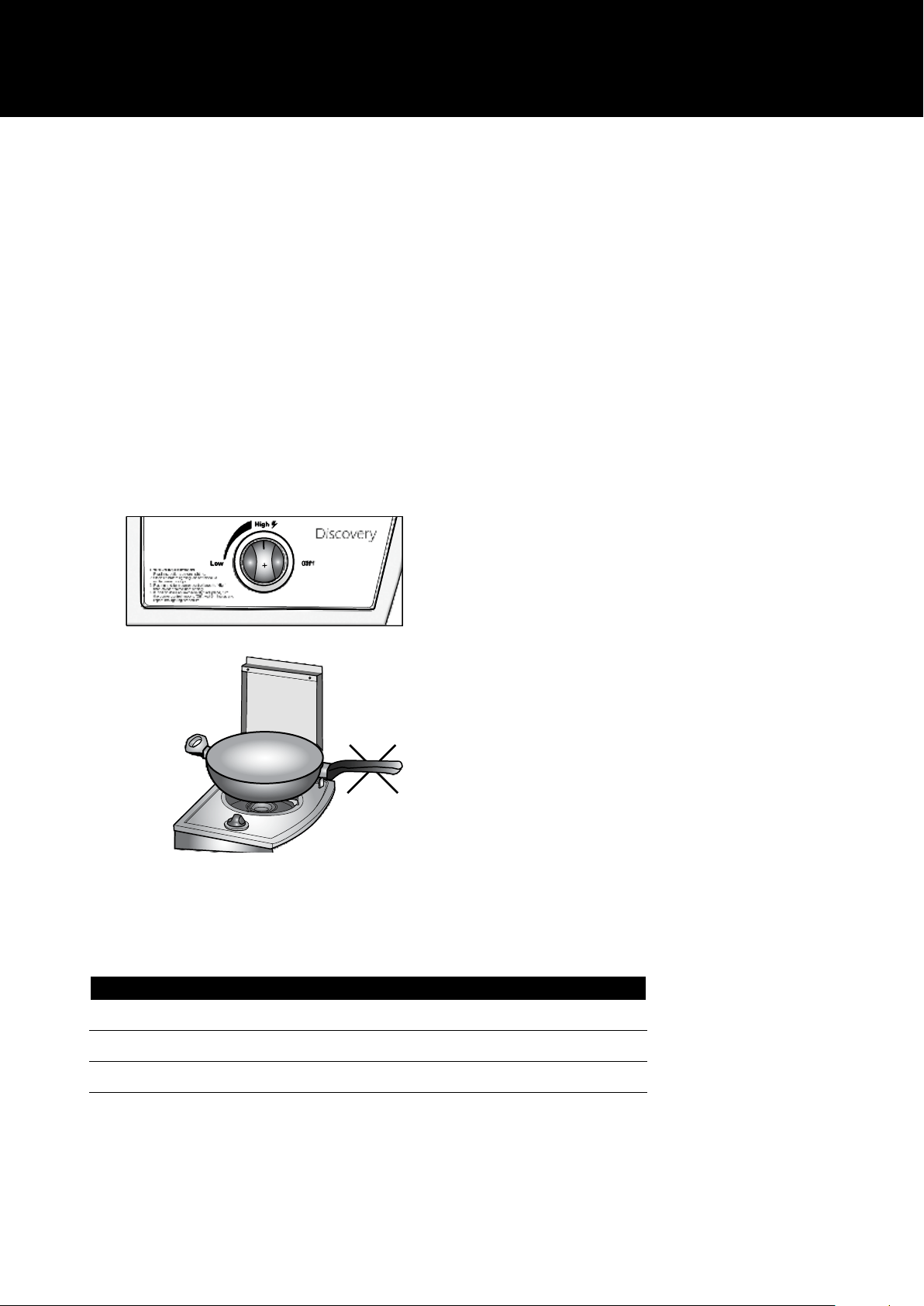
Operating Instructions
1� Raise the lid�
2� Press and turn the control knob slowly (3-4 seconds)
anti clockwise to HIGH until a click is heard�
3� If the burner fails to ignite, turn the knob to OFF repeat
the process�
A low flame or simmer condition is obtained by turning the
control knob anticlockwise to LOW�
Make sure long handles do not hang over the edge of the
side burner� Injury can result if they are accidentally knocked
After Use
1� Turn the control knob and the gas cylinder valve off if the
BBQ is not in use�
2� Clean off any food spills and lower the lid�
Care of Your Side Burner
All of the instructions for care of your barbecue apply to your
side burner� In particular:
Clean your side burner frequently with warm soapy water�
Do not use harsh or abrasive chemicals or scouring pads�
Clean more frequently in salt water environments�
Keep your barbecue and side burner covered while they are
not in use�
Check the gas hoses every 3 months� Have them replaced if
they show any signs of wear or cracking�
4
AUST / USA / CAN
Gas Injector Size Input MJ/HR Input BTU / H Pressure kPa WC
LPG 1�05mm 15 14200 2�75
11
Natural Gas 1�70mm 15 14200 1�00
4
Side burner specifications
19
CONNECTION TO BARBECUE & GAS SUPPLY
Installation warnings
CONNECTION TO BARBECUE & GAS SUPPLY
Before You Begin
Check the gas type label as described in the section titled
“The Gas Supply”�
Ensure all considerations such as clearances from
combustibles listed in the “Locating Your Barbecue” section
are adhered to�
Warning: Contact your local municipality for any building
codes regulating the installation of outdoor barbecue
appliances� Outdoor installations must conform to local
codes or, in the absence of local codes, with the following:
• USA: National Fuel Gas Code, ANSI Z223�1/NFPA 54
• CAN: CGA: B149�1 Natural Gas & Propane Installation
Code�
• AUST/NZ: Australian Standards Code AS: 5601
as well as the requirements of any local council, gas,
electricity authority or other statutory regulation�
Flexible PVC hose assemblies supplied must not be exposed
to temperatures in excess of 60°C (140°F)� DO NOT expose to
the sun’s direct heat and DO NOT allow the hose to come in
contact with the hot surface of the barbecue body�
Fixed Installation - Piped Natural Gas or LPG/Propane
Fixed installations should be carried out by a qualified gas
fitter� BeefEater barbecues are designed as low-pressure
appliances�
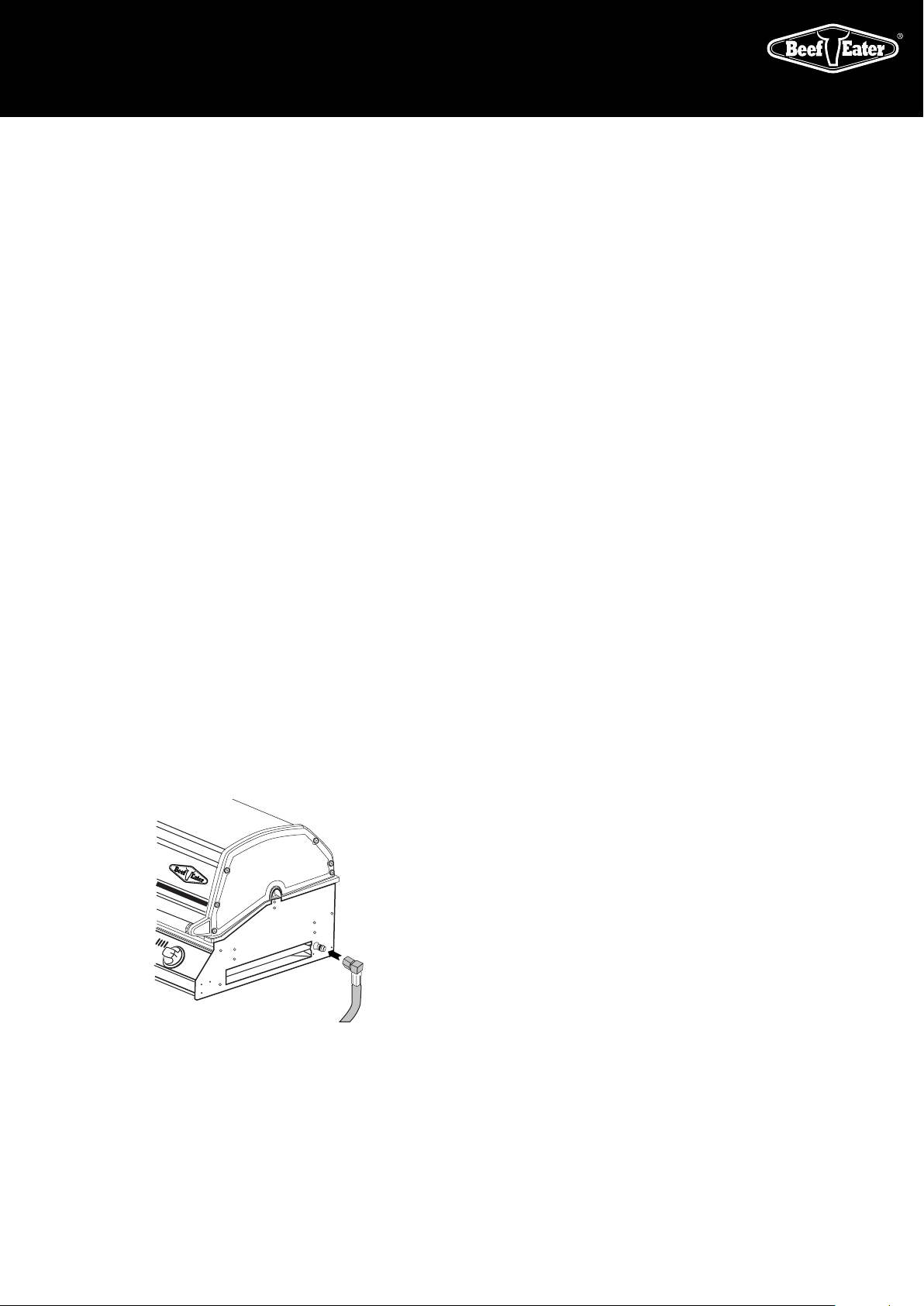
Gas connection: Fit the hose directly to the barbecue inlet
located on the right side of the appliance using either hard
plumbing, or a flexible hose connected to a bayonet point�
Refer to AS 5601 or your local installation code for pipe sizing
details� Secure all joints spanner (wrench) tight but do not
over-tighten�
Pressure testing: Test gas pressure by removing the last
burner from the left hand side of the barbecue and attaching
a hose and pressure gauge to the end of the gas valve� Turn
on 2 burners and check the pressure� Inlet pressure should
be 1�00 kPa / 4�0” WC for natural gas, or 2�75 kpa / 11”WC
for LPG/propane� The barbecue appliance must be isolated
from the gas supply piping system by closing its manual
shutoff valve during any pressure testing of the gas supply
piping system�
Australia only (applies to all gas types): Where a mobile
appliance is to be connected to a fixed gas supply via a flexible
hose connection, a retraining tether of adequate strength
shall be fixed to the appliance and be suitable to be fixed to
the wall within 50mm of each connection point� The length
of the tether shall not exceed 80% of the length of the hose
assembly� In this way, if the barbecue is accidentally moved,
the chain stops the barbecue from stretching the hose�
The barbecue appliance must be isolated from the gas
supply piping system by closing its manual shutoff valve
during any pressure testing of the gas supply piping system�
On completion: The appliance must be tested for safe and
proper operation on completion of installation� Proceed to
leak test�
Mobile Installation - Portable LPG
When installing a portable LPG cylinder, the following must
be observed:
The hose must not exceed 1�50m in length�
Gas cylinders must be stored outdoors, out of reach of
children, and must not be stored in a building, garage or any
other enclosed area�
IMPORTANT:
• The cylinder supply system must be arranged for
vapour withdrawal� This normally means the cylinder
must be upright�
• Do not store a spare LPG/propane cylinder under or
near this appliance�
• Never fill the cylinder beyond 80% full�
If these directions are not followed exactly, a fire causing
death or serious injury may occur�
• Only one gas cylinder may be attached to the appliance
at any one time�
• Minimum LPG/propane cylinder capacity for use with
this appliance is 4kg / 9 lb� Maximum cylinder capacity
is 9 kg / 20 lb�
• The gas cylinder used must incorporate a safety collar to
protect the valve assembly� Do not use a rusty or dented
gas cylinder or cylinder with a damaged gas valve�
• North America Only: The Gas cylinder must be
constructed and marked in accordance with
specifications for LP Gas Cylinders of the U�S� Dept�
of Transportation (DOT) or the National Standard of
Canada, CAN/ CSA - B339, Cylinders, Spheres or Tubes
for the transportation of dangerous goods�
• North America Only: The gas cylinder must be provided
with a listed overfilling prevention device� The cylinder
must be provided with a cylinder connection device
compatible with the connection for outdoor cooking
appliances� Ensure the cylinder valve and barbecue
control knobs are all off�
Remove the protective cap from the cylinder if present�
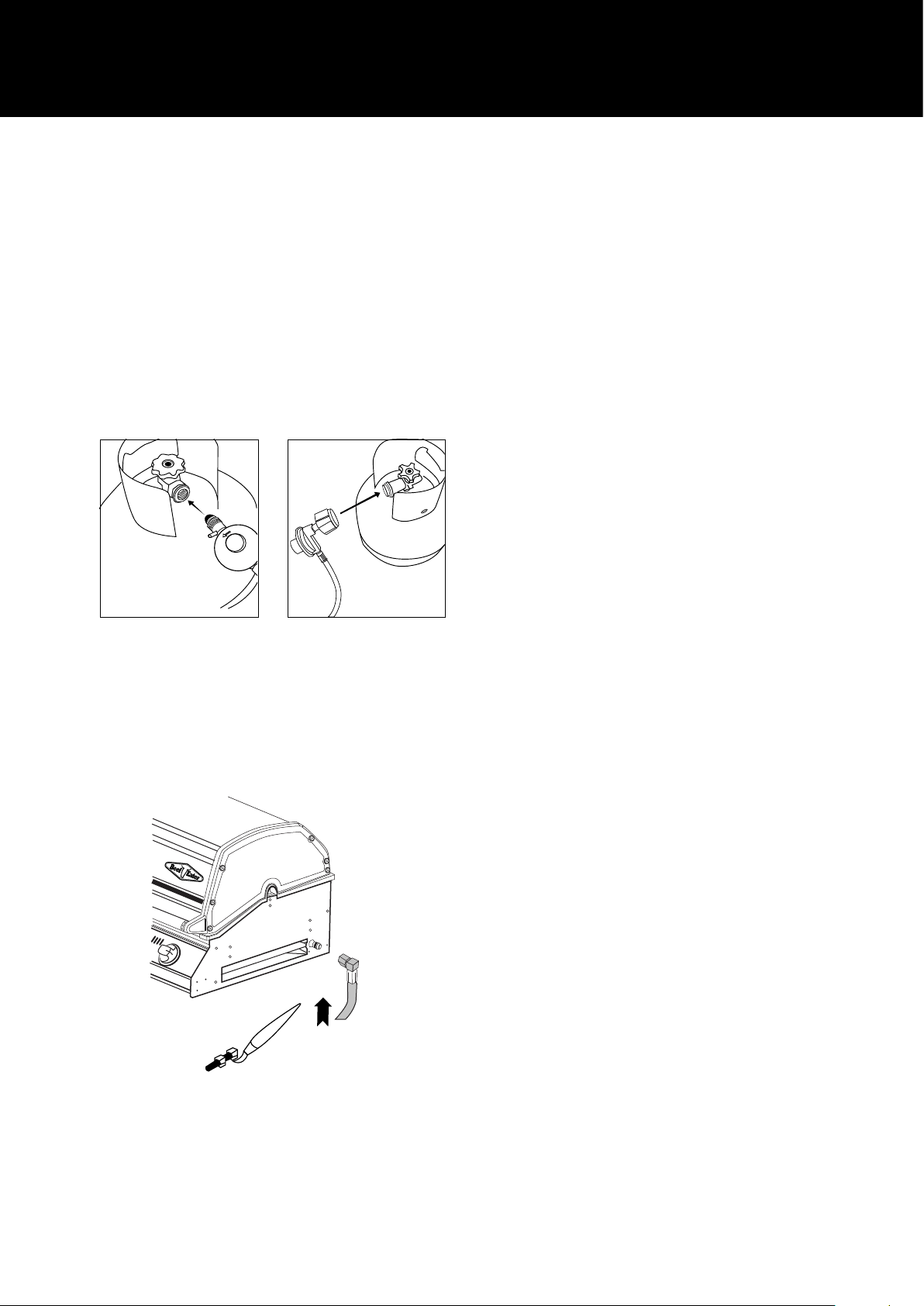
20
CONNECTION TO BARBECUE & GAS SUPPLY
Gas connection: Connect the hose to the gas inlet on the
right hand side of the barbecue�
Tighten with a spanner (wrench) but do not over-tighten�
Connect the regulator end of the hose to the gas cylinder as
shown� Ensure the hose does not twist or kink�
Regulators which fit inside the mouth of the cylinder valve
are tightened anti- clockwise�
Regulators which screw onto the outsdie thread of the
cylinder valve are tightened by turning clockwise�
On completion: The appliance must be tested for safe and
proper operation on completion of installation� Proceed to
leak test�
Regulators which fit inside the
mouth of the cylinder valve
are tightened anti- clockwise�
Regulators which screw onto
the outsdie thread of the
cylinder valve are tightened by
turning clockwise�
Leak Test
The gas leak testing procedure should be conducted every
time a gas cylinder is refilled and reconnected to the
appliance, or after any new gas connection is made.
Never use a naked flame to check for gas leaks�
In a small container, mix up a solution of water and
detergent or soap�
Mix the solution well!
Make sure that the gas supply valve on the gas cylinder or
the shut off valve on the supply line is turned on�
Make sure that the gas control valves on the appliance are all
turned off�
Using a brush or spray bottle apply the solution to the gas
line and each joint in the gas line, including the hose and
regulator�
Bubbling of the solution will indicate that there is a leak
present� Re-tighten or re-seal any joints that are leaking�
If a leak persists contact your distributor or the manufacturer
for assistance�
Disconnecting The Gas Supply
If you need to disconnect the gas supply for any reason,
always ensure that all gas controls on the appliance and on
the cylinder are off before disconnecting or removing the
gas cylinder� Do not smoke or use a naked flame near the
appliance or gas cylinder while connecting or disconnecting
the gas line�
If installed in an enclosure, remove the gas cylinder from
the enclosure before disconnecting the gas line from the
appliance� Tighten all connections before placing the gas
cylinder back in its enclosure�
CONNECTION TO BARBECUE & GAS SUPPLY
21
USING YOUR BARBECUE
USING YOUR BARBECUE
Before You Light The Barbecue
Perform the following checks
• Make sure all gas connections are tight and leak tested�
Gas regulators that are fitted with a hand- tightening
wheel should be checked to ensure that the connection
is secure�
• Check the control knobs are in the off position and that
the gas supply is turned on
• Ensure the hood of the barbecue and the lid of any side
burner are up� If the lids are left down, gases can build
up inside the hood and create a dangerous situation�
• The hose and regulator supplied with this barbecue
must be used at all times whilst operating this
barbecue� Inspect the hose and regulator for cracks
or any sign of wear or damage� If there is excessive
abrasion or wear, replace only with a genuine BeefEater
hose and regulator�
Grease Tray
Neatly line the grease tray with a couple of sheets of
aluminium foil to aid in clean up� Cut the foil to shape and
make sure that the foil sits on the bottom of the tray
Fill the tray with a 6mm (1/4”) layer of dry sand or other non-
combustible absorbent material to absorb grease� Change
the foil and absorbent material regularly to reduce the
likelihood of a grease tray fire
Lighting The Barbecue
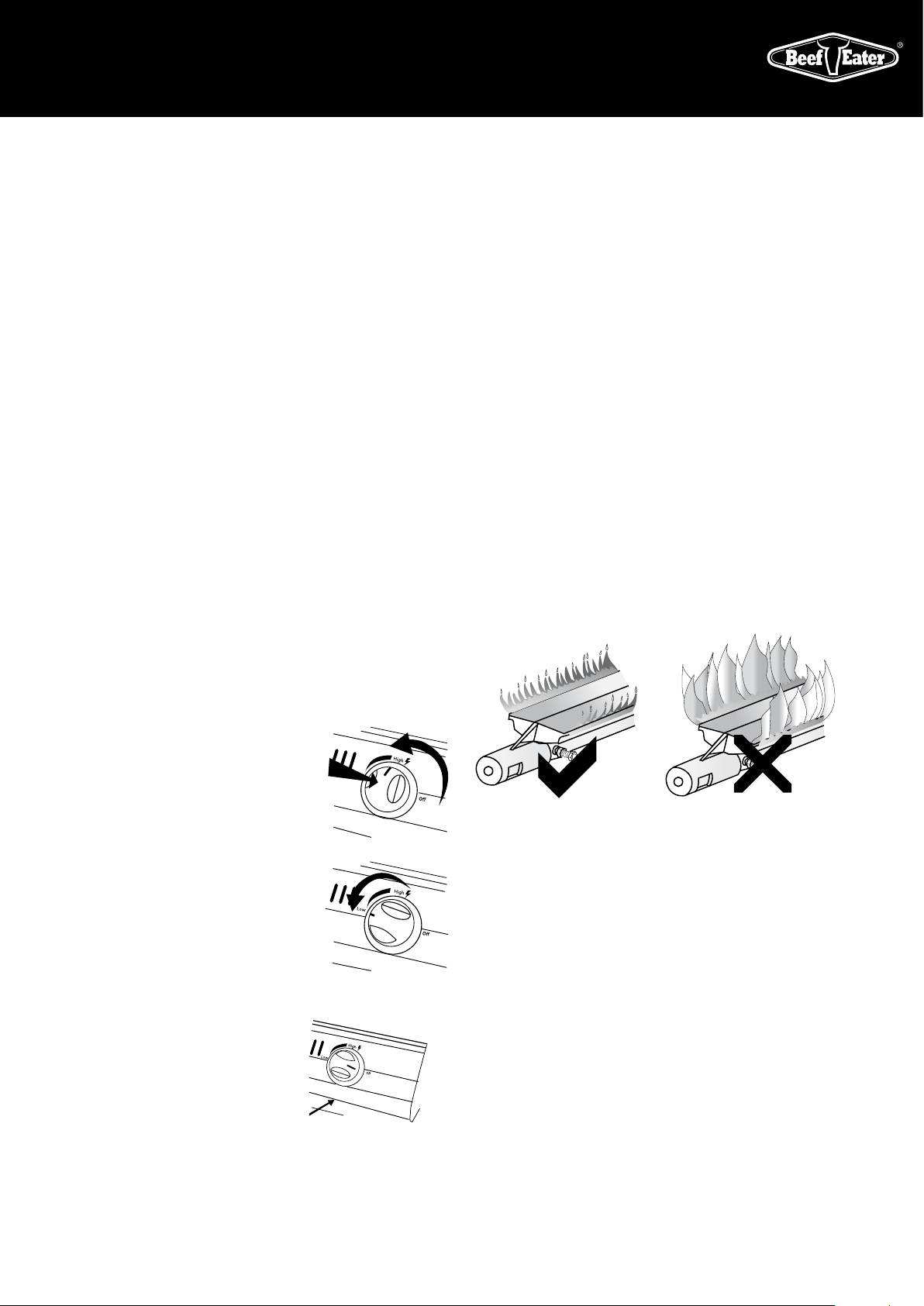
Your barbecue is equipped with
a safety feature that prevents the
burners from being accidentally
turned on� You must push the knob
inwards to disengage the lock and
allow the knob to rotate�
1� Push in and hold the far right
control knob down while turning
slowly in a counter-clockwise
direction until the starter
mechanism engages at the two
o’clock position�
At this time the gas will start to
flow�
2� Hold the control knob in while
continuing to turn the knob
toward the High or twelve
o’clock position�
3� The starter mechanism will
click and the main burner will
now light� Continue turning the
knob slowly until it rests in the
twelve o’clock position�
If the burner is alight, release the knob�
The other burners can now be lit successively, from right
to left�
If The Burner Does Not Light
Keep the control knob pushed in and turn the control knob
in a clockwise direction to return to the Off position� Wait
5 minutes for the gas to disperse and then repeat steps
1-3� If you cannot light the burners, call your retailer before
proceeding�
Manual Lighting
Press and turn the right hand control knob anti-clockwise
to the High position, then light the right hand burner
immediately through the gap between the front of the drip
tray and the barbecue body�
Failure to follow these lighting procedures exactly could lead
to a hazardous situation�
Check Proper Burner Operation
Following operating instructions light each burner and
check for a clear blue flame with just a tip of yellow� Excess
yellow tipping can be adjusted using the screw on the side
of the burner� Turn the screw in an anti-clockwise rotation
to remove the yellow� If you are unable to achieve correct
operation, consult your dealer�
22
USING YOUR BARBECUE
USING YOUR BARBECUE
Controlling The Burners
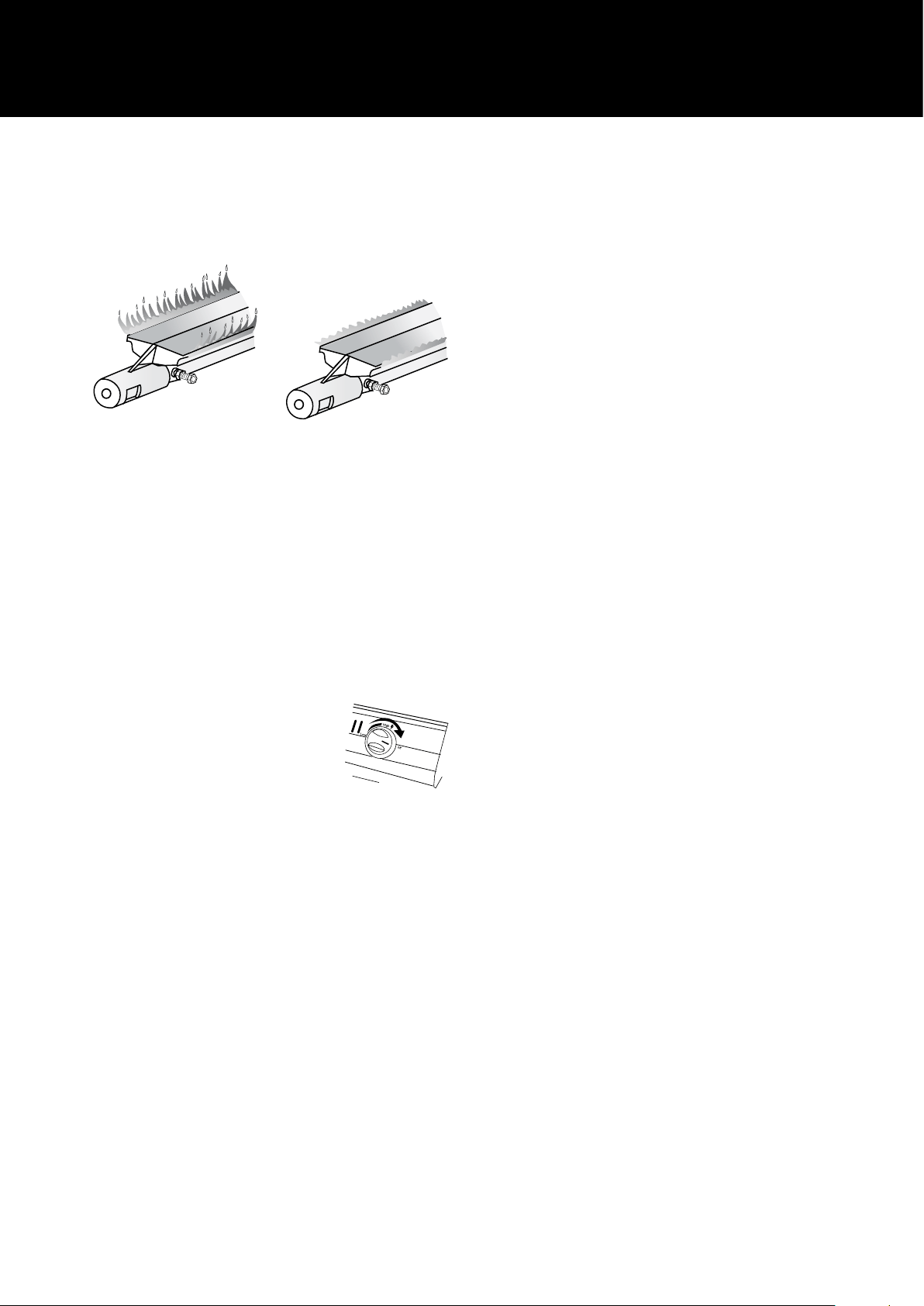
The control knob can now be turned to the desired heat
setting, Low, Medium or High� The control knob does not
need to be pushed in while selecting the heat setting�
Preparing The Plates And Grills
Your barbecue has heavy duty enamelled Cast Iron plate
and grill� Enamel is a hard, non-rusting surface which will
ensure the long life of your cooking surface�
The plate and grill are ready to use, but it is recommended
to wash them with warm soapy water and a soft cloth, and
rinse before use� To ensure the longevity of the enamel
surface on the Cast Iron plate and grill
it is strongly advised to avoid impact with other metal parts
and sharp utensils�
To Turn Off The Burner
Push in and hold the control knob while
turning in a clockwise direction until the
off position is reached� Failure to follow
these shutdown/turnoff procedures exactly
could lead to a hazardous situation�
After Use
It is a good idea to leave the barbecue on for about 10
minutes after you have finished cooking� This helps to burn
away any excess food residues and oil, and makes cleaning
easier�
1� Be sure to turn off all control knobs and the gas supply�
2� Allow the barbecue to cool�
3� Clean the drip tray and cooking surfaces� Clean any food
spills from the side burner, if one is installed�
4� Lower the hood and side burner lid�
The gas cylinder supply valve must be turned off when the
appliance is not in use�
Direct Cooking Method
Commonly used for traditional barbecuing� Place food over
the lit grill section� Excess flaring may occur so care must
be taken while cooking� Check inside the roasting hood
regularly� The direct cooking method is recommended for
steaks, chops, sausages, and hamburgers�
Indirect Cooking
This method of cooking applies only if you have a roasting
hood�
Indirect cooking involves little or no heat directly underneath
the food� Instead, the food is placed on the grill, the burners
below the food are turned off, and burners on either side
are used� The hood is closed to trap heat and moisture�
With this method, heat circulates around the food, cooking
by convection� By trapping the vapour inside your “outdoor
oven”, the cooking vapour will fall back on the food on all
sides, not just from underneath� The food cooks more evenly,
and stays moist in the process�
Indirect cooking is similar to using a conventional oven and
is recommended for rotisserie cooking, roasts, poultry,
casseroles, vegetables and whole fish�
When cooking a roast, it is a good idea to use a roast holder
and baking dish� Always use a baking dish with a depth
greater than 35mm� Shallower trays may fill quickly and
overflow, which may cause a fat fire�
high flame low flame
23
GETTING THE MOST FROM YOUR BARBECUE
GETTING THE MOST FROM YOUR BARBECUE
You may find it useful to purchase a meat thermometer to
help take the guess work out of cooking�
Meats such as beef, lamb, veal and pork should be about
70ºC / 160ºF when medium� Chicken and Turkey should be
85-90ºC / 185-195ºF�
Meats such as beef, lamb, veal and pork should be about
70˚C/160˚F when medium� Chicken and turkey should be
85–90˚C/185–195˚F�
Do not use more than 2 burners on high at any one time�
As a guide, for a 4 burner barbecue in moderate weather:
Two burners on low produces 150°C / 300°F
Two burners on medium produces 195°C / 385°F
Two burners on high produces 240°C / 460°F
During cold or windy conditions, more heat is required�
Finally, resist the temptation to keep opening the hood while
cooking� This will help to maintain a constant temperature,
and minimise cooking time�
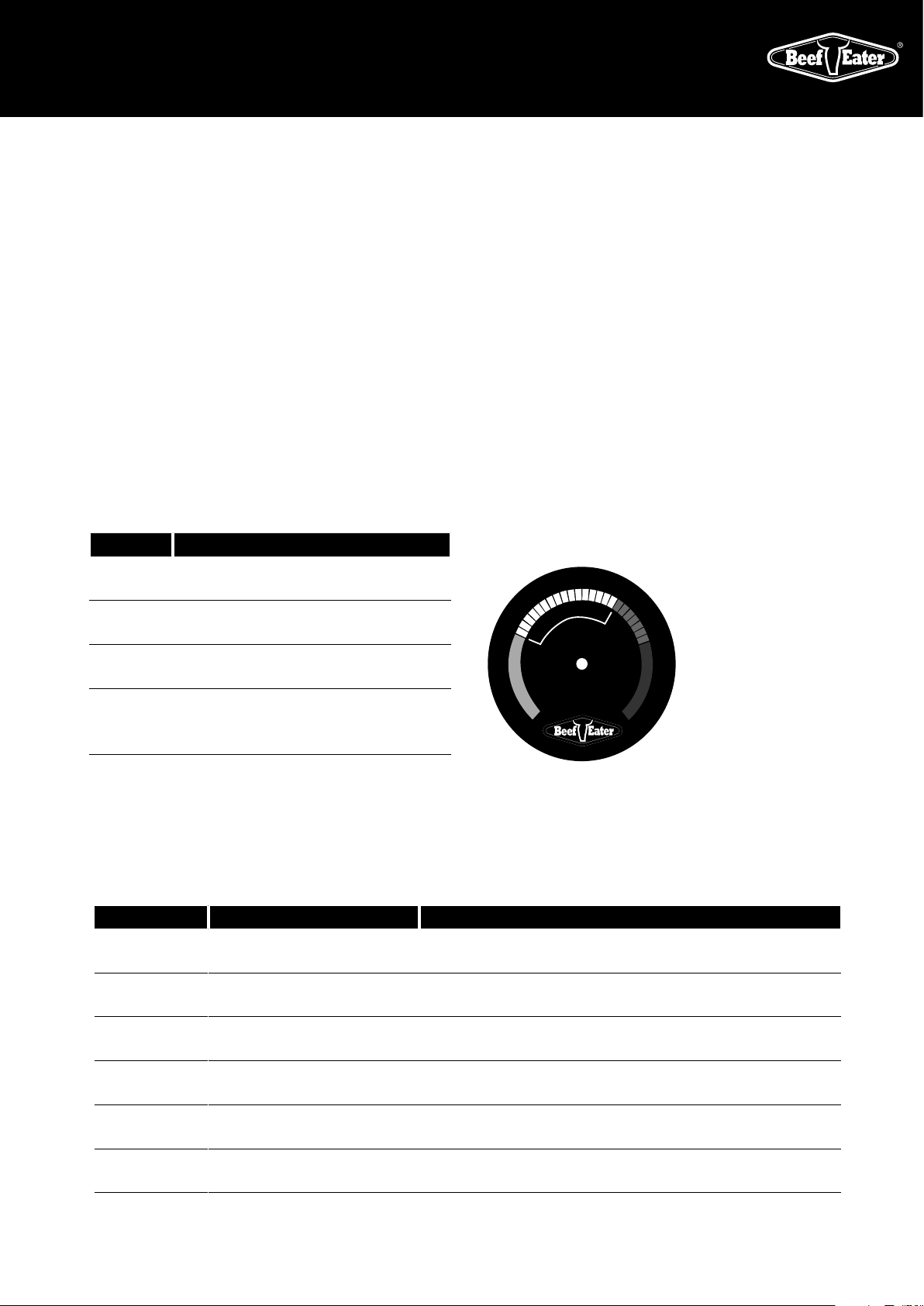
WARM
120
180 310
370
250
o
C
480
o
F
360
260
O
V
E
R
H
E
A
T
I
N
G
Preheating Your Barbecue
Like an oven, preheating your barbecue before cooking
produces better results� Because your hood retains heat
so efficiently, preheating your barbecue is quicker with the
hood down�
Turn the outside two burners to high� Close the hood, and
allow to preheat for about 8 minutes, Then reduce the burner
settings to achieve and maintain the required temperature,
by following these guidelines�
Maintaining The Right Cooking Temperature
Do not exceed the temperature warning on the temperature
gauge. Operating the barbecue above this temperature may
cause damage to the appliance. Your hood is designed to
keep the heat in, so requires constant monitoring.
These two charts tell you how hot and how long to cook
various types of meat, and the approximate burner settings
to help you achieve these results�
MODEL BURNERS
Two burner Both burners slightly below medium
Three
burner
Middle burner off
Two outside burners to medium
Four
burner
Two inside burners off
Two outside burners to medium
Five burner Three inside burners off
One outside burner to high
Other outside burner to medium
Do not allow your barbecue to
overheat, as this may damage
some components�
TYPE OF MEAT COOKING TEMPERATURE APPROXIMATE COOKING TIMES
Beef 180°C/355°F 45–55min per kg 20–25min per lb
Lamb 180°C/355°F 45–55min per kg 20–25min per lb
Pork 170°C/340°F 55–60min per kg 25–30min per lb
Veal 160°C/320°F 40–50min per kg 18–23min per lb
Poultry 180°C/355°F 40–50min per kg 18–23min per lb
Seafood 150°C/300°F 20–30min per kg 9–15min per lb
24
CLEANING AND STORING YOUR BARBECUE
CLEANING AND STORING YOUR BARBECUE
Cleaning Vitreous Enamel Surfaces and Barbecue Control
Panel
Although porcelain enamel will keep its lustrous finish even
under adverse conditions, it still needs regular cleaning�
After the appliance has been used, wash down the surfaces
with hot soapy water� Caustic cleaners should be avoided�
For barbecues near the ocean or salt-water environment,
more frequent cleaning and servicing should be conducted�
Wash regularly, rinse and then dry before covering� (In a salt
water or marine environment, more rapid deterioration can
be expected which is not covered by warranty)�
The cleaning and care instructions are essential for the
proper functioning and operation of your appliance over time�
Failure to adhere to these care instructions may affect your
ability to make a claim under the manufacturer’s warranty�
Cleaning Plates and Grills
Many food acids, marinades, juices and sauces contain
highly acidic elements that will slowly attack the surface of
the plates and grills if not removed after cooking�
• After use, remove all solid material from the cooking
surfaces using a brass bristle brush or plastic scourer�
Brushes specifically designed for this purpose can
be purchased from your BeefEater retailer� Wipe off
remaining residue with a paper towel�
• Gently wash the surface of the grills with a soft sponge
and a solution of hot water and a mild dishwashing
liquid� Do not use highly caustic, harsh or abrasive
chemical cleaners to clean the cooking grills� Always
check the manufacturer’s recommendations for the
cleaner prior to use�
• Coat the grills with a layer of cooking oil� This will help
protect the surfaces between uses�
• For porcelain enamel coated cooking surfaces, do not
use any metal tools to clean the surface� Use only
a brass bristle wire brush to remove hard deposits�
Do not clean the cooking surfaces in a dishwashing machine�
For hard deposits and heavy grease, do not use steel wool
or metal scrapers� Use concentrated detergent or domestic
cleaning powders�
Cleaning The Drip Tray
Never remove the grease tray while the barbecue is hot�
Always remove and clean the grease tray after the unit has
cooled down�
Replace aluminium foil on main drip tray (if used) and clean
both waste trays at regular intervals to prevent grease build-
up, which could result in a grease fire and void the barbecue
warranty�
Cleaning The Burners
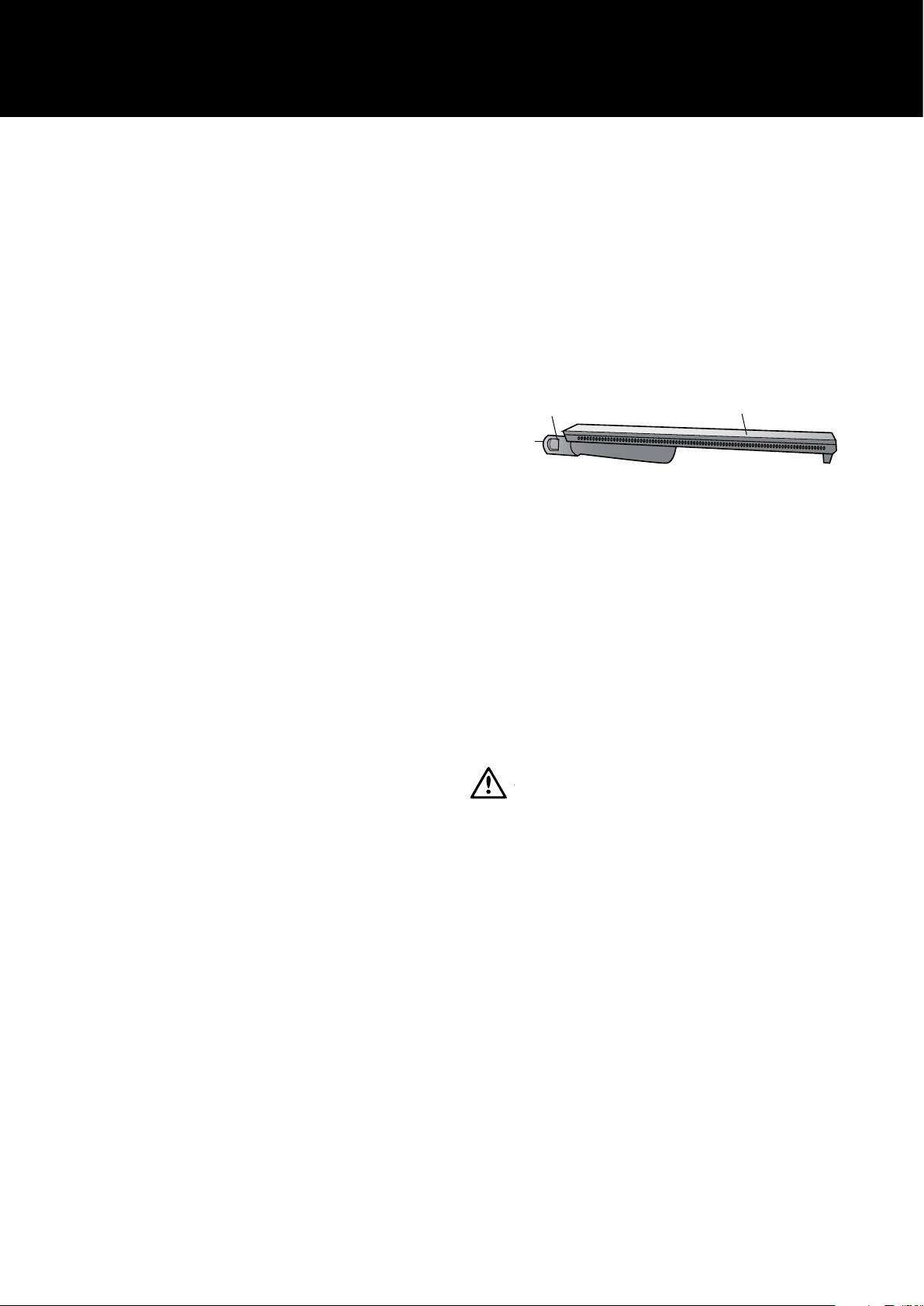
• Check main opening, throat and venturi to each
burner regularly for insect nests (eg� wasp, ants or
spiders)� Nests are dangerous and must be cleaned
out thoroughly�
• Remove burners periodically and scrub clean with soapy
water and a wire brush making sure that the ports are
free of obstructions�
Replace burners in the correct position and dry by lighting
each one to avoid subsequent corrosion�
A clogged burner can lead to a fire beneath the grill�
Storing Your Barbecue
When storing barbecue for extended periods, be certain all
controls and cylinder valves are turned off� If storing the
barbecue indoors remove gas cylinder and store the cylinder
in a ventilated area outdoors�
Gas cylinders must be stored outdoors, out of reach of
children and must not be stored in a building, garage or any
other enclosed area�
The barbecue should be covered when not in use� eg a
polyester or vinyl barbecue cover� Frequently check and
tighten all nuts and bolts on the barbecue and trolley
The gas cylinder supply valve must be turned off when the
appliance is not in use�
WARNING
WARNING
Note: For storage and cylinder exchange, disconnect hose
at the cylinder only, do not disconnect hose from appliance.
Main opening
Throat
Burner ports

25
SERVICE AND MAINTENANCE
SERVICE AND MAINTENANCE
This appliance should be checked and serviced by an authorised service person every 2 years to ensure the appliance
remains in a safe operating condition� (These services are not covered by warranty)� Replacement parts are available from
your authorised BeefEater Dealer�
EACH USE EVERY 6 MONTHS BY AUTHORISED
SERVICE AGENT EVERY
2 YEARS
Check all hoses for cracks and leaks
✓
Check that all gas connections are tight
✓
Clean entire barbecue thoroughly
✓
Check and tighten all bolts on barbecue and trolley
✓
Clean and inspect Vaporizers
✓
Clean and inspect barbecue burners
✓
Clean and inspect gas injectors and control valves
✓
Check working of ignition system
✓

26
SERVICE AND MAINTENANCE
SERVICE AND MAINTENANCE
PROBLEM CAUSE CHECK
Barbecue will not light Ignition system not working Check to see visible spark at starter
probe - if no spark is present when control
knob is turned then the unit may need
to be serviced or replaced� Contact your
BeefEater dealer�
Check that there is a visible flame coming
from the pilot ignition tube�
Check that the pilot ignition tube is not
blocked by spider webs or insect nests�
Turning on gas control too quickly Allow at least 5 seconds for gas to flow
through burner before ignition�
No gas flow Check that valve on gas cylinder is
turned on�
Check that burner ports are free of
obstructions
Check that all gas injectors are clean and
free of obstruc- tions
Burners not assembled correctly Check that burners are correctly
positioned in the barbecue frame�
Burner ports or throat blocked Check that the burner ports are not
blocked by spider webs or
insect nests� Clean out as required�
Barbecue lights but goes out
soon after starting
Fuel supply turned off Turn on gas valve at cylinder
Gas cylinder low or empty Refill cylinder with gas
Kink in gas hose Check that the gas line is not kinked
or twisted
Wind or breeze affecting operation Ensure that the appliance is located out of
the way of wind�
Burners will not cross light from
one to the other
Check that cross light channel is in place
Check that burner ports are free of
obstructions�
Low flame level or low heat
output
Check you are running on correct gas
Check gas injector size is correct
BTU/hr MJ/hr kW g/hr
2 burner 30 400 32 8�9 640
3 burner 45 600 48 13�3 960
4 burners 60 800 64 17�8 1,280
5 burners 76 000 80 22�2 1,600
Gas Consumption
Trouble Shooting Guide
27
BARBECUE DIMENSIONS
BARBECUE DIMENSIONS
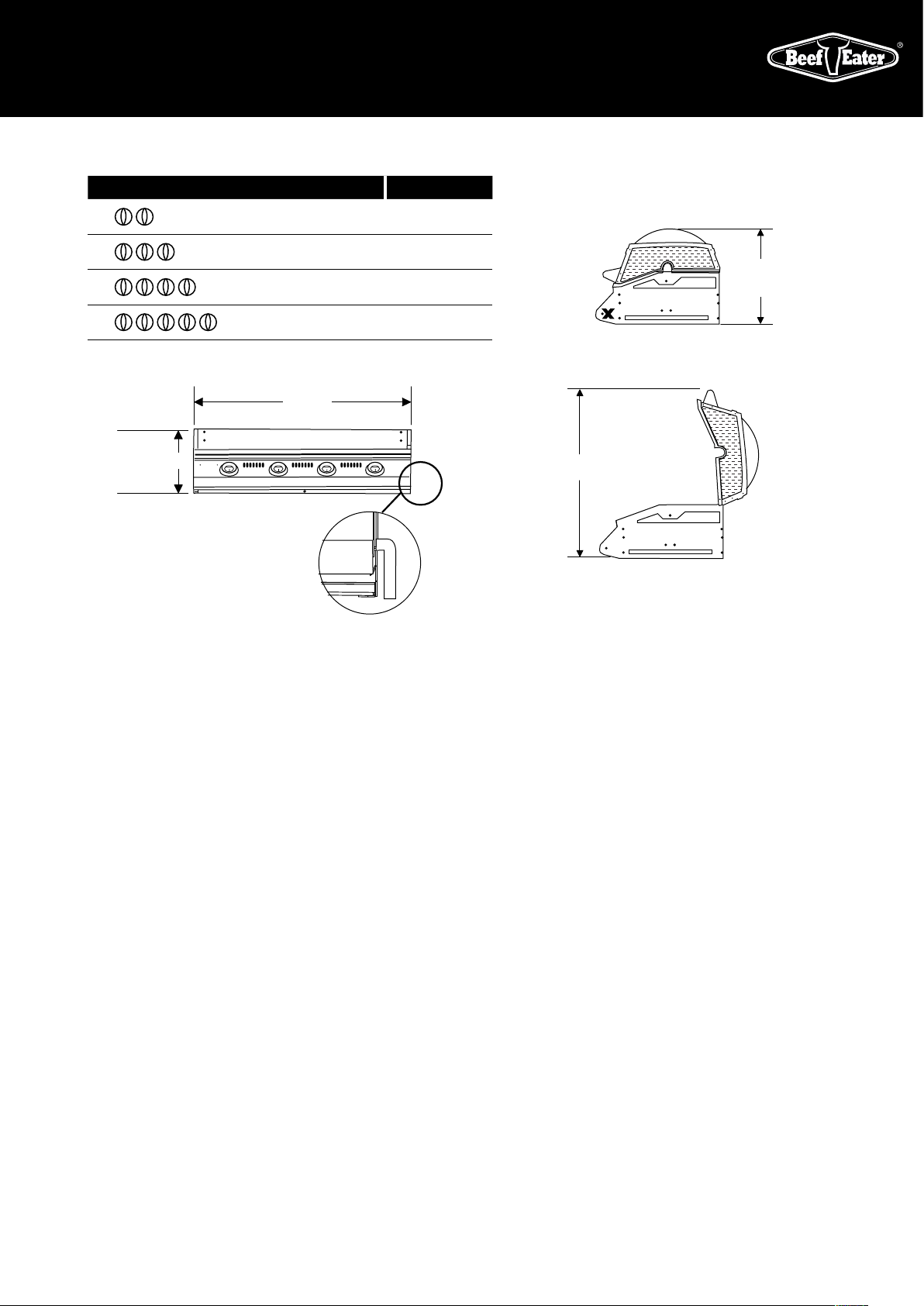
1.30 cm
245mm (9.65”)
A
22mm (.9”)
5mm (0.2”) below
bottom rail
820mm / 32.28"
2.50 cm
450mm / 18.00"
Gas connection point 45 mm from front of
barbecue fascia
DIMENSION A
x 2
19 3/8” 493mm
x 3
26” 660mm
x 4
32 1/8” 816mm
x 5
38 1/4” 973mm

28 NOTESNOTES
NOTES

29NOTES
NOTES

30 NOTESNOTES
NOTES

31WARRANTY
This document sets out the terms and conditions of the product
warranties for Electrolux Appliances. It is an important document.
Please keep it with your proof of purchase documents in a safe place
for future reference should there be a manufacturing defect in your
Appliance. This warranty is in addition to other rights you may have
under the Australian Consumer Law.
1. In this warranty:
(a) ‘acceptable quality’ as referred to in clause 10 of this warranty has the
same meaning referred to in the ACL;
(b) ‘ACL’ means Schedule 2 to the Competition and Consumer Act 2010;
(c) ‘Appliance’ means any Electrolux product purchased by you and
accompanied by this document;
(d) ‘ASC’ means Electrolux’s authorised service centres;
(e) ‘Electrolux’ means Electrolux Home Products Pty Ltd of 163 O’Riordan
Street, Mascot, NSW 2020, ABN 51 004 762 341 in respect of
Appliances purchased in Australia and Electrolux (NZ) Limited
(collectively ‘Electrolux’) of 3-5 Niall Burgess Road, Mount Wellington, in
respect of Appliances purchased in New Zealand;
(f) ‘major failure’ as referred to in clause 10 of this warranty has the same
meaning referred to in the ACL;
(f) ‘‘Warranty Period’ means the period of 12 months following the date
of original purchase of the Appliance in Australia or New Zealand and in
the case of the burner box, an additional 4 years.
2. This warranty only applies to Appliances, purchased and used in Australia or
New Zealand in normal domestic applications and is in addition to (and does
not exclude, restrict, or modify in any way) any non-excludable statutory
guarantees in Australia and New Zealand.
3. During the Warranty Period Electrolux or its ASC will, at no extra charge if
your Appliance is readily accessible for service, without special equipment
and subject to these terms and conditions, repair or replace any parts which
it considers to be defective. Electrolux or its ASC may use remanufactured
parts to repair your Appliance. You agree that any replaced Appliances or
parts become the property of Electrolux. This warranty does not apply to
light globes, batteries, lters or similar perishable parts.
4. Parts and Appliances not supplied by Electrolux are not covered by
this warranty.
5. To the extent permitted by law, you will bear the cost of transportation, travel
and delivery of the Appliance to and from Electrolux or its ASC. If you reside
outside of the service area, you will bear the cost of:
(a) travel of an authorised representative;
(b) transportation and delivery of the Appliance to and from Electrolux or its
ASC, In all instances, unless the Appliance is transported by Electrolux
or an Electrolux authorised representative, the Appliance is transported
at the owner’s cost and risk while in transit to and from Electrolux or
its ASC.
6. Proof of purchase is required before you can make a claim under
this warranty.
7. You may not make a claim under this warranty unless the defect claimed is
due to faulty or defective parts or workmanship. Electrolux is not liable in the
following situations (which are not exhaustive):
(a) the Appliance is damaged by:
(i) accident
(ii) misuse or abuse, including failure to properly maintain or service
(iii) normal wear and tear
(iv) power surges, electrical storm damage or incorrect power supply
(v) incomplete or improper installation
(vi) incorrect, improper or inappropriate operation
(vii) insect or vermin infestation
(viii) failure to comply with any additional instructions supplied with
the Appliance;
(b) the Appliance is modied without authority from Electrolux in writing;
(c) the Appliance’s serial number or warranty seal has been removed
or defaced;
(d) the Appliance was serviced or repaired by anyone other than Electrolux,
an authorised repairer or ASC.
8. This warranty, the contract to which it relates and the relationship between
you and Electrolux are governed by the law applicable where the Appliance
was purchased. Where the Appliance was purchased in New Zealand for
commercial purposes the Consumer Guarantee Act does not apply.
9. To the extent permitted by law and subject to your non-excludable statutory
rights and guarantees, Electrolux excludes all warranties and liabilities (other
than as contained in this document) including liability for any loss or damage
whether direct or indirect arising from your purchase, use or non-use of
the Appliance.
10. For Appliances and services provided by Electrolux in Australia, the
Appliances come with guarantees by Electrolux that cannot be excluded
under the ACL. You are entitled to a replacement or refund for a major failure
and for compensation for any other reasonably foreseeable loss or damage.
You are also entitled to have the Appliance repaired or replaced if the
Appliance fails to be of acceptable quality and the failure does not amount
to a major failure. The benets to you given by this warranty are in addition
to your other rights and remedies under a law in relation to the Appliances or
services to which the warranty relates.
11. For Appliances and services provided by Electrolux in New Zealand, the
Appliances come with a guarantee by Electrolux pursuant to the provisions
of the Consumer Guarantees Act, the Sale of Goods Act and the Fair
Trading Act.
12. To enquire about claiming under this warranty, please follow these steps:
(a) carefully check the operating instructions, user manual and the terms of
this warranty;
(b) have the model and serial number of the Appliance available;
(c) have the proof of purchase (e.g. an invoice) available;
(d) telephone the numbers shown below.
13. You accept that if you make a warranty claim, Electrolux and its ASC may
exchange information in relation to you to enable Electrolux to meet its
obligations under this warranty.
Warranty
FOR SALES IN AUSTRALIA AND NEW ZEALAND
APPLIANCE: BEEFEATER DISCOVERY BARBECUE
Important Notice
Before calling for service, please ensure that the steps listed in clause 12 above have been followed.
FOR SERVICE
or to nd the address of your nearest
state service centre in Australia
PLEASE CALL 1800 356 660
For the cost of a local call (Australia only)
SERVICE AUSTRALIA
ELECTROLUX HOME PRODUCTS
beefeaterbbq.com
FOR SPARE PARTS
or to nd the address of your nearest
state spare parts centre in Australia
PLEASE CALL 1300 666 019
For the cost of a local call (Australia only)
FOR SERVICE
or to nd the address of your nearest
authorised service centre in New Zealand
FREE CALL 0800 10 66 10
(New Zealand only)
SERVICE NEW ZEALAND
ELECTROLUX (NZ) Limited
beefeaterbbq.com
FOR SPARE PARTS
or to nd the address of your nearest
state spare parts centre in New Zealand
FREE CALL 0800 10 66 20
(New Zealand only)
BDB_Warr_May16

AUSTRALIA
phone: 1300 307 939
fax: 1800 356 669
email: customercare@electrolux.com.au
web: beefeaterbbq.com
NEW ZEALAND
phone: 0800 436 245
fax: 0800 225 088
email: customercare@electrolux.co.nz
web: beefeaterbbq.com
For more information on all Beefeater products, or for
dimension and installation information, call into your
retailer, phone or email our customer care team or visit
our website:
Beefeater. We are part of the Electrolux Family.
To add a touch of professional inspiration to
your home, visit electrolux.com.au
© 2016 Electrolux Home Products Pty Ltd.
ABN 51 004 762 341
BMAN_i-1000R_Jul16