
Please read this manual carefully before operating
your set and retain it for future reference.
NB3740 (NB3740, S34A1-D)
OWNER’S MANUAL
SMART
SOUND BAR
www.lg.com

Getting Started 3
Getting Started
1
Safety Information
CAUTION
RISK OF ELECTRIC SHOCK
DO NOT OPEN
CAUTION: TO REDUCE THE RISK OF ELECTRIC
SHOCK DO NOT REMOVE COVER (OR BACK) NO
USER-SERVICEABLE PARTS INSIDE REFER SERVICING
TO QUALIFIED SERVICE PERSONNEL.
This lightning ash with
arrowhead symbol within an
equilateral triangle is intended to
alert the user to the presence of
uninsulated dangerous voltage
within the product’s enclosure
that may be of sucient
magnitude to constitute a risk of
electric shock to persons.
The exclamation point within an
equilateral triangle is intended
to alert the user to the presence
of important operating and
maintenance (servicing)
instructions in the literature
accompanying the product.
WARNING: This product contains chemicals known
to the State of California to cause cancer and birth
defects or other reproductive harm. Wash hands
after handling.
WARNING: TO PREVENT FIRE OR ELECTRIC SHOCK
HAZARD, DO NOT EXPOSE THIS PRODUCT TO RAIN
OR MOISTURE.
CAUTION: The apparatus shall not be exposed to
water (dripping or splashing) and no objects lled
with liquids, such as vases, shall be placed on the
apparatus.
WARNING: Do not install this equipment in a
conned space such as a book case or similar unit.
CAUTION: Do not block any ventilation openings.
Install in accordance with the manufacturer’s
instructions.
Slots and openings in the cabinet are provided for
ventilation and to ensure reliable operation of the
product and to protect it from over heating. The
openings shall be never be blocked by placing
the product on a bed, sofa, rug or other similar
surface. This product shall not be placed in a built-
in installation such as a bookcase or rack unless
proper ventilation is provided or the manufacturer’s
instruction has been adhered to.
CAUTION concerning the Power Cord
Most appliances recommend they be placed upon
a dedicated circuit;
That is, a single outlet circuit which powers only
that appliance and has no additional outlets or
branch circuits. Check the specication page of this
owner’s manual to be certain. Do not overload wall
outlets. Overloaded wall outlets, loose or damaged
wall outlets, extension cords, frayed power cords, or
damaged or cracked wire insulation are dangerous.
Any of these conditions could result in electric
shock or re. Periodically examine the cord of your
appliance, and if its appearance indicates damage
or deterioration, unplug it, discontinue use of the
appliance, and have the cord replaced with an
exact replacement part by an authorized service
center. Protect the power cord from physical or
mechanical abuse, such as being twisted, kinked,
pinched, closed in a door, or walked upon. Pay
particular attention to plugs, wall outlets, and
the point where the cord exits the appliance. To
disconnect power from the mains, pull out the
mains cord plug. When installing the product,
ensure that the plug is easily accessible.

Getting Started4
Getting Started
1
This device is equipped with a portable battery or
accumulator.
Safety way to remove the battery from the
equipment: Remove the old battery or battery
pack, follow the steps in reverse order than
the assembly. To prevent contamination of the
environment and bring on possible threat to
human and animal health, the old battery or
the battery put it in the appropriate container
at designated collection points. Do not dispose
of batteries or battery together with other
waste. It is recommended that you use local,
free reimbursement systems batteries and
accumulators. The battery should not be exposed
to excessive heat such as sunshine, re or the like.
IMPORTANT SAFETY
INSTRUCTIONS
1. Read these instructions.
2. Keep these instructions.
3. Heed all warnings.
4. Follow all instructions.
5. Do not use this apparatus near water.
6. Clean only with dry cloth.
7. Do not block any ventilation openings.
Install in accordance with the manufacturer’s
instructions.
8. Do not install near any heat sources such
as radiators, heat registers, stoves, or other
apparatus (including amplifiers) that produce
heat.
9. Do not defeat the safety purpose of the
polarized or grounding-type plug. A polarized
plug has two blades with one wider than the
other. A grounding type plug has two blades
and a third grounding prong. The wide blade or
the third prong are provided for your safety. If
the provided plug does not fit into your outlet,
consult an electrician for replacement of the
obsolete outlet.
10. Protect the power cord from being walked on
or pinched particularly at plugs, convenience
receptacles, and the point where they exit from
the apparatus.
11. Only use attachments/accessories specified by
the manufacturer.
12. Use only with the cart, stand, tripod, bracket, or
table specified by the manufacturer, or sold with
the apparatus. When a cart is used, use caution
when moving the cart/apparatus combination
to avoid injury from tip-over.
13. Unplug this apparatus during lightning storms
or when unused for long periods of time.
14. Refer all servicing to qualified service personnel.
Servicing is required when the apparatus has
been damaged in any way, such as power-
supply cord or plug is damaged, liquid has been
spilled or objects have fallen into the apparatus,
the apparatus has been exposed to rain or
moisture, does not operate normally, or has
been dropped.

Getting Started 5
Getting Started
1
FCC Compliance Statement
This device complies with part 15 of the FCC
rules. Operation is subject to the following two
conditions:
(1) This device may not cause harmful interference,
and
(2) This device must accept any interference
received, including interference that may cause
undesired operation.
NOTE: This equipment has been tested and found
to comply with the limits for a Class B digital device,
pursuant to Part 15 of the FCC Rules. These limits are
designed to provide reasonable protection against
harmful interference in a residential installation. This
equipment generates, uses, and can radiate radio
frequency energy and, if not installed and used
in accordance with the instructions, may cause
harmful interference to radio communications.
However, there is no guarantee that interference
will not occur in a particular installation.
If this equipment does cause harmful interference
to radio or television reception, which can be
determined by turning the equipment o and
on, the user is encouraged to try to correct the
interference by one or more of the following
measures:
y
Reorient or relocate the receiving antenna.
y
Increase the separation between the equipment
and receiver.
y
Connect the equipment into an outlet on a
circuit dierent from that to which the receiver is
connected.
y
Consult the dealer or an experienced radio/TV
technician for help.
CAUTION : Any changes or modications not
expressly approved by the party responsible for
compliance could void the user’s authority to
operate this equipment.
FCC WARNING: This equipment may generate
or use radio frequency energy. changes or
modications to this equipment may cause harmful
interference unless the modications are expressly
approved in the instruction manual. The user could
lose the authority to operate this equipment if an
unauthorized change or modication is made.
FCC RF Radiation Exposure Statement : This
equipment complies with FCC radiation exposure
limits set forth for an uncontrolled environment.
This equipment should be installed and operated
with minimum distance 20 cm between the
radiator and your body. End users must follow the
specic operating instructions for satisfying RF
exposure compliance. This transmitter must not be
co-located or operating in conjunction with any
other antenna or transmitter.
CAUTION: Regulations of the FCC and FAA prohibit
airborne operation of radio-frequency wireless
devices because their signals could interfere with
critical aircraft instruments.
Responsible Party :
LG Electronics USA, Inc. 1000 Sylvan Avenue
Englewood Clis, NJ 07632
TEL. : +1-800-243-0000

Table of Contents6
Table of Contents
1 Getting Started
3 Safety Information
8 Introduction
8 – About the “7” symbol display
9 Front Panel
9 Rear Panel
10 Remote Control
11 Installing the sound bar
11 Mounting the main unit on a wall
2 Connecting
13 Wireless Subwoofer Connection
13 – Pairing wireless subwoofer
14 Connecting to Your TV
14 – HDMI Connection
15 – What is SIMPLINK?
15 – ARC (Audio Return Channel) function
15 – Resolution Setting
16 – OPTICAL IN connection
17 Connections with external device
17 – OPTICAL IN connection
17 Connecting to your Home Network
17 – Wired network connection
18 – Wired network setup
19 – Wireless network connection
20 – Wireless network setup
3 System Setting
23 Initial Setup
24 Settings
24 – Adjust the setup settings
25 – [NETWORK] menu
26 – [DISPLAY] menu
27 – [LANGUAGE] menu
27 – [AUDIO] menu
28 – [OTHERS] menu
30 Sound Effect
4 Operating
31 Home Menu Display
31 – Using [HOME] menu
31 – Using the SmartShare
32 Playing the Linked Devices
32 – Playing a USB device
33 – Playing a file on Android device
34 – Playing a file on a network server
34 Using Home Network Server for PC
34 – Installing SmartShare PC Software
(DLNA)
35 – Sharing files and folders
35 – System requirements
36 General Playback
36 – Basic operations for video and audio
content
36 – Basic operations for photo content
36 – Resume playback
37 On-Screen Display
37 – To control video playback
38 – To control photo view
39 Advanced Playback
39 – Repeat playback
39 – Repeating a specific portion
39 – Playing from selected time
40 – Selecting a subtitle language
40 – Hearing a different audio
40 – Changing the TV Aspect Ratio
40 – Changing Subtitle Code Page
41 – Changing the Picture Mode
41 – Changing content list view
42 – Selecting a subtitle file
42 – Listening to music during slide show
43 – Setting the [3D] option
44 Advanced Features
44 – Wi-Fi Direct™
45 LG AV Remote
45 Private Sound Mode
45 Using Bluetooth technology
46 – Listening to music stored on the
Bluetooth devices
47 Using the Premium
47 Using the LG Smart World
48 – Signing in
48 – Searching online content
49 Using the My Apps Menu
Table of Contents 7
1
2
3
4
5
6
5 Troubleshooting
50 Troubleshooting
50 – General
51 – Network
52 – Picture
52 – Sound
52 – Customer Support
52 – Open Source Software Notice
6 Appendix
53 Controlling a TV with the Supplied
Remote Control
53 – Setting up the remote to control your
TV
54 Network Software Update
54 – Network update notification
54 – Software update
56 Additional Information
56 – File requirement
58 – About DLNA
58 – Certain system requirements
59 Audio Output Specifications
60 Trademarks and Licenses
62 Specifications
63 Maintenance
63 – Handling the unit
63 Important Information relating to Network
Services
Some of the content in this manual may dier from your unit depending on the software of the
unit or your service provider.
Getting Started8
Getting Started
1
Introduction
Term Symbol Description
Note
,
Indicates special
notes and operating
features.
Caution
>
Indicates cautions
for preventing
possible damages
from abuse.
About the “
7
” symbol display
“
7
” may appear on your TV display during
operation and indicates that the function explained
in this owner’s manual is not available on that
specic media.
Getting Started 9
Getting Started
1
Front Panel
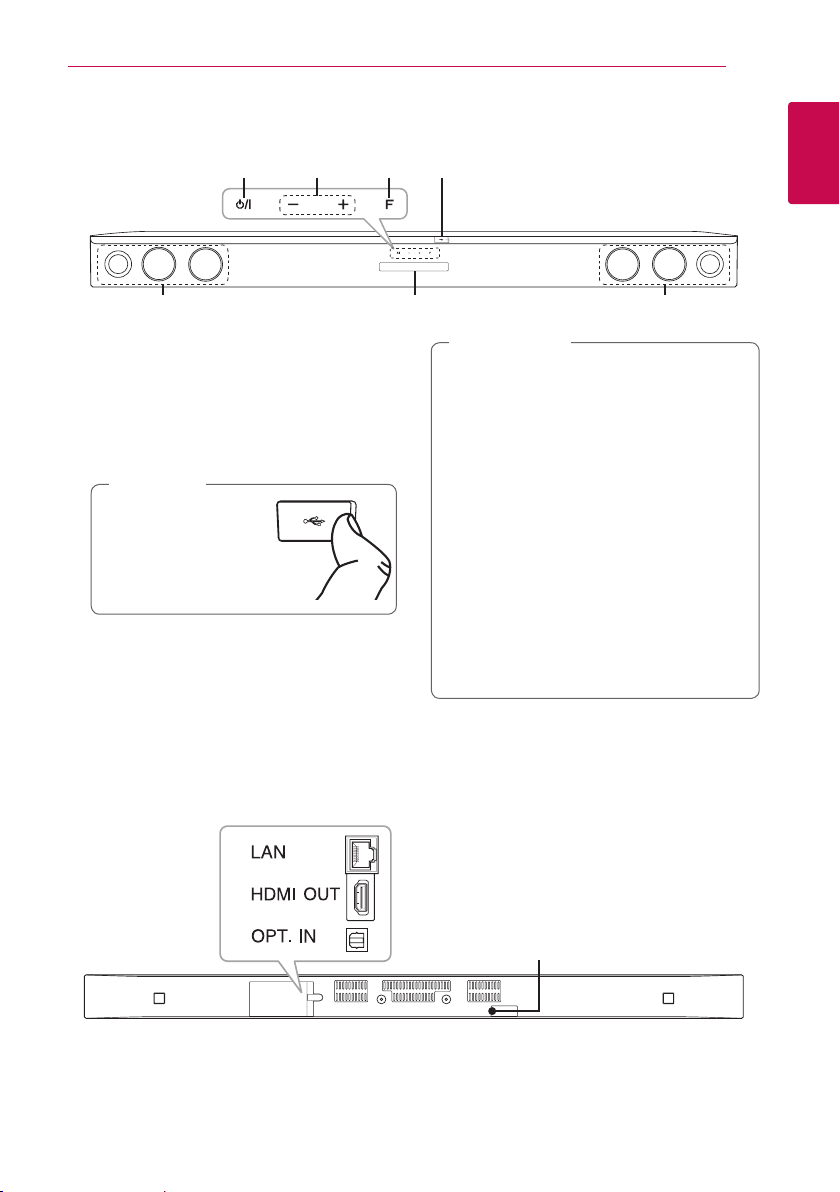
a b dc
e
f f
a
1/!
(Standby/On)
b
p
/
o
(Volume)
Adjusts speaker volume.
c
F (Function)
Press it repeatedly to select other function.
d
USB Port
Open USB cover by using
your nger to connect
USB.
,
Note
e
Display window
f
Speakers
Precautions in using the touch buttons
y
Use the touch buttons with clean and dry
hands.
- In a humid environment, wipe out any
moisture on the touch buttons before
using.
y
Do not press the touch buttons hard to
make it work.
- If you apply too much strength, it can
damage the sensor of the touch buttons.
y
Touch the button that you want to work in
order to operate the function correctly.
y
Be careful not to have any conductive
material such as metallic object on the
touch buttons. It may cause the unit to
malfunction.
>
Caution
Rear Panel
b
c
a
d
a
LAN : LAN connector
b
HDMI OUT : HDMI output
c
OPT. IN : Optical input
d
DC IN : DC input
Getting Started10
Getting Started
1
10
Battery Installation
Remove the battery cover on the
rear of the Remote Control, and
insert two R03 (size AAA) battery
with and matched correctly.
• • • • • •
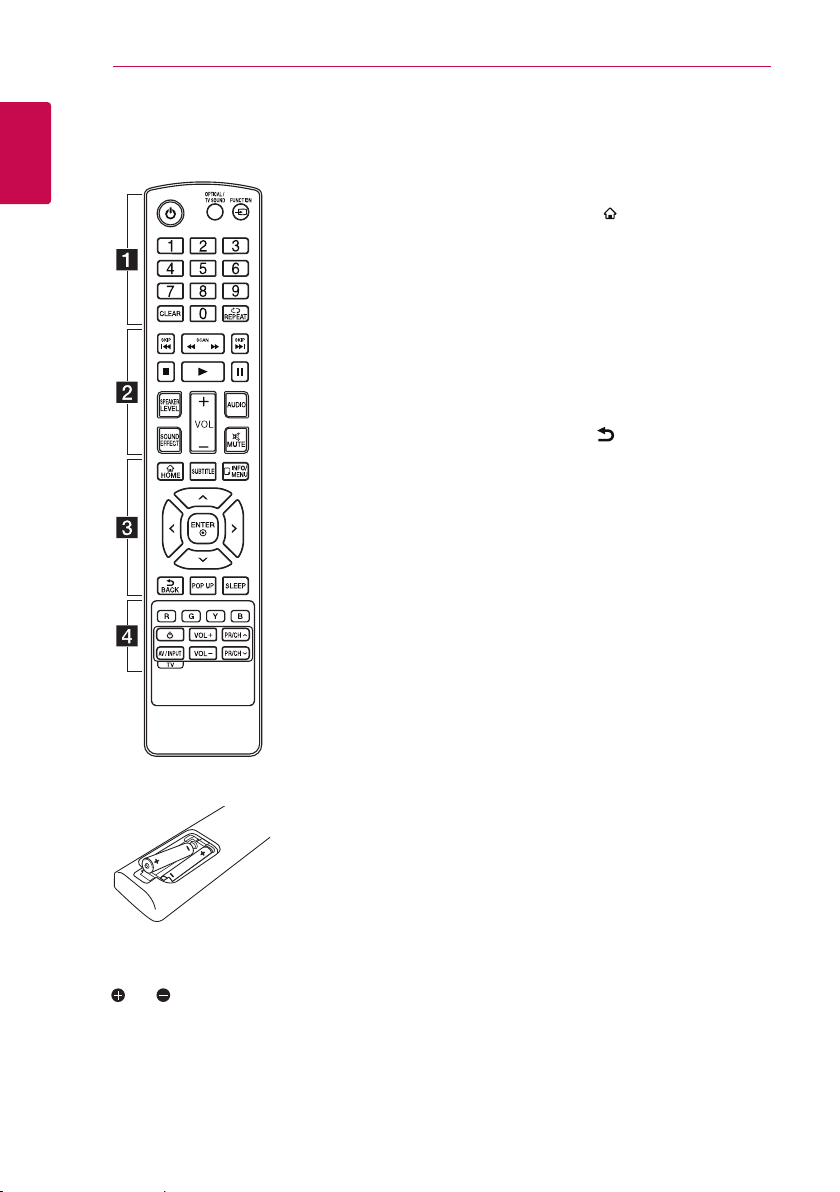
a
• • • • • •
1
(Power): Switches the unit ON
or OFF.
OPTICAL/TV SOUND:
Changes input mode to optical
directly.
FUNCTION (
P
): Changes input
mode.
0-9 numerical buttons: Selects
numbered options in a menu.
CLEAR: Removes a mark on the
search menu or a number when
setting the password.
REPEAT (
h
): Repeats a desired
section or sequence.
• • • • • •
b
• • • • •
c/v
(SCAN): Searches
backward or forward.
C/V
(SKIP): Goes to the
next or previous chapter/title/le.
Z
(Stop): Stops playback.
z
(Play): Starts playback.
M
(Pause): Pauses playback.
SPEAKER LEVEL: Sets the sound
level of desired speaker.
SOUND EFFECT: Selects a sound
eect mode.
VOL +/-: Adjusts speaker volume.
AUDIO: Selects an audio language
or audio channel.
MUTE(
@
): Mute the unit.
• • • • • •
c
• • • • •
HOME ( ): Displays or exits the
[Home Menu].
SUBTITLE: Selects a subtitle
language.
INFO/MENU (
m
): Displays or exits
On-Screen Display.
Direction buttons (
W/S/A/D
):
Selects an option in the menu.
ENTER (
b
): Acknowledges menu
selection.
BACK ( ): Exits the menu or
resumes playback.
POP UP: Displays a pop-up menu,
if available.
SLEEP: Sets the system to turn off
automatically at a specified time.
• • • • • •
d
• • • • •
Colored (R, G, Y, B) buttons:
They are used as shortcut buttons
for specic menus.
TV Control Buttons: See page
53.
Remote Control
Getting Started 11
Getting Started
1
Installing the sound
bar
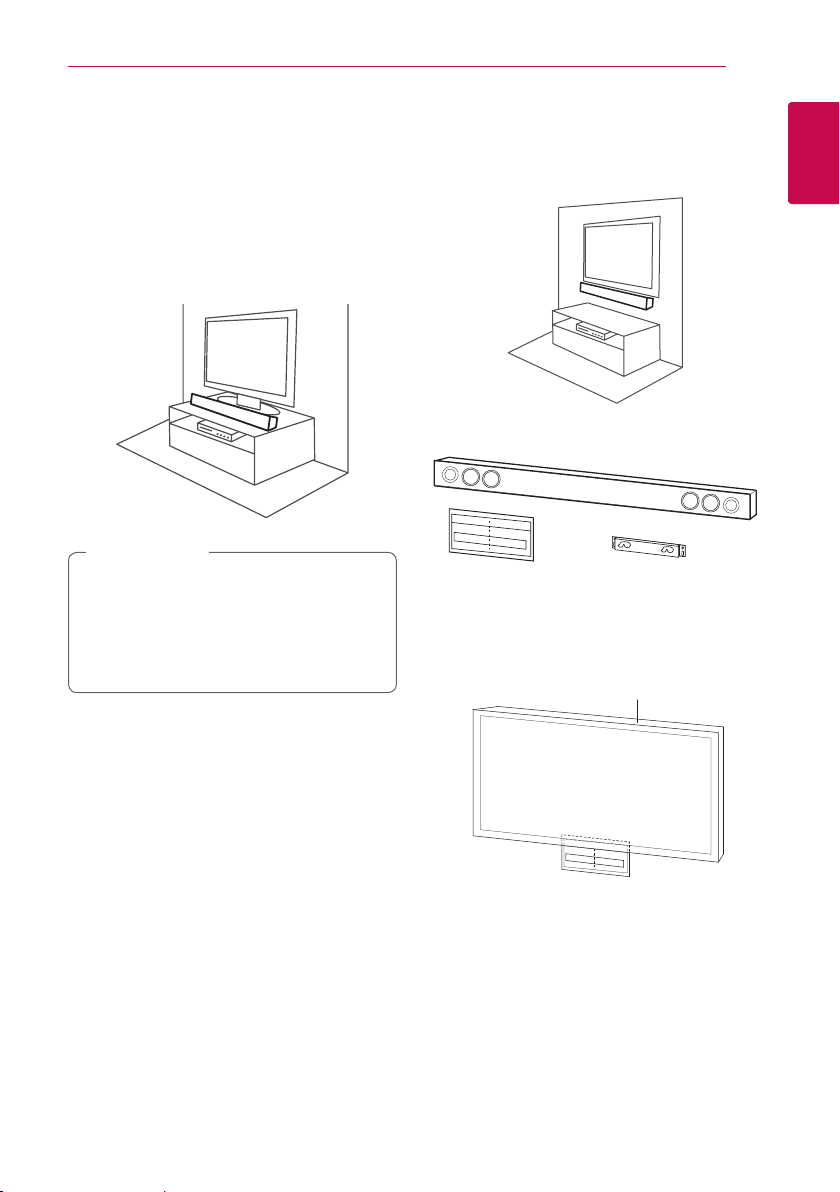
You can hear the sound by connecting the unit to
the other device : TV, Blu-ray disc player, DVD player,
etc.
Place the unit in front of the TV and connect it to
the device you want. (Refer to pp. 14 - 17.)
For best performance of wireless connection
such as Bluetooth or wireless subwoofer,
do not install the unit on Metallic furniture
because wireless connection communicates
through a module positioned on the bottom
of the unit.
>
Caution
Mounting the main
unit on a wall
You can mount the main unit on a wall.
Prepare screws and bracket.
Unit
Wall bracket
Wall Mount Bracket
Installation Template
1. Match the TV’s BOTTOM EDGE of Wall Mount
Bracket Installation Template with the bottom
of TV and attach to the position.
TV
Getting Started12
Getting Started
1
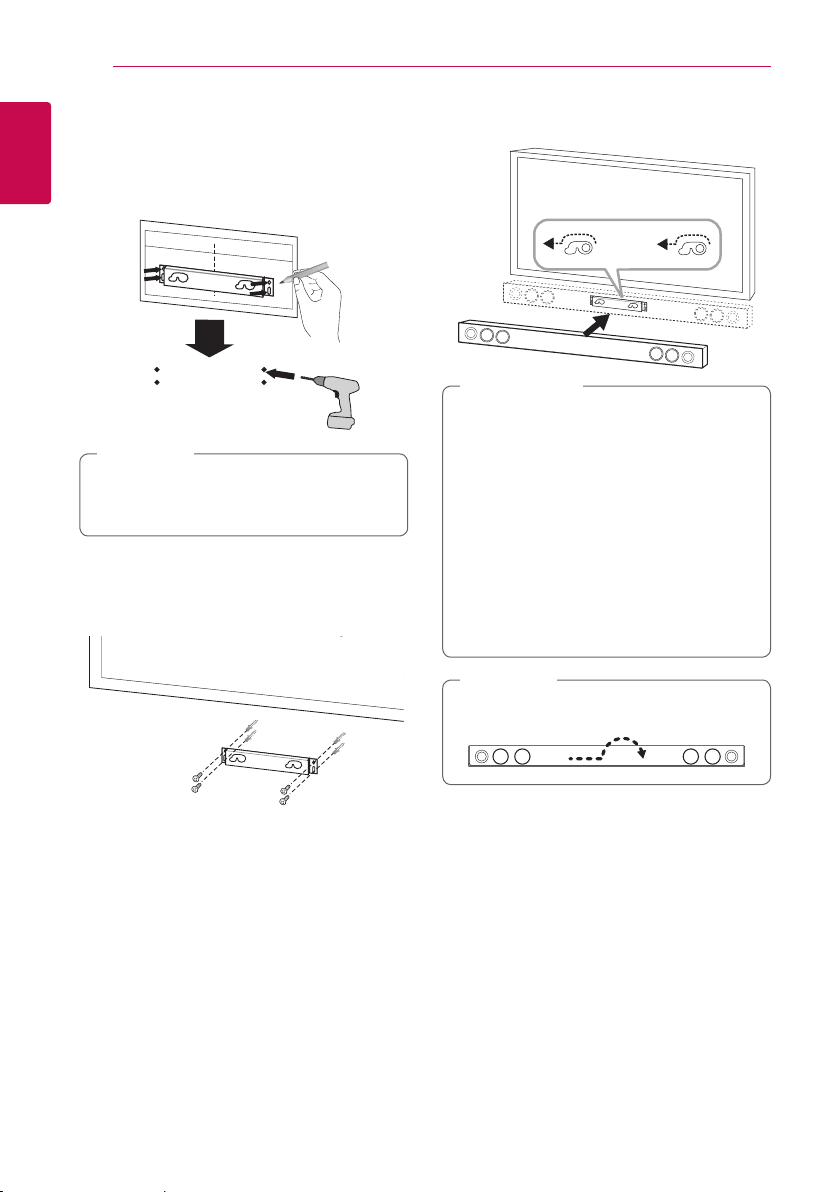
2. When you mount it on a wall (concrete), use
the wall plugs (Not supplied). You should drill
some holes. A guide sheet (Wall Mount Bracket
Installation Template) is supplied to drill. Use the
sheet to check the point to drill.
Screws and Wall Plugs are not supplied for
mounting the unit. We recommend the Hilti
(HUD-1 6 x 30) for the mounting.
,
Note
3. Remove the Wall Mount Bracket Installation
Template.
4. Fix it with screws (not supplied) as shown in the
illustration below.
5. Hang the main unit onto the bracket as shown
below.
y
Do not install this unit upside down. It can
damage the parts of this unit or be the
cause of personal injury.
y
Do not hang onto the installed unit and
avoid any impact to the unit.
y
Secure the unit rmly to the wall so that it
does not fall o. If the unit falls o, it may
result in an injury of a person or damage to
the product.
y
When the unit is installed on a wall, please
make sure that a child does not pull any of
connecting cables, as it may cause it to fall.
>
Caution
Detach the unit from the bracket as shown
below.
,
Note
Connecting 13
Connecting
2
Wireless Subwoofer
Connection
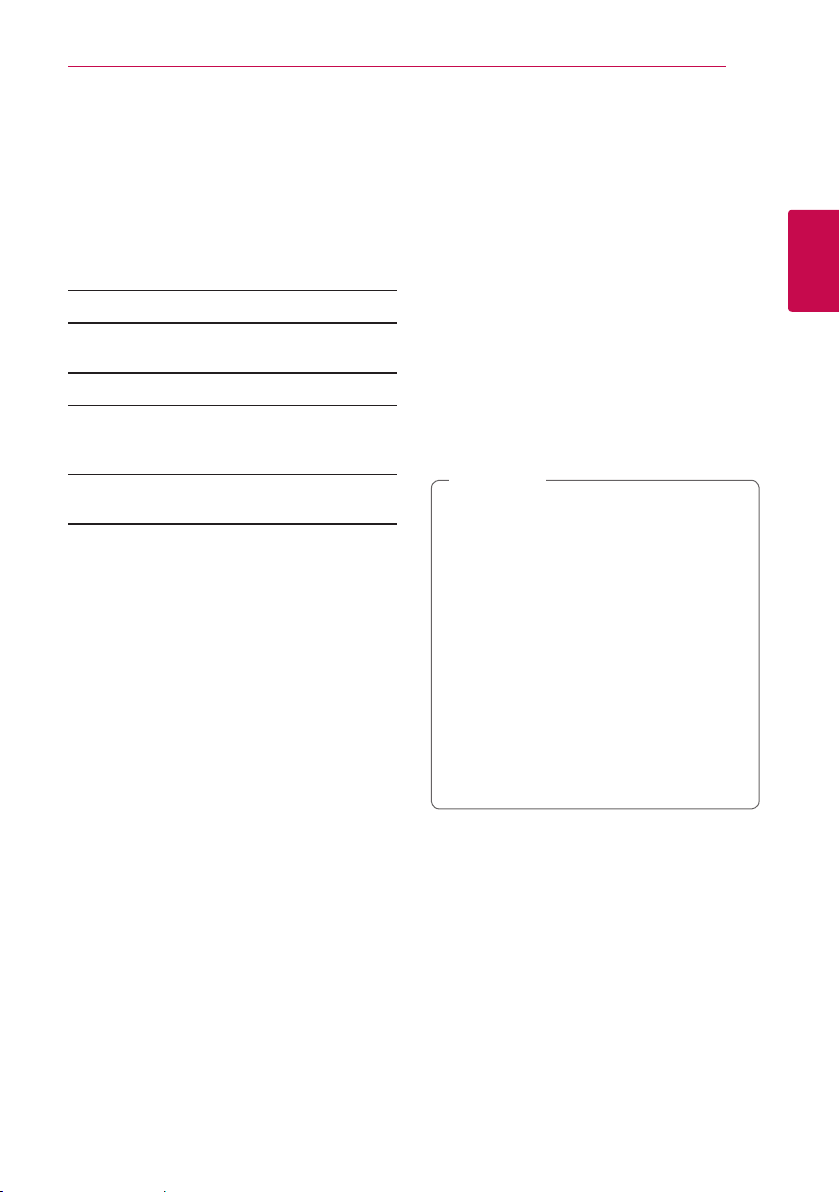
Pairing wireless subwoofer
LED indicator of wireless subwoofer
LED Color Status
Yellow-green
(Blink)
The connection is trying.
Yellow-green The connection is completed.
Red The wireless subwoofer is
in standby mode or the
connection is failed.
O (No
display)
The power cord of wireless
subwoofer is disconnected.
Setting up the wireless subwoofer
for the first time
1. Connect the power cord of the Wireless
subwoofer to the outlet.
2. Turn on the main unit : The main unit and
wireless subwoofer will be automatically
connected.
Manually pairing wireless subwoofer
When your connection is not completed, you can
see the red LED or the blinking of yellow-green LED
on the wireless subwoofer and the subwoofer does
not make sound. To solve the problem, follow the
below steps.
1. Adjust volume level of the main unit to
minimum.
-
”VOL MIN” appears on the display window.
2. Press and hold MUTE(
@
) on the remote
control for about 3 seconds.
-
“WL RESET” appears on the display window
briey.
3. If the LED of the wireless subwoofer already
blinks in yellow-green continually, you can skip
this step.
Press and hold PAIRING on the back of the
wireless subwoofer for more than 5 seconds.
-
The LED of the wireless subwoofer lights up
alternately in red and yellow-green.
4. Disconnect the power cord of the main unit
and the wireless subwoofer.
5. Connect them again after the LED of the main
unit and the wireless subwoofer is fully turned
off.
The main unit and the wireless subwoofer will
be paired automatically when you turn on the
main unit.
-
When the connection is completed, you can
see the yellow-green LED on the subwoofer.
y
It takes a few seconds (and may take longer)
for the main unit and the subwoofer to
communicate with each other and make
sounds.
y
The closer the main unit and the subwoofer,
the better sound quality. It is recommended
to install the main unit and the subwoofer
as close as possible (within 5 m) and avoid
the cases below.
-
There is a obstacle between the main
unit and the subwoofer.
-
There is a device using same frequency
with this wireless connection such as a
medical equipment, a microwave or a
wireless LAN device.
,
Note
13
Connecting14
Connecting
2
Connecting to Your TV
HDMI Connection
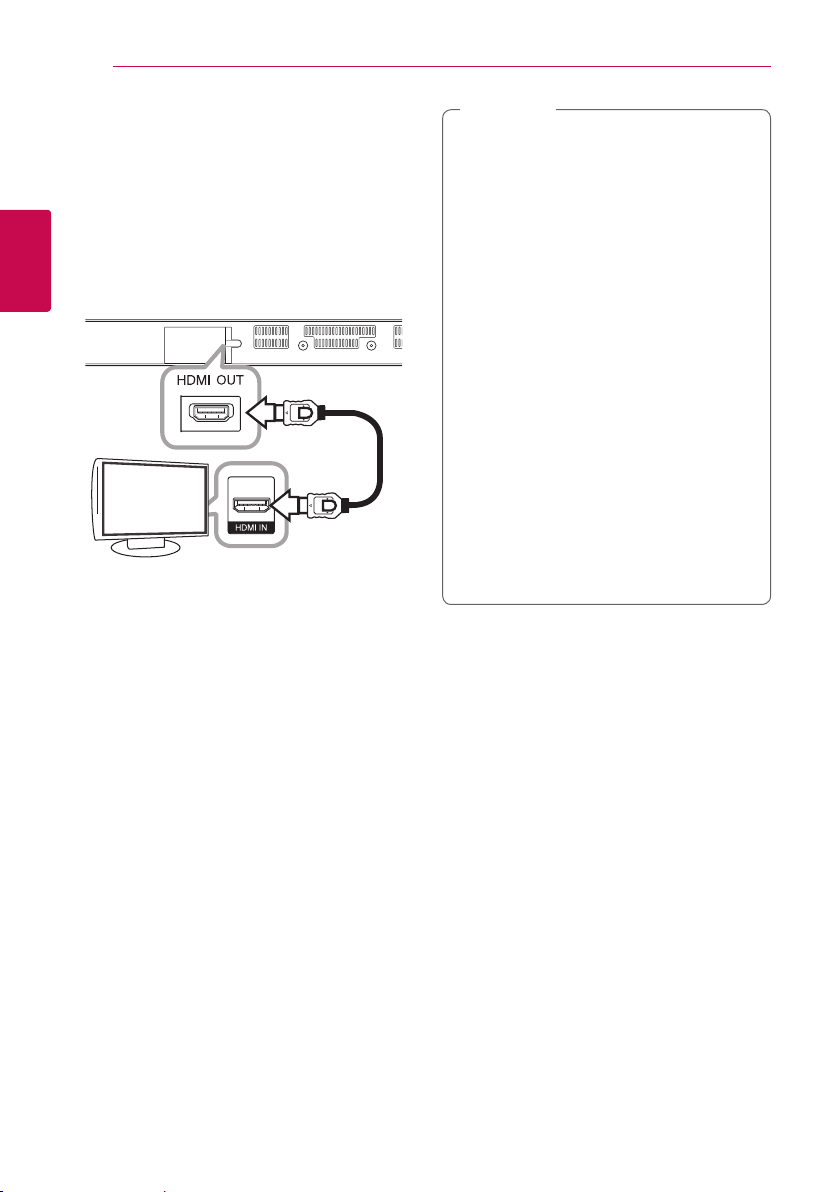
If you have a HDMI TV or monitor, you can connect
it to this unit using a HDMI cable (Type A, High
speed HDMI™ cable with Ethernet). Connect the
HDMI jack on the unit to the HDMI jack on a HDMI
compatible TV or monitor.
TV
HDMI cable
Set the TV’s source to HDMI (refer to TV’s Owner’s
manual).
Additional Information for HDMI
y
When you connect a HDMI or DVI compatible
device, make sure of the followings:
-
Try switching o the HDMI/DVI device and
this unit. Next, switch on the HDMI/DVI
device and leave it for around 30 seconds,
then switch on this unit.
-
The connected device’s video input is set
correctly for this unit.
-
The connected device is compatible with
720 x 480p, 1280 x 720p, 1920 x 1080i or
1920 x 1080p video input.
y
Not all HDCP-compatible HDMI or DVI devices
will work with this unit.
-
The picture will not be displayed properly
with non-HDCP device.
y
If a connected HDMI device does not accept
the audio output of the unit, the HDMI
device’s audio sound may be distorted or
may not output.
y
When you use HDMI connection, you can
change the resolution for the HDMI output.
(Refer to “Resolution Setting” on page 15 )
y
Select the type of video output from the
HDMI OUT jack using [HDMI Color Setting]
option on the [Settings] menu (see page
26).
y
Changing the resolution when the
connection has already been established
may result in malfunctions. To solve the
problem, restart the unit.
y
When the HDMI connection with HDCP
is not veried, TV screen is changed to
black screen. In this case, check the HDMI
connection, or disconnect the HDMI cable.
y
If there are noises or lines on the screen,
please check the HDMI cable (length is
generally limited to 4.5 m(15 ft.)).
,
Note
Connecting 15
Connecting
2
What is SIMPLINK?
Some functions of this unit are controlled by the
TV’s remote control when this unit and LG TV’s with
SIMPLINK are connected through HDMI connection.
Controllable functions by LG TV’s remote control :
Power on/o, volume up/down, etc.
Refer to the TV owner’s manual for the details of
SIMPLINK function.
LG TV’s with SIMPLINK function has the logo as
shown above.
Depending on the state of the unit, some
SIMPLINK operation may dier from your
purpose or not work.
,
Note
ARC (Audio Return Channel)
function
The ARC function enables an HDMI capable TV to
send the audio stream to HDMI OUT of the unit.
To use this function:
-
Your TV must support the HDMI-CEC and ARC
function and the HDMI-CEC and ARC must be
set to On.
-
The setting method of HDMI-CEC and ARC may
dier depending on the TV. For details about
ARC function, refer to your TV manual.
-
You must use the HDMI cable (Type A, High
Speed HDMI™ cable with Ethernet).
-
You must connect the HDMI OUT on the unit
with HDMI IN of the TV that supports ARC
function using an HDMI cable.
-
You can connect only one Sound bar to TV
compatible with ARC.
To active [SIMPLINK/ARC] function, set this
option to [On]. (page 29)
,
Note
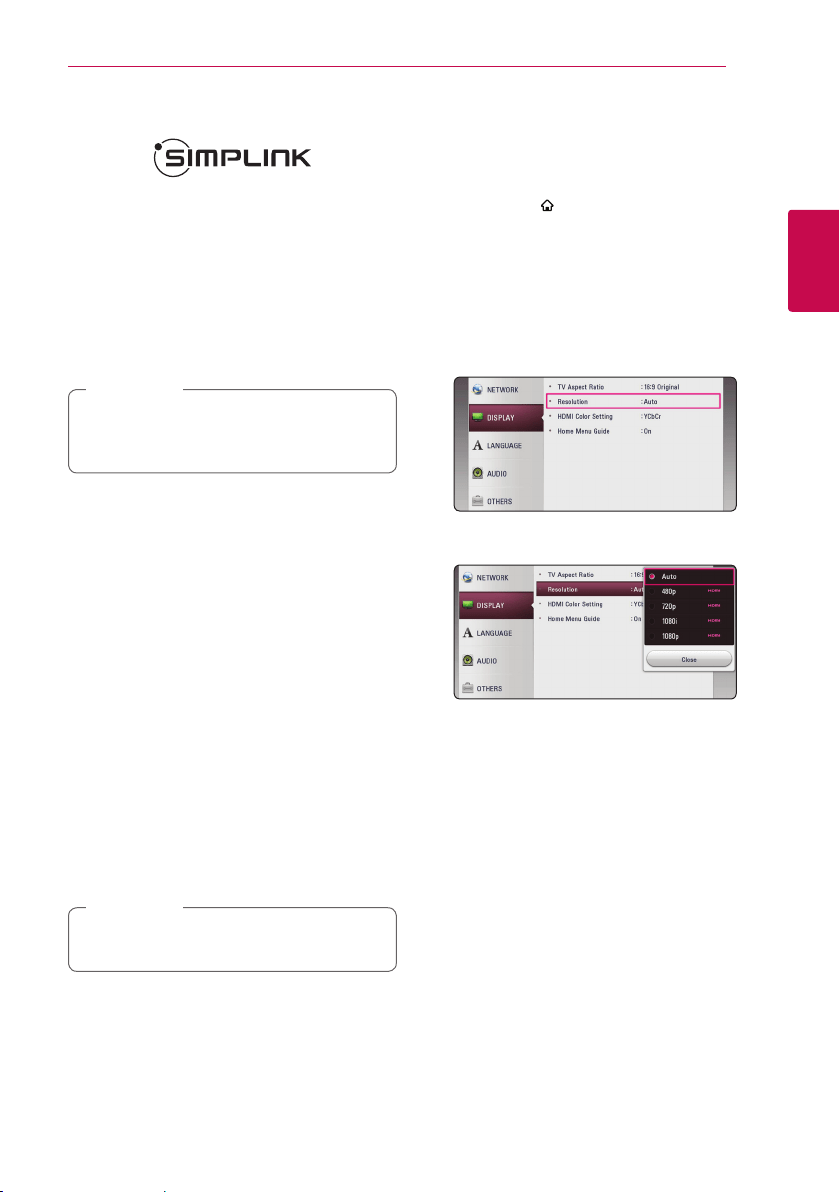
Resolution Setting
The unit provides several output resolutions for
HDMI OUT jack. You can change the resolution
using [Settings] menu.
1. Press HOME ( ).
2. Use
A/D
to select the [Settings] and press
ENTER (
b
). The [Settings] menu appears.
3. Use
W/S
to select [DISPLAY] option then
press
D
to move to the second level.
4. Use
W/S
to select the [Resolution] option
then press ENTER (
b
) to move to the third
level.
5. Use
W/S
to select the desired resolution then
press ENTER (
b
) to confirm your selection.
Connecting16
Connecting
2
y
If your TV does not accept the resolution
you have set on the unit, you can set
resolution to 480p as follows:
1. Press HOME (
) to disappear the HOME
menu.
2 Press
Z
(Stop) for more than 5 seconds.
y
If you select a resolution manually and then
connect the HDMI jack to TV and your TV
does not accept it, the resolution setting is
set to [Auto].
y
If you select a resolution that your TV
does not accept, the warning message
will appear. After resolution change,
if you cannot see the screen, please
wait 20 seconds and the resolution will
automatically revert back to the previous
resolution.
,
Note
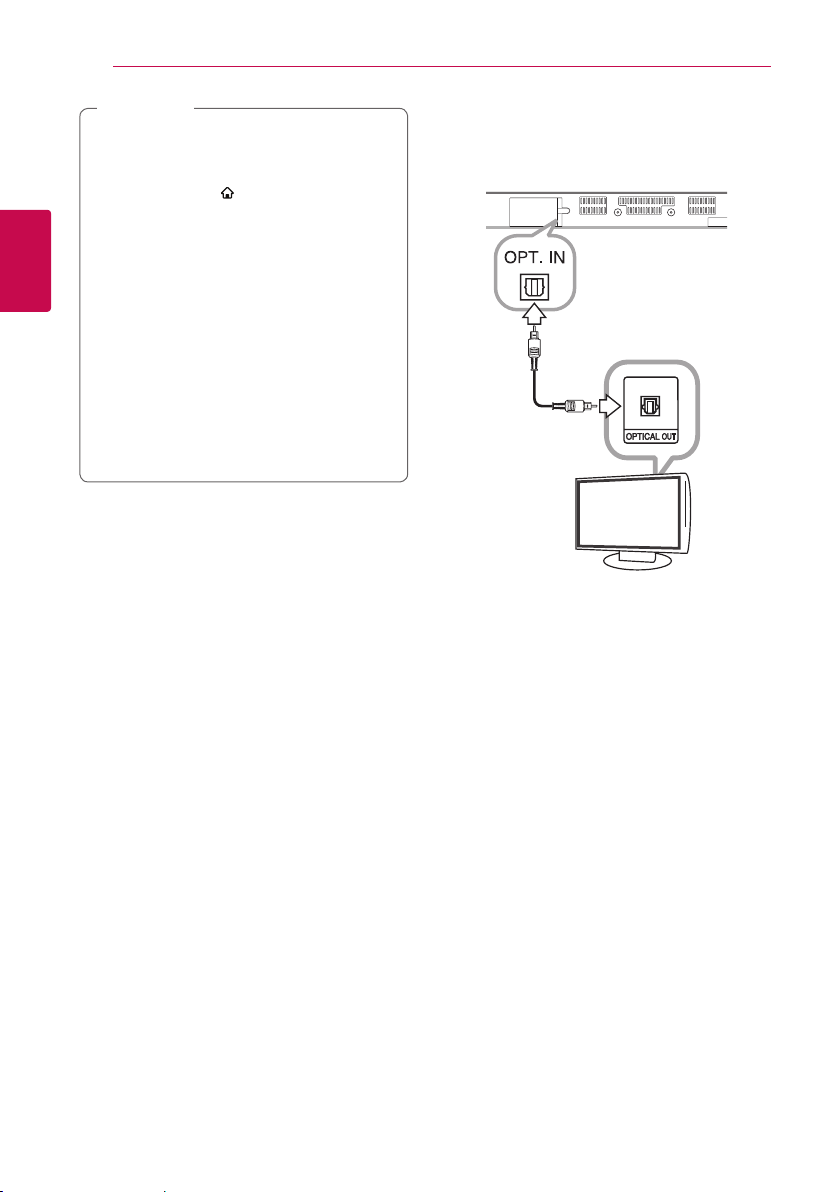
OPTICAL IN connection
You can enjoy the sound from your TV with a
optical digital audio connection.
TV
Optical cable
Connect the optical output jack of your TV into
the OPT. IN jack on the unit. And then select the
[OPTICAL] option by pressing FUNCTION (
P
). Or
press OPTICAL/TV SOUND to select directly.
Connecting 17
Connecting
2
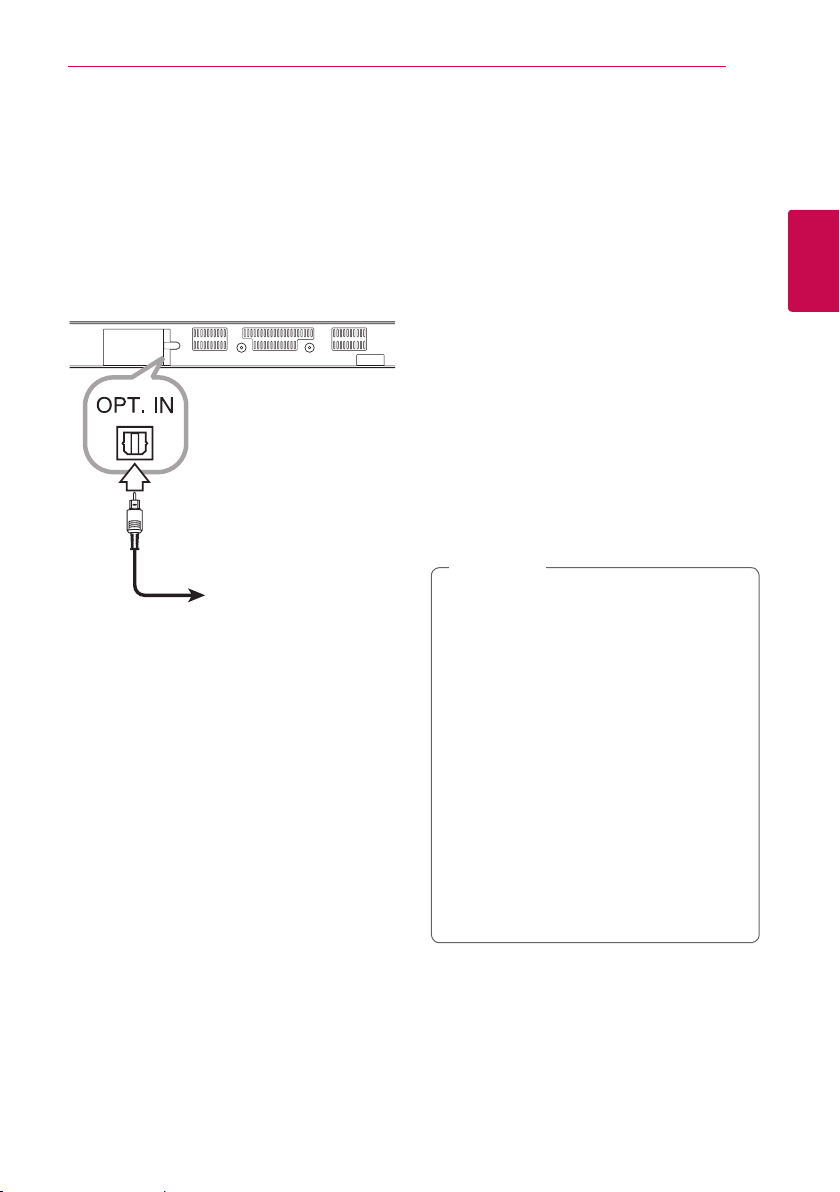
Connections with
external device
OPTICAL IN connection
You can enjoy the sound from your component
with a digital optical connection through the
speakers of this system.
To the digital
optical output jack
of your component
Connect the optical output jack of your component
into the OPT. IN jack on the unit. And then select
the [OPTICAL] option by pressing FUNCTION (
P
).
Or press OPTICAL/TV SOUND to select directly.
You can also use the F (Function) button on the
front panel to select the input mode.
Connecting to your
Home Network
This unit can be connected to a local area network
(LAN) via the LAN port on the rear panel or the
internal wireless module.
By connecting the unit to a broadband home
network, you have access to services such as
software updates and online content services.
Wired network connection
Using a wired network provides the best
performance, because the attached devices
connect directly to the network and are not subject
to radio frequency interference.
Please refer to the documentation for your network
device for further instructions.
Connect the unit’s LAN port to the corresponding
port on your Modem or Router using a
commercially available LAN or Ethernet cable.
y
When plugging or unplugging the LAN
cable, hold the plug portion of the cable.
When unplugging, do not pull on the LAN
cable but unplug while pressing down on
the lock.
y
Do not connect a modular phone cable to
the LAN port.
y
Since there are various connection
congurations, please follow the
specications of your telecommunication
carrier or internet service provider.
y
If you want to access content from DLNA
servers, this unit must be connected to the
same local area network through a router.
y
To set your PC as a DLNA server, install
SmartShare PC Software on your PC. (page
34)
,
Note
Connecting18
Connecting
2
Router
Broadband
service
DLNA certied servers
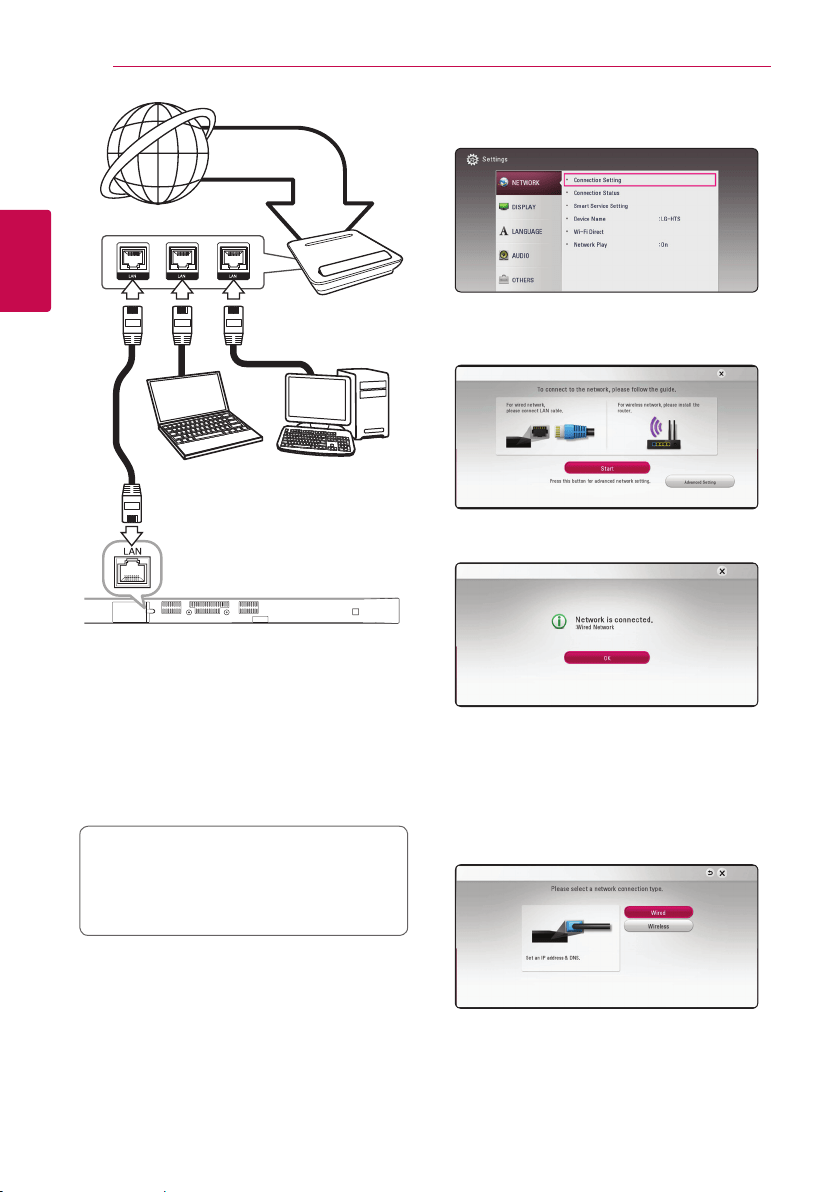
Wired network setup
If there is a DHCP server on the local area
network (LAN) via wired connection, this unit will
automatically be allocated an IP address. After
making the physical connection, a small number
of home networks may require the unit’s network
setting to be adjusted. Adjust the [NETWORK]
setting as follow.
Preparation
Before setting the wired network, you need to
connect the broadband internet to your home
network.
1. Select [Connection Setting] option in the
[Settings] menu then press ENTER (
b
).
2. Read the preparations for the network settings
and then press ENTER (
b
) while [Start] is
highlighted.
Network will automatically be connected to the
unit.
Advanced Setting
If you want to set the network settings manually,
use
W/S
to select [Advanced Setting] on the
[Network Setting] menu and press ENTER (
b
).
1. Use
W/S
to select [Wired] and press ENTER
(
b
).
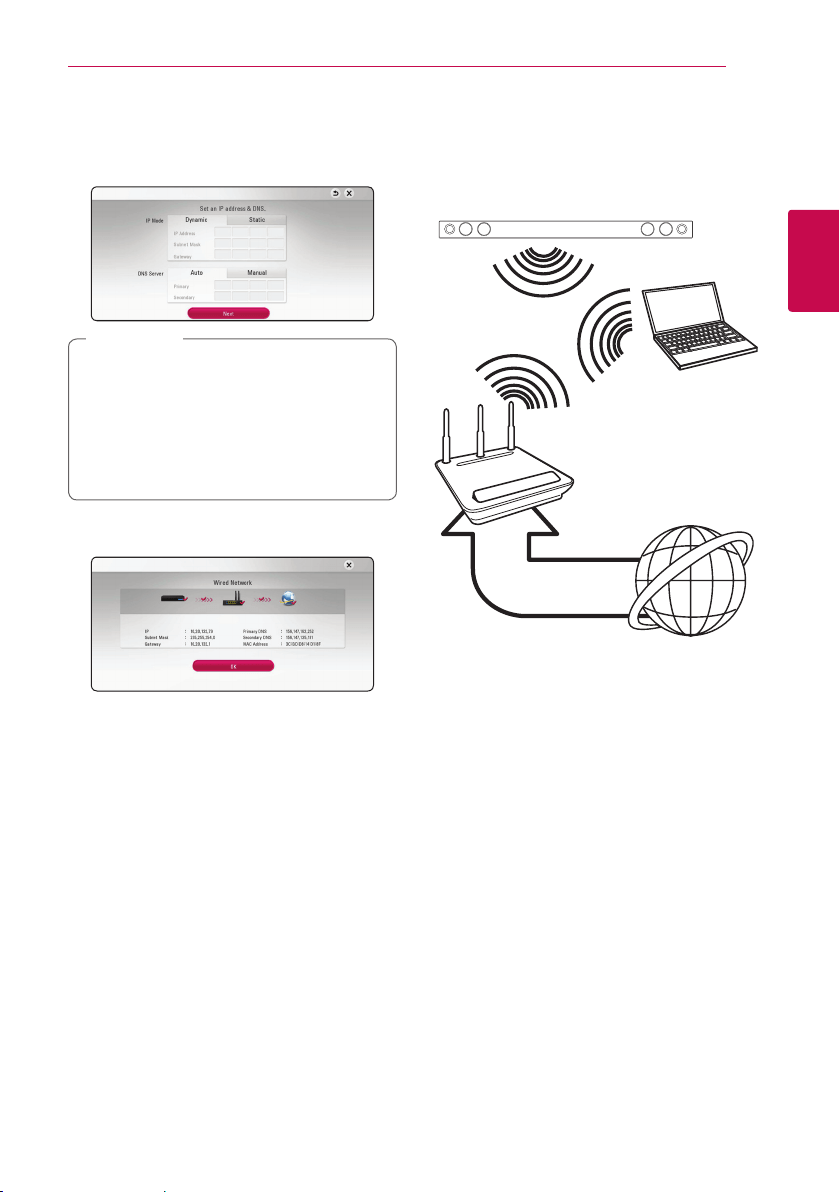
Connecting 19
Connecting
2
2. Use
W/S/A/D
to select the IP mode
between [Dynamic] and [Static].
Normally, select [Dynamic] to allocate an IP
address automatically.
If there is no DHCP server on the network and
you want to set the IP address manually, select
[Static] then set [IP Address], [Subnet Mask],
[Gateway] and [DNS Server] using
W/S/
A/D
and numerical buttons. If you make a
mistake while entering a number, press CLEAR
to clear the highlighted part.
,
Note
3. Select [Next] and press ENTER (
b
) to apply
network settings.
Network connection status is displayed on the
screen.
4. Press ENTER (
b
) while [OK] is highlighted to
finish the wired network settings.
Wireless network connection
Another connection option is to use an Access Point
or a wireless router. The network conguration and
connection method may vary depending on the
equipment in use and the network environment.
Wireless
Communication
DLNA certied servers
Access Point or
Wireless Router
Broadband
service
Refer to the setup instructions supplied with
your access point or wireless router for detailed
connection steps and network settings.
For best performance, a direct wired connection
from this unit to your home network’s router or
cable/DSL modem is always the best option.
If you choose to use the wireless option, please
note that performance can sometimes be aected
by other electronic devices in the home.

Connecting20
Connecting
2
Wireless network setup
For the wireless network connection, the unit needs
to be set up for network communication. This
adjustment can be done from the [Settings] menu.
Adjust the [NETWORK] setting as follow. Setting up
the access point or the wireless router is required
before connecting the unit to the network.
Preparation
Before setting the wireless network, you need
to:
-
connect the broadband internet to the
wireless home network.
-
set the access point or wireless router.
-
note the SSID and security code of the
network.
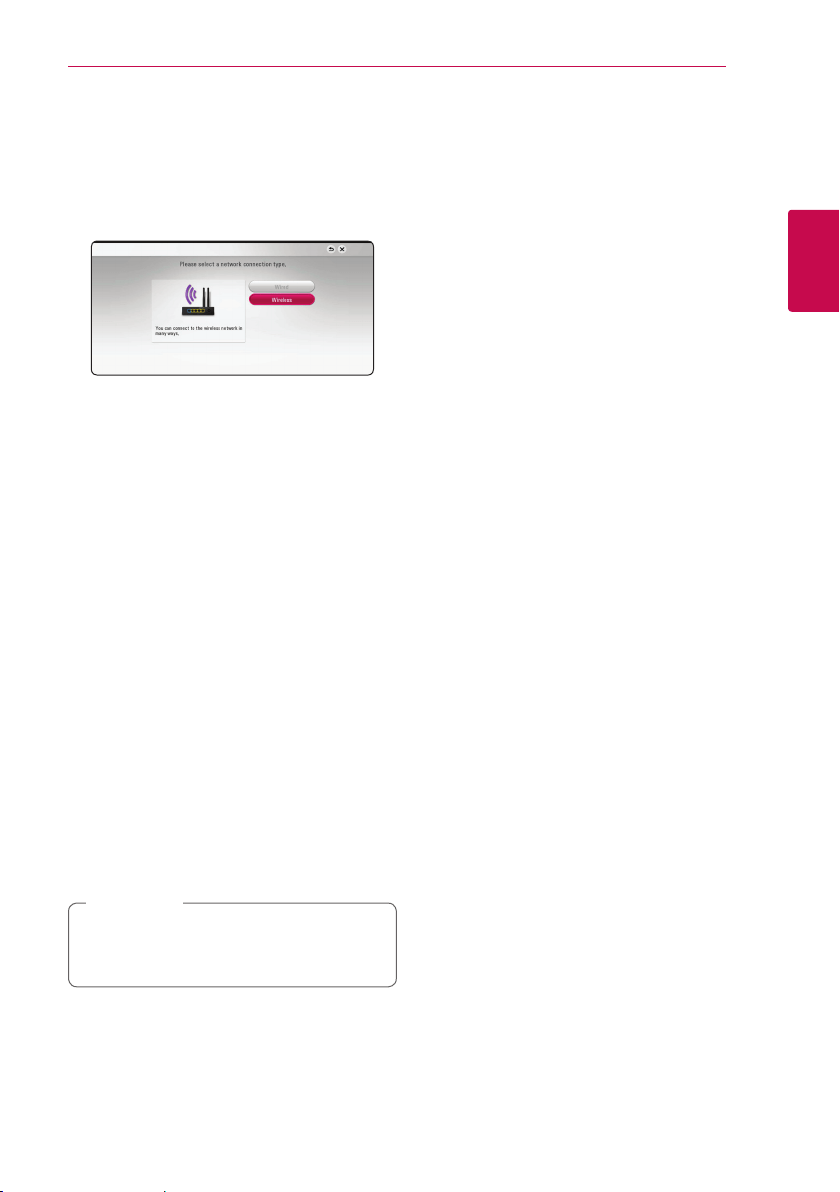
1. Select [Connection Setting] option in the
[Settings] menu then press ENTER (
b
).
2. Read the preparations for the network settings
and then press ENTER (
b
) while [Start] is
highlighted.
If wired network is not connected to the unit, all
available networks are displayed on the screen.
3. Use
W/S
to select a desired SSID of wireless
network and press ENTER (
b
).
If you have security on your access point, you
need to input the security code as necessary.
If you use other characters than the english
alphabet or digits for the SSID name of your
access point or wireless router, it may be
displayed dierently.
,
Note
y
WEP security mode generally have 4 keys
available on an access point setting. If your
access point or wireless router use WEP
security, enter the security code of the key
“No.1” to connect on your home network.
y
An Access Point is a device that allows you
to connect to your home network wirelessly.
,
Note
4. Use
W/S/A/D
to select the IP mode
between [Dynamic] and [Static].
Normally, select [Dynamic] to allocate an IP
address automatically.
If there is no DHCP server on the network and
you want to set the IP address manually, select
[Static] then set [IP Address], [Subnet Mask],
[Gateway] and [DNS Server] using
W/S/
A/D
and numerical buttons. If you make a
mistake while entering a number, press CLEAR
to clear the highlighted part.
,
Note
5. Select [Next] and press ENTER (
b
) to apply
network settings.
Network connection status is displayed on the
screen.
6. Select [OK] and press ENTER (
b
) to complete
the network connection.
Connecting 21
Connecting
2
Advanced Setting
If you want to set the network settings manually,
use
W/S
to select [Advanced Setting] on the
[Network Setting] menu and press ENTER (
b
).
1. Use
W/S
to select [Wireless] and press ENTER
(
b
).
[AP List] - Scans all available access points or
wireless routers within range and display them
as a list.
[Network name (SSID)] – Your access point
may not be broadcasting its network name
(SSID). Check your access point settings through
your computer and either set your access
point to broadcast SSID, or manually enter the
network name in [Network name(SSID)].
[PBC] – If your access point or wireless
router that supports the PBC (Push Button
Configuration) method, select this option and
press the Push Button on your access point
within 120 counts. You do not need to know the
network name (SSID) and security code of your
access point.
[PIN] – If your access point supports the PIN
Code configuration method based on WPS(Wi-
Fi Protected Setup), select this option and
note the code number on the screen. And
then, enter the PIN number on a setting menu
of your access point to connect. Refer to the
documentation for your network device.
2. Follow the instructions of each connection
method on the screen.
To use PBC and PIN network connection,
security mode of your access point must be
set to OPEN or AES.
,
Note
Notes on network connection
y
Many network connection problems during set
up can often be xed by re-setting the router or
modem. After connecting the unit to the home
network, quickly power o and/or disconnect
the power cable of the home network router or
cable modem. Then power on and/or connect
the power cable again.
y
Depending on the internet service provider (ISP),
the number of devices that can receive internet
service may be limited by the applicable terms
of service. For details, contact your ISP.
y
Our company is not responsible for any
malfunction of the unit and/or the internet
connection feature due to communication
errors/malfunctions associated with your
broadband internet connection, or other
connected equipment.
y
Some internet content may require a higher
bandwidth connection.
y
Even if the unit is properly connected and
congured, some internet content may not
operate properly because of internet congestion,
the quality or bandwidth of your internet service,
or problems at the provider of the content.
y
Some internet connection operations may not
be possible due to certain restrictions set by the
Internet service provider (ISP) supplying your
broadband Internet connection.
y
Any fees charged by an ISP including, without
limitation, connection charges are your
responsibility.
y
A 10 Base-T or 100 Base-TX LAN port is required
for wired connection to this unit. If your internet
service does not allow for such a connection,
you will not be able to connect the unit.
y
You must use a Router to use xDSL service.
y
A DSL modem is required to use DSL service and
a cable modem is required to use cable modem
service. Depending on the access method of and
subscriber agreement with your ISP, you may not
be able to use the internet connection feature
contained in this unit or you may be limited to
the number of devices you can connect at the
same time. (If your ISP limits subscription to one
device, this unit may not be allowed to connect
when a PC is already connected.)

Connecting22
Connecting
2
y
The use of a “Router” may not be allowed or its
usage may be limited depending on the policies
and restrictions of your ISP. For details, contact
your ISP directly.
y
The wireless network operate at 2.4 GHz
radio frequencies that are also used by other
household devices such as cordless telephone,
Bluetooth® devices, microwave oven, and can be
aected by interference from them.
y
Turn o all unused network equipment in
your local home network. Some devices may
generate network trac.
y
For better reception, place the unit from the
access point as close as possible.
y
In some instances, placing the access point or
wireless router at least 0.45 m (1.5 ft.) above the
oor may improve the reception.
y
The reception quality over wireless depends on
many factors such as type of the access point,
distance between the unit and access point, and
the location of the unit.
y
Set your access point or wireless router to
Infrastructure mode. Ad-hoc mode is not
supported.
System Setting 23
System Setting
3
Initial Setup
When you turn on the unit for the rst time, the
initial setup wizard appears on the screen. Set the
display language and network settings on the initial
setup wizard.
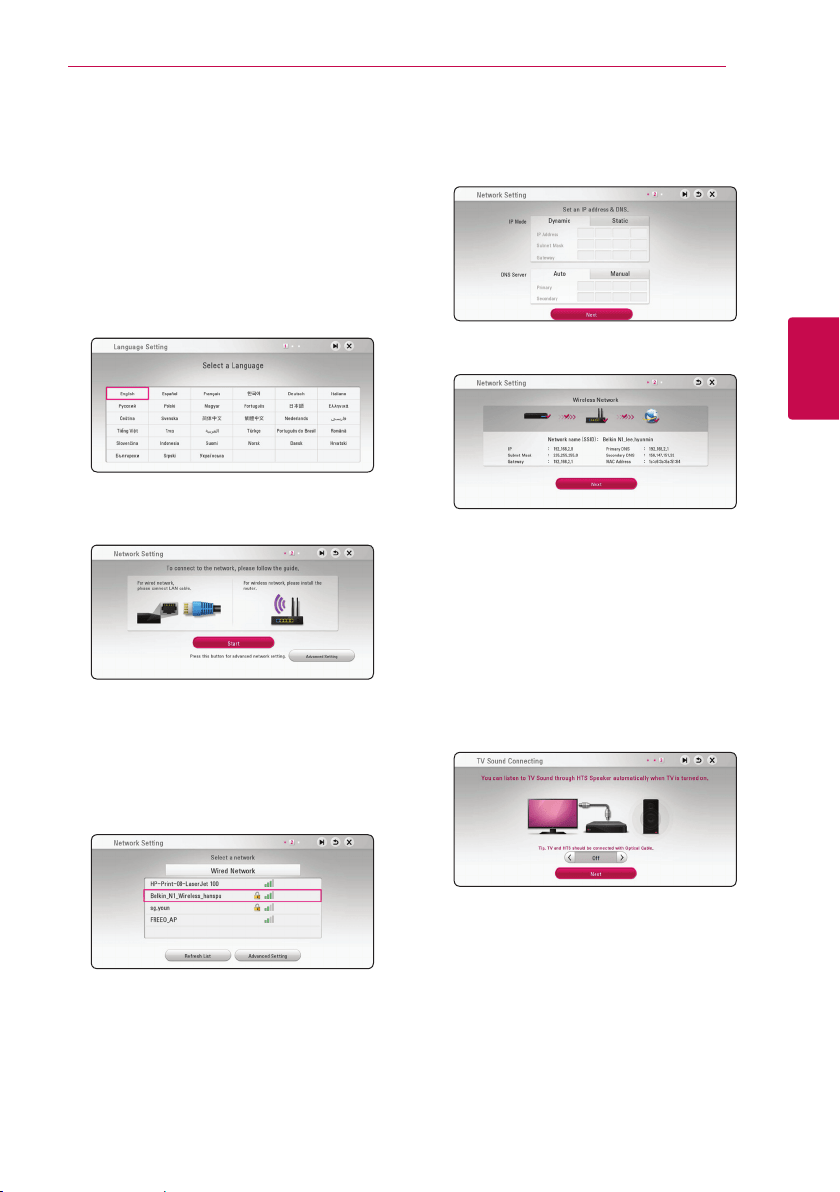
1. Press
1
(Power).
The initial setup wizard appears on the screen.
2. Use
W/S/A/D
to select a display language
and press ENTER (
b
).
3. Read and prepare the preparations for the
network settings and then press ENTER (
b
)
while [Start] is highlighted.
If wired network is connected, the network
connection setting will automatically be
finished.
4. All available networks are displayed on the
screen. Use
W/S
to select [Wired Network]
or desired SSID of wireless network and press
ENTER (
b
).
If you have security on your access point, you
need to input the security code as necessary.
5. Use
W/S/A/D
to select the IP mode
between [Dynamic] and [Static].
Normally, select [Dynamic] to allocate an IP
address automatically.
6. Select [Next] and press ENTER (
b
) to apply
network settings.
Network connection status is displayed on the
screen.
For details on network settings, refer to
“Connecting to your Home Network” on page
17.
7. Select [Next] and press ENTER (
b
).
8. You can listen to TV sound through HTS Speaker
automatically when TV is turned on. TV and HTS
should be connected with optical cable. Press
W
to move and press
A/D
to select [On] or
[Off ]. Select [Next] and press ENTER (
b
).
Operating24
Operating
4
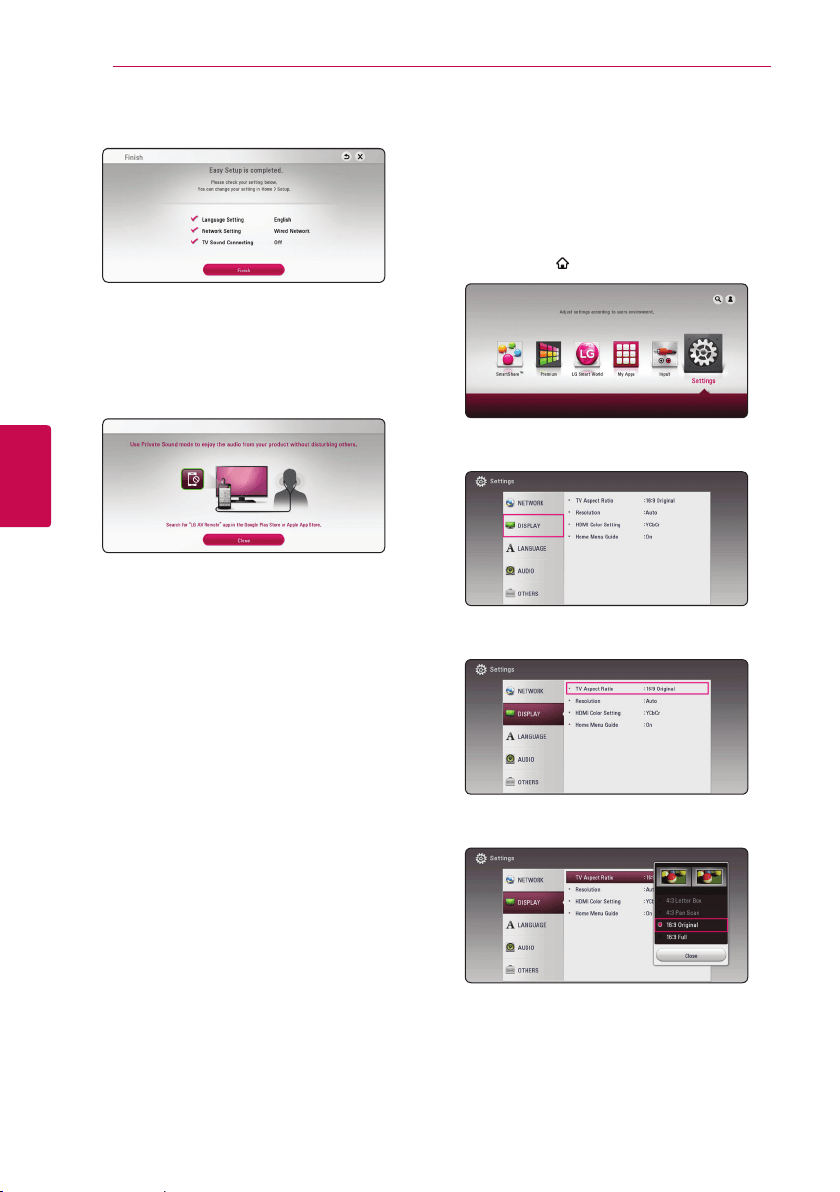
9. Check all the settings that you have set in the
previous steps.
Press ENTER (
b
) while [Finish] is highlighted
to finish the initial setup settings. If there is any
settings to be changed, use
W/S/A/D
to
select
1
and press ENTER (
b
).
10. Displays private sound mode guide. Press
ENTER (
b
).
Settings
Adjust the setup settings
You can change the settings of the unit in the
[Settings] menu.
1. Press HOME
( ).
2. Use
A/D
to select the [Settings] and press
ENTER (
b
). The [Settings] menu appears.
3. Use
W/S
to select the first setup option, and
press
D
to move to the second level.
4. Use
W/S
to select a second setup option, and
press ENTER (
b
) to move to the third level.
5. Use
W/S
to select a desired setting, and press
ENTER (
b
) to confirm your selection.
System Setting 25
System Setting
3
[NETWORK] menu
The [NETWORK] settings are needed to use the
software update and online content services.
Connection Setting
If your home network environment is ready to
connect, the unit needs to be set up via wireless
or wired connection for network communication.
(See “Connecting to your Home Network” on page
17.)
Connection Status
If you want to check the network status on this unit,
select the [Connection Status] options and press
ENTER (
b
) to check whether a connection to the
network and the internet have been established.
Smart Service Setting
[Country Setting]
Select your area for displaying proper online
content service.
[Initialize]
y
[Deactivate Netix]
Deactivates your unit. To activate the Netix
again, contact to the service provider.
y
[Netix ESN]
Display its unique Netix ESN (Electronic
Serial Number) that allows you to use the
Netix streaming.
y
[Deactivate VUDU]
Deactivates your unit. To activate the VUDU
again, contact to the service provider.
Device Name
You can make a network name using virtual
keyboard. This unit will be recognised by the name
you are entering on your home network.
Wi-Fi Direct
This unit is a Wi-Fi Direct™ certied device. Wi-
Fi Direct™ is the technology that enables devices
to connect each other without connecting to an
Access point or a router. Set this option to [On] for
activating the Wi-Fi Direct™ mode. Refer to page
44 for the device connection.
Network Play
This function allows you to control the playback
of media streamed from DLNA media server by a
DLNA certied smartphone. Most DLNA certied
smartphone has a function to control the playback
media on your home network. Set this option to
[On] for allowing your smartphone to control this
unit. Refer to instructions of your DLNA certied
smartphone or the application for more detailed
information.
y
This unit and the DLNA Certied
Smartphone must be connected to the
same network.
y
To use the [Network Play] function using a
DLNA certied smartphone, press HOME
( ) to display the home menu before
connecting to this unit.
y
While controlling the unit using the
[Network Play] function, the remote control
may not work.
y
Available le formats described on page
56 are not always supported on [Network
Play] function.
,
Note
System Setting26
System Setting
3
[DISPLAY] menu
TV Aspect Ratio
Select a TV aspect ratio option according to your TV
type.
[4:3 Letter Box]
Select when a standard 4:3 TV is connected.
Displays theatrical images with masking bars
above and below the picture.
[4:3 Pan Scan]
Select when a standard 4:3 TV is connected.
Displays pictures cropped to ll your TV screen.
Both sides of the picture are cut o.
[16:9 Original]
Select when a 16:9 wide TV is connected. The
4:3 picture is displayed with an original 4:3
aspect ratio, with black bars appearing at the
left and right sides.
[16:9 Full]
Select when a 16:9 wide TV is connected. The
4:3 picture is adjusted horizontally (in a linear
proportion) to ll the entire screen.
You cannot select [4:3 Letter Box] and
[4:3 Pan Scan] option when the resolution is
set to higher than 720p.
,
Note
Resolution
Sets the output resolution of the HDMI video signal.
Refer to page 15 for details about the resolution
setting.
[Auto]
If the HDMI OUT jack is connected to
TVs providing display information (EDID),
automatically selects the resolution best suited
to the connected TV.
[480p]
Outputs 480 lines of progressive video.
[720p]
Outputs 720 lines of progressive video.
[1080i]
Outputs 1080 lines of interlaced video.
[1080p]
Outputs 1080 lines of progressive video.
HDMI Color Setting
Select the type of output from the HDMI OUT jack.
For this setting, please refer to the manuals of your
display device.
[YCbCr]
Select when connecting to a HDMI display
device.
[RGB]
Select when connecting to a DVI display
device.
Home Menu Guide
This function allows you to display or delete the
guide bubble on the [HOME] menu. Set this option
to [On] for displaying guide.
27
System Setting
3
[LANGUAGE] menu
Display Menu
Select a language for the [Settings] menu and on-
screen display.
[AUDIO] menu
Each le has a variety of audio output options. Set
the unit’s Audio options according to the type of
audio system you use.
Since many factors aect the type of audio
output, see “Audio Output Specications” on
page 59 for details.
,
Note
Digital Output
[Auto]
Select if you connect this unit’s HDMI OUT
jack to a device with LPCM, Dolby Digital,
Dolby Digital Plus, Dolby TrueHD, DTS, DTS-HD
decoder or digital decoder.
[PCM]
Select if you connect this unit’s HDMI OUT jack
to a device with digital decoder.
[DTS Re-Encode]
Select if you connect this unit’s HDMI OUT jack
to a device with DTS decoder.
y
When [Digital Output] option is set to
[Auto], the audio may output as bitstream.
If the bitstream information is not detected
from HDMI device with EDID, the audio may
output as PCM.
y
This setting is not available on the input
signal from an external device.
,
Note
DRC (Dynamic Range Control)
This function allows you to listen to a movie at a
lower volume without losing clarity of sound.
[Auto]
The dynamic range of the Dolby Digital and
Dolby Digital Plus are operated as same as the
[On] mode.
[On]
Compress the dynamic range of the Dolby
Digital, Dolby Digital Plus audio output.
[O ]
Turns o this function.
HD AV Sync
Sometimes Digital TV encounters a delay between
picture and sound. If this happens you can
compensate by setting a delay on the sound so
that it eectively ‘waits’ for the picture to arrive:
this is called HD AV Sync. Use
AD
to scroll up and
down through the delay amount, which you can
set at anything between 0 and 300 ms.
System Setting
System Setting28
System Setting
3
[OTHERS] menu
DivX® VOD
ABOUT DIVX VIDEO: DivX® is a digital video
format created by DivX, LLC, a subsidiary of Rovi
Corporation. This is an ocial DivX Certied®
device that has passed rigorous testing to verify
that it plays DivX video. Visit divx.com for more
information and software tools to convert your les
into DivX videos.
ABOUT DIVX VIDEO-ON-DEMAND: This DivX
Certied® device must be registered in order to play
purchased DivX Video-on-Demand (VOD) movies.
To obtain your registration code, locate the DivX
VOD section in your device setup menu. Go to vod.
divx.com for more information on how to complete
your registration.
[Register]
Displays the registration code of your unit.
[Deregister]
Deactivate your unit and display the
deactivation code.
All the downloaded videos from DivX® VOD
with this player’s registration code can only be
played on this unit.
,
Note
Quick Start
This player can stay in standby mode with low
power consumption, so that the player can
instantly boot without delay when you turn on this
unit. Set this option to [On] for activating [Quick
Start] function.
y
If [Quick Start] option is set to [On] and an
AC power is accidently re-connected to
the player by power failure etc., the player
automatically boots itself to be the standby
status. Before operating the player, wait for a
while until the player is in standby status.
y
When [Quick Start] is set to [On], power
consumption will be higher than when
[Quick Start] is set to [O ].
,
Note
Auto Power Off
The screen saver appears when you leave the unit
in Stop mode for about ve minutes. If you set
this option to [On], the unit automatically turns
o within 15 minutes since the Screen Saver is
displayed. Set this option to [O] to leave the
screen saver until the unit is operated by the user.
When you set [Auto Power O ] function in
setting menu on, this unit will be o itself to
save electronic consumption in the case main
unit is not connected to external device and is
not used for 20 minutes.
,
Note
System Setting 29
System Setting
3
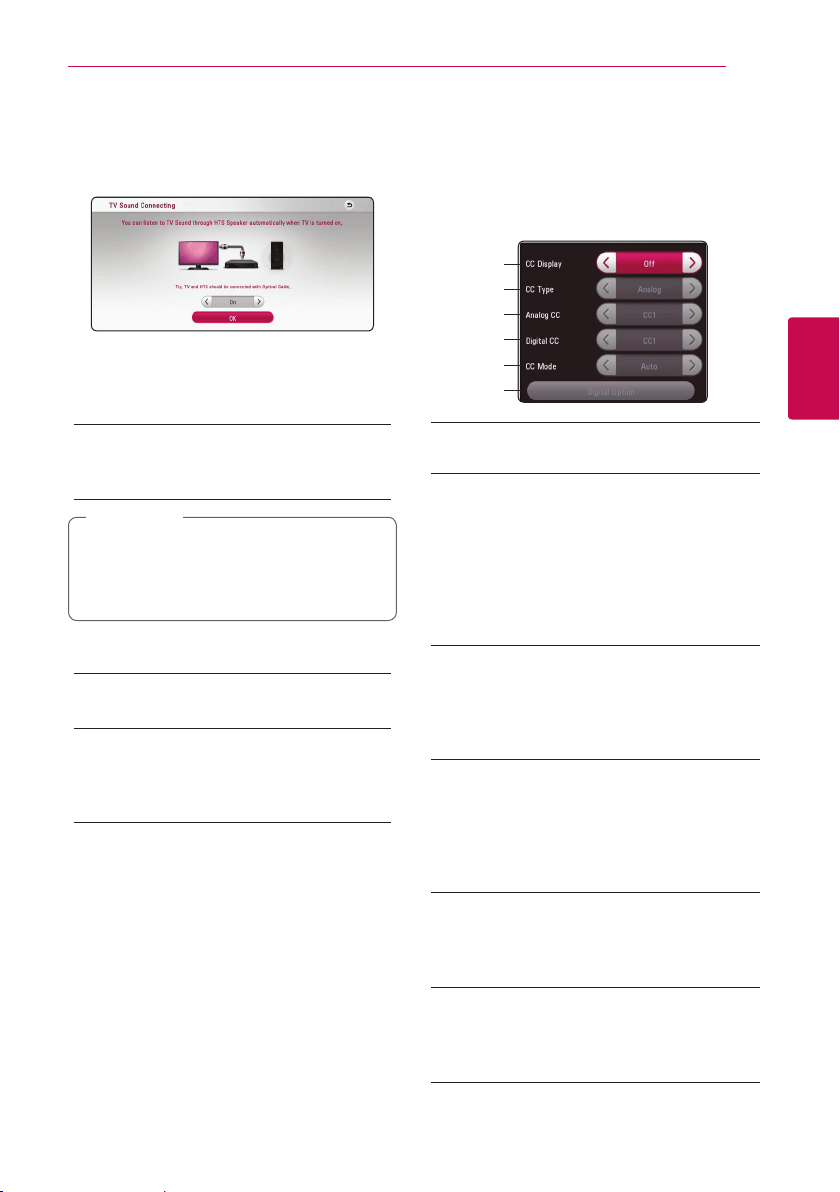
TV Sound Connecting
You can listen to TV sound through this unit’s
speaker automatically when TV is turned on. TV and
this unit should be connected with optical cable.
Press
W
to move and press
A/D
to select [On] or
[O ]. Select [OK] and press ENTER (
b
).
Initialize
[Factory Set]
You can reset the unit to its original factory
settings.
If you reset the unit to its original factory
settings using [Factory Set] option, you have to
set all the activation for the online services and
network settings again.
,
Note
Software
[Information]
Displays the current software version.
[Update]
You can update the software by connecting
the unit directly to the software update server
(page 54).
SIMPLINK/ARC
-
The SIMPLINK function allows you to control this
unit with LG TV’s remote control.
-
The ARC function enables an HDMI capable TV
to send the audio stream to HDMI OUT of this
player.
Set this option to [On] for activating [SIMPLINK/
ARC] function. (page 15)
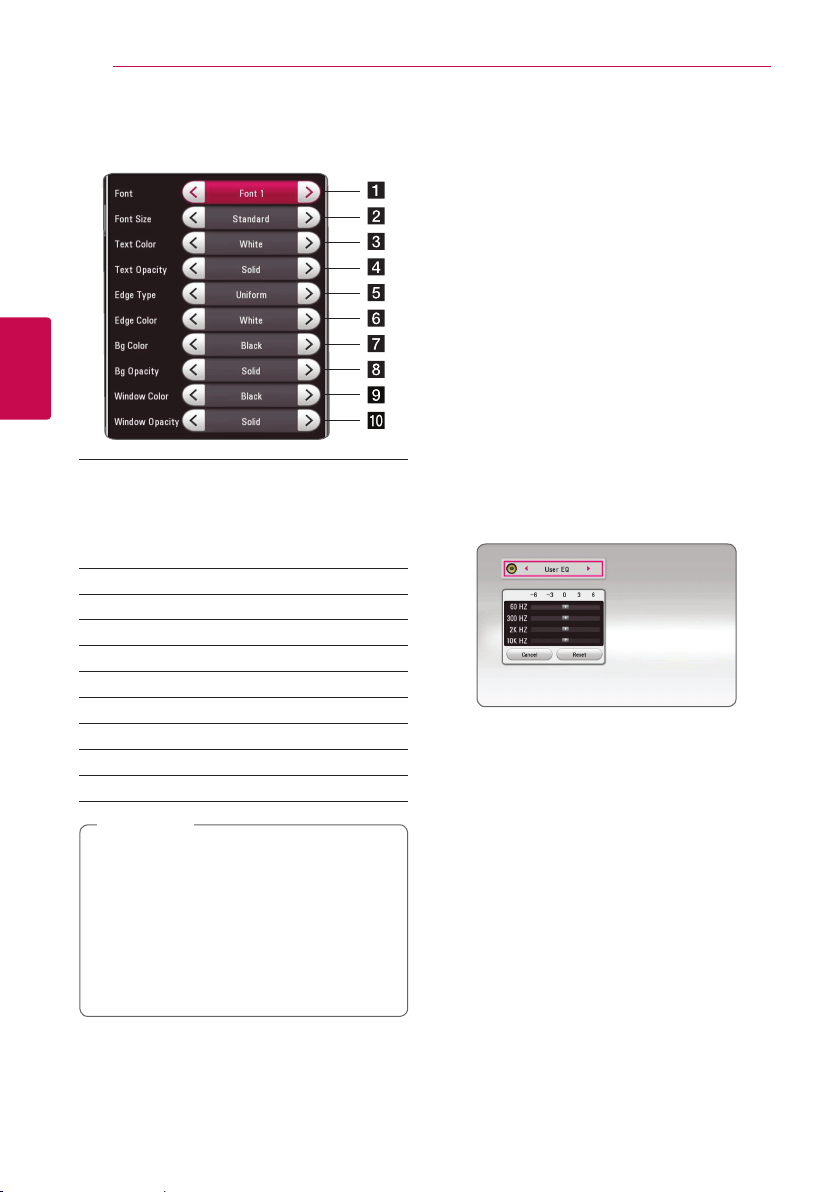
Closed Caption
Closed caption (CC) is the process of displaying text
on a screen to provide additional or interpretive
information for the hearing impaired.
This function allows you to adjust various settings
of closed caption.
a
b
c
d
e
f
a
[CC Display]
Turns on or o this function.
b
[CC Type]
Selects the closed caption type between
[Analog] and [Digital].
[Analog] : Select this when you play some
video les that support [Analog] CC type.
[Digital] : Select this when you play Online
content or some video les that support
[Digital] CC type.
c
[Analog CC]
(When [CC Type] is selected to [Analog])
Displays the audio portion of a movie as text
on the screen. CC1 is the most common
mode in use.
d
[Digital CC]
(When [CC Type] is selected to [Digital])
The language option of the online content
can be selected here. (but language option
will be supported fully or partially according
to contents)
e
[CC Mode]
(When [CC Type] is selected to [Digital])
Selects the closed caption mode between
[Custom] and [Auto].
f
[Digital Option]
(When [CC Mode] is selected to [Custom])
You can adjust detail settings of closed
caption.
System Setting30
System Setting
3
Adjusting the [Digital Option]
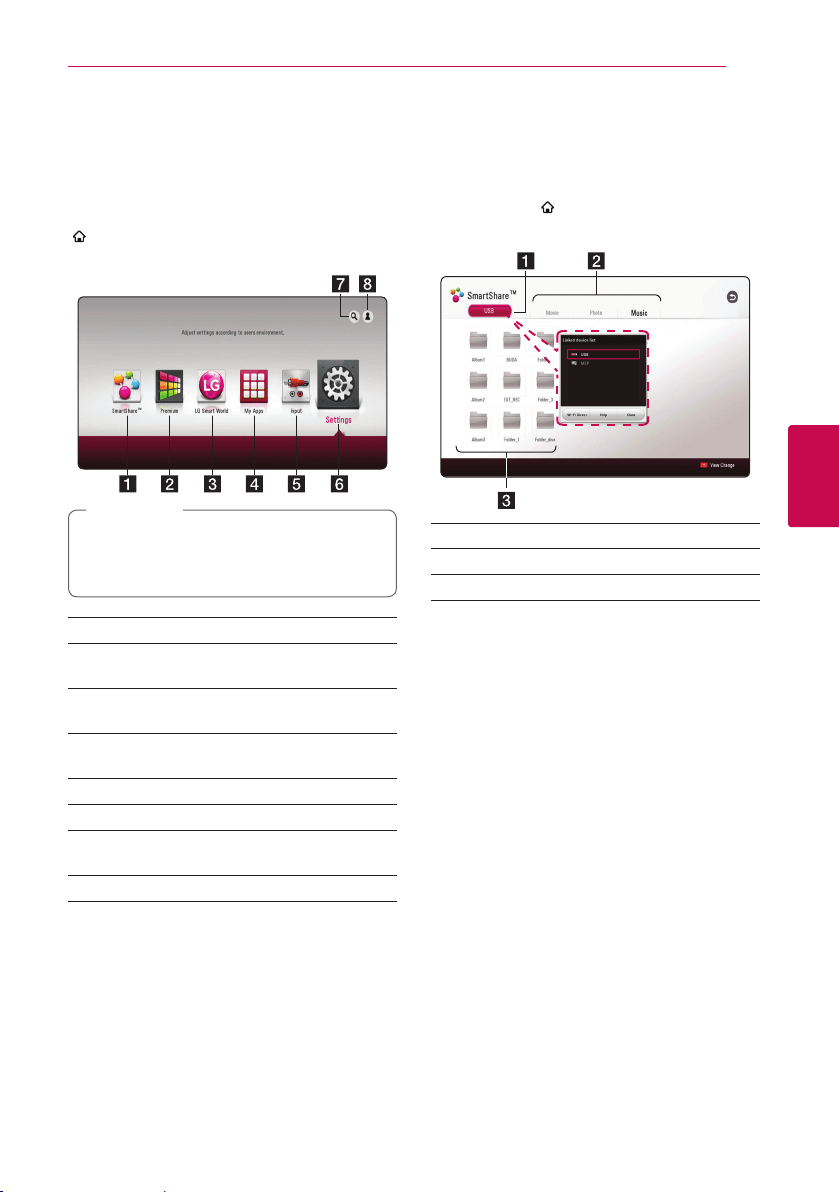
When [CC Mode] is selected to [Custom], you can
adjust detail settings of closed caption.
a
Selects a typeface for the text.
Font1 : Default / Font2 : Courier
Font3 : TimesNewRoman / Font4 : Helvetica
Font5 : Arial / Font6 : Casual
Font7 : Cursive / Font8 : SmallCapital
b
Selects the font size.
c
Selects a color for the text.
d
Adjusts the opacity for the text color.
e
Selects an edge type.
f
Selects a color for the edges.
g
Selects a background color.
h
Adjusts the opacity for the background color.
i
Selects a window color.
j
Adjusts the opacity for the window color.
y
On description page, a CC logo will appear
if closed captioning is supported.
y
If online content include closed caption of
its own, this setting may not work.
y
Online content supports closed caption
function, if you want to use closed caption,
go to [Settings] > [OTHERS] > [Closed
Caption].
,
Note
Sound Effect
You can select a sound mode that suits you and
the content you are playing. Press SOUND EFFECT
repeatedly until the desired mode appears on the
front panel display or the TV screen. The displayed
items for the equalizer maybe dierent depending
on sound sources and eects.
[Music]: You can enjoy comfortable and natural
sound.
[Standard]: Software with multichannel surround
audio signals is played according to the way it was
recorded.
[Bass]: Reinforce the bass sound eect from front
left and right speaker and subwoofer.
[Loudness]: Improves bass and treble sound.
[User EQ]: You can adjust the sound by raising or
lowering the level of specic frequency.
Setting the [User EQ]
1. Use
W/S
to select the desired frequency.
2. Use
A/D
to select the desired level.
Select [Cancel] option then press ENTER (
b
) to
cancel the setting.
Select [Reset] option then press ENTER (
b
) to reset
the all adjustments.
4 Operating
Operating 31
Operating
4
Home Menu Display
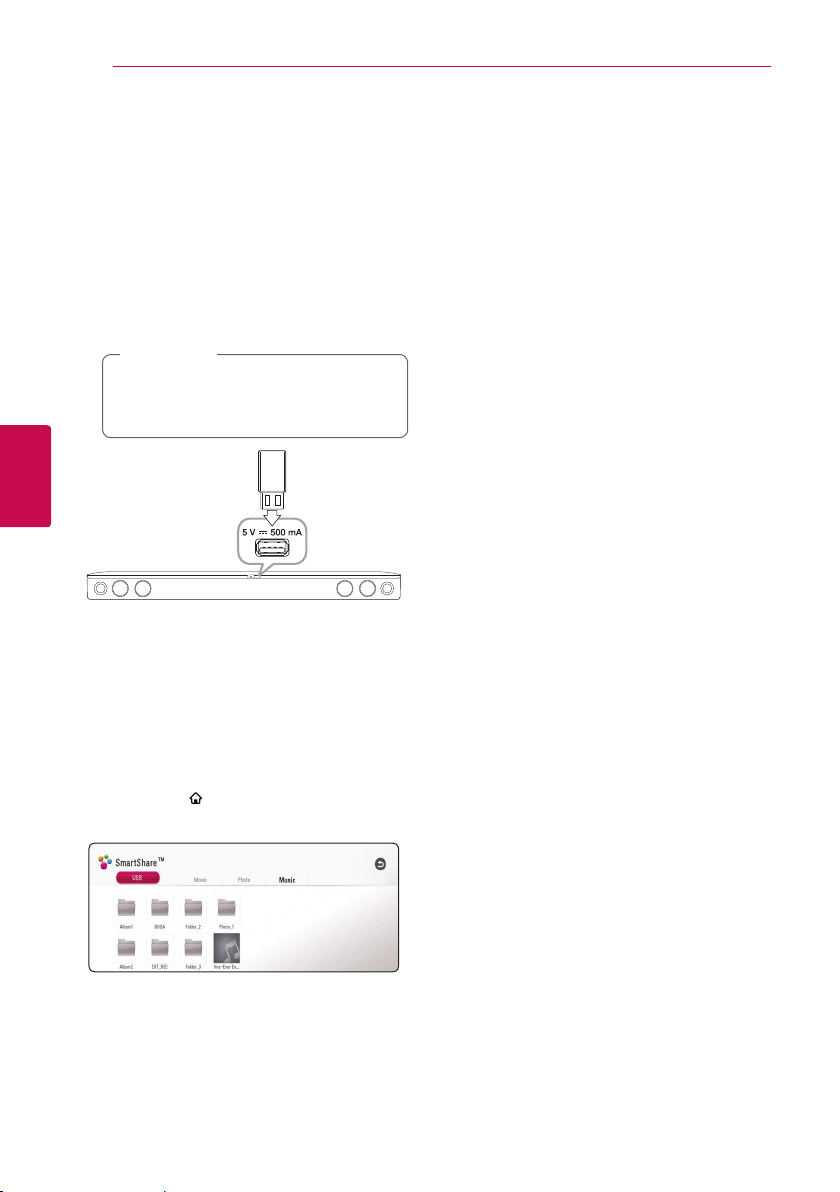
Using [HOME] menu
The home menu appears when you press HOME
( ). Use
W/S/A/D
to select a category and
press ENTER (
b
).
Depending on the region, the [LG Smart
World], [My Apps], [
4
] and [
3
] may not be
available.
,
Note
a
[SmartShare] - Displays SmartShare menu.
b
[Premium] - Displays the Premium home
screen. (page 47)
c
[LG Smart World] - Displays LG Apps titles
provided to the unit. (page 47)
d
[My Apps] - Displays the [My Apps] screen.
(page 49)
e
[Input] - Changes input mode.
f
[Settings] - Adjusts the system settings.
g
[
4
] - Searches for desired LG Apps and other
content.
h
[
3
] - Displays login menu.
Using the SmartShare
You can play video, photo and audio content on
the unit by connecting a USB device and Android
device (MTP) or using home network (DLNA).
1. Press HOME
( ) to display the home menu.
2. Select [SmartShare] and press ENTER (
b
).
a
Displays all linked devices.
b
Displays video, photo or audio content.
c
Displays the le or folder on linked device.
Operating32
Operating
4
Playing the Linked
Devices
Playing a USB device
yui
This unit can play video, audio and photo les
contained on a USB device.
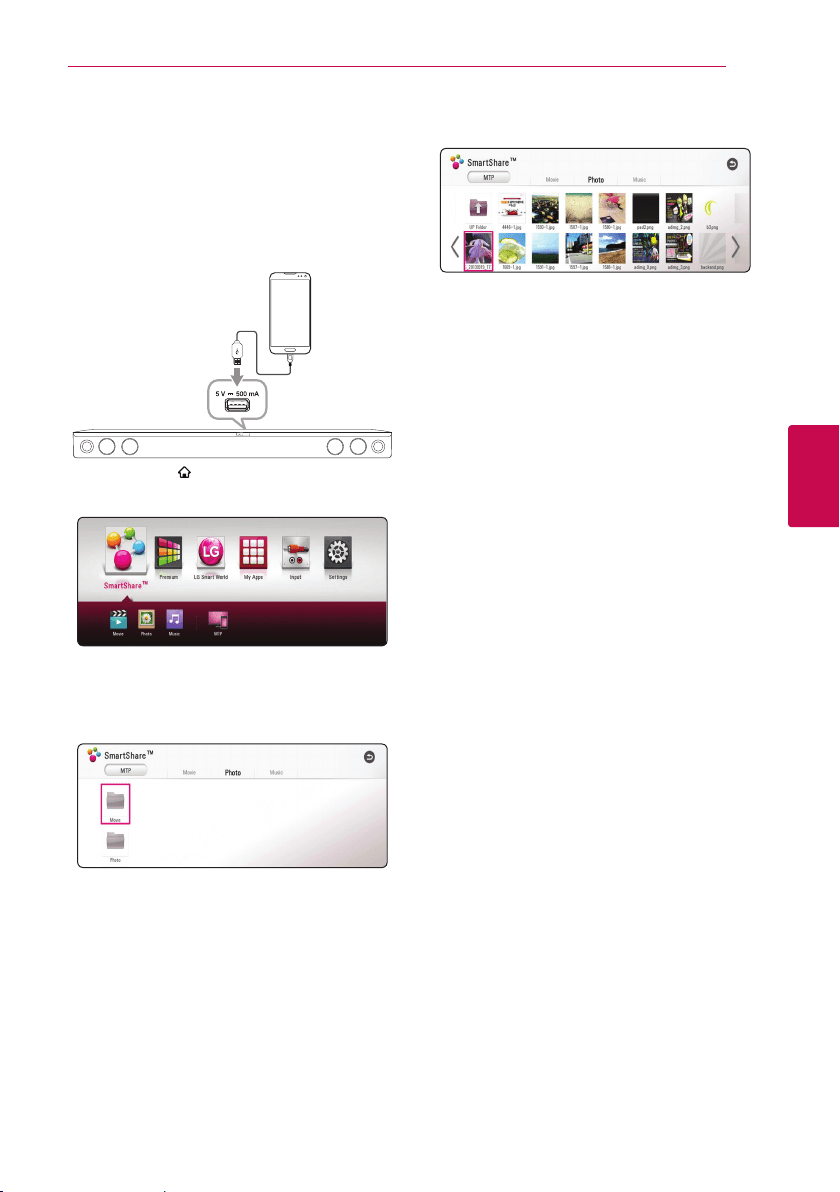
1. Connect a USB device on the unit.
You can connect a USB device more easily
by using USB gender changer supplied as
an accessory.
,
Note
When you connect the USB device on the HOME
menu, the unit plays an audio le contained in the
USB storage device automatically. If the USB storage
device is containing various types of les, a menu
for the le type selection will appear.
File loading may take few minutes depending on
the number of content stored in the USB storage
device. Press ENTER (
b
) while [Cancel] is selected
to stop loading.
2. Press HOME ( ).
3. Select [SmartShare] and press ENTER (
b
).
4. Select the desired linked device in the category.
5. Select [Movie], [Photo] or [Music].
6. Select a file using
W/S/A/D
, and press
d
(Play) or ENTER (
b
) to play the file.
Notes on USB device
y
This unit supports USB ash drive/external HDD
formatted in FAT32 and NTFS when accessing
les (music, photo, movie).
y
This unit can support up to 4 partitions of the
USB device.
y
Do not extract the USB device during operation
(play, etc.).
y
A USB device which requires additional program
installation when you have connected it to a
computer, is not supported.
y
USB device: USB device that supports USB1.1
and USB2.0.
y
Video, audio and photo les can be played. For
details of operations on each le, refer to relevant
pages.
y
Regular back up is recommended to prevent
data loss.
y
If you use a USB extension cable, USB HUB or
USB Multi-reader, the USB device may not be
recognized.
y
Some USB device may not work with this unit.
y
Some digital cameras and mobile phones are
not supported.
y
USB Port of the unit cannot be connected to PC.
The unit cannot be used as a storage device.
Operating 33
Operating
4
Playing a file on Android
device
This player can play video, audio and photo les
contained in the Android device.
1. Connect the Android device to the unit with
USB cable. Make sure that MTP is activated on
Android device.
2. Press HOME ( ).
3. Select [MTP] and press ENTER (
b
).
File loading may take few minutes depending
on the number of content stored in the Android
device.
4. Select [Movie], [Photo] or [Music].
5. Select a file using
W/S/A/D
, and press
d
(Play) or ENTER (
b
) to play the file.
Notes on Connecting Android device
y
This unit can support only the MTP (Media
Transfer Protocol) Android device.
y
Do not extract the Android device during
operation (play, etc.).
y
Video, audio and photo les can be played. For
details of playing each le type, refer to the
relevant pages.
y
Regular back up is recommended to prevent
data loss.
y
If you use a USB extension cable, USB HUB or
USB Multi-reader, the Android device may not be
recognized.
y
Some Android devices may not work with this
unit.
y
When you use MTP, playing some music, photo,
movie, or subtitle les may not work depending
on the Android device.

Operating34
Operating
4
Playing a file on a network
server
yui
This unit can play video, audio and photo les
located in a DLNA server through your home
network.
1. Check the network connection and settings
(page 17).
2. Press HOME ( ).
3. Select [SmartShare] and press ENTER (
b
).
4. Select a DLNA media server in the category.
5. Select [Movie], [Photo] or [Music].
6. Select a file using
W/S/A/D
, and press
d
(Play) or ENTER (
b
) to play the file.
y
The le requirements are described on page
56.
y
Thumbnails of les with unsupported
format will be displayed, but cannot be
played on this unit.
y
The subtitle le name and video le name
have to be the same and located at the
same folder.
y
The playback and operating quality may be
aected by your home network condition.
y
You may experience connection problems
depending on your server’s environment.
y
To set your PC as a DLNA server, install
SmartShare PC Software on your PC. (page
34)
,
Note
Using Home Network
Server for PC
DLNA stands for Digital Living Network Alliance,
which allows users to access video, photo and
audio les stored in server and enjoy them on TV
via home networking.
Before connecting to PC to play a le, SmartShare
PC Software (DLNA) should be installed on your PC.
About SmartShare PC Software
(DLNA)
SmartShare PC Software (DLNA) is for sharing video,
audio and photo les stored on your computer to
this unit as a DLNA-compatible digital media server.
Installing SmartShare PC
Software (DLNA)
Start up your computer, and insert the supplied
CD-ROM disc into your computer’s CD-ROM drive.
An installation wizard will walk you through the
quick and uncomplicated installation process. To
install SmartShare PC Software (DLNA), proceed as
follows:
1. Close all Microsoft Windows programs and exit
any anti-virus software that may be running.
2. Insert the supplied CD-ROM disc into your
computer’s CD-ROM drive.
3. Click [SmartShare PC Software (DLNA)].
4. Click [Run] to start installation.
5. Click the [Next] button to start installation.
6. If you accept all conditions, click [Yes].
Installation is not possible without this
agreement.
7. Follow the directions of the installation wizard
displayed on the screen.
8. Click the [Exit] button to complete the
installation.
Operating 35
Operating
4
y
SmartShare PC Software is not supported
with Mac OS.
y
The SmartShare PC Software (DLNA) is
a customized software edition only for
sharing les and folders to this player.
y
This manual explains operations with the
English version of SmartShare PC Software
(DLNA) as examples. Follow the explanation
referring to the actual operations of your
language version.
,
Note
Sharing files and folders
On your computer, you must share the folder
containing video, audio and/or photo content to
play them on this unit.
This part explains the procedure for selecting the
shared folders on your computer.
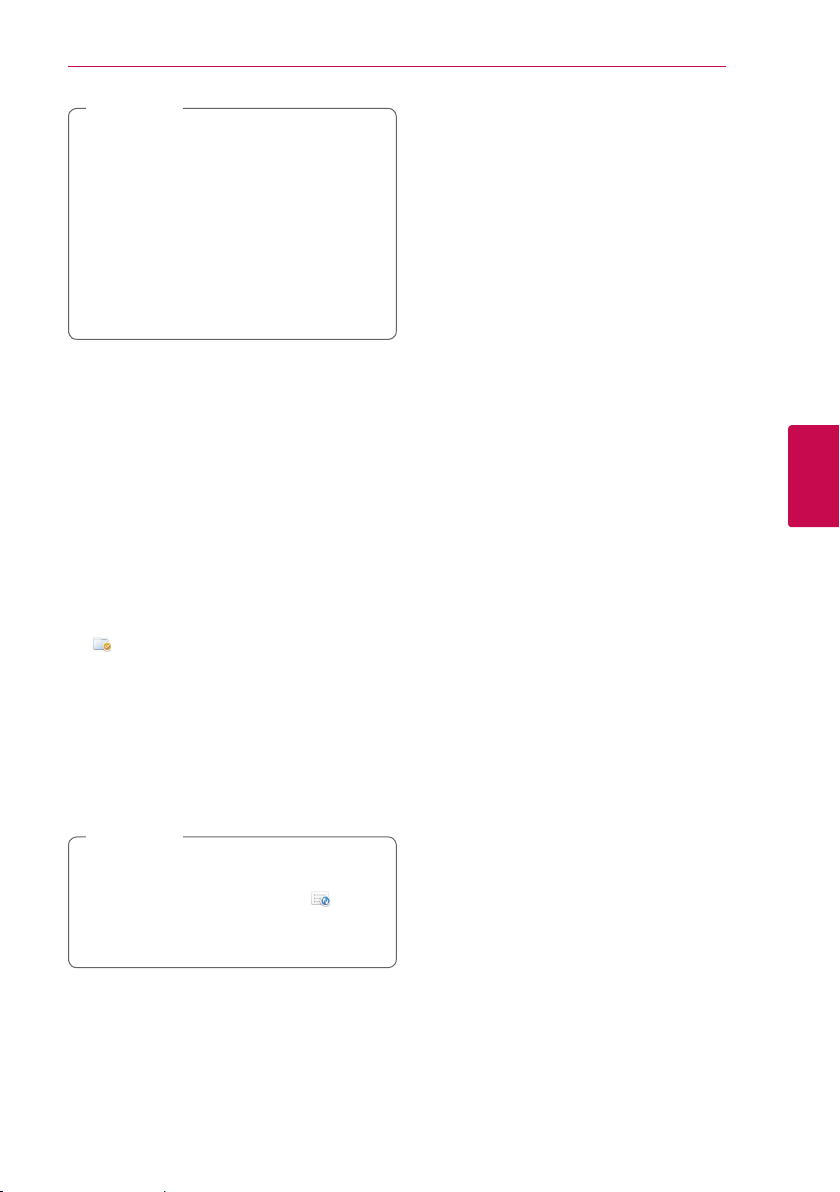
1. Double-click the “SmartShare” icon.
2. Click [Movie], [Photo] or [Music] icon on the
center, and then click [Settings] on the top
right corner of the SmartShare PC Software. The
[Settings] menu appears on the screen.
3. Click [My Shared Contents] tab, and then click
icon. The [Add/Remove Shared Folders]
menu appears on the screen.
4. Click the folder containing the files you want
to share and then click the [OK]. The checked
folder is added to the [My Shared Contents]
and then click the [OK] at the bottom of the
[Settings] menu.
5. Make sure that the SmartShare (DLNA) service
turns on at the [Service] tab.
y
If the shared folders or les are not displayed
on the unit, click the [My Shared Contents]
on the [Settings] menu and click
icon.
y
For more information, click [HELP] on the
[Settings] menu.
,
Note
System requirements
Minimum System
y
CPU : Intel® 2.0 GHz or AMD Sempron™ 2000+
processors
y
Memory : 1 GB of free RAM
y
Graphics card : 64 MB video memory, minimum
resolution of 1024 x 768 pixels, and 16 bit color
settings
y
Free Disc Space : 200 MB
y
Windows® XP (Service Pack 2 or higher), Windows
Vista®, Windows® 7, Windows® 8, Windows® 8.1
y
Windows® Media Player® 11.0 or higher
y
Network environment: 100 Mb Ethernet, WLAN
Recommended System
y
CPU : Intel® Core™ Duo or AMD Athlon™ 64X2,
1.7 GHz or better
y
Memory : 2 GB of free RAM
y
Graphics card : 128 MB video memory, minimum
resolution of 1024 x 768 pixels, and 16 bit color
settings
y
Free Disk Space : 200 MB
y
Windows® XP (Service Pack 2 or higher), Windows
Vista®, Windows® 7, Windows® 8, Windows® 8.1
y
Windows® Media Player® 11.0 or higher
y
Network environment: 100 Mb Ethernet, WLAN
Operating36
Operating
4
General Playback
Basic operations for video and
audio content
To stop playback
Press
Z
(Stop) during playback.
To pause playback
Press
M
(Pause) during playback.
Press
d
(Play) to resume playback.
To play frame-by-frame (Video)
Press
M
(Pause) during video playback.
Press
M
(Pause) repeatedly to play Frame-by-Frame
playback.
To scan forward or backward
Press
c
or
v
to play fast forward or fast reverse
during playback.
You can change the various playback speeds by
pressing
c
or
v
repeatedly.
To slow down the playing speed
(Video)
While the playback is paused, press
v
repeatedly
to play various speeds of slow motion.
You can adjust the playing speed and check it by
the symbol ( - ) on the screen.
To skip to the next/previous
title/file
During playback, press
C
or
V
to go to the
next title/le or to return to the beginning of the
current title/le.
Press
C
twice briey to step back to the previous
title/le.
In the le list menu of a server, there may have
many types of content in a folder together. In this
case, press
C
or
V
to go to the previous or
next content with same type.
Basic operations for photo
content
To play a slide show
Press
d
(Play) to start slide show.
To stop a slide show
Press
Z
(Stop) while slide show.
To pause a slide show
Press
M
(Pause) while slide show.
Press
d
(Play) to re-start the slide show.
To skip to the next/previous photo
While viewing a photo in full screen, press
A
or
D
to go to the previous or next photo.
Resume playback
yu
The unit records the point where you pressed the
Z
(Stop) depending on a le.
If “
MZ
(Resume Stop)” appears on the screen
briey, press
d
(Play) to resume playback (from the
scene point).
If you press
Z
(Stop) twice, “
Z
(Complete Stop)”
appears on the screen. The unit will clear the
stopped point.
The resume point may be cleared when a
button is pressed (for example
1
(Power)).
,
Note
Operating 37
Operating
4
On-Screen Display
You can display and adjust various information and
settings about the content.
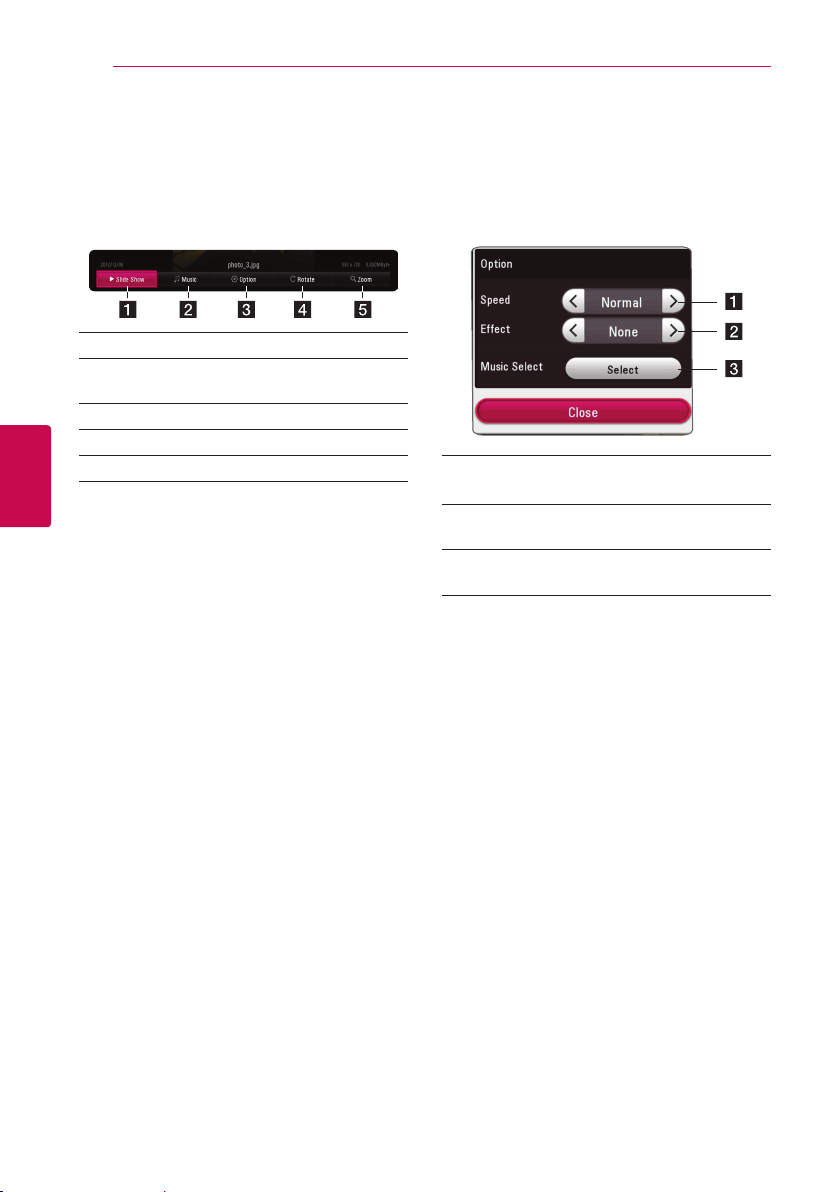
To control video playback
y
You can control playback and set options while
watching videos.
During playback, press INFO/MENU (
m
).
a Progress bar - Displays the current position
and total playing time.
b [Title/Popup] - Displays the title or the pop-
up menu, if available.
c [Option] - Displays playback information.
d [Repeat] - Repeats a desired section or
sequence. (page 39)
e [3D] - Adjusts the 3D setting. (page 43)
Displaying content information on-
screen
y
1. During playback, press INFO/MENU (
m
).
2. Select an [Option] using
A/D
, and press
ENTER (
b
).
a Title – Current title number/total number of
titles
b Time – Elapsed playing time/total playback
time
c Audio – Selected audio language or channel
d Subtitle – Selected subtitle.
e Code Page – Selected subtitle code.
f TV Aspect Ratio – Selected TV aspect ratio
g Picture Mode – Selected picture mode
y
If no button is pressed for a few seconds,
the on-screen display disappears.
y
A title number cannot be selected on some
les.
y
Available items may dier depending on
titles.
,
Note
Operating38
Operating
4
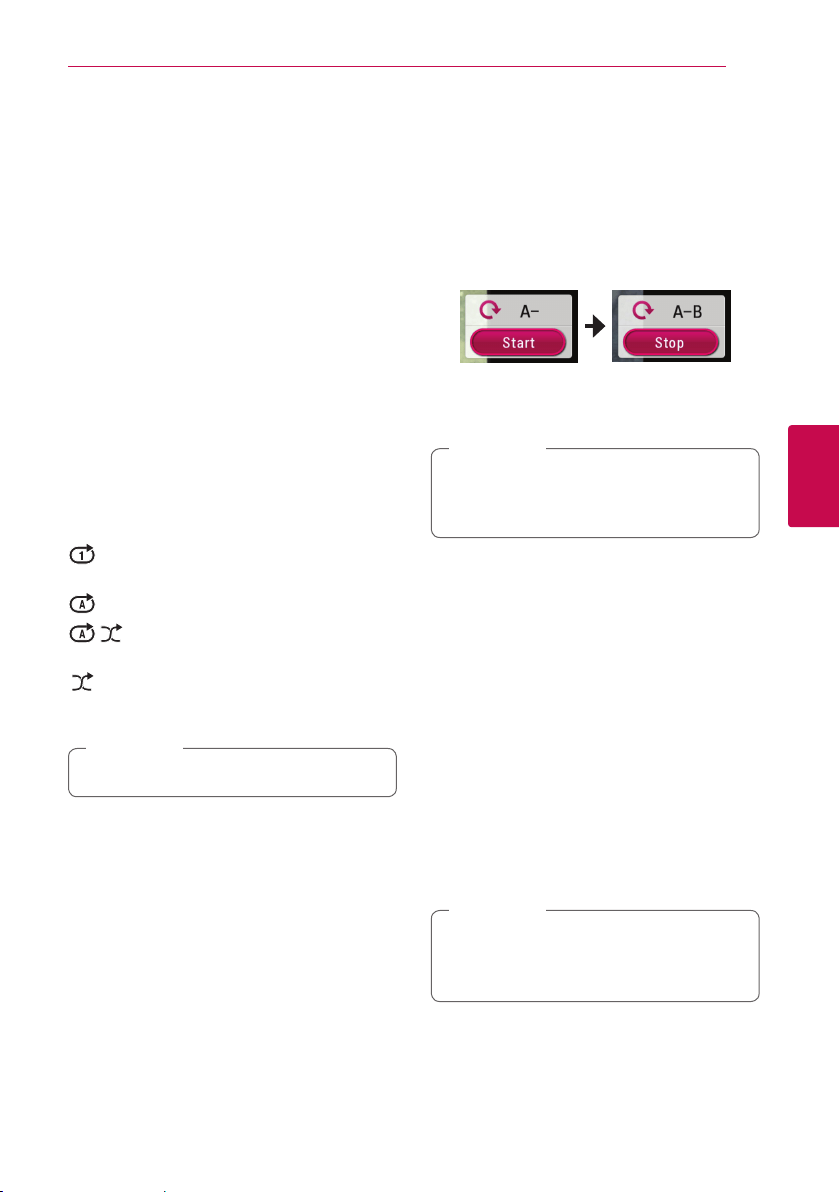
To control photo view
Controls playback and sets options while viewing
pictures in full screen.
You can control playback and set options while
viewing pictures in full screen.
While viewing pictures, press INFO/MENU (
m
).
a [Slideshow] - Starts or pause slide show.
b [Music] - Select the background music for the
slide show (page 42).
c [Option] - Displays slide show options.
d [Rotate] - Rotates the photo clockwise.
e [Zoom] - Displays the [Zoom] menu.
Setting the slide show option
You can use various options during viewing a
photo in full screen.
1. While viewing pictures, press INFO/MENU (
m
).
2. Select an [Option] using
A/D
, and press
ENTER (
b
)
a [Speed] - Use
A/D
to select a delaying
speed between photos in a slide show.
b [Eect] - Use
A/D
to select a transition
effect between photos in a slide show.
c [Music Select] – Select the background music
for the slide show (page 42).
Operating 39
Operating
4
Advanced Playback
Repeat playback
uy
Video les
During playback, press REPEAT (
h
) to select a
desired repeat mode.
A-B – Selected portion will be repeated continually.
Title – The current title will be played back
repeatedly.
All – All the titles or les will be played back
repeatedly.
O – Returns to normal playback.
To return to normal playback, press CLEAR.
Audio les
During playback, press REPEAT (
h
) repeatedly
to select a desired repeat mode.
– The current le will be played back
repeatedly.
– All the les will be played back repeatedly.
– All the les will be played back
repeatedly in random order.
– The les will be played back in random order.
To return to normal playback, press CLEAR.
This function may not work on some titles.
,
Note
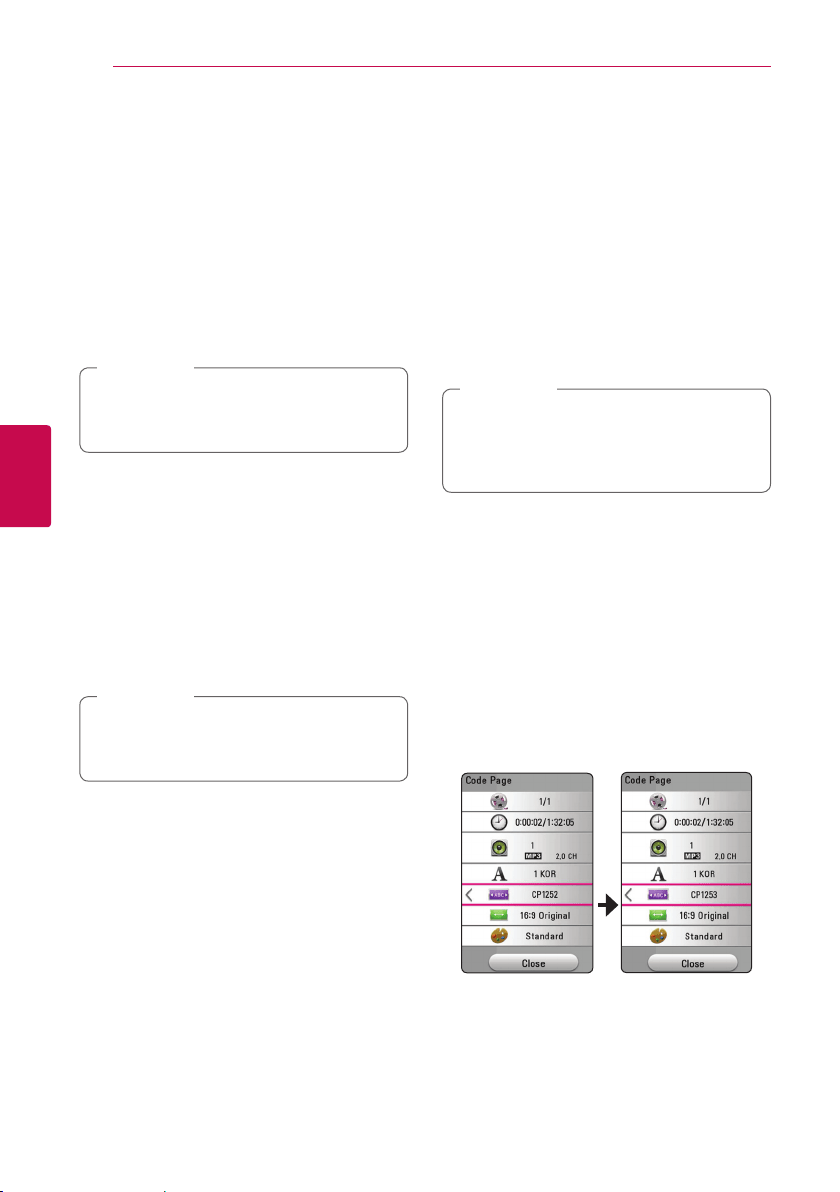
Repeating a specific portion
y
This unit can repeat a portion you have selected.
1. During playback, press REPEAT (
h
).
2. Select [A-B] and press ENTER (
b
).
3. Press ENTER (
b
) at the beginning of the
portion you wish to repeat.
4. Press ENTER (
b
) at the end of the portion. Your
selected portion will be repeated continually.
5. To return to normal playback, press CLEAR.
y
You cannot select a portion less than 3
seconds.
y
This function may not work on some title.
,
Note
Playing from selected time
y
1. During playback, press INFO/MENU (
m
).
2. Select an [Option] using
A/D
, and press
ENTER (
b
)
3. Select the [Time] option and then input the
required start time in hours, minutes, and
seconds from left to right.
For example, to nd a scene at 2 hours, 10
minutes, and 20 seconds, enter “21020”.
Press
A/D
to skip the playback 60 seconds
forward or backward.
4. Press ENTER (
b
) to start playback from selected
time.
y
This function may not work on some titles.
y
This function may not work depending on
the le type and ability of the DLNA server.
,
Note
Operating40
Operating
4
Selecting a subtitle language
y
1. During playback, press INFO/MENU (
m
).
2. Select an [Option] using
A/D
, and press
ENTER (
b
)
3. Use
W/S
to select the [Subtitle] option.
4. Use
A/D
to select desired subtitle language.
By pressing ENTER (
b
), you can set various
subtitle options.
5. Press BACK (
1
) to exit the On-Screen display.
You can select the [Subtitle] option on the On-
Screen display directely by pressing SUBTITLE
button.
,
Note
Hearing a different audio
y
1. During playback, press INFO/MENU (
m
).
2. Select an [Option] using
A/D
, and press
ENTER (
b
)
3. Use
W/S
to select the [Audio] option.
4. Use
A/D
to select desired audio language or
audio channel.
Immediately after you have switched sound,
there may be a temporary discrepancy
between the display and actual sound.
,
Note
Changing the TV Aspect Ratio
y
You can change the TV aspect ratio setting during
playback.
1. During playback, press INFO/MENU (
m
).
2. Select an [Option] using
A/D
, and press
ENTER (
b
)
3. Use
W/S
to select the [TV Aspect Ratio]
option.
4. Use
A/D
to select desired option.
5. Press BACK (
1
) to exit the On-Screen display.
Even if you change the value of the [TV Aspect
Ratio] option in On-Screen display, the [TV
Aspect Ratio] option in the [Settings] menu is
not changed.
,
Note
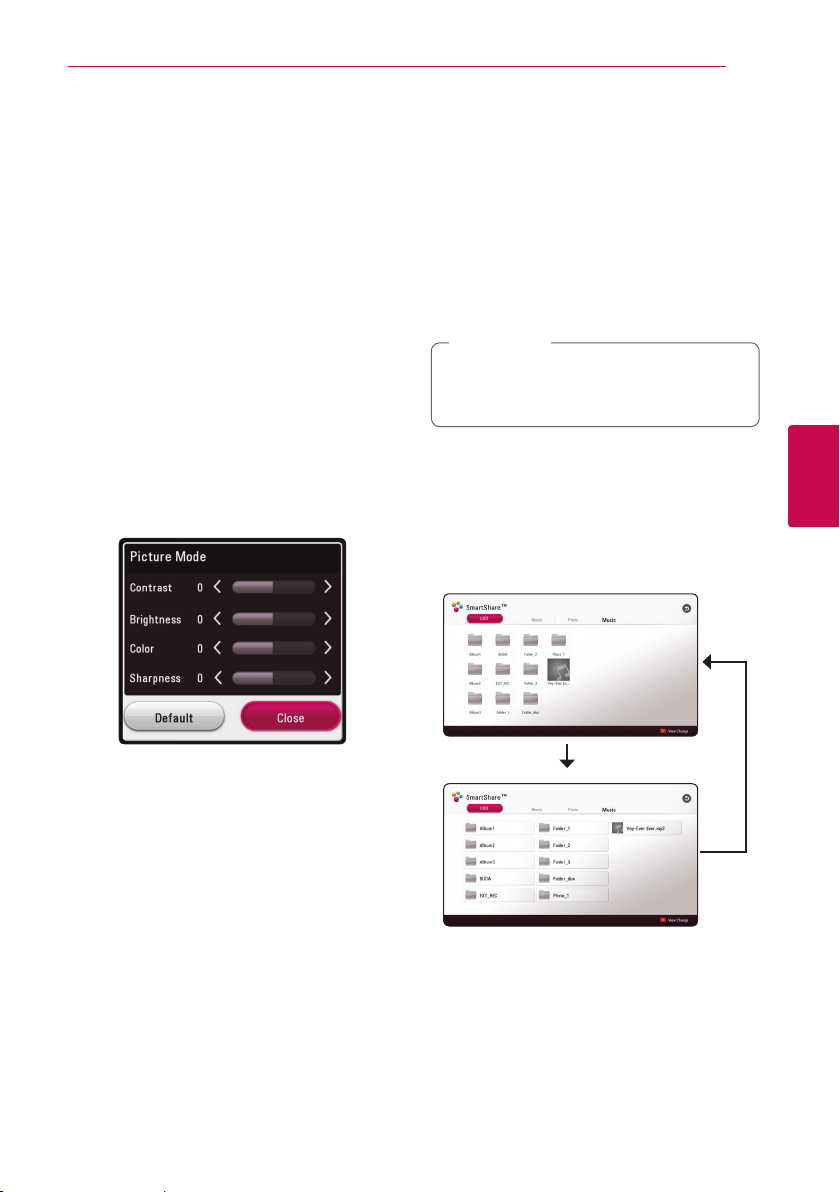
Changing Subtitle Code Page
y
If the subtitle is displayed in broken letter, you can
change the subtitle code page to view the subtitle
le properly.
1. During playback, press INFO/MENU (
m
).
2. Select an [Option] using
A/D
, and press
ENTER (
b
)
3. Use
W/S
to select the [Code Page] option.
4. Use
A/D
to select desired code option.
5. Press BACK (
1
) to exit the On-Screen display.
Operating 41
Operating
4
Changing the Picture Mode
y
You can change the [Picture mode] option during
playback.
1. During playback, press INFO/MENU (
m
).
2. Select an [Option] using
A/D
, and press
ENTER (
b
)
3. Use
W/S
to select the [Picture Mode] option.
4. Use
A/D
to select desired option.
5. Press BACK (
1
) to exit the On-Screen display.
Setting the [User setting] option
1. During playback, press INFO/MENU (
m
).
2. Select an [Option] using
A/D
, and press
ENTER (
b
)
3. Use
W/S
to select the [Picture Mode] option.
4. Use
A/D
to select the [User setting] option,
and press ENTER (
b
).
5. Use
W/S/A/D
to adjust the [Picture Mode]
options.
Select [Default] option then press ENTER (
b
) to
reset the all video adjustments.
6. Use
W/S/A/D
to select the [Close] option,
and press ENTER (
b
) to nish setting.
Viewing content information
y
The unit can display the content information.
1. Select a le using
W/S/A/D
.
2. Press INFO/MENU (
m
) to display the option
menu.
The le information appears on the screen.
During video playback, you can display the le
information by pressing POP UP.
The information displayed on the screen
may not correct comparing actual content
information.
,
Note
Changing content list view
yui
On the [SmartShare] menu, you can change the
content list view.
Press red (R) colored button repeatedly.

Operating42
Operating
4
Selecting a subtitle file
y
If the subtitle le name is dierent from the video
le name, you need to select the subtitle le on the
[Movie] menu before playing the movie.
1. Use
W/S/A/D
to select the subtitle le you
wish to play in the [Movie] menu.
2. Press ENTER (
b
).
Press ENTER (
b
) again to deselect the subtitle
le. Selected subtitle le will be displayed when
you play the video le.
y
If you press
Z
(Stop) during playback, the
subtitle selection is cancelled.
y
This function is not available for playing le
on a server via home network.
,
Note
Listening to music during slide
show
i
You can display photo les while listening to audio
les.
1. While viewing a photo in full screen, press
INFO/MENU (
m
) to display the option menu.
2. Select an [Option] using
A/D
, and press
ENTER (
b
).
3. Use
W/S
to select [Music Select] option, and
press ENTER (
b
) to display the [Music Select]
menu.
4. Use
W/S
to select a device, and press ENTER
(
b
).
Available device may differ depending on the
location of the current photo file.
Photo location Available Device
USB USB
MTP MTP
DLNA server DLNA server
5. Use
W/S
to select a file or a folder you wish to
play.
Select
g
and press ENTER (
b
) to display the
upper directory.
When selecting audio le from a server, folder
selection is not available. Only le selection is
available.
,
Note
6. Use
D
to select [OK], and press ENTER (
b
) to
complete music selection.
Operating 43
Operating
4
Setting the [3D] option
y
This function allows you to play 3D content in case
of le encorded in 3D.
1. During playback, press INFO/MENU (
m
).
2. Select [3D] using
A/D
, and press ENTER (
b
)
If the subtitle is displayed abnormally, set the
TV’s 3D option to o and the unit’s 3D option
to on.
,
Note
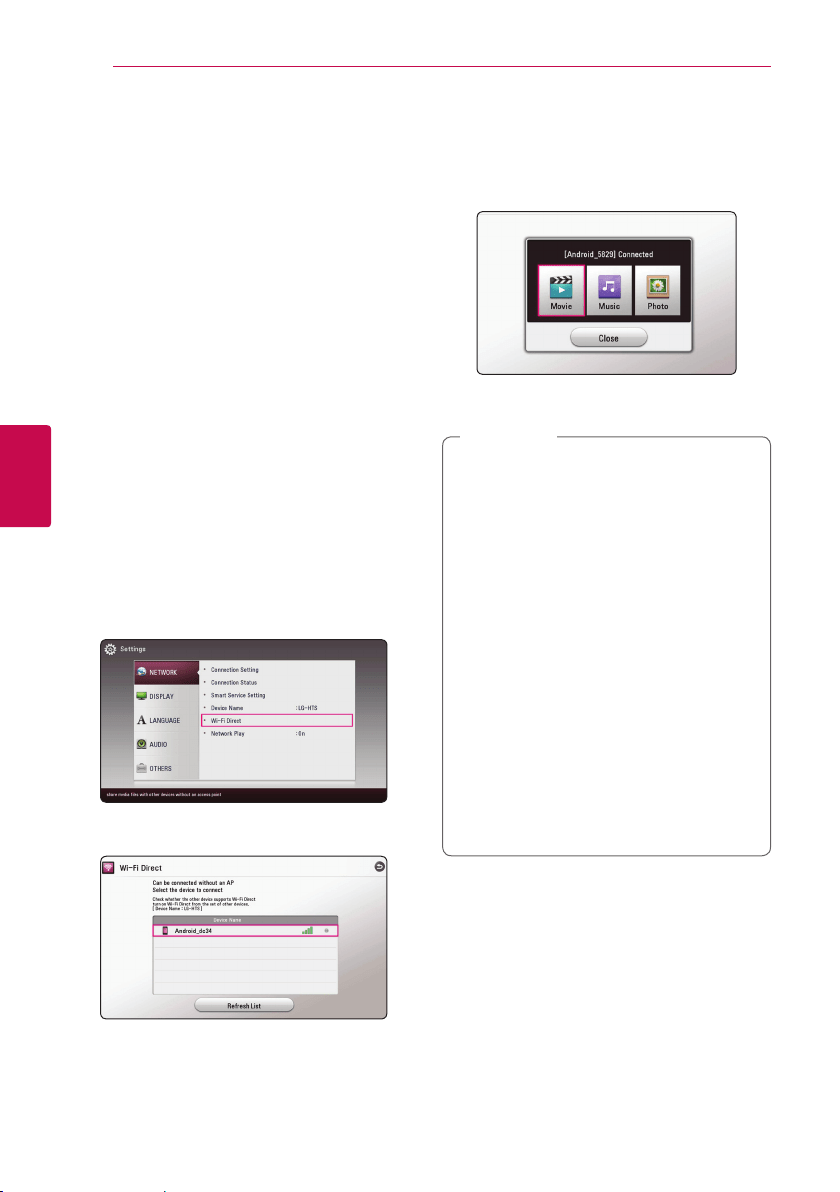
Operating44
Operating
4
Advanced Features
Wi-Fi Direct™
Connecting to a Wi-Fi Direct™
certified device
yui
This unit can play movie, music and photo les
located in a Wi-Fi Direct™ certied device. The Wi-
Fi Direct™ technology make the unit to be directely
connected to a Wi-Fi Direct™ certied device
without connecting to a network device such as an
access point.
On Wi-Fi Direct™ certied device
1. Turn on the Wi-Fi Direct™ certied device and
run its Wi-Fi Direct function.
2. Run DLNA application on the device.
On your unit
3. Select [NETWORK] option in the [Settings]
menu then press ENTER (
b
).
4. Select [Wi-Fi Direct] option, and press ENTER
(
b
).
5. Select a Wi-Fi Direct™ device on the list using
W/S
, and press ENTER (
b
).
Wi-Fi Direct™ connection will be proceeded.
follow the procedure on the screen.
If you want to rescan available Wi-Fi Direct™
device, select the [Refresh List] and press ENTER
(
b
).
To select a server from the device list, files or
folders must be shared by DLNA server from the
connected Wi-Fi Direct™ device.
6. Select [Movie], [Photo] or [Music] using
W/S/
A/D
, and press ENTER (
b
).
7. Select a le using
W/S/A/D
, and press
ENTER (
b
) to play the le.
y
For the purpose of the better transmission,
placing the unit from the Wi-Fi Direct™
certied server as close as possible.
y
This unit can connect only 1 device at a
time. Multiple connection is not available.
y
If you try to connect wireless network while
a device is connected by Wi-Fi Direct™
function , Wi-Fi Direct™ connection will be
force disconnected.
y
If this unit and a Wi-Fi Direct™ device
are connected to the different local area
network, Wi-Fi Direct™ connection may not
available.
y
If a Wi-Fi Direct™ certified device is not in
Wi-Fi direct standby mode, this product
cannot find the device.
y
When you connect a Wi-Fi Direct™ certied
device to your unit, PIN network connection
is not supported.
,
Note

Operating 45
Operating
4
LG AV Remote
You can control this player with your iPhone
or Android phone via your home network. This
player and your phone must be connected to your
wireless network device such as access point. Visit
“Apple iTunes” or “Google Android Market (Google
Play Store)” for detailed information of “LG AV
Remote”.
Private Sound Mode
By downloading “LG AV Remote” application on
your smart phone or tablet, you can connect your
headsets, and enjoy the sound from your player on
your smart devices.
This feature transmits video signal to TV through
HDMI and audio signal to smart phone or tablet
through Wi-Fi. For more detailed information,
please refer to “LG AV Remote” application.
Using Bluetooth
technology
About Bluetooth
Bluetooth® is wireless communication technology
for short range connection.
The sound may be interrupted when the
connection interfered by the other electronic wave
or you connect the Bluetooth in the other rooms.
Connecting individual devices under Bluetooth®
wireless technology does not incur any charges. A
mobile phone with Bluetooth® wireless technology
can be operated via the Cascade if the connection
was made via Bluetooth® wireless technology.
Available Devices : Mobile phone, MP3, Laptop,
PDA.
Bluetooth Profiles
In order to use Bluetooth wireless technology,
devices must be able to interpret certain profiles.
This unit is compatible with following profile.
A2DP (Advanced Audio Distribution Profile)
Operating46
Operating
4
Listening to music stored on
the Bluetooth devices
Pairing your unit and Bluetooth
device
Before you start the pairing procedure, make
sure the Bluetooth feature is turned on in to your
Bluetooth device. Refer to your Bluetooth device’s
user guide. Once a pairing operation is performed,
it does not need to be performed again.
1. Select the Bluetooth function by using the
FUNCTION (
P
).
Appears “BT READY” in display window.
2. Operate the Bluetooth device and perform the
pairing operation. When searching for this unit
with the Bluetooth device, a list of the devices
found may appear in the Bluetooth device
display depending on the type of Bluetooth
device. Your unit appears as “LG-HTS”.
3. When this unit successfully paired with your
Bluetooth device, Bluetooth LED of this unit
lights up and “BTPAIRED” appears in the display
window.
Depending on the Bluetooth device type,
some device have a dierent pairing way.
Enter the PIN code (0000) as needed.
,
Note
4. Listen to music.
To play a music stored on your Bluetooth device,
refer to your Bluetooth device’s user guide.
y
When using Bluetooth® technology, you
have to make a connection between the
unit and the Bluetooth device as close as
possible and keep the distance.
However it may not work well in the case
below :
-
There is a obstacle between the unit and
the Bluetooth device.
-
There is a device using same frequency
with Bluetooth® technology such as a
medical equipment, a microwave or a
wireless LAN device.
y
You should connect your Bluetooth device
to this unit again when you restart it.
y
When you select Bluetooth function again
after changing to other functions, Bluetooth
connection may be disconnected. You
should reconnect the bluetooth device to
use this function.
y
The sound may be interrupted when
the connection interfered by the other
electronic wave.
y
You cannot control the Bluetooth device
with this unit.
y
Pairing is limited one Bluetooth device per
one unit and multi-pairing is not supported.
y
Depending on the type of the device,
you may not be able to use the Bluetooth
function.
y
You can enjoy wireless system using phone,
MP3, Notebook, etc..
y
The more distance between the unit and
the Bluetooth device, the lower the sound
quality becomes.
y
Bluetooth connection will be disconnected
when the unit is turned o or the Bluetooth
device gets far from the unit.
y
When Bluetooth connection is
disconnected, connect the Bluetooth device
to the unit again.
y
When not connected the Bluetooth, “BT
READY” appears on the display window.
,
Note
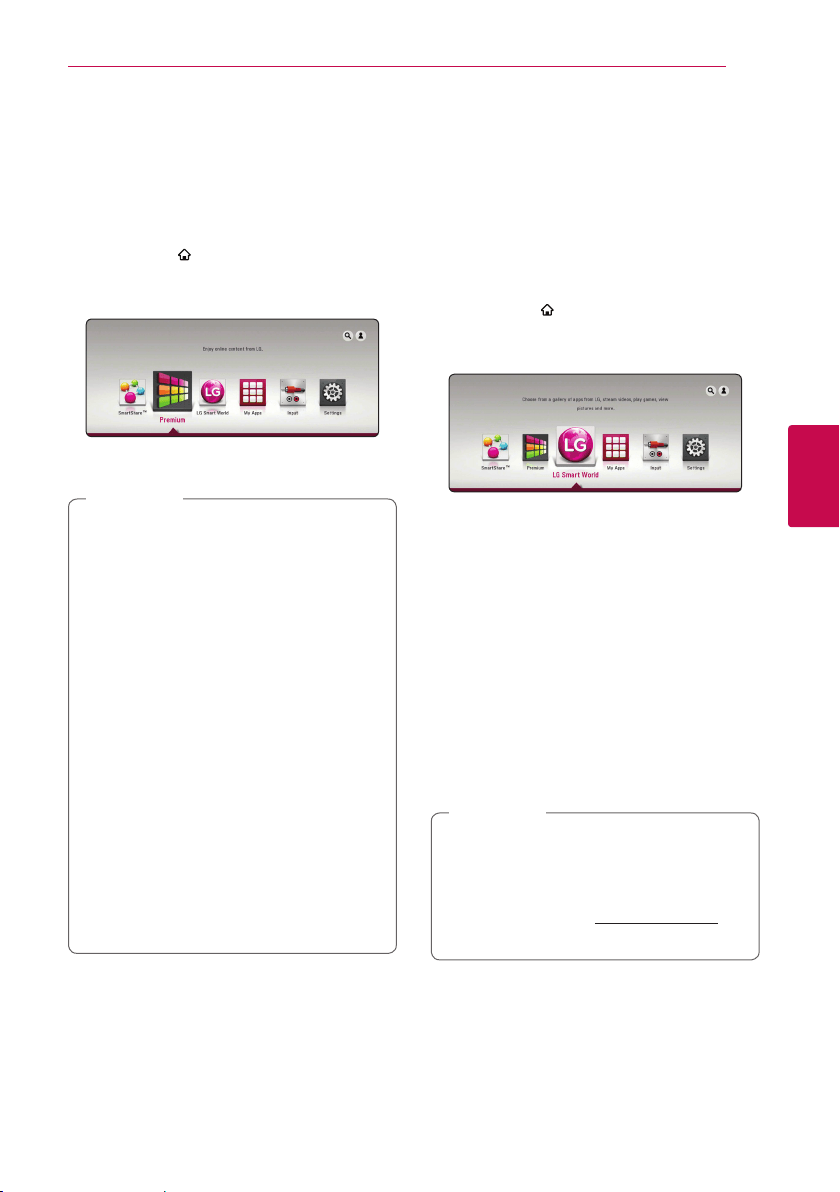
Operating 47
Operating
4
Using the Premium
You can use various content services via Internet
with the Premium feature.
1. Check the network connection and settings
(page 17).
2. Press HOME ( ).
3. Select the [Premium] using
A/D
, and press
ENTER (
b
).
4. Select an online service using
W/S/A/D
,
and press ENTER (
b
).
y
For detailed information of each service,
contact to the content provider or visit
support link of the service.
y
The content of Premium services and
service related information, including user
interface, is subject to changes. Please refer
to the web site of each service for most up-
to-date information.
y
Using Premium features with wireless
network connection may result in improper
streaming speed by interference from
household devices that are using radio
frequencies.
y
For the rst time to access [Premium] or
[LG Smart World] feature, current country
setting appears.
y
If you want to change the country setting,
go to [Settings] > [NETWORK] > [Smart
Service Setting] > [Country Setting]. Select
[Manual] and press ENTER (
b
) on [Country
Setting] menu.
,
Note
Using the LG Smart
World
You can use the LG application services on this
unit via Internet. You can easily nd and download
various applications from LG Smart World.
1. Check the network connection and settings
(page 17).
2. Press HOME ( ).
3. Select the [LG Smart World], and press ENTER
(
b
).
4. Select a category using
A/D
, and press ENTER
(
b
).
5. Use
W/S/A/D
to select an application, and
press ENTER (
b
) to display the information.
6. Press ENTER (
b
) while [Install] icon is
highlighted. The application will be installed to
the unit.
To install an application to the unit, user
needs to sign in. Refer to page 48 for more
information of signning in.
7. Press yellow (Y) colored button to display the
[My Apps] screen.
8. Select the installed application and press ENTER
(
b
) to excute it.
y
Depending on the region, the [LG Smart
World], [My Apps], [
4
] and [
3
] may not be
available.
y
To install a paid application, you need to be
a paid member. Visit www.lgappstv.com for
more information.
,
Note
Operating48
Operating
4
Signing in
To use the [LG Smart World] feature, you need to
sign in with your account.
1. On the [LG Smart World] or [My Apps] screen,
press red (R) colored button.
2. Fill the [ID] and [Password] field using the virtual
keyboard.
If you do not have an account, press red (R)
colored button to register.
3. Use
W/S/A/D
to select [OK], and press
ENTER (
b
) to sign in with your account.
If you select the [Auto Sign In] check box,
your ID and password are remembered and
automatically signed in without entering them.
y
If you want to sign in with other account,
press red (R) colored button on [LG Smart
World] or [My Apps] screen, and select
[Change User] option.
y
To view the information of your account and
applications, press red (R) colored button on
[LG Smart World] or [My Apps] screen, and
select [Account Setting] option.
,
Note
Searching online content
If you are having diculties nding specic content
from online services, you can use the all-in-one
search function by entering keywords in the search
menu.
1. Press HOME ( ).
2. Select the [
4
] icon on the home menu using
W/S/A/D
, and press ENTER (
b
).
The search menu appears on the screen with
virtual keyboard.
3. Use
W/S/A/D
to select letters then press
ENTER (
b
) to confirm your selection on the
virtual keyboard.
4. When you finish entering the keyword, select
[OK] and press ENTER (
b
) to display search
result.
5. Use
W/S/A/D
to select a desired content,
and press ENTER (
b
) to move to the selected
content directly.
y
Depending on the region, the [LG Smart
World], [My Apps], [
4
] and [
3
] may not be
available.
y
The search function does not search
content in every online services. It works
only in certain online services.
,
Note
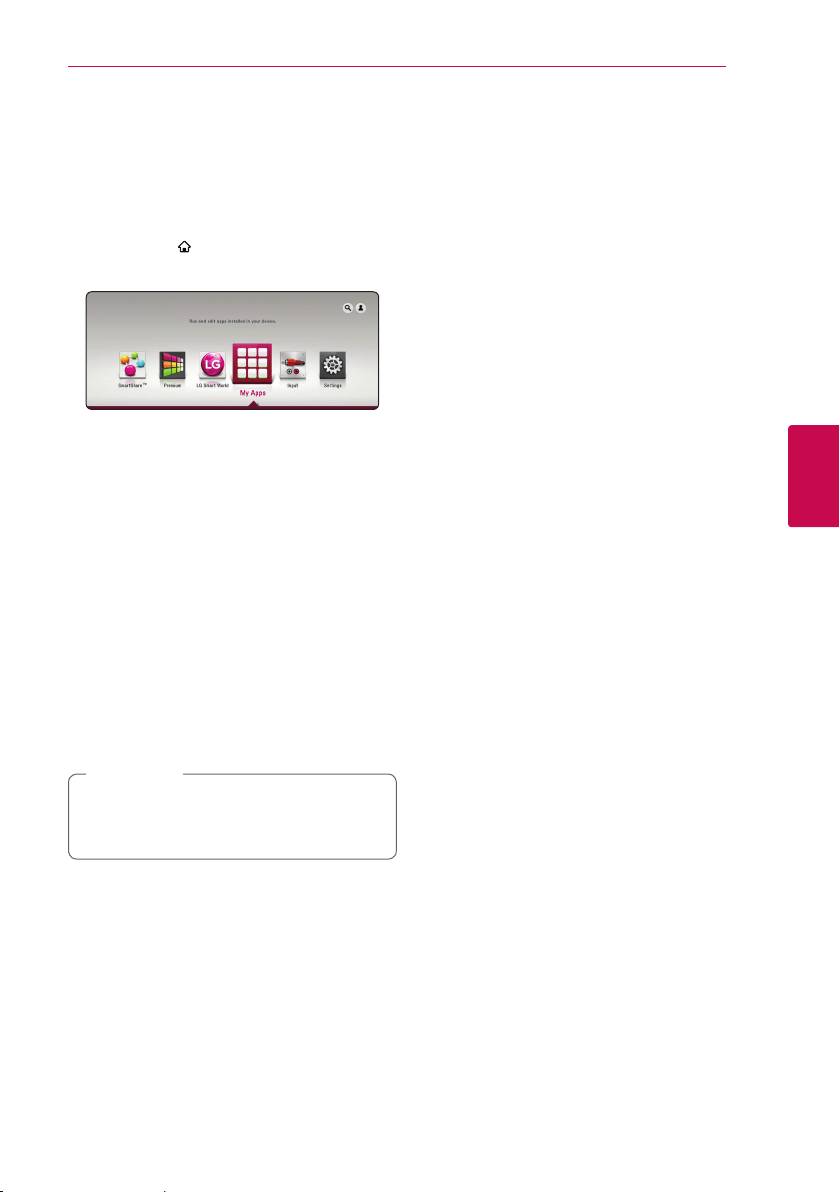
Operating 49
Operating
4
Using the My Apps
Menu
You can move or delete an installed application in
the [My Apps] menu.
1. Press HOME ( ).
2. Select the [My Apps], and press ENTER (
b
).
Move an application
1. Select an application, and press green (G)
colored button to display the options.
2. Use
W/S
to select [Move], and press ENTER
(
b
).
3. Use
W/S/A/D
to select a position you want
to move to, and press ENTER (
b
).
Delete an application
1. Select an application, and press green (G)
colored button to display the options.
2. Use
W/S
to select [Delete], and press
ENTER(
b
).
3. Use
A/D
to select [Yes], and press ENTER (
b
)
to confirm.
Depending on the region, the [LG Smart
World], [My Apps], [
4
] and [
3
] may not be
available.
,
Note
5 Troubleshooting
Troubleshooting50
Troubleshooting
5
Troubleshooting
General
Symptom Cause & Solution
The Power does not turned on.
y
Plug the power cord into the wall outlet securely.
The connected USB storage
device is not recognized.
y
Try using dierent USB cable, some USB cables may not support
enough current for normal USB operation.
y
If you use a USB extension cable or USB HUB, the USB devices may
not be recognized.
y
A USB device which requires additional program installation when
you have connected it to a computer is not supported.
y
This unit supports only USB Flash Drive and USB External HDD with
FAT32 or NTFS format.
Cannot play video, photo or
audio les.
y
The les are not recorded in a format that the unit can play.
y
The unit does not support the codec of the video le.
The remote control does not
work properly.
y
The remote control is not pointed at the remote sensor of the unit.
y
The remote control is too far from the unit.
y
There is an obstacle in the path of the remote control and the unit.
y
The batteries in the remote control are exhausted.
The unit is plugged in, but the
power will not turn on or o.
You can reset the unit as follows.
y
Unplug the power cord, wait at least ve seconds, and then plug it in
again.
The unit is not operating
normally.

Troubleshooting 51
Troubleshooting
5
Network
Symptom Cause & Solution
Streaming video services (such
as YouTube™, etc.) are often
stopped or “buer” during
playback.
y
Your broadband service speed may not be fast enough to stream
video services. Contact your Internet Service Provider (ISP) and
increase the broadband speed is recommended.
Media servers are not displayed
on the device list.
y
The rewall or anti-virus software on your media server is running.
Turn o the rewall or anti-virus software running on your media
server.
y
The unit is not connected to the local area network that your media
server is connected.
Cannot connect the unit to the
access point or wireless LAN
router.
y
The wireless communication may be interrupted from household
devices that are using radio frequencies. Move the unit away from
them.
Access point is not displayed
on the “Access point name” list.
y
The access point or wireless LAN router may not broadcast its SSID.
Set your access point to broadcast its SSID through your computer.
y
Your network device such as access point may not set with available
frequency range and channel that this unit can support.
Try setting the frequency range and channel on the network device
setting.
Troubleshooting52
Troubleshooting
5
Picture
Symptom Cause & Solution
There is no picture.
y
Select the appropriate video input mode on the TV so the picture
from the unit appears on the TV screen.
y
Connect the video connection securely.
y
Check the [HDMI Color Setting] in the [Settings] menu is set to the
appropriate item that conforms to your video connection.
y
Your TV may not support the resolution you have set on the unit.
Change the resolution that your TV accepts.
y
The unit’s HDMI OUT jack is connected to a DVI device that does not
support copyright protection.
Picture noise appears
y
You are playing a le recorded in a colour system that is dierent from
your TV.
y
Set the resolution which your TV accepts.
Sound
Symptom Cause & Solution
There is no sound or the sound
is distorted.
y
The unit is in scan, slow motion, or pause mode.
y
The sound volume is low.
y
Check the wireless speaker connection. (page 13)
Customer Support
You can update the unit using the latest software to enhance the products operation and/or add new
features. To obtain the latest software for this unit (if updates have been made), please visit
http://www.lg.com or contact LG Electronics customer care center.
Open Source Software Notice
To obtain the corresponding source code under GPL, LGPL and other open source licenses, please visit
http://opensource.lge.com. All referred license terms, warranty disclaimers and copyright notices are
available to download with the source code.
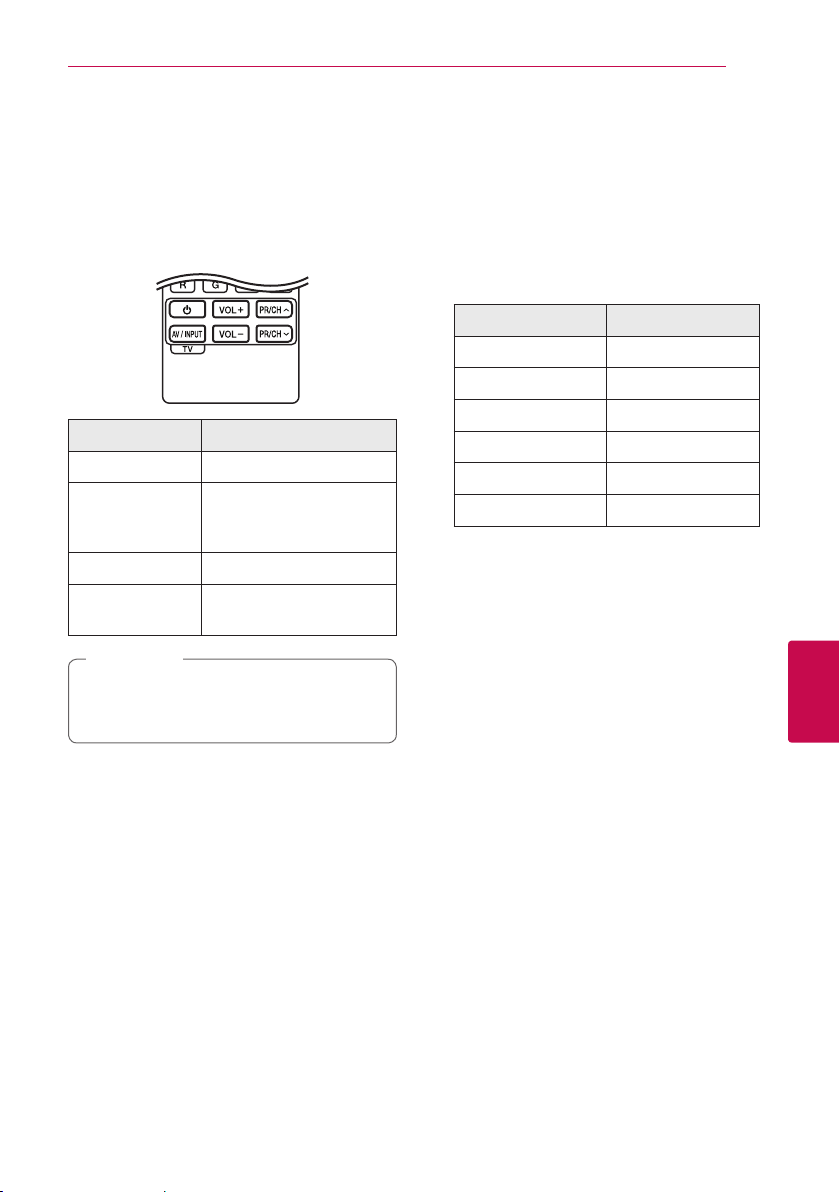
6 Appendix
Appendix 53
Appendix
6
Controlling a TV with
the Supplied Remote
Control
You can control your TV using the buttons below.
By pressing You can
1
(TV POWER) Turn the TV on or o.
AV/INPUT
Switch the TV’s input source
between the TV and other
input sources.
VOL +/– Adjust the volume of the TV
PR/CH
W/S
Scan up or down through
memorized channels.
Depending on the unit being connected, you
may not be able to control your TV using some
of the buttons.
,
Note
Setting up the remote to
control your TV
You can operate your TV with the supplied remote
control.
If your TV is listed in the table below, set the
appropriate manufacturer code.
1. While holding down
1
(TV POWER) button, and
press the manufacturer code for your TV with
the numerical buttons (see the table below).
Manufacturer Code number
LG 1(Default), 2
Zenith 1, 3, 4
GoldStar 1, 2
Samsung 6, 7
Sony 8, 9
Hitachi 4
2. Release the
1
(TV POWER) button to complete
setting.
Depending on your TV, some or all buttons may not
function on the TV, even after entering the correct
manufacturer code. When you replace the batteries
of the remote, the code number you have set may
be reset to the default setting. Set the appropriate
code number again.
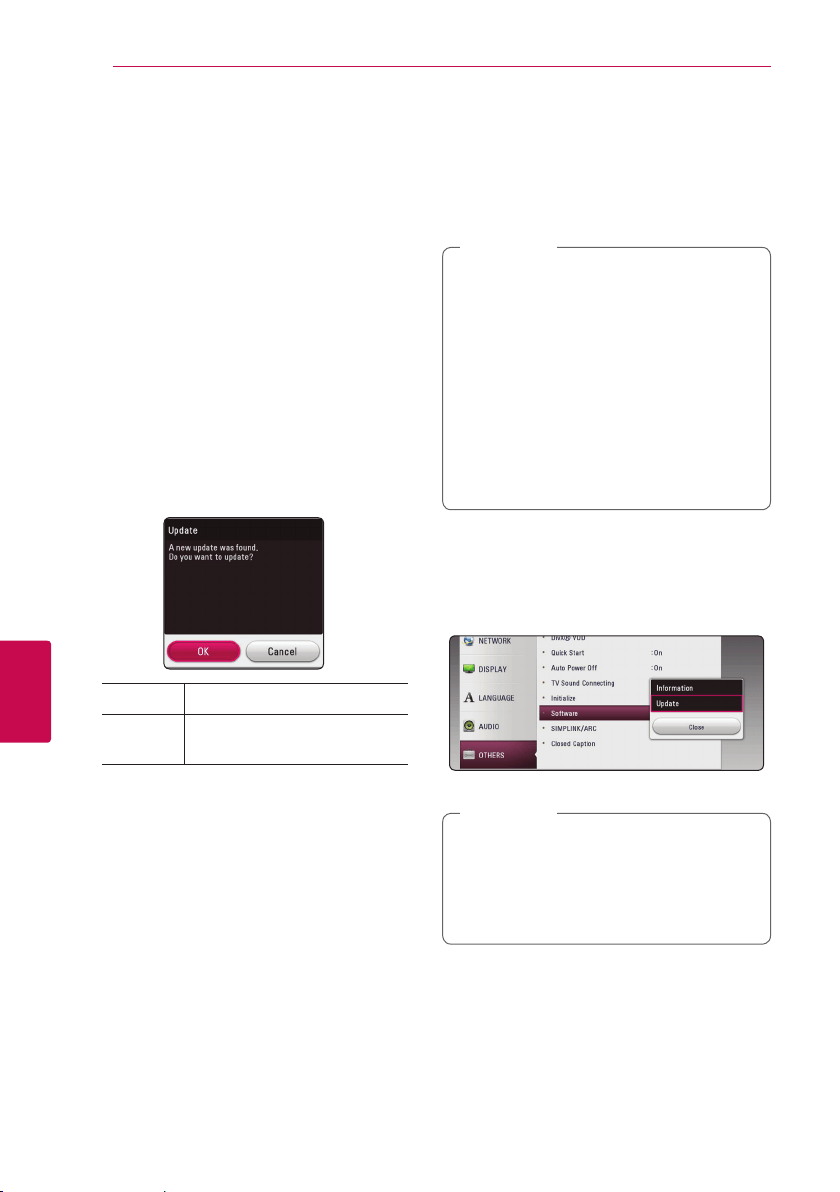
Appendix54
Appendix
6
Network Software
Update
Network update notification
From time to time, performance improvements
and/or additional features or services may be
made available to units that are connected to a
broadband home network. If there is new software
available and the unit is connected to a broadband
home network, the unit will inform you about the
update as follows.
Option 1:
1. The update menu will appear on the screen
when you turn on the unit.
2. Use
A/D
to select a desired option and then
press ENTER (
b
).
[OK] Starts the software update.
[Cancel]
Exits the update menu and the
home menu appears.
Option 2:
If the software update is available from the update
server, the “Update” icon appears in the Home
menu. Press blue (B) colored button to start the
update procedure.
Software update
You can update the unit using the latest software
to enhance the products operation and/or add
new features. You can update the software by
connecting the unit directly to the software update
server.
y
Before updating the software in your unit,
remove USB Device from the unit.
y
Before updating the software in your unit,
turn the unit o and then turn it back on.
y
During the software update procedure,
do not turn o the unit or disconnect AC
power, or do not press any button.
y
If you cancel the update, turn o the power
and turn it on for stable performance.
y
This unit cannot be updated to previous
software version.
,
Note
1. Check the network connection and settings
(page 17).
2. Select [Software] option in the [Settings] menu
then press ENTER (
b
).
3. Select [Update] option, and press ENTER (
b
).
The unit will check for the newest update.
y
Pressing ENTER (
b
) while checking for the
update will end the process.
y
If there is no update available, the Message,
“No update is found.” appears. Press ENTER
(
b
) to return to the [Home Menu].
,
Note
Appendix 55
Appendix
6
4. If newer version exists, the message “A new
update was found. The update takes a few
minutes. Do you want to update?” appears.
5. Select [OK] to start update. (Selecting [Cancel]
will end the update.)
6. The unit starts downloading the newest update
from the server. (Downloading will take several
minutes depending on your home network
condition)
7. To update software the next time, the software
update procedure has to be started from the
beginning again.)
Do not turn o the power during the software
update.
>
Caution
8. When update is completed, the power will be
turned off automatically in a few seconds.
9. Turn the power back on. The system now
operates with the new version.
The Software Update function may not
work properly depending on your internet
environment. In this case, you can obtain
the latest software from the authorized LG
Electronics Service Center then update your
unit. Refer to “Customer Support” on page
52.
,
Note
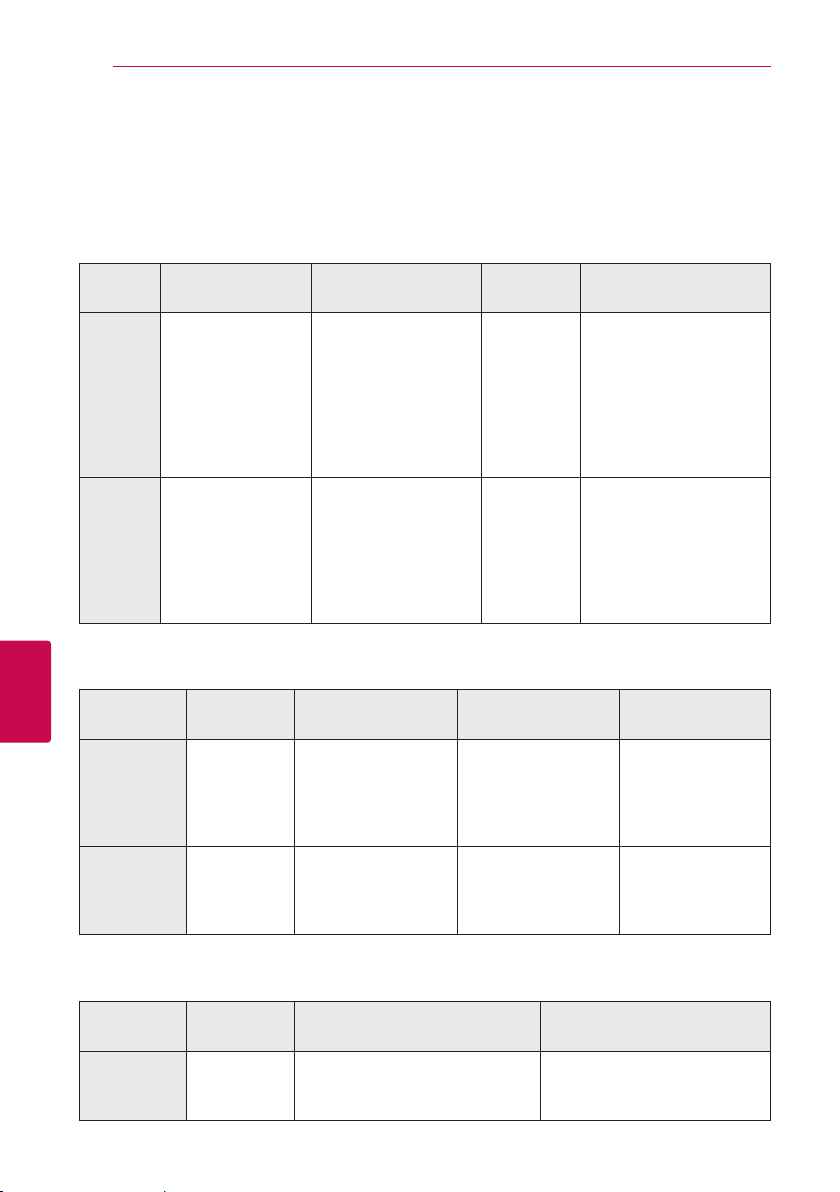
Appendix56
Appendix
6
Additional Information
File requirement
Video files
File
Location
File
Extension
Codec Format
Audio
Format
Subtitle
USB
“.avi”, “.divx”, “.mpg”,
“.mpeg”, “.mkv”, “.mp4”,
“.asf”, “.wmv”, “.m4v”
(DRM free), “.vob”,
“.3gp”, “.mov”, “.trp”,
“.m2t”, “.mpe”, “.m1v”,
“.m2v”, “.wm”, ”.v”, “.ts”,
“.dat”
DIVX 3.11, DIVX4,
DIVX5. DIVX6 (standard
playback only), XVID,
MPEG1 SS, H.264/
MPEG-4 AVC, MPEG2
PS, MPEG2 TS, VC-1 SM
(WMV3)
Dolby
Digital, DTS,
MP3, WMA,
AAC, AC3
SubRip (.srt / .txt), SAMI
(.smi), SubStation Alpha
(.ssa/.txt), MicroDVD
(.sub/.txt), VobSub (.sub),
SubViewer 1.0 (.sub),
SubViewer 2.0 (.sub/.
txt), TMPlayer (.txt), DVD
Subtitle System (.txt)
DLNA
“.avi”, “.divx”, “.mpg”,
“.mpeg”, “.mkv”, “.mp4”,
“.asf”, “.wmv”, “.m4v”
(DRM free), “.mov”,
“.mpe”, “.m1v”, “.m2v”,
”.v”, “.ts”, “.dat”
DIVX 3.11, DIVX4,
DIVX5. DIVX6 (standard
playback only), XVID,
MPEG1 SS, H.264/
MPEG-4 AVC, MPEG2
PS, MPEG2 TS, VC-1 SM
(WMV3)
Dolby
Digital, DTS,
MP3, WMA,
AAC, AC3
SubRip (.srt / .txt), SAMI
(.smi), SubStation Alpha
(.ssa/.txt), MicroDVD (.sub/.
txt), SubViewer 1.0 (.sub),
SubViewer 2.0 (.sub/.
txt), TMPlayer (.txt), DVD
Subtitle System (.txt)
Audio files
File
Location
File
Extension
Sampling Frequency Bitrate Note
USB
“mp3”, “.wma”,
“.wav”, “.m4a”
(DRM free),
“.ac”, “.ogg”,
“.ai”
within 32 - 48 kHz
(WMA), within 16 - 48
kHz (MP3)
within 32 - 192 kbps
(WMA), within 32 - 320
kbps (MP3)
Some wav les are
not supported on
this unit.
DLNA
“mp3”, “.wma”,
“.wav”, “.m4a”
(DRM free),
“.ac”, “.ogg”
within 32 - 48 kHz
(WMA), within 16 - 48
kHz (MP3)
within 32 - 192 kbps
(WMA), within 32 - 320
kbps (MP3)
Some wav les are
not supported on
this unit.
Photo files
File
Location
File
Extension
Recommended
Size
Note
USB,
DLNA
“.jpg”, “.jpeg”,
“.png”, “.gif”,
“.mpo”, “.jps”
Less than 4,000 x 3,000 x 24 bit/pixel
Less than 3,000 x 3,000 x 32 bit/pixel
Progressive and lossless
compression photo image les
are not supported.

Appendix 57
Appendix
6
y
The le name is limited to 180 characters.
y
Maximum les/Folder: Less than 2000 (total
number of les and folders)
y
Depending on the size and number of the
les, it may take several minutes to read the
content on the media.
y
File compatibility may dier depending on
the server.
y
Because the compatibility on DLNA server
are tested on the DLNA server (SmartShare
PC Software) environment, le requirements
and playback functions may dier
depending on media servers.
y
The le requirements on page 56 are
not always compatible. There may have
some restrictions by le features and media
server’s ability.
y
Playing video subtitle les is only available
by using a DLNA media server created with
the SmartShare PC Software supplied with
this unit.
y
The les from removable media such as USB
drive etc. on your media server may not be
shared properly.
y
This unit cannot support the ID3 Tag
embedded MP3 le.
y
The total playback time of audio le
indicated on the screen may not correct for
VBR les.
y
HD video les contained on the USB 1.0/1.1
may not played properly. USB 2.0 are
recommended to play back HD video les.
y
This unit supports H.264/MPEG-4 AVC prole
Main, High at Level 4.1. A le with higher
level may not be supported.
y
This unit does not support les that are
recorded with GMC
*
1
or Qpel
*
2
.
*1 GMC – Global Motion Compensation
*2 Qpel – Quarter pixel
,
Note
y
A “avi” le which is encoded “WMV 9 codec”
is not supported.
y
This unit supports UTF-8 les even it
contains Unicode subtitle content. This unit
can not support the pure Unicode subtitle
les.
y
Depending on the types of le or ways of
recording, it may not play back.
y
To be playback a video le, video le name
and Subtitle le name must be the same.
y
When you play a video le with a extension
such as “.ts”, “.m2ts”, “.mts”, “.tp”, “.Trp” or “.m2t”,
your unit may not support subtitle les.
y
The total playback time of audio le
indicated on the screen may not correct for
VBR les.
y
Video / Audio codec compatibility may
dier depending on video le.
,
Note

Appendix58
Appendix
6
About DLNA
This Player is a DLNA Certied digital media player
that can display and play video, photo and audio
content from your DLNA-compatible digital media
server (PC and Consumer Electronics).
The Digital Living Network Alliance (DLNA) is a
cross-industry organization of consumer electronics,
computing industry and mobile device companies.
Digital Living provides consumers with easy sharing
of digital media through your home network.
The DLNA certication logo makes it easy
to nd products that comply with the DLNA
Interoperability Guidelines. This unit complies with
DLNA Interoperability Guidelines v1.5.
When a PC running DLNA server software or
other DLNA compatible device is connected to
this player, some setting changes of software or
other devices may be required. Please refer to the
operating instructions for the software or device for
more information.
Certain system requirements
For high denition video playback:
y
High denition display that has HDMI input jack.
y
HDMI or HDCP capable DVI input on your display
device is required for some content (as specied
by disc authors).
Appendix 59
Appendix
6
Audio Output Specifications
Jack/Setting
Source
HDMI OUT
PCM
DTS Re-encode
*
3
Auto
*
1
*
2
Dolby Digital PCM 5.1ch DTS Dolby Digital
Dolby Digital Plus PCM 5.1ch DTS Dolby Digital Plus
Dolby TrueHD PCM 5.1ch DTS Dolby TrueHD
DTS PCM 2ch DTS DTS
DTS-HD PCM 2ch DTS DTS-HD
Linear PCM 2ch PCM 2ch DTS Linear PCM 2ch
Linear PCM 5.1ch PCM 5.1ch DTS Linear PCM 5.1ch
Linear PCM 7.1ch PCM 7.1ch DTS Linear PCM 7.1ch
*1 The secondary and interactive audio may not
be included in the output bitstream if [Digital
Output] option is set to [Auto]. (Except LPCM
Codec : the output always include interactive
and secondary audio.)
*2 This unit automatically selects the HDMI audio
according to the decoding capability of the
connected HDMI device even though [Digital
Output] option is set to [Auto].
*3 If the [Digital Output] option is set to [DTS re-
encode], the audio output is limited to 48 kHz
and 5.1Ch.
y
If the audio format of the digital output does
not match the capabilities of your receiver, the
receiver will produce a strong, distorted sound
or no sound at all.
y
Multi-channel Digital Surround Sound via
digital connection can only be obtained if your
receiver is equipped with a Digital Multi-channel
decoder.
y
This setting is not available on the input signal
from an external device.

Appendix60
Appendix
6
Trademarks and
Licenses
The terms HDMI and HDMI High-Denition
Multimedia Interface, and the HDMI logo are
trademarks or registered trademarks of HDMI
Licensing LLC in the United States and other
countries.
Manufactured under license from Dolby
Laboratories. Dolby and the double-D symbol
are trademarks of Dolby Laboratories.
For DTS patents, see http://patents.dts.com.
Manufactured under license from DTS Licensing
Limited. DTS, the Symbol, & DTS and the Symbol
together are registered trademarks, and DTS 2.0
Channel is a trademark of DTS, Inc. © DTS, Inc. All
Rights Reserved.
DivX Certied® to play DivX® video up to HD
1080p, including premium content.
DivX®, DivX Certied® and associated logos are
trademarks of Rovi Corporation or its subsidiaries
and are used under license.
Covered by one or more of the following U.S.
patents: 7,295,673; 7,460,668; 7,515,710; 7,519,274
DLNA®, the DLNA Logo and DLNA CERTIFIED® are
trademarks, service marks, or certication marks
of the Digital Living Network Alliance.
The Wi-Fi CERTIFIED Logo is a certication mark
of the Wi-Fi Alliance.
The Wi-Fi Protected Setup Mark is a trademark of
the Wi-Fi Alliance.
Bluetooth® wireless technology is a system
which allows radio contact between electronic.
Connecting individual devices under Bluetooth®
wireless technology does not incur any charges.
A mobile phone with Bluetooth® wireless tech-
nology can be operated via the Cascade if the
connection was made via Bluetooth® wireless
technology.
The Bluetooth® word mark and logos are owned
by the Bluetooth® SIG, Inc. and any use of such
marks by LG Electronics is under license.
Other trademarks and trade names are those of
their respective owners.

Appendix 61
Appendix
6
Cinavia Notice
This product uses Cinavia technology to limit the
use of unauthorized copies of some commercially-
produced lm and videos and their soundtracks.
When a prohibited use of an unauthorized copy is
detected, a message will be displayed and playback
or copying will be interrupted.
More information about Cinavia technology
is provided at the Cinavia Online Consumer
Information Center at http://www.cinavia.com. To
request additional information about Cinavia by
mail, send a postcard with your mailing address
to: Cinavia Consumer Information Center, P.O. Box
86851, San Diego, CA, 92138, USA.
This product incorporates proprietary technology
under license from Verance Corporation and is
protected by U.S. Patent 7,369,677 and other U.S.
and worldwide patents issued and pending as well
as copyright and trade secret protection for certain
aspects of such technology. Cinavia is a trademark
of Verance Corporation. Copyright 2004-2012
Verance Corporation. All rights reserved by Verance.
Reverse engineering or disassembly is prohibited.
Appendix62
Appendix
6
Specifications
General
AC adaptor requirements 100 - 240 V ~ 50 / 60 Hz / 25 V
0
2 A
Power consumption 30 W
Dimensions (W x H x D) 1 038 mm x 71 mm x 56 mm (40.9” x 2.8” x 2.2”) (With foot)
Net Weight (Approx.) 2.45 kg (5.4 lbs)
Operating temperature 5 °C to 35 °C (41 °F to 95 °F)
Operating humidity 5 % to 90 %
Inputs/Outputs
HDMI OUT (Video/Audio) 19 pin (Type A, HDMI™ Connector) x 1
DIGITAL OPTICAL IN (Audio) 3 V (p-p), Optical jack x 1
Amplier
Total 320 W
Front 40 W x 2 (8 Ω at 1 kHz)
Surround 40 W x 2 (8 Ω at 1 kHz)
Subwoofer 160 W (3 Ω at 70 Hz)
THD 10 %
Wireless subwoofer
Power requirements 120 V ~ 60 Hz
Power consumption 40 W
Type 1 Way 1 speaker
Impedance 3 Ω
Rated input power 160 W
Max. input power 320 W
External dimensions (WxHxD) 170 mm x 360 mm x 316 mm (6.7” x 14.1” x 12.4”)
Net Weight 5.55 kg (12.1 lbs)
System
Signal system Standard NTSC color TV system
LAN port Ethernet jack x 1, 10BASE-T / 100BASE-TX
Wireless LAN (internal antenna) IEEE 802.11b/g/n (2.4 GHz band)
Bus Power Supply (USB) DC 5 V
0
500 mA
y
Design and specications are subject to change without notice.

Appendix 63
Appendix
6
Maintenance
Handling the unit
When shipping the unit
Please save the original shipping carton and
packing materials. If you need to ship the unit, for
maximum protection, re-pack the unit as it was
originally packed at the factory.
Cleaning the unit
To clean the player, use a soft, dry cloth. If the
surfaces are extremely dirty, use a soft cloth lightly
moistened with a mild detergent solution. Do not
use strong solvents such as alcohol, benzine, or
thinner, as these might damage the surface of the
unit.
Keeping the exterior surfaces clean
y
Do not use volatile liquids such as insecticide
spray near the unit.
y
Wiping with strong pressure may damage the
surface.
y
Do not leave rubber or plastic products in
contact with the unit for a long period of time.
Maintaining the unit
The unit is a high-tech, precision device. If the
optical pick-up lens and disc drive parts are dirty
or worn, the picture quality could be diminished.
For details, please contact your nearest authorized
service center.
Important Information
relating to Network
Services
All information, data, documents, communications,
downloads, les, text, images, photographs,
graphics, videos, webcasts, publications, tools,
resources, software, code, programs, applets,
widgets, applications, products and other content
(“Content”) and all services and oerings (“Services”)
provided or made available by or through any
third party (each a “Service Provider”) is the sole
responsibility of the Service Provider from whom it
originated.
The availability of and access to Content and
Services furnished by the Service Provider through
the LGE Device are subject to change at any time,
without prior notice, including, but not limited to
the suspension, removal or cessation of all or any
part of the Content or Services.
Should you have any inquiry or problem related
to the Content or Services, you may refer to the
Service Provider’s website for the most up-to-
date information. LGE is neither responsible nor
liable for customer service related to the Content
and Services. Any question or request for service
relating to the Content or Services should be made
directly to the respective Content and Service
Providers.
Please note that LGE is not responsible for any
Content or Services provided by the Service
Provider or any changes to, removal of, or cessation
of such Content or Services and does not warrant
or guaranty the availability of or access to such
Content or Services.