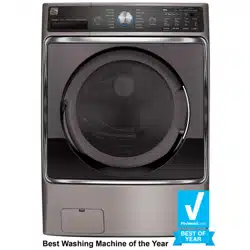
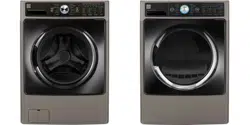
Use Manual Automatic Washer
FEATURES AND BENEFITS
KEY PARTS AND COMPONENTS
A. DETERGENT DISPENSER
There are four compartments. One each for prewash, main wash, liquid bleach, and liquid fabric softener.
B. CONTROL PANEL WITH LED DISPLAY
The easy-to-read LED display shows cycle options, settings, cycle status, and estimated time remaining during operation.
NOTE: Sensors in the washer automatically detect the size of the wash load to optimize washing time, based on the selected cycle and options.
C. DIRECT-DRIVE MOTOR
The direct-drive motor provides improved performance and reliability while increasing energy efficiency. (Motor is not visible.)
D. LARGE-CAPACITY STAINLESS STEEL DRUM
The ultra-large stainless steel drum offers extreme durability and is tilted to improve efficiency and allow easier access for large items.
E. EASY-ACCESS LOCKING DOOR
The extra-large door locks during operation. The door will not open until it is safe to do so.
F. FILTER ACCESS PANEL
Provides easy access to the drain pump filter, which allows you to clean the filter or retrieve lost items without a service call.
G. LEVELING FEET
Four leveling feet (two in the front and two in the back) adjust to improve washer stability on uneven floors. Feet are adjusted and locked in place using the adjusting wrench included with the washer.
H. HIGH-EFFICIENCY STEAM CYCLES
During high-efficiency steam cycles, hot steam interacts with fabrics to help remove tough stains.
I. DOOR MAGNET
Safely and conveniently keeps the door ajar. There are two door closed positions, fully closed and slightly ajar. In the latter position, the door is only closed to the door magnet to keep the door slightly open when the washer is not in use. This will promote air circulation and allow the interior of the machine to dry. To use this feature, close the door just until it contacts the door magnet.

Wrench appearance may vary

NOTE: Bolts/Retainers MUST be removed prior to operation. Keep for future use.
INSTALLATION REQUIREMENTS
KEY DIMENSIONS AND SPECIFICATIONS

CHOOSE THE PROPER LOCATION
WARNING
- This washer is heavy. Two or more people are required when moving and unpacking the washer. Failure to do so may result in damage to property or serious bodily harm.
- Store and install the washer where it will not be exposed to temperatures below freezing or exposed to outdoor weather conditions. Failure to follow this warning can cause serious injury, fire, electric shock, or death.
- Properly ground the washer to conform with all electric governing codes and ordinances. Failure to follow this warning can cause serious injury, fire, electric shock, or death.
- To reduce the risk of electric shock, do not install the washer in humid spaces. Failure to follow this warning can cause serious injury, fire, electric shock, or death.
- To ensure proper air flow, do not block the large opening on the bottom of the washer with carpeting or other materials.
- Do not remove ground prong. Do not use an adapter or extension cord. Plug into a grounded 3-prong outlet. Failure to follow this warning can cause serious injury, fire, electric shock, or death.
- Certain internal parts are intentionally not grounded and may present a risk of electric shock only during servicing. Service personnel - Do not contact the following parts while the appliance is energized: pump, valve, motor, control board.
NOTE: Installing the washer in a humid space, or installing or storing the washer where it will be exposed to the weather or freezing temperatures, may result in rust or other damage that is not covered by the product warranty.
Power Outlet
- The power outlet must be within 60 in. (1.5 m) of either side of the washer.
- The appliance and outlet must be positioned so that the plug is easily accessible.
- Do not overload the outlet with more than one appliance.
- The outlet must be grounded in accordance with current wiring electric codes and regulations.
- Time-delay fuse or circuit breaker is recommended.
NOTE: It is the personal responsibility and obligation of the product owner to have a proper outlet installed by a qualified service technician.
FLOORING
- To minimize noise and vibration, the washer MUST be installed on a solidly constructed floor. See the NOTE at right.
- Allowable slope under the entire washer is a maximum 1 in. difference from side to side or from front to back.
- Installing on carpeting and soft tile surfaces is not recommended.
- Never install the washer on a platform or weakly supported structure.
CLEARANCES
Allow at least 24 3/4 in. (62.6 cm) in front of the washer to open the door.
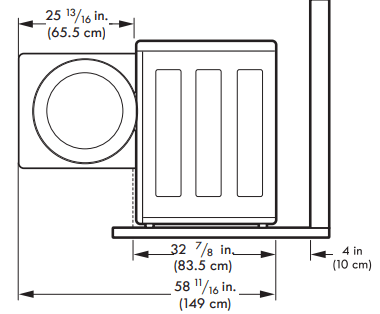
To ensure sufficient clearance for water lines and airflow, allow minimum clearances of at least 1 in. (2.5 cm) at the sides and 4 in. (10 cm) behind the unit. Be sure to allow for wall, door, or floor moldings that may increase the required clearances.
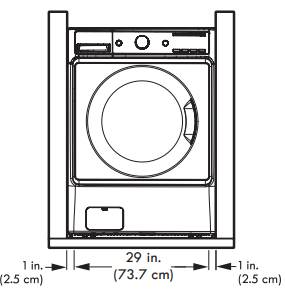
NOTE: The floor must be strong and rigid enough to support the weight of the washer, when fully loaded, without flexing or bouncing. If your floor has too much flex, reinforce it to make it more rigid. A floor that is adequate for a top-loading washer may not be rigid enough for a front loading washer, due to the difference in the spin speed and direction. If the floor is not solid, your washer may vibrate and you may hear and feel the vibration throughout your house.
INSTALLATION INSTRUCTIONS
UNPACKING AND REMOVING SHIPPING BOLTS
When removing the washer from the carton base, be sure to remove the foam drum support in the middle of the carton base. See drawing below.
If you must lay the washer down to remove the base packaging materials, always protect the side of the washer and lay it carefully on its side. DO NOT lay the washer on its front or back.
To prevent internal damage during transport, the washer is equipped with four shipping bolts and plastic retainers.
IMPORTANT:
- These shipping bolts and retainers MUST NOT be removed until just before moving the washer into its final position.
- These bolts and retainers MUST be removed before operating the washer.
- Failure to remove shipping bolts and retainers may cause severe vibration and noise, which can lead to permanent damage to the washer.
NOTE: The power cord is secured to the back of the washer with a shipping bolt to help prevent operation with shipping bolts in place.


1. Starting with the bottom two shipping bolts, use the wrench (included) to fully loosen all four shipping bolts by turning them counterclockwise.

2. Remove the bolt assemblies by wiggling them slightly while pulling.
3. Locate the four hole caps included in the accessory pack and install them in the shipping bolt holes.
NOTE: Save the bolt assemblies for future use. To prevent damage to internal components, DO NOT transport the washer without reinstalling the shipping bolts.
CONNECTING THE WATER LINES
- IMPORTANT: Use new hoses when installing the washer. Do NOT reuse old hoses.
- Water supply pressure must be between 20 psi and 120 psi (138 - 827 kPa). If the water supply pressure is more than 120 psi, a pressure reducing valve must be installed.
- Periodically check the hose for cracks, leaks, and wear, and replace the hose if necessary.
- Make sure that the water lines are not stretched, pinched, crushed, or kinked.
- The washer should never be installed or stored in a location subject to freezing temperatures. Damage to the water lines and internal mechanisms of the washer can result. If the washer was exposed to freezing temperatures prior to installation, allow it to stand at room temperature for several hours before use and check for leaks prior to operation.
- For optimal wash performance, the hot water temperature should be set at 120-135F(48-57C) and the cold water at 60 F(15C)

1. Inspect the threaded fitting on each hose and make sure there is a rubber seal in place in both ends.

2. Connect the water supply hoses to the HOT and COLD water faucets tightly by hand and then tighten another ⅔ turn with pliers.

3. Always run a gallon or two (4L) of water through each inlet hose to flush dirt, scale and other debris out of the water lines. Doing so will help prevent future problems with clogged filter screens, and will also allow you to verify which hose is hot and which is cold.

WARNING: Do not overtighten the hoses. Overtightening can damage the valves resulting in leaking and property damage.
4. Attach the (red) hot water line to the hot water inlet on the back of the washer. Attach the (blue) cold water line to the cold water inlet on the back of the washer. Tighten the fittings securely.
NOTE: When installing the hoses onto the water inlet valves, be careful not to cross-thread the hose fittings. DO NOT overtighten the hoses; this could cause damage to internal components, the valve or the hose gasket. Overtightening could result in property damage from leaks.
CONNECTING THE DRAIN HOSE
- The drain hose should always be properly secured. Failure to properly secure the drain hose can result in flooding and property damage.
- Do not install the end of the drain hose lower than 29 in. (73.7 cm) or higher than 96 in. (243.8 cm) above the bottom of the washer.
- The drain must be installed in accordance with any applicable local codes and regulations.
- Make sure that the drain hose is not stretched, pinched, crushed, or kinked.
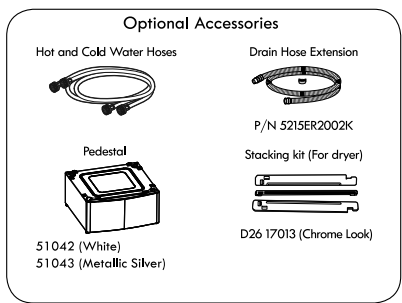
NOTE: A drain hose extension kit is available if the drain hose is not long enough. Do not extend the drain hose more than 6 feet, as this will cause poor draining, which will result in poor wash and spin performance.

Option 1: Standpipe

Install the end of the drain hose into the elbow bracket. Do not extend the drain hose more than 4 inches (10 cm) past the end of the elbow bracket. Use a tie strap to secure the drain hose in place.
NOTE:
- Total height of the hose end should not exceed 96 in. (243.8 cm) from the bottom of the washer.
- The drain hose should be inserted no more than 8–12 inches into the standpipe. Inserting more than 8-12 inches (20-30 cm) can cause mold or microorganisms to spread to the inside of the washer.
Option 2: Laundry Drum

The elbow bracket should be installed near the end of the drain hose. Hang the end of the drain hose over the side of the utility sink. Use a tie strap to secure the drain hose in place.
Option 3: Floor Drain
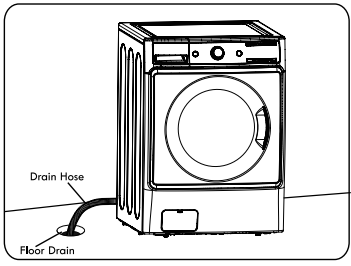
Insert the end of the drain hose into the floor drain. If possible, secure the hose to prevent it from moving or coming out of the drain.
CONNECTING TO THE POWER SUPPLY
Washer should be plugged into a 120-VAC, 60-Hz grounded 3-prong outlet.
Plug in the washer

LEVELING THE WASHER
The drum of your new washer spins at very high speeds. To minimize vibration, noise, and unwanted movement, the floor must be a level, solid surface.
NOTE: Adjust the leveling feet only as far as necessary to level the washer. Extending the leveling feet more than necessary can cause the washer to vibrate.
NOTE: Before installing the washer, make sure that the floor is clean, dry and free of dust, dirt, water and oils so the washer feet cannot slide easily. Leveling feet that move or slide on the floor can contribute to excess vibration and noise due to poor contact with the floor. See INSTALLATION OF NON-SKID PADS for more information.
NOTE: If a drip pan must be used, make sure to follow the instructions provided with the drip pan and make sure the leveling feet are adjusted for firm and even contact with the pan. Use of drip pans and failure to properly level the machine may result in increased vibration and noise during operation. All four leveling feet must rest solidly on the floor. Rock the washer from corner to corner to make sure that all four leveling feet are in firm and even contact with the floor.


1. Position the washer in its final location, taking special care not to pinch, strain, or crush the water and drain lines. Place a level across the top of the washer.

2. Loosen the locknuts on all four leveling feet with the wrench until you can adjust the feet (wrench appearance may vary). Use the wrench to turn the feet clockwise to raise the washer, and counterclockwise to lower the washer. Using a level, adjust the feet until the washer is level from side to side and front to back. Make sure that all four feet are in firm contact with the floor.
NOTE: If you are installing the washer on the optional pedestal, the washer leveling feet should be fully retracted. Use the leveling feet on the pedestal to level the washer.

3. Once the washer is level from side to side and front to back, use the adjusting wrench to tighten all four lock nuts securely to prevent the legs from getting out of adjustment during operation. Make sure that all four leveling feet are in firm contact with the floor.
NOTE: To make sure that the washer is properly level, run the washer with a test load: place a medium-sized load of laundry in the machine. Then, press POWER, select RINSE & SPIN, and press the START/PAUSE button.
See the following sections for additional information on cycle selection and operation. Verify that the washer does not rock or vibrate excessively during the spin cycle. If the washer vibrates or shakes, adjust the leveling feet, while the washer is spinning, until the vibrations are reduced.
INSTALLATION OF NON-SKID PADS (optional)
Some floor surfaces are too slippery to prevent the washer from moving on the floor during heavily unbalanced loads. While it is normal for an occasional load to be out of balance, excess noise and vibration can result from the washer moving out of position. If these conditions are encountered, follow the instructions below for installation of the non-skid pads. These pads will help prevent the washer from moving during heavy, out of balance conditions, thereby reducing noise and vibration.
NOTE: Non-skid pads are included in the installation packet.
Non-skid pads

* Place the pads under both front feet

HOW TO USE
WARNING: To reduce the risk of fire, electric shock, or injury to persons, read and follow this entire Use & Care Guide, including the Important Safety Instructions, before operating this washer.
CONTROL PANEL FEATURES

A. POWER (ON/OFF) BUTTON
Press to turn the washer ON or OFF.
NOTE: Pressing the POWER button during a cycle will cancel that cycle and any load settings will be lost. The door will unlock after a brief pause, unless the water level or temperature is too high.
B. CYCLE SELECTOR KNOB
Turn this knob to select the desired cycle. Once the desired cycle has been selected, the standard presets will appear in the display. These settings can be adjusted using the cycle setting buttons any time before starting the cycle.
C. START/PAUSE BUTTON Press this button to start the selected cycle. If the washer is running, use this button to pause the cycle without losing the current settings. NOTE: If you do not press the START/PAUSE button within one hour of selecting a cycle, the washer automatically turns OFF.
D. CYCLE MODIFIER BUTTONS Use these buttons to adjust the settings for the selected cycle. The settings light up above the buttons to show the current selection.
E. SPECIAL CYCLE AND OPTION BUTTONS These buttons are used to activate special cycles or options.
F. TIME AND STATUS DISPLAY The display shows the cycle status, door lock status and estimated time remaining.
G. STEAM TREAT BUTTON Select the STEAM TREAT button to add steam to the selected cycle for added cleaning power. NOTE: The steam option is not available on all cycles.
NOTE: To protect your clothing, not all settings are available on all cycle selections.
OPERATING THE WASHER

1. SORT LAUNDRY AND LOAD WASHER
Sort laundry by fabric type, soil level, color and load size, as needed. Open the door and load selected items into the washer.
2. TURN ON THE WASHER
Press the POWER button to turn ON the washer. The lights around the cycle selector knob will illuminate and a chime will sound.
3. SELECT A CYCLE
Turn the cycle selector knob in either direction to select the desired cycle. The preset Wash Temperature, Spin Speed, Soil Level, and Option settings for that cycle will be shown.
4. SELECT CYCLE MODIFIERS
Default settings for the selected cycle can now be changed if desired. Use the cycle modifier buttons. NOTE: To protect your fabrics, not all modifiers are available on all cycles.
5. SELECT CYCLE OPTIONS
Cycle options can be added using the option buttons.
NOTE:
• Not all options are available on all cycles. A different chime will sound and the LED will not come on if the selection is not allowed.
6. ADD DETERGENT
Add High-Efficiency (HE) detergent to the detergent dispenser drawer. For proper wash performance, always measure the detergent using the measuring device provided by the detergent manufacturer.
7. BEGIN CYCLE
Press the START/PAUSE button to begin the cycle. The door will lock, the washer will briefly tumble the load without water to measure its weight, and then the washer will begin the selected wash cycle.
Pressing the START/PAUSE button will pause the cycle and the door will unlock. Press the START/PAUSE button again to resume the wash cycle.
CYCLE GUIDE
The cycle guide below shows the default settings, available options and recommended fabric types for each cycle. Allowable modifier adjustments are shown below the default setting for each cycle.
 = Available Option
 = Default Setting
*CERTIFIED BY NSF: NSF International (formerly the National Sanitation Foundation), certifies that this wash cycle reduces 99.9% of bacteria on laundry through high temperature, when used with powdered detergent.

NOTE:
- To protect your garments, not every wash temperature, spin speed, soil level, or option is available with every cycle. A chime will sound and the LED will not light if the selection is not allowed.
- The washer automatically adjusts the wash time for the amount of laundry, water pressure, water heating time and other operating conditions.
- These cycles use various wash motions to enhance cleaning and/or fabric care performance. The wash motions may sound different at different stages of the wash cycle. This is normal.
- The recommended load size for the Sanitize cycle is 10 lb. (4.5 kg).
- When the Accela Wash option is selected, the drum spins to rinse the clothes. To use the No Spin option, you must deselect the Accela Wash option.

The cycle guide below shows the default settings, available options and recommended fabric types for each cycle. Allowable modifier adjustments are shown below the default setting for each cycle.

*CERTIFIED BY NSF: NSF International (formerly the National Sanitation Foundation), certifies that this wash cycle reduces 99.9% of bacteria on laundry through high temperature, when used with powdered detergent.
NOTE:
- To protect your garments, not every wash temperature, spin speed, soil level, or option is available with every cycle. A chime will sound and the LED will not light if the selection is not allowed.
- The washer automatically adjusts the wash time for the amount of laundry, water pressure, water heating time and other operating conditions.
- These cycles use various wash motions to enhance cleaning and/or fabric care performance. The wash motions may sound different at different stages of the wash cycle. This is normal.
- The recommended load size for the Sanitize cycle is 10 lb. (4.5 kg).
- When the Accela Wash option is selected, the drum spins to rinse the clothes. To use the No Spin option, you must deselect the Accela Wash option.
SORTING WASH LOADS
Fabric Care Labels
Many articles of clothing include a fabric care label. Using the chart below, adjust the cycle and option selections to care for your clothing according to the manufacturer’s recommendations.

Grouping Similar Items
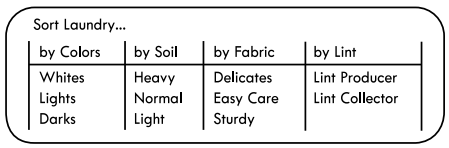
For the best washing results, and to reduce the possibility of damage to clothing, care should be taken to sort the clothing into loads that are made up of similar items. Mixing different fabric types and/or soil levels can result in poor wash performance, color transfer or discoloration, fabric damage or linting. Fabrics should be sorted into groups as described below.
Colors
Sort articles by color. Wash dark clothes together in a separate load from light colors or whites. Mixing dark clothes with light clothes can result in dye transfer or discoloration of the lighter clothes.
Soil Level
Wash heavily soiled clothing together. Washing lightly soiled clothing in the same load with heavily soiled clothing could result in poor wash performance for the lightly soiled clothing.
Fabric Type
Delicate articles should not be mixed with heavier or sturdier fabric types. Washing delicates in a load with heavy fabrics can result in damage to the more delicate fabrics. Washing heavier fabrics in a delicate load can result in poor wash performance for the heavier fabrics and possible damage to the delicates.
Lint Type
Some fabrics attract and bind lint to them while others give off lint in the laundry process. Avoid mixing these lint collectors and lint producers in the same load. Mixing these fabrics will result in pilling and linting on the lint collectors. (For example, lint collector – knit sweater; lint producer – terrycloth towels.)
Loading the Washer
- Check all pockets to make sure that they are empty. Items such as clips, matches, pens, coins, and keys can damage both your washer and your clothes.
- Close zippers, hooks, and drawstrings to prevent these items from snagging or tangling on other clothes.
- Pretreat heavily stained areas for best results.
- Combine large and small items in a load. Load large items first.
- Large items should not be more than half of the total wash load.
- The drum should not be tightly packed with items. The door of the washer should close easily.
- To prevent an out-of-balance load, do not wash single items. Add one or two similar items to the load. Large, bulky items, such as a blanket, comforter, or bedspread, should be washed individually.
- Do not wash or spin waterproof items, such as rain coats, sleeping bags, etc.
- When unloading the washer, check under the door seal for small items.
NOTE: Make sure that the door seal area is clear when closing the door. Overloading the washer can cause items to get caught between the door and the seal. This can damage both the items and the seal.

- For best performance, load clothes as shown.

- Load clothes loosely, and do not overfill the drum. Clothes need room to circulate in order to get clean.
- Do not press down on items while stacking them in the drum.
ABOUT THE DISPENSER DRAWER
The automatic dispenser consists of four compartments which hold:
- Liquid chlorine bleach.
- Liquid fabric softener.
- Liquid or powdered detergent for prewash.
- Liquid or powdered detergent and color-safe bleach for main wash.

Pre-Wash Detergent Compartment
Add liquid or powdered detergent to this compartment when using the Pre-Wash option. Always use HighEfficiency (HE) detergent with your washing machine.
The amount of detergent added for the Pre-Wash option should be ½ the amount recommended for the main wash cycle. For example, if the main wash cycle requires ½ measure of detergent, add ¼ measure to the Pre-Wash compartment.
NOTE: If using liquid detergent for the main wash when using the Pre-Wash option, the liquid detergent cup accessory must be used in the main wash dispenser. This will prevent the main wash liquid detergent from being dispensed immediately.
Main Wash Detergent Compartment
This compartment holds laundry detergent for the main wash cycle. The detergent is added to the load at the beginning of the cycle. Always use High-Efficiency (HE) detergent with your washing machine. Either powdered or liquid detergent may be used.
Never exceed the manufacturer’s recommendations when adding detergent. Using too much detergent can result in detergent buildup in clothing and the washer.
NOTE: Liquid or powdered color-safe bleach may be added to the main wash compartment with detergent of the same type. DO NOT add liquid or powdered color-safe bleach to the bleach dispenser. DO NOT mix liquid and powdered cleaning agents within the same compartment.
Liquid Bleach Compartment
This compartment holds liquid chlorine bleach, which is dispensed automatically at the proper time during the wash cycle.
- Do not add powdered or liquid color-safe bleach to this compartment. The bleach compartment is designed to dispense liquid chlorine bleach only. Powdered or liquid color-safe bleach will not dispense properly.
- Always follow the manufacturer’s recommendations when adding bleach. Do not exceed the maximum fill line since this can cause the bleach to be dispensed immediately, causing damage to fabrics. Using too much bleach can damage fabrics.
- Never pour undiluted liquid chlorine bleach directly onto the load or into the drum. Fabric damage can occur.
Fabric Softener Compartment
This compartment holds liquid fabric softener, which is automatically dispensed during the final rinse cycle. Never exceed the manufacturer’s recommendations when adding softener. Using too much fabric softener can result in buildup in clothing and the washer. Either powdered or liquid fabric softener may be used.
- Always follow the manufacturer’s recommendations when adding fabric softener. Do not exceed the maximum fill line. Using too much fabric softener may stain clothes.
- Dilute concentrated fabric softeners with warm water. Do not exceed the maximum fill line.
- Never pour fabric softener directly onto the load or into the drum.
DETERGENT AND DISPENSER USE
A Word About Detergents
High-Efficiency (HE) detergents produce fewer suds, dissolve more efficiently to improve washing and rinsing performance, and help to keep the interior of your washer clean. Using detergent that is not HE may cause oversudsing and unsatisfactory performance which could result in error codes, cycle failure, and machine damage.

For proper wash performance, always measure the detergent using the measuring device provided by the detergent manufacturer. The normal amount of HE detergent needed, for average loads, is less than ½ of the recommended maximum. Use less detergent for soft water, light soil or smaller loads. Never use more than the maximum amount recommended by the detergent manufacturer.
 Designed to use only High-Efficiency (HE) detergent
IMPORTANT: Your washing machine is designed for use with only High-Efficiency (HE) detergents. HE detergents are formulated specifically for front-load washers and contain suds-reducing agents. Always look for the HE symbol when purchasing detergent.
IMPORTANT: Not all detergents are the same. Pay careful attention to the amount of detergent used to avoid oversudsing, poor rinsing and detergent buildup in clothing, and residue buildup that can contribute to odors in the machine. NEVER use a cup or scoop other than the one supplied by the manufacturer of the detergent you are using. Never use more than the maximum amount of detergent recommended by the manufacturer.
Always measure the detergent amount. While HE detergents are designed for this type of washing machine, be careful when measuring the detergent. For most normal loads, no more than ¼ to ½ of cap or scoop of HE detergent should be used.
NOTE: Extra care must be exercised when using 2X and 3X concentrated detergents because even a little bit extra can contribute to the problems mentioned above.
NOTE: Detergents designated as HE compatible may not provide optimal results.
Filling the Dispenser
To add detergent, bleach, and fabric softener to the automatic dispenser:
- Open the dispenser drawer.
- Load the laundry products into the appropriate compartments.
- Close the drawer before starting the cycle.
NOTE: It is normal for a small amount of water to remain in the bleach and softener compartments at the end of the cycle.
IMPORTANT: Do not place or store laundry products, such as detergent, bleach, or liquid fabric softener, on top of your washer or dryer. Wipe up any spills immediately. These products can damage the finish and controls.
TIME AND STATUS DISPLAY
The time and status display shows the estimated time remaining, cycle progress, and door lock status.
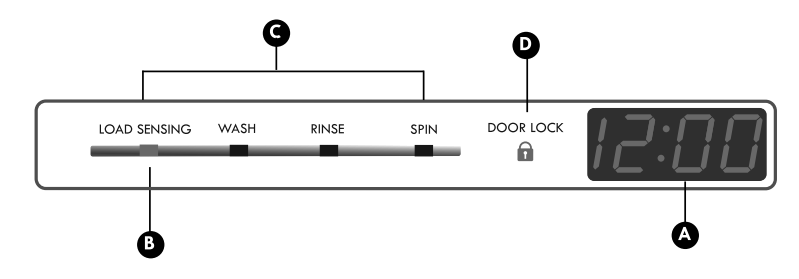
A ESTIMATED TIME REMAINING
When the START/PAUSE button is pressed, the washer will automatically detect the load size for cycles that use load sensing. The control will then optimize the wash and rinse times, based on the selected cycle, modifiers and options. When the load size has been determined, the display will change from dashes (- - -) to the estimated time for that cycle. For non-load sensing cycles, the estimated time will display when the cycle is selected.
NOTE:
- The time shown is only an estimate. For example, the time displayed may pause for a period of time while the machine is heating the water or balancing the load. Under certain conditions, the machine can pause for extended periods of time.
- Estimated time is based on normal operating conditions. Several external factors (load size, room temperature, incoming water temperature, etc.) also affect the length of estimated time vs. actual time.
B. LOAD-SENSING INDICATOR
At the beginning of cycles thet use the load sensing feature, the LOAD SENSING light will blink while the load size is being measured. Once the size has been determined, the control adjusts the cycle for optimum performance. Estimated time remaining will not display until the load size has been determined, and may be different for each load.
C. CYCLE STATUS INDICATOR
These status LEDs illuminate to indicate which stage of the cycle is currently running. A blinking light indicates the active stage of the cycle. When that stage is complete, the light will remain steady.
D. DOOR LOCK INDICATOR
Indicates that the door is locked. The washer door will lock while the washer is operating. The door can be unlocked by pressing START/PAUSE to pause the washer.
NOTE:
- If the temperature in the washer is too high, the door cannot be unlocked until the washer has cooled.
- If the water level is too high, the door will not unlock. To drain the water, press POWER, then press the SPIN SPEED button without selecting a cycle. Press START/PAUSE and the water will drain and the clothes will spin out. Do not try to force the door open, as this will damage the door.
CYCLE MODIFIER BUTTONS
Each cycle has default settings that are selected automatically. You may also customize these settings using the cycle modifier buttons. Press the button for the desired modifier until the indicator light for the desired value is lit. The washer automatically adjusts the water level for the type and size of wash load for best results and maximum efficiency. Due to the high-efficiency nature of this product, water levels may be much lower than expected. This is normal operation and cleaning/ rinsing performance will not be compromised.
NOTE: To protect your garments, not every wash temperature, spin speed, soil level, or option is available with every cycle. A chime will sound and the LED will not light if a selection is not allowed.

A. WASH TEMP Wash Temp selects the wash and rinse temperature combination for the selected cycle. Press the Wash Temp button until the indicator light for the desired setting is lit.
- Select the water temperature suitable for the type of load you are washing. Follow the garment fabric care labels for best results.
- Cold rinses use less energy. The actual rinse temperature depends on the temperature of the cold water at the faucet.
- Cold water is used for all rinse cycles.
B. SPIN SPEED Higher spin speeds extract more water from clothes, reducing drying time and saving energy. Press the SPIN SPEED button until the desired speed is selected. Some fabrics, such as delicates, require a slower spin speed. To protect your clothing, not all spin speeds are available for all cycles.
The Drain & Spin cycle:
- Press the POWER button to turn ON the washer.
- Press the SPIN SPEED button to select the desired spin speed. For drain only, select the NO SPIN option.
- Press the START/PAUSE button. The water will drain and the clothes will tumble before the spin routine begins.
C. SOIL LEVEL Adjusting the soil level setting will modify the cycle to allow more time for heavily soiled clothes or less time for lightly soiled clothes. Press the SOIL LEVEL button until the desired soil level is selected.
D. CHIME Press repeatly to adjust the volume of the chime and keyboard tones. You may turn the end-of-cycle chime and keyboard tones ON of OFF with the CHIME button
STEAM CYCLES AND OPTIONS
Your washing machine features several additional cycle options that customize cycles to meet your individual needs.
- Turn ON the washer and turn the cycle selector knob to select the desired cycle.
- Use the cycle modifier buttons to adjust the settings for that cycle.
- Press the cycle option button(s) for the option(s) you would like to add. The button will light when that option is selected. For secondary functions, press and hold the button for three seconds. The LED will blink when the secondary option is selected. Both options cannot be selected together.
- If the selected option is not allowed for the selected cycle, the chime will sound twice to alert you and the LED will not illuminate.
- Press the START/PAUSE button to start the cycle. After a brief delay, the door will lock and the cycle will begin.
NOTE: To protect your garments, not every option is available with every cycle.
NOTE: If the START/PAUSE button is not pressed within one hour, the control will shut off and the settings will be lost.
STEAM TREAT
 Select the STEAM TREAT button to add steam to the selected cycle for added cleaning power. Adding steam to cycles helps provide improved cleaning performance. By creating steam, fabrics get the benefit of a deep clean. The steam option is not available on all cycles.
To add steam to a cycle:
- Turn ON the washer and turn the cycle selector knob to select a cycle that allows the steam option. Refer to the Cycle Guide to see which cycles allow steam.
- Press the STEAM TREAT button. The washer will automatically adjust the cycle settings.
- Set any other desired options.
- Press the START/PAUSE button to start the cycle.
NOTE:
The door may be very warm during steam cycles. This is normal.
Do not attempt to override the door lock mechanism or reach into the washer during a steam cycle. Steam can cause severe burns.
IMPORTANT NOTES ABOUT STEAM CYCLES:
- Steam may not be visible during the steam cycles. This is normal.
- Do not use steam with delicate fabrics such as wool, silk, or easily discolored fabrics.
ACCELA WASH
 The Accela Wash option uses a twin waterspray and detergent injection which reduces cycle time while maintaining wash performance when added to a cycle.
PRE WASH
 Select this option to add a 15-minute prewash, rinse and spin cycle to the chosen cycle. This is especially useful for heavily soiled items.
EXTRA RINSE
 This option will add an extra rinse to the selected cycle. Use this option to help ensure the removal of detergent or bleach residue from fabrics.
DRUM LIGHT
 The drum is equipped with a blue LED light that illuminates when the washer is turned on. This light automatically turns off when the door is closed and the cycle starts. To turn on the light during a cycle, press and hold the EXTRA RINSE button for three seconds. The drum light will illuminate and then turn off automatically after four minutes.
NOTE: Clothes may appear to be yellow in the washer while the drum light is on. This effect is caused by the reflection of the light.
DELAY START
 Once you have selected the cycle and other settings, press this button to delay the start of the wash cycle. Each press of the button increases the delay time by one hour, for up to 19 hours. Once the desired delay time is set, press the START/PAUSE button to start the delay time.
STAY FRESH
 This feature helps keep wrinkles from setting in clothes and helps keep them fresh if they are not removed from the washer as soon as the cycle is complete. Press the STAY FRESH button to tumble the clothes intermittently and circulate fresh air through the drum for up to nineteen hours. Press the POWER button or the START/PAUSE button to remove clothes at any time.
SPECIAL FUNCTIONS
CONTROL LOCK
 Use this option to disable the controls. The washer can only be locked during a cycle. This feature can prevent children from changing cycles or operating the machine. Once set, the controls remain locked and Control Lock must be turned OFF before the controls can be used again. Once the washer has shut off, the power button will allow the machine to be turned ON, but the controls will still be locked. When the controls are locked, “CL” will display alternately with the estimated time remaining. Press and hold the STAY FRESH button for three seconds to activate or deactivate the controls.
CLEAN WASHER CYCLE
 Detergent residue can build up in the wash drum over time and can lead to a mildewy or musty smell. The CLEAN WASHER cycle is specially designed to remove this buildup using bleach or another cleaner designed specifically for cleaning front load washers. Run the CLEAN WASHER cycle once a month, or more often under heavy use conditions or if odor is present. See complete instructions in the CARE AND CLEANING section.
- Turn ON the washer and press and hold the ACCELA WASH button for three seconds. Selecting any other cycle after CLEAN WASHER has been selected will cause the CLEAN WASHER cycle to be cancelled.
- Fill the bleach dispenser to the MAX line with liquid chlorine bleach. Do not overfill the bleach dispenser. Overfilling will cause the bleach to dispense immediately. NOTE: For other drum cleaning products, follow the cleaner manufacturer’s instructions and recommendations. For powdered cleaning products, add the cleaner to the main wash compartment of the dispenser drawer. Place tablet cleaners directly into the drum.
- Press the START/PAUSE button to start the cycle.
- After the cycle has ended, secure the door slightly ajar with the door magnet. This will promote air circulation and allow the interior of the machine to dry. To use this feature, close the door just until it contacts the door magnet. NOTE: Do NOT use this cycle with clothes, and do NOT add detergent or fabric softener.
AUTO SOAK
 Use the AUTO SOAK option to presoak garments to help remove difficult spots or stains on fabric. This option provides a 30-minute presoak prior to the start of the selected cycle. At the end of the presoak time, the selected cycle will use the same water. To use the AUTO SOAK feature, press and hold the STEAM TREAT button for three seconds.
SAVER ENERGY
 This option saves energy by using cooler water while increasing the wash and rinse times to maintain wash performance. This feature is only available with the NORMAL/ CASUAL and HEAVY DUTY cycles as listed below. To use the Energy Saver option, press and hold the PRE WASH button for three seconds.
- NORMAL – Hot becomes Warm
- NORMAL – Warm becomes Cold
- HEAVY DUTY – Hot becomes Warm
CARE AND CLEANING
WARNING: To reduce the risk of fire, electric shock, or injury to persons, read this entire Use & Care Guide, including the Important Safety Instructions, before operating this washer.
- Unplug the washer before cleaning to avoid the risk of electric shock. Failure to follow this warning can cause serious injury, fire, electric shock, or death.
- Never use harsh chemicals, abrasive cleaners, or solvents to clean the washer. They will damage the finish.
REGULAR CLEANING
Cleaning the Exterior:
Proper care of your washer can extend its life. The outside of the machine can be cleaned with warm water and a mild, nonabrasive household detergent. Immediately wipe off any spills with a soft, damp cloth.
IMPORTANT: Do not use solvents, cleaning alcohols, or similar products. Never use steel wool or abrasive cleaners because they can damage the surface.
Care and Cleaning of the Interior:
Use a towel or soft cloth to wipe around the washer door opening, door seal, and door glass. These areas should be kept clean to ensure a watertight seal. Be sure to wipe under the inside rubber seal to remove any moisture or soil. Always remove items from the washer as soon as the cycle is complete. Leaving damp items in the washer can cause wrinkling, color transfer, and odor. Run the CLEAN WASHER cycle once a month, or more often if needed, to remove detergent buildup and other residue.
Clean Washer:
- Remove any clothing in the drum.
- Open the dispenser drawer.
- Add liquid chlorine bleach or another drum cleaner designed specifically for cleaning front load washers.
- If using liquid chlorine bleach
Add liquid chlorine bleach to the bleach compartment of the drawer. (NOTE : Do not exceed the maximum fill line and do not pour undiluted liquid bleach directly into the wash drum.)
- If using powdered cleaner
Remove the liquid detergent cup and add powdered cleaner to the main wash compartment of the dispenser drawer.
- If using tablet cleaner
Add tablet cleaner directly to the wash drum.
NOTE:
- Do not add tablet cleaner to the dispenser drawer.
- Do not add any laundry detergent or fabric softener to the drawer when using CLEAN WASHER.
4 Turn ON the washer and press and hold the ACCELA WASH button for three seconds, and the LED will blink. Selecting any other cycle after CLEAN WASHER has been selected will cause the CLEAN WASHER cycle to be cancelled.
5 After the cycle ends, open the door and allow the drum interior to dry completely.
NOTE: Run the CLEAN WASHER cycle once a month. If a mildewy or musty smell is present, run the CLEAN WASHER cycle once a week for three consecutive weeks.
Door Seal and Glass Cleaning:
Due to the location and nature of the door seal, some detergent and soil residue may build up on the door glass and seal. Periodic cleaning with a bleach solution can help remove buildup and stains, and can help sanitize the seal to prevent odors.
NOTE: Wear rubber gloves and eye protection while performing the following procedure:
1 Dilute ¾ cup (177 ml) liquid chlorine bleach in 1 gallon (3.8 L) of warm/hot water.
2 Use this solution to wipe down all surfaces of the gasket and door glass to remove any deposits. Be sure to fold back the lip of the gasket to get under the inner edge where residue can build up.

3 Dry the gasket and glass with a dry cloth.
4 To allow the gasket to dry completely, secure the door slightly ajar with the door magnet. This will promote air circulation and allow the interior of the machine to dry. To use this feature, close the door just until it contacts the door magnet.
NOTE:
Follow the manufacturer’s instructions for proper use of bleach.
• To avoid damaging the gasket, NEVER use undiluted bleach to clean the gasket.
Removing Mineral Buildup:
If you live in an area with hard water, mineral scale can form on internal components of the washer. Use of a water softener is recommended in areas with hard water. Use a descaler, such as Washer Magic®, to remove visible mineral buildup. After descaling, always run the CLEAN WASHER cycle before washing clothing. Do NOT use steel wool or abrasive cleaners.
Storing the Washer:
If the washer will not be used for an extended period of time and is in an area that could be exposed to freezing temperatures, perform the following steps to protect the washer from damage.
- Turn OFF the water supply.
- Disconnect hoses from water supply and drain water from hoses.
- Plug the power cord into a properly grounded electrical outlet.
- Add 1 gallon of nontoxic recreational vehicle (RV) antifreeze to the empty wash drum and close the door.
- Press the POWER button, then press the SPIN SPEED button without selecting a cycle. Press the START/ PAUSE button to activate the drain pump. This will expel some of the antifreeze, leaving enough to protect the washer from damage.
- Unplug the power cord, dry the drum interior with a soft cloth, and close the door.
- Refer to the instructions below to clean and dry the dispenser drawer.
- Store the washer in an upright position.
- To remove the antifreeze from the washer after storage, run the EXPRESS WASH cycle. Do not add laundry to this cycle.
Cleaning the Dispenser
The dispenser should be cleaned periodically to remove buildup of detergent and other laundry products that can cause the dispenser not to dispense the laundry product properly.

- Pull the dispenser drawer out until it stops.

- Press down the lock tab located between the bleach and softener compartments and slide the drawer out.
- Remove the liquid detergent box, softener and bleach inserts from their compartments.
- Clean the dispenser compartments and inserts with warm water.
WARNING: Certain internal parts are intentionally not grounded and may present a risk of electric shock only during servicing. Service personnel - Do not contact the following parts while the appliance is energized: pump, valve, motor, control board.
MAINTENANCE
Cleaning the Water Inlet Filters
If the washer does not fill properly, an error message will show on the display. The inlet valve filter screens could be plugged by hard water scale, sediment in the water supply, or other debris.
NOTE: The inlet screens protect the delicate parts of the inlet valve from being damaged by particles that could enter the valves with the water supply. Operating the washer with these filters removed could cause a valve to fail to open, resulting in flooding and/or property damage.
IMPORTANT: ONLY use new, high-quality inlet hoses when installing this laundry product. Aftermarket hoses are not guaranteed to fit or function correctly. Other hoses may not tighten correctly and could cause leaks. Subsequent damage to product or property will not be covered under the terms of the product warranty.

- Turn OFF both water faucets completely. Unscrew the hot and cold water lines from the back of the washer.
- Carefully remove the filters from the water valves and soak them in white vinegar or a lime scale remover, following the manufacturer’s instructions. Be careful not to damage the filters while cleaning.
- Rinse thoroughly before reinstalling. Press the filters back into place.
- Before reattaching the hoses, flush the hoses and water lines by running several gallons of water through the hoses and into a bucket or drain.
Cleaning the Drain Pump Filter
The washer is equipped with a filter that helps prevent excess lint and foreign objects like buttons, keys, and coins from causing damage to the pump. If the washer fails to drain properly, unplug the washer and allow the water to cool, if necessary, before proceeding.

1.Open the drain pump filter access panel.
2. Unclip the drain hose and pull it out. Place the end of the drain hose into a shallow pan or a floor drain. Make sure not to pull the hose out too far, or it may not drain properly.

3. Remove the plug from the drain hose, and allow the water to drain completely.

NOTE: If there is a large amount of water in the drum, you may have to empty your container several times.

4. Twist the pump filter counterclockwise to remove. Remove any lint and foreign objects from the pump filter. Insert pump filter back into opening and twist clockwise to secure. Be sure to close the drain pump filter access panel.
TROUBLESHOOTING GUIDE
NORMAL SOUNDS YOU MAY HEAR
The following sounds may be heard while the washer is operating. They are normal.
Clicking: Door locking mechanism clicks when the door locks and unlocks.
Humming or gurgling: Drain pump is pumping water from the washer at times during a cycle.
Spraying or hissing: Water spraying or circulating during the cycle.
Splashing: Clothes tumbling in the drum during the wash and rinse cycles.
BEFORE CALLING FOR SERVICE
If your washer does not function properly or does not function at all, check the following before you call for service.
Rattling and clanking noise
Foreign objects, such as keys, coins, or safety pins, may be in drum or pump.
- Stop washer, check drum and drain filter for foreign objects. If noise continues after washer is restarted, call for service.
Thumping sound
Heavy wash loads may produce a thumping sound.
- This is normal. If sound continues, washer is probably out of balance. Stop and redistribute wash load.
Washer load may be out of balance. Washing shoes or tightly tangled clothes.
- Pause the cycle and redistribute the load after the door unlocks.
Vibrating noise
Shipping bolts and/or packaging materials were not removed.
- See the UNPACKING AND REMOVING SHIPPING BOLTS section in the installation requirements.
Wash load may be unevenly distributed in the drum.
- Pause the cycle and redistribute the load after the door unlocks.
Not all leveling feet are resting firmly and evenly on the floor.
- See Leveling the Washer in the Installation Instructions.
Floor not rigid enough.
- Make sure that the floor is solid and does not flex. See Flooring in the Installation Requirements.
Water leaking around washer
Inlet hose connection is loose at tap or washer.
- Check hoses. Check and tighten hose connections.
House drain pipes are clogged.
- Unclog drain pipe. Contact a plumber if necessary.
Drain hose has come out of drain. Drain hose is not inserted far enough.
- Tie drain hose to inlet hose or standpipe to prevent it from coming out during drain. It should be inserted about 8-12 inches (20.3-30.5 cm) into the standpipe.
Door glass is dirty.
- Inspect door glass periodically to make sure there is no buildup of residue or other foreign matter. Follow cleaning instructions.
Excessive sudsing
Too much detergent or incorrect detergent.
 Only use detergent with the HighEfficiency (HE) logo. See Detergent Use in the How to Use section.
Staining
Bleach or softener dispensed too soon.
- Dispenser compartment is overfilled causing bleach or softener to dispense immediately. Dispenser drawer closed too quickly causing bleach or softener to dispense immediately.
Bleach or softener was added directly to the wash load in the drum.
- Laundry chemicals must be loaded into the dispenser.
Washer was not unloaded promptly.
- Always remove items from the washer as soon as possible after the cycle is complete.
Clothes were not properly sorted.
- Always wash dark colors separately from light colors and whites to prevent discoloration.
- Never wash heavily soiled items with lightly soiled items.
Washer will not turn ON
Power cord is not properly plugged in.
- Make sure that the plug is plugged securely into a grounded, 3-prong, 120-VAC, 60-Hz outlet.
House fuse is blown, circuit breaker has tripped, or power outage has occurred.
- Reset circuit breaker or replace fuse. Do not increase fuse capacity. If the problem is a circuit overload, have it corrected by a qualified electrician.
House fuse is blown, circuit breaker has tripped, due to multiple appliances on one outlet.
- Reset circuit breaker or replace fuse. If more than one appliance is connected to the outlet, call an electrician to have an additional circuit installed.
Door will not unlock when cycle is stopped or paused
Interior temperature of washer is too high.
- The washer door has a safety feature to prevent personal injury. For example, if the washer is paused during the hot wash stage of a sanitize cycle, the interior temperature of the drum will be very hot, so the door will not unlock. This is normal. Allow the washer to cool until the DOOR LOCK indicator turns OFF on the display.
Water level in washer is too high.
- To drain the water, press POWER, then press the SPIN SPEED button without selecting a cycle.
Wash cycle time is longer than usual
The washer automatically adjusts the wash time for the amount of laundry, water pressure, water heating time and other operating conditions.
- This is normal. The washer adjusts cycle time automatically to provide optimal results for the selected cycle. The time remaining shown in the display is only an estimate. Actual time may vary.
Musty or mildewy odor in washer
Incorrect or too much detergent has been used.
- Use only High-Efficiency (HE) detergent in accordance with the manufacturer’s instructions.
Inside of drum was not cleaned properly.
- Run the CLEAN WASHER cycle regularly. Be sure to wipe around and under the door seal frequently. See Care and Cleaning of the Interior.
- Clean around door seal/glass to prevent odor.
Wrinkling
Washer not unloaded promptly.
- Always remove items from the washer as soon as the cycle is complete.
Washer overloaded.
- When washing large loads, do not overstuff the drum. The washer can be fully loaded, but the drum should not be tightly packed and the door should close easily.
Hot and cold water inlet hoses are reversed.
- Hot water rinse can set wrinkles in garments. Check the inlet hose connections.
Strange odors coming from washer
Dryer heating.
- As the dryer heats, it may initially cause a slight odor. This is normal and does not affect performance.
Newly installed washer.
- Smell comes from the rubber attached to the washer door. It will eventually dissipate after first couple of wash cycles.
Build-up of residue on washer, foreign object in door gasket, clogged drain pump filter, clogged or kinked drain hose.
- Periodically clean the gasket. Mold and foreign substances inside the gasket may produce mildew or musty smells.
- Clean the drain pump filter regularly. Foreign substances on the drain pump filter may produce mildew or musty smells.
- If the drain hose is not installed properly, the odor may be emitted because of a backflow of drainage into the tub. Make sure that the drain hose is not kinked or clogged.
Your washing machine is equipped with an automatic error-monitoring system to detect and diagnose problems at an early stage.
Water in the washer drains slowly or not at all, or the display shows:
Drain hose is kinked, pinched, or clogged.
- Make sure the drain hose is free of clogs, kinks, etc., and is not pinched behind or under the washer.
The drain pump filter is clogged.
- Clean the drain pump filter. See Maintenance in the Care and Cleaning section.
Drain discharge is more than 96 inches (244 cm) above bottom of washer.
- Adjust or repair drain. Maximum drain height is 96 inches (244 cm).
Washer fills with water slowly or not at all, or the display shows:
Water supply faucets are not open fully.
- Make sure that the water faucets are fully open.
Water line hoses are kinked, pinched, or crushed.
- Make sure the hoses are not kinked or pinched. Be careful when moving the washer during cleaning and maintenance
Water inlet filters are clogged.
- Clean the inlet filters. See Maintenance in the Care and Cleaning section.
Water supply pressure to faucet or house is too low.
- Check another faucet in the house to make sure that household water pressure is adequate and flow is not restricted.
Water supply connected with leaklimiting hoses.
- Hoses designed to limit leaks can trip falsely and prevent the washer from filling. The use of leak limiting hoses is not recommended.
Cycle won’t start, or the display shows:  or
or 
The door is not closed properly.
- Make sure that the door is closed properly and press the START/PAUSE button. After starting a cycle, it may take a few moments before the drum begins to turn or spin. The washer will not operate unless the door is locked.
- If the door is closed and locked and the open door error message is displayed, call for service.
The display shows: 
Load is too small.
- Add 1 or 2 similar items to help balance the load.
Load is out of balance.
- The washer has an imbalance detection and correction system. If individual heavy articles are loaded (bath mat, bath robe, etc.) and the imbalance is too great, the washer will make several attempts to restart the spin cycle. If an imbalance is still detected, the washer will stop and the error code will display.
The display shows: 
Control error.
- Unplug the washer and wait 60 seconds. Reconnect power and try again. If the error reappears, call for service.
The display shows:
Water level is too high due to a faulty water valve.
- Close the water faucets, unplug the washer, and call for service.
The display shows:
The water level sensor is not working correctly.
- Close the water faucets, unplug the washer, and call for service.
The display shows:
A motor error has occurred.
- Allow the washer to stand for 30 minutes and then restart the cycle. If the LE error code persists, call for service.
The display shows:
A power failure has occurred.
- If the power to the washer has been interrupted during a cycle, the PF error code will display the next time the washer is turned ON. This will alert you to the fact that the previous cycle may not have been completed. Select any cycle to clear the error code and use the washer.
The display shows:
If the washing machine detects too many suds, it displays this error code and adds a Suds Reducing cycle. This adds about two hours to the cycle time. If too many suds are detected during spinning, the washing machine stops to help prevent leaking.
- Do not add more than the manufacturer’s recommended amount of detergent.
- To remove suds, turn the washer off and on, then run the Rinse & Spin cycle.
The display shows: 
Dry heating error
- Unplug the washer and wait 60 seconds. Reconnect power and try again. If the error reappears, call for service.