CONTENTS
1. SAFETY INFORMATION.............................................................................................2
2. SAFETY INSTRUCTIONS.............................................................................................5
3. INSTALLATION............................................................................................................ 7
4. PRODUCT DESCRIPTION.........................................................................................11
5. DAILY USE.................................................................................................................. 11
6. HINTS AND TIPS........................................................................................................12
7. CARE AND CLEANING.............................................................................................13
8. TROUBLESHOOTING............................................................................................... 14
9. TECHNICAL DATA.................................................................................................... 16
10. ENERGY EFFICIENCY.............................................................................................17
FOR PERFECT RESULTS
Thank you for choosing this AEG product. We have created it to give you
impeccable performance for many years, with innovative technologies that help
make life simpler – features you might not find on ordinary appliances. Please
spend a few minutes reading to get the very best from it.
Visit our website to:
Get usage advice, brochures, trouble shooter, service and repair information:
www.aeg.com/support
Register your product for better service:
www.registeraeg.com
Buy Accessories, Consumables and Original spare parts for your appliance:
www.aeg.com/shop
CUSTOMER CARE AND SERVICE
Always use original spare parts.
When contacting our Authorised Service Centre, ensure that you have the
following data available: Model, PNC, Serial Number.
The information can be found on the rating plate.
Warning / Caution-Safety information
General information and tips
Environmental information
Subject to change without notice.
1.
SAFETY INFORMATION
Before the installation and use of the appliance,
carefully read the supplied instructions. The
manufacturer is not responsible for any injuries or
damages that are the result of incorrect installation or
www.aeg.com
2

usage. Always keep the instructions in a safe and
accessible location for future reference.
1.1 Children and vulnerable people safety
• This appliance can be used by children aged 8 years
and above and by persons with reduced capabilities
provided that they have been given instruction and/or
supervision regarding the safe use of the appliance
and understand the potential hazards involved.
• Do not let children play with the appliance.
• Keep all packaging away from children and dispose of
it appropriately.
• Keep children and pets away from the appliance when
it operates or when it cools down. Accessible parts are
hot.
• If the appliance has a child safety device, this should
be activated.
• Children shall not carry out cleaning and user
maintenance of the appliance without supervision.
• Children aged 3 years and under must be kept away
from this appliance when it is in operation at all times.
1.2
General Safety
• WARNING: The appliance and its accessible parts
become hot during use. Care should be taken to
avoid touching heating elements. Children less than 8
years of age shall be kept away unless continuously
supervised.
• Do not operate the appliance by means of an external
timer or separate remote-control system.
• WARNING: Unattended cooking on a hob with fat or
oil can be dangerous and may result in fire.
• NEVER try to extinguish a fire with water, but switch off
the appliance and then cover flame e.g. with a lid or a
fire blanket.
• CAUTION: The cooking process has to be supervised.
A short term cooking process has to be supervised
continuously.
ENGLISH
3

• WARNING: Danger of fire: Do not store items on the
cooking surfaces.
• Metallic objects such as knives, forks, spoons and lids
should not be placed on the hob surface since they
can get hot.
• Do not use a steam cleaner to clean the appliance.
• If the glass ceramic surface / glass surface is cracked,
switch off the appliance to avoid the possibility of
electric shock.
• In case of hotplate glass breakage:
– shut immediately off all burners and any electrical
heating element and isolate the appliance from the
power supply,
– do not touch the appliance surface,
– do not use the appliance.
• If the supply cord is damaged, it must be replaced by
the manufacturer, an authorized Service or similarly
qualified persons in order to avoid a hazard.
• Where the appliance is directly connected to the
power supply, an all-pole isolating switch with a
contact gap is required. Complete disconnection in
compliance with the conditions specified in
overvoltage category III must be guaranteed. The
earth cable is excluded from this.
• When you route the mains cable, make sure that the
cable doesn't come into direct contact (for example
using insulating sleeving) with parts that can reach
temperatures of more than 50°C above room
temperature.
• WARNING: Use only hob guards designed by the
manufacturer of the cooking appliance or indicated by
the manufacturer of the appliance in the instructions
for use as suitable or hob guards incorporated in the
appliance. The use of inappropriate guards can cause
accidents.
www.aeg.com
4
2. SAFETY INSTRUCTIONS
This appliance is suitable for the
following markets: IT
2.1 Installation
WARNING!
Only a qualified person must
install this appliance.
Prior to installation, ensure
that the local distribution
conditions (nature of the gas
and gas pressure) and the
adjustment of the appliance
are compatible.
• Remove all the packaging.
• Do not install or use a damaged
appliance.
• Follow the installation instruction
supplied with the appliance.
• Keep the minimum distance from the
other appliances and units.
• Always take care when moving the
appliance as it is heavy. Always use
safety gloves and enclosed footwear.
• Seal the cut surfaces with a sealant to
prevent moisture to cause swelling.
• Protect the bottom of the appliance
from steam and moisture.
• Do not install the appliance adjacent
to a door or under a window. This
prevents hot cookware to fall from the
appliance when the door or the
window is opened.
• If the appliance is installed above
drawers make sure that the space,
between the bottom of the appliance
and the upper drawer, is sufficient for
air circulation.
• The bottom of the appliance can get
hot. Make sure to install a non-
combustible separation panel under
the appliance to prevent access to the
bottom.
2.2 Electrical Connection
WARNING!
Risk of fire and electrical
shock.
• All electrical connections should be
made by a qualified electrician.
• The appliance must be earthed.
• Before carrying out any operation
make sure that the appliance is
disconnected from the power supply.
• Make sure that the electrical
information on the rating plate agrees
with the power supply. If not, contact
an electrician.
• Make sure the appliance is installed
correctly. Loose and incorrect
electricity mains cable or plug (if
applicable) can make the terminal
become too hot.
• Use the correct electricity mains
cable.
• Do not let the electricity mains cable
tangle.
• Make sure that a shock protection is
installed.
• Use the strain relief clamp on the
cable.
• Make sure the mains cable or plug (if
applicable) does not touch the hot
appliance or hot cookware, when you
connect the appliance to the near
sockets
• Do not use multi-plug adapters and
extension cables.
• Make sure not to cause damage to
the mains plug (if applicable) or to the
mains cable. Contact our Authorised
Service Centre or an electrician to
change a damaged mains cable.
• The shock protection of live and
insulated parts must be fastened in
such a way that it cannot be removed
without tools.
• Connect the mains plug to the mains
socket only at the end of the
installation. Make sure that there is
access to the mains plug after the
installation.
• If the mains socket is loose, do not
connect the mains plug.
• Do not pull the mains cable to
disconnect the appliance. Always pull
the mains plug.
• Use only correct isolation devices: line
protecting cut-outs, fuses (screw type
fuses removed from the holder), earth
leakage trips and contactors.
• The electrical installation must have
an isolation device which lets you
ENGLISH
5
disconnect the appliance from the
mains at all poles. The isolation
device must have a contact opening
width of minimum 3 mm.
2.3 Gas connection
• All gas connections should be made
by a qualified person.
• Before installation, make sure that the
local distribution conditions (nature of
the gas and gas pressure) and the
adjustment of the appliance are
compatible.
• Make sure that there is air circulation
around the appliance.
• The information about the gas supply
is on the rating plate.
• This appliance is not connected to a
device, which evacuates the products
of combustion. Make sure to connect
the appliance according to current
installation regulations. Pay attention
to requirements regarding adequate
ventilation.
2.4 Use
WARNING!
Risk of injury, burns and
electrical shock.
The use of inappropriate
hob guards can cause
accidents.
• Remove all the packaging, labelling
and protective film (if applicable)
before first use.
• Use this appliance in a household
environment.
• Do not change the specification of
this appliance.
• Make sure that the ventilation
openings are not blocked.
• Do not let the appliance stay
unattended during operation.
• Set the cooking zone to “off” after
each use.
• Do not put cutlery or saucepan lids on
the cooking zones. They can become
hot.
• Do not operate the appliance with
wet hands or when it has contact with
water.
• Do not use the appliance as a work
surface or as a storage surface.
• When you place food into hot oil, it
may splash.
WARNING!
Risk of fire and explosion
• Fats and oil when heated can release
flammable vapours. Keep flames or
heated objects away from fats and oils
when you cook with them.
• The vapours that very hot oil releases
can cause spontaneous combustion.
• Used oil, that can contain food
remnants, can cause fire at a lower
temperature than oil used for the
first
time.
• Do not put flammable products or
items that are wet with flammable
products in, near or on the appliance.
WARNING!
Risk of damage to the
appliance.
• Do not keep hot cookware on the
control panel.
• Do not let cookware to boil dry.
• Be careful not to let objects or
cookware fall on the appliance. The
surface can be damaged.
• Do not activate the cooking zones
with empty cookware or without
cookware.
• Do not put aluminium foil on the
appliance.
• Cookware made of cast iron,
aluminium or with a damaged bottom
can cause scratches on the glass /
glass ceramic. Always lift these
objects up when you have to move
them on the cooking surface.
• Use only stable cookware with the
correct shape and diameter larger
than the dimensions of the burners.
• Make sure cookware is centrally
positioned on the burners.
• Make sure the flame does not go out
when you quickly turn the knob from
the maximum to the minimum
position.
• Use only the accessories supplied
with the appliance.
• Do not install a flame diffuser on the
burner.
• The use of a gas cooking appliance
results in the production of heat and
moisture. Provide good ventilation in
www.aeg.com
6
the room where the appliance is
installed.
• Prolonged intensive use of the
appliance may call for additional
ventilation, for example opening of a
window, or more effective ventilation,
for example increasing the level of
mechanical ventilation where present.
• This appliance is for cooking
purposes only. It must not be used for
other purposes, for example room
heating.
• Do not let acid liquids, for example
vinegar, lemon juice or limescale
remover, touch the hob. This can
cause matt patches.
• Discoloration of the enamel has no
effect on the performance of the
appliance.
2.5 Care and cleaning
• Clean regularly the appliance to
prevent the deterioration of the
surface material.
• Deactivate the appliance and let it
cool down before you clean it.
• Disconnect the appliance from the
electrical supply before maintenance.
• Do not use water spray and steam to
clean the appliance.
• Clean the appliance with a moist soft
cloth. Only use neutral detergents. Do
not use abrasive products, abrasive
cleaning pads, solvents or metal
objects.
2.6 Disposal
WARNING!
Risk of injury or suffocation.
• Contact your municipal authority for
information on how to discard the
appliance correctly.
• Disconnect the appliance from the
mains supply.
• Cut off the mains electrical cable
close to the appliance and dispose of
it.
• Flat the external gas pipes.
2.7 Service
• To repair the appliance contact an
Authorised Service Centre.
• Use original spare parts only.
3. INSTALLATION
WARNING!
Refer to Safety chapters.
3.1 Before the installation
Before you install the hob, write down
the information bellow from the rating
plate. The rating plate is on the bottom
of the hob.
Model .......................................
PNC .........................................
Serial number ...........................
3.2 Gas Connection
WARNING!
The following instructions
about installation,
maintenance and ventilation
must be carried out by
qualified personnel in
compliance with the
regulation in force (UNI-CIG
7129 - 7131). Make sure that
the kitchen is well ventilated:
keep natural ventilation
holes open (at least 100 cm²)
or install a mechanical
extractor hood.
Choose fixed connections or use a
flexible pipe in stainless steel in
compliance with the regulation in force. If
you use flexible metallic pipes, be careful
they do not come in touch with mobile
parts or they are not squeezed. Also be
ENGLISH
7
careful when the hob is put together with
an oven.
Make sure that the gas
supply pressure of the
appliance obeys the
recommended values.
If the supplied pressure has not the
specified value, it is necessary to
assemble a proper pressure regulator in
compliance with the standard UNI EN 88.
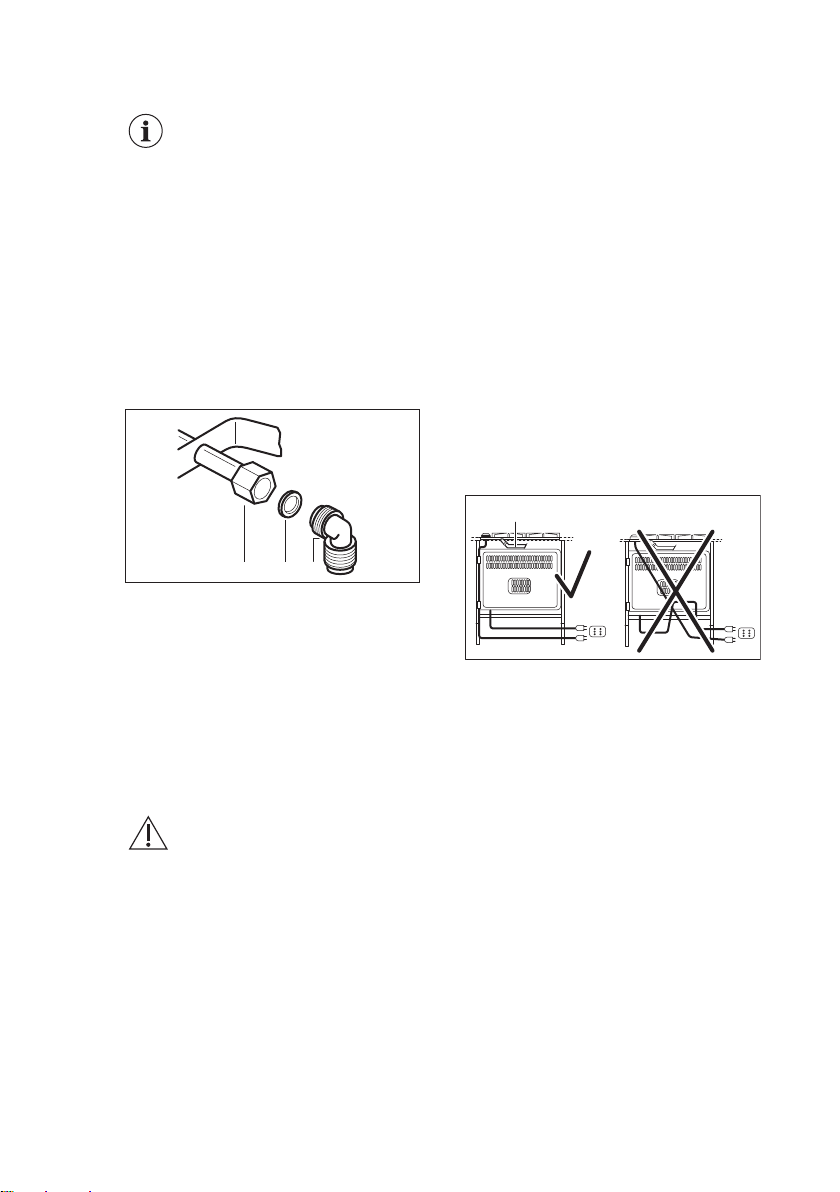
The adjustable connection is fixed to the
comprehensive ramp by means of a
threaded nut G 1/2". Screw the parts
without force, adjust the connection in
the necessary direction and tighten
everything.
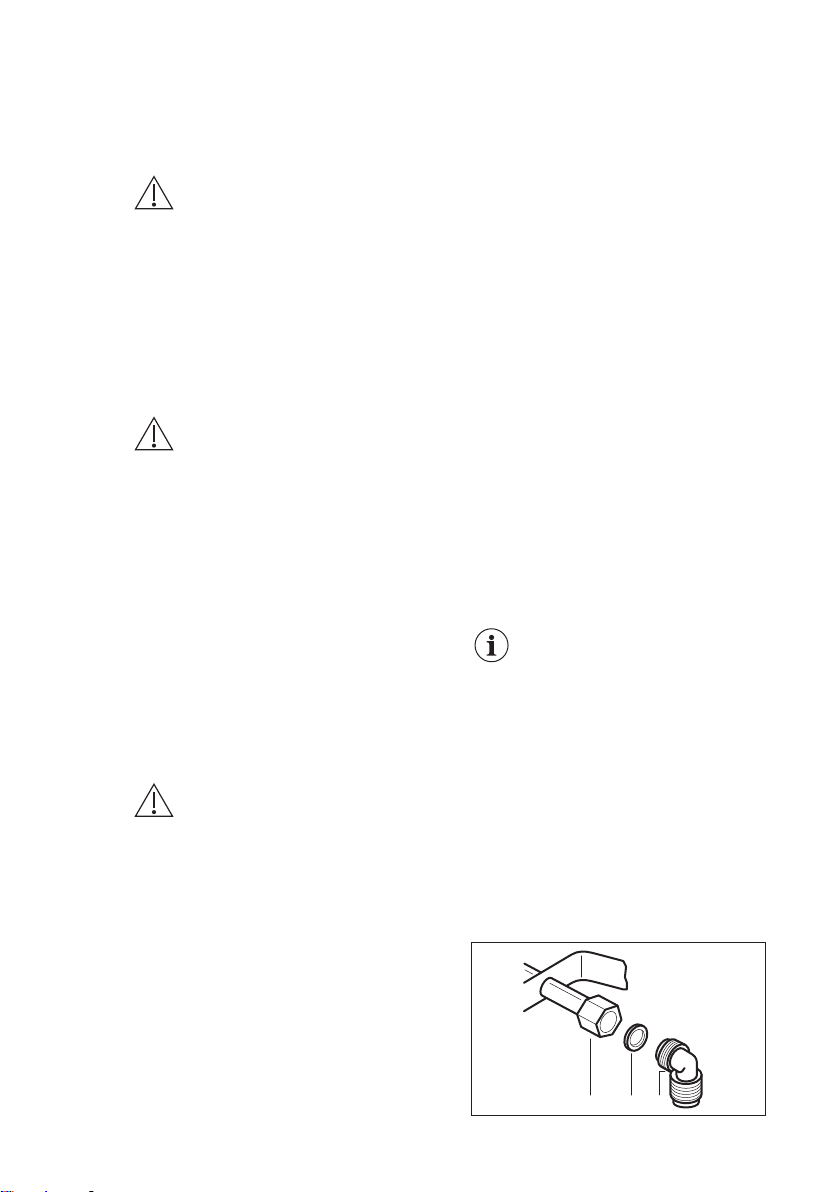
A B C
A. End of shaft with nut
B. Washer supplied with the appliance
C. Elbow supplied with the appliance
Rigid connection:
Carry out connection by using metal rigid
pipes (copper with mechanical end) (UNI-
CIG 7129).
Flexible connection:
Use a flexible pipe in stainless steel (UNI-
CIG 9891) with a maximum length 2 m.
WARNING!
When installation is
complete, make sure that
the seal of each pipe fitting
is correct. Use a soapy
solution, not a flame!
3.3 Electrical connection
• Make sure that the rated voltage and
type of power on the rating plate
agree with the voltage and the power
of the local power supply.
• This appliance is supplied with a
mains cable. It has to be supplied with
a correct plug which can hold the load
that the rating plate rates. Make sure
that you install the plug in a correct
socket.
• Always use a correctly installed
shockproof socket.
• Make sure that there is an access to
the mains plug after the installation.
• Do not pull the mains cable to
disconnect the appliance. Always pull
the mains plug.
• There is a risk of
fire when the
appliance is in connection with an
extension cable, an adapter or a
multiple connection. Make sure that
the ground connection agrees with
the standards and regulations.
• Do not let the power cable to heat up
to a temperature higher than 90° C.
To prevent contact between the cable
and the appliance below the hob use the
clamps which are on the side of the
cabinet.
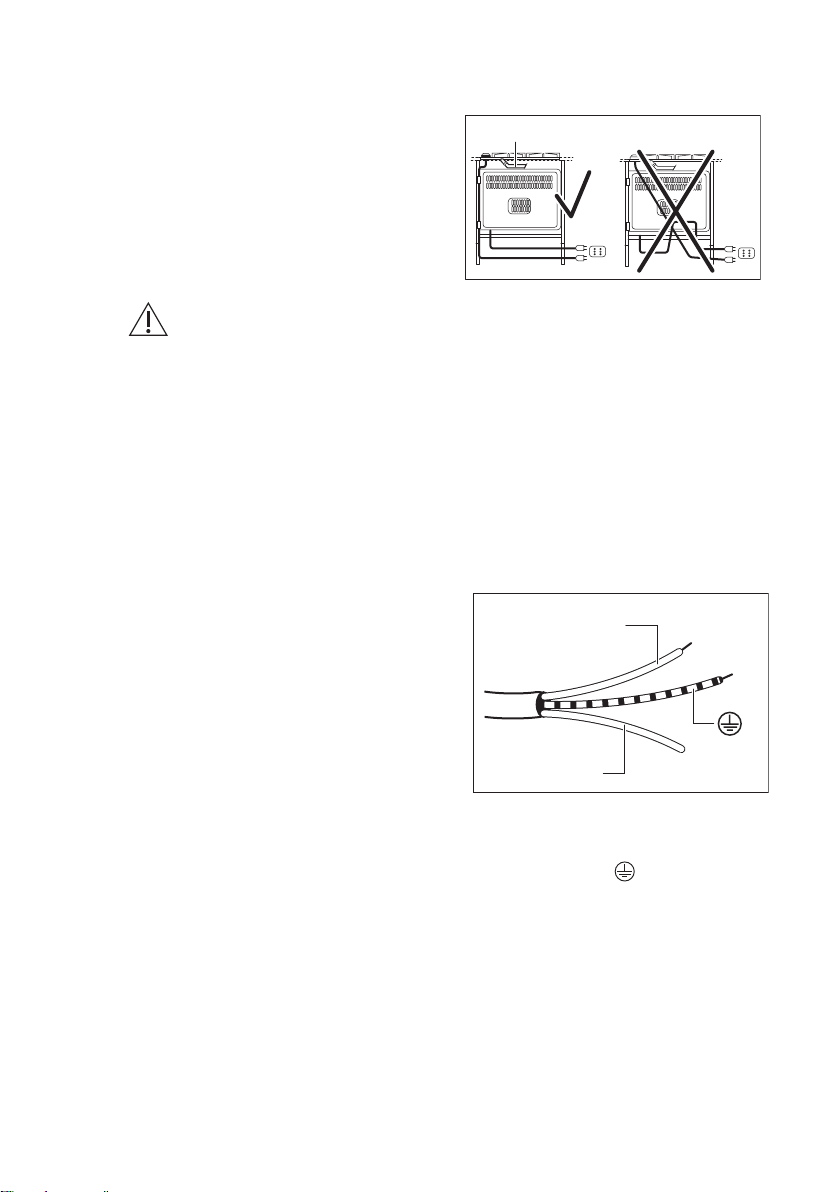
A
A. Rigid copper pipe or flexible pipe of
stainless steel
3.4 Connection cable
To replace the connection cable use only
the special cable or its equivalent. The
cable type is: H05SS-F T180.
Make sure that the cable section is
applicable to the voltage and the
working temperature. The yellow / green
earth wire must be approximately 2 cm
longer than the brown (or black) phase
wire.
www.aeg.com
8
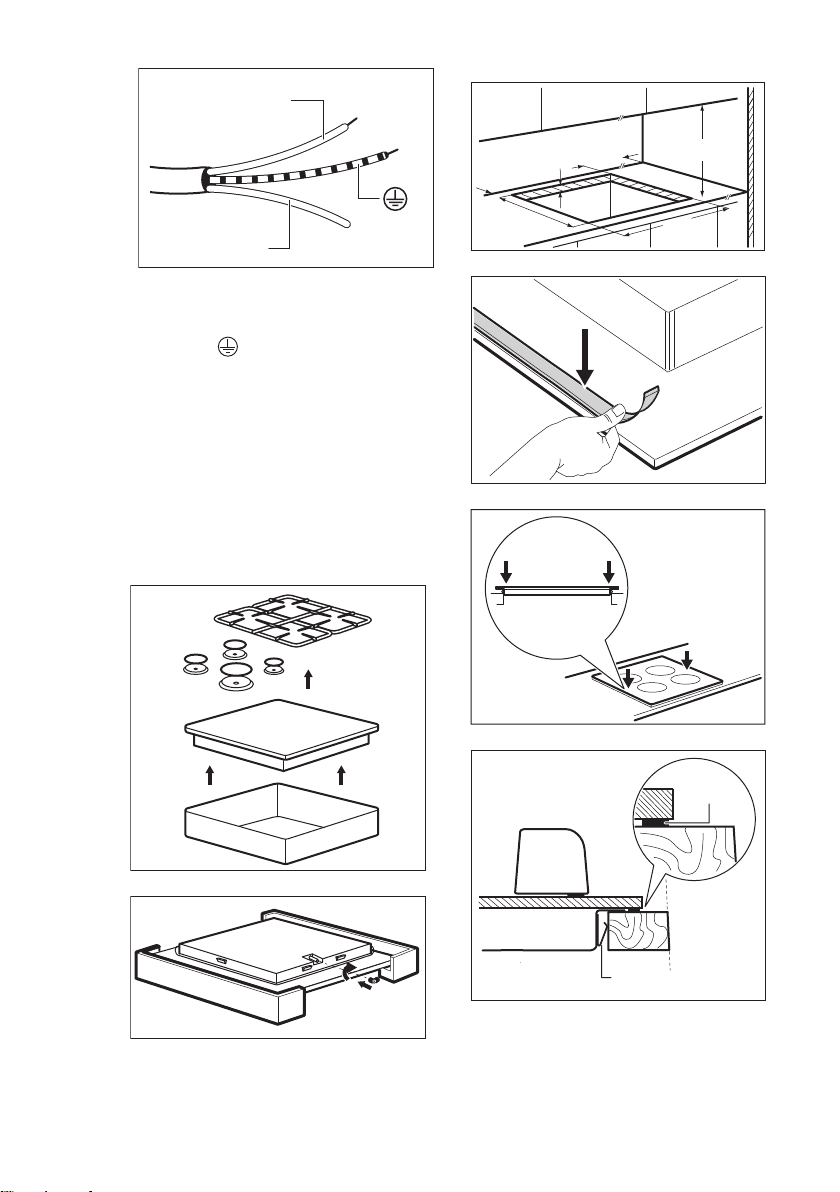
L
N
1. Connect the green and yellow (earth)
wire to the terminal which is marked
with the letter 'E', or the earth
symbol , or coloured green and
yellow.
2. Connect the blue (neutral) wire to the
terminal which is marked with the
letter 'N' or coloured blue.
3. Connect the brown (live) wire to the
terminal which is marked with the
letter 'L'. It must always be
connected to the network phase.
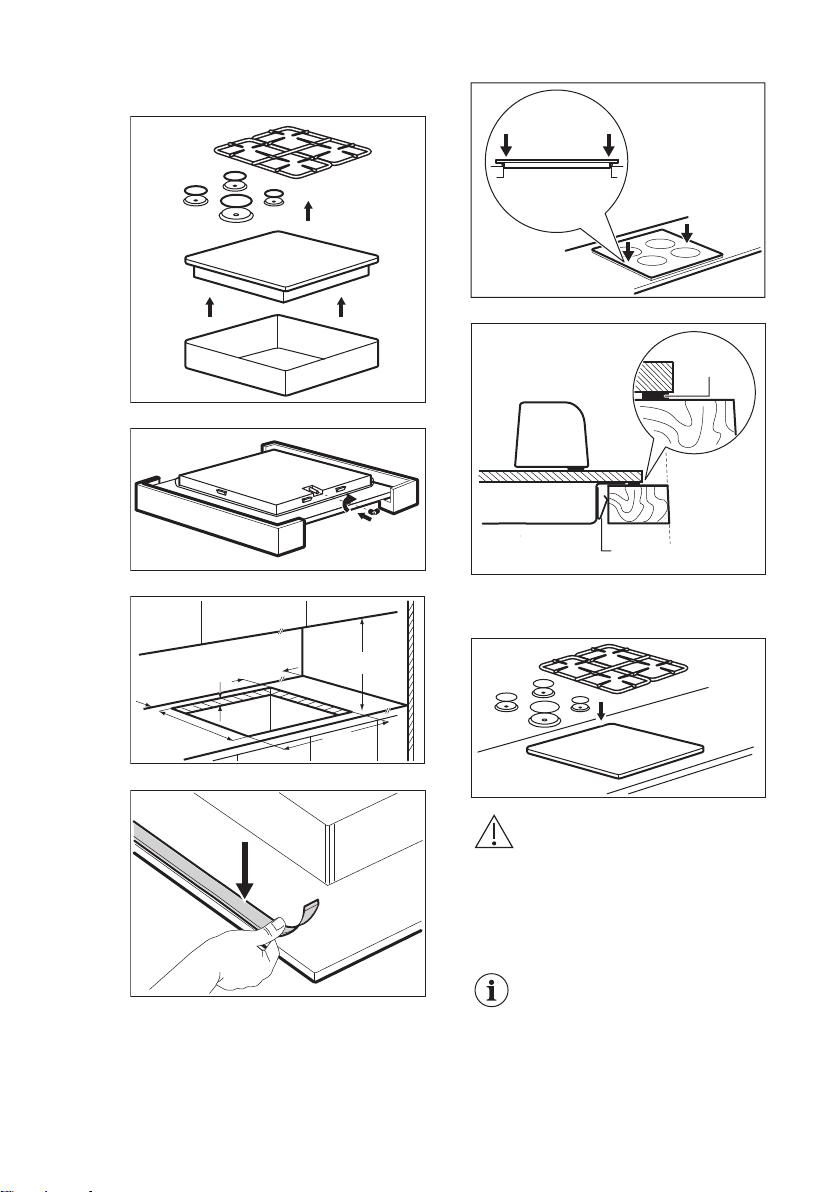
3.5 Assembly
1.
2.
3.
min.
55 mm
min.
650 mm
560 mm
490 mm
min.
150 mm
30 mm
4.
5.
6.
B
A
A) supplied seal
B) assembled bracket
ENGLISH
9

7.
CAUTION!
Install the appliance only on
a worktop with flat surface.
3.6 Installing hob under the
hood
If you install the hob under a
hood, please see the
installation instructions of
the hood for the minimum
distance between the
appliances.
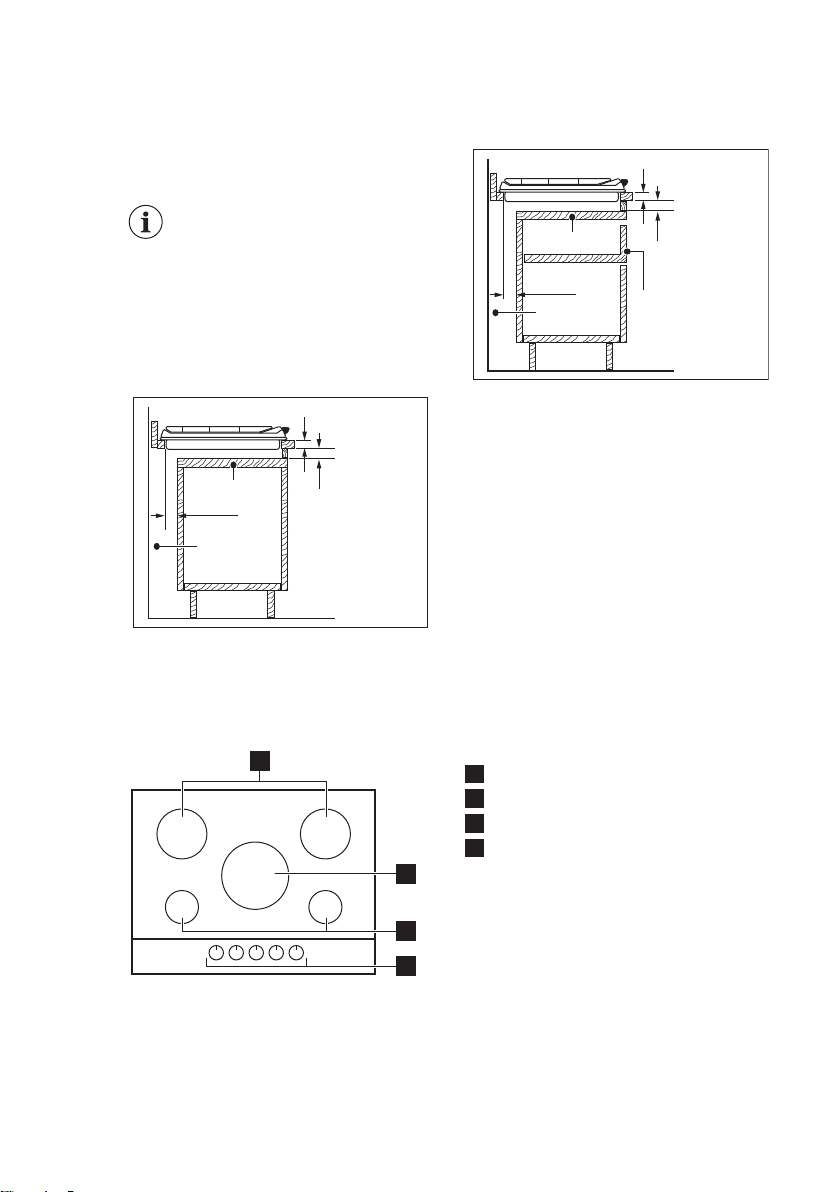
3.7 Possibilities for insertion
The panel installed below the hob must
be easy to remove and let an easy access
in case a technical assistance
intervention is necessary.
The burner
flame may be
extinguished by an air flow, if
the removable panel is not
installed. The air flow may
occur when you open or
close the cabinet door or
drawer.
Kitchen unit with door
min 20 mm
(max 150 mm)
30 mm
60 mm
B
A
A. Removable panel
B. Space for connections
Kitchen unit with drawer
min 20 mm
(max 150 mm)
30 mm
C
A
60 mm
B
A. Removable panel
B. Space for connections
C. Drawer
Kitchen unit with oven
The electrical connection of the hob and
the oven must be installed separately for
safety reasons and to let easy remove
oven from the unit.
www.aeg.com
10
4. PRODUCT DESCRIPTION
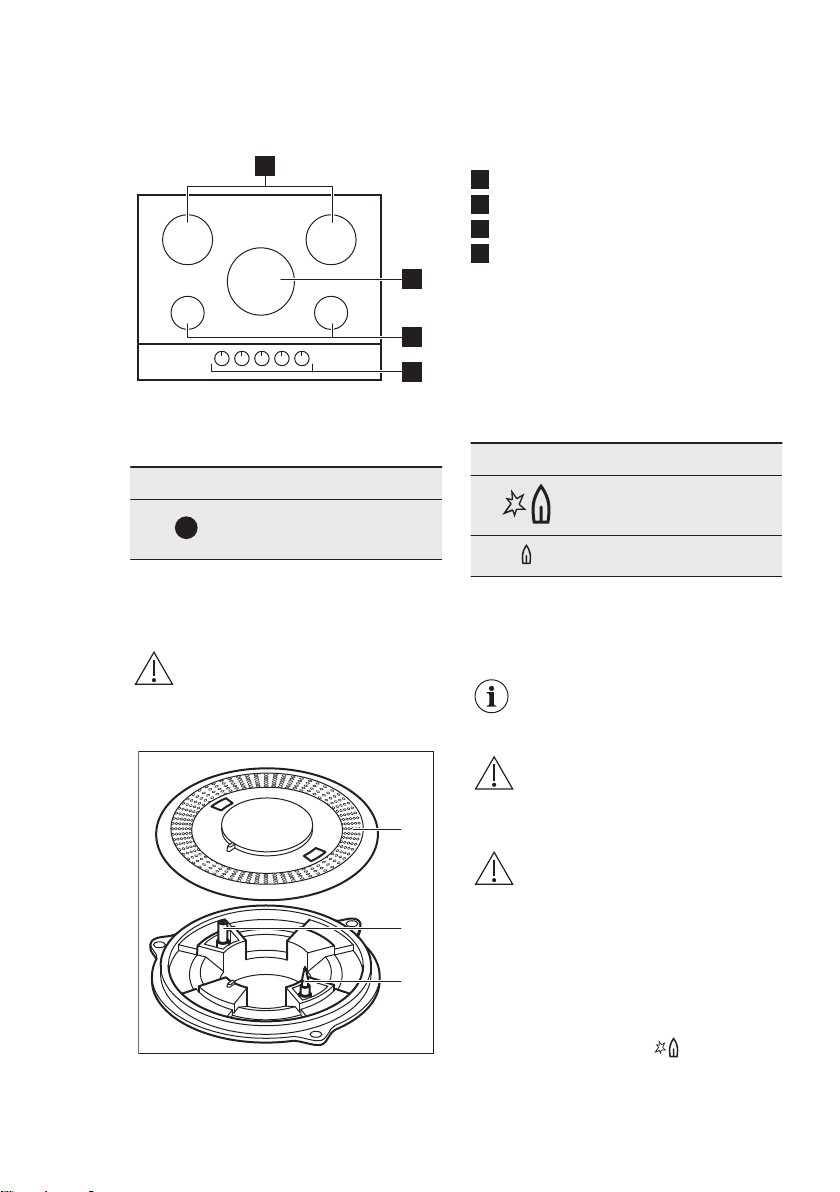
4.1 Cooking surface layout
4
3
2
1
1
Semi-rapid burner
2
Rapid burner
3
Auxiliary burner
4
Control knobs
4.2 Control knob
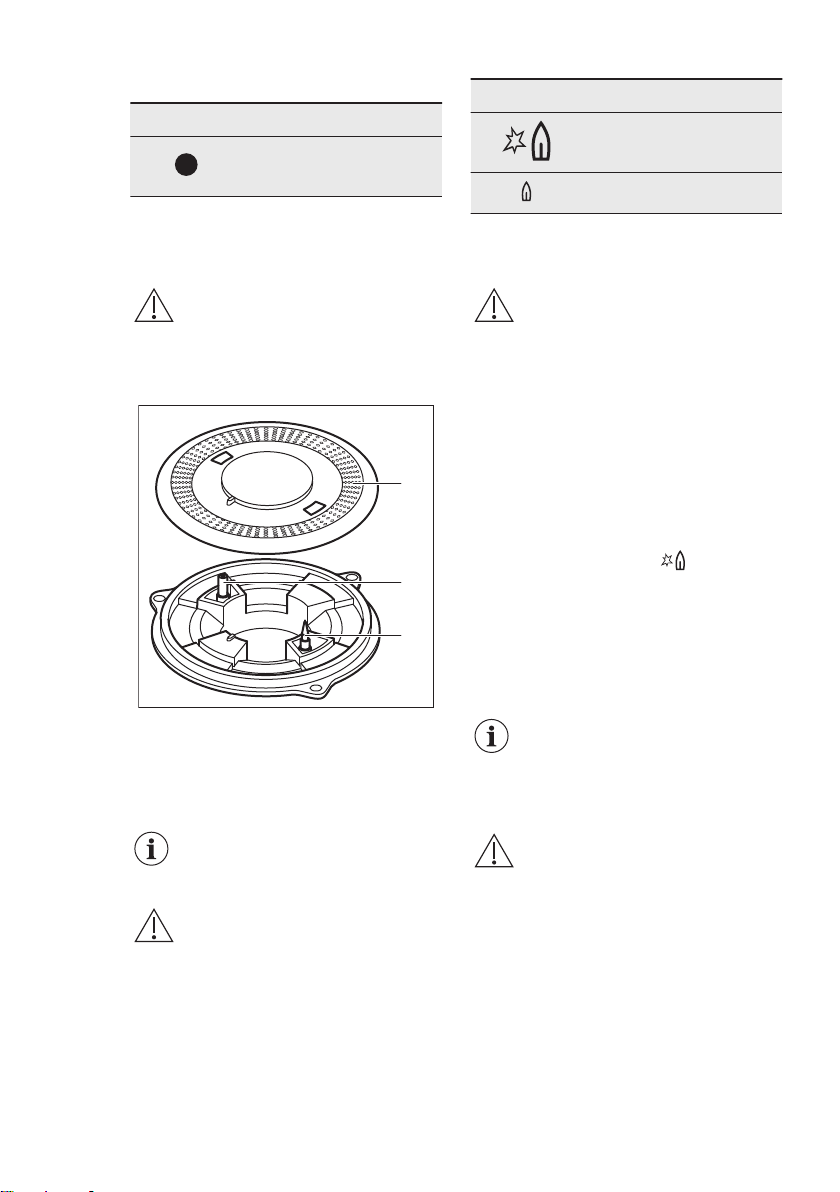
Symbol Description
no gas supply / off posi-
tion
Symbol Description
ignition position / maxi-
mum gas supply
minimum gas supply
5. DAILY USE
WARNING!
Refer to Safety chapters.
5.1 Burner overview
B
C
A
A. Flame spreader
B. Ignition candle
C. Thermocouple
5.2 Ignition of the burner
Always light the burner
before you put on the
cookware.
WARNING!
Do not light the burner when
the flame spreader is
removed.
WARNING!
Be very careful when you use
open fire in the kitchen
environment. The
manufacturer declines any
responsibility in case of the
flame misuse.
1. Push the control knob down and turn
it counterclockwise to the maximum
gas supply position ( ).
2. Keep the control knob pushed for
equal or less than 10 seconds. This
ENGLISH
11
lets the thermocouple warm up. If
not, the gas supply is interrupted.
3. Adjust the flame after it is regular.
If after some tries the burner
does not light, check if the
flame spreader is in correct
position.
WARNING!
Do not keep the control
knob pushed for more than
15 seconds. If the burner
does not light after 15
seconds, release the control
knob, turn it into off position
and try to light the burner
again after minimum 1
minute.
CAUTION!
In the absence of electricity
you can ignite the burner
without electrical device; in
this case approach the
burner with a flame, turn the
control knob counter-
clockwise to maximum gas
supply position and push it
down. Keep the control
knob pushed for equal or
less than 10 seconds to let
the thermocouple warm up.
If the burner accidentally
goes out, turn the control
knob to the off position and
try to light the burner again
after minimum 1 minute.
The spark generator can
start automatically when you
switch on the mains, after
installation or a power cut. It
is normal.
The hob is supplied with the
progressive valves. They
make the flame regulation
more precise.
5.3 Turning the burner off
To put the flame out, turn the knob to
the off position
.
WARNING!
Always turn the flame down
or switch it off before you
remove the pans from the
burner.
6. HINTS AND TIPS
WARNING!
Refer to Safety chapters.
6.1 Cookware
CAUTION!
Do not use cast iron pans,
clay or earthenware pots,
grilling accessories or
toaster plates.
WARNING!
Do not put the same pan on
two burners.
WARNING!
Do not put unstable or
damaged pots on the burner
to prevent spills and injuries.
CAUTION!
Make sure that pot handles
are not above the front edge
of the cooktop.
CAUTION!
Make sure that the pots are
placed centrally on the
burner in order to get the
maximum stability and a
lower gas consumption.
www.aeg.com12
CAUTION!
Liquids spilt during cooking
can cause the glass to break.
6.2 Diameters of cookware
CAUTION!
Use cookware with
diameters applicable to the
size of burners.
Burner Diameter of
cookware (mm)
Rapid 180 - 260
Semi-rapid 140 - 220
Auxiliary 100 - 160
7. CARE AND CLEANING
WARNING!
Refer to Safety chapters.
7.1 General information
• Clean the hob after each use.
• Always use cookware with clean
bottom.
• Scratches or dark stains on the surface
have no effect on how the hob
operates.
• Use a special cleaner applicable for
the surface of the hob.
WARNING!
Do not use knives, scrapers
or similar instruments to
clean the surface of the glass
or between the rims of the
burners and the frame (if
applicable).
• Wash stainless steel parts with water,
and then dry them with a soft cloth.
7.2 Pan supports
The pan supports are not
resistant to washing in a
dishwasher. They must be
washed by hand.
1. Remove the pan supports to easily
clean the hob.
Be very careful when you
replace the pan supports
to prevent the hob top
from damage.
2. The enamel coating occasionally can
have rough edges, so be careful
when you wash the pan supports by
hand and dry them. If necessary,
remove stubborn stains with a paste
cleaner.
3. After you clean the pan supports,
make sure that they are in correct
positions.
4. For the burner to operate correctly,
make sure that the arms of the pan
supports are aligned with the centre
of the burner.
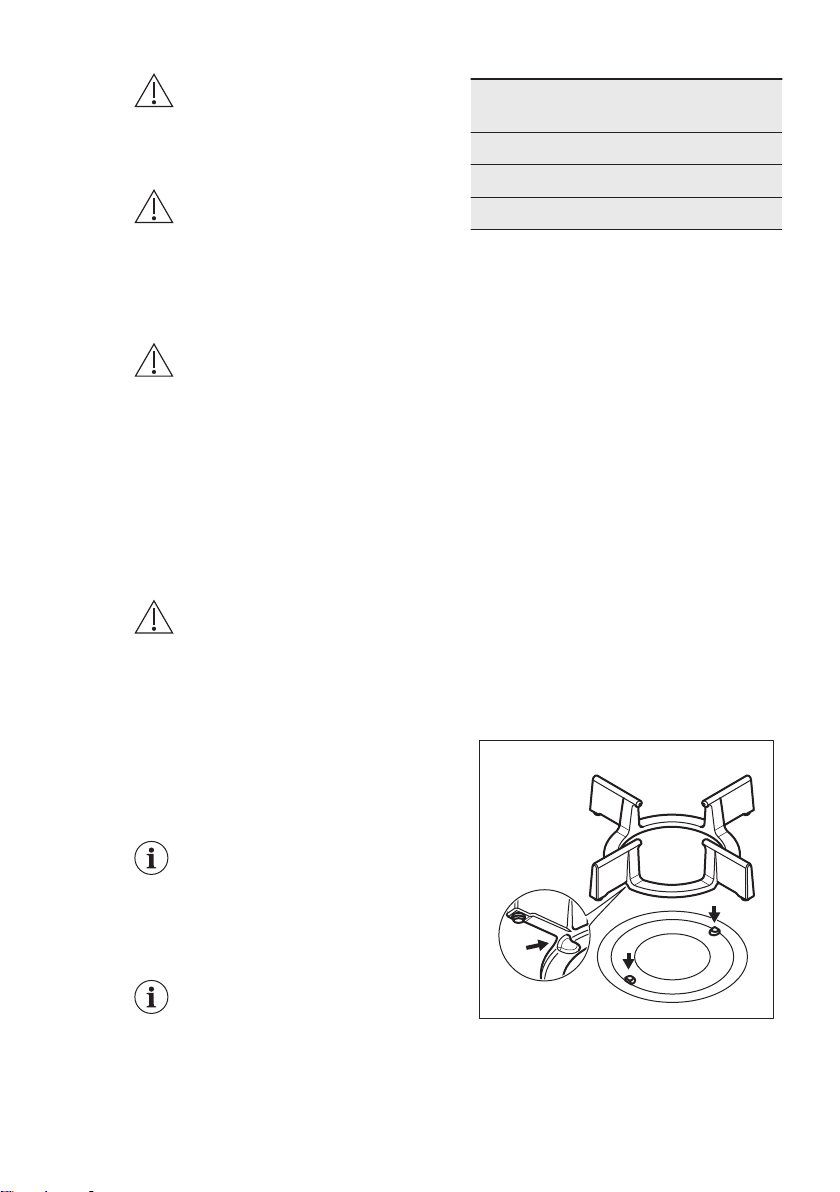
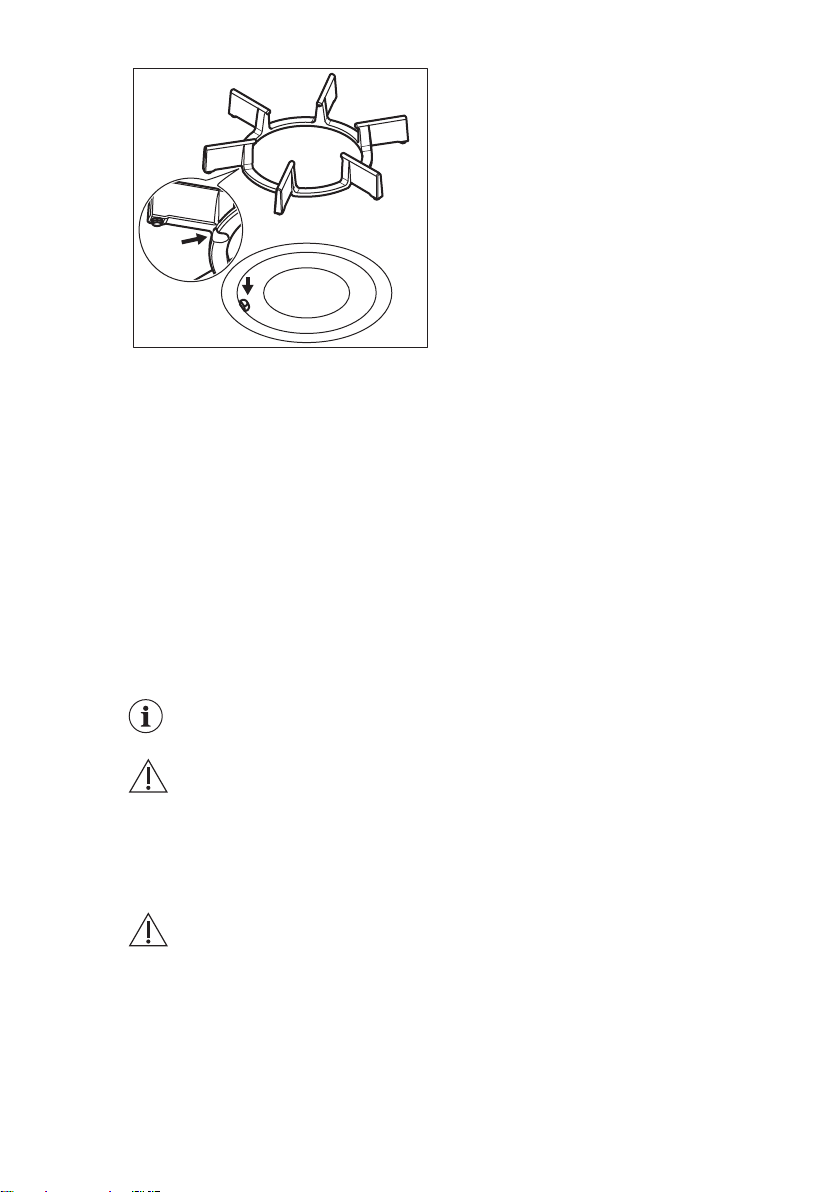
7.3 Removing pan supports
After cleaning hobs, make sure that pan
supports are in a correct position. In
order to properly place the pan supports,
make sure that an arm of the pan
support is positioned in correspondence
with the grips placed at the base of the
burner as shown in the picture. This way,
the pan support will be stable and fixed.
ENGLISH
13
7.4 Cleaning the hob
• Remove immediately: melted plastic,
plastic foil, sugar and food with sugar.
If not, the dirt can cause damage to
the hob. Take care to avoid burns.
• Remove when the hob is sufficiently
cool: limescale rings, water rings, fat
stains, shiny metallic discoloration.
Clean the hob with a moist cloth and
non-abrasive detergent. After
cleaning, wipe the hob dry with a soft
cloth.
7.5 Cleaning the
flame
spreader
You can wash the flame
spreaders in a dishwasher.
WARNING!
Let the flame spreaders cool
down before you clean
them.
Light stains:
Wash the flame spreader with warm
water and soap and dry it with a soft
cloth.
Medium stains:
Use the dishwasher. Place the flame
spreader on the bottom rack in a flat
position, with the top side up.
Heavy stains:
Clean the flame spreader with warm
water and soap, then wash it in the
dishwasher. If the stain is still present
wash the top of the flame spreader with a
grill cleaner and run through the
dishwasher again.
Use a toothpick to clean the holes of the
flame spreader.
7.6 Cleaning the spark plug
This feature is obtained through a
ceramic ignition candle with a metal
electrode. Keep these components well
clean to prevent difficult lighting and
check that the burner crown holes are
not obstructed.
7.7 Periodic maintenance
Speak to your local Authorised Service
Centre periodically to check the
conditions of the gas supply pipe and
the pressure adjuster, if fitted.
8.
TROUBLESHOOTING
WARNING!
Refer to Safety chapters.
www.aeg.com14
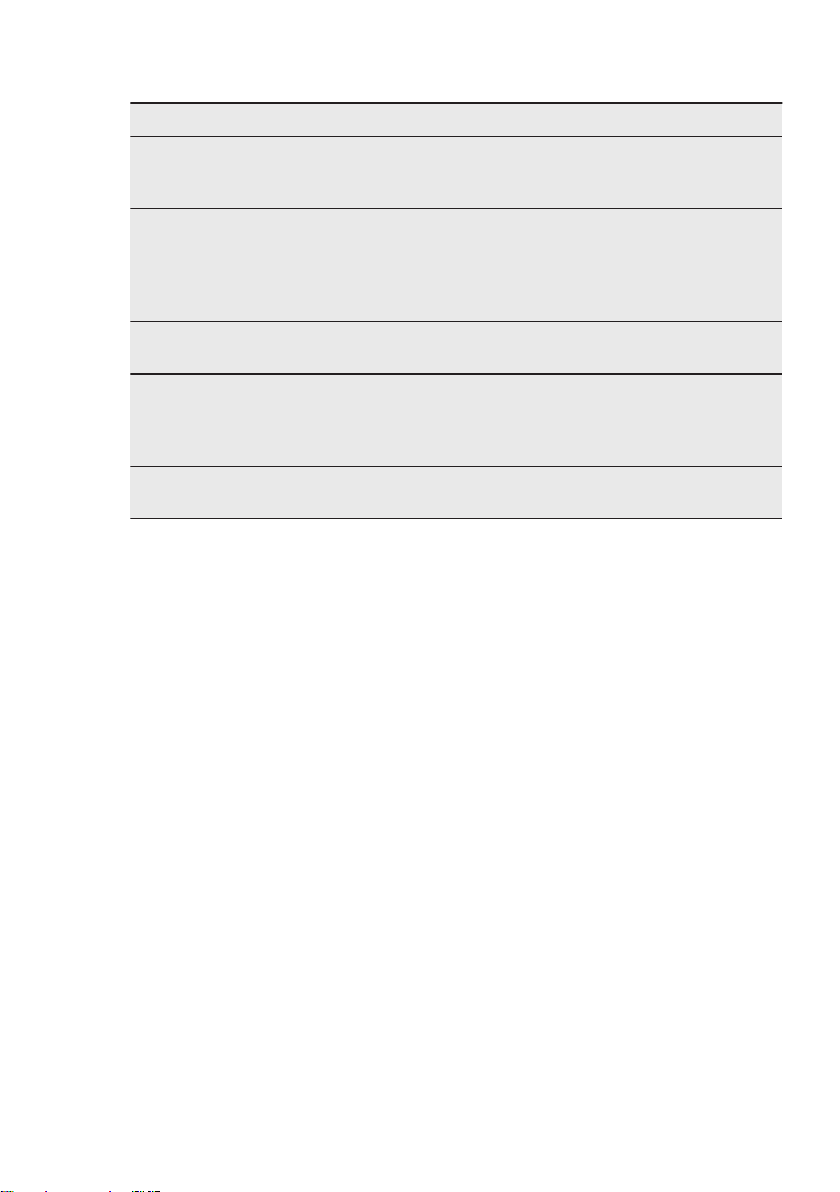
8.1 What to do if...
Problem Possible cause Remedy
There is no spark when you
try to activate the spark gen-
erator.
The hob is not connected to
an electrical supply or it is
connected incorrectly.
Check if the hob is correctly
connected to the electrical
supply.
The fuse is blown. Make sure that the fuse is
the cause of the malfunction.
If the fuse is blown again
and again, contact a quali-
fied electrician.
Flame spreader is placed in-
correctly.
Place the flame spreader
correctly.
The flame extinguishes im-
mediately after ignition.
Thermocouple is not heated
up sufficiently.
After lightning the flame,
keep the knob pushed for
equal or less than 10 sec-
onds.
The flame ring is uneven. Flame spreader holes are
blocked with food residues.
Make sure that the flame
spreader is clean.
8.2 If you cannot find a
solution...
If you cannot find a solution to the
problem yourself, contact your dealer or
an Authorised Service Centre. Give the
data from the rating plate. Make sure,
you operated the hob correctly. If not the
servicing by a service technician or
dealer will not be free of charge, also
during the warranty period. The
instructions about the Service Centre and
conditions of guarantee are in the
guarantee booklet.
ENGLISH 15
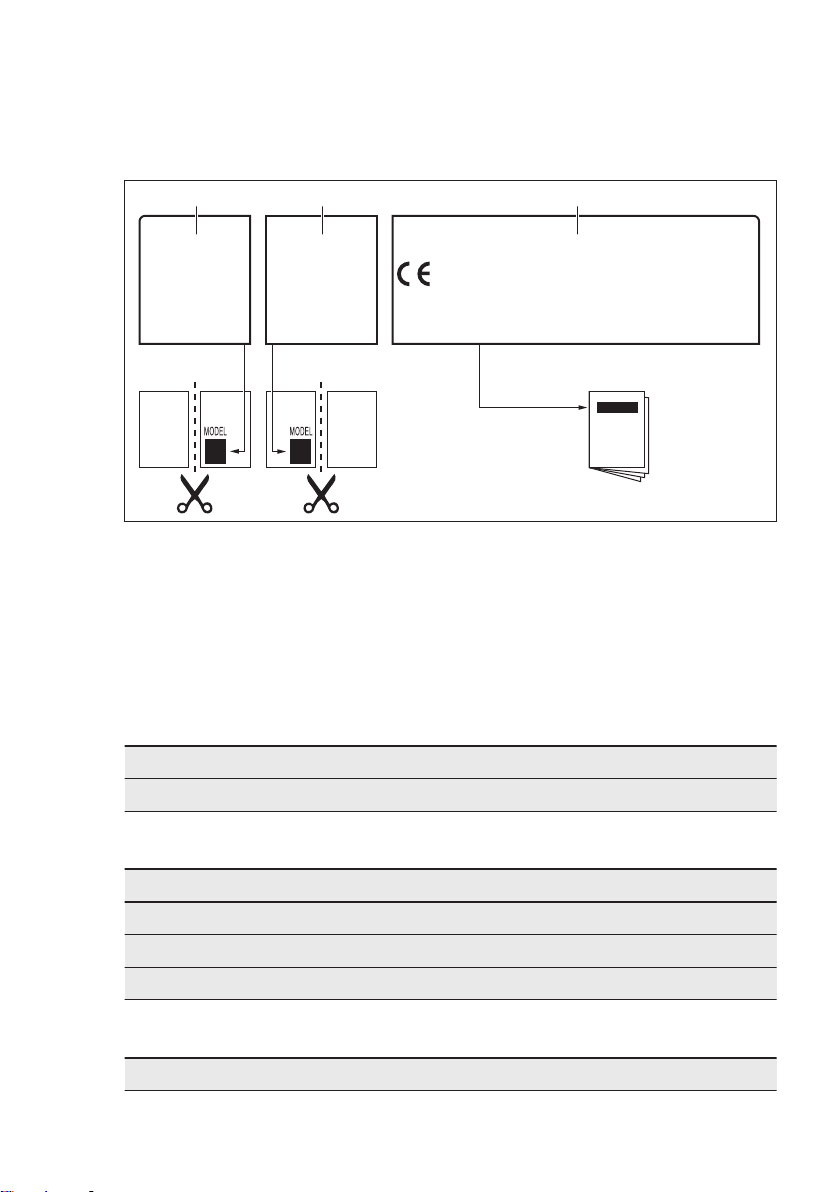
8.3 Labels supplied with the
accessories bag
Stick the adhesive labels as indicated
below:
MOD.
PROD.NO.
SER.NO
DATA
MOD.
PROD.NO.
SER.NO
DATA
MOD.
PROD.NO.
SER.NO.
03 IT
MADE IN ITALY
TYPE
IP20
0049
A B C
A. Stick it on Guarantee Card and send
this part (if applicable).
B. Stick it on Guarantee Card and keep
this part (if applicable).
C. Stick it on instruction booklet.
9. TECHNICAL DATA
9.1 Hob dimensions
Width 740 mm
Depth 510 mm
9.2 Bypass diameters
BURNER Ø BYPASS 1/100 mm
Rapid 52
Semi-rapid 35
Auxiliary 32
9.3 Other technical data
TOTAL POWER: Gas original: G20 (2H) 20 mbar 8,9 kW
www.aeg.com16
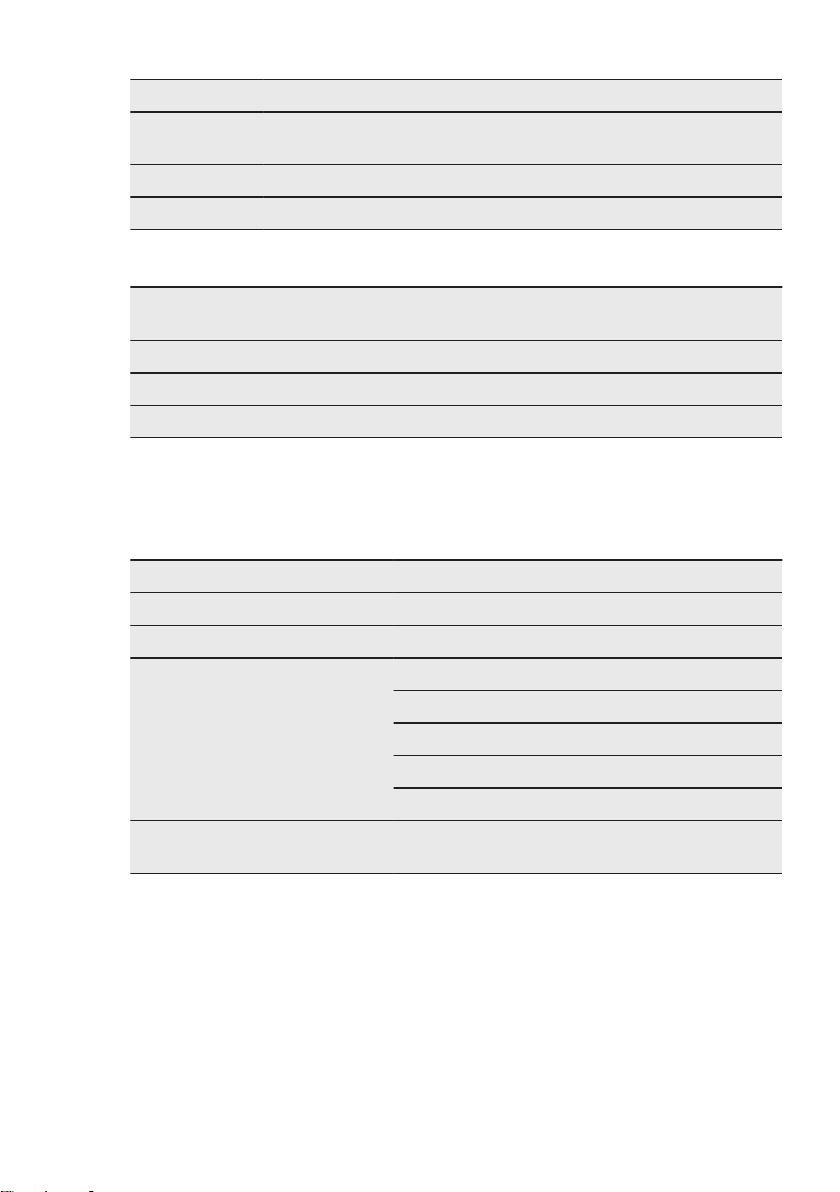
Electric supply: 220-240 V ~ 50-60 Hz
Appliance cate-
gory:
I2H
Gas connection: G 1/2"
Appliance class: 3
9.4 Gas burners for NATURAL GAS G20 20 mbar
BURNER NORMAL POWER kW MINIMUM POWER
kW
INJECTOR MARK
1/100 mm
Rapid 2,9 1,2 120B
Semi-rapid 2,0 0,75 102
Auxiliary 1,0 0,5 73F
10. ENERGY EFFICIENCY
10.1 Product information according to EU 66/2014
Model identification HG795840NB
Type of hob Built-in hob
Number of gas burners 5
Energy efficiency per gas burner
(EE gas burner)
Centre middle - Rapid 56.9%
Left rear - Semi-rapid 61.2%
Right rear - Semi-rapid 61.2%
Left front - Auxiliary not applicable
Right front - Auxiliary not applicable
Energy efficiency for the gas hob
(EE gas hob)
59.7%
EN 30-2-1: Domestic cooking appliances burning gas - Part 2-1 : Rational use of
energy - General
10.2 Energy saving
• Before use, make sure that the burners and pan supports are assembled correctly.
• Use cookware with diameters applicable to the size of burners.
• Center the pot on the burner.
• When you heat up water, use only the amount you need.
• If it is possible, always put the lids on the cookware.
• When the liquid starts to boil, turn down the
flame to barely simmer the liquid.
• If it is possible, use a pressure cooker. Refer to its user manual.
ENGLISH
17

11. ENVIRONMENTAL CONCERNS
Recycle materials with the symbol .
Put the packaging in relevant containers
to recycle it. Help protect the
environment and human health by
recycling waste of electrical and
electronic appliances. Do not dispose of
appliances marked with the symbol
with the household waste. Return the
product to your local recycling facility or
contact your municipal office.
www.aeg.com18
INHALTSVERZEICHNIS
1. SICHERHEITSHINWEISE...........................................................................................19
2. SICHERHEITSANWEISUNGEN.................................................................................22
3. MONTAGE................................................................................................................. 25
4. GERÄTEBESCHREIBUNG......................................................................................... 28
5. TÄGLICHER GEBRAUCH.......................................................................................... 29
6. TIPPS UND HINWEISE.............................................................................................. 30
7. REINIGUNG UND PFLEGE....................................................................................... 31
8. FEHLERSUCHE.......................................................................................................... 33
9. TECHNISCHE DATEN...............................................................................................34
10. ENERGIEEFFIZIENZ................................................................................................ 35
FÜR PERFEKTE ERGEBNISSE
Danke, dass Sie sich für dieses AEG Produkt entschieden haben. Wir haben es
geschaffen, damit Sie viele Jahre von seiner ausgezeichneten Leistung und den
innovativen Technologien, die Ihnen das Leben erleichtern, profitieren können. Es
ist mit Funktionen ausgestattet, die in gewöhnlichen Geräten nicht vorhanden
sind. Nehmen Sie sich ein paar Minuten Zeit zum Lesen, um seine Vorzüge
kennen zu lernen.
Besuchen Sie uns auf unserer Website, um:
Anwendungshinweise, Prospekte, Fehlerbehebungs-, Service- und Reparatur-
Informationen zu erhalten:
www.aeg.com/support
Ihr erworbenes Produkt zu registrieren, um den besten Service für es zu
gewährleisten:
www.registeraeg.com
Zubehör, Verbrauchsmaterial und Original-Ersatzteile für Ihr Gerät zu
erwerben:
www.aeg.com/shop
REPARATUR- UND KUNDENDIENST
Verwenden Sie ausschließlich Original-Ersatzteile für Ihre Produkte.
Halten Sie folgende Angaben bereit, wenn Sie sich an den Kundendienst
wenden: Modell, Produktnummer (PNC), Seriennummer.
Diese Informationen finden Sie auf dem Typenschild.
Warnungs-/Sicherheitshinweise
Allgemeine Informationen und Empfehlungen
Informationen zum Umweltschutz
Änderungen vorbehalten.
1.
SICHERHEITSHINWEISE
Lesen Sie die mitgelieferte Gebrauchsanleitung
sorgfältig vor Montage und Inbetriebnahme des Geräts.
Bei Verletzungen oder Schäden infolge nicht
DEUTSCH
19

ordnungsgemäßer Montage oder Verwendung des
Geräts übernimmt der Hersteller keine Haftung.
Bewahren Sie die Anleitung immer an einem sicheren
und zugänglichen Ort zum späteren Nachschlagen auf.
1.1 Sicherheit von Kindern und schutzbedürftigen
Personen
• Dieses Gerät kann dann von Kindern ab 8 Jahren und
von Personen mit eingeschränkten Fähigkeiten
bedient werden, wenn sie dabei beaufsichtigt werden
und/oder ihnen die sichere Benutzung des Geräts
erklärt wurde, und wenn sie die potenziellen Gefahren
der Benutzung kennen.
• Kinder dürfen nicht mit dem Gerät spielen.
• Halten Sie sämtliches Verpackungsmaterial von
Kindern fern und entsorgen Sie es auf angemessene
Weise.
• Halten Sie Kinder und Haustiere während des Betriebs
oder der Abkühlphase vom Gerät fern. Berührbare
Teile sind heiß.
• Falls Ihr Gerät mit einer Kindersicherung ausgestattet
ist, empfehlen wir, diese einzuschalten.
• Kinder dürfen keine Reinigung und Wartung ohne
Beaufsichtigung durchführen.
• Kinder bis zu 3 Jahren sind während des Betriebs
unbedingt von dem Gerät fernzuhalten.
1.2
Allgemeine Sicherheit
• WARNUNG: Das Gerät und die zugänglichen
Geräteteile werden während des Betriebs heiß. Seien
Sie vorsichtig und berühren Sie niemals die
Heizelemente. Halten Sie Kinder unter 8 Jahren vom
Gerät fern, wenn sie nicht ständig beaufsichtigt
werden.
• Schalten Sie das Gerät nicht über eine externe
Zeitschaltuhr oder eine separate Fernsteuerung ein.
www.aeg.com
20

• WARNUNG: Kochen mit Fett oder Öl auf einem
unbeaufsichtigten Kochfeld ist gefährlich und kann zu
einem Brand führen.
• Versuchen Sie NIEMALS einen Brand mit Wasser zu
löschen, sondern schalten Sie das Gerät aus und
bedecken Sie die Flamme mit einem Deckel oder
einer Feuerlöschdecke.
• VORSICHT: Der Kochvorgang muss überwacht
werden. Ein kurzer Kochvorgang muss kontinuierlich
überwacht werden.
• WARNUNG: Brandgefahr: Legen Sie keine
Gegenstände auf dem Kochfeld ab.
• Legen Sie keine Metallgegenstände wie Messer,
Gabeln, Löffel oder Topfdeckel auf die Oberfläche des
Kochfelds, da diese heiß werden können.
• Reinigen Sie das Gerät nicht mit einem
Dampfstrahlreiniger.
• Schalten Sie das Gerät sofort ab, wenn Sie Risse auf
der Glaskeramik-/Glasfläche feststellen, um
Stromschlaggefahr zu vermeiden.
• Im Falle eines Glasbruchs der Kochplatte:
– Schalten Sie umgehend alle Brenner und
Heizelemente aus und trennen Sie das Gerät von
der Stromversorgung.
– Berühren Sie nicht die Geräteoberfläche.
– Benutzen Sie das Gerät nicht.
• Wenn das Netzkabel beschädigt ist, muss es vom
Hersteller, einem autorisierten Kundendienst oder
einer gleichermaßen qualifizierten Person
ausgetauscht werden, um Gefahrenquellen zu
vermeiden.
• Ist das Gerät direkt an die Stromversorgung
angeschlossen, wird ein allpoliger Netztrennschalter
mit einem Kontaktabstand benötigt. Es muss eine
vollständige Trennung entsprechend der
Überspannungskategorie III gewährleistet sein. Dies
gilt nicht für das Erdungskabel.
DEUTSCH
21
• Wenn Sie das Netzkabel verlegen, achten Sie darauf,
dass es keinen direkten Kontakt mit Teilen hat, die
Temperaturen erreichen können, die mehr als 50 °C
über der Raumtemperatur liegen. (Verwenden Sie
ansonsten Isolierschläuche.)
• WARNUNG: Verwenden Sie nur Schutzabdeckungen
des Herstellers des Kochgeräts, von ihm in der
Bedienungsanleitung als geeignete und empfohlene
Schutzabdeckungen oder die im Gerät enthaltene
Schutzabdeckung. Es besteht Unfallgefahr durch die
Verwendung ungeeigneter Schutzabdeckungen.
2. SICHERHEITSANWEISUNGEN
Dieses Gerät ist für folgende Märkte
geeignet: IT
2.1 Montage
WARNUNG!
Nur eine qualifizierte
Fachkraft darf die Montage
des Geräts vornehmen.
Überprüfen Sie vor der
Montage des Geräts, dass
das von Ihrem Gaswerk
gelieferte Gas (Gasart und
Druck) mit der Einstellung
des Geräts kompatibel ist.
• Entfernen Sie das gesamte
Verpackungsmaterial.
• Montieren Sie ein beschädigtes Gerät
nicht und benutzen Sie es nicht.
• Halten Sie sich an die mitgelieferte
Montageanleitung.
• Die Mindestabstände zu anderen
Geräten und Küchenmöbeln sind
einzuhalten.
• Gehen Sie beim Umsetzen des Geräts
vorsichtig vor, da es schwer ist. Tragen
Sie stets Schutzhandschuhe und feste
Schuhe.
• Dichten Sie die Ausschnittskanten mit
einem Dichtungsmittel ab, um ein
Aufquellen durch Feuchtigkeit zu
verhindern.
• Schützen Sie die Geräteunterseite vor
Dampf und Feuchtigkeit.
• Installieren Sie das Gerät nicht direkt
neben einer Tür oder unter einem
Fenster. So kann heißes Kochgeschirr
nicht herunterfallen, wenn die Tür
oder das Fenster geöffnet wird.
• Wird das Gerät über Schubladen
eingebaut, achten Sie darauf, dass
zwischen dem Geräteboden und der
oberen Schublade ein ausreichender
Abstand für die Luftzirkulation
vorhanden ist.
• Der Boden des Geräts kann heiß
werden. Achten Sie darauf eine
feuerfeste Trennplatte unter dem
Gerät anzubringen, damit der Boden
nicht zugänglich ist.
2.2 Elektrischer Anschluss
WARNUNG!
Brand- und
Stromschlaggefahr.
• Alle elektrischen Anschlüsse sind von
einem geprüften Elektriker
vorzunehmen.
• Das Gerät muss geerdet sein.
• Vor der Durchführung jeglicher
Arbeiten muss das Gerät von der
elektrischen Stromversorgung
getrennt werden.
• Stellen Sie sicher, dass die
elektrischen Daten auf dem
Typenschild den Daten Ihrer
Stromversorgung entsprechen.
Wenden Sie sich anderenfalls an eine
Elektrofachkraft.
www.aeg.com
22

• Achten Sie darauf, dass das Gerät
ordnungsgemäß montiert wird. Wenn
freiliegende oder ungeeignete
Netzkabel oder Netzstecker (fall
vorhanden) verwendet werden, kann
der Anschluss überhitzen.
• Stellen Sie sicher, dass Sie das richtige
Kabel für den elektrischen
Netzanschluss verwenden.
• Achten Sie darauf, dass das Netzkabel
nicht lose hängt oder sich verheddert.
• Sorgen Sie dafür, dass ein
Berührungsschutz installiert wird.
• Verwenden Sie die Zugentlastung für
das Kabel.
• Stellen Sie beim elektrischen
Anschluss des Gerätes sicher, dass
das Netzkabel oder ggf. der
Netzstecker nicht mit dem heißen
Gerät oder heißem Kochgeschirr in
Berührung kommt.
• Verwenden Sie keine
Mehrfachsteckdosen oder
Verlängerungskabel.
• Achten Sie darauf, Netzstecker (falls
vorhanden) und Netzkabel nicht zu
beschädigen. Wenden Sie sich zum
Austausch des beschädigten
Netzkabels an unseren autorisierten
Kundendienst oder eine
Elektrofachkraft.
• Alle Teile, die gegen direktes
Berühren schützen, sowie die
isolierten Teile müssen so befestigt
werden, dass sie nicht ohne Werkzeug
entfernt werden können.
• Stecken Sie den Netzstecker erst nach
Abschluss der Montage in die
Steckdose. Stellen Sie sicher, dass der
Netzstecker nach der Montage noch
zugänglich ist.
• Falls die Steckdose lose ist, schließen
Sie den Netzstecker nicht an.
• Ziehen Sie nicht am Netzkabel, wenn
Sie das Gerät vom Netzstrom trennen
möchten. Ziehen Sie stets am
Netzstecker.
• Verwenden Sie nur geeignete
Trenneinrichtungen: Überlastschalter,
Sicherungen (Schraubsicherungen
müssen aus dem Halter entfernt
werden können), Erdschlüsse,
Kontakte.
• Die elektrische Installation muss eine
Trenneinrichtung aufweisen, mit der
Sie das Gerät allpolig von der
Stromversorgung trennen können.
Die Trenneinrichtung muss mit einer
Kontaktöffnungsbreite von
mindestens 3 mm ausgeführt sein.
2.3 Gasanschluss
• Der Gasanschluss muss von einer
Fachkraft ausgeführt werden.
• Vergewissern Sie sich vor der
Montage des Geräts, dass das von
Ihrem Gaswerk gelieferte Gas (Gasart
und Gasdruck) mit der Einstellung des
Geräts kompatibel ist.
• Stellen Sie sicher, dass die Luft um
das Gerät zirkulieren kann.
• Informationen über die
Gasversorgung finden Sie auf dem
Typenschild.
• Das Gerät darf nicht an einen Abzug
für Verbrennungsprodukte
angeschlossen werden. Das Gerät
muss gemäß der aktuell geltenden
Installationsbestimmungen
angeschlossen werden. Halten Sie die
Bestimmungen hinsichtlich der
Belüftung ein.
2.4 Gebrauch
WARNUNG!
Verletzungs-, Verbrennungs-
und Stromschlaggefahr.
Unfallgefahr durch
Verwendung ungeeigneter
Schutzvorrichtungen für das
Kochfeld.
• Entfernen Sie vor dem ersten
Gebrauch das gesamte
Verpackungsmaterial, die Aufkleber
und Schutzfolie (falls vorhanden).
• Das Gerät ist für die Verwendung im
Haushalt vorgesehen.
• Nehmen Sie keine technischen
Änderungen am Gerät vor.
• Die Lüftungsöffnungen dürfen nicht
abgedeckt werden.
• Lassen Sie das Gerät bei Betrieb nicht
unbeaufsichtigt.
• Schalten Sie die Kochzonen nach
jedem Gebrauch aus.
• Legen Sie kein Besteck und keine
Topfdeckel auf die Kochzonen. Sie
werden heiß.
• Bedienen Sie das Gerät nicht mit
feuchten oder nassen Händen oder
DEUTSCH
23
wenn es mit Wasser in Kontakt
gekommen ist.
• Benutzen Sie das Gerät nicht als
Arbeits- oder Abstellfläche.
• Wenn Sie Nahrungsmittel in heißes Öl
geben, kann dieses spritzen.
WARNUNG!
Brand- und
Explosionsgefahr!
• Erhitzte Öle und Fette können
brennbare Dämpfe freisetzen. Halten
Sie Flammen und erhitzte
Gegenstände beim Kochen mit
Fetten und Ölen von diesen fern.
• Die von sehr heißem Öl freigesetzten
Dämpfe können eine Selbstzündung
verursachen.
• Bereits verwendetes Öl kann
Lebensmittelreste enthalten und
schon bei niedrigeren Temperaturen
eher einen Brand verursachen als
frisches Öl.
• Platzieren Sie keine entflammbaren
Produkte oder Gegenstände, die mit
entflammbaren Produkten benetzt
sind, im Gerät, auf dem Gerät oder in
der Nähe des Geräts.
WARNUNG!
Das Gerät könnte
beschädigt werden.
• Stellen Sie kein heißes Kochgeschirr
auf das Bedienfeld.
• Lassen Sie das Kochgeschirr nicht
leerkochen.
• Lassen Sie keine Gegenstände oder
Kochgeschirr auf das Gerät fallen. Die
Oberfläche könnte beschädigt
werden.
• Schalten Sie die Kochzonen niemals
ein, wenn sich kein Kochgeschirr
darauf befindet, oder wenn das
Kochgeschirr leer ist.
• Legen Sie keine Alufolie auf das
Gerät.
• Kochgeschirr aus Gusseisen,
Aluminium oder mit beschädigten
Böden kann die Glas- bzw.
Glaskeramikoberfläche verkratzen.
Heben Sie das Kochgeschirr stets an,
wenn Sie es auf dem Kochfeld
umsetzen möchten.
• Verwenden Sie nur standfestes
Kochgeschirr mit der richtigen Form
und einem Durchmesser, der größer
als der der Brenner ist.
• Achten Sie darauf das Kochgeschirr
mittig auf die Brenner zu stellen.
• Vergewissern Sie sich, dass die
Flamme nicht erlischt, wenn Sie den
Einstellknopf schnell von der
höchsten zur niedrigsten Stufe
drehen.
• Verwenden Sie ausschließlich das mit
dem Gerät gelieferte Zubehör.
• Setzen Sie keinen Wärmeverteiler auf
den Brenner.
• Beim Gebrauch eines Gaskochfelds
entsteht Wärme und Feuchtigkeit.
Sorgen Sie für eine ausreichende
Belüftung in dem Raum, in dem das
Gerät aufgestellt ist.
• Bei längerer Benutzung des Gerätes
kann eine zusätzliche Belüftung
erforderlich werden, zum Beispiel
durch Öffnen eines Fensters oder die
Erhöhung der Absaugleistung der
Abzugshaube, falls vorhanden.
• Dieses Gerät ist nur zum Kochen
bestimmt. Jeder andere Gebrauch ist
als bestimmungsfremd anzusehen,
zum Beispiel das Beheizen eines
Raums.
• Lassen Sie keine säurehaltigen
Flüssigkeiten wie Essig, Zitronensaft
oder kalklösende Reinigungsmittel
mit dem Kochfeld in Berührung
kommen. Diese könnten matte
Flecken verursachen.
• Verfärbungen der Emailbeschichtung
haben keine Auswirkung auf die
Leistung des Geräts.
2.5 Reinigung und
Pflege
• Reinigen Sie das Gerät regelmäßig,
um eine Abnutzung des
Oberflächenmaterials zu verhindern.
• Schalten Sie das Gerät vor dem
Reinigen aus und lassen Sie es
abkühlen.
• Trennen Sie das Gerät vor
Wartungsarbeiten von der
Spannungsversorgung.
• Das Gerät nicht mit Wasserspray oder
Dampf reinigen.
• Für die Reinigung ein feuchtes
weiches Tuch verwenden. Nur
neutrale Reinigungsmittel verwenden.
Keine Scheuermittel,
www.aeg.com
24
Scheuerschwämme, scharfe
Reinigungsmittel oder Metallobjekte
für die Reinigung verwenden.
2.6 Entsorgung
WARNUNG!
Verletzungs- und
Erstickungsgefahr.
• Für Informationen zur
ordnungsgemäßen Entsorgung des
Geräts wenden Sie sich an die
zuständige kommunale Behörde vor
Ort.
• Trennen Sie das Gerät von der
Stromversorgung.
• Schneiden Sie das Netzkabel in der
Nähe des Geräts ab, und entsorgen
Sie es.
• Drücken Sie die äußeren Gasrohre
flach.
2.7 Service
• Wenden Sie sich zur Reparatur des
Geräts an einen autorisierten
Kundendienst.
• Verwenden Sie ausschließlich
Originalersatzteile.
3. MONTAGE
WARNUNG!
Siehe Kapitel
"Sicherheitshinweise".
3.1 Vor der Montage
Notieren Sie vor der Montage des
Kochfelds folgende Daten, die Sie auf
dem Typenschild finden. Das Typenschild
ist auf dem Boden des Kochfelds
angebracht.
Modell ...........................
Produktnummer
(PNC) ........................................
Seriennummer ............
3.2 Gasanschluss
WARNUNG!
Die in nachstehender
Anleitung beschriebenen
Installations- und
Wartungsarbeiten sowie die
Belüftung müssen von
Fachpersonal unter
Beachtung der geltenden
Bestimmungen (UNI-CIG
7129 - 7131) ausgeführt
werden. Stellen Sie sicher,
dass die Küche gut belüftet
ist: Halten Sie natürliche
Belüftungsöffnungen von
mindestens 100 cm² offen
oder installieren Sie eine
mechanische Abzugshaube.
Je nach geltenden Bestimmungen kann
der Anschluss fest oder durch
Verwendung eines flexiblen
Edelstahlrohrs erfolgen. Bei Verwendung
flexibler Metallrohre muss darauf
geachtet werden, dass sie nicht mit
beweglichen Teilen in Kontakt kommen
oder eingeklemmt werden können.
Wenn das Kochfeld mit einem Backofen
installiert wird, muss ebenfalls vorsichtig
vorgegangen werden.
Achten Sie darauf, dass der
Gasdruck des Geräts den
empfohlenen Werten
entspricht.
Entspricht der gelieferte Druck nicht dem
angegebenen Wert, muss ein geeigneter
Druckregler gemäß der Norm UNI EN 88
installiert werden. Das verstellbare
Anschlussstück wird an dem
Gasanschluss mit einer G 1/2"
Gewindemutter befestigt. Verschrauben
Sie die Teile ohne Kraftanwendung,
bringen Sie das Anschlussstück in die
benötigte Richtung und schrauben Sie
alle Teile fest.
A B C
DEUTSCH
25
A. Schaftende mit Mutter
B. Mitgelieferte Beilagscheibe
C. Mitgelieferter Rohrbogen
Fester Anschluss:
Führen Sie den Anschluss mit festen
Metallrohren (Kupfer mit mechanischem
Endstück) aus (UNI-CIG 7129).
Flexibler Anschluss:
Verwenden Sie ein
flexibles Edelstahlrohr
(UNI-CIG 9891) mit einer maximalen
Länge von 2 m.
WARNUNG!
Überprüfen Sie nach der
Installation, ob alle
Anschlussstücke dicht sind.
Verwenden Sie eine
Seifenlösung und keine
Flamme!
3.3 Elektroanschluss
• Vergewissern Sie sich, dass die
Netzspannung und -frequenz in Ihrer
Region mit den auf dem Typenschild
angegebenen Anschlusswerten
übereinstimmen.
• Das Gerät wird mit einem Netzkabel
geliefert. Dazu muss ein passender
Stecker verwendet werden, der für die
auf dem Typenschild angegebene
Gesamtstromaufnahme ausgelegt ist.
Achten Sie darauf, den Stecker in eine
passende Steckdose zu stecken.
• Schließen Sie das Gerät nur an eine
ordnungsgemäß installierte
Schutzkontaktsteckdose an.
• Stellen Sie sicher, dass der
Netzstecker nach der Montage noch
zugänglich ist.
• Ziehen Sie nicht am Netzkabel, wenn
Sie das Gerät von der
Stromversorgung trennen möchten.
Ziehen Sie stets am Netzstecker.
• Es besteht Brandgefahr, wenn das
Gerät mit einem Verlängerungskabel,
Adapter oder an eine
Mehrfachsteckdose angeschlossen
wird. Stellen Sie sicher, dass die
Erdverbindung den Normen und
Vorschriften entspricht.
• Das Netzkabel darf nicht heißer als
90 °C werden.
Um einen Kontakt des Kabels mit dem
Gerät unter dem Kochfeld zu vermeiden,
verwenden Sie die Haken auf den Seiten
des Gehäuses.
A
A. Festes Kupferrohr oder flexibles
Edelstahlrohr
3.4 Anschlusskabel
Ersetzen Sie das Anschlusskabel
ausschließlich durch das spezielle Kabel
oder ein gleichwertiges Kabel. Kabeltyp:
H05SS-F T180.
Vergewissern Sie sich, dass der
Kabelquerschnitt für die Spannung und
Betriebstemperatur geeignet ist. Der
gelb-grüne Erdleiter muss ca. 2 cm
länger als der braune (bzw. schwarze)
Phasenleiter sein.
L
N
1. Schließen Sie das grün-gelbe Kabel
(Erde) an die Klemme an, die mit
dem Buchstaben „E“ , dem
Erdungssymbol
oder mit den
Farben grün und gelb
gekennzeichnet ist.
2. Schließen Sie das blaue Kabel
(Nullleiter) an die Klemme an, die mit
dem Buchstaben „N“ oder mit der
Farbe blau gekennzeichnet ist.
3. Schließen Sie das braune
(stromführende) Kabel an die
Klemme an, die mit dem Buchstaben
„L“ gekennzeichnet ist. Es muss stets
an die Netzphase angeschlossen
werden.
www.aeg.com
26
3.5 Montage
1.
2.
3.
min.
55 mm
min.
650 mm
560 mm
490 mm
min.
150 mm
30 mm
4.
5.
6.
B
A
A) Mitgelieferte Dichtung
B) Montierte Klammer
7.
VORSICHT!
Montieren Sie das Gerät nur
in einer flachen
Arbeitsplatte.
3.6 Montage des Kochfelds
unter der Dunstabzugshaube
Wird das Kochfeld unter
einer Abzugshaube
montiert, sehen Sie in der
Montageanleitung der
Abzugshaube nach, welcher
Mindestabstand zwischen
den Geräten eingehalten
werden muss.
DEUTSCH 27
3.7 Einbaumöglichkeiten
Die unter dem Kochfeld eingebaute
Platte muss sich leicht entfernen lassen
und einen einfachen Zugang
ermöglichen, falls eine Reparatur
erforderlich wird.
Die Brennerflamme kann
durch einen Luftzug
erlöschen, wenn die
entfernbare Platte nicht
eingebaut ist. Der Luftzug
kann entstehen, wenn Sie
die Tür oder die Schublade
öffnen oder schließen.
Küchenschrank mit Tür
min 20 mm
(max 150 mm)
30 mm
60 mm
B
A
A. Entfernbare Platte
B. Raum für Anschlüsse
Küchenschrank mit Schublade
min 20 mm
(max 150 mm)
30 mm
C
A
60 mm
B
A. Entfernbare Platte
B. Raum für Anschlüsse
C. Schublade
Küchenschrank mit Backofen
Kochfeld und Backofen müssen aus
Sicherheitsgründen über separate
elektrische Anschlüsse verfügen. Der
Backofen muss sich leicht aus dem
Küchenschrank entfernen lassen.
4. GERÄTEBESCHREIBUNG
4.1 Kochfeldanordnung
4
3
2
1
1
Normalbrenner
2
Starkbrenner
3
Hilfsbrenner
4
Einstellknöpfe
www.aeg.com28
4.2 Einstellknopf
Symbol Beschreibung
Keine Gaszufuhr/ausge-
schaltet
Symbol Beschreibung
Zündstellung/maximale
Gaszufuhr
minimale Gaszufuhr
5. TÄGLICHER GEBRAUCH
WARNUNG!
Siehe Kapitel
"Sicherheitshinweise".
5.1 Brennerübersicht
B
C
A
A. Flammenverteiler
B. Zündkerze
C. Thermoelement
5.2 Zünden des Brenners
Brenner stets vor dem
Aufsetzen des Kochgeschirrs
zünden.
WARNUNG!
Zünden Sie den Brenner
nicht ohne Flammenverteiler.
WARNUNG!
Seien Sie bei der
Verwendung von offenem
Feuer in der Küche
besonders vorsichtig. Der
Hersteller übernimmt bei
Missachtung der
Sicherheitsbestimmungen
beim Umgang mit offenem
Feuer keinerlei Haftung.
1. Drücken Sie den Einstellknopf hinein
und drehen Sie ihn gegen den
Uhrzeigersinn auf die Position für die
maximale Gaszufuhr ( ).
2. Halten Sie den Einstellknopf bis zu 10
Sekunden lang gedrückt. In dieser
Zeit wird das Thermoelement
erwärmt. Andernfalls wird die
Gaszufuhr unterbrochen.
3. Stellen Sie die Flamme ein, sobald
sie ruhig brennt.
Falls sich der Brenner nach
einigen Versuchen nicht
zünden lässt, überprüfen Sie,
ob der Flammenverteiler
korrekt sitzt.
WARNUNG!
Halten Sie den Knopf nicht
länger als 15 Sekunden
gedrückt. Sollte der Brenner
nach 15 Sekunden nicht
zünden, lassen Sie den
Knopf los, und drehen Sie
ihn in die Aus-Position.
Warten Sie dann mindestens
eine Minute, bevor Sie den
Brenner erneut zünden.
DEUTSCH 29
VORSICHT!
Wenn kein Strom zur
Verfügung steht, können Sie
den Brenner auch ohne
Strom zünden. Bringen Sie
eine Flamme in die Nähe
des Brenners, drehen Sie
den entsprechenden Knopf
entgegen dem
Uhrzeigersinn auf die
höchste Stufe und drücken
Sie ihn dann hinein. Halten
Sie den Einstellknopf
höchstens 10 Sekunden
gedrückt, um das
Thermoelement zu
erwärmen.
Sollte der Brenner zufällig
ausgehen, drehen Sie den
Knopf in die Aus-Position
und versuchen ihn nach
einer Minute erneut zu
zünden.
Nach dem Einschalten der
Stromversorgung, nach der
Installation oder nach einem
Stromausfall wird der
Funkengenerator
möglicherweise automatisch
eingeschaltet. Das ist
normal.
Das Kochfeld wird mit
Ventilen mit einem stetigen
Stellverhalten geliefert. Sie
ermöglichen eine präzisere
Einstellung der Flamme.
5.3 Abschalten des Brenners
Drehen Sie zum Abschalten des Brenners
den Knopf in die Aus-Position
.
WARNUNG!
Bevor Sie das Kochgeschirr
vom Brenner nehmen,
drehen Sie die Flamme
herunter oder drehen Sie sie
ganz ab.
6. TIPPS UND HINWEISE
WARNUNG!
Siehe Kapitel
"Sicherheitshinweise".
6.1 Kochgeschirr
VORSICHT!
Verwenden Sie kein
Kochgeschirr aus Gusseisen,
Ton oder Steingut und kein
Grillzubehör oder
Sandwichplatten.
WARNUNG!
Kochen Sie nicht mit einem
Kochgeschirrteil auf zwei
Brennern gleichzeitig.
WARNUNG!
Stellen Sie keine
beschädigten Töpfe oder
solche, die nicht standfest
sind, auf den Brenner, um
ein Verschütten und
Verletzungen zu vermeiden.
VORSICHT!
Achten Sie darauf, dass die
Topfgriffe nicht über den
vorderen Rand des
Kochfelds hinausragen.
VORSICHT!
Stellen Sie zur Reduzierung
des Gasverbrauchs und im
Interesse einer größeren
Stabilität die Töpfe mittig
auf den Brenner.
VORSICHT!
Heiße Flüssigkeiten, die
während des Kochens
verschüttet werden, können
zum Zerspringen der
Glasplatte führen.
www.aeg.com30
6.2 Durchmesser des
Kochgeschirrs
VORSICHT!
Verwenden Sie nur
Kochgeschirr mit einem
Durchmesser, der der Größe
der Brenner entspricht.
Brenner Durchmesser
des Kochge-
schirrs (mm)
Starkbrenner 180 - 260
Brenner Durchmesser
des Kochge-
schirrs (mm)
Normalbrenner 140 - 220
Hilfsbrenner 100 - 160
7. REINIGUNG UND PFLEGE
WARNUNG!
Siehe Kapitel
"Sicherheitshinweise".
7.1 Allgemeine Informationen
• Reinigen Sie das Kochfeld nach
jedem Gebrauch.
• Achten Sie immer darauf, dass der
Boden des Kochgeschirrs sauber ist.
• Kratzer oder dunkle Flecken auf der
Oberfläche beeinträchtigen die
Funktionsfähigkeit des Kochfelds
nicht.
• Verwenden Sie einen Spezialreiniger
zur Reinigung der
Kochfeldoberfläche.
WARNUNG!
Verwenden Sie keine Messer,
Schaber oder ähnliche
Gegenstände, um die
Glasoberfläche oder die
Zwischenräume zwischen
den Rändern der Brenner
und dem Gestell zu reinigen
(sofern zutreffend).
• Reinigen Sie Edelstahlteile mit Wasser
und wischen Sie sie mit einem
weichen Tuch trocken.
7.2 Topfträger
Die Topfträger sind nicht
spülmaschinenfest. Sie
müssen von Hand gereinigt
werden.
1. Entfernen Sie die Topfträger, um die
Reinigung des Kochfelds zu
erleichtern.
Seien Sie beim
Wiederaufsetzen der
Topfträger vorsichtig, um
Beschädigungen der
Oberseite der Kochstelle
zu vermeiden.
2. Wenn Sie die Topfträger von Hand
spülen und trocknen, seien Sie
vorsichtig, da durch das Emaillieren
gelegentlich raue Kanten entstehen
können. Entfernen Sie hartnäckige
Flecken ggf. mit einer
Reinigungspaste.
3. Vergewissern Sie sich, dass Sie die
Topfträger nach der Reinigung
wieder ordnungsgemäß eingesetzt
haben.
4. Damit der Brenner korrekt
funktioniert, stellen Sie sicher, dass
sich die Arme der Topfträger in der
Mitte des Brenners befinden.
7.3 Abnehmen der Topfträger
Vergewissern Sie sich nach der Reinigung
des Kochfelds, dass sich die Topfträger in
der richtigen Position befinden. Um die
DEUTSCH
31
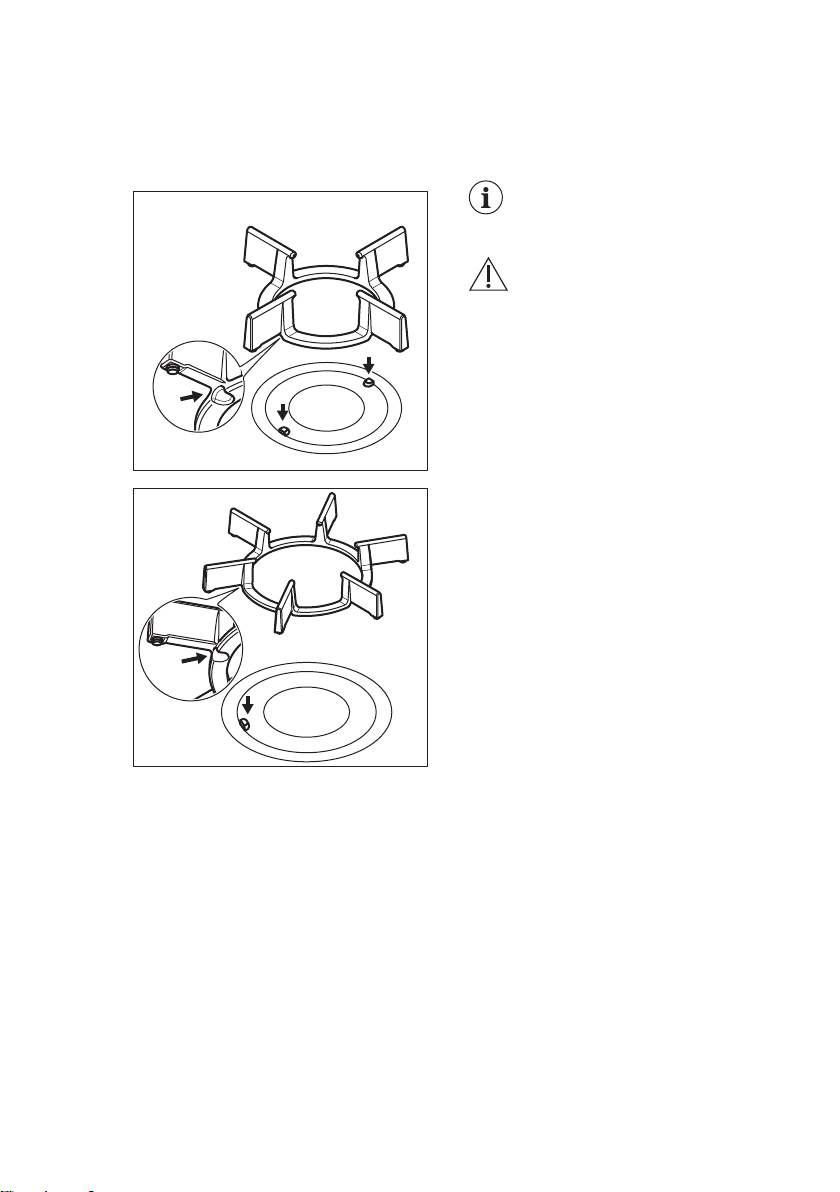
Topfträger richtig einzusetzen,
vergewissern Sie sich, dass ein Arm des
Topfträgers wie abgebildet passend zu
den Halterungen am Brennerfuß
positioniert wird. Auf diese Weise sitzt
der Topfträger fest und sicher.
7.4 Reinigen des Kochfelds
• Folgendes muss sofort entfernt
werden: geschmolzener Kunststoff,
Plastikfolie, Zucker bzw. zuckerhaltige
Lebensmittel. Andernfalls können die
Verschmutzungen das Kochfeld
beschädigen. Achten Sie darauf, dass
sich niemand Verbrennungen zuzieht.
• Folgendes kann nach ausreichender
Abkühlung des Kochfelds entfernt
werden: Kalk- und Wasserränder,
Fettspritzer und metallisch
schimmernde Verfärbungen. Reinigen
Sie das Kochfeld mit einem feuchten
Tuch und nicht scheuernden
Reinigungsmittel. Wischen Sie das
Kochfeld nach der Reinigung mit
einem weichen Tuch trocken.
7.5 Reinigen der
Flammenverteiler
Die Flammenverteiler
können Sie im
Geschirrspüler reinigen.
WARNUNG!
Lassen Sie die
Flammenverteiler vor dem
Reinigen abkühlen.
Leicht verschmutzt:
Reinigen Sie den Flammenverteiler mit
warmem Wasser und Spülmittel und
trocknen Sie ihn mit einem weichen Tuch
ab.
Mäßig verschmutzt:
Verwenden Sie den Geschirrspüler.
Legen Sie den Flammenverteiler flach
und mit der Oberseite nach oben auf die
untere Ablage.
Stark verschmutzt:
Reinigen Sie den Flammenverteiler mit
warmem Wasser und Spülmittel und im
Geschirrspüler. Sind immer noch Flecken
zu sehen, reinigen Sie die Oberseite des
Flammenverteilers mit einem
Grillreiniger und dann erneut im
Geschirrspüler.
Verwenden Sie zur Reinigung der Löcher
im Flammenverteiler einen Zahnstocher.
7.6 Reinigen der Zündkerze
Diese Funktion erfolgt über eine
Keramikzündkerze mit Metallelektrode.
Halten Sie zur Vermeidung von
Zündschwierigkeiten diese Bauteile
immer sauber; kontrollieren Sie
außerdem, ob die Düsen der
Brennerkrone verstopft sind.
7.7 Regelmäßige Wartung
Lassen Sie regelmäßig vom Ihrem
autorisierten Kundendienst den Zustand
des Gasversorgungsrohrs und, falls
installiert, die Funktionstüchtigkeit des
Druckreglers überprüfen.
www.aeg.com
32
8. FEHLERSUCHE
WARNUNG!
Siehe Kapitel
"Sicherheitshinweise".
8.1 Was tun, wenn ...
Störung Mögliche Ursache Abhilfe
Es wird kein Funke erzeugt,
wenn Sie den Funkenerzeu-
ger betätigen.
Das Kochfeld ist nicht oder
nicht ordnungsgemäß an die
Spannungsversorgung ange-
schlossen.
Prüfen Sie, ob das Kochfeld
ordnungsgemäß an die
Spannungsversorgung ange-
schlossen ist.
Die Sicherung ist durchge-
brannt.
Vergewissern Sie sich, dass
die Sicherung der Grund für
die Störung ist. Brennt die
Sicherung wiederholt durch,
wenden Sie sich an eine zu-
gelassene Elektrofachkraft.
Der Flammenverteiler sitzt
nicht richtig.
Bringen Sie den Flammen-
verteiler in die richtige Posi-
tion.
Die Flamme erlischt gleich
nach der Zündung wieder.
Das Thermoelement ist nicht
ausreichend erwärmt.
Halten Sie den Knopf nach
dem Entzünden etwa 10 Se-
kunden lang gedrückt.
Der Flammenring ist un-
gleichmäßig.
Die Öffnungen des Flam-
menverteilers sind mit Spei-
serückständen zugesetzt.
Vergewissern Sie sich, dass
der Flammenverteiler sauber
ist.
8.2 Wenn Sie das Problem
nicht lösen können...
Wenn Sie das Problem nicht selbst lösen
können, wenden Sie sich an Ihren
Händler oder einen autorisierten
Kundendienst. Geben Sie die Daten, die
Sie auf dem Typenschild finden, an.
Vergewissern Sie sich, dass Sie das
Kochfeld korrekt bedient haben. Wenn
Sie das Gerät falsch bedient haben, fällt
auch während der Garantiezeit für die
Reparatur durch einen Techniker oder
Händler eine Gebühr an. Die
Informationen zum Kundendienst und
die Garantiebedingungen finden Sie im
Garantieheft.
DEUTSCH 33
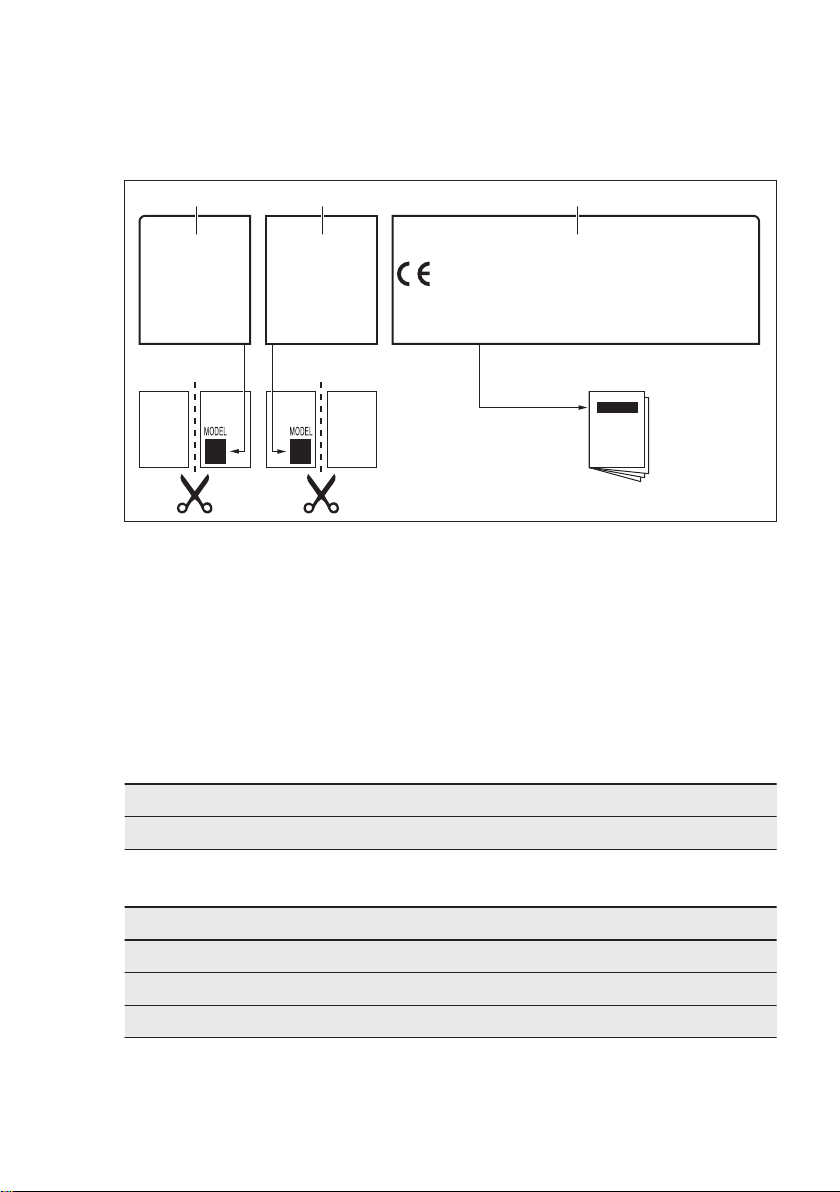
8.3 Im Zubehörbeutel
mitgelieferte Aufkleber
Bringen Sie die Aufkleber, wie unten
gezeigt, an:
MOD.
PROD.NO.
SER.NO
DATA
MOD.
PROD.NO.
SER.NO
DATA
MOD.
PROD.NO.
SER.NO.
03 IT
MADE IN ITALY
TYPE
IP20
0049
A B C
A. Kleben Sie ihn auf die Garantiekarte
und verschicken Sie diesen Teil (falls
vorhanden).
B. Kleben Sie ihn auf die Garantiekarte
und behalten Sie diesen Teil (falls
vorhanden).
C. Kleben Sie ihn auf die
Gebrauchsanleitung.
9. TECHNISCHE DATEN
9.1 Abmessungen des Kochfelds
Breite 740 mm
Tiefe 510 mm
9.2 Bypassdurchmesser
BRENNER Ø BYPASS 1/100 mm
Starkbrenner 52
Normalbrenner 35
Hilfsbrenner 32
www.aeg.com34
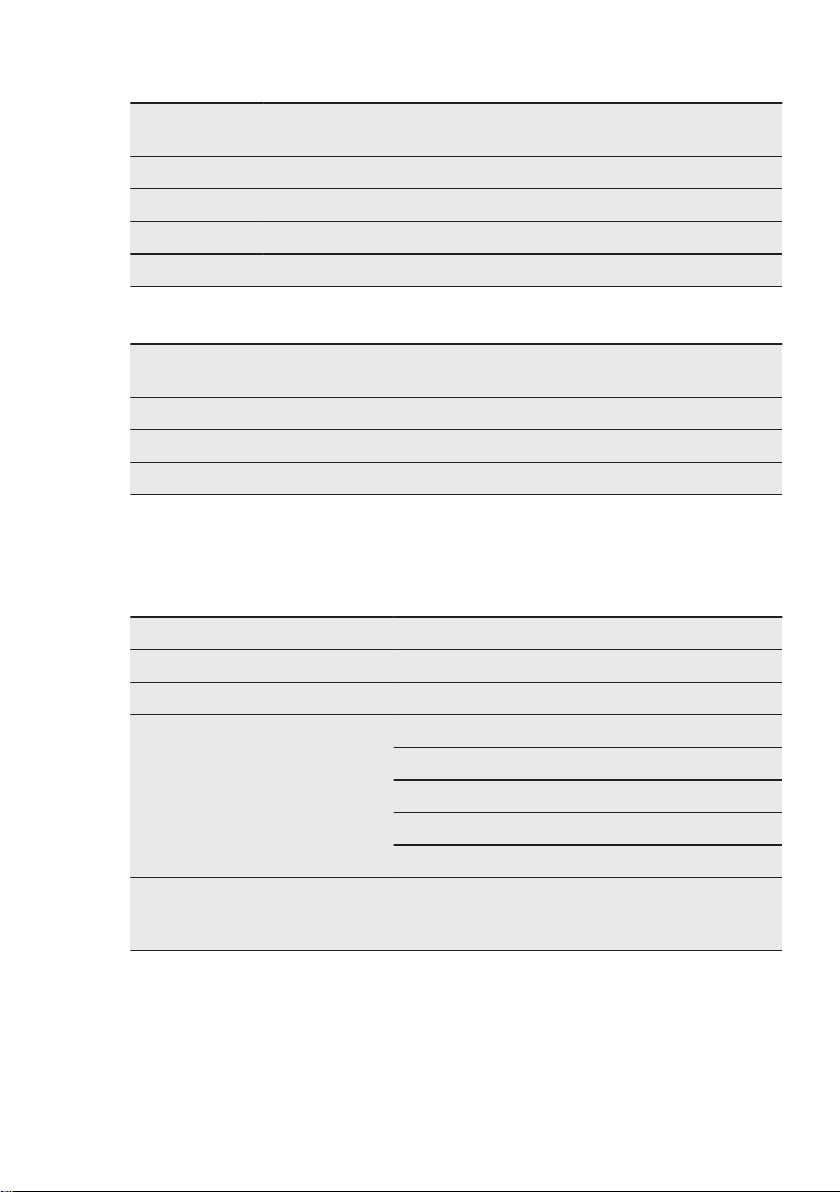
9.3 Sonstige technische Daten
GESAMTLEIS-
TUNG:
Gas - Original: G20 (2H) 20 mbar 8,9 kW
Netzanschluss: 220 - 240 V ~ 50 - 60 Hz
Gerätekategorie: I2H
Gasanschluss: G 1/2"
Geräteklasse: 3
9.4 Gasbrenner für ERDGAS G20 20 mbar
BRENNER NORMALLEISTUNG
kW
MINDESTLEISTUNG
kW
INJEKTORMARKE
1/100 mm
Starkbrenner 2,9 1,2 120B
Normalbrenner 2,0 0,75 102
Hilfsbrenner 1,0 0,5 73F
10. ENERGIEEFFIZIENZ
10.1 Produktinformationen gemäß EU 66/2014
Modellidentifikation HG795840NB
Kochfeldtyp Einbau-Kochfeld
Anzahl der Gasbrenner 5
Energieeffizienz pro Gasbrenner
(EE gas burner)
Mitte - Starkbrenner 56.9%
Hinten links - Normalbrenner 61.2%
Hinten rechts - Normalbrenner 61.2%
Vorne links - Hilfsbrenner nicht zutreffend
Vorne rechts - Hilfsbrenner nicht zutreffend
Energieeffizienz für das Gaskoch-
feld
(EE gas hob)
59.7%
EN 30-2-1: Haushalt-Kochgeräte für gasförmige Brennstoffe - Teil 2-1: Rationelle
Energienutzung - Allgemeines
10.2 Energie sparen
• Achten Sie vor dem Gebrauch darauf, dass die Brenner und Topfträger richtig
zusammengebaut sind.
• Verwenden Sie nur Kochgeschirr mit einem Durchmesser, der der Größe der
Brenner entspricht.
DEUTSCH
35

• Stellen Sie den Topf mittig auf den Brenner.
• Wenn Sie Wasser erwärmen, verwenden Sie nur die benötigte Menge.
• Decken Sie Kochgeschirr, wenn möglich, mit einem Deckel ab.
• Drehen Sie, sobald die Flüssigkeit zu kochen beginnt, die Flamme so weit zurück,
dass die Flüssigkeit nur leicht köchelt.
• Verwenden Sie nach Möglichkeit einen Dampfkochtopf. Beachten Sie seine
Bedienungsanleitung.
11. UMWELTTIPPS
Recyceln Sie Materialien mit dem Symbol
. Entsorgen Sie die Verpackung in den
entsprechenden Recyclingbehältern.
Recyceln Sie zum Umwelt- und
Gesundheitsschutz elektrische und
elektronische Geräte. Entsorgen Sie
Geräte mit diesem Symbol nicht mit
dem Hausmüll. Bringen Sie das Gerät zu
Ihrer örtlichen Sammelstelle oder
wenden Sie sich an Ihr Gemeindeamt.
www.aeg.com36
INDICE
1. INFORMAZIONI DI SICUREZZA...............................................................................37
2. ISTRUZIONI DI SICUREZZA...................................................................................... 40
3. INSTALLAZIONE........................................................................................................43
4. DESCRIZIONE DEL PRODOTTO............................................................................. 46
5. UTILIZZO QUOTIDIANO.......................................................................................... 47
6. CONSIGLI E SUGGERIMENTI UTILI........................................................................ 48
7. PULIZIA E CURA.........................................................................................................48
8. RISOLUZIONE DEI PROBLEMI.................................................................................50
9. DATI TECNICI............................................................................................................ 51
10. EFFICIENZA ENERGETICA.................................................................................... 52
PER RISULTATI PERFETTI
Grazie per aver scelto di acquistare questo prodotto AEG. Lo abbiamo creato per
fornirvi prestazioni impeccabili per molti anni, grazie a tecnologie innovative che
vi semplificheranno la vita - funzioni che non troverete sulle normali
apparecchiature. Vi invitiamo di dedicare qualche minuto alla lettura per sapere
come trarre il massimo dal vostro elettrodomestico.
Visitate il nostro sito web per:
Ricevere consigli, scaricare i nostri opuscoli, eliminare eventuali anomalie,
ottenere informazioni sull'assistenza e la riparazione:
www.aeg.com/support
Per registrare il vostro prodotto e ricevere un servizio migliore:
www.registeraeg.com
Acquistare accessori, materiali di consumo e ricambi originali per la vostra
apparecchiatura:
www.aeg.com/shop
SERVIZIO CLIENTI E MANUTENZIONE
Consigliamo sempre l’impiego di ricambi originali.
Quando si contatta l'Assistenza, accertarsi di disporre dei seguenti dati: Modello,
PNC, numero di serie.
Le informazioni si trovano sulla targhetta dei dati.
Avvertenza / Attenzione - Importanti Informazioni di Sicurezza.
Informazioni e consigli generali
Informazioni ambientali
Con riserva di modifiche.
1.
INFORMAZIONI DI SICUREZZA
Leggere attentamente le istruzioni fornite prima di
installare e utilizzare l'apparecchiatura. I produttori non
sono responsabili di eventuali lesioni o danni derivanti
da un'installazione o un uso scorretti. Conservare
ITALIANO
37

sempre le istruzioni in un luogo sicuro e accessibile per
poterle consultare in futuro.
1.1 Sicurezza dei bambini e delle persone
vulnerabili
• L'apparecchiatura può essere usata da bambini di età
8 anni e oltre e da persone con capacità ridotte, a
condizione che siano stati debitamente istruiti e/o
supervisionati in merito all'uso sicuro
dell'apparecchiatura e a condizione che comprendano
i potenziali pericoli previsti.
• Non consentire ai bambini di giocare con
l'apparecchiatura.
• Tenere gli imballaggi lontano dai bambini e smaltirli in
modo adeguato.
• Tenere i bambini e gli animali domestici lontano
dall'apparecchiatura durante il funzionamento o
raffreddamento. Le parti accessibili sono
incandescenti.
• Se l'apparecchiatura ha un dispositivo di sicurezza per
i bambini sarà opportuno attivarlo.
• I bambini non devono eseguire interventi di pulizia e
manutenzione sull'apparecchiatura senza essere
supervisionati.
• I bambini di 3 anni e di età inferiore vanno tenuti alla
larga dall'apparecchiatura quando è in funzione, in
ogni momento.
1.2
Avvertenze di sicurezza generali
• AVVERTENZA: L'apparecchiatura e le parti accessibili
si riscaldano molto durante l'uso. Abbiate cura di non
toccare gli elementi riscaldanti. Tenere lontani i
bambini al di sotto dei 8 anni se non costantemente
supervisionati.
• Non utilizzare un timer esterno o un sistema di
controllo remoto distinto per mettere in funzione
l'apparecchiatura.
www.aeg.com
38

• AVVERTENZA: Non lasciare mai il piano di cottura
incustodito durante la preparazione di cibi in quanto
olio e grassi potrebbero provocare un incendio.
• Non tentare MAI di spegnere un incendio con
dell'acqua; spegnere l'apparecchiatura e coprire le
fiamme ad es. con un coperchio o una coperta di
protezione dal fuoco.
• ATTENZIONE: Il processo di cottura deve essere
sorvegliato. Un breve processo di cottura deve essere
supervisionato senza soluzione di continuità.
• AVVERTENZA: Pericolo di incendio: Non conservare
nulla sulle superfici di cottura.
• Oggetti metallici quali coltelli, forchette, cucchiai e
coperchi non dovrebbero essere posti sulla superficie
del piano di cottura in quanto possono diventare
caldi.
• Non usare una pulitrice a vapore per pulire
l'apparecchiatura.
• Se la superficie di vetroceramica/vetro presenta delle
crepe, spegnere l'apparecchiatura per evitare il rischio
di scossa elettrica.
• In caso di rottura del vetro della piastra:
– spegnere immediatamente tutti i bruciatori e le
resistenze elettriche, quindi staccare
l'apparecchiatura dalla rete elettrica.
– non toccare la superficie dell'apparecchiatura,
– non utilizzare l'apparecchiatura.
• Se il cavo di alimentazione è danneggiato, deve
essere sostituito dal produttore, da un tecnico
autorizzato o da una persona qualificata per evitare
situazioni di pericolo.
• Quando l'apparecchiatura è collegata direttamente
all'alimentazione elettrica, è necessario un interruttore
isolante onnipolare. È necessario che
l’apparecchiatura si scolleghi completamente dalla
rete conformemente alle condizioni della categoria III
relativa alla sovratensione. Il cavo di terra è escluso.
ITALIANO
39
• Quando si collega il cavo di alimentazione, assicurarsi
che non sia a contatto diretto (ad es. mediante
l'impiego di manicotti di isolamento) con parti che
possono raggiungere temperature superiori ai 50°C.
• AVVERTENZA: Servirsi unicamente di protezioni per il
piano cottura progettate dal produttore
dell'apparecchiatura o indicate dallo stesso nelle
istruzioni d'uso, ad esempio accessori idonei o le
protezioni del piano cottura incorporate
nell'apparecchiatura. L'uso inadeguato delle
protezioni può causare incidenti.
2. ISTRUZIONI DI SICUREZZA
Questa apparecchiatura è adatta ai
seguenti mercati: IT
2.1 Installazione
AVVERTENZA!
L’installazione
dell'apparecchiatura deve
essere eseguita da
personale qualificato.
Prima di procedere con
l’installazione, verificare che
le condizioni di distribuzione
locale (pressione e tipo di
gas) e i valori preimpostati
dell’apparecchiatura siano
compatibili.
• Rimuovere tutti i materiali di
imballaggio.
• Non installare o utilizzare
l'apparecchiatura se è danneggiata.
• Attenersi alle istruzioni fornite insieme
all'apparecchiatura.
• È necessario rispettare la distanza
minima dalle altre apparecchiature.
• Prestare sempre attenzione in fase di
spostamento dell'apparecchiatura,
dato che è pesante. Usare sempre i
guanti di sicurezza e le calzature
adeguate.
• Proteggere le superfici di taglio con
un materiale di tenuta per evitare che
l'umidità causi dei rigonfiamenti.
• Proteggere la base
dell'apparecchiatura da vapore e
umidità.
• Non installare l'apparecchiatura
accanto ad una porta o sotto una
finestra, per evitare che pentole calde
cadano dall'apparecchiatura quando
la porta o la finestra sono aperte.
• Se l'apparecchiatura viene installata
sopra dei cassetti, assicurarsi che lo
spazio, tra la base
dell'apparecchiatura e il cassetto
superiore, sia sufficiente per il ricircolo
d'aria.
• La base dell'apparecchiatura può
surriscaldarsi. Si consiglia di installare
un pannello divisorio in materiale non
infiammabile al di sotto
dell'apparecchiatura per rendere
inaccessibile la base.
2.2 Collegamento elettrico
AVVERTENZA!
Rischio di incendio e scossa
elettrica.
• Tutti i collegamenti elettrici devono
essere realizzati da un elettricista
qualificato.
• L'apparecchiatura deve disporre di
una messa a terra.
• Prima di qualsiasi intervento, è
necessario verificare che
l'apparecchiatura sia scollegata dalla
rete elettrica.
www.aeg.com
40
• Verificare che i dati elettrici riportati
sulla targhetta dei dati corrispondano
a quelli dell'impianto. In caso
contrario, contattare un elettricista.
• Verificare che l'apparecchiatura sia
installata correttamente.
L'allentamento di un collegamento
elettrico o di una spina (ove previsti)
può provocare il surriscaldamento del
terminale.
• Utilizzare il cavo di alimentazione
appropriato.
• Evitare che i collegamenti elettrici si
aggroviglino.
• Assicurarsi che la protezione da
scosse elettriche sia installata.
• Utilizzare il morsetto fermacavo sul
cavo.
• Assicurarsi che il cavo di
alimentazione o la spina (ove prevista)
non sfiori l'apparecchiatura calda o
pentole calde quando si collega
l'apparecchiatura alle prese vicine
• Non utilizzare prese multiple e
prolunghe.
• Accertarsi di non danneggiare la
spina e il cavo (ove previsti).
Contattare il nostro Centro di
Assistenza autorizzato o un elettricista
qualificato per sostituire un cavo
danneggiato.
• I dispositivi di protezione da scosse
elettriche devono essere fissati in
modo tale da non poter essere
disattivati senza l'uso di attrezzi.
• Inserire la spina di alimentazione nella
presa solo al termine
dell'installazione. Verificare che la
spina di alimentazione rimanga
accessibile dopo l'installazione.
• Nel caso in cui la spina di corrente sia
allentata, non collegarla alla presa.
• Non tirare il cavo di alimentazione per
scollegare l’apparecchiatura. Tirare
solo la spina.
• Servirsi unicamente di dispositivi di
isolamento adeguati: interruttori
automatici, fusibili (quelli a tappo
devono essere rimossi dal
portafusibile), sganciatori per correnti
di guasto a terra e relé.
• L'impianto elettrico deve essere
dotato di un dispositivo di isolamento
che consenta di scollegare
l'apparecchiatura dalla presa di
corrente a tutti i poli. Il dispositivo di
isolamento deve avere una larghezza
dell'apertura di contatto non inferiore
ai 3 mm.
2.3 Collegamento gas
• Tutti i collegamenti del gas devono
essere eseguiti da una persona
qualificata.
• Prima di procedere con l’installazione,
verificare che le condizioni di
distribuzione locale (pressione e tipo
di gas) e i valori preimpostati
dell’apparecchiatura siano
compatibili.
• Adottare le misure necessarie per
garantire una corretta circolazione
d'aria intorno all'apparecchiatura.
• Le informazioni relative
all'alimentazione del gas si trovano
sulla targhetta dei dati.
• La presente apparecchiatura non è
collegata a un dispositivo per
l’evacuazione dei residui di
combustione. Assicurarsi di collegare
l'apparecchiatura conformemente alle
disposizioni vigenti sull'installazione.
Fare attenzione ai requisiti relativi ad
un'adeguata ventilazione.
2.4 Utilizzo
AVVERTENZA!
Rischio di lesioni, ustioni o
scosse elettriche.
L'uso inadeguato delle
protezioni del piano di
cottura può causare
incidenti.
• Rimuovere tutti i materiali di
imballaggio, le etichette e la pellicola
protettiva (ove presente) prima del
primo utilizzo.
• Utilizzare l’apparecchiatura in un
ambiente domestico.
• Non modificare le specifiche tecniche
dell'apparecchiatura.
• Accertarsi che le fessure di
ventilazione non siano ostruite.
• Non lasciare mai l'apparecchiatura
incustodita durante il funzionamento.
• Spegnere la zona di cottura dopo
ogni utilizzo.
• Non appoggiare posate o coperchi
sulle zone di cottura. Possono
diventare roventi.
ITALIANO
41
• Non mettere in funzione
l'apparecchiatura con le mani umide o
quando c'è un contatto con l'acqua.
• Non utilizzare l'apparecchiatura come
superficie di lavoro o come piano di
appoggio.
• Un alimento immerso nell'olio molto
caldo può provocare degli schizzi.
AVVERTENZA!
Pericolo di incendio ed
esplosioni.
• Grassi e olio caldi possono rilasciare
vapori infiammabili. Mantenere
fiamme o oggetti caldi lontani da
grassi e olio quando li si utilizza per
cucinare.
• I vapori rilasciati da un olio molto
caldo possono provocare una
combustione spontanea.
• L'olio usato, che può contenere
residui di cibo, può liberare delle
fiamme ad una temperatura inferiore
rispetto ad un olio utilizzato per la
prima volta.
• Non appoggiare o tenere liquidi o
materiali infiammabili, né oggetti
facilmente incendiabili
sull'apparecchiatura, al suo interno o
nelle immediate vicinanze.
AVVERTENZA!
Vi è il rischio di danneggiare
l'apparecchiatura.
• Non poggiare pentole calde sul
pannello dei comandi.
• Non esporre al calore pentole vuote.
• Fare attenzione a non lasciar cadere
oggetti o pentole
sull'apparecchiatura. La superficie si
potrebbe danneggiare.
• Non mettere in funzione le zone di
cottura in assenza di pentole o con
pentole vuote.
• Non appoggiare la pellicola di
alluminio direttamente
sull'apparecchiatura.
• Lo spostamento di pentole in ghisa, in
alluminio o con fondi danneggiati può
graffiare il vetro o la vetroceramica.
Per spostare questi oggetti sollevarli
sempre dalla superficie di cottura.
• Utilizzare solo pentole stabili, di forma
corretta e con un diametro superiore
alle dimensioni dei bruciatori.
• Assicurarsi che le pentole siano
posizionate al centro dei bruciatori.
• Accertarsi che la
fiamma non si
spenga quando si gira rapidamente la
manopola dalla posizione massima a
quella minima.
• Usare esclusivamente gli accessori in
dotazione con l'apparecchiatura.
• Non utilizzare un diffusore di fiamma
sul bruciatore.
• Un'apparecchiatura per cottura a gas
produce calore e umidità. Provvedere
ad un'adeguata ventilazione
nell'ambiente in cui si trova
l'apparecchiatura.
• Se si prevede un impiego prolungato
e intenso dell’apparecchiatura, può
essere necessaria un’ulteriore fonte di
aerazione, per esempio l’apertura di
una finestra o un sistema più efficace,
come l’aumento del livello di
ventilazione meccanica, ove presente.
• L'apparecchiatura è destinata solo alla
cottura. Non deve essere utilizzata
per altri scopi, come per esempio il
riscaldamento di un ambiente.
• Non lasciare che sostanze acide,
come per esempio aceto, succo di
limone od anticalcari vengano a
contatto con il piano di cottura. Si
potrebbero formare delle macchie
opache.
• Lo scolorimento dello smalto non
influisce sulle prestazioni
dell'apparecchiatura.
2.5 Pulizia e cura
• Pulire regolarmente l'apparecchiatura
per evitare il deterioramento dei
materiali che compongono la
superficie.
• Disattivare l'apparecchiatura e
lasciarla raffreddare prima di
procedere con la pulizia.
• Scollegare l’apparecchiatura dalla
rete elettrica prima di eseguire le
operazioni di manutenzione.
• Non nebulizzare acqua né utilizzare
vapore per pulire l'apparecchiatura.
• Pulire l'apparecchiatura con un panno
inumidito e morbido. Utilizzare solo
detergenti neutri. Non usare prodotti
abrasivi, spugnette abrasive, solventi
od oggetti metallici.
www.aeg.com
42
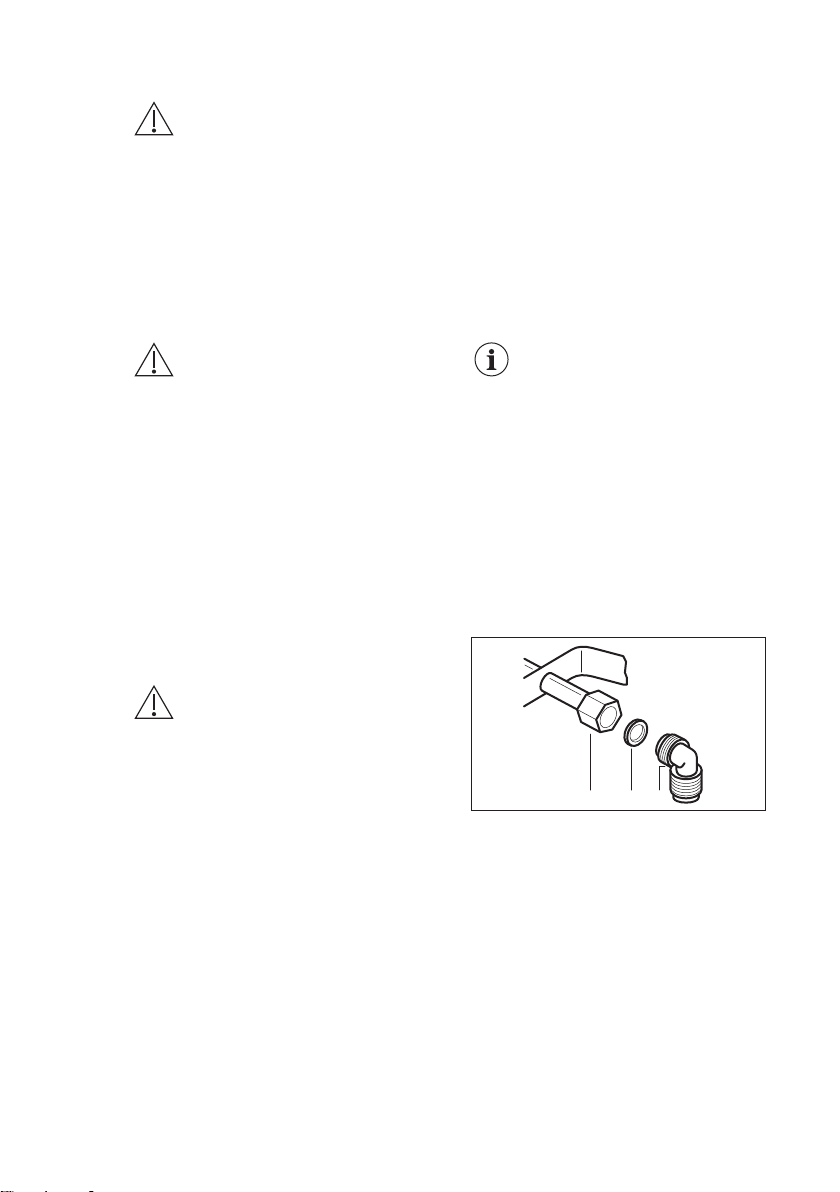
2.6 Smaltimento
AVVERTENZA!
Rischio di lesioni o
soffocamento.
• Rivolgersi all'autorità municipale per
informazioni su come smaltire
correttamente l'elettrodomestico.
• Staccare la spina dall'alimentazione
elettrica.
• Tagliare il cavo elettrico
dell'apparecchiatura e smaltirlo.
• Appiattire i tubi del gas esterni.
2.7 Assistenza Tecnica
• Per riparare l'apparecchiatura
contattare il Centro di Assistenza
Autorizzato.
• Utilizzare esclusivamente ricambi
originali.
3. INSTALLAZIONE
AVVERTENZA!
Fare riferimento ai capitoli
sulla sicurezza.
3.1 Prima dell'installazione
Prima di installare il piano di cottura,
annotare l'informazione riportata di
seguito presente sulla targhetta dei dati.
La targhetta dei dati è applicata sul lato
inferiore del piano di cottura.
Modello ...........................
PNC .........................................
Numero di serie ...........................
3.2 Collegamento gas
AVVERTENZA!
Le seguenti istruzioni
d'installazione,
manutenzione e ventilazione
devono essere eseguite da
personale qualificato
conformemente alle
disposizioni vigenti (UNI-CIG
7129 - 7131). Accertarsi che
la cucina sia adeguatamente
ventilata: tenere aperti i fori
di ventilazione naturali
(almeno 100 cm²) o installare
una cappa meccanica.
Scegliere dei collegamenti fissi o usare
un tubo flessibile in acciaio inossidabile
conforme alle disposizioni vigenti. Se si
utilizzano tubi in metallo flessibili, fare
attenzione che non entrino in contatto
con parti mobili o non siano schiacciati.
Ulteriore attenzione è richiesta qualora al
piano di cottura fosse abbinato il forno.
Accertarsi che la pressione
del gas di alimentazione
dell'apparecchiatura sia
conforme ai valori
consigliati.
Se la pressione fornita non ha il valore
specificato, è necessario montare un
adeguato regolatore di pressione in
conformità allo standard UNI EN 88. Il
collegamento regolabile è fissato alla
rampa per mezzo di un dado filettato G
1/2". Avvitare le parti senza forzare,
regolare il raccordo nella direzione voluta
e serrare il tutto.
A B C
A. Estremità dell'albero con dado
B. Rondella fornita in dotazione con
l'apparecchiatura
C. Gomito fornito in dotazione con
l'apparecchiatura
Collegamento rigido:
Eseguire il collegamento mediante tubi
in metallo rigidi (rame con finecorsa
meccanico) (UNI-CIG 7129).
Collegamento
flessibile:
Utilizzare un tubo flessibile in acciaio inox
(UNI-CIG 9891) con una lunghezza
massima di 2 m.
ITALIANO
43
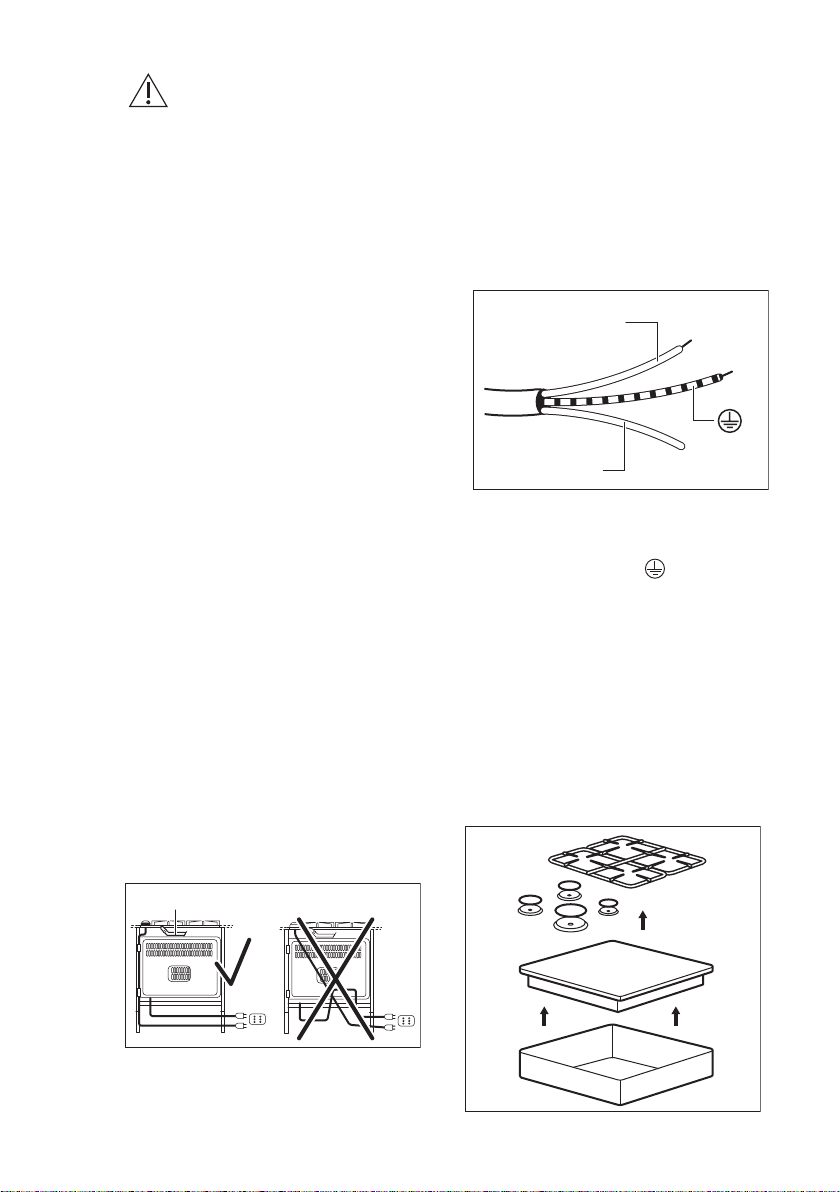
AVVERTENZA!
Al termine dell'installazione,
verificare la tenuta di ciascun
raccordo dei tubi. Usare una
soluzione saponata, non una
fiamma!
3.3 Collegamento elettrico
• Verificare che la tensione nominale e il
tipo di corrente della rete di
distribuzione corrispondano ai valori
indicati sulla targhetta dei dati
dell'apparecchiatura.
• L'apparecchiatura è provvista di cavo
di collegamento alla rete. Deve essere
dotato di una spina in grado di
supportare il carico indicato sulla
targhetta dei dati. Accertarsi di
inserire la spina nella presa corretta.
• Utilizzare sempre una presa elettrica
con contatto di protezione
correttamente installata.
• Verificare che la spina di
alimentazione rimanga accessibile
dopo l'installazione.
• Non tirare il cavo di alimentazione per
scollegare l’apparecchiatura. Tirare
sempre dalla spina.
• Collegando l'apparecchiatura a una
prolunga, adattatore o presa multipla
esiste il rischio di incendio. Accertarsi
che il collegamento di messa a terra
sia in linea con le disposizioni e le
norme in vigore.
• Il cavo di alimentazione non deve
riscaldarsi ad una temperatura
superiore a 90°C.
Per evitare il contatto tra il cavo e
l'apparecchiatura al di sotto del piano di
cottura, utilizzare dei morsetti sul lato
dell'unità.
A
A. Condotto rigido in rame o tubo
flessibile in acciaio inox
3.4 Cavo di collegamento
Per sostituire il cavo di collegamento
utilizzare esclusivamente il cavo speciale
o un suo equivalente. Il tipo di cavo è:
H05SS-F T180.
Accertarsi che il cavo sia di sezione
idonea alla tensione e alla temperatura
di esercizio. Il cavo di terra giallo/verde
deve essere circa 2 cm più lungo del
cavo di fase marrone (o nero).
L
N
1. Collegare il filo di colore verde e
giallo (terra) al morsetto
contrassegnato dalla lettera "E" o
dal simbolo di terra o colorato di
verde e giallo.
2. Collegare il filo di colore blu (neutro)
al morsetto contrassegnato dalla
lettera 'N' o colorato di blu.
3. Collegare il cavo di fase marrone
(tensione) al terminale
contrassegnato con la lettera "L".
Questo deve sempre essere
collegato alla fase di rete.
3.5 Montaggio
1.
www.aeg.com
44
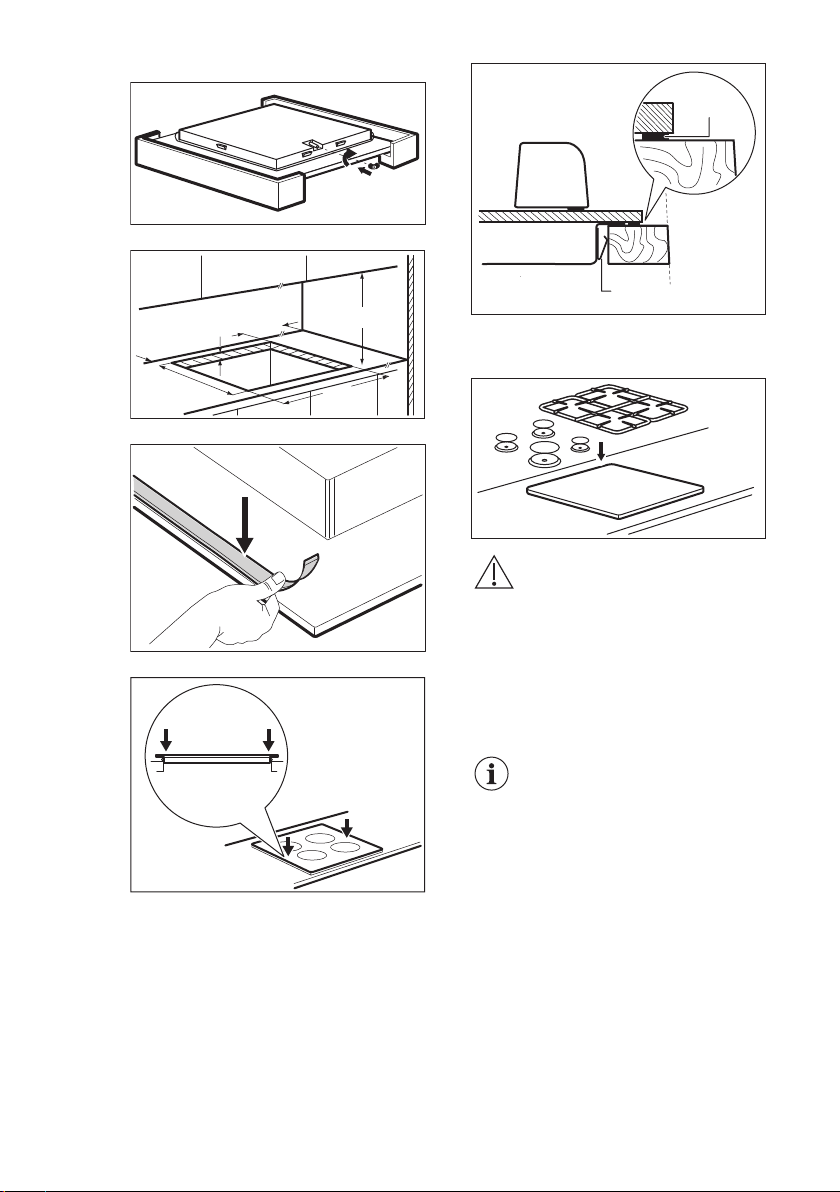
2.
3.
min.
55 mm
min.
650 mm
560 mm
490 mm
min.
150 mm
30 mm
4.
5.
6.
B
A
A) guarnizione in dotazione
B) staffa montata
7.
ATTENZIONE!
Installare l'apparecchiatura
esclusivamente su un piano
di lavoro dalla superficie
piatta.
3.6 Installazione del piano di
cottura sotto la cappa da
cucina
Se si installa il piano di
cottura sotto a una cappa da
cucina, fare riferimento alle
istruzioni per l'installazione
della cappa per la distanza
minima tra le
apparecchiature.
3.7 Possibilità di inserimento
Il pannello installato sotto il piano di
cottura deve essere facilmente rimovibile
e altrettanto facilmente deve consentire
l'accesso in caso di interventi
dell'assistenza tecnica.
ITALIANO
45
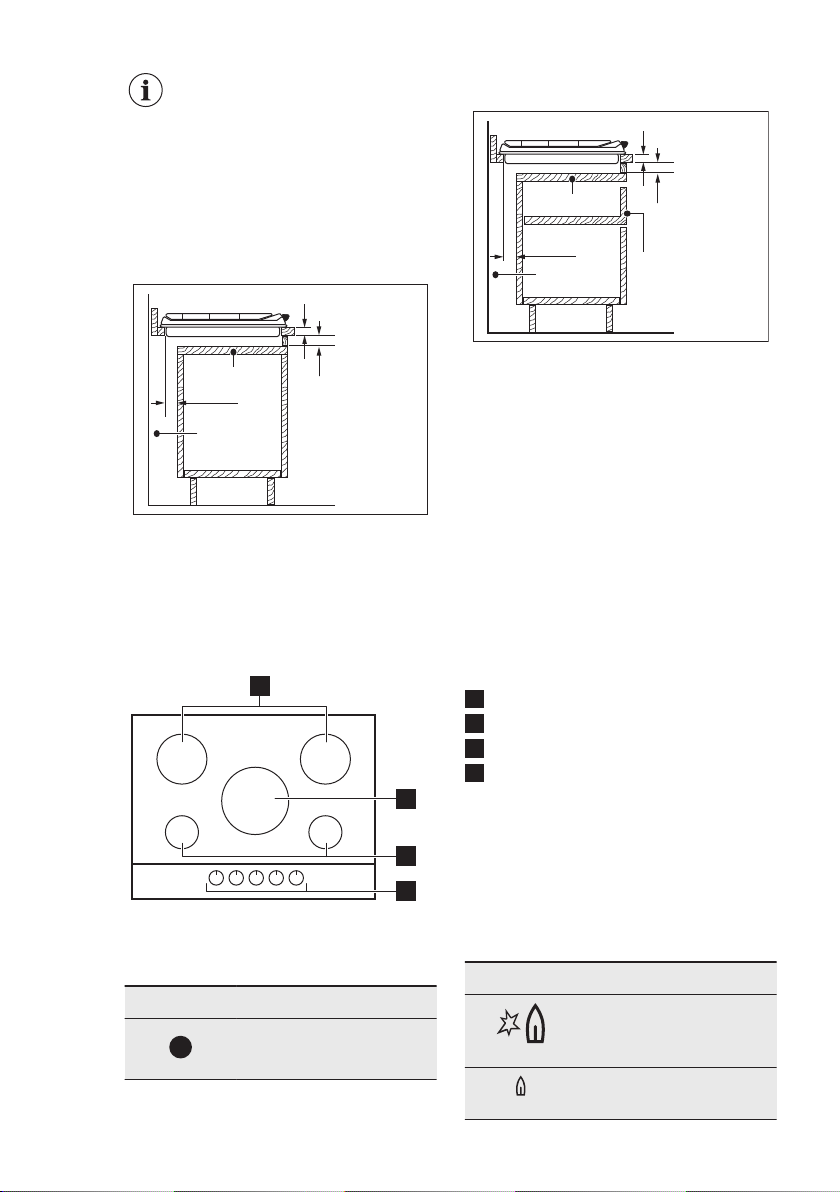
La fiamma del bruciatore
potrebbe spegnersi in
presenza di un flusso d'aria
se non è stato installato il
pannello rimovibile. Il flusso
d'aria può essere prodotto
dall'apertura o chiusura della
porta del mobile o di un
cassetto.
Unità da cucina con porta
min 20 mm
(max 150 mm)
30 mm
60 mm
B
A
A. Pannello rimovibile
B. Spazio per gli allacciamenti
Mobile da incasso con cassetto
min 20 mm
(max 150 mm)
30 mm
C
A
60 mm
B
A. Pannello rimovibile
B. Spazio per gli allacciamenti
C. Cassetto
Mobile da incasso con forno
Il collegamento elettrico del piano di
cottura e del forno deve essere eseguito
separatamente per questioni di sicurezza
oltre che per consentire una facile
rimozione del forno dall'unità.
4. DESCRIZIONE DEL PRODOTTO
4.1 Disposizione della superficie di cottura
4
3
2
1
1
Bruciatore semirapido
2
Bruciatore rapido
3
Bruciatore ausiliario
4
Manopole di regolazione
4.2 Manopola di regolazione
Simbolo Descrizione
alimentazione gas assen-
te/posizione di spento
Simbolo Descrizione
posizione di accensione/
alimentazione massima
del gas
alimentazione minima del
gas
www.aeg.com46
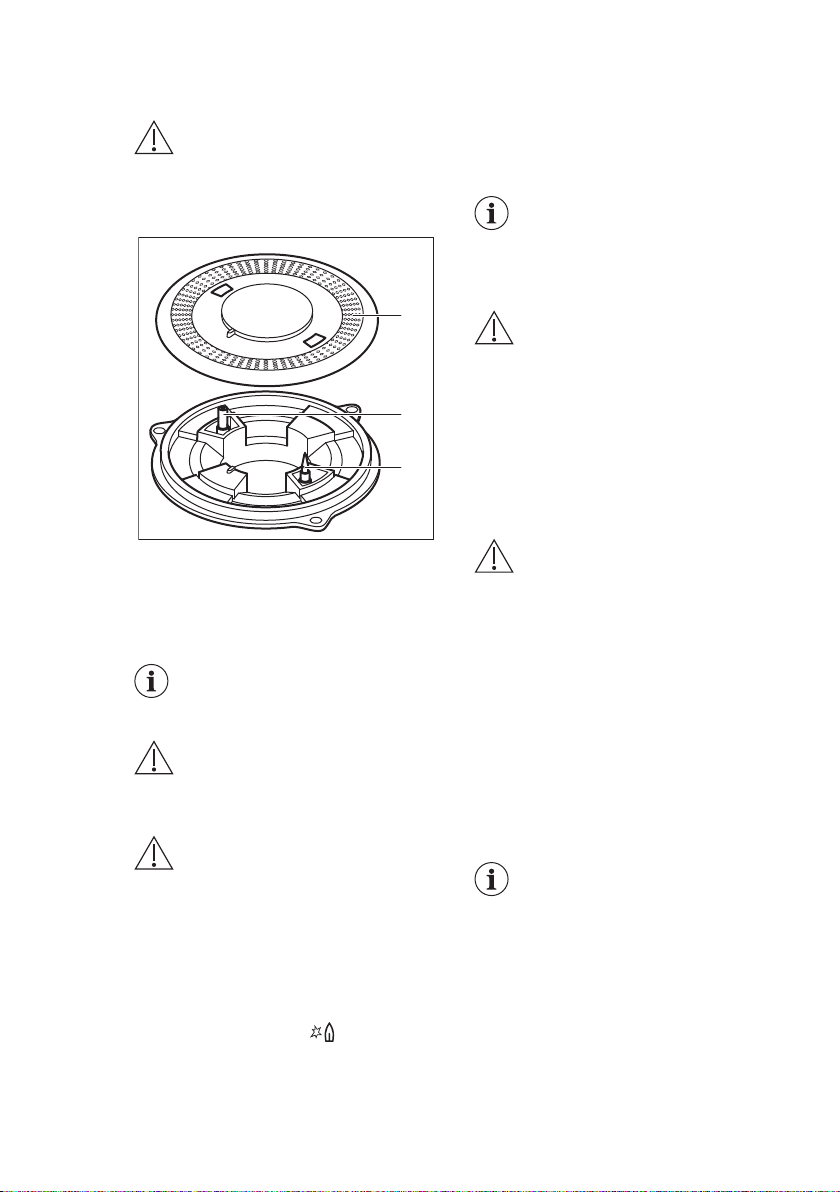
5. UTILIZZO QUOTIDIANO
AVVERTENZA!
Fare riferimento ai capitoli
sulla sicurezza.
5.1 Panoramica bruciatore
B
C
A
A. Spartifiamma
B. Candela di accensione
C. Termocoppia
5.2 Accensione del bruciatore
Accendere sempre il
bruciatore prima di
posizionare una pentola.
AVVERTENZA!
Non accendere il bruciatore
se è stato rimosso lo
spartifiamma.
AVVERTENZA!
Fare attenzione in fase di
utilizzo di fiamme libere
all'interno della cucina. Il
produttore declina qualsiasi
responsabilità in caso di
cattivo utilizzo delle fiamme.
1. Premere la manopola di regolazione
e ruotarla in senso antiorario fino alla
posizione massima ( ).
2. Tenere premuta la manopola di
regolazione per circa 10 secondi.
Questo consentirà il riscaldamento
della termocoppia. In caso contrario,
l'alimentazione del gas verrà
interrotta.
3. Regolare la fiamma, dopo che si è
stabilizzata.
Se il bruciatore non si
accende dopo alcuni
tentativi, controllare che lo
spartifiamma sia
correttamente posizionato.
AVVERTENZA!
Non tenere la manopola di
regolazione premuta per
oltre 15 secondi. Se il
bruciatore non si accende
dopo 15 secondi, rilasciare la
manopola di regolazione,
ruotarla in posizione di
spento e attendere almeno 1
minuto prima di tentare di
riaccendere il bruciatore.
ATTENZIONE!
In assenza di elettricità è
possibile accendere il
bruciatore senza utilizzare il
dispositivo elettrico; in tal
caso sarà sufficiente
avvicinarsi al bruciatore con
una fiamma, premere verso il
basso la relativa manopola e
ruotarla in senso antiorario
verso la posizione di
massimo rilascio del gas.
Mantenere premuta la
manopola di regolazione per
circa 10 secondi per far
riscaldare la termocoppia.
Nel caso in cui il bruciatore
si dovesse spegnere, ruotare
la manopola di regolazione
in posizione di spento per
cercare di riaccendere il
bruciatore dopo almeno 1
minuto.
ITALIANO 47
Il generatore di scintille si
avvia in modo automatico
all'accensione delle prese,
dopo l'installazione o dopo
un'interruzione di corrente. È
normale.
Il piano di cottura viene
fornito con delle valvole
progressive. Queste
rendono la regolazione della
fiamma più precisa.
5.3 Spegnimento del
bruciatore
Per spegnere la fiamma, ruotare la
manopola in posizione di spento .
AVVERTENZA!
Ridurre o spegnere sempre
la fiamma prima di
rimuovere le pentole dal
bruciatore.
6. CONSIGLI E SUGGERIMENTI UTILI
AVVERTENZA!
Fare riferimento ai capitoli
sulla sicurezza.
6.1 Pentole
ATTENZIONE!
Non usare pentole in ghisa,
teglie in terracotta o coccio,
accessori per il grill o piastre
tostapane.
AVVERTENZA!
Non mettere la stessa
pentola su due bruciatori.
AVVERTENZA!
Evitare di posare sul
bruciatore pentole instabili o
deformate per prevenire
versamenti e lesioni.
ATTENZIONE!
Assicurarsi che i manici delle
pentole non si trovino al di
sopra del bordo anteriore
del piano di cottura.
ATTENZIONE!
Assicurarsi che le pentole
siano ben centrate sul
bruciatore per ottenere la
massima stabilità e per un
consumo ridotto di gas.
ATTENZIONE!
I liquidi versati durante la
cottura possono causare la
rottura del vetro.
6.2 Diametro delle pentole
ATTENZIONE!
Usare pentole con diametro
adatto alle dimensioni dei
bruciatori.
Bruciatore Diametro delle
pentole (mm)
Rapido 180 - 260
Semi rapido 140 - 220
Ausiliario 100 - 160
7. PULIZIA E CURA
AVVERTENZA!
Fare riferimento ai capitoli
sulla sicurezza.
7.1 Informazioni generali
• Pulire il piano di cottura dopo ogni
impiego.
• Usare sempre pentole con il fondo
pulito.
• I graffi o le macchie scure sulla
superficie non compromettono il
funzionamento del piano di cottura.
• Usare un prodotto di pulizia speciale
adatto alla superficie del piano di
cottura.
www.aeg.com48
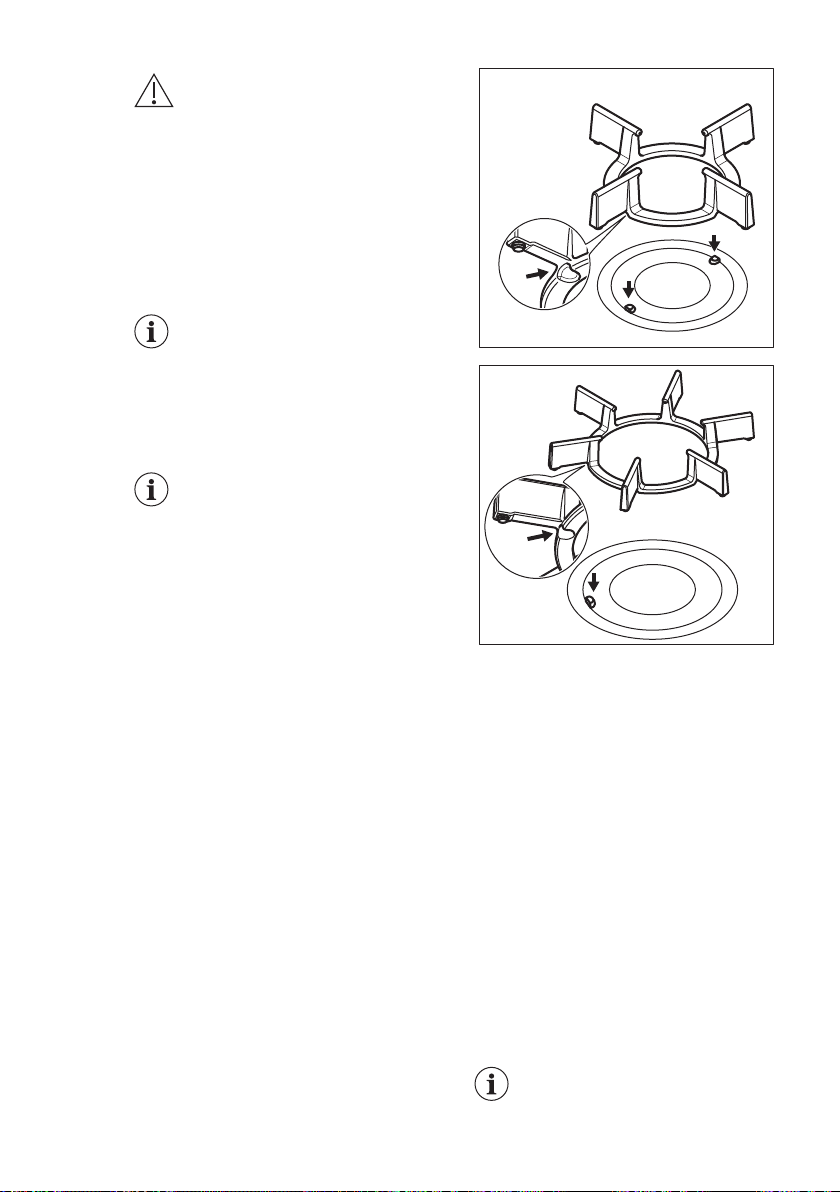
AVVERTENZA!
Non usare coltelli, raschietti
o strumenti simili per pulire
la superficie del vetro o tra i
bordi del bruciatore e del
telaio (se pertinente).
• Lavare le parti in acciaio inox con
acqua e asciugarle con un panno
morbido.
7.2 Supporti pentole
I supporti pentole non
possono essere lavati in
lavastoviglie. Devono essere
lavati a mano.
1.
È possibile rimuovere i supporti
pentole e pulire in modo facile il
piano di cottura.
Fare molta attenzione
quando si sostituiscono i
supporti pentole: il
piano di cottura si
potrebbe danneggiare.
2. Il rivestimento smaltato a volte può
presentare dei bordi ruvidi, quindi
prestare attenzione nel lavare ed
asciugare i supporti pentole a mano.
Se necessario, rimuovere le macchie
più ostinate servendosi di un
apposito prodotto in pasta.
3. Dopo aver pulito i supporti pentole,
assicurarsi che siano riposizionati
correttamente.
4. Per fare in modo che il bruciatore
funzioni correttamente, verificare che
le braccia dei supporti pentole si
trovino al centro del bruciatore.
7.3 Rimozione dei supporti
pentole
Dopo aver pulito i piani di cottura,
assicurarsi che i supporti pentole siano
posizionati correttamente. Per
posizionare correttamente i supporti
pentole, accertarsi che un braccio del
supporto sia posizionato in
corrispondenza dei punti di fissaggio alla
base del bruciatore, come illustrato in
figura. In questo modo, la griglia del
piano di cottura sarà fissa e stabile.
7.4 Pulizia del piano di cottura
• Togliere immediatamente: plastica
fusa, pellicola in plastica, zucchero e
alimenti contenenti zucchero. Se non
vengono eliminati, potrebbero
danneggiare il piano di cottura.
Attenzione a evitare le ustioni.
• Quando il piano di cottura è
sufficientemente raffreddato, è
possibile rimuovere: i segni di
calcare e d'acqua, le macchie di
grasso e le macchie opalescenti.
Pulire il piano di cottura con un panno
umido e un detergente non abrasivo.
Al termine della pulizia, asciugare il
piano di cottura con un panno
morbido.
7.5 Pulizia dello
spartifiamma
Lo spartifiamma può essere
lavato in lavastoviglie.
ITALIANO 49
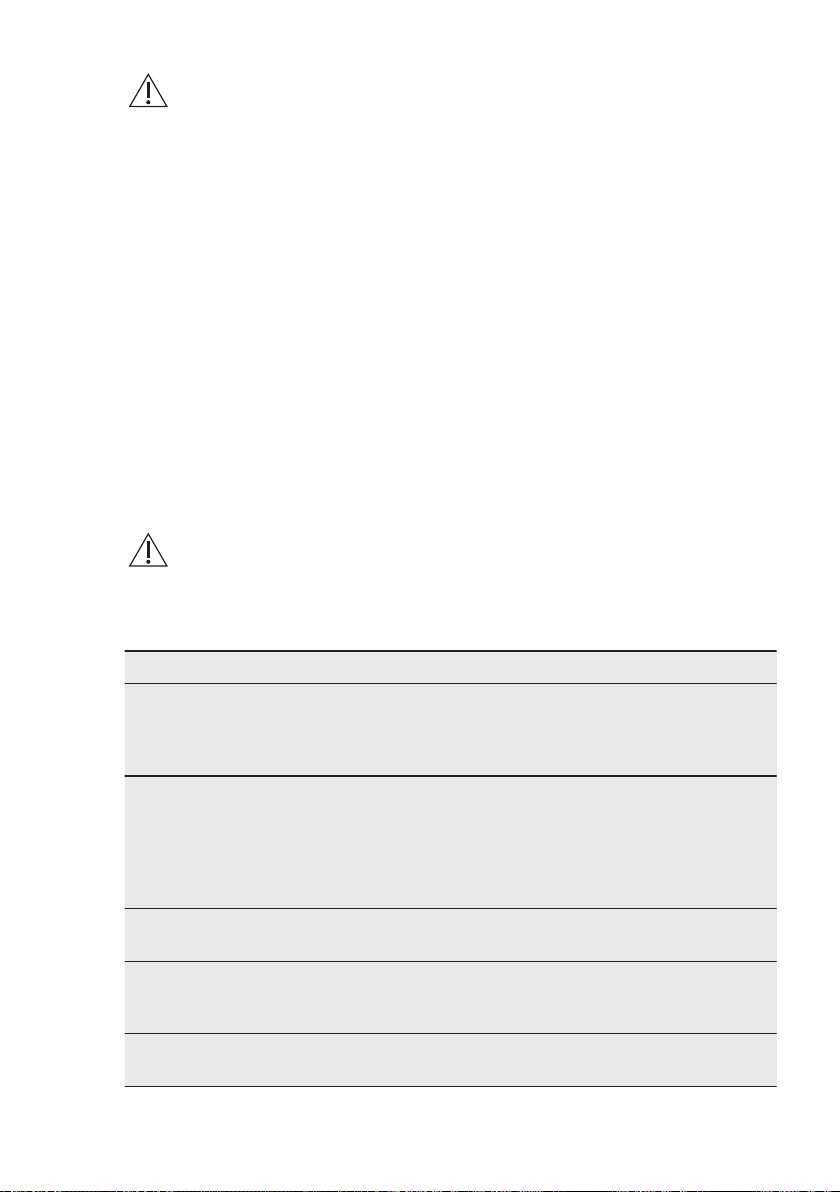
AVVERTENZA!
Lasciar raffreddare gli
spartifiamma prima di pulirli.
Macchie leggere:
Lavare lo spartifiamma con acqua calda
saponata ed asciugarlo con un panno
morbido.
Macchie medie:
Lavare in lavastoviglie. Sistemare lo
spartifiamma nel cestello inferiore in
posizione orizzontale, con il lato
superiore rivolto verso l'alto.
Macchie difficili:
Pulire lo spartifiamma con acqua calda
saponata, quindi lavarlo in lavastoviglie.
Se al termine dell'operazione sono
ancora presenti macchie, lavare la parte
superiore dello spartifiamma con un
prodotto di pulizia per il grill e avviare
nuovamente la lavastoviglie.
Utilizzare uno stecchino per pulire i fori
dello spartifiamma.
7.6 Pulizia della candela
Questa caratteristica viene ottenuta
tramite una candela ceramica ed un
elettrodo di metallo. Tenere questi
componenti ben puliti per evitare
difficoltà di accensione e controllare che i
fori spartifiamma non siano ostruiti.
7.7 Manutenzione periodica
Consultare periodicamente il Centro di
Assistenza autorizzato locale per
verificare le condizioni del tubo della
fornitura di gas e del regolatore di
pressione, se presente.
8. RISOLUZIONE DEI PROBLEMI
AVVERTENZA!
Fare riferimento ai capitoli
sulla sicurezza.
8.1 Cosa fare se...
Problema Causa possibile Soluzione
Il gas non si accende quan-
do si preme il pulsante di ac-
censione.
Il piano di cottura non è col-
legato a una fonte di alimen-
tazione elettrica o non è col-
legato correttamente.
Accertarsi che il piano di cot-
tura sia collegato corretta-
mente alla rete elettrica.
È scattato il fusibile. Verificare se l'anomalia di
funzionamento è dovuta al
fusibile. Nel caso in cui il fu-
sibile continui a scattare, ri-
volgersi ad un elettricista
qualificato.
Lo spartifiamma non è posi-
zionato correttamente.
Posizionarlo adeguatamen-
te.
La fiamma si spegne imme-
diatamente dopo l'accensio-
ne.
La termocoppia non si è ri-
scaldata a sufficienza.
Dopo aver acceso la fiamma,
tenere premuta la manopola
per circa 10 secondi.
L'anello della fiamma non è
omogeneo.
I fori dello spartifiamma so-
no ostruiti da residui di cibo.
Assicurarsi che lo spartifiam-
ma sia pulito.
www.aeg.com50
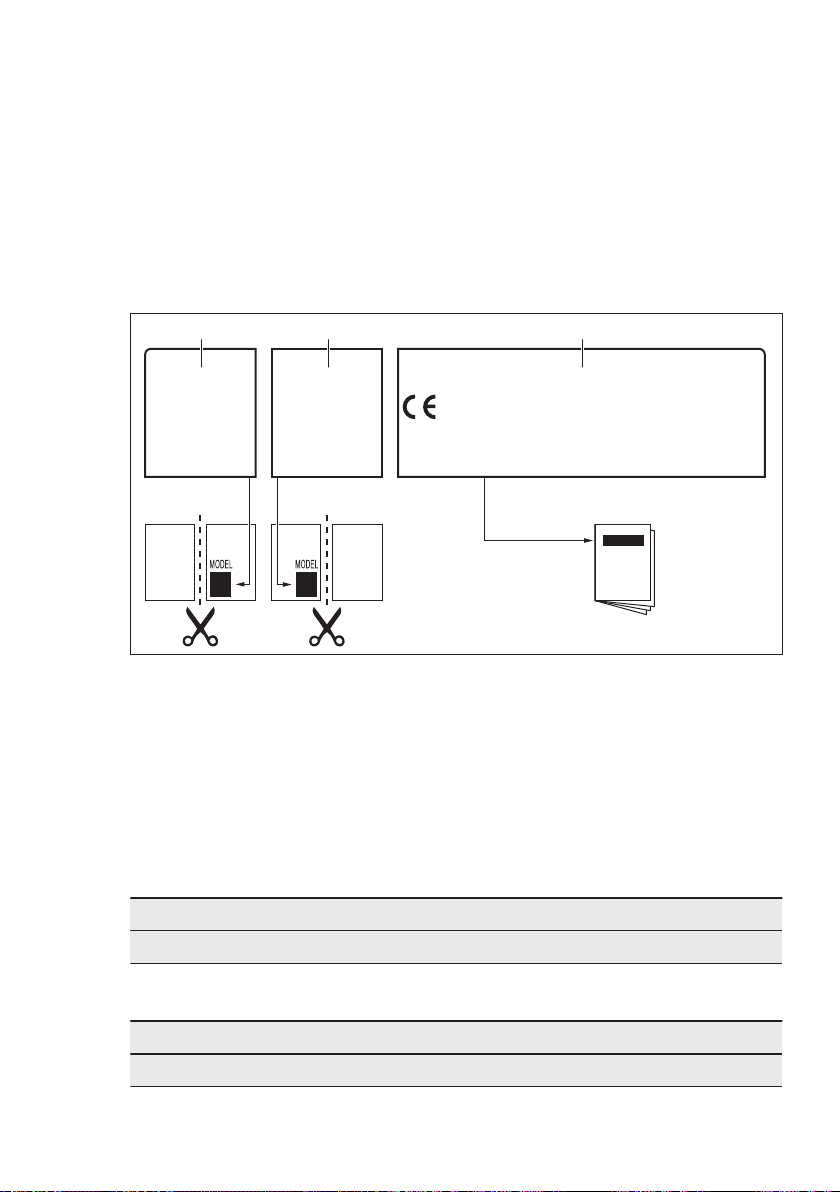
8.2 Se non è possibile trovare
una soluzione...
Qualora non sia possibile trovare una
soluzione al problema, contattare il
rivenditore o il Centro di Assistenza
Autorizzato. Fornire i dati riportati sulla
targhetta dei dati. Assicurarsi di aver
acceso il piano di cottura correttamente.
In caso di azionamento errato
dell'apparecchiatura, l'intervento del
tecnico del Centro di Assistenza o del
rivenditore potrà essere effettuato a
pagamento anche durante il periodo di
garanzia. Le istruzioni relative al Centro
di Assistenza e alle condizioni di garanzia
sono contenute nel libretto della
garanzia.
8.3 Etichette fornite con il
sacchetto degli accessori
Attaccare le etichette adesive come
indicato di seguito:
MOD.
PROD.NO.
SER.NO
DATA
MOD.
PROD.NO.
SER.NO
DATA
MOD.
PROD.NO.
SER.NO.
03 IT
MADE IN ITALY
TYPE
IP20
0049
A B C
A. Attaccarla sul Foglietto di garanzia
ed inviare questa parte (ove prevista).
B. Attaccarla sul Foglietto di garanzia e
conservare questa parte (ove
prevista).
C. Attaccarla sul libretto di istruzioni.
9. DATI TECNICI
9.1 Dimensioni del piano di cottura
Larghezza 740 mm
Profondità 510 mm
9.2 Diametri bypass
BRUCIATORE Ø BYPASS 1/100 mm
Rapido 52
ITALIANO 51
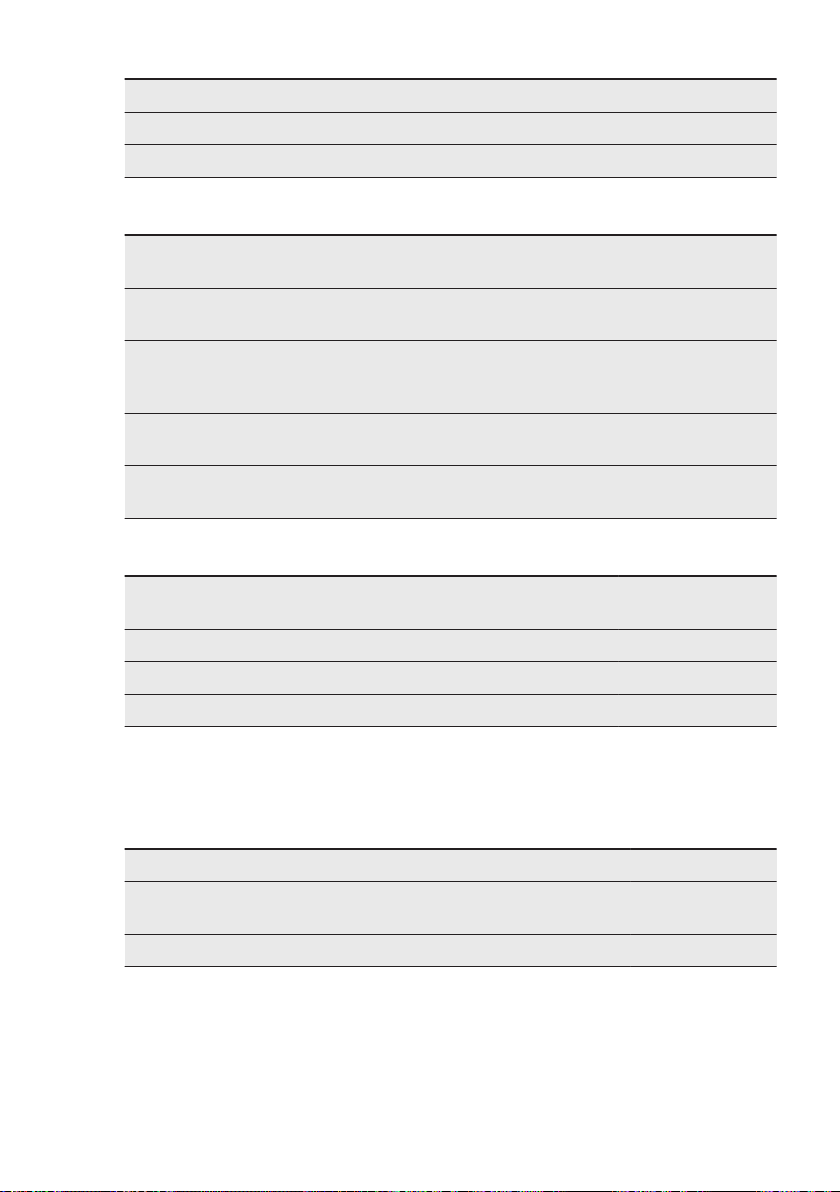
BRUCIATORE Ø BYPASS 1/100 mm
Semi rapido 35
Ausiliario 32
9.3 Altri dati tecnici
POTENZA TO-
TALE:
Gas - Origina-
le:
G20 (2H) 20 mbar 8,9 kW
Alimentazione
elettrica:
220-240 V ~ 50-60 Hz
Categoria del-
l'apparecchiatu-
ra:
I2H
Collegamento
gas:
G 1/2"
Classe dell'ap-
parecchiatura:
3
9.4 Bruciatori a GAS NATURALE G20 a 20 mbar
BRUCIATORE POTENZA NORMALE
kW
POTENZA MINIMA
kW
SIMBOLO INIETTO-
RE 1/100 mm
Rapido 2,9 1,2 120B
Semi rapido 2,0 0,75 102
Ausiliario 1,0 0,5 73F
10. EFFICIENZA ENERGETICA
10.1 Informazioni prodotto conformi alla norma UE 66/2014
Identificativo modello HG795840NB
Tipo di piano di cottura Piano di cottura da
incasso
Numero di bruciatori a gas 5
www.aeg.com52

Efficienza energetica per bruciatore
a gas
(EE gas burner)
Centrale in mezzo - Rapido 56.9%
Posteriore sinistro - Semirapido 61.2%
Posteriore destro - Semirapido 61.2%
Anteriore sinistro — Ausiliario non applicabile
Anteriore destro - Ausiliario non applicabile
Efficienza energetica del piano di
cottura a gas
(EE gas hob)
59.7%
EN 30-2-1: Apparecchiature di cottura a gas per uso domestico - Parte 2-1: Uso
razionale dell'energia - Generale
10.2 Risparmio energetico
• Prima dell'uso, assicurarsi che i bruciatori e i supporti pentole siano assemblati
correttamente.
• Usare pentole con diametro adatto alle dimensioni dei bruciatori.
• Centrare la pentola sul bruciatore.
• Quando si riscalda l'acqua, utilizzare solo la quantità necessaria.
• Se possibile, coprire sempre le pentole con il coperchio.
• Quando il liquido inizia a bollire, abbassare la fiamma per provocare una lenta
ebollizione del liquido.
• Se possibile, utilizzare una pentola a pressione. Fare riferimento al relativo manuale
per l'utente.
11.
CONSIDERAZIONI SULL'AMBIENTE
Riciclare i materiali con il simbolo .
Buttare l'imballaggio negli appositi
contenitori per il riciclaggio. Aiutare a
proteggere l’ambiente e la salute umana
e a riciclare rifiuti derivanti da
apparecchiature elettriche ed
elettroniche. Non smaltire le
apparecchiature che riportano il simbolo
insieme ai normali rifiuti domestici.
Portare il prodotto al punto di riciclaggio
più vicino o contattare il comune di
residenza.
*
ITALIANO
53


www.aeg.com/shop
867329490-F-112020