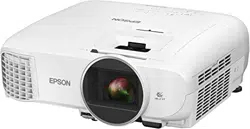

Home Cinema 4010 User's Guide


3
Contents
Home Cinema 4010 User's Guide............................................................................................................... 9
Introduction to Your Projector ................................................................................................................. 10
Projector Features.............................................................................................................................. 10
Product Box Contents.................................................................................................................... 11
Additional Components ................................................................................................................ 12
Optional Equipment and Replacement Parts................................................................................. 12
Warranty and Registration Information .......................................................................................... 13
Notations Used in the Documentation ................................................................................................ 13
Where to Go for Additional Information .............................................................................................. 14
Additional Projector Software and Manuals........................................................................................ 14
Projector Part Locations ..................................................................................................................... 15
Projector Parts - Front/Top ............................................................................................................ 16
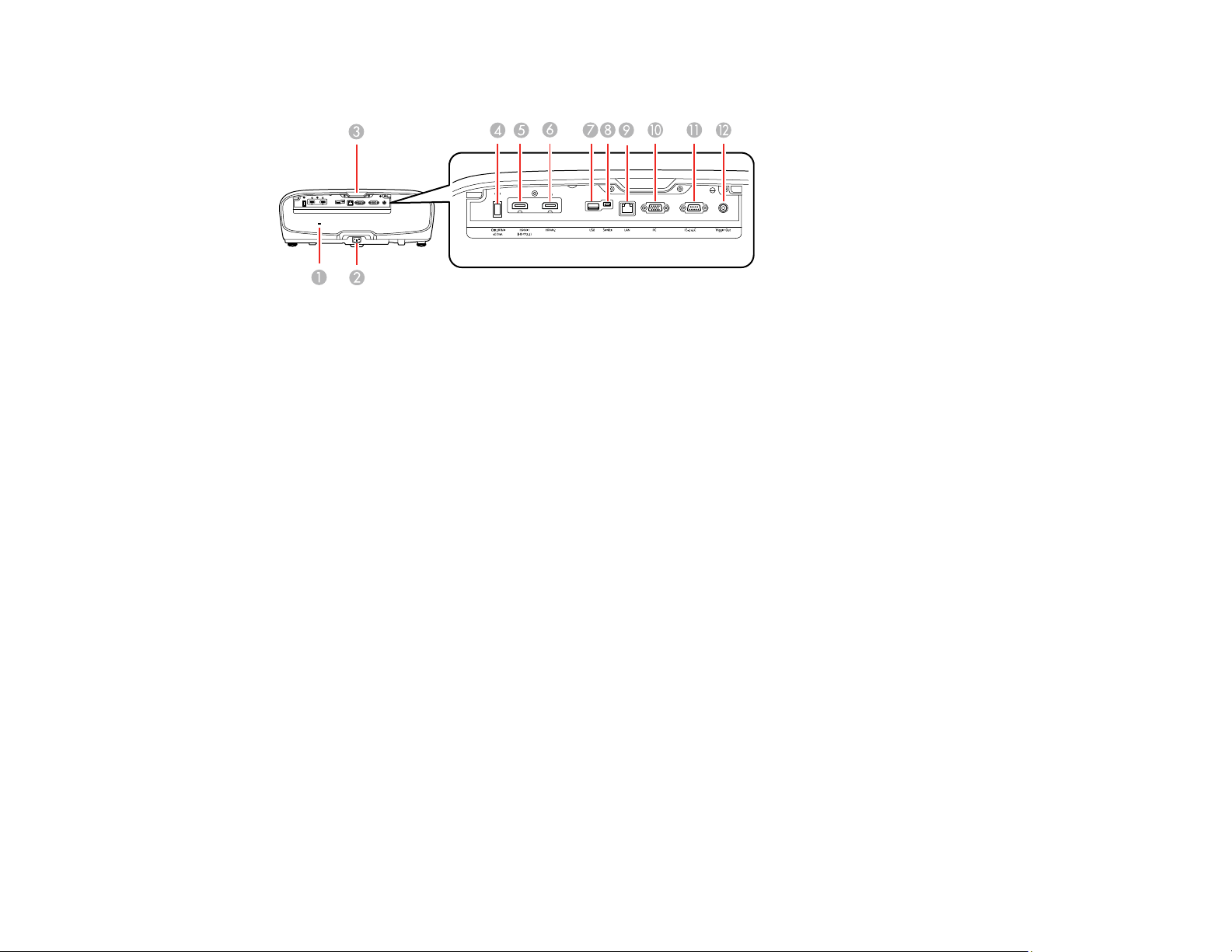
Projector Parts - Rear.................................................................................................................... 17
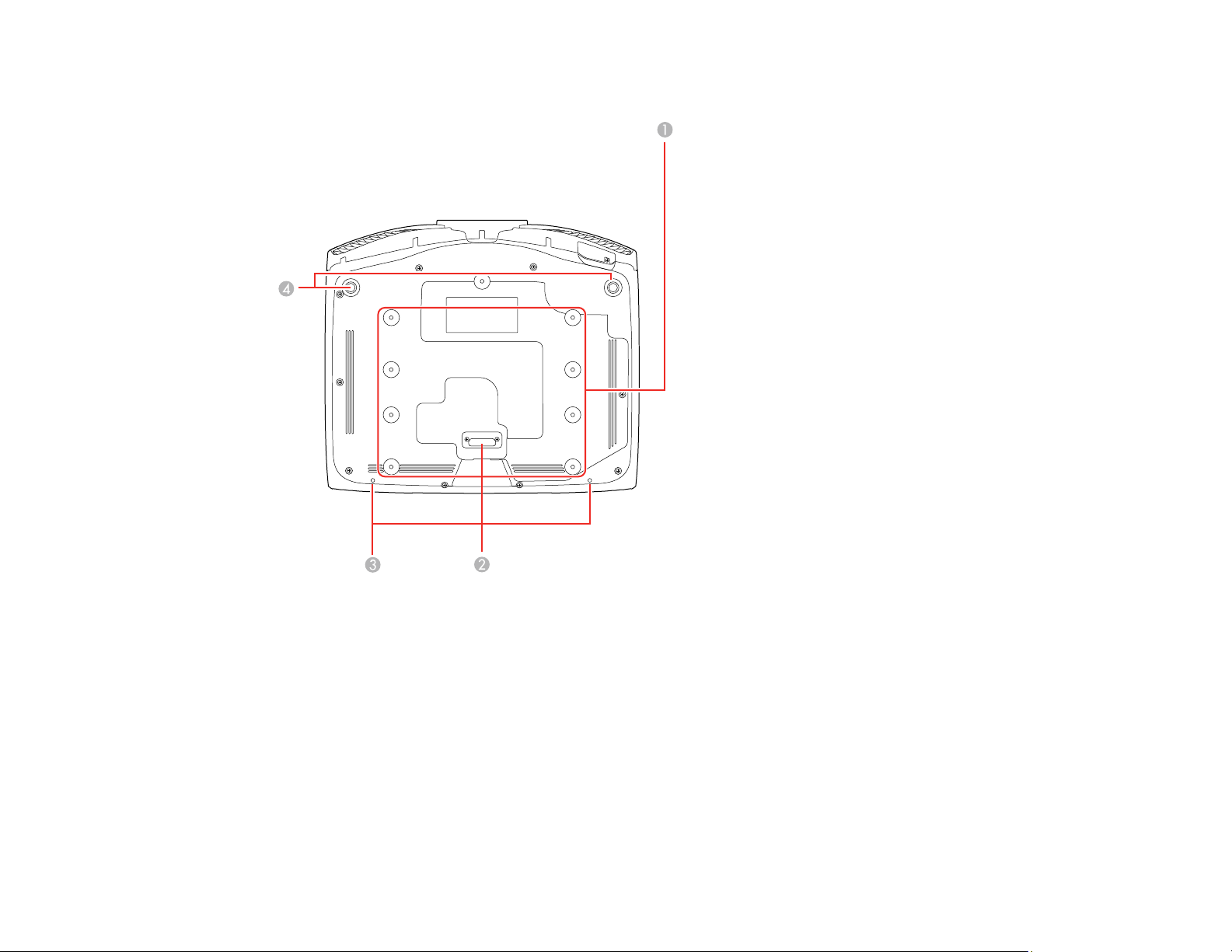
Projector Parts - Base.................................................................................................................... 18
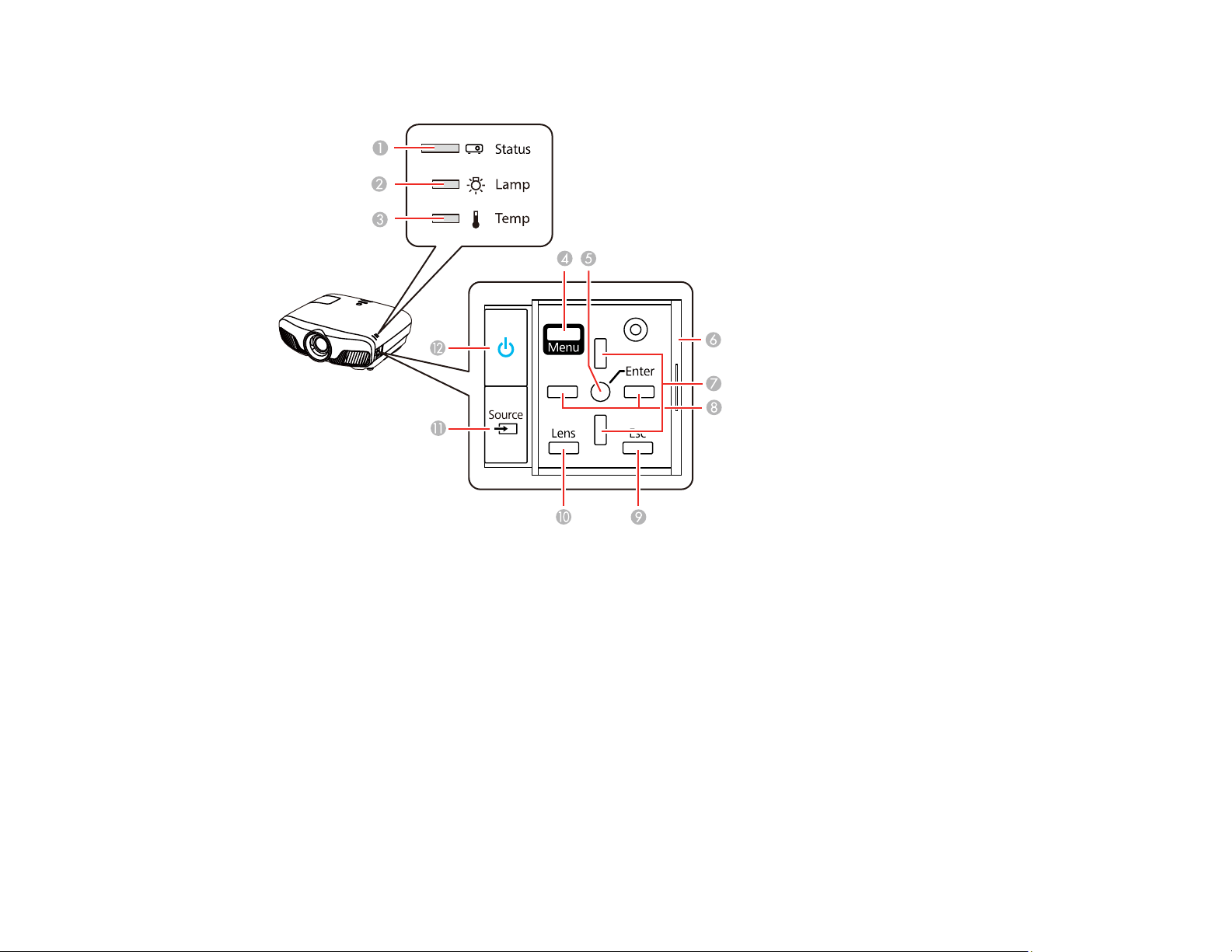
Projector Parts - Control Panel ...................................................................................................... 19
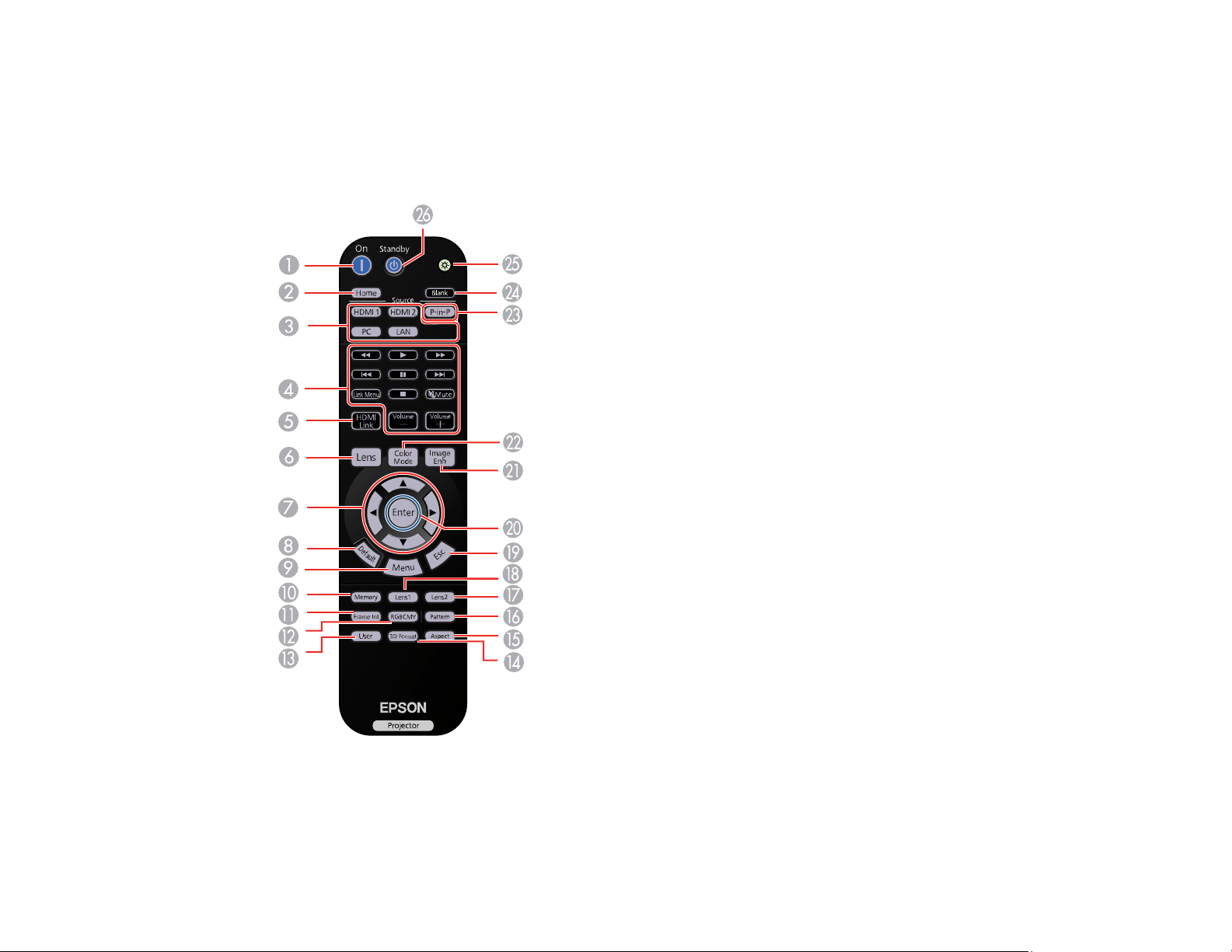
Projector Parts - Remote Control................................................................................................... 20
Setting Up the Projector ........................................................................................................................... 22
Projector Placement........................................................................................................................... 22
Projector Setup and Installation Options ....................................................................................... 22
Projection Distance........................................................................................................................ 24
Projector Connections........................................................................................................................ 27
Connecting to an HDMI Video Source ........................................................................................... 27
Connecting to Computer Sources.................................................................................................. 28
Connecting to a Computer for VGA Video................................................................................. 28
Connecting to a Computer for HDMI Video............................................................................... 28
Attaching and Removing the Cable Clips ...................................................................................... 29
Connecting to External Speakers .................................................................................................. 30
Connecting to a Trigger Out Port ................................................................................................... 30
Installing Batteries in the Remote Control .......................................................................................... 31

4
Using the Projector on a Network ............................................................................................................ 33
Wired Network Projection................................................................................................................... 33
Connecting to a Wired Network ..................................................................................................... 33
Selecting Wired Network Settings ................................................................................................. 34
Wireless Network Projection .............................................................................................................. 36
Installing the Wireless LAN Module ............................................................................................... 37
Selecting Wireless Network Settings Manually.............................................................................. 38
Wireless LAN Menu Settings .................................................................................................... 41
Restricted IP Addresses ........................................................................................................... 42
Using a QR Code to Connect a Mobile Device .............................................................................. 42
Searching for a Wireless Network ................................................................................................. 44
Selecting Wireless Network Settings in Windows.......................................................................... 46
Selecting Wireless Network Settings on Mac ................................................................................ 46
Enabling WPA or WPA2 Security .................................................................................................. 46
Wireless Security Menu Settings .............................................................................................. 47
Selecting External Network Detection Settings .................................................................................. 48
Using Basic Projector Features ............................................................................................................... 50
Turning On the Projector .................................................................................................................... 50
Using the Home Screen................................................................................................................. 51
Turning Off the Projector .................................................................................................................... 53
Viewing 3D Images ............................................................................................................................ 54
Pairing the 3D Glasses with the Projector...................................................................................... 55
Charging the 3D Glasses............................................................................................................... 56
3D Viewing Range......................................................................................................................... 58
Selecting the Language for the Projector Menus................................................................................ 58
Adjusting the Image Height ................................................................................................................ 59
Adjusting the Image Position Using Lens Shift ................................................................................... 60
Image Shape...................................................................................................................................... 62
Correcting Image Shape With the Keystone Buttons..................................................................... 62
Resizing the Image with the Zoom Feature ........................................................................................ 62
Focusing the Image with the Lens Button........................................................................................... 63
Remote Control Operation ................................................................................................................. 64
Selecting an Image Source ................................................................................................................ 65

5
Projection Modes ............................................................................................................................... 67
Changing the Projection Mode Using the Menus........................................................................... 67
Image Aspect Ratio ............................................................................................................................ 68
Changing the Image Aspect Ratio ................................................................................................. 69
Available Image Aspect Ratios...................................................................................................... 69
Color Mode......................................................................................................................................... 70
Changing the Color Mode.............................................................................................................. 70
Available Color Modes................................................................................................................... 71
Turning On Auto Iris....................................................................................................................... 71
Adjusting Projector Features ................................................................................................................... 73
Shutting Off the Picture Temporarily .................................................................................................. 73
Using Picture in Picture ...................................................................................................................... 73
Available Picture in Picture Options............................................................................................... 74
Projector Security Features................................................................................................................ 75
Locking the Projector's Lens Settings and Buttons........................................................................ 75
Unlocking the Projector's Buttons ............................................................................................. 76
Installing a Security Cable ............................................................................................................. 77
Using Advanced Image Adjustment Features .................................................................................... 77
Using Frame Interpolation ............................................................................................................ 77
Using 4K Enhancement................................................................................................................. 78
Creating Image Presets................................................................................................................. 80
Using MPEG Noise Reduction....................................................................................................... 81
Adjusting Scaled Resolution Images (Super-resolution) ............................................................... 82
Adjusting Detail Enhancement ...................................................................................................... 83
Image Adjustment Restrictions...................................................................................................... 84
Adjusting the Color Convergence (Panel Alignment)..................................................................... 85
Adjusting the Color Tone (Color Uniformity) .................................................................................. 89
Saving Settings to Memory and Using Saved Settings ...................................................................... 91
Saving the Lens Position and Using Saved Lens Positions................................................................ 92
Adjusting the Menu Settings .................................................................................................................... 95
Using the Projector's Menus............................................................................................................... 95
Image Quality Settings - Image Menu ................................................................................................ 96
Input Signal Settings - Signal Menu.................................................................................................. 101

6
Projector Feature Settings - Settings Menu...................................................................................... 104
Projector Setup Settings - Extended Menu....................................................................................... 107
Projector Network Settings - Network Menu..................................................................................... 109
Projector Information Display - Info Menu ........................................................................................ 111
Event ID Code List....................................................................................................................... 112
Projector Reset Options - Reset Menu............................................................................................. 114
Maintaining and Transporting the Projector ......................................................................................... 116
Projector Maintenance ..................................................................................................................... 116
Cleaning the Lens........................................................................................................................ 116
Cleaning the Projector Case........................................................................................................ 117
Cleaning the 3D Glasses............................................................................................................. 117
Air Filter and Vent Maintenance .................................................................................................. 118
Cleaning the Air Filter.............................................................................................................. 118
Replacing the Air Filter............................................................................................................ 121
Projector Lamp Maintenance....................................................................................................... 123
Replacing the Lamp ................................................................................................................ 124
Resetting the Lamp Timer....................................................................................................... 127
Replacing the Remote Control Batteries ..................................................................................... 128
Transporting the Projector................................................................................................................ 130
Solving Problems .................................................................................................................................... 131
Projection Problem Tips ................................................................................................................... 131
Projector Light Status ....................................................................................................................... 132
Solving Image Problems .................................................................................................................. 135
Solutions When No Image Appears............................................................................................. 135
Solutions When "No Signal" Message Appears........................................................................... 136
Displaying From a PC Laptop ................................................................................................. 137
Displaying From a Mac Laptop ............................................................................................... 137
Solutions When "Not Supported" Message Appears ................................................................... 137
Solutions When Only a Partial Image Appears............................................................................ 138
Solutions When the Image is Not Rectangular ............................................................................ 138
Solutions When the Image Contains Noise or Static ................................................................... 139
Solutions When the Image is Fuzzy or Blurry .............................................................................. 140
Solutions When the Image Brightness or Colors are Incorrect .................................................... 141

7
Solutions When a 3D Image Does Not Display Correctly ............................................................ 141
Solving Projector or Remote Control Operation Problems ............................................................... 142
Solutions to Projector Power or Shut-Off Problems..................................................................... 143
Solutions to Problems with the Remote Control........................................................................... 144
Solutions to Panel Alignment Problems....................................................................................... 144
Solutions When Using HDMI Link................................................................................................ 145
Solutions When Wireless Authentication Fails ................................................................................. 145
Where to Get Help............................................................................................................................ 146
Technical Specifications ........................................................................................................................ 147
General Projector Specifications...................................................................................................... 147
Projector Lamp Specifications.......................................................................................................... 148
Remote Control Specifications ......................................................................................................... 149
Projector Dimension Specifications.................................................................................................. 149
Projector Electrical Specifications .................................................................................................... 149
Projector Environmental Specifications............................................................................................ 150
Projector Safety and Approvals Specifications................................................................................. 150
Supported Video Display Formats.................................................................................................... 151
Notices ..................................................................................................................................................... 153
Recycling.......................................................................................................................................... 153
Important Safety Information ............................................................................................................ 153
Important Safety Instructions............................................................................................................ 154
Restriction of Use ........................................................................................................................ 156
List of Safety Symbols...................................................................................................................... 157
FCC Compliance Statement............................................................................................................. 160
Binding Arbitration and Class Waiver ............................................................................................... 161
Trademarks...................................................................................................................................... 164
Copyright Notice............................................................................................................................... 165
A Note Concerning Responsible Use of Copyrighted Materials................................................... 165
Copyright Attribution.................................................................................................................... 166


9
Home Cinema 4010 User's Guide
Welcome to the Home Cinema 4010 User's Guide.
For a printable PDF copy of this guide, click here.

10
Introduction to Your Projector
Refer to these sections to learn more about your projector and this manual.
Projector Features
Notations Used in the Documentation
Where to Go for Additional Information
Additional Projector Software and Manuals
Projector Part Locations
Projector Features
The Home Cinema 4010 projector includes these special features:
Bright, high-resolution projection system
• Up to 2400 lumens of color brightness (color light output) and 2400 lumens of white brightness (white
light output)
Note: Color brightness (color light output) and white brightness (white light output) will vary depending
on usage conditions. Color light output measured in accordance with IDMS 15.4; white light output
measured in accordance with ISO 21118.
• 1080p native resolution with 4K Enhancement
• Images up to 300 inches (7.62 m) for projection on any wall or screen
Full 3D projection
• Active 3D projection with optional RF active shutter glasses
• Supports side-by-side, top-and-bottom, and frame-packing 3D formats
Flexible connectivity
• Two HDMI ports for video device or computer connections
• Support for an optical HDMI connection
Easy-to-use setup and operation features
• Powered vertical and horizontal lens shift, and vertical keystone correction buttons for flexible
projector placement
• 2.1× optical zoom ratio for improved zooming capability
11
• Powered zoom and focus adjustments
Product Box Contents
Additional Components
Optional Equipment and Replacement Parts
Warranty and Registration Information
Parent topic: Introduction to Your Projector
Product Box Contents
Save all the packaging in case you need to ship the projector. Always use the original packaging (or
equivalent) when shipping.
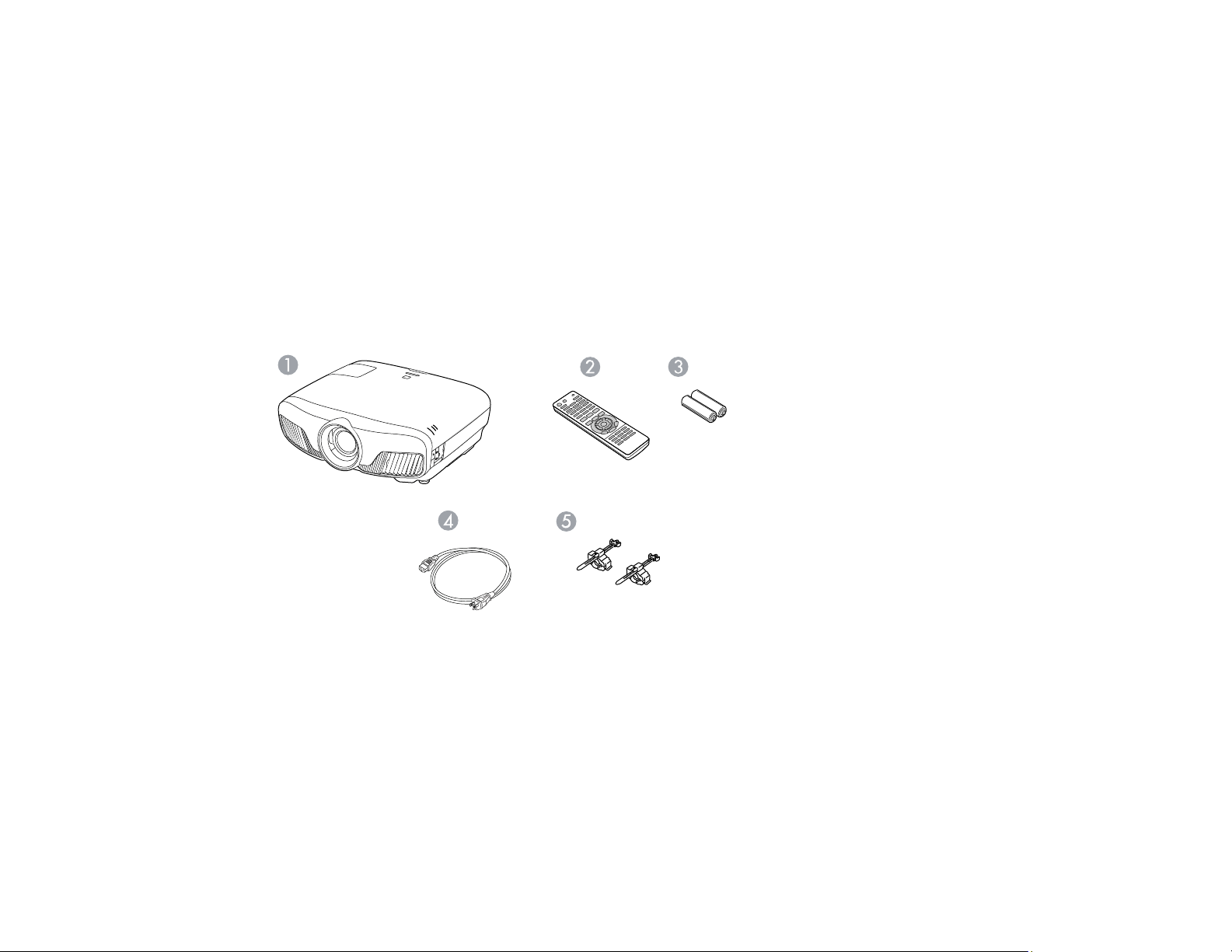
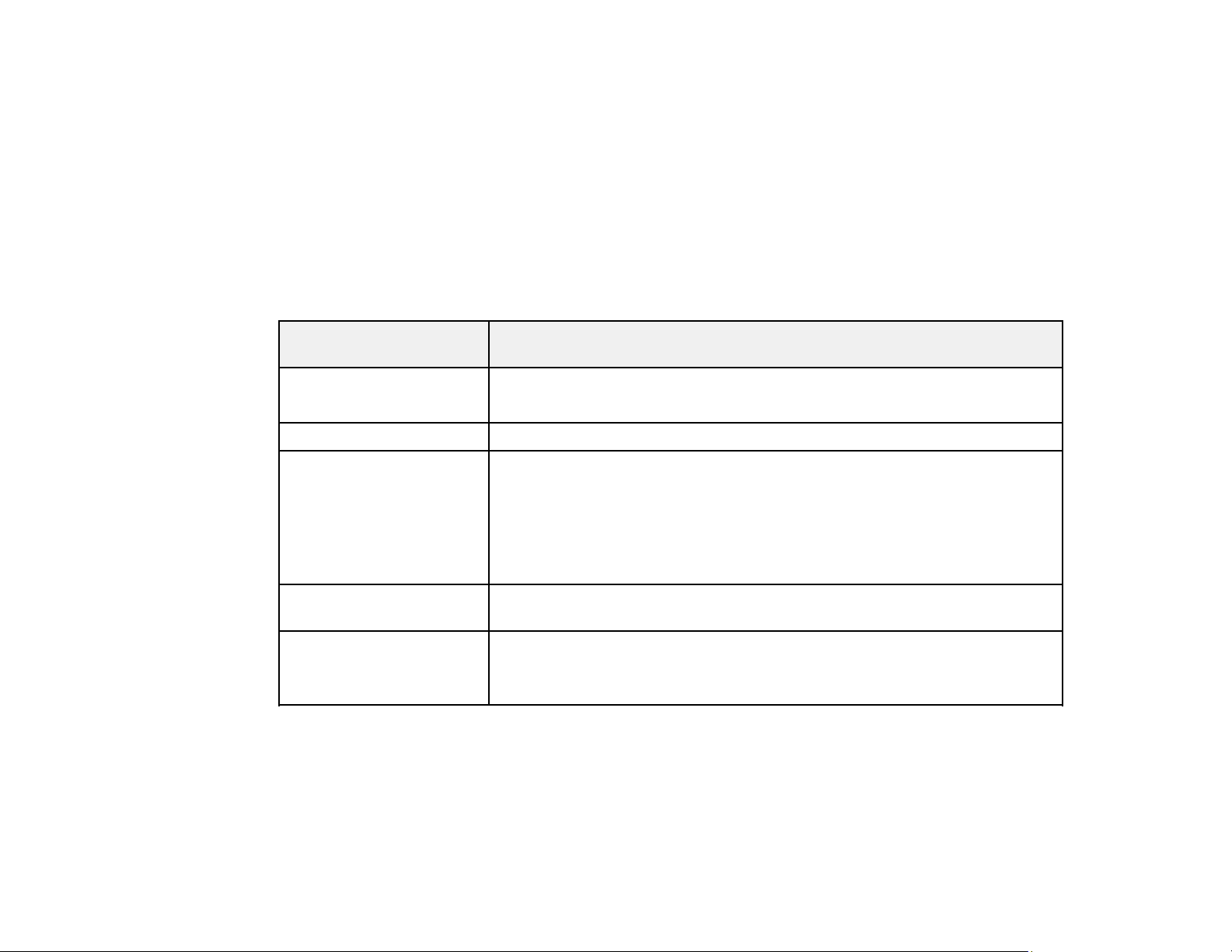
Make sure your product box included all of these parts:
1 Projector
2 Remote control
3 Remote control batteries (two AA alkaline)
4 Power cord
5 HDMI cable clips (2)
The product box contents may vary by country.
Parent topic: Projector Features
12
Additional Components
Depending on how you plan to use the projector, you may need to obtain additional components.
Note: To connect a Mac that does not include a compatible video output port, you need to obtain an
adapter that allows you to connect to an input port on the projector. Contact Apple for compatible
adapter options. To connect a smartphone or tablet, you may need to obtain an adapter that allows you
to connect to the projector. This allows you to mirror your smartphone or tablet screens, watch movies,
and more. Contact your device manufacturer for compatible adapter options.
Unless listed as available from Epson in this table, see your local computer or electronics dealer for
purchase information.
Signal or connection
type
Additional component necessary
HDMI Compatible HDMI cable
Available for purchase from Epson or an authorized Epson reseller.
Optical HDMI Compatible optical HDMI cable
3D Compatible HDMI cable and active shutter 3D glasses
Available for purchase from Epson or an authorized Epson reseller.
Note: If your video source is a 3D Blu-ray disc, you also need a Blu-ray
player that supports 3D playback. See your local computer or electronics
dealer for purchase information.
External audio Speakers, an audio video receiver, or a video source with speaker
connections, and the cables necessary for connecting them
VGA To connect a computer through its VGA port to the projector's VGA video
port, you need a VGA computer cable.
Available for purchase from Epson or an authorized Epson reseller.
Parent topic: Projector Features
Optional Equipment and Replacement Parts
You can purchase screens, other optional accessories, and replacement parts from an Epson authorized
reseller. To find the nearest reseller, call 800-GO-EPSON (800-463-7766) in the U.S. or 800-807-7766 in
Canada. Or you can purchase online at epsonstore.com (U.S. sales) or epsonstore.ca (Canadian sales).

13
Epson offers the following optional accessories and replacement parts for your projector:
Option or part Part number
Genuine Epson replacement lamp (ELPLP89) V13H010L89
Replacement air filter V13H134A39
RF 3D glasses (ELPGS03) V12H548006
Wireless LAN module (ELPAP10) V12H731P02
Projector ceiling mount CHF4000
Belkin PureAV HDMI audio video cable, 6 ft AV22300-06
Belkin PureAV HDMI audio video cable, 3 ft AV22300-03
In addition to the accessories listed above, a 1-year extended service plan is available.
Parent topic: Projector Features
Warranty and Registration Information
Your projector comes with a basic warranty that lets you project with confidence. For details, see the
warranty brochure that came with your projector.
In addition, Epson offers free Extra Care Home Service. In the unlikely event of an equipment failure,
you won’t have to wait for your unit to be repaired. Instead, Epson will ship you a replacement unit
anywhere in the United States, Canada, or Puerto Rico. See the Extra Care Home Service brochure for
details.
Register your product online at this site: epson.com/webreg
Registering also lets you receive special updates on new accessories, products, and services.
Parent topic: Projector Features
Notations Used in the Documentation
Follow the guidelines in these notations as you read your documentation:
• Warnings must be followed carefully to avoid bodily injury.
• Cautions must be observed to avoid damage to your equipment.
• Notes contain important information about your projector.
• Tips contain additional projection information.
14
Parent topic: Introduction to Your Projector
Where to Go for Additional Information
Need quick help on using your projector? Here's where to look for help:
• epson.com/support (U.S.) or epson.ca/support (Canada)
View FAQs (frequently asked questions) and e-mail your questions to Epson technical support 24
hours a day.
• If you still need help after checking this manual and any other sources listed here, you can use the
Epson PrivateLine Support service to get help fast. For details, see "Where to Get Help."
Parent topic: Introduction to Your Projector
Related references
Where to Get Help
Additional Projector Software and Manuals
After connecting and setting up the projector, install the projector software. You may need to install it
from a software CD, if included, or download the software and manuals as necessary.
You can install the projector software programs listed here and view their manuals for instructions on
using them.
Note: If you still need help after checking this manual and the sources listed here, you can use the
Epson PrivateLine Support service to get help fast. For details, see "Where to Get Help."
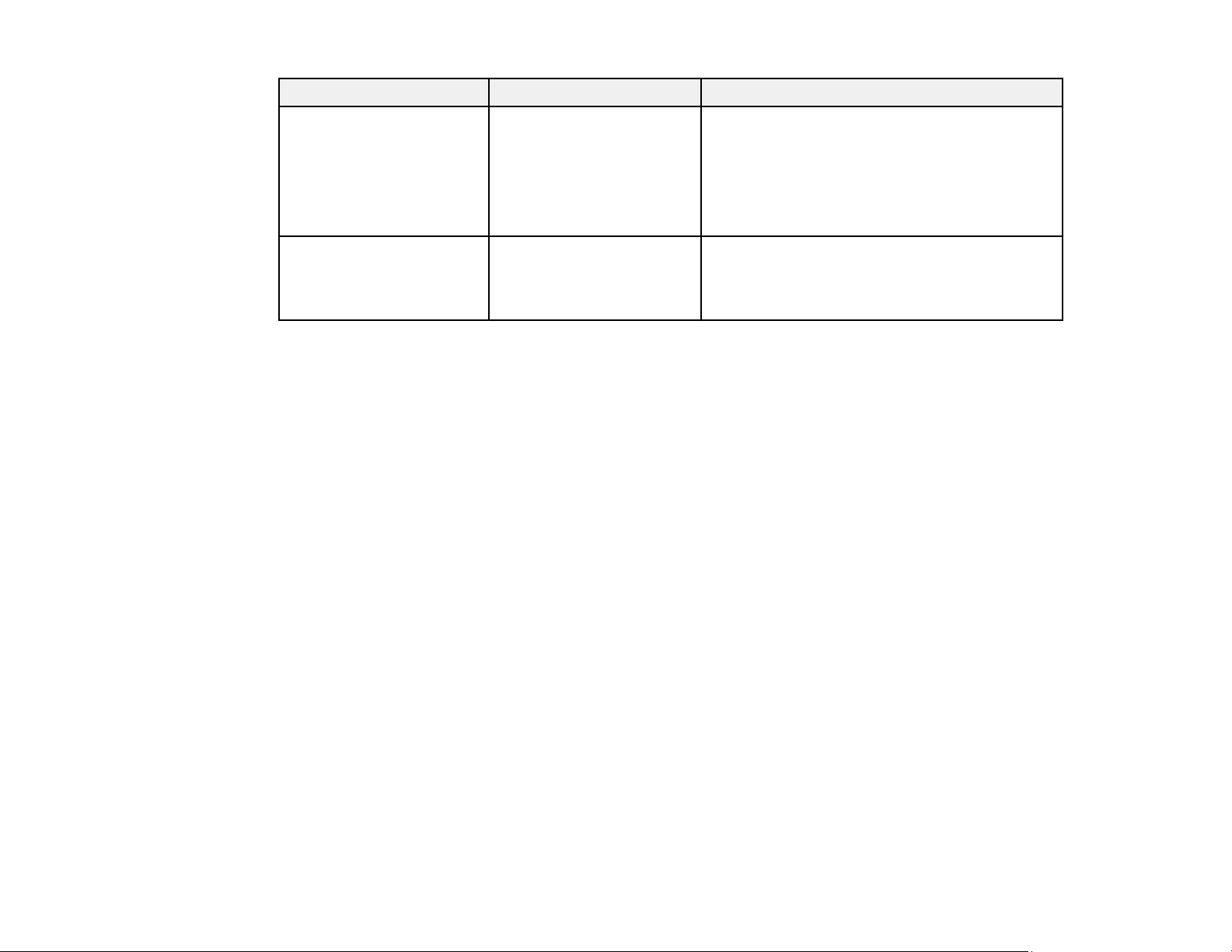
Projector software Manual Description
Epson iProjection
(Windows/Mac)
Epson iProjection
Operation Guide
(Windows/Mac)
Lets you project the computer screens of
users over a network.
You can download the latest software and
documentation from the Epson web site. Go to
epson.com/support (U.S.) or epson.ca/support
(Canada) and select your projector.
15
Projector software Manual Description
Epson iProjection app Instructions are included
with the app
Lets you project from an iOS or Android device
if your projector is connected to a network that
includes a wireless access point.
Visit epson.com/iprojection (U.S.) or
epson.ca/iprojection (Canada) for more
information.
— Open Source Software
License
You can download this document from the
Epson web site. Go to epson.com/support
(U.S.) or epson.ca/support (Canada) and
select your projector.
Parent topic: Introduction to Your Projector
Related references
Where to Get Help
Projector Part Locations
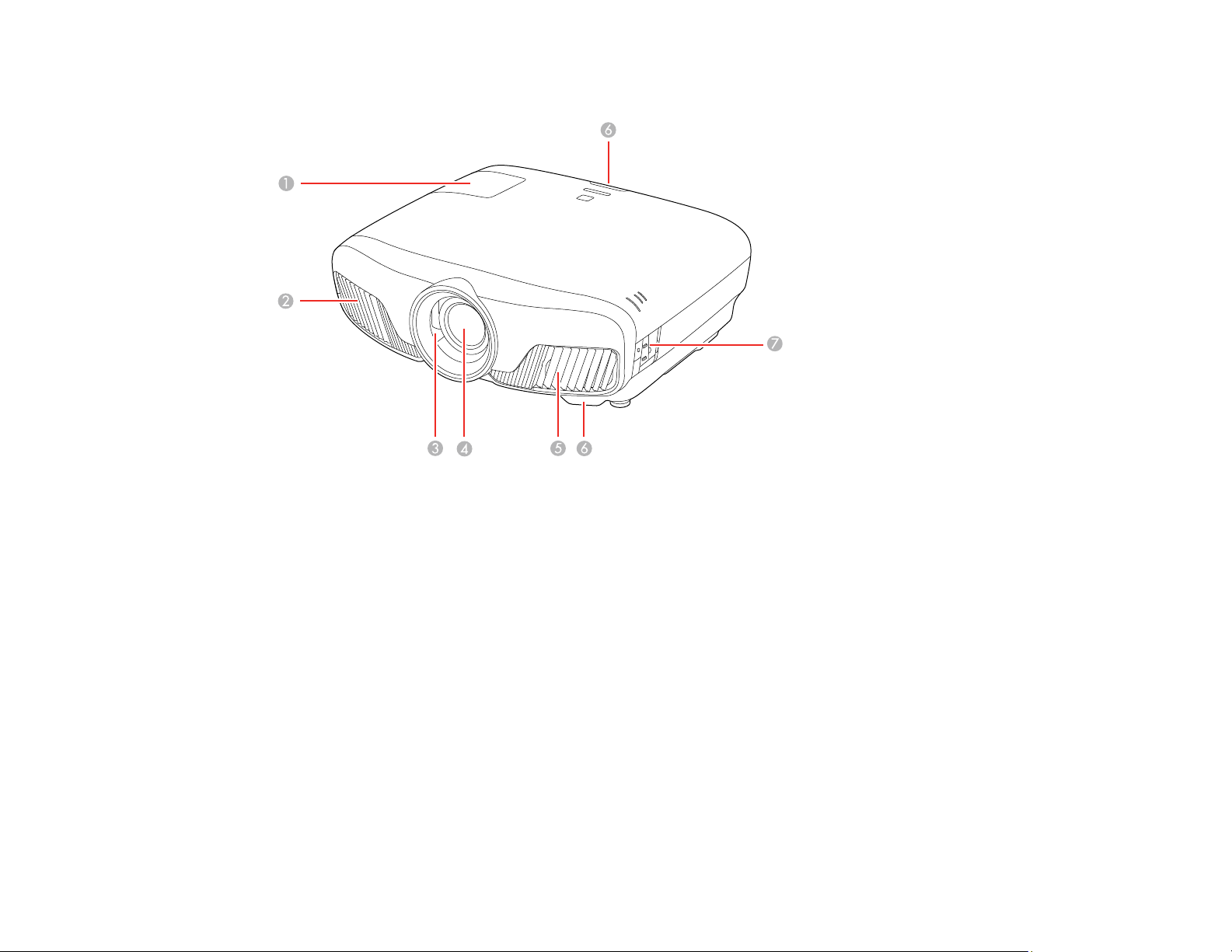
Check the projector part illustrations to learn about the parts on your projector.
Projector Parts - Front/Top
Projector Parts - Rear
Projector Parts - Base
Projector Parts - Control Panel
Projector Parts - Remote Control
Parent topic: Introduction to Your Projector
17
Projector Parts - Rear
1 Security slot
2 AC input port
3 Remote receiver
4 Opt.HDMI (300mA) port (USB power for optical HDMI connections)
5 HDMI1 (HDCP 2.2) port
6 HDMI2 port
7 USB port (for optional wireless LAN module and firmware updates)
8 Service port
9 LAN port
10 PC port (VGA)
11 RS-232C port
12 Trigger Out port (12V DC @ 200 mA max)
Parent topic: Projector Part Locations
Related tasks
Installing a Security Cable
Attaching and Removing the Cable Clips
19
Projector Parts - Control Panel
1 Status light
2 Lamp light
3 Temp light
4 Menu button (accesses projector menu system)
5 Enter button (selects options)
6 Control panel cover
7 Vertical keystone adjustment buttons (adjust screen shape) and arrow buttons
8 Arrow buttons
9 Esc button (cancels/exits functions)
10 Lens button (cycles through lens adjustment options)
11 Source button (cycles through the list of sources)

21
3 Source buttons (select specific video input sources)
4 Link Menu button (displays the main menu of the connected device)
Control buttons (control playback and other features of connected devices that support the HDMI
CEC standard)
5 HDMI Link button (displays the settings menu for HDMI Link)
6 Lens button (cycles through lens adjustment options)
7 Arrow buttons (move though on-screen options)
8 Default button (returns selected setting to default value)
9 Menu button (accesses projector menu system)
10 Memory button (accesses the Memory menu)
11 Frame Int button (adjusts the Frame Interpolation setting)
12 RGBCMY button (adjusts hue, saturation, and brightness for each RGBCMY color)
13 User button (customizable for different functions)
14 3D Format button (changes the 3D format)
15 Aspect button (selects the image aspect ratio)
16 Pattern button (displays a test pattern)
17 Lens2 button (loads the second saved lens position)
18 Lens1 button (loads the first saved lens position)
19 Esc button (cancels/exits functions)
20 Enter button (selects options)
21 Image Enh button (displays the Image Enhancement menu)
22 Color Mode button (selects display modes)
23 P-in-P button (controls the Picture-in-Picture mode)
24 Blank button (turns off video projection)
25 Illumination button (lights the remote control)
26 Standby button (turns off the projector)
Parent topic: Projector Part Locations

22
Setting Up the Projector
Follow the instructions in these sections to set up your projector for use.
Projector Placement
Projector Connections
Installing Batteries in the Remote Control
Projector Placement
You can place the projector on almost any flat surface to project an image.
You can also install the projector in a ceiling mount if you want to use it in a fixed location.
Keep these considerations in mind as you select a projector location:
• Place the projector on a sturdy, level surface or install it using a compatible mount.
• Leave plenty of space around and under the projector for ventilation, and do not place it on top of or
next to anything that could block the vents.
• Place the projector parallel to the screen.
• Position the projector within reach of a grounded electrical outlet or extension cord.
Projector Setup and Installation Options
Projection Distance
Parent topic: Setting Up the Projector
Related tasks
Changing the Projection Mode Using the Menus
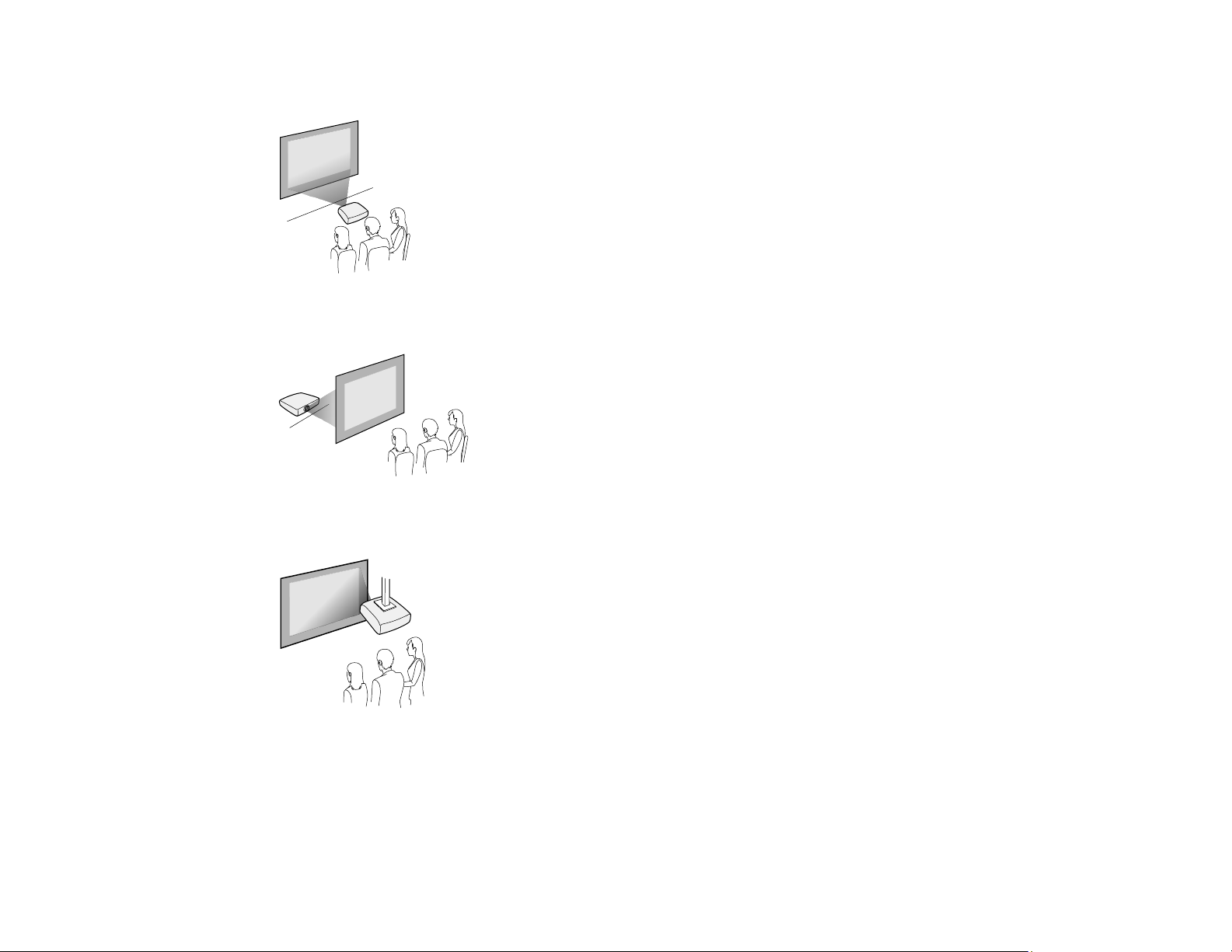
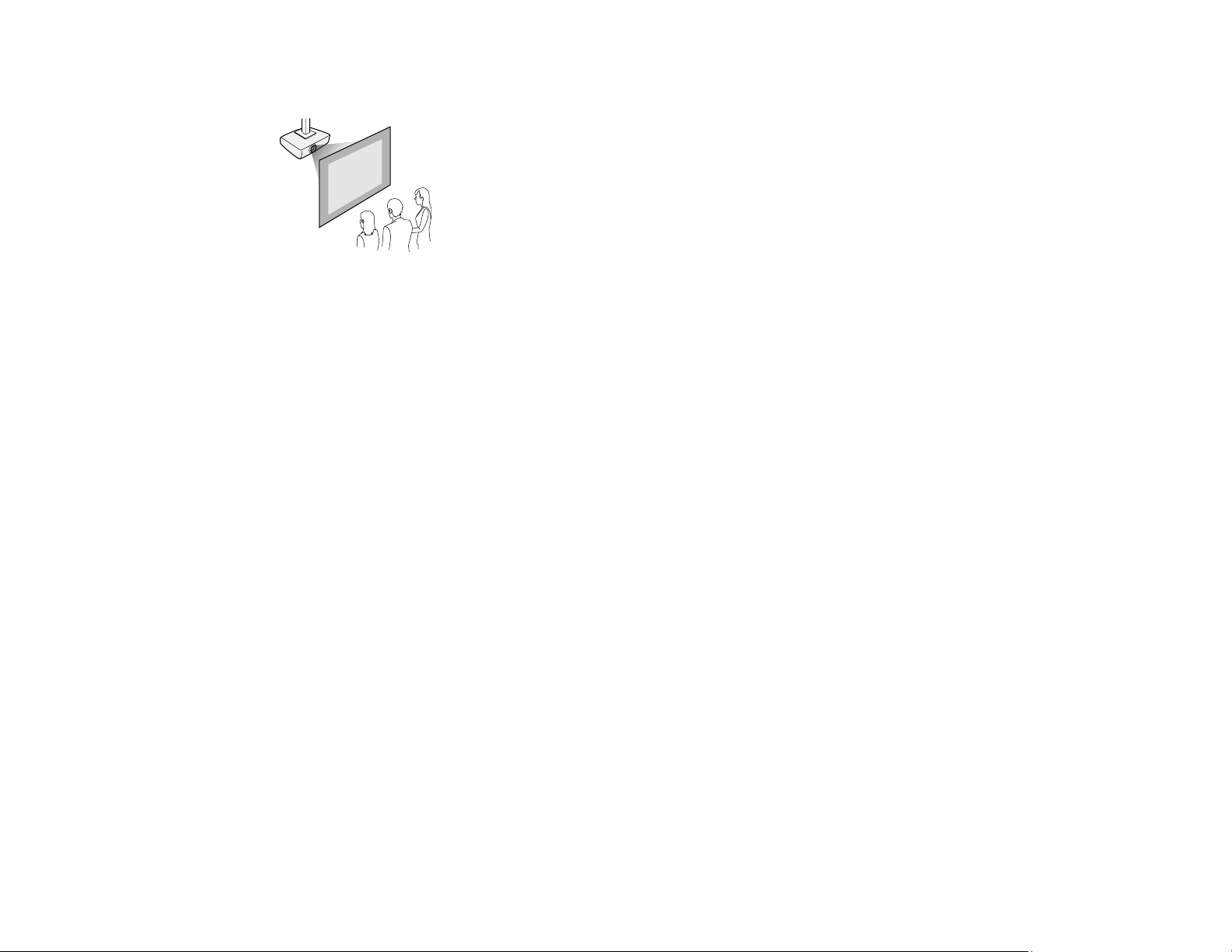
Projector Setup and Installation Options
You can set up or install your projector in the following ways:
23
Front
Rear
Front Ceiling
24
Rear Ceiling
Wherever you set up the projector, make sure to position it squarely in front of the center of the screen,
not at an angle, if possible. If the projector cannot be centered in front of the screen, use lens shift to
reposition the image instead of using keystone correction for better image quality.
If you project from the ceiling or from the rear, be sure to select the correct Projection option in the
projector's menu system.
Parent topic: Projector Placement
Related references
Projector Setup Settings - Extended Menu
Projection Distance
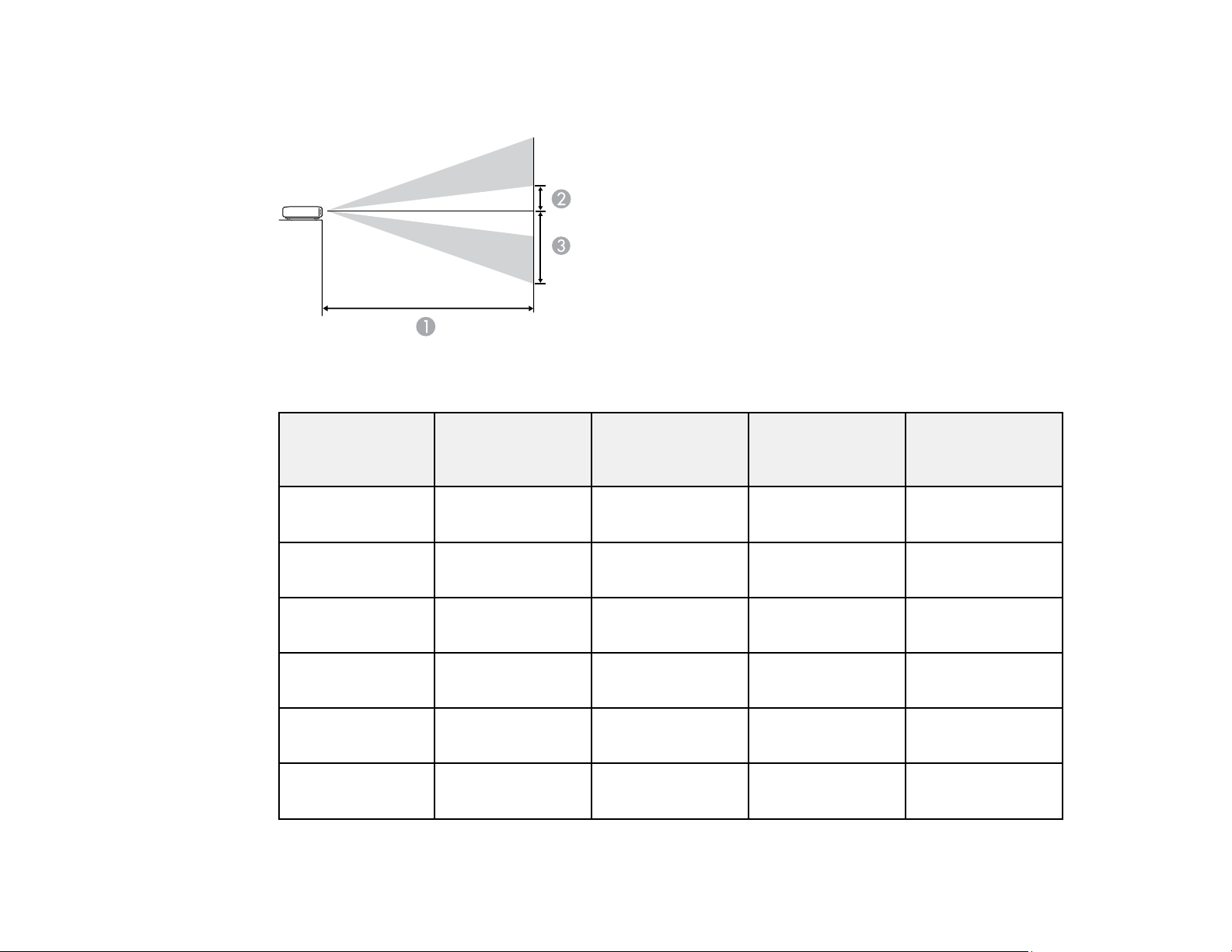
The distance at which you place the projector from the screen determines the approximate size of the
image. The image size increases the farther the projector is from the screen, but can vary depending on
the zoom factor, aspect ratio, and other settings.
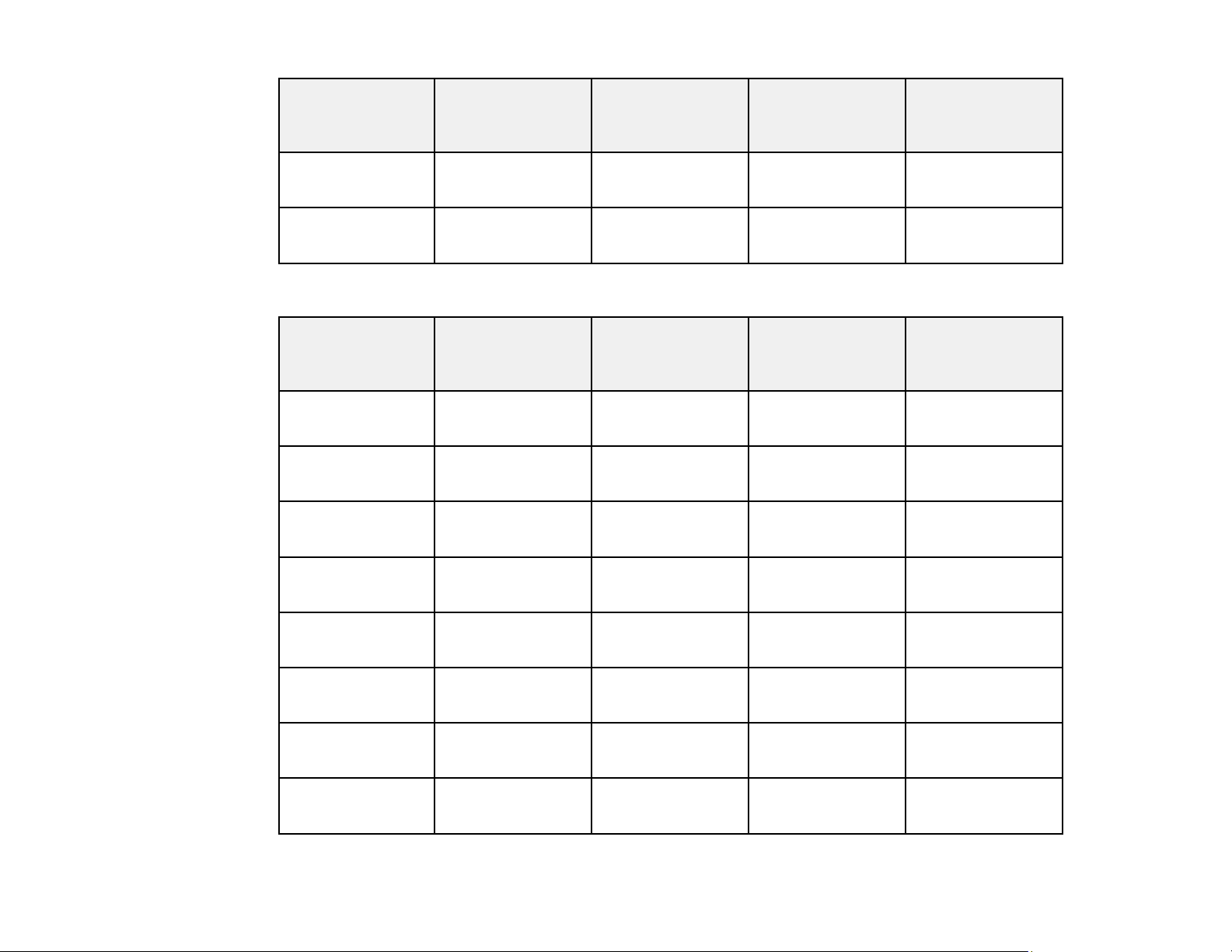
Use the tables here to determine approximately how far to place the projector from the screen based on
the size of the projected image. (Conversion figures may have been rounded up or down.)
25
You can also use the projector Throw Distance Calculator at epson.com/support (U.S.) or
epson.ca/support (Canada).
16:9 Aspect Ratio Image or Screen
Screen or image
size
Projection
distance (1)
Wide to Tele
Offset from lens
center (2)
Offset from lens
center (3)
Horizontal offset
from lens center
50 inches (127 cm) 58 to 123 inches
(148 to 313 cm)
11.3 inches (29
cm)
35.9 inches (91
cm)
±20.5 inches (52
cm)
60 inches (152.4
cm)
70 to 148 inches
(178 to 376 cm)
13.6 inches (35
cm)
43 inches (109 cm) ±24.6 inches (63
cm)
80 inches (203.2
cm)
94 to 198 inches
(239 to 630 cm)
18.2 inches (46
cm)
57.4 inches (146
cm)
±32.8 inches (83
cm)
100 inches (254
cm)
118 to 248 inches
(300 to 630 cm)
22.7 inches (58
cm)
71.7 inches (182
cm)
±41 inches (104
cm)
150 inches (381
cm)
178 to 373 inches
(452 to 947 cm)
34 inches (86 cm) 107.6 inches (273
cm)
±61.6 inches (156
cm)
200 inches (508
cm)
238 to 498 inches
(604 to 1264 cm)
45.4 inches (115
cm)
143.4 inches (364
cm)
±82.1 inches (209
cm)
26
Screen or image
size
Projection
distance (1)
Wide to Tele
Offset from lens
center (2)
Offset from lens
center (3)
Horizontal offset
from lens center
250 inches (635
cm)
297 to 623 inches
(756 to 1582 cm)
56.7 inches (144
cm)
179.3 inches (455
cm)
±102.6 inches (261
cm)
300 inches (762
cm)
357 to 748 inches
(908 to 1899 cm)
68.1 inches (173
cm)
215.2 inches (547
cm)
±123.1 inches (313
cm)
4:3 Aspect Ratio Image or Screen
Screen or image
size
Projection
distance (1)
Wide to Tele
Offset from lens
center (2)
Offset from lens
center (3)
Horizontal offset
from lens center
50 inches (127 cm) 72 to 151 inches
(182 to 384 cm)
13.9 inches (35
cm)
43.9 inches (111
cm)
±25.1 inches (56
cm)
60 inches (152.4
cm)
86 to 182 inches
(219 to 462 cm)
16.7 inches (42
cm)
52.7 inches (134
cm)
±30.1 inches (77
cm)
80 inches (203.2
cm)
115 to 243 inches
(293 to 617 cm)
22.2 inches (56
cm)
70.2 inches (178
cm)
±40.2 inches (102
cm)
100 inches (254
cm)
145 to 304 inches
(368 to 772 cm)
27.8 inches (71
cm)
87.8 inches (223
cm)
±50.2 inches (128
cm)
120 inches (304.8
cm)
174 to 365 inches
(442 to 927 cm)
33.3 inches (854
cm)
105.3 inches (268
cm)
±60.3 inches (153
cm)
150 inches (381
cm)
218 to 457 inches
(554 to 1160 cm)
41.7 inches (106
cm)
131.7 inches (334
cm)
±75.4 inches (191
cm)
200 inches (508
cm)
291 to 610 inches
(740 to 1548 cm)
55.6 inches (141
cm)
175.6 inches (446
cm)
±100.5 inches (255
cm)
220 inches (558.8
cm)
321 to 671 inches
(814 to 1704 cm)
61.1 inches (155
cm)
193.1 inches (491
cm)
±110.5 inches (281
cm)
27
Screen or image
size
Projection
distance (1)
Wide to Tele
Offset from lens
center (2)
Offset from lens
center (3)
Horizontal offset
from lens center
244.8 inches (622
cm)
357 to 746 inches
(906 to 1896 cm)
68 inches (173 cm) 214.8 inches (546
cm)
±123 inches (312
cm)
Parent topic: Projector Placement
Projector Connections
See these sections to connect the projector to a variety of projection sources.
Caution: If you will use the projector at altitudes above 4921 feet (1500 m), turn on High Altitude Mode
to ensure the projector's internal temperature is regulated properly.
Connecting to an HDMI Video Source
Connecting to Computer Sources
Attaching and Removing the Cable Clips
Connecting to External Speakers
Connecting to a Trigger Out Port
Parent topic: Setting Up the Projector
Related references
Projector Setup Settings - Extended Menu
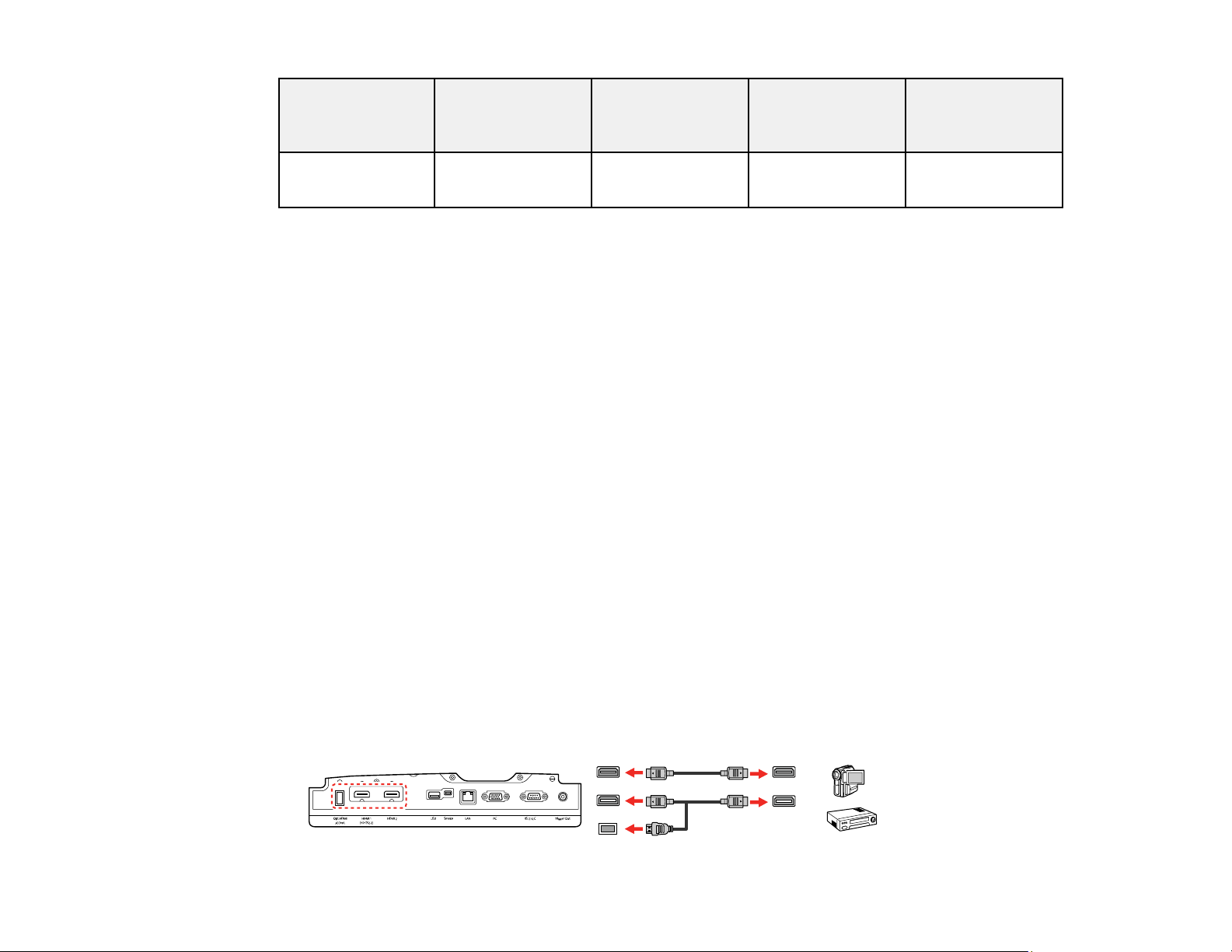
Connecting to an HDMI Video Source
If your video source has an HDMI port, you can connect it to the projector using an optional HDMI cable.
The HDMI connection provides the best image quality.
1. Connect the HDMI cable to your video source's HDMI output port.
2. Connect the other end to one of the projector's HDMI ports. If you are connecting an optical HDMI
cable, you must also connect the cable's USB power connector to the Opt.HDMI (300mA) port.
28
Note: When an audio/video source that meets the HDMI CEC standard is connected to the projector's
HDMI port, you can use the projector's remote control to control certain features of the linked device by
pressing the HDMI Link button on the remote control and setting HDMI Link to On.
Parent topic: Projector Connections
Connecting to Computer Sources
Follow the instructions in these sections to connect a computer to the projector.
Connecting to a Computer for VGA Video
Connecting to a Computer for HDMI Video
Parent topic: Projector Connections
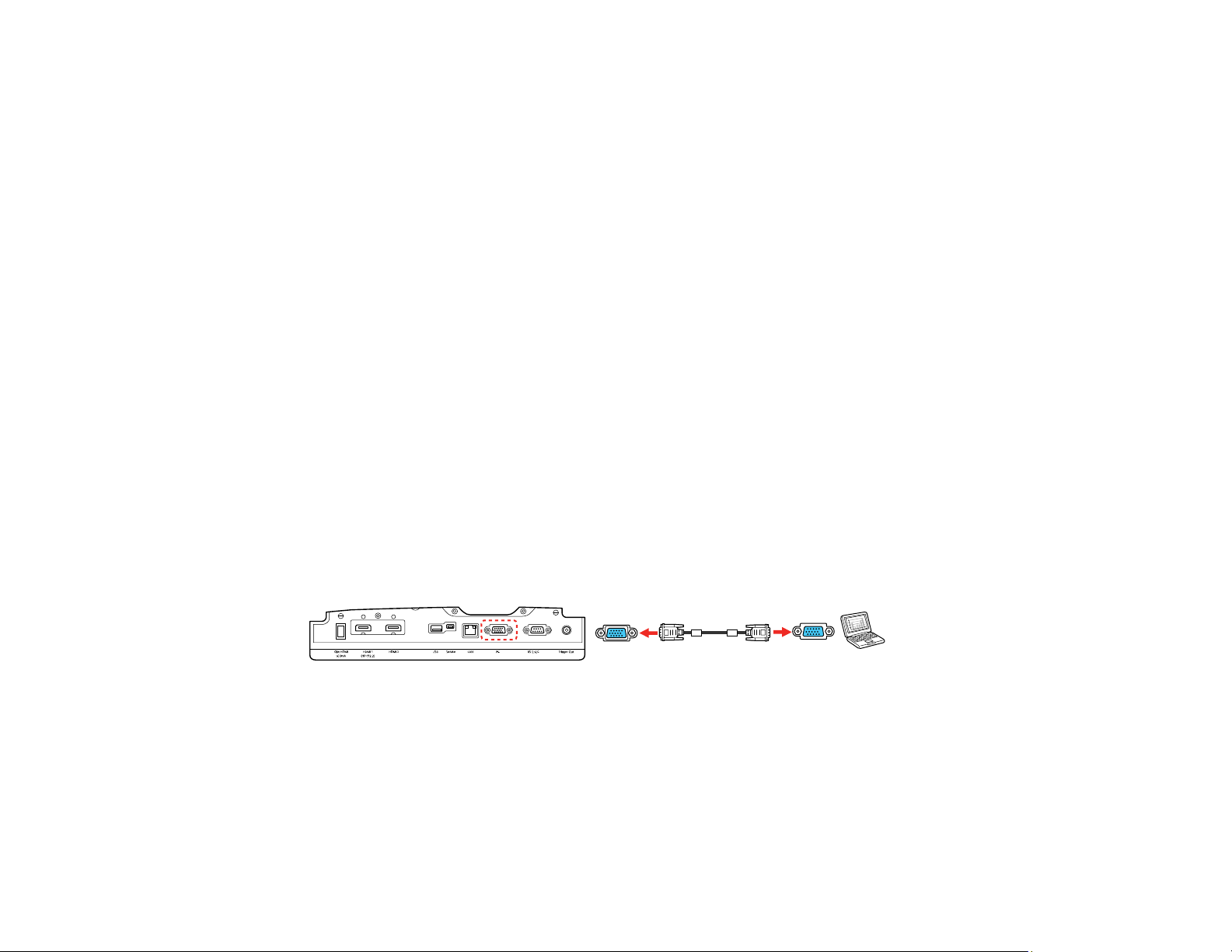
Connecting to a Computer for VGA Video
You can connect the projector to your computer using a VGA computer cable.
Note: To connect a Mac that does not include a compatible video output port, you need to obtain an
adapter that allows you to connect to an input port on the projector. Contact Apple for compatible
adapter options. To connect a smartphone or tablet, you may need to obtain an adapter that allows you
to connect to the projector. This allows you to mirror your smartphone or tablet screens, watch movies,
and more. Contact your device manufacturer for compatible adapter options.
1. If necessary, disconnect your computer's monitor cable.
2. Connect the VGA computer cable to your computer's monitor port.
3. Connect the other end to a PC port on the projector.
4. Tighten the screws on the VGA connector.
Parent topic: Connecting to Computer Sources
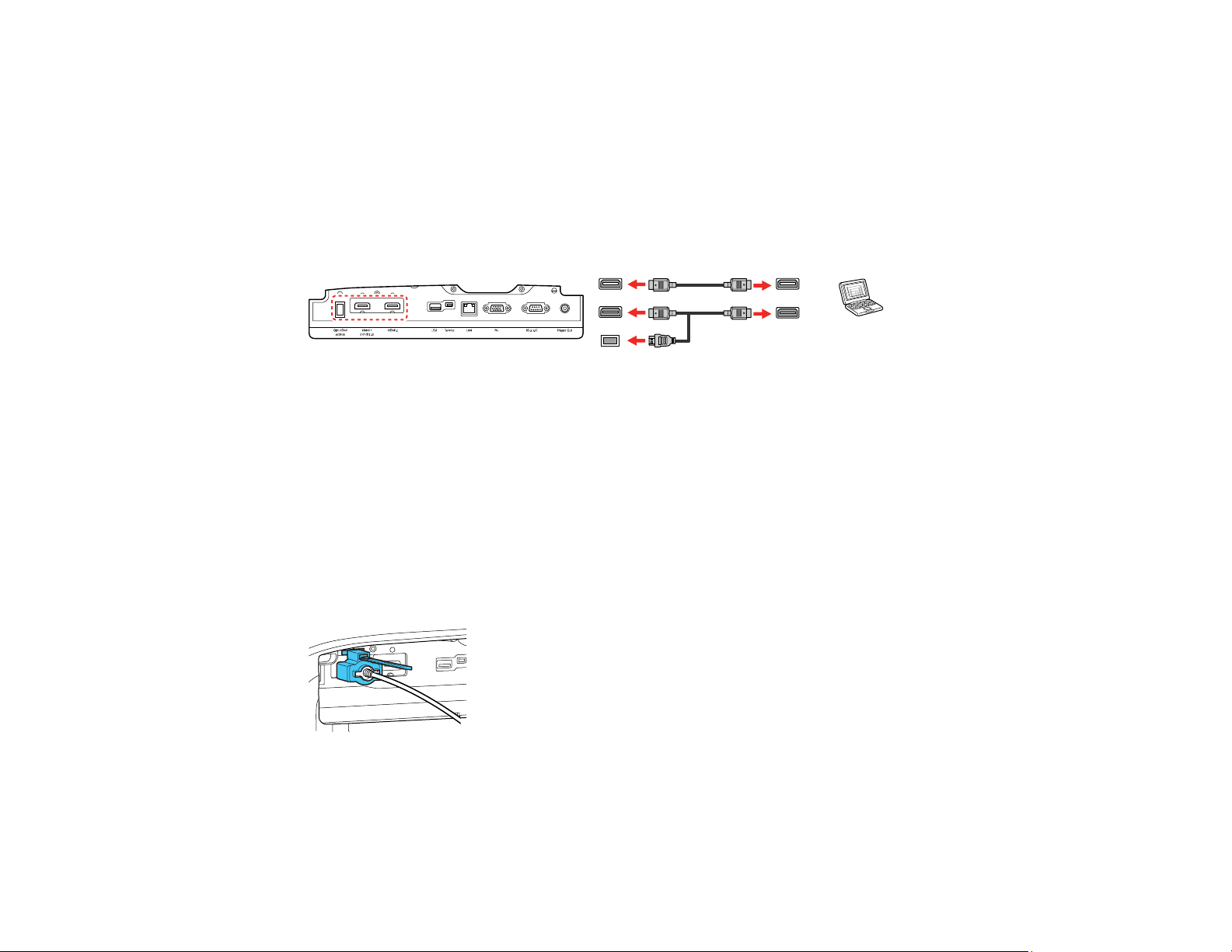
Connecting to a Computer for HDMI Video
If your computer has an HDMI port, you can connect it to the projector using an optional HDMI cable.
29
Note: To connect a Mac that does not include a compatible video output port, you need to obtain an
adapter that allows you to connect to an input port on the projector. Contact Apple for compatible
adapter options. To connect a smartphone or tablet, you may need to obtain an adapter that allows you
to connect to the projector. This allows you to mirror your smartphone or tablet screens, watch movies,
and more. Contact your device manufacturer for compatible adapter options.
1. Connect the HDMI cable to your computer's HDMI output port.
2. Connect the other end to one of the projector's HDMI ports. If you are connecting an optical HDMI
cable, you must also connect the cable's USB power connector to the Opt.HDMI (300mA) port.
Parent topic: Connecting to Computer Sources
Attaching and Removing the Cable Clips
You can install the cable clips that came with your projector to provide additional support to the HDMI
cables.
1. Plug in the HDMI cables.
2. Insert each guide into the cable clip holes near the HDMI port.
3. Attach the cable clips to the HDMI cables. Be sure to leave the clamps unlocked.
4. Slide each cable clip onto the guides and lock the clamps onto the connectors.
To remove the cable clips, open the clamps and disconnect the cables. Then pinch the sides of each
guide and carefully pull them out of the cable clip holes.
Parent topic: Projector Connections
30
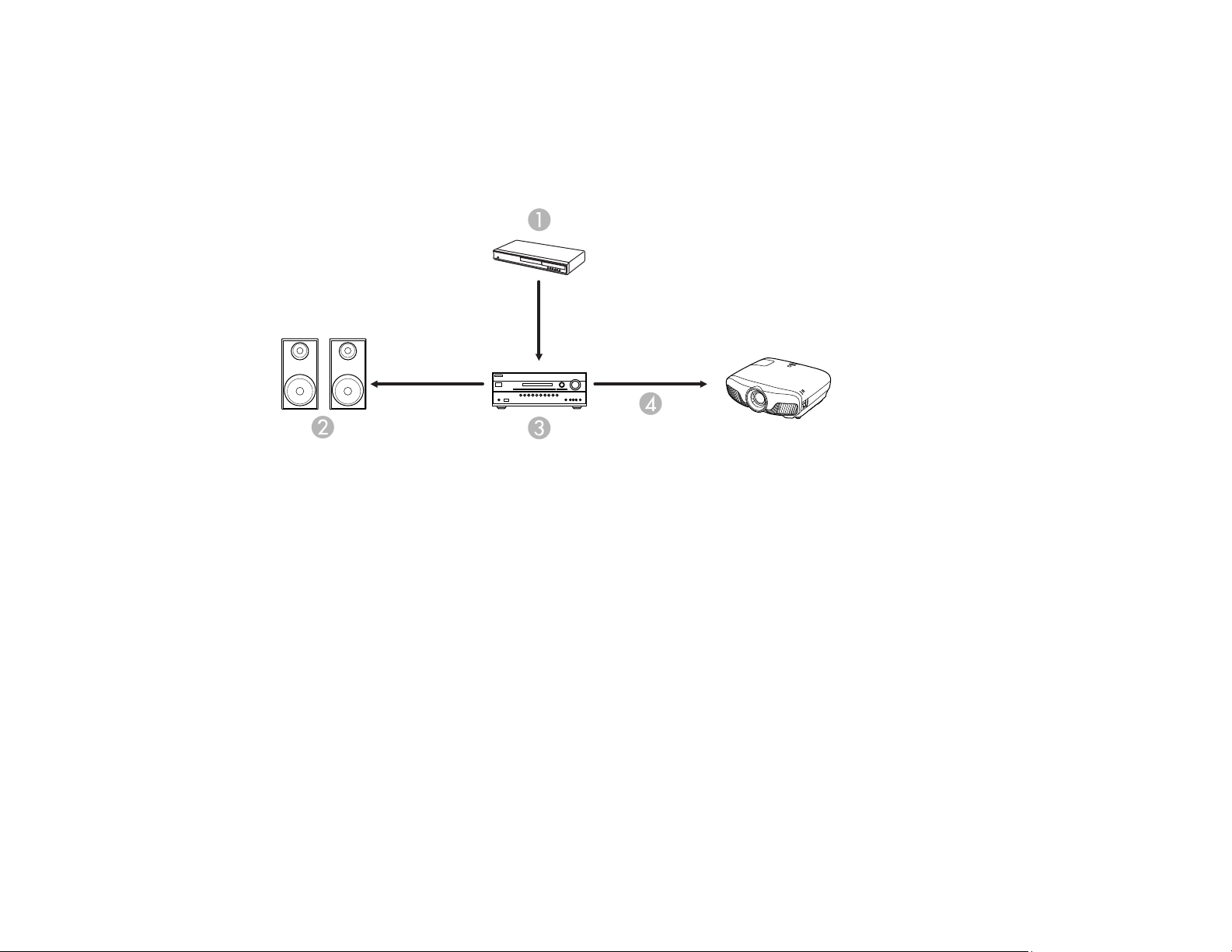
Connecting to External Speakers
To add sound, you can connect your video source and speakers to an audio video receiver, then
connect the receiver to the projector using one of the receiver's compatible video outputs (an HDMI
connection provides the best image quality, if available). You can also connect speakers to any video
source that has its own speaker connections.
1 Video source
2 Surround sound speakers
3 Receiver
4 Video cable
Parent topic: Projector Connections
Connecting to a Trigger Out Port
You can connect your projector to external devices such as motorized screens that support a trigger
signal. When active, a 12V (200 mA maximum) signal is sent to the connected device while the projector
is powered on.
1. Connect a 3.5 mm stereo mini-jack cable to the external device's trigger port. See your device's
documentation for details.
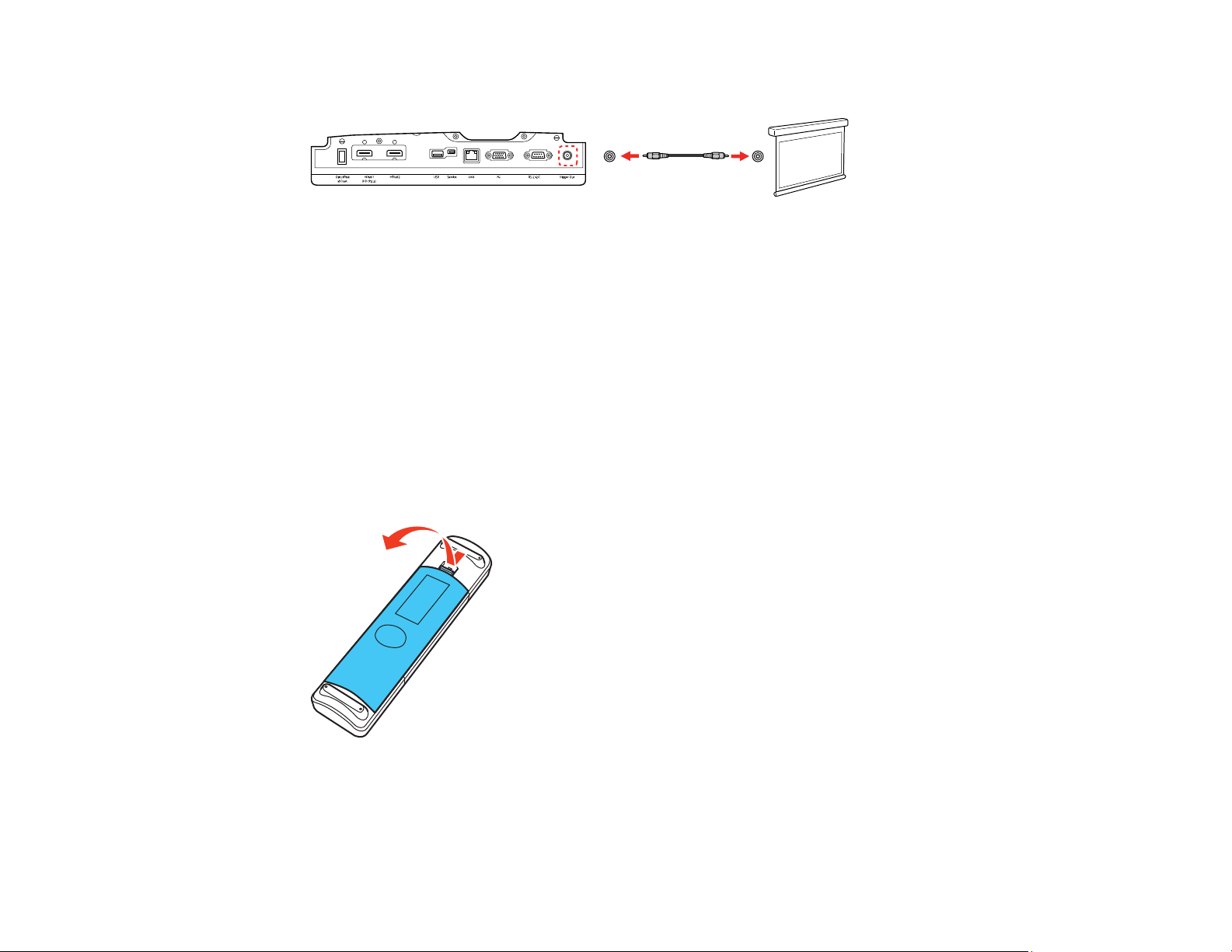
31
2. Connect the other end to the projector's Trigger Out port.
3. Turn on the Trigger Out setting in the projector's Extended menu.
Parent topic: Projector Connections
Related references
Projector Setup Settings - Extended Menu
Installing Batteries in the Remote Control
The remote control uses the two AA batteries that came with the projector.
Caution: Use only the type of batteries specified in this manual. Do not install batteries of different types,
or mix new and old batteries.
1. Remove the battery cover.
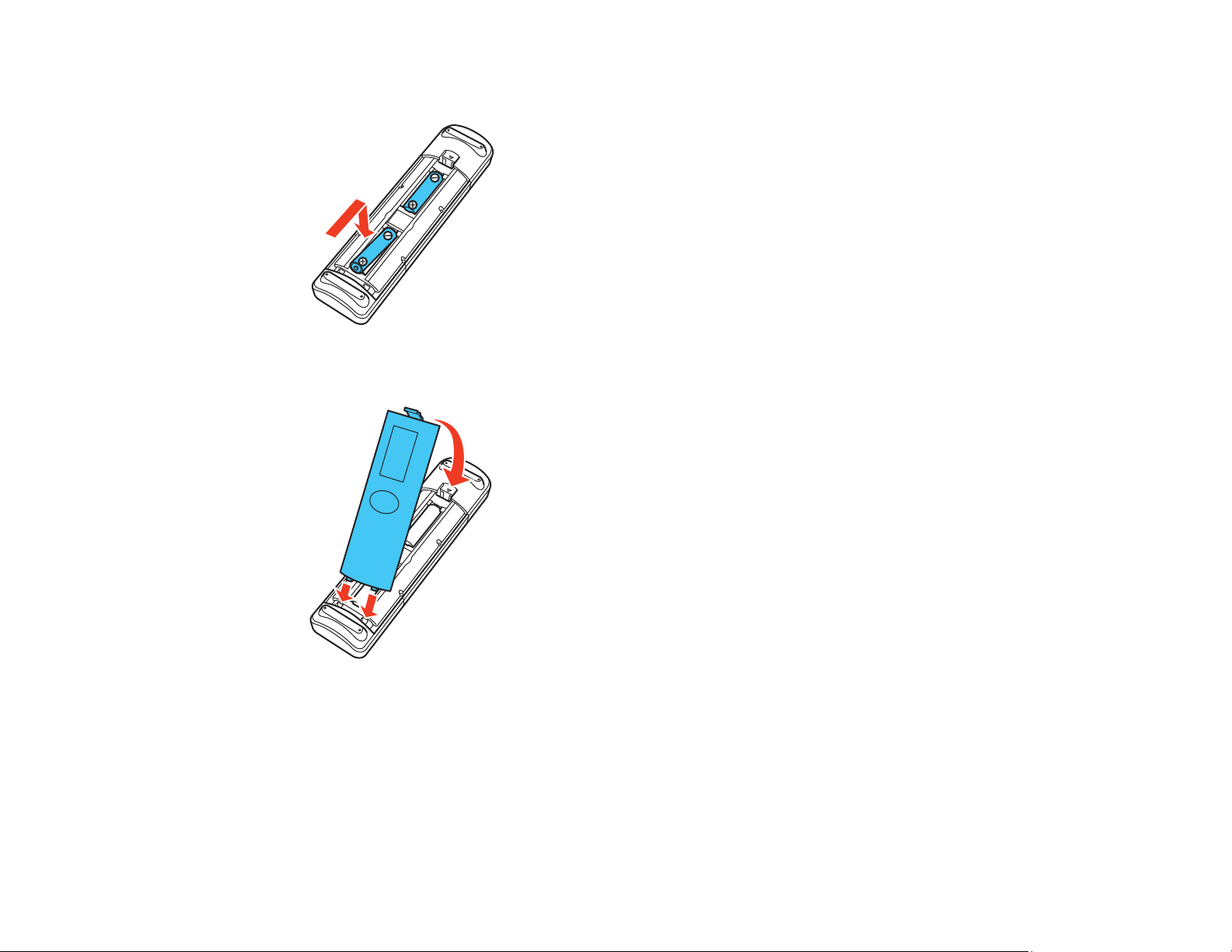
32
2. Insert the batteries with the + and – ends facing as shown.
3. Replace the battery cover and press it down until it clicks into place.
Warning: Dispose of used batteries according to local regulations. Do not expose batteries to heat
or flame. Keep batteries out of the reach of children; they are choking hazards and are very
dangerous if swallowed.
Parent topic: Setting Up the Projector
Related references
Remote Control Specifications

33
Using the Projector on a Network
Follow the instructions in these sections to set up your projector for use on a network.
Note: Epson iProjection is not recommended for use with streaming video.
Wired Network Projection
Wireless Network Projection
Selecting External Network Detection Settings
Wired Network Projection
You can project through a wired network. To do this, you connect the projector to your network with an
Ethernet cable, and then set up your projector and computer for network projection.
After connecting and setting up the projector, install the projector software. You may need to install it
from a software CD, if included, or download the software and manuals as necessary.
Note: If your projector is connected via a LAN (Ethernet) cable to a network that includes a wireless
access point, you can connect to the projector wirelessly through the access point using the Epson
network software.
Connecting to a Wired Network
Selecting Wired Network Settings
Parent topic: Using the Projector on a Network
Related references
Additional Projector Software and Manuals
Connecting to a Wired Network
To connect the projector to a wired local area network (LAN), use a 100Base-TX or 10Base-T network
cable. To ensure proper data transmission, use a Category 5 shielded cable or better.
1. Connect one end of the network cable to your network hub, switch, or router.
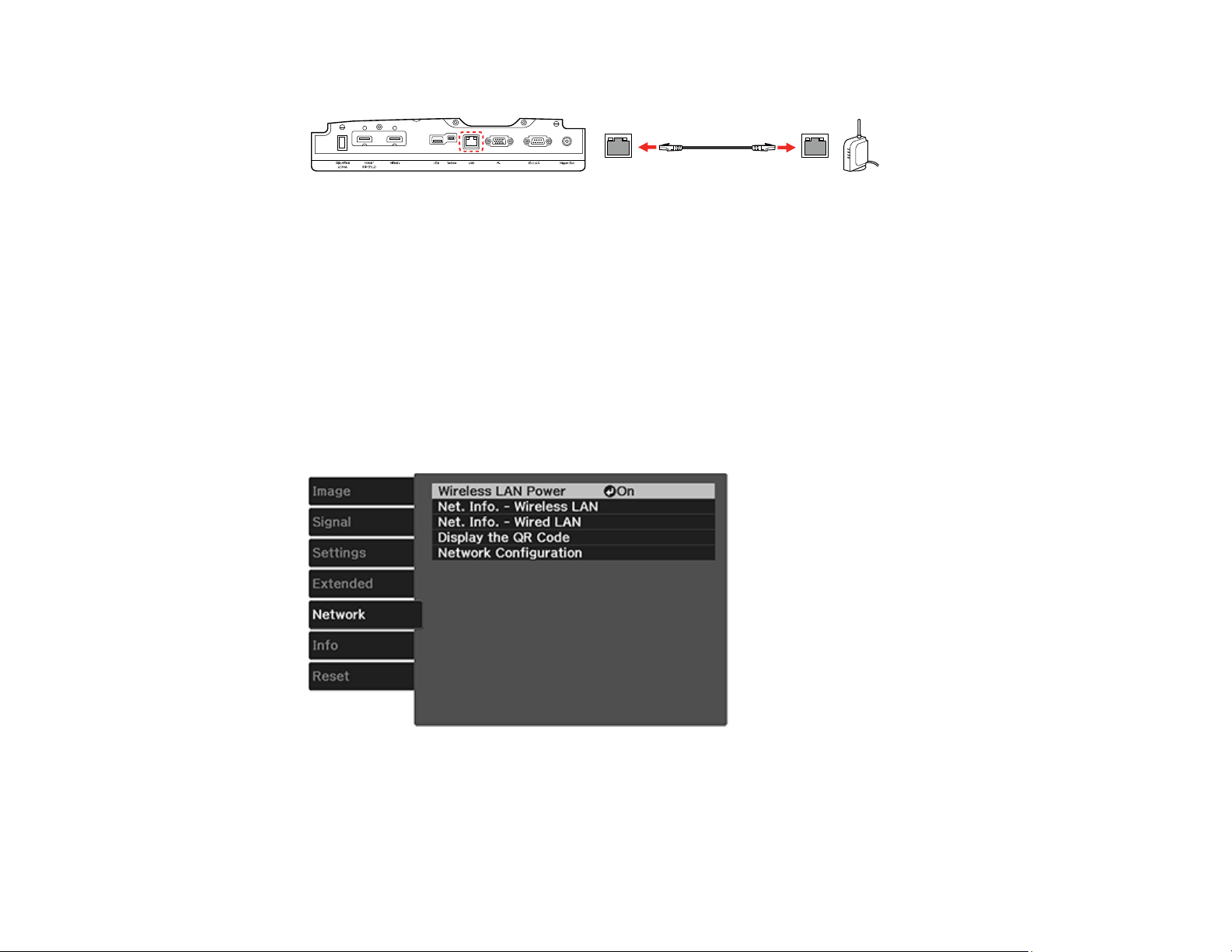
34
2. Connect the other end of the cable to the projector's LAN port.
Parent topic: Wired Network Projection
Selecting Wired Network Settings
Before you can project from computers, tablets, or smartphones over your network, you must select the
network settings for the projector using its menu system.
Note: Make sure you already connected the projector to your wired network using the LAN port.
1. Turn on the projector.
2. Press the Menu button.
3. Select the Network menu and press Enter.
4. Select Network Configuration and press Enter.
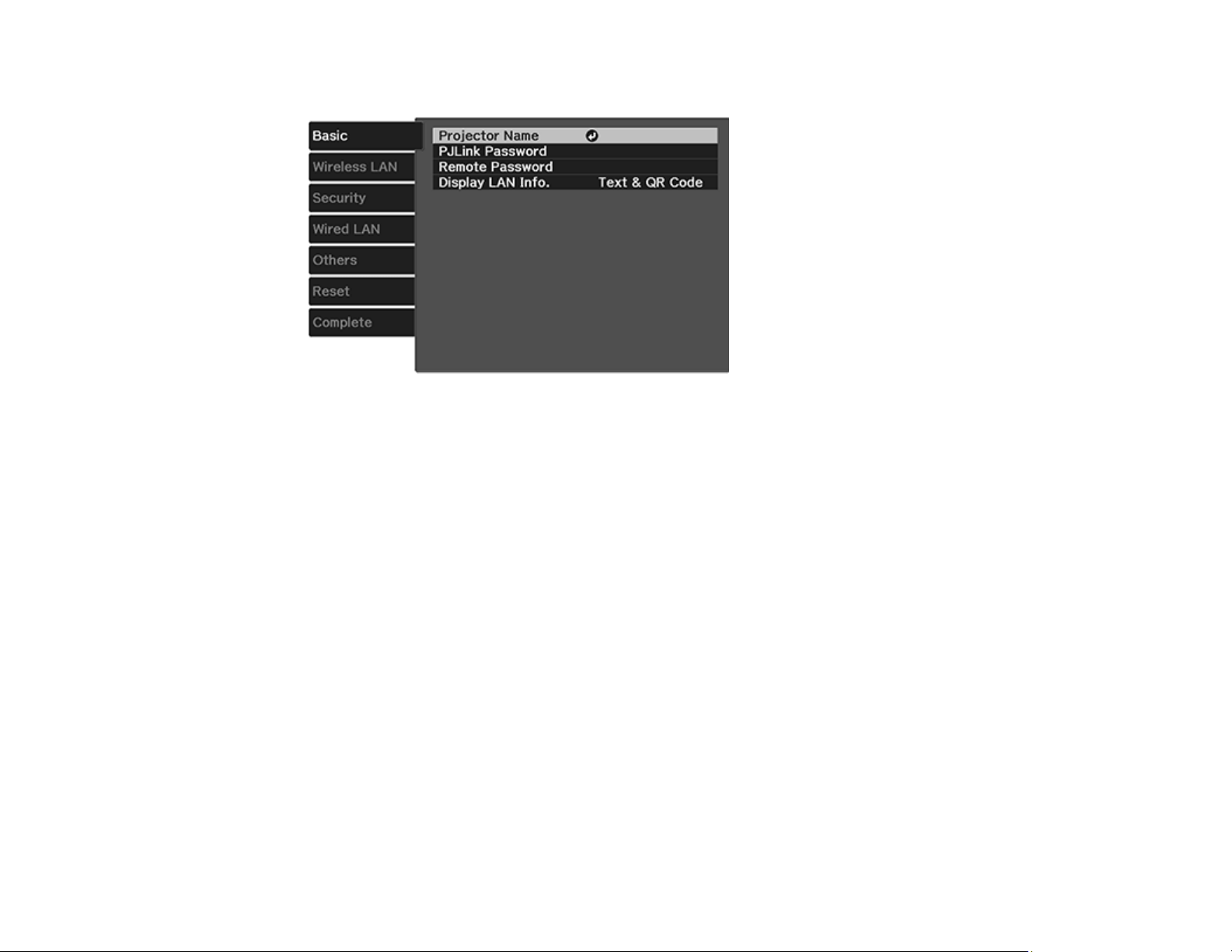
35
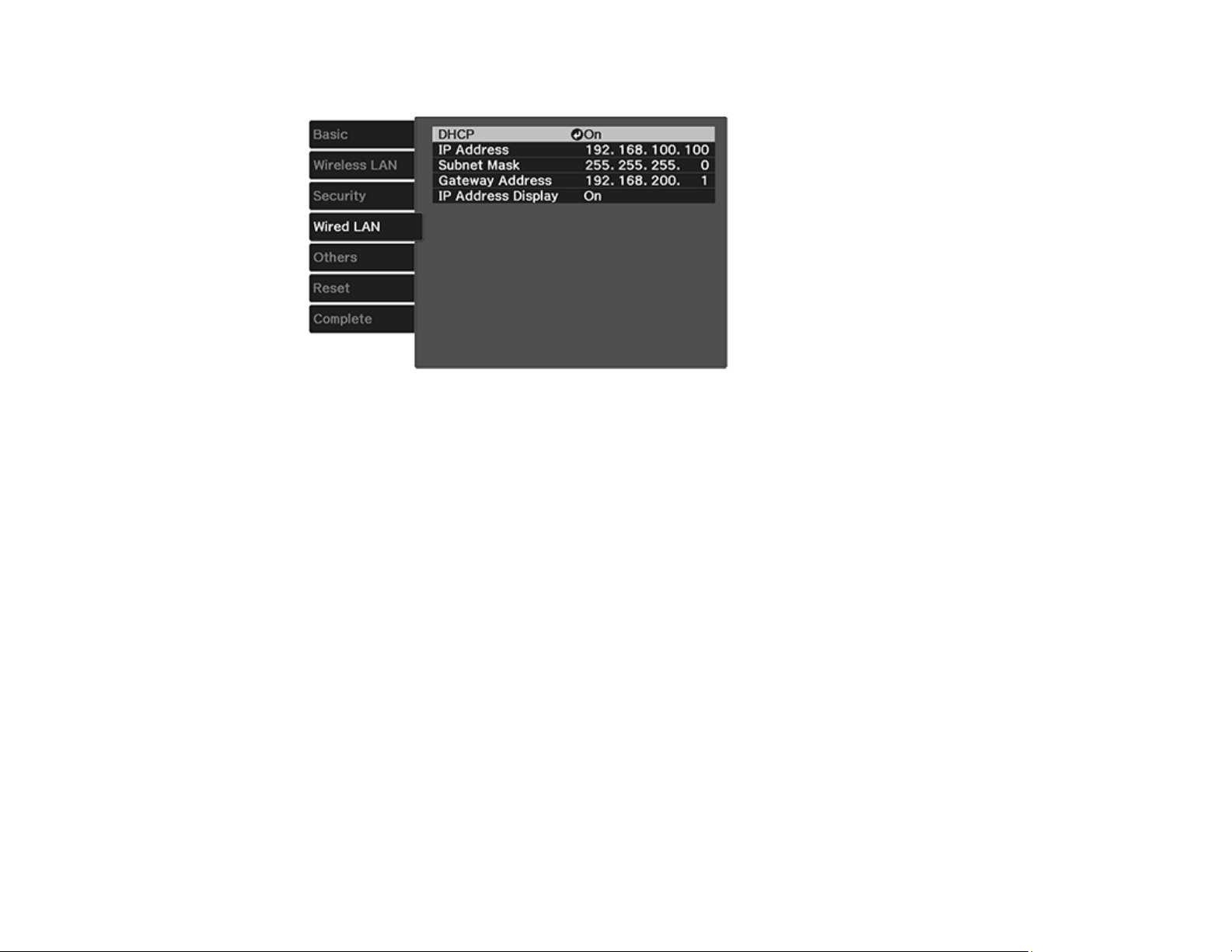
5. Select the Basic menu and press Enter.
6. Select the following basic options as necessary:
• Projector Name lets you enter a name up to 16 alphanumeric characters long to identify the
projector over the network.
• PJLink Password lets you enter a password up to 32 alphanumeric characters long for using the
PJLink protocol for projector control.
• Remote Password lets you enter a password up to 8 alphanumeric characters long for accessing
the Remote or Basic Control screen on a smartphone or tablet.
• Display LAN Info lets you select how the projector displays network information. You can select
an option to display a QR code that lets you quickly connect your iOS or Android devices using the
Epson iProjection app.
Note: Use the displayed keyboard to enter the name, passwords, and keyword. Press the arrow
buttons on the remote control to highlight characters and press Enter to select them. Press Finish
when you are done.
36
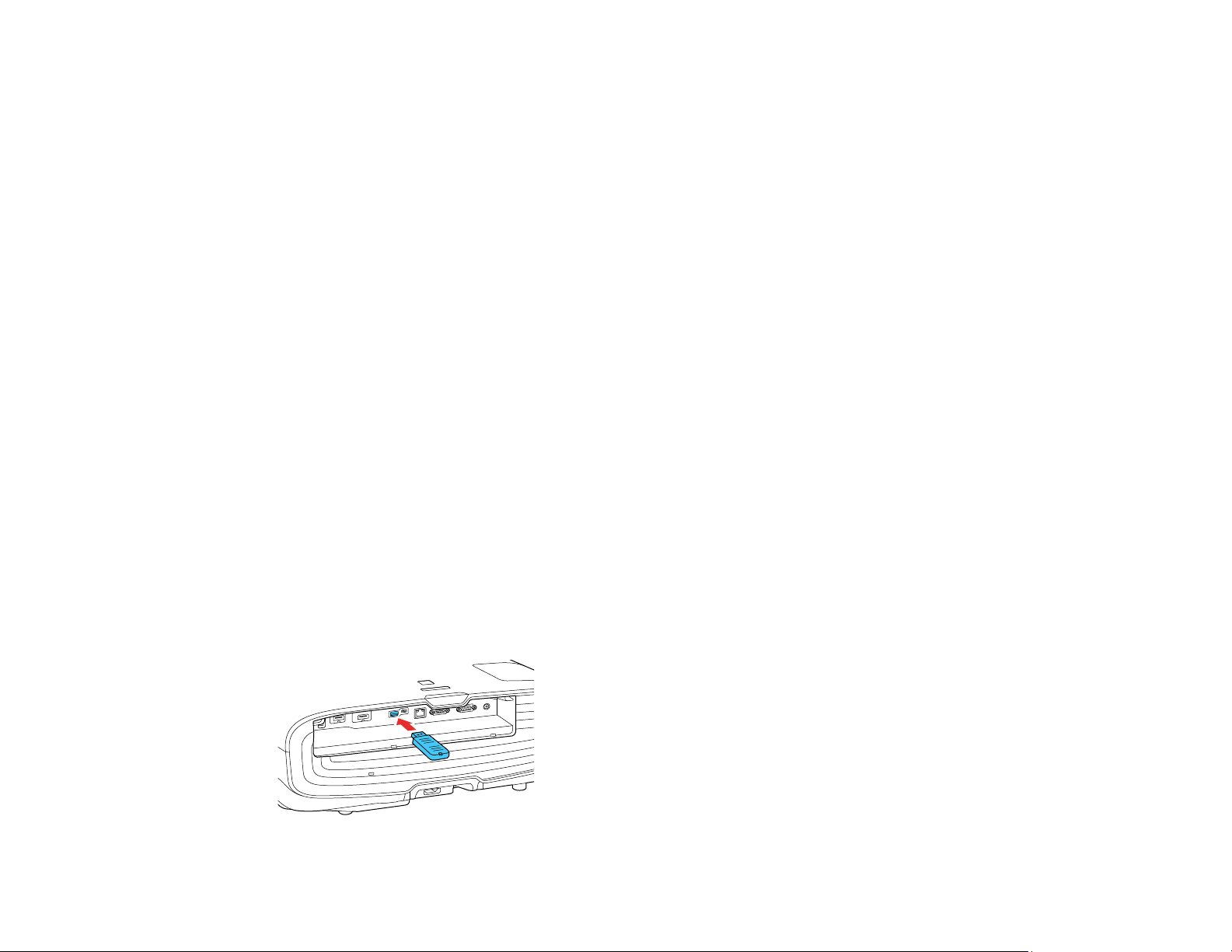
7. Select the Wired LAN menu and press Enter.
8. Select your IP Settings as necessary:
• If your network assigns addresses automatically, turn on the DHCP setting.
• If you must set addresses manually, turn off DHCP and enter the projector's IP Address, Subnet
Mask, and Gateway Address as needed.
Note: To highlight the numbers you want from the displayed keyboard, press the arrow buttons on
the remote control. To select a highlighted number, press Enter. Press Finish when you are done.
9. To prevent display of the IP address on the standby screen, turn off IP Address Display.
10. When you finish selecting settings, select Complete and follow the on-screen instructions to save
your settings and exit the menus.
Parent topic: Wired Network Projection
Wireless Network Projection
You can project over a wireless network. To do this, you must set up your projector and computer for
wireless projection.
Note: The Epson 802.11b/g/n wireless LAN module is not included with your projector and is optional.
To connect wirelessly to your projector, configure the connection using the projector's Network menus.
37
After connecting and setting up the projector, install the projector software. You may need to install it
from a software CD, if included, or download the software and manuals as necessary.
Note: Wireless network connectivity is not recommended for video streaming.
Note: If your projector is connected via a LAN cable to a network that includes a wireless access point,
you can connect to the projector wirelessly through the access point using the Epson network software.
Installing the Wireless LAN Module
Selecting Wireless Network Settings Manually
Using a QR Code to Connect a Mobile Device
Searching for a Wireless Network
Selecting Wireless Network Settings in Windows
Selecting Wireless Network Settings on Mac
Enabling WPA or WPA2 Security
Parent topic: Using the Projector on a Network
Related references
Additional Projector Software and Manuals
Installing the Wireless LAN Module
To use the projector over a wireless network, install the Epson 802.11b/g/n wireless LAN module in the
projector. Do not install any other type of wireless module.
Note: The wireless LAN module is not included with your projector.
Insert the wireless LAN module into the USB port.
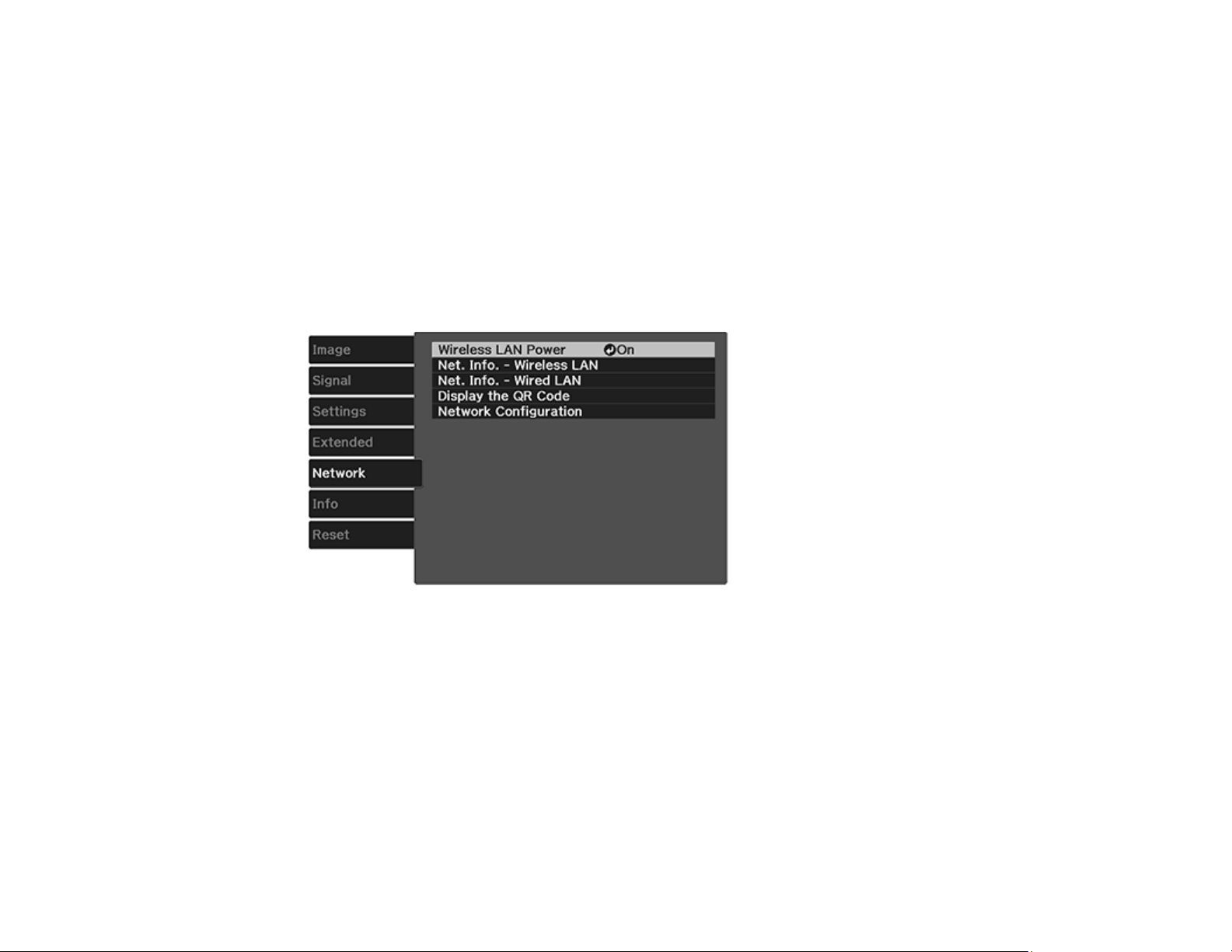
38
The light on the wireless LAN module turns on when the module is installed and operating. The light
flashes when the module is communicating over the network.
Parent topic: Wireless Network Projection
Selecting Wireless Network Settings Manually
Before you can project from your wireless network, you must select the network settings for the projector
using its menu system.
1. Turn on the projector.
2. Press the Menu button.
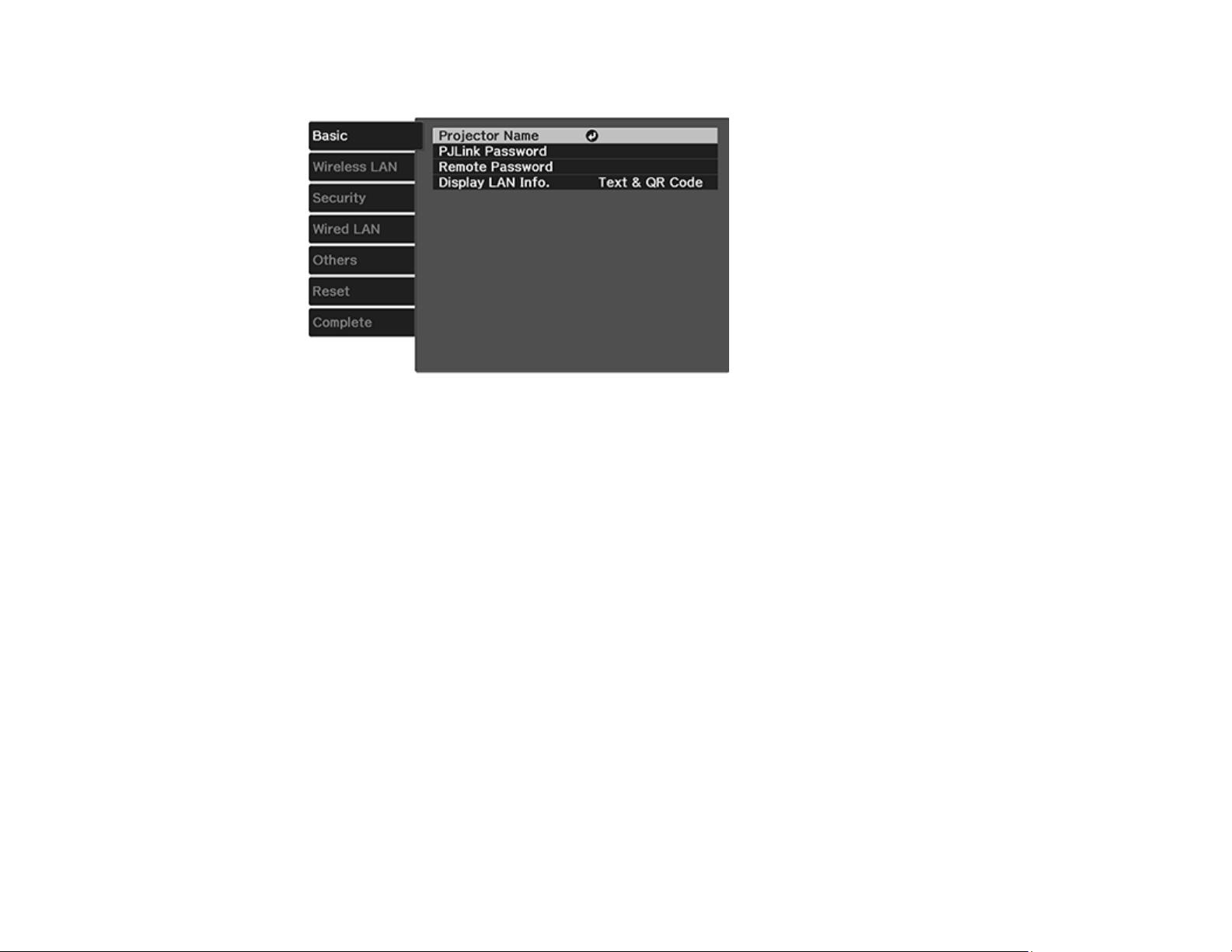
3. Select the Network menu and press Enter.
4. Make sure the Wireless LAN Power setting is set to On.
5. Select Network Configuration and press Enter.
39
6. Select the Basic menu and press Enter.
7. Select the following basic options as necessary:
• Projector Name lets you enter a name up to 16 alphanumeric characters long to identify the
projector over the network.
• PJLink Password lets you enter a password up to 32 alphanumeric characters long for using the
PJLink protocol for projector control.
• Remote Password lets you enter a password up to 8 alphanumeric characters long for accessing
the Remote or Basic Control screen on a smartphone or tablet.
• Display LAN Info lets you select how the projector displays network information. You can select
an option to display a QR code that lets you quickly connect your iOS or Android devices with the
Epson iProjection app.
Note: Use the displayed keyboard to enter the name, passwords and keyword. Press the arrow
buttons on the remote control to highlight characters and press Enter to select them. Press Finish
when you are done.
40
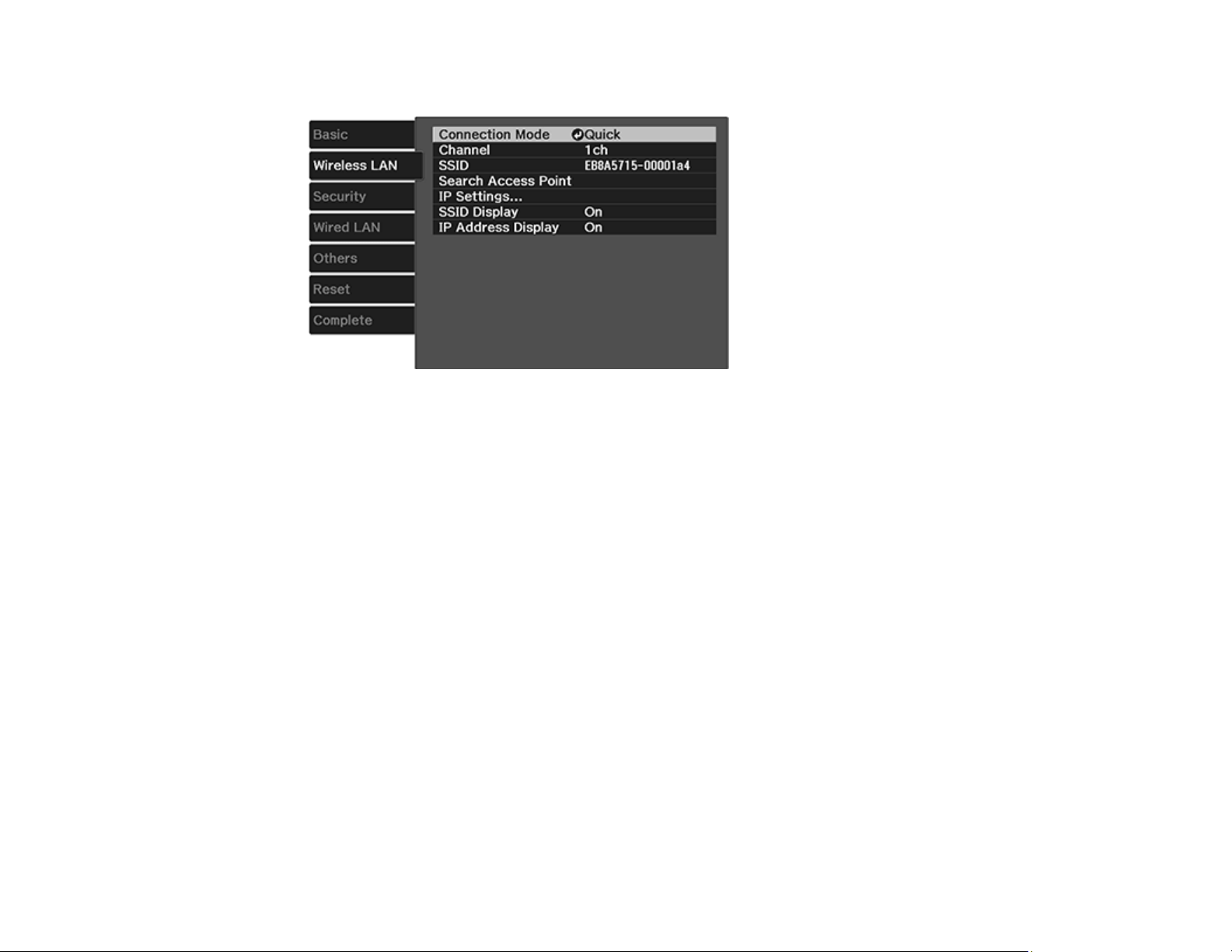
8. Select the Wireless LAN menu and press Enter.
9. Select the settings on the Wireless LAN menu as necessary for your network.
10. When you finish selecting settings, select Complete and follow the on-screen instructions to save
your settings and exit the menus.
After you complete the wireless settings for your projector, you need to select the wireless network on
your computer, or iOS or Android device.
Wireless LAN Menu Settings
Restricted IP Addresses
Parent topic: Wireless Network Projection

41
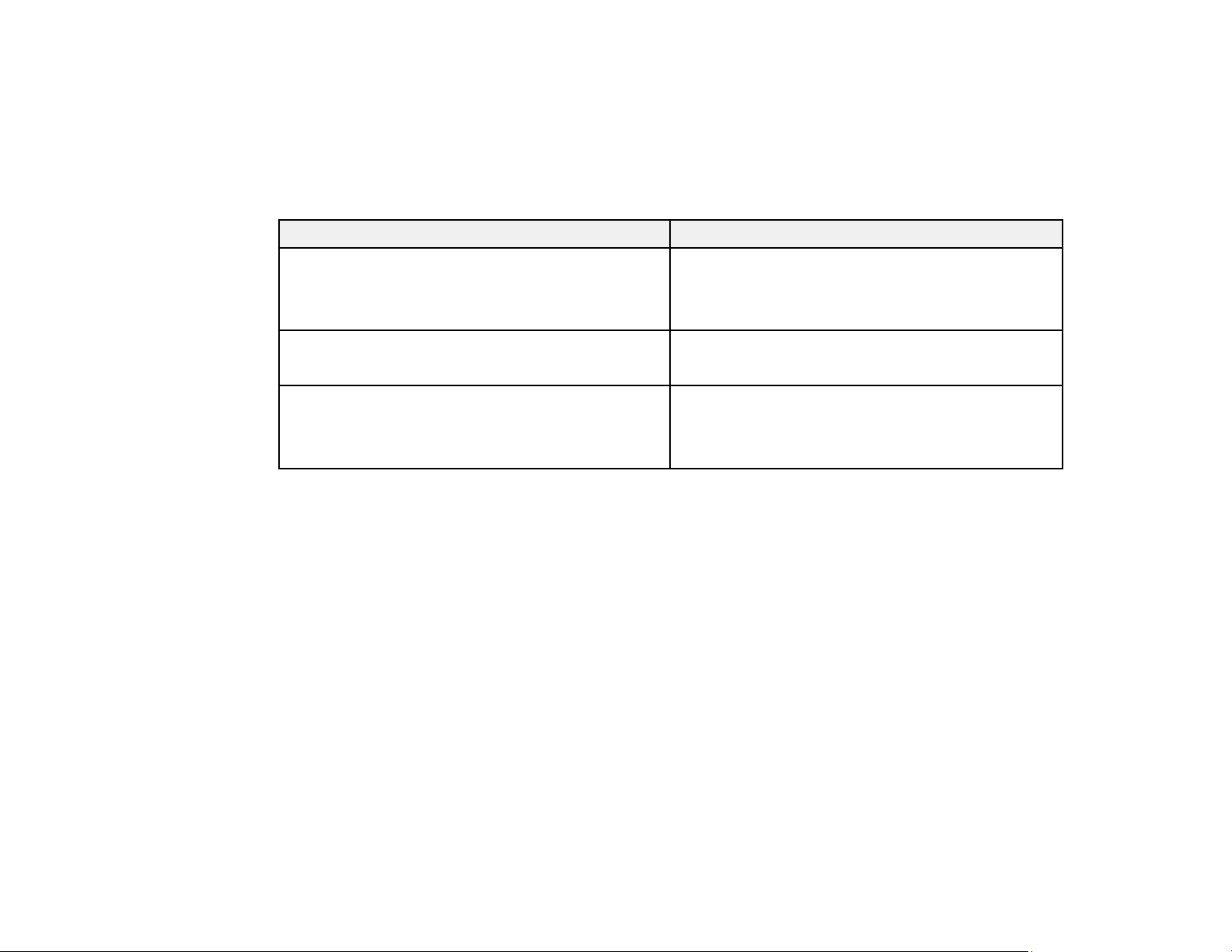
Wireless LAN Menu Settings
Setting Options Description
Connection Mode Quick
Advanced
Selects the type of wireless
connection:
Quick: lets you quickly connect
to local devices without an
internet connection
Advanced: lets you connect to
multiple computers via a wireless
network access point
(infrastructure mode)
Channel 1ch
6ch
11ch
In Quick connection mode,
selects the frequency band
(channel) used by the wireless
LAN
SSID Up 32 alphanumeric characters Sets the SSID (network name) of
the wireless LAN system the
projector is connecting to
Search Access Point To Search View Searches for available wireless
network access points in
Advanced connection mode
IP Settings — Turns on DHCP if your network
assigns addresses automatically;
set to Off to manually enter the
network's IP Address, Subnet
Mask, and Gateway Address
(see list of restricted IP
addresses in link below)
SSID Display On
Off
Selects whether to display the
SSID on the network standby
screen and the Home screen
IP Address Display On
Off
Selects whether to display the IP
address on the network standby
screen and the Home screen
42
Parent topic: Selecting Wireless Network Settings Manually
Related references
Restricted IP Addresses
Restricted IP Addresses
When manually entering IP Settings, you cannot use these ranges of IP addresses:
Setting Restricted IP addresses
IP Address 0.0.0.0
127.x.x.x
224.0.0.0 to 255.255.255.255
Subnet Mask 0.0.0.0
255.255.255.255
Gateway Address 0.0.0.0
127.x.x.x
224.0.0.0 to 255.255.255.255
Parent topic: Selecting Wireless Network Settings Manually
Using a QR Code to Connect a Mobile Device
After you select the wireless network settings for your projector, you can display a QR code on the
screen and use it to connect a mobile device using the Epson iProjection app.
Note: Make sure you have installed the latest version of Epson iProjection on your device. Visit
epson.com/iprojection (U.S.) or epson.ca/iprojection (Canada) for more information.
1. Press the Menu button.
43
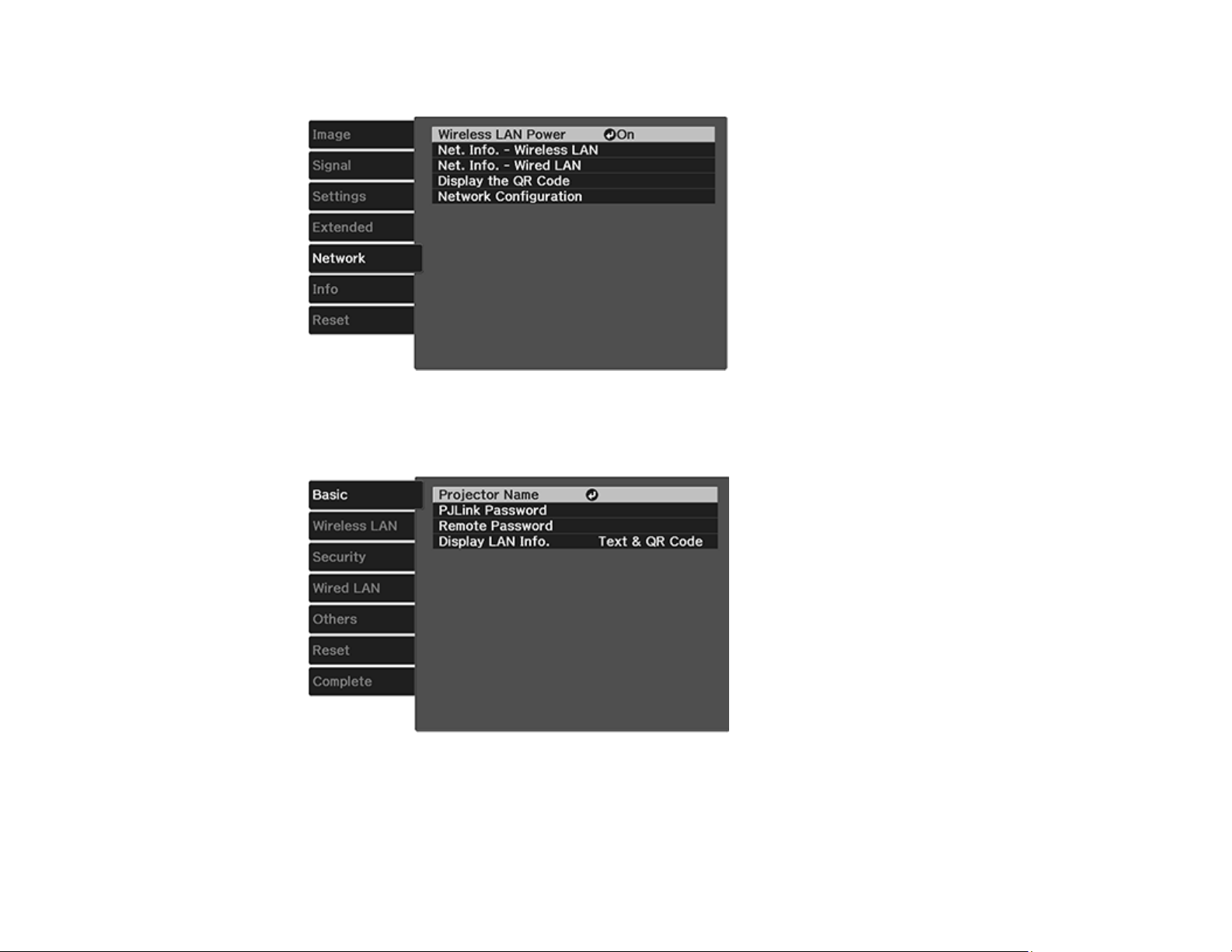
2. Select the Network menu and press Enter.
3. Select Network Configuration and press Enter.
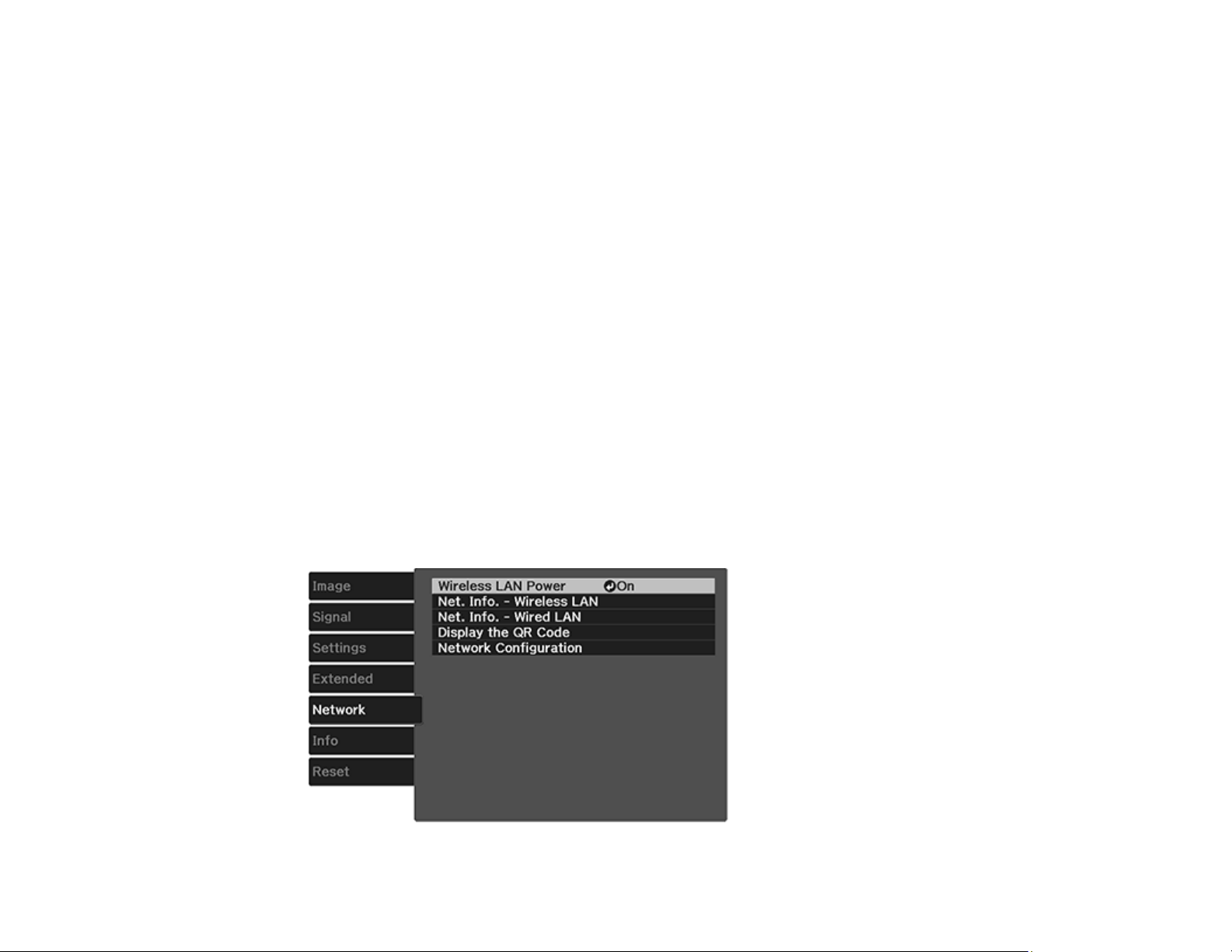
4. Select the Basic menu and press Enter.
5. Set the Display LAN Info setting to Text & QR Code.
6. Select Complete and follow the on-screen instructions to save your settings and exit the menus.
44
7. Do one of the following:
• Press the LAN button on the remote control.
• Select Display the QR Code in the projector's Network menu.
• Press the Home button on the remote control and select Display the QR Code on the Home
screen.
Your projector displays the QR code on the projection surface.
Note: If you do not see the QR code after pressing the LAN button, press Enter to display it.
8. Start Epson iProjection on your mobile device.
9. Use the QR code reader feature to read the QR code and connect your device to the projector. Visit
epson.com/iprojection (U.S.) or epson.ca/iprojection (Canada) for instructions.
Parent topic: Wireless Network Projection
Searching for a Wireless Network
You can use your projector's site survey function to quickly locate and connect to available wireless
networks.
1. Turn on the projector.
2. Press the Menu button.
3. Select the Network menu and press Enter.
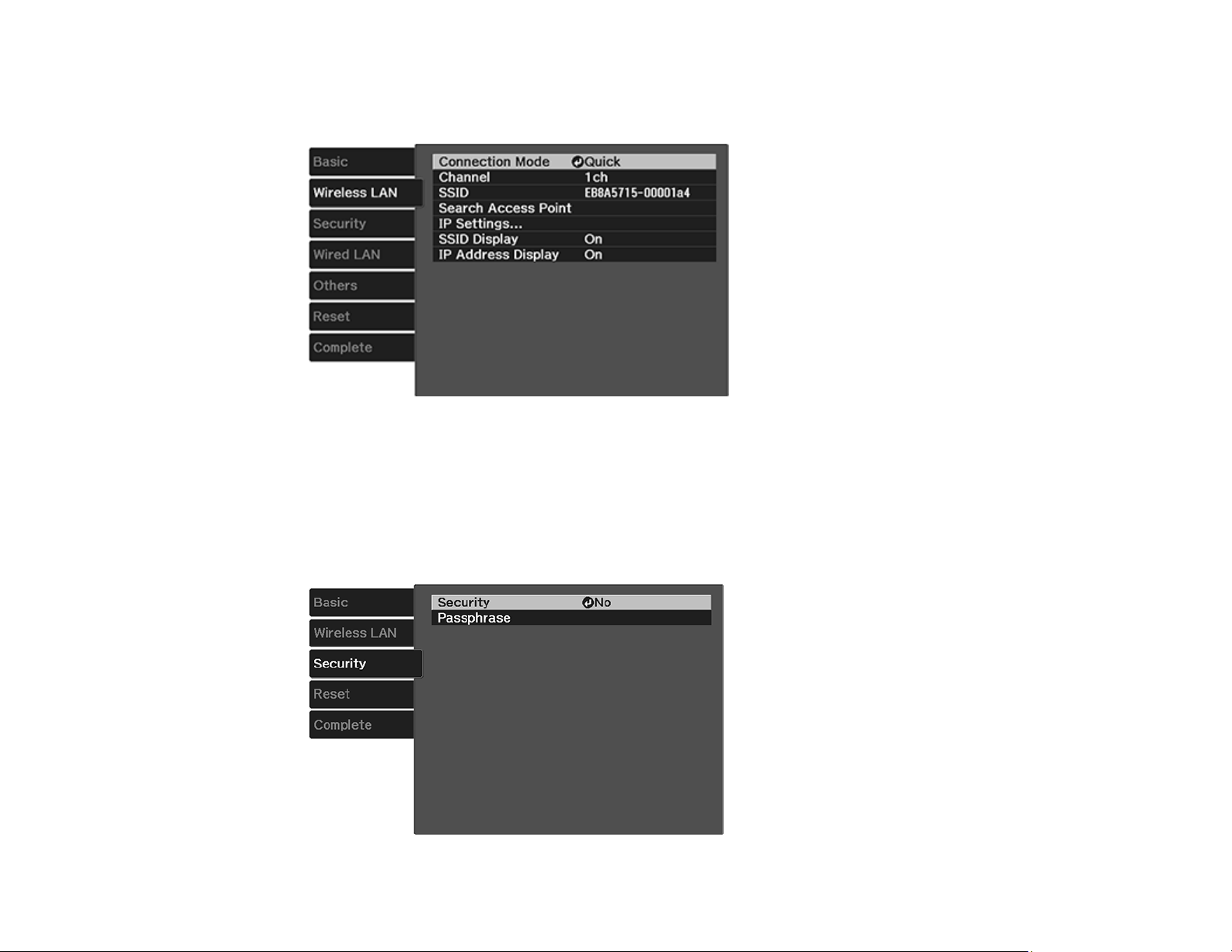
45
4. Select Network Configuration and press Enter.
5. Select the Wireless LAN menu and press Enter.
6. Select Advanced as the Connection Mode setting and press Enter.
7. Select Search Access Point and press Enter.
8. Select the name of the wireless network you want to connect to and press Enter.
9. If the network has security enabled, enter the wireless password.
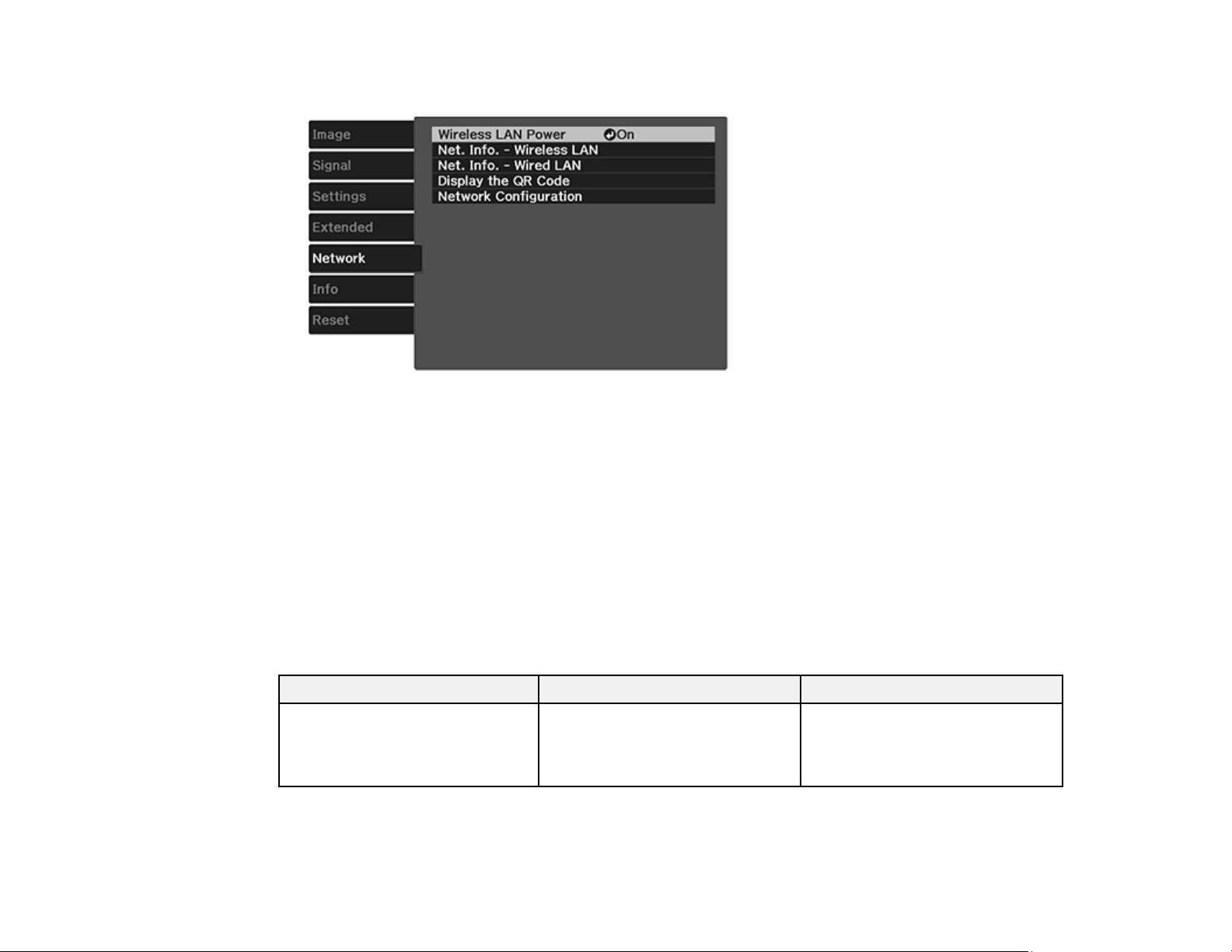
You see a screen like this:

46
10. Select the settings on the Security menu as necessary for your network.
11. When you finish selecting settings, select Complete and follow the on-screen instructions to save
your settings and exit the menus.
Parent topic: Wireless Network Projection
Selecting Wireless Network Settings in Windows
Before connecting to the projector, select the correct wireless network on your computer.
1. To access your wireless utility software, access the Desktop and double-click the network icon on
the Windows taskbar.
2. Do one of the following:
• If your projector is set up on an existing network (Advanced mode), select the network name
(SSID).
• If your projector is configured for Quick mode, select the projector's SSID.
3. Click Connect.
Parent topic: Wireless Network Projection
Selecting Wireless Network Settings on Mac
Before connecting to the projector, select the correct wireless network on your Mac.
1. Click the AirPort icon on the menu bar at the top of the screen.
2. Make sure AirPort is turned on, then do one of the following:
• If your projector is set up on an existing network (Advanced mode), select the network name
(SSID).
• If your projector is configured for Quick mode, select the projector's SSID.
Parent topic: Wireless Network Projection
Enabling WPA or WPA2 Security
Set up the WPA or WPA2 security settings to match your network's settings. Check with your network
administrator for guidance on entering the correct information.
1. Turn on the projector.
2. Press the Menu button.
47
3. Select the Network menu and press Enter.
4. Select Network Configuration and press Enter.
5. Select the Security menu and press Enter.
6. Select the settings on the Security menu as necessary for your network.
7. When you finish selecting settings, select Complete and follow the on-screen instructions to save
your settings and exit the menus.
Wireless Security Menu Settings
Parent topic: Wireless Network Projection
Wireless Security Menu Settings
Settings on the Security menu let you select the type of security and security settings that match the
network you are connecting the projector to.
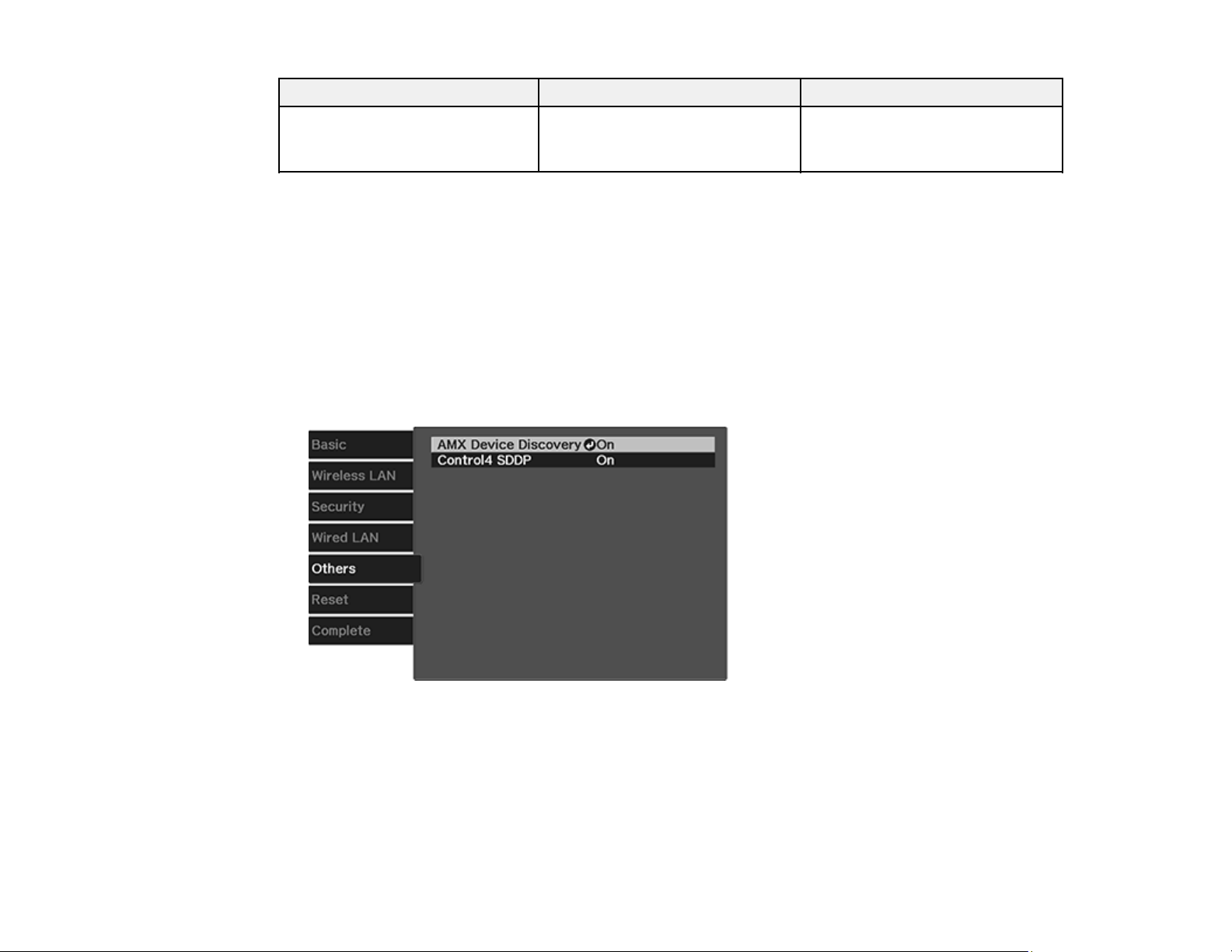
Setting Options Description
Security No
WPA2-PSK
WPA/WPA2-PSK
Selects the type of security used
on the wireless network
48
Setting Options Description
Passphrase — For the selected security, selects
the pre-shared passphrase used
on the network
Parent topic: Enabling WPA or WPA2 Security
Selecting External Network Detection Settings
If you are using a compatible network control system, you can select settings that allow your projector to
be detected by those systems.
1. Press the Menu button.
2. Select the Network menu and press Enter.
3. Select Network Configuration and press Enter.
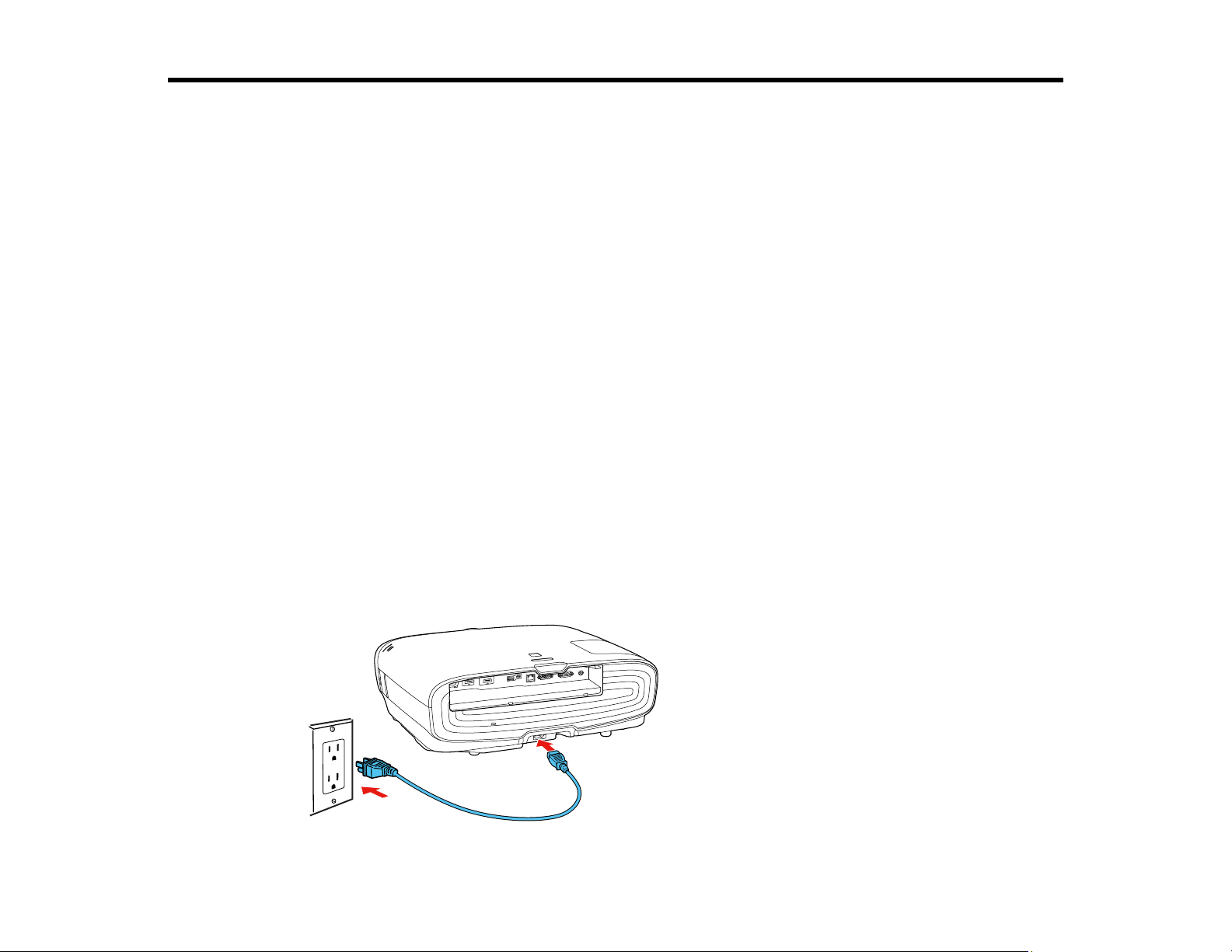
4. Select the Others menu and press Enter.
5. If your network environment uses an AMX controller, turn on the AMX Device Discovery setting to
allow the projector to be detected.
6. If your network environment uses a Control4 or Control4 SDDP controller, turn on the Control4
SDDP setting to allow the projector to be detected.
7. When you finish selecting settings, select Complete and follow the on-screen instructions to save
your settings and exit the menus.

50
Using Basic Projector Features
Follow the instructions in these sections to use your projector's basic features.
Turning On the Projector
Turning Off the Projector
Viewing 3D Images
Selecting the Language for the Projector Menus
Adjusting the Image Height
Adjusting the Image Position Using Lens Shift
Image Shape
Resizing the Image with the Zoom Feature
Focusing the Image with the Lens Button
Remote Control Operation
Selecting an Image Source
Projection Modes
Image Aspect Ratio
Color Mode
Turning On the Projector
Turn on the computer or video equipment you want to use before you turn on the projector so it can
display the image source.
1. Connect the power cord to the projector's power inlet.

51
2. Plug the power cord into an electrical outlet.
Note: With Direct Power On turned on, the projector turns on as soon as you plug it in.
The projector's power light turns blue. This indicates that the projector is receiving power.
3. Press the power button on the projector or the On button on the remote control to turn on the
projector.
Warning: Never look into the projector lens when the lamp is on. This can damage your eyes and is
especially dangerous for children.
If you do not see a projected image right away, try the following:
• Turn on the connected computer or video device.
• Insert a DVD or other video media and press the play button, if necessary.
• Press the Source button on the projector to detect the video source, or press a source button on the
remote control.
• If the Home screen is displayed, select the source you want to project.
Using the Home Screen
Parent topic: Using Basic Projector Features
Related references
Projector Setup Settings - Extended Menu
Using the Home Screen
You can select input sources and other frequently used options from the Home screen.
1. To display the Home screen, do one of the following:
• Press the Home button on the remote control.
• Turn on the projector with the Home Screen Auto Disp setting enabled.
• Turn on the projector when no signal is received from the selected input source.
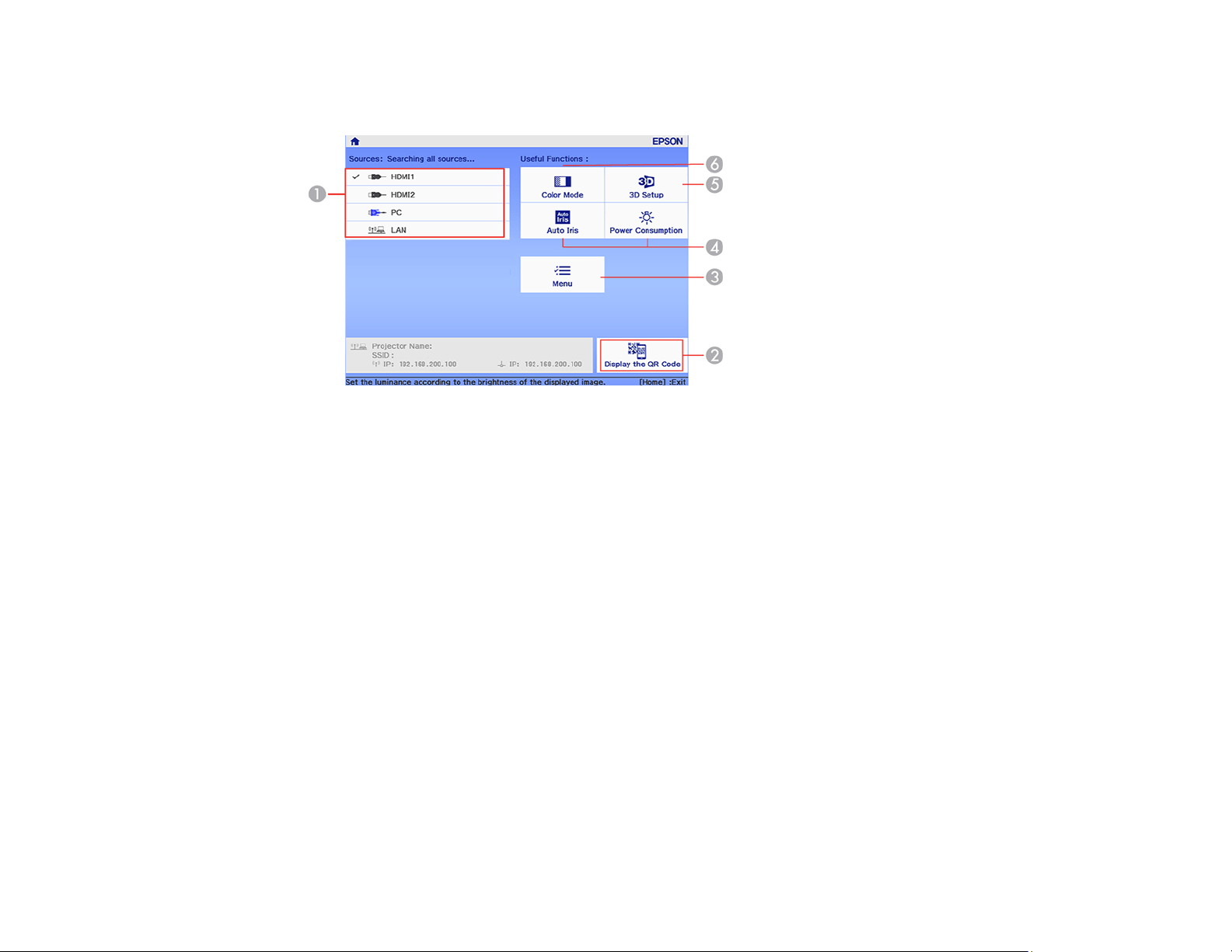
52
2. Press the arrow buttons on the remote control or control panel to navigate the screen, and press
Enter to select an option.
1 Select the video source you want to project
2 Display the QR code
3 Display the projector's menus
4 Select customizable menu options
5 Select to change the 3D settings
6 Select to change the Color Mode
Note: You can select the customizable menu options using the Custom Function 1 and Custom
Function 2 settings in the Extended menu.
3. Press the Home button to hide the Home screen.
Parent topic: Turning On the Projector
Related references
Projector Setup Settings - Extended Menu
53
Turning Off the Projector
Before turning off the projector, shut down any computer connected to it so you can see the computer
display during shutdown.
Note: Turn off this product when not in use to prolong the life of the projector. Lamp life will vary
depending upon mode selected, environmental conditions, and usage. Brightness decreases over time.
Note: When using the Blank feature, the projector lamp is still on. To turn off the lamp, turn off the
projector.
Note: If the Standby Confirmation setting is set to Off on the Settings menu, the projector shuts down
immediately when you press the power button on the projector or the Standby button on the remote
control.
1. Press the power button on the projector or the Standby button on the remote control.
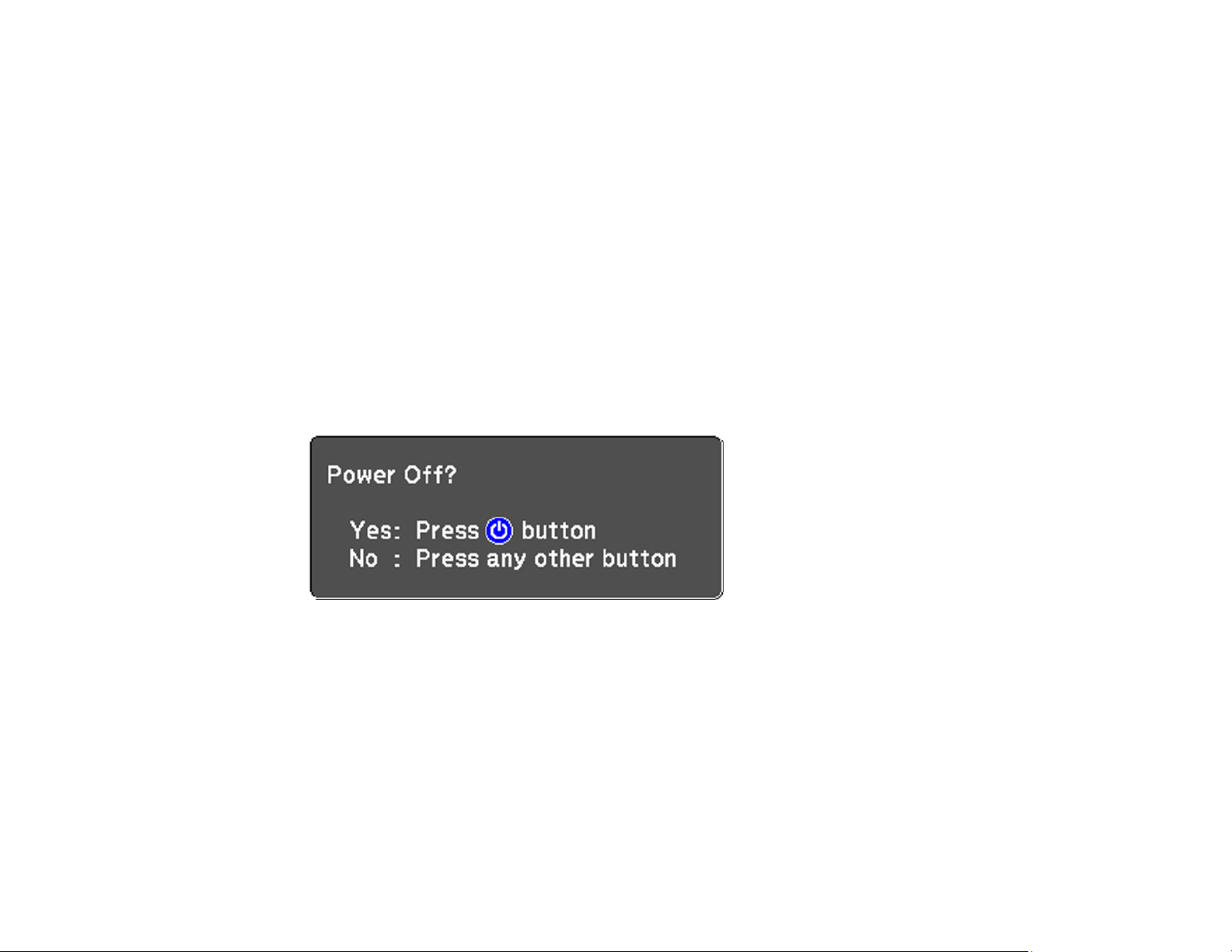
The projector displays a shutdown confirmation screen.
2. Press the power button on the projector or the Standby button on the remote control again. (To
leave it on, press any other button.)
The lamp turns off and the lens shutter closes. The projector's Status light flashes and then turns off.
Note: If you unplug the projector before the Status light stops flashing and need to turn the projector
back on, wait until the lamp has cooled down (about 10 minutes), plug the power cord back in, and
turn the projector on again. You cannot operate the projector until it finishes cooling down.
54
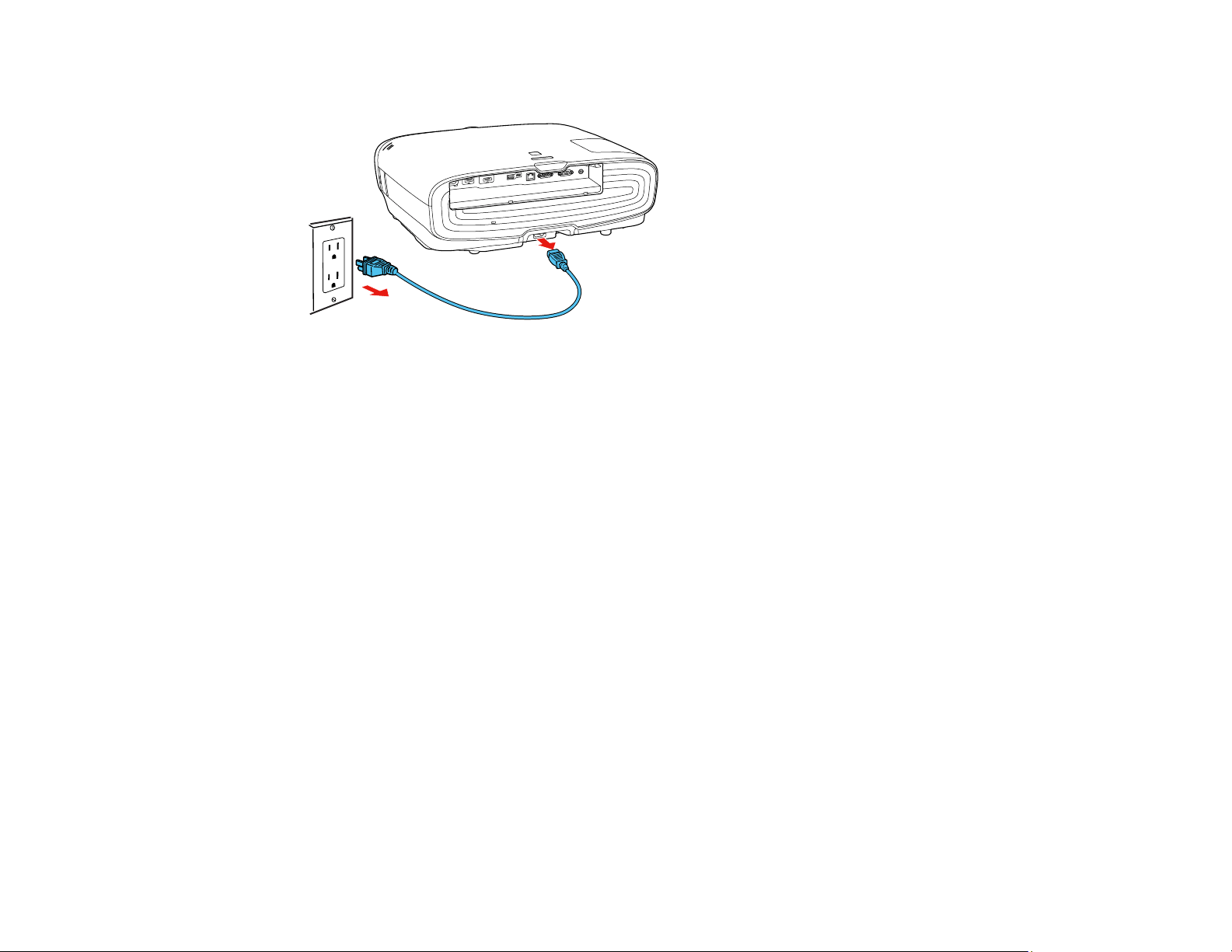
3. To transport or store the projector, make sure the Status light is off, then unplug the power cord.
Caution: To avoid damaging the projector or lamp, never unplug the power cord when the Status
light is on or flashing.
Parent topic: Using Basic Projector Features
Related references
Projector Feature Settings - Settings Menu
Related tasks
Shutting Off the Picture Temporarily
Transporting the Projector
Viewing 3D Images
You can view 3D images using your projector. Viewing 3D images requires a 3D-compatible video
device, a compatible HDMI cable, and a pair of Epson RF 3D glasses (not included with your projector).
You can also convert 2D images to 3D using the 2D-to-3D Conversion setting in your projector's
Signal > 3D Setup menu.
You can purchase Epson RF 3D glasses from an Epson authorized reseller. To find the nearest reseller,
call 800-GO-EPSON (800-463-7766) in the U.S. or 800-807-7766 in Canada. Or you can purchase
online at epsonstore.com (U.S. sales) or epsonstore.ca (Canadian sales).
Note: Make sure the 3D Display setting on the Signal menu is set to Auto or 3D.
1. Connect a 3D-compatible video device to the projector using a compatible HDMI cable.
55
2. Turn on the video device, then turn on the projector.
3. Begin playback from the video device.
Note: Make sure you set the video device to play content in 3D mode.
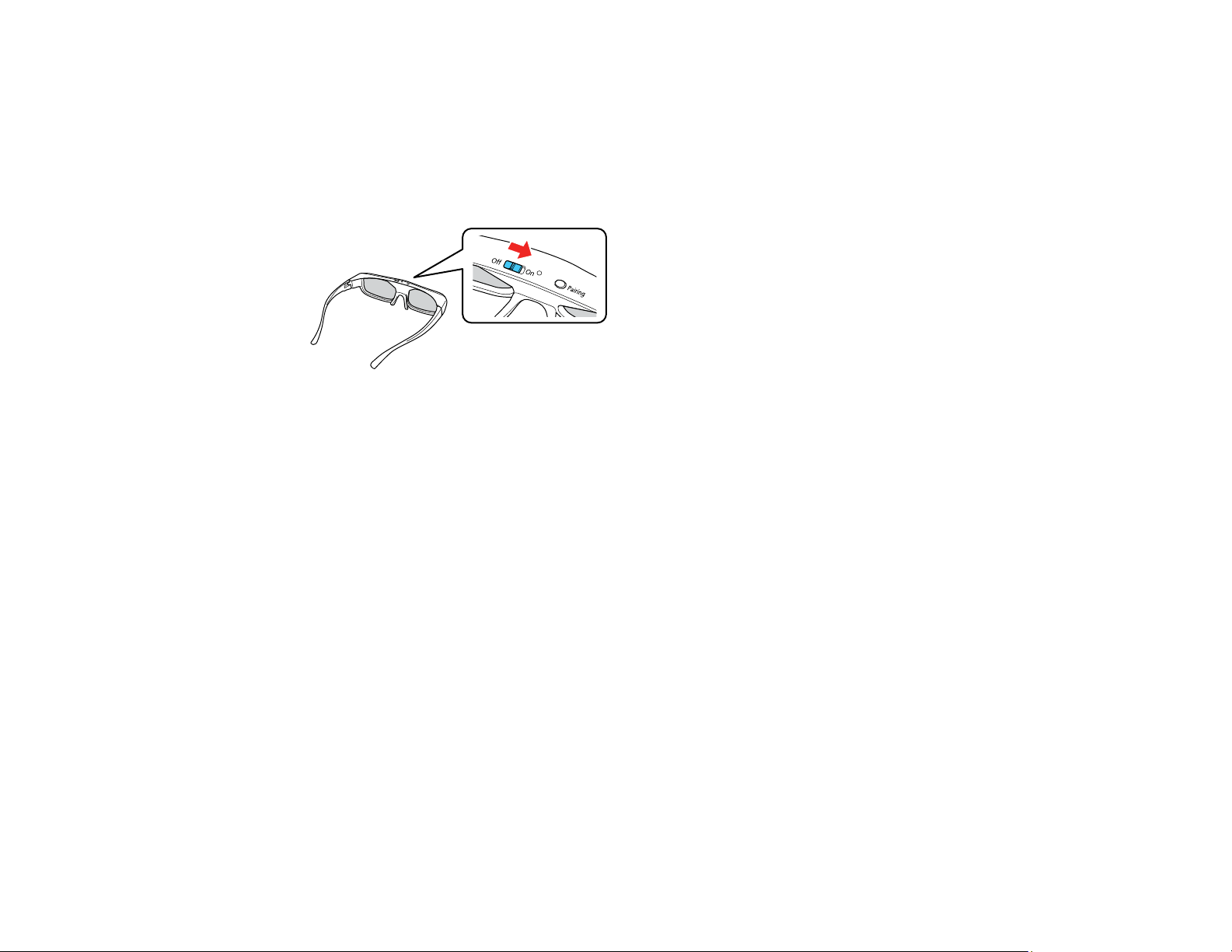
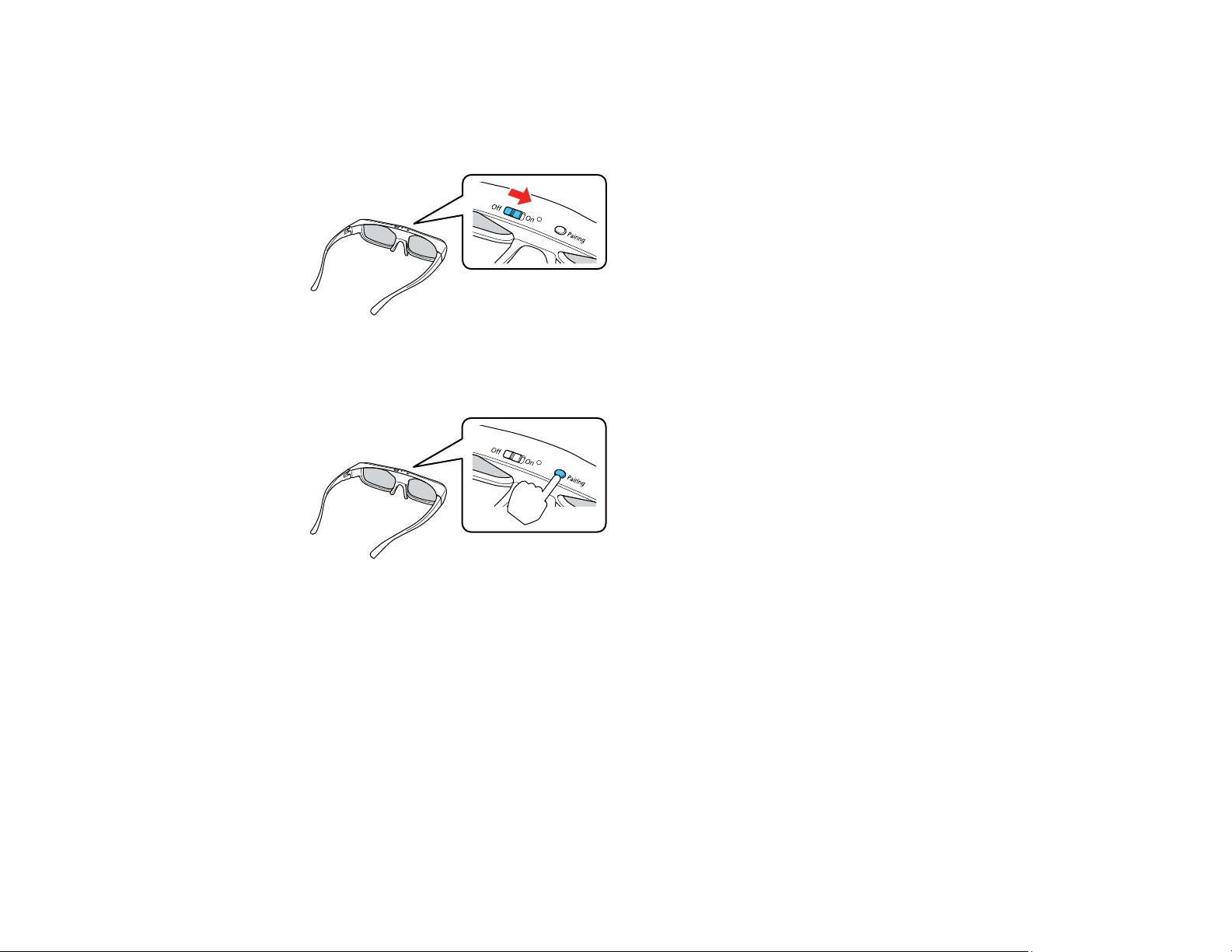
4. Slide the power switch on the 3D glasses to the On position.
5. Put on the 3D glasses and view the projected image. If you do not see a 3D image, pair the glasses
with the projector.
Note: If you change the video source or you are not within range of your projector, the glasses enter
standby mode and the status light flashes green. Slide the power switch on the glasses to the Off
position and then back to the On position to resume 3D viewing.
Pairing the 3D Glasses with the Projector
Charging the 3D Glasses
3D Viewing Range
Parent topic: Using Basic Projector Features
Related references
Input Signal Settings - Signal Menu
Related tasks
Connecting to an HDMI Video Source
Pairing the 3D Glasses with the Projector
Pair the glasses with the projector to establish communication between them for 3D viewing.
1. Turn on the projector.
56
2. Set the image source on the projector to HDMI.
3. Project a 3D image.
4. Slide the power switch on the 3D glasses to the On position.
5. Move the glasses within 10 feet (3 m) of the projector and hold down the Pairing button for at least
three seconds.
The status light on the glasses flashes green and red. If pairing is successful, the light turns green
for 10 seconds and then turns off.
Parent topic: Viewing 3D Images
Charging the 3D Glasses
When the status light on the glasses flashes red to indicate a low battery, it is time to charge the glasses.

57
1. Connect the smaller end of the charging cable to the port on the bridge of the glasses.
Note: Make sure you connect the cable in the correct orientation or you may damage the glasses or
cable.
2. Do one of the following:
• Plug the other end of the charging cable into a powered USB port on a computer or other device.
• Plug the other end of the charging cable into a USB-to-AC adapter with the following
specifications:
Input: 100-240V, ~0.15A, 50-60Hz
Output: 5V=1A
The glasses are fully charged when the status light on the glasses stays green.
Parent topic: Viewing 3D Images
58
3D Viewing Range
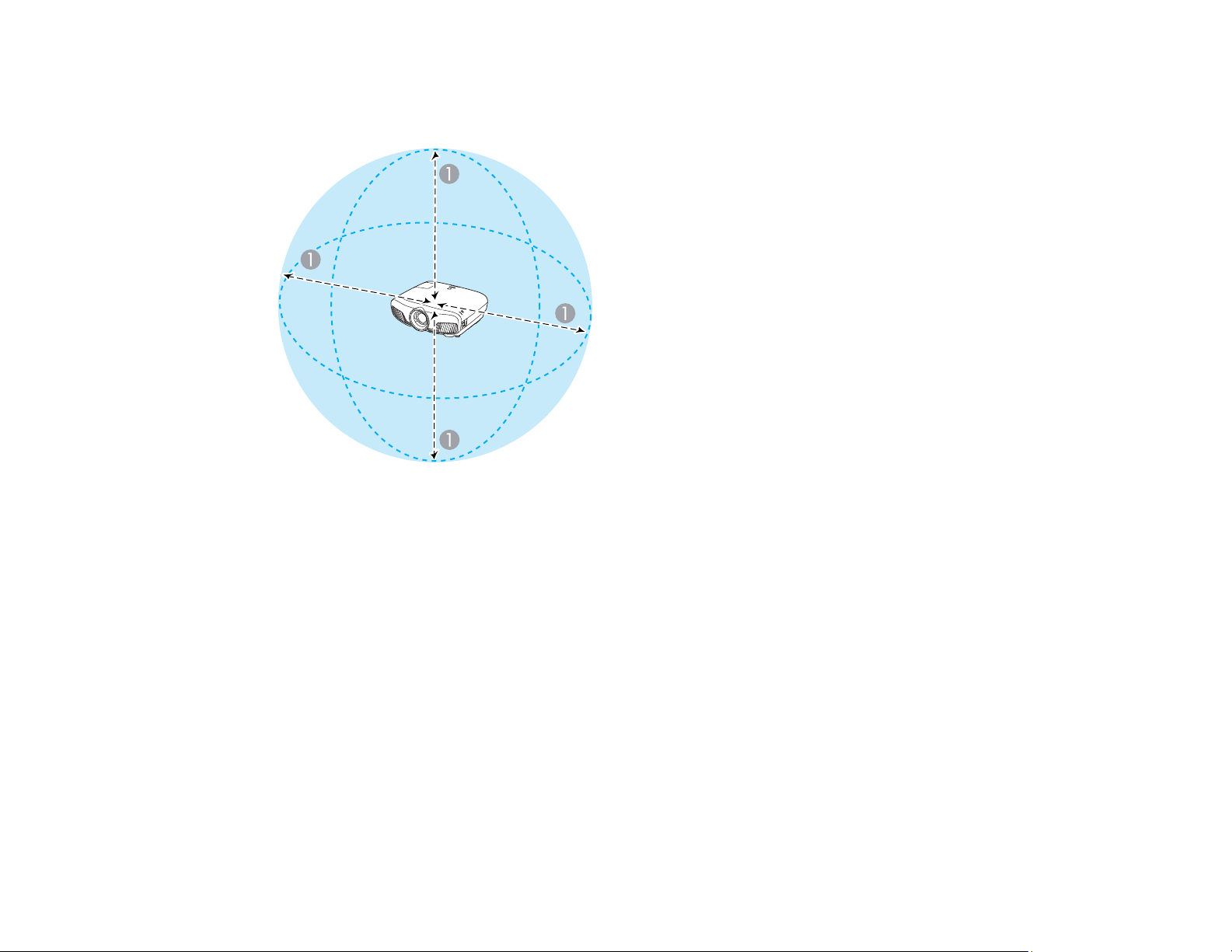
When you view 3D images, make sure you are positioned within the viewing range shown here.
1 32 ft (10 m)
Parent topic: Viewing 3D Images
Selecting the Language for the Projector Menus
If you want to view the projector's menus and messages in another language, you can change the
Language setting.
1. Turn on the projector.
2. Press the Menu button.
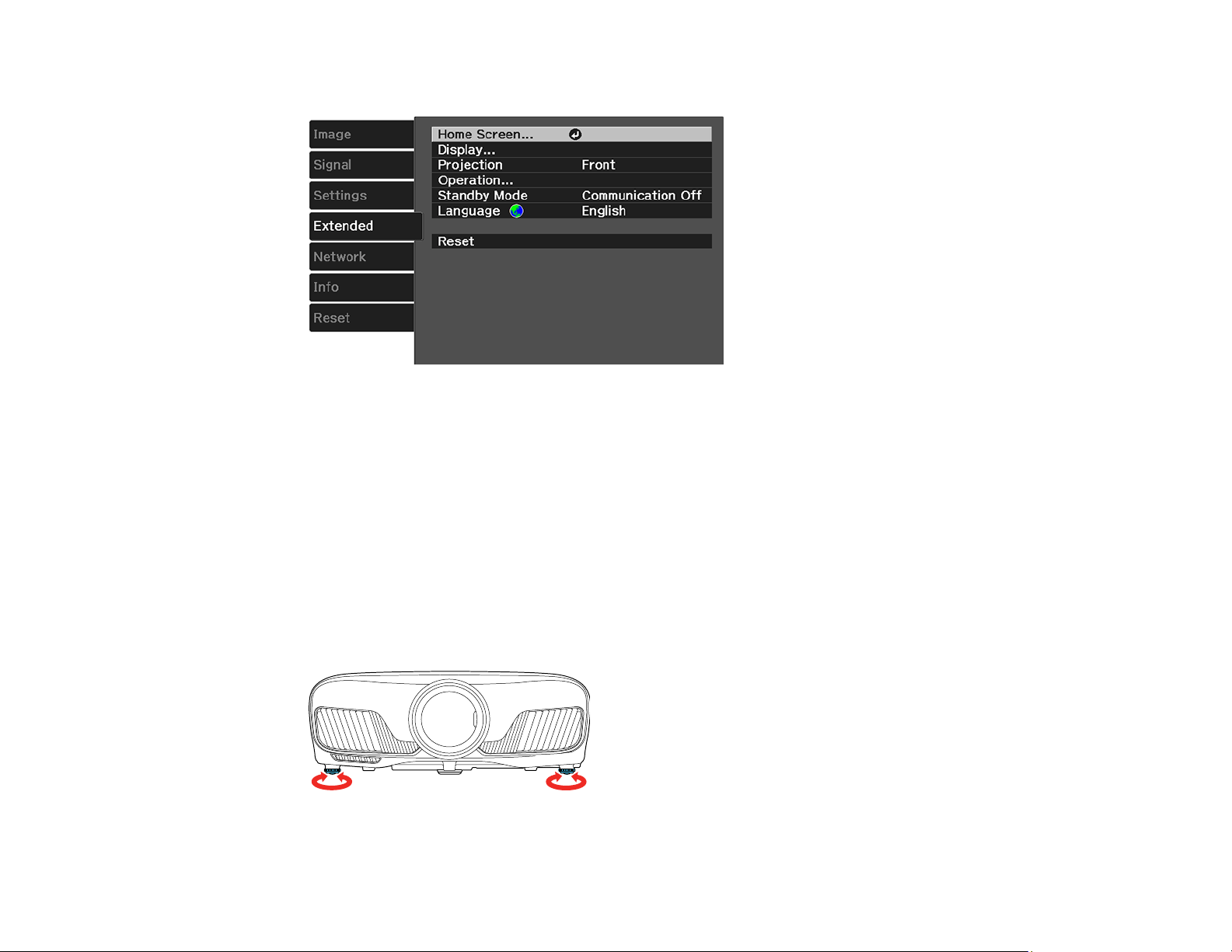
59
3. Select the Extended menu and press Enter.
4. Select the Language setting and press Enter.
5. Select the language you want to use and press Enter.
6. Press Menu or Esc to exit the menus.
Parent topic: Using Basic Projector Features
Adjusting the Image Height
If you are projecting from a table or other flat surface, and the image is too high or low, you can adjust
the image height using the projector's adjustable feet.
1. Turn on the projector and display an image.
2. If the image is tilted, rotate the front feet to adjust their height.

60
3. To adjust the position of the projected image further, press the Lens button on the remote control or
projector until Adjust Lens Shift appears on the screen.
If the projected image is unevenly rectangular, you need to adjust the image shape.
Parent topic: Using Basic Projector Features
Related concepts
Image Shape
Adjusting the Image Position Using Lens Shift
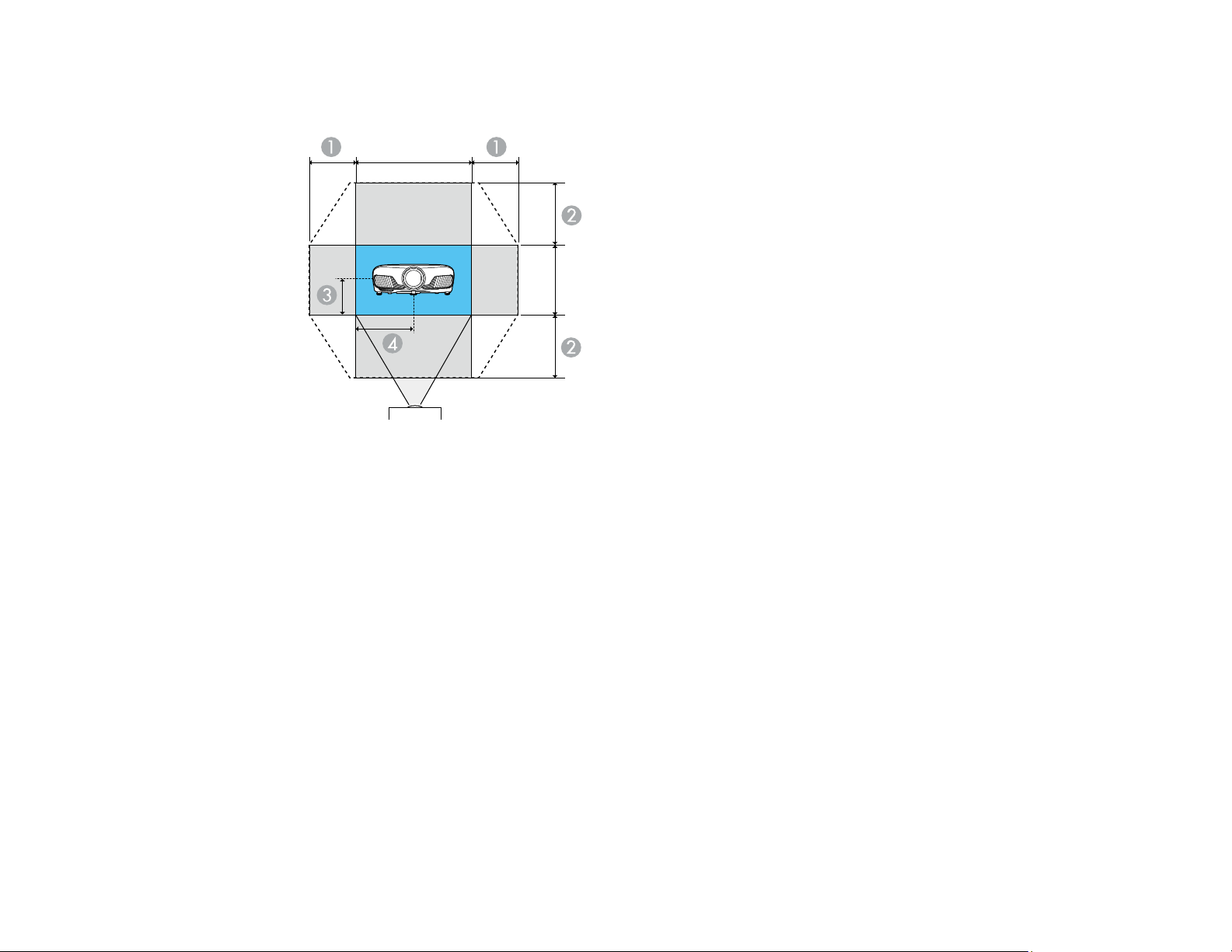
If you cannot install the projector directly in front of the screen, you can adjust the position of the
projected image using the lens shift feature.
1. Turn on the projector and display an image.
2. Press the Lens button on the control panel or remote control.
3. Press the Lens button repeatedly until Adjust Lens Shift appears on the screen.
61
4. Press the arrow buttons on the remote control or the control panel to adjust the position of the
projected image as necessary.
1 Maximum horizontal range (H × 47%)
2 Maximum vertical range (V × 96%)
3 1/2 the vertical height of the image
4 1/2 the horizontal width of the image
Note: You cannot move the image to both the horizontal and vertical maximum values.
5. When you are finished, press the Esc button on the control panel or remote control.
Note: When adjusting the image height, position the image lower than where you want it to be and then
move it up. This will help prevent the image from moving down after adjustment. The image is clearest
when the lens is at the home position. To move the lens to the home position, press the arrow buttons on
the remote control or the control panel to move the image towards the center of the screen until it stops
at the home position.
Parent topic: Using Basic Projector Features

62
Image Shape
You can project an evenly rectangular image by placing the projector directly in front of the center of the
screen and keeping it level. If you place the projector at an angle to the screen, or tilted up or down, or off
to the side, you may need to correct the image shape for the best display quality.
Correcting Image Shape With the Keystone Buttons
Parent topic: Using Basic Projector Features
Correcting Image Shape With the Keystone Buttons
You can use the projector's keystone correction buttons to correct the shape of an image that is
unevenly rectangular on the sides.
1. Turn on the projector and display an image.
Note: You can display a pattern to aid in adjusting the projected image using the Pattern button on
the remote control.
2. Press a keystone button on the projector's control panel.
After correction, your image is slightly smaller.
Note: If the projector is installed out of reach, you can also correct the image shape using the
Keystone settings in the projector menus.
Parent topic: Image Shape
Related references
Projector Feature Settings - Settings Menu
Resizing the Image with the Zoom Feature
You can adjust the size of the projected image using the zoom feature.

63
1. Turn on the projector and display an image.
2. Press the Lens button on the control panel or remote control.
3. Press the Lens button repeatedly until Adjust Zoom is displayed on the screen.
4. Press and hold the left or right arrow button on the control panel or remote control to resize the
image.
5. Press the Esc button on the control panel or remote control when finished.
Parent topic: Using Basic Projector Features
Focusing the Image with the Lens Button
You can adjust the sharpness of the projected image using the focus feature.
1. Turn on the projector and display an image.
2. Press the Lens button on the control panel or remote control.
3. Press the Lens button repeatedly until Adjust Focus is displayed on the screen.
4. Press and hold the left or right arrow button on the control panel or remote control to focus the
image.
5. Press the Esc button on the control panel or remote control when finished.
Parent topic: Using Basic Projector Features
64
Remote Control Operation
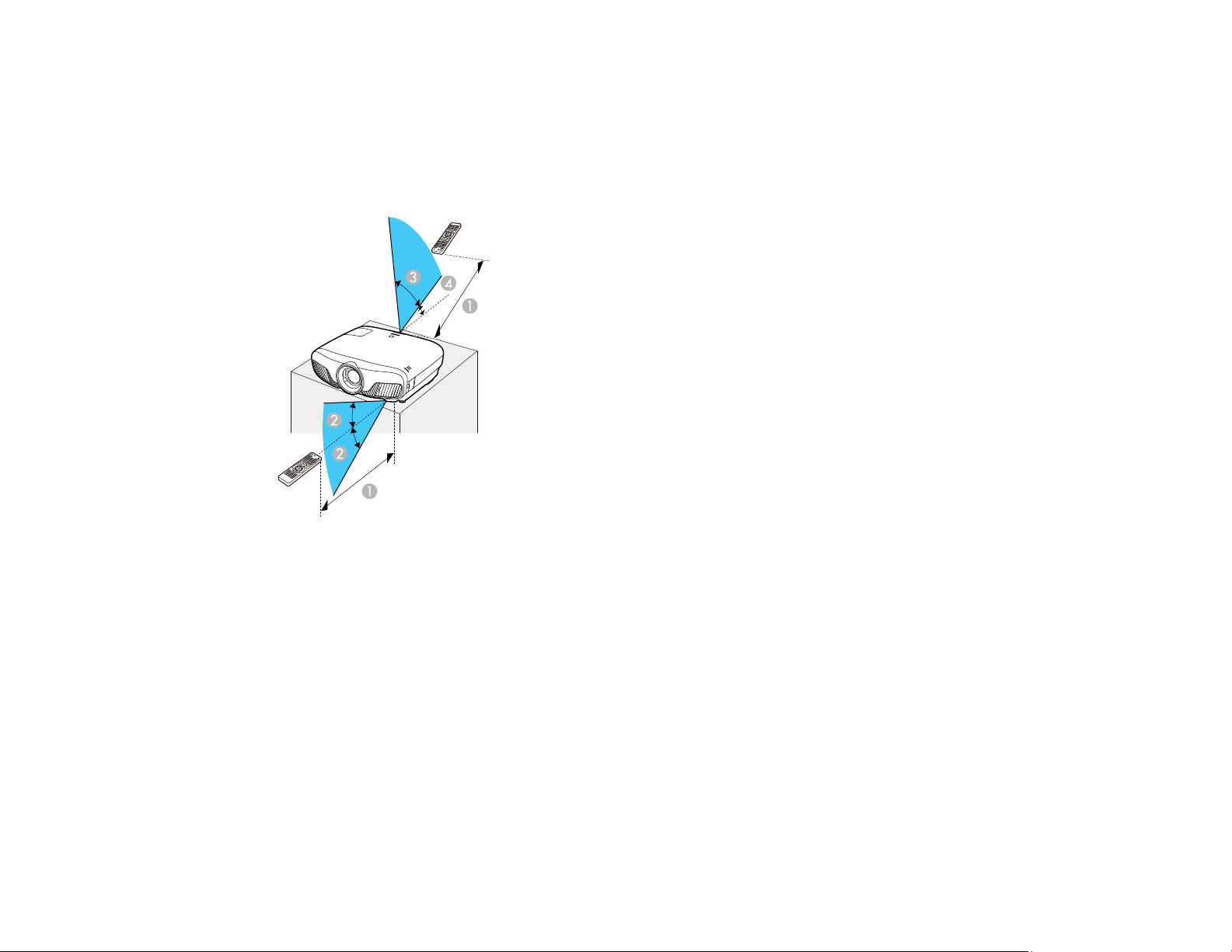
The remote control lets you control the projector from almost anywhere in the room. You can point it at
the screen, or the front or back of the projector.
Make sure that you aim the remote control at the projector's receivers within the distance and angles
listed here.
1 32 feet (10 m)
2 ± 30°
3 60°
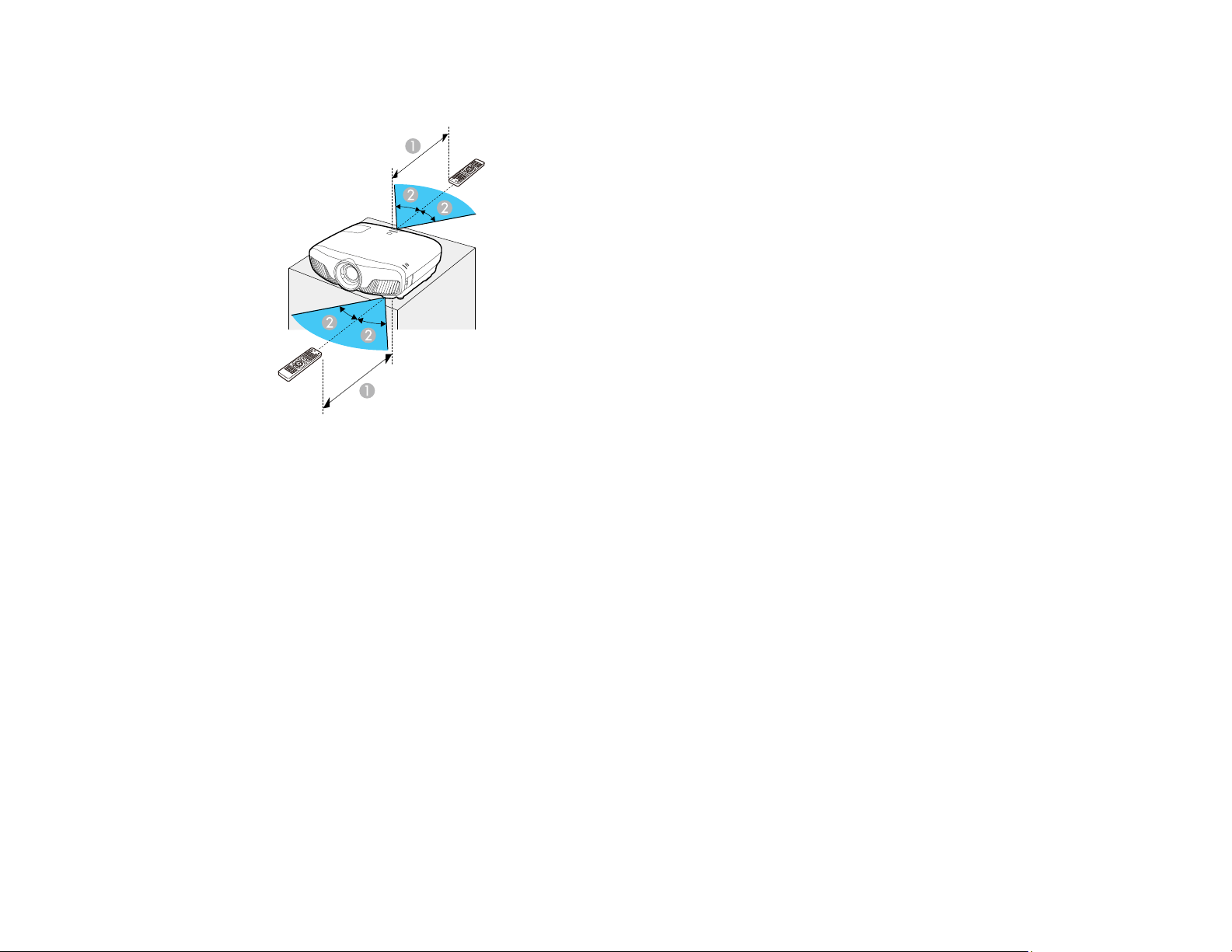
65
4 10°
1 32 feet (10 m)
2 ± 30°
Note: Avoid using the remote control in conditions with bright fluorescent lights or in direct sunlight, or
the projector may not respond to commands. If you will not use the remote control for a long time,
remove the batteries.
Parent topic: Using Basic Projector Features
Related tasks
Using the Home Screen
Selecting an Image Source
If you connected multiple image sources to the projector, such as a computer and DVD player, you may
want to switch from one image source to the other.
1. Make sure the connected image source you want to use is turned on.
2. For video image sources, insert a DVD or other video media and press its play button, if necessary.
66
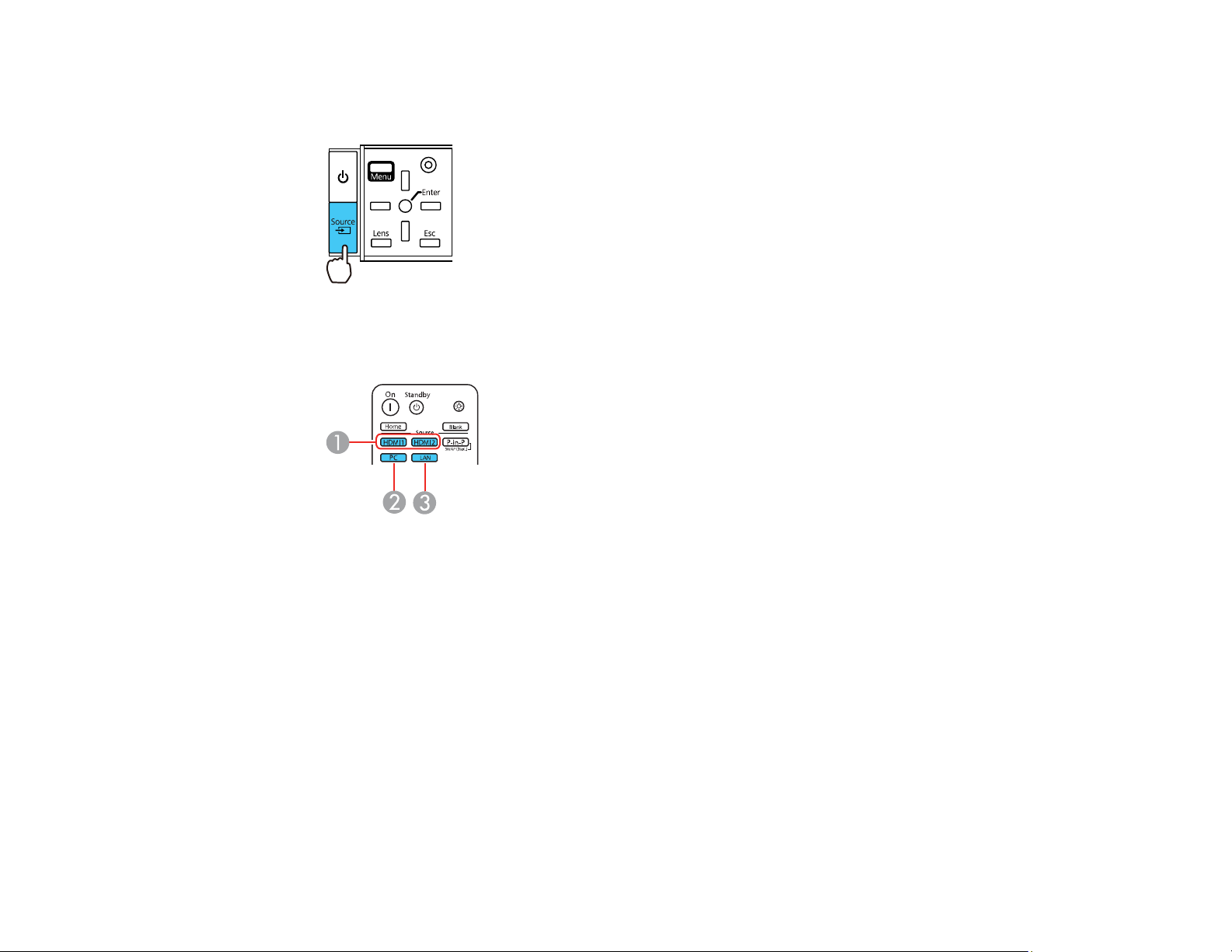
3. Do one of the following:
• Press the Source button on the projector until you see the image from the source you want.
• Press the button for the source you want on the remote control. If there is more than one port for
that source, press the button again to cycle through the sources.
1 HDMI port sources
2 Computer port source (VGA)
3 Network source
67
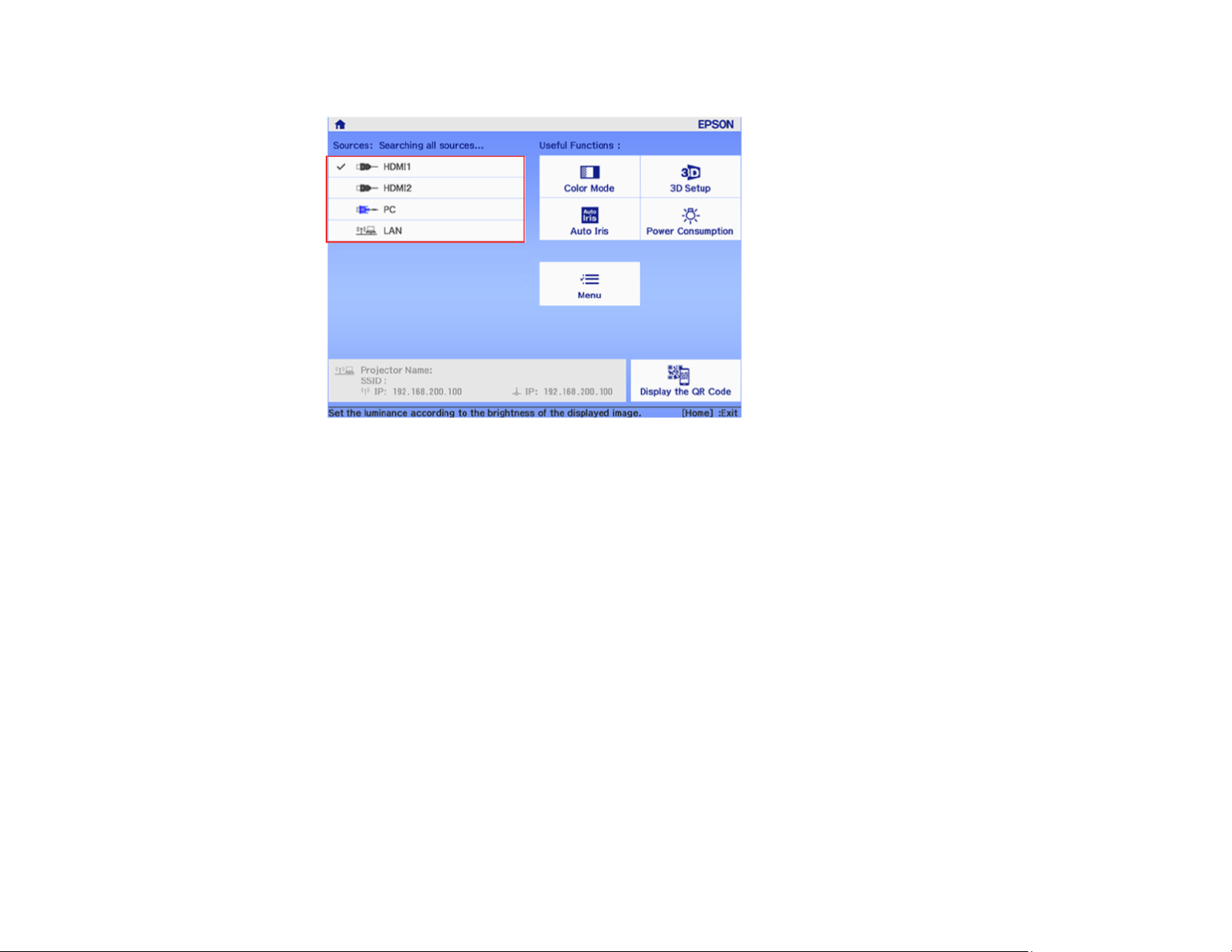
• Press the Home button on the remote control and select your image source.
Parent topic: Using Basic Projector Features
Projection Modes
Depending on how you positioned the projector, you may need to change the projection mode so your
images project correctly.
• Front (default setting) lets you project from a table in front of the screen.
• Front/Ceiling flips the image over top-to-bottom to project upside-down from a ceiling or wall mount.
• Rear flips the image horizontally to project from behind a translucent screen.
• Rear/Ceiling flips the image over top-to-bottom and horizontally to project from the ceiling and behind
a translucent screen.
Changing the Projection Mode Using the Menus
Parent topic: Using Basic Projector Features
Changing the Projection Mode Using the Menus
You can change the projection mode to flip the image over top-to-bottom and/or left-to-right using the
projector menus.
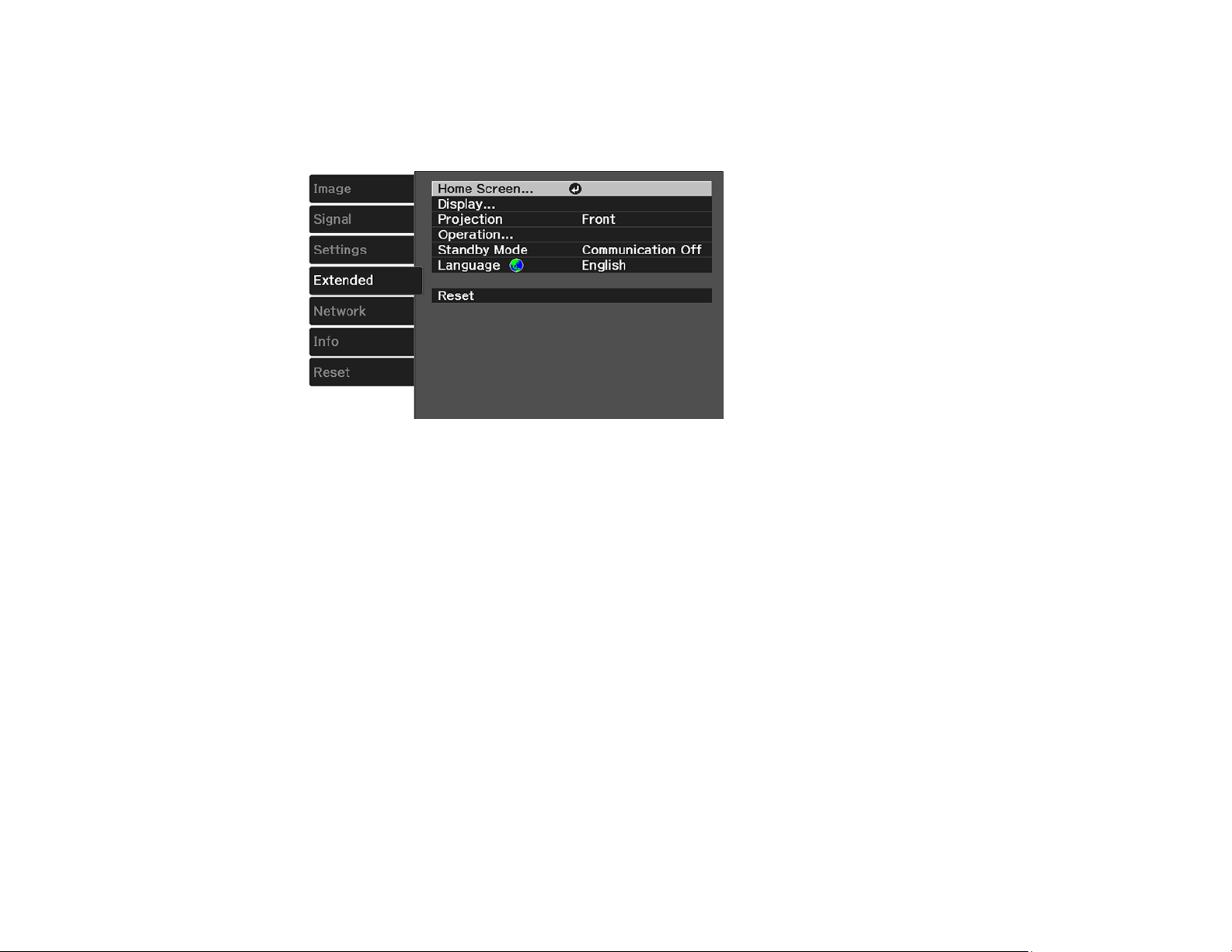
68
1. Turn on the projector and display an image.
2. Press the Menu button.
3. Select the Extended menu and press Enter.
4. Select the Projection setting and press Enter.
5. Select a projection mode and press Enter.
6. Press Menu or Esc to exit the menus.
Parent topic: Projection Modes
Related concepts
Projector Placement
Image Aspect Ratio
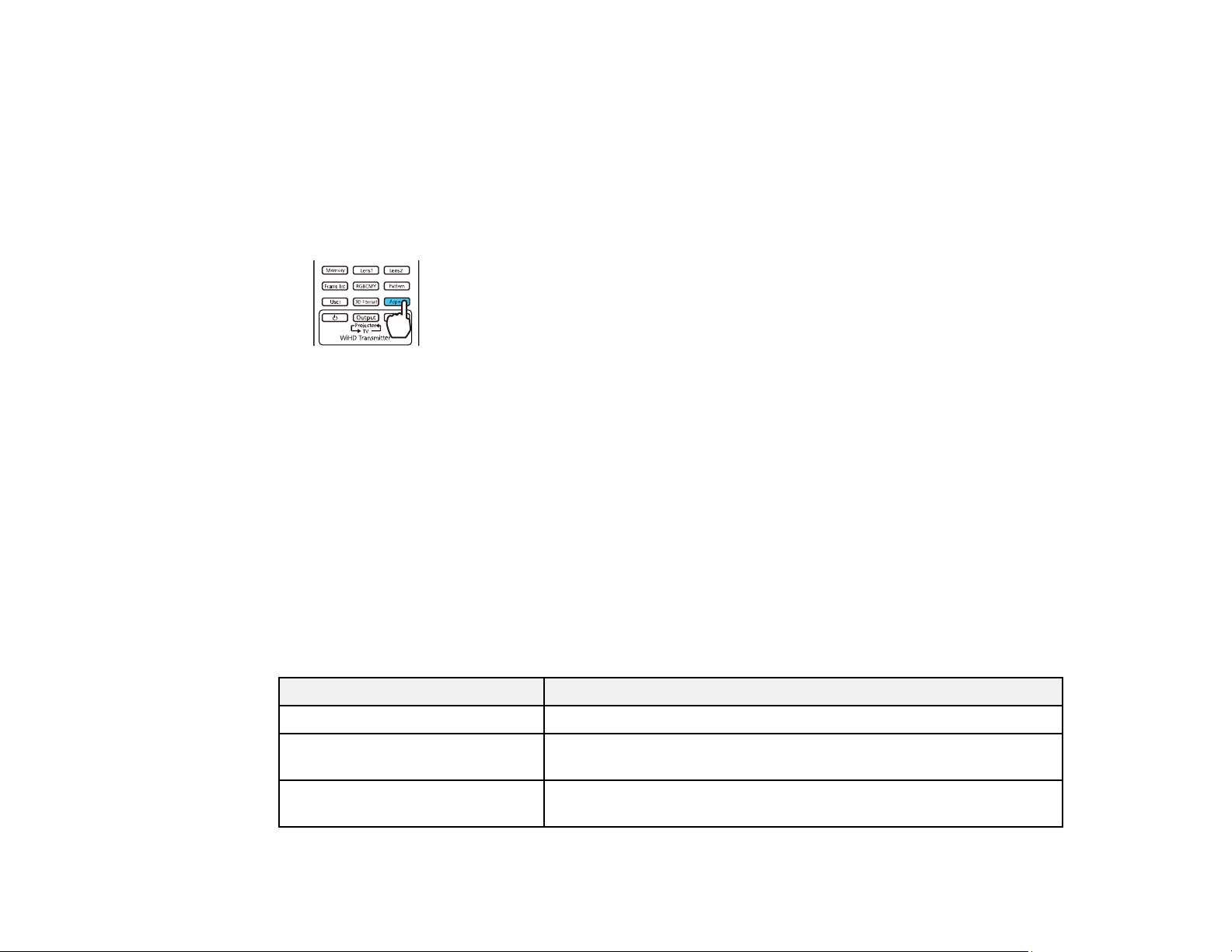
The projector can display images in different width-to-height ratios called aspect ratios. Normally the
input signal from your video source determines the image's aspect ratio. However, for certain images
you can change the aspect ratio to fit your screen by pressing a button on the remote control.
If you always want to use a particular aspect ratio for a certain video input source, you can select it using
the projector's menus.
Changing the Image Aspect Ratio
Available Image Aspect Ratios
Parent topic: Using Basic Projector Features
69
Changing the Image Aspect Ratio
You can change the aspect ratio of the displayed image to resize it.
Note: For HDMI sources, the input signal determines the image's aspect ratio.
1. Turn on the projector and switch to the image source you want to use.
2. Press the Aspect button on the remote control.
A list of the available aspect ratios appears.
3. To cycle through the available aspect ratios for your input signal, press the up or down arrow button.
4. Press Enter to select the aspect ratio.
Parent topic: Image Aspect Ratio
Available Image Aspect Ratios
You can select the following image aspect ratios, depending on the input signal from your image source.
Note: When the projector is in 3D mode, the aspect ratio is automatically set to Normal.
Note: Black bands and cropped images may project in certain aspect ratios, depending on the aspect
ratio and resolution of your input signal.
Aspect ratio setting Description
Auto Automatically sets the aspect ratio according to the input signal.
Normal Displays images using the full projection area and maintains the
aspect ratio of the image.
Zoom Displays images using the full width of the projection area and
maintains the aspect ratio of the image.
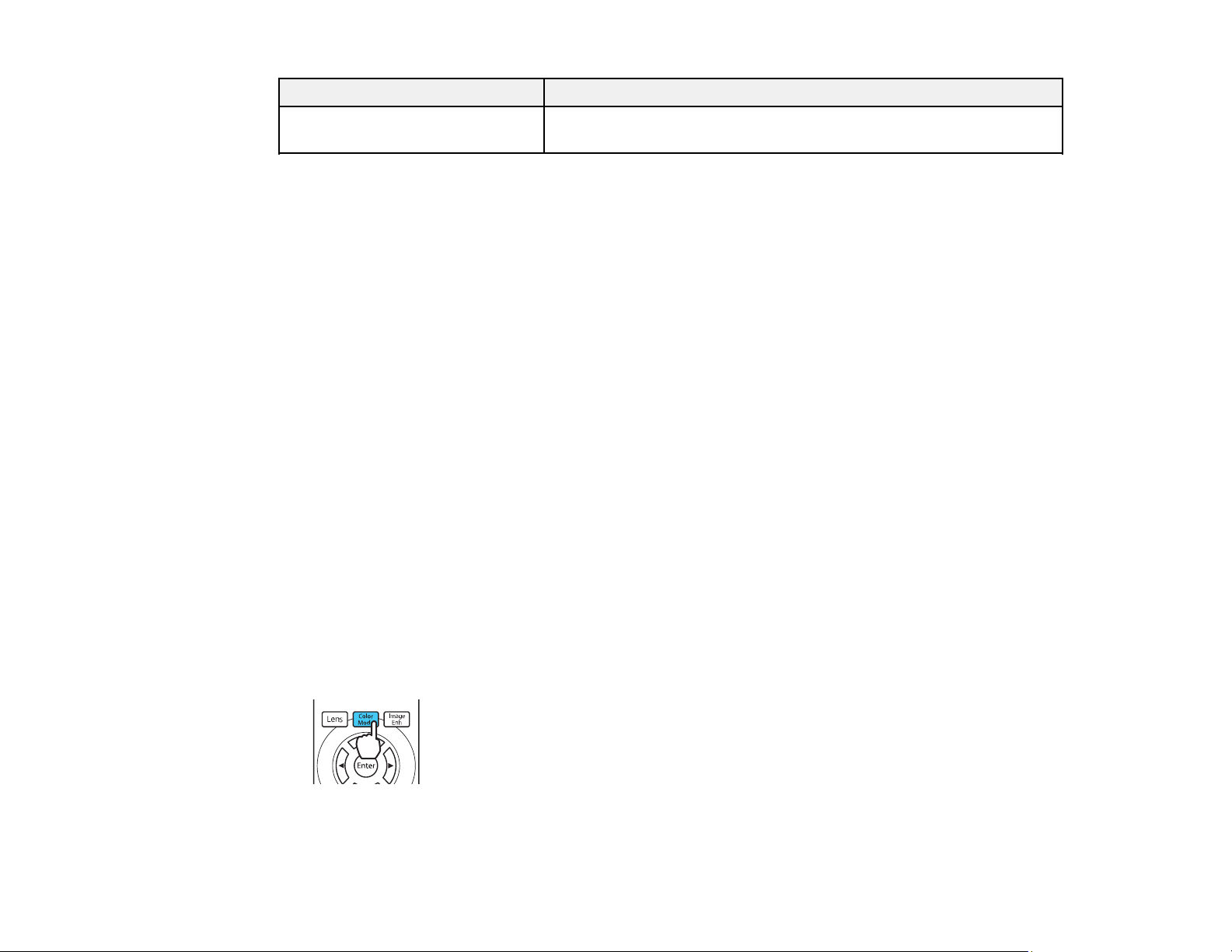
70
Aspect ratio setting Description
Full Displays images using the full width of the projection area, but does
not maintain the aspect ratio.
Note: When projecting a 4K signal, you can select only Normal as the aspect ratio setting.
Parent topic: Image Aspect Ratio
Color Mode
The projector offers different Color Modes to provide optimum brightness, contrast, and color for a
variety of viewing environments and image types. You can select a mode designed to match your image
and environment, or experiment with the available modes.
If you always want to use a particular color mode for a certain video input source, you can select it using
the projector menus.
Changing the Color Mode
Available Color Modes
Turning On Auto Iris
Parent topic: Using Basic Projector Features
Changing the Color Mode
You can change the projector's Color Mode using the remote control to optimize the image for your
viewing environment.
1. Turn on the projector and switch to the image source you want to use.
2. If you are projecting from a DVD player or other video source, insert a disc or other video media and
press the play button, if necessary.
3. Press the Color Mode button on the remote control to change the Color Mode.
A list of available Color Modes appears.
71
4. To cycle through all the available Color Modes for your input signal, press the up or down arrow
button.
5. Press Enter to select a Color Mode.
Parent topic: Color Mode
Available Color Modes
You can set the projector to use these Color Modes, depending on the input source you are using:
2D Images
Color Mode Description
Dynamic Best for projecting in a bright room
Natural Best for projecting in a dark room
Bright Cinema Best for projecting in a room with closed curtains
Cinema Best for projecting color movies in a dark room
B&W Cinema Best for projecting black and white movies in a dark room
Digital Cinema Projects using the same color spectrum as digital movie theaters
3D Images
Color Mode Description
3D Dynamic Best for projecting in a bright room
3D Cinema Best for projecting movies in a dark room
Parent topic: Color Mode
Turning On Auto Iris
In certain color modes, you can turn on the Auto Iris setting to automatically optimize the image based on
the brightness of the content you project.
1. Turn on the projector and switch to the image source you want to use.
2. Press the Menu button.
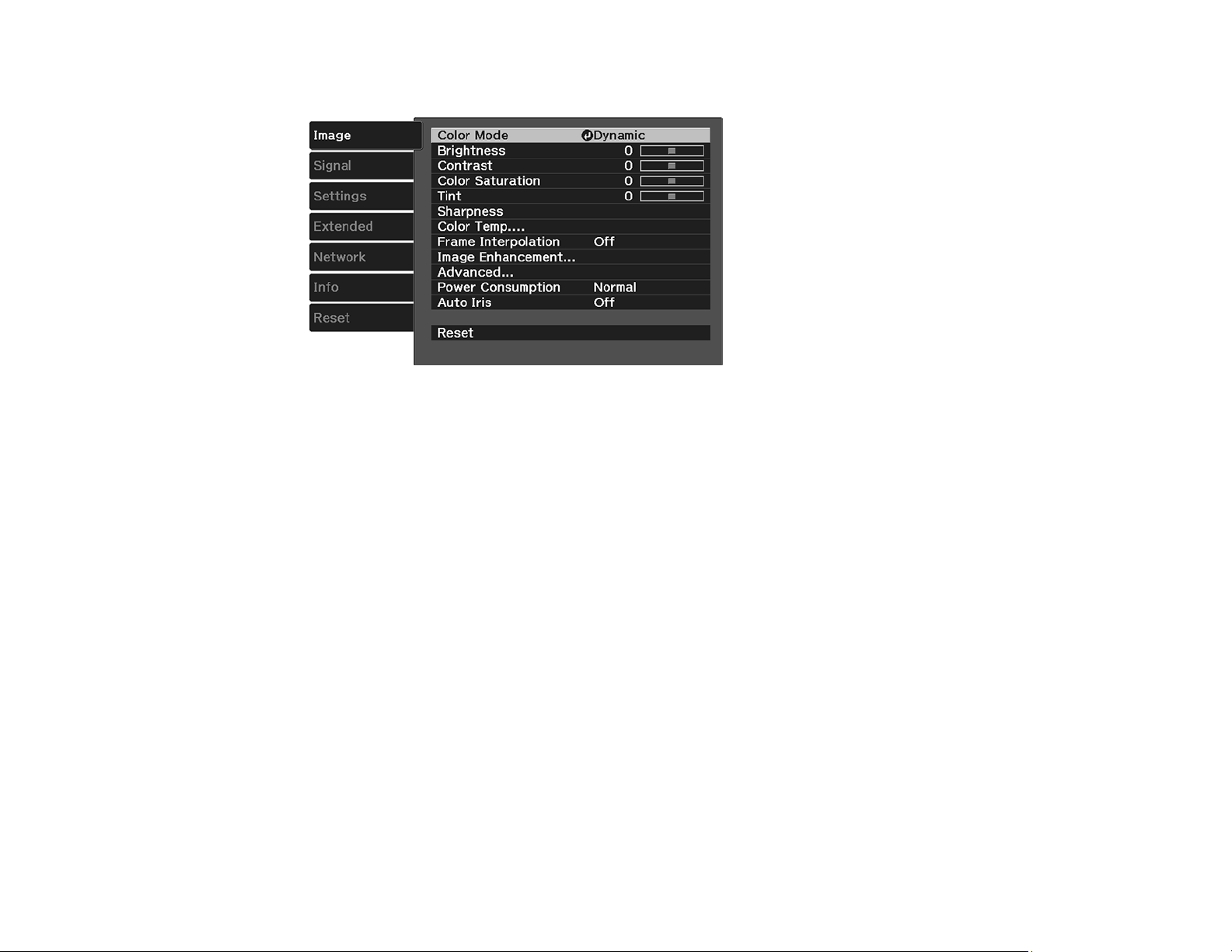
72
3. Select the Image menu and press Enter.
4. Select the Auto Iris setting and choose one of the following:
• High Speed to adjust brightness as soon as the scene changes.
• Normal for standard brightness adjustment.
Note: You can set Auto Iris for each Color Mode that supports the feature.
5. Press Menu or Esc to exit the menus.
Parent topic: Color Mode

73
Adjusting Projector Features
Follow the instructions in these sections to use your projector's feature adjustments.
Shutting Off the Picture Temporarily
Using Picture in Picture
Projector Security Features
Using Advanced Image Adjustment Features
Saving Settings to Memory and Using Saved Settings
Saving the Lens Position and Using Saved Lens Positions
Shutting Off the Picture Temporarily
You can temporarily turn off the projected picture if you want to redirect your audience's attention during
a presentation. Any video action continues to run, however, so you cannot resume projection at the point
that you stopped it.
1. Press the Blank button on the remote control to temporarily stop projection.
2. To turn the picture back on, press the Blank button again.
Parent topic: Adjusting Projector Features
Using Picture in Picture
You can use Picture in Picture mode to view two image sources simultaneously.
Note: You can display only HDMI video sources when using Picture in Picture mode. You cannot use
Picture in Picture while projecting 3D or 4K images.
1. Turn on the projector and switch to the HDMI image source you want to use.
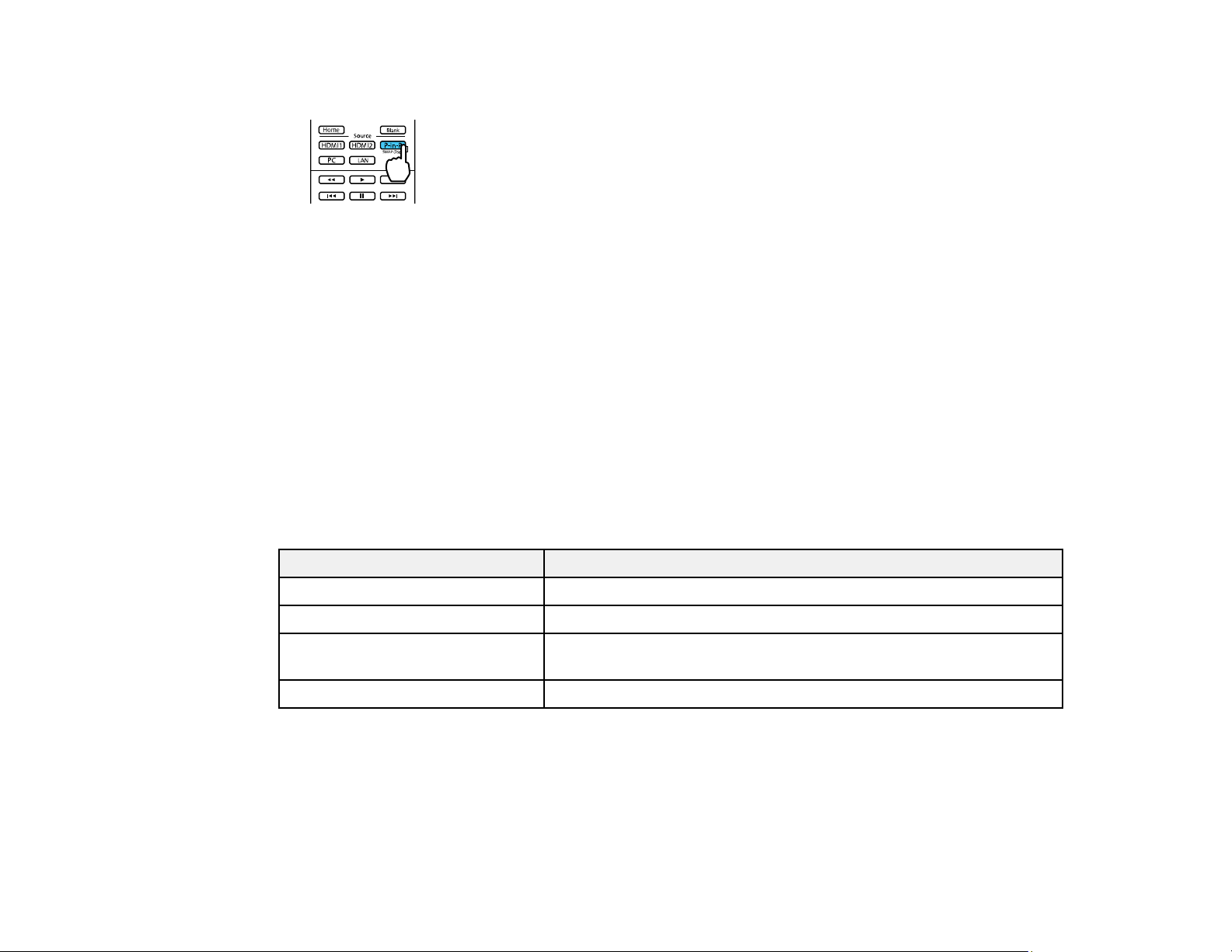
74
2. Press the P-in-P button on the remote control.
The second HDMI video source appears as a sub-screen in the corner of the image.
Note: Press the Menu button on the remote control to adjust picture-in-picture options.
3. To swap the main screen and sub-screen video sources, press and hold the P-in-P button for at
least three seconds.
4. Press the P-in-P button again to exit.
Available Picture in Picture Options
Parent topic: Adjusting Projector Features
Available Picture in Picture Options
You can adjust the following options by pressing the Menu button on the remote control while using
Picture in Picture:
Setting Description
Subscreen Size Adjusts the size of the sub-screen
Subscreen Position Adjusts the location of the sub-screen
Swap Main/Sub Switches the video source displayed on the main screen with the
source displayed on the sub-screen
Exit Picture in Picture Exits picture-in-picture mode
Parent topic: Using Picture in Picture
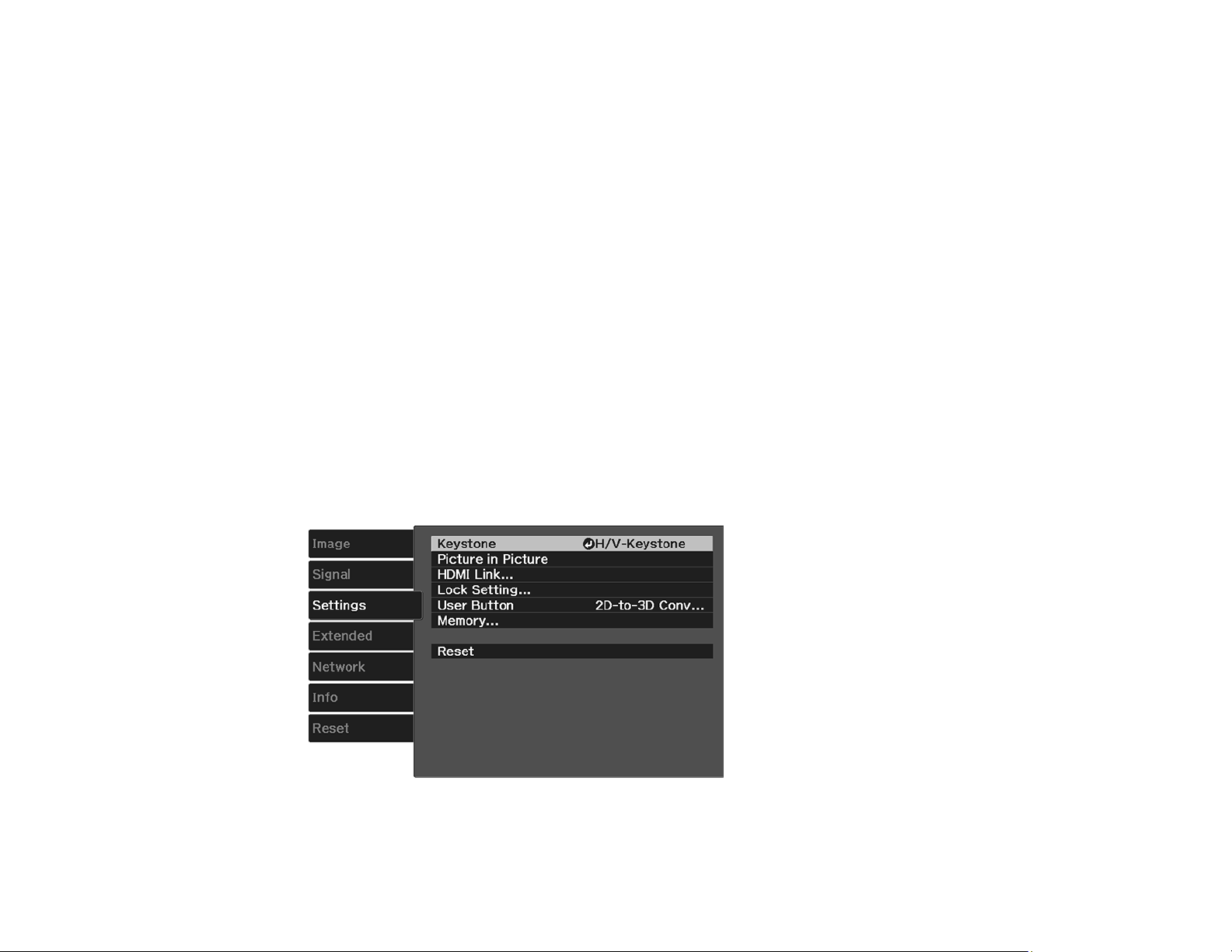
75
Projector Security Features
You can secure your projector to deter theft or prevent unintended use by setting up the following
security features:
• Lens lock to prevent changing the zoom, focus, or lens shift settings.
• Button lock security to block operation of the projector using the buttons on the control panel.
• Security cabling to physically cable the projector in place.
Locking the Projector's Lens Settings and Buttons
Installing a Security Cable
Parent topic: Adjusting Projector Features
Locking the Projector's Lens Settings and Buttons
You can lock the buttons on the projector's control panel to prevent anyone from using the projector. You
can also lock the zoom, focus, and lens shift settings to prevent them from being adjusted.
Note: You can use the remote control to control the projector when the control panel buttons are locked.
1. Press the Menu button.
2. Select the Settings menu and press Enter.
3. Select the Lock Setting setting and press Enter.

76
4. Select one of these lock types and press Enter:
• To lock the zoom, focus, and lens shift settings, select Lens Lock.
• To lock the projector's power button, select Child Lock. To turn the projector on, you must press
the power button for longer than three seconds.
Note: Child Lock does not prevent the projector from turning on when the power cord is
connected if the Direct Power On Setting is set to On.
• To lock all buttons, select Control Panel Lock > Full Lock.
• To lock all buttons except the power button, select Control Panel Lock > Partial Lock.
Note: The lock icon is displayed on the screen if any control panel buttons are pressed while
this setting is enabled.
You see a confirmation prompt.
5. Select Yes and press Enter.
6. Restart the projector for the lock settings to take effect.
Unlocking the Projector's Buttons
Parent topic: Projector Security Features
Unlocking the Projector's Buttons
If the projector's buttons have been locked, hold the Enter button on the projector's control panel for
seven seconds to unlock them.
Parent topic: Locking the Projector's Lens Settings and Buttons
Related references
Projector Feature Settings - Settings Menu
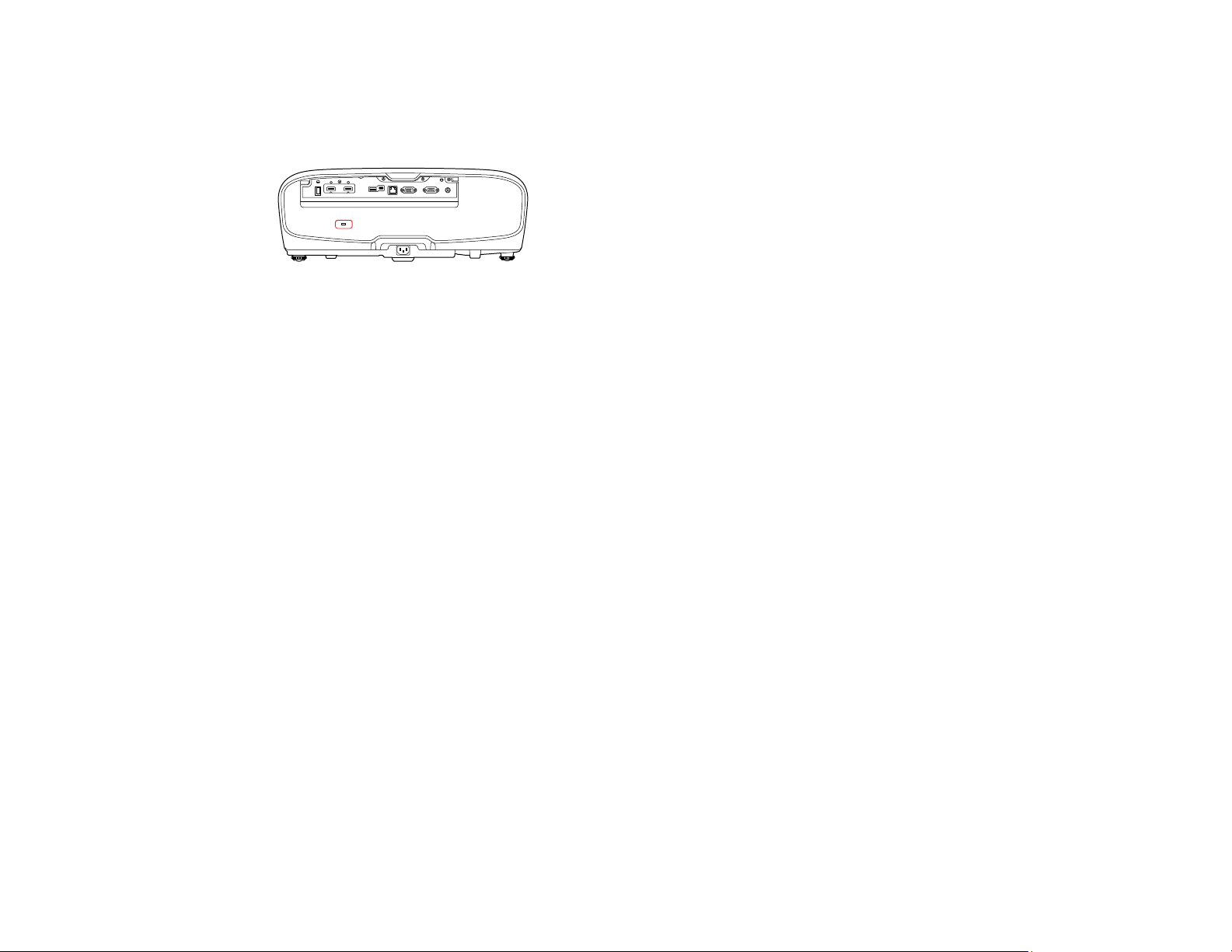
77
Installing a Security Cable
You can use the security slot on the back of the projector to attach a Kensington lock. See your local
computer or electronics dealer for purchase information.
Parent topic: Projector Security Features
Using Advanced Image Adjustment Features
Follow the instructions in these sections to use your projector's advanced image adjustments.
Note: Not all adjustments may be available depending on the projection mode and input signal.
Using Frame Interpolation
Using 4K Enhancement
Creating Image Presets
Using MPEG Noise Reduction
Adjusting Scaled Resolution Images (Super-resolution)
Adjusting Detail Enhancement
Image Adjustment Restrictions
Adjusting the Color Convergence (Panel Alignment)
Adjusting the Color Tone (Color Uniformity)
Parent topic: Adjusting Projector Features
Related references
Image Adjustment Restrictions
Using Frame Interpolation
You can use the projector's Frame Interpolation feature to smooth fast-moving video by comparing
consecutive image frames and inserting an intermediate image frame between them.
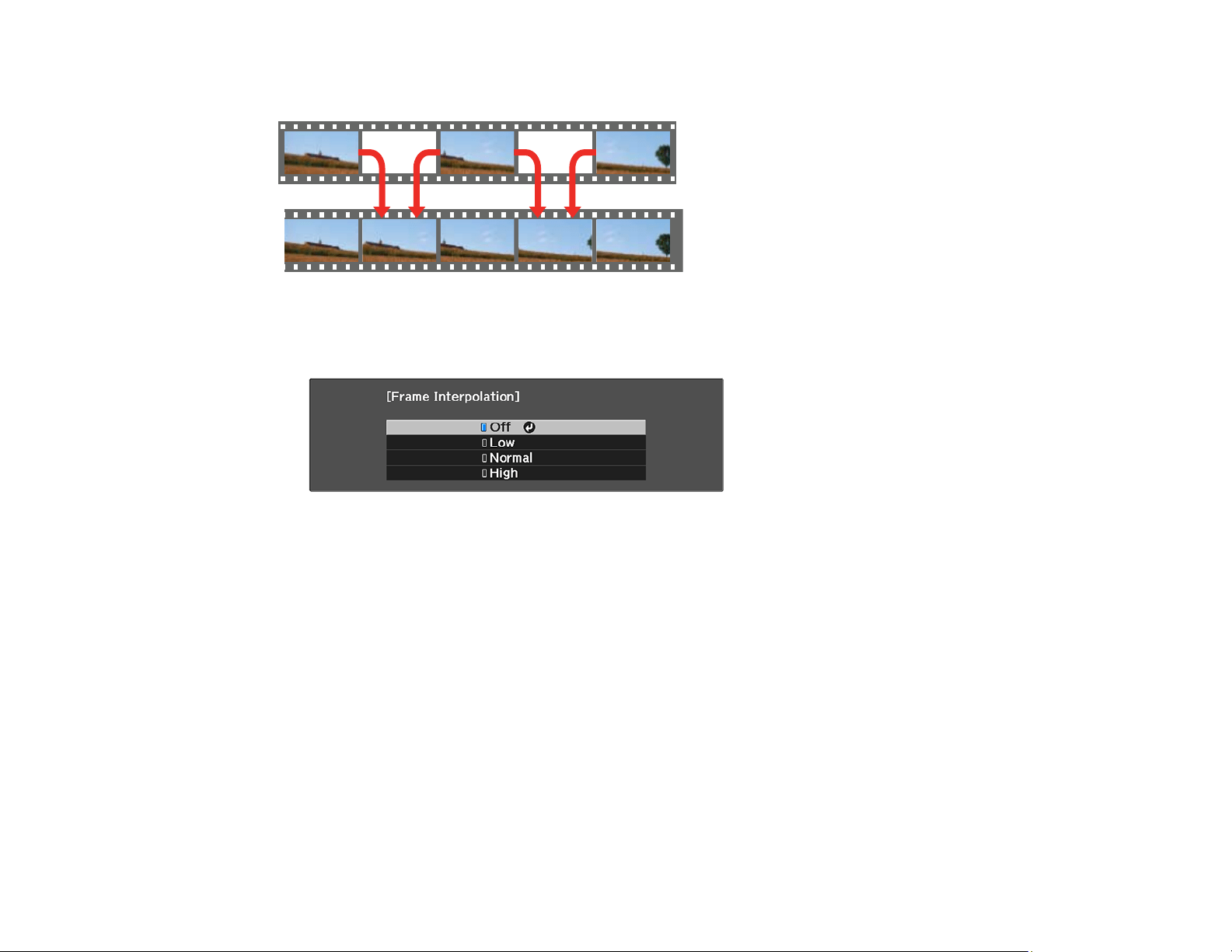
78
Note: This feature may not be available depending on the projection mode and input signal.
1. Press the Frame Int button.
You see a screen like this:
2. Select the level of interpolation and press Enter.
3. When you are finished, press the Frame button.
Note: If your resulting images contain noise, turn off the Frame Interpolation setting.
Parent topic: Using Advanced Image Adjustment Features
Related references
Image Adjustment Restrictions
Using 4K Enhancement
Using the projector's 4K Enhancement Technology, you can receive 4K (3840 × 2160 pixel) signals and
project ultra high-definition images. This technology shifts each pixel diagonally by 0.5 pixel to double
the image resolution.
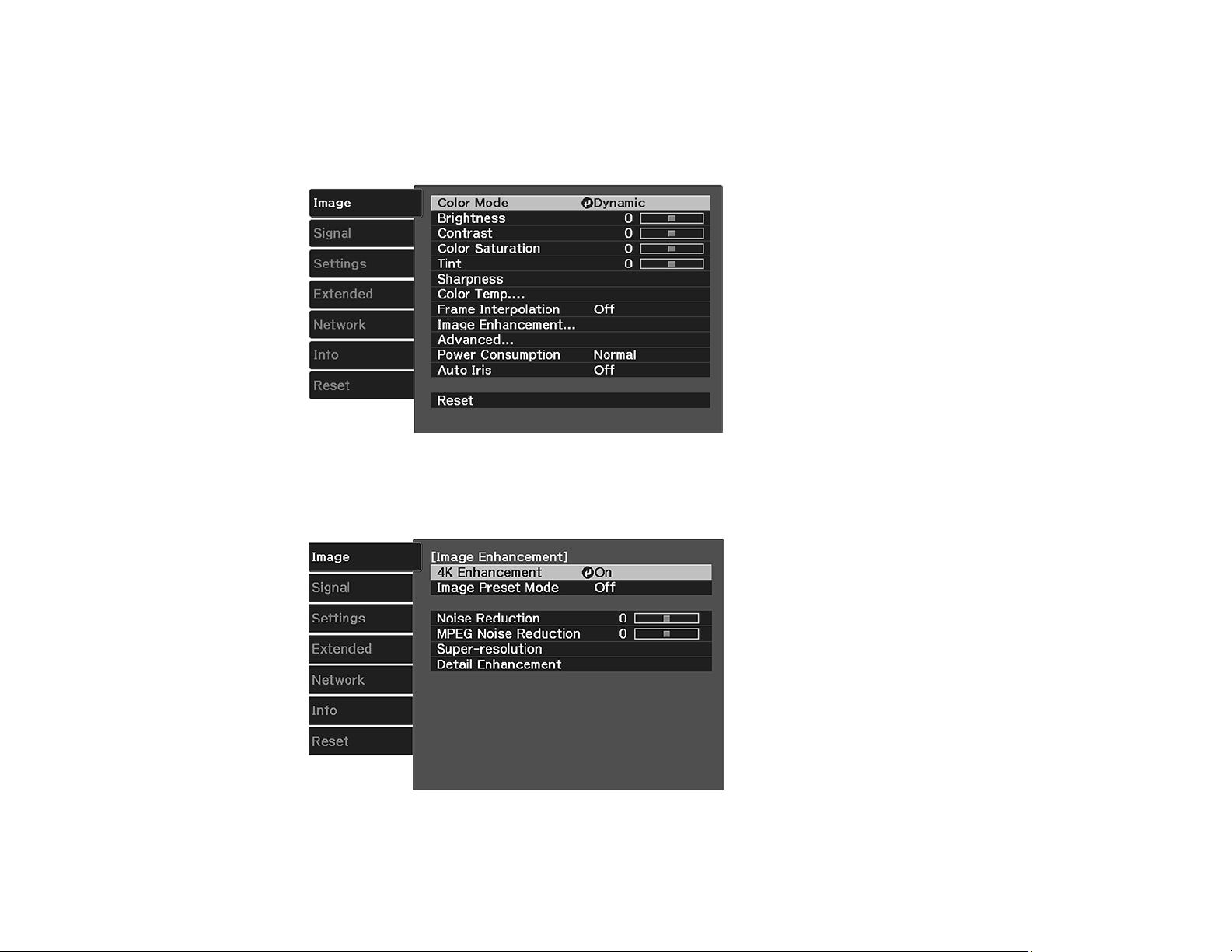
79
Note: This feature may not be available depending on the projection mode and input signal.
1. Press the Menu button on the remote.
You see a screen like this:
2. Select the Image Enhancement setting and press Enter.
You see a screen like this:
3. Select the 4K Enhancement setting and press Enter.
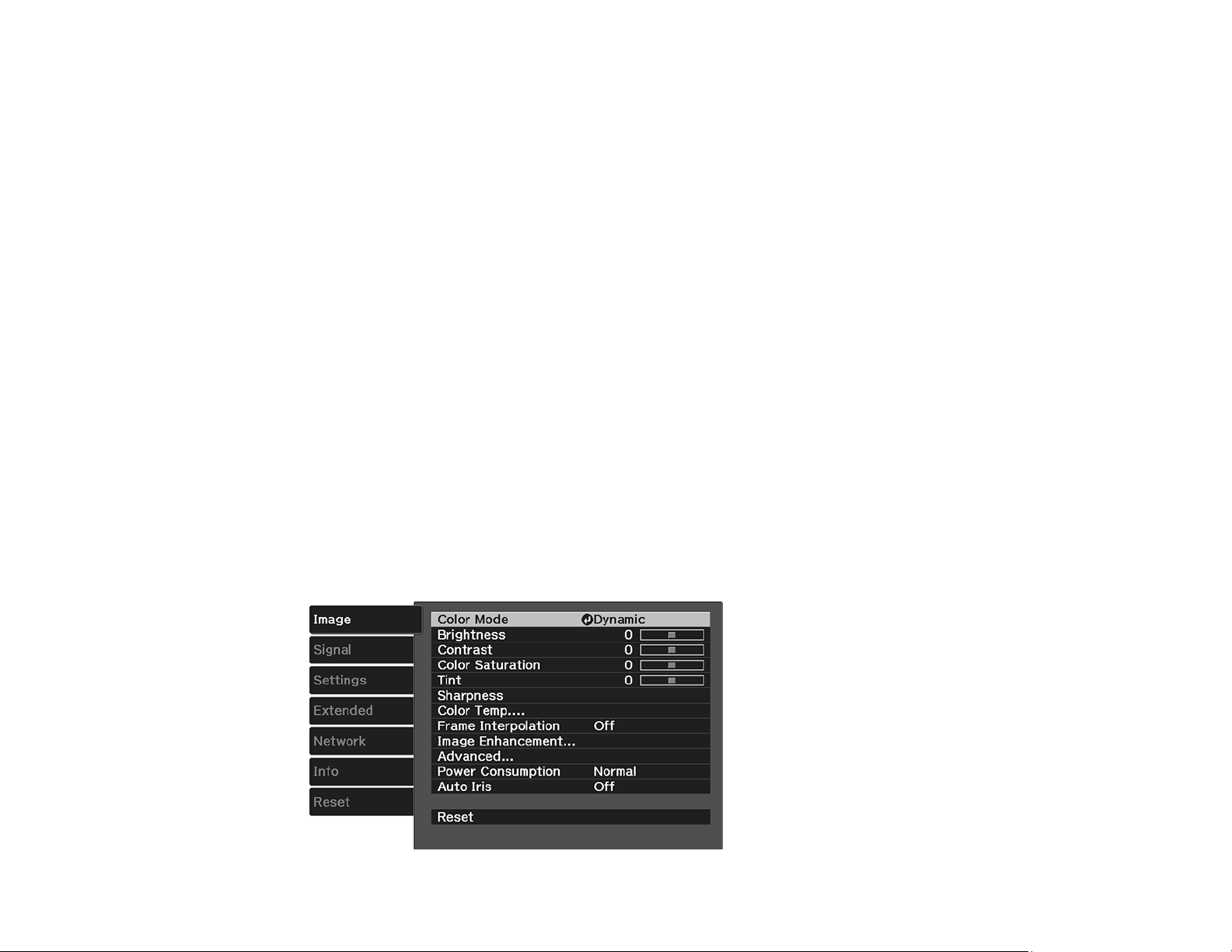
80
4. Select one of the following options and press Enter:
• Off to disable 4K enhancement
• On to enable 4K enhancement
5. Press Menu to exit the menus.
Parent topic: Using Advanced Image Adjustment Features
Related references
Image Adjustment Restrictions
Creating Image Presets
You can quickly optimize your projected image by selecting image adjustment settings and saving them
as a preset you can reuse later.
To quickly switch between image presets, press the Image Enh button on the remote, select an image
preset and press Enter.
You can save the following settings in a preset:
• Noise Reduction
• MPEG Noise Reduction
• Super-resolution
• Detail Enhancement
1. Press the Menu button.
You see a screen like this:
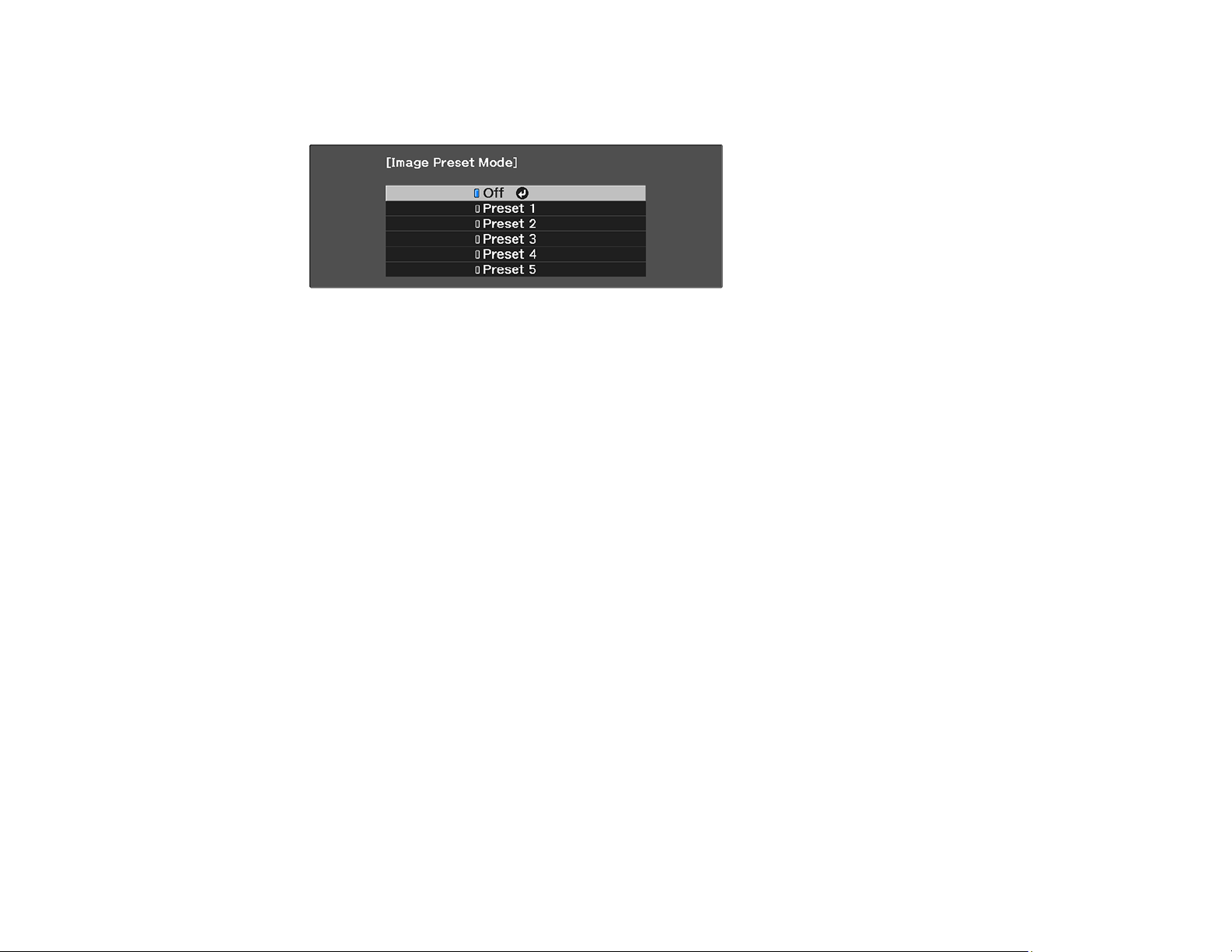
81
2. Select the Image Enhancement setting and press Enter.
3. Select the Image Preset Mode setting and press Enter.
4. Select one of the presets and press Enter.
Note: If you select a previously used preset, your new adjustments overwrite the old ones.
5. Press Esc to return to the Image Enhancement menu.
6. Fine-tune the following settings:
• Noise Reduction
• MPEG Noise Reduction
• Super-resolution
• Detail Enhancement
7. Press Menu or Esc to exit the menus.
The currently selected Image Preset Mode will be updated with the current settings.
Parent topic: Using Advanced Image Adjustment Features
Using MPEG Noise Reduction
If you are projecting MPEG movies, you can reduce dots and block noise by adjusting the MPEG Noise
Reduction setting.
Note: This feature may not be available depending on the projection mode and input signal.
1. Press the Menu button.
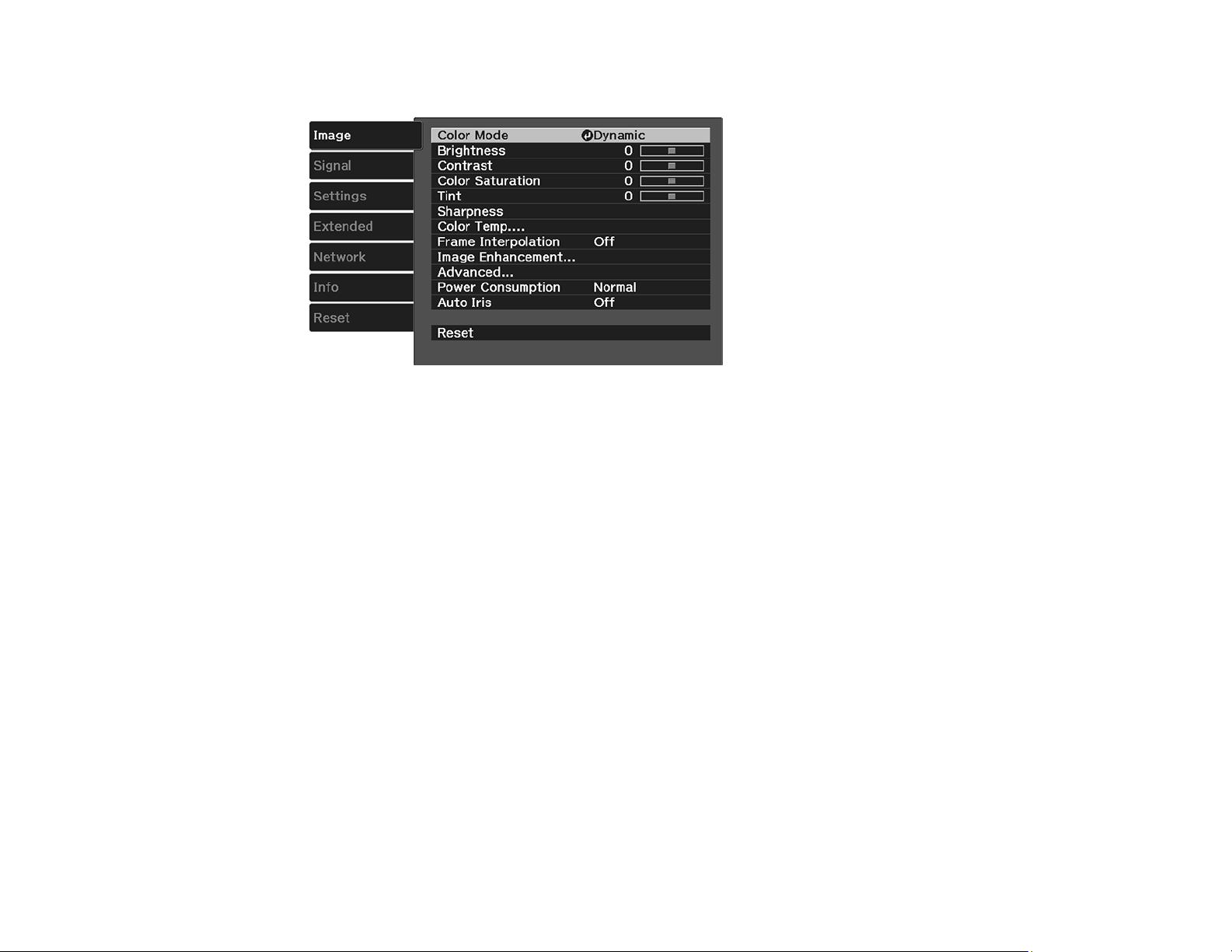
82
You see a screen like this:
2. Select the Image Enhancement setting and press Enter.
3. Select the MPEG Noise Reduction setting and press Enter.
4. Select the level of noise reduction and press Enter.
5. Press Menu or Esc to exit the menus.
Parent topic: Using Advanced Image Adjustment Features
Related references
Image Adjustment Restrictions
Adjusting Scaled Resolution Images (Super-resolution)
You can sharpen blurry, low-resolution images that had their resolution scaled up for projection using the
Super-resolution setting.
Note: This feature may not be available depending on the projection mode and input signal.
1. Turn on the projector and switch to the image source you want to use.
2. Press the Menu button.
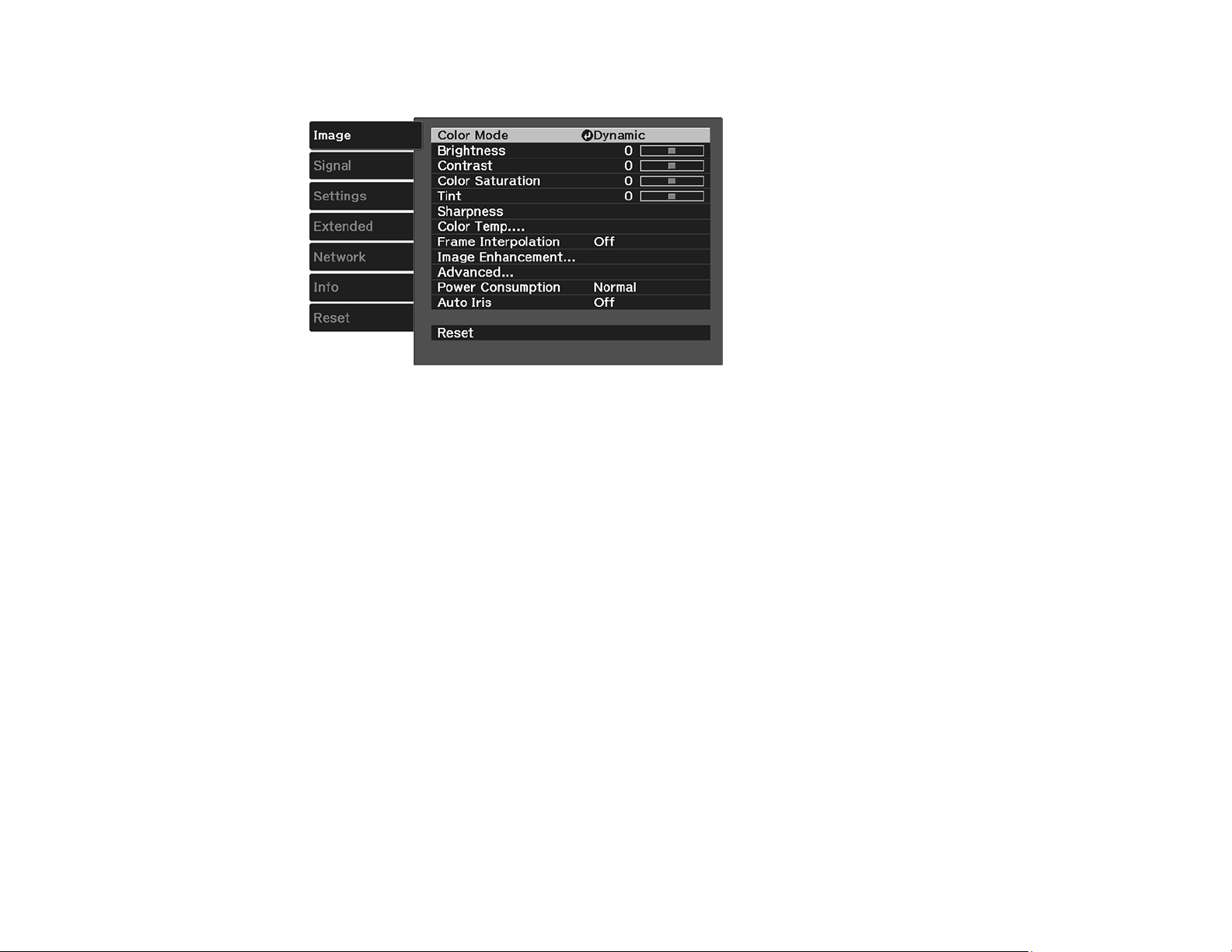
83
You see a screen like this:
3. Select the Image Enhancement setting and press Enter.
4. Select the Super-resolution setting and press Enter.
5. Adjust each of the following options as necessary:
• Fine Line Adjust to enhance fine details such as hair and fabric patterns
• Soft Focus Detail to enhance the outline, background, and main parts of an image
Note: Higher values increase the intensity of the effect.
6. Press Menu or Esc to exit the menus.
Parent topic: Using Advanced Image Adjustment Features
Related references
Image Adjustment Restrictions
Adjusting Detail Enhancement
You can enhance the contrast in detailed areas of an image to create a more textured look.
Note: This feature may not be available depending on the projection mode and input signal.
1. Turn on the projector and switch to the image source you want to use.
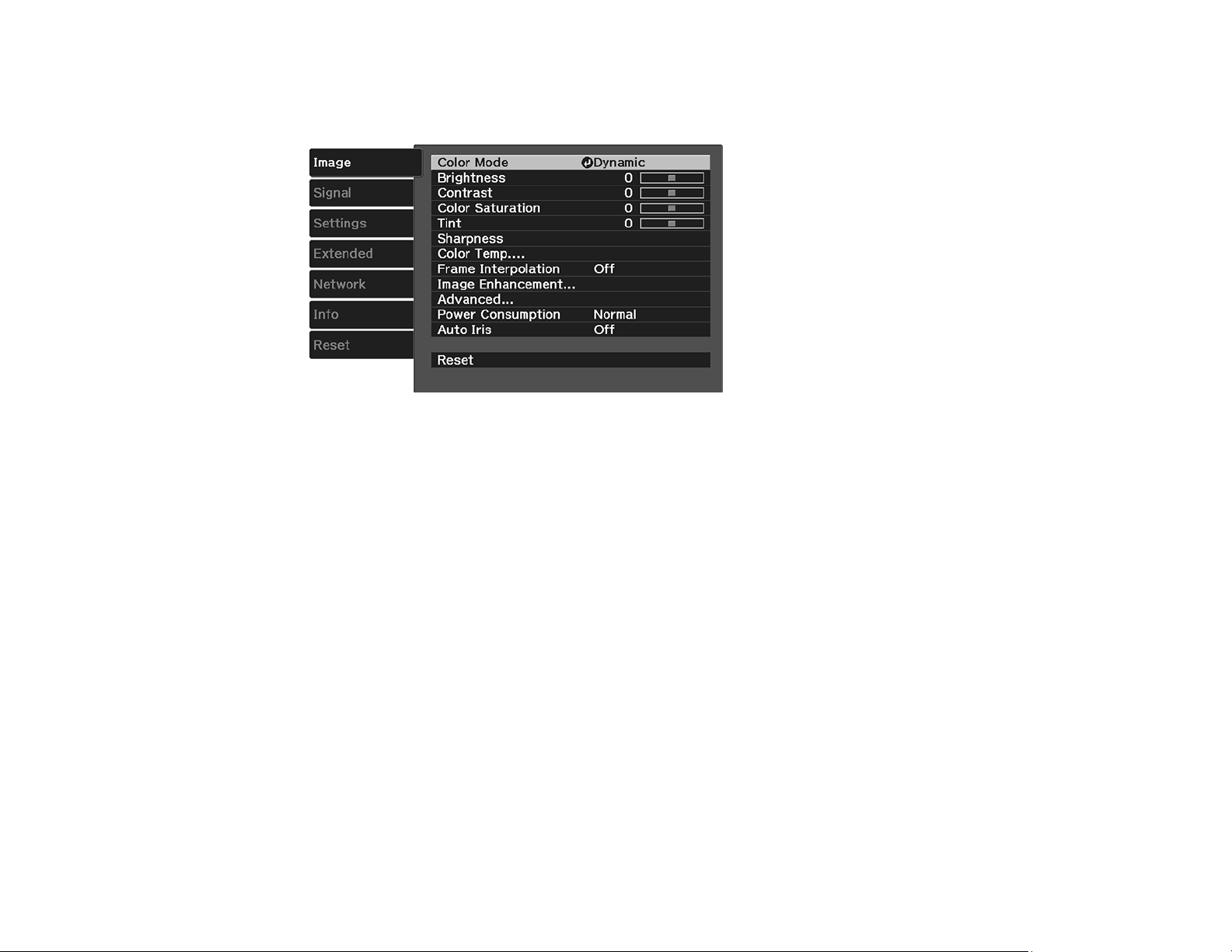
84
2. Press the Menu button.
You see a screen like this:
3. Select the Image Enhancement setting and press Enter.
4. Select the Detail Enhancement setting and press Enter.
5. Adjust each of the following options as necessary:
• Strength to adjust the image contrast
• Range to adjust the enhanced area of the image
Note: Higher values increase the intensity of the effect.
6. Press Menu or Esc to exit the menus.
Parent topic: Using Advanced Image Adjustment Features
Related references
Image Adjustment Restrictions
Image Adjustment Restrictions
Some advanced adjustment settings cannot be used with certain projection modes or input signals.
85
Fine mode
(Image
Processing)
Fast mode
(Image
Processing)
2D-to-3D
3D
4K input
Input type 2K 2K 2K 2D or
2K 3D
4K
Projection Mode 2K 4K Enh. 2K 4K Enh. 2K 2D or
2K 3D
4K Enh.
Frame Interpolation Yes Yes
*1
— — Yes
*1
—
Image Enhancement - 4K Preset — Yes — Yes — Yes
Noise Reduction — Yes — — — —
MPEG Noise Reduction — Yes — — — —
Super-resolution/Detail
Enhancement
— Yes — Yes — Yes
Image Enhancement - 2K Preset Yes — Yes — Yes —
Noise Reduction Yes — — — Yes —
MPEG Noise Reduction Yes — — — Yes —
Super-resolution/Detail
Enhancement
Yes — Yes — Yes —
*1
Frame Interpolation can only be used with 3D or 4K Enhancement if the signal is 1080p @ 24 Hz.
The following restrictions apply when using image enhancements:
• Fast mode (Image Processing) is not available when displaying a 4K picture.
• Picture in Picture and Fast mode (Image Processing) cannot be used with 3D or 4K projection.
• 2D-to-3D Conversion and 3D projection cannot be used with 4K projection.
Parent topic: Using Advanced Image Adjustment Features
Adjusting the Color Convergence (Panel Alignment)
You can use the Panel Alignment feature to manually adjust the color convergence (the alignment of the
red, green and blue colors) in the projected image.
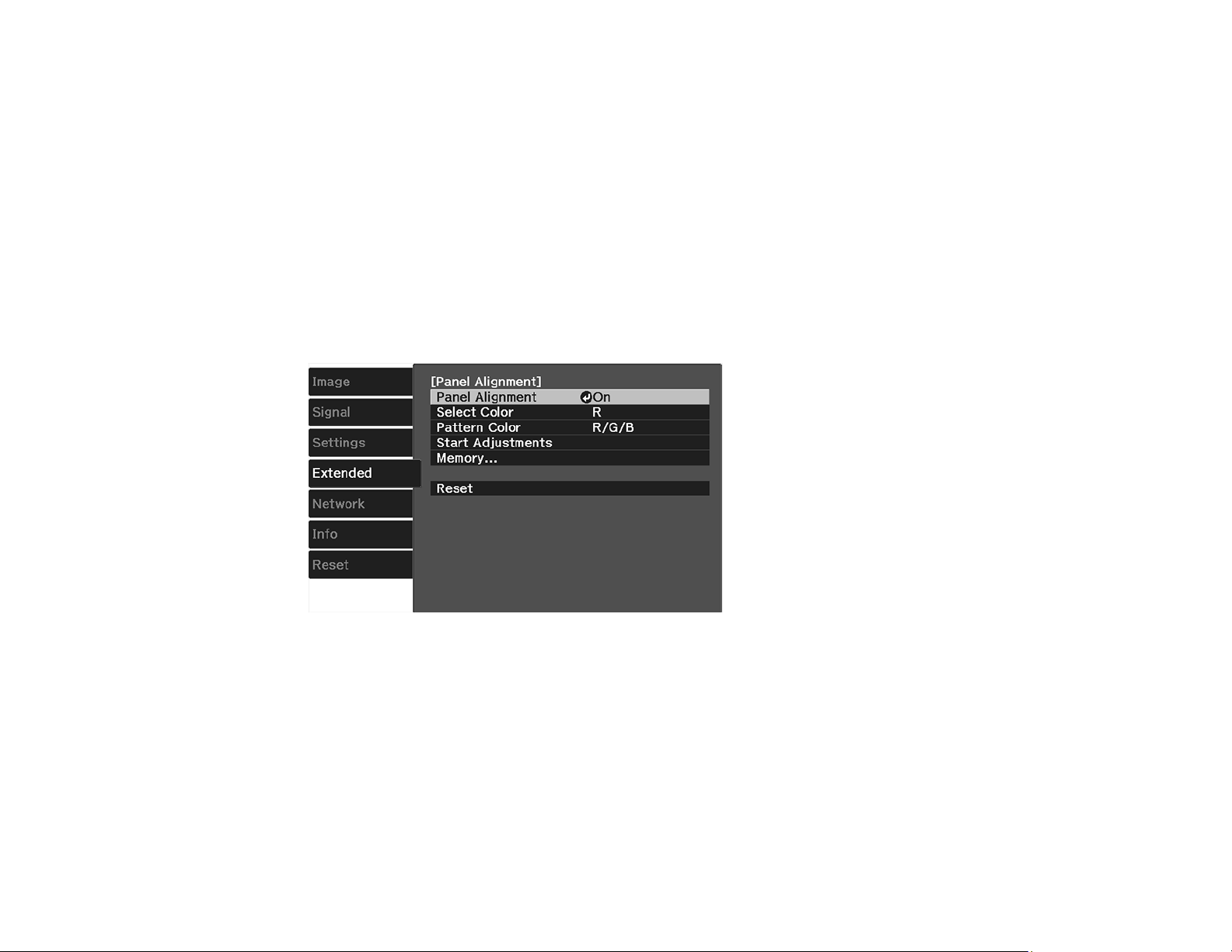
86
Note: Allow your projector to warm up for at least 10 to 15 minutes and make sure the image is in focus
before you use the Panel Alignment feature. For best results, project an image sized at least 60 inches
(152 cm) diagonally in a dark room and on a projection surface that is not colored or textured.
Note: You can only adjust the red or blue color convergence. Green is the standard color panel and
cannot be adjusted.
1. Turn on the projector.
2. Press the Menu button.
3. Select the Extended menu and press Enter.
4. Select the Display setting and press Enter.
5. Select the Panel Alignment setting and press Enter.
6. Select the Panel Alignment setting and press Enter.
7. Select On and press Enter.
8. Select the Select Color setting and choose one of the following:
• R to adjust the red color convergence.
• B to adjust the blue color convergence.
9. Select the Pattern Color setting and press Enter.
10. Select the pattern you want to use and press Enter.
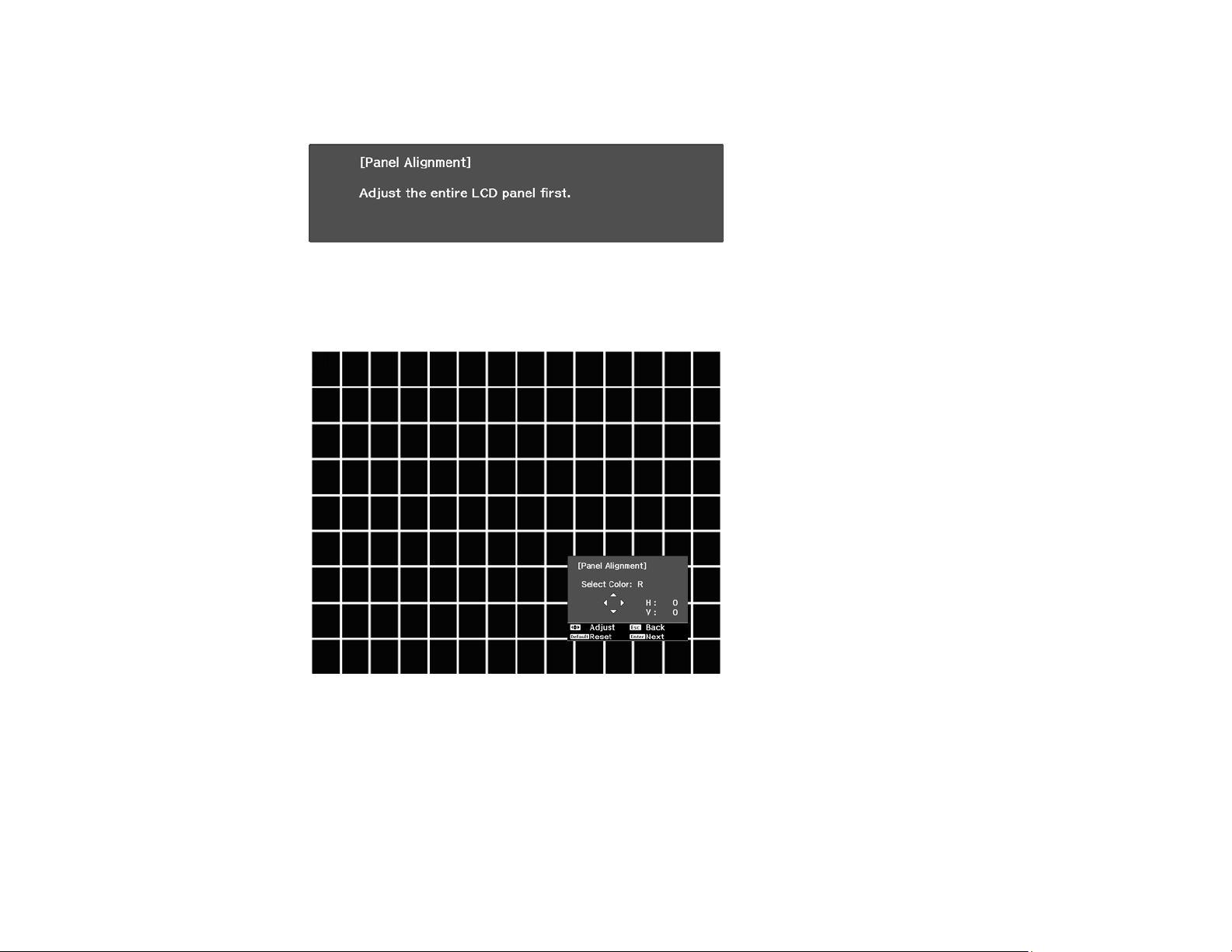
87
11. Select Start Adjustments and press Enter.
You see this screen:
12. Press Enter.
You see a screen like this:
13. Use the arrow buttons on the remote control to adjust the color alignment of the color you selected
for the Select Color setting.
14. When you are finished adjusting the screen, press Enter.
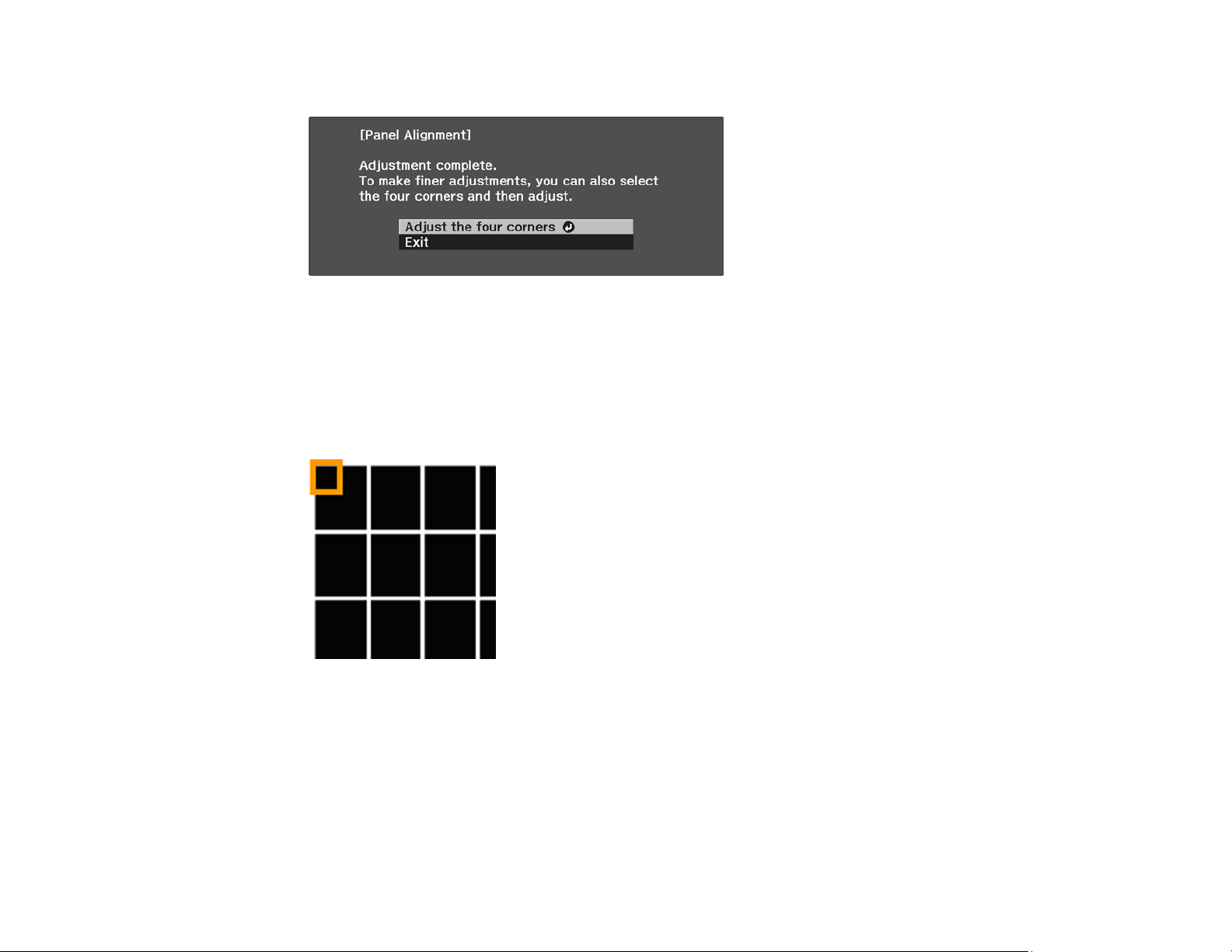
88
You see this screen:
Note: Your adjustments affect the gridlines in the entire screen. To fine-tune your adjustments,
continue with the next steps.
15. Select Adjust the four corners and press Enter. (Otherwise, select Exit and press Enter.)
16. Use the arrow buttons on the remote control to adjust the color alignment in the corner of the screen
highlighted by the orange box.
17. Press the Enter button to move to the next corner of the screen.
18. When you are finished adjusting each corner of the screen, press Enter.
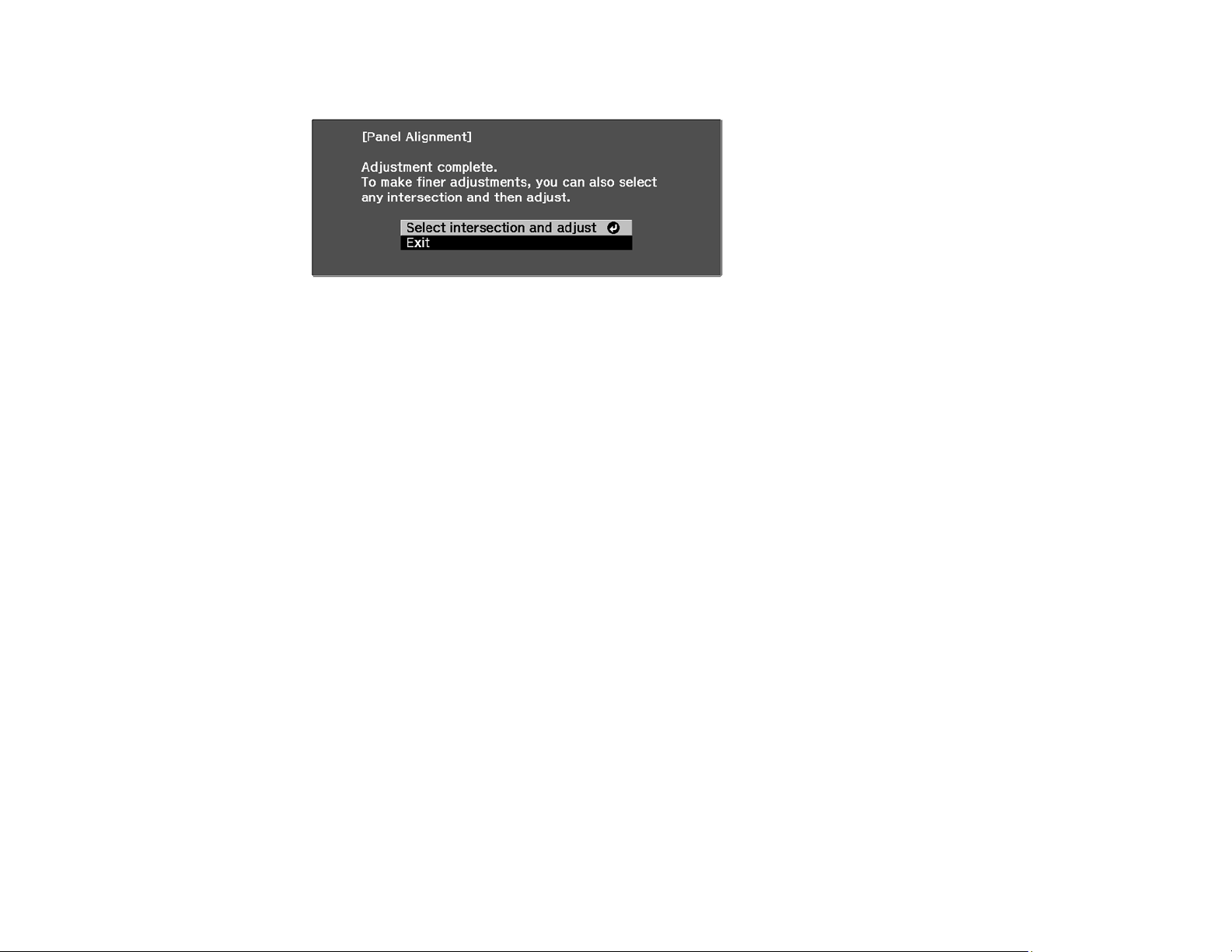
89
You see this screen:
19. Do one of the following:
• If your projector's panel alignment is now correct, select Exit and press Enter to return to the
Panel Alignment menu.
• If your projector needs additional panel alignment, select Select intersection and adjust and
press Enter. Use the arrow keys on the remote control to highlight the corner of any misaligned
box on the screen and press Enter. Repeat this step as necessary.
Parent topic: Using Advanced Image Adjustment Features
Adjusting the Color Tone (Color Uniformity)
You can use the Color Uniformity feature to manually adjust the color tone balance in the projected
image.
1. Press the Menu button.
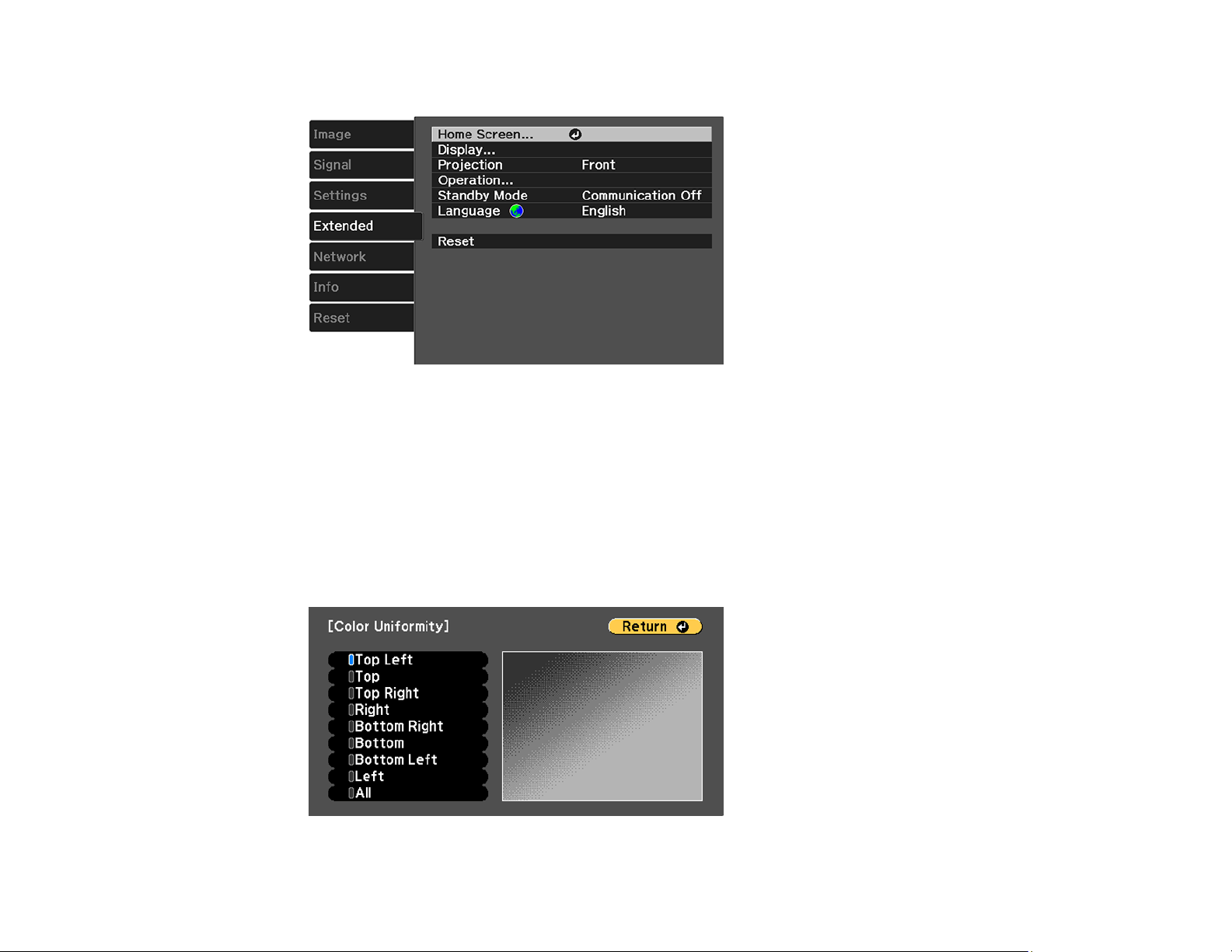
90
2. Select the Extended menu and press Enter.
3. Select the Display setting and press Enter.
4. Select the Color Uniformity setting and press Enter.
5. Press Enter and select On.
6. Press Esc.
7. Select the Adjustment Level setting and press Enter.
8. Press the right and left arrow buttons to adjust the level, then press Esc.
9. Select the Start Adjustments setting and press Enter.

91
10. Select the area of the screen that you want to adjust and press Enter.
Note: Adjust the outer areas first, then adjust the entire screen.
11. Select the color (Red, Green, or Blue) you want to adjust, and use the left arrow button to weaken
the color tone and the right arrow button to strengthen the color tone.
12. Press Esc.
13. Repeat steps 10 and 11 for each area you want to adjust.
14. Repeat steps 7 to 11 for each adjustment level.
15. When you are finished, press the Menu button.
Parent topic: Using Advanced Image Adjustment Features
Saving Settings to Memory and Using Saved Settings
You can save customized settings for each of your video inputs and then select the saved settings
whenever you want to use them.
Note: You can save the Image settings and the Lens Adjustment (Focus, Zoom, and Lens Shift) function
values.
1. Turn on the projector and display an image.
2. Press the Menu button.
Note: You can also press the Memory button on the remote control to access the Memory menu
directly.
3. Select the Settings menu and press Enter.
4. Select the Memory setting and press Enter.
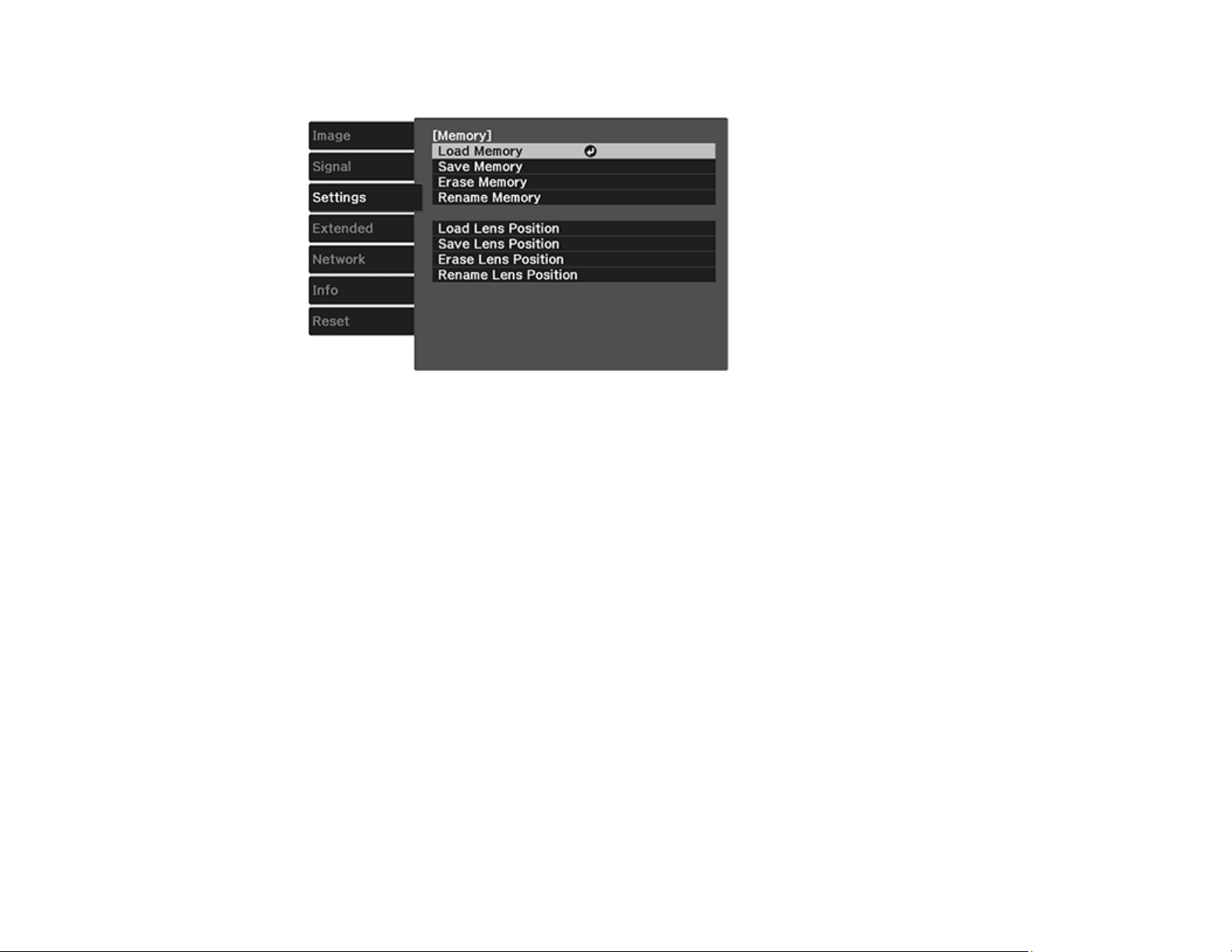
92
You see this screen:
5. Select one of the following options:
• Load Memory: Overwrites your current settings with saved settings
• Save Memory: Saves your current settings to memory (10 memories with different names are
available)
Note: A memory name that has already been used is indicated by a blue mark. Saving over a
previously saved memory overwrites the settings with your current settings.
• Erase Memory: Erases the selected memory settings
• Rename Memory: Renames a saved memory
6. Press Esc to exit.
Parent topic: Adjusting Projector Features
Saving the Lens Position and Using Saved Lens Positions
You can save the focus, zoom, and lens shift settings and then select the saved settings whenever you
want to use them.
1. Turn on the projector and display an image.
2. Adjust the focus, zoom, and lens shift settings.
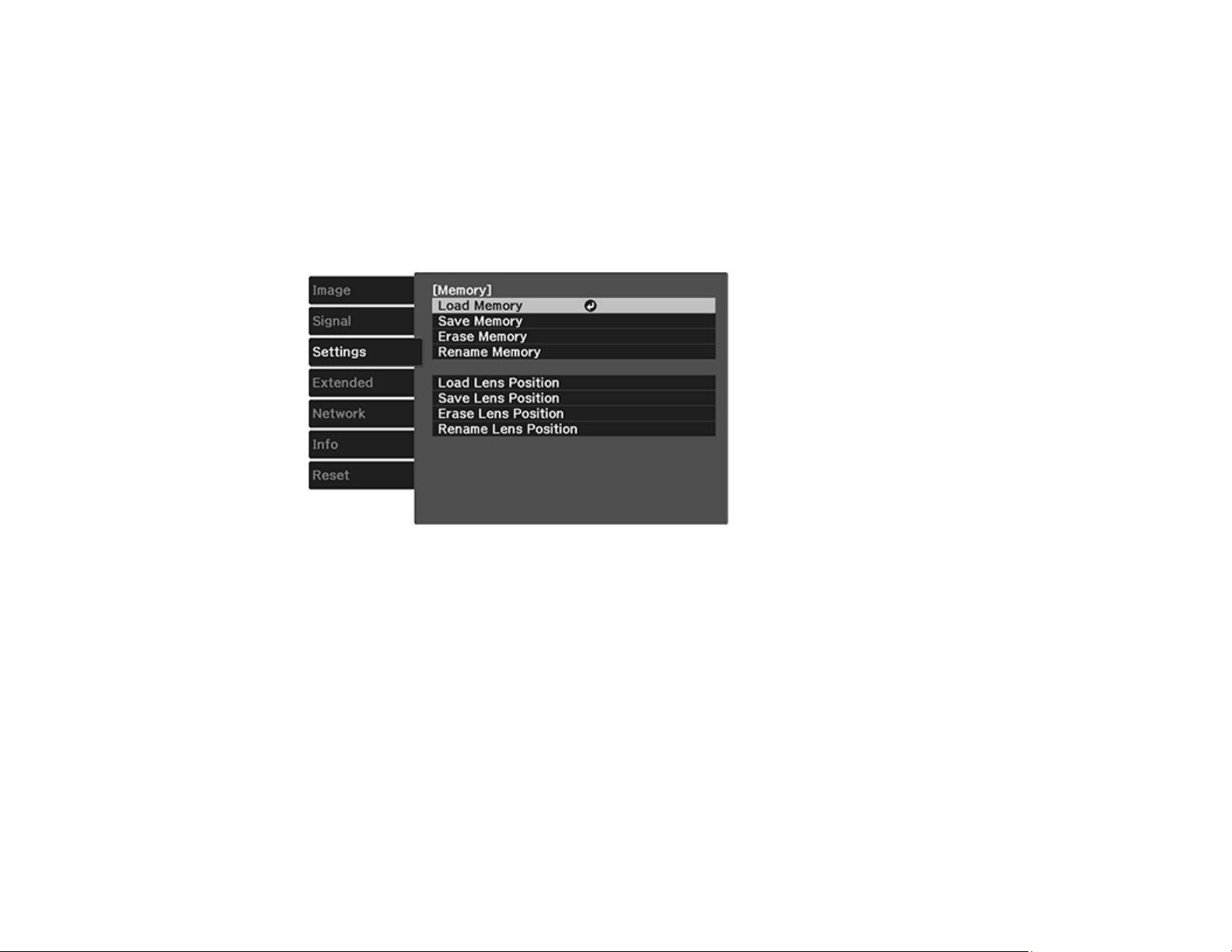
93
3. Press the Menu button.
Note: You can also press the Memory button on the remote control to access the Memory menu
directly.
4. Select the Settings menu and press Enter.
5. Select the Memory setting and press Enter.
You see this screen:
6. Select one of the following options:
• Load Lens Position: Overwrites your current focus, zoom, and lens shift settings with saved
settings
Note: You can load the saved settings from Memory1 or Memory2 by pressing the Lens1 or
Lens2 buttons on the remote control.
• Save Lens Position: Saves your current focus, zoom, and lens shift settings to memory (10
memories with different names are available)
Note: A memory name that has already been used is indicated by a blue mark. Saving over a
previously saved memory overwrites the settings with your current settings.
• Erase Lens Position: Erases the selected lens position settings

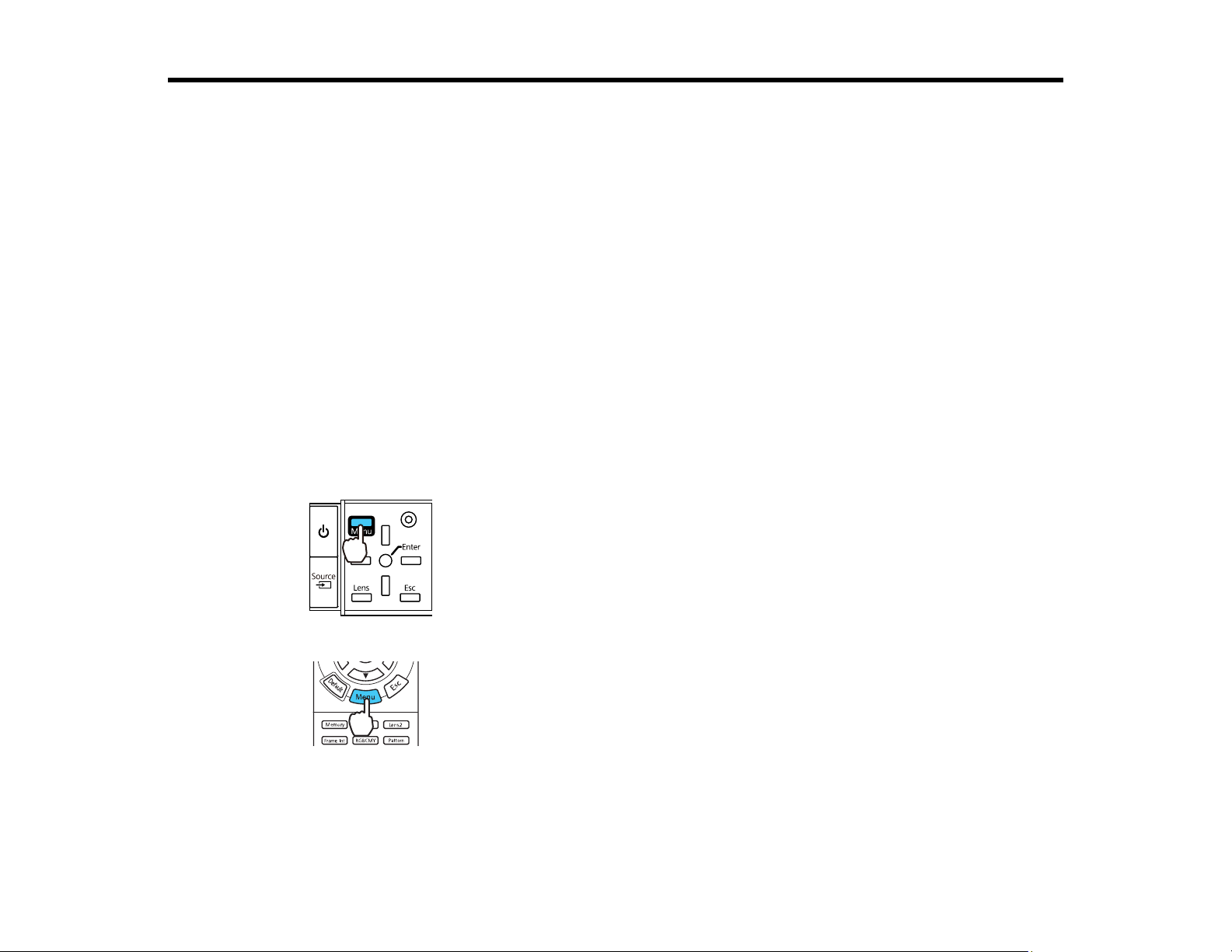
95
Adjusting the Menu Settings
Follow the instructions in these sections to access the projector menu system and change projector
settings.
Using the Projector's Menus
Image Quality Settings - Image Menu
Input Signal Settings - Signal Menu
Projector Feature Settings - Settings Menu
Projector Setup Settings - Extended Menu
Projector Network Settings - Network Menu
Projector Information Display - Info Menu
Projector Reset Options - Reset Menu
Using the Projector's Menus
You can use the projector's menus to adjust the settings that control how your projector works. The
projector displays the menus on the screen.
1. Press the Menu button on the control panel or remote control.
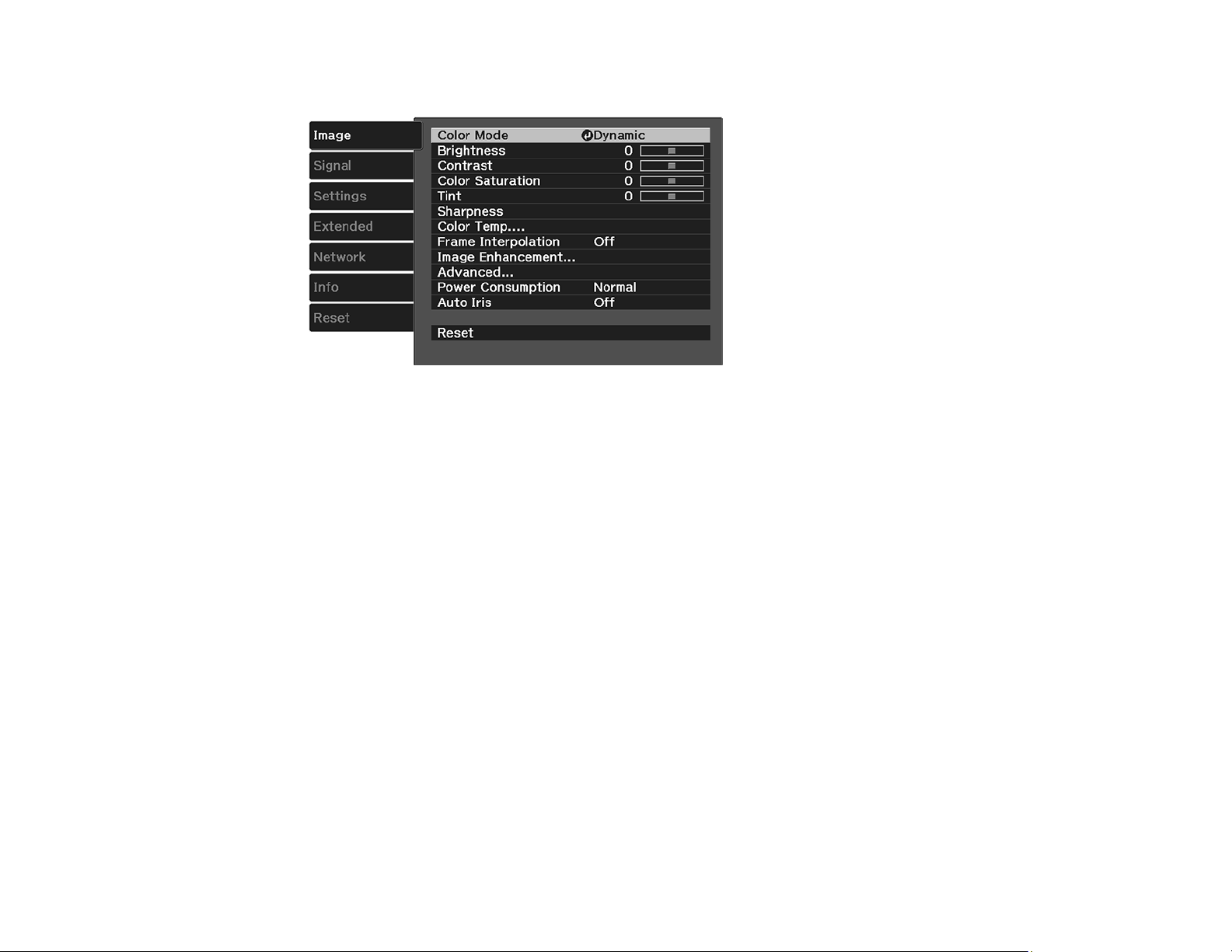
96
You see the menu screen displaying the Image menu settings.
2. Press the up or down arrow button to move through the menus listed on the left. The settings for
each menu are displayed on the right.
Note: The available settings depend on the current input source.
3. To change settings in the displayed menu, press Enter.
4. Press the up or down arrow button to move through the settings.
5. Change the settings using the buttons listed on the bottom of the menu screens.
6. To return all the menu settings to their default values, select Reset.
7. When you finish changing settings on a menu, press Esc.
8. Press Menu or Esc to exit the menus.
Parent topic: Adjusting the Menu Settings
Image Quality Settings - Image Menu
Settings on the Image menu let you adjust the quality of your image for the input source you are currently
using.
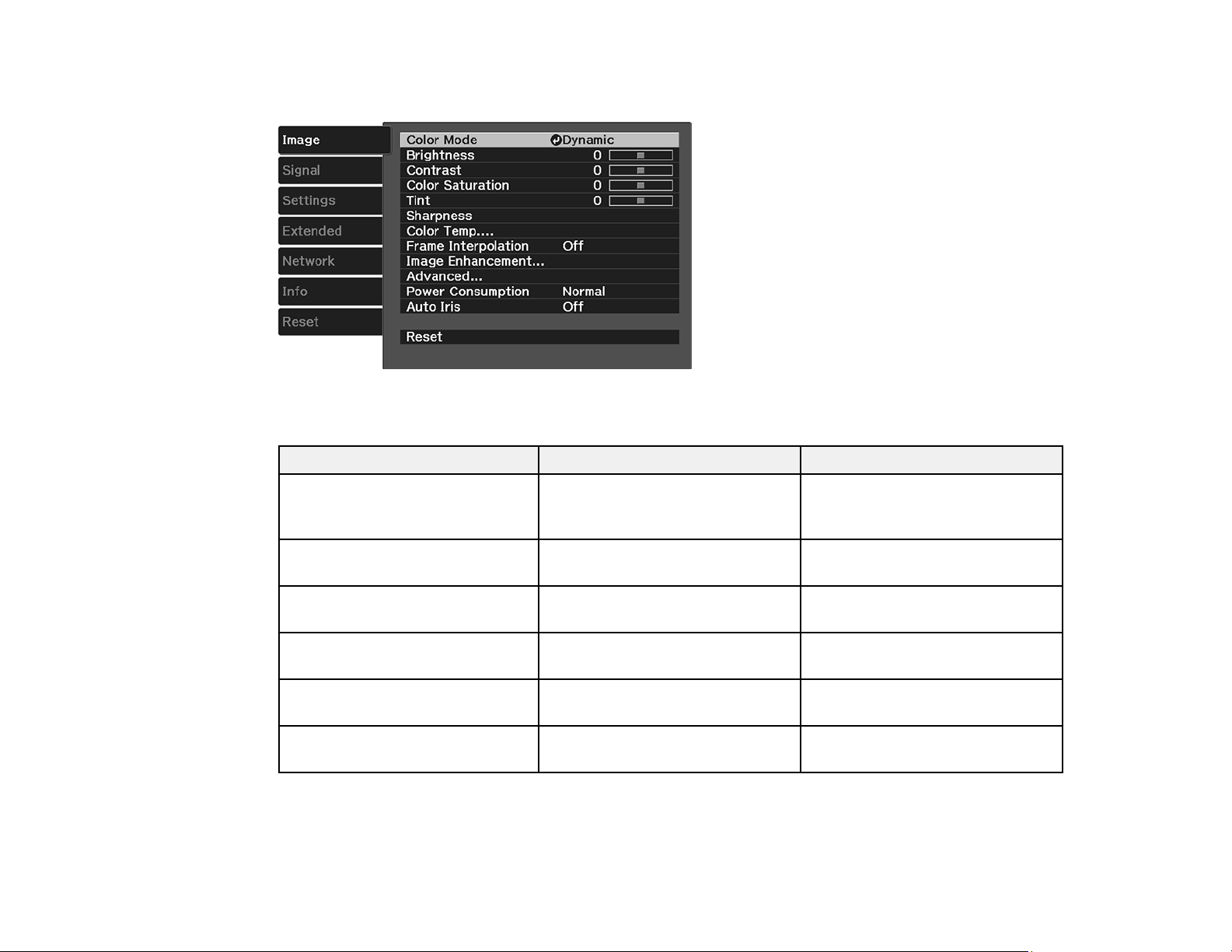
97
Note: The available settings depend on the currently selected input source.
To change settings for an input source, make sure the source is connected and select that source.
Setting Options Description
Color Mode See the list of available Color
Modes
Adjusts the vividness of image
colors for various image types
and environments
Brightness Varying levels available Lightens or darkens the overall
image
Contrast Varying levels available Adjusts the difference between
light and dark areas of the image
Color Saturation Varying levels available Adjusts the intensity of the image
colors
Tint Varying levels available Adjusts the balance of green to
magenta tones in the image
Sharpness Varying levels available Adjusts the sharpness or
softness of image details
98
Setting Options Description
Color Temp. (color temperature) Color Temp.
Skin Tone
Customized
Color Temp.: sets the overall
color tone; higher values tint the
image blue and lower values tint
the image red
Skin Tone: makes fine
adjustments to the color tone;
higher values tint the image
green and lower values tint the
image red
Customized: adjusts the offset
and gain for each RGB color
Frame Interpolation Off
Weak
Normal
Strong
Adjusts the smoothness of
movement in the image
Note: Only available for 1080p
signals at 24 Hz.

99
Setting Options Description
Image Enhancement 4K Enhancement
Image Preset Mode
Noise Reduction
MPEG Noise Reduction
Super-resolution
Detail Enhancement
4K Enhancement: accepts 4K
signals and enhances the output
of 1080p signals
Image Preset Mode: selects one
of five preset groups of settings
for the next image enhancement
options
Noise Reduction: reduces
flickering in analog images
MPEG Noise Reduction:
reduces the noise or artifacts
seen in MPEG video
Super-resolution: sharpens
blurred images resulting from
increasing resolution
Detail Enhancement: enhances
details to create clear outlines
• Range: higher settings
increase the affected area
around the outline
• Strength: higher settings
create a stronger effect
Note: Range and Strength will
vary based on the Image Preset
Mode setting.

100
Setting Options Description
Advanced Gamma
RGBCMY
Deinterlacing
EPSON Super White
Selects various detailed color
settings
Gamma: adjusts the gamma
levels of the image. Select
Customized to adjust the
gamma while viewing the image
or a graph.
RGBCMY: adjusts the hue,
saturation, and brightness for
each color
Deinterlacing: sets whether to
convert interlaced-to-progressive
signals for certain video image
types
• Off: for fast-moving video
images
• Video: for most video images
• Film/Auto: for movies,
computer graphics, and
animation
EPSON Super White: reduces
over-exposure of whites in your
image
Power Consumption High
Medium
ECO
Selects the brightness mode of
the projector lamp
High: sets maximum lamp
brightness
Medium: reduces the brightness
of the lamp
ECO: reduces lamp brightness
and fan noise, and saves power
and lamp life
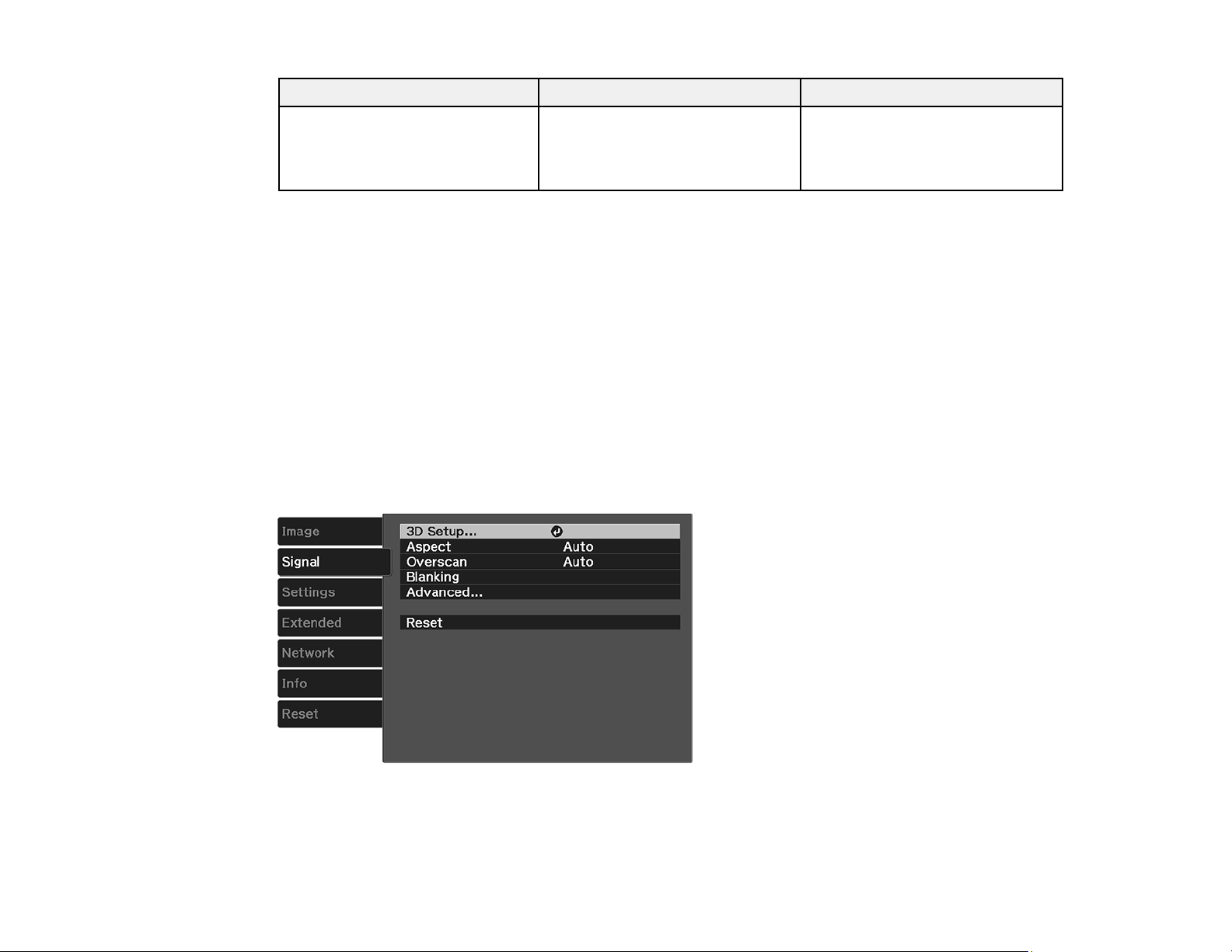
101
Setting Options Description
Auto Iris Off
Normal
High Speed
Adjusts the projected luminance
based on the image brightness
when certain Color Modes are
selected
Note: The Brightness setting does not affect lamp brightness. To change the lamp brightness mode,
use the Power Consumption setting.
Parent topic: Adjusting the Menu Settings
Related references
Available Color Modes
Input Signal Settings - Signal Menu
Normally the projector detects and optimizes the input signal settings automatically. If you need to
customize the settings, you can use the Signal menu.
Note: The available settings depend on the currently selected input source. You cannot change the
Signal menu settings when the LAN source is selected.
To change settings for an input source, make sure the source is connected and select that source.
102
Setting Options Description
3D Setup 3D Display
3D Format
2D-to-3D Conversion
3D Depth
Diagonal Screen Size
3D Brightness
Inverse 3D Glasses
3D Viewing Notice
Selects various 3D options
3D Display: enables 3D mode
3D Format: selects the 3D
format
2D-to-3D Conversion: converts
2D images to 3D
3D Depth: sets the depth for the
3D image
Diagonal Screen Size: selects
the actual size of the screen to
maximize the 3D effect
3D Brightness: adjusts the
brightness of the 3D image
Inverse 3D Glasses: reverses
the images projected for the left
and right eyes (enable only if 3D
images do not display correctly)
3D Viewing Notice: enables the
viewing notice displayed when
using 3D mode
Aspect See the list of available aspect
ratios
Sets the aspect ratio (width-to-
height ratio) for the selected
input source
Tracking Varying levels available Adjusts signal to eliminate
vertical stripes in computer
images from the PC input port
Sync. Varying levels available Adjusts signal to eliminate
fuzziness or flickering in
computer images from the PC
input port
Position Up, down, left, right Adjusts the image location on the
screen
103
Setting Options Description
Auto Setup On
Off
Automatically optimizes
computer image quality
Overscan Auto
Off
4%
8%
Changes the projected image
ratio to make the edges visible
by a selectable percentage or
automatically
Blanking Various settings Covers part of the image with a
black screen to hide raster lines
at the edge of the screen.
Note: Using this feature reduces
the image size.
Advanced HDMI Video Range
Color Space
Dynamic Range
Image Processing
HDMI Video Range: sets the
video range to match the setting
of the device connected to the
HDMI input port
Color Space: sets the
conversion system for the color
space (Auto, BT.709, or
BT.2020)
Dynamic Range: selects the
HDR (High Dynamic Range)
mode
Image Processing: adjusts how
images are processed; select
Fast to display images quicker;
select Fine to display images in
higher quality
Note: The Fast setting disables
all image adjustment features.
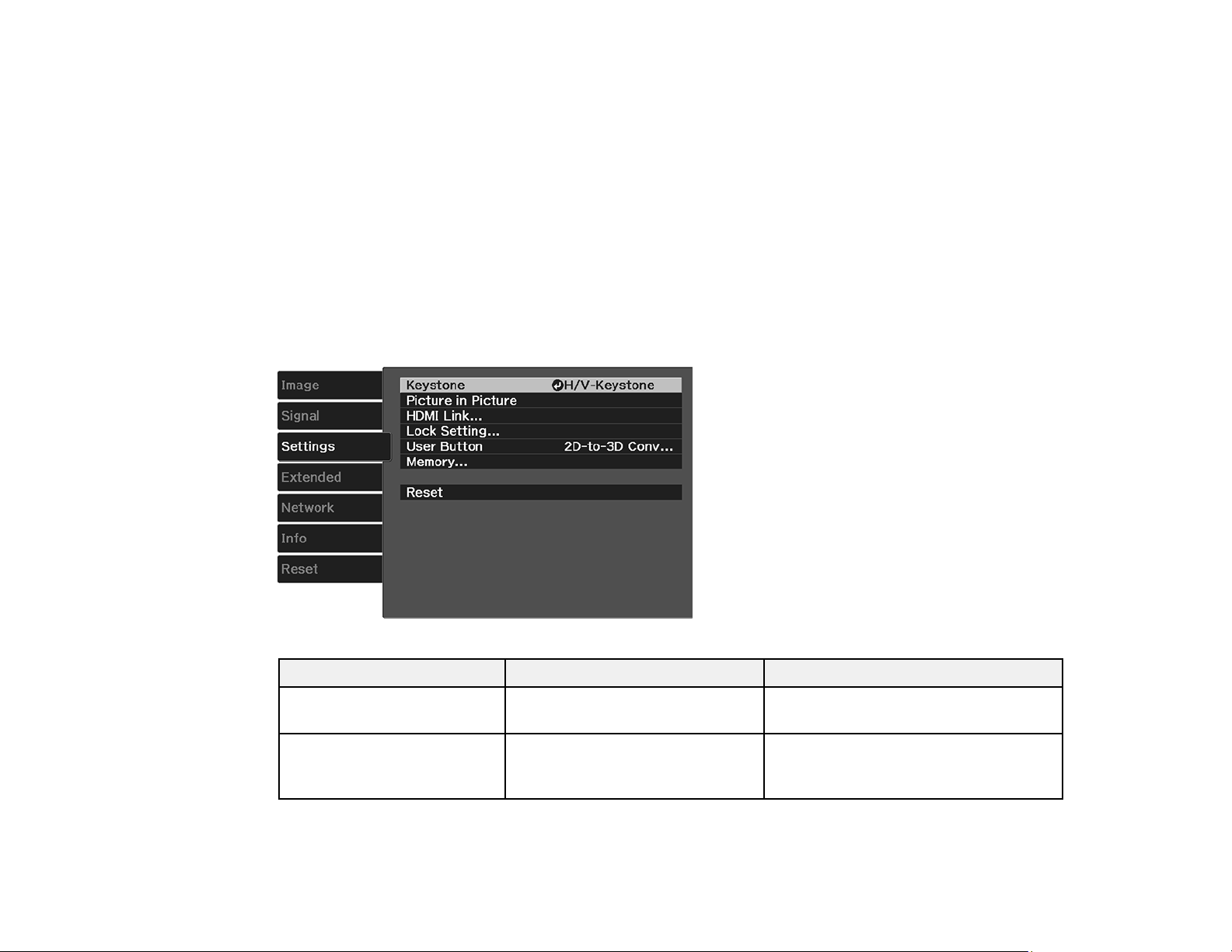
104
Note: You can set the HDMI Video Range setting only when the Epson Super White setting is set to
Off. The Reset setting does not reset the Diagonal Screen Size, 3D Viewing Notice, and Aspect
settings. The Aspect setting is not available for HD video signals.
Parent topic: Adjusting the Menu Settings
Related concepts
Image Aspect Ratio
Related tasks
Viewing 3D Images
Projector Feature Settings - Settings Menu
Options on the Settings menu let you customize various projector features.
Setting Options Description
Keystone Varying levels available Adjusts image shape to rectangular
(vertically)
Picture in Picture See the list of available Picture in
Picture options
Adjusts the size and location of the
sub-screen, swaps sources and exits
Picture in Picture mode

105
Setting Options Description
HDMI Link Device Connections
HDMI Link
Power On Link
Power Off Link
Link Buffer
Adjusts the HDMI Link options
Device Connections: lists the
devices connected to the HDMI1 and
HDMI2 ports
HDMI Link: enables or disables the
HDMI Link function
Power On Link: controls what
happens when you turn on the
projector or a linked device
• PJ -> Device or Bidirectional:
turns on the linked device when the
projector is turned on
• Device -> PJ or Bidirectional:
turns on the projector when the
linked device is turned on
Power Off Link: controls whether
linked devices are turned off when the
projector is turned off
Link Buffer: improves weak HDMI
Link connections
Lock Setting Lens Lock
Child Lock
Control Panel Lock
Controls projector lens and control
panel button locking to secure the
projector
Lens Lock: locks the focus, zoom,
and lens shift settings
Child Lock: locks the power button
Control Panel Lock:
• Full Lock: locks all buttons
• Partial Lock: locks all buttons
except the power button
• Off: no buttons locked

106
Setting Options Description
User Button Fine/Fast (Image Processing)
3D Display
2D-to-3D Conversion
Power Consumption
Info
Display the QR Code
Assigns a menu option to the User
button on the remote control for one-
touch access
Memory Load Memory
Save Memory
Erase Memory
Rename Memory
Load Lens Position
Save Lens Position
Erase Lens Position
Rename Lens Position
Controls the saved projector settings
and lens positions
Load Memory: displays the list of
customized settings entries that you
have created
Save Memory: saves the current
projector settings to the projector's
memory
Erase Memory: erases a saved
memory position
Rename Memory: changes the name
of a saved memory position
Load Lens Position: loads lens
adjustment values saved with the
Save Lens Position setting
Save Lens Position: saves the focus,
zoom, and lens shift adjustments as a
lens position entry
Erase Lens Position: deletes the
saved lens position entry
Rename Lens Position: renames a
saved lens position entry
Parent topic: Adjusting the Menu Settings
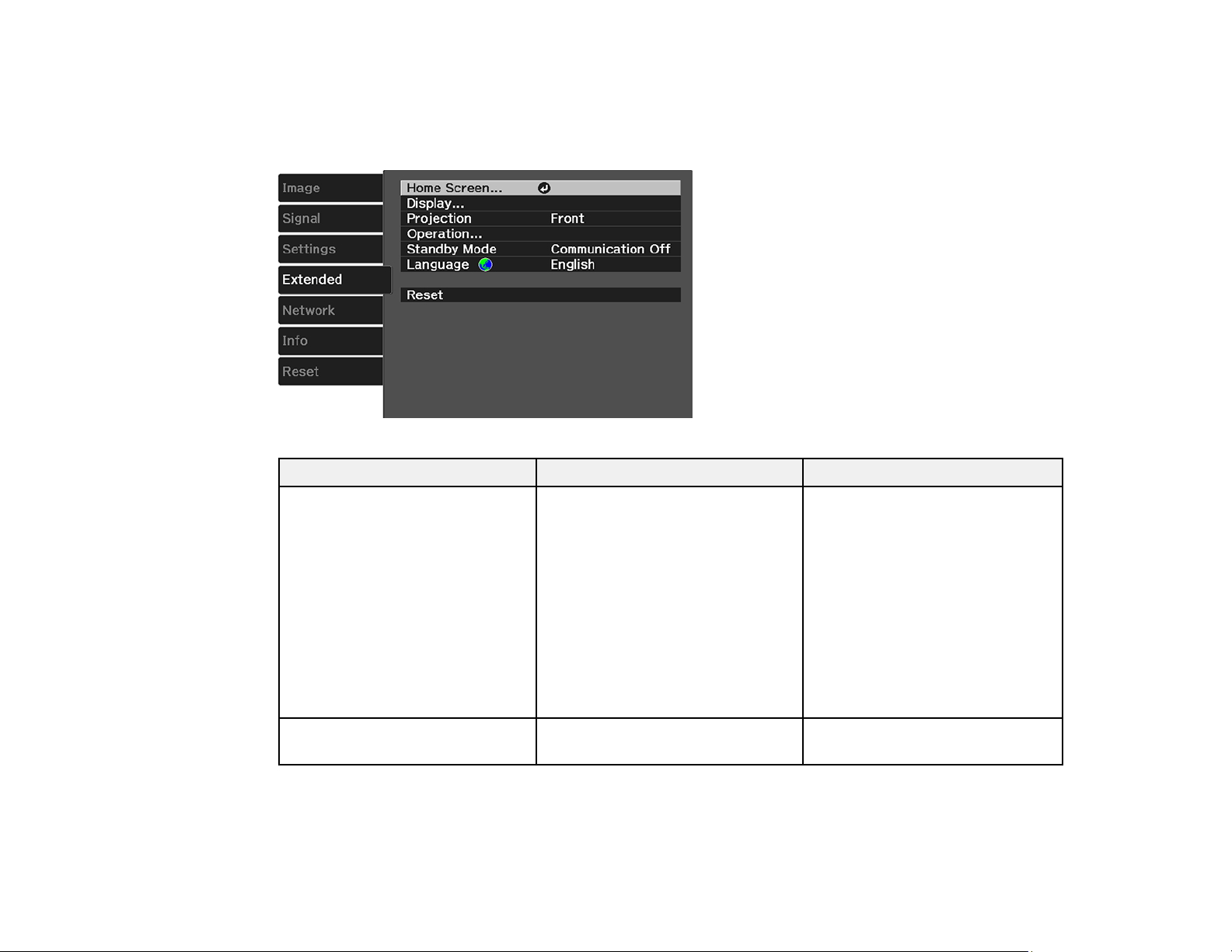
107
Projector Setup Settings - Extended Menu
Settings on the Extended menu let you customize various projector setup features that control its
operation.
Setting Options Description
Home Screen Home Screen Auto Disp.
Custom Function 1
Custom Function 2
Adjust settings on the Home
Screen
Home Screen Auto Disp.:
controls whether the Home
screen displays automatically
when the projector is turned on
Custom Function 1 / Custom
Function 2: let you customize
the options displayed on the
Home screen and save your
settings as a preset
Display — See the Display settings table in
this topic
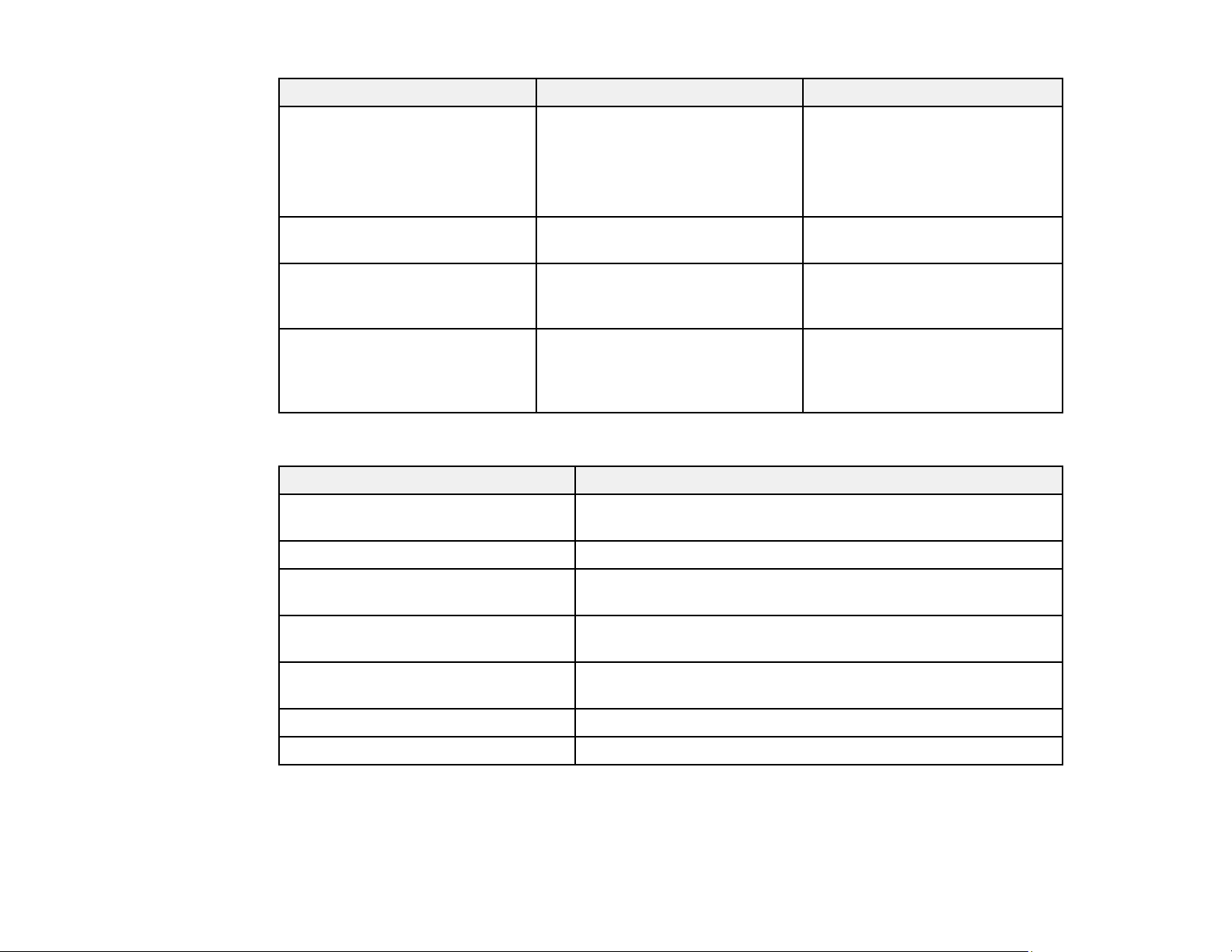
108
Setting Options Description
Projection Front
Front/Ceiling
Rear
Rear/Ceiling
Selects the way the projector
faces the screen so the image is
oriented correctly
Operation — See the Operation settings table
in this topic
Standby Mode Communication Off
Communication On
Indicates whether the projector
can be monitored over a network
while in standby mode
Language Various languages available Selects the language for
projector menu and message
displays (not changed by Reset
option)
Display settings
Setting Description
Menu Position Selects the position of the projector menu displayed on the
screen
Messages Controls whether messages are displayed on the screen
Display Background Selects the screen color or logo to display when no signal is
received
Startup Screen Controls whether a special screen appears when the projector
starts up
Standby Confirmation Displays a confirmation message after pressing the Standby
button on the remote control
Panel Alignment Corrects color misalignment in the projected image
Color Uniformity Adjusts the color tone balance
Operation settings
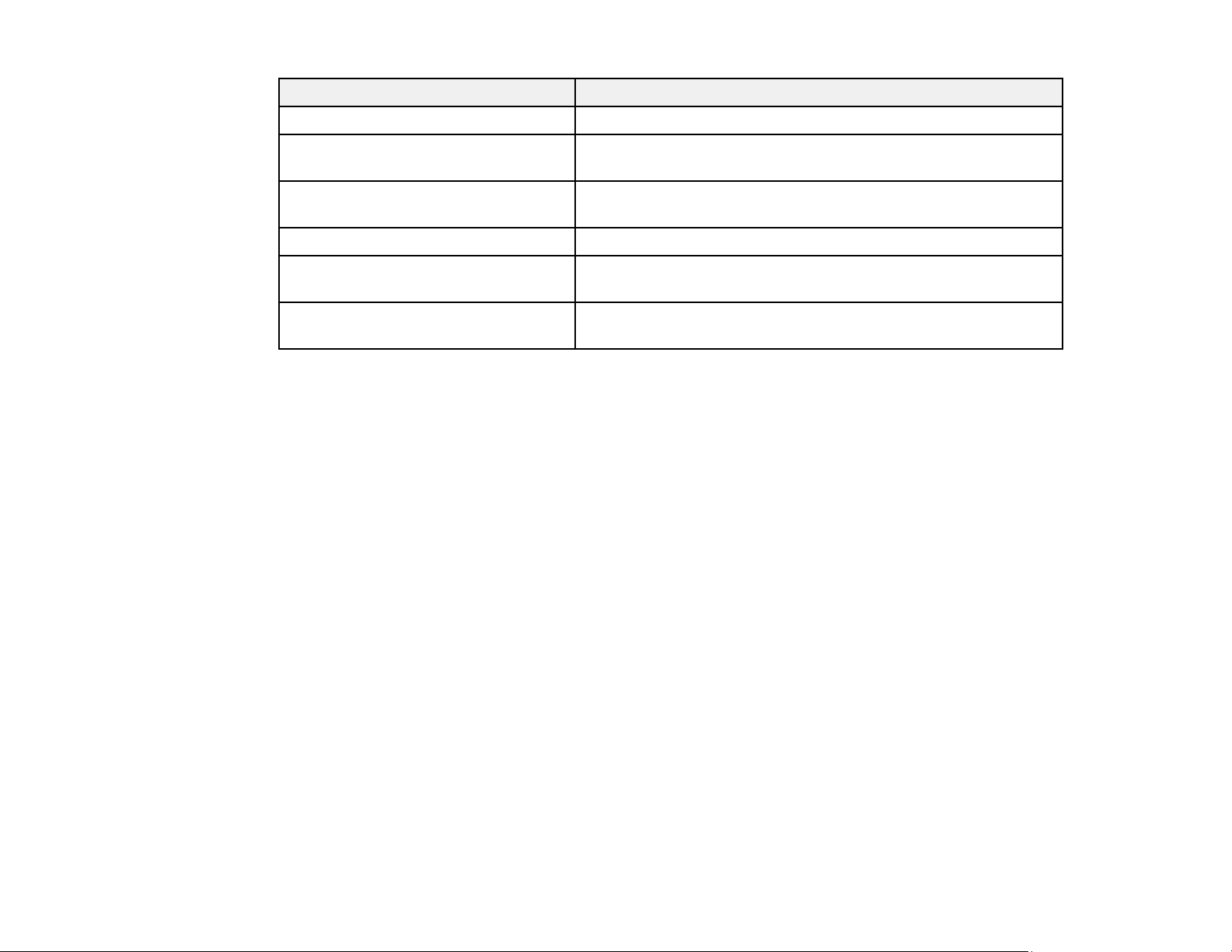
109
Setting Description
Direct Power On Turns on the projector when you plug it in
Sleep Mode Automatically places the projector in standby mode after an
interval of inactivity
Sleep Mode Timer Sets the time before the projector automatically turns off (Sleep
Mode must be turned on)
Illumination Turns off the status indicator lights on the projector
Trigger Out Outputs a DC 12V signal at 200 mA maximum from the 3.5 mm
mini-jack Trigger Out port whenever the projector is turned on
High Altitude Mode Regulates the projector’s operating temperature at altitudes
above 4921 feet (1500 m)
Note: The Reset setting does not reset the Memory, Projection, High Altitude Mode, Standby Mode
or Language settings.
Parent topic: Adjusting the Menu Settings
Related concepts
Projection Modes
Related references
Available Image Aspect Ratios
Related tasks
Using the Home Screen
Selecting External Network Detection Settings
Using Picture in Picture
Adjusting the Color Convergence (Panel Alignment)
Connecting to a Trigger Out Port
Projector Network Settings - Network Menu
Settings on the Network menu let you view network information and set up the projector for monitoring
and control over a network.
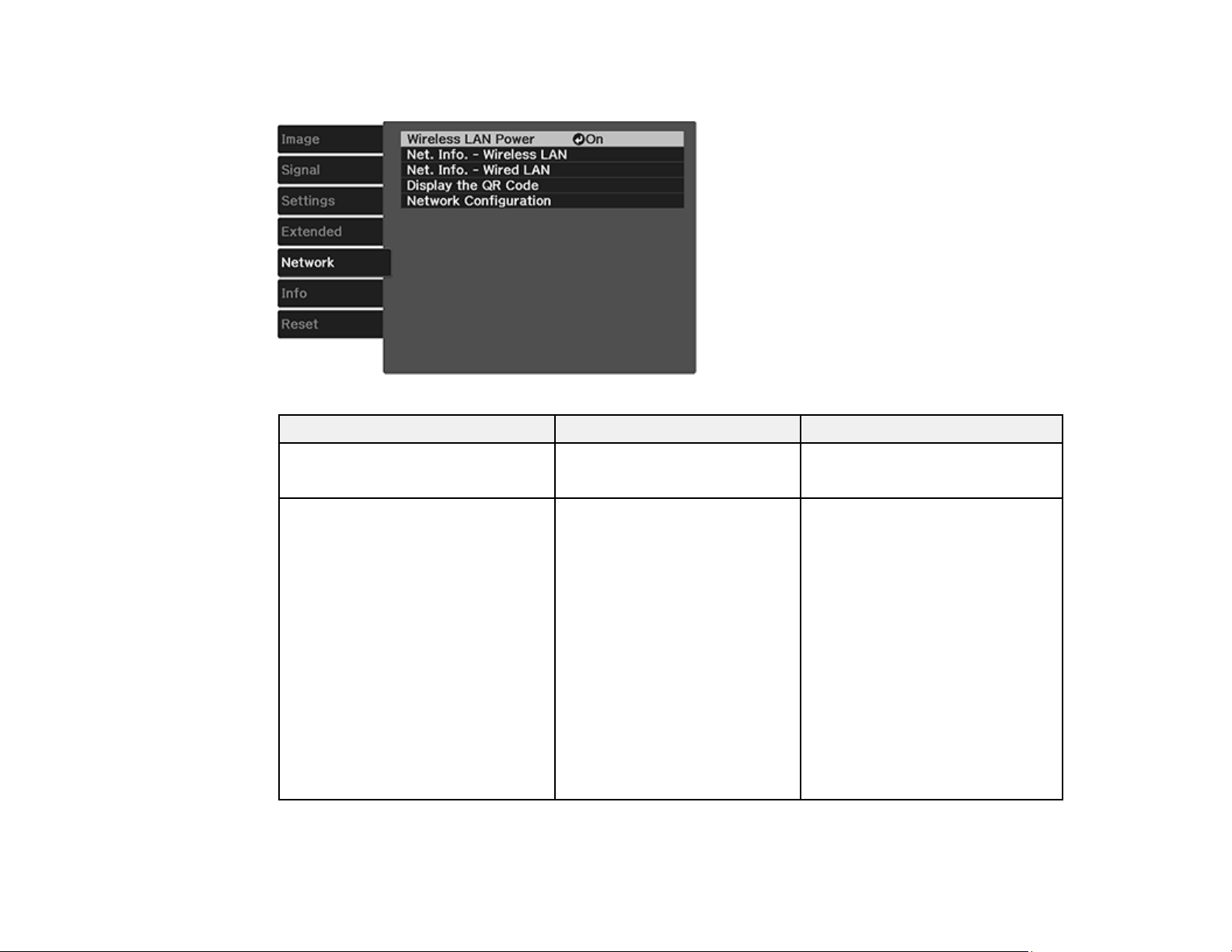
110
Note: Some settings are only available if the optional wireless LAN module is installed.
Setting Options Description
Wireless LAN Power On
Off
Enable or disable wireless
communication
Net. Info - Wireless LAN Connection mode
Wireless LAN Sys.
Antenna level
Projector Name
SSID
DHCP
IP Address
Subnet Mask
Gateway Address
MAC Address
Region Code
Displays wireless network status
and details
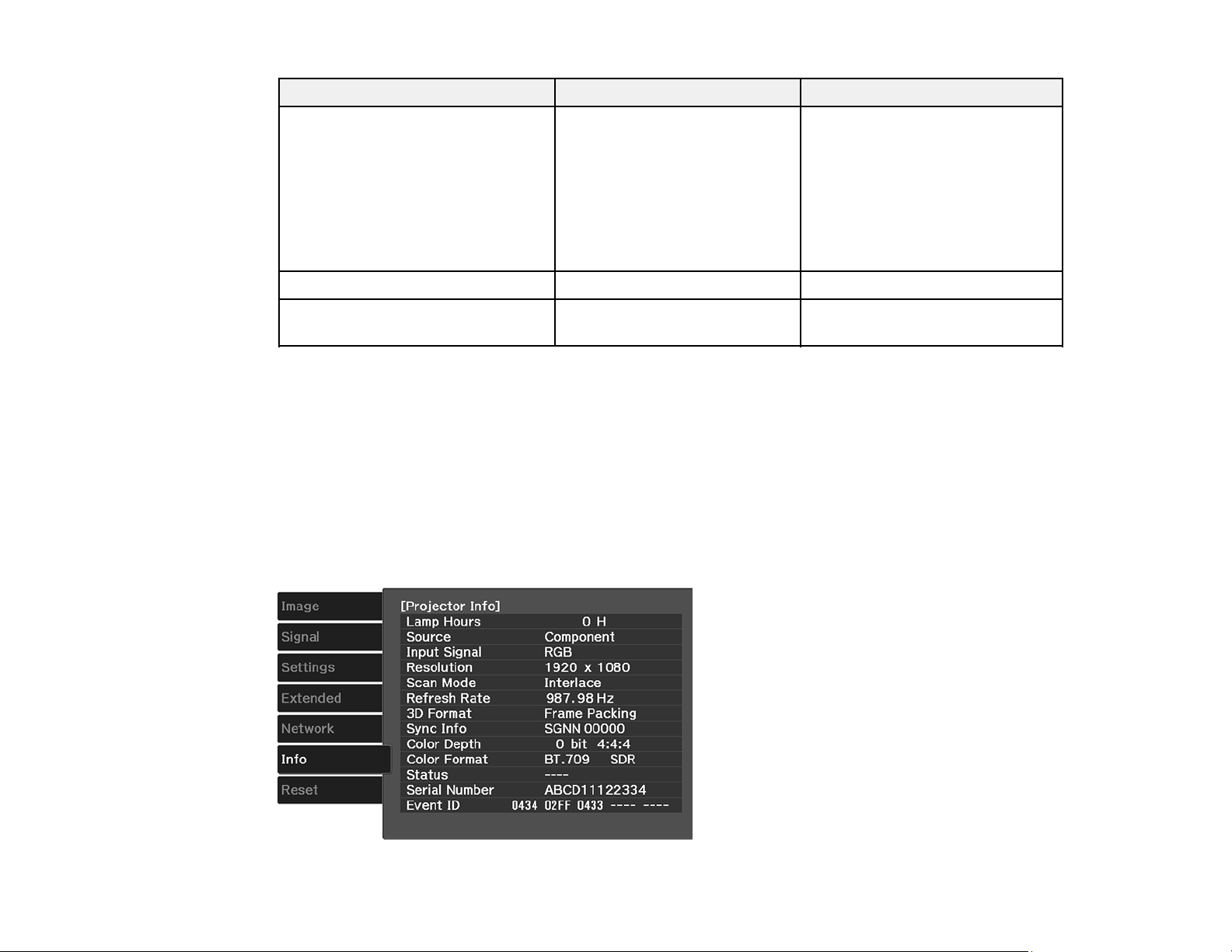
111
Setting Options Description
Net. Info - Wired LAN Projector Name
DHCP
IP Address
Subnet Mask
Gateway Address
MAC Address
Displays wired network status
and details
Display the QR Code — Displays the QR Code
Network Configuration Accesses additional network
menus
Configures your network settings
Parent topic: Adjusting the Menu Settings
Related references
Solutions When Wireless Authentication Fails
Projector Information Display - Info Menu
You can display information about the projector and input sources by viewing the Info menu. However,
you cannot change any settings in the menu.
Note: To view the firmware version of the projector or other components, select Version.
112
Note: Available settings depend on the current input source. The lamp usage timer does not register any
hours until you have used the lamp for at least 10 hours.
Projector Info information
Information item Description
Lamp Hours Displays the number of hours (H) the lamp has been used
Source Displays the name of the port to which the current input source is
connected
Input Signal Displays the input signal setting of the current input source
Resolution Displays the resolution of the current input source
Scan Mode Displays the scan mode of the current input source
Refresh Rate Displays the refresh rate of the current input source
3D Format Displays the format of the 3D signal
Sync Info Displays information that may be needed by a service technician
Color Depth Displays the color depth and color difference
Color Format Displays information about the color space and dynamic range
Status Displays information about projector problems that may be needed
by a service technician
Serial Number Displays the projector's serial number
Event ID Displays the Event ID number corresponding to a specific projector
problem; see the list of Event ID codes
Event ID Code List
Parent topic: Adjusting the Menu Settings
Related tasks
Replacing the Lamp
Resetting the Lamp Timer
Event ID Code List
If the Event ID option on the Info menu displays a code number, check this list of Event ID codes for the
solution to the projector problem associated with the code.
113
Event ID code Cause and solution
0022 Unstable network communication. Check the network communication status, wait a
few moments, and try connecting to the network again.
0027
0028
0029
0030
0031
0035
0434
0481
0482
0485
0432 Turn the projector off and then on again.
0435
0433 Cannot display the transferred images. Restart the network software.
0484 Communication with computer was disconnected. Restart the network software.
04FE The network software quit unexpectedly. Check the network communication status,
then turn the projector off and then on again.
0479
04FF
A projector system error has occurred. Turn the projector off and then on again.
0891 Cannot find an access point with the same SSID. Set your computer, access point,
and projector to the same SSID.
0892 The WPA/WPA2 authentication type does not match. Make sure the wireless
network security settings are correct.
0894 Communication with unauthorized access point was disconnected. Contact your
network administrator.
0898 Failed to acquire DHCP. Make sure the DHCP server is operating correctly. If you
are not using DHCP, turn off the DHCP setting in the Network menus.
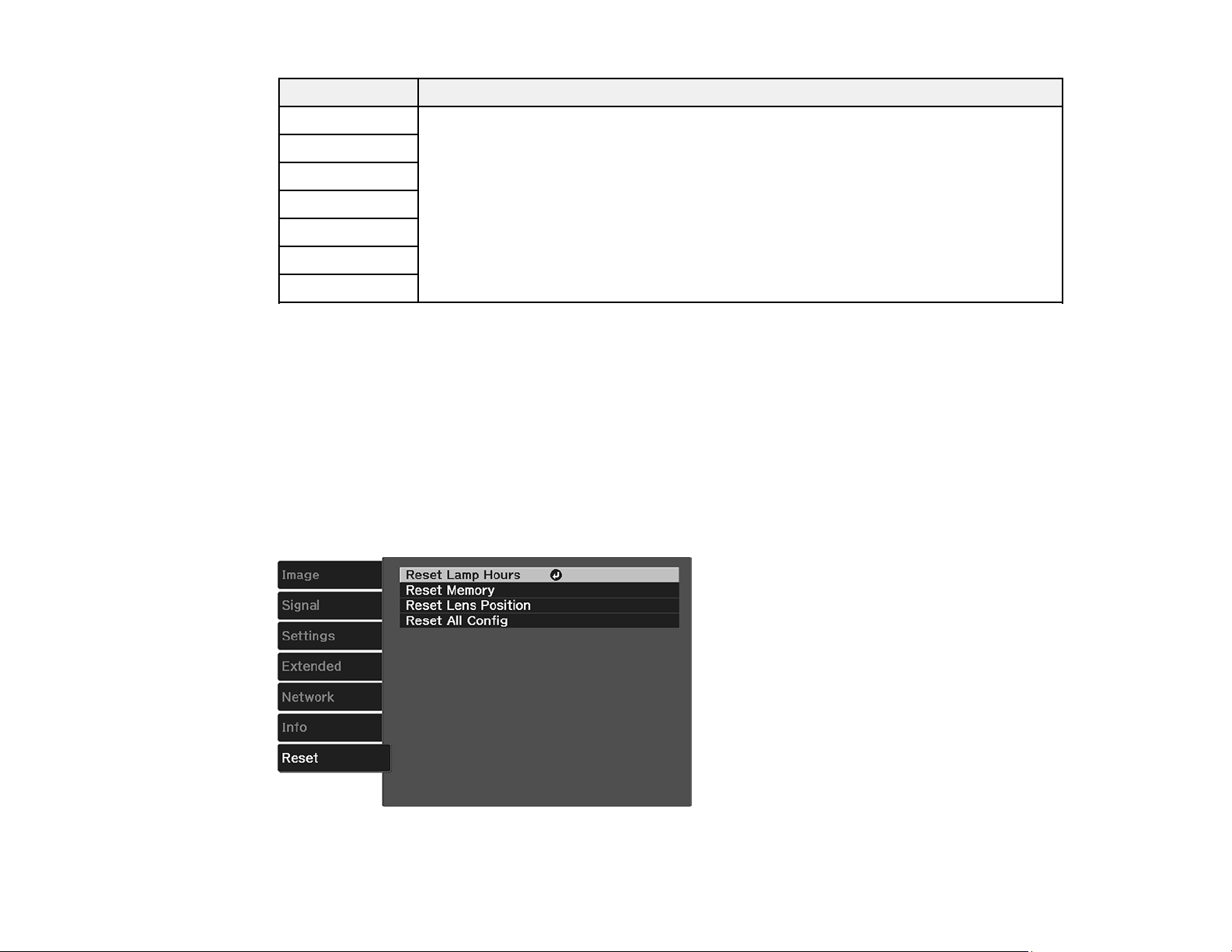
114
Event ID code Cause and solution
0020 Communication error. Turn the projector off and then on again.
0026
0032
0036
0037
0038
0899
Parent topic: Projector Information Display - Info Menu
Projector Reset Options - Reset Menu
You can reset most of the projector settings to their default values using the Reset All Config option on
the Reset menu.
You can reset the projector's lamp usage timer to zero when you replace the lamp using the Reset
Lamp Hours option, reset the lens position entries using the Reset Lens Position option, and reset all
memory entries using the Reset Memory option.
Note: The Reset Lens Position option does not re-center the lens; it only deletes the saved settings.


116
Maintaining and Transporting the Projector
Follow the instructions in these sections to maintain your projector and transport it from place to place.
Projector Maintenance
Transporting the Projector
Projector Maintenance
Your projector needs little maintenance to keep working at its best.
You may need to clean the lens periodically, and clean the air filter and air vents to prevent the projector
from overheating due to blocked ventilation.
The only parts you should replace are the lamp, air filter, and remote control batteries. If any other part
needs replacing, contact Epson or an authorized Epson servicer.
Warning: Before cleaning any part of the projector, turn it off and unplug the power cord. Never open
any cover on the projector, except as specifically explained in this manual. Dangerous electrical voltages
in the projector can injure you severely.
Warning: Do not try to service this product yourself, except as specifically explained in this manual.
Refer all other servicing to qualified servicers.
Cleaning the Lens
Cleaning the Projector Case
Cleaning the 3D Glasses
Air Filter and Vent Maintenance
Projector Lamp Maintenance
Replacing the Remote Control Batteries
Parent topic: Maintaining and Transporting the Projector
Cleaning the Lens
Clean the projector's lens periodically, or whenever you notice dust or smudges on the surface.
Note: If the projector has been in use, wait 30 minutes before cleaning the lens.

117
• To remove dust or smudges, gently move the shutter to the side and wipe the lens with lens-cleaning
paper. After cleaning, close the shutter.
• To remove stubborn smudges, moisten a soft, lint-free cloth with lens cleaner and gently wipe the
lens. Do not spray any liquid directly on the lens.
Warning: Do not use a lens cleaner that contains flammable gas. The high heat generated by the
projector lamp may cause a fire.
Caution: Do not use glass cleaner or any harsh materials to clean the lens and do not subject the lens
to any impacts; you may damage it. Do not use canned air, or the gases may leave a residue. Avoid
touching the lens with your bare hands to prevent fingerprints on or damage to the lens surface.
Parent topic: Projector Maintenance
Cleaning the Projector Case
Before cleaning the projector case, turn off the projector and unplug the power cord.
Note: If the projector has been in use, wait 30 minutes before cleaning it.
• To remove dust or dirt, use a soft, dry, lint-free cloth.
• To remove stubborn dirt, use a soft cloth moistened with water and mild soap. Do not spray liquid
directly on the projector.
Caution: Do not use wax, alcohol, benzine, paint thinner, or other chemicals to clean the projector
case. These can damage the case. Do not use canned air, or the gases may leave a flammable
residue.
Parent topic: Projector Maintenance
Cleaning the 3D Glasses
To remove dust, dirt, smudges, or fingerprints from the glasses, use a soft, dry, lint-free cloth.

118
Note: Unplug any charging cables from the glasses before cleaning them.
Caution: Do not use paper towels or any other abrasive materials to clean the glasses.
Parent topic: Projector Maintenance
Air Filter and Vent Maintenance
Regular filter maintenance is important to maintaining your projector. Your Epson projector is designed
with an easily accessible, user-replaceable filter to protect your projector and make regular maintenance
simple. Filter maintenance intervals will depend on the environment.
If regular maintenance is not performed, your Epson projector will notify you when the temperature
inside the projector has reached a high level. Do not wait until this warning appears to maintain your
projector filter as prolonged exposure to high temperatures may reduce the life of your projector or lamp.
Damage due to the failure to properly maintain the projector or its filter may not be covered by the
projector or lamp Limited Warranties.
Cleaning the Air Filter
Replacing the Air Filter
Parent topic: Projector Maintenance
Related references
Projector Light Status
Cleaning the Air Filter
You need to clean the projector's air filter in the following situations:
• The filter or vents get dusty.
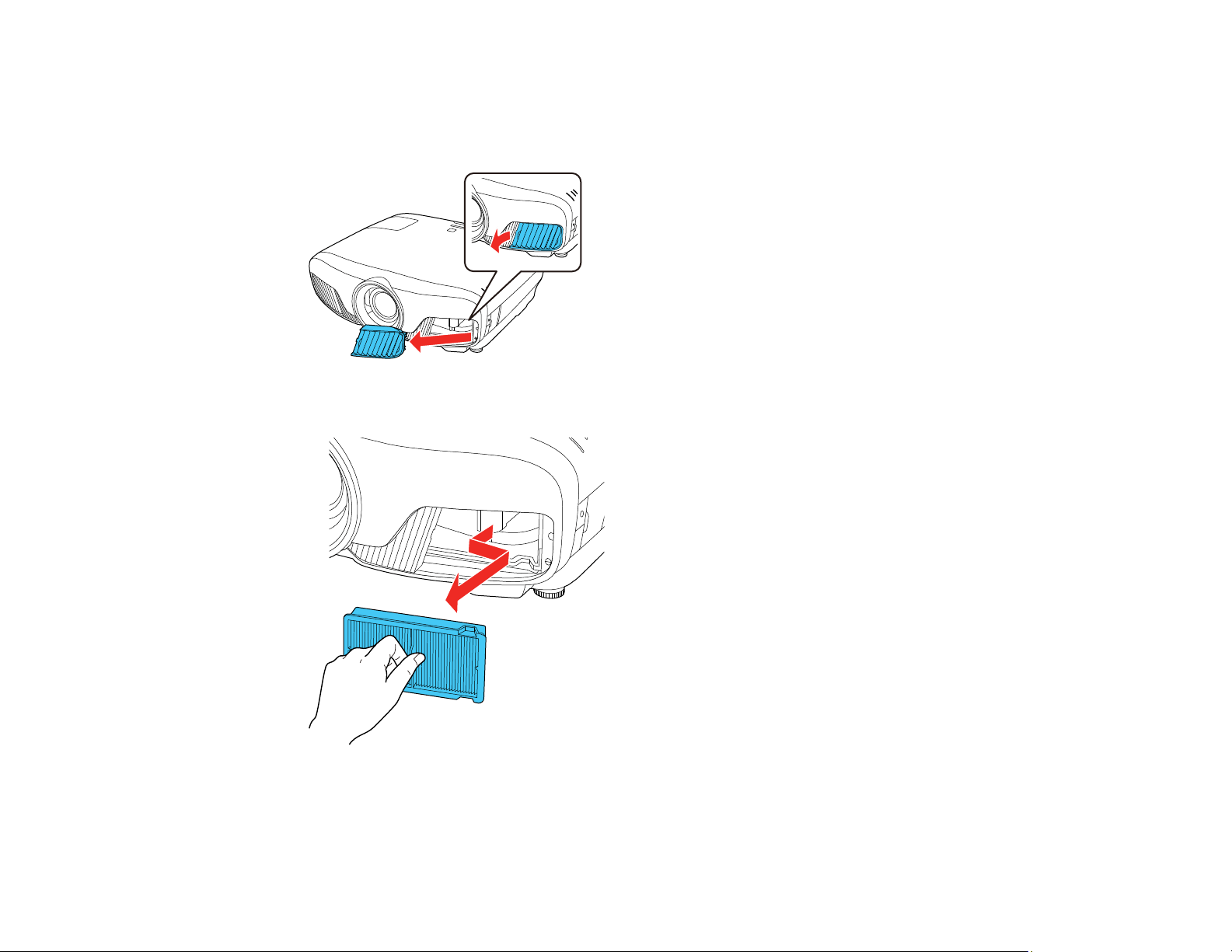
119
• You see a message telling you to clean it.
1. Turn off the projector and unplug the power cord.
2. Press and hold the tab on the air filter cover, and pull to remove the cover.
3. Pull the air filter out of the projector.
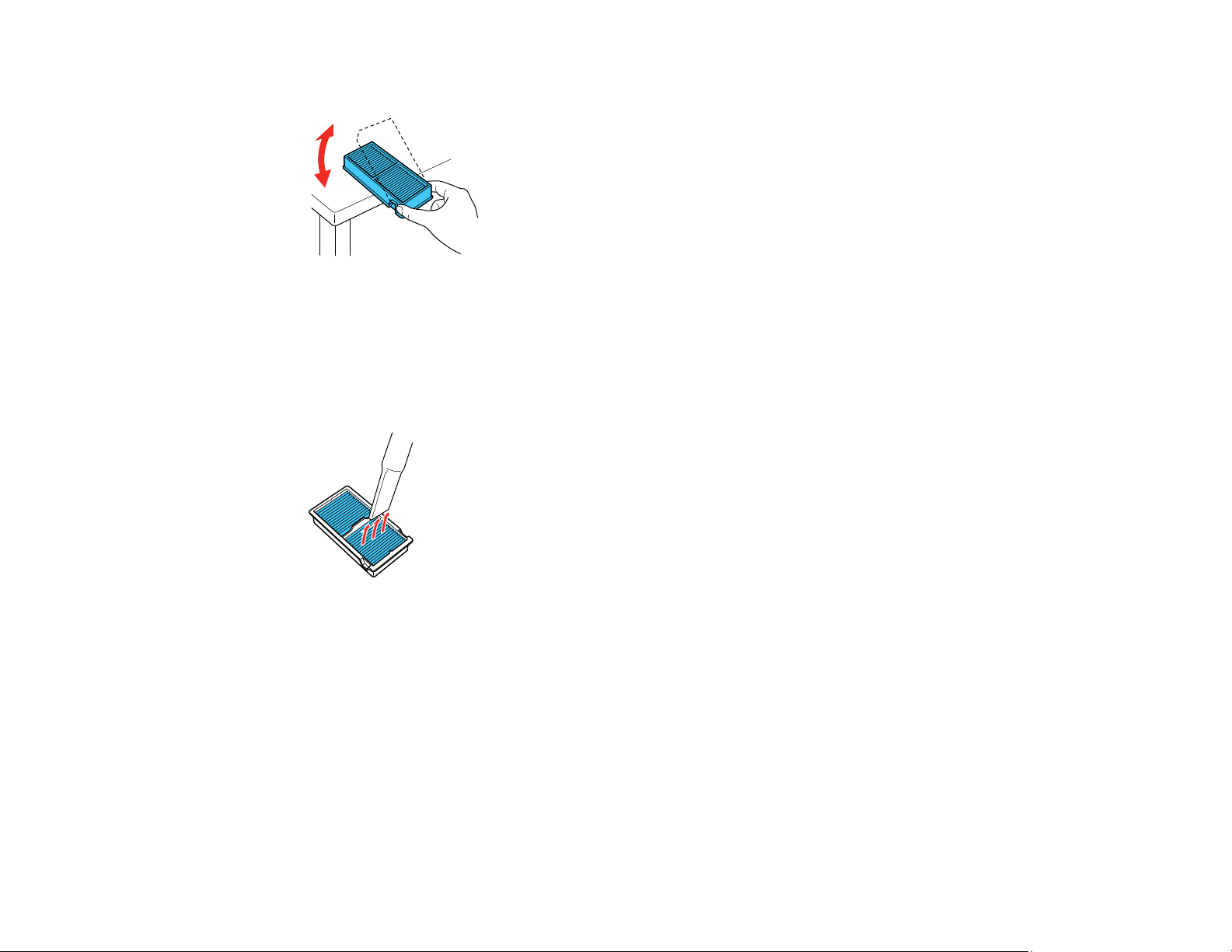
120
4. Tap each side of the air filter 4 to 5 times to shake off any excess dust.
Caution: Do not use excessive force when tapping the air filter, or it may crack and become
unusable. Do not rinse the air filter in water, or use any detergent or solvent to clean it. Do not use
canned air; the gases may leave a residue, or push dust and debris into the projector's optics or
other sensitive areas.
5. Vacuum the front of the air filter (the side with the tabs) to remove any remaining dust.
Note: If dust is difficult to remove or the air filter is damaged, replace the air filter.
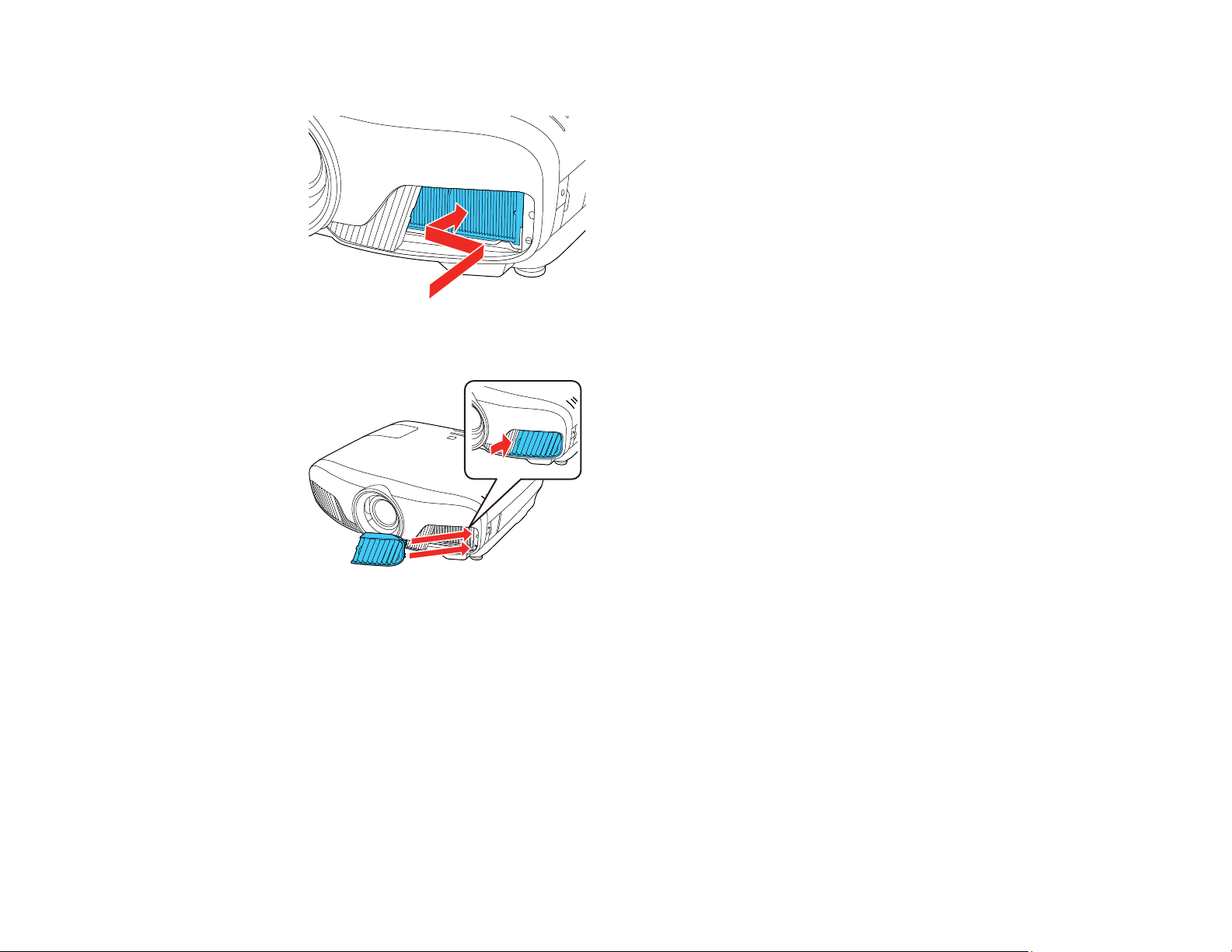
121
6. Place the air filter back in the projector as shown.
7. Attach the air filter cover as shown.
Parent topic: Air Filter and Vent Maintenance
Related tasks
Replacing the Air Filter
Replacing the Air Filter
You need to replace the air filter in the following situations:
• After cleaning the air filter, you see a message telling you to clean or replace it
• The air filter is torn or damaged
You can replace the air filter while the projector is mounted to the ceiling or placed on a table.
1. Turn off the projector and unplug the power cord.
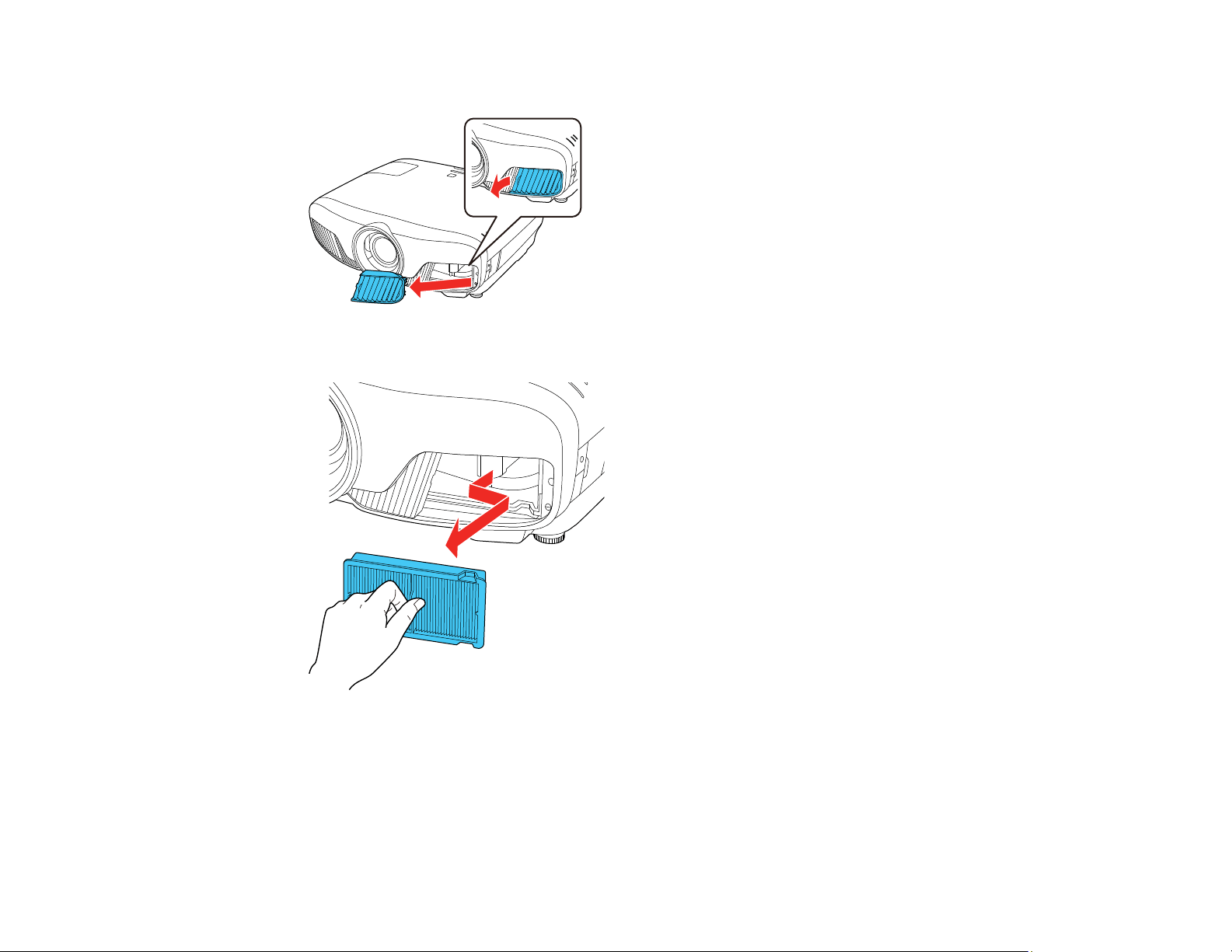
122
2. Press and hold the tab on the air filter cover, and pull to remove the cover.
3. Pull the air filter out of the projector.
Note: Air filters contain polypropylene. Dispose of used air filters according to local regulations.
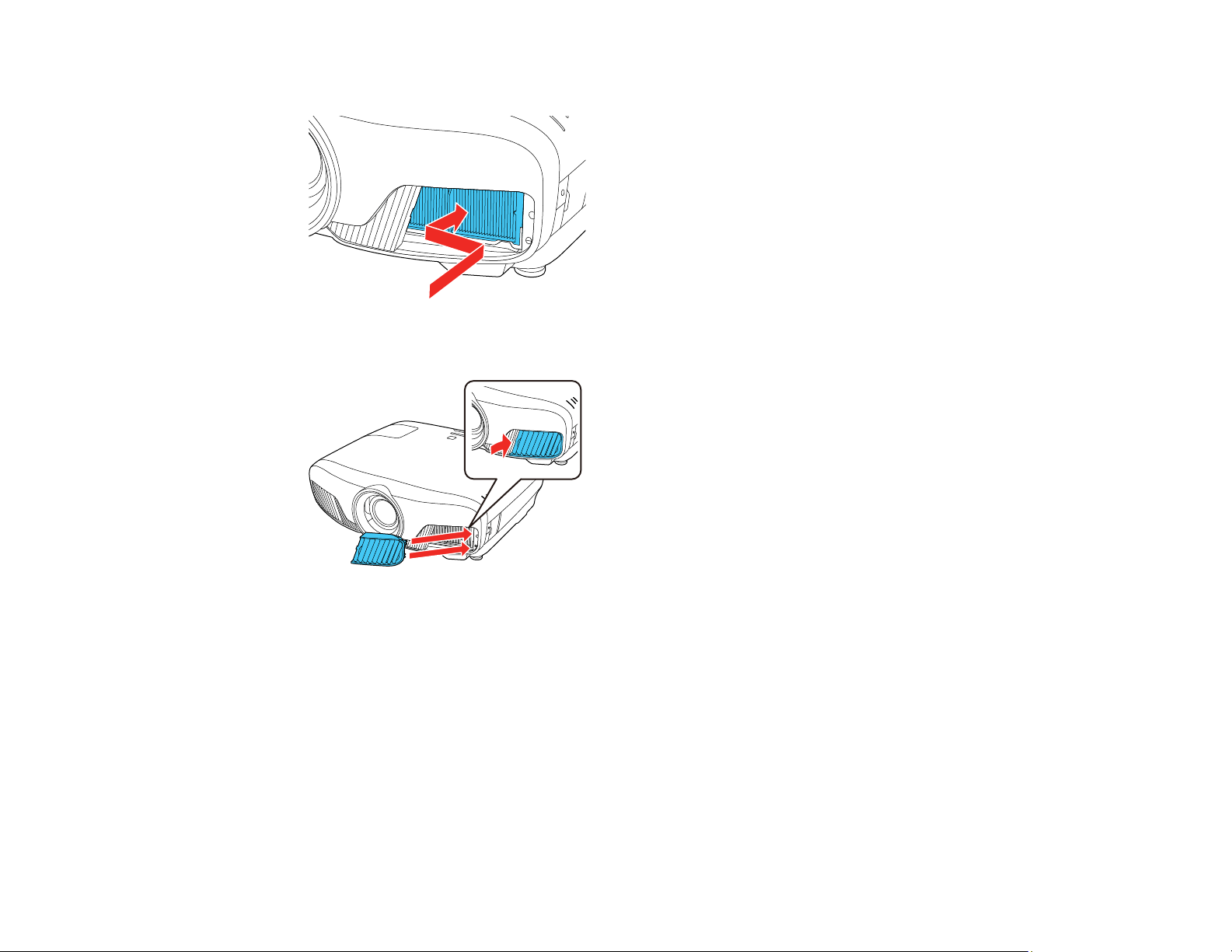
123
4. Place the new air filter in the projector as shown.
5. Attach the air filter cover as shown.
Parent topic: Air Filter and Vent Maintenance
Projector Lamp Maintenance
The projector keeps track of the number of hours the lamp is used and displays this information in the
projector's menu system.
Replace the lamp as soon as possible when the following occurs:
• The projected image gets darker or starts to deteriorate
• A message appears when you turn on the projector telling you to replace the lamp
Replacing the Lamp
Resetting the Lamp Timer
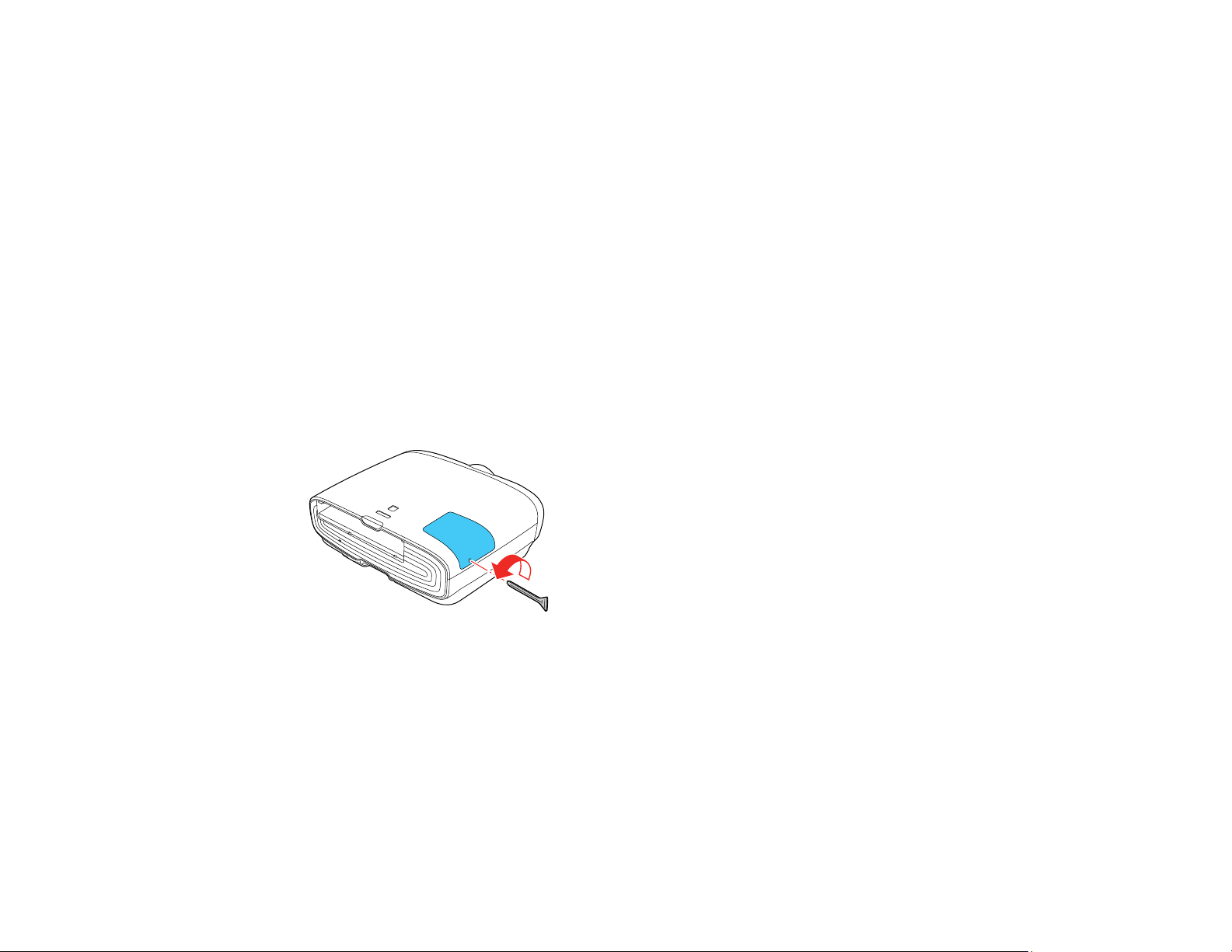
124
Parent topic: Projector Maintenance
Related references
Projector Information Display - Info Menu
Projector Lamp Specifications
Optional Equipment and Replacement Parts
Replacing the Lamp
Before you replace the lamp, let the projector cool down for at least one hour so the lamp will not be hot.
Warning: Let the lamp fully cool before replacing it to avoid injury.
You can replace the lamp while the projector is mounted to the ceiling, if necessary.
1. Turn off the projector and unplug the power cord.
2. Allow the projector lamp to cool down for at least one hour.
3. Use the screwdriver included with the replacement lamp to loosen the screw securing the lamp
cover.
Warning: If the lamp is broken, glass fragments may be loose inside the lamp chamber. Be careful
removing any broken glass to avoid injury. If the projector is installed on the ceiling, stand to the side
of the lamp cover and not underneath it; pieces of glass could fall into your eyes or mouth when you
open the lamp cover.
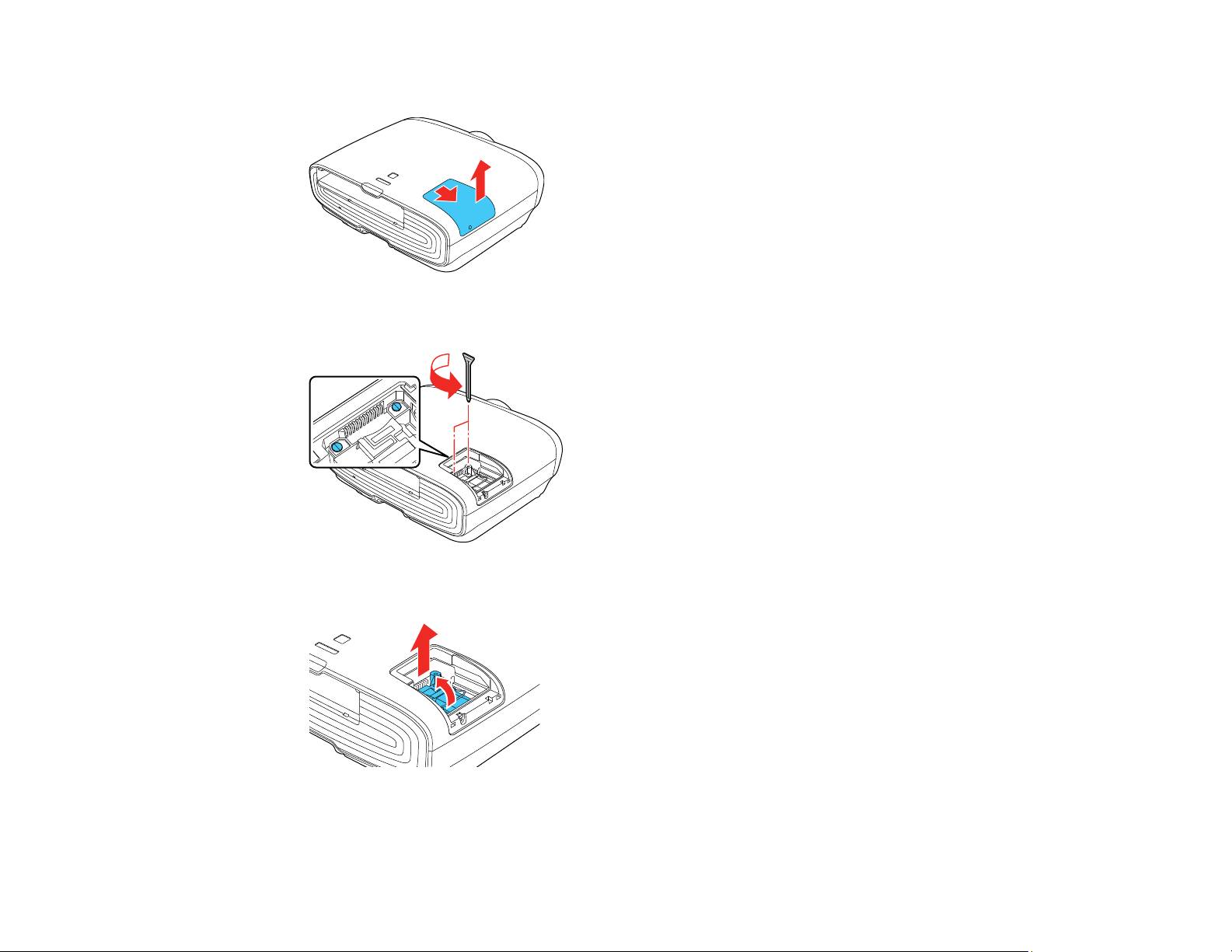
125
4. Slide the lamp cover out and lift it off.
5. Loosen the screws securing the lamp to the projector. The screws do not come all the way out.
6. Lift up the lamp handle and gently pull the lamp out of the projector.
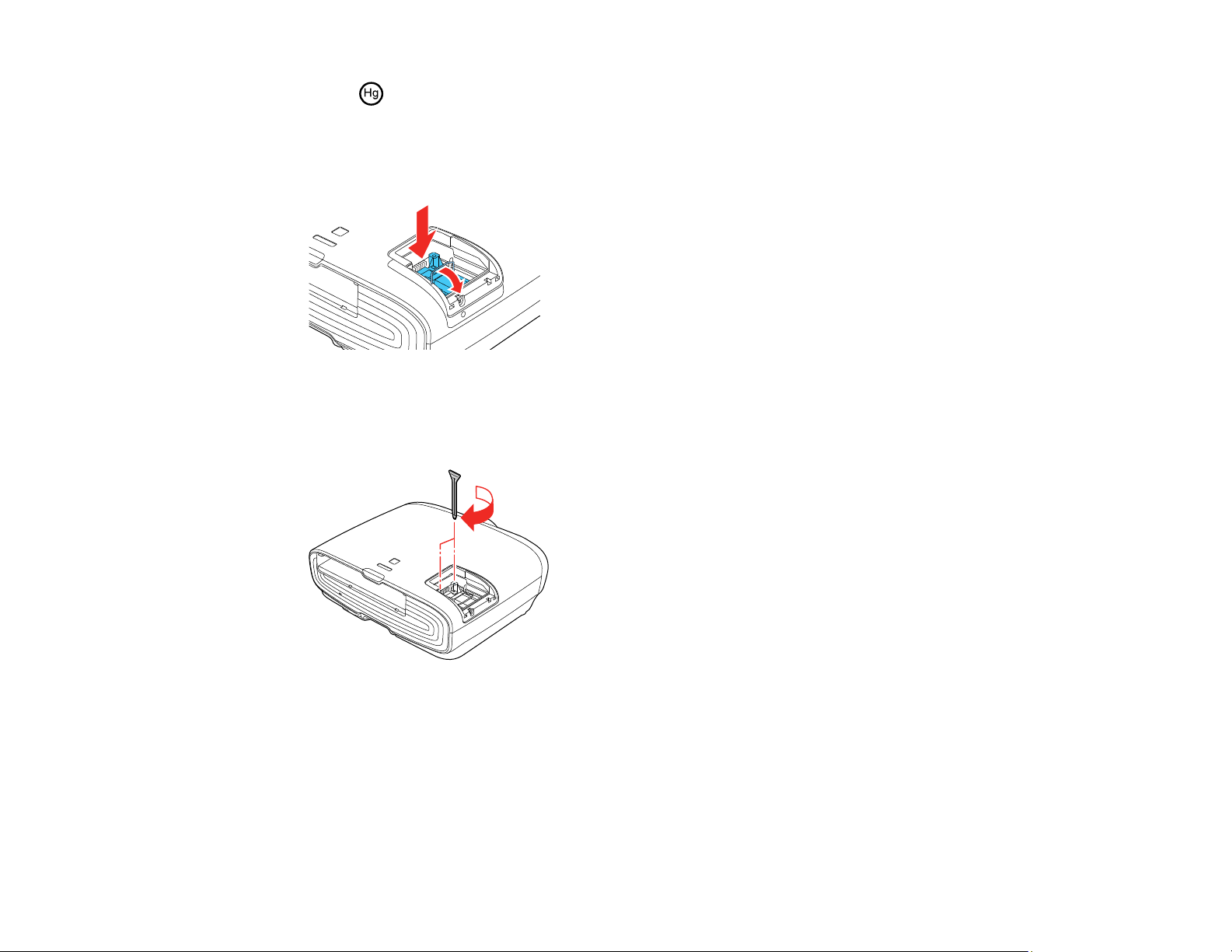
126
Note: The lamp(s) in this product contain mercury. Please consult your state and local
regulations regarding disposal or recycling. Do not put in the trash.
7. Gently insert the new lamp into the projector. If it does not fit easily, make sure it is facing the right
way. Lower the handle.
Caution: Do not touch any glass on the lamp assembly to avoid premature lamp failure.
8. Push in the lamp firmly and tighten the screws to secure it.
Caution: Do not over-tighten the screws.
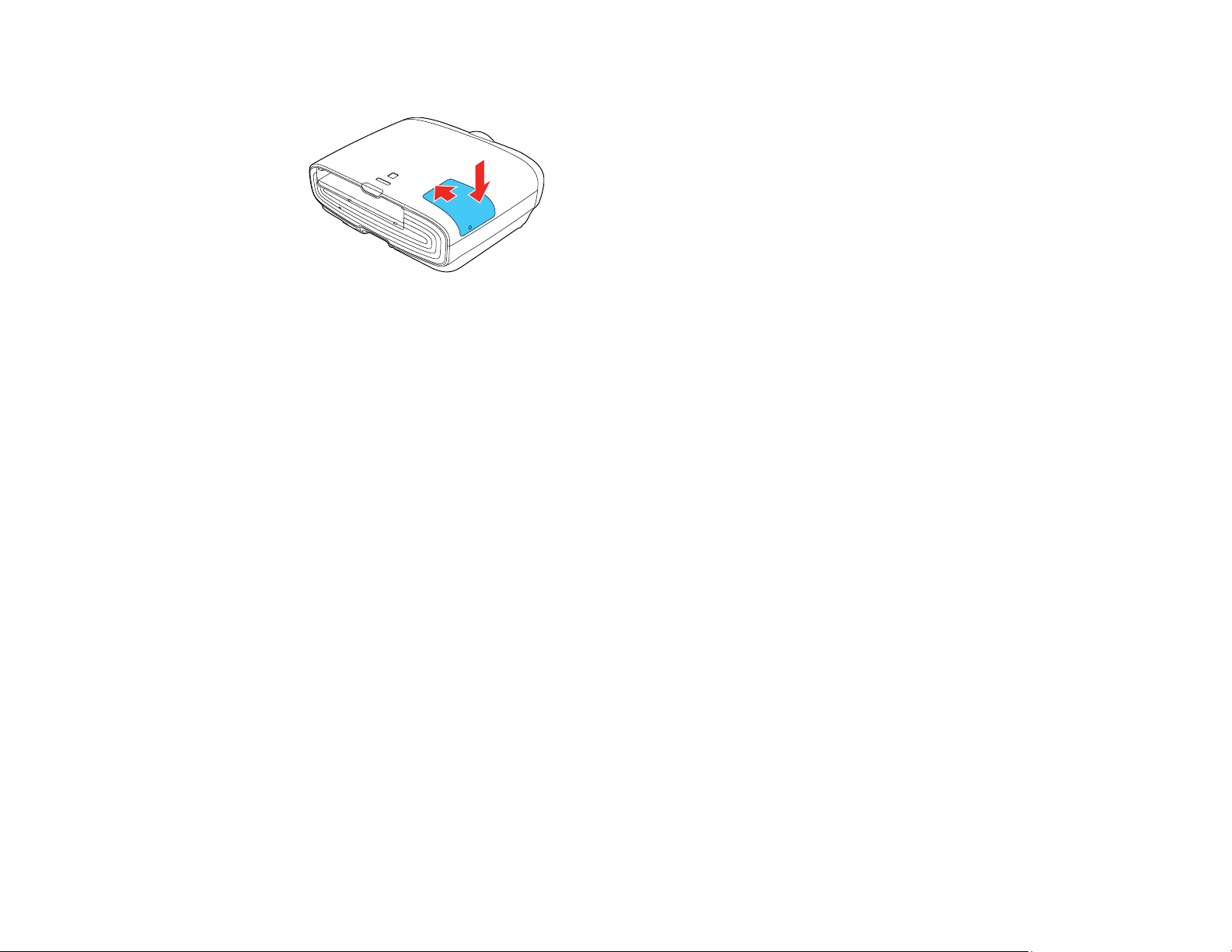
127
9. Replace the lamp cover and tighten the screw to secure it.
Note: Be sure the lamp cover is securely installed or the lamp will not come on.
Reset the lamp timer to zero to keep track of the new lamp's usage.
Parent topic: Projector Lamp Maintenance
Related tasks
Resetting the Lamp Timer
Resetting the Lamp Timer
You must reset the lamp timer after replacing the projector's lamp to clear the lamp replacement
message and to keep track of lamp usage correctly.
Note: Do not reset the lamp timer if you have not replaced the lamp to avoid inaccurate lamp usage
information.
1. Turn on the projector.
2. Press the Menu button.
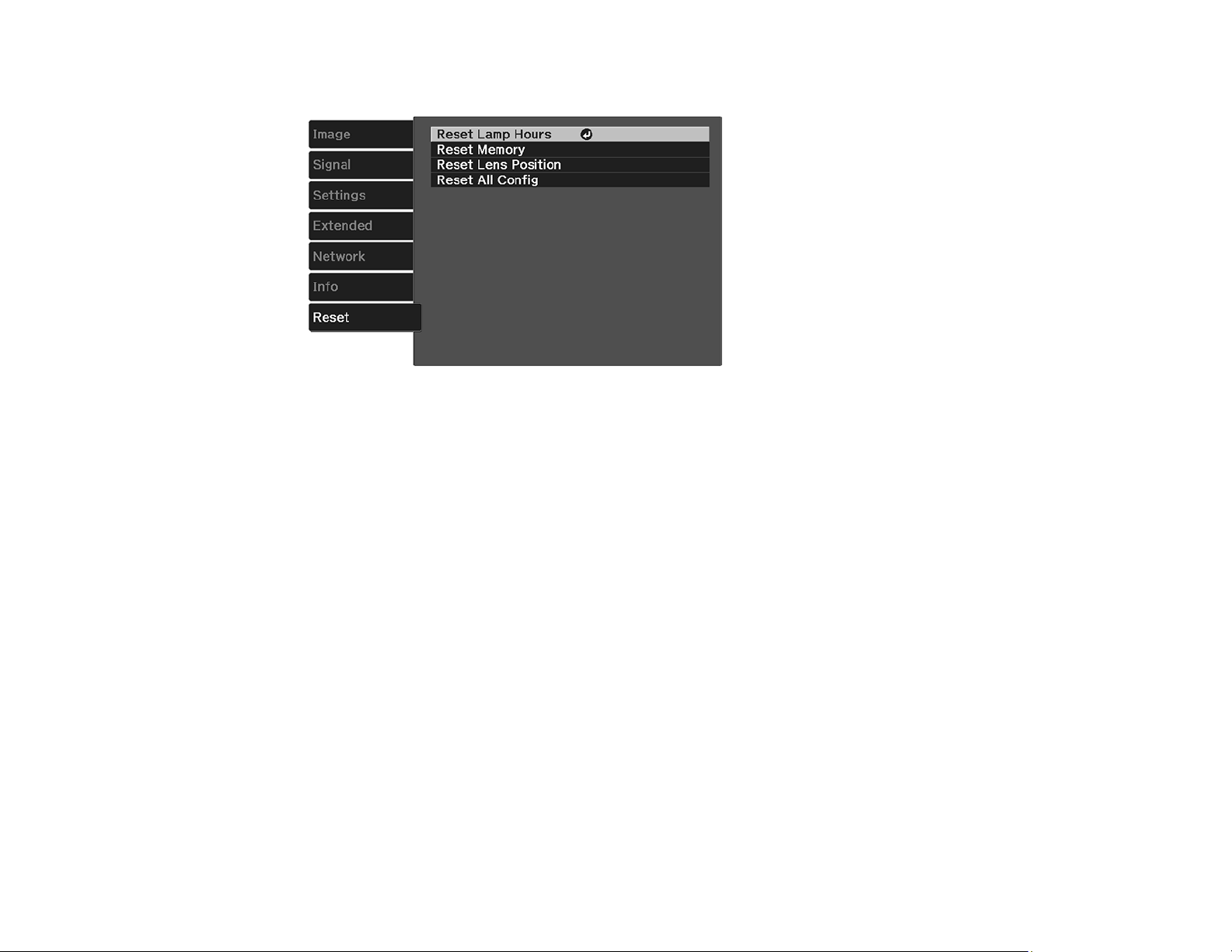
128
3. Select the Reset menu and press Enter.
4. Select Reset Lamp Hours and press Enter.
You see a prompt asking if you want to reset the lamp hours.
5. Select Yes and press Enter.
6. Press Menu or Esc to exit the menus.
Parent topic: Projector Lamp Maintenance
Replacing the Remote Control Batteries
The remote control uses two AA manganese or alkaline batteries. Replace the batteries as soon as they
run out.
Caution: Use only the type of batteries specified in this manual. Do not install batteries of different types,
or mix new and old batteries.
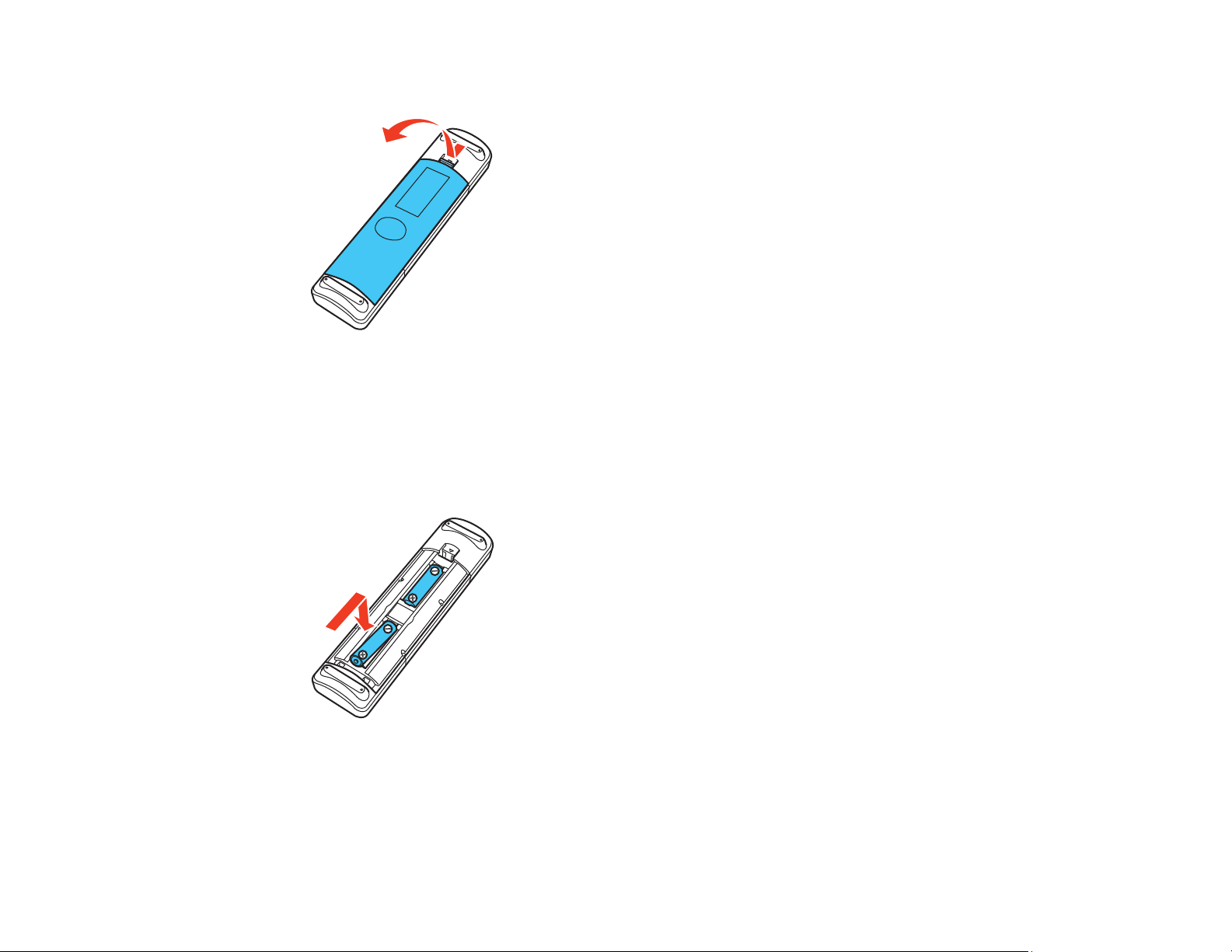
129
1. Remove the battery cover as shown.
2. Remove the old batteries.
Warning: If the battery fluid has leaked, wipe it away with a soft cloth and avoid getting the fluid on
your hands. If it gets on your hands, wash them immediately to avoid injury.
3. Insert the batteries with the + and – ends facing as shown.

130
4. Replace the battery cover and press it down until it clicks into place.
Warning: Dispose of used batteries according to local regulations. Do not expose batteries to heat
or flame. Keep batteries out of the reach of children; they are choking hazards and are very
dangerous if swallowed.
Parent topic: Projector Maintenance
Related references
Remote Control Specifications
Transporting the Projector
The projector contains precision parts, some of which are glass. Follow these guidelines to transport,
ship, or store the projector safely:
• Remove any equipment connected to the projector.
• Center the lens position using the Lens button.
Caution: If you transport the projector when the lens is not centered, the lens shift mechanism may be
damaged.
• When transporting the projector a long distance or as checked luggage, pack it in a firm box with
cushioning around it and mark the box "Fragile."
• When shipping the projector for repairs, place it in its original packing materials, if possible, or use
equivalent materials with cushioning around the projector. Mark the box "Fragile."
Note: Epson shall not be liable for any damages incurred during transportation.
Parent topic: Maintaining and Transporting the Projector
Related tasks
Turning Off the Projector

131
Solving Problems
Check the solutions in these sections if you have any problems using the projector.
Projection Problem Tips
Projector Light Status
Solving Image Problems
Solving Projector or Remote Control Operation Problems
Solutions When Wireless Authentication Fails
Where to Get Help
Projection Problem Tips
If the projector is not working properly, try turning it off and unplugging it. Then plug it back in and turn it
on.
If this does not solve the problem, check the following:
• The lights on the projector may indicate what the problem is.
• The solutions in this manual can help you solve many problems.
If none of these solutions help, you can contact Epson for technical support.
Parent topic: Solving Problems
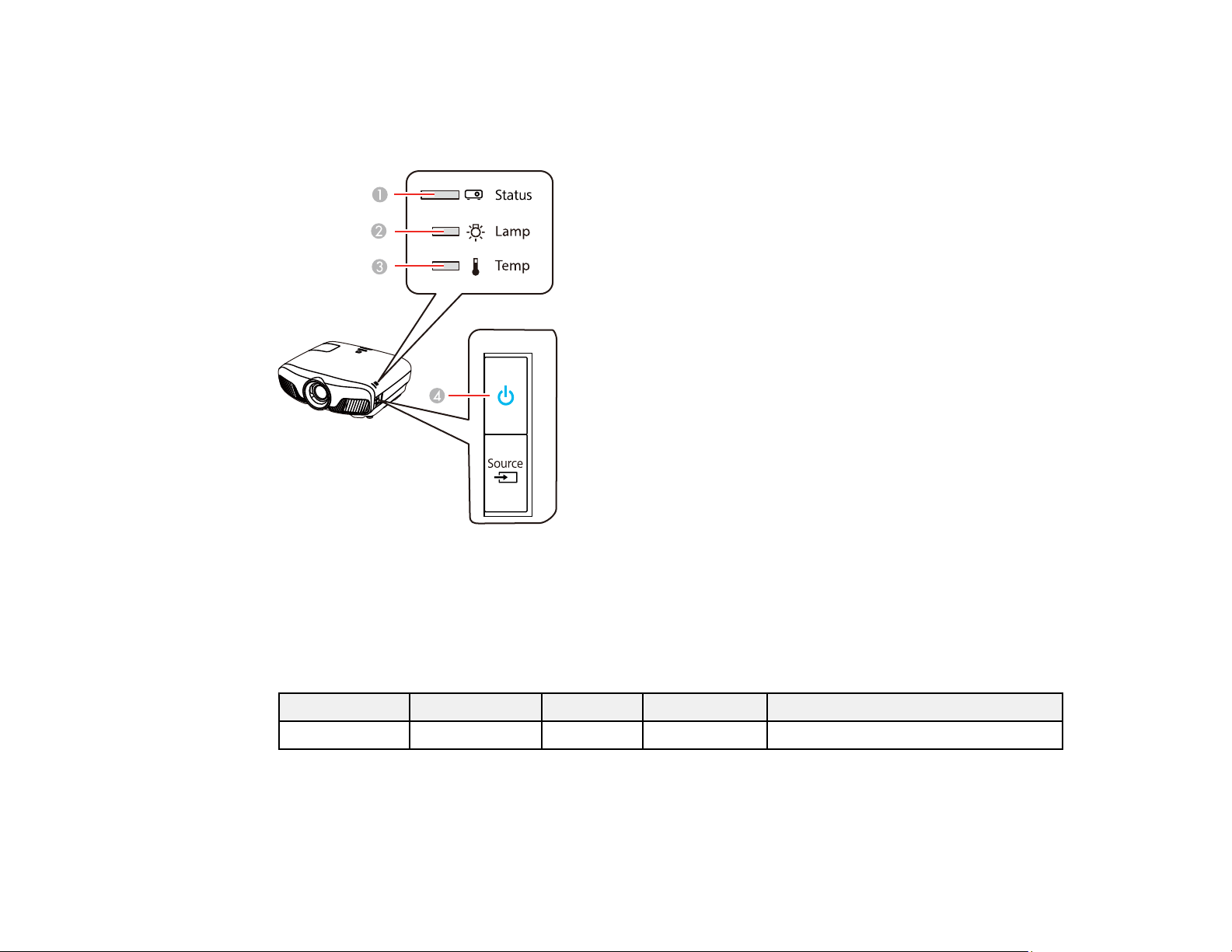
132
Projector Light Status
The lights on the projector indicate the projector status and let you know when a problem occurs. Check
the status and color of the lights and look for a solution in the table here.
1 Status light
2 Lamp light
3 Temp light
4 Power light
Power light Status light Lamp light Temp light Status and solution
Blue Blue Off Off Normal operation
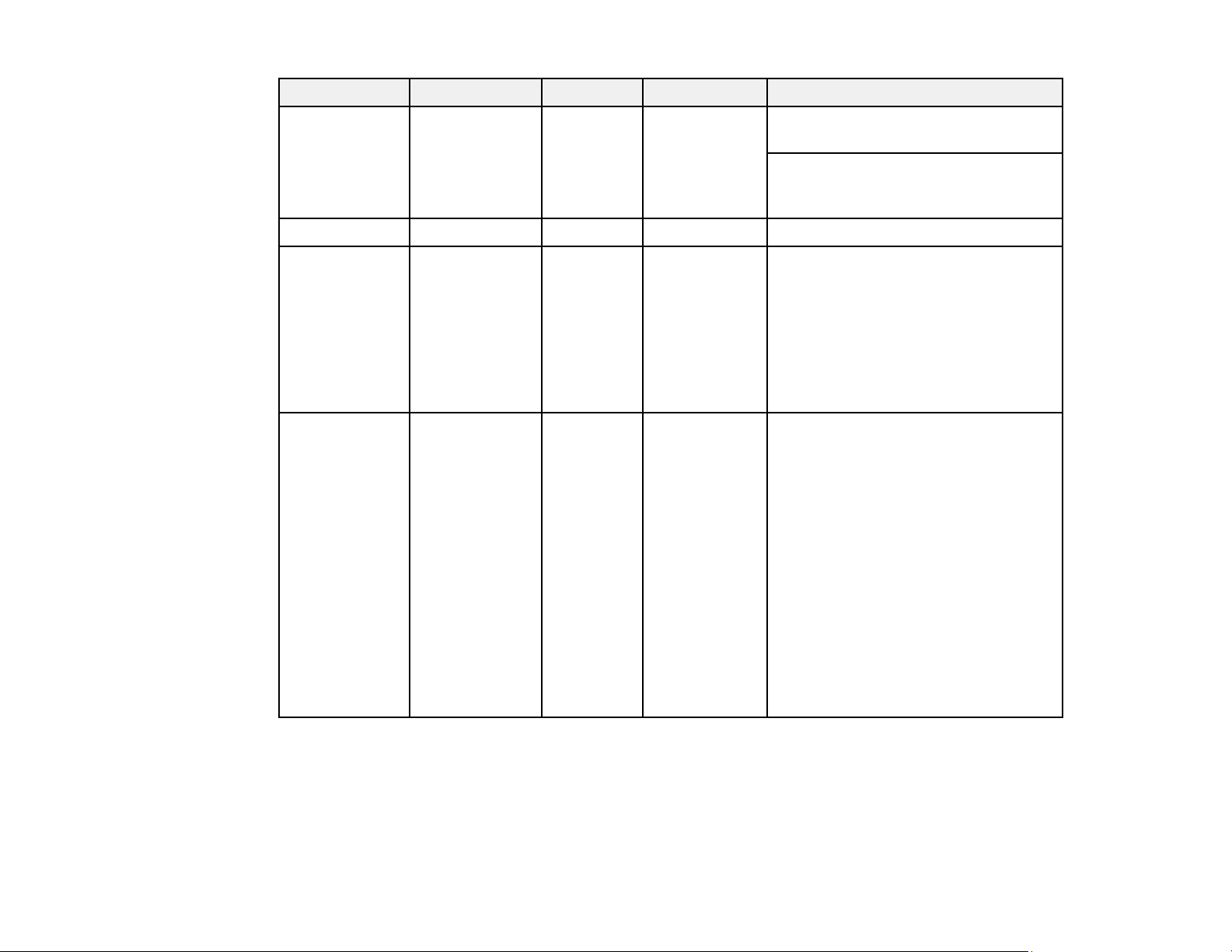
133
Power light Status light Lamp light Temp light Status and solution
Blue Flashing blue Off Off Warming up; wait for an image to
appear
Shutting down; when the Status light
stops flashing, you can unplug the
projector
Off Off Off Off Standby or sleep mode
Blue Varies Off Flashing
orange
Projector is too hot
• Make sure that the vents and air
filter are not clogged with dust or
obstructed by nearby objects
• Clean or replace the air filter
• Make sure the environmental
temperature is not too hot
Off Flashing blue Off Orange Projector has overheated and turned
off; leave it turned off to cool down for
about five minutes; after the fan has
stopped, do the following:
• Make sure that the vents and air
filter are not clogged with dust or
obstructed by nearby objects
• Clean or replace the air filter
• If operating the projector at high
altitude, turn on High Altitude
Mode
• If the problem persists, unplug the
projector and contact Epson for
help
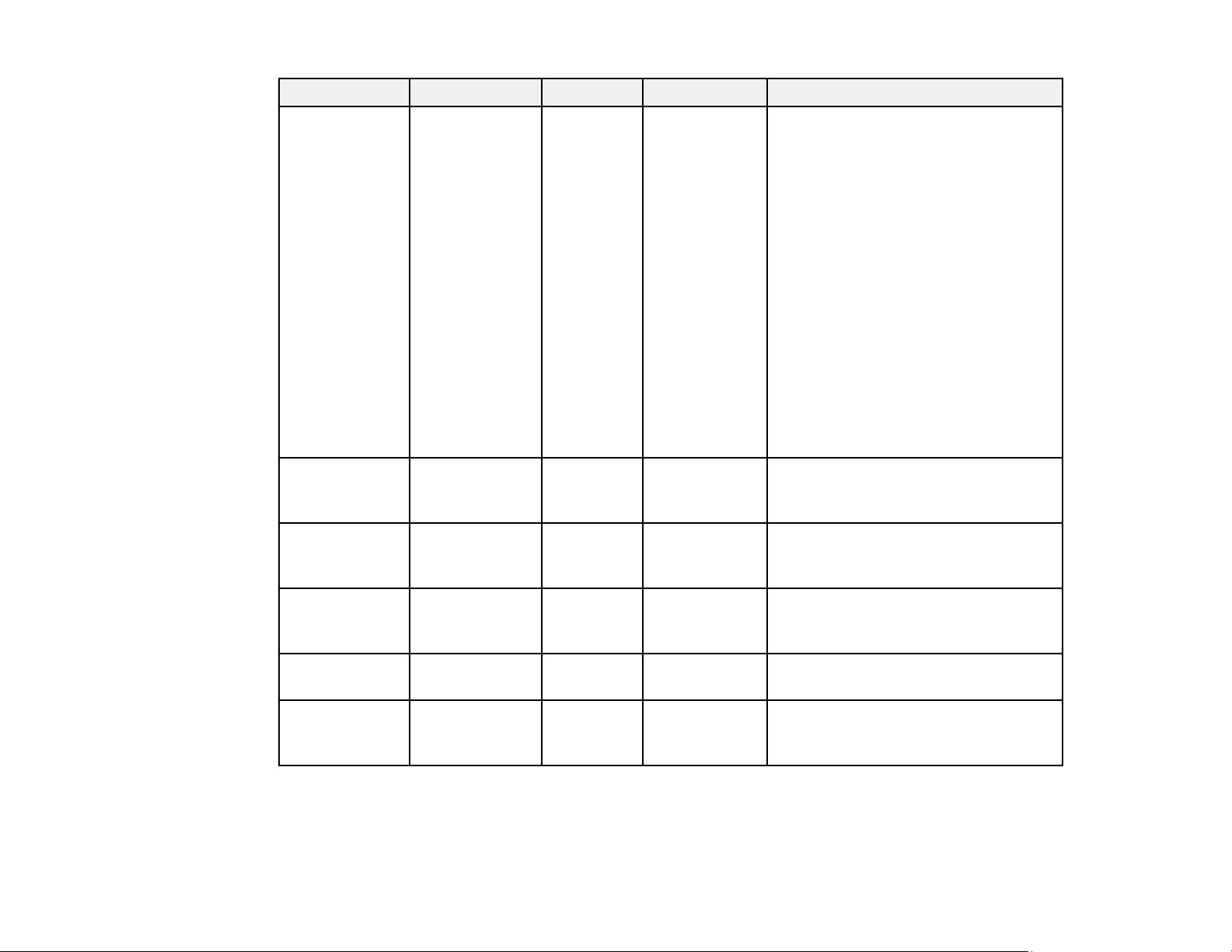
134
Power light Status light Lamp light Temp light Status and solution
Off Flashing blue Orange Off Lamp has a problem
• Check the Lamp Hours in the Info
menu to see if the lamp is burned
out. Unplug the projector, wait for
the lamp to cool down, and check if
it is broken or installed incorrectly;
reseat or replace the lamp as
necessary
• Clean or replace the air filter
• Make sure the lamp cover is closed
• If operating the projector at high
altitude, turn on High Altitude
Mode
• If the problem persists, unplug the
projector and contact Epson for
help
Blue Varies Flashing
orange
Off Replace the lamp soon to avoid
damage; do not continue using the
projector
Off Flashing blue Off Flashing
orange
A fan or sensor has a problem; turn
the projector off, unplug it, and
contact Epson for help
Off Flashing blue Flashing
orange
Flashing
orange
Auto Iris or Cinema Filter error; turn
the projector off, unplug it, and
contact Epson for help
Off Flashing blue Orange Orange Power error; turn the projector off,
unplug it, and contact Epson for help
Off Flashing blue Flashing
orange
Off Internal projector error; turn the
projector off, unplug it, and contact
Epson for help
Note: If the lights display a pattern not listed in the table above, turn the projector off, unplug it, and
contact Epson for help.

135
Parent topic: Solving Problems
Related references
Projector Setup Settings - Extended Menu
Related tasks
Cleaning the Air Filter
Replacing the Lamp
Replacing the Air Filter
Solving Image Problems
Check the solutions in these sections if you have any problems with projected images.
Solutions When No Image Appears
Solutions When "No Signal" Message Appears
Solutions When "Not Supported" Message Appears
Solutions When Only a Partial Image Appears
Solutions When the Image is Not Rectangular
Solutions When the Image Contains Noise or Static
Solutions When the Image is Fuzzy or Blurry
Solutions When the Image Brightness or Colors are Incorrect
Solutions When a 3D Image Does Not Display Correctly
Parent topic: Solving Problems
Solutions When No Image Appears
If no image appears, try the following solutions:
• Make sure the lens cover is open all the way.
• Press the Blank button on the remote control to see if the image was temporarily turned off.
• Make sure all necessary cables are securely connected and the power is on for the projector and
connected video sources.
• Press the projector's power button to wake it from standby or sleep mode. Also see if your connected
computer is in sleep mode or displaying a blank screen saver.
• Press the Menu button. If the projector menu is able to display, there may be a problem with the
connected video source, cable connection, or port.
• Check the settings on the Signal menu to make sure they are correct for the current video source.

136
• Adjust the Brightness setting or select the Normal Power Consumption setting.
• Check the Display setting to make sure Messages is set to On.
• For images projected with Windows Media Center, reduce the screen size from full screen mode.
• For images projected from applications using Windows DirectX, turn off DirectX functions.
• If the other solutions do not solve the problem, reset all of the projector settings using the options on
the Reset menu.
Parent topic: Solving Image Problems
Related references
Image Quality Settings - Image Menu
Projector Setup Settings - Extended Menu
Input Signal Settings - Signal Menu
Related tasks
Unlocking the Projector's Buttons
Solutions When "No Signal" Message Appears
If the "No Signal" message appears, try the following solutions:
• Press the Source button on the projector repeatedly to cycle through the available sources. Wait a
few seconds for an image to appear.
• Press a source button on the remote to select an available source. Wait a few seconds for an image to
appear.
• Press the Home button on the remote control to select from a list of available sources.
• Turn on the connected computer or video source, and press its play button to begin your presentation,
if necessary.
• Check the connection from the projector to your video sources.
• If you are projecting from a laptop computer, make sure it is set up to display on an external monitor.
• If necessary, turn the projector and the connected computer or video source off and then on again.
• If the other solutions do not solve the problem, reset all of the projector settings using the options on
the Reset menu.
Displaying From a PC Laptop
Displaying From a Mac Laptop
Parent topic: Solving Image Problems

137
Related concepts
Projector Connections
Displaying From a PC Laptop
If you see the "No Signal" message when you display from a PC laptop, you need to set up the laptop to
display on an external monitor.
1. Hold down the laptop's Fn key and press the key labeled with a monitor icon or CRT/LCD. (See your
laptop manual for details.) Wait a few seconds for an image to appear. To display on both the
laptop's monitor and the projector, try pressing the same keys again.
Note: On Windows 7 or later, hold down the Windows key and press P at the same time, then click
Duplicate.
2. If the same image is not displayed by the laptop and projector, check the Windows Display utility to
make sure the external monitor port is enabled and extended desktop mode is disabled. (See your
computer or Windows manual for instructions.)
3. If necessary, check your video card settings and set the multiple display option to Clone, Mirror, or
Duplicate.
Parent topic: Solutions When "No Signal" Message Appears
Displaying From a Mac Laptop
If you see the "No Signal" message when you display from a Mac laptop, you need to set up the laptop
for mirrored display. (See your laptop manual for details.)
1. Open the System Preferences utility and select Displays, Display, or Color LCD.
2. Click the Arrange or Arrangement tab.
3. Select the Mirror Displays checkbox.
Parent topic: Solutions When "No Signal" Message Appears
Solutions When "Not Supported" Message Appears
If the "Not Supported" message appears, try the following solutions:
• Set the computer's display resolution to the native resolution of the projector.
• Make sure the computer's display resolution does not exceed the projector's resolution and frequency
limit. If necessary, select a different display resolution for your computer. (See your computer manual
for details.)

138
• As a test, try setting the computer's display resolution to the lowest possible setting, and then
gradually increase it as necessary.
• Check the input resolution under Projector Info in the Info menu and make sure that the projector
supports that resolution.
Parent topic: Solving Image Problems
Related references
Input Signal Settings - Signal Menu
Projector Setup Settings - Extended Menu
Supported Video Display Formats
Solutions When Only a Partial Image Appears
If only a partial computer image appears, try the following solutions:
• Try adjusting the image position using the Position menu setting.
• Try adjusting the image position using the Lens button on the remote control or control panel.
• Press the Aspect button on the remote control to select a different image aspect ratio.
• Select a different image aspect ratio in the Signal menu.
• Check the cables connecting the computer or video source to the projector. Try connecting different
cables.
• Check your computer display settings to disable dual display and set the resolution within the
projector's limits. (See your computer manual for details.)
• Check the resolution assigned to your presentation files to see if they are created for a different
resolution than you are projecting in. (See your software help for details.)
Parent topic: Solving Image Problems
Related references
Input Signal Settings - Signal Menu
Supported Video Display Formats
Solutions When the Image is Not Rectangular
If the projected image is not evenly rectangular, try the following solutions:
• Place the projector directly in front of the center of the screen, facing it squarely, if possible.
• Try to fix the image using lens shift before adjusting the Keystone setting.

139
• If you adjusted the projector height using the projector feet, press the keystone buttons on the
projector to adjust the image shape.
• Adjust the image shape using the Keystone menu setting.
Parent topic: Solving Image Problems
Related references
Projector Feature Settings - Settings Menu
Related tasks
Correcting Image Shape With the Keystone Buttons
Solutions When the Image Contains Noise or Static
If the projected image seems to contain electronic interference (noise) or static, try the following
solutions:
• Check the cables connecting your computer or video source to the projector. They should be:
• Separated from the power cord to prevent interference
• Securely connected at both ends
• Not connected to an extension cable
• No longer than 9.8 feet (3 m) for VGA/computer cables or 24 feet (7.3 m) for HDMI cables
• Check the settings on the projector's Signal menu to make sure they match the video source. If
available for your video source, adjust the Deinterlacing and Noise Reduction settings.
• Select a computer video resolution and refresh rate that are compatible with the projector.
• If you are projecting from a computer using a VGA cable, display a uniformly patterned image on the
screen and manually adjust the Tracking and Sync settings.
• If you adjusted the image shape using the projector controls, try decreasing the Sharpness setting to
improve image quality.
• If you connected an extension power cable, try projecting without it to see if it caused interference in
the signal.
• Try a different cable.
• Try turning off Frame Interpolation or turning on Image Enhancement in the Image menu.
Parent topic: Solving Image Problems
Related references
Image Quality Settings - Image Menu

140
Input Signal Settings - Signal Menu
Supported Video Display Formats
Solutions When the Image is Fuzzy or Blurry
If the projected image is fuzzy or blurry, try the following solutions:
• Adjust the image focus.
• Clean the projector lens.
• Check the lens for condensation.
Note: To avoid condensation on the lens after bringing the projector in from a cold environment, let the
projector warm up to room temperature before using it.
• Position the projector close enough to the screen, and directly in front of it.
• Position the projector so the keystone adjustment angle is not so wide that it distorts the image.
• Adjust the Sharpness setting to improve image quality.
• If you are projecting from a computer, display a uniformly patterned image on the screen and adjust
the Tracking and Sync settings.
• If you are projecting from a computer, adjust the computer's resolution to match the projector's native
resolution, if possible.
• Check the resolution of your video source. If you are projecting from a standard definition video
source, your image will not be as clear as an HD (720p/1080i/1080p) video source.
Parent topic: Solving Image Problems
Related references
Image Quality Settings - Image Menu
Projection Distance
Related tasks
Focusing the Image with the Lens Button
Cleaning the Lens

141
Solutions When the Image Brightness or Colors are Incorrect
If the projected image is too dark or light, or the colors are incorrect, try the following solutions:
• Press the Color Mode button on the remote control to try different color modes for the image and
environment.
• Check your video source settings.
• Adjust the available settings on the Image menu for the current input source, such as Brightness,
Contrast, Tint, Advanced, and Color Saturation.
• Turn off the HDR mode in the Dynamic Range setting or set the Color Space setting to BT.709.
• For HDR images, set the Dynamic Range setting to Auto (Bright)
• Make sure all the cables are securely connected to the projector and your video device. If you
connected long cables, try connecting shorter cables.
• Position the projector close enough to the screen.
• If the image has been progressively darkening, you may need to replace the projector lamp soon.
Parent topic: Solving Image Problems
Related references
Image Quality Settings - Image Menu
Projector Setup Settings - Extended Menu
Input Signal Settings - Signal Menu
Solutions When a 3D Image Does Not Display Correctly
If a 3D image does not display correctly, try the following solutions:
• Make sure the 3D Display setting on the Signal menu is set to Auto or 3D.
• Make sure your video device and media are both 3D-compatible. Refer to the documentation that
came with your video device for more information.
• Make sure you are using an HDMI cable that supports 3D signals.
• Make sure you selected the correct 3D Format setting on the Signal menu. Normally this should be
set to Auto, but in some cases you may need to select a different setting to match the 3D signal from
your video device.
• Make sure you are using RF 3D active shutter glasses. You can purchase them from Epson.
• Make sure your 3D glasses are turned on and fully charged. If the glasses have entered standby
mode, slide the power switch on the glasses to the Off position and then back to the On position.

142
• Make sure your 3D glasses are paired with the projector.
• Adjust the 3D Depth setting on the Signal menu.
• Make sure you are within the 3D viewing range.
• To minimize 3D crosstalk, reduce the brightness of 3D images by selecting the following settings:
• Color Mode: 3D Cinema
• 3D Brightness: Low
• 3D Depth: 0
• HDMI Video Range: Normal
• Make sure your screen size matches the Diagonal Screen Size setting on the Signal menu.
• Avoid using the projector near wireless networks, microwave ovens, 2.4 GHz cordless phones, or
other devices that use the 2.4 GHz frequency band. These devices can interfere with the signal
between the projector and the 3D glasses.
• If the other solutions do not solve the problem, change the Inverse 3D Glasses setting on the Signal
menu. Return the setting to its original value if changing it does not solve the problem as it can
adversely affect the 3D image.
Parent topic: Solving Image Problems
Related references
Projector Feature Settings - Settings Menu
Image Quality Settings - Image Menu
Input Signal Settings - Signal Menu
Optional Equipment and Replacement Parts
3D Viewing Range
Related tasks
Pairing the 3D Glasses with the Projector
Charging the 3D Glasses
Cleaning the 3D Glasses
Solving Projector or Remote Control Operation Problems
Check the solutions in these sections if you have problems operating the projector or remote control.
Solutions to Projector Power or Shut-Off Problems
Solutions to Problems with the Remote Control

143
Solutions to Panel Alignment Problems
Solutions When Using HDMI Link
Parent topic: Solving Problems
Solutions to Projector Power or Shut-Off Problems
If the projector does not come on when you press the power button or it shuts off unexpectedly, try the
following solutions:
• Make sure the power cord is securely connected to the projector and to a working electrical outlet.
• The projector's buttons may be locked for security. Unlock the buttons or use the remote control to
turn on the projector.
• If the projector's lamp shuts off unexpectedly, it may have entered standby mode after a period of
inactivity. Press the power button to wake the projector and adjust the Sleep Mode Timer setting to
change the sleep interval.
• Make sure the projector is not receiving shut down requests over CEC from connected devices.
• If the power button on the remote control does not turn on the projector, check its batteries and make
sure the Remote Receiver setting is turned on in the projector's menu, if available.
• The power cord may be defective. Try another power cord. If that doesn't work, disconnect the cord
and contact Epson.
• Make sure the lamp and lamp cover are installed correctly.
Parent topic: Solving Projector or Remote Control Operation Problems
Related references
Where to Get Help
Projector Light Status
Projector Feature Settings - Settings Menu
Related tasks
Replacing the Remote Control Batteries
Unlocking the Projector's Buttons
Replacing the Lamp

144
Solutions to Problems with the Remote Control
If the projector does not respond to remote control commands, try the following solutions:
• Check that the remote control batteries are installed correctly and have power. If necessary, replace
the batteries.
• Make sure you are operating the remote control within the reception angle and range of the projector.
• Make sure the projector is not warming up or shutting down.
• Check to see if a button on the remote control is stuck down, causing it to enter sleep mode. Release
the button to wake the remote control up.
• Strong fluorescent lighting, direct sunlight, or infrared device signals may be interfering with the
projector's remote receivers. Dim the lights or move the projector away from the sun or interfering
equipment.
• If available, turn on one of the remote receivers in the projector's menu system, or check if all the
remote receivers were turned off.
• If you assigned an ID number to the remote control to operate multiple projectors, you may need to
check or change the ID setting (feature not available with all projectors).
• If you lose the remote control, you can purchase another from an authorized Epson reseller.
Parent topic: Solving Projector or Remote Control Operation Problems
Related references
Optional Equipment and Replacement Parts
Remote Control Operation
Related tasks
Replacing the Remote Control Batteries
Solutions to Panel Alignment Problems
If the panel alignment does not result in a satisfactory picture, try the following solutions:
• Make sure the Projection setting matches the installation position.
• Make sure the projection surface is not colored or textured. Project on a white surface with no texture.
• Leave the projector on for 10 to 15 minutes before adjusting the panel alignment.
• The projected image size should be at least 60 inches (152 cm) during panel alignment.
• If the image contains too much magenta, adjust the red and blue panels.
• If the pattern lines look fuzzy or out of focus, adjust the focus before performing the panel alignment.

145
Parent topic: Solving Projector or Remote Control Operation Problems
Related references
Projector Feature Settings - Settings Menu
Related tasks
Adjusting the Color Convergence (Panel Alignment)
Focusing the Image with the Lens Button
Solutions When Using HDMI Link
If you cannot control an HDMI device using the HDMI Link buttons, try the following solutions:
• Make sure all necessary cables are securely connected and the power is on for the projector and
connected video sources.
• Make sure the cables meet the HDMI standards.
• Make sure the connected device supports the CEC standards.
• If you connected a new device or changed any connections, you may need to restart the device.
• Connect no more than three devices that support HDMI Link at the same time.
• If you have connected a speaker or receiver, set the output to PCM.
Parent topic: Solving Projector or Remote Control Operation Problems
Solutions When Wireless Authentication Fails
If you cannot authenticate a wireless connection, try the following solutions:
• Make sure the Wireless LAN Power setting is set to On.
• Check the Security settings and passphrase in the Network Configuration menu.
• Check the Event ID number displayed in the Info menu and check the link below to identify the
problem.
Parent topic: Solving Problems
Related references
Projector Feature Settings - Settings Menu
Projector Network Settings - Network Menu
Event ID Code List

146
Where to Get Help
If you need to contact Epson for technical support services, use the following support options.
Internet Support
Visit Epson's support website at epson.com/support (U.S.), epson.ca/support (Canada), or
epson.com.jm/support (Caribbean) and select your product for solutions to common problems with your
projector. You can download utilities and documentation, get FAQs and troubleshooting advice, or e-mail
Epson with your questions.
Speak to a Support Representative
To use the Epson PrivateLine Support service, call (800) 637-7661. This service is available for the
duration of your warranty period. You may also speak with a projector support specialist by dialing (562)
276-4394 (U.S.) or (905) 709-3839 (Canada).
Support hours are 6 AM to 8 PM, Pacific Time, Monday through Friday and 7 AM to 4 PM, Pacific Time,
Saturday.
Days and hours of support are subject to change without notice. Toll or long distance charges may
apply.
Before you call, have the following information ready:
• Product name
• Product serial number (located on the bottom or rear of the projector, or in the menu system)
• Proof of purchase (such as a store receipt) and date of purchase
• Computer or video configuration
• Description of the problem
Purchase Supplies and Accessories
You can purchase screens, other optional accessories, and replacement parts from an Epson authorized
reseller. To find the nearest reseller, call 800-GO-EPSON (800-463-7766) in the U.S. or 800-807-7766 in
Canada. Or you can purchase online at epsonstore.com (U.S. sales) or epsonstore.ca (Canadian sales).
To purchase a replacement remote control, call (562) 276-4394 (U.S.) or (905) 709-3839 (for dealer
referral in Canada).
Parent topic: Solving Problems

147
Technical Specifications
These sections list the technical specifications of your projector.
General Projector Specifications
Projector Lamp Specifications
Remote Control Specifications
Projector Dimension Specifications
Projector Electrical Specifications
Projector Environmental Specifications
Projector Safety and Approvals Specifications
Supported Video Display Formats
General Projector Specifications
Type of display Poly-silicon TFT active matrix
Resolution 1920 × 1080 pixels (1080p)
Lens F=2.0 to 3.0
Focal length: 22.5 to 46.7 mm
Color reproduction Full color, up to 1 billion colors
Brightness High Power Consumption mode:
White light output 2400 lumens (ISO 21118 standard)
Color light output 2400 lumens
Note: Color brightness (color light output) and white brightness
(white light output) will vary depending on usage conditions. Color
light output measured in accordance with IDMS 15.4; white light
output measured in accordance with ISO 21118.
Contrast ratio 200000:1 with Auto Iris on, Normal Power Consumption mode,
Dynamic Color Mode, Wide Zoom mode, and Lens Shift Vertical:
10:0 and Horizontal: Centered
Image size
(in native aspect ratio)
50 inches (1.27 m) to 300 inches (7.62 m)

148
Projection distance
(in native aspect ratio)
58.3 inches (1.48 m) to 747.6 inches (18.99 m)
Projection methods Front, rear, ceiling-mounted
Optical aspect ratio
(width-to-height)
16:9
Focus adjustment Powered
Zoom adjustment Optical, powered
Zoom ratio
(Tele-to-Wide)
1 to 2.1
Noise level 31 dB (High Power Consumption mode)
20 dB (ECO Power Consumption mode)
Keystone correction angle ± 30º vertical
USB Type B port compatibility USB 1.1 and 2.0 compliant for service and firmware update
USB Type A port compatibility Two USB 1.1 and 2.0 compliant ports; one for an Optical HDMI cable
with 300mA power supply and the other for firmware update and Wi-
Fi module with 500mA power supply
Parent topic: Technical Specifications
Projector Lamp Specifications
Type UHE (Ultra High Efficiency)
Power consumption 250 W
Lamp life High Power Consumption mode:
Up to about 3500 hours
Medium Power Consumption mode:
Up to about 4000 hours
ECO Power Consumption mode:
Up to about 5000 hours

149
Note: Turn off this product when not in use to prolong the life of the projector. Lamp life will vary
depending upon mode selected, environmental conditions, and usage. Brightness decreases over time.
Parent topic: Technical Specifications
Remote Control Specifications
Reception range 32 feet (10 m)
Batteries Two alkaline or manganese AA
Parent topic: Technical Specifications
Projector Dimension Specifications
Height (excluding feet) 17.7 inches (450 mm)
Width 20.5 inches (520 mm)
Depth 6.7 inches (170 mm)
Weight 24.3 lb (11 kg)
Parent topic: Technical Specifications
Projector Electrical Specifications
Rated frequency 50/60 Hz
Power supply 100 to 240 VAC ±10%
3.8 to 1.7 A
Power consumption
(100 to 120 V)
Operating:
High Power Consumption mode: 373 W
ECO Power Consumption mode: 283 W
Standby:
0.3 W (Communication Off), 2 W (Communication On)

150
Power consumption
(220 to 240 V)
Operating:
High Power Consumption mode: 355 W
ECO Power Consumption mode: 271 W
Standby:
0.3 W (Communication Off), 2 W (Communication On)
Parent topic: Technical Specifications
Projector Environmental Specifications
Temperature Operating: 41 to 95 °F (5 to 35 °C) (up to 4921 feet [1500 m])
Operating: 41 to 86 °F (5 to 30 °C) (above 4921 feet [1500 m])
Storage: 14 to 140 °F (–10 to 60 °C)
Humidity (relative, non-
condensing)
Operating: 20 to 80%
Storage: 10 to 90%
Operating altitude Up to 4921 feet (1500 m)
Up to 10000 feet (3048 m) with High Altitude Mode enabled
Parent topic: Technical Specifications
Projector Safety and Approvals Specifications
United States FCC Part 15 Class B (DoC)
UL60950-1 2nd edition (cTUVus Mark)
Canada ICES-003 Class B
CSA C22.2 No. 60950-1-07 (cTUVus Mark) / CSA C22.2 No. 62368-
1-14 (cTUVus Mark)
Parent topic: Technical Specifications
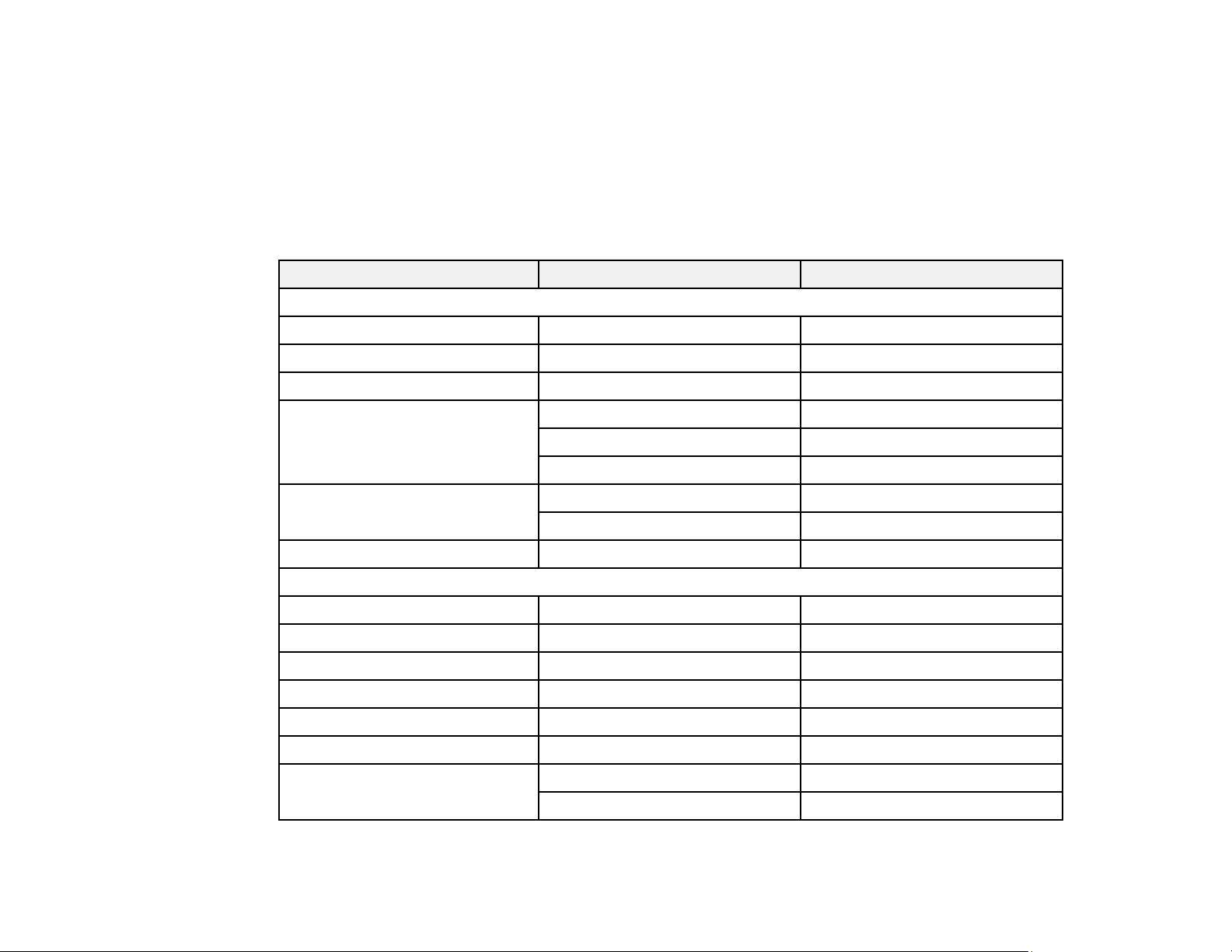
151
Supported Video Display Formats
For best results, your computer's monitor port or video card resolution should be set to display in the
projector's native resolution. However, your projector includes Epson's SizeWise chip that supports other
computer display resolutions, so your image will be resized to fit automatically.
Your computer's monitor port or video card refresh rate (vertical frequency) must be compatible with the
projector. (See your computer or video card manual for details.)
The table here lists the compatible refresh rate and resolution for each compatible video display format.
Display format Refresh rate (in Hz) Resolution (in pixels)
Computer signals (analog RGB)
VGA 60 640 × 480
SVGA 60 800 × 600
XGA 60 1024 × 768
WXGA 60 1280 × 768
60 1366 × 768
60 1280 × 800
SXGA 60 1280 × 960
60 1280 × 1024
WXGA++ 60 1600 × 900
HDMI input signals
VGA 60 640 × 480
SDTV (480i/480p) 60 720 × 480
SDTV (576i/576p) 50 720 × 576
HDTV (720p) 50/60 1280 × 720
HDTV (1080i) 50/60 1920 × 1080
HDTV (1080p) 24/30/50/60 1920 × 1080
4K × 2K 24/30/50/60 3840 × 2160
24/50/60 4096 × 2160
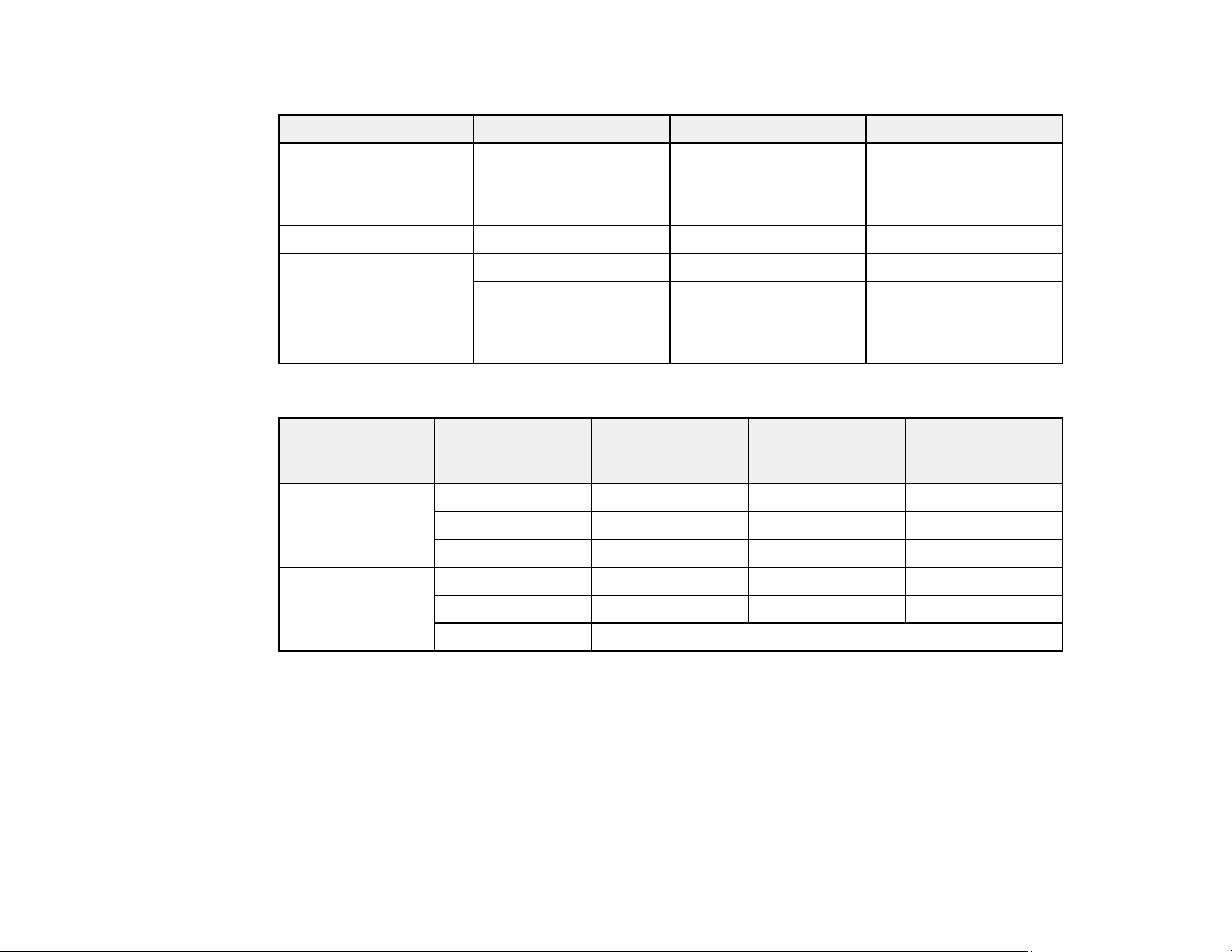
152
HDMI 3D Signals
Display format Refresh rate (in Hz) Resolution (in pixels) 3D formats
HDTV (720p) 50/60 1280 × 720 Frame Packing
Side by Side
Top and Bottom
HDTV (1080i) 50/60 1920 × 1080 Side by Side
HDTV (1080p) 50/60 1920 × 1080 Side by Side
24 1920 × 1080 Frame Packing
Side by Side
Top and Bottom
Compatible 4K HDR Signals
Display format
(refresh rate)
Chroma
subsampling
(pixel encoding)
Color depth: 24
bits (8-bits per
pixel)
Color depth: 30
bits (10-bits per
pixel)
Color depth: 36
bits (12-bits per
pixel)
4K/60p (60 Hz) 4:4:4 SDR SDR SDR
4:2:2 SDR SDR SDR
4:2:0 SDR SDR SDR
4K/24p (24 Hz) 4:4:4 SDR SDR SDR
4:2:2 SDR HDR HDR
1
4:2:0 This signal does not exist.
1
This signal is processed at 4:2:2 10-bit.
Parent topic: Technical Specifications

153
Notices
Check these sections for important notices about your projector.
Recycling
Important Safety Information
Important Safety Instructions
List of Safety Symbols
FCC Compliance Statement
Binding Arbitration and Class Waiver
Trademarks
Copyright Notice
Recycling
Epson offers a recycling program for end of life products. Please go to this site for information on how to
return your products for proper disposal.
Parent topic: Notices
Important Safety Information
Caution: Never look into the projector lens when the lamp is turned on; the bright light can damage your
eyes. Never let children look into the lens when it is on. Never open any cover on the projector, except
the lamp and filter covers. Dangerous electrical voltages inside the projector can severely injure you.
Except as specifically explained in this User's Guide, do not attempt to service this product yourself.
Refer all servicing to qualified service personnel.
Warning: The projector and its accessories come packaged in plastic bags. Keep plastic bags away
from small children to avoid any risk of suffocation.
Caution: When you replace the lamp, never touch the new lamp with your bare hands; the invisible
residue left by the oil on your hands may shorten the lamp life. Use a cloth or glove to handle the new
lamp.
Parent topic: Notices

154
Important Safety Instructions
Follow these safety instructions when setting up and using the projector:
• Do not look into the lens when the projector is on. The bright light can damage your eyes. Avoid
standing in front of the projector so the bright light does not shine into your eyes.
• Do not place the projector on an unstable cart, stand, or table.
• Do not operate the projector on its side, or while tilted to one side.
• If the projector is mounted on a ceiling or wall, it should be installed by qualified technicians using
mounting hardware designed for use with this projector.
• When installing or adjusting a ceiling or wall mount, do not use adhesives to prevent the screws from
loosening and do not use oils or lubricants. This may cause the projector case to crack and the
projector to fall from its ceiling mount. This could cause serious injury to anyone under the mount and
could damage the projector.
• Do not use the projector near water, sources of heat, high-voltage electrical wires, or sources of
magnetic fields.
• Use the type of power source indicated on the projector. Use of a different power source may result in
fire or electric shock. If you are not sure of the power available, consult your dealer or power company.
• Place the projector near a wall outlet where the plug can be easily unplugged.
• Take the following precautions when handling the plug: Do not hold the plug with wet hands. Do not
insert the plug into a dusty outlet. Insert the plug firmly into the outlet. Do not pull the power cord when
disconnecting the plug; always be sure to hold the plug when disconnecting it. Do not overload wall
outlets, extension cords, or power strips. Failure to comply with these precautions could result in fire or
electric shock.
• Do not place the projector where the cord can be walked on. This may result in fraying or damage to
the plug.
• Unplug the projector from the wall outlet and allow to cool before cleaning. Use a dry cloth (or, for
stubborn dirt or stains, a moist cloth that has been wrung dry) for cleaning. Do not use liquid or aerosol
cleaners, any sprays containing flammable gas, or solvents such as alcohol, paint thinner, or benzine.
• Do not block the slots and openings in the projector case. They provide ventilation and prevent the
projector from overheating. Do not operate the projector on a sofa, rug, or other soft surface, or set it
on top of loose papers. Do not cover the projector with a blanket, curtain, or tablecloth. If you are
setting up the projector near a wall, leave at least 7.9 inches (20 cm) of space between the wall and
the projector.
• Do not operate the projector in a closed-in cabinet unless proper ventilation is provided.

155
• Never allow objects of any kind to enter any openings in the projector. Do not leave objects, especially
flammable objects, near the projector. Never spill liquid of any kind into the projector.
• You may need to clean the air filter and vent. A clogged air filter or vent can block ventilation needed
to cool the projector. Do not use canned air, or the gases may leave a residue.
• Do not store the projector outdoors for an extended length of time.
• Except as specifically explained in this manual, do not attempt to service this product yourself. Refer
all servicing to qualified personnel. Opening or removing covers may expose you to dangerous
voltages and other hazards.
• Never open any covers on the projector except as specifically explained in this manual. Never attempt
to disassemble or modify the projector. Refer all repairs to qualified service personnel.
• Unplug the projector from the wall outlet and refer servicing to qualified service personnel under the
following conditions: if it does not operate normally when you follow the operating instructions, or
exhibits a distinct change in performance; if smoke, strange odors, or strange noises come from the
projector; if the power cord or plug is damaged or frayed; if liquid or foreign objects get inside the
projector, or if it has been exposed to rain or water; if it has been dropped or the housing has been
damaged.
• Do not touch the plug during an electrical storm. Otherwise, you may receive an electric shock.
• Unplug the projector when it will not be used for extended periods.
• Do not use the projector where it may be exposed to rain, water, or excessive humidity.
• Do not use or store the projector where it may be exposed to smoke, steam, corrosive gases,
excessive dust, vibration, or shock.
• Do not use the projector where flammable or explosive gases may be present.
• Do not use or store the projector or remote control in a hot location, such as near a heater, in direct
sunlight, or in a closed vehicle.
• If you use the projector in a country other than where you purchased it, use the correct power cord for
that country.
• Do not stand on the projector or place heavy objects on it.
• Do not use the projector outside of the required temperature range below:
41 to 95 °F (5 to 35 °C) at an altitude of 4921 feet (1500 m) or less, or 41 to 86 °F (5 to 30 °C) at a
higher altitude
Doing so may cause an unstable display and could lead to projector damage. Do not use or store the
projector where it may be exposed to sudden changes in temperature.

156
• Do not store the projector outside of the required temperature range of 14 to 140 °F (–10 to 60 °C) or
in direct sunlight for long periods of time. Doing so may cause damage to the case.
• Do not place anything that can become warped or damaged by heat near the exhaust vents. Do not
bring your hands or face close to the vents while projection is in progress. Do not bring your face close
to the projector while it is in use.
• Before you move the projector, make sure its power is turned off, the plug is disconnected from the
outlet, and all cables are disconnected.
• Do not disassemble the lamp or subject it to impacts.
• Do not place the source of an open flame, such as a lit candle, on or near the projector.
• Do not modify the power cord. Do not place heavy objects on top of the power cord or bend, twist, or
pull it excessively. Keep the power cord away from hot electrical appliances.
• If the lamp breaks, ventilate the room to prevent gases contained in the lamp from being inhaled or
coming in contact with your eyes or mouth. If you do inhale gases or gases come in contact with your
eyes or mouth, seek medical advice immediately.
• If the projector is mounted overhead and the lamp breaks, be careful to prevent pieces of glass from
falling into your eyes or mouth when you open the lamp cover. If pieces of glass do get into your eyes
or mouth, seek medical advice immediately.
Note: The lamp(s) in this product contain mercury. Please consult your state and local regulations
regarding disposal or recycling. Do not put in the trash.
Restriction of Use
Parent topic: Notices
Restriction of Use
When this product is used for applications requiring high reliability/safety such as transportation devices
related to aviation, rail, marine, automotive; disaster prevention devices; various safety devices; or
functional/precision devices, you should use this product only after giving consideration to including fail-
safes and redundancies into your design to maintain safety and total system reliability.
Because this product was not intended for use in applications requiring extremely high reliability/safety
such as aerospace equipment, main communication equipment, nuclear power control equipment, or
medical equipment related to direct medical care, please make your own judgment on this product's
suitability after a full evaluation.
Parent topic: Important Safety Instructions
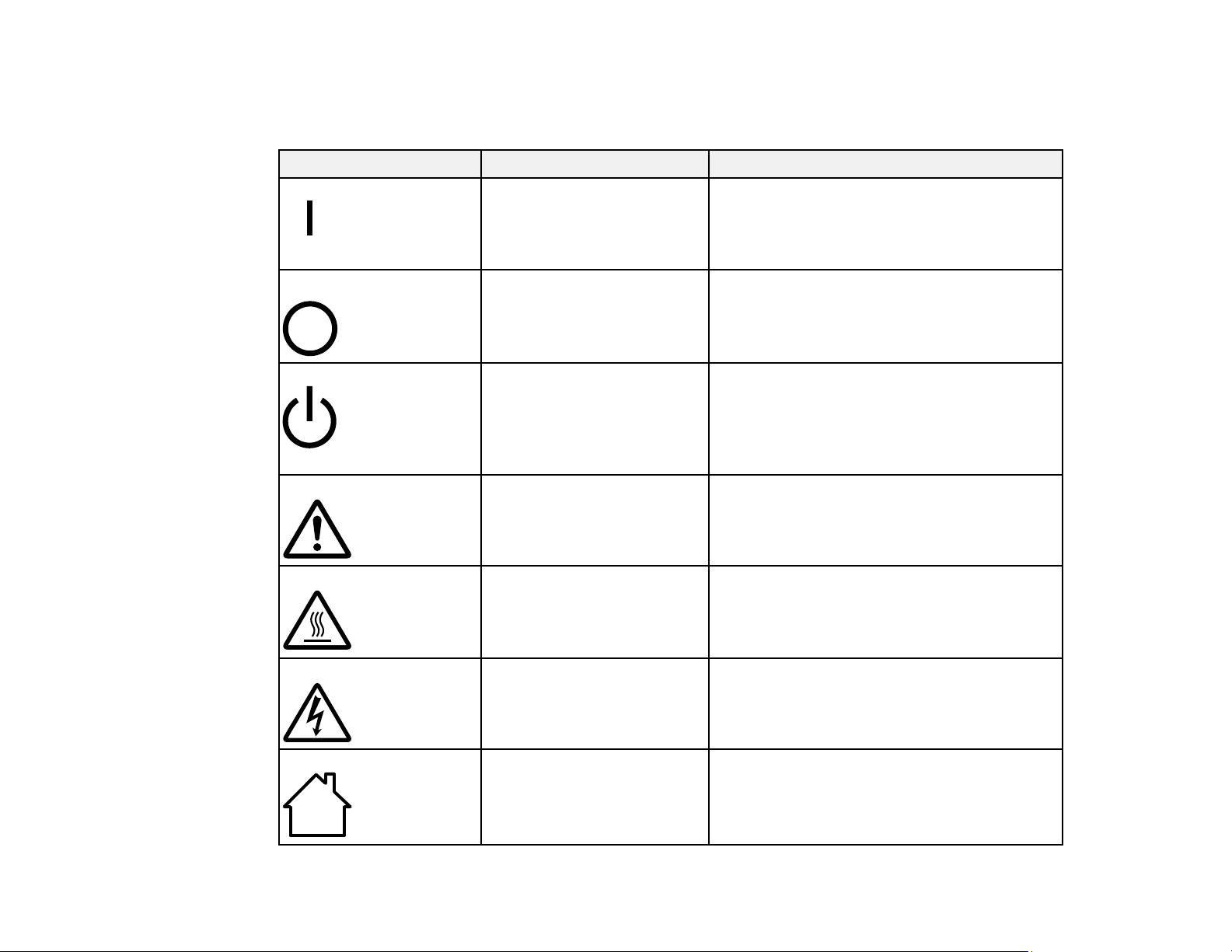
157
List of Safety Symbols
The following table lists the meaning of the safety symbols labeled on the equipment.
Symbol Approved Standards Description
IEC60417
No.5007
"ON" (power)
To indicate connection to the mains.
IEC60417
No.5008
"OFF" (power)
To indicate disconnection from the mains.
IEC60417
No.5009
Stand-by
To identify the switch or switch position by
means of which part of the equipment is
switched on in order to bring it into the stand-
by condition.
ISO7000
No.0434B,
IEC3864-B3.1
Caution
To identify general caution when using the
product.
IEC60417
No.5041
Caution, hot surface
To indicate that the marked item can be hot
and should not be touched without taking
care.
IEC60417
No.6042
ISO3864-B3.6
Caution, risk of electric shock
To identify equipment that has risk of electric
shock.
IEC60417
No.5957
For indoor use only
To identify electrical equipment designed
primarily for indoor use.
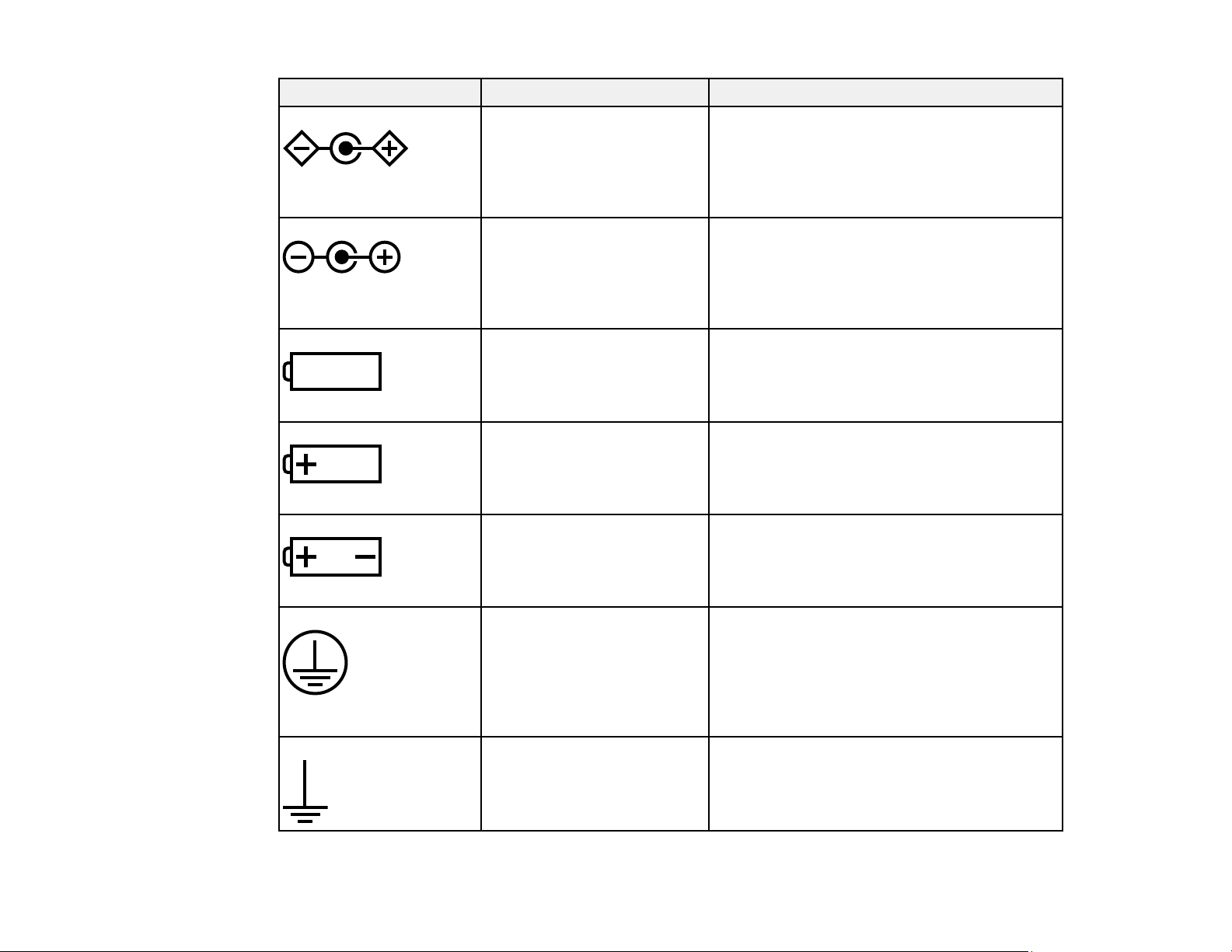
158
Symbol Approved Standards Description
IEC60417
No.5926
Polarity of DC power connector
To identify the positive and negative
connections (the polarity) on a piece of
equipment to which a DC power supply may
be connected.
— Polarity of DC power connector
To identify the positive and negative
connections (the polarity) on a piece of
equipment to which a DC. power supply may
be connected.
IEC60417
No.5001B
Battery, general
On battery powered equipment. To identify a
device for instance a cover for the battery
compartment, or the connector terminals.
IEC60417
No.5002
Positioning of cell
To identify the battery holder itself and to
identify the positioning of the cell(s) inside the
battery holder.
— Positioning of cell
To identify the battery holder itself and to
identify the positioning of the cell(s) inside the
battery holder.
IEC60417
No.5019
Protective earth
To identify any terminal which is intended for
connection to an external conductor for
protection against electric shock in case of a
fault, or the terminal of a protective earth
electrode.
IEC60417
No.5017
Earth
To identify an earth (ground) terminal in
cases where neither the symbol No.13 is
explicitly required.
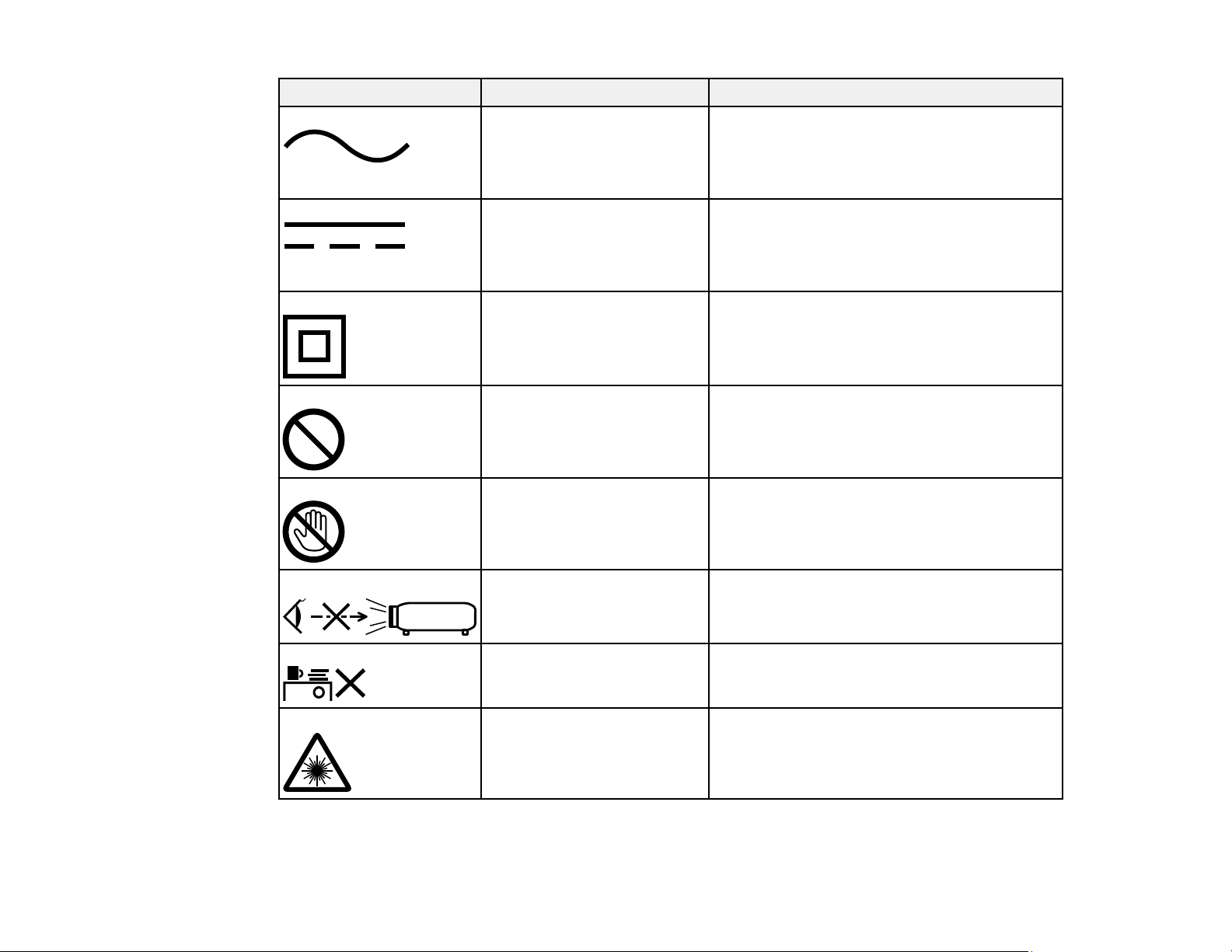
159
Symbol Approved Standards Description
IEC60417
No.5032
Alternating current
To indicate on the rating plate that the
equipment is suitable for alternating current
only; to identify relevant terminals.
IEC60417
No.5031
Direct current
To indicate on the rating plate that the
equipment is suitable for direct current only;
to identify relevant terminals.
IEC60417
No.5172
Class II equipment
To identify equipment meeting the safety
requirements specified for Class II equipment
according to IEC 61140.
ISO 3864 General prohibition
To identify actions or operations that are
prohibited.
ISO 3864 Contact prohibition
To indicate injury that could occur due to
touching a specific part of the equipment.
— Never look into the projector lens while the
projector is on.
— To indicate that the marked item don’t place
anything on projector.
ISO3864
IEC60825-1
Caution, laser radiation
To indicate the equipment has a laser
radiation part.
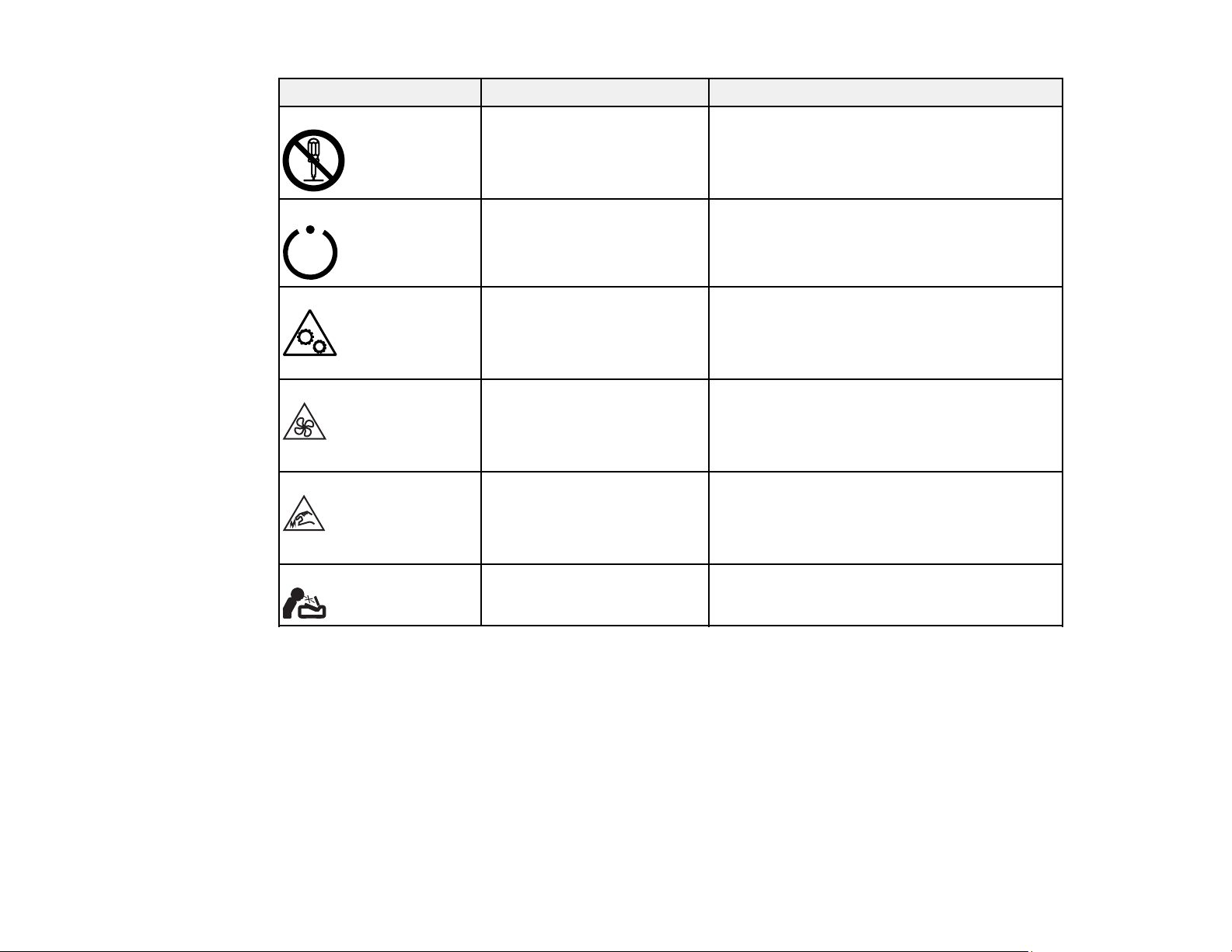
160
Symbol Approved Standards Description
ISO 3864 Disassembly prohibition
To indicate a risk of injury, such as electric
shock, if the equipment is disassembled.
IEC60417
No. 5266
Standby, partial standby
To indicate that part of the equipment is in the
ready status.
ISO3864
IEC60417
No. 5057
Caution, movable parts
To indicate that you must keep away from
movable parts according to protection
standards.
IEC 60417-6056 Caution (movable fan blades)
To indicate that you must keep away from
movable parts according to protection
standards.
IEC 60417-6043 Caution (sharp corners)
To indicate that you must not touch the sharp
corners of the product according to protection
standards.
— Never look into the projection lens while the
projector is on.
Parent topic: Notices
FCC Compliance Statement
For United States Users
This equipment has been tested and found to comply with the limits for a Class B digital device, pursuant
to Part 15 of the FCC Rules. These limits are designed to provide reasonable protection against harmful
interference in a residential installation. This equipment generates, uses, and can radiate radio
frequency energy and, if not installed and used in accordance with the instructions, may cause harmful
interference to radio communications. However, there is no guarantee that interference will not occur in

161
a particular installation. If this equipment does cause interference to radio and television reception, which
can be determined by turning the equipment off and on, the user is encouraged to try to correct the
interference by one or more of the following measures:
• Reorient or relocate the receiving antenna.
• Increase the separation between the equipment and receiver.
• Connect the equipment into an outlet on a circuit different from that to which the receiver is connected.
• Consult the dealer or an experienced radio/TV technician for help.
This device complies with part 15 of the FCC Rules. Operation is subject to the following two conditions:
(1) This device may not cause harmful interference, and (2) this device must accept any interference
received, including interference that may cause undesired operation.
WARNING
The connection of a non-shielded equipment interface cable to this equipment will invalidate the FCC
Certification or Declaration of this device and may cause interference levels which exceed the limits
established by the FCC for this equipment. It is the responsibility of the user to obtain and use a shielded
equipment interface cable with this device. If this equipment has more than one interface connector, do
not leave cables connected to unused interfaces. Changes or modifications not expressly approved by
the manufacturer could void the user’s authority to operate the equipment.
For Canadian Users
CAN ICES-3(B)/NMB-3(B)
Parent topic: Notices
Binding Arbitration and Class Waiver
1. DISPUTES, BINDING INDIVIDUAL ARBITRATION, AND WAIVER OF CLASS ACTIONS AND
CLASS ARBITRATIONS
1.1 Disputes. The terms of this Section 1 shall apply to all Disputes between you and Epson. The term
"Dispute" is meant to have the broadest meaning permissible under law and includes any dispute, claim,
controversy or action between you and Epson arising out of or relating to this Agreement, Epson
branded products (hardware and including any related software), or other transaction involving you and
Epson, whether in contract, warranty, misrepresentation, fraud, tort, intentional tort, statute, regulation,
ordinance, or any other legal or equitable basis. "DISPUTE" DOES NOT INCLUDE IP CLAIMS, or more
specifically, a claim or cause of action for (a) trademark infringement or dilution, (b) patent infringement,
(c) copyright infringement or misuse, or (d) trade secret misappropriation (an "IP Claim"). You and Epson
also agree, notwithstanding Section 1.6,that a court, not an arbitrator, may decide if a claim or cause of
action is for an IP Claim.

162
1.2 Binding Arbitration. You and Epson agree that all Disputes shall be resolved by binding arbitration
according to this Agreement. ARBITRATION MEANS THAT YOU WAIVE YOUR RIGHT TO A JUDGE
OR JURY IN A COURT PROCEEDING AND YOUR GROUNDS FOR APPEAL ARE LIMITED.
Pursuant to this Agreement, binding arbitration shall be administered by JAMS, a nationally recognized
arbitration authority, pursuant to its code of procedures then in effect for consumer related disputes, but
excluding any rules that permit joinder or class actions in arbitration (for more detail on procedure, see
Section 1.6 below). You and Epson understand and agree that (a) the Federal Arbitration Act (9 U.S.C.
§1, et seq.) governs the interpretation and enforcement of this Section 1, (b) this Agreement
memorializes a transaction in interstate commerce, and (c) this Section 1 shall survive termination of this
Agreement.
1.3 Pre-Arbitration Steps and Notice. Before submitting a claim for arbitration, you and Epson agree to
try, for sixty (60) days, to resolve any Dispute informally. If Epson and you do not reach an agreement to
resolve the Dispute within the sixty (60) days), you or Epson may commence an arbitration. Notice to
Epson must be addressed to: Epson America, Inc., ATTN: Legal Department, 3840 Kilroy Airport Way,
Long Beach, CA 90806 (the "Epson Address"). The Dispute Notice to you will be sent to the most recent
address Epson has in its records for you. For this reason, it is important to notify us if your address
the Dispute shall include the sender's name, address and contact information, the facts giving rise to the
Dispute, and the relief requested (the "Dispute Notice"). Following receipt of the Dispute Notice, Epson
and you agree to act in good faith to resolve the Dispute before commencing arbitration.
1.4 Small Claims Court. Notwithstanding the foregoing, you may bring an individual action in the small
claims court of your state or municipality if the action is within that court's jurisdiction and is pending only
in that court.
1.5 WAIVER OF CLASS ACTIONS AND CLASS ARBITRATIONS. YOU AND EPSON AGREE THAT
EACH PARTY MAY BRING DISPUTES AGAINST THE OTHER PARTY ONLY IN AN INDIVIDUAL
CAPACITY, AND NOT AS A PLAINTIFF OR CLASS MEMBER IN ANY CLASS OR
REPRESENTATIVE PROCEEDING, INCLUDING WITHOUT LIMITATION FEDERAL OR STATE
CLASS ACTIONS, OR CLASS ARBITRATIONS. CLASS ACTION LAWSUITS, CLASS-WIDE
ARBITRATIONS, PRIVATE ATTORNEY-GENERAL ACTIONS, AND ANY OTHER PROCEEDING
WHERE SOMEONE ACTS IN A REPRESENTATIVE CAPACITY ARE NOT ALLOWED.
ACCORDINGLY, UNDER THE ARBITRATION PROCEDURES OUTLINED IN THIS SECTION, AN
ARBITRATOR SHALL NOT COMBINE OR CONSOLIDATE MORE THAN ONE PARTY'S CLAIMS
WITHOUT THE WRITTEN CONSENT OF ALL AFFECTED PARTIES TO AN ARBITRATION
PROCEEDING.
1.6 Arbitration Procedure. If you or Epson commences arbitration, the arbitration shall be governed by
the rules of JAMS that are in effect when the arbitration is filed, excluding any rules that permit arbitration
on a class or representative basis (the "JAMS Rules"), available at http://www.jamsadr.com or by calling
1-800-352-5267, and under the rules set forth in this Agreement. All Disputes shall be resolved by a
single neutral arbitrator, and both parties shall have a reasonable opportunity to participate in the

163
selection of the arbitrator. The arbitrator is bound by the terms of this Agreement. The arbitrator, and not
any federal, state or local court or agency, shall have exclusive authority to resolve all disputes arising
out of or relating to the interpretation, applicability, enforceability or formation of this Agreement,
including any claim that all or any part of this Agreement is void or voidable. Notwithstanding this broad
delegation of authority to the arbitrator, a court may determine the limited question of whether a claim or
cause of action is for an IP Claim, which is excluded from the definition of "Disputes" in Section 1.1
above. The arbitrator shall be empowered to grant whatever relief would be available in a court under
law or in equity. The arbitrator may award you the same damages as a court could, and may award
declaratory or injunctive relief only in favor of the individual party seeking relief and only to the extent
necessary to provide relief warranted by that party's individual claim. In some instances, the costs of
arbitration can exceed the costs of litigation and the right to discovery may be more limited in arbitration
than in court. The arbitrator's award is binding and may be entered as a judgment in any court of
competent jurisdiction.
You may choose to engage in arbitration hearings by telephone. Arbitration hearings not conducted by
telephone shall take place in a location reasonably accessible from your primary residence, or in Orange
County, California, at your option.
a) Initiation of Arbitration Proceeding. If either you or Epson decides to arbitrate a Dispute, both parties
agree to the following procedure:
(i) Write a Demand for Arbitration. The demand must include a description of the Dispute and the amount
of damages sought to be recovered. You can find a copy of a Demand for Arbitration at
http://www.jamsadr.com ("Demand for Arbitration").
(ii) Send three copies of the Demand for Arbitration, plus the appropriate filing fee, to: JAMS, 500 North
State College Blvd., Suite 600 Orange, CA 92868, U.S.A.
(iii) Send one copy of the Demand for Arbitration to the other party (same address as the Dispute
Notice), or as otherwise agreed by the parties.
b) Hearing Format. During the arbitration, the amount of any settlement offer made shall not be disclosed
to the arbitrator until after the arbitrator determines the amount, if any, to which you or Epson is entitled.
The discovery or exchange of non-privileged information relevant to the Dispute may be allowed during
the arbitration.
c) Arbitration Fees. Epson shall pay, or (if applicable) reimburse you for, all JAMS filings and arbitrator
fees for any arbitration commenced (by you or Epson) pursuant to provisions of this Agreement.
d) Award in Your Favor. For Disputes in which you or Epson seeks $75,000 or less in damages exclusive
of attorney's fees and costs, if the arbitrator's decision results in an award to you in an amount greater
than Epson's last written offer, if any, to settle the Dispute, Epson will: (i) pay you $1,000 or the amount
of the award, whichever is greater; (ii) pay you twice the amount of your reasonable attorney's fees, if
any; and (iii) reimburse you for any expenses (including expert witness fees and costs) that your attorney
reasonably accrues for investigating, preparing, and pursuing the Dispute in arbitration. Except as

164
agreed upon by you and Epson in writing, the arbitrator shall determine the amount of fees, costs, and
expenses to be paid by Epson pursuant to this Section 1.6d).
e) Attorney's Fees. Epson will not seek its attorney's fees and expenses for any arbitration commenced
involving a Dispute under this Agreement. Your right to attorney's fees and expenses under Section
1.6d) above does not limit your rights to attorney's fees and expenses under applicable law;
notwithstanding the foregoing, the arbitrator may not award duplicative awards of attorney's fees and
expenses.
1.7 Opt-out. You may elect to opt-out (exclude yourself) from the final, binding, individual
arbitration procedure and waiver of class and representative proceedings specified in this
Agreement by sending a written letter to the Epson Address within thirty (30) days of your assent
to this Agreement (including without limitation the purchase, download, installation of the
Software or other applicable use of Epson Hardware, products and services) that specifies (i)
your name, (ii) your mailing address, and (iii) your request to be excluded from the final, binding
individual arbitration procedure and waiver of class and representative proceedings specified in
this Section 1. In the event that you opt-out consistent with the procedure set forth above, all
other terms shall continue to apply, including the requirement to provide notice prior to litigation.
1.8 Amendments to Section 1. Notwithstanding any provision in this Agreement to the contrary, you
and Epson agree that if Epson makes any future amendments to the dispute resolution procedure and
class action waiver provisions (other than a change to Epson's address) in this Agreement, Epson will
obtain your affirmative assent to the applicable amendment. If you do not affirmatively assent to the
applicable amendment, you are agreeing that you will arbitrate any Dispute between the parties in
accordance with the language of this Section 1 (or resolve disputes as provided for in Section 1.7, if you
timely elected to opt-out when you first assented to this Agreement).
1.9 Severability. If any provision in this Section 1 is found to be unenforceable, that provision shall be
severed with the remainder of this Agreement remaining in full force and effect. The foregoing shall not
apply to the prohibition against class or representative actions as provided in Section 1.5. This
means that if Section 1.5 is found to be unenforceable, the entire Section 1 (but only Section 1)
shall be null and void.
Parent topic: Notices
Trademarks
EPSON
®
is a registered trademark and EPSON Exceed Your Vision is a registered logomark of Seiko
Epson Corporation.
PrivateLine
®
is a registered trademark and Extra Care
SM
is a service mark of Epson America, Inc.
Mac is a trademark of Apple Inc., registered in the U.S. and other countries.
Windows is a registered trademark of Microsoft Corporation in the United States and/or other countries.
165
Google
®
is a registered trademark and Android
TM
is a trademark of Google LLC.
HDMI and High-Definition Multimedia Interface are the trademarks or registered trademarks of HDMI
Licensing LLC.
General Notice: Other product names used herein are for identification purposes only and may be
trademarks of their respective owners. Epson disclaims any and all rights in those marks.
Parent topic: Notices
Copyright Notice
All rights reserved. No part of this publication may be reproduced, stored in a retrieval system, or
transmitted in any form or by any means, electronic, mechanical, photocopying, recording, or otherwise,
without the prior written permission of Seiko Epson Corporation. The information contained herein is
designed only for use with this Epson product. Epson is not responsible for any use of this information as
applied to other products.
Neither Seiko Epson Corporation nor its affiliates shall be liable to the purchaser of this product or third
parties for damages, losses, costs, or expenses incurred by purchaser or third parties as a result of:
accident, misuse, or abuse of this product or unauthorized modifications, repairs, or alterations to this
product, or (excluding the U.S.) failure to strictly comply with Seiko Epson Corporation's operating and
maintenance instructions.
Seiko Epson Corporation shall not be liable for any damages or problems arising from the use of any
options or any consumable products other than those designated as Original Epson Products or Epson
Approved Products by Seiko Epson Corporation.
This information is subject to change without notice.
A Note Concerning Responsible Use of Copyrighted Materials
Copyright Attribution
Parent topic: Notices
A Note Concerning Responsible Use of Copyrighted Materials
Epson encourages each user to be responsible and respectful of the copyright laws when using any
Epson product. While some countries' laws permit limited copying or reuse of copyrighted material in