
31T7AG30
OG08882
00X31-T7A-G300
2019 Honda HR-V Owner's Guide
©
2018 Honda Motor Co., Ltd. — All Rights Reserved Printed in U.S.A.
The following products and systems, if on your vehicle, emit radio waves when
in operation:
• HondaLink
®
*1
• Audio System
•
Bluetooth
®
Audio
•
Bluetooth
®
HandsFreeLink
®
• Collision Mitigation Braking
System
™
(CMBS
™
)
• Immobilizer System
• Remote Transmitter
*1
• Smart Entry System
*1
Each of the above complies with the appropriate requirements or the required
standards of the FCC (Federal Communications Commission) and Industry
Canada, described below:
As required by the FCC:
This device complies with Part 15 of the FCC rules. Operation is subject to the
following two conditions: (1) This device may not cause harmful interference,
and (2) this device must accept any interference received, including
interference that may cause undesired operation.
Changes or modifications not expressly approved by the party responsible for
compliance could void the user’s authority to operate the equipment.
As required by Industry Canada:
This device complies with Industry Canada licence-exempt RSS standard(s).
Operation is subject to the following two conditions: (1) this device may not
cause interference, and (2) this device must accept any interference, including
interference that may cause undesired operation of the device.
The information and data contained herein are believed to be accurate and
reliable. American Honda Motor Co., Inc. makes no warranty of any kind and
accepts no responsibility for the results obtained through application of this
information.
This vehicle may share location and usage information. To manage this setting,
visit
www.hondalink.com/vehicle-data-choices.
*1 - If equipped
The main purpose
of an EDR is to record, in certain crash or near crash-like situations, such as an
airbag deployment or hitting a road obstacle, data that will assist in
understanding how a vehicle’s systems performed.
•
•
•
•
These data can help provide a better understanding of the circumstances in
which crashes and injuries occur. NOTE: EDR data are recorded by your vehicle
only if a non-trivial crash situation occurs; no data are recorded by the EDR
under normal driving conditions and no personal data (e.g., name, gender, age,
and crash location) are recorded. However, other parties, such as law
enforcement, could combine the EDR data with the type of personally
identifying data routinely acquired during a crash investigation.
To read data recorded by an EDR, special equipment is required, and access to
the vehicle or the EDR is needed. In addition to the vehicle manufacturer, other
parties such as law enforcement that have the special equipment can read the
information if they have access to the vehicle or the EDR.
The data belong to the vehicle owner and may not be accessed by anyone else
except as legally required or with the permission of the vehicle owner.
This vehicle is equipped with service-related devices that record information
about powertrain performance. The data can be used to verify emissions law
requirements and/or help technicians diagnose and solve service problems. It
may also be combined with data from other sources for research purposes, but
it remains confidential. Some diagnostic and maintenance information is
uploaded to Honda upon vehicle start up.
The following products and systems, if on your vehicle, emit radio waves when
in operation:
• HondaLink
®
*1
• Audio System
•
Bluetooth
®
Audio
•
Bluetooth
®
HandsFreeLink
®
• Collision Mitigation Braking
System
™
(CMBS
™
)
• Immobilizer System
• Remote Transmitter
*1
• Smart Entry System
*1
Each of the above complies with the appropriate requirements or the required
standards of the FCC (Federal Communications Commission) and Industry
Canada, described below:
As required by the FCC:
This device complies with Part 15 of the FCC rules. Operation is subject to the
following two conditions: (1) This device may not cause harmful interference,
and (2) this device must accept any interference received, including
interference that may cause undesired operation.
Changes or modifications not expressly approved by the party responsible for
compliance could void the user’s authority to operate the equipment.
As required by Industry Canada:
This device complies with Industry Canada licence-exempt RSS standard(s).
Operation is subject to the following two conditions: (1) this device may not
cause interference, and (2) this device must accept any interference, including
interference that may cause undesired operation of the device.
The information and data contained herein are believed to be accurate and
reliable. American Honda Motor Co., Inc. makes no warranty of any kind and
accepts no responsibility for the results obtained through application of this
information.
This vehicle may share location and usage information. To manage this setting,
visit
www.hondalink.com/vehicle-data-choices.
*1 - If equipped
The main purpose
of an EDR is to record, in certain crash or near crash-like situations, such as an
airbag deployment or hitting a road obstacle, data that will assist in
understanding how a vehicle’s systems performed.
•
•
•
•
These data can help provide a better understanding of the circumstances in
which crashes and injuries occur. NOTE: EDR data are recorded by your vehicle
only if a non-trivial crash situation occurs; no data are recorded by the EDR
under normal driving conditions and no personal data (e.g., name, gender, age,
and crash location) are recorded. However, other parties, such as law
enforcement, could combine the EDR data with the type of personally
identifying data routinely acquired during a crash investigation.
To read data recorded by an EDR, special equipment is required, and access to
the vehicle or the EDR is needed. In addition to the vehicle manufacturer, other
parties such as law enforcement that have the special equipment can read the
information if they have access to the vehicle or the EDR.
The data belong to the vehicle owner and may not be accessed by anyone else
except as legally required or with the permission of the vehicle owner.
This vehicle is equipped with service-related devices that record information
about powertrain performance. The data can be used to verify emissions law
requirements and/or help technicians diagnose and solve service problems. It
may also be combined with data from other sources for research purposes, but
it remains confidential. Some diagnostic and maintenance information is
uploaded to Honda upon vehicle start up.
This Owner's Guide is intended to help you quickly get acquainted with your
. It provides basic information and instructions on technology and
convenience features, as well as emergency procedures and how to get
assistance.
This guide is for vehicles sold in the United States and Canada. It covers all
models, so you may find descriptions of features and equipment that are not in
your vehicle. Images throughout this guide are from U.S. vehicles and represent
features and equipment that are available on some, but not all, models.
This guide is not intended to be a substitute for the Owner's Manual. Visit
owners.honda.com
(U.S.) or
myhonda.ca
(Canada) to view the most current
Owner's Manual, Navigation Manual, Vehicle Warranty, and the tire
manufactures' warranties.
To request a
copy, visit
owners.honda.com
and create or log in to your account. In Canada,
please request a copy from your Honda dealer.
American Honda Motor Co., Inc. strives to be proactive in protecting our
environment and natural resources. By using electronic delivery for a
considerable portion of the information typically found in a vehicle Owner's
Manual, we are further reducing our impact on the environment.
Your authorized Honda dealer should be able to answer any questions you have
about your vehicle. However, if you are dissatisfied with the information you
receive, you can call Honda Automobile Customer Service.
24-hour emergency road service is available to you in the United States and
Canada throughout your 3-year/36,000-mile warranty term. Services include
jump starting, flat tire and lockout assistance, towing, and more (limitations
apply).
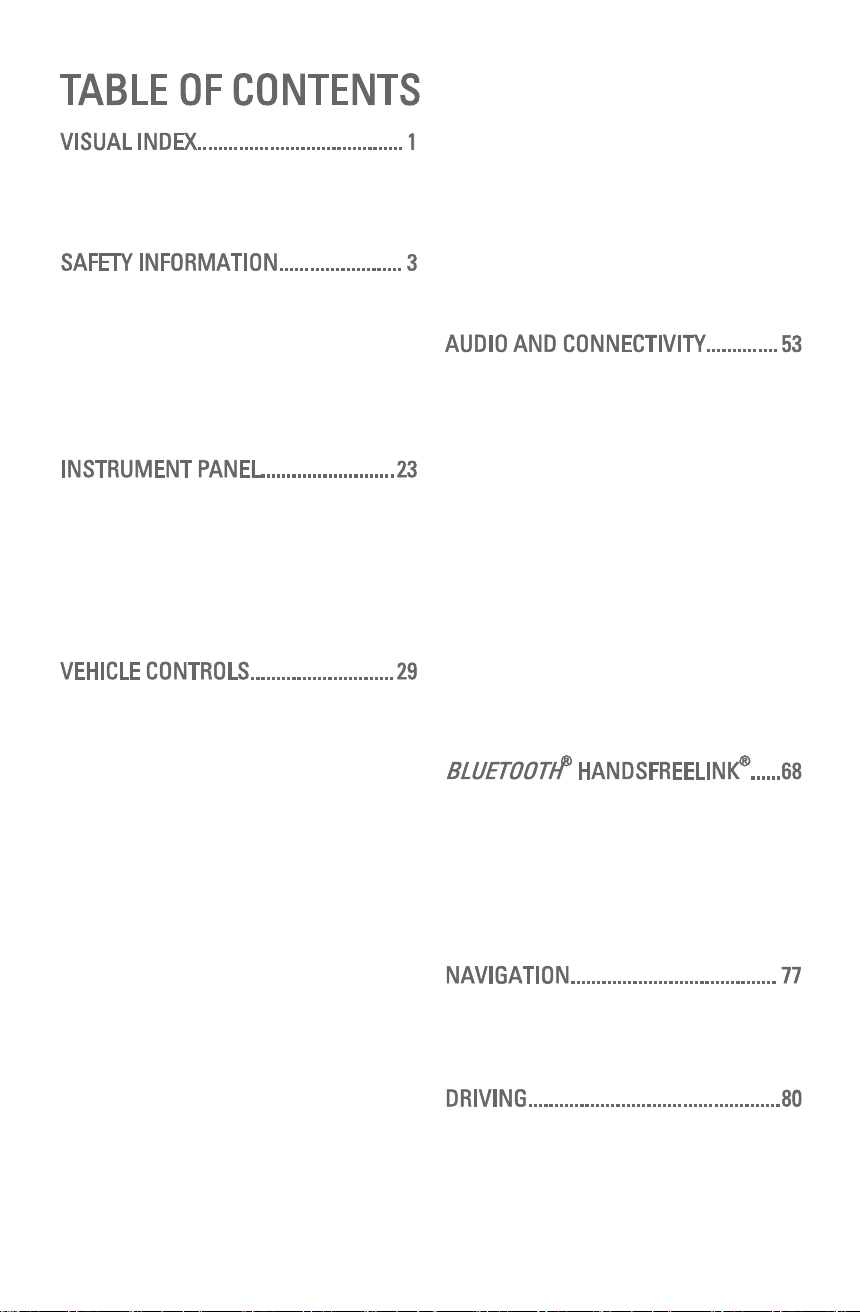
Steering Wheel and Nearby
Controls.............................................1
Dashboard and Nearby Controls...... 2
Important Safety Information............ 3
Seat Belts..............................................5
Airbags..................................................7
Child Safety.........................................14
Safety Label Locations..................... 21
Reporting Safety Defects.................22
Malfunction Indicators.....................23
Condition Indicators..........................25
On/Off Indicators............................... 26
Information Display- If
equipped / Multi-Information
Display- If equipped......................27
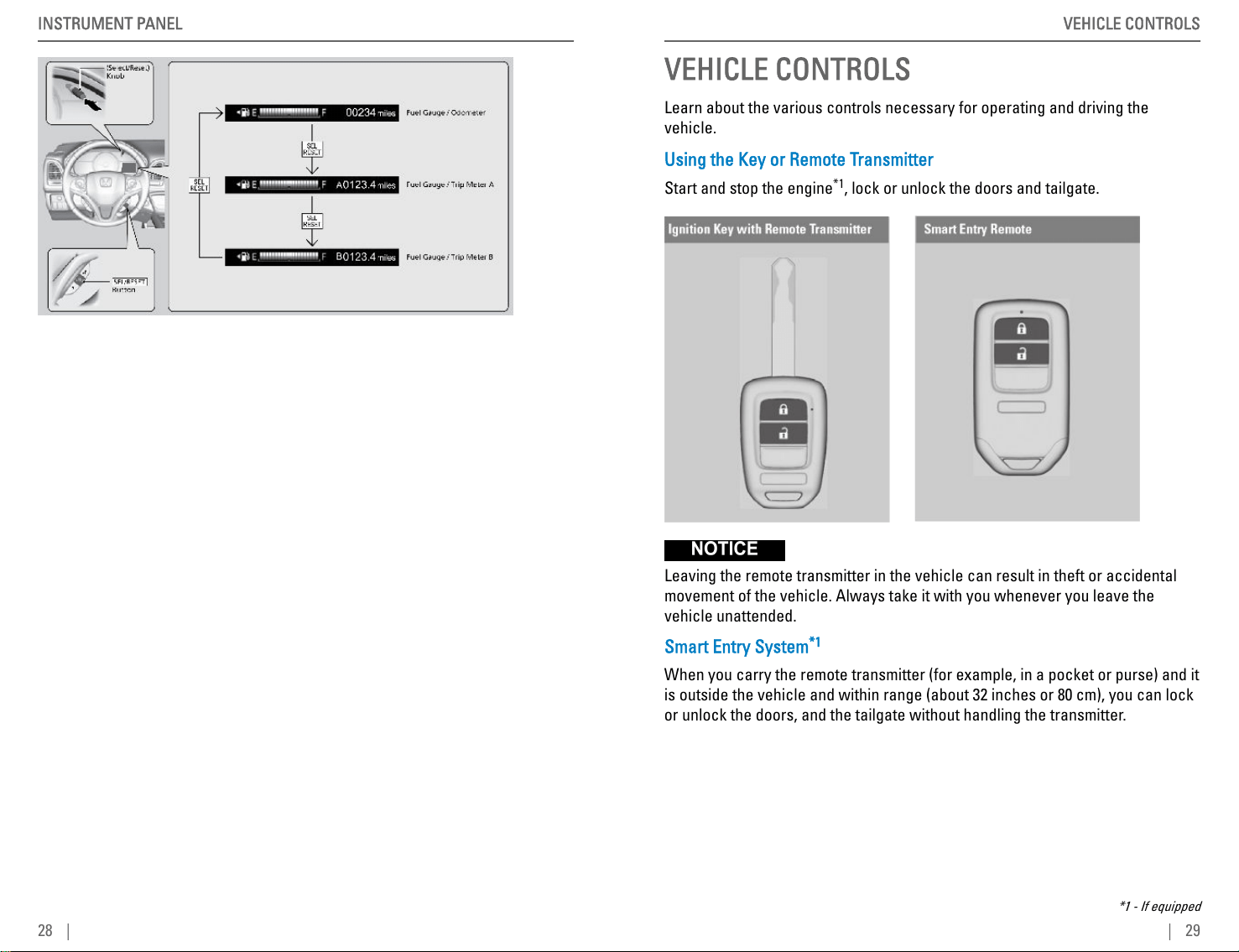
Using the Key or Remote
Transmitter..................................... 29
Smart Entry System- If equipped....29
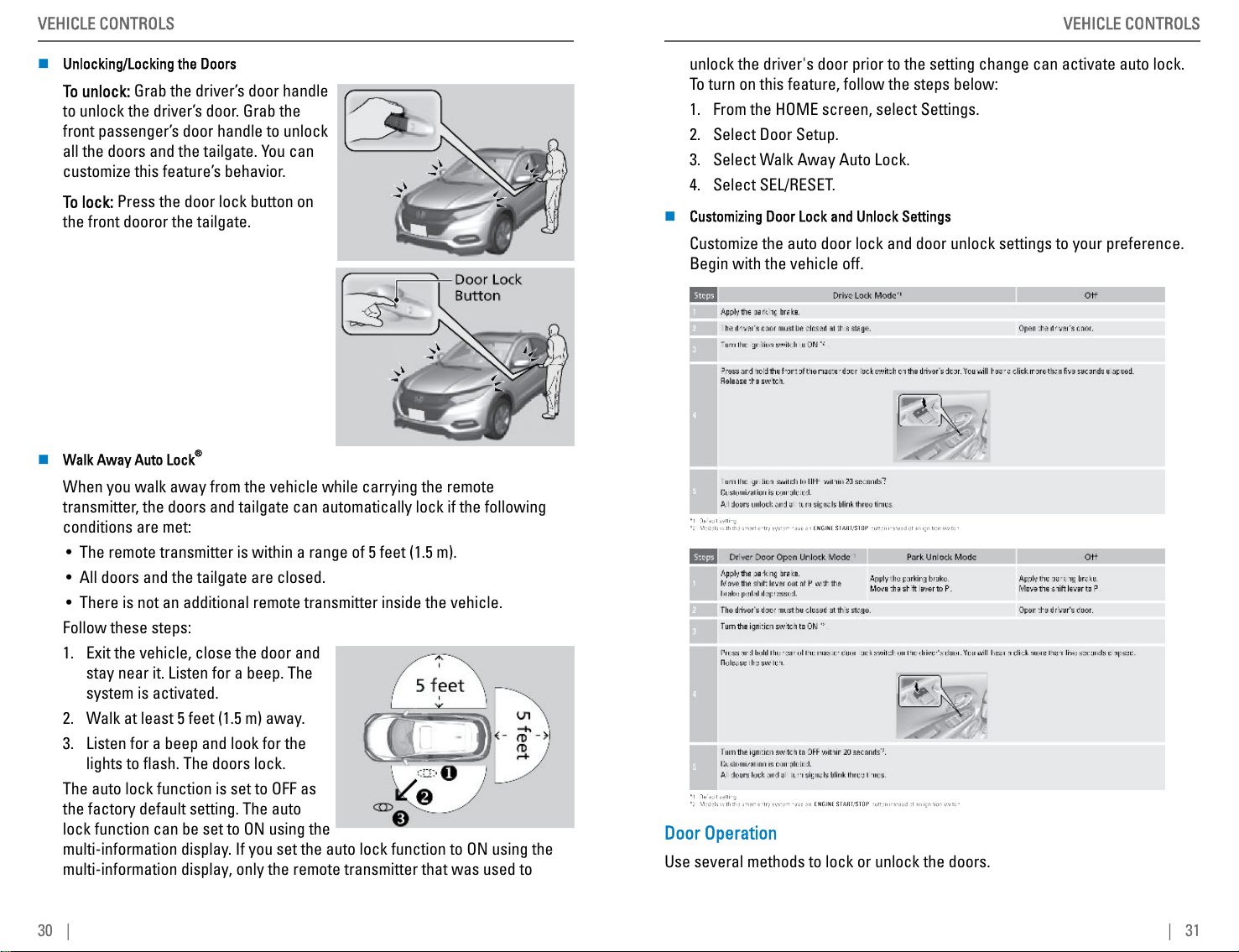
Door Operation...................................31
Tailgate Operation............................. 33
Power Window Operation................33
Power Moonroof Operation- If
equipped.........................................34
Interior and Exterior Lights.............. 35
One-Touch Turn Signal..................... 37
Auto High Beam System- If
equipped.........................................37
Wiper Operation................................ 39
Adjusting the Front Seats.................40
Adjusting the Head Restraints.........43
Adjusting the Rear Seats..................44
Floor Mats...........................................45
Adjusting the Steering Wheel......... 46
Adjusting the Mirrors........................46
Air Conditioning System- If
equipped.........................................47
Climate Control System- If
equipped.........................................48
Front Seat Heaters- If equipped .....49
Customized Features.........................50
Setting the Clock................................51
Basic Audio Operation......................53
Color Audio System...........................56
Display Audio System.......................56
HondaLink
®
.........................................57
Apple Carplay
™
..................................57
Android Auto
™
................................... 58
FM/AM Radio..................................... 60
SiriusXM - If equipped......................60
iPod
®
....................................................61
Pandora
®
- US models only, if
equipped.........................................63
USB Flash Drive.................................63
Bluetooth
®
Audio...............................65
Compact Disc (CD)............................ 67
Basic HFL Operation......................... 68
Pairing a Phone..................................70
Making a Call......................................71
SMS Text Messaging and E-
Mail- If equipped...........................75
Siri Eyes Free
™
...................................75
Basic Navigation Operation.............77
Entering Your Destination.................78
Routing................................................ 79
Before Driving....................................80
Maximum Load Limit.........................81
Towing a Trailer..................................83
Towing Behind A Motorhome..........83
Starting to Drive.................................83
This Owner's Guide is intended to help you quickly get acquainted with your
. It provides basic information and instructions on technology and
convenience features, as well as emergency procedures and how to get
assistance.
This guide is for vehicles sold in the United States and Canada. It covers all
models, so you may find descriptions of features and equipment that are not in
your vehicle. Images throughout this guide are from U.S. vehicles and represent
features and equipment that are available on some, but not all, models.
This guide is not intended to be a substitute for the Owner's Manual. Visit
owners.honda.com
(U.S.) or
myhonda.ca
(Canada) to view the most current
Owner's Manual, Navigation Manual, Vehicle Warranty, and the tire
manufactures' warranties.
To request a
copy, visit
owners.honda.com
and create or log in to your account. In Canada,
please request a copy from your Honda dealer.
American Honda Motor Co., Inc. strives to be proactive in protecting our
environment and natural resources. By using electronic delivery for a
considerable portion of the information typically found in a vehicle Owner's
Manual, we are further reducing our impact on the environment.
Your authorized Honda dealer should be able to answer any questions you have
about your vehicle. However, if you are dissatisfied with the information you
receive, you can call Honda Automobile Customer Service.
24-hour emergency road service is available to you in the United States and
Canada throughout your 3-year/36,000-mile warranty term. Services include
jump starting, flat tire and lockout assistance, towing, and more (limitations
apply).
Steering Wheel and Nearby
Controls.............................................1
Dashboard and Nearby Controls...... 2
Important Safety Information............ 3
Seat Belts..............................................5
Airbags..................................................7
Child Safety.........................................14
Safety Label Locations..................... 21
Reporting Safety Defects.................22
Malfunction Indicators.....................23
Condition Indicators..........................25
On/Off Indicators............................... 26
Information Display- If
equipped / Multi-Information
Display- If equipped......................27
Using the Key or Remote
Transmitter..................................... 29
Smart Entry System- If equipped....29
Door Operation...................................31
Tailgate Operation............................. 33
Power Window Operation................33
Power Moonroof Operation- If
equipped.........................................34
Interior and Exterior Lights.............. 35
One-Touch Turn Signal..................... 37
Auto High Beam System- If
equipped.........................................37
Wiper Operation................................ 39
Adjusting the Front Seats.................40
Adjusting the Head Restraints.........43
Adjusting the Rear Seats..................44
Floor Mats...........................................45
Adjusting the Steering Wheel......... 46
Adjusting the Mirrors........................46
Air Conditioning System- If
equipped.........................................47
Climate Control System- If
equipped.........................................48
Front Seat Heaters- If equipped .....49
Customized Features.........................50
Setting the Clock................................51
Basic Audio Operation......................53
Color Audio System...........................56
Display Audio System.......................56
HondaLink
®
.........................................57
Apple Carplay
™
..................................57
Android Auto
™
................................... 58
FM/AM Radio..................................... 60
SiriusXM - If equipped......................60
iPod
®
....................................................61
Pandora
®
- US models only, if
equipped.........................................63
USB Flash Drive.................................63
Bluetooth
®
Audio...............................65
Compact Disc (CD)............................ 67
Basic HFL Operation......................... 68
Pairing a Phone..................................70
Making a Call......................................71
SMS Text Messaging and E-
Mail- If equipped...........................75
Siri Eyes Free
™
...................................75
Basic Navigation Operation.............77
Entering Your Destination.................78
Routing................................................ 79
Before Driving....................................80
Maximum Load Limit.........................81
Towing a Trailer..................................83
Towing Behind A Motorhome..........83
Starting to Drive.................................83
Shifting................................................ 86
Braking................................................88
Vehicle Stability Assist
®
(VSA
®
)
System............................................ 90
Honda Sensing
®
.................................90
Cruise Control- If equipped..............91
Adaptive Cruise Control (ACC) -
If equipped..................................... 93
Lane Keeping Assist System
(LKAS)- If equipped.......................96
Road Departure Mitigation
(RDM)- If equipped....................... 97
Collision Mitigation Braking
System
™
(CMBS
™
)........................99
LaneWatch
™
- If equipped,.............100
Multi-View Rear Camera................101
Improving Fuel Economy and
Reducing CO
2
Emissions............103
Refueling...........................................103
Smart Entry System Battery
Strength........................................105
Shift Lever Does Not Move............105
Jump Starting...................................106
Overheating......................................107
Emergency Engine Stop ................ 108
Emergency Towing..........................108
Tire Pressure Monitoring System
(TPMS)..........................................109
Changing a Tire................................ 110
Fuse Locations................................. 114
Safety Precautions..........................117
Maintenance Minder
TM
..................118
Under the Hood................................120
Engine Oil.......................................... 122
Engine Coolant.................................124
Checking the Battery...................... 125
Window Washer Fluid.................... 125
Brake Fluid........................................126
Changing Wiper Blades..................126
Tire Information................................128
Tire Labeling..................................... 131
DOT Tire Quality Grading................132
Air Conditioning............................... 134
Testing of Readiness Codes...........134
Frequently Asked Questions/
Troubleshooting...........................138
Contact Us........................................ 139
Warranty Coverages.......................140
EPA Contact Information................140
Voice Portal Commands................. 141
Phone Commands............................141
Audio Commands- If equipped......141
Navigation Commands- Models
with navigation only....................141
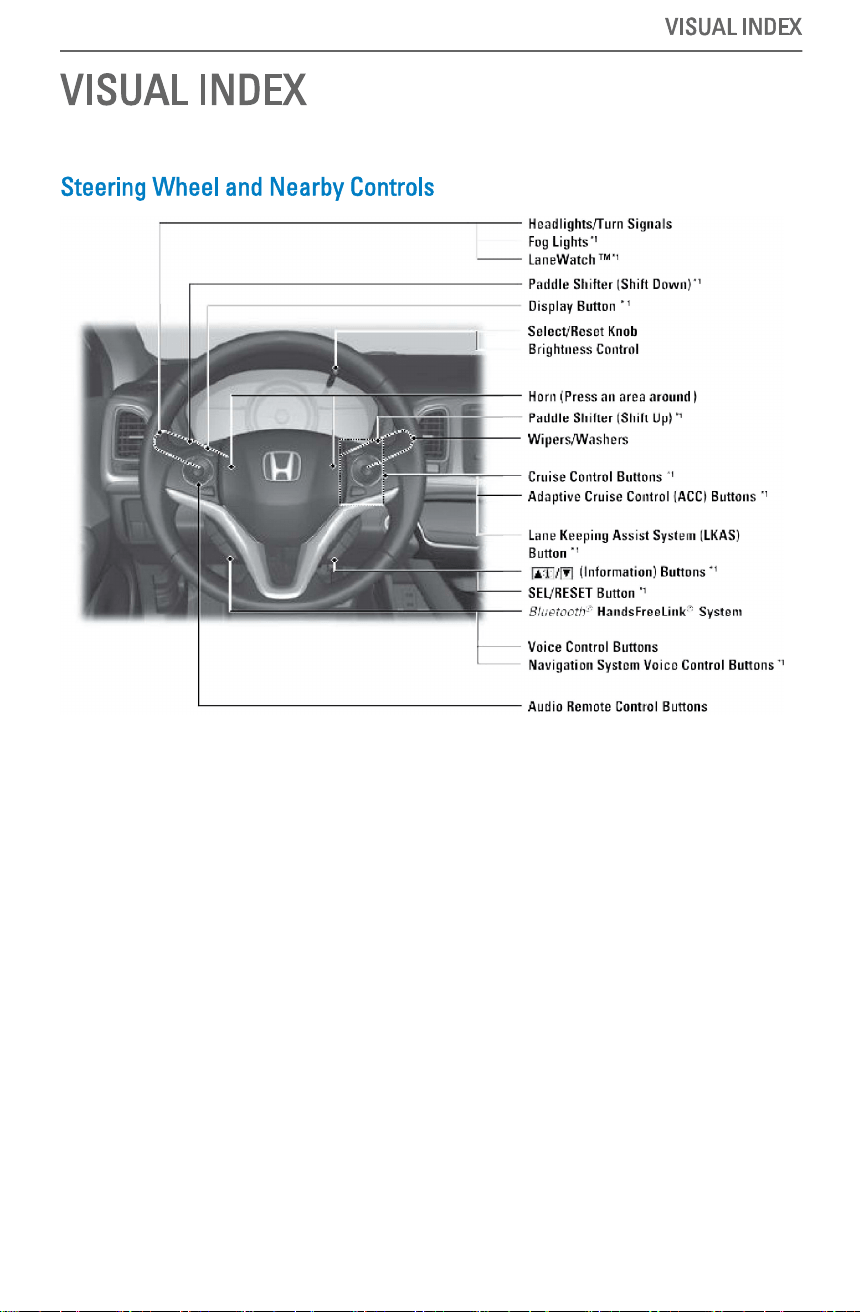
Quickly locate items in the vehicle's interior.
*1 - If equipped
| 1
Shifting................................................ 86
Braking................................................88
Vehicle Stability Assist
®
(VSA
®
)
System............................................ 90
Honda Sensing
®
.................................90
Cruise Control- If equipped..............91
Adaptive Cruise Control (ACC) -
If equipped..................................... 93
Lane Keeping Assist System
(LKAS)- If equipped.......................96
Road Departure Mitigation
(RDM)- If equipped....................... 97
Collision Mitigation Braking
System
™
(CMBS
™
)........................99
LaneWatch
™
- If equipped,.............100
Multi-View Rear Camera................101
Improving Fuel Economy and
Reducing CO
2
Emissions............103
Refueling...........................................103
Smart Entry System Battery
Strength........................................105
Shift Lever Does Not Move............105
Jump Starting...................................106
Overheating......................................107
Emergency Engine Stop ................ 108
Emergency Towing..........................108
Tire Pressure Monitoring System
(TPMS)..........................................109
Changing a Tire................................ 110
Fuse Locations................................. 114
Safety Precautions..........................117
Maintenance Minder
TM
..................118
Under the Hood................................120
Engine Oil.......................................... 122
Engine Coolant.................................124
Checking the Battery...................... 125
Window Washer Fluid.................... 125
Brake Fluid........................................126
Changing Wiper Blades..................126
Tire Information................................128
Tire Labeling..................................... 131
DOT Tire Quality Grading................132
Air Conditioning............................... 134
Testing of Readiness Codes...........134
Frequently Asked Questions/
Troubleshooting...........................138
Contact Us........................................ 139
Warranty Coverages.......................140
EPA Contact Information................140
Voice Portal Commands................. 141
Phone Commands............................141
Audio Commands- If equipped......141
Navigation Commands- Models
with navigation only....................141
Quickly locate items in the vehicle's interior.
*1 - If equipped
| 1
*1 - If equipped
2 |
Your safety--and the safety of others--is very important and operating this
vehicle safely is an important responsibility. While we strive to help you make
informed decisions about safety, it is not practical or possible to warn you about
all the hazards associated with operating or maintaining your vehicle.
Therefore, you must use your own good judgment.
This guide explains many of your vehicle's safety features and how to use them.
Please read this information carefully. Following the instructions below will also
help to keep you and your passengers safe.
• Always wear your seat belt.
• Secure all children in the proper restraint system.
• Be aware of airbag hazards.
• Don't drink and drive.
• Pay appropriate attention to the task of driving safely.
• Control your speed.
• Keep your vehicle in safe condition.
Engaging in cell phone conversation or other activities that keep you from
paying close attention to the road, other vehicles, and pedestrians could
lead to a crash. Remember, situations can change quickly, and only you can
decide when it is safe to divert some attention away from driving.
Your vehicle has higher ground clearance than a passenger vehicle
designed for use only on pavement. Higher ground clearance has many
advantages for off-highway driving. It allows you to travel over bumps,
obstacles, and rough terrain. It also provides good visibility so you can
anticipate problems earlier. These advantages come at some cost. Because
your vehicle is taller and rides higher off the ground, it has a higher center
gravity making it more susceptible to tipping or roll over if you make abrupt
turns. Utility vehicles have a significantly higher rollover rate than other
types of vehicles. In a rollover crash, an unbelted person is significantly
more likely to die than a person wearing a seat belt. As a reminder, make
sure you and your passengers always wear seat belts.
| 3
*1 - If equipped
2 |
Your safety--and the safety of others--is very important and operating this
vehicle safely is an important responsibility. While we strive to help you make
informed decisions about safety, it is not practical or possible to warn you about
all the hazards associated with operating or maintaining your vehicle.
Therefore, you must use your own good judgment.
This guide explains many of your vehicle's safety features and how to use them.
Please read this information carefully. Following the instructions below will also
help to keep you and your passengers safe.
• Always wear your seat belt.
• Secure all children in the proper restraint system.
• Be aware of airbag hazards.
• Don't drink and drive.
• Pay appropriate attention to the task of driving safely.
• Control your speed.
• Keep your vehicle in safe condition.
Engaging in cell phone conversation or other activities that keep you from
paying close attention to the road, other vehicles, and pedestrians could
lead to a crash. Remember, situations can change quickly, and only you can
decide when it is safe to divert some attention away from driving.
Your vehicle has higher ground clearance than a passenger vehicle
designed for use only on pavement. Higher ground clearance has many
advantages for off-highway driving. It allows you to travel over bumps,
obstacles, and rough terrain. It also provides good visibility so you can
anticipate problems earlier. These advantages come at some cost. Because
your vehicle is taller and rides higher off the ground, it has a higher center
gravity making it more susceptible to tipping or roll over if you make abrupt
turns. Utility vehicles have a significantly higher rollover rate than other
types of vehicles. In a rollover crash, an unbelted person is significantly
more likely to die than a person wearing a seat belt. As a reminder, make
sure you and your passengers always wear seat belts.
| 3
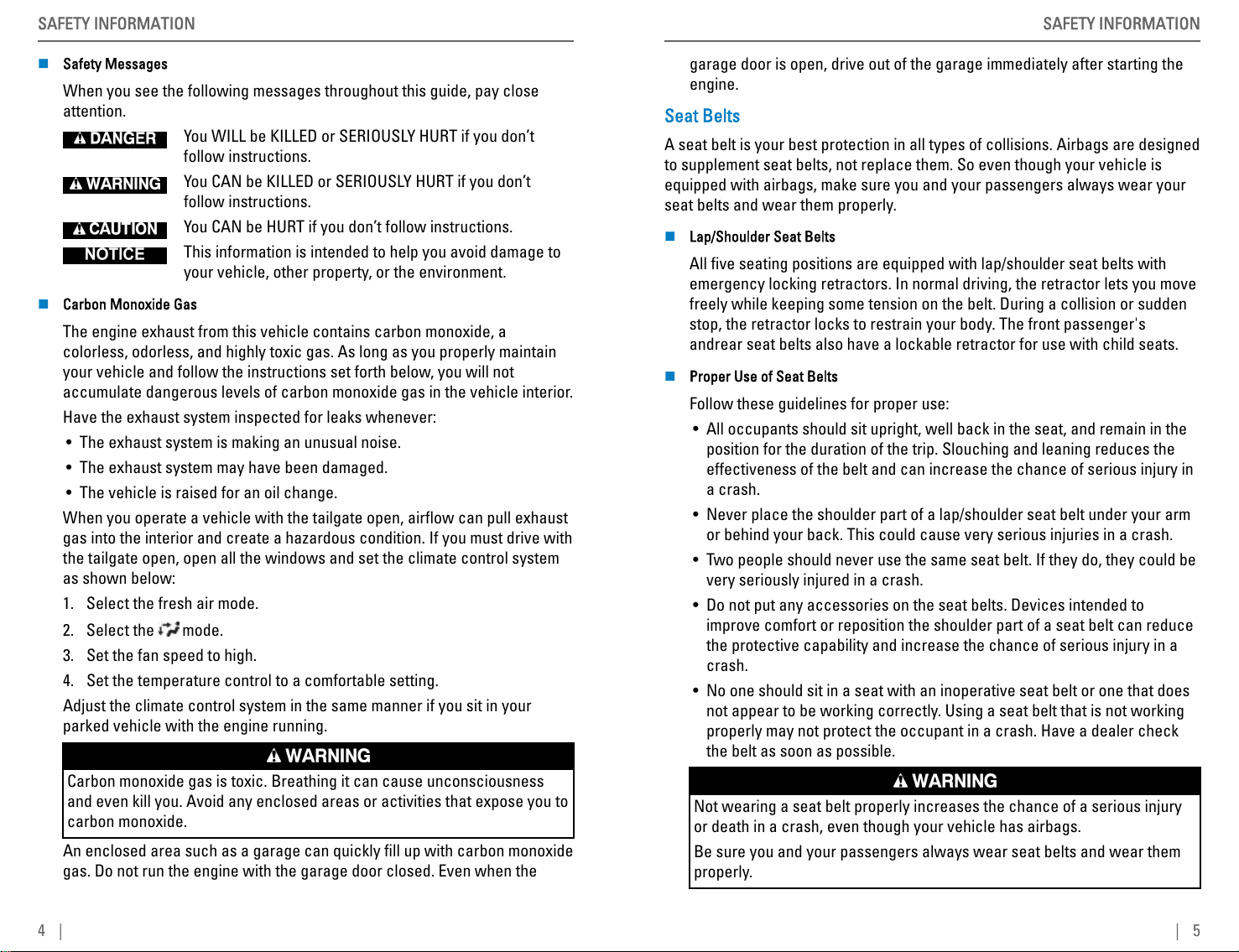
When you see the following messages throughout this guide, pay close
attention.
You WILL be KILLED or SERIOUSLY HURT if you don’t
follow instructions.
You CAN be KILLED or SERIOUSLY HURT if you don’t
follow instructions.
You CAN be HURT if you don’t follow instructions.
This information is intended to help you avoid damage to
your vehicle, other property, or the environment.
The engine exhaust from this vehicle contains carbon monoxide, a
colorless, odorless, and highly toxic gas. As long as you properly maintain
your vehicle and follow the instructions set forth below, you will not
accumulate dangerous levels of carbon monoxide gas in the vehicle interior.
Have the exhaust system inspected for leaks whenever:
• The exhaust system is making an unusual noise.
• The exhaust system may have been damaged.
• The vehicle is raised for an oil change.
When you operate a vehicle with the tailgate open, airflow can pull exhaust
gas into the interior and create a hazardous condition. If you must drive with
the tailgate open, open all the windows and set the climate control system
as shown below:
1. Select the fresh air mode.
2. Select the mode.
3. Set the fan speed to high.
4. Set the temperature control to a comfortable setting.
Adjust the climate control system in the same manner if you sit in your
parked vehicle with the engine running.
Carbon monoxide gas is toxic. Breathing it can cause unconsciousness
and even kill you. Avoid any enclosed areas or activities that expose you to
carbon monoxide.
An enclosed area such as a garage can quickly fill up with carbon monoxide
gas. Do not run the engine with the garage door closed. Even when the
4 |
garage door is open, drive out of the garage immediately after starting the
engine.
A seat belt is your best protection in all types of collisions. Airbags are designed
to supplement seat belts, not replace them. So even though your vehicle is
equipped with airbags, make sure you and your passengers always wear your
seat belts and wear them properly.
All five seating positions are equipped with lap/shoulder seat belts with
emergency locking retractors. In normal driving, the retractor lets you move
freely while keeping some tension on the belt. During a collision or sudden
stop, the retractor locks to restrain your body. The front passenger's
andrear seat belts also have a lockable retractor for use with child seats.
Follow these guidelines for proper use:
• All occupants should sit upright, well back in the seat, and remain in the
position for the duration of the trip. Slouching and leaning reduces the
effectiveness of the belt and can increase the chance of serious injury in
a crash.
• Never place the shoulder part of a lap/shoulder seat belt under your arm
or behind your back. This could cause very serious injuries in a crash.
• Two people should never use the same seat belt. If they do, they could be
very seriously injured in a crash.
• Do not put any accessories on the seat belts. Devices intended to
improve comfort or reposition the shoulder part of a seat belt can reduce
the protective capability and increase the chance of serious injury in a
crash.
• No one should sit in a seat with an inoperative seat belt or one that does
not appear to be working correctly. Using a seat belt that is not working
properly may not protect the occupant in a crash. Have a dealer check
the belt as soon as possible.
Not wearing a seat belt properly increases the chance of a serious injury
or death in a crash, even though your vehicle has airbags.
Be sure you and your passengers always wear seat belts and wear them
properly.
| 5
When you see the following messages throughout this guide, pay close
attention.
You WILL be KILLED or SERIOUSLY HURT if you don’t
follow instructions.
You CAN be KILLED or SERIOUSLY HURT if you don’t
follow instructions.
You CAN be HURT if you don’t follow instructions.
This information is intended to help you avoid damage to
your vehicle, other property, or the environment.
The engine exhaust from this vehicle contains carbon monoxide, a
colorless, odorless, and highly toxic gas. As long as you properly maintain
your vehicle and follow the instructions set forth below, you will not
accumulate dangerous levels of carbon monoxide gas in the vehicle interior.
Have the exhaust system inspected for leaks whenever:
• The exhaust system is making an unusual noise.
• The exhaust system may have been damaged.
• The vehicle is raised for an oil change.
When you operate a vehicle with the tailgate open, airflow can pull exhaust
gas into the interior and create a hazardous condition. If you must drive with
the tailgate open, open all the windows and set the climate control system
as shown below:
1. Select the fresh air mode.
2. Select the mode.
3. Set the fan speed to high.
4. Set the temperature control to a comfortable setting.
Adjust the climate control system in the same manner if you sit in your
parked vehicle with the engine running.
Carbon monoxide gas is toxic. Breathing it can cause unconsciousness
and even kill you. Avoid any enclosed areas or activities that expose you to
carbon monoxide.
An enclosed area such as a garage can quickly fill up with carbon monoxide
gas. Do not run the engine with the garage door closed. Even when the
4 |
garage door is open, drive out of the garage immediately after starting the
engine.
A seat belt is your best protection in all types of collisions. Airbags are designed
to supplement seat belts, not replace them. So even though your vehicle is
equipped with airbags, make sure you and your passengers always wear your
seat belts and wear them properly.
All five seating positions are equipped with lap/shoulder seat belts with
emergency locking retractors. In normal driving, the retractor lets you move
freely while keeping some tension on the belt. During a collision or sudden
stop, the retractor locks to restrain your body. The front passenger's
andrear seat belts also have a lockable retractor for use with child seats.
Follow these guidelines for proper use:
• All occupants should sit upright, well back in the seat, and remain in the
position for the duration of the trip. Slouching and leaning reduces the
effectiveness of the belt and can increase the chance of serious injury in
a crash.
• Never place the shoulder part of a lap/shoulder seat belt under your arm
or behind your back. This could cause very serious injuries in a crash.
• Two people should never use the same seat belt. If they do, they could be
very seriously injured in a crash.
• Do not put any accessories on the seat belts. Devices intended to
improve comfort or reposition the shoulder part of a seat belt can reduce
the protective capability and increase the chance of serious injury in a
crash.
• No one should sit in a seat with an inoperative seat belt or one that does
not appear to be working correctly. Using a seat belt that is not working
properly may not protect the occupant in a crash. Have a dealer check
the belt as soon as possible.
Not wearing a seat belt properly increases the chance of a serious injury
or death in a crash, even though your vehicle has airbags.
Be sure you and your passengers always wear seat belts and wear them
properly.
| 5

Regularly check the condition of your seat belts as follows:
• Pull each belt out fully and look for frays, cuts, burns, and wear.
• Check that the latch plates and buckles work smoothly and the belts
retract easily. If a belt does not retract easily, cleaning the belt may
correct the problem. Only use mild soap and warm water. Do not use
bleach or cleaning solvents. Make sure the belt is completely dry before
allowing it to retract.
Any belt that is not in good condition or working properly will not provide
proper protection and should be replaced as soon as possible.
A belt that has been worn during a crash may not provide the same level of
protection in a subsequent crash. Have your seat belts inspected by a
dealer after any collision.
Not checking or maintaining seat belts can result in serious injury or death
if the seat belts do not work properly when needed.
Check your seat belts regularly and have any problem corrected as soon
as possible.
Adjust your seat to the proper position and then follow the steps below:
1. Pull the seat belt out slowly.
2. Insert the latch plate into the
buckle, then tug on the belt to make
sure the buckle is secure. Make
sure that the belt is not twisted or
caught on anything.
6 |
3. Position the lap part of the belt as
low as possible across your hips,
then pull up on the shoulder part of
the belt so the lap part fits snugly.
This lets your strong pelvic bones
take the force of a crash and
reduces the chance of internal
inquiries.
4. If necessary, pull up on the belt
again to remove any slack, then make sure that the belt rests across the
center of your chest and over your shoulder. This spreads the forces of a
crash over the strongest bones in your upper body.
To release the belt, push the red PRESS button then guide the belt by hand
until it has retracted completely.
Improperly positioning the seat belt can cause serious injury or death in a
crash.
Make sure all seat belts are properly positioned before driving.
The front seats have adjustable shoulder anchors to accommodate taller
and shorter occupants.
1. Move the anchor up and down
while pulling the release outward.
2. Position the anchor so that the belt
rests across the center of your
chest and over your shoulder.
Your vehicle is equipped with several types of airbags: front airbags, side
airbags, and side curtain airbags.
The front SRS airbags inflate in a moderate-to-severe frontal collision to
help protect the head and chest of the driver and/or front passenger. They
are housed in the center of the steering wheel for the driver and in the
dashboard for the front passenger. Both airbags are marked
| 7

Regularly check the condition of your seat belts as follows:
• Pull each belt out fully and look for frays, cuts, burns, and wear.
• Check that the latch plates and buckles work smoothly and the belts
retract easily. If a belt does not retract easily, cleaning the belt may
correct the problem. Only use mild soap and warm water. Do not use
bleach or cleaning solvents. Make sure the belt is completely dry before
allowing it to retract.
Any belt that is not in good condition or working properly will not provide
proper protection and should be replaced as soon as possible.
A belt that has been worn during a crash may not provide the same level of
protection in a subsequent crash. Have your seat belts inspected by a
dealer after any collision.
Not checking or maintaining seat belts can result in serious injury or death
if the seat belts do not work properly when needed.
Check your seat belts regularly and have any problem corrected as soon
as possible.
Adjust your seat to the proper position and then follow the steps below:
1. Pull the seat belt out slowly.
2. Insert the latch plate into the
buckle, then tug on the belt to make
sure the buckle is secure. Make
sure that the belt is not twisted or
caught on anything.
6 |
3. Position the lap part of the belt as
low as possible across your hips,
then pull up on the shoulder part of
the belt so the lap part fits snugly.
This lets your strong pelvic bones
take the force of a crash and
reduces the chance of internal
inquiries.
4. If necessary, pull up on the belt
again to remove any slack, then make sure that the belt rests across the
center of your chest and over your shoulder. This spreads the forces of a
crash over the strongest bones in your upper body.
To release the belt, push the red PRESS button then guide the belt by hand
until it has retracted completely.
Improperly positioning the seat belt can cause serious injury or death in a
crash.
Make sure all seat belts are properly positioned before driving.
The front seats have adjustable shoulder anchors to accommodate taller
and shorter occupants.
1. Move the anchor up and down
while pulling the release outward.
2. Position the anchor so that the belt
rests across the center of your
chest and over your shoulder.
Your vehicle is equipped with several types of airbags: front airbags, side
airbags, and side curtain airbags.
The front SRS airbags inflate in a moderate-to-severe frontal collision to
help protect the head and chest of the driver and/or front passenger. They
are housed in the center of the steering wheel for the driver and in the
dashboard for the front passenger. Both airbags are marked
| 7
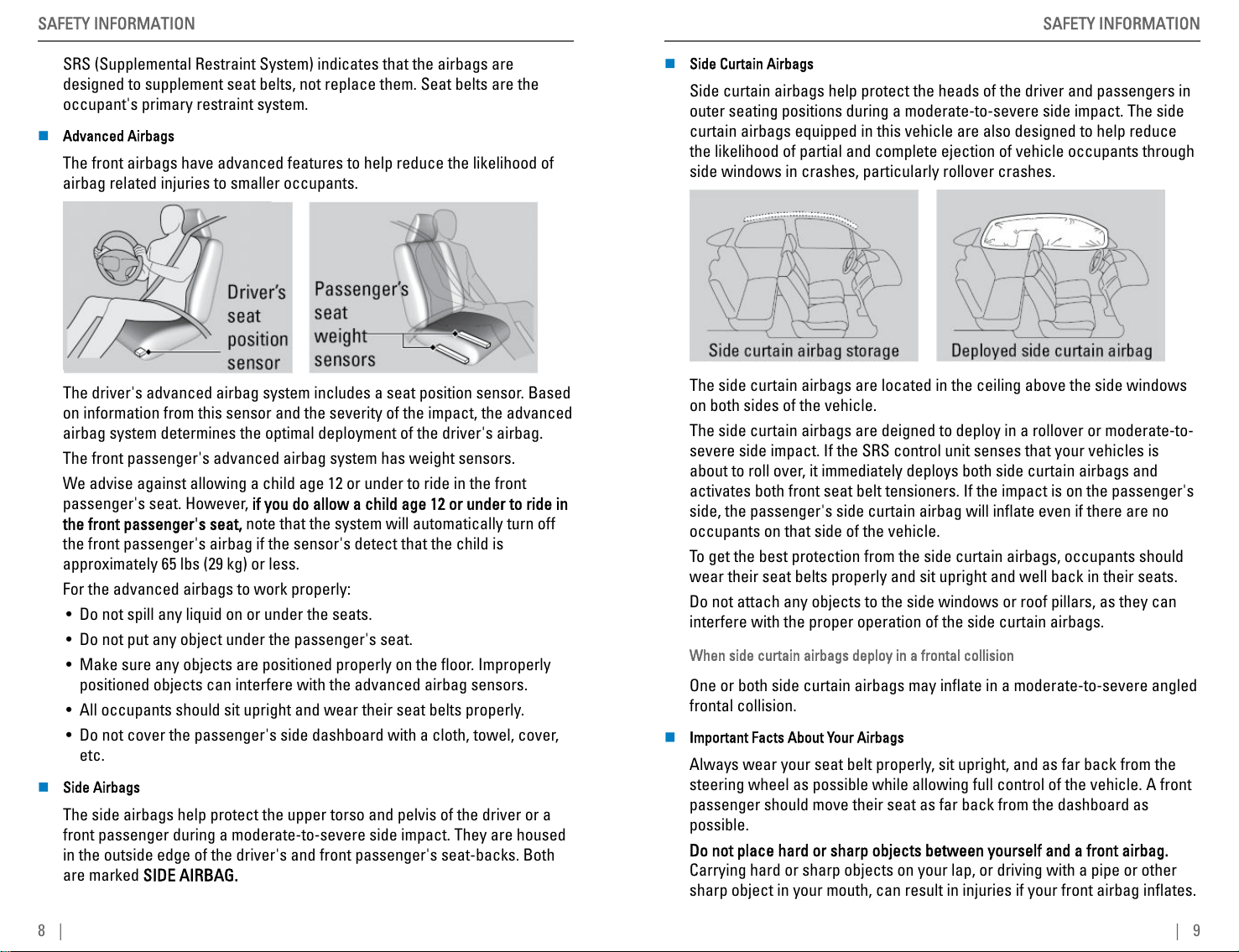
SRS (Supplemental Restraint System) indicates that the airbags are
designed to supplement seat belts, not replace them. Seat belts are the
occupant's primary restraint system.
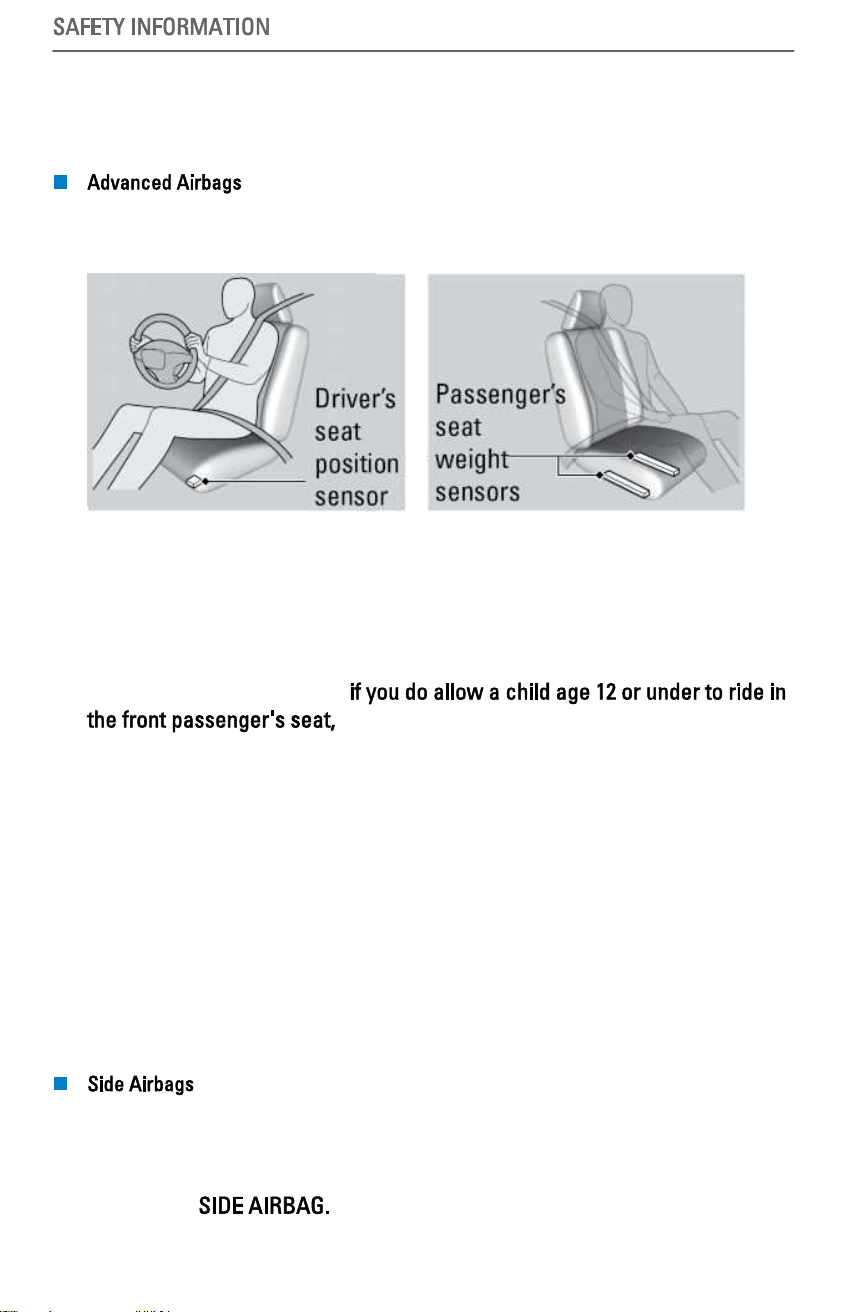
The front airbags have advanced features to help reduce the likelihood of
airbag related injuries to smaller occupants.
The driver's advanced airbag system includes a seat position sensor. Based
on information from this sensor and the severity of the impact, the advanced
airbag system determines the optimal deployment of the driver's airbag.
The front passenger's advanced airbag system has weight sensors.
We advise against allowing a child age 12 or under to ride in the front
passenger's seat. However,
note that the system will automatically turn off
the front passenger's airbag if the sensor's detect that the child is
approximately 65 lbs (29 kg) or less.
For the advanced airbags to work properly:
• Do not spill any liquid on or under the seats.
• Do not put any object under the passenger's seat.
• Make sure any objects are positioned properly on the floor. Improperly
positioned objects can interfere with the advanced airbag sensors.
• All occupants should sit upright and wear their seat belts properly.
• Do not cover the passenger's side dashboard with a cloth, towel, cover,
etc.
The side airbags help protect the upper torso and pelvis of the driver or a
front passenger during a moderate-to-severe side impact. They are housed
in the outside edge of the driver's and front passenger's seat-backs. Both
are marked
8 |
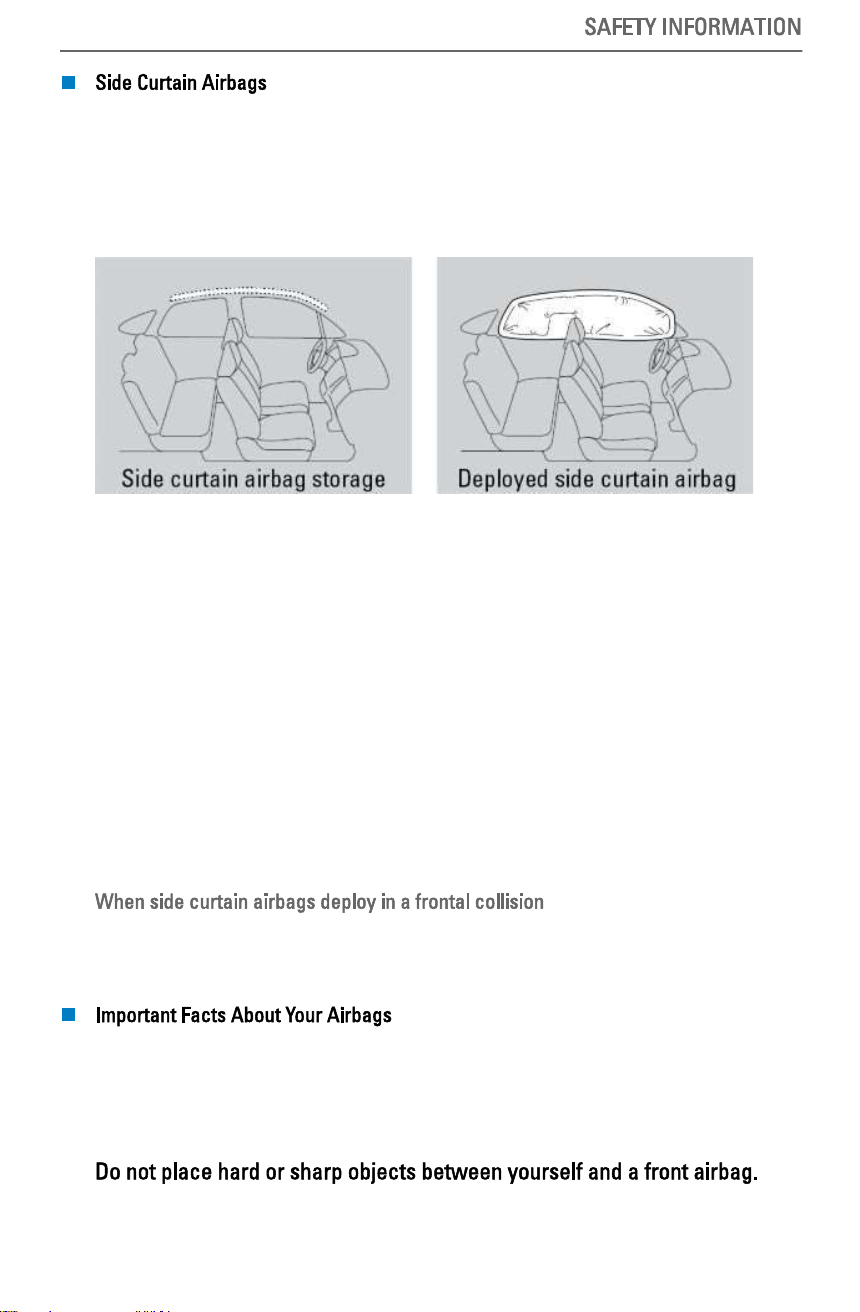
Side curtain airbags help protect the heads of the driver and passengers in
outer seating positions during a moderate-to-severe side impact. The side
curtain airbags equipped in this vehicle are also designed to help reduce
the likelihood of partial and complete ejection of vehicle occupants through
side windows in crashes, particularly rollover crashes.
The side curtain airbags are located in the ceiling above the side windows
on both sides of the vehicle.
The side curtain airbags are deigned to deploy in a rollover or moderate-to-
severe side impact. If the SRS control unit senses that your vehicles is
about to roll over, it immediately deploys both side curtain airbags and
activates both front seat belt tensioners. If the impact is on the passenger's
side, the passenger's side curtain airbag will inflate even if there are no
occupants on that side of the vehicle.
To get the best protection from the side curtain airbags, occupants should
wear their seat belts properly and sit upright and well back in their seats.
Do not attach any objects to the side windows or roof pillars, as they can
interfere with the proper operation of the side curtain airbags.
One or both side curtain airbags may inflate in a moderate-to-severe angled
frontal collision.
Always wear your seat belt properly, sit upright, and as far back from the
steering wheel as possible while allowing full control of the vehicle. A front
passenger should move their seat as far back from the dashboard as
possible.
Carrying hard or sharp objects on your lap, or driving with a pipe or other
sharp object in your mouth, can result in injuries if your front airbag inflates.
| 9
SRS (Supplemental Restraint System) indicates that the airbags are
designed to supplement seat belts, not replace them. Seat belts are the
occupant's primary restraint system.
The front airbags have advanced features to help reduce the likelihood of
airbag related injuries to smaller occupants.
The driver's advanced airbag system includes a seat position sensor. Based
on information from this sensor and the severity of the impact, the advanced
airbag system determines the optimal deployment of the driver's airbag.
The front passenger's advanced airbag system has weight sensors.
We advise against allowing a child age 12 or under to ride in the front
passenger's seat. However,
note that the system will automatically turn off
the front passenger's airbag if the sensor's detect that the child is
approximately 65 lbs (29 kg) or less.
For the advanced airbags to work properly:
• Do not spill any liquid on or under the seats.
• Do not put any object under the passenger's seat.
• Make sure any objects are positioned properly on the floor. Improperly
positioned objects can interfere with the advanced airbag sensors.
• All occupants should sit upright and wear their seat belts properly.
• Do not cover the passenger's side dashboard with a cloth, towel, cover,
etc.
The side airbags help protect the upper torso and pelvis of the driver or a
front passenger during a moderate-to-severe side impact. They are housed
in the outside edge of the driver's and front passenger's seat-backs. Both
are marked
8 |
Side curtain airbags help protect the heads of the driver and passengers in
outer seating positions during a moderate-to-severe side impact. The side
curtain airbags equipped in this vehicle are also designed to help reduce
the likelihood of partial and complete ejection of vehicle occupants through
side windows in crashes, particularly rollover crashes.
The side curtain airbags are located in the ceiling above the side windows
on both sides of the vehicle.
The side curtain airbags are deigned to deploy in a rollover or moderate-to-
severe side impact. If the SRS control unit senses that your vehicles is
about to roll over, it immediately deploys both side curtain airbags and
activates both front seat belt tensioners. If the impact is on the passenger's
side, the passenger's side curtain airbag will inflate even if there are no
occupants on that side of the vehicle.
To get the best protection from the side curtain airbags, occupants should
wear their seat belts properly and sit upright and well back in their seats.
Do not attach any objects to the side windows or roof pillars, as they can
interfere with the proper operation of the side curtain airbags.
One or both side curtain airbags may inflate in a moderate-to-severe angled
frontal collision.
Always wear your seat belt properly, sit upright, and as far back from the
steering wheel as possible while allowing full control of the vehicle. A front
passenger should move their seat as far back from the dashboard as
possible.
Carrying hard or sharp objects on your lap, or driving with a pipe or other
sharp object in your mouth, can result in injuries if your front airbag inflates.
| 9
Objects on the
covers marked could interfere with the proper operation of the
airbags or be propelled inside the vehicle and hurt someone if the airbags
inflate.
They can interfere
with the proper operation of the airbags or hurt someone if an airbag
inflates.
They can
interfere with the proper operation of the side curtain airbags.
This can prevent your
side airbags from properly deploying during a side impact.
An open glove box can cause serious injury to your passenger in a crash,
even if the passenger is wearing the seat belt.
Always keep the glove box closed while driving.
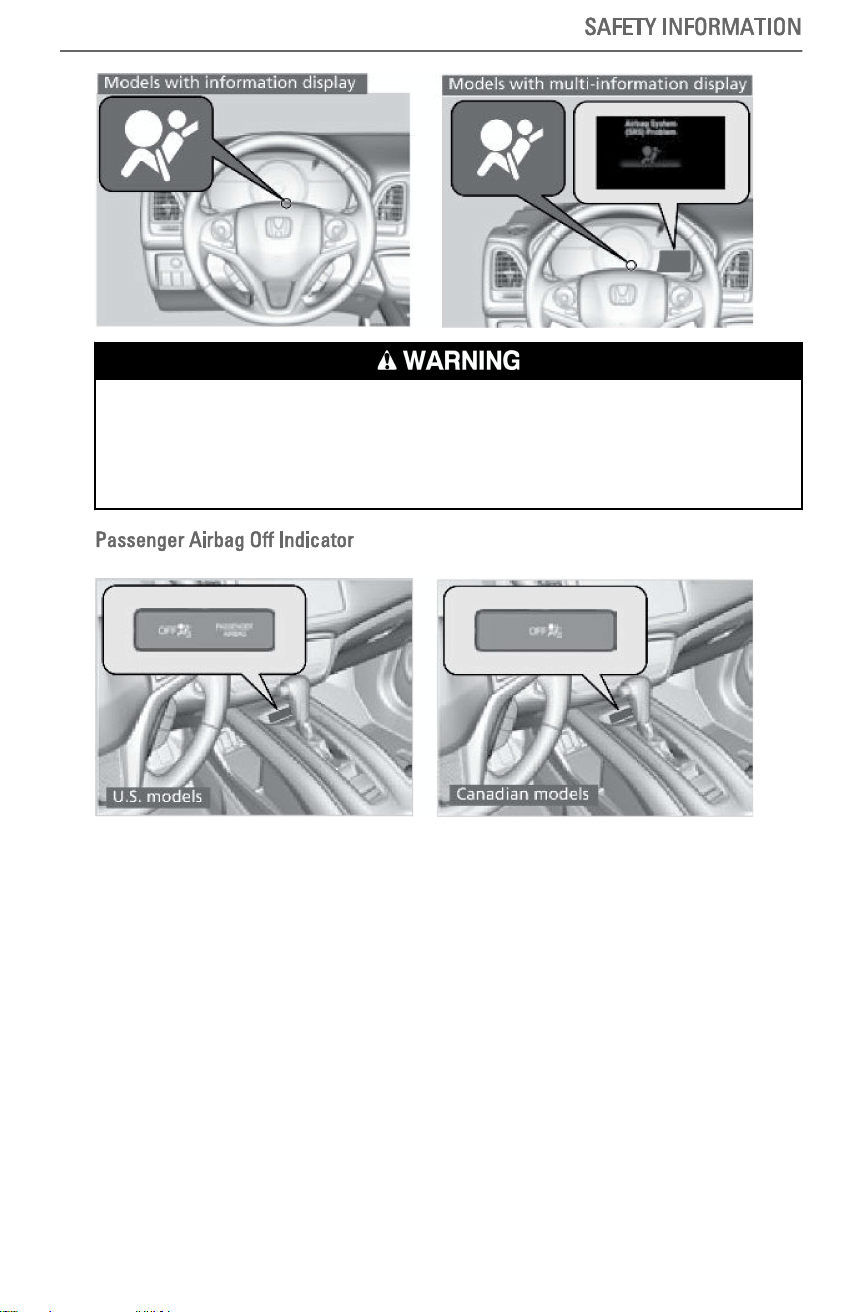
If a problem occurs in the airbag system, the SRS indicator comes on and a
message appears on the Multi-Information Display
*1
.
If the indicator comes on at any other time besides vehicle start-up or does
not come on at all, have the system checked by a dealer as soon as
possible. If you don't, your airbags and seat belt tensioners may not work
properly when they are needed.
*1 - If equipped
10 |
Ignoring the SRS indicator can result in serious injury or death if the airbag
systems or tensioners do not work properly.
Have your vehicle checked by a dealer as soon as possible if the SRS
indicator alerts you to a possible problem.
The indicator comes on to alert you that the front passenger’s front airbag
has been turned off. This occurs when the front passenger’s weight sensors
detect 65 lbs (29 kg) or less, the weight of an infant or small child, on the
seat.
Children age 12 or under should always ride properly restrained in a back
seat.
Objects placed on the seat can also cause the indicator to come on.
If the front passenger‘s seat is empty, the indicator will not come on and, in
the event of a crash, the front passenger's airbag will not deploy.
If the indicator comes on with no occupant or objects in the front
passenger’s seat, something may be interfering with the weight sensors,
such as:
• An object hanging on the seat or in the seat-back pocket.
| 11
Objects on the
covers marked could interfere with the proper operation of the
airbags or be propelled inside the vehicle and hurt someone if the airbags
inflate.
They can interfere
with the proper operation of the airbags or hurt someone if an airbag
inflates.
They can
interfere with the proper operation of the side curtain airbags.
This can prevent your
side airbags from properly deploying during a side impact.
An open glove box can cause serious injury to your passenger in a crash,
even if the passenger is wearing the seat belt.
Always keep the glove box closed while driving.
If a problem occurs in the airbag system, the SRS indicator comes on and a
message appears on the Multi-Information Display
*1
.
If the indicator comes on at any other time besides vehicle start-up or does
not come on at all, have the system checked by a dealer as soon as
possible. If you don't, your airbags and seat belt tensioners may not work
properly when they are needed.
*1 - If equipped
10 |
Ignoring the SRS indicator can result in serious injury or death if the airbag
systems or tensioners do not work properly.
Have your vehicle checked by a dealer as soon as possible if the SRS
indicator alerts you to a possible problem.
The indicator comes on to alert you that the front passenger’s front airbag
has been turned off. This occurs when the front passenger’s weight sensors
detect 65 lbs (29 kg) or less, the weight of an infant or small child, on the
seat.
Children age 12 or under should always ride properly restrained in a back
seat.
Objects placed on the seat can also cause the indicator to come on.
If the front passenger‘s seat is empty, the indicator will not come on and, in
the event of a crash, the front passenger's airbag will not deploy.
If the indicator comes on with no occupant or objects in the front
passenger’s seat, something may be interfering with the weight sensors,
such as:
• An object hanging on the seat or in the seat-back pocket.
| 11
• A child seat or other object pressing against the rear of the seat-back.
• A rear passenger pushing or pulling on the back of the front passenger’s
seat.
• The front seat or seat-back is forced against an object on the seat or floor
behind it.
• An object placed under the front passenger’s seat.
If none of these conditions exist, have your vehicle checked by a dealer as
soon as possible.
The passenger airbag off indicator may come on and go off repeatedly if the
total weight on the seat is near the airbag cutoff threshold.
1. Two SRS (Supplemental Restraint System) front airbags. The driver’s
airbag is stored in the center of the steering wheel; the front passenger’s
airbag is stored in the dashboard. Both are marked .
2. Two side airbags, one for the driver and one for a front passenger. The
airbags are stored in the outer edges of the seat-backs. Both are marked
.
3. Two side curtain airbags, one for each side of the vehicle. The airbags
are stored in the ceiling, above the side windows. The front and rear
pillars are marked .
12 |
4. An electronic control unit that, when the vehicle is on, continually
monitors information about the various impact sensors, seat and buckle
sensors, rollover sensor, airbag activators, seat belt tensioners, and
other vehicle information. During a crash event the unit can record such
information.
5. Automatic front seat belt tensioners. The driver’s and front passenger’s
seat belt buckles incorporate sensors that detect whether or not the
belts are fastened.
6. A driver’s seat position sensor. This sensor determines the optimal force
at which the airbag will deploy in a crash.
7. Weight sensors in the front passenger’s seat. The front passenger’s
airbag will be turned off if the weight on the seat is about 65 lbs (29 kg)
or less (the weight of an infant or small child).
8. Impact sensors that can detect a moderate-to-severe front or side
impact.
9. An indicator on the dashboard that alerts you that the front passenger’s
front airbag has been turned off.
10. An indicator on the instrument panel that alerts you to a possible
problem with the airbag system or seat belt tensioners.
11. Safing sensor.
12. A rollover sensor that can detect if your vehicle is about to roll over and
signal the control unit to deploy both side curtain airbags.
You do not need to, and should not, perform any maintenance on or replace
any airbag system components yourself. However, you should have your
vehicle inspected by a dealer in the following situations:
If an airbag has inflated, the control unit and other related parts must be
replaced. Similarly, once an automatic seat belt tensioner has been
activated, it must be replaced.
Even if the airbags did not inflate, have your dealer inspect the following:
the driver’s seat position sensor, weight sensors in the passenger’s seat,
front seat belt tensioners, and each seat belt that was worn during the
crash.
| 13
• A child seat or other object pressing against the rear of the seat-back.
• A rear passenger pushing or pulling on the back of the front passenger’s
seat.
• The front seat or seat-back is forced against an object on the seat or floor
behind it.
• An object placed under the front passenger’s seat.
If none of these conditions exist, have your vehicle checked by a dealer as
soon as possible.
The passenger airbag off indicator may come on and go off repeatedly if the
total weight on the seat is near the airbag cutoff threshold.
1. Two SRS (Supplemental Restraint System) front airbags. The driver’s
airbag is stored in the center of the steering wheel; the front passenger’s
airbag is stored in the dashboard. Both are marked .
2. Two side airbags, one for the driver and one for a front passenger. The
airbags are stored in the outer edges of the seat-backs. Both are marked
.
3. Two side curtain airbags, one for each side of the vehicle. The airbags
are stored in the ceiling, above the side windows. The front and rear
pillars are marked .
12 |
4. An electronic control unit that, when the vehicle is on, continually
monitors information about the various impact sensors, seat and buckle
sensors, rollover sensor, airbag activators, seat belt tensioners, and
other vehicle information. During a crash event the unit can record such
information.
5. Automatic front seat belt tensioners. The driver’s and front passenger’s
seat belt buckles incorporate sensors that detect whether or not the
belts are fastened.
6. A driver’s seat position sensor. This sensor determines the optimal force
at which the airbag will deploy in a crash.
7. Weight sensors in the front passenger’s seat. The front passenger’s
airbag will be turned off if the weight on the seat is about 65 lbs (29 kg)
or less (the weight of an infant or small child).
8. Impact sensors that can detect a moderate-to-severe front or side
impact.
9. An indicator on the dashboard that alerts you that the front passenger’s
front airbag has been turned off.
10. An indicator on the instrument panel that alerts you to a possible
problem with the airbag system or seat belt tensioners.
11. Safing sensor.
12. A rollover sensor that can detect if your vehicle is about to roll over and
signal the control unit to deploy both side curtain airbags.
You do not need to, and should not, perform any maintenance on or replace
any airbag system components yourself. However, you should have your
vehicle inspected by a dealer in the following situations:
If an airbag has inflated, the control unit and other related parts must be
replaced. Similarly, once an automatic seat belt tensioner has been
activated, it must be replaced.
Even if the airbags did not inflate, have your dealer inspect the following:
the driver’s seat position sensor, weight sensors in the passenger’s seat,
front seat belt tensioners, and each seat belt that was worn during the
crash.
| 13
This would likely disable or affect the driver’s seat position sensor or the
weight sensors in the passenger’s seat. If it is necessary to remove or
modify a front seat to accommodate a person with disabilities, contact a
Honda dealer. For U.S. vehicles, call Honda Automobile Customer Service at
(800) 999-1009. For Canadian vehicles, call Honda Canada Customer
Relations at (888) 946-6329.
Each year, many children are injured or killed in vehicle crashes because they
are either unrestrained or not properly restrained. In fact, vehicle collisions are
the number one cause of death of children ages 12 and under.
The National Highway Traffic Safety Administration and Transport Canada
recommend that all children ages 12 and under be properly restrained in a rear
seat. Some states or provinces/territories have laws restricting where children
may ride.
To reduce the number of child deaths and injuries, every state, Canadian
province, and territory requires that infants and children be properly restrained
when they ride in a vehicle.
• An inflating front or side airbag can injure or kill a child sitting in the front
seat.
• A child in the front seat is more likely to interfere with the driver's ability
to safely control the vehicle.
• Statistics show that children of all sizes and ages are safer when they are
properly restrained in a rear seat.
• Any child who is too small to wear a seat belt correctly must be
restrained in an approved child seat that is properly secured to the
vehicle using either the lap belt portion of the lap/shoulder belt or the
lower anchors of the LATCH system.
• Never hold a child on your lap because it is impossible to protect them in
the event of a collision.
• Never put a seat belt over yourself and a child. During a crash, the belt
would likely press deep into the child and cause serious or fatal injuries.
• Never let two children use the same seat belt. Both children could be
very seriously injured in a crash.
• Do not allow children to operate the doors, windows, or seat adjustments.
14 |
• Do not leave children, pets or people needing assistance in the vehicle
unattended, especially in hot weather when the inside of the vehicle can
get hot enough to kill them. They could also activate vehicle controls,
causing it to move unexpectedly.
Children who are unrestrained or improperly restrained can be seriously
injured or killed in a crash.
Any child too small for a seat belt should be properly restrained in a child
seat. A larger child should be properly restrained with a seat belt, using a
booster seat if necessary.
Allowing a child to play with a seat belt or wrap one around their neck can
result in serious injury or death.
Instruct children not to play with any seat belt and make sure any unused
seat belt a child can reach is buckled, fully retracted, and locked.
An infant must be properly restrained in a rear-facing, reclining child seat
until the infant reaches the seat maker’s weight or height limit for the seat,
and the infant is at least one year old. Many experts recommend use of a
rear-facing seat for a child up to two years old if the child’s height and
weight are appropriate for a rear-facing seat.
Child seats must be placed and secured in a rear seating position. Rear-
facing child seats should never be installed in a forward-facing position.
When properly installed, a rear-facing child seat may prevent the driver or a
front passenger from moving their seat all the way back, or from locking
their seat-back in the desired position.
Make sure that there is no contact
between the child seat and the seat in
front of it. It can also interfere with
proper operation of the front
passenger’s advanced front airbag
system. If this occurs, we recommend
that you install the child seat directly
behind the front passenger’s seat, move
the seat as far forward as needed, and
| 15
This would likely disable or affect the driver’s seat position sensor or the
weight sensors in the passenger’s seat. If it is necessary to remove or
modify a front seat to accommodate a person with disabilities, contact a
Honda dealer. For U.S. vehicles, call Honda Automobile Customer Service at
(800) 999-1009. For Canadian vehicles, call Honda Canada Customer
Relations at (888) 946-6329.
Each year, many children are injured or killed in vehicle crashes because they
are either unrestrained or not properly restrained. In fact, vehicle collisions are
the number one cause of death of children ages 12 and under.
The National Highway Traffic Safety Administration and Transport Canada
recommend that all children ages 12 and under be properly restrained in a rear
seat. Some states or provinces/territories have laws restricting where children
may ride.
To reduce the number of child deaths and injuries, every state, Canadian
province, and territory requires that infants and children be properly restrained
when they ride in a vehicle.
• An inflating front or side airbag can injure or kill a child sitting in the front
seat.
• A child in the front seat is more likely to interfere with the driver's ability
to safely control the vehicle.
• Statistics show that children of all sizes and ages are safer when they are
properly restrained in a rear seat.
• Any child who is too small to wear a seat belt correctly must be
restrained in an approved child seat that is properly secured to the
vehicle using either the lap belt portion of the lap/shoulder belt or the
lower anchors of the LATCH system.
• Never hold a child on your lap because it is impossible to protect them in
the event of a collision.
• Never put a seat belt over yourself and a child. During a crash, the belt
would likely press deep into the child and cause serious or fatal injuries.
• Never let two children use the same seat belt. Both children could be
very seriously injured in a crash.
• Do not allow children to operate the doors, windows, or seat adjustments.
14 |
• Do not leave children, pets or people needing assistance in the vehicle
unattended, especially in hot weather when the inside of the vehicle can
get hot enough to kill them. They could also activate vehicle controls,
causing it to move unexpectedly.
Children who are unrestrained or improperly restrained can be seriously
injured or killed in a crash.
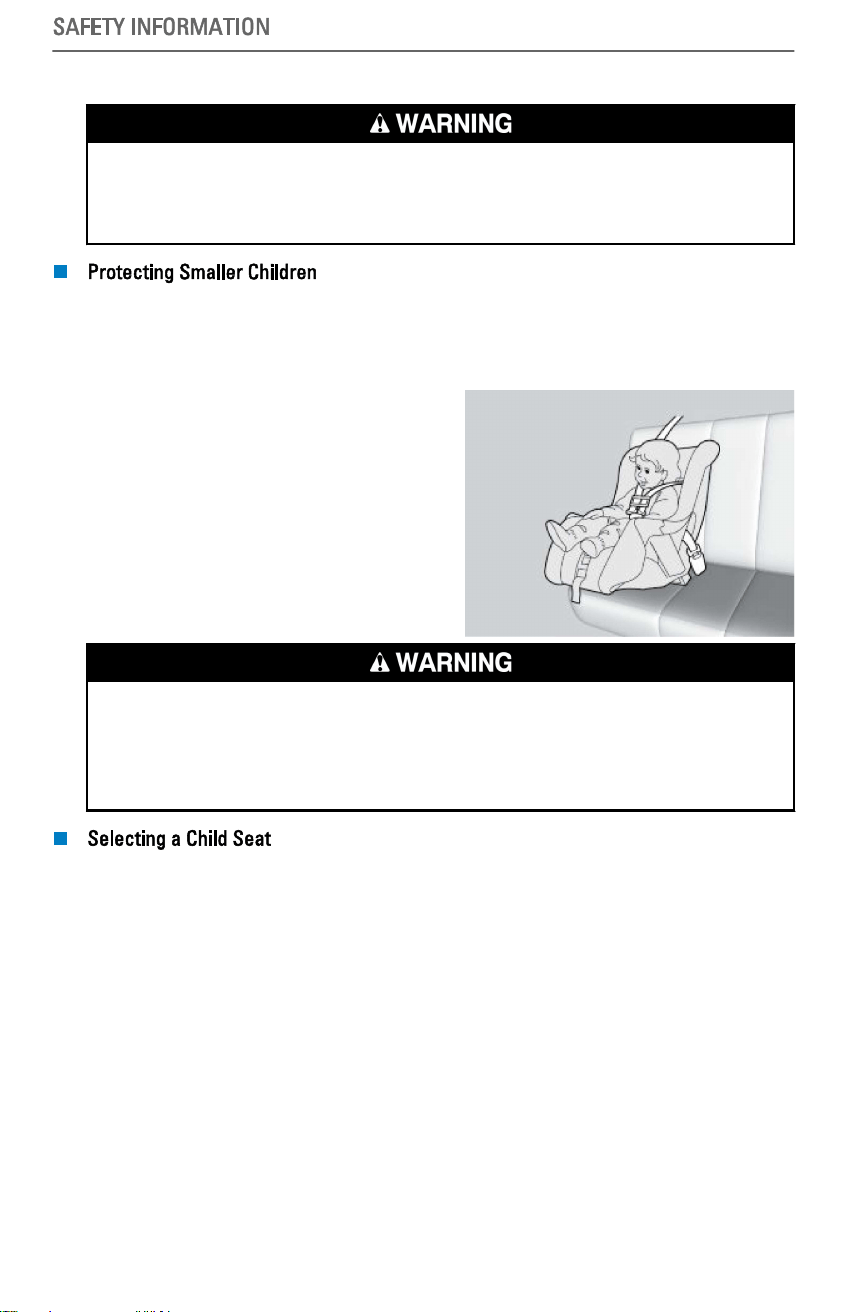
Any child too small for a seat belt should be properly restrained in a child
seat. A larger child should be properly restrained with a seat belt, using a
booster seat if necessary.
Allowing a child to play with a seat belt or wrap one around their neck can
result in serious injury or death.
Instruct children not to play with any seat belt and make sure any unused
seat belt a child can reach is buckled, fully retracted, and locked.
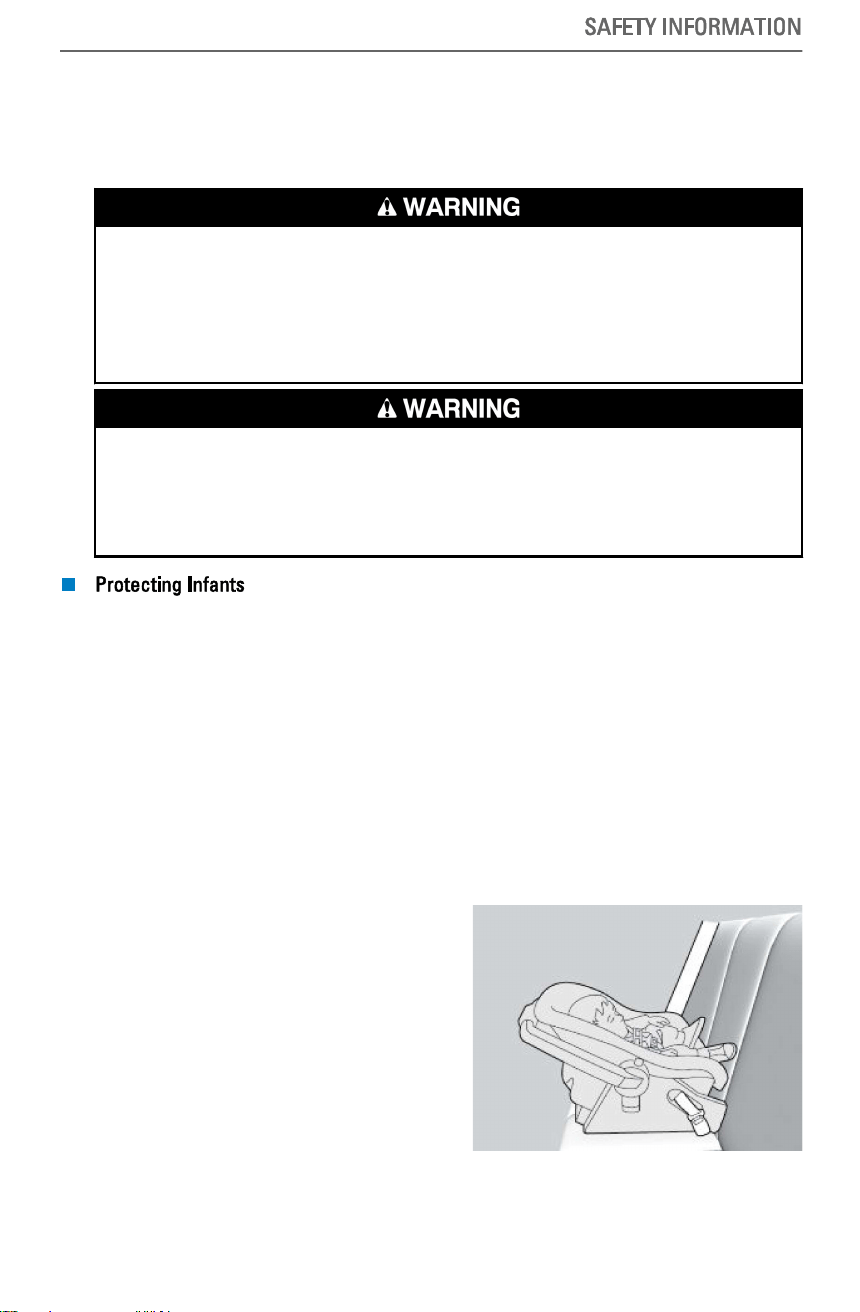
An infant must be properly restrained in a rear-facing, reclining child seat
until the infant reaches the seat maker’s weight or height limit for the seat,
and the infant is at least one year old. Many experts recommend use of a
rear-facing seat for a child up to two years old if the child’s height and
weight are appropriate for a rear-facing seat.
Child seats must be placed and secured in a rear seating position. Rear-
facing child seats should never be installed in a forward-facing position.
When properly installed, a rear-facing child seat may prevent the driver or a
front passenger from moving their seat all the way back, or from locking
their seat-back in the desired position.
Make sure that there is no contact
between the child seat and the seat in
front of it. It can also interfere with
proper operation of the front
passenger’s advanced front airbag
system. If this occurs, we recommend
that you install the child seat directly
behind the front passenger’s seat, move
the seat as far forward as needed, and
| 15
leave it unoccupied. Or, you may wish to get a smaller rear-facing child seat.
Placing a rear-facing child seat in the front seat can result in serious injury
or death during a crash.
Always place a rear-facing child seat in the rear seat, not the front.
If a child is at least one year old and within the weight range indicated by
the child seat manufacturer, the child should be properly restrained in a
firmly secured forward-facing child seat.
We strongly recommend placing a
forward-facing child seat in a rear
seating position. Placing a forward-
facing child seat in the front seat can
be hazardous, even with advanced
front airbags that automatically turn the
passenger’s front airbag off. A rear seat
is the safest place for a child.
Placing a forward-facing child seat in the front seat can result in serious
injury or death if the front airbag inflates.
If you must place a forward-facing child seat in front, move the vehicle
seat as far back as possible, and properly restrain the child.
Most child seats are LATCH-compatible (Lower Anchors and Tethers for
CHildren). Some have a rigid-type connector, while others have a flexible-
type connector. Both are equally easy to use. Some existing and previously
owned child seats can only be installed using the seat belt. Whichever type
you choose, follow the child seat manufacturer’s use and care instructions
as well as the instructions in this guide. Proper installation is key to
maximizing your child’s safety.
In seating positions and vehicles not equipped with LATCH, a LATCH
compatible child seat can be installed using the seat belt and a top tether
for added security. This is because all child seats are required to be
designed so that they can be secured with a lap belt or the lap part of a lap/
shoulder belt. In addition, the child seat manufacturer may advise that a
seat belt be used to attach a LATCH-compatible seat once a child reaches a
16 |
specified weight. Please read the child seat owner’s manual for proper
installation instructions.
Make sure the child seat meets the following three requirements:
• The child seat is the correct type and size for the child.
• The child seat is the correct type for the seating position.
• The child seat is compliant with Federal Motor Vehicle Safety Standard
213 or Canadian Motor Vehicle Safety Standard 213.
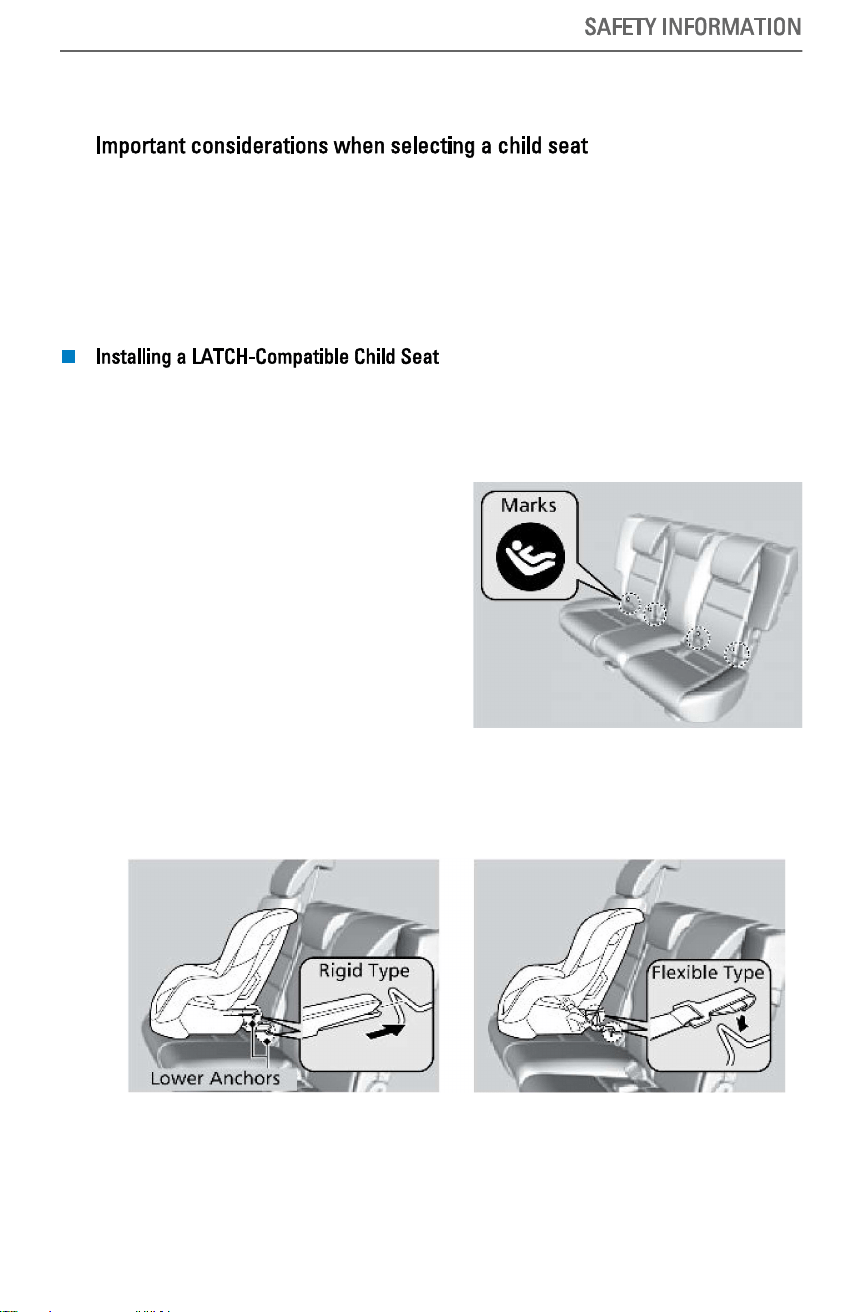
A LATCH-compatible child seat can be installed in either of the two outer
rear seats. A child seat is attached to the lower anchors with either the rigid
or flexible type of connectors.
1. Locate the anchor marks affixed to
the base of the seat cushion.
2. Pull out the anchor covers under the
marks to expose the lower anchors.
Raise the head restraint to its
highest position.
3. Place the child seat on the vehicle
seat, then attach the child seat to
the lower anchors according to the
instructions that came with the child seat. Make sure that the lower
anchors are not obstructed by the seat belt or any other object.
If necessary, remove the cargo area cover
*1
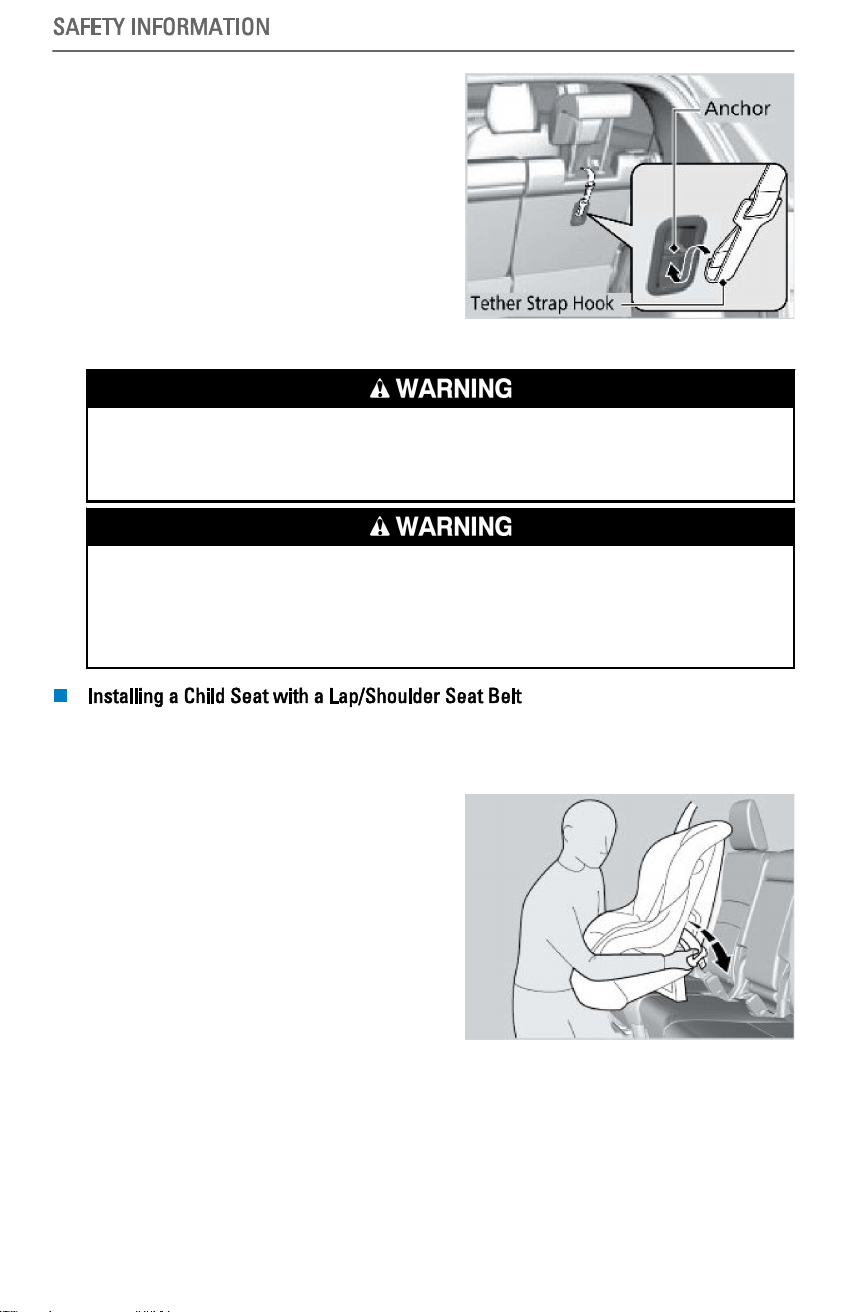
4. Route the tether strap between the head restraint legs, and secure the
tether strap hook to the anchor.
| 17
leave it unoccupied. Or, you may wish to get a smaller rear-facing child seat.
Placing a rear-facing child seat in the front seat can result in serious injury
or death during a crash.
Always place a rear-facing child seat in the rear seat, not the front.
If a child is at least one year old and within the weight range indicated by
the child seat manufacturer, the child should be properly restrained in a
firmly secured forward-facing child seat.
We strongly recommend placing a
forward-facing child seat in a rear
seating position. Placing a forward-
facing child seat in the front seat can
be hazardous, even with advanced
front airbags that automatically turn the
passenger’s front airbag off. A rear seat
is the safest place for a child.
Placing a forward-facing child seat in the front seat can result in serious
injury or death if the front airbag inflates.
If you must place a forward-facing child seat in front, move the vehicle
seat as far back as possible, and properly restrain the child.
Most child seats are LATCH-compatible (Lower Anchors and Tethers for
CHildren). Some have a rigid-type connector, while others have a flexible-
type connector. Both are equally easy to use. Some existing and previously
owned child seats can only be installed using the seat belt. Whichever type
you choose, follow the child seat manufacturer’s use and care instructions
as well as the instructions in this guide. Proper installation is key to
maximizing your child’s safety.
In seating positions and vehicles not equipped with LATCH, a LATCH
compatible child seat can be installed using the seat belt and a top tether
for added security. This is because all child seats are required to be
designed so that they can be secured with a lap belt or the lap part of a lap/
shoulder belt. In addition, the child seat manufacturer may advise that a
seat belt be used to attach a LATCH-compatible seat once a child reaches a
16 |
specified weight. Please read the child seat owner’s manual for proper
installation instructions.
Make sure the child seat meets the following three requirements:
• The child seat is the correct type and size for the child.
• The child seat is the correct type for the seating position.
• The child seat is compliant with Federal Motor Vehicle Safety Standard
213 or Canadian Motor Vehicle Safety Standard 213.
A LATCH-compatible child seat can be installed in either of the two outer
rear seats. A child seat is attached to the lower anchors with either the rigid
or flexible type of connectors.
1. Locate the anchor marks affixed to
the base of the seat cushion.
2. Pull out the anchor covers under the
marks to expose the lower anchors.
Raise the head restraint to its
highest position.
3. Place the child seat on the vehicle
seat, then attach the child seat to
the lower anchors according to the
instructions that came with the child seat. Make sure that the lower
anchors are not obstructed by the seat belt or any other object.
If necessary, remove the cargo area cover
*1
4. Route the tether strap between the head restraint legs, and secure the
tether strap hook to the anchor.
| 17
5. Tighten the tether strap as
instructed by the child seat
manufacturer.
6. Make sure the child seat is firmly
secured by rocking it forward and
back and side to side; little
movement should be felt.
7. Make sure any unused seat belt that
a child can reach is buckled, the
lockable retractor is activated, and the belt is fully retracted and locked.
Never attach two child seats to the same anchor. In a collision, one anchor
may not be strong enough to hold two child seats attachments and may
break, causing serious injury or death.
Do not use the lower inner anchors of the outer rear seats to secure a
LATCH-compatible child seat to the rear center seat, unless the
manufacturer's instructions for that system permit the use of inner
anchors with the stated spacing.
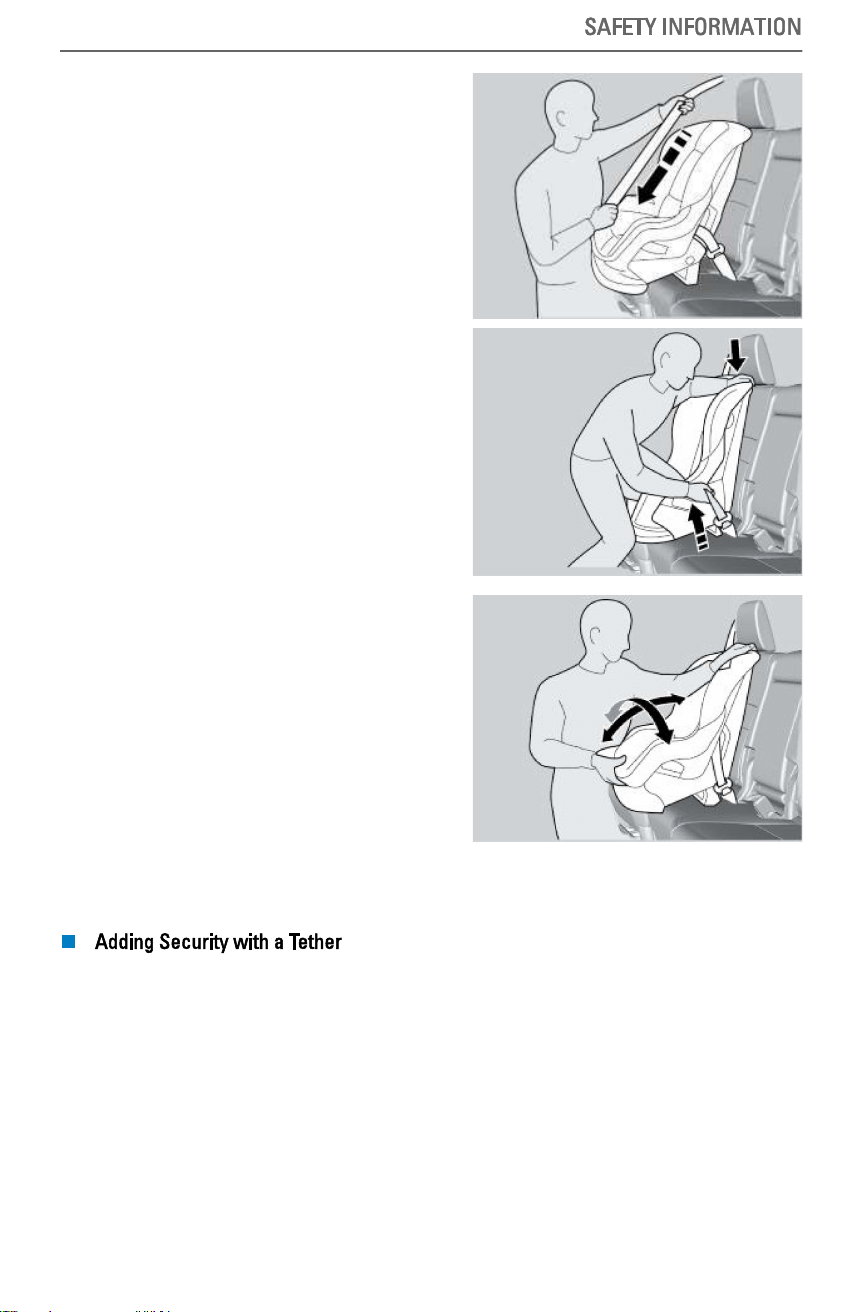
A child seat can be installed with a lap/shoulder belt in any rear seat or, if
absolutely necessary, the front passenger seat.
1. Place the child seat on the vehicle
seat.
2. Route the seat belt through the child
seat according to the seat
manufacturer’s instructions, and
insert the latch plate into the buckle.
Insert the latch plate fully until it
clicks.
18 |
3. Slowly pull the shoulder part of the
belt all the way out until it stops.
This activates the lockable
retractor.
4. Let the seat belt completely wind up
into the retractor, then try to pull it
out to make sure the retractor is
locked. If you are able to pull the
shoulder belt out, the lockable
retractor is not activated. Pull the
seat belt all the way out, and repeat
steps 3 – 4.
5. Grab the shoulder part of the seat
belt near the buckle, and pull up to
remove any slack from the lap part
of the belt. When doing this, place
your weight on the child seat and
push it into the vehicle seat.
6. Make sure the child seat is firmly
secured by rocking it forward and
back and side to side; less than one
inch of movement should occur
near the seat belt.
7. Make sure any unused seat belt that
a child can reach is buckled, the
lockable retractor is activated, and
the belt is fully retracted and locked.
To deactivate a lockable retractor, release the buckle and allow the seat
belt to wind up all the way.
A tether anchorage point is provided behind each rear seating position. If
you have a child restraint system that comes with a tether but can be
installed with a seat belt, the tether may be used for additional security.
| 19
5. Tighten the tether strap as
instructed by the child seat
manufacturer.
6. Make sure the child seat is firmly
secured by rocking it forward and
back and side to side; little
movement should be felt.
7. Make sure any unused seat belt that
a child can reach is buckled, the
lockable retractor is activated, and the belt is fully retracted and locked.
Never attach two child seats to the same anchor. In a collision, one anchor
may not be strong enough to hold two child seats attachments and may
break, causing serious injury or death.
Do not use the lower inner anchors of the outer rear seats to secure a
LATCH-compatible child seat to the rear center seat, unless the
manufacturer's instructions for that system permit the use of inner
anchors with the stated spacing.
A child seat can be installed with a lap/shoulder belt in any rear seat or, if
absolutely necessary, the front passenger seat.
1. Place the child seat on the vehicle
seat.
2. Route the seat belt through the child
seat according to the seat
manufacturer’s instructions, and
insert the latch plate into the buckle.
Insert the latch plate fully until it
clicks.
18 |
3. Slowly pull the shoulder part of the
belt all the way out until it stops.
This activates the lockable
retractor.
4. Let the seat belt completely wind up
into the retractor, then try to pull it
out to make sure the retractor is
locked. If you are able to pull the
shoulder belt out, the lockable
retractor is not activated. Pull the
seat belt all the way out, and repeat
steps 3 – 4.
5. Grab the shoulder part of the seat
belt near the buckle, and pull up to
remove any slack from the lap part
of the belt. When doing this, place
your weight on the child seat and
push it into the vehicle seat.
6. Make sure the child seat is firmly
secured by rocking it forward and
back and side to side; less than one
inch of movement should occur
near the seat belt.
7. Make sure any unused seat belt that
a child can reach is buckled, the
lockable retractor is activated, and
the belt is fully retracted and locked.
To deactivate a lockable retractor, release the buckle and allow the seat
belt to wind up all the way.
A tether anchorage point is provided behind each rear seating position. If
you have a child restraint system that comes with a tether but can be
installed with a seat belt, the tether may be used for additional security.
| 19
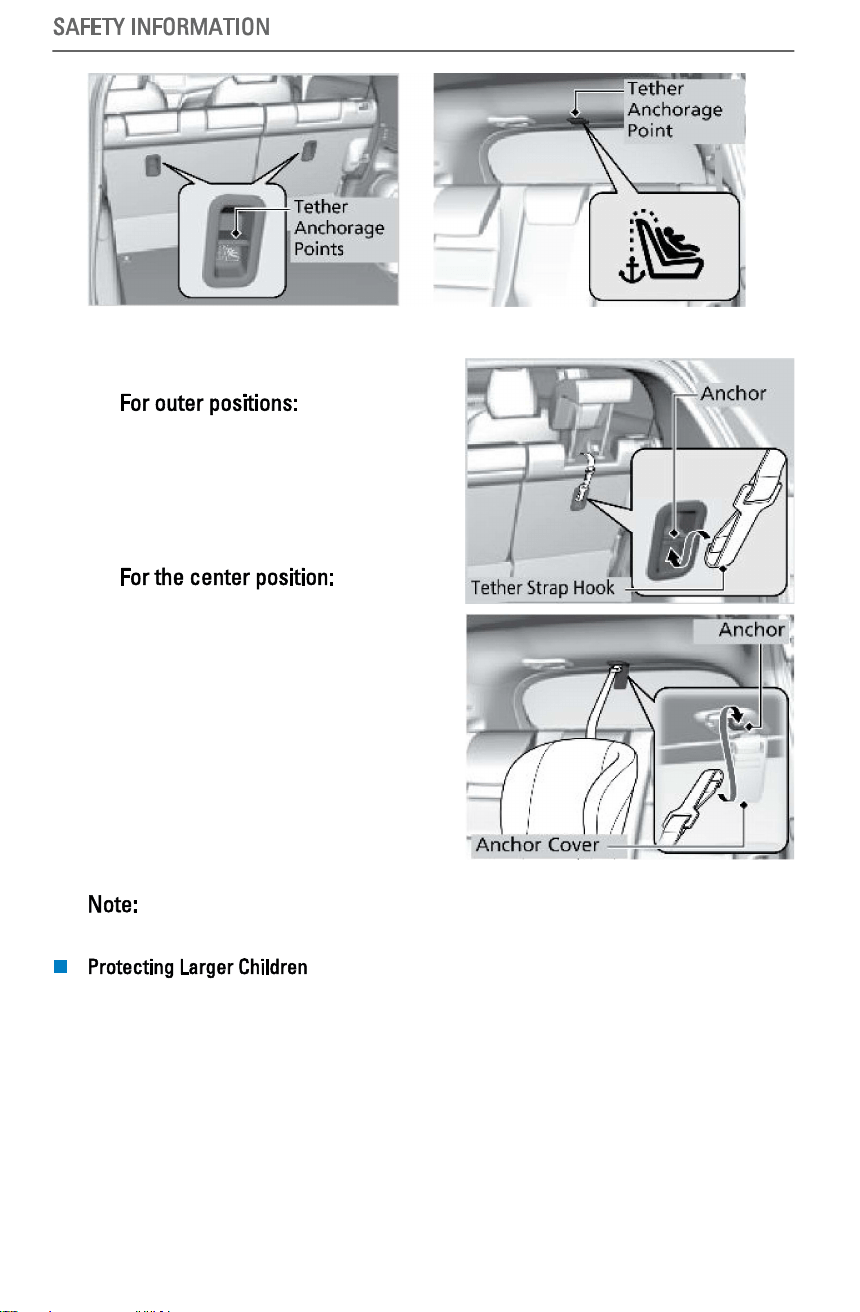
1. Locate the appropriate tether anchorage point and lift the cover.
2. Adjust head restraint
Remove the
cargo cover
*1
.Raise the outer head
restraint to its highest position, then
route the tether strap between the
head restraint legs. Make sure the
strap is not twisted.
Lower the
center head restraint to its lowest
position, open the anchor cover,
then route the tether strap over the
head restraint.
3. Secure the tether strap hook onto
the anchor. Make sure the strap is
not twisted.
4. Tighten the tether strap as
instructed by the child seat
manufacturer.
Always use a tether for forward facing child seats when using the
seat belt or lower anchors.
When a child is too big for a child seat, secure the child in a rear seat using
the lap/shoulder seat belt.
Have the child sit upright and all the way back, then ensure the following:
*1 - If equipped
20 |
• The child’s knees bend comfortably
over the edge of the seat.
• The shoulder belt crosses between
the child’s neck and arm.
• The lap part of the seat belt is as low
as possible, touching the child’s
thighs.
• The child can stay seated for the
whole trip.
If a lap/shoulder belt cannot be used
properly, position the child in a booster
seat in a rear seating position. For the
child’s safety, check that the child meets the booster seat manufacturer’s
recommendations.
Some U.S. states and Canadian provinces/territories require children to use
a booster seat until they reach a given age or weight (e.g., 6 years or 60 lbs).
Be sure to check current laws in the state or province/territory where you
intend to drive.
Allowing a child age 12 or under to sit in the front can result in injury or
death if the passenger’s front airbag inflates.
If a larger child must ride in front, move the vehicle seat as far to the rear
as possible, have the child sit up properly and wear the seat belt properly,
using a booster seat if needed.
Safety labels are in the locations shown. They warn you of potential hazards
that can cause serious injury or death. Read these labels carefully.
If a label comes off or becomes hard to read (except for the U.S. dashboard
label which may be removed by the owner), contact a dealer for a replacement.
| 21
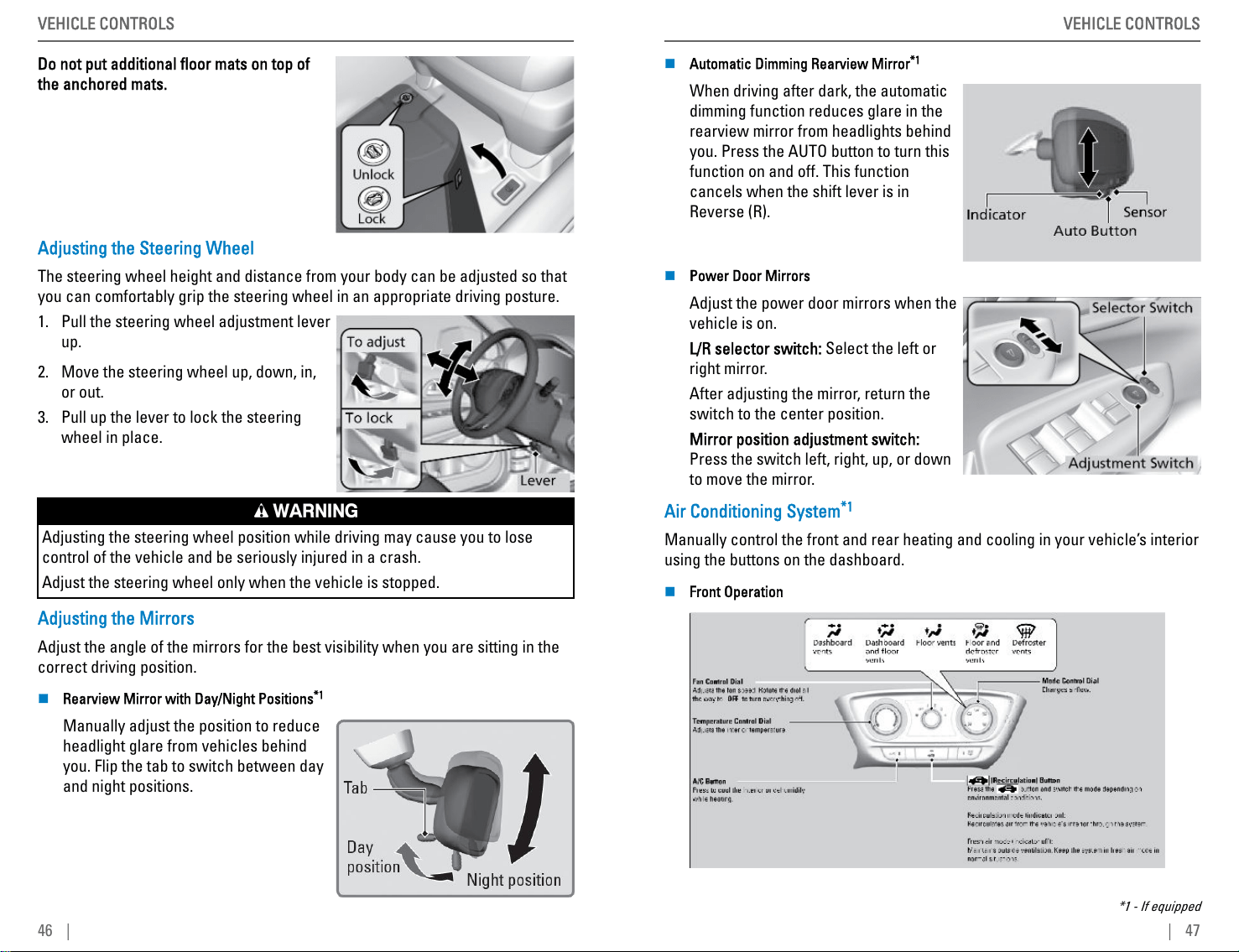
1. Locate the appropriate tether anchorage point and lift the cover.
2. Adjust head restraint
Remove the
cargo cover
*1
.Raise the outer head
restraint to its highest position, then
route the tether strap between the
head restraint legs. Make sure the
strap is not twisted.
Lower the
center head restraint to its lowest
position, open the anchor cover,
then route the tether strap over the
head restraint.
3. Secure the tether strap hook onto
the anchor. Make sure the strap is
not twisted.
4. Tighten the tether strap as
instructed by the child seat
manufacturer.
Always use a tether for forward facing child seats when using the
seat belt or lower anchors.
When a child is too big for a child seat, secure the child in a rear seat using
the lap/shoulder seat belt.
Have the child sit upright and all the way back, then ensure the following:
*1 - If equipped
20 |
• The child’s knees bend comfortably
over the edge of the seat.
• The shoulder belt crosses between
the child’s neck and arm.
• The lap part of the seat belt is as low
as possible, touching the child’s
thighs.
• The child can stay seated for the
whole trip.
If a lap/shoulder belt cannot be used
properly, position the child in a booster
seat in a rear seating position. For the
child’s safety, check that the child meets the booster seat manufacturer’s
recommendations.
Some U.S. states and Canadian provinces/territories require children to use
a booster seat until they reach a given age or weight (e.g., 6 years or 60 lbs).
Be sure to check current laws in the state or province/territory where you
intend to drive.
Allowing a child age 12 or under to sit in the front can result in injury or
death if the passenger’s front airbag inflates.
If a larger child must ride in front, move the vehicle seat as far to the rear
as possible, have the child sit up properly and wear the seat belt properly,
using a booster seat if needed.
Safety labels are in the locations shown. They warn you of potential hazards
that can cause serious injury or death. Read these labels carefully.
If a label comes off or becomes hard to read (except for the U.S. dashboard
label which may be removed by the owner), contact a dealer for a replacement.
| 21
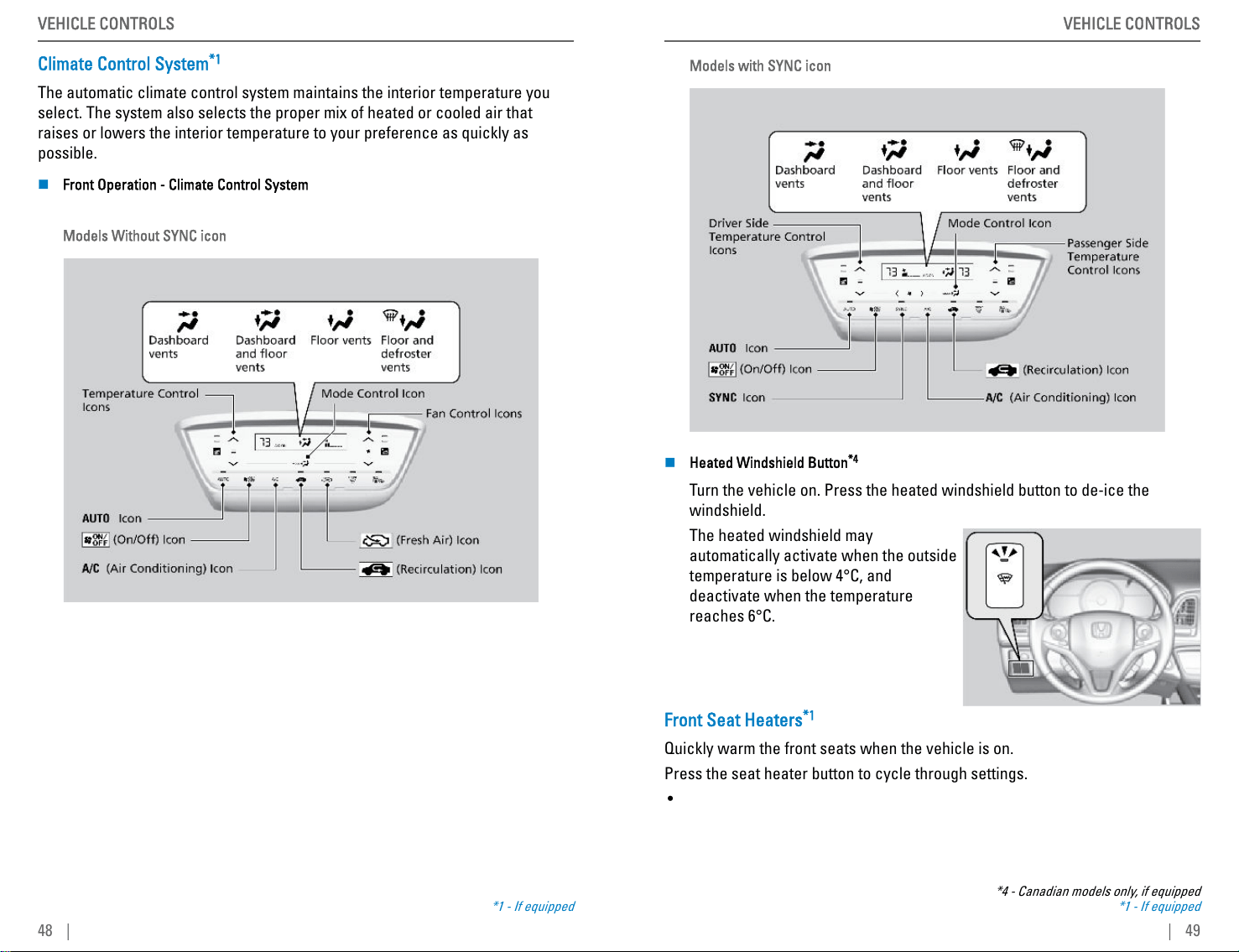
If you believe that your vehicle has a defect which could cause a crash or could
cause injury or death, you should immediately inform the National Highway
Traffic Safety Administration (NHTSA) in addition to notifying American Honda
Motor Co., Inc.
If NHTSA receives similar complaints, it may open an investigation, and if it
finds that a safety defect exists in a group of vehicles, it may order a recall and
remedy campaign. However, NHTSA cannot become involved in individual
problems between you, your dealer, or American Honda Motor Co., Inc.
To contact NHTSA, you may call the Vehicle Safety Hotline toll-free at
1-888-327-4236 (TTY: 1-800-424-9153); go to
safercar.gov
, or write to:
Administrator, NHTSA,1200 New Jersey Avenue, SE., Washington, DC 20590.
You can also obtain other information about motor vehicle safety from
safercar.gov
.
If you believe that your vehicle has a defect which could cause a crash or could
cause injury or death, you should immediately inform Honda Canada, Inc., and
you may also inform Transport Canada.
If Transport Canada receives similar complaints, it may open an investigation,
and if it finds that a safety defect exists in a group of vehicles, it may lead to a
recall and remedy campaign. However, Transport Canada cannot become
involved in individual problems between you, your dealer, or Honda Canada, Inc.
To contact Transport Canada’s Defect Investigations and Recalls Division, you
may call 1-800-333-0510. For more information on reporting safety defects or
about motor vehicle safety, go to tc.gc.ca/roadsafety.
22 |
Learn about the indicators, gauges, and displays related to driving the vehicle.
Indicators briefly appear with each engine start and then go out. Red and amber
indicators are most critical. Blue and green indicators are used for general
information.
These are the most critical indicators. If they come on and stay lit while driving
or at any other time, there may be a problem. See your dealer if necessary.
| 23

If you believe that your vehicle has a defect which could cause a crash or could
cause injury or death, you should immediately inform the National Highway
Traffic Safety Administration (NHTSA) in addition to notifying American Honda
Motor Co., Inc.
If NHTSA receives similar complaints, it may open an investigation, and if it
finds that a safety defect exists in a group of vehicles, it may order a recall and
remedy campaign. However, NHTSA cannot become involved in individual
problems between you, your dealer, or American Honda Motor Co., Inc.
To contact NHTSA, you may call the Vehicle Safety Hotline toll-free at
1-888-327-4236 (TTY: 1-800-424-9153); go to
safercar.gov
, or write to:
Administrator, NHTSA,1200 New Jersey Avenue, SE., Washington, DC 20590.
You can also obtain other information about motor vehicle safety from
safercar.gov
.
If you believe that your vehicle has a defect which could cause a crash or could
cause injury or death, you should immediately inform Honda Canada, Inc., and
you may also inform Transport Canada.
If Transport Canada receives similar complaints, it may open an investigation,
and if it finds that a safety defect exists in a group of vehicles, it may lead to a
recall and remedy campaign. However, Transport Canada cannot become
involved in individual problems between you, your dealer, or Honda Canada, Inc.
To contact Transport Canada’s Defect Investigations and Recalls Division, you
may call 1-800-333-0510. For more information on reporting safety defects or
about motor vehicle safety, go to tc.gc.ca/roadsafety.
22 |
Learn about the indicators, gauges, and displays related to driving the vehicle.
Indicators briefly appear with each engine start and then go out. Red and amber
indicators are most critical. Blue and green indicators are used for general
information.
These are the most critical indicators. If they come on and stay lit while driving
or at any other time, there may be a problem. See your dealer if necessary.
| 23

U.S.
Canada
• Brake fluid is low.
• There is a malfunction in the brake system.
Press the brake pedal lightly to check pedal pressure. If normal,
check the brake fluid level when you stop. If abnormal, take
immediate action. If necessary, downshift the transmission to
slow the vehicle using engine braking. Have your vehicle
repaired immediately.
Engine oil pressure is low. Stop in a safe place. Open the hood,
check the oil level and add oil if necessary. If the indicator does
not turn off, have your vehicle repaired immediately.
The battery is not charging. Turn all electrical items off, but do
not turn the vehicle off to prevent further battery discharge. Have
your vehicle repaired immediately.
There is a problem with one of the airbag systems or seat belt
tensioners.
Smart Entry System
*1
There is a problem with the system.
There is a problem with the system.
The emissions control system may have a problem, or the fuel
cap is missing or loose. If the indicator blinks, a misfire in the
engine’s cylinders is detected. Stop in a safe place and wait for
the engine to cool down.
There is a problem with the anti-lock brake system. Your vehicle
still has normal braking ability, but no anti-lock function.
• Blinks and remains on:
Have your vehicle checked by a dealer. If the vehicle is fitted with
a compact spare, get your regular tire repaired or replaced and
put back on your vehicle as soon as you can.
*1 - If equipped
24 |
There is a problem with the VSA
®
or hill start assist system.
There is a problem with the system, the temperature inside the
camera is too high or the camera or sensor is blocked.
Road Departure Mitigation (RDM)
There is a problem with the system, the temperature inside the
camera is too high, or the camera is blocked.
There is a problem with the system. Stop the vehicle in a safe
place, and restart the engine.
There is a problem with the system.
These indicators may require you to perform an action.
U.S.
Canada
Release the parking brake before driving. You will hear a beep if
you drive with it not fully released.
Make sure seat belts are fastened for you and all passengers.
The indicator blinks and beeps sound continuously if you or your
front passenger has not fastened your seat belts when you begin
driving. If the indicator remains on after seat belts are fastened,
see your dealer.
Refuel as soon as possible. If the indicator blinks, there is a
problem with the fuel gauge. See your dealer.
• Comes on while driving:
Stop in a safe place, check tire pressures, and inflate tire(s) if
necessary.
| 25

U.S.
Canada
• Brake fluid is low.
• There is a malfunction in the brake system.
Press the brake pedal lightly to check pedal pressure. If normal,
check the brake fluid level when you stop. If abnormal, take
immediate action. If necessary, downshift the transmission to
slow the vehicle using engine braking. Have your vehicle
repaired immediately.
Engine oil pressure is low. Stop in a safe place. Open the hood,
check the oil level and add oil if necessary. If the indicator does
not turn off, have your vehicle repaired immediately.
The battery is not charging. Turn all electrical items off, but do
not turn the vehicle off to prevent further battery discharge. Have
your vehicle repaired immediately.
There is a problem with one of the airbag systems or seat belt
tensioners.
Smart Entry System
*1
There is a problem with the system.
There is a problem with the system.
The emissions control system may have a problem, or the fuel
cap is missing or loose. If the indicator blinks, a misfire in the
engine’s cylinders is detected. Stop in a safe place and wait for
the engine to cool down.
There is a problem with the anti-lock brake system. Your vehicle
still has normal braking ability, but no anti-lock function.
• Blinks and remains on:
Have your vehicle checked by a dealer. If the vehicle is fitted with
a compact spare, get your regular tire repaired or replaced and
put back on your vehicle as soon as you can.
*1 - If equipped
24 |
There is a problem with the VSA
®
or hill start assist system.
There is a problem with the system, the temperature inside the
camera is too high or the camera or sensor is blocked.
Road Departure Mitigation (RDM)
There is a problem with the system, the temperature inside the
camera is too high, or the camera is blocked.
There is a problem with the system. Stop the vehicle in a safe
place, and restart the engine.
There is a problem with the system.
These indicators may require you to perform an action.
U.S.
Canada
Release the parking brake before driving. You will hear a beep if
you drive with it not fully released.
Make sure seat belts are fastened for you and all passengers.
The indicator blinks and beeps sound continuously if you or your
front passenger has not fastened your seat belts when you begin
driving. If the indicator remains on after seat belts are fastened,
see your dealer.
Refuel as soon as possible. If the indicator blinks, there is a
problem with the fuel gauge. See your dealer.
• Comes on while driving:
Stop in a safe place, check tire pressures, and inflate tire(s) if
necessary.
| 25
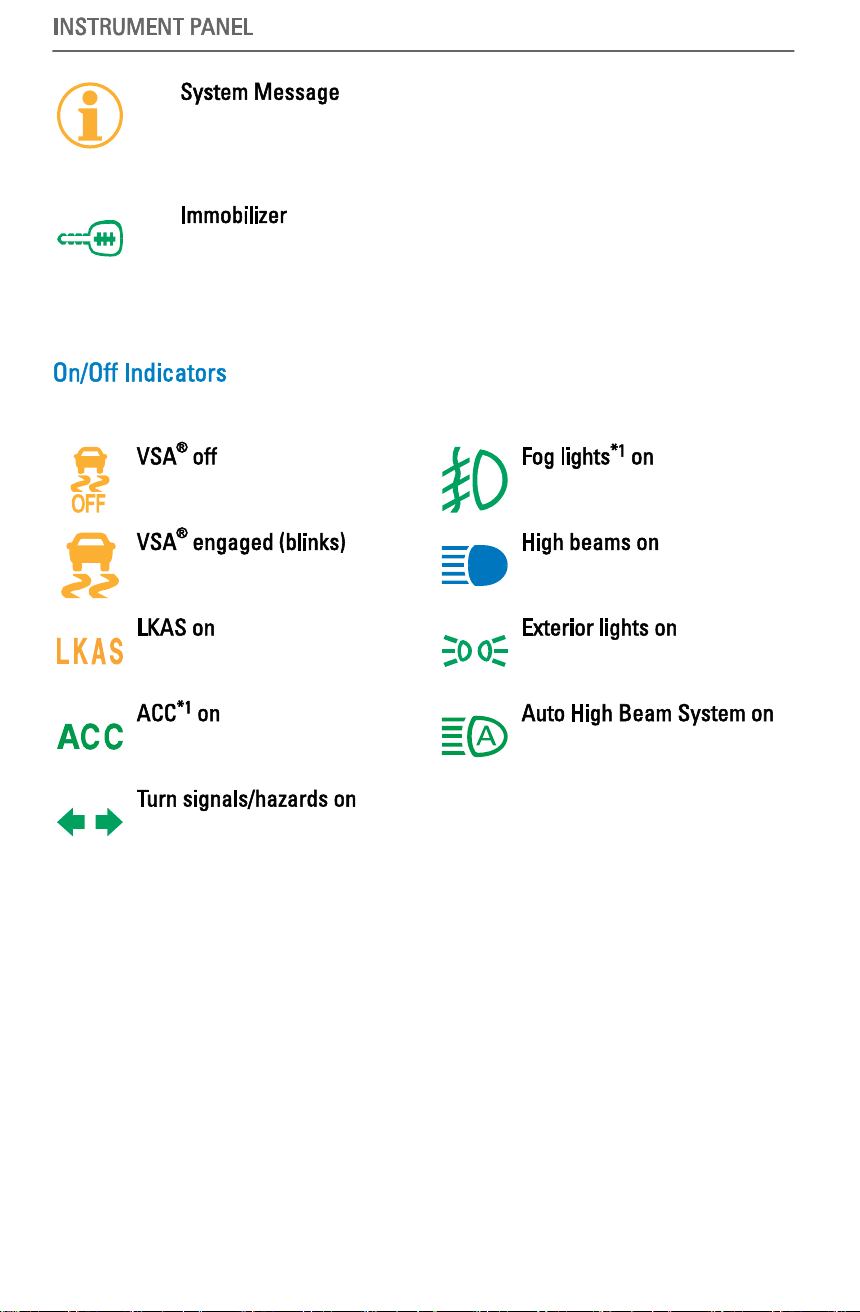
When a condition or malfunction indicator comes on, a message
also appears on the driver information interface (DII). Check the
display for more information.
Your key or remote transmitter cannot be recognized by the
vehicle. If the indicator blinks, you may not be able to start the
engine. Turn the vehicle off, and then on again. If it continues to
blink, there may be a problem with the system. See your dealer.
These indicators remind you when an item is on or off.
*1 - If equipped
26 |
Consists of several displays that provide you with useful information.
To switch the display press the select/reset knob.
Main Displays
To switch the display press the information button.
Lower Displays
Press the Select/Reset button to cycle through the lower displays shown below:
*1 - If equipped
| 27
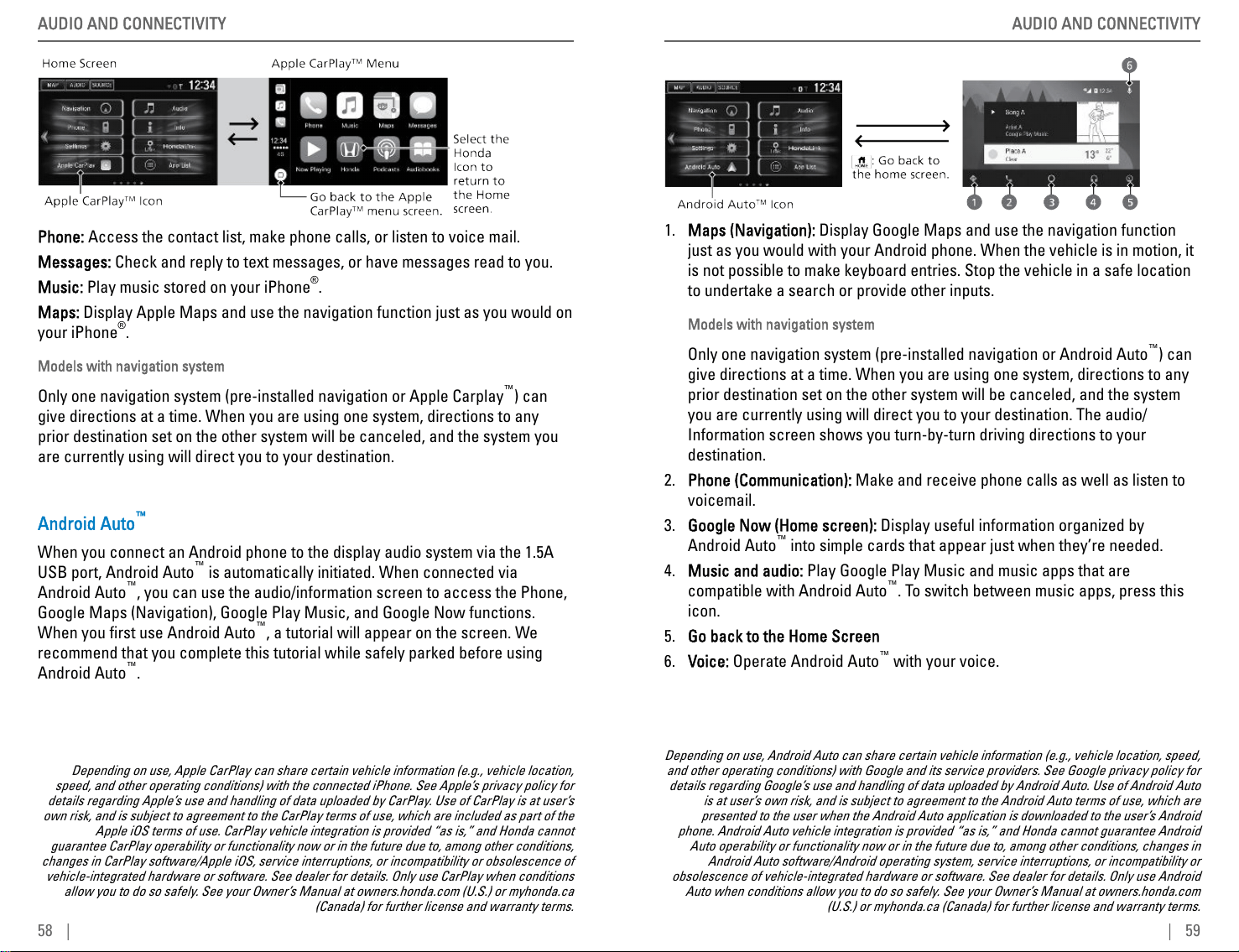
When a condition or malfunction indicator comes on, a message
also appears on the driver information interface (DII). Check the
display for more information.
Your key or remote transmitter cannot be recognized by the
vehicle. If the indicator blinks, you may not be able to start the
engine. Turn the vehicle off, and then on again. If it continues to
blink, there may be a problem with the system. See your dealer.
These indicators remind you when an item is on or off.
*1 - If equipped
26 |
Consists of several displays that provide you with useful information.
To switch the display press the select/reset knob.
Main Displays
To switch the display press the information button.
Lower Displays
Press the Select/Reset button to cycle through the lower displays shown below:
*1 - If equipped
| 27
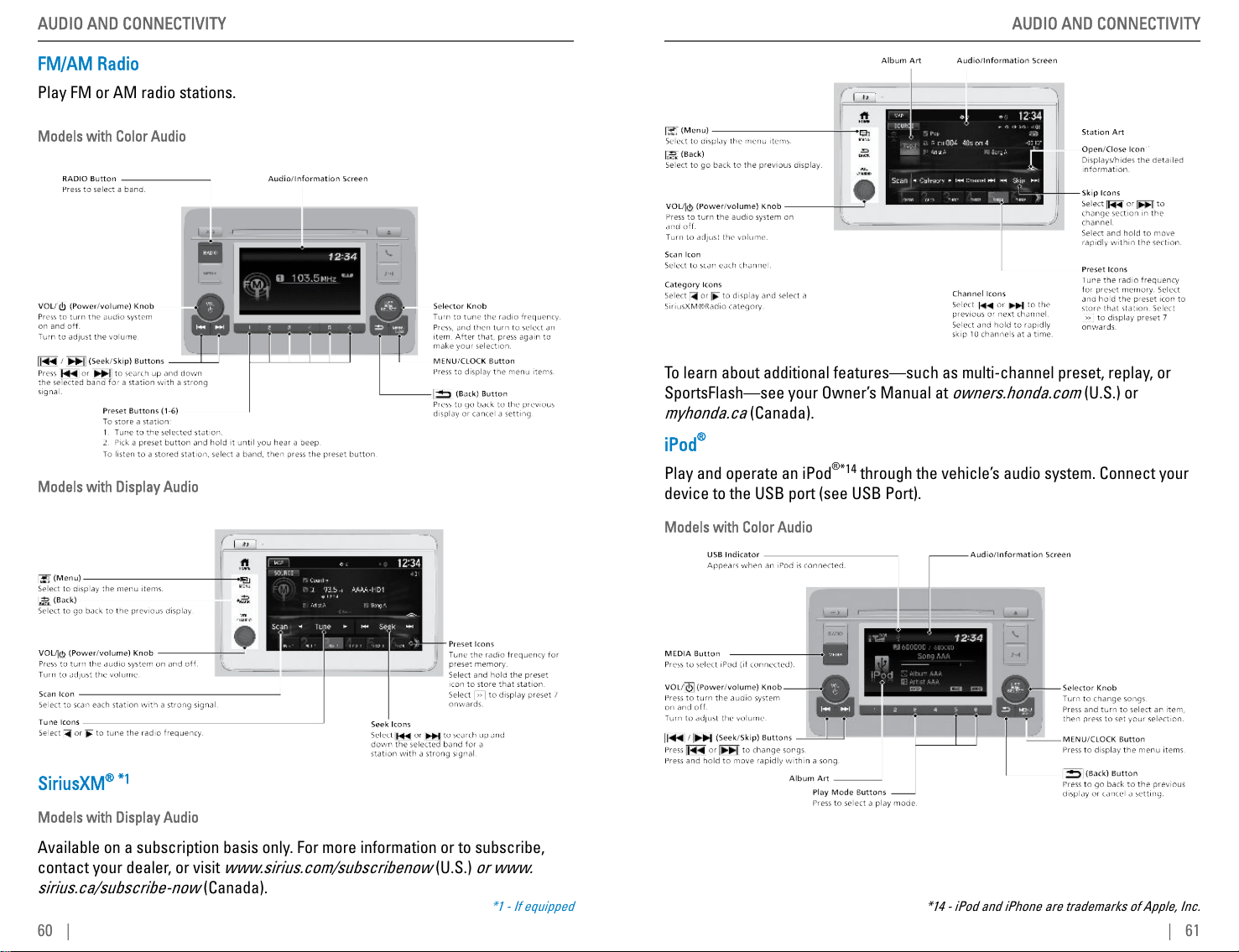
28 |
Learn about the various controls necessary for operating and driving the
vehicle.
Start and stop the engine
*1
, lock or unlock the doors and tailgate.
Leaving the remote transmitter in the vehicle can result in theft or accidental
movement of the vehicle. Always take it with you whenever you leave the
vehicle unattended.
When you carry the remote transmitter (for example, in a pocket or purse) and it
is outside the vehicle and within range (about 32 inches or 80 cm), you can lock
or unlock the doors, and the tailgate without handling the transmitter.
*1 - If equipped
| 29
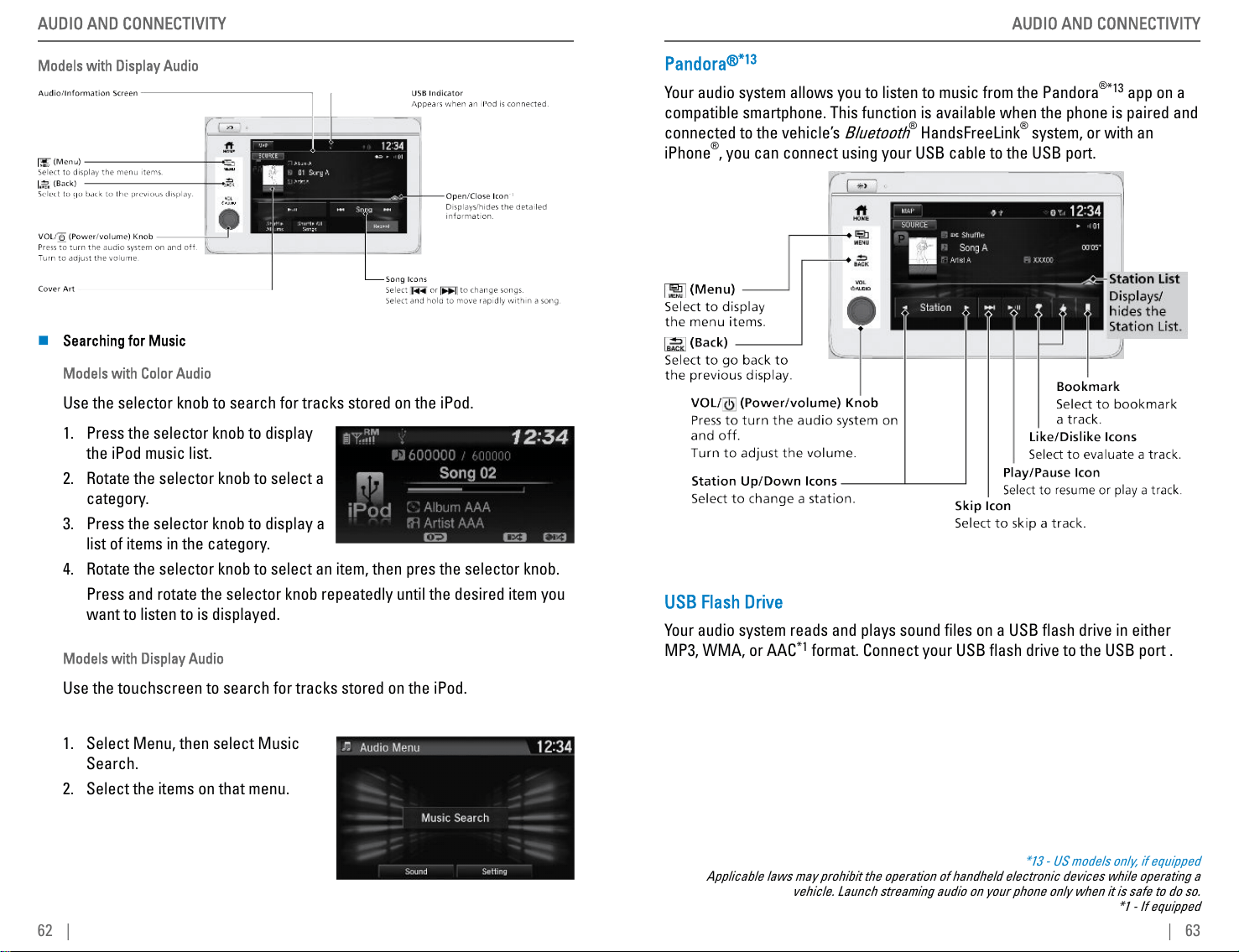
28 |
Learn about the various controls necessary for operating and driving the
vehicle.
Start and stop the engine
*1
, lock or unlock the doors and tailgate.
Leaving the remote transmitter in the vehicle can result in theft or accidental
movement of the vehicle. Always take it with you whenever you leave the
vehicle unattended.
When you carry the remote transmitter (for example, in a pocket or purse) and it
is outside the vehicle and within range (about 32 inches or 80 cm), you can lock
or unlock the doors, and the tailgate without handling the transmitter.
*1 - If equipped
| 29
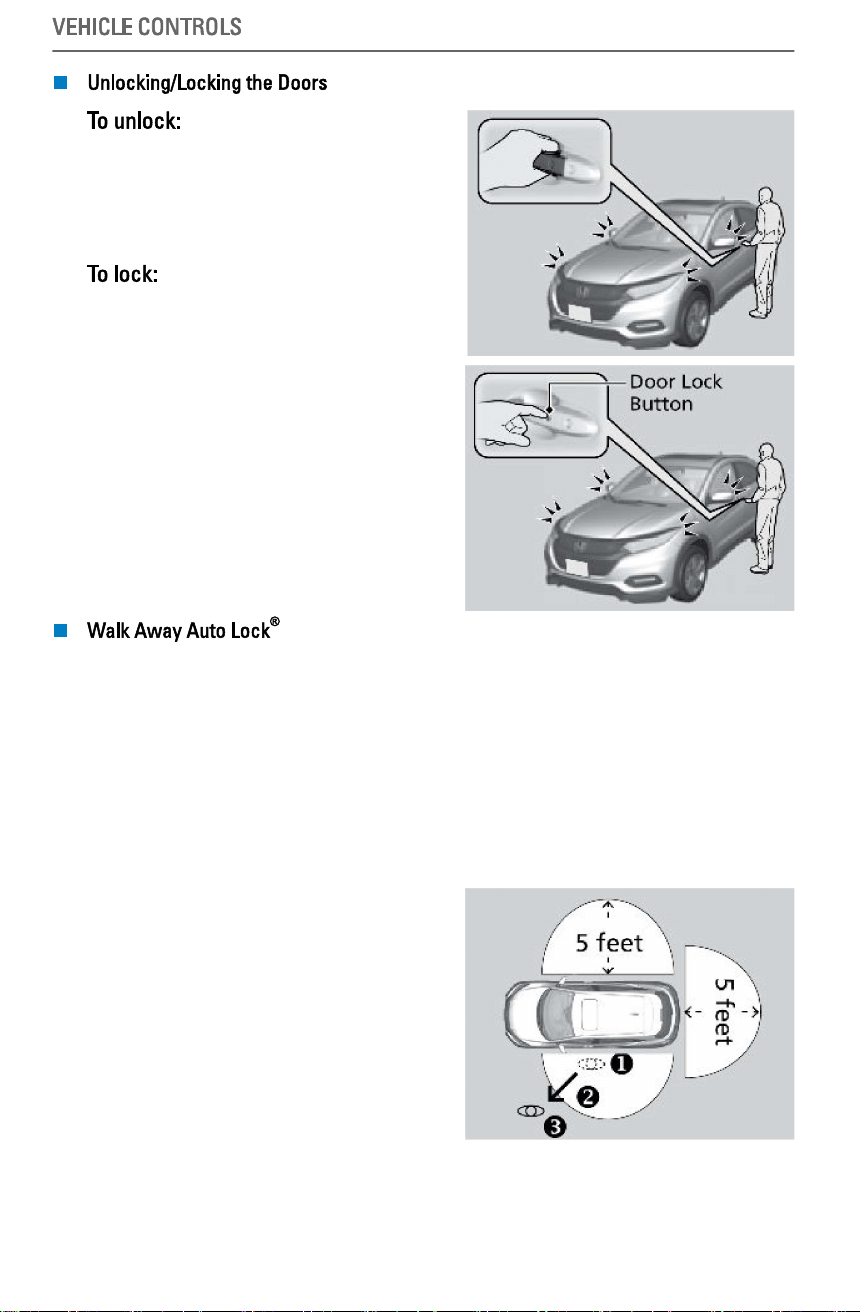
Grab the driver’s door handle
to unlock the driver’s door. Grab the
front passenger’s door handle to unlock
all the doors and the tailgate. You can
customize this feature’s behavior.
Press the door lock button on
the front dooror the tailgate.
When you walk away from the vehicle while carrying the remote
transmitter, the doors and tailgate can automatically lock if the following
conditions are met:
• The remote transmitter is within a range of 5 feet (1.5 m).
• All doors and the tailgate are closed.
• There is not an additional remote transmitter inside the vehicle.
Follow these steps:
1. Exit the vehicle, close the door and
stay near it. Listen for a beep. The
system is activated.
2. Walk at least 5 feet (1.5 m) away.
3. Listen for a beep and look for the
lights to flash. The doors lock.
The auto lock function is set to OFF as
the factory default setting. The auto
lock function can be set to ON using the
multi-information display. If you set the auto lock function to ON using the
multi-information display, only the remote transmitter that was used to
30 |
unlock the driver's door prior to the setting change can activate auto lock.
To turn on this feature, follow the steps below:
1. From the HOME screen, select Settings.
2. Select Door Setup.
3. Select Walk Away Auto Lock.
4. Select SEL/RESET.
Customize the auto door lock and door unlock settings to your preference.
Begin with the vehicle off.
Use several methods to lock or unlock the doors.
| 31
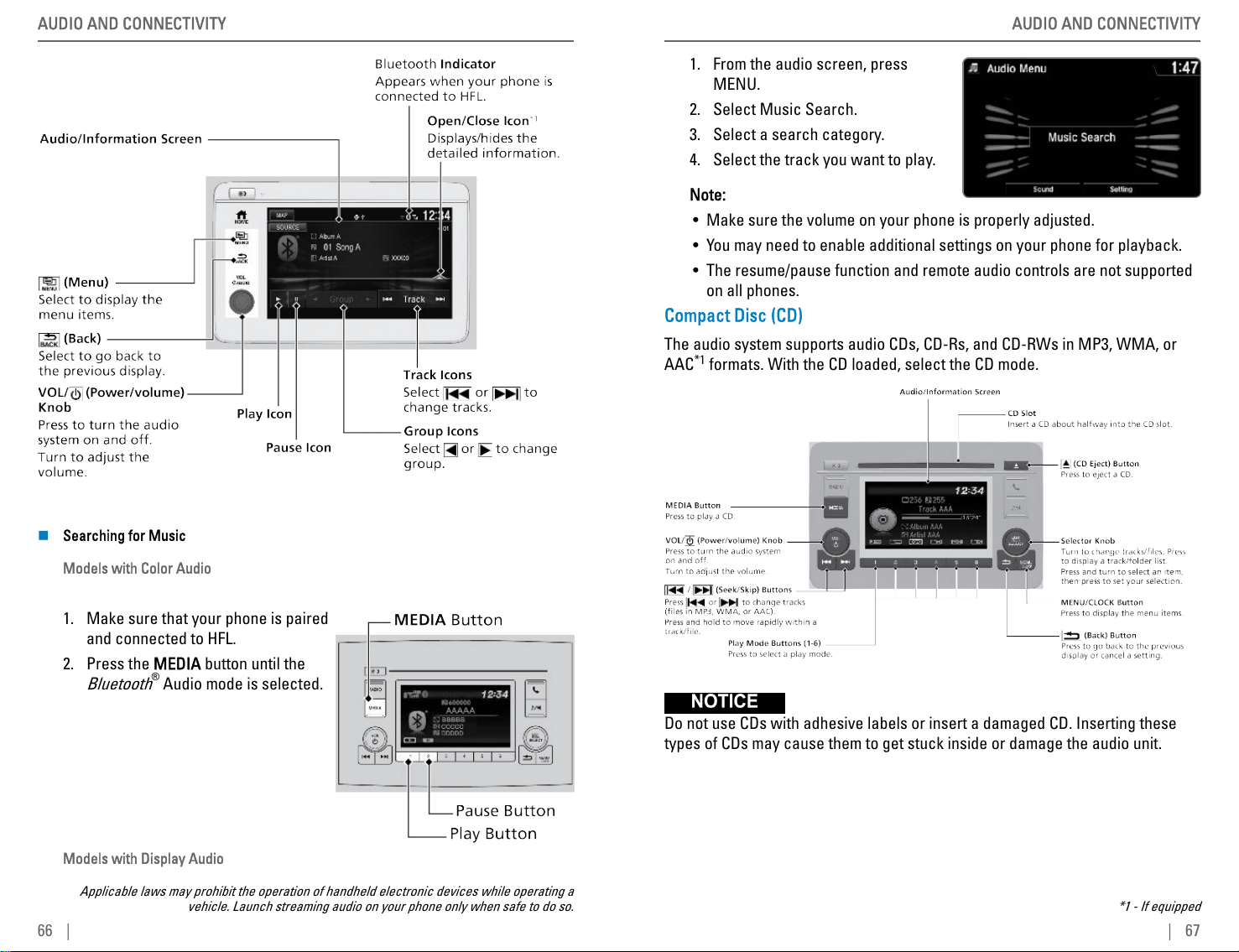
Grab the driver’s door handle
to unlock the driver’s door. Grab the
front passenger’s door handle to unlock
all the doors and the tailgate. You can
customize this feature’s behavior.
Press the door lock button on
the front dooror the tailgate.
When you walk away from the vehicle while carrying the remote
transmitter, the doors and tailgate can automatically lock if the following
conditions are met:
• The remote transmitter is within a range of 5 feet (1.5 m).
• All doors and the tailgate are closed.
• There is not an additional remote transmitter inside the vehicle.
Follow these steps:
1. Exit the vehicle, close the door and
stay near it. Listen for a beep. The
system is activated.
2. Walk at least 5 feet (1.5 m) away.
3. Listen for a beep and look for the
lights to flash. The doors lock.
The auto lock function is set to OFF as
the factory default setting. The auto
lock function can be set to ON using the
multi-information display. If you set the auto lock function to ON using the
multi-information display, only the remote transmitter that was used to
30 |
unlock the driver's door prior to the setting change can activate auto lock.
To turn on this feature, follow the steps below:
1. From the HOME screen, select Settings.
2. Select Door Setup.
3. Select Walk Away Auto Lock.
4. Select SEL/RESET.
Customize the auto door lock and door unlock settings to your preference.
Begin with the vehicle off.
Use several methods to lock or unlock the doors.
| 31
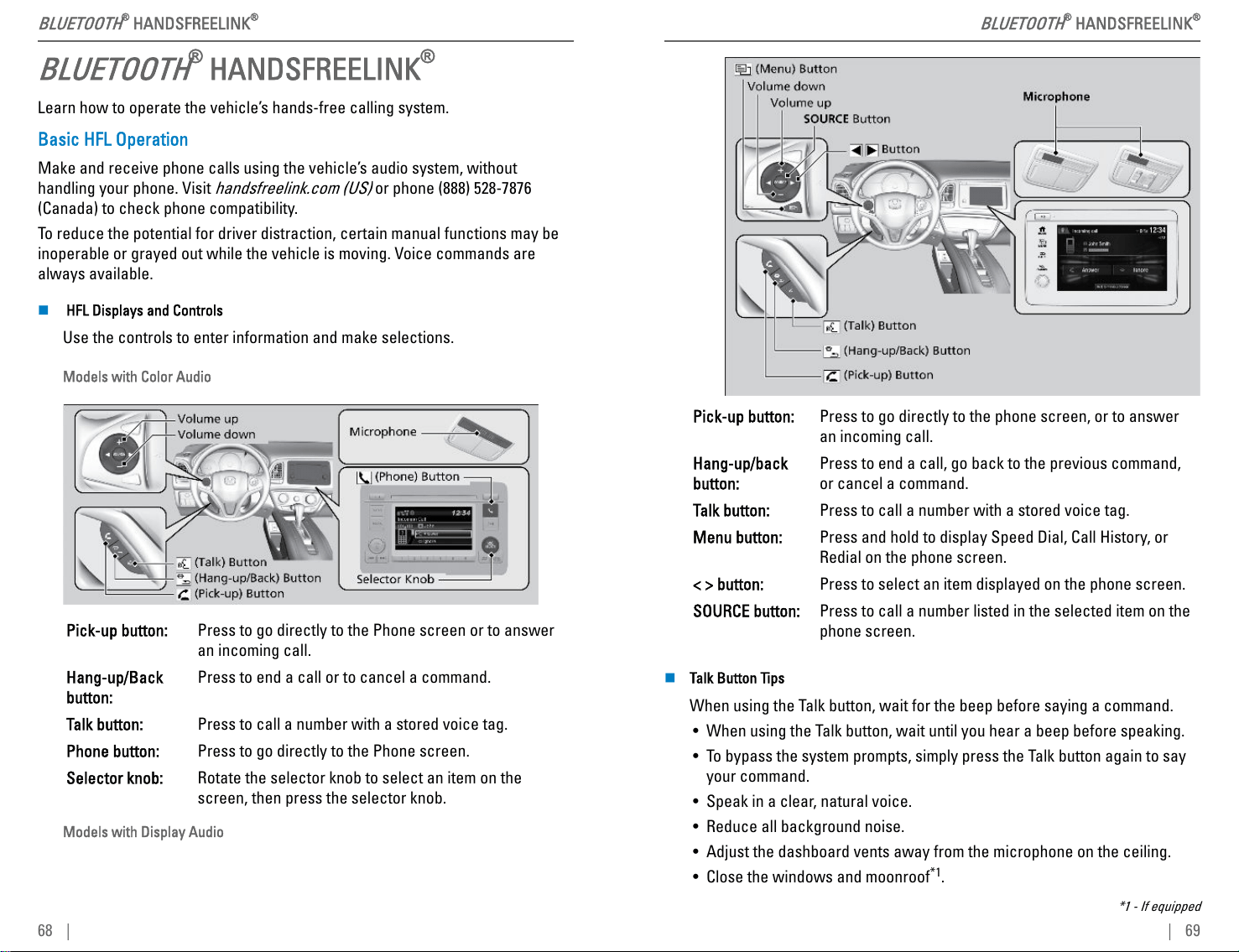
When you unlock either front
door using the lock tab, the specific
door (driver’s or passenger’s) unlocks.
When you lock the door using
the lock tab on the driver’s door, all the
other doors and the tailgate lock at the
same time. When you lock the door
using the lock tab on the front
passenger’s door, only that door locks.
Pull the front door inner handle. The
door unlocks and opens in one motion.
Unlocking and opening the driver’s door
from the inner handle unlocks all other
doors.
Do not pull a front door inner handle
while the vehicle is moving.
Press the unlock side of the
switch to unlock all doors and the
tailgate.
Press the lock side of the
switch to lock all doors and the tailgate.
32 |
The childproof door locks prevent the
rear doors from being opened from the
inside regardless of the position of the
lock tab.
Slide the lever in the rear door to the
lock position, and close the door.
Open the door using the outer door
handle.
Use these methods to operate the tailgate.
Press the tailgate release button and lift
up the tailgate to open it.
Grab the inner handle and pull the tailgate down.
Push it closed from the outside.
The power windows can be opened and closed by using the switches on the
doors when the vehicle is on. The switches on the driver’s side can be used to
open and close all the windows.
| 33
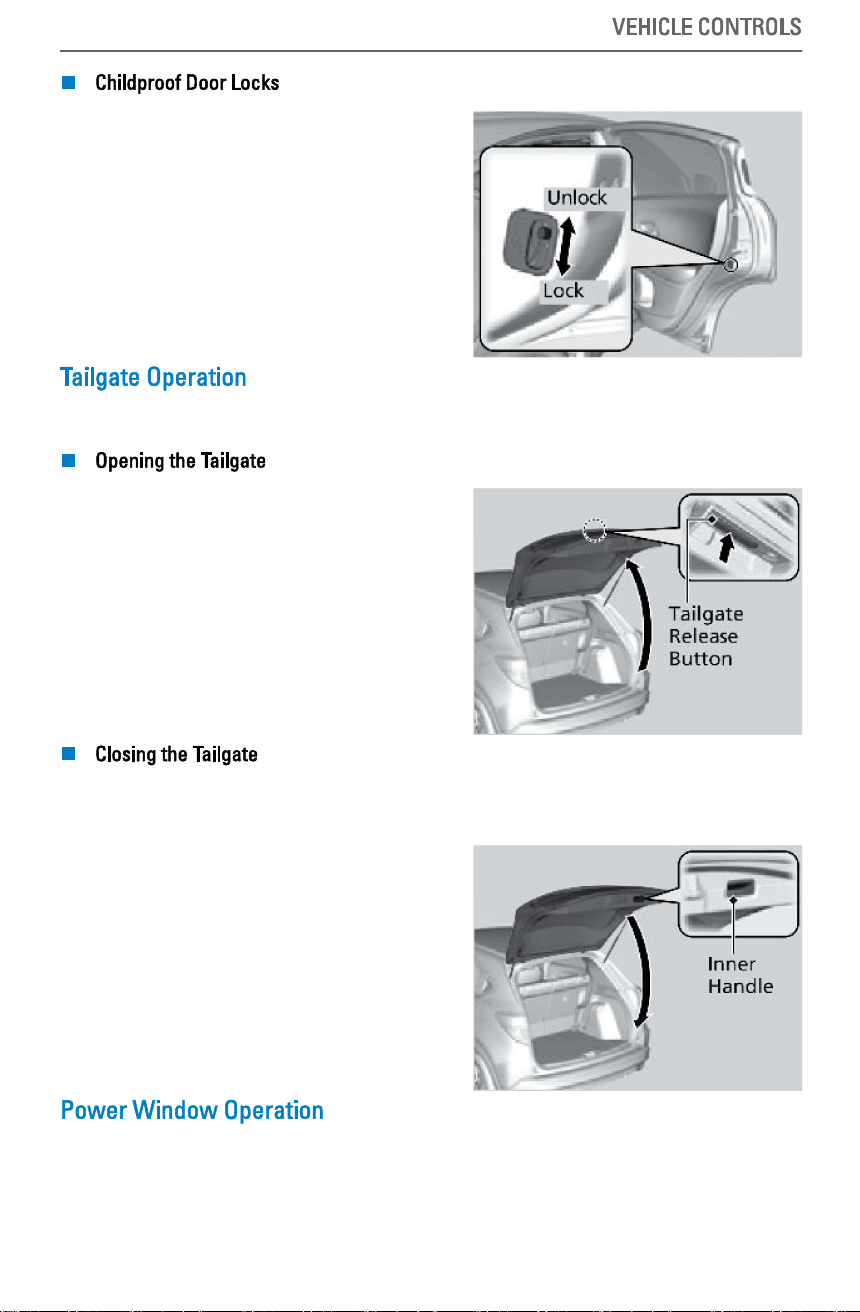
When you unlock either front
door using the lock tab, the specific
door (driver’s or passenger’s) unlocks.
When you lock the door using
the lock tab on the driver’s door, all the
other doors and the tailgate lock at the
same time. When you lock the door
using the lock tab on the front
passenger’s door, only that door locks.
Pull the front door inner handle. The
door unlocks and opens in one motion.
Unlocking and opening the driver’s door
from the inner handle unlocks all other
doors.
Do not pull a front door inner handle
while the vehicle is moving.
Press the unlock side of the
switch to unlock all doors and the
tailgate.
Press the lock side of the
switch to lock all doors and the tailgate.
32 |
The childproof door locks prevent the
rear doors from being opened from the
inside regardless of the position of the
lock tab.
Slide the lever in the rear door to the
lock position, and close the door.
Open the door using the outer door
handle.
Use these methods to operate the tailgate.
Press the tailgate release button and lift
up the tailgate to open it.
Grab the inner handle and pull the tailgate down.
Push it closed from the outside.
The power windows can be opened and closed by using the switches on the
doors when the vehicle is on. The switches on the driver’s side can be used to
open and close all the windows.
| 33
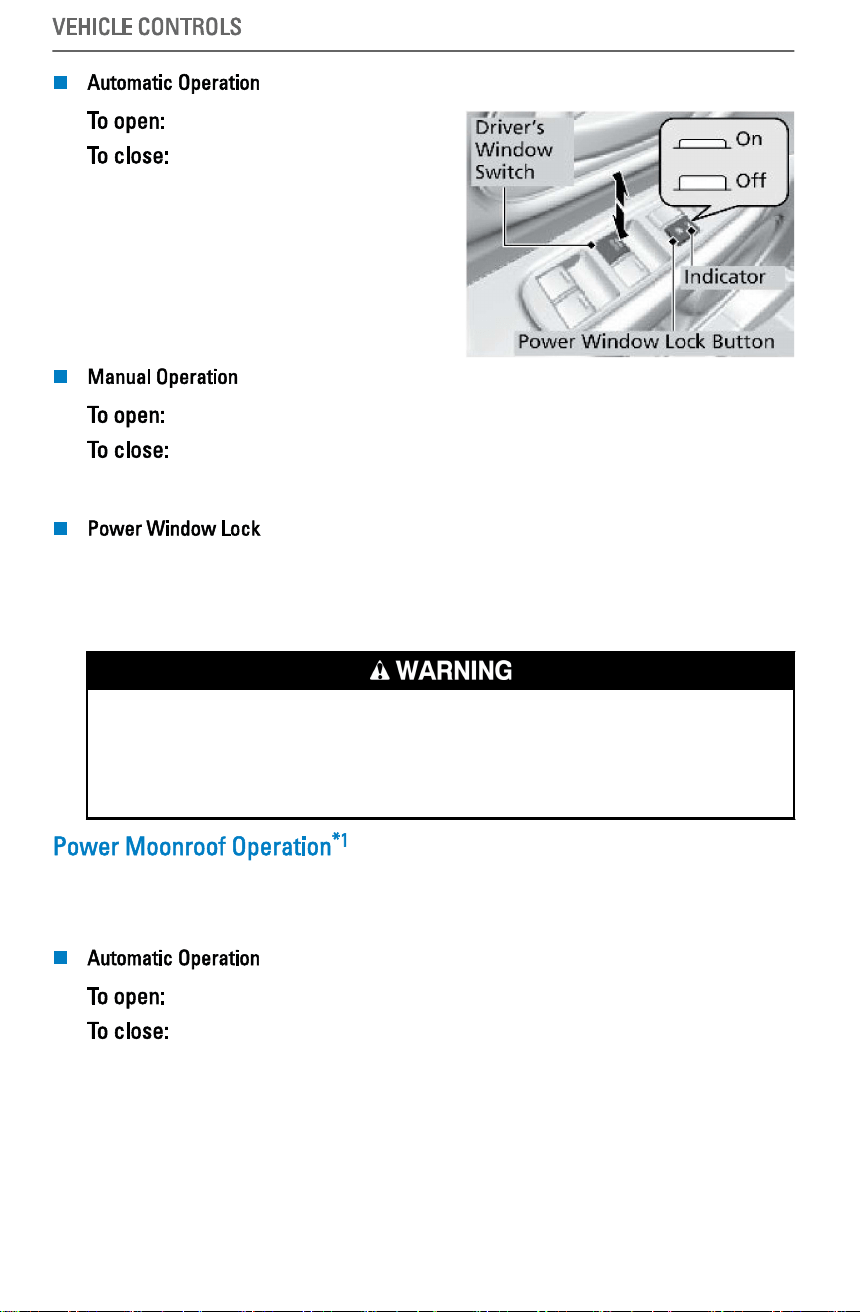
Push the switch down firmly.
Pull the switch up firmly.
The window opens or closes
completely. To stop the window at any
time, push or pull the switch again
briefly.
Push the switch down lightly.
Pull the switch up lightly.
Release the switch when the windows reach the desired position.
Push in the power window lock button so only the driver’s window can be
operated.
An indicator appears in the button when window lock is on.
Closing a power window on someone’s hands or fingers can cause serious
injury.
Make sure your passengers are away from the windows before closing
them.
The moonroof can be opened and closed when the vehicle is on by using the
switch on the ceiling.
Firmly push the switch back, then release.
Firmly push the switch forward, then release.
*1 - If equipped
34 |
The moonroof opens or closes
completely. To stop the moonroof at any
time, push the switch briefly.
Push the switch back lightly.
Pull the switch forward lightly.
Release the switch when the window reaches the desired position.
Push the center of the switch.
Push the switch forward firmly, then release.
Closing the moonroof on someone’s hands or fingers can cause serious
injury.
Make sure your passengers are away from the moonroof before closing it.
Operate interior and exterior lights when the vehicle is on or off.
Adjust instrument panel brightness
when the vehicle is on.
Turn the knob to the right.
Turn the knob to the left.
A beep sounds when the brightness
reaches its minimum or maximum.
Change the interior light settings using the switches on the ceiling.
| 35
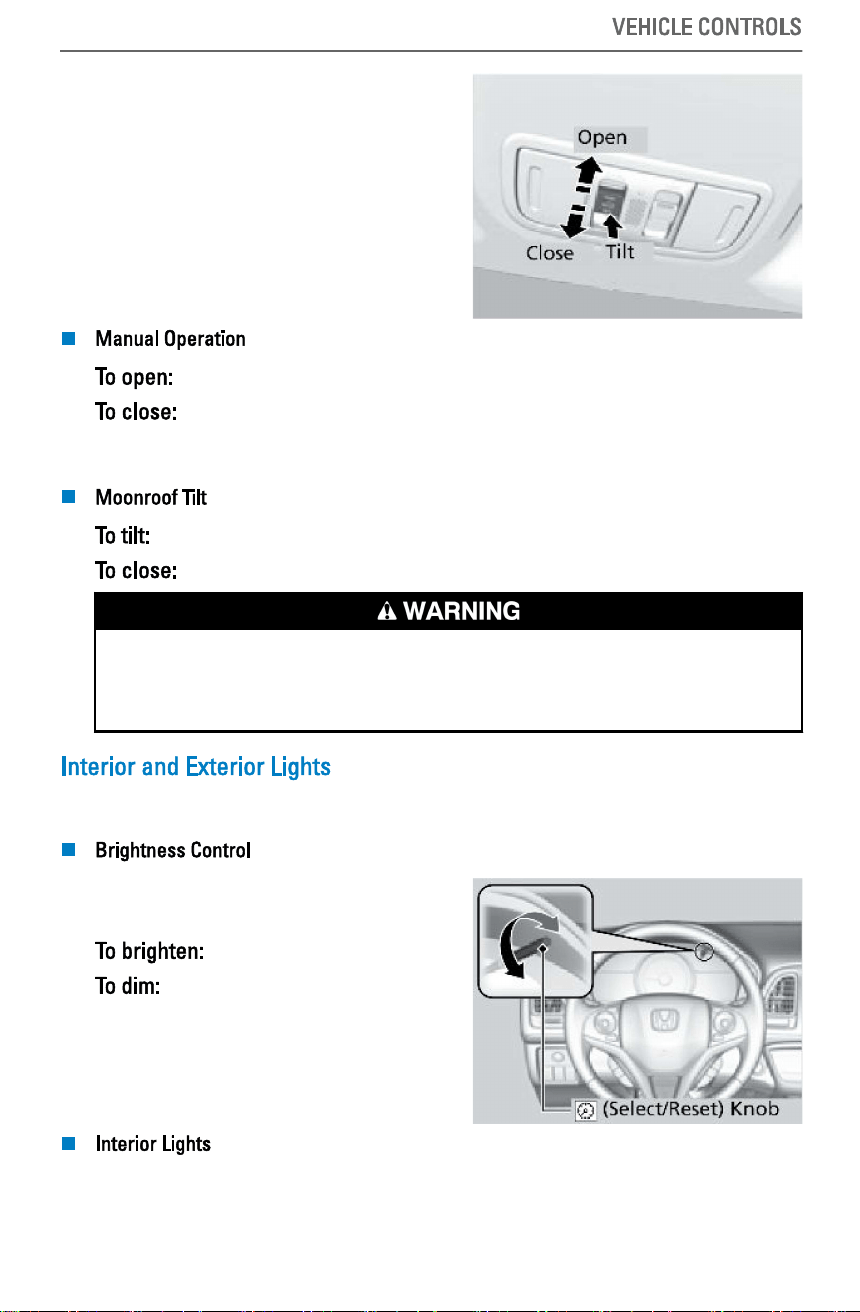
Push the switch down firmly.
Pull the switch up firmly.
The window opens or closes
completely. To stop the window at any
time, push or pull the switch again
briefly.
Push the switch down lightly.
Pull the switch up lightly.
Release the switch when the windows reach the desired position.
Push in the power window lock button so only the driver’s window can be
operated.
An indicator appears in the button when window lock is on.
Closing a power window on someone’s hands or fingers can cause serious
injury.
Make sure your passengers are away from the windows before closing
them.
The moonroof can be opened and closed when the vehicle is on by using the
switch on the ceiling.
Firmly push the switch back, then release.
Firmly push the switch forward, then release.
*1 - If equipped
34 |
The moonroof opens or closes
completely. To stop the moonroof at any
time, push the switch briefly.
Push the switch back lightly.
Pull the switch forward lightly.
Release the switch when the window reaches the desired position.
Push the center of the switch.
Push the switch forward firmly, then release.
Closing the moonroof on someone’s hands or fingers can cause serious
injury.
Make sure your passengers are away from the moonroof before closing it.
Operate interior and exterior lights when the vehicle is on or off.
Adjust instrument panel brightness
when the vehicle is on.
Turn the knob to the right.
Turn the knob to the left.
A beep sounds when the brightness
reaches its minimum or maximum.
Change the interior light settings using the switches on the ceiling.
| 35
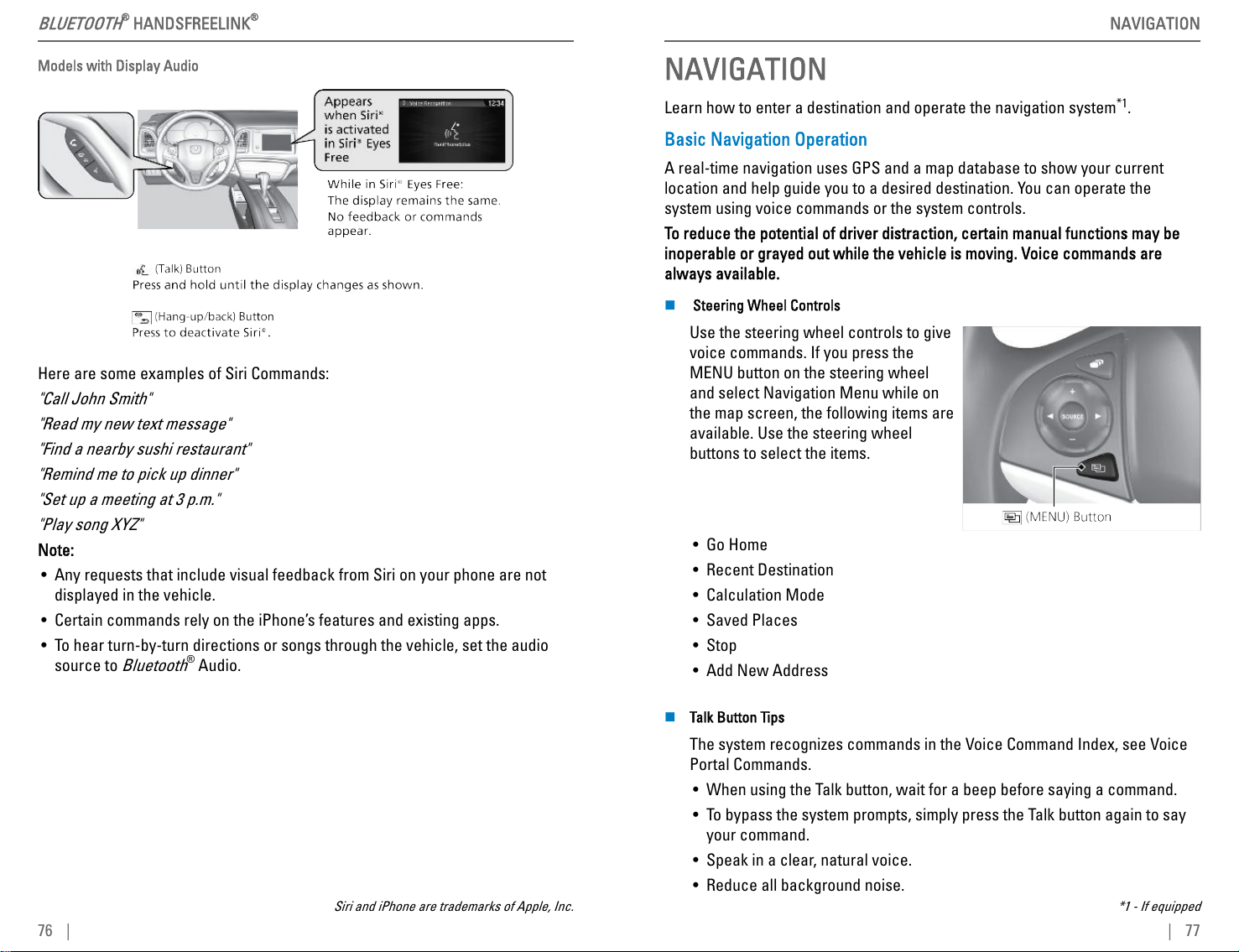
Interior lights remain on.
Interior lights
come on when any of the doors are
opened, the driver’s door is unlocked, or
the vehicle is turned off.
Interior lights remain off.
Press the front map lights to turn on or off.
Rotate the switches on the lever to operate the exterior lights. Push the
lever forward to turn on the high beams. Return the lever to its original
position for low beams.
All exterior lights are off.
Turn on exterior lights except headlights.
36 |
Turn on the automatic lighting feature. Headlights turn on or off
depending on ambient brightness when the vehicle is on.
Headlights automatically come on after the wipers are engaged for
a certain time. The headlights come on when you unlock a door in
dark areas with the headlight switch in AUTO.
Turn on all exterior lights including headlights.
Turn fog lights
*1
on or off.
Located on the rear ceiling in front of
the tailgate.
Cargo lights remain on.
Cargo area lights remain
off.
Use this quick and convenient method to
signal a lane change.
Lightly push the turn signal lever up or
down for a three-blink sequence.
For a continuous signal, push the lever up
or down until it locks into place.
Automatically changes the low beam headlights to high beam headlights when
necessary.
When you are driving at night above 45mph (72 km/h) and the headlight
lever is in the low beam position with the switch rotated to AUTO, the
system changes between low and high beams depending on the light
source ahead of you.
*1 - If equipped
| 37
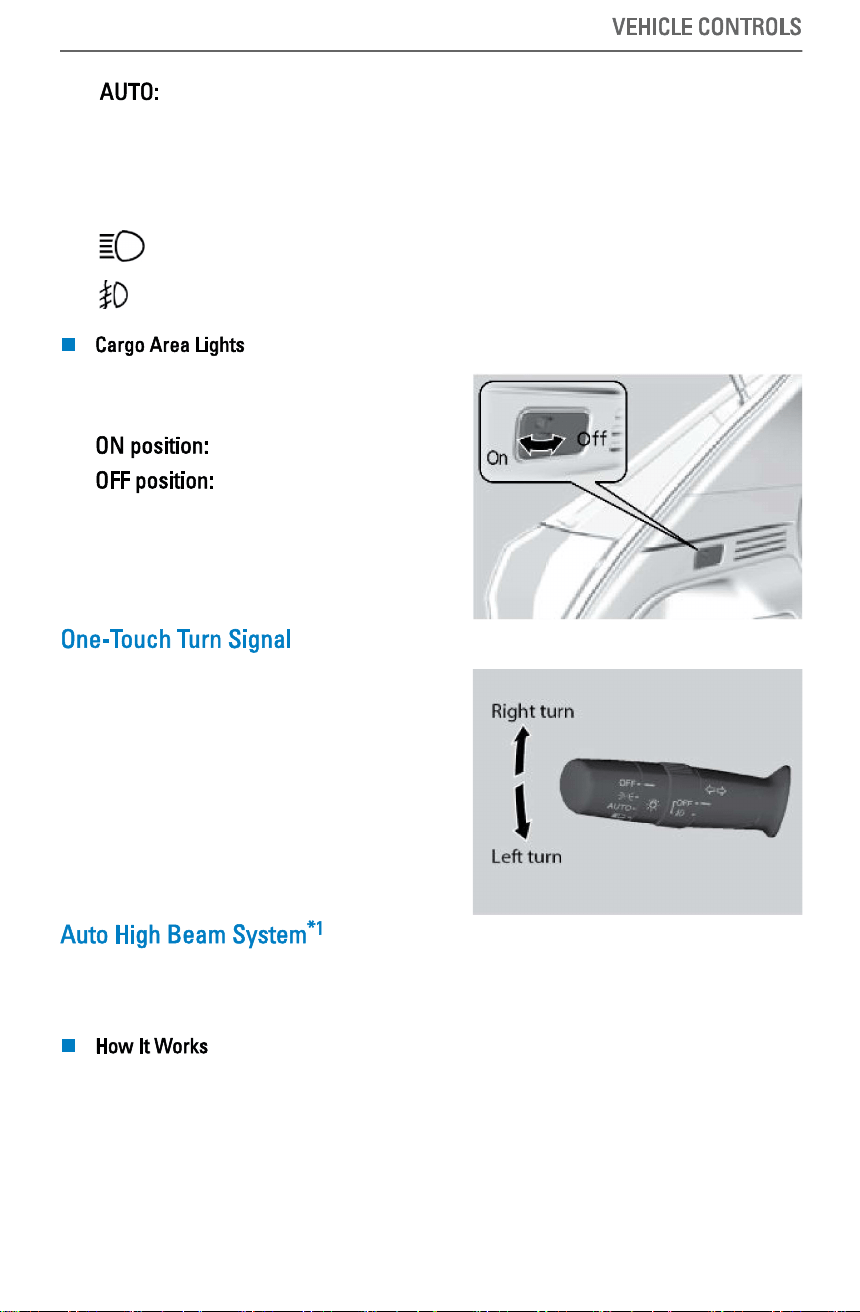
Interior lights remain on.
Interior lights
come on when any of the doors are
opened, the driver’s door is unlocked, or
the vehicle is turned off.
Interior lights remain off.
Press the front map lights to turn on or off.
Rotate the switches on the lever to operate the exterior lights. Push the
lever forward to turn on the high beams. Return the lever to its original
position for low beams.
All exterior lights are off.
Turn on exterior lights except headlights.
36 |
Turn on the automatic lighting feature. Headlights turn on or off
depending on ambient brightness when the vehicle is on.
Headlights automatically come on after the wipers are engaged for
a certain time. The headlights come on when you unlock a door in
dark areas with the headlight switch in AUTO.
Turn on all exterior lights including headlights.
Turn fog lights
*1
on or off.
Located on the rear ceiling in front of
the tailgate.
Cargo lights remain on.
Cargo area lights remain
off.
Use this quick and convenient method to
signal a lane change.
Lightly push the turn signal lever up or
down for a three-blink sequence.
For a continuous signal, push the lever up
or down until it locks into place.
Automatically changes the low beam headlights to high beam headlights when
necessary.
When you are driving at night above 45mph (72 km/h) and the headlight
lever is in the low beam position with the switch rotated to AUTO, the
system changes between low and high beams depending on the light
source ahead of you.
*1 - If equipped
| 37
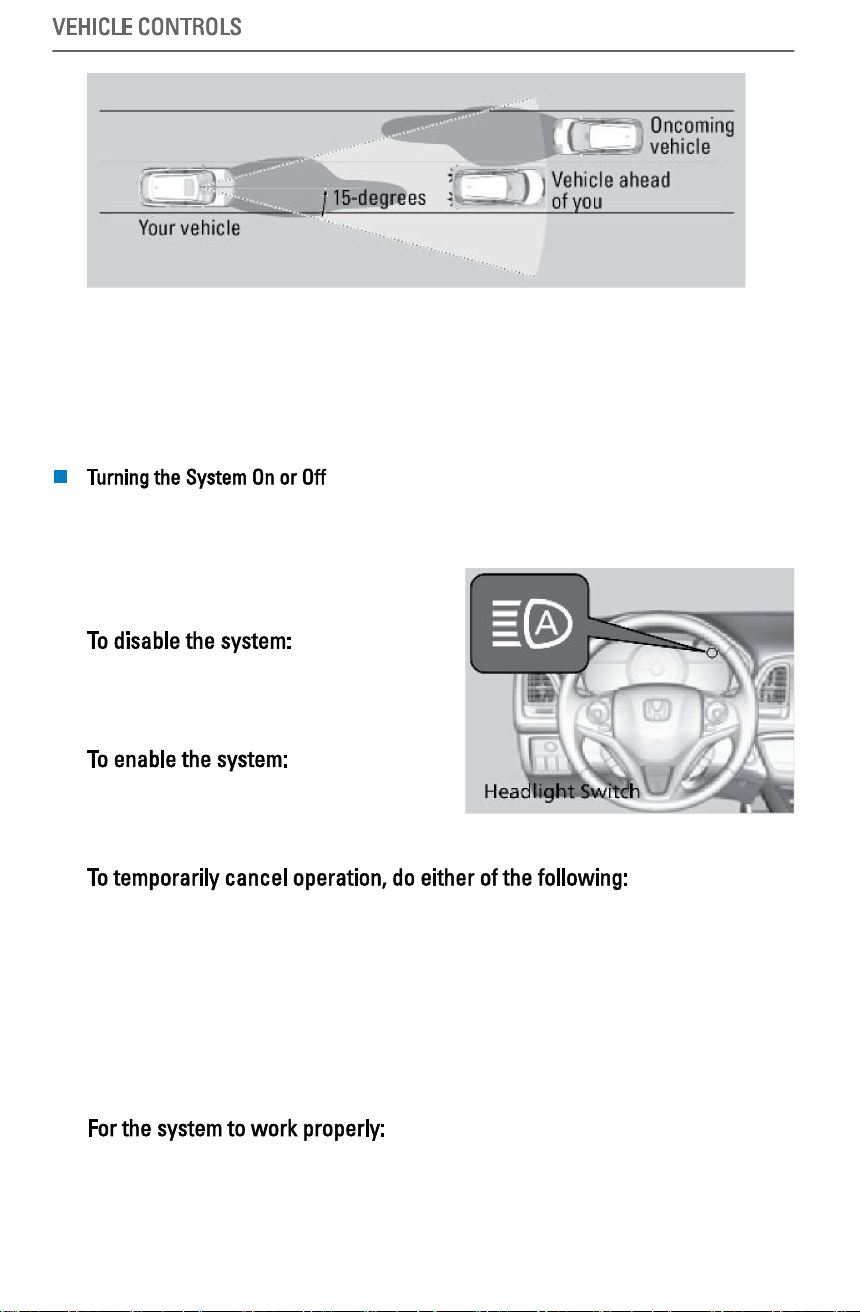
If a vehicle is detected ahead of you, the headlights stay in low beams. If the
system does not detect any vehicles ahead of you, the headlights change to
high beams.
Certain conditions, such as weather and brightness of other vehicles’ lights,
can affect system operation.
Make sure the headlight lever is in the low beam position with the switch
rotated to the AUTO position.
The auto high beam system indicator
comes on.
Pull and hold the
headlight lever toward you for about 40
seconds, until the indicator flashes
twice.
Pull and hold the
headlight lever toward you for about 30
seconds, until the indicator flashes
once.
• Flash the high beams by moving the lever toward you. Flash the high
beams again to resume auto high beam operation.
• Engage high beams by moving the lever into the high beam position.
Return the lever to the low beam position to resume auto high beam
operation.
If you find the timing of beam changes inconvenient for driving, change the
beams manually.
• Do not place an object that reflects light on the dashboard.
38 |
• Keep the windshield around the camera clean. When cleaning the
windshield, be careful not to apply windshield cleanser to the camera
lens.
• Do not attach an object, sticker or film in the area around the camera.
• Do not touch the camera lens.
If the camera receives a strong impact or requires repair, consult a dealer.
If you see the message “Some Driver Assist Systems Cannot Operate: Clean
Front Windshield,” park your vehicle in a safe place. Wipe away debris
blocking the windshield, then start driving again. If the message remains
even after driving for a while with the clean windshield, have your vehicle
checked by a dealer.
If you see a message that the camera is too hot, use the climate control
system to cool the interior. Defroster mode will direct airflow toward the
camera.
The windshield wipers and washers can be used when the vehicle is on.
Move the wiper lever up or down to
the desired position.
When the headlights are in the position, they automatically turn on
when the front wipers operate several times within a certain interval. The
| 39
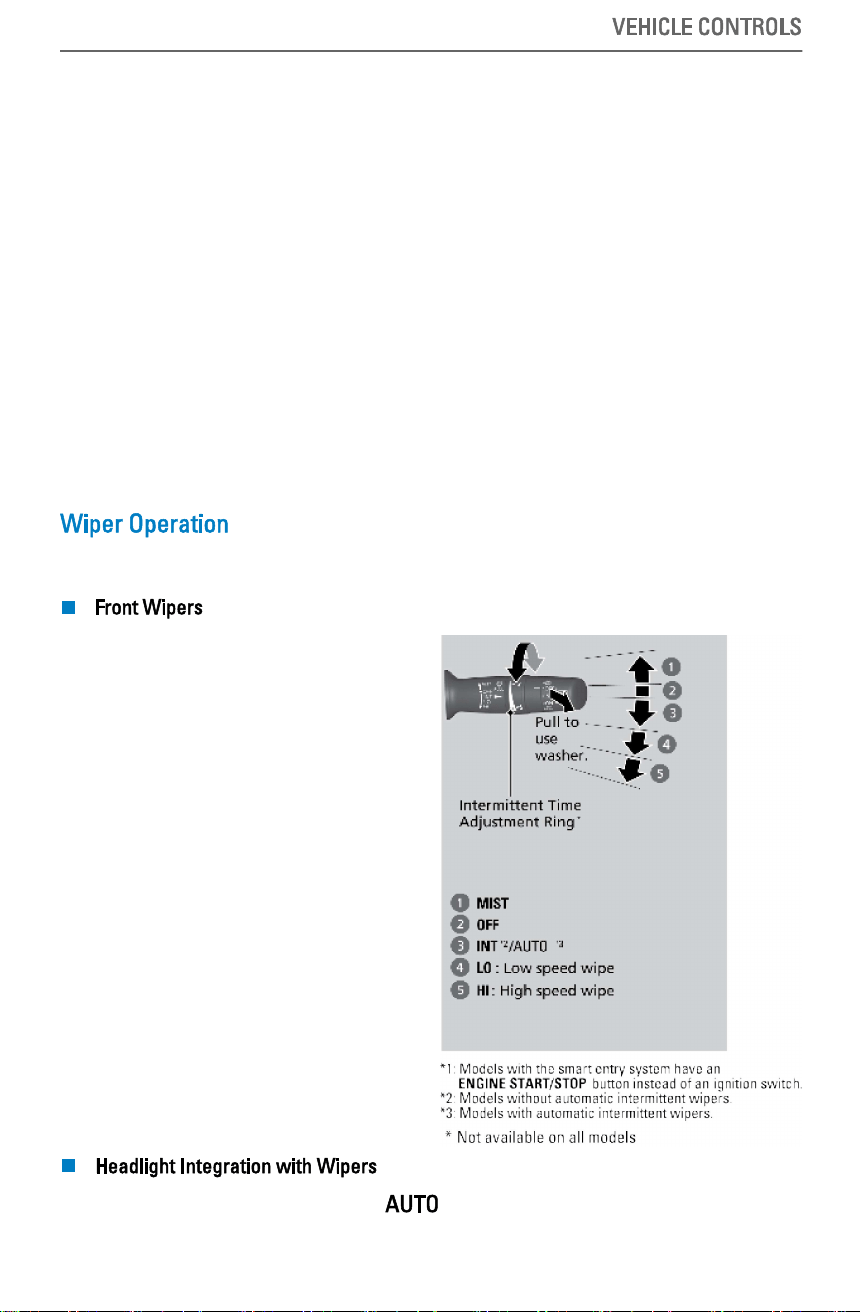
If a vehicle is detected ahead of you, the headlights stay in low beams. If the
system does not detect any vehicles ahead of you, the headlights change to
high beams.
Certain conditions, such as weather and brightness of other vehicles’ lights,
can affect system operation.
Make sure the headlight lever is in the low beam position with the switch
rotated to the AUTO position.
The auto high beam system indicator
comes on.
Pull and hold the
headlight lever toward you for about 40
seconds, until the indicator flashes
twice.
Pull and hold the
headlight lever toward you for about 30
seconds, until the indicator flashes
once.
• Flash the high beams by moving the lever toward you. Flash the high
beams again to resume auto high beam operation.
• Engage high beams by moving the lever into the high beam position.
Return the lever to the low beam position to resume auto high beam
operation.
If you find the timing of beam changes inconvenient for driving, change the
beams manually.
• Do not place an object that reflects light on the dashboard.
38 |
• Keep the windshield around the camera clean. When cleaning the
windshield, be careful not to apply windshield cleanser to the camera
lens.
• Do not attach an object, sticker or film in the area around the camera.
• Do not touch the camera lens.
If the camera receives a strong impact or requires repair, consult a dealer.
If you see the message “Some Driver Assist Systems Cannot Operate: Clean
Front Windshield,” park your vehicle in a safe place. Wipe away debris
blocking the windshield, then start driving again. If the message remains
even after driving for a while with the clean windshield, have your vehicle
checked by a dealer.
If you see a message that the camera is too hot, use the climate control
system to cool the interior. Defroster mode will direct airflow toward the
camera.
The windshield wipers and washers can be used when the vehicle is on.
Move the wiper lever up or down to
the desired position.
When the headlights are in the position, they automatically turn on
when the front wipers operate several times within a certain interval. The
| 39
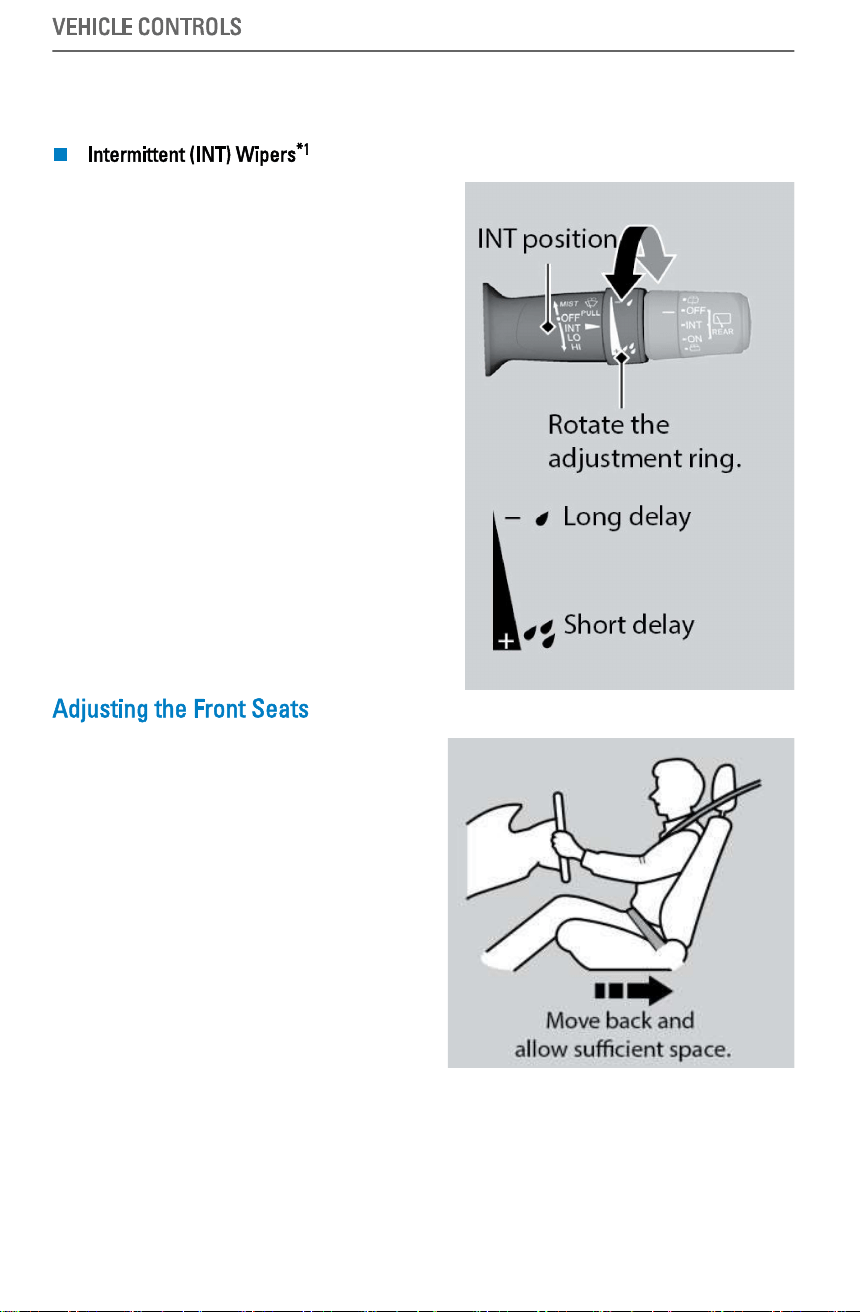
headlights turn off shortly after the wipers are turned off or if there is
enough ambient light.
When you move the lever to the INT
position, the wipers operate based on
the delay adjustment.
Rotate the adjustment ring to adjust the
wiper delay.
Adjust the driver’s seat as far back as
possible while allowing you to maintain
full control of the vehicle. You should be
able to sit upright and well back in the
seat, adequately press the pedals without
leaning forward, and grip the steering
wheel comfortably. The passenger’s seat
should be adjusted so that it is as far
back from the front airbag in the
dashboard as possible.
The National Highway Traffic Safety
Administration and Transport
Canadarecommends that drivers allow at least 10 inches (25 cm) between the
center of the steering wheel and the chest.
*1 - If equipped
40 |
*1 - If equipped
| 41

headlights turn off shortly after the wipers are turned off or if there is
enough ambient light.
When you move the lever to the INT
position, the wipers operate based on
the delay adjustment.
Rotate the adjustment ring to adjust the
wiper delay.
Adjust the driver’s seat as far back as
possible while allowing you to maintain
full control of the vehicle. You should be
able to sit upright and well back in the
seat, adequately press the pedals without
leaning forward, and grip the steering
wheel comfortably. The passenger’s seat
should be adjusted so that it is as far
back from the front airbag in the
dashboard as possible.
The National Highway Traffic Safety
Administration and Transport
Canadarecommends that drivers allow at least 10 inches (25 cm) between the
center of the steering wheel and the chest.
*1 - If equipped
40 |
*1 - If equipped
| 41

Sitting too close to a front airbag can result in serious injury or death if the
front airbags inflate.
Always sit as far back from the front airbags as possible while maintaining
control of the vehicle.
Reclining the seat-back too far can result in serious injury or death in a crash.
Adjust the seat-back to an upright position, and sit well back in the seat.
Sitting improperly or out of position can result in serious injury or death in a
crash.
Always sit upright, well back in the seat, with your feet on the floor.
*1 - If equipped
42 |
Your vehicle is equipped with head
restraints in all seating positions. Head
restraints are most effective for protection
against whiplash and other rear-impact
crash injuries.
The center of the back of the occupant’s
head should rest against the center of the
restraint. The tops of the occupant’s ears
should be level with the center height of
the restraint.
• Do not hang any items on the head restraints or from the restraint legs.
• Do not place any objects between an occupant and the seat-back.
• Install each restraint in its proper location.
Improperly positioning head restraints reduces their effectiveness and
increases the likelihood of serious injury in a crash.
Make sure head restraints are in place and positioned properly before driving.
Pull it
upward.
Push it
down while pressing the release
button.
Pull it upward.
| 43
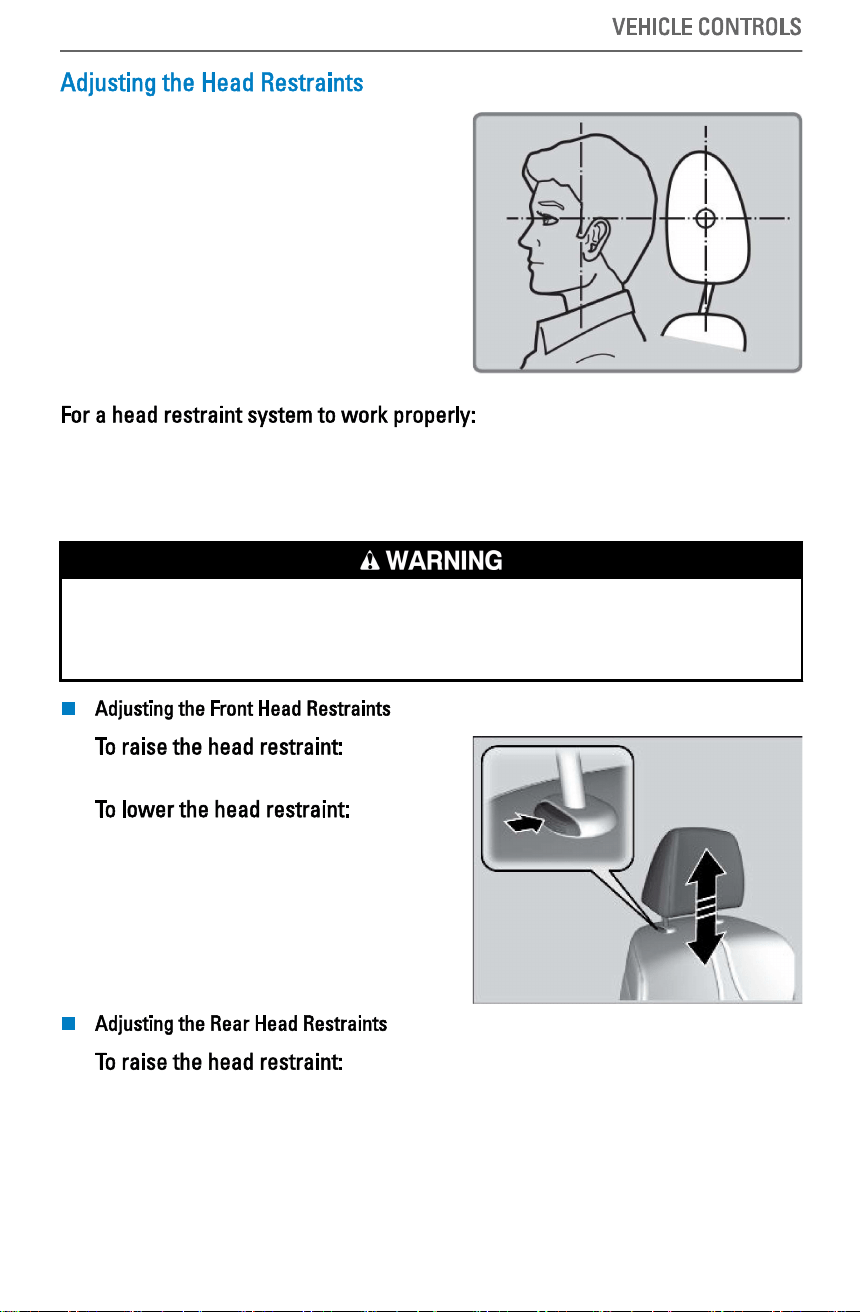
Sitting too close to a front airbag can result in serious injury or death if the
front airbags inflate.
Always sit as far back from the front airbags as possible while maintaining
control of the vehicle.
Reclining the seat-back too far can result in serious injury or death in a crash.
Adjust the seat-back to an upright position, and sit well back in the seat.
Sitting improperly or out of position can result in serious injury or death in a
crash.
Always sit upright, well back in the seat, with your feet on the floor.
*1 - If equipped
42 |
Your vehicle is equipped with head
restraints in all seating positions. Head
restraints are most effective for protection
against whiplash and other rear-impact
crash injuries.
The center of the back of the occupant’s
head should rest against the center of the
restraint. The tops of the occupant’s ears
should be level with the center height of
the restraint.
• Do not hang any items on the head restraints or from the restraint legs.
• Do not place any objects between an occupant and the seat-back.
• Install each restraint in its proper location.
Improperly positioning head restraints reduces their effectiveness and
increases the likelihood of serious injury in a crash.
Make sure head restraints are in place and positioned properly before driving.
Pull it
upward.
Push it
down while pressing the release
button.
Pull it upward.
| 43
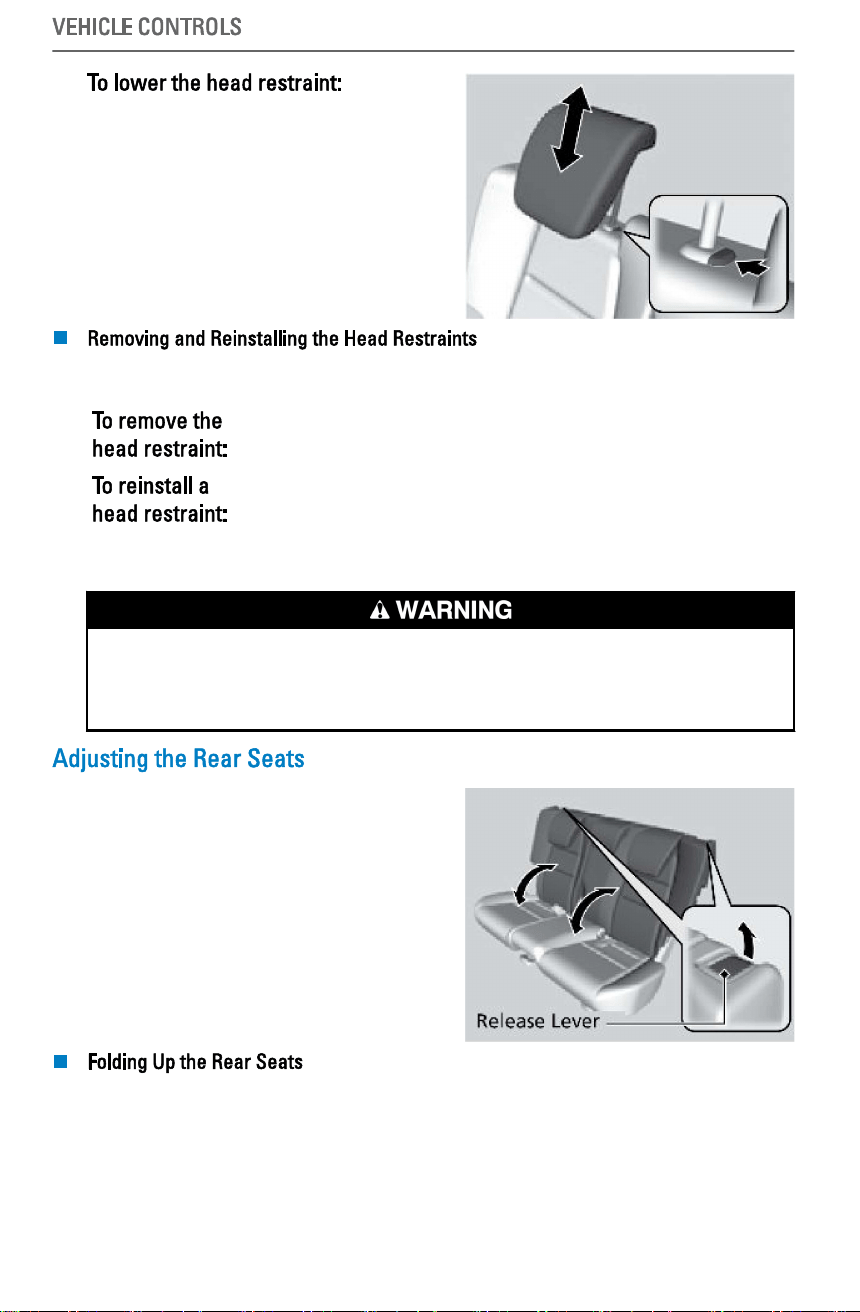
Push it
down while pressing the release
button.
Head restraints can be removed for cleaning or repair.
Pull the restraint up as far as it will go. Then push the
release button(s), and pull the restraint up and out.
Insert the legs back in place, then adjust the head
restraint to an appropriate height while pressing the
release button(s). Pull up on the restraint to make sure it
is locked in position.
Failure to reinstall, or correctly reinstall, the head restraints can result in
severe injury during a crash.
Always replace the head restraints before driving.
Pull the lever on the right to change the
angle of the right half of the seat-back, and
left for the left half.
Separately lift up the left and right halves of the rear seat cushions to make
room for cargo area.
1. Make sure the seat belt buckles are in their loops on the seat.
44 |
2. Pull up the rear seat cushion.
3. Fold the seat leg down while pushing the seat cushion firmly against the
seat-back to lock it.
Separately fold down the left and right halves of the rear seat to make room
for cargo.
To fold down the seat:
1. Store the center seat belt.
2. Insert the latch plate into the slot on
the side of the anchor buckle.
3. Retract the seat belt into the holder
on the ceiling.
4. Lower the head restraint to its
lowest position.
5. Pull the release lever and fold down
the seat-back.
To return the seat to the original position, pull up the seat-back in the
upright position.
The driver's floor mat hooksfront and second row passenger's floor mats hook
over the floor anchors, which keep the mat from sliding forward. To remove a
mat for cleaning, turn the anchor knobs to the unlock position. When
reinstalling, turn the knobs to the lock position.
| 45
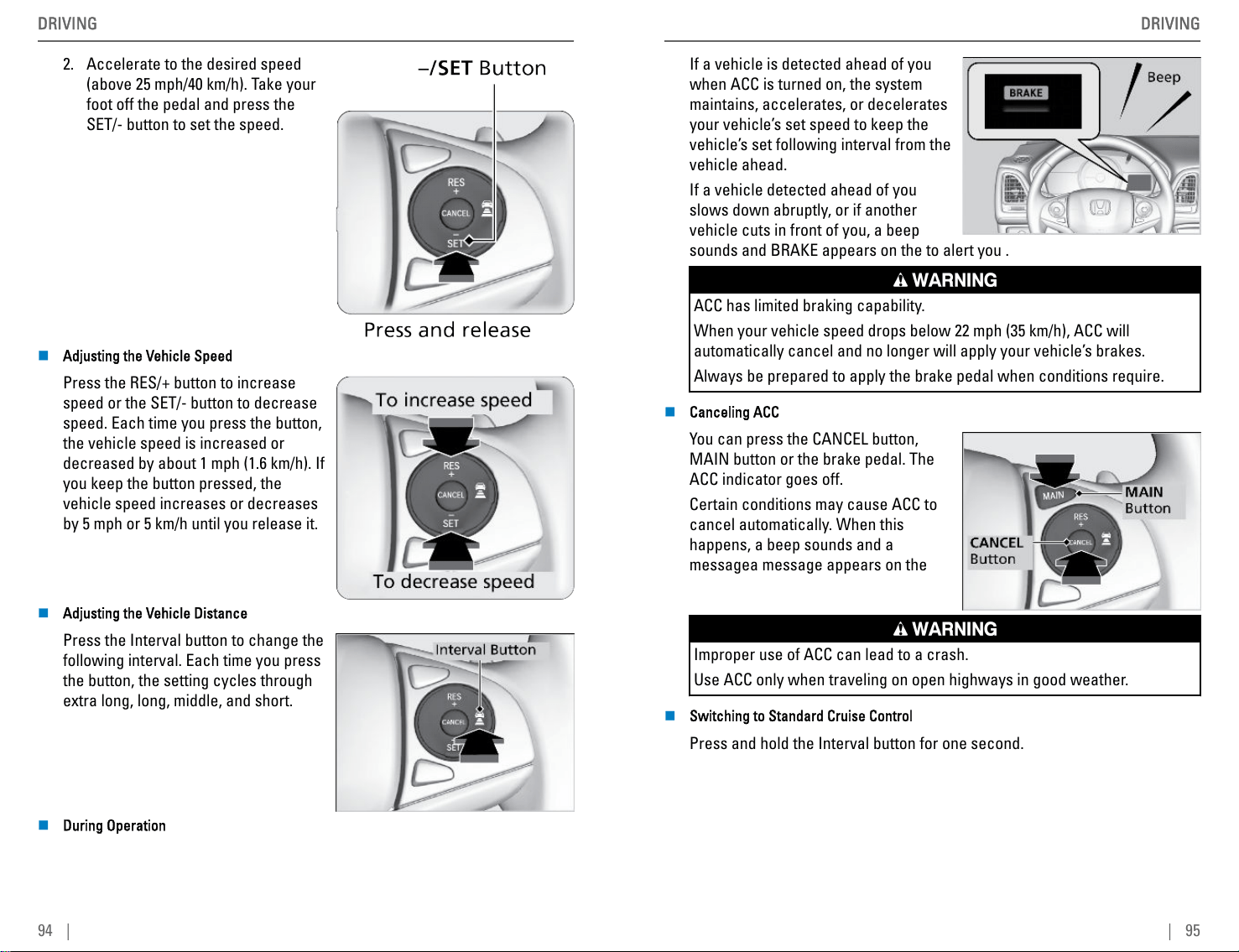
Push it
down while pressing the release
button.
Head restraints can be removed for cleaning or repair.
Pull the restraint up as far as it will go. Then push the
release button(s), and pull the restraint up and out.
Insert the legs back in place, then adjust the head
restraint to an appropriate height while pressing the
release button(s). Pull up on the restraint to make sure it
is locked in position.
Failure to reinstall, or correctly reinstall, the head restraints can result in
severe injury during a crash.
Always replace the head restraints before driving.
Pull the lever on the right to change the
angle of the right half of the seat-back, and
left for the left half.
Separately lift up the left and right halves of the rear seat cushions to make
room for cargo area.
1. Make sure the seat belt buckles are in their loops on the seat.
44 |
2. Pull up the rear seat cushion.
3. Fold the seat leg down while pushing the seat cushion firmly against the
seat-back to lock it.
Separately fold down the left and right halves of the rear seat to make room
for cargo.
To fold down the seat:
1. Store the center seat belt.
2. Insert the latch plate into the slot on
the side of the anchor buckle.
3. Retract the seat belt into the holder
on the ceiling.
4. Lower the head restraint to its
lowest position.
5. Pull the release lever and fold down
the seat-back.
To return the seat to the original position, pull up the seat-back in the
upright position.
The driver's floor mat hooksfront and second row passenger's floor mats hook
over the floor anchors, which keep the mat from sliding forward. To remove a
mat for cleaning, turn the anchor knobs to the unlock position. When
reinstalling, turn the knobs to the lock position.
| 45
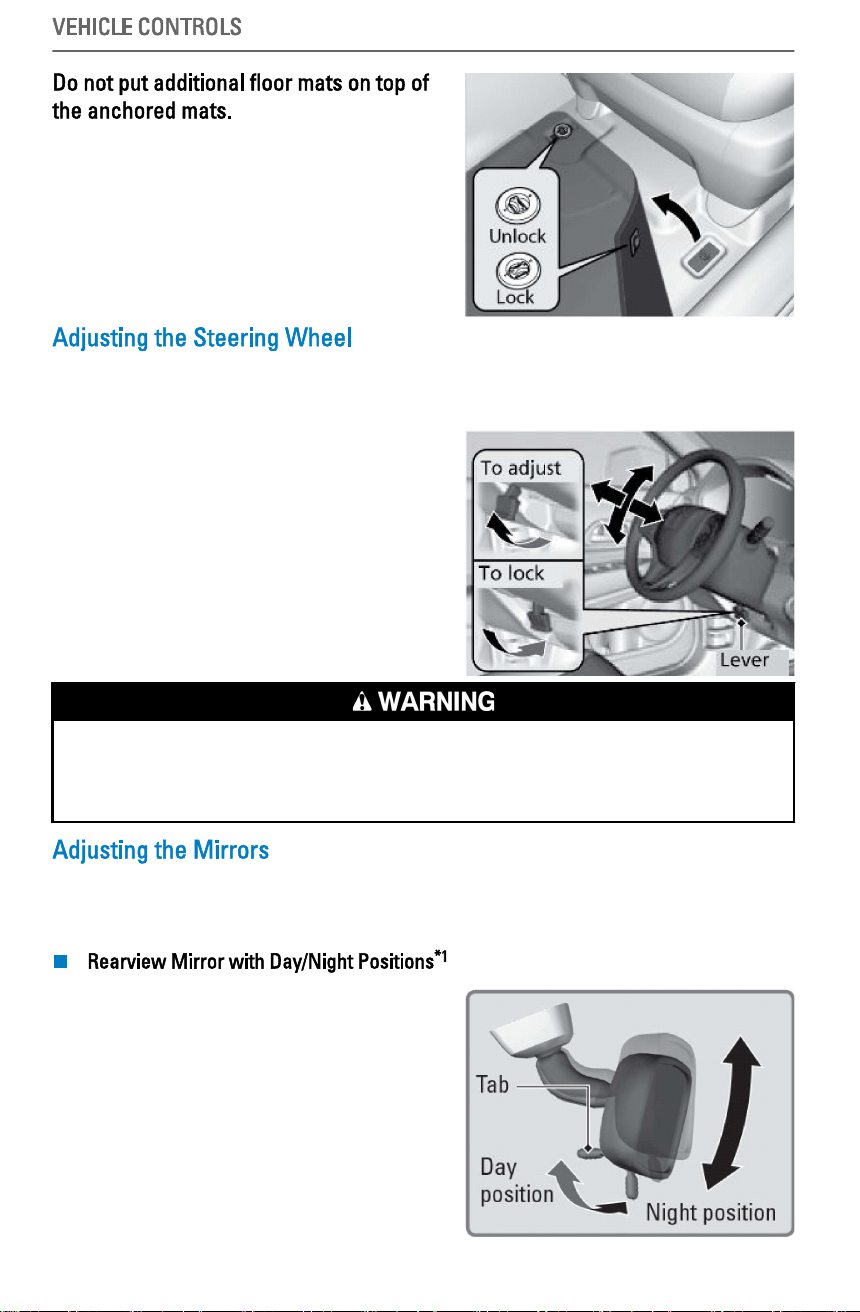
The steering wheel height and distance from your body can be adjusted so that
you can comfortably grip the steering wheel in an appropriate driving posture.
1. Pull the steering wheel adjustment lever
up.
2. Move the steering wheel up, down, in,
or out.
3. Pull up the lever to lock the steering
wheel in place.
Adjusting the steering wheel position while driving may cause you to lose
control of the vehicle and be seriously injured in a crash.
Adjust the steering wheel only when the vehicle is stopped.
Adjust the angle of the mirrors for the best visibility when you are sitting in the
correct driving position.
Manually adjust the position to reduce
headlight glare from vehicles behind
you. Flip the tab to switch between day
and night positions.
46 |
When driving after dark, the automatic
dimming function reduces glare in the
rearview mirror from headlights behind
you. Press the AUTO button to turn this
function on and off. This function
cancels when the shift lever is in
Reverse (R).
Adjust the power door mirrors when the
vehicle is on.
Select the left or
right mirror.
After adjusting the mirror, return the
switch to the center position.
Press the switch left, right, up, or down
to move the mirror.
Manually control the front and rear heating and cooling in your vehicle’s interior
using the buttons on the dashboard.
*1 - If equipped
| 47
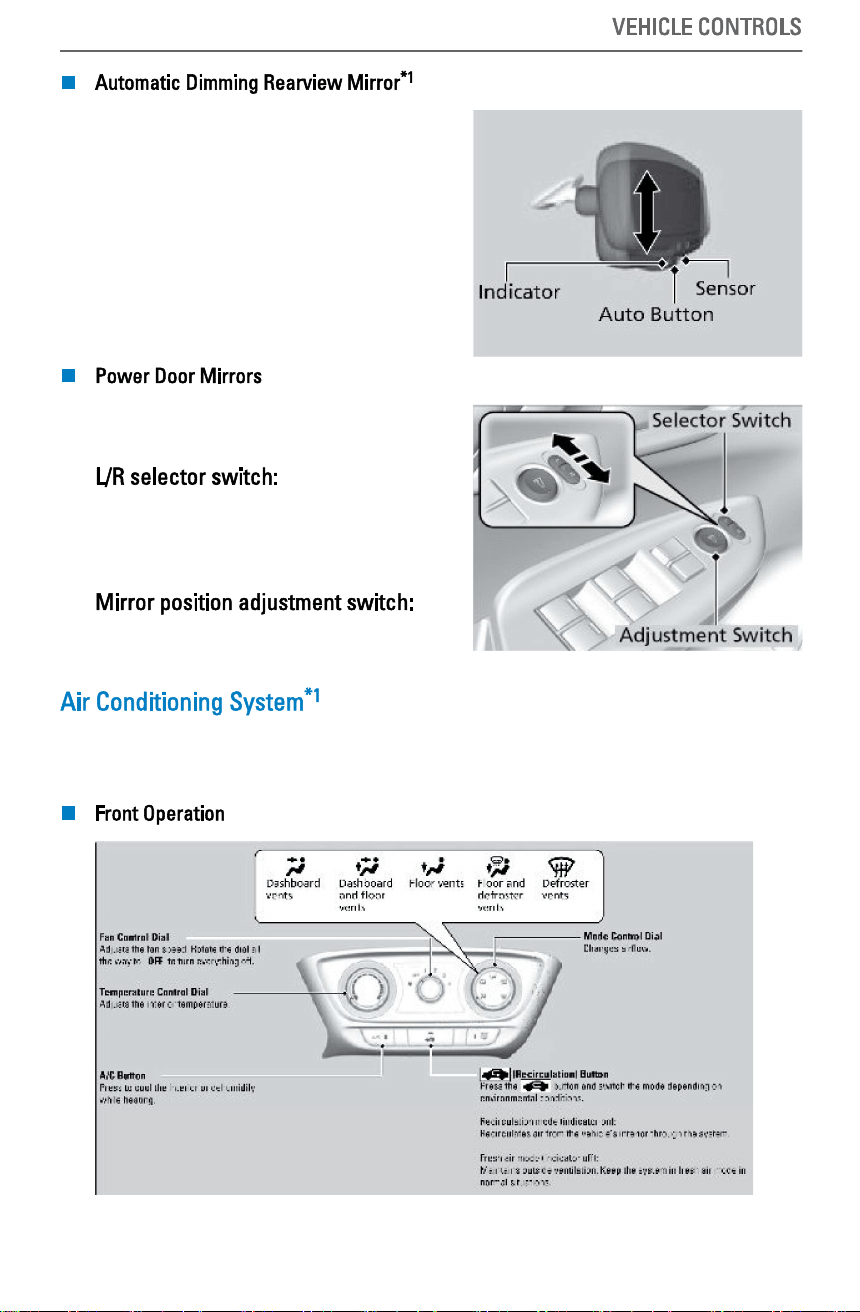
The steering wheel height and distance from your body can be adjusted so that
you can comfortably grip the steering wheel in an appropriate driving posture.
1. Pull the steering wheel adjustment lever
up.
2. Move the steering wheel up, down, in,
or out.
3. Pull up the lever to lock the steering
wheel in place.
Adjusting the steering wheel position while driving may cause you to lose
control of the vehicle and be seriously injured in a crash.
Adjust the steering wheel only when the vehicle is stopped.
Adjust the angle of the mirrors for the best visibility when you are sitting in the
correct driving position.
Manually adjust the position to reduce
headlight glare from vehicles behind
you. Flip the tab to switch between day
and night positions.
46 |
When driving after dark, the automatic
dimming function reduces glare in the
rearview mirror from headlights behind
you. Press the AUTO button to turn this
function on and off. This function
cancels when the shift lever is in
Reverse (R).
Adjust the power door mirrors when the
vehicle is on.
Select the left or
right mirror.
After adjusting the mirror, return the
switch to the center position.
Press the switch left, right, up, or down
to move the mirror.
Manually control the front and rear heating and cooling in your vehicle’s interior
using the buttons on the dashboard.
*1 - If equipped
| 47
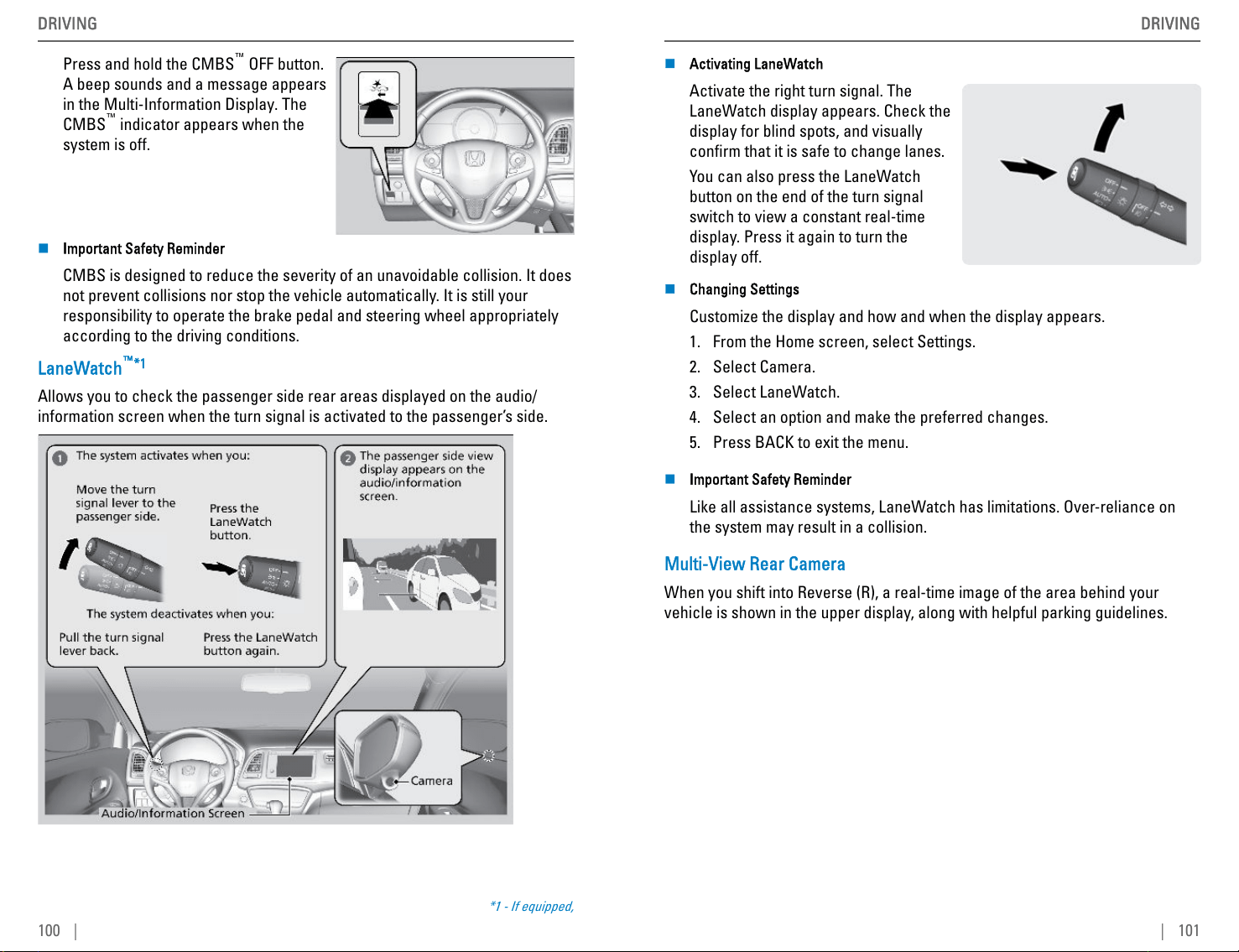
The automatic climate control system maintains the interior temperature you
select. The system also selects the proper mix of heated or cooled air that
raises or lowers the interior temperature to your preference as quickly as
possible.
*1 - If equipped
48 |
Turn the vehicle on. Press the heated windshield button to de-ice the
windshield.
The heated windshield may
automatically activate when the outside
temperature is below 4°C, and
deactivate when the temperature
reaches 6°C.
Quickly warm the front seats when the vehicle is on.
Press the seat heater button to cycle through settings.
•
*4 - Canadian models only, if equipped
*1 - If equipped
| 49
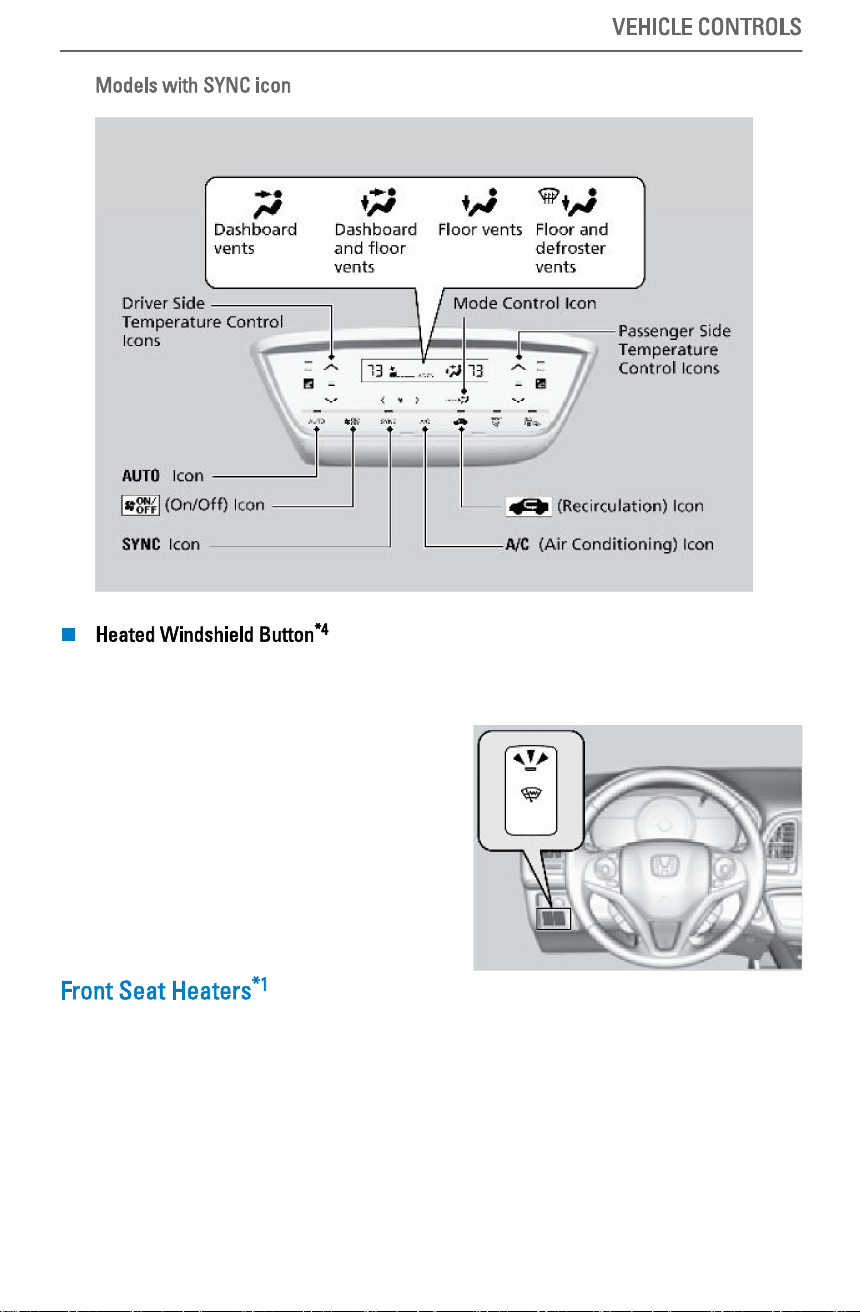
The automatic climate control system maintains the interior temperature you
select. The system also selects the proper mix of heated or cooled air that
raises or lowers the interior temperature to your preference as quickly as
possible.
*1 - If equipped
48 |
Turn the vehicle on. Press the heated windshield button to de-ice the
windshield.
The heated windshield may
automatically activate when the outside
temperature is below 4°C, and
deactivate when the temperature
reaches 6°C.
Quickly warm the front seats when the vehicle is on.
Press the seat heater button to cycle through settings.
•
*4 - Canadian models only, if equipped
*1 - If equipped
| 49

Once - The HI setting (two indicators on)
• Twice - The LO setting
• Three times - The OFF setting (no
indicator on)
Heat-induced burns are possible when using seat heaters.
Persons with a diminished ability to sense temperature (e.g., persons with
diabetes, lower-limb nerve damage, or paralysis) or with sensitive skin should
not use the seat heaters.
When you customize settings, make sure that the vehicle is at a complete stop
and shift to Park (P).
50 |
Use the selector knob to make and enter selections.
1. Press the MENU/CLOCK button.
2. Select Settings.
3. Select a setting option and make your preferred changes.
4. Press the Back button to exit the menus.
1. Press the SETTINGS button.
2. Select a category.
3. Select a setting option, and make your preferred changes.
4. Press the BACK button to exit out of the menus.
On vehicles with navigation, the time is automatically set using GPS signals.
On vehicles without navigation and if the Automatic Date & Time feature has
been turned off, use the following steps to adjust the time in the clock display.
| 51
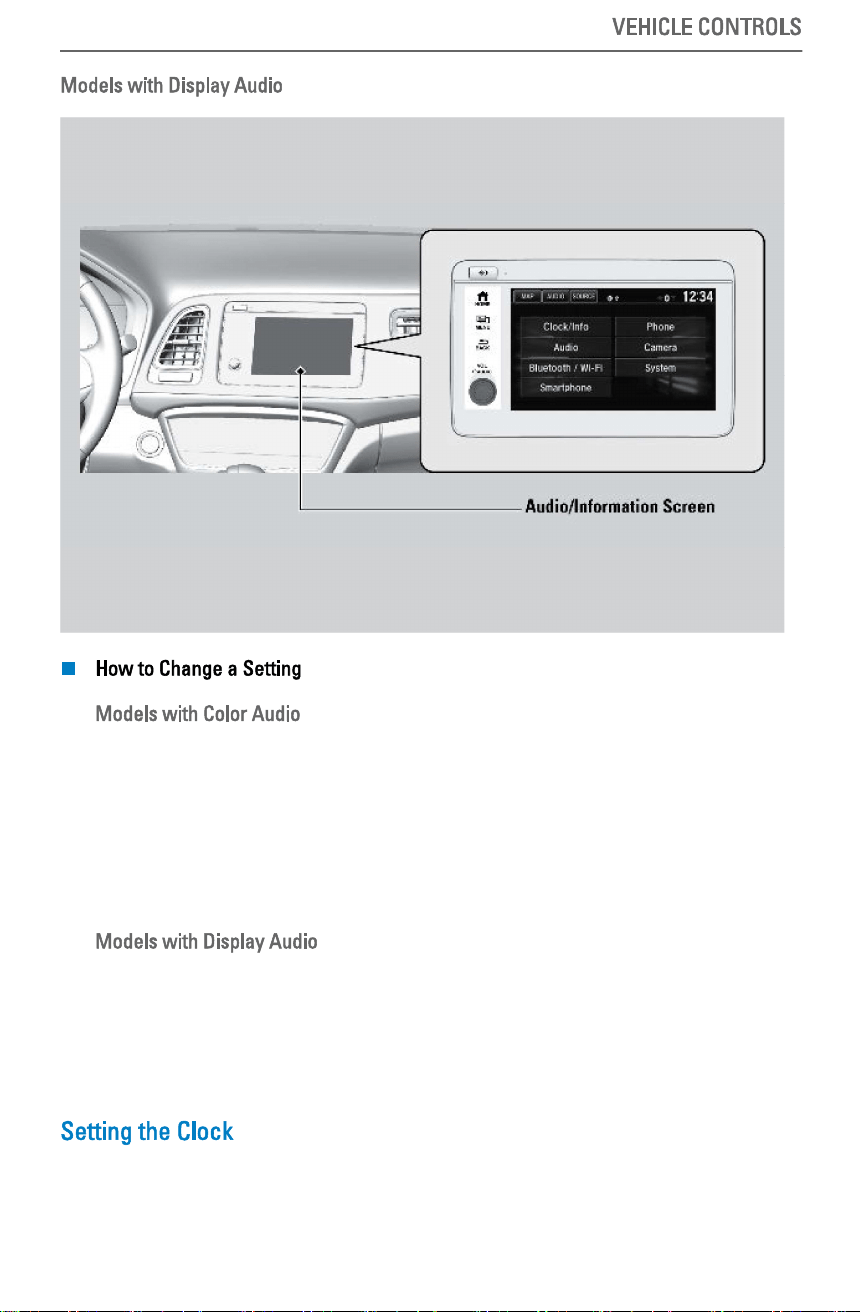
Once - The HI setting (two indicators on)
• Twice - The LO setting
• Three times - The OFF setting (no
indicator on)
Heat-induced burns are possible when using seat heaters.
Persons with a diminished ability to sense temperature (e.g., persons with
diabetes, lower-limb nerve damage, or paralysis) or with sensitive skin should
not use the seat heaters.
When you customize settings, make sure that the vehicle is at a complete stop
and shift to Park (P).
50 |
Use the selector knob to make and enter selections.
1. Press the MENU/CLOCK button.
2. Select Settings.
3. Select a setting option and make your preferred changes.
4. Press the Back button to exit the menus.
1. Press the SETTINGS button.
2. Select a category.
3. Select a setting option, and make your preferred changes.
4. Press the BACK button to exit out of the menus.
On vehicles with navigation, the time is automatically set using GPS signals.
On vehicles without navigation and if the Automatic Date & Time feature has
been turned off, use the following steps to adjust the time in the clock display.
| 51
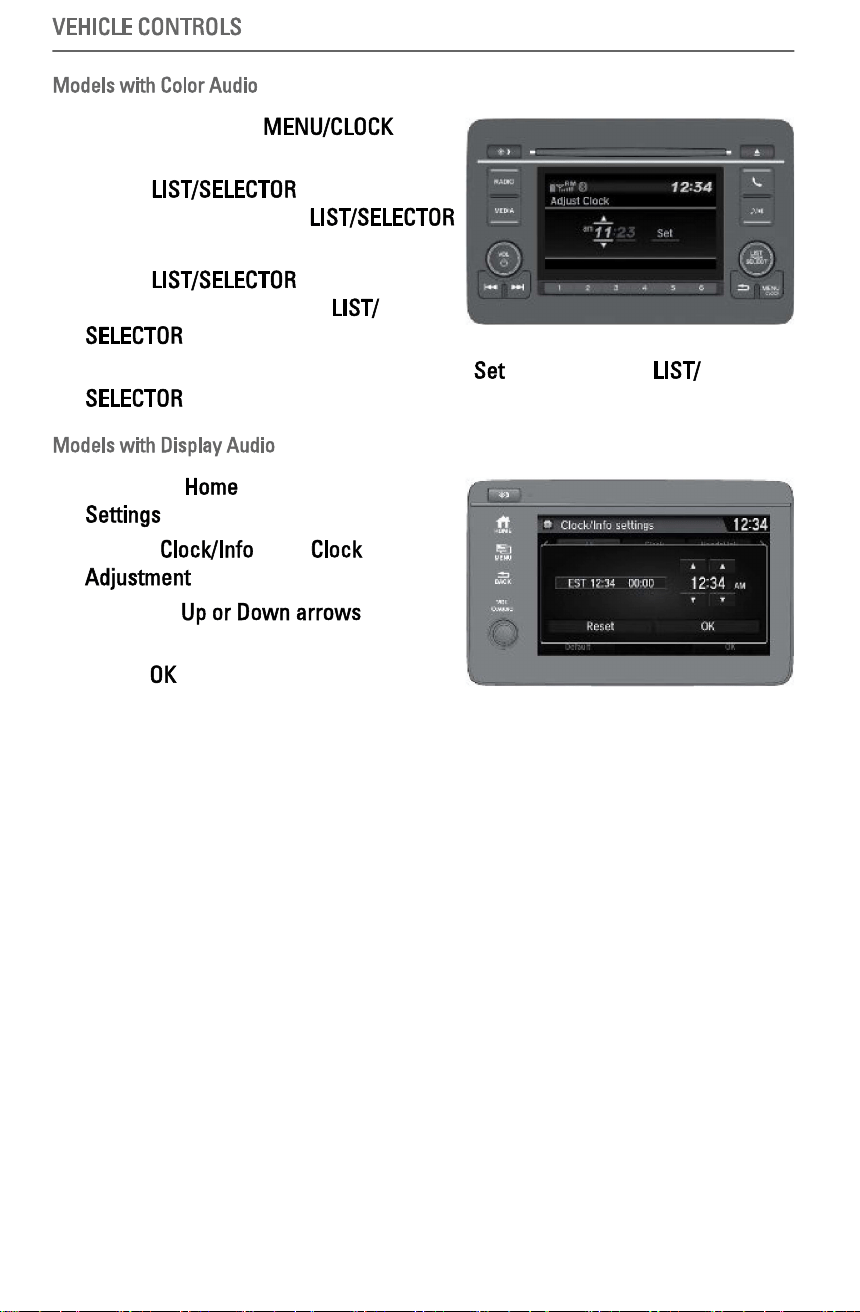
1. Press and hold the
button.
2. Rotate knob to change
the hour, then press the
knob.
3. Rotate knob to change
the minute, then press the
knob.
4. To enter the selection, rotate knob, select , then press the
knob.
1. Select the icon, then select
.
2. Select , , then
.
3. Touch the to adjust
the numbers up or down.
4. Select .
52 |
Learn how to operate the vehicle’s audio system.
Connect audio devices and operate buttons and displays for the audio system.
1. Open the USB cover.
2. Install the iPod
®
USB connector or
the USB flash drive into the USB
port.
• The USB port (1.0A) is for playing audio files on a USB flash drive,
connecting a cellular phone and charging devices.
• The USB port (1.5 A)
*1
is for charging devices, playing audio files and
connecting compatible phones with Apple Carplay
™
or Android Auto
™
.
Open the socket cover to use power when the vehicle is on.
Open the cover to use it.
*1 - If equipped
| 53
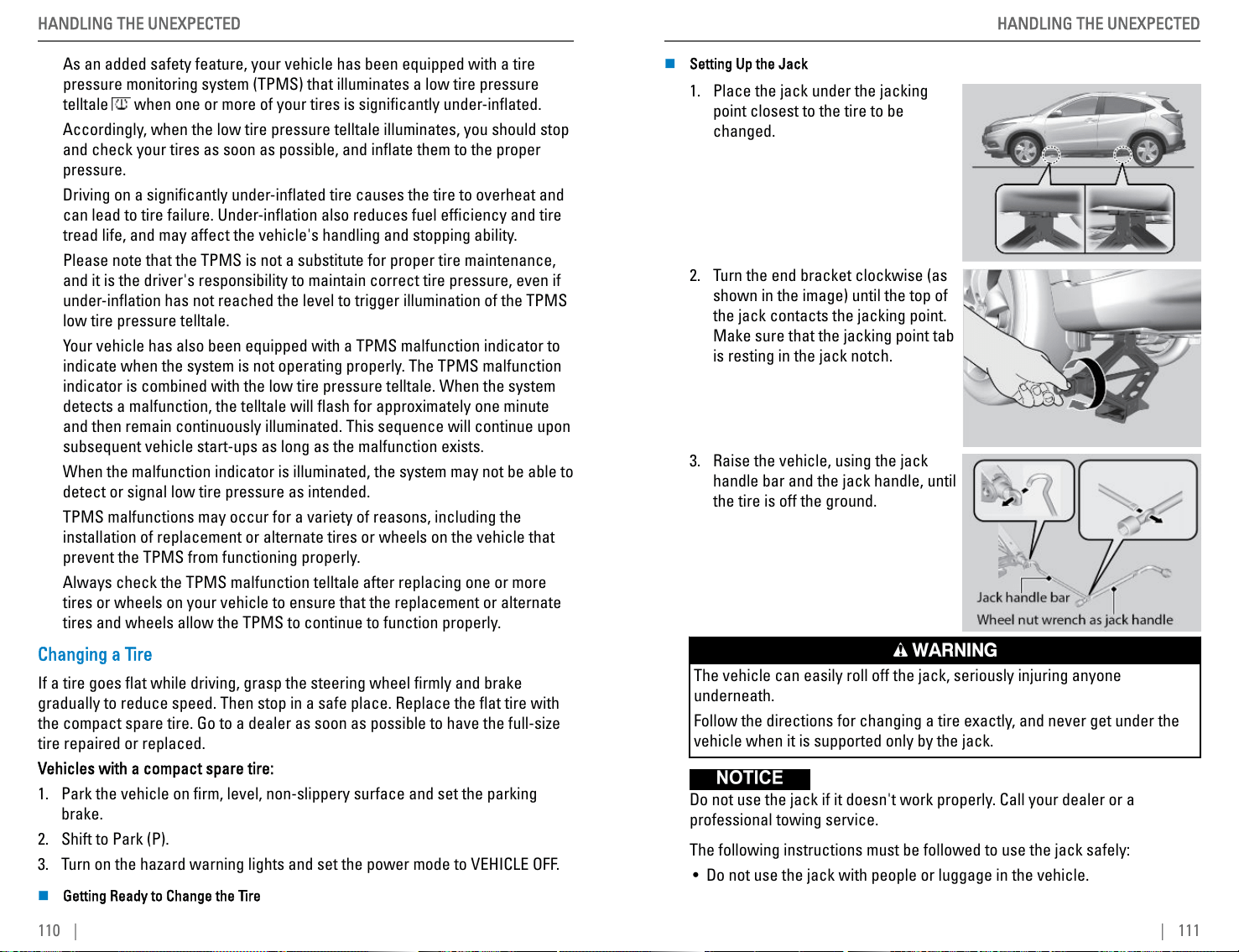
1. Press and hold the
button.
2. Rotate knob to change
the hour, then press the
knob.
3. Rotate knob to change
the minute, then press the
knob.
4. To enter the selection, rotate knob, select , then press the
knob.
1. Select the icon, then select
.
2. Select , , then
.
3. Touch the to adjust
the numbers up or down.
4. Select .
52 |
Learn how to operate the vehicle’s audio system.
Connect audio devices and operate buttons and displays for the audio system.
1. Open the USB cover.
2. Install the iPod
®
USB connector or
the USB flash drive into the USB
port.
• The USB port (1.0A) is for playing audio files on a USB flash drive,
connecting a cellular phone and charging devices.
• The USB port (1.5 A)
*1
is for charging devices, playing audio files and
connecting compatible phones with Apple Carplay
™
or Android Auto
™
.
Open the socket cover to use power when the vehicle is on.
Open the cover to use it.
*1 - If equipped
| 53
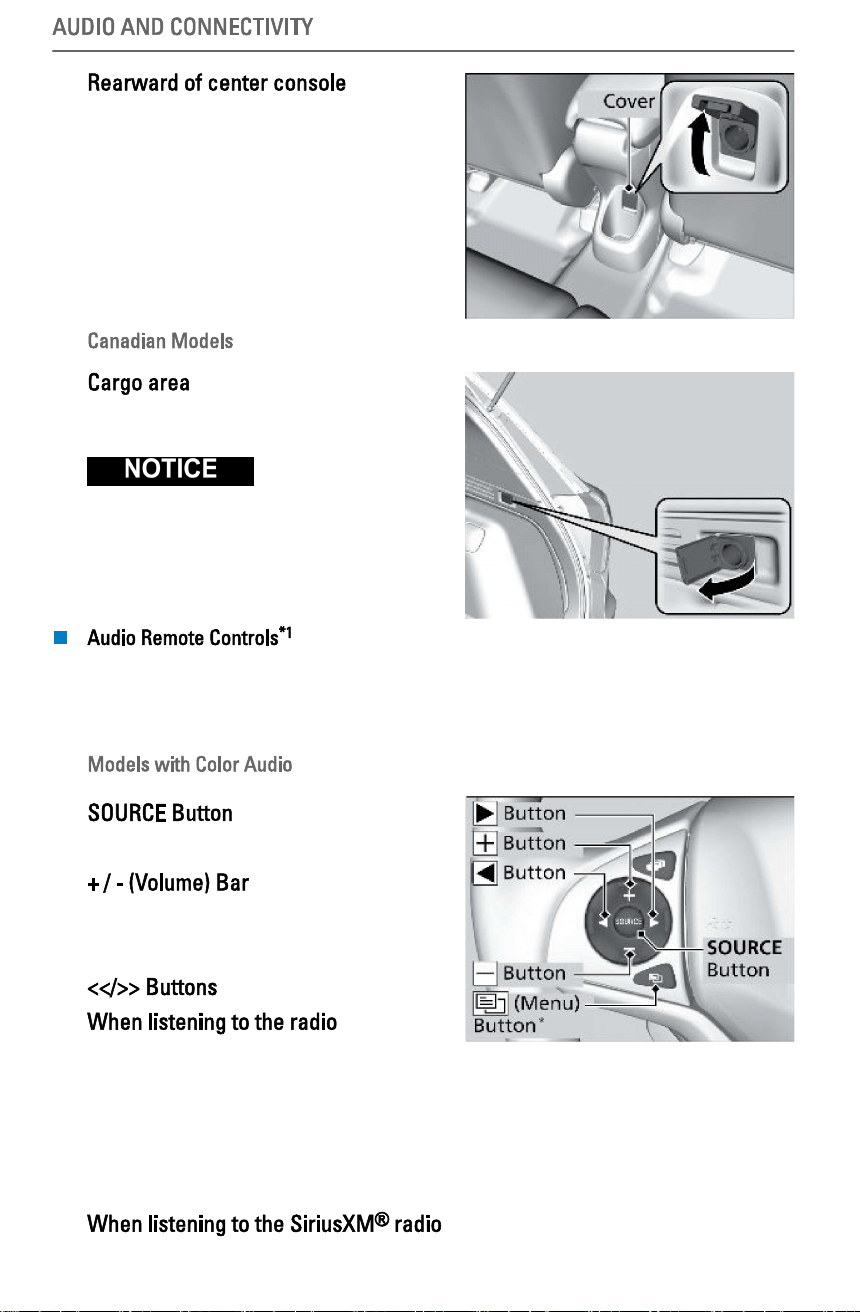
Open the cover to use it.
Open the cover to use it.
Do not insert an automotive type
cigarette lighter element. This can
overheat the power socket.
You can operate certain functions of the audio system using the steering
wheel controls.
Cycles through audio modes.
Press + : To increase the volume.
Press - : To decrease the volume.
Press >>: To select the next preset
radio station.
Press <<: To select the previous preset radio station.
Press and hold >>: To select the next strong station.
Press and hold <<: To select the previous strong station.
*1
*1 - If equipped
54 |
Press >>: To select the next preset radio station.
Press <<: To select the previous preset radio station.
Press and hold >>: To select the next channel.
Press and hold <<: To select the previous channel.
Press >>: To skip to the next song.
Press <<: To go back to the beginning of the current or previous song.
Press >>: To go to the group up.
Press <<: To go to the group down.
Press >>: To skip to the next song.
Press and hold >>: To select the next station.
Press and hold <<: To select the previous station.
Press Menu: To display the menu items.
You can select Scan, Save Preset, or
Seek.
Press Menu: To display the menu items.
You can select Scan, Save Preset,
Channel, or Category.
Press Menu: To display the menu items. You can select Scan, Repeat, or
Random.
Press Menu: To display the menu items. You can select Repeat or Shuffle.
Press Menu: To display the menu items. You can select Pause or Play.
*1
Press Menu: To display the menu items. You can select Bookmark, or Play/
Pause.
*1 - If equipped
| 55
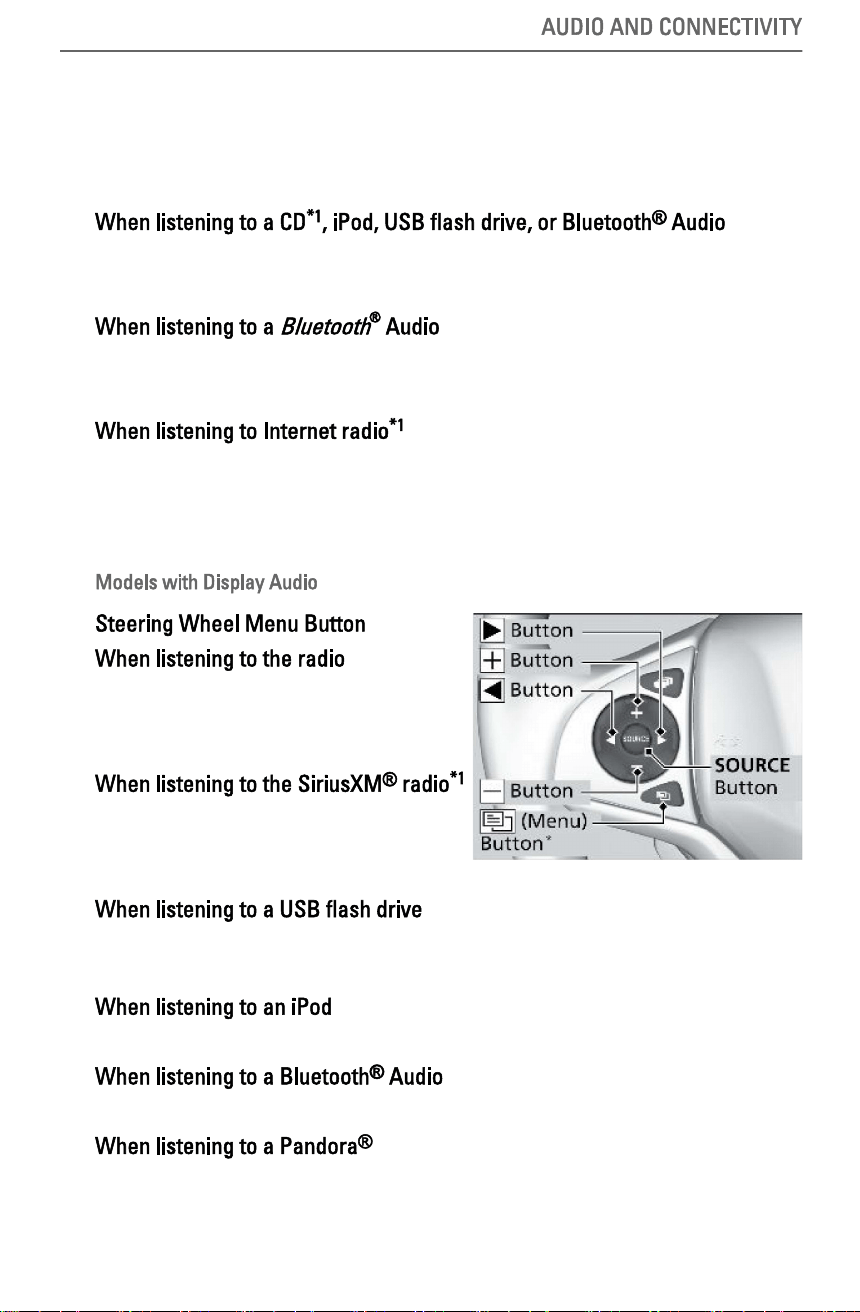
Open the cover to use it.
Open the cover to use it.
Do not insert an automotive type
cigarette lighter element. This can
overheat the power socket.
You can operate certain functions of the audio system using the steering
wheel controls.
Cycles through audio modes.
Press + : To increase the volume.
Press - : To decrease the volume.
Press >>: To select the next preset
radio station.
Press <<: To select the previous preset radio station.
Press and hold >>: To select the next strong station.
Press and hold <<: To select the previous strong station.
*1
*1 - If equipped
54 |
Press >>: To select the next preset radio station.
Press <<: To select the previous preset radio station.
Press and hold >>: To select the next channel.
Press and hold <<: To select the previous channel.
Press >>: To skip to the next song.
Press <<: To go back to the beginning of the current or previous song.
Press >>: To go to the group up.
Press <<: To go to the group down.
Press >>: To skip to the next song.
Press and hold >>: To select the next station.
Press and hold <<: To select the previous station.
Press Menu: To display the menu items.
You can select Scan, Save Preset, or
Seek.
Press Menu: To display the menu items.
You can select Scan, Save Preset,
Channel, or Category.
Press Menu: To display the menu items. You can select Scan, Repeat, or
Random.
Press Menu: To display the menu items. You can select Repeat or Shuffle.
Press Menu: To display the menu items. You can select Pause or Play.
*1
Press Menu: To display the menu items. You can select Bookmark, or Play/
Pause.
*1 - If equipped
| 55
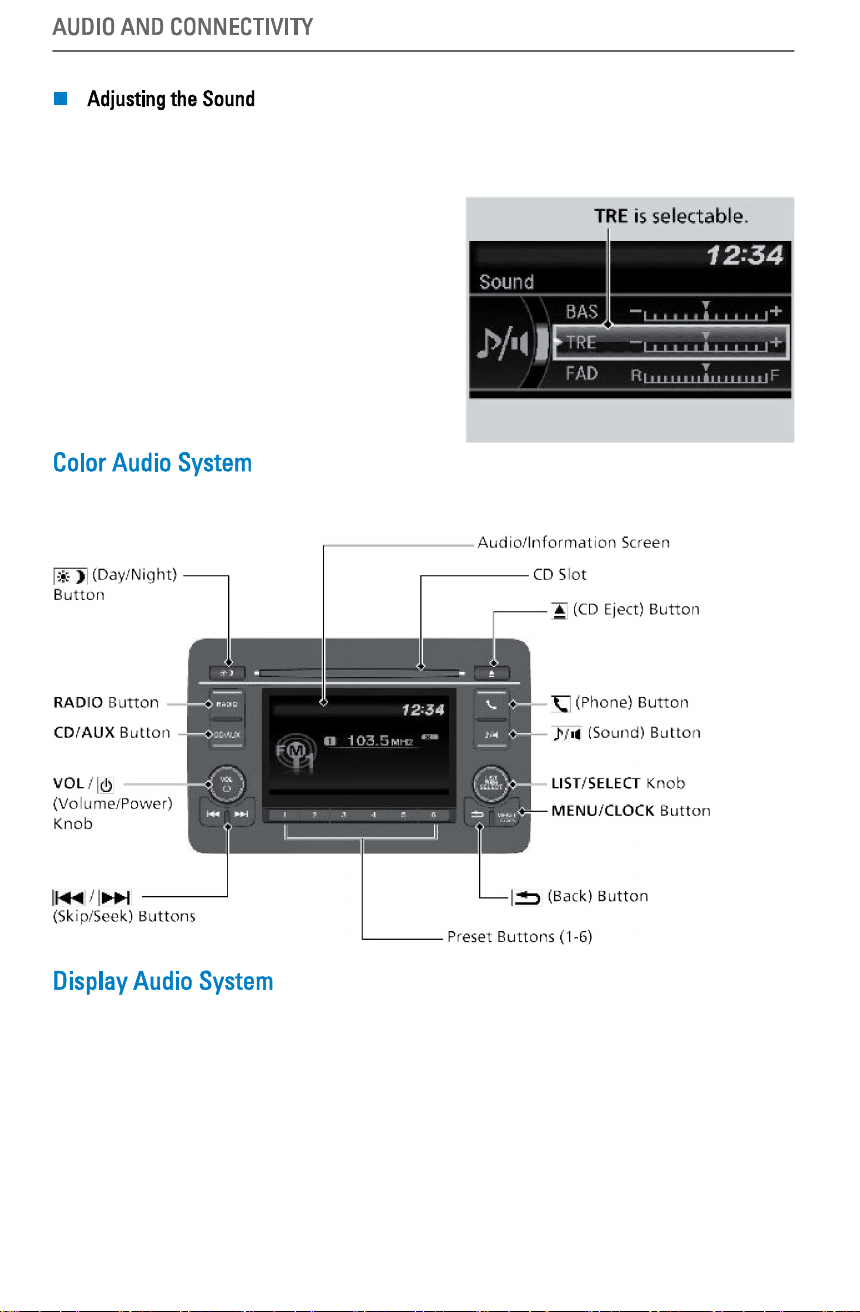
Press the sound button and rotate the selector knob to scroll through the
following choices.
• Bass
• Balance
• Treble
• Fader
• Speed-sensitive Volume
Compensation
Use the buttons to control the color audio system.
Use simple gestures-including touching, swiping and scrolling-to operate
certain audio functions.
56 |
Some items may be grayed out during driving to reduce the potential for
distraction. You can select them when the vehicle is stopped or use voice
commands.
Wearing gloves may limit or prevent touchscreen response.
A subscription-based service that provides convenient features such as voice
communication in case of emergency, online security, and one-on-one operator
assistance
*1
.
To check phone compatibility and get more information, visit
handsfreelink.com
(US)
handsfreelink.ca
(Canada). Standard data rates may apply with your phone
service provider.
Follow the steps below to connect to HondaLink
®
Connection and use its
features.
If you connect an Apple Carplay
™
-compatible iPhone
®
to the system via the
1.5A USB port , you can use the audio/information touchscreen, instead of the
iPhone
®
display, to make a phone call, listen to music, view maps (navigation),
and access messages.
*1 - If equipped
| 57
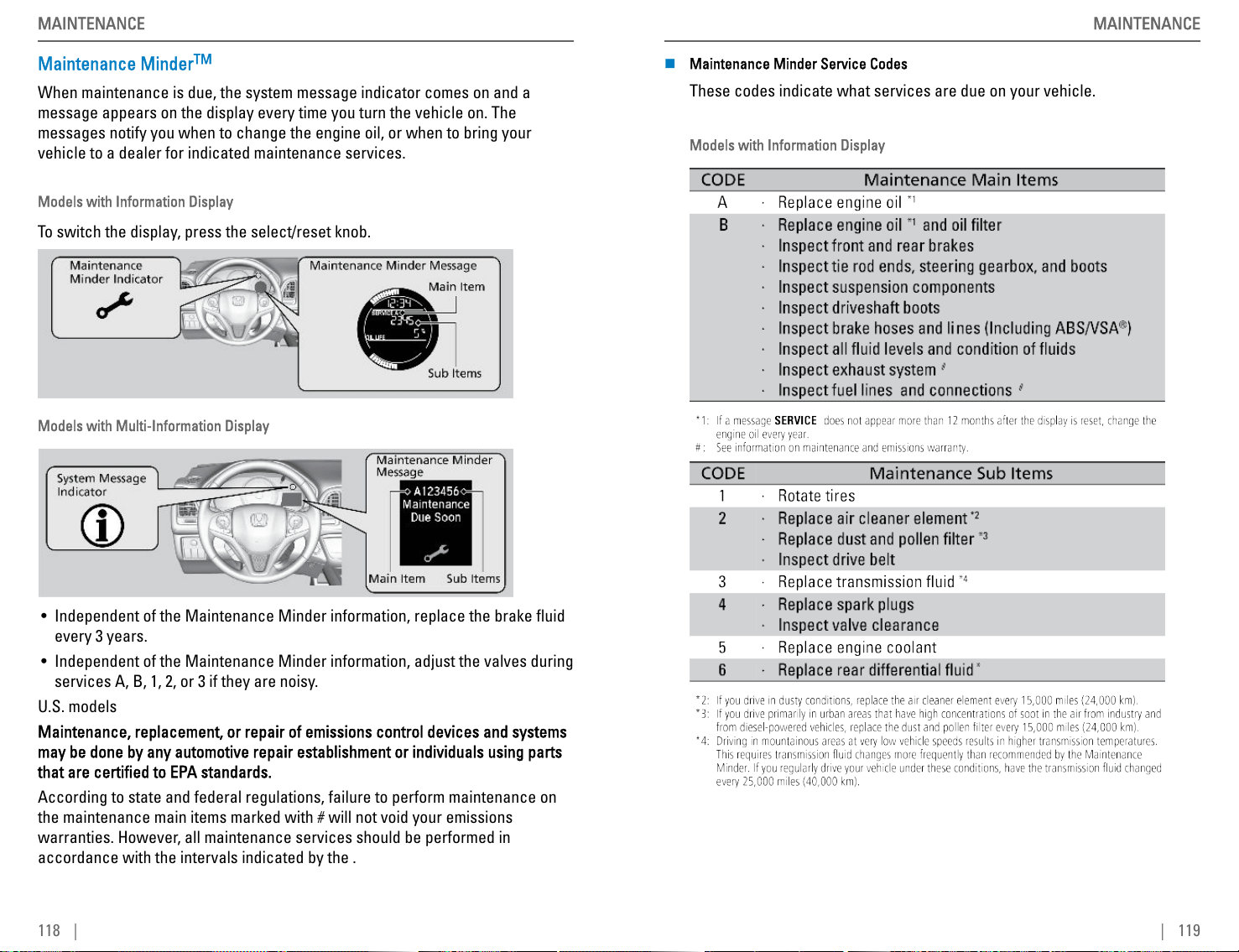
Press the sound button and rotate the selector knob to scroll through the
following choices.
• Bass
• Balance
• Treble
• Fader
• Speed-sensitive Volume
Compensation
Use the buttons to control the color audio system.
Use simple gestures-including touching, swiping and scrolling-to operate
certain audio functions.
56 |
Some items may be grayed out during driving to reduce the potential for
distraction. You can select them when the vehicle is stopped or use voice
commands.
Wearing gloves may limit or prevent touchscreen response.
A subscription-based service that provides convenient features such as voice
communication in case of emergency, online security, and one-on-one operator
assistance
*1
.
To check phone compatibility and get more information, visit
handsfreelink.com
(US)
handsfreelink.ca
(Canada). Standard data rates may apply with your phone
service provider.
Follow the steps below to connect to HondaLink
®
Connection and use its
features.
If you connect an Apple Carplay
™
-compatible iPhone
®
to the system via the
1.5A USB port , you can use the audio/information touchscreen, instead of the
iPhone
®
display, to make a phone call, listen to music, view maps (navigation),
and access messages.
*1 - If equipped
| 57
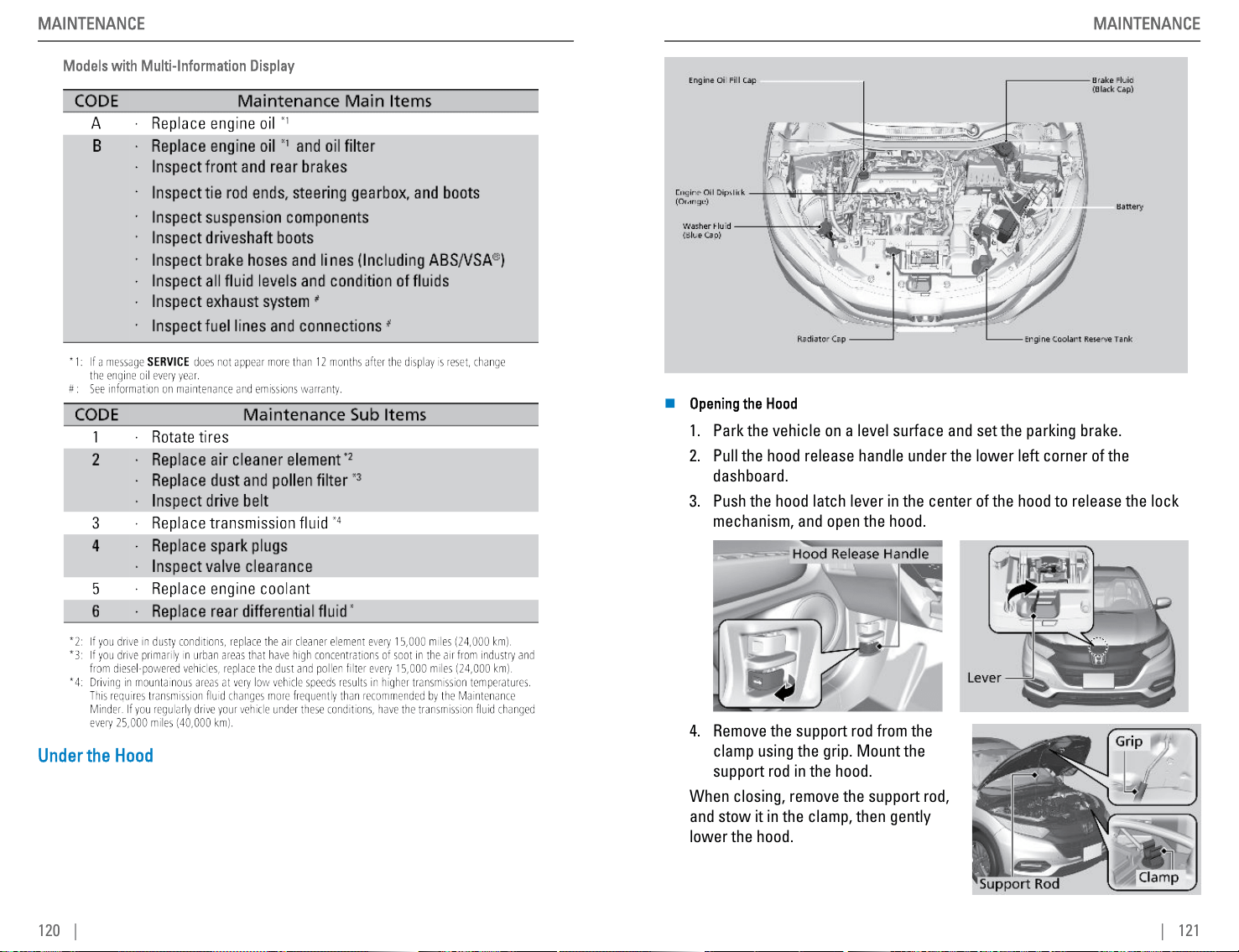
Access the contact list, make phone calls, or listen to voice mail.
Check and reply to text messages, or have messages read to you.
Play music stored on your iPhone
®
.
Display Apple Maps and use the navigation function just as you would on
your iPhone
®
.
Only one navigation system (pre-installed navigation or Apple Carplay
™
) can
give directions at a time. When you are using one system, directions to any
prior destination set on the other system will be canceled, and the system you
are currently using will direct you to your destination.
When you connect an Android phone to the display audio system via the 1.5A
USB port, Android Auto
™
is automatically initiated. When connected via
Android Auto
™
, you can use the audio/information screen to access the Phone,
Google Maps (Navigation), Google Play Music, and Google Now functions.
When you first use Android Auto
™
, a tutorial will appear on the screen. We
recommend that you complete this tutorial while safely parked before using
Android Auto
™
.
Depending on use, Apple CarPlay can share certain vehicle information (e.g., vehicle location,
speed, and other operating conditions) with the connected iPhone. See Apple’s privacy policy for
details regarding Apple’s use and handling of data uploaded by CarPlay. Use of CarPlay is at user’s
own risk, and is subject to agreement to the CarPlay terms of use, which are included as part of the
Apple iOS terms of use. CarPlay vehicle integration is provided “as is,” and Honda cannot
guarantee CarPlay operability or functionality now or in the future due to, among other conditions,
changes in CarPlay software/Apple iOS, service interruptions, or incompatibility or obsolescence of
vehicle-integrated hardware or software. See dealer for details. Only use CarPlay when conditions
allow you to do so safely. See your Owner’s Manual at owners.honda.com (U.S.) or myhonda.ca
(Canada) for further license and warranty terms.
58 |
1. Display Google Maps and use the navigation function
just as you would with your Android phone. When the vehicle is in motion, it
is not possible to make keyboard entries. Stop the vehicle in a safe location
to undertake a search or provide other inputs.
Only one navigation system (pre-installed navigation or Android Auto
™
) can
give directions at a time. When you are using one system, directions to any
prior destination set on the other system will be canceled, and the system
you are currently using will direct you to your destination. The audio/
Information screen shows you turn-by-turn driving directions to your
destination.
2. Make and receive phone calls as well as listen to
voicemail.
3. Display useful information organized by
Android Auto
™
into simple cards that appear just when they’re needed.
4. Play Google Play Music and music apps that are
compatible with Android Auto
™
. To switch between music apps, press this
icon.
5.
6. Operate Android Auto
™
with your voice.
Depending on use, Android Auto can share certain vehicle information (e.g., vehicle location, speed,
and other operating conditions) with Google and its service providers. See Google privacy policy for
details regarding Google’s use and handling of data uploaded by Android Auto. Use of Android Auto
is at user’s own risk, and is subject to agreement to the Android Auto terms of use, which are
presented to the user when the Android Auto application is downloaded to the user’s Android
phone. Android Auto vehicle integration is provided “as is,” and Honda cannot guarantee Android
Auto operability or functionality now or in the future due to, among other conditions, changes in
Android Auto software/Android operating system, service interruptions, or incompatibility or
obsolescence of vehicle-integrated hardware or software. See dealer for details. Only use Android
Auto when conditions allow you to do so safely. See your Owner’s Manual at owners.honda.com
(U.S.) or myhonda.ca (Canada) for further license and warranty terms.
| 59
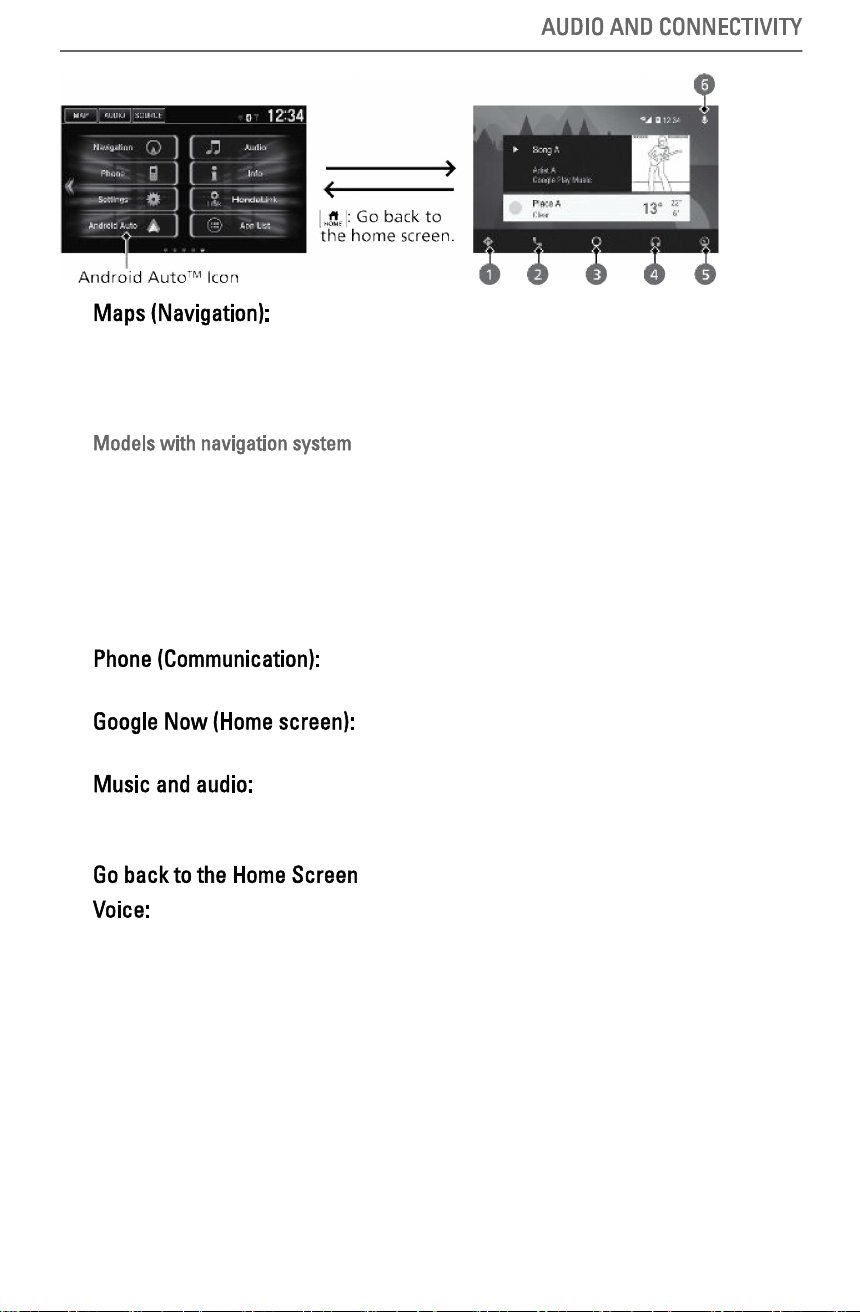
Access the contact list, make phone calls, or listen to voice mail.
Check and reply to text messages, or have messages read to you.
Play music stored on your iPhone
®
.
Display Apple Maps and use the navigation function just as you would on
your iPhone
®
.
Only one navigation system (pre-installed navigation or Apple Carplay
™
) can
give directions at a time. When you are using one system, directions to any
prior destination set on the other system will be canceled, and the system you
are currently using will direct you to your destination.
When you connect an Android phone to the display audio system via the 1.5A
USB port, Android Auto
™
is automatically initiated. When connected via
Android Auto
™
, you can use the audio/information screen to access the Phone,
Google Maps (Navigation), Google Play Music, and Google Now functions.
When you first use Android Auto
™
, a tutorial will appear on the screen. We
recommend that you complete this tutorial while safely parked before using
Android Auto
™
.
Depending on use, Apple CarPlay can share certain vehicle information (e.g., vehicle location,
speed, and other operating conditions) with the connected iPhone. See Apple’s privacy policy for
details regarding Apple’s use and handling of data uploaded by CarPlay. Use of CarPlay is at user’s
own risk, and is subject to agreement to the CarPlay terms of use, which are included as part of the
Apple iOS terms of use. CarPlay vehicle integration is provided “as is,” and Honda cannot
guarantee CarPlay operability or functionality now or in the future due to, among other conditions,
changes in CarPlay software/Apple iOS, service interruptions, or incompatibility or obsolescence of
vehicle-integrated hardware or software. See dealer for details. Only use CarPlay when conditions
allow you to do so safely. See your Owner’s Manual at owners.honda.com (U.S.) or myhonda.ca
(Canada) for further license and warranty terms.
58 |
1. Display Google Maps and use the navigation function
just as you would with your Android phone. When the vehicle is in motion, it
is not possible to make keyboard entries. Stop the vehicle in a safe location
to undertake a search or provide other inputs.
Only one navigation system (pre-installed navigation or Android Auto
™
) can
give directions at a time. When you are using one system, directions to any
prior destination set on the other system will be canceled, and the system
you are currently using will direct you to your destination. The audio/
Information screen shows you turn-by-turn driving directions to your
destination.
2. Make and receive phone calls as well as listen to
voicemail.
3. Display useful information organized by
Android Auto
™
into simple cards that appear just when they’re needed.
4. Play Google Play Music and music apps that are
compatible with Android Auto
™
. To switch between music apps, press this
icon.
5.
6. Operate Android Auto
™
with your voice.
Depending on use, Android Auto can share certain vehicle information (e.g., vehicle location, speed,
and other operating conditions) with Google and its service providers. See Google privacy policy for
details regarding Google’s use and handling of data uploaded by Android Auto. Use of Android Auto
is at user’s own risk, and is subject to agreement to the Android Auto terms of use, which are
presented to the user when the Android Auto application is downloaded to the user’s Android
phone. Android Auto vehicle integration is provided “as is,” and Honda cannot guarantee Android
Auto operability or functionality now or in the future due to, among other conditions, changes in
Android Auto software/Android operating system, service interruptions, or incompatibility or
obsolescence of vehicle-integrated hardware or software. See dealer for details. Only use Android
Auto when conditions allow you to do so safely. See your Owner’s Manual at owners.honda.com
(U.S.) or myhonda.ca (Canada) for further license and warranty terms.
| 59
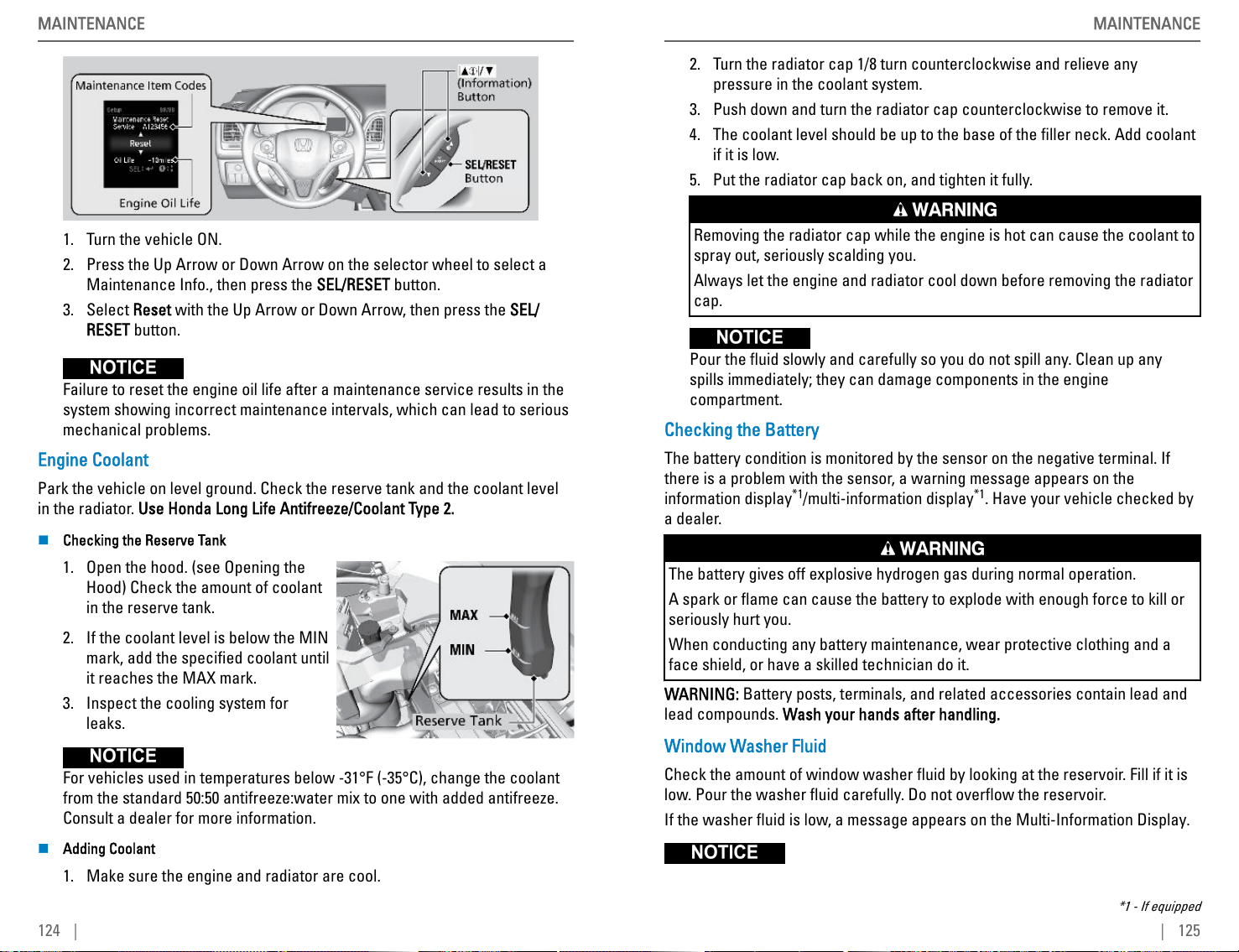
Play FM or AM radio stations.
Available on a subscription basis only. For more information or to subscribe,
contact your dealer, or visit
www.sirius.com/subscribenow
(U.S.)
or www.
sirius.ca/subscribe-now
(Canada).
*1 - If equipped
60 |
To learn about additional features—such as multi-channel preset, replay, or
SportsFlash—see your Owner’s Manual at
owners.honda.com
(U.S.) or
myhonda.ca
(Canada).
Play and operate an iPod
®
*14
through the vehicle’s audio system. Connect your
device to the USB port (see USB Port).
*14 - iPod and iPhone are trademarks of Apple, Inc.
| 61
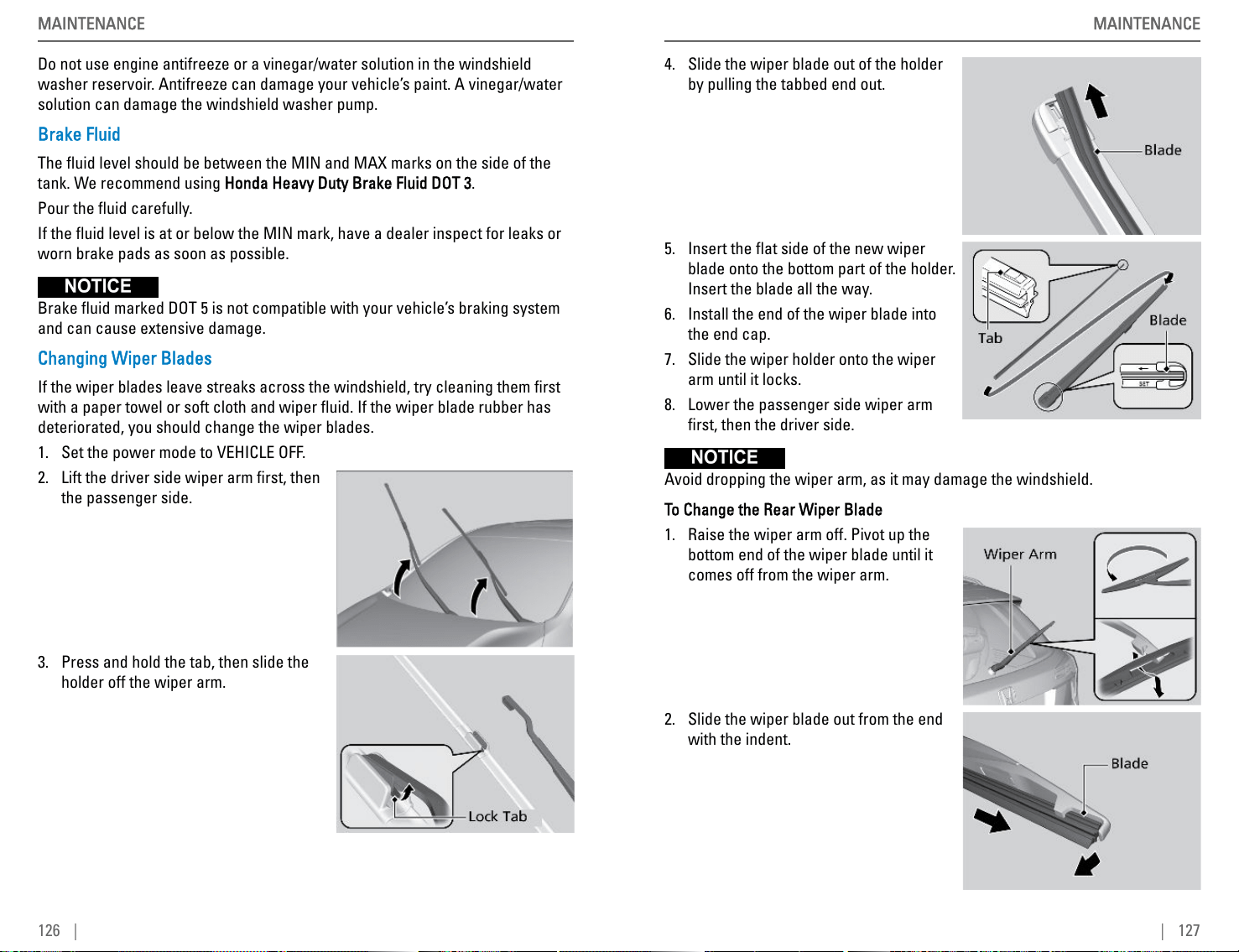
Play FM or AM radio stations.
Available on a subscription basis only. For more information or to subscribe,
contact your dealer, or visit
www.sirius.com/subscribenow
(U.S.)
or www.
sirius.ca/subscribe-now
(Canada).
*1 - If equipped
60 |
To learn about additional features—such as multi-channel preset, replay, or
SportsFlash—see your Owner’s Manual at
owners.honda.com
(U.S.) or
myhonda.ca
(Canada).
Play and operate an iPod
®
*14
through the vehicle’s audio system. Connect your
device to the USB port (see USB Port).
*14 - iPod and iPhone are trademarks of Apple, Inc.
| 61
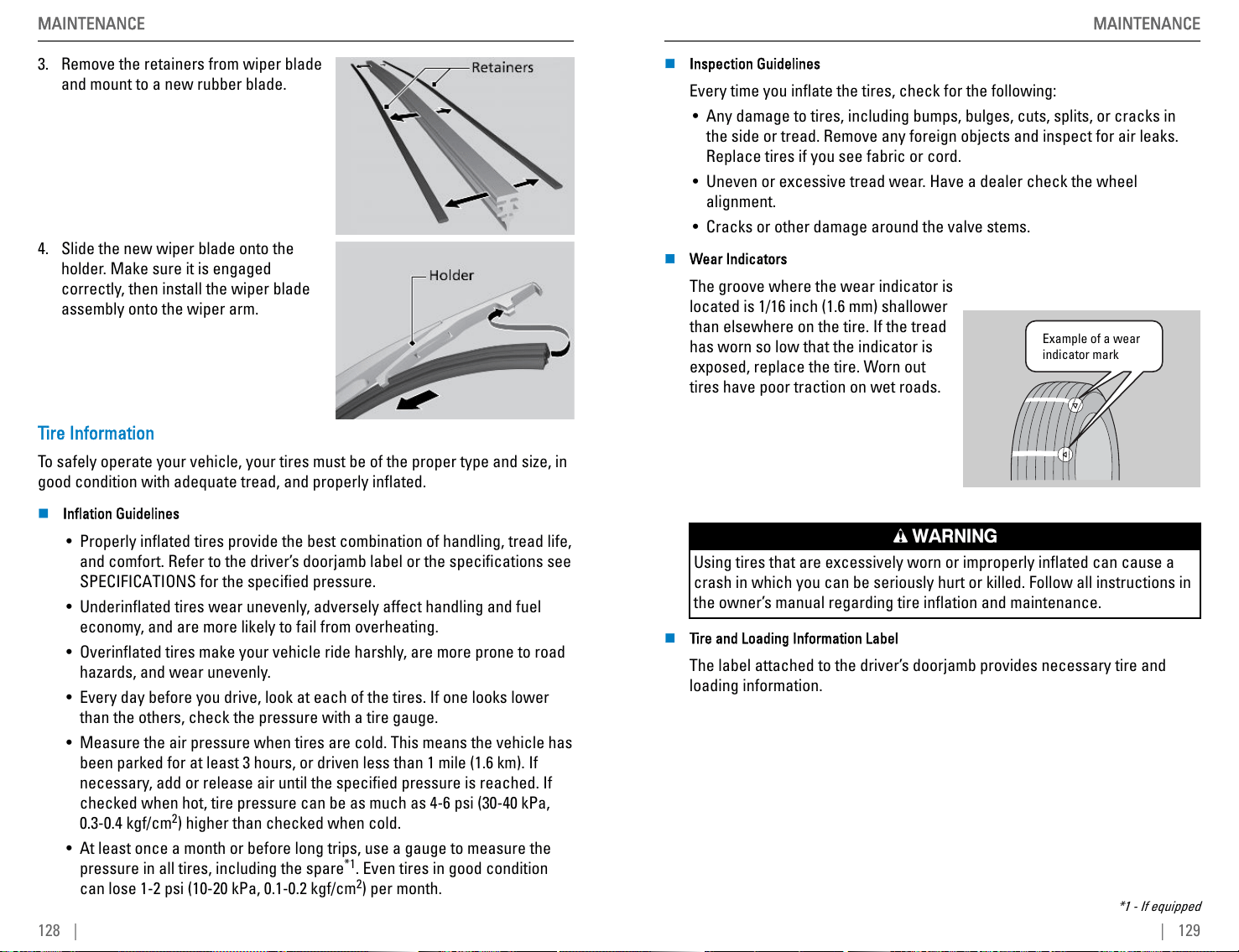
Use the selector knob to search for tracks stored on the iPod.
1. Press the selector knob to display
the iPod music list.
2. Rotate the selector knob to select a
category.
3. Press the selector knob to display a
list of items in the category.
4. Rotate the selector knob to select an item, then pres the selector knob.
Press and rotate the selector knob repeatedly until the desired item you
want to listen to is displayed.
Use the touchscreen to search for tracks stored on the iPod.
1. Select Menu, then select Music
Search.
2. Select the items on that menu.
62 |
Your audio system allows you to listen to music from the Pandora
®
*13
app on a
compatible smartphone. This function is available when the phone is paired and
connected to the vehicle’s
Bluetooth
®
HandsFreeLink
®
system, or with an
iPhone
®
, you can connect using your USB cable to the USB port.
Your audio system reads and plays sound files on a USB flash drive in either
MP3, WMA, or AAC
*1
format. Connect your USB flash drive to the USB port .
*13 - US models only, if equipped
Applicable laws may prohibit the operation of handheld electronic devices while operating a
vehicle. Launch streaming audio on your phone only when it is safe to do so.
*1 - If equipped
| 63
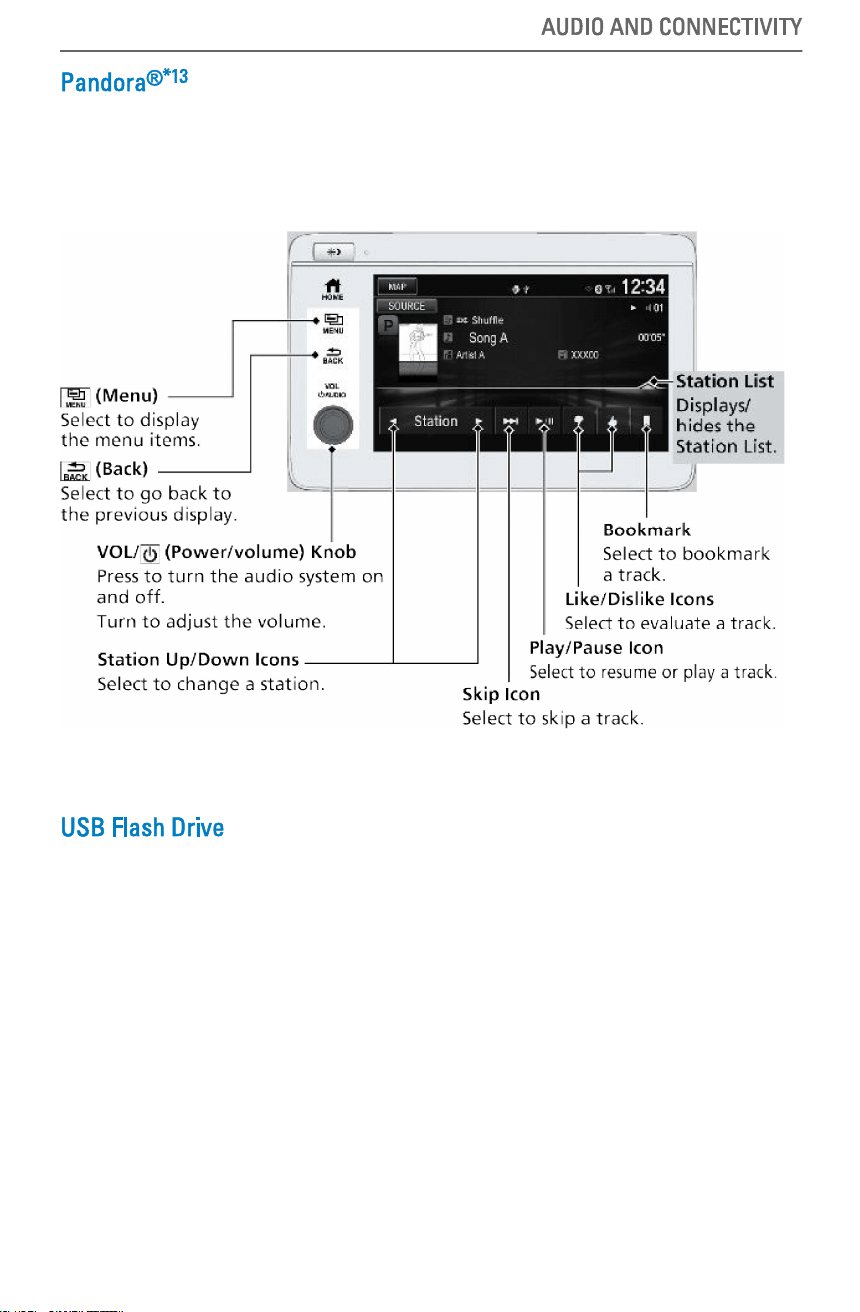
Use the selector knob to search for tracks stored on the iPod.
1. Press the selector knob to display
the iPod music list.
2. Rotate the selector knob to select a
category.
3. Press the selector knob to display a
list of items in the category.
4. Rotate the selector knob to select an item, then pres the selector knob.
Press and rotate the selector knob repeatedly until the desired item you
want to listen to is displayed.
Use the touchscreen to search for tracks stored on the iPod.
1. Select Menu, then select Music
Search.
2. Select the items on that menu.
62 |
Your audio system allows you to listen to music from the Pandora
®
*13
app on a
compatible smartphone. This function is available when the phone is paired and
connected to the vehicle’s
Bluetooth
®
HandsFreeLink
®
system, or with an
iPhone
®
, you can connect using your USB cable to the USB port.
Your audio system reads and plays sound files on a USB flash drive in either
MP3, WMA, or AAC
*1
format. Connect your USB flash drive to the USB port .
*13 - US models only, if equipped
Applicable laws may prohibit the operation of handheld electronic devices while operating a
vehicle. Launch streaming audio on your phone only when it is safe to do so.
*1 - If equipped
| 63
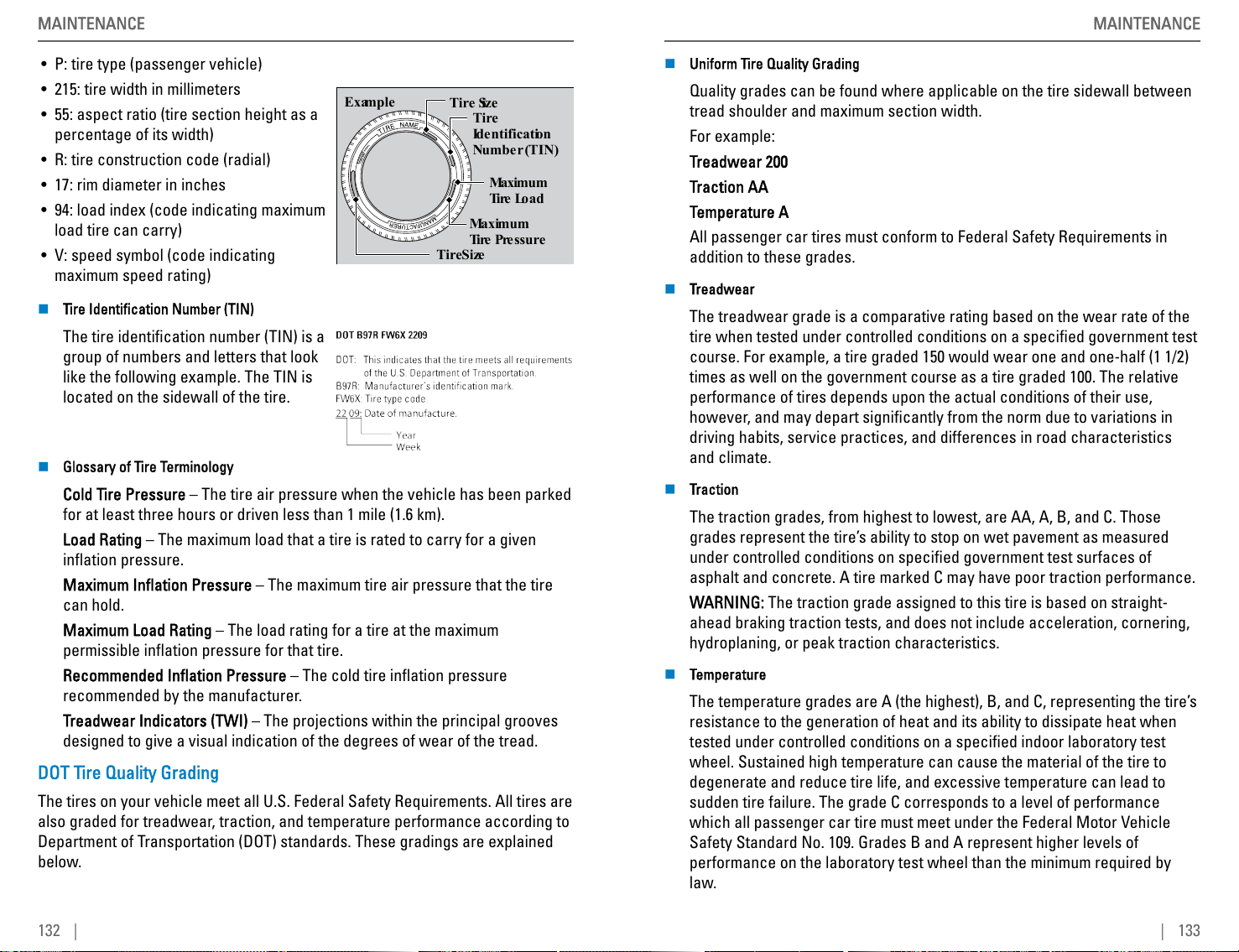
1. Press the selector knob to display a
folder list.
2. Rotate the selector knob to select a
folder.
3. Press the selector knob to display a
list of files in that folder.
4. Rotate the selector knob to select a file, then press the selector knob.
Use the touchscreen to search for tracks.
64 |
1. From the audio screen, press
MENU.
2. Select Music Search.
3. Select a folder.
4. Select the track you want to play.
Play streaming or stored audio from your compatible phone when it is paired to
Bluetooth
®
HandsFreeLink
®
(see Pairing a Phone). Visit
handsfreelink.com
(US)
or
handsfreelink.ca
(Canada) to check phone compatibility. Standard data rates
apply with your phone service provider.
| 65
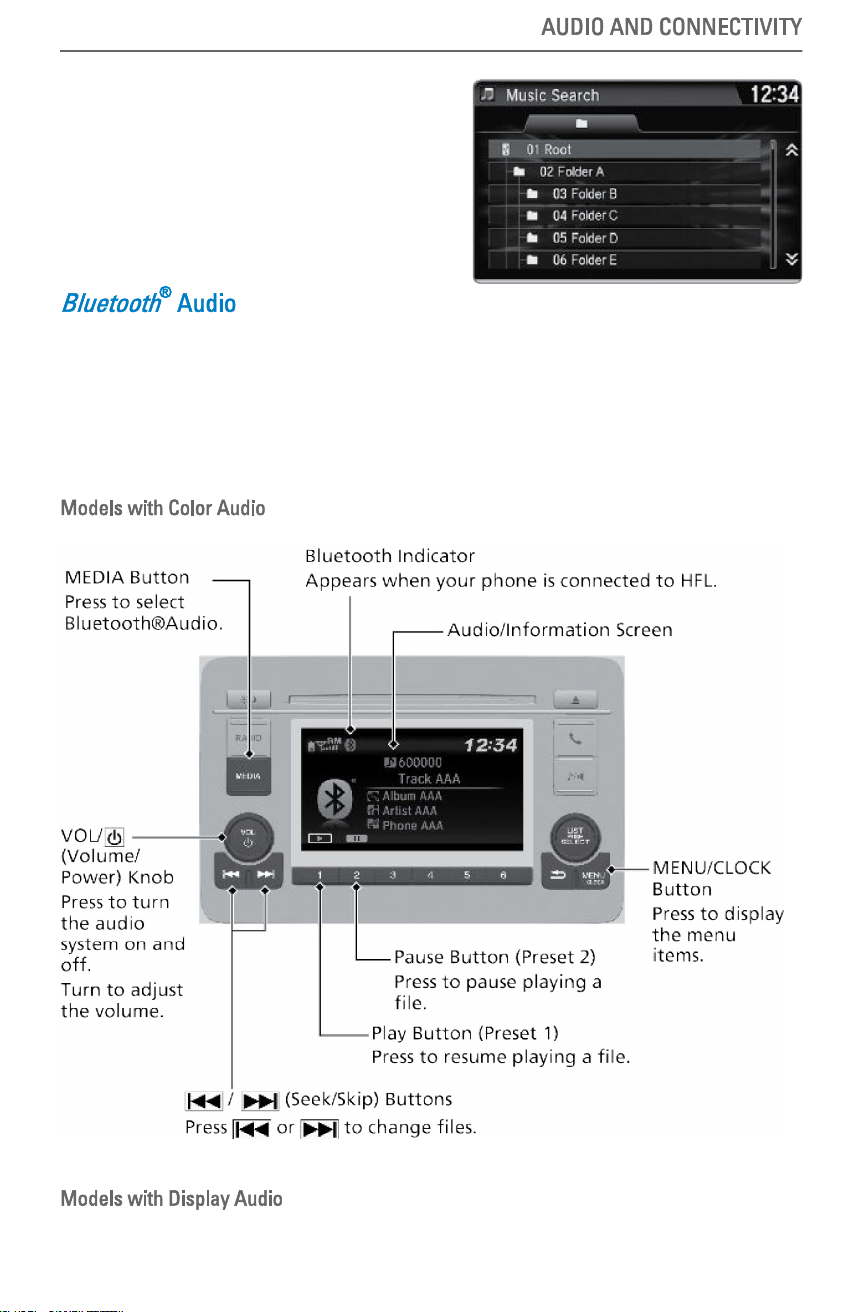
1. Press the selector knob to display a
folder list.
2. Rotate the selector knob to select a
folder.
3. Press the selector knob to display a
list of files in that folder.
4. Rotate the selector knob to select a file, then press the selector knob.
Use the touchscreen to search for tracks.
64 |
1. From the audio screen, press
MENU.
2. Select Music Search.
3. Select a folder.
4. Select the track you want to play.
Play streaming or stored audio from your compatible phone when it is paired to
Bluetooth
®
HandsFreeLink
®
(see Pairing a Phone). Visit
handsfreelink.com
(US)
or
handsfreelink.ca
(Canada) to check phone compatibility. Standard data rates
apply with your phone service provider.
| 65
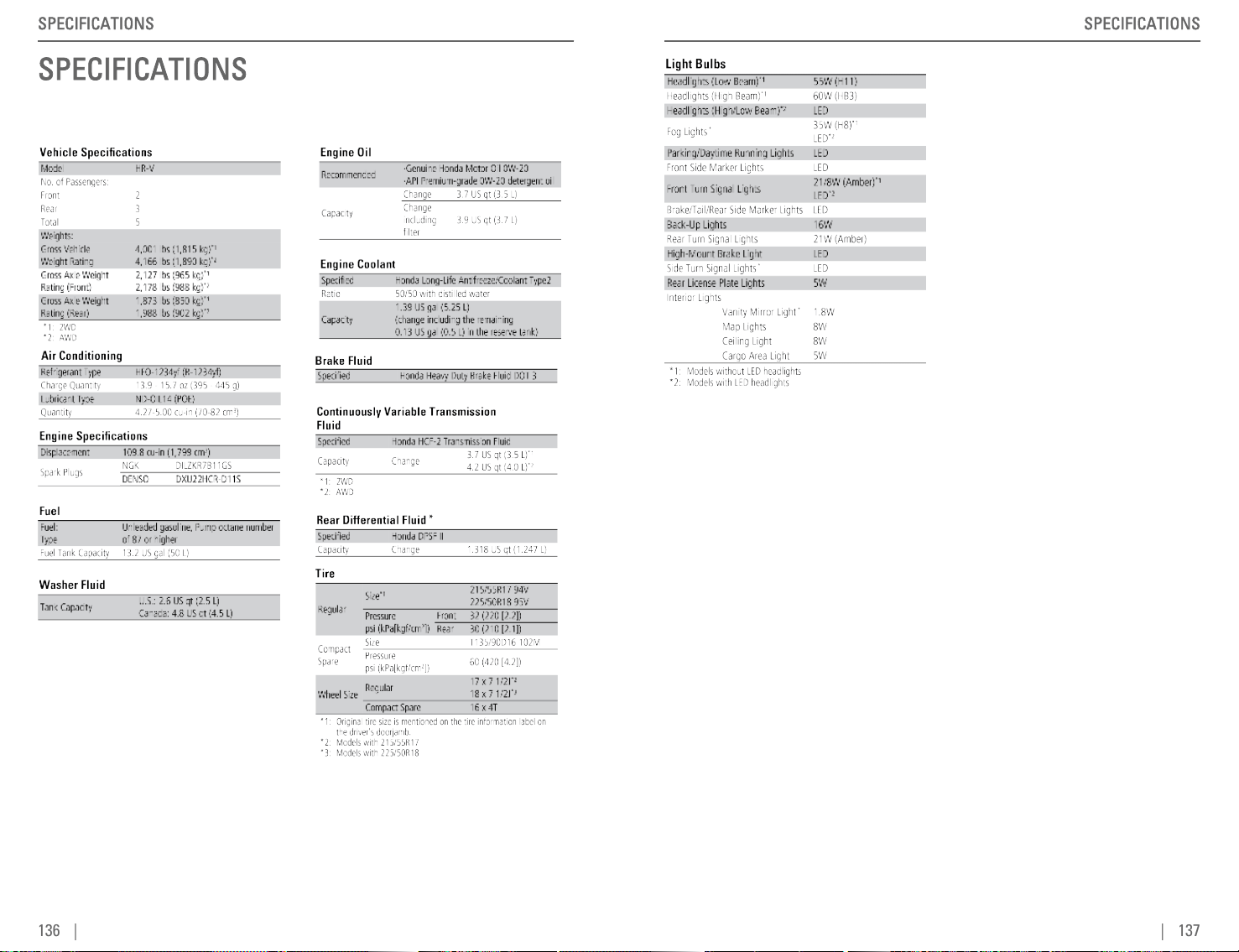
1. Make sure that your phone is paired
and connected to HFL.
2. Press the button until the
Bluetooth
®
Audio mode is selected.
Applicable laws may prohibit the operation of handheld electronic devices while operating a
vehicle. Launch streaming audio on your phone only when safe to do so.
66 |
1. From the audio screen, press
MENU.
2. Select Music Search.
3. Select a search category.
4. Select the track you want to play.
• Make sure the volume on your phone is properly adjusted.
• You may need to enable additional settings on your phone for playback.
• The resume/pause function and remote audio controls are not supported
on all phones.
The audio system supports audio CDs, CD-Rs, and CD-RWs in MP3, WMA, or
AAC
*1
formats. With the CD loaded, select the CD mode.
Do not use CDs with adhesive labels or insert a damaged CD. Inserting these
types of CDs may cause them to get stuck inside or damage the audio unit.
*1 - If equipped
| 67
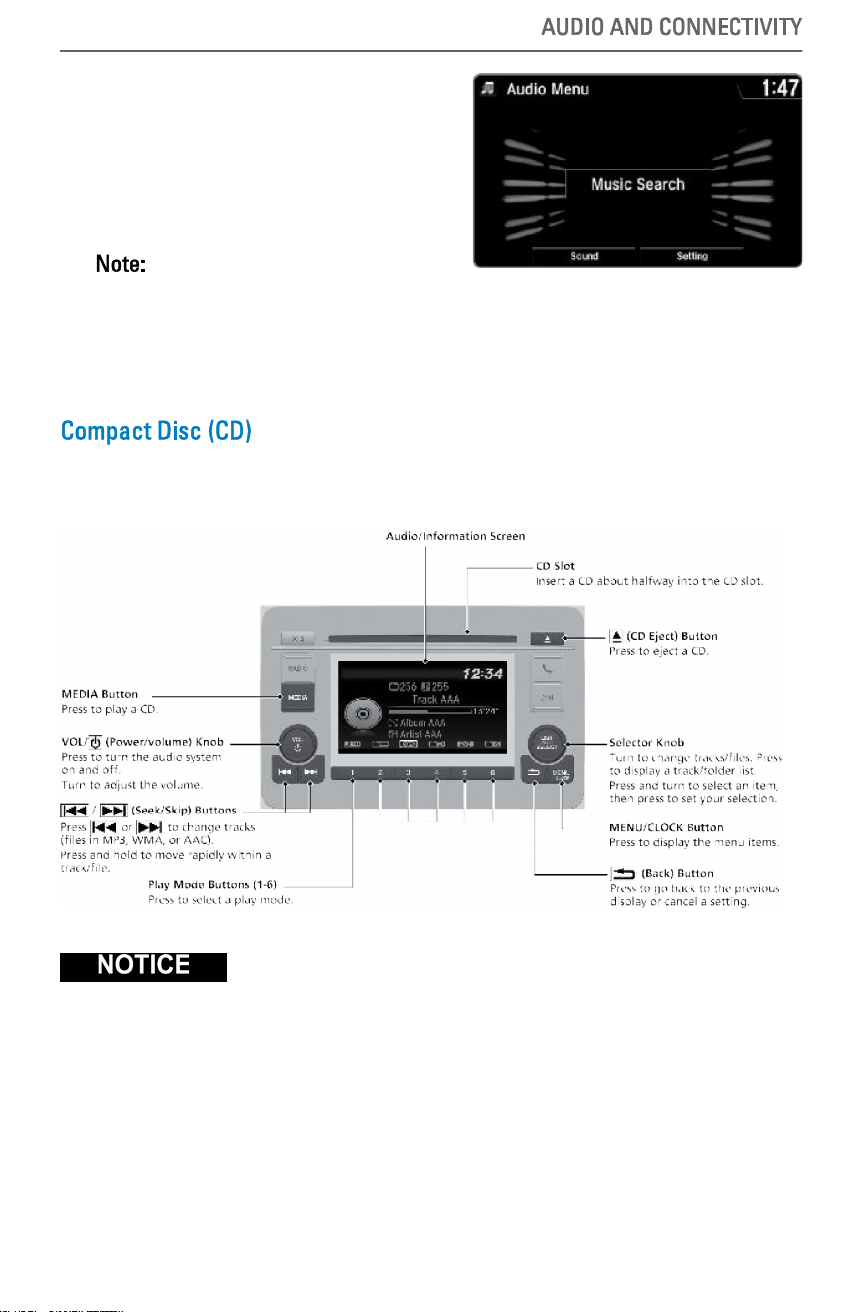
1. Make sure that your phone is paired
and connected to HFL.
2. Press the button until the
Bluetooth
®
Audio mode is selected.
Applicable laws may prohibit the operation of handheld electronic devices while operating a
vehicle. Launch streaming audio on your phone only when safe to do so.
66 |
1. From the audio screen, press
MENU.
2. Select Music Search.
3. Select a search category.
4. Select the track you want to play.
• Make sure the volume on your phone is properly adjusted.
• You may need to enable additional settings on your phone for playback.
• The resume/pause function and remote audio controls are not supported
on all phones.
The audio system supports audio CDs, CD-Rs, and CD-RWs in MP3, WMA, or
AAC
*1
formats. With the CD loaded, select the CD mode.
Do not use CDs with adhesive labels or insert a damaged CD. Inserting these
types of CDs may cause them to get stuck inside or damage the audio unit.
*1 - If equipped
| 67
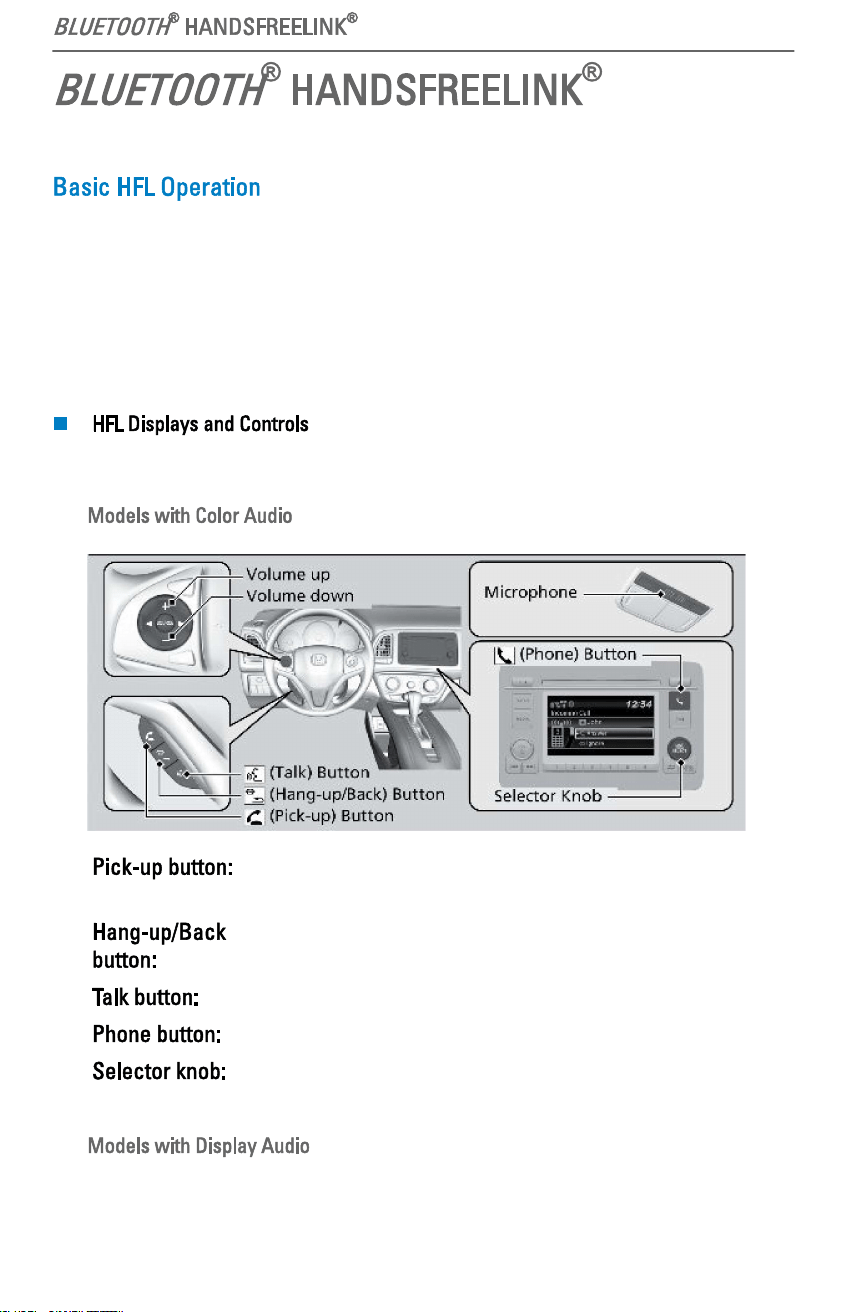
Learn how to operate the vehicle’s hands-free calling system.
Make and receive phone calls using the vehicle’s audio system, without
handling your phone. Visit
handsfreelink.com (US)
or phone (888) 528-7876
(Canada) to check phone compatibility.
To reduce the potential for driver distraction, certain manual functions may be
inoperable or grayed out while the vehicle is moving. Voice commands are
always available.
Use the controls to enter information and make selections.
Press to go directly to the Phone screen or to answer
an incoming call.
Press to end a call or to cancel a command.
Press to call a number with a stored voice tag.
Press to go directly to the Phone screen.
Rotate the selector knob to select an item on the
screen, then press the selector knob.
68 |
Press to go directly to the phone screen, or to answer
an incoming call.
Press to end a call, go back to the previous command,
or cancel a command.
Press to call a number with a stored voice tag.
Press and hold to display Speed Dial, Call History, or
Redial on the phone screen.
Press to select an item displayed on the phone screen.
Press to call a number listed in the selected item on the
phone screen.
When using the Talk button, wait for the beep before saying a command.
• When using the Talk button, wait until you hear a beep before speaking.
• To bypass the system prompts, simply press the Talk button again to say
your command.
• Speak in a clear, natural voice.
• Reduce all background noise.
• Adjust the dashboard vents away from the microphone on the ceiling.
• Close the windows and moonroof
*1
.
*1 - If equipped
| 69
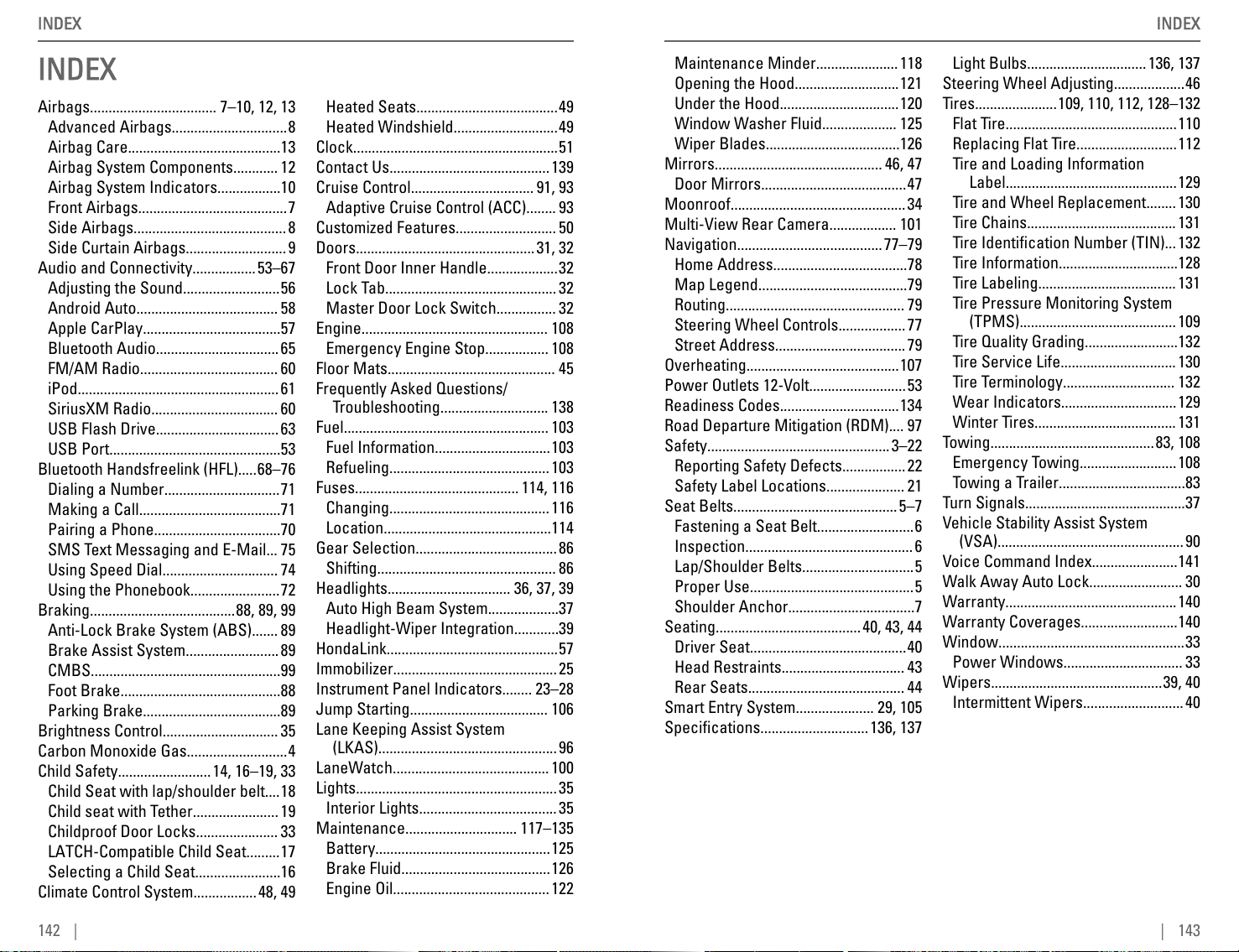
Learn how to operate the vehicle’s hands-free calling system.
Make and receive phone calls using the vehicle’s audio system, without
handling your phone. Visit
handsfreelink.com (US)
or phone (888) 528-7876
(Canada) to check phone compatibility.
To reduce the potential for driver distraction, certain manual functions may be
inoperable or grayed out while the vehicle is moving. Voice commands are
always available.
Use the controls to enter information and make selections.
Press to go directly to the Phone screen or to answer
an incoming call.
Press to end a call or to cancel a command.
Press to call a number with a stored voice tag.
Press to go directly to the Phone screen.
Rotate the selector knob to select an item on the
screen, then press the selector knob.
68 |
Press to go directly to the phone screen, or to answer
an incoming call.
Press to end a call, go back to the previous command,
or cancel a command.
Press to call a number with a stored voice tag.
Press and hold to display Speed Dial, Call History, or
Redial on the phone screen.
Press to select an item displayed on the phone screen.
Press to call a number listed in the selected item on the
phone screen.
When using the Talk button, wait for the beep before saying a command.
• When using the Talk button, wait until you hear a beep before speaking.
• To bypass the system prompts, simply press the Talk button again to say
your command.
• Speak in a clear, natural voice.
• Reduce all background noise.
• Adjust the dashboard vents away from the microphone on the ceiling.
• Close the windows and moonroof
*1
.
*1 - If equipped
| 69
To use hands-free phone and streaming audio functions, you must first pair your
phone to the system. This can only be done when the vehicle is stopped. If there
is an active connection to Apple Carplay
™
(see Apple CarPlay) or Android
Auto
™
(see Android Auto), pairing of additional Bluetooth-compatible devices is
unavailable and Add Bluetooth Device is grayed out from the Bluetooth Device
List screen.
Use the selector knob to make and enter selections.
1. Press the call button.
2. Rotate the selector knob to select Yes,
then press the selector knob.
3. Make sure your phone is in search or
discoverable mode, then press the
selector knob.
4. When your phone appears on the list,
select it by pressing the selector knob.
If your phone does not appear, select
Phone Not Found? and search for
Bluetooth
®
devices using your phone.
From your phone, select HandsFreeLink
®
.
5. The system gives you a pairing code on
the audio/information screen.
Confirm if the pairing code on the screen
and your phone match. This may vary by
phone
6. A notification appears on the screen if
pairing is successful.
Use the touchscreen to make and enter selections.
70 |
1. Select Phone.
2. Select Yes.
3. Make sure your phone is search or
discoverable mode, then select Continue.
HFL automatically searches for a
Bluetooth
®
device.
4. Select your phone when it appears on the
list.
If your phone does not appear, you can
select Refresh to search again.
5. The system gives you a pairing code on
the audio/information screen.
Confirm if the pairing code on the screen
and your phone match.
This may vary by phone.
You can make calls by inputting any phone number, or by using the imported
phonebook, call history, speed dial entries, or redial.
1. Press the Phone button.
2. Rotate the selector knob to select
Dial, then press the selector knob.
3. Rotate the selector knob to select a
number, then press the selector
knob.
Applicable laws may prohibit the operation of handheld electronic devices while operating a
vehicle.
| 71
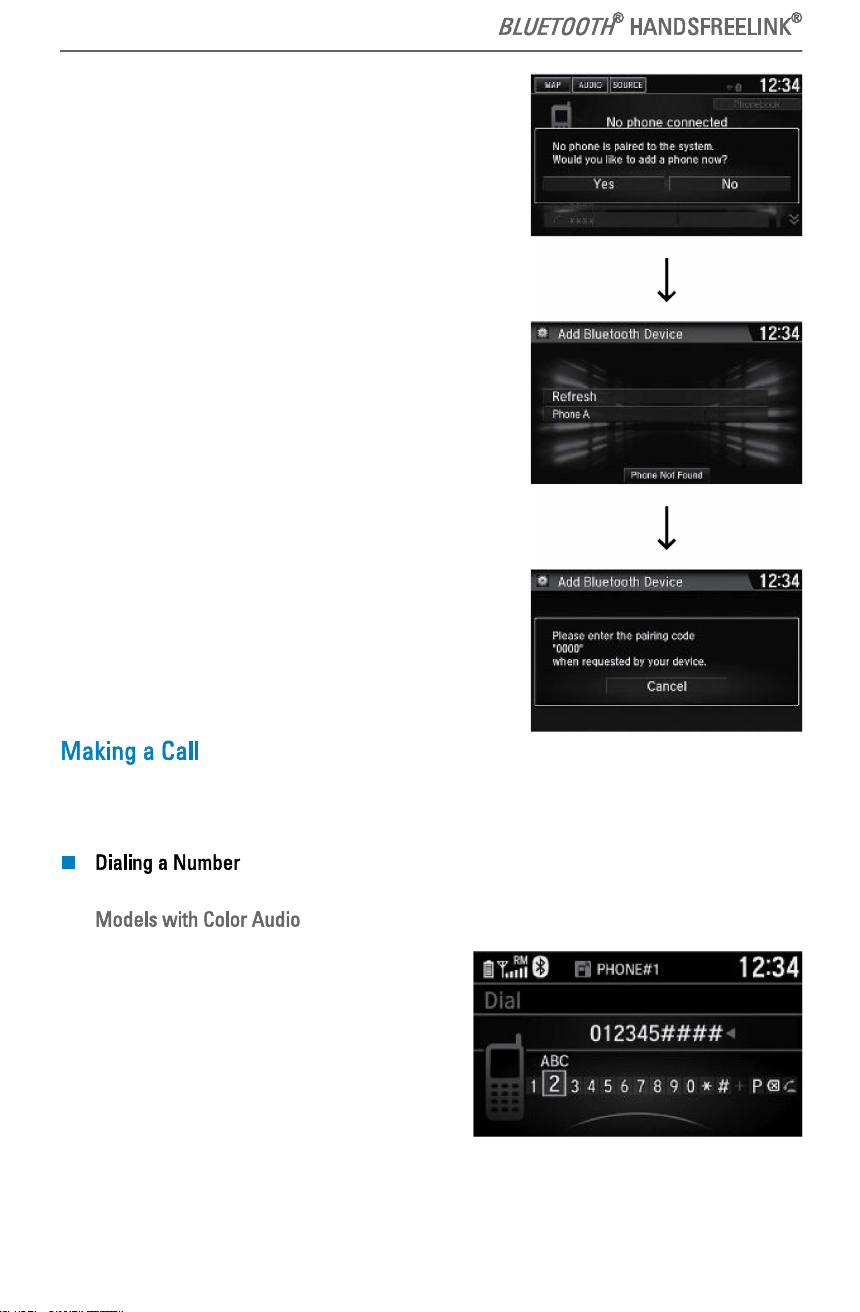
To use hands-free phone and streaming audio functions, you must first pair your
phone to the system. This can only be done when the vehicle is stopped. If there
is an active connection to Apple Carplay
™
(see Apple CarPlay) or Android
Auto
™
(see Android Auto), pairing of additional Bluetooth-compatible devices is
unavailable and Add Bluetooth Device is grayed out from the Bluetooth Device
List screen.
Use the selector knob to make and enter selections.
1. Press the call button.
2. Rotate the selector knob to select Yes,
then press the selector knob.
3. Make sure your phone is in search or
discoverable mode, then press the
selector knob.
4. When your phone appears on the list,
select it by pressing the selector knob.
If your phone does not appear, select
Phone Not Found? and search for
Bluetooth
®
devices using your phone.
From your phone, select HandsFreeLink
®
.
5. The system gives you a pairing code on
the audio/information screen.
Confirm if the pairing code on the screen
and your phone match. This may vary by
phone
6. A notification appears on the screen if
pairing is successful.
Use the touchscreen to make and enter selections.
70 |
1. Select Phone.
2. Select Yes.
3. Make sure your phone is search or
discoverable mode, then select Continue.
HFL automatically searches for a
Bluetooth
®
device.
4. Select your phone when it appears on the
list.
If your phone does not appear, you can
select Refresh to search again.
5. The system gives you a pairing code on
the audio/information screen.
Confirm if the pairing code on the screen
and your phone match.
This may vary by phone.
You can make calls by inputting any phone number, or by using the imported
phonebook, call history, speed dial entries, or redial.
1. Press the Phone button.
2. Rotate the selector knob to select
Dial, then press the selector knob.
3. Rotate the selector knob to select a
number, then press the selector
knob.
Applicable laws may prohibit the operation of handheld electronic devices while operating a
vehicle.
| 71
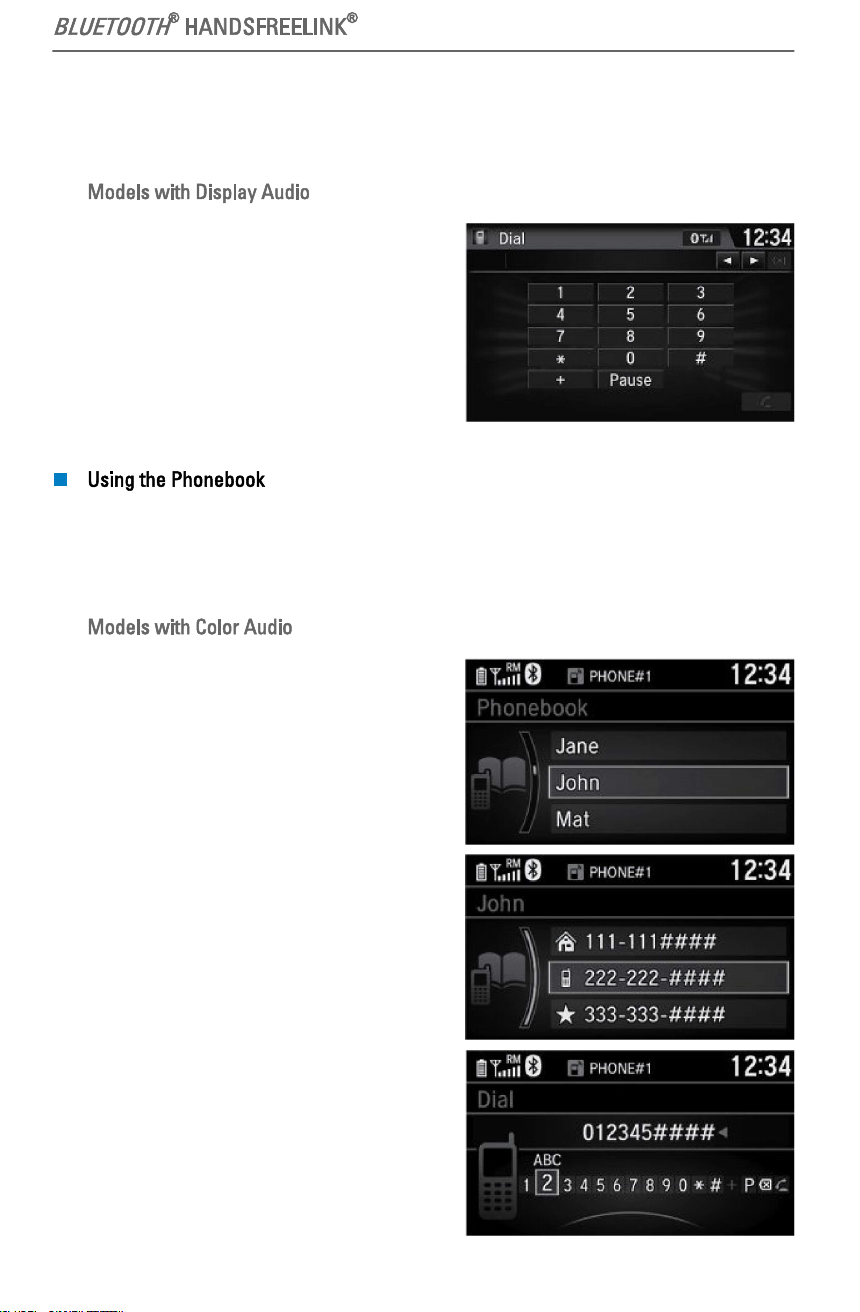
4. Rotate the selector knob to select the hang up button, then press the
selector knob.
Dialing starts automatically.
1. Go to the phone menu screen.
2. Select Dial.
3. Select a number.
Use the keyboard on the touch
screen for entering numbers.
4. Select Hang up.
When your phone is paired, its phonebook is automatically imported to the
system.
This method is inoperable while the vehicle is moving.
1. Press the Phone button.
2. Rotate the selector knob to select
Phonebook, then press the selector
knob.
3. The phonebook is stored
alphabetically.
Rotate the selector knob to select
the initial, then press the selector
knob.
4. Rotate the selector knob to select a
name, then press the selector knob.
5. Rotate the selector knob to select a
number, then press the selector
knob.
Dialing starts automatically.
72 |
1. Go to the phone menu screen.
2. Select Phonebook.
3. Select a name.
You can also search by letter. Select
Search.
4. Select a number.
Dialing starts automatically.
Store up to 20 numbers for quick dialing. To store a speed dial number:
1. Press the phone button.
2. Rotate the selector knob to select
Speed Dial, then press it.
3. Rotate the selector knob to select Add
New, then press it.
4. Rotate the selector knob to select a
place to choose a number from, then
press it.
From Call History:
Select a number from the call history.
From Phonebook:
Select a number from the connected
cell phone’s imported phonebook.
From Phone Number:
Input the number manually.
5. When the speed dial is successfully
stored, you are asked to create a voice
tag for the number. Rotate the selector
knob to select Yes or No, then press it.
6. Using the talk button, follow the
prompts to say the name for the speed
dial entry.
| 73
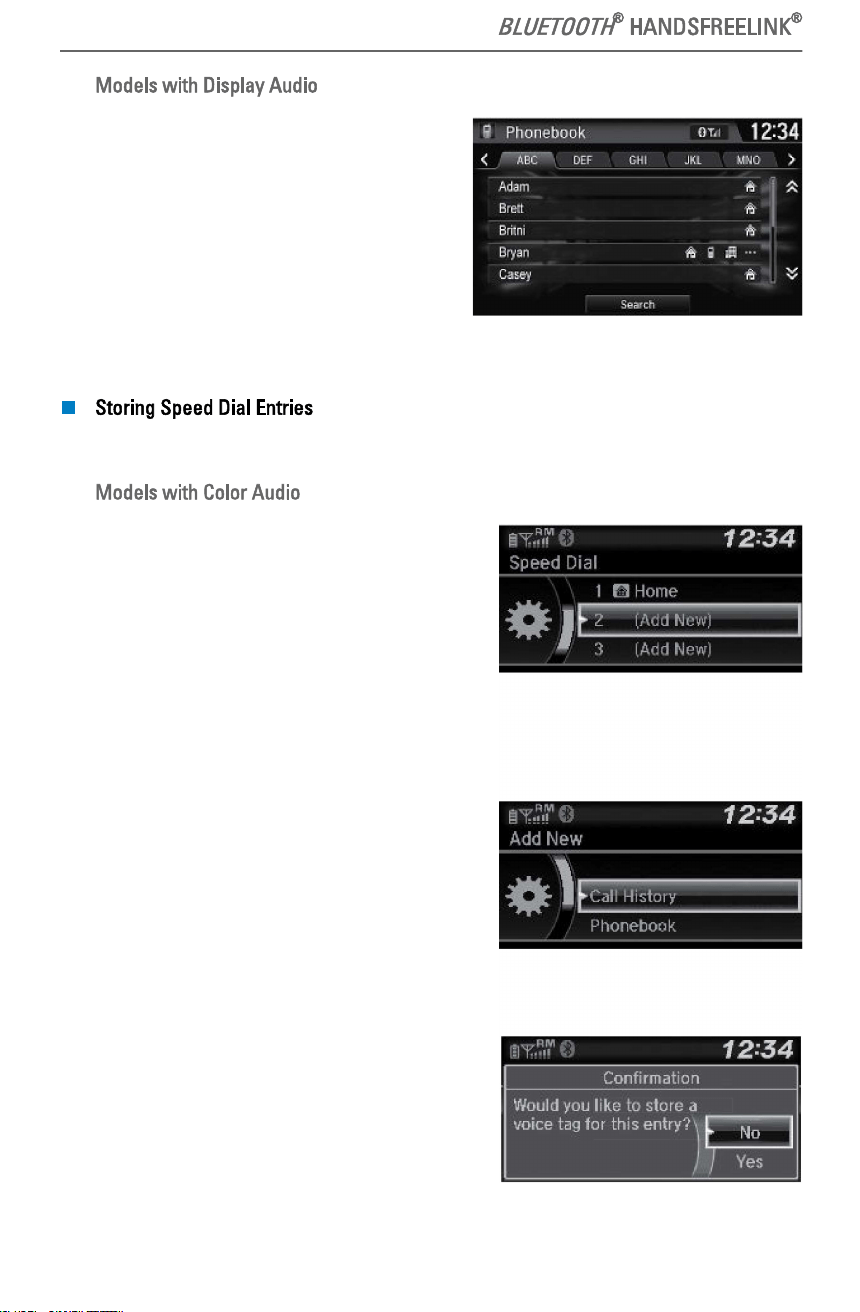
4. Rotate the selector knob to select the hang up button, then press the
selector knob.
Dialing starts automatically.
1. Go to the phone menu screen.
2. Select Dial.
3. Select a number.
Use the keyboard on the touch
screen for entering numbers.
4. Select Hang up.
When your phone is paired, its phonebook is automatically imported to the
system.
This method is inoperable while the vehicle is moving.
1. Press the Phone button.
2. Rotate the selector knob to select
Phonebook, then press the selector
knob.
3. The phonebook is stored
alphabetically.
Rotate the selector knob to select
the initial, then press the selector
knob.
4. Rotate the selector knob to select a
name, then press the selector knob.
5. Rotate the selector knob to select a
number, then press the selector
knob.
Dialing starts automatically.
72 |
1. Go to the phone menu screen.
2. Select Phonebook.
3. Select a name.
You can also search by letter. Select
Search.
4. Select a number.
Dialing starts automatically.
Store up to 20 numbers for quick dialing. To store a speed dial number:
1. Press the phone button.
2. Rotate the selector knob to select
Speed Dial, then press it.
3. Rotate the selector knob to select Add
New, then press it.
4. Rotate the selector knob to select a
place to choose a number from, then
press it.
From Call History:
Select a number from the call history.
From Phonebook:
Select a number from the connected
cell phone’s imported phonebook.
From Phone Number:
Input the number manually.
5. When the speed dial is successfully
stored, you are asked to create a voice
tag for the number. Rotate the selector
knob to select Yes or No, then press it.
6. Using the talk button, follow the
prompts to say the name for the speed
dial entry.
| 73
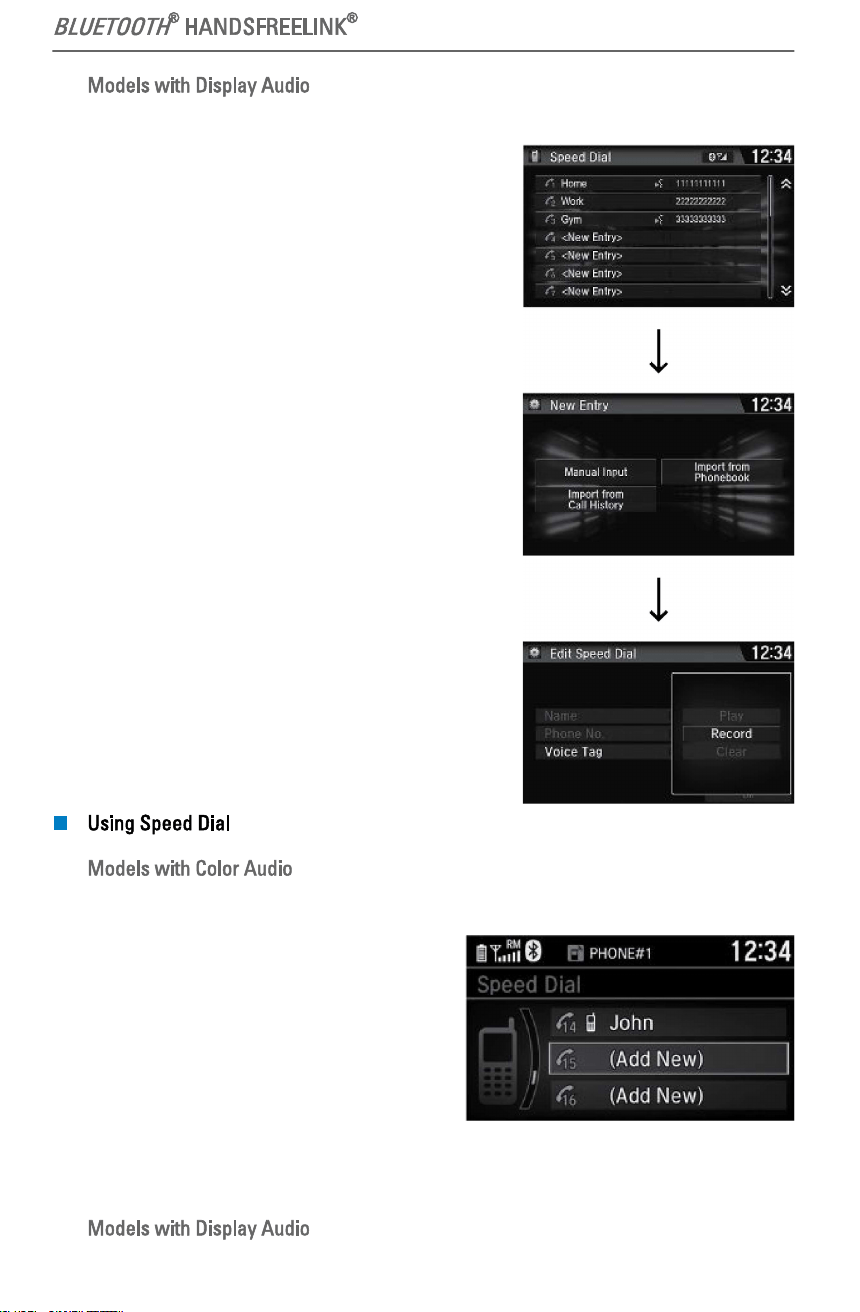
1. Go to the phone menu screen.
2. Select Speed Dial.
3. Select New Entry.
4. Select a place to choose a number.
From Manual Input:
Input the number manually.
From Import from Phonebook:
Select a number from the connected
mobile phone’s imported phonebook.
5. When the speed dial is successfully
stored, you are asked to create a voice tag
for the number. Select Yes or No.
6. Select Record to store a voice tag for the
speed dial entry.
Make calls quickly using stored speed dial entries or call history numbers.
1. Press the Phone button.
2. Rotate the selector knob to select
Speed Dial, then press the selector
knob.
3. Rotate the selector knob to select a
number, then press the selector
knob.
Dialing starts automatically.
74 |
1. Go to the phone menu screen.
2. Select Speed Dial.
3. Select a number.
Dialing starts automatically.
HFL can display newly received text messages as well as the last 20 messages
received on a linked cell phone. Each received message can be read aloud and
replied to using a fixed common phrase. To use the text message function, it
may be necessary to set up on your phone.
1. A pop-up appears and notifies you of a
new text message.
2. Select Read to listen to the message.
The text message is displayed. The system
automatically starts reading out the
message.
3. To discontinue the message read-out,
select Stop.
Activate Siri through your vehicle when an iPhone
®
is paired to the system. Visit
handsfreelink.com
(US) or
handsfreelink.ca
(Canada) to check phone
compatibility.
*1 - If equipped
| 75
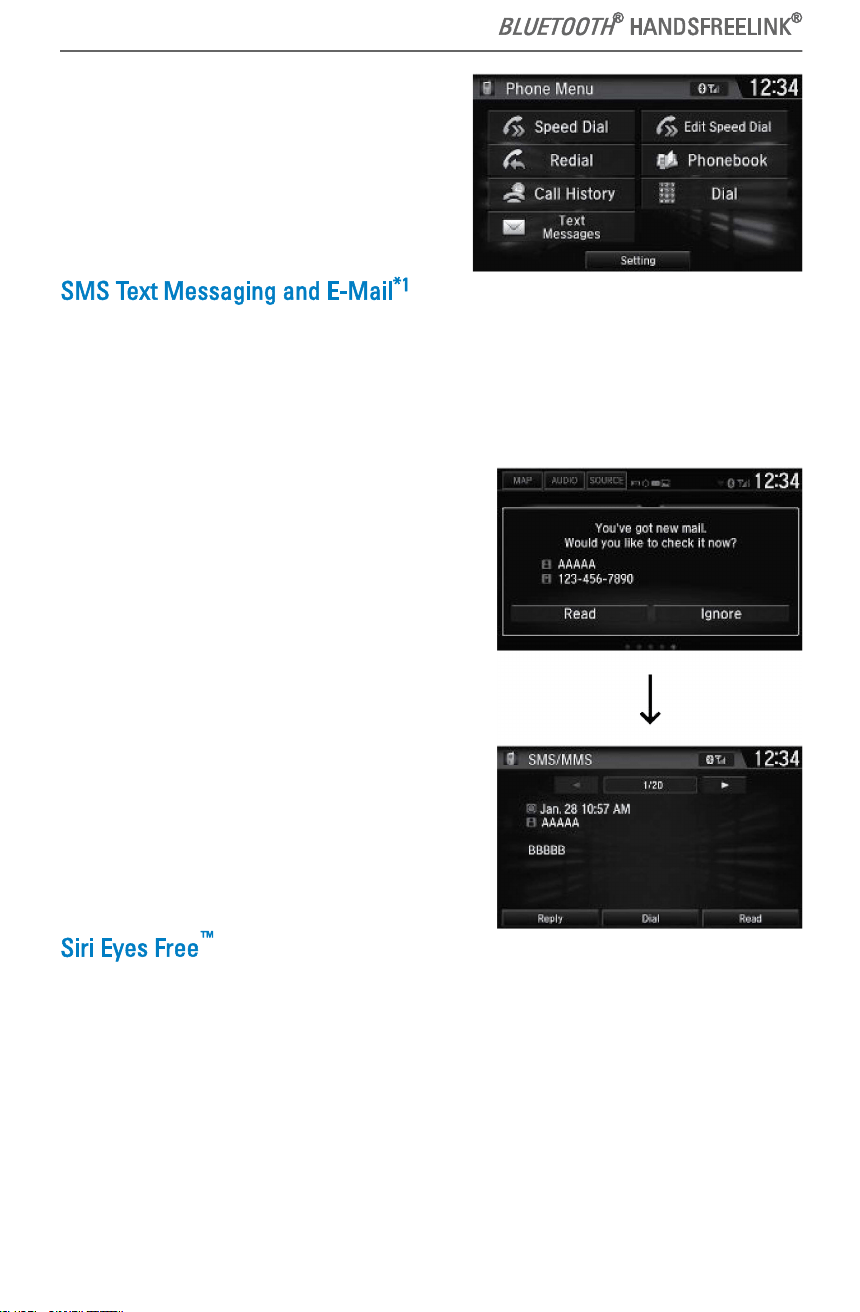
1. Go to the phone menu screen.
2. Select Speed Dial.
3. Select New Entry.
4. Select a place to choose a number.
From Manual Input:
Input the number manually.
From Import from Phonebook:
Select a number from the connected
mobile phone’s imported phonebook.
5. When the speed dial is successfully
stored, you are asked to create a voice tag
for the number. Select Yes or No.
6. Select Record to store a voice tag for the
speed dial entry.
Make calls quickly using stored speed dial entries or call history numbers.
1. Press the Phone button.
2. Rotate the selector knob to select
Speed Dial, then press the selector
knob.
3. Rotate the selector knob to select a
number, then press the selector
knob.
Dialing starts automatically.
74 |
1. Go to the phone menu screen.
2. Select Speed Dial.
3. Select a number.
Dialing starts automatically.
HFL can display newly received text messages as well as the last 20 messages
received on a linked cell phone. Each received message can be read aloud and
replied to using a fixed common phrase. To use the text message function, it
may be necessary to set up on your phone.
1. A pop-up appears and notifies you of a
new text message.
2. Select Read to listen to the message.
The text message is displayed. The system
automatically starts reading out the
message.
3. To discontinue the message read-out,
select Stop.
Activate Siri through your vehicle when an iPhone
®
is paired to the system. Visit
handsfreelink.com
(US) or
handsfreelink.ca
(Canada) to check phone
compatibility.
*1 - If equipped
| 75
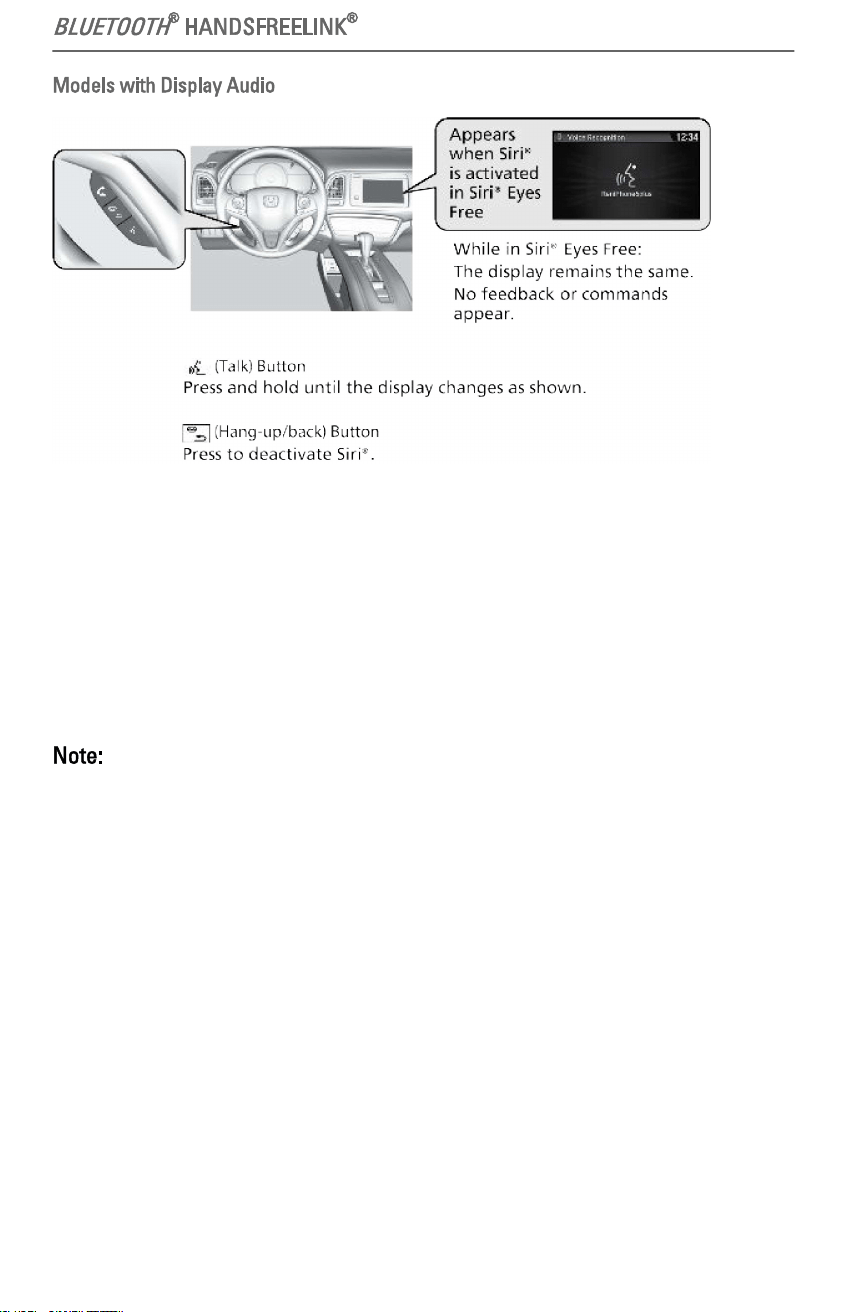
Here are some examples of Siri Commands:
"Call John Smith"
"Read my new text message"
"Find a nearby sushi restaurant"
"Remind me to pick up dinner"
"Set up a meeting at 3 p.m."
"Play song XYZ"
• Any requests that include visual feedback from Siri on your phone are not
displayed in the vehicle.
• Certain commands rely on the iPhone’s features and existing apps.
• To hear turn-by-turn directions or songs through the vehicle, set the audio
source to
Bluetooth
®
Audio.
Siri and iPhone are trademarks of Apple, Inc.
76 |
Learn how to enter a destination and operate the navigation system
*1
.
A real-time navigation uses GPS and a map database to show your current
location and help guide you to a desired destination. You can operate the
system using voice commands or the system controls.
Use the steering wheel controls to give
voice commands. If you press the
MENU button on the steering wheel
and select Navigation Menu while on
the map screen, the following items are
available. Use the steering wheel
buttons to select the items.
• Go Home
• Recent Destination
• Calculation Mode
• Saved Places
• Stop
• Add New Address
The system recognizes commands in the Voice Command Index, see Voice
Portal Commands.
• When using the Talk button, wait for a beep before saying a command.
• To bypass the system prompts, simply press the Talk button again to say
your command.
• Speak in a clear, natural voice.
• Reduce all background noise.
*1 - If equipped
| 77
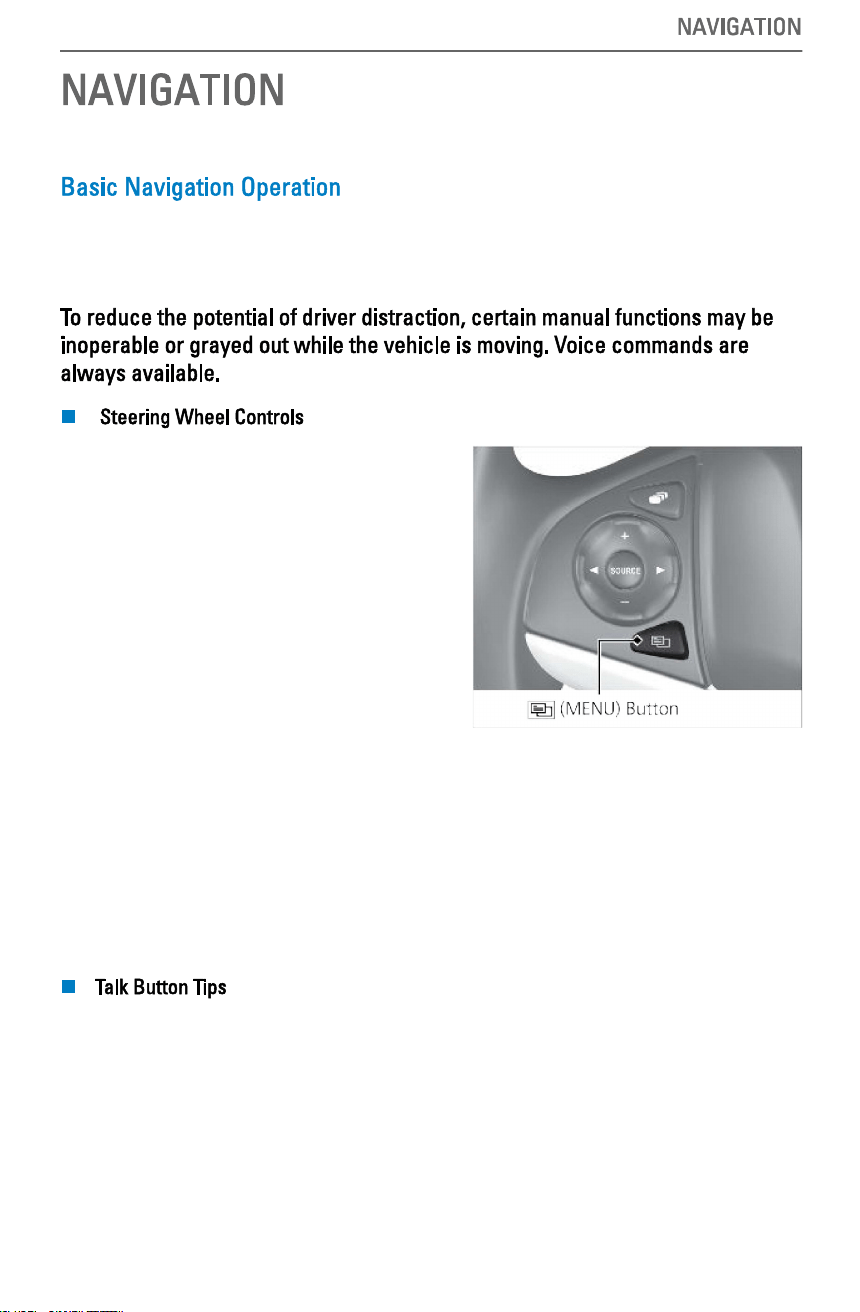
Here are some examples of Siri Commands:
"Call John Smith"
"Read my new text message"
"Find a nearby sushi restaurant"
"Remind me to pick up dinner"
"Set up a meeting at 3 p.m."
"Play song XYZ"
• Any requests that include visual feedback from Siri on your phone are not
displayed in the vehicle.
• Certain commands rely on the iPhone’s features and existing apps.
• To hear turn-by-turn directions or songs through the vehicle, set the audio
source to
Bluetooth
®
Audio.
Siri and iPhone are trademarks of Apple, Inc.
76 |
Learn how to enter a destination and operate the navigation system
*1
.
A real-time navigation uses GPS and a map database to show your current
location and help guide you to a desired destination. You can operate the
system using voice commands or the system controls.
Use the steering wheel controls to give
voice commands. If you press the
MENU button on the steering wheel
and select Navigation Menu while on
the map screen, the following items are
available. Use the steering wheel
buttons to select the items.
• Go Home
• Recent Destination
• Calculation Mode
• Saved Places
• Stop
• Add New Address
The system recognizes commands in the Voice Command Index, see Voice
Portal Commands.
• When using the Talk button, wait for a beep before saying a command.
• To bypass the system prompts, simply press the Talk button again to say
your command.
• Speak in a clear, natural voice.
• Reduce all background noise.
*1 - If equipped
| 77
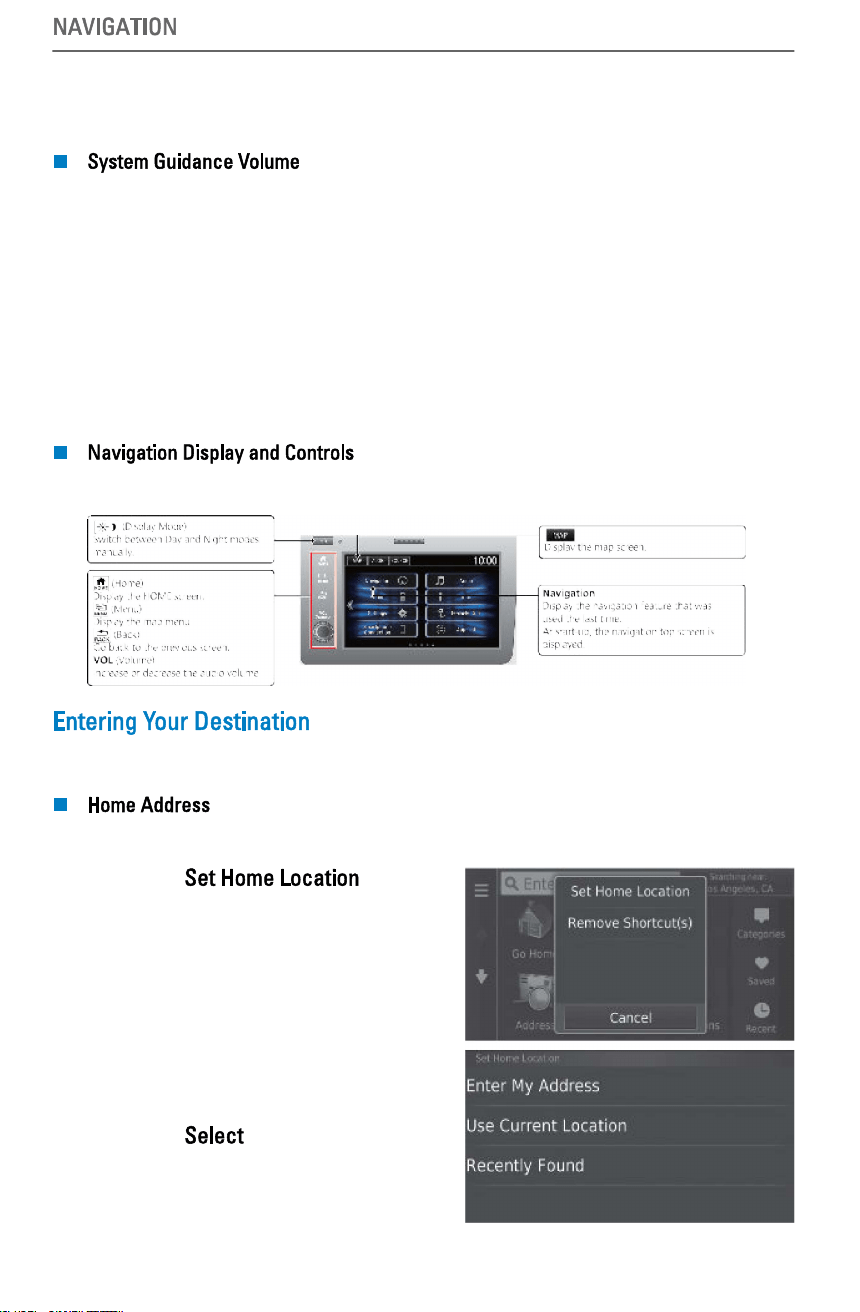
• Adjust the dashboard vents away from the microphone in the ceiling.
• Close the windows and moonroof
*1
.
Adjust the navigation system volume.
1. From the Home screen, select Settings.
2. Select System.
3. Select the Sound/Beep tab.
4. Adjust the Guidance Volume level.
5. Press BACK to exit the menus.
Touch icons on the screen to enter information and make selections.
There are several methods to enter a destination.
Store your home address in the system so you can easily route to it.
1. Select .
2. Select an option.
Select Use Current Location to set
home location.
If selecting Enter My Address,
Recently Found or Saved Place,
proceed to steps 3 and 4.
3. Select the home location.
4. Select .
*1 - If equipped
78 |
1. Select Map.
2. Select the search icon.
3. Select Address.
4. Select Search All.
5. Enter the house number and select
Done if necessary.
After a destination is set, you can alter or cancel your route.
Using the navigation system while driving can take your attention away
from the road, causing a crash in which you could be seriously injured or
killed.
Operate system controls only when the conditions permit you to safely do
so.
| 79
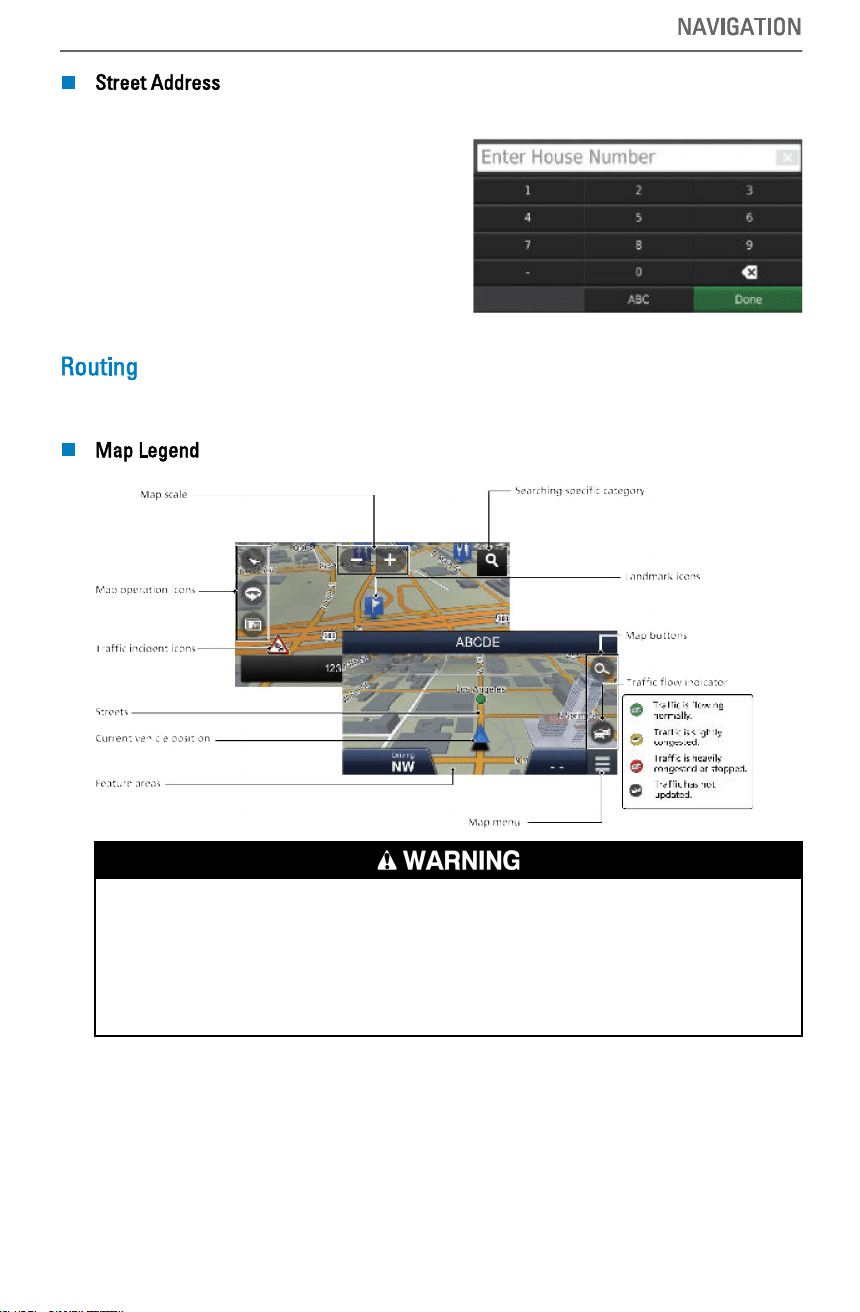
• Adjust the dashboard vents away from the microphone in the ceiling.
• Close the windows and moonroof
*1
.
Adjust the navigation system volume.
1. From the Home screen, select Settings.
2. Select System.
3. Select the Sound/Beep tab.
4. Adjust the Guidance Volume level.
5. Press BACK to exit the menus.
Touch icons on the screen to enter information and make selections.
There are several methods to enter a destination.
Store your home address in the system so you can easily route to it.
1. Select .
2. Select an option.
Select Use Current Location to set
home location.
If selecting Enter My Address,
Recently Found or Saved Place,
proceed to steps 3 and 4.
3. Select the home location.
4. Select .
*1 - If equipped
78 |
1. Select Map.
2. Select the search icon.
3. Select Address.
4. Select Search All.
5. Enter the house number and select
Done if necessary.
After a destination is set, you can alter or cancel your route.
Using the navigation system while driving can take your attention away
from the road, causing a crash in which you could be seriously injured or
killed.
Operate system controls only when the conditions permit you to safely do
so.
| 79
Learn about preparation for driving, as well as other features.
Check the following items before you begin driving.
• Make sure there are no obstructions on the windows, door mirrors,
exterior lights, or other parts of the vehicle.
• Remove any frost, snow, or ice.
• Make sure the hood is securely closed.
• Make sure the tailgate is fully closed when it is not being used as an
extended pickup bed.
• Heat from the engine and exhaust can ignite flammable materials left
under the hood, causing a fire. If you’ve parked your vehicle for an
extended period, inspect and remove any debris that may have collected,
such as dried grass and leaves that have fallen or have been carried in
for use as a nest by a small animal. Also check under the hood for
leftover flammable materials after you or someone else has performed
maintenance on your vehicle.
• Make sure the tires are in good condition.
• Make sure there are no people or objects behind or around the vehicle.
If the doors are frozen shut, use warm water around the door edges to
melt any ice. Do not try to force them open, as this can damage the
rubber trim around the doors. When done, wipe dry to avoid further
freezing.
• Store or secure all items on board properly.
• Do not pile items higher than the seat height.
• Do not place anything in the front seat footwells. Make sure to secure the
floor mats.
• If you have any animals on board, do not let them move freely in the
vehicle.
• Securely close and lock all doors and the tailgate.
• Adjust your seating position, mirrors, and steering wheel properly.
80 |
• Make sure items placed on the floor behind the front seats cannot roll
under the seats.
• Everyone in the vehicle must fasten their seat belt.
• Make sure that the indicators in the instrument panel come on when you
start the vehicle, and go off soon after.
In addition:
• During the first 600 miles (1,000 km) of operation, avoid sudden
acceleration or full throttle operation so as to not damage the engine or
powertrain.
• Avoid hard braking for the first 200 miles (300 km). You should also follow
this when the brake pads are replaced.
Utility vehicles have a significantly higher rollover rate than other types of
vehicles. To prevent rollovers or loss of control:
• Take corners at slower speeds than you would with a passenger vehicle.
• Avoid sharp turns and abrupt maneuvers whenever possible.
• Do not modify your vehicle in any way that would raise its center of
gravity.
• Never carry more than 165 lbs (75 kg) of cargo on the roof rack (Honda
accessory).
Carrying too much cargo or improperly storing it can affect your vehicle’s
handling, stability, stopping distance, and tires, and make it unsafe. See the Tire
and Loading Information label on the driver’s doorjamb.
The maximum load for your vehicle type is:
• 850 lbs (385 kg)
| 81
Learn about preparation for driving, as well as other features.
Check the following items before you begin driving.
• Make sure there are no obstructions on the windows, door mirrors,
exterior lights, or other parts of the vehicle.
• Remove any frost, snow, or ice.
• Make sure the hood is securely closed.
• Make sure the tailgate is fully closed when it is not being used as an
extended pickup bed.
• Heat from the engine and exhaust can ignite flammable materials left
under the hood, causing a fire. If you’ve parked your vehicle for an
extended period, inspect and remove any debris that may have collected,
such as dried grass and leaves that have fallen or have been carried in
for use as a nest by a small animal. Also check under the hood for
leftover flammable materials after you or someone else has performed
maintenance on your vehicle.
• Make sure the tires are in good condition.
• Make sure there are no people or objects behind or around the vehicle.
If the doors are frozen shut, use warm water around the door edges to
melt any ice. Do not try to force them open, as this can damage the
rubber trim around the doors. When done, wipe dry to avoid further
freezing.
• Store or secure all items on board properly.
• Do not pile items higher than the seat height.
• Do not place anything in the front seat footwells. Make sure to secure the
floor mats.
• If you have any animals on board, do not let them move freely in the
vehicle.
• Securely close and lock all doors and the tailgate.
• Adjust your seating position, mirrors, and steering wheel properly.
80 |
• Make sure items placed on the floor behind the front seats cannot roll
under the seats.
• Everyone in the vehicle must fasten their seat belt.
• Make sure that the indicators in the instrument panel come on when you
start the vehicle, and go off soon after.
In addition:
• During the first 600 miles (1,000 km) of operation, avoid sudden
acceleration or full throttle operation so as to not damage the engine or
powertrain.
• Avoid hard braking for the first 200 miles (300 km). You should also follow
this when the brake pads are replaced.
Utility vehicles have a significantly higher rollover rate than other types of
vehicles. To prevent rollovers or loss of control:
• Take corners at slower speeds than you would with a passenger vehicle.
• Avoid sharp turns and abrupt maneuvers whenever possible.
• Do not modify your vehicle in any way that would raise its center of
gravity.
• Never carry more than 165 lbs (75 kg) of cargo on the roof rack (Honda
accessory).
Carrying too much cargo or improperly storing it can affect your vehicle’s
handling, stability, stopping distance, and tires, and make it unsafe. See the Tire
and Loading Information label on the driver’s doorjamb.
The maximum load for your vehicle type is:
• 850 lbs (385 kg)
| 81
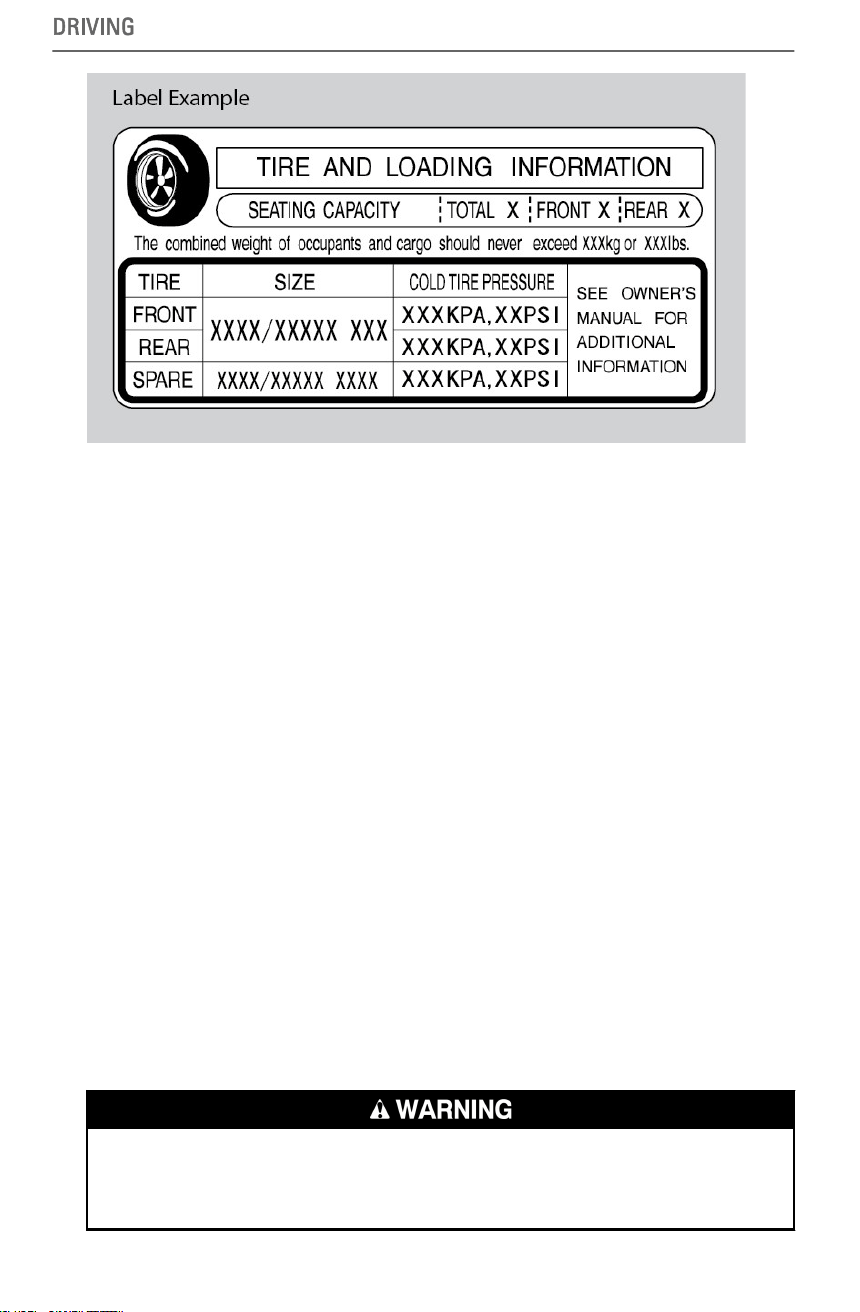
This figure includes the total weight of all occupants, cargo, and
accessories, and the tongue load if you are towing a trailer. Below are the
steps for determining the correct load limit:
1. Locate the statement “The combined weight of occupants and cargo
should never exceed XXX kg or XXX lbs.” on your vehicle’s placard.
2. Determine the combined weight of the driver and passengers that will be
riding in your vehicle.
3. Subtract the combined weight of the driver and passengers from XXX kg
or XXX lbs.
4. The resulting figure equals the available amount of cargo and luggage
load capacity. For example, if the “XXX” amount equals 1,400 lbs. (635
kg) and there will be five 150 lbs. passengers in your vehicle, the amount
of available cargo and luggage load capacity is 650 lbs. (1,400 - 750 (5 x
150) = 650 lbs.).
5. Determine the combined weight of luggage and cargo being loaded on
the vehicle. That weight may not safely exceed the available cargo and
luggage load capacity calculated in step 4.
6. If your vehicle will be towing a trailer, load from your trailer will be
transferred to your vehicle. Consult the Owner’s Manual to determine
how this reduces the available cargo and luggage load capacity of your
vehicle.
Overloading or improper loading can affect handling and stability and
cause a crash in which you can be hurt or killed.
Follow all load limits and other loading guidelines in this guide.
82 |
In addition, the total weight of the vehicle, all occupants, accessories,
cargo, and trailer tongue load must not exceed the Gross Vehicle Weight
Rating (GVWR) or the Gross Axle Weight Rating (GAWR). Both are on a label
on the driver’s doorjamb.
The headlight aim on your vehicle was set by the factory, and does not need
to be adjusted. However, if you regularly carry heavy items in the cargo area
or tow a trailer, have the aiming readjusted at your dealer or by a qualified
technician.
Your vehicle is not designed to tow a trailer. Attempting to do so can void your
vehicle warranties.
Your vehicle is not designed to be towed behind a motorhome. If your vehicle
needs to be towed in an emergency, refer to Emergency Towing.
Turn on the vehicle and start the engine to begin driving.
Insert the key into the ignition and turn the ignition switch to START.
The keyless access system allows simple push-button start.
| 83
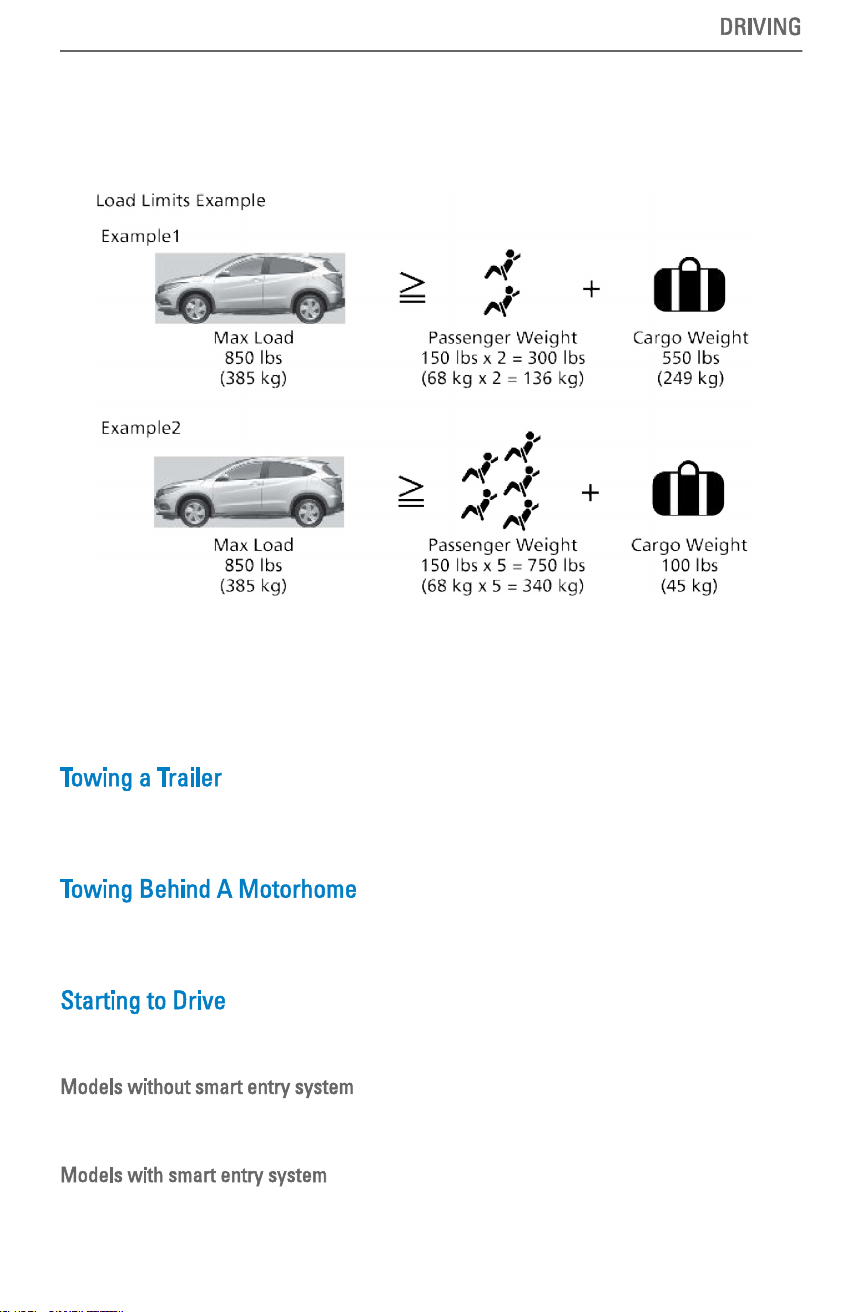
This figure includes the total weight of all occupants, cargo, and
accessories, and the tongue load if you are towing a trailer. Below are the
steps for determining the correct load limit:
1. Locate the statement “The combined weight of occupants and cargo
should never exceed XXX kg or XXX lbs.” on your vehicle’s placard.
2. Determine the combined weight of the driver and passengers that will be
riding in your vehicle.
3. Subtract the combined weight of the driver and passengers from XXX kg
or XXX lbs.
4. The resulting figure equals the available amount of cargo and luggage
load capacity. For example, if the “XXX” amount equals 1,400 lbs. (635
kg) and there will be five 150 lbs. passengers in your vehicle, the amount
of available cargo and luggage load capacity is 650 lbs. (1,400 - 750 (5 x
150) = 650 lbs.).
5. Determine the combined weight of luggage and cargo being loaded on
the vehicle. That weight may not safely exceed the available cargo and
luggage load capacity calculated in step 4.
6. If your vehicle will be towing a trailer, load from your trailer will be
transferred to your vehicle. Consult the Owner’s Manual to determine
how this reduces the available cargo and luggage load capacity of your
vehicle.
Overloading or improper loading can affect handling and stability and
cause a crash in which you can be hurt or killed.
Follow all load limits and other loading guidelines in this guide.
82 |
In addition, the total weight of the vehicle, all occupants, accessories,
cargo, and trailer tongue load must not exceed the Gross Vehicle Weight
Rating (GVWR) or the Gross Axle Weight Rating (GAWR). Both are on a label
on the driver’s doorjamb.
The headlight aim on your vehicle was set by the factory, and does not need
to be adjusted. However, if you regularly carry heavy items in the cargo area
or tow a trailer, have the aiming readjusted at your dealer or by a qualified
technician.
Your vehicle is not designed to tow a trailer. Attempting to do so can void your
vehicle warranties.
Your vehicle is not designed to be towed behind a motorhome. If your vehicle
needs to be towed in an emergency, refer to Emergency Towing.
Turn on the vehicle and start the engine to begin driving.
Insert the key into the ignition and turn the ignition switch to START.
The keyless access system allows simple push-button start.
| 83
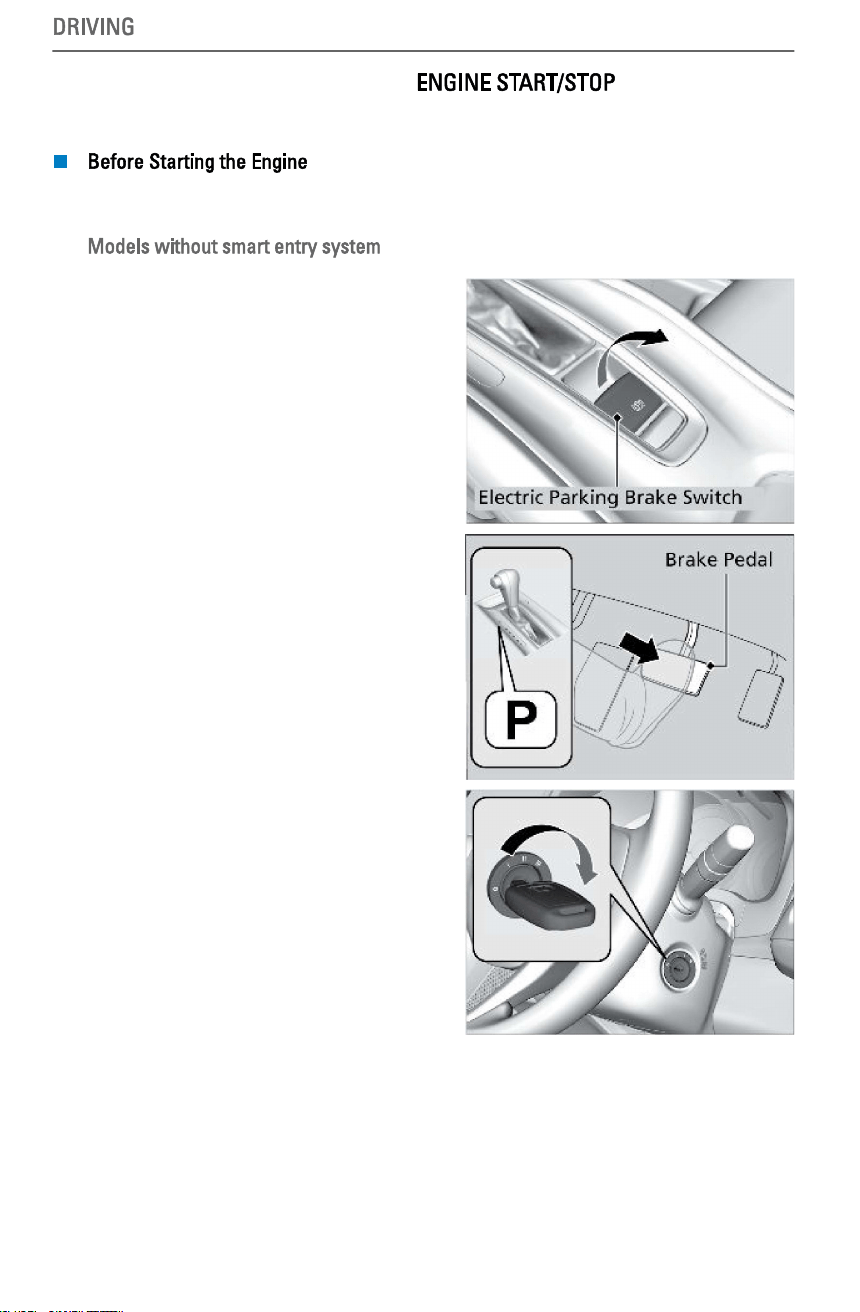
Depress the brake pedal and press the button
simultaneously.
1. Make sure the parking brake is
applied.
The electric parking brake indicator
comes on for 15 seconds when you
pull up to electric parking brake
switch.
2. Check that the transmission is in P,
then depress the brake pedal.
3. Turn the ignition switch to START
without depressing the accelerator
pedal.
84 |
1. Make sure the parking brake is
applied.
The electric parking brake indicator
comes on for 15 seconds when you
pull up to electric parking brake
switch.
2. Check that the transmission is in P,
then depress the brake pedal.
3. Press the ENGINE START/STOP
button without depressing the
accelerator pedal.
The engine is harder to start in
cold weather and in thinner air found at
altitudes above 8,000 feet (2,400 m).
When starting the engine in cold
weather, turn off all electrical
accessories such as the lights, climate
control system, and rear defogger in order to reduce battery drain.
: Press the
button once
without pressing the brake pedal for
Accessory mode. Press it again for On
mode.
*1 - If equipped
| 85
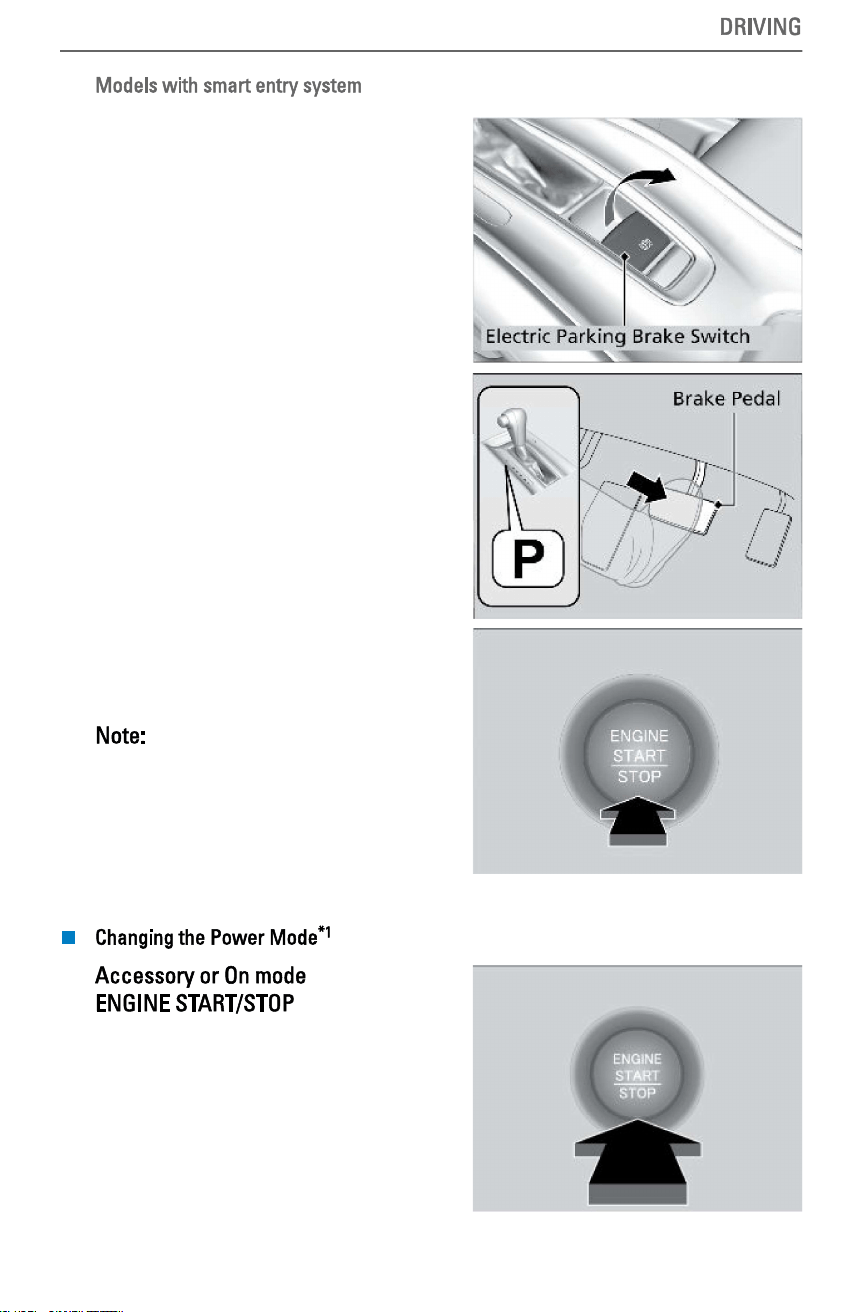
Depress the brake pedal and press the button
simultaneously.
1. Make sure the parking brake is
applied.
The electric parking brake indicator
comes on for 15 seconds when you
pull up to electric parking brake
switch.
2. Check that the transmission is in P,
then depress the brake pedal.
3. Turn the ignition switch to START
without depressing the accelerator
pedal.
84 |
1. Make sure the parking brake is
applied.
The electric parking brake indicator
comes on for 15 seconds when you
pull up to electric parking brake
switch.
2. Check that the transmission is in P,
then depress the brake pedal.
3. Press the ENGINE START/STOP
button without depressing the
accelerator pedal.
The engine is harder to start in
cold weather and in thinner air found at
altitudes above 8,000 feet (2,400 m).
When starting the engine in cold
weather, turn off all electrical
accessories such as the lights, climate
control system, and rear defogger in order to reduce battery drain.
: Press the
button once
without pressing the brake pedal for
Accessory mode. Press it again for On
mode.
*1 - If equipped
| 85
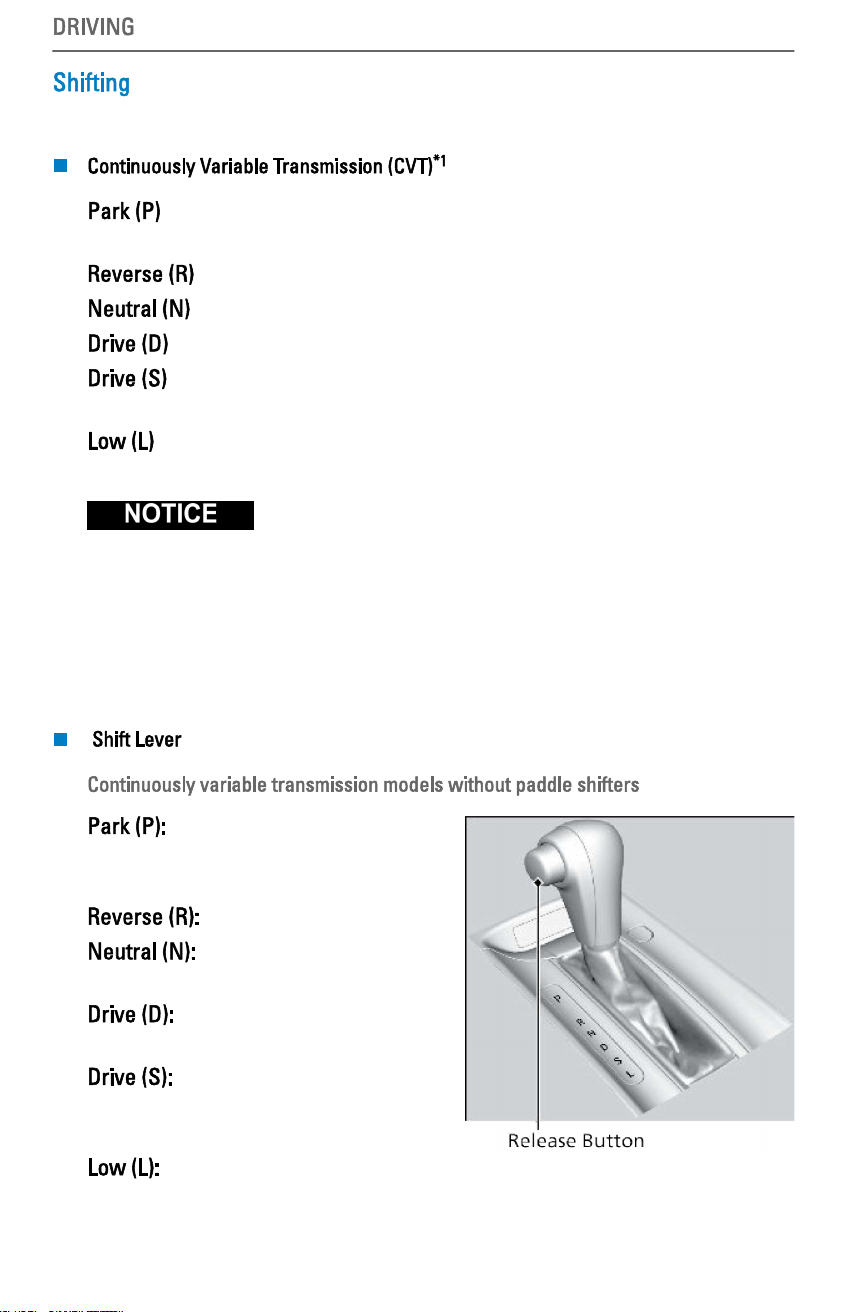
Change the position based on your driving needs.
: Used for parking or starting/ stopping the engine. Press the brake
pedal, then press the release button to shift.
: Used for reversing.
: Used for idling.
: Used for normal driving.
: Used for better acceleration, increased engine braking, driving in
hilly terrain, or paddle shifting
*1
.
: Used for stronger engine power and braking when driving in hilly
terrain.
When you change the shift lever from D to R and vice versa, come to a
complete stop and keep the brake pedal depressed. Operating the shift
lever before the vehicle has come to a complete standstill can damage the
transmission.
Do not operate the shift lever while pressing the accelerator pedal. You
could damage the transmission.
Used when parking, before
turning off or starting the power system
Transmission is locked.
Used for reversing.
Used for idling.
Transmission is not locked.
Normal driving (gears change
between 1st and 6th automatically).
Used for better acceleration.
To increase engine braking. When
going up or down hills.
Strong engine power when
climbing and strong engine braking when going down steep hills.
*1 - If equipped
86 |
Used when parking, before
turning off or starting the power system
Transmission is locked.
Used when reversing.
Transmission is not locked.
For normal driving. When
temporarily driving in the 7-speed
manual shift mode.
Used for better acceleration,
increasing engine braking, going up or
down hills and when driving in the 7-
speed manual shift mode.
When you change the shift lever from D to R and vice versa, come to a
complete stop and keep the brake pedal depressed. Operating the shift
lever before the vehicle has come to a complete standstill can damage the
transmission.
Select the vehicle’s gear using a simple button interface. Apply the brake
pedal and select a gear.
Press the (P) button to put the vehicle in Park.
Pull back the (R) button to put the vehicle in Reverse.
Press the (N) button to put the vehicle in Neutral. Transmission
is not locked.
Press the button to put the vehicle in Drive. Release the
electric parking brake to begin driving.
Driving in the sequential mode (when
driving in Sport+ mode)
The vehicle can roll away if left unattended without confirming that Park
is engaged. Always keep your foot on the brake pedal until you have
confirmed that is shown on the gear position indicator.
When you change from to and vice versa, or want to change to Park ,
come to a complete stop and keep the brake pedal applied. Operating the
| 87
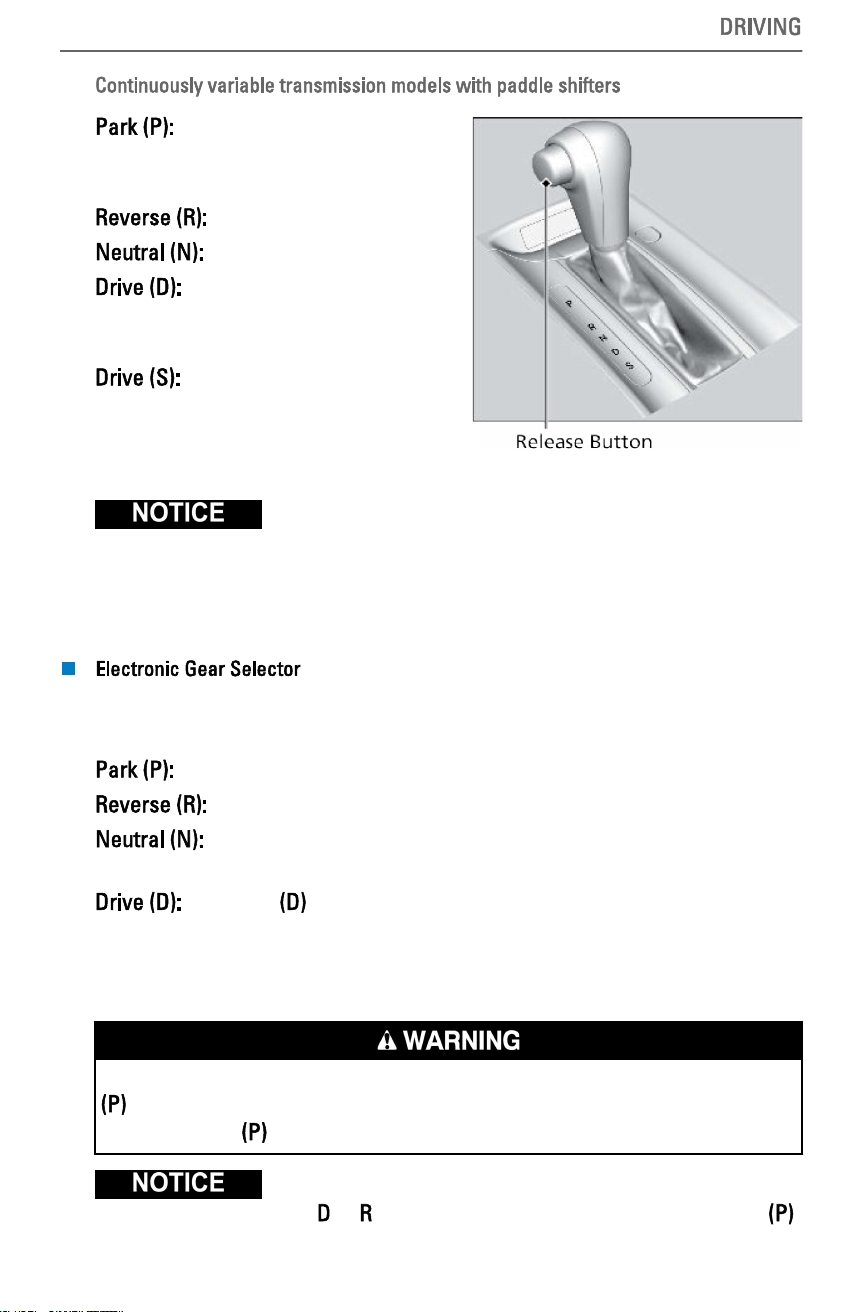
Change the position based on your driving needs.
: Used for parking or starting/ stopping the engine. Press the brake
pedal, then press the release button to shift.
: Used for reversing.
: Used for idling.
: Used for normal driving.
: Used for better acceleration, increased engine braking, driving in
hilly terrain, or paddle shifting
*1
.
: Used for stronger engine power and braking when driving in hilly
terrain.
When you change the shift lever from D to R and vice versa, come to a
complete stop and keep the brake pedal depressed. Operating the shift
lever before the vehicle has come to a complete standstill can damage the
transmission.
Do not operate the shift lever while pressing the accelerator pedal. You
could damage the transmission.
Used when parking, before
turning off or starting the power system
Transmission is locked.
Used for reversing.
Used for idling.
Transmission is not locked.
Normal driving (gears change
between 1st and 6th automatically).
Used for better acceleration.
To increase engine braking. When
going up or down hills.
Strong engine power when
climbing and strong engine braking when going down steep hills.
*1 - If equipped
86 |
Used when parking, before
turning off or starting the power system
Transmission is locked.
Used when reversing.
Transmission is not locked.
For normal driving. When
temporarily driving in the 7-speed
manual shift mode.
Used for better acceleration,
increasing engine braking, going up or
down hills and when driving in the 7-
speed manual shift mode.
When you change the shift lever from D to R and vice versa, come to a
complete stop and keep the brake pedal depressed. Operating the shift
lever before the vehicle has come to a complete standstill can damage the
transmission.
Select the vehicle’s gear using a simple button interface. Apply the brake
pedal and select a gear.
Press the (P) button to put the vehicle in Park.
Pull back the (R) button to put the vehicle in Reverse.
Press the (N) button to put the vehicle in Neutral. Transmission
is not locked.
Press the button to put the vehicle in Drive. Release the
electric parking brake to begin driving.
Driving in the sequential mode (when
driving in Sport+ mode)
The vehicle can roll away if left unattended without confirming that Park
is engaged. Always keep your foot on the brake pedal until you have
confirmed that is shown on the gear position indicator.
When you change from to and vice versa, or want to change to Park ,
come to a complete stop and keep the brake pedal applied. Operating the
| 87
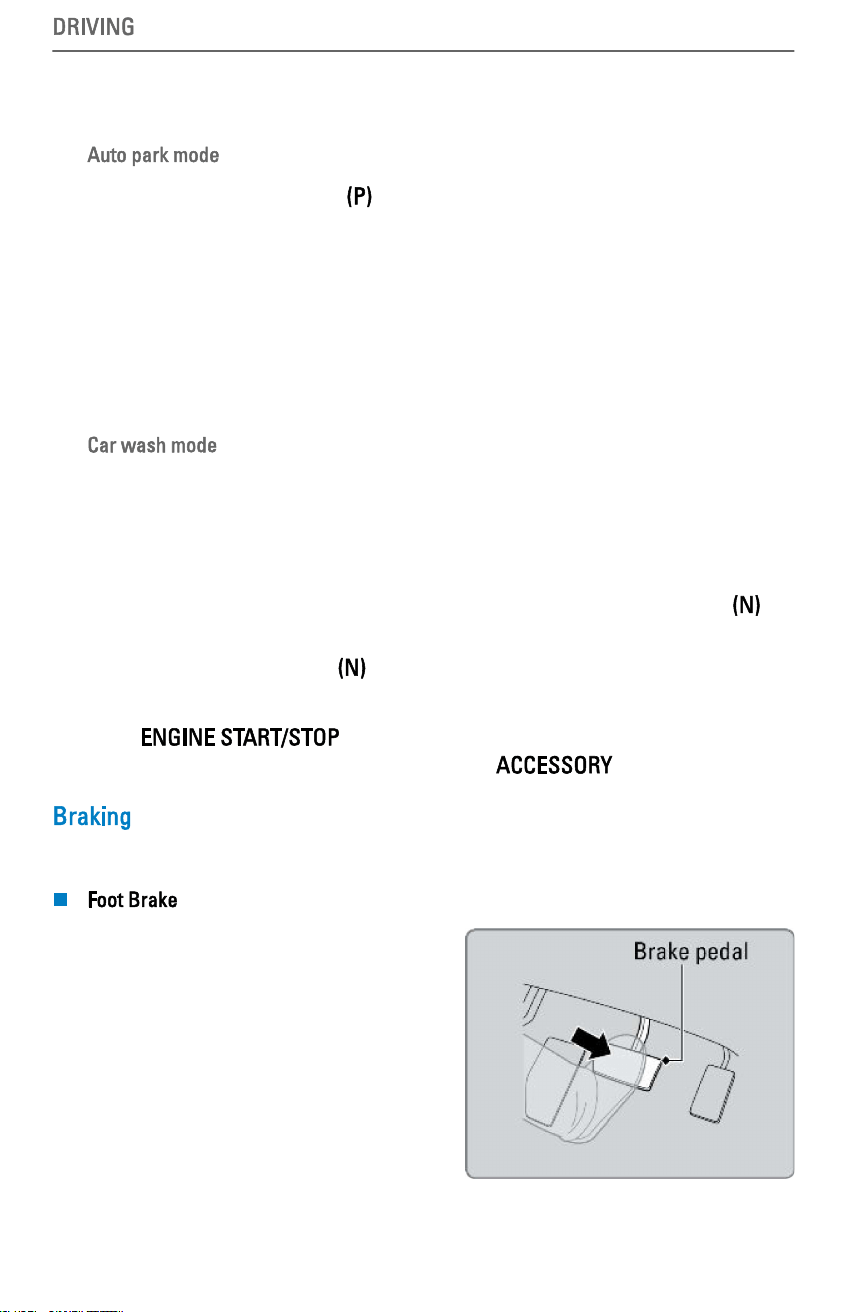
gear buttons before the vehicle has come to a complete standstill can
damage the transmission.
For your convenience, Park is automatically engaged when the vehicle is
turned off, or when all of the following conditions are met: the vehicle is
stopped with the engine running, the driver’s seat belt is unbuckled, and the
driver’s door is opened. You should always apply the brake and shift to Park
when idling, or before exiting the vehicle.
If you select any gear other than Park when the driver’s door is opened and
the driver’s seat belt is unbuckled, Park is re-engaged when the brake pedal
is released.
Follow the procedure below to use a conveyor-style car wash where you or
an attendant do not remain in the vehicle. Make sure the wiper lever is in
the OFF position. You should inform the car wash attendant of this
procedure.
1. When the engine is running, apply the brake pedal, select Neutral ,
then release the brake pedal.
2. Press and hold Neutral for two seconds. This puts the vehicle into
car wash mode.
If the button is pressed while the vehicle is in car
wash mode, the power mode will change to .
Slow down or stop your vehicle, and keep it from moving when parked.
Press the brake pedal to slow down or
stop your vehicle from moving.
Your vehicle is equipped with disc
brakes at all four wheels. A vacuum
power assist helps reduce the effort
needed on the brake pedal. The brake
assist system increases the stopping
force when you depress the brake
pedal hard in an emergency situation.
The anti-lock brake system (ABS) helps you retain steering control when
braking very hard.
88 |
Keep the vehicle from moving when it is parked.
The electric parking brake can be
applied any time the vehicle has
battery, no matter which position the
ignition switch
*1
is in.
Pull the electric parking brake switch
up gently and securely.
The ignition switch must be ON
*1
in
order to release the electric parking
brake.
1. Depress the brake pedal.
2. Press the electric parking brake
switch.
During hard or emergency braking, the system increases braking force. The
brake pedal may move slightly or make a noise; this is normal. Continue to
hold the brake pedal firmly down.
During hard or emergency braking, the system rapidly pumps the brakes to
prevent wheel lockup and help you maintain steering control. Do not pump
the brake pedal, rather continue to hold it firmly down.
When ABS activates, you may notice vibrations through the brake pedal or
the vehicle body, the brake pedal depressing further than usual, or hear a
motor noise from the engine compartment. These are all normal.
The ABS may not function correctly if you use an incorrect tire type and
size.
*1 - If equipped
| 89
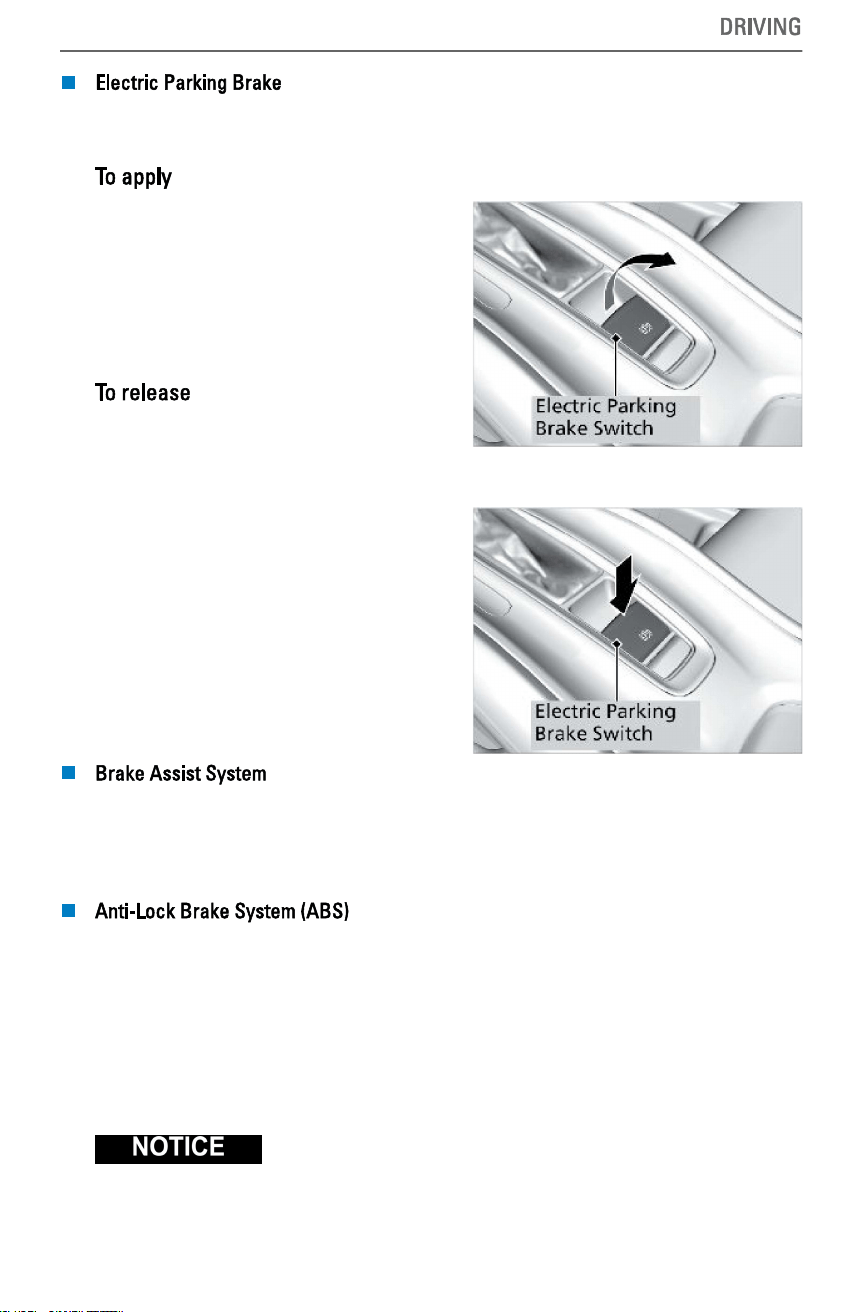
gear buttons before the vehicle has come to a complete standstill can
damage the transmission.
For your convenience, Park is automatically engaged when the vehicle is
turned off, or when all of the following conditions are met: the vehicle is
stopped with the engine running, the driver’s seat belt is unbuckled, and the
driver’s door is opened. You should always apply the brake and shift to Park
when idling, or before exiting the vehicle.
If you select any gear other than Park when the driver’s door is opened and
the driver’s seat belt is unbuckled, Park is re-engaged when the brake pedal
is released.
Follow the procedure below to use a conveyor-style car wash where you or
an attendant do not remain in the vehicle. Make sure the wiper lever is in
the OFF position. You should inform the car wash attendant of this
procedure.
1. When the engine is running, apply the brake pedal, select Neutral ,
then release the brake pedal.
2. Press and hold Neutral for two seconds. This puts the vehicle into
car wash mode.
If the button is pressed while the vehicle is in car
wash mode, the power mode will change to .
Slow down or stop your vehicle, and keep it from moving when parked.
Press the brake pedal to slow down or
stop your vehicle from moving.
Your vehicle is equipped with disc
brakes at all four wheels. A vacuum
power assist helps reduce the effort
needed on the brake pedal. The brake
assist system increases the stopping
force when you depress the brake
pedal hard in an emergency situation.
The anti-lock brake system (ABS) helps you retain steering control when
braking very hard.
88 |
Keep the vehicle from moving when it is parked.
The electric parking brake can be
applied any time the vehicle has
battery, no matter which position the
ignition switch
*1
is in.
Pull the electric parking brake switch
up gently and securely.
The ignition switch must be ON
*1
in
order to release the electric parking
brake.
1. Depress the brake pedal.
2. Press the electric parking brake
switch.
During hard or emergency braking, the system increases braking force. The
brake pedal may move slightly or make a noise; this is normal. Continue to
hold the brake pedal firmly down.
During hard or emergency braking, the system rapidly pumps the brakes to
prevent wheel lockup and help you maintain steering control. Do not pump
the brake pedal, rather continue to hold it firmly down.
When ABS activates, you may notice vibrations through the brake pedal or
the vehicle body, the brake pedal depressing further than usual, or hear a
motor noise from the engine compartment. These are all normal.
The ABS may not function correctly if you use an incorrect tire type and
size.
*1 - If equipped
| 89
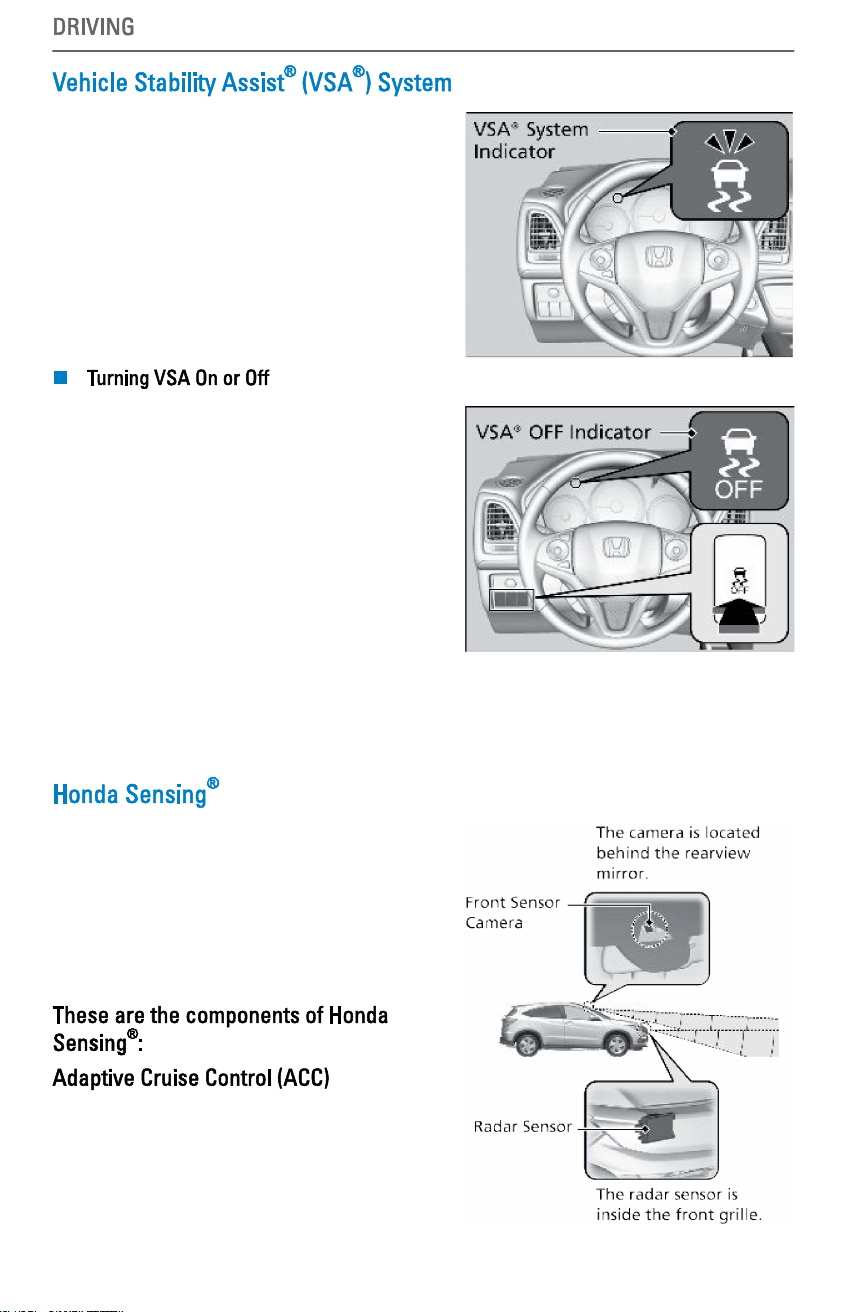
Helps to stabilize the vehicle during
cornering if the vehicle turns more or less
than what was intended. It assists in
maintaining traction on slippery surfaces
by regulating engine output and selectively
applying the brakes. VSA is also known as
Electronic Stability Control (ESC).
This button is on the driver side control
panel. To partially disable VSA
®
functionality/features, press and hold it
until you hear a beep.
Your vehicle will have normal braking
and cornering ability, but traction
control function will be less effective.
To restore VSA
®
functionality/features,
press the (VSA
®
OFF) button until you
hear a beep.
VSA
®
is turned on every time you turn the power system on, even if you
turned it off the last time you drove the vehicle.
A driver support system which employs the
use of two distinctly different kinds of
sensors, a radar sensor located in the front
grille and a front sensor camera mounted
to the interior side of the windshield,
behind the rearview mirror.
*1
: Helps
maintain a constant vehicle speed and a
set following interval behind a vehicle
detected ahead of yours, without you
having to keep your foot on the brake or the
accelerator.
*1 - If equipped
90 |
: Provides steering input to help keep the
vehicle in the middle of a detected lane and provides tactile and visual alerts if
the vehicle is detected drifting out of its lane.
: Alerts and helps to assist you when
the system detects a possibility of your vehicle unintentionally crossing over
detected lane markings and/or leaving the roadway altogether.
: Can assist you when there is a
possibility of your vehicle colliding with a vehicle or a pedestrian detected in
front of yours. The CMBS
™
is designed to alert you when a potential collision is
determined, as well as to reduce your vehicle speed to help minimize collision
severity when a collision is deemed unavoidable.
Maintain a constant vehicle speed without having to keep your foot on the
accelerator pedal. Use cruise control on freeways or open roads where you
can travel at a constant speed with little acceleration or deceleration.
*1 - If equipped
| 91
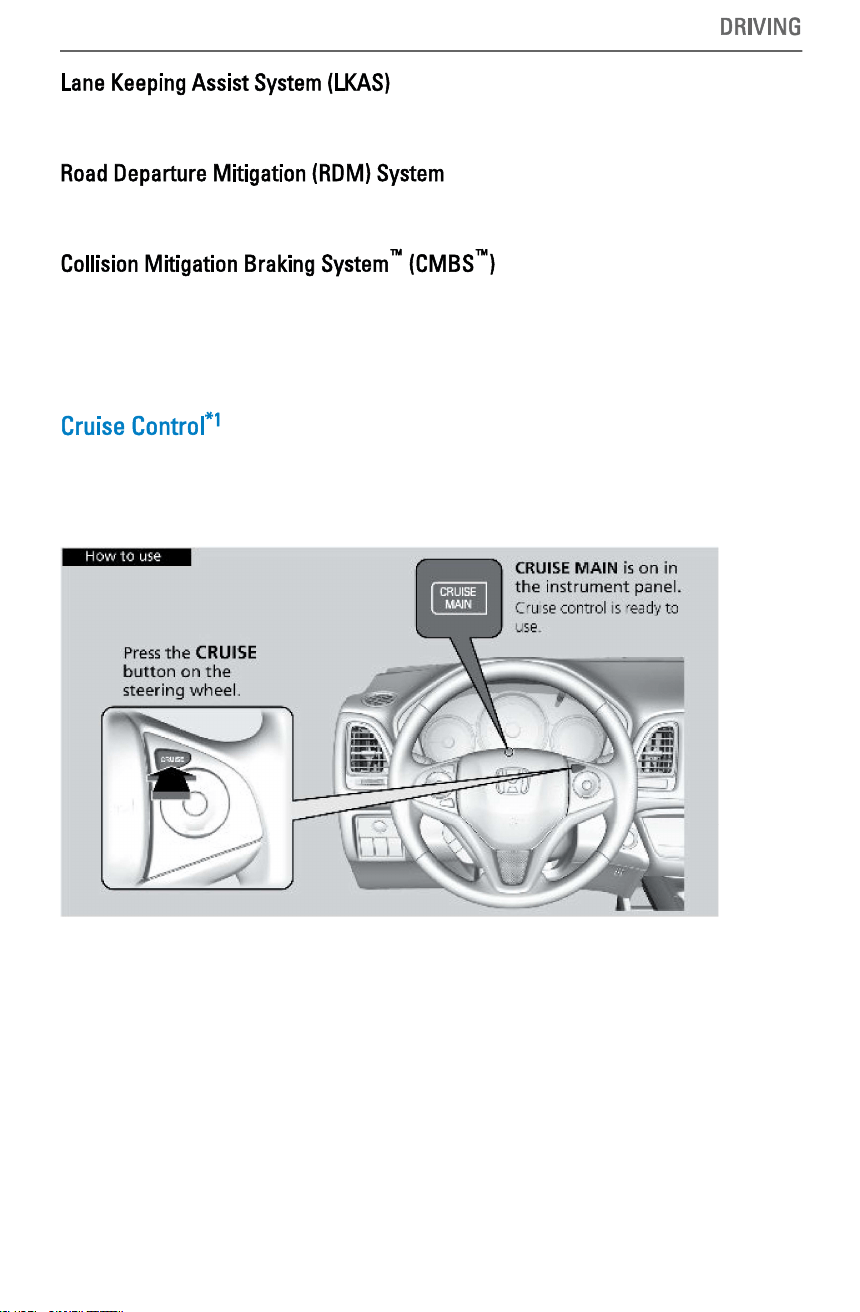
Helps to stabilize the vehicle during
cornering if the vehicle turns more or less
than what was intended. It assists in
maintaining traction on slippery surfaces
by regulating engine output and selectively
applying the brakes. VSA is also known as
Electronic Stability Control (ESC).
This button is on the driver side control
panel. To partially disable VSA
®
functionality/features, press and hold it
until you hear a beep.
Your vehicle will have normal braking
and cornering ability, but traction
control function will be less effective.
To restore VSA
®
functionality/features,
press the (VSA
®
OFF) button until you
hear a beep.
VSA
®
is turned on every time you turn the power system on, even if you
turned it off the last time you drove the vehicle.
A driver support system which employs the
use of two distinctly different kinds of
sensors, a radar sensor located in the front
grille and a front sensor camera mounted
to the interior side of the windshield,
behind the rearview mirror.
*1
: Helps
maintain a constant vehicle speed and a
set following interval behind a vehicle
detected ahead of yours, without you
having to keep your foot on the brake or the
accelerator.
*1 - If equipped
90 |
: Provides steering input to help keep the
vehicle in the middle of a detected lane and provides tactile and visual alerts if
the vehicle is detected drifting out of its lane.
: Alerts and helps to assist you when
the system detects a possibility of your vehicle unintentionally crossing over
detected lane markings and/or leaving the roadway altogether.
: Can assist you when there is a
possibility of your vehicle colliding with a vehicle or a pedestrian detected in
front of yours. The CMBS
™
is designed to alert you when a potential collision is
determined, as well as to reduce your vehicle speed to help minimize collision
severity when a collision is deemed unavoidable.
Maintain a constant vehicle speed without having to keep your foot on the
accelerator pedal. Use cruise control on freeways or open roads where you
can travel at a constant speed with little acceleration or deceleration.
*1 - If equipped
| 91
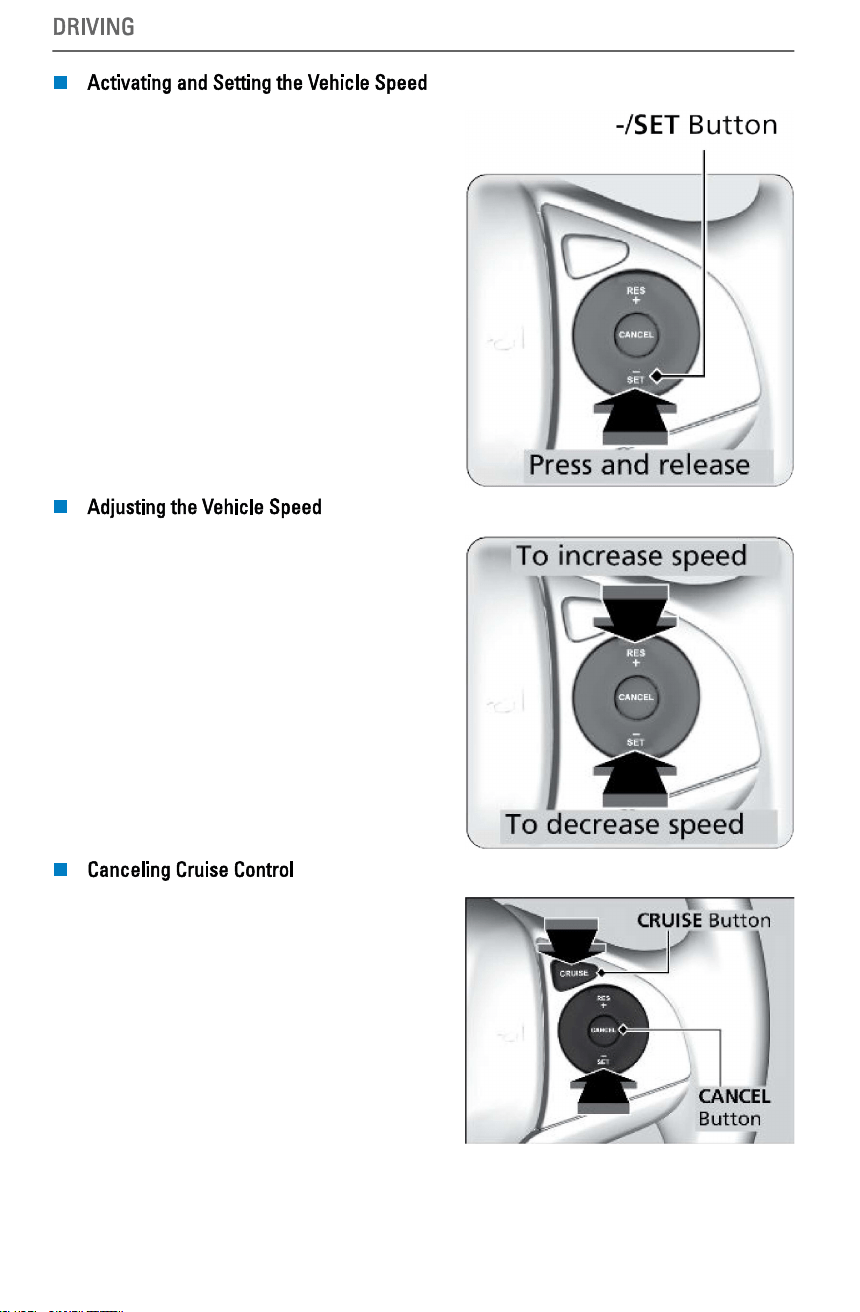
1. Press the CRUISE button. The
CRUISE MAIN indicator appears.
2. Accelerate to the desired speed
(above 25 mph/ 40 km/h). Take your
foot off the pedal and press the
-/SET button to set the speed. The
CRUISE CONTROL indicator
appears.
Press the RES/+ button to increase
speed or the -/SET button to decrease
speed.
Each time you press the button, the
vehicle speed is increased or
decreased by about 1 mph (1.6 km/h). If
you keep the button pressed, the
vehicle speed increases or decreases
until you release it.
Press the CANCEL button, the MAIN
button or the brake pedal. The CRUISE
CONTROL indicator goes off.
After cruise control has been canceled,
you can still resume the prior set speed
by pressing the RES/+ button while
driving at a speed of at least 25 mph (40
km/h).
92 |
Press CRUISE to turn the system off.
Improper use of cruise control can lead to a crash. Use cruise control only
when traveling on open highways in good weather.
Helps maintain a constant vehicle speed and a set following interval behind a
vehicle detected ahead of yours . When the vehicle ahead changes speed, ACC
senses the change and accelerates or decelerates to maintain a set interval.
1. Press the MAIN button. The ACC
indicator appears in the multi-
information display.
*1 - If equipped
| 93
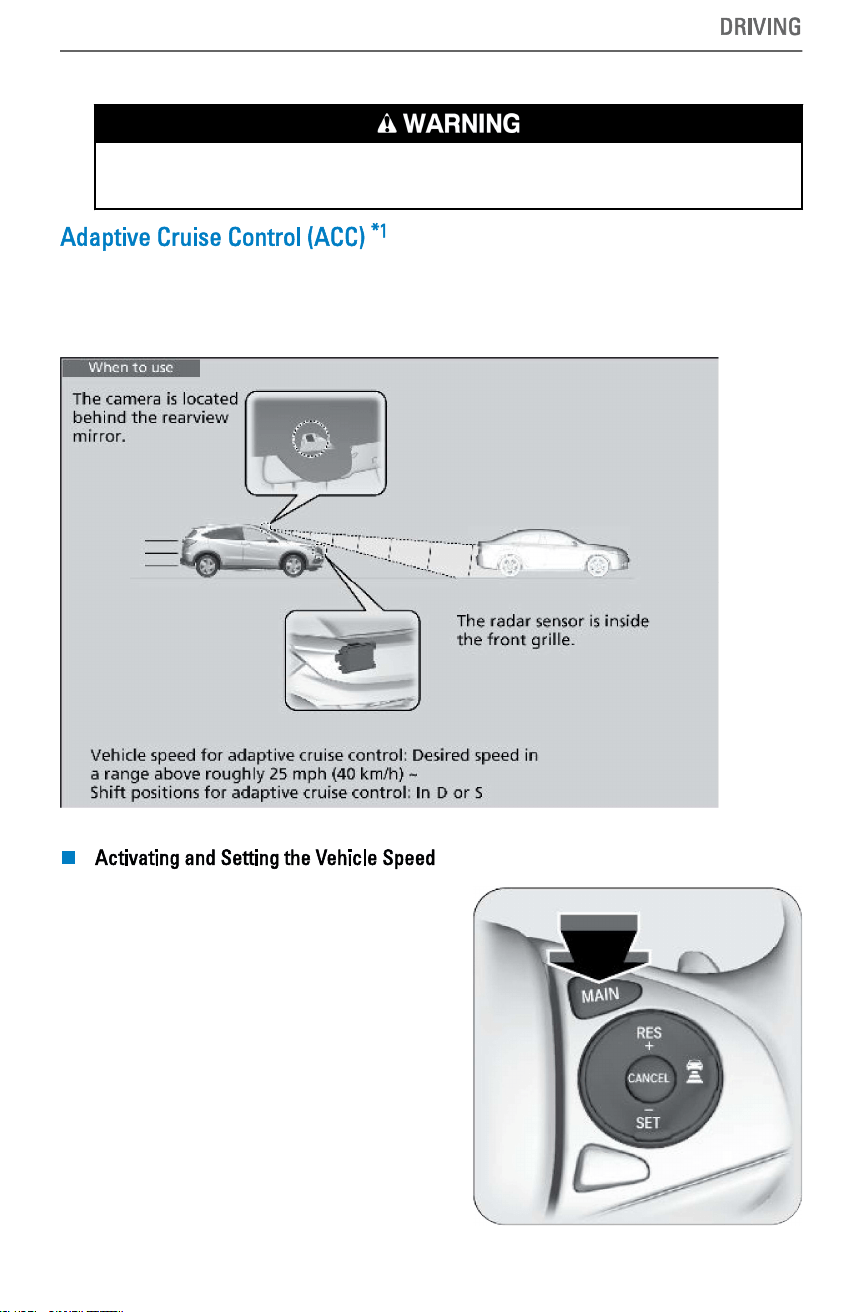
1. Press the CRUISE button. The
CRUISE MAIN indicator appears.
2. Accelerate to the desired speed
(above 25 mph/ 40 km/h). Take your
foot off the pedal and press the
-/SET button to set the speed. The
CRUISE CONTROL indicator
appears.
Press the RES/+ button to increase
speed or the -/SET button to decrease
speed.
Each time you press the button, the
vehicle speed is increased or
decreased by about 1 mph (1.6 km/h). If
you keep the button pressed, the
vehicle speed increases or decreases
until you release it.
Press the CANCEL button, the MAIN
button or the brake pedal. The CRUISE
CONTROL indicator goes off.
After cruise control has been canceled,
you can still resume the prior set speed
by pressing the RES/+ button while
driving at a speed of at least 25 mph (40
km/h).
92 |
Press CRUISE to turn the system off.
Improper use of cruise control can lead to a crash. Use cruise control only
when traveling on open highways in good weather.
Helps maintain a constant vehicle speed and a set following interval behind a
vehicle detected ahead of yours . When the vehicle ahead changes speed, ACC
senses the change and accelerates or decelerates to maintain a set interval.
1. Press the MAIN button. The ACC
indicator appears in the multi-
information display.
*1 - If equipped
| 93
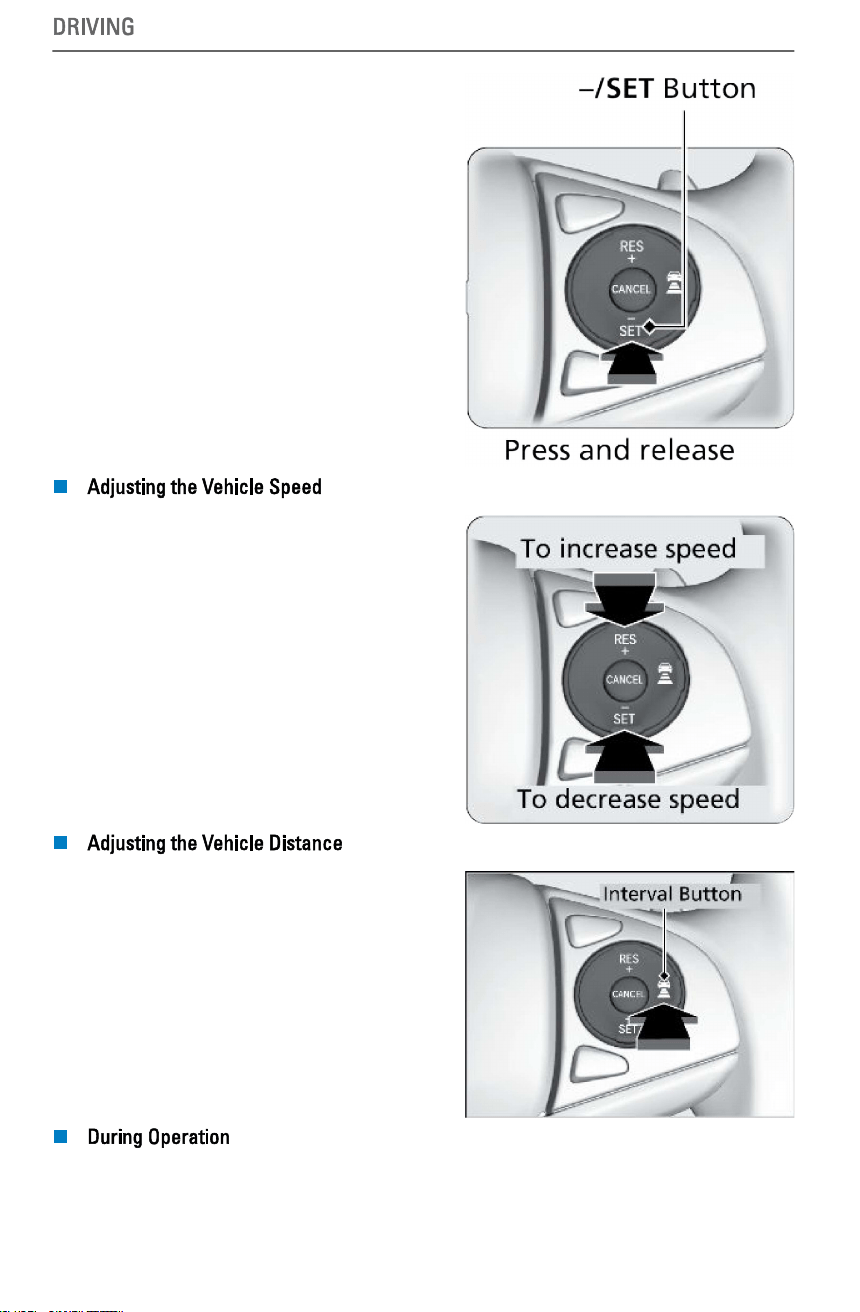
2. Accelerate to the desired speed
(above 25 mph/40 km/h). Take your
foot off the pedal and press the
SET/- button to set the speed.
Press the RES/+ button to increase
speed or the SET/- button to decrease
speed. Each time you press the button,
the vehicle speed is increased or
decreased by about 1 mph (1.6 km/h). If
you keep the button pressed, the
vehicle speed increases or decreases
by 5 mph or 5 km/h until you release it.
Press the Interval button to change the
following interval. Each time you press
the button, the setting cycles through
extra long, long, middle, and short.
94 |
If a vehicle is detected ahead of you
when ACC is turned on, the system
maintains, accelerates, or decelerates
your vehicle’s set speed to keep the
vehicle’s set following interval from the
vehicle ahead.
If a vehicle detected ahead of you
slows down abruptly, or if another
vehicle cuts in front of you, a beep
sounds and BRAKE appears on the to alert you .
ACC has limited braking capability.
When your vehicle speed drops below 22 mph (35 km/h), ACC will
automatically cancel and no longer will apply your vehicle’s brakes.
Always be prepared to apply the brake pedal when conditions require.
You can press the CANCEL button,
MAIN button or the brake pedal. The
ACC indicator goes off.
Certain conditions may cause ACC to
cancel automatically. When this
happens, a beep sounds and a
messagea message appears on the
Improper use of ACC can lead to a crash.
Use ACC only when traveling on open highways in good weather.
Press and hold the Interval button for one second.
| 95
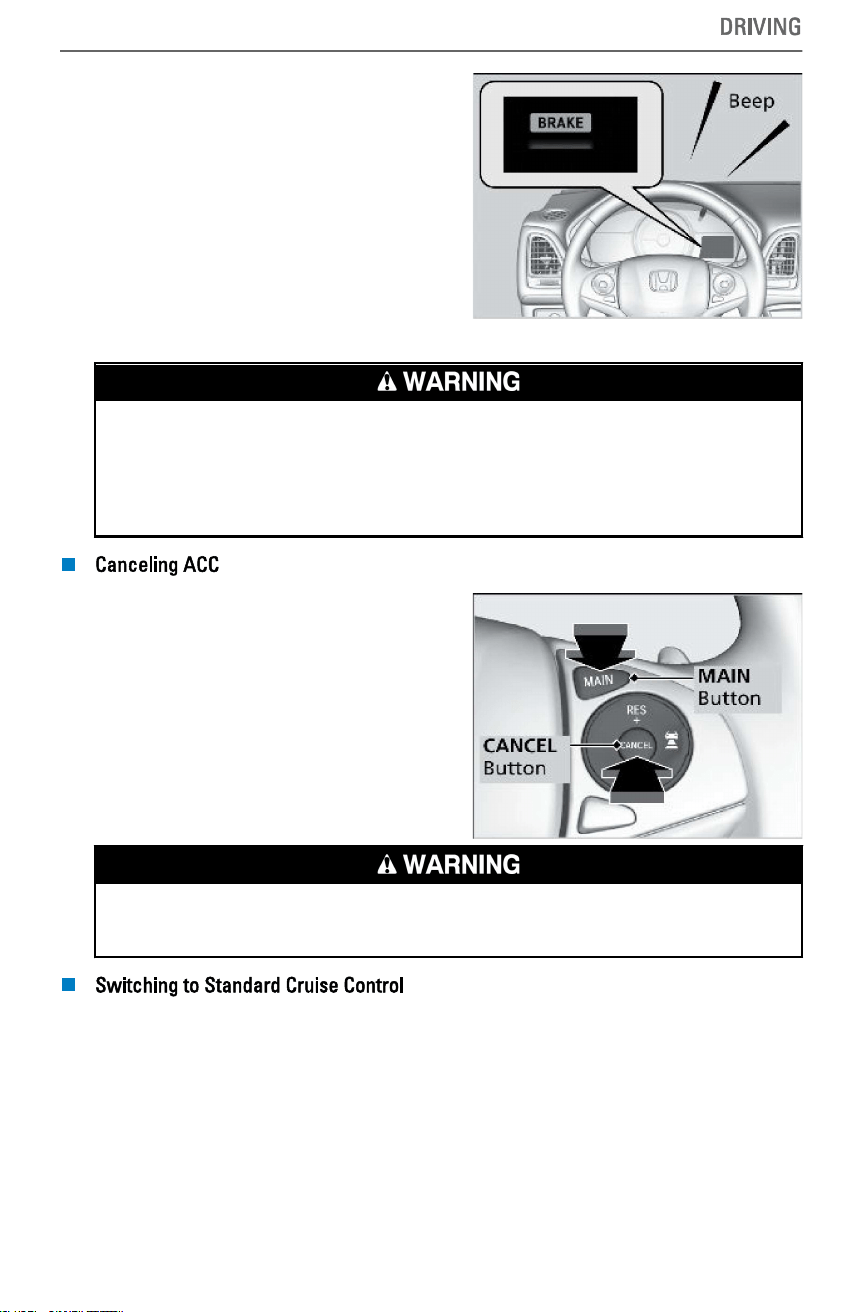
2. Accelerate to the desired speed
(above 25 mph/40 km/h). Take your
foot off the pedal and press the
SET/- button to set the speed.
Press the RES/+ button to increase
speed or the SET/- button to decrease
speed. Each time you press the button,
the vehicle speed is increased or
decreased by about 1 mph (1.6 km/h). If
you keep the button pressed, the
vehicle speed increases or decreases
by 5 mph or 5 km/h until you release it.
Press the Interval button to change the
following interval. Each time you press
the button, the setting cycles through
extra long, long, middle, and short.
94 |
If a vehicle is detected ahead of you
when ACC is turned on, the system
maintains, accelerates, or decelerates
your vehicle’s set speed to keep the
vehicle’s set following interval from the
vehicle ahead.
If a vehicle detected ahead of you
slows down abruptly, or if another
vehicle cuts in front of you, a beep
sounds and BRAKE appears on the to alert you .
ACC has limited braking capability.
When your vehicle speed drops below 22 mph (35 km/h), ACC will
automatically cancel and no longer will apply your vehicle’s brakes.
Always be prepared to apply the brake pedal when conditions require.
You can press the CANCEL button,
MAIN button or the brake pedal. The
ACC indicator goes off.
Certain conditions may cause ACC to
cancel automatically. When this
happens, a beep sounds and a
messagea message appears on the
Improper use of ACC can lead to a crash.
Use ACC only when traveling on open highways in good weather.
Press and hold the Interval button for one second.
| 95
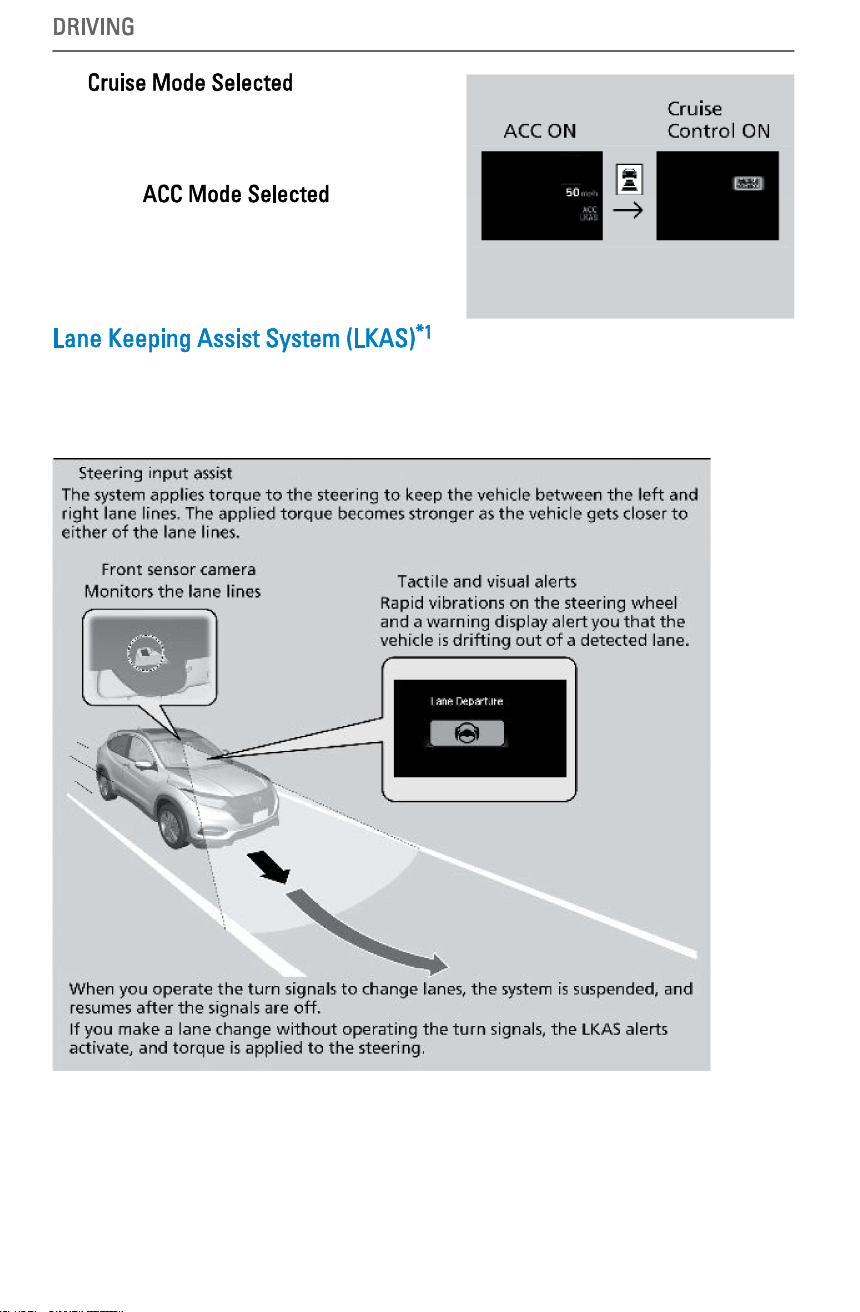
appears in the
for two seconds, and then the mode
switches to Cruise.. Press and hold the
interval button again to switch back to
ACC . appears on
the display for two seconds.
Provides steering input to help keep the vehicle in the middle of a detected lane
and provides audible and visual alerts if the vehicle is detected drifting out of its
lane while driving between 45–90 mph (72–145 km/h).
*1 - If equipped
96 |
1. Press the MAIN button. LKAS appears in
the Multi-Information Display.
2. Press the LKAS button. Lane outlines
appear in the Multi-Information Display .
Dotted lane lines turn solid when the
system activates.
3. Press the MAIN button or the LKAS
button to turn the system off.
LKAS is for your convenience only. It is not a substitute for your vehicle
control. The system does not work if you take your hands off the steering
wheel or fail to steer the vehicle.
Do not place an object on the top of the instrument panel. It may reflect onto
the windshield and prevent the system from detecting lane lines properly.
Alerts and helps to assist you if the system
determines a possibility of your vehicle
unintentionally crossing over detected lane
markings and/or leaving the roadway
altogether while driving between 45-90 mph
(72-145km/h).
If your vehicle is getting too close to
detected lane markings without a turn
signal activated, the system, in addition to a
visual alert, applies steering torque and
alerts you with rapid vibrations on the
steering wheel, to help you remain within
the detected lane. Braking is applied only
*1 - If equipped
| 97
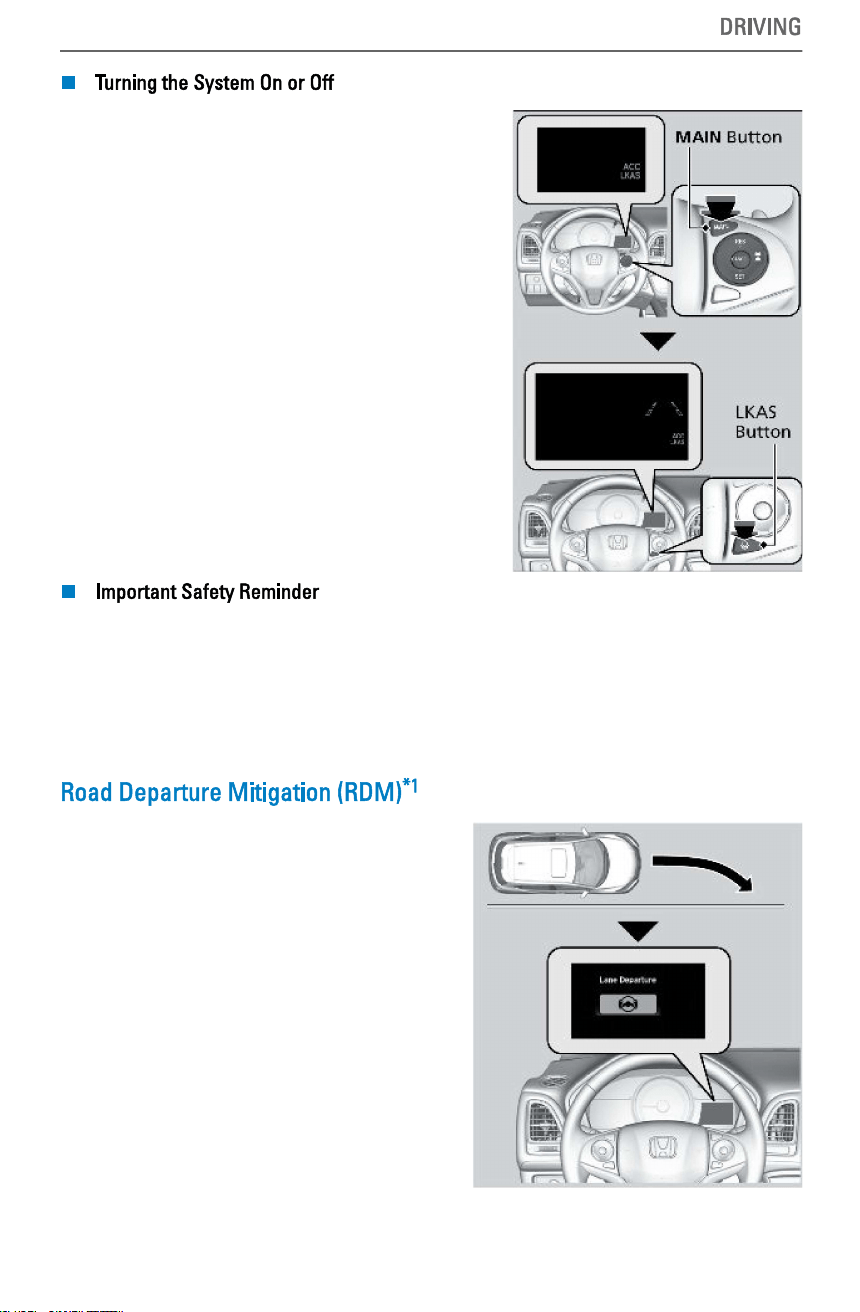
appears in the
for two seconds, and then the mode
switches to Cruise.. Press and hold the
interval button again to switch back to
ACC . appears on
the display for two seconds.
Provides steering input to help keep the vehicle in the middle of a detected lane
and provides audible and visual alerts if the vehicle is detected drifting out of its
lane while driving between 45–90 mph (72–145 km/h).
*1 - If equipped
96 |
1. Press the MAIN button. LKAS appears in
the Multi-Information Display.
2. Press the LKAS button. Lane outlines
appear in the Multi-Information Display .
Dotted lane lines turn solid when the
system activates.
3. Press the MAIN button or the LKAS
button to turn the system off.
LKAS is for your convenience only. It is not a substitute for your vehicle
control. The system does not work if you take your hands off the steering
wheel or fail to steer the vehicle.
Do not place an object on the top of the instrument panel. It may reflect onto
the windshield and prevent the system from detecting lane lines properly.
Alerts and helps to assist you if the system
determines a possibility of your vehicle
unintentionally crossing over detected lane
markings and/or leaving the roadway
altogether while driving between 45-90 mph
(72-145km/h).
If your vehicle is getting too close to
detected lane markings without a turn
signal activated, the system, in addition to a
visual alert, applies steering torque and
alerts you with rapid vibrations on the
steering wheel, to help you remain within
the detected lane. Braking is applied only
*1 - If equipped
| 97
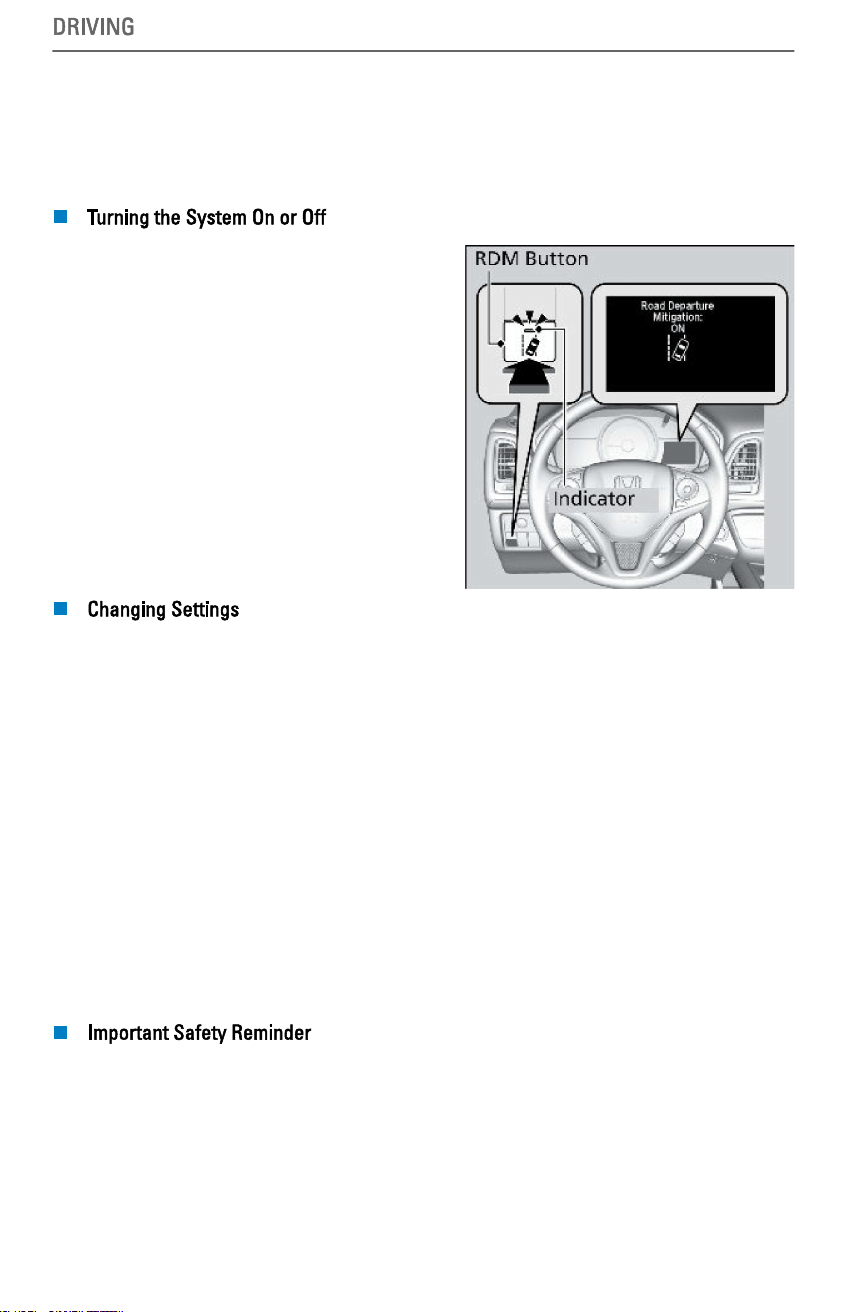
when the lane markings are solid continuous lines.
Braking may also be applied if the lane lines are solid and continuous. If the
system operates several times without detecting driver response, the system
beeps to alert you.
Press the RDM button to turn the
system on or off. A green indicator
appears on the button when the system
is on.
Determine the warning type.
1. From the HOME screen, select Settings.
2. Select Vehicle. The vehicle must be in Park (P).
3. Select Driver Assist System Setup.
4. Select Road Departure Mitigation Setting.
5. Select from the options.
Normal (default):
Steering control starts from inside the lane edge.
Wide:
Steering control starts from outside the lane edge.
Warning Only:
The system provides only a BRAKE message and steering
wheel vibrations, but does not apply steering torque or braking.
6. Press BACK to exit the menu.
The RDM system has limitations. Over-reliance on it may result in a
collision. It is always your responsibility to keep your vehicle within the
driving lane.
98 |
Can assist you when there is a possibility of
your vehicle colliding with a vehicle or a
pedestrian detected in front of yours. The
CMBS
™
is designed to alert you when a
potential collision is determined, as well as
to reduce your vehicle speed to help
minimize collision severity when a collision is deemed unavoidable.
The system can give you visual, audible, and tactile alerts when a potential
collision is determined, and reduce your vehicle speed to help minimize
collision severity when a collision is deemed unavoidable.
When a potential collision with a detected oncoming vehicle is determined, the
system also alerts you with rapid vibrations on the steering wheel.
The system has three alert stages for a possible collision. Depending on the
circumstances or CMBS
™
settings, CMBS
™
may not go through all of the
stages before initiating the last stage.
Visual and audible warning.
Visual and audible warning, light brake application.
Visual and audible warning, strong brake application.
Determine the warning timing. The vehicle must be in Park (P).
1. From the HOME screen, select Settings.
2. Select Vehicle.
3. Select Driver Assist System Setup.
4. Select Forward Collision Warning Distance.
5. Select Long, Normal, or Short.
6. Press BACK to exit the menu.
| 99
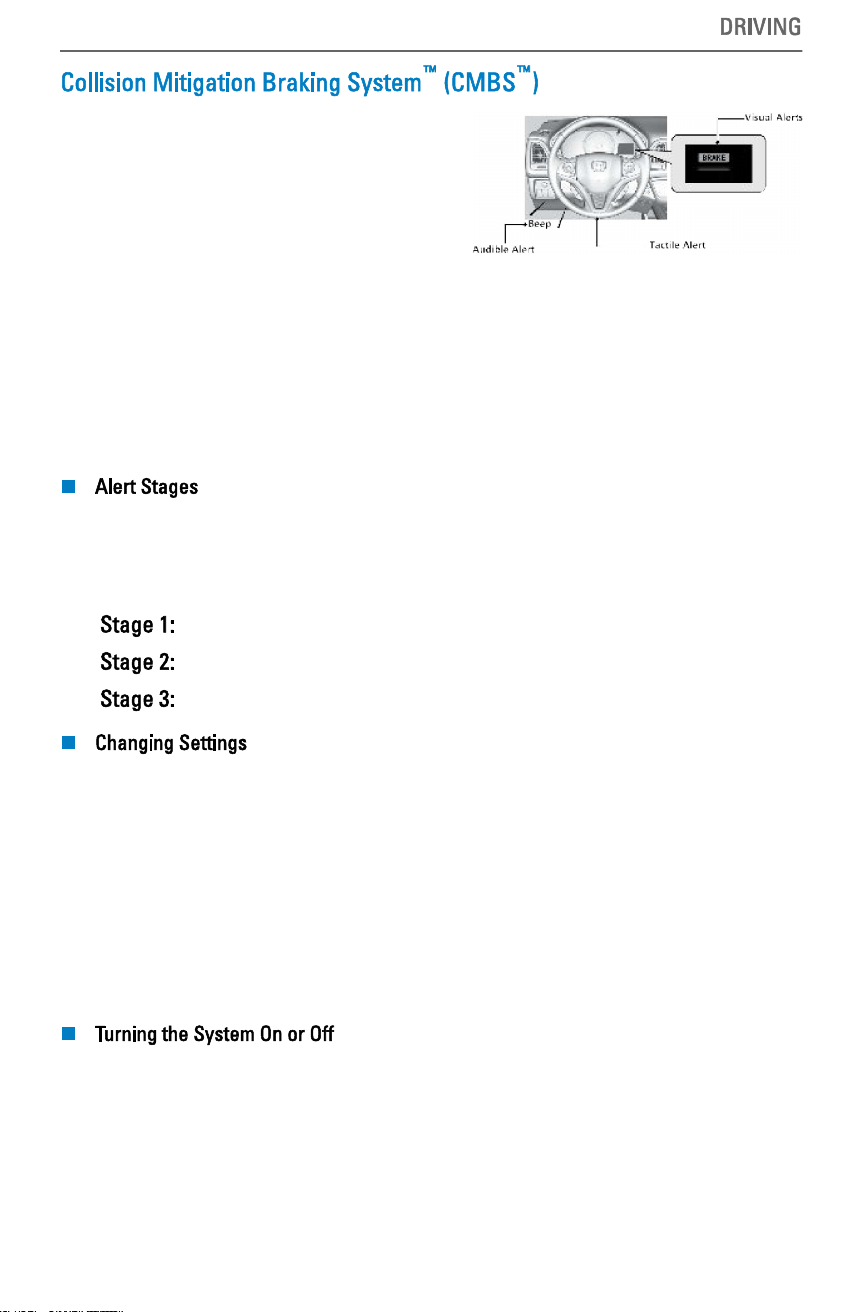
when the lane markings are solid continuous lines.
Braking may also be applied if the lane lines are solid and continuous. If the
system operates several times without detecting driver response, the system
beeps to alert you.
Press the RDM button to turn the
system on or off. A green indicator
appears on the button when the system
is on.
Determine the warning type.
1. From the HOME screen, select Settings.
2. Select Vehicle. The vehicle must be in Park (P).
3. Select Driver Assist System Setup.
4. Select Road Departure Mitigation Setting.
5. Select from the options.
Normal (default):
Steering control starts from inside the lane edge.
Wide:
Steering control starts from outside the lane edge.
Warning Only:
The system provides only a BRAKE message and steering
wheel vibrations, but does not apply steering torque or braking.
6. Press BACK to exit the menu.
The RDM system has limitations. Over-reliance on it may result in a
collision. It is always your responsibility to keep your vehicle within the
driving lane.
98 |
Can assist you when there is a possibility of
your vehicle colliding with a vehicle or a
pedestrian detected in front of yours. The
CMBS
™
is designed to alert you when a
potential collision is determined, as well as
to reduce your vehicle speed to help
minimize collision severity when a collision is deemed unavoidable.
The system can give you visual, audible, and tactile alerts when a potential
collision is determined, and reduce your vehicle speed to help minimize
collision severity when a collision is deemed unavoidable.
When a potential collision with a detected oncoming vehicle is determined, the
system also alerts you with rapid vibrations on the steering wheel.
The system has three alert stages for a possible collision. Depending on the
circumstances or CMBS
™
settings, CMBS
™
may not go through all of the
stages before initiating the last stage.
Visual and audible warning.
Visual and audible warning, light brake application.
Visual and audible warning, strong brake application.
Determine the warning timing. The vehicle must be in Park (P).
1. From the HOME screen, select Settings.
2. Select Vehicle.
3. Select Driver Assist System Setup.
4. Select Forward Collision Warning Distance.
5. Select Long, Normal, or Short.
6. Press BACK to exit the menu.
| 99
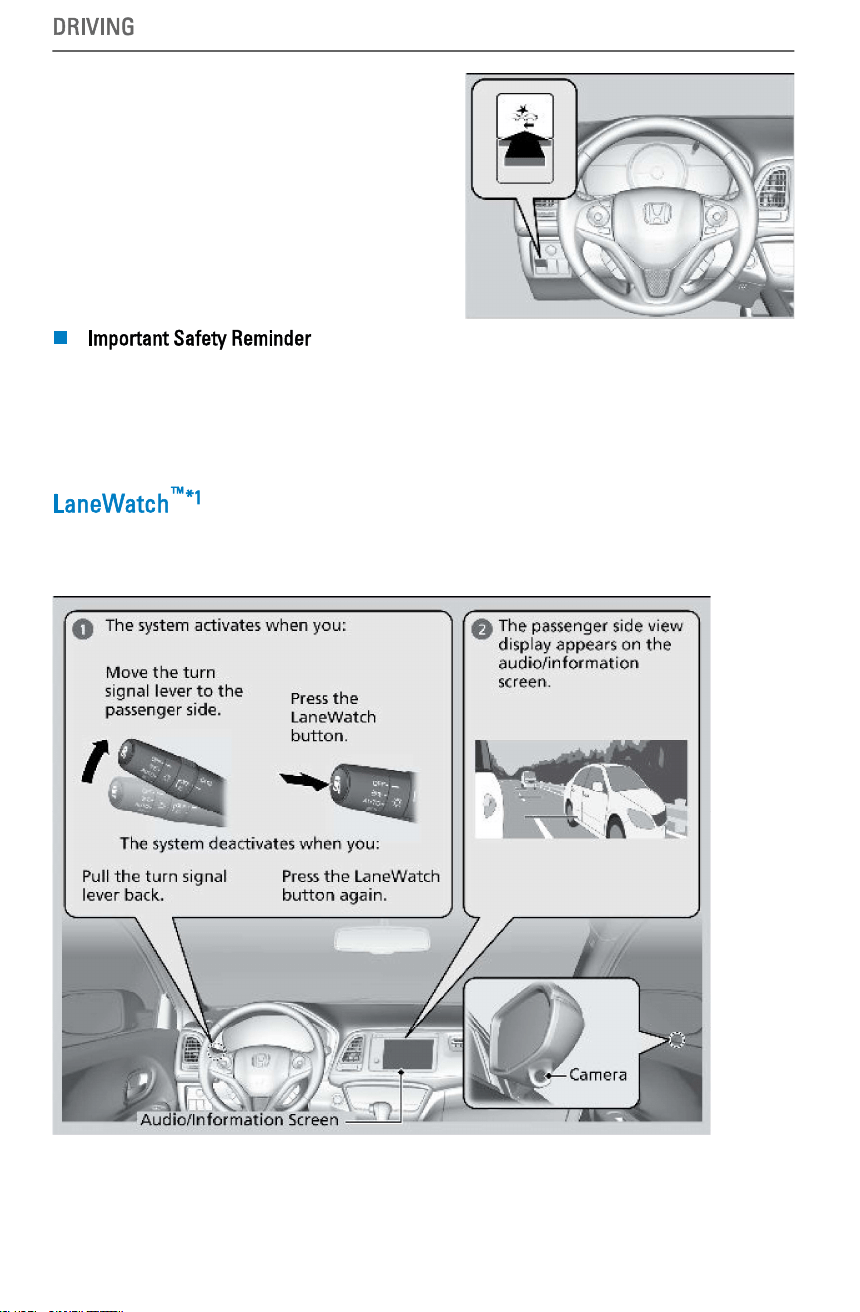
Press and hold the CMBS
™
OFF button.
A beep sounds and a message appears
in the Multi-Information Display. The
CMBS
™
indicator appears when the
system is off.
CMBS is designed to reduce the severity of an unavoidable collision. It does
not prevent collisions nor stop the vehicle automatically. It is still your
responsibility to operate the brake pedal and steering wheel appropriately
according to the driving conditions.
Allows you to check the passenger side rear areas displayed on the audio/
information screen when the turn signal is activated to the passenger’s side.
*1 - If equipped,
100 |
Activate the right turn signal. The
LaneWatch display appears. Check the
display for blind spots, and visually
confirm that it is safe to change lanes.
You can also press the LaneWatch
button on the end of the turn signal
switch to view a constant real-time
display. Press it again to turn the
display off.
Customize the display and how and when the display appears.
1. From the Home screen, select Settings.
2. Select Camera.
3. Select LaneWatch.
4. Select an option and make the preferred changes.
5. Press BACK to exit the menu.
Like all assistance systems, LaneWatch has limitations. Over-reliance on
the system may result in a collision.
When you shift into Reverse (R), a real-time image of the area behind your
vehicle is shown in the upper display, along with helpful parking guidelines.
| 101
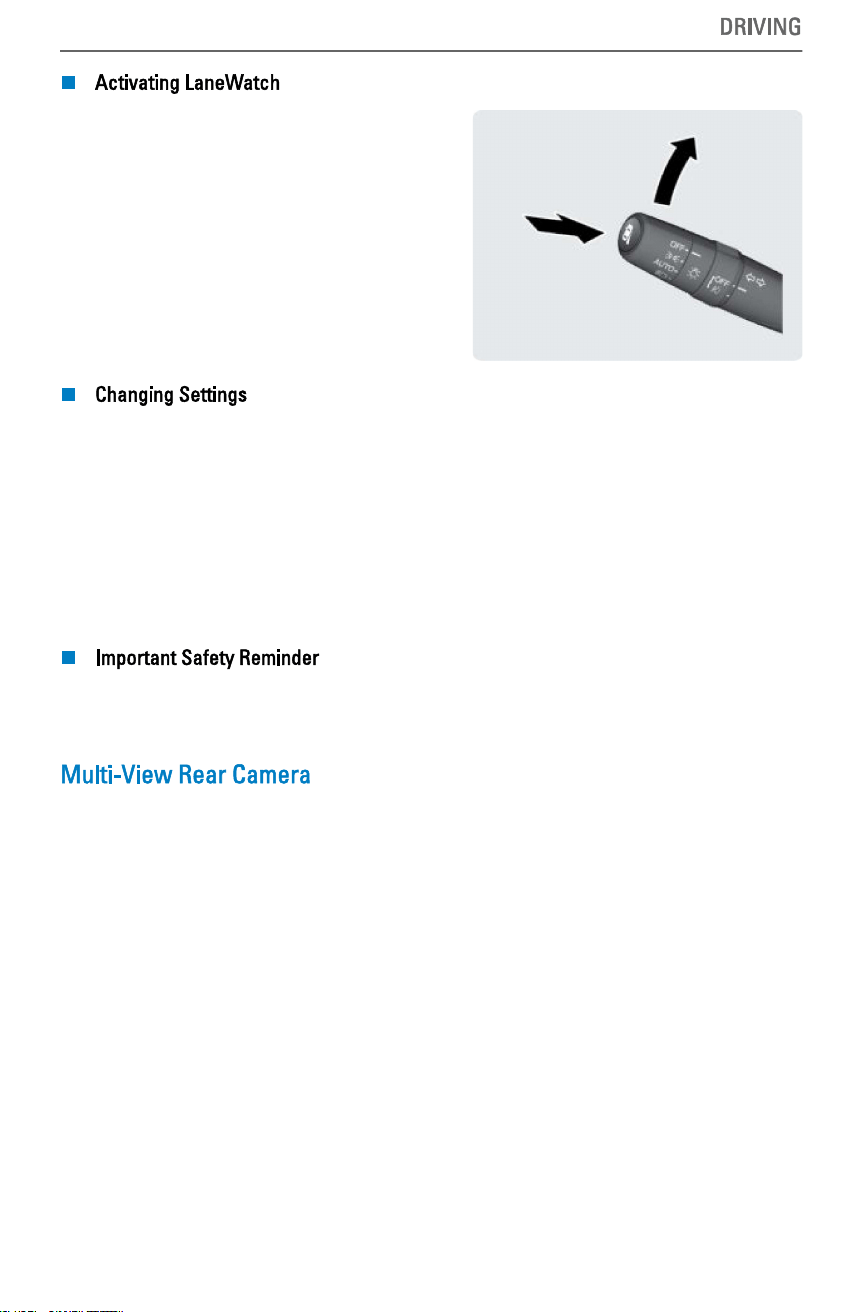
Press and hold the CMBS
™
OFF button.
A beep sounds and a message appears
in the Multi-Information Display. The
CMBS
™
indicator appears when the
system is off.
CMBS is designed to reduce the severity of an unavoidable collision. It does
not prevent collisions nor stop the vehicle automatically. It is still your
responsibility to operate the brake pedal and steering wheel appropriately
according to the driving conditions.
Allows you to check the passenger side rear areas displayed on the audio/
information screen when the turn signal is activated to the passenger’s side.
*1 - If equipped,
100 |
Activate the right turn signal. The
LaneWatch display appears. Check the
display for blind spots, and visually
confirm that it is safe to change lanes.
You can also press the LaneWatch
button on the end of the turn signal
switch to view a constant real-time
display. Press it again to turn the
display off.
Customize the display and how and when the display appears.
1. From the Home screen, select Settings.
2. Select Camera.
3. Select LaneWatch.
4. Select an option and make the preferred changes.
5. Press BACK to exit the menu.
Like all assistance systems, LaneWatch has limitations. Over-reliance on
the system may result in a collision.
When you shift into Reverse (R), a real-time image of the area behind your
vehicle is shown in the upper display, along with helpful parking guidelines.
| 101
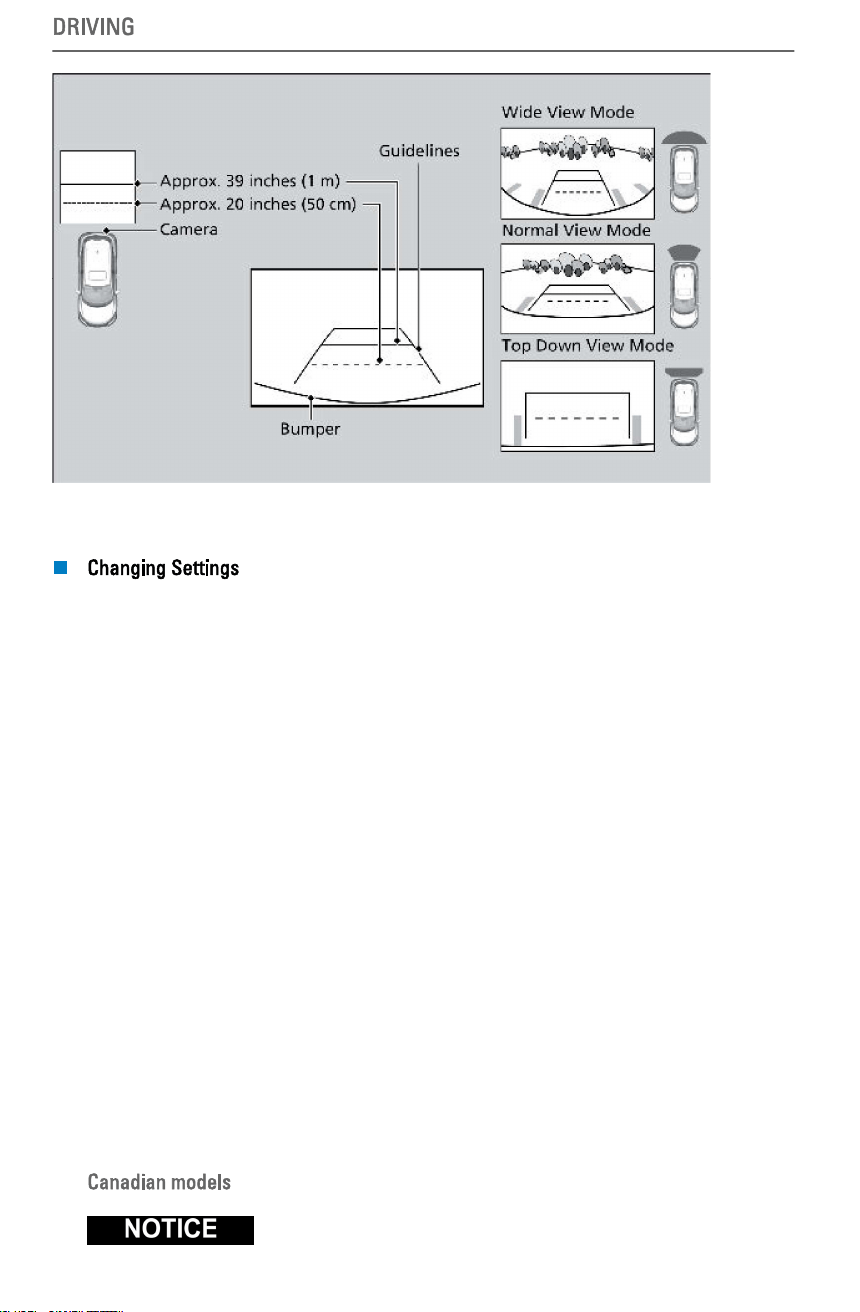
Turn the guidelines on or off.
1. From the HOME screen, select Settings.
2. Select Camera.
3. Select Rear Camera.
4. Select one of the options.
Fixed Guideline:
Guidelines appear when you shift into Reverse. Select
On or Off.
Dynamic Guideline:
Guidelines move as you turn the steering wheel.
Select On or Off.
5. Press BACK to exit the menu.
The rear camera view is restricted. You cannot see the corner ends of the
bumper or what is underneath the bumper. Its unique lens also makes
objects appear closer or farther than they actually are.
Visually confirm that it is safe to drive before backing up. Certain conditions
(such as weather, lightning, and high temperatures) may also restrict the
rear view. Do not rely on the rearview display, which does not give you all
the information about conditions at the rear of your vehicle.
102 |
When you select on the rear camera screen on models with display
audio
*1
, you can change the display adjustment.
*15
Achieving fuel economy and reducing CO
2
emissions is dependent on several
factors, including driving conditions, load weight, idling time, driving habits, and
vehicle condition. Depending on these and other factors, you may not achieve
the rated fuel economy of this vehicle.
Use the proper fuel and refueling procedure to ensure the best performance
and safety of your vehicle.
• Honda recommends TOP TIER Detergent Gasoline where available.
• Do NOT use gasoline containing more than 15% ethanol.
• Do NOT use gasoline containing methanol.
• Do NOT use gasoline containing MMT.
We recommend quality gasoline containing detergent additives that help
prevent fuel system and engine deposits. In addition, in order to maintain
good performance, fuel economy, and emissions control, we strongly
recommend the use of gasoline that does NOT contain harmful
manganese-based fuel additives such as MMT, if such gasoline is
available.
1. The fuel fill door is located at the left
rear of the vehicle. Park next to the
service pump that is most
accessible.
2. Turn off the engine.
*1 - If equipped
*15 - In order to comply with motor vehicle safety regulations, the system has been programmed to
keep the setting for Contrast and Black Level constant, regardless of any manual adjustments made
| 103
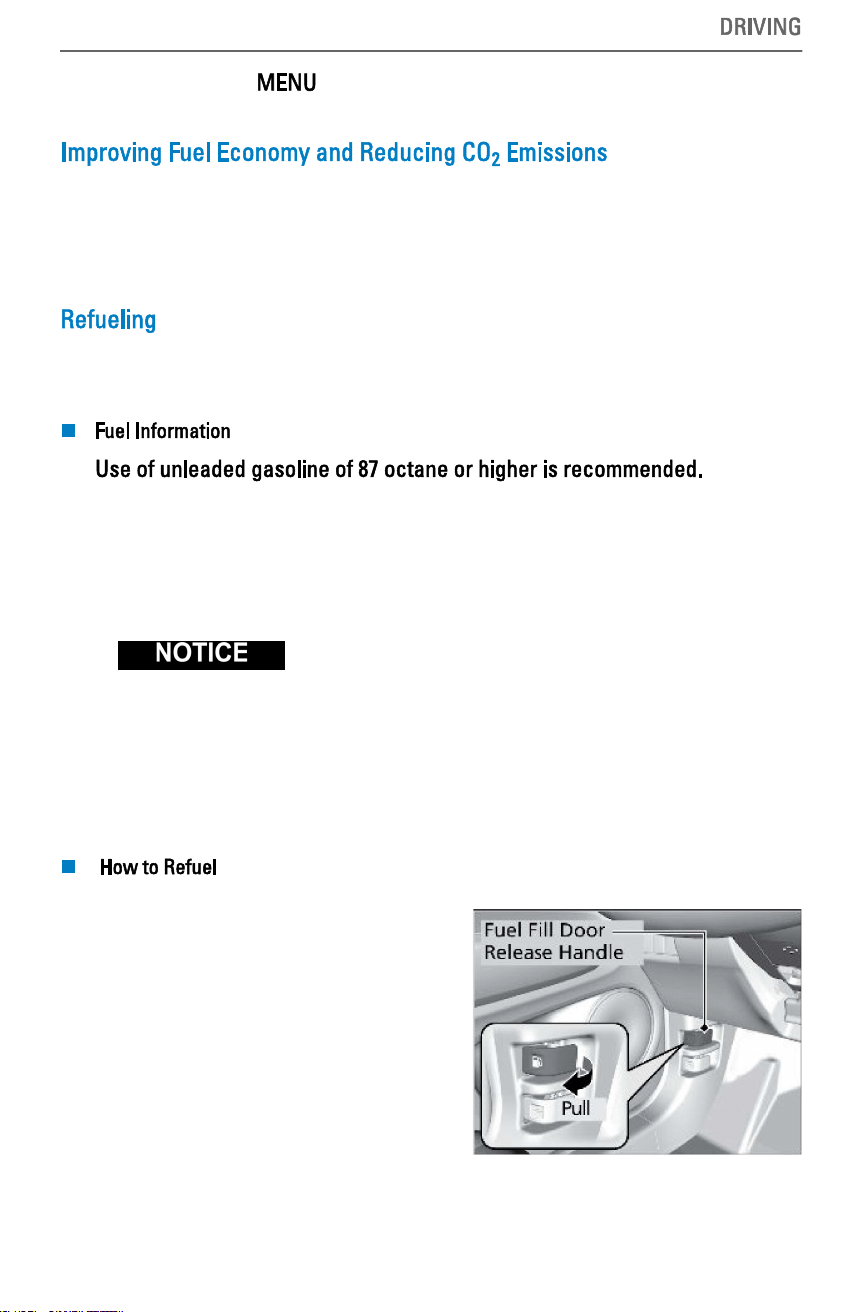
Turn the guidelines on or off.
1. From the HOME screen, select Settings.
2. Select Camera.
3. Select Rear Camera.
4. Select one of the options.
Fixed Guideline:
Guidelines appear when you shift into Reverse. Select
On or Off.
Dynamic Guideline:
Guidelines move as you turn the steering wheel.
Select On or Off.
5. Press BACK to exit the menu.
The rear camera view is restricted. You cannot see the corner ends of the
bumper or what is underneath the bumper. Its unique lens also makes
objects appear closer or farther than they actually are.
Visually confirm that it is safe to drive before backing up. Certain conditions
(such as weather, lightning, and high temperatures) may also restrict the
rear view. Do not rely on the rearview display, which does not give you all
the information about conditions at the rear of your vehicle.
102 |
When you select on the rear camera screen on models with display
audio
*1
, you can change the display adjustment.
*15
Achieving fuel economy and reducing CO
2
emissions is dependent on several
factors, including driving conditions, load weight, idling time, driving habits, and
vehicle condition. Depending on these and other factors, you may not achieve
the rated fuel economy of this vehicle.
Use the proper fuel and refueling procedure to ensure the best performance
and safety of your vehicle.
• Honda recommends TOP TIER Detergent Gasoline where available.
• Do NOT use gasoline containing more than 15% ethanol.
• Do NOT use gasoline containing methanol.
• Do NOT use gasoline containing MMT.
We recommend quality gasoline containing detergent additives that help
prevent fuel system and engine deposits. In addition, in order to maintain
good performance, fuel economy, and emissions control, we strongly
recommend the use of gasoline that does NOT contain harmful
manganese-based fuel additives such as MMT, if such gasoline is
available.
1. The fuel fill door is located at the left
rear of the vehicle. Park next to the
service pump that is most
accessible.
2. Turn off the engine.
*1 - If equipped
*15 - In order to comply with motor vehicle safety regulations, the system has been programmed to
keep the setting for Contrast and Black Level constant, regardless of any manual adjustments made
| 103
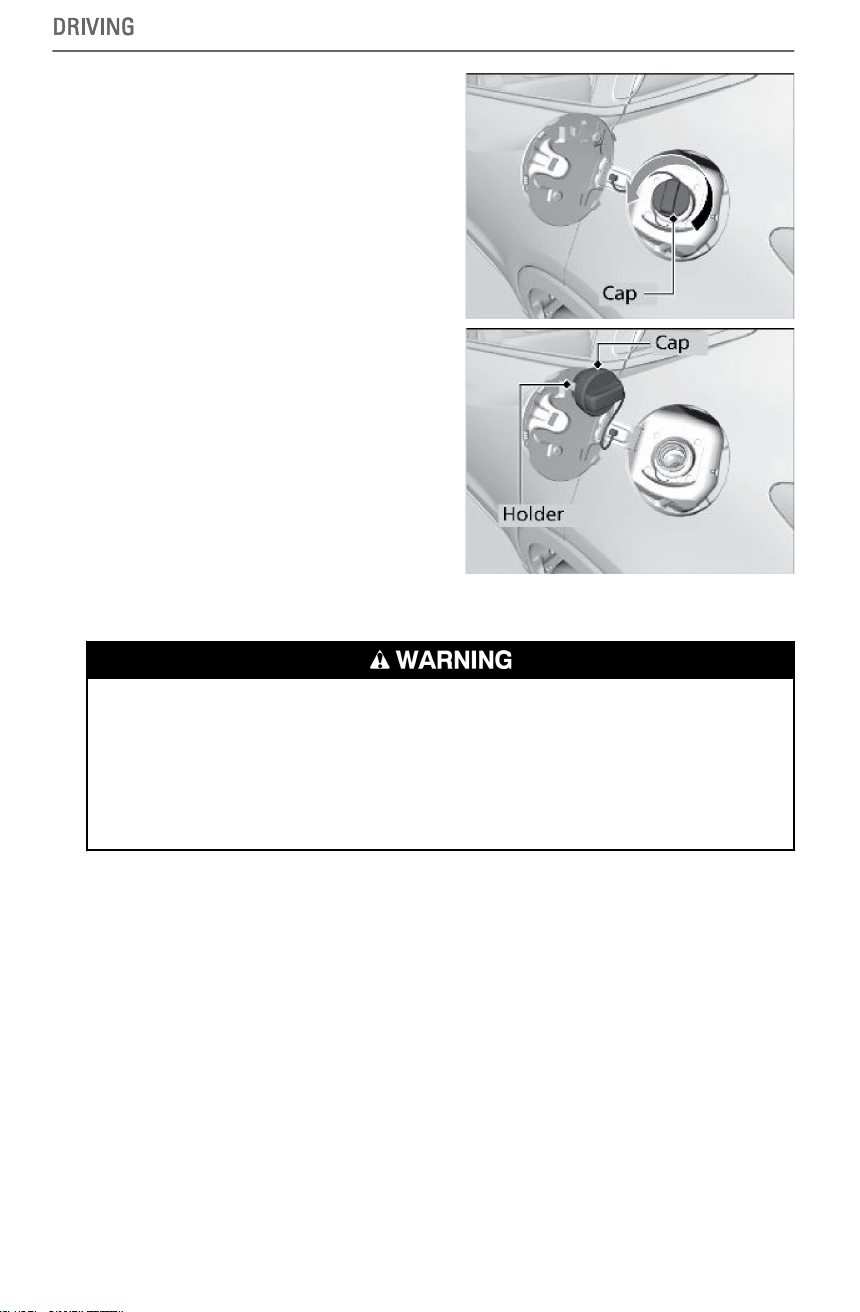
3. Pull on the fuel fill door release
handle under the driver’s side lower
outside corner of the dashboard .
The fuel fill door opens.
4. Remove the fuel fill cap slowly. If
you hear a release of air, wait until
this stops, then turn the knob slowly
to open the fuel fill cap. Place the
fuel fill cap in the holder.
5. Insert the fuel filler nozzle fully.
When the tank is full, the filler
nozzle will click off automatically.
This leaves space in the fuel tank in
case the fuel expands with a
change in the temperature.
6. After filling, replace the fuel fill cap,
tightening it until you hear it click at
least once. Shut the fuel fill door by
hand.
Gasoline is highly flammable and explosive. You can be burned or seriously
injured when handling fuel.
• Stop the engine, and keep heat, sparks, and flame away.
• Handle fuel only outdoors.
• Wipe up spills immediately.
104 |
Learn about what to do in critical or emergency situations.
If the battery life in your remote transmitter is weak, a message appears in the
display with information on how to start the engine.
1. Touch the back of the remote
transmitter to the ENGINE START/STOP
button while the indicator is flashing.
2. With the brake pedal pressed, press the
ENGINE START/STOP button within 10
seconds.
When you carry the remote transmitter (for
example, in a pocket or purse) and it is
outside the vehicle and within range (about 32 inches or 80 cm), you can lock or
unlock the doors and the tailgate without handling the transmitter.
Follow the procedure below if you cannot move the shift lever out of Park (P).
1. Set the parking brake.
2. - remove the key from the ignition
switch.
remove the built-in key from the smart
entry remote.
3. Wrap a cloth around the tip of a small flat-tip screwdriver. Put it into the shift
lock release slot (as shown) and remove the cover.
4. Insert the key into the shift lock release slot.
| 105
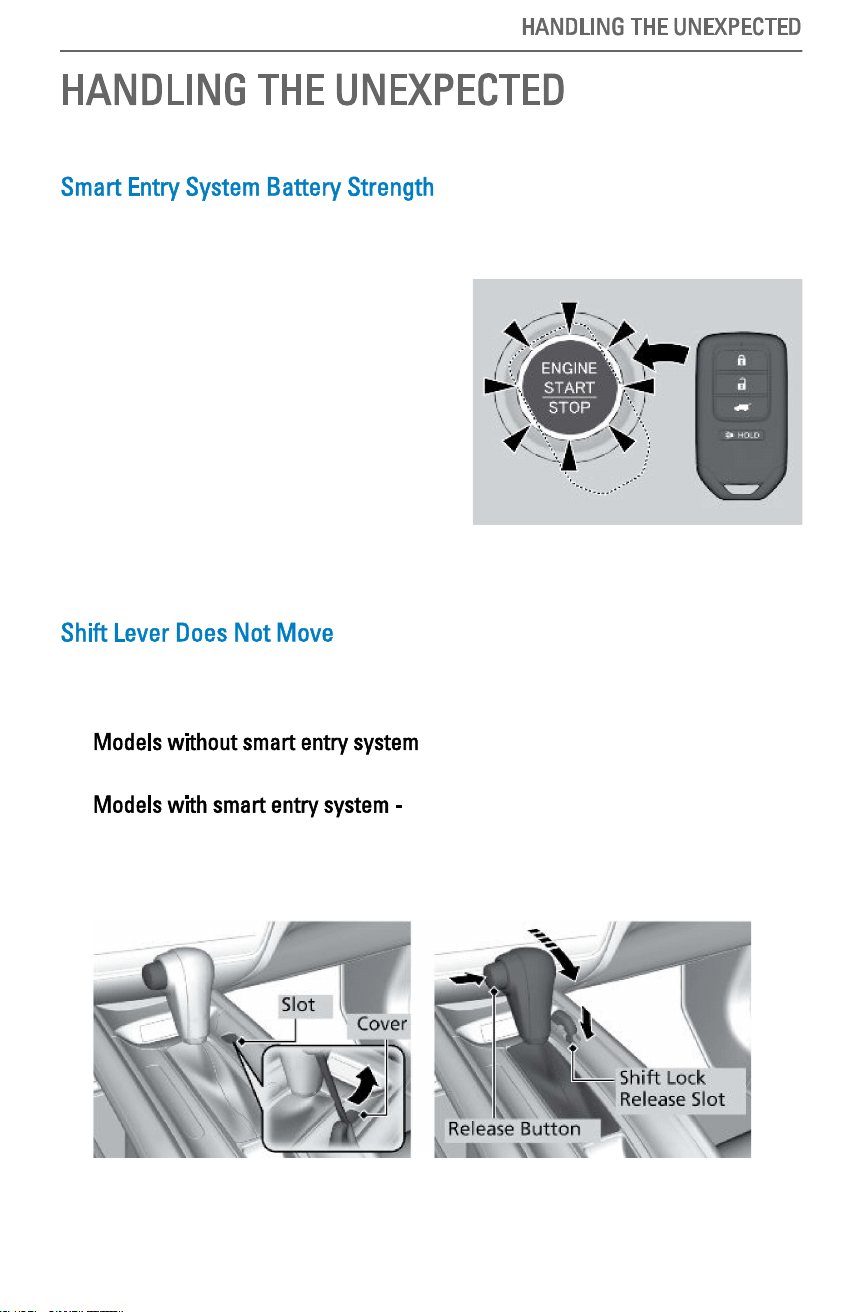
3. Pull on the fuel fill door release
handle under the driver’s side lower
outside corner of the dashboard .
The fuel fill door opens.
4. Remove the fuel fill cap slowly. If
you hear a release of air, wait until
this stops, then turn the knob slowly
to open the fuel fill cap. Place the
fuel fill cap in the holder.
5. Insert the fuel filler nozzle fully.
When the tank is full, the filler
nozzle will click off automatically.
This leaves space in the fuel tank in
case the fuel expands with a
change in the temperature.
6. After filling, replace the fuel fill cap,
tightening it until you hear it click at
least once. Shut the fuel fill door by
hand.
Gasoline is highly flammable and explosive. You can be burned or seriously
injured when handling fuel.
• Stop the engine, and keep heat, sparks, and flame away.
• Handle fuel only outdoors.
• Wipe up spills immediately.
104 |
Learn about what to do in critical or emergency situations.
If the battery life in your remote transmitter is weak, a message appears in the
display with information on how to start the engine.
1. Touch the back of the remote
transmitter to the ENGINE START/STOP
button while the indicator is flashing.
2. With the brake pedal pressed, press the
ENGINE START/STOP button within 10
seconds.
When you carry the remote transmitter (for
example, in a pocket or purse) and it is
outside the vehicle and within range (about 32 inches or 80 cm), you can lock or
unlock the doors and the tailgate without handling the transmitter.
Follow the procedure below if you cannot move the shift lever out of Park (P).
1. Set the parking brake.
2. - remove the key from the ignition
switch.
remove the built-in key from the smart
entry remote.
3. Wrap a cloth around the tip of a small flat-tip screwdriver. Put it into the shift
lock release slot (as shown) and remove the cover.
4. Insert the key into the shift lock release slot.
| 105
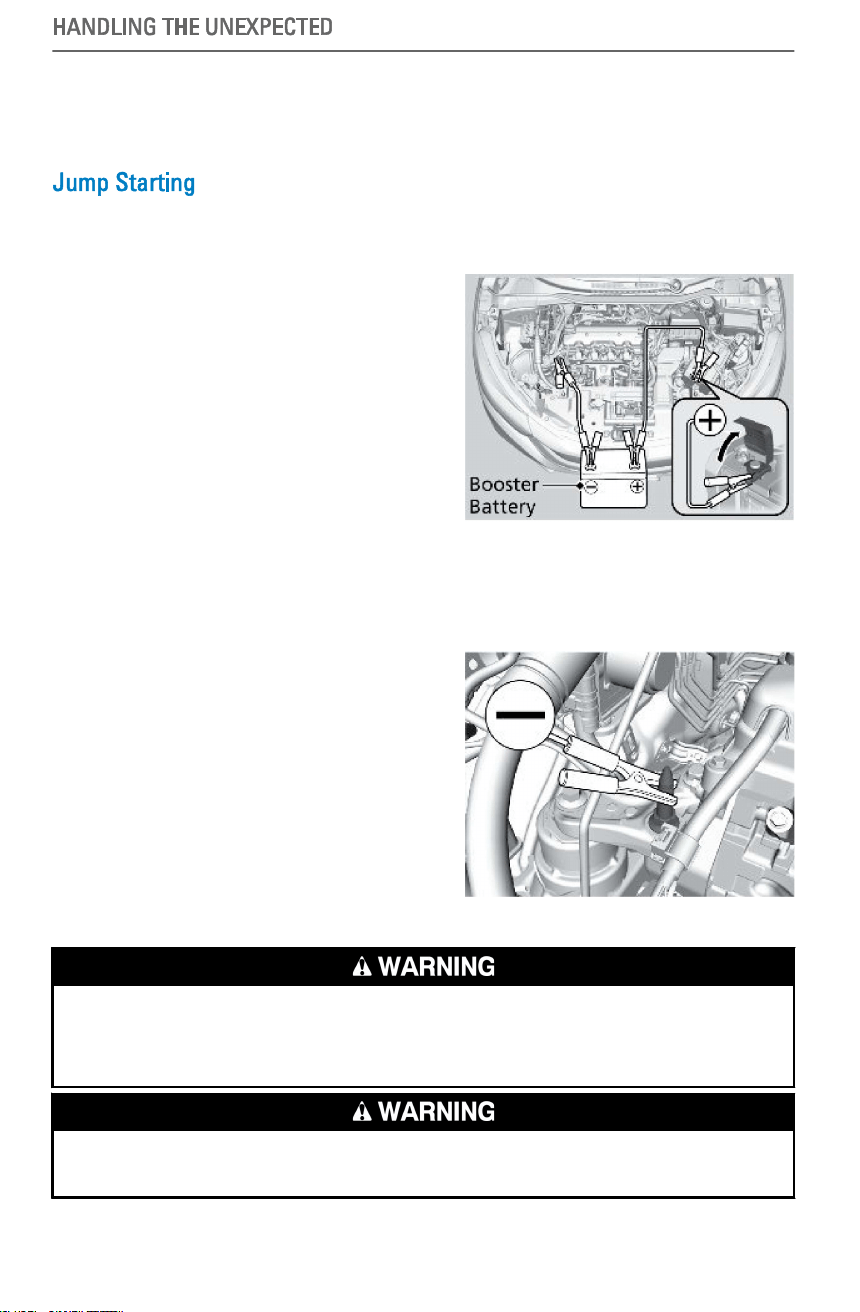
5. While pushing the key down, press the shift lever release button and place
the shift lever into Neutral (N). The lock is now released. Have the shift lever
checked by a dealer as soon as possible.
Turn off the power to electric devices, such as audio and lights. Turn off the
engine, then open the hood.
1. Connect the first jumper cable to your
vehicle's battery (+) terminal.
Remove the cover from the under-hood
fuse box. See (Engine Compartment
Fuse Boxes)
2. Connect the other end of the first
jumper cable to the booster battery (+)
terminal. Use a 12-volt booster battery
only.
When using an automotive battery charger, select a charging voltage lower
than 15 volts. Check the charger manual for the proper setting.
3. Connect the second jumper cable to the booster battery (-) terminal.
4. Connect the other end of the second
jumper cable to the engine hanger as
shown. Do not connect this jumper
cable to any other part.
5. If your vehicle is connected to another
vehicle, start the assisting vehicle's
engine and increase its rpm slightly.
6. Attempt to start your vehicle's engine. If
it turns over slowly, make sure that the
jumper cables have good metal-to-metal contact.
A battery can explode if you do not follow the correct procedure, seriously
injuring anyone nearby.
Keep all sparks, open flames, and smoking materials away from the battery.
Battery posts, terminals, and related accessories contain lead and lead
compounds. Wash your hands after handling.
106 |
• The temperature gauge needle is at the H mark
• The engine suddenly loses power
• Steam or spray comes out from under the hood
1. Immediately park the vehicle in a safe
place. Turn off all accessories and turn
on the hazard warning lights.
2. If no steam or spray is present: Keep
the vehicle running and open the hood
(See Under the Hood).
If steam or spray is present: Turn off the
engine and wait until it subsides. Then,
open the hood (See Under the Hood).
3. Check that the cooling fan is operating and stop the engine once the
temperature gauge needle goes down. If the cooling fan is not operating,
immediately stop the engine.
4. Once the engine has cooled down, inspect the coolant level and check the
cooling system components for leaks. If the coolant level in the reserve tank
is low, add coolant until it reaches the MAX mark. If there is no coolant in
the reserve tank, make sure the radiator is cool, then cover the radiator cap
with a heavy cloth and open the cap. If necessary, add coolant up to the
base of the filler neck, and put the cap back on.
Once the engine has cooled sufficiently, restart it and check the temperature
gauge. If the temperature needle has gone down, resume driving. If it has not
gone down, contact a dealer for repairs.
Steam and spray from an overheated engine can seriously scald you.
Do not open the hoodif steam is coming out.
Removing the radiator cap while the engine is hot can cause the coolant to
spray out, seriously scalding you.
Always let the engine and radiator cool down before removing the radiator
cap.
| 107
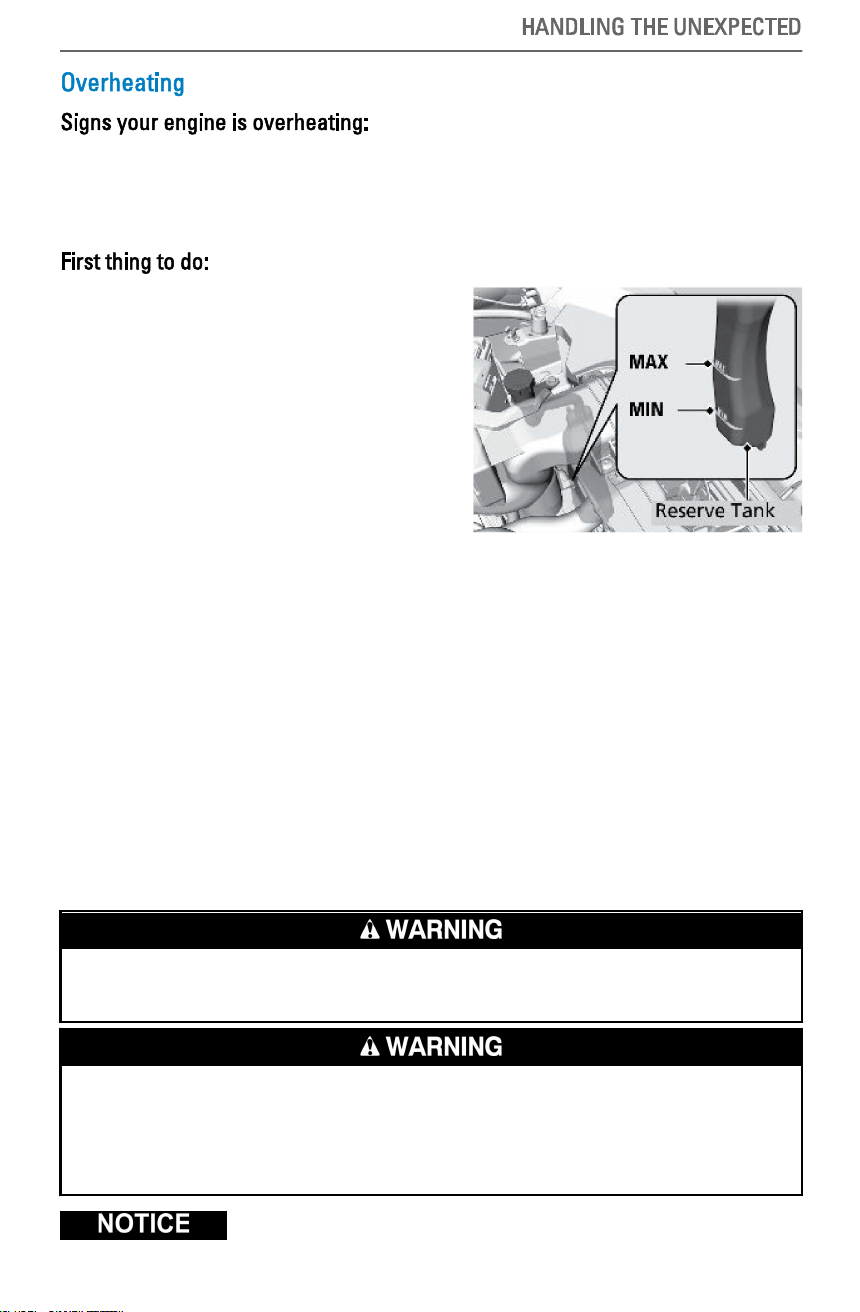
5. While pushing the key down, press the shift lever release button and place
the shift lever into Neutral (N). The lock is now released. Have the shift lever
checked by a dealer as soon as possible.
Turn off the power to electric devices, such as audio and lights. Turn off the
engine, then open the hood.
1. Connect the first jumper cable to your
vehicle's battery (+) terminal.
Remove the cover from the under-hood
fuse box. See (Engine Compartment
Fuse Boxes)
2. Connect the other end of the first
jumper cable to the booster battery (+)
terminal. Use a 12-volt booster battery
only.
When using an automotive battery charger, select a charging voltage lower
than 15 volts. Check the charger manual for the proper setting.
3. Connect the second jumper cable to the booster battery (-) terminal.
4. Connect the other end of the second
jumper cable to the engine hanger as
shown. Do not connect this jumper
cable to any other part.
5. If your vehicle is connected to another
vehicle, start the assisting vehicle's
engine and increase its rpm slightly.
6. Attempt to start your vehicle's engine. If
it turns over slowly, make sure that the
jumper cables have good metal-to-metal contact.
A battery can explode if you do not follow the correct procedure, seriously
injuring anyone nearby.
Keep all sparks, open flames, and smoking materials away from the battery.
Battery posts, terminals, and related accessories contain lead and lead
compounds. Wash your hands after handling.
106 |
• The temperature gauge needle is at the H mark
• The engine suddenly loses power
• Steam or spray comes out from under the hood
1. Immediately park the vehicle in a safe
place. Turn off all accessories and turn
on the hazard warning lights.
2. If no steam or spray is present: Keep
the vehicle running and open the hood
(See Under the Hood).
If steam or spray is present: Turn off the
engine and wait until it subsides. Then,
open the hood (See Under the Hood).
3. Check that the cooling fan is operating and stop the engine once the
temperature gauge needle goes down. If the cooling fan is not operating,
immediately stop the engine.
4. Once the engine has cooled down, inspect the coolant level and check the
cooling system components for leaks. If the coolant level in the reserve tank
is low, add coolant until it reaches the MAX mark. If there is no coolant in
the reserve tank, make sure the radiator is cool, then cover the radiator cap
with a heavy cloth and open the cap. If necessary, add coolant up to the
base of the filler neck, and put the cap back on.
Once the engine has cooled sufficiently, restart it and check the temperature
gauge. If the temperature needle has gone down, resume driving. If it has not
gone down, contact a dealer for repairs.
Steam and spray from an overheated engine can seriously scald you.
Do not open the hoodif steam is coming out.
Removing the radiator cap while the engine is hot can cause the coolant to
spray out, seriously scalding you.
Always let the engine and radiator cool down before removing the radiator
cap.
| 107
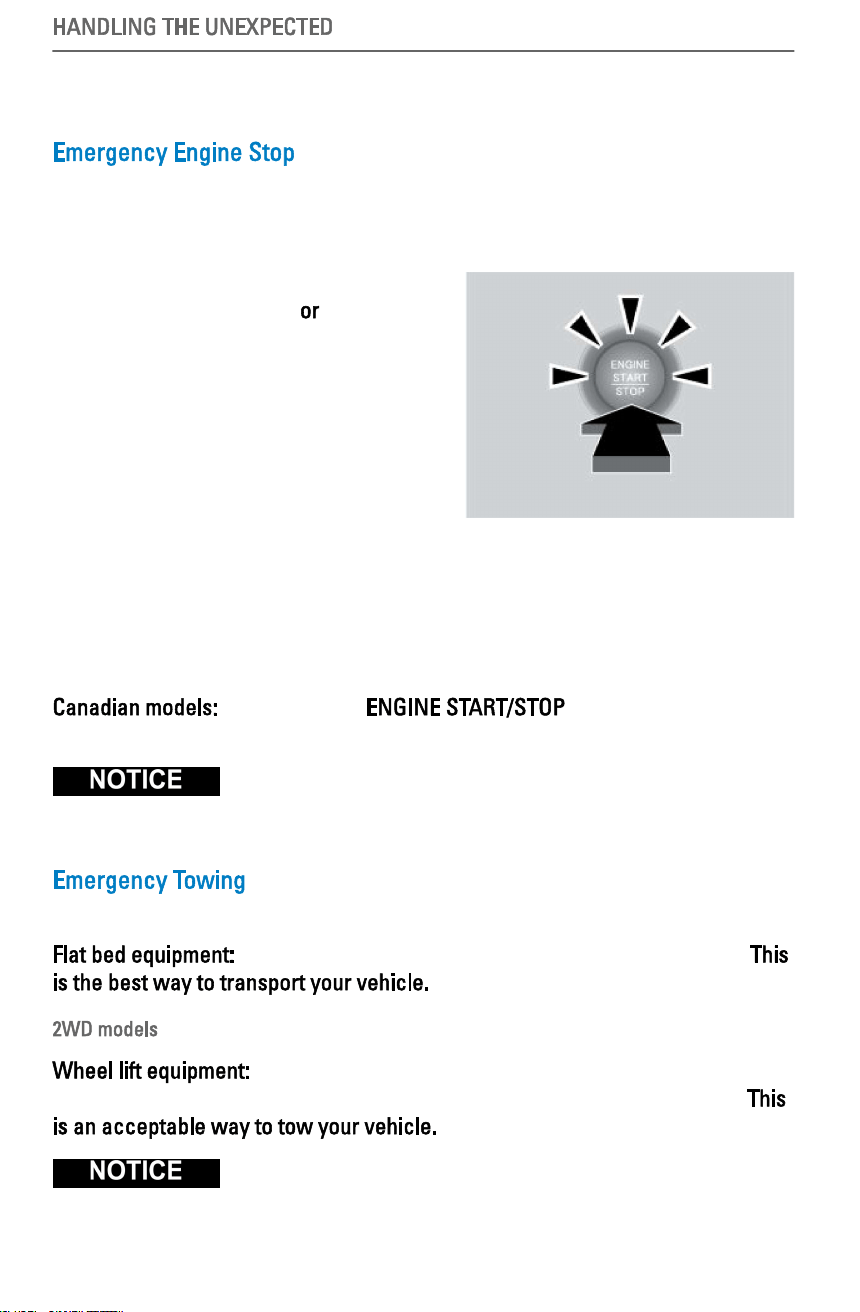
Continuing to drive with the temperature gauge needle at the H mark may
damage the engine.
The ENGINE START/STOP button may be used to stop the engine due to an
emergency situation even while driving. If you must stop the engine, choose
one of the following operations:
• Press and hold the ENGINE START/STOP
button for two seconds,
• Firmly press the ENGINE START/STOP
button three times.
The steering wheel will not lock. However,
because turning off the power system
disables the power assist the power
system provides to the steering and braking
systems, it will require significantly more
physical effort and time to steer and slow the vehicle. Use both feet on the
brake pedal to slow down the vehicle and stop immediately in a safe place.
The power mode is in ACCESSORY when the engine is stopped.
To change the mode to VEHICLE OFF, move the shift lever to Park (P) after the
vehicle comes to a complete stop.
Then press the button twice without
depressing the brake pedal.
Do not press the button while driving unless it is absolutely necessary for the
engine to be switched off.
Call a professional towing service if you need to tow your vehicle.
The operator loads your vehicle on the back of a truck.
The tow truck uses two pivoting arms that go under the
front tires and lift them off the ground. The rear tires remain on the ground.
Trying to lift or tow your vehicle by the bumpers will cause serious damage. The
bumpers are not designed to support the vehicle’s weight.
108 |
Improper towing such as towing behind a motorhome or other motor vehicle
can damage the transmission.
- Make sure the parking brake is released. If you cannot release
the parking brake, your vehicle must be transported by the flat bed equipment.
Monitors the tire pressure while you are driving.
If your vehicle's tire pressure becomes significantly low, or if there is a problem
with the TPMS or the compact spare tire is installed, the indicator blinks for
about one minute, and then stays on.
Stop your vehicle in safe place. Check the tire pressure and adjust the
pressure to the specified level. The specified tire pressure is on a label on
the driver's doorjamb.
Each tire, including the spare (if provided), should be checked monthly
when cold and inflated to the inflation pressure recommended by the
vehicle manufacturer on the vehicle placard or tire inflation pressure label.
(If your vehicle has tires of a different size than the size indicated on the
vehicle placard or tire inflation pressure label, you should determine the
proper tire inflation pressure for those tires.)
| 109
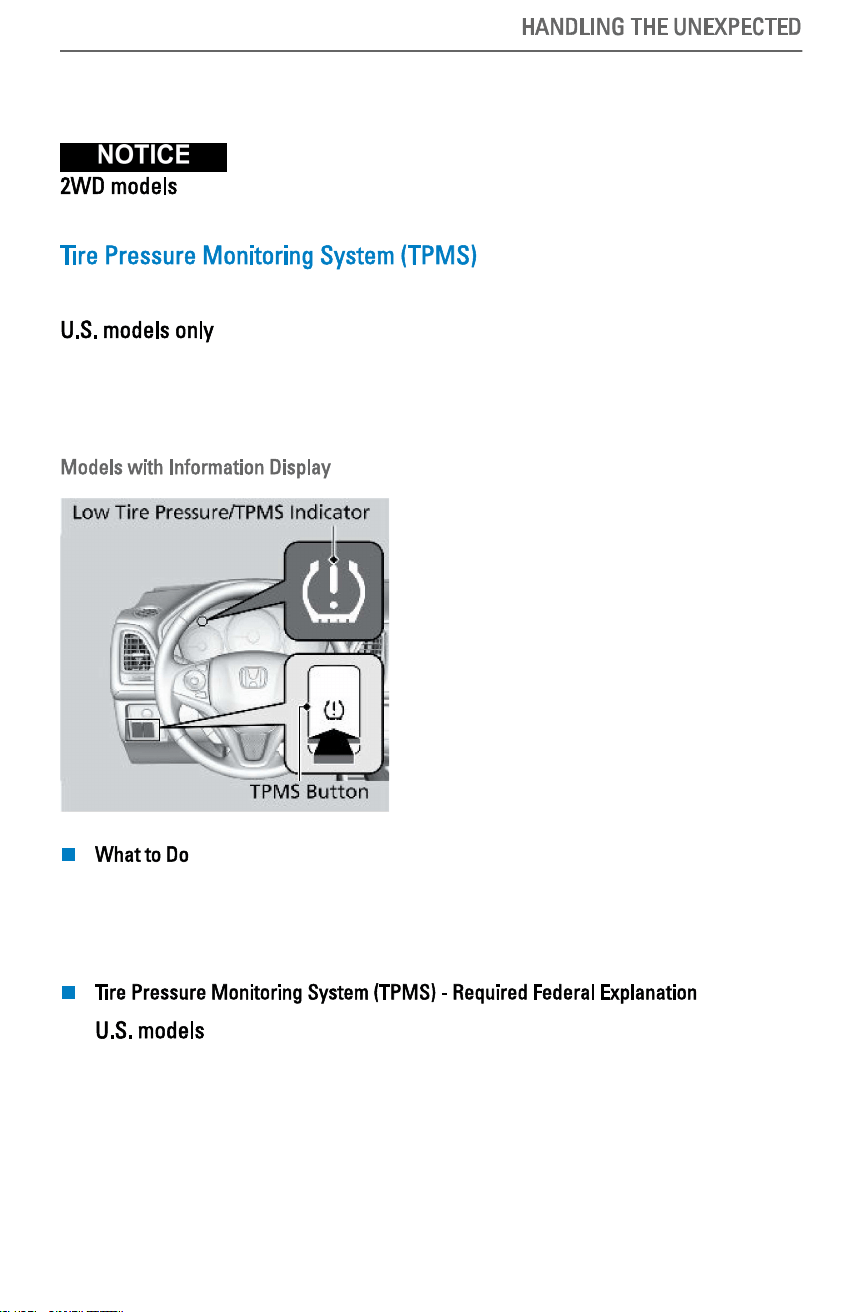
Continuing to drive with the temperature gauge needle at the H mark may
damage the engine.
The ENGINE START/STOP button may be used to stop the engine due to an
emergency situation even while driving. If you must stop the engine, choose
one of the following operations:
• Press and hold the ENGINE START/STOP
button for two seconds,
• Firmly press the ENGINE START/STOP
button three times.
The steering wheel will not lock. However,
because turning off the power system
disables the power assist the power
system provides to the steering and braking
systems, it will require significantly more
physical effort and time to steer and slow the vehicle. Use both feet on the
brake pedal to slow down the vehicle and stop immediately in a safe place.
The power mode is in ACCESSORY when the engine is stopped.
To change the mode to VEHICLE OFF, move the shift lever to Park (P) after the
vehicle comes to a complete stop.
Then press the button twice without
depressing the brake pedal.
Do not press the button while driving unless it is absolutely necessary for the
engine to be switched off.
Call a professional towing service if you need to tow your vehicle.
The operator loads your vehicle on the back of a truck.
The tow truck uses two pivoting arms that go under the
front tires and lift them off the ground. The rear tires remain on the ground.
Trying to lift or tow your vehicle by the bumpers will cause serious damage. The
bumpers are not designed to support the vehicle’s weight.
108 |
Improper towing such as towing behind a motorhome or other motor vehicle
can damage the transmission.
- Make sure the parking brake is released. If you cannot release
the parking brake, your vehicle must be transported by the flat bed equipment.
Monitors the tire pressure while you are driving.
If your vehicle's tire pressure becomes significantly low, or if there is a problem
with the TPMS or the compact spare tire is installed, the indicator blinks for
about one minute, and then stays on.
Stop your vehicle in safe place. Check the tire pressure and adjust the
pressure to the specified level. The specified tire pressure is on a label on
the driver's doorjamb.
Each tire, including the spare (if provided), should be checked monthly
when cold and inflated to the inflation pressure recommended by the
vehicle manufacturer on the vehicle placard or tire inflation pressure label.
(If your vehicle has tires of a different size than the size indicated on the
vehicle placard or tire inflation pressure label, you should determine the
proper tire inflation pressure for those tires.)
| 109
As an added safety feature, your vehicle has been equipped with a tire
pressure monitoring system (TPMS) that illuminates a low tire pressure
telltale when one or more of your tires is significantly under-inflated.
Accordingly, when the low tire pressure telltale illuminates, you should stop
and check your tires as soon as possible, and inflate them to the proper
pressure.
Driving on a significantly under-inflated tire causes the tire to overheat and
can lead to tire failure. Under-inflation also reduces fuel efficiency and tire
tread life, and may affect the vehicle's handling and stopping ability.
Please note that the TPMS is not a substitute for proper tire maintenance,
and it is the driver's responsibility to maintain correct tire pressure, even if
under-inflation has not reached the level to trigger illumination of the TPMS
low tire pressure telltale.
Your vehicle has also been equipped with a TPMS malfunction indicator to
indicate when the system is not operating properly. The TPMS malfunction
indicator is combined with the low tire pressure telltale. When the system
detects a malfunction, the telltale will flash for approximately one minute
and then remain continuously illuminated. This sequence will continue upon
subsequent vehicle start-ups as long as the malfunction exists.
When the malfunction indicator is illuminated, the system may not be able to
detect or signal low tire pressure as intended.
TPMS malfunctions may occur for a variety of reasons, including the
installation of replacement or alternate tires or wheels on the vehicle that
prevent the TPMS from functioning properly.
Always check the TPMS malfunction telltale after replacing one or more
tires or wheels on your vehicle to ensure that the replacement or alternate
tires and wheels allow the TPMS to continue to function properly.
If a tire goes flat while driving, grasp the steering wheel firmly and brake
gradually to reduce speed. Then stop in a safe place. Replace the flat tire with
the compact spare tire. Go to a dealer as soon as possible to have the full-size
tire repaired or replaced.
1. Park the vehicle on firm, level, non-slippery surface and set the parking
brake.
2. Shift to Park (P).
3. Turn on the hazard warning lights and set the power mode to VEHICLE OFF.
110 |
1. Place the jack under the jacking
point closest to the tire to be
changed.
2. Turn the end bracket clockwise (as
shown in the image) until the top of
the jack contacts the jacking point.
Make sure that the jacking point tab
is resting in the jack notch.
3. Raise the vehicle, using the jack
handle bar and the jack handle, until
the tire is off the ground.
The vehicle can easily roll off the jack, seriously injuring anyone
underneath.
Follow the directions for changing a tire exactly, and never get under the
vehicle when it is supported only by the jack.
Do not use the jack if it doesn't work properly. Call your dealer or a
professional towing service.
The following instructions must be followed to use the jack safely:
• Do not use the jack with people or luggage in the vehicle.
| 111
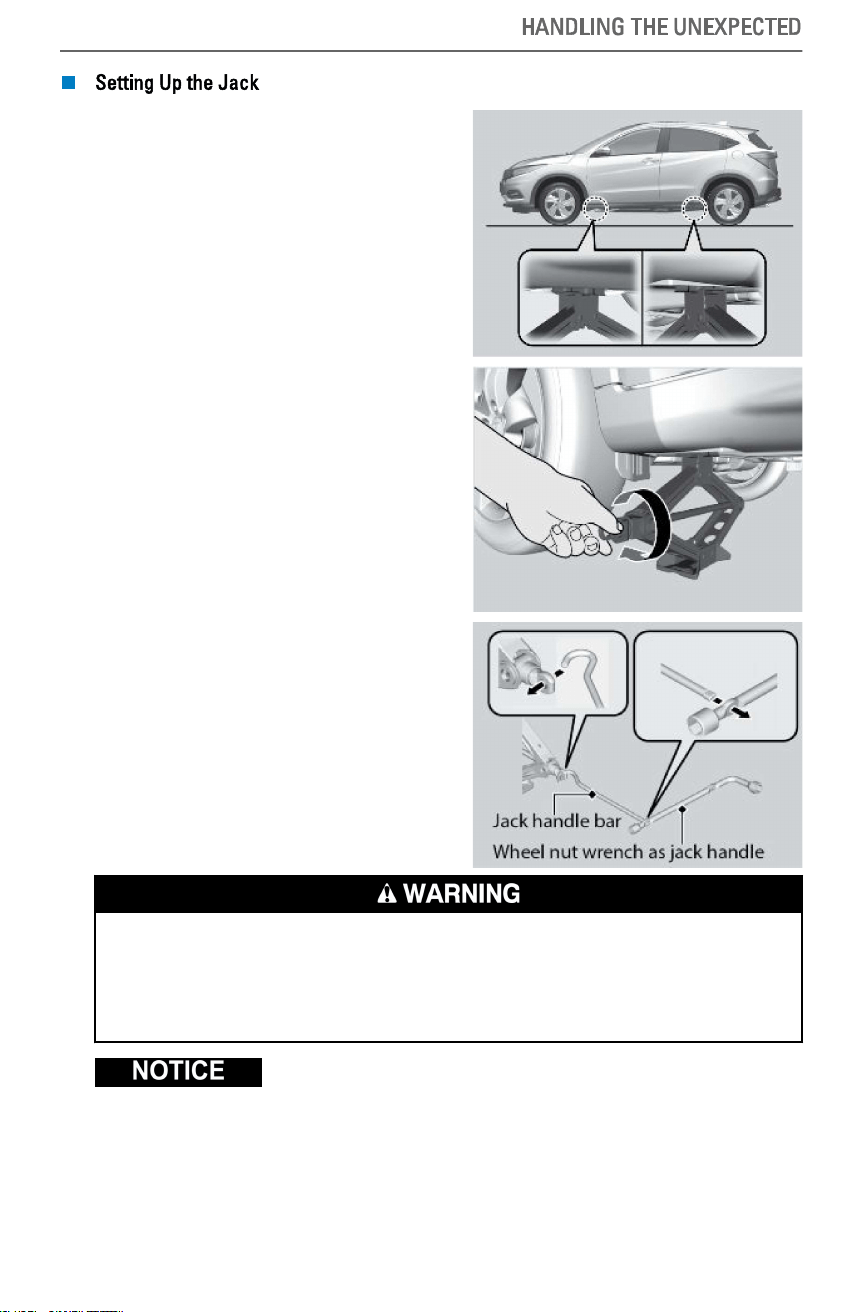
As an added safety feature, your vehicle has been equipped with a tire
pressure monitoring system (TPMS) that illuminates a low tire pressure
telltale when one or more of your tires is significantly under-inflated.
Accordingly, when the low tire pressure telltale illuminates, you should stop
and check your tires as soon as possible, and inflate them to the proper
pressure.
Driving on a significantly under-inflated tire causes the tire to overheat and
can lead to tire failure. Under-inflation also reduces fuel efficiency and tire
tread life, and may affect the vehicle's handling and stopping ability.
Please note that the TPMS is not a substitute for proper tire maintenance,
and it is the driver's responsibility to maintain correct tire pressure, even if
under-inflation has not reached the level to trigger illumination of the TPMS
low tire pressure telltale.
Your vehicle has also been equipped with a TPMS malfunction indicator to
indicate when the system is not operating properly. The TPMS malfunction
indicator is combined with the low tire pressure telltale. When the system
detects a malfunction, the telltale will flash for approximately one minute
and then remain continuously illuminated. This sequence will continue upon
subsequent vehicle start-ups as long as the malfunction exists.
When the malfunction indicator is illuminated, the system may not be able to
detect or signal low tire pressure as intended.
TPMS malfunctions may occur for a variety of reasons, including the
installation of replacement or alternate tires or wheels on the vehicle that
prevent the TPMS from functioning properly.
Always check the TPMS malfunction telltale after replacing one or more
tires or wheels on your vehicle to ensure that the replacement or alternate
tires and wheels allow the TPMS to continue to function properly.
If a tire goes flat while driving, grasp the steering wheel firmly and brake
gradually to reduce speed. Then stop in a safe place. Replace the flat tire with
the compact spare tire. Go to a dealer as soon as possible to have the full-size
tire repaired or replaced.
1. Park the vehicle on firm, level, non-slippery surface and set the parking
brake.
2. Shift to Park (P).
3. Turn on the hazard warning lights and set the power mode to VEHICLE OFF.
110 |
1. Place the jack under the jacking
point closest to the tire to be
changed.
2. Turn the end bracket clockwise (as
shown in the image) until the top of
the jack contacts the jacking point.
Make sure that the jacking point tab
is resting in the jack notch.
3. Raise the vehicle, using the jack
handle bar and the jack handle, until
the tire is off the ground.
The vehicle can easily roll off the jack, seriously injuring anyone
underneath.
Follow the directions for changing a tire exactly, and never get under the
vehicle when it is supported only by the jack.
Do not use the jack if it doesn't work properly. Call your dealer or a
professional towing service.
The following instructions must be followed to use the jack safely:
• Do not use the jack with people or luggage in the vehicle.
| 111
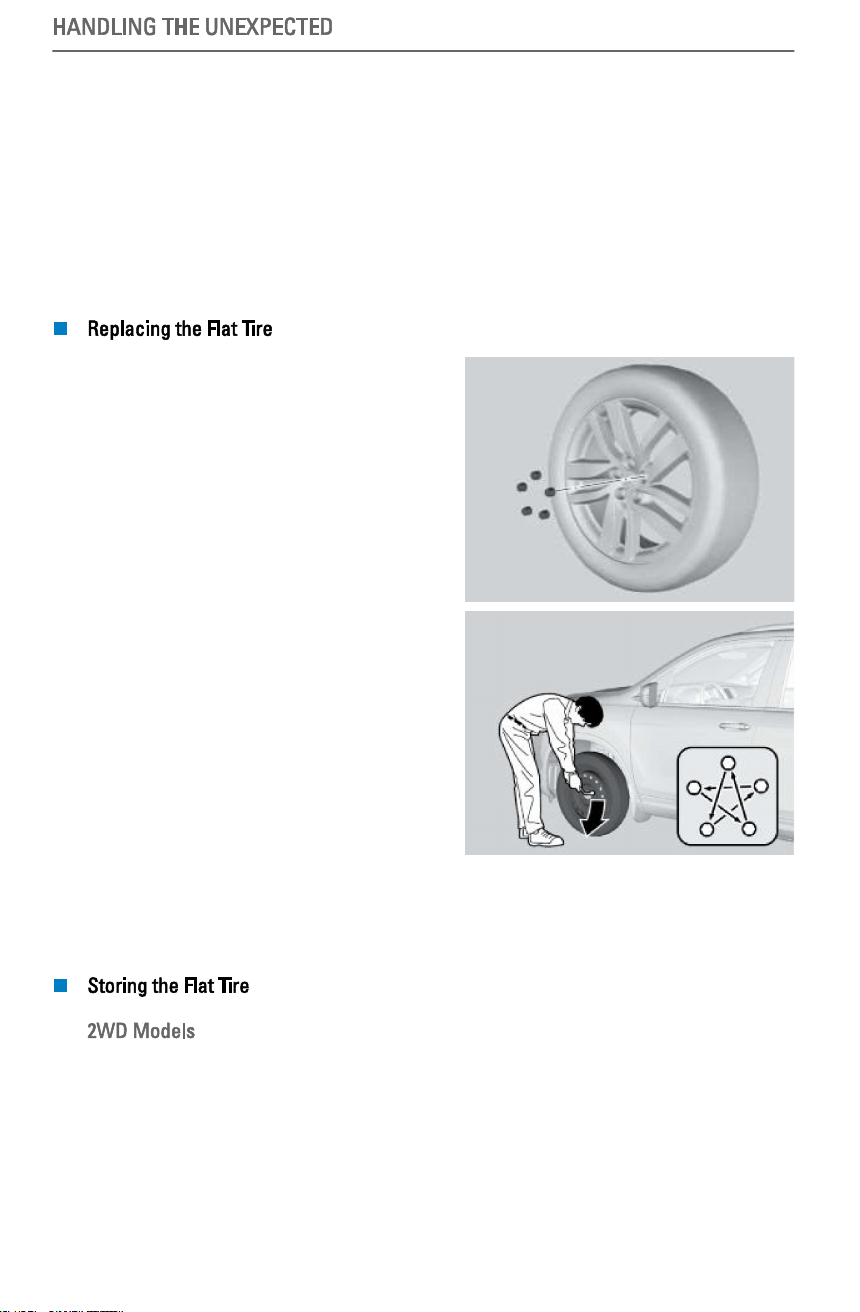
• Use the jack provided in your vehicle. Other jacks may not support the
weight (load) or fit the jacking point.
• Do not use while the engine is running.
• Use only where the ground is firm and level.
• Use only at the jacking points.
• Do not get in the vehicle while using the jack.
• Do not put anything on top of or underneath the jack.
1. Remove the wheel nuts and flat tire.
2. Mount the compact spare tire.
Replace the wheel nuts and lightly
tighten them.
3. Lower the vehicle and remove the
jack. Tighten the wheel nuts in the
order indicated in the image. Go
around, tightening the nuts, two to
three times in this order. Do not
overtighten the wheel nuts.
If you drive with the spare tire installed, the low tire pressure/TPMS
indicator appears. The indicator stays on until a regular tire is installed and
the TPMS system is recalibrated.
1. Remove the center cap.
2. Place the flat tire face down in the spare tire well.
112 |
3. Remove the spacer cone from the
wing bolt, flip it over, and insert it
back on the bolt. Secure the flat tire
with the wing bolt.
4. Securely store the jack, jack handle
bar, and wheel nut wrench back into
the tool case. Store the case in the
cargo area under the cargo floor lid.
5. Close the tailgate.
1. Take out the storage bag from the
tool case. Put the flat tire into the
storage bag.
2. Knot the top of the storage bag.
3. Store the jack in its holder. Turn the jack's end bracket to lock it in place.
4. Securely store the jack handle bar and wheel nut wrench back into the
tool case.
5. Bore through the bag, and pass the
holding belt through the hole of the
bag and the wheel of the flat tire as
shown.
| 113
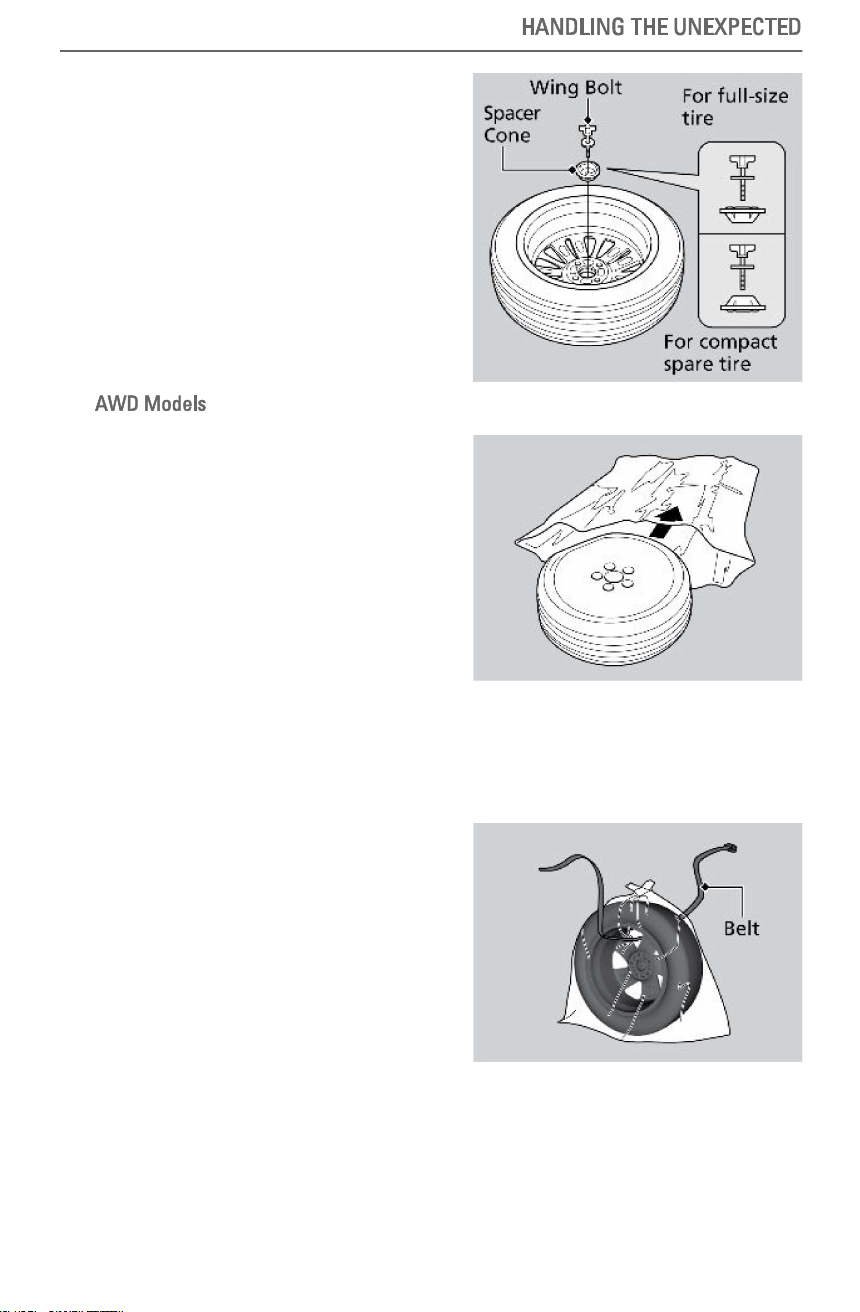
• Use the jack provided in your vehicle. Other jacks may not support the
weight (load) or fit the jacking point.
• Do not use while the engine is running.
• Use only where the ground is firm and level.
• Use only at the jacking points.
• Do not get in the vehicle while using the jack.
• Do not put anything on top of or underneath the jack.
1. Remove the wheel nuts and flat tire.
2. Mount the compact spare tire.
Replace the wheel nuts and lightly
tighten them.
3. Lower the vehicle and remove the
jack. Tighten the wheel nuts in the
order indicated in the image. Go
around, tightening the nuts, two to
three times in this order. Do not
overtighten the wheel nuts.
If you drive with the spare tire installed, the low tire pressure/TPMS
indicator appears. The indicator stays on until a regular tire is installed and
the TPMS system is recalibrated.
1. Remove the center cap.
2. Place the flat tire face down in the spare tire well.
112 |
3. Remove the spacer cone from the
wing bolt, flip it over, and insert it
back on the bolt. Secure the flat tire
with the wing bolt.
4. Securely store the jack, jack handle
bar, and wheel nut wrench back into
the tool case. Store the case in the
cargo area under the cargo floor lid.
5. Close the tailgate.
1. Take out the storage bag from the
tool case. Put the flat tire into the
storage bag.
2. Knot the top of the storage bag.
3. Store the jack in its holder. Turn the jack's end bracket to lock it in place.
4. Securely store the jack handle bar and wheel nut wrench back into the
tool case.
5. Bore through the bag, and pass the
holding belt through the hole of the
bag and the wheel of the flat tire as
shown.
| 113
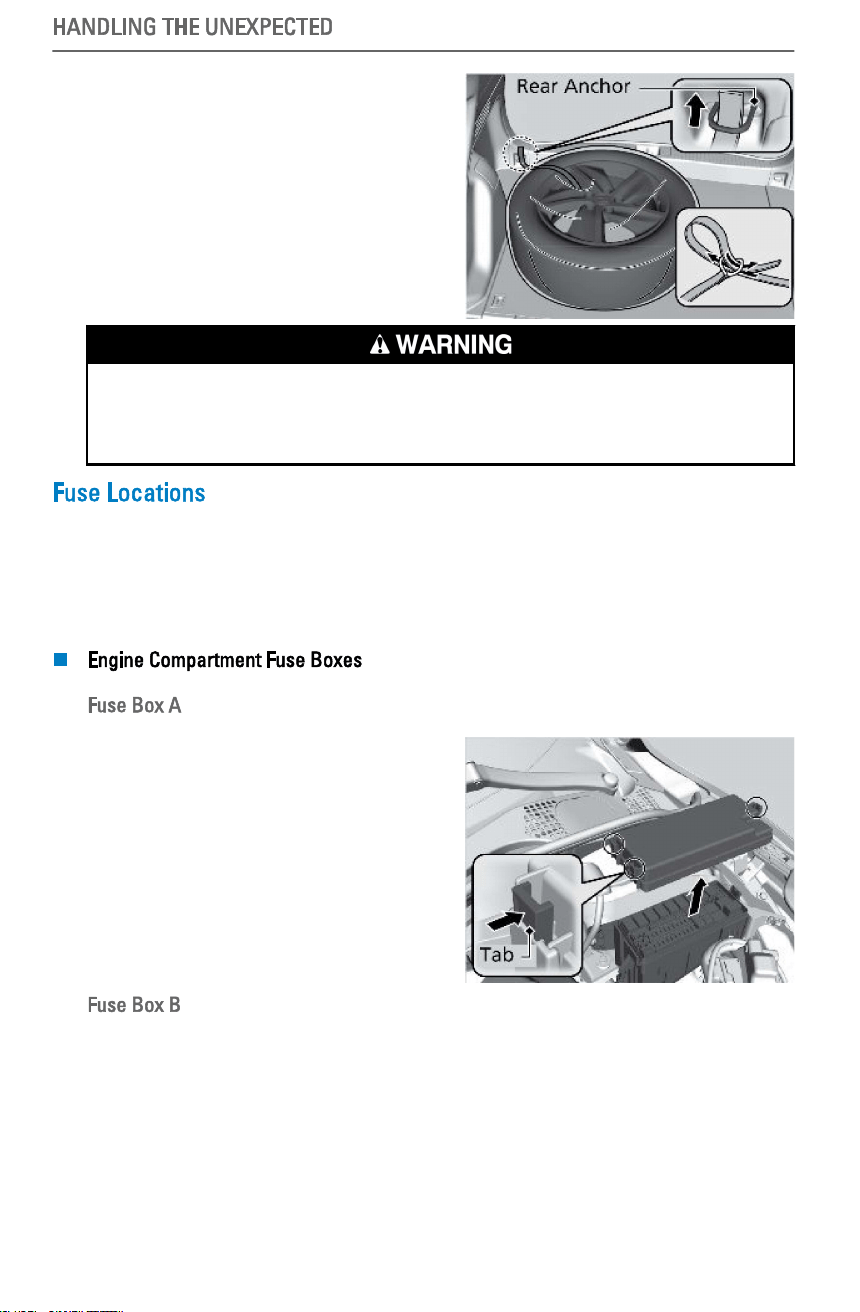
6. Place the flat tire in the cargo area,
and thread the belt through the rear
anchor as shown.
7. Pass the belt through the ring, and
tighten the belt to secure the flat tire
in place.
Loose items can fly around the interior in a crash and can seriously injure
the occupants.
Store the wheel, jack, and tools securely before driving.
If any electrical devices are not working, turn the vehicle off and check to see if
any applicable fuse is blown. Fuse locations are shown on the fuse box cover.
Locate the fuse in question by the fuse number and box cover number. Refer to
the Owner's Manual at
www.owners.honda.com
for a complete fuse chart.
Located near the brake fluid reservoir.
Push the tabs to open the box.
Pull up the cover on the (+) terminal, then remove it while pulling out the tab.
Replacement of engine compartment fuses should be done by a dealer.
114 |
Located under the dashboard (behind
the instrument panel). Fuse locations
are shown on the label on the side
panel (under the steering column).
Locate the fuse in question by the fuse
number and label number.
Remove the cover by putting the flat-tip screwdriver into the side slot as
shown.
| 115
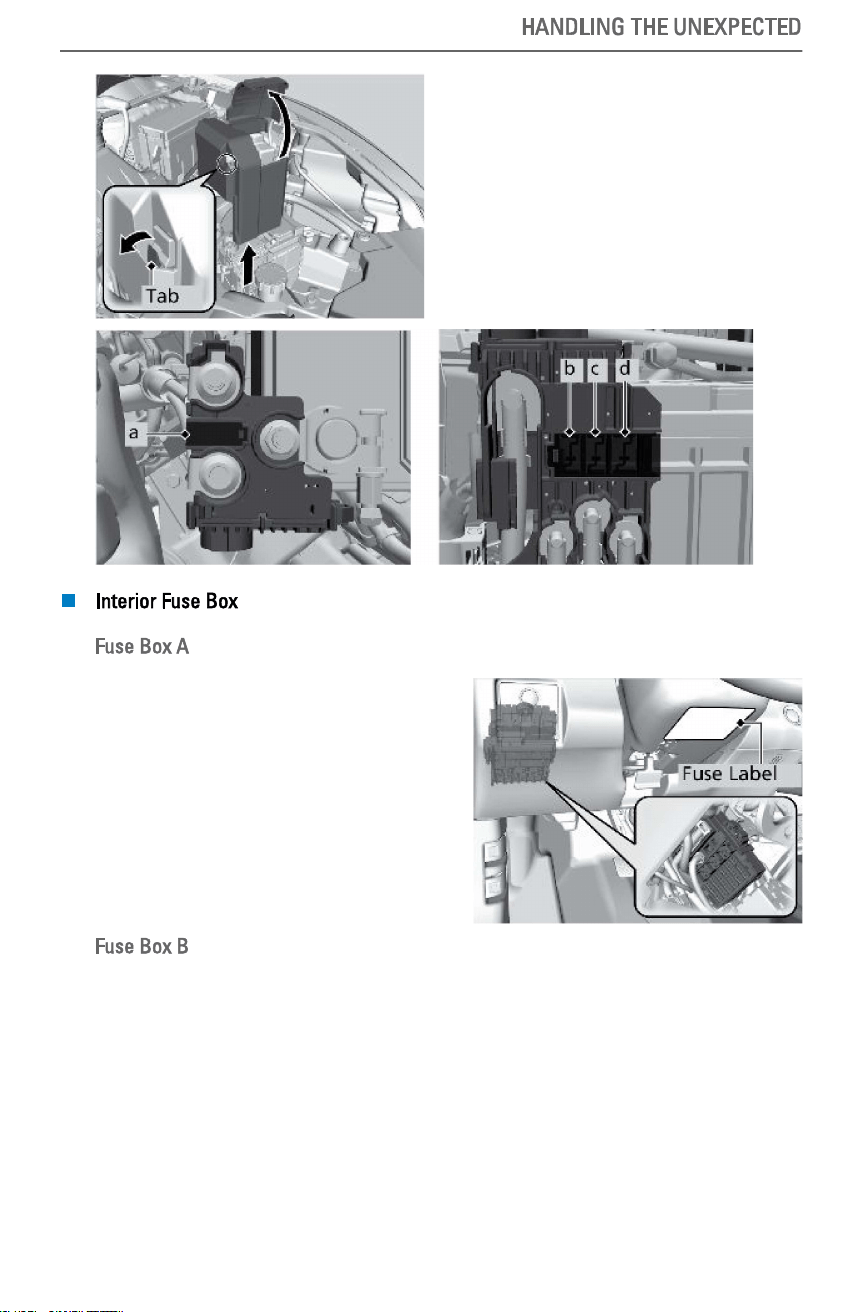
6. Place the flat tire in the cargo area,
and thread the belt through the rear
anchor as shown.
7. Pass the belt through the ring, and
tighten the belt to secure the flat tire
in place.
Loose items can fly around the interior in a crash and can seriously injure
the occupants.
Store the wheel, jack, and tools securely before driving.
If any electrical devices are not working, turn the vehicle off and check to see if
any applicable fuse is blown. Fuse locations are shown on the fuse box cover.
Locate the fuse in question by the fuse number and box cover number. Refer to
the Owner's Manual at
www.owners.honda.com
for a complete fuse chart.
Located near the brake fluid reservoir.
Push the tabs to open the box.
Pull up the cover on the (+) terminal, then remove it while pulling out the tab.
Replacement of engine compartment fuses should be done by a dealer.
114 |
Located under the dashboard (behind
the instrument panel). Fuse locations
are shown on the label on the side
panel (under the steering column).
Locate the fuse in question by the fuse
number and label number.
Remove the cover by putting the flat-tip screwdriver into the side slot as
shown.
| 115
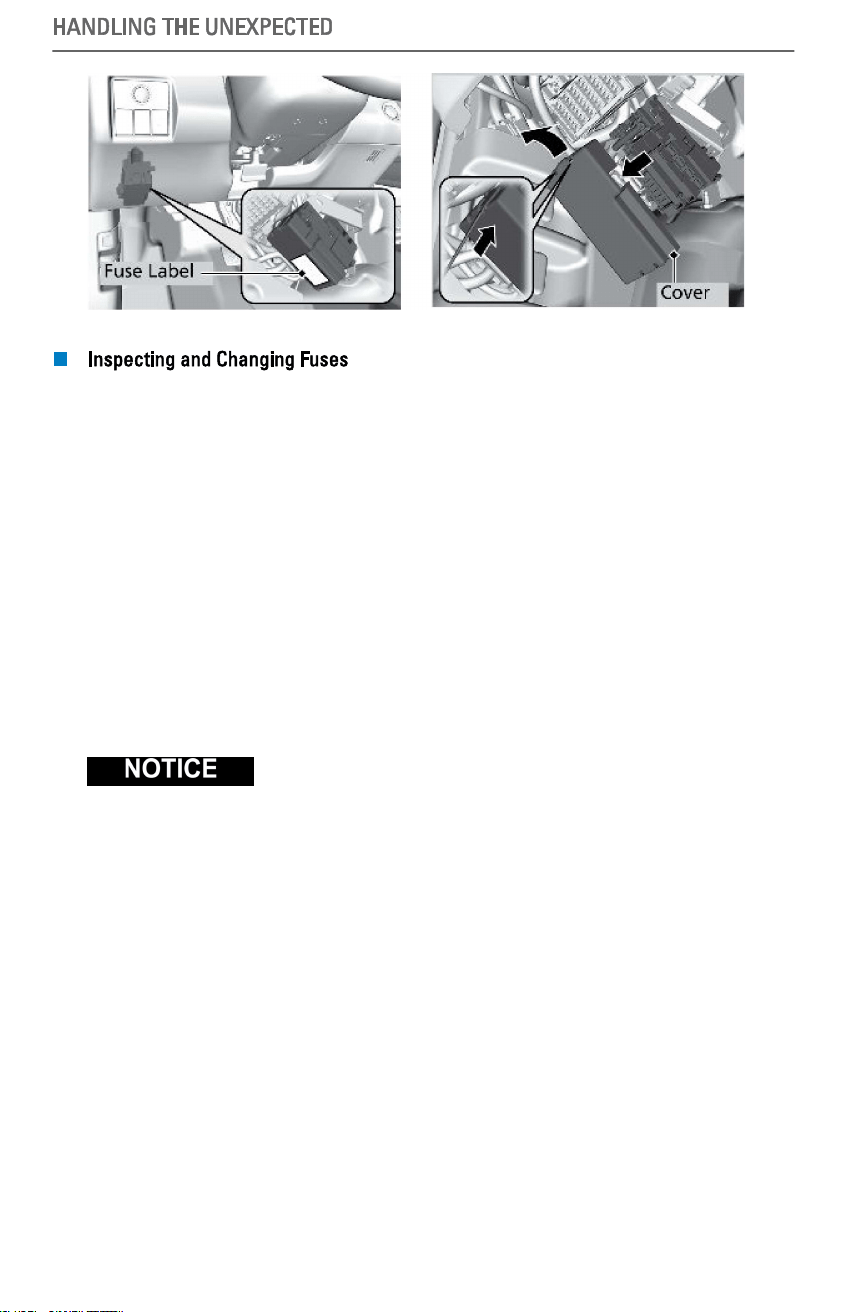
1. Turn off the vehicle, including all lights and accessories.
2. Remove the fuse box cover.
3. Check the fuses on the battery in the engine compartment.
If the fuse is blown, have it replaced by a dealer.
4. Check the large fuse in the vehicle interior.
If the fuse is blown, use a Phillips-head screwdriver to remove the
screws and replace the fuse with a new one. Reinstall the screws.
5. Inspect the small fuses in the engine compartment and the vehicle
interior.
If there is a burned out fuse, remove it with the fuse puller and replace it
with a new one.
Replacing a fuse with one that has a higher rating greatly increases the
chances of damaging the electrical system.
116 |
Learn about basic maintenance that you can perform on the vehicle yourself, as
well as information about how to best maintain the vehicle.
Some of the most important safety precautions are listed below however, we
cannot warn you of every conceivable hazard that can arise in performing
maintenance. Only you can decide whether or not you should perform a given
task.
• To reduce the possibility of fire or explosion, keep cigarettes, sparks, and
flames away from the battery and all fuel-related parts.
• Never leave rags, towels, or other flammable objects under the hood.
Heat from the engine and exhaust can ignite them, causing a fire.
• To clean parts, use a commercially available degreaser or parts cleaner,
not gasoline.
• Wear eye protection and protective clothing when working with the
battery or compressed air.
• Do not run the engine in confined spaces where carbon monoxide gas
can accumulate.
• The vehicle must be stationary and parked on level ground with the
parking brake set and the engine off.
• Be aware that hot parts can burn you.
• Be aware that moving parts can injure you.
Improperly maintaining this vehicle or failing to correct a problem before
driving can cause a crash in which you can be seriously hurt or killed.
Always follow the inspection and maintenance recommendations
according to the schedules in this guide.
Failure to properly follow maintenance instructions and precautions can
cause you to be seriously hurt or killed.
Always follow the procedures and precautions in this guide.
| 117
1. Turn off the vehicle, including all lights and accessories.
2. Remove the fuse box cover.
3. Check the fuses on the battery in the engine compartment.
If the fuse is blown, have it replaced by a dealer.
4. Check the large fuse in the vehicle interior.
If the fuse is blown, use a Phillips-head screwdriver to remove the
screws and replace the fuse with a new one. Reinstall the screws.
5. Inspect the small fuses in the engine compartment and the vehicle
interior.
If there is a burned out fuse, remove it with the fuse puller and replace it
with a new one.
Replacing a fuse with one that has a higher rating greatly increases the
chances of damaging the electrical system.
116 |
Learn about basic maintenance that you can perform on the vehicle yourself, as
well as information about how to best maintain the vehicle.
Some of the most important safety precautions are listed below however, we
cannot warn you of every conceivable hazard that can arise in performing
maintenance. Only you can decide whether or not you should perform a given
task.
• To reduce the possibility of fire or explosion, keep cigarettes, sparks, and
flames away from the battery and all fuel-related parts.
• Never leave rags, towels, or other flammable objects under the hood.
Heat from the engine and exhaust can ignite them, causing a fire.
• To clean parts, use a commercially available degreaser or parts cleaner,
not gasoline.
• Wear eye protection and protective clothing when working with the
battery or compressed air.
• Do not run the engine in confined spaces where carbon monoxide gas
can accumulate.
• The vehicle must be stationary and parked on level ground with the
parking brake set and the engine off.
• Be aware that hot parts can burn you.
• Be aware that moving parts can injure you.
Improperly maintaining this vehicle or failing to correct a problem before
driving can cause a crash in which you can be seriously hurt or killed.
Always follow the inspection and maintenance recommendations
according to the schedules in this guide.
Failure to properly follow maintenance instructions and precautions can
cause you to be seriously hurt or killed.
Always follow the procedures and precautions in this guide.
| 117
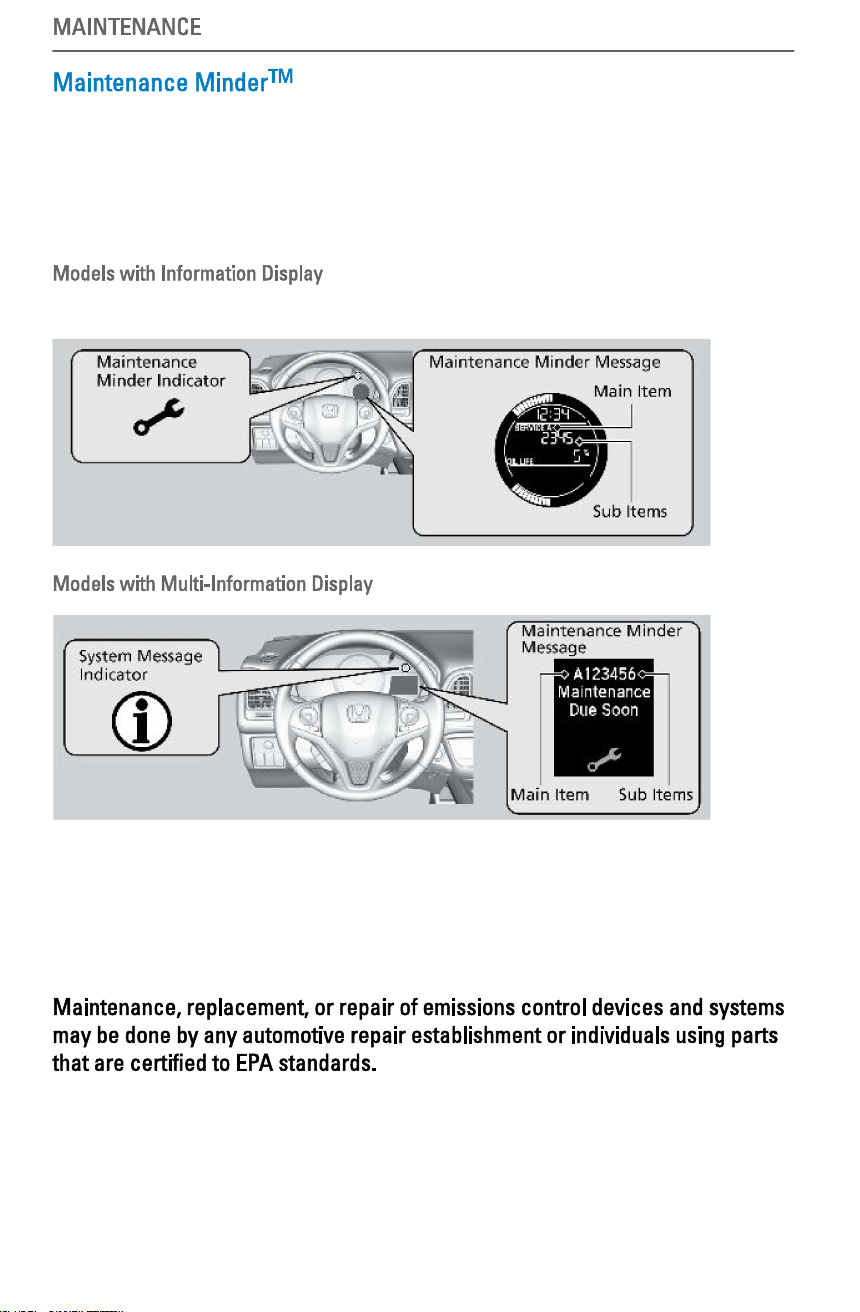
When maintenance is due, the system message indicator comes on and a
message appears on the display every time you turn the vehicle on. The
messages notify you when to change the engine oil, or when to bring your
vehicle to a dealer for indicated maintenance services.
To switch the display, press the select/reset knob.
• Independent of the Maintenance Minder information, replace the brake fluid
every 3 years.
• Independent of the Maintenance Minder information, adjust the valves during
services A, B, 1, 2, or 3 if they are noisy.
U.S. models
According to state and federal regulations, failure to perform maintenance on
the maintenance main items marked with # will not void your emissions
warranties. However, all maintenance services should be performed in
accordance with the intervals indicated by the .
118 |
These codes indicate what services are due on your vehicle.
| 119
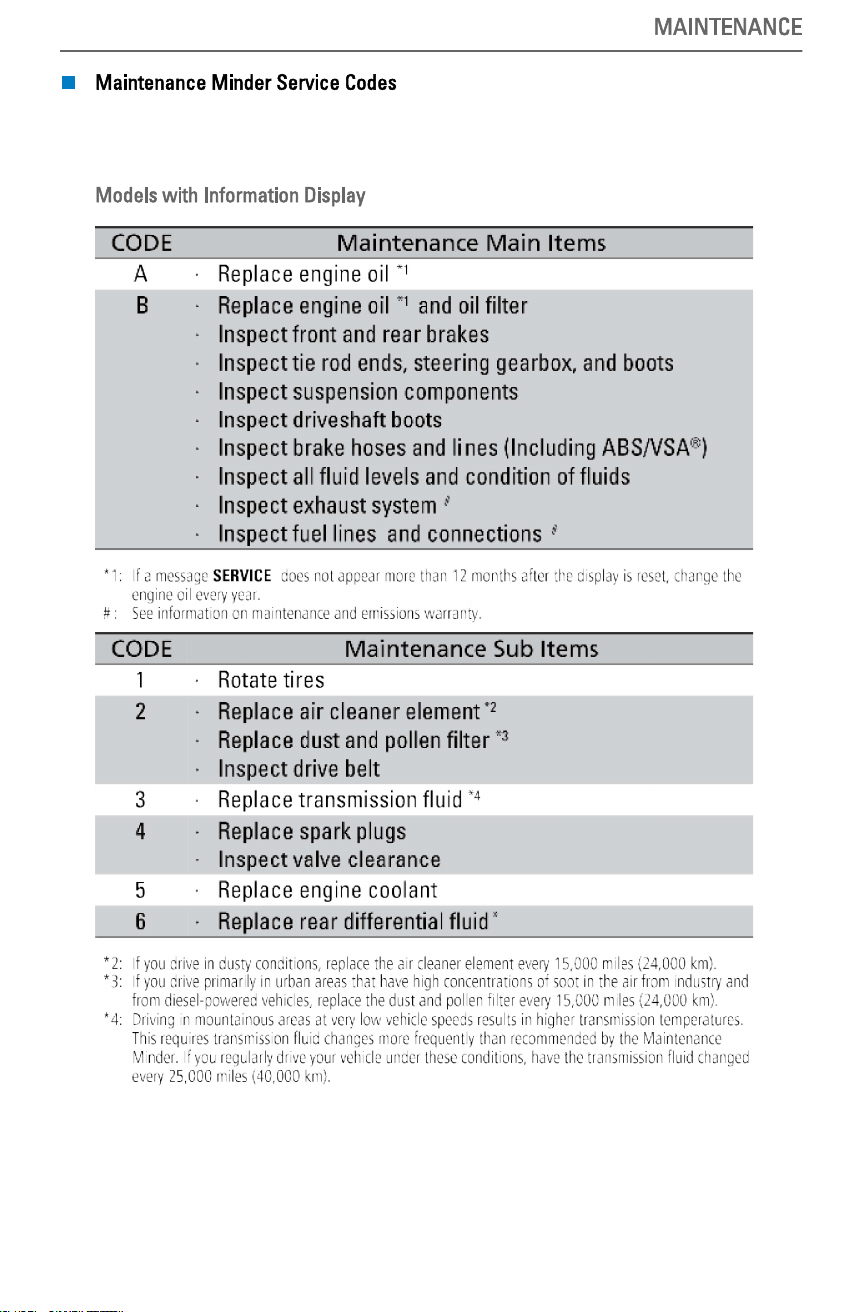
When maintenance is due, the system message indicator comes on and a
message appears on the display every time you turn the vehicle on. The
messages notify you when to change the engine oil, or when to bring your
vehicle to a dealer for indicated maintenance services.
To switch the display, press the select/reset knob.
• Independent of the Maintenance Minder information, replace the brake fluid
every 3 years.
• Independent of the Maintenance Minder information, adjust the valves during
services A, B, 1, 2, or 3 if they are noisy.
U.S. models
According to state and federal regulations, failure to perform maintenance on
the maintenance main items marked with # will not void your emissions
warranties. However, all maintenance services should be performed in
accordance with the intervals indicated by the .
118 |
These codes indicate what services are due on your vehicle.
| 119
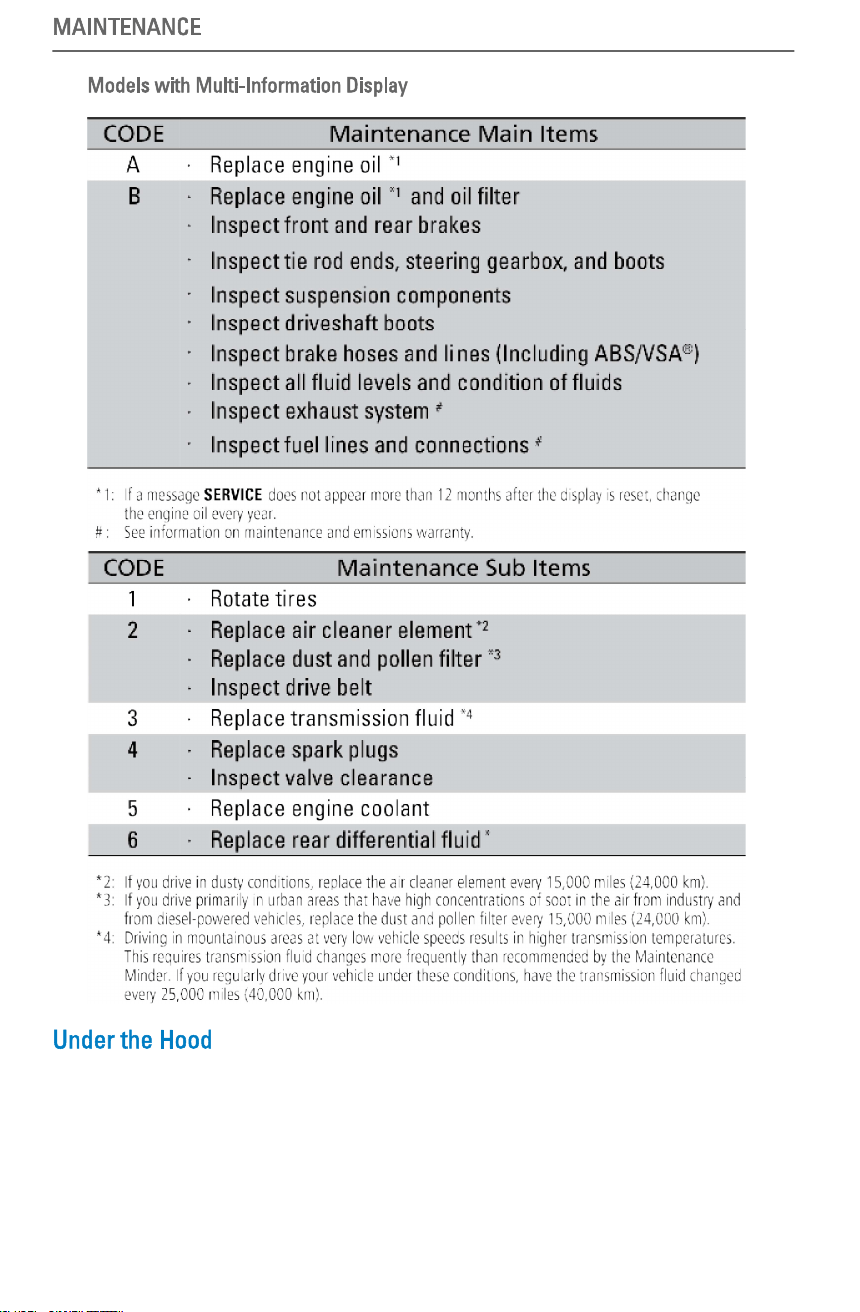
120 |
1. Park the vehicle on a level surface and set the parking brake.
2. Pull the hood release handle under the lower left corner of the
dashboard.
3. Push the hood latch lever in the center of the hood to release the lock
mechanism, and open the hood.
4. Remove the support rod from the
clamp using the grip. Mount the
support rod in the hood.
When closing, remove the support rod,
and stow it in the clamp, then gently
lower the hood.
| 121
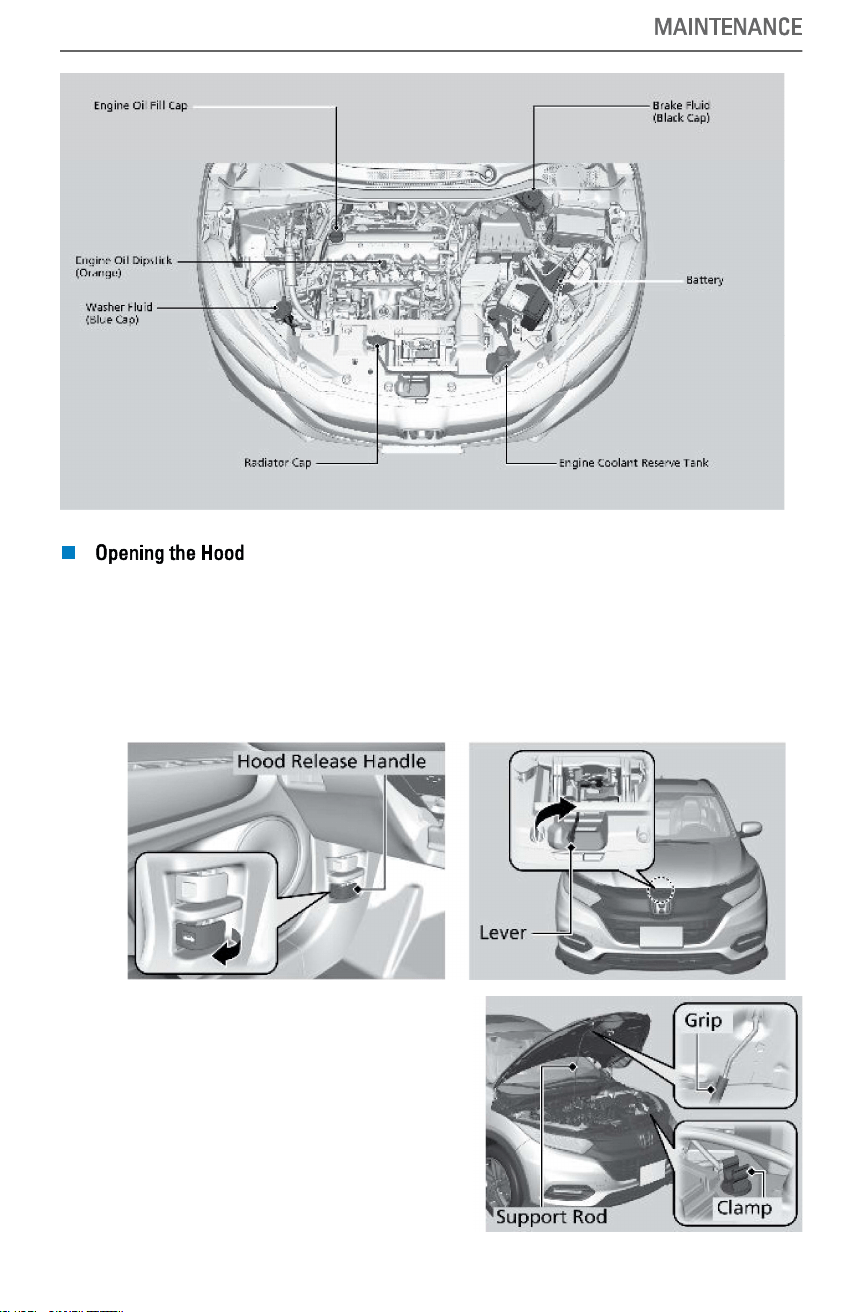
120 |
1. Park the vehicle on a level surface and set the parking brake.
2. Pull the hood release handle under the lower left corner of the
dashboard.
3. Push the hood latch lever in the center of the hood to release the lock
mechanism, and open the hood.
4. Remove the support rod from the
clamp using the grip. Mount the
support rod in the hood.
When closing, remove the support rod,
and stow it in the clamp, then gently
lower the hood.
| 121
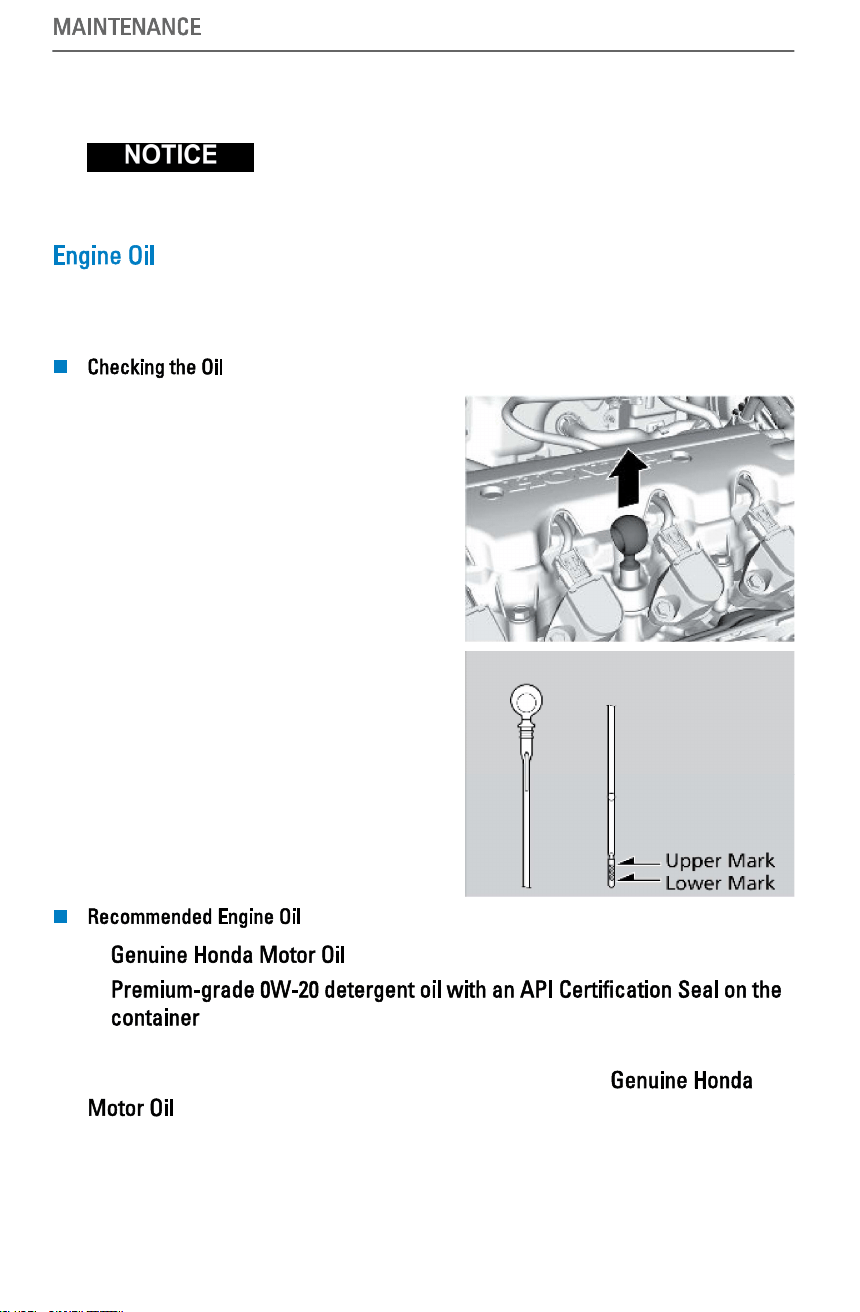
When closing the hood, lower it to approximately 12 inches (30 cm) and
press firmly down with your hands.
Do not open the hood when the wiper arms are raised. The hood will strike
the wipers, and may damage either the hood or the wipers.
Park the vehicle on level ground. Wait approximately three minutes after turning
the engine off before you check the oil.
1. Open the hood. (See Opening the
Hood) Remove the dipstick (orange
loop).
2. Wipe the dipstick with a clean cloth
or paper towel.
3. Insert the dipstick all the way back
into its hole.
4. Remove the dipstick again, and
check the level. It should be
between the upper and lower
marks.
Add oil if necessary.
•
•
This seal indicates the oil is energy conserving and that it meets the
American Petroleum Institute’s latest requirements. Use
or another commercial engine oil of suitable viscosity for the
ambient temperature.
122 |
Use or
another commercial engine oil of
suitable viscosity for the ambient
temperature.
You may also use synthetic motor oil if it
is labeled with the API Certification
Seal and is of the specified viscosity
grade.
1. Unscrew and remove the engine oil fill cap.
2. Add oil slowly.
3. Reinstall the engine oil fill cap and tighten it securely.
4. Wait for three minutes and recheck the engine oil dipstick.
Do not fill the engine oil above the upper mark. Overfilling the engine oil can
result in leaks and engine damage.
If you change or replace the vehicle’s engine oil yourself, you must reset the
engine oil life.
Ambient Temperature
| 123
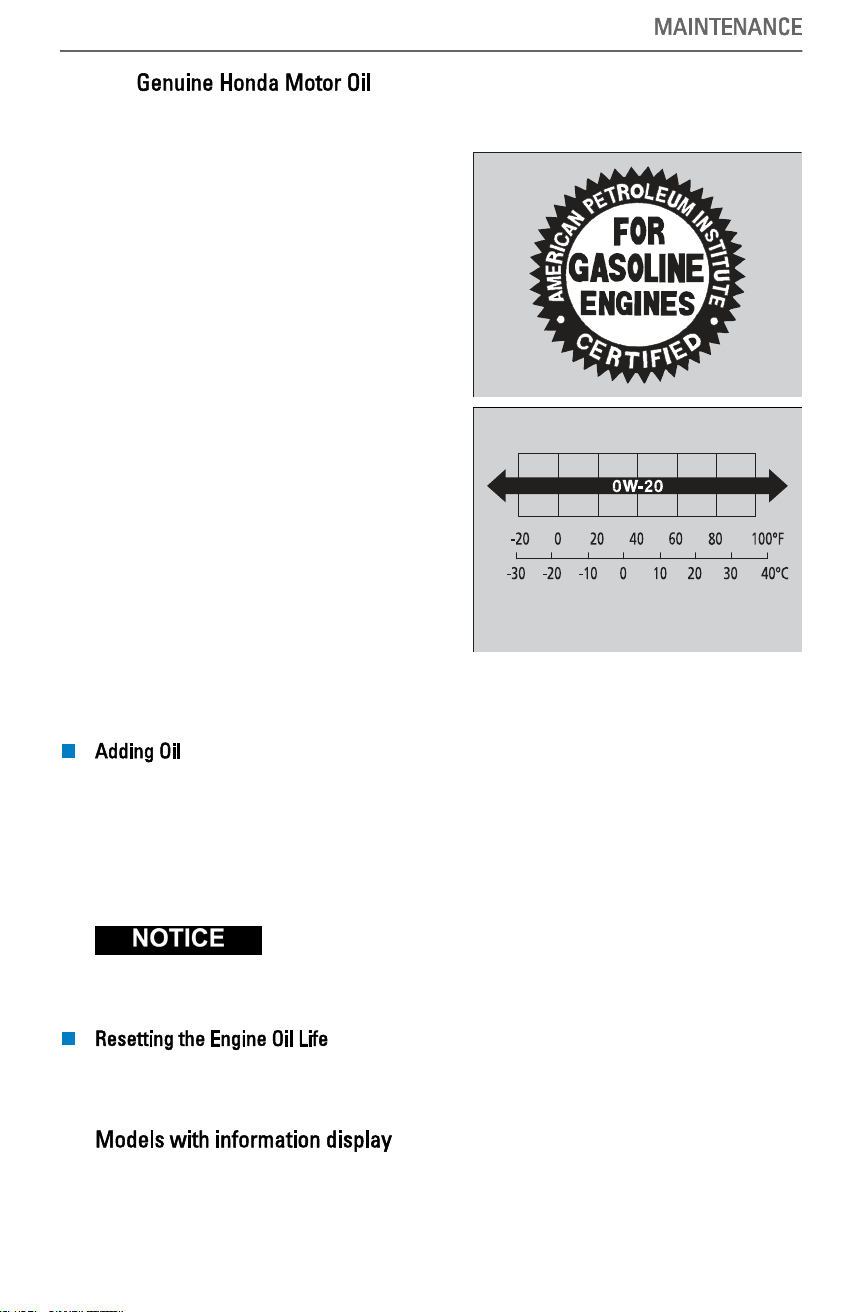
When closing the hood, lower it to approximately 12 inches (30 cm) and
press firmly down with your hands.
Do not open the hood when the wiper arms are raised. The hood will strike
the wipers, and may damage either the hood or the wipers.
Park the vehicle on level ground. Wait approximately three minutes after turning
the engine off before you check the oil.
1. Open the hood. (See Opening the
Hood) Remove the dipstick (orange
loop).
2. Wipe the dipstick with a clean cloth
or paper towel.
3. Insert the dipstick all the way back
into its hole.
4. Remove the dipstick again, and
check the level. It should be
between the upper and lower
marks.
Add oil if necessary.
•
•
This seal indicates the oil is energy conserving and that it meets the
American Petroleum Institute’s latest requirements. Use
or another commercial engine oil of suitable viscosity for the
ambient temperature.
122 |
Use or
another commercial engine oil of
suitable viscosity for the ambient
temperature.
You may also use synthetic motor oil if it
is labeled with the API Certification
Seal and is of the specified viscosity
grade.
1. Unscrew and remove the engine oil fill cap.
2. Add oil slowly.
3. Reinstall the engine oil fill cap and tighten it securely.
4. Wait for three minutes and recheck the engine oil dipstick.
Do not fill the engine oil above the upper mark. Overfilling the engine oil can
result in leaks and engine damage.
If you change or replace the vehicle’s engine oil yourself, you must reset the
engine oil life.
Ambient Temperature
| 123
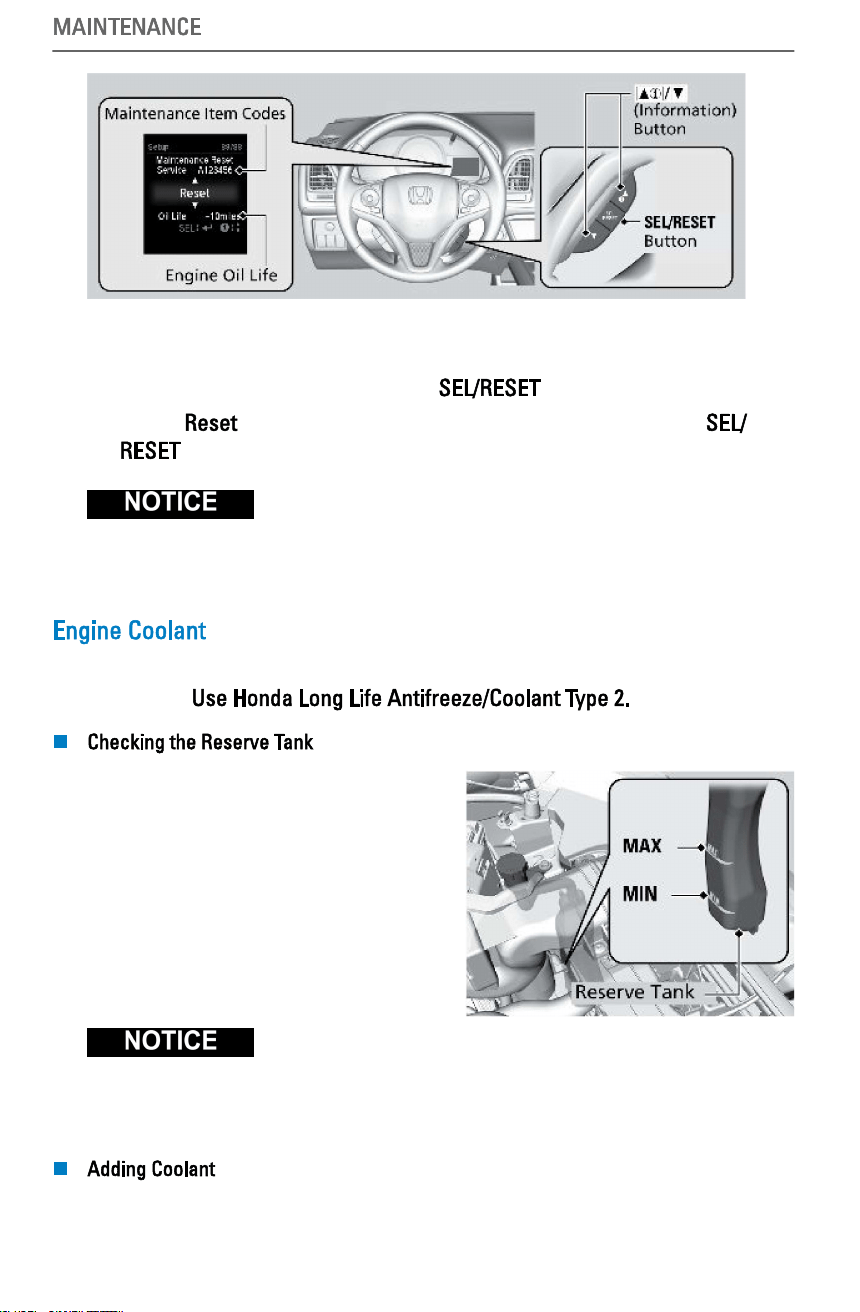
1. Turn the vehicle ON.
2. Press the Up Arrow or Down Arrow on the selector wheel to select a
Maintenance Info., then press the button.
3. Select with the Up Arrow or Down Arrow, then press the
button.
Failure to reset the engine oil life after a maintenance service results in the
system showing incorrect maintenance intervals, which can lead to serious
mechanical problems.
Park the vehicle on level ground. Check the reserve tank and the coolant level
in the radiator.
1. Open the hood. (see Opening the
Hood) Check the amount of coolant
in the reserve tank.
2. If the coolant level is below the MIN
mark, add the specified coolant until
it reaches the MAX mark.
3. Inspect the cooling system for
leaks.
For vehicles used in temperatures below -31°F (-35°C), change the coolant
from the standard 50:50 antifreeze:water mix to one with added antifreeze.
Consult a dealer for more information.
1. Make sure the engine and radiator are cool.
124 |
2. Turn the radiator cap 1/8 turn counterclockwise and relieve any
pressure in the coolant system.
3. Push down and turn the radiator cap counterclockwise to remove it.
4. The coolant level should be up to the base of the filler neck. Add coolant
if it is low.
5. Put the radiator cap back on, and tighten it fully.
Removing the radiator cap while the engine is hot can cause the coolant to
spray out, seriously scalding you.
Always let the engine and radiator cool down before removing the radiator
cap.
Pour the fluid slowly and carefully so you do not spill any. Clean up any
spills immediately; they can damage components in the engine
compartment.
The battery condition is monitored by the sensor on the negative terminal. If
there is a problem with the sensor, a warning message appears on the
information display
*1
/multi-information display
*1
. Have your vehicle checked by
a dealer.
The battery gives off explosive hydrogen gas during normal operation.
A spark or flame can cause the battery to explode with enough force to kill or
seriously hurt you.
When conducting any battery maintenance, wear protective clothing and a
face shield, or have a skilled technician do it.
Battery posts, terminals, and related accessories contain lead and
lead compounds.
Check the amount of window washer fluid by looking at the reservoir. Fill if it is
low. Pour the washer fluid carefully. Do not overflow the reservoir.
If the washer fluid is low, a message appears on the Multi-Information Display.
*1 - If equipped
| 125
1. Turn the vehicle ON.
2. Press the Up Arrow or Down Arrow on the selector wheel to select a
Maintenance Info., then press the button.
3. Select with the Up Arrow or Down Arrow, then press the
button.
Failure to reset the engine oil life after a maintenance service results in the
system showing incorrect maintenance intervals, which can lead to serious
mechanical problems.
Park the vehicle on level ground. Check the reserve tank and the coolant level
in the radiator.
1. Open the hood. (see Opening the
Hood) Check the amount of coolant
in the reserve tank.
2. If the coolant level is below the MIN
mark, add the specified coolant until
it reaches the MAX mark.
3. Inspect the cooling system for
leaks.
For vehicles used in temperatures below -31°F (-35°C), change the coolant
from the standard 50:50 antifreeze:water mix to one with added antifreeze.
Consult a dealer for more information.
1. Make sure the engine and radiator are cool.
124 |
2. Turn the radiator cap 1/8 turn counterclockwise and relieve any
pressure in the coolant system.
3. Push down and turn the radiator cap counterclockwise to remove it.
4. The coolant level should be up to the base of the filler neck. Add coolant
if it is low.
5. Put the radiator cap back on, and tighten it fully.
Removing the radiator cap while the engine is hot can cause the coolant to
spray out, seriously scalding you.
Always let the engine and radiator cool down before removing the radiator
cap.
Pour the fluid slowly and carefully so you do not spill any. Clean up any
spills immediately; they can damage components in the engine
compartment.
The battery condition is monitored by the sensor on the negative terminal. If
there is a problem with the sensor, a warning message appears on the
information display
*1
/multi-information display
*1
. Have your vehicle checked by
a dealer.
The battery gives off explosive hydrogen gas during normal operation.
A spark or flame can cause the battery to explode with enough force to kill or
seriously hurt you.
When conducting any battery maintenance, wear protective clothing and a
face shield, or have a skilled technician do it.
Battery posts, terminals, and related accessories contain lead and
lead compounds.
Check the amount of window washer fluid by looking at the reservoir. Fill if it is
low. Pour the washer fluid carefully. Do not overflow the reservoir.
If the washer fluid is low, a message appears on the Multi-Information Display.
*1 - If equipped
| 125
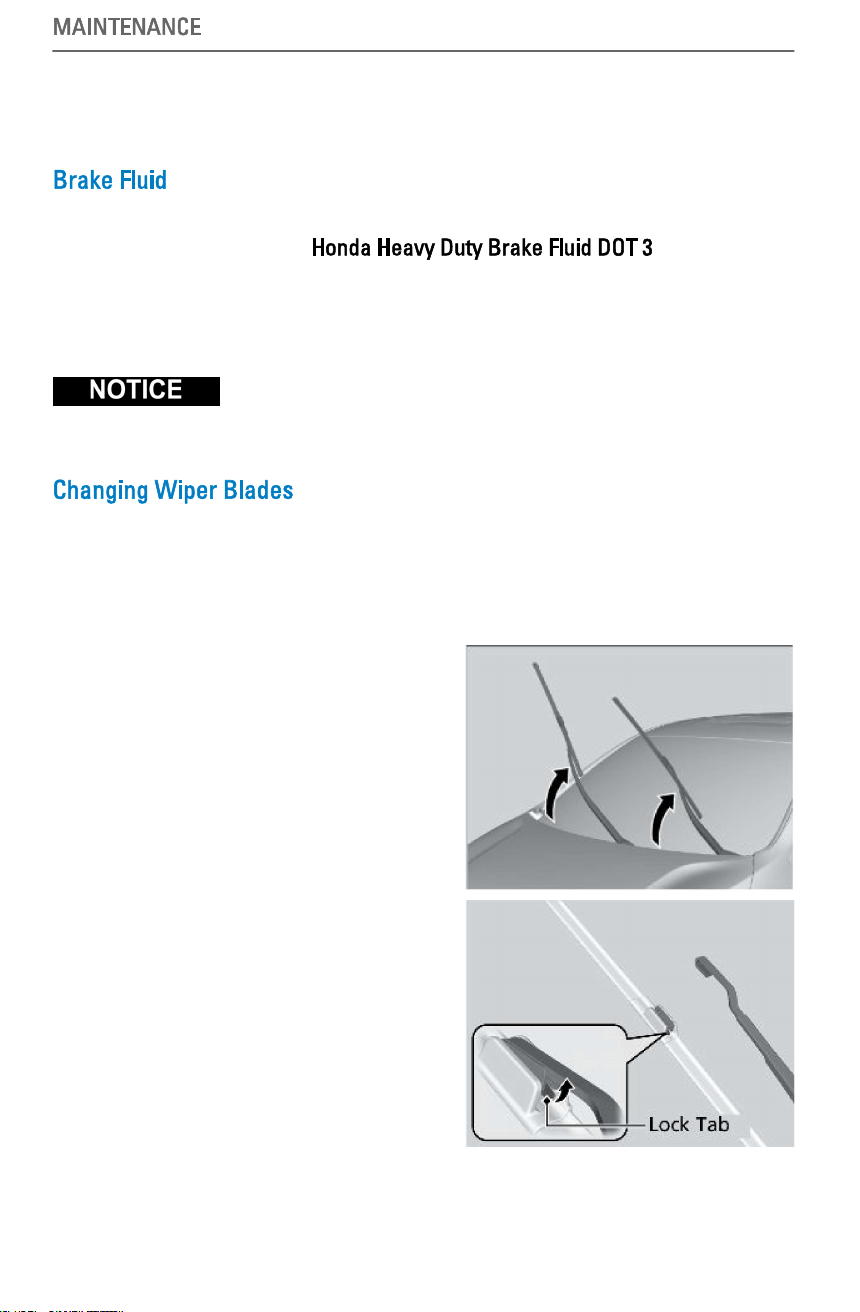
Do not use engine antifreeze or a vinegar/water solution in the windshield
washer reservoir. Antifreeze can damage your vehicle’s paint. A vinegar/water
solution can damage the windshield washer pump.
The fluid level should be between the MIN and MAX marks on the side of the
tank. We recommend using .
Pour the fluid carefully.
If the fluid level is at or below the MIN mark, have a dealer inspect for leaks or
worn brake pads as soon as possible.
Brake fluid marked DOT 5 is not compatible with your vehicle’s braking system
and can cause extensive damage.
If the wiper blades leave streaks across the windshield, try cleaning them first
with a paper towel or soft cloth and wiper fluid. If the wiper blade rubber has
deteriorated, you should change the wiper blades.
1. Set the power mode to VEHICLE OFF.
2. Lift the driver side wiper arm first, then
the passenger side.
3. Press and hold the tab, then slide the
holder off the wiper arm.
126 |
4. Slide the wiper blade out of the holder
by pulling the tabbed end out.
5. Insert the flat side of the new wiper
blade onto the bottom part of the holder.
Insert the blade all the way.
6. Install the end of the wiper blade into
the end cap.
7. Slide the wiper holder onto the wiper
arm until it locks.
8. Lower the passenger side wiper arm
first, then the driver side.
Avoid dropping the wiper arm, as it may damage the windshield.
1. Raise the wiper arm off. Pivot up the
bottom end of the wiper blade until it
comes off from the wiper arm.
2. Slide the wiper blade out from the end
with the indent.
| 127
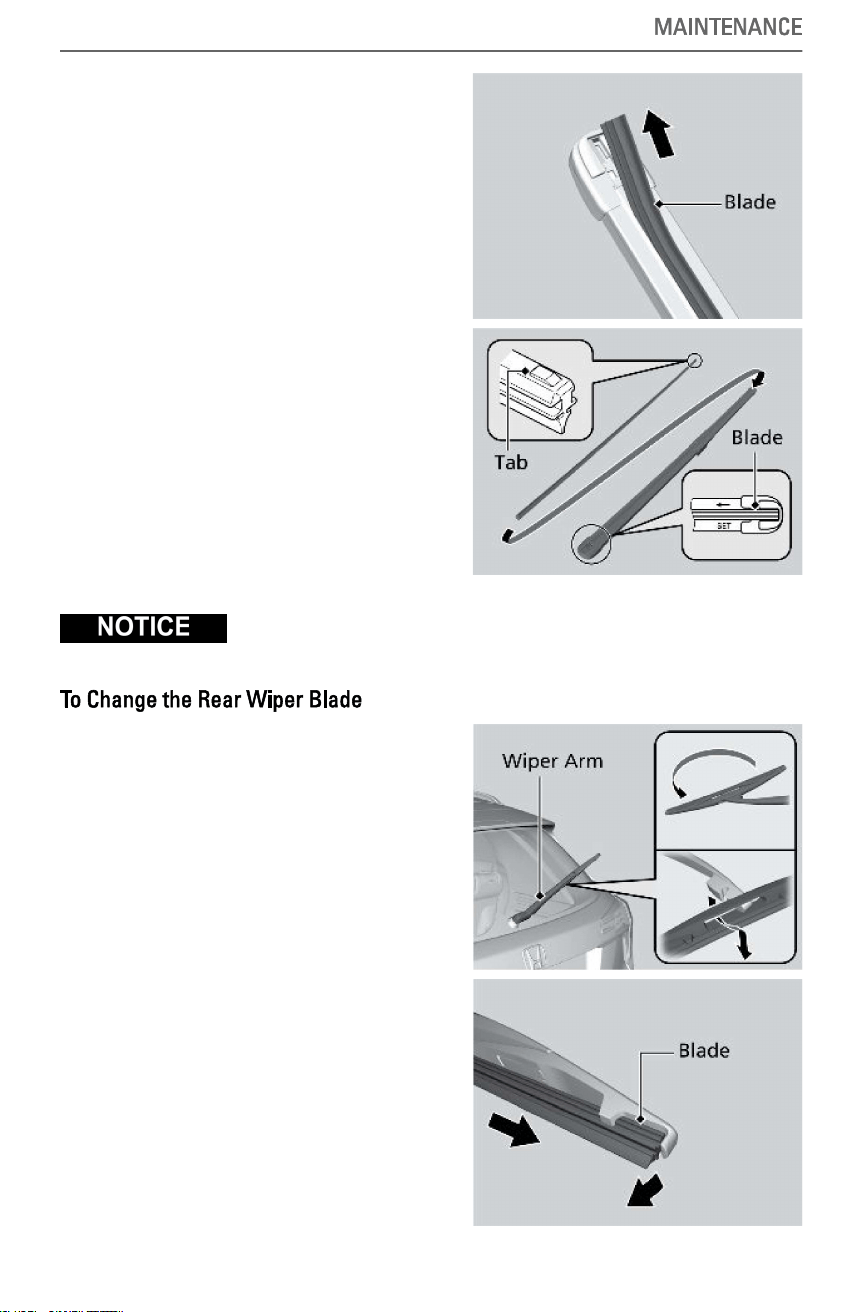
Do not use engine antifreeze or a vinegar/water solution in the windshield
washer reservoir. Antifreeze can damage your vehicle’s paint. A vinegar/water
solution can damage the windshield washer pump.
The fluid level should be between the MIN and MAX marks on the side of the
tank. We recommend using .
Pour the fluid carefully.
If the fluid level is at or below the MIN mark, have a dealer inspect for leaks or
worn brake pads as soon as possible.
Brake fluid marked DOT 5 is not compatible with your vehicle’s braking system
and can cause extensive damage.
If the wiper blades leave streaks across the windshield, try cleaning them first
with a paper towel or soft cloth and wiper fluid. If the wiper blade rubber has
deteriorated, you should change the wiper blades.
1. Set the power mode to VEHICLE OFF.
2. Lift the driver side wiper arm first, then
the passenger side.
3. Press and hold the tab, then slide the
holder off the wiper arm.
126 |
4. Slide the wiper blade out of the holder
by pulling the tabbed end out.
5. Insert the flat side of the new wiper
blade onto the bottom part of the holder.
Insert the blade all the way.
6. Install the end of the wiper blade into
the end cap.
7. Slide the wiper holder onto the wiper
arm until it locks.
8. Lower the passenger side wiper arm
first, then the driver side.
Avoid dropping the wiper arm, as it may damage the windshield.
1. Raise the wiper arm off. Pivot up the
bottom end of the wiper blade until it
comes off from the wiper arm.
2. Slide the wiper blade out from the end
with the indent.
| 127
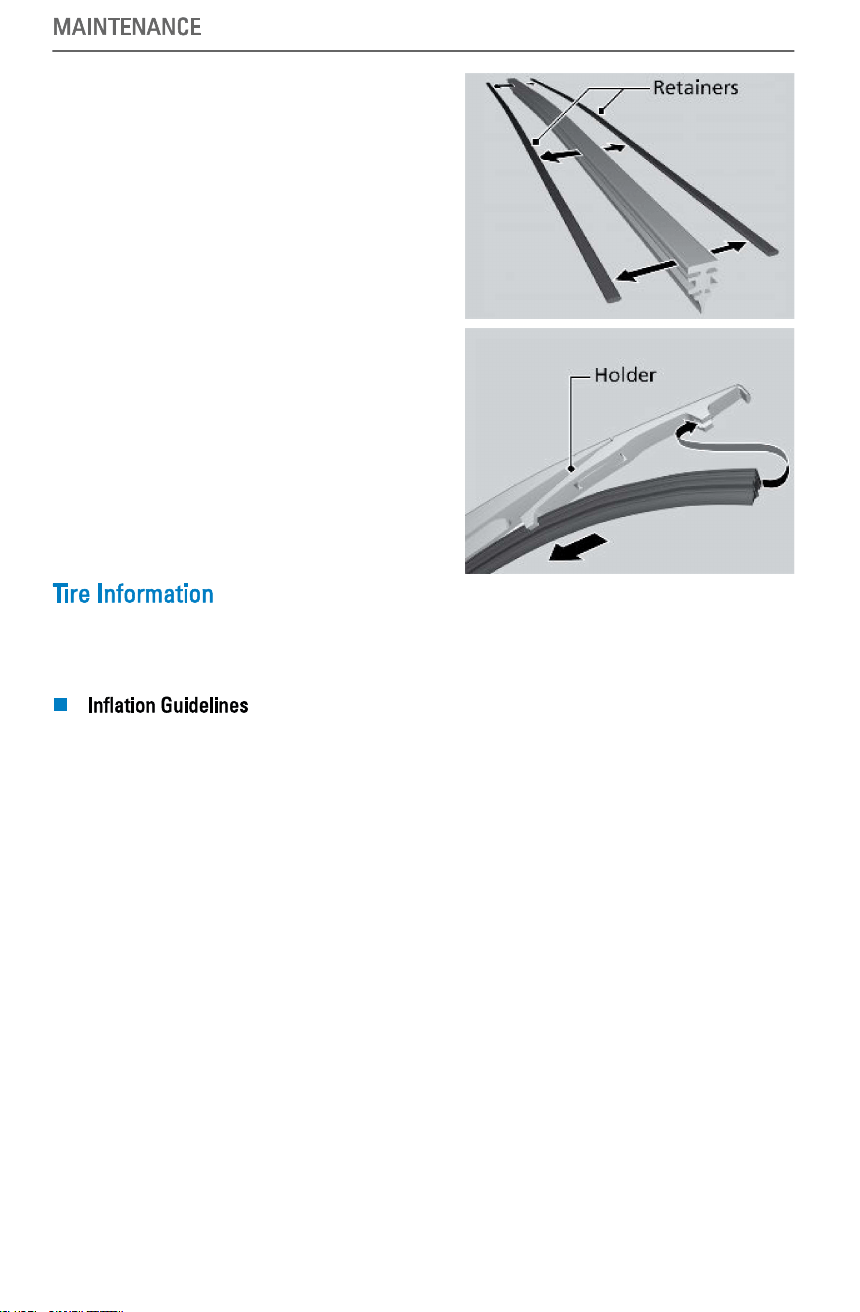
3. Remove the retainers from wiper blade
and mount to a new rubber blade.
4. Slide the new wiper blade onto the
holder. Make sure it is engaged
correctly, then install the wiper blade
assembly onto the wiper arm.
To safely operate your vehicle, your tires must be of the proper type and size, in
good condition with adequate tread, and properly inflated.
• Properly inflated tires provide the best combination of handling, tread life,
and comfort. Refer to the driver’s doorjamb label or the specifications see
SPECIFICATIONS for the specified pressure.
• Underinflated tires wear unevenly, adversely affect handling and fuel
economy, and are more likely to fail from overheating.
• Overinflated tires make your vehicle ride harshly, are more prone to road
hazards, and wear unevenly.
• Every day before you drive, look at each of the tires. If one looks lower
than the others, check the pressure with a tire gauge.
• Measure the air pressure when tires are cold. This means the vehicle has
been parked for at least 3 hours, or driven less than 1 mile (1.6 km). If
necessary, add or release air until the specified pressure is reached. If
checked when hot, tire pressure can be as much as 4-6 psi (30-40 kPa,
0.3-0.4 kgf/cm
2
) higher than checked when cold.
• At least once a month or before long trips, use a gauge to measure the
pressure in all tires, including the spare
*1
. Even tires in good condition
can lose 1-2 psi (10-20 kPa, 0.1-0.2 kgf/cm
2
) per month.
128 |
Every time you inflate the tires, check for the following:
• Any damage to tires, including bumps, bulges, cuts, splits, or cracks in
the side or tread. Remove any foreign objects and inspect for air leaks.
Replace tires if you see fabric or cord.
• Uneven or excessive tread wear. Have a dealer check the wheel
alignment.
• Cracks or other damage around the valve stems.
The groove where the wear indicator is
located is 1/16 inch (1.6 mm) shallower
than elsewhere on the tire. If the tread
has worn so low that the indicator is
exposed, replace the tire. Worn out
tires have poor traction on wet roads.
Using tires that are excessively worn or improperly inflated can cause a
crash in which you can be seriously hurt or killed. Follow all instructions in
the owner’s manual regarding tire inflation and maintenance.
The label attached to the driver’s doorjamb provides necessary tire and
loading information.
Example of a wear
indicator mark
*1 - If equipped
| 129
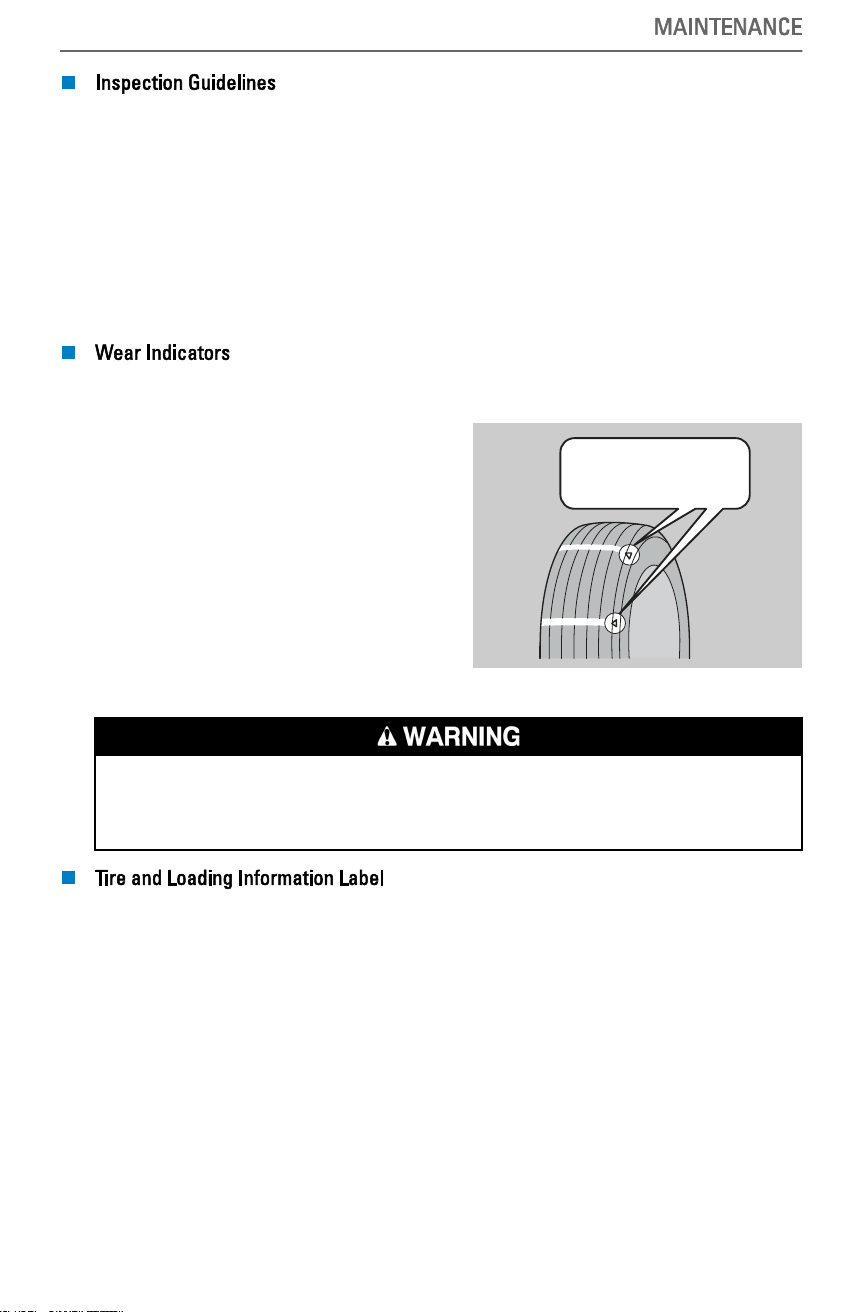
3. Remove the retainers from wiper blade
and mount to a new rubber blade.
4. Slide the new wiper blade onto the
holder. Make sure it is engaged
correctly, then install the wiper blade
assembly onto the wiper arm.
To safely operate your vehicle, your tires must be of the proper type and size, in
good condition with adequate tread, and properly inflated.
• Properly inflated tires provide the best combination of handling, tread life,
and comfort. Refer to the driver’s doorjamb label or the specifications see
SPECIFICATIONS for the specified pressure.
• Underinflated tires wear unevenly, adversely affect handling and fuel
economy, and are more likely to fail from overheating.
• Overinflated tires make your vehicle ride harshly, are more prone to road
hazards, and wear unevenly.
• Every day before you drive, look at each of the tires. If one looks lower
than the others, check the pressure with a tire gauge.
• Measure the air pressure when tires are cold. This means the vehicle has
been parked for at least 3 hours, or driven less than 1 mile (1.6 km). If
necessary, add or release air until the specified pressure is reached. If
checked when hot, tire pressure can be as much as 4-6 psi (30-40 kPa,
0.3-0.4 kgf/cm
2
) higher than checked when cold.
• At least once a month or before long trips, use a gauge to measure the
pressure in all tires, including the spare
*1
. Even tires in good condition
can lose 1-2 psi (10-20 kPa, 0.1-0.2 kgf/cm
2
) per month.
128 |
Every time you inflate the tires, check for the following:
• Any damage to tires, including bumps, bulges, cuts, splits, or cracks in
the side or tread. Remove any foreign objects and inspect for air leaks.
Replace tires if you see fabric or cord.
• Uneven or excessive tread wear. Have a dealer check the wheel
alignment.
• Cracks or other damage around the valve stems.
The groove where the wear indicator is
located is 1/16 inch (1.6 mm) shallower
than elsewhere on the tire. If the tread
has worn so low that the indicator is
exposed, replace the tire. Worn out
tires have poor traction on wet roads.
Using tires that are excessively worn or improperly inflated can cause a
crash in which you can be seriously hurt or killed. Follow all instructions in
the owner’s manual regarding tire inflation and maintenance.
The label attached to the driver’s doorjamb provides necessary tire and
loading information.
Example of a wear
indicator mark
*1 - If equipped
| 129
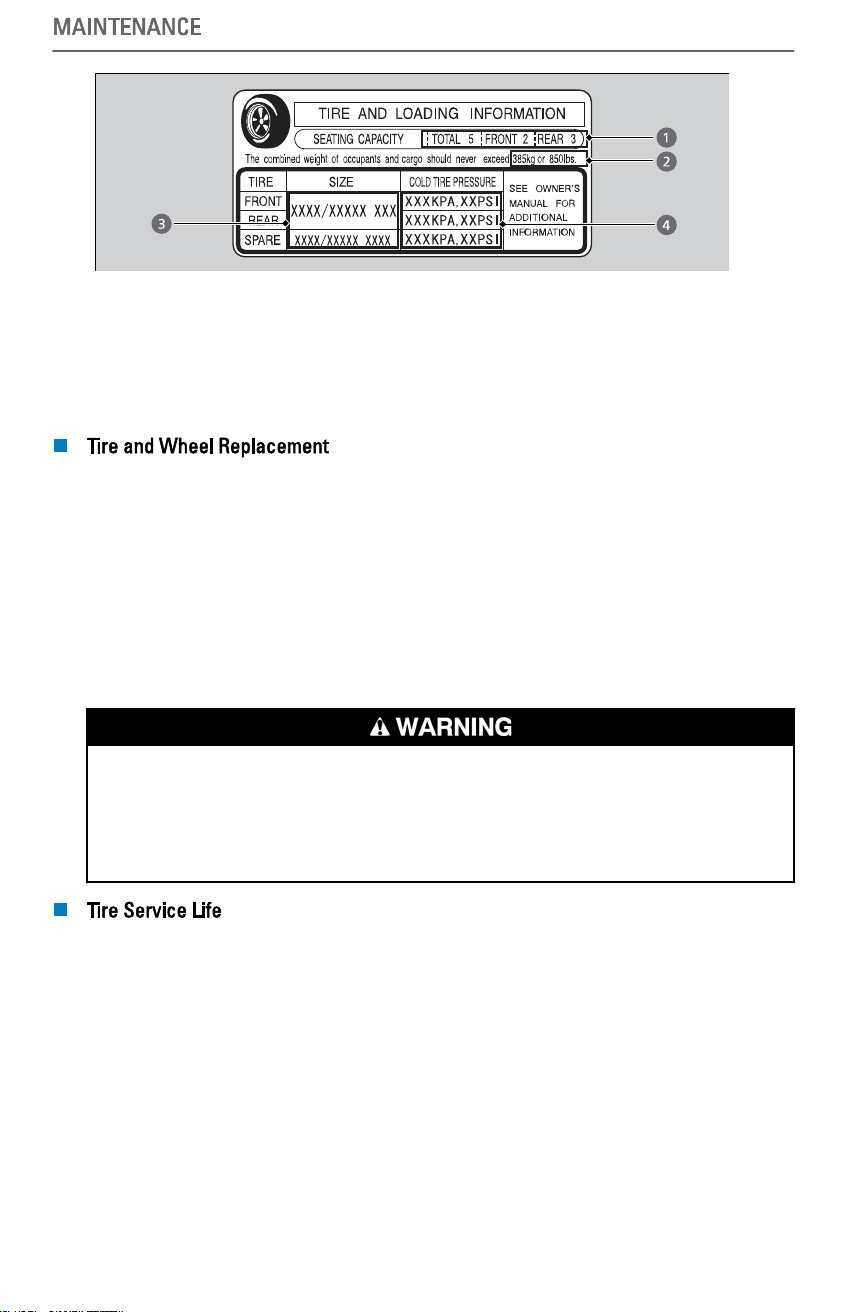
Label
Example
1. The number of people your vehicle can carry.
2. The total weight your vehicle can carry. Do not exceed this weight.
3. The original tire sizes for front, rear, and spare.
4. The proper cold tire pressure for front, rear, and spare.
Replace your tires with radials of the same size, load range, speed rating,
and maximum cold tires pressure rating (as shown on the tires' sidewall).
Using tires of a different size or construction can cause certain vehicle
systems to work incorrectly. It is best to replace all four tires at the same
time. If that isn’t possible, replace the front or rear tires in pairs.
If you change or replace a wheel, make sure that the wheel’s specifications
match those of the original wheels. Only use TPMS-specified wheels
approved for your vehicle.
Installing improper tires on your vehicle can affect handling and stability.
This can cause a crash in which you can be seriously hurt or killed.
Always use the size and type of tires recommended in the Owner’s
Manual.
The life of your tires is dependent on many factors, including driving habits,
road conditions, vehicle loading, inflation pressure, maintenance history,
speed, and environmental conditions (even when the tires are not in use).
In addition to regular inspections and inflation pressure maintenance, it is
recommended that you have annual inspections performed once the tires
reach five years old. All tires, including the spare, should be removed from
service after 10 years from the date of manufacture, regardless of their
condition or state of wear.
130 |
If driving on snowy or frozen roads, mount all season tires marked “M+S”,
snow tires, or tire chains; reduce speed and maintain sufficient distance
between vehicles when driving. For winter tires, select the size and load
ranges that are the same as the original tires, and mount them to all four
wheels.
Install tire chains on the front tires only. Because your vehicle has limited
tire clearance, we strongly recommend using the following chains:
Models with 215/55R17 tires:
Models with 225/50R18 tires: Not recommended to use any type of chains
Mount chains as tightly as you can and make sure that they do not touch the
brake lines or suspension.
Traction devices that are the wrong size or improperly installed can damage
your vehicle’s brake lines, suspension, body, and wheels. Stop driving if they
are hitting any part of the vehicle.
Using the wrong chains, or not properly installing chains, can damage the
brake lines and cause a crash in which you can be seriously injured or
killed.
Follow all instructions in this guide regarding the selection and use of tire
chains.
The tires that came on your vehicle have a number of markings. Those you
should be aware of are described below.
Here is an example of what each marking means:
| 131
Label
Example
1. The number of people your vehicle can carry.
2. The total weight your vehicle can carry. Do not exceed this weight.
3. The original tire sizes for front, rear, and spare.
4. The proper cold tire pressure for front, rear, and spare.
Replace your tires with radials of the same size, load range, speed rating,
and maximum cold tires pressure rating (as shown on the tires' sidewall).
Using tires of a different size or construction can cause certain vehicle
systems to work incorrectly. It is best to replace all four tires at the same
time. If that isn’t possible, replace the front or rear tires in pairs.
If you change or replace a wheel, make sure that the wheel’s specifications
match those of the original wheels. Only use TPMS-specified wheels
approved for your vehicle.
Installing improper tires on your vehicle can affect handling and stability.
This can cause a crash in which you can be seriously hurt or killed.
Always use the size and type of tires recommended in the Owner’s
Manual.
The life of your tires is dependent on many factors, including driving habits,
road conditions, vehicle loading, inflation pressure, maintenance history,
speed, and environmental conditions (even when the tires are not in use).
In addition to regular inspections and inflation pressure maintenance, it is
recommended that you have annual inspections performed once the tires
reach five years old. All tires, including the spare, should be removed from
service after 10 years from the date of manufacture, regardless of their
condition or state of wear.
130 |
If driving on snowy or frozen roads, mount all season tires marked “M+S”,
snow tires, or tire chains; reduce speed and maintain sufficient distance
between vehicles when driving. For winter tires, select the size and load
ranges that are the same as the original tires, and mount them to all four
wheels.
Install tire chains on the front tires only. Because your vehicle has limited
tire clearance, we strongly recommend using the following chains:
Models with 215/55R17 tires:
Models with 225/50R18 tires: Not recommended to use any type of chains
Mount chains as tightly as you can and make sure that they do not touch the
brake lines or suspension.
Traction devices that are the wrong size or improperly installed can damage
your vehicle’s brake lines, suspension, body, and wheels. Stop driving if they
are hitting any part of the vehicle.
Using the wrong chains, or not properly installing chains, can damage the
brake lines and cause a crash in which you can be seriously injured or
killed.
Follow all instructions in this guide regarding the selection and use of tire
chains.
The tires that came on your vehicle have a number of markings. Those you
should be aware of are described below.
Here is an example of what each marking means:
| 131
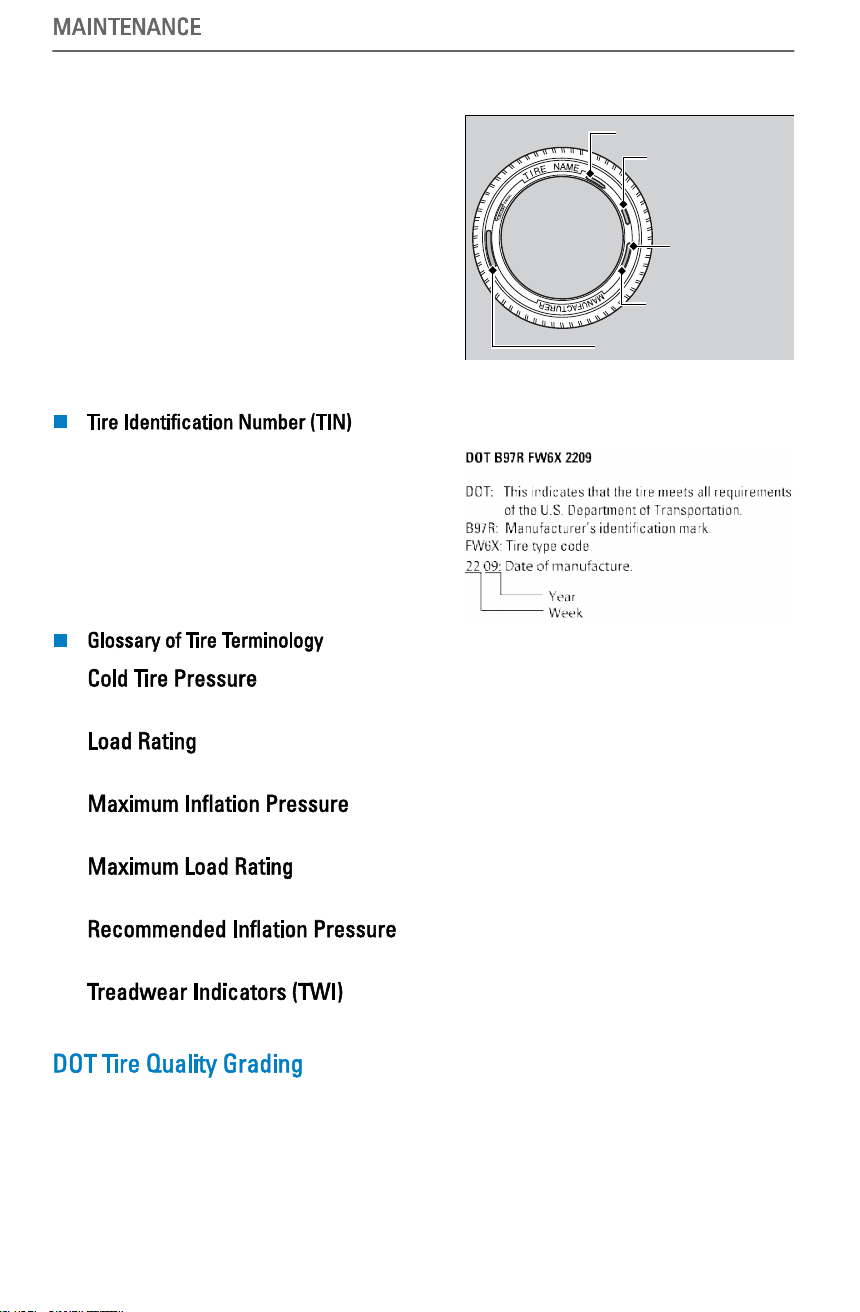
• P: tire type (passenger vehicle)
• 215: tire width in millimeters
• 55: aspect ratio (tire section height as a
percentage of its width)
• R: tire construction code (radial)
• 17: rim diameter in inches
• 94: load index (code indicating maximum
load tire can carry)
• V: speed symbol (code indicating
maximum speed rating)
The tire identification number (TIN) is a
group of numbers and letters that look
like the following example. The TIN is
located on the sidewall of the tire.
– The tire air pressure when the vehicle has been parked
for at least three hours or driven less than 1 mile (1.6 km).
– The maximum load that a tire is rated to carry for a given
inflation pressure.
– The maximum tire air pressure that the tire
can hold.
– The load rating for a tire at the maximum
permissible inflation pressure for that tire.
– The cold tire inflation pressure
recommended by the manufacturer.
– The projections within the principal grooves
designed to give a visual indication of the degrees of wear of the tread.
The tires on your vehicle meet all U.S. Federal Safety Requirements. All tires are
also graded for treadwear, traction, and temperature performance according to
Department of Transportation (DOT) standards. These gradings are explained
below.
Example
TireSize
Maximum
Tire
Identification
Number(TIN)
TireLoad
Maximum
TirePressure
TireSize
132 |
Quality grades can be found where applicable on the tire sidewall between
tread shoulder and maximum section width.
For example:
All passenger car tires must conform to Federal Safety Requirements in
addition to these grades.
The treadwear grade is a comparative rating based on the wear rate of the
tire when tested under controlled conditions on a specified government test
course. For example, a tire graded 150 would wear one and one-half (1 1/2)
times as well on the government course as a tire graded 100. The relative
performance of tires depends upon the actual conditions of their use,
however, and may depart significantly from the norm due to variations in
driving habits, service practices, and differences in road characteristics
and climate.
The traction grades, from highest to lowest, are AA, A, B, and C. Those
grades represent the tire’s ability to stop on wet pavement as measured
under controlled conditions on specified government test surfaces of
asphalt and concrete. A tire marked C may have poor traction performance.
The traction grade assigned to this tire is based on straight-
ahead braking traction tests, and does not include acceleration, cornering,
hydroplaning, or peak traction characteristics.
The temperature grades are A (the highest), B, and C, representing the tire’s
resistance to the generation of heat and its ability to dissipate heat when
tested under controlled conditions on a specified indoor laboratory test
wheel. Sustained high temperature can cause the material of the tire to
degenerate and reduce tire life, and excessive temperature can lead to
sudden tire failure. The grade C corresponds to a level of performance
which all passenger car tire must meet under the Federal Motor Vehicle
Safety Standard No. 109. Grades B and A represent higher levels of
performance on the laboratory test wheel than the minimum required by
law.
| 133
• P: tire type (passenger vehicle)
• 215: tire width in millimeters
• 55: aspect ratio (tire section height as a
percentage of its width)
• R: tire construction code (radial)
• 17: rim diameter in inches
• 94: load index (code indicating maximum
load tire can carry)
• V: speed symbol (code indicating
maximum speed rating)
The tire identification number (TIN) is a
group of numbers and letters that look
like the following example. The TIN is
located on the sidewall of the tire.
– The tire air pressure when the vehicle has been parked
for at least three hours or driven less than 1 mile (1.6 km).
– The maximum load that a tire is rated to carry for a given
inflation pressure.
– The maximum tire air pressure that the tire
can hold.
– The load rating for a tire at the maximum
permissible inflation pressure for that tire.
– The cold tire inflation pressure
recommended by the manufacturer.
– The projections within the principal grooves
designed to give a visual indication of the degrees of wear of the tread.
The tires on your vehicle meet all U.S. Federal Safety Requirements. All tires are
also graded for treadwear, traction, and temperature performance according to
Department of Transportation (DOT) standards. These gradings are explained
below.
Example
TireSize
Maximum
Tire
Identification
Number(TIN)
TireLoad
Maximum
TirePressure
TireSize
132 |
Quality grades can be found where applicable on the tire sidewall between
tread shoulder and maximum section width.
For example:
All passenger car tires must conform to Federal Safety Requirements in
addition to these grades.
The treadwear grade is a comparative rating based on the wear rate of the
tire when tested under controlled conditions on a specified government test
course. For example, a tire graded 150 would wear one and one-half (1 1/2)
times as well on the government course as a tire graded 100. The relative
performance of tires depends upon the actual conditions of their use,
however, and may depart significantly from the norm due to variations in
driving habits, service practices, and differences in road characteristics
and climate.
The traction grades, from highest to lowest, are AA, A, B, and C. Those
grades represent the tire’s ability to stop on wet pavement as measured
under controlled conditions on specified government test surfaces of
asphalt and concrete. A tire marked C may have poor traction performance.
The traction grade assigned to this tire is based on straight-
ahead braking traction tests, and does not include acceleration, cornering,
hydroplaning, or peak traction characteristics.
The temperature grades are A (the highest), B, and C, representing the tire’s
resistance to the generation of heat and its ability to dissipate heat when
tested under controlled conditions on a specified indoor laboratory test
wheel. Sustained high temperature can cause the material of the tire to
degenerate and reduce tire life, and excessive temperature can lead to
sudden tire failure. The grade C corresponds to a level of performance
which all passenger car tire must meet under the Federal Motor Vehicle
Safety Standard No. 109. Grades B and A represent higher levels of
performance on the laboratory test wheel than the minimum required by
law.
| 133
The temperature grade for this tire is established for a tire that
is properly inflated and not overloaded. Excessive speed, underinflation, or
excessive loading, either separately or in combination, can cause heat
buildup and possible tire failure.
To ensure proper and safe operation, the Society of Automotive Engineers
(SAEJ2845) recommends that the refrigerant system only be serviced by trained
and certified technicians.
Never repair or replace the air conditioning evaporator (cooling coil) with one
removed from a used or salvaged vehicle.
New replacement mobile air conditioning evaporators must be certified (and
labeled) as meeting SAE Standard J2842.
Your vehicle has readiness codes as part of the onboard self-diagnostic system.
Some states use these codes for testing to verify whether your vehicle’s
emissions components are working properly. The codes may not be read if you
go through the testing just after the battery has gone dead or been
disconnected.
To check if they are set, set the power mode to ON without starting the engine.
The malfunction indicator lamp will come on for several seconds. If it goes off,
the readiness codes are set. If it blinks five times, the readiness codes are not
set.
If you are required to have your vehicle tested before the readiness codes are
set, prepare the vehicle for retesting by doing the following:
1. Fill the gas tank to approximately 3/4 full.
2. Park the vehicle and leave the engine off for 6 hours or more.
3. Make sure the ambient temperature is between 40°F and 95°F (4°C and
35°C).
4. Turn the power system on.
5. Select a nearby, lightly traveled major highway where you can maintain a
speed of 50 to 60 mph (80 to 97 km/h) for at least 20 minutes. Drive on the
highway with the vehicle in Drive. Do not use cruise control.
6. Drive in city or suburban traffic for at least 10 minutes. When traffic
conditions allow, let the vehicle coast for several seconds without using the
accelerator pedal or the brake pedal.
7. Park the vehicle and leave the engine off for 40 minutes.
134 |
The readiness codes are erased when the battery is disconnected. The codes
are set again only after several days of driving under a variety of conditions.
If a testing facility determines that the readiness codes are not set, you may be
requested to return at a later date to complete the test or see your dealer.
| 135

The temperature grade for this tire is established for a tire that
is properly inflated and not overloaded. Excessive speed, underinflation, or
excessive loading, either separately or in combination, can cause heat
buildup and possible tire failure.
To ensure proper and safe operation, the Society of Automotive Engineers
(SAEJ2845) recommends that the refrigerant system only be serviced by trained
and certified technicians.
Never repair or replace the air conditioning evaporator (cooling coil) with one
removed from a used or salvaged vehicle.
New replacement mobile air conditioning evaporators must be certified (and
labeled) as meeting SAE Standard J2842.
Your vehicle has readiness codes as part of the onboard self-diagnostic system.
Some states use these codes for testing to verify whether your vehicle’s
emissions components are working properly. The codes may not be read if you
go through the testing just after the battery has gone dead or been
disconnected.
To check if they are set, set the power mode to ON without starting the engine.
The malfunction indicator lamp will come on for several seconds. If it goes off,
the readiness codes are set. If it blinks five times, the readiness codes are not
set.
If you are required to have your vehicle tested before the readiness codes are
set, prepare the vehicle for retesting by doing the following:
1. Fill the gas tank to approximately 3/4 full.
2. Park the vehicle and leave the engine off for 6 hours or more.
3. Make sure the ambient temperature is between 40°F and 95°F (4°C and
35°C).
4. Turn the power system on.
5. Select a nearby, lightly traveled major highway where you can maintain a
speed of 50 to 60 mph (80 to 97 km/h) for at least 20 minutes. Drive on the
highway with the vehicle in Drive. Do not use cruise control.
6. Drive in city or suburban traffic for at least 10 minutes. When traffic
conditions allow, let the vehicle coast for several seconds without using the
accelerator pedal or the brake pedal.
7. Park the vehicle and leave the engine off for 40 minutes.
134 |
The readiness codes are erased when the battery is disconnected. The codes
are set again only after several days of driving under a variety of conditions.
If a testing facility determines that the readiness codes are not set, you may be
requested to return at a later date to complete the test or see your dealer.
| 135
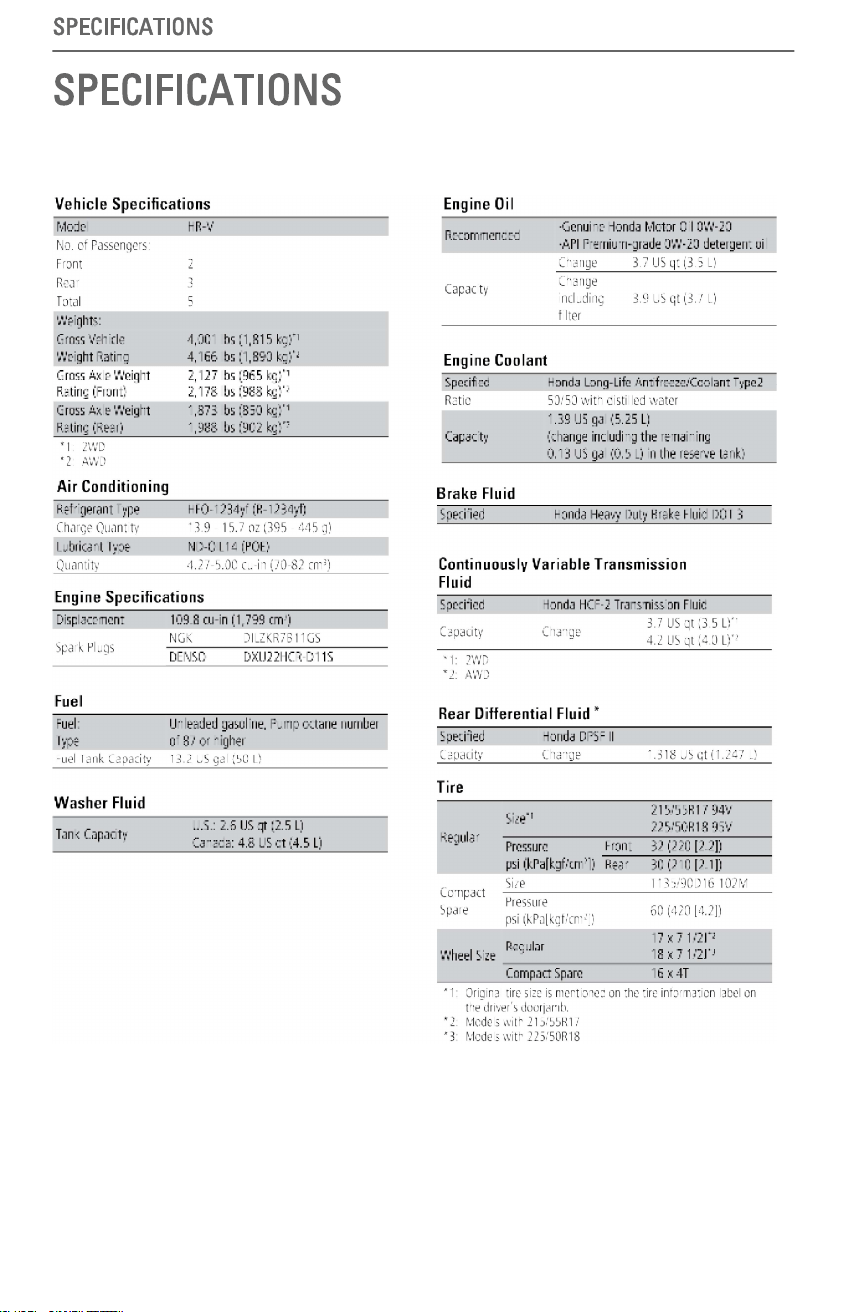
136 | | 137
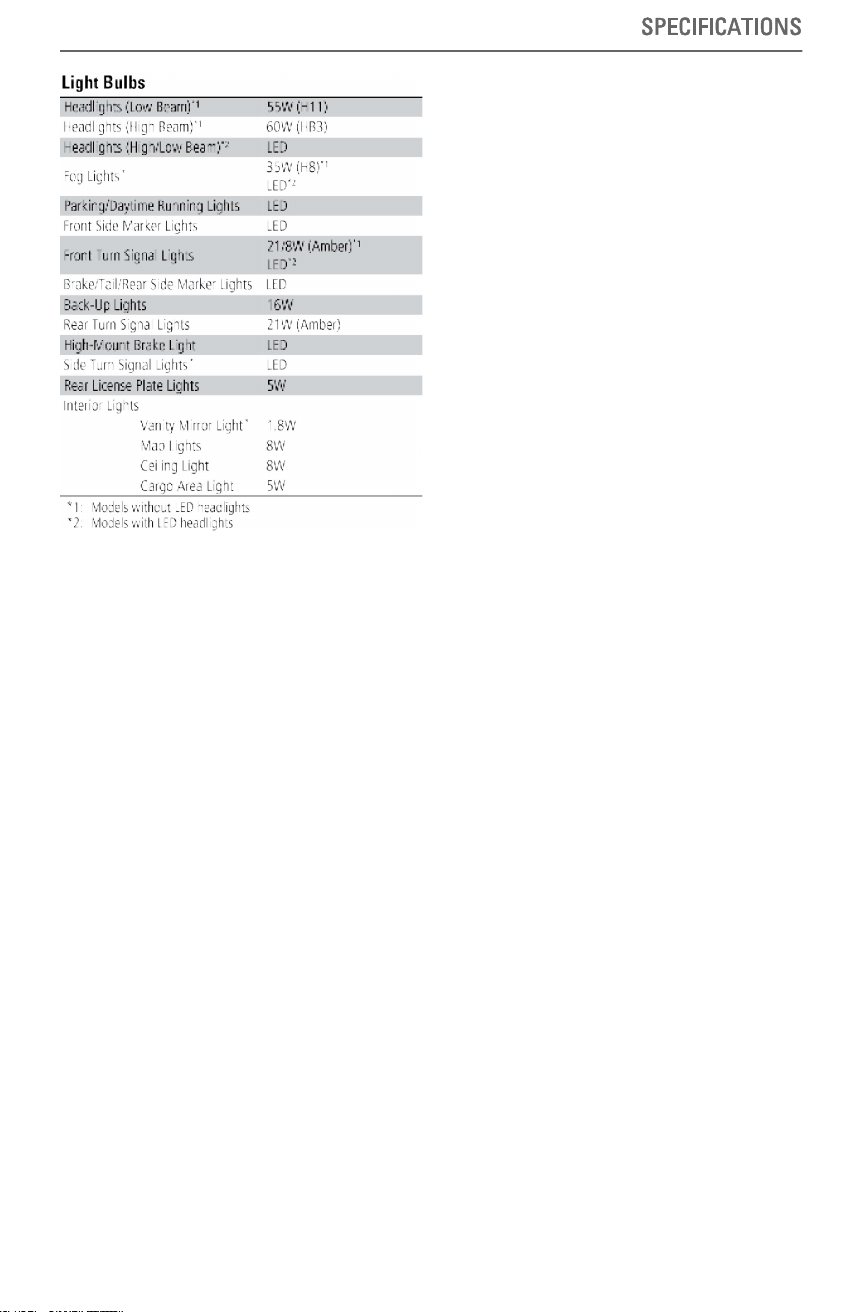
136 | | 137
Learn about information specific to you as a Honda customer and how to get
help.
Below are some frequently asked questions and troubleshooting items that you
may have about the vehicle.
How do I set the vehicle clock?
For vehicles without navigation, see Setting the Clock. For vehicles with
navigation, the time is automatically set using GPS signals.
Why doesn’t the vehicle start when I press the ENGINE START/STOP
button?
The brake pedal must be pressed to start the vehicle.
What is the AUTO setting on my headlight lever?
When in the AUTO position, the vehicle’s exterior lights will automatically
turn on or off depending on the ambient lighting.
Why won’t the driver’s door unlock when I grab the door handle, even
though the smart entry remote
*1
is within range?
If you pull the handle too quickly, the system may not have time to confirm
the door is unlocked. Wait to hear a beep to confirm the door is unlocked. If
you are wearing gloves, the system may be slow to respond.
After my battery was disconnected or went dead, the audio system is
asking for a code. Where do I find this?
In most cases, you do not need to enter a code. Turn on the vehicle, then
press and hold the audio power button until the system reactivates.
Why can’t I operate Pandora
®
*13
through the audio system?
Audio may be streaming through
Bluetooth
®
Audio. Make sure Pandora
®
*13
mode is selected and the phone cable is properly connected to the USB
adapter. Some phones may prompt you to “Allow” a connection.
Is my phone compatible with
Bluetooth
®
features? How do I pair my phone?
To check phone compatibility, visit
handsfreelink.com
(US)
handsfreelink.ca
(Canada). For pairing instructions, see Pairing a Phone.
Every time I press the Talk button, the system gives me voice prompts
*1
.
Can I turn these off?
*1 - If equipped
*13 - US models only, if equipped
138 |
You can press the Talk button a second time to interrupt the guidance. Or,
you can turn guidance on or off permanently via System settings. See Voice
Portal Commands.
The amber indicator with a tire and an exclamation mark is on. What do I
do?
Either your tire pressure is low or you recently filled a tire. See Tire
Pressure Monitoring System (TPMS).
Honda dealer personnel are trained professionals. They should be able to
answer all your questions. If you encounter a problem that your dealership does
not solve to your satisfaction, please discuss it with the dealership’s Service
Manager or General Manager. If you are dissatisfied with the decision made by
the dealership’s management, contact Honda Automobile Customer Service.
American Honda Motor Co., Inc.
Honda Automobile Customer Service
Mail Stop 100-5E-8A
Torrance, CA 90501-2746
Tel: (800) 999-1009
Fax: (310) 783-3023
Twitter:@HondaCustSvc
Honda Canada, Inc.
Customer Relations
180 Honda Blvd.
Markham, ON L6C 0H9
Tel: (888) 946-6329
Fax: (877) 939-0909
E-mail: honda_cr@ch.honda.com
Bella International
P.O. Box 190816
San Juan, PR 00919-0816
Tel: (787) 620-7546
When you call or write, please be provide the following information:
• Vehicle Identification Number
• Date of purchase
• Odometer reading of your vehicle
• Your name, address, and telephone
number
• A detailed description of the
problem
• Name of the dealer who sold the
vehicle to you
| 139

Learn about information specific to you as a Honda customer and how to get
help.
Below are some frequently asked questions and troubleshooting items that you
may have about the vehicle.
How do I set the vehicle clock?
For vehicles without navigation, see Setting the Clock. For vehicles with
navigation, the time is automatically set using GPS signals.
Why doesn’t the vehicle start when I press the ENGINE START/STOP
button?
The brake pedal must be pressed to start the vehicle.
What is the AUTO setting on my headlight lever?
When in the AUTO position, the vehicle’s exterior lights will automatically
turn on or off depending on the ambient lighting.
Why won’t the driver’s door unlock when I grab the door handle, even
though the smart entry remote
*1
is within range?
If you pull the handle too quickly, the system may not have time to confirm
the door is unlocked. Wait to hear a beep to confirm the door is unlocked. If
you are wearing gloves, the system may be slow to respond.
After my battery was disconnected or went dead, the audio system is
asking for a code. Where do I find this?
In most cases, you do not need to enter a code. Turn on the vehicle, then
press and hold the audio power button until the system reactivates.
Why can’t I operate Pandora
®
*13
through the audio system?
Audio may be streaming through
Bluetooth
®
Audio. Make sure Pandora
®
*13
mode is selected and the phone cable is properly connected to the USB
adapter. Some phones may prompt you to “Allow” a connection.
Is my phone compatible with
Bluetooth
®
features? How do I pair my phone?
To check phone compatibility, visit
handsfreelink.com
(US)
handsfreelink.ca
(Canada). For pairing instructions, see Pairing a Phone.
Every time I press the Talk button, the system gives me voice prompts
*1
.
Can I turn these off?
*1 - If equipped
*13 - US models only, if equipped
138 |
You can press the Talk button a second time to interrupt the guidance. Or,
you can turn guidance on or off permanently via System settings. See Voice
Portal Commands.
The amber indicator with a tire and an exclamation mark is on. What do I
do?
Either your tire pressure is low or you recently filled a tire. See Tire
Pressure Monitoring System (TPMS).
Honda dealer personnel are trained professionals. They should be able to
answer all your questions. If you encounter a problem that your dealership does
not solve to your satisfaction, please discuss it with the dealership’s Service
Manager or General Manager. If you are dissatisfied with the decision made by
the dealership’s management, contact Honda Automobile Customer Service.
American Honda Motor Co., Inc.
Honda Automobile Customer Service
Mail Stop 100-5E-8A
Torrance, CA 90501-2746
Tel: (800) 999-1009
Fax: (310) 783-3023
Twitter:@HondaCustSvc
Honda Canada, Inc.
Customer Relations
180 Honda Blvd.
Markham, ON L6C 0H9
Tel: (888) 946-6329
Fax: (877) 939-0909
E-mail: [email protected]
Bella International
P.O. Box 190816
San Juan, PR 00919-0816
Tel: (787) 620-7546
When you call or write, please be provide the following information:
• Vehicle Identification Number
• Date of purchase
• Odometer reading of your vehicle
• Your name, address, and telephone
number
• A detailed description of the
problem
• Name of the dealer who sold the
vehicle to you
| 139
Below is a brief summary of the warranties covering your new vehicle.
Covers your new vehicle, except for the
emissions control system and accessories, against defects in materials and
workmanship.
Covers your vehicle’s emissions control systems. Time, mileage, and
coverage are conditional.
Covers seat belts that fail to function properly.
Covers all exterior body panels that rust
through from the inside.
Covers Honda accessories.
Covers all a Honda replacement parts
against defects in materials and workmanship.
Provides prorated coverage for a
replacement battery purchased from a Honda dealer.
Covers a replacement muffler
for the duration of the ownership.
Restrictions and exclusions apply to all these warranties. See the Warranty
Information booklet or visit
owners.honda.com (U.S)www.myhonda.ca (Canada)
for complete descriptions of each warranty, including time, mileage, and other
conditional limitations.
Your vehicle’s original tires are covered by their manufacturer. Tire warranty
information can be found at
owners.honda.com (U.S.)or www.myhonda.ca
(Canada) .
An owner may obtain further information concerning emission warranties or
report violations of the term of the emission warranties by contacting:
U.S. Environmental Protection Agency
Office of Transportation and Air Quality
Compliance Division, Light-Duty Vehicles Group
Attn: Warranty Complaints
2000 Traverwood Drive
Ann Arbor, MI 48105
Email: [email protected]
140 |
Learn about the available voice commands to help you operate the vehicle. The
system recognizes only those commands shown here. Press the TALK button
before you say a command.
When you press the TALK button, the Voice Portal screen appears. Say one of
the options, and follow the system prompts.
• Phone
• Audio
• Navigation
*2
The system accepts these commands on most screens.
The system accepts these commands on the dedicated screen for the voice
recognition of the audio.
When you press the Talk button and say
“Navigation,”
you can say one of the
options below. Follow the system prompts.
• Show/View map
• Go home
• Find address
• Stop route
• Detour
• Find city
• Recent Places
• Find intersection
*2 - Models with navigation only
*1 - If equipped
| 141
Below is a brief summary of the warranties covering your new vehicle.
Covers your new vehicle, except for the
emissions control system and accessories, against defects in materials and
workmanship.
Covers your vehicle’s emissions control systems. Time, mileage, and
coverage are conditional.
Covers seat belts that fail to function properly.
Covers all exterior body panels that rust
through from the inside.
Covers Honda accessories.
Covers all a Honda replacement parts
against defects in materials and workmanship.
Provides prorated coverage for a
replacement battery purchased from a Honda dealer.
Covers a replacement muffler
for the duration of the ownership.
Restrictions and exclusions apply to all these warranties. See the Warranty
Information booklet or visit
owners.honda.com (U.S)www.myhonda.ca (Canada)
for complete descriptions of each warranty, including time, mileage, and other
conditional limitations.
Your vehicle’s original tires are covered by their manufacturer. Tire warranty
information can be found at
owners.honda.com (U.S.)or www.myhonda.ca
(Canada) .
An owner may obtain further information concerning emission warranties or
report violations of the term of the emission warranties by contacting:
U.S. Environmental Protection Agency
Office of Transportation and Air Quality
Compliance Division, Light-Duty Vehicles Group
Attn: Warranty Complaints
2000 Traverwood Drive
Ann Arbor, MI 48105
Email: complianceinfo@epa.gov
140 |
Learn about the available voice commands to help you operate the vehicle. The
system recognizes only those commands shown here. Press the TALK button
before you say a command.
When you press the TALK button, the Voice Portal screen appears. Say one of
the options, and follow the system prompts.
• Phone
• Audio
• Navigation
*2
The system accepts these commands on most screens.
The system accepts these commands on the dedicated screen for the voice
recognition of the audio.
When you press the Talk button and say
“Navigation,”
you can say one of the
options below. Follow the system prompts.
• Show/View map
• Go home
• Find address
• Stop route
• Detour
• Find city
• Recent Places
• Find intersection
*2 - Models with navigation only
*1 - If equipped
| 141

Airbags.................................. 7–10, 12, 13
Advanced Airbags...............................8
Airbag Care.........................................13
Airbag System Components............ 12
Airbag System Indicators.................10
Front Airbags........................................7
Side Airbags.........................................8
Side Curtain Airbags...........................9
Audio and Connectivity.................53–67
Adjusting the Sound..........................56
Android Auto...................................... 58
Apple CarPlay.....................................57
Bluetooth Audio.................................65
FM/AM Radio..................................... 60
iPod......................................................61
SiriusXM Radio.................................. 60
USB Flash Drive.................................63
USB Port..............................................53
Bluetooth Handsfreelink (HFL).....68–76
Dialing a Number...............................71
Making a Call......................................71
Pairing a Phone..................................70
SMS Text Messaging and E-Mail... 75
Using Speed Dial............................... 74
Using the Phonebook........................72
Braking.......................................88, 89, 99
Anti-Lock Brake System (ABS)....... 89
Brake Assist System.........................89
CMBS...................................................99
Foot Brake...........................................88
Parking Brake.....................................89
Brightness Control............................... 35
Carbon Monoxide Gas...........................4
Child Safety.........................14, 16–19, 33
Child Seat with lap/shoulder belt....18
Child seat with Tether....................... 19
Childproof Door Locks...................... 33
LATCH-Compatible Child Seat.........17
Selecting a Child Seat.......................16
Climate Control System.................48, 49
Heated Seats......................................49
Heated Windshield............................49
Clock.......................................................51
Contact Us...........................................139
Cruise Control................................. 91, 93
Adaptive Cruise Control (ACC)........ 93
Customized Features........................... 50
Doors................................................31, 32
Front Door Inner Handle...................32
Lock Tab.............................................. 32
Master Door Lock Switch................ 32
Engine.................................................. 108
Emergency Engine Stop................. 108
Floor Mats............................................. 45
Frequently Asked Questions/
Troubleshooting............................. 138
Fuel....................................................... 103
Fuel Information...............................103
Refueling...........................................103
Fuses............................................ 114, 116
Changing...........................................116
Location.............................................114
Gear Selection......................................86
Shifting................................................ 86
Headlights................................. 36, 37, 39
Auto High Beam System...................37
Headlight-Wiper Integration............39
HondaLink..............................................57
Immobilizer............................................25
Instrument Panel Indicators........ 23–28
Jump Starting..................................... 106
Lane Keeping Assist System
(LKAS)................................................96
LaneWatch.......................................... 100
Lights......................................................35
Interior Lights.....................................35
Maintenance.............................. 117–135
Battery...............................................125
Brake Fluid........................................126
Engine Oil.......................................... 122
142 |
Maintenance Minder......................118
Opening the Hood............................121
Under the Hood................................120
Window Washer Fluid.................... 125
Wiper Blades....................................126
Mirrors............................................. 46, 47
Door Mirrors.......................................47
Moonroof...............................................34
Multi-View Rear Camera.................. 101
Navigation.......................................77–79
Home Address....................................78
Map Legend........................................79
Routing................................................ 79
Steering Wheel Controls..................77
Street Address...................................79
Overheating.........................................107
Power Outlets 12-Volt..........................53
Readiness Codes................................134
Road Departure Mitigation (RDM).... 97
Safety.................................................3–22
Reporting Safety Defects.................22
Safety Label Locations..................... 21
Seat Belts............................................5–7
Fastening a Seat Belt..........................6
Inspection.............................................6
Lap/Shoulder Belts..............................5
Proper Use............................................5
Shoulder Anchor..................................7
Seating.......................................40, 43, 44
Driver Seat..........................................40
Head Restraints................................. 43
Rear Seats.......................................... 44
Smart Entry System..................... 29, 105
Specifications.............................136, 137
Light Bulbs................................ 136, 137
Steering Wheel Adjusting...................46
Tires......................109, 110, 112, 128–132
Flat Tire..............................................110
Replacing Flat Tire...........................112
Tire and Loading Information
Label..............................................129
Tire and Wheel Replacement........130
Tire Chains........................................ 131
Tire Identification Number (TIN)...132
Tire Information................................128
Tire Labeling..................................... 131
Tire Pressure Monitoring System
(TPMS)..........................................109
Tire Quality Grading.........................132
Tire Service Life............................... 130
Tire Terminology.............................. 132
Wear Indicators...............................129
Winter Tires...................................... 131
Towing............................................83, 108
Emergency Towing..........................108
Towing a Trailer..................................83
Turn Signals...........................................37
Vehicle Stability Assist System
(VSA)..................................................90
Voice Command Index.......................141
Walk Away Auto Lock......................... 30
Warranty..............................................140
Warranty Coverages..........................140
Window..................................................33
Power Windows................................ 33
Wipers..............................................39, 40
Intermittent Wipers...........................40
| 143

Airbags.................................. 7–10, 12, 13
Advanced Airbags...............................8
Airbag Care.........................................13
Airbag System Components............ 12
Airbag System Indicators.................10
Front Airbags........................................7
Side Airbags.........................................8
Side Curtain Airbags...........................9
Audio and Connectivity.................53–67
Adjusting the Sound..........................56
Android Auto...................................... 58
Apple CarPlay.....................................57
Bluetooth Audio.................................65
FM/AM Radio..................................... 60
iPod......................................................61
SiriusXM Radio.................................. 60
USB Flash Drive.................................63
USB Port..............................................53
Bluetooth Handsfreelink (HFL).....68–76
Dialing a Number...............................71
Making a Call......................................71
Pairing a Phone..................................70
SMS Text Messaging and E-Mail... 75
Using Speed Dial............................... 74
Using the Phonebook........................72
Braking.......................................88, 89, 99
Anti-Lock Brake System (ABS)....... 89
Brake Assist System.........................89
CMBS...................................................99
Foot Brake...........................................88
Parking Brake.....................................89
Brightness Control............................... 35
Carbon Monoxide Gas...........................4
Child Safety.........................14, 16–19, 33
Child Seat with lap/shoulder belt....18
Child seat with Tether....................... 19
Childproof Door Locks...................... 33
LATCH-Compatible Child Seat.........17
Selecting a Child Seat.......................16
Climate Control System.................48, 49
Heated Seats......................................49
Heated Windshield............................49
Clock.......................................................51
Contact Us...........................................139
Cruise Control................................. 91, 93
Adaptive Cruise Control (ACC)........ 93
Customized Features........................... 50
Doors................................................31, 32
Front Door Inner Handle...................32
Lock Tab.............................................. 32
Master Door Lock Switch................ 32
Engine.................................................. 108
Emergency Engine Stop................. 108
Floor Mats............................................. 45
Frequently Asked Questions/
Troubleshooting............................. 138
Fuel....................................................... 103
Fuel Information...............................103
Refueling...........................................103
Fuses............................................ 114, 116
Changing...........................................116
Location.............................................114
Gear Selection......................................86
Shifting................................................ 86
Headlights................................. 36, 37, 39
Auto High Beam System...................37
Headlight-Wiper Integration............39
HondaLink..............................................57
Immobilizer............................................25
Instrument Panel Indicators........ 23–28
Jump Starting..................................... 106
Lane Keeping Assist System
(LKAS)................................................96
LaneWatch.......................................... 100
Lights......................................................35
Interior Lights.....................................35
Maintenance.............................. 117–135
Battery...............................................125
Brake Fluid........................................126
Engine Oil.......................................... 122
142 |
Maintenance Minder......................118
Opening the Hood............................121
Under the Hood................................120
Window Washer Fluid.................... 125
Wiper Blades....................................126
Mirrors............................................. 46, 47
Door Mirrors.......................................47
Moonroof...............................................34
Multi-View Rear Camera.................. 101
Navigation.......................................77–79
Home Address....................................78
Map Legend........................................79
Routing................................................ 79
Steering Wheel Controls..................77
Street Address...................................79
Overheating.........................................107
Power Outlets 12-Volt..........................53
Readiness Codes................................134
Road Departure Mitigation (RDM).... 97
Safety.................................................3–22
Reporting Safety Defects.................22
Safety Label Locations..................... 21
Seat Belts............................................5–7
Fastening a Seat Belt..........................6
Inspection.............................................6
Lap/Shoulder Belts..............................5
Proper Use............................................5
Shoulder Anchor..................................7
Seating.......................................40, 43, 44
Driver Seat..........................................40
Head Restraints................................. 43
Rear Seats.......................................... 44
Smart Entry System..................... 29, 105
Specifications.............................136, 137
Light Bulbs................................ 136, 137
Steering Wheel Adjusting...................46
Tires......................109, 110, 112, 128–132
Flat Tire..............................................110
Replacing Flat Tire...........................112
Tire and Loading Information
Label..............................................129
Tire and Wheel Replacement........130
Tire Chains........................................ 131
Tire Identification Number (TIN)...132
Tire Information................................128
Tire Labeling..................................... 131
Tire Pressure Monitoring System
(TPMS)..........................................109
Tire Quality Grading.........................132
Tire Service Life............................... 130
Tire Terminology.............................. 132
Wear Indicators...............................129
Winter Tires...................................... 131
Towing............................................83, 108
Emergency Towing..........................108
Towing a Trailer..................................83
Turn Signals...........................................37
Vehicle Stability Assist System
(VSA)..................................................90
Voice Command Index.......................141
Walk Away Auto Lock......................... 30
Warranty..............................................140
Warranty Coverages..........................140
Window..................................................33
Power Windows................................ 33
Wipers..............................................39, 40
Intermittent Wipers...........................40
| 143

Operating, servicing and maintaining a passenger
vehicle or off-highway motor vehicle can expose you to chemicals
including engine exhaust, carbon monoxide, phthalates, and lead,
which are known to the State of California to cause cancer and
birth defects or other reproductive harm. To minimize exposure,
avoid breathing exhaust, do not idle the engine except as
necessary, service your vehicle in a well-ventilated area and wear
gloves or wash your hands frequently when servicing your
vehicle. For more information go to
www.p65Warnings.ca.gov/
passenger-vehicle
.
The airbags, seat belt tensioners, and CR-type batteries in this vehicle may
contain perchlorate materials-special handling may apply. See
www.dtsc.ca.gov/hazardouswaste/perchlorate
/ for more information.
Your vehicle comes equipped with software, which is governed by the End User
License Agreement in this vehicle’s Owner’s Manual, and which contains a
binding arbitration clause. Please refer to the End User License Agreement for
the terms and conditions governing your use of the installed software, as well
as the applications, services, functions, and content provided through the
software. Your use of the installed software will serve as your consent to the
terms and conditions of the End User License Agreement.
You may opt out of the arbitration provisions within 30 days of your initial use of
the Software by sending a signed, written notice to HONDA at American Honda
Motor Co., Inc. Honda Automobile Customer Services Mail Stop 100-5E-8A ,
1919 Torrance Blvd. Torrance, CA 90501-2746.
Operating, servicing and maintaining a passenger
vehicle or off-highway motor vehicle can expose you to chemicals
including engine exhaust, carbon monoxide, phthalates, and lead,
which are known to the State of California to cause cancer and
birth defects or other reproductive harm. To minimize exposure,
avoid breathing exhaust, do not idle the engine except as
necessary, service your vehicle in a well-ventilated area and wear
gloves or wash your hands frequently when servicing your
vehicle. For more information go to
www.p65Warnings.ca.gov/
passenger-vehicle
.
The airbags, seat belt tensioners, and CR-type batteries in this vehicle may
contain perchlorate materials-special handling may apply. See
www.dtsc.ca.gov/hazardouswaste/perchlorate
/ for more information.
Your vehicle comes equipped with software, which is governed by the End User
License Agreement in this vehicle’s Owner’s Manual, and which contains a
binding arbitration clause. Please refer to the End User License Agreement for
the terms and conditions governing your use of the installed software, as well
as the applications, services, functions, and content provided through the
software. Your use of the installed software will serve as your consent to the
terms and conditions of the End User License Agreement.
You may opt out of the arbitration provisions within 30 days of your initial use of
the Software by sending a signed, written notice to HONDA at American Honda
Motor Co., Inc. Honda Automobile Customer Services Mail Stop 100-5E-8A ,
1919 Torrance Blvd. Torrance, CA 90501-2746.
31T7AG30
OG08882
00X31-T7A-G300
2019 Honda HR-V Owner's Guide
©
2018 Honda Motor Co., Ltd. — All Rights Reserved Printed in U.S.A.