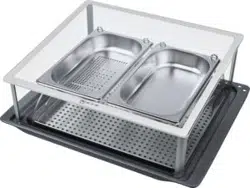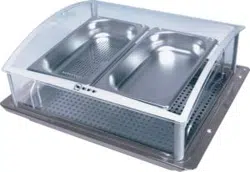
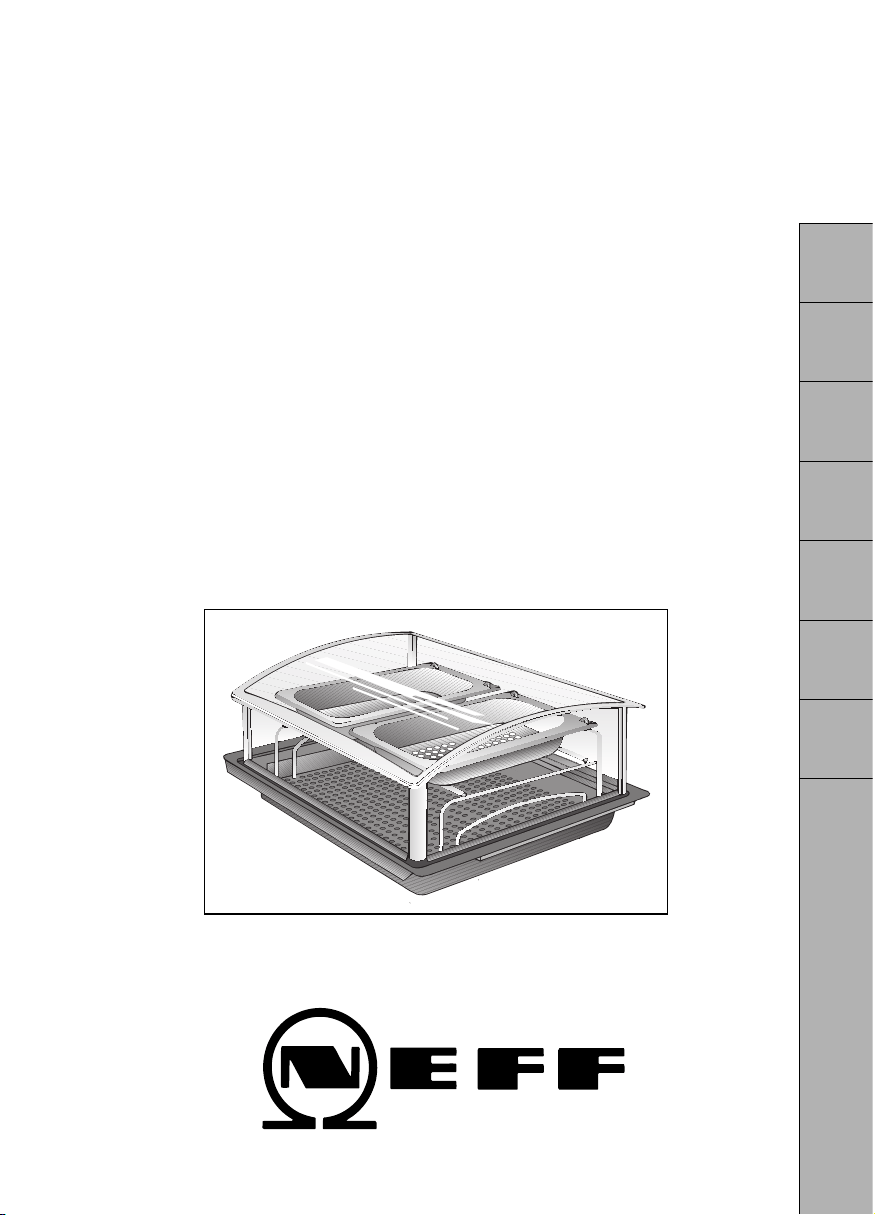
de Gebrauchsanweisung
System-Dampfgarer
en Instructions for use
System steam cooker
fr Mode d’emploi
Ensemble de cuisson à la vapeur
nl Gebruiksaanwijzing
Systeem-stoomkoker
it Istruzioni per l’uso
Sistema di cottura a vapore
es Instrucciones para el uso
Sistema de horneado a vapor
el
Οδηγίες χρήσεως
Σύστηµα µαγειρέµατος στον ατµ
de
en
fr
nl
it
es
el
2
de Seite 02–07 nl pagina 20 – 25 el Σελίδα 38 – 43
en page 08–13 it pagina 26 – 31
fr page 14 – 19 es página 32 – 37
Hinweise zur Entsorgung
❑ Altgeräte sind kein wertloser Abfall.
Durch umweltgerechte Entsorgung
können wertvolle Rohstoffe
wiedergewonnen werden.
❑ Ihr neues Gerät wurde auf dem Weg zu
Ihnen durch die Verpackung geschützt.
Alle eingesetzten Materialien sind
umweltverträglich und wieder
verwertbar. Bitte helfen Sie mit und
entsorgen Sie die Verpackung
umweltgerecht.
Über aktuelle Entsorgungswege
informieren Sie sich bitte bei Ihrem
Fachhändler oder bei Ihrer
Gemeindeverwaltung.
Worauf Sie achten müssen
Sicherheitshinweise
❑ Benutzen Sie das Gerät nur zum
Dämpfen von Speisen.
–Verwenden Sie als Heizsystem
nur Unterhitze
w.
– Andere Anwendungen bzw.
Heizsysteme sind nicht zulässig.
❑ Die Oberflächen von Heiz- und Koch-
geräten werden bei Betrieb heiß. Halten
Sie Kinder grundsätzlich fern.
❑ Beim Arbeiten mit dem Dampfgarer
entsteht heißer Wasserdampf.
Vorsicht beim Öffnen der Backofentür
und beim Anheben des Glasdeckels.
❑ Bevor Sie das neue Gerät benutzen,
lesen Sie bitte sorgfältig die
Gebrauchsanweisung.
Sie enthält wichtige Informationen für
Ihre Sicherheit sowie zum Gebrauch und
zur Pflege des Gerätes.
❑ Bewahren Sie die Gebrauchsanweisung
ggf. für einen Nachbesitzer gut auf.
❑ Ist das Gerät beschädigt, dürfen Sie es
nicht in Betrieb nehmen.
❑ Reinigen Sie den Dampfgarer und alle
Zubehörteile mit heißer Spüllauge.
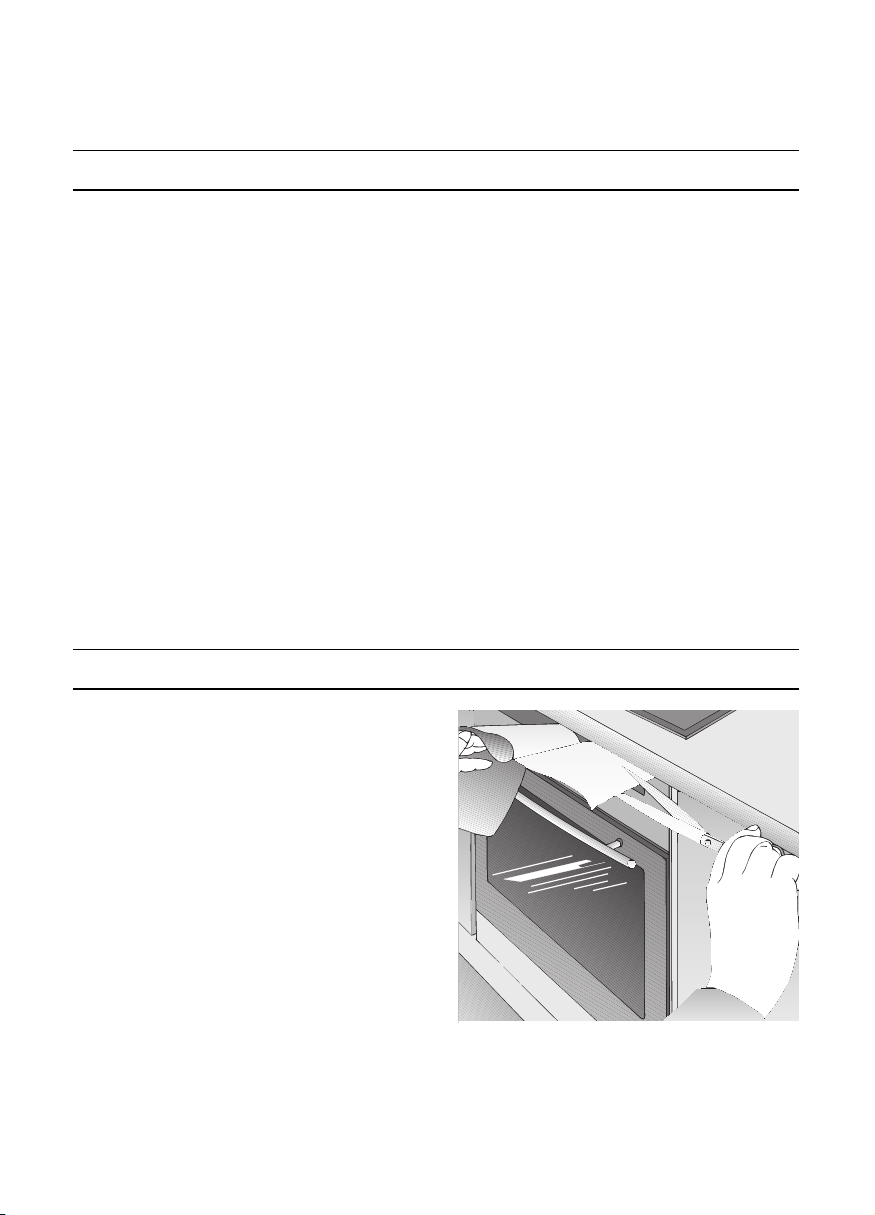
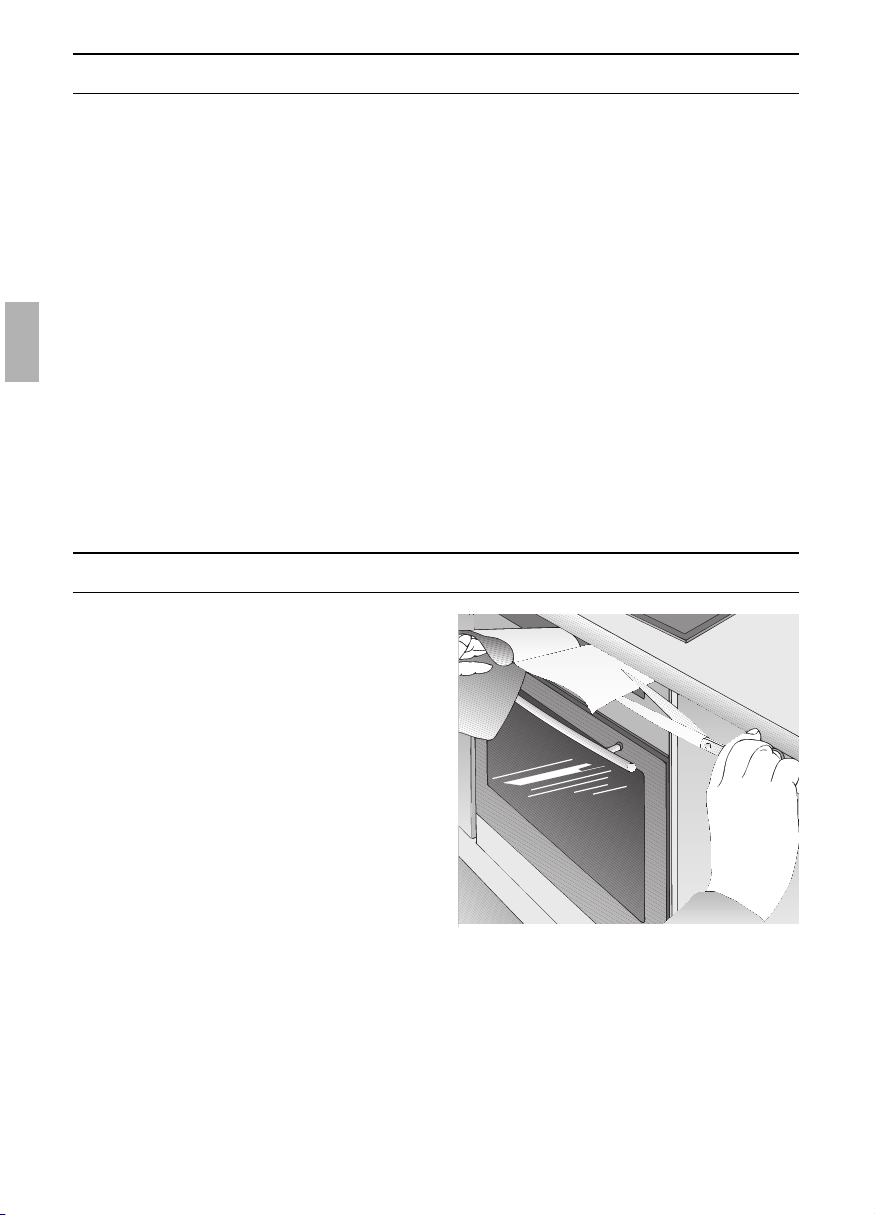
❑ Kleben Sie die beiliegende Schutzfolie
unter den Vorsprung der Arbeitsplatte.
Dazu die Schutzfolie zuschneiden,
abziehen und ankleben.
Vor dem ersten Benutzen
Vor dem ersten Benutzen
3
1
2
3
4
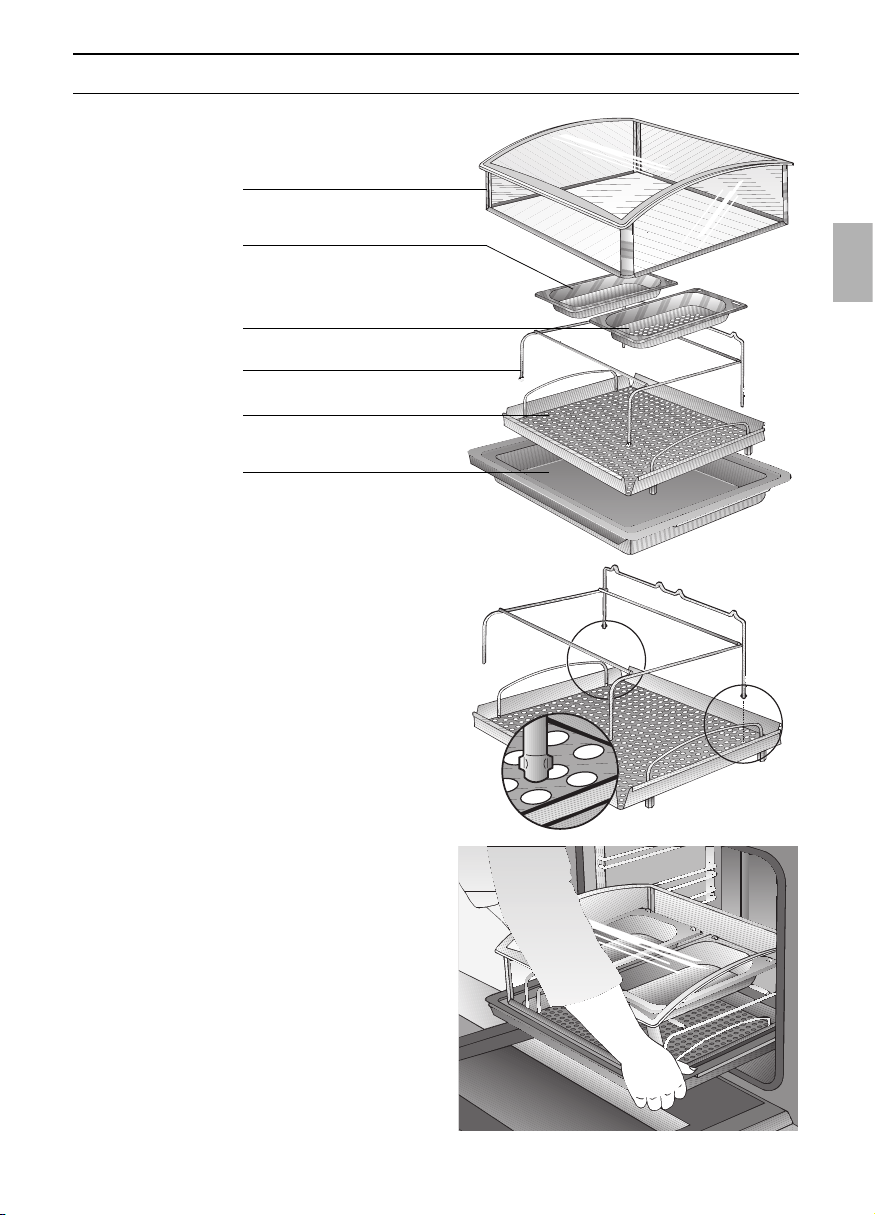
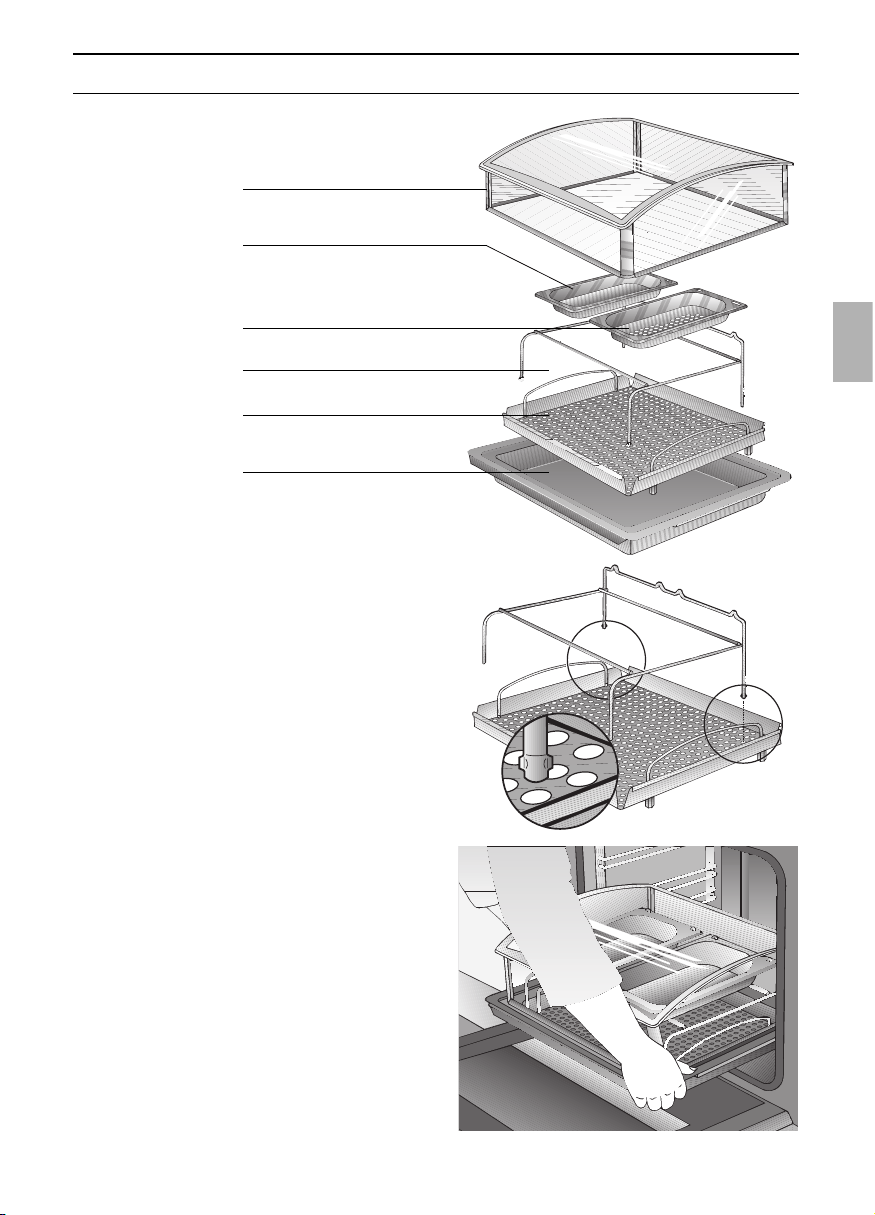
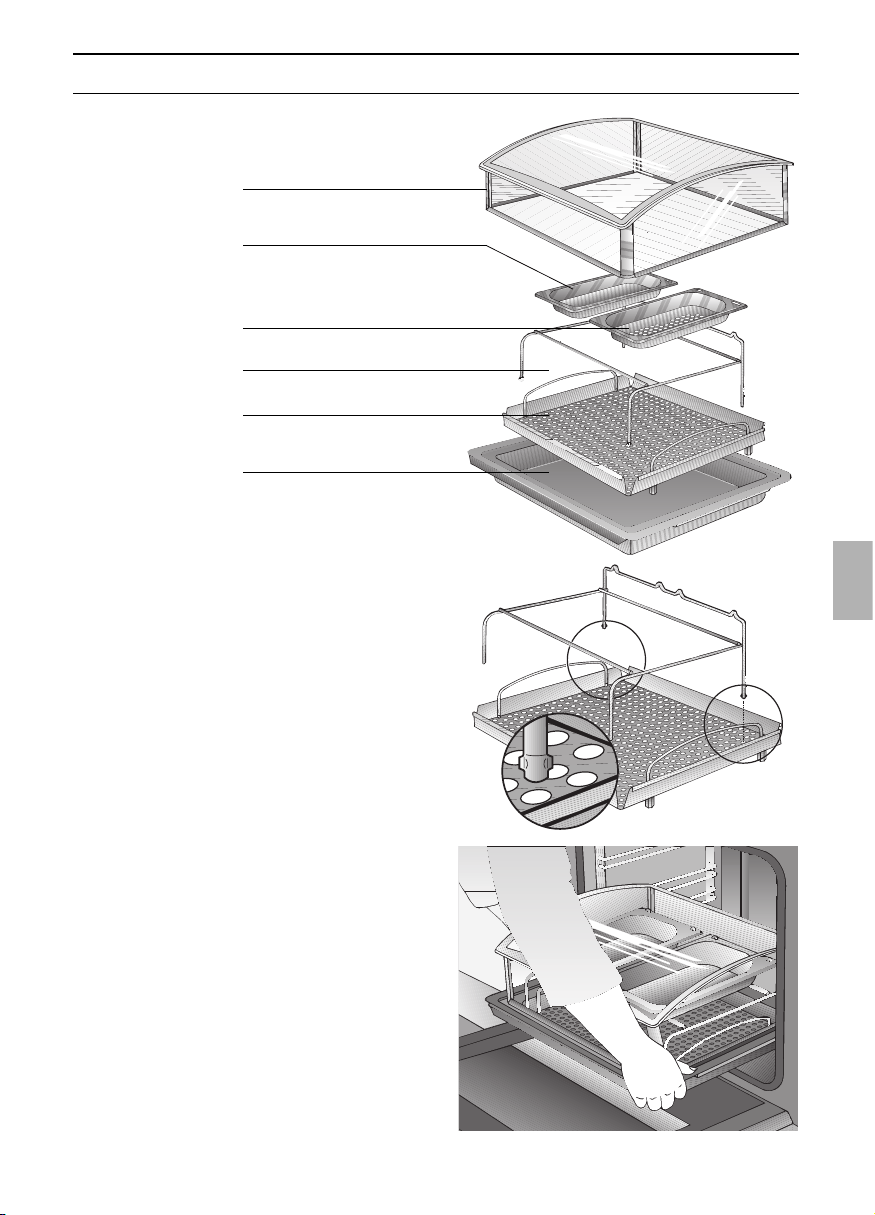
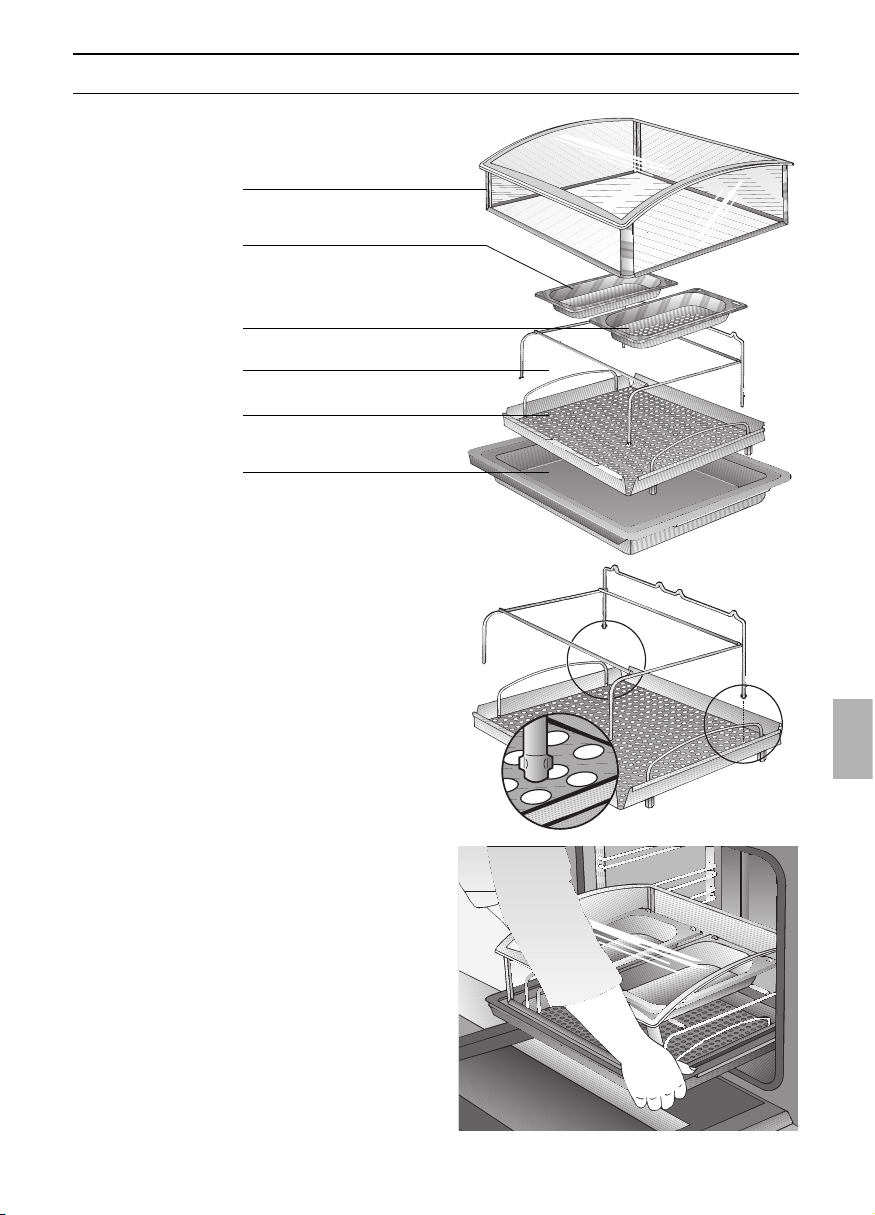
Gestell einsetzen
❑ Setzen Sie das Gestell so ein, dass die
Bügel hinten in das zweite Loch
eintauchen.
Einschubhöhe
❑ Schieben Sie den Dampfgarer
grundsätzlich in die Einschubhöhe 1
ein.
Glasdeckel
Reis- und Soßenschale
Kleiner Dämpfeinsatz
Gestell
Großer Dämpfeinsatz
Auflaufpfanne
4
Hinweise:
❑ Die Basis des Dampfgarens bildet immer
die Auflaufpfanne, der große
Dämpfeinsatz und der Glasdeckel.
❑ Für größere Mengen und zur
Zubereitung von Reis oder Soßen
können Sie zusätzlich das Gestell mit
den Gargutbehältern verwenden.
❑ Verwenden Sie nur die mitgelieferten
Originalteile.
Hinweise:
❑ Die Auflaufpfanne können Sie auch
einzeln z. B. für die Zubereitung von
großen Auflaufmengen verwenden.
❑ Weitere Angaben zum Dampfgaren
siehe beiliegende Broschüre.
Garen
Bedienung:
1. Heizen Sie den Backofen 10 Minuten
vor.
Einstellung:
w 150° C.
Andere Einstellungen sind nicht
zulässig.
2. Geben Sie Wasser in die Auflaufpfanne.
– Menge siehe Gartabelle oder
beiliegende Broschüre.
–Verwenden Sie nur normales
Leitungswasser, kein destilliertes
Wasser.
3. Bestücken Sie den Dampfgarer mit dem
Gargut.
4. Setzen Sie den Glasdeckel so auf, dass
er umlaufend auf der Auflaufpfanne
aufliegt.
5. Schieben Sie den Dampfgarer in die
Einschubhöhe 1 ein.
Hinweise:
❑ Während des Garvorganges sollten Sie
die Backofentür nicht öffnen.
Ausnahme: Kombinieren von
Ausnahme: verschiedenem Gargut mit
Ausnahme: großen Unterschieden bei
Ausnahme: den Garzeiten.
❑ Die Garzeit wird durch die Größe des
Gargutes bestimmt.
Bei gleichzeitigem Garen von
Lebensmitteln mit unterschiedlichen
Garzeiten gilt:
– schneiden Sie die Lebensmittel mit
der längeren Garzeit in kleinere
Stücke
– oder verlängern Sie die Garzeit für
empfindliche Lebensmittel indem Sie
größere Stücke garen.
❑ Grundsätzlich gilt: 500 ml Wasser.
Ausnahme:
Quellende Lebensmittel (z. B. Kartoffeln)
und Zutaten mit langen Garzeiten
benötigen 750 ml Wasser.
5
Garen
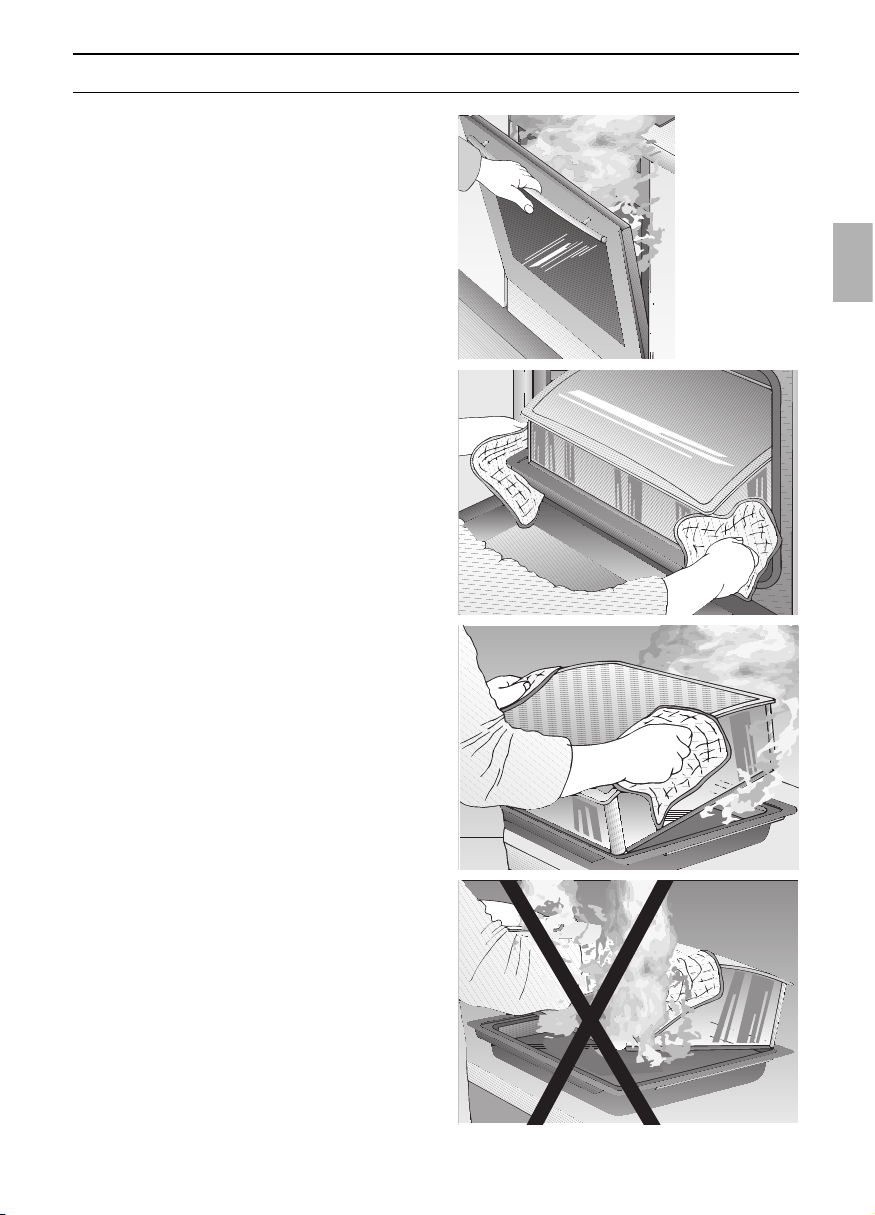
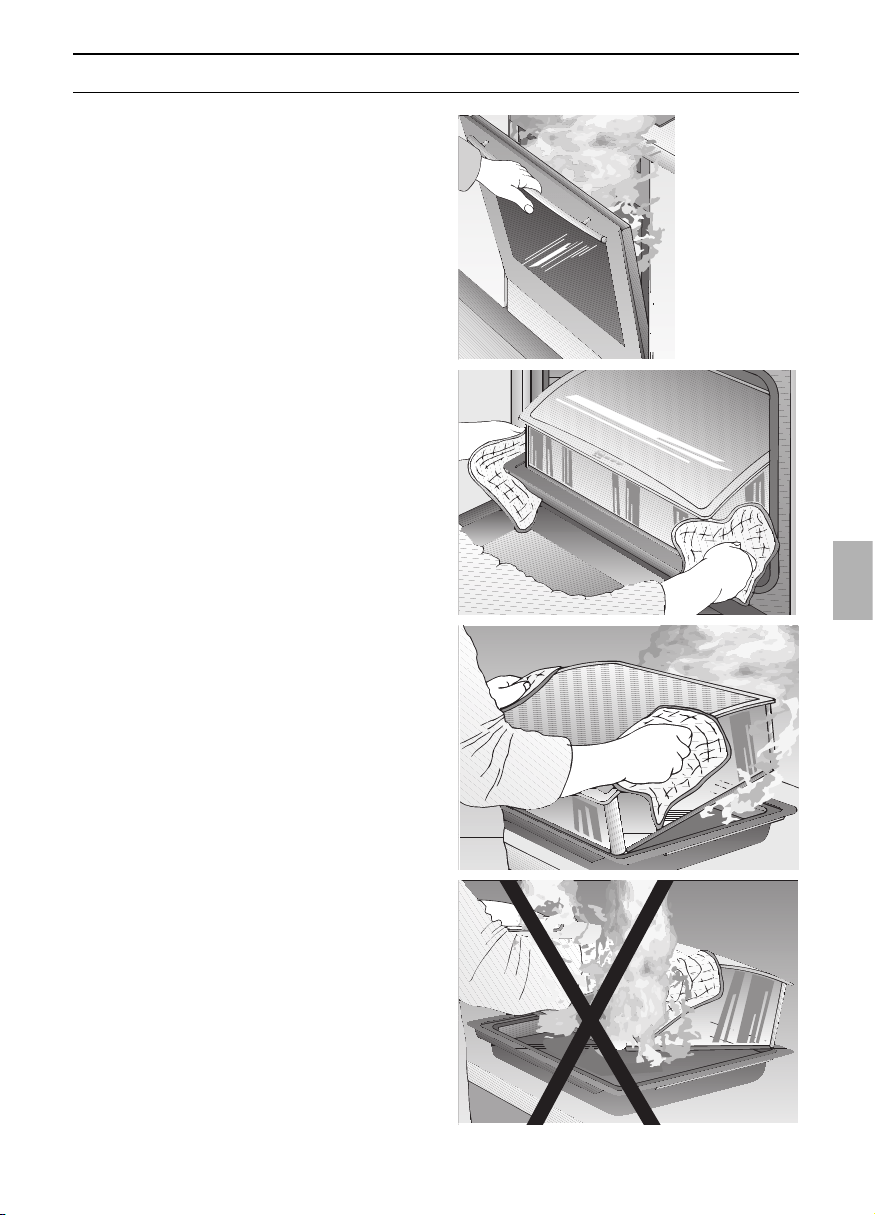
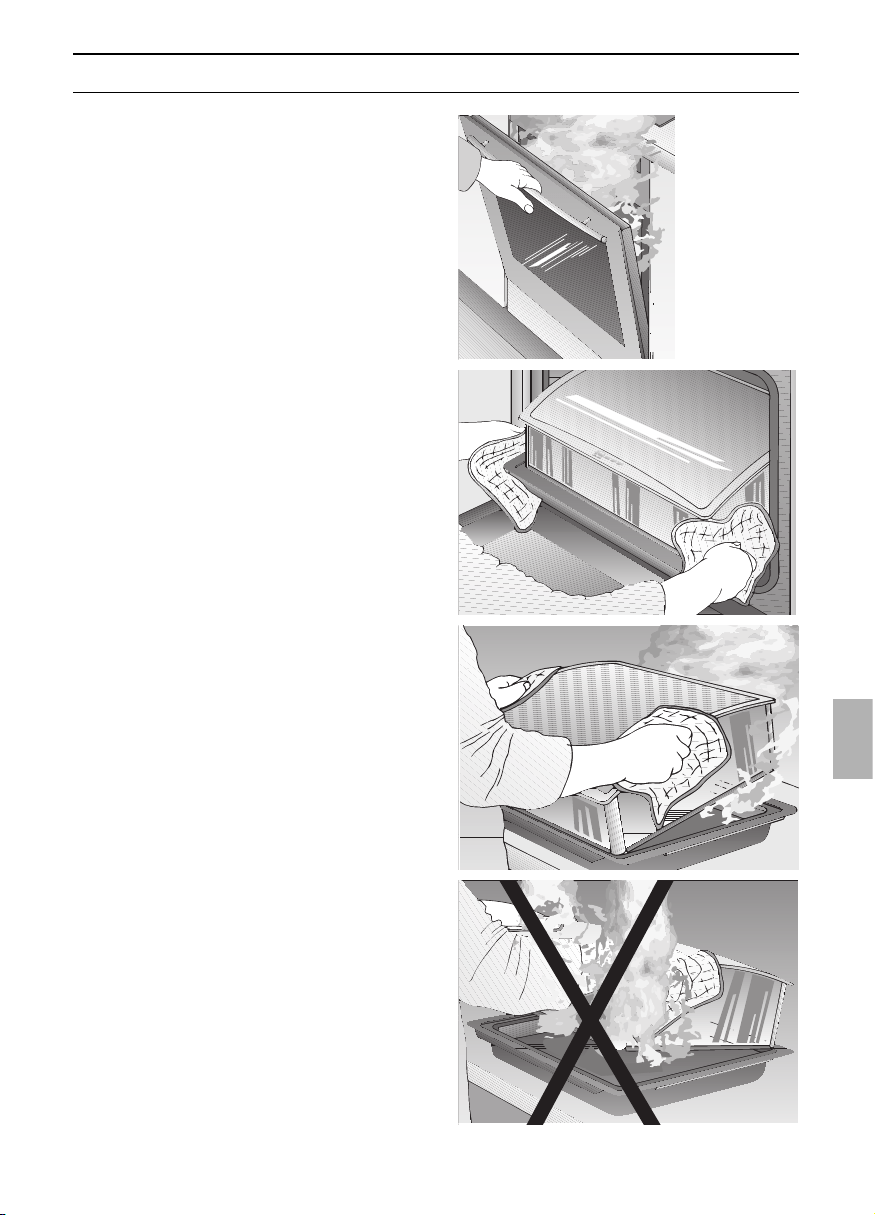
Dampfgarer aus dem
Backofen entnehmen:
1. Öffnen Sie langsam die Backofentür.
Beim Öffnen entweicht heißer
Dampf.
2. Nehmen Sie den Dampfgarer aus dem
Backofen.
Verwenden Sie dazu geeignete
Topflappen.
3. Stellen Sie den Dampfgarer ab.
Nicht auf der Backofentür.
4. Nehmen Sie den Glasdeckel ab.
Hinten anheben, damit der heiße
Dampf hinten entweichen kann.
Nicht vorne anheben.
Verbrennungsgefahr durch heißen
Dampf.
Nach dem Dampfgaren:
❑ Lassen Sie den Backofen abkühlen.
❑ Wischen Sie den Backofen mit klarem
Wasser aus.
❑ Reiben Sie mit einem weichen Tuch
trocken:
–den Backofeninnenraum
– hinter der Backofentürdichtung
– die Tropfrinne zwischen Backofentür
und Backofen.
Hängen Sie ggf. die Backofentür aus
(siehe Gebrauchsanweisung des
Backofens).
6
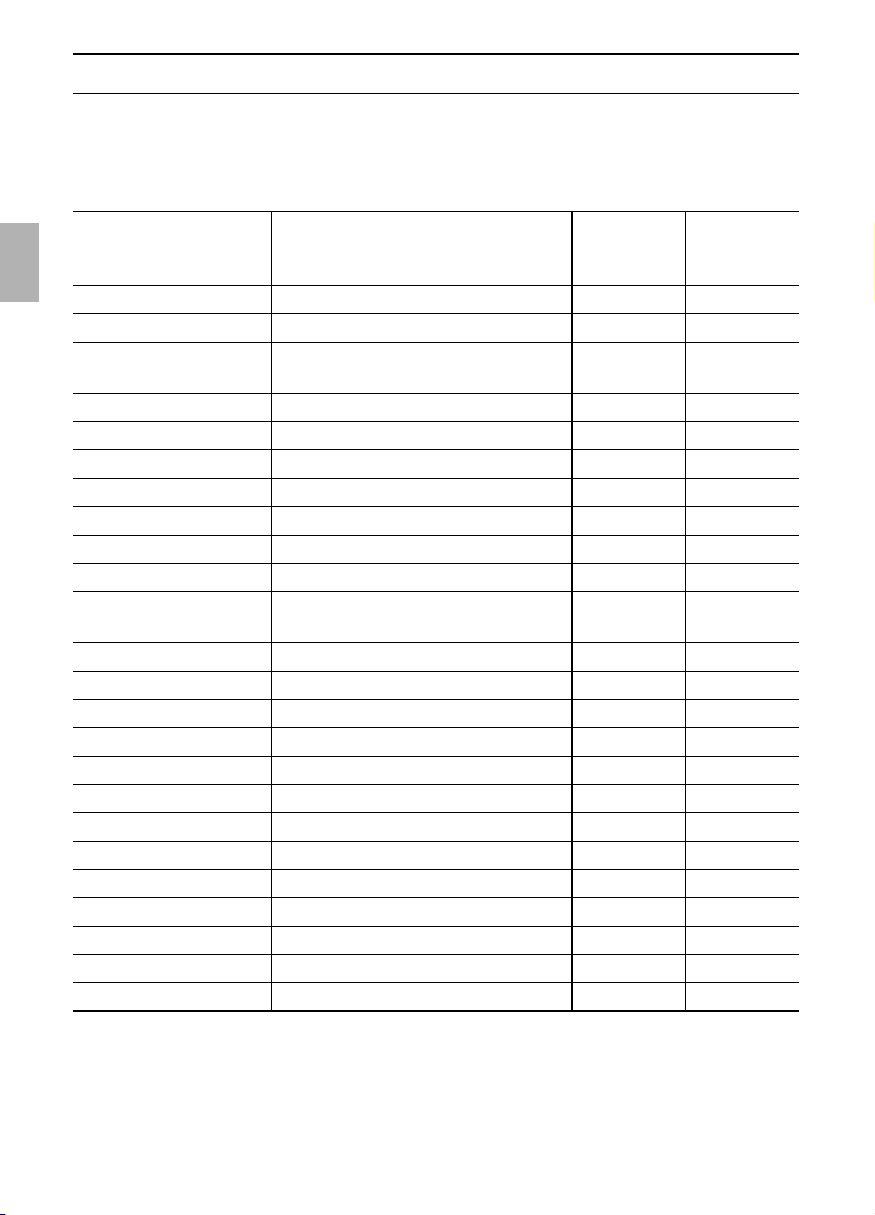
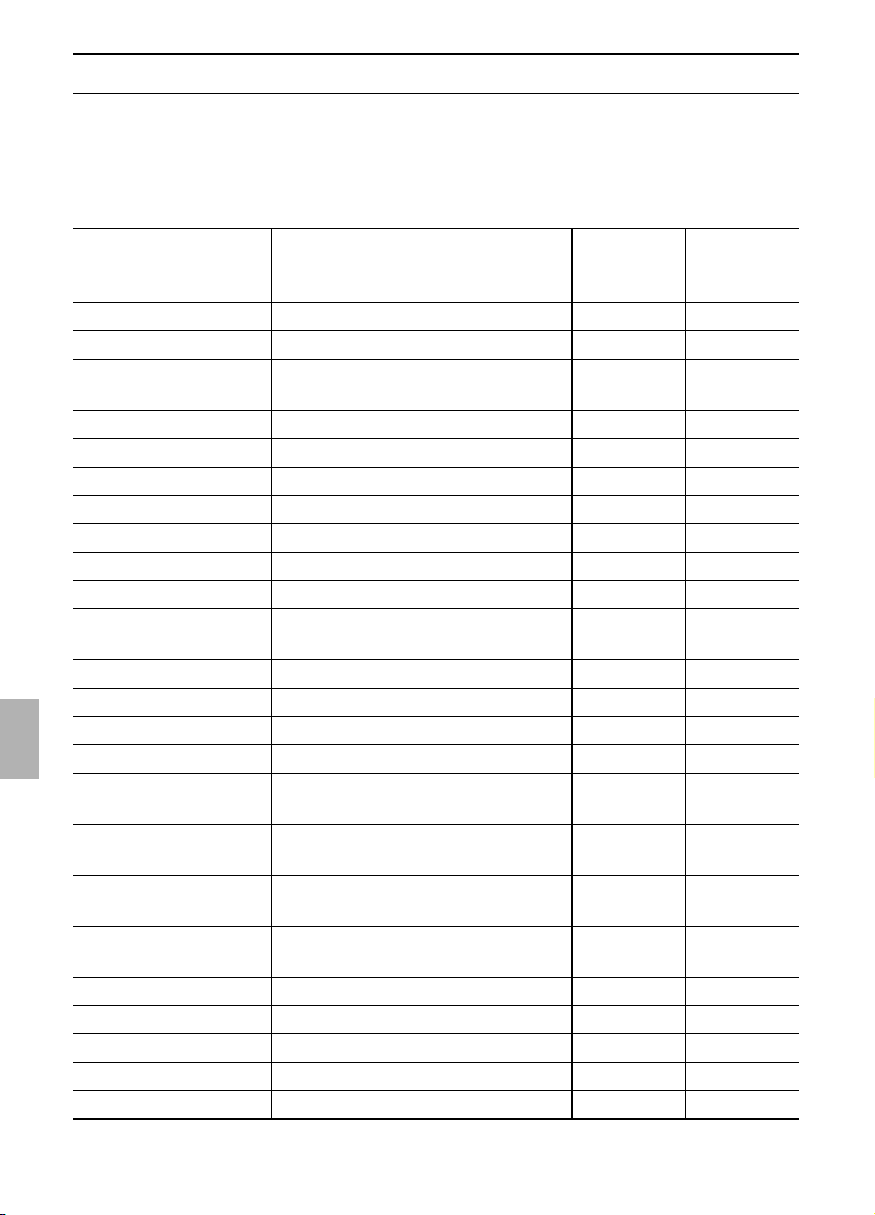
Gartabelle
Gargut Aufbereitung Dämpf- Garzeit
flüssigkeit in Minuten
in ml
❑ Die Angaben in der Gartabelle sind Richtwerte.
❑ Die Angaben können je nach Art, Größe und Reife des Gargutes variieren.
❑ Tiefgefrorene Lebensmittel vor dem Garen nicht auftauen.
Die Garzeit verlängert sich um ca. 5. Minuten.
Blumenkohl Röschen (Strunk eingeschnitten) 500 30 – 35
Blumenkohl ganz 500 35 – 40
Blumenkohl,
tiefgefroren Röschen 500 25 – 30
Brokkoli, frisch Röschen (Strunk eingeschnitten) 500 30 – 35
Brokkoli, tiefgefroren Röschen 500 25 – 30
Erbsen, frisch 500 25 – 30
Erbsen, tiefgefroren 500 20 – 25
Fenchel, frisch halbiert, Strunk entfernt 500 35 – 45
Fenchel, frisch Scheiben 500 20 – 25
Grüne Bohnen, frisch 500 30 – 40
Grüne Bohnen,
tiefgefroren 500 30 – 35
Karotten Scheiben, Stifte 500 35 – 40
Knollensellerie Scheiben, Stifte 500 35 – 40
Lauch feine Streifen oder Rauten 500 30 – 35
Maiskolben ganz 750 55 – 60
Paprika in Streifen geschnitten, je nach Reife 500 30 – 40
Pellkartoffeln je nach Größe 750 55 – 65
Rosenkohl, frisch Strunk einschneiden 500 35 – 40
Rosenkohl, tiefgefroren 500 30 – 35
Salzkartoffel schmale Kartoffelspalten 750 30 – 35
Salzkartoffel geviertelt 750 35 – 45
Zucchini in der Länge halbiert, Scheiben 500 25 – 30
Stangenspargel je nach Dicke 500 35 – 45
Spargel, grün je nach Dicke 500 30 – 40
7
Wichtige Hinweise:
❑ Verwenden Sie zum Reinigen keine
Scheuermittel, keine scharfen Mittel und
keine kratzenden Gegenstände.
❑ Entfernen Sie Kalkrückstände mit einem
handelsüblichen Essigreiniger.
Spülen Sie mit klarem Wasser nach und
reiben Sie mit einem weichen Tuch
trocken.
Glasdeckel:
❑ Kratzen Sie angetrocknete
Speisenrückstände nicht ab, sondern
weichen Sie diese mit Spüllauge auf.
Noch Fragen? Sie erreichen uns:
Per Post: Per Fax: Per Telefon:
Postfach 10 02 50 Fax: 0 89 / 45 90-30 99
D-80076 München Im Internet:
http.//www.neff.de
1 0,12/min. DTAG
Reinigen und Pflegen
Gartabelle
Gargut Aufbereitung Dämpf- Garzeit
flüssigkeit in Minuten
in ml
Eier, hartgekocht bis zu 20 Stück 500 25 – 30
Eierstich in Porzellantassen 500 35 – 40
Reis 200 g Reis und 350 ml Wasser 750 40 – 45
Fischfilet z. B. Scholle 500 20 – 25
Fischsteaks ca. 150 – 200 g / Scheibe 500 25 – 30
z. B. Lachs, Thunfisch
Portionsfische ca. 200 – 250 g / Stück 500 20 – 25
z. B. Forelle, Makrele
Große Fische ca. 800 – 1000 g 500 30 – 40
z. B. Forelle, Brasse
Rindfleisch ca. 1000 g je nach Dicke 750 75 – 90
Schweinefleisch Filet ca. 500 g / Stück 750 40 – 50
Geflügelfleisch ca. 200 g / Stück; 500 35 – 45
z. B. Puten- oder Hähnchenbrust
8
Disposal Instructions
❑ Old appliances are not useless waste.
Valuable raw materials can be recovered
through a process of ecological
recycling.
❑ The packaging protected your new
appliance while it was being transported
to you. All of the materials in use are
ecological and can be recycled. Please
make a contribution and dispose of the
packaging properly.
Your dealer or your local government
authorities would be happy to inform
you of the best means of disposal.
What must I observe?
Safety Instructions
❑ Only use the appliance to steam cook
foods.
–Only use lower heat
w as the heating
system.
– Other applications or heating
systems are prohibited.
❑ The surfaces of heaters and cookers
become hot when they are in operation.
Keep children away from hot surfaces.
❑ Hot steam is generated by the steam
cooker.
Take care when opening the oven door
or lifting the glass lid.
❑ Read the instructions for use carefully
before using the appliance for the first
time.
These instructions contain important
information on using and caring for your
appliance.
❑ Keep the instructions for use in a safe
place.
If you decide to sell the appliance, the
next owner will need them.
❑ Do not use the appliance if it is
damaged.
❑ Clean the steam cooker and all of the
accessories with warm soapy water.
❑ Stick the enclosed protective foil
beneath the protruding part of the
worktop. Cut the protective foil to fit, pull
of cover and stick in place.
Before First Use
1
2
3
4
9
Before First Use
Fitting the Frame
❑ Fit the frame so that the back feet catch
in the second hole.
Insert Height
❑ Always insert the steam cooker in the
first rack.
Glass lid
Rice and sauce dish
Small steam insert
Frame
Large steam insert
Casserole dish
10
Instructions:
❑ The casserole dish, the large steam
insert and the glass lid are always the
basis for steam cooking.
❑ You may also use the frame with the
cooking containers to prepare large
quantities or rice and sauces.
❑ Only use the enclosed original parts.
Hinweise:
❑ You can also use the casserole dish
separately, for example to prepare large
quantities of casserole.
❑ The enclosed brochure contains further
information on steam cooking.
Cooking
Operation:
1. Preheat the oven for 10 minutes.
Setting:
w 150° C.
Other settings are not permitted.
2. Fill the casserole dish with water.
– See cooking table or enclosed
brochure for quantities.
–Only use normal tap water, not
distilled water.
3. Put the food in the steam cooker.
4. Put the lid on so that it sits snugly on
the casserole dish.
5. Insert the steam cooker in rack 1.
Instructions:
❑ Do not open the oven door during
cooking.
Exception: a combination of different
Exception: foods with considerable
Exception: differences in cooking times.
❑ The length of cooking time is dependent
on the size of the food.
The following applies for the
simultaneous cooking of foods with
different cooking times:
– Cut the food with the longer cooking
time into smaller pieces
–Or extend the cooking time of
sensitive foods by leaving it in larger
pieces.
❑ In general. 500 ml water.
Exception:
Expanding foods (e.g. potatoes) and
ingredients with longer cooking times
require 750 ml water.
11
Cooking
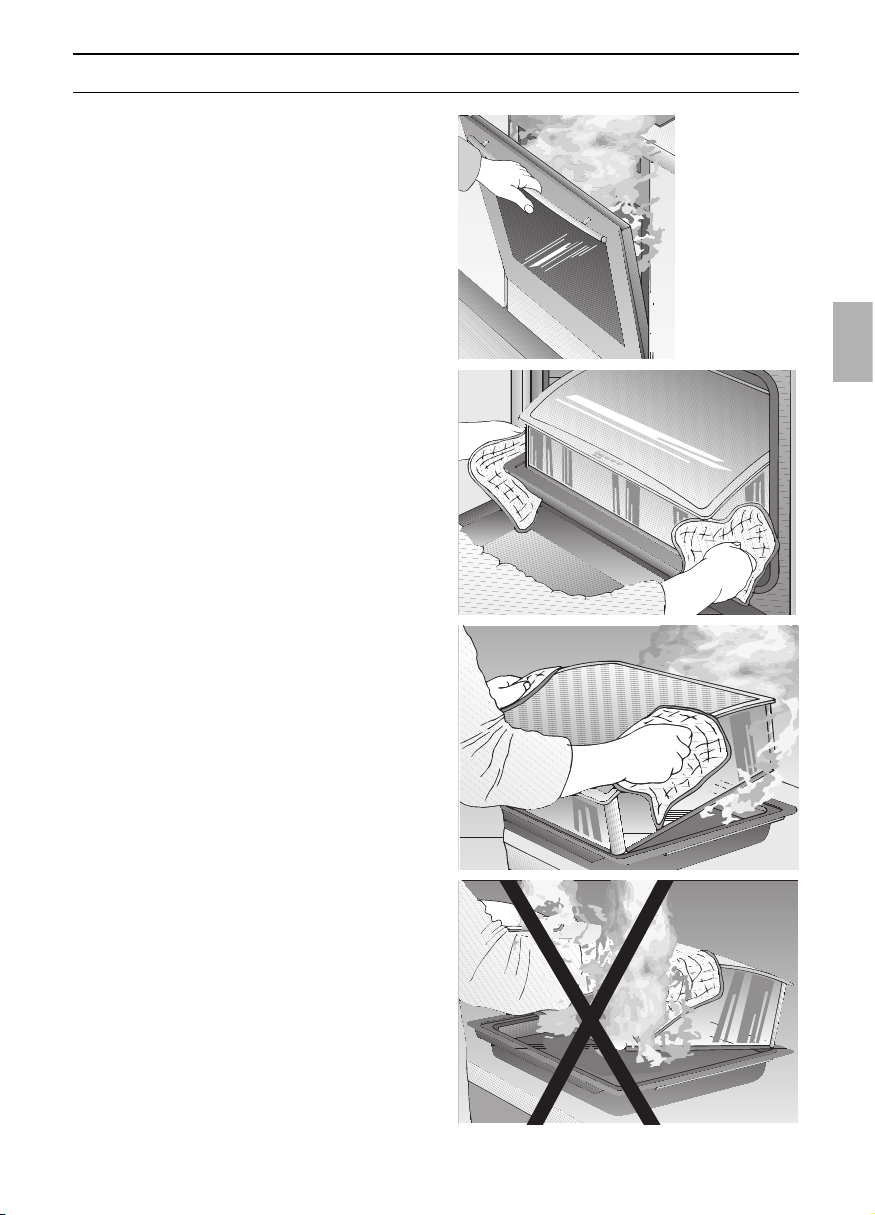
Removing the Steam Cooker
from the Oven:
1. Slowly open the oven door.
Hot steam escapes when you open
the door.
2. Remove the steam cooker from the
oven
Use suitable oven gloves.
3. Put down the steam cooker.
Do not place it on the oven door.
4. Remove the glass lid.
Lift at the back so that the hot
steam can escape in that direction.
Do not lift at the front.
There is the risk that the hot steam may
scald you.
After steam cooking:
❑ Allow the oven to cool down.
❑ Wipe down the oven with clear water.
❑ Rub down the oven with a soft cloth
until dry (also underneath the oven
seals).
12
Cooking Table
Food Preparation Steam Cooking
liquid time
in ml in minutes
❑ The details in the cooking table are estimated values.
❑ The details may vary depending on the type, size and age of the food.
❑ Do not defrost frozen foods before cooking.
The cooking time is extended by approx. 5 minutes.
Cauliflower Chunks (cut along the stalk) 500 30 – 35
Cauliflower Whole 500 35 – 40
Cauliflower, frozen Chunks 500 25 – 30
Broccoli, fresh Chunks (cut along the stalk) 500 30 – 35
Broccoli, frozen Chunks 500 25 – 30
Peas, fresh 500 25 – 30
Peas, frozen 500 20 – 25
Fennel, fresh Halved, trunk removed 500 35 – 45
Fennel, fresh Slices 500 20 – 25
Green beans, fresh 500 30 – 40
Green beans, frozen 500 30 – 35
Carrots Slices, long slices 500 35 – 40
Celeriac Slices, long slices 500 35 – 40
Leek Thin slices or rings 500 30 – 35
Sweet corn Whole 750 55 – 60
Paprika Cut into strips, depending on age 500 30 – 40
New potatoes Depending on the size 750 55 – 65
Brussels sprouts, fresh Cut along the trunk 500 35 – 40
Brussels sprouts, frozen 500 30 – 35
Boiled potatoes Thin potato wedges 750 30 – 35
Boiled potatoes Quartered 750 35 – 45
Zucchini Halved along its length, slices 500 25 – 30
Asparagus Depending on the thickness 500 35 – 45
Asparagus, green Depending on the thickness 500 30 – 40
13
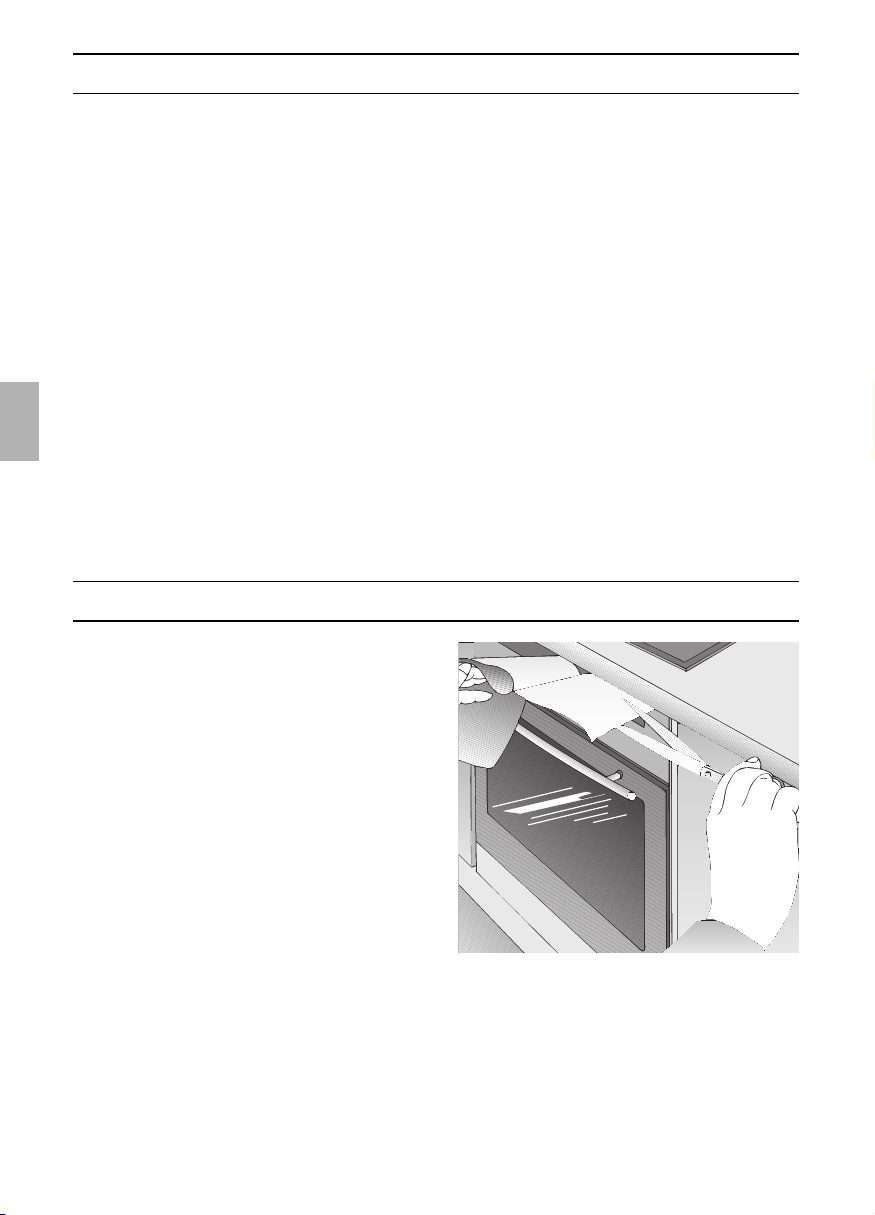
Important Instructions:
❑ Do not use any scrubs, caustic
detergents or scratching surfaces for
cleaning purposes.
❑ Use a normal vinegar detergent to get
rid of scales.
Rinse with clear water and rub dry with
a soft cloth.
Glasdeckel:
❑ Do not scrape off dried food residue,
but soften it with soapy water instead.
Cleaning and Care
Cooking Table
Food Preparation Steam Cooking
liquid time
in ml in minutes
Eggs, hard boiled Up to 20 500 25 – 30
Boiled egg white In china cups 500 35 – 40
Rice 200 g rice and 350 ml water in the
rice and sauce dish 750 40 – 45
Fish filet E.g. plaice 500 20 – 25
Fish steaks Approx. 150-200 g / slice, 500 25 – 30
e.g. salmon, tuna
Portioned fish Approx. 200-250 g / piece, 500 20 – 25
e.g. trout, mackerel
Large fish Approx. 800 - 1000 g 500 30 – 40
e.g. trout, bass
Beef Approx. 1000 g, 750 75 – 90
depending on thickness
Pork Filet approx. 500 g / piece 750 40 – 50
Poultry Approx. 200 g / piece, 500 35 – 45
e.g. Turkey or chicken breast
14
Consignes pour la mise au
rebut
❑ Les appareils usagés ne sont pas des
déchets sans valeur. Une mise au rebut
respectueuse de l'environnement
permet de récupérer de précieuses
matières premières.
❑ Un emballage a protégé votre appareil
pendant son transport jusqu'à votre
domicile. Tous les matériaux qui le
composent sont compatibles avec
l'environnement et recyclables.
Aidez-nous à éliminer cet emballage en
respectant l'environnement
Votre revendeur spécialisé ou
l'administration de votre municipalité
vous informeront volontiers sur les
centres de recyclage que vous pouvez
contacter.
Remarques importantes
Consignes de sécurité
❑ N'utilisez cet appareil que pour faire
cuire des aliments à la vapeur.
– Comme mode de cuisson, n'utilisez
que la chaleur de sole w.
– Toute autre forme d'utilisation ou
tout autre mode de cuisson n'est
pas permis.
❑ Les surfaces des appareils de chauffage
et de cuisson deviennent très chaudes
pendant leur fonctionnement. Eloignez
systématiquement les enfants.
❑ L'utilisation de cet appareil de cuisson
dégage de la vapeur très chaude.
Prudence lorsque vous ouvrez la porte
du four et lorsque vous soulevez le
couvercle en verre.
❑ Avant d'utiliser l'appareil pour la
première fois, veuillez lire sa notice
d'utilisation attentivement et
entièrement.
Elle contient des informations
importantes pour votre sécurité ainsi
que sur l'utilisation et l'entretien de
l'appareil.
❑ Rangez soigneusement la notice
d'utilisation. Elle pourra servir à un
éventuel futur propriétaire de l'appareil.
❑ Si l'appareil est endommagé, sa mise en
service est interdite.
❑ Nettoyez l'appareil de cuisson à la
vapeur et tous ses accessoires avec de
l'eau de vaisselle très chaude.
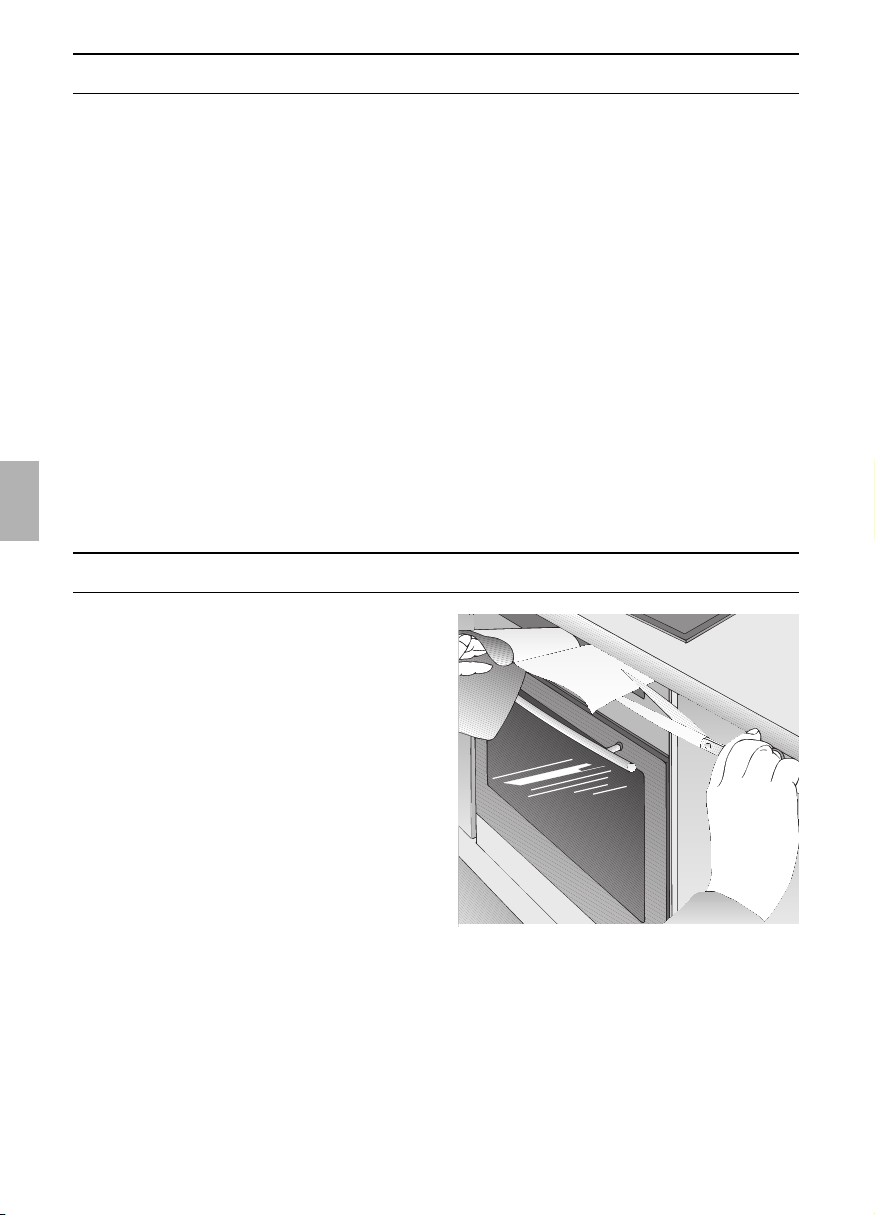
❑ Collez la feuille de protection ci-jointe
sous la partie en porte-à-faux du plan
de travail.
Pour ce faire: découpez la feuille aux
bonnes dimensions, décollez-la de son
papier-support puis collez-la sous le
plan de travail.
Avant la première utilisation
1
2
3
4
15
Avant la première utilisation
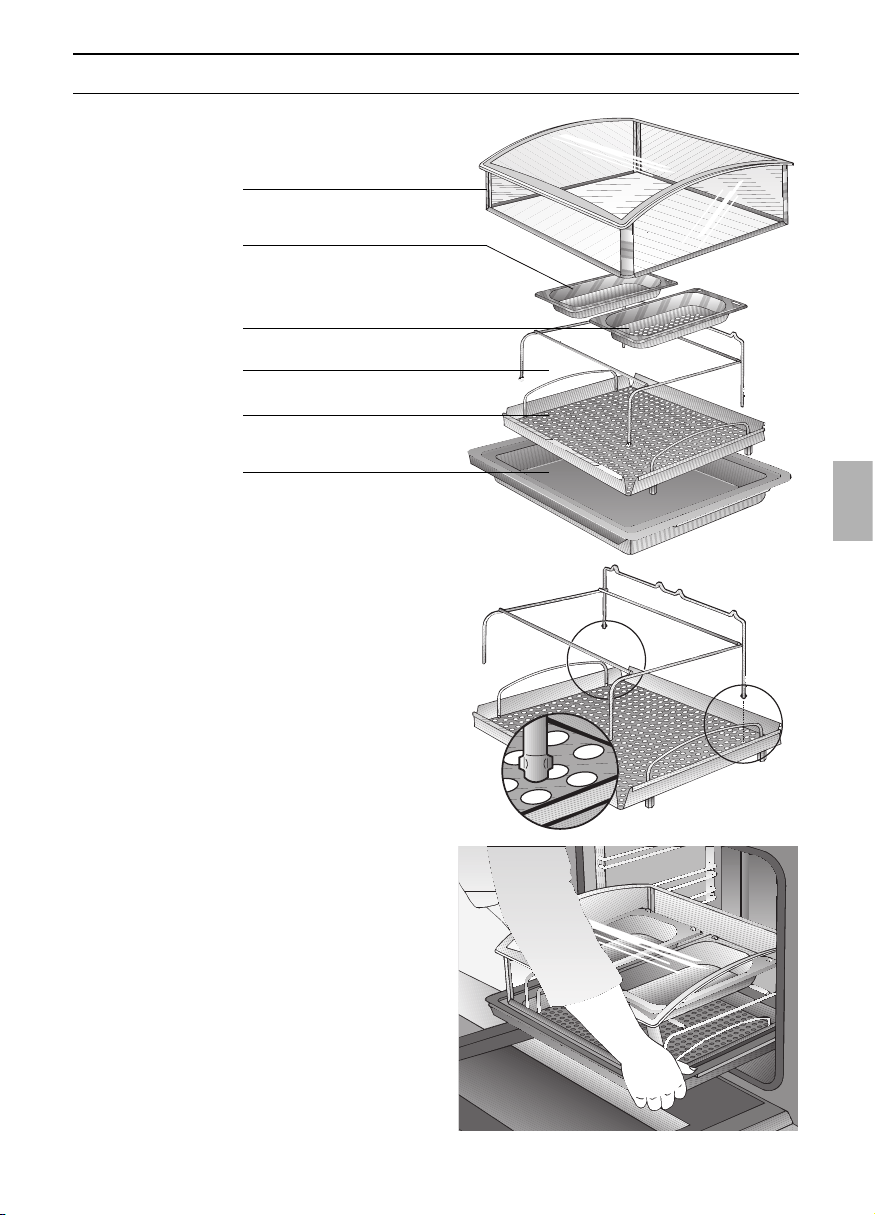
Mise en place du châssis
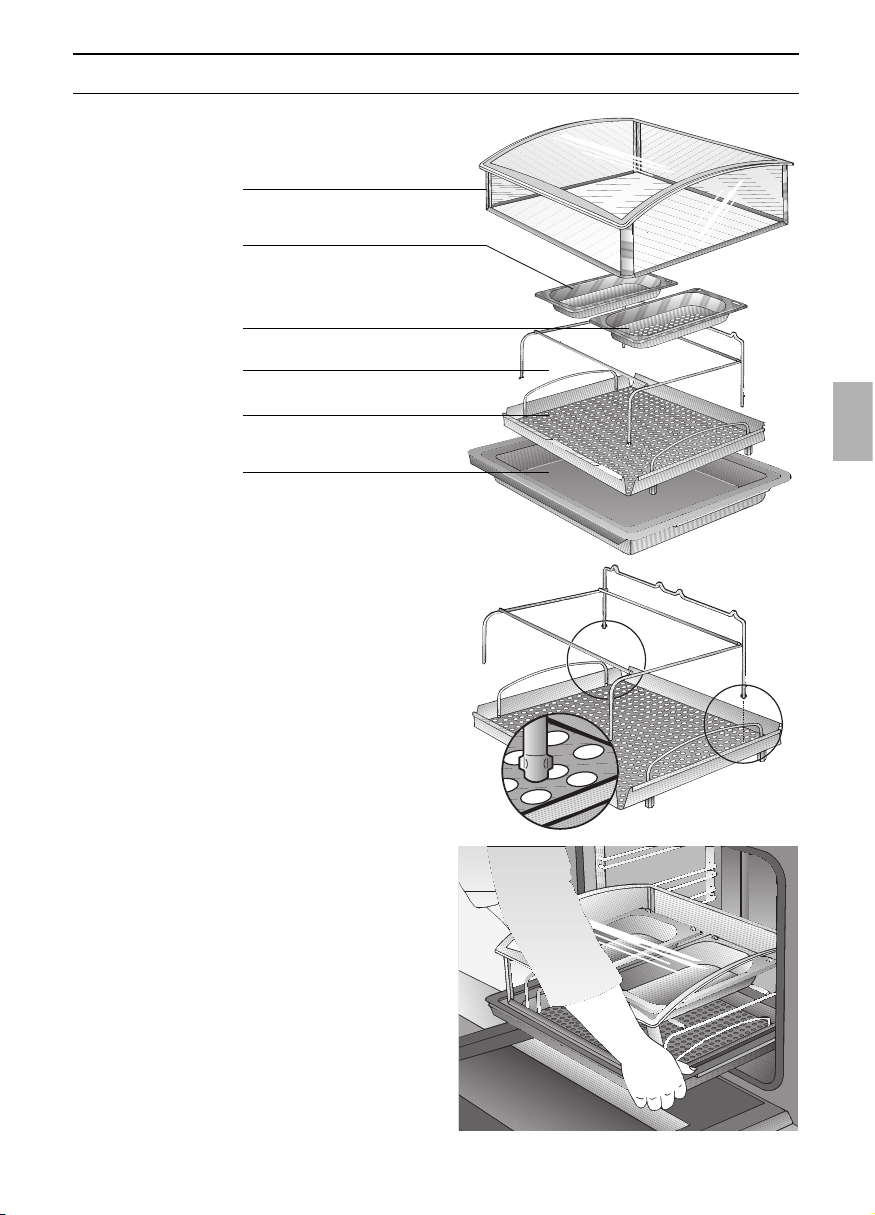
❑ Mettez le châssis en place de telle sorte
que les étriers pénètrent, à l'arrière,
dans le deuxième trou.
Niveau d'enfournement
❑ Enfournez toujours le dispositif de
cuisson à la vapeur au niveau 1.
Couvercle en verre
Plat à riz ou à sauce
Petit insert de cuisson à la vapeur
Châssis
Grand insert de cuisson à la
vapeur
Moule à soufflé
16
Remarques:
❑ La cuisson à la vapeur à toujours lieu à
l'aide du moule à soufflé, du grand
insert et du couvercle en verre.
❑ Pour préparer des quantités assez
importantes, du riz ou des sauces, vous
pouvez également utiliser le châssis et
ses récipients de cuisson.
❑ Veuillez n'utiliser que les pièces fournies
d'origine.
Hinweise:
❑ Vous pouvez également utiliser le moule
à soufflé seul, par ex. pour préparer de
grandes quantités de soufflé.
❑ La brochure ci-jointe contient d'autres
indications sur la cuisson à la vapeur.
Cuisson
Utilisation:
1. Préchauffez le four pendant 10 minutes.
Réglage:
w 150° C.
L'utilisation d'un réglage autre
que celui-ci n'est pas permise.
2. Versez de l'eau dans le moule à soufflé.
– Quantité : voir le tableau de cuisson
ou la brochure ci-jointe.
–N'utilisez que de l'eau du robinet
normale, jamais d'eau distillée.
3. Placez les aliments dans le dispositif de
cuisson à la vapeur.
4. Posez le couvercle en verre de sorte
qu'il applique sur tout son périmètre sur
le moule à soufflé.
5. Enfournez le dispositif de cuisson à la
vapeur au niveau 1.
Remarque:
❑ N'ouvrez pas la porte du four pendant la
cuisson.
Exception: lorsque vous voulez faire
Exception: cuire ensemble des aliments
Exception: ayant chacun des temps de
Exception: cuisson très différents.
❑ L'épaisseur et la hauteur des aliments
déterminent leurs temps de cuisson.
Si vous faites cuire simultanément des
aliments ayant chacun des temps de
cuisson très différents:
– Coupez en petits morceaux les
aliments qui tardent plus à cuire.
– Ou allongez le temps de cuisson des
aliments plus délicats que vous aurez
laissés en assez gros morceaux.
❑ Règle fondamentale: 500 ml d'eau.
Exception:
Les aliments qui gonflent (les pommes
de terre par ex.) et les ingrédients qui
demandent des temps de cuisson assez
longs ont besoin de 750 ml d'eau.
17
Cuisson
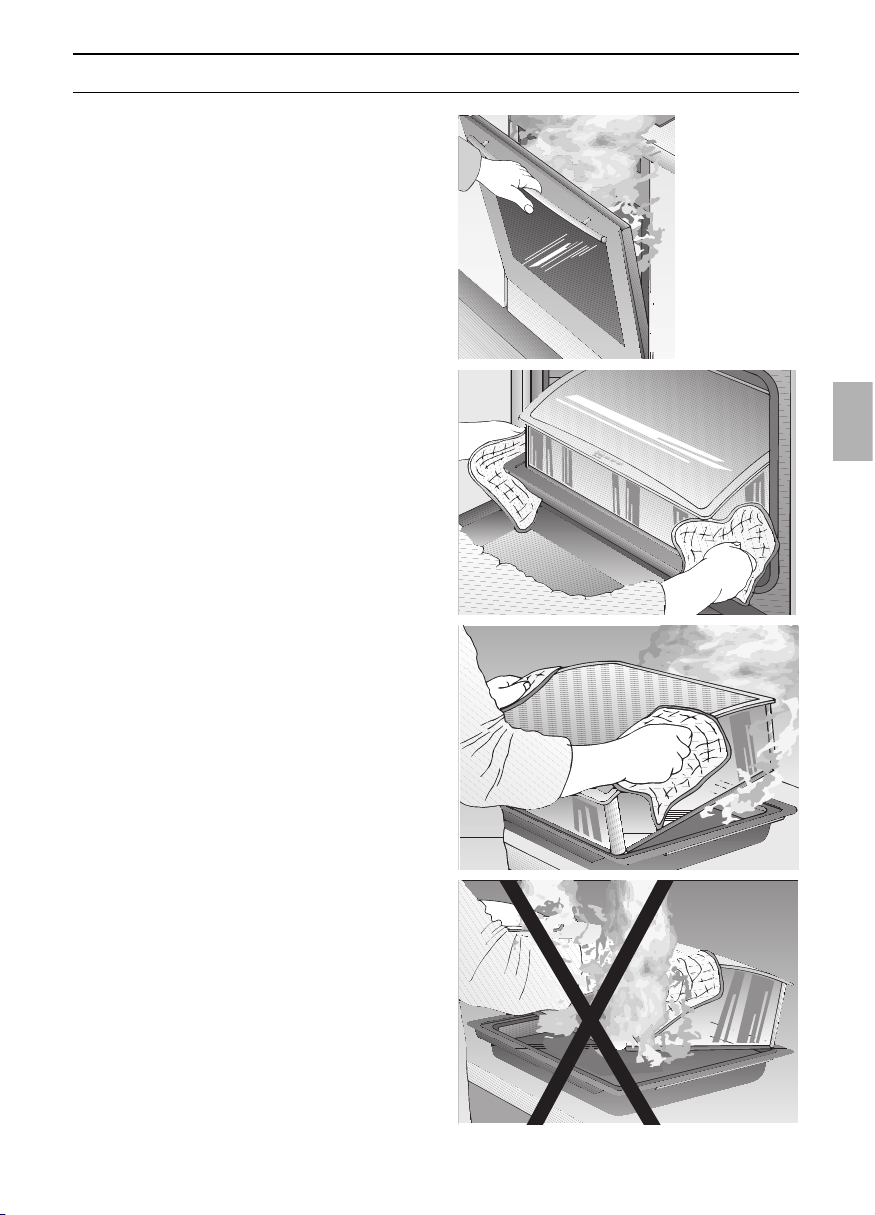
Retirer du four le dispositif de
cuisson à la vapeur:
1. Ouvrez lentement la porte du four.
De la vapeur très chaude s'échappe
au moment où vous ouvrez.
2. Sortez le dispositif de cuisson à la
vapeur du four.
Pour ce faire, utilisez des poignées à
plat appropriées.
3. Déposez le dispositif de cuisson à la
vapeur.
Pas sur la porte sur four.
4. Retirez le couvercle en verre.
Soulevez l'arrière du couvercle pour
que la vapeur très chaude s'échappe
vers l'arrière.
Ne le soulevez pas par l'avant, vous
risqueriez de vous brûler avec la vapeur
très chaude.
Après la cuisson à la vapeur:
❑ Laissez le four refroidir.
❑ Essuyez le four avec de l'eau propre.
❑ Séchez le four avec un chiffon doux (y
compris sous le joint de la porte du
four).
18
Tableau de cuisson
Aliment Préparation Liquide à Temps de
faire évaporer en minutes
en ml
❑ Les indications figurant dans le tableau de cuisson sont des valeurs indicatives.
❑ Ces indications peuvent différer suivant la nature, la taille et la maturité des aliments.
❑ Ne décongelez pas les aliments surgelés avant de les faire cuire.
Leur temps de cuisson augmente de 5 minutes env.
Chou-fleur Bouquets (tige incisée) 500 30 – 35
Chou-fleur Entier 500 35 – 40
Chou-fleur, surgelé Bouquets 500 25 – 30
Broccoli, frais Bouquets (tige incisée) 500 30 – 35
Broccoli, surgelés Bouquets 500 25 – 30
Petits-pois, frais 500 25 – 30
Petits-pois, surgelés 500 20 – 25
Fenouil, frais
Bulbe partagé en deux (tiges enlevées)
500 35 – 45
Fenouil, frais Tranches 500 20 – 25
Haricots verts, frais 500 30 – 40
Haricots verts, surgelés 500 30 – 35
Carottes Rondelles, bâtonnets 500 35 – 40
Céleri rave Rondelles, bâtonnets 500 35 – 40
Poireau Lanières fines ou losanges 500 30 – 35
Epis de maïs entiers 750 55 – 60
Poivrons
découpés en lanières, suivant maturité
500 30 – 40
Pommes de terre
en robe de chambre suivant leur taille 750 55 – 65
Choux de Bruxelles,
frais incisez la tige 500 35 – 40
Choux de Bruxelles,
surgelés 500 30 – 35
Pommes de terre
gros sel Quartiers minces 750 30 – 35
Pommes de terre
gros sel coupées en quatre 750 35 – 45
Courgettes
partagées en deux dans le sens de la
longueur, ou en rondellesn
500 25 – 30
Asperges blanches selon leur épaisseur 500 35 – 45
Asperges vertes selon leur épaisseur 500 30 – 40
19
Remarques importantes:
❑ Pour nettoyer, n'employez pas de
produit récurant, et aucun objet acéré
ou grattant.
❑ Enlevez les résidus calcaires avec un
détergent au vinaigre en vente habituelle
dans le commerce.
Rincez ensuite à l'eau propre puis
essuyez avec un chiffon doux.
Glasdeckel:
❑ Ne grattez pas les résidus alimentaires
qui ont durci, ramollissez-les avec l'eau
de vaisselle.
Nettoyage et entretien
Tableau de cuisson
Aliment Préparation Liquide à Temps de
faire évaporer en minutes
en ml
Oeufs, cuits durs jusqu'à 20 œufs 500 25 – 30
Royale dans des tasses en porcelaine 500 35 – 40
Riz 200 g de riz et 350 ml d'eau dans
un plat à riz ou à sauce 750 40 – 45
Filets de poisson de carrelet par ex. 500 20 – 25
Steaks de poisson env. 150 à 200 g par tranche 500 25 – 30
par ex. de saumon, de thon
Poissons en portions env. 200 à 250 g / pièce 500 20 – 25
par truite, maquereau
Grands poissons env. 800 à 1000 g 500 30 – 40
par ex. truite, dorade
Viande de bœuf env. 1000 g, selon l'épaisseur 750 75 – 90
Viande de porc Filet, env. 500 g / pièce 750 40 – 50
Viande de volaille env. 200 g / pièce; 500 35 – 45
par ex. du blanc de dinde ou
de poulet
Service consommateurs
France
01.49.48.32.10
20
Recycling van het oude
apparaat
❑ Oude apparaten zijn geen waardeloze
afval. Door milieuvriendelijke recycling
kunnen waardevolle grondstoffen
worden teruggewonnen.
❑ Uw nieuwe apparaat is voor het
transport voorzien van beschermende
verpakking. Alle gebruikte materialen zijn
onschadelijk voor het milieu en kunnen
opnieuw worden gebruikt. U kunt
meehelpen door de verpakking
milieuvriendelijk af te voeren.
Vraag uw vakhandel of gemeente om
actuele informatie over de recycling van
de verpakking.
Hierop moet u letten
Veiligheidsvoorschriften
❑ Gebruik het apparaat alleen voor
voedselbereiding met stoom.
– Gebruik alleen onderwarmte
w als
verwarmingssysteem.
– Andere toepassingen of
verwarmingssystemen zijn niet
toegestaan.
❑ De oppervlakken van verwarmings- en
kookapparaten worden heet bij gebruik.
Houd kinderen uit de buurt.
❑ Bij het werken met de stoomkoker
ontstaat hete waterdamp. Wees
voorzichtig bij het openen van de
ovendeur en bij het optillen van het
glazen deksel.
❑ Lees de gebruiksaanwijzing zorgvuldig
door voordat u het nieuwe apparaat
gebruikt.
Deze bevat belangrijke aanwijzingen
voor uw veiligheid en informatie over het
gebruik en het onderhoud van het
apparaat.
❑ Bewaar de gebruiksaanwijzing
zorgvuldig, zodat u deze eventueel aan
een volgende bezitter kunt geven.
❑ Als het apparaat is beschadigd, mag het
niet in gebruik worden genomen.
❑ Reinig de stoomkoker en alle
toebehoren met een heet afwassopje.
❑ Plak de bijgevoegde beschermende folie
onder de rand van het aanrechtblad.
Hiertoe de folie op maat knippen,
lostrekken en vastplakken.
Voor het eerste gebruik
1
2
3
4
21
Voor het eerste gebruik
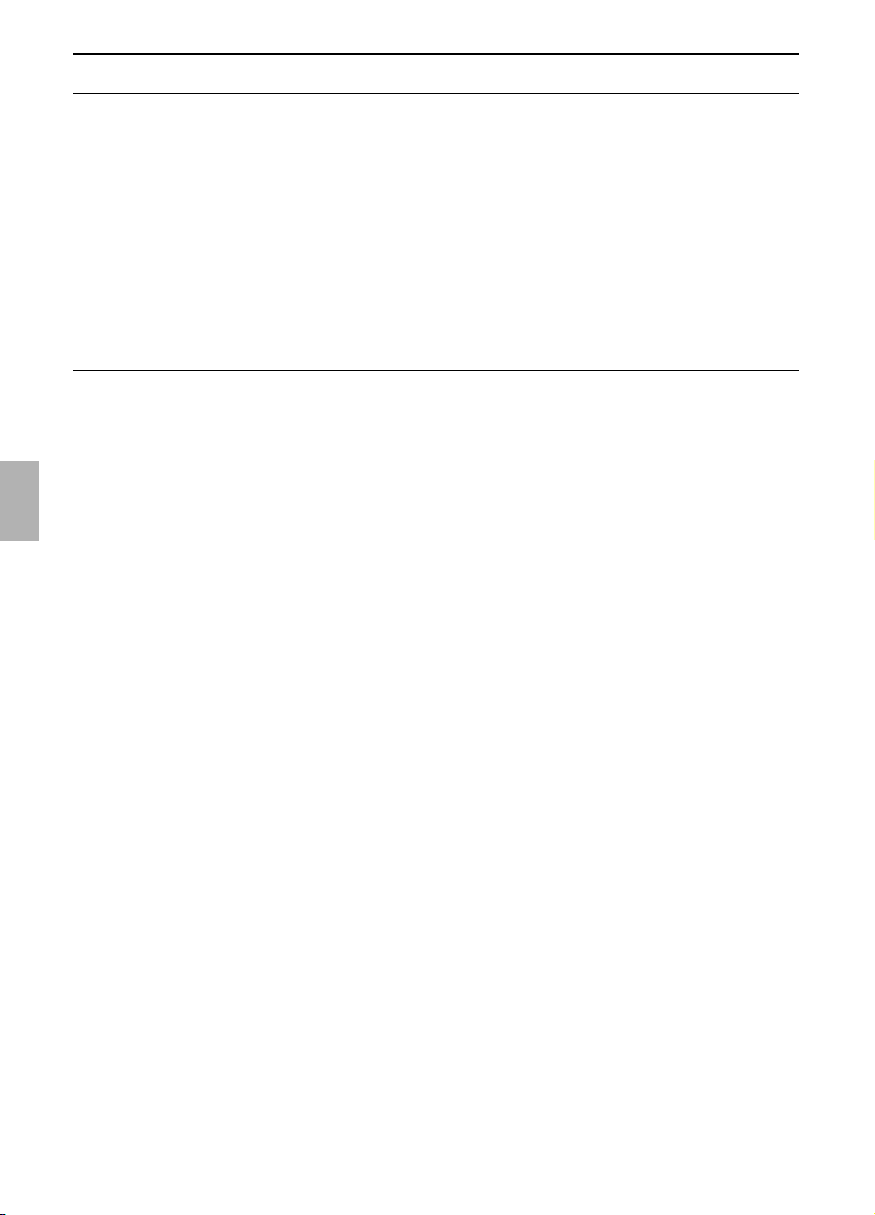
Frame aanbrengen
❑ Breng het frame zodanig aan dat de
beugels achteraan in het tweede gat
vallen.
Inschuifhoogte
❑ Schuif de stoomkoker altijd op
inschuifhoogte 1 in de oven.
glazen deksel
rijst- en sausschaal
kleine stoomschaal
frame
grote stoomschaal
ovenschaal
22
Aanwijzingen:
❑ De ovenschaal, de grote stoomschaal
en het glazen deksel vormen de basis
voor het stoomkoken.
❑ Voor grote hoeveelheden en voor de
bereiding van rijst of sauzen kunt u het
frame met de andere schalen gebruiken.
❑ Gebruik alleen de meegeleverde
originele onderdelen.
Hinweise:
❑ De ovenschaal kunt u ook afzonderlijk
gebruiken, bijv. voor het bereiden van
grote ovenschotels.
❑ Zie de bijgevoegde brochure voor meer
informatie over het stoomkoken.
Bereiden
Bediening:
1. Verwarm de oven 10 minuten voor.
Instelling:
w 150° C.
Andere instellingen zijn niet
toegestaan.
2. Doe water in de ovenschaal.
– De hoeveelheid vindt u in de
kooktabel of in de bijgevoegde
brochure.
– Gebruik gewoon leidingwater, geen
gedestilleerd water.
3. Doe het te bereiden gerecht in de
stoomkoker.
4. Breng het glazen deksel zodanig aan
dat deze de ovenschaal rondom afsluit.
5. Plaats de stoomkoker in de oven op
inschuifhoogte 1.
Aanwijzingen:
❑ Tijdens het stomen mag de ovendeur
niet worden geopend.
Uitzondering: combinaties van
Uitzondering: verschillende gerechten
Uitzondering: met grote verschillen
Uitzondering: in de bereidingstijd.
❑ De bereidingstijd wordt bepaald door de
omvang van het te bereiden gerecht
Bij het bereiden van levensmiddelen met
verschillende bereidingstijden geldt:
–snijd de levensmiddelen met de
langere bereidingstijd in kleinere
stukken
–of verleng de bereidingstijd voor
gevoelige levensmiddelen wanneer u
grotere stukken bereidt.
❑ In principe gebruikt u 500 ml water.
Uitzondering:
Voor levensmiddelen die gaar gekookt
moeten worden (bijv. aardappels) en
voor ingrediënten met een langere
bereidingstijd is 750 ml water nodig.
23
Bereiden
Stoomkoker uit de oven
nemen:
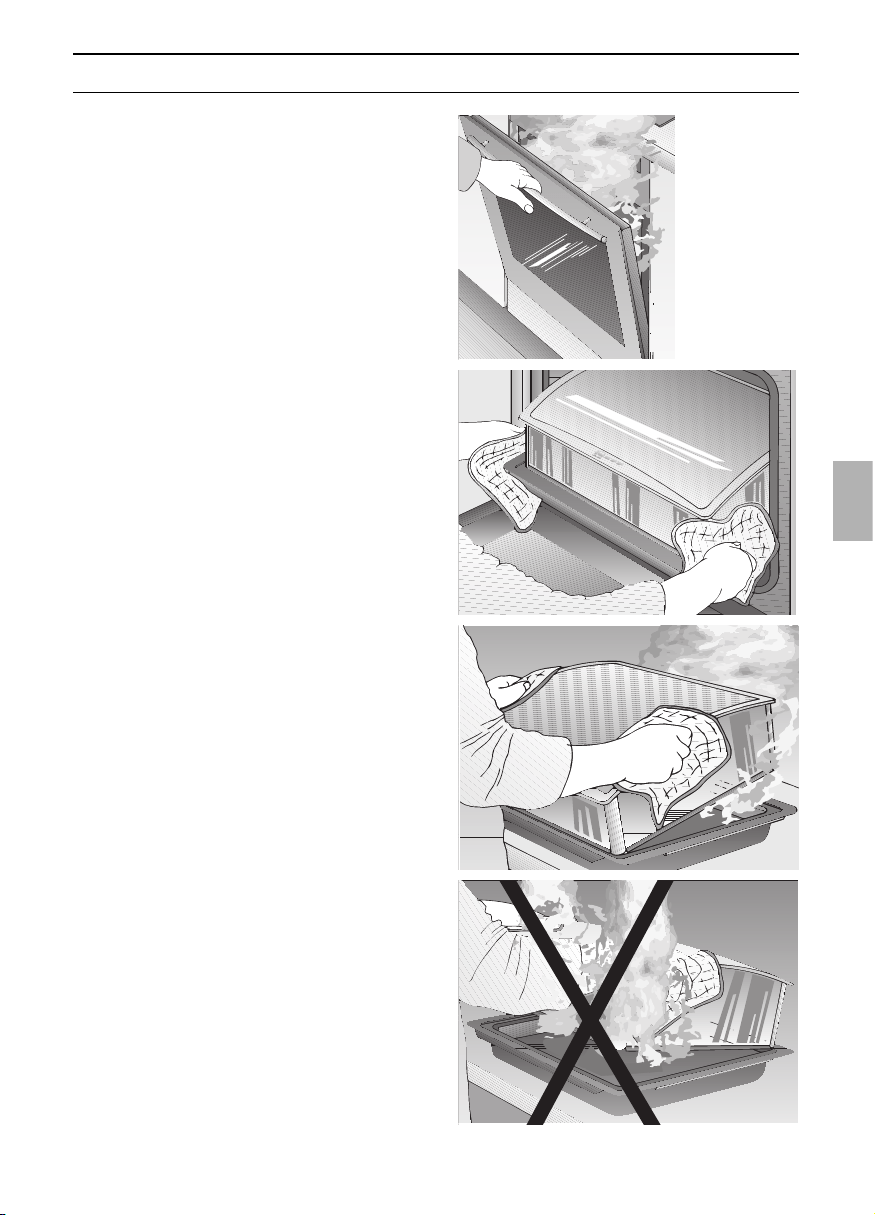
1. Open langzaam de ovendeur.
Bij het openen ontsnapt er hete
stoom.
2. Neem de stoomkoker uit de oven.
Gebruik hiervoor geschikte
pannenlappen.
3. Zet de stoomkoker neer.
Niet op de ovendeur.
4. Verwijder het glazen deksel.
Aan de achterkant optillen, zodat de
stoom naar achteren kan ontsnappen.
Niet aan de voorkant optillen.
Risico van brandwonden door hete
stoom.
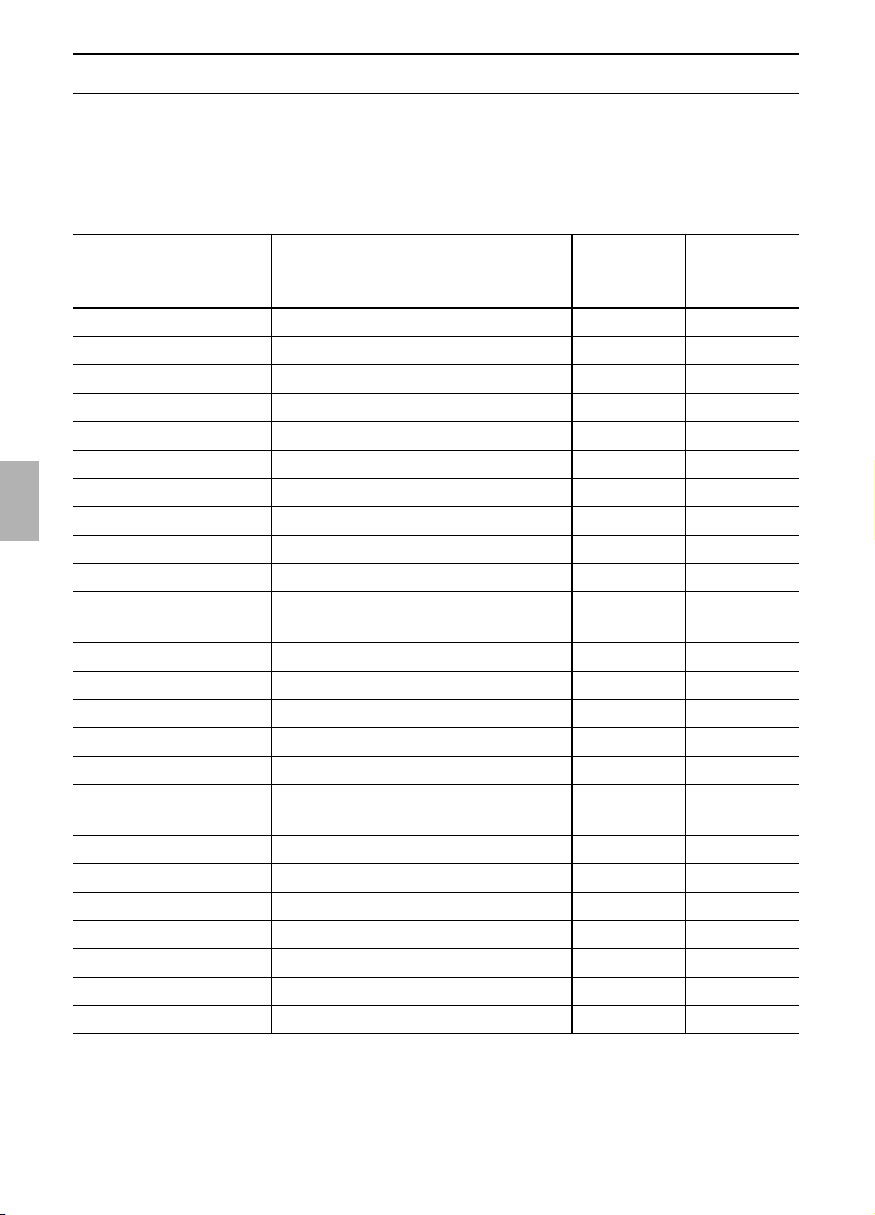
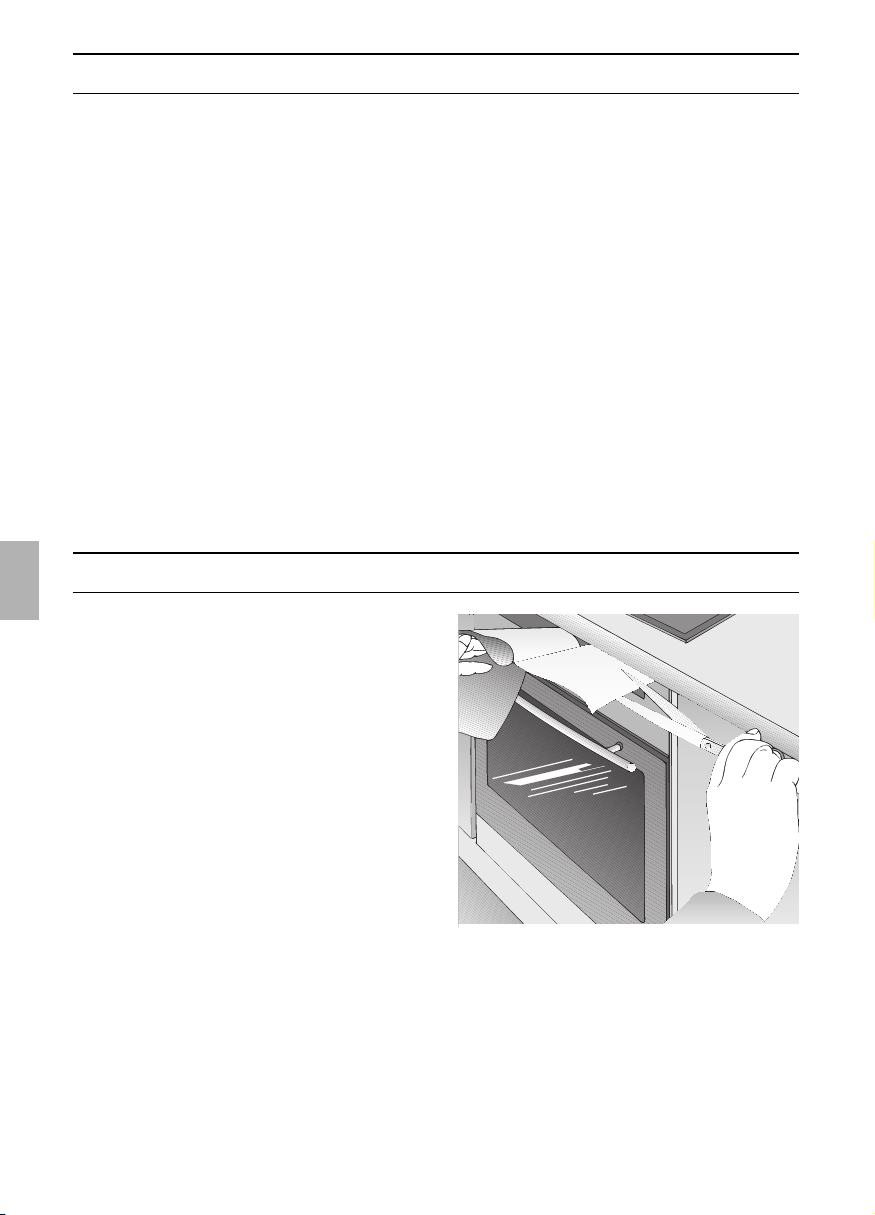
Na het stoomkoken:
❑ Laat de oven afkoelen.
❑ Veeg de oven schoon met een doek en
schoon water.
❑ Wrijf de oven droog met een zachte
doek (ook onder de ovendeurdichting).
24
Kooktabel
Levensmiddel Toebereiding Stoom- Bereidings-
vloeistof tijd
in ml in minuten
❑ De gegevens in de kooktabel zijn richtwaarden.
❑ De gegevens kunnen variëren afhankelijk van het soort levensmiddel en de grootte en
rijpheid.
❑ Diepvrieslevensmiddelen niet ontdooien voor het koken.
De bereidingstijd wordt ca. 5 minuten langer.
bloemkool roosjes (stronk ingesneden) 500 30 – 35
bloemkool heel 500 35 – 40
bloemkool, diepvries roosjes 500 25 – 30
broccoli, vers roosjes (stronk ingesneden) 500 30 – 35
broccoli, diepvries roosjes 500 25 – 30
erwten, vers 500 25 – 30
erwten, diepvries 500 20 – 25
venkel, vers gehalveerd, stronk verwijderd 500 35 – 45
venkel, vers plakken 500 20 – 25
groene bonen, vers 500 30 – 40
groene bonen,
diepvries 500 30 – 35
wortels plakken, overlangs gesneden 500 35 – 40
knolselderie plakken, overlangs gesneden 500 35 – 40
prei reepjes of ruitjes 500 30 – 35
maïskolven heel 750 55 – 60
paprika reepjes, afh. van de rijpheid 500 30 – 40
in de schil gekookte
aardappels afhankelijk van de grootte 750 55 – 65
spruitkool, vers stronk insnijden 500 35 – 40
spruitkool, diepvries 500 30 – 35
geschilde aardappels in kleine stukjes gesneden 750 30 – 35
geschilde aardappels in grote stukken gesneden 750 35 – 45
courgettes in de lengte doorgesneden, plakken 500 25 – 30
slierasperges afhankelijk van de dikte 500 35 – 45
asperges, groen afhankelijk van de dikte 500 30 – 40
25
Attentie!
❑ Gebruik voor het reinigen geen
schuurmiddelen, scherpe middelen of
krassende voorwerpen.
❑ Verwijder kalkresten met een gewoon
reinigingsmiddel op azijnbasis.
Afspoelen met koud water en
droogwrijven met een zachte doek.
Glasdeckel:
❑ Vastgekoekte etensresten niet
loskrabben, maar inweken met een
afwassopje.
Reiniging en onderhoud
Kooktabel
Levensmiddel Toebereiding Stoom- Bereidings-
vloeistof tijd
in ml in minuten
eieren, hardgekookt max. 20 stuks 500 25 – 30
bouillon met ei in porseleinen kopjes 500 35 – 40
rijst 200 g rijst en 350 ml water in de 750 40 – 45
rijst- en sausschaal
visfilet bijv. schol 500 20 – 25
vissteak ca. 150-200 g per plak; 500 25 – 30
bijv. zalm, tonijn
vis in porties ca. 200-250 g per stuk; 500 20 – 25
bijv. forel, makreel
grote vissen ca. 500-1000 g 500 30 – 40
bijv. forel, brasem
rundvlees ca. 1000 g afh. van de dikte 750 75 – 90
varkensvlees filet ca. 500 g per stuk 750 40 – 50
gevogelte ca. 200 g per stuk: 500 35 – 45
bijv. kalkoen- of kippenborst
26
Avvertenze per lo smaltimento
❑ Gli apparecchi dismessi non sono rifiuti
senza valore. Attraverso una
rottamazione ecologica si possono
recuperare materie prime preziose.
❑ L’imballaggio ha protetto il vostro nuovo
apparecchio nel trasporto fino a voi.
Tutti i materiali usati sono compatibili
con l’ambiente e riciclabili. Siete pregati
di dare il vostro contributo, con uno
smaltimento ecologico dell’imballaggio.
Per informazioni sulle attuali possibilità di
smaltimento, rivolgersi al proprio
rivenditore specializzato o alla propria
amministrazione municipale.
Raccomandazioni
Istruzioni di sicurezza
❑ Usare l’apparecchio solo per la cottura a
vapore di cibi.
– Come sistema di riscaldamento, usare
solo il riscaldamento inferiore w.
– Non sono ammessi altri usi o
sistemi di riscaldamento.
❑ Le superfici degli apparecchi di
riscaldamento e di cottura si riscaldano
molto durante il funzionamento.
Tenere lontano i bambini.
❑ Nel lavoro con il forno a vapore si
sviluppa vapore acqueo.
Attenzione all’apertura della porta del
forno e nel sollevamento del coperchio di
vetro.
❑ Prima di usare il nuovo apparecchio, si
prega di leggere attentamente il libretto
d’istruzioni per l’uso.
Questo contiene importanti informazioni
per la vostra sicurezza ed inoltre per
l’uso e la cura dell’apparecchio.
❑ Conservare le istruzioni per l’uso per un
eventuale successivo proprietario.
❑ Se l’apparecchio è danneggiato non
deve essere messo in funzione.
❑ Pulire il forno a vapore e tutti gli
accessori con una soluzione calda di
acqua e detersivo.
❑ Incollare il foglio protettivo a corredo
sotto il bordo sporgente del piano di
lavoro. A tal fine tagliare a misura il foglio
protettivo, staccare ed incollare.
Al primo uso
1
2
3
4
27
Al primo uso
Introdurre il supporto
❑ Introdurre il supporto in modo che le
staffe entrino dietro nel secondo foro.
Altezza d’inserimento
❑ Introdurre il forno a vapore sempre
nell’altezza d’inserimento 1.
Coperchio di vetro
Vaschetta per riso e salsa
Accessorio vapore piccolo
Supporto
Accessorio vapore grande
Tegame per sformati
28
Avvertenze:
❑ L’attrezzatura base per la cottura a
vapore è costituita sempre dal tegame
per sformati, dall’accessorio vapore
grande e dal coperchio.
❑ Per maggiori quantità e per la
preparazione di riso o di salse, si può
usare in aggiunta il supporto con i
contenitori per il cibo da cuocere.
❑ Usare solo le parti originali fornite a
corredo.
Hinweise:
❑ Il tegame per sformati può essere usato
anche da solo, per es. per la
preparazione di grandi quantità di
sformato.
❑ Per altre informazioni per la cottura a
vapore, consultare l’accluso opuscolo.
Cottura
Uso:
1. Preriscaldare il forno per 10 minuti.
Regolazione:
w 150° C.
Non sono consentite altre
regolazioni.
2. Versare acqua nel tegame per sformati.
– Per la quantità consultare la tabella di
cottura o l’accluso opuscolo.
– Usare solo normale acqua di
rubinetto, non acqua distillata.
3. Disporre il cibo da cuocere nel forno a
vapore.
4. Sovrapporre il coperchio di vetro in
modo che poggi tutt’intorno sul tegame
per sformati.
5. Inserire il forno a vapore nell’altezza
d’inserimento 1 del forno di cottura.
Avvertenze:
❑ Durante la cottura non si deve aprire la
porta del forno di cottura.
Eccezione: combinazione di diversi cibi
Eccezione: con grandi differenze nei
Eccezione: tempi di cottura.
❑ Il tempo di cottura è influenzato dalla
grandezza del cibo da cuocere.
Nella cottura contemporanea di alimenti
con diversi tempi di cottura vale il
principio:
– tagliare l’alimento con il tempo di
cottura più lungo in pezzetti più
piccoli
– oppure prolungare il tempo di cottura
per gli alimenti più delicati, cuocendo
pezzi più grandi.
❑ Acqua necessaria in generale: 500 ml
d’acqua.
Eccezione:
Per alimenti che si gonfiano (per es.
patate) ed ingredienti con lunghi tempi di
cottura, sono necessari 750 ml d’acqua.
29
Cottura
Estrarre il forno a vapore
dal forno di cottura:
1. Aprire lentamente la porta del forno.
Attenzione. Uscita di vapore
bollente.
2. Estrarre il forno a vapore dal forno di
cottura.
Utilizzare a tal fine idonei guanti da
forno o presine.
3. Deporre il forno a vapore.
Non sulla porta del forno.
4. Togliere il coperchio di vetro.
Sollevarlo prima dietro, per lasciare
uscire il vapore da dietro.
Non sollevare avanti.
Pericolo di scottature da vapore
bollente.
Dopo la cottura a vapore:
❑ Lasciare raffreddare il forno di cottura.
❑ Pulire il forno di cottura con acqua
pulita.
❑ Asciugare il forno di cottura con un
panno morbido (anche sotto la
guarnizione della porta).
30
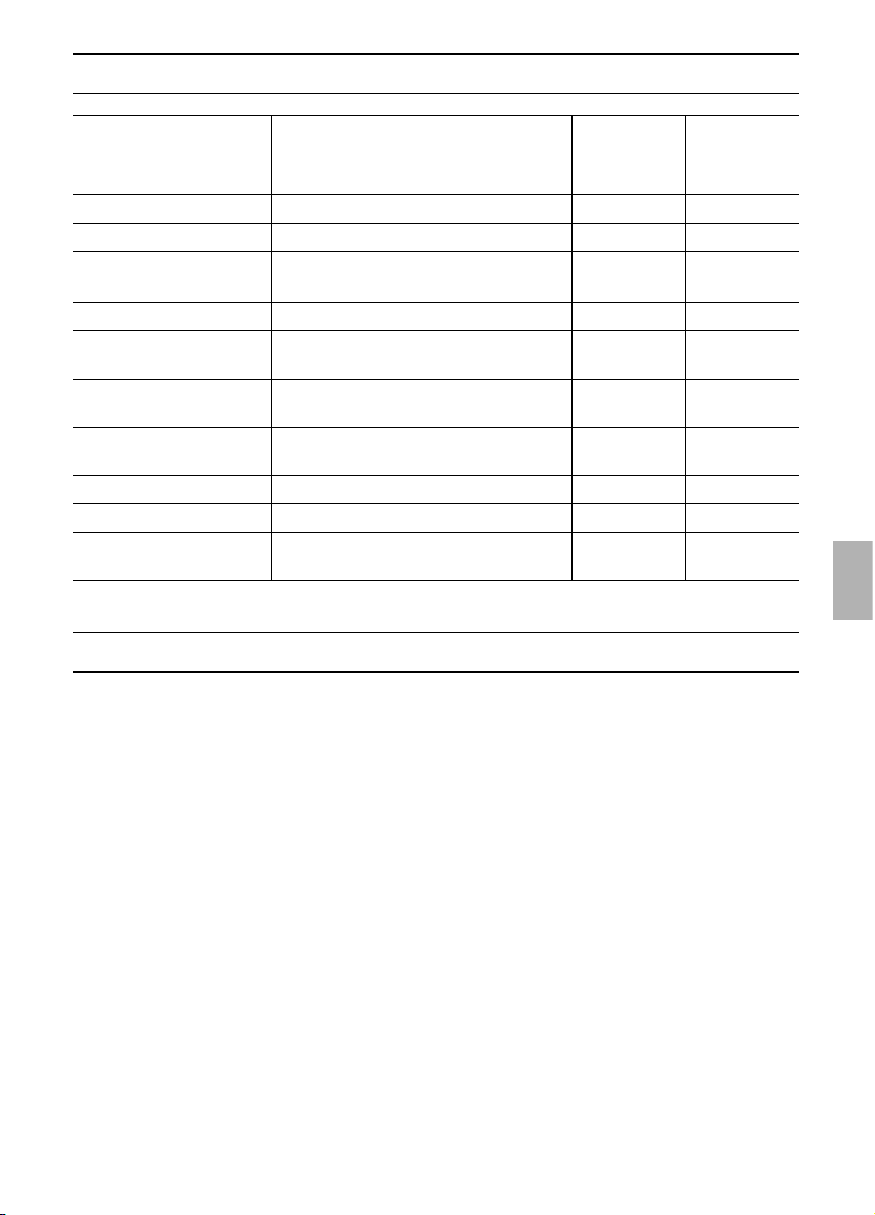
Tabella di cottura
Alimento Preparazione Liquido Tempo
di cottura di cottura
in ml in minuti
❑ Le indicazioni della tabella di cottura sono valori orientativi.
❑ Questi valori possono cambiare secondo il tipo, la grandezza e la maturazione del cibo
da cuocere.
❑ Non scongelare gli alimenti surgelati prima della cottura.
Per questi il tempo di cottura si prolunga di ca. 5 minuti.
Cavolfiori cime (gambo intagliato) 500 30 – 35
Cavolfiori interi 500 35 – 40
Cavolfiori, surgelati cime 500 25 – 30
Broccoli, freschi cime (gambo intagliato) 500 30 – 35
Broccoli, surgelati cime 500 25 – 30
Piselli, freschi 500 25 – 30
Piselli, surgelati 500 20 – 25
Finocchi, freschi tagliati a metà, senza gambi 500 35 – 45
Finocchi, freschi fette 500 20 – 25
Fagiolini, freschi 500 30 – 40
Fagiolini, surgelati 500 30 – 35
Carote fette, bastoncini 500 35 – 40
Sedano rapa fette, bastoncini 500 35 – 40
Porro strisce sottili o quadri 500 30 – 35
Pannocchie di mais intere 750 55 – 60
Peperoni
tagliati a strisce, secondo maturazione
500 30 – 40
Patate con buccia secondo la grandezza 750 55 – 65
Cavoletti di Bruxelles,
freschi gambo intagliato 500 35 – 40
Cavoletti di Bruxelles,
surgelati 500 30 – 35
Patate lesse fette sottili 750 30 – 35
Patate lesse tagliate in 4 750 35 – 45
Zucchine tagliate a metà in lunghezza o fette 500 25 – 30
Asparagi interi secondo grossezza 500 35 – 45
Asparagi, verdi secondo grossezza 500 30 – 40
31
Avvertenze importanti:
❑ Per la pulizia evitare l’uso di sostanze
abrasive, oggetti acuminati e che
graffiano.
❑ Rimuovere i residui di calcare con un
comune pulitore all’aceto commerciale.
Sciacquare poi con acqua pulita ed
asciugare con un panno morbido.
Glasdeckel:
❑ Non grattare i residui di cibo essiccati,
aderenti, ma ammorbidirli con acqua e
detersivo.
Pulizia e cura
Tabella di cottura
Alimento Preparazione Liquido Tempo
di cottura di cottura
in ml in minuti
Uova, sode fino a 20 pezzi 500 25 – 30
Uovo sbattuto in tazze di porcellana 500 35 – 40
Riso 200 g di riso e 350 ml d’acqua 750 40 – 45
nella vaschetta per riso e salsa
Filetto di pesce per es. sogliola 500 20 – 25
Bistecca di pesce a. 150-200 g / fetta 500 25 – 30
per es. salmone, tonno
Pesci in porzioni ca. 200-250 g / fetta 500 20 – 25
per es. trota, sgombro
Pesci grandi ca. 800-1000 g 500 30 – 40
per es. trota, abramide
Carne di manzo ca. 1000 g secondo lo spessore 750 75 – 90
Carne di suino filetto ca. 500 g / pezzo 750 40 – 50
Carne di pollame ca. 200 g / pezzo; 500 35 – 45
per es. petto di tacchino o di pollo
32
Consejos para la eliminación
de embalajes y desguace de
aparatos usados
❑ Los aparatos usados incorporan
materiales valiosos que se pueden
recuperar, entregando el aparato a dicho
efecto en un centro oficial de recogida o
recuperación de materiales reciclables.
❑ Su nuevo aparato está protegido
durante el transporte hasta su hogar por
un embalaje. Todos los materiales de
embalaje utilizados son respetuosos con
el medio ambiente y pueden ser
reciclados o reutilizados. Contribuya
activamente a la protección del medio
ambiente insistiendo en unos métodos
de eliminación y recuperación de los
materiales de embalaje respetuosos con
el medio ambiente.
Su Distribuidor o Administración local le
informará gustosamente sobre las vías y
posibilidades más eficaces y actuales
para la eliminación respetuosa con el
medio ambiente de estos materiales.
Puntos a tener en cuenta
Consejos y advertencias de
seguridad
❑ El presente aparato sólo deberá
utilizarse para la cocción a vapor de
alimentos.
–Sólo deberá utilizarse como sistema
de calefacción la opción «calor
inferior» del horno
w.
– Queda prohibido utilizar cualquier
otro sistema de calefacción
distinto del reseñado.
❑ Las superficies de los dispositivos de
calentamiento y de los recipientes de
cocción pueden calentarse fuertemente
durante su funcionamiento. Mantenga
por ello siempre alejados a los niños de
la cocina.
❑ Durante el trabajo con el sistema de
horneado al vapor se produce vapor de
agua caliente. Por lo tanto hay que
prestar suma atención al abrir la puerta
del horno y al levantar la tapa de vidrio.
❑ Antes de emplear el aparato nuevo
deberá leer detenidamente las
instrucciones de uso del mismo. En ellas
se facilitan informaciones y consejos
importantes para su seguridad personal,
así como para el correcto manejo y
cuidado del aparato.
❑ Guarde las instrucciones de servicio y
de montaje para un posible propietario
posterior.
❑ Si el aparato presentara daños o
desperfectos, no deberá ser utilizado.
❑ Limpiar el sistema para horneado al
vapor y los accesorios con una solución
de agua y agente lavavajillas caliente.
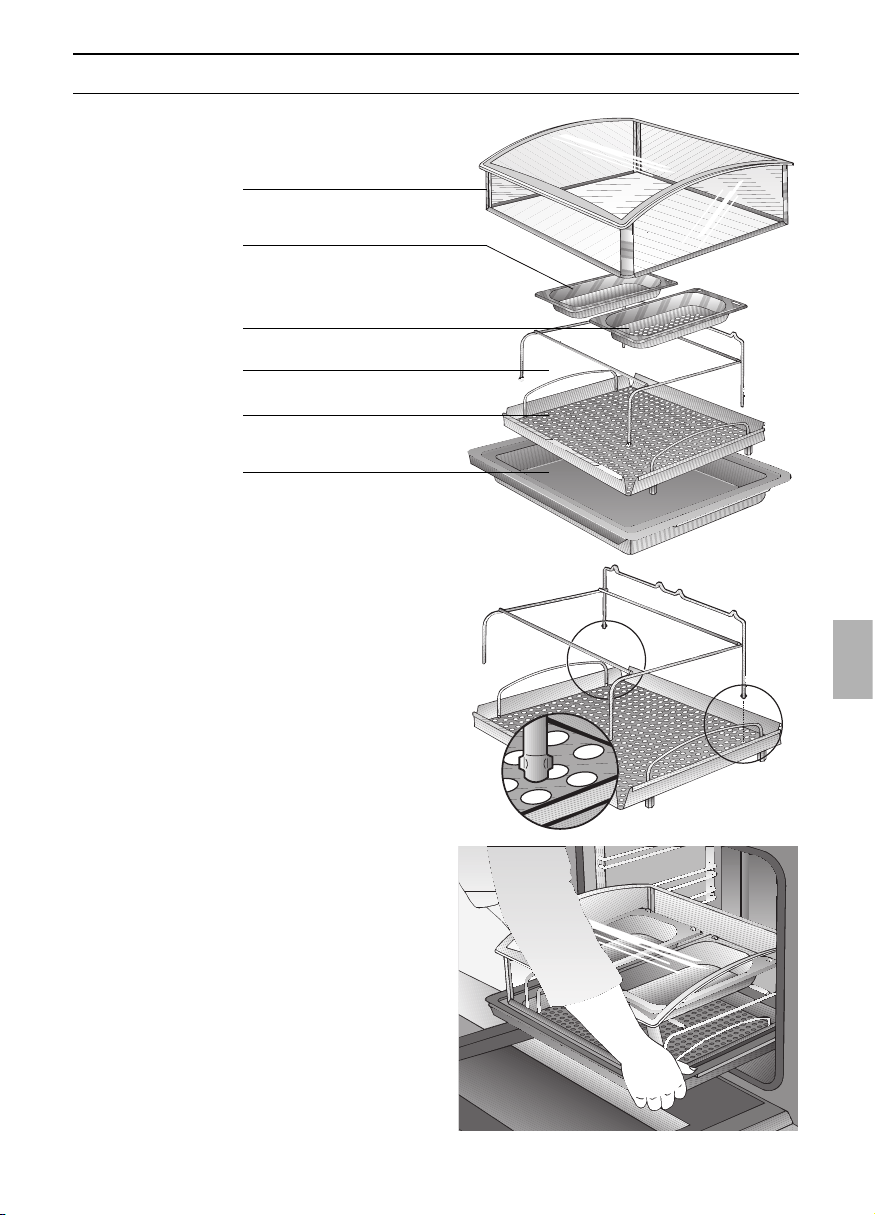
Antes de utilizar el aparato por vez primera
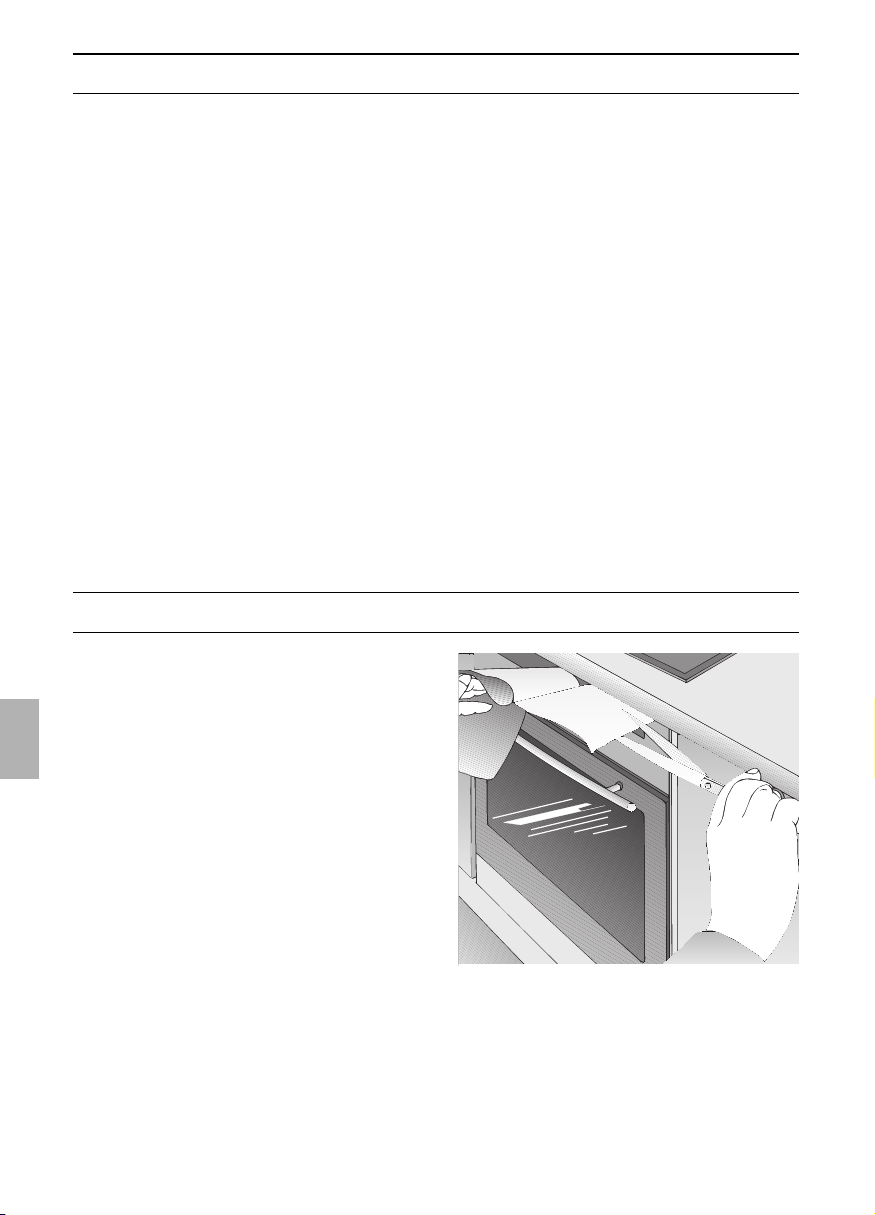
❑ Pegar la lámina protectora adhesiva que
se suministra con el aparato en la cara
inferior del saliente de la placa encimera.
Recortar para ello la lámina a la medida
correcta del saliente, retirar la capa
protectora y pegar la lámina en la placa
encimera.
1
2
3
4
33
Antes de utilizar el aparato por vez primera
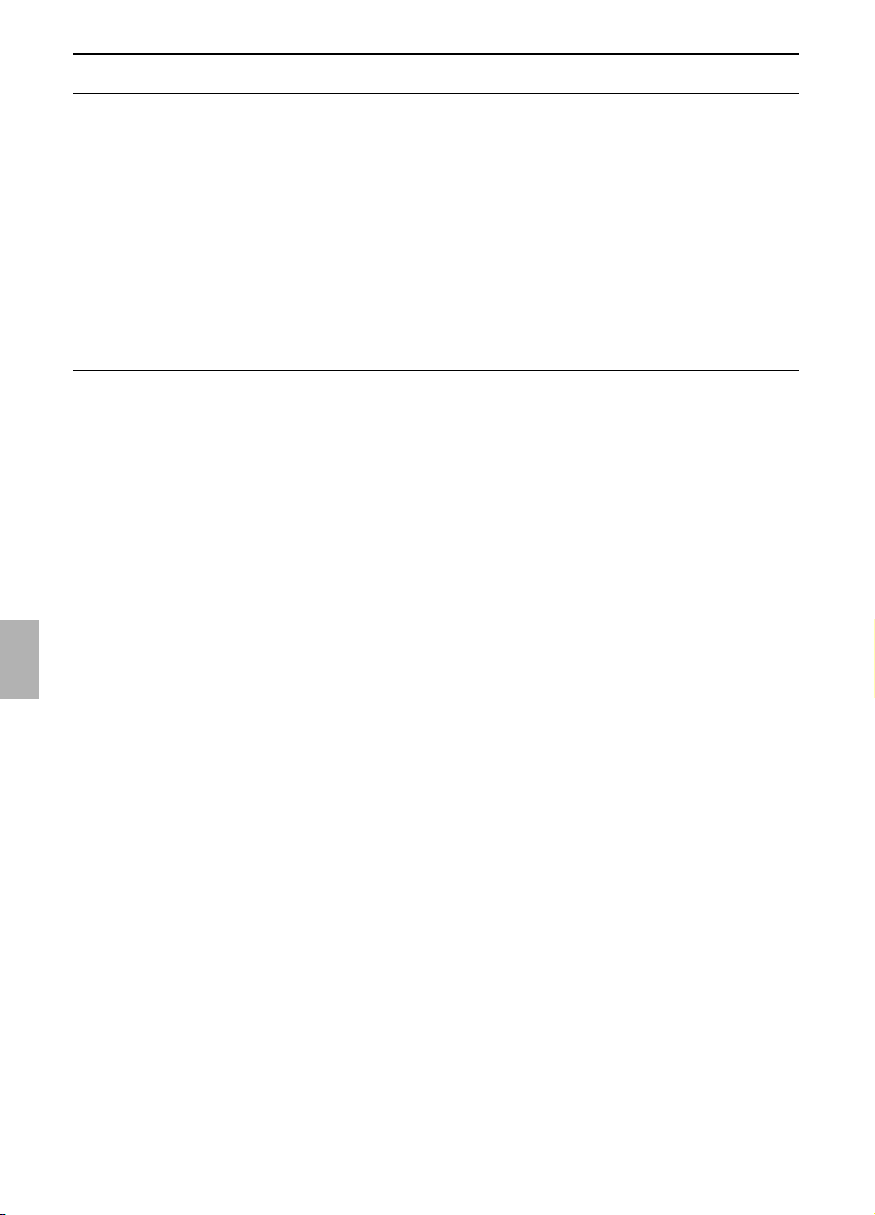
Colocar el soporte
❑ Colocar el soporte de modo que los
estribos de sujeción traseros penetren
en el segundo agujero del accesorio de
cocción grande.
Altura de colocación
❑ Colocar el sistema de cocción a vapor
siempre en la altura de colocación «1».
Tapa de vidrio
Fuente para salsas y arroz
Accesorio de cocción, pequeño
Soporte
Accesorio de cocción, grande
Fuente para soufflés
34
Advertencias:
❑ El sistema siempre consta básicamente
de la fuente para soufflés, el accesorio
de cocción grande y la tapa de vidrio.
❑ Para preparar grandes cantidades de
alimentos, así como salsas o arroces, se
pueden utilizar adicionalmente el
soporte con los accesorios de cocción.
❑ Sólo deberán utilizarse los accesorios
originales suministrados con el aparato.
Hinweise:
❑ La fuente de soufflés se puede utilizar
también por separado, para preparar
grandes cantidades de soufflés.
❑ Más detalles sobre la cocción al vapor
figura en el cuadernillo adjunto.
Cocción al vapor
Manejo del sistema:
1. Precalentar el horno durante
10 minutos.
Ajuste a efectuar en el horno:
w
150° C.
Queda prohibido seleccionar
cualquier otra opción para trabajar
con el sistema de cocción a vapor!
2. Verter agua en la fuente de soufflés.
–La cantidad exacta que debe
ponerse se indica en el cuadro de
cocción correspondiente del
cuadernillo (recetario) adjunto.
–Utilizar agua de red normal.
¡No utilizar nunca agua destilada!
3. Coloque los alimentos que desea
cocinar en el sistema de horneado.
4. Coloque la tapa de vidrio en el aparato
de modo que quede completamente
asentada sobre la fuente de soufflés.
5. Colocar el sistema de horneado a vapor
en la altura de horneado «1».
Advertencias:
❑ La puerta del horno no deberá abrirse
durante el ciclo de cocción con el
sistema de horneado a vapor.
Excepción: Al combinar alimentos con
Excepción: considerables diferencias de
Excepción: los tiempos de cocción.
❑ La duración del ciclo de cocción viene
determinada por el tamaño o cantidad
del alimento que se desea preparar.
En caso de cocinar simultáneamente
alimentos con distintos tiempos de
cocción, deberá procederse del modo
siguiente:
– cortar el alimento con el tiempo de
cocción más largo en trozos
pequeños
–o prolongar el tiempo de cocción del
alimento más delicado cortándolo en
trozos más grandes.
❑ Básicamente se trabaja con 500 ml de
agua.
Excepción:
Los alimentos con fuerte tendencia a
hincharse o esponjarse (por ejemplo las
patatas), así como ingredientes con
largos tiempos de cocción, requieren
750 ml de agua.
35
Cocción al vapor
Retirar el sistema de
horneado al vapor del horno:
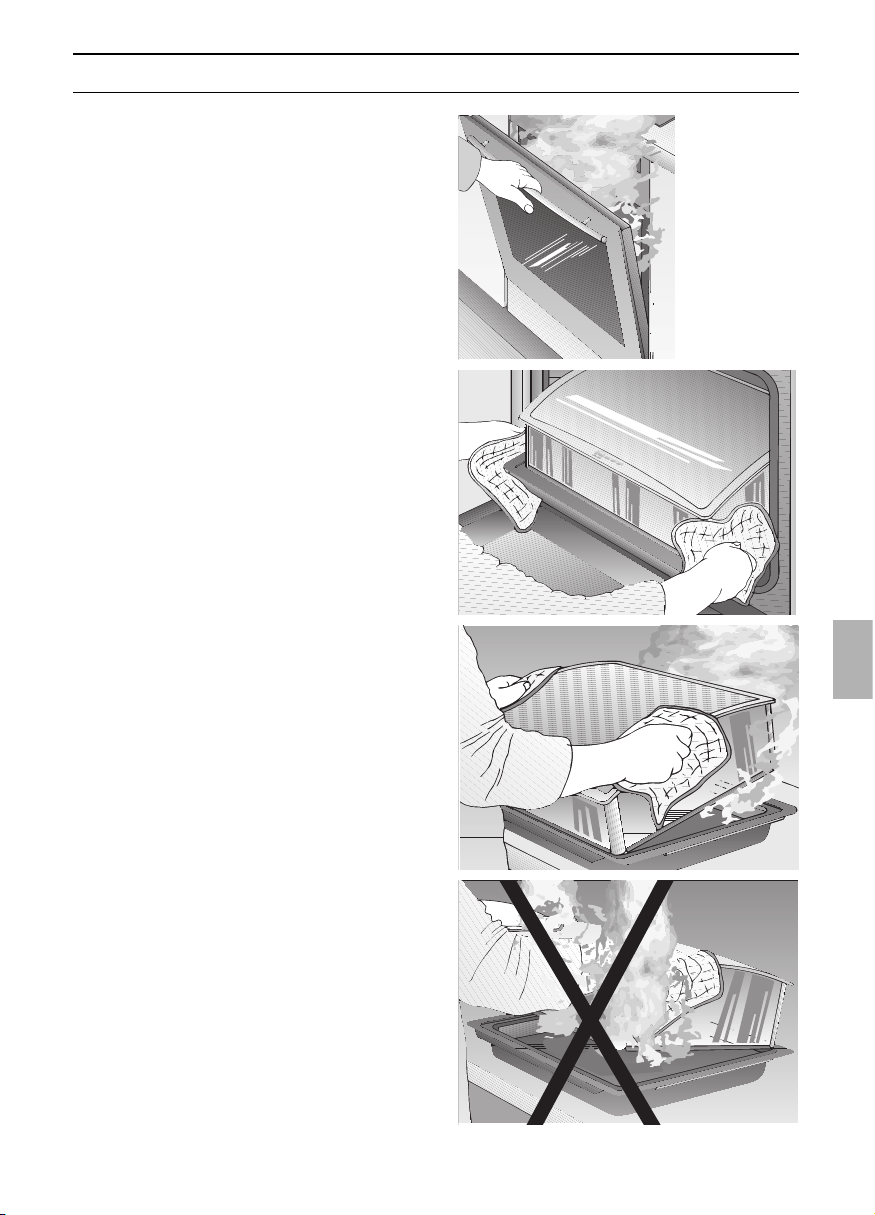
1. Abrir lentamente la puerta del horno.
¡Al abrir la puerta del horno, escapa
vapor de agua caliente del horno!
2. Retirar el sistema de horneado del
horno.
¡Utilizar unos agarradores
adecuados!
3. Colocar el sistema de horneado al vapor
sobre una base adecuada.
¡No colocarlo sobre la puerta del
horno!
4. Retirar la tapa de vidrio.
¡Retirar la tapa levantándola por
detrás a fin de que el vapor caliente
escape hacia atrás!
¡No levantar la tapa por su parte
delantera!¡
Peligro de quemadura a causa del vapor
caliente!
Tras concluir la cocción a vapor:
❑ Dejar enfriar el horno.
❑ Repasar el horno con un paño húmedo.
❑ Secar el horno con un paño suave.
¡No olvidar la junta de la puerta del
honro!
36
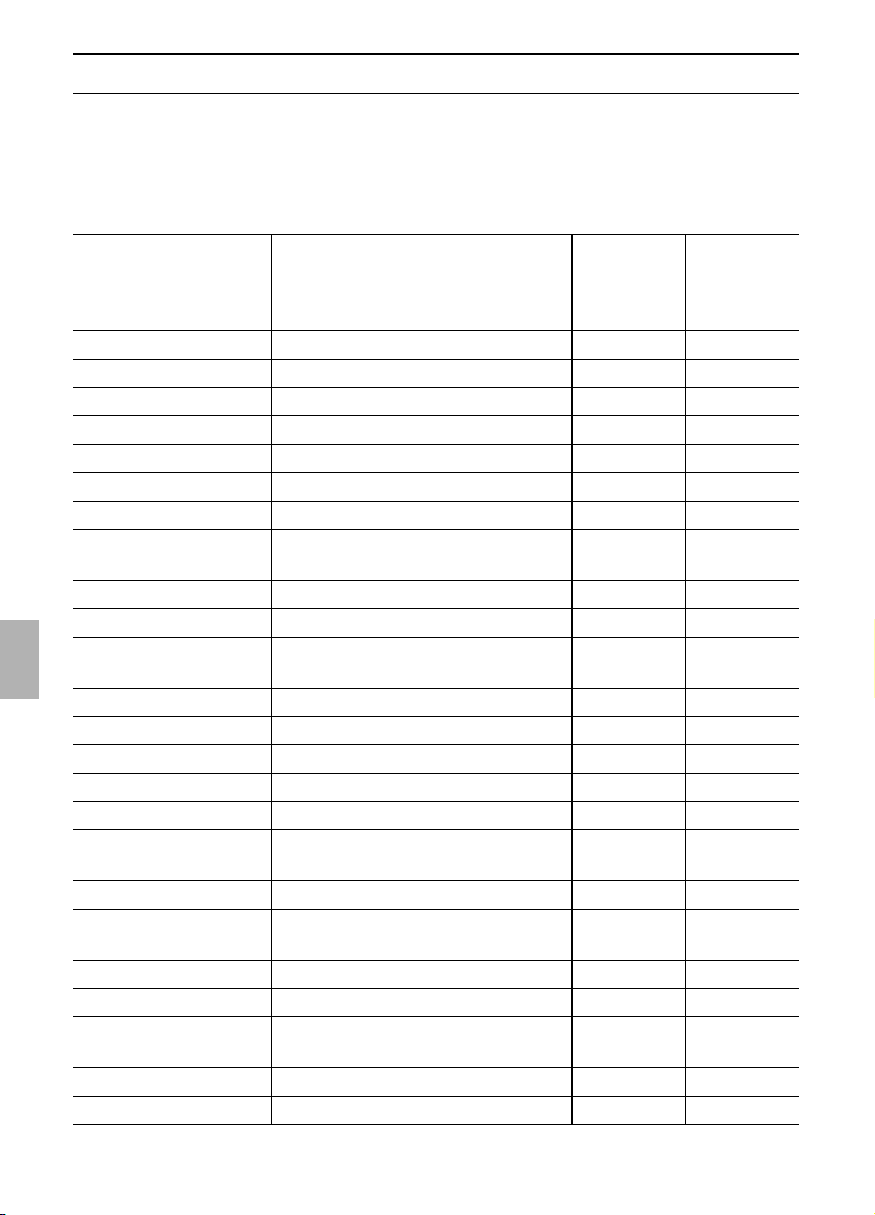
Tabla de cocción
Alimento Forma de preparar Cantidad Tiempo
necesaria de cocción
de líquido, en minutos
en ml
❑ Las indicaciones y valores consignados en el cuadro sólo tienen valor orientativo.
❑ Las indicaciones y valores pueden variar en función de la calidad, naturaleza y estado
de madurez de los alimentos.
❑ ¡No descongelar los alimentos congelados antes de proceder a su cocción!
El tiempo de cocción se incrementa en este caso en aprox. 5 minutos.
Coliflor en ramillletes (tronco cortado) 500 30 – 35
Coliflor entera 500 35 – 40
Coliflor, congelada en ramilletes 500 25 – 30
Brécol, fresco en ramilletes (tronco cortado) 500 30 – 35
Brécol, congelado en ramilletes 500 25 – 30
Guisantes, frescos 500 25 – 30
Guisantes, congelados 500 20 – 25
Hinojo, fresco cortado a la mitad, sin tronco
en rodajas 500 35 – 45
Hinojo, fresco en rodajas, en bastoncillos 500 20 – 25
Judías verdes, frescas 500 30 – 40
Judías verdes,
congeladas 500 30 – 35
Zanahorias en rodajas, en bastoncillos 500 35 – 40
Apio (bulbo) en rodajas, en bastoncillos 500 35 – 40
Puerro en tiras finas o rombos 500 30 – 35
Mazorca de maíz entera 750 55 – 60
Pimientos cortados en tiras, según la madurez 500 30 – 40
Patatas cocidas con
piel según tamaño 750 55 – 65
Col de Bruselas, fresca cortar el tronco 500 35 – 40
Col de Bruselas,
congelada 500 30 – 35
Patatas hervidas en rodajas finas 750 30 – 35
Patatas hervidas cortadas en cuatro trozos 750 35 – 45
Calabacines cortados en dos a lo largo,
en rodajas 500 25 – 30
Espárragos, en tallos según el grosor 500 35 – 45
Espárragos verdes según el grosor 500 30 – 40
37
Consejos y advertencias
importantes:
❑ No utilizar agentes de limpieza agresivos
ni abrasivos. No utilizar tampoco objetos
rayadores.
❑ Eliminar los depósitos de cal con ayuda
de un limpiador de vinagre de uso
corriente.
Enjuagar a continuación con agua limpia
y secar con un paño suave..
Glasdeckel:
❑ No tratar de eliminar los restos de
alimentos resecos rascándoles, sino
dejarlos ablandar en una solución de
agua y agente lavavajillas.
Limpieza y cuidados
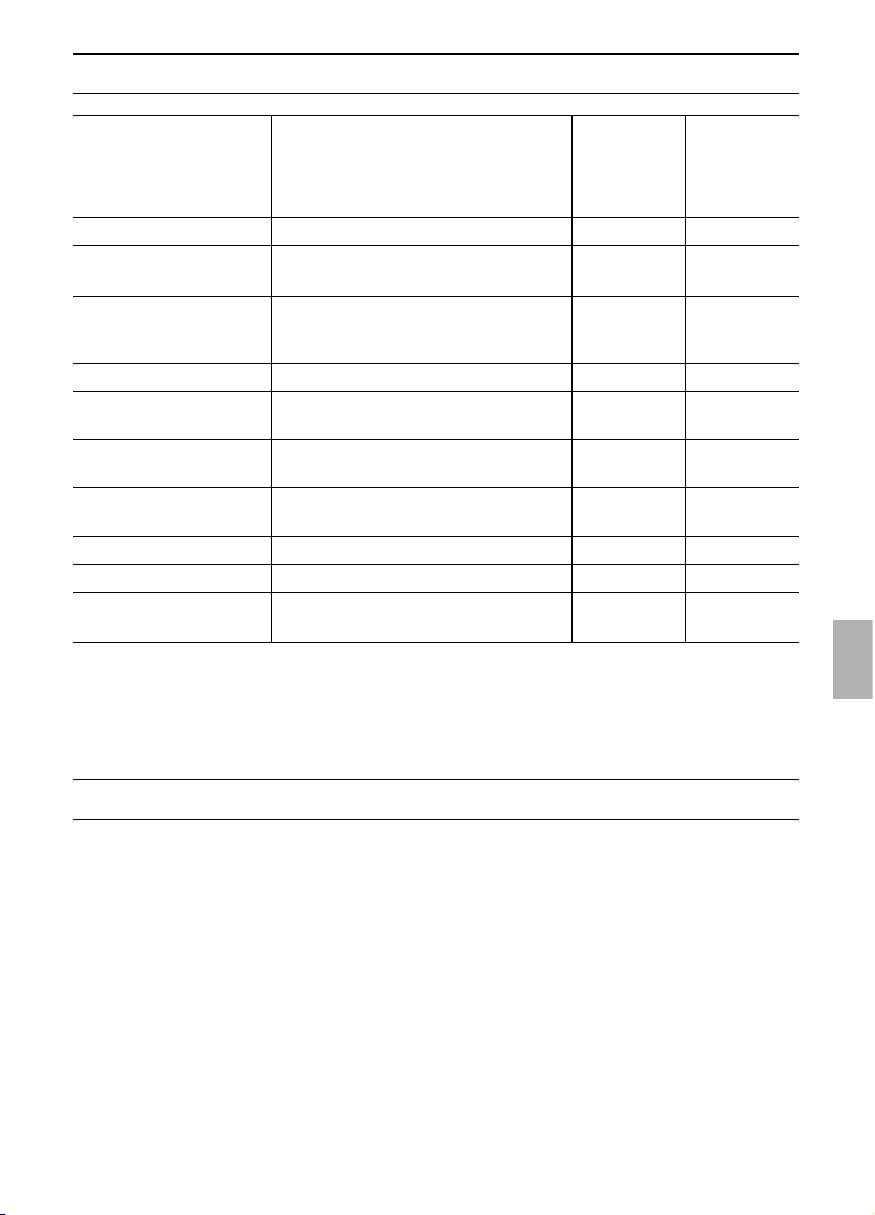
Tabla de cocción
Alimento Forma de preparar Cantidad Tiempo
necesaria de cocción
de líquido, en minutos
en ml
Huevos duros hasta 20 piezas 500 25 – 30
Yema de huevo en tazas de porcelana 500 35 – 40
(para consomés)
Arroz 200 gramos de arroz y 350 ml 750 40 – 45
de agua, en la fuente para arroz o
salsas
Filetes de pescado por ejemplo solla 500 20 – 25
Filetes de pescado, aprox. 150-200 gramos / rodaja 500 25 – 30
gruesos por ejemplo salmón, atún
Porciones de pescado aprox. 200-250 gramos / pieza 500 20 – 25
por ejemplo trucha, caballa
Piezas de pescado aprox. 800 - 1000 gramos, según 500 30 – 40
grandes grosor por ejemplo trucha, brema
Carne de vaca aprox. 1000 g según el grosor 750 75 – 90
Carne de cerdo filete, aprox. 500 gramos / pieza 750 40 – 50
Aves aprox. 200 gramos / pieza 500 35 – 45
por ejemplo pechuga de pavo o pollo
38
Υποδείξεις απσυρσης
❑ Οι παλιές συσκευές δεν αποτελούν
άχρηστα απορρίµµατα. Με την φιλική
προς το περιβάλλον απσυρση
µπορούν να επανακτηθούν πολύτιµες
πρώτες ύλες.
❑ Η καινούργια σας συσκευή
προστατεύεται κατά τη µεταφορά µέχρι
το σπίτι σας απ τη συσκευασία. λα
τα χρησιµοποιούµενα υλικά είναι φιλικά
προς το περιβάλλον και ανακυκλώσιµα.
Παρακαλείσθε να συντελέσετε κι εσείς
στην προστασία του περιβάλλοντος και
ν' αποσύρετε τη συσκευασία µε τρπο
φιλικ προς το περιβάλλον.
Γι α τους επίκαιρους τρπους
απσυρσης παρακαλείσθε ν'
απευθυνθείτε στο ειδικ κατάστηµα,
απ' που αγοράσατε τη συσκευή ή στη
∆ηµοτική Αρχή του τπου κατοικίας
σας.
Τι πρέπει να προσέξετε
Υποδείξεις ασφαλείας
❑ Χρησιµοποιείτε τη συσκευή µνο για
µαγείρεµα τροφίµων στον ατµ.
– Χρησιµοποιείτε ως θερµαντικ
σύστηµα µνο την κάτω αντίσταση
w.
–
Άλλες εφαρµογές ή αντίστοιχα άλλα
συστήµατα θέρµανσης δεν
επιτρέπονται.
❑ Οι επιφάνειες συσκευών θέρµανσης και
µαγειρικής καίνε κατά τη λειτουργία.
Γι' αυτ κρατάτε τα παιδιά οπωσδήποτε
µακριά απ αυτές.
❑ Κατά την εργασία µε τη συσκευή
µαγειρέµατος στον ατµ σχηµατίζεται
καυτς υδρατµς. Προσοχή, ταν
ανοίγετε την πρτα του φούρνου και
ταν σηκώνετε το γυάλινο καπάκι.
❑ Προτού χρησιµοποιήσετε την
καινούργια συσκευή για πρώτη φορά,
παρακαλείσθε να διαβάσετε
προσεκτικά τις οδηγίες χρήσης.
Αυτές περιέχουν σηµαντικές
πληροφορίες για την ασφάλειά σας
καθώς και για τη χρήση και την
φροντίδα της συσκευής.
❑ Φυλάξτε τις οδηγίες χρήσης,
ενδεχοµένως για κάποιον µετέπειτα
χρήστη.
❑ Αν η συσκευή έχει υποστεί βλάβη, δεν
επιτρέπεται να τεθεί σε λειτουργία.
❑ Καθαρίζετε τη συσκευή µαγειρέµατος
στον ατµ και λα τα εξαρτήµατα µε
καυτ διάλυµα απορρυπαντικού.
❑ Κολλήστε το προστατευτικ λεπτ
πλαστικ φύλλο που συνοδεύει τη
συσκευή κάτω απ την προεξοχή του
πάγκου εργασίας. Για τον σκοπ αυτ
κψτε, τραβήξτε και κολλήστε το
προστατευτικ φύλλο.
Πριν την πρώτη χρήση
1
2
3
4
39
Πριν την πρώτη χρήση
Τοποθέτηση σκελετού
❑ Τοποθετείτε τον σκελετ έτσι, ώστε τα
τξα να εισέρχονται µίσω στην δεύτερη
οπή.
Υποδοχή
❑ Τοποθετείτε τη συσκευή µαγειρέµατος
στον ατµ πάντοτε στην υποδοχή 1.
Γυάλινο καπάκι
∆οχείο ρυζιού και σάλτσας
Μικρ ένθετο µαγειρέµατος στον
ατµ
Σκελετς
Μεγάλο ένθετο
µαγειρέµατος στον ατµ
Ταψί σουφλέ/ο γκρατέν
40
Υποδείξεις:
❑ Τη βάση της συσκευής µαγειρέµατος
στον ατµ αποτελεί πάντοτε το ταψί
σουφλέ/ο γκρατέν, το µεγάλο ένθετο
µαγειρέµατος στον ατµ και το γυάλινο
καπάκι.
❑ Για µεγαλύτερες ποστητες και για το
µαγείρεµα ρυζιού ή σαλτσών µπορείτε
να χρησιµοποιήσετε επιπλέον τον
σκελετ µε τα δοχεία για τα τρφιµα
που πρκειται να µαγειρευτούν.
❑ Χρησιµοποιείτε µνον τα γνήσια
εξαρτήµατα που παραδίδονται µαζί µε
τη συσκευή.
Hinweise:
❑ Το ταψί σουφλέ/ο γκρατέν µπορείτε να
το χρησιµοποιήσετε και µνο του, π.χ.
για το µαγείρεµα µεγάλων ποσοτήτων
σουφλέ/ο γκρατέν.
❑ Περαιτέρω πληροφορίες για το
µαγείρεµα στον ατµ, βλ. στην
επισυναπτµενη µπροσούρα.
Μαγείρεµα
Χειρισµς:
1. Προθερµαίνετε τον φούρνο επί
10 λεπτά.
Ρύθµιση:
w 150° C.
Άλλες ρυθµίσεις δεν επιτρέπονται.
2. Χύνετε νερ µέσα στο ταψί σουφλέ/ο
γκρατέν.
–Για την ποστητα, βλ. στον πίνακα
µαγειρέµατος ή στην
επισυναπτµενη µπροσούρα.
– Χρησιµοποιείτε µνον κανονικ
νερ της βρύσης, χι αποσταγµένο
νερ.
3. Τοποθετείτε τα τρφιµα µέσα στη
συσκευή.
4. Σκεπάζετε τη συσκευή µε το γυάλινο
καπάκι έτσι, ώστε να εφαρµζει
ολγυρα στο ταψί σουφλέ/ο γκρατέν.
5. Τοποθετείτε τη συσκευή µαγειρέµατος
στον ατµ στην υποδοχή 1.
Υποδείξεις:
❑ Κατά τη διάρκεια της διαδικασίας
µαγειρέµατος δεν πρέπει ν' ανοίγετε
την πρτα του φούρνο.
Εξαίρεση: Συνδυασµς διαφορετικών
Εξαίρεση:τροφίµων µε µεγάλη διαφορά
Εξαίρεση: στις διάρκειες βρασµού.
❑ Ο χρνος µαγειρέµατος ορίζεται απ
το µέγεθος των τροφίµων.
Σε ταυτχρονο µαγείρεµα τροφίµων µε
διαφορετικές διάρκειες βρασµού
ισχύει:
– Κβετε τα τρφιµα µε τη
µεγαλύτερη διάρκεια βρασµού σε
µικρτερα κοµµάτια.
–ή παρατείνετε τη διάρκεια
µαγειρέµατος για ευαίσθητα
τρφιµα, µαγειρεύοντάς τα σε
µεγαλύτερα κοµµάτια.
❑ Βασικά ισχύει: 500 ml νερ.
Εξαίρεση:
∆ιογκούµενα τρφιµα (π.χ. πατάτες) και
υλικά µε µεγάλες διάρκειες βρασµού
χρειάζονται 750 ml νερ.
41
Μαγείρεµα
Αφαίρεση της συσκευής
µαγειρέµατος στον ατµ απ
τον φούρνο:
1. .Ανοίγετε αργά την πρτα του
φούρνου.
Κατά το άνοιγµα εκφεύγει καυτς
ατµς.
2. Βγάζετε τη συσκευή µαγειρέµατος
στον ατµ απ τον φούρνο.
Χρησιµοποιείτε γι' αυτ κατάλληλη
πιάστρα.
3. Αποθέτετε τη συσκευή.
χι επάνω στην πρτα του
φούρνου.
4. Βγάζετε το γυάλινο καπάκι.
Το ανασηκώνετε στο πίσω µέρος,
για να µπορεί να εκφύγει πίσω ο ατµς.
Μην ανασηκώνετε στο εµπρσθιο
µέρος.
Κίνδυνος εγκαυµάτων απ τον καυτ
ατµ.
Μετά το µαγείρεµα στον ατµ:
❑
Αφήνετε την πρτα του φούρνου να
κρυώσει.
❑
Σκουπίζετε τον φούρνο µε βρεγµένο
πανί.
❑
Τρίβετε τον φούρνο µε στεγν πανί
(επίσης κάτω απ την τσιµούχα της
πρτας).
42
Πίνακας µαγειρέµατος
Τρφιµα Τρπος µαγειρέµατος Υγρ για ∆ιάρκεια
τον ατµ
µαγειρέµατος
σε ml σε λεπτά
❑ Τα στοιχεία στον πίνακα µαγειρέµατος είναι ενδεικτικές τιµές.
❑ Τα στοιχεία µπορούν να ποικίλλουν ανάλογα µε το είδος, το µέγεθος και την
ωριµτητα των τροφίµων.
❑ Μην ξεπαγώνετε τα κατεψυγµένα τρψιµα πριν το µαγείρεµα.
Η διάρκεια µαγειρέµατος παρατείνεται κατά 5 λεπτά περίπου.
Κουνουπίδι
σε ανθάκια (µε το κοτσάνι χαραγµένο)
500 30 – 35
Κουνουπίδι ολκληρο 500 35 – 40
Κουνουπίδι,
κατεψυγµένο σε ανθάκια
500 25 – 30
Μπρκολο, φρέσκο
σε ανθάκια (µε το κοτσάνι χαραγµένο)
500 30 – 35
Μπρκολο,
κατεψυγµένο
σε ανθάκια 500 25 – 30
Αρακάς, φρέσκος 500 25 – 30
Αρακάς, κατεψυγµένος 500 20 – 25
Φοινκιο, φρέσκο κοµµένα στα δύο, χωρίς κοτσάνια 500 35 – 45
Φοινκιο, φρέσκο σε φέτες 500 20 – 25
Φασολάκια, φρέσκα 500 30 – 40
Φασολάκια,
κατεψυγµένα
500 30 – 35
Καρτα σε φέτες, µακρστενα κοµµάτια 500 35 – 40
Σελερί σε φέτες, µακρστενα κοµµάτια 500 35 – 40
Πράσο λεπτές φέτες ή ρµβοι 500 30 – 35
Καλαµπκια ολκληρα 750 55 – 60
Πιπεριές κοµµένες σε φέτες, ανάλογα
µε την ωριµτητα
500 30 – 40
Πατάτες βραστές,
µε τη φλούδα ανάλογα µε το µέγεθος
750 55 – 65
Λαχανάκια Βρυξελών,
φρέσκα µε χαραγµένο το κοτσάνι
500 35 – 40
Λαχανάκια Βρυξελών,
κατεψυγµένα
500 30 – 35
Πατάτες βραστές λεπτά µακρστενα κοµµάτια 750 30 – 35
Πατάτες βραστές στα τέσσερα 750 35 – 45
Κολοκυθάκια
κοµµένο στα δύο κατά µήκος, φέτες
500 25 – 30
Σπαράγγια ολκληρα ανάλογα µε το πάχος 500 35 – 45
Σπαράγγια, πράσινα ανάλογα µε το πάχος 500 30 – 40

43
Σηµαντικές υποδείξεις:
❑ Μη χρησιµοποιείτε για τον καθαρισµ
της συσκευής µέσα τριψίµατος,
διαβρωτικά µέσα και αντικείµενα που
προκαλούν αµυχές.
❑ Αποµακρύνετε τα κατάλοιπα των
αλάτων µε κοιν απορρυπαντικ σε
βάση ξιδιού.
Ξεπλένετε µε νερ και σκουπίζετε µε
µαλακ πανί να στεγνώσει.
Glasdeckel:
❑ Μην ξύνετε τα ξερά κατάλοιπα
φαγητών, αλλά τα µαλακώνετε σε
διάλυµα απορρυπαντικού.
Καθαρισµς και φροντίδα
Πίνακας µαγειρέµατος
Τρφιµα Τρπος µαγειρέµατος Υγρ για ∆ιάρκεια
τον ατµ
µαγειρέµατος
σε ml σε λεπτά
Αβγά βραστά, σφιχτά µέχρι και 20 κοµµάτια 500 25 – 30
Αβγά χτυπητά σε πορσελάνινα φλιτζάνια 500 35 – 40
Ρύζι 200 g ρύζι και 350 ml νερ στο 750 40 – 45
δοχείο ρυζιού και σάλτσας
Ψάρι, φιλέτο π.χ. γλώσσα
500 20 – 25
Φέτες ψαριού περ. 150-200 g / φέτα 500 25 – 30
π.χ. σολωµς, τνος
Ψάρια ολκληρα περ. 200-250 g / τεµάχιο
500 20 – 25
π.χ. πέστροφα, σκουµπρί
Μεγάλα ψάρια περ. 800-1000 g
500 30 – 40
π.χ. πέστροφα, µπαρµπούνι
Βοδιν κρέας περ. 1000 g ανάλογα µε το πάχος
750 75 – 90
Χοιριν κρέας φιλέτο, περ. 500 g / τεµάχιο 750 40 – 50
Κρέας πουλερικών περ. 200 g / τεµάχιο, 500 35 – 45
π.χ. στήθος γάλου ή κοτπουλου

N 8640 X2
5750 198 264
Printed in Germany 0903 Es.
Ident-Nr. 580 809