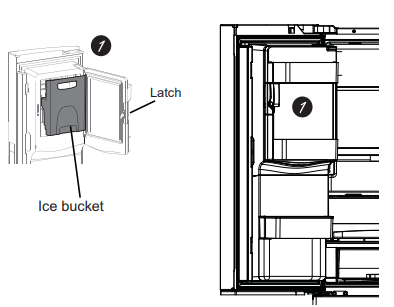
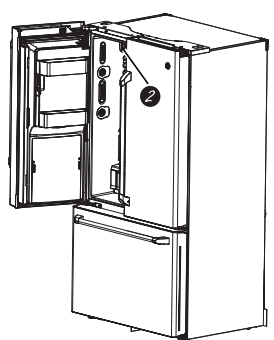
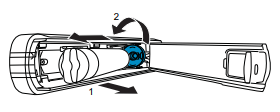
Using handhold lift ice bucket up and out to clear locators in bottom of bin.
To replace the ice bucket, set it on the guide brackets and push until the ice bucket seats properly.
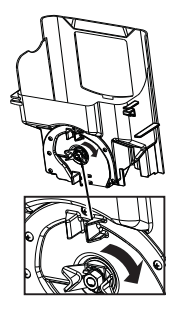
If bucket cannot be replaced, rotate the Ice Bucket Fork 1/4 turn clockwise.
Ice/water filter
Certified to reduce chlorine-resistant cysts, lead, select pharmaceuticals, and more.
Controls
NOTE: The refrigerator is shipped with protective film covering the temperature controls. If this film was not removed during installation, remove it now. The temperature controls are preset in the factory at 37°F for the refrigerator compartment and 0°F for the freezer compartment. Allow 24 hours for the temperature to stabilize to the preset recommended settings.
Changing the Temperature for Control
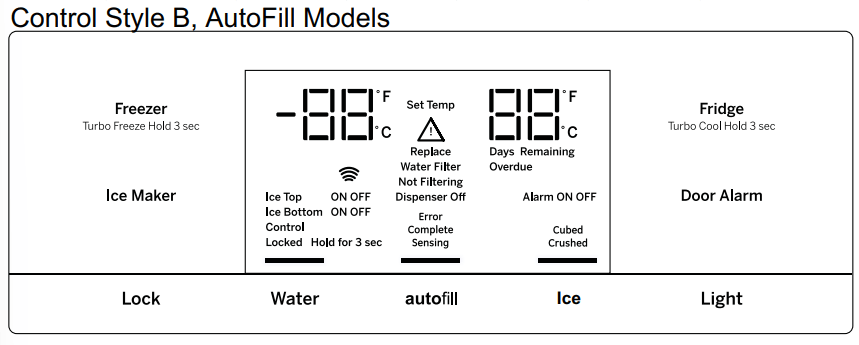
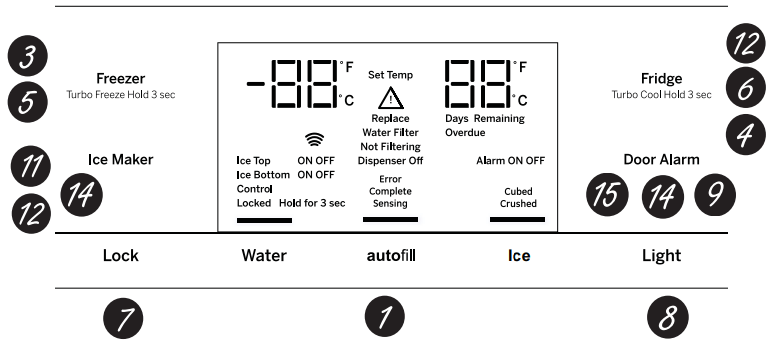
To change the temperature, press and release the Freezer or Fridge pad. The display will show the set temperature. To change the temperature, press either the Freezer or Fridge pad until the desired temperature is displayed. Press and hold button for Turbo Cool feature. The display will show tC. Press and hold button for Turbo Freeze feature. The display will show tF.
To turn off the cooling system press and hold the Fridge and Ice Maker buttons. To turn on, press Fridge or Freezer.
Turning the cooling system off stops the cooling to the refrigerator, but it does not shut off the electrical power.
Hands-free Autofill* - Hands-free Autofill uses sensors to monitor container height to automatically dispense filtered water without having to activate the paddle.
Start Heating* - The Start Heating button is used to initiate the water heating for the Single Serve feature. To abort the Start Heating feature, press and hold the Start Heat button for 3 seconds.
Freezer temp control - Adjust freezer compartment temperature.
Fresh food temp control - Adjust fresh food compartment temperature.
TurboFreeze™ setting - Activate TurboFreeze to quickly restore freezer temperatures after frequent door openings.
TurboCool™ setting - Activate TurboCool to quickly restore fresh food temperature after frequent door openings.
Lock Controls - Press Lock pad and hold 3 seconds to lock out ice and water dispenser and all feature and temperature buttons.
Dispenser light - Lighting that can be turned on/off to light your dispenser.
Door Alarm - Sounds to alert when the freezer or fresh food doors have been left open. Press and hold Door Alarm pad and it will toggle the sound between low, high, and off.
Brew Size* - The Brew Size button is used to select the desired cup size for single serve. Press and hold the button for 3 seconds to toggle the brew type between Coffee and Cocoa.
Ice maker setting - Turn your ice makers on/off.
Cooling system On/Off - Press and hold Fridge and Ice Maker simultaneously for 3 seconds to turn the cooling system off. To turn cooling system on press either the Fridge or Freezer.
Brew Dispense - Press and hold Brew Dispense button for 3 seconds, but no longer than 6 seconds, to dispense coffee or cocoa.
F°/C° - Press and hold Ice Maker and Door Alarm simultaneously for 3 seconds to switch between F7C°.
Sound Control for pad chimes - Press and hold the Door Alarm pad: Once for High to Off, twice for Off to Low and three times for Low to High.
Additional Mode:
Sabbath Mode - Press and hold Lock and Light simultaneously for 3 seconds to enter/exit Sabbath mode. Sabbath Mode will turn off or dim interior lights, temperature control and advanced features. Compressor will run on a timed defrost when in Sabbath mode.
Water Filter Cartridge - RPWFE
Water Filter Cartridge
The water filter cartridge is located in the fresh food interior on the left side wall, near the top.
Select models use radio frequency identification (RFID) to detect leaks and monitor filter status. The RFID technology is certified by the FCC.
When to Replace the Filter Cartridge
The filter cartridge should be replaced every six months or earlier if 170 gallons (643.52 liters) of water has been dispensed or the flow of water to the dispenser or icemaker decreases.
Touch Screen Models: A filter status message will appear on the screen when the water filter needs to be replaced. The filter status will automatically update when the filter is replaced.
Non-touch Screen Models: A filter indicator light will illuminate on the screen when the water filter needs to be replaced.
Removing the Filter Cartridge/Bypass Plug
Remove the old cartridge or bypass plug by opening the filter door and pulling on the bottom of the cartridge/ bypass plug to disengage it from the filter clips. Swing the cartridge/bypass plug outward until you hear the 'click' of the cartridge holder engaging with the bracket.
Twist the cartridge/bypass plug one-quarter turn counter-clockwise. After twisting, remove the cartridge/ bypass plug by pulling it away from the cartridge holder. A small amount of water may drip out
Installing the Filter Cartridge/Bypass Plug
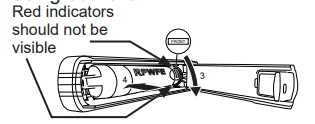
1.Align the filter cartridge/bypass plug with the cartridg holder with the word "FRONT" facing the top of the unit. Push the cartridge/bypass plug toward the rear the unit until it is fully seated. Twist the filter cartridge/bypass plug clockwise one-quarter turn, until the word "FRONT" is facing outward.
2.While continuing to ensure cartridge/bypass plug is fully seated in the holder, gently swing the filter inwaid until it is in position. If filter will not swing easily, chec to ensure filter is properly aligned and fully seated within the cartridge holder. The RED indicators shoul not be visible.
NOTE: It is normal for water to appear discolored the initial system flush. Water color will return to n after first few minutes of dispensing.
Filter Bypass Plug
To reduce the risk of property damage due to water leakage, you MUST use the filter bypass plug when a replacement filter cartridge is not available. Some models do not come equipped with the filter bypass plug. To obtain a free bypass plug, visit us on-line at geappliances.com/service. In Canada, visit geappliances.ca/service. The dispenser and icemaker will not operate without either the filter or the bypass plug installed. The bypass plug is installed in the same way as a filter cartridge.”
Automatic Ice Maker
A newly installed refrigerator may take 12 to 24 hours to begin making ice.
Automatic Ice maker*
The ice maker will produce seven cubes per cycle approximately 100-130 cubes in a 24-hour period, depending on freezer compartment temperature, room temperature, number of door openings and other use conditions.
The ice maker will fill with water when it cools to 15°F (-10°C). A newly installed refrigerator may take 12 to 24 hours to begin making ice cubes.
If the refrigerator is operated before the water line connection is made to the unit or if the water supply to an operating refrigerator is turned off, make sure that the ice maker is turned off. Once the water has been connected to the refrigerator, the ice maker may be turned on. See the table below for details.
You may hear a buzzing sound each time the ice maker fills with water.
Throw away the first few batches of ice to allow the water line to clear.
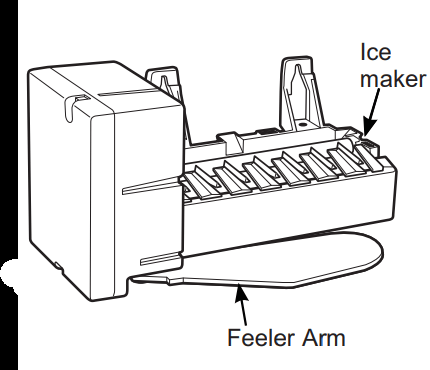
Be sure nothing interferes with the sweep of the feeler arm. When the bin fills to the level of the feeler arm, the ice maker will stop producing ice. It is normal for several cubes to be joined together.
If ice is not used frequently, old ice cubes will become cloudy, taste stale and shrink.
NOTE: In homes with lower-than-average water pressure, you may hear the ice maker cycle multiple times when making one batch of ice.
How to Turn the Ice Maker On/Off, use the “ICE MAKER” button on the control. See Controls.
Ice Bucket and Dispenser*
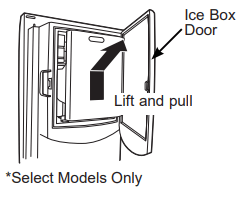
Open the ice box door on inside of the left door.
Pull up and out on the ice bucket in the left hand door to remove it from the compartment .
To replace the ice bucket, set it on the guide brackets and push until the ice bucket seats properly.
If bucket cannot be replcaed, rotate the ice bucket fork ¼ turn clockwise.
Care and Cleaning
Cleaning the Outside
Directions for Cleaning Outside Surfaces, Door Handles, and Trim
DO USE
DO NOT USE
Soft, clean cloth or sponge
Abrasive cloths, scrubbing sponges, scouring or steel wool pads
Mild detergent mixed with warm water Approved stainless steel cleaners; Visit the GE Appliances parts store for approved stainless steel cleaners: GEAppliancesparts.com or call 877.959.8688
Cleaners with oxalic acid such as Bar Keepers Friend Soft Cleanser™ can be used to remove surface rust, tarnish and small blemisheson stainless steel surfaces only.
Abrasive powders or sprays Window Sprays or Ammonia Citrus or plant oil-based cleaners Acidic or vinegar-based cleaners Oven cleaners
Cleaners containing acetone (propanone)
Any cleanerwith WARNING about plastic contact
NOTE: DO NOT allow stainless steel cleaner to come in contact with any plastic parts such as trim pieces, handle hardware and liners. If unintentional contact of cleaners with plastic parts does occur, clean plastic part with a sponge and mild detergent mixed with warm water.
Cleaning the Inside
To help prevent odors, leave an open box of baking soda in the refrigerator and freezer compartments.
Unplug the refrigerator before cleaning.
If this is not practical, wring excess moisture out of sponge or cloth when cleaning around switches, lights or controls.
Use an appliance wax polish on the inside surface between the doors.
Use warm water and baking soda solution—about a tablespoon (15 ml) of baking soda to a quart (1 liter) of water. This both cleans and neutralizes odors. Rinse and wipe dry.
To clean the inside metal panel*, open the outer door using the Door in Door Latch. Clean the panel with a mild detergent and then wipe dry with a soft cloth. Do not use any stainless steel cleaner on the panel as it may damage the surrounding plastic.
CAUTION! Do not clean glass shelves or coverswith warm water when they are cold. Glass shelves and covers may break if exposed to sudden temperature changes or impact such as bumping or dropping. Tempered glass is designed to shatter into many small pieces if it breaks. Do not wash any plastic refrigerator parts in the dishwasher.
Behind the Refrigerator
Be careful when moving the refrigerator away from the wall. All types of floor coverings can be damaged, particularly cushioned coverings and those with embossed surfaces.
Raise the leveling legs located at the bottom front of the refrigerator.
Pull the refrigerator straight out and return it to position by pushing it straight in. Moving the refrigerator in a side direction may result in damage to the floor covering or refrigerator.
Lower the leveling legs until they touch the floor.
Preparing for Vacation
For long vacations or absences, remove food and unplug the refrigerator. Clean the interior with a baking soda solution of one tablespoon (15 ml) of baking soda to one quart (1 liter) of water. Leave the doors open.
If the temperature can drop below freezing, have a qualified service technician drain the water supply system to prevent serious property damage due to flooding.
Turn refrigerator off or unplug the refrigerator.
Empty ice bucket
Turn water supply off
If you cut the water supply off, turn off the ice maker.
Upon returning from vacation:
Replace the water filter.
Run 2 gallons (7.57 liters) of water through the cold water dispenser (about 5 minutes) to flush the system.
Preparing to Move
Secure all loose items such as shelves and drawers by taping them securely in place to prevent damage.
When using a hand truck to move the refrigerator, do not rest the front or back of the refrigerator against the hand truck. This could damage the refrigerator
Handle only from the sides of the refrigerator.
Be sure the refrigerator stays in an upright position during moving.
Replacing the Lights
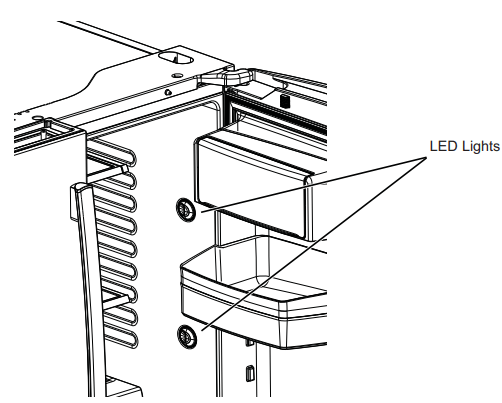
Refrigerator Lights (LEDs)
Appearance may vary by model.
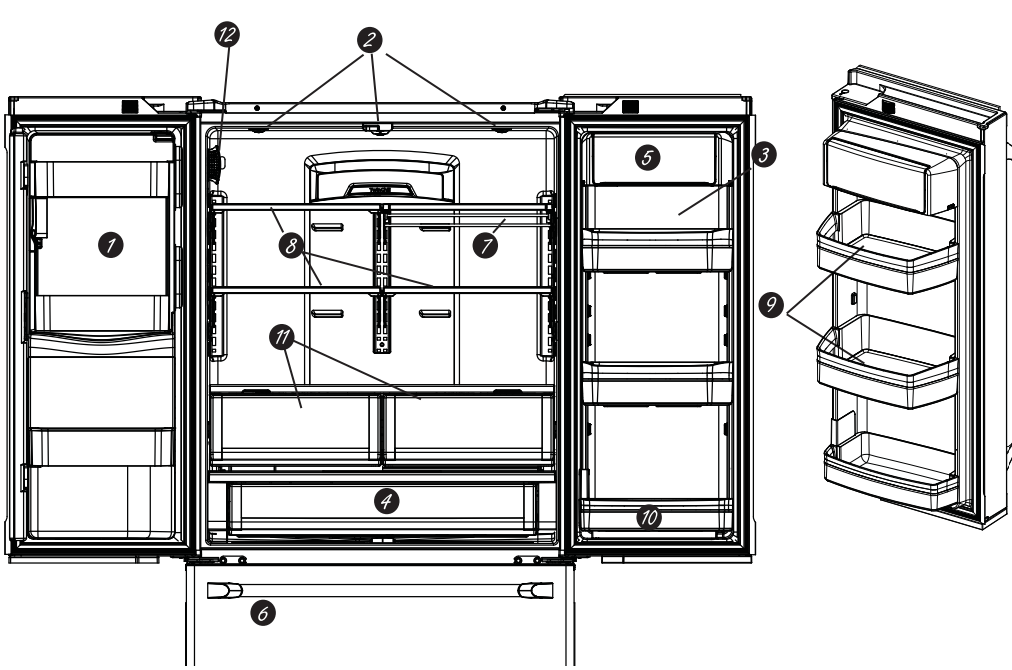
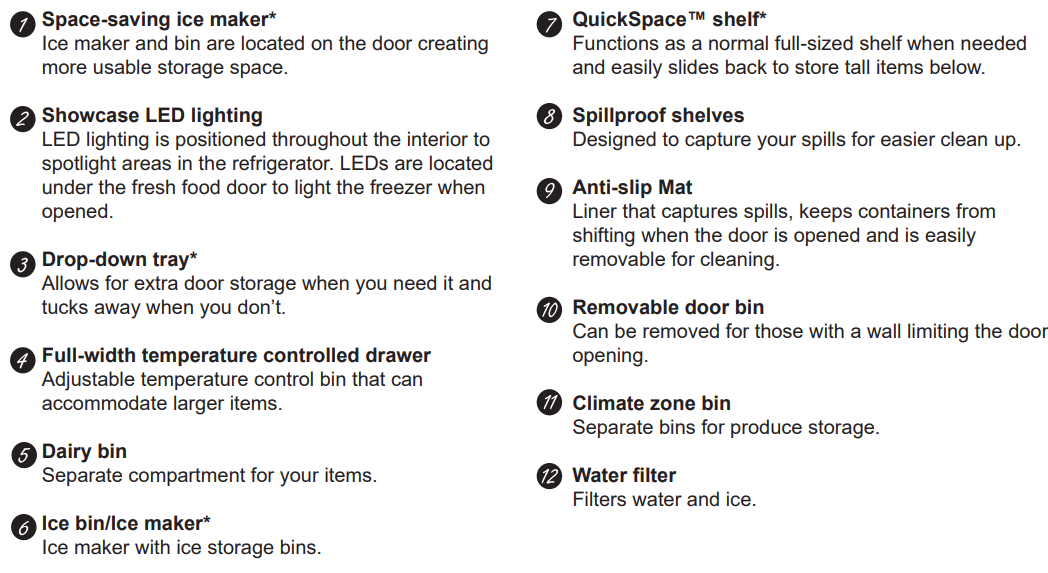
There is LED lighting in fresh food compartment and on the bottom of the fresh food doors to light the freezer compartment.*
An authorized technician will need to replace the LED light.
Troubleshooting Tips
Normal Operating Conditions
Newer refrigerators sound different from older refrigerators.
Modern refrigerators have more features and use newer technology.
The new high efficiency compressor may run faster and longer than your old refrigerator and you may hear a high-pitched hum or pulsating sound while it is operating.
You may hear a whooshing sound when the doors close. This is due to pressure equalizing within the refrigerator.
After dispensing ice, a motor will close the ice chute to keep warn room air from entering the ice bucket, maintaining ice at a freezing temperature. The hum of the motor closing the ice chute is normal, shortly after dispensing ice.
You may hear the fans spinning at high speeds. This happens when the refrigerator is first plugged in, when the doors are opened frequently or when a large amount of food is added to the refrigerator or freezer compartments. The fans are helping to maintain the correct temperatures.
The fans change speeds in order to provide optimal cooling and energy savings.
CLICKS, POPS, CRACKS and SNAPS
You may hear cracking or popping sounds when the refrigerator is first plugged in. This happens as the refrigerator cools to the correct temperature.
The compressor may cause a clicking or chirping sound when attempting to restart (this could take up to 5 minutes).
Expansion and contraction of cooling coils during and after defrost can cause a cracking or popping sound.
On models with an ice maker, after an ice making cycle, you may hear the ice cubes dropping into the ice bucket.
After dispensing ice, a motor will close the ice chute to keep warm room air from entering the ice bucket, maintaining ice at a freezing temperature.
WATER SOUNDS
The flow of refrigerant through the cooling coils may make a gurgling noise like boiling water.
Water dropping on the defrost heater can cause a sizzling, popping or buzzing sound during the defrost cycle.
A water dripping noise may occur during the defrost cycle as ice melts from the evaporator and flows into the drain pan.
Closing the door may cause a gurgling sound due to pressure equalization.
START UP COOLING
It can take up to 24 hours for the refrigerator and freezer temperatures to match the display. During that time refrigerator and freezer door openings should be minimized.
TIPS
Freezer cools first.
Refrigerator compartment cools last; it may take several hours after the freezer
Turning off ice maker makes both fresh food and freezer food cool faster.
Before you call for service
Problem
Possible Causes
What to Do
Water filter indicated as installed incorrectly or a leak is present on cap control panel.
Water filter installed backward or is leaking.
Checkfor leak. If no leak is present, remove filter/bypass plug**, rotate 180° and reinstall.
“Warning Triangle” is lit Replace Filter/Replace Water Filter is lit
Over Due light is lit
Water filter leaking or needs replacing
Water filter backwards
Replace water filter, check for leak Remove filter, rotate 180° and reinstall
Dispenser Off is lit
Wrong filter installed
Replace filter with proper filter Remove filter, rotate 180° and reinstall
Not filtering
Filter bypass installed Controls
Install correct waterfilter
Reset Filter is lit
Water filter leaking or needs replacing
Replace water filter, or install filter bypass **
Press and hold Reset Filter for 3 seconds to reset (Control D only)
Water filter indicator light is not lit
This is normal. This indicator will turn on to tell you that you need to replace the filter soon.
See About the Water Filterfor more information.
Handle is loose/handle has a gap.
Handle needs adjusting
See Attach Fresh Food Handleand Attach the Freezer Handle sections for detailed instructions.
Refrigerator beeping
This is door alarm
-Turn off or disable with door closed
-If door open and alarm is sounding, you can only snooze the alarm
Not cooling
The cooling system is off
See About Controls.
Water has poor taste/odor*
Water dispenser has not been used for a long time
Dispense water, until all water in system is replenished.
Water in glass is warm*
Normal when refrigerator is first installed
Wait 24 hours for the refrigerator to completely cool down.
Water dispenser has not been used for a long time
Dispense water, until all water in system is replenished
Water system has drained
Allow several hours for replenished supply to chill
Water dispenser does not work*
Water supply line turned off or not connected
See Installing the Water Line
Water filter clogged or filter/bypass plug not installed
Replace filter cartridge or remove filter and install bypass plug**
Air may be trapped in the water system
Press the dispenser arm for at least 5 minutes.
Water in reservoir is frozen because the controls are set too cold
Set the refrigerator control to a warmer setting and wait 24 hours. If the water does not dispense after 24 hours, call for service
Water spurting from dispenser*
Newly installed filter cartridge
Run water from the dispenser for 5
minutes (about 2 gallons)
No water or ice cube production*
Supply line or shutoff valve is clogged
Call a plumber
Water filter is clogged
Replace filter cartridge or remove filter and install bypass plug**
Filter cartridge not properly installed
Remove and reinstall filter cartridge, being certain that it locks in place.
Ice maker is turned off
Check that the ice maker is turned on. See About the Automatic Ice Maker.
Water is leaking from dispenser*
Air may be present in the water line system, causing water to drip after being dispensed
Dispense water for at least 5 minutes to remove air from system
AUTO FILL under fill/no fill*
Not all containers work with AUTOFILL
Try different container
Error message
See page 14
Clean sensor. See page 14.
AUTO FILL overfills*
Not all containers work with AUTO FILL
Try different container
Freezer cooling, fresh food not cooling
Normal, when refrigerator first plugged in or after extended power outage
Wait 24 hours for temperature in both compartments to reach selected temperatures.
Ice dispenser opens after closing freezer drawer *
Normal
The ice dispenser door may open after
closing freezer door to allow access
Low brewing flow rate
There may have been a dent at the bottom of K-Cup causing the pin to pierce the filter allowing coffee grounds clogging the bottom pin
Avoid using damaged/dented K-cups, and clean the lower needle before next brew
Low brewing flow rate / water drips from inner door
Top needle of the brewer clogged
Unclog the top needle holes using a paper clip and rinse brewer. Rinse brewer after every use.
Brewer is not detected or hot water leaking from top of the brewer
Incorrect assembly of brewer in the bracket
Make sure the Keurig Logo is in the front. Push brewer all the way in the brackets
Coffee dispensed with splash or bubble bursting
Blocked vent hole in the brewer
Make sure the vent hole at the bottom of the brewer is clear from food or any other contamination
Beverage quality not as expected
You may be using non-standard or
out dated K-Cups
Recommend using official Keurig K-cups that are not past expiration and have not been damaged
Liquid drips from the brewer after brewer cycle is completed and the brewer is removed from the bracket
It is possible for liquids to be retained by the brewer and drip when it is removed
Use a cloth or container to capture the drips when brewer is removed
Delay when using Keurig K-cup Pod dispenser
To ensure a quality beverage is delivered, a short delay is required to ensure the refrigerator is operating correctly
Ensuring consistent, quality operation requires the refrigerator to delay dispense for a short period of time
After brewing, my powdered beverage is not fully cleared from the used pod
Depending on size selected, the powder may not dissolve fully.
Some powdered beverages develop into ‘clumps’ when left sitting for some time
Shake the powdered pods before brewing to break up these clumps and allow better clearing. For powdered beverage with no filter, use the Cocoa cycle selection
Brewer lid is difficult to close
K-cup is not fully seated
Press K-cup all the way down into the brewer prior to closing the lid. Lower needle must puncture K-cup bfore closing the brewer lid
Brewer leaks during the brew cycle
Trouble in closing brewer lid or damaged K-cup
Press K-cup all the way down into the brewer prior to closing the lid. Lower needle must puncture K-cup bfore closing the brewer lid. Recommend using official Keurig K-cups that have not been damaged and have a good seal between the top cover and plastic bottom
Truth or Myth
Truth or Myth?
Answer
Explanation
The refrigerator water filter may require replacement prior to six months
TRUE
The water filter indicator will indicate the need to replace the water filter every six months or 170 gallons of water dispensed (select models only). Water quality varies from city to city. If water flow from the dispenser slows, or ice production decreases, the water filter should be replaced, even though the filter indicator may not indicate the need for replacement.
The automatic ice maker in my refrigerator will produce ice when the refrigerator is plugged into a power receptacle.
MYTH
The refrigerator must be connected to water, and the ice maker must be turned on. Make sure the ice maker is turned on, only after the water line is connected and water is turned on. The ice maker can be turned onloff from the controls and ensure the ice maker is on, as indicated on the refrigerator control panel. See About the Automatic Ice Maker.
After the refrigerator has been plugged in and connected to water, 1 will immediately have unlimited chilled water available from the water dispenser.
MYTH
The water dispenser tank located inside the refrigerator stores water for dispensing. The water in this tank requires 24 hours to chill after installation. High usage conditions will not allow time for the water to chill.
After water dispenses, a few drops of water are normal.
TRUE
A few drops of water may fall from the dispenser, after the dispenser paddle has been released. To minimize the drops, remove the glass slowly from the dispenser.
1 will never see frost inside the freezer compartment.
MYTH
Frost inside the freezer typically indicates that the door is not properly sealed, or has been left open. If frost is found, clear the frost using a plastic spatula and towel, then check to ensure that no food packages or containers are preventing the freezer door from closing. Check the refrigerator control panel to ensure the door alarm is on.
When the refrigerator is installed, or after replacing the water filter, 1 must dispense water for five minutes.
TRUE
A newly installed refrigerator or water filter contains air in the water lines. Press the dispenser paddle and dispense cold water for at least 5 minutes to remove air from the water line, and flush the filter.
To fill the ice bucket to the maximum capacity, 1 should dispense 12 and 18 hours after installation.
TRUE
Dispensing 3-4 cubes 12 hours and 18 hours after installation, allows ice to disperse within the ice bucket, which in turns calls on the ice maker to produce additional ice. Normal ice production = 100 cubes in 24 hours.
I can use the water filter bypass plug to determine if the filter requires replacement.
TRUE
Decrease in flow from the water dispenser, or decreased ice production, may indicate the need to replace the water filter. Install the water filter bypass plug (provided with the refrigerator on some models*), and check flow from the dispenser. Ifwater flow returns to normal with the bypass plug in place, replace the water filter.
The top of the refrigerator doors will always be aligned.
MYTH
Several things can affect the fresh food door alignment, including the floor the refrigerator is installed on and loading of doors. If the top ofthe fresh food doors are not aligned, use a 1/4” alien wrench to adjust the right/left hand door. The adjustment screw is located on the bottom right or left hand side of the door; open the freezer door to access the screw.
Refrigerator door handles can be easily tightened.
TRUE
Ifdoor handles are loose or have a gap, the handle can be adjusted using a 1/8” alien wrench, on set screws located on the ends of the handles.
There may be odor and taste problems with your ice.
TRUE
After starting the ice maker, throw away 24 hours of ice production to avoid odor and taste problems.
I can make fine adjustments to the fresh food doors to align them.
TRUE
If the fresh food doors are not aligned, use a 1/4” Allen wrench to adjust the right hand door. The adjustment screw is located on the bottom of the right/left hand door. Open the freezer door to access.
Door handles should always be removed for installation.
MYTH
If the doors must be removed do not remove the handles, or if the refrigerator will fit easily through the passage way opening. Adjust handles that are loose or have a gap, by adjusting 1/8” set screws on either end of handles.
Door removal is always required for installation.
MYTH
Check chart on reverse side ofthis instruction. Doors should only be removed when necessary to prevent damage from passage way or access to final location.
Refrigerator doors that won’t close after installation, can be adjusted to close properly.
TRUE
Door mechanism works best if installed at 90°+. If installed at 180°, remove the door from the mid hinge, and swing the door 180° before reinstalling. See Reinstalling the Refrigerator Doors.
There is an adjustment to rear wheels.
MYTH
Front leveling legs are adjustable and should be used to balance the refrigerator. Leveling legs are used to make initial fresh food door adjustment.
Check for leaks after all water connections are made.
TRUE
While purging the air from the water system, check all water line connections for leaks. Check the connection to the household water supply at back of refrigerator, and door water line connect.
Any packaging residue can be cleaned off the refrigerator using any cleaner.
MYTH
Do not use wax, polish, bleach, or other products containing chlorine on Stainless Steel panels, door handles and trim. Check this instruction under “Cleaning the Outside” for full details.
*Some models do not come equipped with the filter bypass plug. To obtain a free bypass plug, call 800.GECARES. In Canada, call 800.561.3344.
Additionally, the document applies to other GE - General Electric models: PFE28P*, PYE22P*, PFH28*, PFE28K*, DFE28*, PFD28*, PYE22K*, PYD22*, DYE22*, GFD28*, GFE28*, GFE26, GFS26*, GYS22*, GYE22*, GNE29*, PWE23*