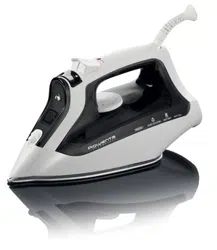
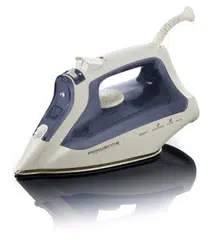
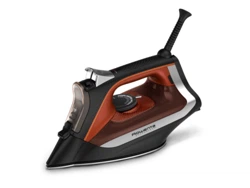
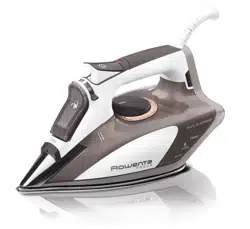
1. Spray nozzle 2. Filling inlet 3. Variable steam control a. Dry ironing b. Steam max. position c. Anti Calc 4. Spray button 5. Burst of steam button
6. Auto-off indicator light* 7. Cord 8. Handle 9. Thermostat control light 10. Temperature control dial 11. Water tank 12. Maximum water level indicator 13. Soleplate
HOW TO USE
BEFORE USE
Warning! Remove any labels from the soleplate before heating up the iron.
Warning! Before using your iron with the steam function for the first time, we recommend that you operate it in a horizontal position for a few moments, away from your linen, i.e. press the Burst of Steam button a few times. During the first few uses, a harmless odour and a small amount of smoke may be given off. This has no effect on the use of the iron and will disappear quickly.
What water may be used?
Your iron has been designed to operate using untreated tap water. If in doubt, check with your local water authority. However, if your water is very hard, you can mix 50% untreated tap water with 50% distilled or demineralised water.
IMPORTANT Heat concentrates the elements contained in water during evaporation. The types of water listed below contain organic waste or mineral elements that can cause spitting, brown staining or premature wear of the appliance : water from clothes dryers, scented or softened water, water from refrigerators, batteries or air conditioners, pure distilled or demineralised water or rain water should not be used in your iron. Also do not use boiled, filtered or bottled water.
IRONING BOARD: Due to the powerful steam output, a mesh type ironing board must be used to allow any excess steam to escape and to avoid steam venting sideways.
Filling the water tank
IMPORTANT Before filling the water tank, unplug the iron and set the steam control to dry position
Tilt the iron. Open the filling inlet (fig.6). Pour in water up to the max mark (fig.7). Close the filling inlet (fig.8) and return the iron to the horizontal.
fig. 6
fig. 7
fig. 8
Setting the temperature
Set the iron temperature to suit the type of material using the temperature control dial (fig.3).
Temperature control: The temperature control light indicates that the soleplate is heating up. When the temperature control light goes off (fig.10), the set temperature is reached and you can begin ironing.
fig. 3
fig. 10
IMPORTANT The iron takes longer to cool down than to heat up. We recommend that you start with fabrics to be ironed at a low temperature. For mixed fabrics set the temperature for the most delicate fabric.
TIP Always spray starch onto the reverse side of the fabric to be ironed.
Dry ironing
Set the variable steam control to (fig.11) and set the temperature to suit the type of material (care points •, ••, •••).
fig. 11
Steam ironing
You can steam iron from temperature setting •• upwards.
Steam function: The steam quantity can be set to between no steam (minimum steam quantity) and (maximum steam quantity) (fig.12).
We recommend setting to maximum steam quantity only when the iron is at temperature setting •••.
fig. 12
Burst of steam
(from temperature setting •• upwards) Press the burst of steam button to generate a powerful jet of steam (fig.13). Wait a few seconds between each burst before pressing the button again.
fig. 13
Vertical burst of steam
(from temperature setting •• upwards)
TIP Hold the iron 10 to 20 centimetres away from the garment to avoid burning delicate fabrics.
Hold the iron to the vertical and press the burst of steam button ( fig.14) to remove creases from suits, jackets, skirts, hanging curtains etc.
IMPORTANT Never direct the steam at persons or animals!
fig. 14
Spray
Press the spray button to dampen stubborn creases (fig.15).
fig. 15
Anti-Drip system
This prevents water escaping from the soleplate when the temperature is too low.
Automatic electronic 3-position Auto-Off*
If, although switched on, the appliance is not moved, it will automatically switch off and the auto off light will blink after the following intervals:
After 30 sec., if the iron is left resting on the the soleplate or lying on its side.
After 8 mins., if the iron is left resting on its heel.
To switch the iron back on, move the iron gently.
AFTER USE
Emptying
Unplug the iron (fig.4), pour away remaining water (fig.16) and set steam control to .
Open and close the steam control several times (fig.17) to prevent the valve hole into the steam chamber from scaling or blocking up.
fig. 4
fig. 16
fig. 17
Storing
Allow the appliance to cool down before storing the iron standing on its heel (fig.23).
fig. 23
IMPORTANT Do not wind the cord around the hot soleplate. Never store your iron placed down on the soleplate.
MAINTENANCE AND CLEANING
IMPORTANT Unplug and allow the iron to fully cool down before maintenance and cleaning.
Anti-scale system
Your iron contains an anti-scale cartridge to reduce scale deposits. This considerably prolongs the operational life of your iron.
The anti-scale cartridge is an integral part of the water tank and does not need to be replaced.
Descale your steam iron easily
Do not put any descaling products (vinegar, industrial descaling agents...) to rinse out your iron: they could damage it.
To prolong the steam performance, your iron is equipped with an integrated limescale collector. This collector, which is located on the iron’s support base, automatically collects limescale that forms inside the iron.
It is recommended that you clean the collector every 2 months. The amount of scale collected will depend on the hardness of the water.
BE CAREFUL: this operation should only be carried out when the iron has been unplugged for more than one hour and has cooled down completely.
To carry out this operation, the steam iron must be close to a sink so that water can flow from the tank when opened.
Hold the iron in one hand and tilt it slightly, pointing the soleplate upwards.
To descale the iron:
Once the steam iron has completely cooled down, raise and turn the tab to unlock it (fig.18-19)
fig. 18
fig. 19
Remove the collector from the iron, it contains the limescale collected in the iron fig.20)
fig. 20
To clean the collector thoroughly rinse in water to remove the limescale inside (fig.21).
fig. 21
Reposition the collector in its housing and turn the tab a quarter turn to the right in order to lock the collector and ensure it is watertight (fig.22).
fig. 22
WARNING! Never use your iron without the limescale collector correctly mounted.
TIP Additionally to this regularly maintenance we recommend to perform the following Anti Calc function after each emptying of the tray and approx. every two weeks. If the water is very hard clean the iron weekly
Anti Calc function
(prolongs the life of the iron)
The Anti Calc function flushes dirt and scale particles out of the steam chamber.
IMPORTANT Do not use descaling agents, as these damage the lining of the steam chamber and so may impair the steam function.
Fill the water tank with untreated tap water up to the max mark and heat the iron to the ••• temperature. Unplug the iron and hold it over a sink horizontally. Hold the steam control into the Anti Calc position (fig.5): steam will now begin to build up. After a few seconds water will emerge from the soleplate, rinsing dirt and scale particles out of the steam chamber.
Move the steam control to position after approx. 1 minute.
Plug in the iron and allow the iron to heat up again. Wait until the remaining water has evaporated. Unplug from the mains and allow the iron to fully cool down.
When cool, the soleplate can be wiped with a damp cloth.
fig. 5
TIP Use the Anti Calc function approx. every 2 weeks.
If the water is very hard, clean the iron weekly.
Cleaning the iron
When the appliance has cooled down, wipe it down with a damp cloth or sponge, as required.
Remove the dirt from the soleplate with a damp cloth or sponge.
IMPORTANT Do not use sharp or abrasive cleaning agents or objects to clean the soleplate and other parts of the iron.
If the appliance has been standing unused for long periods, use the Anti Calc function.
TROUBLESHOOTING
Problems
Cause
Solution
The iron is plugged in, but the soleplate of the iron remains
No mains supply.
Check that the mains plug is properly inserted or try plugging the iron into a different socket.
cold.
Temperature control set too low.
Set the temperature control to a higher temperature.
The automatic electronic Auto-Off* is active.
Move your iron.
None or too little steam is being emitted.
Steam control set on dry position S^.
Not enough water in the water tank.
Turn the steam control to the required setting area.
Fill the water tank.
Anti-Drip is active (§ 9).
Wait for the soleplate to reach the correct temperature.
Brown streaks come through the holes inthe soleplate and
Residues in the steam chamber or on the soleplate.
Use the Anti Calc function then clean your iron.
stain the linen.
Use of chemical descaling agents.
Do not add any descaling agents to the water in the water tank. Use the Anti Calc function and clean your iron.
Fabric fibres have accumulated in the holes of the soleplate and are burning.
Clean the soleplate with a non-metallic sponge.
Vacuum the holes of the soleplate from time to time.
Your linen is not rinsed sufficiently or you have ironed a new garment before washing it.
Ensure linen is rinsed thoroughly to remove any soap deposits or chemicals on new garments which may be sucked by the iron.
Use of starch.
Always spray starch onto the reverse side of the fabric to be ironed and clean your iron soleplate.
Pure distilled / demineralised or softened water is being used.
Only use untreated tap water or mix half tap water with half distilled/ demineralised water. Use the Anti Calc function and clean your iron.
Iron is leaking.
Overuse of burst of steam button.
Allow more time between each burst.
Soleplate temperature too low .
Set the temperature control to a higher temperature.
IMPORTANT SAFETY INSTRUCTIONS
When using an iron, basic precautions should always be followed, including the following:
Read all instructions before using
Only use an iron for its intended use.
To avoid the risk of electric shock, do not immerse the iron in water or other liquids.
Always turn the iron OFF before plugging or unplugging the iron from the electrical outlet. Never pull on the cord to disconnect the iron from the electrical outlet; instead, grasp the plug and pull on the plug to disconnect the iron.
Do not let the cord touch hot surfaces. Let the iron cool comple- tely before putting the iron away. Coil the cord loosely around the iron when storing.
Always disconnect the iron from the electrical outlet before filling the iron with water, emptying the water from the iron, and when the iron is not in use.
Do not operate the iron with a damaged cord or in the event the iron has been dropped or damaged. To avoid the risk of electric shock, do not disassemble the iron. Take it to a qualified serviceman for examination and repair. Incorrect assembly might result in a risk of electric shock when the iron is used after reassembly.
Close supervision is required for any appliance used by or near children. Do not leave the iron unattended while the iron is connec- ted or on an ironing board.
Burns can occur from touching hot metal parts, hot water, or steam. Use caution when you turn a STEAM IRON upside down – there might be hot water in the reservoir.
To avoid a circuit overload, do not operate an iron on the same circuit with another high wattage appliance.
If an extension cord is absolutely necessary, a cord with an ampere rating equal to or greater than the maximum rating of the iron shall be used. A cord rated for less amperage can result in a risk of fire or electric shock due to overheating. Care shall be taken to arrange the cord so that it cannot be pulled or be tripped over.
This appliance is not intended for use by children and other persons whose physical, sensory, or mental capabilities or lack of experience and knowledge prevents them from using the appliance safely without supervision or instruction by a responsible person to ensure that they can use the appliance safely.
Children should be supervised by the responsible person to ensure that they do not play with the appliance.
The iron must be used and rested on a stable surface;
When placing the iron on its stand, ensure that the surface on which the stand is placed is stable;
The iron is not to be used if it has been dropped, if there are visible signs of damage or if it is leaking.
SPECIAL INSTRUCTIONS
16. The iron must not be left unattend while it is connected to supply mains.
17. Always disconect the iron from the electrical outlet, before you leave the room.
SAVE THESE INSTRUCTIONS
Environment protection first !
Your appliance contains valuable materials which can be recovered or recycled.
→ Leave it at a local civic waste collection point.
Absolutely!! I use it almost daily on the cotton setting with no water for steam. I quilt and so iron all my fabric before cutting and sewing it together. It works beautifully as is. Best iron I ever had.
#3 Is this a good iron for silk scarves? I have a few Hermès scarves that I sometimes need to get the fold creases out of.
Honestly, I have not tried the iron on my silk items yet.


 (fig.11) and set the temperature to suit the type of material (care points •, ••, •••).
 (maximum steam quantity) (fig.12).
 to generate a powerful jet of steam (fig.13). Wait a few seconds between each burst before pressing the button again.

 to dampen stubborn creases (fig.15).
 .
.


 position after approx. 1 minute.