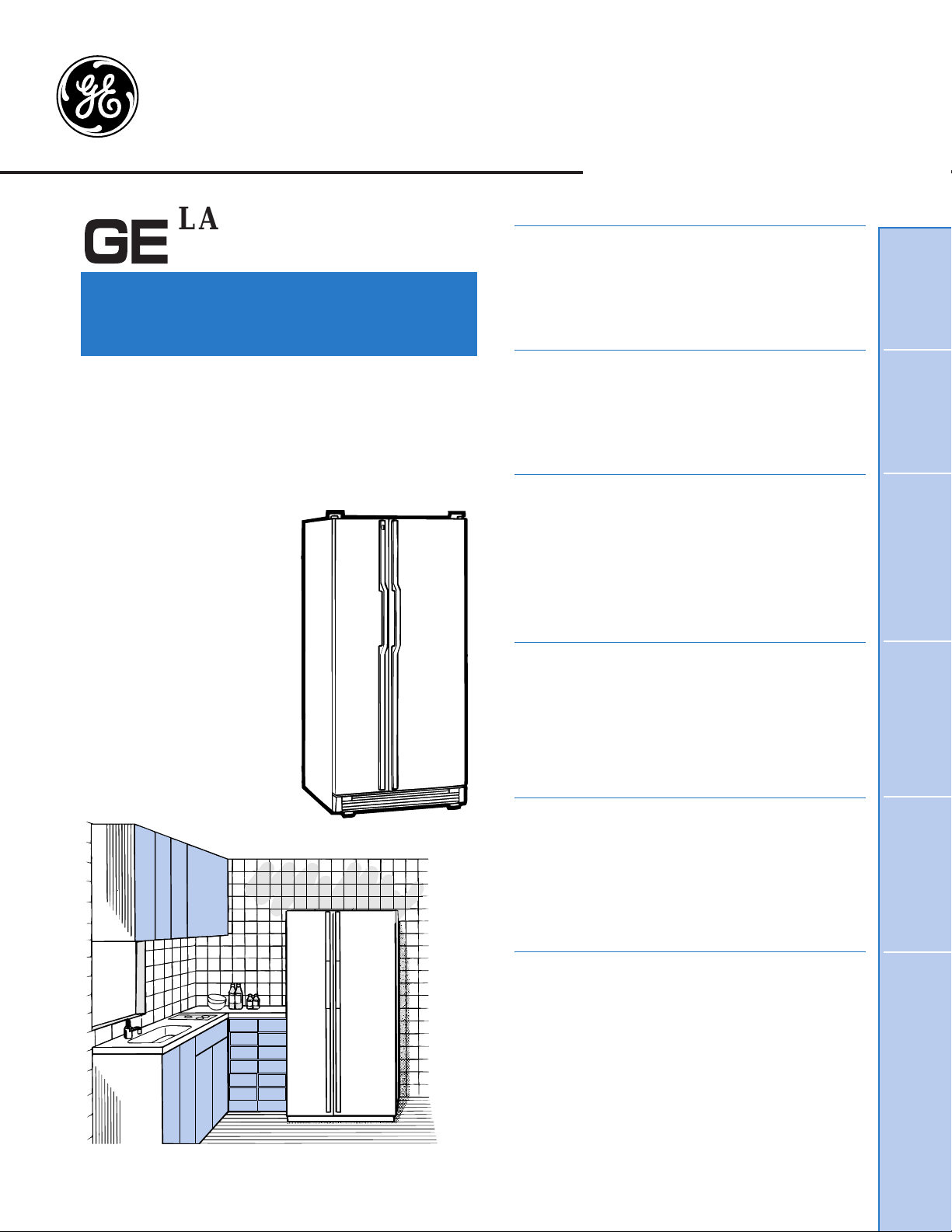
GE Refrigerators
GE
LARGE FREEZER/
REFRIGERATOR
OPERATIONS GUIDE
MODEL NAMES/HOME APPLIANCE
TFJ20JA
TFJ22JA
TPJ24BI
TFJ25PA
Table of Contents
Instructions for Safe Operation . . . . . . . . . . . . . . . .1–7
Part Names . . . . . . . . . . . . . . . . . . . . . . . . . . . . . . . .8, 9
Specifications—External Dimensions . . . . . . . . .10, 11
Instructions for Installation . . . . . . . . . . . . . . . . . . . .12
Instructions for Operation . . . . . . . . . . . . . . . . . . . . .13
Operation of Refrigerator:
Operation of Temperature Control Dials . . . . .14
Interior Temperature Control . . . . . . . . . . .15–17
Utilizing the Interior Space . . . . . . . . . . . .18–20
Icemaking . . . . . . . . . . . . . . . . . . . . . . . . . . . . .21
Storage of Food . . . . . . . . . . . . . . . . . . . . . . . .22
What To Know About Frozen Foods . . . . . . . . . . . . .23
Care and Cleaning of Refrigerator . . . . . . . . . . . . . . .24
Self-Diagnosis of Refrigerator . . . . . . . . . . . . . . . . . .25
Warranty and After-Service . . . . . . . . . . . . . . . . .26, 27
• Thank you very much for purchasing the
GE Large Freezer/Refrigerator.
• Please read and completely understand this
Operations Guide before use to ensure accurate
and safe operation of this appliance.
• After reviewing, retain this guide for future reference.
• Be sure to obtain the “Warranty Note.”
For Safety
Read Before
Using
OperationCare, Cleaning
& Self-Diagnosis
Warranty &
After-Service
Part No. 162D9792P001
Pub No. 49-6895
12-96
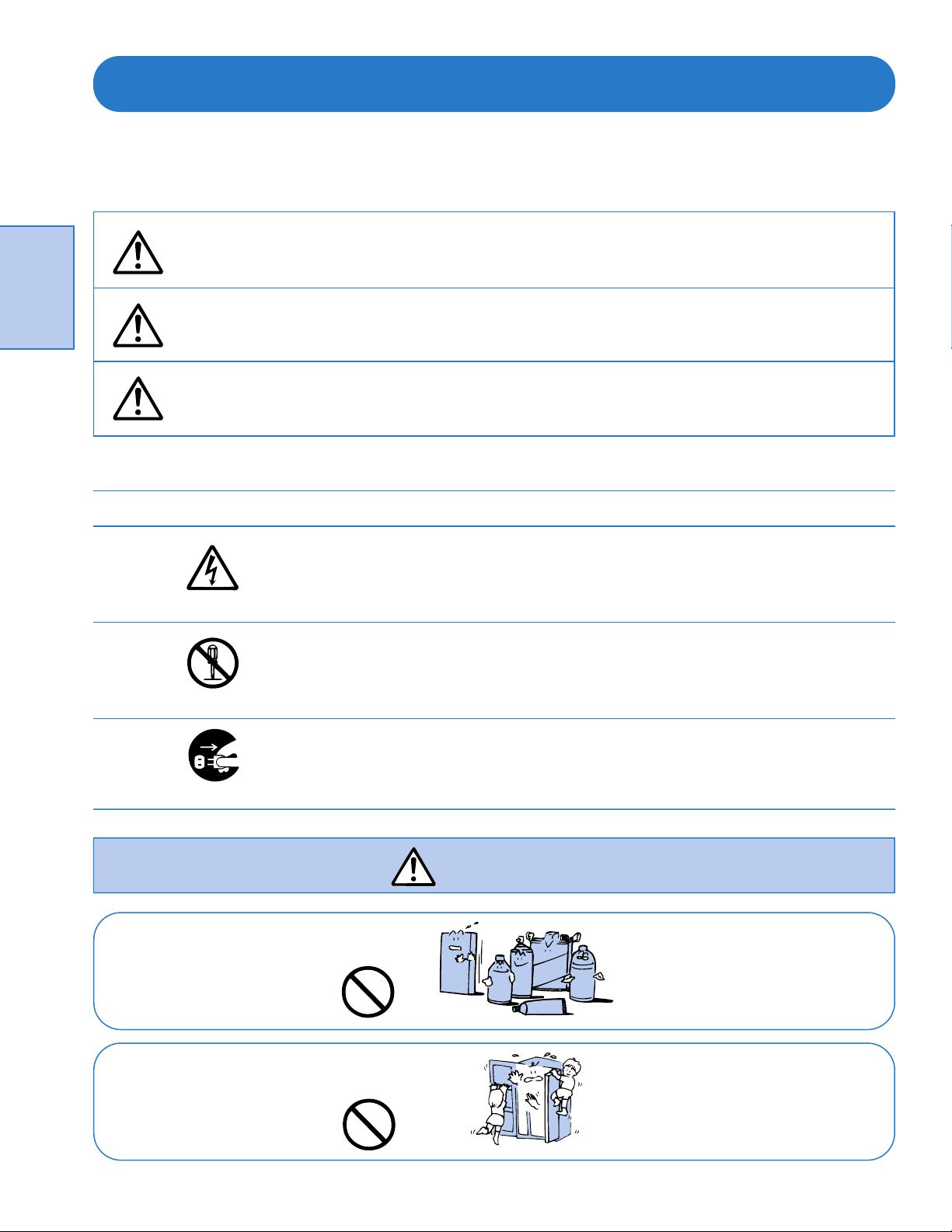
Examples of Pictorial Signs
Indicates caution (including danger, warning). Details of WARNING
(caution) are posted inside or near the illustration in pictures or words.
Indicates this action is not to be done. Details of such actions
are posted inside or near the illustration in pictures or words.
Indicates forced action (must do). Details of forced actions
are posted inside or near the illustration in pictures or words.
INSTRUCTIONS FOR SAFE OPERATION
• Please read these safety cautions carefully and operate the refrigerator correctly.
• Please make sure to heed the safety cautions listed here, for they contain important information.
DANGER
This sign indicates that there is a high probability of causing death
or serious injury to the operator, if mishandled.
WARNING
This sign indicates that there is a possibility of causing death or
serious injury to the operator, if mishandled.
CAUTION
This sign indicates that there is a possibility of causing bodily
injury to the operator or material damage*, if mishandled.
Caution indicators and their meanings are as follows:
* Material damage includes damage to house, furniture, pets or bedding.
“WARNING: ELECTRIC SHOCK”
“DO NOT DISASSEMBLE”
“UNPLUG”
WARNING
Do not store flammable substances
such as ether, benzene, alcohol, drugs,
LP gas (cartridge for lighters).
SPRAY
LP GAS
THINNER
GLUE
ETHER
• DANGER OF EXPLOSION.
DO NOT
Do not hang on or sit on glass shelf.
• DANGER OF INJURY
DUE TO DOOR FALLING
OR PINCHING HAND.
DO NOT
For Safety
1
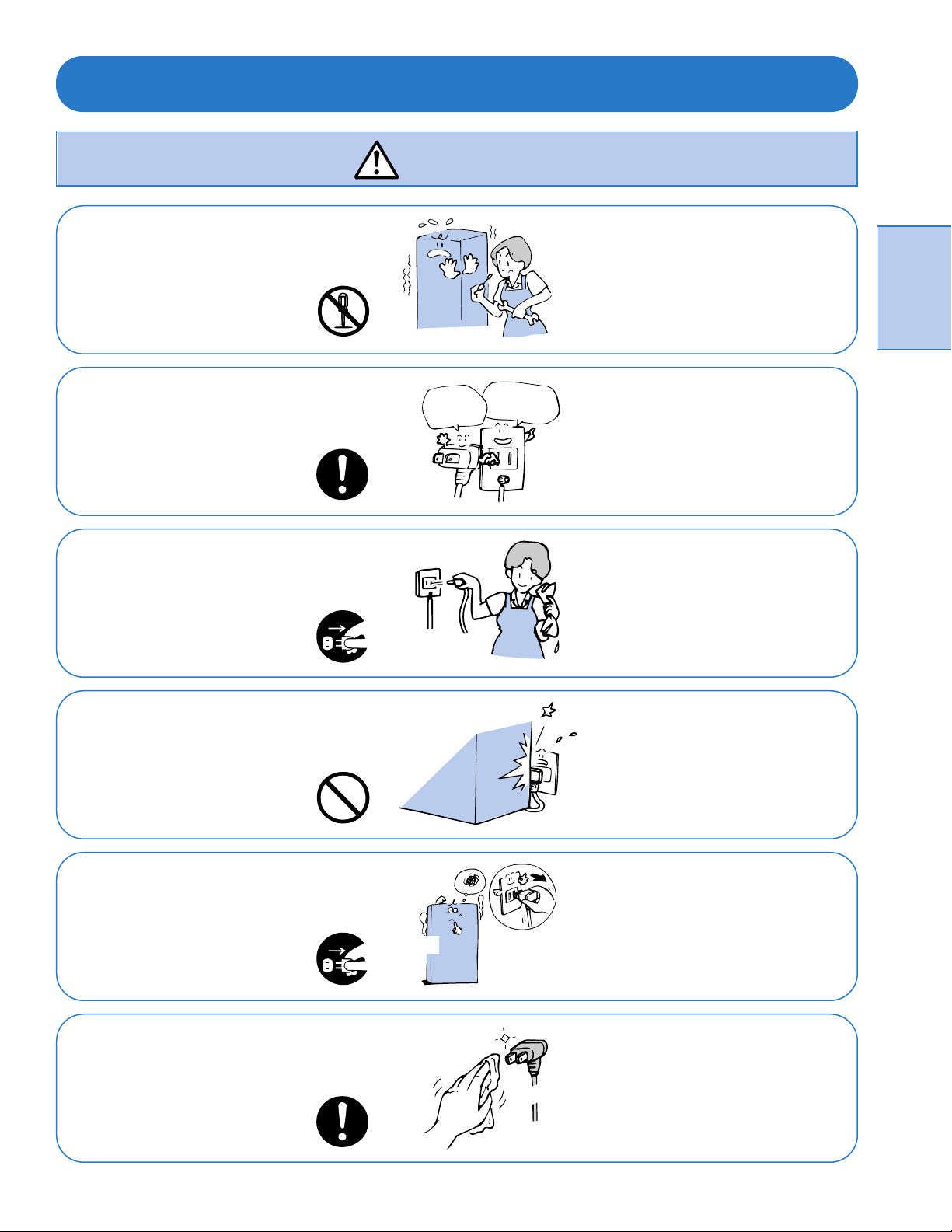
INSTRUCTIONS FOR SAFE OPERATION (continued)
WARNING
Under no circumstances should you
disassemble, repair, or modify
anything.
• DANGER OF STARTING
FIRE (OR MAY CAUSE
ABNORMAL OPERATION).
DO NOT DISASSEMBLE
Use regulation 15A only for dedicated
wall outlet for the refrigerator.
• DANGER OF FIRE
FROM OVER-HEATING
IF OUTLET IS SHARED
WITH OTHER
APPLIANCES.
DEDICATED OUTLET
When cleaning, unplug the power plug
from the wall outlet.
• DO NOT HANDLE PLUG
WITH WET HANDS.
• DANGER OF ELECTRIC
SHOCK, SHORT CIRCUIT,
OR INJURY.
UNPLUG
Do not press power plug with the back
of refrigerator.
• DANGER OF FIRE FROM
OVER-HEATING BY A
DAMAGED PLUG.
DO NOT PRESS
When the refrigerator/freezer is out of
order, stop operation by disconnecting
the power plug.
• OPERATING THE
APPLIANCE WHEN
SOMETHING IS
ABNORMAL COULD
RESULT IN AN ELECTRIC
SHOCK OR FIRE.
UNPLUG
The metal prongs or the prong
attachment of power plug should be
wiped clean with a dry cloth.
• WIPE PLUG CLEAN
WHEN DIRTY.
• MAY BECOME A SOURCE
OF FIRE.
CLEAN PLUG
For Safety
2
Power
source
AC 100V
Standard 15A
wall outlet
“Humming
Noise”
“Sparkle”
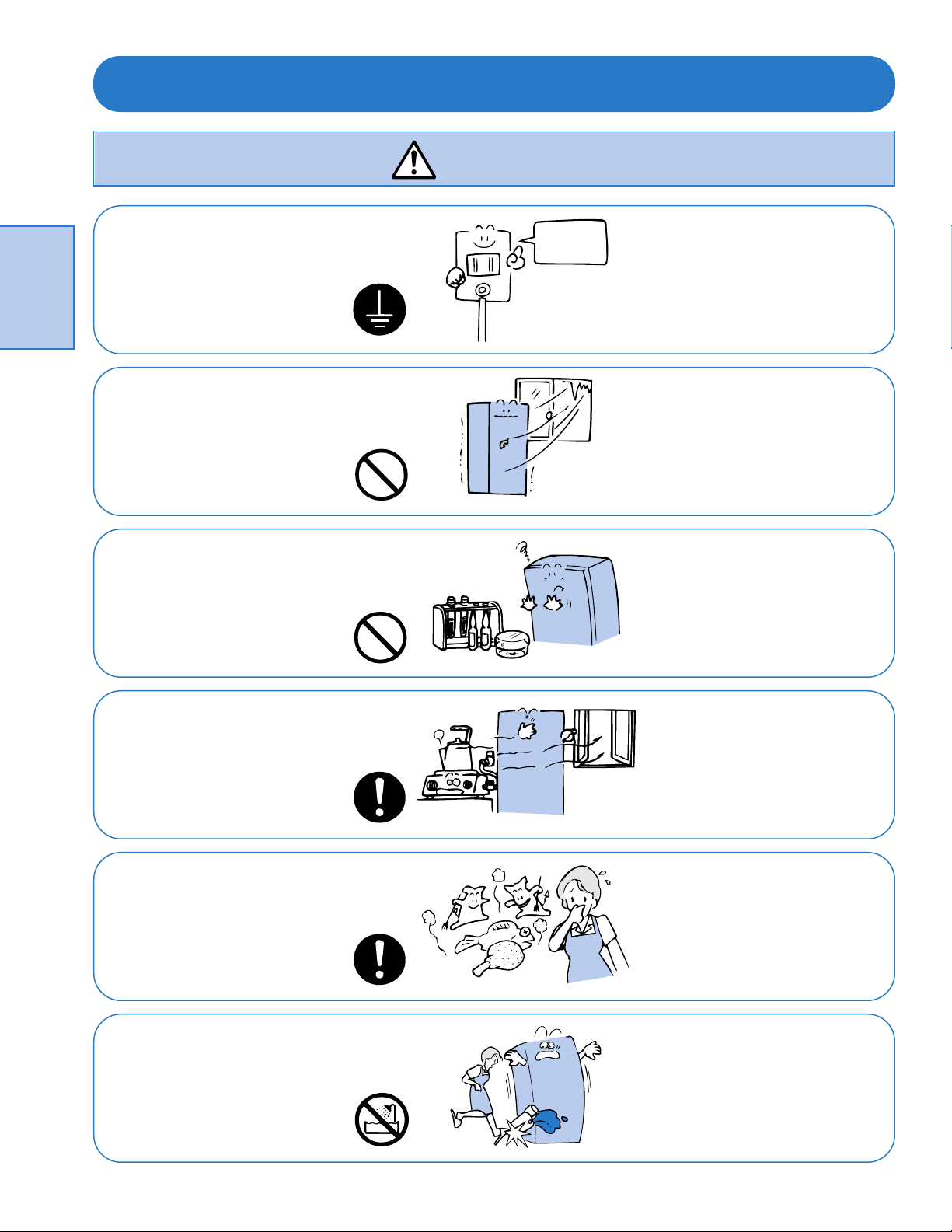
INSTRUCTIONS FOR SAFE OPERATION (continued)
For Safety
WARNING
Connect grounding wire.
• DANGER OF
MALFUNCTION OR
SHORT CIRCUIT.
• PLEASE CONSULT
DEALERSHIP WHEN
CONNECTING
GROUNDING.
CONNECT GROUNDING
Do not install in a location where
freezing is possible.
• DANGER OF RUPTURED
HOSES, PIPES, VALVES,
ETC., LEAKING WATER.
DO NOT INSTALL
Do not store medicines or scientific
specimens in refrigerator.
• SUBSTANCES REQUIRING
STRICT TEMPERATURE
CONTROL SHOULD NOT
BE STORED IN A HOME
REFRIGERATOR.
DO NOT STORE
In the event of a city gas leak, provide
good ventilation by opening the doors.
Do not touch refrigerator or wall
outlet.
• POSSIBILITY OF FIRE
LEADING TO AN
EXPLOSION.
VENTILATE
Discard foods which are discolored or
foul smelling due to malfunctioning of
the refrigerator.
• SPOILED FOOD CAN BE
HARMFUL.
DISCARD SPOILED FOODS
Do not splash water outside and/or
inside the refrigerator.
• DANGER OF ELECTRIC
SHOCK OR SHORT
CIRCUIT.
DO NOT SPLASH WATER
3
Confirm the
ground wire
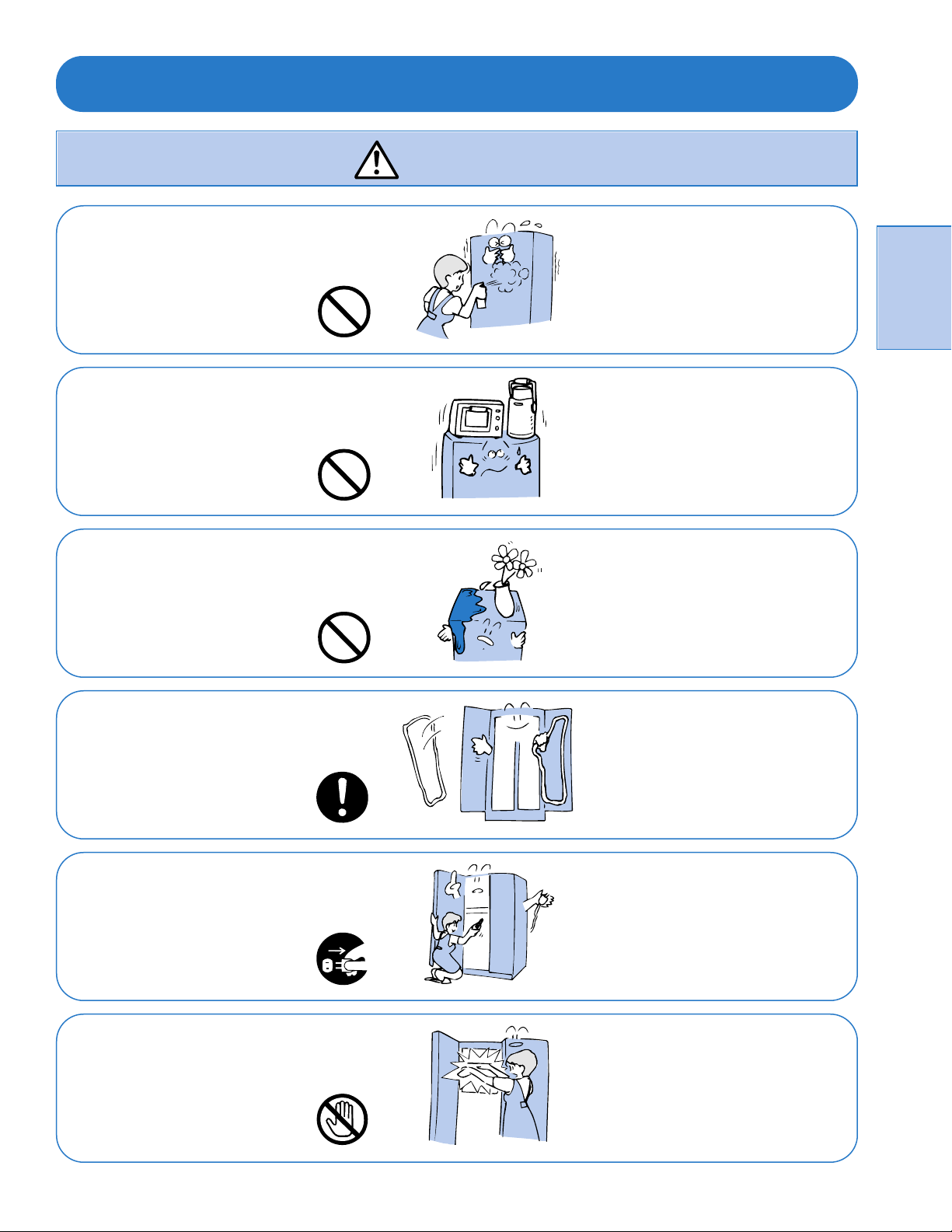
INSTRUCTIONS FOR SAFE OPERATION (continued)
WARNING
Do not use flammable sprays (hair
spray, insecticide, etc.) near
refrigerator.
• DANGER OF FIRE BY
IGNITION.
DO NOT USE
Do not place heavy objects on top of
refrigerator.
• DANGER OF INJURY
CAUSED BY FALLING
OBJECTS WHEN DOOR IS
OPENED AND CLOSED.
DO NOT
Do not place a container with water on
top of refrigerator.
• DANGER OF FIRE
CAUSED BY SHORT
CIRCUIT DUE TO
DETERIORATION
OF ELECTRICAL
INSULATION BY
SPILLED WATER.
DO NOT
When disposing of a refrigerator,
remove door gasket.
• IT IS DANGEROUS IFA
CHILD IS TRAPPED
INSIDE.
REMOVE GASKET
Unplug power plug when replacing
interior light bulb.
• POSSIBILITY OF
ELECTRIC SHOCK.
UNPLUG
Do not touch the ice-making part of
the automatic icemaker.
• INJURY COULD
RESULT WHEN ICE
TRAY ROTATES.
• HEATER BECOMES
HOT AND COULD
CAUSE BURNS.
DO NOT TOUCH
For Safety
4
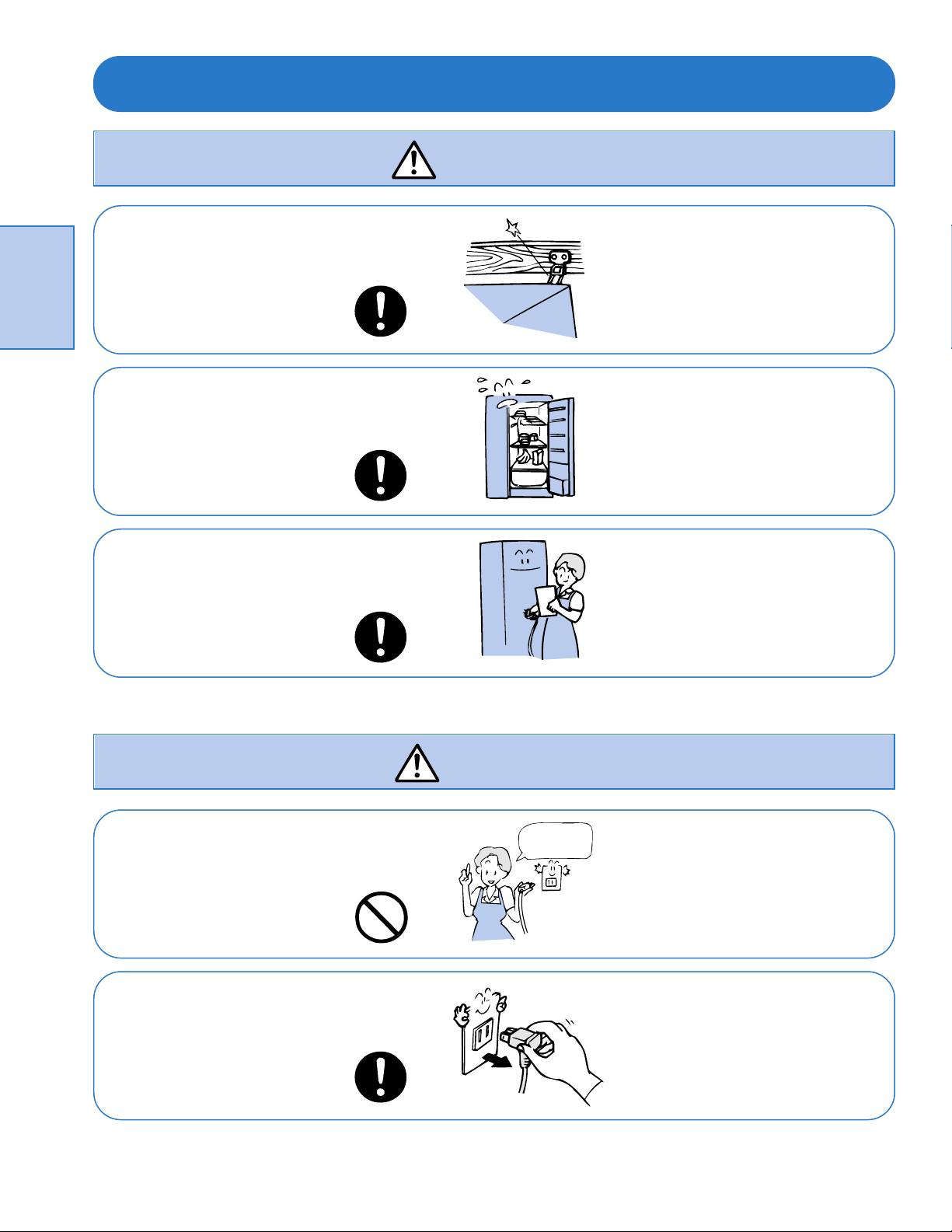
INSTRUCTIONS FOR SAFE OPERATION (continued)
For Safety
WARNING
CAUTION
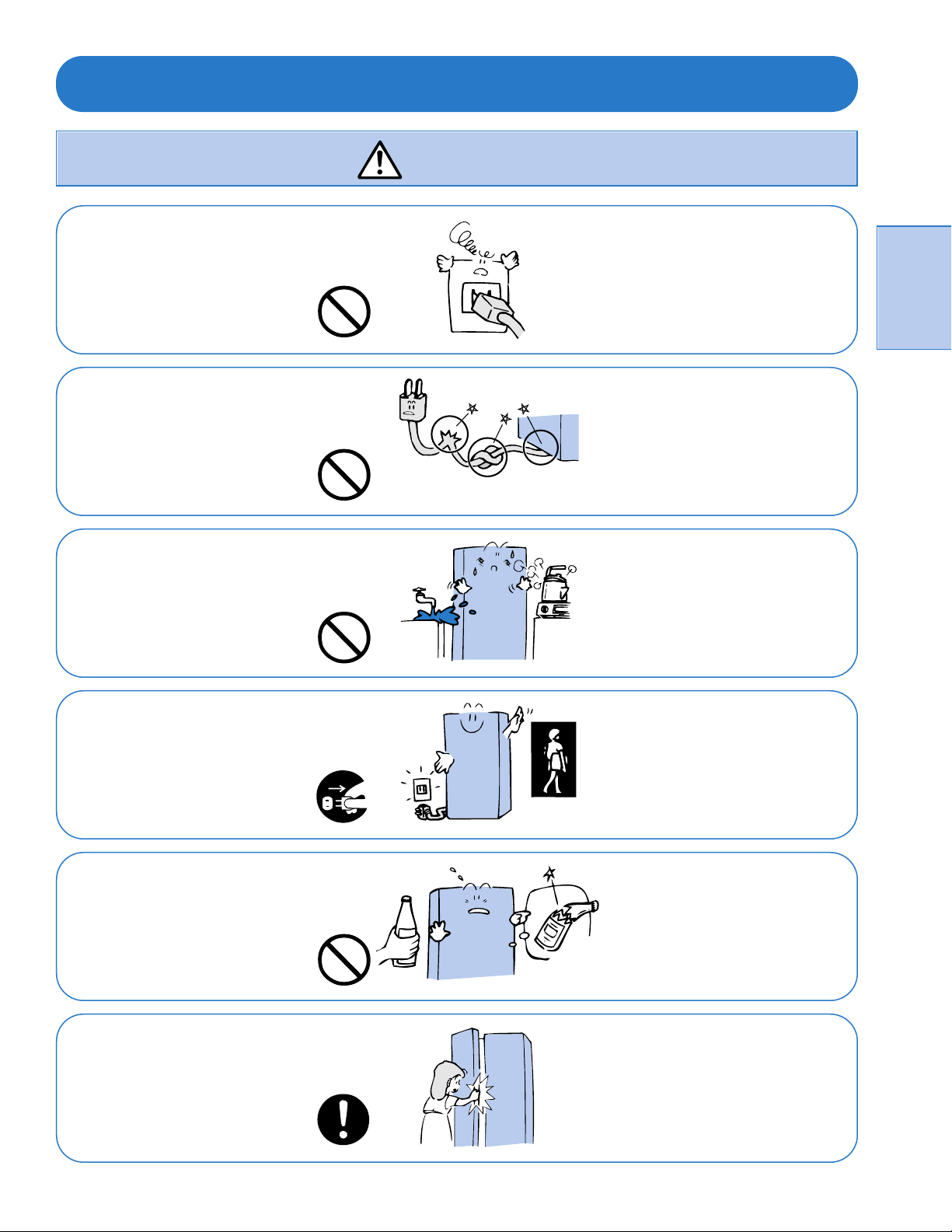
Secure the refrigerator in place to
prevent it from toppling over during an
earthquake.
• COULD RESULT IN
INJURIES IF THE
REFRIGERATOR
TOPPLES OVER.
PREVENT FROM
TOPPLING OVER
The adjustable shelves and baskets
should be attached securely to
designated points in the refrigerator.
• DANGER OF CAUSING
INJURIES DUE TO
SHELVES COMING LOOSE
AND FALLING IF NOT
SECURELY ATTACHED.
ATTACH SHELVES
SECURELY
Piping for the icemaker should be
installed in accordance with the wiring
and piping schematics.
• UNIT MAY LEAK IF NOT
INSTALLED CORRECTLY.
INSTALLATION WARNING
A 100V alternating current power
source is to be used for the wall outlet.
• POSSIBILITY OF FIRE OR
ELECTRIC SHOCK.
100V ONLY
Do not pull cord when disconnecting
power plug.
• UNPLUG BY HOLDING
THE POWER PLUG.
• ELECTRIC SHOCK OR
SHORT CIRCUIT COULD
RESULT.
DO NOT PULL
5
Use 100 VAC
INSTRUCTIONS FOR SAFE OPERATION (continued)
CAUTION
Do not use a damaged cord, power
plug, or loose wall outlet.
• POSSIBILITY OF
ELECTRIC SHOCK,
SHORT CIRCUIT,
OR FIRE.
DO NOT USE
Do not damage the electric
power cord.
• DO NOT DAMAGE, BREAK,
ALTER, FORCIBLY BEND,
PULL, TWIST, OR BUNDLE THE
ELECTRIC POWER CORD. DO
NOT PLACE A HEAVY OBJECT
ON IT, CRIMP IT, OR ALTER IT
IN ANY WAY.
• A BROKEN CORD MAY CAUSE
FIRE OR ELECTRIC SHOCK.
DO NOT DAMAGE
Install the refrigerator in a location
away from excess moisture or where
water may be present.
• INSULATION WILL
DETERIORATE AND
CAUSE A SHORT CIRCUIT.
KEEP DRY
Unplug the power plug from wall
outlet when the refrigerator will not be
used for an extended period of time.
• DETERIORATING
INSULATION COULD
CAUSE AN ELECTRIC
SHOCK OR SHORT
CIRCUIT.
UNPLUG
Do not store bottles or cans in freezer
compartment.
CRACK!
• CONTENTS WILL FREEZE
CAUSING THE BOTTLES
TO EXPLODE WHICH
MAY CAUSE INJURIES.
NO BOTTLES
Close the refrigerator door by holding
the door handle.
• DANGER OF INJURY TO
FINGERS IF THE DOOR
HANDLE IS NOT USED
WHEN CLOSING DOOR.
USE DOOR HANDLE
For Safety
6
NO!
For Safety
INSTRUCTIONS FOR SAFE OPERATION (continued)
CAUTION
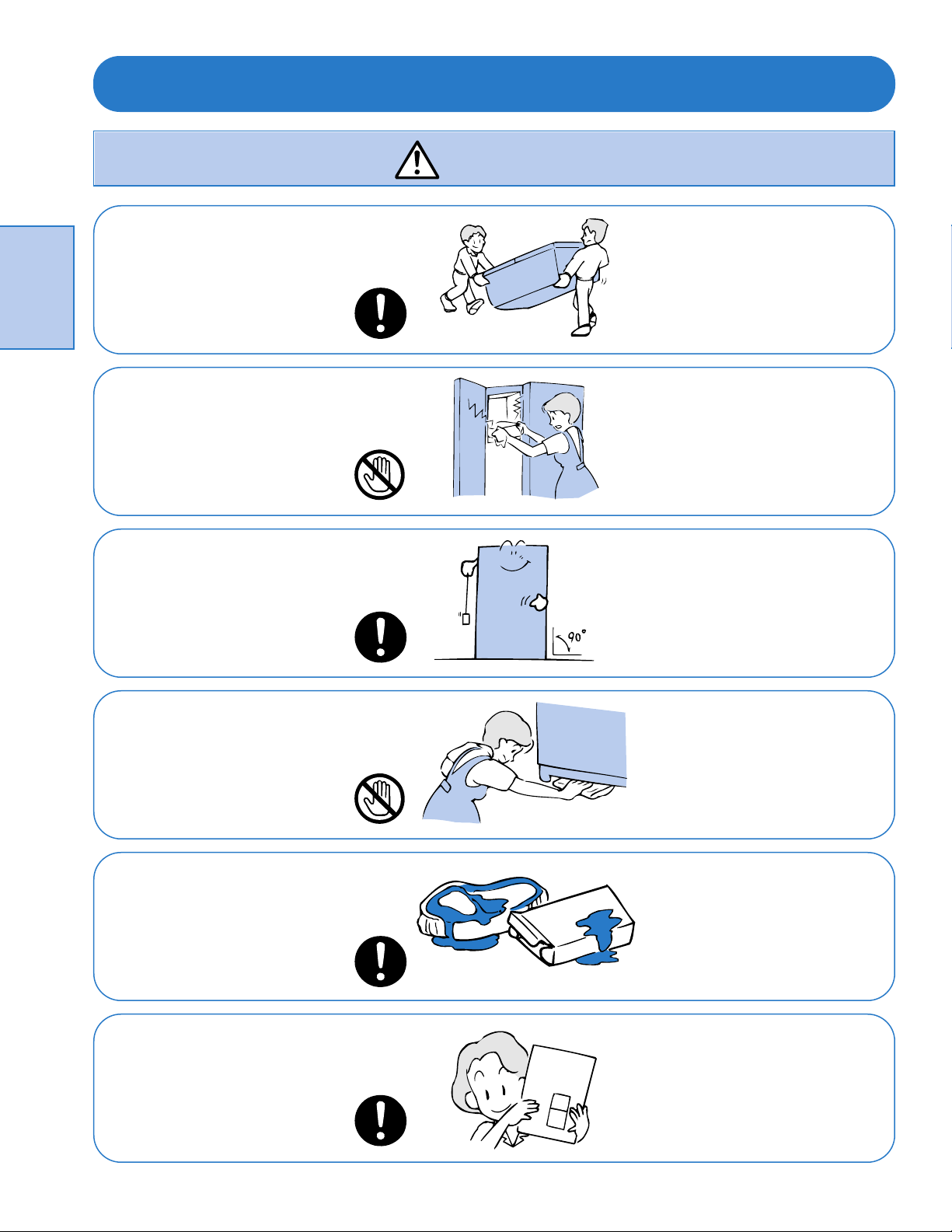
Hire professional movers to move the
refrigerator, because it is heavy and
dangerous to move.
• DANGER OF INJURIES BY
ATTEMPTING TO MOVE THE
REFRIGERATOR YOURSELF.
• CONSULT YOUR DEALERSHIP
OR A PROFESSIONAL MOVER
TO TRANSPORT THE
REFRIGERATOR.
EMPLOY
PROFESSIONAL MOVERS
Do not touch food or containers
(metallic) inside the freezer
compartment with wet hands.
• FREEZING
TEMPERATURES MAY
CAUSE FREEZER BURN.
DO NOT TOUCH
Install refrigerator on a sturdy
flat floor.
Straight!
• INSTALLING ON AN
UNSTEADY FLOOR
COULD CAUSE THE
REFRIGERATOR TO
TOPPLE WHEN OPENED
AND CLOSED AND COULD
CAUSE INJURY.
DO NOT INSTALL
Do not put hands under the
refrigerator.
• METAL PLATES AND
ROTATING PARTS
LOCATED UNDER THE
REFRIGERATOR MAY
CAUSE INJURY.
DO NOT TOUCH
Do not re-freeze foods after they have
been thawed.
Frozen Food
• CONSUMING SPOILED
FOODS IS HARMFUL.
FOOD POISONING
WARNING
If you resell or give away this
appliance, provide the new owners
with this Operations Guide.
Operations
Guide
• THE NEW OWNER WILL
NEED THIS OPERATIONS
GUIDE FOR SAFE AND
CORRECT USE.
PROVIDE
OPERATIONS GUIDE
7
PART NAMES
Read Before
Using
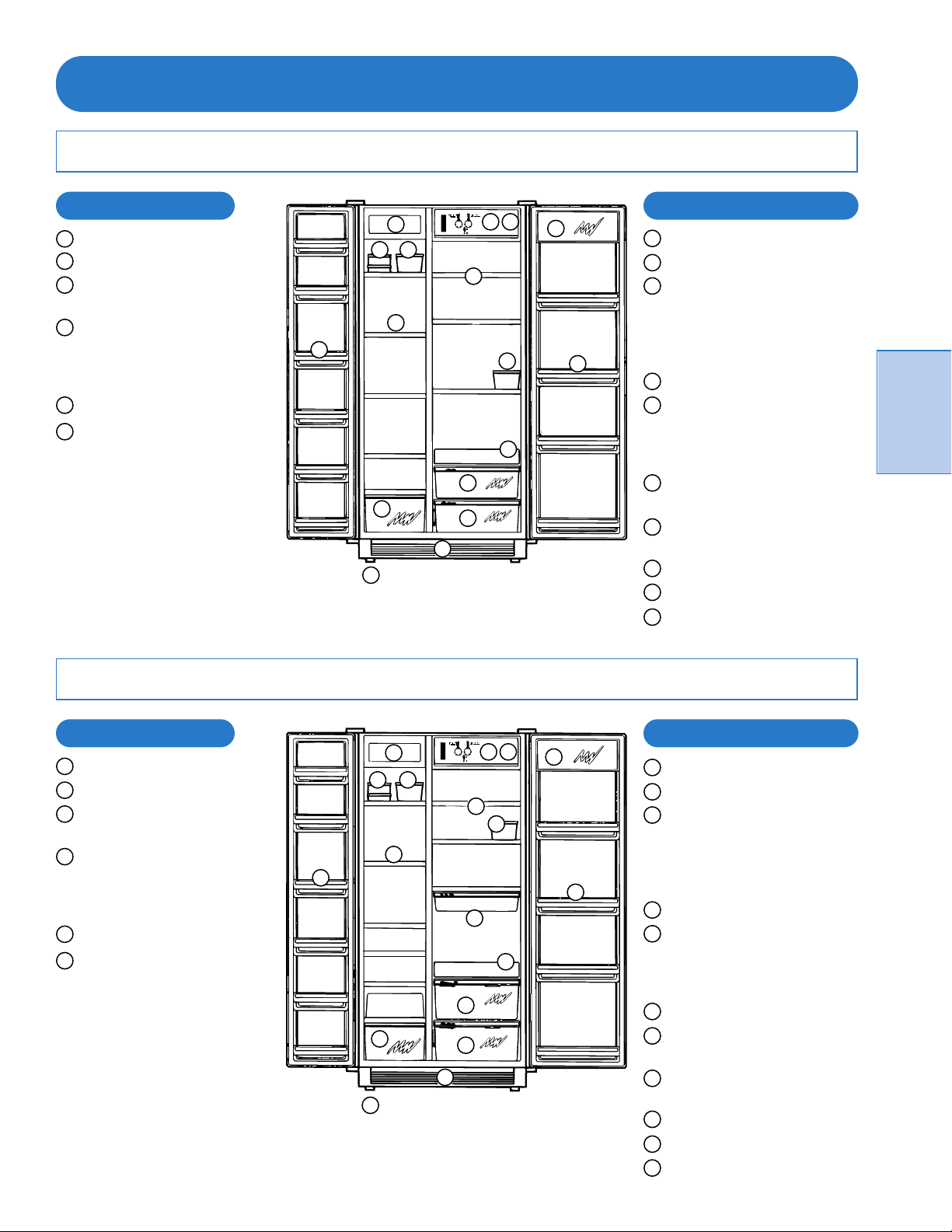
TFJ20JA
Freezer Compartment
Refrigerator Interior Light
Door Pockets (6 levels)
Compartment Shelves
(3 levels)
Large Freezer Basket
Pull-out type: chicken and
large pieces of meat, etc.,
can be stored.
Icemaker Trays (2 dishes)
Ice Box
Refrigerator Compartment
Temperature Control Dial
Interior Lamp
Astro-Door (flip door)
Type Utility Compartment
(shelf for storing milk
products such as cheeses,
butter, etc.)
Door Pockets (4 levels)
Interior Shelf (3 levels)
Height can be adjusted
according to the size of
foods.
High Humidity Vegetable
Compartment
Chilling/Vegetable
Compartment
Four Wheel Castors
Front Grille
Utility Box (can be used as
egg case also)
TFJ22JA
Freezer Compartment
Refrigerator Interior Light
Door Pockets (6 levels)
Compartment Shelves
(4 levels)
Large Freezer Basket
Pull-out type: chicken and
large pieces of meat, etc.
can be stored.
Icemaker Trays (2 dishes)
Ice Box
Refrigerator Compartment
Temperature Control Dial
Interior Lamp
Astro-Door (flip door)
Type Utility Compartment
(shelf for storing milk
products such as cheeses,
butter, etc.)
Door Pockets (4 levels)
Interior Shelf (3 levels)
Height can be adjusted
according to the size of
foods.
Meat/Snack Case
High Humidity Vegetable
Compartment
Chilling/Vegetable
Compartment
Four Wheel Castors
Front Grille
Utility Box (can be used as
egg case also)
10
11
12
13
14
15
16
1
2
3
4
5
6
7
8
9
10
10
11
11
12
12
13
13
14
14
15
15
16
16
17
17
1
1
2
2
3
3
4
4
5
5
6
6
7
7
8
8
8
9
9
10
11
16
12
13
14
15
1
2
3
4
5
6
7
8
8
9
8
Fan Cover
Fan Cover
PART NAMES (continued)
9
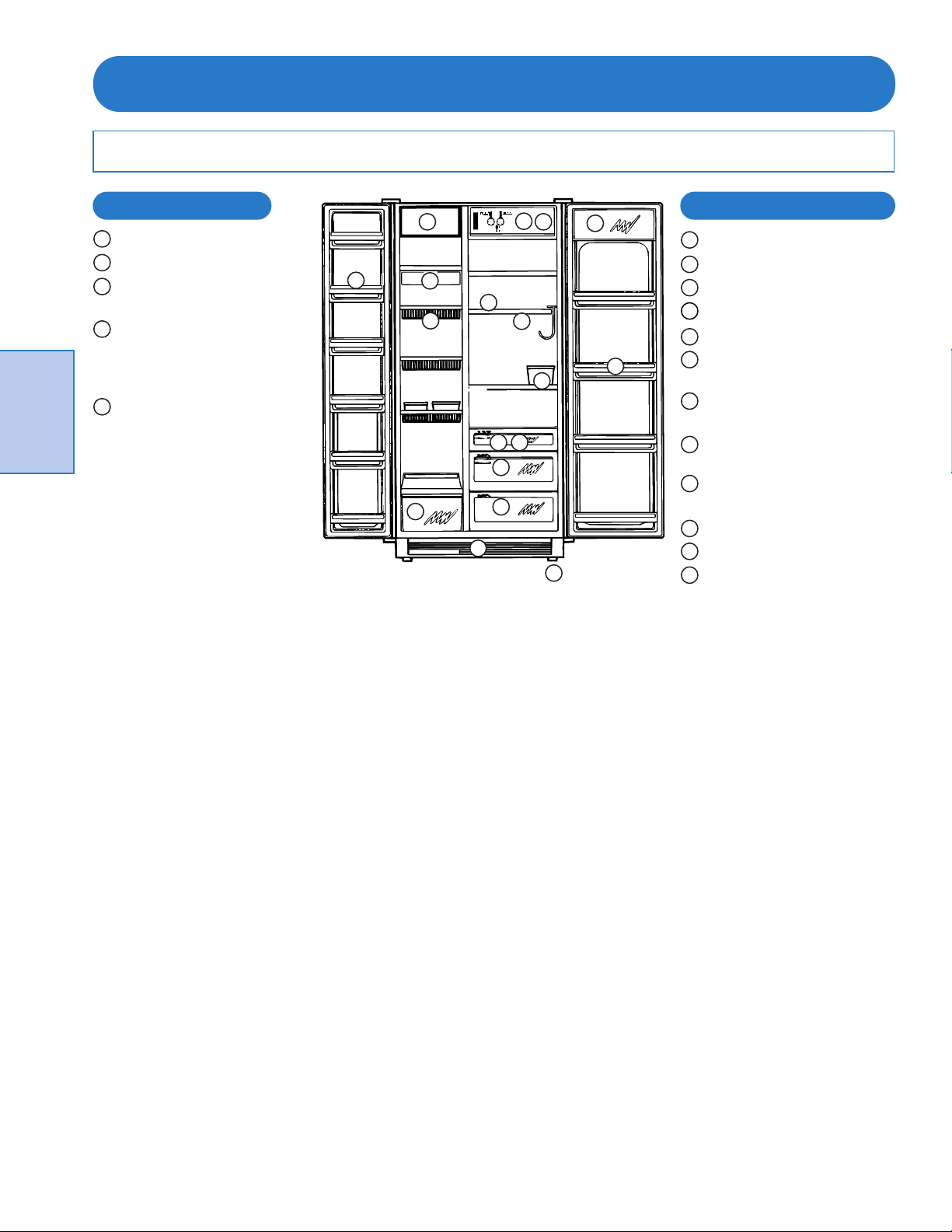
TPJ24BI & TFJ25PA
Freezer Compartment
Refrigerator Interior Light
Door Pockets (5 or 6 levels)
Compartment Shelves
(3 levels)
Large Freezer Basket
Pull-out type: chicken and
large pieces of meat, etc.,
can be stored.
Automatic Icemaker
(TPJ24BI only)
Refrigerator Compartment
Temperature Control Dial
Internal Lamp
Internal Shelf (3 levels)
Wine Rack
Airtight Snack Case
High Humidity Vegetable
Compartment
Chilling/Vegetable
Compartment
Astro-Door (flip door)
Type Utility Compartment
Jumbo Door Pocket
(4 levels)
Four Wheel Castors
Front Grille
Utility Box (can be used
as egg case also)
9
9
10
10
11
11
12
12
13
13
14
17
17
14
15
15
16
16
1
1
2
2
3
3
4
4
5
5
6
6
7
7
7
8
8
Read Before
Using
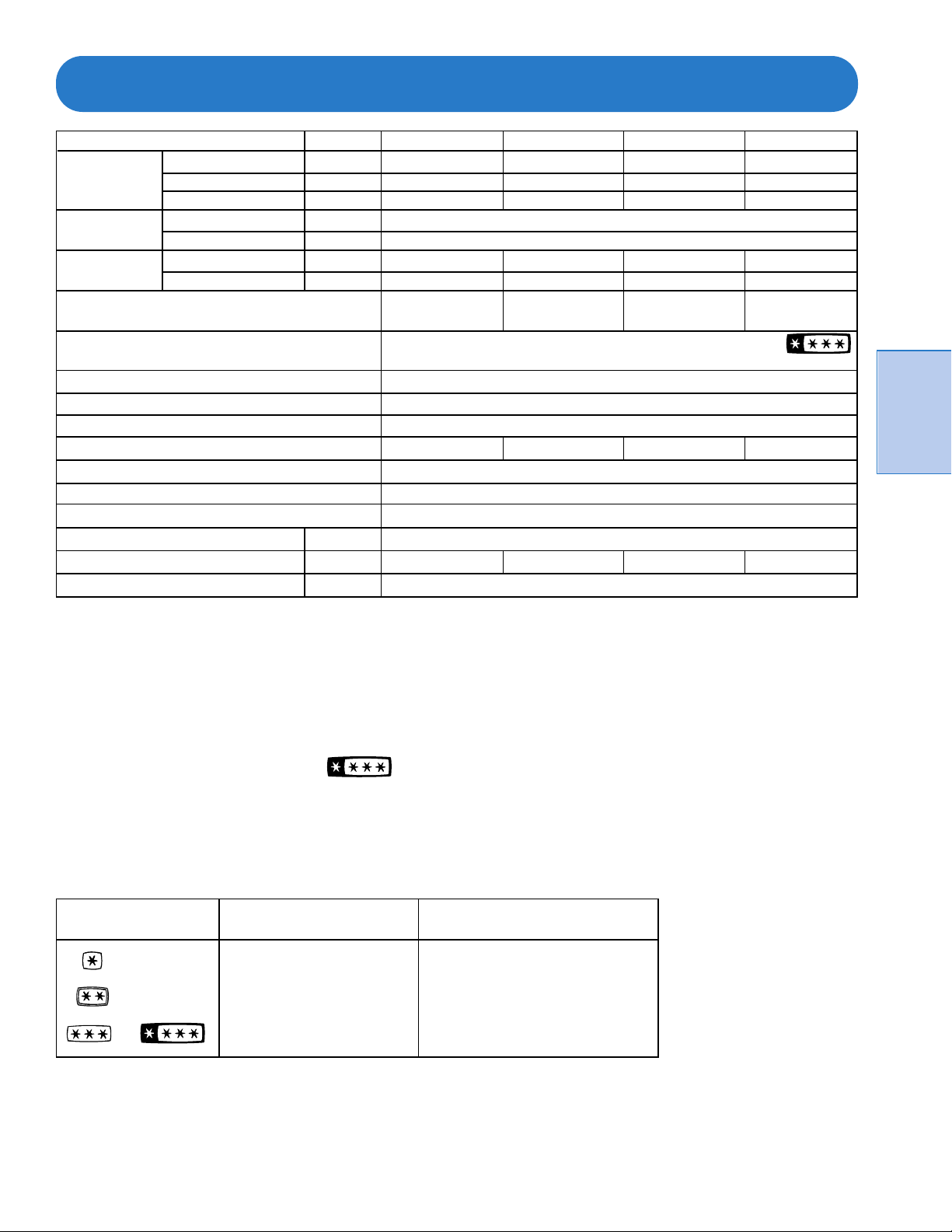
SPECIFICATIONS
Read Before
Using
10
UNITS TFJ25PA TPJ24BI TFJ22JA TFJ20JA
USEFUL TOTAL (L) 707 655 605 547
VOLUME FREEZER (L) 260 250 187 187
FRESH FOOD (L) 447 405 418 360
ELECTRICAL VOLTAGE (V) SINGLE PHASE 100/100
POWER FREQUENCY (Hz) 50/60
SOURCE MOTORS (W) 133/156 131/146 124/142 122/139
HEATERS (W) 545/545 670/670 464/464 464/464
AVG MONTHLY ELECTRICAL 78/82 75/76 63/66 63/67
CONSUMPTION (KWH/MON)
COOLING METHOD AND COLD AIR CIRCULATION TYPE (INDIRECT COOLING)
FREEZER CODE
CONDENSER COOLING FORCED AIR (FAN COOLED CONDENSER)
DEFROST CONTROL AUTO START - AUTO STOP
DEFROST WATER REMOVAL FORCED AIR EVAPORATION
AUTOMATIC ICEMAKER NO YES NO NO
MOBILITY WHEELS ATTACHED
BUILT-IN POSSIBLE
DOOR REVERSIBILITY -
ELECTRICAL RATING (A) 15
WEIGHT (Kg) 143 159 132 123
CORD LENGTH (M) 2.2
* Values for useful internal volume and the Electrical Standard Values are based on the Japanese Industry Standard
(JIS C9607).
* Values separated by “/” indicate 50 Hz on left and 60 Hz on right. Others indicate common 50 Hz
and 60 Hz.
•
Freezer Performance
This freezer/refrigerator is “Four Star” coded.
Performance of freezer is classified by codes.
Each code indicates the performance capability according to the regulation
delineated in the Japanese Industry Standard (JIS C9607). The regulation
defines the test conditions for measuring the freezing-load temperature
(food temperature). The following table shows the test results:
CODE FREEZING-LOAD TEMP. FROZEN FOOD PRESERVATION
(FOOD TEMPERATURE) ESTIMATED TIME
Below -6°C. Approx. 1 week
Below -12°C. Approx. 1 month
or Below -18°C. Approx. 3 months
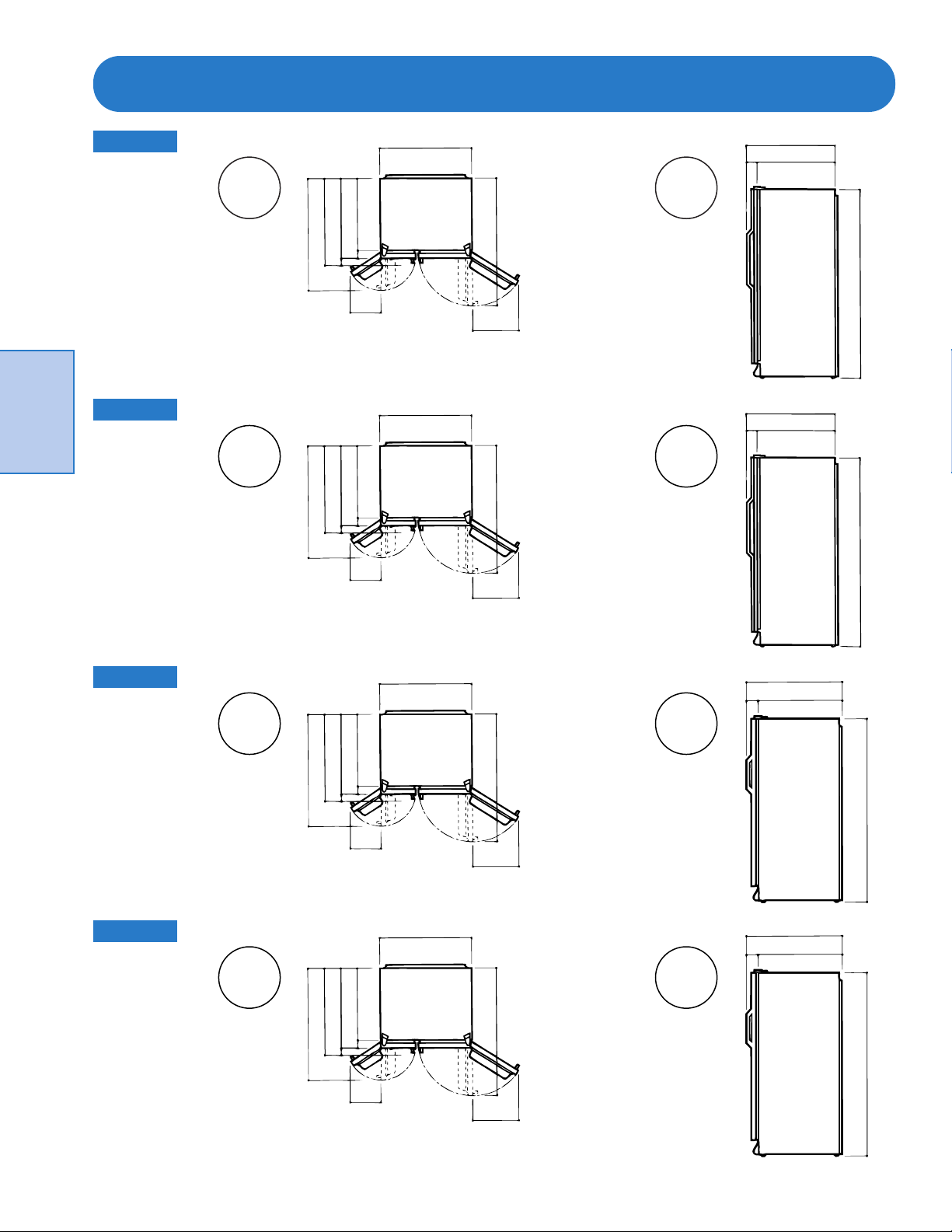
EXTERNAL DIMENSIONS
11
TFJ20JA
(Units: mm)
Top
View
Side
View
TFJ22JA
(Units: mm)
Top
View
Side
View
TPJ24BI
(Units: mm)
Top
View
Side
View
TFJ25PA
(Units: mm)
Top
View
Side
View
Read Before
Using
800
765
120
645
1775
875
150
725
1775
270
400
1065
1227
830
785
725
60
45
850
270
470
1065
1278
830
785
725
60
45
915
295
385
1045
1185
715
665
605
60
50
915
280
470
1150
1290
835
785
725
60
50
830
105 725
1720
830
105 725
1720
Read Before
Using
12
If the refrigerator is installed
directly on carpet or other mats, the
compressor under the refrigerator
may touch the mat, causing
discoloration of the mat, or may
interfere with the cooling capability
by reducing air flow.
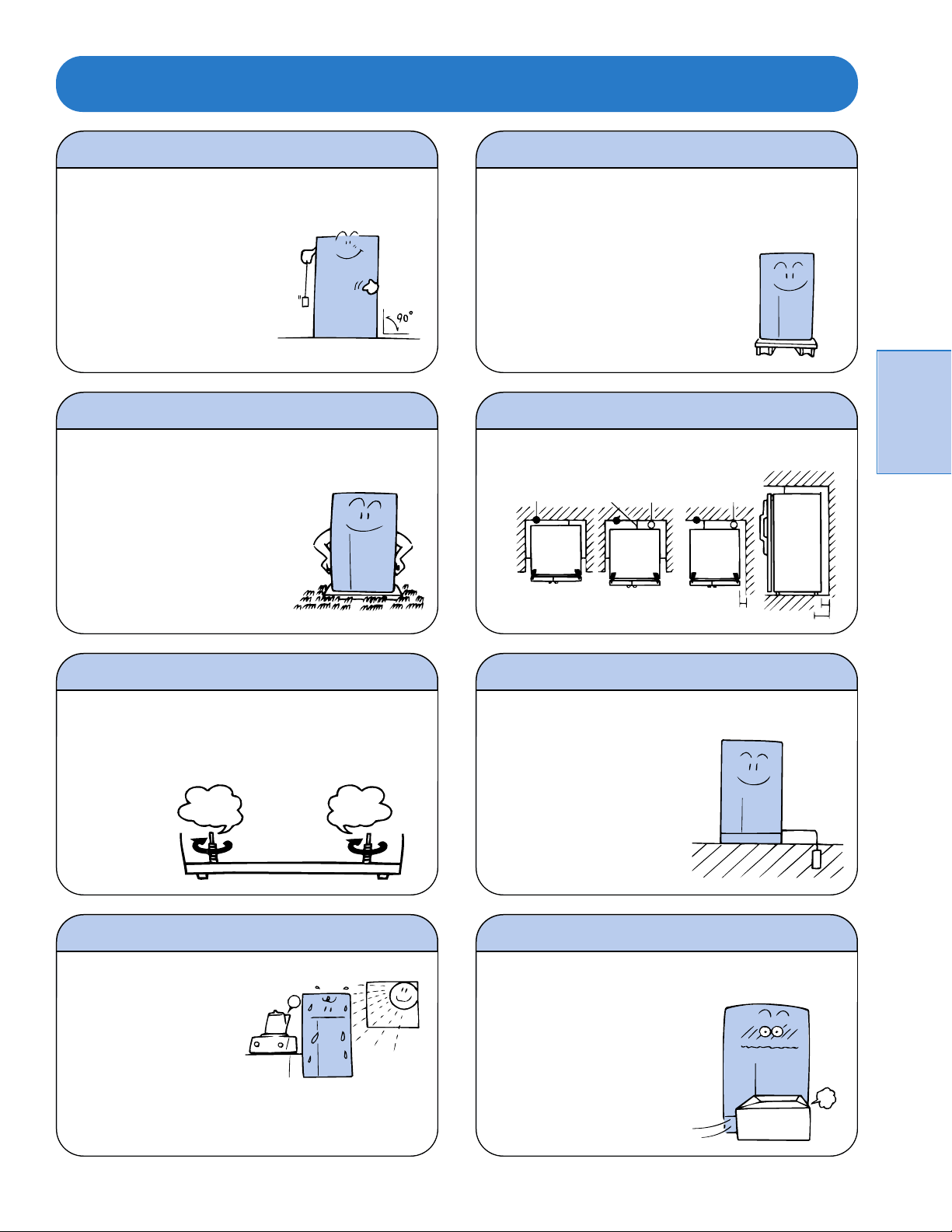
INSTRUCTIONS FOR INSTALLATION
Refrigerator should be installed on a firm and
level floor.
1
Install in a low-humidity location.
5
Place a firm board under the refrigerator when
installing it on a weak floor, on a tatami, or on
a carpet.
2
Allow sufficient space around the refrigerator as
shown in diagrams below.
6
If the refrigerator is tilted, adjust with leveling
screws under the front end. The front end of the
refrigerator should be slightly higher so the door will
close when lightly pushed.
3
To avoid electric shock, ground the refrigerator.
7
Install away from heat sources.
4
Do not put anything in front of the grille.
8
If the floor is not firm, noise
or vibration may occur. When
opening and closing the door,
the refrigerator may topple and
cause injuries.
An electrical short circuit or rusting may occur. If it is necessary
to install in a washroom or on a damp floor, be sure to provide
gaps by placing the refrigerator on some sort of blocks.
CAUTION: This type of refrigerator uses
forced fan cooling. Therefore, to prevent
reduction in the cooling capacity, place the
refrigerator on top of a firm board before
placing it on blocks. Do not place the
refrigerator directly on top of the blocks.
Avoid locations in direct sunlight
or near heat-producing appliances
(range, heater, etc.). Cooling
efficiency may be lowered or
external color changes may result.
Straight!
Units: mm
Consult dealer for grounding
installations. (Fee will be charged
for grounding installations.)
NOTE: A grounding wire is
attached to this refrigerator.
Please connect these grounding
terminals correctly.
Since air is suctioned in from
the front of the grille, obstructing
the grille could lower the cooling
capacity.
Wall Outlet
Icemaker
50~100
X = 16 (TFJ20, TFJ22, TFJ25), = 3 (TPJ24)
Y = 25 (TFJ20, TFJ22, TFJ25), = 13 (TPJ24)
Z = 25 (TFJ20, TFJ22, TFJ25, TPJ24)
50~100
50~100
Y
50
Y
Z
X X
X X
Stop Valve
for Icemaker
if installed
Stop Valve for
Icemaker
If Icemaker is installed
Rotate
clockwise
to raise
Rotate
clockwise
to raise
Leveling Screws
13
Read Before
Using
INSTRUCTIONS FOR OPERATION
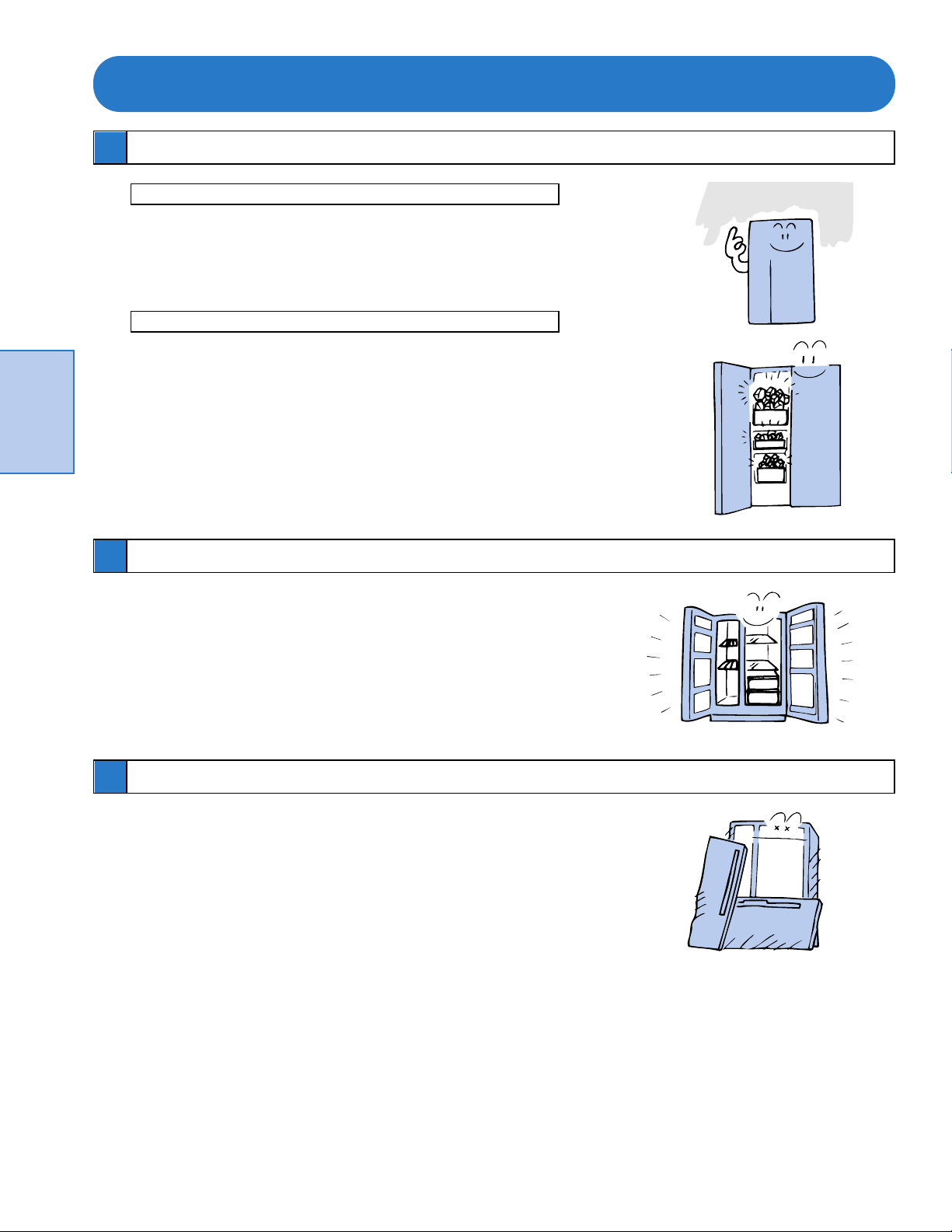
CAUTIONS WHEN DISCARDING
3
To prevent a child from being locked inside, take the
following measures when disposing of a used refrigerator
or freezer:
1. Do not discard a refrigerator or a freezer in a location
where children might play.
2. Hinges should be destroyed to prevent an airtight seal.
3. Remove door and gasket.
CAUTION DURING POWER OUTAGE
1
CAUTIONS DURING EXTENDED SHUTDOWN
2
Sudden interruption of electricity
• Limit the frequency of opening and closing the door. If the
door is kept closed, the refrigerator should maintain its
temperature for approximately 2 hours and the freezer for
approximately 1 hour.
For expected outage
• Accumulate a lot of ice. The refrigerator can be maintained
by cooling with ice.
• The refrigerator can be maintained longer if it is cooled for
2–3 hours prior to a blackout by setting the temperature
control dial to the HIGH cooling position.
• Store as little food as possible. Fresh foods should be
consumed first.
When the refrigerator will not be used for an extended period
of time, follow the procedures outlined below to prevent odor
and mildew:
1. Remove all foods.
2. Clean out refrigerator and keep the door open for a few
days to dry out inside.
Operation
14
OPERATION OF TEMPERATURE CONTROL DIALS
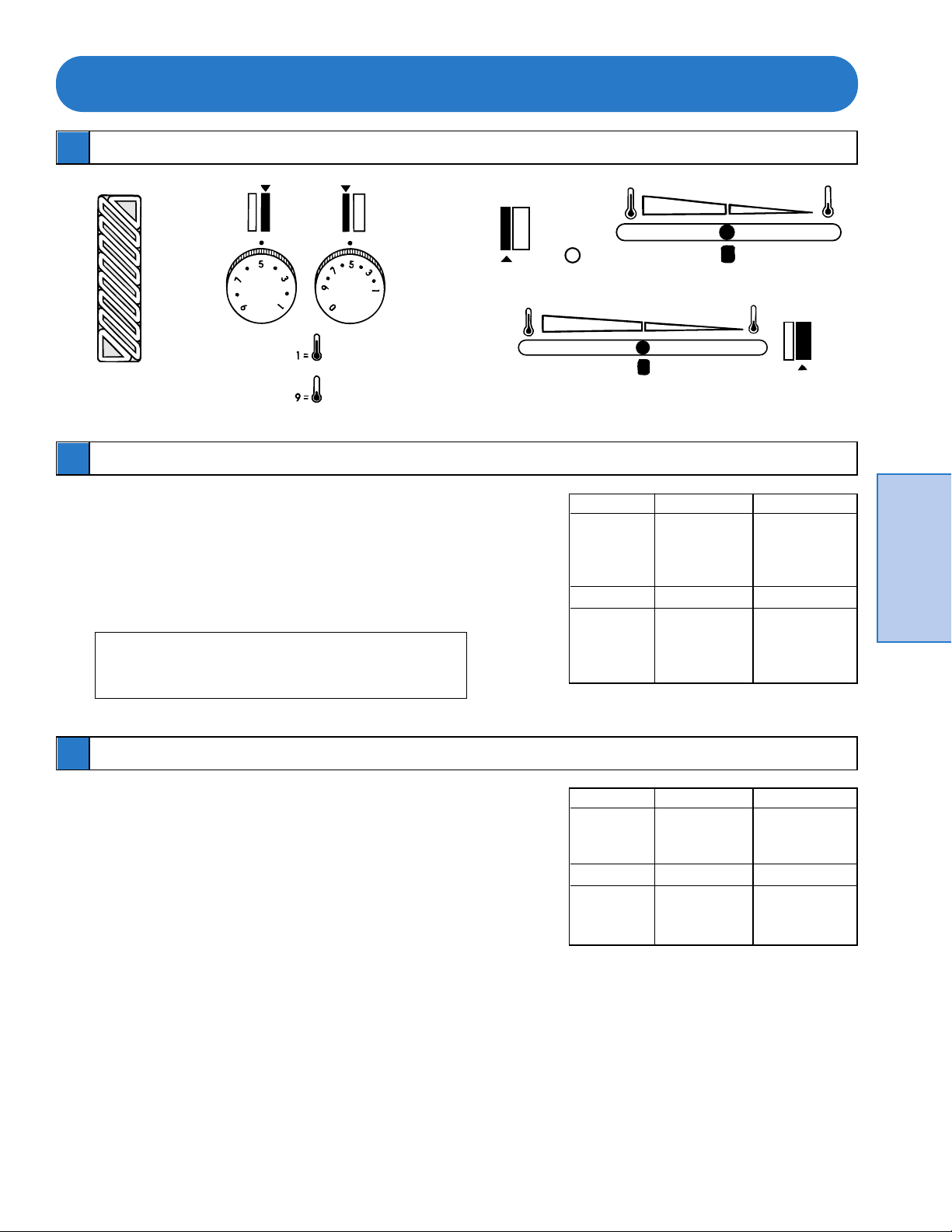
SET AT POSITION “5” FOR NORMAL USE
1
FREEZER COMPARTMENT
2
The freezer temperature is adjusted by moving the dials as
shown in the diagrams.
Set dial at “5” for normal operation.
If the dial is set at “1,” temperature of the freezer is
increased.
If the dial is set at “9,” temperature of the freezer is decreased.
CAUTION: If the dial is set at “0,” the refrigerator
will shut off regardless of the position of the
refrigerator compartment dial.
1
3 5
7
9
1
3
5
9
7
REFRIGERATOR COMPARTMENT
3
Set the refrigerator temperature control dial to “5” for normal
operation. If the dial is turned toward “1,” the refrigerator
temperature becomes high and, if turned toward “9,”
temperature becomes low.
Dial Setting Temperature Operations
1 HIGH For storage of
3 foods at higher
temperatures.
5 MEDIUM Normal
7 LOW For storage of
9 foods at lower
temperatures.
Dial Setting Temperature Operations
1 HIGH Food is to be
3 stored for
shorter periods
of time.
5 MEDIUM Normal
7 LOW Food is to be
9 stored for
longer periods
of time.
Refrigerator
Compartment
Warm
Cold
Freezer
Compartment
(or)
Operation
INTERIOR TEMPERATURE CONTROL
NOTICE: NEW FREEZING ROOM TEMPERATURE FEATURE
YOUR REFRIGERATOR HAS BEEN DESIGNED TO INCLUDE A FEATURE THAT WILL
PREVENT THE CONTENTS OF THE REFRIGERATOR COMPARTMENT FROM FREEZING,
EVEN IF THE ROOM TEMPERATURE IS BELOW FREEZING. THIS IS A TOTALLY
AUTOMATIC SYSTEM AND WILL REQUIRE NO ACTION ON YOUR PART. THIS SYSTEM
PROVIDES THIS FEATURE BY PERIODICALLY TURNING THE LIGHTS IN THE
REFRIGERATOR COMPARTMENT ON AND OFF. THE WARMTH FROM THESE LIGHTS
WILL AUTOMATICALLY KEEP THE FOOD FROM FREEZING. THIS SYSTEM OPERATES
AT ROOM TEMPERATURES FROM 15°C. TO -5°C. THE SYSTEM WILL TURN ON THE
LIGHTS ONLY WHEN NEEDED. IF YOU SHOULD NOTICE THAT THE REFRIGERATOR
LIGHTS ARE ON, EVEN THOUGH THE DOOR IS CLOSED, THIS IS THE SYSTEM AT
WORK, KEEPING YOUR FRESH FOOD FROM FREEZING.
How to Prevent Freezing
NOTE: IF YOU EXPECT THE ROOM TEMPERATURE TO FALL BELOW FREEZING,
AND YOUR REFRIGERATOR HAS THE ICE/WATER DISPENSER FEATURE
BUILT INTO THE FREEZER DOOR, OR HAS AN ICEMAKER, THEN YOU
SHOULD PERFORM THE FOLLOWING STEPS. THIS DEACTIVATES THE
ICE/WATER SYSTEM AND WILL PREVENT THE EXTERNAL WATER LINES
FROM FREEZING.
1.Disconnect power to the refrigerator.
2.Close valve on water line connecting refrigerator to main water supply.
3.Position a container under the refrigeration connection to collect any spillage and disconnect inlet
water supply line from refrigerator. Also collect water from the inlet supply line.
4.Position the container under the plastic outlet tube that supplies the icemaker (on Refrigerator
side) to collect any water spillage and disconnect the tube.
5.Position the container under the plastic outlet tube that supplies the water tank (on Freezer side)
to collect any water spillage and disconnect the plastic outlet tube.
6.Reconnect the icemaker and water tank tubes to the water inlet valve.
7.Turn off the icemaker (inside freezer) by moving sensor arm to the “UP” locked position.
8.Remove the front grille.
9.Position a container under the water line connectors located under the freezer, to collect any
spillage, and disconnect the two ends of the water line.
10. Allow water to drain from the two ends.
11. Reconnect the two ends of the water line.
12. Install the front grille.
13. Reconnect power to the refrigerator.
How to Restore to Normal Condition
NOTE: WHEN THE ROOM TEMPERATURE RISES ABOVE FREEZING, YOU CAN
REACTIVATE YOUR ICE/WATER DISPENSER SYSTEM BY PERFORMING
THE FOLLOWING STEPS:
1.Disconnect power to the refrigerator.
2.Reconnect the inlet water supply line to the refrigerator.
3.Open the valve on water line connecting refrigerator to main water supply.
4.Turn on the icemaker (inside freezer) by moving sensor arm to the “DOWN” unlocked position.
5.Reconnect power to the refrigerator.
6.Dispense water from freezer door. Throw away the first few glasses.
7.Check all connections for leaks. Tighten as necessary.
15
Operation
16
INTERIOR TEMPERATURE CONTROL (continued)
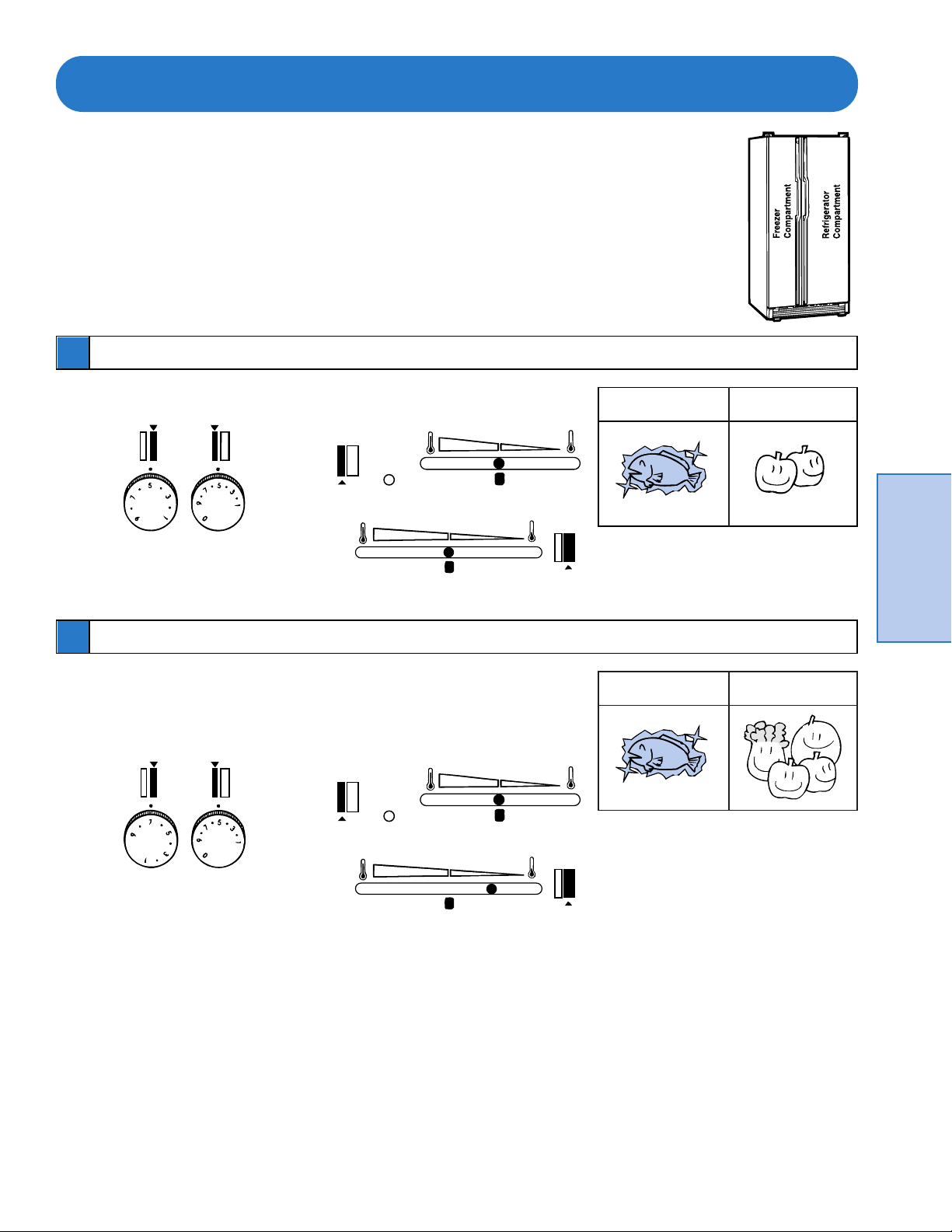
NORMAL OPERATION
1
For normal operation, set the dials as shown below:
ADDITIONAL COOLING ON REFRIGERATOR COMPARTMENT SIDE
2
Use this setting when food is to be stored at low
temperatures. This setting is likely to be frequently used
during warmer months. Temperature dials should be set at
7–9, as needed.
FREEZER REFRIGERATOR
COMPARTMENT COMPARTMENT
1
3 5
7
9
1
3
5
9
7
FREEZER REFRIGERATOR
COMPARTMENT COMPARTMENT
Refrigerator
Compartment
Freezer
Compartment
(or)
1
3 5
7
9
1
3
5
9
7
(or)
Refrigerator
Compartment
Freezer
Compartment
17
Operation
INTERIOR TEMPERATURE CONTROL (continued)
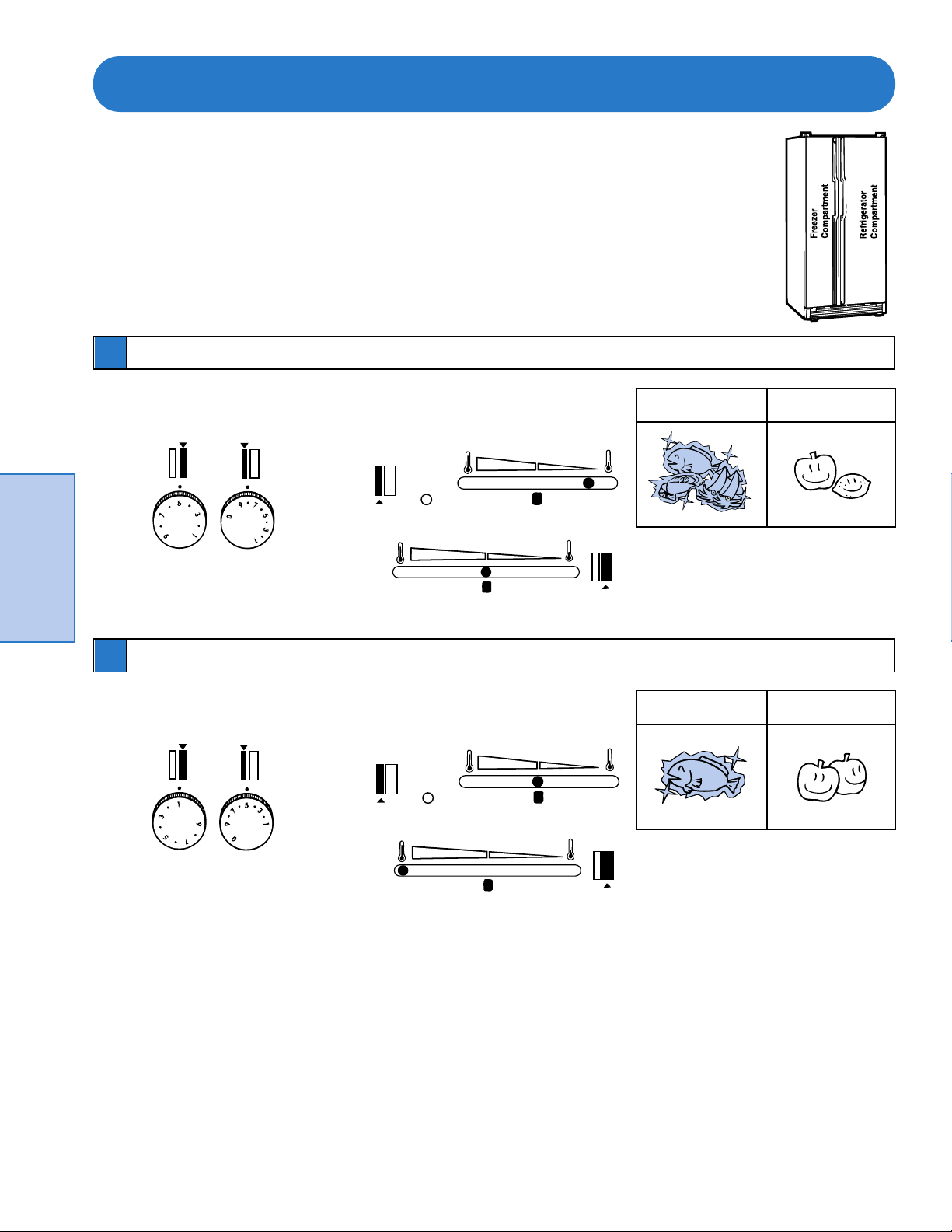
ADDITIONAL COOLING ON FREEZER COMPARTMENT SIDE
3
Use this setting when food is to be stored for longer periods
of time.
FREEZER REFRIGERATOR
COMPARTMENT COMPARTMENT
Refrigerator
Compartment
Freezer
Compartment
(or)
(or)
A SMALL AMOUNT OF FOOD IS STORED
4
Use this setting when food is to be stored at warmer
temperatures.
FREEZER REFRIGERATOR
COMPARTMENT COMPARTMENT
Refrigerator
Compartment
Freezer
Compartment
1
3 5
7
9
1
3
5
9
7
1
3 5
7
9
1
3
5
9
7
Operation
18
UTILIZING THE INTERIOR SPACE
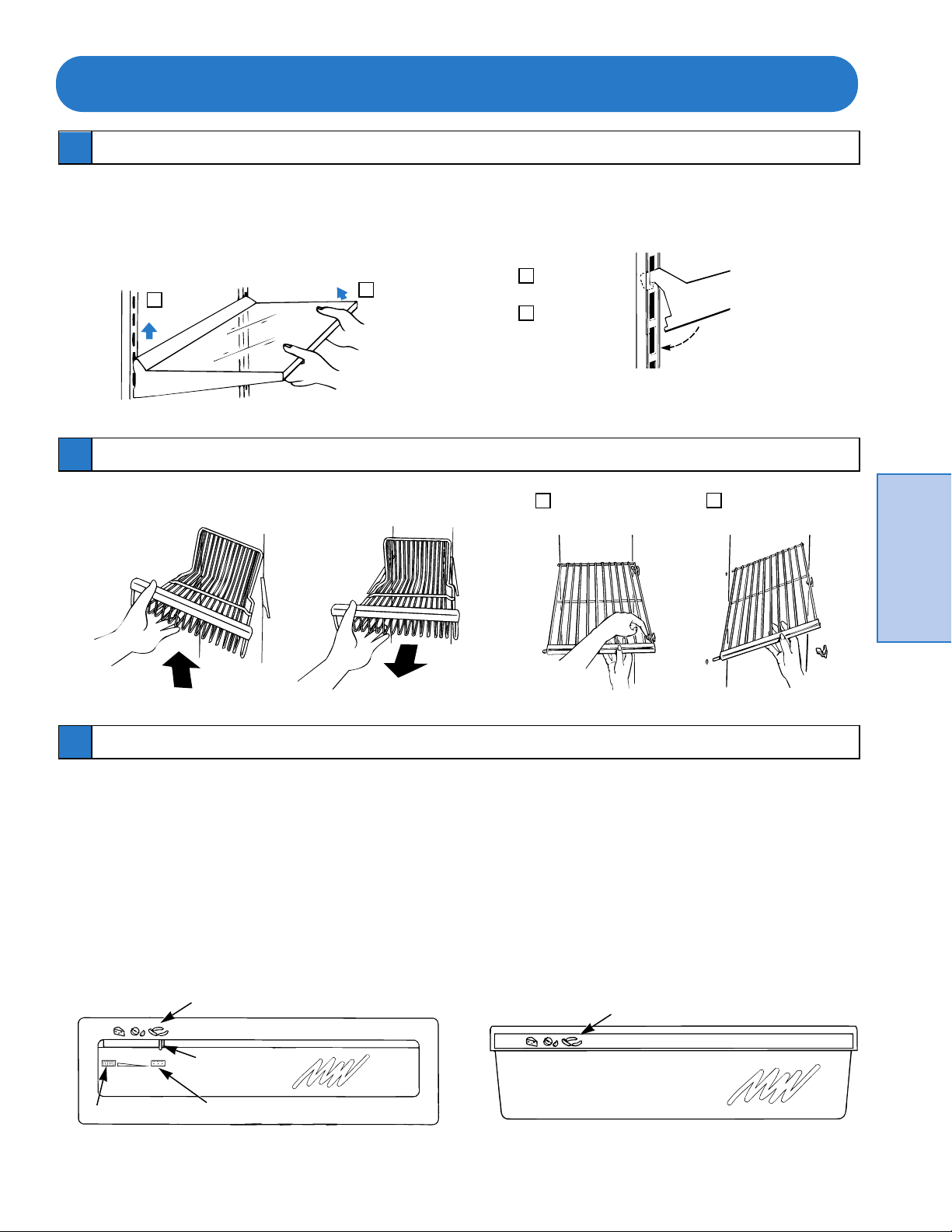
REFRIGERATOR COMPARTMENT SHELVES
1
Each shelf is adjustable, enabling space to be utilized
without waste.
1.To remove shelf, lift the front end slightly, while
unhooking it from the slot in the back.
2.To install shelf, lift the front end and insert the
hooks into the slots at desired height, and lower
front end to lock in securely.
FREEZER COMPARTMENT SHELF
2
To remove shelf, pull forward and lift slightly.
Unhook
2
Insert Hooks
1
Lift Up
1
Lower Front
2
(or)
AIRTIGHT SNACK CASE (or) MEAT/SNACK CASE
3
Unwrapped foods can be stored in the airtight snack
case without losing the unique moisture of food. For
example, the snack case is best suited for storing
foods such as cheese, bacon, hors d’oeuvres, jam,
paste, etc.
• When the lever is set on high humidity, the case
becomes airtight, preventing moisture from
escaping into the refrigerator compartment. The
airtight case allows food to be stored for relatively
long periods of time without losing moisture
content.
• When the lever is set on low humidity, the vent
between the case and the refrigerator compartment
opens, allowing air circulation. On this setting,
foods can become dry. Therefore, this setting is
appropriate for foods that do not require moisture.
(or)
Push down on tab
while lifting up on shelf.
1
Rotate shelf up,
then pull to the right.
2
Icons
Lever
High Humidity Low Humidity
Icons
UTILIZING THE INTERIOR SPACE (continued)
19
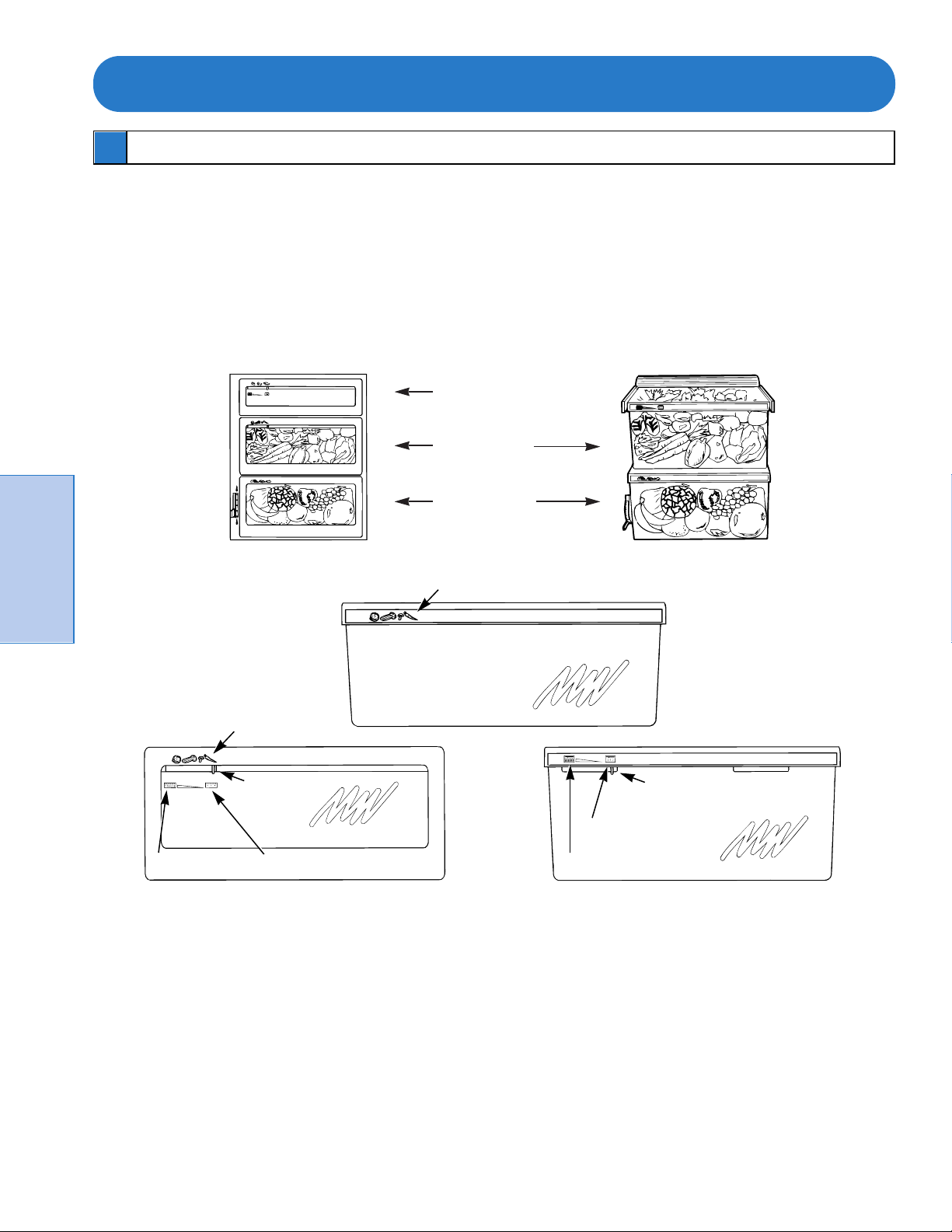
HIGH HUMIDITY VEGETABLE COMPARTMENT
4
This compartment is designed to maintain good internal
airtightness, allowing vegetables to be stored without losing
freshness. It is normal for water to accumulate in the
compartment due to differences in temperature and vegetable
moisture content. Vegetables should be stored in plastic or
paper wrappings to prevent water accumulation.
To prevent vegetables from spoiling, drain water and wipe
compartment dry if water accumulates.
Operation
Meat/Snack Case
High Humidity
Vegetable
Compartment
Temperature
Control Lever
Chilling/Vegetable
Compartment
When lever is set on high humidity, the case
becomes airtight, preventing moisture from
escaping into the refrigerator compartment. The
airtight case allows foods to be stored for
relatively long periods of time without losing
moisture content.
When lever is set on low humidity, the vent
between the case and the refrigerator compartment
opens, allowing air circulation. On this setting,
foods can become dry. Therefore, this setting is
appropriate for foods that do not require moisture.
(or)
(or)
Icons
Icons
Lever
High Humidity
Low Humidity
Lever
High Humidity
Low Humidity
UTILIZING THE INTERIOR SPACE (continued)
Operation
20
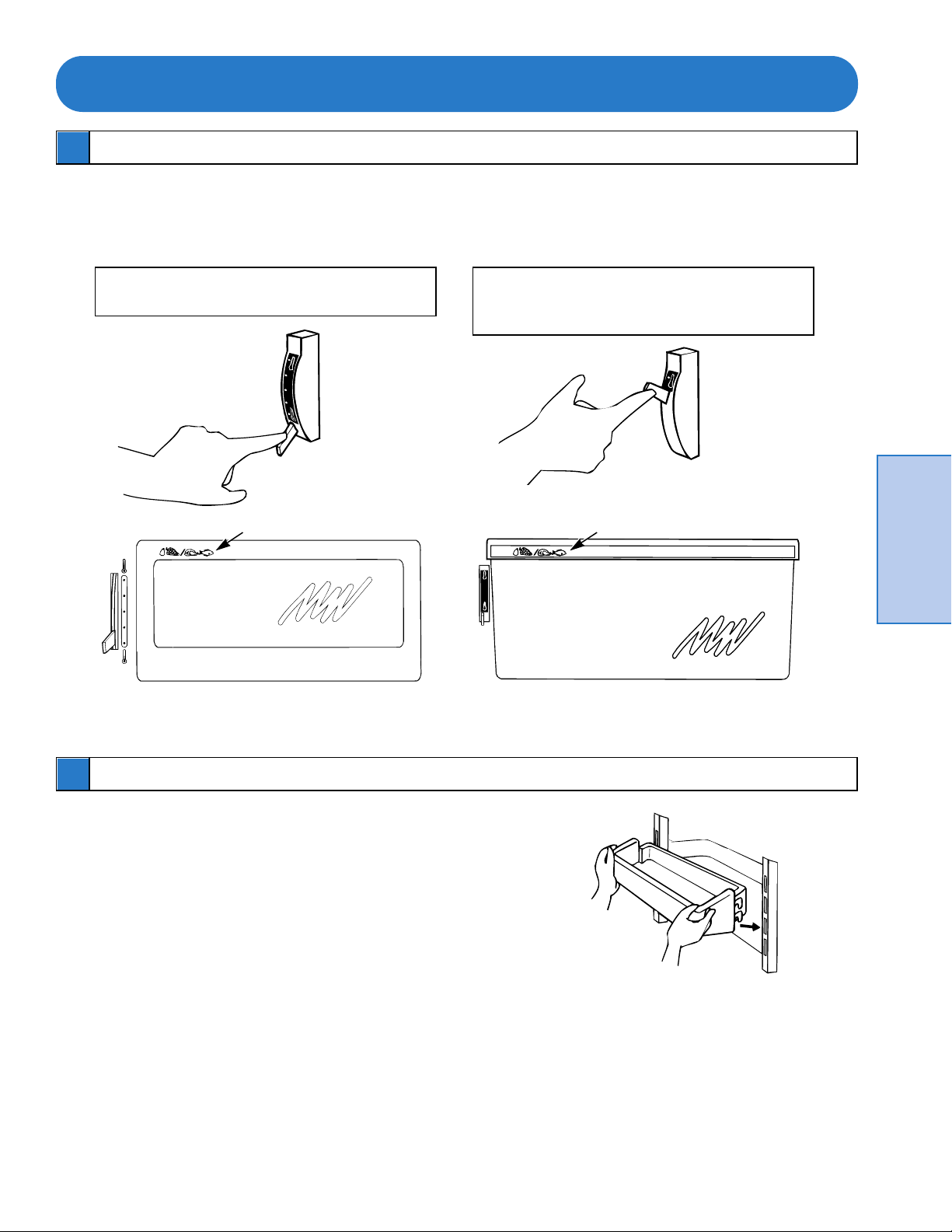
CHILLING/VEGETABLE COMPARTMENT
5
For use as a chilling compartment, set lever to the
lower position. Cold air will circulate from the
freezer compartment and will be suitable for
storing food at a lower temperature.
For use as a vegetable compartment, set lever to
the upper position. Cold air from the freezer
compartment will not circulate into this
compartment and vegetables can be stored.
Set control to the upper position if room
temperature is below 10°C. to prevent water
dispenser tank from freezing.
Frost may form if the lever is set at the lower
position for a long period of time.
ADJUSTABLE HEIGHT DOOR POCKET
6
Both large and small items can be stored in this box-type
shelf. The container can be removed from the door and
conveniently carried to a table or counter.
(or)
Icons Icons
ICEMAKING
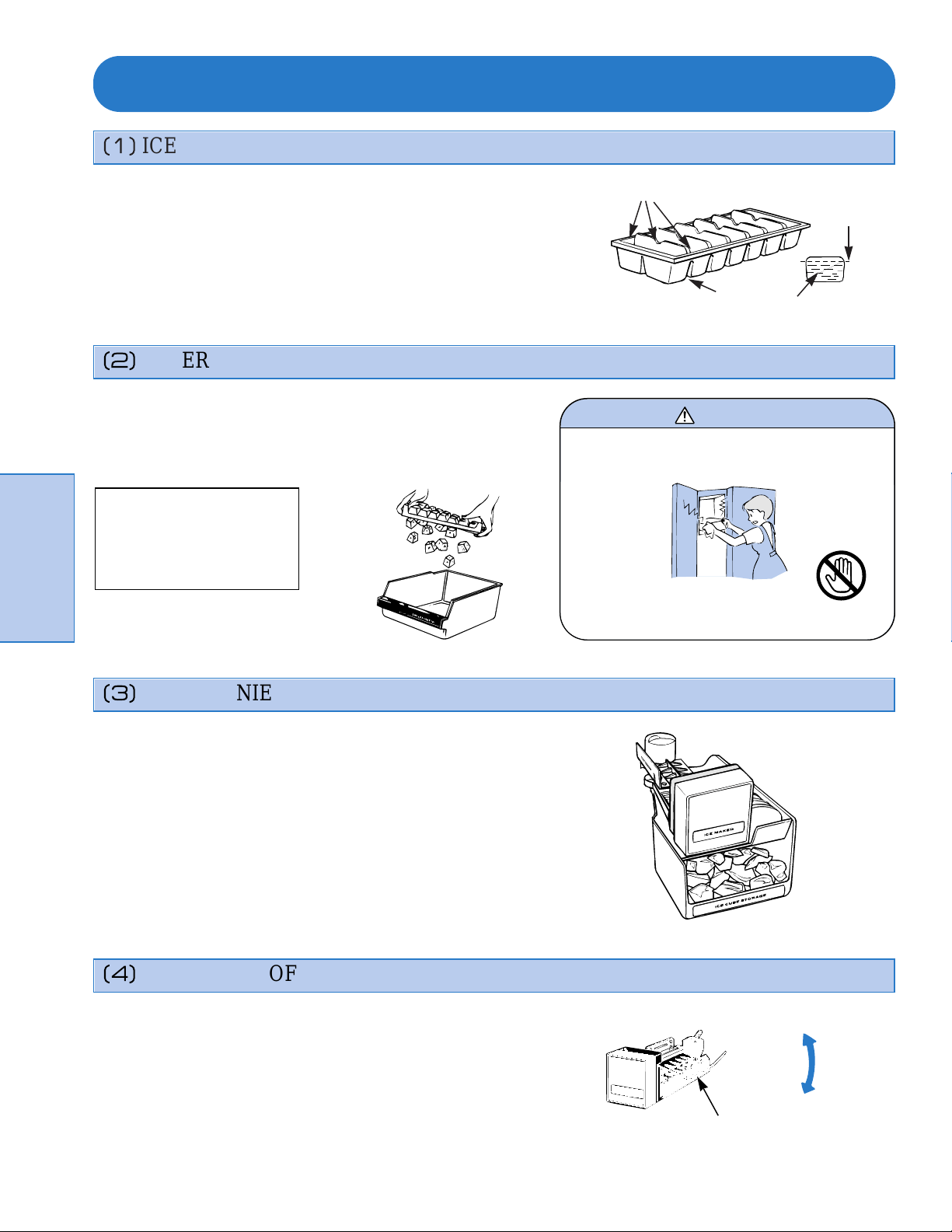
(1)
ICE TRAY SHOULD BE FILLED UP TO THE ICE CUBE SEPARATOR
If water is filled above ice cube separator, the cubes will
stick together.
(2)
AFTER ICE IS MADE, TRANSFER ICE TO ICE BOX
When ice is completely formed, transfer ice cubes
from the ice tray to the ice box.
• To remove ice cubes, simply twist tray as shown
in figure.
CAUTION: If the ice box
is wet, cubes will stick
together. Ice box should not
be used to make ice, since
the box could break.
(3)
A CONVENIENT ICEMAKER (NOT INCLUDED) CAN BE INSTALLED
(TFJ20JA, TFJ22JA & TFJ25PA MODELS)
An icemaker which can be bought separately can be installed
in this refrigerator. An icemaker makes ice automatically,
eliminating the chore of filling the ice tray and transferring
the ice cubes.
(4)
OPERATION OF ICEMAKER (AUTOMATIC ICE-MAKING APPARATUS)
(TPJ24BI MODEL ONLY)
GE Icemaker (automatic ice-making apparatus) does not
require manual water supply. Following completion of
installation of the water supply piping system, lower the arm
switch to “ON.” Ice is now automatically made and the
icemaker will automatically shut off when the bucket is filled
with set amount of ice.
Operation
Separator
Ice Tray
Water
Level
Do not touch food or metal containers in
the freezer compartment with wet hands.
CAUTION
DO NOT TOUCH
21
• You may
suffer from
frostbite
caused by the
low temperature.
Feeler Arm
Switch
ON
OFF
STORAGE OF FOOD
Operation
22
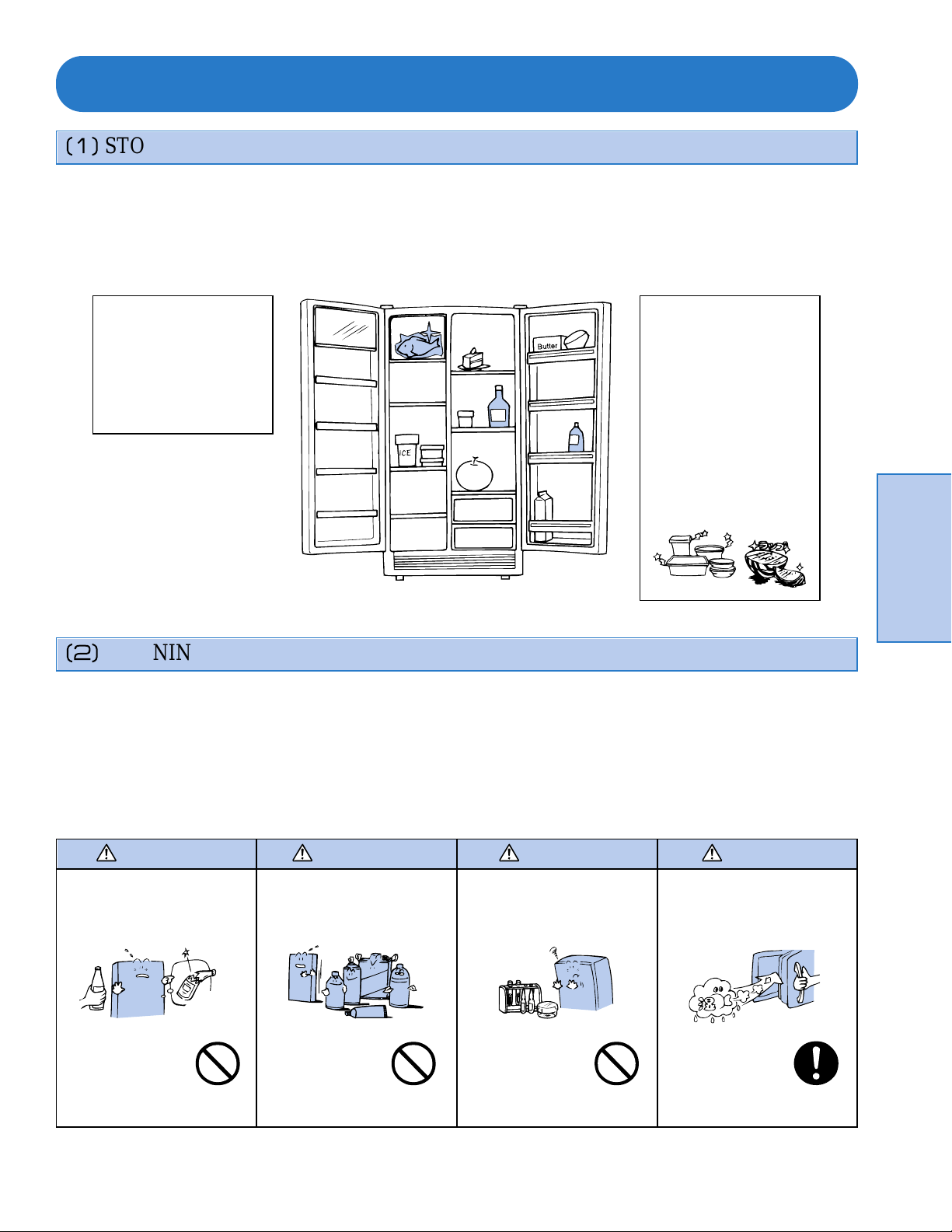
When storing foods, place items requiring colder temperatures (meats, cakes, etc.) near the cold air
inlet, while placing items which are not to be subjected to dewing or icing (vegetables, fruit, etc.) in
the lower areas.
Beer and juices should be stored in the door pockets, while butter and cheeses should be stored in the
upper portion of the door (astro-door type utility compartment) where the temperature is relatively high.
1.Bottles should not be stored inside the freezer because they may break.
2.Do not store plasma or vaccines in this refrigerator. In addition, volatile or
flammable substances should never be stored in refrigerators.
3.Avoid leaving the door open. Do not open and close the door unnecessarily.
4.Do not store hot foods without cooling them first.
5.Do not store ice cream in the door pocket.
(1)
STORAGE OF FOOD
(2)
WARNINGS ABOUT FOOD STORAGE
1.Provide space
between items in the
refrigerator. Packing
items too densely will
reduce circulation of
cold air, reducing
cooling.
2.If foods stored in the
freezer are not sealed
airtight, water
condensation could
occur on the surface
of the refrigerator’s
cold walls and
dampen contents by
dewing. Therefore,
when storing, use
airtight containers or
plastic wrap.
DANGER WARNING WARNING CAUTION
Do not store bottles
or cans in freezer
compartment.
Flammable ether, benzene,
alcohol, medicine, LP gas,
etc., should not be stored.
Do not store medicine or
scientific specimens in
refrigerator.
Do not store hot foods.
Cool them first.
CRACK!
SPRAY
LP GAS
THINNER
GLUE
ETHER
• Contents will
freeze and
broken glass may
cause injuries.
• Danger of
explosion.
• Items requiring
strict temperature
control should
not be stored in a
household
refrigerator.
NO
BOTTLES
DON’T
STORE
DON’T
STORE
FOODS
SHOULD BE
COOLED FIRST
WHAT TO KNOW ABOUT FROZEN FOODS
(1)
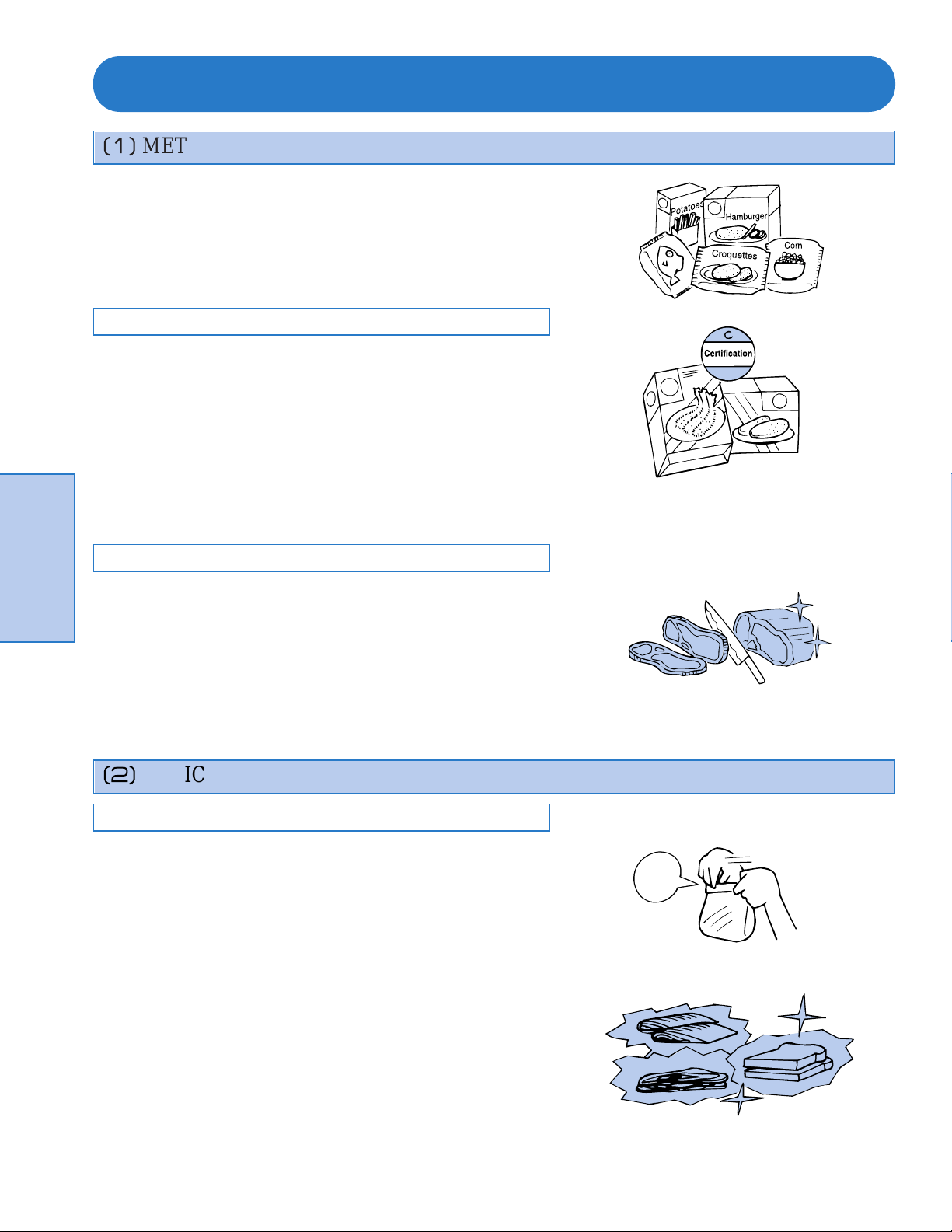
METHODS OF SELECTING AND USING STORE-BOUGHT FROZEN FOODS
There are approximately 3,000 varieties of frozen food on the market
at the present time. Store-bought frozen foods are wholesome, high
in nutritional value and easy to prepare. Spoilage or food poisoning
are of no concern. The most attractive feature of frozen food is its
longevity (1–3 months). As long as you have frozen items on
hand in the freezer, it is easy to prepare a splendid meal on short
notice, with minimal concern should unexpected guests drop in.
1.Select items preserved in a showcase, indicating a temperature
below -18°C.
2.Select items with an approval label from the Japan Frozen Food
Association.
3.Select items with the latest manufacturing date.
4. Select items with proper shape and that are frozen hard.
5.Select items without torn wrappings.
6. Avoid items with obscured view of contents due to excessive
frosting. They may have been re-frozen.
(2)
BASIC THINGS TO KNOW ABOUT HOME FREEZING
1.Food items should be fresh. Freshness is most important to
ensure tasty frozen food.
2.Cool food before freezing. If a hot item is placed inside the
freezer, the freezer will warm up, affecting other food items.
3.Always seal products in an airtight container or wrapping in
order to prevent changes in food. In addition, liquids should be
stored in containers with extra volume to accommodate
expansion.
4.Freeze single servings measured according to the size of your
family.
5.Arrange in thin packages and freeze quickly. The trick for good
home freezing is “quick freezing,” which is why packaging
should be thin.
6.Set freezer dial to HIGH cooling (9). Return dial to original
(normal) setting after freezing is complete.
7.Door should be kept closed as much as possible.
Operation
• TIPS FOR SELECTION
1.Thaw only the amount needed. Only the needed portion should
be thawed by breaking the selection into small pieces or cutting
it with a saw.
2.Do not thaw completely. The correct stage for cooking is
reached when edges become soft but the core is still frozen.
3.Food should be cooked as soon as it is thawed.
4.Use the appropriate thawing method prescribed for each
particular food.
• TIPS FOR THAWING
• THE FUNDAMENTALS OF FREEZING
23
Seal
CARE AND CLEANING OF REFRIGERATOR
Care, Cleaning
& Self-Diagnosis
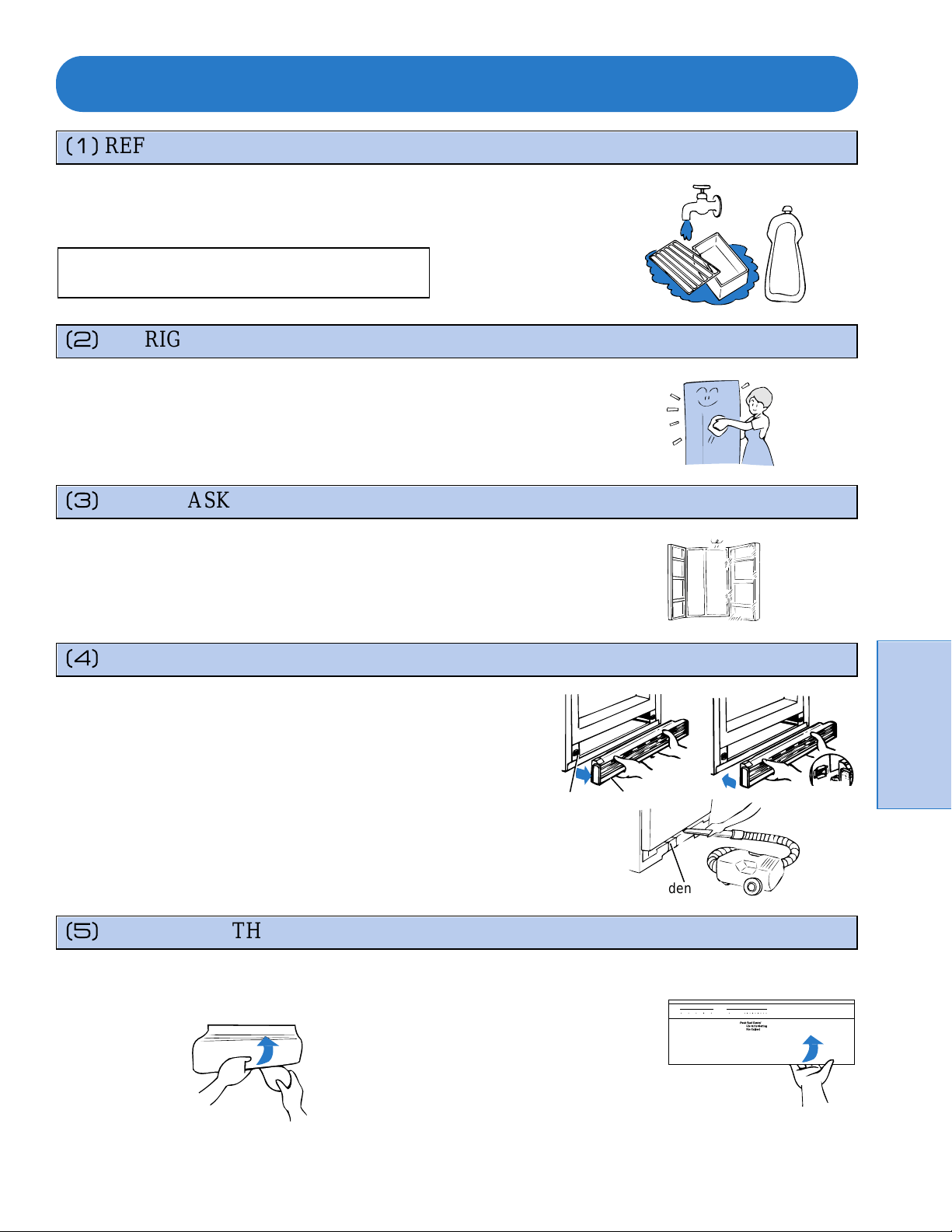
Parts that can be removed should be washed. Dry parts before
returning. Use a small amount of mild detergent if needed.
(Detergent should be wiped clean.)
CAUTION: Use mild detergent and warm water to
avoid damaging paint or plastic.
(1)
REFRIGERATOR INTERIOR
MILD
DETERGENT
Wipe off whenever exterior surfaces are dirty or wet. Apply
suitable wax to the refrigerator exterior several times a year.
(2)
REFRIGERATOR EXTERIOR
The door gasket will deteriorate quickly if liquid food or juice are
spilled on it. Clean the door gasket in the same way as
refrigerator interior.
(3)
DOOR GASKET
FREEZER COMPARTMENT
Remove the lamp cover before replacing the bulb.
NOTE: On some models, a screw must be removed
before removing the lamp cover.
REFRIGERATOR COMPARTMENT (upper light bulb)
1.Pull out the 2 knobs
or dials.
2.Remove cover by
turning it upward or
by pulling it outward.
3.Turn lamp to the left to
remove and replace it.
4.Use only a 40W bulb.
A B C D E
Freezer Control
C is Initial Setting
E is Coldest
OFF 13579
(5)
REPLACING THE LIGHT BULB
Remove front grille when adjusting height of refrigerator or when
cleaning the condenser.
1.To remove the grille, hold the bottom of grille and pull
forward.
2.To install the grille, hold both ends of grille and push prongs
into holes.
Vacuum once or twice a year, since dirt on the condenser will
decrease efficiency, increase electricity consumption, and reduce
cooling capacity of the refrigerator.
(4)
CONDENSER
Condenser
Grille
Grille
Prong
Grille
Hole
24
SELF-DIAGNOSIS
Care, Cleaning
& Self-Diagnosis
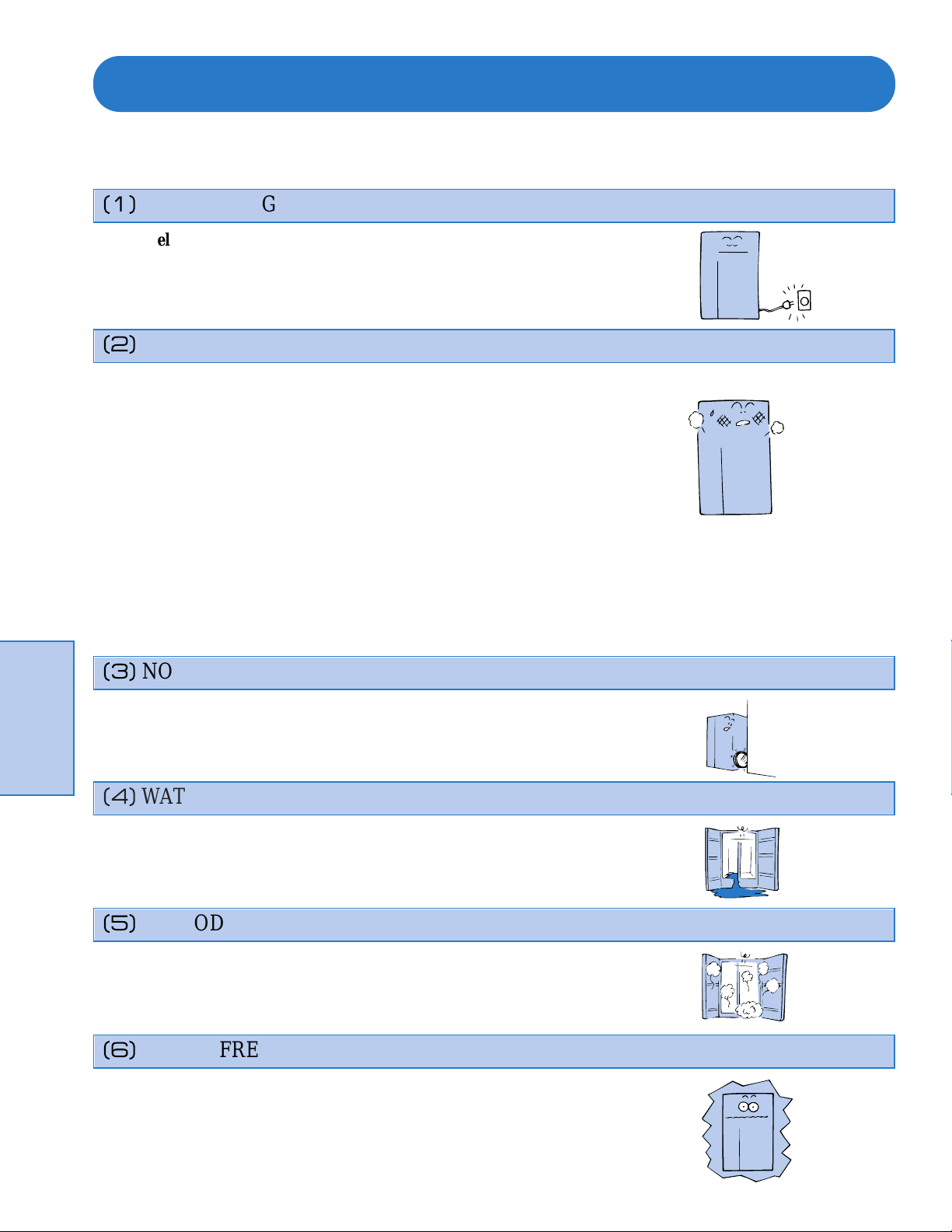
• Is the floor firm?
If the floor is unsteady, noise level will increase.
• Are there any trays leaning against the side of the
refrigerator? These trays may produce a resounding noise.
• Are there any food items with high water content?
Refer to page 22 for food storage.
(4)
WATER ACCUMULATION INSIDE
• Is interior of the refrigerator clean?
A dirty interior is the main source of odor.
• Are there any foods with a strong odor?
These can produce a bad combination odor with other food odors.
(5)
BAD ODOR
• Is the setting of the temperature control dial correct?
Refer to page 14.
• Are foods stored properly?
If cold air hits them directly, some
foods may freeze.
(6)
FOODS FREEZE IN REFRIGERATOR
• Is the air flow to the condenser adequate?
If the air flow is inadequate, cooling will not occur.
• Is the door opened/closed frequently?
Cold air will escape if door openings/closings are frequent.
• Is the temperature control dial set correctly?
Refer to page 14.
★ Is interior fan of the refrigerator working?
If the fan is not working, cold air will not circulate and
cooling will not occur.
★ Is there a gap in the door?
If a gap exists, cold air will escape and cooling will not occur.
★ Is frost built up too thick?
★ Is refrigerator being defrosted?
If timer is set to defrost, cooling will not occur.
“Let’s Find Out On Our Own”
★ Indicates that the item’s self-diagnosis is
difficult. To clarify, consult dealership where
the unit was purchased.
25
(1)
NO COOLING
(3)
NOISY
• Is the electricity on?
1. Is power cord plugged in?
2. Is fuse (breaker) blown?
3. Is there a blackout?
★ Is the compressor working?
(2)
POOR COOLING
WARRANTYAND AFTER-SERVICE
(PLEASE READ CAREFULLY)
Warranty &
After-Service
26
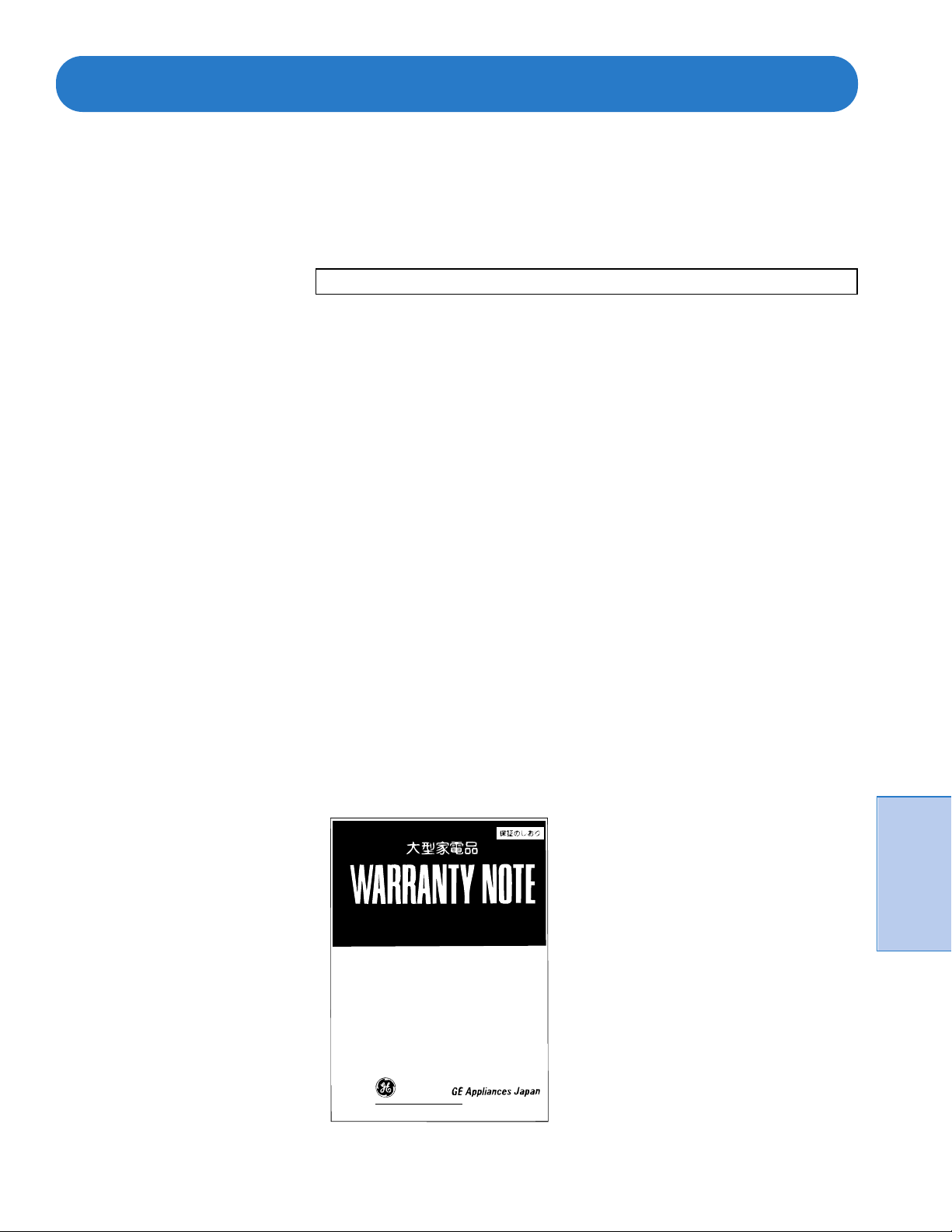
A WARRANTY GUIDE, THE “WARRANTY NOTE,” FOR THE GE
FREEZER/REFRIGERATOR WHICH YOU HAVE JUST PURCHASED IS ATTACHED
AS A SEPARATE BOOKLET TO THIS OPERATIONS GUIDE.
SINCE IT IS AN IMPORTANT BOOKLET FOR AFTER-SERVICE, ETC., KEEP IT IN
A SAFE PLACE ALONG WITH THIS BOOKLET.
• WARRANTY PERIOD—One year from the date of purchase.
If the malfunction cannot be corrected after following the instructions on page
33, a service call for repair work should be placed to the dealership where the
unit was purchased. Warranty applies only to repair of the appliance hardware
itself and to no other items such as food, etc.
• DURING WARRANTY PERIOD:
Please present the “WARRANTY NOTE” when repair work is performed. In
accordance with the “WARRANTY NOTE,” the dealership where the unit
was purchased will dispatch a repairman for the job. If you do not contact the
dealership, please contact GE APPLIANCES JAPAN, INC.
The following information is to be reported to the dealer or to this company:
1.Customer’s name, address and telephone number
2.Model of refrigerator
3.Details of problem
Refer to the chapter on “Self-Diagnosis” in this OPERATIONS GUIDE and
provide answers to the serviceman’s questions.
When a serviceman visits, show him the “WARRANTY NOTE” attached to
this guide.
The minimum warranty period (for parts that are required to maintain
performance function) is 9 years from the last manufacturing date.
This period is established in accordance with MITI directives.
The freezer cycle coolant system has a five-year warranty.
REQUESTING
REPAIR WORK
MINIMUM
WARRANTY PERIOD
FOR FUNCTION-
MAINTENANCE
PARTS
LARGE ELECTRICAL
APPLIANCES
“WARRANTY NOTE”
WARRANTYAND AFTER-SERVICE
(PLEASE READ CAREFULLY)
THIS MARKING ON A REFRIGERATOR DENOTES THAT IT IS A
“PRODUCT THAT MEETS THE ‘96 SPECIFIED FREON REGULATION.”
Refrigerators use Freon for their freezing apparatus and heat insulators. Freon is
non-flammable and not harmful to the human body directly. Furthermore, it
possesses excellent properties which have made it one of the most useful chemical
substances and contributed to the development of modern civilization.
In its capacity as a cleaning agent, propellant, and for its use in refrigerators,
however, it is thought to have caused the depletion of the atmospheric ozone layer.
The decision was made to cease worldwide production of this substance completely
and to switch to a substance which has less impact on the ozone layer.
‘96 SPECIFIED FREON
REGULATION
REFRIGERATOR
LOVING CARE
INSPECTION
• INSPECTION OF OLDER MODEL REFRIGERATORS
Are these
symptoms
present?
• Unusually hot power cord
and plug
• Damaged power cord
• Burning smell
• Accumulation of water
under refrigerator
• Electric shock
• Other malfunction and
breakdown
Request
Unplug the
power plug to
prevent
breakdown or
accident and
consult the
dealership
where the unit
was purchased
for inspection
or repair.
¹
USEFUL
INFORMATION
FOR
REQUESTING
SERVICE
Date Purchased
Dealership
Year Month Day Model #
Phone ( )
TFJ20JA, TFJ22JA,
TFJ24BI, TFJ25PA
WARRANTY BUSINESS INFORMATION CENTER IN JAPAN
GE APPLIANCES JAPAN, INC.
Marumasumaricho Bldg. 4F
3-3 Maricho, Chiyoda-Ku
Tokyo, Japan 102
TEL: (03) 3265-5570 (Main)
FAX: (03) 3265-5131
DEALERSHIP
162D9792P001 49-6895
27
Warranty &
After-Service