PART NUMBER: MFL33029607 DATE: January 15th, 2013
LG Electronics Monterrey, México S.A. de C.V.
DESCRIPTION: OWNER’S MANUAL Part No. MFL33029607
MODEL DESCRIPTION:
Product: Project:
Brand: Customer:
PRINTING SPECIFICATION:
1. Trim Size (mm): 4. Printing Method:
2. Printing Color: 5. Bindery Type:
3. Paper Type: 6. Language:
- Cover: 7. Number of Pages:
- Content: 8. Number of Sheets:
NOTES:
1. The part should not contain prohibited substances (Pb, Cd, Hg, Cr+6, PBB, PBDE) and should comply
with standard LG (61)-A-9101.
Folding procedure must be according to the order that shows below and it should be seen front
(Printing side of P/N), 1 -> 2 -> 3 -> 4 -> 5.
The specification must be the same according to First Parts Approval (FPA).
Quality must not be modified.
2.
NIKE BETTER AND BETTER PLUS
LGEUSLG
Gas Range
Bond Paper 63 gr.
Black
182 (W), 257 (H) Off Set
Saddle Stitch
English & Spanish
92
46
FOLDING PROCEDURE ONLY FOR TECHNICAL CARDS
Bond Paper 63 gr.

www.lg.com
OWNER’S MANUAL
GAS DOUBLE OVEN
RANGE
LDG3016ST
LDG3015ST
LDG3015SB
LDG3015SW
Please read this guide thoroughly before operating
and keep it handy for reference at all times.
ENGLISH
ESPAÑOL
MFL33029607

2
TABLE OF CONTENTS
3 PRODUCT FEATURES
4 IMPORTANT SAFETY INSTRUCTIONS
10 BEFORE USE
10 Accessories
11 Components
12 HOW TO USE
12 Gas Surface Burners
12 - Before Use
13 - Gas Burners
13 - Using the Gas Surface Burners
14 - Top-of-Range Cookware
15 - Using the Griddle (Model LDG3016ST only)
16 How to Use the Oven
16 - Before Use
18 - Using the Control Panel
20 Operating Instructions
20 - Convection auto conversion
20 - Temperature
20 - Preheating Alarm light
20 - Oven light
20 - Beeper volume
21 - Fahrenheit or Celsius
21 - Clock
22 - Timer
22 - Lockout
23 Removing and Replacing the Oven Racks
24 BAKE (Upper & Lower Oven)
25 Preheating and Pan Placement
26 BROIL (Upper Oven)
28 TIMED COOK (Upper & Lower Oven)
28 DELAYED TIMED COOK (Upper & Lower Oven)
29 How to use convection for the lower oven
(LDG3016ST)
29 - CONVECTION BAKE FOR THE LOWER OVEN
(LDG3016ST)
31 - CONVECTION ROAST FOR THE LOWER OVEN
(LDG3016ST)
32 Special Features
32 - PIZZA (Upper Oven)
32 - WARM (Upper & Lower Oven)
33 - PROOF (Lower Oven)
33 - FAVORITE (LDG3016ST Lower Oven)
34 - SABBATH (Upper & Lower Oven)
35 CARE AND CLEANING
35 Gas Surface Burner
35 - Removing and Replacing the Gas Surface
Burner
35 - Burner Heads/Caps
36 - Burner Grates
37 - Cooktop Surface
37 - Stainless Steel Surfaces
37 - Oven Air Vents
37 - Control Panel
37 - Front Manifold Panel and Knobs
37 Outside of the Oven
37 - Painted and Decorative Trim
38 - Oven Door
38 - Removing and Replacing the Doors
40 Inside of the Oven
40 - SELF CLEAN (Upper & Lower Oven)
42 - Changing the Oven Light
42 - Broiler Pan and Grid (Sold separately)
42 - Oven Racks
43 BEFORE REQUESTING SERVICE
45 WARRANTY
TABLE OF CONTENTS
3
PRODUCT FEATURES
ENGLISH
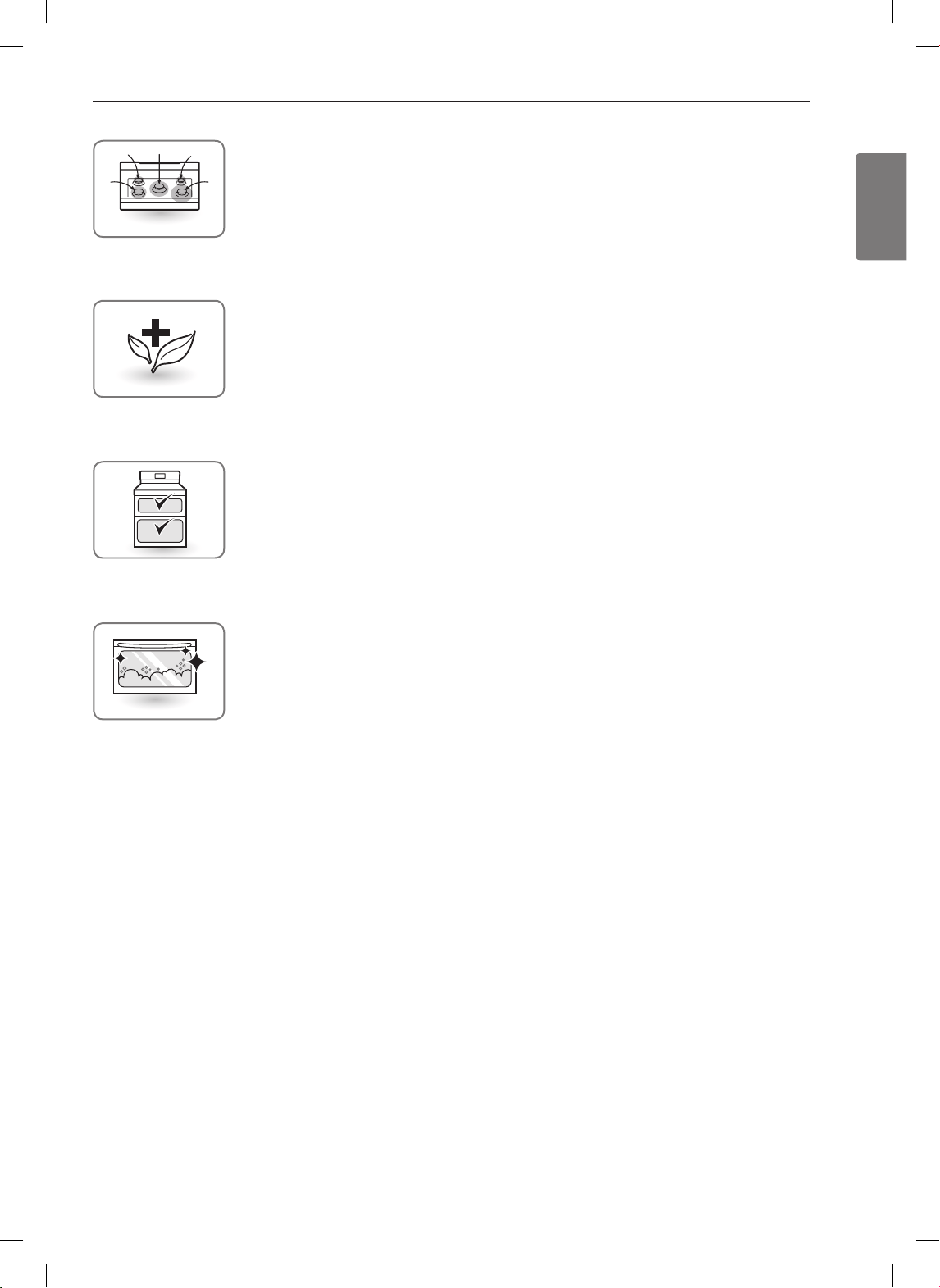
SAFE AND CONVENIENT GAS RANGE
Provides safety and convenience for cooking.
Superboil (17000 BTU) can quickly bring a pot of water to a boil.
MULTIPLE GAS BURNER SIZES
Choose a burner to fit the size of your cookware.
Cooking multiple items at once is possible by using different burners at the same time.
UPPER OVEN / LOWER OVEN
Separate upper and lower ovens.
Choose to use either oven, or both, depending on the size of your food.
SELF CLEAN
Good for easy cleaning.
4
IMPORTANT SAFETY INSTRUCTIONS
Always comply with the following precautions to avoid dangerous situations and to ensure the peak performance of your product.
WARNING
Indicates a hazardous situation which, if not avoided, could result in death or serious injury.
CAUTION
Indicates a hazardous situation which, if not avoided, could result in minor or moderate injury.
WHAT TO DO IF YOU SMELL GAS
1. Open windows.
2.
DO NOT
try to light any appliance.
3.
DO NOT
touch any electrical switch.
4.
DO NOT
use any phone in your building.
5. Immediately call your gas supplier from a neighbor’s phone. Follow the gas supplier’s in-
structions.
6. If you cannot reach your gas supplier, call the fire department.
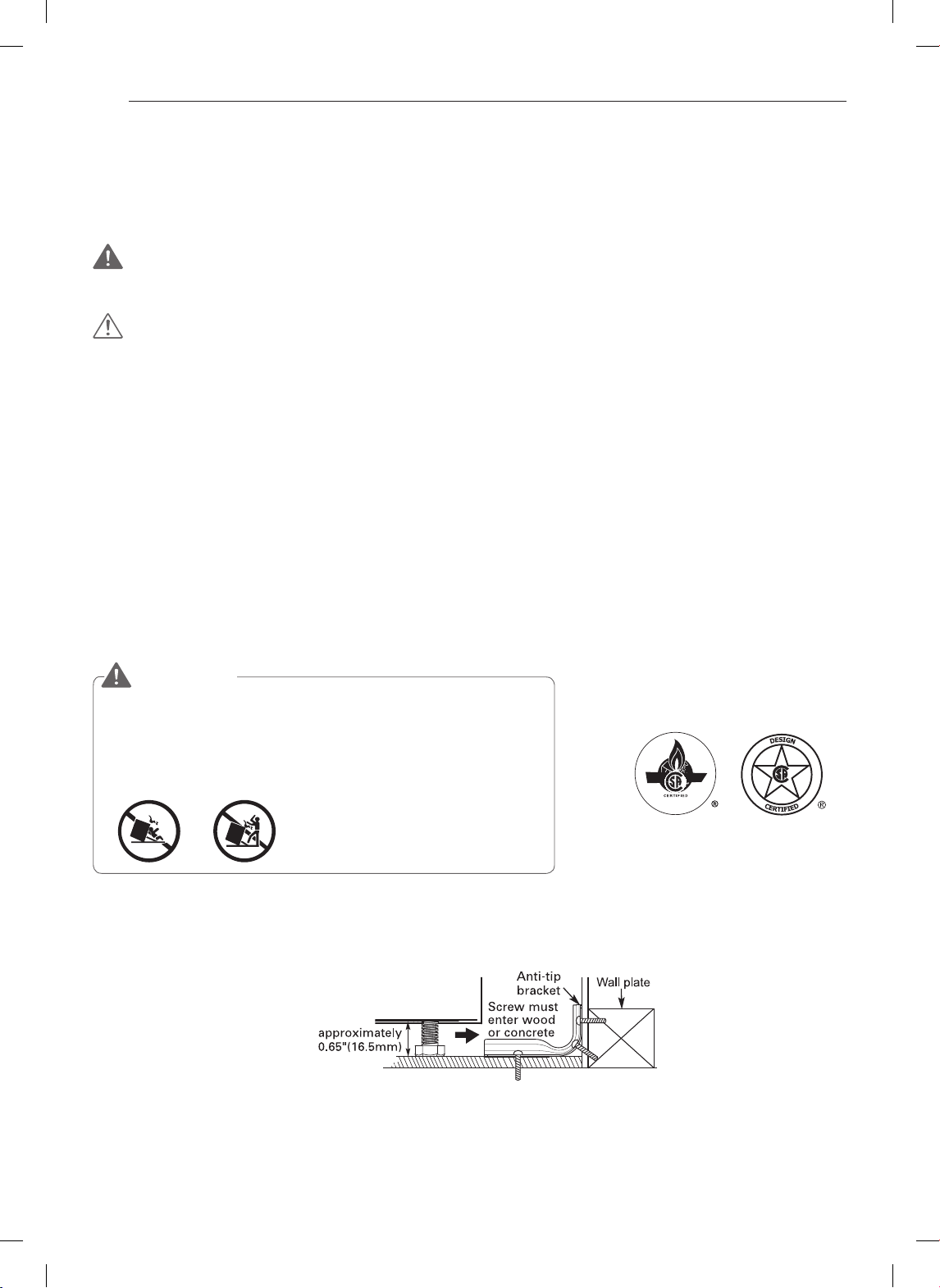
ANTI-TIP DEVICE
WARNING
y
DO NOT step or sit on the door. Install the Anti-Tip Bracket packed with this range.
- The range could be tipped and injury might result from spilled hot liquid, food, or the range itself.
- If the range is pulled away from the wall for cleaning, service, or any other reason, ensure that the Anti-Tip Device is properly
reengaged when the range is pushed back against the wall.
y
To reduce the risk of the range tipping over, the range must be secured by properly installing the anti-tip devices.
y
To check that the anti-tip bracket is properly installed: Remove any items on the cooktop. Grasp the top rear edge of the
range back guard and carefully attempt to tilt it forward. Verify that the ant-itip devices are engaged.
y
Remove the warming or storage drawers and visually inspect that the rear leveling leg is fully inserted into the anti-tip
bracket.
y
Refer to the installation manual for proper anti-tip bracket installation.
IMPORTANT SAFETY INSTRUCTIONS
•
ALL RANGES CAN TIP
•
INJURY TO PERSONS COULD RESULT
•
INSTALL ANTI-TIP DEVICES PACKED WITH RANGE
•
SEE INSTALLATION INSTRUCTIONS
5
IMPORTANT SAFETY INSTRUCTIONS
ENGLISH
IMPORTANT SAFETY NOTICE
Enforcement Act requires the Governor of California to publish a list of substances known to the state to cause birth defects or
other reproductive harm, and requires businesses to warn customers of potential exposure to such substances.
Gas appliances can cause minor exposure to four of these substances, namely benzene, carbon monoxide, formaldehyde and
soot, caused primarily by the imperfect combustion of natural or LP gas.
Correctly adjusted burners, indicated by a bluish rather than a yellow flame, will minimize imperfect combustion. Exposure to
these substances can be minimized by opening windows or using a ventilation fan or hood.
SAFETY PRECAUTIONS
Have the installer show you the location of the range gas shut-off valve and how to shut it off if necessary.
y
Make sure your range is properly installed and grounded by a qualified installer, according to the installation instructions.
Any adjustment and service should be performed only by qualified gas range installers or service technicians.
y
Plug your range into a 120-volt grounded outlet only. Do not remove the round grounding prong from the plug. If in doubt
about the grounding of the home electrical system, it is your personal responsibility and obligation to have an ungrounded
outlet replaced with a properly grounded, three-prong outlet in accordance with the National Electrical Code. Do not use an
extension cord with this range.
y
DO NOT
use an adapter plug, an extension cord, or remove the grounding prong from the electrical power cord to prevent
fire hazard or electrical shock. Failure to follow this warning can cause serious injury, fire or death.
y
To prevent poor air circulation, place the range out of kitchen traffic path and out of drafty locations.
y
DO NOT
attempt to repair or replace any part of your range unless it is specifically mentioned in this manual. All other ser-
vices should be referred to a qualified technician.
y
Make sure that all packaging materials are removed from the range before operating it to prevent fire or smoke damage
should the packaging material ignite.
y
Make sure your range is properly adjusted by a qualified service technician or installer for the type of gas (natural or LP) that
is to be used. Your range can be converted for use with either type of gas. See the installation instructions.
y
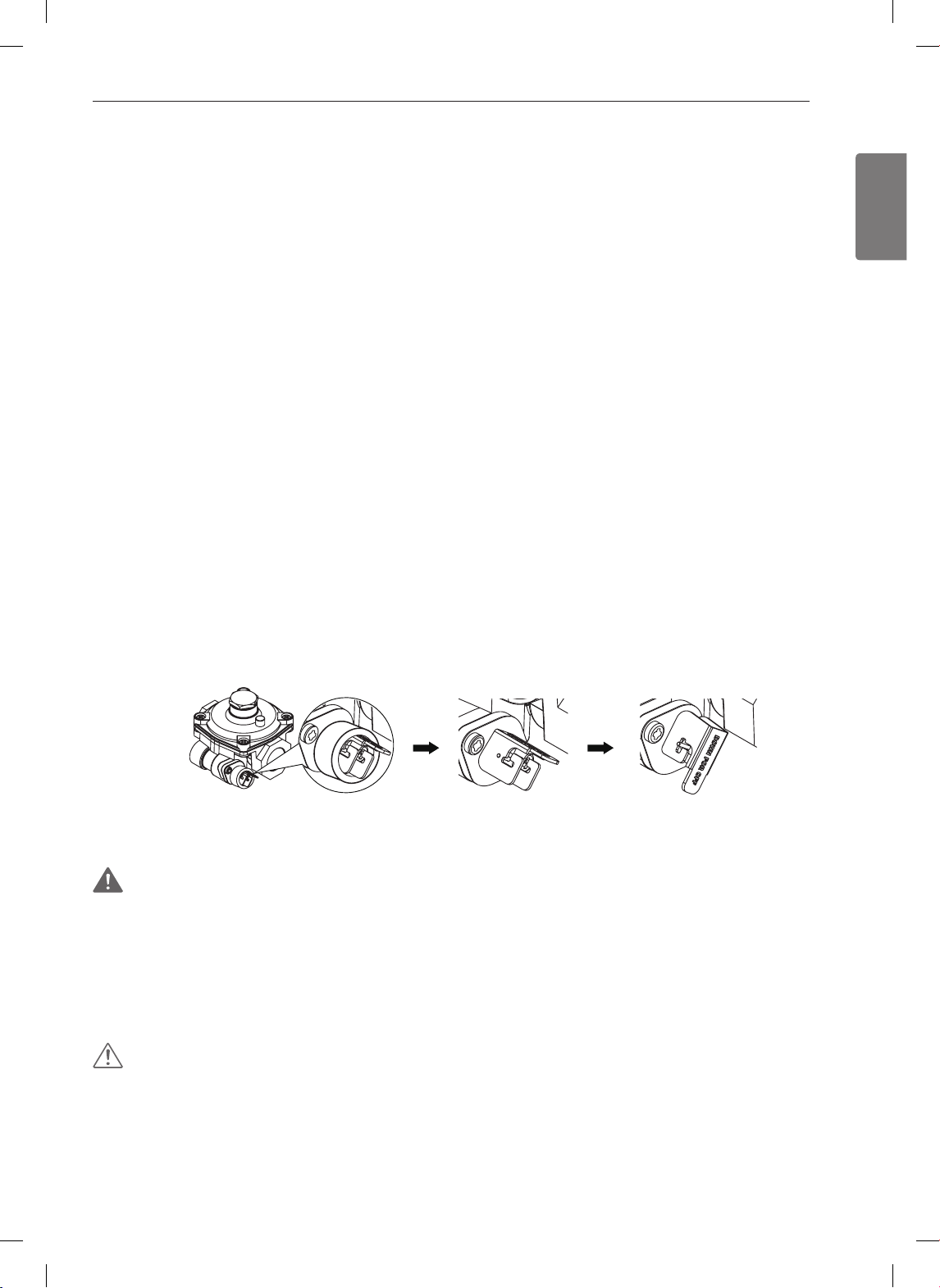
In an emergency situation or if you want to shut off the gas supply, remove the packing rubber from the regulator in the
backside, and then close the regulator’s valve by positioning the lever as shown in the figure below.
WARNING
These adjustments must be done by a qualified service technician according to the manufacturer’s instructions and all codes and
requirements of the authority having jurisdiction. Failure to follow these instructions could result in serious injury or property dam-
age. The qualified agency performing these adjustments assumes responsibility for the conversion.
y
After using your range for a long time, high floor temperatures may result and many floor coverings will not withstand this
kind of use.
y
NEVER
install the range over vinyl tile or linoleum that cannot withstand such type of use. Never install it directly over inte-
rior kitchen carpeting.
CAUTION
Items of interest to children should not be placed in cabinets above a range or on the backsplash of a range—children climbing on
the range to reach items could be seriously injured.
y
DO NOT
leave children alone or unattended where a range is hot or in operation. They could be seriously burned.
y
DO NOT
let anyone climb, stand or hang on the oven door, warming drawer or cooktop. They could damage the range and
even tip it over, causing severe personal injury.
Lever’s open position Lever’s open position
(without packing lever)
Lever’s close position
6
IMPORTANT SAFETY INSTRUCTIONS
WARNING
y
This product contains chemicals known to the State of California to cause cancer.
Wash hands after handing.
WARNING
y
NEVER
use your range as a space heater to heat or warm the room. Doing so may result in carbon monoxide poisoning and
overheating of the oven.
y
NEVER
wear loose fitting or hanging garments while using the appliance. Be careful when reaching for items placed in cabi-
nets over the range. Flammable materials could be ignited if brought in contact with flame or hot oven surfaces and may
cause severe burns.
y
DO NOT
place flammable materials in the oven or near the cooktop.
y
DO NOT
place or use combustible materials such as gasoline or other flammable vapors and liquids in the vicinity of this or
any other appliance.
y
DO NOT
allow cooking grease or other flammable materials in or near the range.
y
DO NOT
use water on grease fires. Never touch a flaming pan. Turn the controls off. Smother a flaming pan on a surface
burner by covering the pan completely with a well-fitting lid, cookie sheet or flat tray. Use a multi-purpose dry chemical or
foam-type fire extinguisher.
A grease fire can be put out by covering it with baking soda or, if available, by using a multi-purpose dry chemical or foam-
type fire extinguisher.
Flame in the upper oven or lower oven can be smothered completely by closing the oven door and turning the control to off
or by using a multi-purpose dry chemical or foam-type fire extinguisher.
y
DO NOT
use the oven or the drawer for storage.
y
Let the burner grates and other surfaces cool before touching them.
y
NEVER
block the vents (air holes) of the range. They provide the air inlet and outlet that are necessary for the range to oper-
ate properly with correct combustion. Air openings are located at the rear of the cooktop, at the top and bottom of the oven
door, and at the bottom of the range.
y
NEVER
cover any slots, holes or passages in the oven bottom or cover an entire rack with materials such as aluminum foil.
Doing so blocks air flow through the oven and may cause carbon monoxide poisoning. Aluminum foil linings may also trap
heat, causing a fire hazard.
y
NEVER
obstruct the flow of combustion and ventilation air by blocking the oven vent or air intakes. Doing so restricts air to
the burner and may result in carbon monoxide poisoning.
y
Large scratches or impacts to glass doors can lead to broken or shattered glass.
y
Stepping, leaning or sitting on the doors or drawers of this range can result in serious injuries and also cause damage to the
range. Do not allow children to climb or play around the range. The weight of a child on an open door may cause the range
to tip, resulting in serious burns or other injury.
y
Gas leaks may occur in our system and result in a dangerous situation. Gas leaks may not be detected by smell alone. Gas
suppliers recommend you to purchase and install a UL approved gas detector. Install and use in accordance with the gas
detector manufacturer’s instructions.
y
Leak testing of the appliance shall be conducted according to the manufacturer’s instructions.
y
DO NOT
use commercial oven cleaners on the oven finish or around any part of the oven. They will damage the finish of
parts.
y
To prevent staining or discoloration, clean appliance after each use.
y
DO NOT
attempt to open or close the door or operate the oven until the door is properly installed.
y
NEVER
place fingers between the hinge and front oven frame. Hinge arms are spring mounted. If accidentally hit, the hinge
will slam shut against the oven frame and could injure your fingers.
CAUTION
y
DO NOT
use the oven for storing food or cookware.
y
To prevent damage to the oven door, do not attempt to open the door when Lock is displayed.
y
DO NOT
place excessive weight or stand on an open door. This could cause the range to tip over, break the door, or injure
the user.
y
DO NOT
use delayed baking for highly perishable foods such as dairy products, pork, poultry, or seafood.
WARNING
y
Disconnect electrical supply before servicing the appliance.
y
NEVER
use appliance door as a step stool or seat, as this may result in possible tipping of the appliance and serious inju-
ries.
y
This product should not be installed below ventilation type hood systems that directs air in a downward direction.
Doing so may cause ignition and combustion problems with the gas burners resulting in personal injury and may affect the
cooking performance of the unit.
7
IMPORTANT SAFETY INSTRUCTIONS
ENGLISH
SURFACE BURNERS
WARNING
y
Even if the top burner flame goes out, gas is still flowing to the burner until the knob is turned to the “OFF” position. If you
smell gas, immediately open a window and ventilate the area for five minutes prior to using the burner. Do not leave the
burners “ON” unattended.
y
Use proper pan size - DO NOT
use pans that are unstable or that can be easily tipped. Select cookware with flat bottoms
large enough to cover burner grates. To avoid spillovers, make sure the cookware is large enough to contain the food prop-
erly. This will both save cleaning time and prevent hazardous accumulations of food, since heavy spattering or spillovers left
on the range can ignite. Use pans with handles that can be easily grasped and remain cool.
CAUTION
y
Be sure that all surface controls are set in the "OFF" position prior to supplying gas to the range.
y
NEVER
leave the surface burners unattended at high flame settings. Boilovers may cause smoke and greasy spillovers that
may catch on fire.
y
Always turn the knobs to the “LITE” position when igniting the top burners and make sure the burners have ignited.
y
Control the top burner flame size so it does not extend beyond the edge of the cookware. Excessive flame is hazardous.
y
Only use dry pot holders—moist or damp pot holders on hot surfaces may result in burns from steam. Do not let pot hold-
ers come near open flames when lifting cookware. Do not use towels or other bulky cloth items. Use a pot holder.
y
Using glass cookware—make sure the cookware is designed for top-of-range cooking.
y
To prevent burns from ignition of flammable materials and spillage, turn cookware handles toward the side or back of the
range without extending over adjacent burners.
y
NEVER
leave any items on the cooktop. The hot air from the vent may ignite flammable items and will increase pressure in
closed containers, which may cause them to burst.
y
Carefully watch foods being fried at a high flame setting.
y
Always heat fat slowly, and watch as it heats.
y
If frying combinations of oils and fats, stir together before heating.
y
Use a deep fat thermometer if possible to prevent overheating fat beyond the smoking point.
y
Use the least possible amount of fat for effective shallow or deep-fat frying. Filling the pan with too much fat can cause
spillovers when food is added.
y
DO NOT
cook foods directly on an open flame on the cooktop.
y
DO NOT
use a wok on the surface burners if the wok has a round metal ring that is placed over the burner grate to support
the wok. This ring acts as a heat trap, which may damage the burner grate and burner head. It may also cause the burner
to work improperly. This may cause carbon monoxide levels which are higher than what is allowed by current standards,
resulting in a health hazard.
y
Foods for frying should be as dry as possible. Frost or moisture on foods can cause hot fat to bubble up and spillover the
sides of the pan.
y
NEVER
try to move a pan of hot fat, especially a deep fat fryer. Wait until the fat is cool.
y
DO NOT
place plastic items on the cooktop—they may melt if left too close to the vent.
y
Keep all plastics away from the surface burners.
y
To prevent burns, always be sure that the controls for all burners are in the “OFF” position and all grates are cool before
attempting to remove them.
y
If you smell gas, turn off the gas to the range and call a qualified service technician. Never use an open flame to locate a
leak.
y
Always turn the knobs to the “
OFF
” position before removing cookware.
y
DO NOT
lift the cooktop. Lifting the cooktop can cause damage and improper operation of the range.
y
If the range is located near a window, do not hang long curtains that could blow over the surface burners and catch on fire.

8
IMPORTANT SAFETY INSTRUCTIONS
COOK MEAT AND POULTRY THOROUGHLY
To protect against foodborne illnesses, cook meat and poultry thoroughly—meat to at least an INTERNAL temperature of 160°F
and poultry to at least an INTERNAL temperature of 180°F.
SELF CLEANING OVEN
Make sure to wipe off excess spillage before operating the self clean function.
CAUTION
y
DO NOT
leave food, cooking utensils, racks, etc. in the oven during the self clean cycle.
y
DO NOT
use oven cleaners. No commercial oven cleaner or oven liner protective coating of any kind should be used in or
around any part of the oven. Residue from oven cleaners will damage the inside of the oven when the self clean cycle is
used.
y
Remove oven racks and other items from both upper and lower ovens before starting the self clean cycle.
y
Only clean the parts listed in this manual.
y
DO NOT
clean the door gasket. The door gasket is necessary for a good seal. Care should be taken not to rub, damage or
move the gasket.
y
If the self cleaning mode malfunctions, turn the range off and disconnect the power supply. Have it serviced by a qualified
technician.
y
It is normal for parts of the oven to become hot during a self clean cycle.
y
Avoid touching the door, window or oven vent area during a clean cycle.
OVEN
When opening the door of a hot oven, stand away from the range. The hot air and steam that escape can cause burns to hands,
face and eyes.
WARNING
NEVER
block any slots, holes or passages in the oven bottom or cover an entire rack with materials such as
aluminum foil. Doing so blocks air flow through the oven and may cause carbon monoxide poisoning. Aluminum foil linings may
also trap heat, causing a fire hazard.
y
DO NOT
heat food in closed containers. Pressure inside the container could increase and burst, causing an injury.
y
DO NOT
use aluminum foil anywhere in the oven except as described in this manual. Doing so could create a fire hazard or
cause damage to the range.
y
DO NOT
use the oven for storage. Items stored in the oven can catch on fire.
y
Keep the oven free from grease buildup.
y
Insert the oven racks in the desired position while the oven is cool.
y
To prevent burns when removing food, slide racks out until the stop engages, then remove food items.
This may also protect you from getting burnt from touching hot surfaces of the door or oven walls.
y
When placing or removing a griddle, always wear oven mitts.
y
When using cooking or roasting bags in the oven, follow the manufacturer’s directions.
y
Use only glass cookware that is recommended for use in gas ovens.
y
Always remove the broiler pan from the range after you finish broiling. Grease left in the pan can catch fire if oven is used
without removing the grease from the broiler pan.
y
If meat is too close to the flame while broiling, the fat may ignite. Trim excess fat to prevent excessive flare-ups.
y
Make sure the broiler pan is in place correctly to minimize the possibility of grease fires.
9
IMPORTANT SAFETY INSTRUCTIONS
ENGLISH
y
If you should have a grease fire in the broiler pan, press the “UPPER CLEAR/OFF” or “LOWER CLEAR/OFF” key, and keep
the oven door closed to contain fire until it burns out.
y
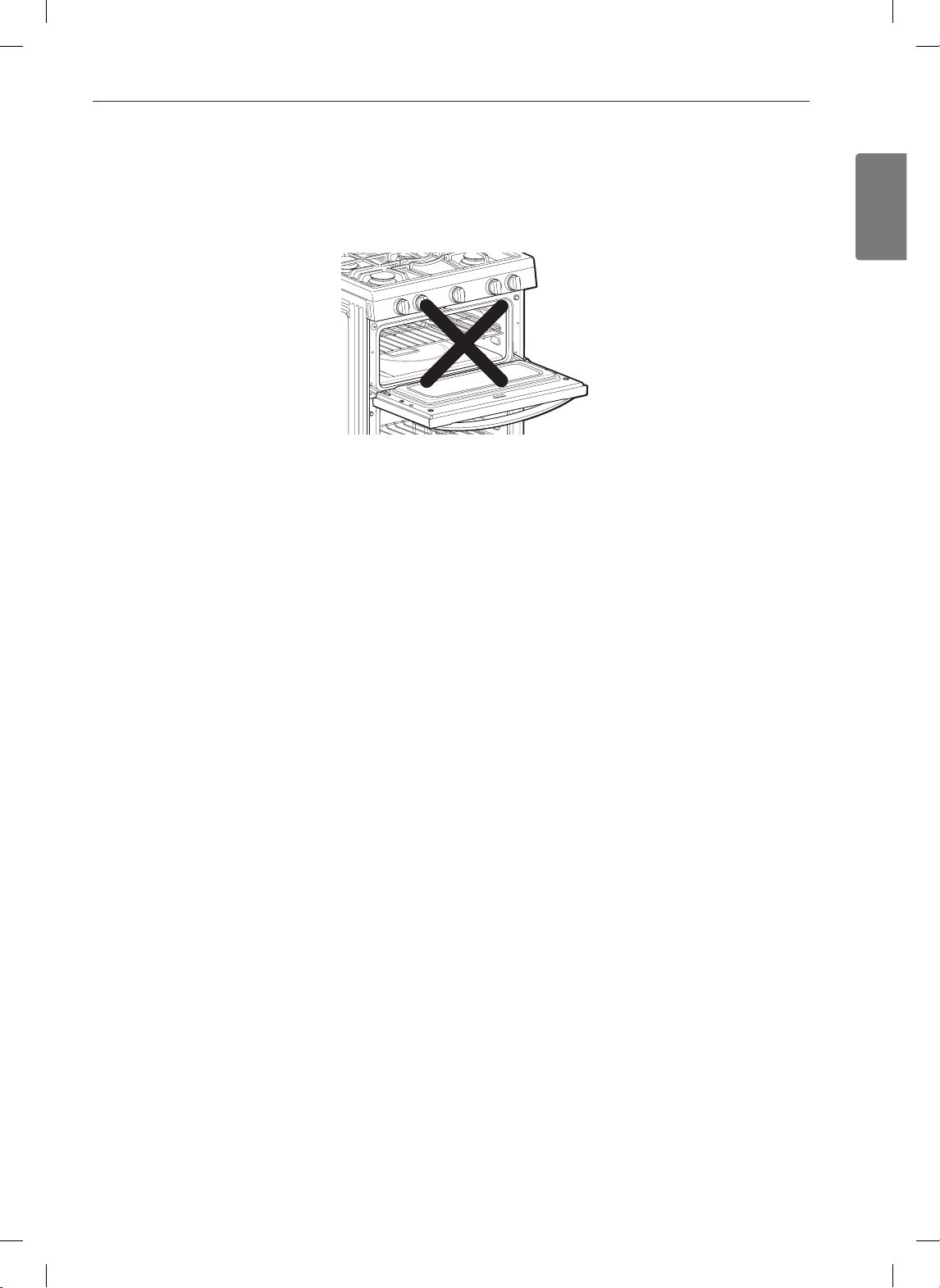
For safety and better cooking performance, always bake and broil with the oven door closed.
Open door baking or broiling can cause damage to the knobs or valves.
DO NOT
leave the oven door open during cooking or cool down.
READ ALL INSTRUCTIONS BEFORE USING THE APPLIANCE.
SAVE THESE INSTRUCTIONS
10
BEFORE USE
NOTE
y
Contact LG Customer Service if any accessories are missing.
y
For your safety and for extended product life, only use authorized components.
y
The manufacturer is not responsible for product malfunction or accidents caused by the use of separately purchased,
unauthorized components or parts.
y
The images in this guide may be different from the actual components and accessories, and are subject to change by the
manufacturer without prior notice for product improvement purposes.
BEFORE USE
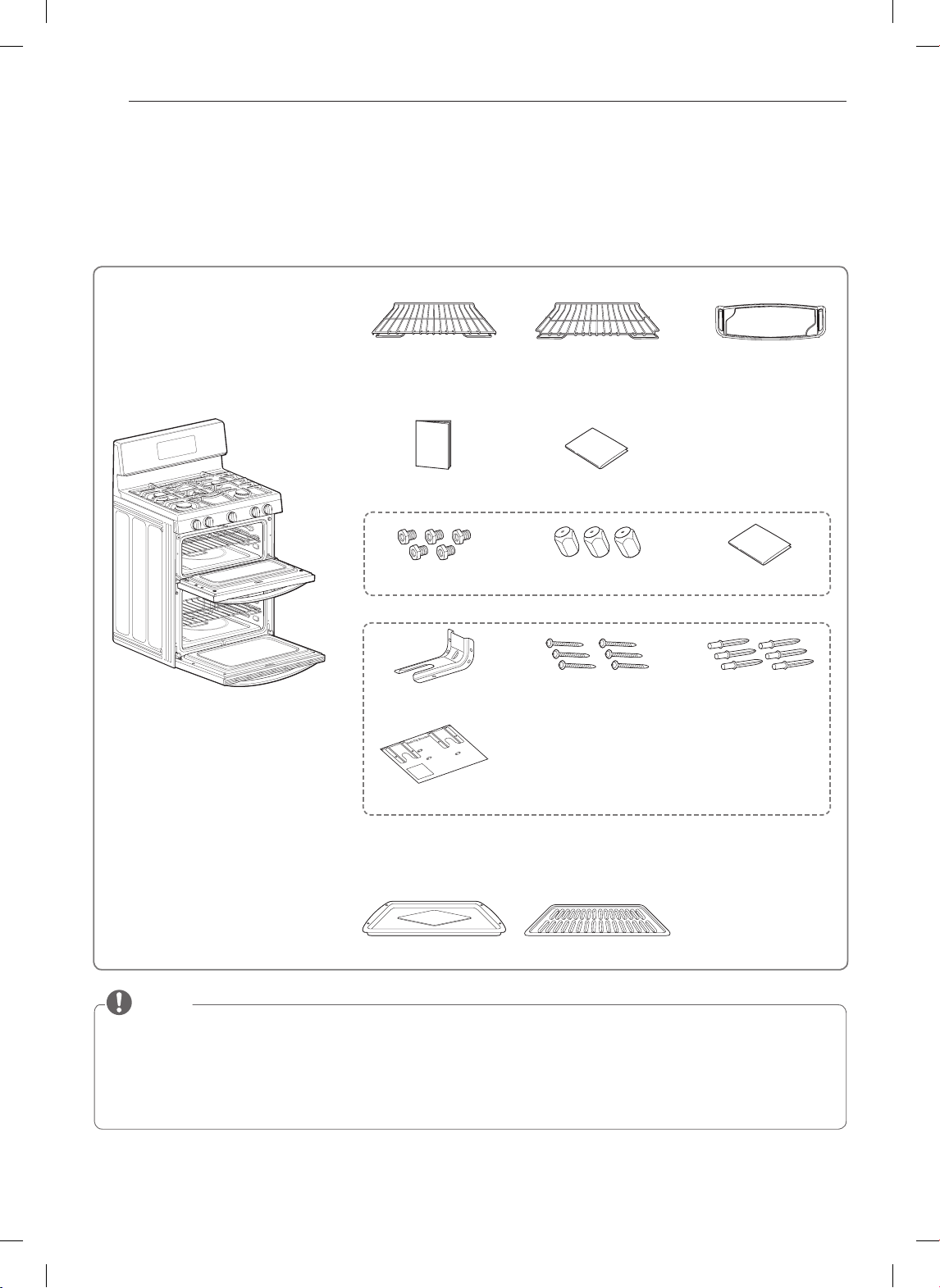
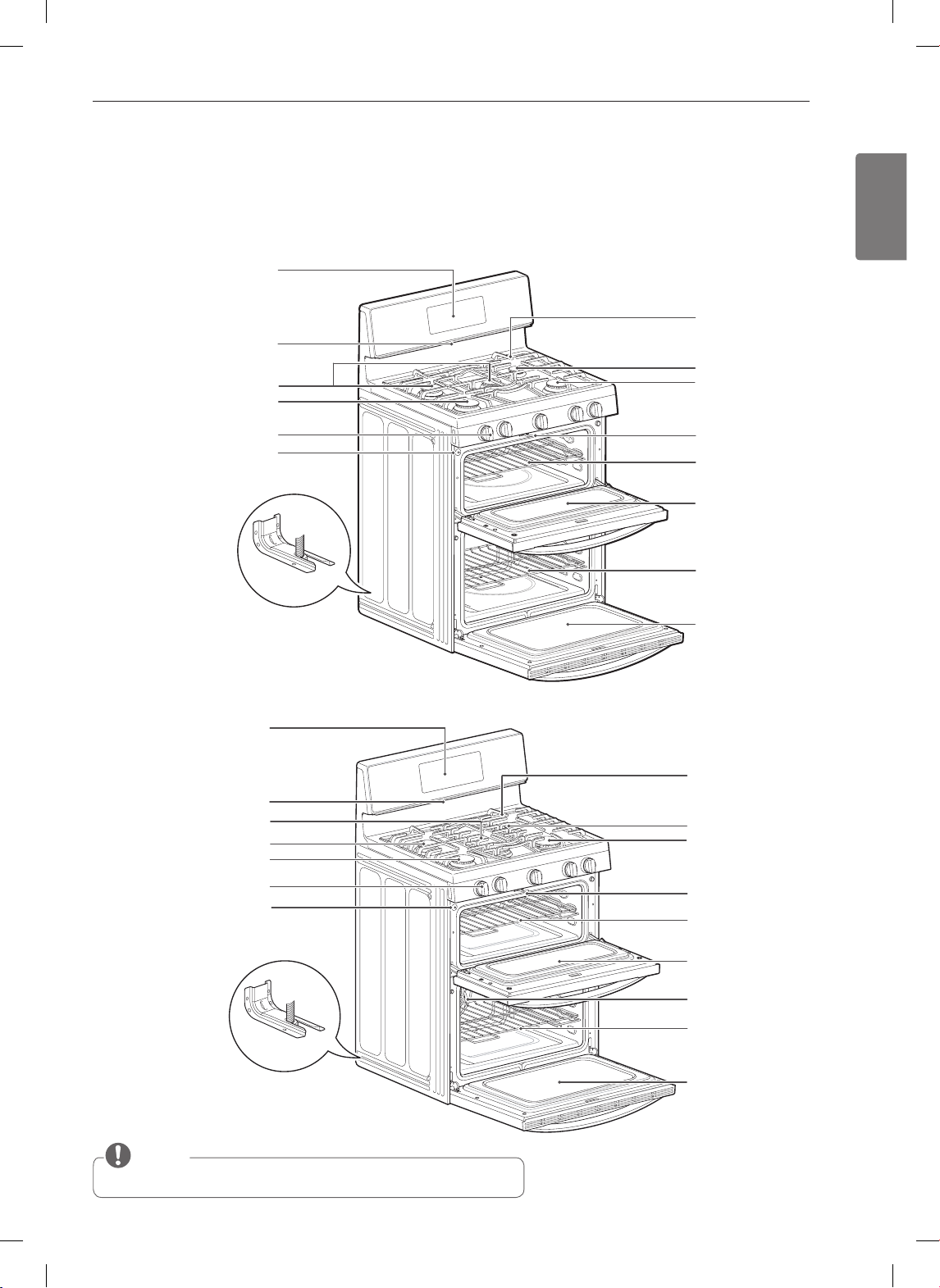
Accessories
Make sure that all parts are included after purchasing this product.
Gas double oven range
Racks
(2)
Offset rack
(1)
Owner’s manual Installation manual
Cooktop nozzles (5) Oven nozzles (3) Installation guide
LP nozzle conversion kit
Anti-tip Screws (6) Anchors (6)
Template
Anti-tip kit
Sold Separately
Broiler pan Grid
Griddle
(Model LDG3016ST only)
11
BEFORE USE
ENGLISH
Components
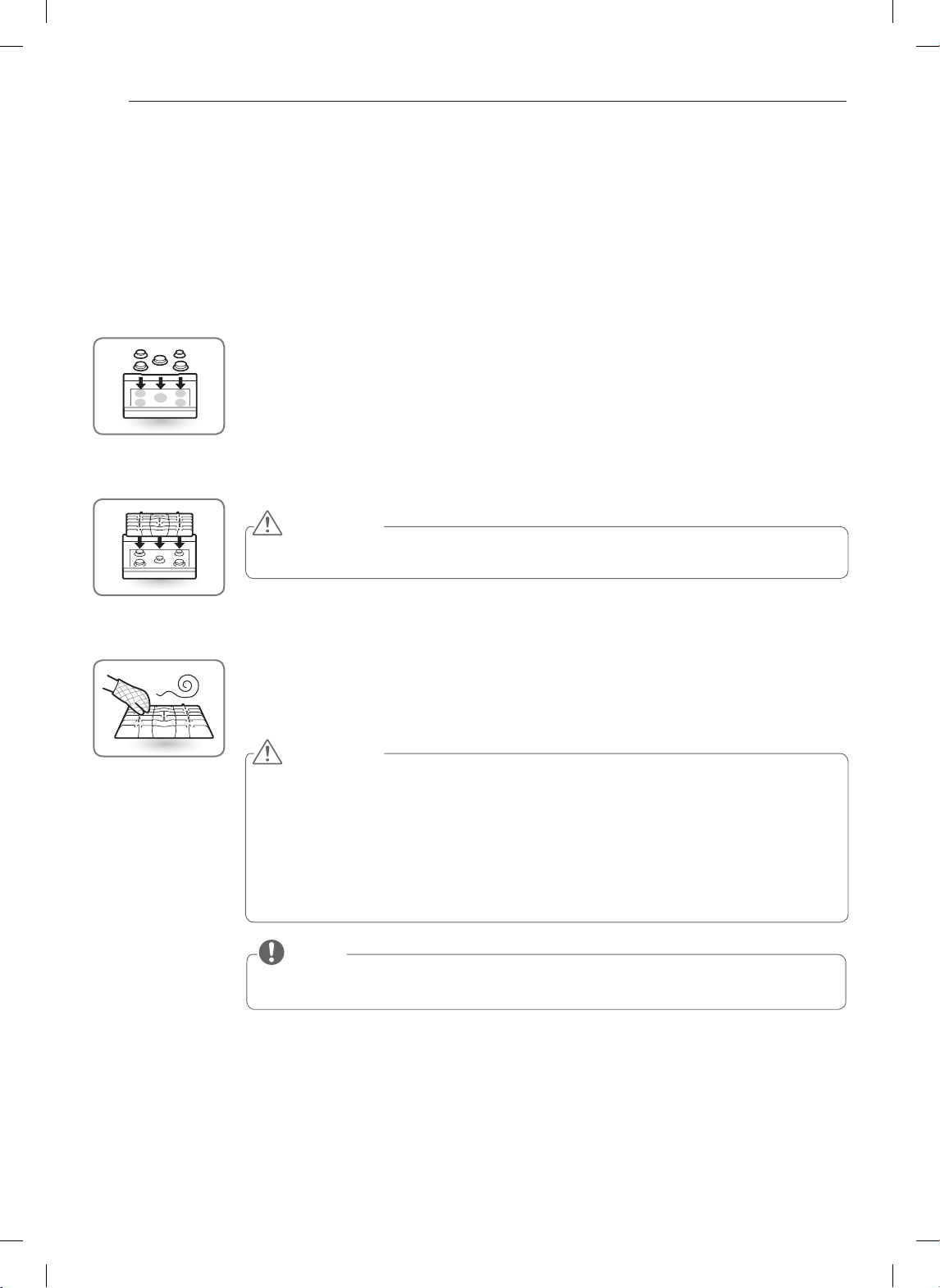
Make sure to understand the names and function of each part.
* Throughout this manual, the features and appearance may vary depending on your model.
NOTE
y
The model and serial tag is located behind the control panel.
Anti-tip bracket
Grates
Small burner
Extra large burner
Self clean latch
Rack
Upper oven door
Rack
Convection fan
Lower oven door
Control panel
Oven vent
Medium burner
Large burner
Oval burner
Knobs (5)
Automatic oven light switch
For Model: LDG3016ST
Anti-tip bracket
Grates
Small burner
Extra large burner
Self clean latch
Rack
Upper oven door
Rack
Lower oven door
Control panel
Oven vent
Medium burner
Large burner
Knobs (5)
For Model: LDG3015S
Automatic oven light switch
12
HOW TO USE
HOW TO USE
Gas Surface Burners
Before use
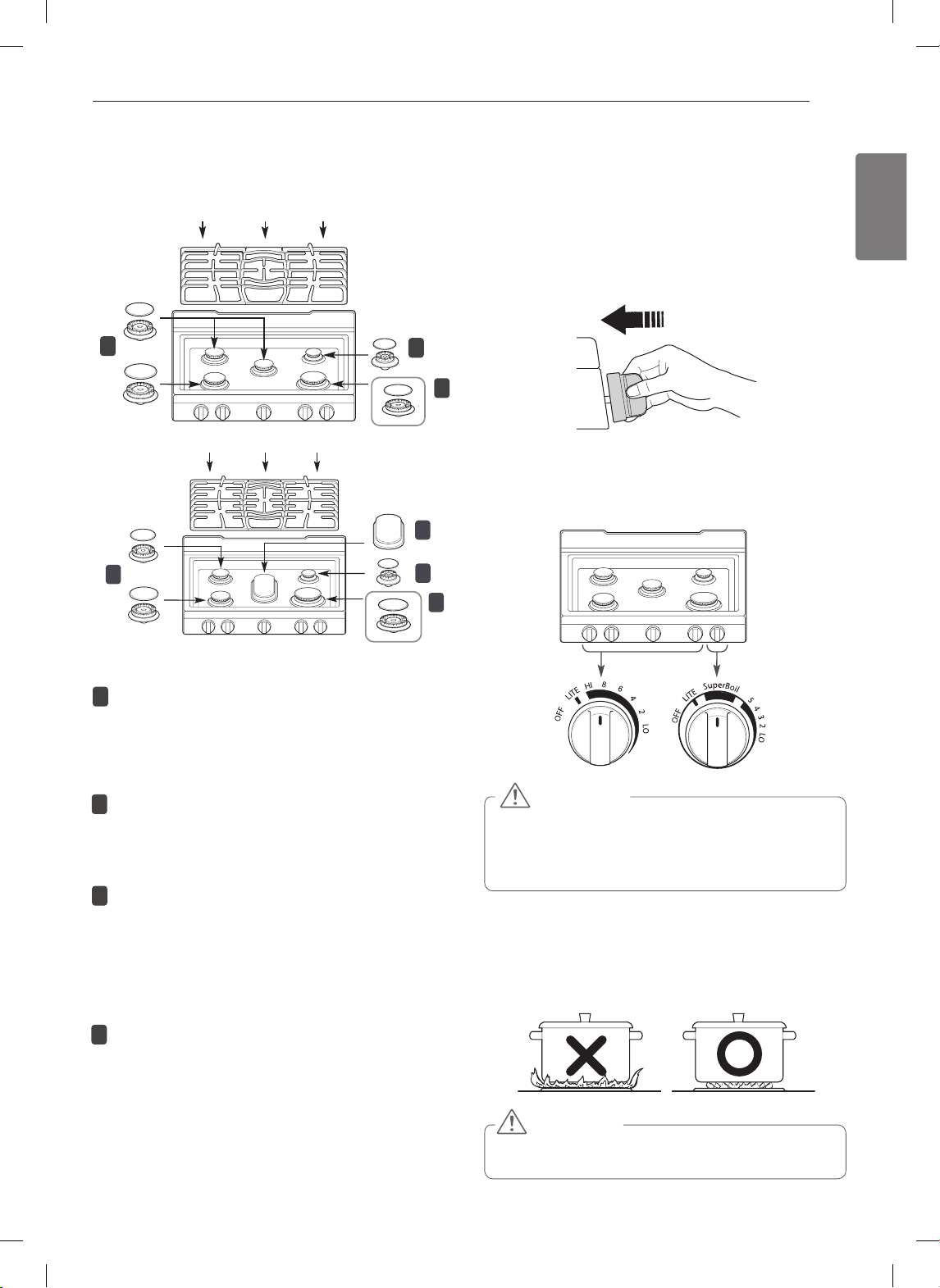
Read all instructions before using.
Make sure that all burners are properly placed.
Make sure that all grates are properly placed before using the burner.
CAUTION
DO NOT
operate the burner for an extended period of time without cookware on the grate.
The finish on the grate may chip without cookware to absorb the heat.
Make sure the burners and grates are cooled down before you place your
hand, pot holder, cleaning cloth, or other materials on burners and grates.
Touching grates before cooling down may cause burns.
CAUTION
WHAT TO DO IF YOU SMELL GAS
1. Open windows.
2.
DO NOT
try to light any appliance.
3.
DO NOT
touch any electrical switch.
4.
DO NOT
use any phone in your building.
5. Immediately call your gas supplier from a neighbor’s phone.
Follow the gas supplier’s instructions.
6. If you cannot reach your gas supplier, call the fire department.
NOTE
Electric spark igniters from the burners cause the clicking noise. All the spark igniters on the cooktop
will activate when igniting just one burner.
13
HOW TO USE
ENGLISH
Gas burners
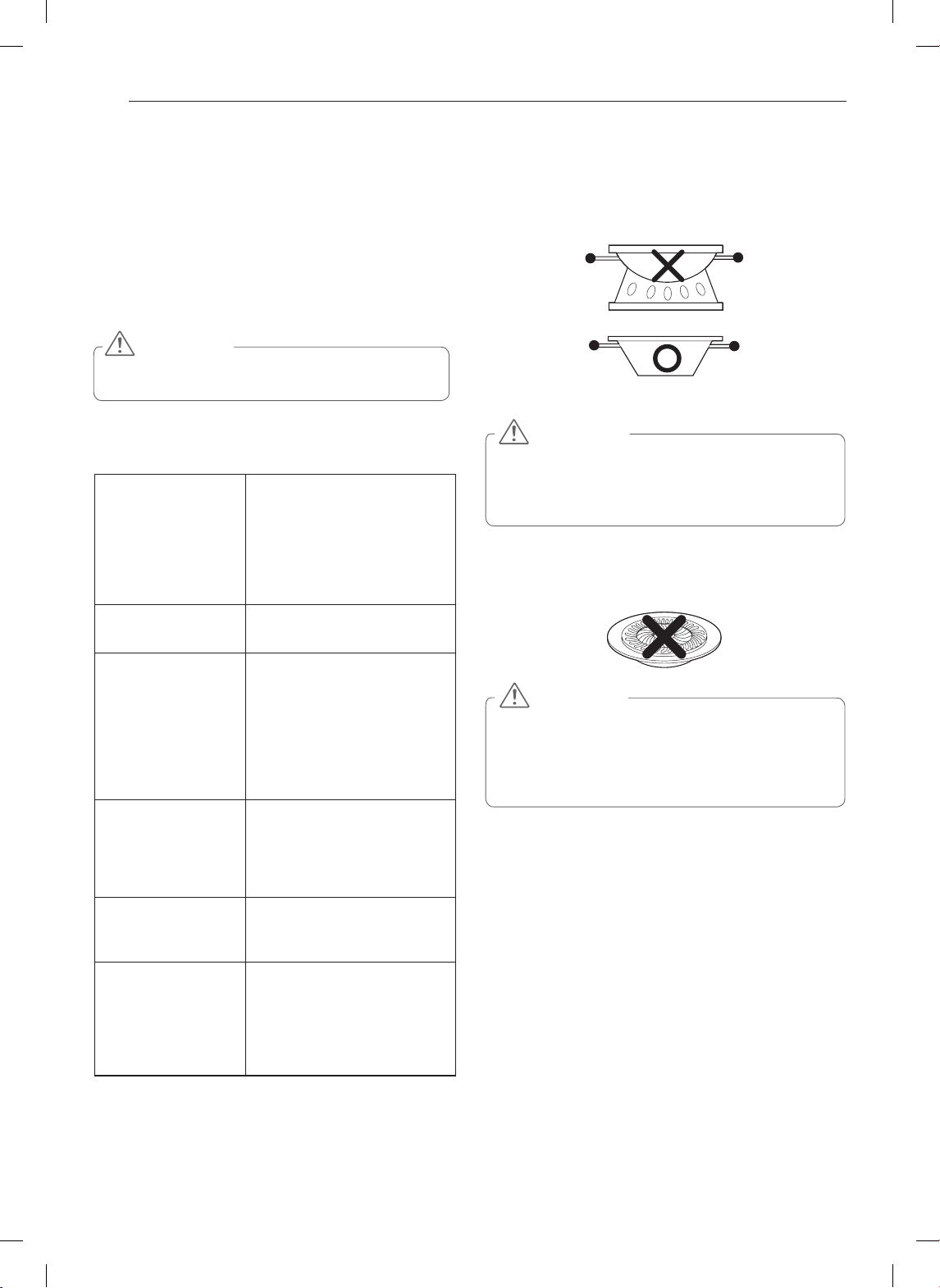
Your gas range cooktop has five sealed gas burners.
These can be assembled and separated. Follow the guide
below.
1234
1234
1234
1
4
2
3
Medium and Large Burner
The medium and large burners are the primary burners
for most cooking. These general purpose burners can be
turned down from “
v
” to “
w
” to suit a wide range of
cooking needs.
Small Burner
The smallest burner is used for delicate foods such as
sauces or foods that require low heat for a long cooking
time.
Extra large burner
The extra large burner is the maximum output burner. Like
the other four burners, it can be turned down from “
v
” to
“
w
” for a wide range of cooking applications. This burner
is also designed to quickly bring large amounts of liquid to
a boil. It can be used with cookware 10 inches or larger in
diameter.
Oval burner (LDG3016ST Model Only)
The oval burner (center) is for use with a griddle or oval
pots.
Using the gas surface burners
1
Be sure that all of the surface burners are placed in the
correct positions.
2
Put cookware on the burner. (Example: pot, frying pan,
etc.)
3
Push and turn the control knob to the “
u
” position.
You will hear a clicking noise from the electric spark
ignition system.
4
Turn the control knob to control the flame size.
CAUTION
DO NOT
attempt to disassemble or clean around any
burner while another burner is on. When turning a burner
to “
u
”, all the burners spark. An electric shock may re-
sult, which could cause you to knock over hot cookware.
Selecting the Flame Size
Watch the flame, not the knob, as you reduce heat. When
fast heating is desired, the flame size on a gas burner should
match the cookware that you are using.
CAUTION
NEVER
let the flames extend up the sides of the cook-
ware.
1234
1234
1234
1234
1234
123
4
LDG3015S
LDG3016ST
14
HOW TO USE
Use a flat-bottomed wok.
Do not place stove-top grills on the burner.
If using a wok, it is recommended that you use a 14-inch or
smaller flat-bottomed wok. Make sure that the wok bottom
sits flat on the grate.
CAUTION
DO NOT
use a wok support ring. Placing the ring over the
burner or grate may cause the burner to work improperly,
resulting in carbon monoxide levels above allowable stan-
dards. This can be hazardous to your health.
Using a Wok:
Using Stove-top Grills:
CAUTION
DO NOT
use stove top grills on your surface burners.
Using a stove top grill on the surface burner will cause
incomplete combustion and can result in exposure to
carbon monoxide levels above allowable current stan-
dards. This can be hazardous to your health.
In Case of Power Failure:
In case of a power failure, you can light the gas surface burn-
ers on your range with a match.
Surface burners in use when an electrical power failure
occurs will continue to operate normally.
1
Hold a lit match to the burner, then push in the control
knob.
2
Turn the control knob to the "
Lo
” position.
Top-of-range cookware
Aluminum
Medium-weight cookware is
recommended because it heats
quickly and evenly. Most foods
brown evenly in an aluminum
skillet. Use saucepans with tight
fitting lids when cooking with
minimum amounts of water.
Cast-Iron
If heated slowly, most skillets will
give satisfactory results.
Stainless Steel
This metal alone has poor
heating properties and is usually
combined with copper, aluminum
or other metals for improved heat
distribution. Combination metal
skillets work satisfactorily if they
are used with medium heat as the
manufacturer recommends.
Enamelware
Under some conditions, the
enamel of this cookware may melt.
Follow cookware manufacturer’s
recommendations for cooking
methods.
Glass
There are two types of glass
cookware - those for oven use only
and those for top-of-range cooking.
Heatproof Glass
Ceramic
Can be used for either surface or
oven cooking. It conducts heat
very slowly and cools very slowly.
Check cookware manufacturer’s
directions to be sure it can be used
on gas ranges.
CAUTION
Use extreme caution when lighting burners with a match.
It can cause burn and damage.
15
HOW TO USE
ENGLISH
CAUTION
DO NOT
remove the griddle plate until the cooktop
grates, surfaces and griddle plate are completely cooled.
CAUTION
The griddle plate on the cooktop may become very hot
when using the cooktop, oven or broiler systems.
Always use oven mitts when placing or removing the
griddle plate.
Using the Griddle
(Model LDG3016ST only)
Your non-stick coated griddle provides an extra-large cooking
surface for meats, pancakes or other food usually prepared in
a frying pan or skillet.
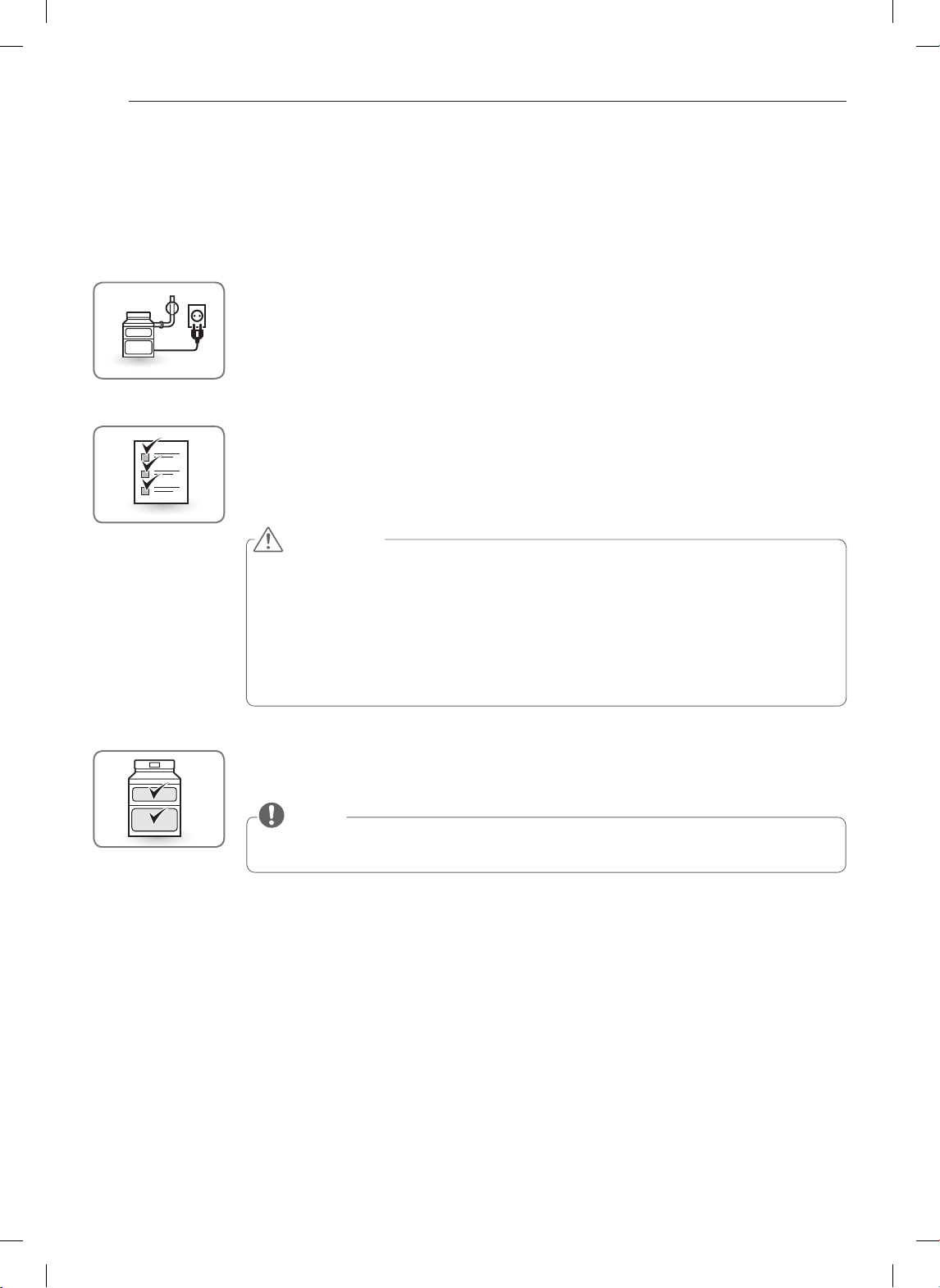
How to Place the Griddle:
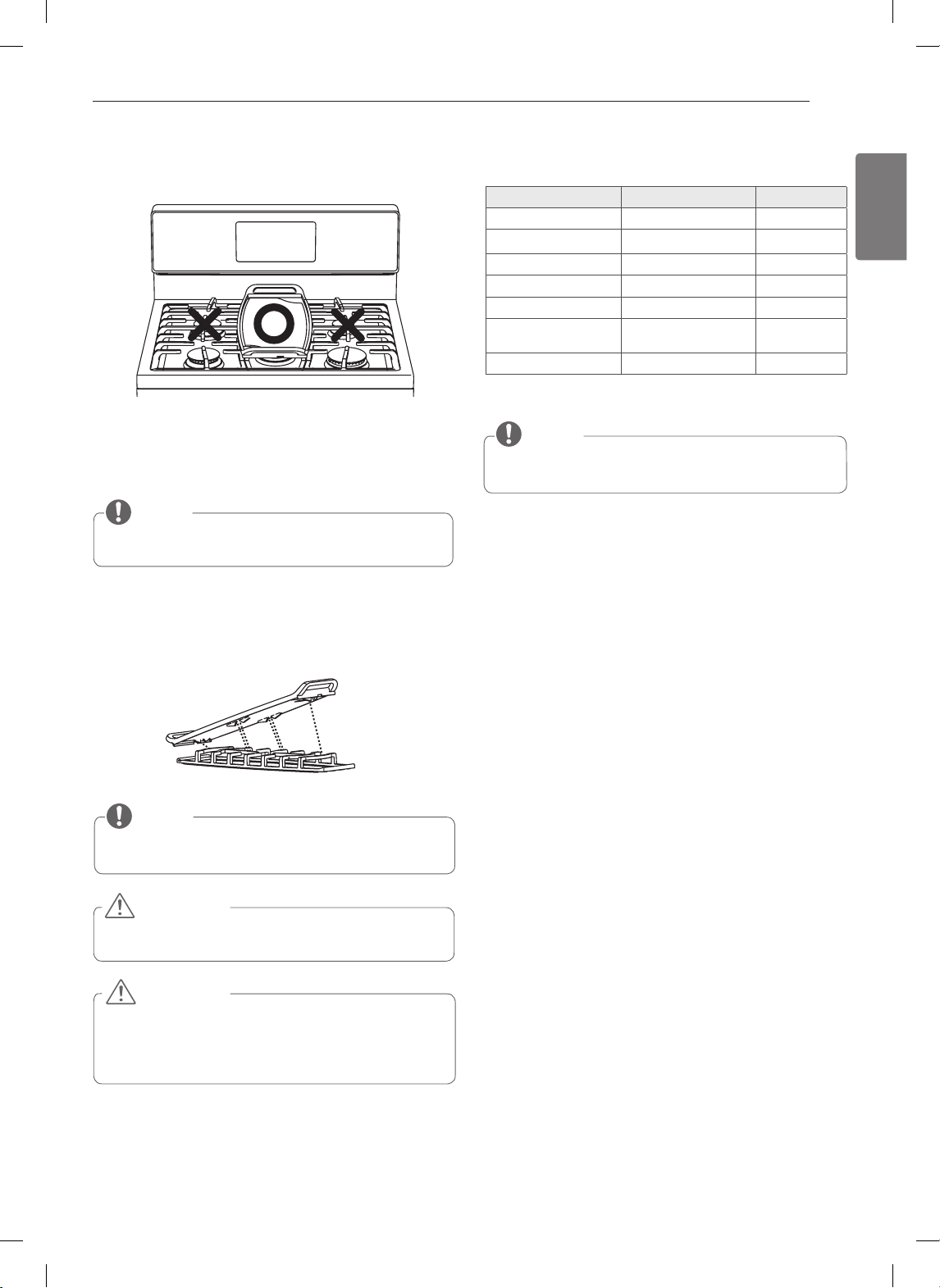
The griddle can only be used
with the center burner. The griddle must be properly placed
on the center grate, as shown in the below illustration.
Preheat the griddle according to the guide below and
adjust for the desired setting.
IMPORTANT NOTES:
• Avoid cooking extremely greasy foods, grease spill over can
occur.
• The griddle can become hot when surrounding burners are
in use.
• DO NOT overheat the griddle. This can damage the non
stick coating.
• DO NOT use metal utensils that can damage the griddle sur-
face. Do not use the griddle as a cutting board.
• DO NOT place or store items on the griddle.
1234
1234
NOTE
y
It is normal for the griddle to become discolored over
time.
NOTE
y
Griddle settings may need to be adjusted if the
griddle is used for an extended time.
NOTE
y
DO NOT
remove the center grate when using the
griddle
.
Front
Type of Food Preheat Conditions Cook Setting
Warming Tortillas none 5 (MED)
Pancakes HI 3 min. HI
Hamburgers HI 5 min. HI
Fried Eggs HI 5 min. HI
Bacon HI 3 min. HI
Breakfast Sausage
Links
HI 5 min. HI
Hot Sandwiches HI 4 min. HI
16
HOW TO USE
How to Use the Oven
Before use
Read all instructions before using.
Make sure the electrical power cord and the gas valve are properly
connected.
Check it for safety.
Check the correct use of the range depending on the type of food you will
cook.
Make sure you know how to use the oven (temperature setting, time setting and recipe) for best re-
sults.
CAUTION
WHAT TO DO IF YOU SMELL GAS
1. Open windows.
2.
DO NOT
try to light any appliance.
3.
DO NOT
touch any electrical switch.
4.
DO NOT
use any phone in your building.
5. Immediately call your gas supplier from a neighbor’s phone.
Follow the gas supplier’s instructions.
6. If you cannot reach your gas supplier, call the fire department.
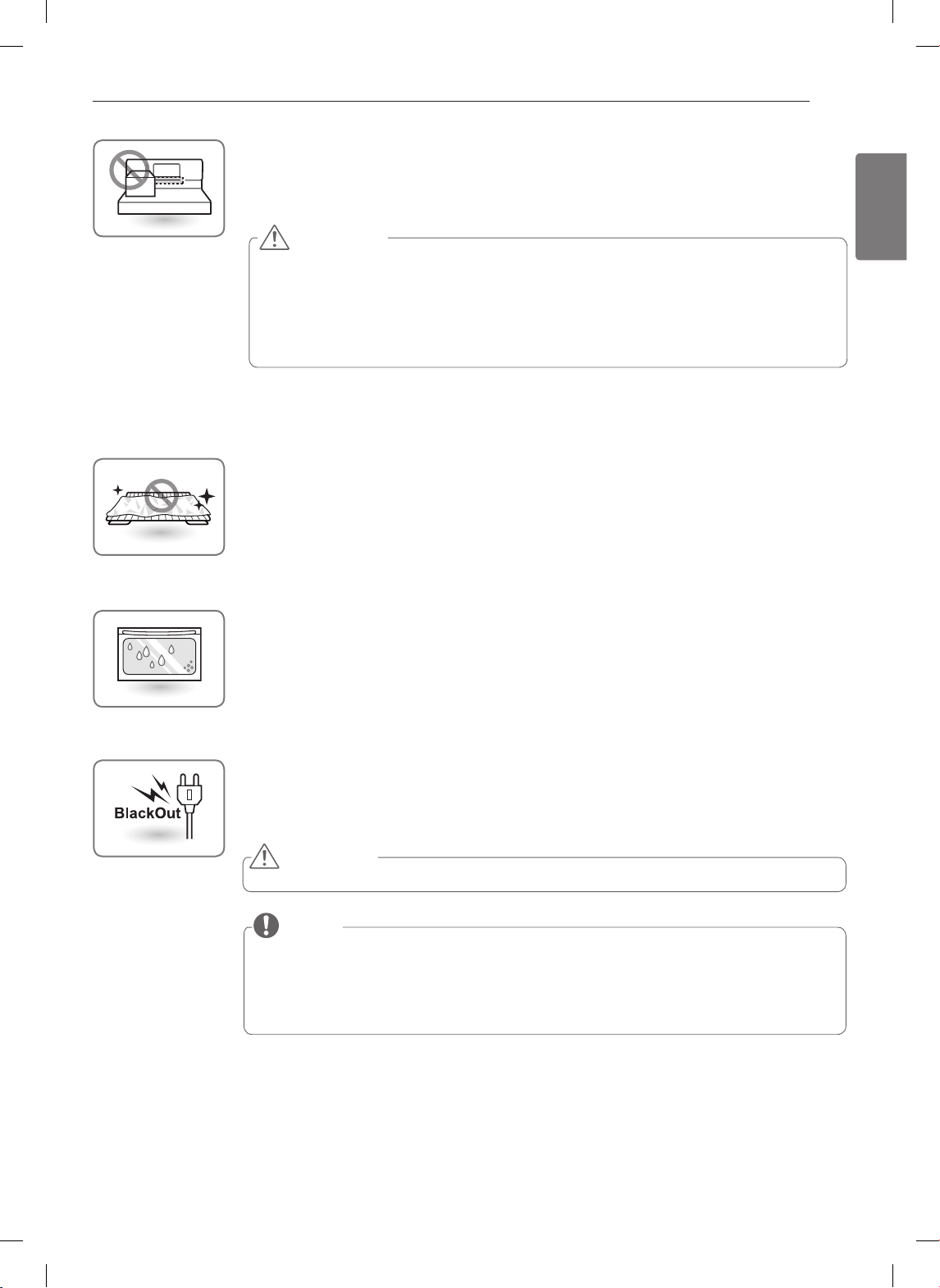
Choose the upper or lower oven for proper cooking.
Use the upper oven to cook a small amount of food.
NOTE
When using an oven thermometer in the oven cavity, temperatures may differ from the actual set
oven temperature with all mode.
17
HOW TO USE
ENGLISH
Do not block, touch or place items around the oven vent during cooking.
Your oven is vented through ducts at the center above the burner grate. Do not block the oven vent
when cooking to allow for proper air flow. Do not touch vent openings or nearby surfaces during the
use of any cooking operation.
As your oven heats up, the temperature increase of the air in the oven may
cause water drops to occur on the door glass.
These water drops are harmless and will evaporate as the oven continues to heat up.
Do not cover rack or bottom with aluminum foil.
CAUTION
y
DO NOT
place plastic or flammable items on the cooktop—they may melt or ignite if left too
close to the vent.
y
DO NOT
place closed containers on the cooktop. The pressure in closed containers may in-
crease, which may cause them to burst.
y
Metal items will become very hot if they are left on the cooktop, and could cause burns.
y
Handles of pots and pans on the cooktop may become hot if left too close to the vent.
In case of power failure, do not use the oven.
The oven and broiler can not be used during a power outage. If the oven is in use when a power failure
occurs, the oven burner shuts off and cannot be re-lit until power is restored. Once power is restored,
you will need to reset the oven (or broil function).
CAUTION
DO NOT
attempt to operate the electric ignition during an electrical power failure.
NOTE
PF(Power Failure) / Flashing time
Depending on the model of your range, the display will either show “PF” or a flashing clock. This
means that the product has just been plugged in, or that it has experienced a power interruption.
To clear the “PF” message, press the “Clear/Off” key on the oven controls. If your oven displays a
flashing clock, then press the “Clock” key and reset the time, or press any key to stop flashing.

18
HOW TO USE
Using the Control Panel
Upper Oven:
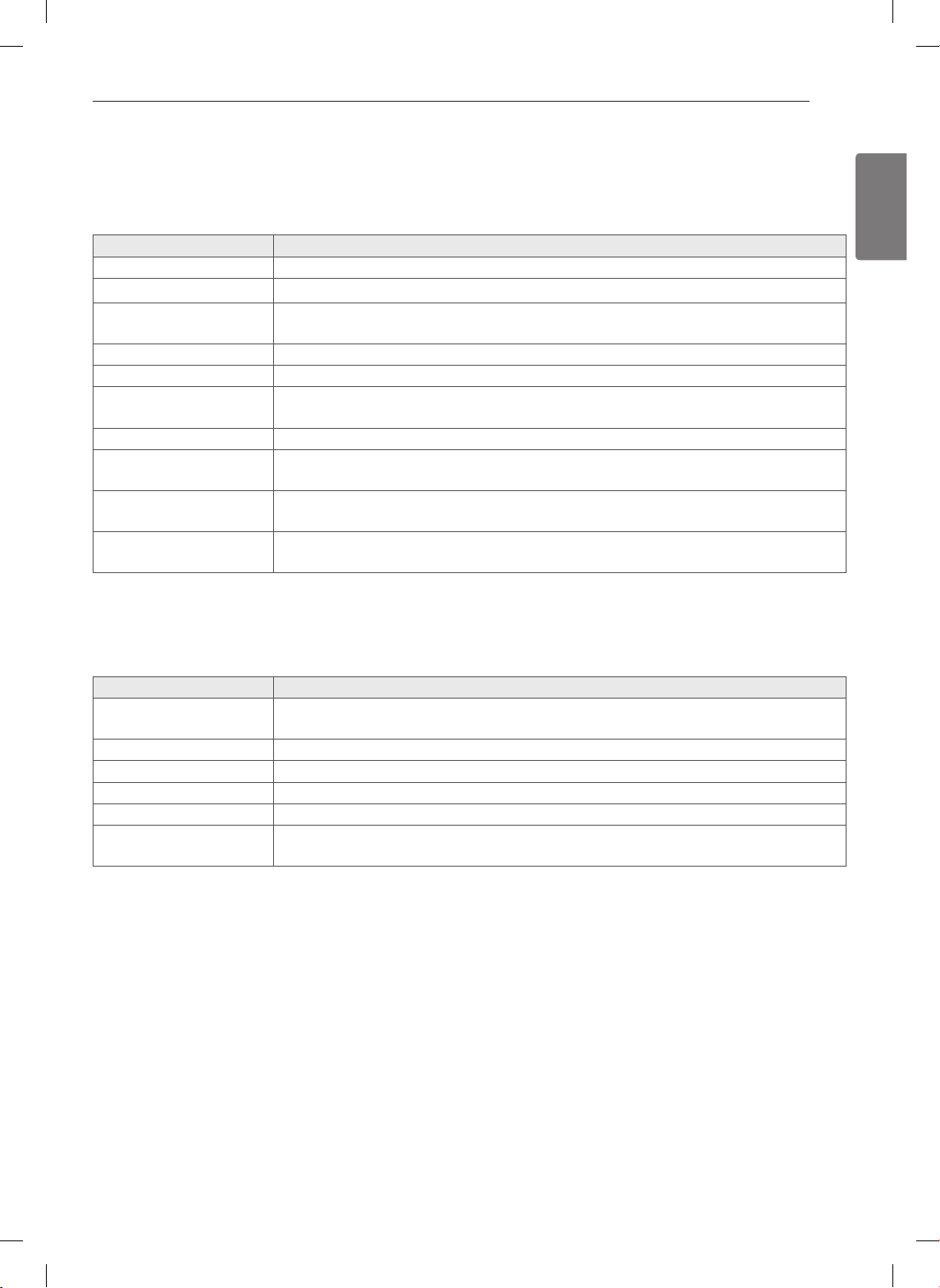
Name Description
1
BAKE Traditional bake function. Refer to “BAKE” in the How To Use section.
2
BROIL Traditional broil function. Refer to “BROIL” in the How To Use section.
3
WARM
Warms food in the oven.
Refer to “WARM” in the How To Use section.
4
PIZZA Cooks pizza. Refer to “PIZZA” in the How To Use section.
5
UPPER LIGHT Turns on/off the upper oven light.
6
UPPER SELF CLEAN
Cleans the inside of the UPPER OVEN automatically.
Refer to “SELF CLEAN” in the How To Use section.
7
UPPER TIMER ON/OFF
Sets, starts or cancels the timer function of the UPPER OVEN.
Refer to “How to use the timer” in the Operating Instructions section.
8
UPPER CLEAR/OFF Stops cooking or cancels the setting in the UPPER OVEN.
1
2
3
4
8
15
24
6
5
12
14
11
9
13
10
20
21
19
32
22
7
Display
1
2
3
4
8
15
24
6
5
12
7
14
16
13
17
20 11
10
21
19
32
22
9
18
Display
For Model: LDG3015S
For Model: LDG3016ST
19
HOW TO USE
ENGLISH
Common Functions:
Name Description
o
CLOCK
Sets the time of day.
Refer to “How to set the clock” in the Operating Instructions section.
p
COOK TIME Sets the length of cook time. It is automatically turned off if the desired cook time is reached.
a
START TIME Sets the desired cooking start time. The oven automatically starts cooking at the set time.
s
SETTING Sets various functions.
d
NUMBER KEY Use to set time, timer, temperature and all times.
f
START (CONTROL LOCK)
Starts all functions except for the timer. To activate OVEN LOCK, press and hold for three sec-
onds.
Lower Oven:
Name Description
9
BAKE Traditional bake function. Refer to “BAKE” in the Operating Instructions section.
-
PROOF To proof a piece of bread. Refer to “PROOF” in the Operating Instructions section.
q
WARM
Warms food in the oven.
Refer to “WARM” in the Operating Instructions section.
w
LOWER LIGHT Turns on/off the lower oven light.
e
LOWER SELF CLEAN Cleans the inside of the LOWER OVEN automatically.
r
LOWER TIMER ON/OFF
Sets, starts or cancels the timer function of the LOWER OVEN.
Refer to “How to use the timer” in the Operating Instructions section.
t
LOWER CLEAR/OFF Stops cooking or cancels the setting in the LOWER OVEN.
y
CONV.BAKE
(LDG3016ST Model Only)
To use Convection Baking function, Refer to “CONVECTION BAKE” in Operating Instructions
section.
u
CONV.ROAST
(LDG3016ST Model Only)
To use Convection Roast function, Refer to “CONVECTION ROAST” in Operating Instructions
section.
i
FAVORITE
(LDG3016ST Model Only)
Use to store 3 favorite oven settings. Refer to “Favorite” in Operating Instructions section.
Using the Control Panel (continued)
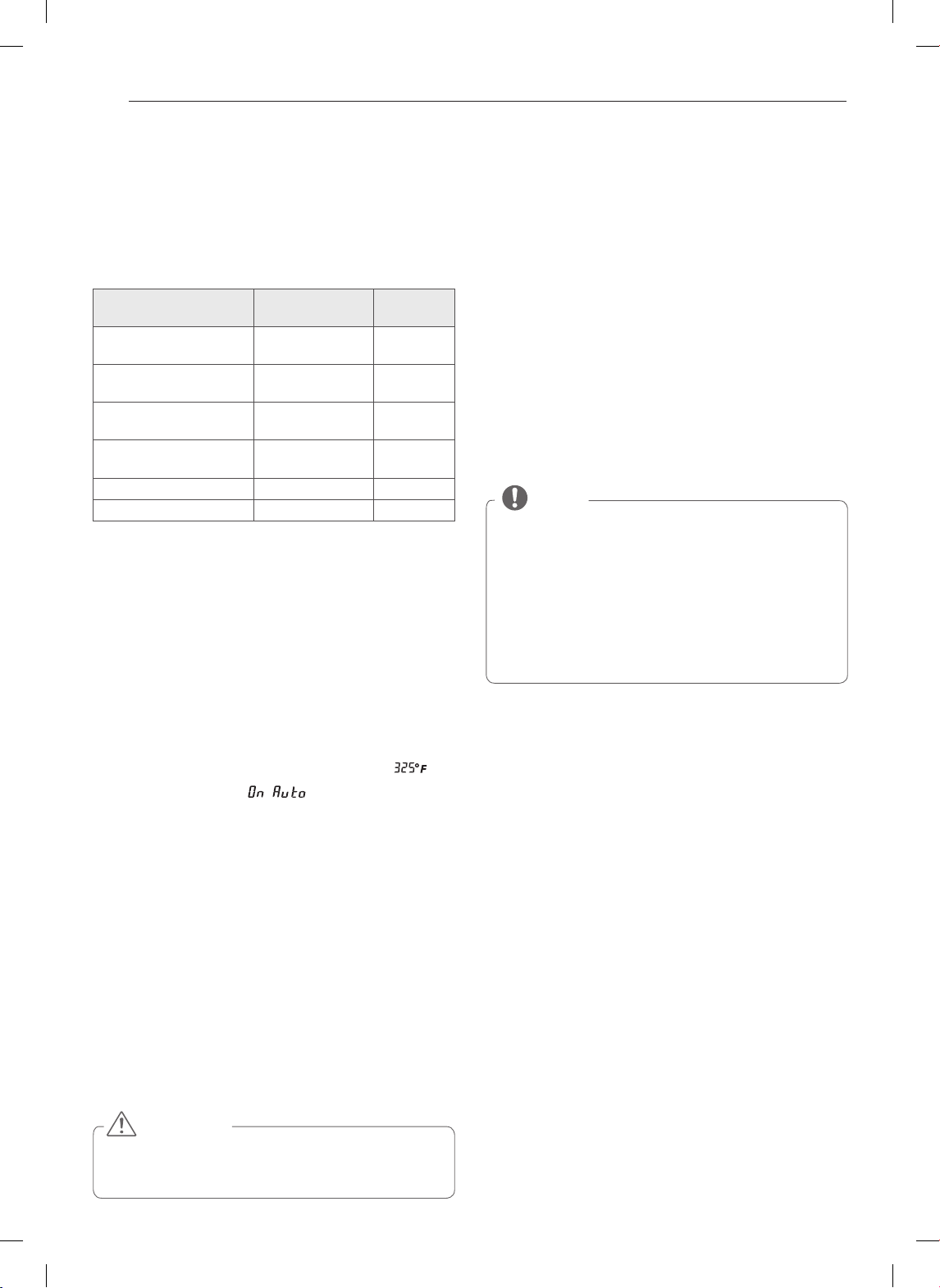
20
HOW TO USE
Operating Instructions
The value of setting can be changed by pressing “SETTING”
key.
The items are different from each model. Refer to “Setting
item chart”
SETTING ITEM CHART
How to set convection auto conver-
sion function for the lower oven
(LDG3016ST)
When using convection bake and roast, the convection auto
conversion feature will automatically convert entered regular
baking temperatures to convection baking temperatures.
This feature is activated so that the display will show the
actual converted temperature. For example, if you enter a
regular recipe temperature of 350°F and touch the
q
key,
the display will show the converted temperature of .
1
Press the
X
key will appear in the
display.
2
Press the
1
key once for a auto conversion on.
Press it again for a auto conversion off.
3
Press the
q
Key to accept the change.
1
Determine which oven you would like to adjust (upper or
lower).
2
For the lower oven, Press the SETTING key until
e
will
appear in the display.
For the upper oven, Press the SETTING key until
f
will
appear in the display.
3
Using the number keys, enter the amount of degrees that
you wish to adjust the oven up or down. To adjust the
temperature down, press the
X
key after entering
in the numbers.
Example:
To adjust the oven temperature
up
15 degrees, press
1
,
5
.
To Adjust the oven temperature
down
15 degrees, press
1
,
5
,
X
4
Press the
q
key to accept the change.
How to Set Preheating Alarm Light On/Off
When the oven reaches its set-temperature, the preheat light
will flash until the oven door is opened. You can activate or
deactivate the preheat alarm light.
1
Press the
X
key until
s
will display.
2
Press the number
1
key to select
R
/
S
.
3
Press the
q
key to accept the change.
How to turn the interior oven light on/off:
The interior oven light automatically turns on when the oven
door is opened.
Press the
M
or
Q
key to turn the oven lights on or off.
How to Adjust the Beeper Volume:
1
Press the
X
key until
j
will display.
2
Press the
1
key continuously to scroll through the volume
options:
m
,
l
,
S
.
3
Press the
q
key to accept the change.
CAUTION
DO NOT
use thermometers, such as those found in
grocery stores, to check the temperature setting of your
oven. These thermometers may vary 20–40 degrees.
NOTE
y
This adjustment will not affect the broiling or the Self
Clean temperatures. The adjustment will be retained in
memory after a power failure. The oven temperature
can be increased (+) or decreased (-) as much as 35°F or
19°C.
y
To decrease or increase temperature during cooking
1. Using the number keys, enter the new temperature.
2. Press the
X
key once.
3. Press the
q
key to accept the choice.
Operating Instruction LDG3015ST/SB/
SW
LDG3016ST
Convection Auto Conver-
sion
- Once
Temperature Setting
(Lower oven)
Once Twice
Temperature Setting
(Upper oven)
Twice Three times
Preheating Alarm light
On/off
Three times Four times
Beeper Volume Four times Five times
Fahrenheit or Celsius Five times Six times
How to adjust the temperature set-
tings:
You may find that your new oven cooks differently than the
one it replaced. Use your new oven for a few weeks to be-
come more familiar with it before changing the temperature
settings. After familiarizing yourself with the new oven, and
you still think that it is too hot or too cold, you can adjust the
thermostat yourself.
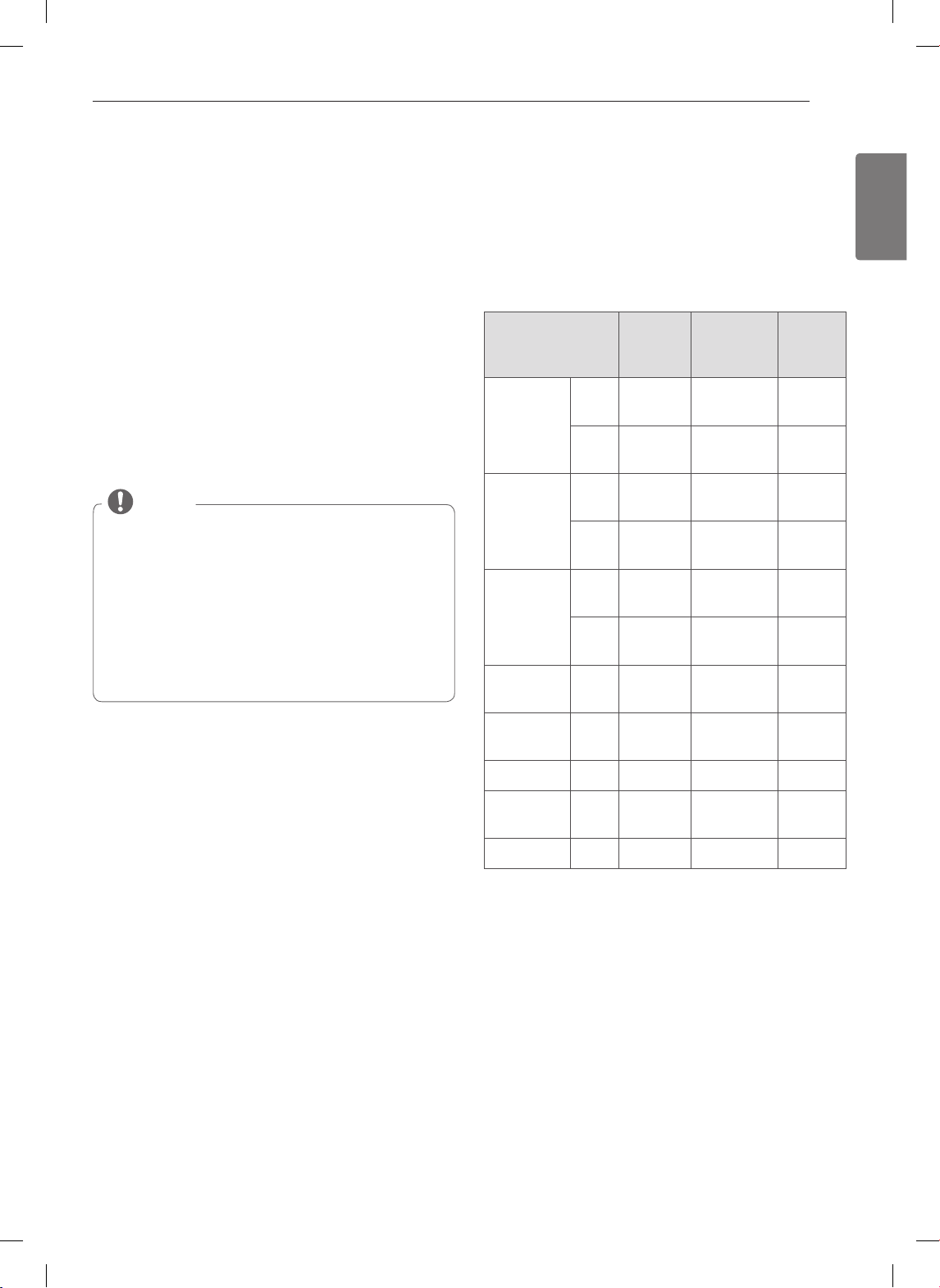
21
HOW TO USE
ENGLISH
How to select Fahrenheit or Celsius
The oven temperature settings can either be set to
Fahrenheit or Celsius. The oven defaults to Fahrenheit unless
changed by the user.
1
Press the
X
key until “
i
” will display.
2
Press the number
1
key to select Fahrenheit or Celsius.
3
Press the
q
key to accept the change.
Minimum & Maximum default settings:
All of the features listed have minimum and maximum time
or temperature settings that may be entered into the control.
An entry acceptance beep will sound each time a control key
is pressed.
An entry error tone (two short tones) will sound if the entry of
the temperature or time is below the minimum or above the
maximum settings for the feature.
NOTE
y
The time of day cannot be changed during a timed bak-
ing or Self Clean cycle.
y
To check the time of day when the display is showing
other information, simply press the
U
key.
y
If number keys are not pressed within 30 seconds after
you press the
U
key, the display reverts to the
original setting. If this happens, press the
U
key
and reenter the time of day.
y
If the display time is blinking, you may have
experienced a power failure. Reset the time.
FEATURE MIN.
TEMP. /
TIME
MAX.
TEMP. /
TIME
DEFAULT
CLOCK TIME
12 Hr.
1:00 Hr. /
Min.
11:59 Hr. /
Min.
24 Hr.
0:00 Hr. /
Min.
23:59 Hr. /
Min.
KITCHEN
TIMER
12 Hr. 0:01 Min.
11:59 Hr. /
Min.
24 Hr. 0:01 Min.
11:59 Hr. /
Min.
COOKING
TIME
12 Hr. 0:01 Min.
11:59 Hr. /
Min.
24 Hr. 0:01 Min.
11:59 Hr. /
Min.
BROIL
TEMP.
Lo-300°F /
149°C
Hi - 400°F /
204°C
3 Hr.
BAKE TEMP.
170°F /
77°C
550°F /
288°C
12 Hr.
PROOF
12 Hr.
WARM
170°F/75°C,
3 hours
3 Hr
SELF CLEAN
2 Hr. 4 Hr. 3 Hr.
How to Set the Clock (12 or 24 hour):
1
Press and hold the
U
key for three seconds.
2
Press the
1
key once for a 24 hour clock. Press it again for
a 12 hour clock.
3
Press the
q
key.
How to Set the Clock Time:
The clock must be set to the correct time of day in order for
the automatic oven timing functions to work properly.
1
Press the
U
key once.
2
Press the number keys to select the desired time.
Example
: To set
t
, press the number keys
1
,
2
,
3
and
4
in that order.
3
Press the
q
key to accept the change.
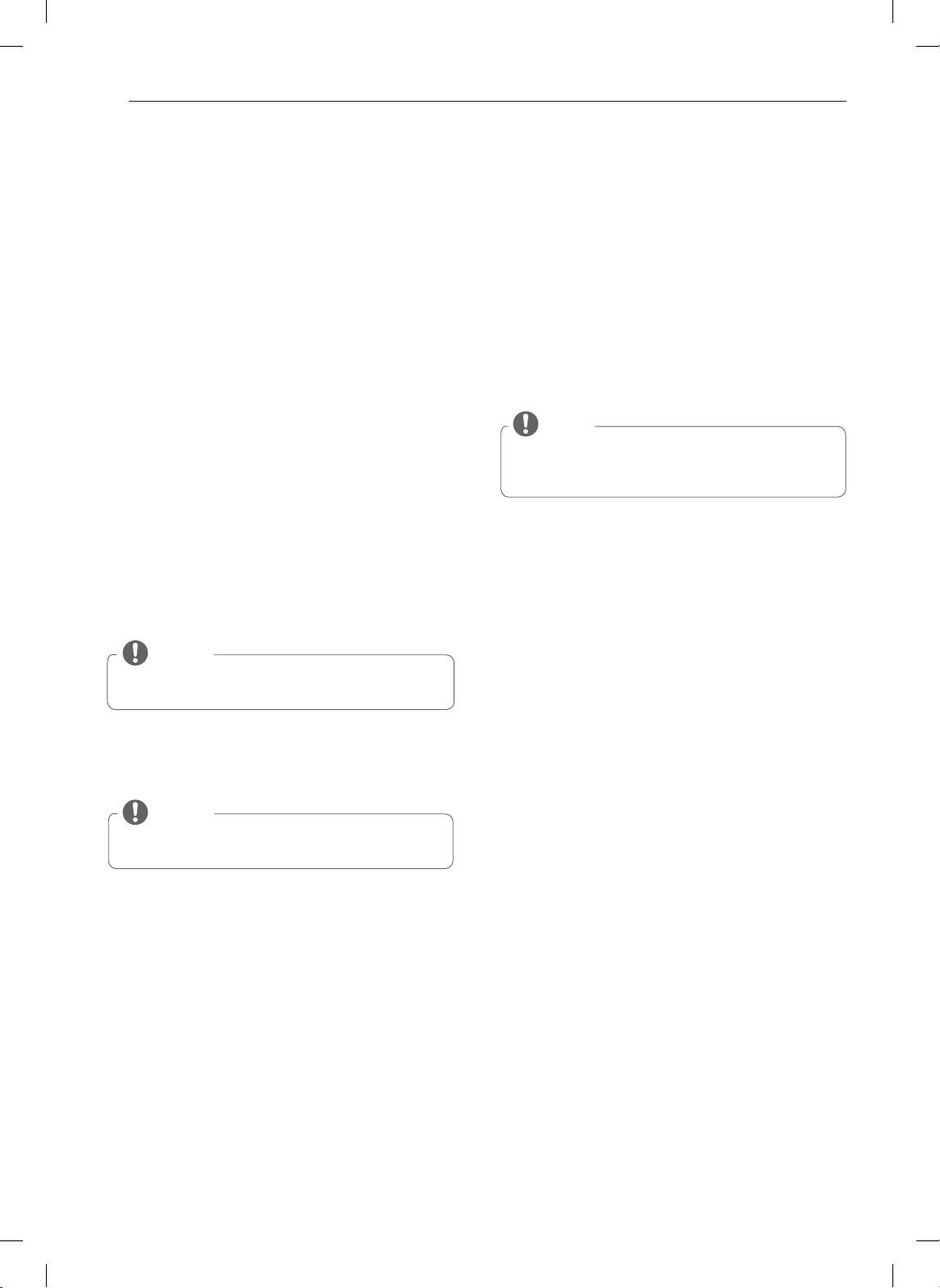
22
HOW TO USE
How to Use the Timer
The upper or lower TIMER ON/OFF serves as an extra timer
in the kitchen that will sound when the set time has run out.
It does not start or stop cooking.
The upper or lower TIMER ON/OFF feature can be used dur-
ing any of the other oven control functions. The upper and
lower TIMER can be operated independently of each other.
1
To set minutes and seconds:
Press the
P
or
T
key once.
To set hours and minutes:
Press the
P
or
T
key twice.
2
Use the number keys to set the timer.
For Example, to set 5 minutes:
a) Press
P
or
T
key twice.
g
will appear in the display.
b) Press
5
in the number key.
h
will appear in the display.
3
To start the timer, press
P
or
T
key once.
The time will count down and show in the display.
To Cancel the timer before the set time has elapsed,
press
P
or
T
(depending on which oven timer
you would like to cancel).
4
When the time is up,
k
will appear on the display and
a tone will sound. The tone will sound every 15 seconds
until
P
or
T
is pressed.
How to Use the Oven Lockout Feature
The oven lockout feature automatically locks the oven door
and prevents most oven controls from being turned on. It
does not disable the clock, timer or the interior oven light.
1
Press and hold the
q
key for three seconds.
A tone will sound,
O
will appear, and
m
will blink in the
display. Once the oven door is locked, the oven lockout
indicator will stop blinking and remain on.
2
To deactivate the lockout feature, press and hold the
q
key for three seconds.
O
and
m
will disappear from the display once the oven
door and controls are unlocked.
NOTE
If
P
or
T
is not pressed, the timer will
return to the time of day.
NOTE
If the remaining time is not in the display, recall the
remaining time by pressing the
P
or
T
.
NOTE
If the lockout feature is activated with either of the
doors open, the doors will not close completely until the
Lockout feature is deactivated.
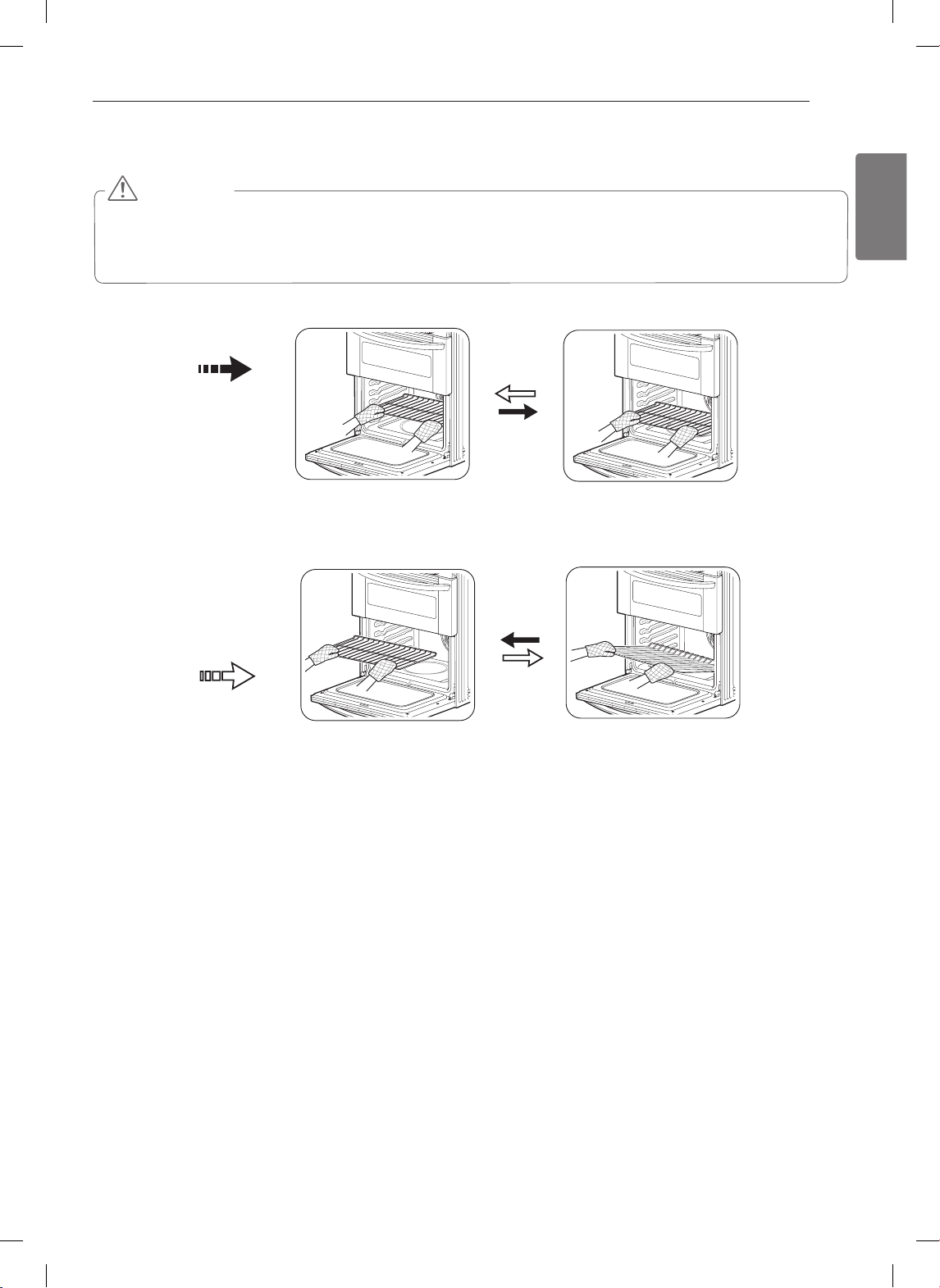
23
HOW TO USE
ENGLISH
Removing and Replacing the Oven Racks
Remove
Replace
To Remove Racks
1
While wearing oven mitts, grasp the oven rack.
2
Pull the rack straight out until it stops.
3
Lift up the front of the rack.
4
Pull out the rack.
*You can also adjust the racks position before using the oven.
CAUTION
y
Replace the oven rack before turning the oven on to prevent burns.
y
DO NOT
cover the rack with aluminum foil, or any other material, or place anything on the bottom of the oven.
Doing so will result in poor baking and may damage the oven bottom.
y
Only arrange oven racks when the oven is cool.
To Replace Racks
1
While wearing oven mitts, place the end of the rack on the
support.
2
Tilt the front end of the rack up.
3
Push the rack in.
4
Check that the rack is properly in place.
24
HOW TO USE
BAKE (Upper & Lower Oven)
A
is used to prepare foods such as pastries, bread, casse-
roles and roasts. The oven can be programmed to bake at any
temperature from 170°F (77°C) to 550°F (288°C). The default
temperature is 350°F (177°C).
To set the oven to BAKE (example to 375°F):
1
Press the upper or lower oven
A
key.
2
Set the oven temperature using the number keys
(ex: press
3
,
7
,
5
).
3
Press the
q
key.
As the oven preheats, the temperature is displayed and
rises in 5 degree increments. Once the oven reaches the
desired temperature, a tone will sound and the oven light
will blink on and off.
4
When cooking is complete, press the
Y
or
Z
key.
5
Remove food from the oven.
NOTE
y
Preheating is necessary for better cooking results.
Place the food in the oven after
preheating.
y
You may also change the temperature while cooking
by following steps 1-3.
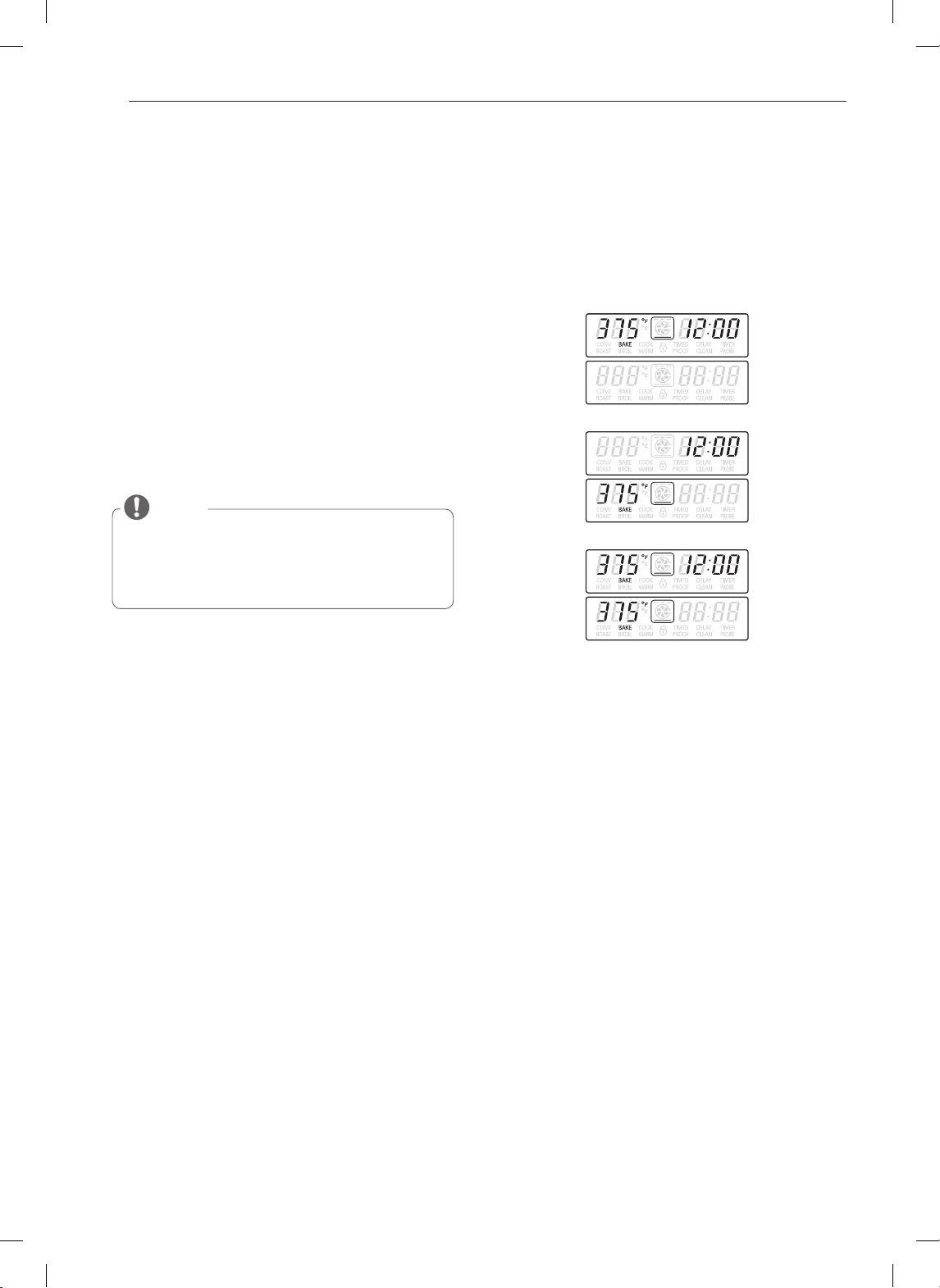
Upper oven only
Lower oven only
Upper & Lower oven at the same time
BAKE mode display (Example)
25
HOW TO USE
ENGLISH
Preheating and Pan Placement
y
To preheat, set the oven at the required recipe tempera-
ture. Wait until the oven reaches its set temperature
before placing the food in the oven. Preheating is neces-
sary for satisfactory results when baking cakes, cookies,
pastry and breads.
y
For best baking results, pans should be centered on the
racks. If baking with more than one pan, place the pans
so that each one has at least 1” to 1
1
/
2
” of air space
around them.
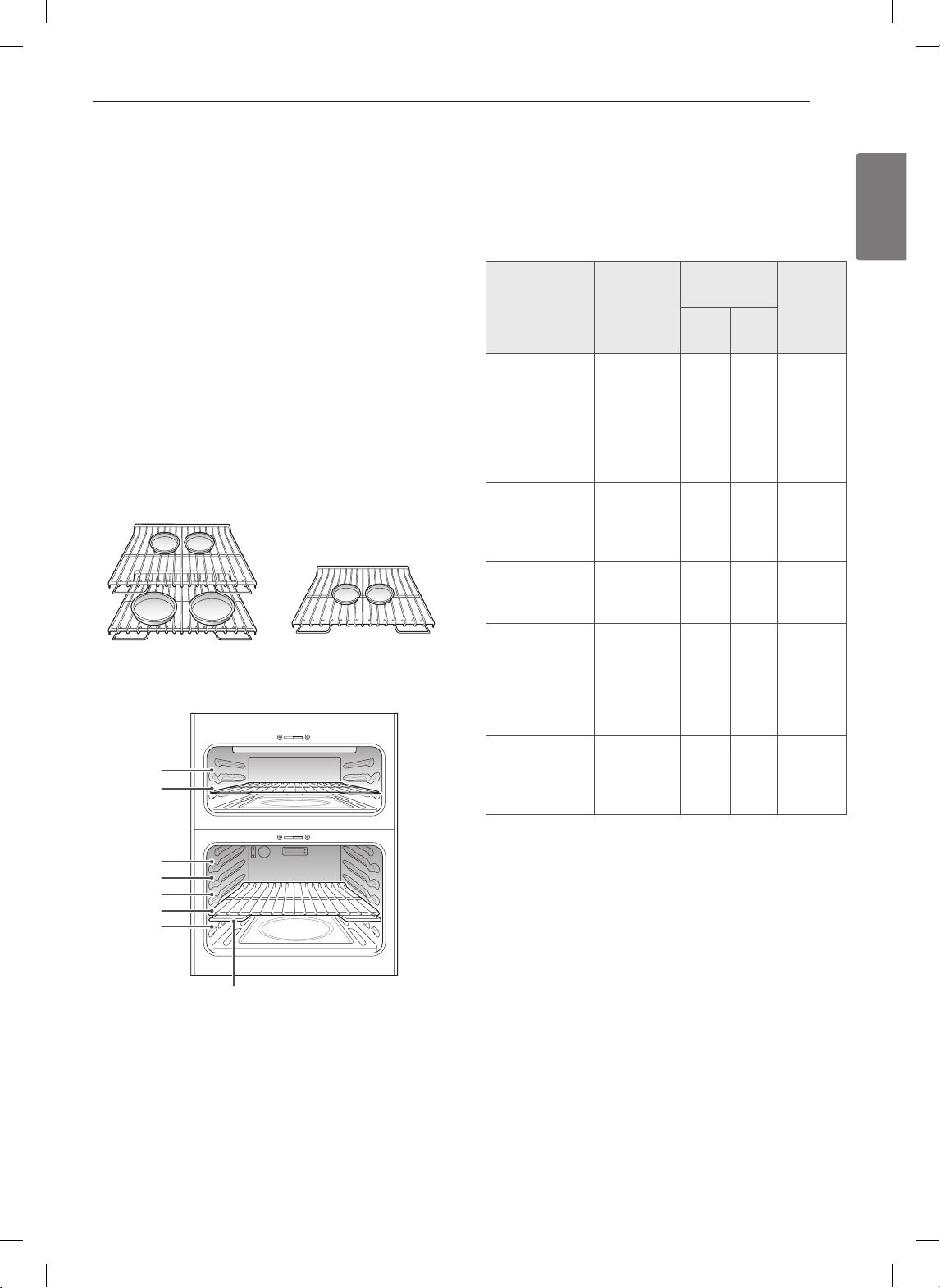
If cooking on multiple racks in the lower oven, place
the oven racks in position C(rack) and E(rack). Place the
cookware as shown in Fig.1.
If cooking on a single rack in the upper oven, place the
oven rack in position A and in the lower oven, please the
oven rack in position D . Place the cookware as show in
the Fig.2.
In the upper oven it is recommended to bake with the
standard rack in the position A.
Figure 1 Figure 2
Rack
B
A
E
D
C
B
A
Baking chart
This chart is only for reference and can be used for both the
upper and lower ovens. Adjust the cook time according to
your recipe.
Food
Oven
Temperature
Shelf position
baking time
Baking
time
(Minutes)
Upper
oven
Lower
oven
Cakes
- Layer cake
- Bundt cake
- Cup cakes
- Pound cake
- Carrot cake
(from scratch)
350°F(177°C)
350°F(177°C)
350°F(177°C)
350°F(177°C)
350°F(177°C)
A
A
A
A
A
C
C
C
C
C
32 - 35
37 - 43
20 - 30
48 - 52
30 - 45
Cookies
- Sugar
- Chocolate chip
- Brownies
350°F(177°C)
350°F(177°C)
350°F(177°C)
A
A
A
C
C
C
12 - 20
9 - 16
30 - 35
Pizza
- Fresh
- Frozen
425°F(218°C)
400°F(204°C)
A
A
C
C
10 - 15
23 - 27
Breads
- Biscuits
(canned)
- Biscuits
(scratch)
- Muffins
350°F(177°C)
425°F(218°C)
425°F(218°C)
A
A
A
C
C
C
13 - 17
10 - 12
9 - 15
Fruits and
Vegetables
- Apples (baked)
- Potatoes (baked)
375°F(190°C)
375°F(190°C)
A
A
C
C
40 - 45
60 - 80
26
HOW TO USE
BROIL (Upper Oven)
Your oven is designed for closed door broiling.
B
uses an intense heat radiation from the upper gas
burner. The Broil function works best when broiling thin, ten-
der cuts of meat (1” or less), poultry or fish.
To set the upper oven to BROIL
1
Press the
B
key once for
l
and twice for
m
.
2
Press the
q
key.
3
Allow the broiler to preheat for five minutes.
4
Place food in the upper oven.
5
Closed the oven door. The oven door must be closed
during broiling.
6
When broiling is finished, press the
Y
key.
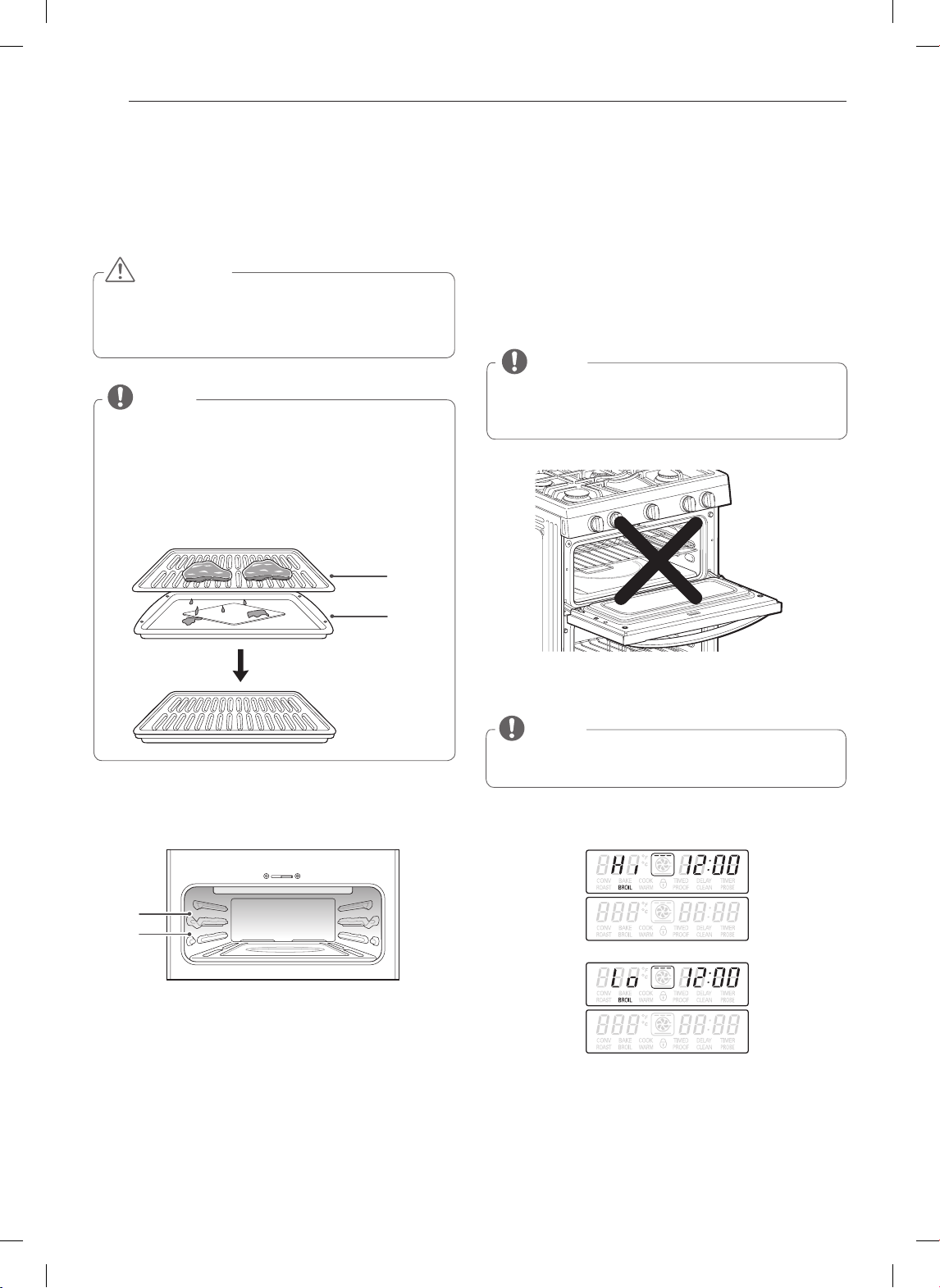
BROIL mode display (example)
High temperature
Low temperature
CAUTION
y
DO NOT
use a broiler pan without a grid. Oil can cause
a grease fire.
y
DO NOT
cover the grid and broiler pan with aluminum
foil. Doing so will cause a fire.
NOTE
y
Use a
m
broil to broil foods such as poultry and thick
cuts of meat.
y
Remove the pan from the oven to cool down for easy
cleaning.
y
For best results, use a pan designed for broiling, as
shown below. The broiler pan will catch grease spills
and the grid will help prevent grease splatters.
Broiler
Pan
Grid
NOTE
If the oven door remains open for more than 15 seconds
during broil, the burner will shut off. The broil burner will
automatically come back on once the door is closed.
NOTE
During any Broil function, it is normal for the broiler to
cycle on and off.
When broiling on rack position ‘B’ in the upper oven, use the
offset rack provided for better cooking results.
B
A
*B: The position where you use the offset rack.
27
HOW TO USE
ENGLISH
Food
Quantity and/or
Thickness
Upper oven
Comments
Shelf
Position
First side
(Min-
utes)
Second
side
(Min-
utes)
Ground beef
Well done
1 Ib. (4 patties)
1/2 to 3/4” thick
A 5-7 3-5 Space evenly. Up to 8 patties may be broiled at
once.
Beef Steaks
Rare
Medium
Well Done
1” thick
1 to 1 1/2 lbs.
A 6-7 2-3
Steaks less than 1" thick cook through before
browning.Pan frying is recommended. Slash fat
A 7-8 3-4
A 8-9 4-5
Rare
Medium
Well Done
1 1/2” thick
2 to 2 1/2 lbs.
A 8 3-4
A 9 4-5
A 10 5-6
Chicken
1 whole cut up 2 to
21/2lbs., split length-
wise
A 8-10 5-7 Broil skin-side-down first.
2 breasts A 8-9 5-6
Fish Fillets
1/4 to 1/2” thick A 5 2-4 Handle and turn very carefully.
Brush with lemon butter before and during cook-
ing, if desired.
Ham Slices
(precooked)
1/2” thick A 6-7 2-3 Increase time 5 to 10 minutes pre side for 1
1
⁄
2
”
thick or home-cured ham.
Pork chops
Well Done
1 (1/2” thick) A 4-6 3-5 Slash fat.
2 (1” thick) about 1lb. A 7-9 5-7
Lamb Chops
Slash fat.
Medium 2 (1” thick) about
10 to 12 oz.
A 7-8 2-3
Well Done A 8-9 3-4
Medium 2 (1/2” thick) about 1lb. A 6-7 2-3
Well done A 7-8 3-4
Salmon Steaks
2 (1” thick) A 7-9 3-5 Grease pan. Brush steaks
with melted butter.
4 (1” thick) about 1lb. A 8-10 3-5
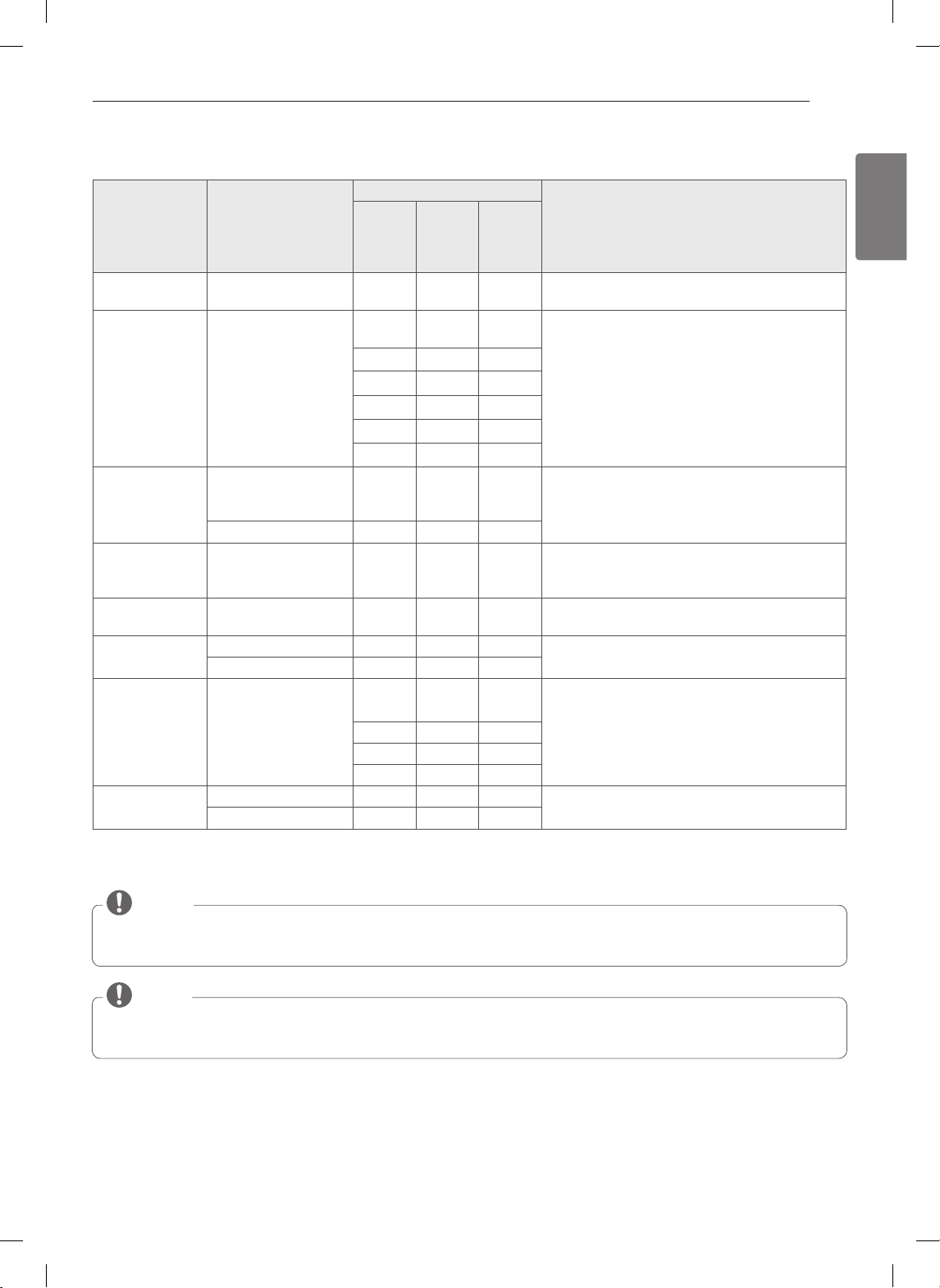
• Broiling times may be affected by the size, weight, thickness, starting temperature and your preference of doneness.
This guide is based on meats at refrigerated temperatures.
NOTE
• The U.S. Department of Agriculture says "Rare beef is popular, but you should know that cooking it to only 140 °F. means
some food poisoning organisms may survive." (Source: Safe Food Book. Your Kitchen Guide. USDA Rev. June 1985.)
NOTE
BROILING CHART
This chart is only for reference. Adjust cook time according to your preference.
28
HOW TO USE
TIMED COOK
(Upper & Lower Oven)
The TIMED COOK feature allows you to set the oven to cook
for a specific length of time. This feature can only be used
while baking.
To set TIMED COOK
(example: to BAKE at 300°F for 30 minutes):
1
Press the upper or lower
A
key.
q
o
will appear in the
display.
2
Use the number keys to set the temperature
(ex. press
3
,
0
,
0
).
3
Once the oven has preheated to 300°, press the
key.
o
o
will appear in the display.
4
Set the desired baking time (ex. press
3
,
0
).
The baking time can be set for any amount of time be-
tween 1 minute and 11 hours and 59 minutes.
5
Press the
q
key. The oven will turn on and the display
will show the cooking time countdown.
The oven will continue to cook for the set amount of time
and then turn off automatically. When the cooking time has
elapsed:
To change the cook time while operating the oven:
(example: to change the cook time from 30 minutes to 1 hour
30 minutes):
1
Press the key.
2
Use the number keys to change the baking time
(ex. press
1
,
3
,
0
).
3
Press
q
to accept the change.
DELAYED TIMED COOK
(Upper & Lower Oven)
The automatic timer of the DELAYED TIMED COOK will turn
the oven ON and OFF at the time you select. This feature can
only be used for baking.
To set the oven for Delayed Start (example: to BAKE at 300°F
for 30 minutes and start operating the bake mode at 4:30pm):
1
Be sure that the clock is set for the correct time of day.
2
Arrange the interior oven rack(s) and place the food in the
oven.
3
Press the
b
key.
q
o
will appear on the display.
4
Use the number keys to set the oven temperature
(ex. press
3
,
0
,
0
).
5
Press the key.
6
Set the desired baking time (ex. press
3
,
0
).
The baking time can be set for any amount of time from 1
minute to 11 hours and 59 minutes.
7
Press the
W
key.
8
Set the desired start time (ex. press
4
,
3
,
0
).
9
Press the
q
key. At the set time, a short beep will
sound and the oven will begin baking.
y
k
and the time of day will show in the display.
y
The cook end indicator tone will sound every 60 sec-
onds until the
Y
or
Z
key is pressed.
y
When WARM function is set, warm function is acti-
vated after cooking for the set time.
NOTE
If operating both the upper & lower oven at the same
time, press the key once to set the cook time
for the lower oven and twice for the upper oven.
y
k
and the time of day will show in the display.
y
The cook end indicator tone will sound every 60 seconds
until the
Y
or
Z
key is pressed.
y
When WARM function is set, warm function is activated
after cooking for the set time.
CAUTION
y
Use the automatic timer when cooking cured or frozen
meats and most fruits and vegetables. Foods that can
easily spoil, such as milk, eggs, fish, meat or poultry,
should be chilled in the refrigerator. Even when chilled,
they should not stand in the oven for more than 1 hour
before cooking begins, and should be removed promptly
when cooking is completed.
y
Eating spoiled food can result in sickness from food
poisoning.
NOTE
y
To cancel the TIMED COOK function, press
Y
or
Z
key at any time.
y
If you would like to change the cook time, repeat
steps 5-6 and press
q
.
The oven will continue to cook for the set amount of time
and then turn off automatically. When the cooking time has
elapsed:
NOTE
y
To set the WARM function to engage at the end of
the timed cook cycle, repeat steps 1-5 and then press
the
C
key. WARM will appear in the display.
(Refer to "WARM" in the How to Use section for more
information on warming.)
y
To cancel the TIMED COOK function, press
Y
or
Z
key at any time.
NOTE
If your oven clock is set as a 12 hour clock, you can delay
the cook time for 12 hours. If your oven clock is set as a
24 hour clock, you can delay the cook time for 24 hours.
29
HOW TO USE
ENGLISH
How to use convection for the lower
oven (LDG3016ST)
Convection system uses a fan to circulate the oven’s heat
evenly within the oven.
This improved heat distribution allows for even cooking and
excellent results.
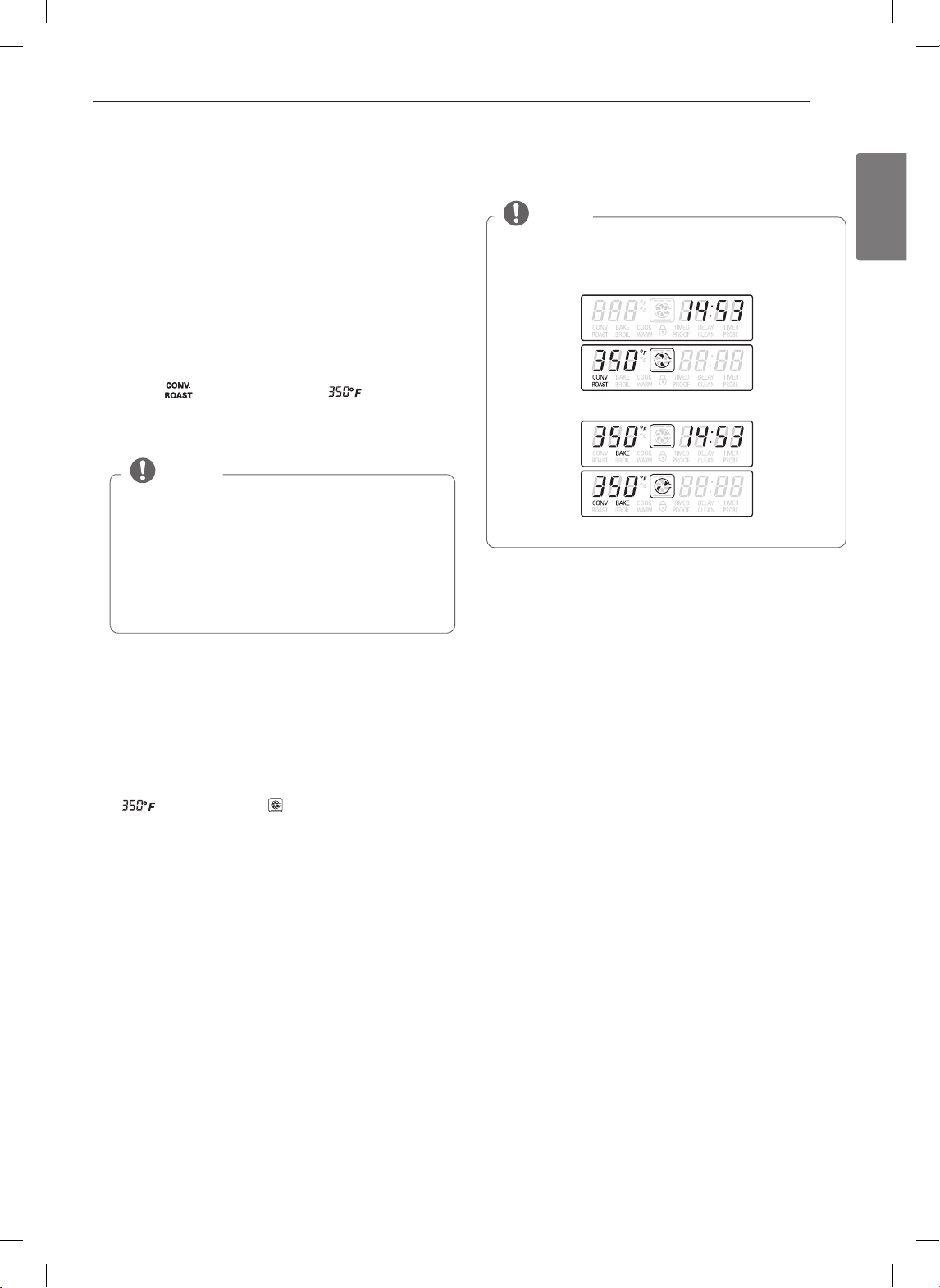
CONVECTION BAKE FOR THE
LOWER OVEN (LDG3016ST)
Convection baking allows for even cooking and excellent
results when using multiple racks at the same time. It could
also shorten cooking time.
1
Benefits of CONVECTION BAKE
1) Even bake results using multiple racks.
2) Faster cooking time.
2
To set oven to CONVECTION BAKE (example to 375°F)
1) Touch key. The display will blink .
2) Set the oven temperature (Touch
3
,
7
,
5
).
3) Touch
q
key.The display will show
CONV
,
BAKE
and
the converted temperature starting at 100°F. As the oven
preheats, the display will show increasing temperatures in
5 degree increments.
4) Once the oven reaches the desired temperature, a tone
will sound and the oven light will blink on and off. The
display will show the auto converted oven temperature
,
CONV
,
BAKE
and .
NOTE
When cooking using convection cycle, the oven
temperature is automatically reduced by 25°F. The display
will show the changed temperature.
This feature is called”AUTO CONVERSION”.
Your range comes with this feature “ENABLED”.
To DISABLE the auto conversion feature, see “How to set
convection auto conversion function” in Operating Instruc-
tions section.
NOTE
You will hear a fan while cooking with convection. The fan
will stop when the door is open, but the heat will not turn
off. The fan will not start until the preheat temperature is
reached.
NOTE
y
To cancel CONVECTION BAKE, touch
Z
key at
any time.
y
Display of the CONVECTION BAKE mode (Example)
Lower oven only
Upper & Lower oven at the same time

30
HOW TO USE
3
Cookware for convection cooking
Check to see if your cookware leaves room for air circula-
tion in the oven before using your convection oven. If you
are baking with several pans, leave space between them.
Also, be sure the pans do not touch each other or the walls
of the oven.
1) Paper and Plastic
You can use heat-resistant paper and plastic containers
that are recommended for use in regular ovens in con-
vection ovens.
2) Metal and Glass
Any type of cookware will work in your convection oven.
However, metal pans heat the fastest and are recom-
mended for convection baking.
• Darkened or matte-finished pans will bake faster than
shiny pans.
• Glass or ceramic pans cook more slowly.
When baking cookies, use a flat cookie sheet instead of a
pan with low sides to get the best results
For recipes like oven-baked chicken, use a pan with low
sides. Hot air cannot circulate well around food in a pan
with high sides.
NOTE
y
Cookies and biscuits should be baked on pans with no
sides or very low sides to allow heated air to circulate
around the food. Food baked on pans with a dark finish
will cook faster.
y
Foods cooked on a single oven rack will generally cook
faster and more evenly with convection bake. Multiple
oven rack cooking may slightly increase cook times
for some foods, but the overall result is time saved.
Breads and pastries brown more evenly.
y
Cookies, muffins and biscuits will have very good
results when using multiple racks.
y
The convection fan stops during convection bake cycle
to allow for more even heating. This is normal.
y
Use the recommended size pan in recipe.
y
Some frozen foods have been developed to use
commercial convection ovens. For best results in this
oven, preheat the oven and use the temperature rec-
ommended in the recipe.
y
If a food manufacturer gives specific convection bak-
ing package instructions, program the AUTO CONVER-
SION temperature so that the preheated oven tem-
perature reads the same as the temperature on the
package instructions.
Convection baking chart
If Auto Conversion is disabled, reduce standard recipe tem-
perature by 25°F for CONVECTION BAKE.
Temperatures have been adjusted in this chart. Multi rack
cooking may slightly increase cook times for some foods,
but the overall result is time saved.
This chart is only for reference. Adjust COOK TIME accord-
ing to your preference.
Food
Oven
Temperature
(converted)
Rack
position
Baking time
(Minutes)
Cakes
- Layer cakes
- Bundt cakes
325°F(163°C)
325°F(163°C)
C
C
32~35
37~43
Cakes, Specialty
- Popovers
- Cup cakes
- Pound cakes
400°F(204°C)
325°F(163°C)
325°F(163°C)
B
C
C
20~30
20~25
48~55
Cookies
- Sugar
- Chocolate chips
- Brownies
325°F(163°C)
325°F(163°C)
325°F(163°C)
C
C
C
12~20
9~16
30~35
Pizza
- Fresh
- Frozen
400°F(204°C)
375°F(190°C)
C
C
10~15
23~27
Breads
- Biscuit, canned
- Biscuit, scratch
- Muffins
- White bread, loaf
325°F(163°C)
425°F(218°C)
400°F(204°C)
400°F(204°C)
C
C
C
B
13~17
8~12
9~15
30~38
Pastry Crust
- Scratch
- Refrigerator
425°F(218°C)
425°F(218°C)
C
C
9~12
9~11
Desserts
- Fruit crisps and
cobblers, scratch
- Pies, scratch,
2 crust fruit
350°F(177°C)
350°F(177°C)
C
C
30~40
60~70
31
HOW TO USE
ENGLISH
CONVECTION ROAST FOR THE
LOWER OVEN (LDG3016ST)
CONVECTION ROAST feature is designed to give optimum
roasting performance. CONVECTION ROAST feature
combines cooking with the convection fan to roast meats
and poultry. The heated air circulates around the food from all
sides, sealing in juices and flavors.
Foods are crispy brown on the outside while staying moist
on the inside.
1
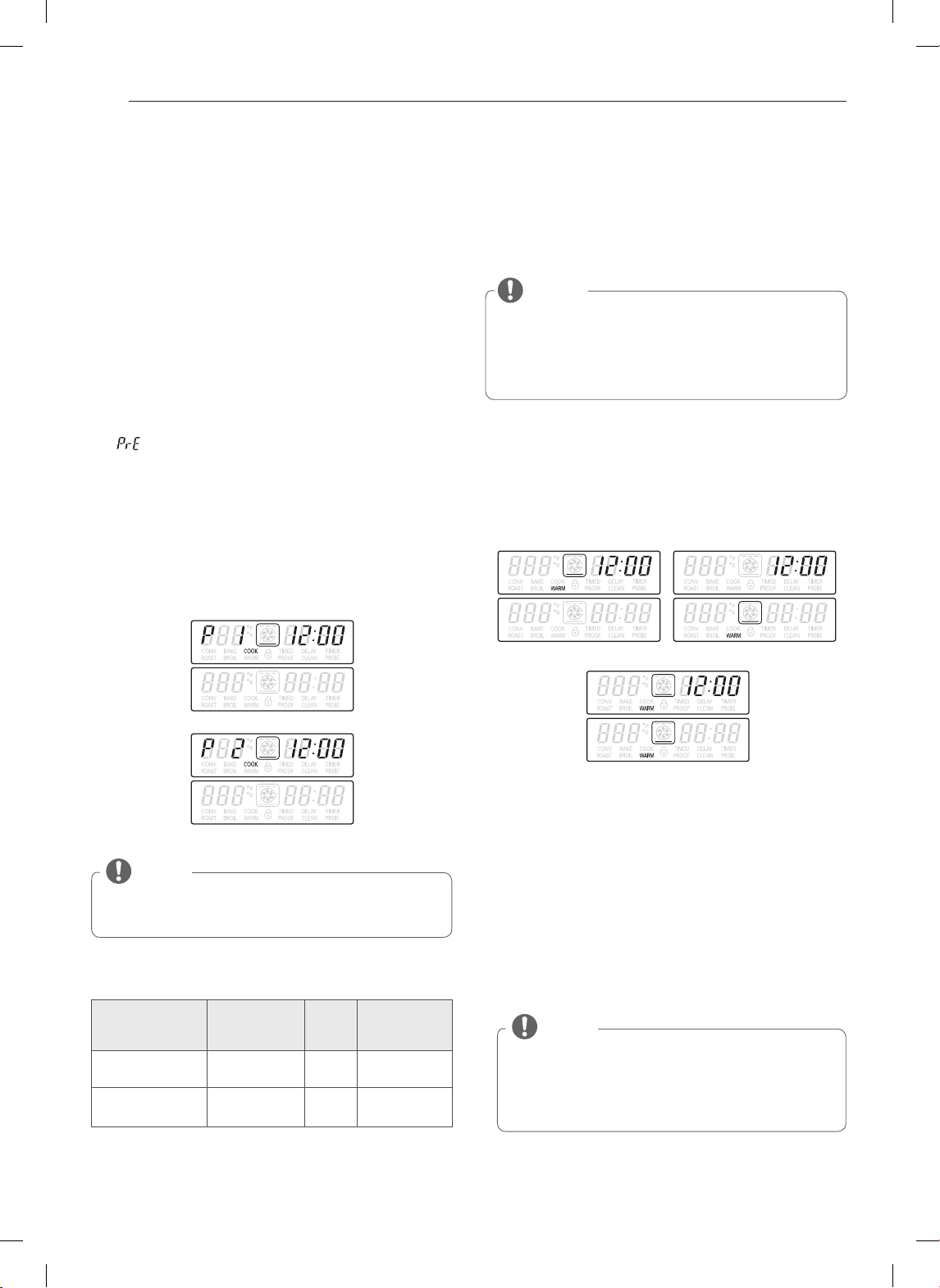
To set the lower oven to CONVECTION ROAST (example
to 375°F).
1) Touch key. Display will show .
2) Set the oven temperature
(Touch
3
,
7
,
5
).
3) Touch
q
key. Display will show
CONV
,
ROAST
and the
changing temperature starting at 100°F. As the oven
preheats, the display will show increasing temperatures
by 5 degree increments.
4) Once the oven reaches the desired temperature, a tone
will sound and the oven light will flash on and off. The
display will show the auto converted oven temperature
,
CONV
,
ROAST
and .
5) Place food in oven.
NOTE
When cooking using a convection cycle the oven
temperature is automatically reduced by 25°F, and
then the display will show the changed temperature.
This feature is called”AUTO CONVERSION”.
Your range comes with this feature “ENABLED”.
To DISABLE the auto conversion feature, see “How to
set convection auto conversion function” in Operating
Instructions section.
NOTE
y
Touch
Z
key to cancel CONVECTION ROAST func-
tion at any time.
y
Display of the CONVECTION ROAST mode (Example)
Lower oven only
Upper & Lower oven at the same time
32
HOW TO USE
Special Features
PIZZA (Upper Oven)
This function will automatically preheat the upper oven tem-
perature to cook either regular or rising crust frozen pizza.
Simply choose the type of crust (P1 for regular crust and P2
for rising crust) and set the desired cook time.
To set the oven for frozen pizza:
1
Press the
x
key once for regular crust and twice for
rising crust. Either
H
(regular crust) or
I
(rising crust)
will appear in the display.
2
Press the
q
key.
3
" " will appear in the display to indicate preheat. Alarm
will sound once preheat is complete.
4
Place pizza in the oven, close the door and then and set
the timer as per the chart below.
5
When cooking is complete press the
Y
key.
6
Remove food from the oven.
Display Screen (example):
PIZZA Chart
This chart is for reference only. Adjust the cook time accord-
ing to the recipe.
WARM (Upper & Lower Oven)
This function will maintain an oven temperature of 170°F. The
WARM
function will keep cooked food warm for serving up
to 3 hours after cooking has finished. The Warm function may
be used without any other cooking operations or can be used
after cooking has finished using TIMED BAKE or DELAYED
TIMED BAKE.
NOTE
y
The
WARM
function is intended to keep food warm. Do
not use it to cool food down.
y
When the lower oven is above 475°F, the
WARM
func-
tion of the upper oven cannot be used.
w
will appear
on the display.
To set the WARM function:
1
Press the
C
key of the upper and/or lower oven.
2
Press the
q
key.
Display Screen (example):
To set the warm function after Timed Cooking:
1
Set either TIMED COOK or DELAYED TIMED COOK (refer
to "TIMED COOK" or "DELAYED TIMED COOK" in the
How to Use section).
2
Press the
q
key.
3
Press the
C
key.
The Warm mode is set to turn on automatically after com-
pleting the timed cooking or delayed cooking time.
P1
P2
NOTE
• Preheating is necessary for better cooking results.
Place the food in the oven after preheating.
Food
Recommend-
ed
Size
Shelf
Posi-
tion
Recommend-
ed Time
(minutes)
Frozen Pizza with
Regular Crust
12” A 13-17
Frozen Pizza with
Rising Crust
12” A 25-28
Upper oven only
Upper & Lower oven at the same time
Lower oven only
NOTE
y
To cancel the
WARM
function, press the
Y
or
Z
key at any time.
y
If
Y
or
Z
is pressed prior to the delay func-
tions, all cooking settings will be canceled.
33
HOW TO USE
ENGLISH
FAVORITE (LDG3016ST Lower Oven)
This feature may store and recall up to 3 different settings.
The favorite setting feature may be used with COOK TIME
feature. This feature will not work with any other function
including START TIME feature.
1
To set FAVORITE
1) Place the food in the oven.
2) Press
key to select the food.
Default temperature will appear in display and
COOK
will blink.
Category how
to select
Touch favorite
Default
temp.
(May be
changed)
Operating
feature
Bread Press FAVORITE
key once.
375°F BAKE
Meat Press FAVORITE
key twice.
325°F Convection
Roast
Chicken Press FAVORITE
key 3 times.
350°F Convection
Roast
3) Touch number keys to set the desired oven
temperature. This temperature will be stored and be
recalled next use.
4) Touch
q
key. The preheat indicator tones will sound
3 times when the oven reaches the programmed
temperature.
NOTE
y
Only the temperature you selected will be stored, not
the cooking time.
y
If the oven temperature is changed, the changed
temperature will be stored.
y
The stored temperature is retained after a power
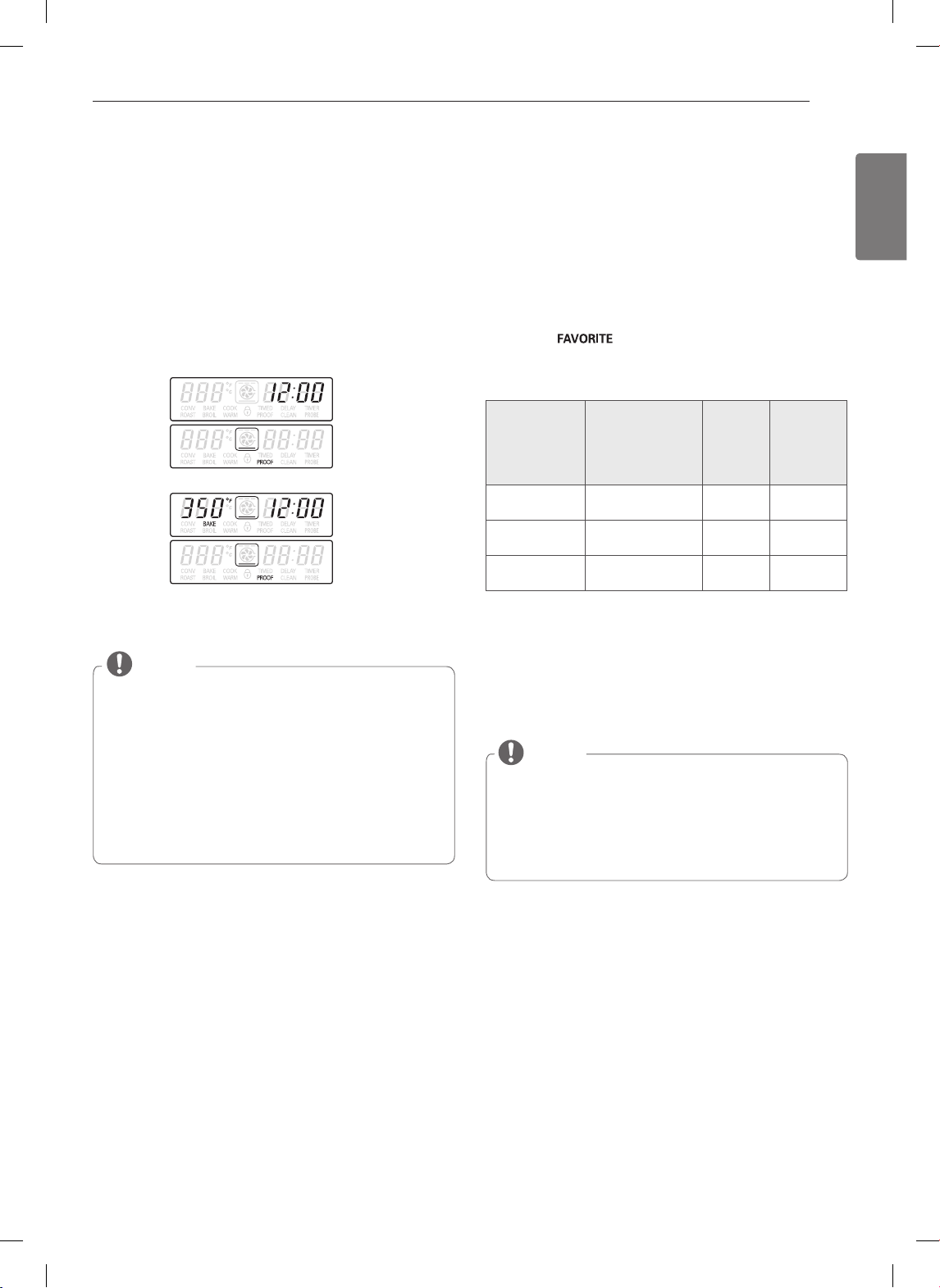
failure.
PROOF (Lower Oven)
This feature maintains a warm oven for rising yeast leavened
products before baking.
To set the PROOF function:
1
Use rack B or C for proofing.
2
Press the
J
key.
3
Press the
q
key
.
4
When proofing is finished, press the
Z
key.
Lower oven only
Upper & Lower oven at the same time
Display Screen (example):
NOTE
y
To avoid lowering the oven temperature and length-
ening proofing time, do not open the oven door un-
necessarily. Check bread products early to avoid over-
proofing.
y
Do not use the proofing mode for warming food or
keeping food hot. The proofing oven temperature is not
hot enough to hold foods at safe temperatures. Use the
WARM feature to keep food warm.
Proofing will not operate when the oven is above 125°F.
w
will show in the display.
34
HOW TO USE
To set the SABBATH mode:
1
Press the
A
key.
2
Using the number keys, enter the desired temperature.
3
Press the
q
key.
4
Press and hold the
X
key for three seconds.
To change the temperature while in SABBATH mode
(no tones sound & no display change):
1
Press the upper or lower oven
A
key.
2
Using the number keys, set the desired temperature.
3
Press the
q
key.
SABBATH (Upper & Lower Oven)
The SABBATH mode is typically used on the Jewish Sabbath
and Holidays. When the SABBATH mode is activated, the
oven does not turn off until the SABBATH mode is deactivat-
ed. In SABBATH mode, all function keys, except for the
Y
and
Z
keys, are inactive.
z
will appear in oven display.
NOTE
y
IF the oven light is turned ON and the SABBATH mode
is active, the oven light will remain ON until the SAB-
BATH mode is turned OFF. If the oven light needs to be
OFF, be sure to turn the oven light OFF before activat-
ing the SABBATH mode.
y
SABBATH mode can only be used while baking (BAKE
mode) in either the top, bottom, or both ovens.
y
You can use TIMED COOK in another oven while either
the upper oven or lower oven is activated.
Refer to “TIMED COOK” in the Using Oven section.
Upper oven only
Lower oven only
Upper & Lower oven at the same time
Display Screen (example):
NOTE
y
To cancel the BAKE function, press the
Y
or
Z
key at any time.
y
To cancel the SABBATH mode, press and hold the
X
key for three seconds.
NOTE
y
There is a 15 second delay before the unit will recog-
nize the temperature change.
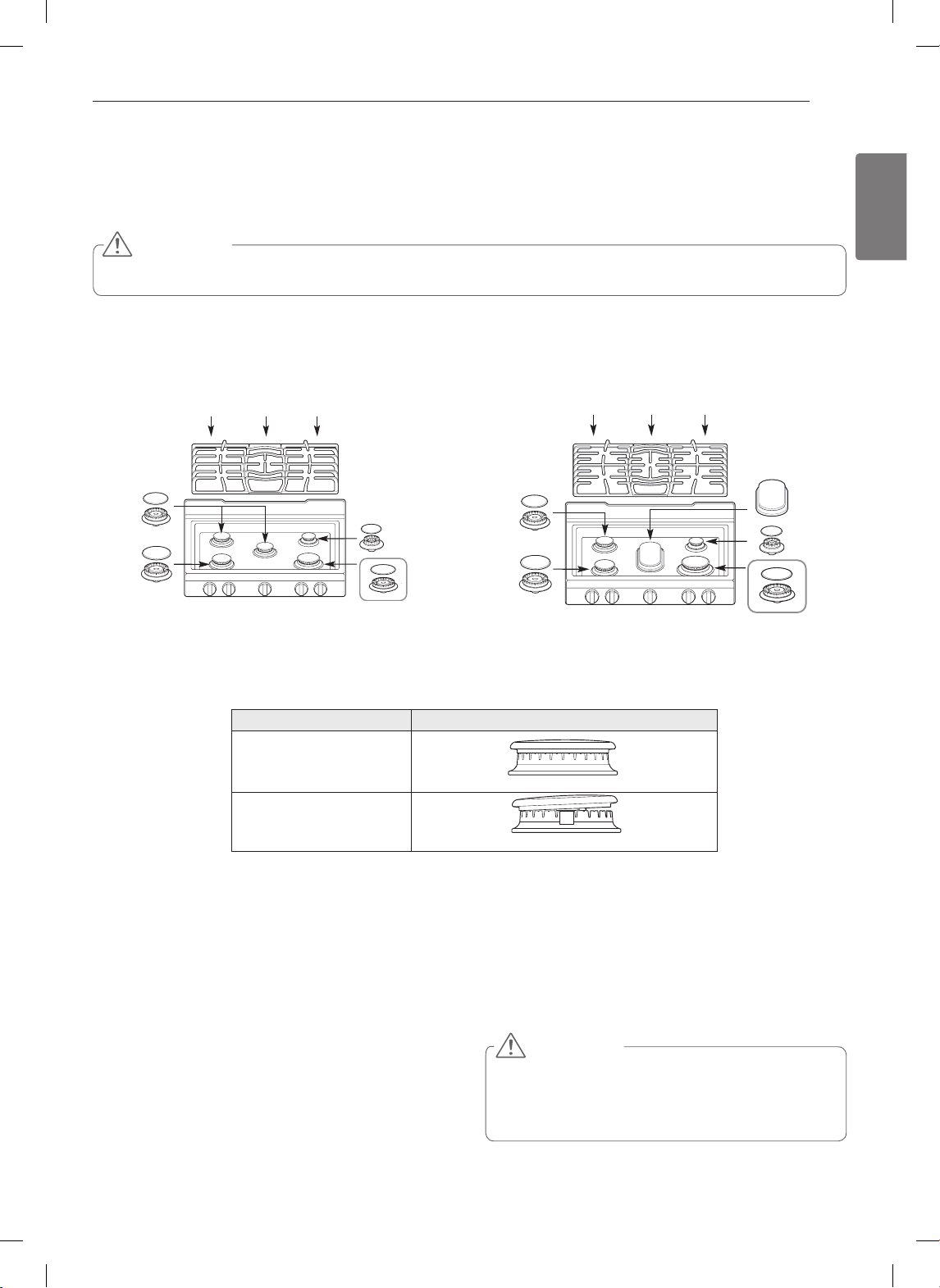
35
CARE AND CLEANING
ENGLISH
CARE AND CLEANING
Gas Surface Burner
Removing and Replacing the Gas Surface Burner
Grates and burner caps/heads can be removed for care and cleaning.
General burner
Burner cap is properly set.
Burner cap is NOT
properly set.
Burner Heads/Caps
For even and unhampered flame, the slits in the burner heads
must be kept clean at all times.The burner heads and (the oval
burner head) & Cap assembly can be lifted off.
y
Wash the burner caps in hot soapy water and rinse with
clean water.
y
Any spills on or around an electrode must be carefully
cleaned.
y
To remove burnt-on food, soak the burner heads in a
solution of mild liquid detergent and hot water for 20–30
minutes. For stubborn stains, use a toothbrush.
y
The burners will not operate properly if the burner ports
or electrodes are clogged or dirty.
y
Burner caps and heads should be cleaned routinely,
especially after bad spillovers.
y
Burners will not light if the cap is removed.
Shake out any excess water and then let them dry
thoroughly. Replace the burner heads and caps over the
electrodes on the cooktop, in the correct locations according
to their size. Make sure the hole in the burner head is
positioned over the electrode.
After Cleaning the Burner Heads/Caps
CAUTION
y
DO NOT
hit the electrodes with anything hard. Doing
so could damage them.
y
DO NOT
use steel wool or scouring powders to clean
the burners.
CAUTION
y
DO NOT
clean this appliance with bleach.
y
To prevent burns, wait until the cooktop has cooled down before touching any of its parts.
Center grate Side grate Side grate
Medium burner
head and cap
Large burner
head and cap
Small burner
head and cap
Extra large burner
head and cap
Center grate Side grate Side grate
Medium burner
head and cap
Large burner
head and cap
Small
burner
head and
cap
Oval burner
head and cap
Extra large burner
head and cap
For Model: LDG3015S For Model: LDG3016ST
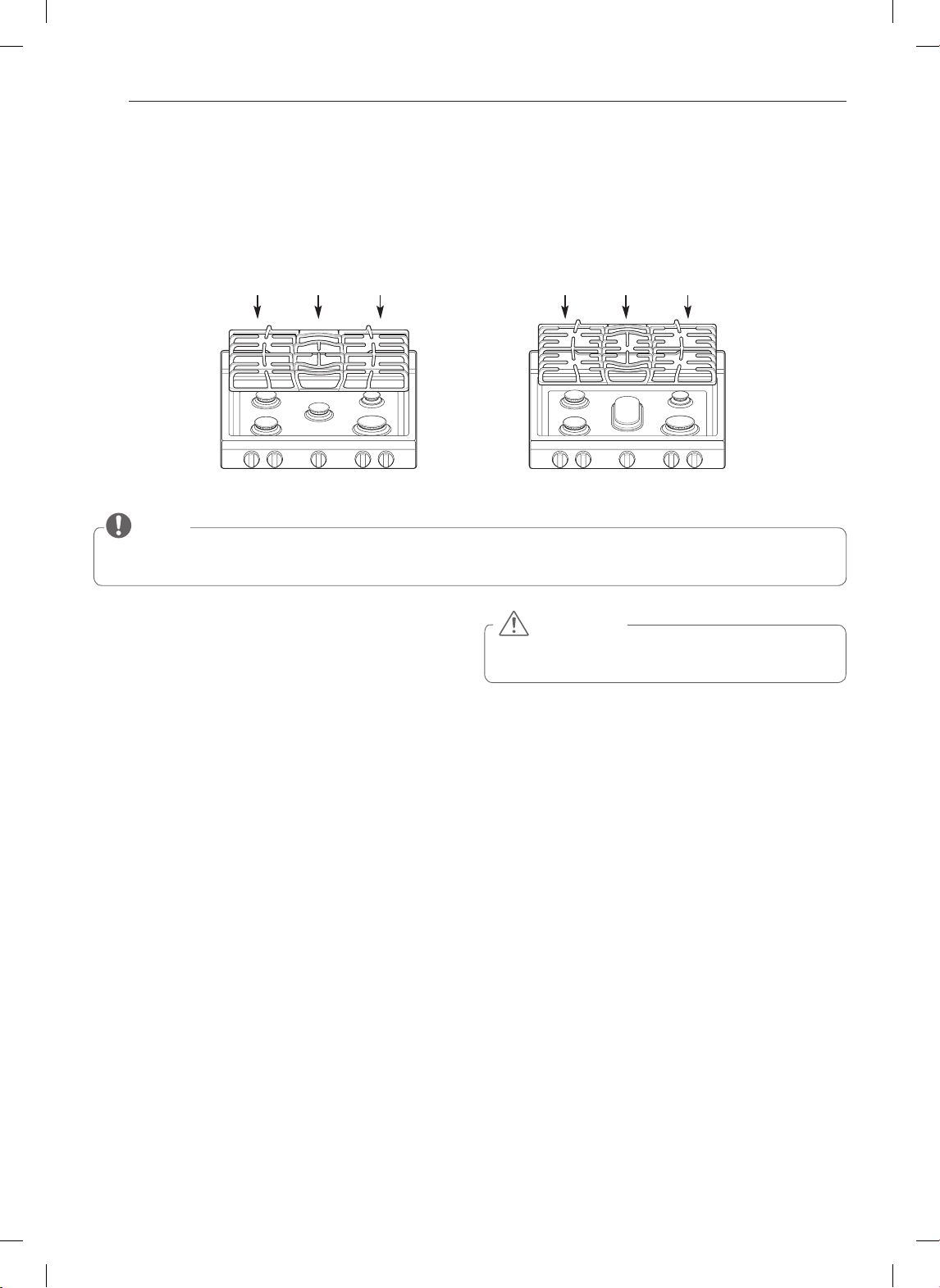
36
CARE AND CLEANING
Burner Grates
The range consists of three separate professional-style grates. For maximum stability, these grates should only be used when in
their proper position. The two side grates can be interchanged from left to right and front to back. The center grate can be
interchanged from front to back.
NOTE
Do not operate a burner for an extended period of time without cookware on the grate. The finish on the grate may chip with-
out cookware to absorb the heat.
y
Do not lift the grates out until they have cooled.
y
Grates should be washed regularly and after spillovers.
y
Wash the grates in hot, soapy water and rinse with
clean water.
y
The grates are dishwasher safe.
y
After cleaning the grates, let them dry completely and
securely position them over the burners.
Cleaning the Burner Grates
CAUTION
DO NOT
put the grate in the oven during self clean-
ing mode.
side grate center grate side grate
For Model: LDG3015S
side grate center grate side grate
For Model: LDG3016ST
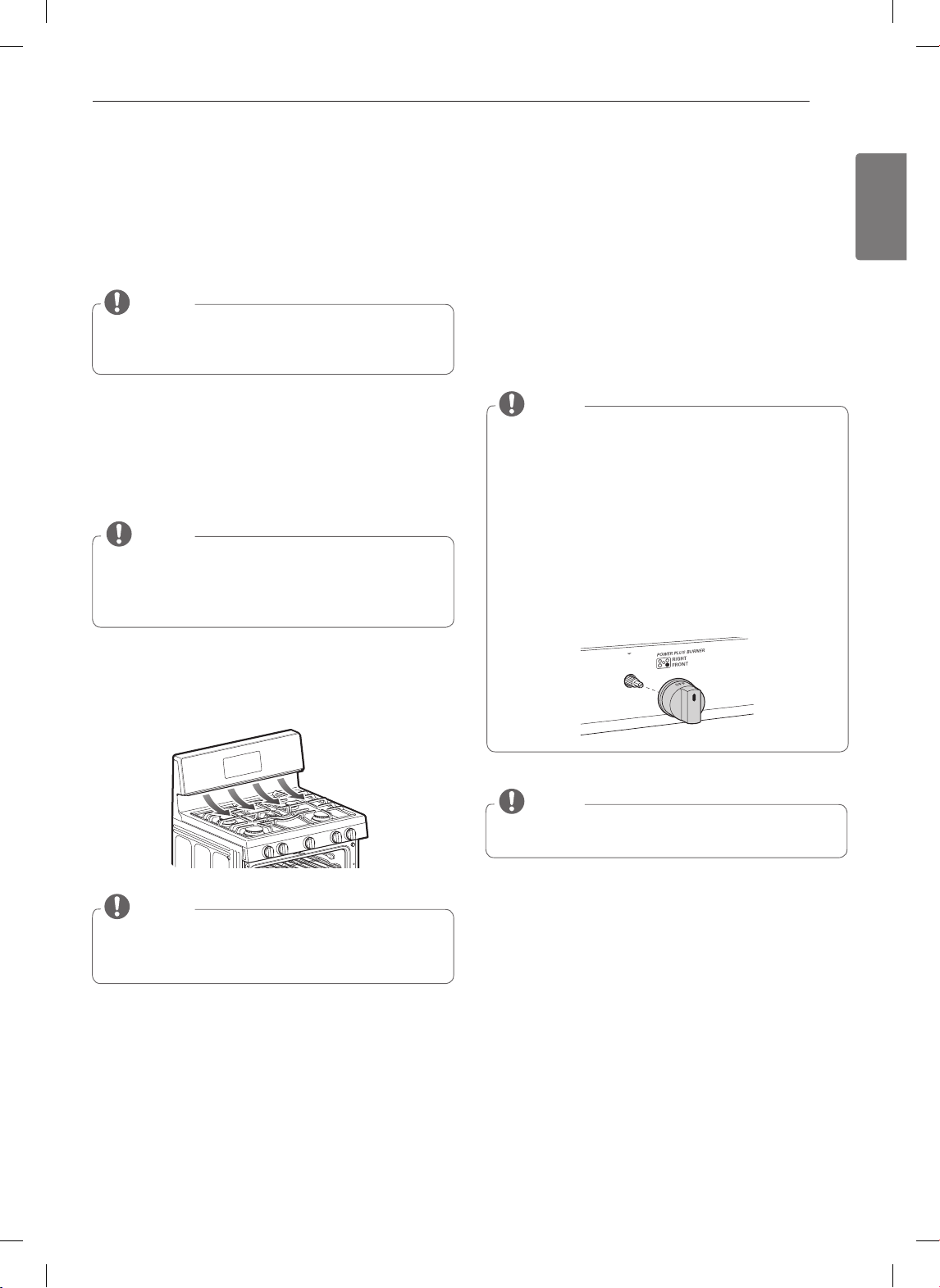
37
CARE AND CLEANING
ENGLISH
Cooktop Surface
To avoid burns, do not clean the cooktop surface until it has
cooled. Foods with high acid or sugar content could cause a dull
spot if allowed to set. Wash and rinse when the surface has
cooled. For other spills such as oil/grease spattering, etc., wash
with soap and water when the surface has cooled. Then rinse
and polish with a dry cloth.
NOTE
Do not lift the cooktop surface. Lifting the cooktop
surface can lead to damage and improper operation of the
range.
Stainless Steel Surfaces
To inquire about purchasing stainless steel appliance cleaner
or polish, or to find the location of a dealer nearest you, please
call our toll-free customer service number:
1-800-243-0000
or visit our website at:
us.lgservice.com
Oven air vents
Air openings are located at the rear of the cooktop, at the top
and bottom of the oven door, and at the bottom of the range.
NOTE
Do not block the vents and air openings of the range.
They provide the air inlet and outlet that are necessary for
the range to operate properly with correct combustion.
Control Panel
To prevent activating the control panel during cleaning, unplug
the range. Clean up splatters with a damp cloth using a glass
cleaner. Remove heavier soil with warm, soapy water. Do not
use abrasives of any kind.
Front manifold panel and knobs
It is best to clean the manifold panel after each use of the
oven. For cleaning, use a damp cloth and mild soapy water or
a 50/50 solution of vinegar and water. For rinsing, use clean
water and polish dry with a soft cloth.
NOTE
y
Do not use abrasive cleansers, strong liquid cleaners,
plastic scouring pads or oven cleaners on the manifold
panel. Doing so will damage the finish.
y
Do not try to bend the knobs by pulling them up or
down or by hanging a towel or other objects on them.
This can damage the gas valve shaft.
y
The control knobs may be removed for easy cleaning.
y
To clean the knobs, make sure that they are in the “OFF”
position and pull them straight off the stems.
y
To replace the knobs, make sure the knob has the “OFF”
position centered at the top, and slide the knob directly
onto the stem.
NOTE
To prevent scratching, do not use abrasive cleaners on any
of these materials.
NOTE
y
Do not use a steel wool pad; it will scratch the surface.
y
To clean the stainless steel surface, use warm sudsy
water or a stainless steel cleaner or polish.
y
Always wipe in the direction of the metal surface finish.
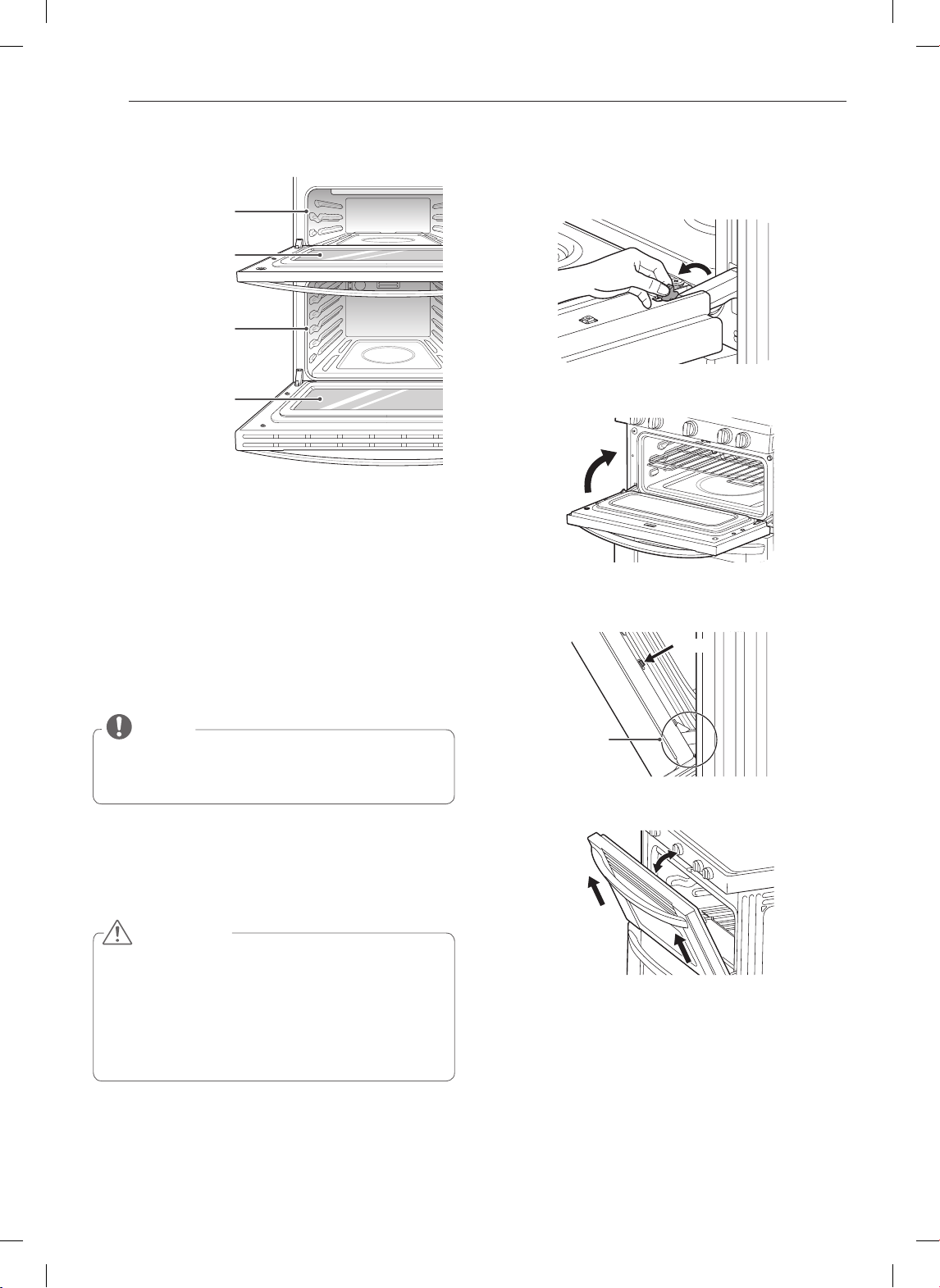
38
CARE AND CLEANING
Oven Door
Do not hand clean
the oven door gasket
Hand clean the door
Do not hand clean
the oven door gasket
Hand clean the door
y
Use soapy water to thoroughly clean the oven door.
Rinse well.
DO NOT
immerse the door in water.
y
You may use a glass cleaner on the outside glass of the
oven door.
DO NOT
spray water or glass cleaner on the
door vents.
y
DO NOT
use oven cleaners, cleaning powders, or harsh
abrasive cleaning materials on the outside of the oven
door.
y
DO NOT
clean the oven door gasket. The oven door
gasket is made of a woven material that is essential for
a good seal. Care should be taken not to rub, damage,
or remove this gasket.
NOTE
Do not use cleaners or harsh abrasive cleaning materials
on the outside of the oven door. Doing so can cause
damage.
Removing and replacing the doors
Do not close the oven door until all of the oven racks are com-
pletely in place.
CAUTION
y
Be careful when removing and lifting the door.
y
DO NOT
lift the door by the handle.
y
DO NOT
hit the glass with pots, pans, or any other
object.
y
Scratching, hitting, jarring or stressing the glass may
weaken its structure, causing an increased risk of break-
age at a later time.
1
Fully open the door. Lift up the hinge locks toward the
oven frame until they stop.
2
Close the door to approximately 30 degrees.
3
Press down the release buttons on each hinge on both
sides of the door.
Push
about 30°
4
Lift up the door until it is clear off the hinge.
Removing the Upper Oven Door
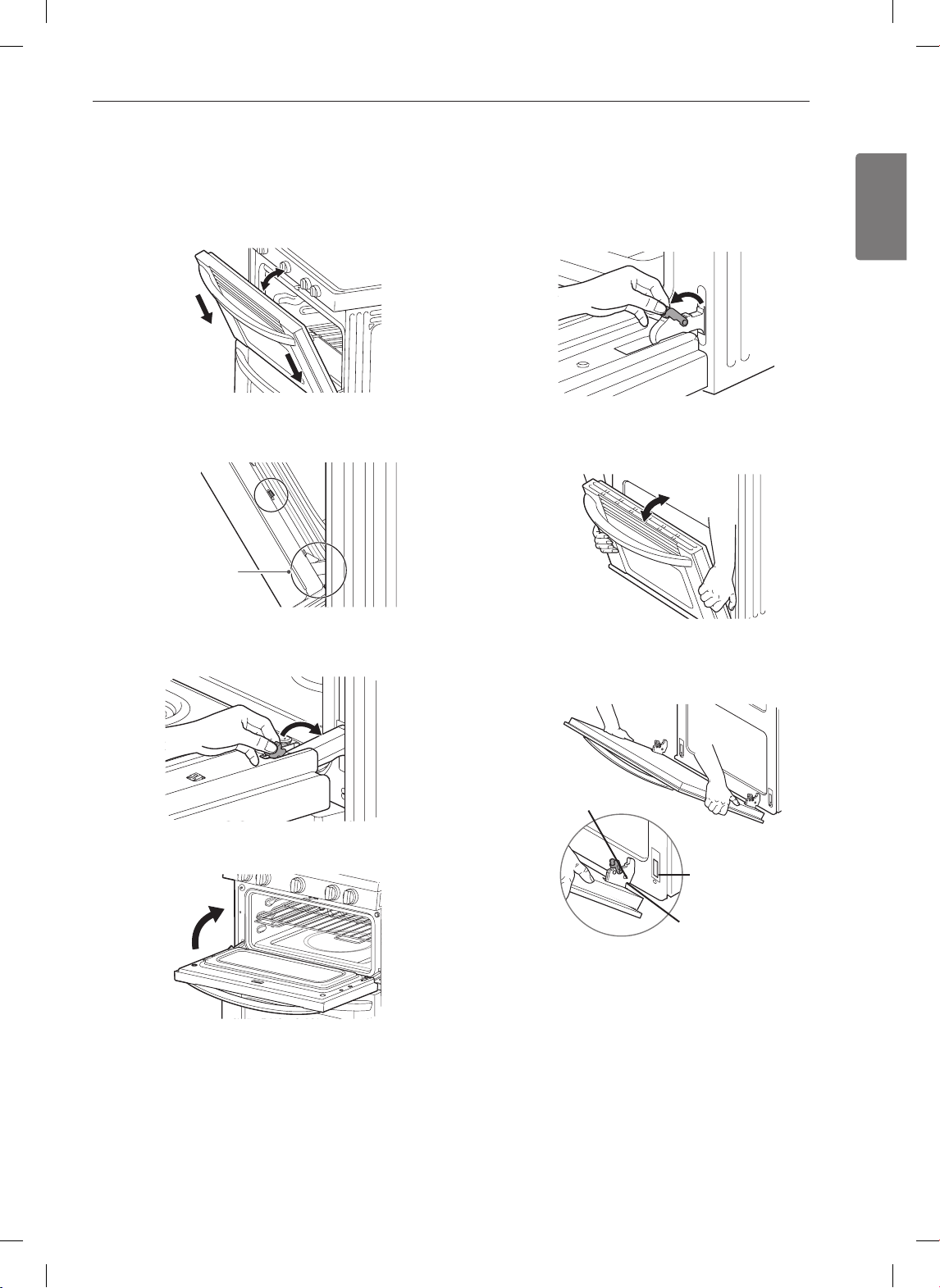
39
CARE AND CLEANING
ENGLISH
Replacing the Upper Oven Door
1
Be sure that the hinges are lined up at a 30 degree
position.
2
Slide the door back into the hinges until you hear a solid
click and the release buttons have engaged.
approximately 30°
3
Fully open the door. Push the hinge locks down onto the
hinge.
4
Close the oven door.
Removing the Lower Oven Door
1
Fully open the door. Lift up the hinge locks toward the
oven frame until they stop.
2
Close the door to the removal position (approximately five
degrees).
3
Lift the door up and out until the hinge arm is clear off of
the slot. Put the door on the floor.
Hinge arm
Bottom
edge of slot
Indentation
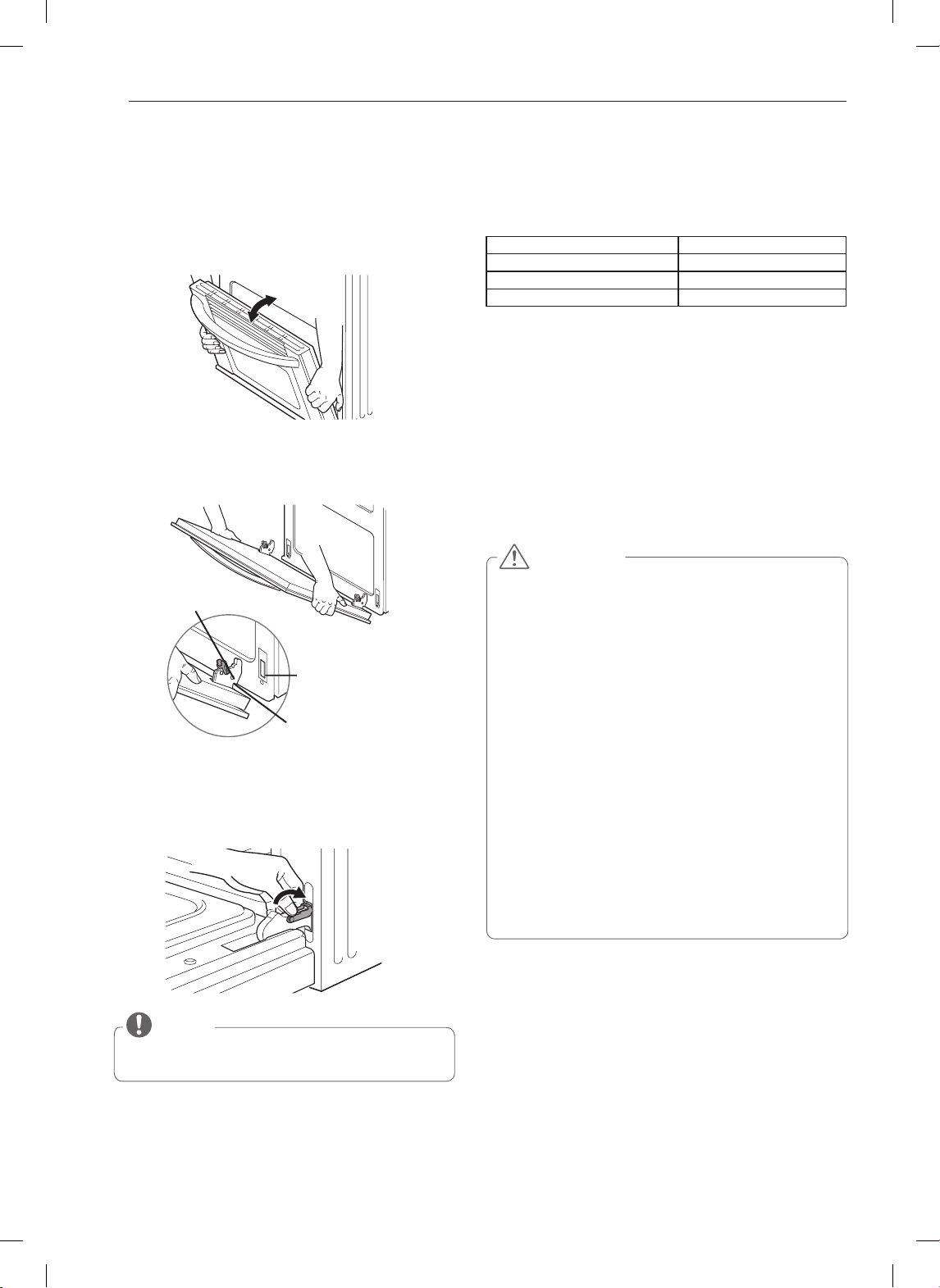
40
CARE AND CLEANING
Replacing the Lower Oven Door
1
Firmly grasp both sides of the door at the top and close
the door to the removal position (approximately five
degrees).
2
Seat the indentation of the hinge arm into the bottom
edge of the hinge slot.
Hinge arm
Bottom
edge of slot
Indentation
3
Open the door to its full extension. Push the hinge locks
down against the front frame of the oven cavity to the
locked position. Close the oven door.
NOTE
If the door will not fully open, the indentation is not
seated correctly in the bottom edge of the slot.
Soil Level Cycle Setting
Lightly Soiled Oven Cavity
2 Hour Self Clean
(p. 40)
Moderately Soiled Oven Cavity
3 Hour
Self Clean
(p. 40)
Heavily Soiled Oven Cavity
4 Hour Self Clean
(p. 40)
y
DO NOT leave small children unattended near the appli-
ance.
During the self cleaning cycle, the outside of the
range can become very hot to the touch.
y
If you have a pet bird, move it to another well-ventilated
room.
Some birds are extremely sensitive to the fumes
given off during the self cleaning cycle of any range.
y
DO NOT wrap the oven walls, racks, bottom or any
other part of the range with aluminum foil or any other
material.
Doing so will destroy the heat distribution, pro-
duce poor baking results, and cause permanent damage
to the interior of the oven (aluminum foil will melt to the
interior surface of the oven).
y
DO NOT force the door open.
This can cause damage
to the automatic door locking system. Use care when
opening the oven door after the Self Cleaning cycle.
Stand to the side of the oven when opening the door to
allow hot air or steam to escape. The oven may still be
very hot.
y
Do not touch the oven broil element until it has com-
pletely cooled.
CAUTION
SELF CLEAN (Upper & Lower Oven)
The SELF CLEAN cycle uses above normal cooking tempera-
tures to clean the oven cavity. You may see some smoke and
smell an odor the first few times the oven is cleaned. This is
normal and will lessen in time. Smoke may also occur if the
oven is heavily soiled. During self clean, the kitchen should
be well ventilated to minimize the odors from cleaning. The
upper and lower oven SELF CLEAN cannot be operated
simultaneously.
Inside of the Oven
Cleaning Guide
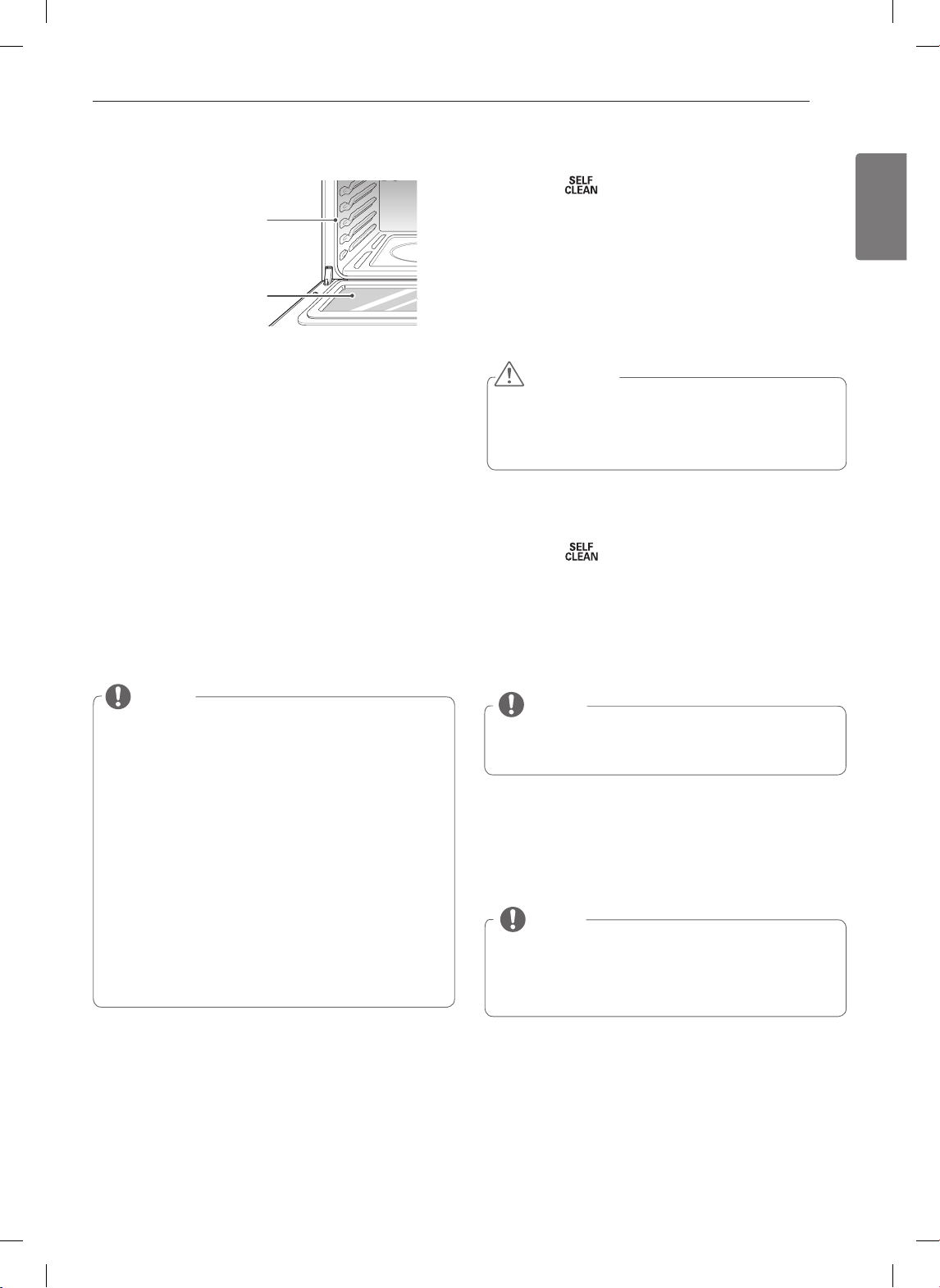
41
CARE AND CLEANING
ENGLISH
Before Starting SELF CLEAN
Do not hand clean the
oven door gasket
Hand clean the door
y
Remove the oven racks, broiler pan, broiler grid, all
cookware, aluminum foil or any other material from the
oven.
y
The kitchen should be well ventilated to minimize the
odors from cleaning.
y
If running a self clean in one of the ovens, the other
oven can not be used.
y
Wipe any heavy spillovers on the bottom of the oven.
y
Make sure that the oven light bulb cover is in place and
the oven light is off.
y
The oven light cannot be turned on during a self clean
cycle. The oven light cannot be turned on until the oven
temperature has cooled below 500˚F (260˚C) after a self
clean cycle is complete.
y
Fine lines may appear in the porcelain because it went
through heating and cooling. This is normal and will not
affect performance.
(example: set for 3:00 AM/PM)
CAUTION
DO NOT
force the oven door open when
m
is displayed.
The oven door will remained locked until the oven tem-
perature has cooled. Forcing the door open will damage
the door.
NOTE
y
Clean the frame of the oven and door with hot soapy
water. Rinse well.
y
Do not clean the oven door gasket. The oven door
gasket is made of a woven material that is essential
for a good seal. Care should be taken not to rub, dam-
age, or remove this gasket.
y
Do not open the oven door until the self clean cycle is
complete.
y
The oven door can become extremely hot. Do not
touch the oven door until it has cooled down.
y
You may see some smoke and smell an odor the first
few times the oven is cleaned. This is normal.
y
As the oven heats, you may hear sounds of metal
parts expanding and contracting. This is normal.
y
A self clean cycle cannot be started if the Oven Lock-
out feature is active.
After Self Clean
y
You may notice some white ash in the oven. Wipe it off
with a damp cloth after the oven cools.
y
If the oven is not clean after one clean cycle, repeat the
clean cycle.
y
If the oven racks were left in the oven and do not slide
smoothly after a clean cycle, wipe racks and rack sup-
ports with a small amount of vegetable oil to make them
glide easier.
1
Press the key.
The oven defaults to the recommended three hour self
clean for a moderately soiled oven. Press twice for a two
hour self clean and three times for a four hour self clean.
2
Press the
q
key.
Once the self clean is set, the oven door will lock automati-
cally and
m
will display. You will not be able to open the oven
door until the oven is cooled. The lock will release automati-
cally when the oven has cooled.
1
Press the key.
The oven defaults to the recommended three hour self
clean for a moderately soiled oven. Press twice for a two
hour self clean and three times for a four hour self clean.
2
Press the
W
key.
3
Use the keypad to enter in the time of day that you would
like the oven to start the Self Clean cycle (ex.
3, 0, 0
).
NOTE
The Delayed Self Clean start time can only be set 11 hours
and 59 minutes ahead. To set for 12- 24 hours in advance,
see “How to change hour mode on clock.”
4
Press the
q
key
Once the self clean is set, the oven door will lock automati-
cally and
m
will display. You will not be able to open the oven
door until the oven is cooled. The lock will release automati-
cally when the oven has cooled.
It may become necessary to cancel or interrupt a self
clean cycle due to excessive smoke or fire in the oven.
To Cancel the Self Clean function, press the
Y
or
Z
key.
NOTE
To Set Self Clean
To Set Self Clean with a Delayed Start
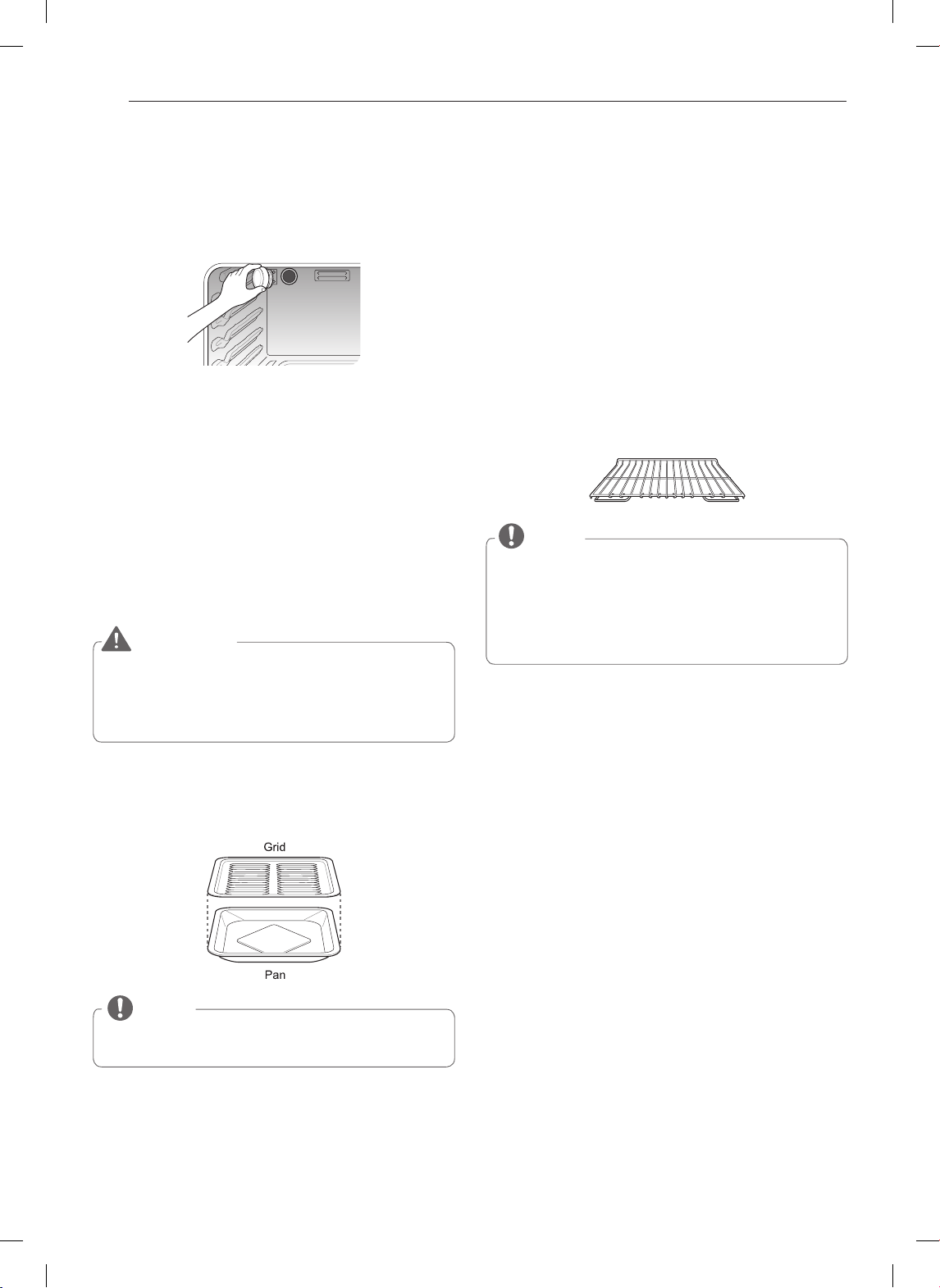
42
CARE AND CLEANING
Changing the Oven Light
The oven light is a standard 40-watt appliance bulb. It will
turn on when the oven door is open. When the oven door is
closed, press the
M
or
Q
key to turn the light on or off.
To replace the oven light
1
Unplug the range or disconnect power.
2
Turn the glass bulb cover in the back of the oven counter-
clockwise to remove.
3
Turn the bulb counterclockwise to remove from socket.
4
Insert the new bulb and turn it clockwise.
5
Insert the glass bulb cover and turn it clockwise.
6
Plug in the range or reconnect the power.
WARNING
y
Make sure that the oven and bulb are cool.
y
DISCONNECT the electrical power to the range at the
main fuse or circuit breaker panel. Failure to do so can
result in severe personal injury, death, or electrical
shock.
Broiler Pan and Grid
(sold separately)
3
Wash and rinse the broiler pan and grid in hot water with
a soap-filled or plastic scouring pad. If food has burnt
on, sprinkle the grid with cleaner (while hot) and cover
it with wet paper towels or a dishcloth. Soaking the pan
will remove burnt-on foods. Both the broiler pan and grid
may be cleaned with a commercial oven cleaner. Both the
broiler pan and grid can also be cleaned in a dishwasher.
Oven racks
Remove the oven racks before operating the self clean cycle.
1
Food spilled into the tracks could cause the racks to be-
come stuck. Clean with a mild, abrasive cleaner.
2
Rinse with clean water and dry.
NOTE
If the racks are cleaned using the self clean cycle (not
recommended), the color will turn slightly blue and the
finish will become dull. After the self clean cycle is com-
plete, and the oven has cooled, rub the sides of the racks
with wax paper or a cloth containing a small amount of oil.
This will make the racks glide easier into the rack tracks.
NOTE
Remove the broiler pan and grid from the oven before
operating the self clean cycle.
1
After broiling, remove the broiler pan from the oven. Re-
move the grid from the pan.
2
Carefully pour out the grease from the pan into a proper
container.
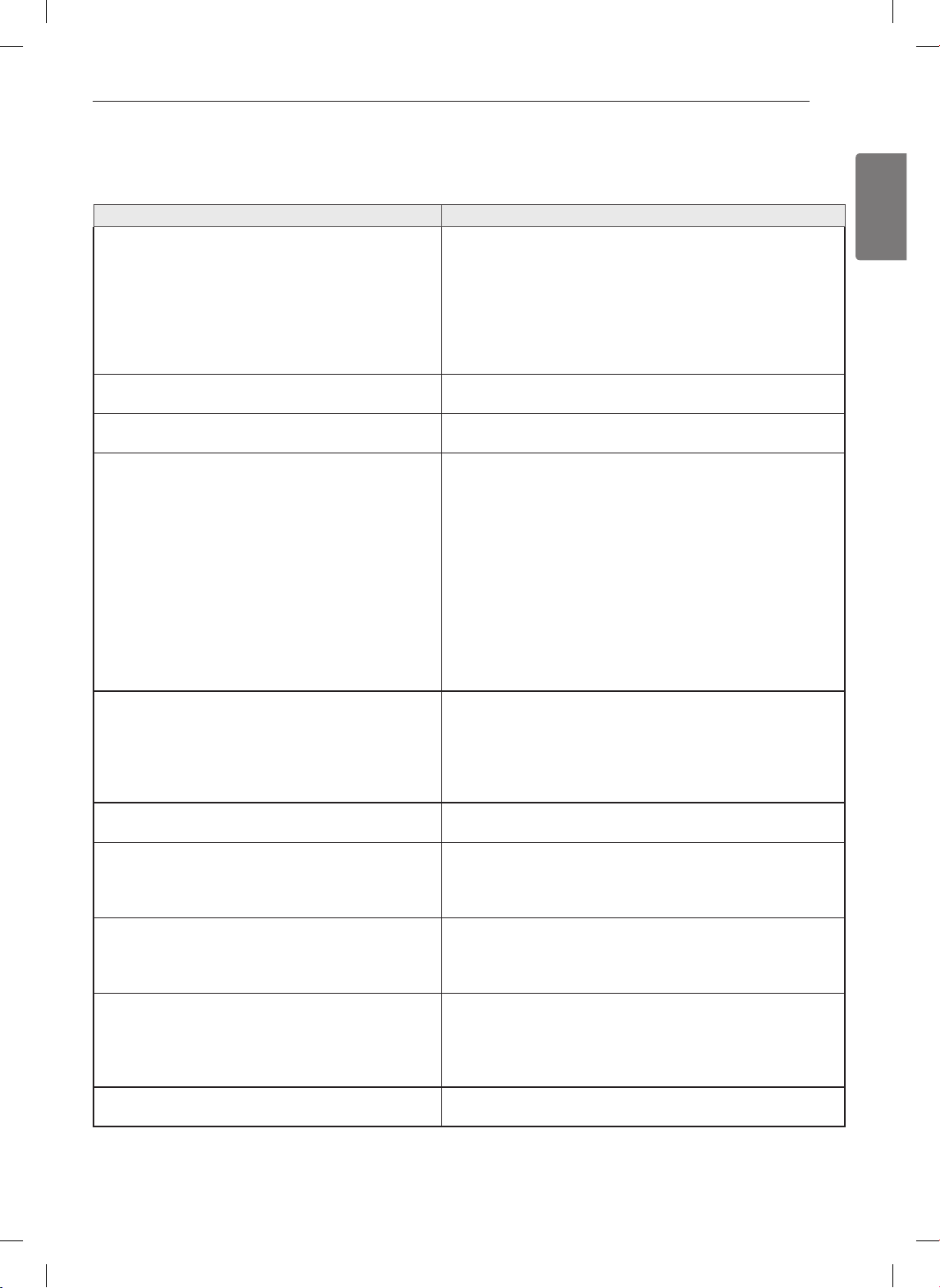
43
BEFORE REQUESTING SERVICE
ENGLISH
BEFORE REQUESTING SERVICE
Symptoms and Questions Possible Cause/Solution
Top burners do not light or do not burn evenly.
y
Make sure that the electrical plug is inserted into a live, properly
grounded outlet.
y
Remove the burners and clean them. Check the electrode area
for burnt-on food or grease. See “Burner caps/burner head clean-
ing” in the Care and Cleaning section.
y
Make sure that the burner parts are installed correctly.
See “Burner caps/heads cleaning” in the Care and Cleaning sec-
tion.
Burner flames are very large or yellow. If the range is connected to LP gas, contact the technician who
installed your range or made the conversion.
Surface burners light but the oven does not. Make sure that the oven gas shut-off valve, located behind the
range, is fully open.
Food does not bake or roast properly.
y
Incorrect oven control settings. See “Using control panel” in the
How to Use section.
y
Incorrect rack position. See “Replace and remove Oven rack” or
“Shelf position Baking time” in the How To Use section.
y
Incorrect cookware is being used. See “Roast” or “Bake” in the
How To Use Section.
y
Oven thermostat needs adjustment.
See “How to adjust the temperature” in the Operating Instruc-
tions section.
y
The Clock is not set correctly. See “How to set the clock and the
timer” in the Operating Instructions section.
y
Aluminum foil used improperly in the oven. See “Using the
oven.”
Food does not broil properly in the oven.
y
Incorrect oven control settings. See “Using control panel” in the
How to Use section.
y
The oven door is not closed. See “Using the oven” in the How to
Use section.
y
Aluminum foil used on the broiling pan and grid is not fitted prop-
erly.
Oven temperature is too hot or too cold. The oven thermostat needs adjustment. See “How to adjust the
temperature” in the Operating Instructions section.
Clock and timer does not work.
y
Make sure the electrical plug is inserted into a live, properly
grounded outlet. Replace the fuse or reset the circuit breaker.
y
Improper oven control settings. See “How to set the clock and
the timer” in the Operating Instructions section.
Oven light does not work.
y
The light bulb is loose or defective. Tighten or replace the bulb.
y
The plug on the range is not completely inserted in the electrical
outlet. Make sure the electrical plug is inserted into a live, prop-
erly grounded outlet.
Self clean is not working.
y
The oven temperature is too high to set a self clean operation.
Allow the range to cool down to room temperature and reset the
controls.
y
Improper oven control settings. See “SELF CLEAN” in the Care
and Self Cleaning section.
“Crackling” or “popping” sound. This is the sound of the metal heating up and cooling down during
both the cooking and cleaning functions. This is normal.

44
BEFORE REQUESTING SERVICE
Symptoms and Questions Possible Cause/Solution
Too much smoke during the self clean cycle. Too much soil in the oven. Open the windows to get rid of the
smoke from the room. Press the
Y
or
Z
key. Wait until the
m
light goes off before trying to open the oven door. Wipe up the
excess soil and reset the clean cycle.
The oven door does not open after a self clean cycle. The oven temperature is too high. Wait up to one hour to cool
down.
The oven door is not clean after a self clean cycle.
y
Incorrect oven control settings. See “SELF CLEAN” in the Care
and Cleaning section.
y
The oven was heavily soiled. Clean up heavy spills before begin-
ning the self clean cycle. Heavily soiled ovens may need either a
longer self clean or two self clean cycles.
“CLOSE DOOR TO CONTINUE BROILING” or “DOOR
OPENED” appears in the display.
Close the oven door.
"DOOR LOCKED" message appears when you want to
cook.
The oven door is locked because the temperature inside of the
oven is too high. Press the
Y
or
Z
key.
Oven control beeps and displays an F error code.
y
Press the
Y
or
Z
key and wait for one hour.
y
Check the main gas shut-off valve or the oven gas shut-off valve
and call for service.
y
Remove the power from the range for five minutes and then
reconnect the power. If the function error code repeats, call for
service.
The oven racks were cleaned in a self clean cycle. Apply a small amount of vegetable oil to a paper towel and wipe
the edges of the oven racks. Do not use lubricant sprays.
Clock is flashing. Power outage or surge. Reset the clock. If the oven was in use, you
must reset it by pressing the
Y
or
Z
key. Reset the clock
and any cooking function.
“Burning” or “oily” odor emitting from the vent. This is normal in a new oven. To speed the process, set a self clean
cycle for a minimum of three hours. See “SELF CLEAN” in the
Care and Cleaning section.
Strong odor. An odor from the insulation around the inside of the oven is normal
for the first few times the oven is used.
Fan noise (convection models) The convection fan may turn on and off automatically.
This is normal.
Convection fan not working (convection models). The preheating temperature has not been reached. The Fan will
start automatically once the preheating temperature is reached.
Burners are not lighting properly after cleaning the cook-
top surface.
Make sure that the burner heads and caps are completely dry and
properly positioned.
When lighting just one burner, clicking noise is heard from
all the burners.
This is normal. Electric spark igniters from the burners cause the
clicking noise. All the spark igniters on the cooktop will activate
when igniting just one burner.
PF(Power Failure) displayed
/ Display Time is flashing
Depending on the model of your range, the display will either show
“PF” or a flashing clock. This means that the product has just been
plugged in, or that it has experienced a power interruption. To clear
the “PF” message, press the “Clear/Off” key on the oven controls.
If your oven displays a flashing clock, then press the “Clock” key
and reset the time, or press any key to stop flashing.
45
WARRANTY
ENGLISH
To Prove Warranty Coverage Retain your Sales Receipt to prove date of purchase.
A copy of your Sales Receipt must be submitted at the time warranty
service is provided.
To Obtain the Nearest Authorized Service Center
or Sales Dealer, or to Obtain Product, Customer, or
Service Assistance
Call 1-800-243-0000
(Phone answered 24 hours - 365 days a year)
and choose the appropriate prompt from the menu; or visit our web-
site at:
http://us.lgservice.com.
LG Electronics Inc. will repair or replace your product, at LG’s option, if it proves to be defective in material or workmanship un-
der normal use, during the warranty period set forth below, effective from the date of original consumer purchase of the product.
This limited warranty is good only to the original purchaser of the product and effective only when used in U.S.A.
WARRANTY PERIOD HOW SERVICE IS HANDLED
One Year
From the date of the
original purchase.
Any part
of the oven that fails due to a defect in materials or workmanship. During this
full
one-year warranty
, LG will also provide,
free of charge
, all labour and in-home service
to replace the defective part.
THIS WARRANTY IS IN LIEU OF ANY OTHER WARRANTIES, EXPRESS OR IMPLIED, INCLUDING WITHOUT LIMITATION, ANY
WARRANTY OF MERCHANTABILITY OR FITNESS FOR A PARTICULAR PURPOSE. TO THE EXTENT ANY IMPLIED WARRANTY
IS REQUIRED BY LAW, IT IS LIMITED IN DURATION TO THE EXPRESS WARRANTY PERIOD ABOVE. LG WILL NOT BE LI-
ABLE FOR ANY CONSEQUENTIAL, INDIRECT, OR INCIDENTAL DAMAGES OF ANY KIND, INCLUDING LOST REVENUES OR
PROFITS, IN CONNECTION WITH THE PRODUCT. SOME STATES DO NOT ALLOW LIMITATION ON HOW LONG AN IMPLIED
WARRANTY LASTS OR THE EXCLUSION OF INCIDENTAL OR CONSEQUENTIAL DAMAGES, SO THE ABOVE LIMITATIONS
OR EXCLUSIONS MAY NOT APPLY TO YOU.
THIS LIMITED WARRANTY DOES NOT APPLY TO:
1.
Service calls to correct the installation of your appliance, to instruct you how to use your appliance, to replace house fuses or
correct house wiring, or to replace owner-accessible light bulbs.
2.
Repairs when your appliance is used in other than normal, single-family household use.
3.
Pickup and delivery. Your appliance is designed to be repairable in the home.
4.
Damage resulting from accident, alteration, misuse, abuse, fire, flood, improper installation, acts of God, or use of products not
approved by LG Corporation.
5.
Repairs to parts or systems resulting from unauthorized modifications made to the appliance.
6.
Replacement parts or repair labour costs for units operated outside the united states.
7.
Any labour costs during the limited warranty period.
This warranty is extended to the original purchaser for products purchased for home use within the U.S.A. In Alaska, the war-
ranty excludes the cost of shipping or service calls to your home.
Some states do not allow the exclusion or limitation of incidental or consequential damages, so this exclusion or limitation may
not apply to you. This warranty gives you specific legal rights, and you may also have other rights which vary from state to state.
To know what your legal rights are, consult your local or state consumer affairs or your state’s Attorney General.
CUSTOMER ASSISTANCE INFORMATION:
WARRANTY

MEMO

MANUAL DE PROPIETARIO
ESTUFA DE GAS CON
HORNO DOBLE
LDG3016ST
LDG3015ST
LDG3015SB
LDG3015SW
Lea detenidamente estas instrucciones antes utilizar y
guárdelas como referencia para el futuro.
ESPAÑOL
www.lg.com
P/No.: MFL33029607

2
IndIce de contenIdos
3 CARACTERÍSTICAS DEL PRODUCTO
4 INSTRUCCIONES DE SEGURIDAD
IMPORTANTES
10 ANTES DE USAR
10 Accesorios
11 Componentes
12 CÓMO USAR
12 Hornallas a gas de la superficie
12 - Antes de usar
13 - Hornillas a gas
13 - Uso de las hornillas a gas de la superficie
14 - Utensilios ubicados sobre la estufa
15 - Uso de la parrilla (Modelo LDG3016ST sola-
mente)
16 Cómo usar el horno
16 - Antes de usar
18 - Cómo usar el panel de control
20 Instrucciones de funcionamiento
20 - Auto conversión de convección
20 - Temperatura
20 - Luz de alarma de precalentado
20 - La luz del horno
20 - Volumen del bíper
21 - Fahrenheit o Celsius
21 - Reloj
22 - Temporizador
22 - De bloqueo
23 Cómo extraer y volver a colocar los estantes del
horno
24 HORNEAR (Horno superior e inferior)
25 Precalentamiento y ubicación de las bandejas
26 ASAR (Horno superior)
28 COCCIÓN CON TEMPORIZADOR
(Horno superior e inferior)
28 COCCIÓN CON TEMPORIZADOR RETARDADO
(Horno superior e inferior)
29 Como usar la convección del horno inferior
(LDG3016ST)
29 - CONVECCIÓN HORNEADO (LDG3016ST)
31 - CONVECCIÓN ASADO PARA EL HORNO
INFERIOR (LDG3016ST)
32 Características especiales
32 - PIZZA (Horno superior)
32 - CALENTAR (Horno superior e inferior)
33 - LEVAR (Para el horno inferior)
33 - FAVORITOS (Para el horno inferior)
34 - SABBAT (Horno superior e inferior)
35 CUIDADO Y LIMPIEZA
35 Hornilla a gas de la superficie
35 - Cómo extraer y volver a colocar las hornillas a
gas de la superficie
35 - Cabezales/tapas de las hornillas
36 - Parrillas de las hornillas
37 - Superficie de la estufa
37 - Superficies de acero inoxidable
37 - Conductos de ventilación del horno
37 - Panel de control
37 - Panel frontal y perillas
37 Parte exterior del horno
37 - Elementos pintados y decorativos
38 - Puerta del horno
38 - Cómo extraer y volver a colocar las puertas
40 Como limpiar el Interior del horno
40 - AUTO LIMPIEZA (Horno superior e inferior)
42 - Cómo cambiar la luz del horno
42 - Bandeja y rejilla para asar
(Se vende por sepa-
rado)
42 - Bandejas del horno
43 ANTES DE SOLICITAR SERVICIO
TÉCNICO
45 GARANTÍA
INDICE DE CONTENIDOS
3
CARACTERÍSTICAS DEL PRODUCTO
ESPAÑOL
DIVERSOS TAMAÑOS DE HORNILLAS A GAS
Elija la hornilla que mejor se adapte al tamaño de su batería de cocina.
Es posible utilizar varias hornillas a la vez para cocinar distintas cosas al mismo tiempo.
ESTUFA A GAS SEGURA, CONVENIENTE
Proporciona seguridad y conveniencia para cocinar.
Su sistema Superboil ("super hervido") (de 17000 BTU) puede rápidamente hacer hervir una olla de
agua.
HORNO SUPERIOR / HORNO INFERIOR
Hornos superior e inferior separados.
Puede elegir utilizar un horno o ambos, dependiendo del tamaño de su comida.
SISTEMA DE AUTO LIMPIEZA (SELF CLEAN)
Excelente para la limpieza fácil del aparato.
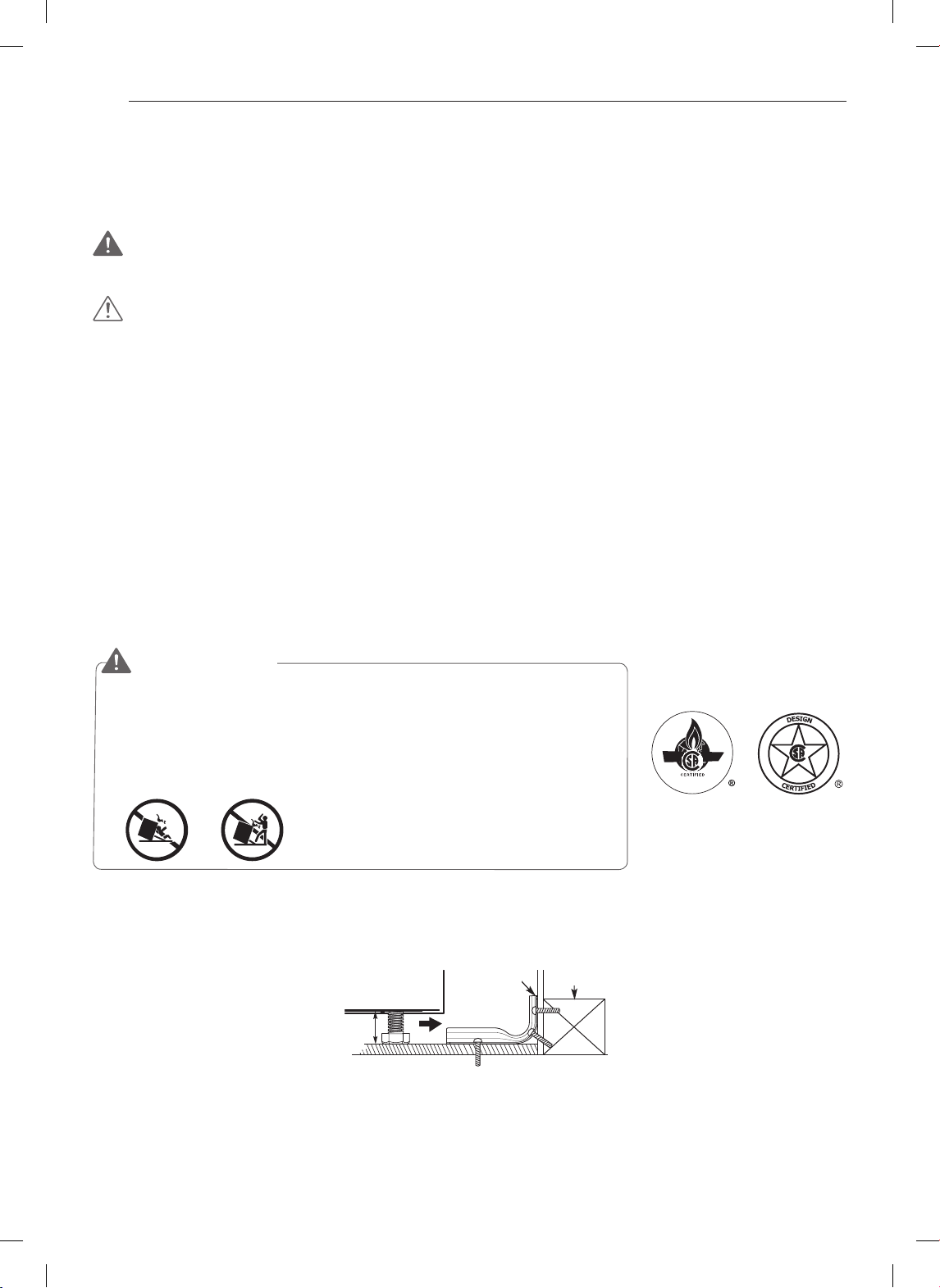
4
INSTRUCCIONES DE SEGURIDAD IMPORTANTES
Cumpla siempre con lo indicado en las siguientes señales de avisos de seguridad para evitar situaciones peligrosas y para asegu-
rarse de obtener el máximo rendimiento de su producto.
ADVERTENCIA
Indica una situación peligrosa que puede resultar en lesiones graves o aún la muerte si no es evitada.
PRECAUCIÓN
Indica una situación peligrosa que, de no ser evitada, puede resultar en lesiones menores a moderadas.
QUÉ HACER SI HUELE GAS
1. Abra las ventanas.
2.
NO
intente encender ningún aparato.
3.
NO
toque ningún interruptor eléctrico.
4.
NO
utilice ningún teléfono de su edificio.
5. Comuníquese de inmediato con su proveedor de gas desde el teléfono de un vecino. Siga
las instrucciones del proveedor de gas.
6. Si no puede comunicarse con su proveedor de gas, contáctese con el departamento de
bomberos.
DISPOSITIVO ANTI-VUELCO
ADVERTENCIA
y
NO se pare ni se siente en la puerta. Instale el Soporte Anti-Vuelco que se encuentra en el envoltorio junto a la estufa.
- Si la estufa llegara a volcarse, podría provocarle lesiones al caerse líquidos o comidas calientes, o la estufa en sí misma.
- En caso de tener que separar la estufa de la pared por motivos de limpieza, mantenimiento, o por cualquier otra razón,
asegúrese de reajustar el dispositivo Anti-Vuelco cuando la estufa vuelva a colocarse contra la pared.
y
Para reducir el riesgo de que la estufa se vuelque hacia adelante, ésta debe asegurarse instalando de manera apropiada los
dispositivos anti-vuelco.
y
Para verificar que el soporte anti-vuelco está correctamente instalado: Quite cualquier elemento ubicado sobre la estufa.
Agarre la punta superior trasera de la estufa e intente inclinarla hacia adelante con cuidado. Verifique que los dispositivos
anti-vuelco estén bien fijados.
y
Extraiga los cajones calentadores o de almacenamiento y observe que la pata de nivelación trasera esté completamente
insertada en el soporte anti-vuelco.
y
Consulte el manual de instalación para aprender cómo instalar correctamente el soporte anti-vuelco.
INSTRUCCIONES DE SEGURIDAD IMPORTANTES
•
TODAS LAS ESTUFAS PUEDEN VOLCARSE
•
PUEDE OCASIONAR LESIONES A LAS PERSONAS
•
INSTALE LOS DISPOSITIVOS ANTI-VUELCO QUE SE
ENCUEN TRAN EN EL ENVOLTORIO JUNTO A LA ESTUFA
•
LEA LAS INSTRUCCIONES DE INSTALACIÓN
Soporte
anti-vuelco
Placa de
pared
Los tornillos
deben penetrar
la madera o el
concreto
Aproximadamente
0,65" (16,5 mm.)
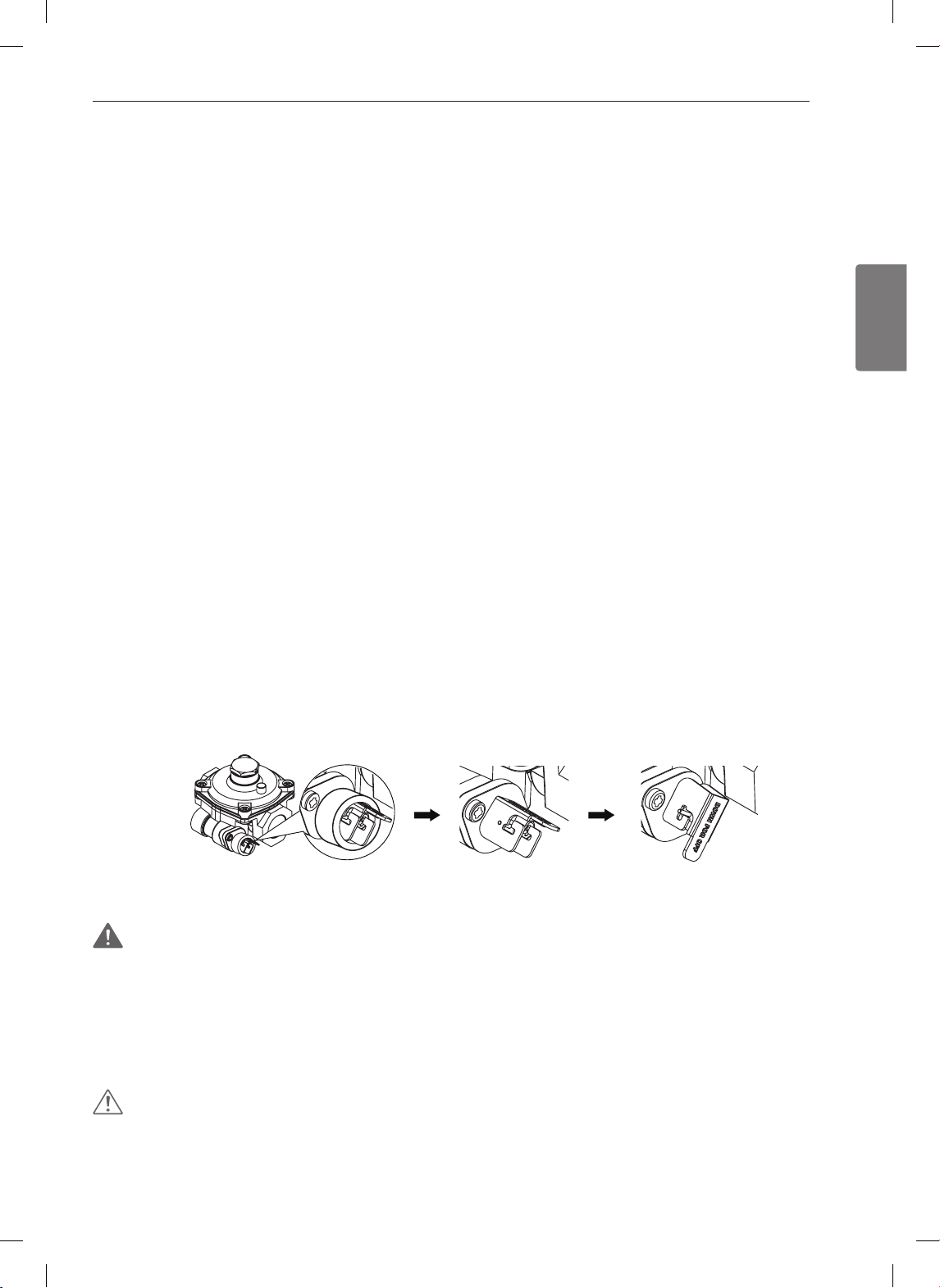
5
INSTRUCCIONES DE SEGURIDAD IMPORTANTES
ESPAÑOL
AVISO IMPORTANTE DE SEGURIDAD
La Ley de Cumplimiento dispone que el Gobernador de California debe publicar una lista de sustancias conocidas por el Estado que
pueden ocasionar defectos de nacimiento u otros daños reproductivos; asimismo, requiere que se advierta a los clientes los efectos de
la exposición a tales sustancias.
Los aparatos a gas pueden ocasionar una exposición menor a cuatro de estas sustancias, a saber, benceno, monóxido de carbono, form-
aldehído y hollín, causadas principalmente por la combustión imperfecta de gas natural o gas LP.
Las hornillas correctamente ajustadas minimizan la combustión imperfecta. El ajuste correcto de las hornallas lo indica su llama más
bien azulada que amarilla. La exposición a las mencionadas sustancias puede minimizarse abriendo ventanas o utilizando un extractor de
aire o campana de ventilación.
PRECAUCIONES DE SEGURIDAD
Solicite al instalador que le muestre dónde está ubicada la válvula de cierre de gas de la estufa y cómo cerrarla en caso
de ser necesario.
y
Asegúrese de que su estufa sea correctamente instalada y conectada a tierra por un instalador autorizado, de conformidad con las
instrucciones de instalación. Cualquier mantenimiento y servicio debe ser efectuado solamente por instaladores de estufas de gas
o técnicos de servicio autorizados.
y
Conecte su estufa únicamente a tomacorrientes de 120 volts. No remueva las patas circulares de conexión a tierra del enchufe.
En caso de tener alguna duda acerca de la puesta a tierra del sistema eléctrico de su hogar, es su obligación y res- ponsabilidad
personal reemplazar el tomacorriente sin conexión a tierra por un tomacorriente de tres patas correctamente conectado a tierra,
de conformidad con el Código Eléctrico Nacional. No conecte la estufa a ningún cable de extensión.
y
NO
utilice enchufes adaptadores, cables de extensión, ni remueva las patas de conexión a tierra del cable de corriente eléctrica, a
fin de prevenir peligros de incendio o descargas eléctricas. No seguir esta advertencia puede ocasionar lesiones serias, incendios
o aún la muerte.
y
Para prevenir una circulación pobre de aire, coloque el aparato lejos del lugar de tránsito de la cocina y fuera de lugares donde
circulen corrientes de aire.
y
NO
intente reparar o reemplazar ninguna pieza del aparato a menos que así lo indique específicamente este manual. Todos los
servicios a realizar en la estufa deben ser efectuados por un técnico autorizado.
y
Asegúrese de que todos los materiales de empaque sean removidos de la estufa antes de ponerla en funcionamiento, a fin de
evitar que el material de empaque se incendie y provoque daños por humo o incendio.
y
Asegúrese de que su estufa ha sido correctamente ajustada por un técnico de servicio o instalador autorizado para el tipo de gas a
ser utilizado (gas natural o gas LP). Su estufa es apta para ser utilizada con cualquiera de los dos tipos de gas. Consulte las instruc-
ciones de instalación.
ADVERTENCIA
Estos ajustes deben ser efectuados por un técnico de servicio autorizado de conformidad con las instrucciones del fabricante
y con todos los códigos y requisitos de la autoridad competente. No seguir estas instrucciones podría ocasionar serias lesiones o daños
al producto. La agencia autorizada que se encargue de realizar estos ajustes asumirá la responsabilidad resultante de los mismos.
y
Luego de utilizar el aparato por un tiempo considerable, el piso donde el mismo se encuentra apoyado puede alcanzar altas tem-
peraturas. Debe tener en cuenta que muchos recubrimientos de piso no son aptos para resistir este nivel de calor.
y
NUNCA
instale la estufa sobre pisos de vinilo o linóleo, ya que éstos no son resistentes a su nivel de calor. Nunca instale el
aparato directamente sobre alfombras de cocina.
PRECAUCIÓN
Los artículos de interés para los niños no deben ubicarse en armarios que se encuentren encima de la estufa ni en la pared sobre la que
se encuentra la misma. Si un niño se trepa a la estufa para alcanzar los objetos de su interés podría resultar seriamente herido.
y
NO
deje a los niños solos o sin supervisión cuando la estufa esté caliente o en funcionamiento. Podrían sufrir serias quema- duras.
y
NO
permita que nadie se trepe, pare o cuelgue de la puerta del horno, cajón calentador o cocina. Esto podría dañar la estufa y aún
volcarla hacia adelante, causando lesiones personales severas.
Posición abierta
de la palanca
Posición abierta de la
palanca (sin empaque)
Posición cerrada
de la palanca
6
INSTRUCCIONES DE SEGURIDAD IMPORTANTES
ADVERTENCIA
y
Este producto contiene quimicos conocidos por el Estado de California de causar cáncer.
Lávese las manos después de
manipular.
ADVERTENCIA
y
NUNCA
utilice el artefacto para calentar o aclimatar la habitación. Hacerlo podría causar la intoxicación por monóxido de
carbono y el sobrecalentamiento del horno.
y
NUNCA
use ropa suelta o prendas colgantes mientras utiliza el artefacto. Tenga cuidado cuando deba alcanzar objetos que
se encuentren ubicados en alacenas encima de la estufa. Materiales inflamables podrían incendiarse si entran en contacto
con alguna llama o con las superficies calientes del horno, pudiendo causar quemaduras severas.
y
NO
coloque materiales inflamables dentro del horno o cerca de la estufa.
y
NO
coloque ni utilice materiales combustibles, como ser gasolina u otros vapores y líquidos inflamables, en las inmediacio-
nes de este o cualquier otro aparato.
y
NO
permita cocinar grasas u otros materiales inflamables en o cerca de la estufa.
y
NO
use agua en caso de incendio producido por grasas. Nunca intente tocar una sartén en llamas. Apague todos los con-
troles. Extinga las llamas de la sartén en la hornilla de la superficie cubriendo completamente la sartén con una tapa, bande-
ja para hornear o una bandeja chata. Utilice un químico seco multiuso o un extinguidor de incendio tipo espuma.
y
Se puede extinguir un incendio producido por grasas cubriéndolo con bicarbonato, o utilizando un químico seco multiuso o
extinguidor de incendio tipo espuma.
y
Si hay llamas en el horno superior o en el horno inferior, éstas pueden apagarse completamente cerrando la tapa del horno
y girando la perilla a la posición de apagado, o bien utilizando un químico seco multiuso o extinguidor de incendios tipo
espuma.
y
NO
utilice el horno o el cajón calentador como lugar de almacenamiento.
y
Espere a que las rejillas, hornillas y otras superficies se enfríen antes de tocarlas.
y
NUNCA
obstruya las ventilaciones (orificios de aire) de la estufa. Éstas permiten la entrada y salida de aire necesarias para
que la estufa funcione apropiadamente, con la combustión correcta. Las aperturas de aire están ubicadas en la parte trasera
de la estufa, en la parte superior y en la parte inferior de la puerta del horno, y en la parte inferior de la estufa.
y
NUNCA
cubra ninguna ranura, orificio o conducto ubicado al pie del horno. Tampoco cubra ningún estante con materiales
tales como papel de aluminio. Hacerlo obstruiría la salida de aire a través del horno, lo que podría ocasionar la intoxicación
por monóxido de carbono. Los revestimientos en papel de aluminio también pueden retener el calor, ocasionando un peli-
gro de incendio.
y
NUNCA
bloquee la ventilación del horno o las tomas de entrada de aire, porque obstruiría de esta forma el flujo de com-
bustión y la ventilación de aire. Esto limitaría la circulación de aire a la hornilla y podría provocar la intoxicación por monóxido
de carbono.
y
Los fuertes rayones o impactos en las puertas de vidrio pueden ocasionar que el vidrio se rompa o se quiebre.
y
Si pisa, se apoya o se sienta en las puertas o cajones calentadores de la estufa, podrá resultar seriamente herido y podrá
también dañar el artefacto. No permita que los niños se trepen o jueguen alrededor de la estufa. El peso de un niño sobre
una puerta abierta del aparato puede provocar que el mismo se vuelque hacia adelante, provocándole serias quemaduras u
otras heridas.
y
Las fugas de gas en el aparato pueden generar una grave situación. Las fugas de gas pueden no ser detectadas sólo por el
olor. Los proveedores de gas recomiendan comprar e instalar un detector de gas aprobado por UL. Instale y utilice el detec-
tor de gas de acuerdo a las instrucciones de su fabricante.
y
El control de fugas de gas del aparato debe ser realizado de conformidad con las instrucciones del fabricante.
y
NO
utilice limpiadores comerciales de horno en los acabados del horno ni alrededor de ninguna parte del horno. Estos lim-
piadores dañan el acabado de las piezas del horno.
y
Para prevenir manchas o decoloraciones, limpie el aparato luego de cada uso.
y
NO
intente abrir o cerrar la puerta del horno, ni poner en funcionamiento el mismo, hasta que la puerta haya sido correcta-
mente instalada.
y
NUNCA
coloque sus dedos entre la bisagra y el marco frontal del horno. Los brazos de las bisagras son a resorte. Si los
golpea por accidente, la bisagra se cerrará de golpe contra el marco del horno y podría lastimarle los dedos.
PRECAUCIÓN
y
NO
utilice el horno para almacenar comida ni baterías de cocina.
y
Para evitar dañar la puerta del horno, no intente abrirla cuando la señal
Lock
está encendida.
y
NO
apoye peso excesivo ni se pare sobre una puerta abierta. Esto podría provocar que la estufa se vuelque hacia adelante,
que la puerta se rompa o que el usuario resulte herido.
y
NO
utilice la opción de horneado retardado para comidas altamente perecederas, tales como productos diarios, carne de
cerdo, aves, o mariscos.
ADVERTENCIA
y
Desconecte el suministro eléctrico antes de realizar cualquier mantenimiento o revisión al aparato.
y
NUNCA
use la puerta del artefacto como escalerilla o asiento, ya que esto puede causar que el aparato se vuelque hacia
adelante, provocándole serias heridas.
y
Este producto no debe ser instalado debajo de sistemas de ventilación tipo campana que direccionen el aire hacia abajo.
Esto podría causar problemas de combustión en las hornillas a gas e incluso incendios, ocasionando lesiones personales y
afectando el rendimiento funcional de la unidad.
7
INSTRUCCIONES DE SEGURIDAD IMPORTANTES
ESPAÑOL
HORNILLAS DE LA SUPERFICIE
ADVERTENCIA
y
Aunque la llama de la hornilla se apague, el gas continúa saliendo hasta que la perilla se gire a la posición "OFF" (APAGADO).
Si huele gas, abra una ventana de inmediato y ventile el lugar por cinco minutos antes de utilizar la hornilla. No desatienda
las hornillas cuando éstas se encuentren en posición "ON" (ENCENDIDO).
y
Utilice tamaños apropiados de cacerolas - NO
utilice cacerolas inestables o que puedan volcarse fácilmente. Seleccione ba-
terías con fondos planos lo suficientemente amplias para cubrir las parrillas de las hornillas. Para evitar derrames, asegúrese
de que las baterías sean lo suficientemente amplias para contener la comida adecuadamente. Esto ahorrará tiempo de lim-
pieza como así también evitará acumulaciones peligrosas de comida, ya que la comida salpicada o derramada en las parril-
las de las hornillas puede incendiarse. Use cacerolas con asas que puedan agarrarse fácilmente y conservarse frías.
PRECAUCIÓN
y
Asegúrese de que todos los controles de la superficie estén en la posición "OFF" (APAGADO) antes de abrir la llave de
suministro de gas de la estufa.
y
NUNCA
desatienda las hornillas de la superficie cuando estén encendidas con llama alta. Los desbordes pueden provocar
humo y derrames de grasa que pueden incendiarse.
y
Gire siempre las perillas a la posición "LITE" (ENC) para encender las hornillas superiores y asegúrese de que las éstas se
hayan encendido correctamente.
y
Verifique que el tamaño de la llama que sale de la hornilla no exceda los bordes de la batería. La llama excesiva es pelig-
rosa.
y
Utilice únicamente agarraderas secas - las agarraderas húmedas o mojadas en superficies calientes pueden provocar que-
maduras por el vapor. Asegúrese de que las asas de las baterías no estén cerca de las llamas abiertas de la estufa cuando
vaya a sacar la batería del fuego. No utilice toallas ni ningún otro producto de tela voluminoso. Utilice siempre agarraderas.
y
Si utiliza baterías de vidrio, asegúrese de que las mismas estén diseñadas para cocinar sobre la estufa.
y
A fin de prevenir quemaduras por el fuego ocasionado por materiales inflamables o por derrames, gire las asas de las bat-
erías hacia un costado o hacia la parte trasera de la estufa; no las ponga sobre las hornillas adyacentes.
y
NUNCA
deje ningún elemento sobre la estufa. El aire caliente proveniente del conducto de ventilación puede encender los
elementos inflamables y aumentar la presión en contenedores cerrados, lo que puede provocar que éstos estallen.
y
Vigile cuidadosamente la comida que se está friendo a fuego alto.
y
Caliente grasas siempre a fuego lento, y vigílelas mientras se calientan.
y
Si va a freír combinaciones de aceites y grasas, revuelva bien la mezcla antes de comenzar a calentarla.
y
De ser posible, utilice un termómetro profundo para grasas para prevenir el sobrecalentamiento de la grasa por encima del
punto de vaporización.
y
Use la mínima cantidad posible de grasa para freír. Llenar la sartén con demasiada grasa puede provocar derrames cuando
se agrega la comida.
y
NO
cocine las alimentos directamente sobre llama abierta en las hornillas de la superficie.
y
NO
utilice un wok sobre las hornillas de la superficie si éste tiene un anillo de metal redondo que deba ser colocado sobre
la parrilla de la hornilla para soportar el wok. Este anillo actúa como un concentrador de calor que puede dañar la parrilla de
la hornilla y/ el cabezal de la hornilla. También puede provocar el mal funcionamiento de la hornilla. Asimismo, puede provo-
car niveles de monóxido de carbono superiores a los permitidos por las normativas vigentes, resultando en un peligro para
la salud.
y
Las comidas a freír deben estar lo más secas posibles. La humedad o escarcha en la comida puede provocar que la grasa
caliente bulla y se desborde de la sartén.
y
NUNCA
intente mover una sartén con grasa caliente, especialmente una freidora. Espere hasta que la grasa se enfríe.
y
NO
coloque elementos plásticos sobre la estufa - éstos se pueden derretir si se dejan demasiado cerca del conducto de
ventilación.
y
Mantenga todos los plásticos alejados de las hornillas de la superficie.
y
A fin de evitar quemaduras, asegúrese siempre de que las perillas de las hornillas estén en posición "OFF" (APAGADO) y de
que las parrilla estén frías antes de intentar tocarlas.
y
Si huele gas, cierre la llave de gas de la cocina y llame a un técnico de servicio autorizado. Nunca use una llama abierta para
localizar una fuga de gas.
y
Gire siempre las perillas a la posición de “
OFF
” (APAGADO) antes de sacar cualquier batería del fuego.
y
NO
intente levantar la estufa. Hacerlo podría dañar la cocina y provocar el mal funcionamiento de la estufa.
y
Si la estufa se encuentra ubicada cerca de una ventana, no cuelgue cortinas largas porque podrían volar sobre las hornillas
de la estufa y prenderse fuego.
8
INSTRUCCIONES DE SEGURIDAD IMPORTANTES
COCINE COMPLETAMENTE LA CARNE Y EL POLLO
Para prevenir cualquier enfermedad transmitida por los alimentos, cocine completamente la carne y el pollo. La carne debe coci-
narse a una temperatura INTERNA DE 160°F (71°C) como mínimo, y el pollo debe cocinarse a una temperatura INTERNA mínima
de 180°F (82°C).
AUTOLIMPIEZA DEL HORNO
Asegúrese de quitar los derrames en exceso antes de iniciar la función de auto limpieza.
PRECAUCIÓN
y
NO
deje comida, utensilios de cocina, estantes, etcétera, dentro del horno durante el ciclo de auto limpieza.
y
NO
utilice limpiadores de horno. No debe utilizarse ningún limpiador comercial de horno ni revestimiento de protección de
horno de ningún tipo dentro ni alrededor de ninguna parte del horno. Los residuos producidos por los limpiadores de horno
dañan la parte interior del horno cuando se está utilizando el ciclo de auto limpieza.
y
Extraiga los estantes del horno y cualquier otro elemento de los hornos superior e inferior antes de iniciar el ciclo de auto
limpieza.
y
Sólo limpie las piezas enumeradas en este manual.
y
NO
limpie la junta de la puerta. La junta de la puerta resulta necesaria para lograr un buen sellado. Tenga cuidado de no
frotar, dañar o mover la junta.
y
Si el modo de auto limpieza funciona mal, apague la estufa y desconecte el suministro de energía. Haga revisar el aparato
por un técnico de servicio autorizado.
y
Es normal que las piezas del horno se calienten durante el ciclo de auto limpieza.
y
Evite tocar la puerta, ventana o área de ventilación del horno durante el ciclo de limpieza.
HORNO
Cuando abra la puerta de un horno caliente, aléjese lo más posible del aparato. El aire caliente y el vapor que salen del aparato
podrían provocar quemaduras en sus manos, cara y/u ojos.
ADVERTENCIA
NUNCA
obstruya ninguna ranura, orificio o conducto ubicado en la parte inferior del horno. Tampoco cubra ningún estante con
materiales tales como papel de aluminio. Hacerlo obstruiría la circulación de aire a través del horno y podría ocasionar la intoxi-
cación por monóxido de carbono. Los revestimientos en papel de aluminio también pueden retener el calor, provocando un
peligro de incendio.
y
NO
caliente comida en empaques cerrados. La presión generada dentro del empaque puede aumentar y reventar, ocasio-
nando lesiones.
y
NO
use papel de aluminio en cualquier parte del horno, salvo en las partes que se indican en el presente manual. Hacerlo
podría ocasionar un peligro de incendio o bien dañar la estufa.
y
NO
utilice el horno como lugar de almacenamiento. Los elementos almacenados en el horno pueden prenderse fuego.
y
Mantenga el horno libre de acumulación de grasas.
y
Coloque los estantes del horno en la posición deseada cuando el horno esté frío.
y
A fin de prevenir quemaduras al sacar la comida del horno, deslice los estantes hacia afuera hasta que hagan tope. Luego,
extraiga la comida. Esto también puede ayudarle a evitar quemarse por tocar las superficies calientes de la puerta o las
paredes del horno.
y
Utilice siempre guantes de cocina cada vez que ponga o saque una bandeja/rejilla del horno.
y
Siga las instrucciones del fabricante al utilizar bolsas para asar o para cocinar en el horno.
y
Utilice baterías de vidrio solamente cuando éstas sean aptas para ser utilizadas en hornos a gas.
y
Extraiga siempre la asadera de la estufa luego de que termine de asar. La grasa que se deja en la asadera puede prenderse
fuego si se utiliza el horno sin haberla extraído.
y
Si la carne está demasiado cerca de la llama cuando se está asando, la grasa puede incendiarse. Reduzca el exceso de
grasa para evitar destellos/fuego excesivo.
y
Asegúrese de que la asadera está ubicada correctamente en su lugar para minimizar la posibilidad de incendios provocados
por grasas.
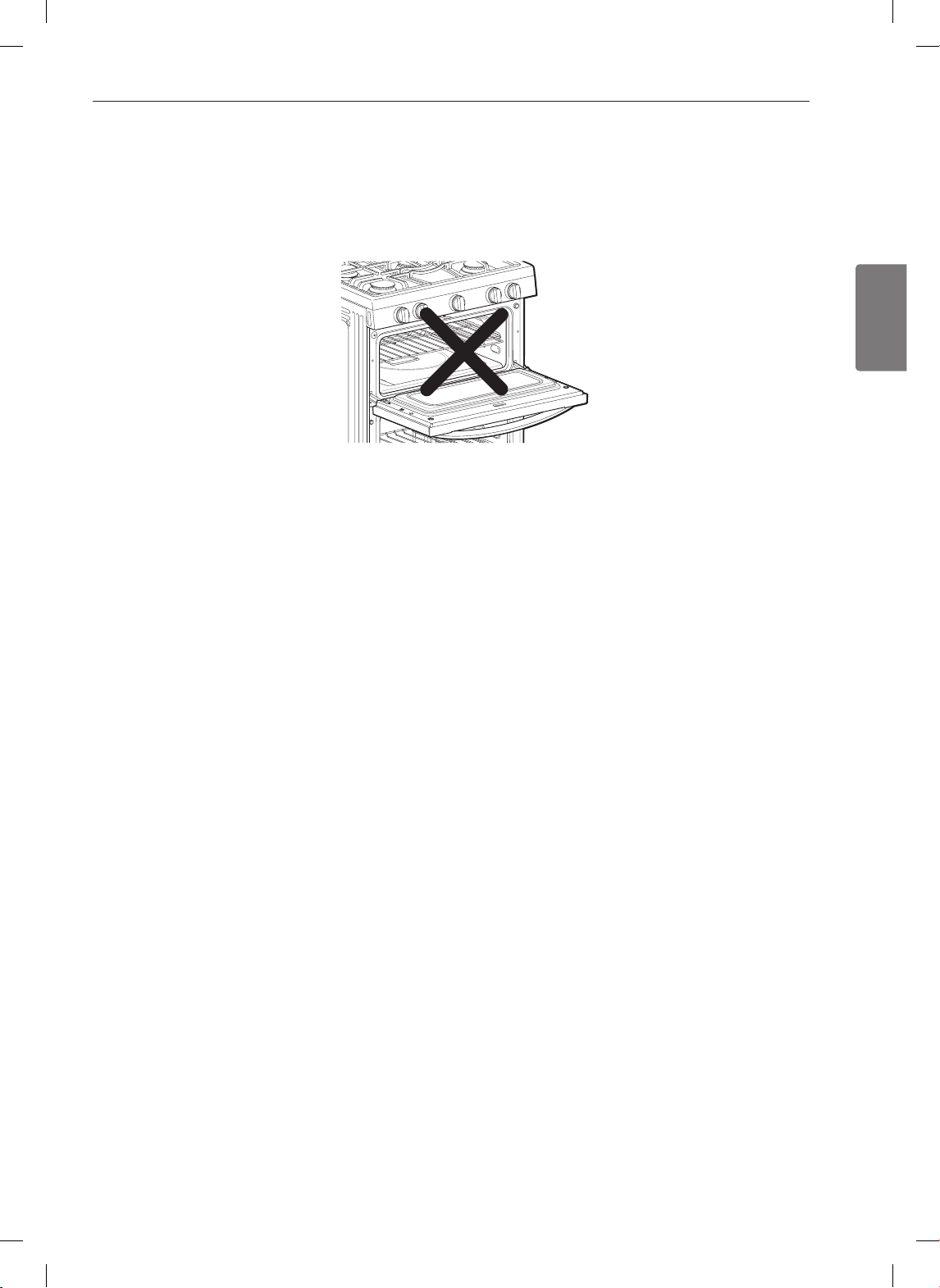
9
INSTRUCCIONES DE SEGURIDAD IMPORTANTES
ESPAÑOL
y
En caso de que haya fuego en la asadera provocado por grasas, presione la tecla "UPPER CLEAR/OFF" o "LOWER CLEAR/
OFF", y mantenga la puerta del horno cerrada para contener el fuego hasta que éste se apague.
y
Por razones de seguridad y para lograr un óptimo rendimiento en la cocción, siempre hornee y ase sus comidas con la puerta
del horno cerrada.
Hornear o asar la comida con la puerta abierta puede dañar las perillas o las válvulas del aparato.
NO
deje la puerta del horno abierta mientras esté cocinando o enfriando el horno.
LEA TODAS LAS INSTRUCCIONES ANTES DE UTILIZAR EL APARATO.
CONSERVE ESTAS INSTRUCCIONES
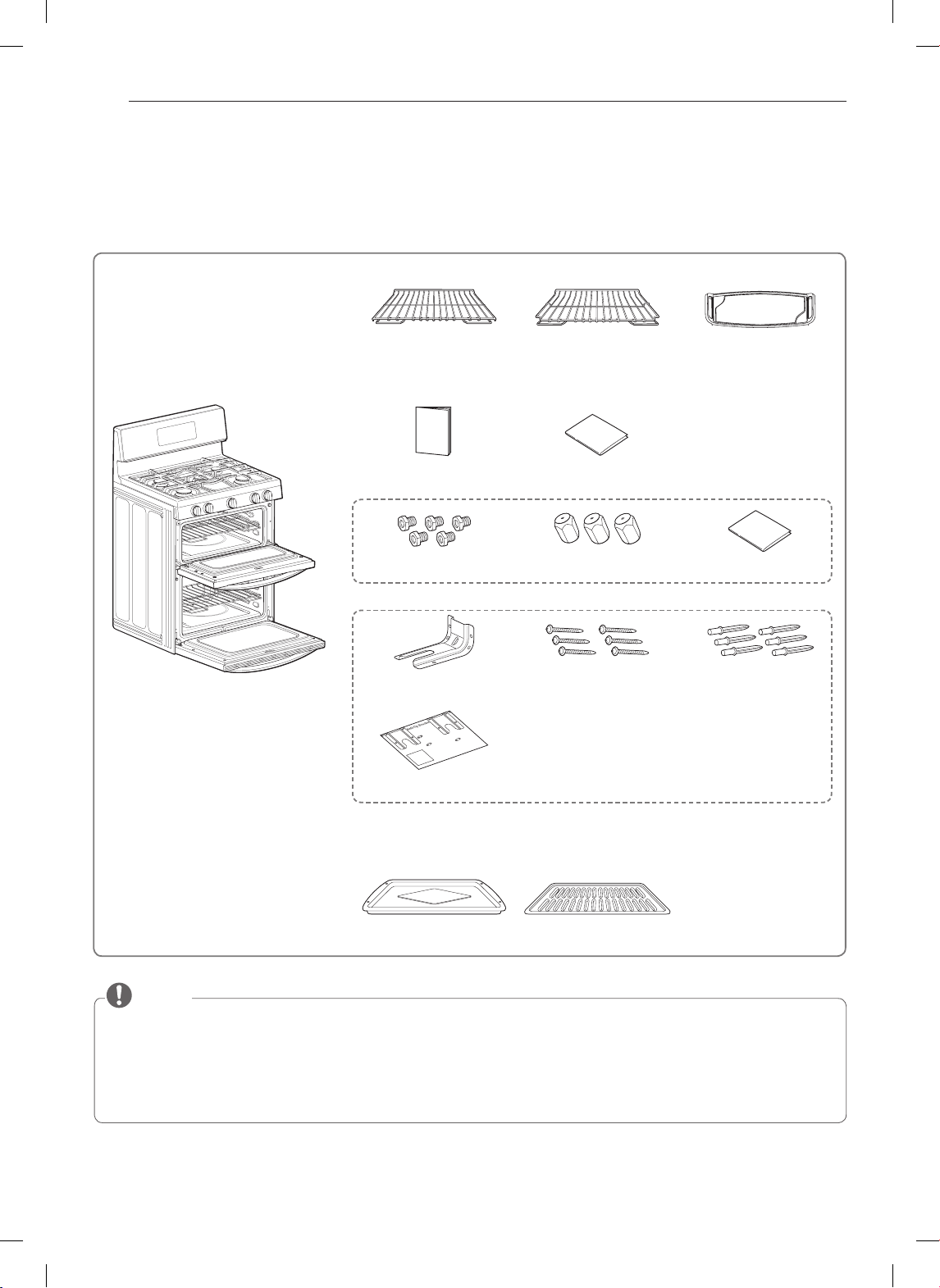
10
ANTES DE USAR
NOTA
y
Comuníquese con el Centro de Atención al Cliente de LG en caso de que falte algún accesorio.
y
Por su seguridad y para lograr una óptima durabilidad del producto, utilice únicamente componentes autorizados.
y
El fabricante no será responsable por el mal funcionamiento del producto o por accidentes causados por el uso de compo-
nentes o piezas no autorizadas, compradas por separado.
y
Las imágenes incluidas en esta guía pueden diferir de los componentes y accesorios reales, y pueden ser sujetas a modifi-
caciones por parte del fabricante a los fines de mejora del producto sin necesidad de previo aviso.
ANTES DE USAR
Accesorios
Asegúrese de que todas las piezas estén incluidas antes de comprar el producto.
Estufa a gas de doble horno
Estantes
(2)
Estante de compensación
(1)
Manual del propietario Manual de instalación
Espreas superiores (5) Boquillas del horno (3) Guía de instalación
Equipo de conversión para boquilla LP
Ménsula anti-vuelco Tornillos (6) Anclajes (6)
Plantilla
Equipo anti-vuelco
Se vende por separado
Asadera Rejilla
Parrilla
(Modelo LDG3016ST
solamente)
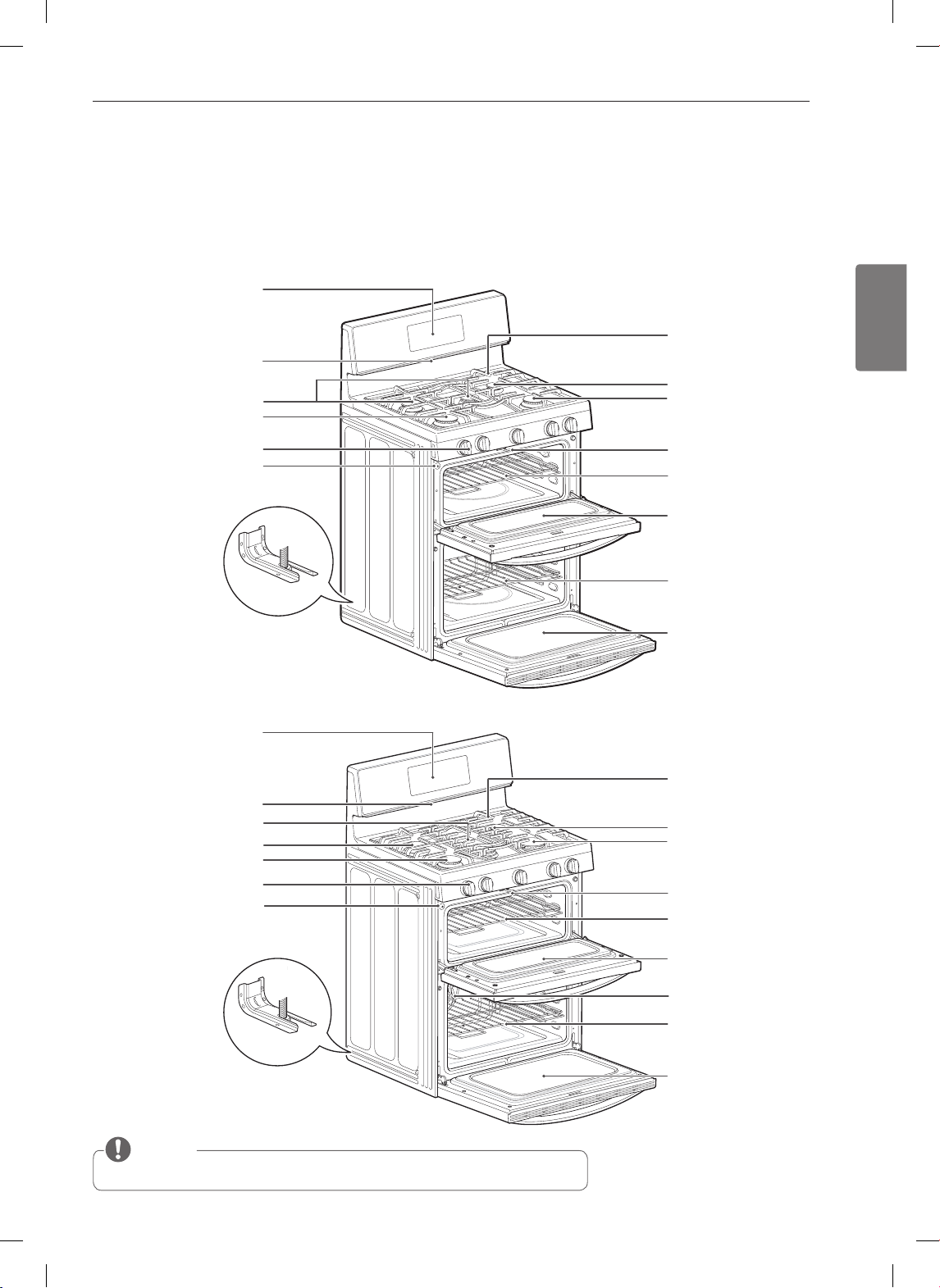
11
ANTES DE USAR
ESPAÑOL
Componentes
Asegúrese de entender los nombres y función de cada pieza.
* A lo largo de este manual, las características y apariencia del producto pueden variar dependiendo de su modelo.
Soporte Anti-
vuelco
Parrillas
Hornilla pequeña
Hornilla extra grande
Pestillo para autolimpieza
Estante
Puerta de horno superior
Estante
Puerta de horno inferior
Panel de control
Ventilación del horno
Hornilla mediana
Hornilla grande
Perillas (5)
Interruptor de luz
auto-mático del horno
Para el modelo LDG3015S
Soporte Anti-
vuelco
Parrillas
Hornilla pequeña
Hornilla extra grande
Pestillo para autolimpieza
Estante
Puerta de horno superior
Estante
Convección
Puerta de horno inferior
Control panel
Ventilación del horno
Hornilla mediana
Hornilla grande
Hornilla ovalada
Perillas (5)
Interruptor de luz
auto-mático del horno
Para el modelo LDG3016ST
NOTA
y
El modelo y la etiqueta seriada están localizados detrás del panel de control.
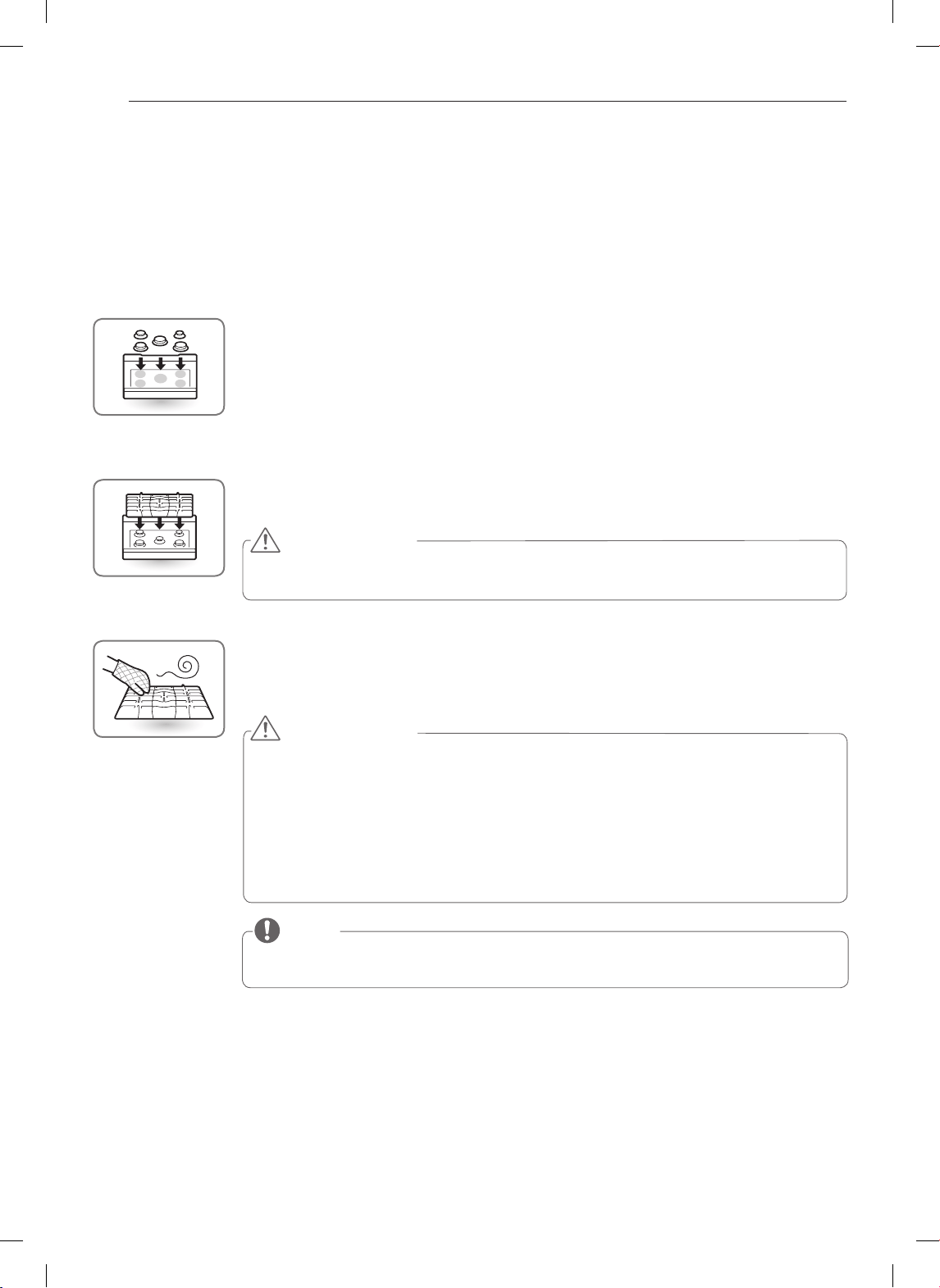
12
CÓMO USAR
CÓMO USAR
Hornillas a gas de la superficie
Antes de usar
Lea todas las instrucciones antes de usar el producto.
Asegúrese de que todas las hornillas estén correctamente colocadas.
Asegúrese de que las hornillas y parrillas se hayan enfriado antes de apoyar
su mano, agarradera, repasador u otro material sobre las mismas.
Tocar las parrillas antes de que se hayan enfriado puede provocar quemaduras.
Asegúrese de que todas las parrillas están correctamente ubicadas antes
de encender las hornillas.
PRECAUCIÓN
NO
encienda la hornillas por un largo período de tiempo sin que haya ninguna batería sobre la rejilla.
El acabado de la parrillas puede saltarse si no hay ninguna batería que absorba el calor.
PRECAUCIÓN
QUÉ HACER SI HUELE GAS
1. Abra las ventanas.
2.
NO
intente encender ningún aparato.
3.
NO
toque ningún interruptor eléctrico.
4.
NO
use ningún teléfono dentro de su edificio.
5. Comuníquese de inmediato con su proveedor de gas desde el teléfono de un vecino.
Siga las instrucciones del proveedor de gas.
6. Si no puede comunicarse con su proveedor de gas, contacte al departamento de bomberos.
NOTA
El encendido de chispa electrónica de los quemadores causa un sonido de tipo clic.
Todos los encendidos de chispa en la estufa se activaran al encender un solo quemador.
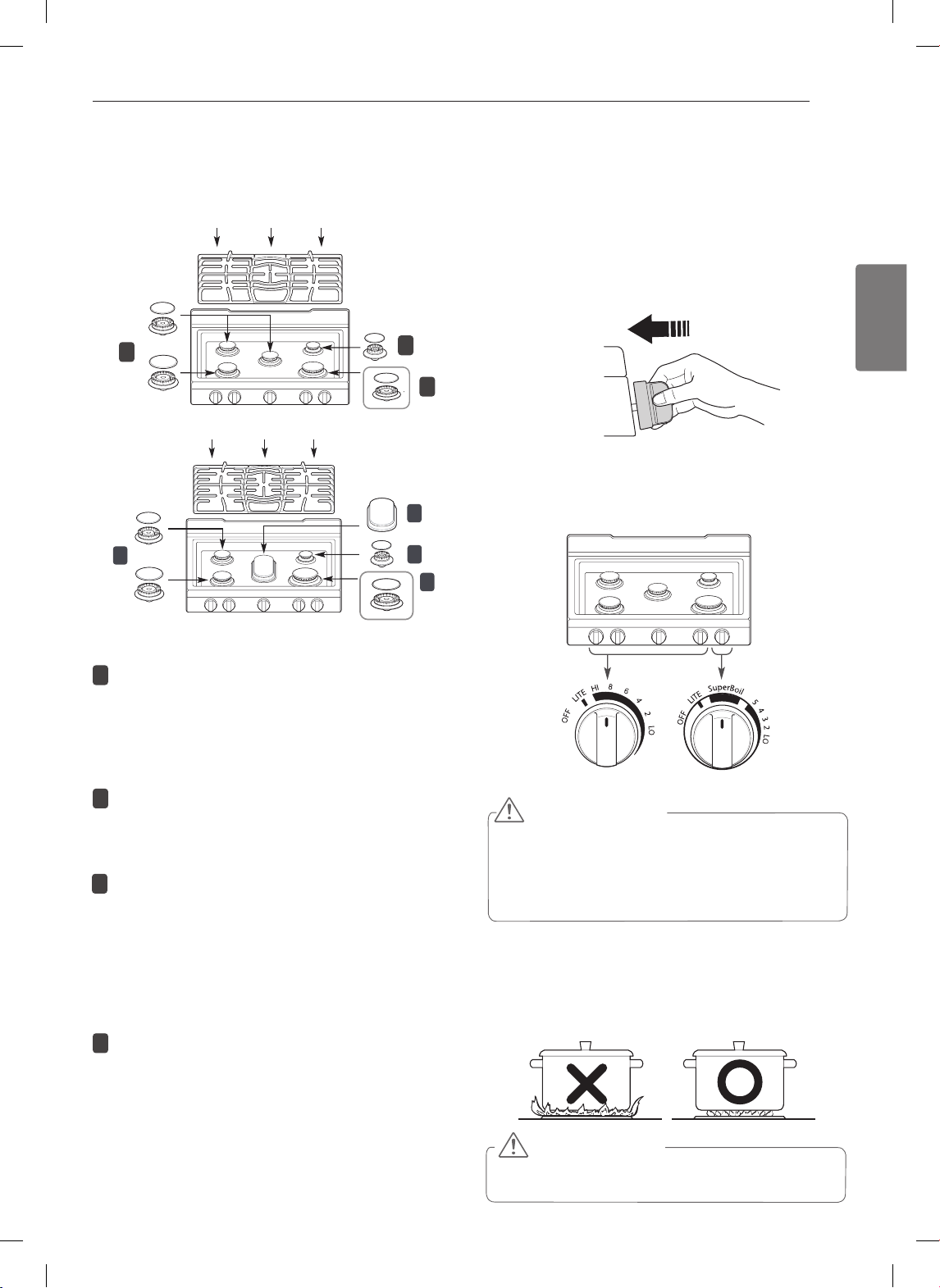
13
CÓMO USAR
ESPAÑOL
Hornillas a Gas
La cocina de su estufa tiene cinco hornillas selladas a gas.
Estas pueden ser ensambladas y separadas. Siga la guía a
continuación.
1234
1234
1234
Hornilla mediana y grande
Las hornillas medianas y grandes son las hornillas prin-
cipalmente utilizadas para la mayoría de comidas. Estas
hornillas pueden llevarse de nivel "
HI
" (ALTO) a “
LO
”
(BAJO) para acomodarse al amplio rango de necesidades
culinarias.
Hornilla pequeña
La hornilla más pequeña es utilizada para comidas delica-
das, como ser salsas o comidas que requieren poco calor
por un tiempo prolongado de cocción.
Hornilla extra grande
La hornilla extra grande es la hornilla de mayor potencia.
Al igual que las otras cuatro hornillas, puede llevarse de
nivel "
HI
" a "
LO
" para satisfacer el amplio rango de necesi-
dades culinarias. Esta hornilla también está diseñada para
hervir rápidamente grandes cantidades de líquido. Puede
ser utilizada para baterías de 10 pulgadas de diámetro o
más.
Hornilla ovalada (Modelo LDG3016ST solamente)
The oval burner (center) is for use with a griddle or oval
pLa hornilla ovalada (centro) sirve para usarse con parillas
u ollas ovaladas.
Uso de las hornillas a gas de la super-
ficie
1
Asegúrese de que todas las hornillas de la superficie estén
ubicadas en la posición correcta.
2
Ponga la batería sobre la hornilla. (Por ejemplo: una olla,
sartén, etc.).
3
Empuje y gire la perilla de control a la posición “
LITE
”.
Escuchará un sonido tipo chasquido proveniente del
sistema de encendido de chispa eléctrica.
4
Gire la perilla de control para controlar la intensidad de la
llama.
PRECAUCIÓN
NO
intente desensamblar o limpiar alrededor de ninguna
hornilla mientras otra hornilla está encendida. Cuando
gire una hornilla a la posición “
LITE
”, todas las hornillas
chispearán. Puede producirse una descarga eléctrica que
puede volcar una batería caliente.
Cómo seleccionar el tamaño de llama
Observe la llama y no la perilla cuando reduzca la intensidad
del fuego. Cuando desee un calentamiento rápido, el tamaño
de la llama que sale de la hornilla debe coincidir con el de la
batería en uso.
PRECAUCIÓN
NUNCA
deje que las llamas se extiendan más allá de
los bordes de la batería.
1234
1234
1234
1234
LDG3015S
1
4
2
3
1234
LDG3016ST
123
4
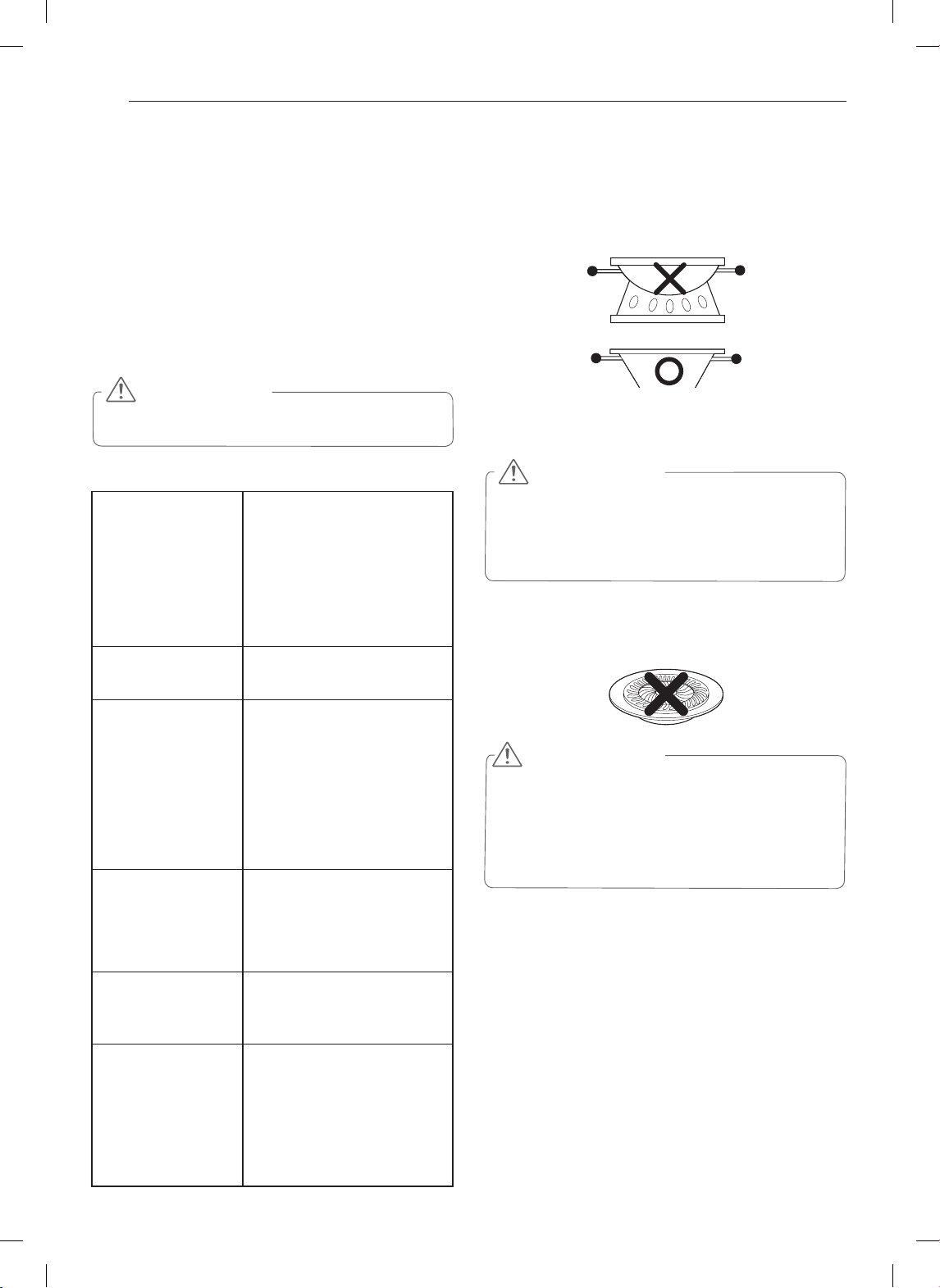
14
CÓMO USAR
En caso de falla en la energía eléc-
trica:
En caso de que haya una falla en la energía eléctrica, puede
encender las hornillas superiores con un fósforo. Las hornillas
superiores que se encuentren en uso al producirse una falla
en la energía eléctrica continuarán funcionando con normali-
dad.
1
Acerque un fósforo a la hornilla. Luego, presione la perilla
de control.
2
Gire la perilla de control a la posición de“
Lo
”.
Utensilios ubicados sobre la estufa
Utilice woks de base plana.
No coloque gratinadores de cocina sobre las hornillas.
Aluminio
Se recomienda el uso de baterías
de peso mediano porque se
calientan de forma rápida y
uniforme. La mayoría de alimentos
se doran de manera uniforme en
una sartén de aluminio. Utilice
cacerolas con tapas de ajuste
hermético cuando deba cocinar
con pequeñas cantidades de agua.
Hierro fundido
Si se calientan a fuego lento,
la mayoría de sartenes darán
resultados satisfactorios.
Acero inoxidable
Este metal por sí solo tiene pobres
propiedades de calentamiento,
por lo que usualmente viene
combinado con cobre, aluminio
u otros metales para lograr una
mejor distribución del calor. Las
sartenes de metales combinados
dan resultados satisfactorios si
se utilizan a fuego medio, como
recomienda el fabricante.
Hierro esmaltado
Bajo algunas condiciones, el
esmaltado de estas baterías
puede derretirse. Siga las
recomendaciones del fabricante de
la batería respecto a los métodos
de cocción.
Vidrio
Existen dos tipos de baterías de
vidrio: aquellas aptas sólo para
horno, y aquellas para utensilios
ubicados sobre la estufa.
Cerámica y vidrio a
prueba de calor
Se puede utilizar para cocinar tanto
en la superficie como en el horno.
Conduce el calor muy lentamente
y se enfría muy lentamente.
Consulte las instrucciones del
fabricante de la batería para
asegurarse de que puede utilizarse
en estufas a gas.
Si usa un wok, se recomienda que utilice un wok de base
plana de 14 pulgadas como máximo. Asegúrese de que la
base del wok se asiente firmemente en la rejilla.
PRECAUCIÓN
NO
use ningún aro de soporte para woks. Colocar el aro
sobre la hornilla o parrilla podría causar que la hornilla
funcione de manera incorrecta, generando niveles de
monóxido de carbono superiores a los permitidos. Esto
puede resultar peligroso para su salud.
Uso de wok:
Uso de gratinadores de cocina:
PRECAUCIÓN
NO
utilice gratinadores de cocina en las hornillas de la
superficie. Si utiliza un gratinador de cocina sobre las horn-
illas de la superficie, ocasionará una combustión incomple-
ta, lo que provocará la exposición a niveles de monóxido
de carbono superiores a los permitidos por las normativas
vigentes. Esto puede resultar peligroso para su salud.
PRECAUCIÓN
Tenga extrema precaución al encender las hornilla con
fósforos. Puede quemarse y lastimarse.
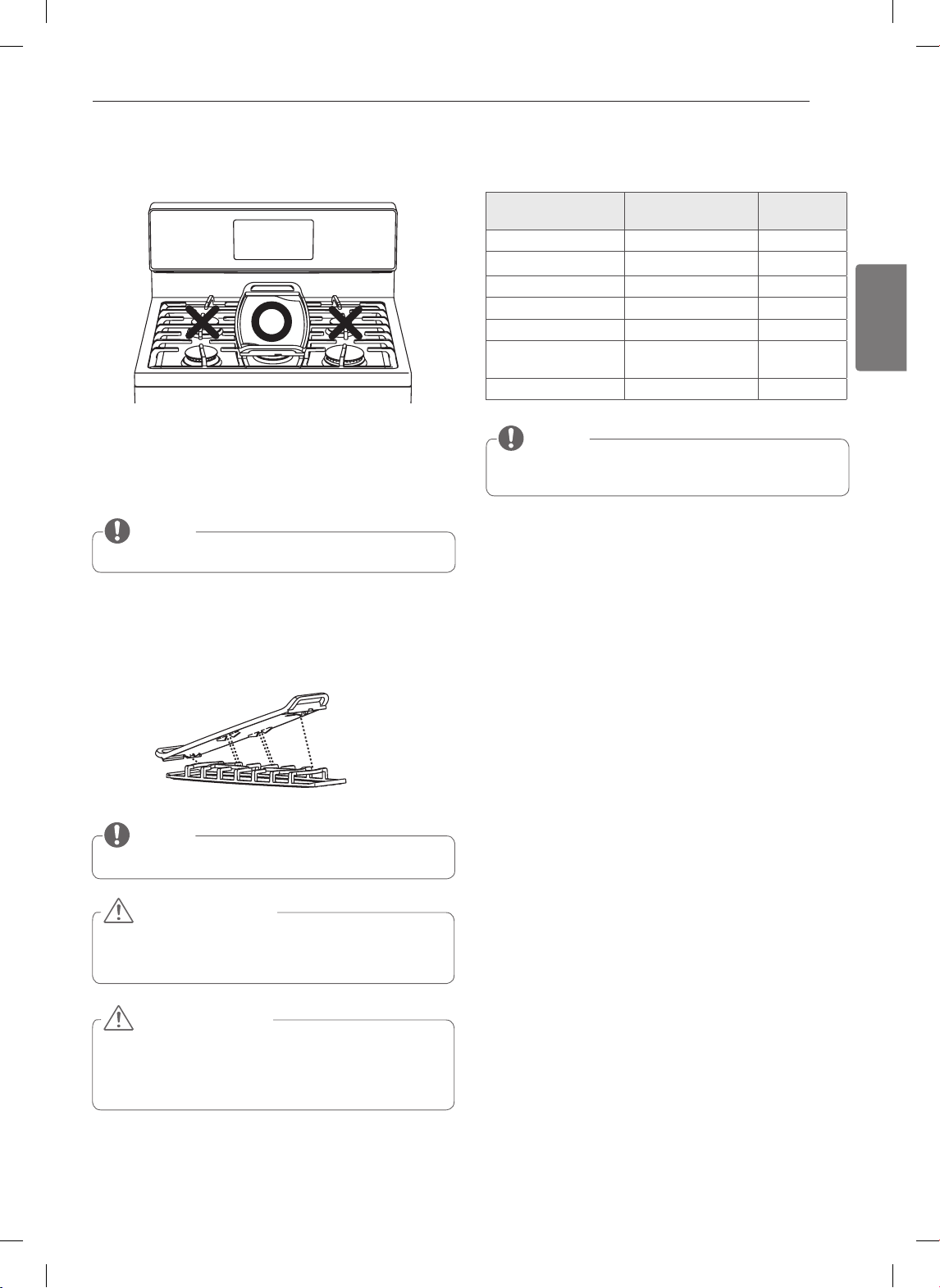
15
CÓMO USAR
ESPAÑOL
PRECAUCIÓN
NO
retire la plancha de la parrilla hasta que las rejillas, su-
perficies de la estufa y la propia parrilla se hayan enfriado
por completo.
PRECAUCIÓN
La plancha de la parrilla puede calentarse mucho al
usar la estufa, el horno o los sistemas de asado.
Use siempre guantes para horno al colocar o retirar
la plancha de la parrilla.
Uso de la Parrilla
(Modelo LDG3016ST solamente)
Su rejilla con capa antiadherente proporciona una superficie
extra-grande de cocción para carnes, panqueques u otros ali-
mentos que se preparan habitualmente en una sartén normal
o plana.
Cómo colocar la parrilla:
La parrilla sólo puede usarse en
el quemador central. La parrilla debe ser colocada apropiada-
mente en la parrilla de la hornilla central, como se muestra en
la figura de abajo.
Precaliente la parrilla según la siguiente guía y ajuste la
potencia que desee.
NOTAS IMPORTANTES:
• Evite cocinar alimentos con un excesivo contenido en gra-
sas; podrían producirse derrames de grasa.
• La parrilla puede calentarse al usar los quemadores aleda-
ños.
• NO caliente la parrilla en exceso. Hacerlo puede dañar el
recubrimiento antideslizante.
• NO use utensilios metálicos que podrían dañar la superficie
de la parrilla. No use la plancha como tabla de cortar.
• NO coloque ni almacene objetos sobre la parrilla.
NOTA
y
Es normal que la parrilla se descolore con el tiempo
.
NOTA
y
La potencia de la parrilla podría precisar ajuste si se
usa durante períodos prolongados.
NOTA
y
NO
retire la rejilla central al usar la parrilla.
Frontal
Tipo de alimento Condiciones de
precalentamiento
Ajuste de
cocción
Tortillas calientes sin precalentar 5 (MED)
Panqueques HI 3 min. HI
Hamburguesas HI 5 min. HI
Huevos fritos HI 5 min. HI
Bacon HI 3 min. HI
Salchichas de
desayuno
HI 5 min. HI
Sándwiches calientes HI 4 min. HI
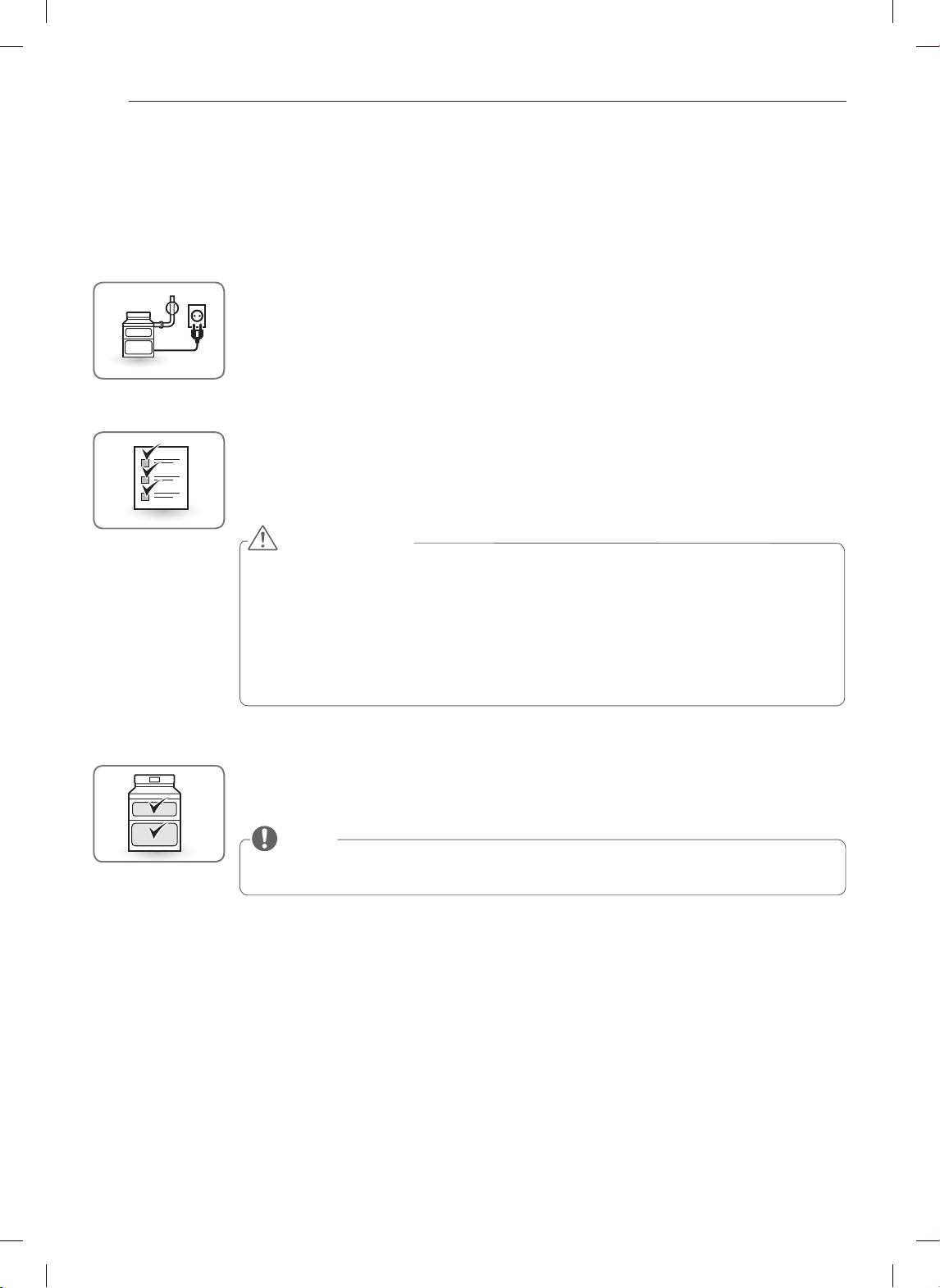
16
CÓMO USAR
Cómo usar el Horno
Antes de usar
Lea todas las instrucciones antes de usar.
Asegúrese de que el cable de alimentación eléctrica y la válvula de gas
estén correctamente conectados.
Verifíquelo por cuestiones de seguridad.
Verifique cómo utilizar de manera correcta la estufa, dependiendo del tipo
de comida a cocinar.
Asegúrese de que sabe cómo utilizar el horno (configuración de temperatura, tiempo de cocción y
receta) para lograr los mejores resultados.
Elija el horno superior o el horno inferior para una cocción adecuada.
Use el horno superior para cocinar pequeñas cantidades de comida.
PRECAUCIÓN
QUÉ HACER SI HUELE GAS
1. Abra las ventanas.
2.
NO
intente encender ningún artefacto.
3.
NO
toque ningún interruptor eléctrico.
4.
NO
use ningún teléfono dentro de su edificio.
5. Comuníquese de inmediato con su proveedor de gas desde el teléfono de un vecino.
Siga las instrucciones del proveedor de gas.
6. Si no puede comunicarse con su proveedor de gas, contacte al departamento de bomberos.
NOTA
Cuando se utiliza un termómetro de horno en la cavidad del horno, temperaturas pueden diferir de
la temperatura real del horno en cualquier modo.
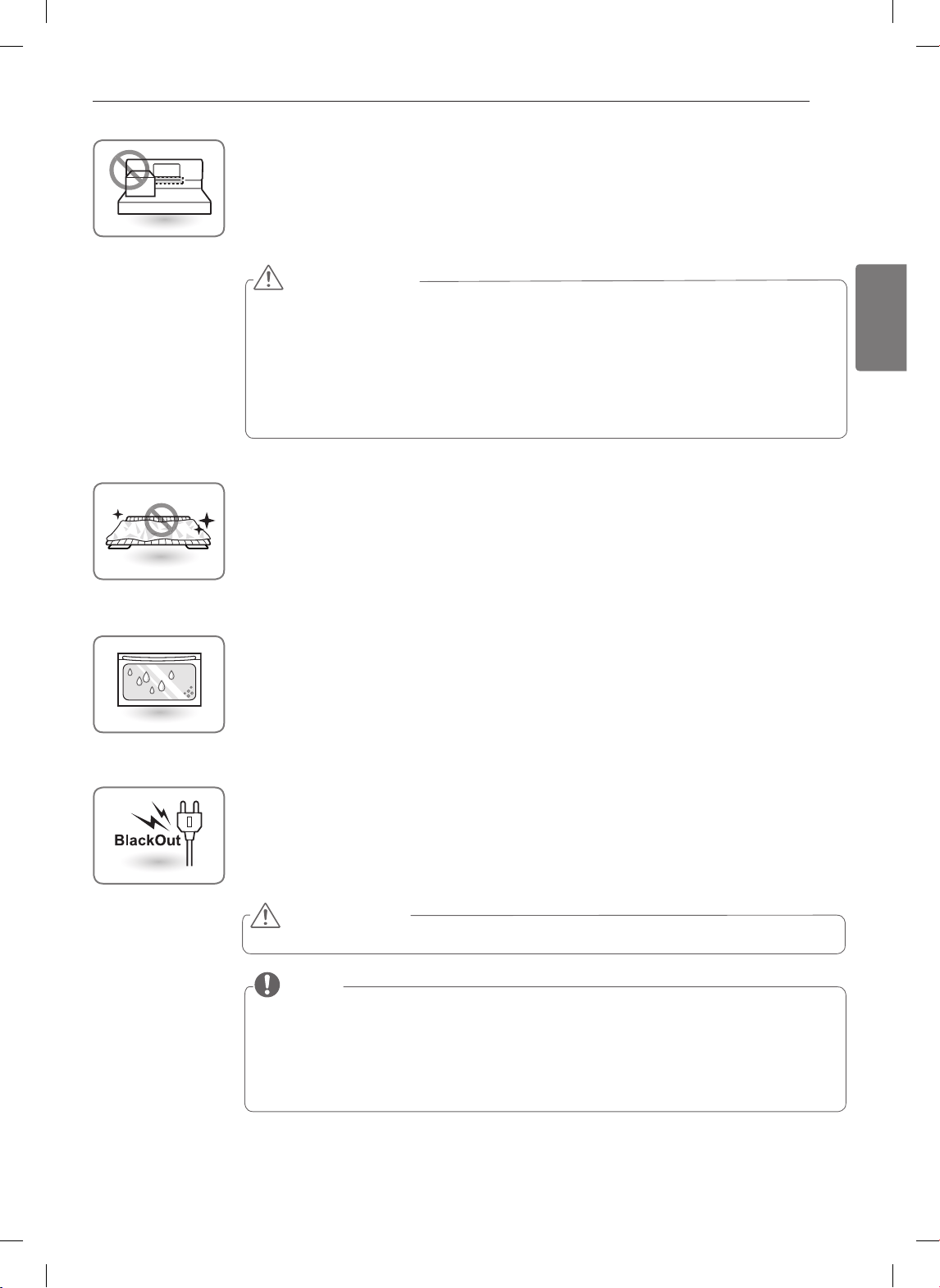
17
CÓMO USAR
ESPAÑOL
No obstruya, toque o coloque objetos alrededor del conducto de venti-
lación del horno cuando el mismo esté encendido.
Su horno es ventilado a través de conductos ubicados en el centro, encima de la parrilla de la hornilla.
No obstruya la ventilación del horno cuando éste se encuentre en funcionamiento; de lo contrario, no
permitirá la circulación correcta de aire. No toque las aperturas de ventilación o las superficies de alred-
edor durante su uso.
A medida que su horno se caliente, el aumento de temperatura del aire
producido dentro del horno puede generar que se produzcan gotas de
agua en la puerta de vidrio del horno.
Estas gotas de agua no son peligrosas y se evaporarán a medida que el horno continúe con el proceso
de calentamiento.
No cubra ningún estante o base con papel aluminio.
PRECAUCIÓN
y
NO
coloque elementos plásticos o inflamables sobre la cocina; estos pueden derretirse o pren-
derse fuego si se dejan muy cerca de la ventilación.
y
NO
coloque empaques cerrados sobre la cocina. Puede hacer aumentar la presión de los em-
paques cerrados y provocar que revienten.
y
Los objetos de metal que se dejen sobre la cocina se pondrán muy calientes, pudiendo provocar
quemaduras.
y
Las asas de las ollas y cacerolas que se encuentren en la cocina pueden sobrecalentarse si se
dejan demasiado cerca del conducto de ventilación.
En caso de falla en la energía eléctrica, no utilice el horno.
El horno y la asadera no pueden utilizarse durante un corte de energía. Si el horno se encuentra en uso
al producirse el corte de energía, el quemador del horno se apagará y no podrá ser re-encendido hasta
que se restablezca la energía. Una vez que vuelva la energía eléctrica, deberá reiniciar el horno (o la
función de asa).
PRECAUCIÓN
NO
intente utilizar el encendido eléctrico durante una falla de energía eléctrica.
NOTA
PF(Falla de Poder) / Reloj Parpadeando
Dependiendo del modelo de su estufa, la pantalla mostrará "PF“ o un reloj parpadeando. Esto
significa que el electrodoméstico ha sido conectado, o que ha experimentado una interrupción
en la alimentación. Para borrar el mensaje "PF", presione la tecla "Clear / Off" en los controles del
horno. Si su horno muestra un reloj parpadeando, presione la tecla “Clock” y reinicie el tiempo, o
presione cualquier tecla para que deje de parpadear.
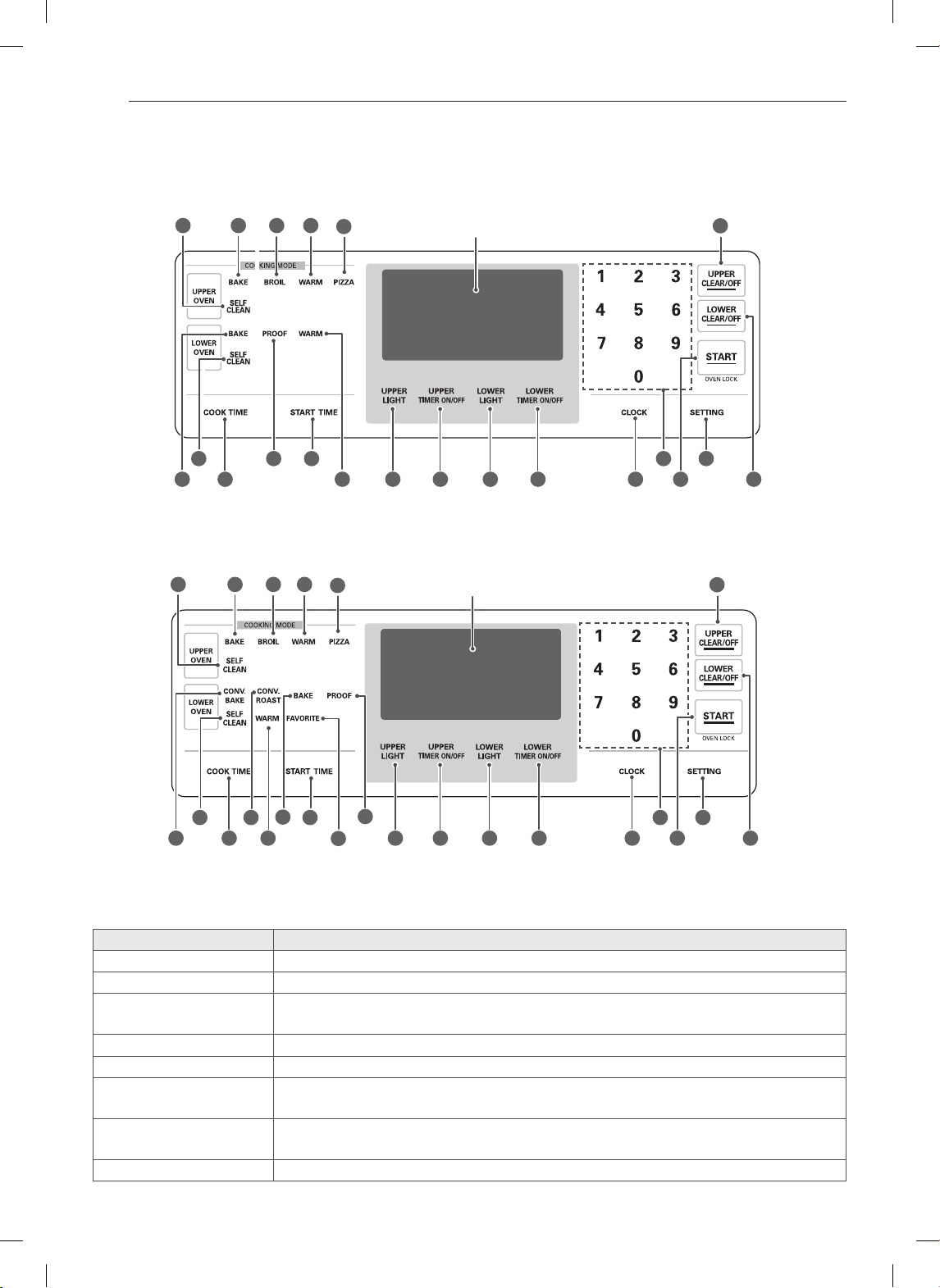
18
CÓMO USAR
Cómo usar el panel de control
Horno superior:
Nombre Descripción
1
BAKE Función tradicional de hornear. Consulte “HORNEAR” en la sección "Cómo usar".
2
BROIL Función tradicional de asar. Consulte “ASAR” en la sección "Cómo usar".
3
WARM
Calienta la comida en el horno.
Consulte “CALENTAR” en la sección "Cómo usar".
4
PIZZA Cocina pizza. Consulte “PIZZA” en la sección "Cómo usar".
5
UPPER LIGHT Enciende/ apaga la luz del horno superior.
6
UPPER SELF CLEAN
Limpia el interior del HORNO SUPERIOR automáticamente.
Consulte “AUTO LIMPIEZA” en la sección "Cómo usar".
7
UPPER TIMER ON/OFF
Configura, inicia o cancela la función del temporizador del HORNO SUPERIOR.
Consulte “Cómo usar el temporizador” en la sección "Instrucciones de funcionamiento".
8
UPPER CLEAR/OFF Deja de cocinar o cancela los ajustes realizados en el HORNO SUPERIOR.
1
2
3
4
8
15
24
6
5
12
14
11
9
13
10
20
21
19
32
22
7
Pantalla
1
2
3
4
8
15
24
6
5
12
7
14
16
13
17
20 11
10
21
19
32
22
9
18
Pantalla
Para el modelo LDG3015S
Para el modelo LDG3016ST
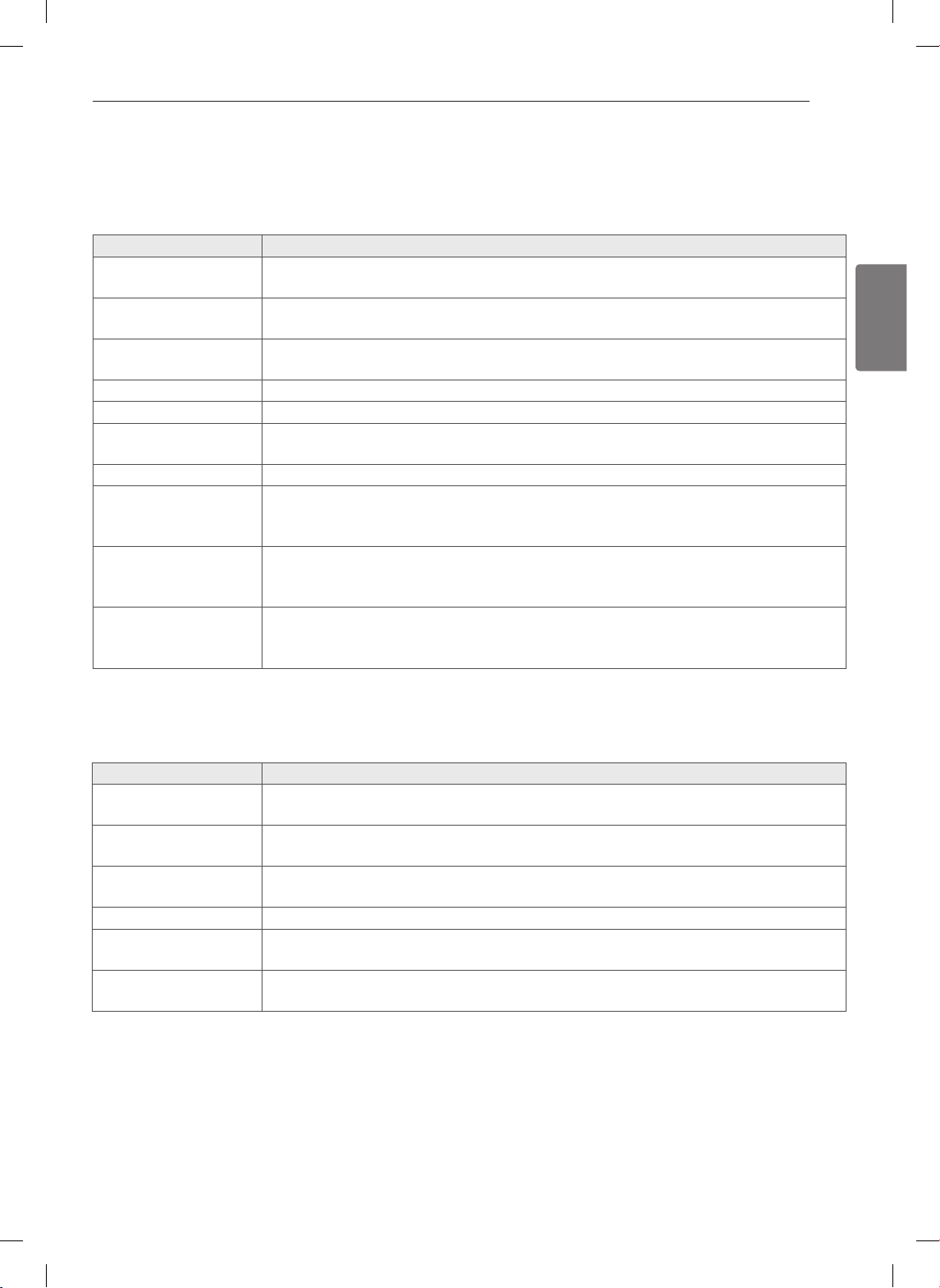
19
CÓMO USAR
ESPAÑOL
Funciones comunes
Nombre Descripción
o
CLOCK
Configura la hora del día.
Consulte “Cómo configurar el reloj” en la sección "Instrucciones de funcionamiento".
p
COOK TIME
Configura el tiempo de cocción. El horno se apaga automáticamente cuando alcanza el tiempo de
cocción establecido.
a
START TIME
Configura la hora de inicio de cocción. El horno se encenderá automáticamente a la hora de inicio
fijada.
s
SETTING Configura funciones varias.
d
NUMBER KEY
Teclas numéricas que se utilizan para configurar la hora, el temporizador, la temperatura y tiempos
de cocción.
f
START (CONTROL
LOCK)
Inicia todas las funciones a excepción del temporizador. Para activar OVEN LOCK (Bloquear horno),
presiónela y manténgala presionada por tres segundos.
Horno inferior:
Nombre Descripción
9
BAKE
Función tradicional de hornear. Consulte “HORNEAR” en la sección "Instrucciones de funciona-
miento".
-
PROOF
Función para levar piezas/ una pieza de pan. Consulte “LEVAR” en la sección "Instrucciones de
funcionamiento".
q
WARM
Calienta la comida en el horno.
Consulte la función “CALENTAR” en la sección "Instrucciones de funcionamiento".
w
LOWER LIGHT Enciende/ apaga la luz del horno inferior.
e
LOWER SELF CLEAN Limpia el interior del HORNO INFERIOR automáticamente.
r
LOWER TIMER ON/OFF
Configura, inicia o cancel la función de temporizador del HORNO INFERIOR.
Consulte “Cómo usar el temporizador” en la sección "Instrucciones de funcionamiento".
t
LOWER CLEAR/OFF Deja de cocinar o cancela los ajustes realizados en el HORNO INFERIOR.
y
CONV.BAKE
(Solamente el modelo
LDG3015S)
Use esta opción para activar la función de horneado por convección. Refiérase a “CONVECCIÓN
HORNEADO” en la sección “Instrucciones de funcionamiento”
u
CONV.ROAST
(Solamente el modelo
LDG3015S)
Use esta opción para activar la función de asado por convección. Refiérase a “CONVECCIÓN
ASADO en la sección “Instrucciones de funcionamiento”.
i
FAVORITE
(Solamente el modelo
LDG3015S)
Use esta opción para almacenar tres tipos favoritos de configuraciones del horno.
Refiérase a “FAVORITOS” en la sección “Instrucciones de funcionamiento”.
Cómo usar el panel de control
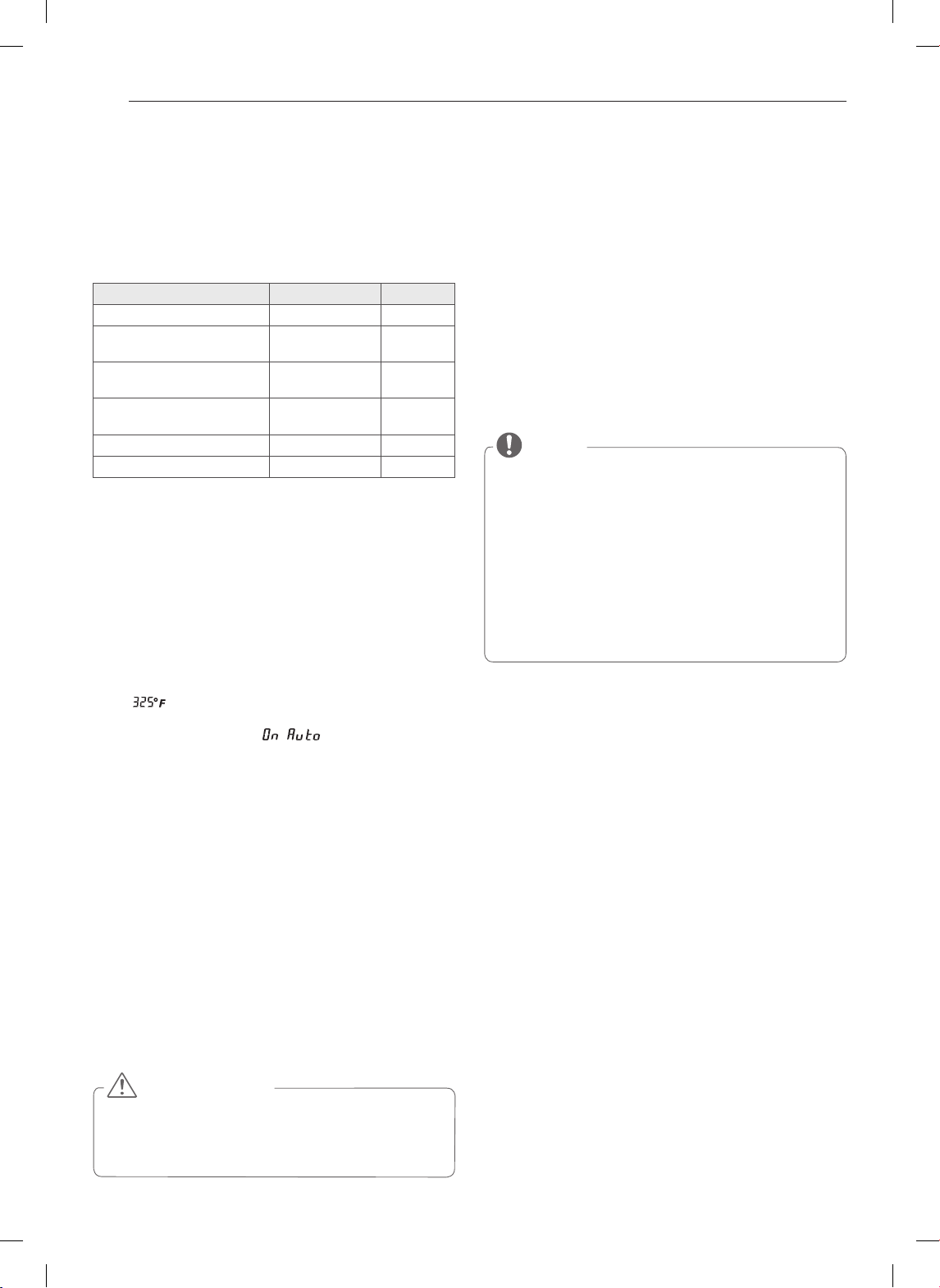
20
CÓMO USAR
Instrucciones de Funcionamiento
El valor de ajuste puede ser cambiado mediante la tecla
“SETTING”
Los ajustes varían dependiendo de cada modelo. Refiérase a la
“Tabla de ajustes”.
TABLA DE AJUSTES
Como fijar la función de auto conver-
sión de convección del horno inferior
(LDG3016ST)
Cuando use el horneado o el asado por convección, la característica
de funcionamiento de auto conversión, convertirá automáticamente
las temperaturas regulares a temperaturas de convección. Esta
característica de funcionamiento es activada para que la pantalla
muestre la temperatura actual auto convertida. Por ejemplo, si se
introduce una temperatura regular de alguna receta de 350°F y se
presiona el botón
q
, la pantalla mostrará la temperatura conver-
tida de .
1
Presione la tecla
X
, “ ” aparecerá en la pan-
talla.
2
Presione la tecla numérica
1
una sola vez para activar la auto
conversión. Presione la misma tecla una vez más para desacti-
var la auto conversión.
3
Presione el botón
q
para aceptar el cambio.
Cómo configurar los ajustes de
temperatura:
Es posible que su nuevo horno cocine de manera diferente
a su horno anterior. Utilice el nuevo horno durante algunas
semanas para familiarizarse con el mismo antes de modificar
cual-quier ajuste de temperatura. Una vez que se haya famil-
ia-rizado con el nuevo horno, si aún considera que éste está
demasiado caliente o demasiado frio, puede ajustar usted
mismo su termostato.
Cómo configurar el encendido/ apagado
de la luz de alarma de precalentamiento:
Cuando el horno alcance la temperatura fijada, la luz de precalenta-
miento se encenderá hasta que la puerta del horno se abra. Usted
podrá activar o desactivar la luz de alarma de precalentamiento de la
siguiente manera:
1
Presione la tecla
X
hasta que aparezca
s
en pan talla.
2
Presione la tecla numérica
1
para seleccionar
R
/
S
(encender/ apagar).
3
Presione la tecla
q
para aceptar el cambio.
Cómo encender/apagar la luz interior del
horno:
La luz interior del horno se prende automáticamente cada vez que
se abre la puerta del horno.
Presione la tecla
M
o
Q
para encender y apagar las luces del
horno.
Cómo ajustar el volumen del bíper:
1
Presione la tecla
X
hasta que aparezca
j
en la pantalla.
2
Presione la tecla numérica
1
de manera continua para des-
plazarse por las opciones de volumen:
m
,
l
,
S
(bajo, alto,
apagado).
3
Presione la tecla
q
para aceptar el cambio.
1
Determine qué horno desea ajustar (el horno superior o el horno
inferior).
2
Presione la tecla
X
una vez para configurar el horno infe-
rior. Hasta que aparezca
e
en la pantalla.
Presione la tecla
X
dos veces para configurar el horno
superior. Hasta que aparezca
f
en la pantalla.
3
Con la teclas numéricas, ingrese la cantidad de grados en los
que desea ajustar el horno. Para bajar la temperatura, presione
la tecla
X
luego de ingresar los números.
Por ejemplo:
Para ajustar la temperatura del horno en 15 grados
más
, pre-
sione
1
,
5
.
Para ajustar la temperatura del horno en 15 grados
menos
,
presione
1
,
5
,
X
4
Presione la tecla
q
para aceptar el cambio.
NOTA
y
Este ajuste no afectará las temperaturas de las funciones
de Asar ni de Auto-limpieza. El ajuste será conservado
en la memoria del horno en caso de producirse una falla
en la energía eléctrica. La temperatura del horno puede
ser aumentada (+) o disminuida (-) en hasta 35°F o 19°C,
respectivamente.
y
Para aumentar o disminuir la temperatura mientras el
horno está en funcionamiento:
1. Usando las teclas numéricas, ingrese la nueva tem-
peratura.
2. Presione la tecla
X
una vez.
3. Presione la tecla
q
para aceptar el cambio.
PRECAUCIÓN
NO
use termómetros, como aquellos que se venden en
almacenes, para verificar el ajuste de temperatura del
horno. Estos termómetros pueden variar entre 20 y 40
grados.
Instrucción de operación LDG3015ST/SB/SW LDG3016ST
Auto conversión de convección. - Una vez
Ajuste de temperatura
(Horno inferior)
Una vez Dos veces
Ajuste de temperatura
(Horno superior)
Dos veces Tres veces
Luz intermitente de la alarma de
precalentado
Tres veces
Cuatro
veces
Volumen de la alarma Cuatro veces Cinco veces
Grados Fahrenheito Celsius Cinco veces Seis veces
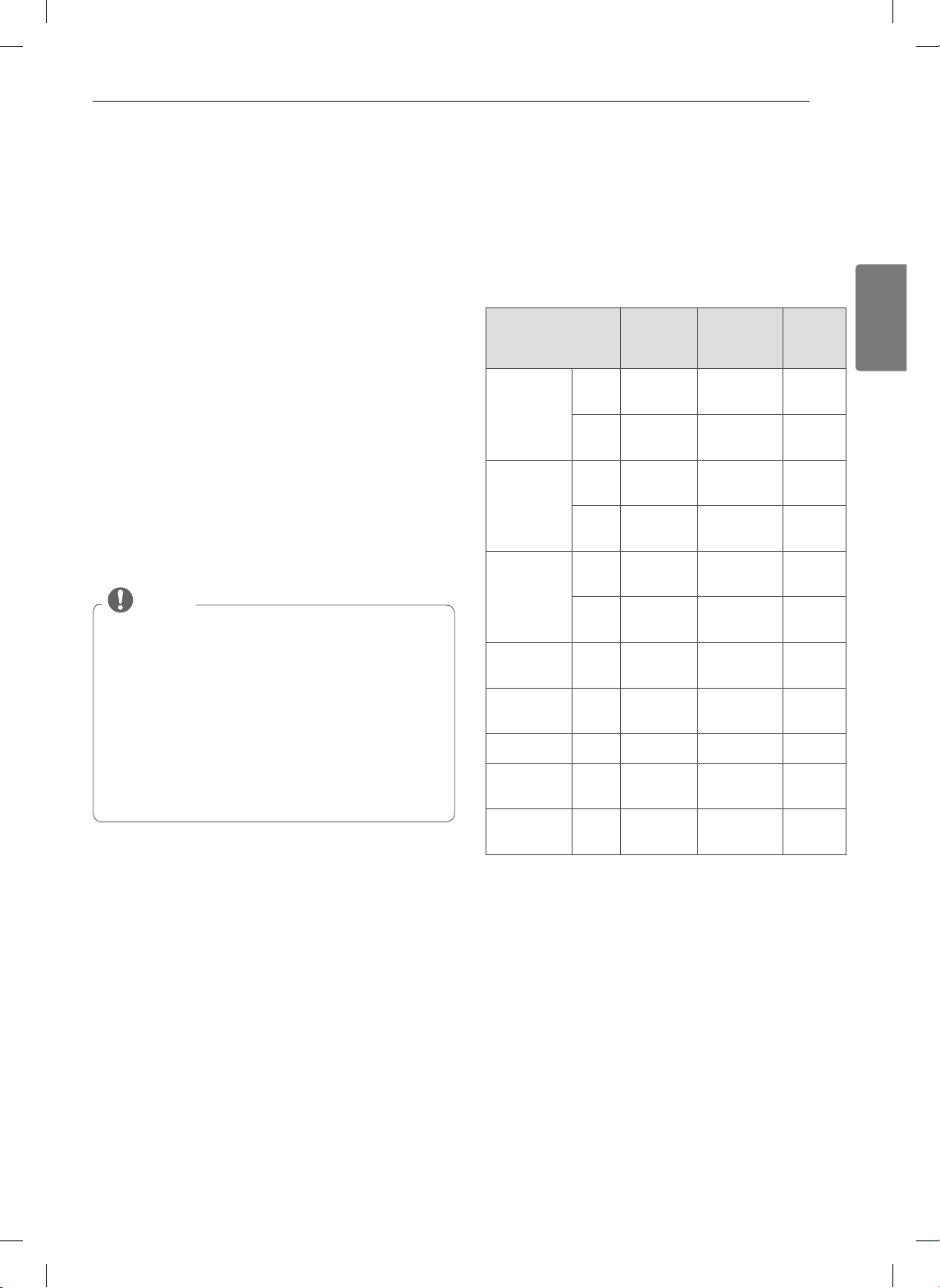
21
CÓMO USAR
ESPAÑOL
Cómo seleccionar Grados Fahrenheit
o Celsius:
Las temperatura del horno puede configurarse en grados
Fahrenheit o Celsius. El ajuste predeterminado de fábrica es
en grados Fahrenheit. Éste puede ser cambiado por el usu-
ario.
1
Presione la tecla
X
hasta que aparezc “
i
” en la
pantalla.
2
Presione la tecla numérica
1
para seleccionar Fahrenheit o
Celsius.
3
Presione la tecla
q
para aceptar el cambio.
Cómo ajustar el reloj (12 ó 24 horas):
1
Mantenga presionado el botón
U
por tres segundos.
2
Presione el botón
1
una sola vez para ajustar el reloj a 24
horas. Presiónelo otra vez para ajustar el reloj a 12 horas.
3
Presione el botón
q
.
Cómo ajustar el reloj:
El reloj debe ajustarse con la hora correcta del día para que
las funciones de temporización del horno funcionen correcta-
mente.
1
Presione la tecla
U
una vez.
2
Presione la teclas numéricas para seleccionar la hora de-
seada.
Ejemplo
: Para ajustar la hora en
t
, presione las teclas
numéricas
1
,
2
,
3
y
4
en ese orden.
3
Presione la tecla
q
para aceptar el cambio.
Ajustes predeterminados mínimos y máximos:
Todas las características enumeradas tienen ajustes de
temperatura y de hora mínimos y máximos que pueden ser
ingresados en el control. Sonará un bip de aceptación cada
vez que se presione una tecla de control.
Sonará un tono de error (dos tonos cortos) si se ingresa un
valor de temperatura u hora por debajo del ajuste mínimo o
por encima del ajuste máximo de la característica.
N OTA
y
La hora del día no puede ser modificada cuando el ciclo
de auto limpieza o de horneado por temporizador estén
en funcionamiento.
y
Para verificar la hora del día cuando la pantalla muestre
otra información, simplemente presione la tecla
U
.
y
Si no se presiona ninguna tecla numérica dentro de los
30 segundos de haber presionado la tecla
U
, la
pantalla volverá al ajuste original. Si esto sucede, pre-
sione la tecla
U
y reingrese la hora.
y
Si la hora se muestra en pantalla de manera intermi-
tente, puede haberse producido una falla de energía
eléctrica. Reinicie la hora.
CARACTERÍSTICA TEMP.
/ HORA
MÍN.
TEMP. /
HORA MÁX.
PREDET.
HORA DEL
RELOJ
12
Hrs.
1:00 Hrs. /
Min.
11:59 Hrs. /
Min.
24
Hrs.
0:00 Hrs. /
Min.
23:59 Hrs. /
Min.
TEMPORI-
ZADOR
DE COCINA
12
Hrs.
0:01 Min.
11:59 Hrs. /
Min.
24
Hrs.
0:01 Min.
11:59 Hrs. /
Min.
TIEMPO DE
COCCIÓN
12
Hrs.
0:01 Min.
11:59 Hrs. /
Min.
24
Hrs.
0:01 Min.
11:59 Hrs. /
Min.
TEMP. PARA
ASAR
Baja- 300°F
/ 149°C
Alta- 400°F /
204°C
3 Hrs.
TEMP. PARA
HORNEAR
170°F /
77°C
550°F /
288°C
12 Hrs.
LEVAR
12 Hrs.
CALENTAR
170°F/75°C,
3 horas
3 Hrs.
AUTO
LIMPIEZA
2 Hrs. 4 Hrs. 3 Hrs.
22
CÓMO USAR
Cómo usar el temporizador:
El
TIMER ON/OFF
(TEMPORIZADOR ENCENDIDO/ APAGA-
DO) superior o inferior sirve como un temporizador extra de
la cocina que sonará cuando el tiempo establecido se haya
completado. No comienza ni detiene la cocción.
La característica
TIMER ON/OFF
superior o inferior puede ser
utilizada durante cualquiera de las funciones de control del
horno. Los temporizadores superior e inferior funcionan de
manera independiente uno de otro.
1
Para fijar los minutos y segundos:
Presione la tecla
P
o
T
una vez.
Para fijar las horas y los minutos:
Presione la tecla
P
o
T
dos veces.
2
Utilice las teclas numéricas para ajustar el temporizador.
Por ejemplo, para ajustarlo en 5 minutos:
a) Presione la tecla
P
o
T
dos veces.
g
aparecerá en la pantalla.
b) Presione la tecla numérica
5
.
h
aparecerá en la pantalla.
3
Para iniciar el temporizador, presione la tecla
P
o
T
una vez. Se visualizará en la pantalla el correr del
tiempo programado en cuenta regresiva.
Para cancelar el temporizador antes de que haya transcur-
rido el tiempo programado, presione
P
o
T
(dependiendo de qué temporizador - del horno superior o
inferior- desea cancelar).
4
Cuando haya transcurrido el tiempo programado,
k
apa-
recerá en la pantalla y sonará un tono. Este tono sonará
cada 15 segundos hasta que se presione la tecla
P
o
T
.
Cómo utilizar la característica de blo-
queo del horno:
La característica de bloqueo del horno automáticamente
bloquea la puerta del horno y no permite que la mayoría de
controles del horno puedan encenderse. No deshabilita el
reloj, temporizador ni la luz interior del horno.
1
Presione y mantenga presionada la tecla
q
por tres
segundos.
Sonará un tono,
O
aparecerá y
m
parpadeará en la pan-
talla. Una vez que la puerta del horno esté bloqueada,
el indicador de bloqueo del horno dejará de parpadear y
permanecerá encendido.
2
Para desactivar la característica de bloqueo, presione y
mantenga presionada la tecla
q
por tres segundos.
O
y
m
desaparecerán de la pantalla y la puerta y con-
troles del horno se desbloquearán.
NOTA
Si no se presiona
P
o
T
, el temporizador
volverá a la hora del día.
NOTA
Si el tiempo restante no aparece en la pantalla, presione
la tecla
P
o
T
para visualizarlo.
NOTA
Si la característica de bloqueo es activada por la ap-
ertura de cualquiera de las puertas, éstas últimas no
cerraran completamente hasta que la característica de
bloqueo sea desactivada.
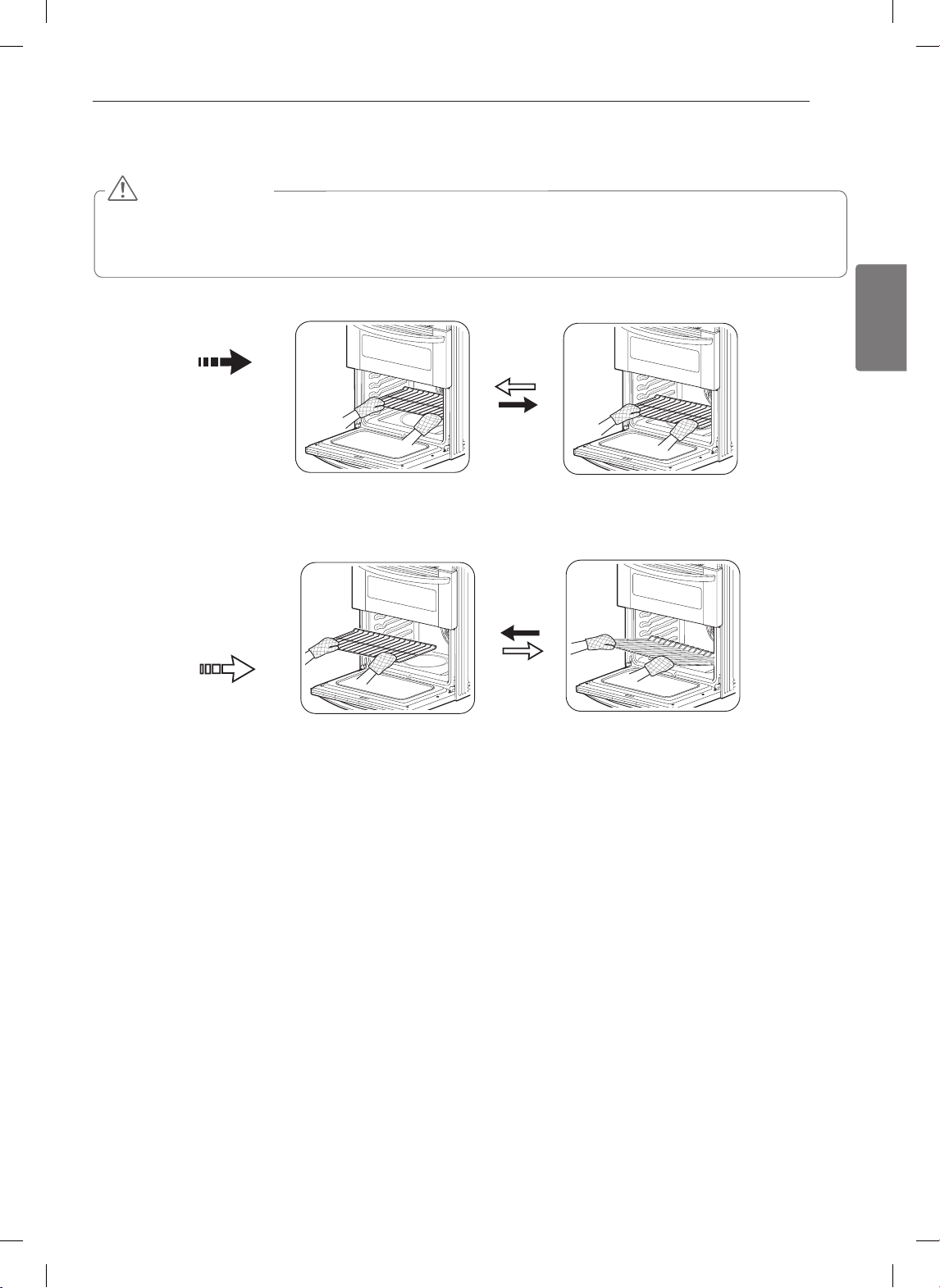
23
CÓMO USAR
ESPAÑOL
Cómo extraer y volver a colocar los estantes del horno
Extraiga
Coloque
Para extraer los estantes del horno:
1
Con sus guantes para hornear, agarre el estante del horno.
2
Tire el estante hacia afuera hasta que haga tope.
3
Levante la parte frontal del estante.
4
Tire el estante hacia afuera.
*También puede ajustar la posición de los estantes antes
de utilizar el horno.
PRECAUCIÓN
y
Coloque el estante en el horno antes de encender el horno para evitar quemaduras.
y
NO
cubra el estante con papel de aluminio ni con ningún otro material; tampoco coloque ningún elemento en la parte infe-
rior del horno. Hacerlo podría provocar un mal funcionamiento del horno o podría dañar la parte inferior del horno.
y
Acomode los estantes del horno sólo cuando el horno esté frío.
Para volver a colocar los estantes del
horno:
1
Coloque la parte trasera del estante en el soporte. Use
guantes/guantes de cocina para horno.
2
Incline el extremo frontal del estante hacia arriba.
3
Empuje el estante hacia adentro.
4
Verifique que el estante esté correctamente ubicado en
su lugar.
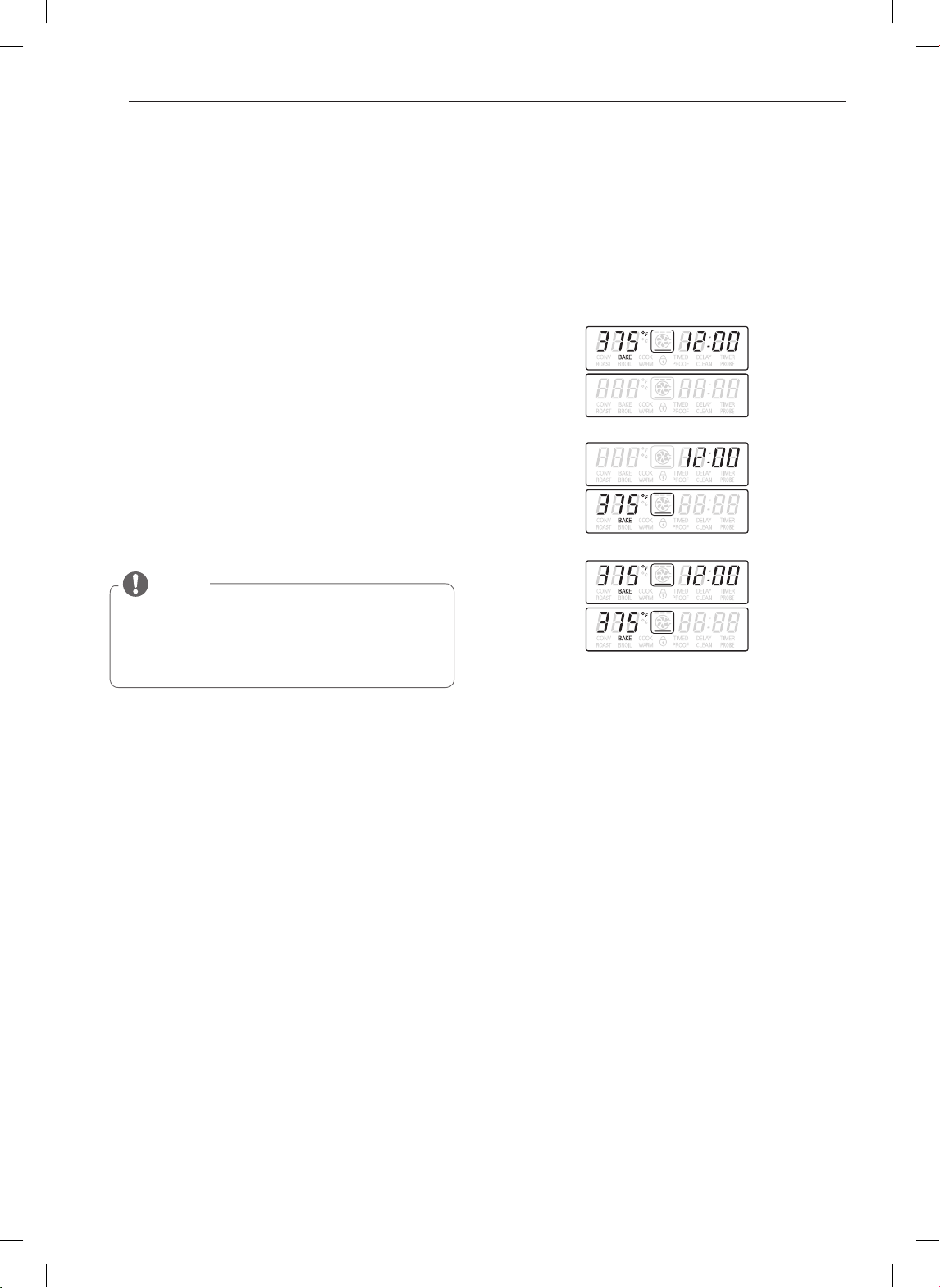
24
CÓMO USAR
HORNEAR
(Horno Superior e Inferior)
La función de HORNEADO se utiliza para preparar platillos
tales como pasteles, panes, guisados y comidas asadas. Se
puede programar el horno para que hornee a cualquier tem-
peratura, desde 170°F (77°C) a 550°F (288°C). La temperatura
predeterminada es de 350°F (177°C).
Para configurar la función de HORNEADO
(por ejemplo, a 375°F):
1
Presione la tecla
A
del horno superior o inferior.
2
Ingrese la temperatura del horno utilizando las teclas nu-
méricas (por ej., presione
3
,
7
,
5
).
3
Presione la tecla
q
.
Mientras el horno se precalienta, la temperatura se visua-
lizará en pantalla e irá aumentando en intervalos de 5
grados. Una vez que el horno alcance la temperatura
deseada, sonará un tono y la luz del horno comenzará a
parpadear.
4
Cuando la cocción se haya completado, presione la tecla
Y
o
Z
.
5
Saque la comida del horno.
NOTA
y
El precalentamiento es necesario para lograr mejo-
res resultados de cocción. Coloque la comida en el
horno luego de haberlo precalentado.
y
También puede cambiar la temperatura mientras
esté cocinando, siguiendo los pasos 1 a 3.
Horno superior únicamente
Horno inferior únicamente
Hornos superior e inferior al mismo tiempo
Visualización en pantalla del modo HORNEAR (Ejemplo):
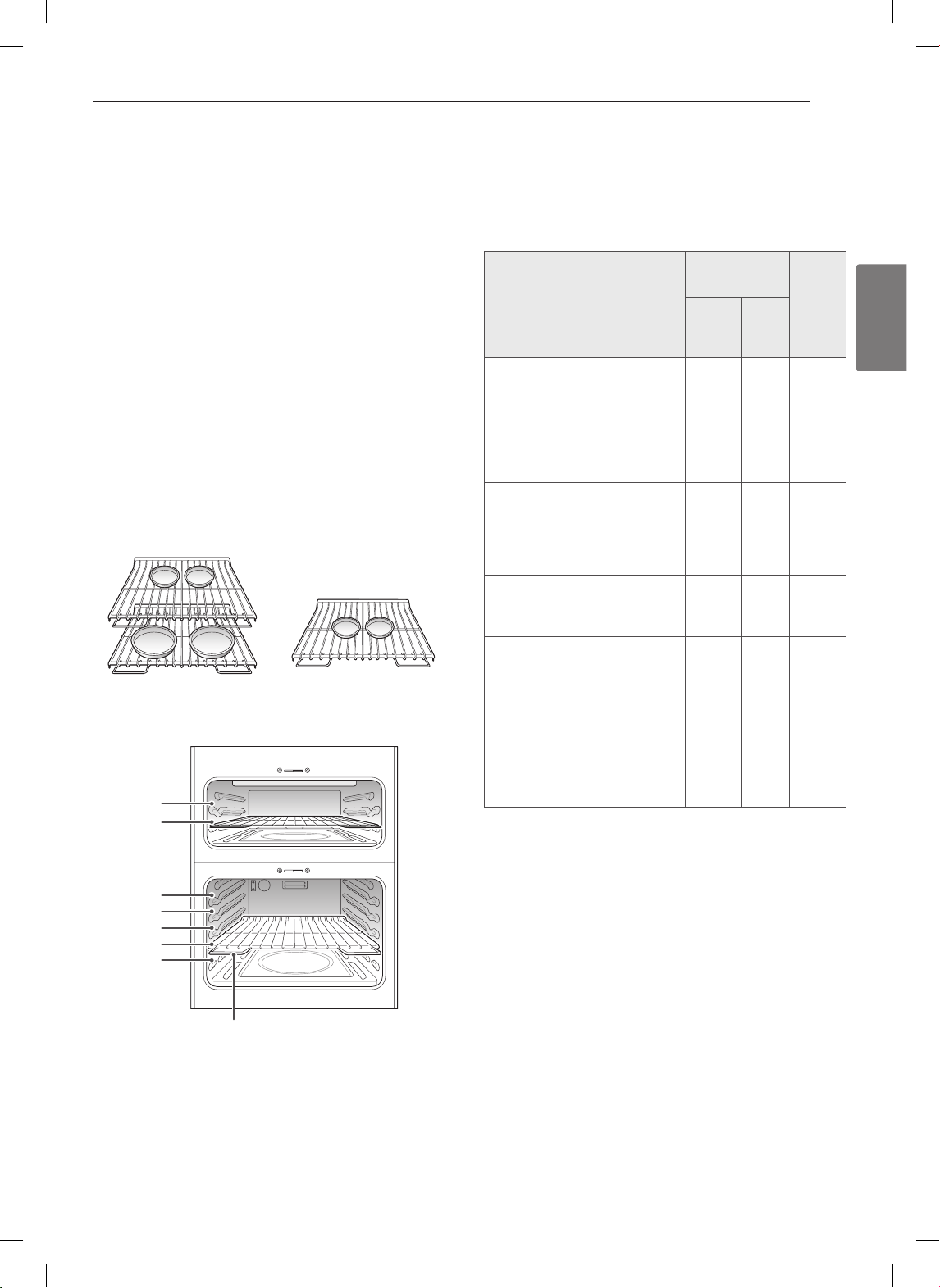
25
CÓMO USAR
ESPAÑOL
Precalentamiento y ubicación de
las bandejas
y
Para precalentar, ajuste la temperatura del horno a la
indicada en la receta. Espere hasta que el horno alcance
la temperatura ingresada antes de poner la comida en
el horno. El precalentamiento es necesario para obtener
resultados satisfactorios al hornear pasteles, galletas,
tartas y panes.
y
Para obtener los mejores resultados en el horneado, las
bandejas deben centrarse en los estantes. Si hornea con
más de una bandeja, coloque las bandejas de manera tal
que cada una tenga como mínimo 1” a 1
1
/
2
” de espa-
cio a su alrededor.
y
Si debe utilizar varios estantes en el horno inferior, colo-
que los estantes en la posición C(estante) y E(estante).
Coloque las bandejas tal como se muestra en la Figura 1.
Si debe utilizar un solo estante en el horno superior,
coloque el estante en la posición A y en el horno infe-
rior, coloque el estante en posición D.
Coloque la bandeja tal como se muestra en la fig.2.
En el horno superior es recomendado hornear con
el estante en posición A.
Figura 1 Figura 2
Estante
B
A
E
D
C
B
A
Tabla para hornear
Esta tabla es sólo para referencia y puede ser utilizada tanto
para el horno superior como para el inferior.
Ajuste el tiem-
po de cocción de acuerdo a su receta.
Comida
Temperatura
del horno
Posición del
estante
Tiempo
de hor-
neado
(en
minutos)
Horno
superior
Horno
infe-
rior
Tortas y pasteles
- Pastel relleno
- Pastel bundt
- Magdalenas
- Bizcochos
- Pastel de zanahoria
(desde cero)
350°F(177°C)
350°F(177°C)
350°F(177°C)
350°F(177°C)
350°F(177°C)
A
A
A
A
A
C
C
C
C
C
32 - 35
37 - 43
20 - 30
48 - 52
30 - 45
Galletas
- De azúcar
- Chispas de
chocolate
- Brownies
350°F(177°C)
350°F(177°C)
350°F(177°C)
A
A
A
C
C
C
12 - 20
9 - 16
30 - 35
Pizza
- Fresca
- Congelada
425°F(218°C)
400°F(204°C)
A
A
C
C
10 - 15
23 - 27
Panes
- Bisquets (enlata-
dos)
- Bisquets (de cero)
- Muffins
350°F(177°C)
425°F(218°C)
425°F(218°C)
A
A
A
C
C
C
13 - 17
10 - 12
9 - 15
Frutas y vegetales
- Manzanas
(horneadas)
- Papas (horneadas)
375°F(190°C)
375°F(190°C)
A
A
C
C
40 - 45
60 - 80
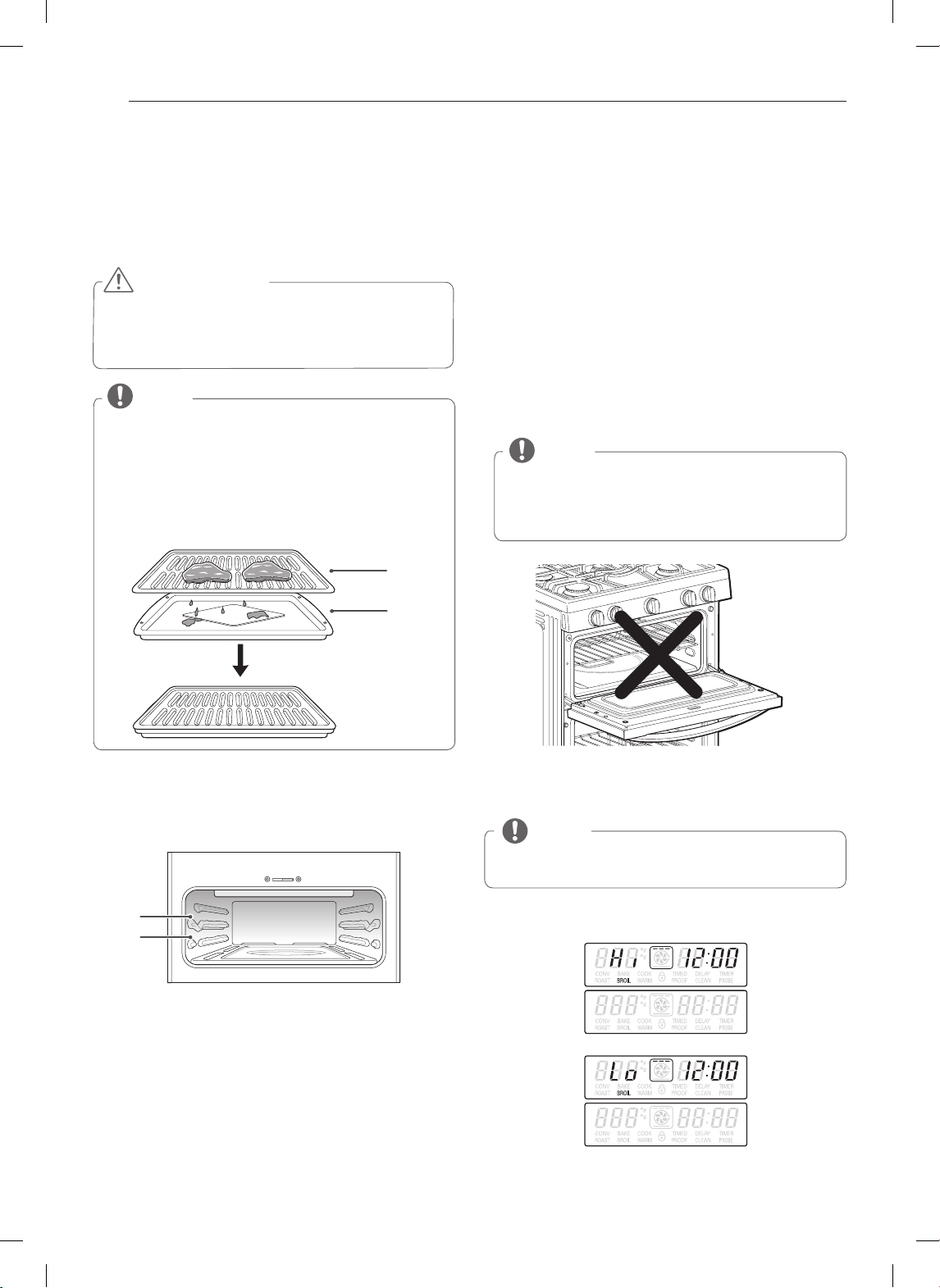
26
CÓMO USAR
ASAR (Horno superior)
Su horno está diseñado para asar a puerta cerrada.
La función
B
(ASAR) utiliza una intensa radiación de calor
proveniente de la hornilla de gas superior. Esta función trabaja
mejor cuando se asan cortes finos y tiernos (de 1” o menos)
de carne, aves o pescado.
Para configurar la función de ASAR en el horno
superior:
1
Presione la tecla
B
una vez para
l
(alto), y dos veces
para
m
(bajo).
2
Presione la tecla
q
.
3
Permita que el horno para asar se precaliente durante
cinco minutos.
4
Coloque la comida en el horno superior.
5
Cierre la puerta del horno. La puerta del horno debe per-
manecer cerrada durante el proceso de asado.
6
Cuando haya finalizado de asar, presione la tecla
Y
.
Visualización en pantalla del modo ASAR (Ejemplo)
Alta temperatura
Baja temperatura
NOTA
y
Use la opción
m
(bajo) para asar alimentos tales como
aves y cortes gruesos de carne.
y
Extraiga la asadera del horno para que se enfríe y así
permitir la limpieza fácil.
y
Para obtener los mejores resultados, utilice una bandeja
diseñada para asar, como se muestra abajo. La asadera
retiene los derrames de grasa y la rejilla ayuda a preve-
nir que la grasa salpique.
Asadera
Rejilla
NOTA
Si la puerta del horno permanece abierta por más de
15 segundos durante la función de Asar, la hornalla se
apagará. La hornilla se volverá a encender automática-
mente una vez que la puerta haya sido cerrada.
NOTA
Puede producirse algo de humo durante el proceso
de asado. Esto es normal.
Cuando ase en la posición de estante ‘B’ en el horno superior,
utilice el estante de compensación provisto para lograr
mejores resultados de cocción.
B
A
*B: Posición donde se utiliza el estante de compensación
PRECAUCIÓN
y
NO
utilice asaderas sin rejilla. El aceite puede ocasio-
nar que la grasa se incendie.
y
NO
cubra la rejilla ni la asadera con papel de aluminio.
Hacerlo provocará que se prenda fuego.
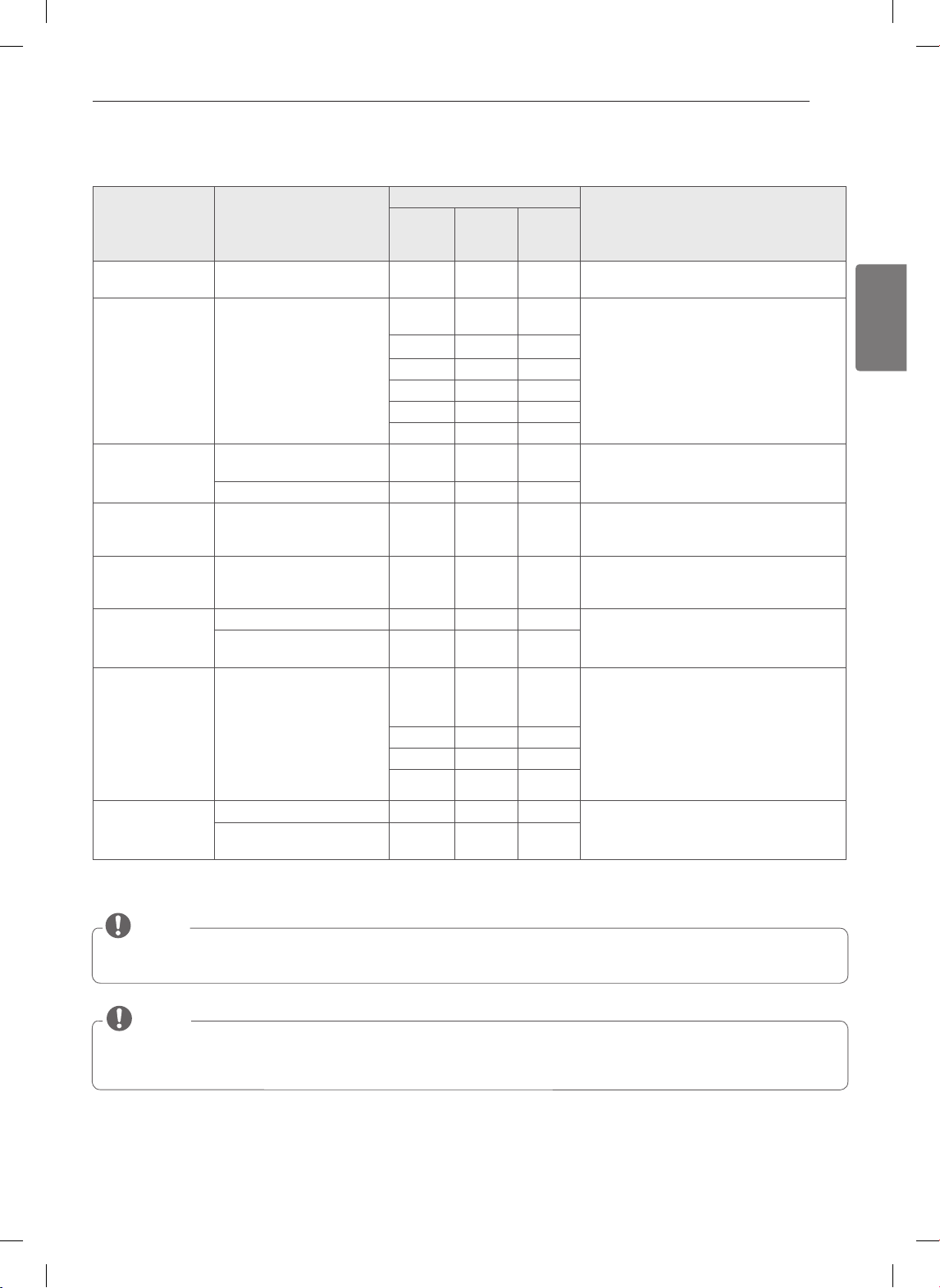
27
CÓMO USAR
ESPAÑOL
This chart is only for reference. Adjust cook time according to your preference.
Comida Cantidad y/o espesor
Horno superior
Comentarios
Posición
del
estante
Primer
lado
(minutos)
Segundo
lado
(minutos)
Carne molida
Bien cocida
1 Iibra (4 hamburguesas)
1/2 a 3/4” de espesor
A 5-7 3-5 Espaciarla uniformemente, Se pueden asar
hasta 8 hamburguesas a la vez.
Bistecs
Casi crudo
Punto medio
Bien cocido
1” de espesor
1 a 1 1/2 libras
A 6-7 2-3
Los bifes de menos de 1" de espesor se
cocinan en su interior antes de dorarse.
Se recomienda cocinarlos en sartén. Quite
la grasa.
A 7-8 3-4
A 8-9 4-5
Casi crudo
Punto medio
Bien cocido
1 1/2” de espesor
2 a 2 1/2 libras
A 8 3-4
A 9 4-5
A 10 5-6
Pollo
1 corte entero de hasta 2 a
2 1/2 libras abierto a lo largo
A 8-10 5-7 Ase el lado de la piel hacia abajo primero.
2 pechugas A 8-9 5-6
Filetes de pescado
1/4 a 1/2” de espesor A 5 2-4 Cocine y dé vuelta los filetes con mucho
cuidado. Puede untarlos con mantequilla de
limón antes y durante la cocción si gusta.
Rodajas de jamón
(precocidas)
1/2” de espesor A 6-7 2-3 Aumente el tiempo de cocción de 5 a 10
minutos por lado para jamón curado casero
o para jamón de 1 1/2” de espesor.
Chuletas de cerdo
Bien cocidas
1 (1/2” de espesor) A 4-6 3-5 Quite la grasa.
2 (1” de espesor)
aprox. 1libra
A 7-9 5-7
Chuletas de
cordero
Quite la grasa.
Cocción media 2 (1” de espesor)
aprox10 a 12 oz.
A 7-8 2-3
Bien cocidas A 8-9 3-4
Cocción media 2 (1/2” de espesor)
aprox. 1libra
A 6-7 2-3
Bien cocidas A 7-8 3-4
Filetes de salmón
2 (1” de espesor) A 7-9 3-5 Aceite la bandeja. Unte los filetes con
manteca derretida.
4 (1” de espesor) aprox.
1libra
A 8-10 3-5
Los tiempos de asado pueden variar por el tamaño, peso y/o grosor de la comida a asar, temperatura de inicio y preferencias
personales de cocción. Esta guía se basa en carnes a temperaturas refrigeradas.
NOTA
El Departamento de Agricultura de los E.U.A dice “La carne al termino medio es popular, pero debe de saber que cocinarla a
solo 140°F. significa que algunos organismos venenosos pueden llegar a sobrevivir”. (Fuente: Safe Food Book. Your Kitchen
Guide. USDA Rev. Junio 1985.)
NOTA
TABLA PARA LA FUNCIÓN DE ASAR
Esta tabla es solamente de referencia. Ajuste el tiempo de cocción de acuerdo con su preferencia.
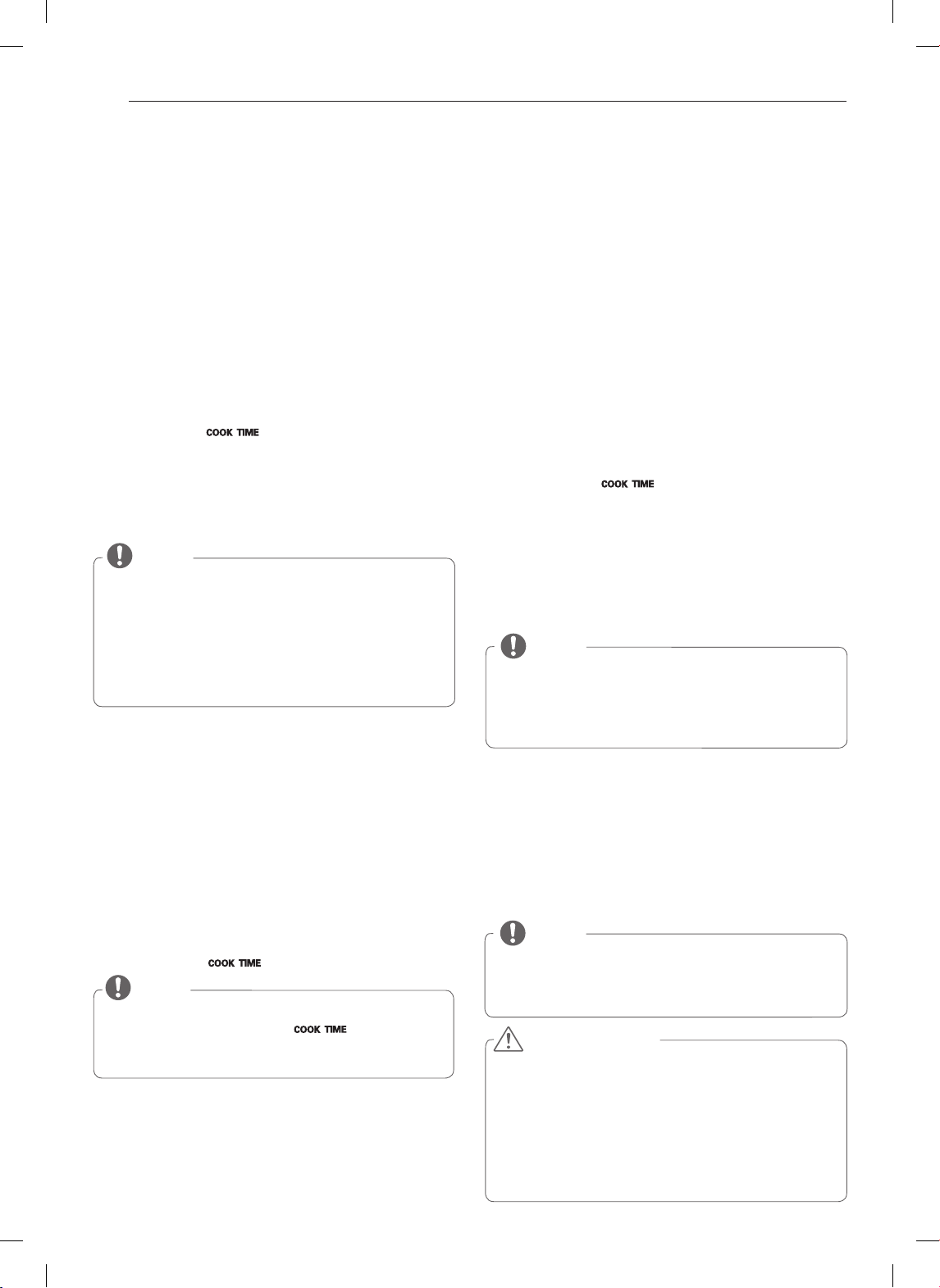
28
CÓMO USAR
ESPAÑOL
COCCIÓN CON TEMPORIZADOR
(Horno superior e inferior)
La función de COCCIÓN CON TEMPORIZADOR le permite
programar el horno para cocinar durante un período de tiempo
específico. Esta función solo puede utilizarse mientras se hornea.
Para configurar la COCCIÓN CON TEMPORIZADOR
(ejemplo: para HORNEAR a 300°F durante 30 minutos):
1
Presione la tecla
A
superior o inferior.
q
o
aparecerá en
la pantalla.
2
Utilice las teclas numéricas para establecer la temperatura
(por ej., presione
3
,
0
,
0
).
3
Una vez que el horno se haya precalentado a 300°,
presione la tecla .
o
o
aparecerá en la pantalla.
4
Programe el tiempo de horneado deseado (ej. presione
3
,
0
). El tiempo de horneado puede programarse para cualquier
cantidad de tiempo, entre 1 minuto y 11 horas y 59 minutos.
5
Presione la tecla
q
. El horno se encenderá y la pantalla
mostrará el tiempo de cocción restante.
El horno continuará cocinando durante el tiempo programado y
luego se apagará automáticamente. Cuando haya finalizado el
tiempo de cocción:
Para cambiar el tiempo de cocción mientras el horno
está encendido (por ejemplo, para cambiar el tiempo de
cocción de 30 minutos a 1 hora y 30 minutos):
1
Presione la tecla .
2
Utilice las teclas numéricas para cambiar el tiempo de
horneado (por ej. presione
1
,
3
,
0
).
3
Presione
q
para aceptar el cambio.
COCCIÓN CON TEMPORIZADOR
RETARDADO (Horno superior e
inferior)
El temporizador automático de COCCIÓN CON TEMPORIZADOR
RETARDADO hará que el horno se ENCIENDA y se APAGUE a
la hora que usted seleccione. Esta función solo puede utilizarse
mientras se hornea.
Para configurar el horno para Inicio Retardado
(ejemplo: para HORNEAR a 300°F durante 30 minutos y que el
modo horneado comience a las 4:30 pm):
1
Asegúrese de que el reloj tenga la hora correcta.
2
Acomode la(s) bandeja(s) interiores del horno y coloque la
comida en el horno.
3
Presione la tecla
b
.
q
o
aparecerá en la pantalla.
4
Utilice las teclas numéricas para establecer la temperatura
del horno (por ej. presione
3
,
0
,
0
).
5
Presione la tecla .
6
Programe el tiempo de horneado (por. ej. presione
3
,
0
).
El tiempo de horneado puede programarse por cualquier
cantidad de tiempo, entre 1 minuto y 11 horas y 59 minutos.
7
Presione la tecla
W
.
8
Programe el tiempo de inicio (por ej. presione
4
,
3
,
0
).
9
Presione la tecla
q
. A la hora programada, sonará un bip
corto y el horno comenzará a hornear.
y
k
y la hora del día aparecerán en la pantalla.
y
El tono que indica el final de la cocción sonará cada 60
segundos hasta que se presione la tecla
Y
o
Z
.
y
Cuando se programa la función CALENTAR, la misma se
activará luego de haberse completado la cocción por el
tiempo programado.
NOTA
Si ambos hornos superior e inferior están funcionando al
mismo tiempo, presione la tecla una vez para
fijar el tiempo de cocción para el horno inferior y dos veces
para el horno superior.
El horno continuará cocinando durante el tiempo programado y
luego se apagará automáticamente. Cuando haya finalizado el
tiempo de cocción:
y
k
y la hora del día aparecerán en la pantalla.
y
El tono que indica el final de la cocción sonará cada 60
segundos hasta que se presione la tecla
Y
o
Z
.
y
Cuando se programe la función CALENTAR, la misma se
activará luego de haberse completado la cocción por el
tiempo programado.
N
OTA
y
Para hacer que la función CALENTAR encienda al final
del ciclo de cocinado, repita los pasos 1 a 5, y luego
presione la tecla
C
.
WARM
aparecerá en la pantalla
. (Consulte "CALENTAR" en la sección "Cómo usar" para
mayor información acerca de cómo calentar.)
y
Para cancelar la función COCCIÓN CON
TEMPORIZADOR, presione las teclas
Y
o
Z
en
cualquier momento.
NOTA
y
Para cancelar la función COCCIÓN CON
TEMPORIZADOR, presione las teclas
Y
o
Z
en
cualquier momento.
y
Si desea cambiar el tiempo de cocción, repita los
pasos 5 a 6 y presione
q
.
NOTA
Si el reloj de su horno está configurado como un reloj de 12
horas, puede rertardar el tiempo de cocción por 12 horas.
Si el reloj de su horno está configurado como un reloj de 24
horas, puede rertardar el tiempo de cocción por 24 horas.
PRECAUCIÓN
y
Utilice el temporizador automático cuando cocine carnes
curadas o congeladas y la mayoría de frutas y vegetales.
Los alimentos que pueden echarse a perder fácilmente
como leche, huevo, pescado, carne o aves deben enfriarse
en el refrigerador. Incluso fríos, no deben dejarse en el
horno más de 1 hora antes de la cocción, y deben retirarse
apenas termina la cocción.
y
Comer alimentos echados a perder puede causar
intoxicación por comida en mal estado.
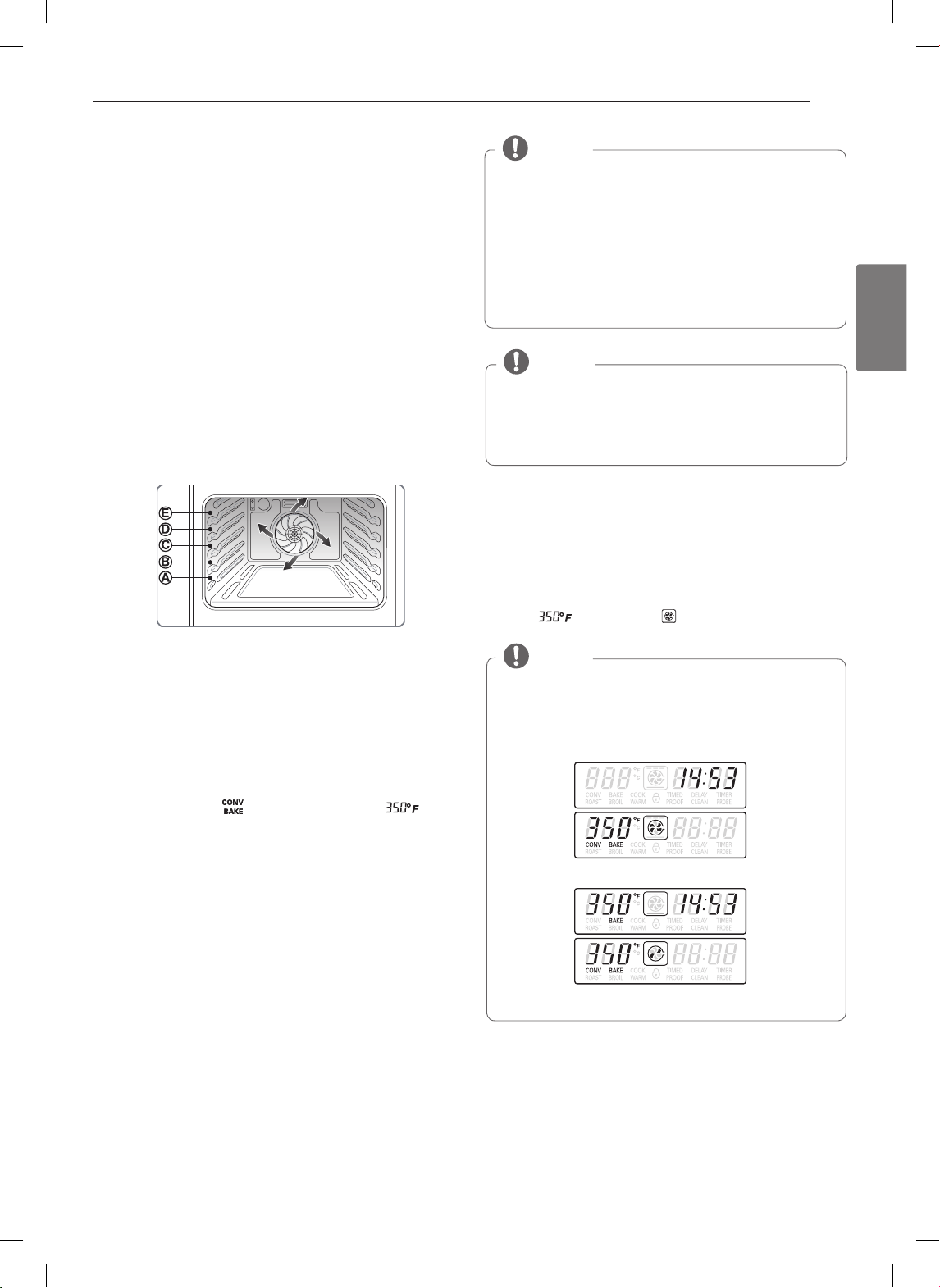
29
CÓMO USAR
ESPAÑOL
ESPAÑOL
Como usar la convección del horno
inferior (LDG3016ST)
El sistema de convección utiliza un ventilador para hacer
circular el calor del horno.
Esto resulta en una mejora en la distribución del calor permi-
tiendo un cocinado parejo y por lo tanto excelentes resulta-
dos.
CONVECCIÓN HORNEADO
(LDG3016ST)
El horneado por convección permite un cocinado parejo y
por lo tanto excelentes resultados incluso usando múltiples
bandejas al mismo tiempo. Puede también disminuir el
tiempo de cocinado operando el modo CONVECCIÓN HOR-
NEADO entre 300°F(150°C) ~ 550°F(285°C).
1
Beneficios del modo CONVECCIÓN HORNEADO
1) Horneado parejo usando múltiples bandejas.
2) Tiempo de cocinado más rapido.
2
Para accionar el modo CONVECCIÓN HORNEADO
(ejemplo a 375°F).
1) Presione la tecla . La pantalla parpadeará .
2) Introduzca la temperatura del horno (Presione
3
,
7
,
5
).
3) Presione el botón
q
. La pantalla mostrara
CONV
,
BAKE
y la temperatura convertida empezando en 100°F.
Conforme el horno se vaya precalentando, la pantalla
mostrara incrementos de temperatura de 5 grados.
4) Una vez que el horno alcance la temperatura deseada, un
tono sonará y la luz del horno parpadeará continuamente.
La pantalla mostrará la temperatura del horno auto conver-
tida ,
CONV
,
BAKE
y .
NOTA
Cuando cocine con un ciclo de convección, la temperatura
del horno será automáticamente reducida en 25°F posterior-
mente la pantalla mostrara la temperatura cambiada.
Esta característica de funcionamiento es llamada AUTO
CONVERSIÓN. Su estufa viene con esta característica de
funcionamiento habilitada.
Para deshabilitar la característica de auto conversión, vea
“Cómo activar la función de auto conversión del modo de
convección“ en la sección de “Instrucciones de funciona-
miento”.
NOTA
Escuchará un ventilador mientras cocine con convección.
El ventilador parará cuando la puerta se abra, pero el calor
permanecerá encendido. El ventilador no comenzará a fun-
cionar hasta que el horno haya alcanzado la temperatura de
precalentado.
NOTA
y
Para cancelar el modo CONVECCIÓN HORNEADO,
presione la tecla
Z
en cualquier momento.
y
Pantalla en el modo CONVECCIÓN HORNEADO
(ejemplo).
Horno inferior solamente.
Horno inferior y superior al mismo tiempo.
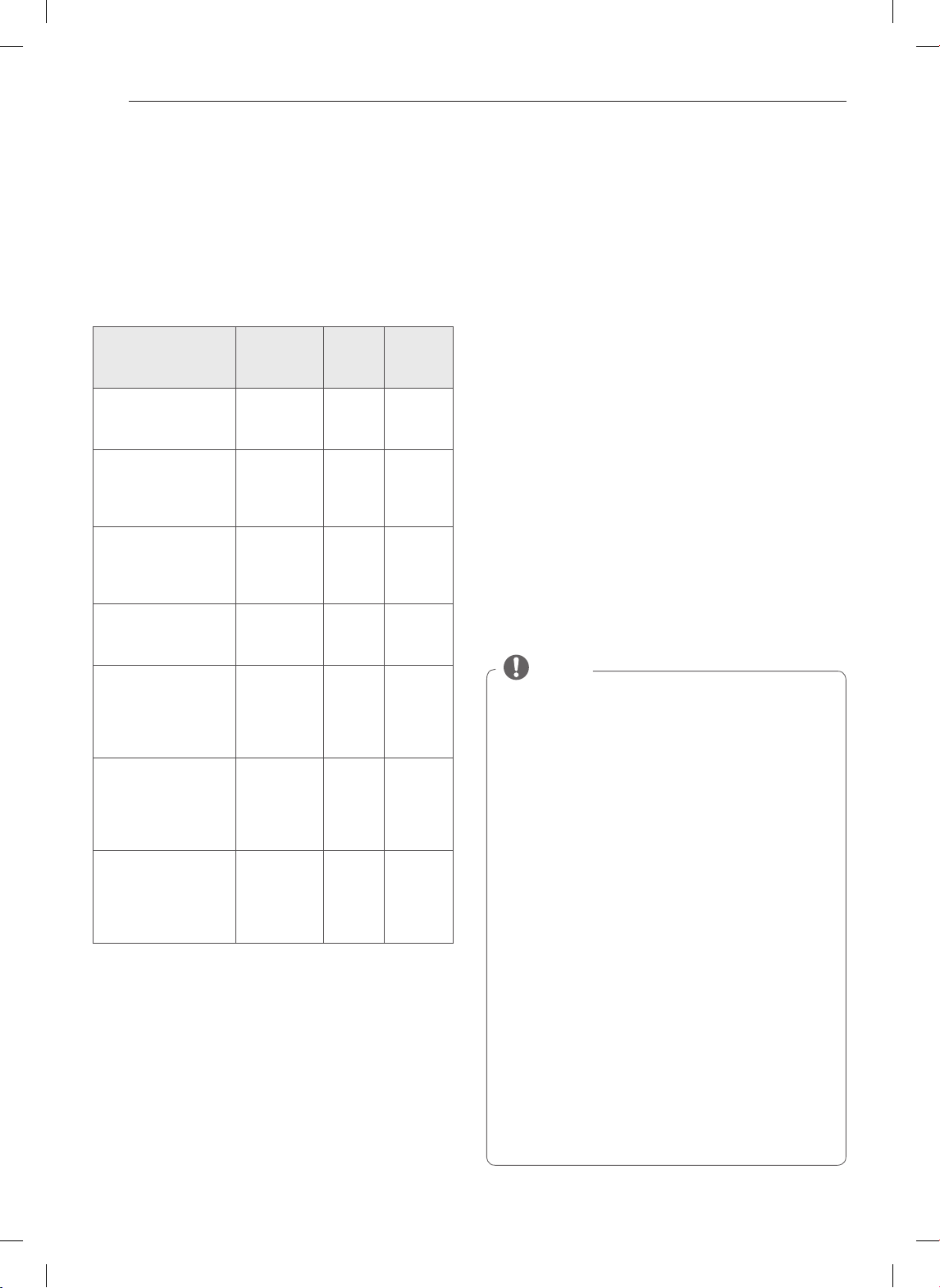
30
CÓMO USAR
3
Utensilios de cocina para el cocinado por convección.
Antes de usar el horno por convección, verifique sus utensi-
lios de cocina dejen espacio para que el aire circule dentro
del horno. Si va a hornear con varios utensilios de cocina
deje espacio entre estos. También, asegúrese de que no
haya contacto entre las cacerolas para hornear y/o entre
estas con las paredes del horno.
1) Papel y plástico.
Se pueden utilizar papel resistente al calor y/o contene-
dores de plástico recomendados para su uso en hornos
regulares y/o hornos de convección.
2) Metal y vidrio.
Cualquier tipo de utensilio de cocina funcionará en su
horno equipado con la función de convección. Sin em-
bargo, las cacerolas para hornear de metal calientan más
rápido y son recomendadas para su uso en hornos de
convección.
• Las cacerolas que sean oscuras o con acabados en
mate hornearan más rápido que las cacerolas de acaba-
dos brillosos.
• Las cacerolas para hornear de vidrio o de materiales
cerámicos cocinarán más despacio.
Cuando hornee galletas, use hojas planas de metal en lugar
de cacerolas con lados cortos para obtener mejores resulta-
dos.
Para recetas como pollo al horno, use cacerolas para
hornear con lados cortos. El aire caliente no podrá circular
libremente alrededor de la comida si se utiliza una cacerola
con lados largos.
NOTA
y
Las galletas y bizcochos deben de ser horneados
en hojas planas de metal o en cacerolas de metal de
lados muy cortos. La comida cocinada en cacerolas
con acabados oscuros se cocinará más rápido.
y
Al usar la función de horneado por convección la
comida cocinada en una sola bandeja generalmente
se cocinará más rápido y de forma pareja.
El uso de múltiples bandejas puede incrementar
ligeramente los tiempos de cocinado de algunas comi-
das pero generalmente el resultado final es el ahorro
de tiempo.
y
Las galletas, mantecadas, bizcochos las galletas,
mantecadas y bizcochos buenos resultados cuando se
usan varias bandejas a tendrán vez.
y
Es normal que el ventilador se pare durante el ciclo
de convección, esto permite que el calor se distribuya
uniformemente.
y
Utilice cacerolas de tamaños recomendados en las
recetas.
y
Algunas comidas congeladas han sido echas para ser
cocinadas en hornos comerciales de convección. Para
mejores resultados, precaliente el horno y utilice la
temperatura recomendada en la receta del empaque.
y
Si algún fabricante de comida otorga instrucciones
de cocinado por convección especificas, programe la
temperatura de auto conversión para que la tempera-
tura de precalentamiento del horno sea la misma que
la de la temperatura en las instrucciones del em-
paque.
Tabla de horneado por convección
Si la función de auto conversión esta deshabilitada, reduzca
la temperatura estándar de la receta en 25°F en el modo de
CONVECCIÓN HORNEADO.
Las temperaturas han sido ajustadas en esta tabla.
El uso de múltiples bandejas puede incrementar ligera-
mente los tiempos de cocinado de algunas comidas pero
generalmente el resultado final es el ahorro de tiempo.
Esta tabla es solo de referencia. Ajuste el tiempo de coc-
ción de acuerdo a su preferencia.
Alimento
Temperatura
del horno
(convertido)
Posición
de la
bandeja
Tiempo de
horneado
(minutos)
Pasteles
- Pasteles de capas
- Pastel Bundt
325°F(163°C)
325°F(163°C)
C
C
32~35
37~43
Pasteles, especialidad
- Popovers
- Magdalenas
- Pasteles de libra
400°F(204°C)
325°F(163°C)
325°F(163°C)
B
C
C
20~30
20~25
48~55
Galletas
- Azúcar
- Chispas de chocolate
- Brownies
325°F(163°C)
325°F(163°C)
325°F(163°C)
C
C
C
12~20
9~16
30~35
Pizza
- Fresca
- Congelada
400°F(204°C)
375°F(190°C)
C
C
10~15
23~27
Panes
- Panecillo, lata
- Panecillo, casero
- Muffins
- Pan blanco, rebanada
325°F(163°C)
425°F(218°C)
400°F(204°C)
400°F(204°C)
C
C
C
B
13~17
8~12
9~15
30~38
Masa de pastelitos
- Casera
- Refrigerador
425°F(218°C)
425°F(218°C)
C
C
9~12
9~11
Postres
- Crocantes de frutas y
cobblers, caseros
- Pasteles, caseros, 2
masas de frutas
350°F(177°C)
350°F(177°C)
C
C
30~40
60~70

31
CÓMO USAR
ESPAÑOL
CONVECCIÓN ASADO PARA EL
HORNO INFERIOR
(LDG3016ST)
El modo de convección asado esta diseñado para otorgar un
óptimo desempeño al asar. La función CONVECCIÓN ASADO
combina el cocinado con el ventilador de convección para asar
carnes. El aire precalentado circula alrededor de las comida
desde todos los lados del horno, envolviendo mejor los jugos
y sabores. Los alimentos llegan a ser tostados y crujientes en
el exterior y jugosos en el interior.
1
Para accionar el horno inferior en modo CONVECCIÓN
ASADO (ejemplo a 375°F).
1) Presione el botón . La pantalla desplegará .
2) Fije la temperatura del horno
(presione
3
,
7
,
5
).
3) Presione la tecla
q
. La pantalla mostrara
CONV
,
ROAST
y la temperatura convertida empezando en 100°F. Con-
forme el horno se vaya precalentando, la pantalla mostr-
ara incrementos de temperatura de 5 grados.
4) Una vez que el horno alcanza la temperatura deseada,
un tono sonará y la luz de horno parpadeará continu-
amente. La pantalla mostrará la temperatura del horno
auto convertida ,
CONV
,
ROAST
y .
5) Ponga la comida dentro del horno.
NOTA
Cuando cocine con un ciclo de convección, la temperatura
del horno será automáticamente reducida en 25°F poste-
riormente la pantalla mostrara la temperatura cambiada.
Esta característica de funcionamiento es llamada AUTO
CONVERSIÓN. Su estufa viene con esta característica de
funcionamiento habilitada. Para deshabilitar la caracter-
ística de auto conversión, vea “Cómo activar la función de
auto conversión del modo de convección en la sección de
“Instrucciones de funcionamiento”.
NOTA
y
Para cancelar el modo CONVECCOIÓN ASADO, pre-
sione la tecla
Z
en cualquier momento.
y
Pantalla en el modo CONVECCIÓN ASADO (ejemplo).
Horno inferior solamente.
Horno inferior y superior al mismo tiempo.
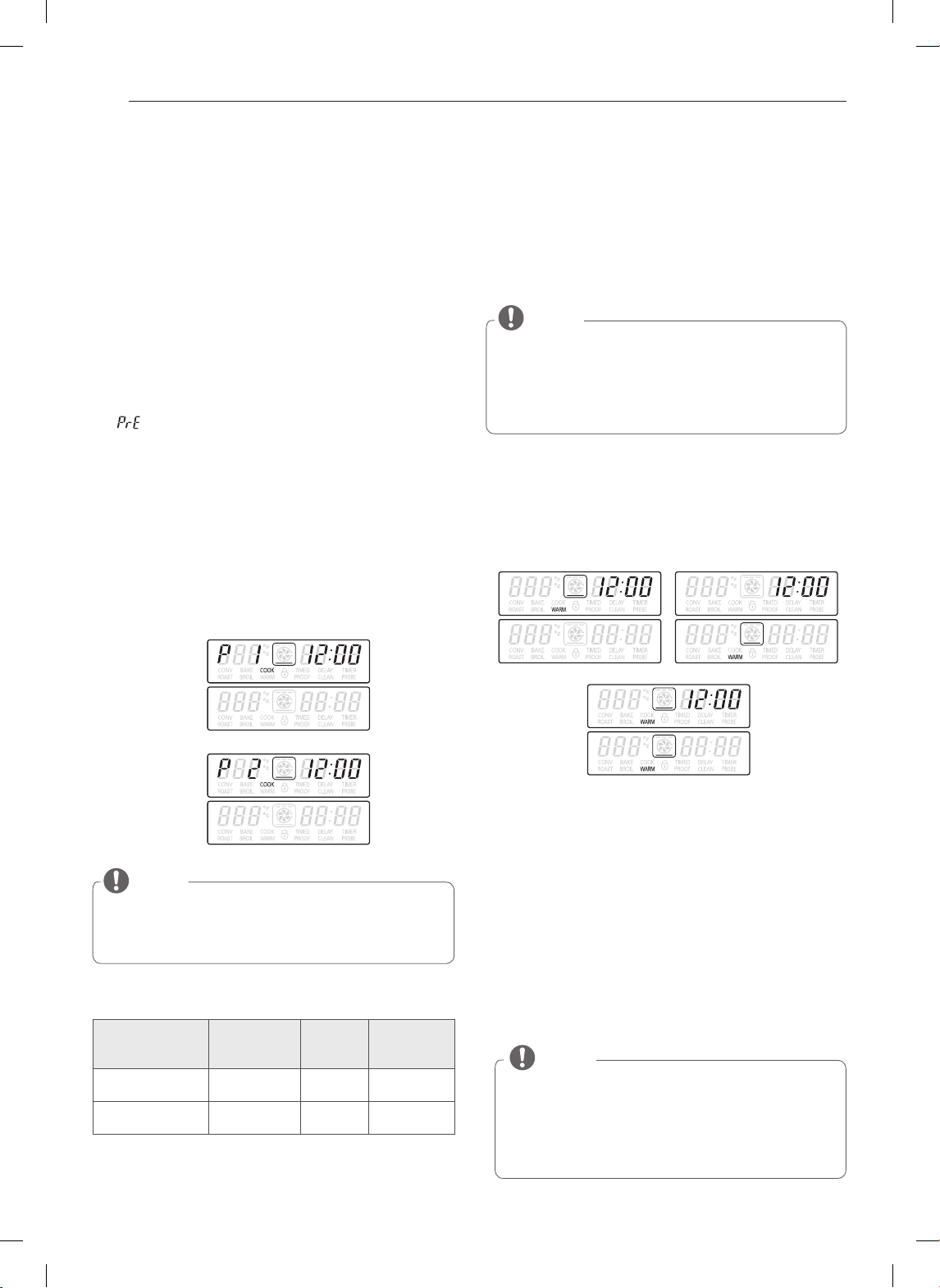
32
CÓMO USAR
Características especiales
PIZZA (Horno superior)
Esta función fijara automáticamente la temperatura del horno
superior para cocinar pizza congelada tanto de masa regular como
de masa gruesa. Simplemente escoja el tipo de masa (P1 para masa
regular y P2 para masa gruesa) e introduzca el tiempo de cocinado.
Para configurar el horno para pizza congelada:
1
Presione la tecla
x
una vez para masa normal y dos
veces para masa elevada. Aparecerá
H
(masa normal) o
I
(masa elevada) en la pantalla.
2
Presione la tecla
q
.
3
" " aparecerá en la pantalla para indicando que el horno
se esta precalentando. La alarma sonará una vez que el
precalentado haya terminado.
4
Introduzca la pizza en el horno, cierre la puerta, posteri-Introduzca la pizza en el horno, cierre la puerta, posteri-
ormente fije el temporizador como lo muestra la tabla de
abajo.
5
Cuando el cocinado se haya completado, presione el
botón
Y
.
6
Retire los alimentos del horno.
Visualización en pantalla (ejemplo):
Tabla para PIZZA
Esta tabla es solo para referencia. Ajuste el tiempo de cocción
de acuerdo con lo indicado en la receta.
CALENTAR (Horno superior e inferior)
Esta función mantendrá la temperatura del horno en 170°F
(77°C). La función
CALENTAR
mantendrá la comida cocida
caliente para servirla hasta 3 horas luego de que haya
finalizado la cocción. La función Calentar puede utilizarse
sin otras operaciones de cocción o puede utilizarse luego
de que la cocción haya finalizado utilizando HORNEAR CON
TEMPORIZADOR u HORNEAR CON TEMPORIZADOR
RETARDADO.
NOTA
y
La función
CALENTAR
tiene el propósito de mantener la
comida caliente. No la utilice para enfriar la comida.
y
Cuando la temperatura del horno inferior esté por
encima de los 475°F (246°C), la función
CALENTAR
del
horno superior no podrá utilizarse.
w
aparecerá en la
pantalla.
Para programar la función CALENTAR:
1
Presione la tecla
C
del horno superior y/o inferior.
2
Presione la tecla
q
.
Visualización en pantalla (ejemplo):
Para programar la función CALENTAR luego de la
Cocción con temporizador:
1
Configure la COCCIÓN CON TEMPORIZADOR O
COCCIÓN CON TEMPORIZADOR RETARDADO (consulte
"COCCIÓN CON TEMPORIZADOR" o "COCCIÓN CON
TEMPORIZADOR RETARDADO" en la sección "Cómo
usar").
2
Presione la tecla
q
.
3
Presione la tecla
C
.
El modo Calentar se encenderá automáticamente luego
de haberse completado la cocción por temporizador o la
cocción con temporizador retardado.
P1
P2
NOTA
• El precalentamiento es necesario para lograr mejores
resultados de cocción. Coloque la comida en el horno
luego de haberlo precalentado.
Comida
Tamaño
recomendado
Posición
del estante
Tiempo
recomendado
(minutos)
Pizza congelada
con masa normal
12” A 13-17
Pizza congelada
con masa elevada
12” A 25-28
Horno superior únicamente
Horno superior e inferior al mismo tiempo
Horno inferior únicamente
NOTA
y
Para cancelar la función
CALENTAR
, presione las
teclas
Y
o
Z
en cualquier momento.
y
Si presiona
Y
o
Z
antes de que se inicie la
función de retardo, todos los ajustes programados
de cocción se cancelarán.
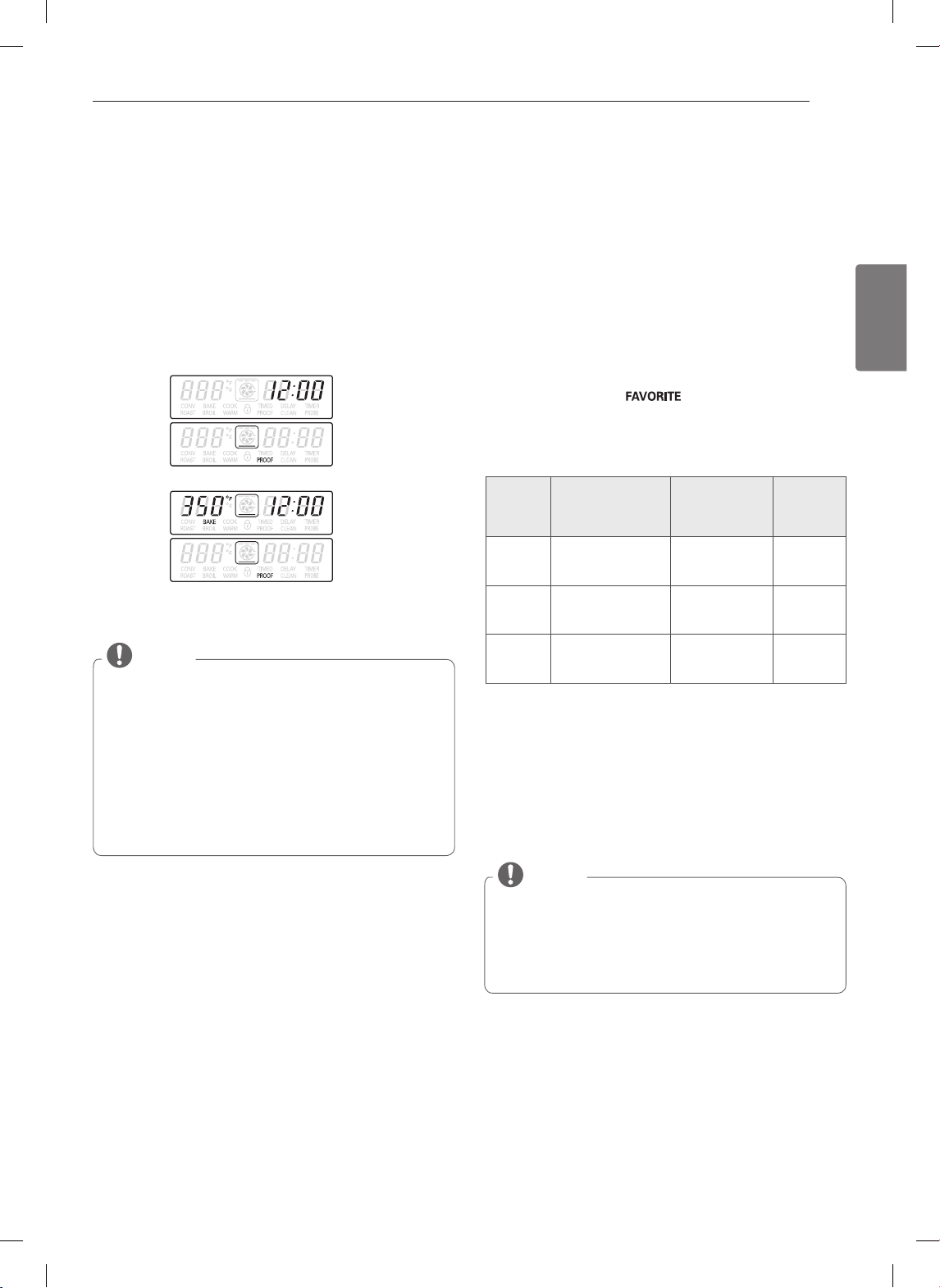
33
CÓMO USAR
ESPAÑOL
LEVAR (Para el horno inferior)
Esta característica mantiene el horno caliente para que los
productos con levadura leven antes de hornearlos.
Para programar la función LEVAR:
1
Utilice la bandeja B o C para levar.
2
Presione la tecla
J
.
3
Presione la tecla
q
.
4
Cuando el levado haya finalizado, presione la tecla
Z
.
Horno inferior únicamente
Horno superior e inferior al mismo tiempo
Visualización en pantalla (ejemplo):
NOTA
y
Para evitar que la temperatura del horno baje y el
tiempo de levado sea mayor, no abra la puerta del horno
innecesariamente. Controle los productos panificados
para evitar que leven en exceso.
y
No utilice el modo de levado para calentar comida o
mantenerla caliente. La temperatura de levado del
horno no es suficiente para mantener comidas a
temperaturas seguras. Use la función CALENTAR para
mantener la comida caliente.
El levado no funcionará cuando el horno esté por
encima de los125°F.
w
se mostrará en la pantalla.
FAVORITOS (LDG3016ST Horno
inferior)
Mediante esta función se llegan a grabar y recordar hasta tres
diferentes ajustes.
La función de ajuste de FAVORITO puede llegar a usarse con
la función TIEMPO DE COCINADO. Esta función no funcio-
nará con alguna otra función incluyendo la función TIEMPO
DE INICIO.
1
Para fijar la función FAVORITOS
1) Ponga la comida en el horno.
2) Presione el botón
para seleccionar la cat
egoría
de comida.
La temperatura predeterminada aparecerá en la pantalla
y COOK parpadeará.
Categoría
de
selección
Presione
Favoritos
Temperatura
predeterminada
(puede cambiar)
Falla de
operación
Pan Presione
FAVORITE una
sola vez.
375°F Horneado
Carne Presione
FAVORITE dos
veces.
325°F Convec-
ción asado
Pollo Presione
FAVORITE tres
veces.
350°F Convec-
ción asado
3) Presione los botones numéricos para fijar la tempera-
tura del horno deseada. Esta temperatura será grabada
y recordada la siguiente vez.
4) Presione el botón
q
. El tono de precalentamiento
sonará tres veces cuando el horno haya alcanzado la
temperatura programada.
N OTA
y
Solamente la temperatura seleccionada será grabada y
no el tiempo de cocinado.
y
Si la temperatura del horno es cambiada, está será
grabada.
y
La temperatura grabada no se borra si ocurre una falla
en la corriente eléctrica.
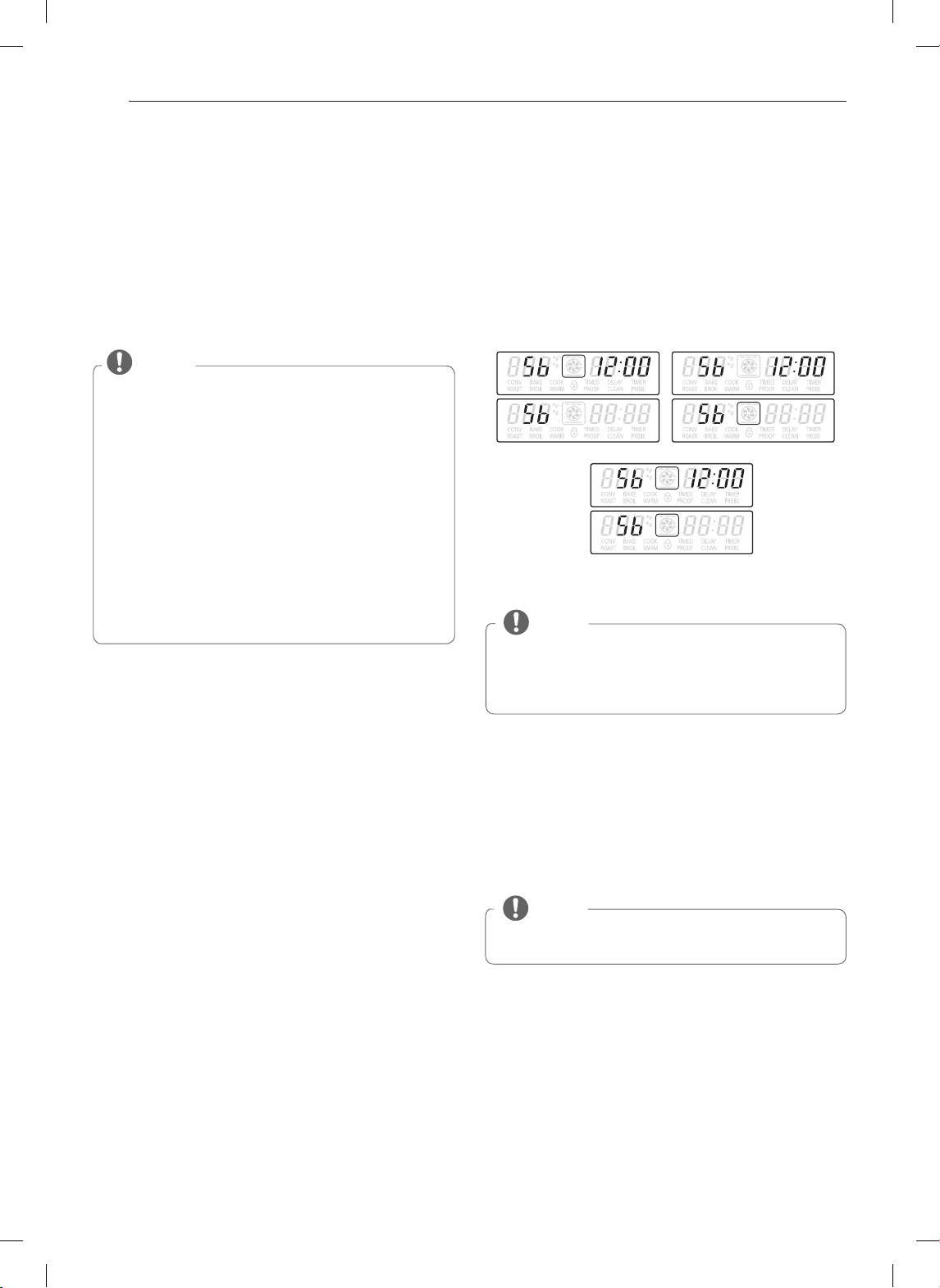
34
CÓMO USAR
Para configurar el modo SABBAT:
1
Presione la tecla
A
.
2
Utilizando las teclas numéricas, ingrese la temperatura
deseada.
3
Presione la tecla
q
.
4
Presione y mantenga presionada la tecla
X
durante
tres segundos.
V
isualización en pantalla (ejemplo):
Para cambiar la temperatura mientras se encuentra
en modo SABBAT (sin sonidos ni cambios en pantalla):
1
Presione la tecla
A
del horno superior o inferior.
2
Usando las teclas numéricas, ingrese la temperatura
deseada.
3
Presione la tecla
q
.
SABBAT (Horno superior e
inferior)
El modo SABBAT es típicamente utilizado en las vacaciones
o el Sabbat Judío. Cuando el modo SABBAT esté activado,
el horno no se apagará hasta que se desactive el modo
SABBAT. En el modo SABBAT, todas las teclas de función,
excepto por las teclas
Y
y
Z
, están inactivas.
z
aparecerá en la pantalla del horno.
N OTA
y
SI la luz del horno está ENCENDIDA y el modo SABBAT
se encuentra activado, la luz del horno permanecerá
ENCENDIDA hasta que el modo SABBAT se APAGUE.
Si necesita que la luz del horno esté APAGADA,
asegúrese de APAGAR la luz del horno antes de activar
el modo SABBAT.
y
El modo SABBAT solo puede utilizarse mientras se
hornea (modo HORNEAR) ya sea en el horno superior,
inferior, o en ambos.
y
Puede utilizar la opción COCCIÓN CON
TEMPORIZADOR en el otro horno mientras el horno
superior o inferior está activado.
Consulte “COCCIÓN CON TEMPORIZADOR” en la
sección "Cómo usar el horno".
Horno superior únicamente
Horno inferior únicamente
Horno superior e inferior al mismo tiempo
NOTA
y
Para cancelar la función HORNEAR, presione las teclas
Y
o
Z
en cualquier momento.
y
Para cancelar el modo SABBAT, presione y mantenga
presionada la tecla
X
por 3 segundos.
NOTA
y
Habrá una demora de 15 segundos antes de que la
unidad reconozca el cambio de temperatura.
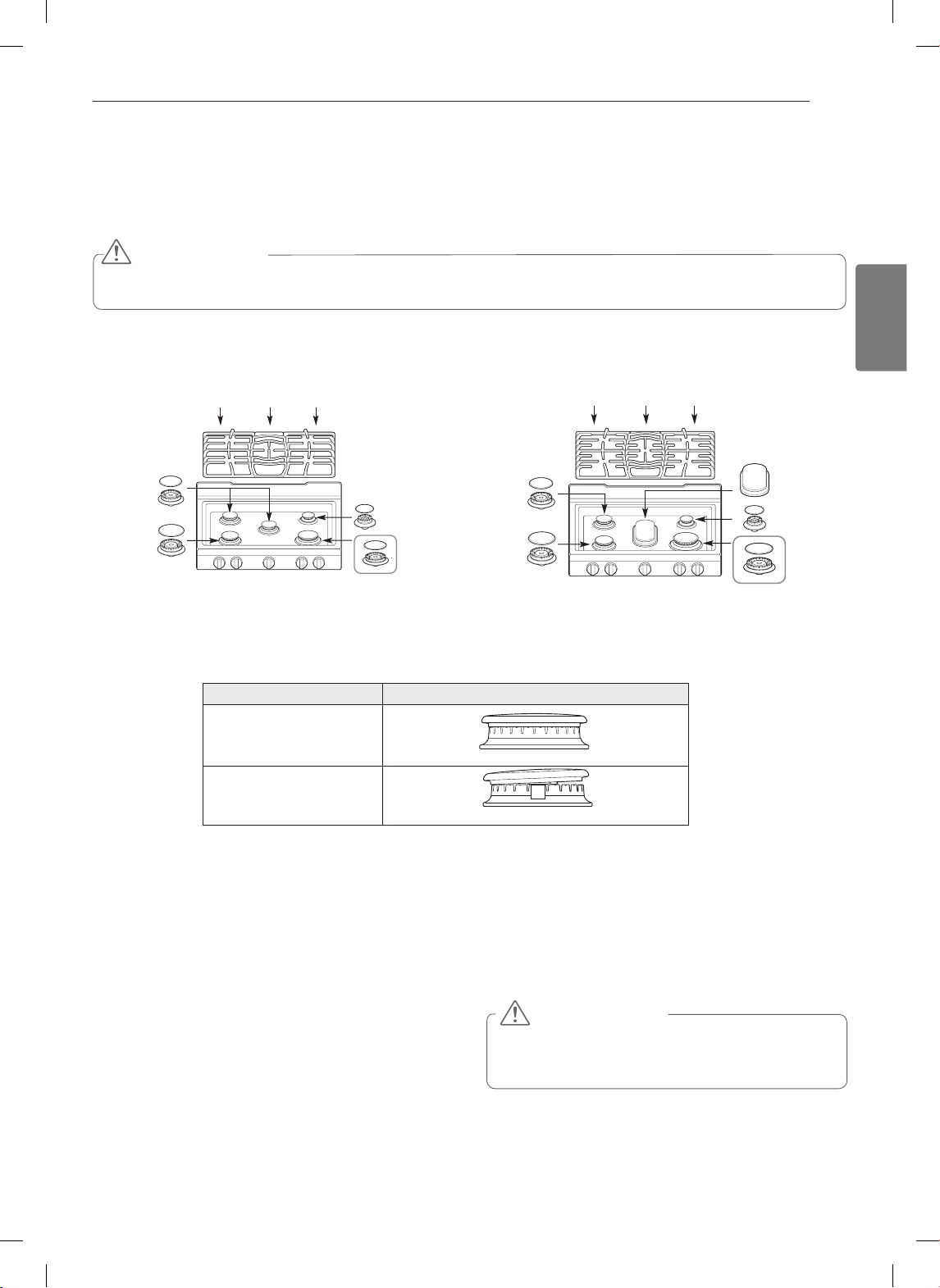
35
CUIDADO Y LIMPIEZA
ESPAÑOL
Cómo limpiar los cabezales/tapas de
las hornillas
Para lograr una llama pareja y completa, las hendiduras de
los cabezales de las hornillas deben estar siempre limpias.
Los cabezales de las hornillas y la tapa de la hornalla pueden
levantarse.
• Lave las tapas de las hornillas con agua caliente y jabón, y
enjuague con agua limpia.
• Cualquier derrame sobre o alrededor de un electrodo debe
limpiarse cuidadosamente.
• Para quitar comida quemada, sumerja las hornillas en una
solución de detergente suave y agua caliente durante 20-
30 minutos. Para manchas resistentes, use un cepillo de
dientes.
• Las hornillas no funcionarán adecuadamente si los puertos
o electrodos de las hornillas están tapados o sucios.
• Las tapas y cabezales de las hornillas deben limpiarse con
frecuencia, especialmente luego de producirse derrames.
• Las hornillas no encenderán si no tienen la tapa puesta.
Quite cualquier exceso de agua y luego deje que se sequen
bien. Vuelva a colocar los cabezales y tapas de las hornillas
sobre los electrodos de la cocina, en las ubicaciones correctas
de acuerdo a su tamaño. Asegúrese de que el agujero del
cabezal de la hornilla se encuentra ubicado sobre el electrodo.
Luego de limpiar los cabezales/tapas
de las hornillas
PRECAUCIÓN
y
NO
golpee los electrodos. Hacerlo podría dañarlos.
y
NO
utilice esponjas de acero o polvos limpiadores para
limpiar las hornillas.
Para el modelo LDG3015S Para el modelo LDG3016ST
CUIDADO Y LIMPIEZA
Hornilla a gas de la superficie
PRECAUCIÓN
y
NO
limpie este artefacto con blanqueadores.
y
Para prevenir quemaduras, espere hasta que la cocina se haya enfriado antes de tocar cualquiera de sus partes.
Cómo extraer y volver a colocar las hornillas a gas de la superficie
Las parrillas y tapas/cabezales de las hornillas pueden extraerse para limpiarlos.
Parrilla central
Parrilla lateral
Parrilla lateral
Cabezal y tapa de
hornilla mediana
Cabezal y tapa
de hornilla
grande
Cabezal y tapa
de hornilla
pequeña
Cabezal y tapa de
hornilla ovalada
Cabezal y tapa de
hornilla extra grande
Parrilla central
Parrilla lateral Parrilla lateral
Cabezal y tapa de
hornilla mediana
Cabezal y tapa
de hornilla
grande
Cabezal y tapa de
hornilla pequeña
Cabezal y tapa de
hornilla extra grande
Hornilla general
La tapa de la hornilla está
colocada correctamente.
La tapa de la hornilla NO
está colocada
correctamente.
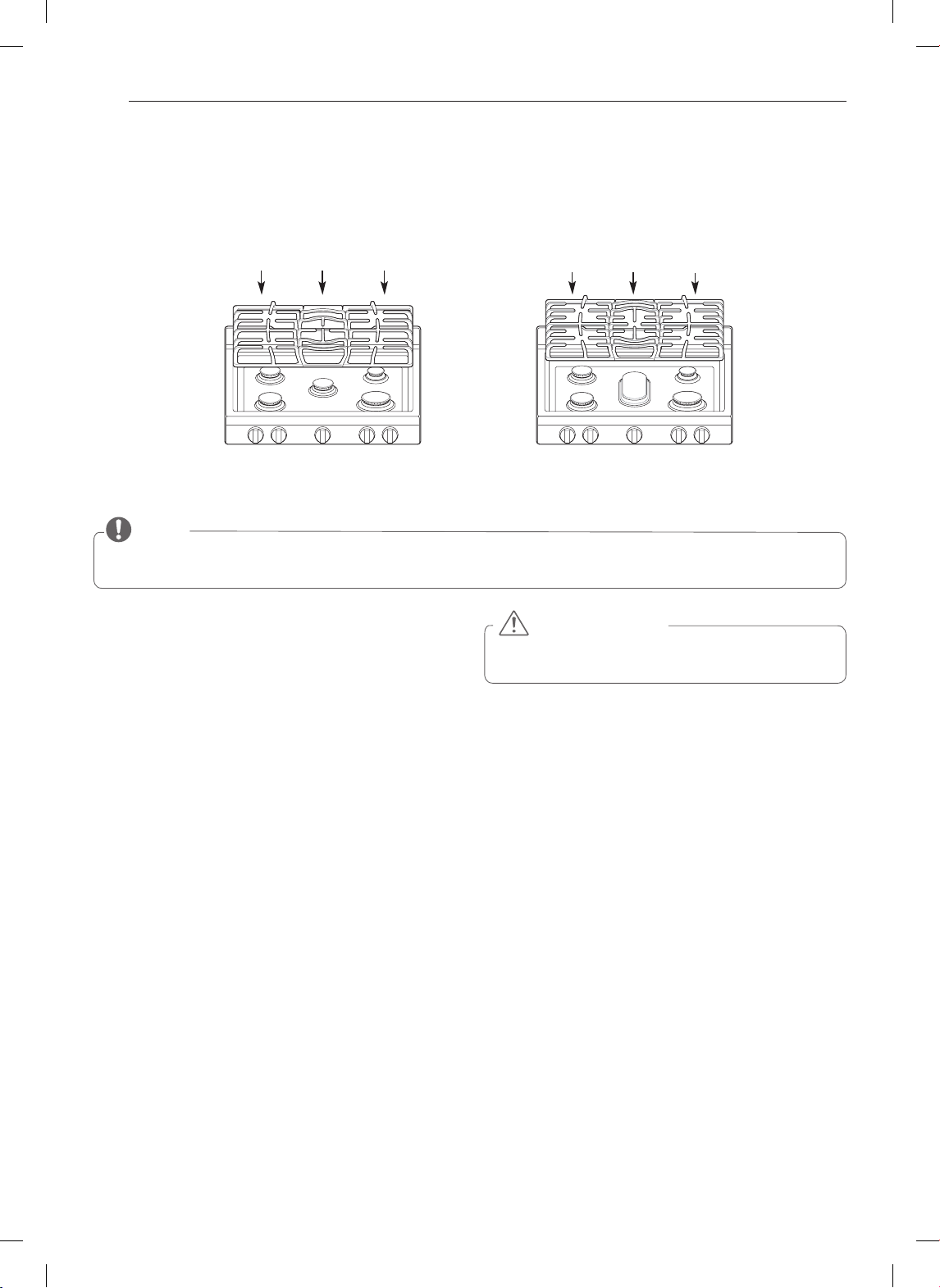
36
CUIDADO Y LIMPIEZA
Parrillas de las hornillas
La estufa contiene tres parrillas separadas de estilo profesional. Para logar su máxima estabilidad, estas parrillas solo deben ser
utilizadas cuando estén en la posición correcta. Las dos parrillas laterales pueden intercambiarse de izquierda a derecha y del
frente hacia atrás. La parrilla central puede intercambiarse del frente hacia atrás.
N OTA
No deje encendida ninguna hornilla durante un largo período de tiempo sin que haya ninguna batería de cocina sobre la
parrilla. El acabado de la parrilla puede saltarse sin no hay ninguna batería que absorba el calor.
y
No levante las parrilas hasta que se hayan enfriado.
y
Las parrilas deben limpiarse con regularidad, y luego de
producirse derrames.
y
Lave las parrilas con agua caliente y jabón, y enjuague
con agua limpia.
y
Las parrilas son aptas para lavavajillas.
y
Luego de limpiar las parrilas, deje que se sequen
completamente; luego, colóquelas en su posición
correcta sobre las hornillas.
Cómo limpiar las parrillas de las
hornillas
PRECAUCIÓN
NO
coloque ninguna parrila en el horno durante el modo
de auto-limpieza.
Parrilla lateral Parrilla central Parrilla lateral
side grate center grate side grate
Para el modelo LDG3015S Para el modelo LDG3016ST
side grate center grate side grate
Parrilla lateral Parrilla central Parrilla lateral
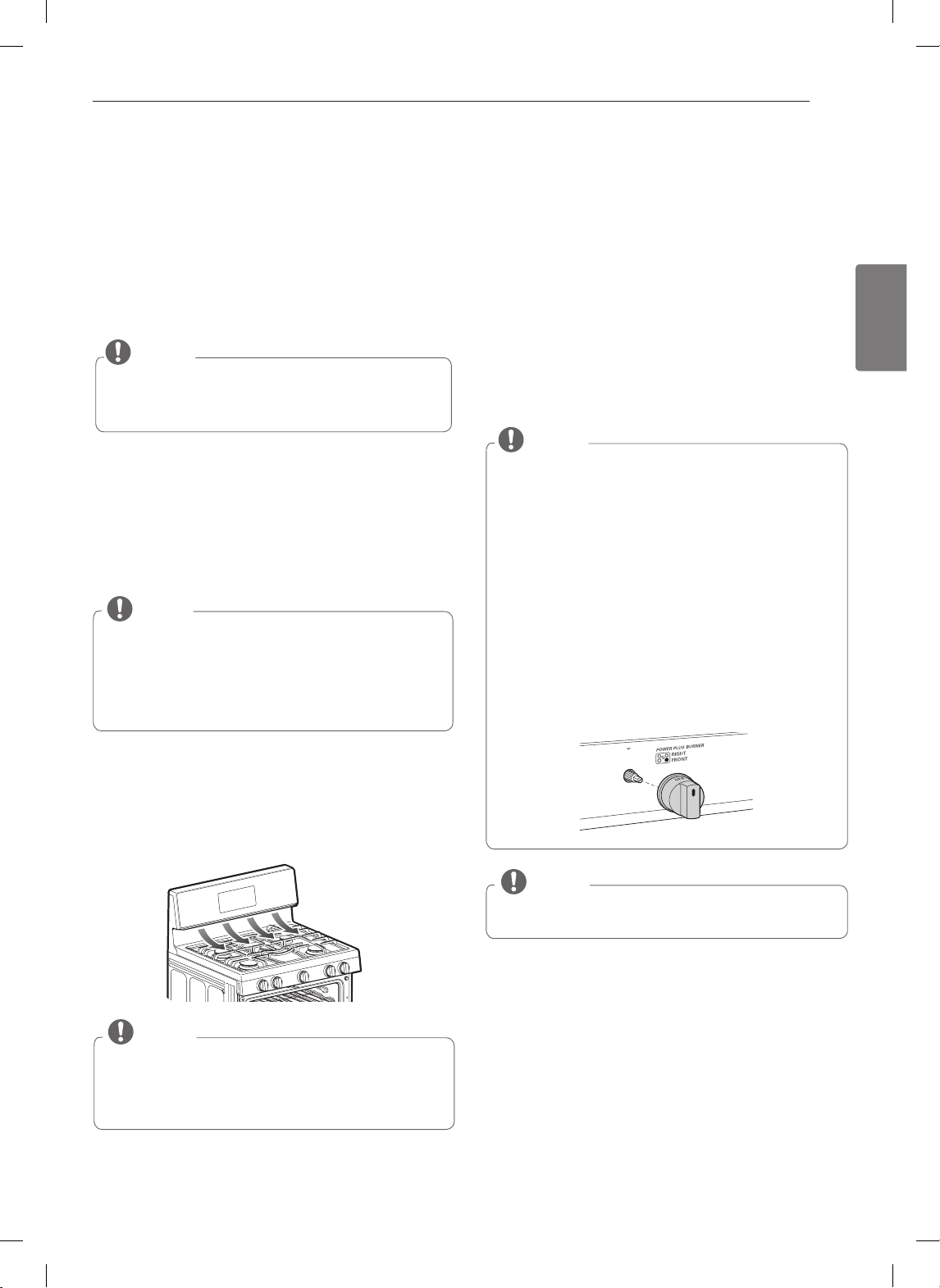
37
CUIDADO Y LIMPIEZA
ESPAÑOL
Superficie de la estufa
Para evitar quemaduras, no limpie la superficie de la estufa
hasta que se haya enfriado. Los alimentos con alto contenido
ácido o los alimentos con alto contenido de azúcar pueden
manchar la superficie si se dejan reposar en ésta. Lave y
enjuague los alimentos derramados apenas la superficie se
haya enfriado. Para otros derrames tales como salpicaduras
de grasa y/o aceite, etc., lave con agua y jabón cuando la
superficie se haya enfriado. Luego, enjuague y lustre con un
trapo seco.
NOTA
No levante la superficie de la esufa. Levantar ésta puede
ocasionar daños o el funcionamiento inadecuado de la
estufa.
Superficies de acero inoxidable
Para consultar dónde comprar lustradores o limpiadores para
artefactos de acero inoxidable, o para localizar un distribuidor
cerca suyo, sírvase comunicarse a nuestra línea gratuita de
atención al cliente:
1-800-243-0000,
o visite nuestro sitio web
en:
us.lgservice.com
Conductos de ventilación del horno
Los orificios de ventilación se encuentran en la parte trasera
de la estufa, en la parte superior e inferior de la puerta del
horno, y en la parte inferior de la estufa.
NOTA
No obstruya los conductos y orificios de ventilación
del aparato. Éstos permiten la entrada y salida de aire
necesarias para que el aparato funcione apropiadamente,
con la combustión correcta.
Panel de control
Para evitar que se active el panel de control durante la
limpieza, desenchufe el artefacto. Limpie las salpicaduras con
un trapo húmedo y limpiador de vidrios. Quite la suciedad más
profunda con agua tibia y jabón. No utilice abrasivos de ningún
tipo.
Panel frontal y perillas
Lo más aconsejable es limpiar el panel frontal luego de cada
uso del horno. Para limpiarlo, utilice un trapo húmedo con
agua tibia y jabón, o una solución de 50% vinagre y 50% agua.
Para enjuagar, use agua limpia y seque con un trapo suave.
NOTA
y
No utilice limpiadores abrasivos, limpiadores líquidos
fuertes, esponjas plásticas o limpiadores para hornos en
el panel frontal. Si lo hace, dañará su acabado.
y
No intente doblar las perillas tirando de ellas hacia arriba
o hacia abajo, o colgando repasadores u otros objetos
de ellas. Esto puede dañar el mango de la válvula de
gas.
y
Las perillas de control pueden quitarse para una fácil
limpieza.
y
Para limpiar las perillas, asegúrese de que se encuentren
en la posición de "OFF" (APAGADO) y tire de ellas para
extraerlas.
y
Para volver a colocarlas, asegúrese de que la perilla esté
en la posición "OFF" (APAGADO) centrada hacia arriba, y
deslice la perilla directamente sobre el vástago.
NOTA
N OTA
y
No utilice esponjas de acero; rayarán la superficie.
y
Para limpiar la superficie de acero inoxidable, utilice
agua con abundante jabón, o un limpiador o lustrador
de acero inoxidable.
y
Limpie siempre en la dirección del acabado de la
superficie metálica.
Para prevenir rayaduras, no utilice limpiadores abrasivos
en ninguno de estos materiales.
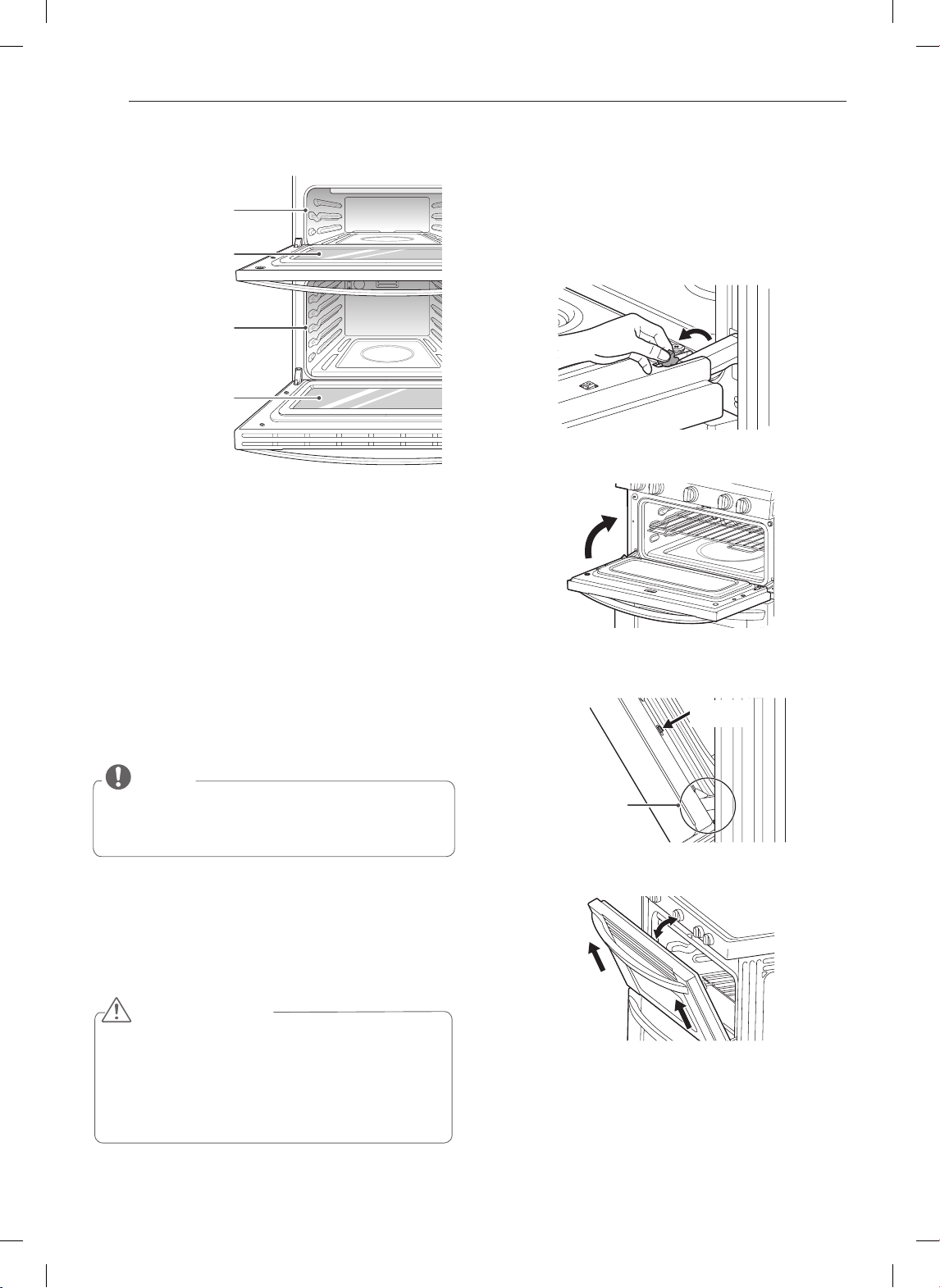
38
CUIDADO Y LIMPIEZA
Puerta del horno
No limpie a mano la
junta de la puerta del
horno
Limpie a mano
la puerta
No limpie a mano la
junta de la puerta del
horno
Limpie a mano
la puerta
y
Utilice agua y jabón para limpiar la puerta del horno en
profundidad. Enjuague bien.
NO
sumerja la puerta en
agua.
y
Puede utilizar un limpiador para vidrios sobre el vidrio
externo de la puerta del horno.
NO
rocíe agua o
limpiador de vidrios sobre las ventilaciones de la puerta.
y
NO
utilice limpiadores para horno, polvos limpiadores
o materiales de limpieza abrasivos para limpiar la parte
exterior de la puerta del horno.
y
NO
limpie la junta de la puerta del horno. La junta de la
puerta del horno está hecha de un material entretejido
que es esencial para que quede bien sellada. Debe
tenerse cuidado de no refregar, dañar o quitar esta
junta.
NOTA
No utilice limpiadores o materiales de limpieza abrasivos
sobre la parte exterior de la puerta del horno. Si lo hace,
puede dañarla.
Cómo extraer y volver a colocar las
puertas
No cierre la puerta del horno hasta que todas los estantes del
horno estén en su lugar.
PRECAUCIÓN
y
Tenga cuidado al quitar y levantar la puerta.
y
NO
levante la puerta de la manija.
y
NO
golpee el vidrio con ollas, sartenes u otros objetos.
y
Rayar, golpear o presionar el vidrio puede debilitar su
estructura, causando un mayor riesgo de rotura en un
futuro.
Cómo extraer la puerta del horno
superior.
1
Abra la puerta por completo. Levante los seguros de la
bisagra hacia el marco del horno hasta que hagan tope.
2
Cierre la puerta a aproximadamente 30 grados.
3
Presione los botones para liberar cada bisagra a ambos
lados de la puerta.
Presione
aproximadamente
30°
4
Levante la puerta hasta que se salga de la bisagra.
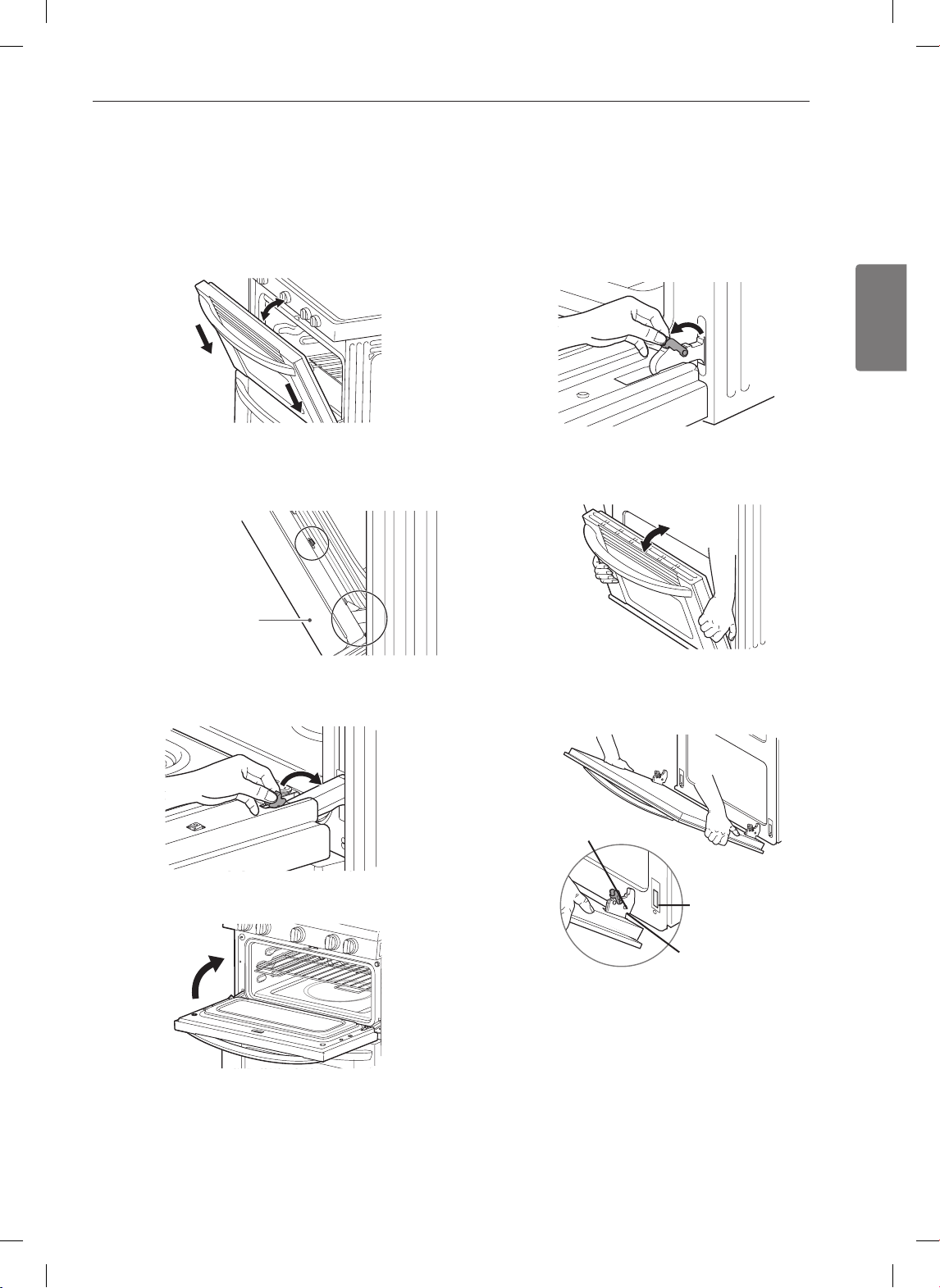
39
CUIDADO Y LIMPIEZA
ESPAÑOL
Cómo volver a colocar la puerta del
horno superior
1
Asegúrese de que las bisagras estén alineadas a una
posición de 30 grados.
2
Deslice la puerta hacia las bisagras hasta que escuche
un sonido de encastre y que los botones de liberación se
hayan ajustado.
3
Abra la puerta por completo. Presione los seguros de la
bisagra contra la misma.
4
Cierre la puerta del horno.
Cómo quitar la puerta del horno
inferior
1
Abra la puerta por completo. Levante los seguros de la
bisagra hacia el marco del horno hasta que hagan tope.
2
Cierre la puerta hasta la posición correcta para extraerla
(aproximadamente a cinco grados).
3
Levante la puerta y sáquela hasta que el brazo de la
bisagra salga de la guía. Coloque la puerta sobre el piso.
Brazo de
la bisagra
Borde
inferior de la
guía
Hendidura
aproximadamente 30°
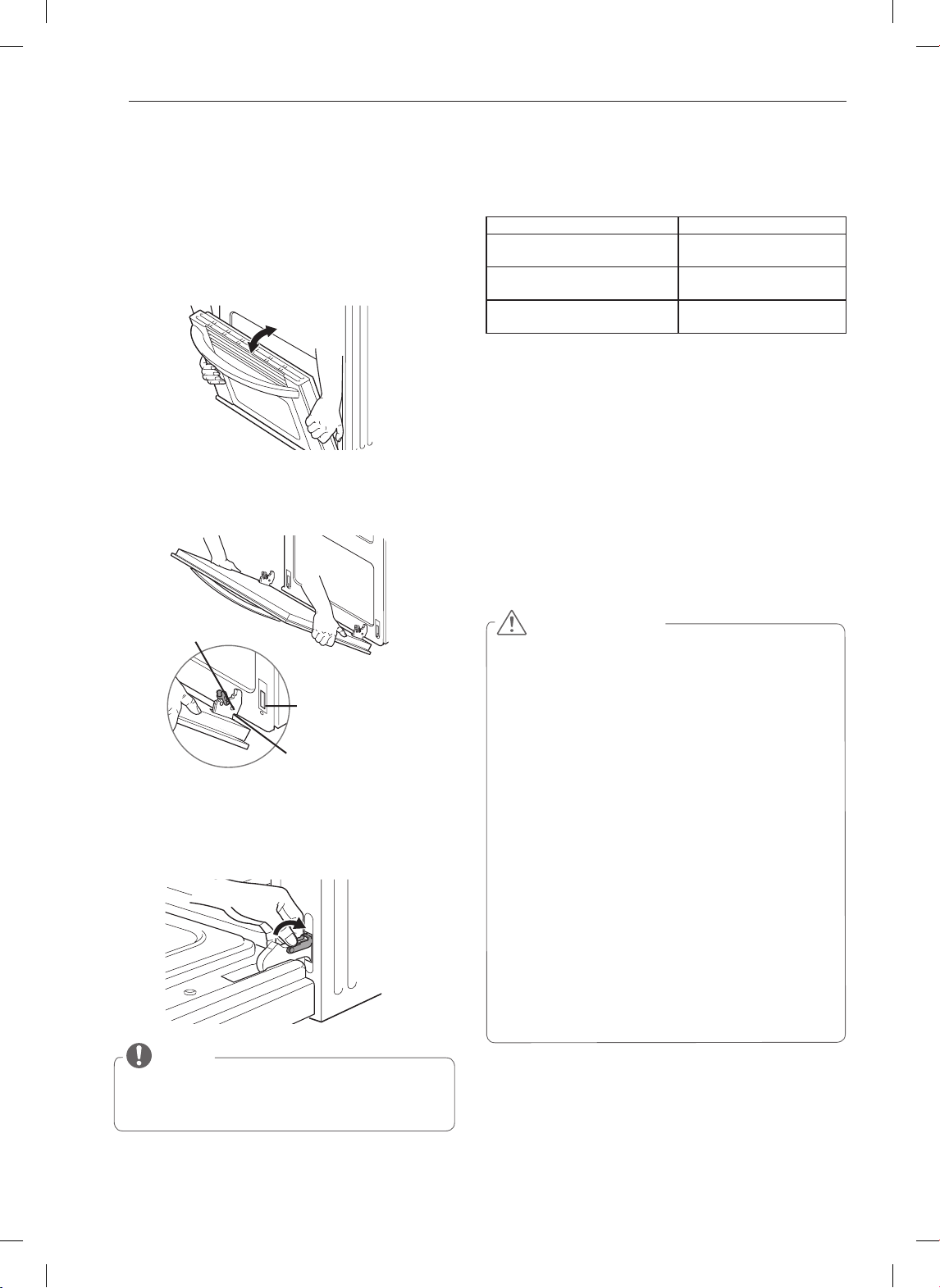
40
CUIDADO Y LIMPIEZA
Cómo volver a colocar la puerta del
horno inferior.
1
Tome firmemente ambos lados de la puerta por la parte
superior y cierre la puerta hasta la posición correcta para
extraerla (aproximadamente a cinco grados).
2
Coloque la hendidura del brazo de la bisagra en el borde
inferior de la guía de la bisagra
Brazo de la
bisagra
Borde inferior
de la guía
Hendidura
3
Abra la puerta por completo. Presione los seguros de la
bisagra contra el marco frontal de la cavidad del horno
hasta la posición de cerrado. Cierre la puerta del horno.
NOTA
Si la puerta no se abre por completo, significa que la
hendidura no está correctamente colocada en el borde
inferior de la guía.
Nivel de suciedad Configuración de ciclo
Cavidad del horno ligeramente
sucia
Auto limpieza de 2 horas
(p. 84)
Cavidad del horno
moderadamente sucia
Auto limpieza
de 3 horas
(p. 84)
Cavidad del horno muy sucia
Auto limpieza
de 4 horas
(p. 84)
AUTO LIMPIEZA
(Horno superior e inferior)
El ciclo de AUTO LIMPIEZA utiliza temperaturas más
elevadas que las de cocción para limpiar la cavidad del horno.
Es posible que vea algo de humo y sienta olor durante los
primeros minutos de la limpieza. Esto es normal y disminuirá
a lo largo del proceso. También puede aparecer humo si el
horno está muy sucio. Durante la auto-limpieza, el lugar de la
cocina debe estar bien ventilado para minimizar los olores de
la limpieza. La AUTO LIMPIEZA del horno superior e inferior
no puede funcionar de manera simultánea.
Cómo limpiar el interior del horno
Guía de limpieza
y
NO deje a los niños pequeños sin supervisión cerca
del aparato.
Durante el ciclo de auto limpieza, la parte
exterior del aparato puede estar muy caliente al tacto.
y
Si tiene un pájaro como mascota, muévalo a otro cuarto
bien ventilado.
Algunos pájaros son extremadamente
sensibles a los vapores que se generan durante el ciclo
de auto limpieza de cualquier estufa.
y
NO cubra las paredes del horno, bandejas, parte
inferior, ni ninguna otra parte con papel de aluminio ni
con ningún otro material.
Hacerlo afectará la distribución
del calor, producirá malos resultados al hornear, y
causará un daño permanente al interior del horno (el
papel de aluminio se derretirá y se pegará a la superficie
interior del horno).
y
NO fuerce la apertura del horno.
Esto puede dañar
el sistema de cierre automático de la puerta. Tenga
cuidado al abrir la puerta del horno luego del ciclo de
auto limpieza. Párese a un costado del horno al abrir
la puerta para permitir que el aire caliente o el vapor
salgan. El horno puede todavía estar muy caliente.
y
No toque el elemento para asar del horno hasta que se
haya enfriado por completo.
PRECAUCIÓN
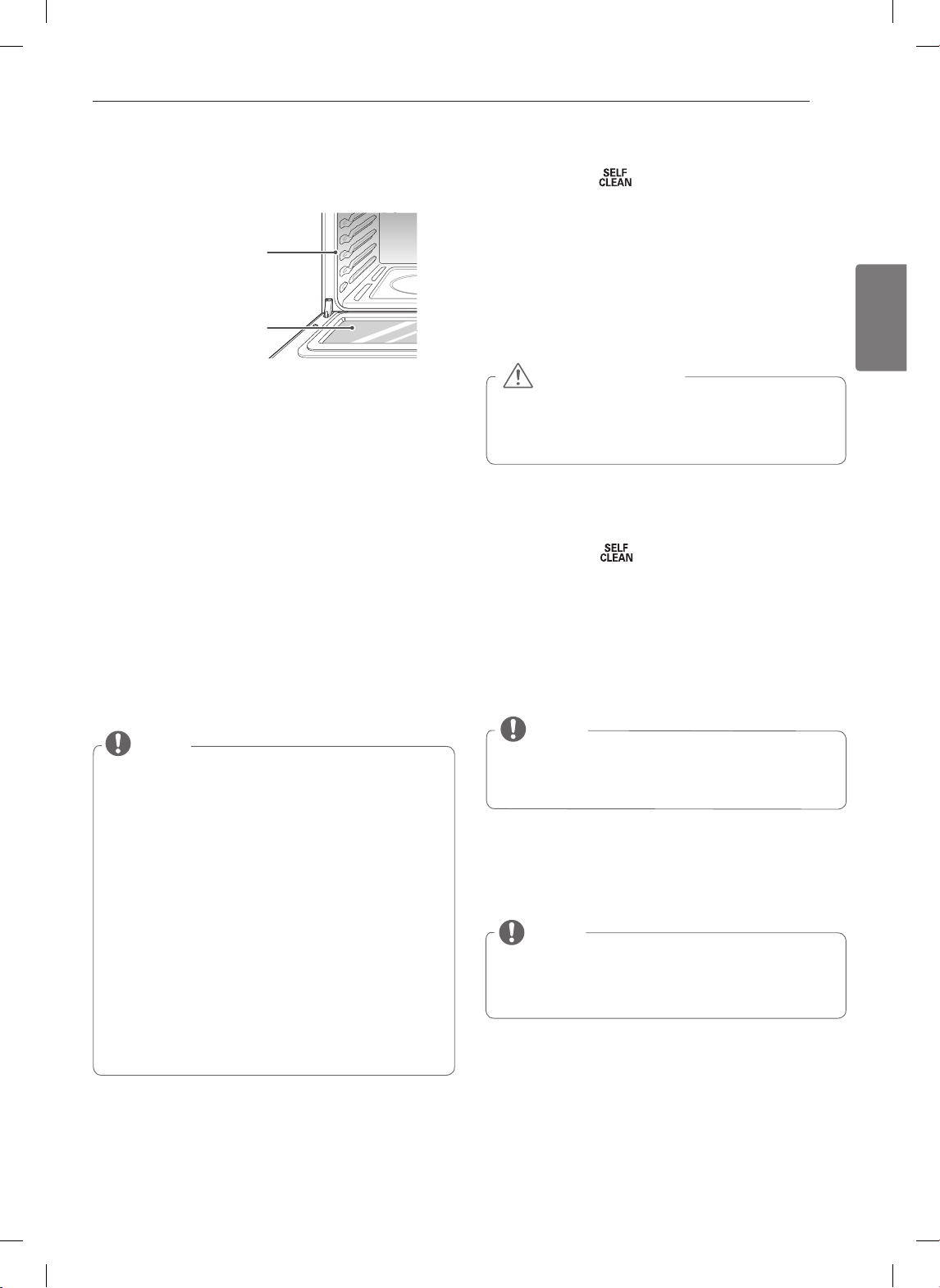
41
CUIDADO Y LIMPIEZA
ESPAÑOL
Antes de comenzar la AUTO
LIMPIEZA
No limpie a mano la
junta de la puerta del
horno
Limpie a mano la
puerta
y
Quite las bandejas del horno, asadera, rejilla para asar,
elementos de cocina, papel de aluminio y cualquier otro
material del horno.
y
La cocina deberá estar bien ventilada para minimizar los
olores provenientes de la limpieza.
y
Si ejecuta la auto limpieza en uno de los hornos, el otro
horno no podrá utilizarse.
y
Limpie cualquier derrame excesivo en la parte inferior
del horno.
y
Asegúrese de que la cubierta de la lámpara de luz
del horno se encuentra en su lugar y que la luz esté
apagada.
y
La luz del horno no puede encenderse durante un ciclo
de auto limpieza. La luz del horno no puede encenderse
hasta que la temperatura del horno se haya enfriado a
menos de 500˚F (260˚C) luego de que finalice el ciclo de
auto limpieza.
y
Podrán aparecer líneas delgadas en la porcelana ya que
pasó por un proceso de calentado y enfriado. Esto es
normal y no afectará el rendimiento.
PARA PROGRAMAR LA AUTO LIMPIEZA CON INICIO
RETARDADO
(ejemplo: programar para las 3:00 AM/PM)
1
Presione la tecla .
El horno utiliza por defecto la auto limpieza recomendada de
tres horas para un horno moderadamente sucio. Presione dos
veces para hacer una auto limpieza de dos horas y tres veces
para hacer una auto limpieza de cuatro horas.
2
Presione la tecla
W
.
3
Utilice el teclado numérico para ingresar la hora del día en la
que desea que el horno comience el ciclo de auto limpieza (por
ej.
3, 0, 0
).
4
Presione la tecla
q
Una vez que se haya programado la auto limpieza, la puerta
del horno se bloqueará automáticamente y se mostrará
m
en la pantalla. No podrá abrir la puerta del horno hasta
que el horno se haya enfriado. El bloqueo se liberará
automáticamente cuando el horno se haya enfriado.
PRECAUCIÓN
NO
fuerce la puerta del horno para abrirla cuando se
muestre
m
. La puerta del horno permanecerá bloqueada
hasta que baje la temperatura. Si fuerza la puerta para
abrirla, ésta se dañará.
NOTA
y
Limpie el marco del horno y la puerta con agua caliente
y jabón. Enjuague bien.
y
No limpie la junta de la puerta del horno. La junta de la
puerta del horno está hecha de un material entretejido
que es esencial para que quede bien sellada. Debe
tenerse cuidado de no refregar, dañar o quitar esta
junta.
y
No abra la puerta del horno hasta que el ciclo de auto
limpieza haya terminado.
y
La puerta del horno puede estar extremadamente
caliente. No toque la puerta del horno hasta que se
haya enfriado.
y
Es posible que vea algo de humo y sienta olor durante
los primeros minutos de la limpieza. Esto es normal.
y
A medida que el horno se calienta, es posible que
escuche sonidos de partes de metal que se expanden
y contraen. Esto es normal.
y
No podrá iniciarse el ciclo de auto limpieza si la función
de Bloqueo del horno se encuentra activa.
Luego de la Auto limpieza
y
Puede notar algo de ceniza blanca en el horno. Límpiela con
un trapo húmedo luego de que se enfríe el horno.
y
Si el horno no quedó limpio luego de un ciclo de limpieza,
repita el ciclo.
y
Si los estantes del horno quedaron en el interior y no se
deslizan suavemente luego del ciclo de limpieza, aplique a los
estantes y a sus soportes un poco de aceite vegetal para que
se deslicen con mayor facilidad.
1
Presione la tecla .
.
El horno utiliza por defecto la auto limpieza recomendada de
tres horas para un horno moderadamente sucio. Presione
dos veces para hacer una auto limpieza de dos horas y tres
veces para una auto limpieza de cuatro horas.
2
Presione la tecla
q
.
Una vez que se haya programado la auto limpieza, la puerta
del horno se bloqueará automáticamente y se mostrará
m
en la pantalla. No se podrá abrir la puerta del horno
hasta que el horno se haya enfriado. El bloqueo se liberará
automáticamente cuando el horno se haya enfriado.
NOTA
El tiempo de inicio de la auto limpieza con inicio retardado
solo puede programarse 11 horas y 59 minutos por
adelantado. Para programarla 12 a 24 horas por adelantado,
consulte “Cómo cambiar el modo horario del reloj.”
Para programar la auto limpieza
NOTA
Puede ser necesario cancelar o interrumpir un ciclo de auto
limpieza debido a humo excesivo o fuego en el horno. Para
cancelar la función de Auto limpieza, presione la tecla
Y
o
Z
.
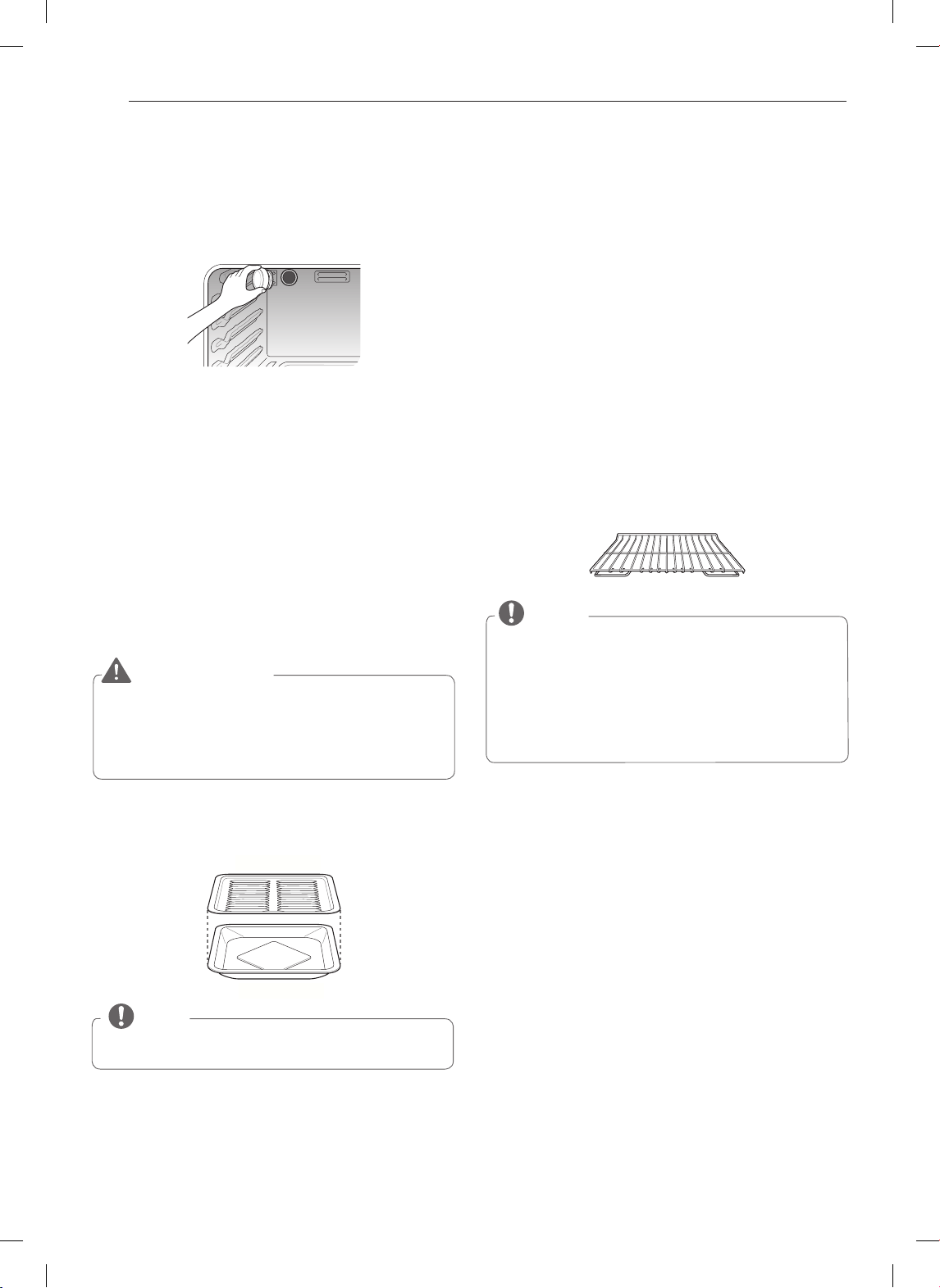
42
CUIDADO Y LIMPIEZA
Cómo cambiar la luz del horno
La luz del horno es una bombilla estándar para artefactos
de 40 vatios (watts). Se encenderá cuando la puerta del
horno esté abierta. Cuando la puerta del horno esté cerrada,
presione la tecla
M
o
Q
para prender o apagar la luz.
Para reemplazar la luz del horno:
1
Desenchufe el artefacto o desconecte la energía eléctrica.
2
Gire la cubierta de vidrio de la bombilla en la parte trasera
del horno en sentido contrario a las agujas del reloj para
extraerla.
3
Gire la bombilla en sentido contrario a las agujas del reloj
para extraerla del porta lámpara.
4
Inserte una nueva bombilla y gírela en sentido de las
agujas del reloj.
5
Inserte la cubierta de vidrio de la bombilla y gírela en
sentido de las agujas del reloj.
6
Enchufe el artefacto o reconecte la energía eléctrica.
ADVERTENCIA
y
Asegúrese de que el horno y la bombillas estén fríos.
y
DESCONECTE la energía eléctrica del artefacto en el
fusible principal o en el panel de corte de circuitos. Si no
lo hace, podría sufrir lesiones personales graves, o aún
la muerte o la electrocución.
Cómo limpiar la bandeja y la rejilla
para asar (Se vende por separado)
3
Lave y enjuague la bandeja y la rejilla para asar con agua
caliente con una esponja con jabón o con una esponja
plástica. Si la comida se ha quemado, rocíe la rejilla con un
limpiador (mientras esté caliente) y cúbrala con toallas de
papel húmedas o repasador húmedo. Si pone la bandeja
en remojo, la comida quemada se quitará. Tanto la bandeja
como la rejilla de asar pueden limpiarse con limpiadores
comerciales para hornos. Tanto la bandeja como la rejilla
de asar son aptas para lavarse en lavavajillas.
Bandejas del horno
Quite las bandejas del horno antes de iniciar el ciclo de auto
limpieza.
1
La comida derramada sobre las bandejas puede causar
que las mismas se atoren. Limpie con un limpiador
abrasivo suave.
2
Enjuague con agua limpia y sequ
e.
NOTA
Si las bandejas se limpian usando el ciclo de auto limpieza
(no recomendado), el color se tornará levemente azulado
y el acabado se opacará. Luego de que termine el ciclo
de auto limpieza, y el horno se haya enfriado, friegue los
costados de las bandejas con papel de cera o con un trapo
con una pequeña cantidad de aceite. Esto hará que las
bandejas se deslicen más fácilmente por las guías.
NOTA
Extraiga la bandeja y la rejilla de asar del horno antes de
iniciar el ciclo de auto limpieza.
1
Luego de asar, quite la bandeja de asar del horno. Quite la
rejilla de la bandeja.
2
Vierta cuidadosamente la grasa de la bandeja a un
contenedor adecuado.
Rejilla
Bandeja
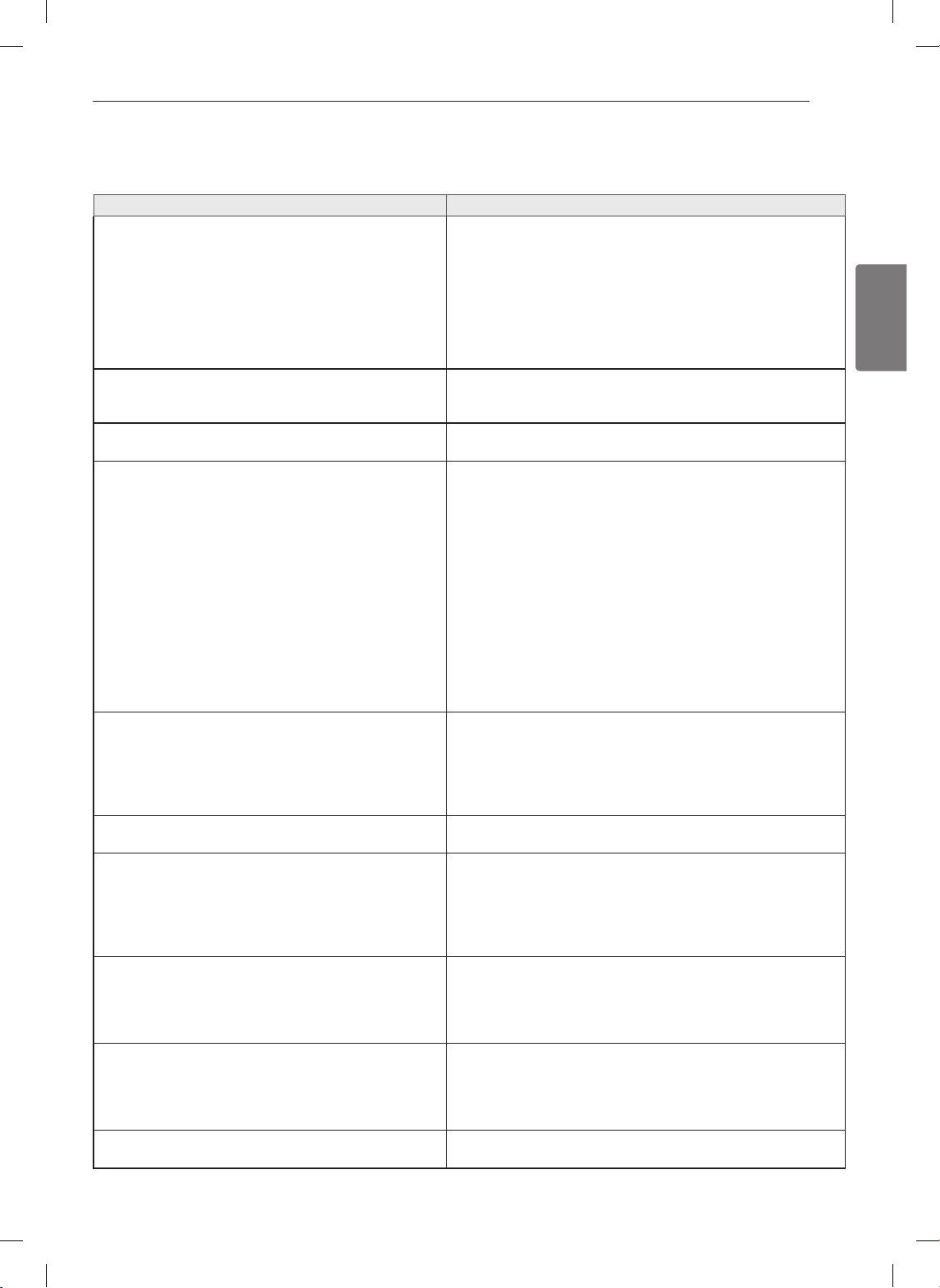
43
ANTES DE SOLICITAR SERVICIO TÉCNICO
ESPAÑOL
ANTES DE SOLICITAR SERVICIO TÉCNICO
Síntomas y preguntas Posible causa/ solución
Las hornillas superiores no encienden o no prenden de
manera pareja.
y
Asegúrese de que el enchufe eléctrico está correctamente
conectado a un tomacorriente con conexión a tierra.
y
Extraiga las hornillas y límpielas. Verifique que no haya comida
quemada o grasa en el área de los electrodos. Consulte “Cómo
limpiar los cabezales/tapas de las hornillas” en la sección
"Cuidado y limpieza".
y
Asegúrese que las partes de la hornilla están instaladas
correctamente. Consulte “Cómo limpiar los cabezales/tapas de
las hornillas” en la sección "Cuidado y limpieza".
La llama de la hornilla es muy grande o amarilla. Si el artefacto está conectado con gas LP, contáctese con el
técnico que haya instalado el artefacto o que haya hecho la
conversión del tipo de gas.
Las hornillas de la superficie prenden pero el horno no. Asegúrese de que la válvula de cierre de gas del horno, ubicada
detrás del artefacto, se encuentre totalmente abierta.
La comida no se hornea o asa adecuadamente.
y
Configuración incorrecta del control del horno. Consulte "Cómo
usar el panel de control" en la sección "Cómo usar".
y
Posición incorrecta de la bandeja. Consulte "Cómo extraer y
volver a colocar la bandeja del horno" o "Posición del estante" en
la sección "Cómo usar".
y
La batería de cocina utilizada es inapropiada. Consulte "Asar" u
"Hornear" en la sección "Cómo usar".
y
El termostato del horno necesita ajustarse. Consulte “Cómo
ajustar la temperatura” en la sección "Instrucciones de
funcionamiento".
y
El reloj no está configurado correctamente. Consulte "Cómo
ajustar el reloj y el temporizador" en la sección "Instrucciones de
funcionamiento".
y
Se ha utilizado inapropiadamente papel de aluminio en el horno.
Consulte "Cómo usar el horno".
La comida no se asa correctamente en el horno.
y
Configuración incorrecta de los controles del horno. Consulte
"Cómo usar el panel de control" en la sección "Cómo usar".
y
La puerta del horno no está cerrada. Consulte "Cómo usar el
horno" en la sección "Cómo usar".
y
Se usó papel de aluminio en la bandeja de asar y la rejilla para
asar no queda bien colocada.
La temperatura del horno está demasiado caliente o
demasiado fría.
El termostato del horno necesita ajustarse. Consulte “Cómo ajustar
la temperatura” en la sección "Instrucciones de funcionamiento".
El reloj y el temporizador no funcionan.
y
Asegúrese de que el enchufe eléctrico está correctamente
conectado a un tomacorriente con conexión a tierra. Reemplace
el fusible o restablezca el interruptor del circuito.
y
Configuración inadecuada de los control del horno. Consulte
"Cómo ajustar el reloj y el temporizador" en la sección
"Instrucciones de Funcionamiento".
La luz del horno no funciona.
y
La bombilla está floja o rota. Ajústela o reemplácela.
y
El enchufe del artefacto no está completamente conectado al
tomacorriente eléctrico. Asegúrese de que el enchufe eléctrico
esté correctamente conectado a un tomacorriente con conexión
a tierra.
La función de auto limpieza no funciona.
y
La temperatura del horno es demasiado elevada para iniciar la
función de auto limpieza. Espere a que el artefacto se enfríe
hasta la temperatura ambiente y reinicie los controles.
y
Configuración inadecuada de los controles del horno. Consulte
"AUTO LIMPIEZA" en la sección "Cuidado y limpieza".
Sonido de “chisporroteo” o “estallido”. Es el sonido del metal calentándose y enfriándose tanto durante
las funciones de cocción como de limpieza. Esto es normal.
44
ANTES DE SOLICITAR SERVICIO TÉCNICO
Síntomas y preguntas Posible causa/ solución
Demasiado humo durante el ciclo de auto limpieza. Demasiada suciedad en el horno. Abra las ventanas para
deshacerse del humo del ambiente. Presione la tecla
Y
o
Z
. Espere hasta que la luz
m
se apague antes de intentar abrir
la puerta del horno. Limpie la suciedad en exceso y reinicie el ciclo
de limpieza.
La puerta del horno no abre luego de un ciclo de auto
limpieza.
La temperatura del horno es demasiado elevada. Espere hasta una
hora a que se enfríe.
La puerta del horno no quedó limpia luego del ciclo de auto
limpieza.
y
Configuración incorrecta de los controles del horno. Consulte
"AUTO LIMPIEZA" en la sección "Cuidado y Limpieza".
y
El horno estaba muy sucio. Limpie los derrames grandes antes
de iniciar el ciclo de auto limpieza. Los hornos muy sucios
pueden necesitar una auto limpieza más larga o dos ciclos de
auto limpieza.
"CLOSE DOOR TO CONTINUE BROILING" (CIERRE LA
PUERTA PARA CONTINUAR ASANDO) o "DOOR OPENED"
(PUERTA ABIERTA) aparece en la pantalla.
Cierre la puerta del horno.
El mensaje "DOOR LOCKED" (PUERTA BLOQUEADA)
aparece cuando desea cocinar.
La puerta del horno está bloqueada porque la temperatura interior
del horno es demasiado elevada. Presione la tecla
Y
o
Z
.
El control del horno emite un sonido y muestra un código
de error "F".
y
Presione la tecla
Y
o
Z
y espere una hora.
y
Controle el cierre de la válvula principal del gas o la válvula de
cierre del gas del horno y solicite servicio técnico.
y
Desenchufe el aparato durante cinco minutos y luego vuelva a
enchufarlo. Si vuelve a aparecer el código de error de función,
solicite servicio técnico.
Las bandejas del horno se limpiaron en un ciclo de auto
limpieza.
Aplique una pequeña cantidad de aceite vegetal en una toalla de
papel y pásela por los bordes de las bandejas del horno. No use
lubricantes en aerosol.
El reloj parpadea. Se ha producido un corte o aumento en la energía eléctrica.
Reinicie el reloj. Si el horno estaba en uso, debe reiniciarlo
presionando la tecla
Y
o
Z
. Reinicie el reloj y cualquier
función de cocción.
Emana olor a “quemado” o a “aceite” de la ventilación. Esto es normal en un horno nuevo. Para acelerar el proceso,
programe un ciclo de auto limpieza de un mínimo de tres horas.
Consulte "AUTO LIMPIEZA" en la sección "Cuidado y limpieza".
Hay olor fuerte. El olor del aislamiento alrededor del interior del horno es normal en
los primeros días de uso.
Ruido del ventilador. El ventilador de convención puede llegar a encenderse y apagarse
automáticamente. Esto es normal.
El ventilador de convección no esta funcionando. (modelos
con función de convección).
El horno no ha alcanzado la temperatura de precalentado. El ven-
tilador comenzará a funcionar automáticamente una vez que el
horno alcance la temperatura de precalentado.
La chispa de los quemadores no enciende apropiadamente
después de limpiar la superficie de la estufa.
Asegúrese de que las cabezas y tapas de las hornillas estén com-
pletamente secas y debidamente colocadas.
Al encender un solo quemador, un sonido de tipo clic se
escucha desde todos los quemadores.
Esto es normal. El encendido de chispa electrónica de los quema-
dores causa un sonido de tipo clic.
Todos los encendidos de chispa en la estufa se activaran al en-
cender un solo quemador.
PF(Power Failure) señal
/ Visualización de la hora parpadea
Dependiendo del modelo de su estufa, la pantalla mostrará "PF“
o un reloj parpadeando. Esto significa que el electrodoméstico ha
sido conectado, o que ha experimentado una interrupción en la
alimentación. Para borrar el mensaje "PF", presione la tecla "Clear /
Off" en los controles del horno. Si su horno muestra un reloj par-
padeando, presione la tecla “Clock” y reinicie el tiempo, o presione
cualquier tecla para que deje de parpadear.
45
GARANTÍA
ESPAÑOL
Para probar su cobertura de garantía Conserve la factura de venta del producto para probar la fecha en que
lo compró.
Deberá presentar la factura de venta en caso de recibir servicio técnico
en garantía.
Para ubicar el centro de servicio técnico o
distribuidor de ventas autorizado más cercano,
o bien para obtener asistencia por el uso del
producto, asistencia al cliente, o servicio técnico.
Comuníquese al 1-800-243-0000
(disponible las 24 horas, los 365 días
del año) y elija la opción deseada del menú; o visite nuestro sitio web
en:
http://us.lgservice.com.
LG Electronics Inc. reparará o reemplazará su producto, a elección de LG, si sus materiales o mano de obra son defectuosos bajo
uso normal, durante el período de garantía establecido a continuación, el que entrará en vigencia a partir de la fecha de compra
del producto por parte del consumidor original. Esta garantía limitada solo es válida para el comprador original del producto y
tendrá vigencia solo cuando se lo utilice dentro de los EE.UU.
PERÍODO DE GARANTÍA COMO SE PROVEE EL SERVICIO
Un año
Desde la fecha de compra
original.
Cualquier parte
del horno que falle debido a defectos en los materiales o mano de obra.
Durante este
período de garantía de un año
, LG también brindará,
sin cargo
, todos los
servicios en el hogar y de mano de obra necesarios para reemplazar la parte defectuosa.
ESTA GARANTÍA REEMPLAZA CUALQUIER OTRA GARANTÍA EXPRESA O IMPLÍCITA, INCLUYENDO CUALQUIER GARANTÍA
DE COMERCIALIZACIÓN O IDONEIDAD PARA UN PROPÓSITO DETERMINADO. HASTA EL LÍMITE QUE SE REQUIERE
POR LEY A CUALQUIER GARANTÍA IMPLÍCITA, ESTA GARANTÍA ESTÁ LIMITADA EN SU DURACIÓN AL PERÍODO DE
GARANTÍA EXPRESA INDICADO MÁS ARRIBA. LG NO SERÁ RESPONSABLE POR NINGÚN DAÑO RESULTANTE, INDIRECTO,
O INCIDENTAL DE NINGÚN TIPO, INCLUYENDO LA PÉRDIDA DE INGRESOS O GANANCIAS, EN RELACIÓN CON ESTE
PRODUCTO. ALGUNOS ESTADOS NO PERMITEN LIMITACIONES EN LA DURACIÓN DE UNA GARANTÍA IMPLÍCITA O
LA EXCLUSIÓN DE DAÑOS INCIDENTALES O RESULTANTES, POR LO TANTO DICHAS LIMITACIONES O EXCLUSIONES
PUEDEN NO APLICARSE EN SU CASO.
ESTA GARANTÍA LIMITADA NO SE APLICA A:
1.
Llamadas al servicio técnico para corregir la instalación de su artefacto, para brindarle instrucciones acerca de cómo usarlo,
para reemplazar fusibles o cableado en su hogar, o para reemplazar bombillas a las que puede acceder el dueño.
2.
Reparaciones cuando su artefacto se haya utilizado con un destino que no sea el normal de una casa de familia.
3.
Recolección y entrega. Su artefacto está diseñado para poder repararse dentro del hogar.
4.
Los daños resultantes de accidentes, alteraciones, mal uso, abusos, incendio, inundación, instalación inadecuada, actos de la
naturaleza o uso de productos no aprobados por LG Corporation.
5.
Reparaciones de partes o sistemas que resulten de modificaciones no autorizadas hechas al artefacto.
6.
Reemplazo de partes o costos de mano de obra para unidades que se utilicen fuera de los Estados Unidos.
7.
Cualquier costo de mano de obra durante el período de garantía limitada.
Esta garantía se extiende al comprador original para productos comprados para uso en el hogar dentro de los EE.UU. En Alaska,
esta garantía excluye el costo del envío o visitas del servicio técnico a su hogar.
Algunos estados no permiten la exclusión o limitación de daños incidentales o resultantes, por lo tanto dichas limitaciones o
exclusiones pueden no aplicarse a usted. Esta garantía le confiere derechos legales específicos, y usted puede también tener
otros derechos que varían de estado a estado. Para conocer cuáles son sus derechos legales, consulte con su oficina local o
estatal de asuntos del consumidor o con el Procurador General de su estado.
INFORMACIÓN DE ASISTENCIA AL CLIENTE:
GARANTÍA
Printed in Mexico
www.lg.com
Register your product Online!
LG Customer Information Center
1-800-243-0000
1-888-865-3026
1-888-542-2623
USA, Consumer User
USA, Commercial User
CANADA

