
Dear Customer,
Thank you for choosing this quality product from ASKO.
We hope it will meet your expectations and fulfil your needs for many years to come.
Scandinavian design combines clean lines, everyday functionality and high quality. These
are key characteristics of all our products and the reason they are greatly appreciated
throughout the world.
To get the most from your new dishwasher, we recommend that you read the operating
instructions before using the dishwasher. The operatinginstructionsalsoincludeinformation
on how you can help protect the environment.
ASKO D5424
Operating Instructions
Operating Instructions
Dishwasher

3Before washing for the first time
3Read the operating instructions
3Be careful with certain materials
3Checking water hardness
4Safety instructions
4General
4Installation
4Winter storage/Transport
4Overflow guard function
4Cleaning
4Packing material
4Disposal
5Child safety
5Child safety and dishwashing
5Activate the child safety lock
5Activate child lock (button lock)
6Dishwasher components
7Dishwasher baskets
9Front panel
10Dispenser
11Economic dishwashing
12Fragile dishes
13Dishwashing
13Load the baskets correctly
13
Check that the spray arms can
rotate freely
13Add detergent
14
Press the main power switch and
close the door
14Select the program
16Select options
16Press Start
16After dishwashing
17Settings
18Time remaining
19Care and cleaning
22Rinse aid
23Error messages
24Troubleshooting
27Performance information
29Installation
29Safety instructions
30Suggested machine installations
31
Adjust the height and slide the
dishwasher into place
32Drainage connection
33Connection to water supply
33Electrical connection
33
Adjusting the plinth (only when
using toe kick accessory)
34
Set the correct plinth depth as
follows
34
Screwing the dishwasher into
place
35Service
36Quick guide
2
Contents

Read the operating instructions
Read through the operating instructions before using
the dishwasher, especially the sections Safety
instructions, Child safety and Dishwashing.
Be careful with certain materials
Read the section Fragile dishes before dishwashing
porcelain with unglazed decoration or other utensils
made from plastic, wood or crystal that you value.
Checking water hardness
Contact the local water utility to check the water
hardness in your area. This is important with regard
to how much detergent and rinse aid to use.
3
Before washing for the first time

General
•
Read the operating instructions and keep them in
a safe place!
•
Never use the dishwasher for any purpose other
than that specified in these operating instructions.
•
Do not load the dishwasher door or dishwasher
baskets with anything other than dishes.
•
Never leave the dishwasher door open as
someone may trip on it.
•
Use only dishwasher detergent!
•
Place knives and other sharp items so that they
cannot harm anyone or damage the dishwasher.
•
The machine is not designed to be used by
persons (even children) that are physically or
mentally handicapped or lack experience and
knowledge. Such persons must receive instruction
in how to use the machine from the person
responsible for their safety.
•
Damaged mains cables must only be replaced by
a qualified electrician.
•
This dishwasher is for household or similar use,
such as:
-
staff kitchens in shops, offices and other
workplaces.
-
farms.
-
for guests at hotels, motels and other types of
accommodation.
-
bed & breakfast hotels.
•
Never place dishes with solvent residues in the
dishwasher due to the risk of explosion. Nor may
dishes that contain ash, wax or lubricants be
washed in the dishwasher.
• Young children should be supervised to ensure
that they do not play with the appliance.
• The appliance is not intended for use by young
children or infirm persons without supervision.
Installation
See the section Installation.
Winter storage/Transport
•
Store the dishwasher where the temperature
remains above freezing.
•
Avoid long transport distances in very cold
weather.
•
Transport the dishwasher upright or laying on its
back.
Overflow guard function
The overflow protection starts pumping out the
machine and turns off the water supply if the water
level in the dishwasher exceeds the normal level. If
the overflow protection is triggered, turn off the water
supply and call the service division.
Cleaning
When cleaning the edge around the door, use only a
slightly damp cloth. Do not spray water around the
edge! Moisture can make its way into the lock, which
contains electrical components.
Packing material
Sort waste materials in accordance with local
guidelines.
Disposal
•
When the dishwasher has reached the end of its
service life and is to be disposed of, it should
immediately be made unusable. Pull out the power
cable and cut it as short as possible.
•
The dishwasher is manufactured and labelled for
recycling.
•
Contact your local authority for information about
where and how your dishwasher should be
correctly recycled.
4
Safety instructions
Child safety and dishwashing
•
Use the knife stand for all long/sharp items.
•
Always close the door and start the program
immediately after you have added the detergent.
•
Keep children away from the dishwasher when
the door is open. Some detergent may remain
inside!
•
Do not allow children to use or play with the
dishwasher. Be especially vigilant when the door
is open.
WARNING!
Children must be supervised – dishwasher
detergent is corrosive!
Store detergent and rinse aid out of the reach of
children! If anyone swallows dishwasher detergent,
they should immediately drink one or two glasses of
milk or water. Do not attempt to induce vomiting.
Contact a doctor! If anyone gets dishwasher
detergent in their eyes, rinse (for at least 15 minutes)
with plenty of water.
WARNING!
Dishwasher detergents are strongly alkaline. They
can be extremely dangerous if swallowed. Avoid
contact with skin and eyes and keep children away
from the dishwasher when the door is open.
Check that the detergent compartment is empty after
completion of the wash cycle.
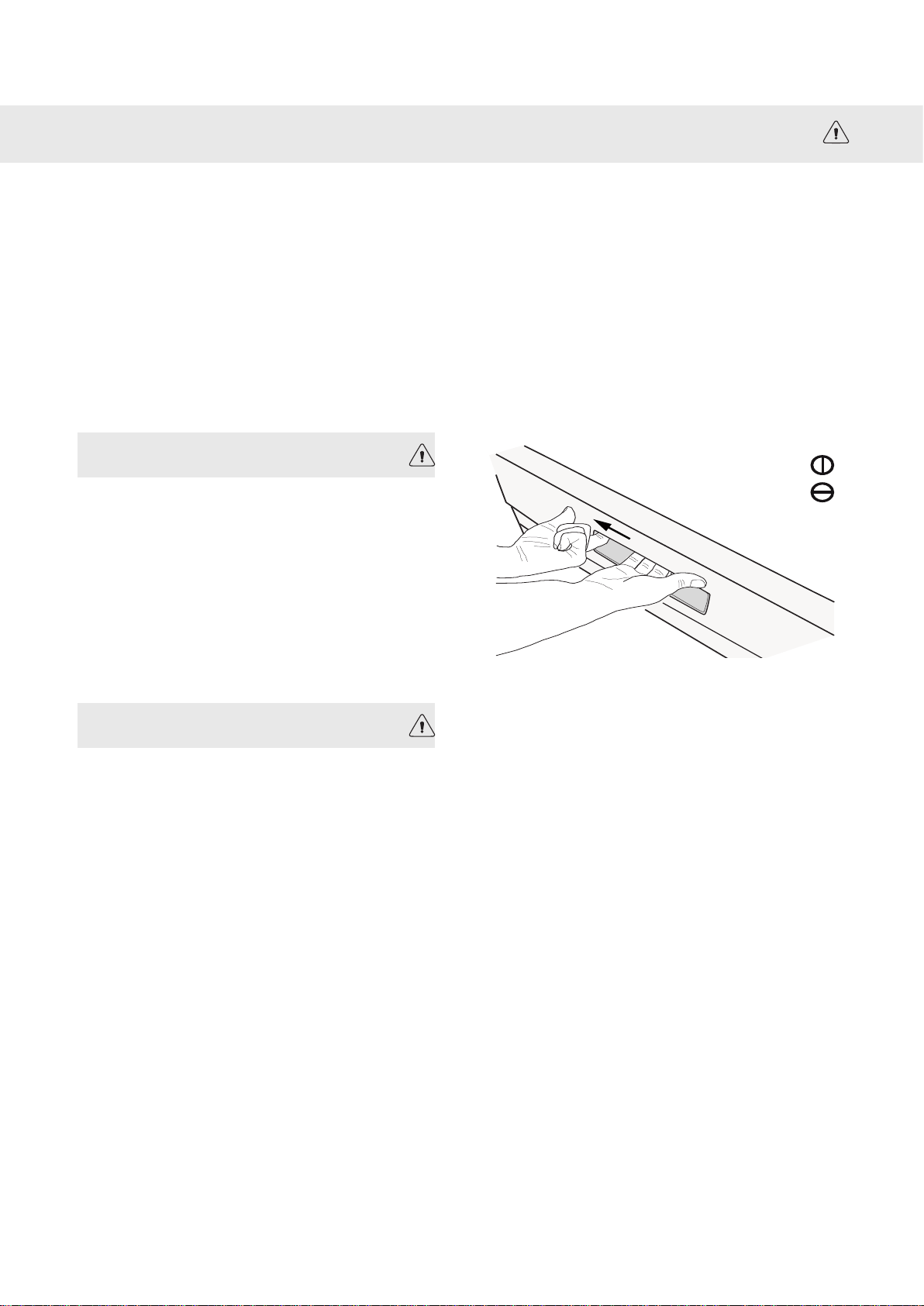
Activate the child safety lock
(only certain models)
A child safety lock is fitted to prevent children from
opening the dishwasher door. To activate the child
safety lock, press in the door latch and use a
screwdriver to turn the screw slot (top left-hand
corner) to a vertical position. To open the door, you
must press the white plastic catch (illustrated below)
to the left while pressing the door latch up. Reset by
turning the screw slot back to a horizontal position.
Locked
Open
Activate child lock (button lock)
You can activate the child lock (button lock) to prevent
children from starting the dishwasher (see the section
Settings).
5
Child safety
5
6
7
6
8
9
10
1
2
3
4
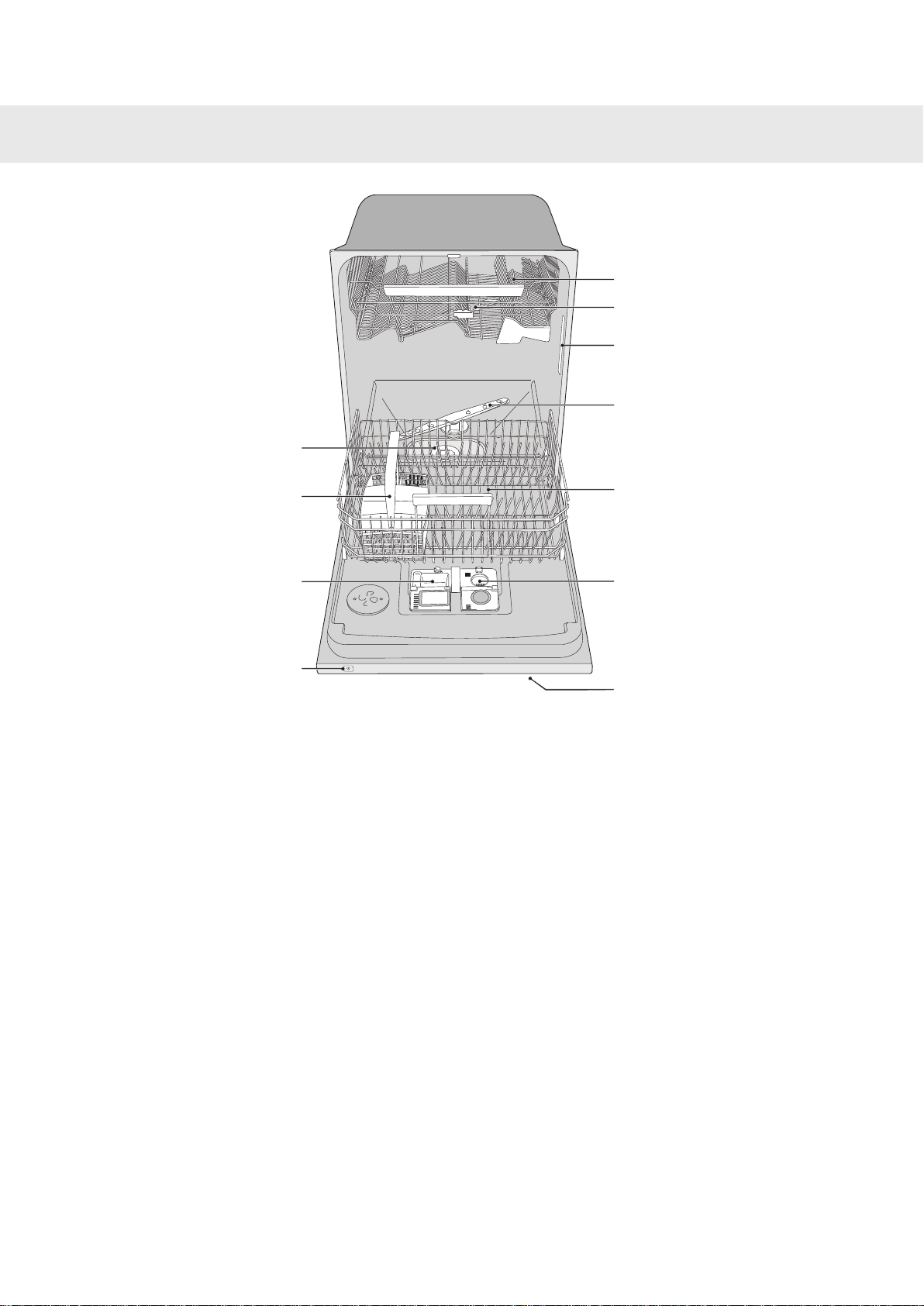
Spray arms
6.
Filters
1.
Serial number plate
7.
Cutlery basket
2.
Lower basket
8.
Detergent compartment
3.
Rinse aid compartment
9.
Main power switch
4.
Panel
10.
Upper basket
5.
*Specifications may differ depending on the model and market.
6
Dishwasher components*
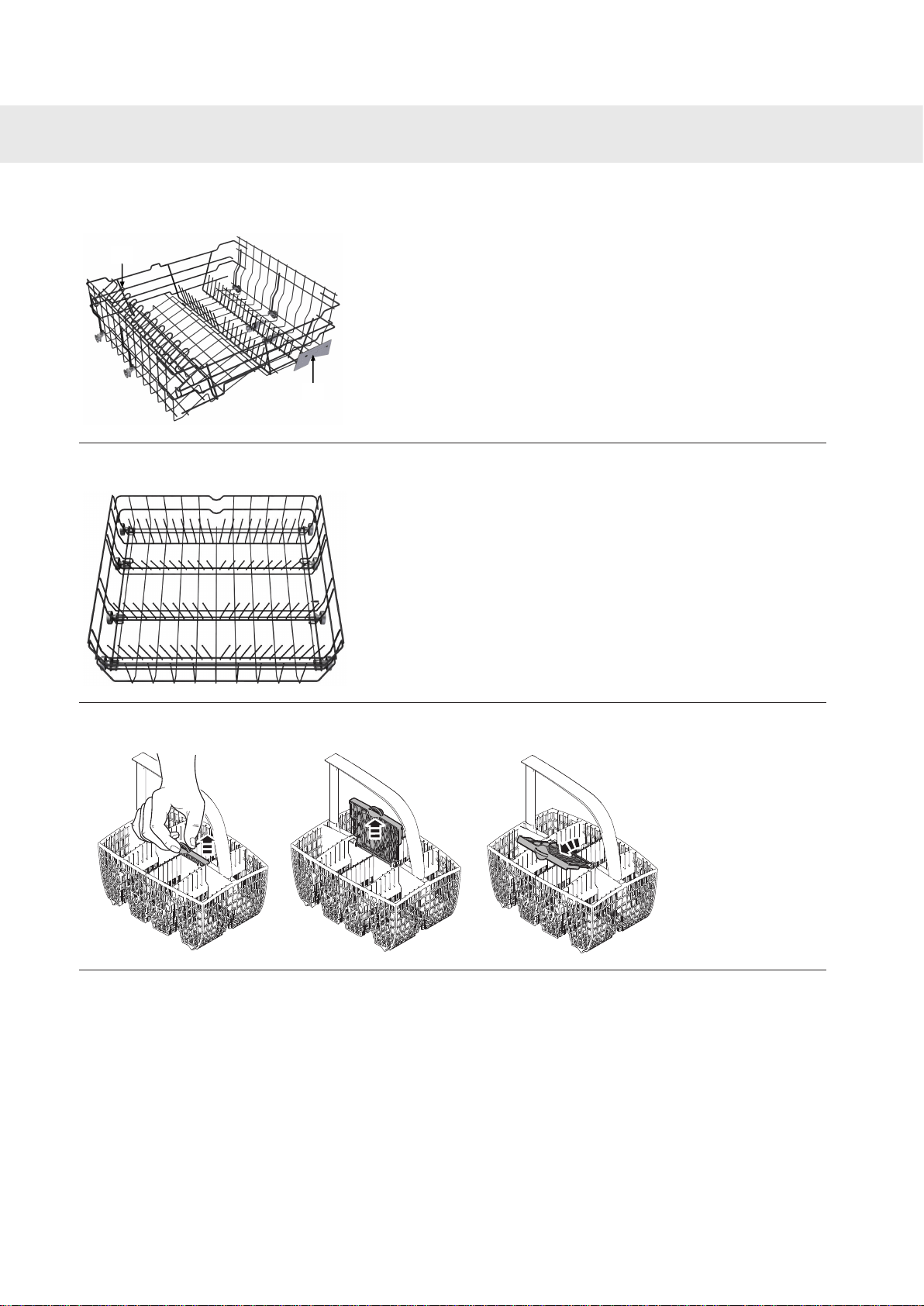
Upper basket
1.
Wine glass shelf
2.
Knife guard
1
2
Lower basket
Cutlery basket
a
c
b
*Specifications may differ depending on the model and market.
7
Dishwasher baskets*
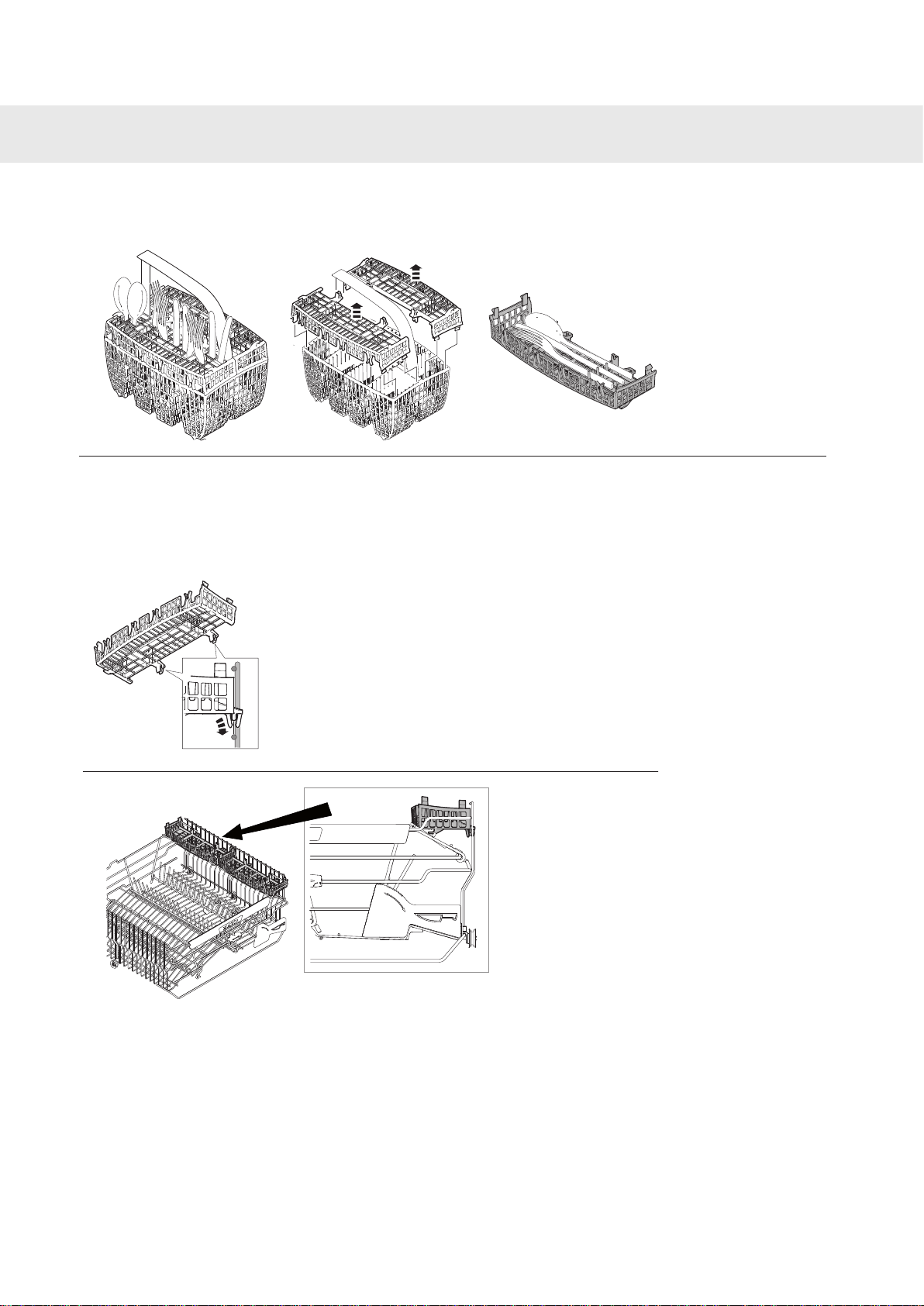
Cutlery basket with lid
a
c
b
Positioning of cutlery basket lid (in upper basket)
The cutlery basket lid can be removed and used, for example, as an extra cutlery basket in the upper basket (see
below).
a
b
c
*Specifications may differ depending on the model and market.
8
Dishwasher baskets*
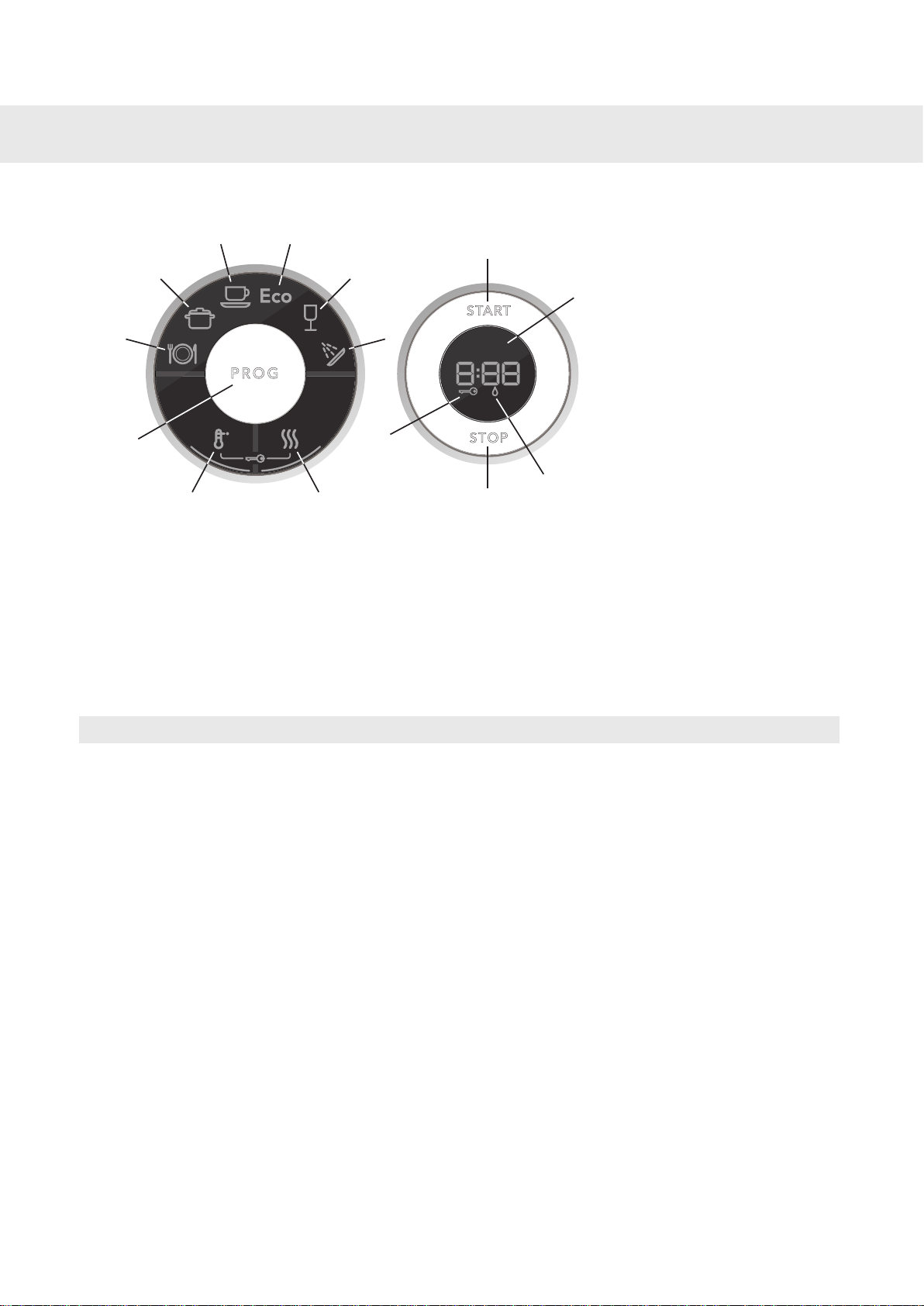
The panel is fitted with touch buttons with audible feedback (see the chapter Settings).
P R O G
START
STOP
2
1
8 9
3
4
5
6
10
12
11
13
14
7
Temperature
8.
Program selector
1.
Drying
9.
Daily wash
2.
Start
10.
Heavy wash
3.
Stop
11.
Normal wash
4.
Display
12.
Eco wash
5.
Child lock (button lock)
13.
Quick wash
6.
Rinse aid indicator
14.
Rinse & Hold
7.
NOTE!
•
Keep the touch buttons clean and free from grease. Wipe them clean with a dry or slightly damp cloth. Never
use cleaners – they can scratch the surface. Use the main power switch to turn off the dishwasher before
cleaning the touch buttons to avoid activating any buttons unintentionally.
9
Front panel
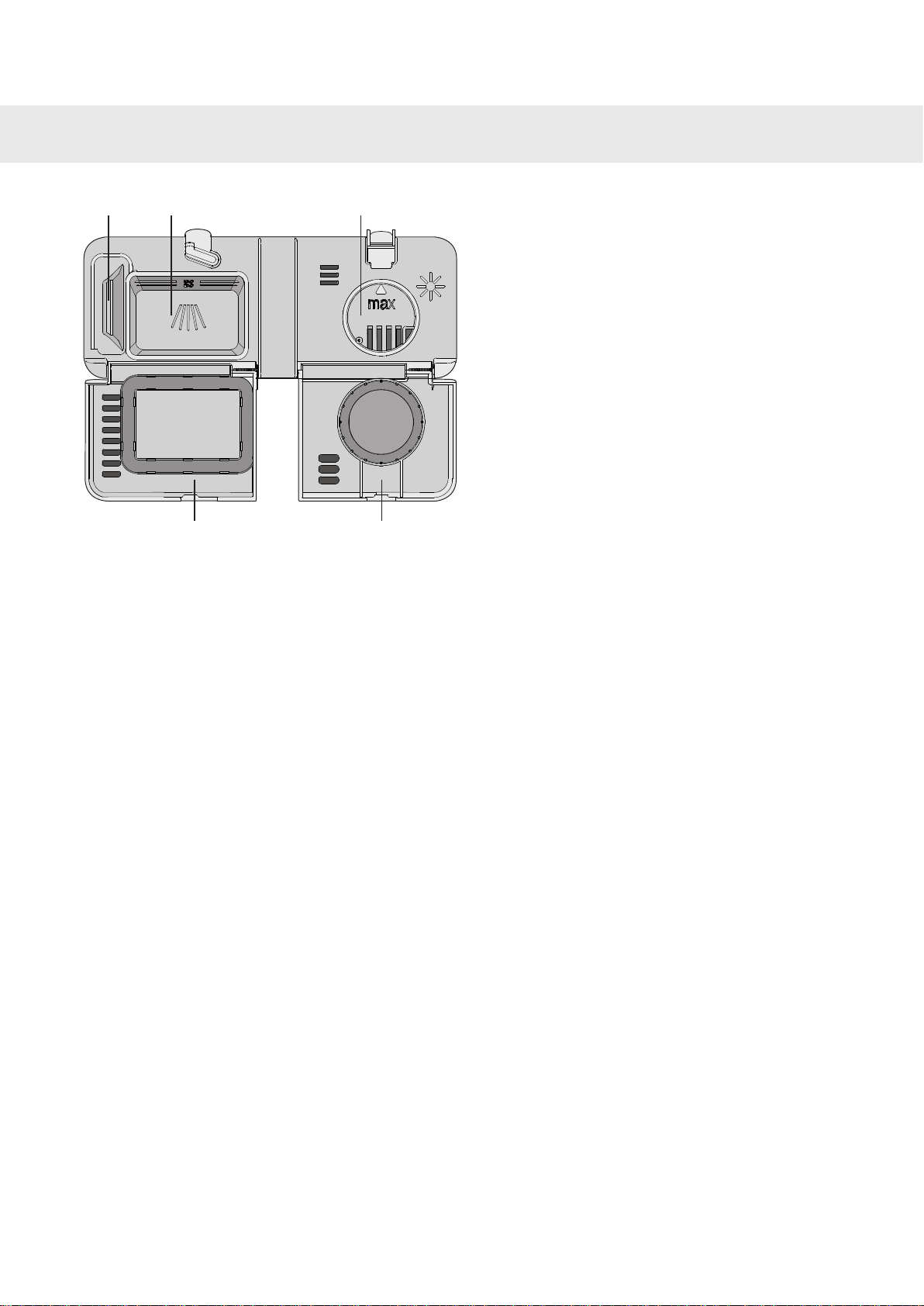
1.
Prewash detergent compartment
2.
Main wash detergent compartment
3.
Rinse aid compartment
4.
Detergent compartment lid
5.
Rinse aid compartment lid
1
2
4
5
3
10
Dispenser

Run programs only with a full load
Wait to run a program until the dishwasher is full. This
way you save energy. Use the Rinse & Hold program
to rinse the dishes if there are any unpleasant odours
while you wait for the dishwasher to become fully
loaded.
Run programs at a lower
temperature
If the dishes are only slightly dirty, you can select a
lower temperature with certain programs. See also
the section Select options in the chapter Dishwashing.
Select a program with Short dry
To save energy, use Short dry. The drying result will
be better if, once the program is finished, you leave
the door slightly open.
Do not rinse under running water
Simply scrape off large food particles before loading
the dishwasher.
Choose a green detergent
Read the environmental declaration on the packaging!
Connect to cold water...
If you use oil or electricity to heat your home.
Connect to hot water (max. 70 °C)...
If you use district heating, solar power or geothermal
power to heat your home. Choosing a hot water
connection cuts program times and reduces the
dishwasher's electricity consumption.
11
Economic dishwashing

Some cookware is not dishwasher safe. This can be
for several reasons. Some materials cannot withstand
strong heat, others can be damaged by dishwashing
detergent.
Fragile decoration
Porcelain with decoration on top of the glazing (the
items feel rough) should not be washed in a
dishwasher.
Crystal/Glass
Position items so that they do not touch each other
during the wash. Use the lowest possible wash
temperature and the shortest possible program.
Select Short dry. Antique and very fragile items should
not be washed in a dishwasher.
Glass washed in a dishwasher at high temperatures
can gradually develop a grey film that cannot be
removed. Wash fragile glasses at a low temperature
and with a small amount of detergent.
Silver
Silver and stainless steel items should not come into
contact, as the silver can become discoloured.
Cutlery with glued handles
Some types of glue are not dishwasher safe. In such
cases, the handles may loosen.
Wood
Wooden items should only be washed in a dishwasher
if marked dishwasher safe.
Aluminium
Aluminium can lose its shine if washed in a
dishwasher. However, good quality aluminium pans
can be washed in a dishwasher, even if some of the
shine will be lost.
Plastic items
Avoid washing plastic items that cannot withstand
high temperatures.
12
Fragile dishes

Below are step-by-step instructions to help you
achieve the best possible dishwashing results.
1
Load the baskets correctly
Do not rinse dishes under running water before
loading them in the dishwasher. Simply scrape
off large food particles before loading the dishwasher.
Place glasses, cups, bowls, side plates and saucers
in the upper basket. Wine glasses are placed on the
wine glass shelf and knives are placed in the knife
stand on the right (if fitted).
NOTE!
All dirty surfaces should face inwards and
downwards!
Place plates, side plates, serving dishes, pots and
cutlery (in the cutlery basket) in the lower basket.
Place cutlery with the handles facing down, except
for knives, and spread them out as much as possible.
Ensure that spoons do not stack inside each other.
The cutlery basket is placed in the lower basket.
WARNING!
Knives and other pointed items must be placed with
the points down in the cutlery basket or horizontally
in other baskets.
Do not place cutlery made of different materials, such
as silver and stainless steel, in the same place (risk
of discolouration).
The cutlery basket has a fold-down section in the
middle for small items, or small shafts, such as electric
whisk attachments.
See the section Fragile dishes if you want to wash
items that may be considered fragile.
2
Check that the spray arms can
rotate freely
3
Add detergent
Detergent is added according to water
hardness.
Follow the instructions on the detergent packaging.
Too much detergent can result in less effective
dishwashing and also entails greater environmental
impact.
Add the detergent to the detergent compartment.
There is one compartment for the prewash and one
for the main wash (see the section Dispenser). If
tablets are not used, add a small amount of the
detergent to the prewash compartment. Contact the
detergent manufacturer if you have any questions
about the detergent.
WARNING!
Children must be supervised – dishwasher detergent
is corrosive!
NOTE!
Use only dishwasher detergent! Washing up liquid
must not be used as the foam that forms prevents
the dishwasher from operating effectively.
13
Dishwashing
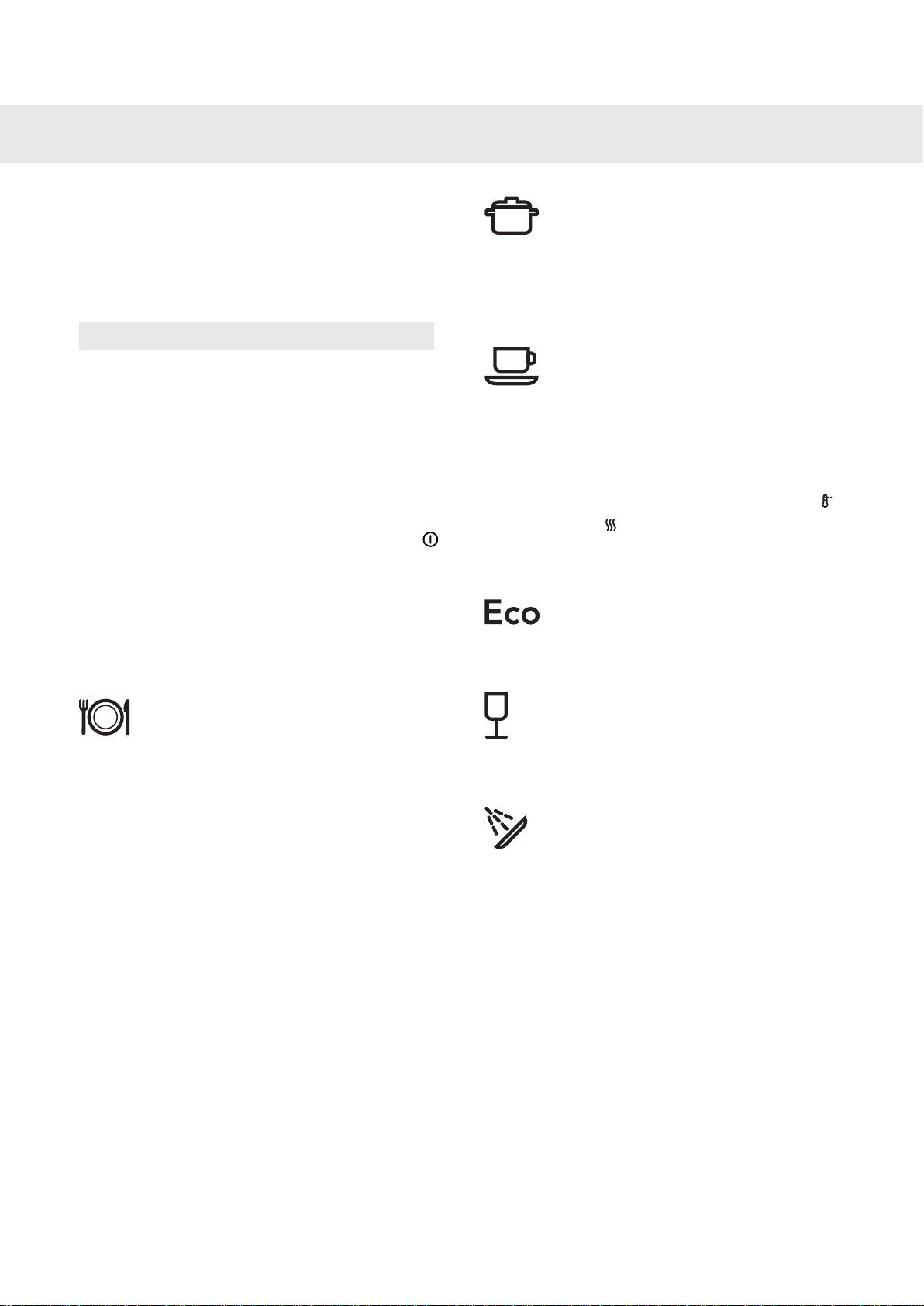
Dishwasher tablets
Halve the tablet if it is difficult to close the dispenser
lid. There is a risk that the detergent will not be
released properly if the lid is tight and will not open
correctly.
NOTE!
Dishwasher tablets are not recommended for short
programs (less than 75 minutes). Use powder or
liquid dishwasher detergent instead.
3–in–1/All-in-one detergent
Read through the directions for these products
carefully. If anything is unclear, contact the detergent
manufacturer.
4
Press the main power switch
and close the door
5
Select the program
Press the Program selector one or more times
until the desired program symbol lights.
Daily wash
A program suitable for day-to-day dishwashing. This
program can also clean dried leftovers, but is not
intended for burnt food, such as on oven dishes.
Heavy wash
Program for very dirty dishes, such as pans, casserole
dishes and oven dishes. If these dishes do not
completely fill the dishwasher, you can add plates
and the like.
Normal wash
Use to wash normally dirty dishes, and even dishes
with dried leftovers, such as plates, serving dishes,
cups, glasses and so on.
For washing normally soiled mixed loads use the
Normal wash program with high temperature
and long drying .
To save more water and energy use low temperature
and short drying.
Eco wash
Use when you want to save water. For normally dirty
dishes.
Quick wash
This program is used for glasses and porcelain that
is slightly dirty, such as coffee cups.
Rinse & Hold
Used to rinse dishes while you wait for the dishwasher
to become fully loaded.
14
Dishwashing
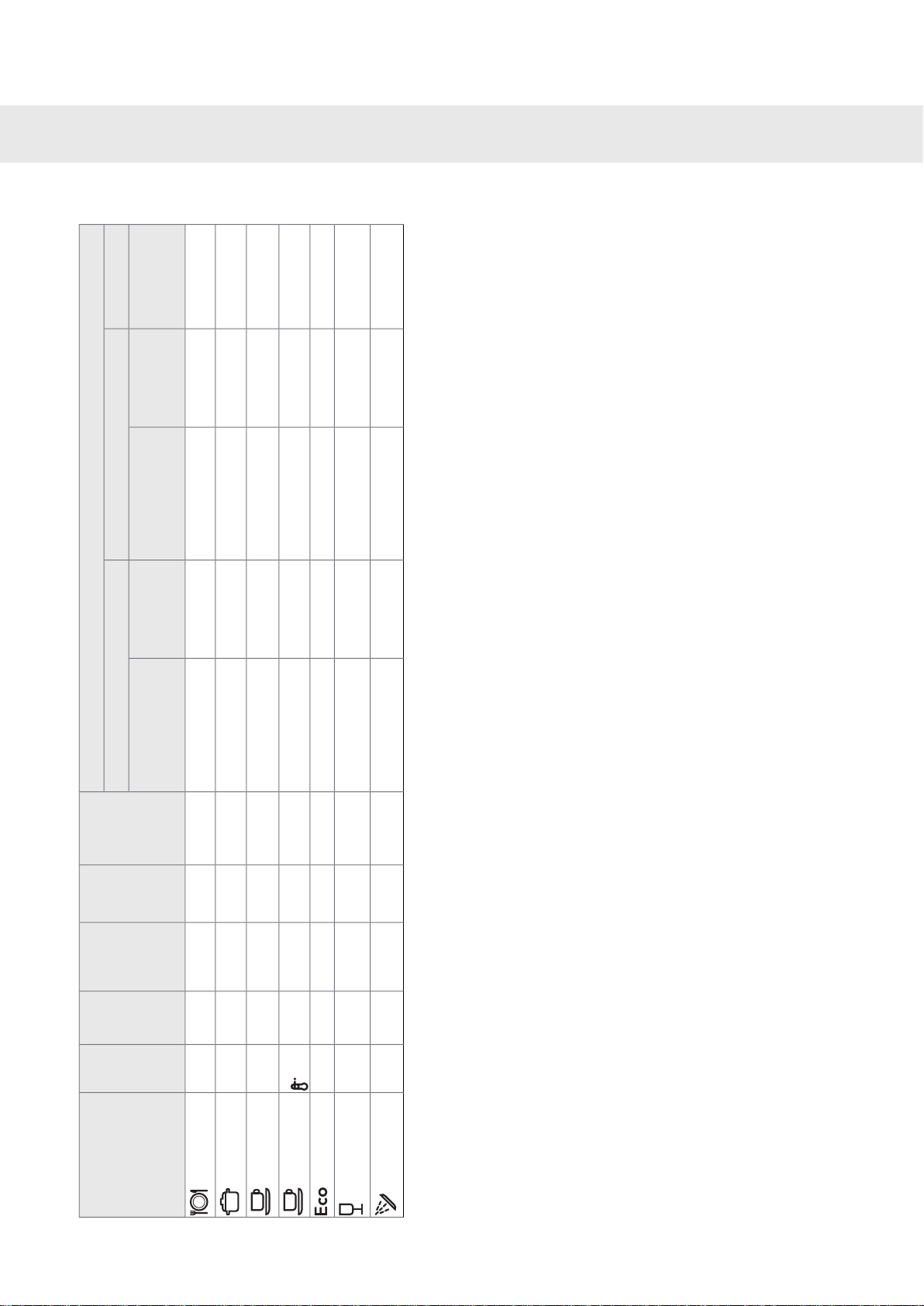
Program chart
Consumption values
1)
Final
rinse tem-
perature
(°C)
Number
of rins-
es
Main
wash (°C)
Pre-
washes
Op-
tions
Program
Hot water
3)
Cold water
2)
Water consump-
tion (liter)
Energy
(approx. kWh)
Wash time
(approx. hours:min-
utes)
Energy
(approx. kWh)
Wash time
(approx. hours:min-
utes)
140,91:301,31:40652601-Daily wash
180,72:401,32:55603552-Heavy wash
140,51:301,11:40602551-
Normal wash
4)
160,82:101,52:25652652Normal wash
110,52:050,82:20502550-Eco wash
100,10:200,20:20-2300-Quick wash
30,010:060,010:06-1-0-Rinse & Hold
1) Consumption values vary depending on the water supply temperature, the ambient temperature, the size of the load, the selected options and more.
2) Connection to cold water, approx. 20 °C.
3) Connection to hot water, approx. 60 °C.
4) The energy label performance figures are based on this program.
15
Dishwashing
6
Select options
To select an option, press one of the option
buttons. The field next to the button lights when
the option is activated. The available options depend
on the selected program. Once you have started the
program, the options you selected are saved for the
next time you use the same program.
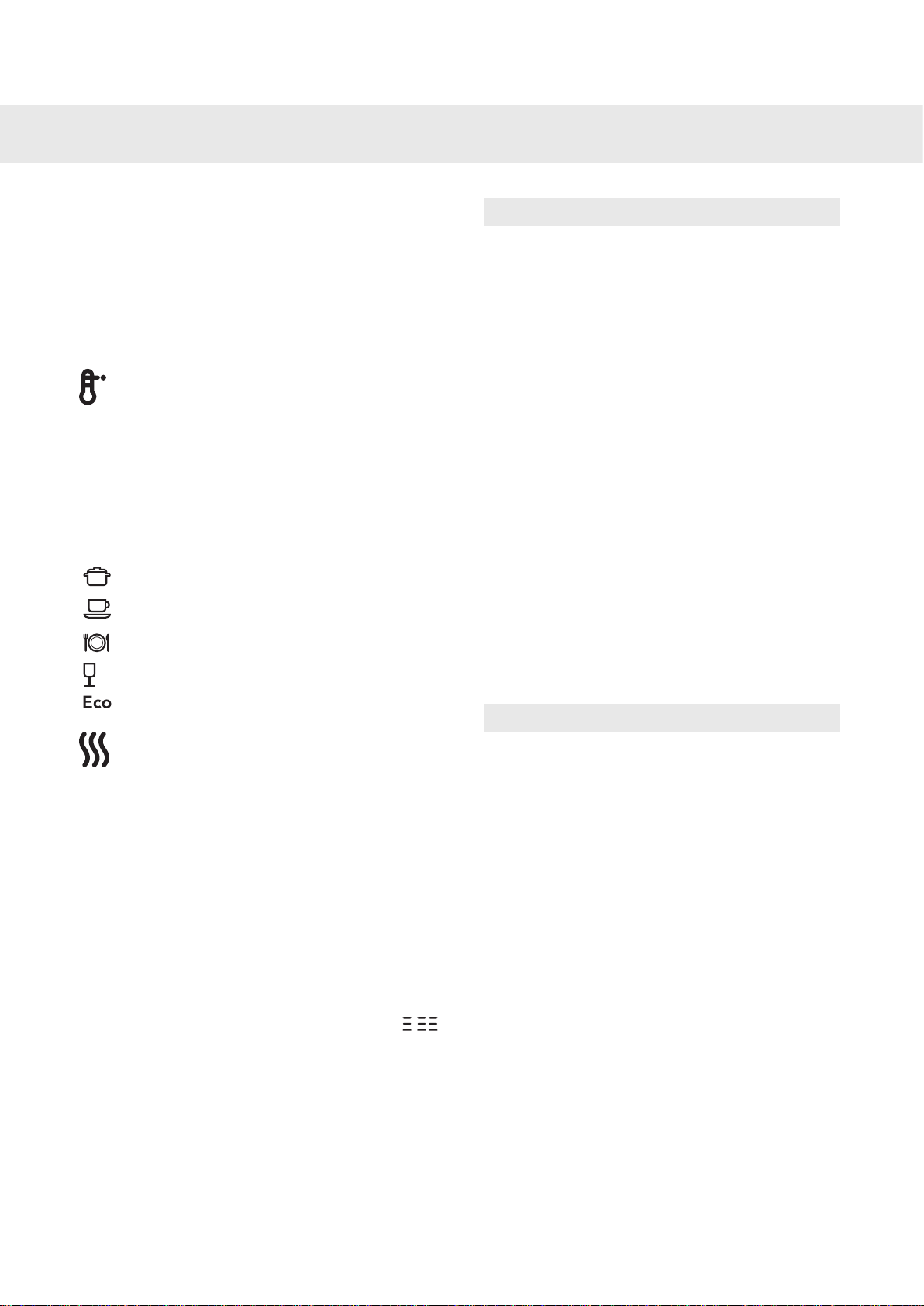
Temperature
The Temperature option button allows you to select
a higher or lower temperature for the main wash. If
you want to improve dishwashing efficiency, activate
the option for a higher temperature. This option
remains selected until changed.
You can vary the temperature as shown below:
55 °C/ 70 °CHeavy wash:
55 °C/ 65 °CNormal wash:
60 °C/ 65 °CDaily wash:
30 °C/ 60 °CQuick wash:
55 °C/ 60 °CEco wash:
Drying
Press the Drying option button for improved drying
results. The temperature increases during the final
rinse, which improves drying results but increases
program time and energy consumption. If you want a
program with Short dry, press it again and the field
next to the button turns off.
7
Press Start
The display flashes three times with the
remaining time to indicate that the program has
started. Close the door properly otherwise the
dishwasher will not start. The display indicates
if the door is open.
NOTE!
If the machine does not start within 2 minutes of the
last button press, the display returns to showing the
last program run.
Stopping or changing a program
In order not to accidently press a button and cancel
the current program, you must press and hold Stop
for five seconds if you want to change programs after
starting the dishwasher. Add more detergent if the lid
of the detergent dispenser has opened. Then choose
a new program and press Start.
Do you want to add more dishes?
Open the door. The dishwasher stops automatically.
Add the dishes, close the door and the dishwasher
continues the program.
If the dishwasher is turned off using the main
power switch or due to a power failure
If the dishwashing program was not finished, the
interrupted program continues when power is
restored.
NOTE!
During drying, the program is interrupted if the power
is cut or the door is open for more than 2 minutes.
8
After dishwashing
Once the program has finished, "End" appears
on the display.
A buzzer also sounds at the end of the program. See
the section Settings, which describes how to change
this function.
Once the dishwasher has finished, it uses only
standby power. Turn off the dishwasher using the
main power switch if you want to completely cut the
power. Turn off the water supply valve after each use.
Drying
For additional drying the door should be opened 35
mm upon completion of the drying cycle. For more
information refer to the page marked Performance
information in these instructions.
16
Dishwashing
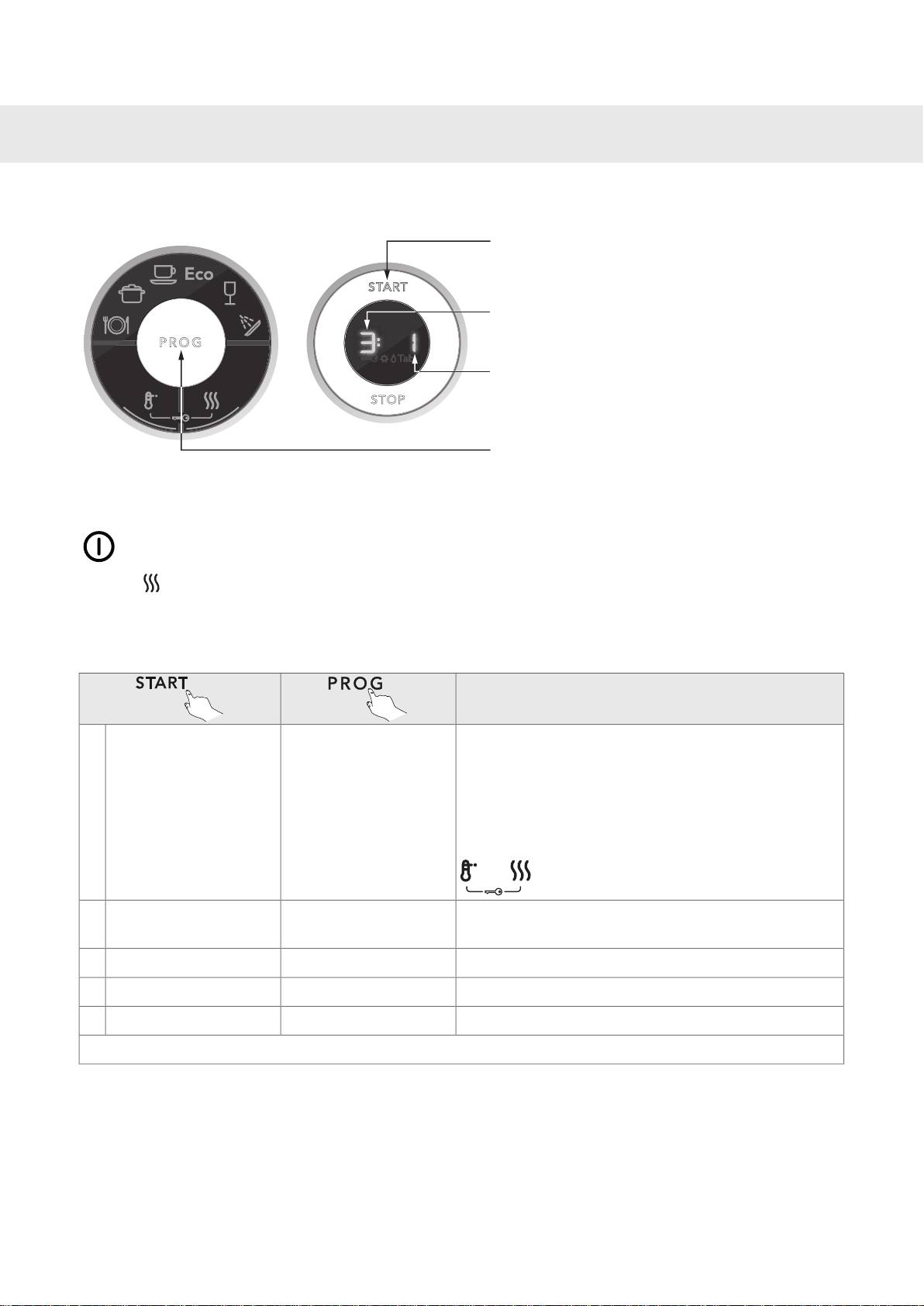
Settings menu overview:
P R O G
START
ST OP
START
Confirm selection and open next
menu.
Current menu.
Current selection.
Browse selections.
Do as follows to open the settings menu:
Turn off the dishwasher using the main power switch. Then press the main power switch again.1.
Press the Program selector and Drying buttons simultaneously.2.
PROG PROG
+
You can now adjust the following settings:
Description
You can activate the child lock (button lock) option to pre-
vent children from starting the dishwasher.
Press the Temperature and Drying buttons simultaneously
to temporarily deactivate the button lock when you want to
start the dishwasher. The button lock is automatically reac-
tivated after 2 minutes.
0 (Off) or 1 (On)Child lock
(button lock)
1:
The dishwasher uses a buzzer to indicate when a program
is finished or when a fault has occurred.
0 (Off), 1–4Buzzer volume2:
This sound is used to confirm each button press.0 (Off), 1–4Operation volume3:
For adjusting the contrast of the display.-1, 0, +1, +2, +3LCD contrast4:
Rinse aid dosage setting.0 (Off), 1–6Rinse aid5:
Finally, press Start to save and exit the menu.
17
Settings

Once you have selected a program and options, the
display indicates how long the program took the last
time it was used.Once you have started the
dishwasher, the display indicates how much program
time remains. The remaining time is updated after the
water for the final rinse has been heated.
This may differ somewhat from time to time depending
on the temperature of the water supply, the amount
of dishes, the ambient temperature and other factors.
While the program is running, the time counts down
and the remaining program time is shown on the
display. The remaining time is shown, for example,
as 1:15, which means the program will run for another
1 hour and 15 minutes.
NOTE!
During the first run of each program, the remaining
time displayed can be slightly misleading, as the
dishwasher is estimating the time. When you run the
program a second time, the dishwasher will calculate
the remaining time based on the previous duration
of the program.
18
Time remaining
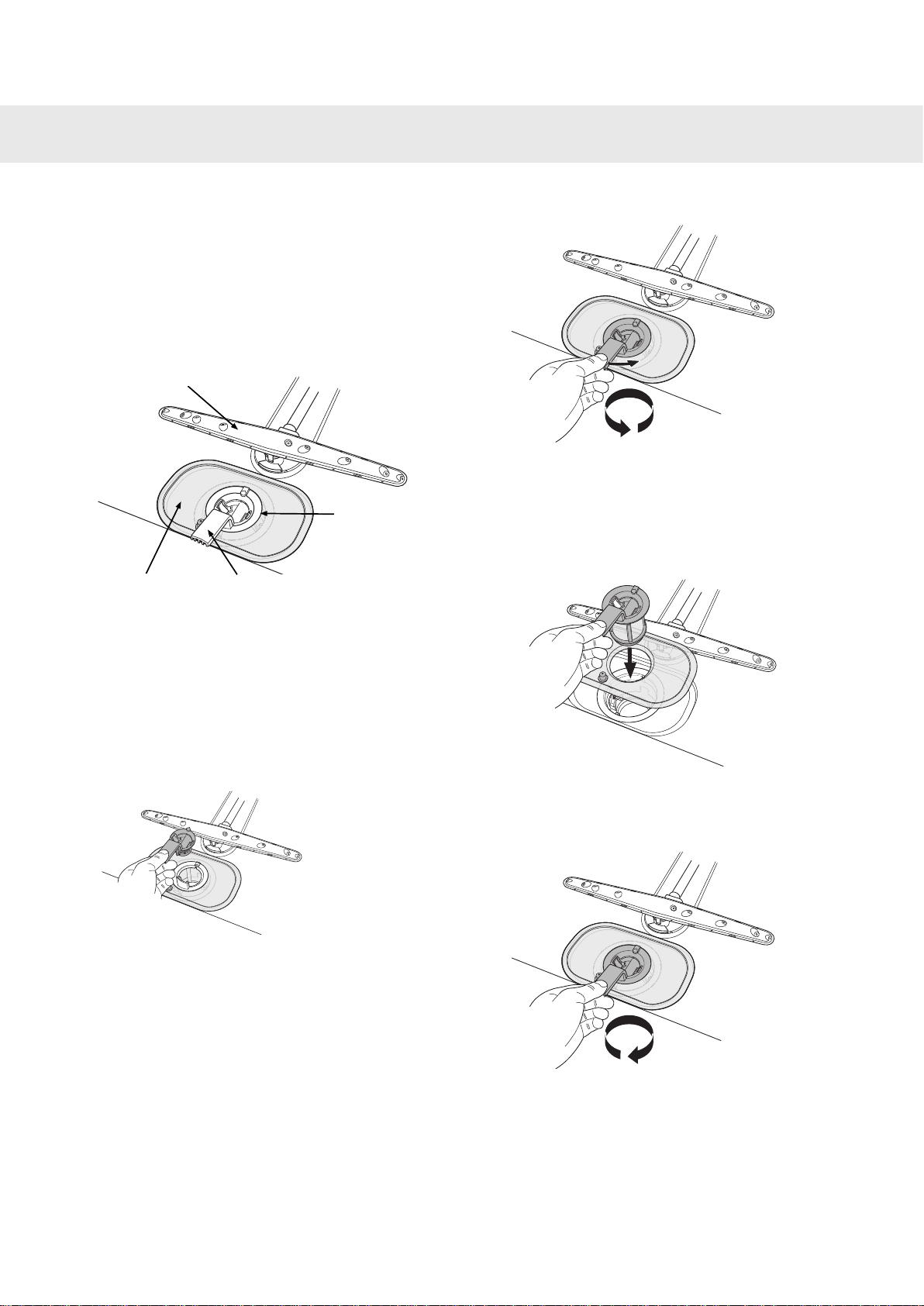
The dishwasher tub is made of stainless steel and is
kept clean through normal use. However, if you have
hard water, limescale deposits may form in the
dishwasher. If this happens, run the Normal wash
program with high temperature and two tablespoons
of citric acid in the detergent compartment (with no
dishes in the machine).
Spray arm
Fine filter
Coarse filter
Pipe
section
Coarse filter
The coarse filter traps larger food particles, which
cannot get past the drainage pump. Empty the coarse
filter as necessary.
1.
Lift the coarse filter by the handle.
2.
Empty the coarse filter. Remember to replace it!
Fine filter
Debris that collects on the fine filter is automatically
rinsed away during each wash. However, the fine filter
and its pipe section should be cleaned a couple of
times a year.
1.
Turn the handle anticlockwise once.
1x
2.
Lift the pipe section straight up by the handle. Free
the coarse filter to clean the pipe section.
3.
Remove and clean the fine filter.
4.
Replace in reverse order. Check that the edges
seal properly when replacing the fine filter.
5.
Lock the filter in place by turning the handle
clockwise to the stop position. The handle should
point straight out from the dishwasher.
1x
19
Care and cleaning
NOTE!
The dishwasher must not be used without the filter
in place!
Diswashing efficiency can be affected if the course
filter is incorrectly fitted. After cleaning ensure that
filter handle is fully locked with the handle pointing
out of the dishwasher.
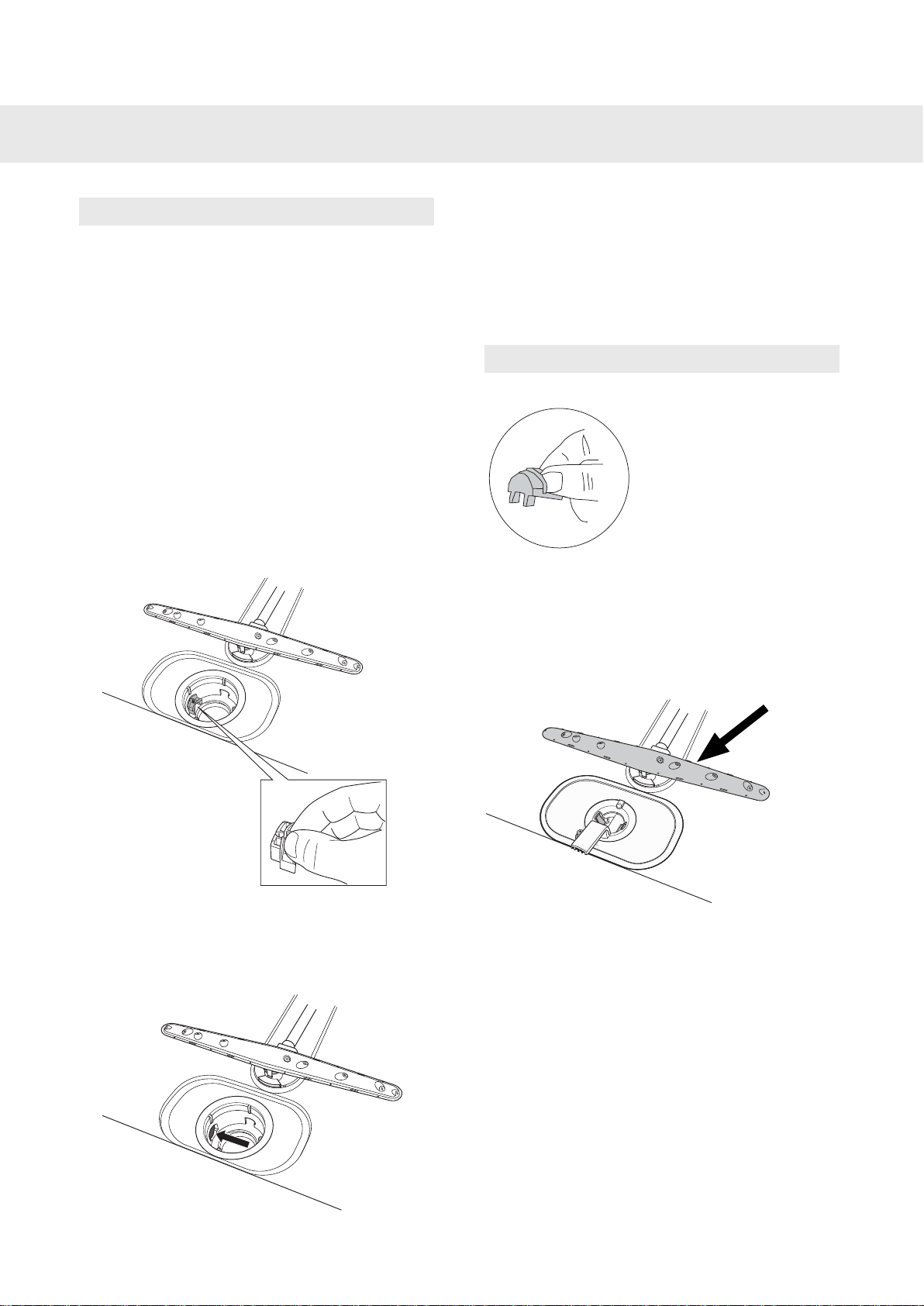
Drainage pump
The pump can be accessed from inside the
dishwasher.
1.
Cut the power to the dishwasher by pulling out the
plug from the wall socket!
2.
Remove the coarse filter and pipe section.
3.
Remove the small yellow fitted piece at the left of
the bottom drain (see illustration below).
4.
By inserting your finger into the hole you can turn
the pump blade to release anything blocking it.
5.
Reinstall the fitted piece and filters.
6.
Plug the machine in again.
If the dishwasher still does not start and a whirring
sound is heard, the overflow protection has been
activated.
•
Shut off the water.
•
Remove the plug from the wall socket.
•
Call the service division.
NOTE!
Do not forget to reinstall the fitted piece.
Lower spray arm
Holes and bearings can sometimes become blocked.
1.
Pull the lower spray arm straight up to release it.
2.
Remove any debris using a needle or the like. The
spray arms also have holes underneath.
20
Care and cleaning
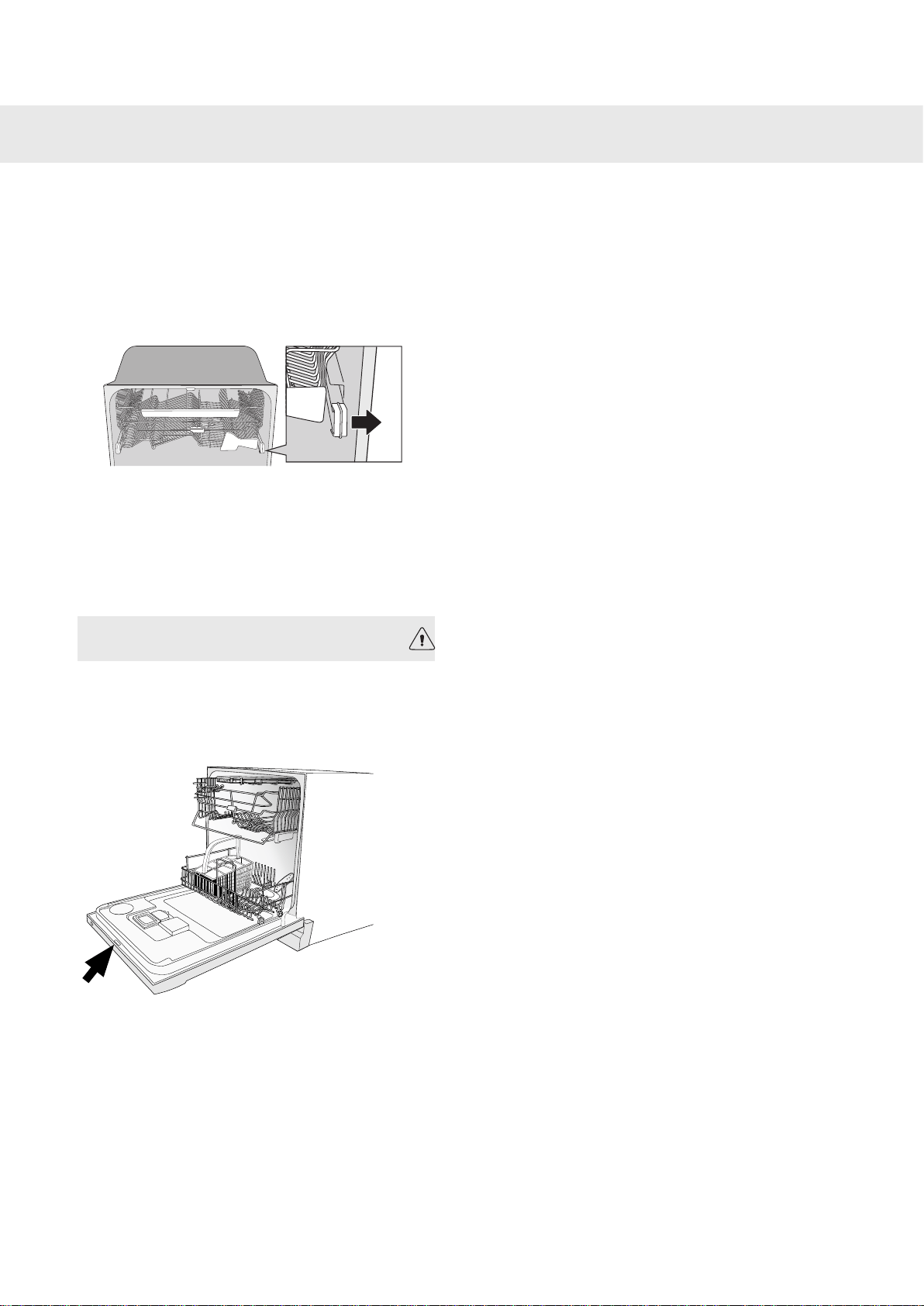
Upper spray arm
The upper basket must be removed before the upper
spray arm can be released.
1.
Pull out the upper basket and turn the basket catch
on each runner outwards (see illustration). The
basket can now be removed.
2.
Loosen the upper spray arm in the same manner
as the lower spray arm and clean it.
Door
When cleaning the edge around the door, use only a
slightly damp cloth (with a little cleaner if necessary).
WARNING!
Do not use a spray bottle or the like around the door
lock. This is to ensure that water does not penetrate
the door catch and come into contact with the
electrical components.
21
Care and cleaning
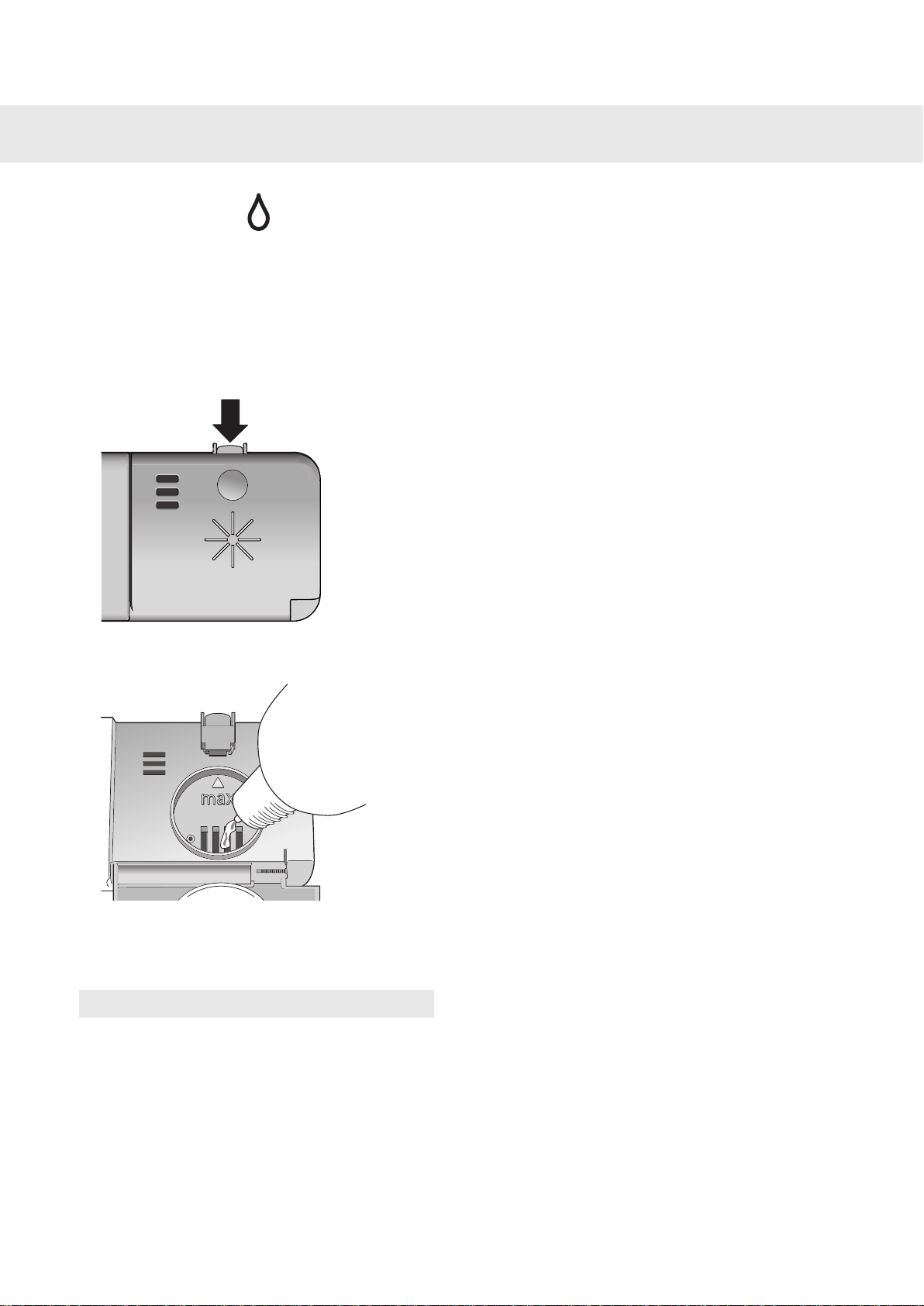
Drying is faster if you use rinse aid. When the rinse
aid needs topping up, the above symbol lights on the
display.
Top up with rinse aid
Top up with rinse aid as follows:
1.
Open the rinse aid compartment lid.
2.
Carefully top up with rinse aid. Only add rinse aid
to the level marked max.
3.
Wipe up any splashes of rinse aid around the
compartment.
4.
Close the lid firmly.
NOTE!
After topping up, it may take a while before the
symbol goes out.
Select dosage
The rinse aid dispenser can be adjusted between 0
(off) and 6. At the factory, the rinse aid dispenser is
set to 1.
Increase the rinse aid dosage:
•
If the dishes have water marks.
Reduce the rinse aid dosage:
•
If the dishes have a sticky white/blue film.
•
If the dishes are streaked.
•
Build-up of foam. If you have very soft water, the
rinse aid can be diluted 50:50 with water.
For water with a hardness greater than 10–12 °dH,
you ought to use rinse aid with citric acid (known as
acid rinse aid).
Set the dosage
The section Settings describes how to set the rinse
aid dosage.
22
Rinse aid
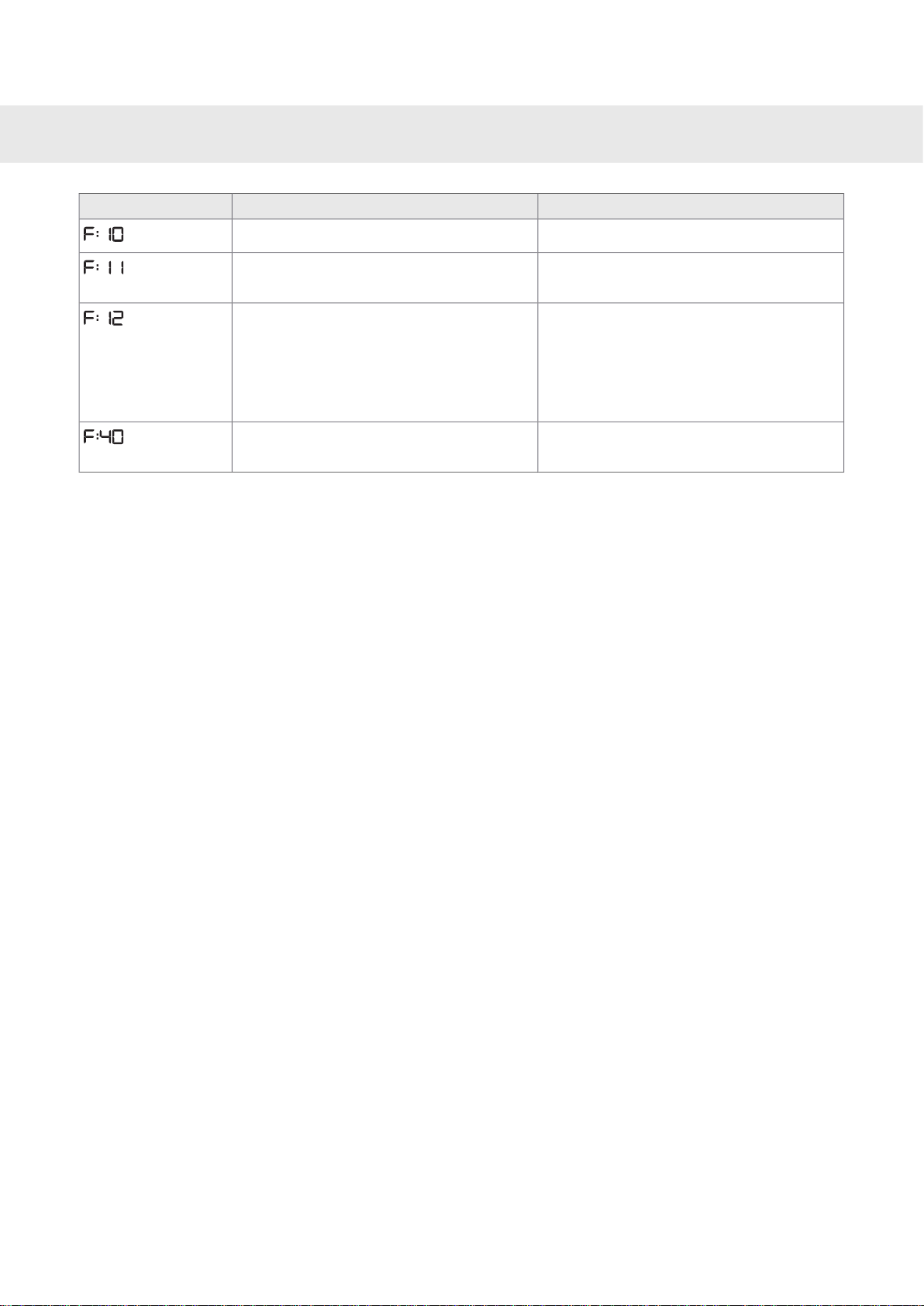
ActionType of faultDisplay
Call the service division.Overfilling
See "Possible causes" in the chapter Trou-
bleshooting.
Water outlet fault
Check that the water tap is on.
Check whether dishwasher inlet hose is
connected to a pressure limiting valve (some
pressure limiting valves may restrict the
supply of water to the dishwasher).
Water inlet fault
Turn off the water tap and call the service
division
Inlet valve leakage
Turn off the machine with the main power switch and then turn it on again to clear the error message from the
display.
23
Error messages
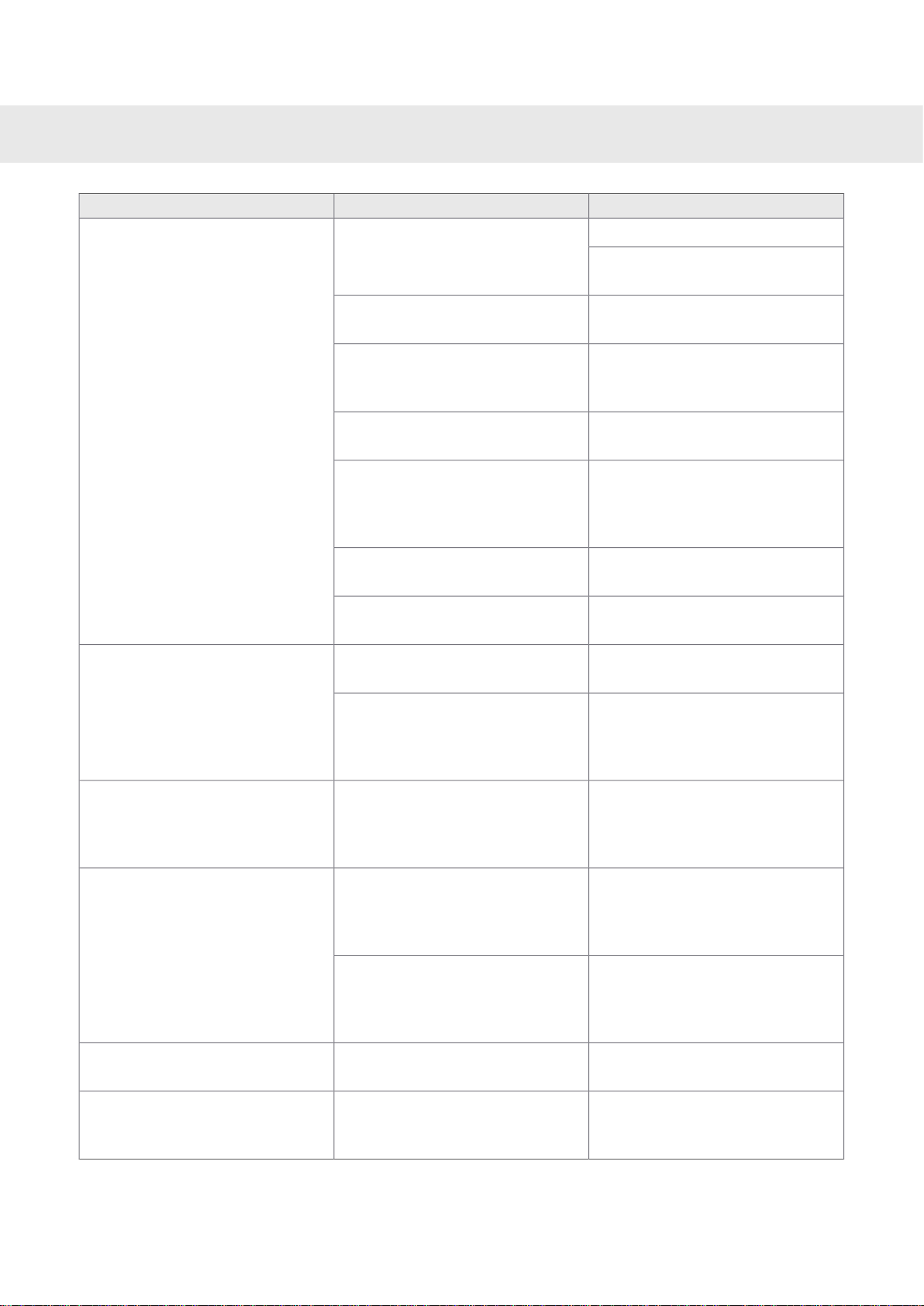
ActionPossible causesProblem
Remove the arms and clean them.The spray arms do not rotate.The dishes are not clean.
Check that the dishes are not blocking
the spray arms.
Avoid large packages.Old detergent. Detergent is a perish-
able product.
Dose according to water hardness. Far
too much or far too little detergent re-
sults in poorer dishwashing results.
Incorrect detergent dosage.
Select a higher temperature or a more
powerful program.
Dishwashing program too weak.
Do not cover porcelain with large
bowls or the like. Avoid placing very
tall glasses in the corners of the bas-
kets.
Dishes loaded incorrectly.
Place dishes to sit steady.Glasses and cups have toppled over
during the program.
Screw the filter firmly into place. See
the section Care and cleaning.
The filter is not correctly fitted.
See the sections Rinse aid and Set-
tings.
Incorrect rinse aid dosage setting.Spots or films on the dishes.
Wash crystal at a low temperature and
with a conservative amount of deter-
gent. Contact the detergent manufac-
turer.
Too high temperature and/or too much
detergent can cause etching on crys-
tal. Unfortunately, this cannot be re-
paired, only prevented.
Reduce the amount. See the sections
Rinse aid and Settings. If you have
very soft water, you may want to dilute
the rinse aid 50:50 with water.
Rinse aid dosage setting too high.The dishes have a sticky white/blue
film.
Rinse off these types of foodstuffs if
not starting the dishwasher immediate-
ly. Why not use the Rinse & Hold pro-
gram.
Some foodstuffs, such as mustard,
mayonnaise, lemon, vinegar, salt and
dressings, can cause spots on stain-
less steel if left for too long.
Spots on stainless steel or silver.
Silver and stainless steel items should
not come into contact during dishwash-
ing.
All stainless steel can cause spots on
silver if they come into contact during
dishwashing. Aluminium can also
cause spots on dishes.
Use a detergent with a bleaching
agent.
Lipstick and tea can be difficult to wash
off.
Spots left after washing.
Check that the dishes are placed se-
curely. Spin the spray arms to make
sure they can rotate.
The dishes are not correctly placed or
the spray arms are not rotating.
Rattling sound when dishwashing.
24
Troubleshooting
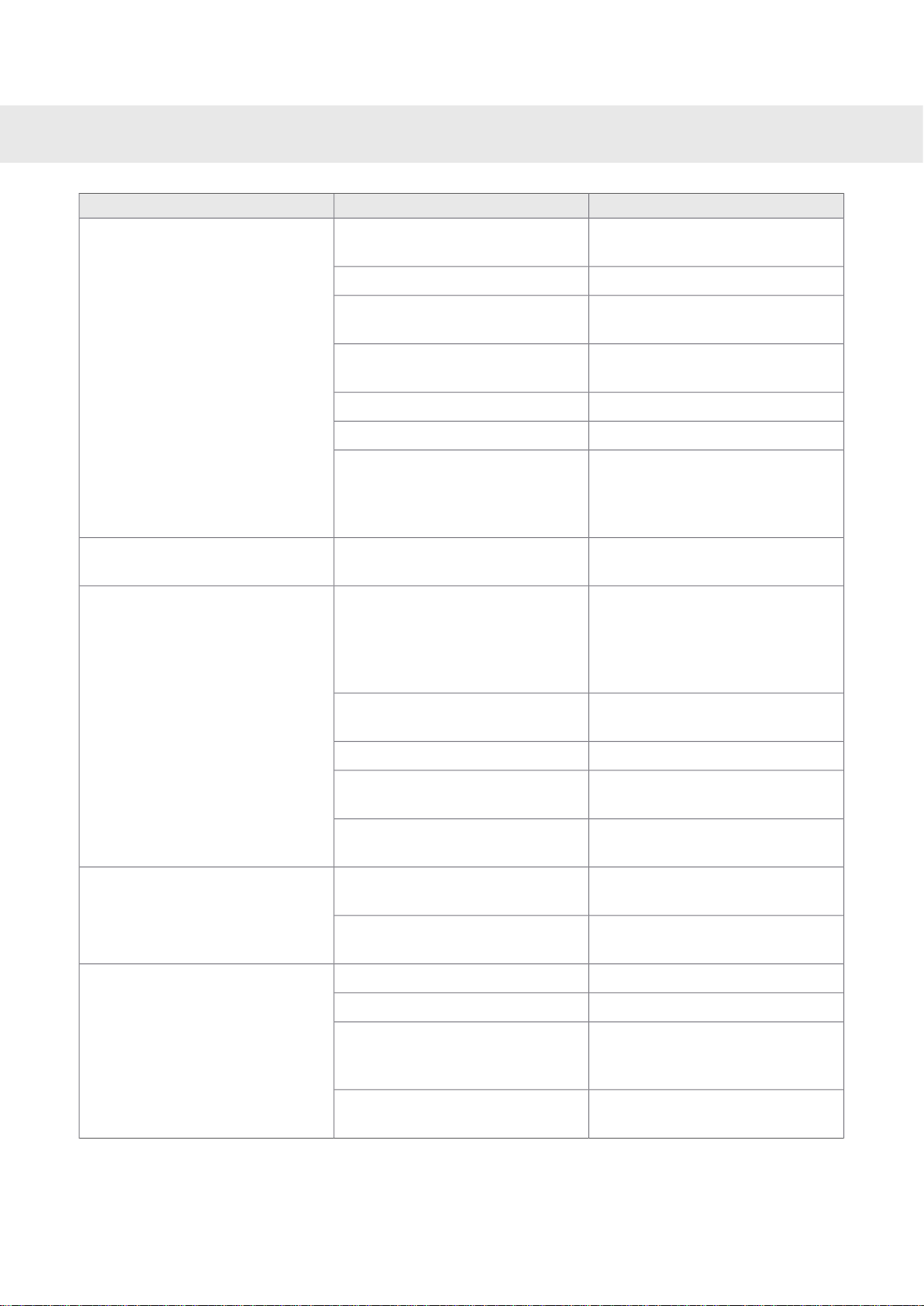
ActionPossible causesProblem
Press the main power switch.You have forgotten to turn on the main
power switch.
The dishwasher does not start.
Check.The door is not properly closed.
Check.A fuse/circuit breaker has been
tripped.
Check.The plug is not plugged into the wall
socket.
Check.The water tap is turned off.
Check.Overflow/leaks
Turn off the water tap. Pull out the plug
and call the service division.
A whirring sound (the drainage pump)
is heard from the dishwasher and does
not stop when the main power switch
is turned off.
None, next time the program is run the
corrected time will be displayed.
The program is taking longer than esti-
mated.
1 minute appears in the display.
Loosen the drainage hose where it
connects to the sink unit's water trap.
Check that no debris has fastened. Is
the cone-shaped part of the pipe cut
to an inner diameter of at least 14 mm?
Blocked drainage hose.Water remains in the dishwasher.
Check that the hose is free from kinks
and sharp bends.
Kink in drainage hose.
Clean the coarse and fine filters.The filters are blocked.
Ensure filter is completely locked with
handle pointing towards the door.
The filter is not locked in completely.
Clean the drainage pump. See the
section Care and cleaning.
Debris in the drainage pump.
Clean with washing-up brush and low
foaming cleaner.
Dirt around the seals and in corners.Bad odour in dishwasher.
Run a program with a higher tempera-
ture about once a month.
Low temperature programs have been
selected for a prolonged period.
Activate the Drying option.Drying power too low.The dishes are not dry enough.
Fully load the dishwasher.The dishwasher is not fully loaded.
Top up with rinse aid or increase the
rinse aid dosage. See the sections
Rinse aid and Settings.
Rinse aid needs topping up or dosage
is set too low.
Open the door a little once the program
has finished.
25
Troubleshooting
ActionPossible causesProblem
Check that the baskets are correctly
positioned horizontally.
The baskets are not correctly posi-
tioned.
Cannot close door.
Check that the dishes are not blocking
the baskets from sliding properly into
place.
Wait a moment then try again.You have pressed the touch buttons
too soon after opening the door.
The touch buttons do not react when
pressed.
Clean with a dry or slightly damp cloth.Dirt on the touch buttons.
See the section Settings.Child lock (button lock) activated.
26
Troubleshooting
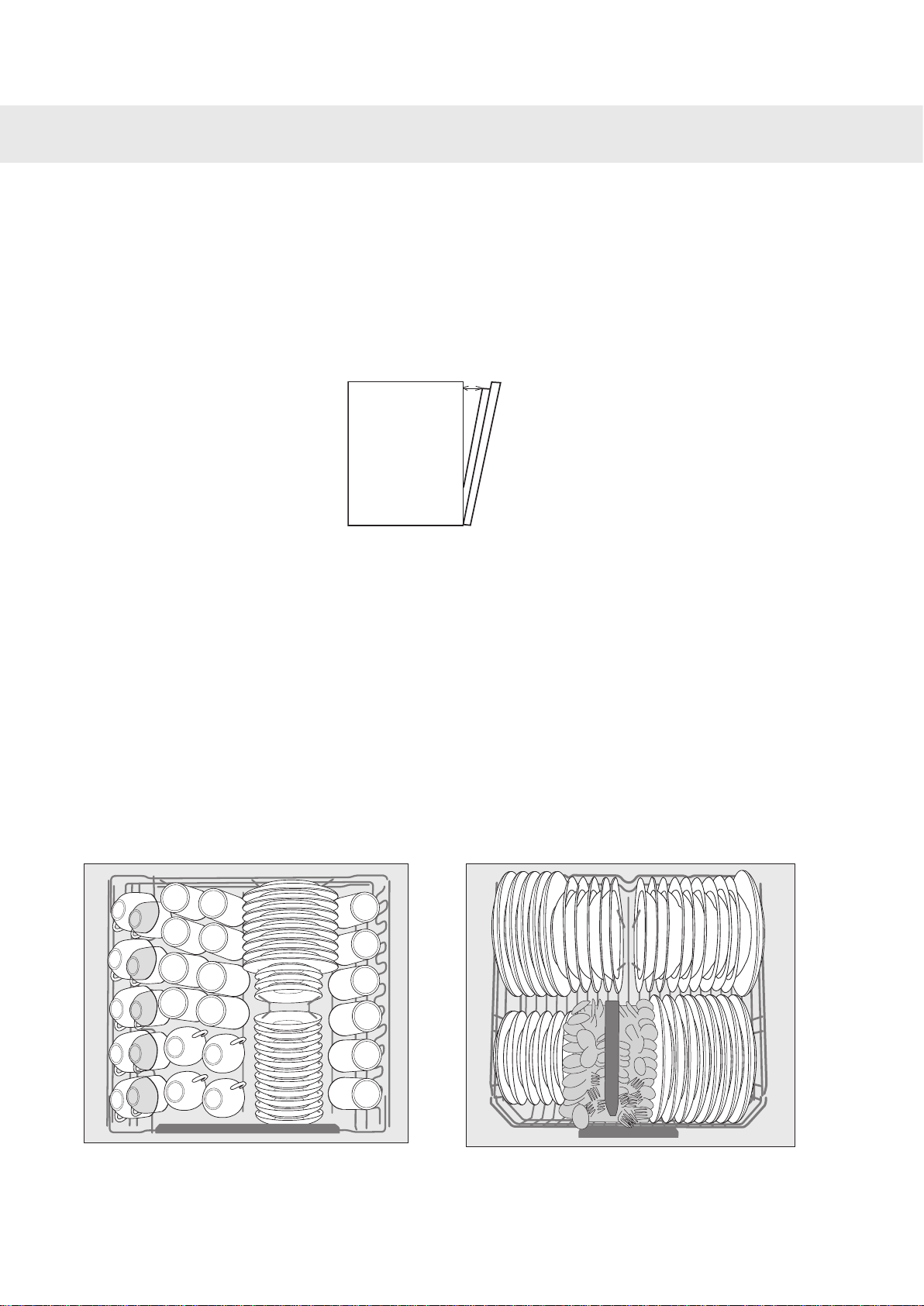
Energy labelling
AS/NZS 2007Australian standard:
14Number of place settings:
Normal wash 55 °C, no options
The door should be opened upon completion of the drying cycle a distance
of 35 mm at V.
V
Dishwashing programs:
1:40 hours:minutesProgram time:
Cold water 20 °CConnection:
IEC-704-3Test method for noise measurement:
Dosages during testing
In accordance with AS/NZS 2007Detergent:
7,5 gramPrewash:
25 gramMain wash:
In accordance with AS/NZS 2007Rinse aid:
3Rinse aid dosage:
Loading the dishwasher
27
Performance information
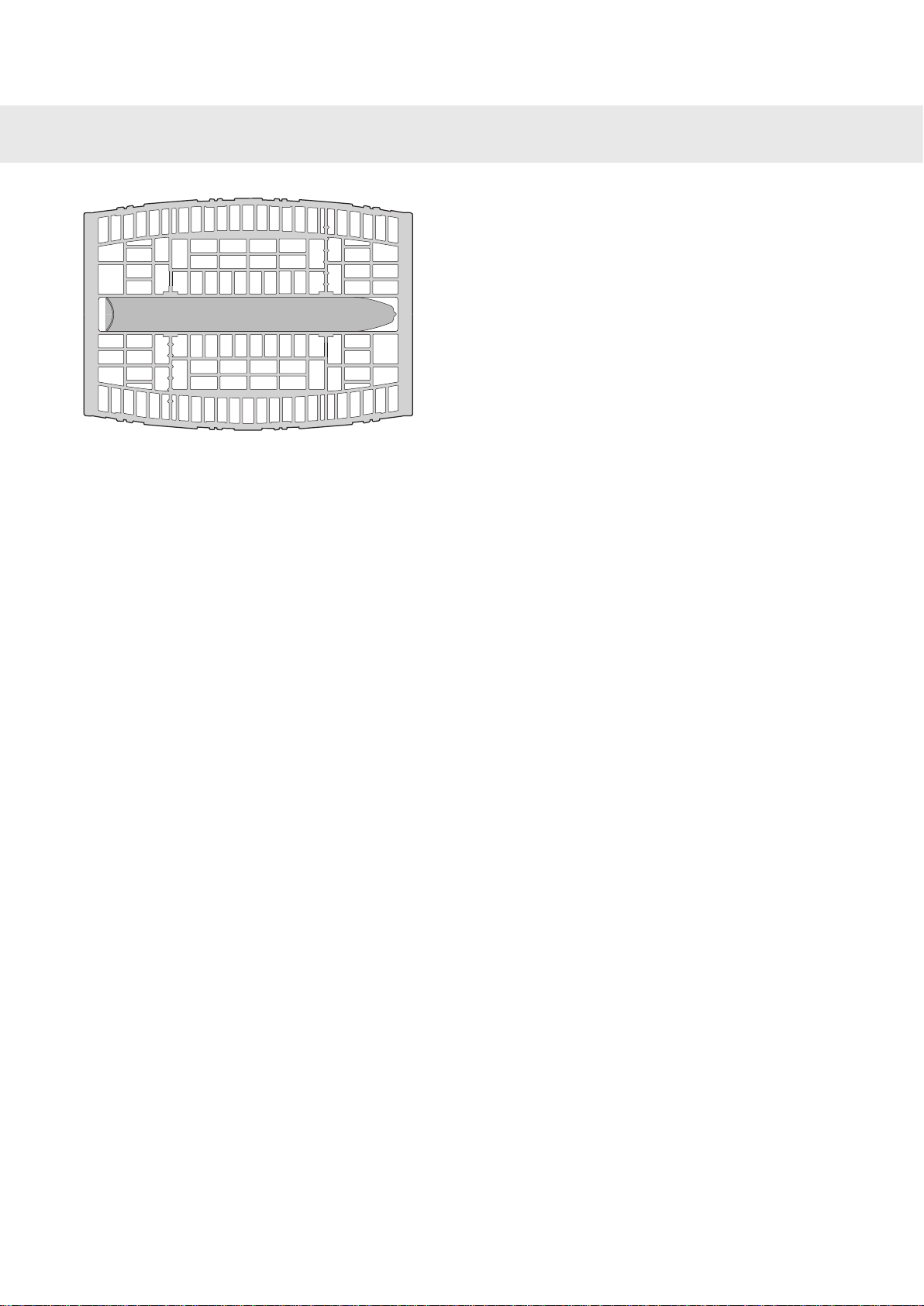
1.
Teaspoons
2.
Dessertspoons
3.
Soupspoons
4.
Forks
5.
Knives
2
5
5
5
5
5 5
5
5
5
3
3
3
3
3
3
3
3
3
3
3
3
3
3
5 5
5
5
1 1
1 1 1 1 1
1 1 1 1 11 1
2
2
2
2
2
2 2
22
2
22
5
4
4 4
4
4
4
4
4
4
4
4
4
4
4
2
Technical data
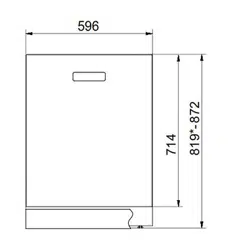
817-875 mmHeight:
596 mmWidth:
550 mmDepth:
42 kg
1)
Weight:
14 place settings
2)
Capacity:
300 - 1000 kPaWater pressure:
0.3–10 kp/cm
2
3–100 N/cm
2
See type plate.Electrical connection:
See type plate.Rated power:
1) Weight can vary due to different specifications.
2) In accordance with standard, AS/NZS 2007.
28
Performance information
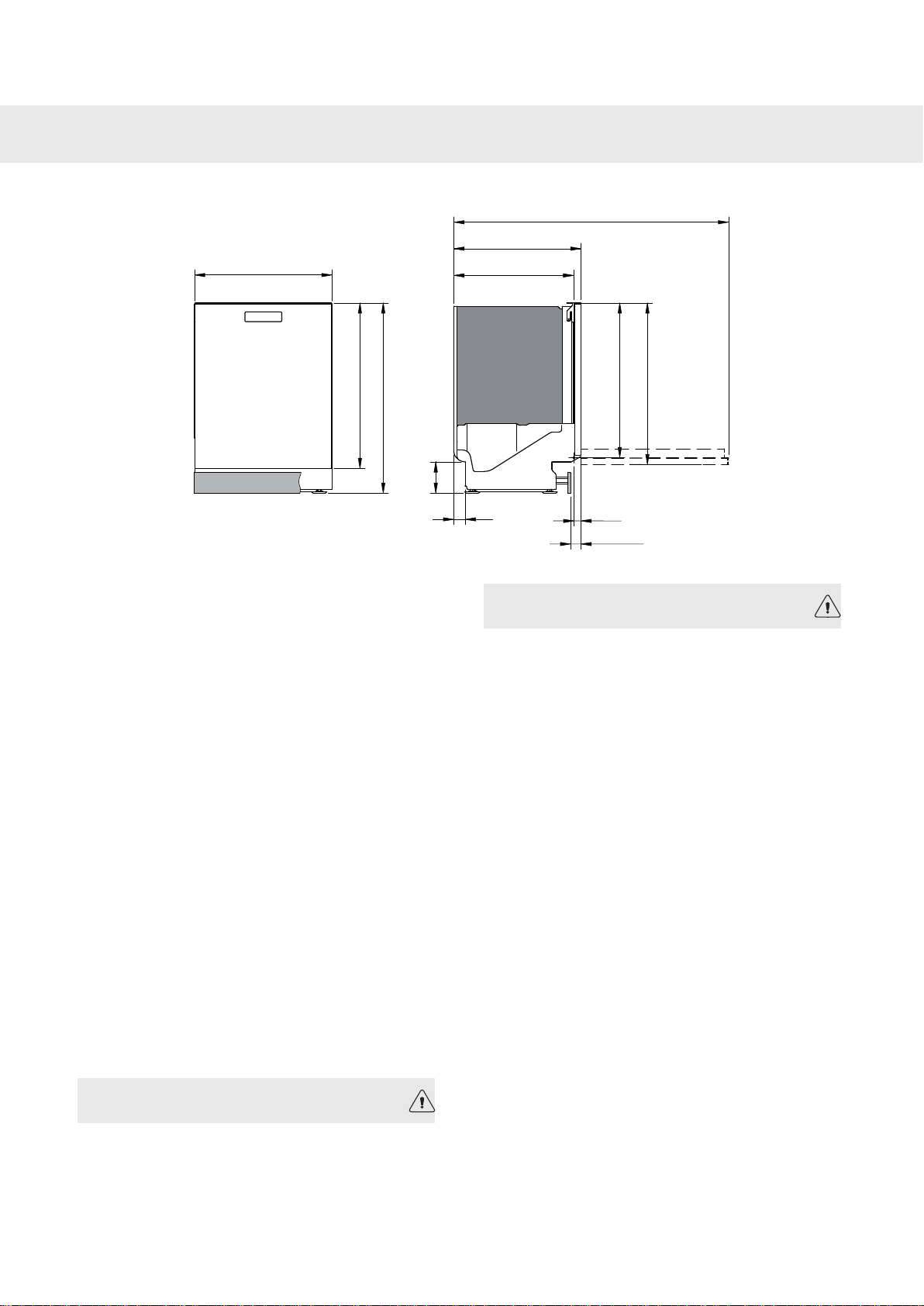
519
1189
550
136-186
30-94
824-875
596
30
670
49
700
717
[mm]
Safety instructions
•
Connections to electricity, water and drainage
must be performed by a qualified professional.
•
Electrical, water and drainage installations must
be carried out by a qualified professional.
•
Always follow applicable regulations for water,
drainage and electricity.
•
An incorrect or flawed installation can result in
higher consumption of energy, water and
detergent, which can result in increased costs and
poor dishwashing results. In order to minimise
noise it is important that you follow the instructions.
•
Exercise caution during installation! Use protective
gloves! Always have someone assist you!
•
Place a watertight protective tray on the floor under
the dishwasher to prevent damage from any water
leaks.
•
Before screwing the dishwasher into place, test
the dishwasher by running the Rinse & Hold
program. Check that the dishwasher fills with water
and drains. Check also that none of the
connections leak.
WARNING!
Turn off the water supply when installing the
dishwasher!
WARNING!
The plug must be disconnected or power to the
socket turned off while the work is carried out!
29
Installation
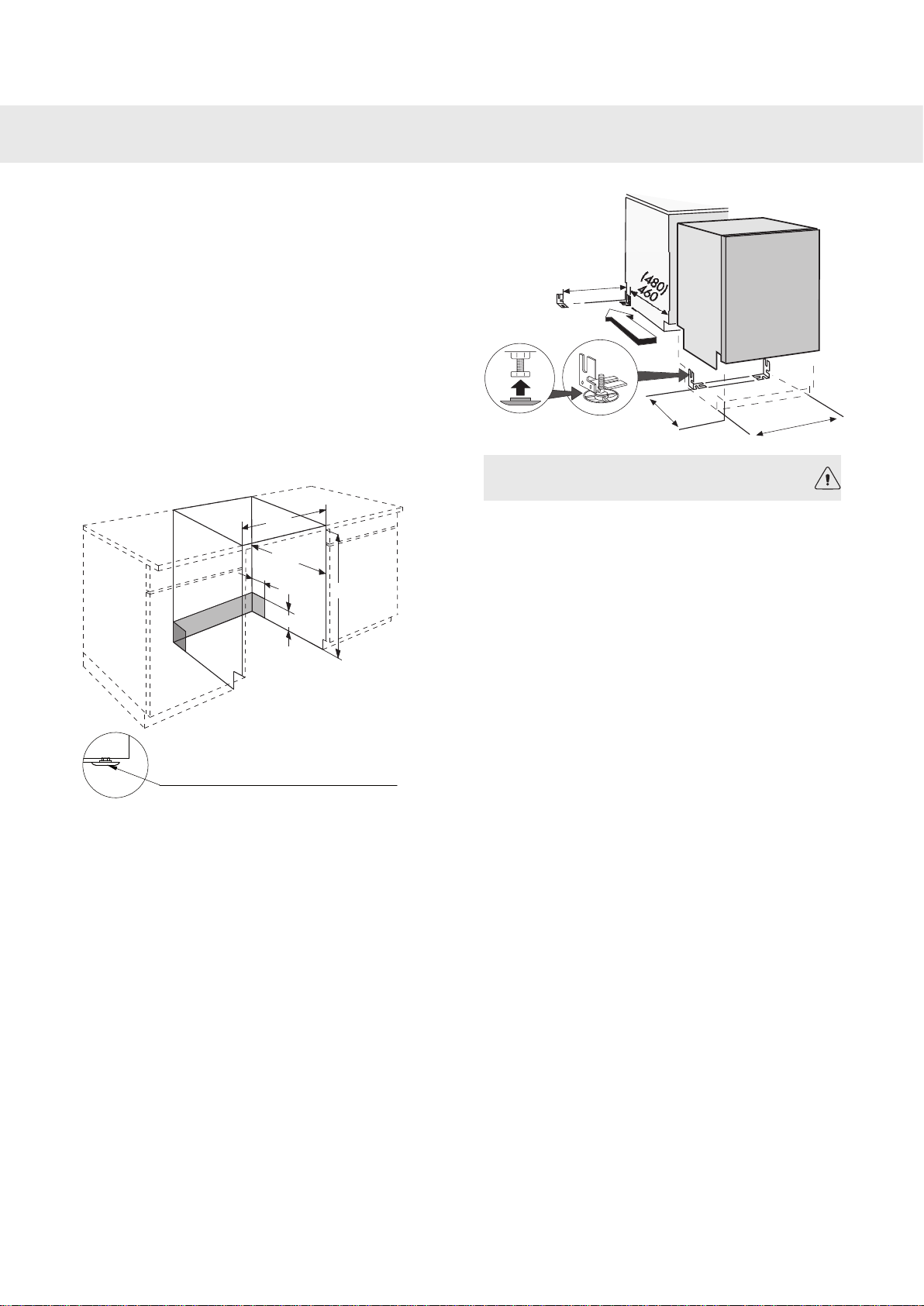
Suggested machine installations
The dishwasher can be installed built-in, completely
freestanding or partially built-in.
A. Built-in
The dishwasher is intended for installation under a
worktop. The recess dimensions are illustrated. Holes
for wires/cables need not be larger than 38 mm in
diameter. Make sure the edges of such holes are even
to prevent damage to the drainage and inlet hoses
and the power cable.
600
136
49
>
550
820*-878
[mm]
*Remove washers and glide foot for an
installed height of 820-824 mm.
B. Freestanding
A freestanding dishwasher must be fitted with anti-tip
brackets. This comprises two brackets, which are
screwed into place as illustrated.
Next, slide the dishwasher into place so that the
brackets grip the rear feet. Now the dishwasher will
not tip over if a load is placed on the door when open.
If the dishwasher is installed completely freestanding,
side panels and a worktop should be fitted. These
accessories can be purchased where you bought the
dishwasher.
455-475
600
413
WARNING!
A completely freestanding dishwasher must be fitted
with anti-tip brackets.
C. Partially built-in
If the dishwasher is installed so that either side is
visible, you can fit a side panel. These accessories
can be purchased where you bought the dishwasher.
30
Installation
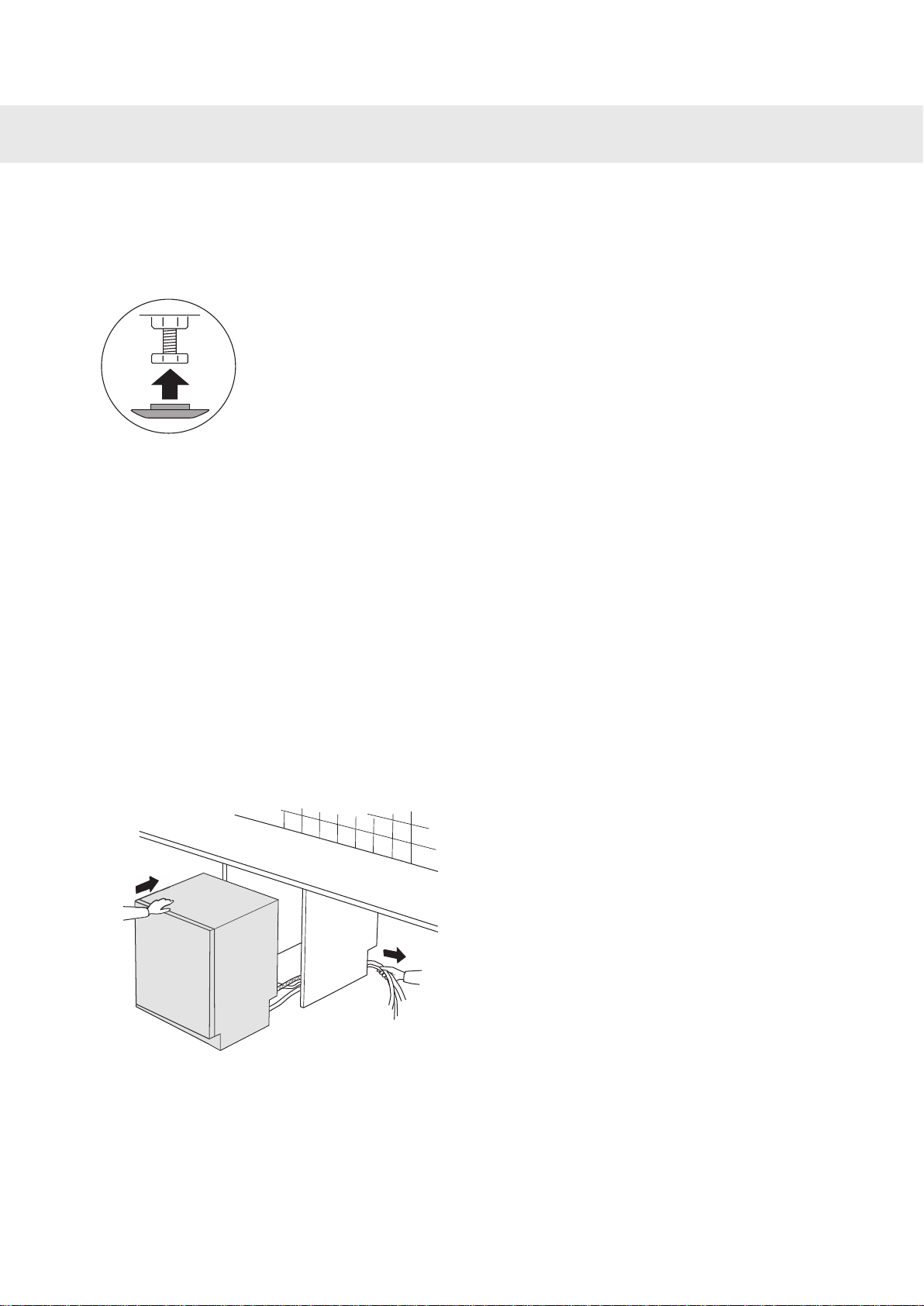
Adjust the height and slide the
dishwasher into place
1.
Attach the coasters (if applicable) to the
dishwasher.
2.
Start by measuring the height from the floor to the
bottom edge of the worktop.
3.
Measure the height from the floor to the top edge
of the dishwasher.
4.
Adjust all feet by turning them clockwise to raise
or anticlockwise to lower the dishwasher.
5.
Check that there is an air gap of at least 3 mm
between the underside of the worktop and the top
edge of the dishwasher.
6.
Tighten the lock nuts (lock nut) on the rear feet.
7.
Slide the dishwasher into place.
•
Pull through the drainage and supply hoses
when the machine is slid into place.
•
Check that the hoses have no kinks or sharp
bends, and check that there is nothing that can
damage the hoses.
8.
Make any final adjustments to the front feet (the
dishwasher may lean no more than 5 mm) and
tighten the lock nuts.
If you want to install your dishwasher freestanding,
skip steps 2, 3 and 5 above.
31
Installation
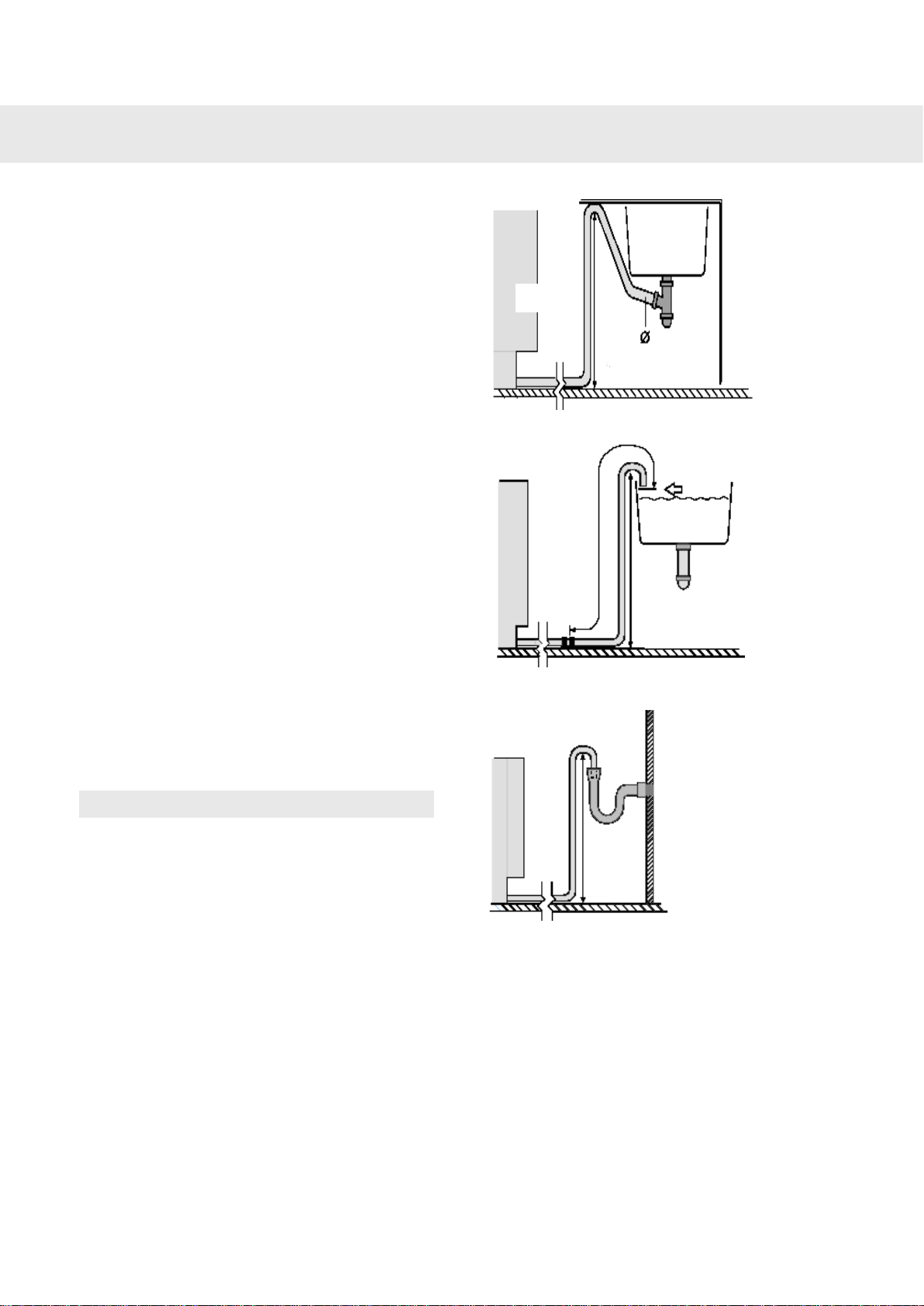
Drainage connection
When the drainage hose is routed to a connection
nipple on the sink unit's water trap (see illustration 1),
please note that the hose must be attached at the
same height as the underside of the sink unit,
otherwise dishwater from the sink may flow back into
the dishwasher. The drainage hose is threaded onto
the cone-shaped connection pipe on the sink unit's
water trap. The cone-shaped pipe must be cut to an
internal diameter of at least 14 mm. For other
connection alternatives, see illustrations 2 and 3.
The drainage hose may be extended by a maximum
of 3 m (the total length of the drainage hose must not
exceed 4,5 m). Any joins and connecting pipes must
have an internal diameter of at least 14 mm. However,
the drainage hose should ideally be replaced with a
new hose without joins.
No part of the drainage hose may be more than 950
mm above the bottom of the dishwasher. The hose
must not be routed directly to the floor drain or similar.
In such cases, the hose can act as a siphon and
empty the dishwasher.
The hose must always discharge at least 350 mm
above the bottom of the machine.
Ensure that the drainage hose has no kinks.
NOTE!
The hose must be attached at the same height as
the underside of the sink.
Max. 950 mm
Min. 350 mm
Min. 14 mm
Figure 1
Max. 950 mm
Min. 350 mm
Max. 3 m
Figure 2
Max. 950
mm
Min. 350
mm
Figure 3
32
Installation
Connection to water supply
Use only the supply hose provided with the
dishwasher. Do not re-use old hoses or other spare
supply hoses.
The supply pipe must be fitted with a stopcock. The
stopcock must be easily accessible, so that the water
can be shut off if the dishwasher has to be moved.
Once the installation is complete, the stopcock should
be opened to allow the pressure to settle for a while
and to check that all connections are tight.
Connect to cold water...
If you use oil or electricity to heat your home.
Connect to hot water (max. 70 °C)...
If you use, for example, district heating, solar power
or geothermal power to heat your home.
NOTE!
Connecting a dishwasher to the water supply via
certain types of pressure limiting valves may restrict
the water supply!
This may cause F:12 error code/ Water inlet fault to
be displayed.
Electrical connection
Information about the electrical connection can be
found on the serial number plate This specification
must match the electricity supply.
Dishwashers fitted with a plug must be connected to
an earthed socket.
The electric wall socket must be placed outside of the
installation area to be easily accessible after installing
the dishwasher. Do not use an extension cord!
NOTE!
Repairs and maintenance must be carried out by a
qualified professional.
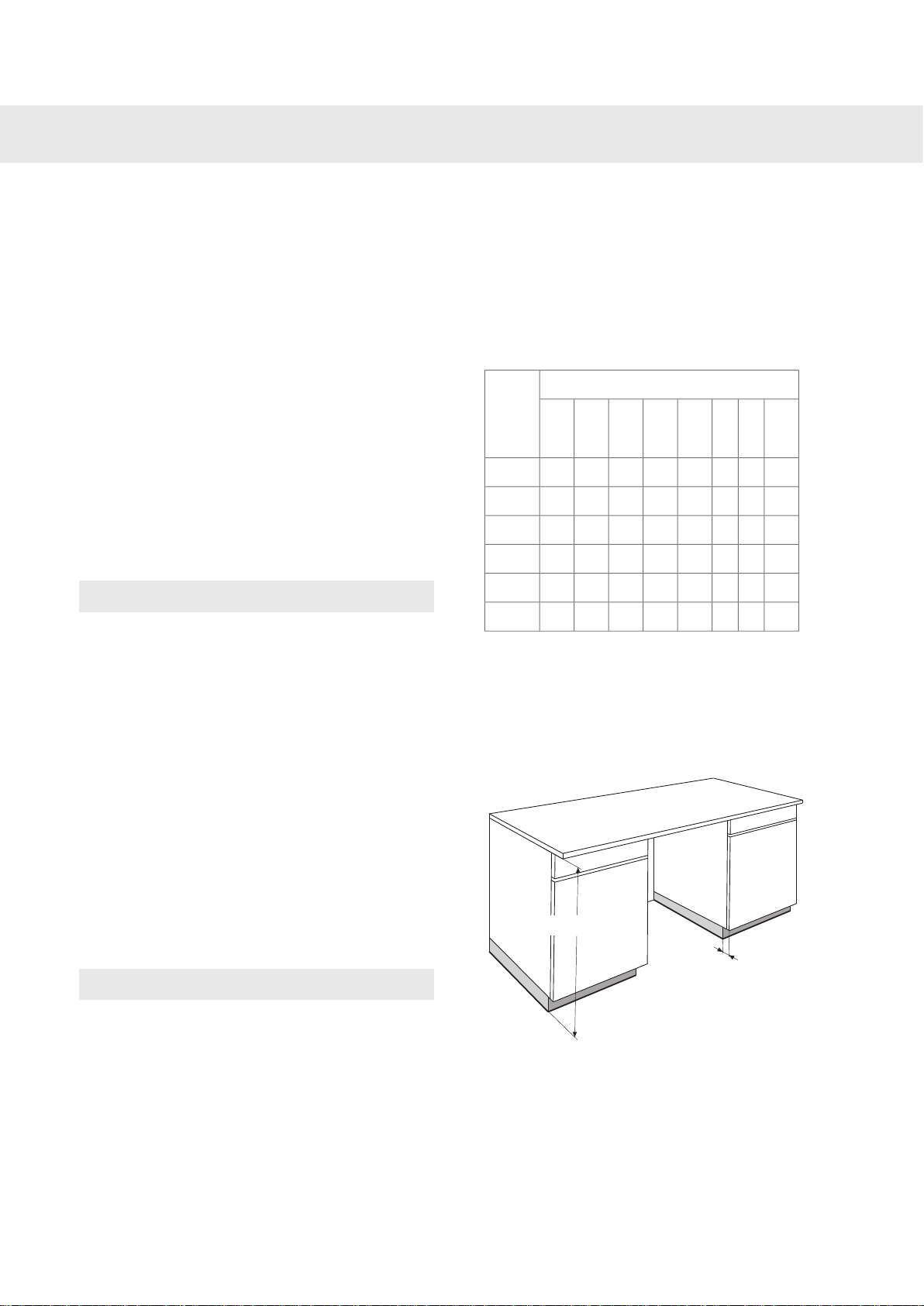
Adjusting the plinth (only when
using toe kick accessory)
The dishwasher is supplied with one or two toe kicks
depending on the model. The table shows which toe
kick you should use depending on the recess height
and plinth depth. Attach the enclosed soundproofing
material to the toe kick (certain models).
Plinth depth (mm)Re-
cess
height
(mm)
10090807060504030
LLLN/AN/AN/AN/AN/A820
LLLLN/AN/AN/AN/A830
LLLLLLLL840
HHHN/AN/AN/AN/AN/A850
HHHHN/AN/AN/AN/A860
HHHHHHHH870
Low toe kick (height=90 mm), article number 80
735 66
L
High toe kick (height=120 mm), article number 80
735 67
H
Not recommended for aesthetic reasons.N/A
Recess height
Plinth depth
33
Installation
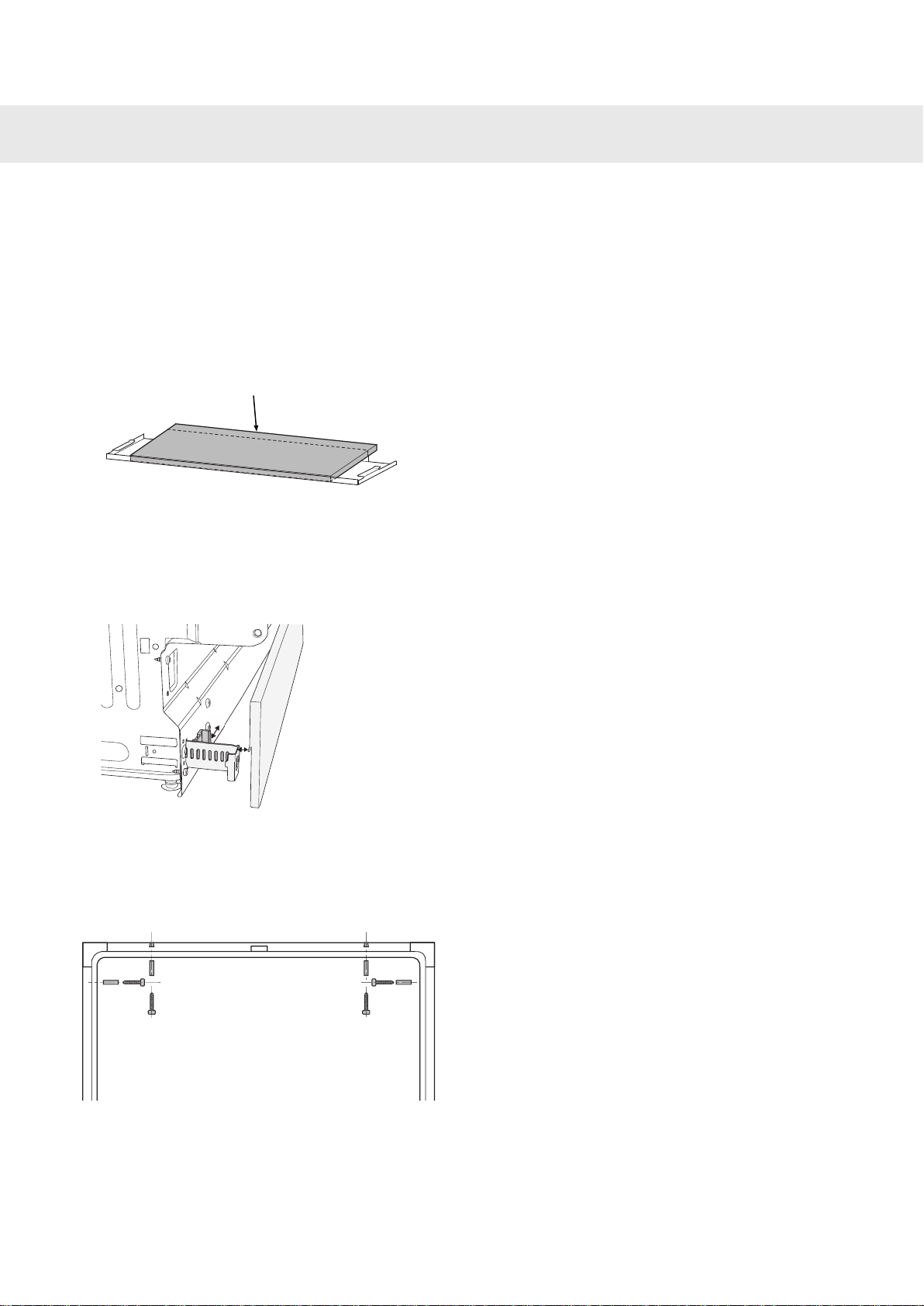
Set the correct plinth depth as
follows
1.
Attach the supplied soundproofing material to the
back of the toe kick (certain models only). If you
use the low toe kick, adjust the height of the
soundproofing by removing the thinner part of the
strip.
Adjust soundproofing material height
2.
Squeeze together the grey catches and pull out
the holders to the desired depth. Push in the
catches to lock the holders into place.
3.
Hang the toe kick on the holders by inserting it into
the notches.
Screwing the dishwasher into place
(Applicable only to built-in dishwashers.)
After fastening the machine, check that the front feet
still touch the floor.
34
Installation
1
Load the baskets
Do not rinse dishes under running water before
loading them in the dishwasher. Simply scrape
off large food particles before loading the
dishwasher.
2
Add detergent
The detergent compartment has one smaller
compartment for the prewash and one for the
main wash.
3
Check that the spray arms can
rotate freely
4
Press the main power switch
and close the door
5
Select a program and any
options
6
Press Start
Art. No.: 8090984. Rev. 01. We reserve the right to make changes.
36
Quick guide