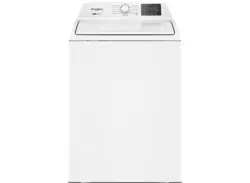
WASHER MAINTENANCE AND CARE
Water Inlet Hoses
Replace inlet hoses after 5 years of use to reduce the risk of hose failure. Periodically inspect and replace inlet hoses if bulges, kinks, cuts, wear, or leaks are found.
When replacing your inlet hoses:
- Mark the date of replacement on the label with a permanent marker.
- Check that the old washers are not stuck on the washer inlet valves.
- Use new washers in the new inlet hoses to ensure a proper seal.
NOTE: This washer may not include inlet hoses. See the Installation Instructions for more information.
Washer Care
Recommendations to help keep your washer clean and performing at its best
- Always use High Efficiency (HE) detergents and follow the HE detergent manufacturer’s instructions regarding the amount of HE detergent to use. Never use more than the recommended amount because that may increase the rate at which detergent and soil residue accumulate inside your washer, which in turn may result in undesirable odor.
- Use warm and hot wash water settings sometimes (not exclusively cold water washes), because they do a better job of controlling the rate at which soils and detergent accumulate.
- Always leave the washer lid open between uses to help dry out the washer and prevent the buildup of odor-causing residue.
Cleaning your top-loading washer
Read these instructions completely before beginning the routine cleaning processes recommended below. This Washer Maintenance Procedure should be performed, at a minimum, once per month or every 30 wash cycles, whichever occurs sooner, to control the rate at which soils and detergent may otherwise accumulate in your washer.
Cleaning the inside of the washer
To keep your washer odor-free, follow the usage instructions provided above and use this recommended monthly cleaning procedure:
Recommended cycle for cleaning the washer
Some models have a “Clean Washer” cycle that uses higher water volumes in combination with affresh® Washer Cleaner or liquid chlorine bleach to clean the inside of the washer.
If your model does not have a “Clean Washer” cycle, refer to the online Cycle Guide for the optimal cycle for cleaning the inside of the washer. Use this cycle with affresh® Washer Cleaner or liquid chlorine bleach as described below.
Description of Clean Washer with affresh® cycle operation:
- This cycle will fill to a washer level high than in normal wash cycles to provide rinsing than in normal wash cycles to provide rinsing at a level above the water line for normal wash.
- During this cycle, there will be some agitation and spinning to increase the removal of soils.
After this cycle is complete, leave the lid open to allow for better ventilation and drying of the washer interior.
Begin procedure
- Affresh® washer cleaner cycle procedure (recommended for best performance):
- Open the washer lid and remove any clothing or items.
- Place an affresh® Washer Cleaner tablet in the bottom of the washer basket.
- Do not place an affresh® Washer Cleaner tablet in the detergent dispenser.
- Do not add any detergent or other chemical to the washer when following this procedure.
- Close the washer lid.
- Select the cycle recommended for cleaning the inside of the washer.
- Press the START button to start the cycle.
- NOTE: For best results, do not interrupt cycle. If cycle must be interrupted, press POWER/CANCEL. (For models with no Power/Cancel button, press and hold START/PAUSE for three seconds.) After the cycle has stopped, run a Rinse & Spin cycle to rinse cleaner from washer.
- Chlorine bleach procedure (alternative):
- Open the washer lid and remove any clothing or items.
- Add 1 cup (236 mL) of liquid chlorine bleach to the bleach compartment.
- NOTE: Use of more liquid chlorine bleach than is recommended above could cause washer damage over time.
- Close the washer lid.
- Do not add any detergent or other chemical to the washer when following this procedure.
- Select the cycle recommended for cleaning the inside of the washer.
- Press the START button to start the cycle.
- NOTE: For best results, do not interrupt cycle. If cycle must be interrupted, press POWER/CANCEL. (For models with no Power/Cancel button, press and hold START/PAUSE for three seconds.) After the cycle has stopped, run a Rinse & Spin cycle to rinse cleaner from washer.
Cleaning the dispensers
After a period of using your washer, you may find some residue buildup in the washer’s dispensers.
IMPORTANT: Dispensers are not dishwasher-safe.
For non-removable dispensers:
To remove residue from the dispensers, wipe them with an affresh® Machine Cleaning Wipe or a damp cloth and towel dry. Do not attempt to remove the dispensers or trim for cleaning. The dispensers and trim are not removable.
For removable dispensers:
If your model has a dispenser drawer, press tab(s) to remove the drawer and clean it with an affresh® Machine Cleaning Wipe or a damp cloth and towel dry before or after you run the Clean Washer cycle. Use an all-purpose surface cleaner, if needed.
Cleaning the outside of the washer
IMPORTANT: To avoid damaging the washer’s finish, do not use abrasive products. Use an affresh® Machine Cleaning Wipe, a soft, damp cloth, or sponge to wipe away any spills. Use an affresh® Machine Cleaning Wipe or only mild soaps or cleaners when cleaning external washer surfaces.
INSTALLATION INSTRUCTIONS REQUIREMENTS
Tools and Parts
Gather required tools and parts before starting installation.
Tools Needed:
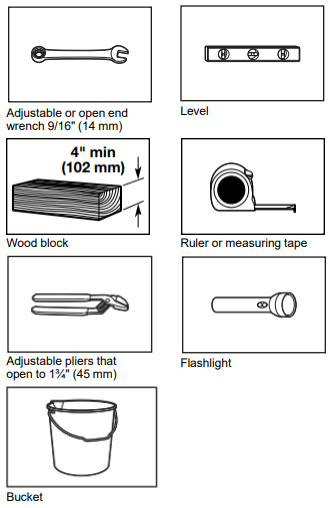
Parts Supplied:
NOTE: All parts supplied for installations are in the washer.
-821028.png)
Parts Needed: (if not supplied with washer)
NOTE: Various inlet hose options are available; check your Quick Start Guide for ordering information.
-457335.png)
Location Requirements
Select proper location for your washer to improve performance and minimize noise and possible “washer walk.” Install your washer in a basement, laundry room, closet, or recessed area.
IMPORTANT: Do not install, store, or operate washer where it will be exposed to weather or in temperatures below 32°F (0°C). Water remaining in washer after use may cause damage in low temperatures. See “Washer Maintenance and Care” for winterizing information. Proper installation is your responsibility.
You will need:
- A water heater set to 120°F (49°C).
- A grounded electrical outlet located within 4 feet (1.2 m) of power cord on back of washer.
- Hot and cold water faucets located within 3 feet (0.9 m) of hot and cold water fill valves on washer, and water pressure of 20– 100 psi (138–690 kPa).
- A level floor with maximum slope of 1" (25 mm) under entire washer. Installing on carpet or surfaces with foam backing is not recommended.
- Floor must support washer’s total weight (with water and load) of 315 lbs. (143 kgs).
Recessed area or closet installation
-660595.png)
NOTE: All 27" wide washers should have 19" clearance, while all 29" wide washers should have 22" clearance.
All dimensions show recommended spacing allowed, except for closet door ventilation openings, which are the minimum required. This washer has been tested for installation with spacing of 0" (0 mm) clearance on the sides. Consider allowing more space for ease of installation and servicing, and spacing for companion appliances and clearances for walls, doors, and floor moldings. Add spacing of 1" (25 mm) on all sides of washer to reduce noise transfer. If a closet door or louvered door is installed, top and bottom air openings in door are required.
*For additional details (or information) specific to your model, refer to your Quick Start Guide.
Drain System
Drain system can be installed using a floor drain, wall standpipe, floor standpipe, or laundry tub. Select the method you need.
IMPORTANT: To avoid siphoning, no more than 4.5" (114 mm) of drain hose should be inside standpipe or below the top of wash tub. Secure drain hose with cable tie.
Floor standpipe drain system
-350032.png)
Minimum diameter for a standpipe drain: 2" (51 mm). Minimum carry-away capacity: 17 gallon (64 L) per minute. Top of standpipe must be at least 39" (990 mm) high; install no higher than 96" (2.44 m) from bottom of washer. If you must install higher than 96" (2.44 m), you will need a sump pump system.
Wall standpipe drain system
-372014.png)
See requirements in the “Floor standpipe drain system” section.
Laundry tub drain System
-654257.png)
Minimum capacity: 20 gallon (76 L). Top of laundry tub must be at least 39" (990 mm) above floor; install no higher than 96" (2.44 m) from bottom of washer.
Floor Drain System
-532332.png)
Floor drain system requires a Siphon Break Kit, 2 Connector Kits, and an Extension Drain Hose that may be purchased separately; refer to the Quick Start Guide for online ordering information. Minimum siphon break height: 28" (710 mm) from bottom of washer (additional hoses may be needed).
INSTALLATION
Unpacking
Before you start: Remove shipping materials.
It is necessary to remove all shipping materials for proper operation and to avoid excessive noise from washer.
1. Move Washer
-321789.png)
Move washer to within 4 feet (1.2 m) of its final location; it must be in a fully upright position.
NOTE: To avoid floor damage, set washer onto cardboard before moving it and make sure lid is taped shut.
2. Remove shipping base
IMPORTANT: Removing shipping base is necessary for proper operation. If your washer includes a sound shield, please refer to the instructions included with the sound shield to install it at this time.
-800207.png)
To avoid damaging floor, place cardboard supports from shipping carton on floor behind washer. Tip washer back and place on cardboard supports. Remove shipping base (some models require shipping base to be rotated 90° to the right before pulling off). Set washer upright.
3. Remove packaging material from inside washer
-192270.png)
Remove tape from washer lid, open lid, and remove packaging material from washer tub. Be sure that all parts have been removed from inside washer.
NOTE: Keep packaging material for inside washer in case you need to move washer later.
4. Free power cord
-341781.png)
Firmly grasp power cord plug and pull to free from rear panel. Gently place power cord over console to allow free access to back of washer
Connect Drain Hose
5. Attach drain hose to drain port
-889917.png)
If applicable, remove the red plastic plug from the black drain port on the back of the washer.
If clamp is not already in place on elbow end of drain hose, slide it over end as shown. Squeeze clamp with pliers and slide black elbow end of drain hose onto black drain port and secure with clamp.
For a laundry tub or standpipe drain, go to step 6.
For a floor drain, remove the pre-installed drain hose form as shown in step 7. You may need additional parts with separate directions. See the “Alternate Parts” section.
6. Place drain hose in standpipe
-659220.png)
IMPORTANT: 4.5" (114 mm) of drain hose should be inside standpipe; do not force excess hose into standpipe or lay on bottom of laundry tub. Drain hose form must be used. Place hose into standpipe (shown in picture) or over side of laundry tub.
7. Remove drain hose form (floor drain installations only)
-975429.png)
For floor drain installations, you will need to remove the drain hose form from the end of the drain hose. You may need additional parts with separate directions. See “Tools and Parts.”
It is the responsibility of the installer to install and secure the drain hose into the provided plumbing/drain in a manner that will avoid the drain hose coming out of and leaking from the plumbing/drain.
Connect Inlet Hoses
Washer must be connected to water faucets with new inlet hoses with flat washers (not provided). Do not use old hoses.
NOTE: Both hoses must be attached and have water flowing to inlet valves. If you are only connecting to a cold water faucet, you must use a Y-adapter (not provided).
8. Connect inlet hoses to water faucets
-606339.png)
IMPORTANT: Do not overtighten hose or use tape or sealants on valve. Damage to the valves can result. Attach hose to hot water faucet. Screw on coupling by hand until it is seated on washer. Use adjustable pliers to tighten couplings an additional two-thirds turn. Repeat this step with second hose for cold water faucet.
9. Clear water lines
-729960.png)
Run water for a few seconds through hoses into a laundry tub, drainpipe, or bucket to prevent clogs. Water should run until clear.
Make note of which hose is connected to hot water to help in attaching hoses to washer correctly.
10. Connect inlet hoses to washer
-285449.png)
IMPORTANT: To reduce risk of hose failure, replace the hoses every 5 years. Record hose installation or replacement dates for future reference.
Do not overtighten hose or use tape or sealants on valve. Damage to the valves can result.
Periodically inspect and replace hoses if bulges, kinks, cuts, wear, or leaks are found.
Attach hot water hose to red hot water inlet valve. Screw coupling by hand until it is snug. Use pliers to tighten couplings an additional two-thirds turn. Repeat with cold water inlet valve.
11. Check for leaks
-648489.png)
Turn on water faucets to check for leaks. A small amount of water may enter washer. It will drain later.
12. Secure drain hose
-159981.png)
Secure drain hose to laundry tub leg, drain standpipe, or inlet hoses for wall standpipe with cable tie.
It is the responsibility of the installer to install and secure the drain hose into the provided plumbing/drain in a manner that will avoid the drain hose coming out of or leaking from the plumbing/drain.
Level Washer
NOTE: Level washer properly to reduce excess noise and vibration.
13. Check levelness of washer
-111051.png)
Move the washer to its final location. Place a level on top edges of washer. Use side seam as a guide to check levelness of sides. Check levelness of front using lid, as shown. Rock washer back and forth to make sure all four feet make solid contact with floor. If washer is level, skip to step 15.
-886362.png)
14. Adjust leveling feet
-44563.png)
If washer is not level:
Use adjustable pliers to turn the plastic leveling foot counterclockwise to lower the washer or clockwise to raise the washer.
Recheck levelness of washer and repeat as needed.
HELPFUL TIPS:
- You may need to adjust two different feet to level your unit. Ensure each foot remains secured to the washer’s base.
- You may want to prop up front of washer about 4” (102 mm) with a wood block or similar object that will support weight of washer
15. Plug into a grounded 3-prong outlet
-137080.png)
Complete Installation Checklist
- Check electrical requirements. Be sure you have correct electrical supply and recommended grounding method.
- Check that all parts are now installed. If there is an extra part, go back through steps to see what was skipped.
- Check that you have all of your tools.
- Check that shipping materials were completely removed from washer.
- Check that the washer is level.
- Check that water faucets are on.
- Check for leaks around faucets and inlet hoses.
- Remove protective film from console and any tape remaining on washer.
- Check that washer is plugged into a grounded 3-prong outlet.
- Dispose of/recycle all packaging materials.
- Read the “Washer Maintenance and Care” section.
- To test and clean your washer, measure 1/2 of normal recommended amount of powdered or liquid HE detergent and pour it into washer basket or detergent dispenser (on some models). Close lid. Select any cycle. Start washer and allow to complete full cycle.