56
Operating Instructions
ůĸdžΒ
Manuel d’utilisation
NC-EG4000
NC-EG3000
NC-EG2200
Model No./ Տ
N° de modèle
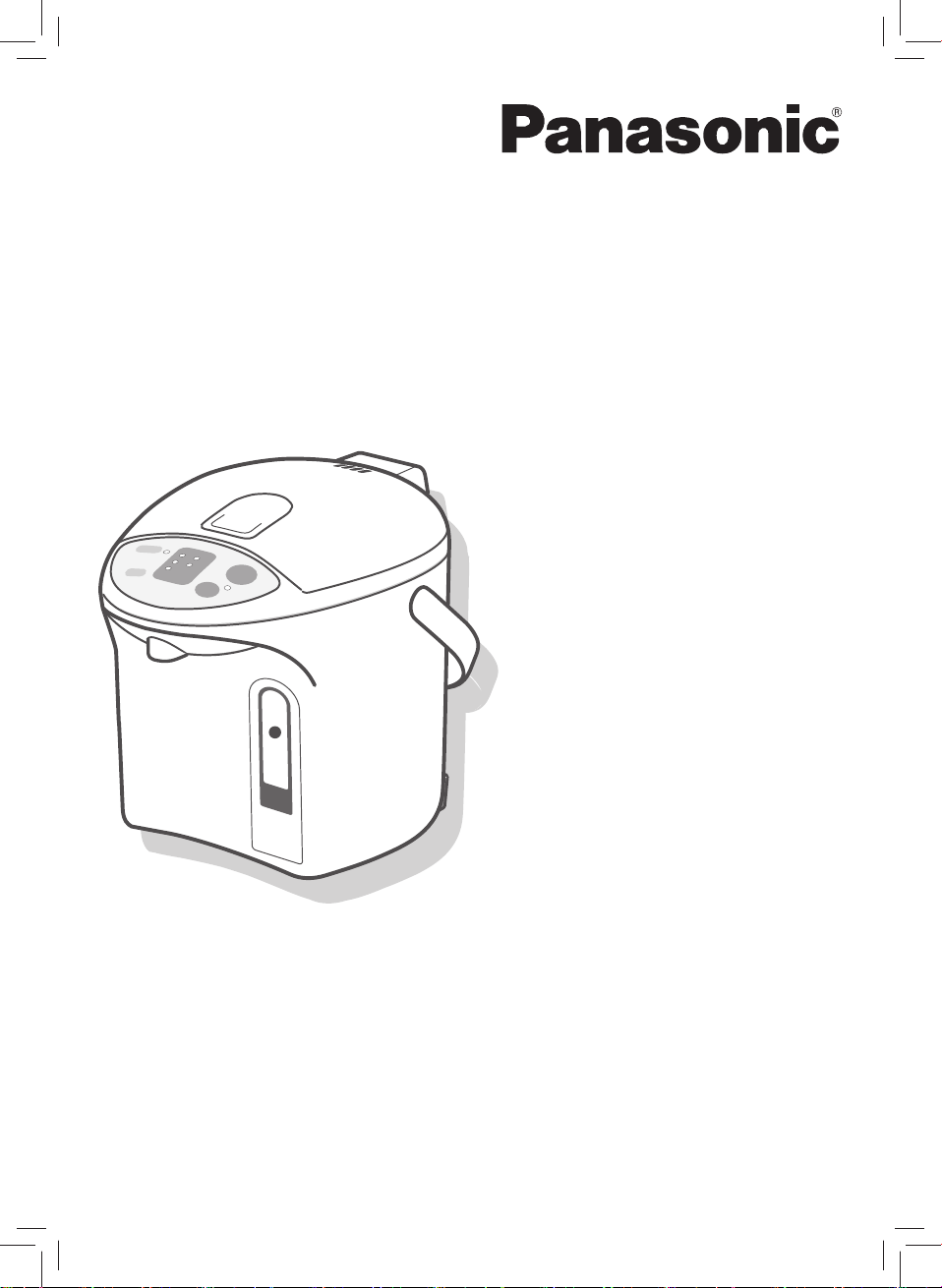
Hot Water Dispenser
ǗŔѽɶnjӌ
Distributeur d’eau chaude
Household use only
ŝů
Usage domestique uniquement
Thank you for purchasing the hot water dispenser, NC-EG4000/NC-EG3000/NC-EG2200.
Before using this product, please read these instructions completely. Pay particular attention to the
“Important Safeguards” on pages 4 and 5. Save this manual for future use.This product is intended for
household use only.
ܺఁǷנɮNC-EG4000/NC-EG3000/NC-EG2200ՏĀǗŔѽɶnjӌ뻟ᅇķƗ뺯
ůǕмȞƥǡɑʙփůĸdžΒ뺯ɑȍNjljѮŠljѮĀqȶđĀȫƽรr뺯ჹړϯǕĸdž
Β뻟ŘࣂȝĎů뺯ǕмȞŮՄŝů뺯
Merci d’avoir arrêté votre choix sur un distributeur d’eau chaude, NC-EG4000/NC-EG3000/
NC-EG2200.
Lire l’intégralité de ces instructions avant d’utiliser ce produit. Accorder une attention particulière aux
« Précautions Importantes » en pages 8 et 9. Conserver ce manuel pour une utilisation ultérieure.
Pour usage domestique seulement.
06_USA_OM_NC-EG2200_3000_4000_EN.indd 106_USA_OM_NC-EG2200_3000_4000_EN.indd 1 12/14/2558 BE 15:5012/14/2558 BE 15:50

IMPORTANT SAFEGUARDS .................................................................4-5
Main Features..........................................................................................10
Safety Precautions .............................................................................11-13
Part Names and Handling Instructions ...............................................14-15
How to Use .........................................................................................16-17
Convenient use methods ....................................................................18-19
Daily Maintenance ..............................................................................20-21
Troubleshooting ....................................................................................... 22
Replacement of Parts ..............................................................................23
Specifications ..........................................................................................23
Table of Contents
06_USA_OM_NC-EG2200_3000_4000_EN.indd 206_USA_OM_NC-EG2200_3000_4000_EN.indd 2 12/14/2558 BE 15:5012/14/2558 BE 15:50

ȶđĀȫƽร
ǂđž
ȫƽNjƂֻ
œˌǩ؆Š߽ǟƶʒ
ůƶʒ
ƶϔĀůƶʒ
ū˩ѷƶʒ
тචפ
ƑҕͲഺȞ
ܪϜ
ϝԍ
PRÉCAUTIONS IMPORTANTES ...........................................................8-9
Caractéristiques principales ....................................................................38
Consignes de sécurité ........................................................................39-41
Nomenclature et instructions de manipulation ...................................42-43
Utilisation ............................................................................................44-45
Fonctions pratiques ............................................................................46-47
Entretien quotidien..............................................................................48-49
Guide de dépannage ...............................................................................50
Remplacement des pièces ......................................................................51
Spécifications ..........................................................................................51
Sommaire
06_USA_OM_NC-EG2200_3000_4000_EN.indd 306_USA_OM_NC-EG2200_3000_4000_EN.indd 3 12/14/2558 BE 15:5012/14/2558 BE 15:50

4
IMPORTANT SAFEGUARDS
When using electrical appliances, basic safety precautions should always be followed,
including the following:
1. Read all instructions.
2. Do not touch hot surfaces, especially the steam vent. Use handles or knobs.
3. To protect against fi re, electric shock and personal injury, do not immerse cord, plugs, or
main unit in water or other liquid.
Do not splash water or other liquid over them.
• Do not pour water directly from the tap.
• Do not put the unit in a sink or allow it to get wet.
• Do not turn the unit upside down when the bottom is wet.
4. Close supervision is necessary when any appliance is used by or near children.
• Do not allow children and persons unfamiliar with the appliance to use it.
• Do not leave the unit within the reach of infants.
• You must pay special attention to prevent infants from putting the body plug into their mouths.
5. Unplug from outlet when not in use and before cleaning. Allow to cool before putting on or
taking off parts, and before cleaning the appliance.
• When unplugging, pull by the power plug - not the cord.
6. Do not operate any appliance with a damaged cord or plug or after the appliance
malfunctions, or has been damaged in any manner. Return appliance to the nearest
authorized service center for examination, repair or adjustment.
• Never disassemble, repair, or modify the unit.
• If the supply cord becomes damaged, the cord must be replaced. Refer servicing to an
authorized service center, as described in the warranty.
7. The use of accessory attachments not recommended by the appliance manufacturer may
result in fi re, electric shock or personal injury.
8. Do not use outdoors.
9. Do not let cord hang over edge of table or counter, or touch hot surfaces.
10. Do not place on or near a hot gas or electric burner, or in a heated oven.
Do not place on unstable surfaces or surfaces that can be affected by heat, or near walls
or furniture.
11. Extreme caution must be used when moving an appliance containing hot liquids.
• When carrying the unit, do not touch the lid opening lever.
12. Always attach plug to appliance fi rst, then plug cord into the wall outlet.
• Make sure the power plug is correctly inserted in to the wall outlet when in use.
• Do not connect or disconnect the power plug or the body plug with wet hands.
13. Use a single outlet that matches the power rating of the unit.
14. To prevent electric shock and/or fi re, dust off power plug or body plug regularly.
Water-laden dust settled on the cable or plug may cause insuffi cient insulation.
• Remove the plugs and clean them with a dry cloth.
IMPORTANT SAFEGUARDS
06_USA_OM_NC-EG2200_3000_4000_EN.indd 406_USA_OM_NC-EG2200_3000_4000_EN.indd 4 12/14/2558 BE 15:5012/14/2558 BE 15:50
5
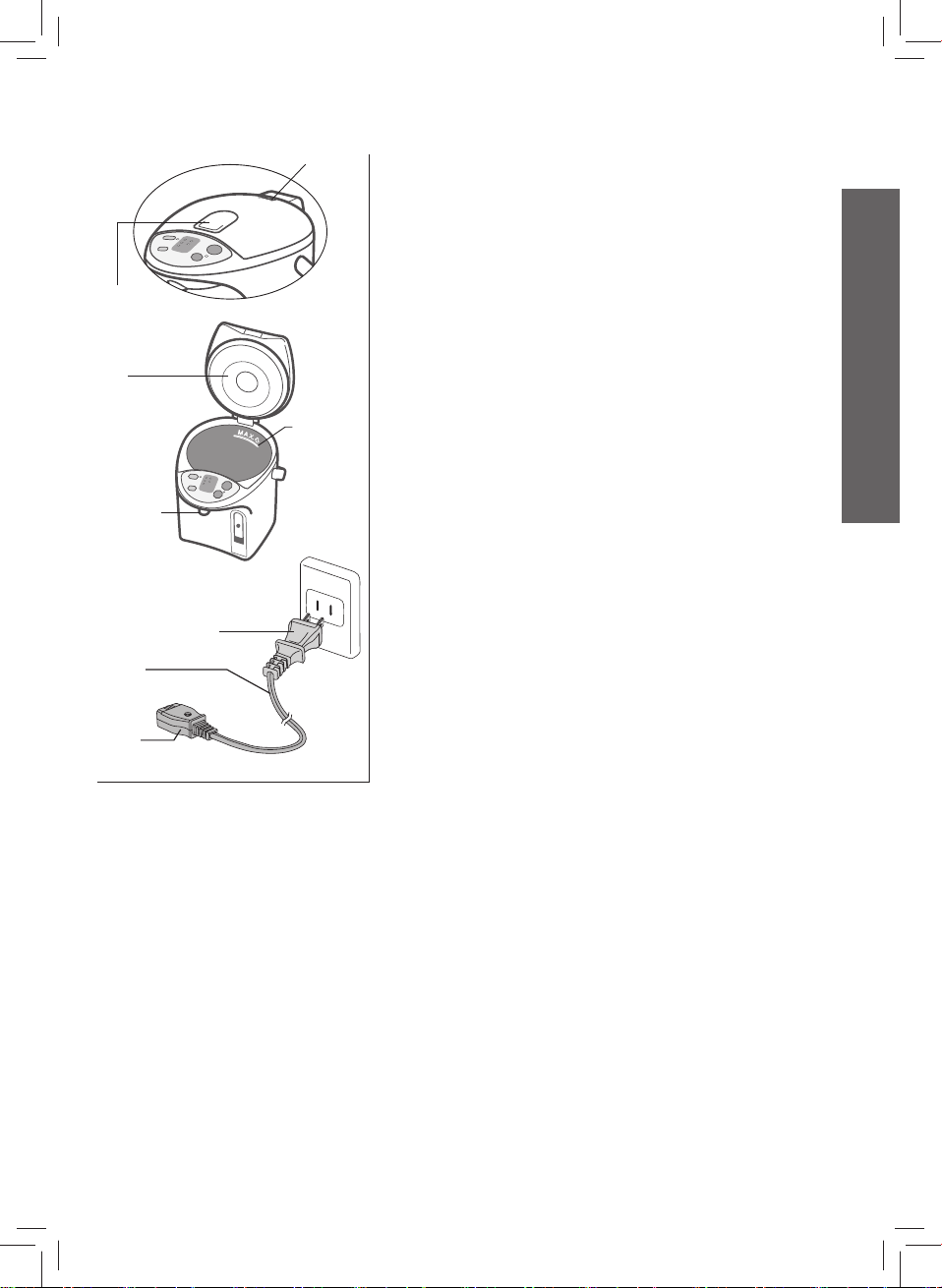
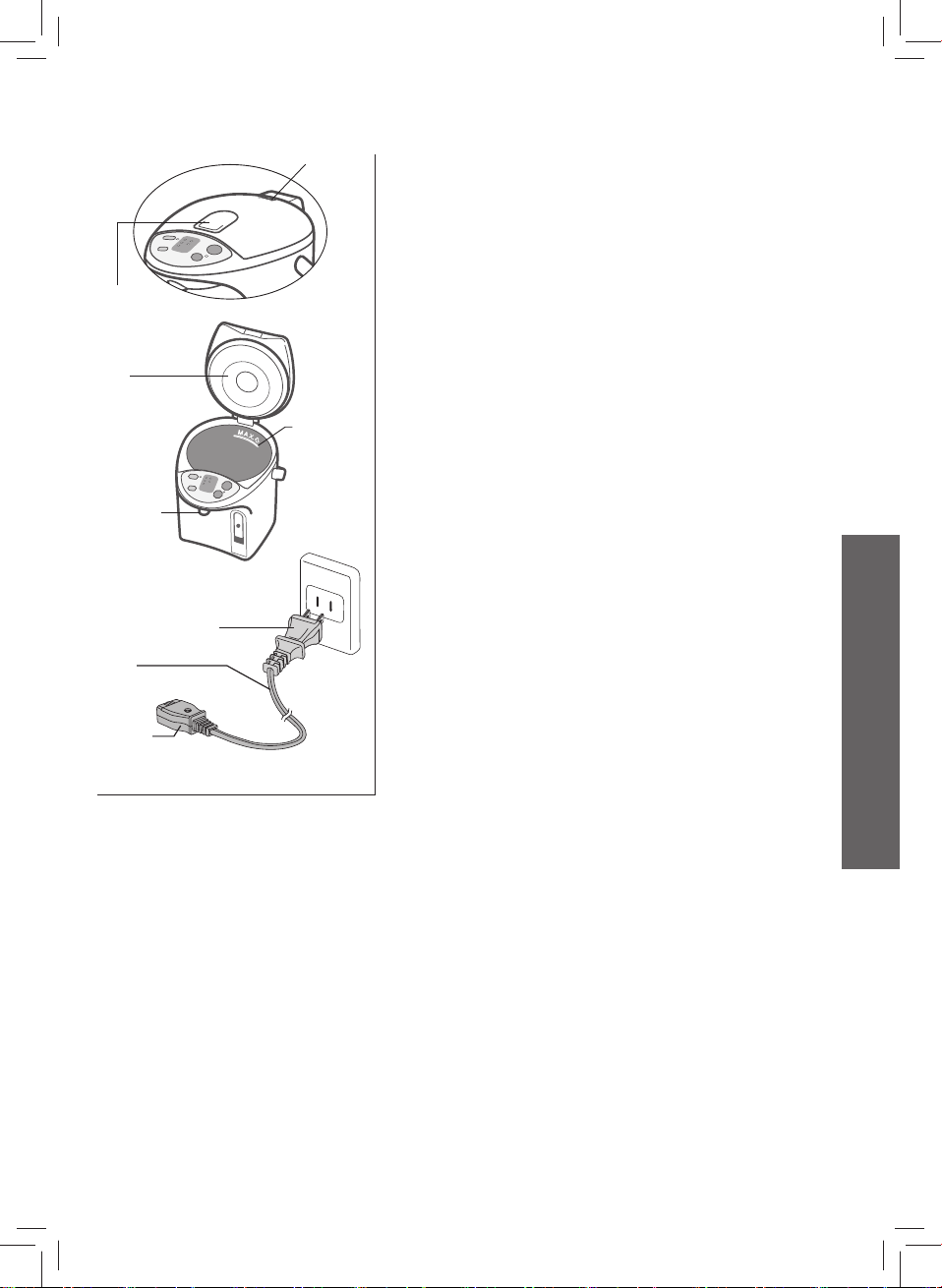
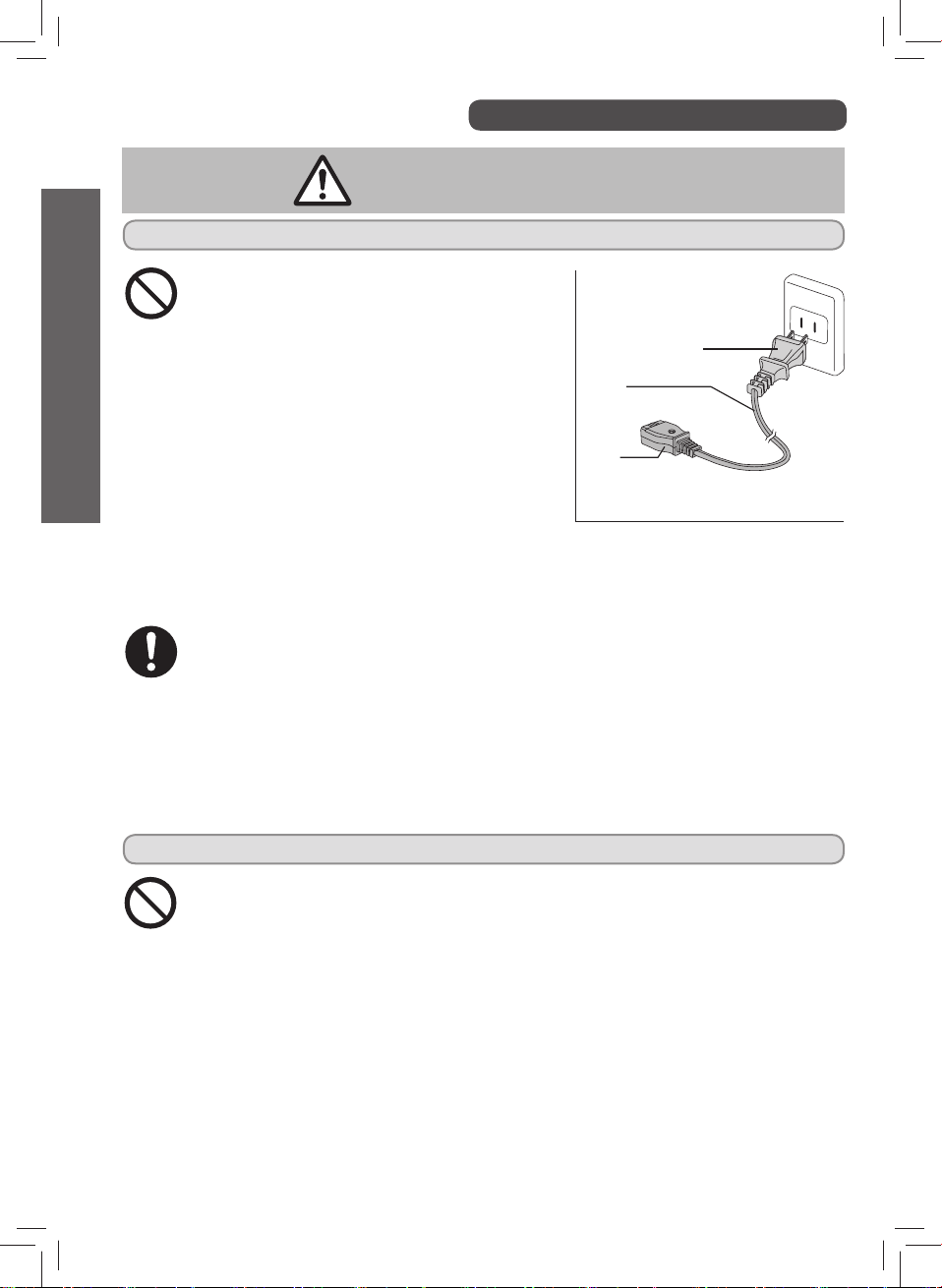
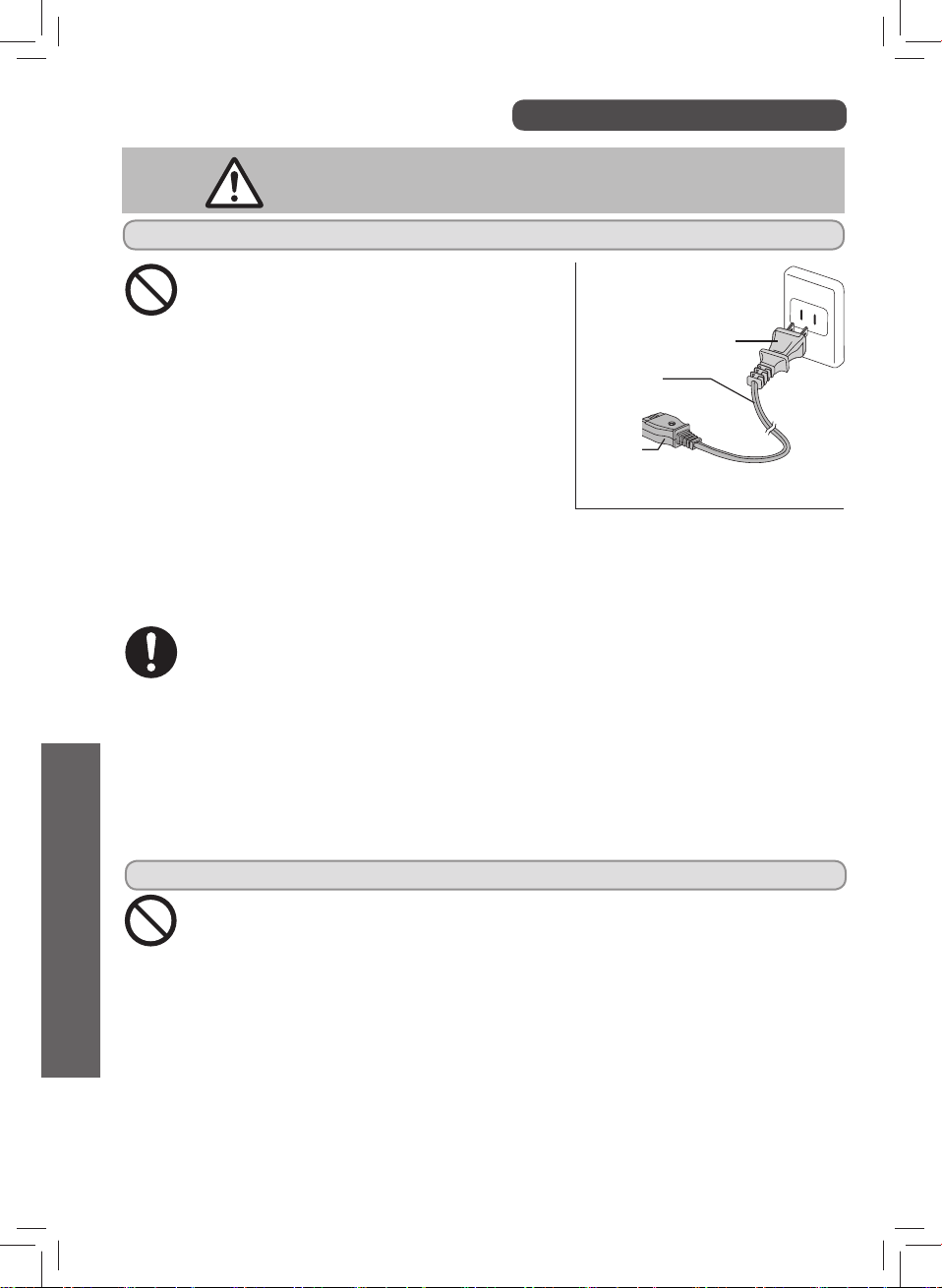
Power cord
Power plug*
Cord
Body
plug
*The shape of plug differs according to region.
Lid
Dispensing
spout
Maximum
water level
Lid opening
lever
Steam vent
15. Do not allow small metal parts near the body plug.
16. Only use the power cord designed specifi cally for the
unit. Do not use a different cord and do not use this
cord with any other device.
17. Do not let the unit fall over.
Do not lift, tilt, or shake the unit or carry it by the lid.
• Even when the dispense key is locked, hot water may
leak through the dispensing spout and the steam vent,
causing burns, if the unit falls over or is tilted.
18. Do not use this appliance without lid properly closed.
Close the lid securely, and not by force.
19. Do not throw away the remaining hot water while the
lid is attached.
20. When opening the lid, keep hands away from the
steam.
21. Scalding may occur if the lid is removed during
heating cycles.
Do not open the lid or dispense hot water while
boiling.
22. Do not pour in water above the maximum water level.
23. Do not block the steam vent.
24. Do not rotate the unit while dispensing hot water.
25. Do not use appliance for other than intended use.
• Do not use to store ice. Condensation will occur,
creating a potential source of electric shock and
malfunction.
• Do not heat tea bags, tea leaves, milk, alcohol or
anything other than water which may cause it to spurt
out hot liquid or steam and cause burns. The water
tube may also get clogged, the inner container may
burn or corrode, and the fl uororesin insulating coating
may peel off.
26. This appliance is designed for indoor household use
only.
SAVE THESE INSTRUCTIONS
Warning:
A. A short power-supply cord is provided to reduce the risk of entanglement or tripping over a longer
cord.
B. The use of extension cords is not recommended.
C.
This appliance has a polarized plug (one blade is wider than the other). To reduce the risk of electric
shock, this plug is intended to fi t into a polarized outlet only one way. If the plug does not fi t fully into
the outlet, reverse the plug. If it still does not fi t, contact a qualifi ed electrician. Do not attempt to modify
the plug in any way.
IMPORTANT SAFEGUARDS
06_USA_OM_NC-EG2200_3000_4000_EN.indd 506_USA_OM_NC-EG2200_3000_4000_EN.indd 5 12/14/2558 BE 15:5012/14/2558 BE 15:50

6
ȶđĀȫƽร
ůǗ،мȞĴ뻟ɑӪκᆰࡳǕĀȫƽ٩֑ร뻟Ⱥġಗ뻭
୰փǨĈĀĸdž뺯
ɑ୬ɶȪǚ뻟ȺĄǯˍ뺯ɑůƋͱ܍ᔪ뺯
ħ֑ٜΖฮ뺮Ǘͱĉ˴˼Ҵ뻟ɑ୬ȝǗϞ뺮ǼͱǂƯ༞ɍnjġͱȺɆġ뺯
୬ćȺĘជnjͱȺɆ뺯
s ୫ˢˈůnjǼშnj뺯
s ୫ȝǕɆǽɍnjʭ뻟ŘыȺȻ뺯
s ȆЫˌȻĴ뻟ɑ୫ȝǕɆԧٝ뺯
ȆύɳٿͱϤ˦ɳٿůĴ뻟݉ɘDŽߙݧઠ֕뺯
s ୫źɳٿͱăІڤĀĉ˴߽ǟ뺯
s ୫ȝǕɆٝǘɳĻӍĀࣨƥʭ뺯
s NjăđźɳȝǂƯǼǽɍˍġ뺯
Ȇăůͱćʓƥǡ뻟ˆȮǝĘҎǗ۷Ǽ뺯ćȫͱഋˌɫ뻟ŘӍʓǕɆƥǡ뻟
ˆɘDŽ֦œһ˂뺯
s ŜǗ۷ǼĴ뻟ӪκেʐǗ۷Ǽˌœ뻟ăđӘݛϞ뺯
୬ůĀݛϞŠǼ뺮ćŜƍтචͱĈŶɘDŽ߽ǟ뺯ɑȝǗ،ėŖ˦Āʗɠάէġķɘ
DŽনз뺮էȗͱЬђ뺯
s ӗŢ୫ഋ뺮էȗͱϑҝǕɆ뺯
s ƧưǗ۷Ϟ뻟ɑӪκୟŘƑҕ뺯ّĻύ౷ܨĀ˖ӪġķɘDŽάէ뺯뻛Ƨէ˱Ǩۅ뻜
ůǗ،ҝԅλȖɥĀઐɫ뻟ĻĩĜَ֢Ζฮ뺮Ǘͱĉ˴˼Ҵ뺯
୬ćةʌů뺯
୬źǗ۷ݛϞ߫ćࢴŔͱ௰Ŕ˪ՙ뻟ͱˈɶȪǚ뺯
୬ٝǘͱϤ˦ɶǯɆ뺮ǗΖഷͱɶ뺯
୬ǽٝćăǭĀŞƶ뺮ɩɶƦƻژĀȪǚ뻟ŘӍϤ˦ૼͱŝԵ뺯
ȆࡡƛĈɶnjĀǕɆĴ뻟đȍŇķ뺯
s ƛǕɆĴ뻟୫ũࣧ܍ᔪ뺯
uǭđϵȝǼΪćǕɆĘ뻟ƔŶȝǗ۷Ǽɍૼǝ뺯
s ůĴ뻟ˆکΞǗ۷ǼĄۚǢȢکŞɍૻǝ뺯
s ୫ůƋΪˈͱגũǗ۷ǼͱǂƯǼ뺯
ˆůȉǕɆǭβ߁ȠԜĀ˱ћǝ뺯
֑ٜǗŠ뻢ͱőΖ뻟ŢǗ۷ǼͱɆɘDŽǭʿפଠ뺯
ҔćǗϞͱǼĘĀߒnjଠĻĩĜَ֢ӗՙ˫в뺯
s ĪǼ뻟ůѝҘࠚᓴ뺯
ȶđĀȫƽร
06_USA_OM_NC-EG2200_3000_4000_EN.indd 606_USA_OM_NC-EG2200_3000_4000_EN.indd 6 12/14/2558 BE 15:5012/14/2558 BE 15:50
7
Ǘ۷Ϟ
ǕɆ
Ǽ֜ޕ֪֮ŞҡăǜƦăǜ뺯
ǗϞ
ǂƯ
ǼǺ
Ǘ۷Ǽ
ޱˍ
ũȱ܍ᔪ
njԶʥ
Ŝnjˍ
Ęࣧ
ɑ୬ćǂƯǼǽٝŇˀȞ뺯
ŮĩůʗɠħǕɶnjӌѳʹĀǗ۷ݛϞ뺯୬ůăǜĀ
ݛϞŠȺٝǨઐɭĀݛϞ뺯
୬źǕɆջԧ뺯
୫ŏĘࣧ뺮ိӍڶྞǕɆͱƛǕɆ뺯
sǢʐŜnj܍ᔪ뻟ɶnjӌܼိ뻟ɶnjģĜȮŜnj
ˍŠǯˍȹŜ뻟َ֢˼뺯
ࣧŔλȢکȱĴ뻟ɑ୬ůǕٝ뺯ɑȝࣧŔȱӷ뻟
Ț୬Ŀœůƺ뺯
୬ćĈĘࣧĀŰߧĪ뻟ԧҎĀɶnj뺯
ȆĘࣧǙũĴ뻟ˊƋˆũǯ뺯
ܼćȀɶĿԙġǙũࣧŔ뻟קĻĩَ֢˼뺯
୬ćĴǙũࣧŔͱԧŜɶnj뺯
ԧɍnjĴ뻟О୬ɸĿnjԶʥ뺯
୬௹ǯˍ뺯
୬ćnjġ뻟ණʽǕɆ뺯
୬ȝǕɆůǘ٩ǭůĀȺϝĀ뺯
s୫ůǘমԪܳԿ뺯ۚק뻟ȝşŀһཹ뻟ȮƦҝŪಧćĀ
ǗŠтච뺯
sܼůĎү뺮ү࣭뺮ЛѬ뺮ЌͱnjŘʌĀʁɞ뻟ק
Ĝ૧ŜɶɆͱޱ뻟Ļَ֢˼뺯ˤʌ뻟ńĜَ֢Ŝ
njϯ௹뺮ʭӌۢ౦ͱઈᔃӍᴤٌ࠲ஊӗՙ૱ڝҔ뺯
ǕّٝՄةʭŝաů뺯
ɑϯČĸdžΒ
ܔг뻭
# ࣂąҽǗ۷Ϟ뻟Řɺƻ൳ͱƻǥǗ۷ϞፃԧĀ߭
ٛ뺯
$ ăӚڱůǥϞ뺯
%ǕǗ،ĈԭȡǼ뻛ĂċǦ࠻ǘԨĂċ뻜뺯ħɺ
Ǘ߭ٛ뻟ǕǼŮĩŘĂċƶˋɍԭȡǝ뺯ƧưǼ
Ƅʒȥƽɍǝ뻟ȝǼջʽĿĎ뺯ܼ֙ƔƄʒɍ뻟
ɑԓͷĈѺΙĀǗʕ뺯О୫ŘƶКϑǼ뺯
ȶđĀȫƽร
06_USA_OM_NC-EG2200_3000_4000_EN.indd 706_USA_OM_NC-EG2200_3000_4000_EN.indd 7 12/14/2558 BE 15:5012/14/2558 BE 15:50

8
PRÉCAUTIONS IMPORTANTES
En utilisant des appareils électroménagers, il convient d’observer toujours les mesures de
sécurité de base, y compris les suivantes:
1. Lire attentivement toutes les instructions.
2. Ne pas toucher aux surfaces chaudes, en particulier à l’évent de vapeur.
Utiliser les poignées ou boutons prévus.
3. Pour éviter tout incendie, choc électrique et blessure, ne pas immerger le cordon, les fi ches
ou l’appareil dans l’eau ou tout autre liquide.
Ne pas les éclabousser d’eau ou de tout autre liquide.
• Ne pas remplir l’appareil directement à partir du robinet.
• Ne pas mettre l’appareil dans un évier et le mouiller.
• Ne pas retourner l’appareil sens dessus dessous quand le fond est mouillé.
4. Il convient d’exercer une surveillance étroite lorsque l’appareil est utilisé par des enfants ou
à leur proximité.
• Interdire aux enfants et aux personnes non familiarisés avec l’appareil de l’utiliser.
• Et ne pas laisser l’appareil à portée des enfants en bas âge.
• Faire particulièrement attention à ce que les enfants ne portent pas les fi ches à la bouche.
5. Débrancher l’appareil de la prise s’il ne sert pas et avant son nettoyage. Laisser refroidir
avant d’assembler ou de désassembler les pièces et avant de nettoyer l’appareil.
• Pour débrancher l’appareil, tirer sur la fi che d’alimentation et non pas sur le cordon.
6. Ne pas utiliser un appareil dont la fi che ou le cordon est abîmé ou s’il présente une
anomalie de fonctionnement ou a été endommagé d’une manière quelconque. Retourner
l’appareil au centre d’entretien autorisé le plus proche en vue de la vérifi cation, de la
réparation ou du réglage.
• Ne jamais désassembler, réparer ou modifi er l’appareil.
• Si le cordon d’alimentation est endommagé, il doit être remplacé. Contacter un centre de service
après-vente agréé uniquement. (comme indiqué dans la garantie).
7. L’emploi d’accessoires non recommandés par le fabricant de l’appareil risque d’entraîner
un incendie, un choc électrique ou des blessures.
8. Ne pas utiliser à l’extérieur.
9. Ne pas laisser pendre le cordon au bord de la table ou du comptoir ni entrer en contact
avec les surfaces chaudes.
10. Ne pas placer au-dessus ou près d’une cuisinière électrique ou à gaz en cours d’utilisation
ni dans un four chaud. Ne pas placer sur des surfaces instables ou des surfaces sensibles
à la chaleur ou près des murs ou meubles.
11. Il convient de faire particulièrement attention en déplaçant un appareil contenant des
liquides chauds.
• En transportant l’appareil, ne pas toucher au levier d’ouverture du couvercle.
12. Brancher toujours la fi che à l’appareil en premier lieu, puis brancher le cordon dans la prise
murale.
• S’assurer que la fi che d’alimentation est bien branchée dans la prise murale durant l’utilisation.
• Ne pas brancher ou débrancher la fi che d’alimentation ou la fi che de l’appareil avec les mains
mouillées.
13. Employer une simple prise compatible avec les caractéristiques nominales de l’appareil.
14. Pour éviter un choc électrique et/ou un incendie, dépoussiérer régulièrement la fi che
d’alimentation ou le corps de la fi che. Une accumulation de poussière sur le câble ou la
fi che pourrait être à l’origine d’une isolation insuffi sante.
• Enlever les fi ches et les nettoyer avec un chiffon sec.
PRÉCAUTIONS IMPORTANTES
06_USA_OM_NC-EG2200_3000_4000_EN.indd 806_USA_OM_NC-EG2200_3000_4000_EN.indd 8 12/14/2558 BE 15:5012/14/2558 BE 15:50
9
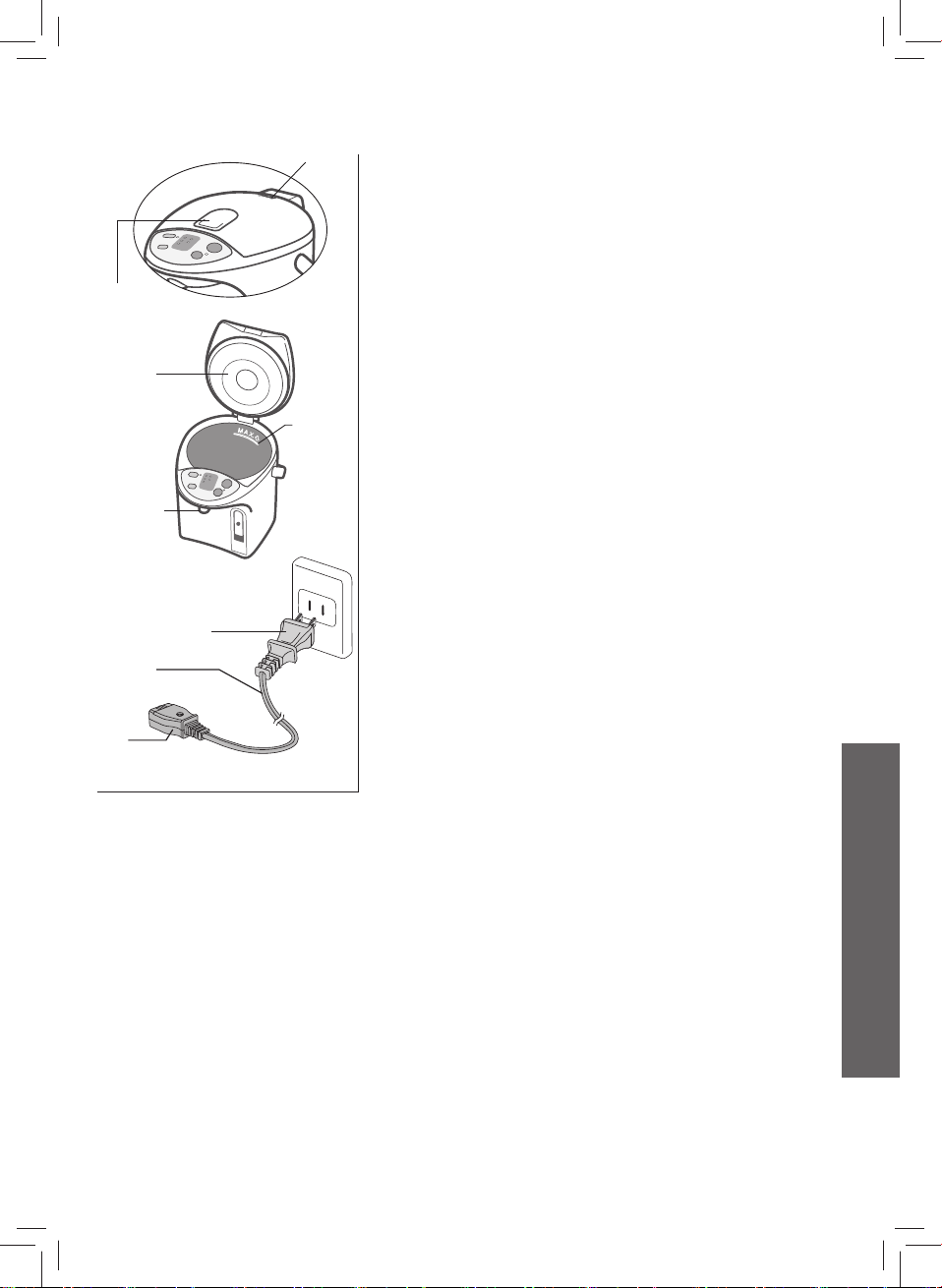
Cordon d’alimentation
Fiche d’alimentation
Cordon
Fiche
côté appareil
*La forme de la prise diffère selon la région
Bec verseur
Repère
de niveau
d’eau
maximal
Levier d’ouverture
du couvercle
Évent de vapeur
Couvercle
15. Ne pas laisser des petites pièces métalliques à
proximité de la fi che de l’appareil.
16. N’utiliser que le cordon d’alimentation conçu
spécialement pour l’appareil. Ne pas utiliser un cordon
différent et ne pas utiliser ce cordon pour tout autre
dispositif.
17. Ne pas laisser l’appareil tomber.
Ne pas lever, incliner ou secouer l’appareil ni le
transporter par le couvercle.
• Même quand le bouton verseur est verrouillé, l’eau chaude
peut jaillir par le bec verseur et l’évent de vapeur en
causant des brûlures si l’appareil est renversé ou incliné.
18. Ne pas utiliser cet appareil si le couvercle n’est pas
correctement fermé. Fermer bien le couvercle, sans
forcer.
19. Ne pas jeter l’eau chaude restante quand le couvercle
est en place.
20. En ouvrant le couvercle, éloigner les mains de l’évent
de vapeur.
21. Retirer le couvercle pendant les cycles de chauffe
pourrait provoquer des brûlures.
Ne pas ouvrir le couvercle ou verser de l’eau chaude au
cours de l’ébullition.
22. Ne pas remplir l’eau au-dessus du niveau d’eau
maximum.
23. Ne pas obturer l’évent de vapeur.
24.
Ne pas faire pivoter l’appareil tout en versant l’eau chaude.
25. Ne pas utiliser l’appareil pour tout usage non prévu.
• Ne pas l’utiliser pour conserver la glace. Sinon une
condensation peut se produire en créant des risques de
chocs électriques et de panne.
• Ne pas chauffer des sachets de thé, des feuilles de thé, du
lait, de l’alcool ou tout autre chose que de l’eau, de l’eau
chaude ou de la vapeur pourrait s’échapper et causer
des brûlures. Le tube d’eau risque aussi d’être colmaté,
le récipient interne peut se calciner ou se corroder, et
le revêtement isolant à base de fl uororésine peut se
détacher.
26. Cet appareil est conçu pour un usage domestique à
l’intérieur uniquement.
CONSERVER CE MANUEL
Nota:
A. Un cordon d’alimentation court est fourni pour éviter le risque d’enchevêtrement ou de
trébuchement avec un cordon plus long.
B. Il est déconseillé d’utiliser des rallonges.
C. Cet appareil est doté d’une fi che polarisée (une broche est plus large que l’autre). Pour réduire le
risque de choc électrique, cette fi che s’adaptera dans une prise polarisée d’une seule manière. Si la
fi che ne rentre pas entièrement dans la prise, il suffi t de l’inverser. Si elle ne s’adapte toujours pas,
contacter un électricien qualifi é. Ne jamais tenter de modifi er la fi che d’une quelconque manière.
PRÉCAUTIONS IMPORTANTES
06_USA_OM_NC-EG2200_3000_4000_EN.indd 906_USA_OM_NC-EG2200_3000_4000_EN.indd 9 12/14/2558 BE 15:5012/14/2558 BE 15:50
10
Main Features
Convenient
Economy use
●
Electric dispense
(See "Dispensing" on P.16-17)
●
Slow Drip made for making
drip coffee (P.18-19)
●
6h Timer
(See “Setting the 6h timer” on P.18-19)
●
4 Keep-warm temperature
selections
208 / 190 / 180 / 160°F keep-warm
temperature can be selected.
(See “Keep-warm Function” on P.18-19)
Easy to Clean
●
Charcoal coated non-stick inner container
The inner container is fluoridated with
floury charcoal, which is easy to clean
and maintain.
Main Features
06_USA_OM_NC-EG2200_3000_4000_EN.indd 1006_USA_OM_NC-EG2200_3000_4000_EN.indd 10 12/14/2558 BE 15:5012/14/2558 BE 15:50
11
Safety Precautions
Please take these precautions strictly
n
The symbols indicate specified items that must be followed.
WARNING
CAUTION
WARNING
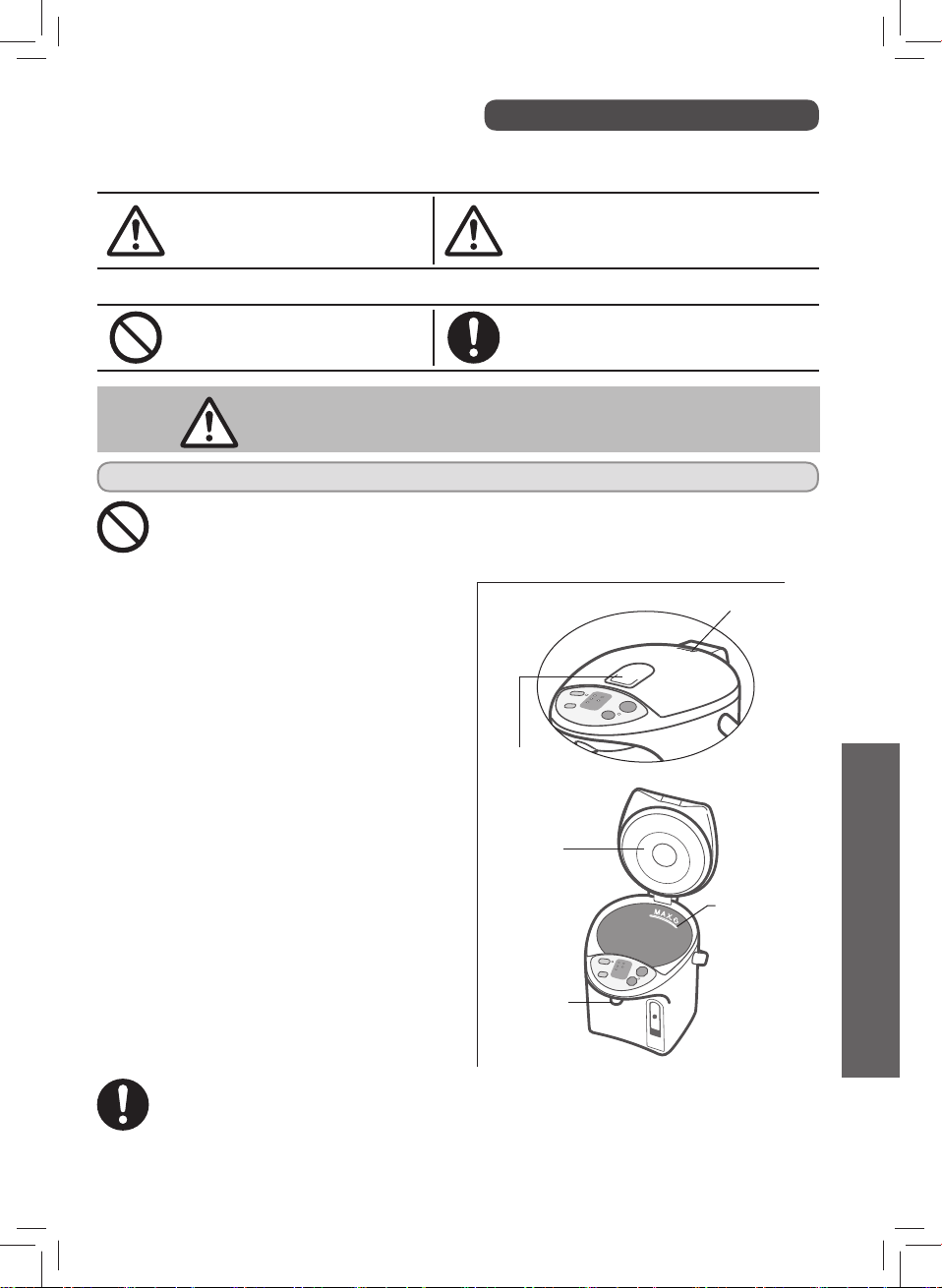
To Prevent Burns
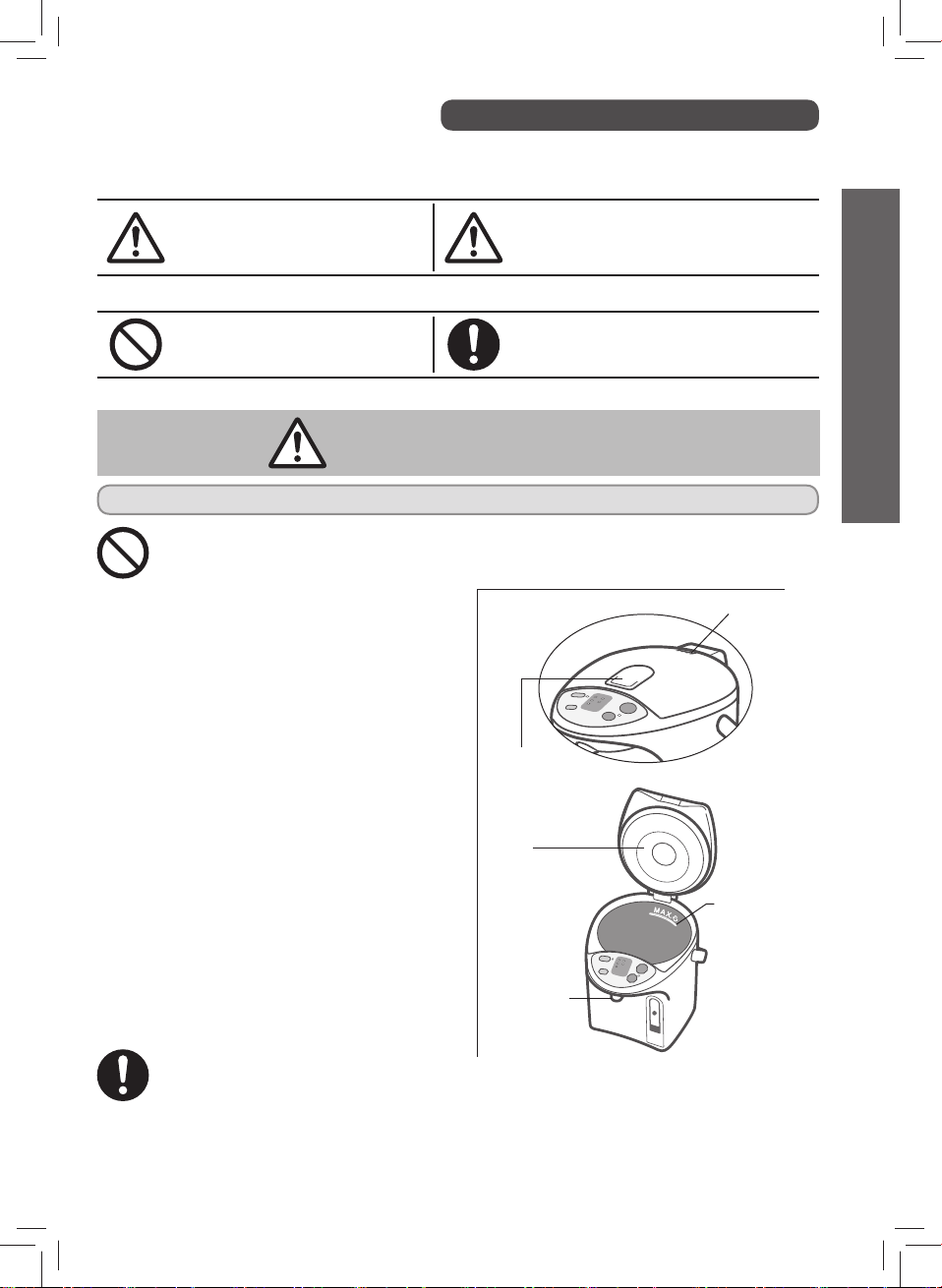
Steam vent
Lid opening
lever
Lid
Maximum
water level
Dispensing
spout
To reduce the risk of personal injury, electric shock or fire, please observe the following:
n
The signals indicate harm and damage when the product is used incorrectly.
This symbol indicates an action
that must be avoided.
This symbol indicates an action that must
be carried out.
Indicates potential
hazard that could
result in serious
injury or death.
Indicates potential hazard that
could result in minor injury or
property damage.
●
Do not let the unit fall over. Do not lift, tilt or shake the unit or carry it by the lid.
Even when the “Dispense” key is locked, hot water may leak through the dispensing spout
and the steam vent, causing burns, if the unit falls over or is tilted.
●
Do not close the lid by force.
Hot water can spill causing burns.
●
Do not pour in water above the maximum
water level indication line.
If the appliance is overfilled, boiling
water may be ejected. Hot water can spill
causing burns.
●
Do not boil anything other than water.
Do not heat tea bags, tea leaves, milk,
alcohol or anything other than water which
may cause it to spurt out hot liquid or steam
and cause burns.
The water tube may also get clogged, the
inner container may burn or corrode, and the
fluororesin insulating coating may peel off.
●
Do not block the steam vent.
Hot water can overflow causing burns.
●
Do not throw away the remaining hot
water while the lid is attached.
If the Iid comes off, hot water may splash
causing burns.
●
Do not touch the steam vent.
This may cause burns. Take special care to
prevent infants from touching the steam vent.
●
This produ
ct is not intended for use by
children, unless they have been given supervision or instructions concerning the use of
this product by a person responsible for their safety.
●
Close the lid securely.
If the unit topples, hot water may spill out causing burns.
Safety Precautions
06_USA_OM_NC-EG2200_3000_4000_EN.indd 1106_USA_OM_NC-EG2200_3000_4000_EN.indd 11 12/14/2558 BE 15:5012/14/2558 BE 15:50
12
Power Cord
Power cord
* The shape of plug differs according
to region.
Cord
Body
plug
Power plug*
Safety Precautions
Please take these precautions strictly
WARNING
●
Never do anything that might cause damage to
the cord, power plug or body plug.
Do not damage them, modify them, place hot
objects near to them, bend them, twist them,
stretch them, place heavy objects on them, or
bundle them together.
If the unit is used when damaged, electrical short
circuit or fire may cause.
●
If the supply cord becomes damaged, the cord
must be replaced. Refer servicing to an authorized
service center, as described in the warranty.
●
Do not connect or disconnect the power plug or
the body plug with wet hands.
This may cause electric shock.
●
Do not allow infants access to the body plug.
You must pay special attention to prevent infants from putting the body plug into their mouths.
This may cause electric shock or injury.
●
Do not allow small metal parts near the body plug.
This may cause electric shock, electrical short circuit or fire.
●
Make sure the power plug is fully inserted into the wall outlet.
If the plug is inserted improperly it may cause electric shock or generate heat causing fire.
●
Do not use a damaged plug or a connection in a loose outlet.
●
To prevent electric shock and/or fire, dust off power plug or body plug regularly.
Water-laden dust settled on the cable or plug may cause insufficient insulation.
●
Remove the plugs and clean them with a dry cloth.
●
Use a single outlet that matches the power rating of the unit.
Plugging multiple appliance into one outlet may generate heat and cause fire.
During use
●
Do not immerse the unit, connector of power plug and body plug in water or splash
water over them.
●
Do not supply water directly from the tap or place the unit in a sink where the bottom
may get wet.
●
Do not turn the unit upside down when the bottom is wet.
This may cause a short circuit and electric shock, due to water enters the electrical
parts in the main unit.
●
Never disassemble, repair or modify the unit.
Any attempt to do so may cause the unit to operate abnormally and may cause fire or injury.
●
Refer servicing to an authorized service center, as described in the warranty.
●
Do not use to store ice.
Condensation will occur, creating a potential source of electric shock and malfunction.
Safety Precautions
06_USA_OM_NC-EG2200_3000_4000_EN.indd 1206_USA_OM_NC-EG2200_3000_4000_EN.indd 12 12/14/2558 BE 15:5012/14/2558 BE 15:50
13
During use
Power Cord
To Prevent Burns
●
Do not use the unit on surfaces that can be affected by heat for a long time.
The unit may get discolored or break up.
●
Do not place near walls or furniture.
Steam and heat could damage walls and furniture, causing a change in color and shape.
●
Replace gasket if it discolors whitish. (P.23)
Otherwise it may cause hot water to spill out when it is leaned or knocked down
accidentally.
CAUTION
●
Do not place the unit on unstable surfaces.
The appliance may topple over causing burns.
●
Do not open the lid or dispense hot water while boiling.
Splashing hot water or steam may cause burns.
●
Do not rotate the unit while dispensing hot water.
Splashing hot water may cause burns.
●
Do not touch the hot parts of the unit during use or shortly after use.
This may cause burns.
●
When opening or closing the lid, keep hands away from the steam.
Steam can cause burns.
●
When carrying the unit, do not touch the lid opening lever.
The lid may open causing burns and other injury.
●
Wait until the unit is cooled down before maintenance.
A hot appliance may cause burns.
●
When disposing hot water, be careful not to get burned.
●
Do not use a different power cord and do not use this power cord with any other device.
(Do not use a power cord other than the one designed specifically for the unit.)
It may cause malfunction or fire.
●
When the unit is not in use, unplug the power plug from the wall outlet.
Deteriorating insulation may cause electric shock and/or fire.
●
When unplugging the unit, pull by the power plug - not the cord.
Electric shock and short circuit may cause fire.
Safety Precautions
06_USA_OM_NC-EG2200_3000_4000_EN.indd 1306_USA_OM_NC-EG2200_3000_4000_EN.indd 13 12/14/2558 BE 15:5012/14/2558 BE 15:50
14
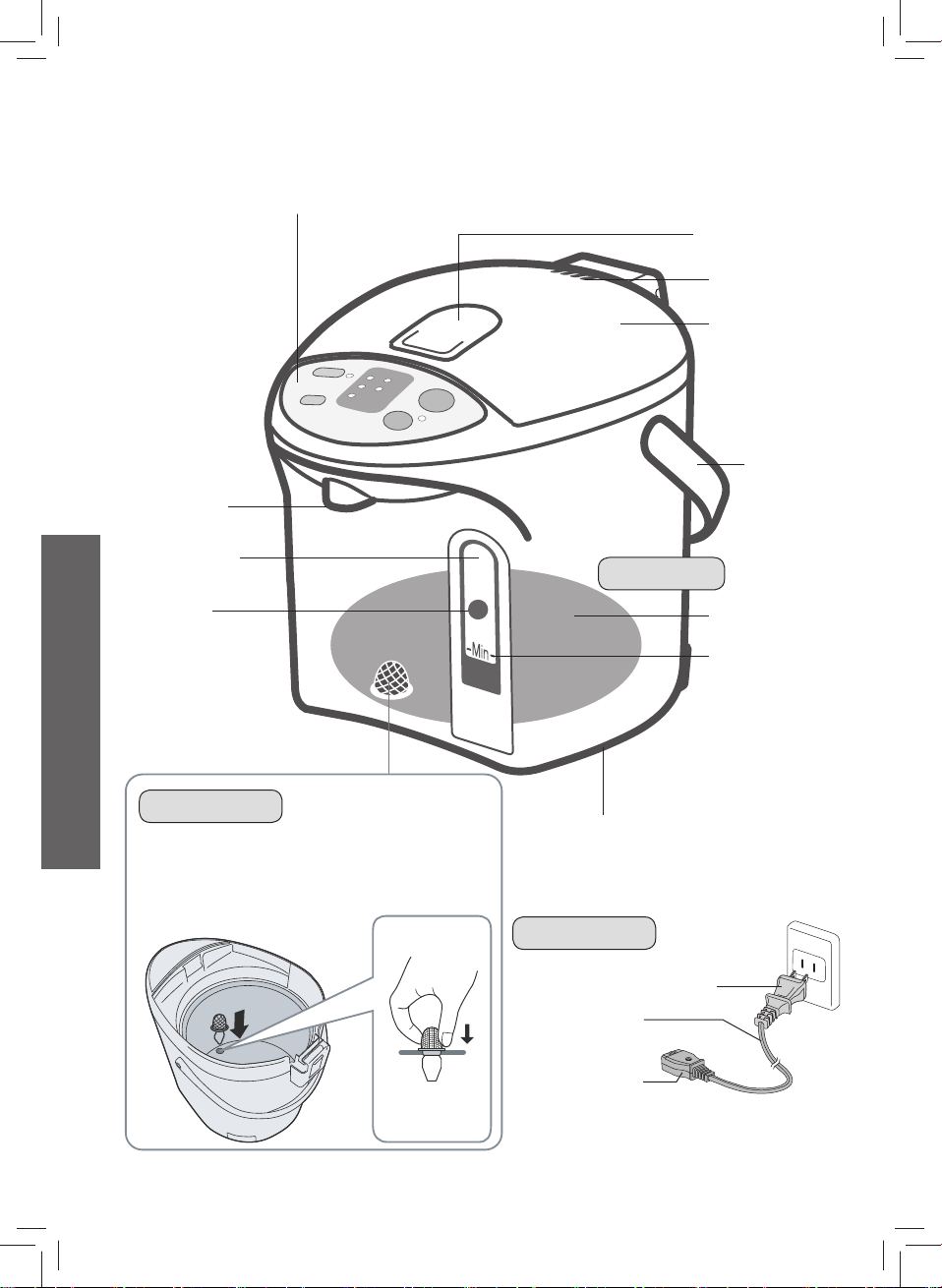
Part Names and Handling Instructions
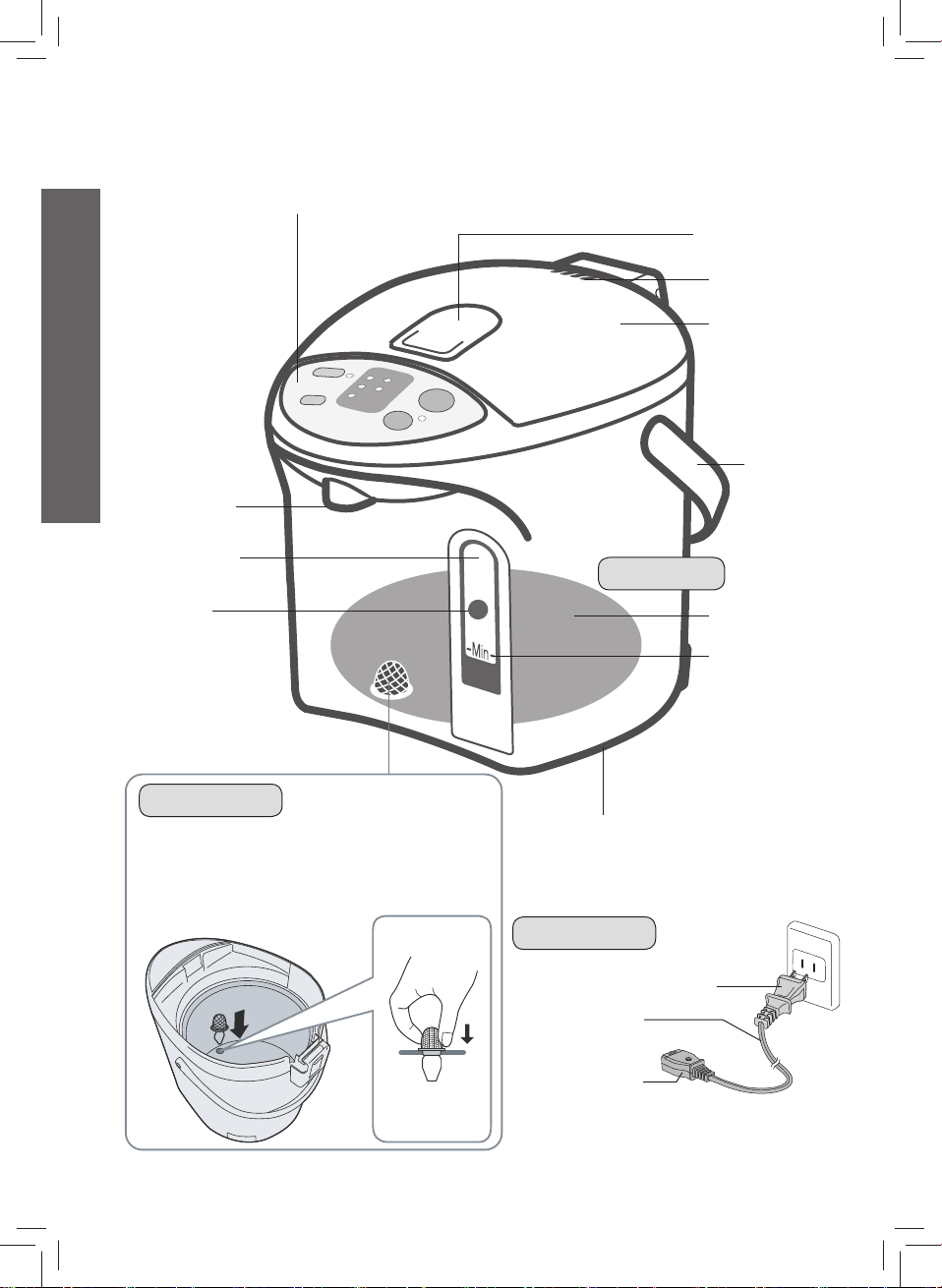
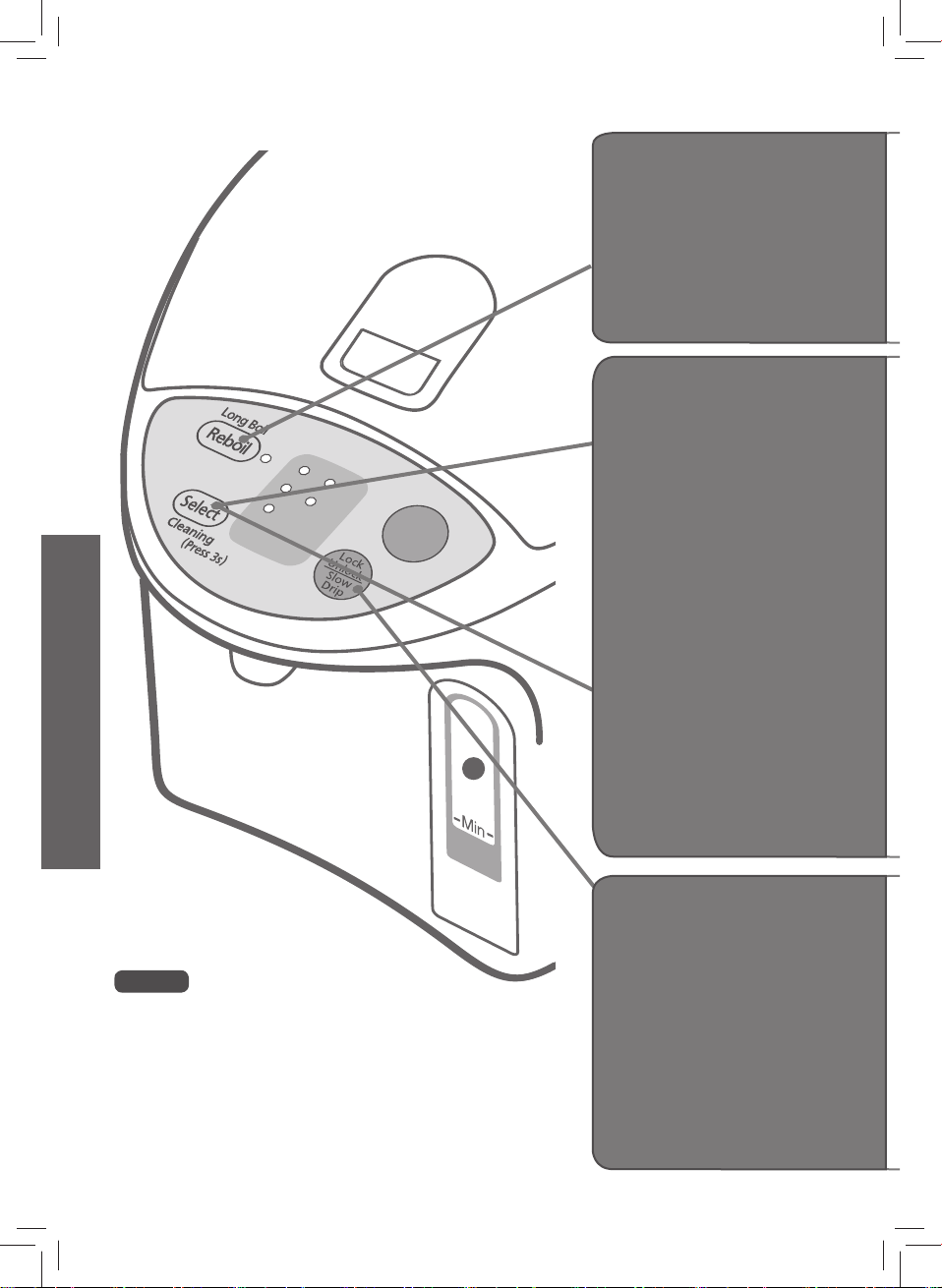
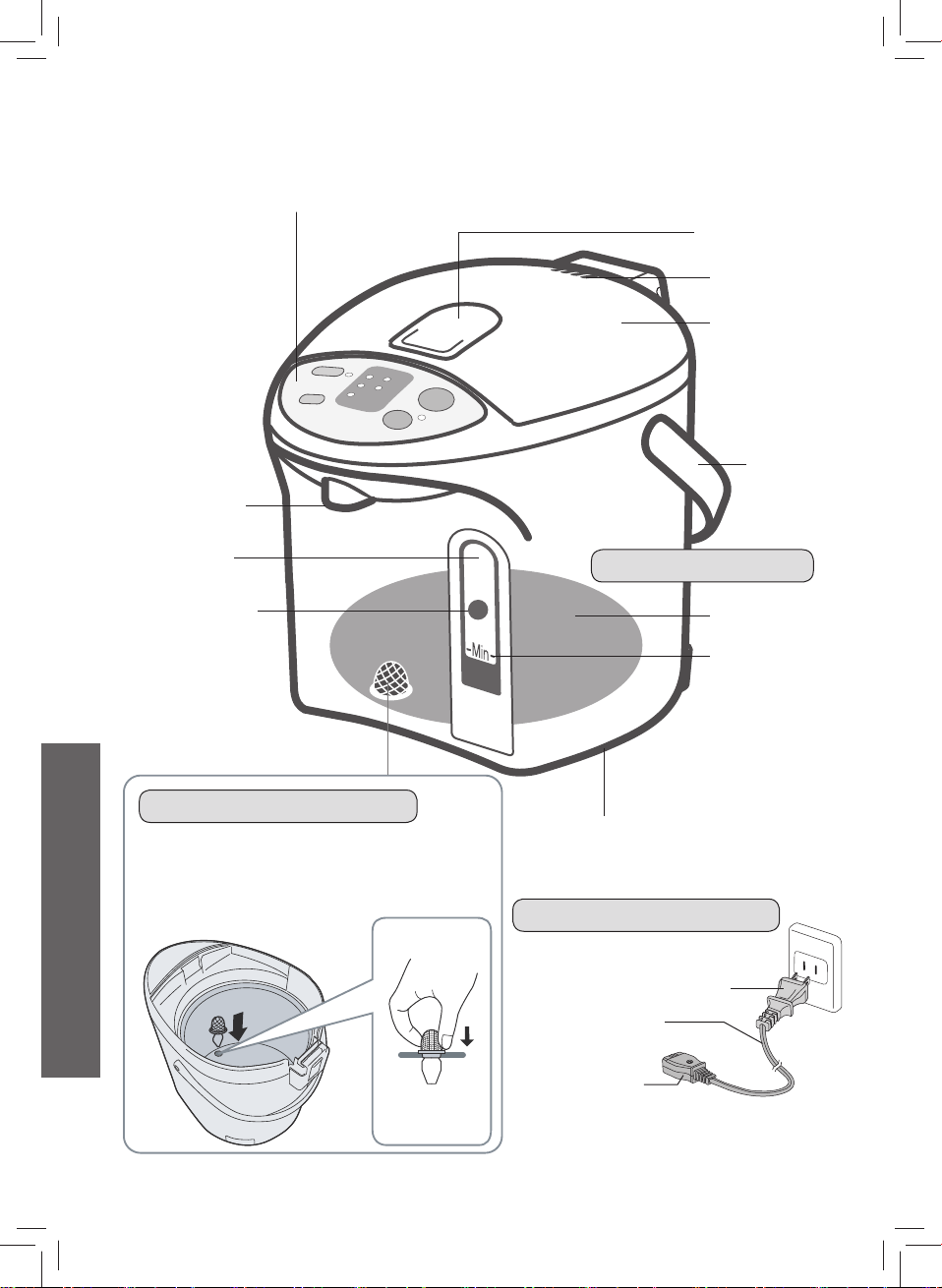
Operation panel
Lid opening
lever
Steam vent
Lid
Handle
Inner
container
Minimum
water level
mark
Window rim
Red ball
Water level
indicator cannot be
seen when water
level is above the
window rim.
Rotating base (360 degrees)
When rotating the unit, do not allow the
cord to wind around the main unit.
Dispensing
spout
Main unit
Mesh filter
Power cord
Power plug*
Cord
Body plug
*The shape of plug differs according to region.
(Replaceable part)
It may have been come off from the bottom of
the inner container.
Push it completely into the correct position.
(See P.23)
APB97-480-0U
Part Names and Handling Instructions
06_USA_OM_NC-EG2200_3000_4000_EN.indd 1406_USA_OM_NC-EG2200_3000_4000_EN.indd 14 12/14/2558 BE 15:5012/14/2558 BE 15:50
15
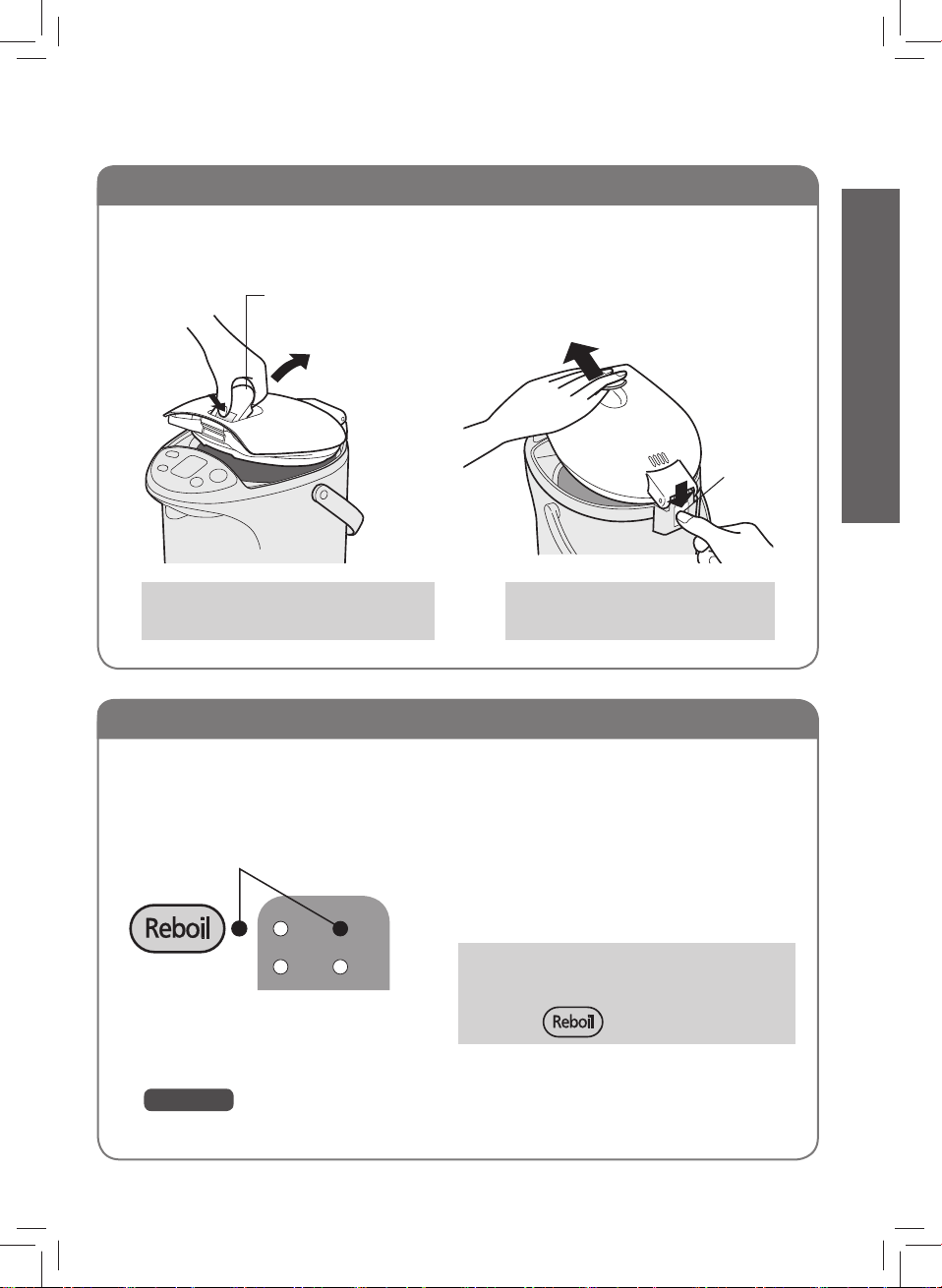
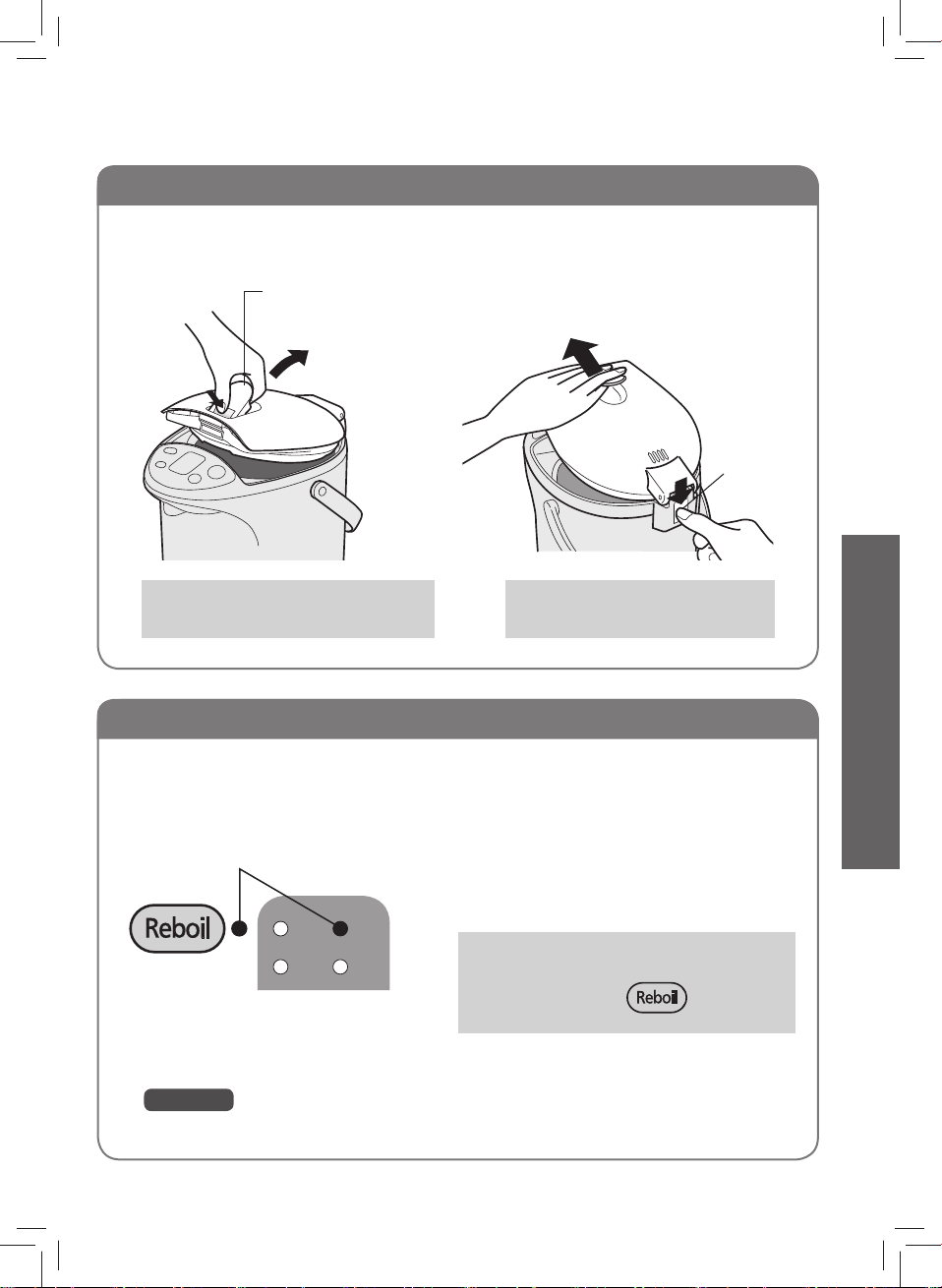
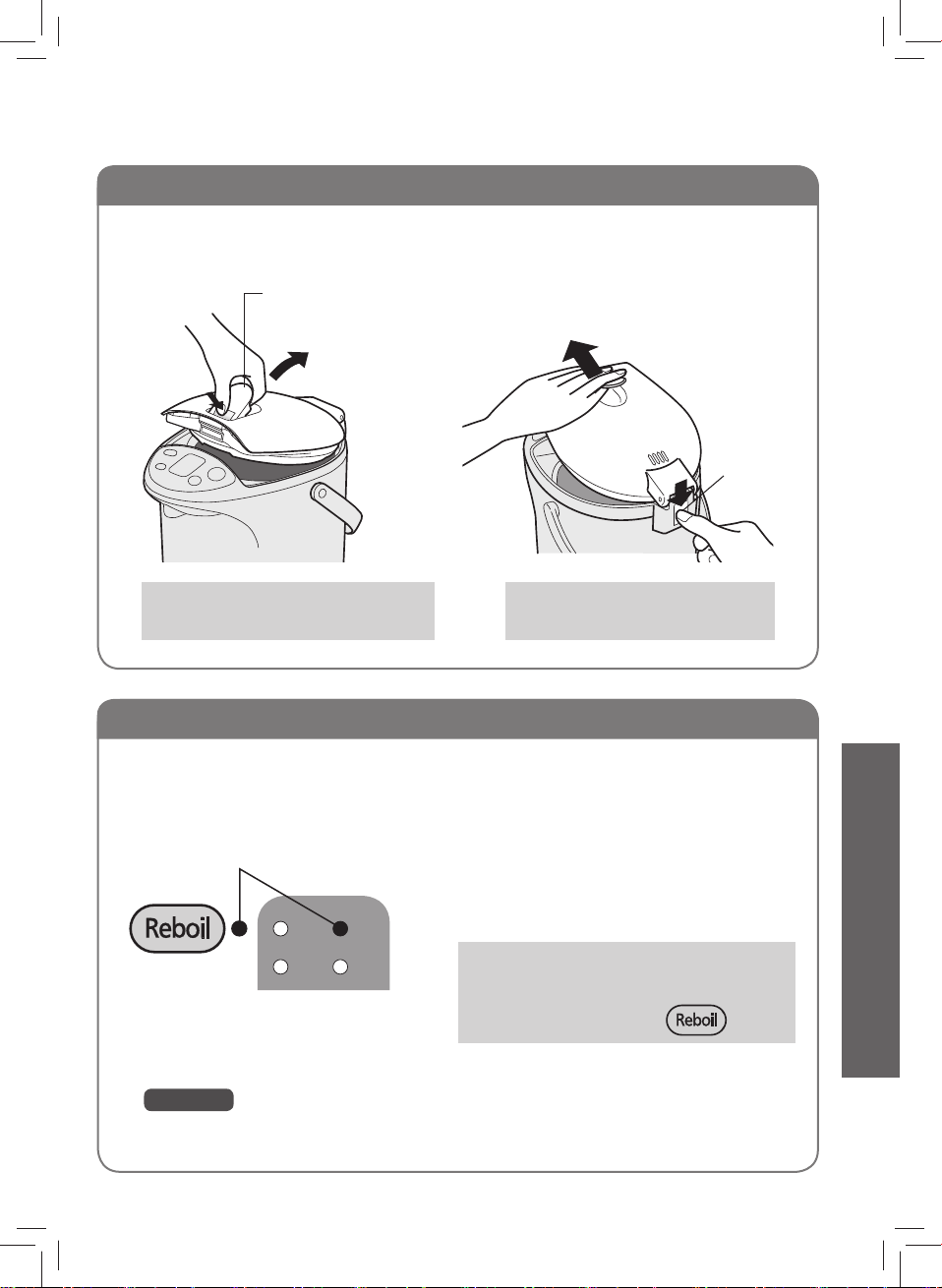
How to Remove the Lid
Overheating Protection
To close
Press down until hearing “click” sound.
To attach
Insert the lid slantwise.
How to cancel the display
Supply water into the container,
and press key.
180 208
160 190
Notice
Lid opening lever
Lid release
lever
Flashing alternately
If an empty inner container is heated, the overheat safety function (which prevents an
empty inner container from being overheated) will be activated. The power will be shut off
automatically to prevent the problems that may occur due to overheating. This will be shown
on the display as shown below.
If an empty inner container is heated, an odor will be emitted and the container
may be discolored.
Causing
●
Less than the minimum water level in the inner
container was boiled.
Press and lift the lid opening
lever to open the lid.
Pull it up slantwise while pressing
the lid release lever.
Part Names and Handling Instructions
06_USA_OM_NC-EG2200_3000_4000_EN.indd 1506_USA_OM_NC-EG2200_3000_4000_EN.indd 15 12/14/2558 BE 15:5012/14/2558 BE 15:50
Dispense
16
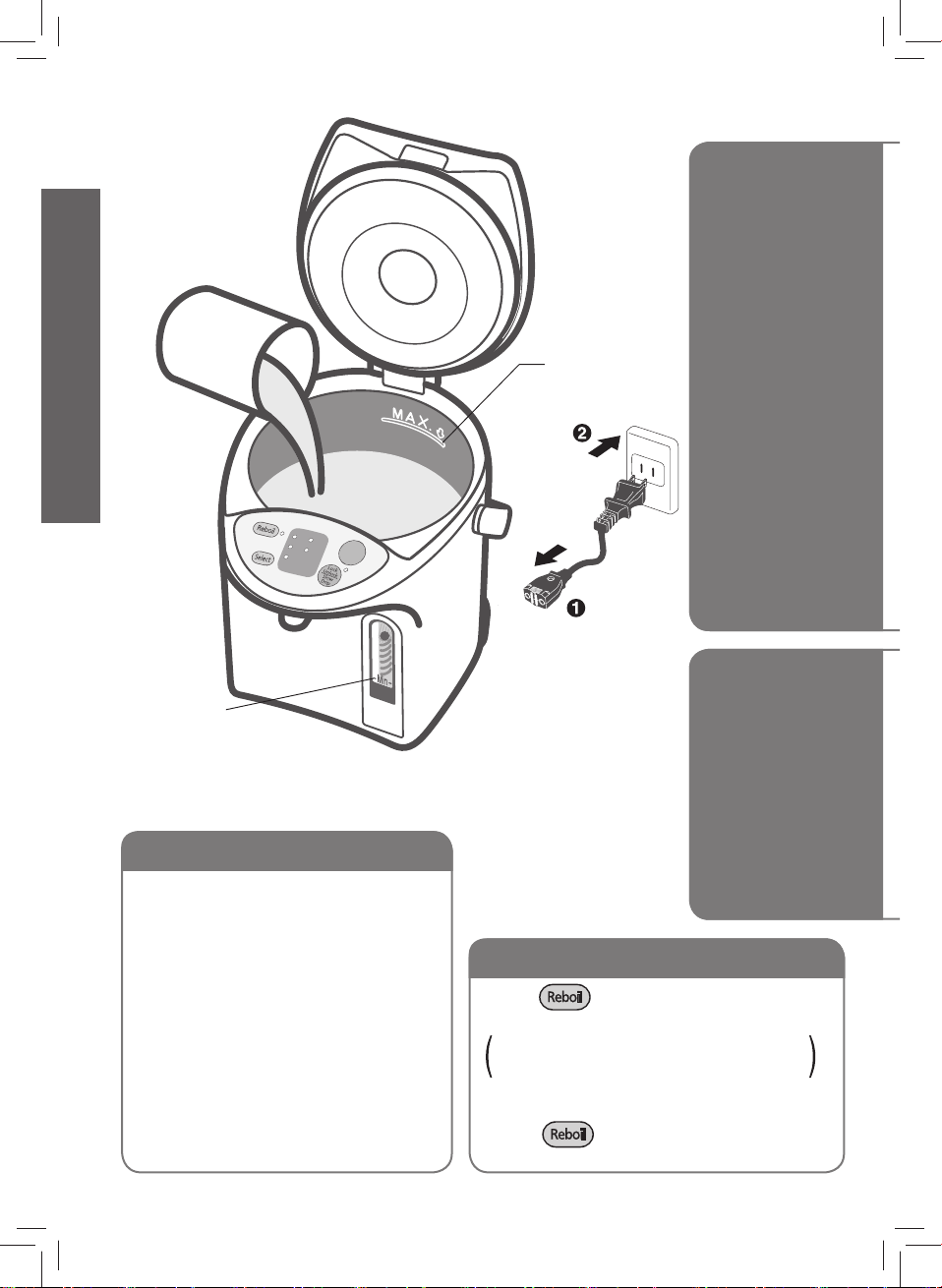
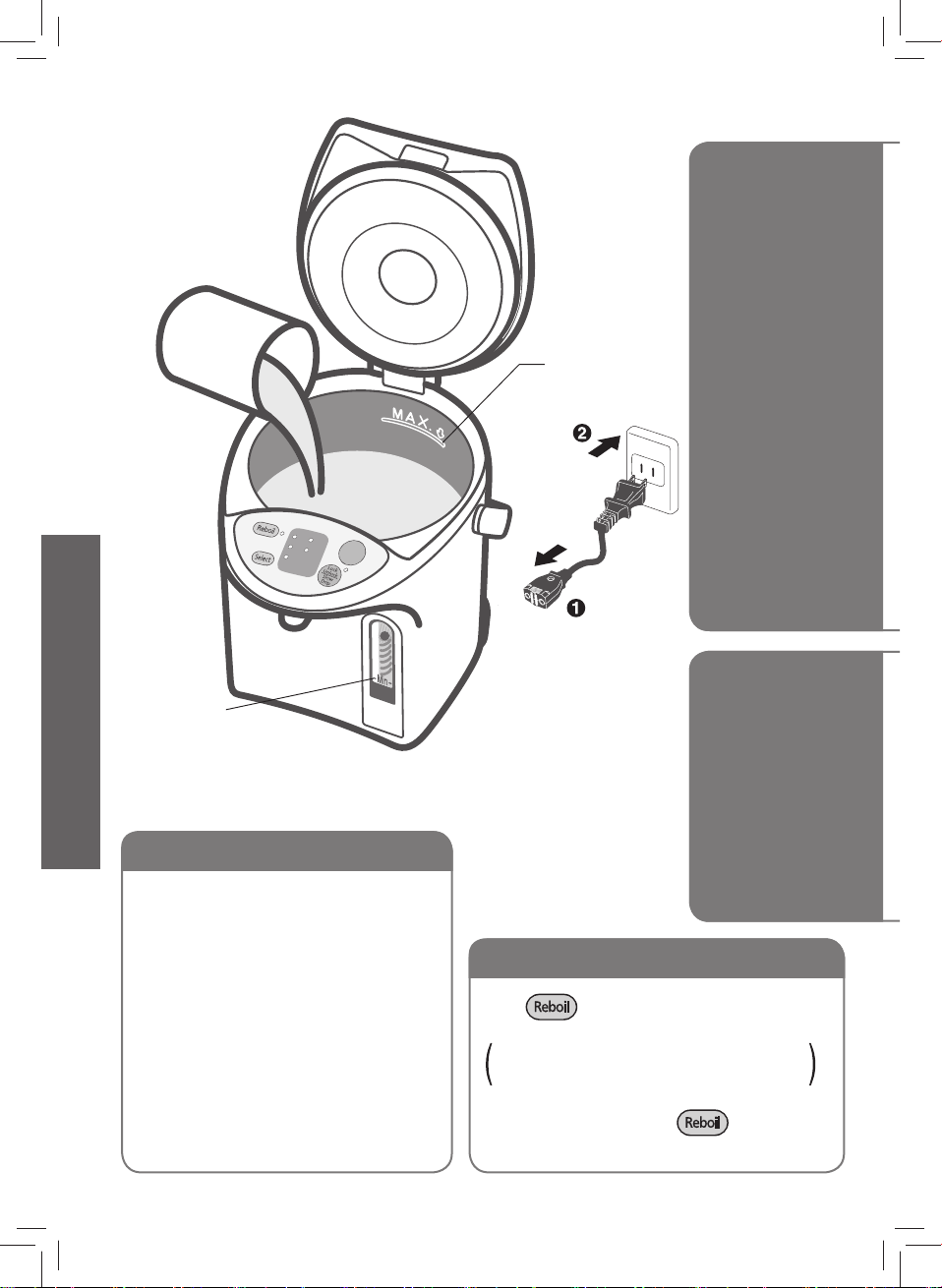
How to reduce the chlorine in the water
How to Use
Boiling
water
Dispensing
(Electric dispense)
Press key to make the indicator
light flash. (Long Boil mode)
Press one time while water is being boiled,
and press twice while water is being kept
warm.
Extends the boiling time by about 6 minutes to
reduce the chlorine by about 80% in the water.
●
Press key again to boil.
Minimum
water level
Fill the water higher
than the minimum
water level.
Pour in water
with another
container!
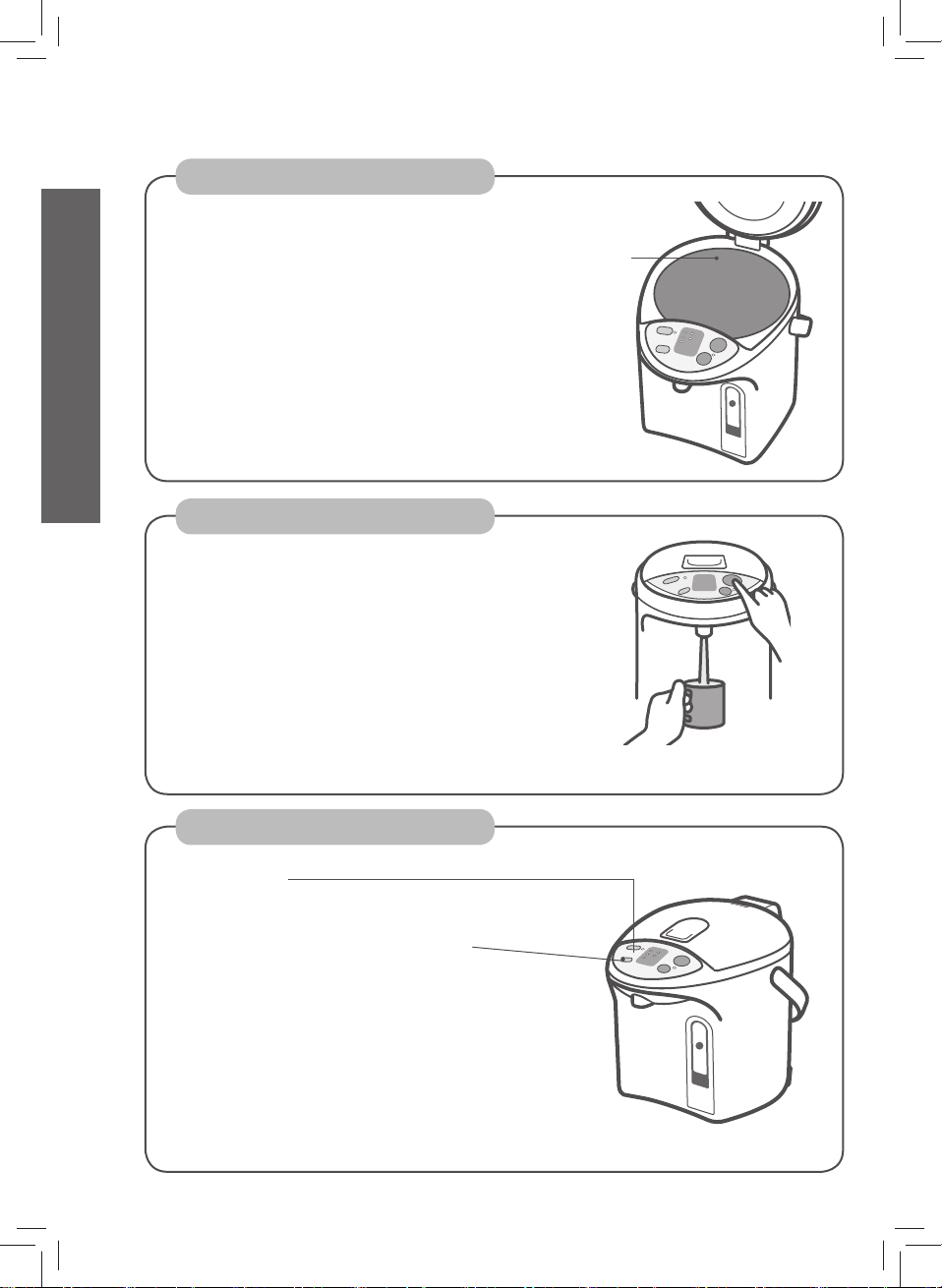
Before you use this unit for the first time
1
Pour in water with another container
to the maximum level.
2
Close the lid securely.
3
Boil the water until Reboil light
goes out.
4
Dispense the hot water.
5
Unplug and remove the lid.
6
Pour out any remaining hot water
slowly via the DRAIN mark.
Maximum
water level
Do not fill water
above maximum
water level.
How to Use
06_USA_OM_NC-EG2200_3000_4000_EN.indd 1606_USA_OM_NC-EG2200_3000_4000_EN.indd 16 12/14/2558 BE 15:5012/14/2558 BE 15:50
17
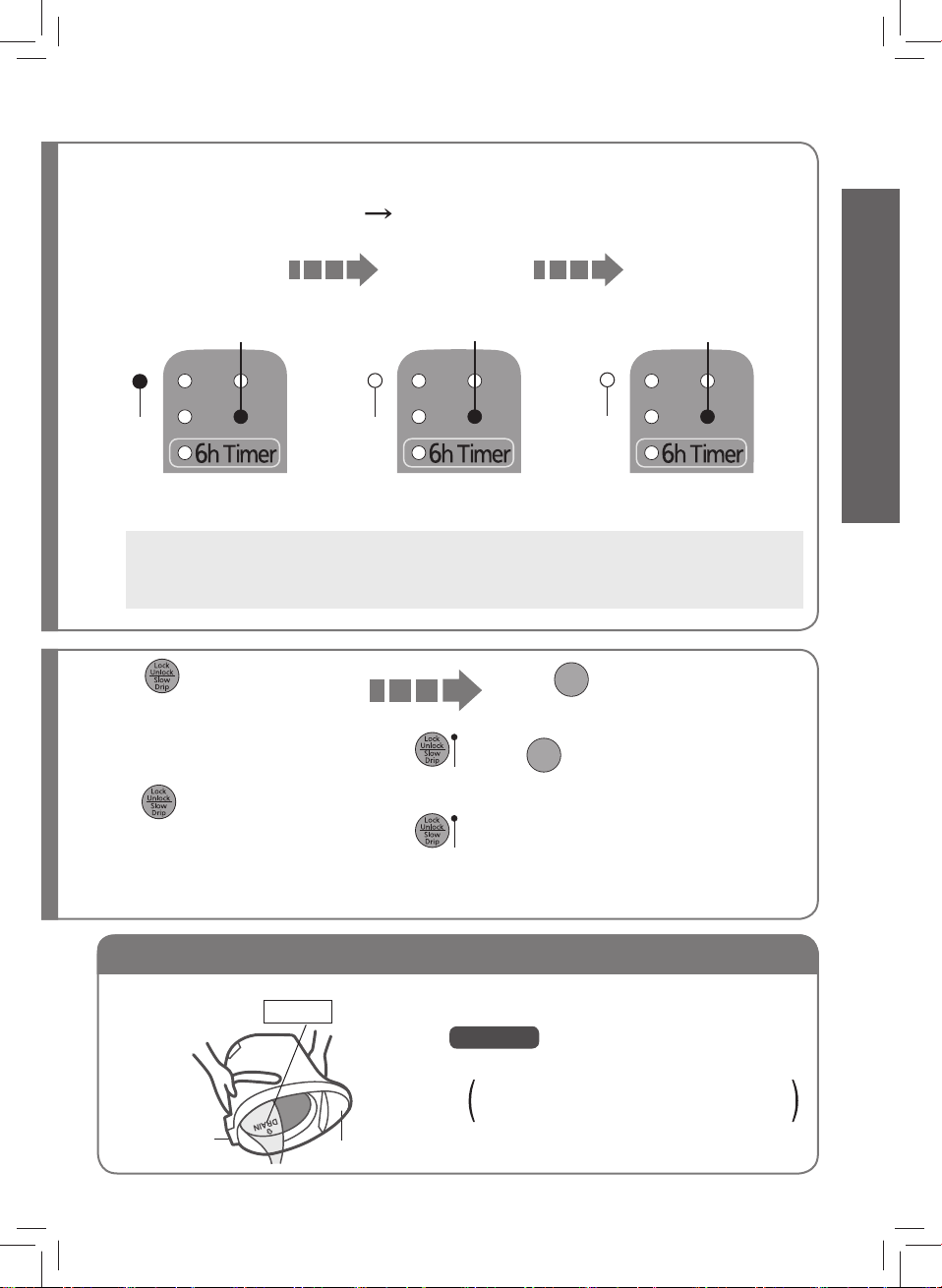
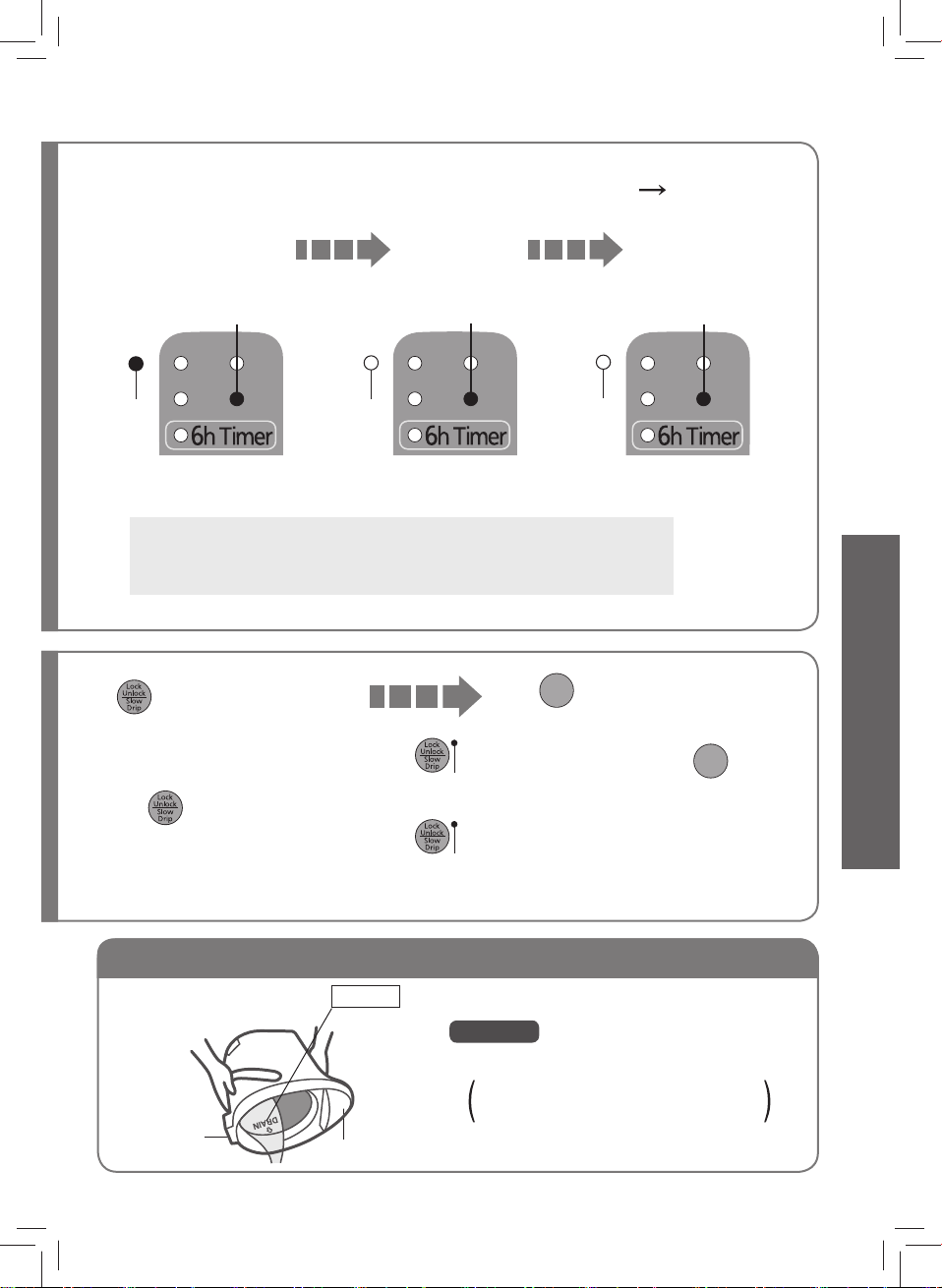
When the unit is not in use
180 208
160 190
180 208
160 190
180 208
160 190
Pour in water with another container. Close the lid securely.
Securely plug the body plug horizontally into the body.
Plug into wall outlet. (P.16 1
2)
Time required to boil water
NC-EG4000: approx. 35 min / NC-EG3000: approx. 27 min / NC-EG2200: approx. 20 min
(Amount of water: Maximum Water / Room temperature: 68°F (20°C))
Cautions
●
Do not pour out water too swiftly.
If water splashes over lid release part or
operation panel, it may cause a malfunction.
●
Do not leave water in the inner container.
(It may cause the container to corrode or smell.)
Unplug, and remove the lid. Pour out any remaining hot
water slowly via the
DRAIN
mark.
Lid release part
Operation panel
Light on
Light onFlashingFlashing
Off
Off
e
)
The
Dispense
key will automatically lock again
10 seconds after dispensing hot water.
Press
key twice for slow drip.
The indicator light beside the key will
flash. (See "slow drip" on P.18-19)
Flash
Light on
Starts boiling
automatically.
Indicate as below
when boiled.
(Displayed temperature
is indicative.)
The temperature will
drop to approximately
190°F and the unit
switches to keep-warm
function automatically.
Press key to release lock.
The indicator light beside the key
will light up.
Press
Dispense
key to dispense the
hot water.
How to Use
06_USA_OM_NC-EG2200_3000_4000_EN.indd 1706_USA_OM_NC-EG2200_3000_4000_EN.indd 17 12/14/2558 BE 15:5012/14/2558 BE 15:50
18
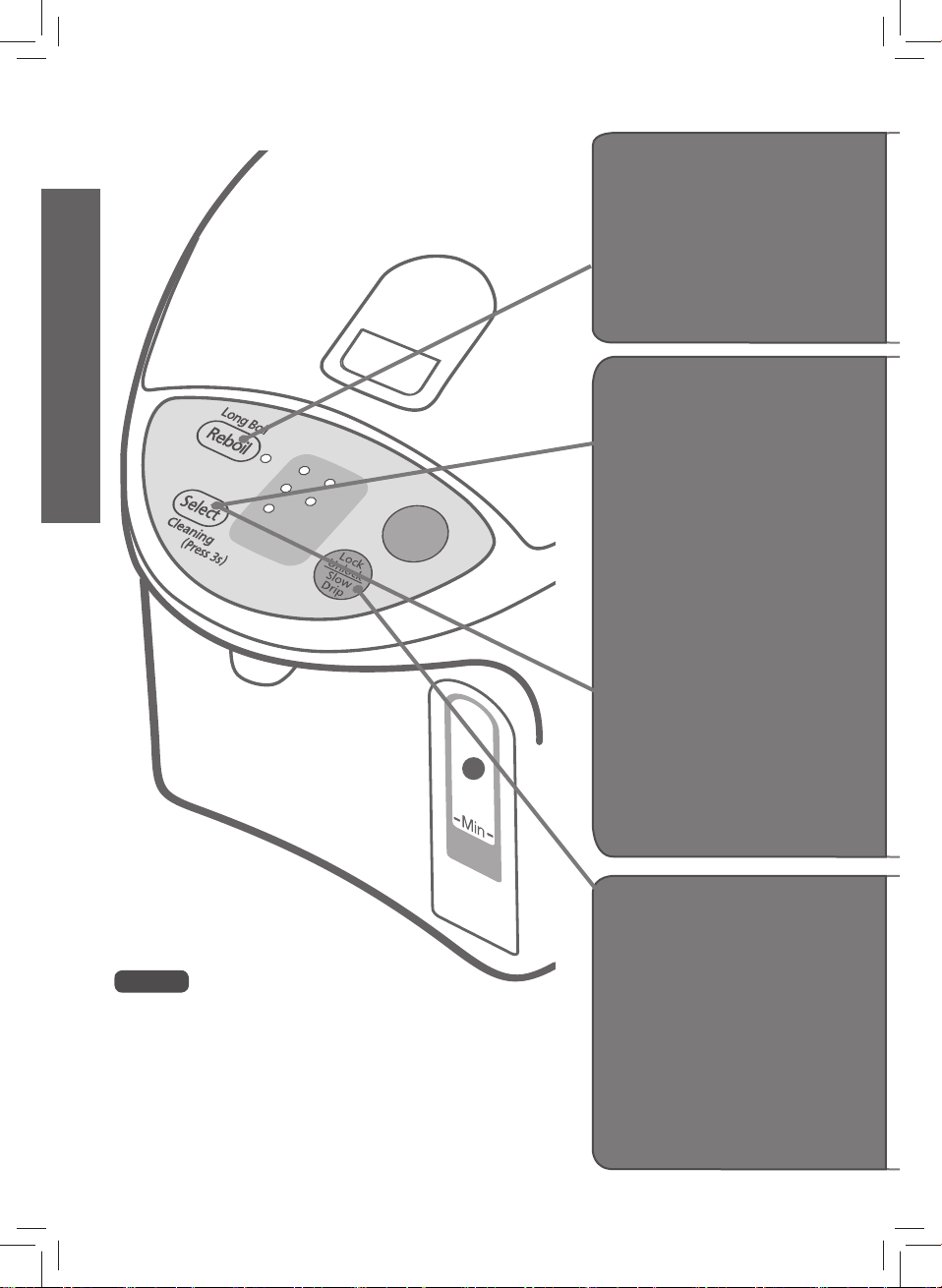
Convenient use methods
●
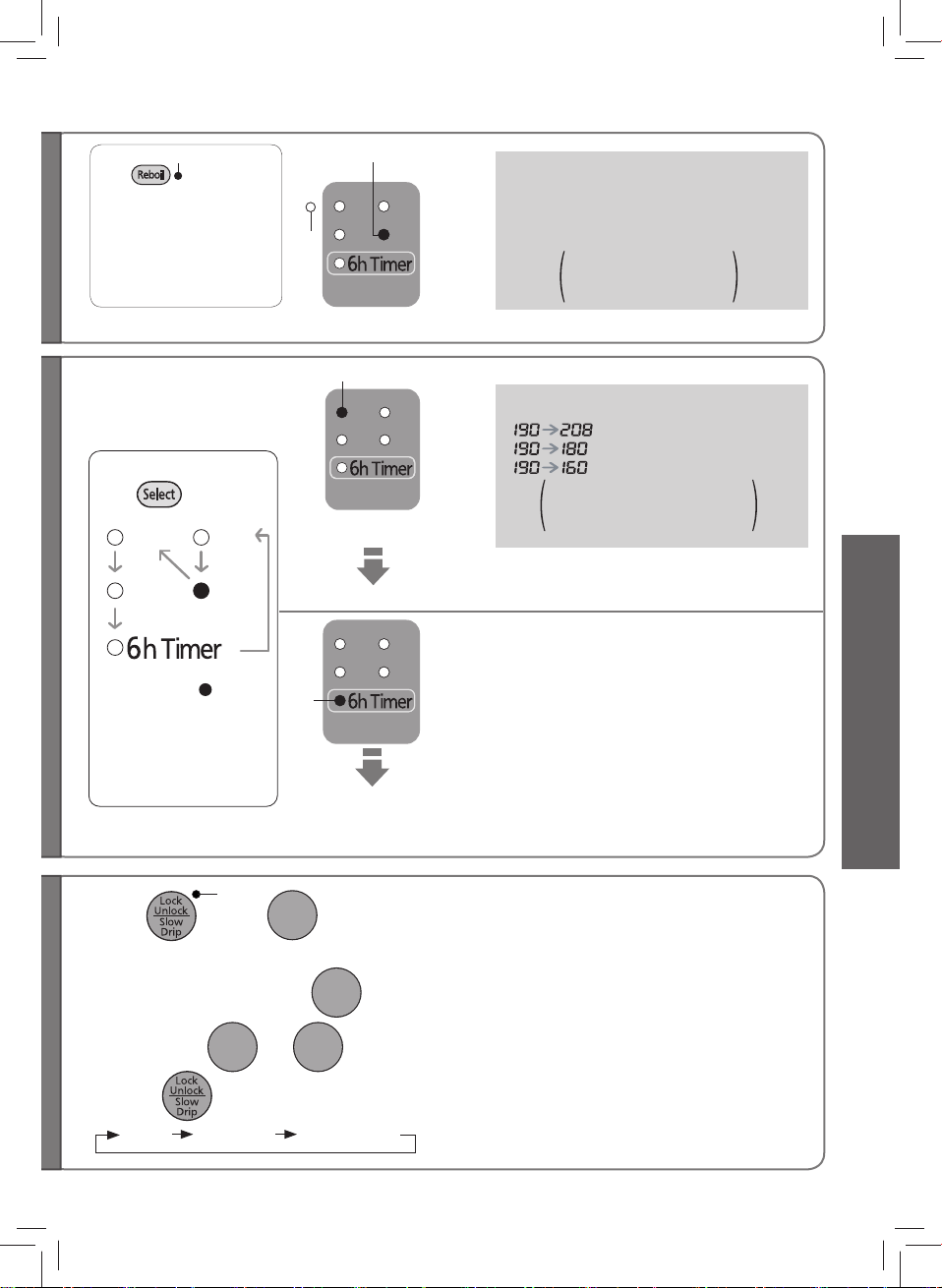
The keep-warm temperature or the timer can
be set while the water is being boiled or being
kept warm.
●
After power is restored in the event of a
power failure, the keep-warm temperature
will be automatically set to “190”, even if the
timer or the “208”, “180” or “160” keep-warm
function was previously selected.
Notice
Reboil
●
It is ideal to use boiling water for
making coffee / tea / instant cup
noodle etc.
●
When the unit will not be used for
a short time, such as when you go
out for a day...
Setting the 6h timer
●
While setting the timer, the
electrification of heater stops.
Dispense
Slow Drip mode for
making drip coffee
●
Dispense water slowly.
●
Right after boiling, it maybe
difficultly dispensed or be
dispensed unsteady.
Keep-warm function
●
“180 keep-warm” is an ideal mode
for making green tea.
●
“160 keep-warm” is an ideal mode
for making milk for a baby.
Be sure to leave milk to cool down
or mix it with cool boiled water
before giving it to a baby.
Convenient use methods
06_USA_OM_NC-EG2200_3000_4000_EN.indd 1806_USA_OM_NC-EG2200_3000_4000_EN.indd 18 12/14/2558 BE 15:5012/14/2558 BE 15:50
19
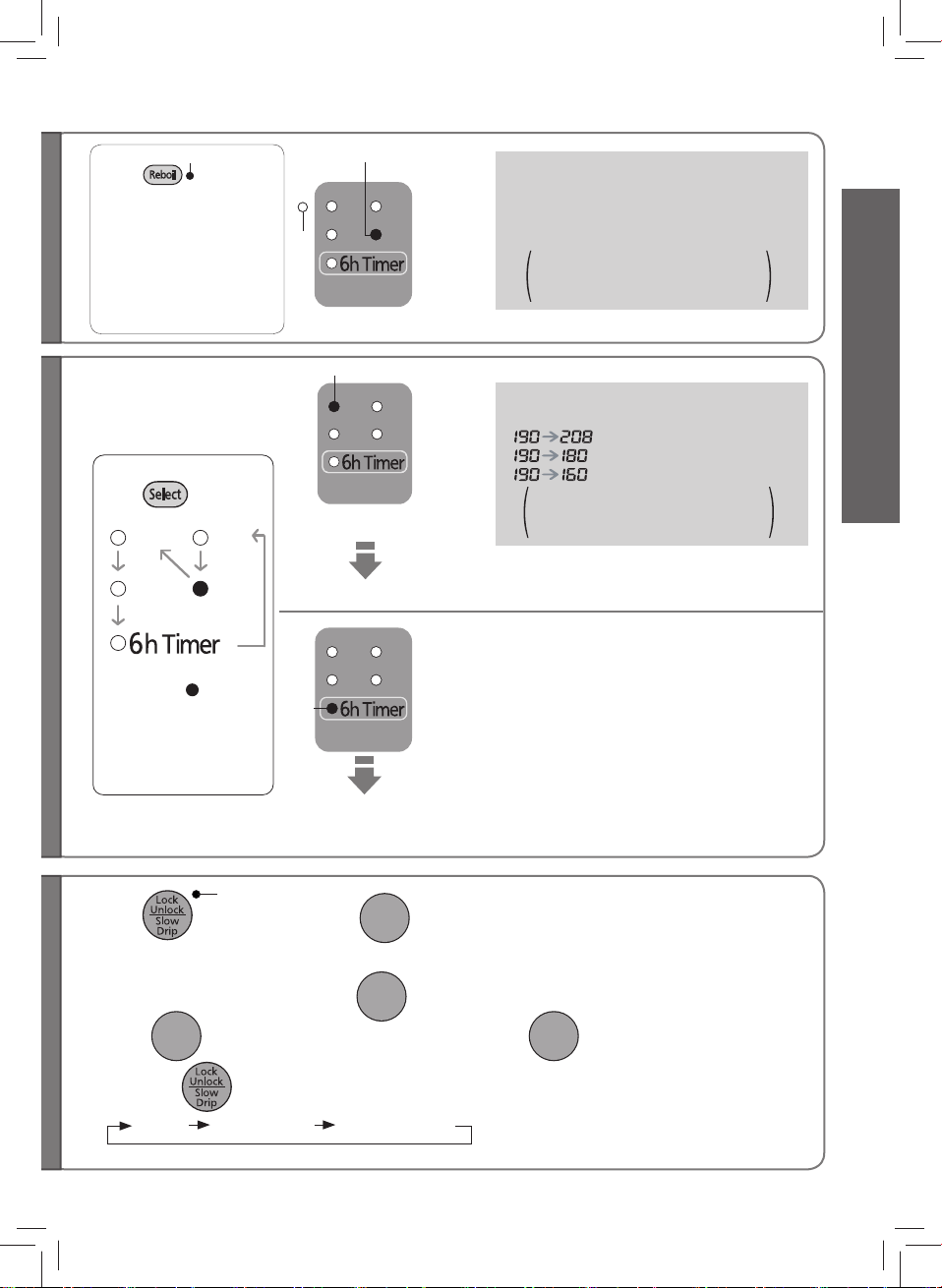
180 208
160 190
180 208
160 190
Time required to reach the settled
keep-warm temperature
keep-warm: approx. 2-4 min
keep-warm: approx. 0.5-1 hour
keep-warm: approx. 1.5-2.5 hours
Amount of water: Maximum
Room temperature: 68°F (20°C)
Previous keep-warm setting: 190°F
Time required for the reboil procedure
From 208 keep-warm: approx. 2.5-4 min
From 190 keep-warm: approx. 4-6.5 min
From 180 keep-warm: approx. 6-12 min
From 160 keep-warm: approx. 7-14 min
Amount of water: Maximum
Room temperature: 68°F (20°C)
180 208
160 190
(When selecting
180 keep-warm)
(After boiled)
Off
Flashing
Light
on
Flashing
Press key twice, then press
Dispense
key to make drip coffee.
Flash
6 hours later, timer will turn off and water starts boiling
When the water is brought up to boiling temperature, it will be
kept warm at
190°F
.
After a short time, water will be kept warm at approximately 180°F.
●
Automatically locked in 30 seconds after dispensing is finished.
●
To dispense hot water again, press
Dispense
key before time count up to 30 seconds.
●
The
Dispense
key will automatically lock again in 10 seconds if
Dispense
key is not pressed.
Each time is pressed, function will be switched as below.
Auto lock Dispense (lamp lit) Slow drip (lamp flash)
Press
Light on
key to
reboil water that is being
kept warm.
After a few minutes, water
will be boiled.
• The keep-warm
temperature setting is
left unchanged.
180 208
160 190
Press key.
Each time the key is
pressed, “ ” mark
will shift to the next
choice and change
the keep-warm
temperature or set
the timer.
Convenient use methods
06_USA_OM_NC-EG2200_3000_4000_EN.indd 1906_USA_OM_NC-EG2200_3000_4000_EN.indd 19 12/14/2558 BE 15:5012/14/2558 BE 15:50
20
Daily Maintenance
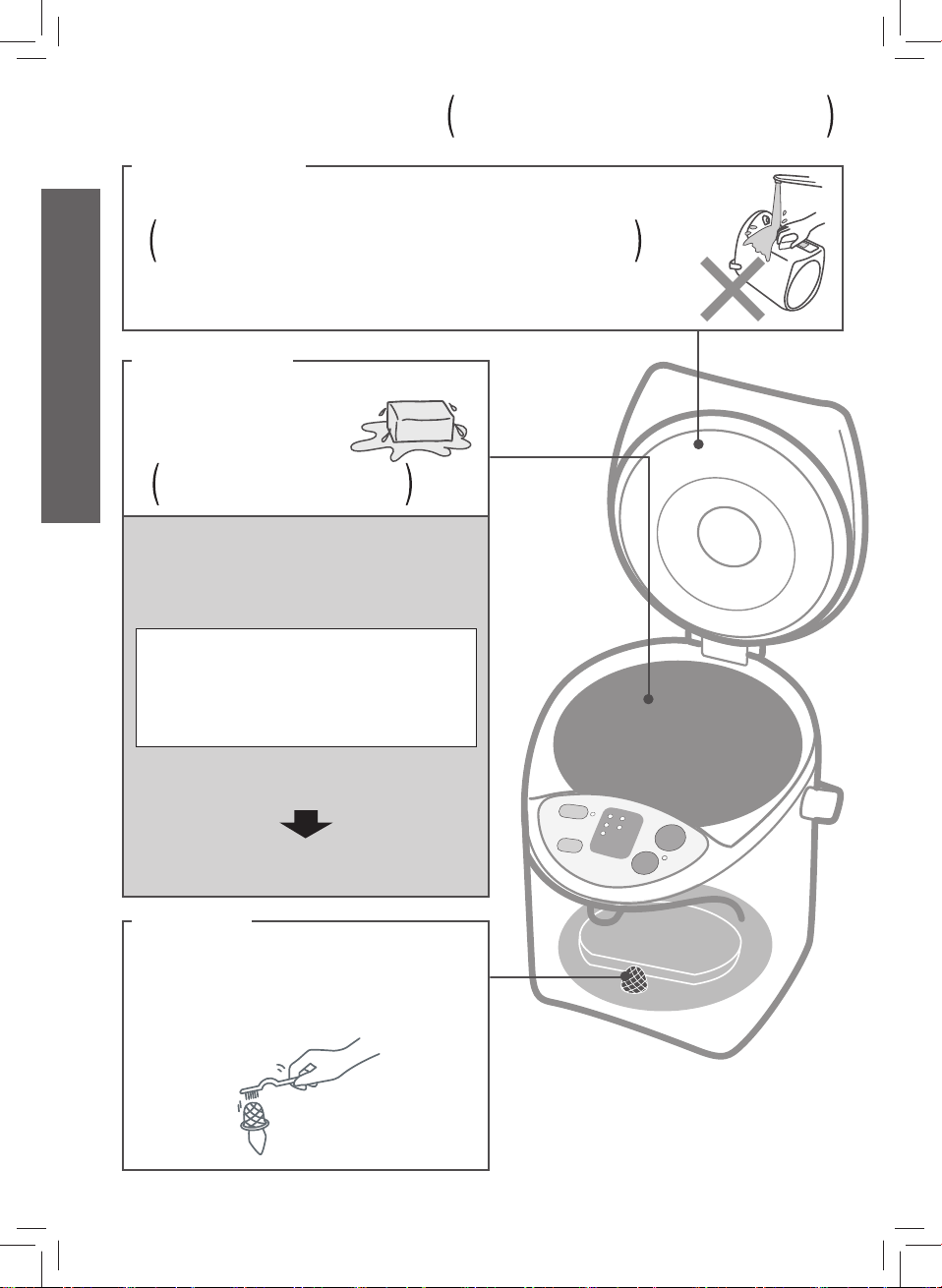
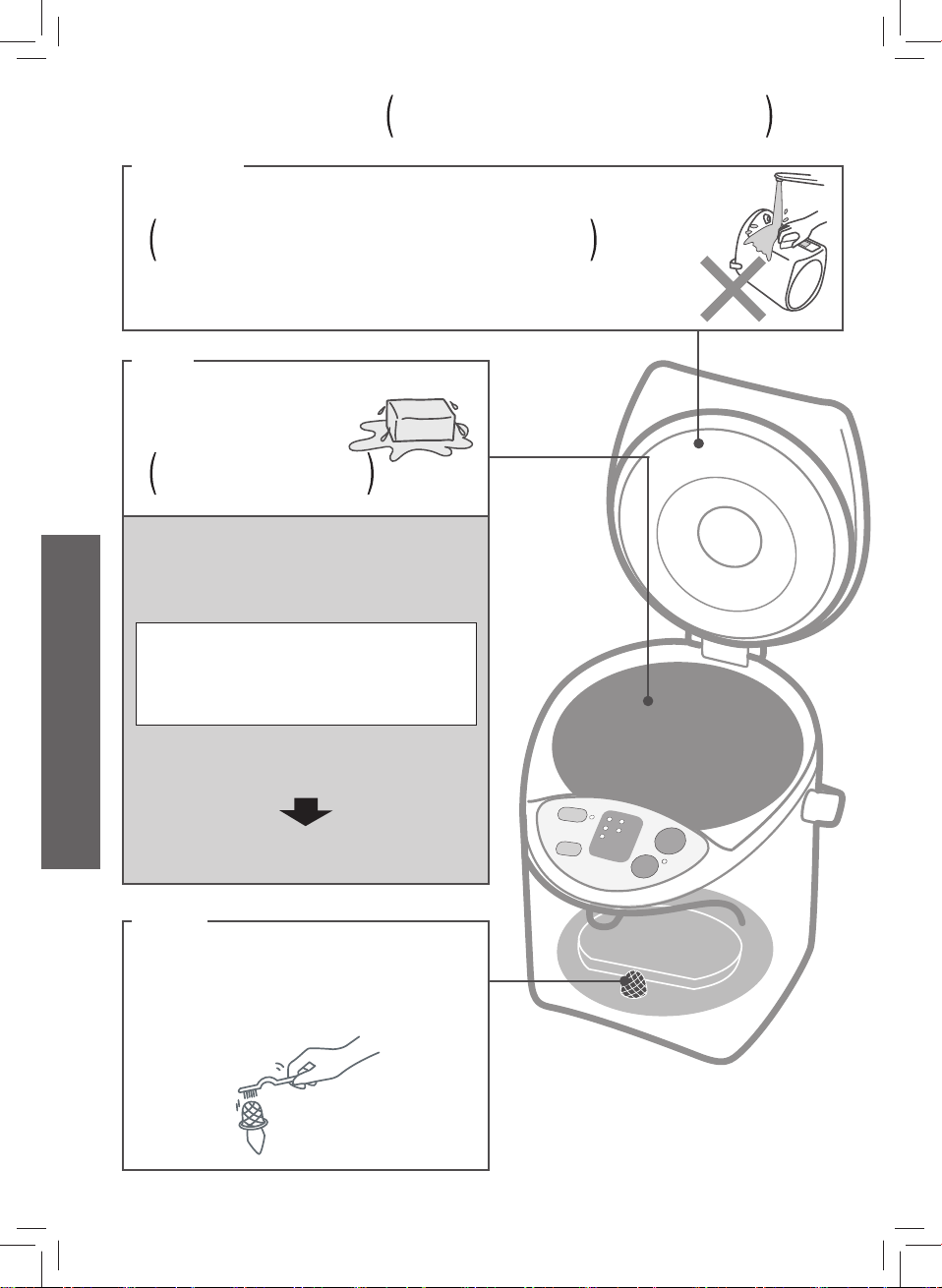
Clean with a damp, well-wrung cloth.
●
Do not wet or soak the main unit in water.
If water enters the main unit from the bottom or from the dispensing
spout, it can also get into the electrical components in the main unit
and may cause a malfunction.
Main unit and lid
Clean the filter with a brush.
When filter is clogged, water does not flow
smoothly.
* After cleaning the filter, be sure to reattach it to
the inner container.
Mesh filter
Clean with a wet soft sponge.
●
Do not use polishing
powder, a scrub brush
or a nylon brush.
About "Scale"
While you are using this unit, minerals contained
in the water (like calcium) can get stuck on the
inner container or on the mesh filter. This is
called "scale", and it is harmless.
●
Milky-white gritty surface (caused by calcium)
●
White or glittering floating material
(crystals of minerals)
●
Discoloration in the finish like dark brown, gray,
or green areas
(metallic ion made on the fluororesin covering)
These are not discoloration or corrosion of the
inner container itself, nor are they flakes from the
fluororesin covering.
Clean the inner container using
citric acid. (See P.21)
Inner container
When storing the unit
●
Dry it thoroughly.
●
Put it into a plastic bag and seal the bag to
keep insects from getting in.
●
Do not use detergents.
(They may leave an odor.)
●
Do not use benzine or thinner.
(They may damage the surface.)
Before cleaning, be sure to disconnect the power plug
from outlet, dispense water and cool down the unit.
They may damage the fluororesin
finish of the inner container.
APB97-480-0U
Daily Maintenance
06_USA_OM_NC-EG2200_3000_4000_EN.indd 2006_USA_OM_NC-EG2200_3000_4000_EN.indd 20 12/14/2558 BE 15:5012/14/2558 BE 15:50
21
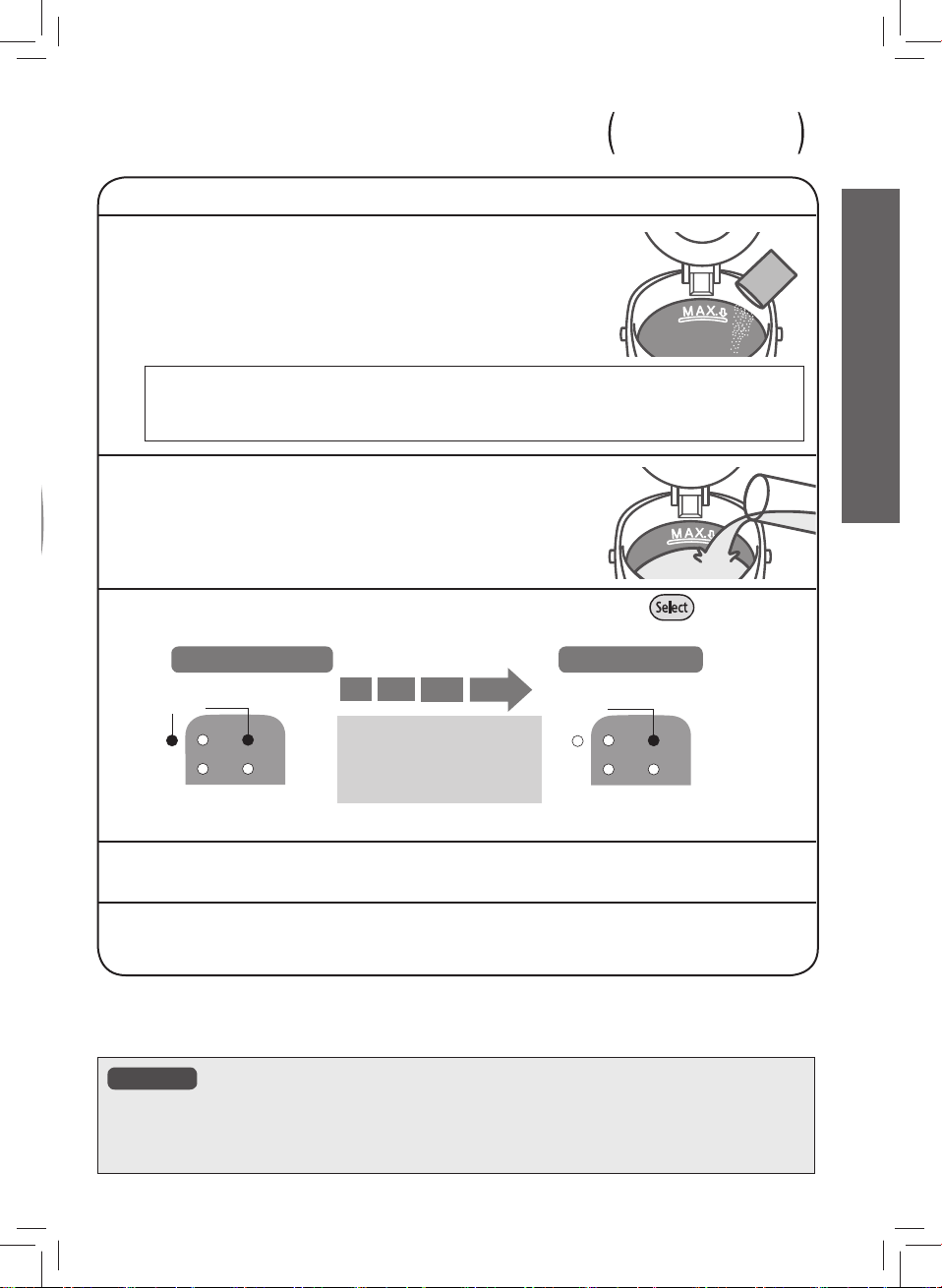
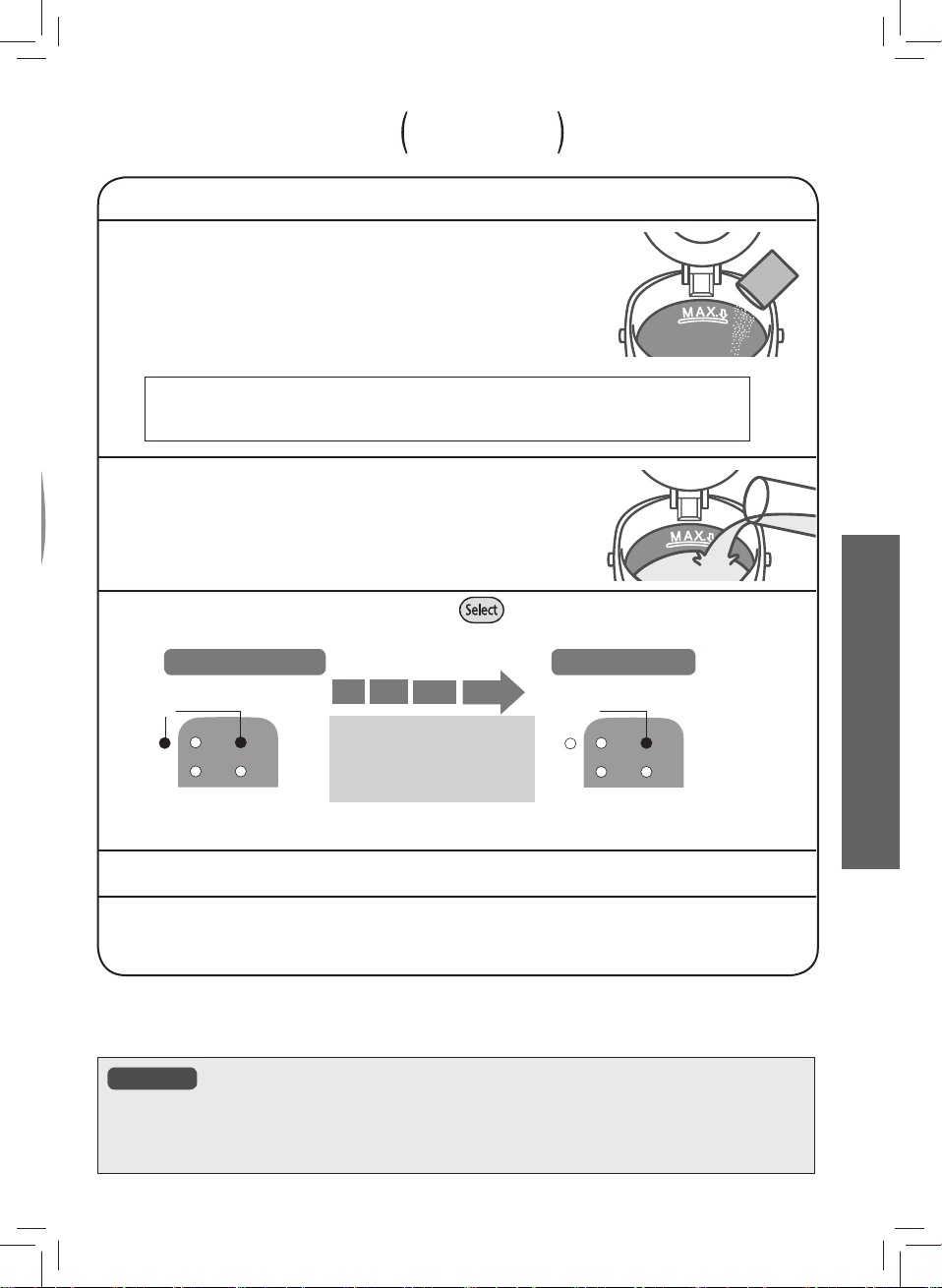
Once every two or three
months to clear scale.
1
Make sure that the mesh filter is attached to the inner container.
2
Put citric acid in the inner container.
●
Amount of citric acid to be used at one time:
80 g (two packages) or seven level tablespoons
*
In case that our citric acid is not available, place 1-2 sliced
lemons wrapped with a thin cloth into the inner container instead.
(The detergency of lemon is less effective than using the citric
acid.)
The citric acid is available from an authorized dealer (as described in the warranty).
(Model No: SAN-80N)
* Follow the directions for cleaning printed on the citric acid package.
* Since the citric acid used for cleaning is a food additive, it is harmless to humans.
3
Add water to the maximum water level mark,
and mix the citric acid and water well.
Close the lid.
4
Connect the plug immediately after stirring and press key for
more than 3 seconds.
Indicators light up when
cleaning cycle starts.
Indicators flash when
cleaning cycle ends.
180 208
160 190
180 208
160 190
Cleaning starts End of cleaning
Light on
Flashing
Cleaning time (approx.)
NC-EG4000: 50 min
NC-EG3000: 42 min
NC-EG2200: 35 min
5
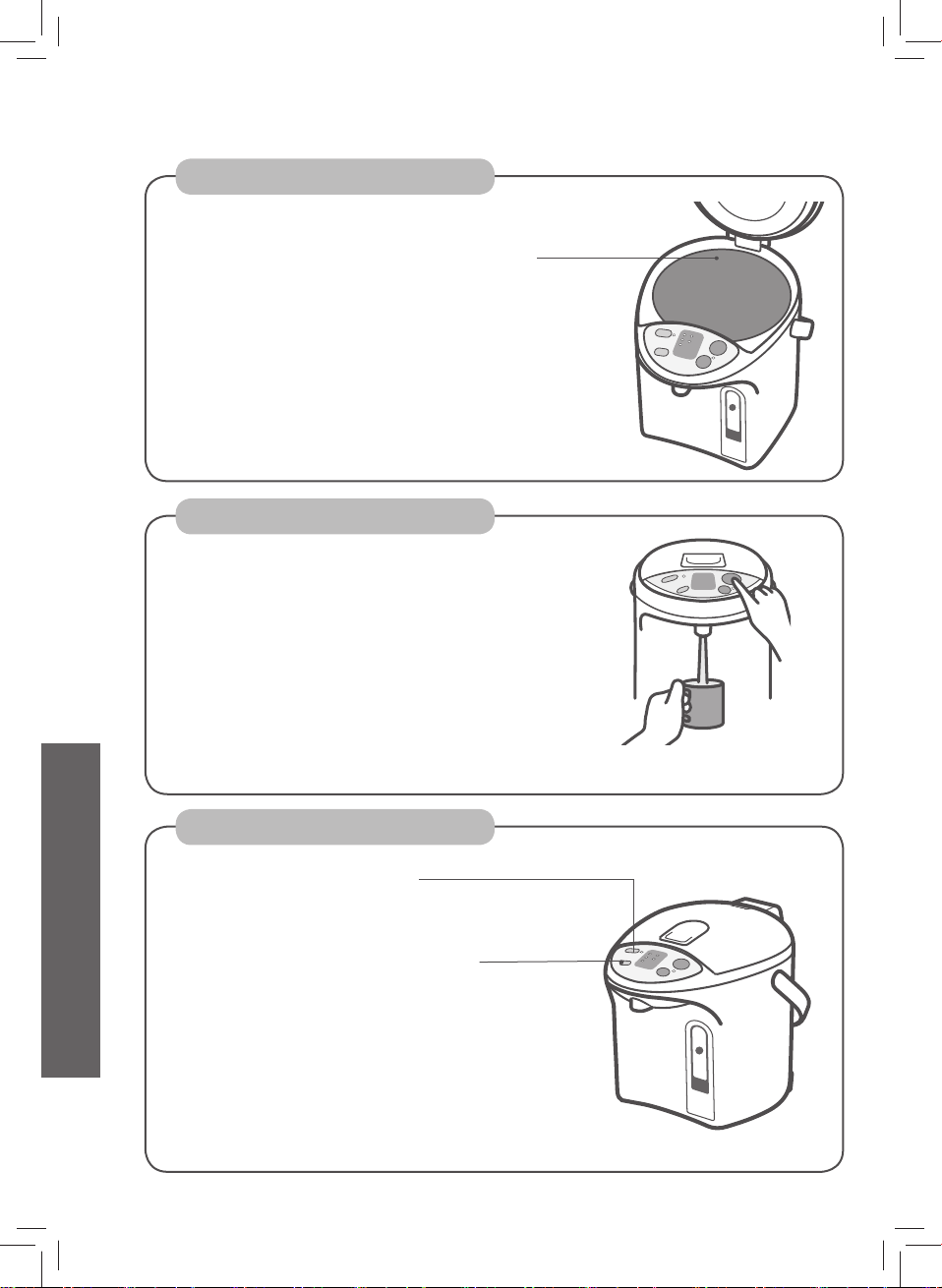
Dispense some water, then unplug, remove the lid and drain away the
hot water via the ‘DRAIN’ mark.
6
Refill with water and boil it to remove the smell of the citric acid or
lemons. Then throw the hot water away as same as step 5.
How to clean the inner container using citric acid.
●
To remove any discoloration from the area above the maximum water level, rub the inside lightly with a wet
soft sponge.
●
If the discoloration cannot be removed by rubbing, clean the inner container several times using citric acid
or lemons.
Cautions
●
Please use our citric acid to clean the inner container of this unit.
●
Do not fill with water above maximum water level.
●
Fill the inner container only with tap water (do not fill with hot water). Hot water may spout out causing
burns.
citric acid
Daily Maintenance
06_USA_OM_NC-EG2200_3000_4000_EN.indd 2106_USA_OM_NC-EG2200_3000_4000_EN.indd 21 12/14/2558 BE 15:5012/14/2558 BE 15:50
22
Troubleshooting
Before calling a service supplier,
please check the following possible causes.
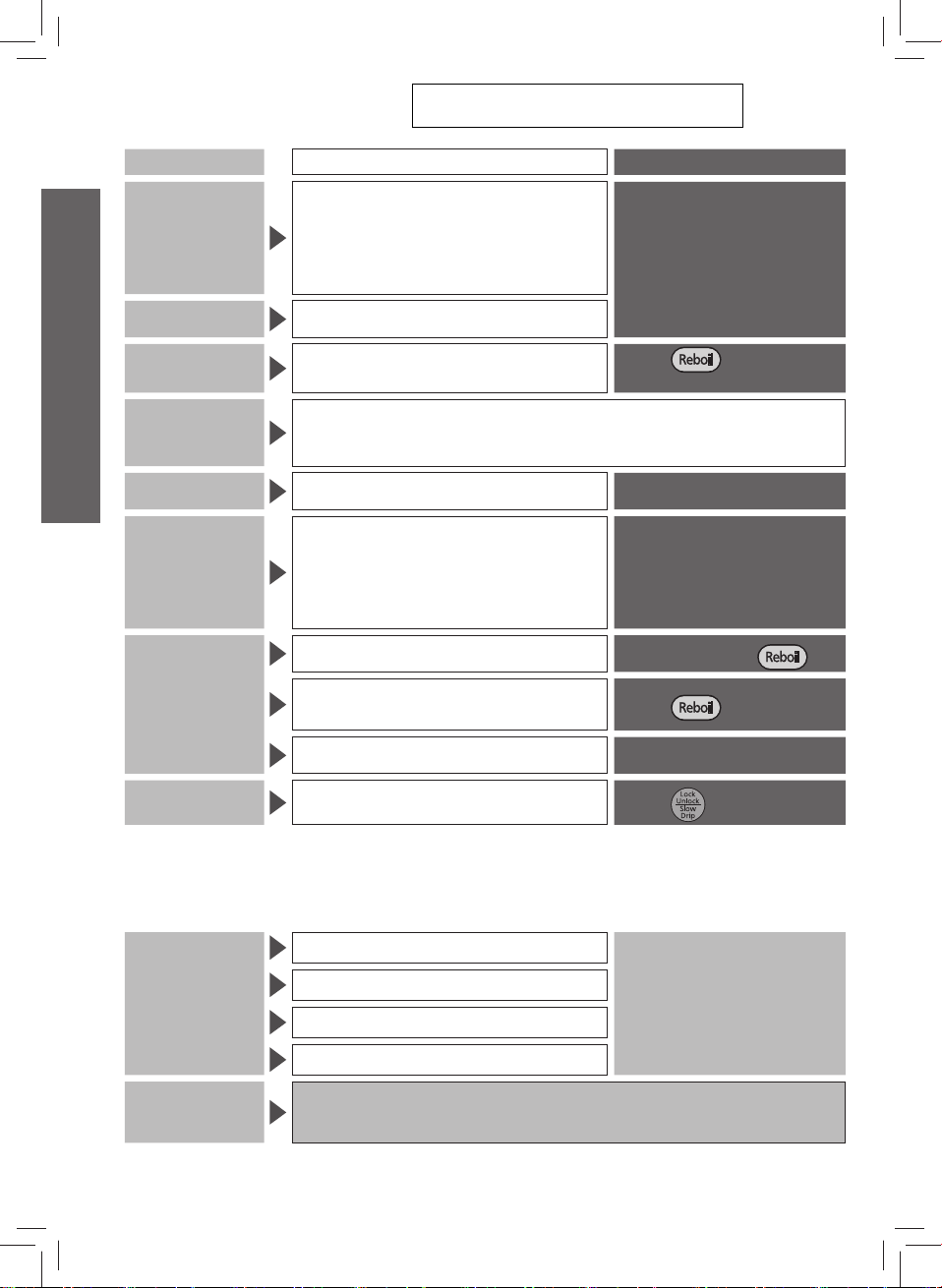
If... Possible cause How to fix
White or glittering
flakes floating in
the hot water.
Rough milky white
substancess are
adhered to inner
container.
●
The cause of this is “scale”. (see P.20)
It is not flakes of fluororesin.
* Water with a large content of minerals in it
such as mineral water or ionized water, is
more likely to cause a scale or white layer in
the hot water.
●
Clean the inner container with a
wet soft sponge. (See P.20)
●
If the “scale” still remains, clean
with citric acid. (See P.21)
Boiling sounds
become louder.
●
When “scale” adheres, boiling sounds become
louder.
Hot water has
odors of chlorine.
●
Odors of chlorine remain depending on the
amount of chlorine in tap water.
●
Press key to reduce the
chlorine. (See P.16)
Hot water has an
unpleasant odor.
●
When the unit is new, resin used in the manufacturing process may give off a mild odor.
This will disappear with use.
●
If the unit is placed on surfaces such as a vinyl sheet, the odor may be carried over into the
water.
Hot water comes
out by itself.
●
Water has been added above maximum water
level.
●
Lower the water level.
Hot water does not
flow out smoothly.
●
The mesh filter may be clogged with “scale”.
(See P.20)
●
When scale accumulates in the inner container
and remaining hot water is low, hot water does
hot flow out smoothly.
●
Immediately after boiling, hot water may not flow
out smoothly.
●
Clean the filter with a brush.
●
If the “scale” cannot be removed,
replace the filter (See P.23)
The indicator lights
flash alternately.
●
Overheating protection has been activated
(See P.15)
●
Add water and press key.
●
The indicator lights may flash alternately by
adding boiling water or the way the water is
supplied.
●
Press key.
●
When the inner container is cleaned with citric
acid, citric acid has built up on the bottom.
●
Disconnect the plug, and stir the
citric well to dispose.
Hot water does not
dispense.
●
The automatic lock has been engaged.
●
Press key.
●
If the problem is not fixed after checking the above possible causes, or if you think something is strange, disconnect the
body plug from the unit. Wait at least 10 seconds and then re-connect the plug.
●
The semi-transparent inner part inside the lid may become yellowish. This does not affect operation of the unit.
●
The rattling noise in the lid is made by small ball-shaped components which prevent water from flooding out
if the unit topples over.
●
If the room temperature is very high, the outside of the main unit may reach about 130°F (55°C).
The unit does not
turn on.
●
You poured in water directly from a tap.
●
It is broken if the electric
components are immersed in
water.
Contact the store where you
purchased the unit for repair.
●
You put the unit on the sink.
●
You turn the unit upside down with its bottom wet.
●
You washed the unit in water.
“Reboil” and “180”
indicator lights
flash alternately.
●
This is malfunction of the sensor.
●
Contact the stores where you purchased.
Troubleshooting
06_USA_OM_NC-EG2200_3000_4000_EN.indd 2206_USA_OM_NC-EG2200_3000_4000_EN.indd 22 12/14/2558 BE 15:5012/14/2558 BE 15:50
23
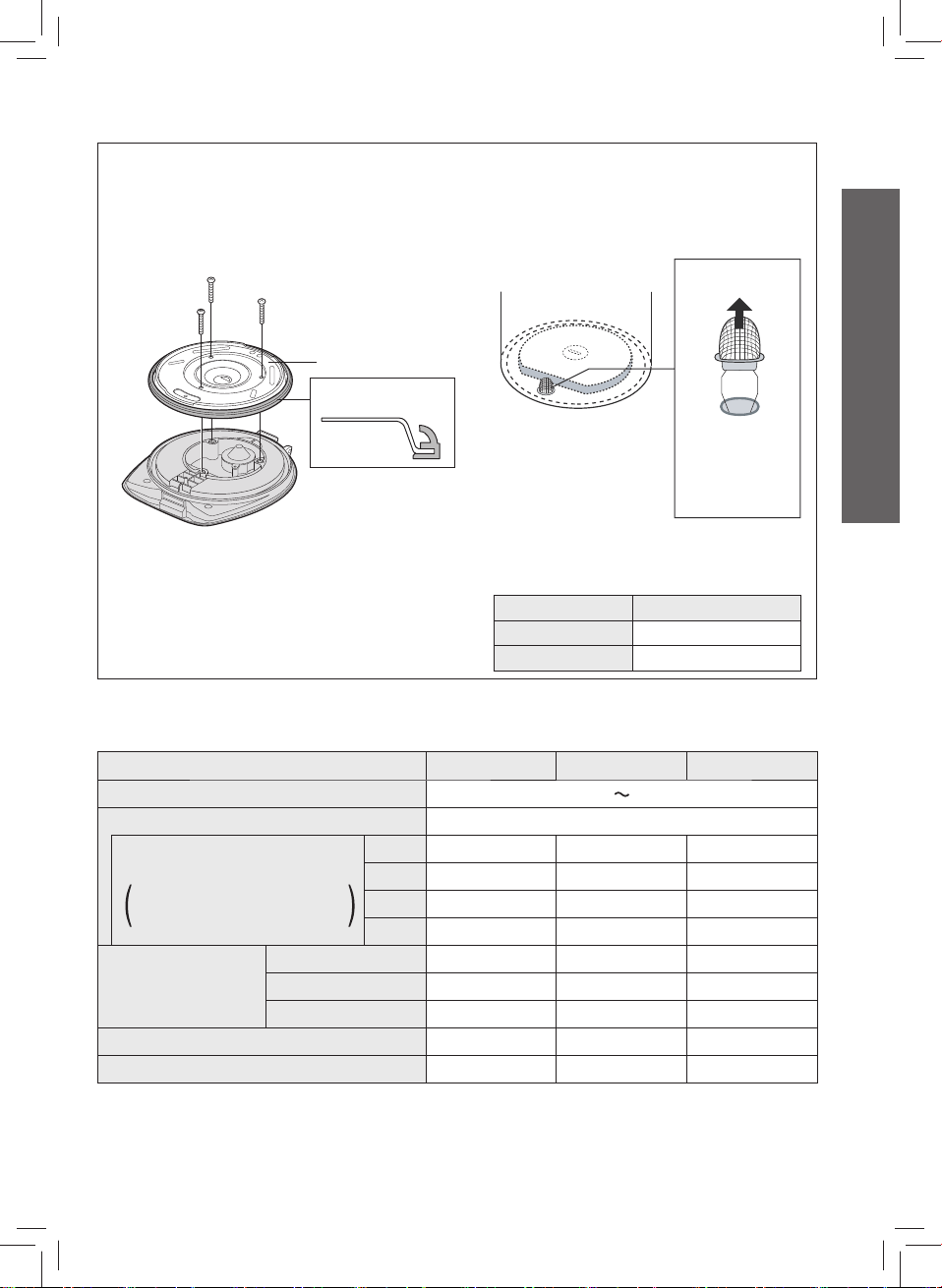
Model No.
NC-EG4000 NC-EG3000 NC-EG2200
Power supply 120 V
60 Hz
Power consumption 700 W
Average power consumption
in keeping warm (approx.)
Amount of water: maximum
Room temperature: 68°F
(20°C)
at 208
49 Wh
45 Wh 40 Wh
at 190
43 Wh
39 Wh 33 Wh
at 180
35 Wh
31 Wh 27 Wh
at 160
30 Wh
26 Wh 23 Wh
Dimensions
(when the handle is
tilted)
Height (approx.)
12.8 in (32.4 cm)
10.8 in (27.5 cm) 9.4 in (23.8 cm)
Width (approx.)
8.5 in (21.7 cm)
8.5 in (21.7 cm) 8.5 in (21.7 cm)
Depth (approx.)
11.3 in (28.7 cm)
11.3 in (28.7 cm) 11.3 in (28.7 cm)
Weight (including power cord) (approx.)
4.9 lb (2.2 k
g
)
4.4 lb (2.0 k
g
) 4.2 lb (1.9 k
g
)
Rated capacity (approx.)
4.2 qt (4.0 L)
3.2 qt (3.0 L) 2.3 qt (2.2 L)
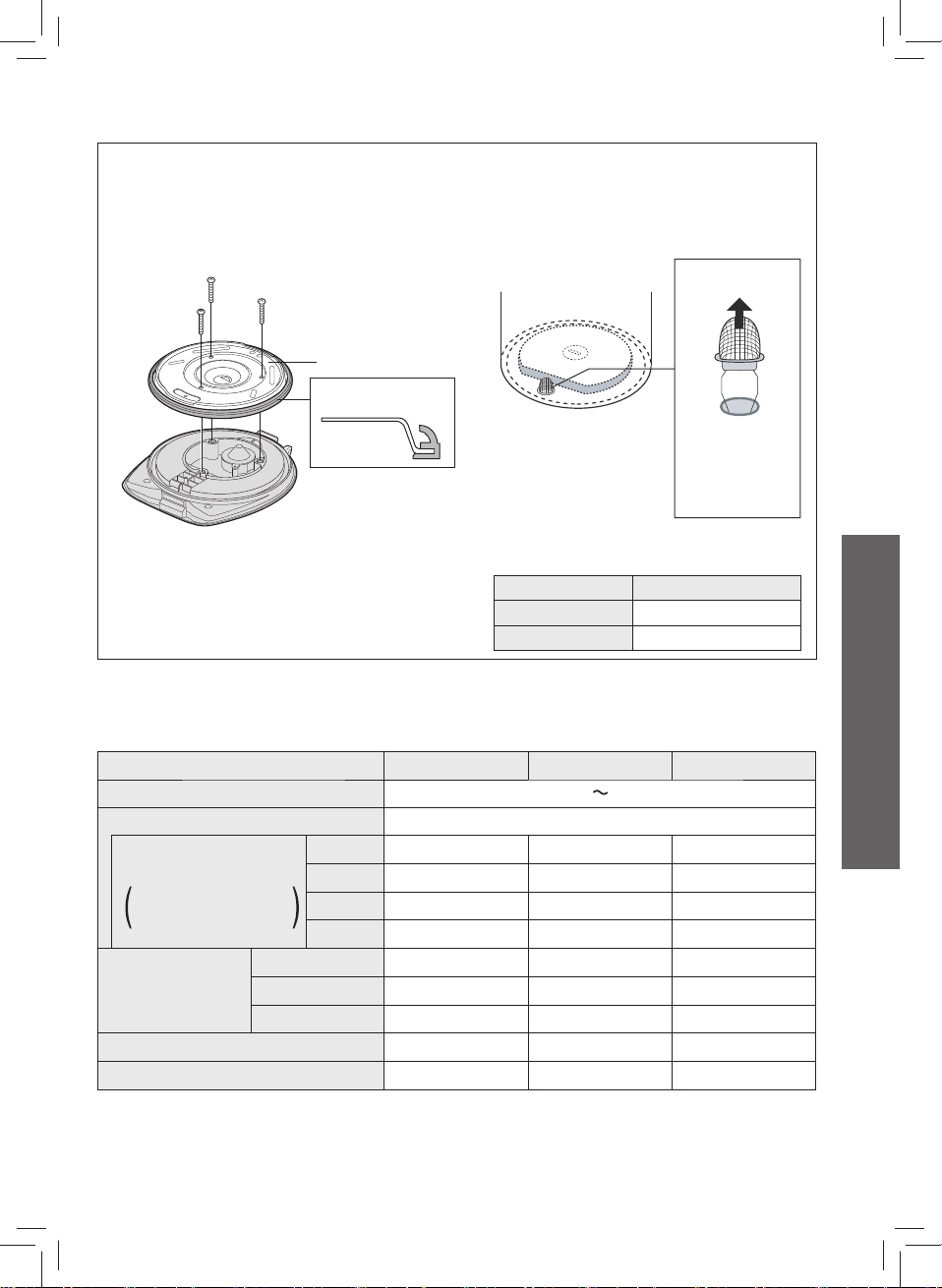
Rubber gasket set
Replace gaskets if they crack, lose their pliability
or, for any other reasons which allow steam to
escape from between the container and the lid.
Mesh filter
Replace the filter, if foreign matter which clog
the filter cannot be removed, even after you
scrub with a cleaning brush, etc.
The filter can be
removed by pulling
firmly on it.
APB97-480-0U
Lid cover
Remove gaskets
For replacement parts, please
contact an authorized service center
(as described in the warranty).
Part name Part No.
Rubber gasket set APH65-480
Mesh filter APB97-480-0U
Remove lid, unscrew 3 tapping screws and remove
the lid cover.
Exchange the gaskets and then place the lid cover
back and secure with the tapping screws.
Replacement of Parts
Specifications
* Under certain conditions, such as at very high altitudes and in intense cold, the unit may not function
properly. Please avoid using the unit in such conditions.
* If the unit is not used during cold conditions, make sure to empty it of water. The water left in the inner
container may freeze causing damage.
Raplacement of Parts / Specifications
06_USA_OM_NC-EG2200_3000_4000_EN.indd 2306_USA_OM_NC-EG2200_3000_4000_EN.indd 23 12/14/2558 BE 15:5012/14/2558 BE 15:50
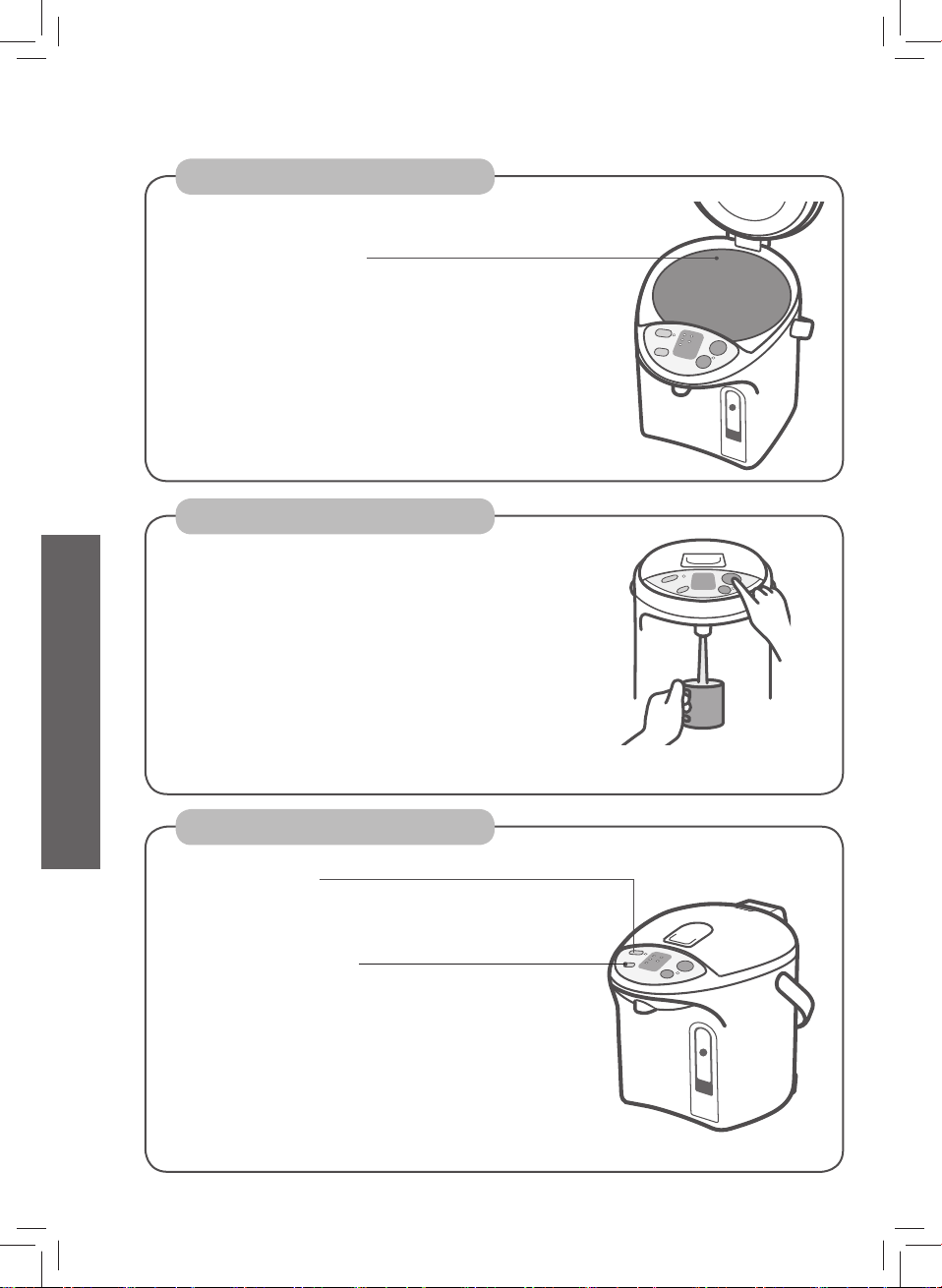
ǂđž
ƶϔ
ůǁ
●
ǗƛŜnj
ϩȒljѮĀqŜnjr
●
ҵ٣Кǟۀ
ϩȒljѮ
●
ŇĴǭĴ،
뻛ϩȒljѮĀqѳǭŇĴǭĴ،r뻜
●
ƞѽѽʇ˞Պ
ĻŘ˞Պי숳ѽβĩ뺯
뻛ϩȒljѮĀqѽβĩr뻜
Ͳǘʓ
●
҂ᑱڝăྀʭ୯
ȂʭӌůӼޕ҄ǥஃȉᴤٌࣷʸȀʕ뻟
ͲǘʓŠѷ뺯
㺮➦◦
06_USA_OM_NC-EG2200_3000_4000_CS.indd 2406_USA_OM_NC-EG2200_3000_4000_CS.indd 24 12/14/2558 BE 16:1212/14/2558 BE 16:12
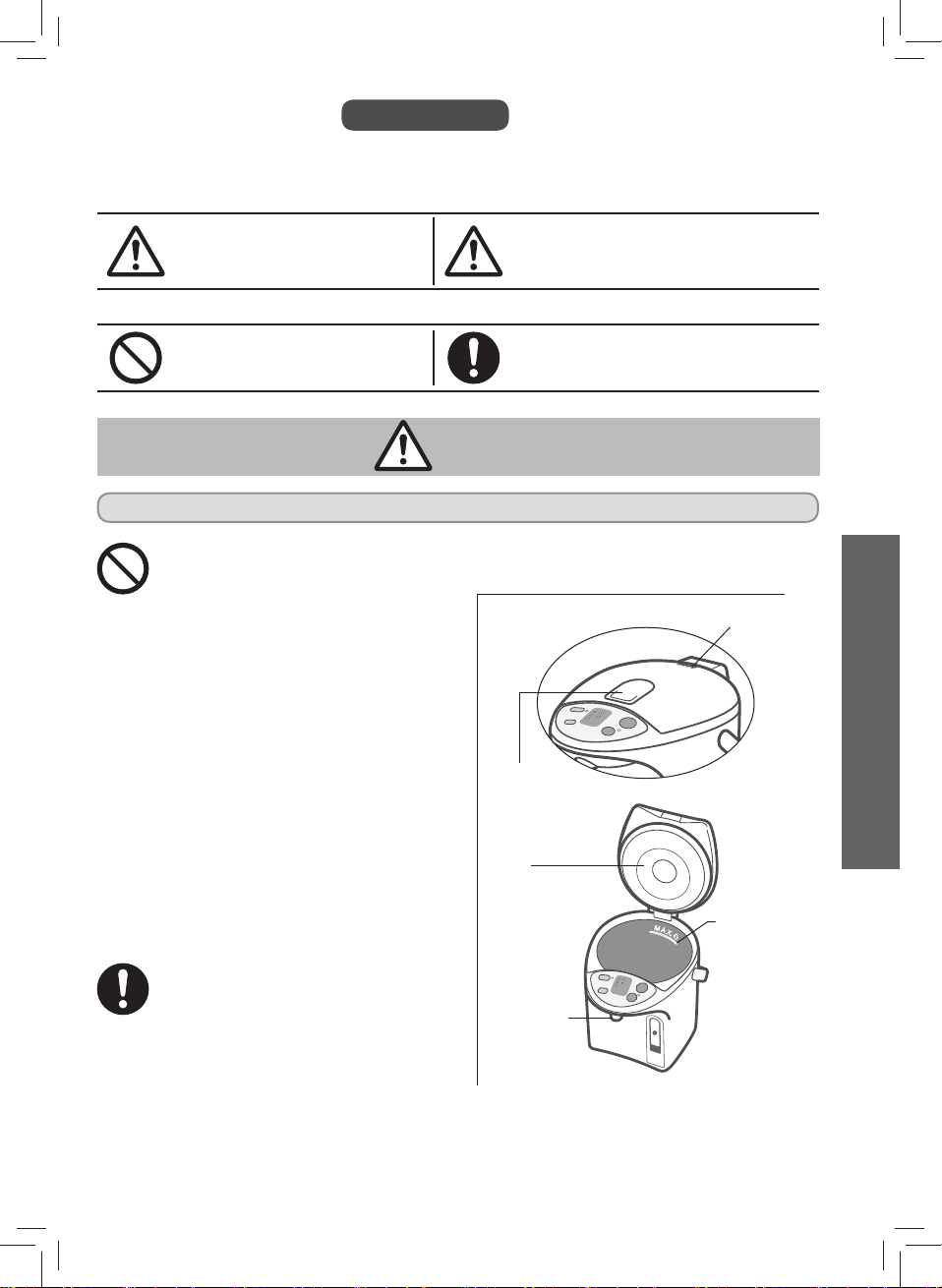
ȫƽNjƂֻ
Ӫκᆰࡳ
ޱˍ
ũȱ܍ᔪ
Ęࣧ
njԶʥ
Ŝnjˍ
●
ɑ୬Ǖɶnjӌջԧ뺯୬őĘࣧ뺮ိӍڶྞǕɶnjӌͱƛǕɶnjӌ뺯
q&KURGPUG뻛Ŝnj뻜rƻǭ뻟ɶnjӌܼջԧͱိ뻟ɶnjģĜȮŜnjˍŠޱˍȹ
Ŝ뻟َ֢˼뺯
●
ăđůƺȱĘࣧ뺯
ۚק뻟ɶnjຯŜ뻟Ļَ֢˼뺯
●
ԧɍnjĴăđɸĿnjԶʥ뺯
Ƨư˽ɶnjӌȀnjĿĠ뻟ĻĩĜ૧Ŝ
nj뺯ۚק뻟ɶnjຯŜ뻟Ļَ֢˼뺯
●
ŮĩůĎۢnj뺯
ܼůĎү뺮ү࣭뺮ЛѬ뺮ЌͱȺŴ
nj뻟קĜőܴ૧Ŝ뻟Ļَ֢˼뺯
ˤʌ뻟ńĜَ֢Ŝnjϯ௹뺮ʭӌۢ౦ͱ
ઈᔃӍᴤٌ࠲ஊҔ뺯
●
ăđůବҘDžʐޱˍ뺯
ۚק뻟ɶnjຯŜ뻟Ļَ֢˼뺯
●
ԧҎnjĴđĪĘࣧ뺯
ۚק뻟ܼĘࣧҔ뻟ɶnjជŜ뻟Ļَ֢
˼뺯
●
ɑ୬ůƋޱˍ뺯
ۚק뻟Ļَ֢˼뺯ȺĄNjăđź
ɳ뺯
●
ǕмȞ˄πҒůǘŇˏ뻟פπŴĶǁݸޡȺ
ȫƽĀʗĉઠႺͱϱФƧůǕмȞ뺯
●
کȱČĘࣧ뺯
ۚק뻟оĂɶnjӌջԧĴ뻟ɶnjȹŜ뻟Ļ
َ֢˼뺯
ħɺĉ˴˼Ҵ뺮ǗͱΖฮĀ߭ٛ뻟ɑᆰ౼ŘĪʳ뻭
n
ŘĪԶՠȪФȆăȢکů˽мȞĴȝŜƍ˼Ҵȉ뺯
n
ĪǚȪФӪκᆰࡳĀނժƂֻ뺯
ܔг Nj
ĕĂԶФႰȪФ
qĻĩĜَ֢ǧ୭
ͱȶ˼Džrʭ뺯
ĕĂԶФႰȪФqĻĩ
Ĝَ֢˼Ҵͱّşŀ
м˫rʭ뺯
ˤȪФκ݉ыĀ߽ǟ뺯 ˤȪФκ݉ɘDŽĀ߽ǟ뺯
ܔг
ħ֑ٜ˼
Ⴖڕ∕ᘼθ䶦
06_USA_OM_NC-EG2200_3000_4000_CS.indd 2506_USA_OM_NC-EG2200_3000_4000_CS.indd 25 12/14/2558 BE 16:1212/14/2558 BE 16:12
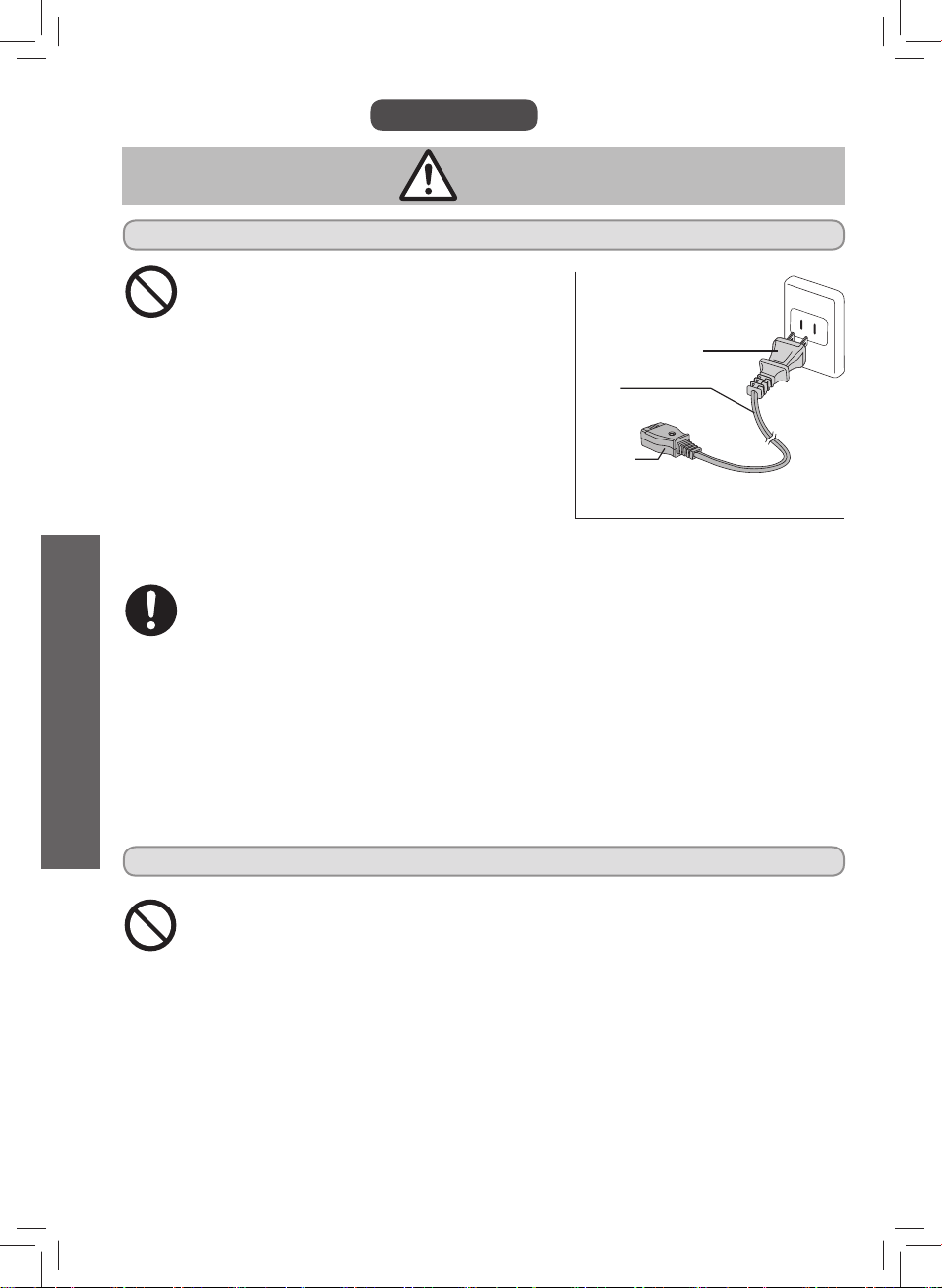
●
ăđǗ۷Ϟ뺮Ǘ۷Ǽ뺮ǂƯǼ뺯
Ƨăīۗ˼뺮ăīȀʕ뺮ăīϤ˦şɶ،Ե뺮ăī
˓DŽഖف뺮ăīอᗊ뺮ăīӘ뺮ăīǽٝȶˀ뺮
ăīǙᝤ뺯
ܼůĀǗ۷ϞŠǼ뻟Ļَ֢ҽɢͱΖฮ뺯
●
ƧưǗ۷ϞǢ뻟κ݉ୟŘƑҕ뺯ّĻύ౷ܨĀ
˖ӪġķɘDŽάէ뻛Ƨէ˱Ǩۅ뻜뺯
●
ăđůƋΪˈͱגũΪˈǗ۷ǼŠǂƯǼ뺯
ۚק뻟Ļَ֢Ǘ뺯
●
ăđźɳǂƯǼ뺯
ȍNjăđźɳጱǂƯǼ뺯
ۚק뻟Ļَ֢ǗŠɩ˼뺯
●
ɑ୬ćǂƯǼǽٝŇˀȞ뺯
ۚק뻟Ļَ֢Ǘ뺮ҽɢ뺮ͱΖฮ뺯
●
کǢȝǗ۷ǼȥƽɍĘǝ뺯
λȥƽɍĴ뻟Ļَ֢Ǘ뺮şɶƦڇőΖฮ뺯
●
ɑ୫ůĀǼŠؠƛĀǝ뺯
●
֑ٜǗŠ뻢ͱőΖ뻟ŢǗ۷ǼͱɆɘDŽǭʿפଠ뺯
ҔćǗϞͱǼĘĀߒnjଟĻĩĜَ֢ӗՙ˫в뺯
●
ĪǼ뻟ůѝҘࠚᓴ뺯
●
˱ћůʸǭǗ۷ĀǗ۷ǝ뺯
ܼȉȺŴǗ،мȞդů뻟Ļَ֢şɶ뻟ȮƦşŀΖฮ뺯
߽ǟ
Ǘ۷Ϟ
Ǘ۷Ϟ
Ǽ֜ޕ֪֮ŞҡăǜƦăǜ뺯
ǗϞ
ǂƯ
ǼǺ
Ǘ۷Ǽ
ȫƽNjƂֻ
Ӫκᆰࡳ
●
ɑ୬ȝˤɶnjӌ뺮Ǘ۷ǼӍɶnjӌɆǼĀΪˈˌɫٝǘnjġ뻟ͱźnjជė뺯
●
ɑ୫ůnjǼˢˈࣂnj뻟ͱȝǕɶnjӌٝǘnjġ뻟ۚקЫˌĻĩĜ࠼뺯
●
ȆЫˌȻĴ뻟ɑ୫ȝǕɶnjӌԧٝ뺯
ĻĩĜَ֢ҽɢŠǗ뻟Ʀؼ뻟ܼnjຯŜɶnjӌ뻟ĻĩɘɍǕƯʭٝĀǗŔˌɫġ뻟ȮƦ֢
َβĩ˫˩뺯
●
ɑ୬ഋ뺮էȗͱϑǕɶnjӌ뺯
ۚק뻟Ļَ֢ڇőΖฮͱĉ˴ɩ˼뺯
●
ɑԓͷ౷ܨߊŶġķąনէƂࢎƧէ˱Ǩۅ뺯
●
ăđǽɍܳԿůǟَһ뺯
ۚק뻟Ļَ֢ʪܳƦڇőǗͱтච뺯
ܔг
Ⴖڕ∕ᘼθ䶦
06_USA_OM_NC-EG2200_3000_4000_CS.indd 2606_USA_OM_NC-EG2200_3000_4000_CS.indd 26 12/14/2558 BE 16:1212/14/2558 BE 16:12
߽ǟ
Ǘ۷Ϟ
ħ֑ٜ˼
●
ăđȝɶnjӌǽćăːĀŞƶ뺯
ۚק뻟ɶnjӌջԧ뻟Ļَ֢˼뺯
●
ġăđǙũĘࣧͱԧɶnj뺯
ۚק뻟ɶnjជ뻟Ļَ֢˼뺯
●
ԧnjĴ뻟ăđʽƛǕɶnjӌ뺯
ۚק뻟ɶnjជ뻟Ļَ֢˼뺯
●
ůġͱǔůĿŶ뻟ăđǕɶnjӌĀƬѽˌœ뺯
ۚק뻟Ļَ֢˼뺯
●
ǙũͱȱࣧŔĴ뻟NjƋđũޱˍ뺯
ۚק뻟Ļَ֢˼뺯
●
ƛǕɶnjӌĴ뻟ăđũࣧ܍ᔪ뺯
ۚק뻟ĘࣧӏƔũ뻟Ļَ֢˼Šɩ˼뺯
●
αǕɶnjӌһ˂ŶǞɘDŽά֕뺯
ۚק뻟Ļَ֢˼뺯
●
ԧҎnjĴ뻟Njăđƻ˼뺯
●
ɶnjӌăĩǥĴǎćɩɶǚĘů뺯
ۚק뻟ȝĜȻɡͱۂ뺯
●
ɑ୬Ϥ˦ૼŠŝԵǽٝ뺯
ۚק뻟ޱŠɶʔĻҴૻŠŝԵ뻟ȮƦڇőȻɡͱȻ֜뺯
●
ܼްȻɡşɃ뻟ɑƑҕް뺯ϩȒljѮ
ۚקɶnjӌိͱNjʌջԧĴɶnjĜຯŜ뺯
●
ăđůπʗůǗ۷Ϟ뻟ģăđȝ˽Ǘ۷ϞůǘȺŴѳ҄뺯
뻛ɑ୬ůπǕѳ҄ʗůǗ۷Ϟ뺯뻜
ۚק뻟Ļَ֢тචͱΖฮ뺯
●
ăůǕɶnjӌĴ뻟ɑȮૼǝĘĪǗ۷Ǽ뺯
ۚק뻟ȂӗՙƳɝʚĻَ֢Ǘ뺮ŠͱΖฮ뺯
●
ĪǗ۷Īǖ۷ǼĴ뻟ӪκেʐǗ۷Ǽˌœ뻟ăđӘǗ۷Ϟ뺯
ۚק뻟Ļَ֢Ǘ뺮ҽɢ뻟ৰψڇőΖฮ뺯
Nj
Ⴖڕ∕ᘼθ䶦
06_USA_OM_NC-EG2200_3000_4000_CS.indd 2706_USA_OM_NC-EG2200_3000_4000_CS.indd 27 12/14/2558 BE 16:1212/14/2558 BE 16:12
œˌǩ؆Š߽ǟƶʒ
߽ǟǚذ
ũȱ܍ᔪ
ޱˍ
Ęࣧ
Ƌៅ
ʭӌ
ƈnjԶʥ
ܣᅣ
εɡЎ
njʔɸŜܣᅣĴ뻟
ȝƄʒğėnjʔϱ
ФԶʥ뺯
ණʽх뻛삵
ʽƛٝĴ뻟NjăđźǗϞ൳ǂƯ뺯
Ŝnjˍ
ǕƯ
Ŀȅ
Ǘ۷Ϟ
Ǘ۷Ǽ
ǗϞ
ǂƯǼ
Ǻ
Ǽ֜ޕ֪֮ŞҡăǜƦăǜ뺯
뻛Ͳഺˍ뻜
ĿȅĈĻĩȮʭӌЫˌҔ뺯
ҔĴ뻟ˆȝȺȥƽɍȢکʞٝĘ뺯
뻛ϩȒljѮ뻜
#2$7
ܳ䘕⼝হ᧺҉∂
06_USA_OM_NC-EG2200_3000_4000_CS.indd 2806_USA_OM_NC-EG2200_3000_4000_CS.indd 28 12/14/2558 BE 16:1212/14/2558 BE 16:12
Ęࣧഋƶʒ
ȱǘ֑ٜ˭ۢ
ȱĴ
܍ĪĘࣧ뻟ˢψȴėᩬ឴ďʞ뺯
ȫĴ
ŘĂǭĀԴʇ뻟ɍĘࣧ뺯
ׅФĀȿϥƶʒ
ćʭӌġȀnj뻟ƔŶ܍ 뺯
Nj
ũȱ܍ᔪ
Ęࣧᔪ
ιࣈᙊ
ʭӌ˭ӌȀɶĴĜмŀࡋ뻟،ͱĜȻɡ뺯
܍Ī˄őũࣧƋៅ뻟
ǙũĘࣧ뺯
ć܍ĪĘࣧᔪĀǜĴ뻟
েŏũࣧ܍ᔪˋိĘƶŜ뺯
180 208
160 190
ćɶnjӌƀǢƄnjĴȀɶ뻟Ŀɶȫƽβĩ뻛Ļ֑ٜʭӌ˭ӌĿɶ뻜Ĝƛ뺯ĢƛОגǗ۷뻟
Ř֑ٜĿɶҝŪтච뻟˄ćŘĪׅФǚذĘׅФ뺯
ʅȂ
●
ćʭӌġĀnjӣǘŖӣnjʞĴۢnj뺯
ܳ䘕⼝হ᧺҉∂
06_USA_OM_NC-EG2200_3000_4000_CS.indd 2906_USA_OM_NC-EG2200_3000_4000_CS.indd 29 12/14/2558 BE 16:1212/14/2558 BE 16:12
Dispense
đɺᬎĴ
ůƶʒ
ۢnj
Ŝnj
ǗƛŜnj
܍Ī 뻟ϱФࠉࣈᙊ뺯
뻛ǥĴǎ٣К뻜
ćnjġ뻟܍ơ뻟ćnjѽġ뻟܍ơ뺯
ǥĴǎיœѨ뻟ĻɺnjġיĀᬎ뺯
●
đಥƫĴ뻟Ǟ܍Ăơ 뺯
ƈnjԶʥ
njʔˆƬǘŖӣnjʞ
ůԨʌĀ
،Ȁnj뺯
ljĂơůǡ
njԶʥ
ȀɍĀnjăđɸ
ĿnjԶʥ뺯
1
ůԨʌĀ،ȀnjψnjԶʥ뺯
2
کȱČĘࣧ뺯
3
ȝnj뻟ˢė4GDQKN뻛Ǟơ뻜ϱ
ФࠉᏧஓ뺯
4
ԧҎĂȏnj뺯
5
ҎǗ۷Ǽ뻟ȿĪࣧŔ뺯
6
ŢnjԶʥ뻟મҵԧŜĀɶnj뺯
Ҭ⩕∂
06_USA_OM_NC-EG2200_3000_4000_CS.indd 3006_USA_OM_NC-EG2200_3000_4000_CS.indd 30 12/14/2558 BE 16:1212/14/2558 BE 16:12
180 208
160 190
180 208
160 190
180 208
160 190
ăůĴ
ůԨʌĀ،Ȁnj뺯کȱČĘࣧ뺯
ȝǂƯǼnjːŞᕱɍǕɆĘ뺯ɍૼǝ뺯ϩȒljѮ1 2
njۢũĀĴǎ
NC-EG4000יœѨNC-EG3000יœѨNC-EG2200יœѨ
njʔ뻭Ŗęnjةѽ뻭숳삸
Nj
●
ɑ୫ԧnj뺯
ƧưnjជėࣧŔؠˌœŠ߽ǟǚذĘ뻟
ĻĩĜَ֢βĩ˫˩뺯
●
ɑ୫ȝnjңćʭӌġ뺯
ۚק뻟ĻĩĚَ֢ʭӌઈᔃͱмŀࡋ뺯뻜
ҎǗ۷Ǽ뻟ȿĪࣧŔ뺯Ţ
&4#+0
Զʥ뻟મҵԧŜĀɶnj뺯
ࣧŔؠˌœ
߽ǟǚذ
žб
žбࣈᙊࣈᙊ
Ꮷஒ
Ꮷஒ
ćɶnjŜĎŶ뻟יځѨ뻟
Dispense
ȝĢ
ƛȶĥǭ뺯
܍ƪơ
뻟ũ˨મҵۀКŜnj뺯
˪ĀϱФࠉȝĜࣈᙊ뺯
뻛ϩȒljѮĀqҵ٣Кr뻜
ࣈᙊ
žб
Ģƛũ˨뺯 ŶƧĪǨФ뺯
뻛ǨׅФĀѽʇّࣂϩҨ뺯뻜
ѽʇȝܱψי
숳뻟˄ĢƛО
ҕψѽβĩ뺯
܍ 뻟Ļǭ뺯
˪ĀϱФࠉȝĜбő뺯
܍Ī
Dispense
܍뻟Ŝɶnj뺯
Ҭ⩕∂
06_USA_OM_NC-EG2200_3000_4000_CS.indd 3106_USA_OM_NC-EG2200_3000_4000_CS.indd 31 12/14/2558 BE 16:1212/14/2558 BE 16:12
Dispense
ƶϔĀůƶʒ
●
ćnjͱѽʿǎ뻟ĻŘѳǭѽѽʇͱ
ǭĴ،뺯
●
ćşŀǗ۷тචƦƣฎҫࣂǗŶ뻟
Řǡ˞ՊąǭĴ،ͱqr뺮qr
ͱqrѽβĩ뻟ѽѽʇঞȝĜĢƛ
ѳǭćqr뺯
Nj
Ǟ
●
ڮܴүܴƶϔǚDž뻟ŖČ
ůnj뺯
●
ŜɠDžĴăůɶnjӌĴ
ѳǭŇĴǭĴ،
●
ćǭĴ،ѳǭĀĴǎʭ뻟Ȁɶ،Ģ
ƛגǗ뺯
ҵ٣Кǟۀ
●
ҵюԧnj뺯
●
njŶĻĩʼnȧԧŜ뻟ͱԧŜĴ
ă؋ઁ뺯
ѽβĩ
●
qѽrħǟ܄үĀȗĞ
٣К뺯
●
qѽrħɳᄨѬĀȗĞ
٣К뺯
ɑȝѬćƈɳߺůǡϵһ˂뻟
ͱȉũnjࣷŠψҒȆѽʇ뺯
Ӭ⮱Ҭ⩕∂
06_USA_OM_NC-EG2200_3000_4000_CS.indd 3206_USA_OM_NC-EG2200_3000_4000_CS.indd 32 12/14/2558 BE 16:1212/14/2558 BE 16:12
180 208
160 190
180 208
160 190
180 208
160 190
ܱψǨѳǭĀѽѽʇĴǨĀĴǎ
ѽ뻭כœѨ
ѽ뻭כŇĴ
ѽ뻭כŇĴ
njʔ뻭Ŗę
ةѽ뻭숳삸
ŘǡĀѽѳǭҲ뻭숳
ȶĥĀĴǎ
Ȯѽ뻭יœѨ
Ȯѽ뻭יœѨ
Ȯѽ뻭יœѨ
Ȯѽ뻭יœѨ
njʔ뻭Ŗę
ةѽ뻭숳삸
뻛Ȇ˞ǭ숳ѽѽʇĴ뻜
뻛Ŷ뻜
܍Ī
žб
뻟ȝȢć
ѽĀnjȶĥ뺯
ǴœѨŶ뻟njȝ뺯
sѽѽʇŠΆיǭĴ،
ĀѳǭƄȻ뺯
Ꮷஒ
ࣈᙊ
žб
ࣈᙊ
܍ƪơ 뻟Ǟ܍
Dispense
ǟۀ뺯
●
ȆœԜ߽ǟʪŶ뻟ǗϖᄨȝĢƛǭځ뺯
●
ǞơԧŜɶnj뻟ćځʭ܍
Dispense
뺯
●
ƧưŊĈ܍Ī
Dispense
뻟
Dispense
ĜćځŶĢƛȶĥǭ뺯
Ʋơ܍Ī
뻟ȝĜОҕŘĪβĩ뺯
Ģƛǭ Ŝnj뻛ࠉбő뻜 ҵ٣К뻛ࠉࣈᙊ뻜
ࣈᙊ
180 208
160 190
Ǟ܍ 뺯
Ʋơ܍뻟q rԶʥ
ȝࡡėĪĂċ˞Պ뻟
˄ϑȻѽѽʇͱѳ
ǭǭĴ،뺯
ŇĴŶ뻟ǭĴ،ȝȱ뻟˄ũ˨뺯
ȆnjėУѽʇĴ뻟ȝć
숳
ɘDŽѽ뺯
ҽĴǎŶ뻟njѽȝć숳뺯
Ӭ⮱Ҭ⩕∂
06_USA_OM_NC-EG2200_3000_4000_CS.indd 3306_USA_OM_NC-EG2200_3000_4000_CS.indd 33 12/14/2558 BE 16:1212/14/2558 BE 16:12
ůݨŔDžʓҀ뺯
ȆĿȅ௹Ĵ뻟njȹĻĩĜăઁ뺯
ʓҀŶ뻟Ӫκȶĥćʭӌġ뺯
Ŀȅ
ůߒnjĀർնʄࠚᓴ뺯
●
ăđůņӼ뺮ݨ뺮ڲݨ뺯
ȱǘqnjᚗr
ůĿԙġ뻟njġߒĈ࿖ΙDžˀŪœĜઐćʭ
ӌŠĿȅĘ뺯ĕ؆ħqnjᚗr뻟ŢĉɆƄҴ뺯
●
Ƀɡ۲நޕ뻛ύ࿖Ιڇő뻜
●
ɃɡͱࣈʾĀɯˀ뻛ˀʩ౧뻜
●
үɡ뺮ɡ뺮܄ɡDžȻɡᴤٌ࠲ஊ૱ڝĘ֜
ŪĀͼŔ뻜
ĕȏޥăĄʭӌǕǻĀȻɡͱઈᔃ뻟ģăĄᴤٌ
࠲ஊ૱ڝĀᄚҔǨَ뺯
ɑů൙ӔʓҀʭӌ뺯뻛ϩȒljѮ뻜
ʭӌ
ϯǕƯĴ
●
ȝȺ֦œѝ뺯
●
ȝȺǽɍർնġݧ뻟֑ٜଛŔଷɍ뺯
ۚק뻟Ļ˼ᴤٌ࠲ஊ૱ڝ뺯
#2$7
ū˩ѷƶʒ
ůᗊѝĀବҘࠚᓴ뺯
●
ăđůnjҀ뺯
ۚק뻟njȮЫˌŠŜnjˍɘɍʭˌ뻟༞ǕɆʭĀǗŔ،ɫ뻟
Ļَ֢тච뺯
ǕɆ뺮Ęࣧ
●
ăđůҀཾ뺯
ۚק뻟ĻңĈࡋ뺯뻜
●
ăđůޱЅ뺮Đ΄njDžዳ뺯
ۚק뻟Ļ˼Ȫǚ뺯뻜
ʓƥǡ뻟κݯȮǝĘҎǼ뻟ԧҎʭӌƀĀ
nj뻟˄źǕƯһ˂뺯
ᬒ፥Ԋڨ∂
06_USA_OM_NC-EG2200_3000_4000_CS.indd 3406_USA_OM_NC-EG2200_3000_4000_CS.indd 34 12/14/2558 BE 16:1212/14/2558 BE 16:12
1
کȅ݇ʸćʭ୯Ę뺯
2
ȝ൙Ӕǽɍʭӌʭ뺯
●
൙ӔʓҀĂơůʔ
Ս뻜ͱęүཅːཅ
ćנɮăė൙ӔĀŰߧĪ뻟ͳĀƙʒĄůĂԿށҘʐ
Ǧ൙ǽėʭ୮ġ뺯
൙ĀņᚗƺŊĈ൙ӔČ뺯
ɑć౷ܨߊŶġķנɮʓҀů൙ӔƧէ˱Ǩۅ뺯Տ5#00
ɑᆰࡳʓҀů൙ӔઐĀĸdžΒNjƂֻ뺯
ʓҀů൙ӔǘθȞ௴Ȁˀ뻟Ƅ༆θȞېŀ뻟ŢĉɆƄҴ뺯
3
ȀnjψŖnjԶʥ뻟ȝ൙Ӕȉnj֦œࣷʸ뺯
ȱĘĘࣧ뺯
4
෩Ŷ뻟ӐˈĘǼ뻟ƔŶ܍ʐ ځѨŘĘ
180 208
160 190
180 208
160 190
ʓũ˨뻟ׅФૃȝ
ĜşŜʙƢ뺯
ʓʪ뻟ׅФૃȝ
ĜşŜʙƢ뺯
ũ˨ʓҀ ʓҀȥখ
žб
ࣈᙊ
ʓҀĴǎי
NC-EG4000:50œ
NC-EG3000œ
NC-EG3000œ
5
ԧҎĂȏnj뻟ҎǼ뻟ࡡפࣧŔ뻟ŢnjϞŜɶnj뺯
6
ȶĥnj뻟ȝȺ뻟ʓפ൙Ӕͱ൙Āǯ뺯
ƔŶ뻟ȉϳ5uƟ뻟ԧҎɶnj뺯
●
ƧņפnjԶʥŘĘĀȻɡ뻟ĻůĀ߃ݛʄઊΜΜࠚᓴ뺯
●
ƧȻɡߙȶ뻟ĂơăĩʓפĴ뻟ĻѢҫů൙Ӕͱ൙ʓҀʭӌ뺯
Nj
●
ŮĩůǕȔѣŀмĀɶnjӌʓҀů൙Ӕ뺯
●
ȀɍĀnjăđɸĿnjԶʥ뺯
●
Ȯһnjũ˨ăđȀɍɶnj뺯ۚק뻟ɶnjőܴ૧Ŝ뻟Ļَ֢˼뺯
൙Ӕ
ȆઐŏnjᚗĴ뻟ɑů൙ӔʓҀ
ƲͱċʃʓҀơ
ᬒ፥Ԋڨ∂
06_USA_OM_NC-EG2200_3000_4000_CS.indd 3506_USA_OM_NC-EG2200_3000_4000_CS.indd 35 12/14/2558 BE 16:1212/14/2558 BE 16:12
ޕ ʅȂ ٝ
ɶnjġĈɃɡͱࣈʾ
Āɯˀ
ᏇĀɃɡˀΙઐ
ŏǘʭӌ뺯
●
ĕĄҔĀnjᚗ뻛ϩȒljѮ뻜뻟ăĄҔ
Āᴤٌ࠲뺯
ˀΙĠĀnj뻛nj뺮ͼŔسnj،ȗĀ
nj뻜Ͳǘмŀnjᚗ뻟ઐćʭӌĘͱćnjġ뺯
●
ɑůʄઊʓʭӌ뺯
뻛ϩȒljѮ뻜
●
ƧưঞĈqnjᚗrң뻟ɑů
൙ӔɘDŽʓҀ뺯
뻛ϩȒljѮ뻜
ĀȻīƑ
ę뺯
●
ȆઐŏqnjᚗrĴ뻟ȝȻīƑƑ
ę뺯
ɶnjĈᬎĀǯ뺯
●
ĢĎnjġߒĈևĠϥࣕůᬎ뻟Ļмŀᬎ뺯
●
܍Ī 뺯뻛ϩȒljѮ뻜
ɶnjĈۍĉܝĀ
ࡋ뺯
●
ǔũ˨ůĴ뻟Ĝмŀ࠲Āࡋ뻟Ώŏů뻟ȝĜϥ˫뺯
●
ɏǽćŔ뻛ർն˱Dž뻜Ęů뻟ĈĴŔĜɍɶnjġ뺯
ɶnjĢƔȹŜ뺯
●
ȀnjĄۚɸĿnjԶʥ뺯
●
ɺnjʔ뺯
ɶnjŜnjă؋ઁ뺯
●
ĿȅĻĩƻࡋˀʐ뻟Ƨqnjᚗr뺯
뻛ϩȒljѮ뻜
●
ȆnjᚗćʭӌϗࣙؼĀɶnjʔևӣĴ뻟
ɶnjƄʒ؋ઁŞȹŜ뺯
●
Ŷ뻟ɶnjƄʒӐ؋ઁŞȹŜ뺯
●
ůݨŔDžʓҀ뺯
●
ݨăҎĴ뻟ˆƑҕĿȅ
뻛ϩȒljѮ뻜뺯
ϱФࠉιࣈᙊ뺯
●
֑ٜ˭ۢβĩƛ뺯뻛ϩȒljѮ뻜
●
Ȁnj뻟ƔŶ܍ 뺯
●
Ȁnjɶnjͱ˸ٯȀnjƶʒĀăǜ뻟ϱФࠉͱ
Ĝιࣈᙊ뺯
●
܍Ī 뺯
●
Ȇů൚ӔʓҀʭӌĴ뻟൙Ӕۡϗćӌ
Ы뺯
●
ϵĪǼ뻟֦œ෩뻟൙
Ӕœݷ뻟ƔŶǞʓҀ뺯
ăŜnj뺯
●
ĢƛǭβĩǢƛ뺯
●
܍Ī 뺯
●
ƧưɘDŽĘۅনзŶ뻟ɝʚঞλīėљ뻟ͱǷΞħĈȏƂŰʼnᬗ᠓뻟ɑȮǕɆĘҎƯǻǼ뺯ψɺ
DžαځǩѨŶ뻟ǞȶĥˈĘǼ뺯
●
Ęࣧʭ൬ĀۜdžˌœĈĴşօ뻟Ț˄ăژů뺯
●
ũĘࣧĴşŜĀژ뻟Ą֑ಅȹ᭨ʕǟĀ뻟ȺǟůĄоĂջԧĴ֑ٜɶnjȹŜ뺯
●
ƧưӮǎѽʇπ˩Ƭ뻟ǕɆʌĀѽʇĻĩĜУėי숳삸뺯
ǕɆăĩʙǗ
●
ȮŜnjˍˢˈؤnj뺯
●
ƧưǗǯˌɫǢᅪĘnjĻĩм
ŀтච뺯
ɑȉנɮǁܽԅԓͷէȗ뺯
●
ǕɆǽćnjġ뺯
●
ǕɆԧٝ뺮Ыˌ뺯
●
΄ůnjʓҀąǕɆ뺯
q4GDQKNr뻛ȶĥ
뻜Šqrϱ
Фࠉιࣈᙊ뺯
●
ĕĄƗ،βĩ˫˩뺯
●
ɑȉנɮǁܽѠȿīԓͷ뺯
тචפ
ŘĪǨФ˄πтච뺯ɑćශઇŠࢽէȗƥ
ǡ뻟ĢDŽনз뺯
ᩲ䯉ᢿ䮑
06_USA_OM_NC-EG2200_3000_4000_CS.indd 3606_USA_OM_NC-EG2200_3000_4000_CS.indd 36 12/14/2558 BE 16:1212/14/2558 BE 16:12
Տ
NC-EG4000 NC-EG3000 NC-EG2200
Ǘ۷
120 V
60 Hz
ഺǖʔ
700 W
ːߴѽĴĀഺǖʔ뻛
י뻜
njʔ뻭Ŗę
ةѽ뻭숳삸
ѹ
ေĴ
ေĴ ေĴ
ѹ
ေĴ
ေĴ ေĴ
ѹ
ေĴ
ေĴ ေĴ
ѹ
ေĴ
ေĴ ေĴ
ഀ૮
Ƭ:࠻:൫࠻
Ƭ뻛י뻜
Ӆ૭ွМ
Ӆ૭ွМ Ӆ૭ွМ
࠻뻛י뻜
Ӆ૭ွМ
Ӆ૭ွМ Ӆ૭ွМ
뻛י뻜
Ӆ૭ွМ
Ӆ૭ွМ Ӆ૭ွМ
ȶʔ뻛ಗǗ۷Ϟ뻜뻛י뻜
ӅᠮȔ࣠
ӅᠮȔ࣠ ӅᠮȔ࣠
ǭʔ뻛י뻜
හȔ
හȔ හȔ
ዲ൱ް
Ȇްۂജ뺮˫ņঐȡͱĻҝŪޱȮʭ୮ȉࣧŔ
ǎຯŜĴ뻟Ƒҕް뺯
Ŀȅ
ůݨŔݨăҎnjᚗĴ뻟ˆƑҕĿȅ뺯
ˋĘӘ뻟ϔĻĪ뺯
APB97-480-0U
ࣧ
ݧ
ƧƑҕতɫ뻟ɑԓͷ౷ܨߊŶġķ
Ƨէ˱Ǩۅ뺯
ͲഺȞǩ؆ ͲഺȞৠ
ዲ൱ް #2*
Ŀȅ #2$7
ĪƁжᅰఖ뻟
ȿĪࣧ뻟Ƒҕݧ뺯
ƑҕͲഺȞ
ܪϜ
ćກŞҡƬŞ뺮ߙଅŞҡDžůĴ뻟ĈĴăĩکܪǭĀȡĩ뺯ҤʔăđćກŞҡů뺯
ࡈՅăůĴ뻟ˆŜnj뺯ۚק뻟ʭӌʭĀnjĜʪܳ뻟Ĝ˼তɫ뺯
ᰡᢏᭀ㕄৮㻱ᵩ
06_USA_OM_NC-EG2200_3000_4000_CS.indd 3706_USA_OM_NC-EG2200_3000_4000_CS.indd 37 12/14/2558 BE 16:1212/14/2558 BE 16:12
38
Caractéristiques principales
Pratique
Écono-énergie
●
Bec verseur électrique
(Voir « Bec verseur électrique »
aux P.44-45)
●
Mode égouttement lent pour faire
du café filtre (P.46-47)
●
Minuterie de 6 heures
(Voir « Réglage de la minuterie de 6 heures »
aux P.46-47)
●
Choix de 4 réglages pour le
maintien au chaud
Les températures pouvant être sélectionnées
sont 208 / 190 / 180 / 160°F.
(Voir « Fonction de maintien au chaud » aux
P.46-47)
Facile à nettoyer
●
Réservoir intérieur anti-adhésif à
revêtement en charbon
Le réservoir intérieur est fluoré au charbon
poudreux, ce qui le rend facile à nettoyer et à
entretenir.
Caractéristiques principales
06_USA_OM_NC-EG2200_3000_4000_FR.indd 3806_USA_OM_NC-EG2200_3000_4000_FR.indd 38 12/14/2558 BE 15:5212/14/2558 BE 15:52
39
Consignes de sécurité
Suivre ces consignes en tout temps
Évent de vapeur
Levier
d’ouverture du
couvercle
Couvercle
Repère
de niveau
d’eau
maximal
Bec
verseur
●
Veiller à ce que l’appareil ne se renverse pas. Ne pas soulever, incliner, secouer l’appareil.
Ne pas le transporter par son couvercle.
Même si la touche de distribution est verrouillée, de l’eau chaude peut s’écouler par le bec verseur
et de la vapeur s’échapper, entraînant des risques de brûlures en cas de chute ou de basculement
de l’appareil.
●
Ne pas fermer le couvercle en forçant.
De l’eau chaude peut s’écouler, entraînant
des risques de brûlures.
●
Ne pas verser d’eau au-dessus du repère
de niveau d’eau maximal.
Si l’appareil est trop rempli, l’eau bouillante
pourrait gicler. De l’eau chaude peut
s’écouler, entraînant des risques de brûlures.
●
Ne rien bouillir d’autre que de l’eau.
Ne pas chauffer de sachets de thé, des
feuilles de thé, du lait, de l’alcool ou toute
autre matière que de l’eau car du liquide
chaud ou de la vapeur pourraient être
projetés, entraînant des risques de brûlures.
Le conduit d’eau peut aussi se boucher,
le réservoir intérieur brûler ou rouiller et
la couche isolante en résine fluorée se
détacher.
●
Ne pas bloquer l’évent de vapeur.
L’eau peut déborder, entraînant des risques
de brûlures.
●
Ne pas jeter l’eau chaude restante alors
que le couvercle est en place.
Si le couvercle se détache, de l’eau chaude
peut faire des éclaboussures, entraînant des
risques de brûlures.
●
Ne pas toucher à l’évent de vapeur.
Ceci peut entraîner des brûlures. Prendre les
mesures pour s’assurer que les enfants ne
touchent pas à l’évent de vapeur.
●
Ce produit ne doit pas être utilisé par des enfants, excepté s’ils ont reçu d’une personne
responsable de leur sécurité, une supervision ou des instructions concernant l’utilisation
de l’appareil.
●
Fermer soigneusement le couvercle.
Si l’appareil se renverse, de l’eau chaude peut s’écouler, entraînant des risques de brûlures.
Afin de prévenir les risques de blessures, de choc électrique ou d’incendie, respecter ce qui suit :
n
Les signaux indiquent des blessures et des dommages si le produit n'est pas correctement utilisé.
n
Les symboles suivants identifient des consignes qui doivent être suivies.
AVERTISSEMENT
ATTENTION
Indique un
« risque de
blessures graves
ou de décès. »
Identifie un
«
danger
potentiel pouvant causer
des blessures ou des
dommages à l’appareil.
»
Ce symbole indique une action
à éviter.
Ce symbole indique une action à
effectuer.
AVERTISSEMENT
Pour prévenir les brûlures
Consignes de sécurité
06_USA_OM_NC-EG2200_3000_4000_FR.indd 3906_USA_OM_NC-EG2200_3000_4000_FR.indd 39 12/14/2558 BE 15:5212/14/2558 BE 15:52
40
Pendant l’utilisation
Cordon d’alimentation
Cordon
d’alimentation
* La forme de la prise diffère selon la
région
AVERTISSEMENT
Fiche
côté
appareil
Fiche d’alimentation*
Consignes de sécurité
Suivre ces consignes en tout temps
Cordon
●
Ne rien faire qui puisse endommager le cordon, la
fiche d’alimentation ou la fiche côté appareil.
Ceux-ci peuvent être endommagés en posant des
objets chauds à proximité, en les tordant, en les
étirant, en posant dessus des objets lourds ou en
faisant des noeuds. Si l’appareil est utilisé alors qu’il
est endommagé, il y a risque de choc électrique ou
d’incendie.
●
Si le cordon d’alimentation est endommagé, il doit
être remplacé. Confier l’entretien à un centre de
service après-vente agréé uniquement (comme
indiqué dans la garantie).
●
Ne pas brancher ou débrancher la fiche
d’alimentation ou la fiche côté appareil avec des
mains humides.
Ceci peut causer un choc électrique.
●
Ne pas laisser les jeunes enfants accéder à la fiche côté appareil.
Il convient de faire particulièrement attention à ce que les jeunes enfants ne mettent pas la fiche côté
appareil dans leur bouche. Ceci peut causer un choc électrique ou des blessures.
●
Ne pas laisser des petites pièces métalliques à proximité de la fiche de l’appareil.
Ceci peut causer un choc électrique, un court-circuit électrique ou un incendie.
●
Veiller à ce que la fiche d’alimentation soit complètement insérée dans la prise murale.
Si la fiche n’est pas insérée correctement, il y a risque de choc électrique et la chaleur produite peut
provoquer un incendie.
●
Ne pas utiliser une fiche endommagée et ne pas brancher l’appareil sur une prise murale mal
assujettie.
●
Pour éviter tout choc électrique et/ou incendie, dépoussiérer régulièrement la prise ou la fiche
d'alimentation.
La poussière chargée d'eau fixée sur le câble ou la fiche peut être à l'origine d'une isolation
insuffisante.
●
Débrancher les fiches et les essuyer avec un chiffon sec.
●
Utiliser une prise d’alimentation unique et assujettie.
La chaleur générée par le branchement de plusieurs appareils sur une prise d’alimentation peut
causer un incendie.
●
Ne pas immerger l’appareil, le connecteur de la fiche électrique et la fiche du corps
l’appareil dans l’eau et ne pas les éclabousser.
●
Ne pas verser de l’eau du robinet directement dans l’appareil ou déposer l’appareil au fond
d’un évier où sa base peut se mouiller.
●
Ne pas tourner l’appareil sens dessus dessous lorsque sa base est mouillée.
Ceci peut causer un court-circuit et un choc électrique. Si l’eau déborde et entre en contact
avec les parties électriques intégrées de l’appareil, un dysfonctionnement risque de se
produire.
●
Ne jamais démonter, réparer ou modifier l’appareil.
Toute tentative de ce genre risque d’entraîner un dysfonctionnement de l’appareil avec la
possibilité d’un incendie ou de blessures.
●
Veuillez contacter un centre de service après-vente agréé pour une vérification ou une
reparation (comme indiqué dans la garantie).
●
Ne pas utiliser l’appareil pour conserver de la glace.
De la condensation risque de se produire, créant ainsi un risque potentiel de choc
électrique ou de dysfonctionnement.
Consignes de sécurité
06_USA_OM_NC-EG2200_3000_4000_FR.indd 4006_USA_OM_NC-EG2200_3000_4000_FR.indd 40 12/14/2558 BE 15:5212/14/2558 BE 15:52
41
Pour prévenir les brûlures
ATTENTION
Pendant l’utilisation
Cordon d’alimentation
●
Ne pas utiliser l’appareil sur une surface pouvant absorber la chaleur pour une période
prolongée.
L’appareil pourrait se décolorer ou se détériorer.
●
Ne pas poser l’appareil près d’un mur ou d’un meuble.
La vapeur et la chaleur peuvent endommager les murs et les meubles, altérant leur
couleur et leur forme.
●
Remplacer le joint s’il se décolore et devient blanchâtre. (P.51)
Ceci pourrait occasionner des éclaboussures d’eau chaude en cas de bascule ou de
chute accidentelle.
●
Ne pas utiliser de cordon d’alimentation différent et ne pas utiliser ce cordon
d’alimentation avec un autre appareil.
(Ne pas utiliser un cordon d’alimentation différent du cordon spécifiquement conçu pour
l’appareil.)
Il y a risque de dysfonctionnement ou d’incendie.
●
Quand l’appareil n’est pas utilisé, débrancher le cordon d’alimentation de la prise
murale.
Une isolation défectueuse risque d’entraîner un choc électrique et/ou un incendie.
●
Pour débrancher l’appareil, tirer sur la fiche d’alimentation - jamais sur le cordon.
Il y a risque de choc électrique et de court-circuit pouvant entraîner un incendie.
●
Ne pas poser l’appareil sur une surface instable.
L’appareil risque de se renverser et provoquer des brûlures.
●
Ne pas ouvrir le couvercle ni faire couler d’eau chaude pendant l’ébullition.
Les éclaboussures d’eau chaude ou la vapeur peuvent provoquer des brûlures.
●
Ne pas faire tourner l’appareil pendant la distribution d’eau chaude.
Les éclaboussures d’eau chaude peuvent provoquer des brûlures.
●
Ne pas toucher les parties chaudes de l’appareil pendant l’utilisation ou peu après
l’utilisation.
Ceci peut entraîner des brûlures.
●
Lors de l’ouverture du couvercle, éloigner les mains de la vapeur.
La vapeur peut provoquer des brûlures.
●
Lors du transport de l’appareil, ne pas toucher le levier d’ouverture du couvercle.
Le couvercle pourrait s’ouvrir, entraînant un risque de brûlures et d’autres blessures.
●
Attendre que l’appareil refroidisse avant toute opération d’entretien.
Un appareil chaud peut provoquer des brûlures.
●
Au moment de jeter de l’eau chaude, faire attention à ne pas se brûler.
Consignes de sécurité
06_USA_OM_NC-EG2200_3000_4000_FR.indd 4106_USA_OM_NC-EG2200_3000_4000_FR.indd 41 12/14/2558 BE 15:5212/14/2558 BE 15:52
42
Nomenclature et instructions de manipulation
Panneau de commandes
Levier
d’ouverture du
couvercle
Évent de
vapeur
Couvercle
Poignée
Réservoir
intérieur
Repère de
niveau d’eau
minimal
Fenêtre de
niveau
Bille rouge
L'indicateur de
niveau d'eau
n'est pas visible
si le niveau d'eau
dépasse le rebord
de la fenêtre.
Bec verseur
Filtre métallique
Cordon d’alimentation
Fiche d’alimentation*
Cordon
Fiche côté
appareil
(pièce pouvant être
remplacée)
Peut s'être détaché du fond du
réservoir intérieur.
Le pousser complètement dans
la bonne position. (Voir P.51)
APB97-480-0U
*La forme de la prise diffère selon la région.
Appareil principal
Base pivotante (360 degrés)
Lors du pivotement de l’appareil,
s'assurer que le cordon ne s'enroule pas
autour de l'appareil principal.
Nomenclature et instructions de manipulation
06_USA_OM_NC-EG2200_3000_4000_FR.indd 4206_USA_OM_NC-EG2200_3000_4000_FR.indd 42 12/14/2558 BE 15:5212/14/2558 BE 15:52
43
Comment retirer le couvercle
Protection contre la surchauffe
Pour fermer le couvercle
Appuyer sur le couvercle jusqu’il
s’enclenche.
Comment supprimer l’affichage
Verser de l’eau dans le réservoir et appuyer
sur la touche de réébullition
.
Attention
Levier d’ouverture du
couvercle
Levier de
libération du
couvercle
Clignotement en alternance
Si un réservoir intérieur vide est chauffé, une mauvaise odeur se dégagera et le réservoir
risque de changer de couleur.
Appuyer et soulever le levier
d'ouverture du couvercle pour
l'ouvrir.
180 208
160 190
Pour attacher le couvercle
Insérer le couvercle diagonalement.
Le tirer vers le haut en biais
tout en appuyant sur le levier de
libération du couvercle.
Si un réservoir intérieur vide est chauffé, la fonction de protection contre la surchauffe
(qui évite à un réservoir intérieur vide d’être surchauffé) s’activera. L’appareil se mettra
automatiquement hors tension pour prévenir les problèmes liés à la surchauffe. Ceci
s’affichera sur l’écran comme illustré ci-dessous.
Cause
●
L’ébullition est survenue au moment où il y avait
moins d’eau que le minimum requis dans le
réservoir intérieur.
Nomenclature et instructions de manipulation
06_USA_OM_NC-EG2200_3000_4000_FR.indd 4306_USA_OM_NC-EG2200_3000_4000_FR.indd 43 12/14/2558 BE 15:5212/14/2558 BE 15:52
Dispense
44
Comment réduire le niveau de chlore dans l’eau
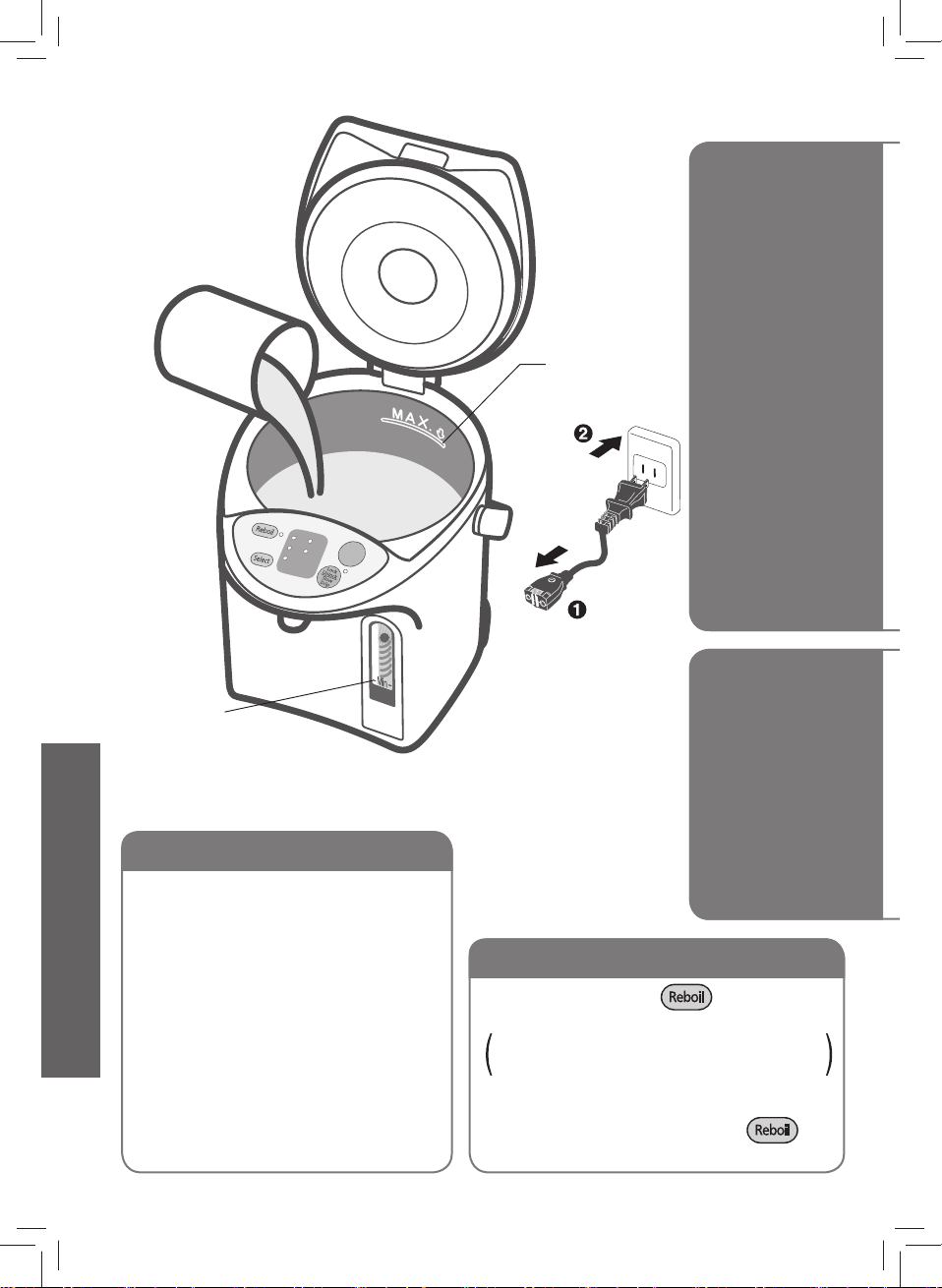
Utilisation
Ébullition
de l’eau
Bec
verseur électrique
Appuyer sur la touche pour faire
clignoter le témoin. (Mode ébullition longue)
Appuyer une fois lors de l’ébullition et appuyer deux
fois lors de maintien au chaud.
Prolonge le temps d’ébullition d’environ 6 minutes
pour réduire le niveau de chlore dans l’eau de 80 %
.
●
Appuyer sur la touche de réébullition
pour amener à ébullition.
Repère de
niveau d’eau
minimal
Remplir d'eau au-delà du niveau d'eau
minimum.
Verser de l’eau
dans le réservoir
en utilisant un
autre récipient.
Avant d'utiliser cet appareil pour la première fois
1
Verser de l'eau avec un autre
récipient jusqu'au niveau maximum.
2
Fermer soigneusement le couvercle.
3
Faire bouillir l’eau jusqu’à ce que le
témoin de Reboil s’éteigne.
4
Verser de l’eau chaude.
5
Débrancher et retirer le couvercle.
6
Verser toute l'eau chaude restante
lentement via le marquage DRAIN.
Repère de
niveau d’eau
maximal
Ne pas verser
d’eau au-dessus
du repère de
niveau d’eau
maximal.
Utilisation
06_USA_OM_NC-EG2200_3000_4000_FR.indd 4406_USA_OM_NC-EG2200_3000_4000_FR.indd 44 12/14/2558 BE 15:5212/14/2558 BE 15:52
45
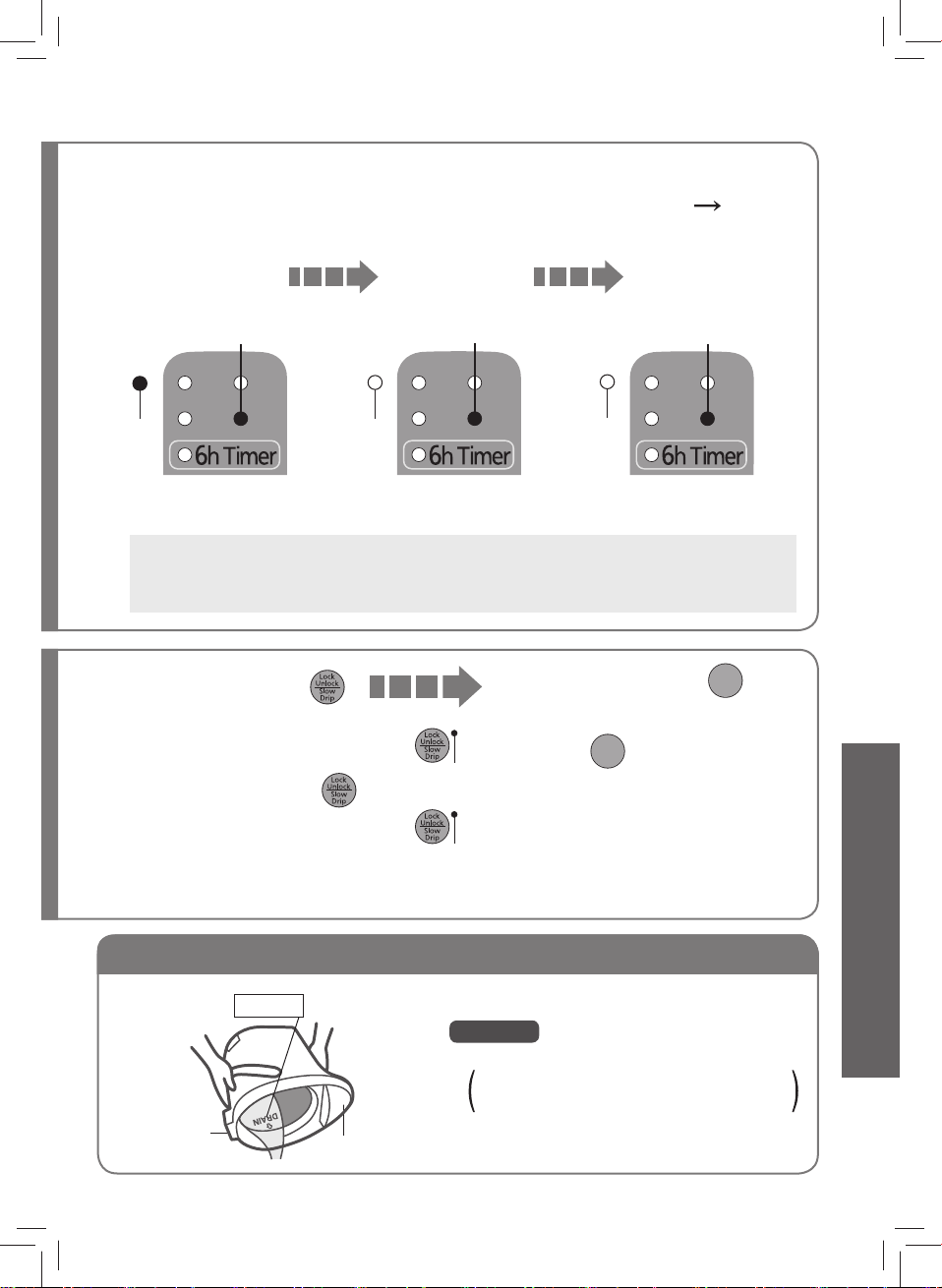
Quand l’appareil n’est pas utilisé
Verser de l’eau dans le réservoir en utilisant un autre récipient. Fermer soigneusement le couvercle.
Brancher horizontalement la fiche côté appareil dans la bouilloire.
Brancher le cordon d’alimentation dans la prise murale. (P.44 1
2)
Temps requis pour l’ébullition de l’eau
NC-EG4000 : env. 35 min /NC-EG3000 : env. 27 min / NC-EG2200 : env. 20 min
(Quantité d’eau : Quantité maximale / Température de la pièce : 68°F (20°C))
Attention
●
Ne pas vider l’eau trop rapidement.
Si de l’eau éclabousse le levier de libération
ou le panneau de commandes, un
dysfonctionnement peut s’en suivre.
●
Ne pas laisser d'eau dans le réservoir intérieur.
(Une odeur peut s’émaner du récipient ou celui-ci
peut rouiller.)
Débrancher et retirer le couvercle. Verser toute l'eau chaude restante lentement
via le marquage
DRAIN
.
Levier de
libération du
couvercle
Panneau de
commandes
Témoin
allumé
Témoin alluméTémoin clignotantTémoin clignotant
Témoin
éteint
Témoin
éteint
e
La touche de
Dispense
est verrouillée de
nouveau, automatiquement, 10 secondes
après avoir versé de l’eau chaude.
Appuyer deux fois sur la touche
pour un égouttement lent.
Le témoin adjacent à la touche clignote.
(Voir « Mode égouttement lent » aux
P. 46-47)
Clignotement
Témoin
allumé
Démarre
automatiquement
l'ébullition.
Indication ci-dessous
une fois l'ébullition
atteinte.
(La température affichée
est indicative.)
La température chute à
environ 190 et l'appareil
passe automatiquement
en mode de maintien au
chaud.
Appuyer sur la touche
pour libérer le verrou.
Le témoin à côté de cette touche
s’allume.
Appuyer sur la touche
Dispense
pour
verser l'eau chaude.
180 208
160 190
180 208
160 190
180 208
160 190
Utilisation
06_USA_OM_NC-EG2200_3000_4000_FR.indd 4506_USA_OM_NC-EG2200_3000_4000_FR.indd 45 12/14/2558 BE 15:5212/14/2558 BE 15:52
Dispense
46
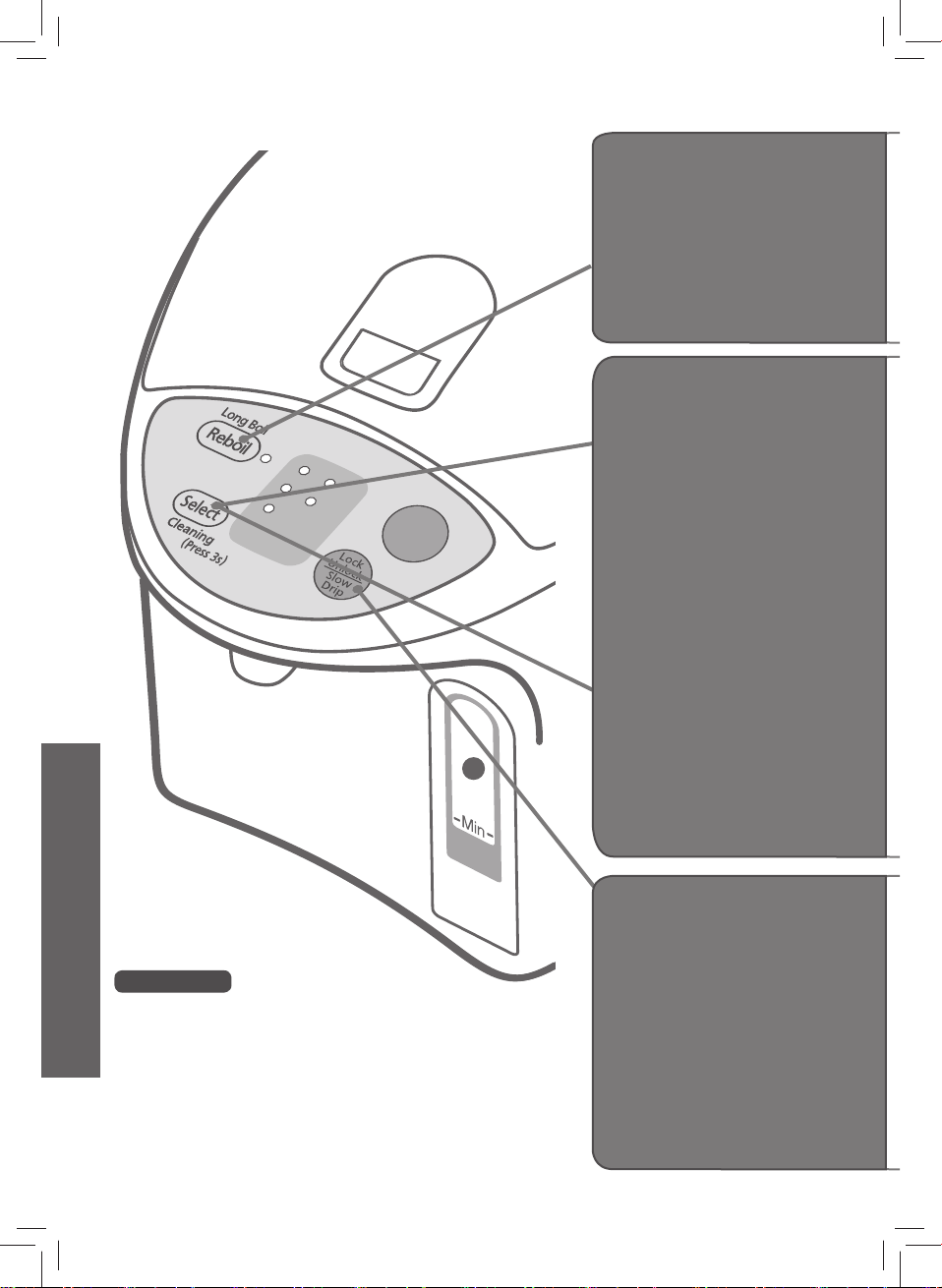
Fonctions pratiques
●
Les réglages de la température du maintien au
chaud et de la minuterie peuvent être effectués
pendant l’ébullition de l’eau ou le maintien au chaud.
●
Même si la minuterie ou le maintien au chaud à
« 208 », « 180 » ou « 160 » a été préalablement
sélectionné, lors du rétablissement du courant après
une panne d’électricité, la température du maintien
au chaud est automatiquement rétablie à « 190 ».
Attention
Réébullition
●
Idéale pour faire bouillir de l’eau
pour du café / thé / nouilles
instantanées, etc.
●
Idéale lorsque l’appareil ne sera
pas utilisé pendant une courte
période.
Réglage de la
minuterie de 6 heures
●
Pendant le réglage de la minuterie,
le courant aux éléments chauffants
est coupé.
Mode égouttement
lent pour faire du
café filtre
●
Verse l'eau lentement.
●
Directement après l'ébullition, la
distribution peut être difficile ou
instable.
Fonction de
maintien au chaud
●
« Maintien au chaud 180 » est un
mode idéal pour faire du thé vert.
●
« Maintien au chaud 160 » est un
mode idéal pour préparer du lait
pour un bébé.
S’assurer de laisser le lait refroidir
ou d’y ajouter de l’eau froide,
précédemment bouillie.
Fonctions pratiques
06_USA_OM_NC-EG2200_3000_4000_FR.indd 4606_USA_OM_NC-EG2200_3000_4000_FR.indd 46 12/14/2558 BE 15:5212/14/2558 BE 15:52
47
180 208
160 190
180 208
160 190
180 208
160 190
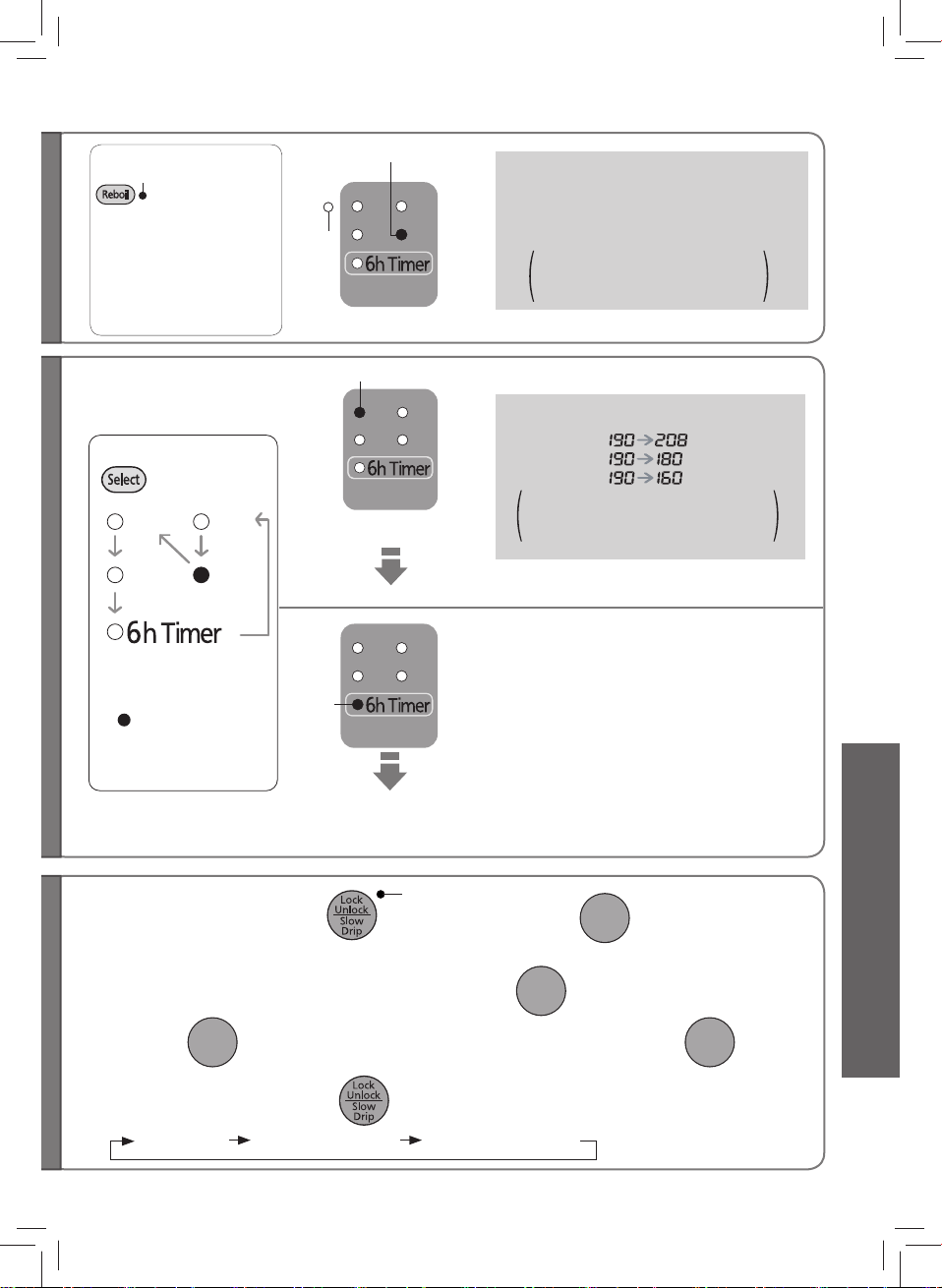
Temps requis pour atteindre le maintien au chaud
Maintien au chaud à
: env. 2 à 4 min
Maintien au chaud à : env. 0,5 à 1 heure
Maintien au chaud à : env. 1,5 à 2,5 heures
Quantité d’eau : Maximale.
Température ambiante à 68°F (20°C)
Maintien au chaud précédent à 190
°F
Temps requis pour la procédure de réébullition
Du maintien au chaud à 208 : env. 2,5 à 4 min
Du maintien au chaud à 190 : env. 4 à 6,5 min
Du maintien au chaud à 180 : env. 6 à 12 min
Du maintien au chaud à 160 : env. 7 à 14 min
Quantité d’eau : Maximale.
Température ambiante à 68°F (20°C)
(Lors de la sélection du
maintien au chaud à 180)
(Après ébullition)
Appuyer sur la touche
Témoin allumé
pour faire bouillir
à nouveau l’eau maintenue au
chaud.
Après quelques minutes, l’eau
sera bouillie.
• La température du maintien au
chaud n’est pas modifiée.
Témoin
éteint
Témoin clignotant
Témoin
allumé
Témoin clignotant
À chaque pression sur la touche , la fonction sera commutée comme ci-dessous.
Verrouillage auto Distribution (témoin éclairé) Égouttage lent (témoin éclair)
Appuyer deux fois sur la touche , puis appuyer sur la touche
Dispense
pour faire du café filtre.
Clignotement
180 208
160 190
Appuyer sur la touche
.
Chaque pression
de la touche
déplace le témoin
« » et change
la température du
maintien au chaud ou
règle la minuterie.
6 heures plus tard, la minuterie est désactivée et l’eau est portée à ébullition.
Lorsque l’eau atteint la température d’ébullition, elle sera maintenue à 190°F.
Après un court instant, l'eau restera au chaud à environ 180°F.
●
Automatiquement verrouillé en 30 secondes après la fin du versement.
●
Pour verser à nouveau de l'eau chaude, appuyer sur la touche
Dispense
avant le décompte de temps jusqu'à
30 secondes.
●
La touche
Dispense
sera automatiquement reverrouillée dans les 10 secondes si la touche
Dispense
n'est pas
actionnée.
Fonctions pratiques
06_USA_OM_NC-EG2200_3000_4000_FR.indd 4706_USA_OM_NC-EG2200_3000_4000_FR.indd 47 12/14/2558 BE 15:5212/14/2558 BE 15:52
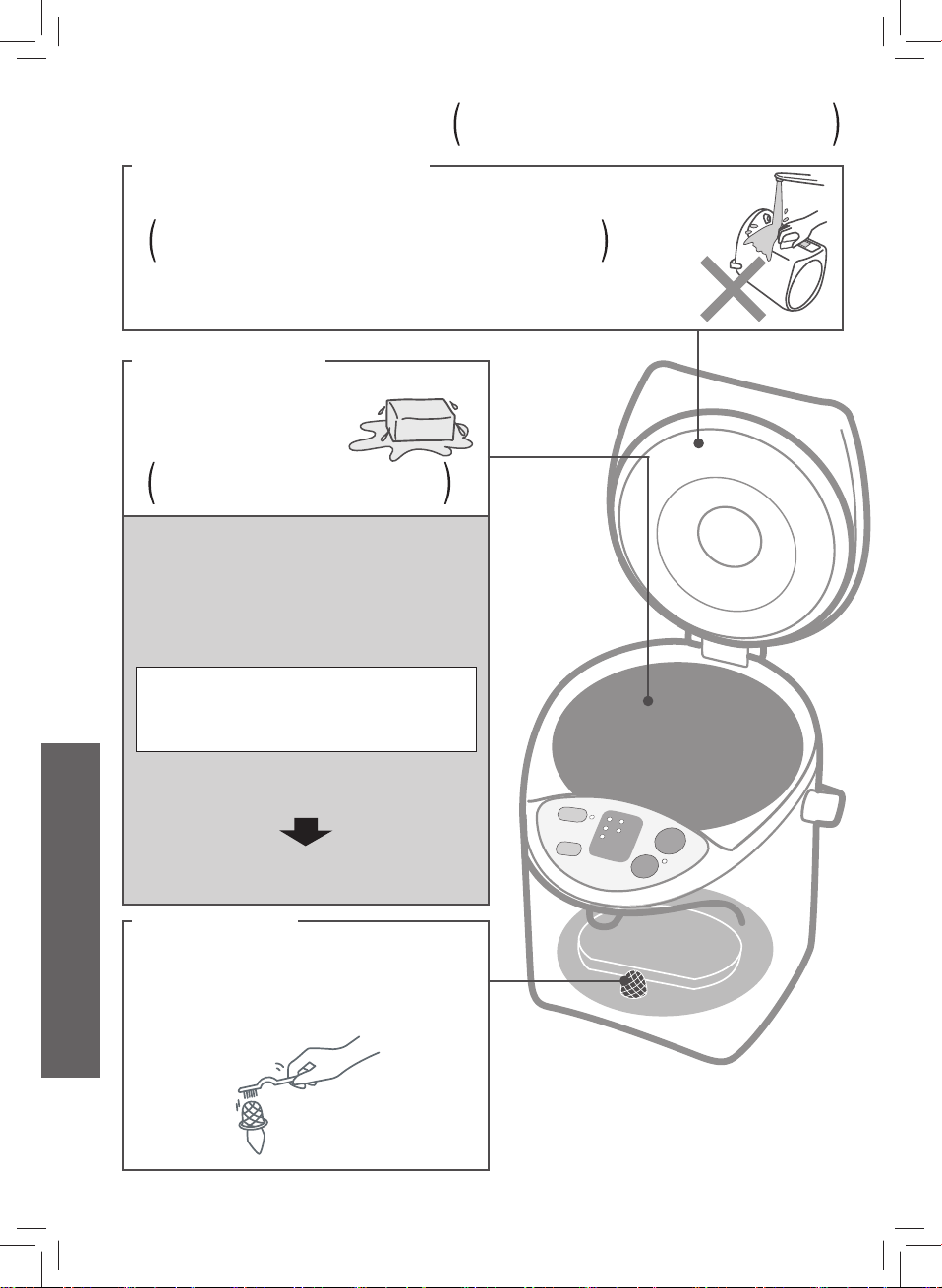
48
Entretien quotidien
Nettoyer avec un linge humide, bien essoré.
●
Ne pas mouiller l’appareil principal et ne pas le tremper dans l’eau.
Si de l’eau pénètre dans l’appareil principal par la base ou par
le bec verseur, elle risque d’entrer en contact avec les pièces
électriques intégrées et provoquer un dysfonctionnement.
Appareil principal et couvercle
Nettoyer le filtre avec une brosse.
Lorsque le filtre est obstrué, l’eau ne circule pas
librement.
* Après avoir nettoyé le filtre, s’assurer de le
remettre en place dans le réservoir intérieur.
Filtre métallique
Nettoyer avec une éponge humide douce.
●
Ne pas utiliser pas de poudre à
polir, de tampon à récurer ou
de brosse en nylon.
Quand le réservoir présente des
signes d’entartrage
Lors de l’utilisation de cet appareil, les minéraux
contenus dans l’eau (comme le calcium) peuvent
adhérer au réservoir intérieur ou au filtre
métallique. Le tartre ainsi formé est sans danger
pour la santé.
●
Surface rêche blanc crème
●
Matière blanche ou scintillante flottante
●
Décoloration de la finition avec des zones brun
foncé, grises ou vertes par exemple.
Il ne s’agit pas de décoloration ou de corrosion du
réservoir intérieur lui-même, non plus que d’écailles
provenant du revêtement en résine fluorée.
Nettoyer le réservoir intérieur à l’aide
d’acide citrique (Voir P.49)
Réservoir intérieur
Rangement de l’appareil
●
Le sécher soigneusement.
●
Le mettre dans un sac en plastique et fermer
le sac.
●
Ne pas utiliser de détergents.
(Ils risquent de laisser une odeur.)
●
Ne pas utiliser de benzine ou tout autre
diluant.
(Ils risquent d’endommager la surface.)
Avant le nettoyage, s’assurer de débrancher la fiche
d’alimentation de la prise murale, vider toute eau
restante et laisser l’appareil refroidir.
Ils risquent d’endommager la finition en
résine fluorée du réservoir intérieur.
APB97-480-0U
Entretien quotidien
06_USA_OM_NC-EG2200_3000_4000_FR.indd 4806_USA_OM_NC-EG2200_3000_4000_FR.indd 48 12/14/2558 BE 15:5212/14/2558 BE 15:52
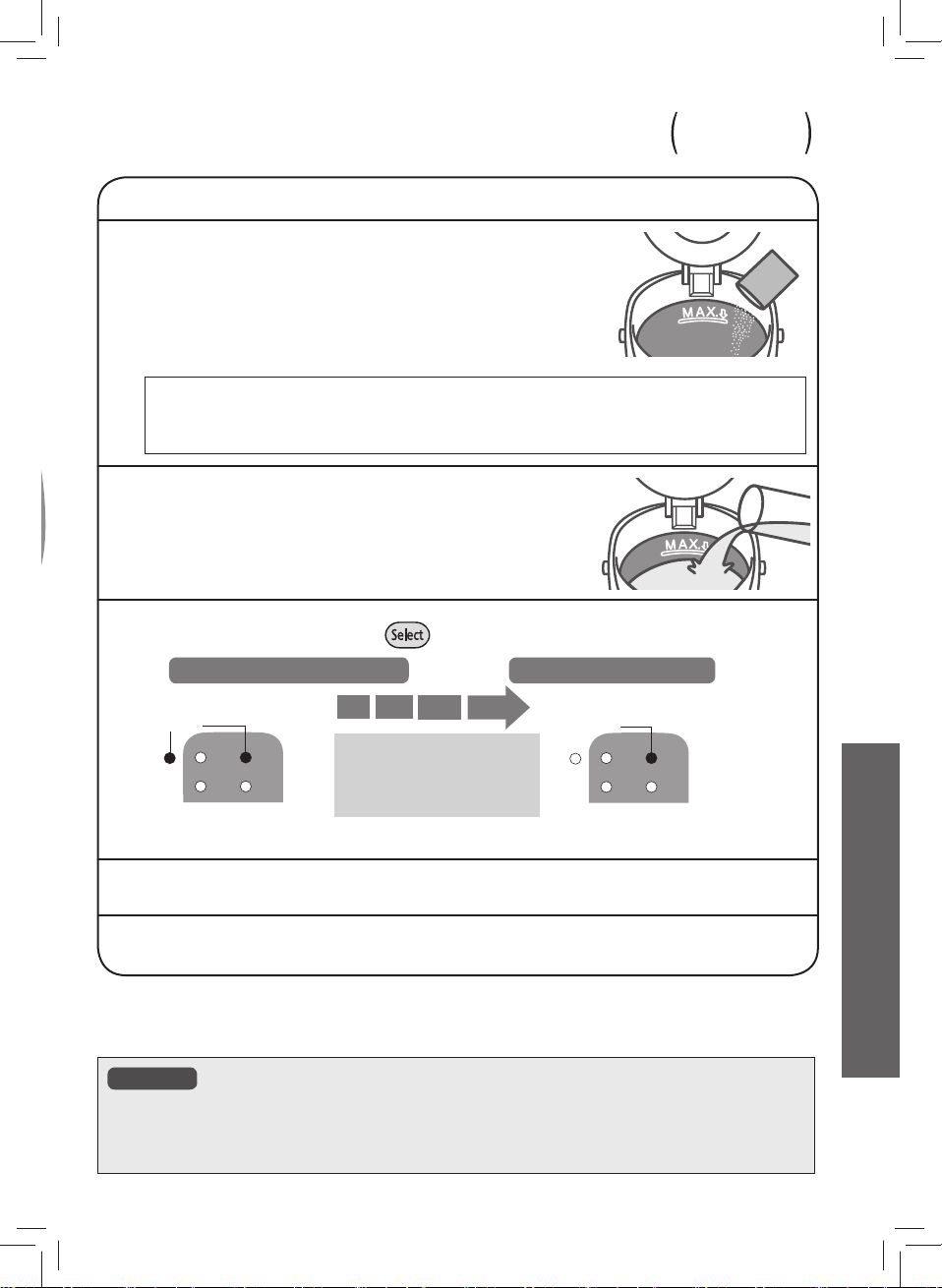
49
Tous les deux ou
trois mois
1
S’assurer que le filtre métallique est bien fixé au réservoir intérieur.
2
Mettre de l’acide citrique dans le réservoir intérieur.
●
Quantité d’acide citrique à utiliser par nettoyage :
80 g (deux sachets) ou sept cuillères à soupe rases.
* Dans le cas où notre acide citrique n’est pas disponible, envelopper
une ou deux tranches de citron dans un linge fin et placer dans le
réservoir intérieur.
(L’efficacité détergente du citron est moindre que celle de l’acide
citrique.)
L’acide citrique est disponible chez un distributeur autorisé (comme indiqué dans la garantie)
.
(Numéro de modèle : SAN-80N)
* Suivre les instructions de nettoyage imprimées sur le sachet d’acide citrique.
* L’acide citrique utilisé pour le nettoyage étant un additif alimentaire, il est sans danger pour les humains.
3
Ajouter de l’eau jusqu’au repère de niveau
maximal et bien mélanger l’acide citrique et
l’eau. Refermer le couvercle.
4
Brancher la fiche immédiatement après le mélange et appuyer plus de
3 secondes sur la touche .
180 208
160 190
180 208
160 190
Les témoins s’allument
pour indiquer le début
du cycle de nettoyage.
Les témoins clignotent pour
indiquer la fin du cycle de
nettoyage.
Le nettoyage commence Le nettoyage est terminé
Témoin
allumé
Témoin
clignotant
Temps de nettoyage
NC-EG4000: 50 min
NC-EG3000: 42 min
NC-EG2200: 35 min
5
Faire couler de l’eau avec le bec verseur, débrancher, retirer le
couvercle et vidanger l'eau chaude via le marquage DRAIN.
6
Remplir
l’appareil
d’eau et porter l’eau à ébullition pour supprimer l’odeur
de l’acide citrique. Puis, jeter l’eau chaude en répétant l’étape
5.
Nettoyage avec de l’acide citrique en cas d’entartrage
●
Pour enlever toute décoloration de la zone au-dessus du repère de niveau maximal, frotter légèrement
l’intérieur avec une éponge humide douce.
●
Si la décoloration ne disparaît pas en frottant, nettoyer le réservoir intérieur plusieurs fois avec de l’acide
citrique ou des citrons.
Attention
●
Utiliser notre acide citrique pour nettoyer le réservoir intérieur de cet appareil.
●
Ne pas remplir le réservoir au-dessus du niveau d’eau maximal.
●
Ne remplir le réservoir qu’avec de l’eau du robinet (ne pas remplir avec de l’eau chaude). L’eau chaude
peut éclabousser et causer des brûlures.
L’acid
citrique
Entretien quotidien
06_USA_OM_NC-EG2200_3000_4000_FR.indd 4906_USA_OM_NC-EG2200_3000_4000_FR.indd 49 12/14/2558 BE 15:5212/14/2558 BE 15:52
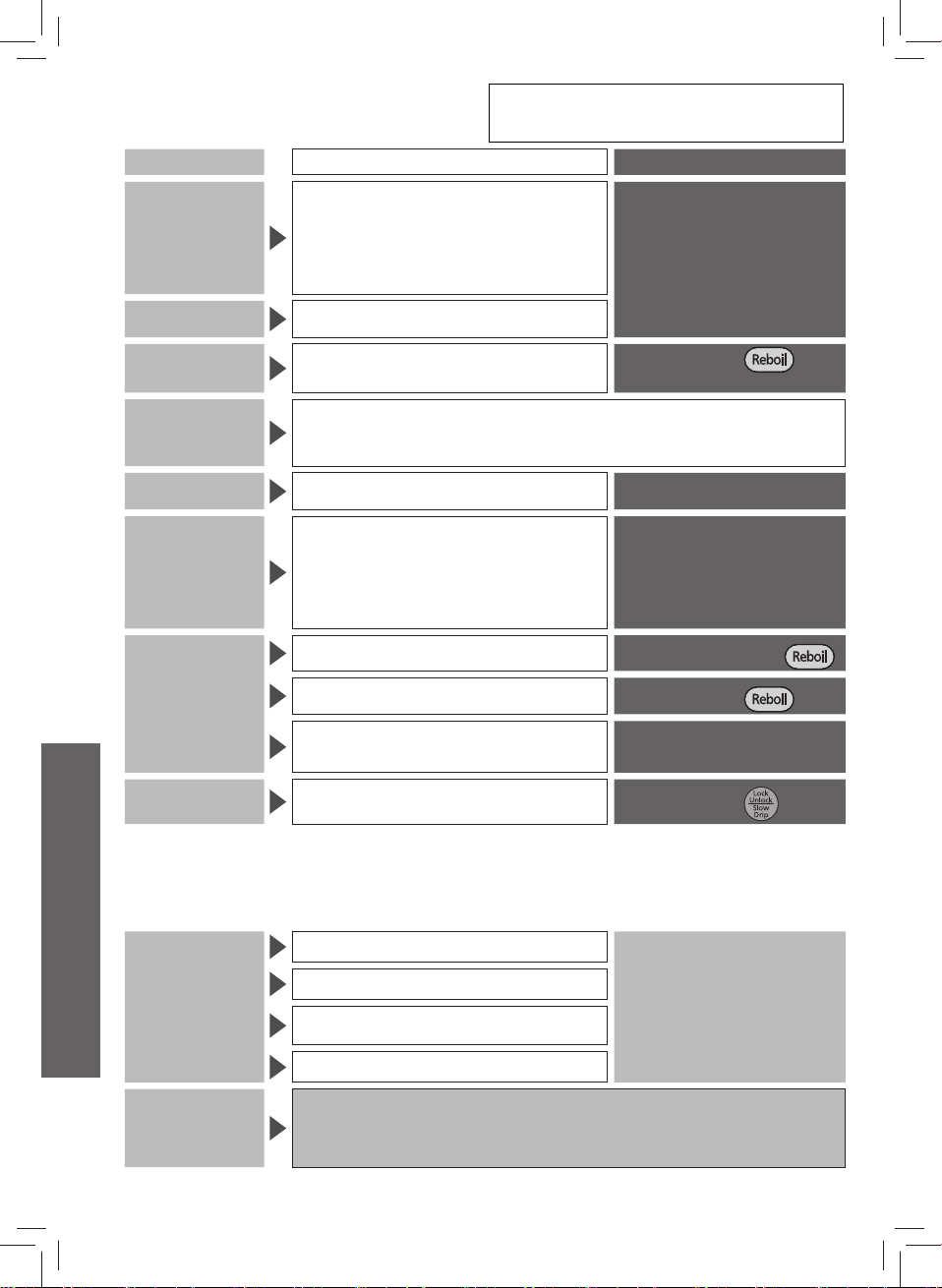
50
Guide de dépannage
Avant de consulter un réparateur, consulter la liste
des causes possibles ci-dessous.
Si... Causes possibles Solutions
Des écailles blanches
ou scintillantes flottent
dans l’eau chaude.
Des substances
blanches rugueuses
ont adhéré au réservoir
intérieur.
●
Des dépôts de tartre sont à l’origine de ce phénomène.
(Voir P. 48)
Il ne s’agit pas d’écailles de résine fluorée.
* De l’eau contenant une grande quantité de minéraux,
comme de l’eau minérale ou de l’eau ionisée risque de
provoquer la formation de tartre ou d’une couche blanche
dans l’eau chaude.
●
Nettoyer le réservoir intérieur avec une
éponge humide douce. (Voir P. 48)
●
S’il y a des dépôts de tartre, nettoyer le
réservoir intérieur avec de l’acide citrique.
(Voir P. 49)
Les sons d’ébullitions
sont élevés.
●
Lorsque des dépôts de tartre s’incrustent, les sons
d’ébullition sont élevés.
L’eau chaude produit
une odeur de chlore.
●
L’odeur de chlore dépend de la quantité de chlore présente
dans l’eau.
●
Appuyer sur la touche pour
réduire le chlore. (Voir P. 44)
L’eau chaude produit
une odeur désagréable.
●
Quand l’appareil est neuf, la résine utilisée pour la fabrication peut produire une légère odeur. Ceci
disparaîtra avec l’usage.
●
Si la l’appareil est posé sur une surface telle qu’une feuille de vinyle, il est possible que l’odeur soit
transférée dans l’eau.
L’eau chaude coule
d’elle-même.
●
L’eau ajoutée dépasse le repère de niveau d’eau maximal.
●
Diminuer le niveau de l’eau.
L’eau chaude ne coule
pas librement.
●
Le filtre métallique peut être bouché par des dépôts de
tartre. (Voir P. 48)
●
Si du tarte est accumulé dans le réservoir intérieur et que
le niveau d'eau chaude restante est bas, l'eau chaude ne
s'écoule pas de manière fluide.
●
Immédiatement après l'ébullition, il se peut que l'eau
chaude ne s'écoule pas de manière fluide.
●
Nettoyer le filtre avec une brosse.
●
Si le tartre ne peut être éliminé, remplacer
le filtre. (Voir P. 51)
Les témoins clignotent
alternativement.
●
Le protecteur de surchauffe a été activé. (Voir P. 43)
●
Ajouter de l’eau et appuyer sur la touche .
●
Les témoins peuvent clignoter lors de l’ajout d’eau
bouillante ou suivant la façon dont l’eau est ajoutée.
●
Appuyer sur la touche .
●
Après le nettoyage du réservoir intérieur avec de l’acide
citrique, il est possible que l’acide citrique s’accumule au
fond du réservoir.
●
Débrancher la fiche d’alimentation de
la prise murale et bien mélanger l’acide
citrique pour qu’elle se disperse.
Impossible de verser
de l’eau.
●
Le verrou automatique a été enclenché.
●
Appuyer sur la touche .
●
Si le problème n’est pas résolu après l’examen des causes possibles indiquées ci-dessus ou s’il se produit un phénomène anormal, débrancher
la fiche côté appareil de l’appareil. Attendre au moins 10 secondes, puis rebrancher la fiche.
●
La partie semi-transparente située à l’intérieur du couvercle peut jaunir. Ce phénomène ne nuit pas au bon fonctionnement de l’appareil.
●
Le cliquetis audible dans le couvercle est dû à la présence de petits éléments en forme de billes qui empêchent l’eau de s’écouler si l’appareil
se renverse.
●
Si la température ambiante est élevée, l’extérieur de l’appareil peut atteindre environ 130°F (55°C).
L’appareil ne se met pas
en marche.
●
L’eau a été versée directement du robinet.
●
Un dysfonctionnement de l’appareil
survient si ses composantes électriques
sont immergées dans l’eau.
Contacter le point de vente où l’appareil
a été acheté pour faire effectuer les
réparations.
●
L’appareil se trouve dans un évier.
●
L’appareil a été tourné à l’envers alors que le dessous
était mouillé.
●
L’appareil a trempé dans l’eau.
Les témoins
« Reboil » et
« 180 » clignotent en
alternance.
●
Ceci est un dysfonctionnement du capteur.
●
Contacter le point de vente où l’appareil a été acheté.
Guide de dépannage
06_USA_OM_NC-EG2200_3000_4000_FR.indd 5006_USA_OM_NC-EG2200_3000_4000_FR.indd 50 12/14/2558 BE 15:5212/14/2558 BE 15:52
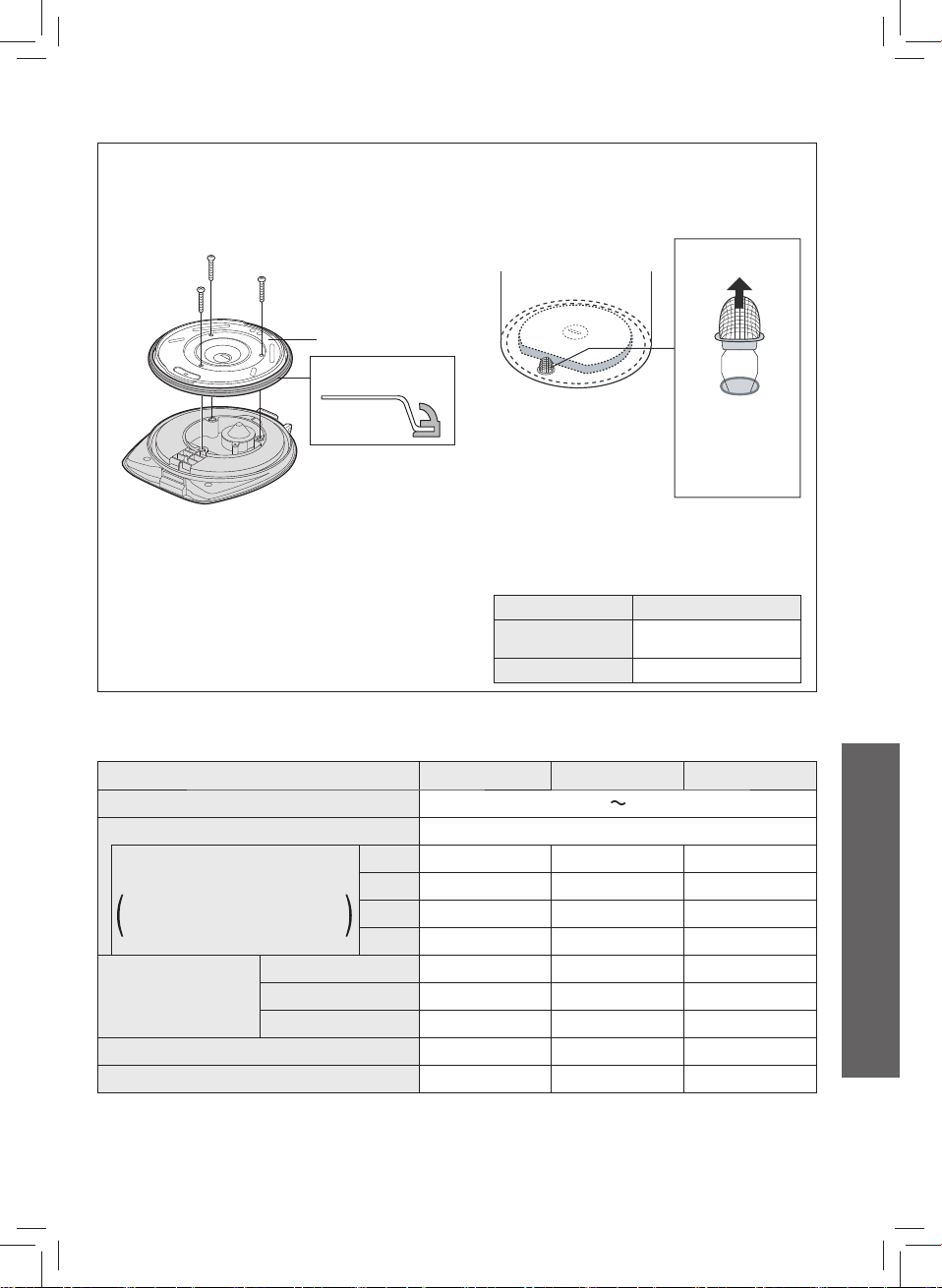
51
Numéro de modèle
NC-EG4000 NC-EG3000 NC-EG2200
Alimentation 120 V
60 Hz
Consommation 700 W
Cons. Moyenne en mode
maintien au chaud
La quantité d’eau: maximum
Température ambiante à:
68°F (20°C)
à 208
49 Wh
45 Wh 40 Wh
à 190
43 Wh
39 Wh 33 Wh
à 180
35 Wh
31 Wh 27 Wh
à 160
30 Wh
26 Wh 23 Wh
Dimensions
(avec poignée
inclinée)
Hauteur (env.)
32,4 cm (12,8 po)
27,5 cm (10,8 po) 23,8 cm (9,4 po)
Largeur (env.)
21,7 cm (8,5 po)
21,7 cm (8,5 po) 21,7 cm (8,5 po)
Profondeur (env.)
28,7 cm (11,3 po)
28,7 cm (11,3 po) 28,7 cm (11,3 po)
Poids (incluant le cordon d’alimentation) (env.)
2,2 k
g
(4,9 lb)
2,0 k
g
(4,4 lb) 1,9 k
g
(4,2 lb)
Capacité nominale (env.)
4,0 L (4,2 pte)
3,0 L (3,2 pte) 2,2 L (2,3 pte)
Joints en caoutchouc
Remplacer les joints s'ils se fendillent, perdent de
leur souplesse ou pour toute autre raison laissant
s'échapper la vapeur entre le réservoir et le
couvercle.
Filtre métallique
Remplacer le filtre si les matières étrangères
qui le bouchent ne peuvent pas être
éliminées, même après un brossage, etc.
Le filtre peut être retiré
en tirant fermement
vers le haut.
APB97-480-0U
Protection du
couvercle
Joints en
caoutchouc
Pour les pièces de rechange,
contacter un centre de service après-
vente agréé (comme indiqué dans la
garantie).
Nom de la pièce N° de pièce
Joints en
caoutchouc
APH65-480
Filtre métallique APB97-480-0U
Enlever le couvercle, dévisser les 3 vis taraudeuses
et enlever la protection du couvercle.
Changer les joints et remettre la protection du
couvercle en place en la fixant à l’aide des vis
taraudeuses.
Remplacement des pièces
Spécifications
* Dans certaines conditions comme à très haute altitude et dans un froid intense, il est possible que
l’appareil ne fonctionne pas correctement. Éviter l’utilisation de l’appareil dans de telles conditions.
* Si l’appareil est utilisé par grand froid, veiller à ce qu’il reste vide. L’eau laissée dans le réservoir
intérieur risque de geler et d’endommager l’appareil.
Remplacement des pièces / Spécifications
06_USA_OM_NC-EG2200_3000_4000_FR.indd 5106_USA_OM_NC-EG2200_3000_4000_FR.indd 51 12/14/2558 BE 15:5212/14/2558 BE 15:52

PZ05A6931
TP0915E11215
Printed in Thailand
Imprimé en Thaïlande
Panasonic Canada Inc.
5770 Ambler Drive,
Mississauga, Ontario, L4W 2T3
www.panasonic.com
Panasonic Corporation of North America
Two Riverfront Plaza, Newark, NJ 07102-5490
www.panasonic.com
© Panasonic Corporation 2015
For product information and operation assistance in the USA or Canada,
please contact the support page listed below.
Pour tout renseignement sur les produits et de l'assistance technique aux
États-Unis ou au Canada, veuillez visiter les pages de soutien ci-dessous :
In the USA, please contact:
shop.panasonic.com/support
In Canada, please contact:
www.panasonic.ca/english/support
Au Canada, veuillez visiter :
www.panasonic.ca/french/support
06_USA_OM_NC-EG2200_3000_4000_FR.indd 5206_USA_OM_NC-EG2200_3000_4000_FR.indd 52 12/14/2558 BE 15:5212/14/2558 BE 15:52