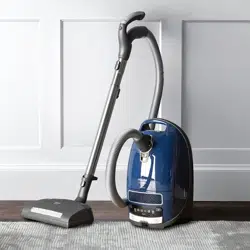
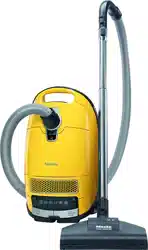
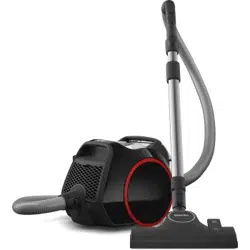
User Manual vacuum cleaner
Appliance description
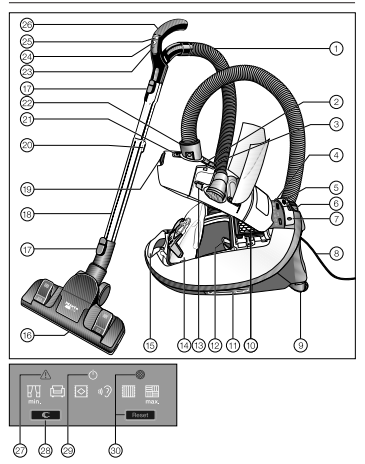
1. Suction hose *
2. Release button for accessories compartment
3. FilterBag change indicator
4. Display *
5. Foot switch for automatic cord rewind
6. Park system for pauses during vacuuming
7. On/Off foot switch 
8. Power cord
9. Castor wheels *
10. Exhaust filter *
11. Park system for storage (on both sides of the vacuum cleaner) *
12. Motor protection filter
13. Electrobrush socket cover holder *
14. Original Miele FilterBag
15. Carrying handle p
16. Floorhead *
17. Release buttons
18. Telescopic suction wand *
19. Dust compartment lid release button
20. Telescopic suction wand release button *
21. Socket for Electrobrush *
22. Connection socket *
23. LED *
24. Standby button for short pauses in vacuuming *
25. Suction power selector buttons + / - *
26. Handle (some models have an air inlet valve in the handle) *
27. Overheating warning light *
28. Restart button *
29. Standby indicator light *
30. Maintenance indicator with reset button *
* These features are model-specific and may vary or may not be available on your vacuum cleaner.
References to illustrations
The illustrations referred to in the text are shown on the fold-out pages at the end of these Operating Instructions.
Preparing for use
Attaching the suction hose (Fig. 01)
- Insert the hose connector into the suction socket on the vacuum cleaner until it clicks into position. To do this, line up the guides on the two pieces.
Disconnecting the suction hose (Fig. 02)
- Press the release buttons at the side of the hose connector, and lift the hose from the socket.
Connecting the suction hose to the handle (Fig. 03)
(required depending on model)
- Insert the suction hose into the handle until it clicks into position.
Connecting the handle to the wand (Fig. 04)
- Insert the handle into the wand until it clicks into position. To do this, line up the guides on the two pieces.
- To release the handle from the wand, press the release button and pull the handle out of the wand, twisting it slightly as you do so.
Adjusting the telescopic suction wand
Depending on the model, your vacuum cleaner will be fitted with one of the following suction wands:
– Telescopic suction wand
– Comfort telescopic suction wand
One part of the telescopic suction wand is packed inside the other and it can be adjusted to suit your height for comfortable vacuuming.
Telescopic suction wand (Fig. 05)
- Press the release button and adjust the telescopic suction wand to the required length.
Comfort telescopic suction wand (Fig. 05)
- Grasp the release mechanism and adjust the telescopic suction wand to the required length.
Connecting the telescopic wand to the floorhead/floorbrush (Fig. 06) (included as standard depending on model)
- Push the telescopic wand into the suction nozzle and turn it clockwise or counter-clockwise until it clicks into position.
- To detach these parts from each other, press the release button and pull the telescopic wand out of the suction nozzle, twisting it slightly as you do so.
Adjusting the floor head (Figs. 07 + 08)
(only for models with a reversible floor head included in the standard version)
This vacuum cleaner can be used for the everyday cleaning of carpets, rugs and hard flooring.
Miele offers a range of other floor heads, brushes and accessories for other types of flooring and special applications (see "Optional accessories").
Vacuum carpets and rugs with the brush retracted:
- Press the foot switch
 Clean hard flooring which is not susceptible to scratching, and flooring with gaps or deep crevices in it with the brush protruding:
- Press the foot switch

Activating the exhaust filter change indicator on the exhaust filter
Depending on the model, your vacuum cleaner will be fitted as standard with one of the following exhaust filters (Fig. 09).
a AirClean
b Active AirClean 50 (black)
c HEPA AirClean 50 (white)
If your vacuum cleaner is equipped with filter type b or c, you will need to activate the exhaust filter change indicator.
- Press the release button on the recessed handle and raise the dust compartment lid as far as it will go (Fig. 10).
- Remove the indicator strip (Fig. 11).
- Press the exhaust filter change indicator (Fig. 12). After approx. 10-15 seconds a thin red line will appear in the left-hand side of the display (Fig. 13).
- Close the dust compartment lid securely, making sure it clicks into position. Take care not to trap the FilterBag when doing so.
How the TimeStrip exhaust filter change indicator works
The TimeStrip exhaust filter change indicator shows the remaining functional life of the exhaust filter. After approx. 50 operating hours, or approx. one year of average use, the display will be completely filled with red (Fig. 14).
Inserting batteries into the LED handle (Figs. 15 + 16)
(depending on model)
1. Loosen the screws on the cover.
2. Press down on both sides of the cover to remove it.
3. Take out the battery holder and insert the three batteries supplied making sure the polarity is correct.
4. Replace the battery holder. Make sure the arrows on the holder and in the battery compartment line up in the same direction.
5. Replace the cover and tighten the screw.
Using the accessories supplied (Fig. 17)
- Crevice nozzle : For cleaning in folds, crevices or corners.
- Dusting brush with natural bristles : For cleaning base boards, ornate and carved objects. The head can be swiveled to adjust the angle.
- Upholstery nozzle : For cleaning upholstery, mattresses, cushions, curtains, covers, etc
Some models are supplied as standard with one of the following accessories, which are not illustrated.
– Powerbrush
– Turbobrush
These accessory parts are supplied with their own operating instructions.
Opening the accessories compartment (Fig. 18)
- Press the release button on the accessories compartment lid.
The accessories compartment will then open.
- Take out the accessory you require.
- Press down firmly on the lid to close it.
Floor brush (Fig. 19)
(included as standard depending on model)
For general use and also for vacuuming the stairs.
Use
Power cord
Note : Unwind the cord completely to aid the vacuum in dissipating heat. Do not pull or carry by the cord, use the cord as a handle, close a door on the cord, or pull the cord around sharp edges or corners. Do not run the appliance over the cord. Keep the cord away from heated surfaces. Do not unplug by pulling the cord. To unplug grasp the plug, not the cord. This appliance is equipped with a power cord reel. Hold the plug when rewinding onto cord reel. Do not allow plug to whip when rewinding.
Unwinding the cord (Fig. 20)
- Pull the cord out to the required length (max. length approx. 24'7" (7.5 m)).
- Insert the plug into the socket.
If your vacuum cleaner is equipped with a lit park system for storage, it switches on in this manner.
Rewinding the cord (Fig. 21)
- Remove the plug from the outlet.
If your vacuum cleaner is equipped with a lit park system for storage, it switches off in this manner.
- Step briefly on the automatic cord rewind foot switch.
The cord will then retract itself fully into the vacuum cleaner.
If you do not want the cord to retract completely into the vacuum cleaner you can deactivate this function. To do this, take hold of the end of the cord whilst retracting it and give it a short pull when you want the rewinding to end.
Turning the vacuum cleaner on and off (Fig. 22)
- Press the On/Off foot control
Regulating the suction power
The suction power can be regulated to suit the type of flooring being cleaned. Reducing the suction power reduces the amount of effort required to maneuver the floor brush.
The vacuum cleaner has symbols on the controls which indicate the type of use the settings are suitable for.
The selected power setting will light up yellow.
 Curtains, fabric
 Upholstery, cushions
Deep pile carpets, rugs and runners
 Energy-saving vacuuming. This setting is also very quiet
 Loop pile carpet and rugs
Hard flooring and heavily soiled carpets and rugs
Depending on the model, your vacuum cleaner will also be equipped with one of the following power settings.
Auto
Automatic adjustment of suction power to flooring
SoftCarpet
Particularly soft flooring
Depending on the model, your vacuum cleaner will be fitted with one of the following suction power selectors:
– Footswitches
– Footswitches with Auto function
– Footswitches with SoftCarpet function
Footswitches (Fig. 23)
The first time the vacuum cleaner is switched on, the highest power setting will be selected automatically.
After that, the vacuum cleaner will switch on at the power setting that was last used.
- Press the + footswitch to select a higher suction power.
- Press the - footswitch to select a lower suction power.
Footswitches with Auto (Figs. 24 + 25) function
The first time the vacuum cleaner is switched on, it is in the Auto power setting.
- Press the + footswitch to select a higher suction power.
- Press the - footswitch to select a lower suction power.
After that, the vacuum cleaner will switch on at the power setting that was last used.
Footswitches with SoftCarpet (Fig. 26 + 27) function
The first time the vacuum cleaner is switched on, it is in the SoftCarpet power setting.
- Press the - footswitch to select another power setting. Activating the SoftCarpet power setting:
- Press the + footswitch until the maximum power setting has been reached.
- Then press the + footswitch again. After that, the vacuum cleaner will switch on at the power setting that was last used.
Opening the air inlet valve (Figs. 28 + 29)
(depending on model)
It is easy to reduce the suction power for a short time, e.g., to prevent rugs or other objects being sucked into the vacuum cleaner.
- Open the air inlet valve on the handle far enough to reduce the suction power. This reduces the suction on the respective nozzle used.
During vacuuming
- When vacuuming, pull the vacuum cleaner behind you on its wheels. You can stand it upright for vacuuming stairs and curtains, etc.
Illuminating the work area (Fig. 32)
(for models with the LED handle)
Your vacuum cleaner is equipped with an LED on the handle to illuminate the work area.
- Press the
 button on the LED handle. The lighting will switch itself off automatically after approx. 30 seconds.
Parking, transport and storage
Park system for pauses during vacuuming (Fig. 33)
(cannot be used with Electrobrushes SEB 228 and SEB 236)
The park system allows you to conveniently park the suction wand and floorhead during pauses.
Park system On/Off switch
Some models are fitted with an On/Off switch in the park system. The vacuum cleaner switches off automatically when the floorhead is slotted into the park system with the park attachment. When the floorhead is removed the vacuum cleaner will switch back on automatically and will operate with the previously selected setting.
Park system for storage (Fig. 34)
If your vacuum cleaner is equipped with a lit park system for storage, it switches off about 30 seconds after being disconnected from the power supply.
- Stand the vacuum cleaner upright.
- Slot the floorhead downwards into one of the parking attachments on either side of the vacuum cleaner (the parking attachments cannot be used with Electrobrushes SEB 228 and SEB 236).
This makes the vacuum cleaner easier to carry or store.
Maintenance
The Miele filtration system consists of three components:
– Original Miele FilterBag
– Motor protection filter
– Original Miele exhaust filter
These will need to be replaced from time to time to ensure that your vacuum cleaner performs efficiently.
We recommend only using genuine FilterBags, filters, and accessories with the "Original Miele" logo on them. This will ensure that the suction power of the vacuum cleaner is maintained, giving the best possible cleaning results. FilterBags with the "Original Miele" logo on them are not made from paper or paper-based materials and nor do they have a cardboard collar. This is why our FilterBags are particularly long-lasting and reliable. Please note that appliance faults and damage originating from the use of accessories which do not carry the "Original Miele" logo will not be covered by the appliance guarantee.
Purchasing new FilterBags and filters
Original Miele FilterBags and filters are available from the Miele Webstore and your Miele dealer.
Ordering the correct FilterBags and filters
Only use original Miele GN FilterBags with a blue collar and original Miele filters. These are identified by the "ORIGINAL Miele" logo on the packaging.

An AirClean filter and a motor protection filter are supplied with every packet of Miele FilterBags. Original Miele exhaust filters can also be purchased separately from your Miele dealer or Miele Technical Service. Please quote the model number of your vacuum cleaner when ordering to make sure you get the correct filter. You can also order all accessories via the Miele Webstore.
When to change the FilterBag (Fig. 35)
Change the FilterBag when the color marker in the FilterBag change indicator turns red, or sooner if it is no longer effective (see possible reasons for this below).
Miele FilterBags are disposable and designed for single use only. Dispose of the FilterBag when full. Do not attempt to reuse. Blocked pores in used FilterBags will reduce the suction power of the vacuum cleaner.
Checking the FilterBag change indicator
- Attach the floor brush to the vacuum cleaner (depending on the model).
- Switch the vacuum cleaner on and select the highest power setting.
- Lift the floor brush off the floor a little.
How the FilterBag change indicator works
The FilterBag change indicator is set for normal household dust. This generally contains a mixture of dust, hair, threads, carpet lint, grit, etc. However, if the cleaner has been used to vacuum up fine dust, such as plaster, brick dust, cement or flour, the pores of the FilterBag will become blocked very quickly. This affects the air permeability of the bag, and the marker will indicate that the bag is "full" even when it is not. If this happens you must still change the FilterBag because suction power will be greatly reduced by blocked pores in the FilterBag. If, on the other hand, a large amount of hair and carpet lint which typically contains a lot of air is vacuumed up, the indicator may fail to react even though the bag is full. You should still change it. Both these extremes can occur.
Replacing the FilterBag (Figs. 36 + 37)
- Press the release buttons at the side of the hose connector, and remove the hose from the suction opening (Fig. 02).
- Lift the release button for the dust compartment lid and raise the lid until it engages (Fig. 10). The FilterBag has a closing flap which closes automatically when the dust compartment lid is raised to prevent any dust escaping.
- Pull the FilterBag out by the grip on the collar.
- Insert the new FilterBag into the blue holder as far as it will go. Leave it folded up when you take it out of the box.
- It should be unfolded as far as possible in the dust compartment.
- Close the dust compartment lid securely, making sure it clicks into position. Take care not to trap the FilterBag when doing so.
- Insert the hose connector into the suction socket on the vacuum cleaner until it clicks into position. To do this, line up the guides on the two pieces (Fig. 01).
When to change the dust compartment filter
Replace this filter every time you start a new packet of FilterBags. A dust compartment filter is supplied with every packet of Miele FilterBags.
Changing the dust compartment filter (Fig. 38)
- Open the dust compartment lid.
- Pull the FilterBag out by the grip on the collar.
- Open the blue filter frame fully and remove the old filter. Hold by the clean, unsoiled section to remove it.
- Replace with a new dust compartment filter (for motor protection).
- Close the filter frame.
- Insert the FilterBag into the blue holder as far as it will go.
- Close the dust compartment lid securely, making sure it clicks into position. Take care not to trap the FilterBag when doing so.
When to replace the exhaust filter
Depending on the model, your vacuum cleaner will come with one of the following exhaust filters (Fig. 09) as standard:
a. AirClean Replace this filter every time you start a new packet of Miele FilterBags. An AirClean exhaust filter is supplied with every packet of Miele FilterBags.
b. Active AirClean 50 (black)
c. HEPA AirClean 50 (white) Replace if the display for the exhaust filter change indicator is completely filled with red (Fig. 14). This occurs after approx. 50 hours of operation which is equivalent to about a year of average use. The vacuum cleaner can still be used.
However, the suction power will be reduced as will the effectiveness of the filter if it is not replaced in good time.
How to replace the AirClean filter (Figs. 39 + 40)
- Open the dust compartment lid.
- Press the release catch on the filter grille and open the grille until it clicks.
- Grasp the used AirClean exhaust filter by one of the clean, unsoiled sections and take it out.
- Replace it with a new AirClean exhaust filter.
- Close the filter frame. Close the dust compartment lid.
Replacing the Active AirClean 50 and HEPA AirClean 50 exhaust filters (Figs. 41 + 42)
- Open the dust compartment lid.
- Lift the exhaust filter and remove it.
- Insert a new exhaust filter, making sure it goes in properly, then push it down into position.
- Press the TimeStrip exhaust filter change indicator (Fig. 12).
After approx. 10-15 seconds a thin red line will appear in the left-hand side of the display (Fig. 13).
- Close the dust compartment lid.
Replacing one type of exhaust filter with another (Fig. 09)
Depending on the model, your vacuum cleaner will be fitted as standard with one of the following exhaust filters :
a. AirClean
b. Active AirClean 50 (black)
c. HEPA AirClean 50 (white)
When changing the filter please note
1. If you wish to replace exhaust filter a with filter b or c, you must completely remove the filter grille before you install the new exhaust filter. You must also activate the TimeStrip exhaust filter change indicator (Fig. 12).
2. If you wish to replace exhaust filter b or c with filter a, you must insert the new filter into a filter grille * before installing (Fig. 40). * Filter grille – see "Optional accessories"
Maintenance indicator with reset button (Fig. 43)
Some models are fitted with a maintenance indicator. The indicator lights up after approximately 50 hours of operation, which is equivalent to about a year of average use. The level of soiling of the motor protection filter and the exhaust filter must be checked at this point. The indicator must be reset each time the filters are replaced. The vacuum cleaner must be switched on to do this
The maintenance indicator will go out and reset to zero.
Inserting batteries into the LED handle (Figs. 15 + 16)
(depending on model)
You will need three 1.5 V (AAA) batteries.
1. Loosen the screws on the cover.
2. Press down on both sides of the cover to remove it.
3. Take out the battery holder and insert the three batteries supplied making sure the polarity is correct.
4. Replace the battery holder. Make sure the arrows on the holder and in the battery compartment line up in the same direction.
5. Replace the cover and tighten the screw.
When to change the thread catchers?
(only possible for models with a reversible floorhead included as standard) The thread catchers on the suction inlet of the reversible floorhead can be replaced. Check them from time to time and replace them if the pile has worn down.
How to replace the thread lifters (Figs. 44 + 45)
- Use a suitable screwdriver to remove the thread lifters from the slots.
- Fit new thread lifters.
Cleaning the roller on the AllTeQ floorhead (Fig. 46)
(depending on model)
Clean the roller on the floorhead if required.
1. Release the bearing (with bayonet fitting) using a coin.
2. Press the bearing out, and remove.
3. Remove the roller.
- Remove any threads and hair, replace the roller and refit the bearing, locking it back into position.
Replacement parts are available from your Miele dealer or through Miele Technical Service.
Cleaning and care
Always disconnect the vacuum cleaner from the electrical supply before cleaning it. Turn off and unplug it.
Vacuum cleaner and accessories
The vacuum cleaner and all plastic accessories can be cleaned with a proprietary cleaner suitable for plastic.
Dust compartment
The dust compartment can, if necessary, be cleaned using a dry duster, brush or, if available, a second vacuum cleaner to vacuum the dust out. Monitor the filter bag change indicator and inspect all filters regularly. Clean or replace them when necessary according to these Operating Instructions.
Frequently asked questions
The vacuum cleaner switches off automatically. On certain models, the overheating warning light also comes on
- A temperature limiter turns the vacuum cleaner off automatically if it gets too hot. This can occur if, for instance, large articles block the wand or when the FilterBag is full or contains particles of fine dust. A heavily soiled exhaust or dust compartment filter can also be the cause of overheating.
- Turn the vacuum cleaner off immediately using the On/Off foot switch , and unplug it. After removing the cause, wait for approximately 20 - 30 minutes to allow the vacuum cleaner to cool down. It can then be turned on again.
IMPORTANT SAFETY INSTRUCTIONS
Correct use
- This vacuum cleaner is intended for cleaning flooring in domestic households and similar residential environments.
- This vacuum cleaner can be used for all normal cleaning of carpets, rugs and hard flooring.
- This vacuum cleaner is not intended for outdoor use.
- The vacuum cleaner must only be used to vacuum dry floor surfaces. Do not use on people and animals. Any other usage, modification or alteration is not supported by the manufacturer and could be dangerous.
- ersons which lack physical, sensory or mental abilities or experience with the machine should not use it without supervision or instruction by a responsible person.
Safety with children
- Danger of suffocation! Ensure that any plastic wrappings, bags, etc. are disposed of safely and kept out of the reach of children.
- Children must be kept away from the vacuum cleaner unless they are constantly supervised.
- Do not allow the vacuum cleaner to be used as a toy. Close attention is necessary when used near children.
- Models with the LED handle: Keep batteries out of the reach of children.
WARNING : To reduce the risk of fire, electric shock or injury:
- Check the voltage rating of the vacuum cleaner before connecting the power cord to an electrical outlet. Your power source should correspond with the voltage rating plate located on the underside of the vacuum. Use only household AC outlets. Never use DC power sources. If you are not sure of your home’s voltage supply, consult a qualified electrician. Connecting the vacuum cleaner to a higher voltage than indicated in these instructions may result in damage to the vacuum cleaner or injury.
- To reduce the risk of electric shock, this appliance has a polarized plug (one blade is wider than the other.) This plug will fit in a polarized outlet only one way. If the plug does not fit fully in the outlet, reverse the plug. If it still does not fit, contact a qualified electrician to install the proper outlet. Do not alter the plug in any way
Technical safety
- Before using the vacuum cleaner and its accessories, check for any visible signs of damage. Do not use a damaged appliance.
- Ensure that the connection data on the data plate of the vacuum cleaner (voltage and frequency) match the household power supply. Without modifications, the vacuum cleaner is suited for 50Hz or 60Hz.
- The electrical outlet must be fitted with a 15 A fuse.
- Reliable and safe operation of this vacuum cleaner can only be assured if it has been connected to the electricity supply.
- The socket on the vacuum cleaner (depending on model) must only be used for the Miele Powerbrushes listed in these operating instructions.
- The Miele Powerbrush is a motor driven accessory for use only with Miele vacuum cleaners. For safety reasons, the vacuum cleaner must not be used with an Powerbrush produced by another manufacturer.
- Repairs must only be performed by an authorized service agent in accordance with national and local safety regulations. Unauthorized repairs could cause injury or machine damage. Otherwise the warranty will be void.
- Do not pull or carry the vacuum cleaner by the power cord, and be careful not to damage the cord when withdrawing the plug from the socket. Keep the cord away from sharp edges and do not let it get pinched, for example, under a door. Avoid running the vacuum cleaner over the cord. This could damage the cord, plug or socket. The appliance must not be used if any of these have suffered damage.
- Do not use the vacuum cleaner if the power cord is damaged. If the power cord is damaged it must be replaced together with the cord reel. For safety reasons this must only be done by Miele Technical Service or a Miele authorized service technician.
- When vacuuming fine dust, e.g., sawdust, sand, plaster, flour, talcum powder, etc., electrostatic charges build up naturally. Under certain conditions these charges will be released. To avoid the unpleasant effects of these discharges, a metal inlay has been incorporated into the underside of the handle. Please make sure that you keep your hand in constant contact with this metal strip during vacuuming.
- Do not allow the vacuum cleaner or Electrobrush, electric wand or electric hose to get wet. Clean only with a dry or slightly damp cloth. If any moisture gets into the appliance, danger of electric shock.
- The Electrobrush, electric wand and electric hose contain power cords. The plug connectors must not come in contact with water. Danger of electric shock. They should only be cleaned with a dry cloth.
- Repairs should only be carried out on the vacuum cleaner, the Electrobrush, the electric wand and the electric hose by a Miele-authorized service technician. Repairs by unqualified persons can cause considerable danger to users.
Proper use
- To avoid the risk of damage, do not use the vacuum cleaner without the filter bag, dust compartment filter and exhaust filter in place.
- The dust compartment cover will not close without a filter bag inserted. Do not force it.
- Do not vacuum up anything which has been burning or smoking, e.g., cigarettes, ashes or hot ash, whether glowing or apparently extinguished.
- Do not use the vacuum cleaner to vacuum up any water, liquid or damp dirt. Wait until any freshly cleaned or shampooed rugs or carpets are completely dry before attempting to vacuum.
- Do not use the vacuum cleaner to vacuum toner dust. Toner, such as that used in printers and photocopiers, can conduct electricity
- Do not vacuum up any flammable or combustible liquids or gases and do not vacuum in areas where such substances are stored.
- Do not vacuum at head height and do not let the suction get anywhere near a person's head.
- Important information on the handling of batteries (for models with the LED handle):
– Do not recharge the batteries or throw them into a fire.
– Disposing of batteries: Remove the batteries from the LED handle and dispose of them in a designated recycling bin for batteries. Do not dispose of batteries with normal household waste.
Accessories
- To avoid the risk of injury when vacuuming with a Miele Powerbrush or Turbobrush, do not touch the rotating roller brush.
- It is not advisable to vacuum directly with the handle, i.e., without an accessory attached, as the rim could get damaged and you could hurt yourself on sharp edges.
- Only use genuine FilterBags, filters and accessories with the "Original Miele" logo on them. Otherwise the manufacturer cannot guarantee the safety of the product.
SAVE THESE INSTRUCTIONS
Disposal of the packing material
The cardboard box and packing materials protect the appliance during shipping. They have been designed to be biodegradable and recyclable. Ensure that any plastic wrappings, bags, etc. are disposed of safely and kept out of the reach of children. Danger of suffocation!
Disposing of the FilterBags and filters
Filterbags and filters are made from environmentally friendly materials, and can be disposed of with the normal household waste, as long as they have been used exclusively for general household dust.
Disposing of your old appliance
Before disposing of your old appliance remove the FilterBag and filters and dispose of them with your household waste. Electronic and electrical appliances contain many valuable materials. They also contain certain materials, compounds and components which were essential for their correct functioning and safety. These could be hazardous to your health and to the environment if disposed of with general waste or if handled incorrectly. Please do not, therefore, dispose of your old appliance with general waste
Instead, please make use of officially designated collection and disposal points to dispose of and recycle electrical and electronic appliances. By law, you are solely responsible for deleting any personal data from the appliance prior to disposal. Please ensure that your old appliance poses no risk to children while being stored for disposal.
Disposal of old batteries and power packs
Electrical and electronic appliances often contain batteries and power packs which must not go into household waste after use. Please remove all accessible batteries and take them to a suitable collection site where they can be collected free of charge. Batteries and power packs may contain substances which are harmful to your health and the environment. The labeling on the battery or power pack gives further information. The crossed-out waste bin means that you must never put batteries and power packs into household waste. If the crossed-out waste bin has one or more of the listed chemical symbols, it contains lead (Pb), cadmium (Cd) and/or mercury (Hg). Old batteries and power packs contain important raw materials and can be recycled. Separately collecting old batteries and power packs facilitates handling and recycling.