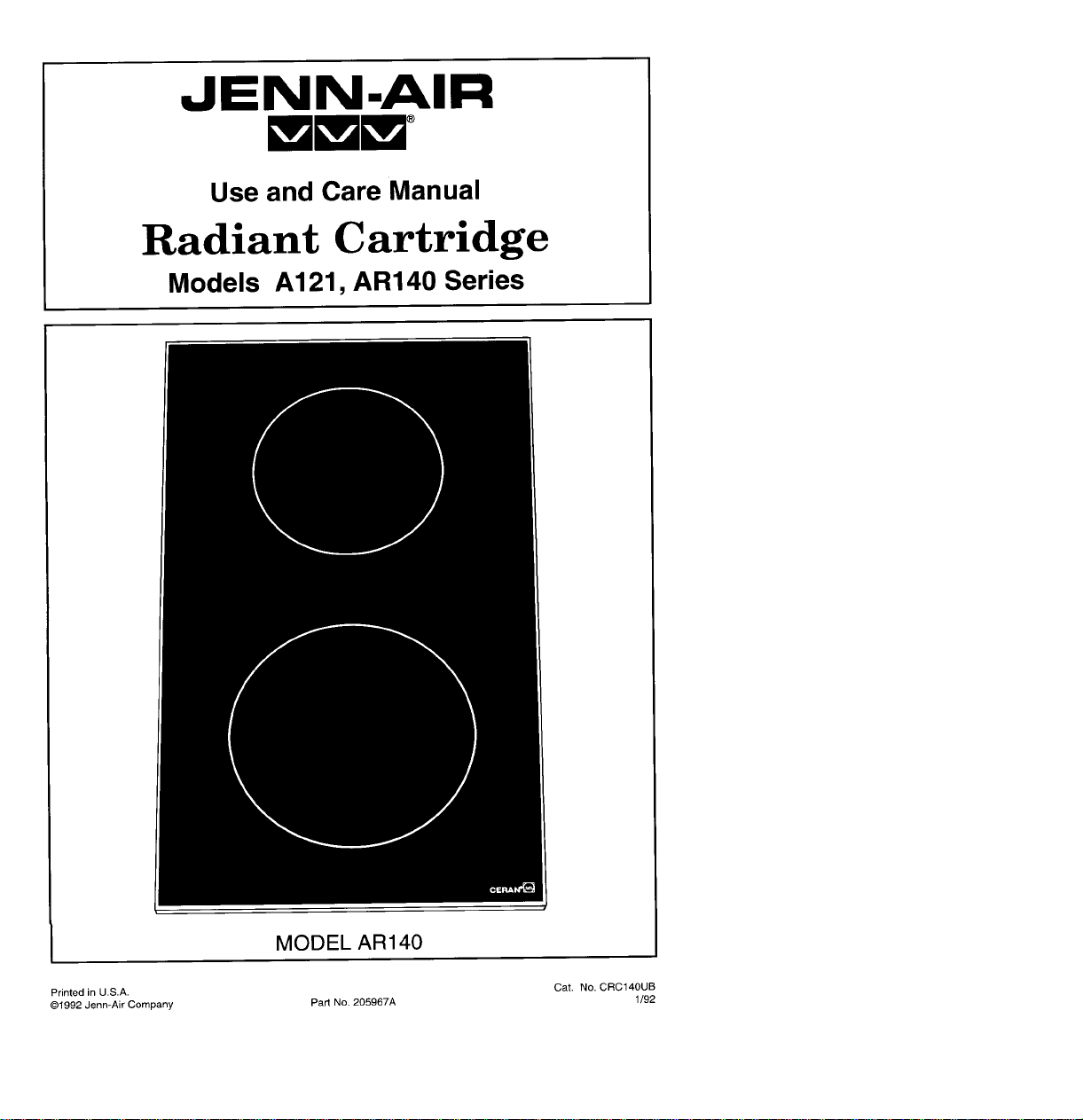
JENN-AIR
mmm °
Use and Care Manual
Radiant Cartridge
Models A121, AR140 Series
MODEL AR140
Printed in U.S.A. Cat. No. CRC140UB
@1992 Jenn-Air Company Part No. 205967A 1/92
SAFETY PRECAUTIONS
Read before operating your cooktop
All appliances - regardless of the manufacturer - have the potential
through improper or careless use to create safety problems. Therefore
the following safety precautions should be observed:
1. Never use your appliance for warming or heating the room.
2. Children should not be left alone or unattended in area where
appliance is in use. They should never be allowed to sit or stand
on any part of the appliance.
3. Wear proper apparel. Loose-fitting or hanging garments should
never be worn while using the appliance.
4. Do not repair or replace any part of the appliance unless
specifically recommended in this manual. All other servicing
should be referred to an authorized Jenn-Air Service Contractor.
5. Flammable materials should not be stored near surface units.
6. Do not use water on grease fires. Smother fire or flame or use
dry chemical or foam-type extinguisher.
7. Use only dry potholders. Moist or damp potholders on hot
surfaces may result in burns from steam. Do not let potholder
touch hot heating elements. Do not use a towel or other bulky
cloth.
8. Use proper pan size. Many appliances are equipped with one or
more surface units of different size. Select cookware having flat
bottoms large enough to cover the surface unit heating element.
The use of undersized cookware will expose a portion of the
heating element to direct contact and may result in ignition of
clothing. Proper relationship of cookware to heating element will
also improve efficiency and performance.
9. Never leave surface units unattended at high heat settings. Boil
over causes smoking and greasy spillovers that may ignite.
10. Glazed cookware - only certain types of glass, glass-ceramic,
ceramic, earthenware, or other glazed cookware are suitable for
cooktop surface without breaking due to the sudden change in
temperature. Use only such cookware as you know has been
approved for this purpose.
2
11. Cookwarehandles should be turned inward and not extend over
adjacent surface heating elements to avoid burns, ignition of
flammable materials and spillage due to unintentional contact
with the cookware.
12. Do not soak or immerse removable heating elements in water.
13. CAUTION - Do not store items of interest to children in cabinets
above cooktop - children climbing on the cooktop to reach items
could be seriously injured.
14. Do nottouch surface units or areas near units. Surface units or
heating elements may be hoteven though they are dark incolor.
Areas near surface units may become hot enough to cause
burns. During and after use, do not touch or let clothing or other
flammable materials contact these areas until they have had
sufficient time to cool. Other surfaces may become hot enough
to cause burns - among these surfaces is the cooktop.
15. Do not cook on glass-ceramic cooking surface if the cooktop is
broken. Cleaning solutions and spillovers may penetrate the
broken cooktop and create a shock hazard. Contact an autho-
rized Jenn-Air Service Contractor.
16. Clean glass-ceramic cooktops with caution. If wet sponge or
cloth is used to wipe spills on a hot cooking area, be careful to
avoid steam burns. Some cleansers can produce noxious fumes
if applied to a hot surface.
17. Do notoperate with damaged cooking element after any product
malfunction until proper repair has been made.
18. Keep all switches "OFF" when unit is not in use.
3
About Your Radiant Cartridge
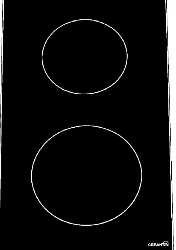
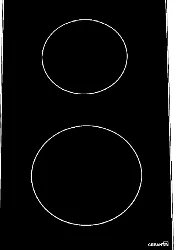
Congratulations onyour choiceof aJenn-Air radiant cooktop cartridge. The twocooking
areas are identified by circles on the glass ceramic cooktop. When anelement is turned
ON,the cooktop will heat upand the red glow of the heating element can beseen through
the glass ceramic top. Itis normal to see the redglow of the element whenever it cycles
on. The element will cycle on and off for all control settings except Hi. However, it may
also cycle on Hi if improper cookware is used.
Cooking Procedures
• BEFORE FIRST USE. CLEAN COOKTOP CARTRIDGE (See p.7)
• For best results, always use recommended cookware.
• Different cookpots anddifferentamounts offoodbeing preparedwill influencethe
controlsettings neededfor best results. (Seecooktop or range use &care manual
for typical control settings.) For fastest cooking, start with the surface control on
Hi for one minute; then turn the control to the lower desired setting. Covering
pans, whenever possible, speeds cooking and is more energy efficient.
• Theglassceramic cooking area retains heatfor a periodof time afterthe elements
have been turned off. Put this retained heat to good use. Turn the elements off
a few minutes before food is completely cooked and use the retained heat to
complete the cooking. Because ofthis heat retentioncharacteristic, the elements
will not respond to changes in heat settings as quickly as coil elements. In the
event of a potential boil over, remove the cookpot from the cooking area.
• When preparing foods which can be easily scorched or over-cooked, start
cooking at a lower temperature setting and gradually increase temperature as
needed.
• A higher setting than normal may be necessary when using cookpots made with
material that is slow to conduct heat, such as cast iron.
• A lowersettingcan be usedwhen cooking small quantities of foods or when using
a cookpot that conducts heat quickly.
IMPORTANT
• Do not usewire trivets, fire rings, pads orany such itembetween the cookware
and the element.
• Do not cook foods directly on cooktop.
• Do not allow pan to boil dry as this could damage the cooktop and the pan.
• Do not slide heavy metal or glass cookpots across surface since these may
scratch the surface.
• Do not use or place plastic items anywhere on cooktop.
• Do not use cartridge in the event a break has occurred. Call an authorized
Jenn-Air Service Contractor.
4
Selecting Proper Cookware
• Select heavy gauge cookpots. Usuallyheavy gauge cookpots willnot change
shape when heated.
• Use cookpots with flat, smooth bottoms. To determine ifthe cookpot is flat,
place the edge of a ruler on the bottom. Hold upto the light. No light should be
visible between the edge of the ruler and the pan. Rejectany pans that do not
fit flush against ruler's edge.
• Match the size of the cookpot to the size of the element. Cookpot should be
the same size or slightly larger.
Improper Cookware
• Do not use cookware that extends more than 1 inch beyond the cooking area.
• Cookware that is smaller in diameter than the cooking area should not be used.
Not only canthis cause the element to require more energy andtime, but can also
result in spillovers burning onto the cooking area resulting in a cleaning chore.
• Do not use nonflat specialty items that are oversized, uneven or do not meet
proper cookware specifications such as round bottom woks with rings, griddles,
rippled bottom canners, lobsterpots, large pressure canners, etc. Large utensils,
such as pressure canners or oversized skillets, should be used onlyon
conventional coil cartridges if they do not meet this test.
• Glass-ceramic, earthenware, heat proof glass or glazed cookpots may scratch
the glass ceramic cooktop and therefore are not recommended.
5
Avoid Damage to Cooktop
• Do notallow plasticobjects, sugar, or foods with high sugarcontent to melt onto
the hot cooktop. Melted materials can cause permanent damage to the
cooktop. If you accidentally melt anything onto the cooktop, remove it
immediately while the cooktop is still hot. Carefully, use a single edge razor
blade held with a pot holder to remove melted on material.
• Do not use aluminum foil or foil-type containers under any circumstances.
Aluminum foil will damage the cooktop if it melts onto the glass. Ifmetal melts
on cooktop, do not use. Call an authorized Jenn-Air Service Contractor.
• Do not use the glass-ceramic cooktop as a cutting board.
• Do NOT use abrasive cleansing powders or scouring pads (including metal
scouring pads), which will scratch the cooktop.
• DoNOT use chlorine bleach, ammonia, rust removers,oven cleaners, orother
cleanser not specifically recommended for use on glass-ceramic.
• Never immerse your cooktop cartridge in water.
• Test cast ironware since all are not flat. Also be cautioned against possible
"impactdamage" should the heavy cookpot be dropped on the glass-ceramic
surface.
6
Cleaning
BEFORECLEANING,BECERTAINALLELEMENTSARETURNEDOFFANDTHE
COOKTOPISCOOL.
CAUTION: Do NOT use a cooktop cleaner on a hot cooktop. The fumes can be
hazardous to your health, and can chemically attack the glass-ceramic
surface.
• The cartridge does not need to be removedfrom the cooktop for normal cleaning.
If removed, bottom may be wiped clean with damp cloth. If electrical terminals
on cartridge are cleaned, dry them thoroughly before using.
• For general daily cleaning and light surface soil, use a clean dishcloth or paper
towel and wash surface with solution of water and any of these cleansers:
dishwashing liquidsuch as Ivory orJoy, baking soda,fine polishing powders such
as Bon Ami, or commercial ceramic cooktop cleansers such as Elco Cooktop
Cleaning Creme (Part No.20000001). Wipe with clean damp clothor papertowel.
Rinse and dry thoroughly.
• To remove residue from burned onspills, make a paste of water and baking soda
or Bon Ami, Bar Keepers Friend, Comet, Shiny Sinks or nonabrasive soft
scrubbingcleansers, suchas Elco Cooktop Cleaning Creme(Part No.20000001).
Scrub with paper towels, nylon or plastic scrubber, such as Tufty. Rinse and dry
thoroughly. If stain is not removed easily, allow paste to remain on surface for
30 to 40 minutes. Keep moist by covering with wet paper towel.
• To remove burned on spot, use a single edge razor blade. Place blade edge on
cooktop at 30° angle; scrape off spot. Clean remainder of soil with method
described above.
Save on Clean-up Time
• Make sure bottoms of cookpots are always clean and dry. (Soilfrom the cookpot
bottom can betransferred to the cooktop surface.) Before using cookpots onthe
glass-ceramic cooktop for the first time, and periodically as needed, clean the
bottoms with scouring pads or other cleansers. Rinse and dry thoroughly.
• Make it a practice to wipe cooktop surface with a clean damp cloth or papertowel
before each use; dry thoroughly. Invisible spatters, dust specks, cleansers or
water can cause stains that appear after unit is heated. A sponge or dishcloth
which is notclean will leave film and soil laden detergent water which may cause
stains on surface after area is heated.
• When frying, use a spatter shield to reduce spattering.
• Use correct control settings and cookware large enough to hold food and liquid
to prevent boilovers and spattering.
• If a bad spillover occurs while cooking, spills may be cleaned from the cooktop
while it is hot to prevent a tough cleaning chore later. Using extreme care, wipe
with a clean damp towel. Be careful to avoid burns from steam or hand touching
the hot cooktop.
7