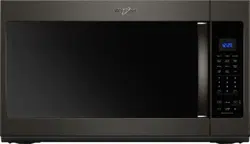
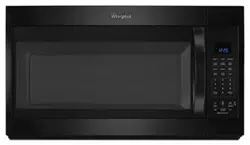
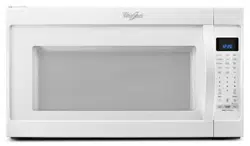
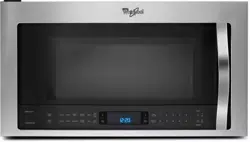
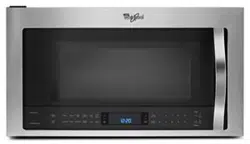
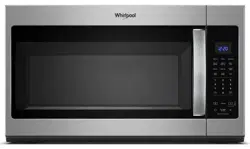
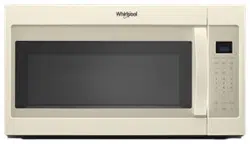
User manual Microwave
Electrical Requirements
Observe all governing codes and ordinances.
Required:
- A 120-volt, 60 Hz, AC-only, 15- or 20-amp electrical supply with a fuse or circuit breaker.
Recommended:
- A time-delay fuse or time-delay circuit breaker.
- A separate circuit serving only this microwave oven.
OPERATING YOUR MICROWAVE OVEN
IMPORTANT: If there are 2 packing spacers on top of the vent grille, remove them before using the microwave oven.
Settings
Clock
The Clock is a 12-hour (12:00-11:59) or 24-hour (0:00-23:59) clock. Touch OPTIONS/CLOCK to reach Clock submenu and follow the prompts to set the Clock. Clock format (12 hours with AM and PM, 12 hours without AM and PM, or 24 hours) may also be set in the Clock submenu.
Timer
With the microwave oven in Standby mode, touch the Timer control, enter time, then touch the Timer control or the Start control. Cook functions may be entered while the Timer is counting down. To cancel timer, touch Timer control while the Timer countdown is active in the display.
Control Lock
Activate to avoid unintended start. Touch and hold the Cancel control for about 3 seconds until 2 tones sound and padlock icon appears in the display. Repeat to unlock control.
Options/Clock
Ten options/settings may be adjusted: 1-Clock & Energy Save; 2-Scrolling Speed; 3-Sound; 4-Language; 5-Auto Vent Fan; 6-Filter Reset; 7-Fan Timer; 8-Light Timer; 9-Demo Mode; 10-Factory Reset
Vent Fan
Various speeds, ranging from High to Low and Off. Comes on automatically as cooling fan during any cook function.
Vent Timer:
Set vent fan to run for exactly 30 minutes or to run for only 30 minutes more (off after 30 minutes). The vent fan may be turned off at any time using the Vent Fan control. Touch OPTIONS/ CLOCK to reach the Fan Timer submenu and select the setting.
Auto Vent Fan (on some models):
To keep the microwave oven from overheating, the auto vent fan will automatically turn on at high speed if the temperature from the range or cooktop below the microwave oven gets too hot. When this occurs, the vent fan cannot be turned off. “AUTO FAN ON for heat circulation” appears in the display.
Dynamic Fan Sensing (on some models): To keep the microwave oven from overheating, the auto vent fan will automatically turn on at various speeds, depending on the temperature from the range or cooktop below the microwave oven. When this occurs, the vent fan cannot be turned off. “AUTO FAN Sensor Technology for heat circulation” appears in the display. As the temperature cools, the fan will automatically decrease its speed, then turn off.
Light Timer
Set the cooktop light to turn on and off at certain times. Touch OPTIONS/CLOCK to reach the Light Timer submenu, and follow the prompts to set the Light On time and Light Off time in hours and minutes or to cancel Light Timer.
NOTE: Light Timer uses 12-hour clock only.
Filter Reset
Reset the filter status after replacing and/or cleaning the filters. Touch OPTIONS/CLOCK to reach the Filter Reset submenu, and activate reset.
Sound (Tones)
Programming tones and signals. Programming tones may be turned off, or all tones (including end-of-function signals) may be turned off. Touch OPTIONS/CLOCK to reach the Sound submenu, then follow the prompts to turn off or on the programming tones or all tones.
Scroll Speed
Scroll speed of the text may be adjusted. Touch the OPTIONS/ CLOCK to reach the Scroll Speed submenu, and follow the prompts to set speed.
Demo Mode
Activate to practice using the control without actually turning on the magnetron. Touch OPTIONS/CLOCK to reach the Demo mode submenu, then follow the prompts to activate. The Demo icon will light up in the display. Repeat to deactivate.
Energy Save
To conserve energy, the Clock will automatically turn off when the microwave oven goes into Standby mode. Touch OPTIONS/ CLOCK to reach the Clock and Energy Save submenu and follow the prompts to turn on Clock.
Language (on some models)
Language of the display text may be changed. Touch the OPTIONS/CLOCK to reach the Language submenu, and follow the prompts to set language to English or French.
Standby Mode
When no functions are working (12-hour clock is displayed or if the clock has not been set), oven will switch to Standby Power mode and dim the LCD brightness after 5 minutes. Press any button or open/close the door, and display will return to the normal brightness.
Features
CLEANRELEASE® Cavity Coating (on some models)
The durable, nonstick coating resists soil buildup by making cleaning easier. See the “Microwave Oven Care” section.
Cooking Rack
Use the rectangular cooking rack only for 2-level cooking. To avoid damage to the microwave oven, always remove rack after 2-level cooking. To avoid damage to the microwave oven due to soil buildup, clean rack supports often.
Turntable
Turntable may be turned off for manual cooking only. This is helpful when cooking with plates that are bigger than the turntable or when cooking with plates that are side by side. Turntable cannot be turned off during preset or sensor (on some models) functions.
6th SENSE™ System
A sensor in the microwave oven detects moisture released from food as it heats and adjusts the cooking time accordingly.
Cookware and Dinnerware
Microwave-Safe
- Browning dish (Follow manufacturer recommendations.)
- Ceramic glass, glass
- China, earthenware (Follow manufacturer recommendations.)
- Melamine (Follow manufacturer recommendations.)
- Paper towels, paper plates, napkins (Use non-recycled paper.)
- Plastic wraps, bags, covers, dinnerware, containers (Follow manufacturer recommendations.)
- Pottery and clay (Follow manufacturer recommendations.)
- Silicone bakeware (Follow manufacturer recommendations.)
- Wax paper
Do Not Use
- Metal cookware and bakeware
- Straw or wicker
- Gold, silver, or pewter
- Non-approved meat thermometers, skewers
- Twist ties
- Foil liners, such as sandwich wrappers
- Staples
- Objects with gold or silver trim or with metallic glaze
To Test Cookware/Dinnerware: Place dish in microwave oven with 1 cup (250 mL) of water beside it. Program 1 minute of cook time at 100%. If dish becomes hot and the water stays cool, do not use the dish in the microwave oven.
Microwave Oven Use
For list of preset programs, see the Quick Reference Guide provided with your model.
Manual Cooking/Stage Cooking
Touch COOK TIME, touch number keypads to enter time, touch COOK POWER (if not 100%), touch number keypads to enter power level (10-90), then touch the Start control.
If programming additional stages (up to three), touch OPTIONS/ CLOCK to enter programming for the next stage, then enter the cook time and cook power of each, then touch the Start control.
Sensor Cooking
A sensor in the microwave oven detects moisture released from food as it heats and adjusts the cooking time accordingly.
Make sure microwave oven has been plugged in for at least 1 minute. Use microwave-safe dish with loose-fitting lid or cover microwave-safe dish with plastic wrap, and vent. For optimal performance, wait at least 30 minutes after convection cooking or grilling (on some models) before sensor cooking.
Add More Time
At the end of any cycle, “PRESS 0 TO ADD MORE TIME” scrolls in the display. Enter the additional time, if desired, and start the microwave oven. The cook power for all non-sensor cycles will be the same as in the finished cycle, but may be changed. If Add More Time is used after a sensor cycle, the cook power will be 100%, but may be changed.
Doneness
Adjust doneness for automatic cooking functions by touching COOK TIME repeatedly to scroll through “NORMAL,” “MORE DONE”, or “LESS DONE” within the first 20 seconds of starting the cook cycle. Doneness cannot be adjusted for Defrost functions.
Warm Hold
Hot cooked food can be kept warm in the microwave oven. The Warm Hold function uses 10% cook power. Warm Hold can be used by itself or can be programmed to follow a cooking cycle. Opening the door during Warm Hold will cancel the function.
MICROWAVE OVEN CARE
General Cleaning
IMPORTANT: Before cleaning, make sure all controls are OFF and the microwave oven is cool. Always follow label instructions on cleaning products.
To avoid damage to the microwave oven caused by arcing due to soil buildup, keep cavity, microwave inlet cover, cooking rack supports, and area where the door touches the frame clean.
Clean with mild soap, water, and a soft cloth or sponge or as indicated below
- Nonstick cavity coating (on some models): To avoid damage to the microwave oven cavity, do not use metal or sharp utensils or scrapers or any type of abrasive cleanser or scrubbers.
- Grease filter: mild soap and water or dishwasher.
- Door and exterior: mild soap and water, or glass cleaner applied to paper towel.
- Control panel: sponge or soft cloth and water.
- Stainless steel (on some models): mild soap and water, then rinse with clean water and dry with soft cloth, or use stainless steel cleaner.
- Turntable: mild soap and water or dishwasher.
- Rack(s): mild soap, water, and washcloth. Dishwasher cleaning is not recommended.
Installing/Replacing Filters and Light Bulbs
NOTE: A Filter Status indicator (on some models) appears in the display when it is time to replace the charcoal filter, and clean or replace the grease filters. See the “Settings” section to reset filter status.
- Grease filters: Grease filters are on the underside of microwave oven. Clean monthly or as prompted by Filter Status indicator. Slide the filter away from the tab area, and drop out the filter. To reinstall, place end of the filter into the opening opposite the tab area, swing up the other end, and slide it toward the tab area.
- Charcoal filter: The charcoal filter is behind the vent grille at the top front of the microwave oven. The charcoal filter cannot be cleaned and should be replaced about every 6 months. Remove 2 screws on the vent grille, slide the vent grille to the left, tilt it forward, lift it out, and remove the filter. To reinstall, place the filter into its 2-hook area with the wire mesh side to the front. Replace the vent grille by inserting the 3 bottom latch hooks of the vent grille into the front holes, tilt the vent grille backwards, slide it to the right, and secure with screws.
- Cooktop light: The cooktop light is located on the underside of the microwave oven and is replaceable. Remove bulb cover screw and open the bulb cover. Replace bulb, close bulb cover, and secure with screw.
- Cavity light: The cavity light bulb is located behind the vent grille at the top front of the microwave oven, under the bulb cover, and is replaceable. Remove 2 screws on the vent grille, slide the vent grille to the left, tilt it forward, and lift it out. Open the bulb cover and replace bulb. To reinstall, close bulb cover. Replace the vent grille by inserting the 3 bottom latch hooks of the vent grille into the front holes, tilt the vent g
ACCESSORIES
Following is a list of available parts and supplies which may be purchased separately. Please refer to the cover for contact and model identification information.
Replacement Parts
- Turntable
- Turntable support and rollers
- Turntable hub
- Cooking rack
- Rack clip
- Rack support
- Grease filter
- Charcoal filter
- Cooktop light bulb
- Cavity light bulb
Cleaning Supplies
Heavy Duty Degreaser
- affresh® Kitchen Appliance Cleaner
- affresh® Stainless Steel Cleaner
- affresh® Stainless Steel Wipes
PROBLEM SOLVER
Microwave oven will not operate
Check the following:
- Household fuse or circuit breaker - If a household fuse has blown or a circuit breaker has tripped, replace the fuse or reset the circuit breaker. If the problem continues, call an electrician.
- Magnetron - Try to heat 1 cup (250 mL) of cold water for 2 minutes at 100% cooking power. If water does not heat, try the steps in the bullets below. If microwave oven still does not operate, call for service.
- Door - Firmly close door. On some models, if a packaging spacer is attached to inside of the door, remove it, then firmly close door. If a message about the door appears in the display, the door has been closed for 5 minutes or more without the microwave oven being started. This occurs to avoid unintended starting of the microwave oven. Open and close the door, then start the cycle.
- Control - Make sure control is set properly. Make sure Control Lock is OFF. Make sure Demo mode (on some models) is OFF.
- Packing spacers - Make sure to remove the 2 packing spacers from the top of the vent grille before using the microwave oven
Arcing in the microwave oven
Check the following:
- Soil buildup - Soil buildup on cavity walls, microwave inlet cover, cooking rack supports, and area where the door touches the frame can cause arcing. See “General Cleaning” in the “Microwave Oven Care” section.
Turntable alternates rotation directions
- This is normal and depends on motor rotation at the beginning of the cycle.
Display shows messages
- “Enter clock” with flashing digits means there has been a power failure. Reset the clock.
- A letter followed by a number is an error indicator. Call for assistance.
Fan running during cooktop usage
- This is normal. The microwave oven’s cooling fan, which is separate from the vent fan, automatically comes on during microwave oven operation to cool the microwave oven. It may also automatically come on and cycle on and off to cool the microwave oven’s controls while the cooktop below is being used.
Radio, TV, or cordless phone interference
Check the following:
- Proximity - Move the receiver away from the microwave oven, or adjust the radio or TV antenna.
- Soil - Make sure the microwave oven door and sealing surfaces are clean.
- Frequency - Some 2.4 GHz-based cordless phones and home wireless networks may experience static or noise while microwave oven is ON. Use a corded phone, a different frequency cordless phone, or avoid using these items during microwave oven operation.
INSTALLATION INSTRUCTIONS
Remove Mounting Plate
Depending on your model, the mounting plate may be in the foam packaging, or it may be attached to the back of the microwave oven.
NOTE: To avoid possible damage to the work surface, cover the work surface.
- Remove any remaining contents from the microwave oven cavity.
- If the mounting plate is attached to the back of the microwave oven, remove it and set it aside.
- Tape the microwave oven door closed so that the door does not swing open while the microwave oven is being handled.
NOTE: To avoid damage to the microwave oven, do not grip or use the door or door handle while the microwave oven is being handled.
Rotate Blower Motor
The microwave oven is set for recirculation installation. For wall or roof venting, changes must be made to the venting system.
NOTE: Skip this section if you are using recirculation installation. Keep the damper assembly in case the venting method is changed, or the microwave oven is reinstalled in another location where wall or roof venting may be used.
Wall Venting Installation Only
1. Remove screws attaching damper plate to back of microwave oven, set the screws aside.
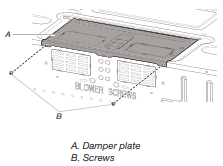
2. Turn and hold the damper plate vertically as shown.
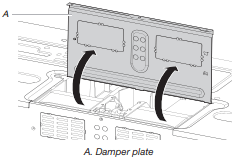
3. Remove two blower screws attaching blower motor to the microwave oven, and set aside.
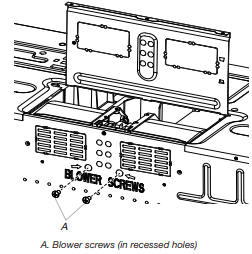
4. Disconnect the blower motor wire from the connector.
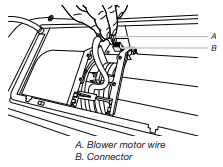
5. Lift blower motor out of microwave oven, and set aside.
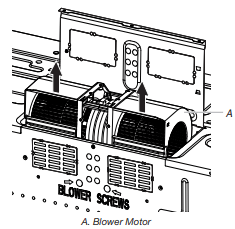
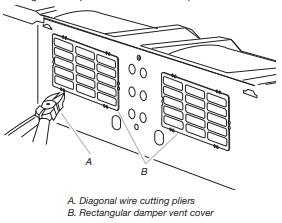
6. Using diagonal wire cutting pliers, gently snip out the rectangular damper vent covers at the perforations.
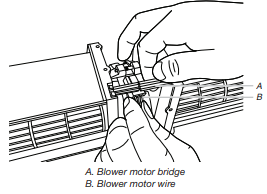
7. Hold the blower motor wire, put the wire through the blower motor bridge.
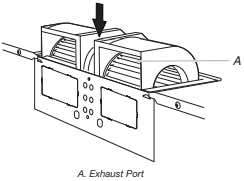
8. Lower blower motor back into the microwave oven. Exhaust ports face the back of the microwave oven.
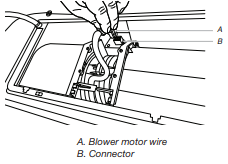
9. Reconnect the blower motor wire into the connector.
10. Reattach the two blower screws into the recessed holes in the back of the microwave.
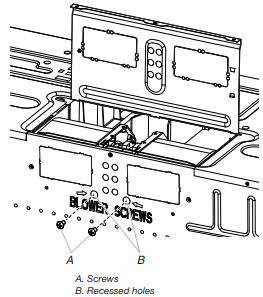
11. Check to make sure the two screws are secured properly in the blower motor screw holes, so that the motor cannot move.
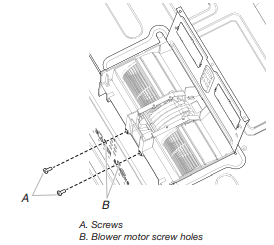
12. Return the damper plate to its original horizontal position.
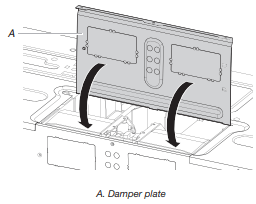
12. Return the damper plate to its original horizontal position.
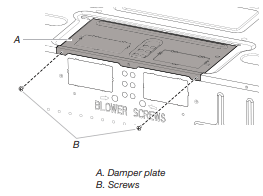
Roof Venting Installation Only
1. Repeat Step 1 from “Wall Venting Installation Only.”
2. Repeat Step 2 from “Wall Venting Installation Only.”
3. Repeat Step 3 from “Wall Venting Installation Only.”
4. Repeat Step 4 from “Wall Venting Installation Only.”
5. Repeat Step 5 from “Wall Venting Installation Only.”
6. Using diagonal wire cutting pliers, gently snip out the rectangular vent covers on the damper plate at the perforations
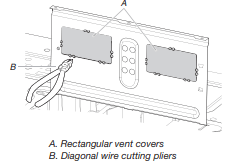
7. Lower blower motor back into microwave oven. Exhaust ports face the top of microwave oven.
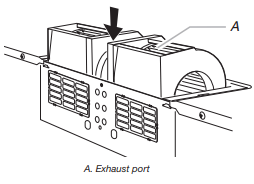
IMPORTANT: If blower motor is not positioned with fl at side facing the back of the microwave oven (as shown), performance will be poor.
8. Reconnect the blower motor wire into the connector.
9. Reattach the two blower screws into the recessed holes in the back of the microwave.
10. Check to make sure the two screws are secured properly in the blower motor screw holes, so that the motor cannot move.
11. Return the damper plate to its original horizontal position.
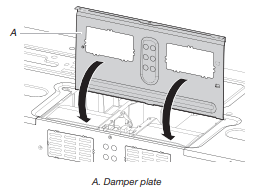
12. Secure damper plate with two screws removed in Step 1.
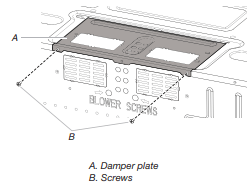
Locate Wall Stud(s)
NOTE: If no wall studs exist within the cabinet opening, do not install the microwave oven.
See illustrations in “Possible Wall Stud Confi gurations.”
1. Using a stud fi nder, locate the edges of the wall stud(s) within the opening.
2. Mark the center of each stud, and draw a plumb line down each stud center. See illustrations in “Possible Wall Stud Confi gurations.”
Possible Wall Stud Confi gurations
These depictions show examples of preferred installation confi gurations with the mounting plate.
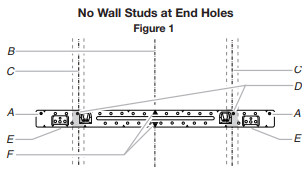
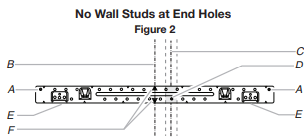
NOTE: If wall stud is within 6" (15.2 cm) of the vertical centerline (see the “Mark Rear Wall” section), only recirculation or roof venting installation can be done.
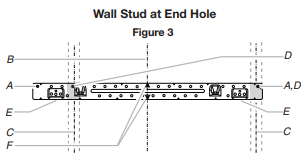
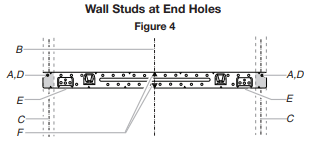
A. End holes (on mounting plate)
B. Cabinet opening vertical centerline
C. Wall stud centerlines
D. Holes for lag screws
E. Support tabs
F. Mounting plate center markers
Mark Rear Wall
The microwave oven must be installed on a minimum of one wall stud, preferably two, using a minimum of one lag screw, preferably two.
1. Using measuring tape, fi nd and clearly mark the vertical centerline of the opening.
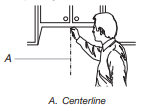
2. Align the center markers on the cardboard template (carton top cap) , to the centerline on the wall, making sure it is level, and that the top of the cardboard template is butted up against the bottom edge of the upper cabinet.
NOTES:
- If the front edge of the upper cabinet is lower than the back edge, lower the cardboard template so that its top is level with the front edge of the cabinet.
- If the cardboard template is damaged or unusable, measure and mark the wall with the dimensions described in Step 4.
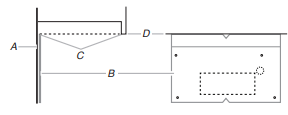
A. Rear wall
B. Cardboard template
C. Top of cardboard template must align with front edge of cabinet.
D. Front edge of upper cabinet
3. Holding the cardboard template in place, mark both holes in the lower corners and draw a horizontal line across the bottom edge of the cardboard template. These represent the mounting plate’s end holes and bottom edge.
4. Remove the cardboard template and check the markings:
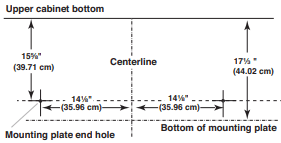
The bottom edge line must be 171⁄3" (44.02 cm) from the bottom of the upper cabinet and must be level.
The end holes must be 155⁄8" ( 39.71 cm) from the bottom edge of the upper cabinet and must be on a level line with each other. They must each be 141⁄8" (35.96 cm) from the centerline.
5. With the support tabs facing forward (see illustrations in the “Locate Wall Stud(s)” section), align the mounting plate center markers to the centerline on the wall, making sure its bottom edge is aligned to the horizontal line drawn in Step 3 and that the end holes are properly marked. Make sure the mounting plate is level.
6. Holding the mounting plate in place, find the wall stud centerline(s) drawn in Step 2 of “Locate Wall Stud(s)” and mark at least one, preferably two hole(s) through the mounting plate, closest to the wall stud centerline(s). See figures 1, 2, and/or 3 in “Possible Wall Stud Confi gurations” in the “Locate Wall Stud(s)” section. The blackened holes in the shaded areas are ideal hole locations.
7. Set the mounting plate aside.
Wall Venting Installation Only
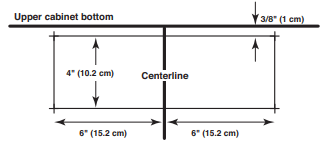
8. Mark the centerline 3/8" (1 cm) down from the bottom edge of the upper cabinet.
9. Using measuring tape, measure out 6" (15.2 cm) on both sides of the centerline, and mark.
10. Measure down 4" (10.2 cm) from the mark made in Step 8 and mark.
11. Using a straightedge, draw the two horizontal, level lines through the marks made in steps 8 and 10.
12. Draw the two vertical plumb lines down from the marks made in Step 9 to complete the 12" x 4" (30.5 x 10.2 cm) rectangle. This is the venting cutout area.
13. Cut a 3/4" (1.9 cm) hole in one corner of the cutout area.
14. Using a keyhole saw, cut out the venting cutout area.
Drill Holes in Rear Wall
In addition to being installed on at least one wall stud, the mounting plate must attach to the wall at both end holes. If the end holes are not over wall studs, use two 3/16-24 x 3" round head bolts with toggle nuts; if one end hole is over a wall stud, use one lag screw and one 3/16-24 x 3" round-head bolt with toggle nut; or if both end holes are over wall studs, use two lag screws. Following are three installation confi gurations.
Installation for No Wall Studs at End Holes (Figures 1 and 2)
1. Drill 5/8" (1.6 cm) holes through the wall at both end holes marked in Step 3 of the “Mark Rear Wall.”
2. Drill 3/16" (5 mm) hole(s) into the wall stud(s) at the hole(s) marked in Step 6 of the “Mark Rear Wall.” Refer to fi gures 1 and 2 in “Possible Wall Stud Confi gurations” in the“Locate Wall Stud(s)” section.
Installation for Wall Stud at One End Hole (Figure 3)
1. Drill a 3/16" (5 mm) hole into the wall stud at the end hole marked in Step 3 of the “Mark Rear Wall.”
2. If installing on a second wall stud, drill a 3/16" (5 mm) hole into the wall stud at the other hole marked in Step 6 of the“Mark Rear Wall.” Refer to Figure 3 in “Possible Wall Stud Confi gurations” in the “Locate all Stud(s)” section.
3. Drill a 5/8" (1.6 cm) hole through the wall at the other end hole.
Installation for Wall Studs at Both End Holes (Figure 4)
1. Drill 3/16" (5 mm) holes into the studs at the end holes marked in Step 3 of the “Mark Rear Wall.”
Install the Microwave Oven
IMPORTANT: The control side of the microwave oven is the heavy side. Handle the microwave oven gently.
1. Remove the two packing spacers from the top of the vent grille before using the microwave oven.
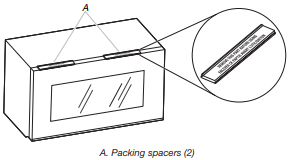
NOTE: Depending on your model, it may not have packing spacers. If it does not have packing spaces, install your microwave oven start from Step 2.
2. Place a washer on each 1/4-20 x 3" fl at-head bolt and place inside upper cabinet near the 3/8" (10 mm) holes.
3. Make sure the microwave oven door is closed and taped shut.
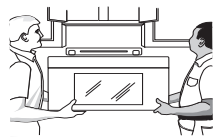
4. Using two or more people, lift microwave oven and hang it on support tabs at the bottom of mounting plate.
NOTE: To avoid damage to the microwave oven, do not grip or use the door or door handle while the microwave oven is being handled.
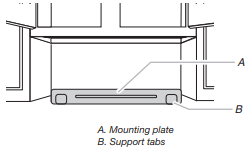
5. With front of microwave oven still tilted, thread power supply cord through the power supply cord hole in the bottom of the upper cabinet.
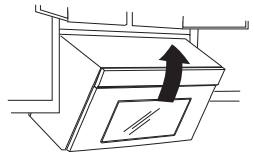
6. Rotate microwave oven up toward upper cabinet. NOTE: If venting through the wall, make sure the damper assembly fi ts easily into the vent in the wall cutout.
7. Push microwave oven against mounting plate and hold in place. NOTE: If microwave oven does not need to be adjusted, skip steps 7 through 9.
8. If adjustment is required, rotate microwave oven downward. Using two or more people, lift microwave oven off of mounting plate, and set aside on a covered surface.
9. Loosen mounting plate screws. Adjust mounting plate and retighten screws.
10. Repeat steps 3 through 6.
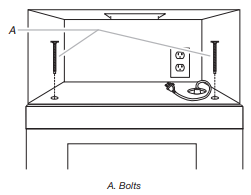
11. With the microwave oven centered, and with at least one person holding it in place, insert bolts through upper cabinet into microwave oven. Tighten bolts until there is no gap between upper cabinet and microwave oven.
NOTES:
- Some upper cabinets may require bolts longer or shorter than 3" (7.6 cm). Longer or shorter bolts are available at most hardware stores.
- Overtightening bolts may warp the top of the microwave oven. To avoid warping, wood fi ller blocks (installer to provide) may be added. The blocks must be the same thickness as the space between the upper cabinet bottom and the microwave oven.
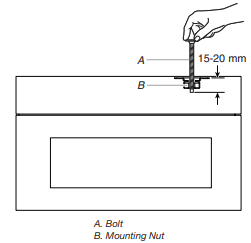
NOTE: Avoid damage to the mounting nut, screw the bolts into the mounting nut holes around 15-20 mm by hand fi rst, make sure the bolts thread in properly. Then tighten with tools.
For Roof Venting Installation Only
1. Insert damper assembly through the cabinet cutout so that the long tab of the damper assembly slides under the raised tabs of the damper plate. Then secure with #6 x 3/8" sheet metal screw.
NOTE: The screw cannot be installed if the damper assembly is not positioned as shown.
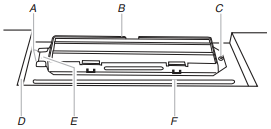
A. Raised tabs
B. Damper assembly
C. #6 x 3/8" Sheet metal screw
D. Upper cabinet cutout
E. Long tab
F. Damper plate
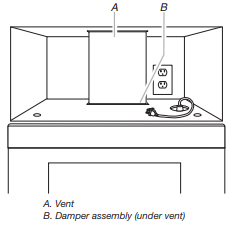
2. Connect vent to damper assembly
Complete Installation
1. Install fi lters. Refer to the User Instructions for fi lter placement.
2. Plug microwave oven into grounded 3 prong outlet.
3. Reconnect power.
4. Check the operation of microwave oven by placing 1 cup (250 mL) of water on the turntable and programming a cook time of 1 minute at 100% power. Test vent fan and exhaust by operating the vent fan.
5. If the microwave oven does not operate:
- Check that a household fuse has not blown, or that a circuit breaker has not tripped. Replace the fuse or reset the circuit breaker. If the problem continues, call an electrician.
- Check that the power supply cord is plugged into a grounded 3 prong outlet.
- See the User Instructions for troubleshooting information.
The installation is now complete.
Save Installation Instructions for future use.