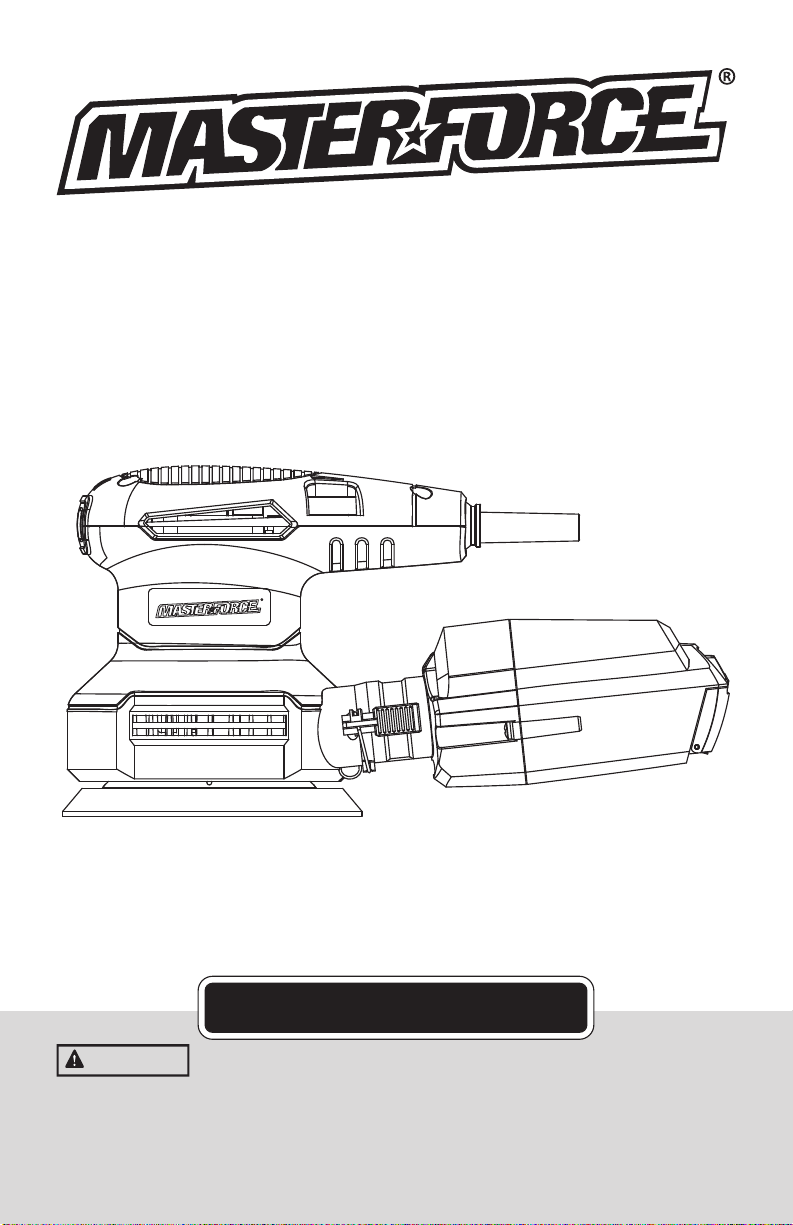
Random Orbit Sander
241-0807
OPERATOR’S MANUAL
CAUTION:
To Reduce The Risk Of Injury, User Must Read And
Understand Operator’s Manual. Save These Instructions For
Future Reference.
For questions / comments, technical assistance or repair parts
Please Call Toll Free at: 1-888-686-1484 (M-F 8am – 6pm)

Page 2
General Safety Rules ..........................................................................3-4
Symbols ................................................................................................5
General Use Statement .........................................................................6
Specification .......................................................................................6
Electrical ..............................................................................................7
Feature .................................................................................................8
Operation ....... .............................................................................9-11
Working hints for your sander.............................................................12
Maintenance .......................................................................................12
Troubleshooting..................................................................................12
Accessories ............. ........................................................................12
Notes...................................................................................................13
Warranty ............................................................................................14
TABLE OF CONTENTS

Page 3
GENERAL SAFETY RULEs
PRODUCT SAFETY
WARNING
Some dust created by power
sanding, sawing, grinding, drilling and other
construction activities contains chemicals
known to the state of California to cause
cancer, birth defects or other reproductive
harm. Some examples of these chemicals
are:
● Lead from lead-based paints;
● Crystalline silica from bricks and cement
and other masonry products;
● Arsenic and chromium from chemically-
treated lumber.
Your risk from these exposures varies,
depending on how often you do this type
of work. To reduce your exposure to these
chemical: work in a well ventilated area,
and work with approved safety equipment,
such as those dust masks that are specially
designed to lter out microscopic particles.
WARNING
This product can expose you
to chemicals including lead, phthalate or
bisphenol A which are known to the State of
California to cause cancer, birth defects or
other reproductive harm. Wash your hands
after use. For more information go to www.
P65Warnings.ca.gov.
GENERAL POWER TOOL
SAFETY WARNINGS
WARNING
Read all safety warnings,
instructions, illustrations and specifications
provided with this power tool.
Failure to
follow all instructions listed below may result
in electric shock, re and/or serious injury.
Save all warnings and instructions for
future reference.
The term “power tool” in the warnings refers
to your mains-operated (corded) power tool
or battery-operated (cordless) power tool.
WORK AREA SAFETY
● Keep work area clean and well lit. Cluttered
or dark areas invite accidents.
● Do not operate power tools in explosive
atmospheres, such as in the presence of
flammable liquids, gases or dust. Power
tools create sparks which may ignite the dust or
fumes.
● Keep children and bystanders away while
operating a power tool. Distractions can cause
you to lose control.
ELECTRICAL SAFETY
● Power tool plugs must match the outlet.
Never modify the plug in any way. Do not use
any adapter plugs with earthed (grounded)
power tools. Unmodied plugs and matching
outlets will reduce risk of electric shock.
● Avoid body contact with earthed or
grounded surfaces, such as pipes, radiators,
ranges and refrigerators. There is an
increased risk of electric shock if your body is
earthed or grounded.
● Do not expose power tools to rain or wet
conditions. Water entering a power tool will
increase the risk of electric shock.
● Do not abuse the cord. Never use the cord
for carrying, pulling or unplugging the power
tool. Keep cord away from heat, oil, sharp
edges or moving parts. Damaged or entangled
cords increase the risk of electric shock.
● When operating a power tool outdoors, use
an extension cord suitable for outdoor use.
Use of a cord suitable for outdoor use reduces
the risk of electric shock.
● If operating a power tool in a damp location
is unavoidable, use a residual current device
(RCD) protected supply. Use of an RCD
reduces the risk of electric shock.
PERSONAL SAFETY
● Stay alert, watch what you are doing and
use common sense when operating a power
tool. Do not use a power tool while you are
tired or under the influence of drugs, alcohol
or medication. A moment of inattention while
operating power tools may result in serious
personal injury.
● Use personal protective equipment. Always
wear eye protection. Protective equipment
such as dust mask, non-skid safety shoes, hard
hat, or hearing protection used for appropriate
conditions will reduce personal injuries.
● Prevent unintentional starting. Ensure
the switch is in the off-position before
connecting to power source and/or battery
pack, picking up or carrying the tool. Carrying
power tools with your nger on the switch or
energising power tools that have the switch on
invites accidents.
● Remove any adjusting key or wrench

Page 4
GENERAL SAFETY RULE
before turning the power tool on. A wrench or
a key left attached to a rotating part of the power
tool may result in personal injury.
● Do not overreach. Keep proper footing and
balance at all times. This enables better control
of the power tool in unexpected situations.
● Dress properly. Do not wear loose clothing
or jewellery. Keep your hair and clothing away
from moving parts. Loose clothes, jewellery or
long hair can be caught in moving parts.
● If devices are provided for the connection
of dust extraction and collection facilities,
ensure these are connected and properly
used. Use of dust collection can reduce dust-
related hazards.
● Do not let familiarity gained from frequent
use of tools allow you to become complacent
and ignore tool safety principles. A careless
action can cause severe injury within a fraction
of a second.
POWER TOOL USE AND CARE
● Do not force the power tool. Use the correct
power tool for your application. The correct
power tool will do the job better and safer at the
rate for which it was designed.
● Do not use the power tool if the switch does
not turn it on and off. Any power tool that cannot
be controlled with the switch is dangerous and
must be repaired.
● Disconnect the plug from the power source
and/or remove the battery pack, if detachable,
from the power tool before making any
adjustments, changing accessories, or
storing power tools. Such preventive safety
measures reduce the risk of starting the power
tool accidentally.
● Store idle power tools out of the reach of
children and do not allow persons unfamiliar
with the power tool or these instructions
to operate the power tool. Power tools are
dangerous in the hands of untrained users.
● Maintain power tools and accessories.
Check for misalignment or binding of
moving parts, breakage of parts and any
other condition that may affect the power
tool’s operation. If damaged, have the power
tool repaired before use. Many accidents are
caused by poorly maintained power tools.
● Keep cutting tools sharp and clean. Properly
maintained cutting tools with sharp cutting edges
are less likely to bind and are easier to control.
● Use the power tool, accessories and
tool bits etc. in accordance with these
instructions, taking into account the working
conditions and the work to be performed.
Use of the power tool for operations different
from those intended could result in a hazardous
situation.
● Keep handles and grasping surfaces dry,
clean and free from oil and grease. Slippery
handles and grasping surfaces do not allow for
safe handling and control of the tool in unexpected
situations.
SERVICE
● Have your power tool serviced by a
qualified repair person using only identical
replacement parts. This will ensure that the
safety of the power tool is maintained.

Page 5
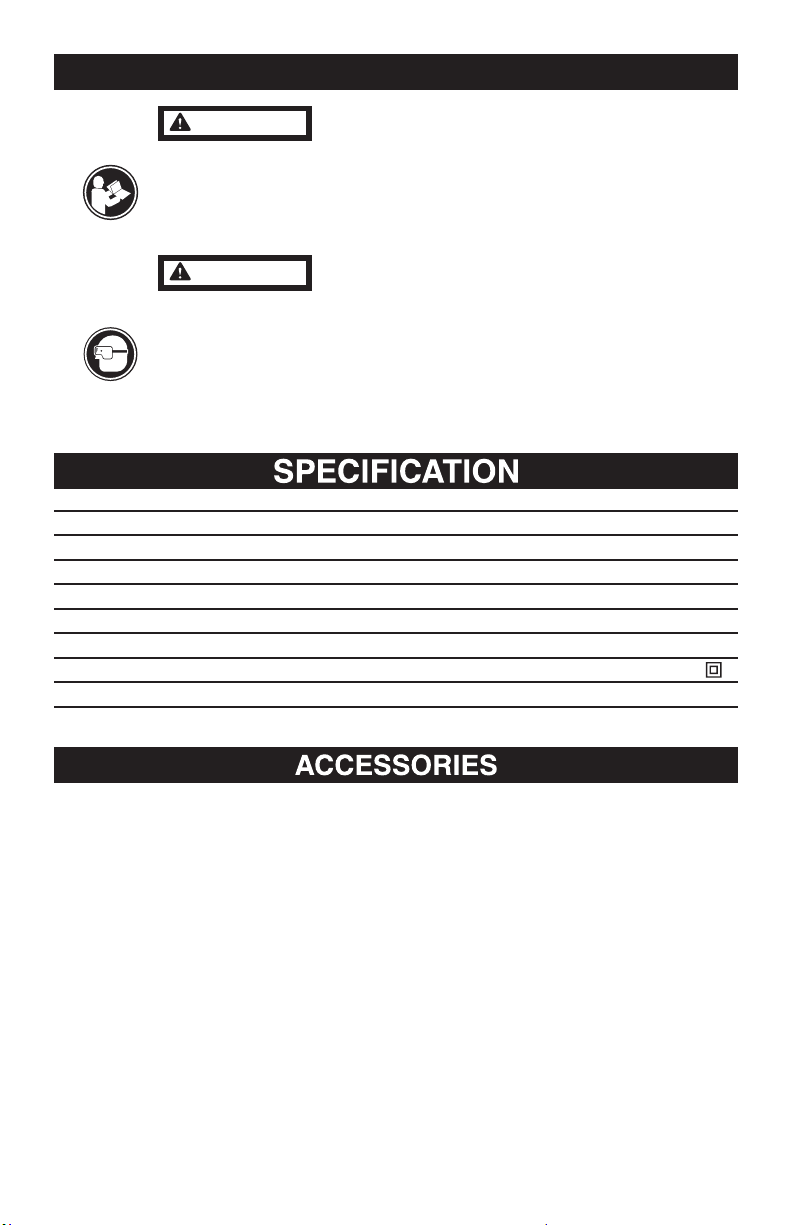
IMPORTANT: Your power tool and its Instruction Manual may contain “WARNING ICONS” (a
picture symbol intended to alert you to, and/or instruct you as to how to avoid a potentially
hazardous condition). Understanding and heeding these symbols will help you operate your tool
better and safer. Shown below are some of the symbols you may see.
SAVE THESE INSTRUCTIONS
To reduce the risk of injury, user must read instruction manual
Warning
Wear eye protection
Wear a dust mask
Wear ear protection
Double insulated
SYMBOLS
Page 6
Do not attempt to use this product until you thoroughly read and completely
understand the instruction manual. Pay close attention to the safety rule, includ-
ing Danger, Warnings, and Cautions.
The operation of any tool can result in foreign objects being thrown into your
eyes, which can result in severe eye damage. Before beginning any operation,
always wear safety goggles or safety glasses with side shields and a full face
shield when needed. We recommend the Wide Vision Safety Mask for use over
your eyeglasses or standard safety glasses with side shields. Always wear eye
protection that complies with ANSI Z87.1.
WARNING
WARNING
GENERAL USE STATEMENT (APPLICATIONS)
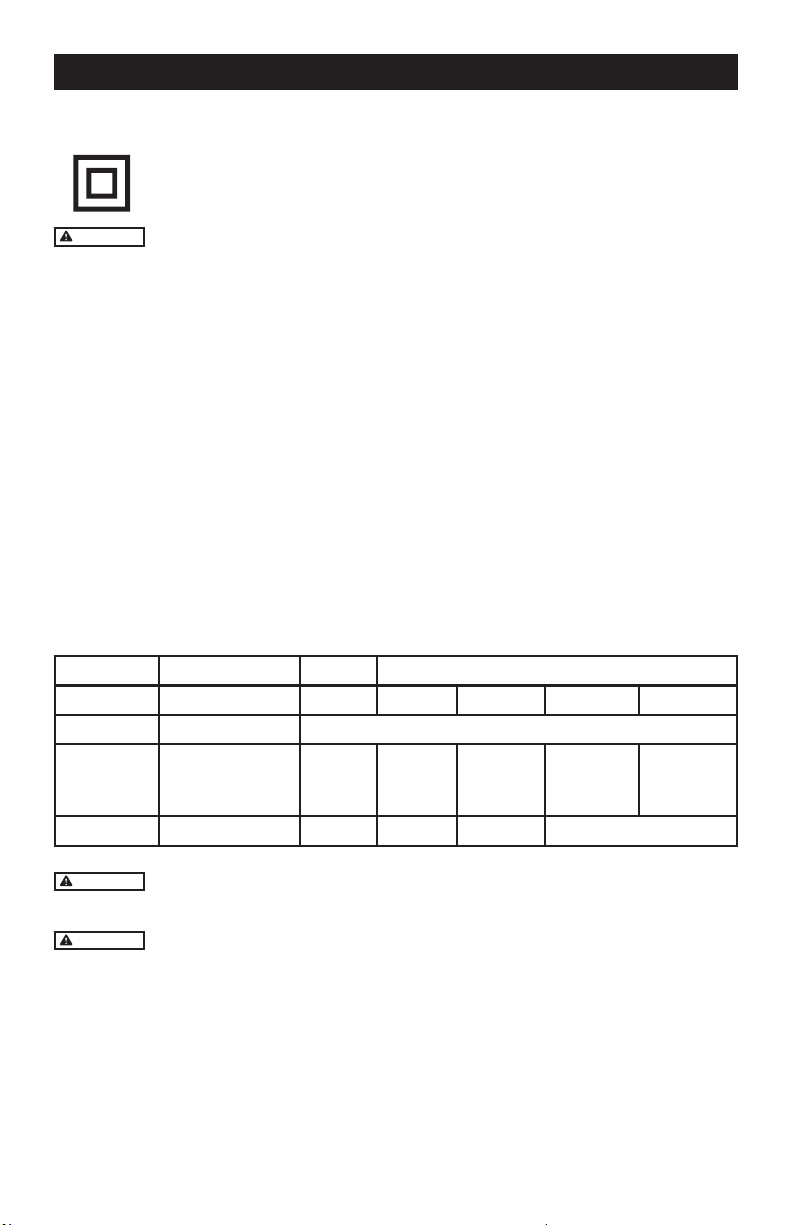
Sku: 241-0807
Voltage 120V~60Hz
Power 3.0A
No load speed 5000-12000/min
Base size 5”
Orbital diameter 3/32”
Protection class
/II
Machine weight 3.5 lbs
We recommend that you purchase your accessories listed in the above list from the same store that
sold you the tool. Refer to the accessory packaging for further details. Store personnel can assist you
and offer advice.
1pc Cyclone box
1pc Vacuum adaptor
1pc 80 grit Velcro sand paper(8-hole)
Page 7
DOUBLE INSULATION
Double insulation is a safety concept for electric power tools, which eliminates
the need for the usual three-wire grounded power cord. All exposed metal parts
are isolated from the internal metal motor components with protecting insulation.
Double insulated tools do not need to be grounded.
WARNING
The double insulated system is intended to protect the user from shock resulting from
a break in the tool’s internal wiring. Observe all normal safety precautions to avoid electrical shock.
IMPORTANT: Servicing a tool with double insulation requires extreme care and knowledge
of the system and should be performed only by a qualied service technician. Always use the
original factory replacement parts when servicing.
ELECTRICAL CONNECTION
The Random Orbit Sander has a precision-built electric motor. It should be connected to a power sup-
ply that is 120V, 60Hz AC only (normal household current). Do not operate this tool on direct current
(DC). A substantial voltage drop will cause a loss of power and the motor to overheat. If your tool does
not operate when plugged into an outlet, double-check the power supply.
USE PROPER EXTENSION CORD. Make sure your extension cord is in good condition. When us-
ing an extension cord, be sure to use one heavy enough to carry the current your product will draw.
An undersized cord will cause a drop in line voltage resulting in loss of power and overheating. Table
1 shows the correct size to use depending on cord length and nameplate ampere rating. If in doubt,
use the next heavier gage. The smaller the gage number, the heavier the cord.
Table 1 Minimum gauge for cord
Rating Volts Total length of cord in feet
Ampere 120V 25ft. 50ft. 100 ft. 150 ft.
More Than Not More Than AWG
0
6
10
6
10
12
18
18
16
16
16
16
16
14
14
14
12
12
12 16 14 12 Not Recommended
CAUTION
Keep the extension cord clear of the working area. Position the cord so that it will not get
caught on lumber, tools or other obstructions while you are working with a power tool.
WARNING
Check extension cords before each use. If damaged replace immediately. Never use a tool
with a damaged cord since touching the damaged area could cause electrical shock resulting in serious
injury.
ELECTRICAL
Page 8
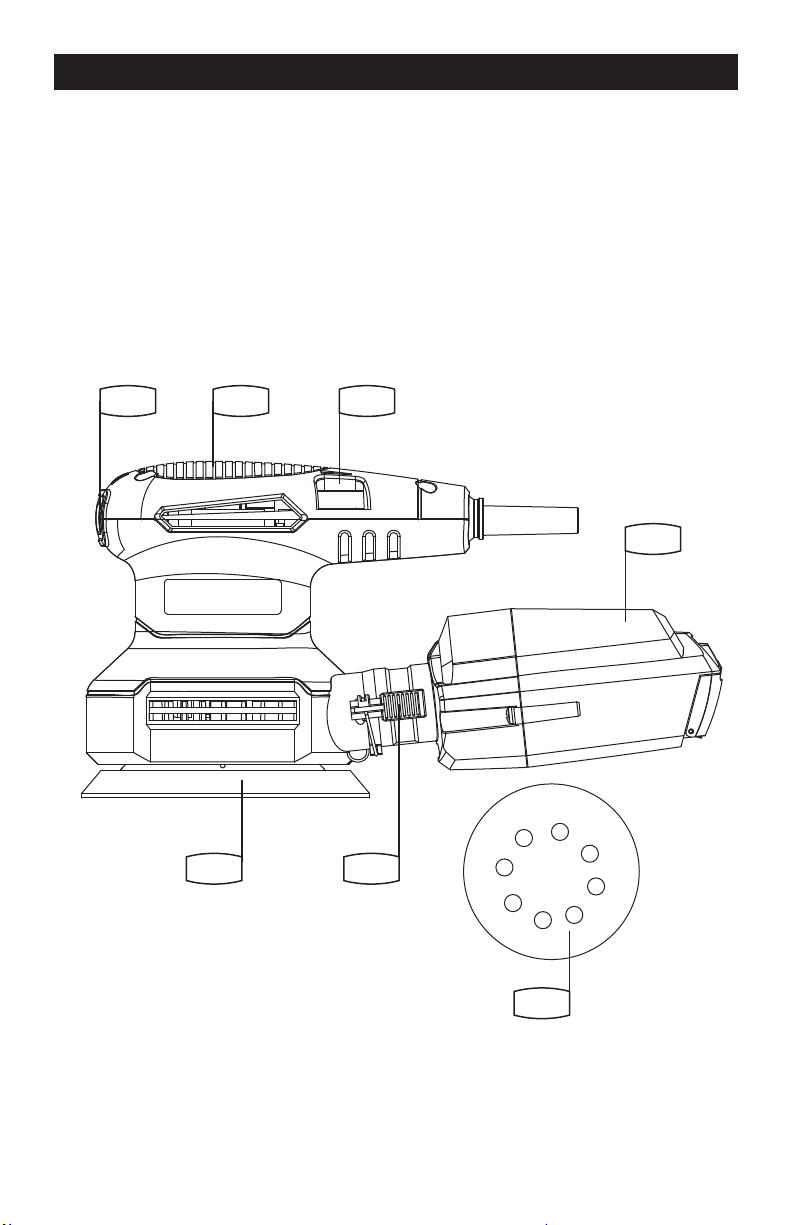
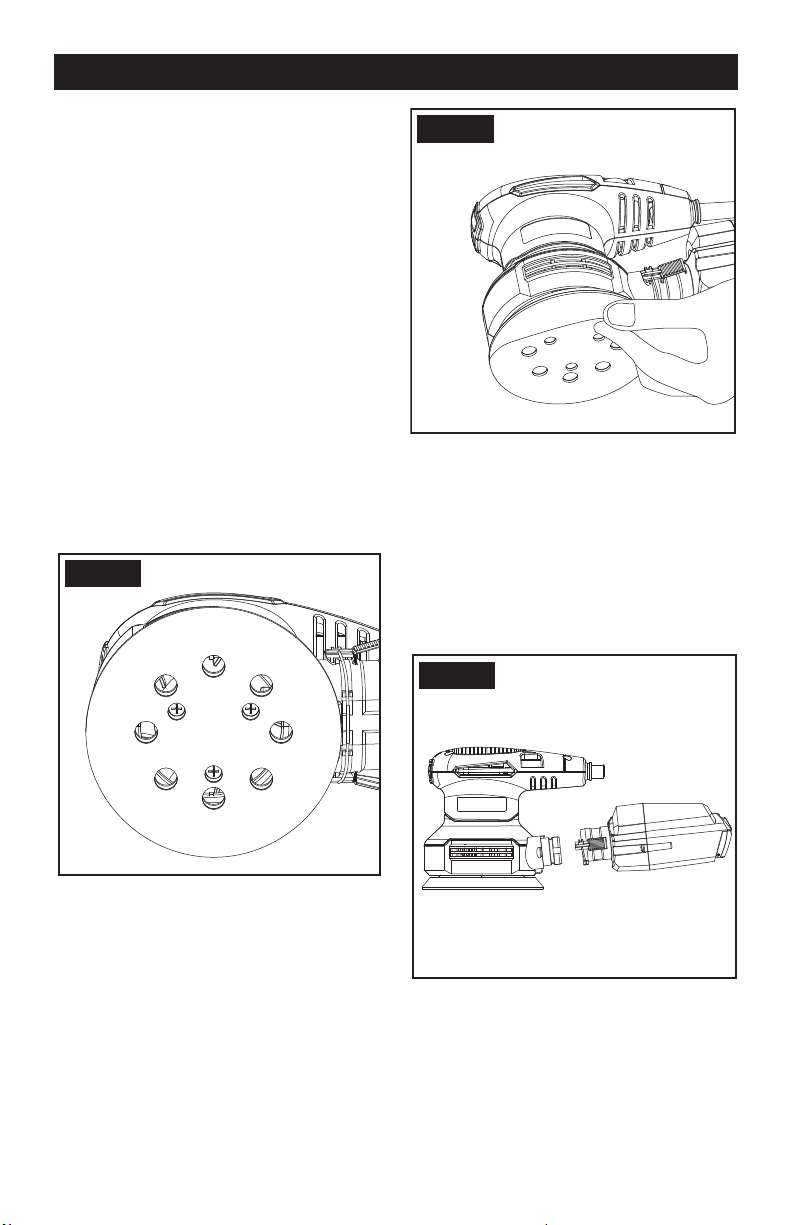
KNOW YOUR RANDOM ORBIT SANDER
Before attempting to use any tool, familiarize yourself with all the operating features and safety
requirements.
1. On/Off switch
2. Soft grip handle
3. Variable speed control
4. Dust extraction outlet
5. Base plate
6. Sand paper
7. Dust box
FEATURE
1 2 3
7
4
6
5
Page 9
OPERATION INSTRUCTIONS
NOTE: Before using the tool, read the
instruction book carefully.
Intended Use
The machine is intended for dry sanding–with
high removal capacity–of wood, plastic, metal,
ller as well as varnished surfaces.
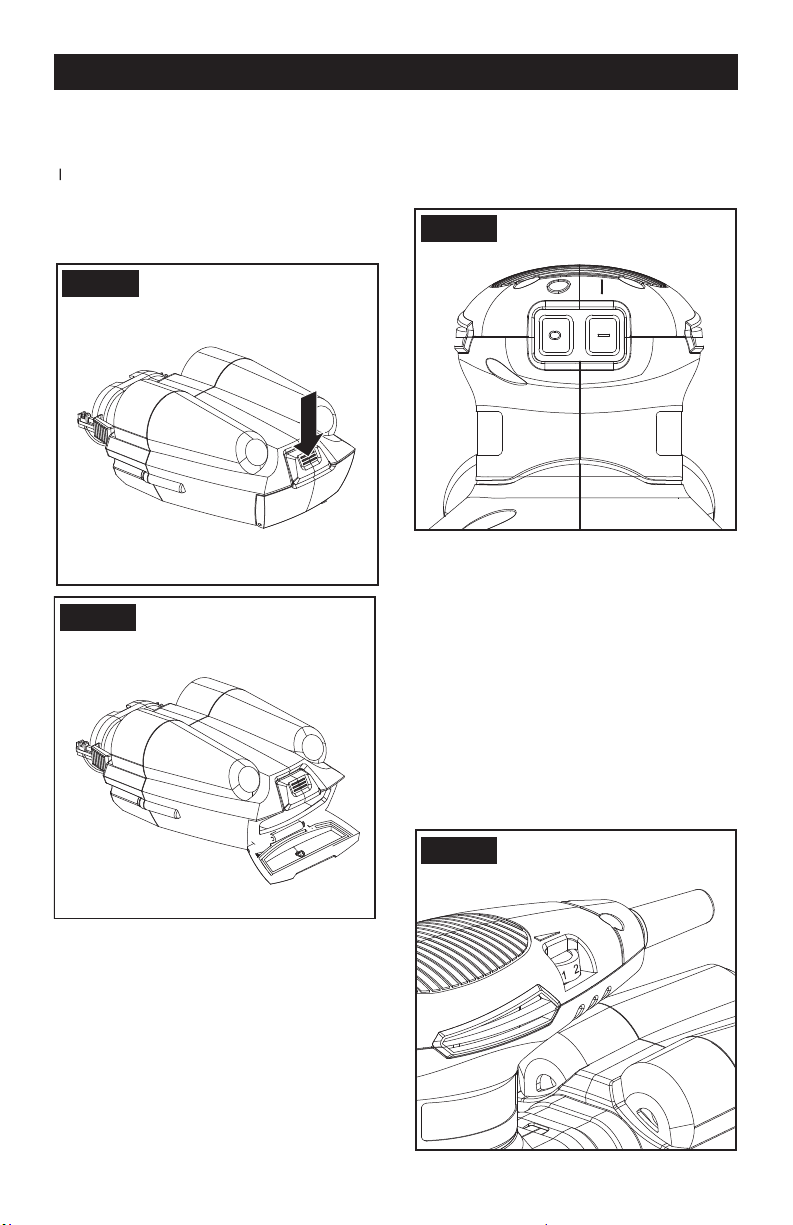
1. CHANGING HOOK & LOOP SANDPAPER
(SEE FIG. A1)
The sandpaper and sanding plate are provided
with a hook and loop attachment system to
allow quick and easy changing of the sanding
and polishing accessories. Firstly, remove any
dust or other objects from the hook and loop
on the sanding plate and sandpaper. As the
sandpaper has dust extraction holes you must
align these with the holes in the sanding plate,
otherwise the dust extraction will not function.
(See Fig. A1)
Fig. A1
To remove the sandpaper, lift one corner of the
paper and pull off from the sanding plate. (See
Fig. A2)
Fig. A2
2. CYCLONE BOX (SEE FIG. B1)
Your sander is equipped with the cyclone box.
To attach, insert the cyclone box into the back
of the sander until it is secure.
Caution!
To prevent the possibility of sanding dust or
foreign body being thrown in to your face or
eyes, never attempt to use your sander without
the cyclone box properly installed.
Fig. B1
OPERATION
Page 10
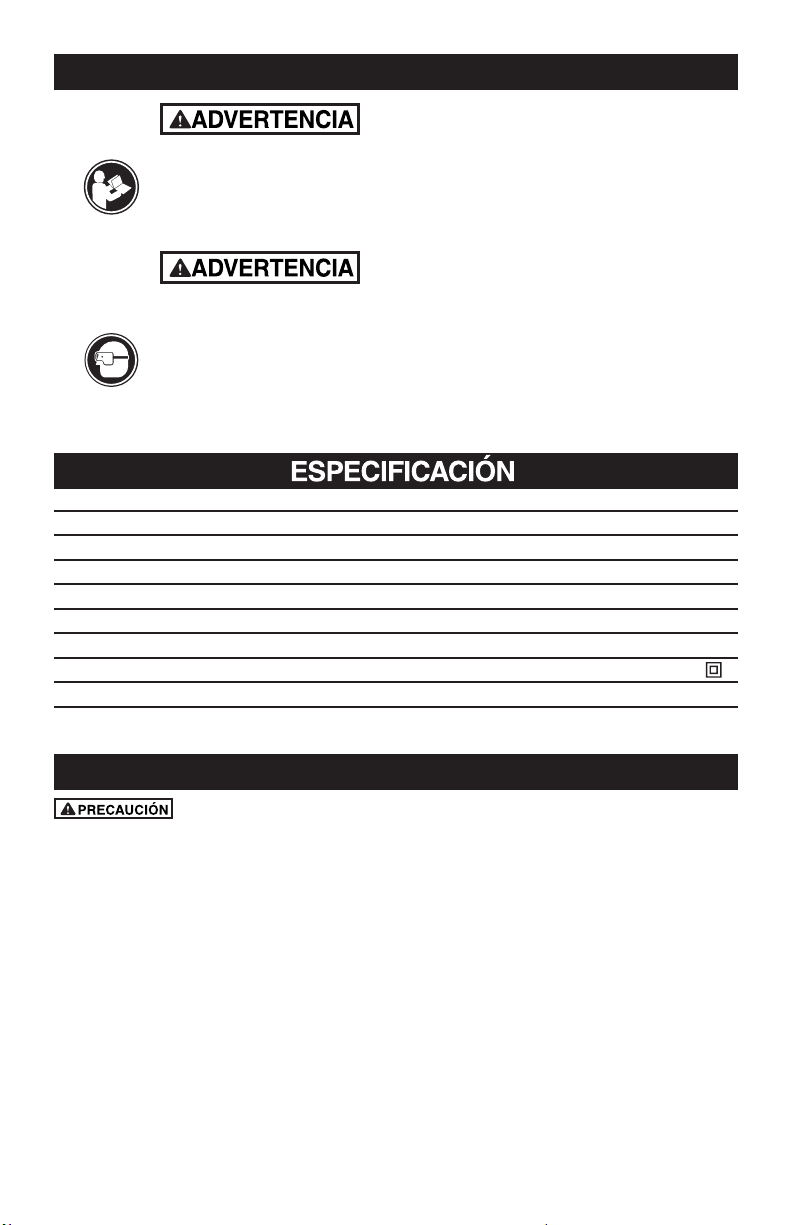
EMPTY CYCLONE BOX (SEE FIG. B2, B3)
For more efcient operation, empty the cyclone
box every 5-10mins. This will permit the air to
f ow through the box better.
To empty the box, remove it from the dust
extraction port. Then press the button at the
rear of the box to open it, and shake out dust.
Fig. B2
Fig. B3
3. ON/OFF SWITCH (SEE FIG. C)
To start your sander, depress the protective
cover over the switch at the position marked
“I”. To stop your sander, depress the protective
cover at the position marked “0”.
Fig. C
4. VARIABLE SPEED CONTROL (SEE FIG.
D)
With the variable speed control (3), the required
speed can be selected (also while running).
The required speed is dependent on the
material and is to be determined by a practical
trial.
If your power tool becomes too hot, especially
when used at low speed, set the speed to
maximum and run with no load for 2-3 minutes
to cool the motor. Avoid prolonged usage at
very low speed.
Fig. D
OPERATION

Page 11
OPERATION
5. USING THE SANDER
NOTE: If you see some sparks ashing in the
ventilation slots do not panic, this is normal and
will not damage the tool.
Be sure to hold the sander rmly whilst it is on
and apply it gently to the work; it may kick on
rst contact. Hold the sander so that it is at on
the work and move slowly, preferably in parallel
lines, circles, or crosswise movements. When
you rst turn it on, make sure that your nger
remains on the switch so you can STOP the
sander in case there is a problem.
When using nishing sanding base or corner
sanding base, switch the sander on with the
base away from the work piece. Let the motor
reach full speed then operate sanding. Remove
the sander form the work piece before switching
off.
Flush sanding can be performed with your
sander. The front edge of your sander allows
f ush sanding.
The sander should run smoothly. Strange or
unnatural noise should be investigated and
corrected before operating the sander further.
Regularly check the condition of the abrasive
paper and replace when worn for best results.
Always keep the machine moving so the nish
of your work stays consistent. If you stay in one
place too long, then the sander may produce
a depression in the wood that will compromise
your nish.

Page 12
Remove the plug from the socket before carrying out any adjustment, servicing or
maintenance.
Your power tool requires no additional lubrication or maintenance. There are no user serviceable
parts in your power tool. Never use water or chemical cleaners to clean your power tool. Wipe
clean with a dry cloth. Always store your power tool in a dry place. Keep the motor ventilation
slots clean. Keep all working controls free of dust. Occasionally you may see sparks through
the ventilation slots. This is normal. If the supply cord is damaged, it must be replaced by the
manufacturer, its service agent or similarly qualied persons in order to avoid a hazard.
1. If your sander will not operate, check the power at the mains plug.
2. If the sander does not abrade surface, checking the sand paper. If the sand paper has been
worn, replace the new paper and try again. The paper must be kept in a dry place, if it is allowed
to become damp, the abrasive particles will lose their adhesion to the backing paper and will
not abrade.
3. If the sander does not move smoothly, the sand paper may be loose, damaged or wrinkled.
Replace and try again.
4. If a fault can not be rectied return the sander to an authorized dealer for repair.
If your power tool becomes too hot, especially when used at low speed, set the speed to maxi-
mum and run it with no load for 2-3 minutes to cool the motor. Avoid prolonged usage at very low
speeds. Always use sand paper that is suitable for the material you want to sand.
Always ensure the work-piece is rmly held or clamped to prevent movement.
Any movement of the material may affect the quality of the sanding nish.
Start your sander before sanding and turn it off only after you stop sanding. For the best results,
sand wood in the direction of the grain.
Do not start sanding without having the sandpaper tted.
Do not allow the sandpaper to wear away it will damage the base-plate. The guarantee also cover
base-plate wear and tear.
Use coarse grit paper to sand rough surfaces, medium grit for smooth surfaces and ne grit for the
nal surfaces. If necessary, rst make a test run on scrap material.
Use only good quality sandpaper.
The sandpaper controls the sanding efciency, not the amount of force you apply to the tool.
Excessive force will reduce the sanding efciency and cause motor overload. Replacing the sand-
paper regularly will maintain optimum sanding efciency.
WORKING HINTS FOR YOUR SANDER
MAINTENANCE
TROUBLESHOOTING

Page 13
NOTES

Page 14
SAVE YOUR RECEIPTS
THIS WARRANTY IS VOID WITHOUT THEM
MASTERFORCE
®
RANDOM ORBIT SANDER
WARRANTY
90-DAY MONEY BACK GUARANTEE:
This MASTERFORCE
®
brand power tool carries our 90-DAY Money Back Guarantee.
If you are not completely satised with your MASTERFORCE
®
brand power tool for
any reason within ninety (90) days from the date of purchase, return the tool with your
original receipt to any MENARDS
®
retail store, and we will provide you a refund – no
questions asked.
3-YEAR LIMITED WARRANTY:
This MASTERFORCE
®
brand power tool carries our famous No Hassle 3-Year Limited
Warranty to the original purchaser. If, during normal use, this
MASTERFORCE
®
power tool breaks or fails due to a defect in material or workmanship
within three (3) years from the date of original purchase, simply bring this tool with the
original sales receipt back to your nearest MENARDS
®
retail store. At its discretion,
MASTERFORCE
®
agrees to have the tool or any defective part(s) repaired or replaced
with the same or similar MASTERFORCE
®
product or part free of charge, within the
stated warranty period, when returned by the original purchaser with original sales
receipt. Not withstanding the foregoing, this limited warranty does not cover
any damage that has resulted from abuse or misuse of the Merchandise.
This warranty: (1) excludes expendable parts including but not limited to blades,
brushes, belts, bits, light bulbs, and/or batteries; (2) shall be void if this tool is used
for commercial and/or rental purposes; and (3) does not cover any losses, injuries to
persons/property or costs. This warranty does give you specic legal rights and you
may have other rights, which vary from state to state. Be careful, tools are dangerous if
improperly used or maintained. Seller’s employees are not qualied to advise you on the
use of this Merchandise. Any oral representation(s) made will not be binding on seller or
its employees. The rights under this limited warranty are to the original purchaser of the
Merchandise and may not be transferred to any subsequent owner.
This limited warranty is in lieu of all warranties, expressed or implied including warranties
or merchantability and tness for a particular purpose. Seller shall not be liable for any
special, incidental, or consequential damages. The sole exclusive remedy against the
seller will be for the replacement of any defects as provided herein, as long as the seller
is willing or able to replace this product or is willing to refund the purchase price as
provided above. For insurance purposes, seller is not allowed to demonstrate any of
these power tools for you.
For questions / comments, technical assistance or repair parts
Please Call Toll Free at: 1-888-686-1484 ( (M-F 8am – 6pm)
SAV E YOUR RECEIPTS. THIS WARRANTY IS VOID WITHOUT THEM

Page 15
CUSTOMER SERVICE INFORMATION:
Now that you have purchased your tool, should a need ever exist for repair parts or service,
simply call 1-888-686-1484. Be sure to provide all pertinent facts when you call or visit.

Page 16
Lijadora Giratoria
Para reducir el riesgo de lesiones, el usuario
debe leer y comprender el manual del operador. Guarde estas
instrucciones para referencia en el futuro.
Para preguntas / comentarios, asistencia técnica o partes de
reparación
Por favor llame al número telefónico gratuito al: 1-888-686-1484
(Lunes-Viernes 8am – 6pm)
241-0807

Page 18
TABLA DE CONTENIDO
Reglas de seguridad generales ....................................................19-20
Símbolos ...........................................................................................21
Declaración de uso general (aplicaciones) .........................................22
Especificacion .....................................................................................22
Eléctrico ..............................................................................................23
Características ..................................................................................24
Operación ....... .............................................................................25-27
Consejos de trabajo para su lijadora de correa....................................28
Mantenimiento ....................................................................................28
Solución de problemas........................................................................28
Accesorios ............. ...........................................................................28
Notas...................................................................................................29
Garantía ............................................................................................30

Page 19
INSTRUCCIONES DE
SEGURIDAD
El polvo originado por
la utilización de herramientas motorizadas
contiene químicos que, según el Estado
de California, causan cáncer, defectos
congénitos y otros daños reproductivos.
Algunos ejemplos de esos productos
químicos son:
● El plomo de las pinturas a base de plomo
● La sílice cristalina de los ladrillos, del
cemento y de otros productos de albañilería
● El arsénico y el cromo de la madera
tratada químicamente
El riesgo que se corre a causa del contacto
con esos productos varía según la frecuencia
con que usted realice este tipo de trabajos.
Con el n de reducir su exposición a esas
substancias químicas, trabaje en un área
bien ventilada; utilice un equipo de seguridad
adecuado, tal como una máscara contra el
polvo especialmente diseñada para ltrar
partículas microscópicas.
Este producto puede
exponerlo a químicos que incluyen plomo,
ftalato, o bisfenol A que se sabe en el Estado
de California que causan cáncer, defectos
de nacimiento u otros daños reproductivos.
Lave sus manos después de usarlo. Para
más información visite www.P65Warnings.
ca.gov.
Advertencias De Seguridad
Generales Para La Herramienta
Motorizada
Lea y comprenda todas
las instrucciones. El no seguir todas
las instrucciones a continuación puede
ocasionar descargas eléctricas, incendios
y/o heridas graves.
Conserve todas las advertencias e
instrucciones para consulta futura.
El término “herramienta eléctrica” que gura
en todas las advertencias que aparecen a
continuación hace referencia a la herramienta
que funciona con la red de suministro
eléctrico (con cable) o a la herramienta
eléctrica accionada a baterías (sin cable).
ÁREA DE TRABAJO
● Mantenga su lugar de trabajo limpio y bien
iluminado. Bancos de trabajo desordenados y
lugares oscuros invitan a los accidentes.
● No utilice herramientas eléctricas en
atmósferas explosivas, como por ejemplo en
presencia de líquidos, inflamables, gases
o polvo. Las herramientas eléctricas crean
chispas que pueden encender el polvo o los
vapores.
● Mantenga a los espectadores, niños y
visitantes a una distancia prudente cuando
esté utilizando una herramienta eléctrica.
Las distracciones pueden hacerle perder el
control.
SEGURIDAD ELÉCTRICA
● Los enchufes de las herramientas
eléctricas deben coincidir con el
tomacorriente. No modifique de algún modo
el enchufe. No utilice enchufes adaptadores
con herramientas eléctricas conectadas
a tierra. Si no se modican los enchufes y
se utilizan los tomacorrientes adecuados, se
reducirá el riesgo de una descarga eléctrica.
● Evite el contacto del cuerpo con las
superficies conectadas a tierra tales como
tuberías, radiadores, estufas de cocina y
refrigeradores. Existe mayor riesgo de que se
produzcan descargas eléctricas si su cuerpo
está conectado a tierra.
● No exponga las herramientas eléctricas a la
lluvia ni a los ambientes húmedos. La entrada
de agua en una herramienta eléctrica aumenta
el riesgo de que se produzcan descargas
eléctricas.
● No abuse del cable. Nunca use el cable
para transportar las herramientas ni para
sacar el enchufe de un tomacorriente.
Mantenga el cable alejado del calor, el aceite,
los bordes alados o las piezas móviles. Los
cables dañados aumentan el riesgo de que se
produzcan descargas eléctricas.
e) Cuando opere una herramienta eléctrica
en exteriores, use un cable de extensión
adecuado para uso en exteriores. El uso de un
cable adecuado para uso en exteriores reduce el
riesgo de descargas eléctricas.
● Si operar una herramienta eléctrica en un
lugar húmedo es inevitable, use un elemento
protegido del dispositivo de corriente
residual (RCD). El uso de un RCD reduce el
riesgo de descargas eléctricas.
REGLAS DE SEGURIDAD GENERALESs

Page 20
GENERAL SAFETY RULE
SEGURIDAD PERSONAL
● Manténgase alerta, fíjese en lo que está
haciendo y use el sentido común cuando
utilice una herramienta eléctrica. No use
la herramienta cuando esté cansado o se
encuentre bajo la inuencia de drogas, alcohol
o medicamentos. Un momento de distracción al
utilizar herramientas eléctricas puede dar lugar a
lesiones personales graves.
● Utilice equipo de seguridad. Use siempre
protección ocular. La utilización del equipo de
seguridad como mascara antipolvo, zapatos de
seguridad antideslizantaes, casco o protección
auditiva para condiciones adecuadas reducirá el
riego de lesiones personales.
● Evite el arranque accidental. Asegúrese
de que el interruptor esté en la posición de
trabado o de apagado antes de instalar el
paquete de baterías. Transportar herramientas
con el dedo en el interruptor o instalar el paquete
de batería cuando el interruptor está encendido
invitan a los accidentes.
● Retire las llaves o claves de ajuste antes
de encender la herramienta. Una llave o clave
de ajuste dejada en una parte giratoria de la
herramienta puede causar una lesión personal.
● No intente alcanzar demasiado lejos.
Mantenga un apoyo de los pies y un equilibrio
adecuados en todo momento. El apoyo de
los pies y el equilibrio adecuados permiten un
mejor control de la herramienta en situaciones
inesperadas.
● Vístase apropiadamente. No se ponga ropa
holgada ni joyas. Mantenga su cabello, ropa
y guantes alejados de las piezas móviles. La
ropa holgada, las joyas o el pelo largo pueden
quedar atrapados en las piezas móviles.
● Si se proporcionan dispositivos para la
extracción y recolección de polvo, asegúrese
que estos estén conectados y utilizados
correctamente. El uso de estos dispositivos
puede reducir peligros relacionados con el polvo.
● No permita que la familiaridad obtenida a
partir del uso frecuente de otras herramientas
le permita volverse complaciente e ignorar
los principios de seguridad de la herramienta.
Una acción descuidada puede causar lesiones
severas en una fracción de segundo.
USO Y CUIDADO DE LA HERRAMIENTA
● No fuerce la herramienta. Emplee la
herramienta correcta para la aplicación que
desea. La herramienta correcta hará el trabajo
mejor y con más seguridad a la capacidad
nominal para la que está diseñada.
● No utilice la herramienta si el interruptor no
la enciende o apaga. Toda herramienta que no
se pueda controlar con el interruptor es peligrosa
y debe ser reparada.
● Desconecte la batería de la herramienta o
ponga el interruptor en la posición de trabado
o de apagado antes de hacer cualquier
ajuste, cambio de accesorios o guardar la
herramienta. Estas medidas de seguridad
preventivas reducen el riesgo de encender la
herramienta accidentalmente.
● Guarde las herramientas que no esté
usando fuera del alcance de los niños y otras
personas no capacitadas. Las herramientas
son peligrosas en las manos de los usuarios no
capacitados.
● Mantenga las herramientas con cuidado.
Compruebe la desalineación o el atasco de
las piezas móviles, la ruptura de piezas y
cualquier otra situación que pueda afectar
el funcionamiento de las herramientas. Si la
herramienta está dañada, hágala arreglar antes
de usarla. Muchos accidentes son causados por
herramientas mantenidas decientemente.
● Conserve las herramientas de corte
afiladas y limpias. Las herramientas mantenidas
adecuadamente, con bordes de corte alados,
tienen menos probabilidades de atascarse y son
más fáciles de controlar.
● Utilice la herramienta eléctrica, accesorios,
brocas de la herramienta, etc. de acuerdo con
estas instrucciones y de la manera adecuada
para el tipo de herramienta eléctrica, teniendo
en cuenta las condiciones de trabajo y el
trabajo que se realizará. La utilización de la
herramienta eléctrica para operaciones diferentes
de aquellas para las que se encuentra diseñada
podría dar lugar a una situación peligrosa.
● Mantenga las manijas y las superficies de
sujeción secas, limpias y libres de aceite y
grasa. Las manijas y supercies de sujeción
resbaladizas no permiten el manejo y control
seguros de la herramienta en situaciones
inesperadas.
REPARACIÓN
● La herramienta debe ser reparada por una
persona calificada de servicio técnico y se
deben utilizar partes de reemplazo idénticas.
Esto asegurará el mantenimiento de la seguridad
de la herramienta eléctrica.

Page 21
IMPORTANTE: Su herramienta eléctrica y su Instructivo puede contener “ICONOS DE
ADVERTENCIA” (un símbolo en imagen que le advierte, y/o le indica cómo evitar un condición
potencialmente peligrosa). Entender y apegarse a estos símbolos le ayudará a operar su
herramienta mejor y de manera más segura. A continuación se muestran algunos de los símbolos
que puede ver.
CONSERVE ESTAS INSTRUCCIONES
Para reducir el riesgo de lesiones, el usuario deberá leer el manual de instrucciones
Advertencia
Use lentes de seguridad
Use máscara contra el polvo
Use protección auditiva
Doble aislamiento
SÍMBOLOS
Page 22
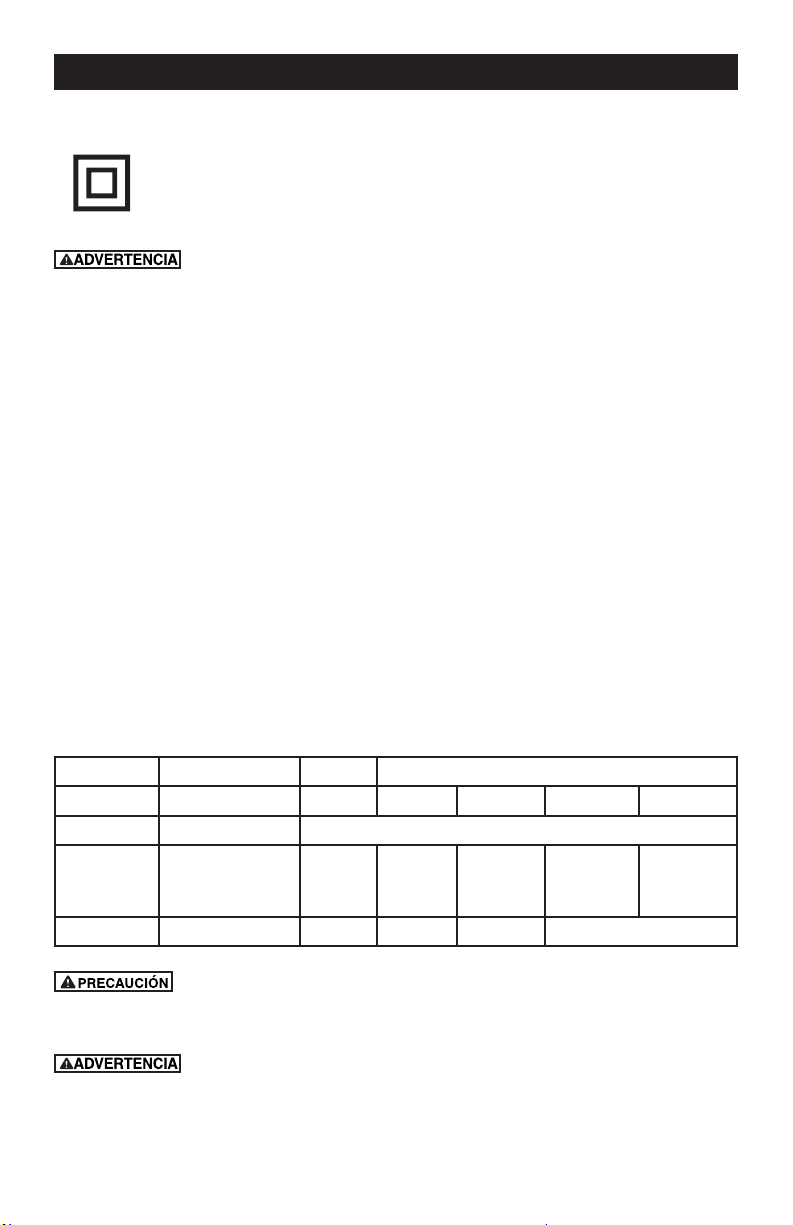
Sku: 241-0807
Voltios 120V~60Hz
Potencia 3.0A
Velocidad sin Carga 5000-12000/min
Tamaño de la base 5 pulg.
Diámetro orbital 3/32 pulg.
Clase de protección
/II
Peso de la máquina 3.5 lbs
No intente usar este producto hasta que lea minuciosamente y entienda por completo
el instructivo. Ponga mucha atención a las reglas de seguridad, incluyendo peligro,
Advertencias, y Precauciones.
La operación de cualquier herramienta puede resultar en que objetos extraños sean
arrojados hacia susojos, lo que puede resultar en daño severo a los ojos. Antes de co-
menzar cualquier operación, siempre use gafas o lentes de seguridad con protectores
laterales y una careta completa cuando sea necesario. Recomendamos la Máscara
de seguridad de visión amplia para uso sobre sus lentes o gafas de seguridad están-
dar con protectores laterales. Siempre use protección para los ojos que cumpla con
ANSI Z87.1.
DECLARACIÓN DE USO GENERAL (APLICACIONES)
Recomendamos que adquiera sus accesorios indicados en la lista anterior a partir de la tienda
Menards que le vendió la herramienta. El uso de cualquier otro accesorio o suplemento podría
presentar un riesgo de lesiones a las personas. Sólo use el accesorio o suplemento para su
propósito indicado.
1pc Caja Cyclone
1pc Adaptador de vacío
1pc Gancho y bucle del papel de lija (80 Grano)
ACCESORIOS
Page 23
DOBLE AISLAMIENTO
El doble aislamiento es un concepto de seguridad para herramientas eléctricas,
que elimina la necesidad del cable eléctrico con tierra de tres alambres habitual.
Todas las partes de metal expuestas están aisladas de los componentes de metal
internos del motor con aislamiento de protección.
Las tierras con doble aislamiento no necesitan conectarse a tierra.
El sistema de doble aislamiento está diseñado para proteger al usuario contra
choque que resulte de una ruptura en el cableado interno de la herramienta. Observe todas las pre-
cauciones normales de seguridad para evitar el choque eléctrico.
IMPORTANTE: Dar servicio a una herramienta con doble aislamiento requiere cuidado
extremo y conocimiento del sistema y sólo debe ser realizado por un técnico de servicio
calicado. Siempre use las partes de reemplazo de fábrica originales cuando dé servicio.
CONEXIÓN ELÉCTRICA
La Lijadora Giratoria tiene un motor eléctrico integrado de precisión. Se debe conectar a un suminis-
tro de energía que tenga 120 voltios, 60 Hz, sólo CA (corriente doméstica normal). No opere esta her-
ramienta en corriente directa (CD). Una caída de voltaje substancial causará una pérdida de energía
y el motor se sobrecalentará. Si su herramienta no opera cuando esté conectada a un enchufe, revise
de nuevo el suministro de energía.
USE EL CABLE DE EXTENSIÓN ADECUADO. Asegúrese que su cable de extensión esté en
buenas condiciones. Cuando use un cable de extensión, asegúrese usar uno lo sucientemente
fuerte para manejar la corriente que requerirá su producto. Un cable de menor capacidad causará
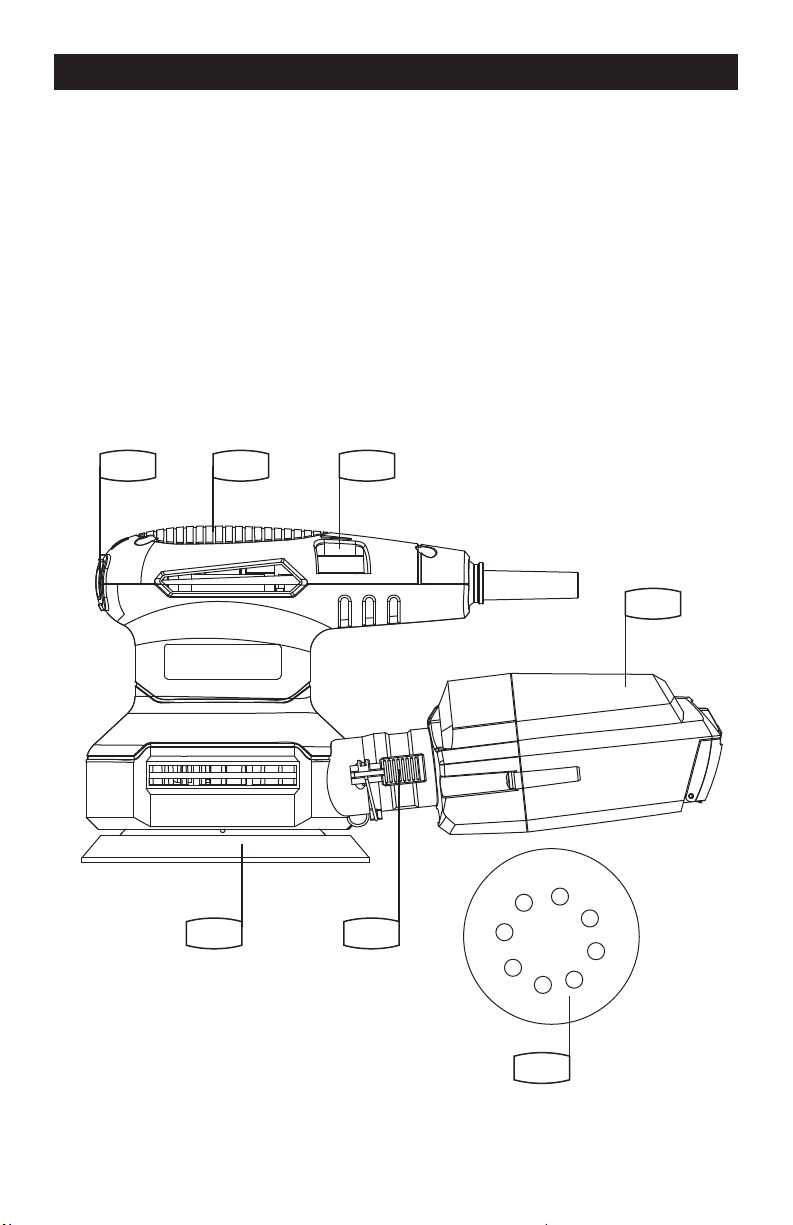
una caída en el voltaje de línea que resulte en una pérdida de energía y sobrecalentamiento. La Tabla
1 muestra el tamaño correcto a usar dependiendo de la longitud del cable y la capacidad de amperes
de la placa de identicación. Si tiene dudas, use el siguiente calibre mayor. Mientras menor es el
número de calibre, el cable es más pesado.
Las palabras en la imagen también se deben traducir, 16 palabras en total.
Rating Voltios Longitud total de la cuerda en pies
Amperaje 120V 25ft. 50ft. 100 ft. 150 ft.
Más de No más de AWG
0
6
10
6
10
12
18
18
16
16
16
16
16
14
14
14
12
12
12 16 14 12 No se recomienda
Mantenga el cable de extensión libre del área de trabajo. Coloque el cable de forma
que no quede atrapado sobre madera, herramientas u otras obstrucciones mientras esta trabajando
con una herramienta eléctrica.
Revise los cables de extensión antes de cada uso. Si están dañados reemplácelos de
inmediato. Nunca use una herramienta con un cable dañado ya que tocar el área dañada podría causar
choque eléctrico que resulte en lesiones serias
ELÉCTRICO
Page 24
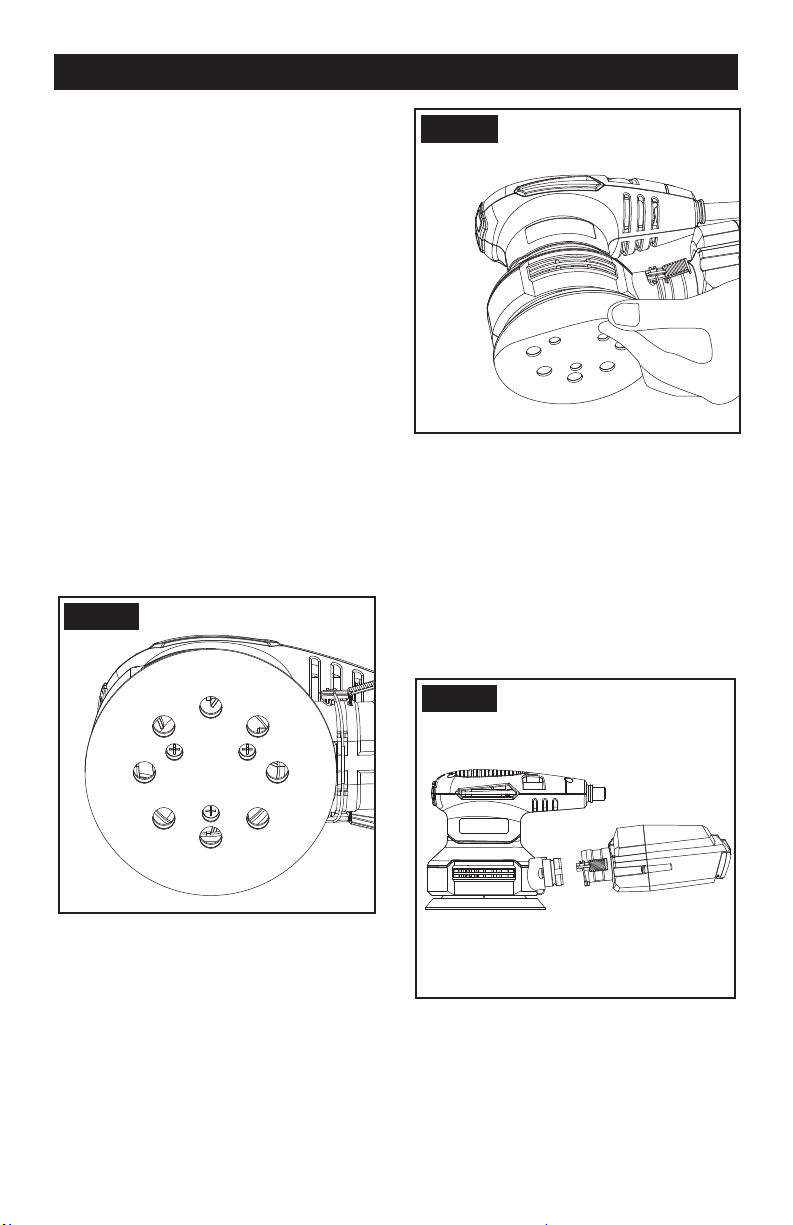
CONOZCA SU LIJADORA GIRATORIA
Antes de intentar usar cualquier herramienta, familiarícese con todas las características de
operación y los requerimientos de seguridad.
CARACTERÍSTICAS
1. Interruptor Encendido/Apagado
2. Mango de empuñadura blanda
3. Llave de velocidad variable
4. Boca de salida de polvo
5. Placa base
6. Papel de lija
7. Caja Polvo
1 2 3
7
4
6
5
Page 25
FUNCIONAMIENTO
NOTA: Antes de usar la herramienta, lea
atentamente el manual de instrucciones.
Uso pretendido
La máquina está diseñada para lijado en
seco–con alta capacidad de remoción–de
madera, plástico, ,metal, relleno así como
supercies barnizadas.
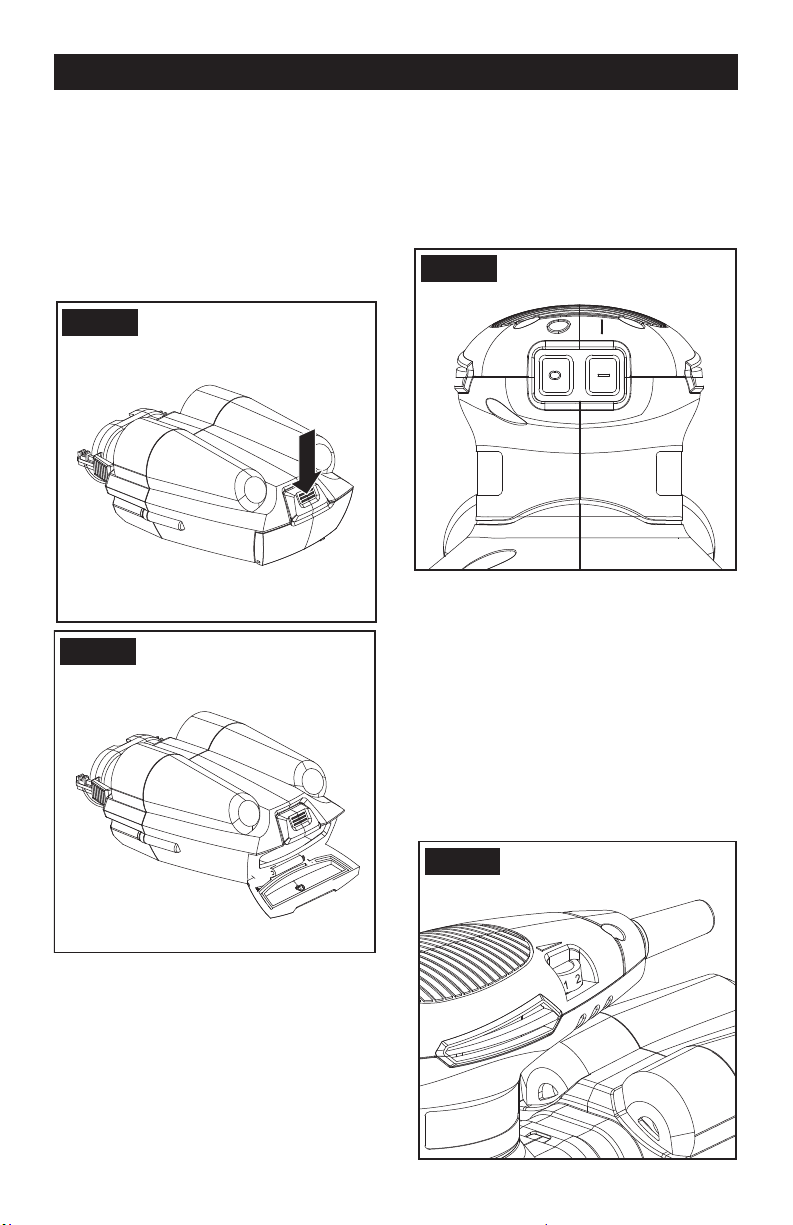
1. CAMBIO DEL GANCHO Y BUCLE DEL
PAPEL DE LIJA (VER LA FIG. A1, A2)
El papel de lija y el disco de lijado se
suministran con un sistema de gancho y bucle
para permitir el cambio rápido y fácil del papel
de lija y los accesorios de pulido. Primero,
retire el polvo y cualesquiera otros materiales
del gancho y bucle del papel de lija y del disco
de lijado. Como el papel de lija tiene agujeros
de extracción de polvo, usted debe alinearlos
con los agujeros del disco de lijado, de lo
contrario la extracción de polvo no funcionará.
(Ver la Fig. A1)
Fig. A1
Para retirar el papel de lija, levante una esquina
del mismo y hálelo retirándolo del disco de
lijado. (Ver la Fig. A2)
Fig. A2
2. CAJA CYCLONE (VER LA FIG. B1)
Su lijadora está equipada con la nueva caja
Cyclone. Para instalarla, inserte la caja
Cyclone en la parte trasera de la lijadora hasta
que quede ja.
PRECAUCIÓN! Para evitar la posibilidad
de lanzar polvo o materiales extraños
provenientes del lijado a su cara o a sus ojos,
nunca intente usar su lijadora sin la bolsa para
el polvo s adecuadamente instalada.
Fig. B1
INSTRUCCIONES DE FUNCIONAMIENTO
Page 26
VACIAR LA CAJA CYCLONE (VER LA FIG.
B2, B3)
Para un uso más ecaz, vacíe la caja Cyclone
cada 5 - 10 minutos. Ello permitirá que el aire
uya mejor a través de la bolsa.
Para vaciar el saco de polvo, extráigalo del
puerto de extracción de polvo, presione el
botón situado en la parte trasera de la caja
para abrirla y sacuda el polvo.
Fig. B2
Fig. B3
3. LLAVE DE ENCENDIDO/APAGADO (VER
LA FIG. C)
Para encender su lijadora, presione la cubierta
protectora del interruptor a la posición marcada
como “I”. Para apagar su lijadora, presione
la cubierta protectora a la posición marcada
como “0”.
Fig. C
4. CONTROL DE VELOCIDAD VARIABLE Y
SU FUNCIÓN (VER LA FIG. D)
Ajuste la perilla de control variable de velocidad
(3) para aumentar o disminuir la velocidad de
acuerdo con el material y la especicación de
la cinta de lijado que use (también se puede
hacer sin carga). Vea la tabla de abajo como
guía general para la selección de velocidad.
Evite el uso prolongado a velocidades muy
bajas ya que podría dañar el motor de su
lijadora.
Fig. D
OPERACIÓN

Page 27
OPERACIÓN
5. UTILIZACIÓN DE LA LIJADORA
NOTA: La observación de chispas que
destellan bajo las ranuras de ventilación,
indica operación normal que no dañará su
herramienta.
Asegúrese de sostener rmemente la lijadora
cuando se encuentra encendida. Colóquela
nuevamente sobre la pieza de trabajo. Puede
que la lijadora “salte” en el primer contacto.
Sostenga la lijadora de manera que se
encuentre plana durante su funcionamiento
y muévala suavemente, preferiblemente de
manera suave y circular.
Cuando utilice la base para lijado de acabado
o la base para lijado en ángulos, encienda
la lijadora con la base lejos de la pieza de
trabajo. Permita que el motor alcance su
velocidad máxima y luego utilice la lijadora.
Retire la lijadora de la pieza de trabajo antes de
apagarla.
El lijado a ras se puede realizar con nuestra
lijadora. El borde delantero de su lijadora
permite el lijado a ras.
La lijadora debe operar suavemente. Se debe
investigar y corregir el ruido extraño o inusual
antes de continuar operando la lijadora. Revise
regularmente la condición del papel abrasivo
y reemplácelo cuando esté desgastado para
mejores resultados.
Siempre mantenga la máquina en movimiento
de forma que el acabado de su trabajo
permanezca consistente. Si permanece en
un lugar por mucho tiempo, la lijadora puede
producir una depresión en la madera que
comprometerá su acabado.

Page 28
Extraiga el enchufe de la toma eléctrica antes de llevar a cabo cualquier reparación o ajuste.
Su herramienta no requiere lubricación ni mantenimiento adicional. No posee piezas en su interior
que puedan ser reparadas por el usuario. Nunca emplee agua o productos químicos para limpiar
su herramienta. Use simplemente un paño seco. Guarde siempre su herramienta en un lugar seco.
Mantenga limpias las ranuras de ventilación del motor. Mantenga todos los controles de operación
libres de polvo. La observación de chispas que destellan bajo las ranuras de ventilación, indica
operación normal que no dañará su herramienta. Si el cable de alimentación se encuentra dañado
deberá ser reemplazado por el fabricante, su agente de servicio o algún otro profesional igualmente
cualicado para llevar a cabo dichas operaciones, con el n de evitar riesgos.
1. Si no funciona la lijadora, compruebe el suministro de energía del enchufe.
2. Si la lijadora no lija la supercie, compruebe la hoja de lija. Si la hoja de lija se encuentra
desgastada, reemplácela por una hoja nueva e intente nuevamente. Las hojas de lija deben
ser almacenadas en un lugar seco. Si las hojas de lija se humedecen, las partículas abrasivas
perderán su adherencia a la almohadilla y no se podrá realizar el lijado.
3. Si la lijadora no se mueve fácilmente, puede que la hoja de lija se encuentre suelta, dañada
o doblada. Reemplácela e intente nuevamente.
4. Si no se puede solucionar una falla, lleve la lijadora a un distribuidor autorizado para su
reparación.
Si su herramienta se calienta demasiado, especialmente mientras la utiliza a baja velocidad,
ajuste la velocidad al máximo y hágala funcionar sin carga durante 2-3 minutos para enfriar el
motor. Evite el uso prolongado a velocidades muy baja. Utilice siempre un papel de lija adecuado
para el material que desea lijar.
Asegúrese siempre de que la pieza de trabajo esté rmemente aanzada-con o sin abrazaderas-
para evitar el movimiento.
Cualquier movimiento del material puede afectar la calidad de acabado.
Encienda su lijadora antes de lijar y apáguela recién después de haber terminado. Para mejores
resultados, lije la madera en dirección del grano del papel.
No comience a lijar si no tiene instalado el papel.
No permita que el papel se desgaste, ya que dañará la placa base. La garantía también cubre el
desgaste y deterioro de la placa base.
Utilice papel de grano grueso para lijar supercies groseras, de grano medio para supercies lisas y
de grano no para acabados. De ser necesario, primero haga una prueba sobre material de desecho.
Utilice únicamente papel de lija de buena calidad.
La eciencia de lijado es controlada por el papel de lija, no por la fuerza que Ud. aplique a la
herramienta. La fuerza excesiva reducirá la eciencia de lijado y causará la sobrecarga del motor.
El reemplazo periódico del papel de lija mantendrá una óptima eciencia de lijado.
CONSEJOS DE TRABAJO PARA SU LIJADORA
MANTENIMIENTO
SOLUCIÓN DE PROBLEMAS

Page 29
NOTAS

Page 30
GARANTÍA DE Lijadora Giratoria MASTERFORCE
®
GARANTÍA DE DEVOLUCIÓN DE DINERO DE 90 DÍAS:
Esta herramienta eléctrica de la marca MASTERFORCE
®
tiene nuestra Garantía de
devolución de dinero de 90 DÍAS. Si no está completamente satisfecho con su herramienta
eléctrica marca MASTERFORCE
®
por cualquier razón dentro de noventa (90) días desde
la fecha de compra, regrese la herramienta con su recibo original a cualquier tienda al
menudeo MENARDS
®
, y le proporcionaremos un reembolso – sin hacer ninguna pregunta.
GARANTÍA LIMITADA DE 3 AÑOS:
Esta herramienta eléctrica marca MASTERFORCE
®
tiene nuestra famosa Garantía Limitada
de 3 Años sin Complicaciones para el comprador original. Si, durante el uso normal, esta
herramienta eléctrica MASTERFORCE
®
se descompone o falla debido a un defecto en
material o mano de obra dentro de tres (3) años desde la fecha de la compra original,
simplemente lleve esta herramienta con el recibo de ventas original de regreso a su
tienda al menudeo MENARDS
®
más cercana. A su criterio, MASTERFORCE
®
acuerda
que la herramienta o cualquier parte defectuosa se repare o reemplace con el mismo
producto o parte MASTERFORCE
®
o similar libre de cargo, dentro del periodo de
garantía mencionado, cuando sea devuelta por el comprador original con el recibo de
ventas original. Sin importar lo presente, esta garantía limitada no cubre ningún daño
que haya resultado a partir de abuso o mal uso de la Mercancía.
Esta garantía: (1) excluye partes desechables que incluyen, sin limitarse a aspas, cepillos,
bandas brocas, focos, y/o baterías; (2) se anulará si esta herramienta se usa para
propósitos comerciales y/o de renta; y (3) no cubre ninguna pérdida, lesiones a personas/
daño a la propiedad o costos. Esta garantía le otorga derechos legales especícos y puede
tener otros derechos, que varían de un estado a otro. Tenga cuidado, las herramientas
son peligrosas si se usan incorrectamente o se les da mantenimiento inadecuado. Los
empleados del vendedor no están calicados para aconsejarlo sobre el uso de esta
Mercancía. Cualquier representación verbal realizada no será vinculante para el vendedor
o sus empleados Los derechos bajo esta garantía limitada son para el comprador original
de la Mercancía y no se pueden transferir a ningún propietario subsecuente.
Esta garantía limitada está en lugar de todas las garantías, expresas o implícitas
incluyendo garantías o comerciabilidad o adecuación para un propósito particular.
El vendedor no será responsable por cualquier daño especial, incidental o en
consecuencia. El único remedio exclusivo contra el vendedor será el reemplazo de
cualquier defecto como se indica en el presente, siempre y cuando el vendedor desee
o pueda reemplazar este producto o desee reembolsar el precio de compra como
se indica anteriormente. Para propósitos de seguro, no se permite que el vendedor
demuestre ninguna de estas herramientas eléctricas para usted.
Para preguntas / comentarios, asistencia técnica o partes de reparación
Por favor llame al número telefónico gratuito al: 1-888-686-1484 ( (Lunes-Viernes 8am – 6pm)
CONSERVE SUS RECIBOS. ESTA GARANTÍA
ES NULA SIN ELLOS

Page 31
INFORMACIÓN DE SERVICIO AL CLIENTE:
Ahora que adquirió su herramienta, si alguna vez existe la necesidad de partes de reparación o
servicio, simplemente póngase en contacto con su tienda
más cercana o llame
al 1-888-686-1484. Asegúrese de proporcionar todos los hechos pertinentes cuando llame o
nos visite.