OWNER’S MANUAL
PRODUCT OVERVIEW
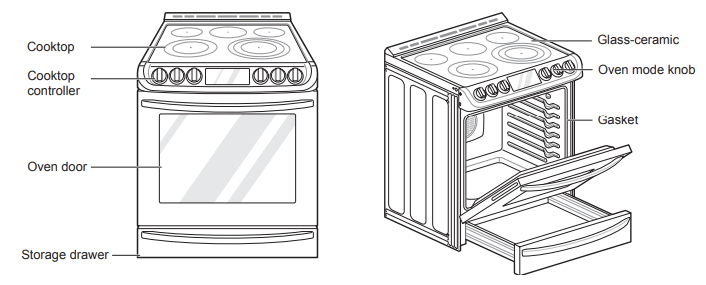
Parts
Accessories
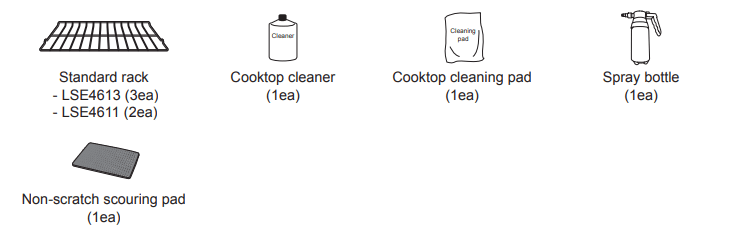
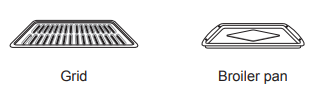
Included Accessories
Optional Accessories
INSTALLATION
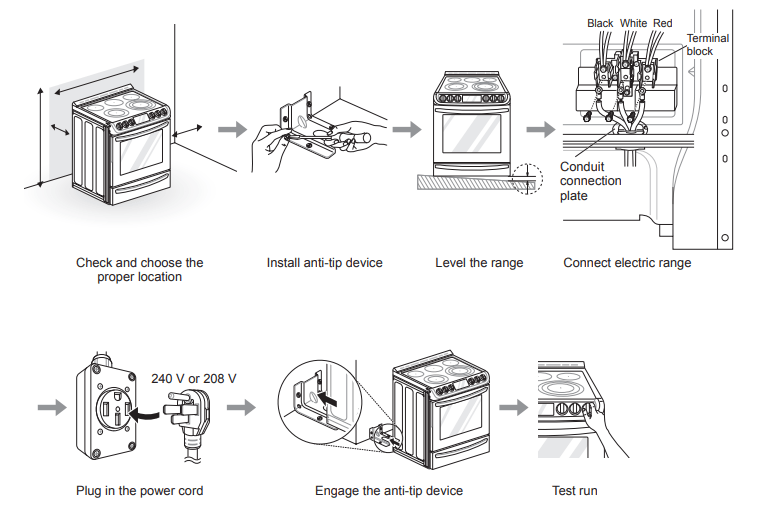
Installation Overview
Please read the following installation instructions first after purchasing this product or transporting it to another location.
Product Specifications
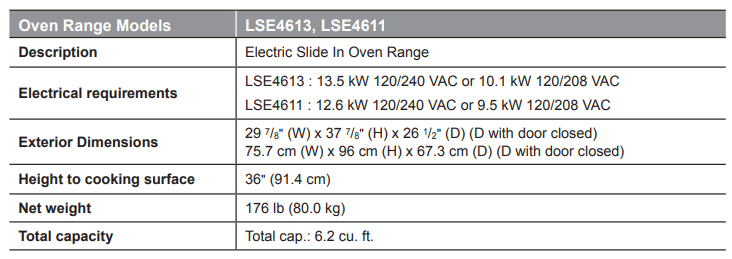
The appearance and specifications listed in this manual may vary due to constant product improvements.
Before Installing the Range
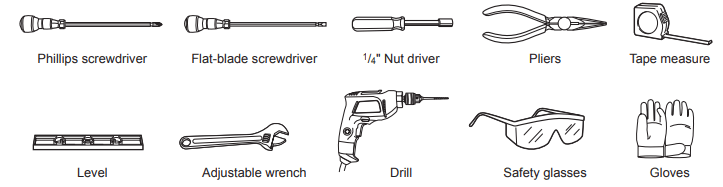
Tools Needed
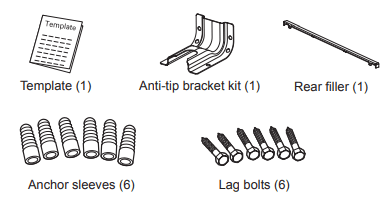
Parts Provided
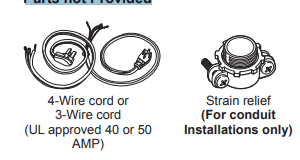
Parts not Provided
Installing the Range
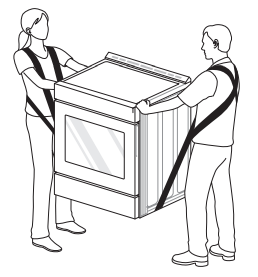
Unpacking and Moving the Range
Remove packing material, tape and any temporary labels from your range before using. Do not remove any warning-type labels, the model and serial number label, or the Tech Sheet that is located on the back of the range.
To remove any remaining tape or glue, rub the area briskly with your thumb. Tape or glue residue can also be easily removed by rubbing a small amount of liquid dish soap over the adhesive with your fingers. Wipe with warm water and dry.
Do not use sharp instruments, rubbing alcohol, flammable fluids, or abrasive cleaners to remove tape or glue. These products can damage the surface of your range.
Your range is heavy and can be installed on soft floor coverings such as cushioned vinyl or carpeting. Use care when moving the range on this type of flooring. Use a belt when moving the range to prevent damaging the floor. Or slide the range onto cardboard or plywood to avoid damaging the floor covering .
Choosing the Proper Location
The range should always be plugged into its own individual properly grounded electrical outlet. This prevents overloading house wiring circuits which could cause a fire hazard from overheated wires. It is recommended that a separate circuit serving only this appliance be provided.
Mobile Home - Additional Installation Requirements
The installation of this range must conform to the Manufactured Home Construction and Safety Standard, Title 24 CFR, Part 3280 (formerly the Federal Standard for Mobile Home Construction and Safety, Title 24, HUD Part 280), or when such standard is not applicable, the Standard for Manufactured Home Installations, ANSI A225.1/NFPAA or with local codes.
- When this range is installed in a mobile home, it must be secured to the floor during transit. Any method of securing the range is adequate as long as it conforms to the standards listed above.
- A four-wire power supply cord or cable must be used in a mobile home installation.
Dimensions and Clearances
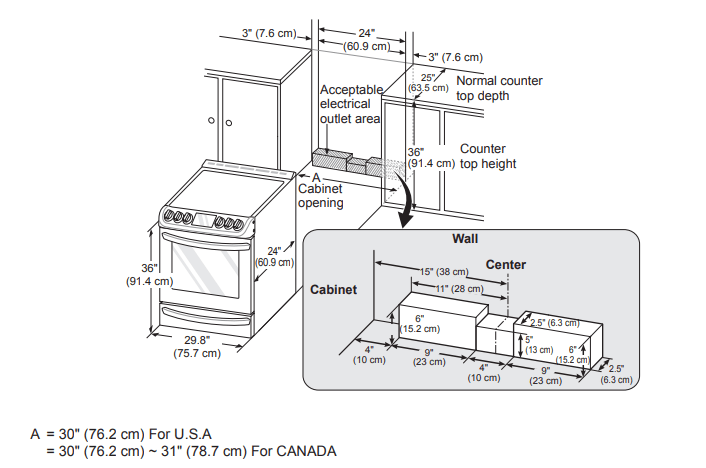
For installation in Canada, a free-standing range is not to be installed closer than 15/32" (12 mm) from any adjacent surface.
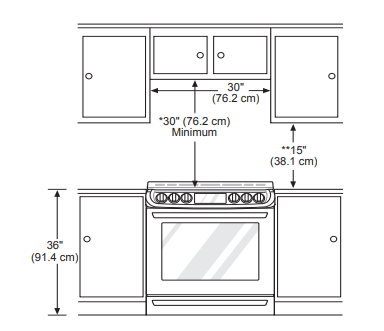
Minimum Dimensions
* 30"(76.2cm) minimum clearance between the top of the cooking surface and the bottom of an unprotected wood or metal cabinet; or 24" (60.9 cm) minimum when bottom of wood or metal cabinet is protected by not less than 1/4"(6.4 cm) flame retardant millboard covered with not less than no. 28 MSG sheet steel, 0.015" (0.381 mm) stainless steel, 0.024" (0.610 mm) aluminum or 0.020" (0.508 mm) copper.
**15"(38.1cm) minimum between countertop and adjacent cabinet bottom.
Installing the Anti-tip Device
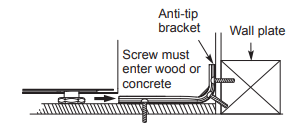
Locate the anti-tip bracket using the template
An anti-tip bracket is packaged with the template.
The instructions include necessary information to complete the installation. Read and follow the range installation instruction sheet (template).
Leveling the Range
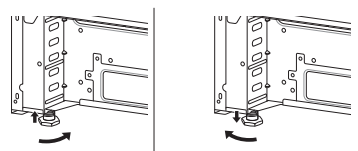
Level the range by adjusting the leveling legs with a wrench. Extending the legs slightly may also make it easier to insert the rear leg into the anti-tip bracket.
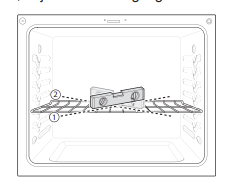
Use a level to check your adjustments. Place the level diagonally on the oven rack, and check each direction for level.
First check direction . (1)
Then check direction(2) . If the level doesn’t show level on the rack, adjust the leveling legs with a wrench.
Connecting Electricity
Electrical Requirements
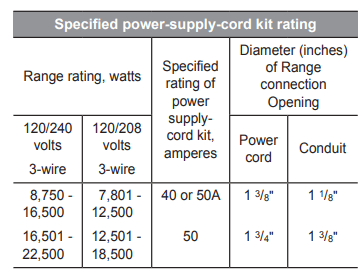
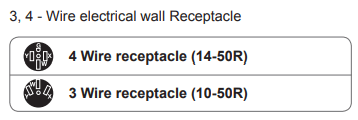
This appliance must be installed and grounded on a branch circuit by a qualified technician in accordance with the National Electrical code ANSI/NFPA NO. 70 - latest edition. All wiring should conform to Local and NEC codes. This range requires a single-phase, 3 wire, A.C 120/208 V or 120/240 V 60 Hz electrical system. Use only a 3-conductor or a 4-conductor UL- listed range cord with closed-loop terminals, open-end spade lugs with upturned ends or similar termination. Do not install the power cord without a strain relief. A range cord rated at 40 amps with 120/240 minimum volt range is required. If a 50 amp range cord is used, it should be marked for use with 13/8" diameter connection openings. This appliance may be connected by means of a conduit or power cord. If a conduit is being used, go to page 17 for 3 wire conduit connections or 4 wire conduit connections.
Connecting the Power Cord
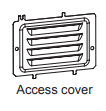
The rear access cover must be removed. Loosen the two screws with a screwdriver. The terminal block will then be accessible.
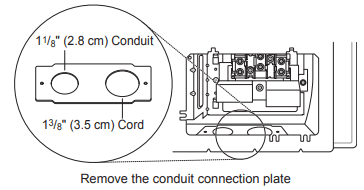
Use the cord/conduit connection plate to install the power cord or conduit. Leave the connection plate as installed for power cord installations. Remove the connection plate for conduit installations and use the smaller 11/8 in. (2.8 cm) conduit hole instead of the 13/8 in. (3.5 cm) power cord hole.
For power cord installations, hook the strain relief over the 13/8 in. (3.5 cm) power cord hole located below the rear of the oven. Insert the power cord through the strain relief and tighten it.
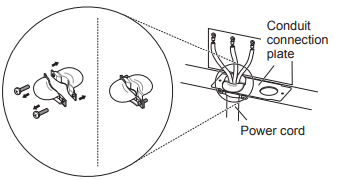
Assembling power cord strain relief at the 13/8" opening For conduit installations, insert the conduit strain relief in the 11/8 in. (2.8 cm) conduit hole. Then install the conduit through the body of the strain relief and fasten the strain relief with its ring.
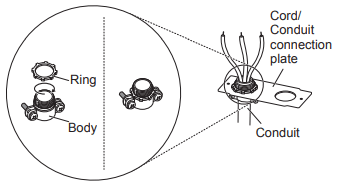
Assembling conduit cord strain relief at the 11/8" opening
3-Wire Connection : Power Cord
Install the power cord as follows:
For power cord installations, hook the strain relief over the power cord hole (13/8") located below the rear of the oven. Insert the power cord through the strain relief and tighten it.
Do not install the power cord without a strain relief.
- Remove the lower 3 screws from the terminal block and retain them.
- Insert the 3 screws through each power cord terminal ring and into the lower terminals of the terminal block. Make sure that the center (neutral) wire, which is white, is connected to the center lower position of the terminal block.
- Tighten the 3 screws securely into the terminal block. Do not remove the ground strap connections.
3-wire connection
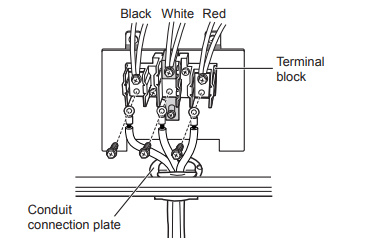
If screws are not tightened securely, it can result in electrical spark and severe personal injury or death.
4-Wire Connection : Power Cord
Install the power cord as follows:
Do not install the power cord without a strain relief.
- Remove the lower 3 screws from the terminal block and retain them.
- Remove the ground screw and bend the end of the ground strap up so the slot is over the hole of the center screw removed in step 1.
- Insert the ground screw into the power cord ground wire (green) terminal ring and secure it to the range frame.
- Insert the 3 screws through each power cord terminal ring and into the lower terminals of the terminal block. Make sure that the white center neutral) wire is connected to the center lower position of the terminal block.
- Tighten the 3 screws securely into the terminal block. The center screw now attaches the bent up ground strap to the block. wire connection
4-wire connection
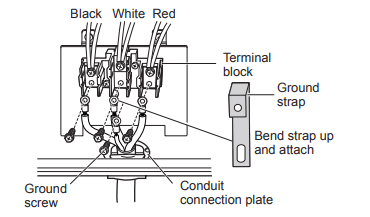
If screws are not tightened securely, it can result in electrical spark and severe personal injury or death.
3-Wire Connection: Conduit
Install the conduit as follows:
Remove the conduit connection plate from the rear of the oven and rotate it. The conduit hole (11/8") must be used.
First, prepare the conduit wires as shown below.
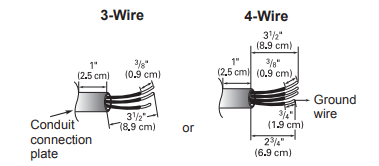
Second, install the conduit strain relief.
For conduit installations, purchase a strain relief and insert it in the 11/8 in. (2.8 cm) conduit hole. Then install the conduit through the body of the strain relief and fasten the strain relief with its ring. Reinstall the bracket.
For conduit connections:
If the wire in the conduit is copper it must be 8 or 10
AWG wiring.
If the wire in the conduit is aluminum it must be 6 or 8
AWG wiring.
- Loosen the lower 3 screws from the terminal block.
- Insert the bare wire (white/neutral) end through the center terminal block opening. Do not remove the ground strap connections.
- Insert the two side bare wire ends into the lower left and the lower right terminal block openings. Tighten the 3 screws securely into the terminal block. (approximately 35 - 50 IN-LB) wire connection
If screws are not tightened securely, it can result in electrical spark and severe personal injury or death.
3- Wire Connection: Conduit
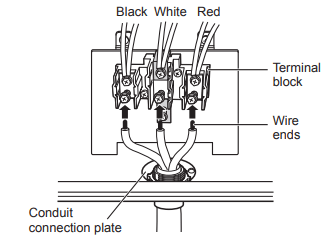
If screws are not tightened securely, it can result in electrical spark and severe personal injury or death.
4-Wire Connection: Conduit
- Follow the instructions for installing the conduit under 3-Wire Connection: Conduit until the strain relief and bracket are installed. Do not install the conduit without a strain relief.
- Loosen the 2 lower left and right screws from the terminal block. Remove the lower 2 center screws. Do not discard any screws.
- Remove the ground screw and bend the end of the ground strap up so the slot is over the hole of the center screw removed in step 1.
- Attach the ground (green) bare wire end to the range frame and secure it in place with the ground screw.
- Insert the bare wire (white/neutral) end through the center terminal block opening. The center screw now attaches the bent up ground strap to the block.
- Insert the two side bare wire ends into the left and the right terminal block openings. Tighten the 3 screws securely into the terminal block. approximately 35 - 50 IN-LB) wire connection
If screws are not tightened securely, it can result in electrical spark and severe personal injury or death.
4-wire connection
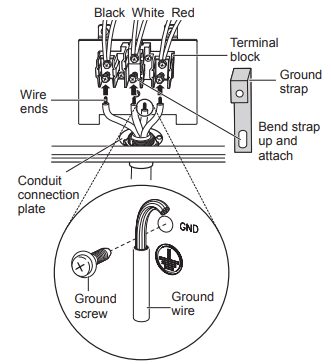
If screws are not tightened securely, it can result in electrical spark and severe personal injury or death.
Engaging the Anti-tip Device
- Move the range close enough to the opening to plug into the receptacle.
- Slide the range into position ensuring that the back leg slides under the anti-tip bracket. The range should sit flush against the back wall when properly installed.
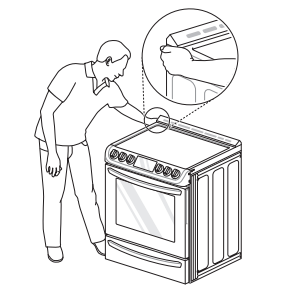
- Carefully attempt to tip the range forward to ensure that the anti-tip bracket is engaged properly. If properly installed, the anti-tip bracket will prevent the range from being tipped. If the range can be tipped, reinstall the range until the anti-tip bracket is properly installed and the range will not tip forward.
- Turn on electrical power. Check the range for proper operation.
Optional Rear Filler
If the counter does not bridge the opening at the rear wall the rear filler kit, that is provided with the slide in range, will be needed.
If the countertop depth is less than 24", the control panel will not sit flush with the countertop.
Installing the Rear Filler
- Using a screwdriver, remove the upper four screws that attach the rear bracket and loosen the lower two screws.
- Place the rear filler on the rear bracket.
- Tighten the two lower screws on the rear bracket. Insert one of the screws removed in step 1 in the slot at each end of the rear filler.
- Store the remaining two screws with these instructions for future use.
Test Run
Check if the range is properly installed and run a test cycle.
- Turn the oven mode knob to the Off position to start test.
- Turn each knob to the Hi position to check that the surface heating elements are working properly. The elements should glow red and radiate heat, and they should cycle on and off periodically even when the knob is in the Hi position. This cycling prevents the glass-ceramic from being cracked by thermal shock. IMPORTANT : The Warming Zone does not consume enough power to glow red.
- For Model : LSE4613 . After checking all the surface heating elements, check the locking system by pressing Clock for three seconds. The oven door should lock and the cooktop should not operate while the Lockout function is turned on. Pressing Clock for three seconds to disable Lockout.
- Now check the oven's operation. Turn the oven mode knob to select the Bake mode. 350 °F appears in the display. Press Start.
- The oven should finish preheating in 15 minutes, and the convection fan should operate while the oven is preheating.
- After checking the oven's operation, turn the temperature up to 450 °F and leave the oven on for at least an hour to help remove any oil which might cause smoke and odors when first using the oven.
OPERATION
Control Panel Overview
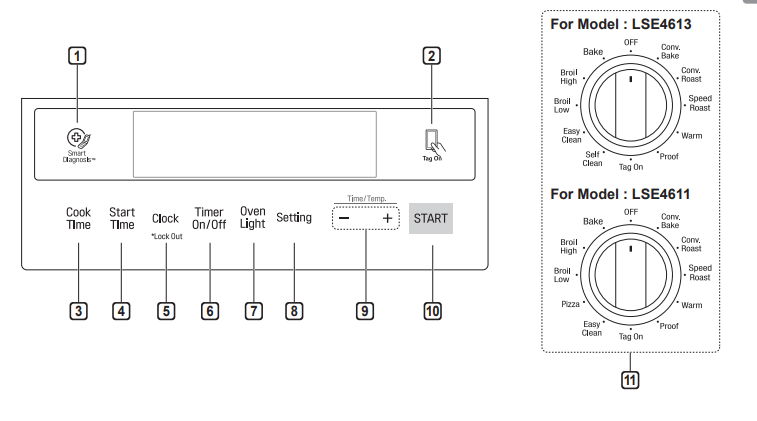
1. Smart DiagnosisTM
Use during the Smart Diagnosis feature.
2. Smart Features
The Tag On icon, for use with Smart Features.
3. Cook Time
Press the button to set the desired amount of time for food to cook. The oven shuts off when the set cooking time runs out.
4. Start Time
Press the button to set the delayed timed cook. The oven starts at the set time.
5. Clock / Lockout
- Press button to set the time of day.
- Press and hold button for three seconds to lock the door and control panel.
6. Timer On/Off
Press the button to set or cancel timer on oven.
7. Oven Light
Press the button to turn oven light on or off.
8. Setting
Press button to select and adjust oven settings.
9. -/+
Press the plus button to increase cooking time or oven temperature.
Press the minus button to decrease cooking time or oven temperature.
10. Start
Press the button to start all oven features.
11.Oven Mode Knob
Turn the knob to select oven operating mode.
Hot Surface Indicator
The hot surface indicator light glows as long as any surface cooking area is too hot to touch.
It remains on after the element is turned off and until the surface has cooled to approximately 150 ˚F.
Flashing Clock
If the colon in the clock display flashes, touch Clock and reset the time, or touch any key to stop the flashing.
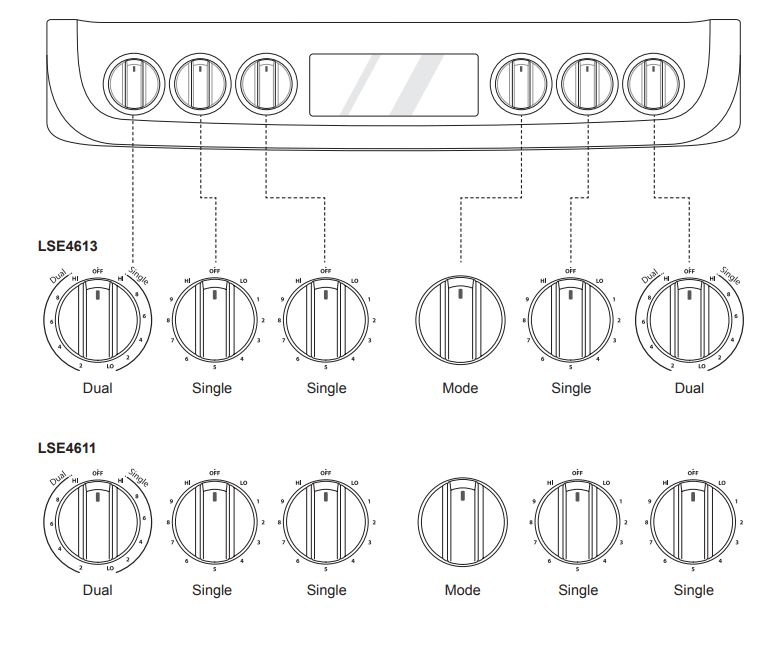
Knob Positions
After cleaning the oven knobs, make sure to replace each knob in the correct position. Failure to do so can result in improper operation of the burners.
Changing Oven Settings
Clock
The clock must be set to the correct time of day in order for the automatic oven timing functions to work properly.
- Set the oven mode knob to the Off position.
- Press Clock. CLO shows in the display.
- Press plus(+) or minus(-) to select the desired time. Plus(+) to increase the time and minus(-) to decrease the time.
- Press Start to enter the time and start the clock.
Oven Light
The interior oven light automatically turns on when the door is opened. Press Light to manually turn the oven light on.
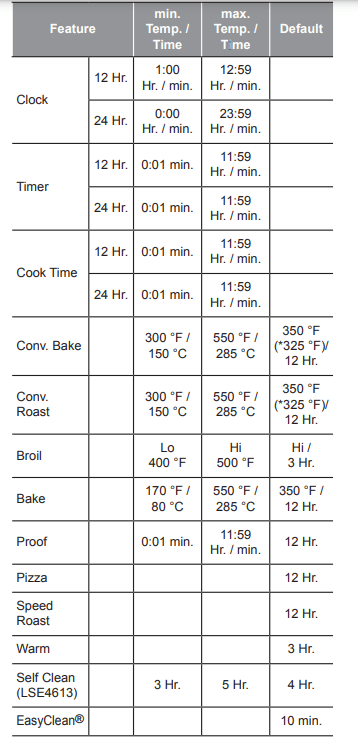
Minimum & Maximum Default
Settings
All of the features listed have a minimum and a maximum time or temperature setting that may be entered into the control. An entry acceptance beep sounds each time a control key is pressed.
An entry error tone (two short tones) sounds if the entry of the temperature or time is below the minimum or above the maximum setting for the feature.
Timer On/Off
The Timer On/Off serves as an extra timer in the kitchen that beeps when the set time has run out. It does not start or stop cooking.
The Timer On/Off feature can be used during any of the oven control functions.
Setting the Timer (for example to set 5 minutes)
- Set the oven mode knob to the Off position.
- Press the Timer On/Off. 0:00 with HR inside it appears and Timer flashes in the display.
- Press plus(+) or minus(-) to set the desired time. Plus(+) to increase the time and minus(-) to decrease the time.
- Press Timer On/Off or Start to start the Timer. The remaining time countdown appears in the display.
- When the set time runs out, End shows in the display. The indicator tones sound every 15 seconds until Timer On/Off is pressed.
Canceling the Timer before the set time has run out
- Press Timer On/Off once. The display returns to the time of day.
Settings
Set the oven mode knob to the Off position.
Press Setting key repeatedly to toggle through and change oven settings.
The Settings key allows you to:
- set the hour mode on the clock (12 or 24 hours)
- enable/disable convection auto conversion
- adjust the oven temperature
- activate/deactivate the preheating alarm light
- set the beeper volume
- cooktop on alert (For Model : LSE4611)
- switch the temperature scale between Fahrenheit and Celsius
Setting the Hour Mode
The control is set to use a 12-hour clock. To reset the clock to 24-hour mode, follow the steps below.
- Set the oven mode knob to the Off position.
- Press Setting.
- Press plus(+) or minus(-) to set the desired hour mode on the clock.
- Press Start to accept the desired change.
Setting Convection Auto Conversion
When Conv. Bake and Conv. Roast are selected,
Convection Auto Conversion automatically converts the standard recipe temperature entered to a convection temperature by subtracting 25 °F / 14 °C. This auto-converted temperature shows on the display. For example, select Conv. Bake, enter 350 °F, and 325 °F shows on the display after preheat.
Convection Auto Conversion is enabled by default. To change the setting, follow these instructions.
- Set the oven mode knob to the Off position.
- Press Setting repeatedly until Auto appears in the display.
- Press plus(+) or minus(-) to enable or disable the feature.
- Press Start to accept the change.
Adjusting the Oven Temperature
Your new oven may cook differently from the one it replaced. Use your new oven for a few weeks to become more familiar with it before changing the temperature settings. If after familiarizing yourself with the new oven, you still think that it is too hot or too cold, you can adjust the oven temperature yourself.
- Set the oven mode knob to the Off position.
- Press Setting repeatedly until AdJU appears in the display.
- To increase the temperature, press plus (+) until the desired amount appears in the display. To decrease the temperature, press minus (-) until the desired amount appears in the display.
- Press Start to accept the change.
Turning the Preheat Alarm Light On/Off
When the oven reaches its set-temperature, the preheating alarm light flashes 5 times or until the oven door is opened.
- Touch Settings repeatedly until Pre appears in the display.
- Touch plus (+) or minus (-) to turn the light on/ off.
- Press Start to accept the change.
Adjusting the Beeper Volume
- Set the oven mode knob to the Off position.
- Press Setting repeatedly until Beep appears in the display.
- Press plus(+) or minus(-) to select the desired volume.
- Press Start to accept the change.
Adjusting Cooktop On alert Volume (For Model : LSE4611)
- Touch Settings repeatedly until CtOP appears in the display.
- Touch plus (+) or minus (-) to select Hi, Lo, Off.
- Touch Start to accept the change.
Selecting Fahrenheit or Celsius
Set the oven temperature display to show either Fahrenheit (°F) or Celsius (°C) units. The oven defaults to Fahrenheit unless changed by the user.
- Set the oven mode knob to the Off position.
- Press Setting repeatedly until Unit appears in the display.
- Press plus(+) or minus(-) to select F(Fahrenheit) or C(Centigrade).
- Press Start to accept the change.
Lockout
The Lockout feature automatically locks the oven door and prevents most oven from being turned on. It does not disable the timer and the interior oven light.
- Set the oven mode knob to the Off position.
- Press and hold Clock for three seconds.
- The lock melody sounds, Loc appears in the display and the lock icon blinks (For Model : LSE4613) in the display.
- Once the oven door is locked, the lock indicator stops blinking (For Model : LSE4613) and remains on.
- To deactivate the Lockout feature, press and hold Clock for three seconds. The unlock melody sounds and the door and the controls unlock.
Start Time (Delayed Timed Cook)
The automatic timer of the Delayed Timed Cook function turns the oven on and off at the time you select. This feature can be used with the Bake, Conv. Bake and Conv. Roast modes.
Setting a Delayed Timed Cook
For example, to bake at 300 °F and delay the start of baking until 4:30, first set the clock for the correct time of day.
- Turn the oven mode knob to select the Bake mode. 350 °F appears in the display.
- Set the temperature: press minus(-) until 300 °F appears in the display.
- Press Cook Time and set the baking time.
- Press Start Time.
- Set the start time: press plus(+) until 4:30 appears in the display.
- Press Start. A short beep sounds and Timed Delay and the start time appear in the display. The oven begins baking at the set start time.
The oven will continue to cook for the set amount of time and then turn off automatically. When the cooking time has elapsed:
- End and the time of day show in the display.
- The cook end indicator tone sounds every 60 seconds until the oven mode knob is turned to the Off position.
Cook Time (Timed Cook)
Set the oven to cook for a specific length of time using the Timed Cook feature. This feature can only be used with the Bake, Conv. Bake and Conv. Roast modes.
Setting the Cook Time Function
For example, to bake at 300 °F for 30 minutes, first set the clock to the correct time of day.
- Turn the oven mode knob to select the Bake mode. 350 °F appears in the display.
- Set the oven temperature. For this example, press minus(-) until 300 °F appears in the display.
- Press Cook Time. Timed flashes in the display. Bake, 0:00 and 300 °F appear in the display.
- Set the baking time: press plus(+) until 30:00 appears in the display. The baking time can be set for any amount of time between 1 minute and 11 hours and 59 minutes.
- Press Start.
The oven will continue to cook for the set amount of time and then turn off automatically. When the cooking time has elapsed:
- End and the time of day show in the display.
- The cook end indicator tone sounds every 60 seconds until the oven mode knob is turned to the Off position.
Changing the Cook Time during Cooking
For example, to change the cook time from 30 minutes to 1 hour and 30 minutes, do the following.
- Press Cook Time.
- Change the baking time: Press plus(+) until 1 hour and 30 minutes appears in the display.
- Press Start to accept the change.
Using the Cooktop
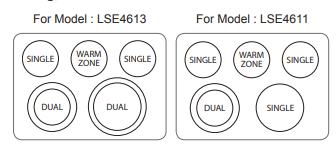
Cooking Areas
The cooking areas on your range are identified by permanent circles on the glass cooktop surface.
For the most efficient cooking, fit the pan size to the element size.
Pans should not extend more than 1/2 to 1-inch beyond the cooking area.
When a control is turned on, a glow can be seen through the glass cooktop surface. The element cycles on and off to maintain the preset heat setting, even on Hi.
Hot Surface Indicator
The hot surface indicator light glows as long as any surface cooking area is too hot to touch.
It remains on after the element is turned off and until the surface has cooled to approximately 150 °F.
Using the Cooktop Elements
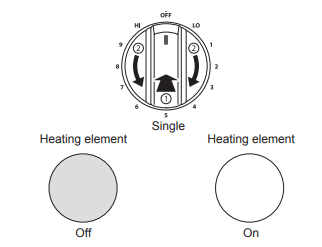
Turning on a Single element
- Push the Single element knob in.
- Turn the knob in either direction to the desired setting. The control knob clicks when it is positioned at both Off and Hi.
Turning on the Dual element
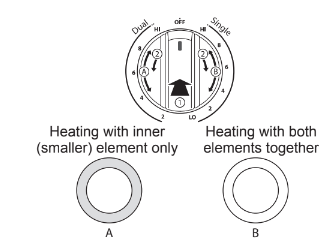
There is one dual element located in the left front position. Use the dual element as a dual or single element.
- Push in the appropriate knob.
- - A Turn the knob counterclockwise to use it as a Single element.
- - B Turn the knob clockwise to use it as a Dual unit.
Turning on the Warming Zone
The Warming Zone, located in the back center of the glass surface, will keep hot, cooked food at serving temperature. Use the Warming Zone to keep food warm after it has already been cooked. Attempting to cook uncooked or cold food on the Warming Zone could result in a food-borne illness.
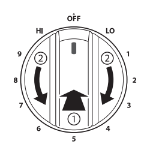
Turning on a Warming Zone element
- Push the Warming Zone element knob in.
- Turn the knob in either direction to the desired setting. The control knob clicks when it is positioned at both Off and Hi.
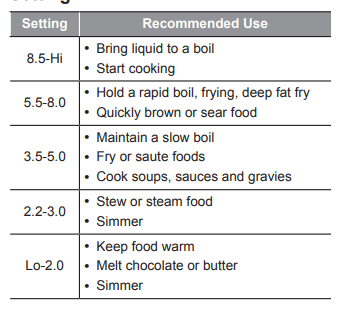
The Recommended Surface Cooking Setting
Using the Proper Cookware
The size and type of cookware will influence the settings needed for the best cooking results. Be sure to follow the recommendations for using proper cookware.
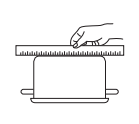
Cookware should have flat bottoms that make good contact with the entire surface heating element. Check for flatness by placing a ruler across the bottom of the cookware. The ruler should touch the cookware across the entire bottom, with no gaps.
Cookware recommendations
- Flat bottom and straight sides
- Heavy-gauge pans
- Pan sizes that match the amount of food to be prepared and the size of the surface element
- Weight of handle does not tilt pan. Pan is well balanced
- Tight-fitting lids
- Flat bottom woks
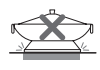
Cookware should not
- have a curved or warped bottom.
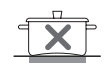
- be smaller or larger than the surface burner.

- have a heavy handle that tilts the pan.

- be a wok with a ring stand.
- have loose or broken handles.
- have loose-fitting lids.
Choosing Cookware
The cookware material determines how evenly and quickly heat is transferred from the surface element to the pan bottom. The most popular materials available are:
- Aluminum - Excellent heat conductor. Some types of food will cause it to darken (anodized aluminum cookware resists staining and pitting). If aluminum pans slide across the ceramic cooktop, they may leave metal marks which will resemble scratches. Remove these marks immediately.
- Copper - Excellent heat conductor but discolors easily. May leave metal marks on glass-ceramic see Aluminum above).
- Stainless steel - Slow heat conductor with uneven cooking results. Is durable, easy to clean and resists staining.
- Cast iron - A poor heat conductor but retains heat very well. Cooks evenly once cooking temperature is reached. Not recommended for use on ceramic cooktops.
- Porcelain-enamel on metal - Heating characteristics will vary depending on base material. Porcelain-enamel coating must be smooth to avoid scratching ceramic cooktops.
- Glass - Slow heat conductor. Not recommended for ceramic cooktop surfaces because it may scratch the glass.
Home Canning Tips
Be sure that the canner is centered over the surface element and is flat on the bottom.
- The base must not be more than 1 inch larger than the element. Use of water bath canners with rippled bottoms may extend the time required to bring the water to a boil and may damage the cooktop.
- Some canners are designed with smaller bases for use on smooth surfaces.
- Use the high heat setting only until the water comes to a boil or pressure is reached in the canner.
- Reduce to the lowest heat setting that maintains the boil, or pressure. If the heat is not turned down, the cooktop may be damaged.
Using the Oven
Before Using the Oven
Oven Vent
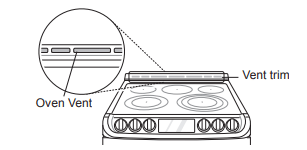
Areas near the vent may become hot during operation and may cause burns. Do not block the vent opening. Avoid placing plastics near the vent as heat may distort or melt the plastic.
It is normal for steam to be visible when cooking foods with high moisture content.
Using Oven Racks
The racks have a turned-up back edge that prevents them from being pulled out of the oven cavity.
Removing Racks
- Pull the rack straight out until it stops.
- Lift up the front of the rack and pull it out.
Replacing Racks
- Place the end of the rack on the support.
- Tilt the front end up and push the rack in.
Bake
Bake is used to prepare foods such as pastries, breads and casseroles. The oven can be programmed to bake at any temperature from 170 °F (80 °C) to 550°F (285 °C). The default temperature is 350 °F (175°C).
Setting the Bake Function (example, 375 °F)
- Turn the oven mode knob to select Bake.
- Set the oven temperature: For example, press plus(+) until 375 °F appears in the display.
- Press Start. The oven starts to preheat.
As the oven preheats, the temperature is displayed and rises in 5 degree increments. Once the oven reaches the set temperature, a tone sounds and the oven light blinks on and off.
4. When cooking is complete, turn the oven mode knob to the Off position.
5. Remove food from the oven.
Baking Tips
- Baking time and temperature will vary depending on the characteristics, size, and shape of the baking pan used.
- Check for food doneness at the minimum recipe time.
- Use metal bakeware (with or without a nonstick finish), heatproof glass-ceramic, ceramic or other bakeware recommended for oven use.
- Dark metal pans or nonstick coatings will cook food faster with more browning. Insulated bakeware will slightly lengthen the cooking time for most foods.
Convection Mode
The convection system uses a fan to circulate the heat evenly within the oven. Improved heat distribution allows for even cooking and excellent results while cooking with single or multiple racks.
Setting the Convection Function (example, 375 °F)
- Turn the oven mode knob to select the Conv. Bake or Conv. Roast.
- Set the oven temperature: For example, press plus(+) until 375 °F appears in the display.
- Press Start. The display shows Conv. Bake or Conv. Roast and the oven temperature starting at 100 °F.
As the oven preheats, the display shows increasing temperatures in 5-degree increments. Once the oven reaches the set adjusted temperature, a tone sounds and the oven light flashes on and off. The display shows the auto converted oven temperature, 350 °F and the fan icon.
4. When cooking has finished or to cancel, turn the oven mode knob to the Off position.
Tips for Convection Baking
- Use Convection Bake for faster and more even multiple-rack cooking of pastries, cookies, muffins, biscuits, and breads of all kinds.
- Bake cookies and biscuits on pans with no sides or very low sides to allow heated air to circulate around the food. Food baked on pans with a dark finish will cook faster.
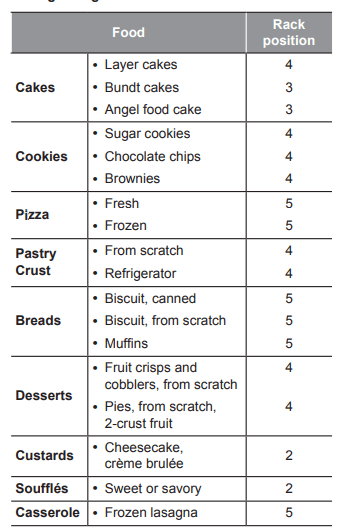
- If cooking on single rack, place the rack in the position suggested in the charts on the following pages. If cooking on multiple racks, place the oven racks in positions 3 and 5 (for two racks).
- Multiple oven rack cooking may slightly increase cook times for some foods.
- Cakes, cookies and muffins have better results when using multiple racks.
The Convection Roast feature is designed to give optimum roasting performance. Convection Roast combines cooking with the convection fan to roast meats and poultry. The heated air circulates around the food from all sides, sealing in juices and flavors.
Foods are crispy brown on the outside while staying moist on the inside. Convection roasting is especially good for large tender cuts of meat, uncovered.
Tips for Convection Roasting
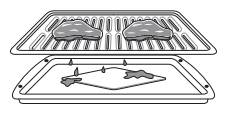
Use a broiler pan and grid when preparing meats for convection roasting. The broiler pan catches grease spills and the grid helps prevent grease splatters.
- Place the oven rack on the bottom.
- Place the grid in the broiler pan.
- Place the broiler pan on the oven rack
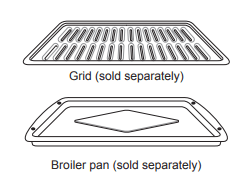
Recommended Baking and Roasting Guide
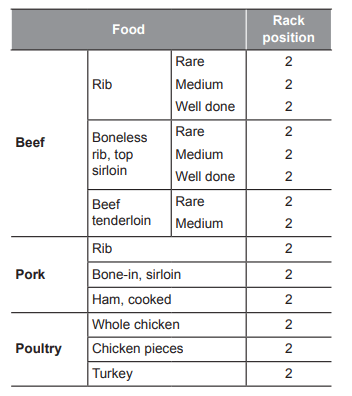
Baking results will be better if baking pans are centered in the oven as much as possible. If cooking on multiple racks, place the oven racks in the positions shown.
Rack and Pan Placement
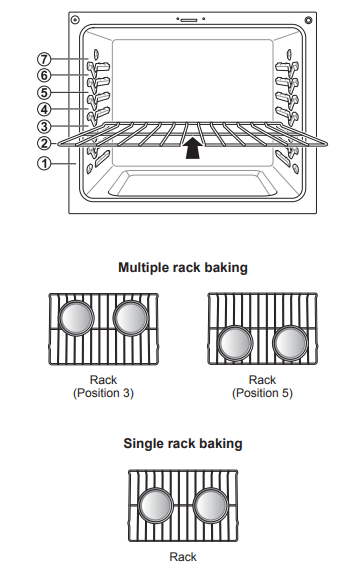
Baking rack guide
Roasting rack guide
Broil
The Broil function uses intense heat from the upper heating element to cook food. Broiling works best for tender cuts of meat, fish, and thinly cut vegetables.
Some models may feature a hybrid broiler consisting of an inner broiler that utilizes a carbon heating element which provides instantaneous heat, and a traditional outer broiling element. During normal broiler operation, it is normal for either element to cycle off intermittently.
Setting the oven to Broil
- Turn the oven mode knob to select Broil High or
- Broil Low.
- Press Start. The oven begins to heat.
- Let the oven preheat for approximately five minutes before cooking the food if using broil.
- Turn the oven mode knob to the Off position to cancel at any time or when cooking is complete.
Smoking
Due to the intense heat associated with broiling, it is normal to experience smoke during the cooking process. This smoke is a natural byproduct of searing and should not cause you to worry. If you are experiencing more smoke than you are comfortable with, use the following tips to reduce the amount of smoke in your oven.
- Always use a broiler pan. Do not use saute pans or regular baking sheets for safety reasons.
- The broiler pan should always be thoroughly cleaned and at room temperature at the beginning of cooking.
- Always run your cooktop ventilation system or vent hood during broiling.
- Keep the interior of your oven as clean as possible. Leftover debris from prior meals can burn or catch fire.
- Avoid fatty marinades and sugary glazes. Both of these will increase the amount of smoke you experience. If you would like to use a glaze, apply it at the very end of cooking.
- If you are experiencing significant smoke with any food item, consider:
- Lowering the broiler to the Lo setting.
- Lowering the rack position to cook the food further away from the broiler.
- Using the Hi broil setting to achieve the level of searing you desire, and then either switching to the Lo broil setting, or switching to the Bake function.
7. As a rule, fattier cuts of meat and fish will produce more smoke than leaner items.
8. Adhere to the recommended broil settings and cooking guidelines in the chart on the following page whenever possible.
Recommended Broiling Guide
The size, weight, thickness, starting temperature, and your preference of doneness will affect broiling times.
This guide is based on meats at refrigerator temperature. For best results when broiling, use a pan designed for broiling.
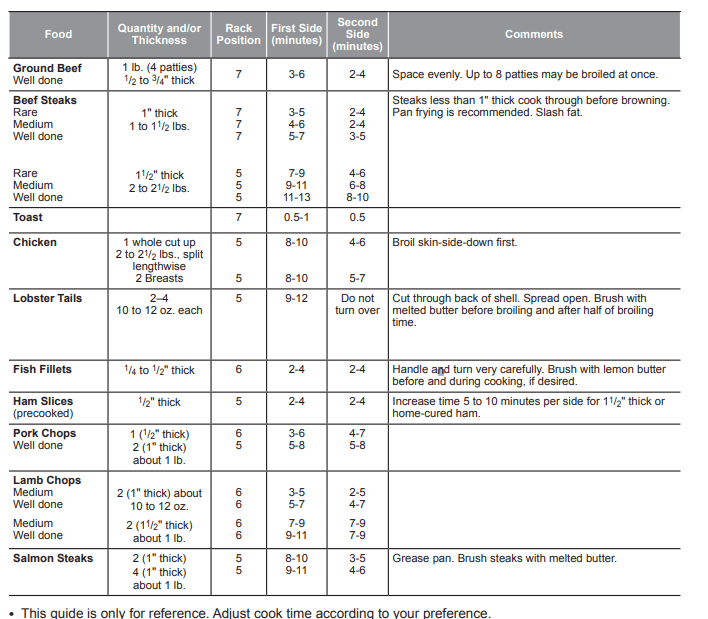
This guide is only for reference. Adjust cook time according to your preference
Tips for Broiling
Beef
- Steaks and chops should always be allowed to rest for five minutes before being cut into and eaten. This allows the heat to distribute evenly through the food and creates a more tender and juicy result.
- Pieces of meat that are thicker than two inches should be removed from the refrigerator 30 minutes prior to cooking. This will help them cook more quickly and evenly, and will produce less smoke when broiling. Cooking times will likely be shorter than the times indicated in the Broiling Chart.
- For bone-in steaks or chops that have been frenched (all meat removed from around the bone), wrap the exposed sections of bone in foil to reduce burning.
Seafood
- When broiling skin-on fish, always use the Lo broil setting and always broil the skin side last.
- Seafood is best consumed immediately after cooking. Allowing seafood to rest after cooking can cause the food to dry out.
- It is a good idea to rub a thin coating of oil on the surface of the broiling pan before cooking to reduce sticking, especially with fish and seafood. You can also use a light coating of non-stick pan spray.
Vegetables
- Toss your vegetables lightly in oil before cooking to improve browning.
Warm
This function will maintain an oven temperature of 170°F. The Warm function will keep cooked food warm for serving up to three hours after cooking has finished. The Warm function may be used without any other cooking operations.
Setting the Warm Function
- Turn the oven mode knob to select Warm.
- Press Start.
- Turn the oven mode knob to the Off position when warming is finished.
Proof
This feature maintains a warm oven for rising yeast leavened products before baking.
Setting the Proof Function
- Use rack position 2 or 3 for proofing.
- Turn the oven mode knob to select Proof.
- Press Start.
- Turn the oven mode knob to the Off position when proofing is finished.
Pizza (For Model : LSE4611)
The Pizza function is specially designed for cooking pizza. It heats from both the top and bottom to brown food more evenly.
This system is designed to give the optimum cooking performance for pizza by automatically selecting a combination of the broil and bake heating systems.
When using P1 and P2 function, there is no need to preheat the oven prior to cooking. For P3, preheat the oven with a pizza stone for 30 minutes prior to cooking.
Setting the Pizza Function
- Turn the oven mode knob to Pizza.
- Press the plus (+) or minus (-) buttons to cycle through the options (see the table below).
- Press Start to begin cooking with the selected options.
- To cancel operation at any time, turn the oven mode knob to the Off position.
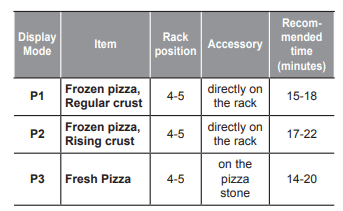
This chart is based on one 12" pizza, and is only for reference. Adjust cook time according to size of pizza and preference.
Speed Roast
The Speed Roast feature is designed to quickly roast poultry. The combination of intense heat from the upper heating element and heated air from the back heating element result in crispier food and help to save cooking time. Speed roasting is especially good for medium sized poultry.
Setting the Speed Roast Function
- Put food in the oven.
- Turn the oven mode knob to select Speed Roast. The display shows Roast Speed.
- Press Start.
SMART FEATURES
Before Using Tag On
The Tag On function allows you to conveniently use LG Smart Diagnosis™, set the cook mode and
EasyClean® features, and communicate with your appliance using a smart phone. To use the Tag On function:
- Download the LG Smart Oven application(Smart ThinQ) to a smart phone.
- Turn on the NFC (Near Field Communication) function in the smart phone. The Tag On function is only compatible with smart phones that are equipped with the NFC function and based on the Android 4.0 (Ice Cream Sandwich) or later OS (operating system).
Turning On the Smart Phone's NFC Function
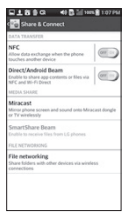
1. Enter the Settings menu of the smart phone and select Share & connect under WIRELESS NETWORKS.
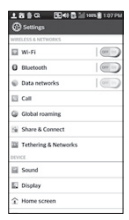
2. Set NFC and Direct/Android Beam to ON and select NFC.
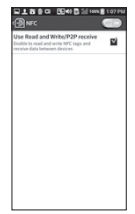
3. Check Use Read and Write/P2P receive.
Using the Tag On Function
The Tag On Icon 
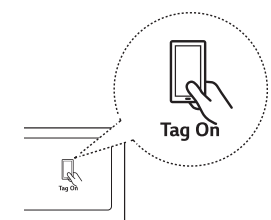
Turn the oven mode knob to select Tag On. Look for the Tag On icon on the control panel. Position the smart phone next to the icon when using the Tag On function with the LG Smart Diagnosis™, cook mode setting and EasyClean® features of the LG Smart Oven application.
The NFC Antenna Position
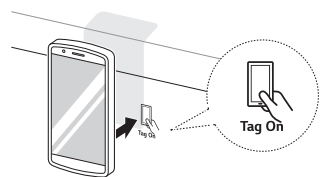
When using the Tag On function, position the smart phone so that the NFC antenna inside the back of the smart phone matches the position of the Tag On icon on the appliance.
If the application is not able to show a target range, position the center back of the smart phone over the Tag On icon on the appliance. If the connection is not made immediately, move the smart phone very slightly in a widening circular motion until the application verifies the connection.
Because of the characteristics of NFC, if the transmission distance is too far, or if there is a metal sticker or a thick case on the phone, transmission will not be good.
Press [  ] in the LG Smart Oven application for a more detailed guide on how to use the Tag On function.
Using Tag On with Applications
Press an LG appliance's Tag On logo with an NFC-equipped smart phone to use the LG Smart Oven application's LG Smart Diagnosis™, Oven Settings, and EasyClean® features.
Smart Diagnosis™
Allows you to diagnose and troubleshoot problems with your range.
EasyClean® (For Model : LSE4613)
Allows you to set EasyClean® alerts, read the instruction guide, and simulate and compare energy consumption when using EasyClean® versus self-clean cycles.
Oven Settings
Allows the user to change oven settings, including the hour mode, preheat alarm light, beeper volume, temperature units, convection auto conversion, cooktop on alert(For Model : LSE4611), and thermostat adjustment.
MAINTENANCE
Cleaning the Glass-Ceramic Cooktop
Use ceramic cooktop cleaner on the glass cooktop. Other creams may not be as effective or may scratch, damage or stain the cooktop surface.
To maintain and protect the surface of the glass cooktop, follow these steps:
- Before using the cooktop for the first time, clean it with a ceramic cooktop cleaner. This helps protect the top and makes cleanup easier.
- Use ceramic cooktop cleaner daily to help keep the cooktop looking new.
- Shake the cleaning cream well. Apply a few drops of cleaner directly to the cooktop.
- Use a paper towel to clean the entire cooktop surface.
- Rinse with clear water and use a dry cloth or paper towel to remove all cleaning residue.
Burned-On Residue
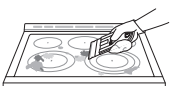
1. While the cooktop is still hot, remove any burnt on deposits or spilled food from the glass-ceramic cooking surface with a suitable metal razor scraper. (Similar to scraping paint off of a windowpane, it will not damage the decorated cooking surface.) Hold the scraper at an approximate 30° angle to the cooktop.
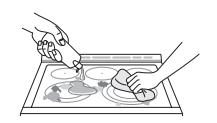
2. When the cooking surface has cooled down, apply a few dabs (about the size of a dime) of an approved cleaner in each burner area and work the cleaning cream over the cooktop surface with a damp paper towel.
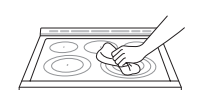
3. Rinse with clean water and wipe the cooktop surface with a clean, dry paper towel.
Metal Marks and Scratches
- Be careful not to slide pots and pans across the cooktop. Doing so will leave metal markings on the cooktop surface. To help remove these marks, use a ceramic cooktop cleaner with a cleaning pad for ceramic cooktops.
- If pots with a thin overlay of aluminum or copper are allowed to boil dry, the overlay may leave black discoloration on the cooktop. This should be removed immediately before heating again or the discoloration may be permanent.
EasyClean®
LG’s EasyClean® enamel technology provides two cleaning options for the inside of the range. The EasyClean® feature takes advantage of LG’s new enamel to help lift soils without harsh chemicals, and it runs using ONLY WATER for just 10 minutes in low temperatures to help loosen LIGHT soils before hand-cleaning.
While EasyClean® is quick and effective for small and LIGHT soils, the Self Clean feature can be used to remove HEAVY, built up soils. The intensity and high heat of the Self Clean cycle may result in smoke which will require the opening up of windows to provide ventilation. Compared to the more intense
Self Clean process, your LG oven gives you the option of cleaning with LESS HEAT, LESS TIME, and virtually NO SMOKE OR FUMES.
When needed, the range still provides the Self Clean option for longer, more thorough oven cleaning for heavier, built up soils.
Benefits of EasyClean®
- Helps loosen light soils before hand-cleaning
- EasyClean® only uses water; no chemical cleaners
- Makes for a better self-clean experience (For Model : LSE4613)
- Delays the need for a self-clean cycle
- Minimizes smoke and odors
- Can allow shorter self-clean time
When to Use EasyClean®
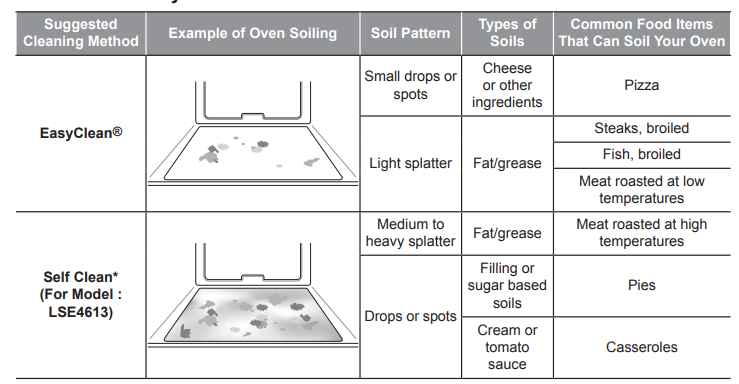
The Self Clean cycle can be used for soil that has been built up over time.
Cleaning Tips
- Allow the oven to cool to room temperature before using the EasyClean® cycle. If your oven cavity is above 150 °F (65 °C), Hot will appear in the display, and the EasyClean® cycle will not be activated until the oven cavity cools down.
- A plastic spatula can be used as a scraper to scrape off any chunks or debris before and during oven cleaning.
- Using the rough side of a non-scratch scouring pad may help to take off burnt-on stains better than a soft sponge or towel.
- Certain non-scratch scrubbing sponges, such as those made of melamine foam, available at your local stores, can also help improve cleaning.
- The range should be level to ensure that the bottom surface of the oven cavity is entirely covered by water at the beginning of the EasyClean® cycle.
- For best results, use distilled or filtered water. Tap water may leave mineral deposits on the oven bottom.
- Soil baked on through several cooking cycles will be more difficult to remove with the EasyClean® cycle.
- Do not open the oven door during the EasyClean® cycle. Water will not get hot enough if the door is opened during the cycle.
- For hard to reach areas such as the back surface of the oven, it is better to use the Self Clean cycle. (For Model : LSE4613)
EasyClean® Instruction Guide
1. Remove oven racks and accessories from the oven.
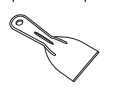
2. Scrape off and remove any burnt-on debris with a plastic scraper.
Suggested plastic scrapers:
- Hard plastic spatula
- Plastic pan scraper
- Plastic paint scraper
- Old credit card
3. Fill a spray bottle with 1¼ cups (10 oz or 300 ml) of water and use the spray bottle to thoroughly spray the inside surfaces of the oven.
4. Use at least ¼ cup (2 oz or 60 ml) of the water to completely saturate the soil on both the walls and in the corners of the oven.
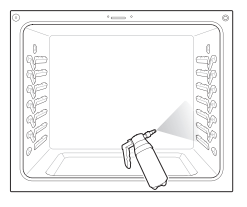
5. Spray or pour the remaining 1 cup (8 oz or 250 ml) of water onto the bottom center of the oven cavity. The indentation on the oven bottom should be fully covered to submerge all soils. Add water if necessary.
6. Close the oven door. Turn the oven mode knob to select EasyClean®. Press Start.
7. A tone will sound at the end of the 10 minute cycle. Turn the oven mode knob to the Off position to clear the display and end the tone.
8. After the cleaning cycle and during handcleaning, enough water should remain on the oven bottom to completely submerge all soils. Add water if necessary. Place a towel on the floor in front of the oven to capture any water that may spill out during hand-cleaning.
9. Clean the oven cavity immediately after the EasyClean® cycle by scrubbing with a wet, non-scratch scouring sponge or pad. (The scouring side will not scratch the finish.) Some water may spill into the bottom vents while cleaning, but it will be captured in a pan under the oven cavity and will not hurt the burner.
10. Once the oven cavity is cleaned, wipe any excess water with a clean dry towel. Replace racks and any other accessories.
11. If some light soils remain, repeat the above steps, making sure to thoroughly soak the soiled areas.
If stubborn soils remain after multiple EasyClean® cycles, run the Self Clean cycle. Be sure that the oven cavity is empty of oven racks and other accessories, and that the oven cavity surface is dry before running the Self Clean cycle. Consult the Self Clean section of your owner’s manual for further details.
Self Clean (For Model : LSE4613)
The Self Clean cycle uses extremely hot temperatures to clean the oven cavity. While running the Self Clean cycle, you may notice smoking or an odor. This is normal; especially if the oven is heavily soiled.
During Self Clean, the kitchen should be well ventilated to minimize the odors from cleaning.
Before Starting Self Clean
- Remove the oven racks, broiler pan, broiler grid, all cookware, aluminum foil or any other material from the oven.
- The kitchen should be well ventilated to minimize the odors from cleaning.
- Wipe any heavy spillovers on the bottom of the oven.
- Make sure that the oven light bulb cover is in place and the oven light is off.
- The oven light cannot be turned on during a Self Clean cycle. The oven light cannot be turned on until the oven temperature has cooled below 500°F (260 ˚C) after a Self Clean cycle is complete.
During the Self Clean cycle, the cooktop elements and warming drawer cannot be used.
Setting Self Clean
The Self Clean function has cycle times of 3, 4, or 5 hours.
Self Clean Soil Guide
- Remove all racks and accessories from the oven.
- Turn the oven mode knob to select Self Clean. The oven defaults to the recommended four-hour self clean for a moderately soiled oven. Press plus(+) or minus(-) to select a self clean time from 3 to 5 hours.
- Press Start.
- Once the self-clean cycle is set, the oven door locks automatically and the lock icon displays. You will not be able to open the oven door until the oven has cooled. The lock releases automatically when the oven has cooled.
Setting Self Clean with a Delayed Start
- Remove all racks and accessories from the oven.
- Turn the oven mode knob to select Self Clean. The oven defaults to the recommended four-hour self clean for a moderately soiled oven. Press plus(+) or minus(-) to select a self clean time from 3 to 5 hours.
- Press Start Time.
- Press plus(+) or minus(-) to enter the time of day you would like the Self Clean to start.
- Press Start.
During Self Clean
- The Self Clean cycle uses extremely hot temperatures to clean the oven cavity. While running the Self Clean cycle, you may notice smoking or an odor. This is normal, especially if the oven is heavily soiled.
- As the oven heats, you may hear sounds of metal parts expanding and contracting. This is normal and will not damage the oven.
- Do not force the oven door open when the lock is displayed. The oven door remains locked until the oven temperature has cooled. Forcing the door open will damage the door.
After the Self Clean Cycle
- The oven door remains locked until the oven temperature has cooled.
- You may notice some white ash in the oven. Wipe it off with a damp cloth or a soap-filled steel wool pad after the oven cools. If the oven is not clean after one self-clean cycle, repeat the cycle.
- If oven racks were left in the oven and do not slide smoothly after a self-clean cycle, wipe racks and rack supports with a small amount of vegetable oil to make them glide more easily.
- Fine lines may appear in the porcelain because it went through heating and cooling. This is normal and will not affect performance.
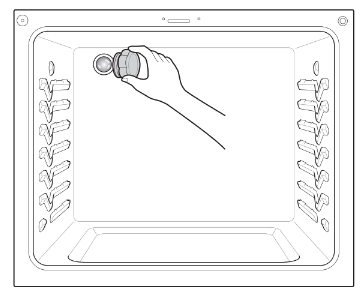
Changing the Oven Light
The oven light is a standard 40-watt appliance bulb. It turns on when the oven door is open. When the oven door is closed, press Light to turn it on or off.
- Unplug the range or disconnect power.
- Turn the glass bulb cover in the back of the oven counterclockwise to remove.
- Turn the bulb counterclockwise to remove it from the socket.
- Insert the new bulb and turn it clockwise.
- Insert the glass bulb cover and turn it clockwise.
- Plug in the range or reconnect the power.
Cleaning the Exterior
Painted and Decorative Trim
For general cleaning, use a cloth with hot soapy water. For more difficult soils and built-up grease, apply a liquid detergent directly onto the soil. Leave it on for 30 to 60 minutes. Rinse with a damp cloth and dry. Do not use abrasive cleaners.
Stainless Steel Surfaces
To avoid scratches, do not use steel wool pads.
- Place a small amount of stainless steel appliance cleaner or polish on a damp cloth or paper towel.
- Clean a small area, rubbing with the grain of the stainless steel if applicable.
- Dry and buff with a clean, dry paper towel or soft cloth.
- Repeat as necessary.
Oven Door
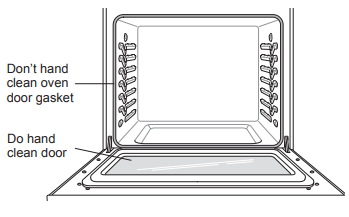
- Use soapy water to thoroughly clean the oven door. Rinse well. Do not immerse the door in water.
- You may use a glass cleaner on the outside glass of the oven door. Do not spray water or glass cleaner on the door vents.
- Do not use oven cleaners, cleaning powders, or harsh abrasive cleaning materials on the outside of the oven door.
- Do not clean the oven door gasket. The oven door gasket is made of a woven material that is essential for a good seal. Care should be taken not to rub, damage, or remove this gasket.
Broiler Pan and Grid
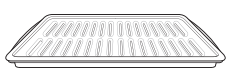
- Do not store a soiled broiler pan or grid anywhere in the range.
- Do not clean the broiler pan or grid in a self-cleaning mode. (For Model : LSE4613)
- Remove the grid from the pan. Carefully pour out the grease from the pan into a proper container.
- Wash and rinse the broiler pan and grid in hot water with a soap-filled or plastic scouring pad.
- If food has burned on, sprinkle the grid with cleaner while hot and cover with wet paper towels or a dishcloth. Soaking the pan will remove burned-on foods.
- Both the broiler pan and grid may be cleaned with a commercial oven cleaner or in the dishwasher.
Oven Racks
Remove the oven racks before operating the self clean cycle. (For Model : LSE4613)
- Food spilled into the tracks could cause the racks to become stuck. Clean racks with a mild, abrasive cleaner.
- Rinse with clean water and dry.
Removing and Replacing the Lift-Off Oven Doors and Drawer
Removing the Door
- Fully open the door.
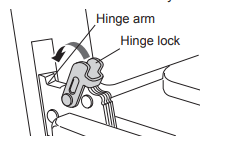
- Unlock the hinge locks, rotating them as far toward the open door frame as they will go.
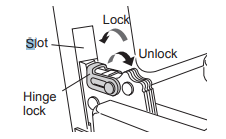
3. Firmly grasp both sides of the door at the top.
4. Close the door to the removal position approximately five degrees) which is halfway between the broil stop position and fully closed.If the position is correct, the hinge arms will move freely.
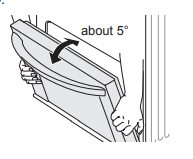
5. Lift door up and out until the hinge arms are clear of the slots.
Replacing the Door
- Firmly grasp both sides of the door at the top.
- With the door at the same angle as the removal position, seat the indentation of the hinge arms into the bottom edge of the hinge slots. The notch in the hinge arms must be fully seated into the bottom edge of the slots.
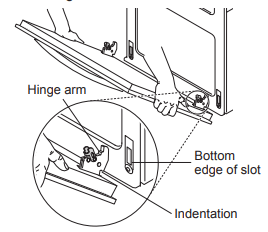
3. Open the door fully. If the door will not open fully, the indentation is not seated correctly in the bottom edge of the slots.
4. Lock the hinge locks, rotating them back toward the slots in the oven frame until they lock.
5. Close the oven door.
Removing the Drawer
Most cleaning can be done with the drawer in place; however, the drawer may be removed if further cleaning is needed. Use warm water to thoroughly clean.
- Fully open the drawer.
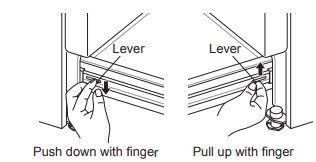
- Locate the glide lever on each side of the drawer. Push down on the left glide lever and pull up on the right glide lever.
3. Pull the drawer away from the range.
Replacing the Drawer
- Pull the bearing glides to the front of the chassis glide.
- Align the glide on each side of the drawer with the glide slots on the range.
- Push the drawer into the range until levers click approximately 2 inch).
- Pull the drawer open again to seat bearing glides into position.
Door Care Instructions
Most oven doors contain glass that can break.
TROUBLESHOOTING
FAQs
What types of cookware are recommended for use with the cooktop?
- The pans must have a flat bottom and straight sides.
- Only use heavy-gauge pans.
- The pan size must match the amount of food to be prepared and the size of the surface element.
- Use tight fitting lids.
- Only use flat-bottom woks.
Why do the heating elements appear to be turning ON and OFF during use of the cooktop or oven?
Depending on your cooktop element setting or the temperature selected in your oven it is NORMAL for the cooking elements to cycle on and off.
My new oven doesn’t cook like my old one. Is there something wrong with the temperature settings?
No, your oven has been factory tested and calibrated.
For the first few uses, follow your recipe times and temperatures carefully. If you still think your new oven is too hot or too cold, you can adjust the oven temperature yourself to meet your specific cooking needs. Refer to the Oven Temperature Adjustment section in this manual for easy instructions on how to adjust your thermostat.
Is it normal to hear a clicking noise coming from the back of my oven when I am using it?
Your new range is designed to maintain a tighter control over your oven’s temperature. You may hear your oven’s heating elements click on and off more frequently on your new oven. This is NORMAL.
Why is the colon in the clock flashing?
This means that the product has just been plugged in, or that it has experienced a power interruption. To clear the flashing colon in the clock, press any key or reset the clock if needed.
During convection cooking the fan stops when I open the door. Is that normal?
Yes, this is normal. When the door is opened, the convection fan will stop until the door is closed.
Can I use aluminum foil to catch drippings in my oven cavity?
Never use aluminum foil to line the bottom or sides of the oven. The foil will melt and stick to the bottom surface of the oven and will not be removable. Use a sheet pan placed on a lower oven rack to catch drippings instead. (If foil has already melted onto the bottom of the oven, it will not interfere with the oven's performance.)
Can I use aluminum foil on the racks?
Do not cover racks with aluminum foil. Covering entire racks with foil restricts air flow, leading to poor cooking results. Use a sheet pan lined with foil under fruit pies or other acidic or sugary foods to prevent spillovers from damaging the oven finish.
Can I leave my racks in the oven when running a Self Clean cycle? (For Model : LSE4613)
No. Although it will not damage the racks, it will discolor them and may make them hard to slide in and out during use. Remove all items from the oven before starting a Self Clean cycle.
What should I do if my racks are sticky and have become hard to slide in and out?
Over time, the racks may become hard to slide in and out. Apply a small amount of olive oil to the ends of the racks. This will work as a lubricant for easier gliding.
What should I do for hard to remove stains on my cooktop?
The cooktop should be cleaned after every use to prevent permanent staining. When cooking foods with high sugar content, such as tomato sauce, clean the stain off with a scraper while the cooktop is still warm.
Use an oven mitt when scraping to prevent burns.
Refer to the MAINTENANCE section of this owner's manual for further instruction.
Why aren't the function buttons working?
Make sure that the range is not in Lockout mode. The lock  will show in the display if Lockout is activated. To deactivate Lockout, pressing Clock for three seconds. The unlock melody sounds and Loc appears in the display until the controls are unlocked.
My range is still dirty after running the EasyClean® cycle. What else should I do?
The EasyClean® cycle only helps to loosen light soils in your oven range to assist in hand-cleaning of your oven. It does not automatically remove all soils after the cycle. Some scrubbing of your oven range is required after running the EasyClean® cycle.
I tried scrubbing my oven after running EasyClean®, but some soils still remain. What can I do?
The EasyClean® feature works best when the soils are fully soaked and submerged in water before running the cycle and during hand-cleaning. If soils are not sufficiently soaked in water, it can negatively affect the cleaning performance. Repeat the EasyClean® process using sufficient water.
Sugar-based and certain greasy soils are especially hard to clean. If some stubborn soils remain, use the Self Clean feature to thoroughly clean your oven.
Soils on my oven walls are not coming off. How can I get my walls clean?
Soils on the side and rear walls of your oven range may be more difficult to fully soak with water. Try repeating the EasyClean® process with more than the ¼ cup (2 oz or 60 ml) spray recommended.
Will EasyClean® get all of the soils and stains out completely?
It depends on the soil type. Sugar-based and certain grease stains are especially hard to clean. Also, if stains are not sufficiently soaked in water, this can negatively affect cleaning performance.
If stubborn or built-up stains remain, use the Self Clean feature. Refer to the Self Clean section of your owner's manual.
Are there any tricks to getting some of the stubborn soils out?
Scraping the soils with a plastic scraper before and during hand-cleaning is recommended. Fully saturating soils with water is also recommended.
However, certain types of soils are harder to clean than others. For these stubborn soils, the Self Clean cycle is recommended. Consult the Self Clean section of your owner's manual for details.
Is it safe for my convection fan, broil burner or heater element to get wet during EasyClean®?
Yes. The convection fan, broiler burner or heater element may get a little wet during cleaning. However, direct spray onto the broil burner and heater elements is not necessary because these are self-cleaning during regular use.
Do I need to use all 1¼ cups (10 oz or 300 ml) of water for EasyClean®?
Yes. It is highly recommended that 1 cup (8 oz or ml) of water be sprayed or poured on the bottom and an additional ¼ cup (2 oz or 60 ml) of water be sprayed on walls and other soiled areas to fully saturate the soils for better cleaning performance.
I see smoke coming out of my oven range’s cooktop vents during EasyClean®. Is this normal?
This is normal. This is not smoke. It is actually water vapor (steam) from the water in the oven cavity. As the oven heats briefly during EasyClean®, the water in the cavity evaporates and escapes through the oven vents.
How often should I use EasyClean®?
EasyClean® can be performed as often as you wish.
EasyClean® works best when your oven is LIGHTLY soiled from such things as LIGHT grease splatter and small drops of cheese. Please refer to the EasyClean® section in your owner's manual for more information.
What is required for EasyClean®?
A spray bottle filled with 1¼ cups (10 oz or 300 ml) of water, a plastic scraper, a non-scratch scrubbing pad and a towel. You should not use abrasive scrubbers such as heavy-duty scouring pads or steel wool.
Except for a towel, all of the materials you need are included in a special cleaning kit with your new range.
Before Calling for Service
Before you call for service, review this list. It may save you time and expense. The list includes common occurrences that are not the result of defective workmanship or materials in this appliance.
- Range is not level.
- Poor installation. Place oven rack in center of oven. Place a level on the oven rack. Adjust leveling legs at base of range until the oven rack is level.
- Be sure floor is level and strong and stable enough to adequately support range.
- If floor is sagging or sloping, contact a carpenter to correct the situation.
- Kitchen cabinet alignment may make range appear unlevel. Be sure cabinets are square and have sufficient room for range clearance.
- Cannot move appliance easily. Appliance must be accessible for service.
- Cabinets not square or are built in too tightly. Contact builder or installer to make appliance accessible.
- Carpet interferes with range. Provide sufficient space so range can be lifted over carpet.
- Anti-tip device engaged.
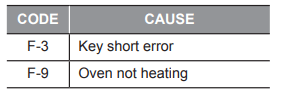
- Oven control beeps and displays any F code error.
- Electronic control has detected a fault condition. Turn the Oven mode knob to the Off position to clear the display and stop beeping. Reprogram oven. If fault recurs, record fault number. Turn the Oven mode knob to the Off position and contact a Service agent.
- Surface units will not maintain a rolling boil or cooking is not fast enough
- Improper cookware being used.
- Use pans which are flat and match the diameter of the surface unit selected.
- In some areas, the power(voltage) may be low.
- Cover pan with a lid until desired heat is obtained.
- Surface units do not work properly
- A fuse in your home may be blown or the circuit breaker tripped.
- Replace the fuse or reset the circuit breaker.
- Cooktop controls improperly set.
- Check to see the correct control is set for the surface unit you are using.
- Surface unit stops glowing when changed to a lower setting
- This is normal. The unit is still on and hot.
- Areas of discoloration on the cooktop
- Food spillovers not cleaned before next use.
- See Cleaning the Glass-Ceramic Cooktop section.
- Hot surface on a model with a light-colored cooktop.
- This is normal. The surface may appear discolored when it is hot. This is temporary and will disappear as the glass cools.
- Frequent cycling on and off of surface units
- This is normal.
- The element will cycle on and off to maintain the heat setting.
- Oven will not work
- Plug on range is not completely inserted in the electrical outlet.
- Make sure electrical plug is plugged into a live, properly grounded outlet.
- A fuse in your home may be blown or the circuit breaker tripped.
- Replace the fuse or reset the circuit breaker.
- Oven controls improperly set.
- See the Using the Oven section.
- Oven too hot.
- Allow the oven to cool to below locking temperature.
- Steam is exhausted through the oven vent.
- Cooking foods with high moisture produces steam. This is normal.
- Appliance does not operate.
- Make sure cord is plugged correctly into outlet. Check circuit breakers.
- Service wiring is not complete. Contact your electrician for assistance.
- Power outage. Check house lights to be sure. Call your local electric company for service.
- Oven light does not work.
- Replace or tighten bulb. See Changing the Oven Light section in this Owner’s Manual.
- Oven smokes excessively during broiling.
- Control not set properly. Follow instructions under Setting Oven Controls.
- Meat too close to the element. Reposition the rack to provide proper clearance between the meat and the element. Preheat broil element for searing.
- Meat not properly prepared. Remove excess fat from meat. Cut remaining fatty edges to prevent curling.
- Insert on broiler pan wrong side up and grease not draining. Always place grid on the broiler pan with ribs up and slots down to allow grease to drip into pan.
- Grease has built up on oven surfaces. Regular cleaning is necessary when broiling frequently.
- Old grease or food spatters cause excessive smoking.
- Food does not bake or roast properly
- Oven controls improperly set.
- See the Using the Oven section.
- Rack position is incorrect or the rack is not level.
- See the Using the Oven section.
- Incorrect cookware or cookware of improper size being used.
- See the Using the Oven section.
- Oven sensor needs to be adjusted.
- See Oven Temperature Adjustment in the Features section.
- Food does not broil properly
- Oven controls improperly set.
- Make sure you turn the oven mode knob to select the Broil mode.
- Improper rack position being used.
- Cookware not suited for broiling.
- Use broiling pan and grid.
- Food does not broil properly
- Aluminum foil used on the broiling pan and grid has not been fitted properly and slit as recommended.
- See the Using the Oven section.
- In some areas the power voltage may be low.
- Preheat the broil element for 5-7 minutes.
- See the Broiling Guide.
- Oven temperature too hot or too cold
- Oven sensor needs to be adjusted.
- See Oven Temperature Adjustment in the Features section.
- Scratches or abrasions on cooktop surface
- Coarse particles such as salt or sand between cooktop and utensils can cause scratches. Be sure the cooktop surface and bottoms of utensils are clean before using. Small scratches do not affect cooking and will become less visible with time.
- Cleaning materials not recommended for glass-ceramic cooktop have been used. See Cleaning the Glass-Ceramic Cooktop in the MAINTENANCE section.
- Cookware with rough bottom has been used. Use smooth, flat-bottomed cookware.
- Metal marks
- Scraping of metal utensils on cooktop surface. Do not slide metal utensils on cooktop surface. Use a glass-ceramic cooktop cleaning creme to remove the marks. See Cleaning the Glass-Ceramic Cooktop in the MAINTENANCE section.
- Brown streaks or specks
- Boilovers are cooked onto surface. Use a blade scraper to remove soil. See Cleaning the Glass-Ceramic Cooktop in the MAINTENANCE section.
- Areas of discoloration on cooktop
- Mineral deposits from water and food. Remove using a glass-ceramic cooktop cleaning creme. Use cookware with clean, dry bottoms.
- Oven will not Self Clean *
- The oven temperature is too high to set a Self Clean operation.
- Allow the range to cool and reset the controls.
- Oven controls improperly set.
- See the Self Clean section.
- A Self Clean cycle cannot be started if the oven lockout feature is active.
- Crackling” or popping” sound
- This is the sound of the metal heating and cooling during both the cooking and Self Clean functions.
- Fan noise
- A convection fan may automatically turn on and off.
- Convection Fan stops
- Convection fan stops during a convection bake cycle.
- This is normal and is done to allow for more even heating during the cycle. This is not a failure of the range and should be considered normal operation.
- Displayed colon in the clock is flashing
- This is normal. This means that the product has just been plugged in, or that it has experienced a power interruption. Press Cook Time for three seconds and reset the clock, or press any key to stop the flashing.
- Excessive smoking during a Self Clean cycle *
- Excessive soil.
- Turn the oven mode knob to the Off position. Open the windows to rid the room of smoke. Wait until the Self Clean mode is cancelled. Wipe up the excess soil and reset the clean.
- Oven door does not open after a Self Clean cycle *
- Oven is too hot.
- Allow the oven to cool below locking temperature.
- Allow about one hour for the oven to cool after the completion of a Self Clean cycle. The door can be opened when the lock is no longer displayed.
- The control and door may be locked.
- The oven does not clean after a Self Clean cycle *
- Oven controls not properly set.
- See the Self Clean section.
- Oven was heavily soiled.
- Clean up heavy spillovers before starting the clean cycle. Heavily soiled ovens may need to Self Clean again or for a longer period of time.
- CLEAN and door flash in the display *
- The Self Clean cycle has been selected, but the door is not closed.
- LOCKED is on in the display when you want to cook *
- The oven door is locked because the temperature inside the oven has not dropped below the locking temperature.
- Turn the oven mode knob to the Off position. Allow the oven to cool.
- Burning or oily odor emitting from the vent
- This is normal in a new oven and will disappear in time.
- To speed the process, set a Self Clean cycle for a minimum of 3 hours. See the Self Clean section. (For Model : LSE4613)
- Oven racks are difficult to slide *
- The shiny, silver-colored racks were cleaned in a Self Clean cycle.
- Apply a small amount of vegetable oil to a paper towel and wipe the edges of the oven racks with the paper towel.
- Moisture collects on oven window or steam comes from oven vent
- This is normal when cooking foods high in moisture.
- Excessive moisture was used when cleaning the window.
- A chime sounds when surface elements are turned on. (For Model : LSE4611)
- When any cooktop burner is activated, a chime sounds to indicate the cooktop is in use.
SMART DIAGNOSIS™

Should you experience any problems with your range, it has the capability of transmitting data to your smart phone using the LG Smart Oven application or via your telephone to the LG call center.
Smart Diagnosis™ cannot be activated unless your range is turned on by pressing the Start button. If your range is unable to turn on, then troubleshooting must be done without using Smart Diagnosis™.
Using Smart Diagnosis™
Smart Diagnosis™ Using Your Smart Phone
- Download the LG Smart Oven application on your smart phone.
- Open the LG Smart Oven application on your smart phone. Press Smart Diagnosis™ button to advance to the next screen.
- Follow directions of the application. Using ‘Tag On’ is recommended but, if it does not work well, the application will show how to use Audible Diagnosis.
- Press [
 ] in the LG Smart Oven application for a more detailed guide on how to use the Tag On function.
Smart Diagnosis™ Through the Call Center
- Call the LG call center at: (LG U.S.) 1-800-243- LG Canada) 1-888-542-2623.
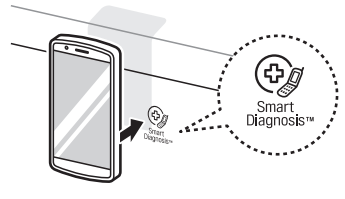
- When instructed to do so by the call center agent, hold the mouthpiece of your phone over the Smart Diagnosis™ logo on the machine. Hold the phone no more than one inch from (but not touching) the machine.
- Press and hold the Start button for three seconds.
- Keep the phone in place until the tone transmission has finished. This takes about 6 seconds and the display will count down the time.
- Once the countdown is over and the tones have stopped, resume your conversation with the call center agent, who will then be able to assist you in using the information transmitted for analysis.