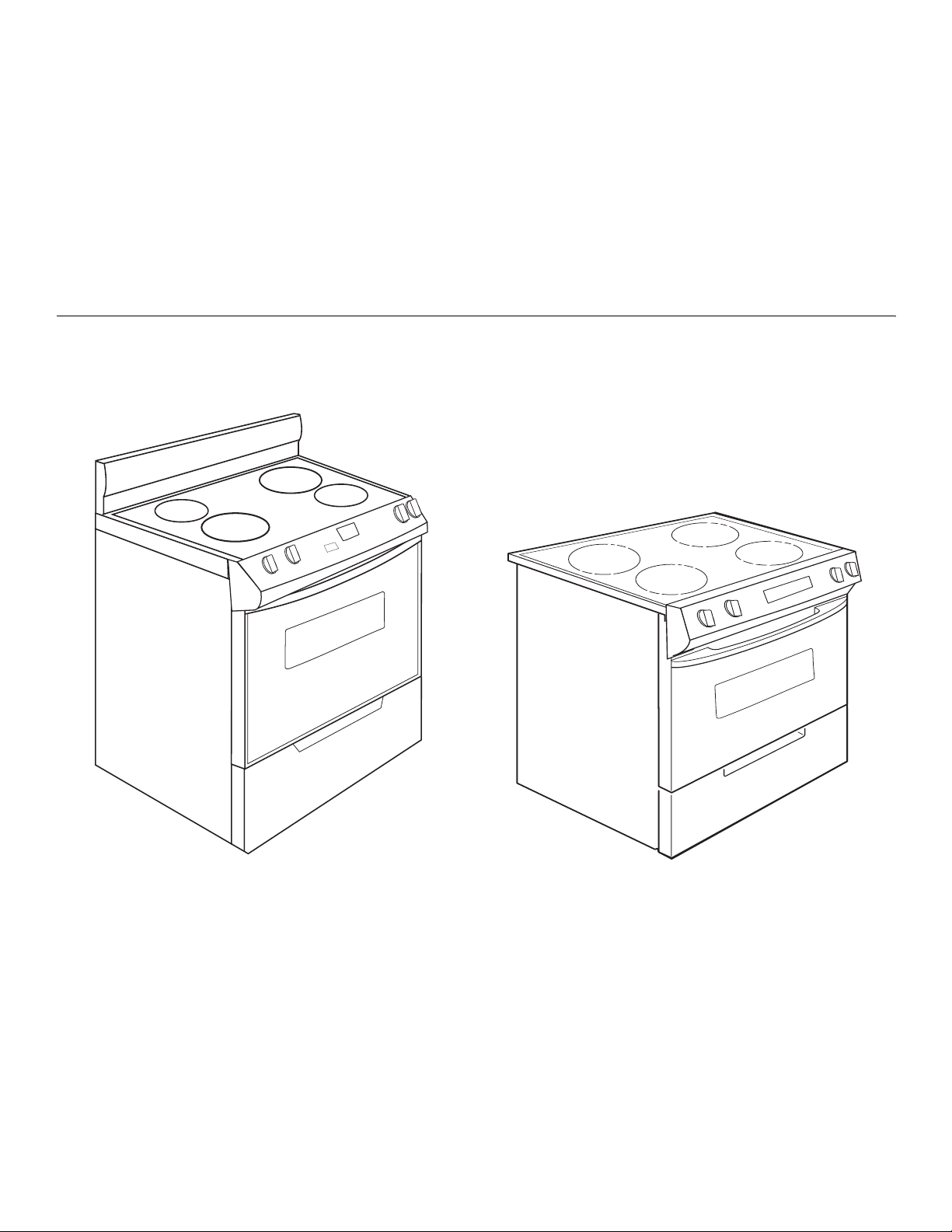
INSTALLATION INSTRUCTIONS
30" (76.2 CM) FREESTANDING AND SLIDE-IN
ELECTRIC RANGES
INSTRUCTIONS POUR L’INSTALLATION
DE LA CUISINIÈRE ÉLECTRIQUE AUTOPORTANTE OU
ENCASTRABLE DE 30" (76,2 CM)
Table of Contents/Table des matières.............................................................................2
IMPORTANT:
Save for local electrical inspector's use.
IMPORTANT :
À conserver pour consultation par l'inspecteur local des installations électriques.
9762035A
2
TABLE OF CONTENTS
RANGE SAFETY .............................................................................2
INSTALLATION REQUIREMENTS................................................3
Tools and Parts ............................................................................3
Location Requirements................................................................3
Electrical Requirements - U.S.A. Only.........................................6
Electrical Requirements - Canada Only.......................................7
Countertop Preparation (for Slide-in Ranges Only).....................7
INSTALLATION INSTRUCTIONS..................................................8
Unpack Range..............................................................................8
Adjust Leveling Legs....................................................................8
Install Anti-Tip Bracket.................................................................8
Optional Rear Spacer Cover (for Slide-in Ranges Only)..............9
Electrical Connection - U.S.A. Only.............................................9
Verify Anti-Tip Bracket Location ................................................13
Level Range................................................................................13
Complete Installation .................................................................14
Moving the Range......................................................................14
ANTI-TIP BRACKET TEMPLATE ................................................23
TABLE DES MATIÈRES
SÉCURITÉ DE LA CUISINIÈRE ...................................................15
EXIGENCES D'INSTALLATION...................................................16
Outillage et pièces......................................................................16
Exigences d'emplacement.........................................................16
Spécifications électriques ..........................................................19
Préparation du plan de travail
(pour cuisinières encastrées uniquement) .................................19
INSTRUCTIONS D'INSTALLATION.............................................19
Déballage de la cuisinière ..........................................................19
Ajuster les pieds de nivellement.................................................20
Installation de la bride antibasculement ....................................20
Garniture d’obturation arrière facultative
(pour cuisinières encastrées uniquement) .................................21
Vérification de l'emplacement de la bride antibasculement......21
Mise à niveau de la cuisinière ....................................................21
Achever l’installation ..................................................................22
Déplacement de la cuisinière.....................................................22
GABARIT POUR LA BRIDE ANTIBASCULEMENT....................23
RANGE SAFETY
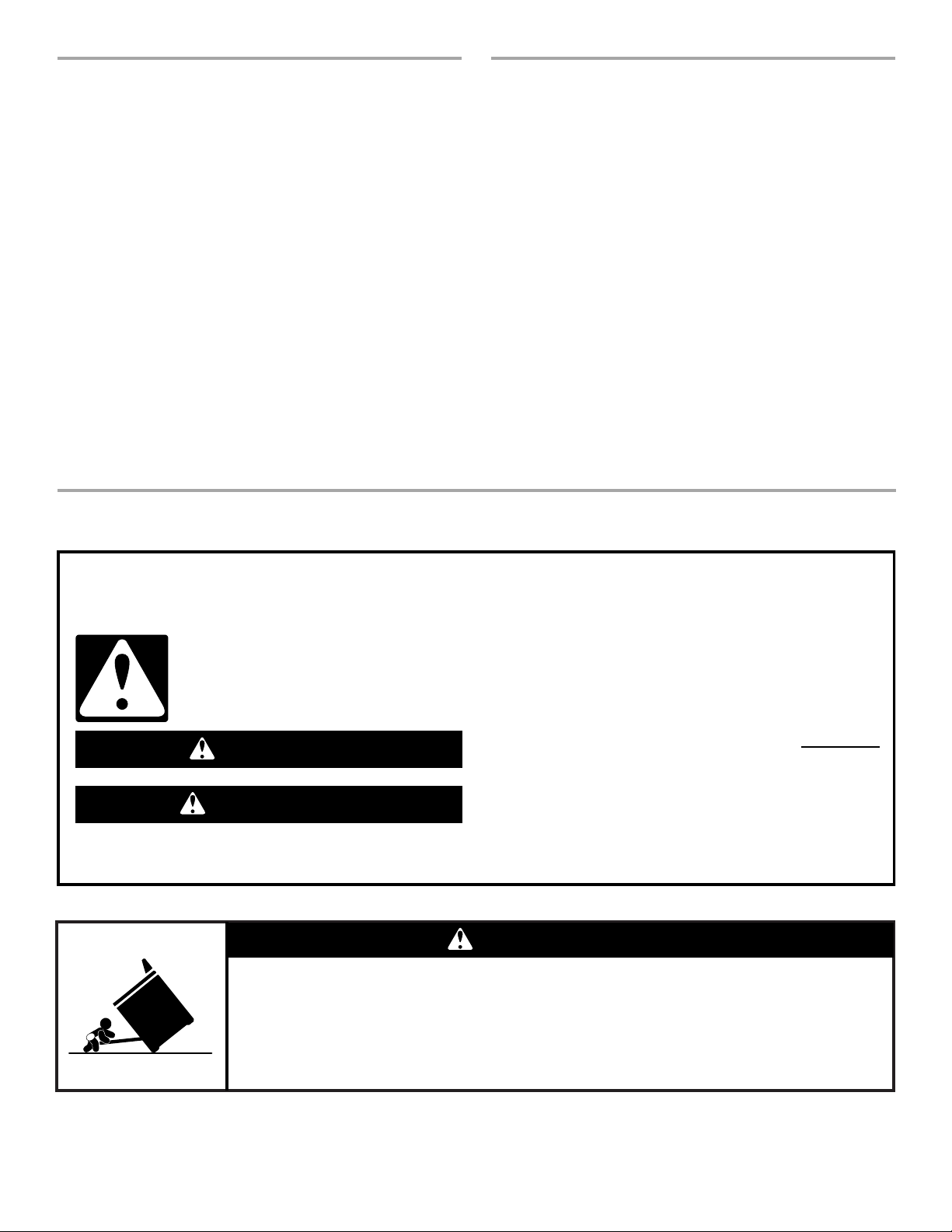
You can be killed or seriously injured if you don't immediately
You
can be killed or seriously injured if you don't
follow
All safety messages will tell you what the potential hazard is, tell you how to reduce the chance of injury, and tell you what can
happen if the instructions are not followed.
Your safety and the safety of others are very important.
We have provided many important safety messages in this manual and on your appliance. Always read and obey all safety
messages.
This is the safety alert symbol.
This symbol alerts you to potential hazards that can kill or hurt you and others.
All safety messages will follow the safety alert symbol and either the word “DANGER” or “WARNING.”
These words mean:
follow instructions.
instructions.
DANGER
WARNING
WARNING
Tip Over Hazard
A child or adult can tip the range and be killed.
Connect anti-tip bracket to rear range foot.
Reconnect the anti-tip bracket, if the range is moved.
Failure to follow these instructions can result in death or serious burns to children and adults.
3
INSTALLATION REQUIREMENTS
Tools and Parts
Gather the required tools and parts before starting installation.
Read and follow the instructions provided with any tools listed
here.
Too ls neede d
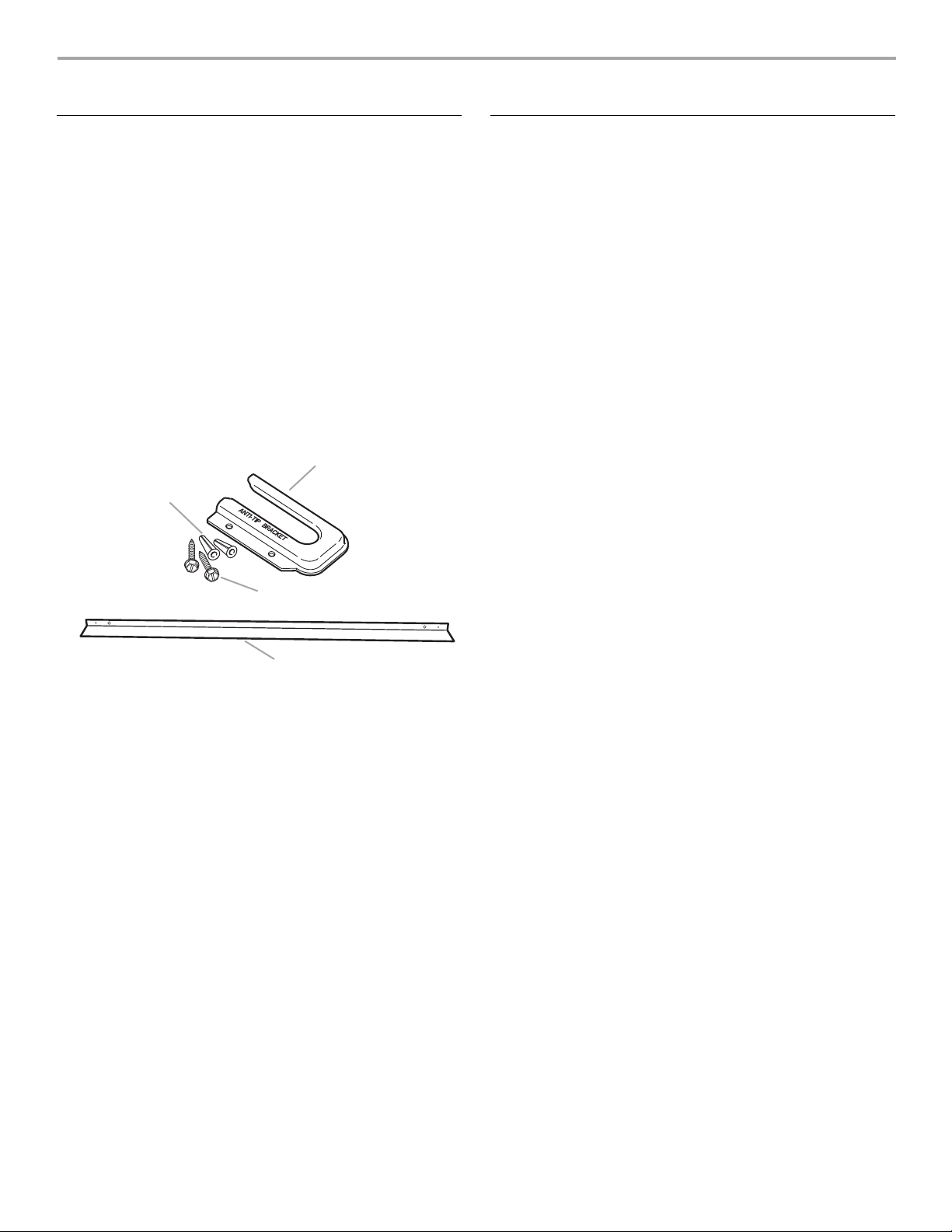
Parts supplied
Check that all parts are included.
■ Anti-tip bracket must be securely mounted to subfloor.
Thickness of flooring may require longer screws to anchor
bracket to sub-floor. Longer screws are available from your
local hardware store.
Parts needed
If using a power supply cord:
■ A UL listed power supply cord kit marked for use with ranges.
The cord should be rated at 250 volts minimum, 40 amps or
50 amps that is marked for use with nominal 1³⁄₈" (3.5 cm)
diameter connection opening and must end in ring terminals
or open-end spade terminals with upturned ends.
■ A UL listed strain relief.
Check local codes. Check existing electrical supply. See
“Electrical Requirements” section.
It is recommended that all electrical connections should be made
by a licensed, qualified electrical installer.
Location Requirements
IMPORTANT: Observe all governing codes and ordinances.
■ It is the installer’s responsibility to comply with installation
clearances specified on the model/serial rating plate. The
model/serial rating plate is located inside the oven door on
the right-hand side oven door trim.
■ The range should be located for convenient use in the
kitchen.
■ To eliminate the risk of burns or fire by reaching over heated
surface units, cabinet storage space located above the
surface units should be avoided. If cabinet storage is to be
provided, the risk can be reduced by installing a range hood
that projects horizontally a minimum of 5" (12.7 cm) beyond
the bottom of the cabinets.
■ Cabinet opening dimensions that are shown must be used.
Given dimensions are minimum clearances.
■ The floor anti-tip bracket must be installed. To install the anti-
tip bracket shipped with the range, see “Install Anti-Tip
Bracket” section.
■ Grounded electrical supply is required. See “Electrical
Requirements” section.
IMPORTANT: To avoid damage to your cabinets, check with your
builder or cabinet supplier to make sure that the materials used
will not discolor, delaminate or sustain other damage. This oven
has been designed in accordance with the requirements of UL
and CSA International and complies with the maximum allowable
wood cabinet temperatures of 194°F (90°C).
Mobile Home - Additional Installation Requirements
The installation of this range must conform to the Manufactured
Home Construction and Safety Standard, Title 24 CFR, Part 3280
(formerly the Federal Standard for Mobile Home Construction
and Safety, Title 24, HUD Part 280). When such standard is not
applicable, the Standard for Manufactured Home Installations,
ANSI A225.1/NFPA 501A or follow local codes.
In Canada, the installation of this range must conform with the
current standards CAN/CSA-A240-latest edition, or local codes.
Mobile home installations require:
■ When this range is installed in a mobile home, it must be
secured to the floor during transit. Any method of securing
the range is adequate as long as it conforms to the standards
listed above.
■ Four-wire power supply cord or cable must be used in a
mobile home installation. The appliance wiring will need to be
revised. See “Electrical Connection” section.
■ Tape measure
■ Flat-blade screwdriver
■ Level
■ Hammer
■ Hand or electric drill
■ Wrench or pliers
■ Marker or pencil
■ Masking tape
■ ¼" nut driver
■ ⁵⁄₁₆" nut driver
■ ¹⁄₈" (3.2 mm) drill bit
(for wood floors)
■ ³⁄₁₆" (4.8 mm) carbide-tipped
masonry drill bit
(for concrete/ceramic floors)
A. Anti-tip bracket
B. Plastic anchors (2)
C. #10 x ¹⁄₂" screws (2)
D. Rear spacer cover for slide-in models
(supplied on some models)*
*To order, contact your dealer or refer to the “Assistance or
Service” section of the Use and Care Guide. Ask for Part
Number 9757784WH (White), 9757784BT (Biscuit), 9757784BL
(Black), 9757784MT (Meteorite) or 9757784SS (Stainless Steel).
A
B
C
D
4
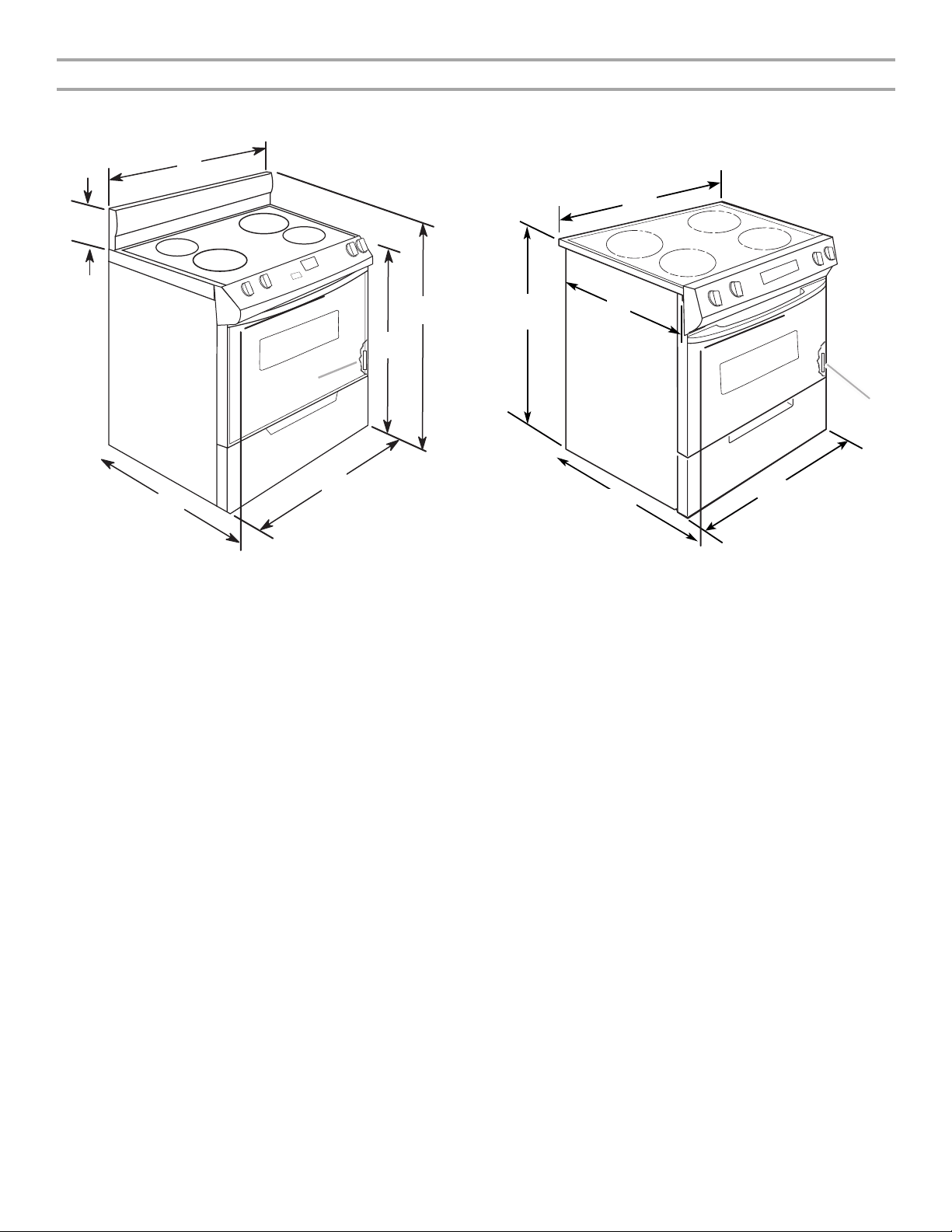
Product Dimensions
Freestanding Range
*Range can be raised approximately 1" (2.5 cm) by adjusting
the leveling legs.
**When installed in a 24" (61 cm) base cabinet with 25" (63.5 cm)
countertop; front of oven door protrudes 1" (2.5 cm) beyond
24" (61 cm) base cabinet.
Slide-in Range
*Range can be raised approximately 1" (2.5 cm) by adjusting
the leveling legs.
**When installed in a 24" (61 cm) base cabinet with 25" (63.5 cm)
countertop; front of oven door protrudes 1⁷⁄₈" (4.8 cm) beyond
24" (61 cm) base cabinet.
A. 7¹⁄₈" (20 cm)
B. 30" (76.2 cm)
C. 43⁷⁄₈" (111.4 cm) overall
height with leveling legs
screwed all the way in
D. 36" (91.4 cm) cooktop trim
height with leveling legs
screwed all the way in*
E. 30" (76.2 cm)
F. 27" (68.6 cm) max. from handle
to standoff at back of range**
G. Model/serial number plate
(located on the right-hand side
oven door trim)
A
B
C
D*
E
F**
G
A. 35⁵⁄₈" (90.5 cm) overall
height with leveling legs
screwed all the way in
B. 30¹¹⁄₁₆" (77.9 cm)
C. 23¹⁄₂" (59.8 cm)
D. 27" (68.6 cm) max. from handle
to standoff at back of range**
E. 30" (76.2 cm)
F. Model/serial number plate
(located on the right-hand side
oven door trim)
A*
B
E
D**
C
F
5
Cabinet Dimensions
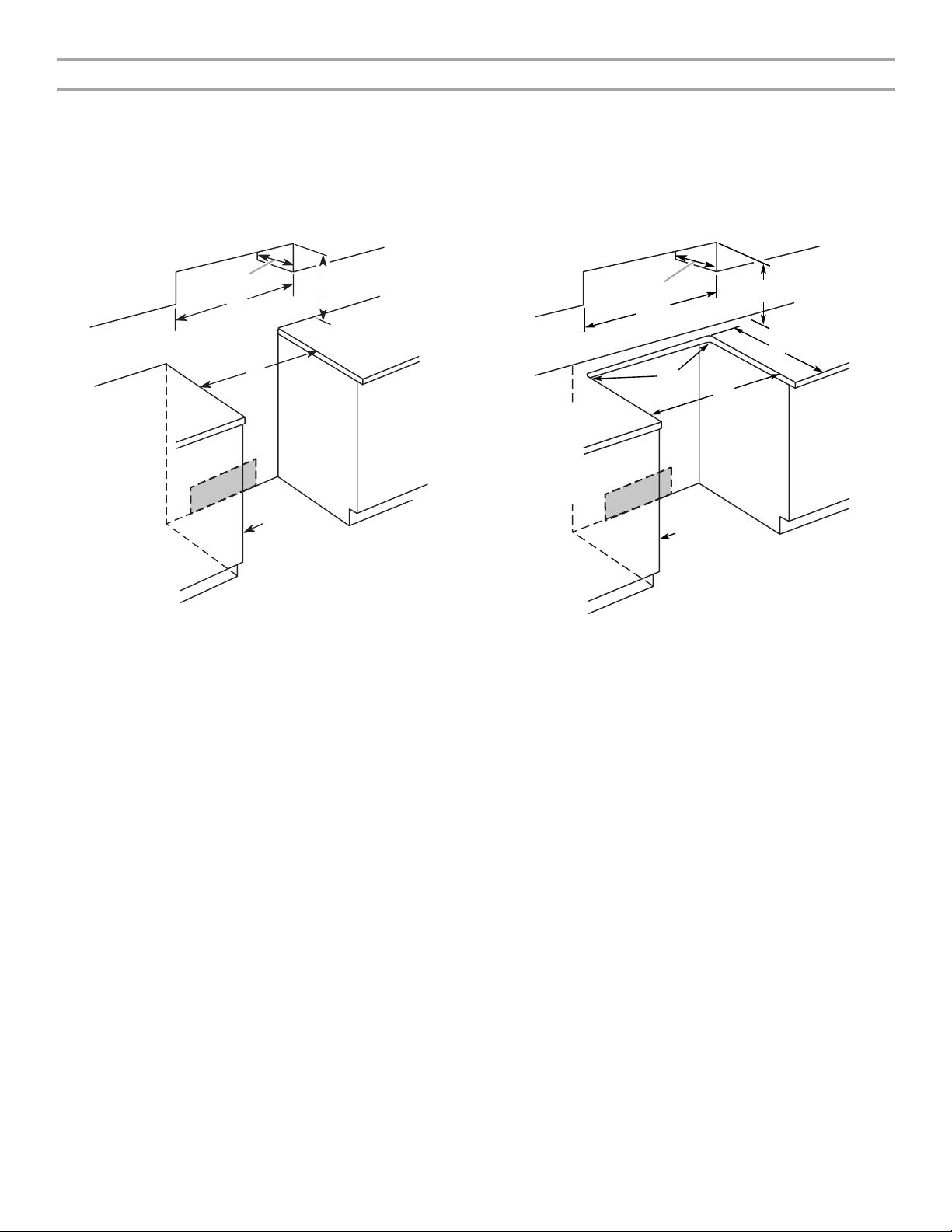
Cabinet opening dimensions shown are for 25" (64 cm) countertop depth, 24" (61 cm) base cabinet depth and 36" (91.4 cm) countertop
height.
If installing a range hood or microwave hood combination above the range, follow the range hood or microwave hood combination
installation instructions for dimensional clearances above the cooktop surface.
Freestanding Range
A freestanding range may be installed next to combustible walls
with zero clearance.
Slide-in Range
NOTE: 24" (61 cm) minimum when bottom of wood or metal cabinet is protected by not less than ¹⁄₄" (0.64 cm) flame retardant
millboard covered with not less than No. 28 MSG sheet steel, 0.015" (0.4 mm) stainless steel, 0.024" (0.6 mm) aluminum or
0.020" (0.5 mm) copper.
30" (76.2 cm) minimum clearance between the top of the cooking platform and the bottom of an unprotected wood or metal cabinet.
A. 13" (33 cm) upper cabinet
depth
B. 30" (76.2 cm) min. opening
width
C. For minimum clearance to the
top of the cooktop,
see NOTE*.
D. 30" (76.2 cm) min. opening
width
E. Junction box - 8" (20.3 cm)
to 22" (55.9 cm) from either
cabinet, 7" (17.8 cm) max.
from floor
F. Cabinet door or hinge should
not extend into the cutout.
A
B
D
F
E
C
A. 13" (33 cm) upper cabinet
depth
B. 30" (76.2 cm) min. opening
width
C. For minimum clearance to
the top of the cooktop,
see NOTE*.
D. 22³⁄₄" (57.8 cm) opening
depth
E. Square cut or ¹⁄₄" (6.2 cm) radius
both corners
F. 30" (76.2 cm) min. opening
width
G. Junction box - 8" (20.3 cm) to
22" (55.9 cm) from either
cabinet, 7" (17.8 cm) max. from
floor
H. Cabinet door or hinge should
not extend into cutout.
A
B
C
D
E
F
G
H
6
Electrical Requirements - U.S.A. Only
If codes permit and a separate ground wire is used, it is
recommended that a qualified electrical installer determine that
the ground path is adequate and wire gauge is in accordance
with local codes.
Do not use an extension cord.
Be sure that the electrical connection and wire size are adequate
and in conformance with the National Electrical Code, ANSI/
NFPA 70-latest edition and all local codes and ordinances.
A copy of the above code standards can be obtained from:
National Fire Protection Association
One Batterymarch Park
Quincy, MA 02269
WARNING: Improper connection of the equipment-grounding
conductor can result in a risk of electric shock. Check with a
qualified electrician or service technician if you are in doubt as to
whether the appliance is properly grounded. Do not modify the
power supply cord plug. If it will not fit the outlet, have a proper
outlet installed by a qualified electrician.
Electrical Connection
To properly install your range, you must determine the type of
electrical connection you will be using and follow the instructions
provided for it here.
■ Range must be connected to the proper electrical voltage
and frequency as specified on the model/serial number rating
plate. The model/serial number rating plate is located on the
oven frame behind the storage drawer panel. Refer to the
figures in the “Product Dimensions” section of the “Location
Requirements” section.
■ This range is manufactured with the neutral terminal
connected to the cabinet. Use a 3-wire UL listed, 40- or 50-
amp power supply cord (pigtail) (see Range Rating chart
below). If local codes do not permit ground through the
neutral, use a 4-wire power supply cord rated at 250 volts,
40 or 50 amps and investigated for use with ranges.
*The NEC calculated load is less than the total connected load
listed on the model/serial rating plate.
**If connecting to a 50-amp circuit, use a 50-amp rated cord with
kit. For 50-amp rated cord kits, use kits that specify use with a
nominal 1³⁄₈" (34.93 mm) diameter connection opening.
■ A time-delay fuse or circuit breaker is recommended.
■ The range can be connected directly to the fused disconnect
(or circuit breaker box) through flexible or nonmetallic
sheathed, copper or aluminum cable. See “Electrical
Connection.”
■ Allow 2 to 3 ft (61.0 cm to 91.4 cm) of slack in the line so that
the range can be moved if servicing is ever necessary.
■ A UL listed conduit connector must be provided at each end
of the power supply cable (at the range and at the junction
box).
■ Wire sizes and connections must conform with the rating of
the range (40 amps).
■ The wiring diagram is located on the underside of the storage
drawer or below the warming drawer in a clear plastic bag.
If connecting to a 4-wire system:
This range is manufactured with the ground connected to the
cabinet. The ground must be revised so the green ground wire of
the 4-wire power supply cord is connected to the cabinet. See
“Electrical Connection.”
Grounding through the neutral conductor is prohibited for new
branch-circuit installations (1996 NEC); mobile homes; and
recreational vehicles, or an area where local codes prohibit
grounding through the neutral conductor.
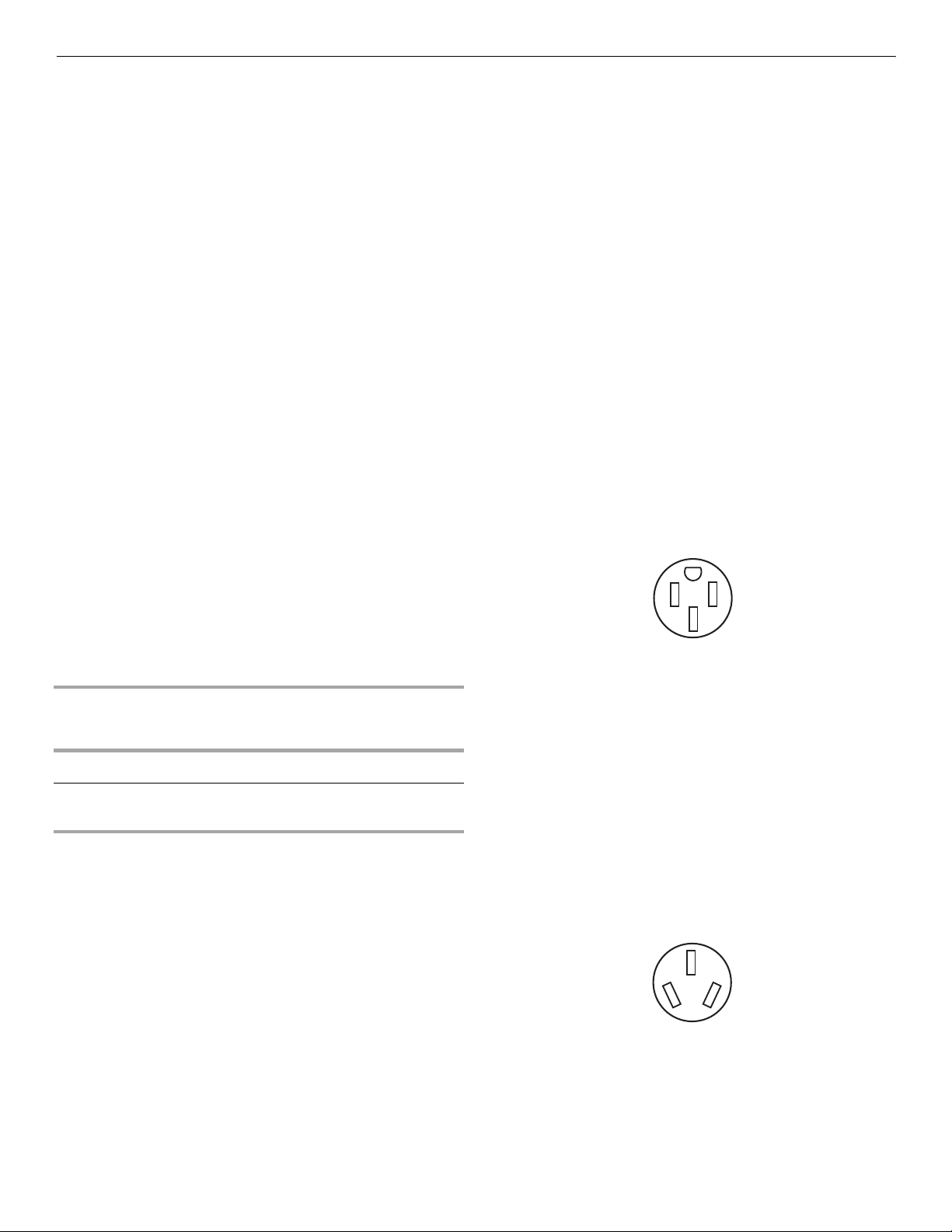
When a 4-wire receptacle of NEMA Type 14-50R is used, a
matching UL listed, 4-wire, 250-volt, 40-amp, range power
supply cord (pigtail) must be used. This cord contains 4 copper
conductors with ring terminals or open-end spade terminals with
upturned ends, terminating in a NEMA Type 14-50R plug on the
supply end.
The fourth (grounding) conductor must be identified by a green or
green/yellow cover and the neutral conductor by a white cover.
Cord should be Type SRD or SRDT with a UL listed strain relief
and be at least 4 ft (1.22 m) long.
The minimum conductor sized for the copper 4-wire power
cord are:
40-amp circuit
2 No.-8 conductors
1 No.-10 white neutral
1 No.-8 green grounding
If connecting to a 3-wire system:
Local codes may permit the use of a UL listed, 3-wire,
250-volt, 40 or 50-amp range power supply cord (pigtail). This
cord contains 3 copper conductors with ring terminals or open-
end spade terminals with upturned ends, terminating in a NEMA
Type 10-50P plug on the supply end. Connectors on the
appliance end must be provided at the point the power supply
cord enters the appliance. This uses a 3-wire receptacle of NEMA
Type 10-50R.
Range Rating* Specified Rating of
Power Supply Cord Kit
and Circuit Protection
120/240 Volts 120/208 Volts Amps
8.8 - 16.5 KW
16.6 - 22.5 KW
7.8 - 12.5 KW
12.6 - 18.5 KW
40 or 50**
50
4-wire receptacle (14-50R)
3-wire receptacle (10-50R)
7
Electrical Requirements - Canada Only
If codes permit and a separate ground wire is used, it is
recommended that a qualified electrical installer determine that
the ground path is adequate and wire gauge are in accordance
with local codes.
Be sure that the electrical connection and wire size are adequate
and in conformance with CSA Standard C22.1, Canadian
Electrical Code, Part 1 - latest edition, and all local codes and
ordinances.
A copy of the above code standards can be obtained from:
Canadian Standards Association
178 Rexdale Blvd.
Toronto, ON M9W 1R3 CANADA.
■ Check with a qualified electrical installer if you are not sure
the range is properly grounded.
*The NEC calculated load is less than the total connected load
listed on the model/serial rating plate.
**If connecting to a 50-amp circuit, use a 50-amp rated cord with
kit. For 50-amp rated cord kits, use kits that specify use with a
nominal 1³⁄₈" (34.93 mm) diameter connection opening.
■ A time-delay fuse or circuit breaker is recommended.
■ This range is equipped with a CSA International Certified
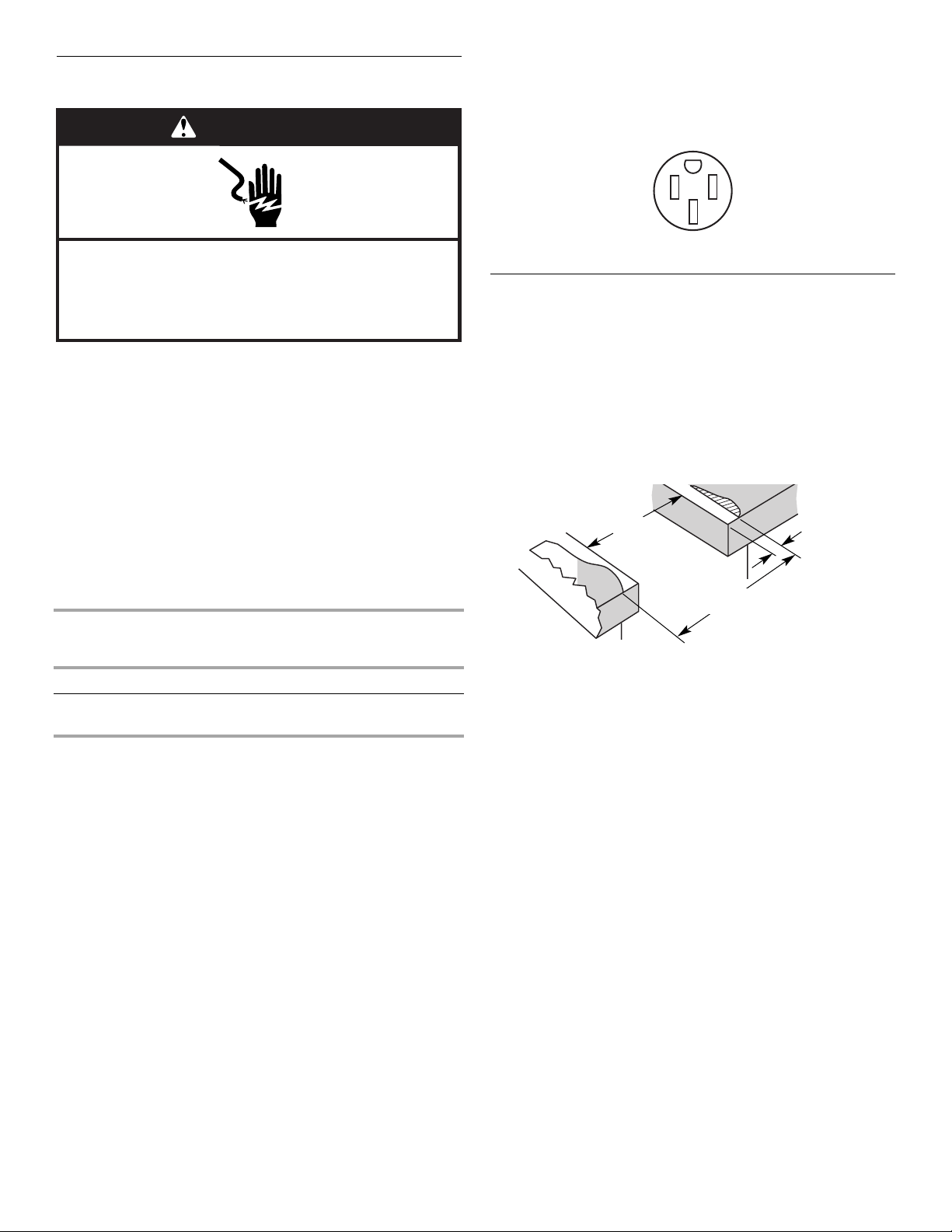
Power Cord intended to be plugged into a standard 14-50R
wall receptacle. Be sure the wall receptacle is within reach of
range’s final location.
■ Do not use an extension cord.
Countertop Preparation
(for Slide-in Ranges Only)
The cooktop sides of the slide-in range fit over the cutout edge of
your countertop.
If you have a square finish (flat) countertop and the opening width
is 30" (76.2 cm), no countertop preparation is required.
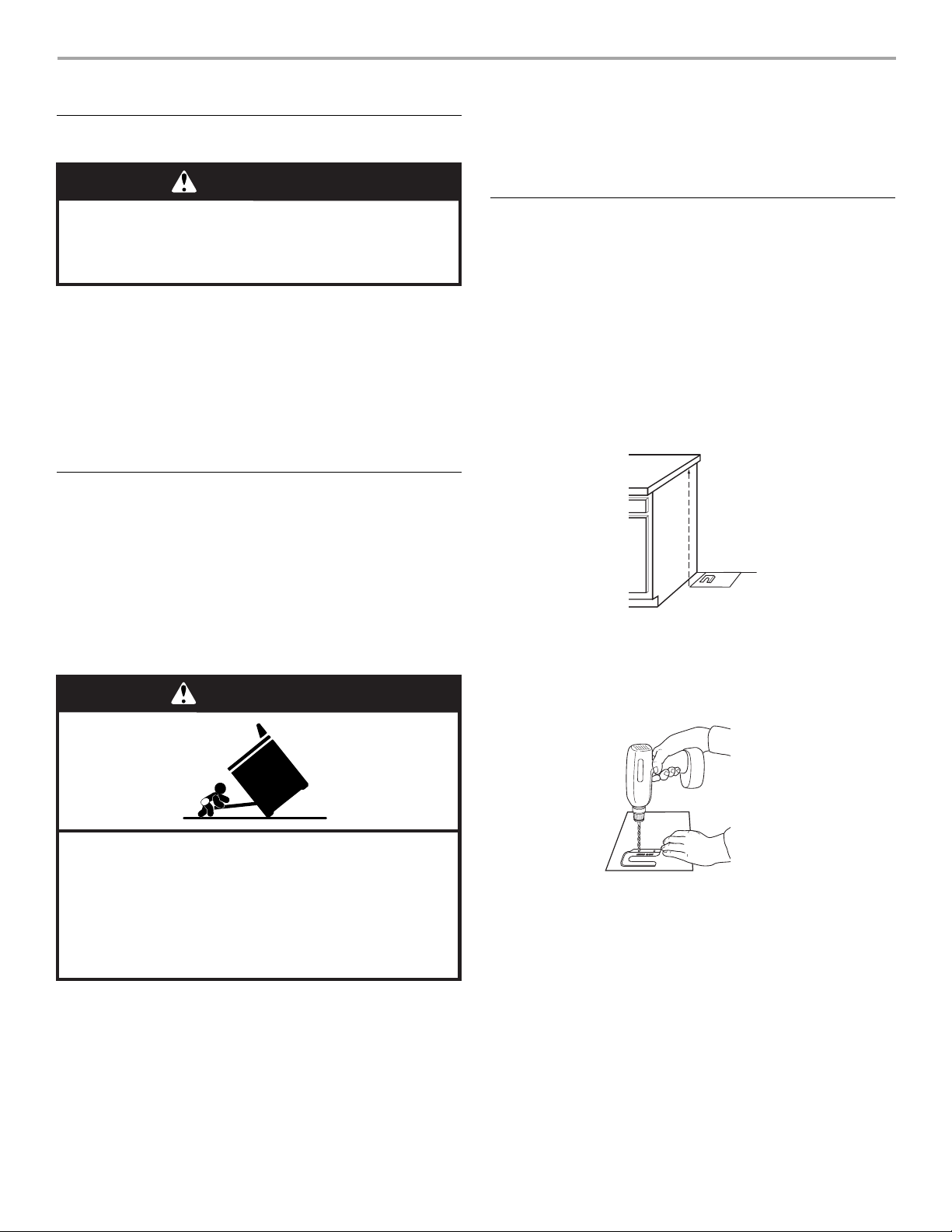
Formed front-edged countertops must have molded edge
shaved flat ³⁄₈" (1.0 cm) from each front corner of opening.
Tile countertops may need trim cut back ³⁄₈" (1.0 cm) from each
front corner and/or rounded edge flattened.
If countertop opening width is greater than 30" (76.2 cm), adjust
the ³⁄₈" (1.0 cm) dimension.
Countertop must be level. Place level on countertop, first side to
side, then front to back. If countertop is not level, range will not
be level. Range must be level for satisfactory baking conditions.
Range Rating* Specified Rating of
Power Supply Cord Kit
and Circuit Protection
120/240 Volts 120/208 Volts Amps
8.8 - 16.5 KW
16.6 - 22.5 KW
7.8 - 12.5 KW
12.6 - 18.5 KW
40 or 50**
50
WARNING
Electrical Shock Hazard
Electrically ground range.
Failure to do so can result in death, fire, or
electrical shock.
30"
(76.2 cm)
30 ¾"
(78.1 cm)
³⁄₈"
(1.0 cm)
8
INSTALLATION INSTRUCTIONS
Unpack Range
1. Remove shipping materials, tape and protective film from the
range. Keep cardboard bottom under range. Remove oven
racks and parts package from inside oven.
2. To place range on its back, take 4 cardboard corners from the
carton. Stack one cardboard corner on top of another.
Repeat with the other 2 corners. Place them lengthwise on
the floor behind the range to support the range when it is laid
on its back. Using 2 or more people, firmly grasp the range
and gently lay it on its back on the cardboard corners.
3. Pull cardboard bottom firmly to remove.
Adjust Leveling Legs
1. If range height adjustment is necessary, use a wrench or
pliers to loosen the 4 leveling legs.
This may be done with the range on its back or with the range
supported on 2 legs after the range has been placed back to
a standing position.
NOTE: To place range back up into a standing position, put a
sheet of cardboard or hardboard in front of range. Using 2 or
more people, stand range back up onto the cardboard or
hardboard.
2. Adjust the leveling legs to the correct height. Leveling legs
can be loosened to add up to a maximum of 1" (2.5 cm). A
minimum of ³⁄₁₆" (5 mm) is needed to engage the anti-tip
bracket.
NOTE: If height adjustment is made when range is standing,
tilt the range back to adjust the front legs, then tilt forward to
adjust the rear legs.
3. When the range is at the correct height, check that there is
adequate clearance under the range for the anti-tip bracket.
Before sliding range into its final position, check that the anti-
tip bracket will slide under the range and onto the rear
leveling leg prior to anti-tip bracket installation.
Install Anti-Tip Bracket
Contact a qualified floor covering installer for the best procedure
for drilling mounting holes through your type of floor covering.
Before moving range, slide range onto shipping base, cardboard
or hardboard.
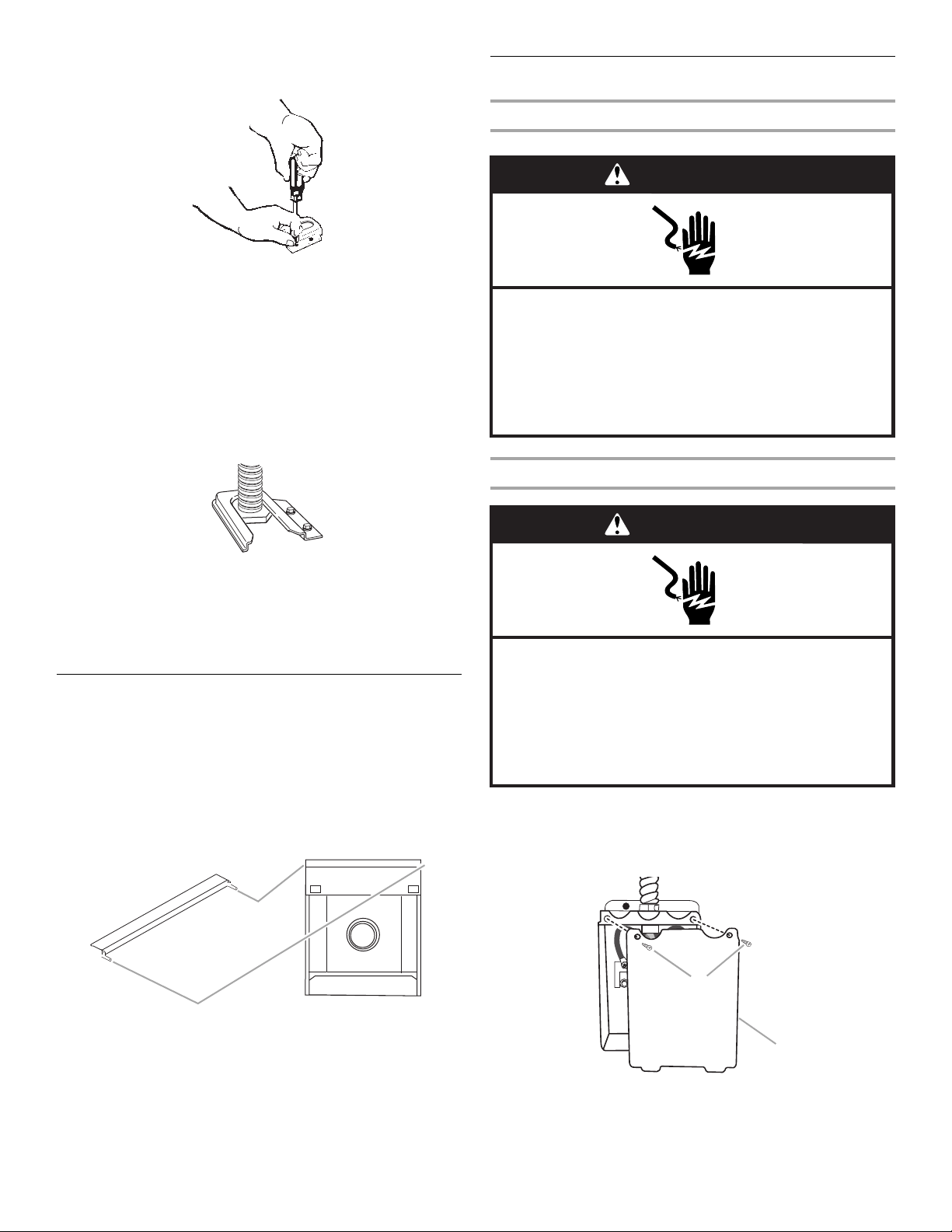
1. Remove template from the anti-tip bracket kit (found inside
the oven cavity) or from the back of this manual.
2. Place template on the floor in cabinet opening so that the left
edge is against cabinet and top edge is against rear wall,
molding or cabinet.
3. Tape template into place.
4. If countertop is not flush with cabinet opening edge, align
template with overhang.
If cabinet opening is wider than that specified in the “Location
Requirements” section, adjust template so range will be
centered in cabinet opening.
5. To mount anti-tip bracket to wood floor, drill two ¹⁄₈" (3.2 mm)
holes at the positions marked on the bracket template.
Remove template from floor.
To mount anti-tip bracket to concrete or ceramic floor, use a
³⁄₁₆" (4.8 mm) masonry drill bit to drill 2 holes at the positions
marked on the bracket template. Remove template from floor.
6. Tap plastic anchors into holes with a hammer.
WARNING
Excessive Weight Hazard
Use two or more people to move and install range.
Failure to do so can result in back or other injury.
WARNING
Tip Over Hazard
A child or adult can tip the range and be killed.
Connect anti-tip bracket to rear range foot.
Reconnect the anti-tip bracket, if the range is moved.
Failure to follow these instructions can result in death
or serious burns to children and adults.
9
7. Align anti-tip bracket holes with holes in floor. Fasten anti-tip
bracket with screws provided.
Depending on the thickness of your flooring, longer screws
may be necessary to anchor the bracket to the subfloor.
Longer screws are available from your local hardware store.
8. Move range close enough to opening to allow for electrical
connections to be made. Remove shipping base, cardboard
or hardboard from under range.
9. Make electrical connections as described in the “Electrical
Connection” section.
10. Move range into its final location making sure rear leveling leg
slides into anti-tip bracket.
11. If installing the range in a mobile home, you must secure the
range to the floor. Any method of securing the range is
adequate as long as it conforms to the standards in the
“Location Requirements” section.
12. Continue installing your range using the following installation
instructions.
Optional Rear Spacer Cover
(for Slide-in Ranges Only)
If you are installing a slide-in range into an existing freestanding
range opening, you may use the rear spacer cover to fill in the
opening at rear of range. To order, see the “Assistance or
Service” section of the Use and Care Guide or contact the dealer
from whom you purchased the range.
Using the screws provided with the kit, attach the rear spacer
cover to the sides of the range.
Electrical Connection - U.S.A. Only
Power Supply Cord
Direct Wire
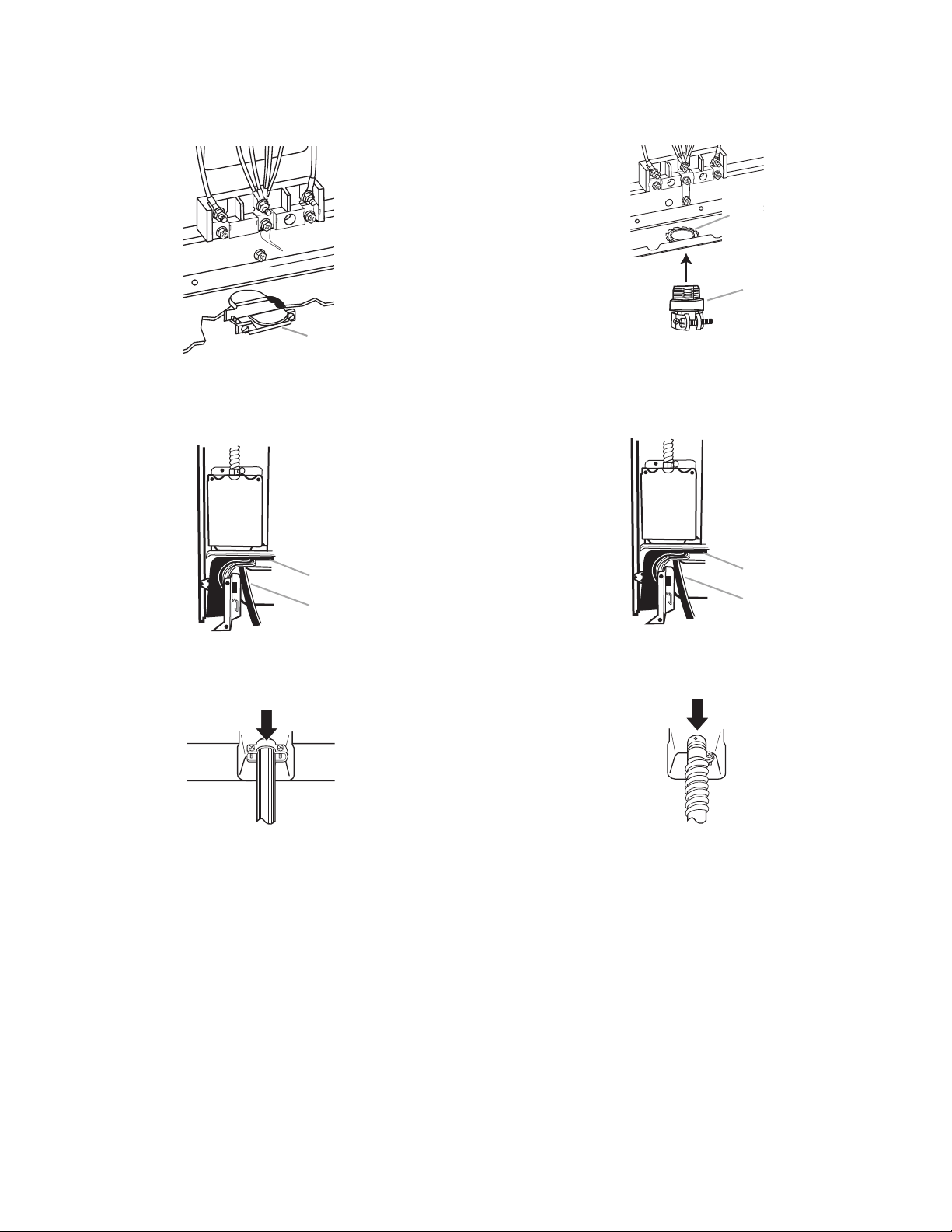
1. Disconnect power.
2. Remove the terminal block cover screws located on the back
of the range. Pull cover down and toward you to remove
cover.
A. Hold-down screws
B. Terminal block cover
WARNING
Electrical Shock Hazard
Disconnect power before servicing.
Use a new 40 amp power supply cord.
Plug into a grounded outlet.
Failure to follow these instructions can result in death,
fire, or electrical shock.
WARNING
Electrical Shock Hazard
Disconnect power before servicing.
Use 8 gauge copper or 6 gauge aluminum wire.
Electrically ground range.
Failure to follow these instructions can result in death,
fire, or electrical shock.
A
B
10
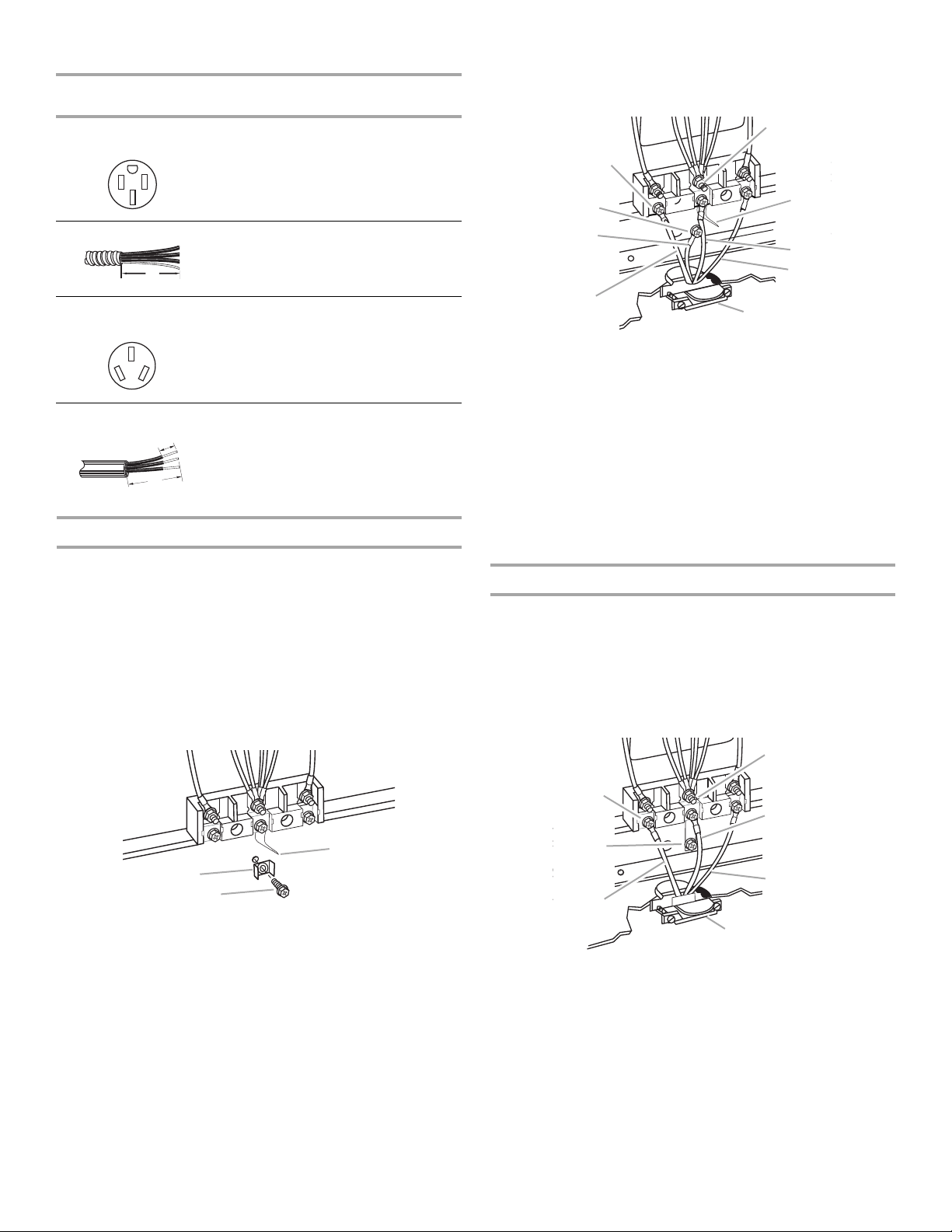
3. Add strain relief.
Style 1: Power supply cord strain relief
■ Remove the knockout for the 40-amp supply cord.
■ Assemble a UL listed strain relief in the opening.
■ Feed the power supply cord behind the black horizontal
cross brace and through the strain relief, allowing enough
slack to easily attach the wiring to the terminal block.
■ Tighten strain relief screw against the power supply cord.
Style 2: Direct wire strain relief
■ Remove the knockout as needed for the flexible conduit
connection.
■ Assemble a UL listed conduit connector in the opening.
■ Feed the flexible conduit behind the black horizontal
cross brace and through the strain relief, allowing enough
slack to easily attach the wiring to the terminal block.
■ Tighten strain relief screw against the flexible conduit.
4. Complete installation following instructions for your type of
electrical connection:
4-wire (recommended)
3-wire (if 4-wire is not available)
A. UL listed strain relief
A. Black horizontal cross brace
B. Power supply cord
A
B
A
A. Removable retaining nut
B. Strain relief
A. Black horizontal cross brace
B. Flexible conduit
A
B
B
A
11
Electrical Connection Options
4-wire connection: Power Supply Cord
Use this method for:
■ New branch-circuit installations (1996 NEC)
■ Mobile homes
■ Recreational vehicles
■ In an area where local codes prohibit grounding through the
neutral.
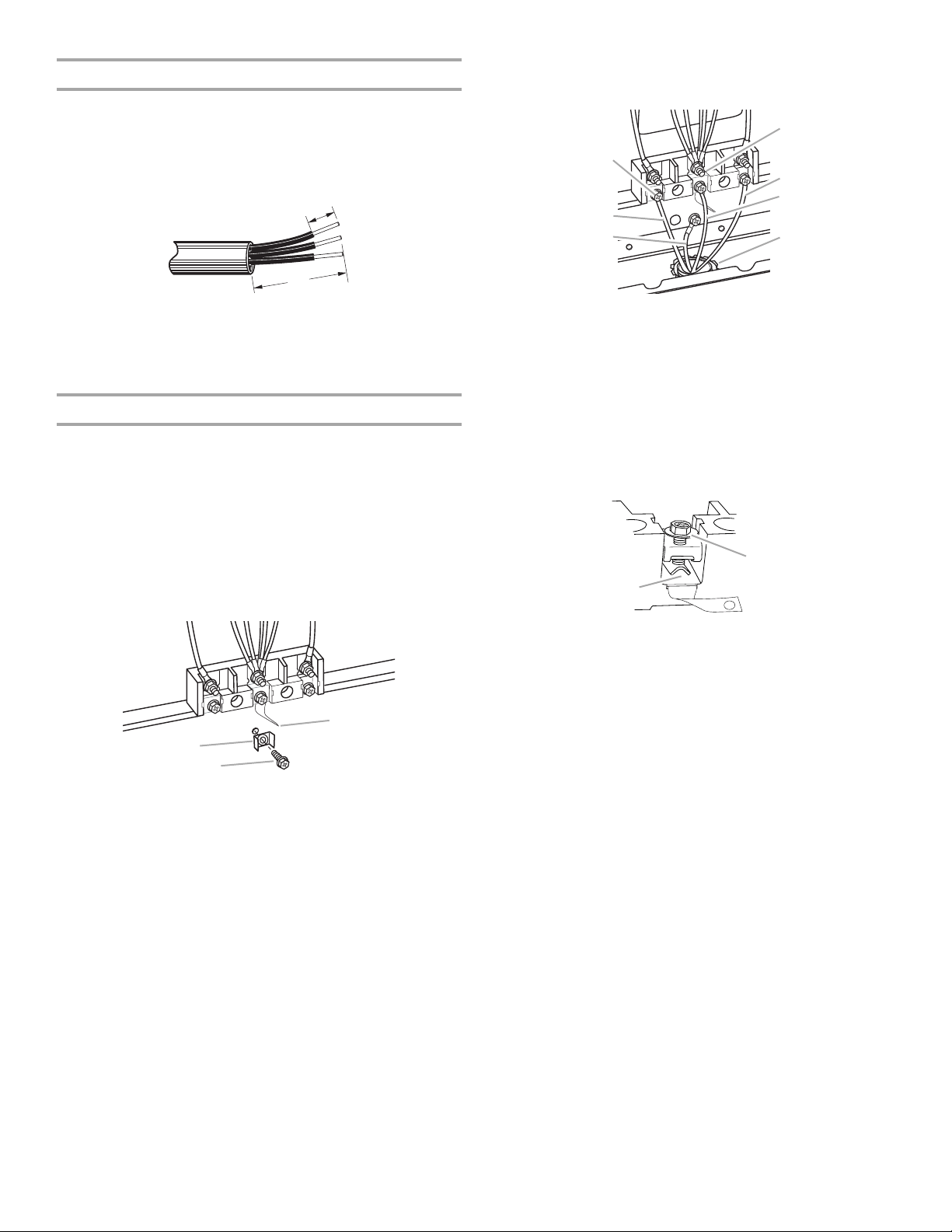
1. Remove the ground-link screw from the range frame. Save
the ground link screw and cup washer. Bend the ground-link
away from the range so that it does not contact the range.
2. Connect the green ground wire from the power supply cord to
the range using the ground-link screw. The ground wire must
be attached first and must not contact any other terminal.
3. Use a ¼" nut driver and remove the hex washer head screws
from the terminal blocks.
4. Connect the neutral (center) wire to the center terminal
connector using one of the hex washer head screws.
Securely tighten screw.
5. Connect the other 2 wires (lines 1 and 2) to the outer
aluminum terminal blocks.
6. Securely tighten screws.
7. Tighten strain relief screws.
8. Replace terminal block cover with screw.
3-wire connection: Power Supply Cord
Use this method only if local codes permit connecting cabinet-
ground conductor to neutral wire of power supply cord.
1. Use a ¼" nut driver and remove the hex washer head screws
from the aluminum terminal blocks.
2. Connect the neutral (center) wire to the center terminal
connector using one of the hex washer head screws.
Securely tighten screw for proper electrical connection.
3. Connect the other 2 wires (lines 1 and 2) to the outer terminal
screws on the terminal block.
4. Tighten strain relief screws.
5. Replace terminal block cover.
If your home has: And you will be
connecting to:
Go to Section:
4-wire receptacle
(NEMA type 14-50R)
A UL listed,
250-volt
minimum,
40-amp, range
power supply
cord
4-wire connection:
Power supply cord
4-wire direct A fused
disconnect or
circuit breaker
box
4-wire connection:
Direct wire
3-wire receptacle
(NEMA type 10-50R)
A UL listed,
250-volt
minimum,
40-amp, range
power supply
cord
3-wire connection:
Power supply cord
3-wire direct A fused
disconnect or
circuit breaker
box
3-wire connection:
Direct wire
A. Ground-link screw
B. Cup washer
C. Ground-link bent away from range
(12.7 cm)
5"
3"
(7.6 cm)
1"
(2.5 cm)
A
C
B
A. Line 1
B. Green ground wire
C. Ground-link screw
D. Hex washer head
screw
E. Silver-colored terminal
block screw
F. Ground-link
G. Neutral (center) wire
H. Line 2
I. UL listed strain relief
and 40-amp range
power supply cord
A. Line 1
B. Ground-link
C. Hex washer head screw
D. Silver-colored terminal
block screw
E. Neutral (center) wire
F. L in e 2
G. UL listed strain relief
and 40-amp range power
supply cord
A
B
C
D
E
F
G
H
I
A
B
C
D
E
F
G
12
Direct Wire Installation: Copper or Aluminum Wire
This range may be connected directly to the fuse disconnect or
circuit breaker box. Depending on your electrical supply, make
the required 3-wire or 4-wire connection.
1. Strip outer covering back 3" (7.6 cm) to expose wires. Strip
the insulation back 1" (2.5 cm) from the end of each wire.
2. Allow enough slack in the wire to easily attach the wiring
terminal block.
3. Complete electrical connection according to your type of
electrical supply (4-wire or 3-wire connection).
4-wire Connection: Direct Wire
Use this method for:
■ New branch-circuit installations (1996 NEC)
■ Mobile homes
■ Recreational vehicles
■ In an area where local codes prohibit grounding through the
neutral
1. Remove the ground-link screw from the range frame. Save
the ground-link screw and cup washer. Bend the ground-link
away from the range so that it does not contact the range.
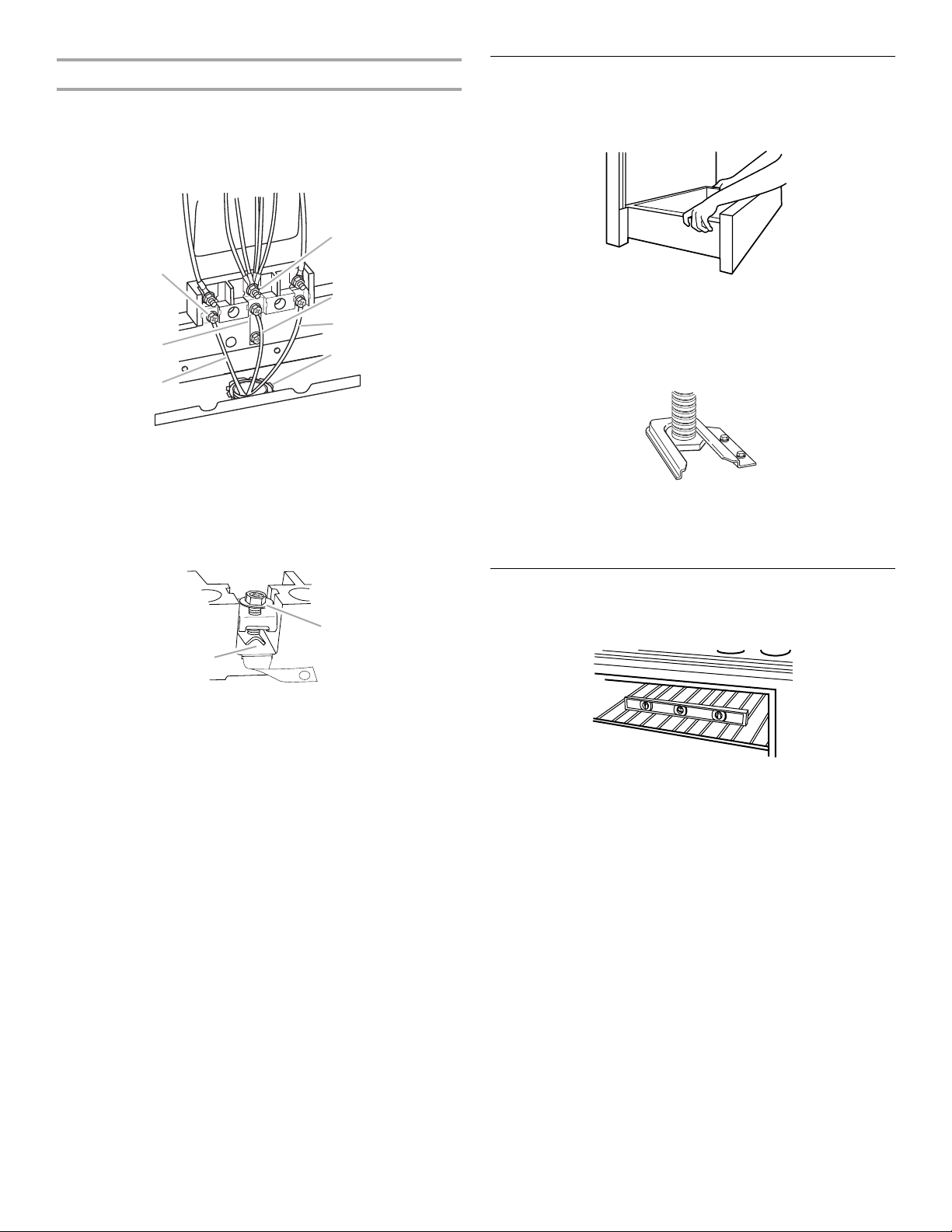
2. Connect the bare ground wire to the range using the ground-
link screw and cup washer. The ground wire must be
attached first and must not contact any other terminal.
3. Loosen (do not remove) the hex washer head screw and
insert the neutral (white) wire under the screw clamp at the
bottom of the center position terminal connector.
4. Insert the other 2 wires (lines 1 and 2) under the other 2 screw
clamps.
5. Securely tighten the hex washer head screws to
35 lbs-in. (4.0 N-m) minimum torque to make proper
electrical connection.
6. Tighten the locking ring of the conduit connector.
7. Replace the terminal block cover.
A. Ground-link screw
B. Cup washer
C. Ground-link bent away from range
3"
(7.6 cm)
1"
(2.5 cm)
A
C
B
A. Bare wire from power supply
cable
B. Line 1
C. Hex washer head screw
D. Silver-colored terminal block
screw
E. Line 2
F. Neutral (white) wire
G. UL listed conduit connector
and power supply cable
A. Insert wire under screw clamp.
B. Hex washer head screw
A
B
C
D
E
F
G
A
B
13
3-wire connection: Direct Wire
Use this method only if local codes permit connecting ground
conductor to neutral supply wire.
1. Loosen (do not remove) the hex washer head screws and
insert the neutral (white) wire under the screw clamp at the
bottom of the center position terminal connector.
2. Insert the other 2 wires (lines 1 and 2) under the other 2 screw
clamps.
3. Securely tighten the hex washer head screws to
35 lbs-in. (4.0 N-m) minimum torque to make a proper
electrical connection.
4. Tighten the locking ring of the conduit connector.
5. Replace the terminal block cover.
Verify Anti-Tip Bracket Location
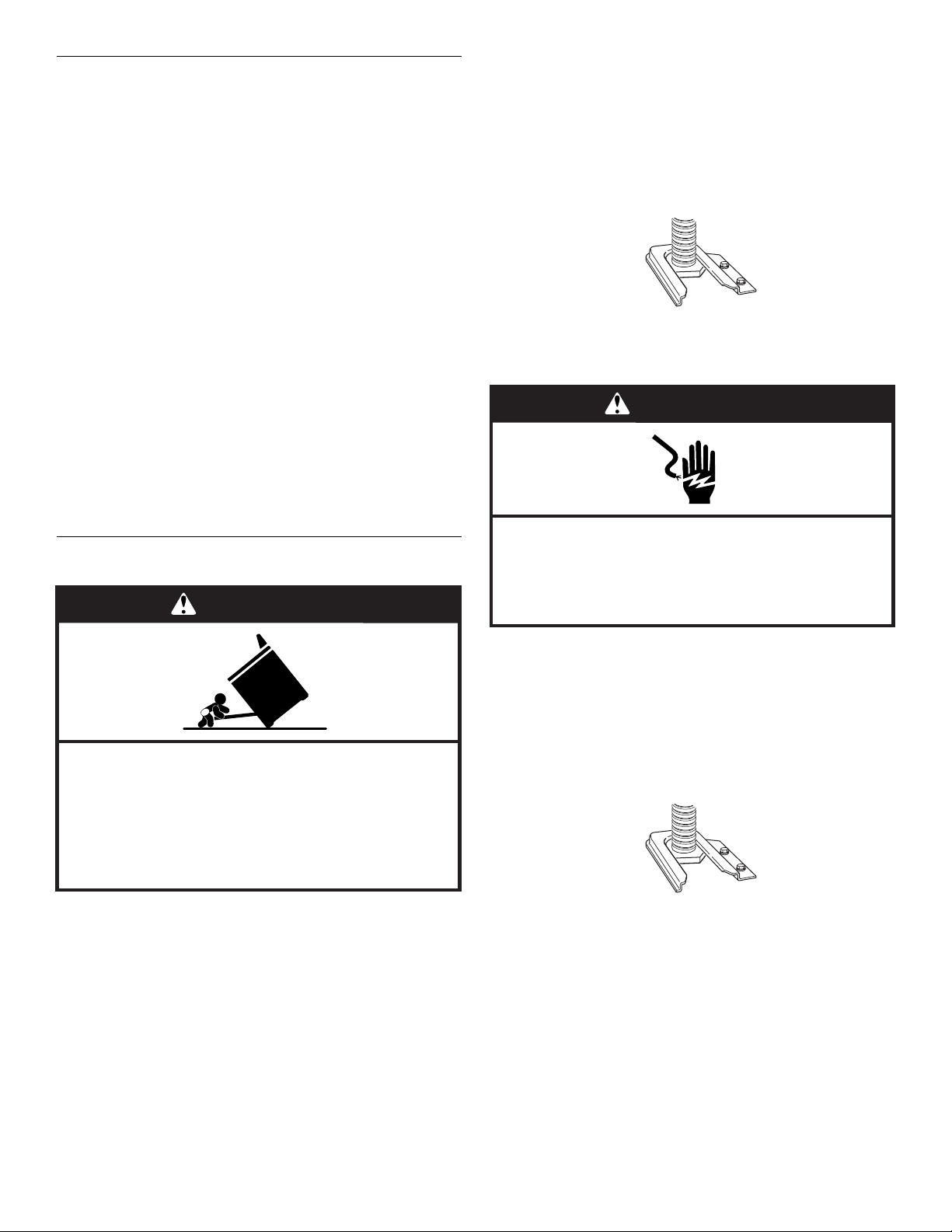
1. Pull drawer open to first stop position. Lift front of drawer to
clear white wheels in drawer guides. Remove drawer and set
it aside on a protected surface.
2. Making sure the anti-tip bracket is installed:
■ Look for the anti-tip bracket securely attached to floor.
■ Slide range back so rear range foot is under anti-tip
bracket.
3. If installing the range in a mobile home, you must secure the
range to the floor. Any method of securing the range is
adequate as long as it conforms to the standards in the
“Location Requirements” section.
Level Range
1. Place rack in oven. Place level on rack and check levelness of
range, first side to side; then front to back.
If range is not level, pull range forward until rear leveling leg is
removed from the anti-tip bracket.
On Ranges Equipped with Storage Drawers:
Use ³⁄₈" drive ratchet and channel lock pliers to adjust leveling
legs up or down until range is level. Push range back into
position. Check that rear leveling leg is engaged in anti-tip
bracket.
On Ranges Equipped with Warming Drawers:
Use channel lock pliers to adjust leveling legs up or down
until range is level. Push range back into position. Check that
rear leveling leg is engaged in anti-tip bracket.
NOTE: Range must be level for satisfactory baking
conditions.
2. Replace the storage drawer (and warming drawer on some
models).
A. Line 1
B. Ground-link
C. Hex washer head screw
D. Silver-colored terminal
block screw
E. Neutral (white) wire
F. Line 2
G. UL listed conduit
connector and power
supply cable
A. Insert wire under screw clamp.
B. Hex washer head screw
A
B
C
D
E
F
G
A
B
14
Complete Installation
1. Check that all parts are now installed. If there is an extra part,
go back through the steps to see which step was skipped.
2. Check that you have all of your tools.
3. Dispose of/recycle all packaging materials.
4. Check that the range is level. See “Level Range.”
5. Use a mild solution of liquid household cleaner and warm
water to remove waxy residue caused by protective shipping
material. Dry thoroughly with a soft cloth. For more
information, read the “Range Care” section of the Use and
Care Guide.
6. Read “Range Use” in the range Use and Care Guide.
7. Plug power cord into appropriate outlet. Turn power on.
8. Turn on surface burners and oven. See the Use and Care
Guide for specific instruction on range operation.
If range does not operate, check the following:
■ Household fuse is intact and tight; or circuit breaker has not
tripped.
■ Range is plugged into an outlet.
■ Electrical supply is connected.
■ See “Troubleshooting” in the Use and Care Guide.
When the range has been on for 5 minutes, check for heat. If
range is cold, turn off the range and contact a qualified
technician.
Moving the Range
When moving range, slide range onto cardboard or hardboard to
avoid damaging the floor covering.
If removing the range is necessary for cleaning or maintenance:
For power supply cord-connected ranges:
1. Unplug the power supply cord.
2. Slide range forward to complete cleaning or maintenance.
3. Check that anti-tip bracket is installed:
■ Look for the anti-tip bracket securely attached to floor.
■ Slide range back so rear range foot is under anti-tip
bracket.
4. Check that range is level.
For direct-wired ranges:
1. Disconnect power.
2. Disconnect wiring.
3. Slide range forward to complete cleaning or maintenance.
4. Check that anti-tip bracket is installed:
■ Look for the anti-tip bracket securely attached to floor.
■ Slide range back so rear range foot is under anti-tip
bracket.
5. Check that range is level.
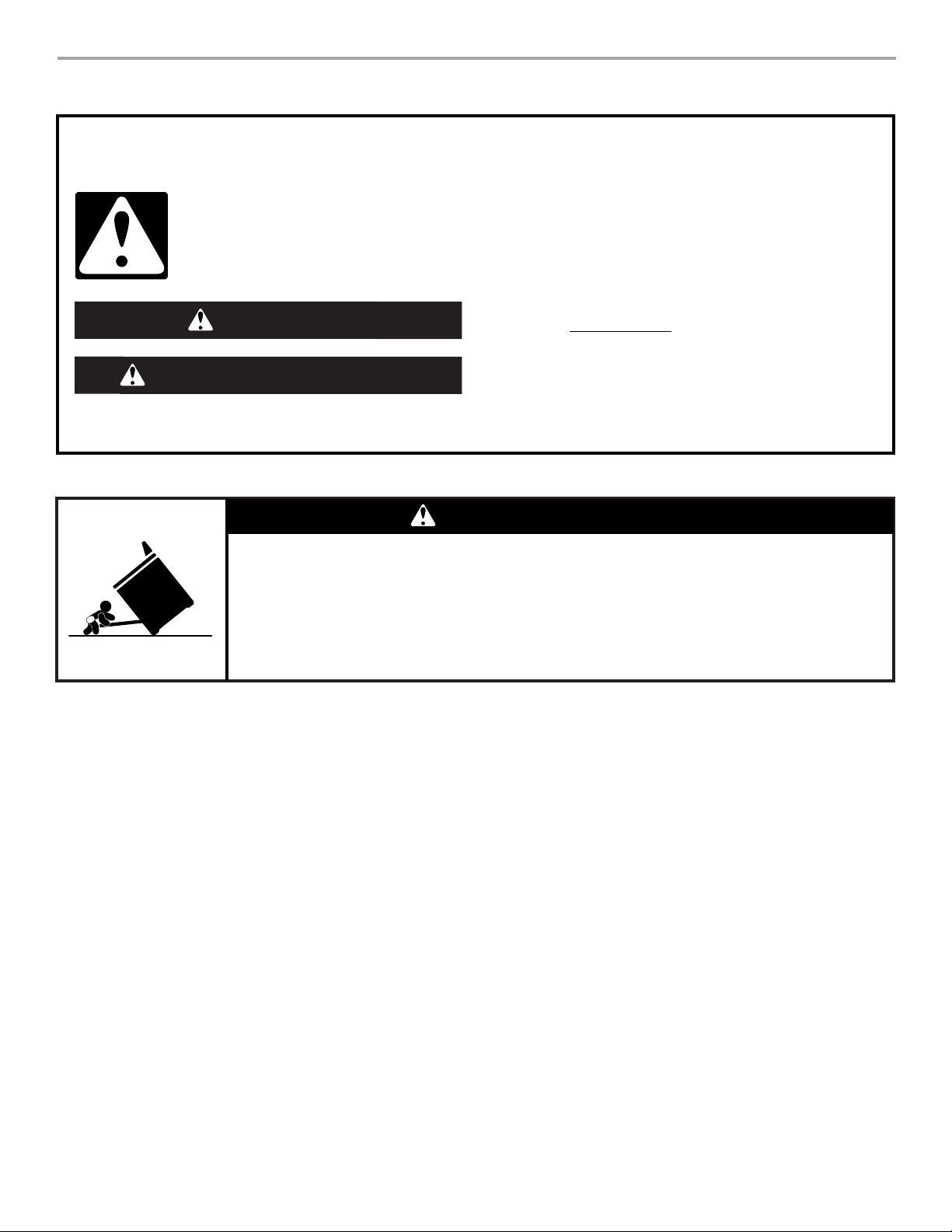
WARNING
Tip Over Hazard
A child or adult can tip the range and be killed.
Connect anti-tip bracket to rear range foot.
Reconnect the anti-tip bracket, if the range is moved.
Failure to follow these instructions can result in death
or serious burns to children and adults.
WARNING
Electrical Shock Hazard
Disconnect power before servicing.
Replace all parts and panels before operating.
Failure to do so can result in death or electrical shock.
15
SÉCURITÉ DE LA CUISINIÈRE
Risque possible de décès ou de blessure grave si vous ne
suivez pas immédiatement les instructions.
Risque possible de décès ou de blessure grave si vous
ne suivez pas les instructions.
Tous les messages de sécurité vous diront quel est le danger potentiel et vous disent comment réduire le risque de blessure et
ce qui peut se produire en cas de non-respect des instructions.
Votre sécurité et celle des autres est très importante.
Nous donnons de nombreux messages de sécurité importants dans ce manuel et sur votre appareil ménager. Assurez-vous de
toujours lire tous les messages de sécurité et de vous y conformer.
AVERTISSEMENT
DANGER
Voici le symbole d’alerte de sécurité.
Ce symbole d’alerte de sécurité vous signale les dangers potentiels de décès et de blessures graves à vous
et à d’autres.
Tous les messages de sécurité suivront le symbole d’alerte de sécurité et le mot “DANGER” ou
“AVERTISSEMENT”. Ces mots signifient :
Risque de basculement
Un enfant ou une personne adulte peut faire basculer la cuisinière ce qui peut causer un décès.
Joindre la bride antibasculement au pied arrière de la cuisinière.
Joindre de nouveau la bride antibasculement si la cuisinière est déplacée.
Le non-respect de ces instructions peut causer un décès ou des brûlures graves aux enfants et
aux adultes.
AVERTISSEMENT
16
EXIGENCES D'INSTALLATION
Outillage et pièces
Rassembler les outils et pièces nécessaires avant de commencer
l'installation. Lire et suivre les instructions fournies avec les outils
indiqués ici.
Outillage nécessaire
Pièces fournies
Vérifier que toutes les pièces sont présentes.
■ La bride antibasculement doivent être bien fixées au sous-
plancher. L’épaisseur du plancher peut nécessiter des vis
plus longues pour l'ancrage de la bride dans le sous-
plancher. Des vis plus longues sont disponibles auprès de
votre quincaillerie locale.
Pièces nécessaires
Lors de l’utilisation d’un cordon d’alimentation électrique :
■ Utiliser un cordon d’alimentation électrique homologué UL
pour utilisation avec les cuisinières. Utiliser un cordon
250 volts (minimum), 40 ou 50 A, avec marquage pour
utilisation avec une ouverture de raccordement 1³⁄₈" (3,5 cm),
et terminaison des conducteurs par cosses circulaires ou
cosses en fourche avec extrémités relevées.
■ Utiliser également un serre-câble avec homologation UL.
Consulter les codes locaux. Vérifier l'alimentation électrique
existante. Voir la section “Spécifications électriques”.
Toutes les connexions électriques doivent être effectuées par un
électricien qualifié et certifié.
Exigences d'emplacement
IMPORTANT : Observer les dispositions de tous les codes et
règlements en vigueur.
■ C'est à l'installateur qu'incombe la responsabilité de
respecter les distances de séparation exigées, spécifiées sur
la plaque signalétique de l'appareil. La plaque signalétique
est située à l’intérieur de la porte du four, sur le côté droit de
la garniture de la porte.
■ La cuisinière doit être installée à un endroit pratique dans la
cuisine.
■ Afin de supprimer le risque de brûlures ou d'incendie en se
penchant au-dessus des unités de surface chauffées, le
rangement en placard au-dessus des unités de surface doit
être évité. Si le rangement en placard est envisagé, le risque
peut être réduit par l'installation d'une hotte de cuisine ou
d’un ensemble hotte/micro-ondes opérant horizontalement
sur un minimum de 5" (12,7 cm) au-delà du bas des placards.
■ Respecter les dimensions indiquées pour les ouvertures à
découper dans les placards; ces dimensions constituent les
valeurs minimales des dégagements de séparation.
■ La bride antibasculement de plancher doit être installée. Pour
l'installation de la bride antibasculement expédiée avec la
cuisinière, voir la section “Installation de la bride
antibasculement”.
■ Une source d'électricité avec liaison à la terre est nécessaire.
Voir la section “Spécifications électriques”.
IMPORTANT : Pour éviter tout dommage, consulter le
constructeur ou le fabricant du placard pour déterminer si les
matériaux utilisés ne subiront pas un changement de couleur, une
déstratification ou d'autres dommages. Ce four a été conçu
conformément aux exigences UL et aux normes de la CSA
International; il respecte la température maximale autorisée pour
les placards en bois : 194°F (90°C).
Résidence mobile - Spécifications additionnelles à
respecter lors de l'installation
L'installation de cette cuisinière doit être conforme aux
dispositions de la norme Manufactured Home Construction and
Safety Standard, Title 24 CFR, Part 3280 (anciennement Federal
Standard for Mobile Home Construction and Safety, Title 24,
HUD Part 280). Lorsque cette norme n'est pas applicable,
l'installation doit satisfaire aux critères de la norme Standard for
Manufactured Home Installations, ANSI A225.1/NFPA 501A ou
respecter les dispositions des codes locaux.
Au Canada, l'installation de cette cuisinière doit satisfaire aux
stipulations de la version la plus récente de la norme CAN/CSA-
A240 ou des codes locaux en vigueur.
Critères à respecter pour une installation en résidence
mobile :
■ Dans le cas de l'installation de cette cuisinière dans une
résidence mobile, la cuisinière doit être fixée au plancher
durant tout déplacement du véhicule. Toute méthode de
fixation de la cuisinière est adéquate dans la mesure où elle
satisfait aux critères des normes mentionnées ci-dessus.
■ Pour une installation en résidence mobile, un câble ou cordon
d'alimentation à quatre fils doit être utilisé. Le câblage de
l'appareil devra être revu. Voir la section “Raccordement
électrique”.
■ Mètre ruban
■ Tournevis à lame plate
■ Niveau
■ Marteau
■ Perceuse manuelle ou
électrique
■ Clé ou pince
■ Marqueur ou crayon
■ Ruban adhésif de masquage
■ Tourne-écrou de ¼"
■ Tourne-écrou de ⁵⁄₁₆"
■ Foret de ¹⁄₈" (3,2 mm) (pour
planchers en bois)
■ Foret à maçonnerie à pointe
carburée de ³⁄₁₆" (4,8 mm)
(pour planchers en béton/
céramique)
A. Bride antibasculement
B. Chevilles de plastique (2)
C. Vis n°10 x ¹⁄₂" (2)
D. Garniture d’obturation arrière pour modèles encastrables
(fournie sur certains modèles)*
*Pour commander, contacter le marchand ou consulter la
section “Assistance ou service” du Guide d'utilisation et
d'entretien. Demander la pièce n° 9757784WH (Blanc),
9757784BT (Biscuit), 9757784BL (Noir), 9757784MT
(Metéorite) ou 9757784SS (Acier inoxydable).
A
B
C
D
17
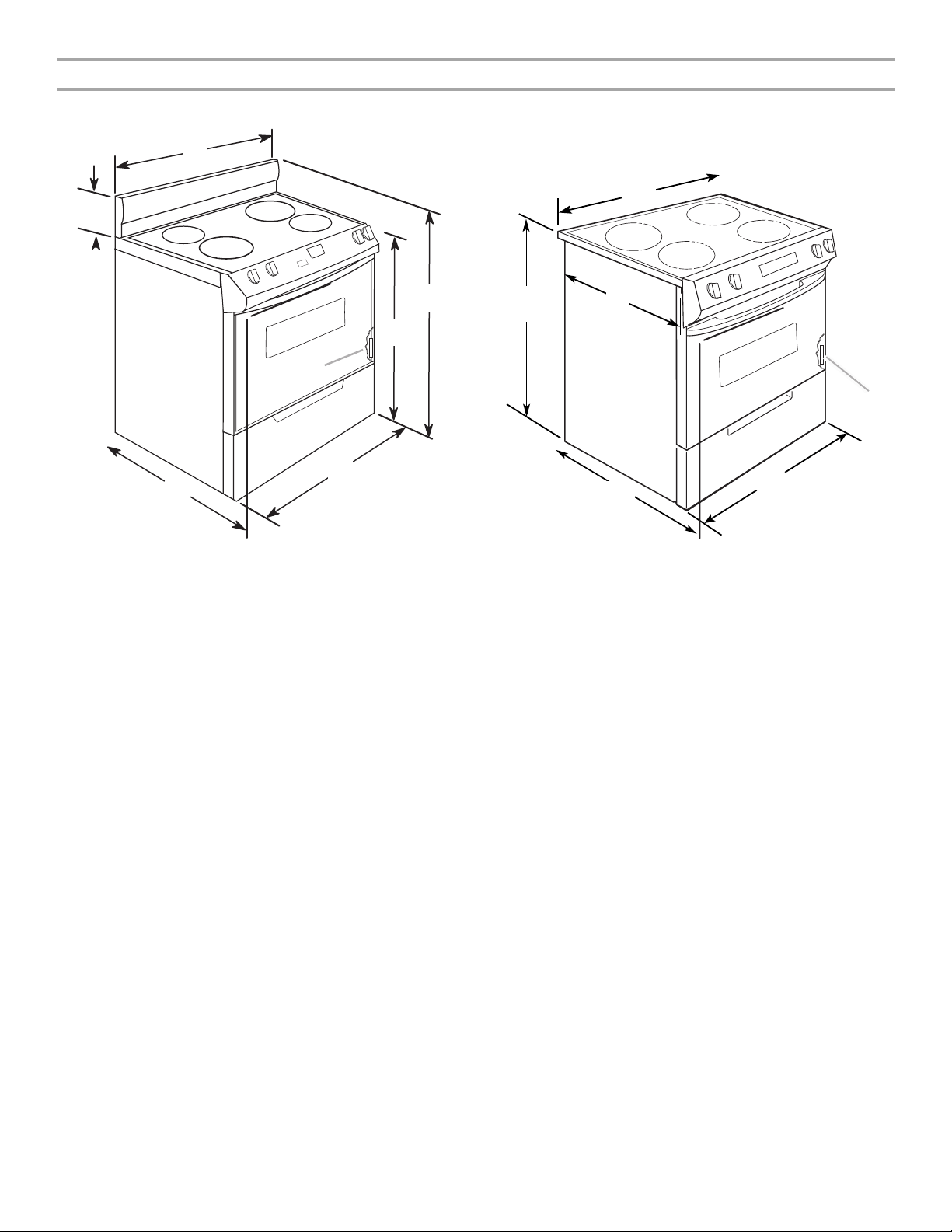
Dimensions du produit
Cuisinière autoportante
*La cuisinière peut être surélevée d'environ 1" (2,5 cm) en
ajustant les pieds de nivellement.
**Dans le cas d'une installation entre des placards de
24" (61 cm) avec plan de travail de 25" (63,5 cm), l'avant de la
porte du four sera en saillie de 1" (2,5 cm) au-delà de la base
des placards de 24" (61 cm).
Cuisinière encastrée
*La cuisinière peut être surélevée d'environ 1" (2,5 cm) en
ajustant les pieds de nivellement.
**Dans le cas d'une installation entre des placards de
24" (61 cm) avec plan de travail de 25" (63,5 cm), l'avant de la
porte du four sera en saillie de 1⁷⁄₈" (4,8 cm) au-delà de la base
des placards de 24" (61 cm).
A. 7¹⁄₈" (20 cm)
B. 30" (76,2 cm)
C. 43⁷⁄₈" (111,4 cm) : Hauteur totale
avec les pieds de nivellement
complètement abaissés
D. 36" (91,4 cm) : Hauteur de la
garniture de la table de cuisson
avec les pieds de nivellement
complètement abaissés*
E. 30" (76,2 cm)
F. 27" (68,6 cm) : Longueur
maximale de la poignée au
support à l'arrière de la
cuisinière**
G. Plaque signalétique
(située sur la garniture de
porte du four, côté droit)
A
B
C
D*
E
F**
G
A. 35⁵⁄₈" (90,5 cm) : Hauteur
hors-tout avec les pieds de
nivellement complètement
abaissés*
B. 30¹¹⁄₁₆" (77,9 cm)
C. 23¹⁄₂" (59,8 cm)
D. 27" (68,6 cm) : Longueur
maximale de la poignée au
support à l'arrière de la
cuisinière**
E. 30" (76,2 cm)
F. Plaque signalétique
(située sur la garniture de
porte du four, côté droit)
A*
B
E
D**
C
F
18
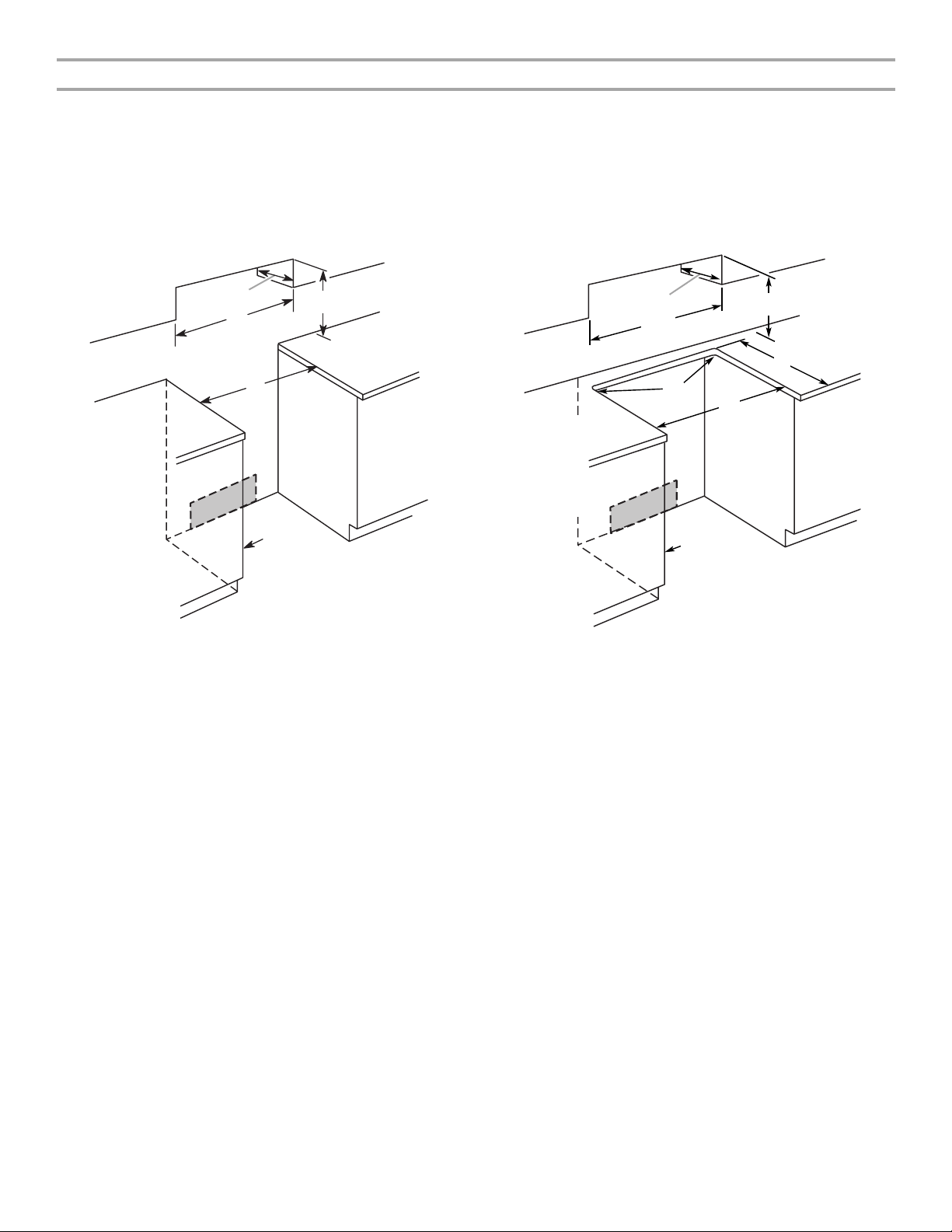
Dimensions du placard
Les dimensions de l'espace d'installation entre les placards sont valides pour l'installation entre des placards de 24" (61 cm) avec plan
de travail de 25" (64 cm) à hauteur de 36" (91,4 cm).
En cas d'installation d'une hotte ou d'un ensemble hotte/micro-ondes au-dessus de la cuisinière, suivre les instructions fournies avec la
hotte ou l'ensemble hotte/micro-ondes concernant les dimensions de dégagement à respecter au-dessus de la surface de la table de
cuisson.
Cuisinière autoportante
Une cuisinière autoportante peut être installée à proximité de
cloisons combustibles sans aucun dégagement de séparation.
Cuisinière encastrée
REMARQUE : Distance de séparation de 24" (61 cm) ou plus lorsque le fond d'un placard de bois ou de métal est protégé par une
planche ignifugée d'au moins ¼" (0,64 cm) recouverte d'une feuille métallique d'épaisseur égale ou supérieure à : acier calibre 28 MSG,
acier inoxydable (0,015" [0,4 mm]), aluminium (0,024" [0,6 mm]), ou cuivre (0,020" [0,5 mm]).
Distance de séparation de 30" (76,2 cm) ou plus entre le dessus de la table de cuisson et le fond d'un placard de bois ou de métal non
protégé.
A. Profondeur des placards
supérieurs : 13" (33 cm)
B. Largeur de l'ouverture :
30" (76,2 cm) min.
C. Pour la distance libre minimale
vers la partie supérieure de la
table de cuisson, voir la
REMARQUE*.
D. Largeur de l'ouverture
30" (76,2 cm) min.
E. Boîte de connexion -
8" (20,3 cm) à 22" (55,9 cm)
depuis l'un des deux placards,
7" (17,8 cm) max. à partir du
plancher
F. La porte ou charnière du
placard ne doit pas dépasser
à l'intérieur de l'ouverture.
A
B
D
F
E
C
A. Profondeur des placards
supérieurs : 13" (33 cm)
B. Largeur de l'ouverture
30" (76,2 cm) min.
C. Pour la distance libre
minimale vers la partie
supérieure de la table de
cuisson, voir la REMARQUE*.
D. Profondeur d'ouverture :
22³⁄₄" (57,8 cm)
E. Rayon de basculement des deux
coins : ¼" (6,2 cm)
F. Largeur de l'ouverture :
30" (76,2 cm) min.
G. Boîte de connexion - 8" (20,3 cm)
à 22" (55,9 cm) depuis l'un des
deux placards, 7" (17,8 cm) max.
à partir du plancher
H. La porte ou charnière du placard
ne doit pas dépasser à l'intérieur
de l'ouverture.
A
B
C
D
E
F
G
H
19
Spécifications électriques
Si le code en vigueur le permet et qu’un conducteur distinct de
liaison à la terre est utilisé, on recommande qu’un électricien
qualifié vérifie que la liaison à la terre et la taille du conducteur de
liaison à la terre sont adéquats et conformes aux prescriptions du
code local.
Vérifier que le raccordement à la source d’électricité et le calibre
des conducteurs sont conformes aux prescriptions de la plus
récente édition de la norme CSA C22.1, partie 1 - Code canadien
de l’électricité, et de tout code ou règlement local en vigueur.
On peut obtenir un exemplaire de la norme ci-dessus auprès de :
Canadian Standards Association
178 Rexdale Blvd.
Toronto, ON M9W 1R3 CANADA
■ En cas de doute quant à la qualité de la liaison à la terre de la
cuisinière, consulter un électricien qualifié.
*La charge calculée selon NEC est inférieure au total des
charges connectées mentionné sur la plaque signalétique.
**Si l'appareil est alimenté par un circuit 50 A, utiliser un cordon
d'alimentation 50 A avec l'ensemble. Pour un ensemble avec
cordon d'alimentation 50 A, utiliser un ensemble spécifiant
l'utilisation avec une ouverture de diamètre nominal
1³⁄₈" (34,93 mm) pour le raccordement.
■ On recommande l’emploi de fusibles temporisés ou
disjoncteurs.
■ Cette cuisinière est dotée d’un cordon d’alimentation
(homologation CSA International) destiné à être branché sur
une prise de courant murale standard 14-50R. Veiller à ce
que la prise de courant murale soit placée à portée de la
position de service finale de la cuisinière.
■ Ne pas utiliser de câble de rallonge.
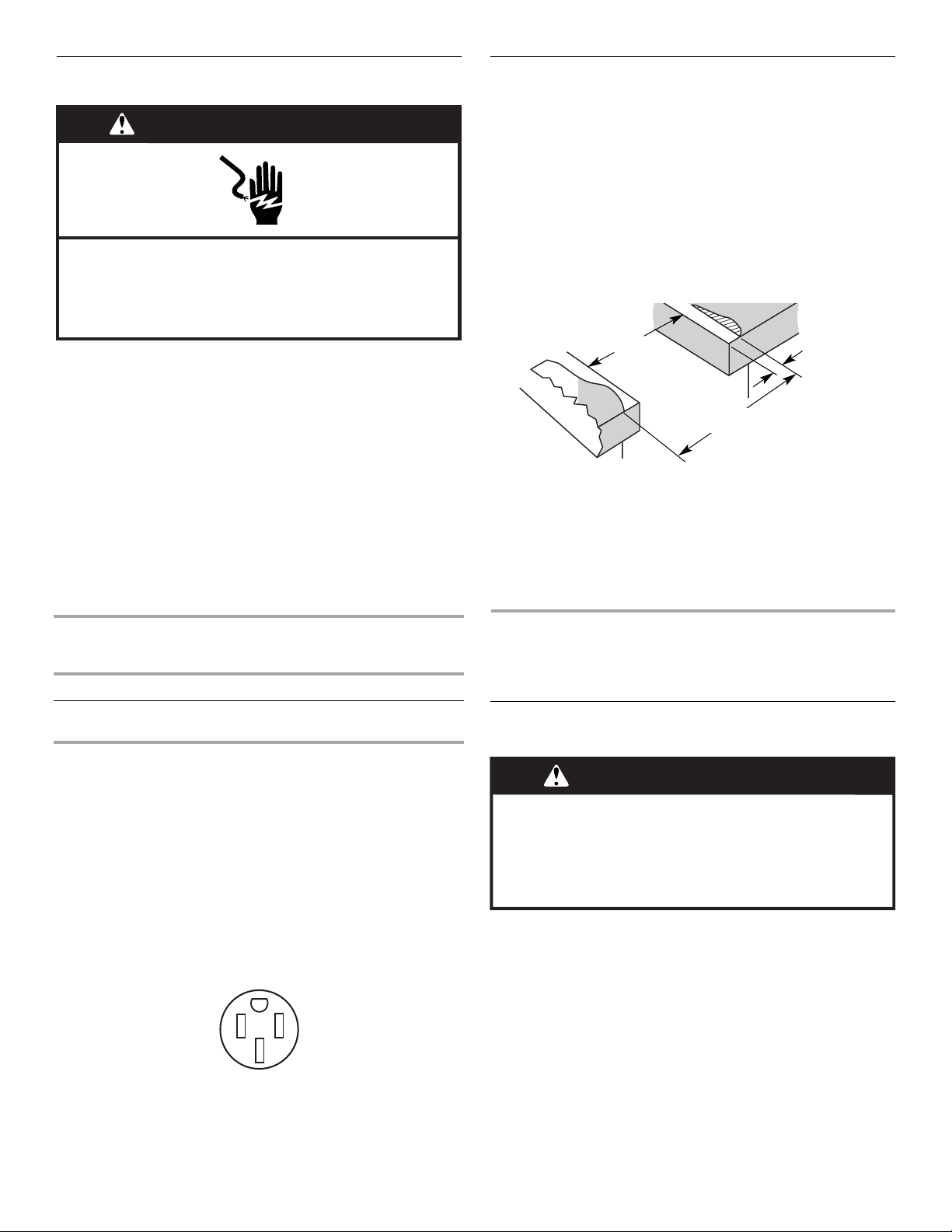
Préparation du plan de travail
(pour cuisinières encastrées uniquement)
Les bords latéraux de la table de cuisson seront placés en
chevauchement sur les extrémités du plan de travail.
Si la largeur de l’espace disponible est de 30" (76,2 cm), et si la
rive avant du plan de travail est plane et à l’équerre, aucune
préparation ne sera nécessaire.
Si le bord avant du plan de travail a été réalisé par moulage, il
sera nécesaire de réaliser une surface plane de ³⁄₈" (1 cm) dans
chaque angle avant de l’ouverture.
Il peut être nécessaire de tailler le carrelage du plan de travail sur
³⁄₈" (1 cm) sur chaque angle à l’avant et/ou d’aplanir un bord
arrondi.
Si la largeur de l’espace disponible dans le plan de travail est de
plus de 30" (76,2 cm), ajuster la dimension de ³⁄₈" (1 cm).
Il faut que le plan de travail soit horizontal. Placer un niveau sur le
plan de travail; contrôler l’horizontalité transversalement, puis
dans le sens avant/arrière. Si le plan de travail n’est pas
horizontal, la cuisinière ne sera pas d’aplomb. Il faut que
l’appareil soit d’aplomb pour que la cuisinière produise une
performance satisfaisante.
INSTRUCTIONS
D'INSTALLATION
Déballage de la cuisinière
1. Ôter les matériaux d'emballage, le ruban adhésif et le film
protecteur de la cuisinière. Garder la base de carton sous la
cuisinière. Retirer les grilles de four et le sachet de pièces de
l'intérieur du four.
2. Pour placer la cuisinière sur sa partie postérieure, prendre les
4 coins de protection du carton d'emballage. Empiler l'un des
coins sur un autre. Répéter avec les 2 autres coins. Les
disposer sur le plancher dans le sens de la longueur derrière
la cuisinière pour soutenir la cuisinière lorsque celle-ci est
placée sur sa partie postérieure. En utilisant au moins deux
personnes, saisir fermement la cuisinière et la déposer
délicatement sur sa partie postérieure, sur les coins de
protection.
3. Tirer fermement sur le fond du carton pour le retirer.
Spécifications électriques pour la
cuisinière *
Spécifications pour
cordon d'alimentation
et protection du circuit
120/240 Volts 120/208 Volts Ampères
8,8 - 16,5 KW
16,6 - 22,5 KW
7,8 - 12,5 KW
12,6 - 18,5 KW
40 ou 50**
50
AVERTISSEMENT
Risque de choc électrique
Relier la cuisinière à la terre.
Le non-respect de cette instruction peut causer
un décès, un incendie ou un choc électrique.
30"
(76,2 cm)
30 ¾"
(78,1 cm)
³⁄₈"
(1,0 cm)
AVERTISSEMENT
Risque du poids excessif
Utiliser deux ou plus de personnes pour déplacer et
installer la cuisinière.
Le non-respect de cette instruction peut causer
une blessure au dos ou d'autre blessure.

20
Ajuster les pieds de nivellement
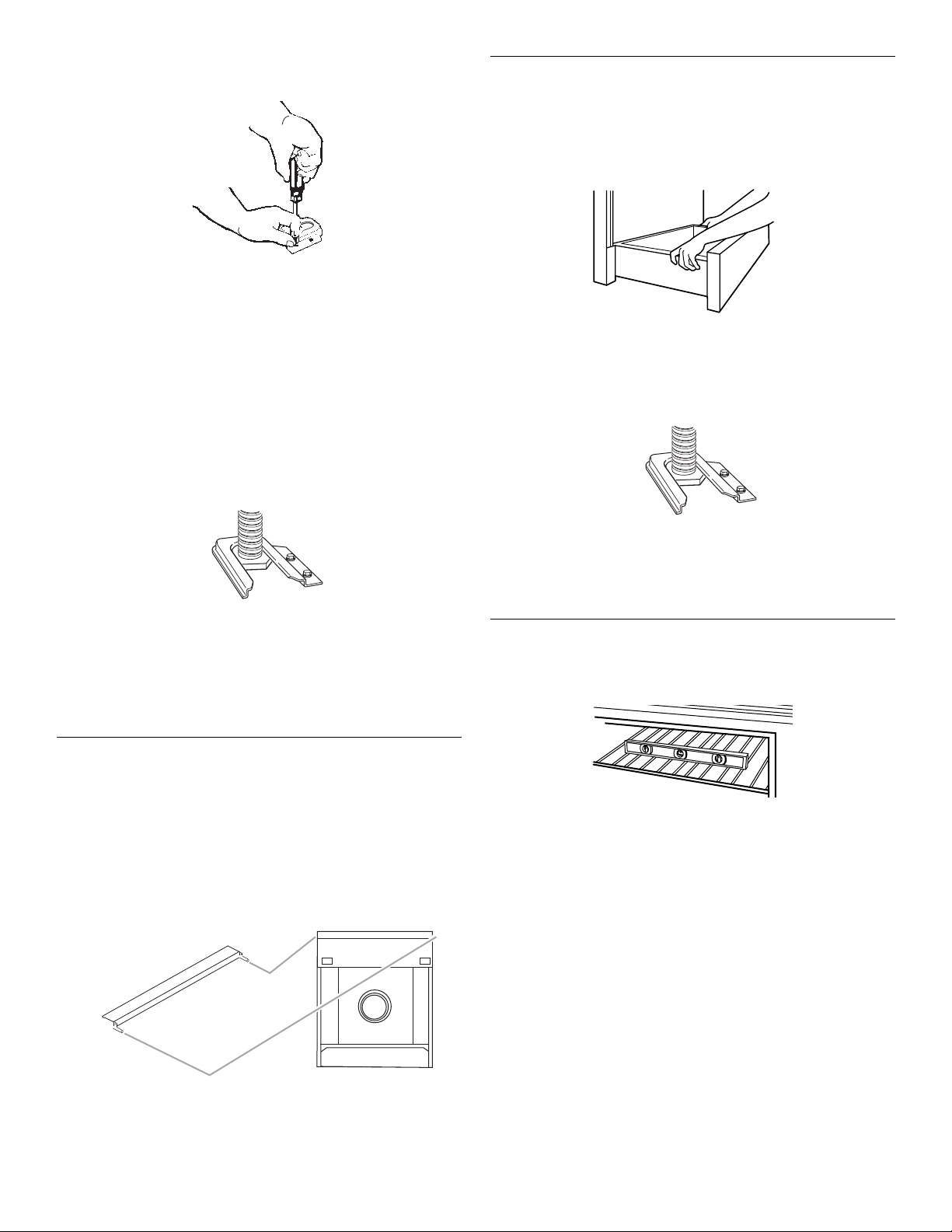
1. Si un ajustement de la hauteur de la cuisinière est nécessaire,
utiliser une clé ou une pince pour desserrer les 4 pieds de
nivellement.
Ceci doit être effectué alors que la cuisinière repose sur sa
partie postérieure ou est supportée par 2 pieds en position
verticale.
REMARQUE : Pour remettre la cuisinière en position
verticale, placer un carton ou un panneau de fibres dur
devant la cuisinière. En utilisant au moins 2 personnes,
relever la cuisinière et la placer sur le carton ou le panneau de
fibres dur.
2. Ajuster les pieds de nivellement à la hauteur nécessaire. Les
pieds de nivellement peuvent être desserrés pour ajouter une
hauteur maximale de 1" (2,5 cm). Une longueur minimum de
³⁄₁₆" (5 mm) est nécessaire pour engager la bride
antibasculement.
REMARQUE : Si un ajustement de la hauteur est effectué
alors que la cuisinière est debout, incliner la partie arrière de
la cuisinière pour ajuster les pieds avant, puis incliner la
cuisinière vers l'avant pour ajuster les pieds arrière.
3. Lorsque la cuisinière est à la hauteur souhaitée, vérifier qu'il y
a un espace suffisant sous la cuisinière pour loger la bride
antibasculement. Avant de faire glisser la cuisinière à son
emplacement final, vérifier qu'il sera possible de faire glisser
la bride antibasculement sous la cuisinière et sur le pied de
nivellement arrière avant l'installation de la bride
antibasculement.
Installation de la bride antibasculement
Contacter un installateur de revêtements de sol qualifié au sujet
des meilleures méthodes de perçage des trous de montage à
travers le revêtement de sol existant.
Avant de déplacer la cuisinière, la faire glisser sur sa base
d'expédition, un carton ou un panneau de fibres dur.
1. Enlever le gabarit de la trousse de la bride antibasculement
(à l'intérieur de la cavité du four) ou de la couverture arrière
du présent manuel.
2. Placer le gabarit sur le sol dans l'ouverture du placard de
sorte que le bord gauche se trouve contre le placard, et le
bord supérieur contre la paroi arrière, la plinthe ou le placard.
3. Fixer le gabarit avec du ruban adhésif.
4. Si le plan de travail n'est pas de niveau avec le haut de
l'ouverture du placard, aligner le gabarit avec le surplomb.
Si l'ouverture du placard est plus large que ce qui est spécifié
dans la section “Exigences d'emplacement”, ajuster le
gabarit de sorte que la cuisinière soit au centre de l'ouverture
du placard.
5. Pour monter la bride antibasculement sur un plancher de
bois, percer deux trous de ¹⁄₈" (3,2 mm) aux emplacements
indiqués sur le gabarit de la bride. Enlever le gabarit du sol.
Pour monter la bride antibasculement sur un plancher en
béton ou en céramique, utiliser un foret à maçonnerie de
³⁄₁₆" (4,8 mm) pour percer 2 trous aux emplacements indiqués
sur le gabarit de la bride. Enlever le gabarit du sol.
6. Enfoncer les ancrages en plastique dans les trous à l'aide
d'un marteau.
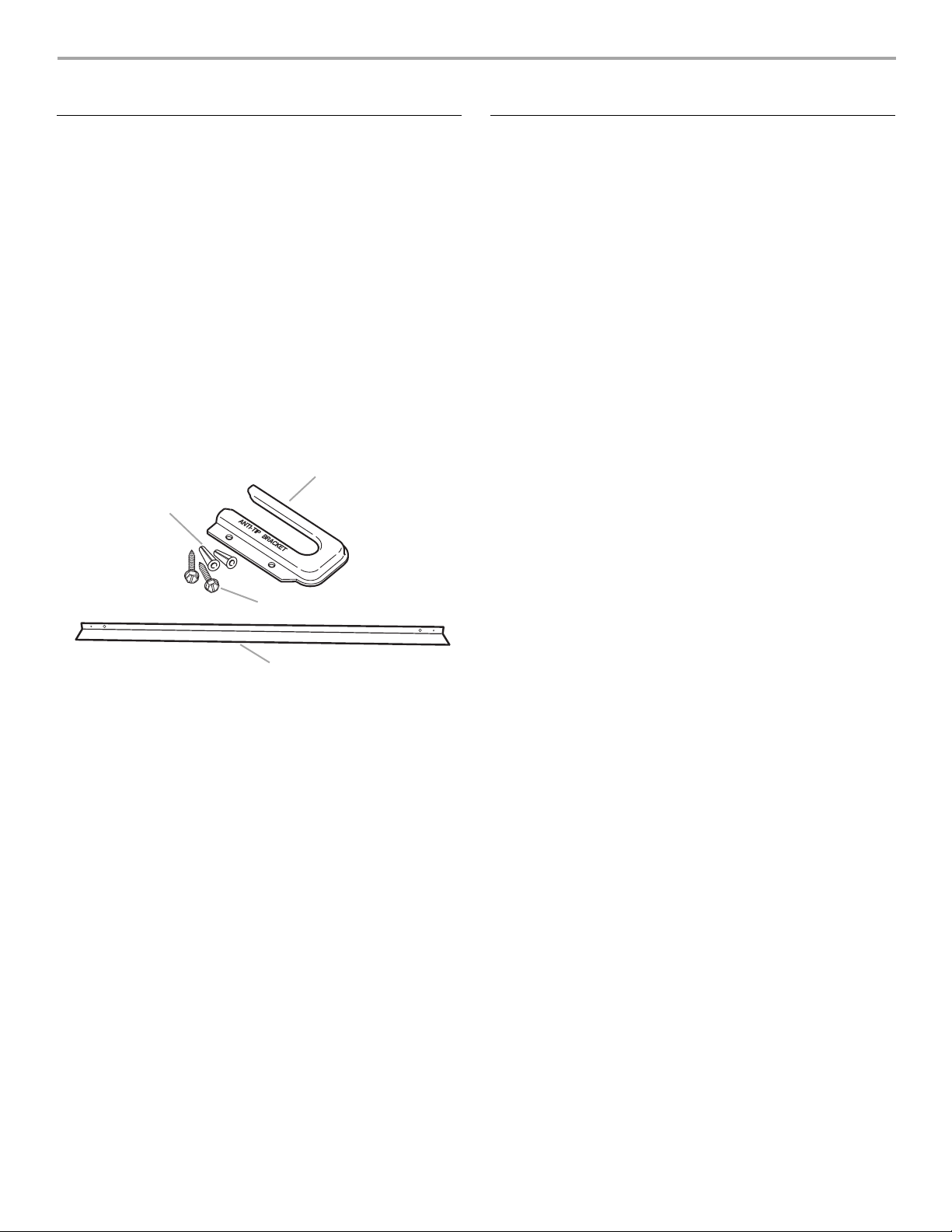
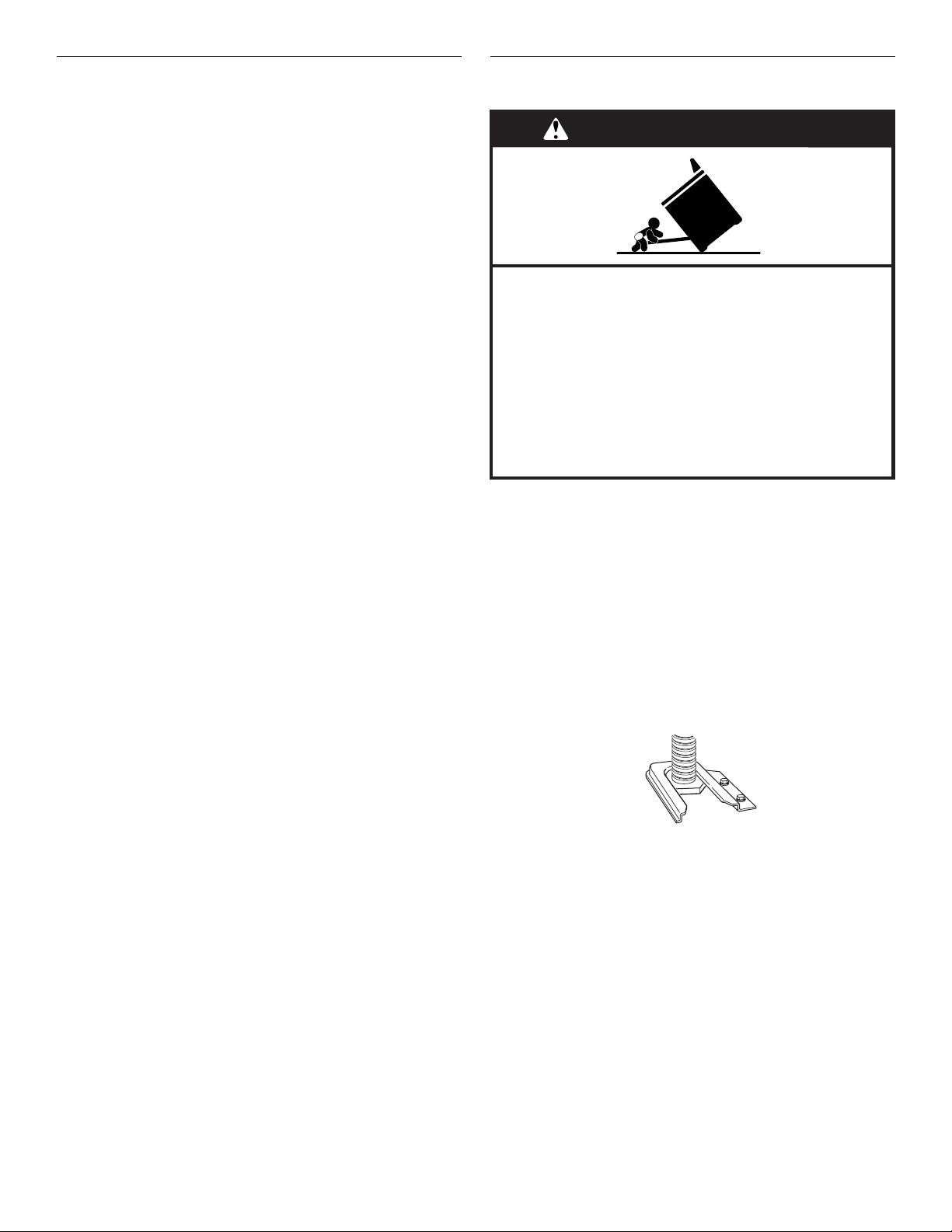
Risque de basculement
Un enfant ou une personne adulte peut faire basculer
la cuisinière ce qui peut causer un décès.
Joindre la bride antibasculement au pied arrière de
la cuisinière.
Joindre de nouveau la bride antibasculement si la
cuisinière est déplacée.
Le non-respect de ces instructions peut causer un
décès ou des brûlures graves aux enfants et aux
adultes.
AVERTISSEMENT
21
7. Aligner les trous de la bride antibasculement avec les trous
dans le plancher. Fixer la bride antibasculement avec les vis
fournies.
En fonction de l'épaisseur du plancher, des vis plus longues
peuvent s'avérer nécessaires pour fixer la bride au sous-
plancher. Des vis plus longues sont disponibles auprès de
votre quincaillerie locale.
8. Déplacer la cuisinière suffisamment près de l'ouverture pour
pouvoir effectuer les raccordements électriques. Retirer la
base d'expédition, le carton ou le panneau de fibres dur de
sous la cuisinière.
9. Effectuer les raccordements électriques comme décrit dans
la section “Raccordement électrique”.
10. Déplacer la cuisinière vers son emplacement final en
s'assurant que le pied de nivellement arrière glisse dans la
bride antibasculement.
11. En cas d'installation de la cuisinière dans une résidence
mobile, il est impératif de fixer la cuisinière au sol. Toute
méthode de fixation de la cuisinière est adéquate dans la
mesure où elle satisfait aux normes indiquées dans la section
“Exigences d'emplacement”.
12. Poursuivre l'installation de la cuisinière en utilisant les
instructions d'installation suivantes.
Garniture d’obturation arrière facultative
(pour cuisinières encastrées uniquement)
En cas d’installation d’une cuisinière encastrée dans l’ouverture
existante d’une cuisinière autoportante, on peut utiliser la
garniture d'obturation arrière pour remplir l'espace à l'arrière de
la cuisinière. Pour commander, consulter la section “Assistance
ou service” du Guide d'utilisation et d'entretien ou contacter le
marchand qui vous a vendu la cuisinière.
À l’aide des vis fournies avec l’ensemble, fixer la garniture
d’obturation arrière sur les côtés de la cuisinière.
Vérification de l'emplacement
de la bride antibasculement
1. Ouvrir le tiroir jusqu’à la première position de butée. Soulever
l’avant du tiroir pour dégager les roulettes blanches des
glissières du tiroir. Retirer le tiroir et le poser sur une surface
protégée.
2. Vérifier l’installation de la bride antibasculement :
■ Vérifier que la bride antibasculement est solidement fixée
au sol.
■ Faire glisser la cuisinière vers l’arrière; veiller à placer le
pied arrière sous la bride antibasculement.
3. Dans le cas de l’installation de la cuisinière dans une
résidence mobile, on doit fixer la cuisinière au plancher. Toute
méthode de fixation de la cuisinière au plancher est adéquate
dans la mesure où elle est conforme aux normes
mentionnées à la section “Exigences d'emplacement”.
Mise à niveau de la cuisinière
1. Placer la grille dans le four. Placer un niveau sur la grille et
contrôler l'aplomb, d'abord transversalement, puis dans le
sens avant/arrière.
Si la cuisinière n’est pas d’aplomb, tirer la cuisinière vers
l’avant pour dégager le pied arrière de la bride
antibasculement.
Sur les cuisinières équipées de tiroirs de remisage :
Utiliser une clé à cliquet de ³⁄₈" et une pince multiprise pour
régler les pieds de nivellement vers le haut ou vers le bas
jusqu'à ce que la cuisinière soit d'aplomb. Pousser pour
remettre la cuisinière en place. Vérifier que le pied de
nivellement arrière est engagé dans la bride antibasculement.
Sur les cuisinières équipées de tiroirs-réchaud :
Utiliser une pince multiprise pour régler les pieds de
nivellement vers le haut ou vers le bas jusqu'à ce que la
cuisinière soit d'aplomb. Pousser pour remettre la cuisinière
en place. Vérifier que le pied de nivellement arrière est
engagé dans la bride antibasculement.
REMARQUE : Il faut que l’appareil soit d’aplomb pour que le
four produise une performance satisfaisante.
2. Réinstaller le tiroir de remisage (et le tiroir-réchaud sur
certains modèles).
22
Achever l’installation
1. Vérifier que toutes les pièces ont été installées. S’il reste une
pièce, étudier en détail les étapes du processus d’installation
pour identifier l’étape qui a été omise.
2. Vérifier la présence de tous les outils.
3. Jeter ou recycler tous les matériaux d’emballage.
4. Vérifier que la cuisinière est d'aplomb. Voir “Mise à niveau de
la cuisinière”.
5. Pour l’élimination des résidus de cire laissés par les
matériaux de protection, utiliser une solution d’eau tiède et
de produit de nettoyage ménager liquide doux. Sécher
complètement avec un chiffon doux. Pour plus de
renseignements, voir la section “Entretien de la cuisinière”
dans le Guide d’utilisation et d’entretien.
6. Consulter la section “Utilisation de la cuisinière” dans le
Guide d’utilisation et d’entretien.
7. Brancher le cordon électrique dans une prise de courant
appropriée. Mettre l’appareil sous tension.
8. Allumer les brûleurs de surface et le four. Consulter le Guide
d’utilisation et d’entretien pour des instructions spécifiques
sur le fonctionnement de la cuisinière.
Si la cuisinière ne fonctionne pas, contrôler ce qui suit :
■ Fusible grillé ou mal connecté? Disjoncteur ouvert?
■ Cuisinière branchée sur une prise de courant?
■ Circuit d’alimentation sous tension?
■ Consulter la section “Dépannage” dans le Guide d’utilisation
et d’entretien.
■ Après 5 minutes de fonctionnement de la cuisinière, vérifier
l'échauffement. Si elle est froide, éteindre la cuisinière et
contacter un technicien qualifié.
Déplacement de la cuisinière
Lorsqu'on déplace la cuisinière, la faire glisser sur une planche
de carton ou en matériau dur pour éviter d'endommager le
revêtement du sol.
Si le déplacement de la cuisinière est nécessaire pour le
nettoyage ou l'entretien :
1. Débrancher le cordon d’alimentation électrique.
2. Faire glisser la cuisinière vers l’avant pour le nettoyage ou
l’entretien.
3. S’assurer que la bride antibasculement est installée :
■ Vérifier que la bride antibasculement est bien fixée au
plancher.
■ Glisser de nouveau la cuisinière vers l'arrière de sorte que
le pied soit sous la bride antibasculement.
4. Vérifier que la cuisinière est d'aplomb.
Risque de basculement
Un enfant ou une personne adulte peut faire basculer
la cuisinière ce qui peut causer un décès.
Joindre la bride antibasculement au pied arrière de
la cuisinière.
Joindre de nouveau la bride antibasculement si la
cuisinière est déplacée.
Le non-respect de ces instructions peut causer un
décès ou des brûlures graves aux enfants et aux
adultes.
AVERTISSEMENT
23
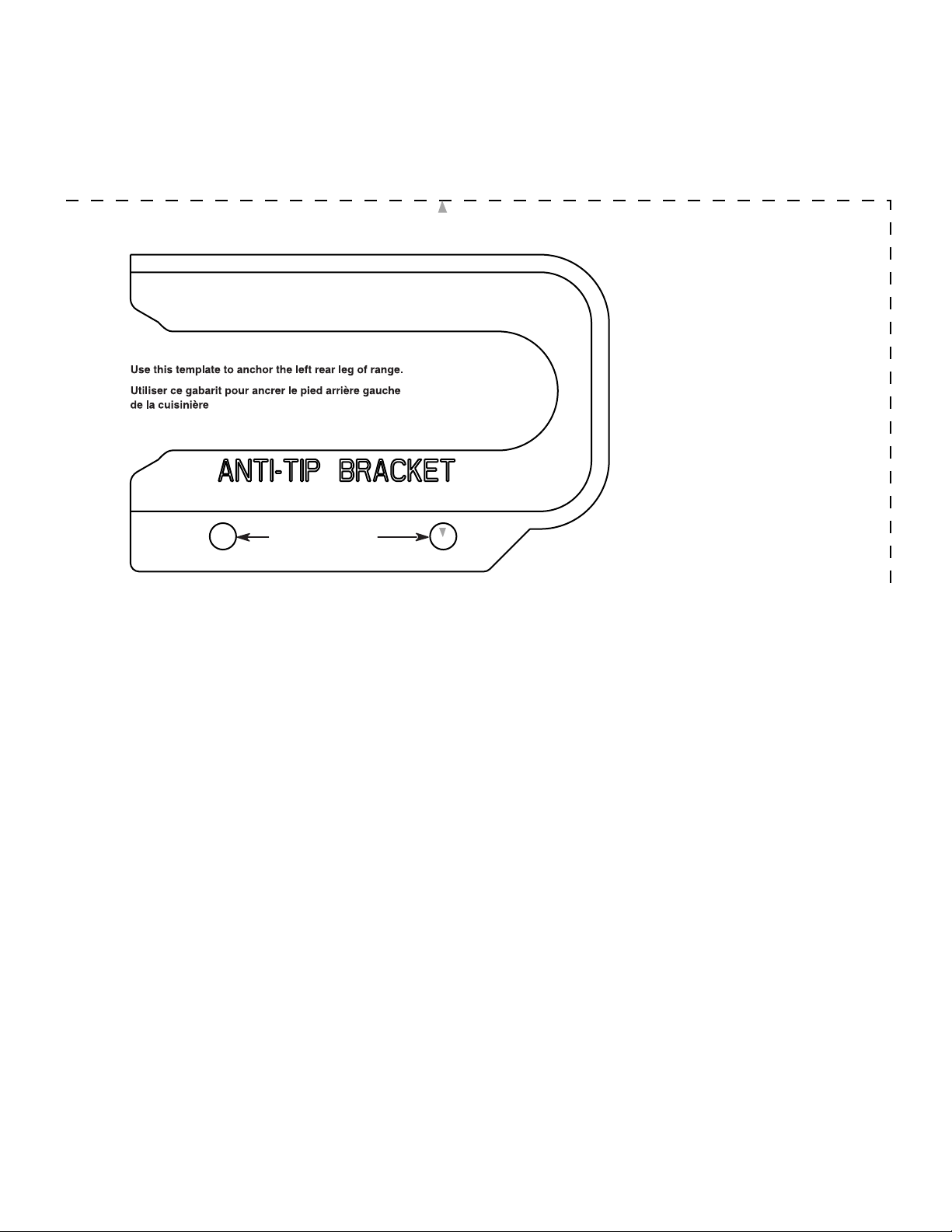
ANTI-TIP BRACKET TEMPLATE
GABARIT POUR LA BRIDE ANTIBASCULEMENT
Cut here and place top edge against the left side cabinet and right edge against rear wall.
Couper ici et placer le rebord supérieur contre le côté gauche du placard et le rebord droit contre la paroi arrière.
Trous dans la bride
Holes in bracket
.

9762035A
© 2007.
All rights reserved.
Tous droits réservés.
7/07
Printed in U.S.A.
Imprimé aux É.-U.

